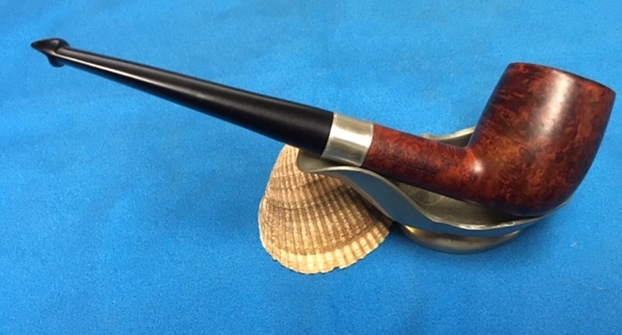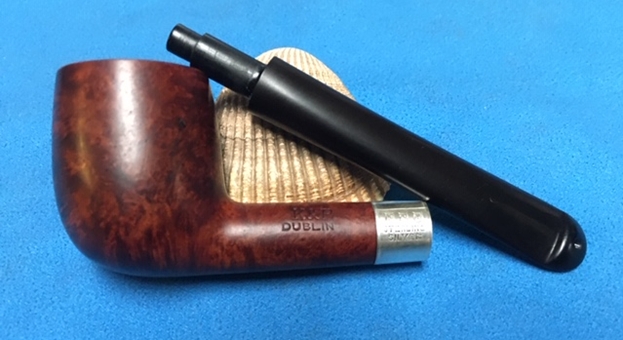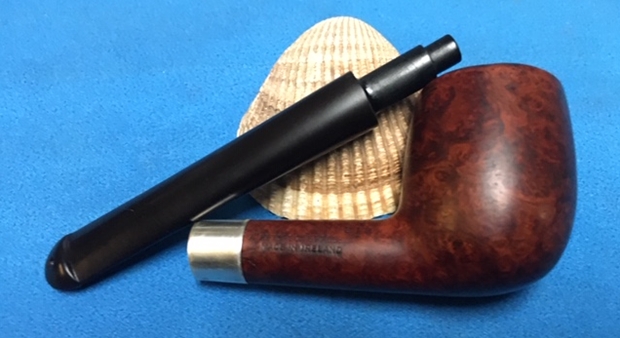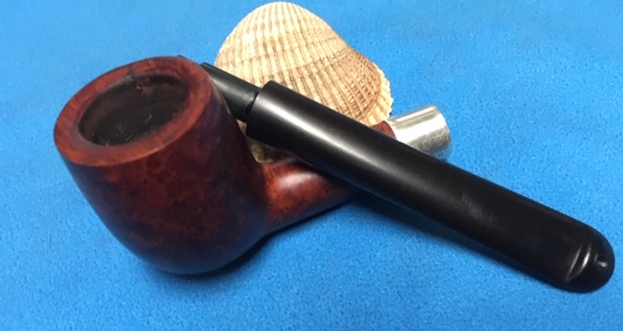
Tag Archives: fitting a stem

A Brigham Patent Era Special Grain Stack from Bob Kerr’s Estate


Blog by Steve Laug

As I continue to work through the pipes in Bob Kerr’s Estate I am enjoying choosing different brands that he had to focus on for a bit. He had six different pipes from Brigham in his collection so I decided to work my way through that sub collection of the estate. Out of the 6 pipes, #5 has a ruined bowl with a crack all the way around it as well as a cut off aluminum tenon. #6 went to Paresh Deshpande in India for his collection. That left behind four pipes for me to restore – #1, #2, #3 and #4. Here is the list of what I saw when I examined the 6 pipes.

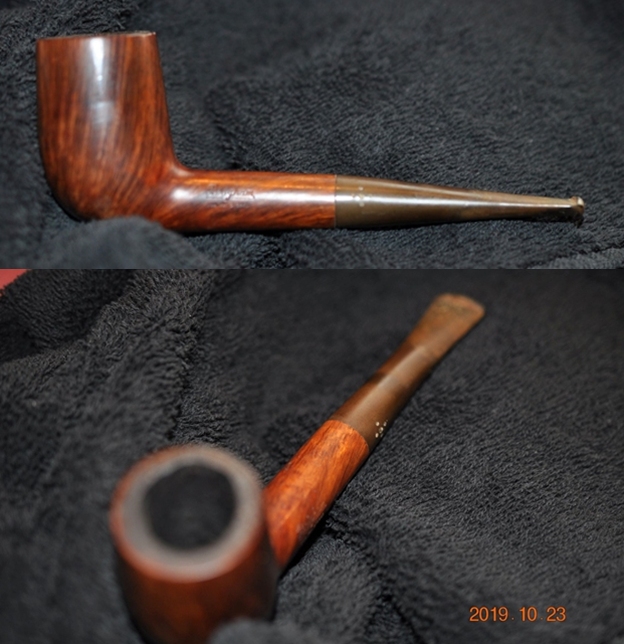
  1. Brigham 503T Can. Pat. 372982 5 Dot Stack. Stem is oxidized, tooth marks and chatter near the button, some calcification with damage to the button. Finish is dirty, thick cake and lava overflow on the rim top. Rim top has is worn and damage on the back edge.
  2. Brigham Made In Canada 691 3 Dot Canadian. Stem is oxidized, tooth marks and chatter near the button, some calcification with damage to the button. Finish is dirty, thick cake and lava overflow on the rim top. Rim top is worn and damaged.
  3. Brigham Made In Canada 601 2 Dot Lovat. Stem is oxidized, tooth marks and chatter near the button, some calcification with damage to the button. Finish is dirty and worn. Stamping is worn. There is a thick cake and lava overflow on the rim top. Rim top is worn and damaged.
  4. Brigham Made In Canada 1 Dot Bing Crosby Style Pipe. Stem is oxidized, tooth marks and chatter near the button, some calcification with damage to the button. Finish is dirty, thick cake and lava overflow on the rim top. Rim top is worn and damage on the back edge.
  5. Brigham Made In Canada 6 Dot Bent Billiard. Stem is oxidized, tooth marks and chatter near the button, some calcification with damage to the button. The aluminum tenon has been cut off. Finish is dirty and worn with paint on the bowl. There is a thick cake and lava overflow on the rim top. Rim top has a crack on the right side.
  6. Brigham Made In Canada 4 Dot Canadian. Stem is oxidized, tooth marks and chatter near the button, some calcification with damage to the button. Finish is dirty and stamping is worn. There is a thick cake and lava overflow on the rim top. Rim top is worn and edges are damaged.

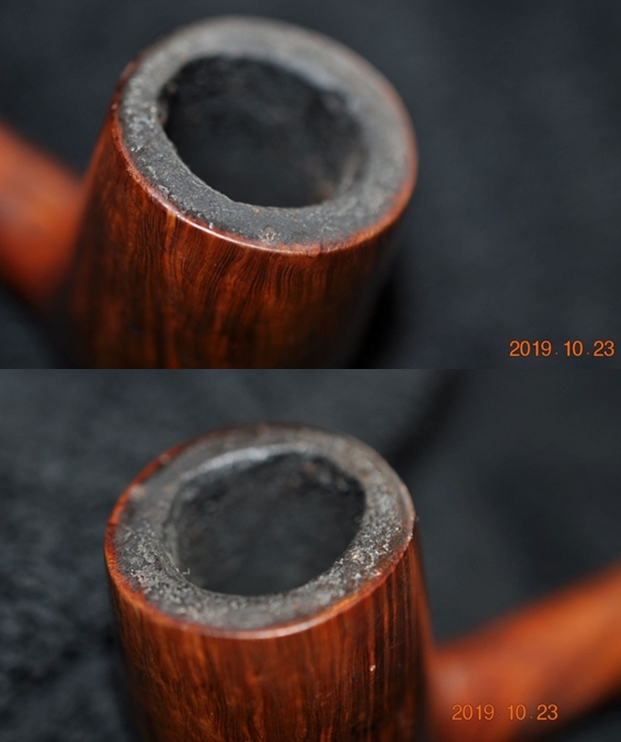
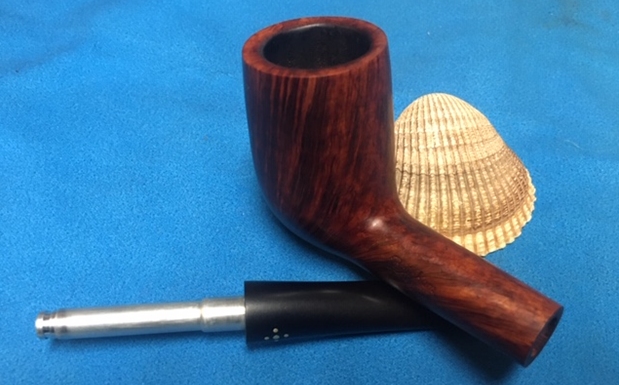
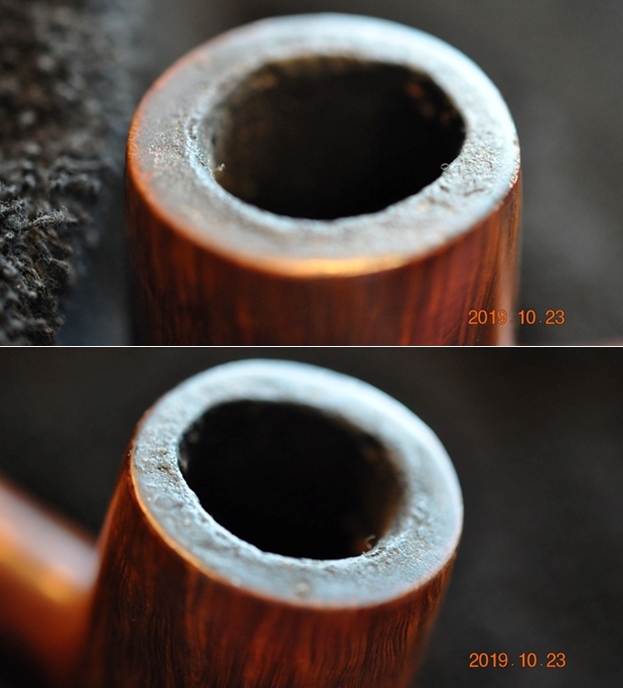
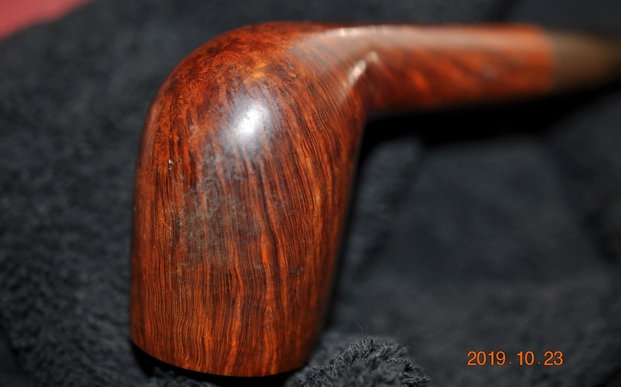
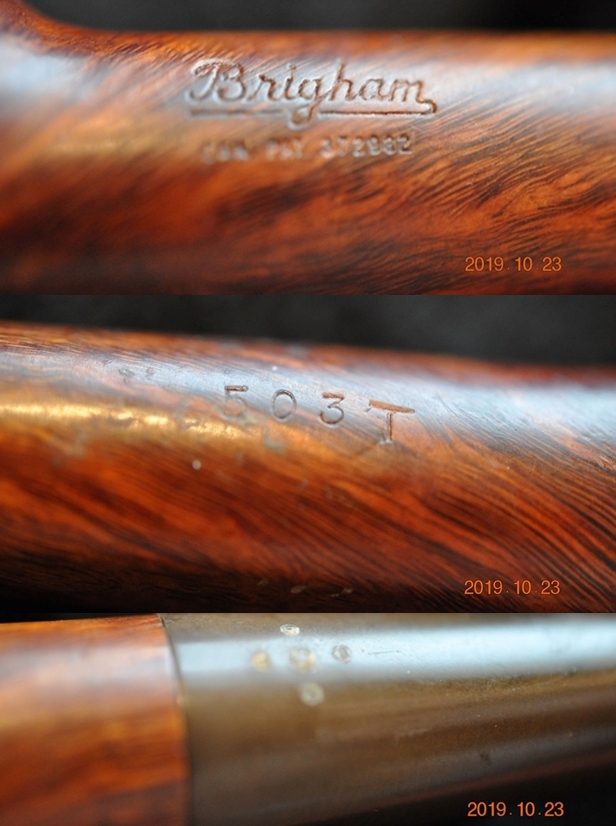
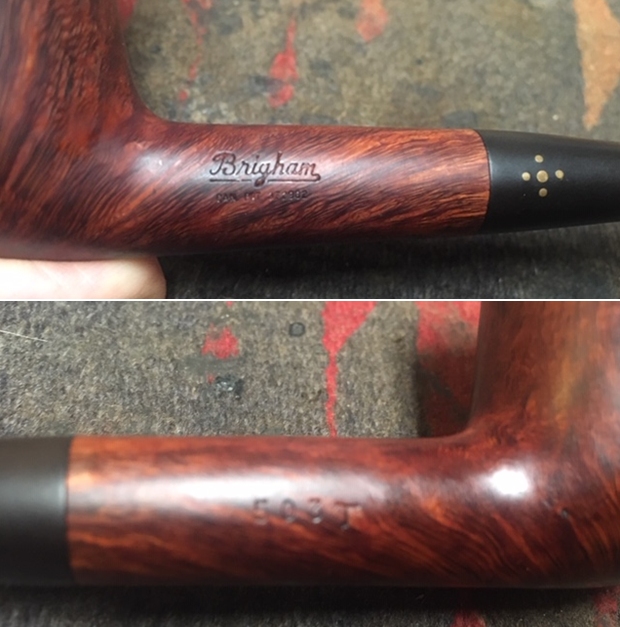
I chose to work on these in the order above. The first pipe I tackled was #1 which was a beautifully grained Brigham 503T Stack. It was stamped on the left side of the shank with clear stamping Brigham over Can. Pat. 372982. On the right side of the shank it was stamped with the shape number 503T. There was a thick cake in the bowl with remnants of tobacco stuck on the walls. There was a lava overflow on the rim. The top and edges of the rim appear to have some damage all the way around the bowl. The grain on the shank and bowl was a combination of flame and straight grain. There was a dent mid bowl on the left side of the bowl. I think that there was a beautiful pipe underneath all of the buildup of years of use. The stem was oxidized and calcified toward the end with some tooth chatter. There were also some tooth marks on both sides of the stem ahead of the button. There was a pattern of five brass dots on the left side of the tapered stem. Jeff took photos of the pipe before he started his cleanup work on it. Jeff took photos of the bowl and rim top to show the thick, hard cake in the bowl with remnants of tobacco stuck on the walls of the bowl. There was a lava build up on the top of the rim and the edges of the bowl. The rim top looked pretty good but it was hard to know for sure but it appeared that there was damage all around the inner edge. The outer edges of the rim had some damage on the back side where it appeared to have been hit against a hard surface and left behind a rough edge.    Jeff took a photo of the side and heel of the bowl to show the condition of the finish. You can see the beautiful grain around the side of the bowl and shank. Even under the dirt and debris of the years it looked very good. Jeff took photos of the stamping on the left side of the bowl and shank. It read Brigham over Can. Pat 372982. The stamp on the right side of the shank read 503T which was the shape number.  The last photo shows the five brass dots on the left side of the tapered stem.  Jeff took photos of the top and underside of the stem showing the tooth chatter, scratching and oxidation on the stem surface and wear on the edges of the button. I am also including the information from Pipedia’s article on Brigham pipes. It is a great read in terms of the history of the brand (https://pipedia.org/wiki/Brigham_Pipes). Charles Lemon (Dadspipes) is currently working on a book on the history of the brand. Until that is complete this article is a good summary. I have included it below.
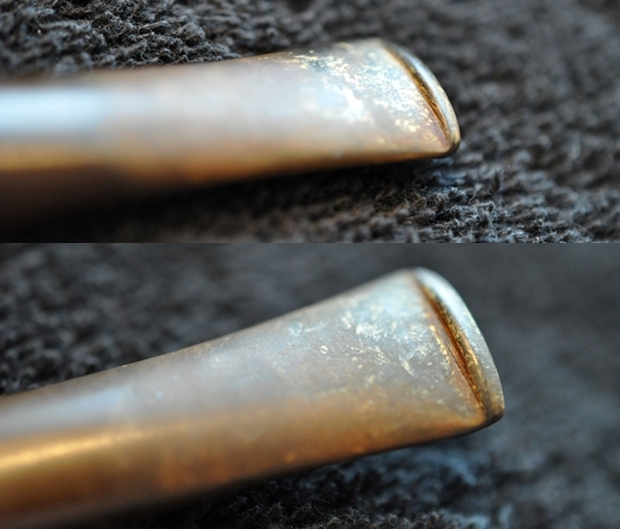
Roy Brigham, after serving an apprenticeship under an Austrian pipesmith, started his own pipe repair shop in Toronto, in 1906. By 1918 the business had grown to include five other craftsmen and had developed a reputation across Canada for the high quality of workmanship. After repairing many different brands of pipes over the years, Roy noted certain recurring complaints by pipe smokers, the most common referred to as “tongue bite”. Tongue bite is a burning sensation on the smoker’s tongue, previously thought to be due to the heat of the smoke (i.e. a “hot smoking pipe”).

He soon began manufacturing his own pipes, which were lightweight, yet featured a more rugged construction, strengthening the weak points observed in other pipes. The problem of tongue bite intrigued him, and he decided to make overcoming it a future goal.

About 1938, Roy’s son Herb joined him to assist in the business. The business barely survived the great depression because pipes were considered to be a luxury, not a necessity, and selling pipes was difficult indeed. In approximately 1937 [1], after some experimentation, Roy and Herb discovered that tongue bite was in fact a form of mild chemical burn to the tongue, caused by tars and acids in the smoke. They found that by filtering the smoke, it was possible to retain the flavour of the tobacco and yet remove these impurities and thereby stop the tongue bite.

Just as Thomas Edison had searched far and wide for the perfect material from which to make the first electric light bulb filaments, Roy & Herb began experimenting with many materials, both common and exotic, in the quest for the perfect pipe filter. Results varied wildly. Most of the materials didn’t work at all and some actually imparted their own flavour into the smoke. They eventually found just two materials that were satisfactory in pipes: bamboo and rock maple. As bamboo was obviously not as readily available, rock maple then became the logical choice.

They were able to manufacture a replaceable hollow wooden tube made from rock maple dowelling, which when inserted into a specially made pipe, caused absolutely no restriction to the draw of the pipe, yet extracted many of the impurities which had caused tongue bite. The result was indeed a truly better smoking pipe.

As a result, sales of Brigham pipes climbed briskly afterwards, and by the 1960’s there were well over 40 full time production staff. For over four decades now, the company has been the leading Canadian pipe manufacturer, producing more than three quarters of all the pipes made in Canada.

In 1978, Roy’s grandson Mike joined the firm and together with Herb (now in his 80s) they still produce pipes and wooden filters according to long established techniques, resulting in consistently high quality products. Several pipe makers who learned the craft of pipe making here at Brigham went on to make a name for themselves in Canada and internationally including Philip Trypis and Julius Vesz.

I wrote to Charles Lemon (Dadspipes) and asked him about the stamping on the pipe. He responded with information on all of the foursome. I am including the information on this particular pipe.

Hey Steve! Good to hear from you.

The ‘T’ suffix to the Brigham 3-digit shape number indicates a Tall bowl (ie taller than the standard shape). Thus your Patent Era 503T is a Brigham Special Grain Shape 03 (Medium Billiard) with a Tall bowl, made between 1938 and 1955…

…As these are all Patent pipes, it’s more accurate to refer to their grade by name (the post 1980 grading scheme refers to Dots). Here is the original scheme:With the information from Charles’ message and the chart above that he included I knew what I was dealing with in terms of the stamping and the age of this pipe. I learned that the ‘T’ suffix to the Brigham 3-digit shape number indicated a Tall bowl (i.e. taller than the standard shape). This Patent Era 503T is a Brigham Special Grain Shape 03 (Medium Billiard) with a Tall bowl, made between 1938 and 1955. Most of Bob’s pipes were purchased in the 50s and 60s so my guess is that this is fits that time frame well. Now it was time to work on the pipe.

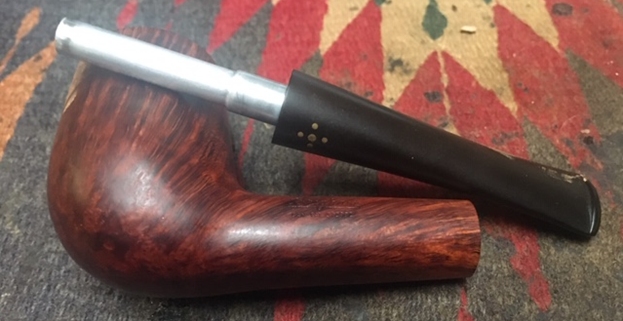
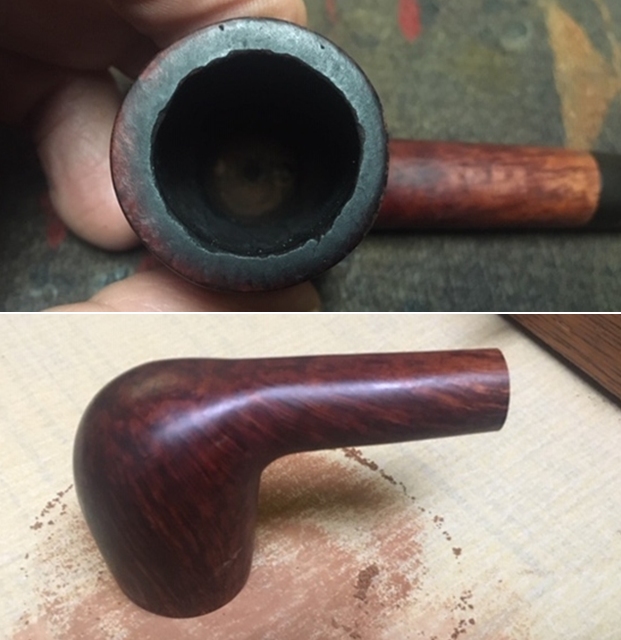
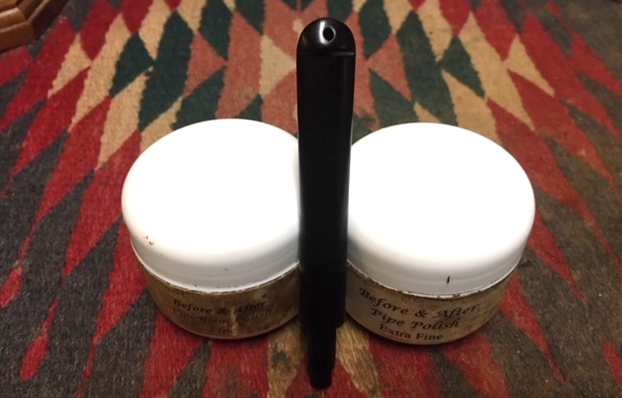
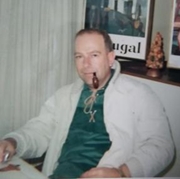
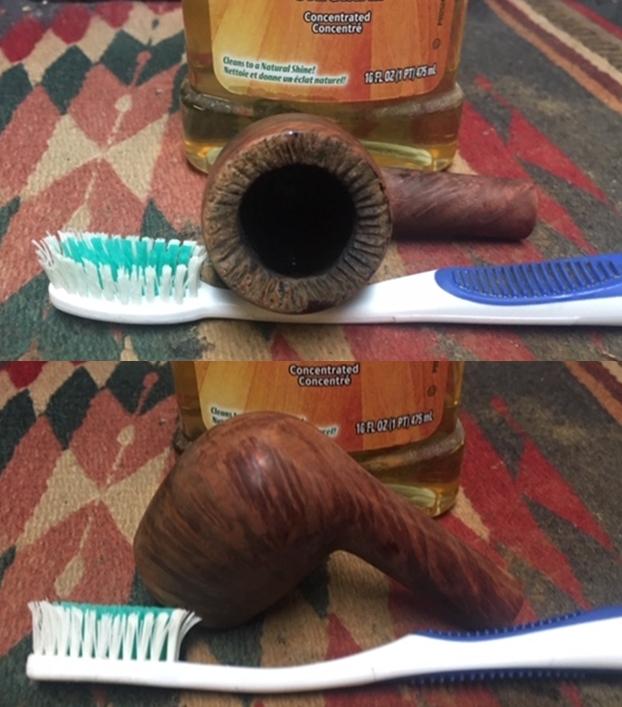
I am really happy to have Jeff’s help on cleaning up the pipes from Bob’s estate as the 125+ pipes were taking me a long time to do alone. He cleaned this filthy pipe with his usual penchant for thoroughness that I really appreciate. This one was a real mess and I did not know what to expect when I unwrapped it from his box. He reamed it with a PipNet pipe reamer and cleaned up the reaming with a Savinelli Fitsall Pipe Knife. He scrubbed out the internals with alcohol, pipe cleaners and cotton swabs until the pipe was clean. He scrubbed the exterior of the bowl with Murphy’s Oil Soap and a tooth brush to remove the grime and grit on the briar and the lava on the rim top. The finish looks very good with great looking grain around the bowl and shank. Jeff soaked the stem in Before & After Deoxidizer to remove the oxidation on the rubber. When the pipe arrived here in Vancouver for the second stop of its restoration tour I was amazed it looked so good. I took some close up photos of the rim top and also of the stem surface. I wanted to show what an amazing job Jeff did in the cleanup of the rim top. The rim top was darkened with nicks and notches around the top and inner edge. The inner edge was very rough and looked like the bowl had been reamed with a knife at some time in its life. I also took close up photos of the stem to show the lack of tooth marks and chatter on the stem surface. It was very clean.I took the stem off the shank to show the aluminum tenon/tube that was used to hold the Brigham Rock Maple Distillator. The original Distillator (filter) had been filthy so after Jeff had cleaned the pipe up he threw it away. I will replace it once I have finished with the restoration.One of the things I appreciate about Jeff’s cleanup is that he works to protect and preserve the nomenclature on the shank of the pipes that he works on. The stamping on this one was very faint to start with so I was worried that it would disappear altogether with the cleanup. He was not only able to preserve it but it is clearer than shown in the earlier photos. I took some photos to show the clarity of the stamping. I have noticed that many restorers are not careful to protect the stamping in their cleaning process and often by the end of the restoration the nomenclature is almost destroyed. I would like to encourage all of us to be careful in our work to preserve this as it is a critical piece of pipe restoration! Since this is another pipe Bob’s estate I am sure that some of you have read at least some of the other restoration work that has been done on the previous pipes. You have also read what I have included about Bob Kerr, the pipeman who held these pipes in trust before I came to work on them (see photo to the left). Also, if you have followed the blog for long you will already know that I like to include background information on the pipeman whose pipes I am restoring. For me, when I am working on an estate I really like to have a sense of the person who held the pipes in trust before I worked on them. It gives me another dimension of the restoration work. Bob’s daughter wrote a short tribute to her father. I thank you Brian and tell your wife thank you as well.
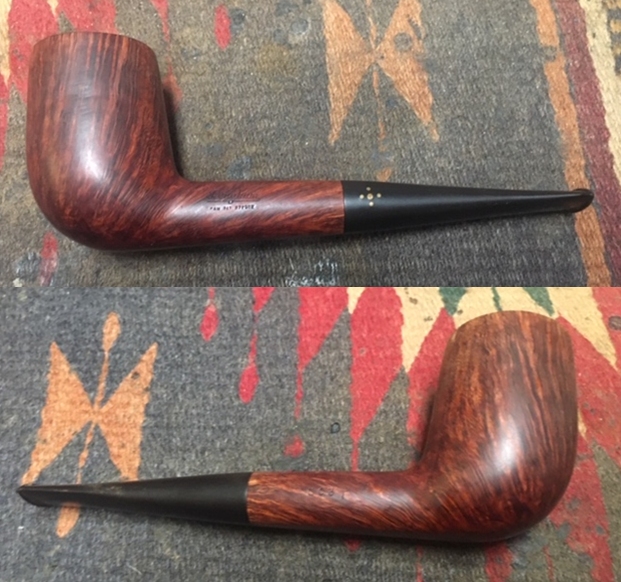
I am delighted to pass on these beloved pipes of my father’s. I hope each user gets many hours of contemplative pleasure as he did. I remember the aroma of tobacco in the rec room, as he put up his feet on his lazy boy. He’d be first at the paper then, no one could touch it before him. Maybe there would be a movie on with an actor smoking a pipe. He would have very definite opinions on whether the performer was a ‘real’ smoker or not, a distinction which I could never see but it would be very clear to him. He worked by day as a sales manager of a paper products company, a job he hated. What he longed for was the life of an artist, so on the weekends and sometimes mid-week evenings he would journey to his workshop and come out with wood sculptures, all of which he declared as crap but every one of them treasured by my sister and myself. Enjoy the pipes, and maybe a little of his creative spirit will enter you!

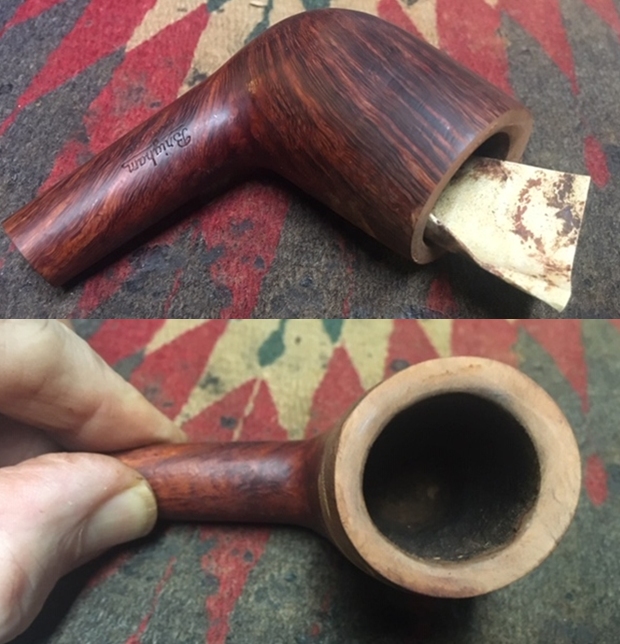
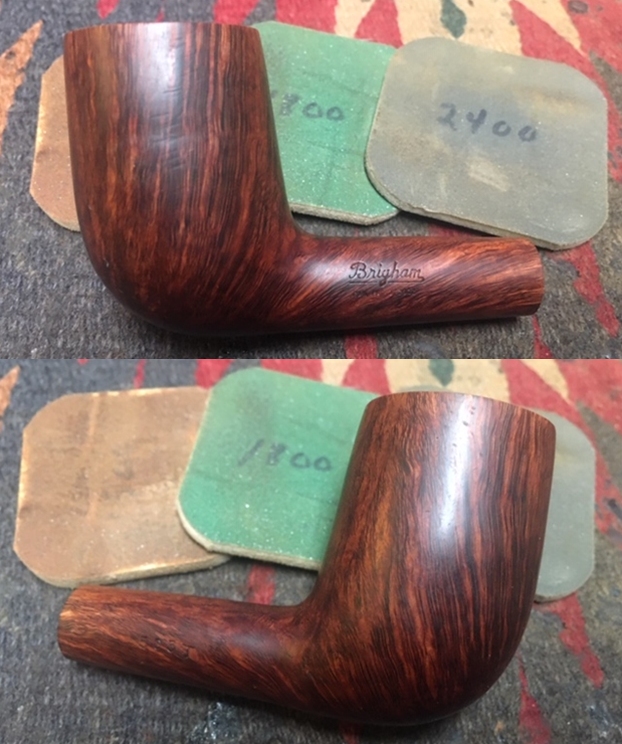
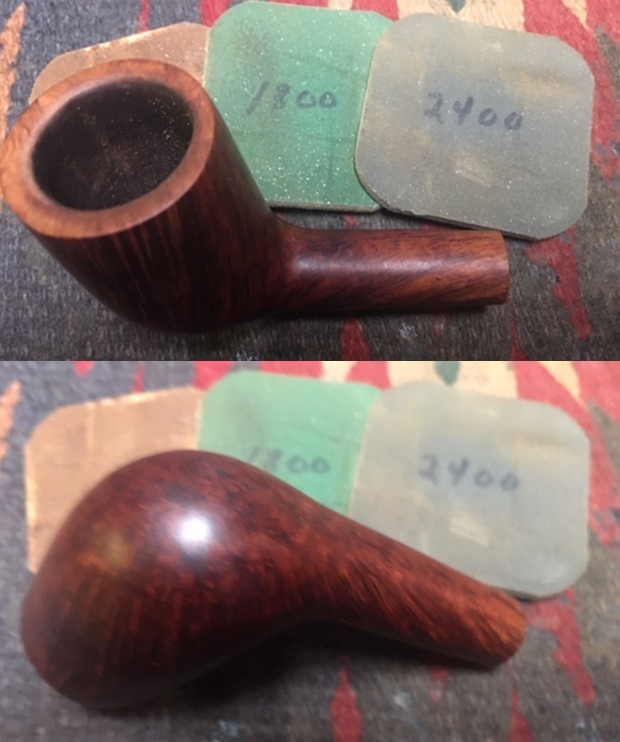
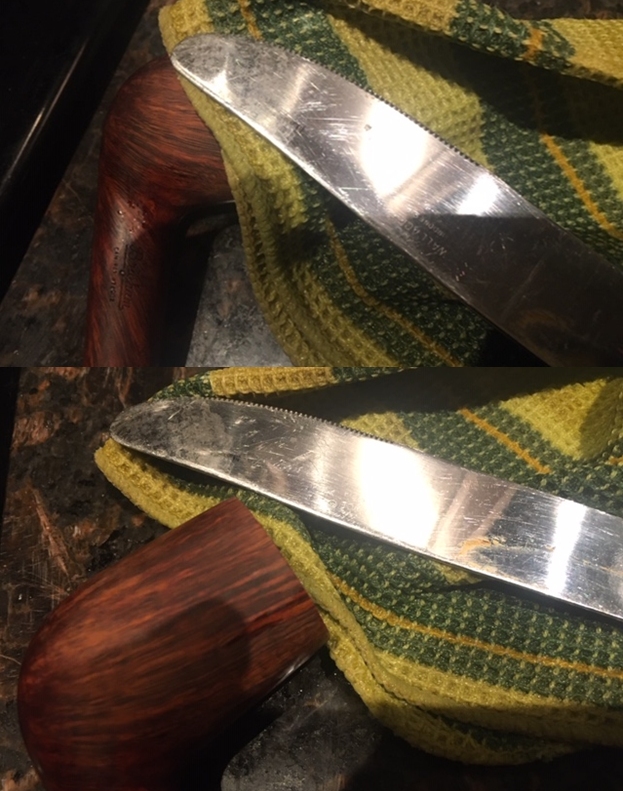
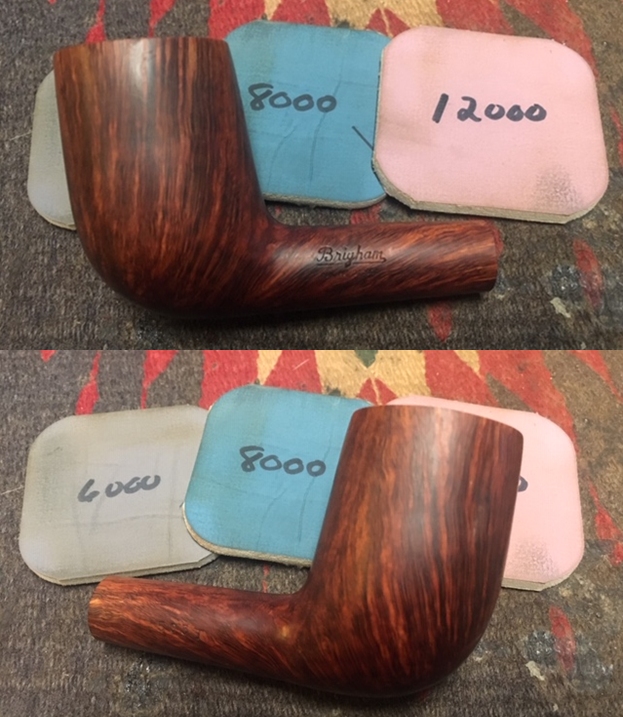
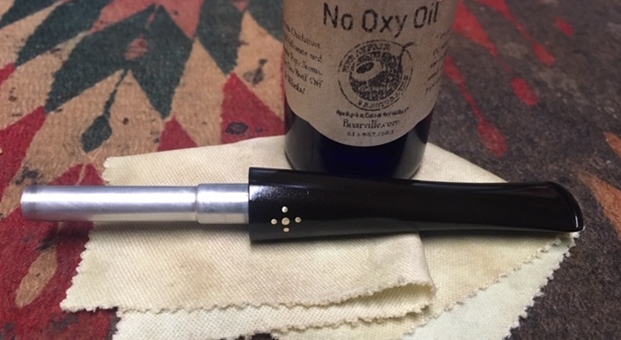
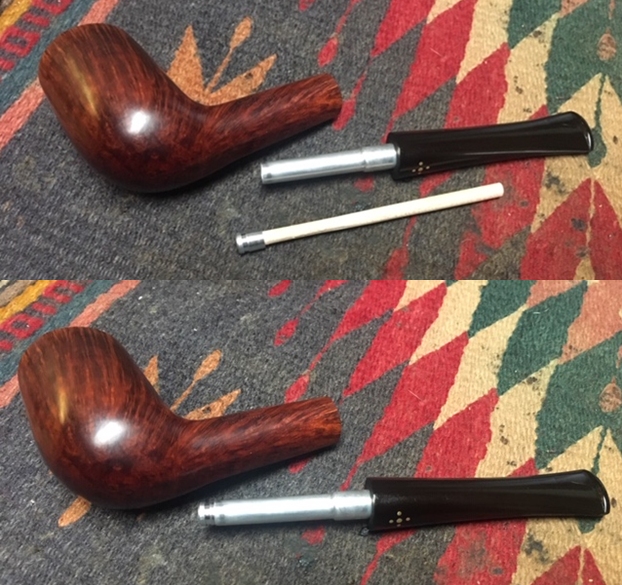
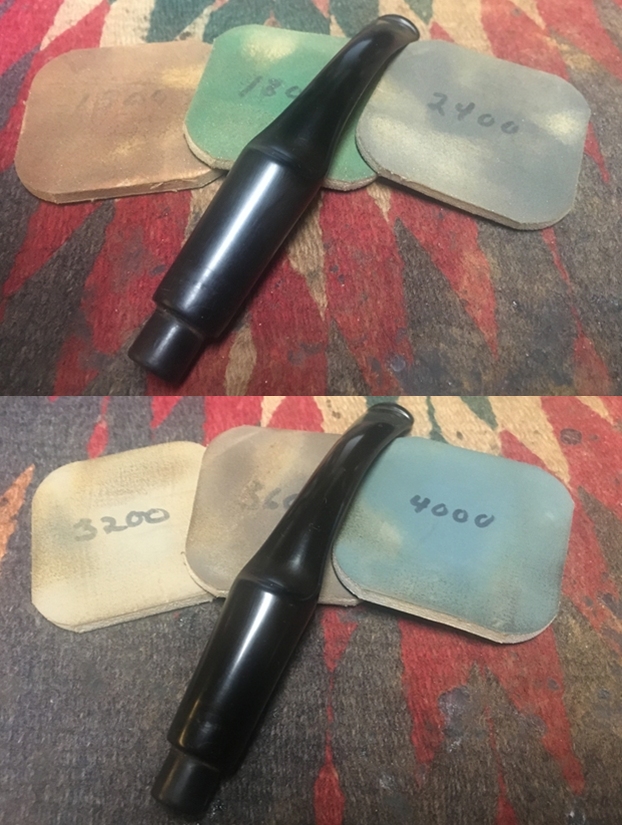
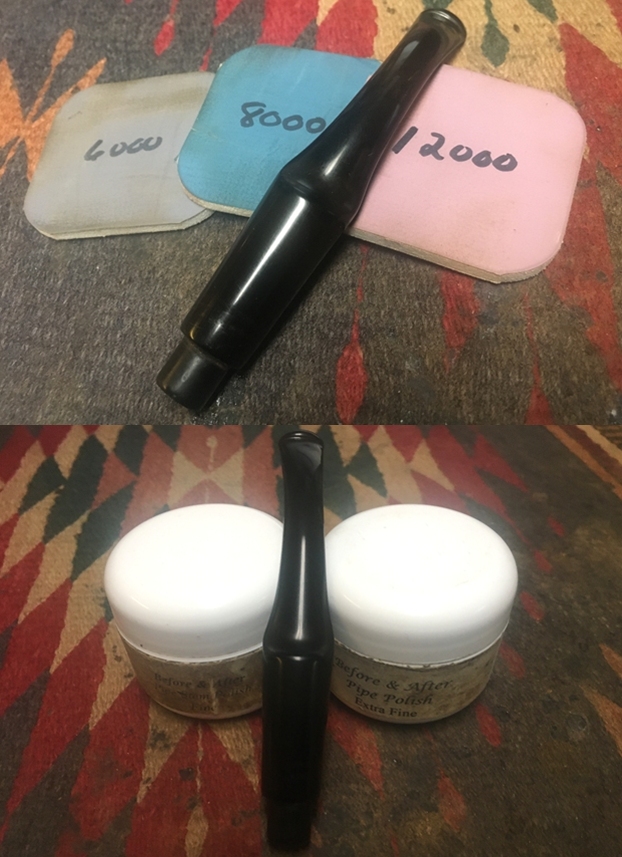
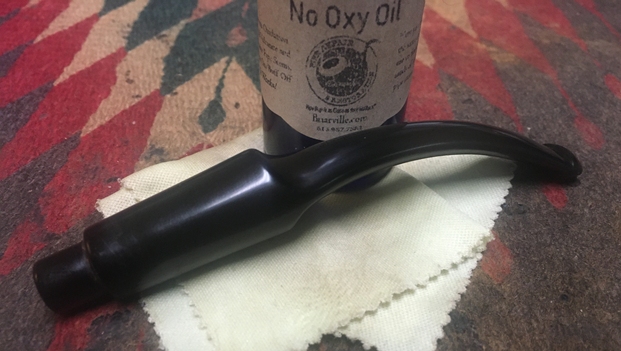
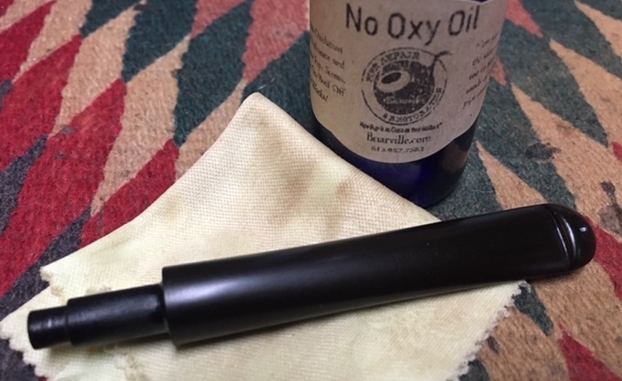
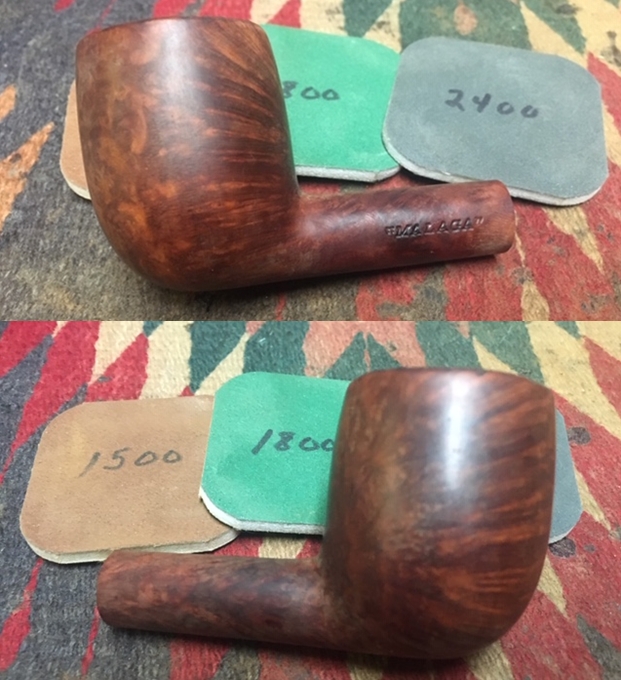
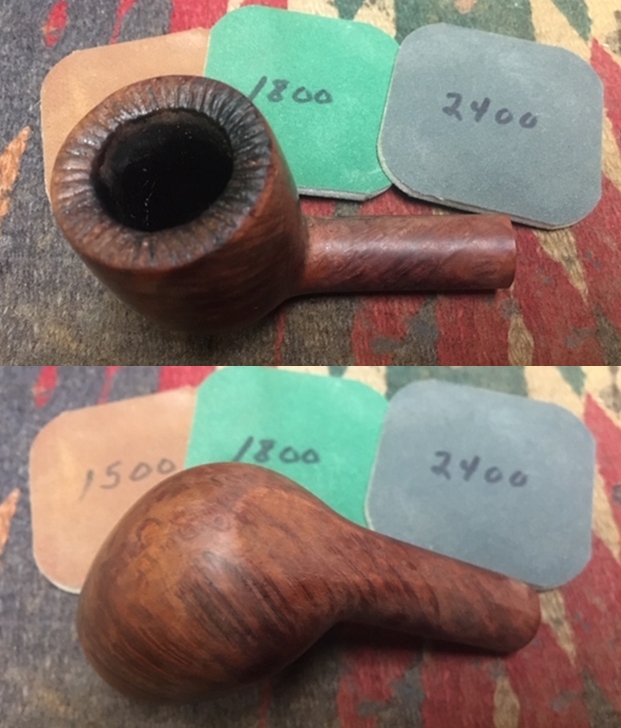
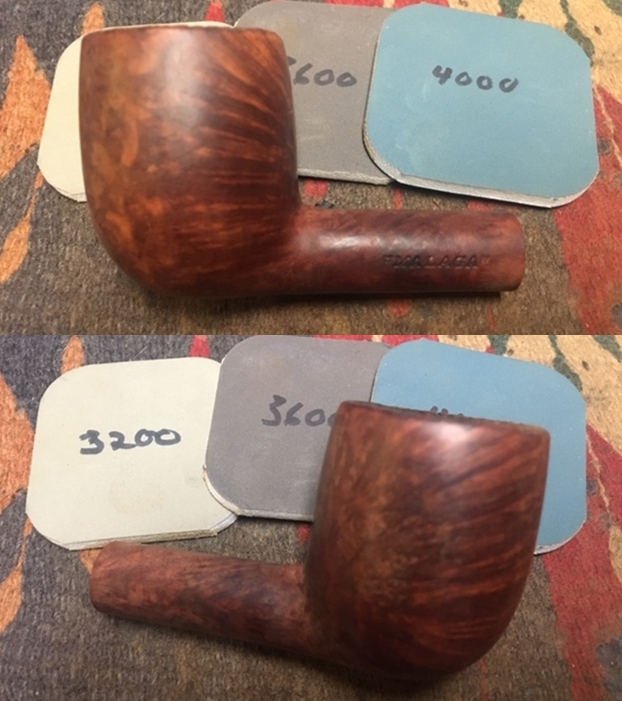
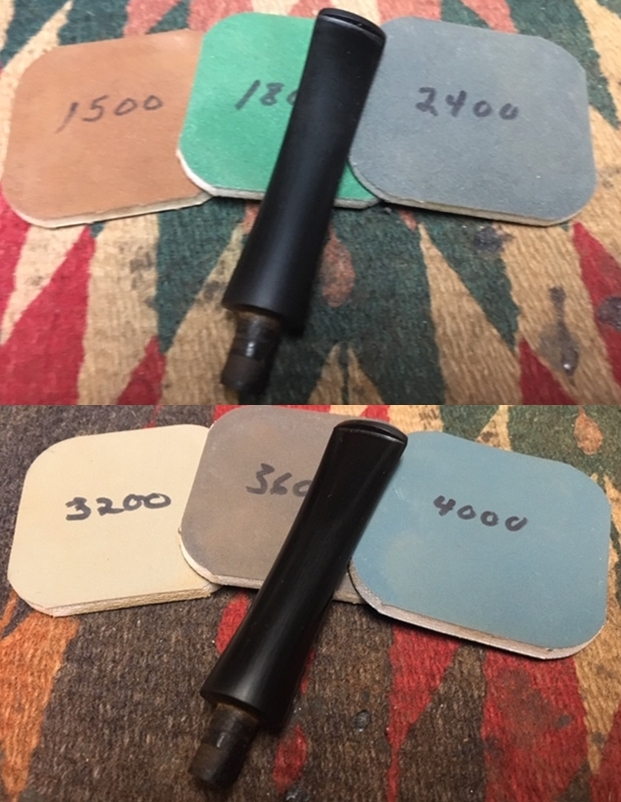
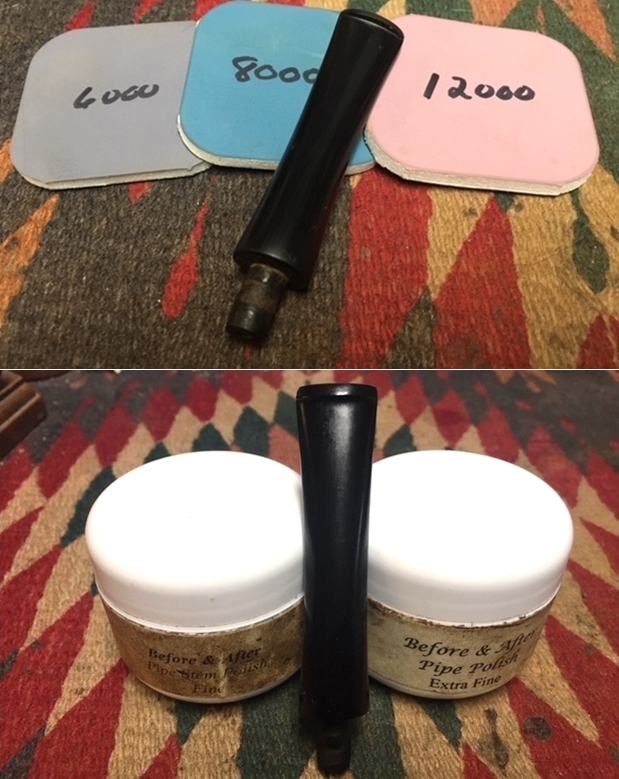
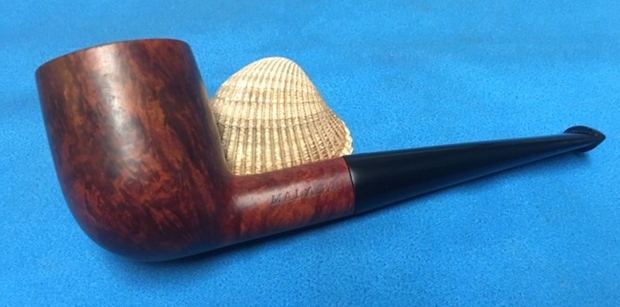
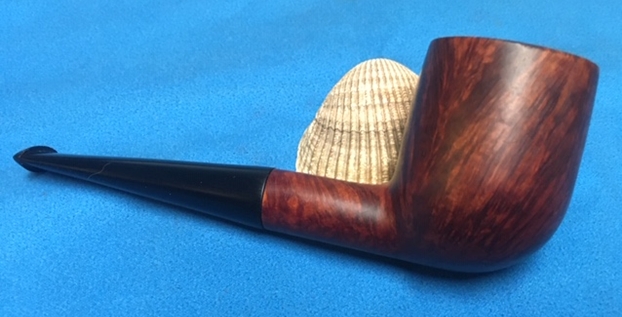
Now with all of the background on the line and the background on Bob Kerr it was time to get on with the restoration of this beautiful straight grained Brigham Special Grain Tall Billiard. I am really coming to appreciate the hard cleanup work that Jeff did on these pipes. They were a real mess when I sent them to Jeff and I have to tell you it was great that I did not need to clean this pipe. I decided to start the process by dealing with the damage to the rim top and edges of the bowl. I topped it on a topping board with 220 grit sandpaper. I worked on the inner edge with a folded piece of 220 grit sandpaper and gave it a very slight bevel so that it took care of the damage on the inner edge. The photos show the progress. I polished the briar with micromesh sanding pads – wet sanding it with 1500-2400 grit pads and I wiped the bowl down after each sanding pad with a damp cloth. There were some scratches in the bowl on both sides and there appeared to be a dent in the left side mid-bowl.  I interrupted the polishing of the briar to deal with the dent in the bowl side. I heated a knife and used it and a wet cloth to steam the dent out of the surface of the briar. The first photo shows the process while the second shows the bowl after the steaming. The dent is gone.   With the dent removed I went back to polishing the briar with the remaining micromesh sanding pads – wet sanding it with 3200-12000 grit pads and I wiped the bowl down after each sanding pad with a damp cloth.  I rubbed the bowl and rim down with Before & After Restoration Balm. I worked it into the surface of the briar with my fingertips to clean, enliven and protect it. I let the balm sit for a little while and then buffed with a cotton cloth to raise the shine. I really like watching the Balm do its magic and bring the briar alive. The stem was in great condition so I did not need to sand out tooth marks or chatter. I polished the stem with micromesh sanding pads – wet sanding with 1500-12000 grit pads. I wiped the stem down after each sanding pad with Obsidian Oil. I polished it with Before & After Pipe Stem Polish – both Fine and Extra Fine. Once I had finished the polishing I gave it a coat of a new product I am experimenting with from Briarville Pipe Repair. It is called “No Oxy Oil” and it is made to protect the stem from oxidizing. I set it aside to dry.   With the pipe cleaned and ready to polish I put a new Brigham Distillator filter in the stem. The photos show the Distillator out of the tenon and in place in the tenon. It is a Maplewood tube that collects the moisture from the smoke and delivering a dry, cool smoke sans tongue bite. Once again at this point in the restoration process I am excited to be on the homestretch. This is the first Brigham from the four that are in Bob’s estate so I look forward to the final look when it is put back together, polished and waxed. I put the bowl and stem back together. I polished the bowl and stem with Blue Diamond to polish out the scratches in the briar and the vulcanite. I gave the bowl and the stem multiple coats of carnauba wax. I buffed the pipe with a clean buffing pad to raise the shine. I hand buffed it with a microfiber cloth to deepen the shine. The pipe polished up pretty nicely. The grain is quite stunning and really pops with the wax and polish. The shiny black vulcanite stem with the five brass pins is a beautiful contrast to the browns of the bowl and shank. This was another fun pipe to work on thanks to Jeff’s cleanup work. It really is a quite stunning piece of straight and flame grained briar whose shape follows the flow of the briar. The Brigham 503T Patent Era Special Grain Stack is a comfortable pipe to hold in the hand. The finished pipe is shown in the photos below. The dimensions of the pipe are Length: 5 ¾ inches, Height: 2 inches, Outside diameter of the bowl: 1 ¼ inches, Chamber diameter: ¾ of an inch. I am a bit undecided on this pipe. I am thinking of holding onto it for a while but I am still not sure. If I decide to let it go this beautiful pipe will be going on the rebornpipes store. I have a lot more of Bob’s estate to work on of various brands. Perhaps one of those will catch your attention. Thanks for reading this blog and my reflections on the pipe while I worked on it. This is an interesting estate to bring back to life.

Another Republic Era Peterson’s 1307 System Standard from Bob Kerr’s Estate


Blog by Steve Laug

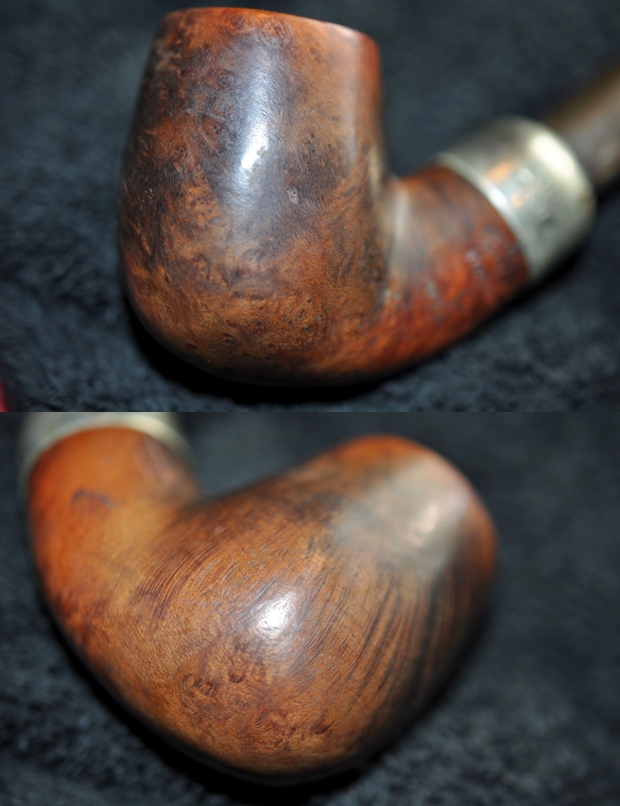
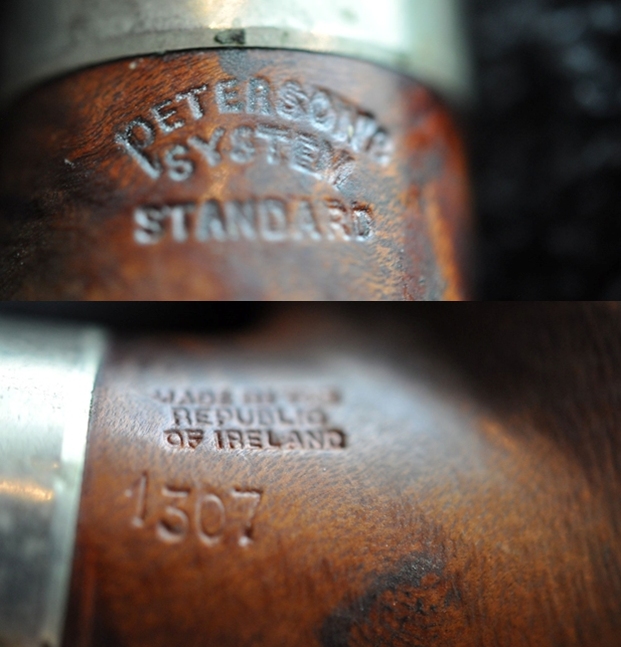
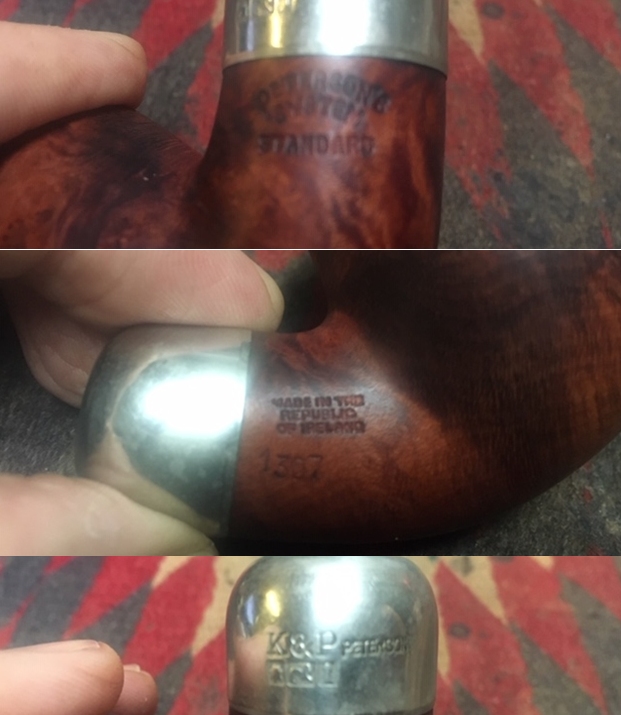
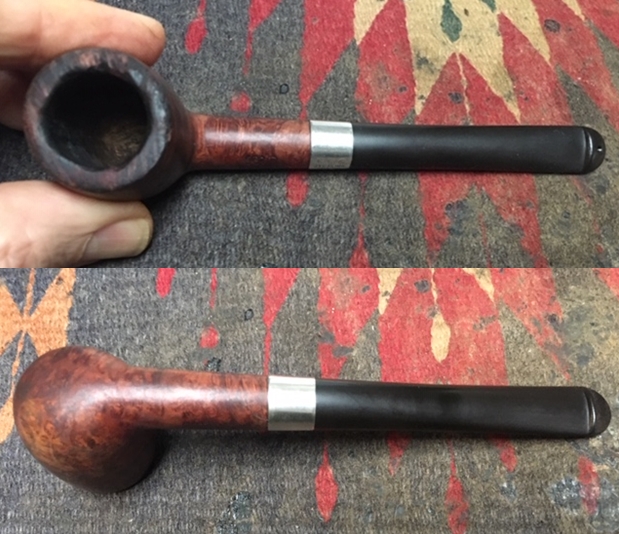
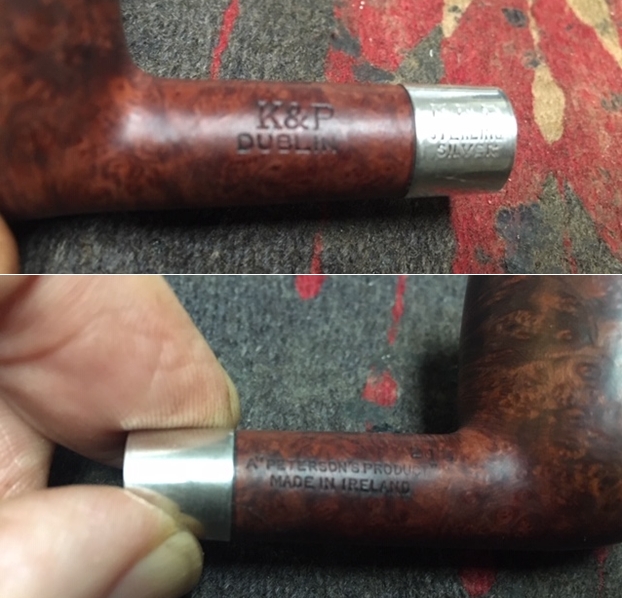
I am continuing to work on Bob Kerr’s collection of 9 Peterson’s System pipes that are ready to be restored. This pipe is the second of the large Standard System pipes that I have in his estate. I have restored quite a few of his Petersons already so this is kind of subset of the Peterson Collection. You can read about those restorations in previous blogs. To be honest with you I have been dreading working on these 9 because when they arrived they were absolutely filthy and the reservoir in the shank was filled with tars and oils. It looked to me that they had never been cleaned. Jeff cleaned them for me and because of that I have been enjoying working on these Peterson’s particularly because Jeff has done such a thorough cleanup of them before I receive them. When I took it out of the box of the pipes that Jeff had cleaned up and sent back to me, I could see that it was stamped Peterson’s System Standard vertically on the left side of the shank next to the band. The right side of the shank was stamped Made in the Republic of Ireland over the shape number 1307. It has some stunning grain around the bowl and shank like the previous one but the finish was darker in colour under the thick grime.

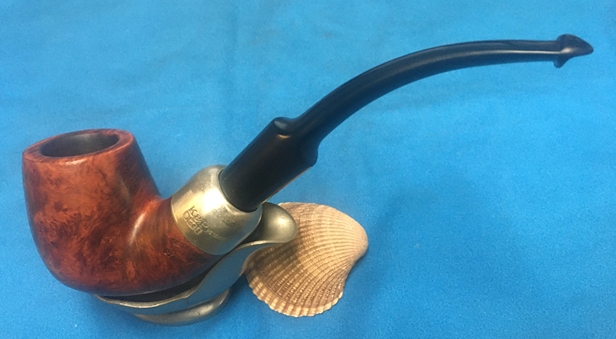
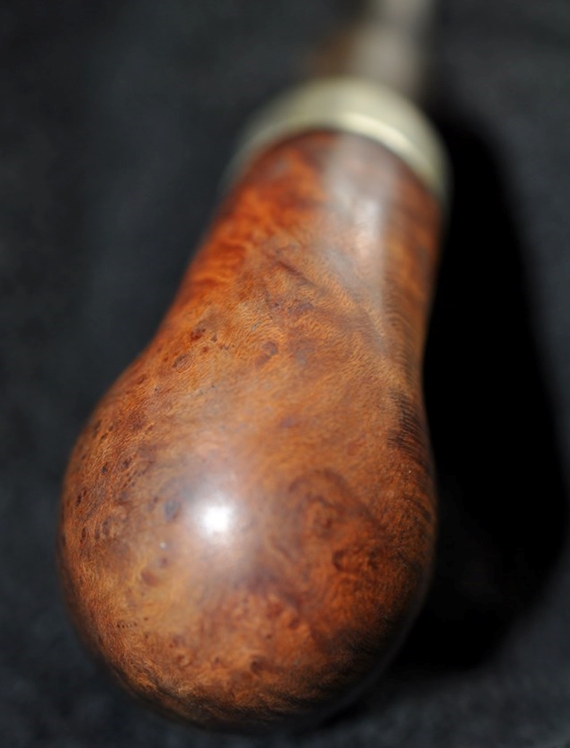
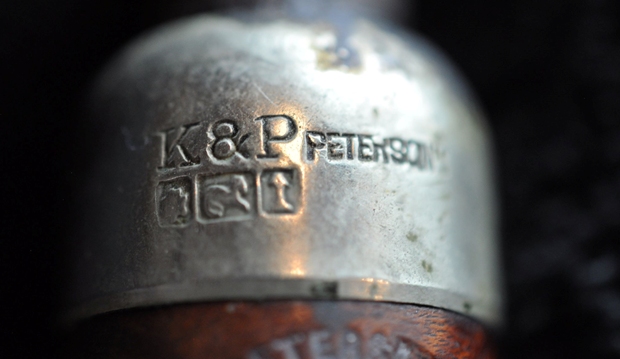
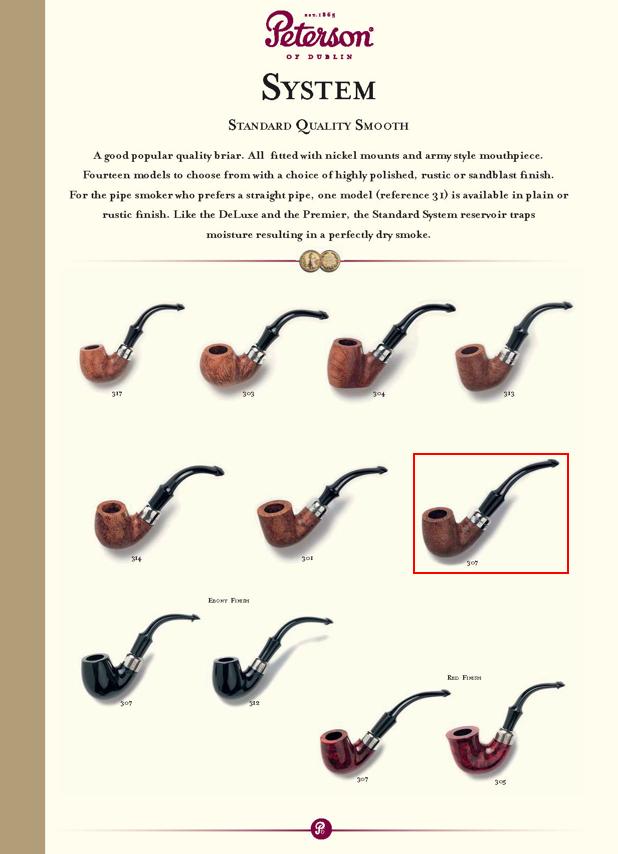
There was a thick cake in the bowl with remnants of tobacco stuck on the walls. There was a lava overflow on the rim. The top and edges of the rim looked very good under the grime. I think that there was a beautiful pipe underneath all of the buildup of years of use. The nickel ferrule on the shank end is stamped on the top and left side K&P Peterson’s over three hallmarks. It is not dented or damaged. The stem was oxidized and calcified toward the end with some tooth chatter but surprisingly it did not have the deep tooth marks that I have come to expect from Bob’s pipes but the button edges were worn. Jeff took photos of the pipe before he started his cleanup work on it. Jeff took photos of the bowl and rim top to show the thick, hard cake in the bowl and the lava build up on the top of the rim and the edges of the bowl. The rim top looked pretty good but it was hard to know looking through the lava rear left of the bowl and had some darkening and a potential burn marks on the front and the back right inner edge. The outer edges of the rim appeared to be in good condition.    Jeff took photos of the sides and heel of the bowl to show the condition of the finish. You can see the interesting grain on the sides and underside of the bowl and shank. Even under the dirt and debris of the years it looked very good. The cross grain on the heel was beautiful.   Jeff took photos of the stamping on both sides of the bowl and shank. The vertical stamping on the left side was readable as you can see from the photos. It read Peterson’s System Standard. The stamp on the right side read Made in the Republic of Ireland with the shape number 1307 underneath. The nickel ferrule on the shank end is stamped on the top and left side K&P Peterson’s over three hallmarks – a Shamrock, a shape that looks like a reclining lion and a tower. Typically these hallmarks are not like those in silver that help to date a pipe but are rather marks that make it clear that the pipe was made in Ireland. Jeff took photos of the top and underside of the stem showing the tooth chatter, scratching and oxidation on the stem surface and wear on the edges of the button. There were two deep dents on the top of the stem just ahead of the P-lip.   I wanted to find out information on the shape number on this pipe. It is one of three Peterson’s System Standard pipes in Bob’s collection marked with the 1307 shape number. There are also 2 System Standards marked 307 and for the life of me I cannot tell the difference. They are virtually identical in shape, size and marking. I started my hunt for information by turning to a Peterson Catalogue that I have on rebornpipes and looked up the System Standard pipes (https://rebornpipes.com/tag/peterson-hallmark-chart/). I have put a red box around the 307 shown in the catalogue page shown below. That should give a clear picture of the size and shape of the pipe. But there was nothing to give me any information on what the first number 1 meant in the shape number 1307 pipe that I am working on. I decided to email Mark Irwin to see if he could point me in the right direction either in the book to something I was missing or to something else that might help.Since this is stamped the same as the first of the 1307 I am including the information on the unique numbering on it. Mark pointed me in the direction that I needed. I quote the pertinent part of his email. The red highlighted portion was the clue I was looking for on this pipe. I have already cleaned up several of Bob’s pipes that were sold through GT&C (Genin, Trudeau and Company, Montreal, Quebec).

The index at the back of the book is pretty good, and points you to all the GT&C goodies, but 155 has a photo from the catalog with your 1307, while 318 and 323 explain the rationale for the “1” prefix. In a nutshell, just drop the “1” and you’ve got the shape. My theory is that GT&C added this to aid them in warranty work, so they’d know the pipe was bought on Canadian soil.

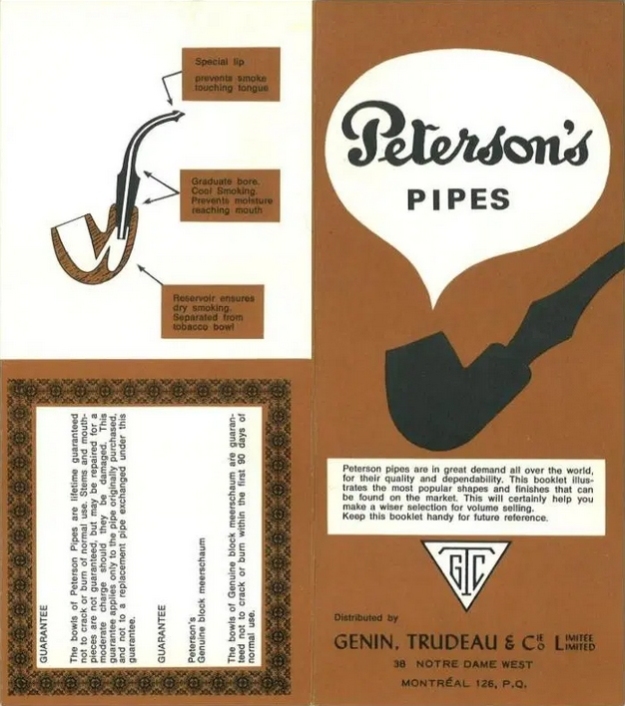
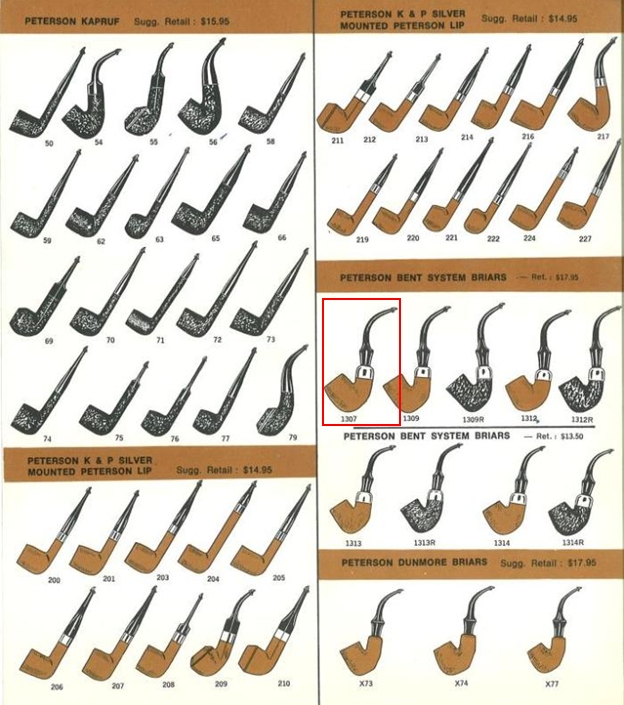
I turned then to a previous blog I had written on a Kapruf 54 that had an odd shape number stamp and referred to the Canadian numbering system used by GT&C. Here it the link to that blog (https://rebornpipes.com/2019/08/09/back-to-bob-kerrs-estate-another-canadian-import-petersons-kapruf-a-54/). In the blog I included a link to a blog I did on the GT&C Catalogue that came to me in some paperwork the family gave me. I have included the cover of the catalogue and the page on the system pipes showin the 1307 shape. I have put a red box around the shape for ease of reference (https://rebornpipes.com/2016/09/13/petersons-pipes-brochure-from-genin-trudeau-co-montreal-quebec/). Be sure to check out the rest of the document on the link.

The GT&C Catalogue combined with the earlier Peterson Pipe Catalogue page make the link definitive. I turned to Pipedia’s article on Peterson pipes to see what I could garner from that information. It is a great read in terms of the history of the brand (https://pipedia.org/wiki/Peterson). I have included a bit of the pertinent history here.

1950 – 1989 The Republic Era  – From 1950 to the present time, the stamp for this era is “Made in the Republic of Ireland” in a block format generally in three lines but two lines have been used with or without Republic being abbreviated.

During the 1950’s and 60’s the Kapp & Peterson company was still in the ownership of the Kapp family. However 1964 saw the retiral of the company Managing Director Frederick Henry(Harry) Kapp.

Pipedia also included a section of information on the System pipes including a diagram of the sytems look (https://pipedia.org/wiki/Peterson#Republic_Era_Pipes). I quote a section of the article in part and include a link to another article on Pipedia on the System pipe.

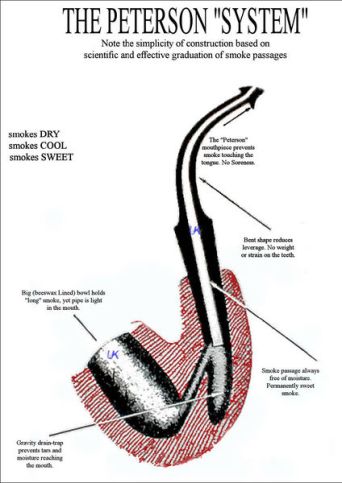
The Peterson System pipes are the standard bearers of the Peterson pipe family, famous for the excellent smoking pleasure they provide. Often imitated but never equaled, the Peterson System smokes dry, cool and sweet, thanks to the scientific effectiveness of the original design. The heart of the System is the unique graduated bore in the mouthpiece. This makes the suction applied by the smoker 15 times weaker by the time it reaches the tobacco chamber. The result is that all the moisture flows into the reservoir and, thus cannot reach the smoker’s mouth. The Peterson Lip further enhances the effectiveness of the graduated bore by directing the flow of smoke upwards and away from the tongue. This achieves a uniquely even distribution of smoke and virtually eliminates any chance of tonguebite or bitterness. Furthermore, the shape is contoured so that the tongue rests comfortably in the depression under the opening. Each “PLip” mouthpiece is made from Vulcanite. For the Peterson System pipes to work properly, the stem/tenon has to have an extension, the tip of which will pass by the draft hole from the bowl and into the sump. Upon the smoker drawing in smoke, this extension then directs the smoke down and around the sump to dispense a lot of the moisture before the smoke enters the extension and stem. On the System Standards and other less expensive systems, this extension with be made of Vulcanite turned integrally with the stem. On the more expensive System pipes this extension will be made of metal which screws into the Vulcanite stem. This extension on the earlier pipes will be of brass and the newer pipes will be of aluminium. Most smokers not knowing this function of the metal extension, assumes that it is a condenser/stinger and will remove it as they do with the metal condensers of Kaywoodie, etc. Should you have a System pipe with this metal extension, do not remove it for it will make the System function properly and give you a dryer smoke (https://pipedia.org/wiki/A_closer_look_at_the_famous_Peterson_Standard_System_Pipe).

With that information in hand I knew what I was dealing with in terms of the stamping and the age of this pipe. I knew from the information that the pipe was made during the Republic Era between 1950 and 1989. Most of Bob’s pipes were purchased in the 60s so my guess is that this is also a 60’s era pipe. I also knew that the pipe was brought into Canada by the Canadian importer, Genin, Trudeau & Co. in Montreal, Quebec. Noting above that the catalogue postal code puts it in the late 60s early 70s which also fits the story. Now it was time to work on the pipe.

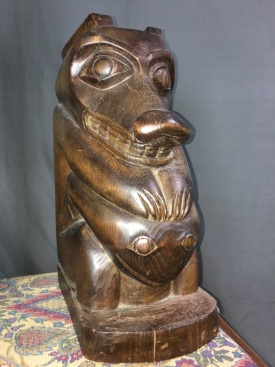
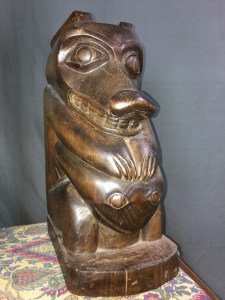
I am really happy to have Jeff’s help on cleaning these 9 Peterson’s System Standard pipes as they are a real pain to get clean. He cleaned this filthy pipe with his usual penchant for thoroughness that I really appreciate. This one was a real mess and I did not know what to expect when I unwrapped it from his box. He reamed it with a PipNet pipe reamer and cleaned up the reaming with a Savinelli Fitsall Pipe Knife. He scrubbed out the internals with alcohol, pipe cleaners and cotton swabs until the pipe was clean. He scrubbed the exterior of the bowl with Murphy’s Oil Soap and a tooth brush to remove the grime and grit on the briar and the lava on the rim top. The finish looks very good with great looking grain around the bowl and shank. Jeff soaked the stem in Before & After Deoxidizer to remove the oxidation on the rubber. When the pipe arrived here in Vancouver for the second stop of its restoration tour I was amazed it looked so good.   I took some close up photos of the rim top and also of the stem surface. I wanted to show what an amazing job Jeff did in the cleanup of the rim top. The rim top was burned and darkened with nicks and notches around the top and inner edge. I also took close up photos of the stem to show the lack of tooth marks and chatter on the stem surface. It was very clean.  One of the things I appreciate about Jeff’s cleanup is that he works to protect and preserve the nomenclature on the shank of the pipes that he works on. The stamping on this one was very faint to start with so I was worried that it would disappear altogether with the cleanup. He was not only able to preserve it but it is clearer than shown in the earlier photos. I took some photos to show the clarity of the stamping. I have noticed that many restorers are not careful to protect the stamping in their cleaning process and often by the end of the restoration the nomenclature is almost destroyed. I would like to encourage all of us to be careful in our work to preserve this as it is a critical piece of pipe restoration! Since this is another pipe Bob’s estate I am sure that some of you have read at least some of the other restoration work that has been done on the previous pipes. You have also read what I have included about Bob Kerr, the pipeman who held these pipes in trust before I came to work on them (see photo to the left). Also, if you have followed the blog for long you will already know that I like to include background information on the pipeman whose pipes I am restoring. For me, when I am working on an estate I really like to have a sense of the person who held the pipes in trust before I worked on them. It gives me another dimension of the restoration work. I asked Brian if he or his wife would like to write a brief biographical tribute to her father, Bob. His daughter worked on it and I received the following short write up on him and some pictures to go along with the words including one of Bob’s carvings. Once again I thank you Brian and tell your wife thank you as well.
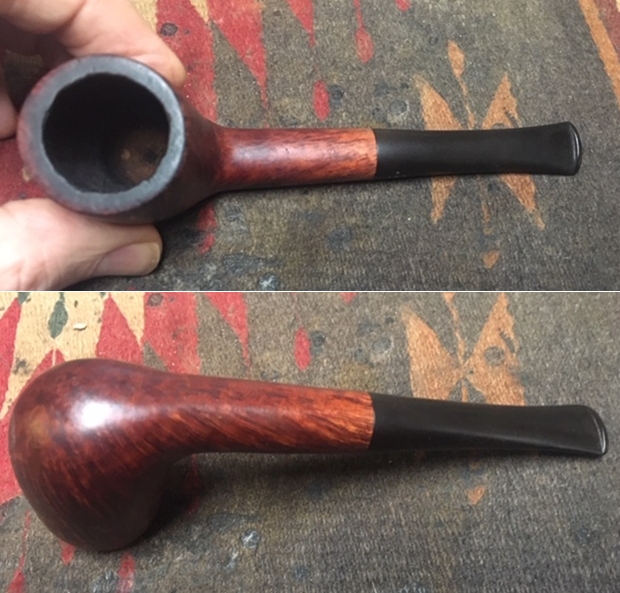
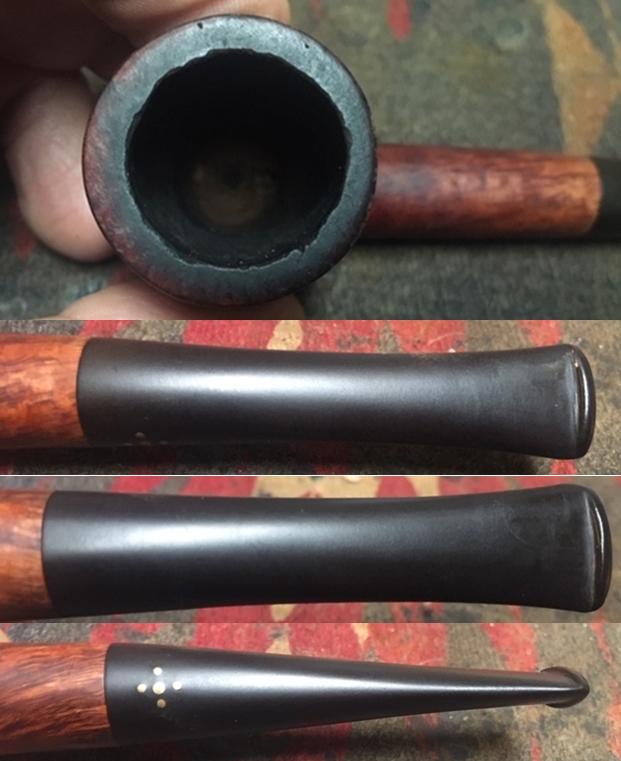
I am delighted to pass on these beloved pipes of my father’s. I hope each user gets many hours of contemplative pleasure as he did. I remember the aroma of tobacco in the rec room, as he put up his feet on his lazy boy. He’d be first at the paper then, no one could touch it before him. Maybe there would be a movie on with an actor smoking a pipe. He would have very definite opinions on whether the performer was a ‘real’ smoker or not, a distinction which I could never see but it would be very clear to him. He worked by day as a sales manager of a paper products company, a job he hated. What he longed for was the life of an artist, so on the weekends and sometimes mid-week evenings he would journey to his workshop and come out with wood sculptures, all of which he declared as crap but every one of them treasured by my sister and myself. Enjoy the pipes, and maybe a little of his creative spirit will enter you!

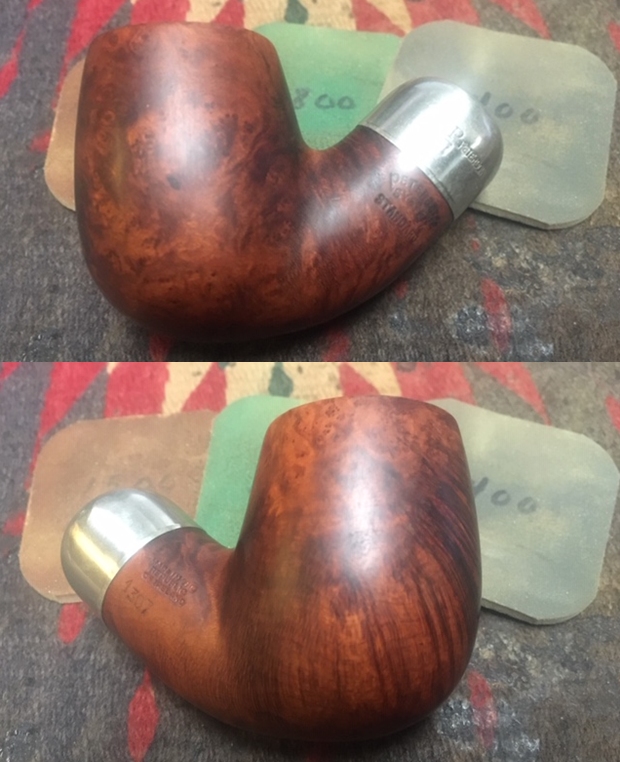
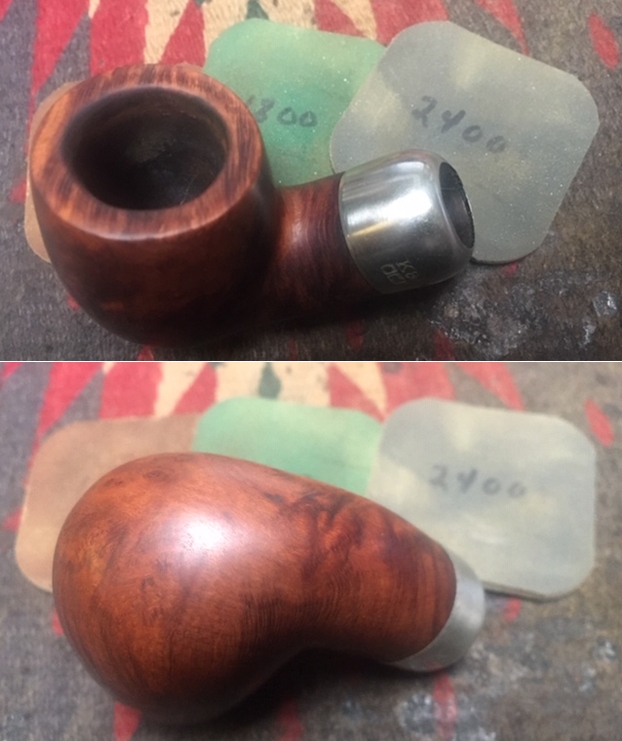
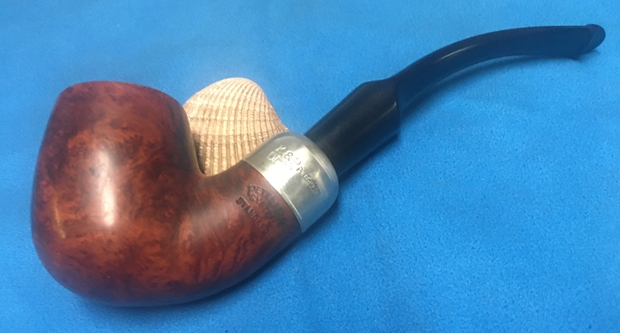
Now with all of the background on the line and the background on Bob Kerr it was time to get on with the restoration of this next mixed grain Peterson’s System Standard 1307 Bent Billiard. I am really coming to appreciate the hard cleanup work that Jeff did on these pipes. They were a real mess when I sent them to Jeff and I have to tell you it was great that I did not need to clean this pipe. I decided to start the process by dealing with the damage to the inner edge and top of the rim. I sanded it with 220 grit sandpaper and worked on the flat surface as well as the inner edge. I gave it a very light bevel so that it took care of the damage on the front and back side of the inner edge.   I polished the briar with micromesh sanding pads – wet sanding it with 1500-12000 grit pads and I wiped the bowl down after each sanding pad with a damp cloth. The bowl began to take on a finished shine.  I rubbed the bowl and rim down with Before & After Restoration Balm. I worked it into the surface of the briar with my fingertips to clean, enliven and protect it. I let the balm sit for a little while and then buffed with a cotton cloth to raise the shine. I really like watching the Balm do its magic and bring the briar alive. The stem had some deep gouges in the tenon end where it had been turned into the nickel ferrule. These needed some work to smooth out and repair. The top side of the stem had two deep tooth marks just ahead of the P-lip. I used a Bic Lighter to “paint” the surface of the stem with flame and lift them. I filled in the remaining small tooth mark with clear super glue. I sanded out the remainder of the tooth dents and the tooth marks in the underside of the stem with 220 grit sandpaper.  I polished it with 400 grit wet dry sandpaper. I polished the stem with micromesh sanding pads – wet sanding with 1500-12000 grit pads. I wiped the stem down after each sanding pad with Obsidian Oil. I polished it with Before & After Pipe Stem Polish – both Fine and Extra Fine. Once I had finished the polishing I gave it a coat of a new product I am experimenting with from Briarville Pipe Repair. It is called “No Oxy Oil” and it is made to protect the stem from oxidizing. I set it aside to dry.    Once again at this point in the restoration process I am excited to be on the homestretch. I look forward to the final look when it is put back together, polished and waxed. I put the bowl and stem back together. I polished the bowl and stem with Blue Diamond to polish out the scratches in the briar and the vulcanite. I gave the bowl and the stem multiple coats of carnauba wax. I buffed the pipe with a clean buffing pad to raise the shine. I hand buffed it with a microfiber cloth to deepen the shine. The pipe polished up pretty nicely. The grain really pops with the wax and polish. The shiny black vulcanite stem is a beautiful contrast to the browns of the bowl and thick shank. This Peterson’s System Standard 1307 Bent Billiard was another fun pipe to work on thanks to Jeff’s cleanup work. The polished nickel Ferrule works as a contrast between the stem and the briar and binds it all together. It really is a quite stunning piece of briar whose shape follows the flow of the briar. The pipe is comfortable pipe to hold in the hand. The finished pipe is shown in the photos below. The dimensions of the pipe are Length: 6 ½ inches, Height: 2 inches, Outside diameter of the bowl: 1 ½ inches, Chamber diameter: ¾ of an inch. This beautiful pipe will be going on the rebornpipes store if you would like to add it to your collection and carry on Bob’s legacy. If not, I have a lot more of Bob’s estate to work on of various brands. Perhaps one of those will catch your attention. Thanks for reading this blog and my reflections on the pipe while I worked on it. This is an interesting estate to bring back to life.

Restoring and Restemming an LHS Rusticated Sterncrest Billiard


Blog by Steve Laug

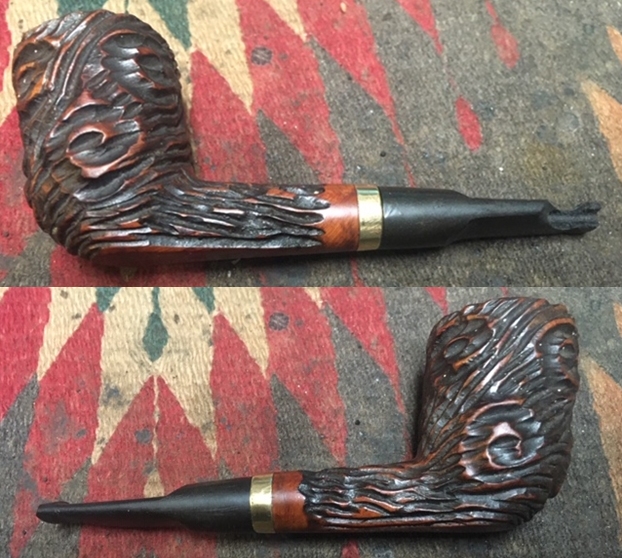
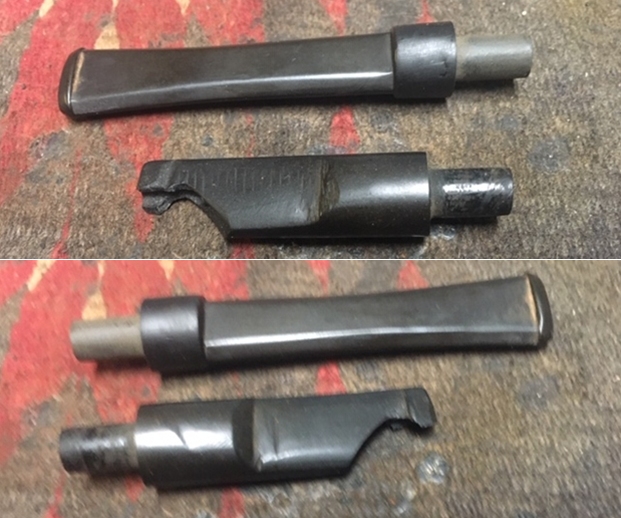
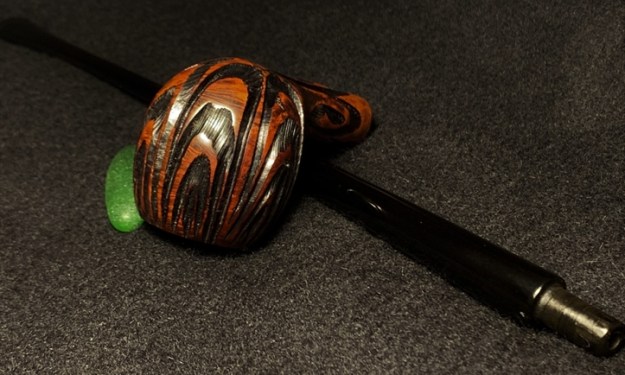
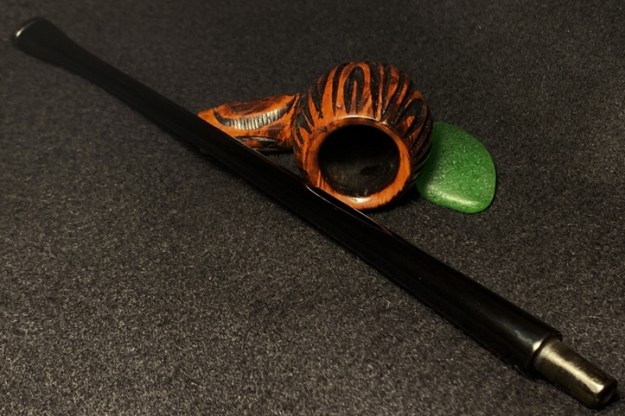
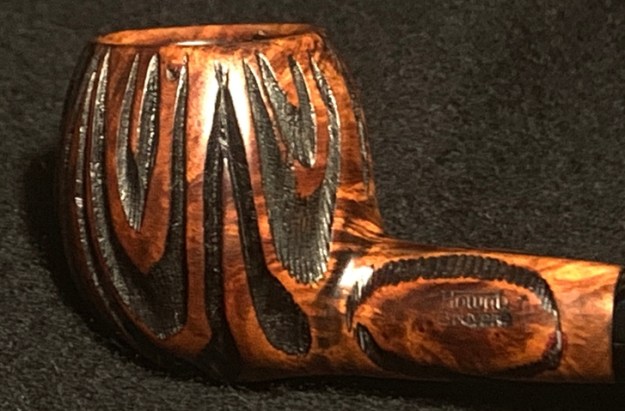
I am doing periodic repairs for a local pipe/cigar shop. They give my card to people who come in needing pipe repair. On Monday I received a call from a fellow who had an older LHS pipe that he had picked up in Europe on a trip. It turned out he lived around the corner from my house and he and his wife walked over with the pipe. It had an interesting rustication pattern around the bowl and shank that was unique. It sported a gold band on the shank that was original. The bowl exterior was very dirty. The rim top had lava overflow in the grooves and the bowl had a very thick cake inside it. The inner and outer edges of the rim looked very good. The stem had been jerry-rigged to function on the pipe before half of the button and back end of the stem had broken off. It looked like someone had used a knife and cut down the stem to make it a saddle stem. They had also carved a button on the stem. The saddle on the stem was in very rough condition and the carving marks in the stem surface were very rough. The young guy and his wife who dropped it off were hoping to get a new stem made and I was hooked and want to do that for them. I took photos of the pipe when it arrived so I had a benchmark to work with. I took a photo of the stamping on the underside of the shank. It was very readable and was stamped Sterncrest of LHS in a diamond and underneath Imported Briar. Next to it was stamped 14K. The gold band was also in good condition but scratched. I also include a photo of an LH Stern sign that was included on Pipedia (https://pipedia.org/wiki/LHS). I have included the information below from the article on Pipedia (https://pipedia.org/wiki/LHS). It gives a great brief history of the brand that is a quick overview of the Company.

Ludwig Stern, a successful pipe manufacturer since 1893 and closing around 1960, reorganized his company along with his brother Hugo Stern, opening a factory in 1911. They named the company L&H Stern Smoking Pipes & Holders. The newly formed company was moved into a six story building on the corner of Pearl and Waters street Brooklyn, NY.

Thoroughly organized in all departments, and housed in a well-lighted and ventilated modern office and manufacturing building, the firm of L&H Stern Inc. is located near the first arch of the Manhattan bridge, near the river and convenient to the Brooklyn bridge, which makes it accessible from all the hotels in the metropolis for visiting buyers. The structure is six stories with a seventeen-foot basement, with light on three sides through prismatic glass windows, the first floor being seven feet above the sidewalk. Light enters the upper floors from all four sides.

L&H Stern is known to every important wholesaler and jobber in the country. LHS manufactures a complete line of briar pipes. Ginmetto wood pipes are also made, as well as Redmanol goods, the man-made amber. The first substitute for amber. Everything, even down to the sterling silver and other metal trimmings are made under one roof.

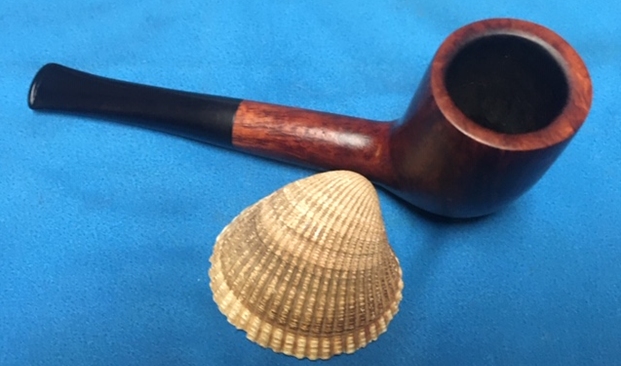
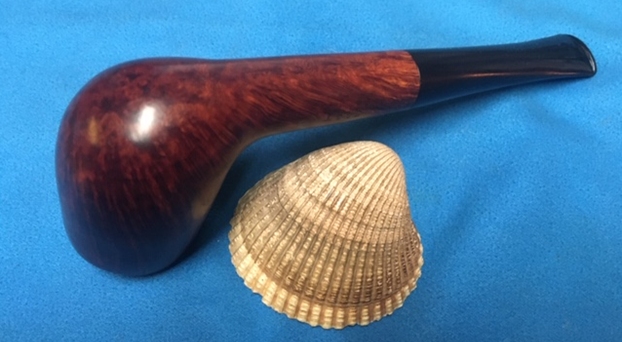
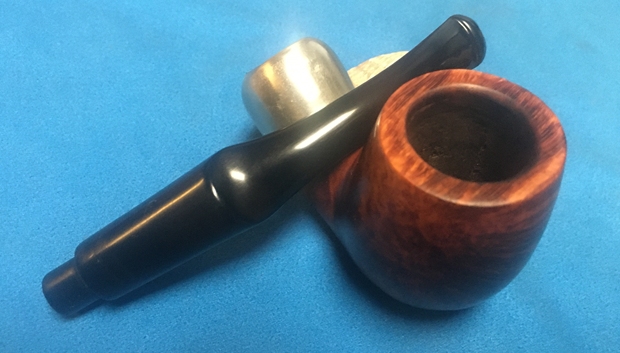
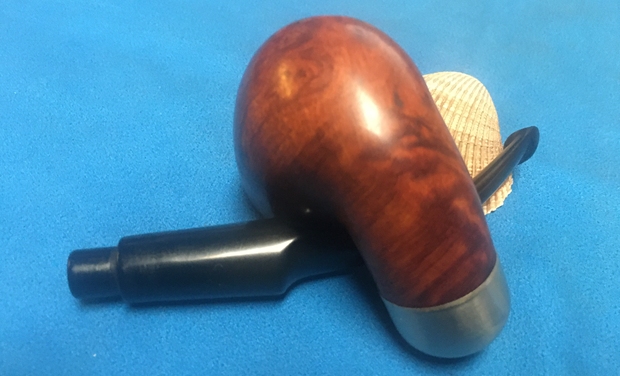
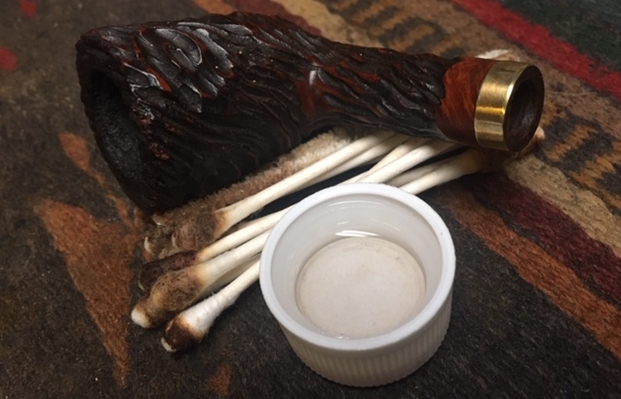
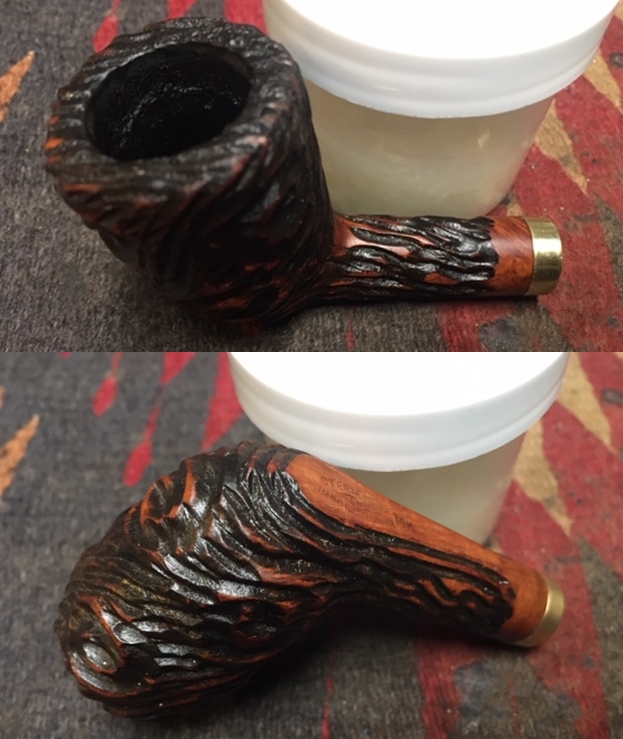
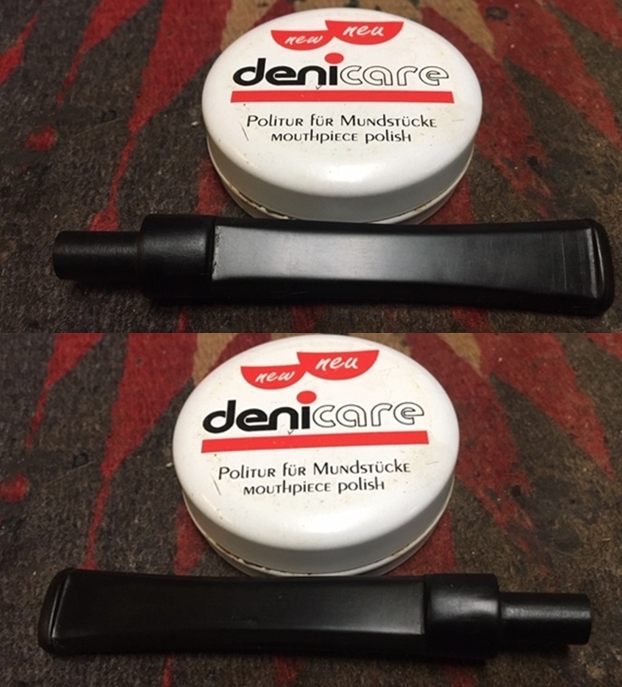
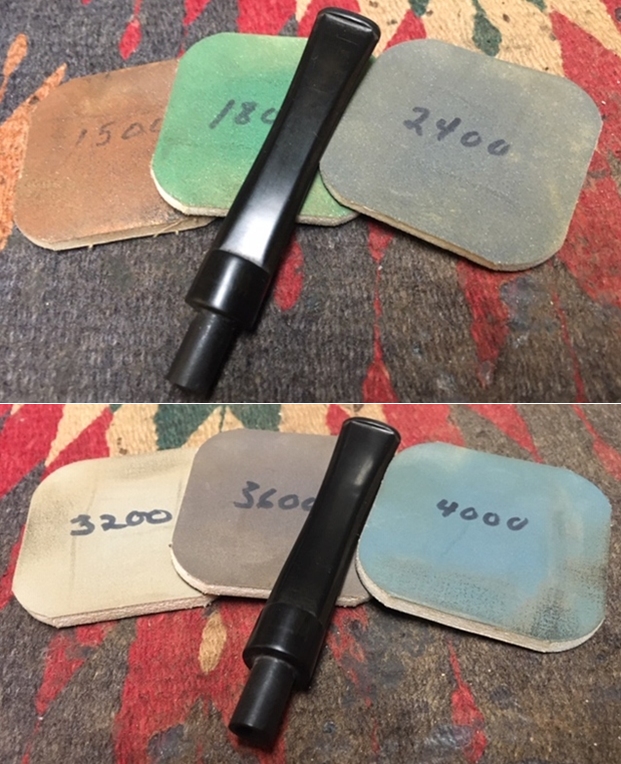
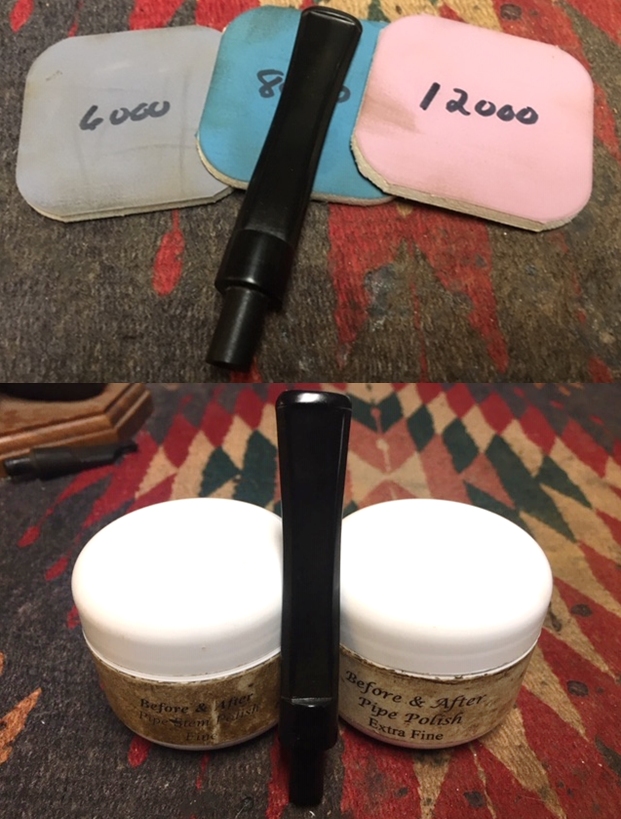
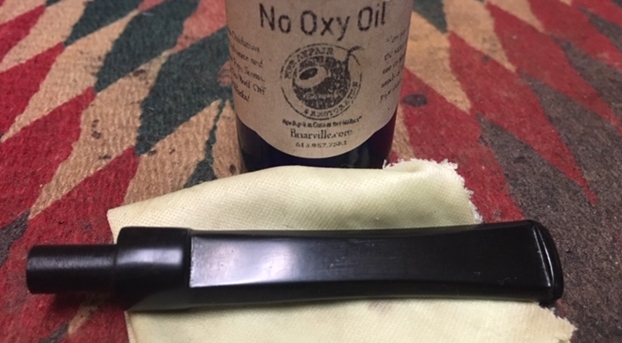
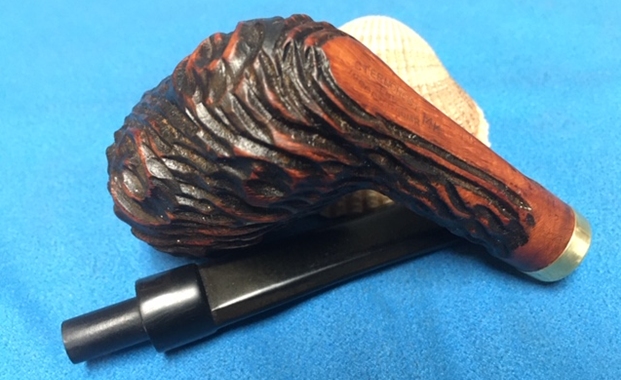
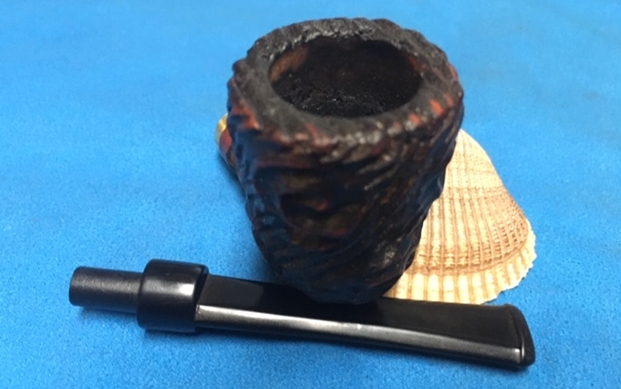
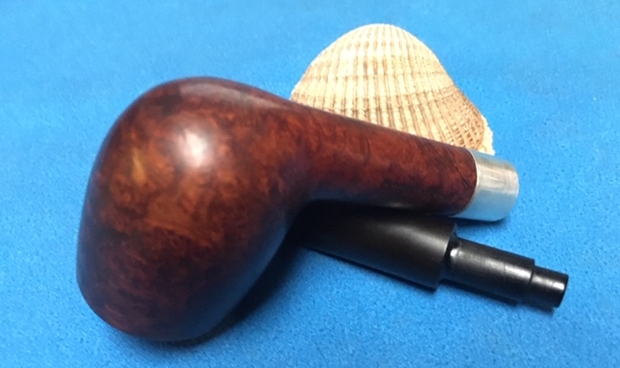
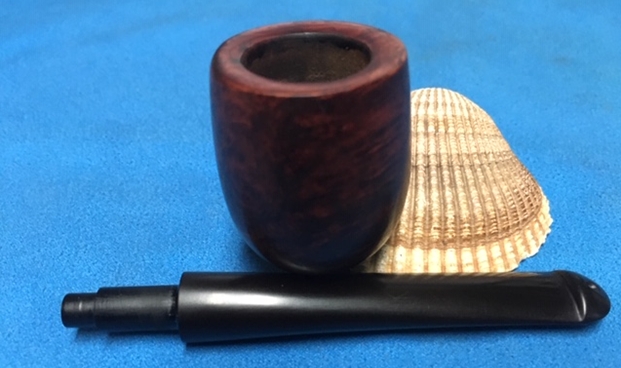
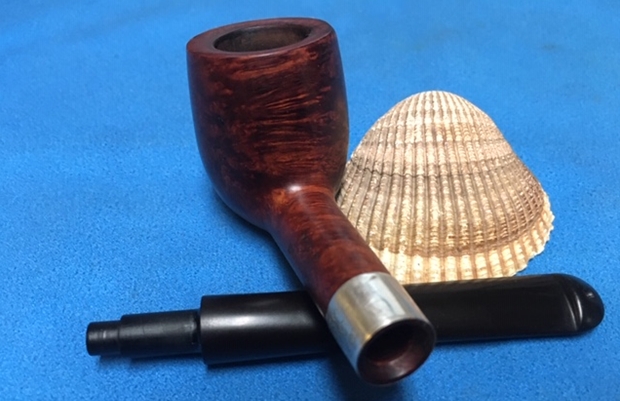
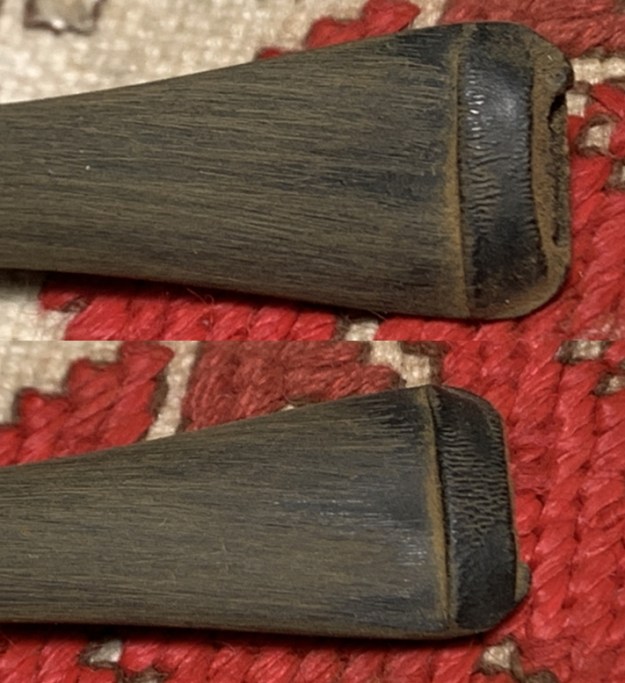
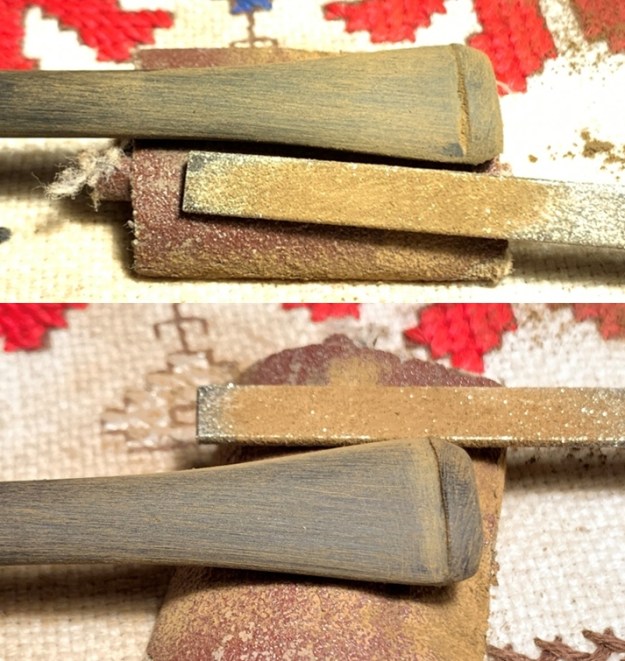
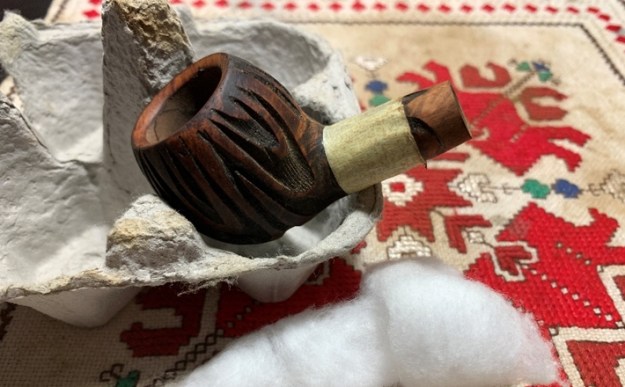
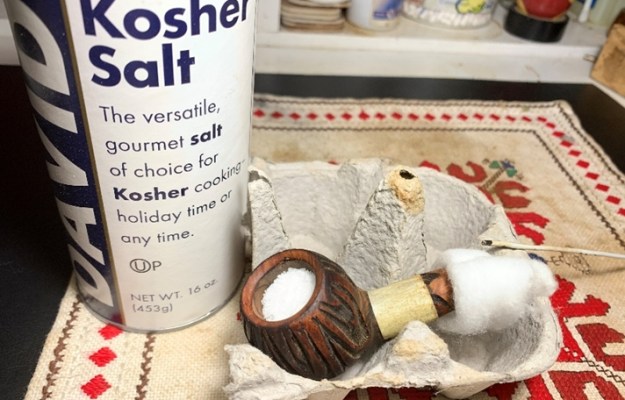
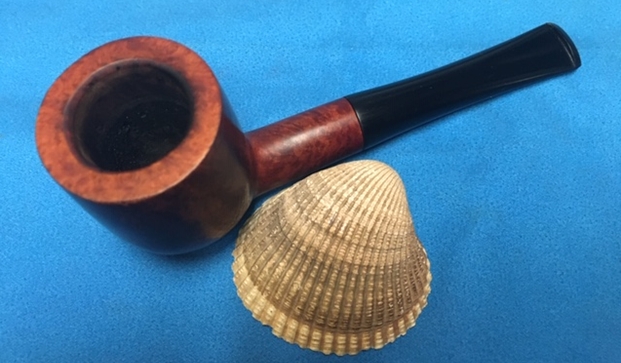
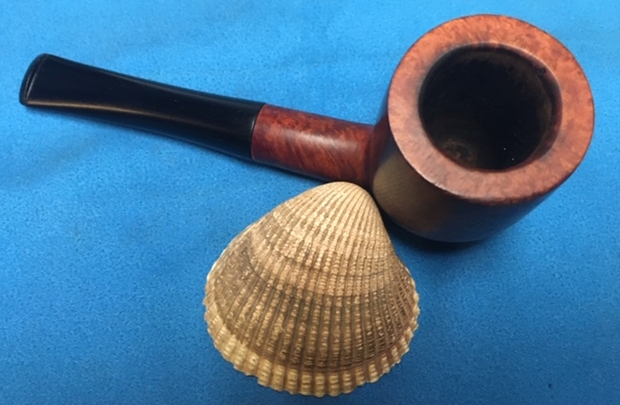
To begin the process of the restoration on this pipe I decided to see what kind of stem I had to replace the one that came with the pipe that was dropped off for me. I went through my can of stems and found a thin tapered saddle stem. It was more delicate looking than the broken one and I felt like it would look very good with the lines of the rustication on the bowl and shank. It was in good condition other than some light oxidation. I set the new stem aside and turned my attention to the bowl. I needed to clean out the bowl and shank before I fit the new stem on it. I reamed it with the third cutting head on the PipNet pipe reamer. I took the cake back to bare briar. I cleaned up what was left with a Savinelli Fitsall Pipe Knife and finished with sanding the bowl with a piece of dowel wrapped with 220 grit sandpaper to smooth out the walls on the bowl.   With the cake cleaned out of the bowl, it was time to clean the shank and airways. I used alcohol, cotton swabs and pipe cleaners to scrub out the shank. I scraped the walls of the shank and mortise clean with a dental spatula to clean up the built tobacco lacquer on the walls. Once it was scrubbed clean the pipe smell much better.I scrubbed the exterior of the bowl with Murphy’s Oil Soap and a tooth brush to remove the grime. I used a brass bristle brush to scrub the rim top with the soap. I rinsed the grime off the bowl with warm water and dried it off with a soft cotton cloth. Once the grime was gone I found flecks of white paint in the grooves of the rustication. I picked them out with a dental pick and used the wire brush to clean up the debris of the paint flecks. I rubbed the bowl and rim down with Before & After Restoration Balm. I worked it into the surface of the briar with my fingertips to clean and worked it into the rustication with a horsehair shoe brush. The balm work to enliven and protect the briar. I let the balm sit for a little while and then buffed with a cotton cloth to raise the shine. I really like watching the Balm do its magic and bring the briar alive.  I sanded the scratches and tooth chatter out of the stem surface and the saddle with 220 and 400 grit sandpaper. I worked it over to remove the oxidation that remained in the stem surface.I rubbed the stem down with Denicare Mouthpiece Polish. I have a few tins of this laying around so I am trying to use them up. It does a pretty good job polishing the stem.The stem was looking much better. I polished it with micromesh sanding pads – wet sanding with 1500-12000 grit pads. I wiped the stem down after each sanding pad with Obsidian Oil. I polished it with Before & After Pipe Stem Polish – both Fine and Extra Fine. Once I had finished the polishing I gave it a coat of a new product I am experimenting with from Briarville Pipe Repair. It is called “No Oxy Oil” and it is made to protect the stem from oxidizing. I set it aside to dry.   As usual at this point in the restoration process I am excited to be on the homestretch. I look forward to the final look when it is put back together, polished and waxed. I put the bowl and stem back together. I polished the bowl and stem with Blue Diamond to polish out the scratches in the briar and the vulcanite. I gave the bowl and the stem multiple coats of carnauba wax. I buffed the pipe with a clean buffing pad to raise the shine. I hand buffed it with a microfiber cloth to deepen the shine. The pipe polished up pretty nicely. The grain really pops with the wax and polish. The shiny black vulcanite stem is a beautiful contrast to the textures and the various browns of the bowl and shank. This LH Stern (LHS) Sterncrest Billiard was another fun pipe to work on thanks the fact that I could in essence start over with it. The thin saddle stem looks really good with the rustication on the bowl and shank. The original 14K Gold band on the shank looks very good breaking up the shank and the stem. It is a real contrast and binds it all together. It really is a quite stunning piece of briar with an unusual rustication on the bowl. The pipe is comfortable pipe to hold in the hand. The finished pipe is shown in the photos below. The dimensions of the pipe are Length: 5 ½ inches, Height: 2 inches, Outside diameter of the bowl: 1 ¼ inches, Chamber diameter: ¾ of an inch. This newly stemmed piece of  pipe history will soon be going back to my neighbour who I think is really going to enjoy it. It is a piece of he and his wife’s travels so now he can enjoy it with the memories of the find. Thanks for reading this blog and my reflections on the pipe while I worked on it. This is an interesting estate to bring back to life.

Making the Best of Beautiful Pipe with an Unbelievably Rough Patch of Briar – A Giant Gold Crown Bent Billiard


Blog by Dal Stanton

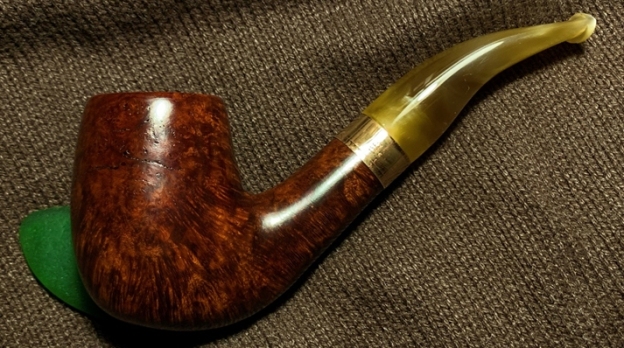
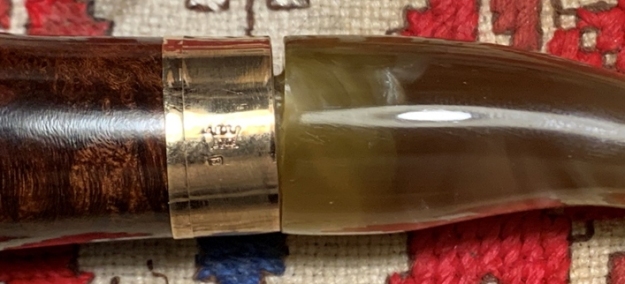
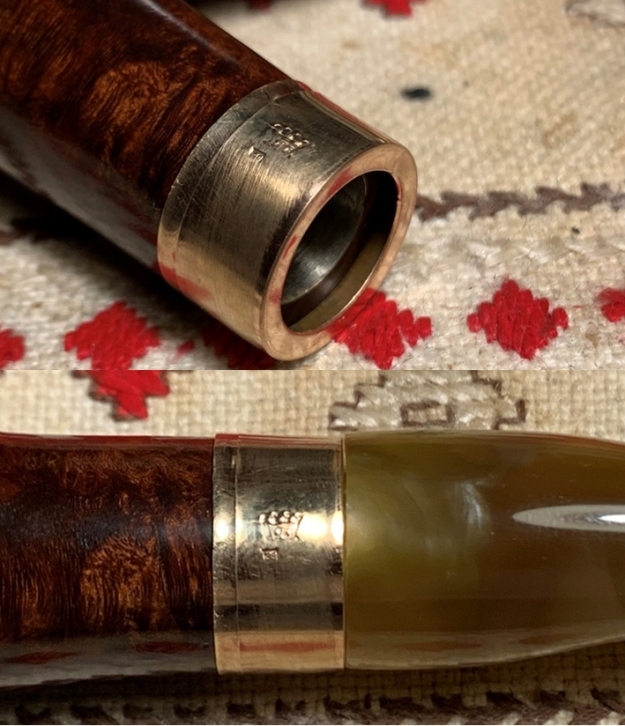
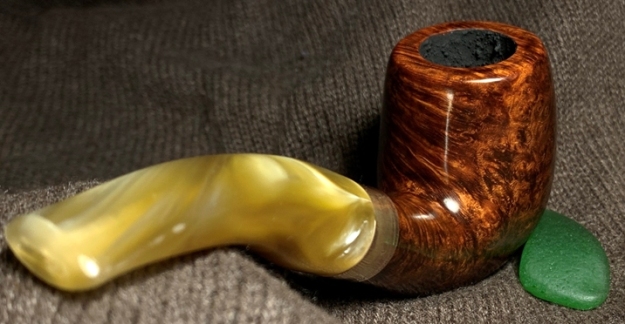
The story begins when I first laid my eyes on this pipe.  It was when the box containing the ‘French Lot of 50’ arrived here in Sofia, Bulgaria, from Paris, and oh my – talk about excitement!  I was alerted to this online Lot by Romanian pipe man friend, Codruț (aka: Piper O’Beard), who had previously become the steward of an L. J. Peretti Oom Paul I had restored. I carefully and slowly unwrapped each pipe, relishing each moment. I had seen the pipes in a pile displayed by the seller on France’s eBay.  Interestingly, when I unwrapped the ‘Gold Crown Giant Bent Billiard’ now on my worktable, I went back and looked at the eBay ‘pile’ picture with the question, how could I have missed this?  I was attracted to this French Lot because of the many horn stems and several very uniquely shaped pipes – the Cutty on the top had my attention!  Yet, the Gold Crown was not visible.After unpacking and cataloging all the pipes from France, each was pictured and put online in the ‘For “Pipe Dreamers” Only!’ collection where hopeful stewards search for a pipe that speaks their name.  After all, as in Harry Potter’s wand lore, the pipe chooses the steward, not the other way around! Now, pipe man and friend, Cyrus, enters the story when he saw this pipe online in ‘Pipe Dreamers!’ collection.  He and his wife became good friends when they served here in Bulgaria with US Peace Corp for a few years.  After returning to the US, their family grew, and we stayed in touch.  Cyrus was no stranger to ‘Pipe Dreamers!’ having already commissioned and received a very nice Jarl Dublin (See: Refreshing a Jarl 1545 Made in Denmark Dublin) which benefited our work here in Bulgaria with the Daughters of Bulgaria – women and girls who have been trafficked and sexually exploited. His return to Dreamers found him drawn to the Crown Giant Billiard.  Here are pictures of the Giant Bent Billiard: The only markings on this pipe are on the gold band and the ‘tenon ring’.  I have to be honest with full confession – when I first saw this pipe, I was excited about it thinking it might have some historical value.  When it had first come out of the box, I hadn’t taken a good look at it.  When I looked at it again, it was not long after restoring another pipe from this French Lot of 50 which was a treasure.  The writeup was: Discovering the History with the Reclamation of this Petite EPC Majestic Bent Horn Stem Billiard, where my researched uncovered a long-forgotten French pipe manufacturer which resulted in my first submission to Pipedia: A. Pandevant & Roy Co..  The problem, which I have since come to realize more fully, is that one of the trademarks of this French company that disappeared in the late 1930s, based near Paris, was a trademark with the stamp ‘EP’.  The difficulty with this is that it is also now a mark stamped on metals and it simply signifies, ‘Electro Plated’.  When I pulled the acrylic stem out of the mortise and discovered the ‘tenon ring’ with ‘EP’ on it, the novelty of a ‘tenon ring’ and the ‘EP’ stamp with some sort of hallmarks created question – could this be something in line with the Petite EPC?  The gold band was stamped with a crown and a very miniscule stamped letter that I couldn’t make out for certain: GG or GP?  Probably ‘GP’ for gold plated. With questions in my mind about the ‘tenon ring’ and the ‘EP’, I sent my questions off to Steve, Master of Restoration, of rebornpipes.com and not too long after received his replies.

Dal: A strange but interesting huge Bent acrylic stem Billiard with no shank nomenclature and doesn’t appear to ever have been smoked appears to have a gold-plated band.  There are stampings on it – a crown and a very small stamp beneath.  My guess is GG or GP – but it’s so small I can’t be sure.  Then, there is a solo stamp on the opposite side of the band that appears to be the same GG or GP.  Of course, GP could signify Gold Plated.  But perhaps that’s what I want to see!  That’s the band – thoughts?

Steve: I have had gold plated bands on older Weber’s that looked the same. I concur that the GP stamp is gold plated.

 Dal: Then, on the same pipe, I was surprised that when I retracted the ample acrylic stem out of the stummel, there was a band around the tenon!  Have you ever seen anything like this?  The alignment or fit of the stem and shank isn’t great and this band is serving to expand the fit of the tenon in the mortise.  The band also has stampings which I’m assuming are faux of some sort, but the tenon band I’m assuming is an aluminum – it’s light.  I first thought it might be silver, but whoever puts anything of value around a tenon?  Thoughts?

 Steve: I have never seen this before and I can see nothing but problems with this so-called solution. The EP stamp means it is electro plated. Could be silver but looks to like nickel and definitely an aftermarket repair. It is a nice-looking pipe though.  

 It’s so much fun unpacking the package of pipes, one at a time, each one wrapped with newspaper…. Christmas over and over!

Dal

After Cyrus commissioned this pipe and it was getting closer to the worktable, I took a closer look at the pipe trying to figure out its story. The bowl is huge and quite attractive. I weigh the pipe and it comes in at a hefty, 84g. It has never been smoked. The acrylic stem is pristine but needs to be cleaned and receive a fine-tuning regarding sanding and buffing.  The pictures below show ripples where the finishing was not completed or not thorough.The chamber is virgin briar.  The rim shows some roughness – like it wasn’t finished off as well.The craftmanship is not superior. Looking down the mortise, the airway drilling isn’t straight.  Is veers off to the left so that the draft hole’s entry point is not centered, but off to the left a bit. The tenon with the ring, as Steve said, is an attempt to perfect the fit, but after taking the tenon out, I’m not able to put it back in the mortise!  The stem fit from the earlier pictures shows that it’s not good – there is a large gap on the upper side of the shank.  I pry the tenon ring off with a little effort with a pocketknife and try the fit in the mortise without the ring.  The fit is very loose – too loose for use. Carefully I rotate the gold band off the shank with no problem.  It caps the shank with a shank face overhang.  I again insert the stem to see what it looks like. The sizing of the stem is in the ballpark.Then, there’s the mysterious crop of pits and ravines on the left side of the Giant’s bowl – what’s the deal with this?  It’s not a crack or trauma but it appears to be very rough briar that emerged during the fashioning of the stummel from a block of briar – a block of briar that obviously showed great potential for the one crafting this Giant Bent Billiard.  The severity of the briar below is in such contrast to the beauty of the briar on the rest of the pipe!  Such beauty and also such despair!  So much like life….  I’m giving some thought to how to approach this. My theory is that someone, probably in France, crafted this pipe.  The block of briar is beautiful, but the shaping of the stummel revealed the imperfections – but too many to fill, but the crafter went with it anyway hoping for a good ending, attaching an attractive acrylic stem and gold band.  Yet, at the end of the day, no one wanted this pipe with the scarring it bears.  It just seems to me that the crafter of this pipe gave up on it and the fine finishing of the pipe was not worth the effort.  I’m not sure the many grain faults that are in this briar patch can be removed or repaired so that there are no lingering scars, but the beauty of the rest of the pipe can offset the imperfections and scarring – off set, probably not erase fully! It reminds me of the Daughters we work with here in Bulgaria – beautiful but also broken and of great worth and worth the effort.

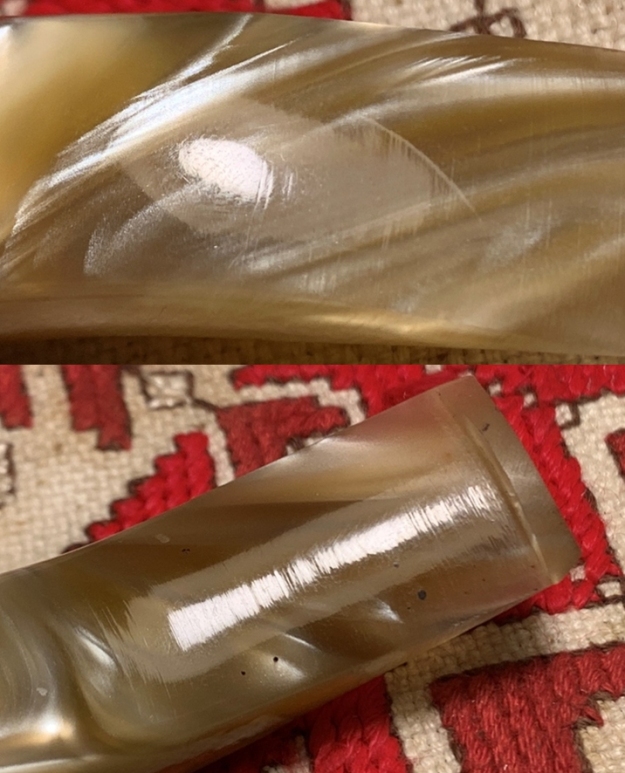
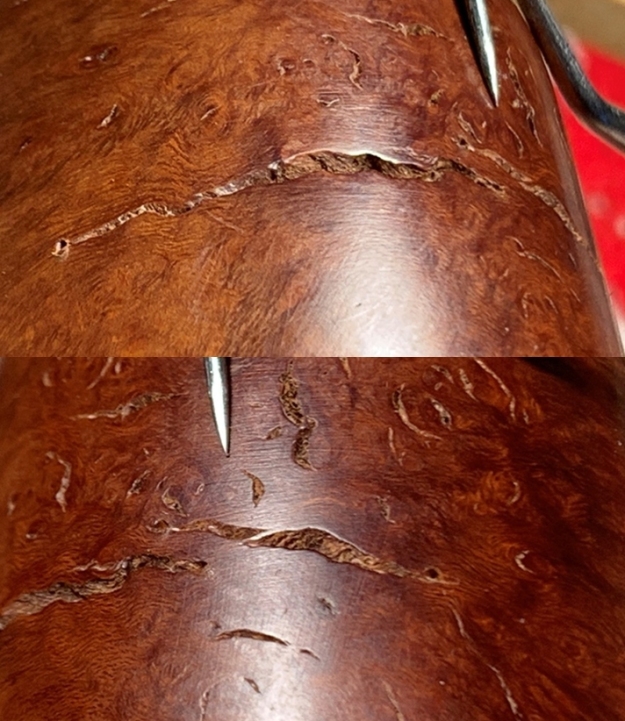
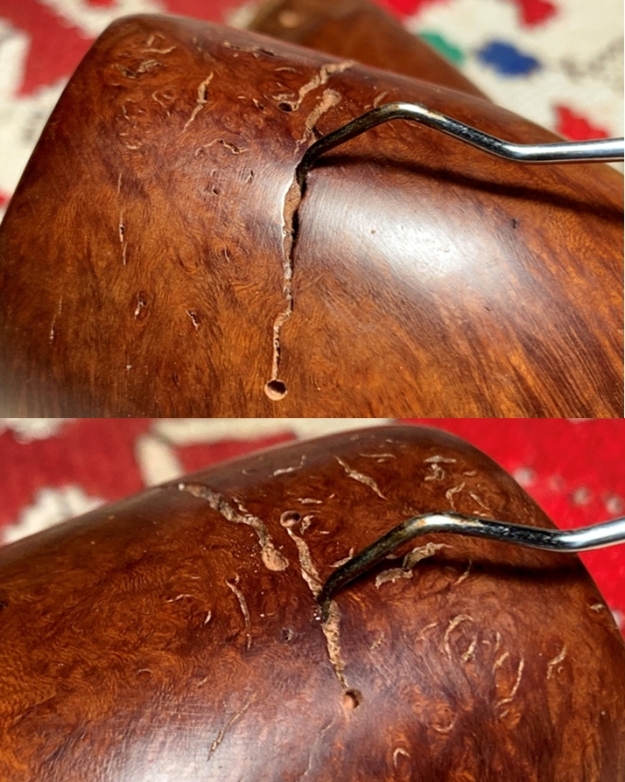
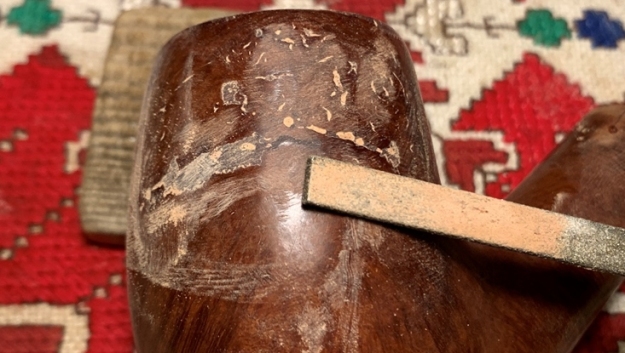
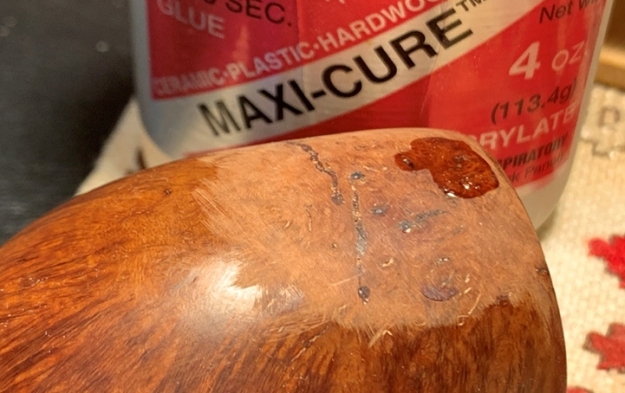
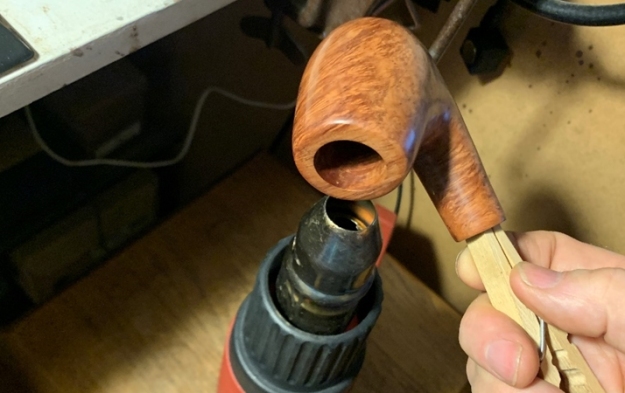
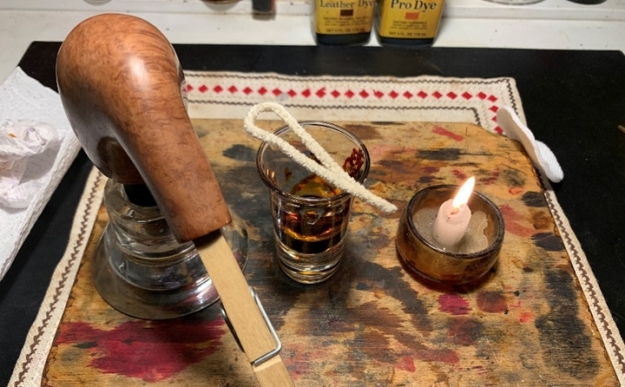
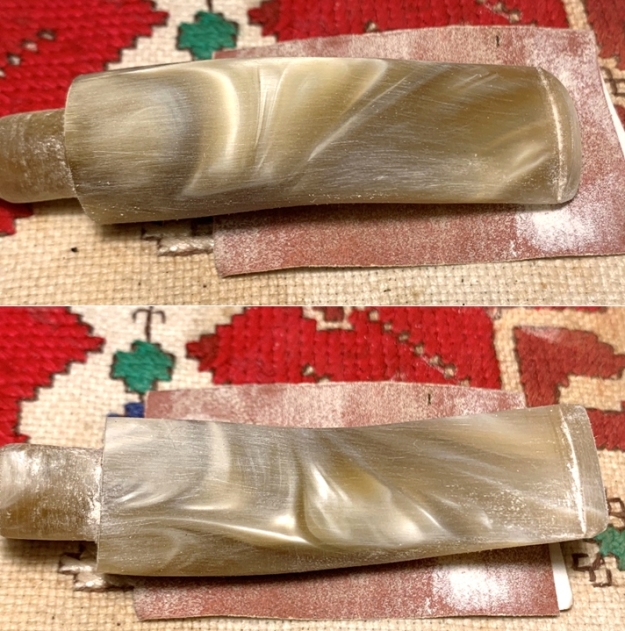
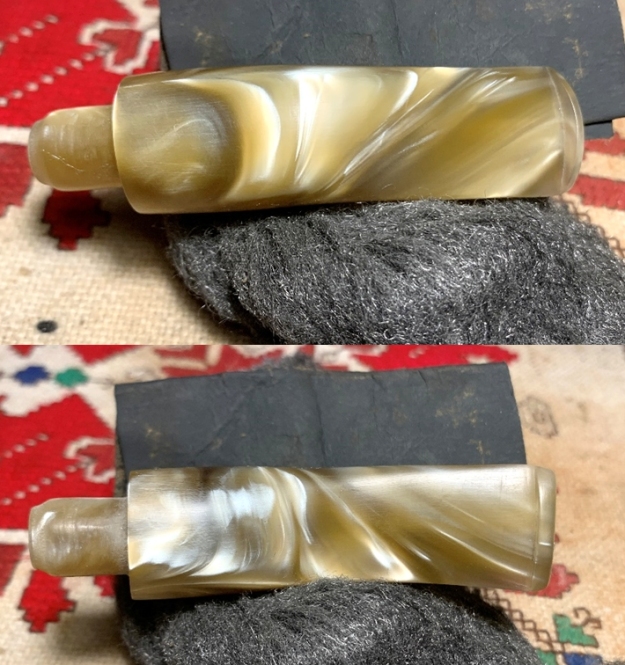
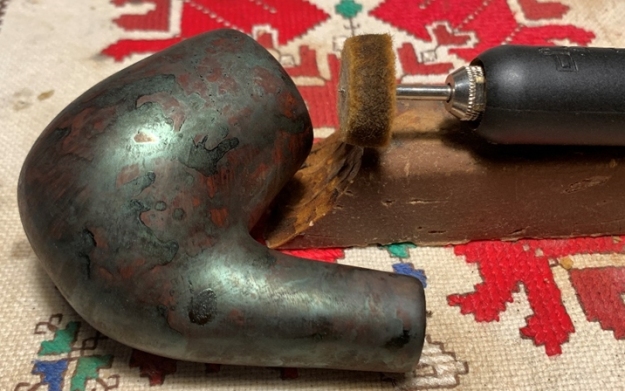
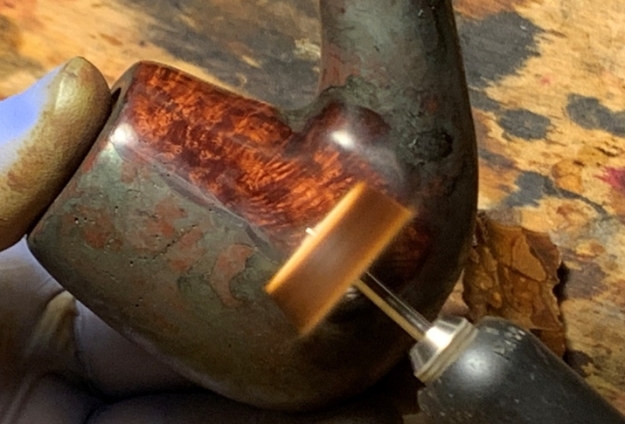
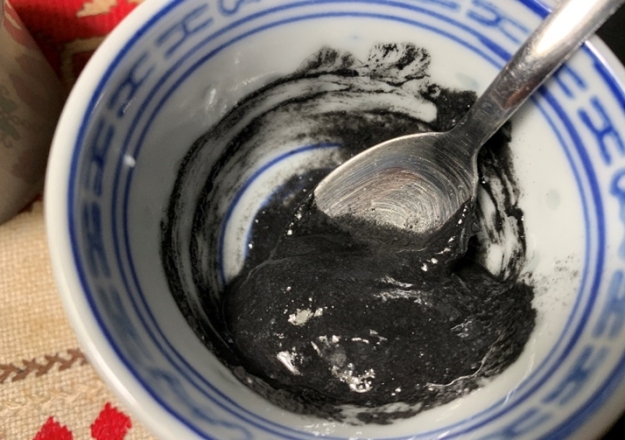
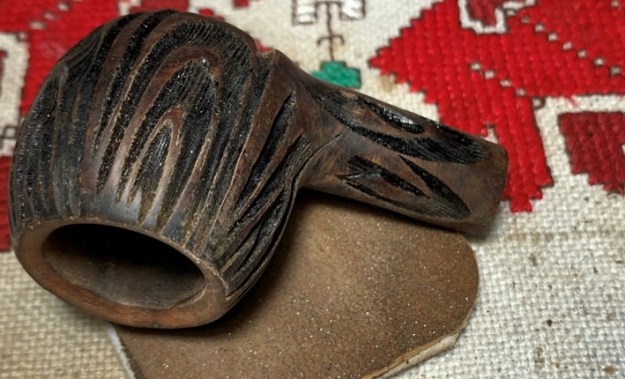
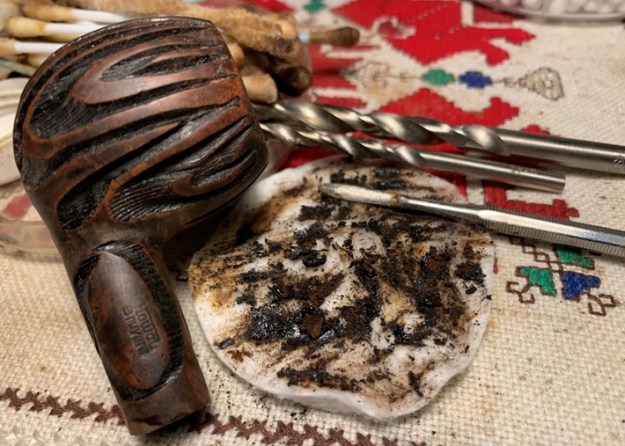
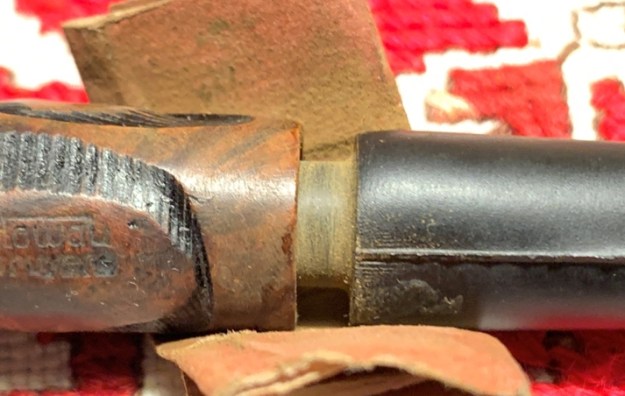
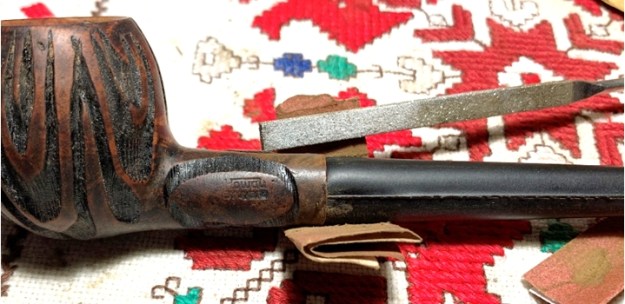
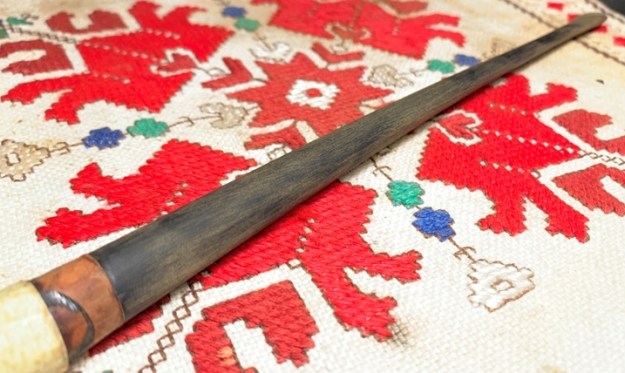
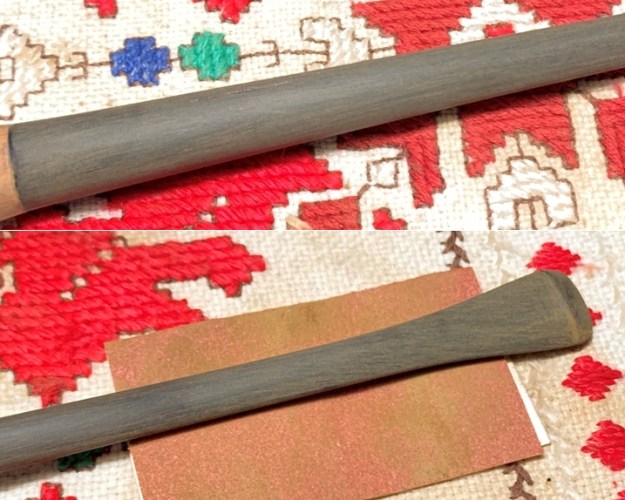
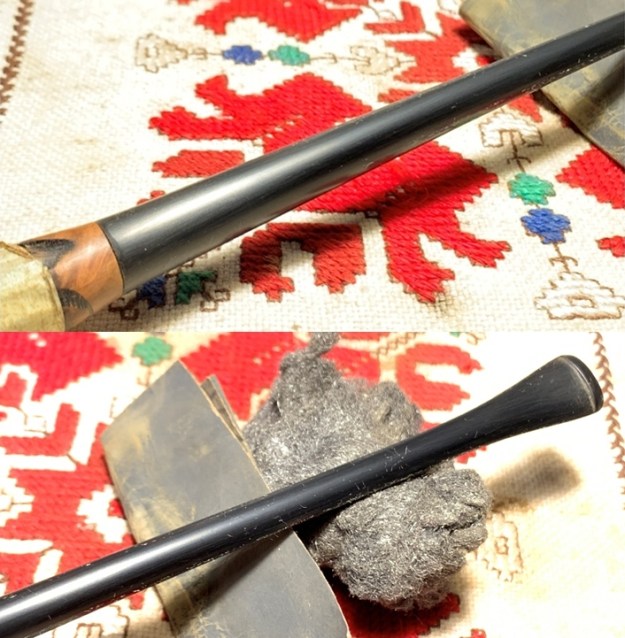
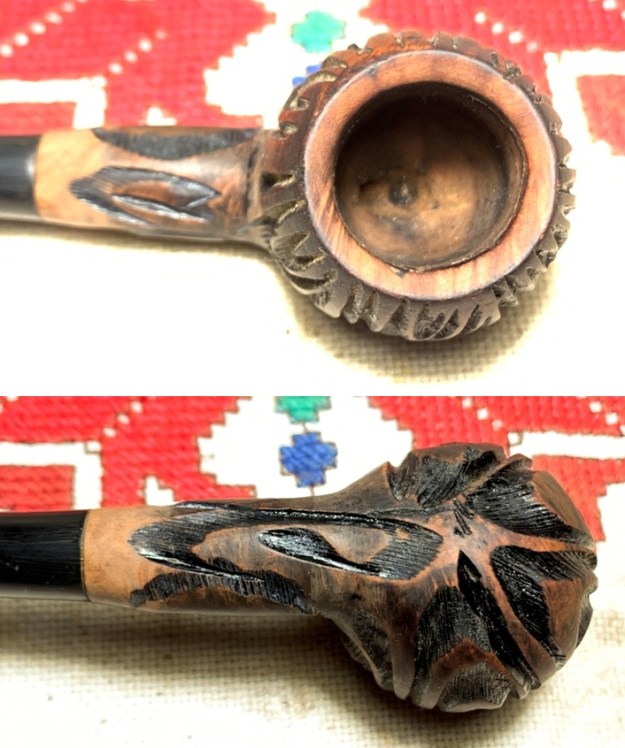
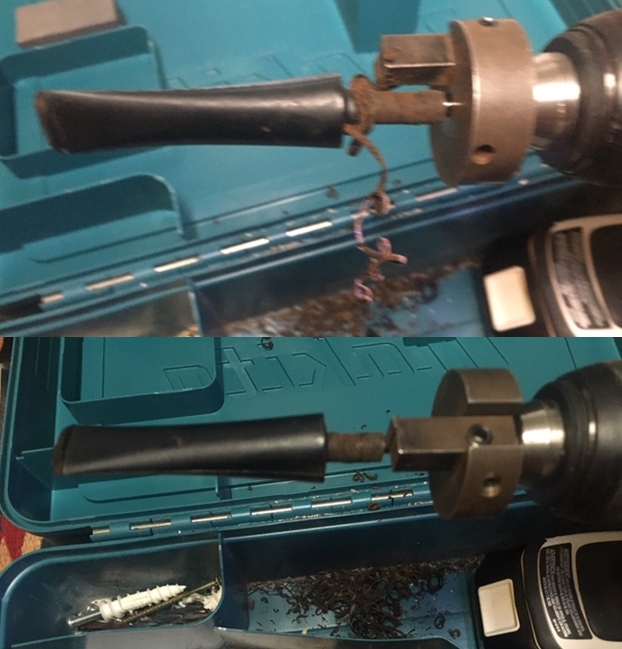
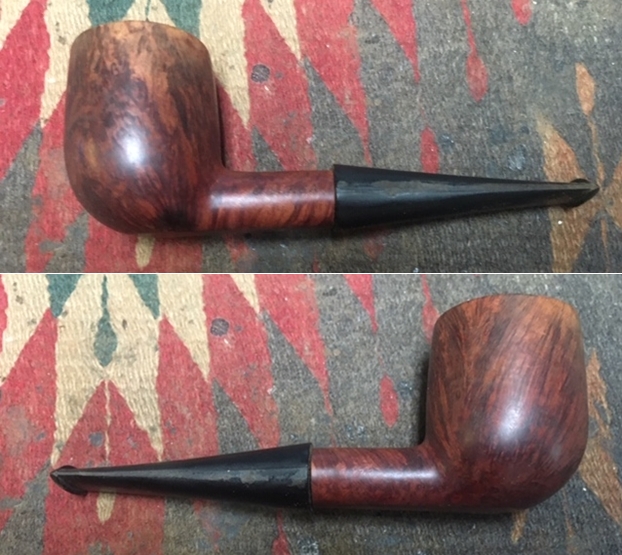
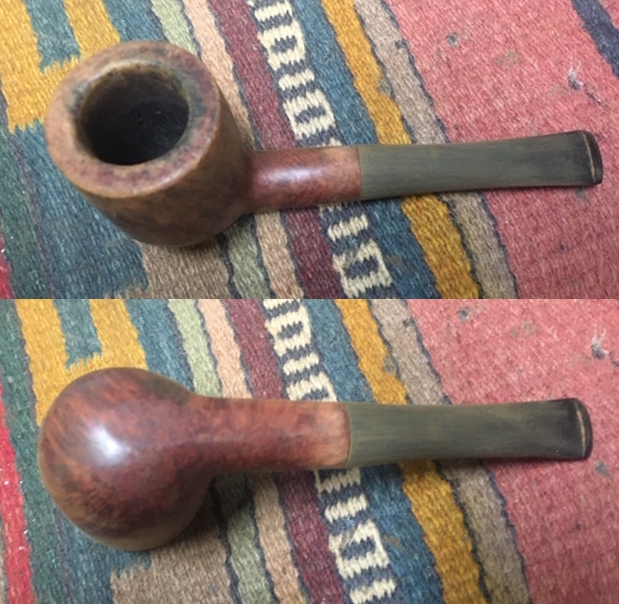
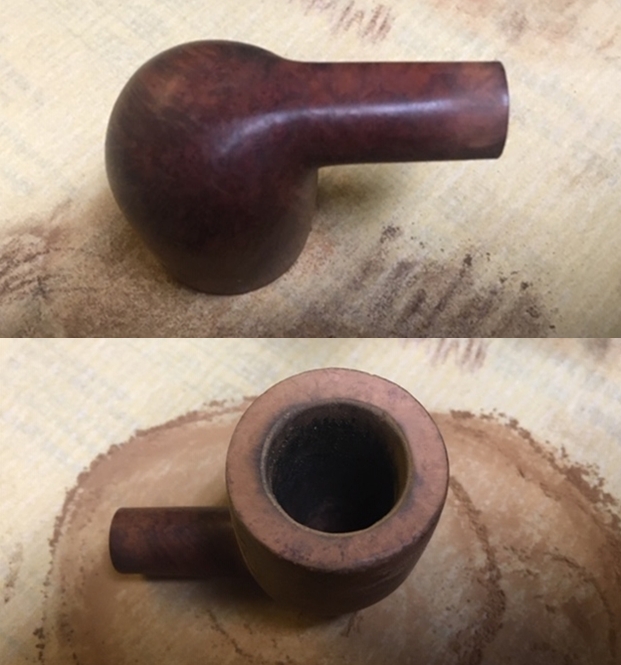
I decide to address the stem fitting first.  As I looked at the fitting, the tenon ring and stem wobbling in the mortise, my first thought is to expand the acrylic tenon like a vulcanite stem.  This method is to heat the tenon by painting it with the open flame of a Bic lighter and then inserting a slightly larger drill bit end into the softened tenon resulting in some expansion. Two questions come to mind – I’m not sure if acrylic will act like vulcanite – a rubber compound.  Will it expand the same way?  I’m not sure.  The second question is, if it does expand, I’m not sure it will expand enough to de-wobble the current situation?  After puzzling more, the solution came to me after reflecting on shank repairs that both Steve has done as well as Charles Lemon of Dad’s Pipes of utilizing inserts in the airways to connect broken shanks.  The solution was staring me in the face.  The nickel band that was acting as a poor ring for the tenon, could very well serve quite nicely as an insert in the mortise.  It is already sized for the tenon correctly.  I wondered if that was the original intent of the ring, but the crafter never got around to finishing? To test my theory, I slide the ring – now an insert – partially into the mortise, and partially insert the tenon.  I believe this will work nicely. To make the insert permanent, I use BSI Maxi-Cure Extra Thick CA glue.  I place some CA on the inside lip of the mortise then spread it around the circumference using a toothpick.  I then insert the nickel ring and press it down firmly on the table top surface pushing the insert into the mortise. The end of the nickel ring is flush with the shank facing.The insert seats as hoped, but what the picture shows is the pressure of the insert creates a small crack on the shank on the upper left side.  The good news is 3-fold.  First, the crack is very small.  Secondly, the insert on the inside will not expand any further and so the crack should not have additional pressure on it.  Lastly, the gold band on the outside will help fully cover the crack cosmetically and provide additional external pressure to support the shank. To address the crack, I first drill a counter hole to keep the crack from expanding. First, using a sharp dental probe, I press a hole at the end of the crack to serve as a guide for the drill. Next, after mounting a 1mm drill bit on the Dremel, I drill a hole at the end of the crack keeping my hand as steady as possible! The counter-creep hole is good.With the drill bit still mounted in the Dremel, I decide also to drill counter creep holes at the ends of the two most distinct ravines in the rough briar grain patch topography.  While these ravines are not cracks in the sense of a trauma related problems, treating these as cracks to guard against the ravines expanding is a good thing to do it seems. I’ve numbered them below.To prepare for drilling the counter-creep holes, I place guide holes as before using the sharp dental probe.Then I drill holes at the end of each ravine.  No problems.The ravines are deep – surprisingly so!  I double check in the chamber to make sure there are no corresponding ravines!  I see none – it looks good. I make sure the crevasses are cleared of loose stuff that may have collected.  I use a dental probe to clean what I can.  I pick at the smaller grain faults as well. I finish the cleaning by wiping the ravine area and the shank crack with a cotton pad wetted with isopropyl 95%.At this point I would usually mix a batch of briar dust putty with dust and thick CA glue.  Instead, I use only regular, thin CA glue on the shank since it will be covered by the band. With the ravines and the grain faults I’ll use regular thin CA glue and sprinkle them with Briar dust building the patches in steps.  Using the thinner CA glue will allow penetration into the deeper parts of the crevasses forming a more sure foundation.  The pictures show the progress. The night is late, I set the stummel aside for the patches to cure through the night.The next morning, what’s on my mind is seeing how the stem will react to the mortise insert.  The glue will be fully cured and with the insert firmly in place, I give the stem a try.  The fit tightens with the tenon inserted about halfway into the mortise. Not wishing to force the issue, I begin sanding the fat part of the tenon down first using 240 grade sanding paper.  When the progress seemed to be stymied, I then resorted to using a flat needle file to help.After several re-tries and additional filing and sanding, the stem seated in the new insert.  It looks good.  There still seems to be a slightly larger gapping on the top, but I will wait until remounting the gold band to make a final assessment on the stem fitting.With flat needle file in hand, filing begins on the bowl patches. Since this entire area is rife with pits and crevasses, I’m not too concerned about using the needle file down to the briar surface.  Usually, I transition to 240 sanding paper when the patch is close to the briar surface using the file, but with all the sanding that will be required for this project, I use the file for sake of speed.After the filing, I finish the first round of sanding with 240 grade paper.  All the light areas in the area indicate that the briar is not smooth and that pitting remains.  The briar dust created by the sanding packs in the holes which helps to show progress, or lack!Beginning the second round of patching, I again use the probe to excavate the compacted briar dust and then I wipe the area with a cotton pad wetted with alcohol to clean.I repeat the patching process with the same, regular thin CA glue and sprinkle the patches with briar dust.In the interest of full disclosure and brevity of describing the same process repeatedly, I repeated the patching process as described above about three more time and made slow progress eradicating the pitting.  I found though, that some of the pits would resist holding the CA glue fill.  After filling with CA glue, curing and sanding, the pit would remain.  I started testing different approaches – I used CA glue, then kneaded the patch with a toothpick to release possible air pockets hindering the glue from filling and holding the crevasses.  I also utilize an accelerator before and after applying CA.The solution that I found that seemed to work the best was not using the regular, thinner CA glue but switching to an extra-thick CA glue in combination with an accelerator.  In the picture below, on this pass of patching (I’ve lost count), I’ve painted a patch of very small grain faults with the thick CA using a toothpick to spread. After using the accelerator and allowing it a few minutes to cure, I go to work on the patch with the file.  I did this method several times to fill in the grain faults as much as I could.At the end of the day, perfection is not achievable.  Yet, the lion’s share of faults have been filled and hugely minimized but some scarring remains.  After finishing the patching and filing, I go over the area with 240 grade paper followed by 600 grade paper. I think that the area is much better, and the finishing process will continue to blend and mask the rough briar patch – I hope!  I move on – finally 😊.Moving now to the top, the rim has some rough spots which are easily dispatched with the topping board.  I first place a sheet of 240 grade paper on the chopping board, my topping board.  I rotate the inverted stummel on it several times, checking as I go.  I then switch to 600 grade paper.  The rim is looking good.  Moving on. Next, using sanding sponges I continue the sanding of the stummel.  I use a coarse sponge, followed by a medium grade then finish with a light grade.  Wow, comparing the two side in the pictures below, ugh!Moving straight away to the micromesh pad regimen, with pads 1500 to 2400 wet sanding is then followed with dry sanding with pads 3200 to 4000 and 6000 to 12000.  Wow!  What a piece of briar!  Other than the area where the grains were pitted, the grain is absolutely striking on this goliath. Without doubt, if not for the rough patch of briar – that has been helped immensely, I would be applying Before & After Restoration Balm now and moving to the finer polishing processes.  But with the rough briar patch, applying a darker dye will assist in masking the many patches.  I decide to mix Fiebing’s Saddle Tan and Dark Brown – about 2 to 1 ratio.  I want a darker brown hue but with the reddish hints that the Saddle Tan will brings.  After ‘unwrapping’ the initial coat, I may decide to do a straight Saddle Tan overcoat. I assemble my desktop dyeing module.  After mixing the dyes to the ratio I described using the large eye dropper, a cotton pad wetted with isopropyl 95% is used to clean the stummel.  The end of a spring-loaded clothes pin inserted into the mortise serves as a handle. The stummel is warmed using a hot air gun to expand the briar grain helping it to be more receptive to the dye. After heated, using a folded over pipe cleaner, the dye is painted onto the stummel in swatches and then, using a lit candle, the wet dye is ‘flamed’.  The aniline dye’s alcohol base combusts and leaves the hue behind in the briar grain.  After methodically covering the entire stummel with dye and firing as I go, I then set the stummel on a cork in the candle holder to let it rest through the night.With the dyed stummel now on the sideline, I turn to the attractive acrylic stem.  As I mentioned earlier, the stem is essentially unused, but it doesn’t appear to be in a pristine state.  The finishing left ripples and some rough spots on the stem.  I take a few pictures to illustrate what I’m seeing.To address these issues, I sand the entire stem using 240 grade paper then follow by wet sanding with 600 grade paper and finish this phase by applying 000 grade steel wool.  I like the results!  The acrylic surface has cleaned up nicely. Moving on now to the full regimen of micromesh pads, starting by wet sanding with pads 1500 to 2400 and dry sanding with 3200 to 4000 and 6000 to 12000. I apply Obsidian Oil to the stem after each set of three pads. This stem is spectacular!  The shine and that acrylic translucence is eye catching.  The stem will wait till the morning for the stummel to be ready to go. The next morning has arrived and I’m looking forward to ‘unwrapping’ the dyed stummel to see how the finish came out and how well it has helped mask the rough briar patch.  I mount a felt cloth buffing wheel onto the Dremel, reduce the speed to the lowest possible and apply Tripoli compound to the bowl.  The speed is reduced to decrease the friction and heat generated.I’ve developed this technique that works very well for me.  The following pictures show the process of removing the flamed crust to reveal the grain beneath. It takes patience to move over the surface and spotting the places where dye is still thick.  Usually it looks like a dark spot on the surface.  When I apply additional rotations with the Tripoli on these areas the excess dye is removed revealing the different grain compositions – the softer wood absorbs the dye while the harder wood doesn’t – these are the lighter grains.After unwrapping the stummel, I wipe the surface with a cotton pad wetted with alcohol.  I do this to blend the new dye as well as to lighten the hue.  Lightening the hue a bit softens the finish.Next, after mounting a cotton cloth wheel and adjusting the speed of the Dremel to about 40% full power, I apply Blue Diamond to both the stummel and the rejoined stem.  Yes, I am not replacing the gold band until the end of the process.After completing the compounds, I buff/wipe the pipe with a felt cloth to remove the compound dust in preparation for the wax.  Not pictured is mounting another wheel, maintaining the speed, and applying carnauba wax to the pipe.I have two remaining mini projects before the final hand buffing.  First, to remount the gold-plated band.  I first clean the band using Tarn-X tarnish remover.  It restores a very nice shine to the metal. The band fits over the shank easily about 70% of the way, but to be on the safe side, I use the hard surface cushioned by a few cotton pads to press the band fully on the shank.  The band fit easily the rest of the way with a gentle push.With the band fully seated on the shank, I test fit the stem with disappointing results.  In the picture below the gap at the top is huge. With the band easily moving on the shank, I partially retract the band off the shank and then reengage the stem so that the stem pushes the band over the shank.  With the band pressed with the stem tenon facing, its orientation is now much more favorably aligned with the stem with the gap minimized.  This looks much better as the second picture shows.The next step is to apply some CA glue to the inside of the band and repeat the same process of reseating the band using the stem itself. Using BSI Maxi-Cure Extra Thick CA glue, I place a large drop of glue on the inside of the band and then use a toothpick to spread the glue around the circumference of the inner wall of the band.  Then, after slipping the band carefully over the end of the shank, I press the stem forward over the shank keeping the facing of the stem squarely on the band to avoid the gapping.  When the band starts to gap, I know I’m far enough.  I retract the band slightly with the stem firmly seated and essentially no gap present.  Not wanting to get CA glue on the tenon, I remove the stem and set the stummel in an egg crate to allow the glue to cure.  The results look good!While the CA glue is curing, I move to the final project.  In order to provide the virgin briar in the chamber a good foundation to build a protective cake and for aesthetics, I mix a batch of natural yogurt and activated charcoal.  This mixture is applied to the chamber wall and it hardens to provide a layer over the briar. A pipe cleaner is inserted into the airway to guard the draft hole from being blocked.  When I inserted the pipe cleaner, what I remarked about earlier regarding the off-center drilling of the air way was illustrated graphically by the angle of the pipe cleaner!  These pictures show what I’m seeing.I place a small amount of natural yogurt in a small dish and add activated charcoal to it and mix until it thickens enough not to drip off the spoon.  With a pipe nail as a trowel, I scoop the mixture into the chamber and spread it on the chamber wall with the back side of the nail. When the wall is totally covered, I set the stummel aside allowing the mixture to dry and harden.  My day has come to an end and the lights are turned off. The next morning, the gold band is solidly in place and the yogurt/charcoal coating is dry and hard.  After reattaching the stem, I give the pipe a rigorous hand buffing to raise the shine.

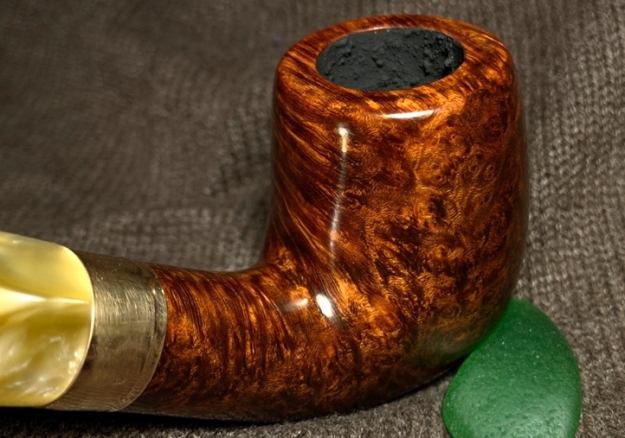
I’m pleased with how far this unmarked, gold band Giant Billiard has come.  The rough briar patch on the side of the bowl was a mess and took a lot of time to provide the healing that I see.  Yet, there remains some pitting from the briar faults.  The dark stain does a great job helping to mask the imperfections.  Yet, as with life, this pipe will carry with it some of the scars of its past.  However, the briar grain on this bowl is beautiful and it is huge!  I’m very pleased with the striking difference the darker brown finish provides – it changes the disposition of the entire pipe presentation.  There is now, I believe, a more striking contrast with the gold band which transition into the stem with all the same tones of color.  I like it.  Reseating the acrylic stem with the insert works well and the Crown Gold Giant Bent Billiard will sit very well in the palm of its new steward.  Cyrus saw the potential of this Giant and commissioned it.  He will have the first opportunity to claim it from The Pipe Steward Store.  Thanks for joining me!


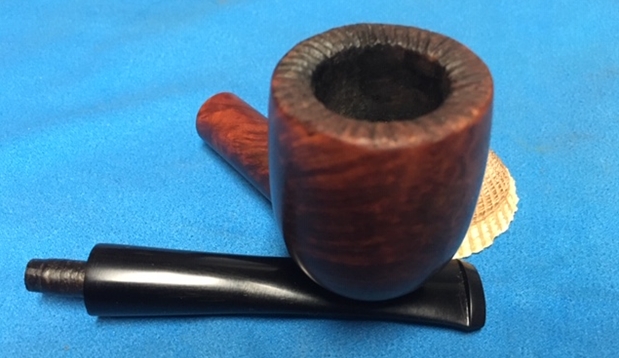
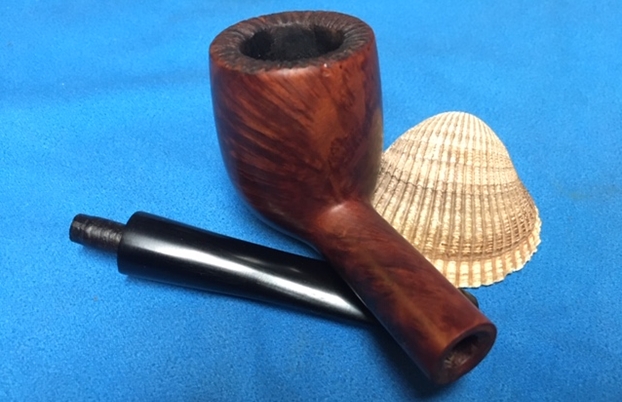
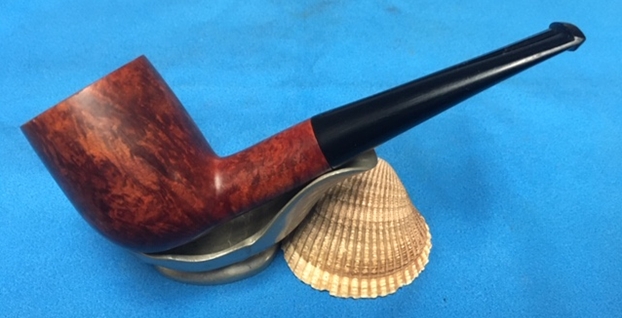
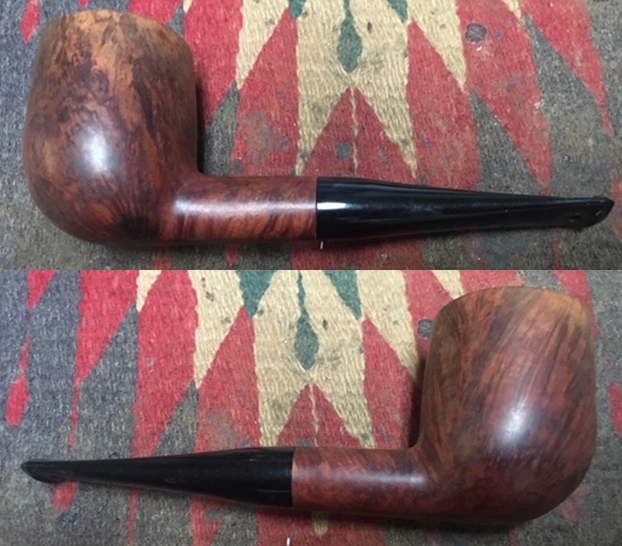
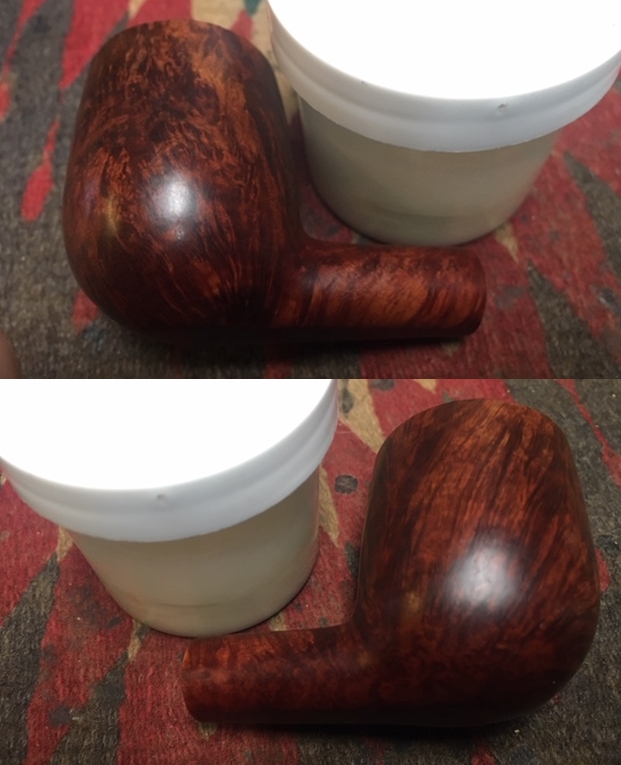
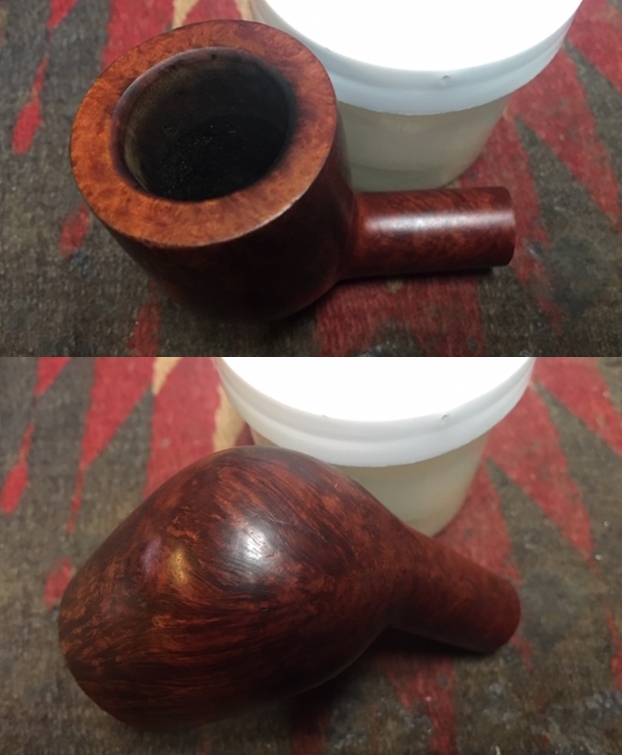
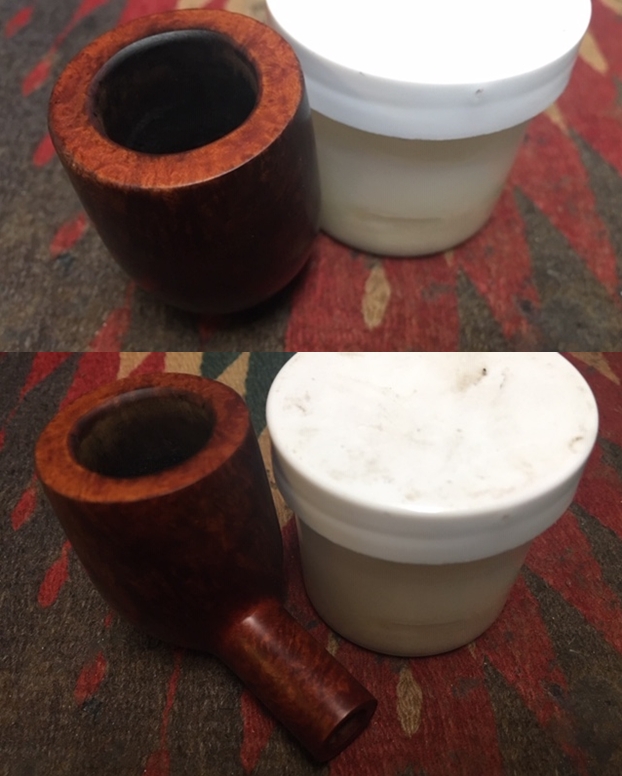
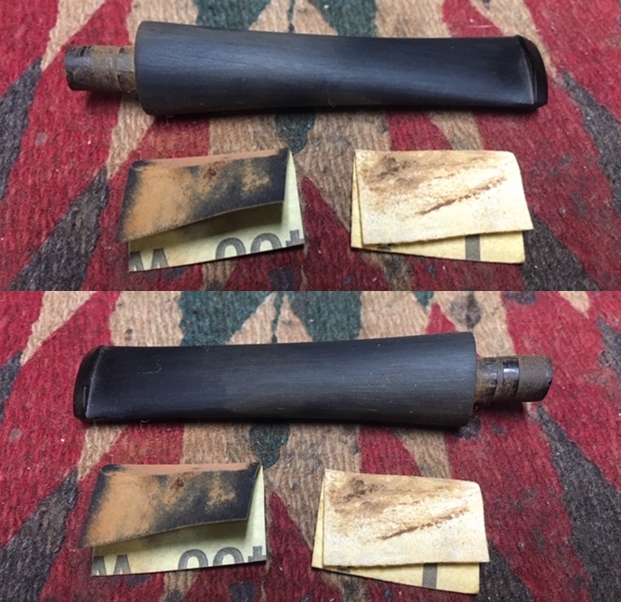
Restoring and Replacing a Broken Tenon on a Scandia 263 Danish Freehand


Blog by Steve Laug

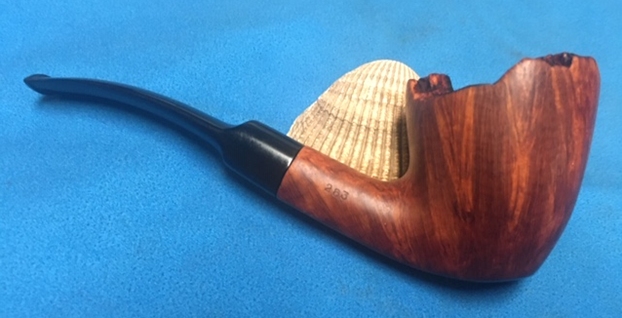
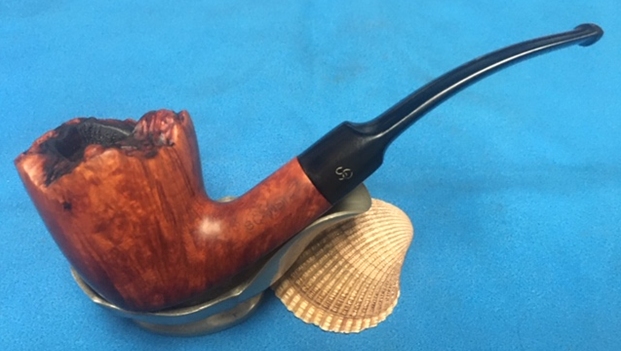
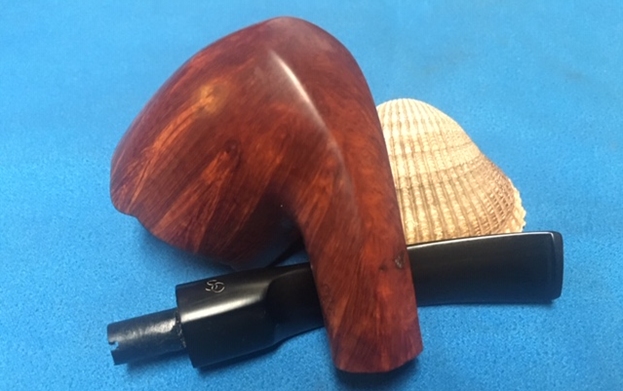
I am currently not taking on anymore restoration work from the internet or groups that I am part of on Facebook because of the large amount of estate pipes that I am working on to sell. But I have my name in at a local pipe shop here in Vancouver, British Columbia to do repair work for the shop as it comes in. there are no other pipe repairers in Western Canada that I am aware of so I feel a bit of an obligation to take care of these folks as they come. Fortunately there are not a lot of referrals but periodically they get pipemen or women stopping by with work – that is where I come in. They give them my number and email and then the repair work is between us. On Wednesday this week I received an email from one of their customers, Ron in Victoria, B.C. about a pipe that had been dropped and had a broken tenon. He described the broken stem and that left me with some questions. I had him send me photos of the broken pipe so I would be sure to have a clear picture of the issues. He said that the shank was not cracked and really the only issue was the tenon. He send the photos below so I could see what he was speaking of. Not too big an issue really – a cleanup and tenon replacement and the pipe would be good to go.After our emails back and forth he put it in the mail to me. It arrived on Friday and I took it out of the box to see what I was going to be dealing with on this pipe. Descriptions and photos are one thing but I like to have the pipe in hand to examine for myself. This is what I saw. The pipe was dirty and dull looking. There was some faint stamping on both sides of the shank. It was stamped Scandia over Made in Denmark on the left side and had the shape number 263 on the right side. There was a very uneven cake in the bowl that was crumbling. The tenon had snapped off almost smooth against face of the stem. The stem had some tooth marks and was oxidized. There was a faint SC on the left side of the saddle. It appeared that someone had tried to glue the tenon back on the stem – unsuccessfully. There was a lot of sloppy glue on the end of the stem and tenon. I took some photos of the pipe as it looked when it arrived. He had taped the broken tenon on the underside of the stem. The bowl itself was dirty with a crumbling cake about half way up the bowl from the bottom. The plateau rim top had tars and some darkening on the right top and edges. There was a large sandpit on the left side of the bowl near the rim and one on the underside of the shank that would need to be dealt with.  I removed the taped on broken tenon from the stem. I used a Dremel and sanding drum to take down the sharp edges of the old tenon remaining on the face of the stem. I wiped the face down with acetone on a cotton swab to remove the old glue. It was a sticky mess but came off quite easily with the acetone. When it was clean I used a series of drill bits to drill out the airway to accommodate the new threaded tenon. I usually start with a drill bit slightly larger than the airway and work my way up to the one that fits the tenon end. I used my cordless drill and the airway as the guide for each successive drill bit. This keeps things lined up.Once I have the airway drilled to accommodate the end of the tenon. I use a tap to thread new airway. The tenon replacements I use have a hip around the middle that I need to take down. I use a Dremel and sanding drum to smooth things out. I also rough up the threads to reduce the diameter to make room for the glue that I use to set the tenon in the stem.I used a needle file to smooth out the slight ridge at the end of the tenon. I sanded the tenon smooth to clean up the fit. I would further polish it once it was in place in the stem. I dribbled some Krazy glue on the threads and quickly turned it into the stem making sure that the alignment was correct.I took photos of the new tenon before I polished and finished it. The tenon is solid and the alignment in the shank is perfect. I set it aside to cure and turned my attention to the bowl.With the stem repaired I remembered that Ron had asked me to give him some background information on the brand so I paused at this point to gather the info. I turned to Pipephil’s site (http://www.pipephil.eu/logos/en/logo-s4.html) to get a quick overview. As expected the Scandia brand is a Stanwell second line. In this case the sandpits make it clear why it has this designation. I have included a screen capture of the pertinent section from the site.I turned then to the section on Pipedia that dealt with the Stanwell Sub-brands the Scandia pipe listed there (https://pipedia.org/wiki/Stanwell#Sub-brands_.2F_Seconds). I followed several other links listed on the article to check who designed this particular shape for Stanwell (https://pipedia.org/wiki/Stanwell_Shape_Numbers_and_Designers). Bas Stevens, a dear friend who know longer is living compiled a list of the shape numbers and their designer. The 263 was not listed there however, I remembered that the shape was actually a Stanwell shape 63. That shape was a Freehand with a plateau top and a saddle mouthpiece and was designed by Sixten Ivarsson.

To verify that my memory was correct I did a quick Google search for images of the shape 63 for comparison purposes. I include the photo below with thanks to http://www.Bollitopipe.it for the image (https://www.bollitopipe.it/en/hand-made-polished-royal-guard/18983-stanwell-royal-guard-63-bark-top.html). You can see that the shape is identical so that it is clear that the 263 and the 63 are the same shapes.With the background information gathered and summarized I turned my attention to the cleanup of the bowl. I reamed the crumbling and uneven cake out of the bowl. I left a very thin cake on the walls of the bowl. I cleaned up the small bits toward the bottom of the bowl with a Savinelli Fitsall Pipe knife. I finished by smoothing out the slight cake on the walls with a piece of 220 grit sandpaper wrapped around some doweling. I a soft bristle brass brush to clean off the debris in the plateau finish on the rim top. I was able to remove most of the darkening at the same time. While not flawless it looks significantly better.To clean the surface of the briar and remove the oils and dirt I scrubbed the briar with a tooth brush and undiluted Murphy’s Oil Soap. I rinsed off the bowl under warm water and dried it off with a soft cotton cloth. The finish looks much better with stunning grain. The sandpits are quite visible now that the pipe is clean. I repaired the sandpits with a few drops of Krazy Glue. I slightly overfill the pit with the glue as it shrinks as it cures. Once the repairs cured I sanded them with 220 grit sandpaper to blend them into the rest of the bowl. I polished the entire bowl with 400 grit wet dry sandpaper in preparation for the micromesh polishing. I polished the briar with micromesh sanding pads – wet sanding with 1500-12000 grit pads. After each pad I wiped the bowl down with a damp cloth to remove the sanding dust. The photos tell the story. I used a black Sharpie pen to darken in the deep grooves on the plateau as it would help to mask the darkening on the right and left side of the rim top and it would highlight and give depth to the finish. I rubbed the bowl down with Before & After Restoration Balm. I worked it into the surface of the plateau rim top and the rest of the briar with my fingertips and a horsehair shoe brush to clean, enliven and protect it. I let the balm sit for a little while and then buffed with a cotton cloth to raise the shine. I really like watching the Balm do its magic and bring the briar alive. With the bowl finished I turned my attention to polishing the stem. I sanded the surface of the stem with 220 grit sandpaper and 400 grit wet dry sandpaper to remove the remaining oxidation in the vulcanite and the last of the light tooth chatter.  I polished the stem with micromesh sanding pads – wet sanding with 1500-12000 grit pads. I wiped the stem down after each sanding pad with Obsidian Oil. I used some liquid paper to touch up the “SC” on the left side of the stem. I applied it and let it dry and cure. Once it had cured I scraped the excess off with a tooth pick. The “SC” looks very good.  I polished it with Before & After Pipe Stem Polish – both Fine and Extra Fine. Once I had finished the polishing I gave it a coat of a new product I am experimenting with from Briarville Pipe Repair. It is called “No Oxy Oil” and it is made to protect the stem from oxidizing. I set it aside to dry.I am happy with how this pipe looks compared to what it looked like when it arrived in pieces. It definitely has that Stanwell look to it – very Danish Freehand looking. I am excited to be on the homestretch with it and took it to the buffing wheel and polished it on the wheel with Blue Diamond to polish out the scratches in the briar and the vulcanite. I gave the bowl and the stem multiple coats of carnauba wax. I buffed the pipe with a clean buffing pad to raise the shine. I hand buffed it with a microfiber cloth to deepen the shine. The pipe polished up pretty nicely. The grain really pops with the wax and polish. The shiny black vulcanite stem is a beautiful contrast to the blacks and browns of the bowl and shank. This Scandia Made in Denmark Freehand was fun to bring back to life. It really is stunning piece of briar whose shape follows the flow of the grain. The pipe is comfortable pipe to hold in the hand. The finished pipe is shown in the photos below. The dimensions of the pipe are Length: 5 ½ inches, Height: 2 inches, Outside diameter of the bowl: 1 ¾ inches, Chamber diameter: ¾ of an inch. This beautiful pipe will be going back to Ron tomorrow. If the mail is as fast as it was bringing it to me he should have it in hand by the first part of the week. I hope that he enjoys this beauty and that it serves him well. Thanks for reading this blog and my reflections on the pipe while I worked on it. This is an interesting one to bring back to life.

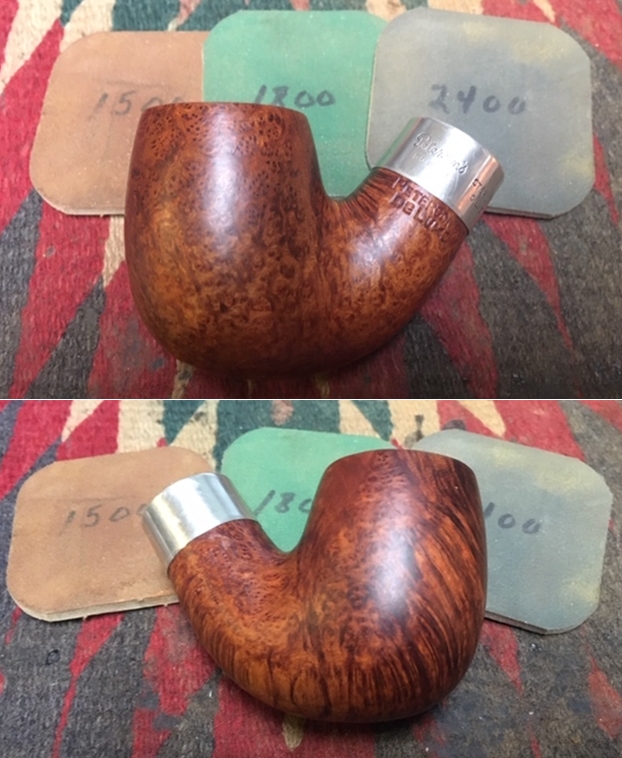
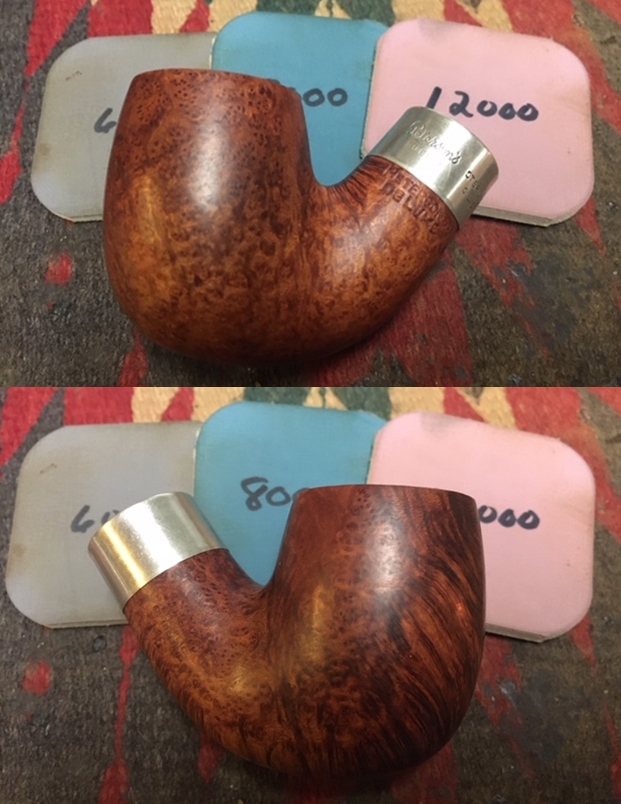
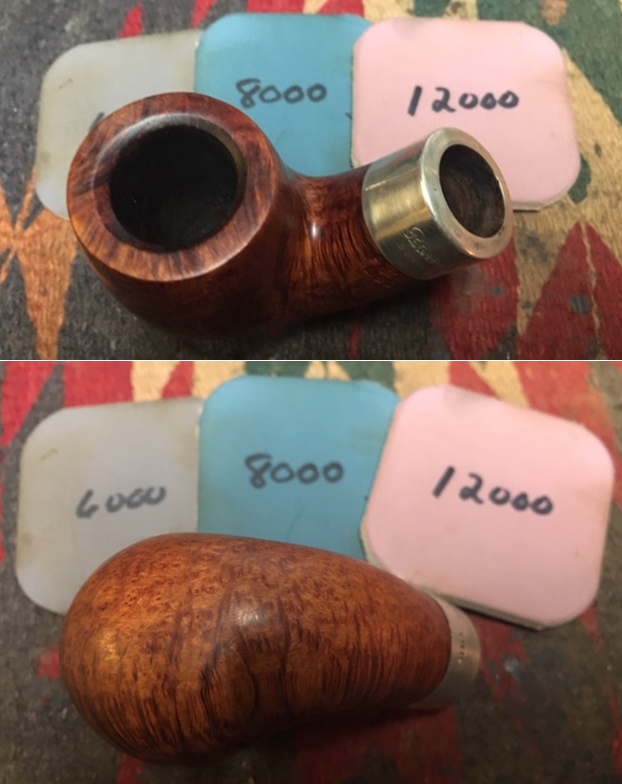
Life for a Republic of Ireland Peterson’s DeLuxe 11S Bent Billiard from Bob Kerr’s Estate


Blog by Steve Laug

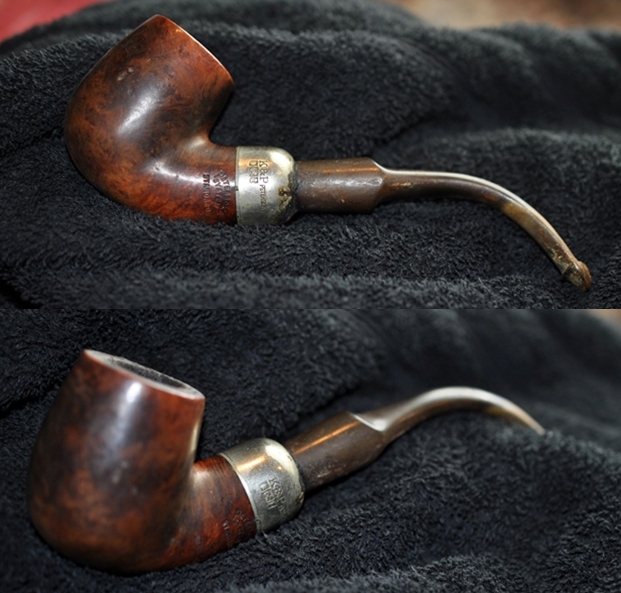
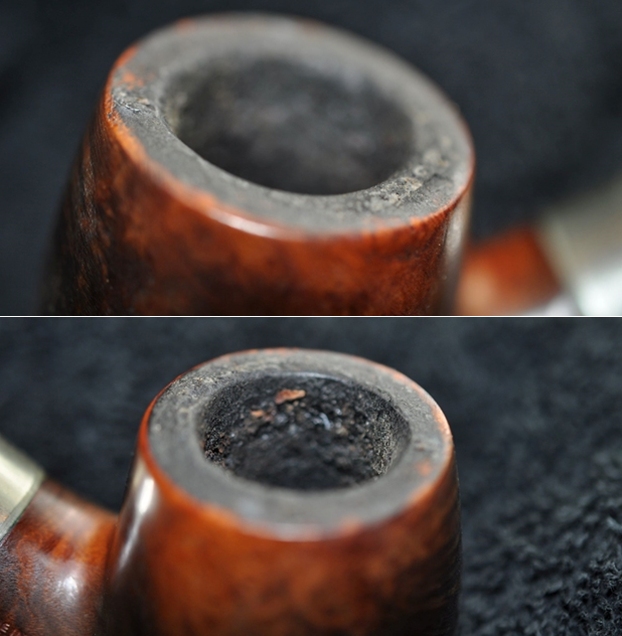
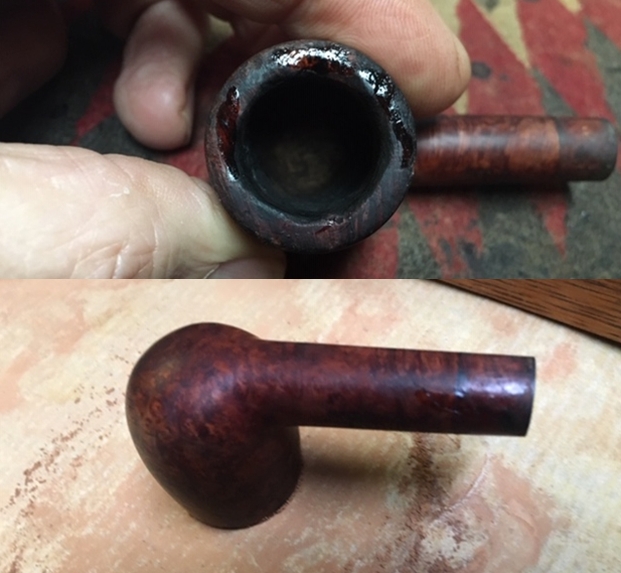
I am working on another pipe from Bob Kerr’s estate, another one of his Petersons. It is the first of the system pipes that I have in his estate and the first Deluxe. It is a large pipe which came with a stem from one of his other pipes. I have restored eight of his Peterson pipes and two of these were Peterson’s pipes made specifically for import into the Canadian market – one was a Kapruf 54 sandblast bent billiard (https://rebornpipes.com/2019/08/09/back-to-bob-kerrs-estate-another-canadian-import-petersons-kapruf-a-54/) and the other was a Kapruf 9BC 56 (https://rebornpipes.com/2019/08/09/back-to-bob-kerrs-estate-linking-petersons-kapruf-9bc-with-the-56-shape-number/). These were interesting that they had a unique numbering system designed for Petersons pipes that were specifically brought to Canada by the Canadian importer, Genin, Trudeau & Co. of Montreal, Quebec. I have included the links on that company below. (https://rebornpipes.com/2016/09/13/petersons-pipes-brochure-from-genin-trudeau-co-montreal-quebec/). I restored an English Made Peterson’s System ‘0’ 1307 bent billiard a  (https://rebornpipes.com/2019/08/17/an-english-made-petersons-system-0-1307-bent-billiard-from-bob-kerrs-estate/) and a Republic Era Peterson’s Flame Grain Bent billiard with a fishtail stem (https://rebornpipes.com/2019/08/16/a-petersons-flame-grain-x220s-bent-billiard-from-bob-kerrs-estate/).

I have been enjoying working on these Peterson’s particularly because Jeff has done such a thorough cleanup of them before I receive them. When I took it out of the box of the pipes that Jeff had cleaned up and sent back to me, I could see that it was stamped Peterson’s DeLuxe vertically on the left side of the shank next to the band. The right side of the shank was stamped Made in the Republic of Ireland over the shape number 11S. It has some stunning grain around the bowl and shank under the thick grime. There was a thick cake in the bowl with remnants of tobacco stuck on the walls. There was a fair lava overflow on the rim. The top and edges of the rim looked very good under the grime. I think that there was a beautiful pipe underneath all of the buildup of years of use. The band is stamped Peterson’s over Dublin followed by Sterling Silver on the left side. On the underside are three hallmarks – The Hibernia stamp, the Crowned Harp stamp and finally the letter “O”. The wrong stem was in the shank when I sent it to Jeff so that is the one shown in the photos. It was oxidized and calcified toward the end with some tooth chatter but surprisingly it did not have the deep tooth marks that I have come to expect from Bob’s pipes but the button edges were worn. Jeff took photos of the pipe before he started his cleanup work on it. Jeff took photos of the bowl and rim top to show the thick, hard cake in the bowl and the lava build up on the top of the rim and the edges of the bowl. The rim top, with the inner bevel appeared to be in good condition with no burn marks or chips. The outer edges of the rim also appeared to be in good condition. Jeff took photos of the sides and heel of the bowl to show the condition of the finish. You can see the beautiful birdseye grain on the sides and cross grain on the front, back and underside of the bowl and shank. Even under the dirt and debris of the years it looked very good. The cross grain on the heel was beautiful.   Jeff took photos of the stamping on both sides of the bowl and shank. The vertical stamping on the left side was readable as you can see from the photos. It read Peterson’s DeLuxe. The stamp on the right side read Made in the Republic of Ireland with the shape number 11S underneath. The band was also stamped in the silver. Jeff took photos of the stamping. On the left side of the band/ferrule it is stamped Peterson’s Dublin (photo 1). As the pipe is turned it reads Sterling Silver (photo 2). Finally on the underside it is stamped with three hallmarks -1. Hibernia, 2. Crowned Harp and 3. The letter “O”. I will need to look that up during the restoration. Jeff took photos of the top and underside of the stem showing the tooth chatter, scratching and oxidation on the stem surface and wear on the edges of the button. I turned to a Peterson Catalogue that I have on rebornpipes and looked up the System Deluxe pipes (https://rebornpipes.com/tag/peterson-hallmark-chart/). I have put a red box around the 11S pipe shown in the catalogue page shown below.   I turned first to Pipephil’s site to reacquaint myself with the DeLuxe. Unfortunately there was no information to be found on this specific line. I then turned to Pipedia’s article on Peterson pipes to see what I could garner from that information. It is a great read in terms of the history of the brand (https://pipedia.org/wiki/Peterson). I have included a bit of the pertinent history here.

1950 – 1989 The Republic Era  – From 1950 to the present time, the stamp for this era is “Made in the Republic of Ireland” in a block format generally in three lines but two lines have been used with or without Republic being abbreviated.

During the 1950’s and 60’s the Kapp & Peterson company was still in the ownership of the Kapp family. However 1964 saw the retrial of the company Managing Director Frederick Henry(Harry) Kapp.

In the 1960’s Peterson hallmarked all gold mounted pipes but apparently they used their own marks on silver. This practice stopped at the end of that decade when they started to have all silver bands hallmarked.

With that information in hand I knew what I was dealing with in terms of the stamping on the pipe. It is a 1980  Republic Period pipe. I also wanted to be able to interpret the hallmarks on the silver band. I have captured a portion of the chart that include below that helps to clarify the meaning of each of the three hallmarks. I like the Hallmark feature on the higher end Peterson pipes with Sterling silver bands. It helps to pin down the date even further.

  • “Hibernia” seated, arm on harp represents Ireland (country of manufacture). There have been minor design changes over the years.
  • The “Harp Crowned” is the fineness mark denoting the high quality (purity) of the silver, and was used in a variety of designs until October 1992 when it was replaced by the new European Standard or Millesimal mark which gives the purity or quality of the silver in parts per thousand.
  • The Date Letter Code for the year in which the silver was hallmarked (see the chart below). In certain years a fourth hallmark is applied – for example 1966 – a Sword of Light for the 50th anniversary of the Easter Rising 1973. There were also other marks used for the fourth hallmark.

The pipe on my table had the Hibernia seated mark (Ireland) followed by the Harp Crowned signifying Sterling Silver percentage and finally in this case a lower case “o”. Each of the hallmarks was in an octagonal cartouche. The chart below helps me identify the date mark to 1980. I have highlighted the 1980 mark with a red arrow in the chart below.

I have included the entire Hallmark chart for ease of reference show any of you be looking to date the pipes that you are working on at present.

From this information and the catalogue page I wanted to see what the original stem looked like then I could go through the other pipes in the estate and see if somehow it had been used on the wrong pipe. I found a pipe that is very similar – an 11S with a thick P-lip stem that did not have the P logo on the side on the Smokingpipes.com online store. I have included both the link and the photo below.

https://www.smokingpipes.com/pipes/new/peterson/moreinfo.cfm?product_id=167772#fullscreenI also found a description of the 11S Deluxe System online on another site:

The 11s Deluxe system is a bent billiard with broad, continuous curves and an extra-stout shank. The high quality briar is carefully selected and incorporates the signature system functionality. The shape is fitted with a black acrylic Peterson-Lip mouthpiece, containing an inner metal ‘condenser’ which facilitates a cooler smoking experience. The aluminum Peterson ‘P’ and large hall marked sterling silver band both signature elements of Peterson craftsmanship, combine wonderfully to create a high quality Peterson pipe.

The description includes the aluminum Peterson “P” on the stem which the example I show above and the pipe I am working is lacking. It seemed to have come out both ways. I went through the other Peterson pipes that Jeff had cleaned up and sent back to me. I found one that had the stem switched with the Deluxe. Here are some photos of the two pipes with the wrong stems. The thicker stem shown at the top of both photos is the proper one for the Deluxe. I removed the stems and took photos of the stems.I put the correct stem in the Deluxe and turned my attention to the pipe. I took photos of the pipe with the right stem. With over 125 pipes to clean from Bob’s estate I am very glad for Jeff’s help cleaning them. He remembers this pipe as one of the really dirty ones in Bob’s estate. He cleaned this filthy pipe with his usual penchant for thoroughness that I really appreciate. This one was a real mess and I did not know what to expect when I unwrapped it from his box. He reamed it with a PipNet pipe reamer and cleaned up the reaming with a Savinelli Fitsall Pipe Knife. He scrubbed out the internals with alcohol, pipe cleaners and cotton swabs until the pipe was clean. He scrubbed the exterior of the bowl with Murphy’s Oil Soap and a tooth brush to remove the grime and grit on the briar and the lava on the rim top. The finish looks very good with great looking grain around the bowl and shank. Jeff soaked the stem in Before & After Deoxidizer to remove the oxidation on the rubber. When the pipe arrived here in Vancouver for the second stop of its restoration tour I was amazed it looked so good. I took some close up photos of the rim top and also of the stem surface. I wanted to show what an amazing job Jeff did in the cleanup of the rim top. The rim top was burned and darkened with nicks and notches around the top and inner edge. I also took close up photos of the stem to show the lack of tooth marks and chatter on the stem surface. It was very clean.   One of the things I appreciate about Jeff’s cleanup is that he works to protect and preserve the nomenclature on the shank of the pipes that he works on. The stamping on this one was very faint to start with so I was worried that it would disappear altogether with the cleanup. He was not only able to preserve it but it is clearer than shown in the earlier photos. I took some photos to show the clarity of the stamping. I have noticed that many restorers are not careful to protect the stamping in their cleaning process and often by the end of the restoration the nomenclature is almost destroyed. I would like to encourage all of us to be careful in our work to preserve this as it is a critical piece of pipe restoration!   I also have included a photo of the cleaned up hallmarks that were noted above. Since this is another pipe Bob’s estate I am sure that some of you have read at least some of the other restoration work that has been done on the previous pipes. You have also read what I have included about Bob Kerr, the pipeman who held these pipes in trust before I came to work on them (see photo to the left). Also, if you have followed the blog for long you will already know that I like to include background information on the pipeman whose pipes I am restoring. For me, when I am working on an estate I really like to have a sense of the person who held the pipes in trust before I worked on them. It gives me another dimension of the restoration work. I asked Brian if he or his wife would like to write a brief biographical tribute to her father, Bob. His daughter worked on it and I received the following short write up on him and some pictures to go along with the words including one of Bob’s carvings. Once again I thank you Brian and tell your wife thank you as well.

I am delighted to pass on these beloved pipes of my father’s. I hope each user gets many hours of contemplative pleasure as he did. I remember the aroma of tobacco in the rec room, as he put up his feet on his lazy boy. He’d be first at the paper then, no one could touch it before him. Maybe there would be a movie on with an actor smoking a pipe. He would have very definite opinions on whether the performer was a ‘real’ smoker or not, a distinction which I could never see but it would be very clear to him. He worked by day as a sales manager of a paper products company, a job he hated. What he longed for was the life of an artist, so on the weekends and sometimes mid-week evenings he would journey to his workshop and come out with wood sculptures, all of which he declared as crap but every one of them treasured by my sister and myself. Enjoy the pipes, and maybe a little of his creative spirit will enter you!

Now with all of the background on the line and the background on Bob Kerr it was time to get on with the restoration of this beautifully grained Peterson’s DeLuxe llS Bent Billiard. I am really coming to appreciate the hard cleanup work that Jeff did on these pipes. They were a real mess when I sent them to Jeff and I have to tell you it was great that I did not need to clean this pipe. I decided to start the process by polishing the briar with micromesh sanding pads – wet sanding it with 1500-12000 grit pads and I wiped the bowl down after each sanding pad with a damp cloth. The bowl began to take on a finished shine.  The stem was in such good condition that I could skip working on it with sandpaper and went directly to polishing it with micromesh sanding pads – wet sanding with 1500-12000 grit pads. I wiped the stem down after each sanding pad with Obsidian Oil. I polished it with Before & After Pipe Stem Polish – both Fine and Extra Fine. Once I had finished the polishing I gave it a coat of a new product I am experimenting with from Briarville Pipe Repair. It is called “No Oxy Oil” and it is made to protect the stem from oxidizing. I set it aside to dry. As usual at this point in the restoration process I am excited to be on the homestretch. I look forward to the final look when it is put back together, polished and waxed. I put the bowl and stem back together. I polished the bowl and stem with Blue Diamond to polish out the scratches in the briar and the vulcanite. I gave the bowl and the stem multiple coats of carnauba wax. I buffed the pipe with a clean buffing pad to raise the shine. I hand buffed it with a microfiber cloth to deepen the shine. The pipe polished up pretty nicely. The grain really pops with the wax and polish. The shiny black vulcanite stem is a beautiful contrast to the browns of the bowl and thick shank. This Peterson’s DeLuxe 11S Bent Billiard was another fun pipe to work on thanks to Jeff’s cleanup work. The pipe almost looks unsmoked. The original Sterling Silver Band/Ferrule works as a contrast between the stem and the briar and binds it all together. It really is a quite stunning piece of briar whose shape follows the flow of the briar. The pipe is comfortable pipe to hold in the hand. The finished pipe is shown in the photos below. The dimensions of the pipe are Length: 6 ½ inches, Height: 2 inches, Outside diameter of the bowl: 1 ¼ inches, Chamber diameter: ¾ of an inch. This beautiful pipe will be going on the rebornpipes store if you would like to add it to your collection and carry on Bob’s legacy. If not, I have a lot more of Bob’s estate to work on of various brands. Perhaps one of those will catch your attention. Thanks for reading this blog and my reflections on the pipe while I worked on it. This is an interesting estate to bring back to life.
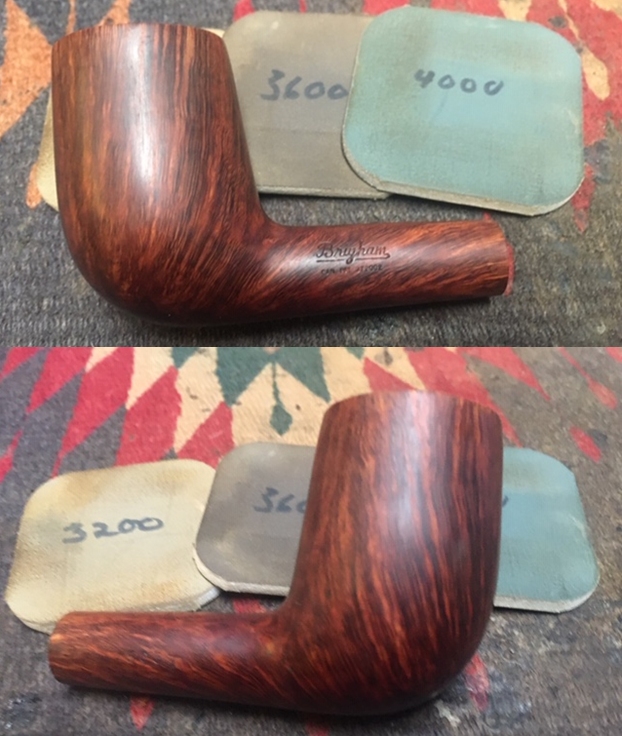
 

Restoring an Irish Made Peterson’s K&P Dublin 213 Billiard from Bob Kerr’s Estate


Blog by Steve Laug

I am working on another pipe from Bob Kerr’s estate, another one of his Petersons. It is different than the others as it is stamped “A Petersons Product” Made in Ireland. I have restored two of his pipes that were uniquely made Peterson’s pipes made specifically for import into the Canadian market – one was a Kapruf 54 sandblast bent billiard (https://rebornpipes.com/2019/08/09/back-to-bob-kerrs-estate-another-canadian-import-petersons-kapruf-a-54/) and the other was a Kapruf 9BC 56 (https://rebornpipes.com/2019/08/09/back-to-bob-kerrs-estate-linking-petersons-kapruf-9bc-with-the-56-shape-number/). These were interesting that they had a unique numbering system designed for Petersons pipes that were specifically brought to Canada by the Canadian importer, Genin, Trudeau & Co. of Montreal, Quebec. I have included the links on that company below. (https://rebornpipes.com/2016/09/13/petersons-pipes-brochure-from-genin-trudeau-co-montreal-quebec/). I restored an English Made Peterson’s System ‘0’ 1307 bent billiard a  (https://rebornpipes.com/2019/08/17/an-english-made-petersons-system-0-1307-bent-billiard-from-bob-kerrs-estate/) and a Republic Era Peterson’s Flame Grain Bent billiard with a fishtail stem (https://rebornpipes.com/2019/08/16/a-petersons-flame-grain-x220s-bent-billiard-from-bob-kerrs-estate/).

I have been enjoying working on the Peterson’s in the estate. When I took it out of the box of the pipes that Jeff had cleaned up and sent back to me, I could see that it was stamped K&P over Dublin on the left side of the shank and “A Peterson’s Product” Made in Ireland followed by the shape number 213 on the right shank. It has some stunning grain around the bowl and shank under the thick grime. There was a thick cake in the bowl with remnants of tobacco stuck on the walls. There was a fair lava overflow on the rim. The top and edges of the rim are damaged, beat up and very dirty. I think that there was a beautiful pipe underneath all of the grime and buildup of years of use. The band is stamped Sterling Silver with the K&P in chevrons above that. The stem was oxidized and calcified toward the end with some tooth chatter but surprisingly it did not have the deep tooth marks that I have come to expect from Bob’s pipes but the button edges were worn. Jeff took photos of the pipe before he started his cleanup work on it. Jeff took photos of the bowl and rim top to show the thick, hard cake in the bowl and the lava build up on the top of the rim and the edges of the bowl. The rim top had taken a beating and was chipped and worn down. It looked like Bob or someone had used if for a hammer. The inner and outer edges of the rim also sustained damage.   Jeff took photos of the sides and heel of the bowl to show the condition of the finish. You can see the beautiful mix of swirled, flame and birdseye grain underneath the dirt and debris of the years. The cross grain on the heel was beautiful.    Jeff took photos of the stamping on both sides of the bowl and shank. The stamping on the left side was readable as you can see from the photos. It read K&P Dublin. The stamp on the right side read A “Peterson’s Product” Made in Ireland followed by the shape number 213. You can see crack in the shank under the band on the right side. The third photo shows the crack clearly. Jeff took photos of the top and underside of the stem showing the tooth chatter, scratching and oxidation on the stem surface and wear on the edges of the button. I turned first to Pipephil’s site to reacquaint myself with the brand. Unfortunately there was no information to be found on this specific pipe. I then turned to Pipedia’s article on Peterson pipes to see what I could garner from that information. It is a great read in terms of the history of the brand (https://pipedia.org/wiki/Peterson). I have included a bit of the pertinent history here.

The Irish free state came into being in December 1922. The Free State Era was from 1922 through to 1937.  Peterson followed with a stamp of “Irish Free State” in either one or two lines, either parallel or perpendicular to the shanks axis and extremely close to the stem.

Ireland was a republic in all but name. Eventually the Irish people voted for a new constitution in 1937 and Ireland then formally became Eire (Ireland in Irish).

The Made in Eire era stamps were from 1938 through till 1941. Peterson now stamped their pipes with “Made in Eire” in a circle format with “Made” and “Eire” in a circle with the “in” located in the centre of the circle. This was used during the years of 1938 – 41. Later they stamped their pipes with “Made in Ireland” in a circle format 1945-1947 and still later with “Made in Ireland” in a block format 1947-1949. The “Made in Ireland” block format came in either one line or two lines. The Republic of Ireland was formed on 17 April 1949.

With that information in hand I knew what I was dealing with in terms of the stamping on the pipe. It is a 1915-1949 Pre Republic Period pipe. With that dating it is one of Bob’s earlier pipes. Now it was time to work on the pipe.

With over 125 pipes to clean from Bob’s estate I am very glad for Jeff’s help cleaning them. He cleaned this filthy pipe with his usual penchant for thoroughness that I really appreciate. This one was a real mess and I did not know what to expect when I unwrapped it from his box. He reamed it with a PipNet pipe reamer and cleaned up the reaming with a Savinelli Fitsall Pipe Knife. He scrubbed out the internals with alcohol, pipe cleaners and cotton swabs until the pipe was clean. He scrubbed the exterior of the bowl with Murphy’s Oil Soap and a tooth brush to remove the grime and grit on the briar and the lava on the rim top. The finish looks very good with great looking grain around the bowl and shank. Jeff soaked the stem in Before & After Deoxidizer to remove the oxidation on the rubber. When the pipe arrived here in Vancouver for the second stop of its restoration tour I was amazed it looked so good. I took photos before I started my part of the work. I took some close up photos of the rim top and also of the stem surface. I wanted to show what an amazing job Jeff did in the cleanup of the rim top. I also wanted to show that the damage to the rim top was as extensive as I had originally thought. The rim top was burned and darkened with nicks and notches around the top and inner edge. There was some darkening on the back portion of the rim top and inner edge on the front. The rim top was a nightmare of issues. The outer edge of the bowl was also damaged. I also took close up photos of the stem to show the lack of tooth marks and chatter on the stem surface. You can also see the wear to the button.   One of the things I appreciate about Jeff’s cleanup is that he works to protect and preserve the nomenclature on the shank of the pipes that he works on. The stamping on this one was very faint to start with so I was worried that it would disappear altogether with the cleanup. He was not only able to preserve it but it is clearer than shown in the earlier photos. I took some photos to show the clarity of the stamping. I have noticed that many restorers are not careful to protect the stamping in their cleaning process and often by the end of the restoration the nomenclature is almost destroyed. I would like to encourage all of us to be careful in our work to preserve this as it is a critical piece of pipe restoration!   Since this is another pipe Bob’s estate I am sure that some of you have read at least some of the other restoration work that has been done on the previous pipes. You have also read what I have included about Bob Kerr, the pipeman who held these pipes in trust before I came to work on them (see photo to the left). Also, if you have followed the blog for long you will already know that I like to include background information on the pipeman whose pipes I am restoring. For me, when I am working on an estate I really like to have a sense of the person who held the pipes in trust before I worked on them. It gives me another dimension of the restoration work. I asked Brian if he or his wife would like to write a brief biographical tribute to her father, Bob. His daughter worked on it and I received the following short write up on him and some pictures to go along with the words including one of Bob’s carvings. Once again I thank you Brian and tell your wife thank you as well.

I am delighted to pass on these beloved pipes of my father’s. I hope each user gets many hours of contemplative pleasure as he did. I remember the aroma of tobacco in the rec room, as he put up his feet on his lazy boy. He’d be first at the paper then, no one could touch it before him. Maybe there would be a movie on with an actor smoking a pipe. He would have very definite opinions on whether the performer was a ‘real’ smoker or not, a distinction which I could never see but it would be very clear to him. He worked by day as a sales manager of a paper products company, a job he hated. What he longed for was the life of an artist, so on the weekends and sometimes mid-week evenings he would journey to his workshop and come out with wood sculptures, all of which he declared as crap but every one of them treasured by my sister and myself. Enjoy the pipes, and maybe a little of his creative spirit will enter you!

Now, on to the rest of the restoration of this beautifully grained “A Peterson Product” Made in Ireland 213 Billiard. It was great that I did not need to clean the pipe. I decided to start the process by addressing the damage to rim top and the inner edge. I removed the loose band from the shank before I started. From the extent of damage to the inner edge of the rim and the top of the bowl I decided to begin by filling in the damage in the deep chips on the rim top and edge with super glue. Once it cured I topped the bowl on a topping board using 220 grit sandpaper to remove as much of the damage as possible. I took photos to show the slow process of repairing that damage. The photos show the topping process and the rim top after I had topped it to an acceptable point where the condition of the top and edges was good.  I used a folded piece of 220 grit sandpaper to clean up the inner edge and give it a light bevel to take care of the damage. I polished it with 400 grit sandpaper.With the top finished I moved on to address the crack in the shank. In my examination I could see that the crack been repaired somewhere along the way. The crack itself had been filled in with glue. I topped up the filling with clear Krazy Glue to insure that the repair did not shift.     I painted the surface of the shank with Weldbond all-purpose glue and made sure that the crack was covered. I pressed the silver band on the shank and aligned the stamping on the band with the stamping on the left side of the shank. I took photos of the rebanded shank. The repair looks really good. I polished the briar with micromesh sanding pads – wet sanding it with 1500-12000 grit pads and I wiped the bowl down after each sanding pad with a damp cloth. The bowl began to take on a finished shine. I stained the rim top and edges with a Cherry and Walnut Stain pen to match the colour of the stain on the bowl. Once it was polished with the Before & After Balm and buffed with a microfiber cloth the stain would blend perfectly.After the stain had cured, I rubbed the bowl and rim down with Before & After Restoration Balm. I worked it into the surface of the briar with my fingertips to clean, enliven and protect it. I let the balm sit for a little while and then buffed with a cotton cloth to raise the shine. I really like watching the Balm do its magic and bring the briar alive.  I polished the stem with micromesh sanding pads – wet sanding with 1500-12000 grit pads. I wiped the stem down after each sanding pad with Obsidian Oil. I polished it with Before & After Pipe Stem Polish – both Fine and Extra Fine. Once I had finished the polishing I gave it a coat of a new product I am experimenting with from Briarville Pipe Repair. It is called “No Oxy Oil” and it is made to protect the stem from oxidizing. I set it aside to dry.   As usual at this point in the restoration process I am excited to be on the homestretch. I look forward to the final look when it is put back together, polished and waxed. I put the bowl and stem back together. I polished the bowl and stem with Blue Diamond to polish out the scratches in the briar and the vulcanite. I gave the bowl and the stem multiple coats of carnauba wax. I buffed the pipe with a clean buffing pad to raise the shine. I hand buffed it with a microfiber cloth to deepen the shine. The pipe polished up pretty nicely. The grain really pops with the wax and polish. The shiny black vulcanite stem is a beautiful contrast to the browns of the bowl. This Peterson’s K&P Dublin 213 Billiard was another fun pipe to work on thanks to Jeff’s cleanup work. The repair to the rim top and edges came out well. The original Sterling Silver Band covers the shank repair well and binds it all together. It really is a quite stunning piece of briar whose shape follows the flow of the briar. The pipe is comfortable pipe to hold in the hand. The finished pipe is shown in the photos below. The dimensions of the pipe are Length: 5 ¾ inches, Height: 1 ½ inches, Outside diameter of the bowl: 1 ¼ inches, Chamber diameter: ¾ of an inch. This beautiful pipe will be going on the rebornpipes store if you would like to add it to your collection and carry on Bob’s legacy. If not, I have a lot more of Bob’s estate to work on of various brands. Perhaps one of those will catch your attention. Thanks for reading this blog and my reflections on the pipe while I worked on it. This is an interesting estate to bring back to life.
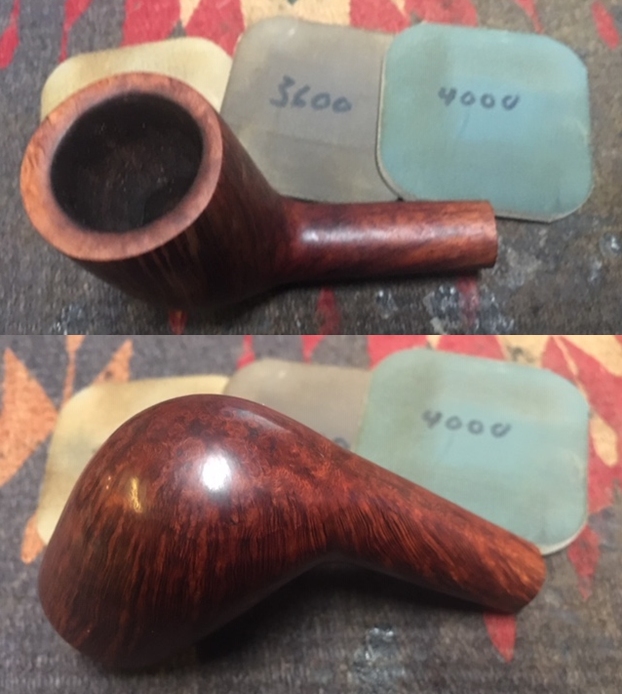
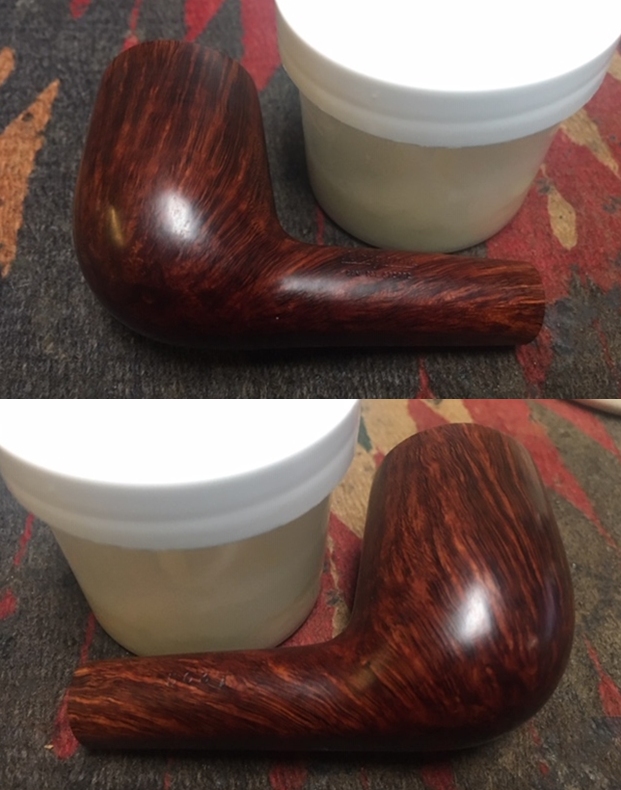
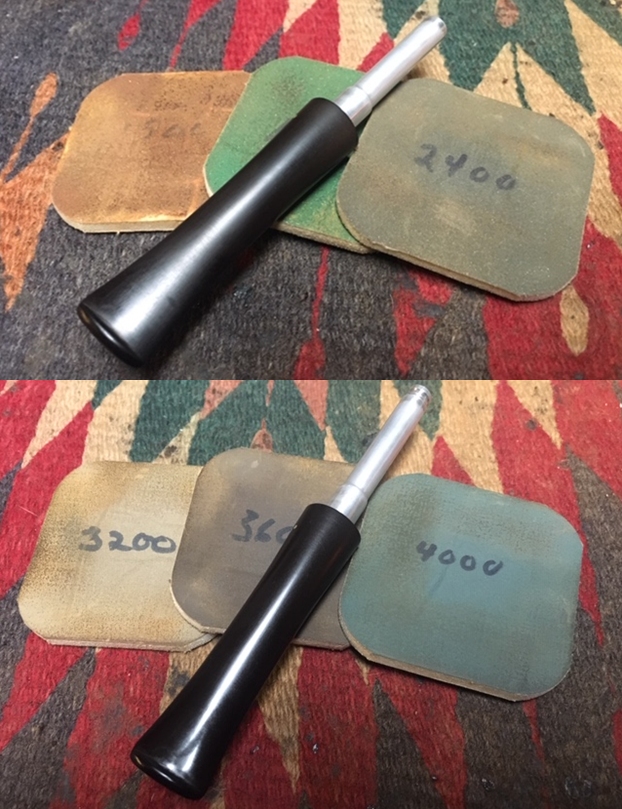
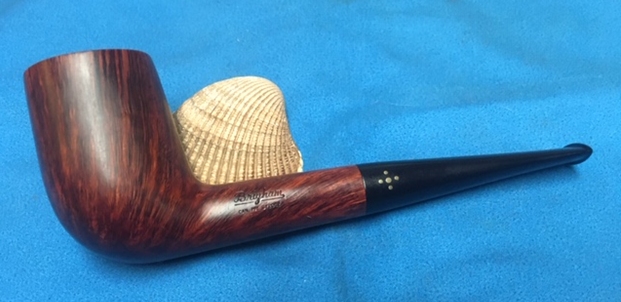
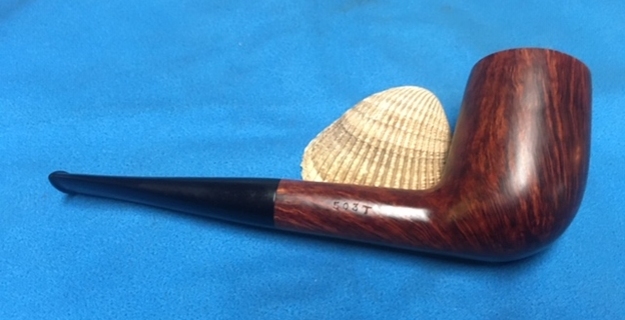
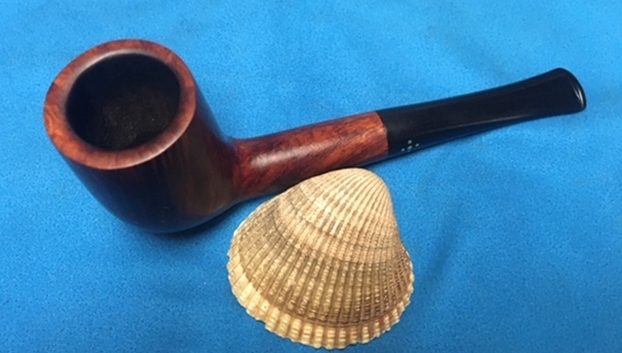
Fashioning a Churchwarden by Reclaiming an East German Howal Sculpted Apple Bowl


Blog by Dal Stanton

One of the ways I can help benefit women and girls who have been trafficked and sexually exploited – the Daughters of Bulgaria,is by fashioning Churchwardens from discarded repurposed bowls.  I enjoy taking discarded bowls, no longer serving any purpose, and after restoring them, mounting them on the fore of a long, flowing Warden stem.  Suddenly, the metamorphosis is realized – the neglected and discarded again becomes a treasure, sought after with great value.  John, from Utah, saw another CW I created – Fashioning a Churchwarden from a Dimpled Bent Billiard Bowl when I posted it on the Old Codgers Smoking Pipe Facebook group, and he reached out to me to explore commissioning a Churchwarden for himself.  This was the Dimpled Bent Billiard Churchwarden got his attention:After some months, John’s CW project finally worked its way through the queue, patience always appreciated(!) – and as I told him before, when his project was on the worktable, I would contact him with choices for a bowl.  I spread out a selection of bowls next to a Warden stem and ruler.  The selection included bent and straight shanks and smooth and rusticated surfaces – and different shapes.  The unique thing about the Churchwarden shape is that its designation is not determined primarily by the shape of the bowl but by the length of the stem.  After taking a few pictures, and sending them to John, he made his choice.John’s chose a very nice-looking sculpted Apple shape pictured on the right, in the middle.  Through this choice, he expressed that he preferred a straight rather than a slightly bent Warden stem.  When I pulled that bowl aside and took a closer look at the shank, I discovered that on the left side was stamped the name, ‘Howal’ [over] ‘Bruyere’.Howal is not a well-known name in the West, but I became familiar with it after seeing several Howals here in Bulgaria – formerly under the Warsaw Pact, behind the Iron Curtain of the Former USSR.  Having previously restored a Howal – a rusticated Dublin, I enjoyed the research of the Howal name which was a mystery to me.  My research uncovered not only the origins of the pipe in former East Germany, but that the city where Howals were produced was a historical center for pipe manufacturing in Germany that pre-dated WW2.  A fascinating story that I wrote of in this restoration: Checkered History and Heritage of an East German Howal Old Briar Rustified Dublin.

Pipedia’s article that I sited in that write up was both interesting and helpful in understanding the predecessor of and origins of the Howal name:

C.S. Reich was founded by Carl Sebastian Reich in Schweina, Germany in 1887. By its 50th jubilee in 1937 C.S. Reich was the biggest pipe factory in Germany.  In 1952, however, the owners of the company were imprisoned and the company itself was nationalized as Howal, an abbreviation of the German words for “wood products Liebenstein” or “Holzwaren Liebenstein”.  By the 1970’s Howal, after acquiring many other smaller pipe making firms, was the sole maker of smoking pipes in East Germany. In 1990, with the fall of the Berlin Wall and reunification of the Germanys, the company was closed.

As I reread that previous research on the history of the Howal name for this write-up, I decided to restate my observations in full because I don’t restore Howals often and the history and human story draws me to retell the story as I transform this Howal bowl into a Churchwarden.  From the previous restoration (my present comments in brackets):

While helpful for a broad sweep, I discovered much missing from this [Pipedia] summary and it raises more questions.  From another interesting source, Edith Raddatz’s lecture on tobacco pipe production in Schweina [a link which unfortunately is no longer working!] at the Tobacco Pipe Symposium in 2003, it describes a history of pipe production in this central German village that was reminiscent of my research into France’s pipe mecca, St. Claude.  A strong development of the pipe making industry can be traced in the 1800s to the apex of the C.S. Reich Co. being Germany’s largest pipe producer in 1937, but Raddatz’s lecture reveals that other producers of pipes were also based in the German village of Schweina.  Pipedia’s article above describes how the owners of the C.S. Reich Co. were arrested and imprisoned followed by the nationalization of the Reich Co. and becoming ‘Howal’, an acronym for “Wood Products Liebenstein” – Bad Liebenstein was the town that bordered and absorbed the village of Schweina. The question begs to be asked – which, unfortunately introduces the human tragedy wrapped around the name ‘Howal’ – Why were the owners arrested?  In an unlikely source, the website of the ‘Small Tools Museum’ adds the names of those imprisoned: shareholders Robert Hergert and Karl Reich.

Edith Raddatz’s lecture (referenced above) brings more light to the difficult geopolitical realities these people faced (Google translated from German – brackets my clarifications):

By 1945 the company, which had meanwhile [passed to] the next generation – Kurt Reich And Walter Malsch – [had] about 100 employees.   Among them were many women who mainly did the painting work.  At the beginning of the 1950s, an era ended in Schweina. The first [oldest] tobacco pipe factory in Schweina closed their doors. There were several reasons for this. Kurt Reich passed away in 1941, [and] Walter Malsch [in] 1954.  The political situation in the newly founded GDR made the conditions for private entrepreneurship difficult. The heirs of the company “AR Sons” [Reich family] partly moved to West Germany. The operation was nationalized, and later toys were made there.

In post WWII occupied Germany, the Soviet occupied section was declared to be a sovereign state and the German Democratic Republic (GDR) was established in 1949 (See link).  With a rudimentary understanding of Marxism and the economic philosophy undergirding it, it is not difficult to deduce what brought the demise of the C. S. Reich Co. and the formation of Howal.  Solidification of the FDR’s hold on power paralleled the necessity to nationalize private ownership and to institute a State-centered command economy.  These efforts gained momentum and forced companies/workers to work more with no additional pay.  In 1952, the year that the owners of C. S. Reich Co., were arrested, this edict was advanced (See link):

In July 1952 the second party conference of the Socialist Unity Party of Germany (SED) took place in East Berlin. In SED General Secretary Walter Ulbricht‘s words, there was to be the “systematic implementation of Socialism” (planmäßiger Aufbau des Sozialismus); it was decided that the process of  Sovietization should be intensified and the importance of the state expanded. The party was acting on demands made by Soviet premier Joseph Stalin.[2]

As a result, today Germany remembers the Uprising of 1953 which started in East Berlin, as factory workers revolted against the repression of the GDR, and spread to all East Germany.  Many lost their lives as Moscow responded to squelch the unrest with tanks on the streets.  In play also, was the mass exodus of people fleeing to West Germany, which included, per Edith Radditz’s lecture, the Reich family, who would have been heirs of the family’s legacy and company – pipe making.  Also, in 1953, completing the State forced abolition of any Reich claim, the largest pipe making company of Germany was seized, nationalized, and changed from C. S. Reich Co. to Howal.  As ‘Howal’, pipes continued to be produced, undoubtedly with the same hands and sweat of the people of Schweina, along with other wooden products, such as toys.  In the Pipedia article I quoted above, it said:

By the 1970’s Howal, after acquiring many other smaller pipe making firms, was the sole maker of smoking pipes in East Germany. In 1990, with the fall of the Berlin Wall and reunification of the Germanys, the company was closed.

My curiosity piqued, what does it mean when it says that Howal acquired many other smaller pipe making firms?  Should we question whether these words can be understood in the normal free market enterprise way we are accustomed?  Doubtful.

…So, as I had written before regarding the checkered history of the Howal name.  Now, as I look again at the Howal sculpted Apple bowl on my worktable, I take a few more pictures to mark the starting point and to take a closer look. I very much like John’s choice of a bowl to fashion a Churchwarden.  The sculpting of the classic Apple shape will look very nice as a Warden – with a rustic, ‘Olde World’ look to it.  The condition of the Howal bowl is generally good.  The chamber has a heavy cake which will be removed to give the briar a fresh start and to check the chamber wall for heating problems.  The rim has some crusting lava overflow that needs cleaning. The rusticated surface with the intricate ribs carved into the sculpting also needs scrubbing to remove grime lodged in the wood.  Before working on the stem, I start the Howal Churchwarden project by using the Pipnet Reaming Kit.  After taking a picture of the chamber showing the tightening chamber as the cake thickens, I use the two smallest blade heads of the 4 available and ream the chamber.  The cake proves to be stubborn – hard as a brick.  After the Pipnet Kit, transitioning to the Savinelli Fitsall Tool, clearing the cake continues as the tool scrapes the chamber wall. Finishing this phase, I wrap 240 paper around a Sharpie Pen and sand the walls and then wipe the excess carbon dust with a cotton pad wetted with alcohol.

After completing the removal of the cake and cleaning the walls, an inspection reveals no heating problems.  I move on.Next, using undiluted Murphy’s Oil Soap I begin the external cleaning. I also employ a bristled toothbrush to get into the crevasses of the sculpted vertical sweeps, which are more detailed upon closer inspection. Within each crevasse, fine lines have been carved to provide a classier sculpted appearance. I like it. From the picture above, the lava flow caking on the rim is evident. A brass brush helps with removal of the crusting without damaging the briar underneath. The sharp edge of my Winchester pocketknife also helps as I carefully scrape the rim surface. From the worktable, I take the bowl to the sink and there using different sized long shank brushes with some anti-oil dish soap, I scrub the internal mortise under warm water.  After a thorough rinsing of the soap, I bring the bowl back to the worktable. The cleaning did a good job. I can now see the rim more clearly with a cut on the right side and some light damage on the left. The cleaning also reveals the residue of old finish on the smooth briar which shows up dark and shiny in the picture.  I’ll remove these patches with sanding.Starting with the rim, I take another picture showing the damage on the top and the bottom of the picture’s orientation.  The rim is sloped downwardly to form beveled rim peak. This is attractive and accentuates the Apple shape’s peaked rim. Going with this flow, I use 240 grade paper and sand the rim to freshen the lines and to remove the damage.  I show a few pictures to show the freshening progression. I follow the 240 paper by dry sanding with 600 grade paper on the rim.  I’m liking the emergence of a smooth grain contrast underneath.  A few blemishes remain on the rim at this point but I like the more rustic look – some imperfections on the rim accents the overall look.Next, to address the patches of old, dark shiny finish on the bowl’s surface, I dry sand using a 1500 micromesh pad to remove the old finish patches from the smooth briar surfaces of the sculpted motif.  I intentionally leave the rough rusticated briar in the sculpting untouched to preserve the original, darkened patina.  I’m aiming for an attractive contrast between the smooth briar, which will naturally lighten through the restoration process, revealing briar grain, with the rough, darkened sculpted briar. Not forgetting where I am in the cleaning process, I return to working on the internals with cotton buds and pipe cleaners dipped in isopropyl 95% – the strongest rubbing/cleaning alcohol available to me here in Bulgaria.  For a smaller Apple bowl, the internals were rife with old oils and tars.  I also did much excavation of tars and oils using the small dental spoon as well as drill bits.  With the bits, I hand turn a bit that is the same size as the drilling diameter which scrapes the wall.  The gunk seemed to have no end, yet finally, the cotton buds started to lighten, and I call the cleaning provisionally finished.  Later, I’ll continue the cleaning and refreshing of the internals by using a kosher salt and alcohol soak. Now to the stem fabrication.  I cease the stummel work at this point because there will be additional sanding as I size and sand the stem with the shank.  I take a few pictures to mark the starting point.  John prefers a straight stem for his Churchwarden which is not a problem.  The precast Warden stem has a very slight bend as it arrived on my table.  This will remain as it helps with maintaining the up/down orientation of the mounted stem.  The picture below shows the rough tenon oversizing which will be shaped to form a good junction with the Howal shank and tenon seating in the mortise. No shank/stem fitting is the same which means that sanding and finetuning the junction is always required.  The picture below illustrates this – the mortise drilling is slightly higher in the mortise which means that the upper thickness of the shank/mortise briar will be thinner and the lower will be slightly thicker.  Shaping the stem fit must factor this offset.The first step in fashioning the CW stem is to size the tenon.  I use the PIMO Tenon Turning Tool that I purchased from Vermont Freehand.  I keep the instructions tacked on the wall in front of me for a reminder and safe keeping!  A very useful tool to have for fashioning tenons.First, using an electronic caliper to measure the diameter of the mortise marks the target sizing of the tenon of the precast stem.  The mortise measurement is 7.95mm in diameter.  Using Charles Lemon’s (of Dad’s Pipes) methodology, I add about 50mm to this exact measurement to give me my ‘fat’ target.  The ‘fat’ target is what I will aim for when bringing the tenon down to size using the PIMO Tenon Turning Tool.  The ‘fat’ target (7.95mm minus 50mm) is about 8.45mm.  From this ‘fat’ point, I will sand the tenon by hand which gradually and patiently custom sizes the tenon to the mortise.The first thing needed is to pre-drill the tenon airway with the drill bit provided by the PIMO tool.  This enlarges the airway slightly enabling the insertion of the PIMO tool guide pin.  I mount the drill bit to the hand drill and drill out the airway.Next, the PIMO Tenon Turning Tool is mounted on the hand drill and I cut a small test sizing to give me the distance between the test cut and the ‘Fat’ target.  After cutting the test, I measure with the caliper and record 9.23mm and subtract the ‘Fat’ target, 8.45mm, leaving about .78mm to remove using the PIMO tool. Using the Allen wrench provided with the PIMO tool, I close the gap of the cutting arm and cut again.  I only cut a small portion out of the end of the tenon and then measure – this additional test cut guards from taking off too much.  The measurement of this test cut after closing the gap of the carbide cutter arm is 8.45mm.  On the button!  I finish the cut to the stem facing and begin sanding the tenon down. Using 240 grade paper, I uniformly sand the tenon so that the fit is snug, but not too snug.  As I sand the tenon, I often test the progress by inserting the tenon into the mortise.  I NEVER force the tenon to make it fit – a cracking sound of a shank is not a happy thing!I come to a point where the end of the tenon was butting up against the closing ridge from the mortise drilling.  I could detect the bump in the mortise.  Using the sanding paper and a flat needle file, I focus on tapering the end of the tenon so that it can navigate the narrowing mortise.  I don’t want to cut off the end of the tenon as a longer tenon provides a bit more strength for the longer stem’s reach.Finally, a good snug fit it accomplished and the stem is seated well.  The next step in the project is to fashion the shank around the new stem.  The pictures following show the overbite of the shank which needs sanding.To protect the Howal nomenclature and provide a sanding barrier, I wrap masking tape around the shank.  Using 240 sanding paper, I begin the process of sanding to bring the shank and stem into alignment. After making good progress, I discover a dimple at the seam of the precast stem just at the tenon facing. I’ve seen this before. To take the dimple out by sanding also will remove the corresponding briar on the shank side.  This I don’t wish to do more than is necessary.  I could also use the PIMO Tool to shave off more of the facing to remove the dimple.  Yet this would shorten the overall length of the Warden stem – not a good solution either. To remedy the dimple, after cleaning the area with a cotton pad wetted with alcohol, I spot drop regular CA glue on the dimple and immediately give it a spray of an accelerator so that the glue patch stays in place.  I don’t want CA glue running down the tenon facing!Shortly after, I rejoin the stem and Howal stummel and continue sanding the patch area.  The patch did the trick. The pictures show the results and the shank and stem are now in alignment.  I move on. Even though a precast Warden stem is new, it doesn’t arrive on the scene ready for action. Precast stems will usually not have smooth surfaces but tend to be ‘wavy’ – a leftover from the casting process. Therefore, sanding the entire stem is necessary. To do the initial rough sanding of the stem I use a coarse 120 paper to do the heavy lifting. As I sand the stem, the first picture below reveals what I’m describing as sanding reveals the rippled surface. After much sanding and bothersome rubber dust(!), the stem is shaping up well.  I’m liking what I’m seeing.With the rough sanding of the stem-proper done, I shape the button using the 120 grade paper and a flat needle file.  The first two pictures show the starting point and sanding – upper then lower. My day is ending, and the final project is to continue the internal cleaning and refreshing of the stummel.  To do this I use kosher salt and isopropyl 95% to give the internals a soak which helps draw out the tars and oils embedded in the internal briar.  I first stretch and twist a cotton ball to serve as a ‘wick’ that helps draw the oils out of the mortise walls.  Using a stiff wire, I guide the wick down the mortise and airway.  I then fill the bowl with kosher salt – kosher doesn’t leave an aftertaste as iodized salt. After placing the stummel in an egg carton that keeps it stable, with a large eyedropper I fill the bowl with isopropyl 95% until the alcohol surfaces over the salt.  After a few minutes, the alcohol is absorbed, and I refill the bowl with alcohol.  I put the stummel aside to soak through the night. The next morning, the salt and wick are soiled indicating the activity of the soak through the night.  I toss the expended salt in the waste, wipe the chamber with paper towel and blow through the mortise to dislodge any salt crystals left behind.  To make sure all is clean, I again employ a pipe cleaner and cotton buds dipped in isopropyl 95% to finish the cleaning.  Not long after, the buds are emerging clean.  I move on. I return now to a reunited stem and stummel, using 240 sanding paper I now start the fine tuning of the stem after the coarse 120 paper. To show the completed condition of the stem after the 240 grade paper sanding, two close-ups show the improved texture of the sanded surface.Next, for more fine tuning of the stem’s surface, I wet sand with 600 grade paper and follow by applying a buff with 000 grade steel wool.  I love to see the emergence of the buffed-up vulcanite stem!  I keep the stem and stummel united throughout the sanding process to assure that the stem’s tenon facing remains sharp and in alignment with the shank – shouldering the stem is not an option!Turning back to the Howal bowl, I remove the masking tape and take some pictures marking the stage of progress. I like the rustic look this bowl already has.  My approach will be to run the bowl through the full regimen of micromesh pads to bring out the shine and briar of the smooth briar surfaces – going over for the most part, the sculpted surfaces.  At that point I’ll determine if I need to darken the shank end that was lightened because of the stem sanding.  I also will freshen the darker sculpted sections with a stain stick.  I’ll keep the stem and stummel joined through this process which will aid me later when I continue with the micromesh process on the stem. I take pictures of the bowl to mark the starting point. Beginning with micromesh pads 1500 to 2400, I wet sand followed by dry sanding with pads 3200 to 4000 and 6000 to 12000.  The pictures show the progression. The grain came out of the smooth briar nicely.  Now, to freshen the sculpted sections.  With the fine lined carvings in each sculpted section, briar dust has collected from all the sanding.  I first brush the carvings with a bristled brush.  This removes a good deal.  Following this, with an alcohol wetted cotton bud, I wipe out each carved section.  Next, using a very dark brown dye stick which turns out to be a mahogany, which looked the best after blending with the original surface, I trace the carvings darkening the sculpted briar.  After finishing, I give another quick sanding over the smooth briar surface with the last of the micromesh sanding pads, 12000.  I do this to clean off any inadvertent overrun of the dye stick onto the smooth briar and to sharpen the lines. Using Before & After Restoration Balm, I place some on my fingers and work the Balm into the briar surface.  I’m careful to work it into the crevasses of the sculpting.  B&E Restoration Balm is an excellent product from Mark Hoover at www.ibepen.com that raises the natural hues in subtle ways that enhances the presentation of the pipe.  After thoroughly working the Balm into the briar surface, I set the bowl aside for 20 minutes to allow the Balm to do its thing.  The second picture shows this state.  After 20 minutes, I wipe the excess Balm with a cotton cloth and then buff the stummel with a microfiber cloth to thoroughly remove the excess Balm and to raise the shine.The next step is to apply Blue Diamond compound to the entire pipe.  After reuniting stem and stummel, I mount a cotton cloth buffing wheel to the Dremel, set the speed at about 40% full power and apply a light application of the compound focusing primarily, but not exclusively, on the smooth briar sections.  I keep it light because I do not want the compound to cake up in the rusticated ridges of the sculpting.  I apply the compound to the smooth and rusticated surfaces and to the stem.Following the compound, I use a felt cloth to wipe the pipe to clean it of compound dust.  I don’t want compound mixing with the waxing phase.After switching to another cotton cloth buffing wheel, maintaining the same speed, carnauba wax is applied to the entire pipe.  As with the compound, I go easy on the rusticated ridges not wanting wax to cake.  After applying wax to the entire pipe, I use a microfiber cloth to give the Howal Churchwarden a rigorous hand buffing to remove excess wax and to raise the shine.The Howal Sculpted Apple bowl looks great mounted on the bow of the Churchwarden stem!  I’m pleased how the smooth briar surfaces cleaned up and how the grain provides a striking contrast with the sculpted design.  The added rusticated ribs in the carvings adds a nice detail.  The overall presentation of the Howal Sculpted Churchwarden gives a very old, rustic feel.  I’m glad John was patient waiting for this Churchwarden to come to life.  He will have the first opportunity to add this pipe to his own collection from The Pipe Steward Store.  This Churchwarden project benefits the Daughters of Bulgaria – women and girls who have been trafficked and sexually exploited.  Thanks for joining me!
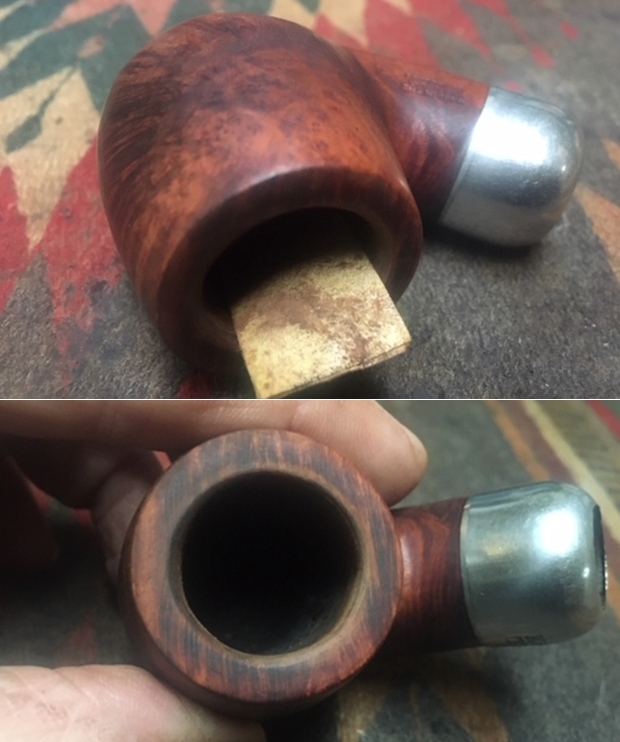
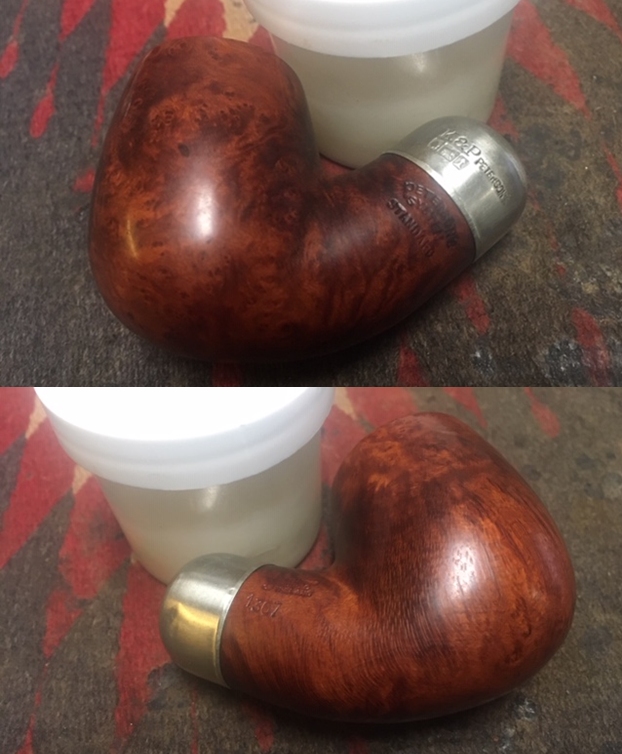
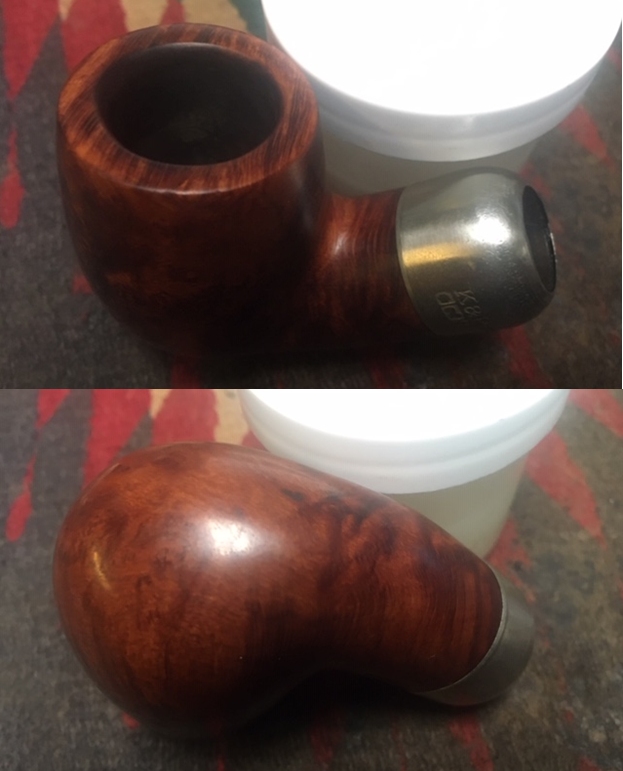
Restemming a “Malaga” Billiard from Kathy’s Dad’s Pipes


Blog by Steve Laug

I have been working on a lot of different estate pipes and selling them for different families. This morning I was looking through the bag of pipes that I have left from George Koch’s estate. There are only three of them and all were in pretty rough shape. The rims were well knocked about and the stems were either chewed off or through and really would need to be carefully worked over and have new stems fit to them. The second of these three Malaga pipes that need a lot of attention was the next one I picked up this morning. It is a Billiard with a chewed through stem. Once again the rim top was used as a hammer or at least spent a lot of time being knocked against hard surface. The rim top was scored and originally had a bit of sunburst look around the chamber. But sides of the bowl had a mix of grain styles that was fascinating. It is the second of the last three Malaga pipes that came to my brother and me in several shipments of pipes from George’s daughter Kathy. Alex had gone through the bag in essence had passed on these three. Jeff unwrapped the pipes when they came to him and took the following photo to give an idea of the volume of the pipes that we purchased. In each of the previous blogs that I have written on the restoration of George’s pipes I have told his story. If you have followed the restorations you will have read the information and the background piece that Kathy did on her father. Here is a link to one of the previous blogs on his Malaga pipes where I included her tribute in full (https://rebornpipes.com/2019/01/26/back-to-kathys-dads-pipes-restoring-a-%c2%bc-bent-malaga-author/). You can also read the bio on her Dad, George Koch. It is an interesting read and one that shows just how far our pipe collecting passion can go when we find a brand of pipes that we enjoy. I am going to only include the portion on the Malagas at this point. If you wish to read the rest follow the link above.

Kathy writes…We lived in Livonia, and that’s where his love for Malaga pipes began. After a few years he returned to Allis Chalmers and we moved back to Springfield. I remember that when we went back to Michigan to visit friends, Dad had to go to the Malaga store and acquire a few new pipes. Many a year I wrote to Malaga and they picked out a pipe for me to purchase that I could give Dad for a Christmas or birthday present. He was always pleased. His favorites were the straight stemmed medium sized bowl pipes, but he liked them all. 

He had some other pipes, but the Malagas were his favorites. I remember him smoking them sitting in his easy chair after work, with feet up on the ledge by the fire burning in the fireplace.  Growing up it was my job to clean them and he liked the inner bowl and stem coated with Watkins vanilla, leaving a little of that liquid in the bowl to soak in when I put them back on the rack…I’m very happy they are being restored by you and your brother and hope they find homes who enjoy them as much as Dad did. Thank-you for your care and interest. — Kathy, the oldest daughter

The “Malaga” Billiard on the table is another on that is in rough condition. But even under the damage and dirt I can see the great grain on the briar. There was an interesting sunburst pattern of grooves carved in the rim top. The large bowl, round shank and chewed through acrylic stem give a clear picture of what the pipe must have looked like when George bought it at the shop. Again, I did not bother Jeff for the pre-cleanup photos because really it was obvious what the pipe must have looked like. From the condition of the bowl and rim post cleanup I could see that it originally had a thick cake that overflowed with lava onto the rim so that there was damage on the inner edges. The rim top had been knocked hard against rough surfaces to knock out the dottle and left damage. The sides of the bowl and shank are very dirty with grime and oils from prolonged use. The stamping on the left side of the shank read “MALAGA”. The acrylic stem had been gnawed through leaving a useless stem that would need to be replaced. Since Paresh is not here in Canada it will be replaced rather than rebuilt! 😉 I took photos of the pipe before I started my work. The condition of the pipe will be shown in the photos below. I took a photo of the  rim top and bowl to show the condition of the pipe. You can see why I said it was used as a hammer. The surface of the rim is very rough but you can see the carved sun burst like grooves.  The inner edge of the rim looks good while the outer edge has some damage. There is some darkening on the back edge and surface of the rim top. I think that this pipe must have been another shop pipe or knock about pipe for George as it was very well smoked! I took photos of the stem to show the broken and chewed condition it was in. Remember this is hard acrylic so it took some real gnawing to do this to it!I took a photo to capture the stamping on left side of the shank. The photo shows the stamping “MALAGA” and is very readable.I am also including the link to a blog that I wrote that gives some of the history of the Malaga brand and the Malaga Pipe Shop in Royal Oak, Michigan in the USA. I have written an earlier blog to give a little history of the Malaga Brand and the pipemaker, George Khoubesser. Here is the link – https://rebornpipes.com/tag/malaga-pipes/.That blog also includes links to a catalogue and the history of the pipemaker George Khoubesser. Follow the link to get a feel for the brand and the pipemaker.

Jeff had gone to the trouble to ream the bowl with a PipNet pipe reamer and followed up with a Savinelli Fitsall pipe knife to remove the cake. He scrubbed out the mortise and the airway in the shank and the stem with alcohol, cotton swabs and pipe cleaners. He scrubbed the exterior of the bowl, rim, shank and stem with a tooth brush and Murphy’s Oil Soap to remove the oils and tars on the rim and the grime on the finish of the bowl. He rinsed it under running water. He dried it off with a soft cloth. All of his work gave me a clean pipe to work on to say the least. I decided to start with the new stem. I went through my collection of stems to find one that was the same dimensions as the ruined stem. I found one in my can that would fit the bill. Interestingly it is a twin bore bite proof stem like the other ones that Malaga used when they restemmed pipes.I set up my cordless drill with the PIMO Tenon Turning Tool in the chuck and started turning the tenon on the new stem back to match the broken one. I usually do the turning in several passes, adjusting the depth of the blade between each cut. In this case I did it in three passes. I got it close and finished the fit with my Dremel and sanding drum.I sanded off the castings on the sides and slot end of the stem with the Dremel and sanding drum and did a few turns on the tenon with the sanding drum. You can see from the first photo below that it was very close. I cleaned it up with a folded piece of 220 grit sandpaper. You can see the fit in the photos below.I set the stem aside and turned my attention to the bowl. I used a folded piece of 220 grit sandpaper to clean up the outer edge on rim top. Once I had the edges smooth I filled in the deeper nicks and chips in the outer edge of the rim with clear Krazy Glue. Once the repairs cured I sanded them smooth with 220 grit sandpaper and a piece of 400 grit sandpaper. I used a pen knife to clean up the cut marks on the rim top. Some of them were worn so I recut them to give them more definition. I cleaned up the carving with a brass bristle wire brush to clean up the repairs. The second photo shows the cleaned up rim top.I scrubbed the briar with Murphy’s Oil Soap and a tooth brush. I rubbed it into the surface of the briar with my finger tips and let it sit for about 10 minutes then rinsed it off with running water. I dried it off with a soft cloth. I polished the bowl with micromesh sanding pads to smooth out the rim edge repairs and the nicks in the bowl sides. I wet sanded with 1500-12000 grit pads and wiped the bowl down with a damp cloth after each pad. The photos show the progress. I used a Mahogany Stain Pen to stain the carvings on the rim top to blend all of the darkening together and make it stand out. I buffed it with a clean buffing pad. You can see from the photo below that I was able to blend it into the rest of the bowl.I worked some Before & After Restoration Balm into the surface of the briar with my fingertips to clean, enliven and protect it. I let the balm sit for a little while and then buffed with a cotton cloth to raise the shine. The following photos show the bowl at this point in the restoration process. I am very happy with the results. I turned to the stem and started by sanding the surface. I wanted to smooth out the surface of the vulcanite to remove the castings and the sanding marks. I sanded it with 220 grit sandpaper and 400 grit sandpaper to clean up the stem.I polished the stem with micromesh sanding pads – wet sanding with 1500-12000 grit sanding pads. I wiped it down after each sanding pad Obsidian Oil. I finished by polishing it with Before & After Pipe Stem Polish both Fine and Extra Fine and then wiped it down with a final coat of Obsidian Oil. This is a restemmed and restored “Malaga” Billiard with a vulcanite tapered “bite-proof” stem. The new black vulcanite stem looks good in place of the yellow acrylic stem. It has a great look and feel. The shape of the bowl, the reshaped and repaired rim top and the cut of the briar work well to highlight the grain around the bowl sides. I polished stem and the bowl with Blue Diamond polish on the buffing wheel. I gave the bowl and the stem multiple coats of carnauba wax. I buffed the pipe with a clean buffing pad to raise the shine. I hand buffed it with a microfiber cloth to deepen the shine. The pipe polished up pretty nicely. The grain took on life with the buffing. The rich oil cured colour works well with the polished vulcanite stem. The finished pipe has a rich look that is quite catching. Have a look at it with the photos below. The shape, finish and flow of the pipe and stem are very well done. The dimensions are Length: 6 ¼ inches, Height: 1 7/8 inches, Outside diameter of the bowl: 1 ½ inches, Chamber diameter: ¾ of an inch. I will be adding the pipe to the finished Malaga pipes that I have completed. I am looking forward to a new pipeman picking up this pipe and will carry on the trust for George Koch. Thanks for walking through the restoration with me as I worked over another one of Kathy’s Dad’s Pipes.

Restemming another “Malaga” Billiard from Kathy’s Dad’s Pipes


Blog by Steve Laug

I have been working on a lot of different estate pipes and selling them for different families. This morning I was looking through the bag of pipes that I have left from George Koch’s estate. There are only three of them and all were in pretty rough shape. The rims were well knocked about and the stems were either chewed off or through and really would need to be carefully worked over and have new stems fit to them. The third of these three Malaga pipes that need a lot of attention was the next one I picked up this morning. It is a Billiard with a chewed through acrylic stem. Of the three was the least beat up of the three. The rim top had some damage on the flat surface and the inner edge. But sides of the bowl had great looking flame and mixed grain that was fascinating. It is the last of the three Malaga pipes needing restemming that came to my brother and me in several shipments of pipes from George’s daughter Kathy. Alex had gone through the bag and had passed on these three. Jeff unwrapped the pipes when they came to him and took the following photo to give an idea of the volume of the pipes that we purchased. In each of the previous blogs that I have written on the restoration of George’s pipes I have told his story. If you have followed the restorations you will have read the information and the background piece that Kathy did on her father. Here is a link to one of the previous blogs on his Malaga pipes where I included her tribute in full (https://rebornpipes.com/2019/01/26/back-to-kathys-dads-pipes-restoring-a-%c2%bc-bent-malaga-author/). You can also read the bio on her Dad, George Koch. It is an interesting read and one that shows just how far our pipe collecting passion can go when we find a brand of pipes that we enjoy. I am going to only include the portion on the Malagas at this point. If you wish to read the rest follow the link above.

Kathy writes…We lived in Livonia, and that’s where his love for Malaga pipes began. After a few years he returned to Allis Chalmers and we moved back to Springfield. I remember that when we went back to Michigan to visit friends, Dad had to go to the Malaga store and acquire a few new pipes. Many a year I wrote to Malaga and they picked out a pipe for me to purchase that I could give Dad for a Christmas or birthday present. He was always pleased. His favorites were the straight stemmed medium sized bowl pipes, but he liked them all. 

He had some other pipes, but the Malagas were his favorites. I remember him smoking them sitting in his easy chair after work, with feet up on the ledge by the fire burning in the fireplace.  Growing up it was my job to clean them and he liked the inner bowl and stem coated with Watkins vanilla, leaving a little of that liquid in the bowl to soak in when I put them back on the rack…I’m very happy they are being restored by you and your brother and hope they find homes who enjoy them as much as Dad did. Thank-you for your care and interest. — Kathy, the oldest daughter

This second “Malaga” Billiard on the table is the least damaged of the three. Under the damage and dirt I can see the great grain on the briar. There were some scratches and nicks in surface of the rim top. The large bowl, round shank and chewed through acrylic stem give a clear picture of what the pipe must have looked like when George bought it at the shop. Again, I did not bother Jeff for the pre-cleanup photos because really it was obvious what the pipe must have looked like. From the condition of the bowl and rim post cleanup I could see that it originally had a thick cake that overflowed with lava onto the rim so that there was damage on the inner edges. The rim top had been knocked hard against rough surfaces to knock out the dottle and left damage. The sides of the bowl and shank are very dirty with grime and oils from prolonged use. The stamping on the left side of the shank read MALAGA. The acrylic stem had been gnawed through leaving a useless stem that would need to be replaced. Since Paresh is not here in Canada this is another that will be replaced rather than rebuilt! 😉 I took photos of the pipe before I started my work. The condition of the pipe will be shown in the photos below. I took a photo of the  rim top and bowl to show the condition of the pipe. You can see why I said it was used as a hammer – though less than the others. The surface of the rim is very rough. The inner and the outer edge have some damage. There is some darkening on the back inner edge, bevel and surface of the rim top. I think that this pipe must have been another shop pipe or knock about pipe for George as it was very well smoked! I took photos of the stem to show the broken and chewed condition it was in. Remember this is hard acrylic so it took some real gnawing to do this to it!I took a photo to capture the stamping on left side of the shank. The photo shows the stamping MALAGA and is very readable.I am also including the link to a blog that I wrote that gives some of the history of the Malaga brand and the Malaga Pipe Shop in Royal Oak, Michigan in the USA. I have written an earlier blog to give a little history of the Malaga Brand and the pipemaker, George Khoubesser. Here is the link – https://rebornpipes.com/tag/malaga-pipes/.That blog also includes links to a catalogue and the history of the pipemaker George Khoubesser. Follow the link to get a feel for the brand and the pipemaker.

Jeff had gone to the trouble to ream the bowl with a PipNet pipe reamer and followed up with a Savinelli Fitsall pipe knife to remove the cake. He scrubbed out the mortise and the airway in the shank and the stem with alcohol, cotton swabs and pipe cleaners. He scrubbed the exterior of the bowl, rim, shank and stem with a tooth brush and Murphy’s Oil Soap to remove the oils and tars on the rim and the grime on the finish of the bowl. He rinsed it under running water. He dried it off with a soft cloth. All of his work gave me a clean pipe to work on to say the least. I decided to start with the new stem. I went through my collection of stems to find one that was the same dimensions as the ruined stem. I found one in my can that would fit the bill.I set up my cordless drill with the PIMO Tenon Turning Tool in the chuck and started turning the tenon on the new stem back to match the broken one. I usually do the turning in several passes, adjusting the depth of the blade between each cut. In this case I did it in three passes. I got it close and finished the fit with my Dremel and sanding drum.I sanded off the castings on the sides and slot end of the stem with the Dremel and sanding drum and did a few turns on the tenon with the sanding drum. You can see from the first photo below that it was a good snug fit. The diameter of the stem was larger than the shank do I would need to remove the excess material to get a solid fit.I used a Dremel and sanding drum to remove the excess material from the stem and get it close to the diameter of the shank. I worked over the diameter with a folded piece of 220 grit sandpaper to smooth out the stem. It still has a ways to go before it was finished but it was getting pretty close. I set the stem aside and turned my attention to the bowl. I topped the bowl with 220 grit sandpaper on a topping board. I removed the damaged areas on the rim top. I did not need to remove too much to bring it back to smooth condition and the outer edge was still clean.I used a folded piece of 220 grit sandpaper to clean up the inner bevel of the bowl. I worked it at an angle to clean up the edge and to give it a smooth bevel.I scrubbed the briar with Murphy’s Oil Soap and a tooth brush. I rubbed it into the surface of the briar with my finger tips and let it sit for about 10 minutes then rinsed it off with running water. I dried it off with a soft cloth. I used an Oak Stain Pen to stain the carvings on the rim top to blend all of the darkening together and make it stand out. I buffed it with a clean buffing pad. You can see from the photo below that I was able to blend it into the rest of the bowl.I polished the bowl with micromesh sanding pads to smooth out the rim edge repairs and the nicks in the bowl sides. I wet sanded with 1500-12000 grit pads and wiped the bowl down with a damp cloth after each pad. The photos show the progress. I worked some Before & After Restoration Balm into the surface of the briar with my fingertips to clean, enliven and protect it. I let the balm sit for a little while and then buffed with a cotton cloth to raise the shine. The following photos show the bowl at this point in the restoration process. I am very happy with the results. I turned to the stem and started by sanding the surface. I wanted to smooth out the surface of the vulcanite to remove the castings and the sanding marks. I sanded it with 220 grit sandpaper and 400 grit sandpaper to clean up the stem.I polished the stem with micromesh sanding pads – wet sanding with 1500-12000 grit sanding pads. I wiped it down after each sanding pad Obsidian Oil. I finished by polishing it with Before & After Pipe Stem Polish both Fine and Extra Fine and then wiped it down with a final coat of Obsidian Oil. This is a restemmed and restored Malaga Billiard with a vulcanite tapered stem. The new black vulcanite stem looks good in place of the black chewed acrylic stem. It has a great look and feel. The shape of the bowl, the reshaped and repaired rim top and the cut of the briar work well to highlight the grain around the bowl sides. I polished stem and the bowl with Blue Diamond polish on the buffing wheel. I gave the bowl and the stem multiple coats of carnauba wax. I buffed the pipe with a clean buffing pad to raise the shine. I hand buffed it with a microfiber cloth to deepen the shine. The pipe polished up pretty nicely. The grain took on life with the buffing. The rich oil cured colour works well with the polished vulcanite stem. The finished pipe has a rich look that is quite catching. Have a look at it with the photos below. The shape, finish and flow of the pipe and stem are very well done. The dimensions are Length: 5 ¼ inches, Height: 2 inches, Outside diameter of the bowl: 1 ½ inches, Chamber diameter: ¾ of an inch. I will be adding the pipe to the finished Malaga pipes that I have completed. I am looking forward to a new pipeman picking up this pipe and will carry on the trust for George Koch. Thanks for walking through the restoration with me as I worked over another one of Kathy’s Dad’s Pipes.