Tag Archives: fitting a stem

Restoring a Beautiful St. Claude Ben Wade Calabash


Blog by Steve Laug

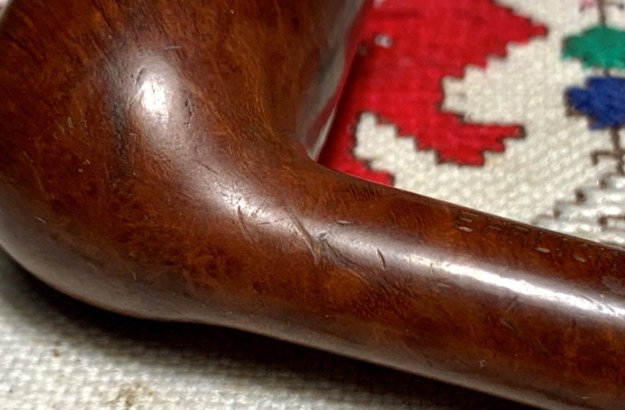
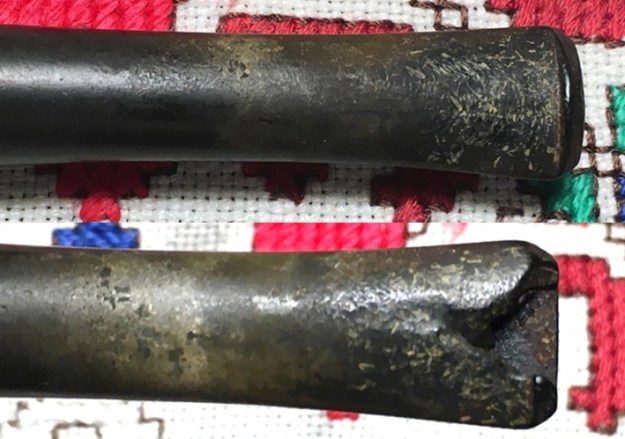
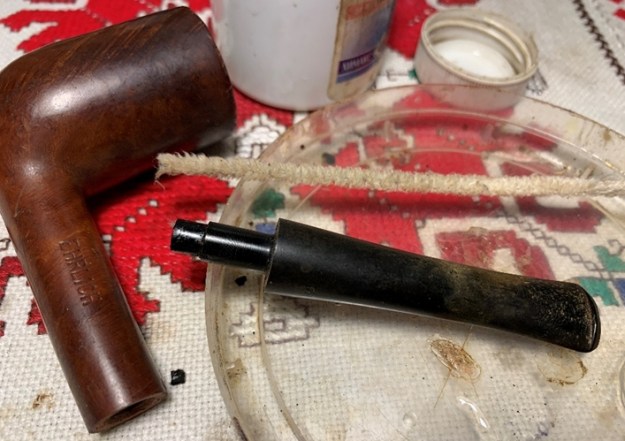
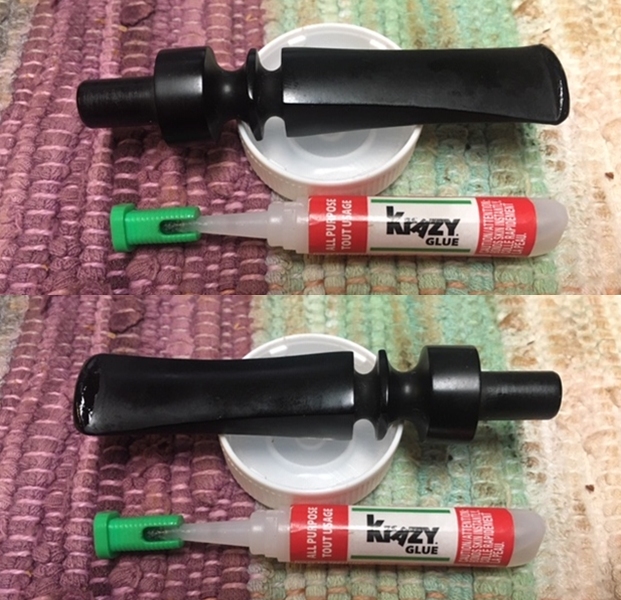
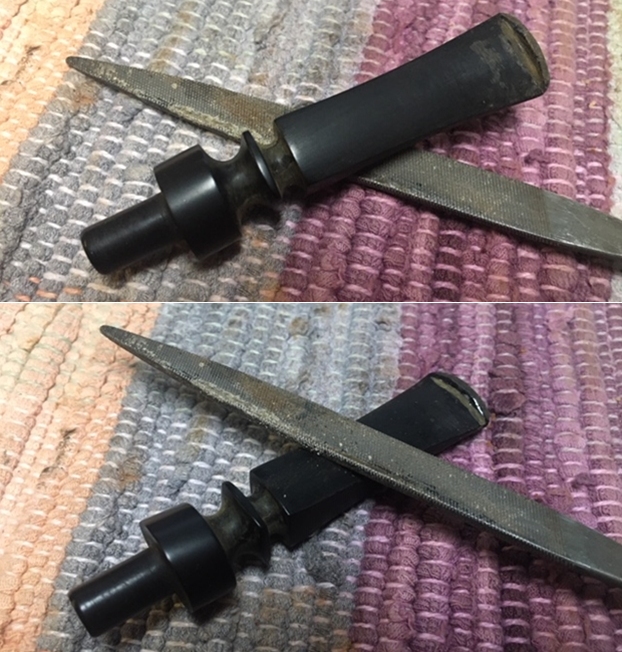
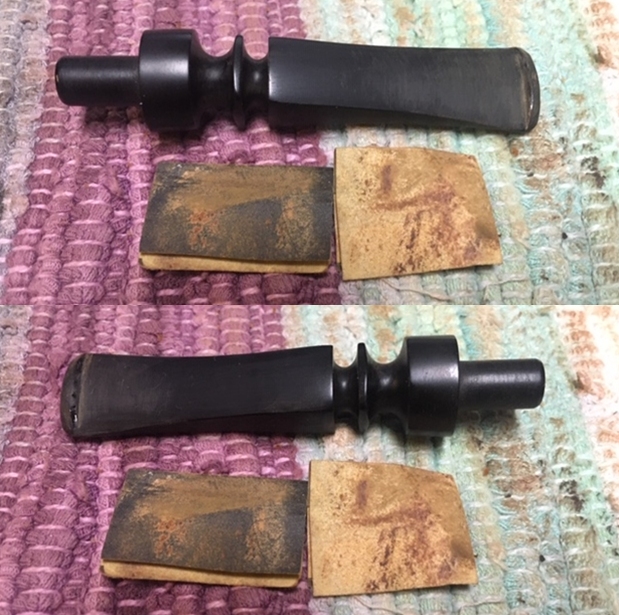
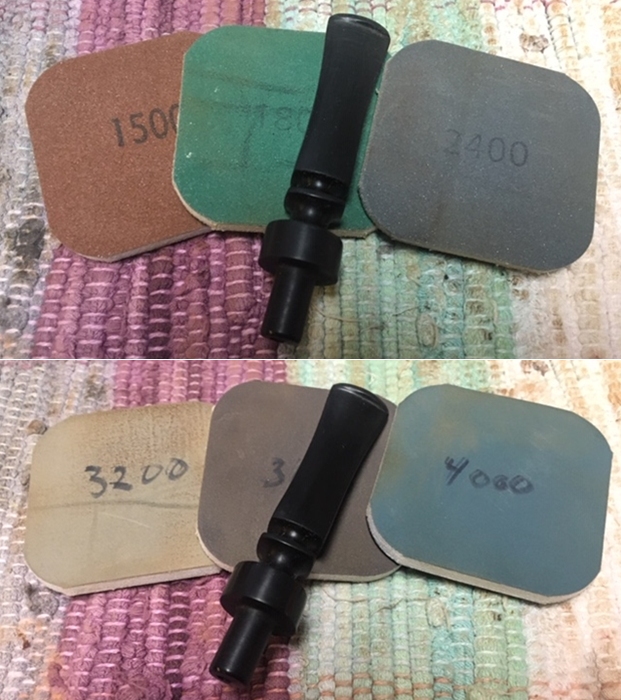
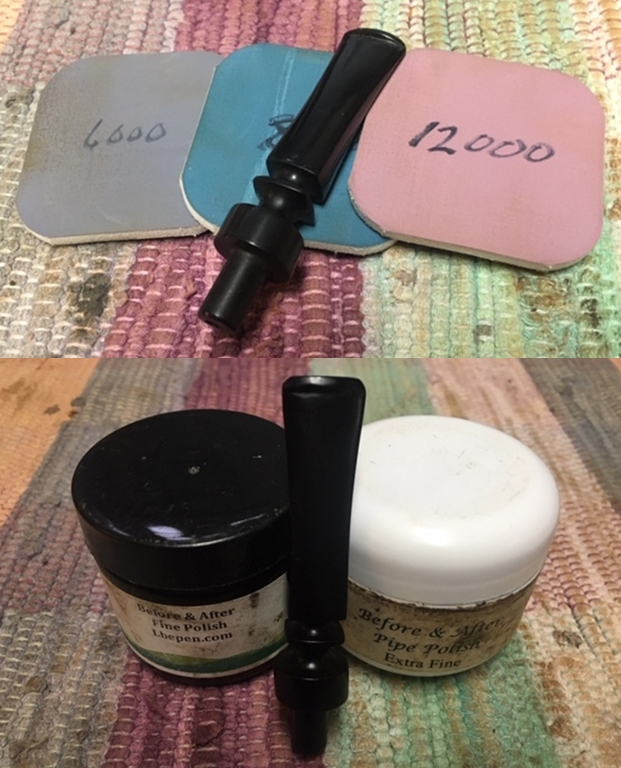
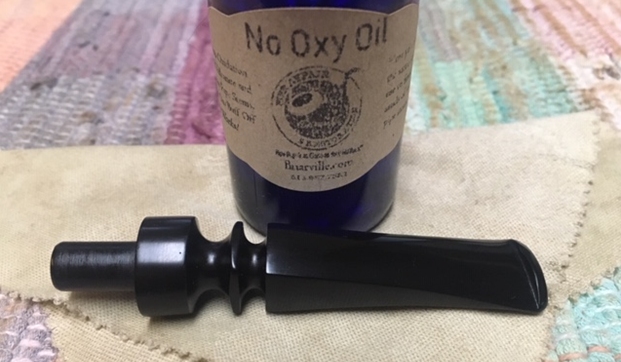
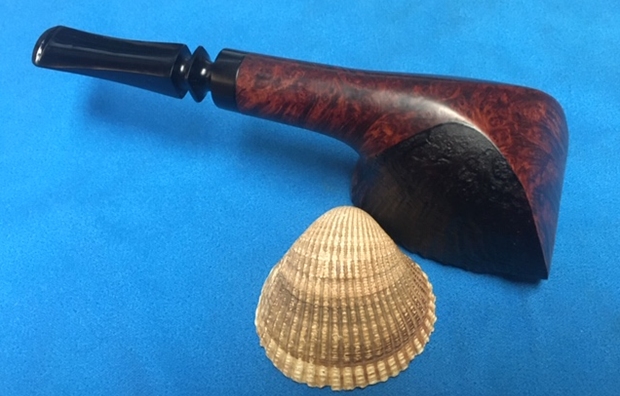
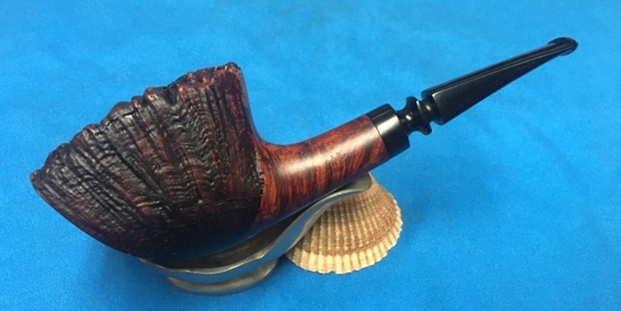
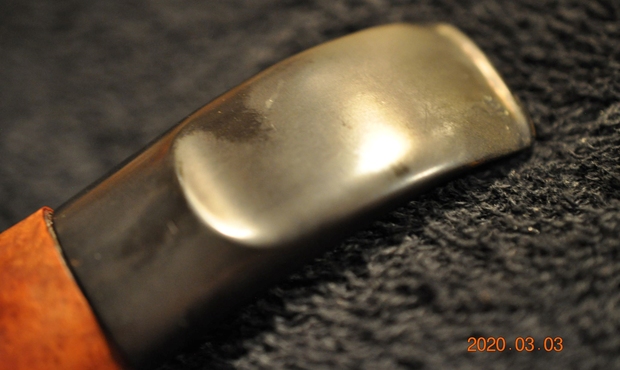
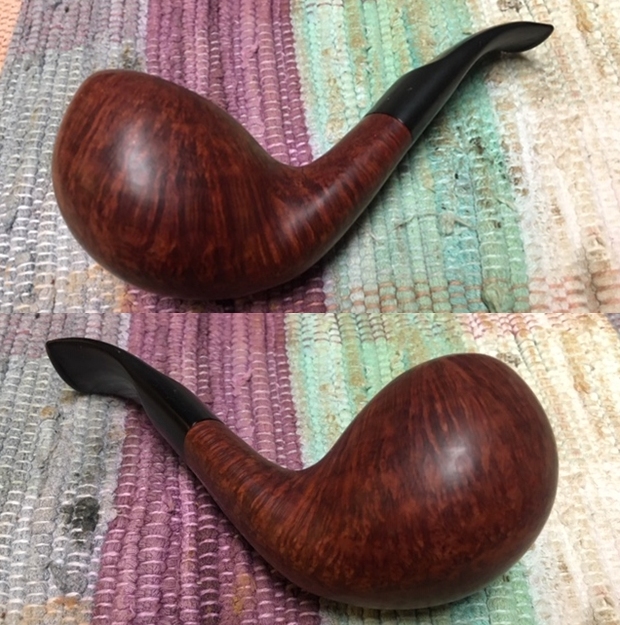
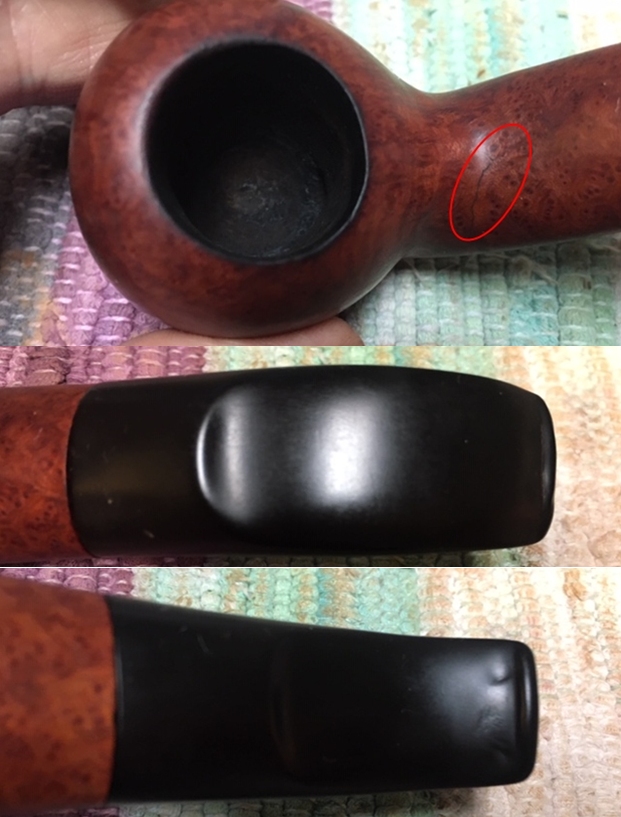
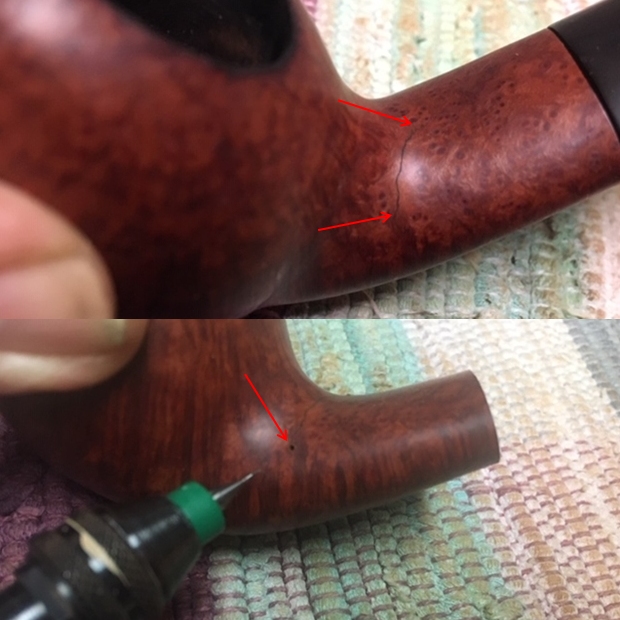
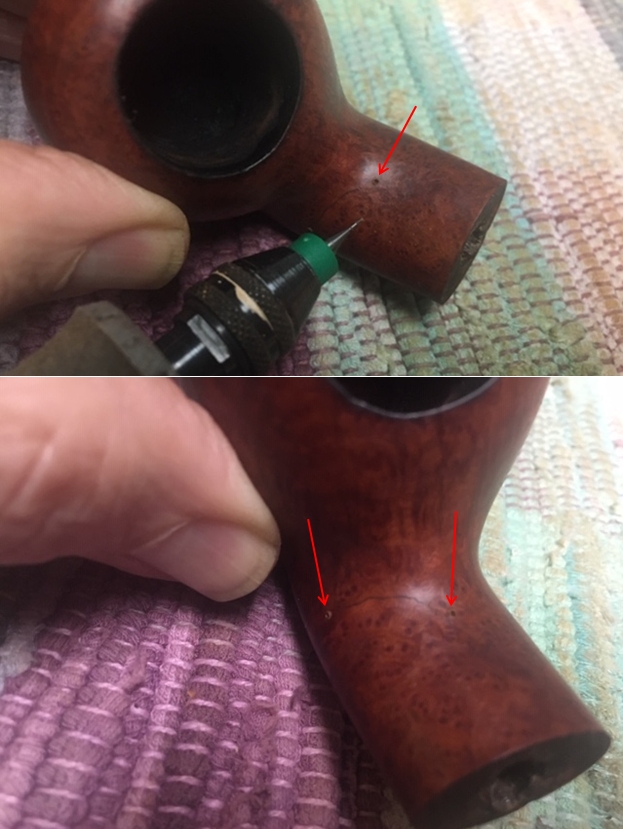
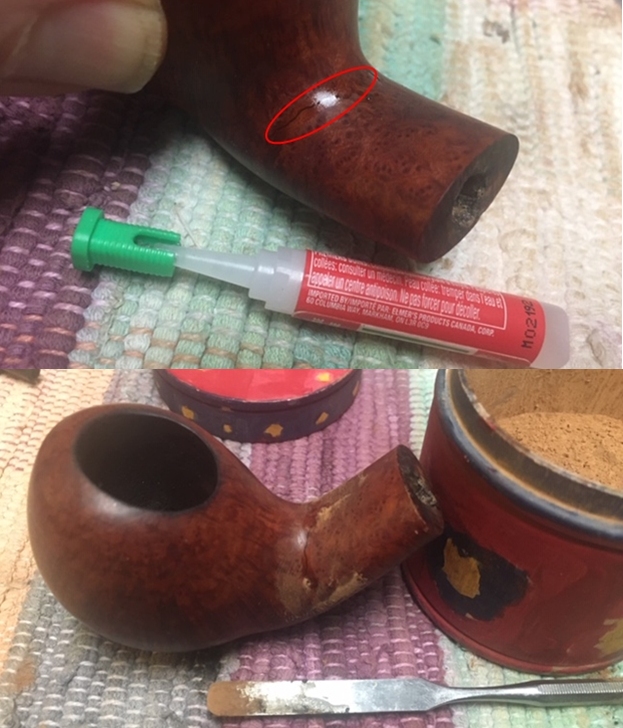
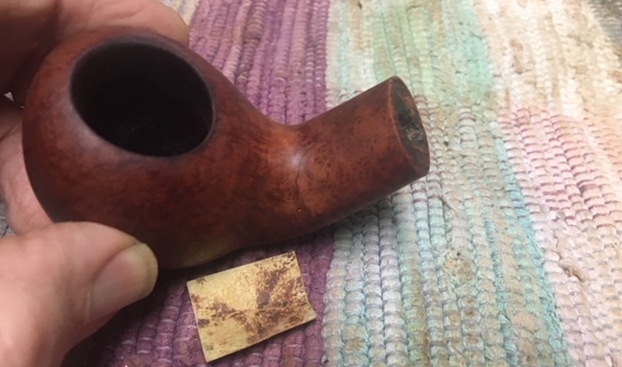
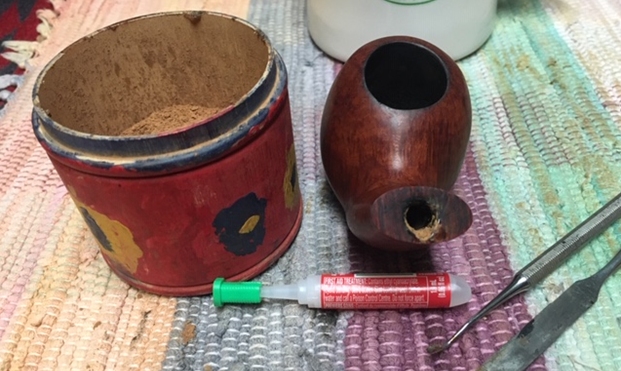
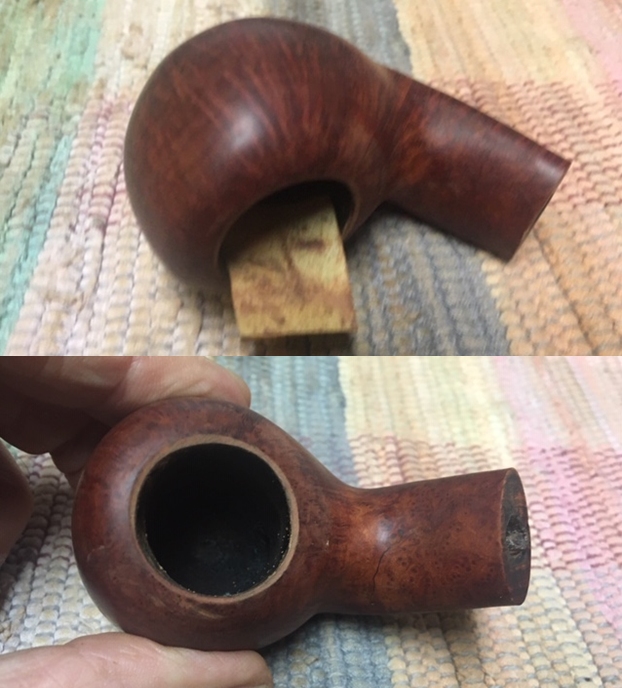
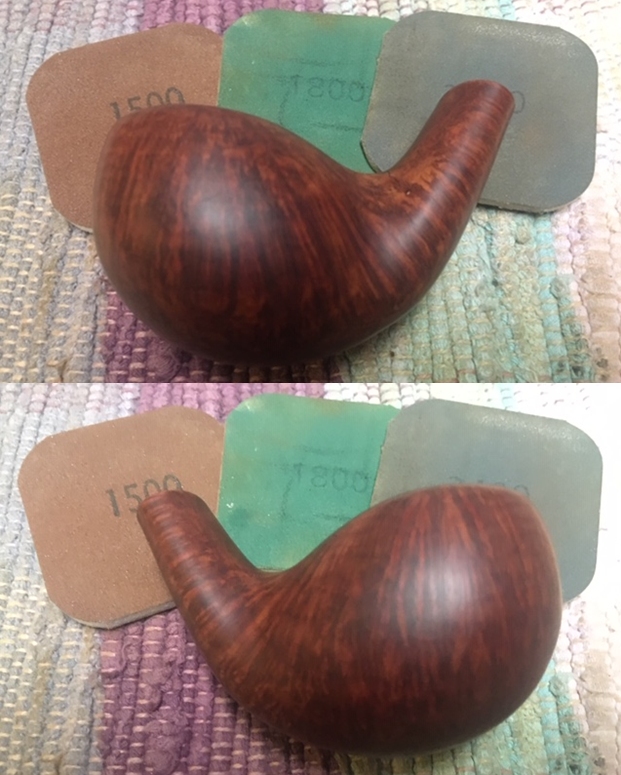
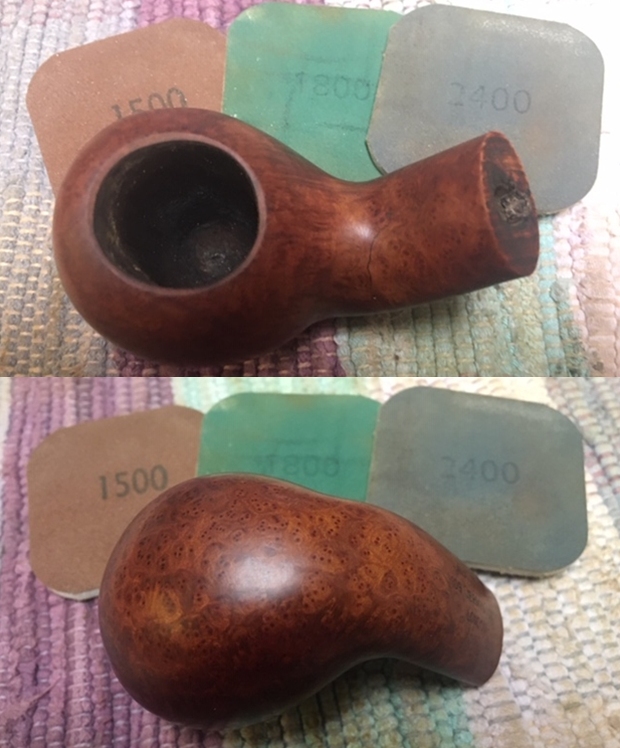
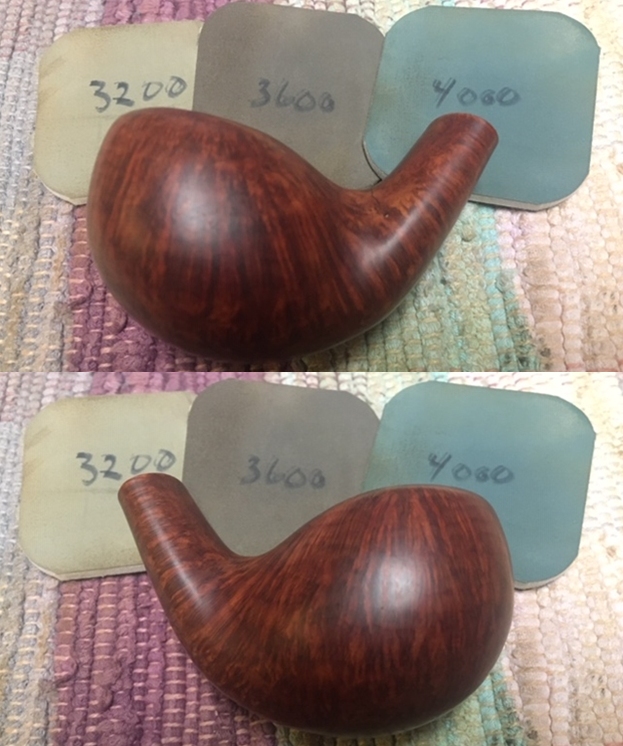
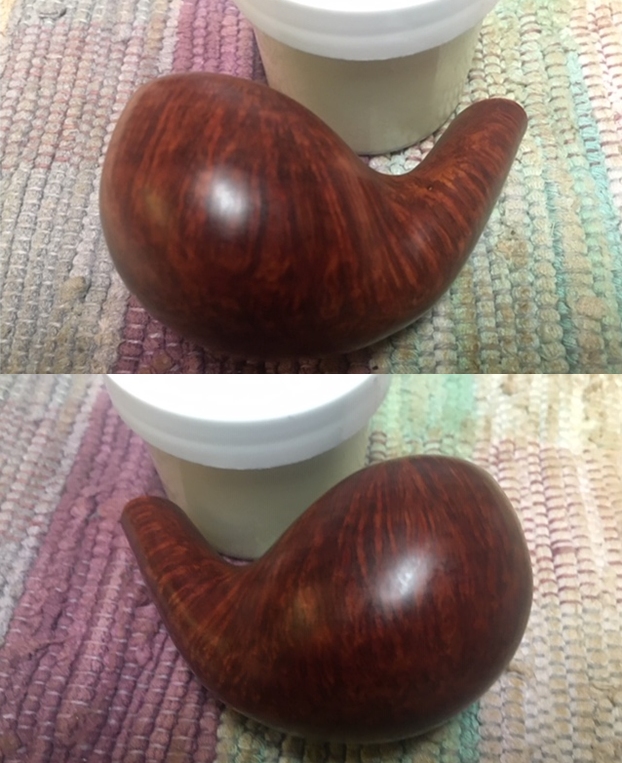
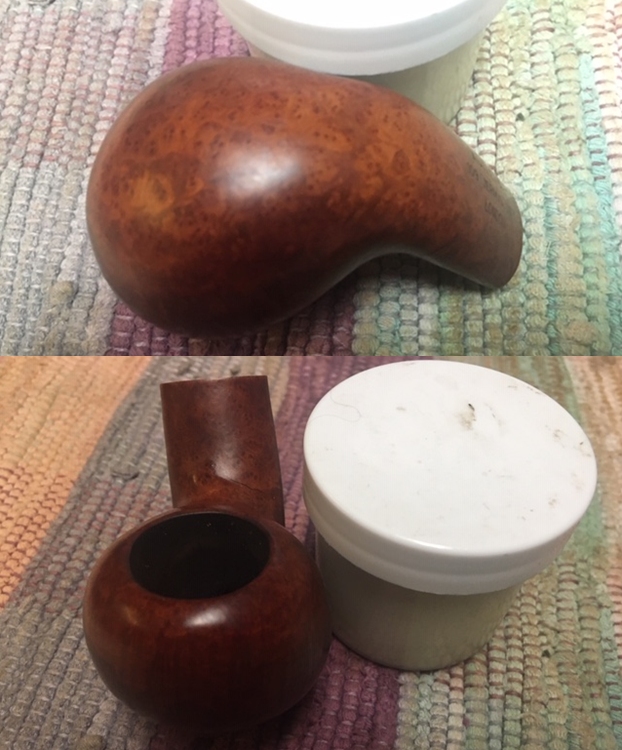
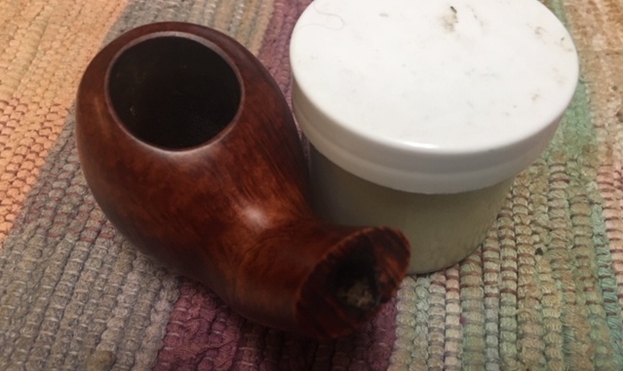
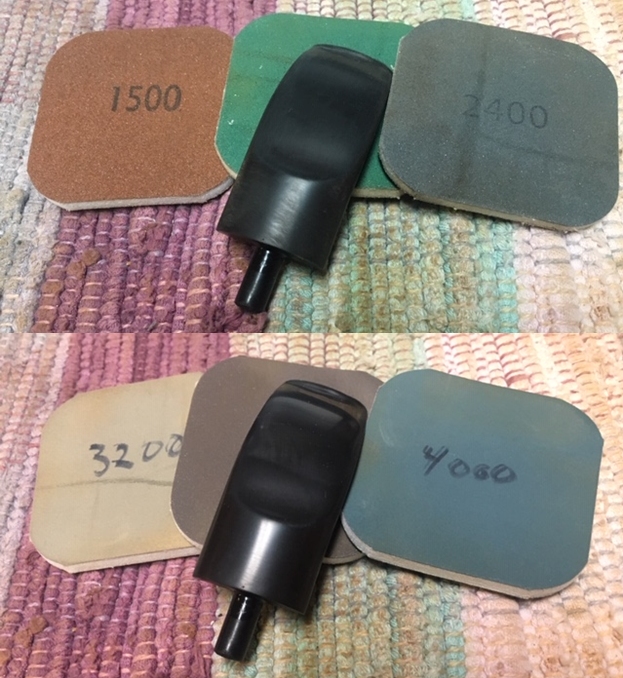
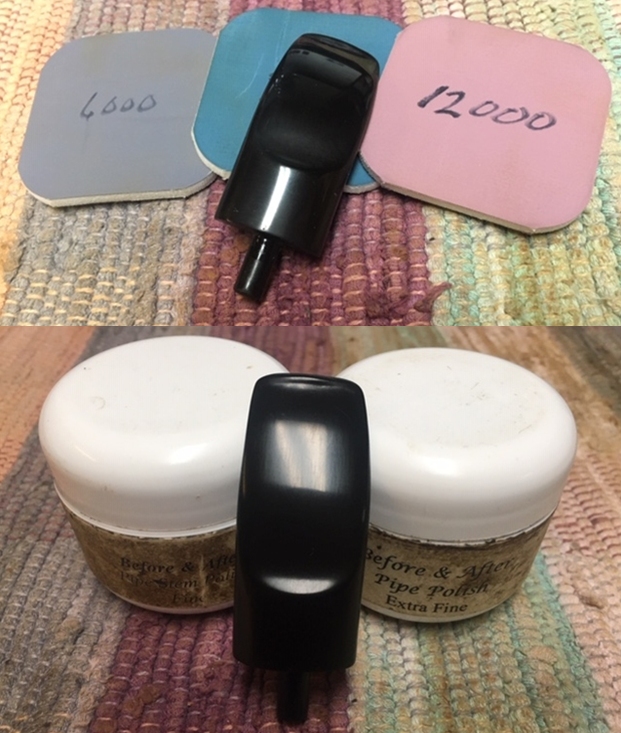
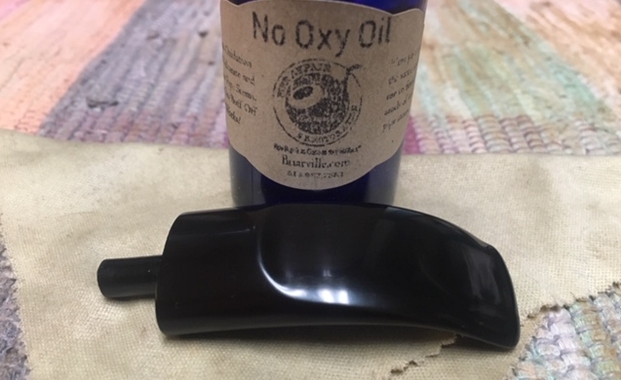
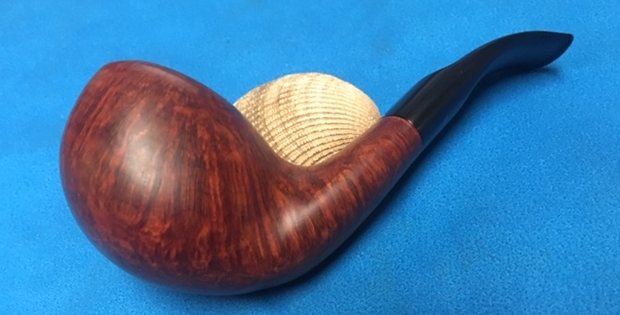
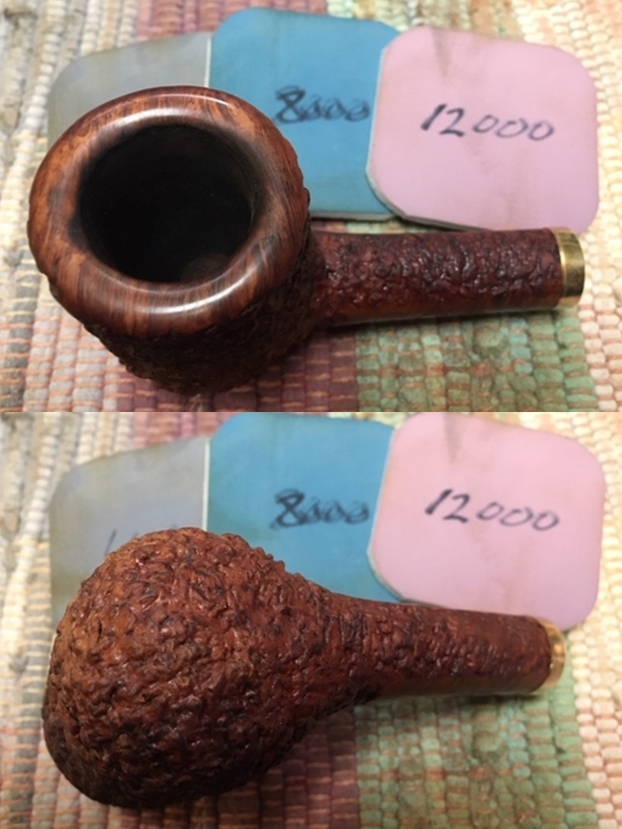
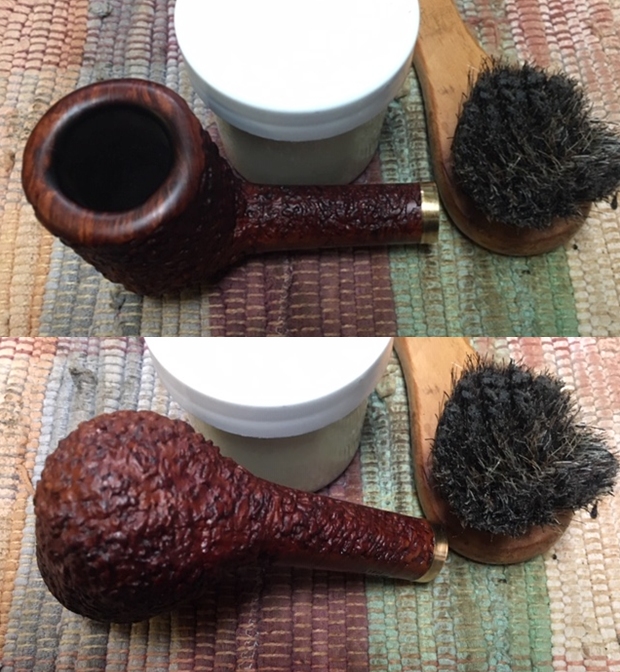
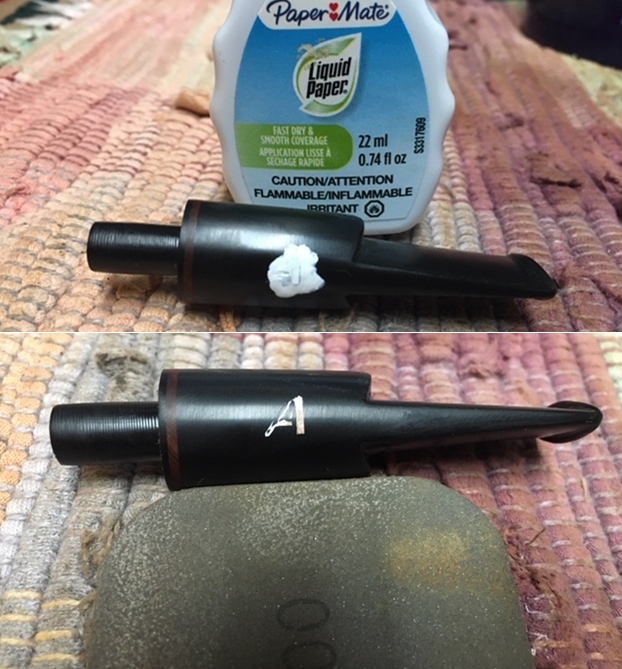
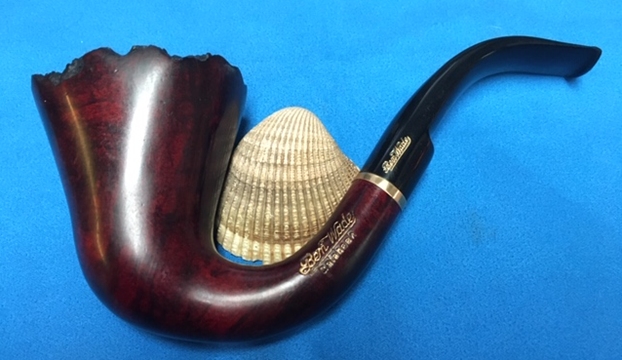
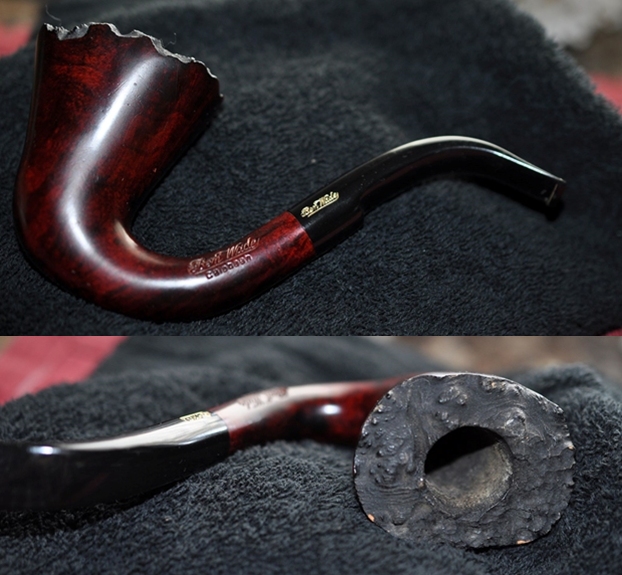
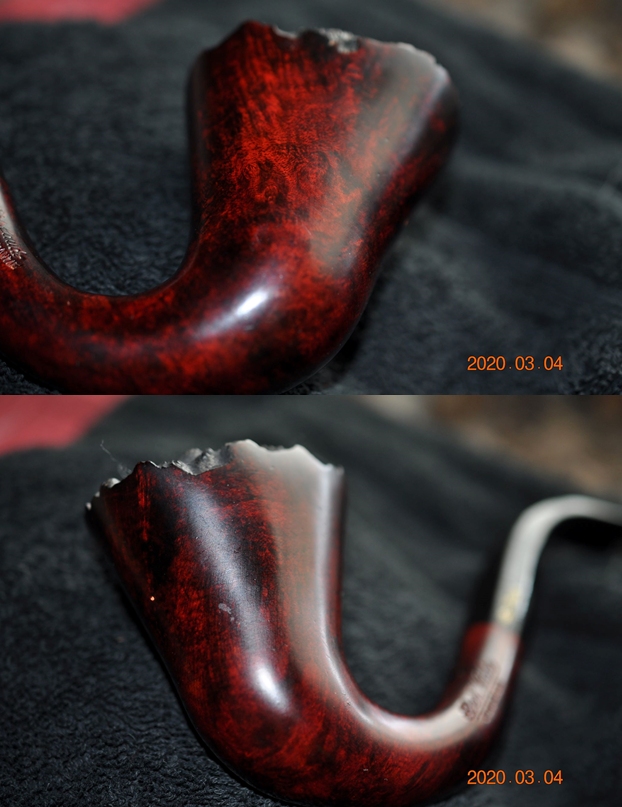
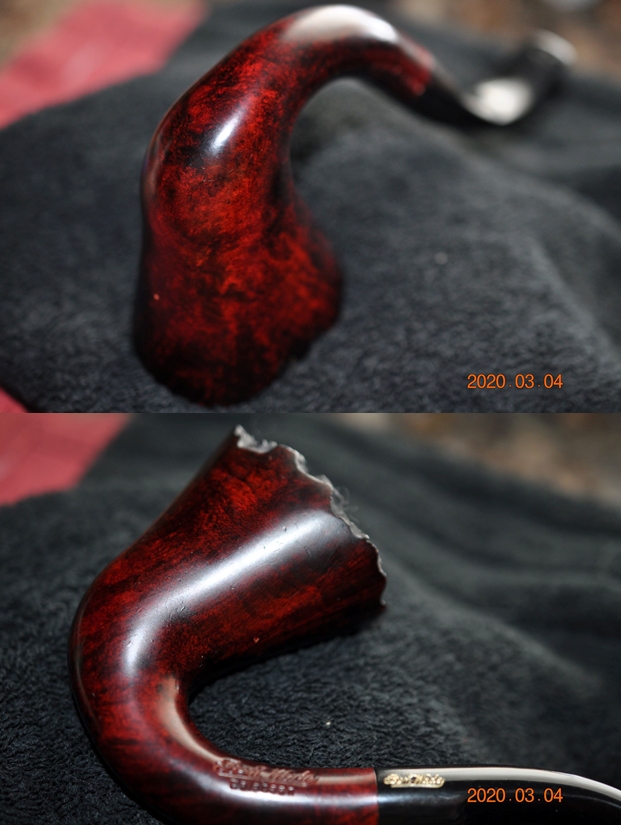
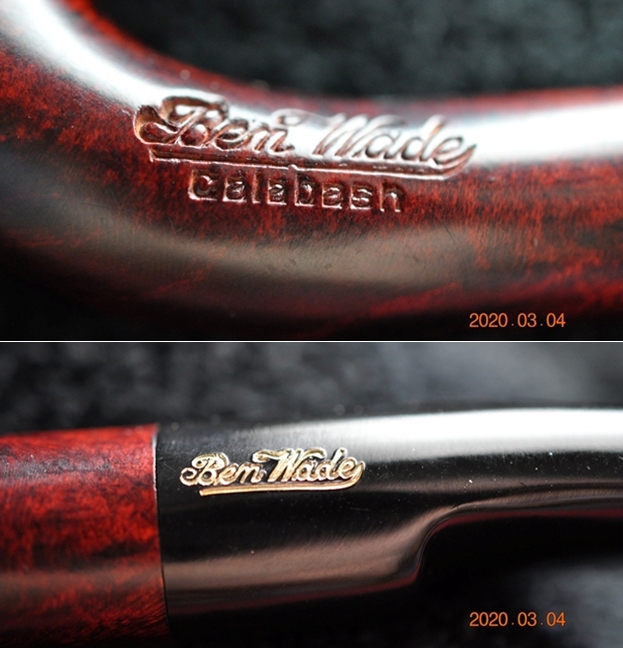
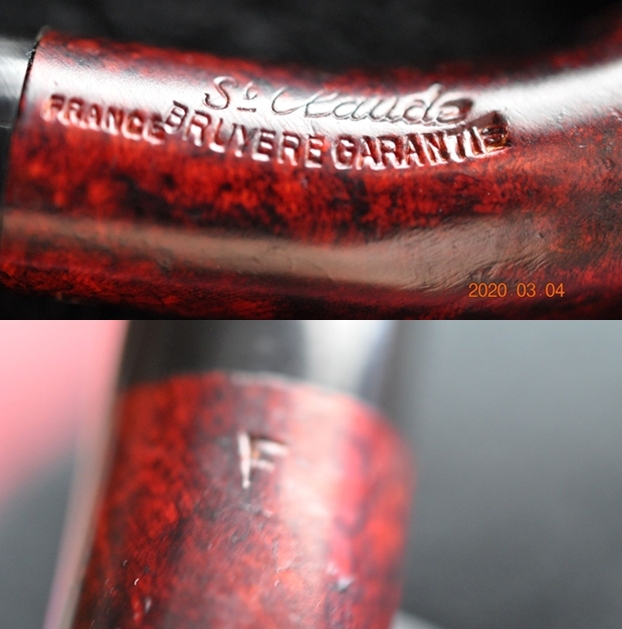
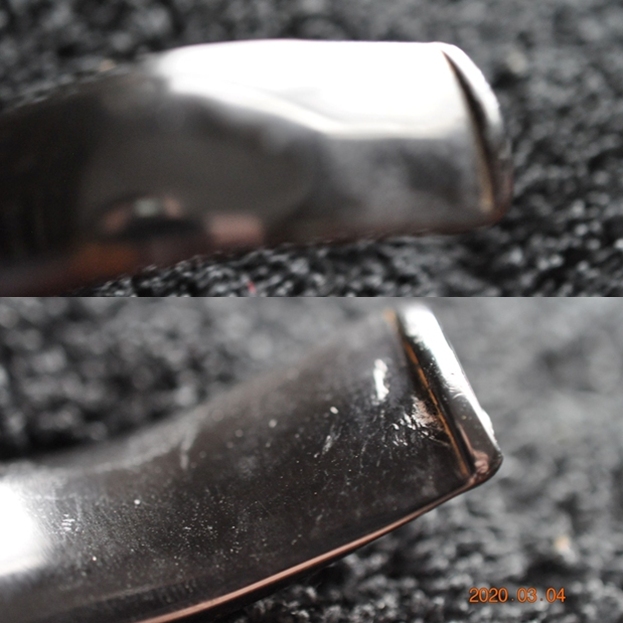
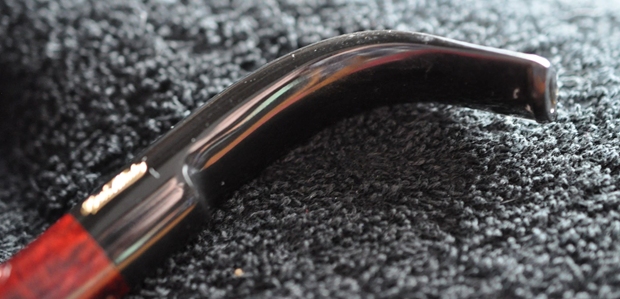
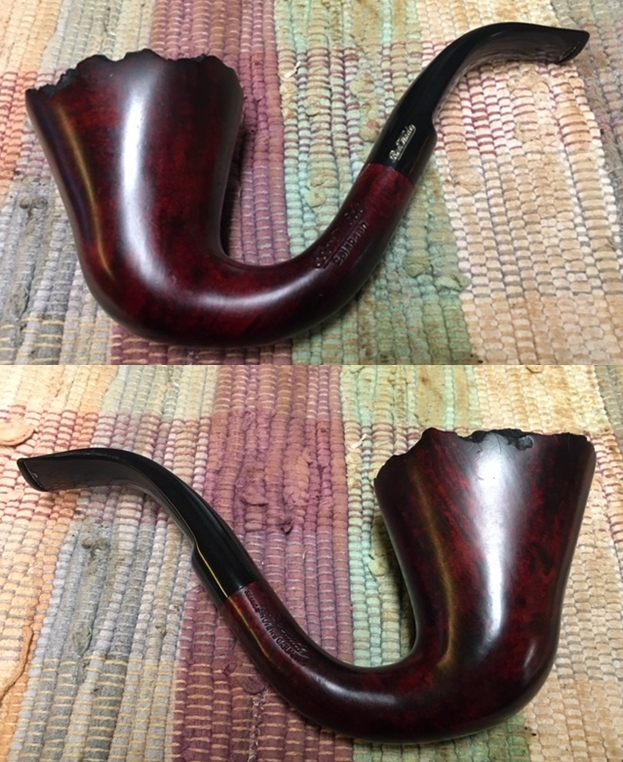
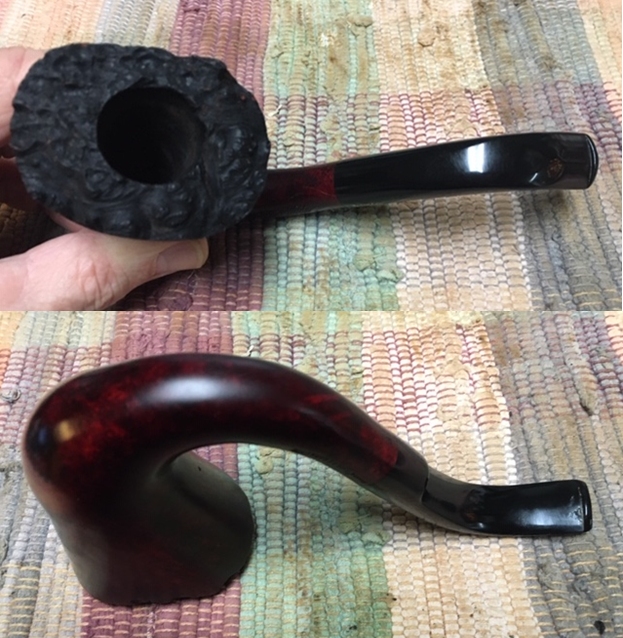
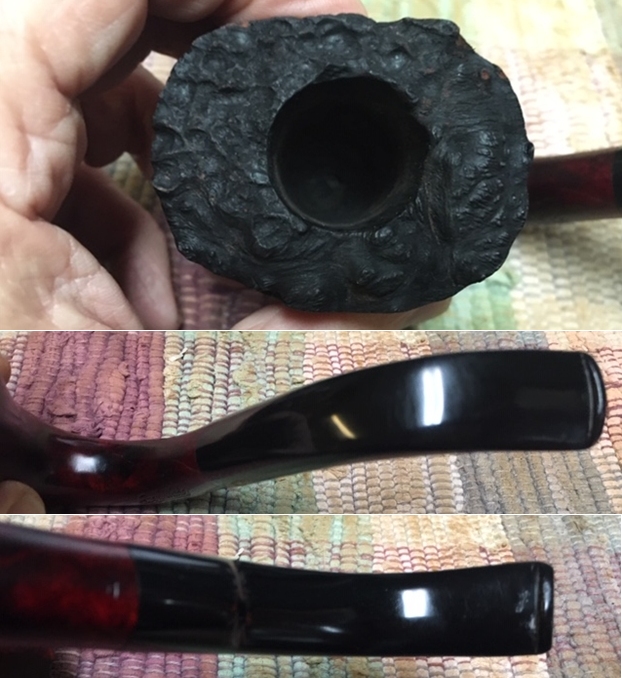
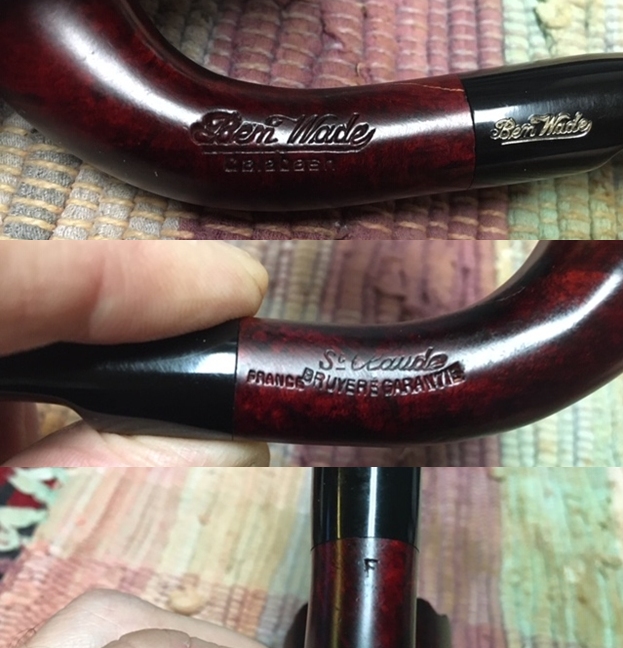
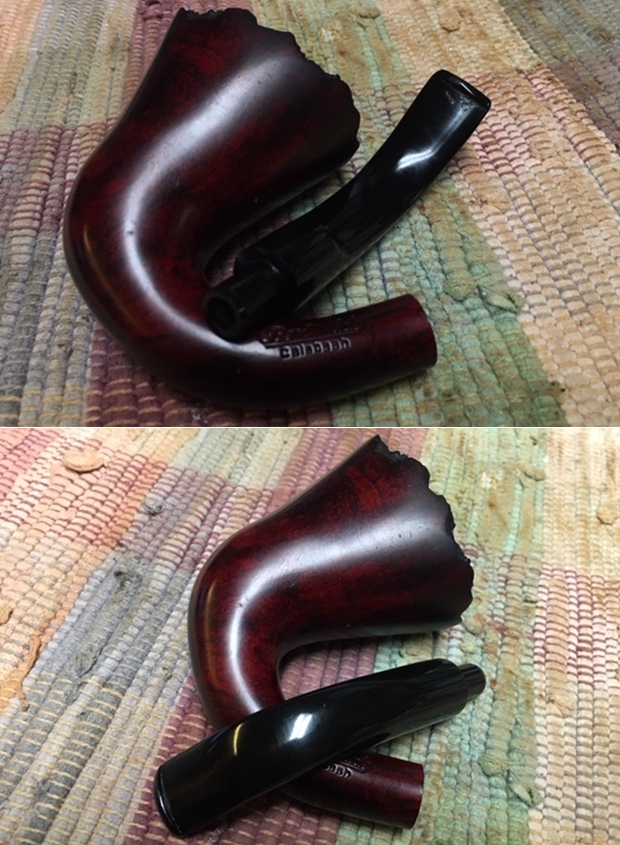
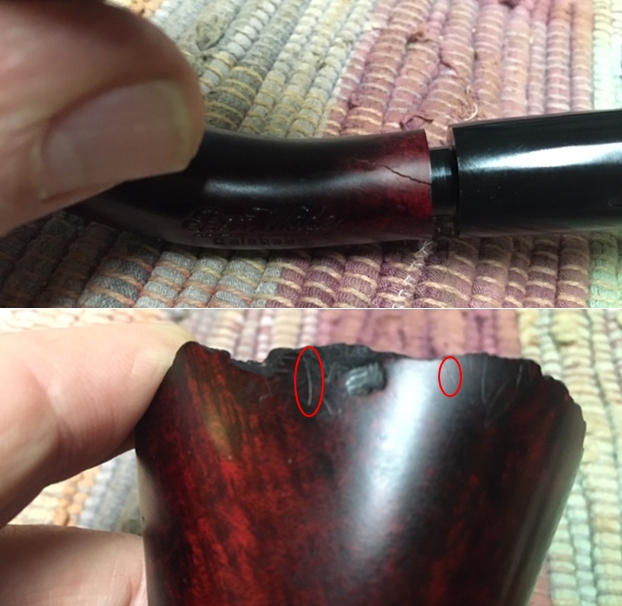
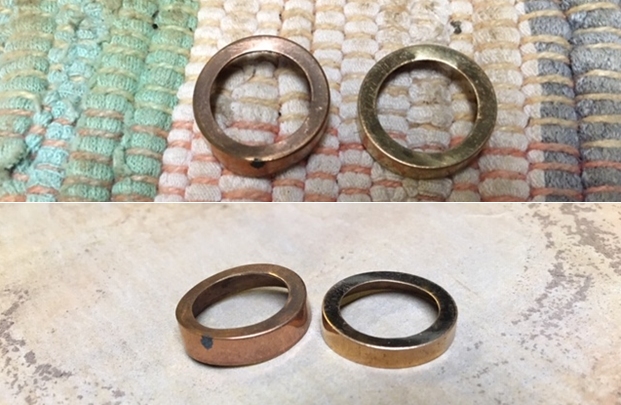
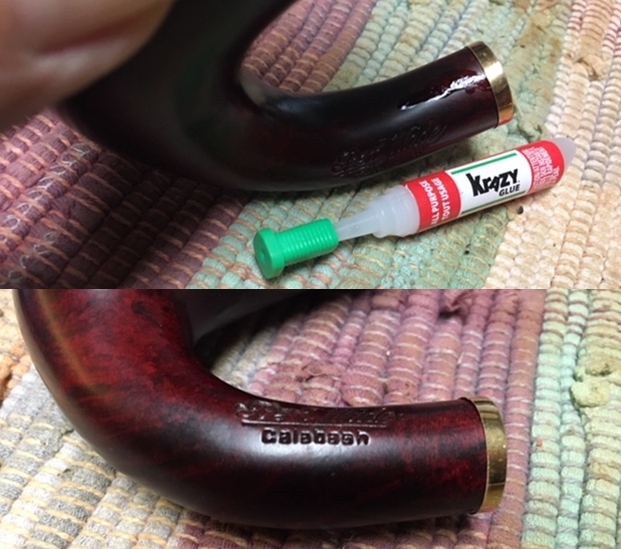
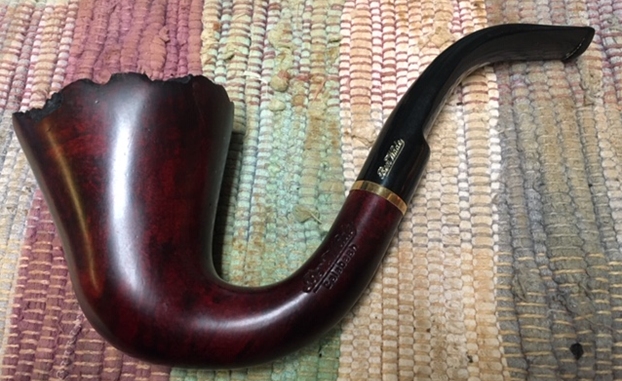
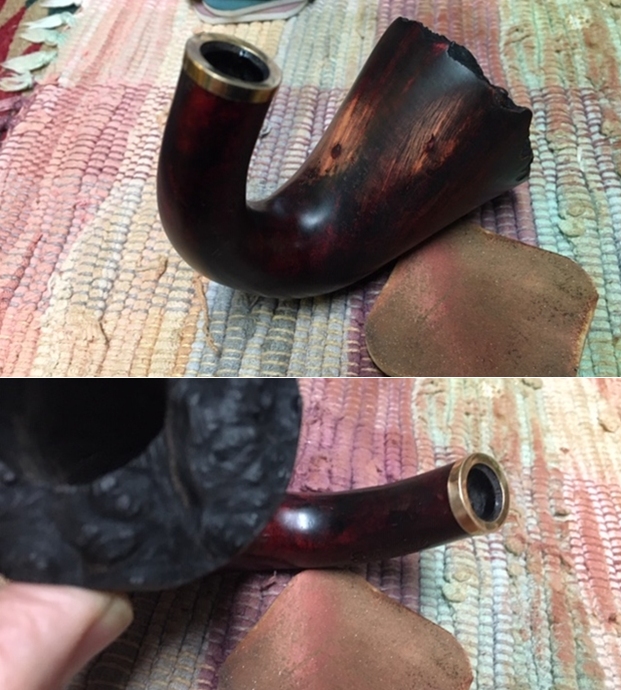
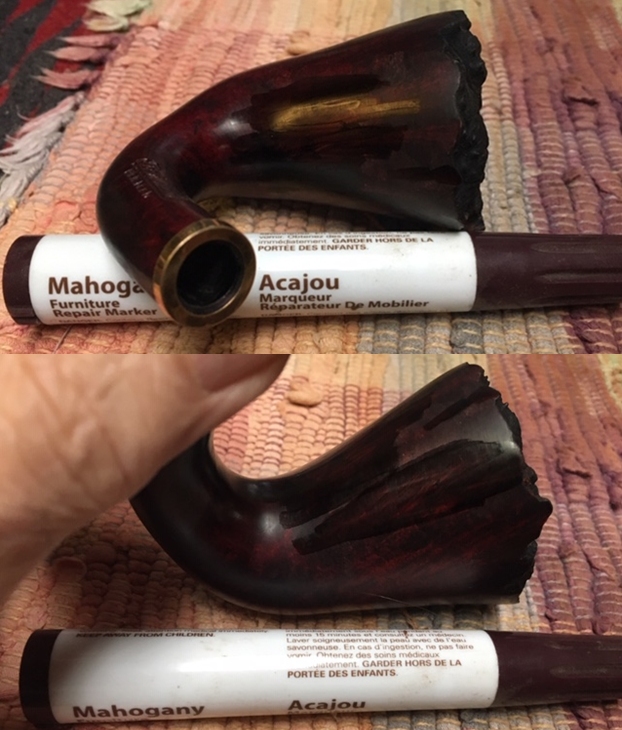
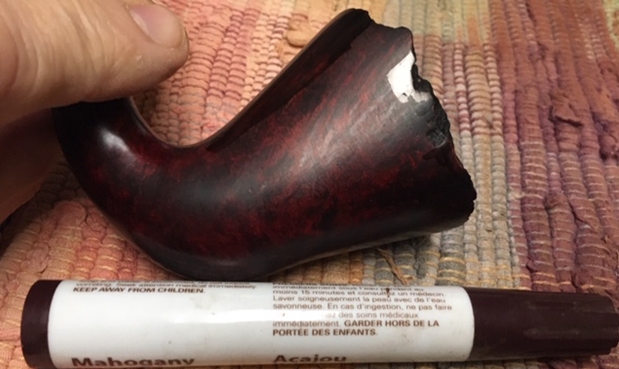
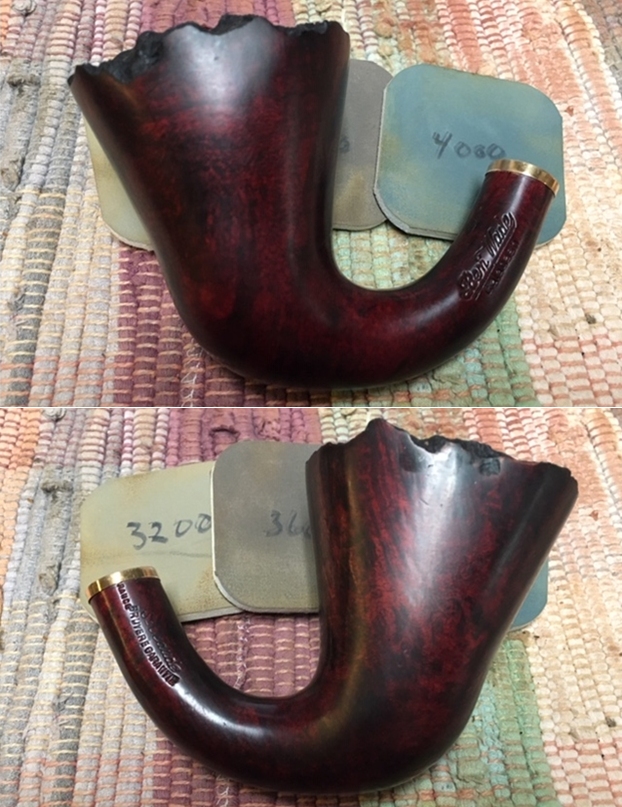
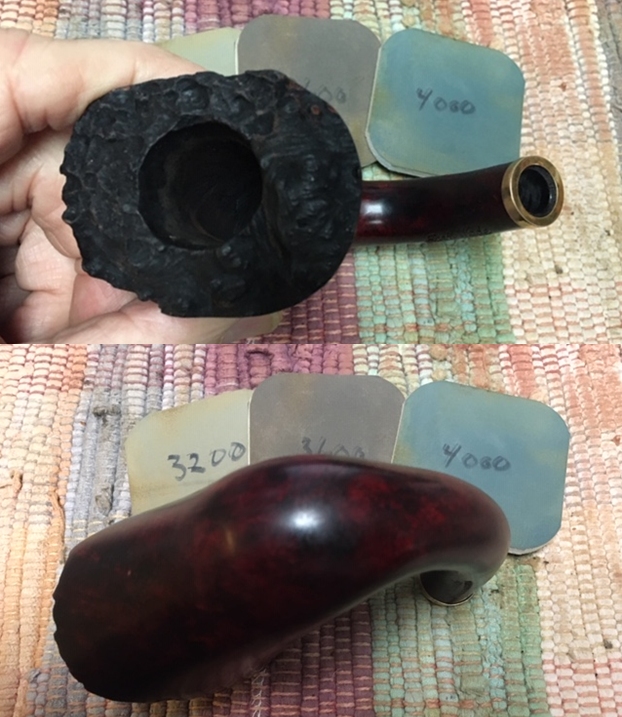
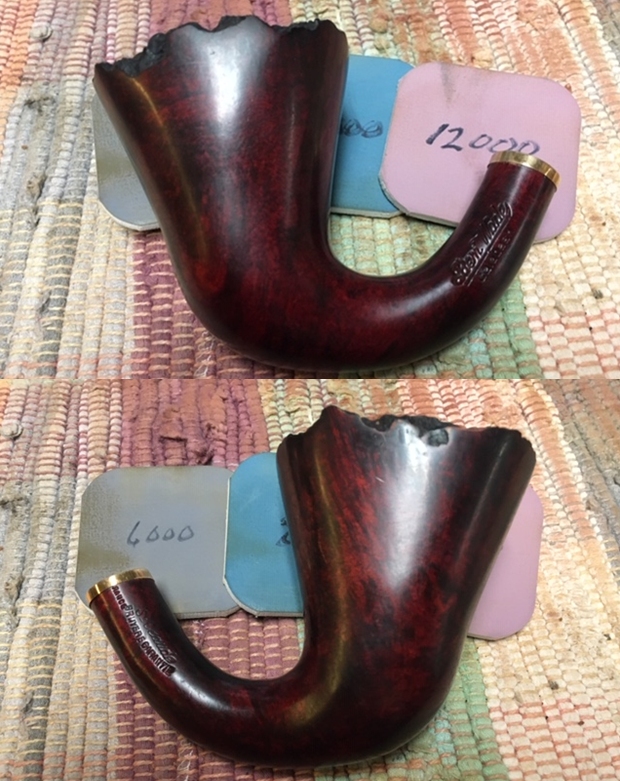
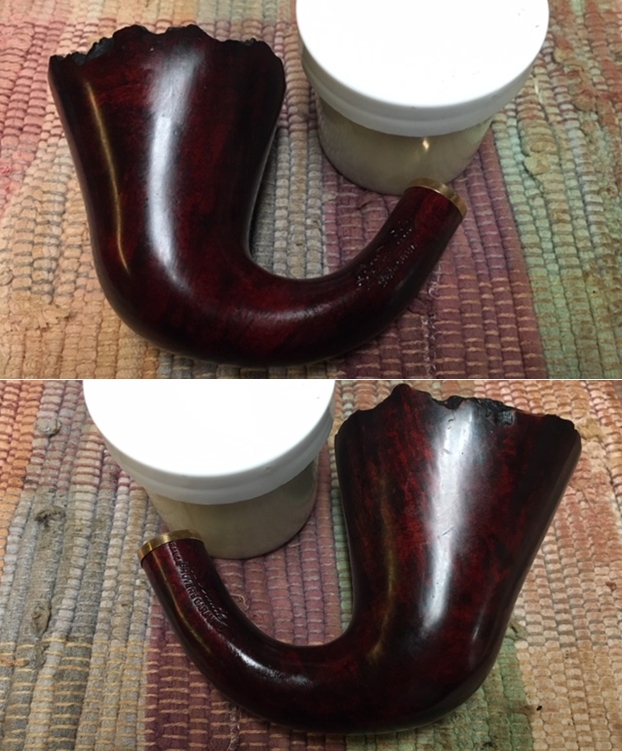
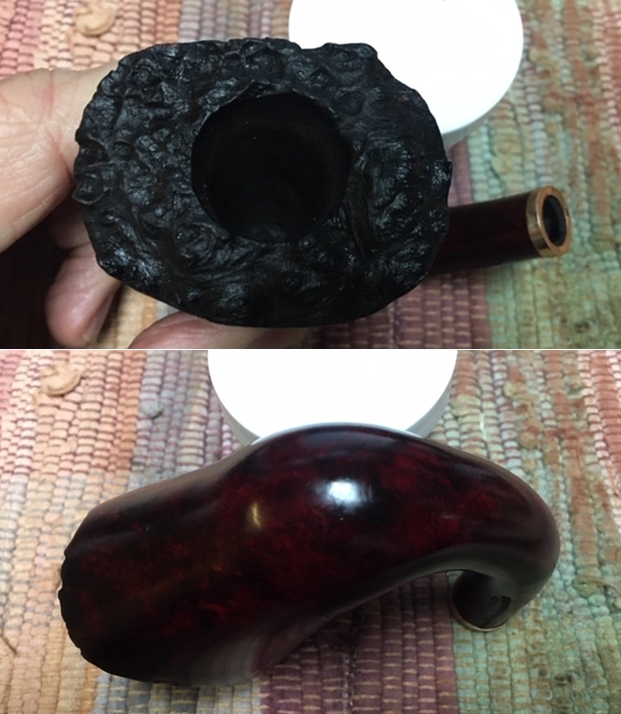
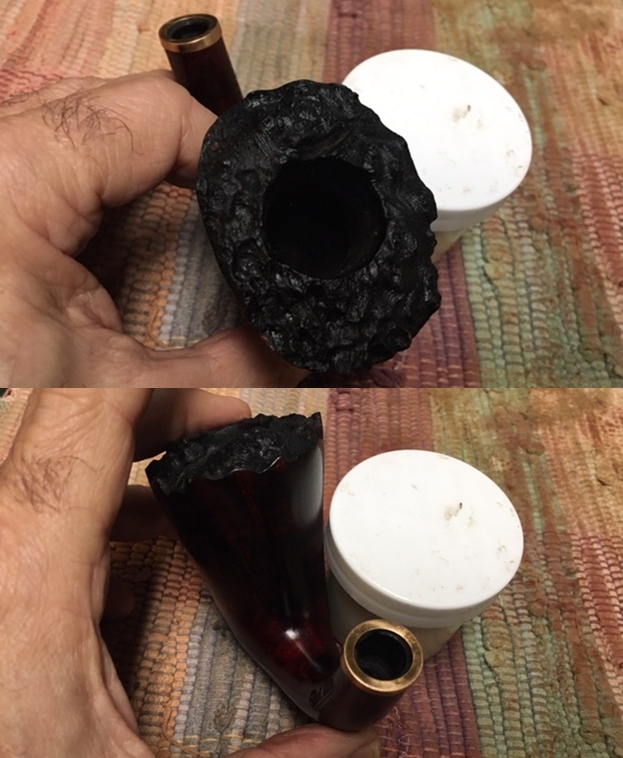
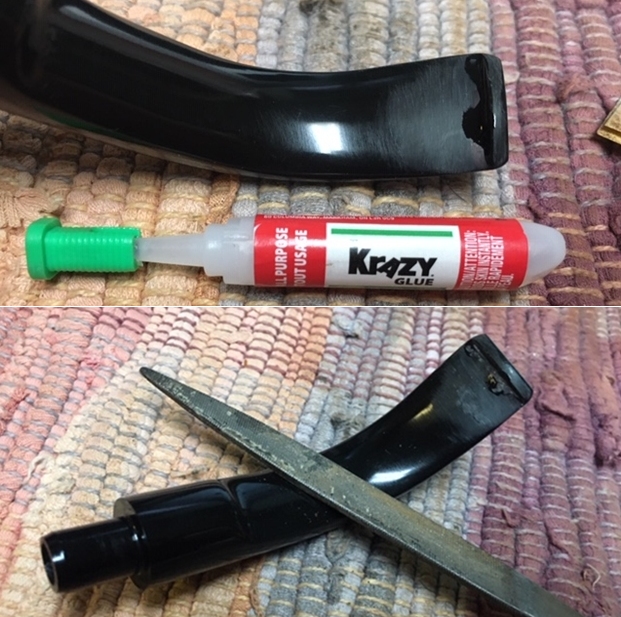
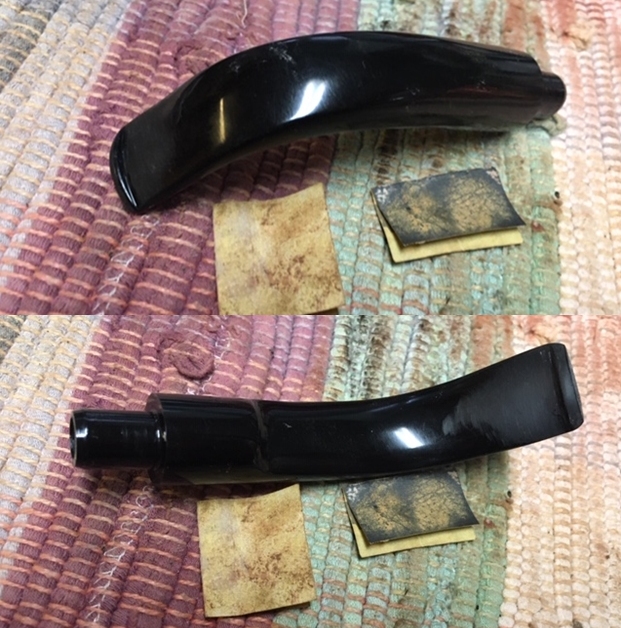
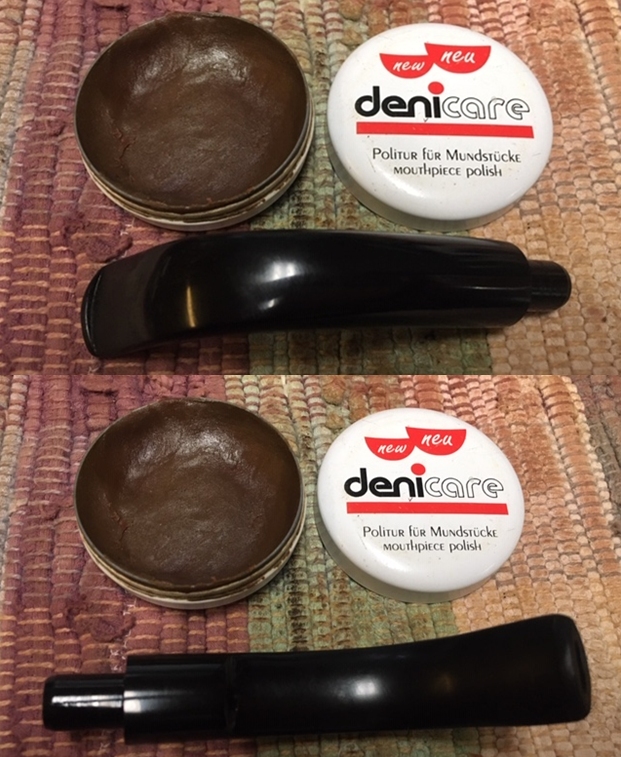
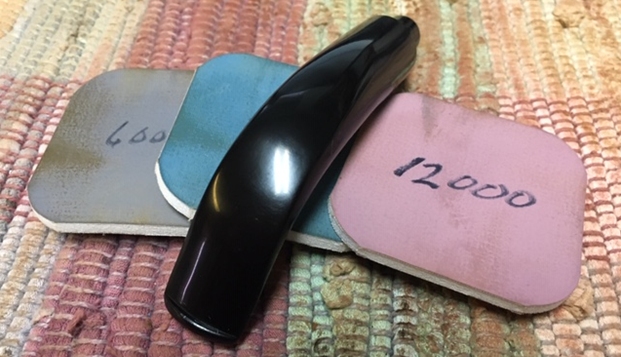
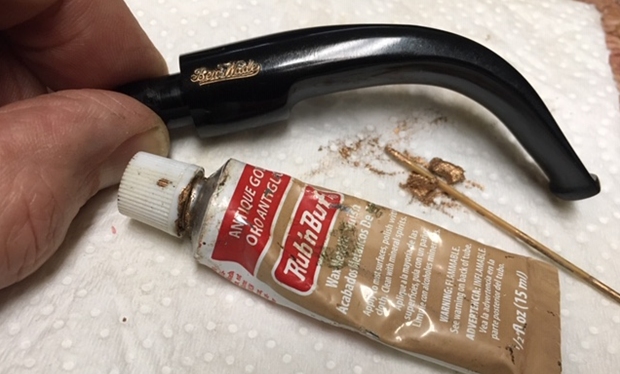
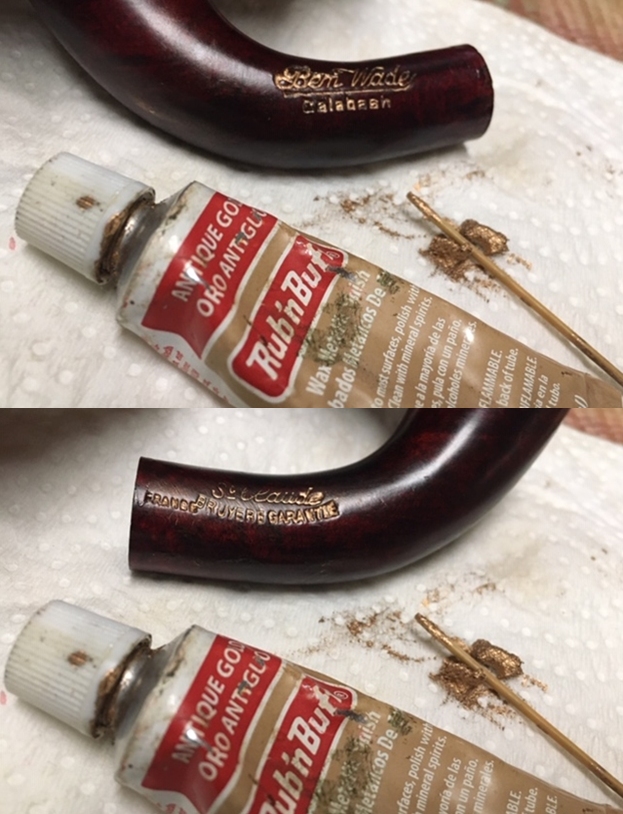
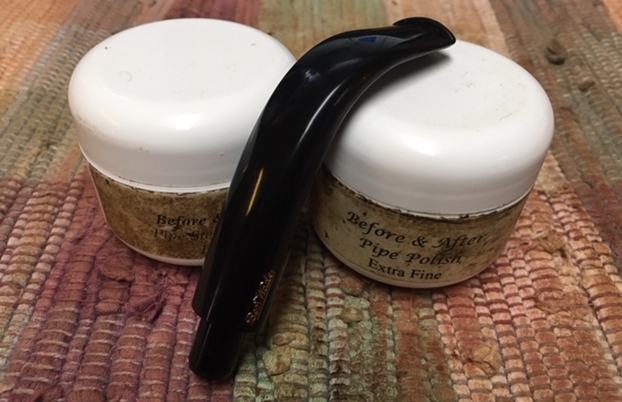
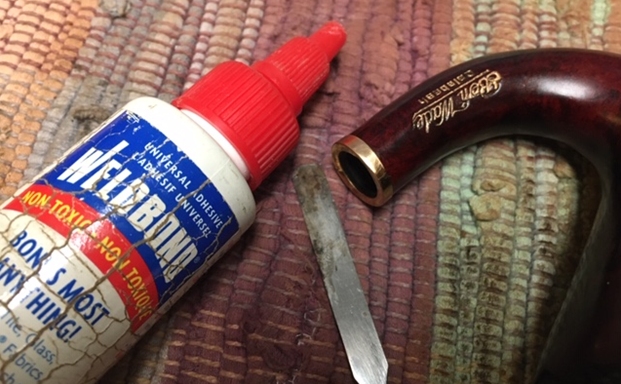
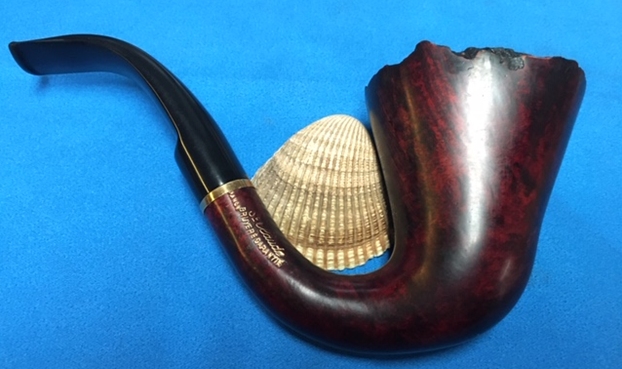
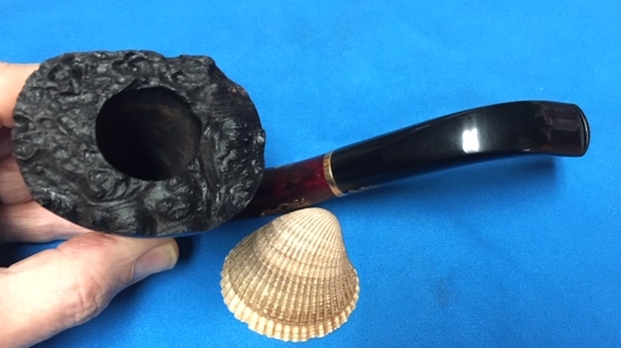
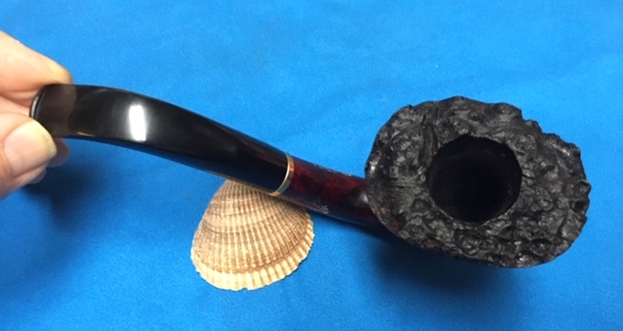
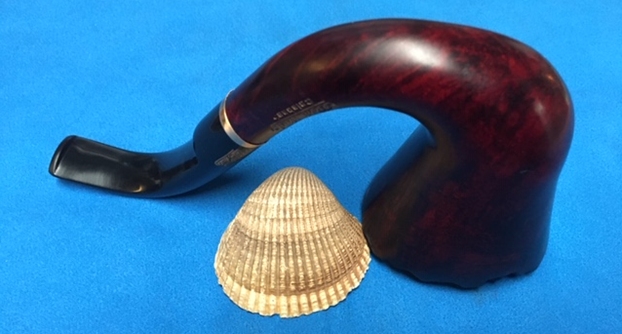
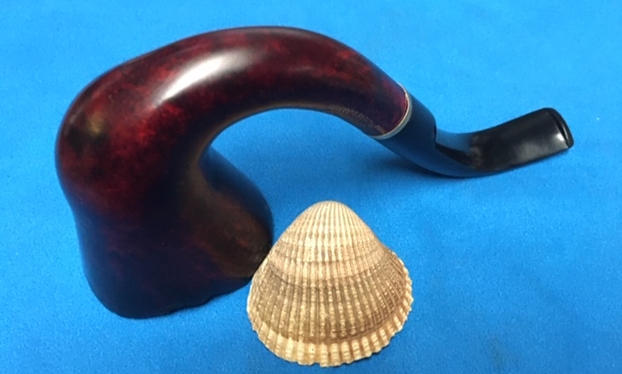
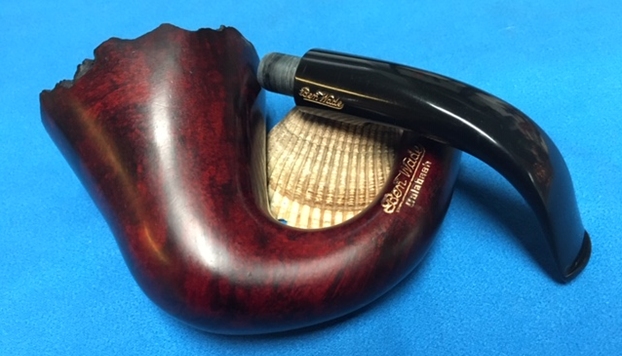
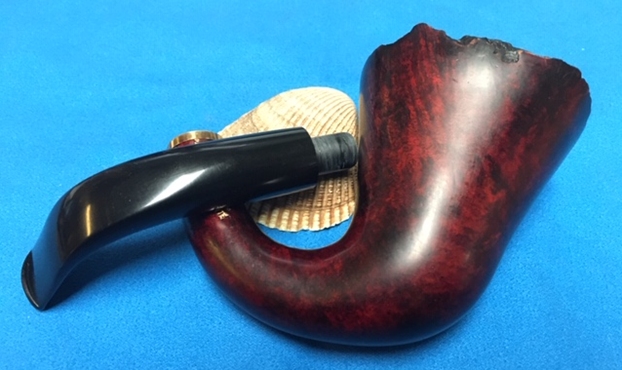
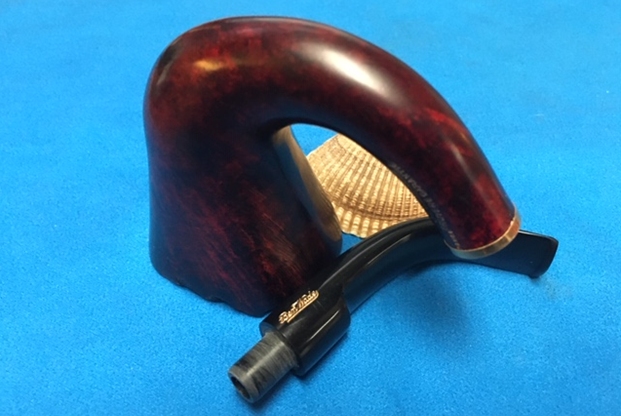
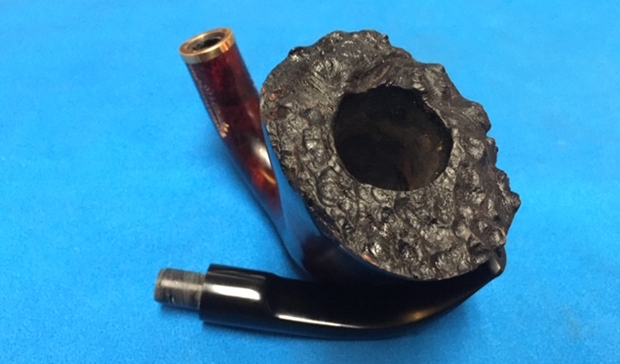
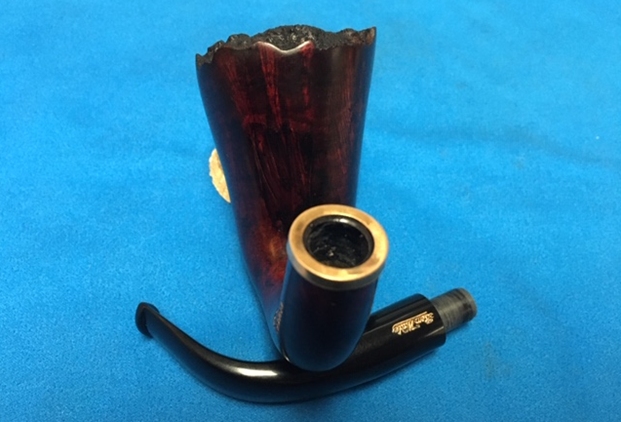
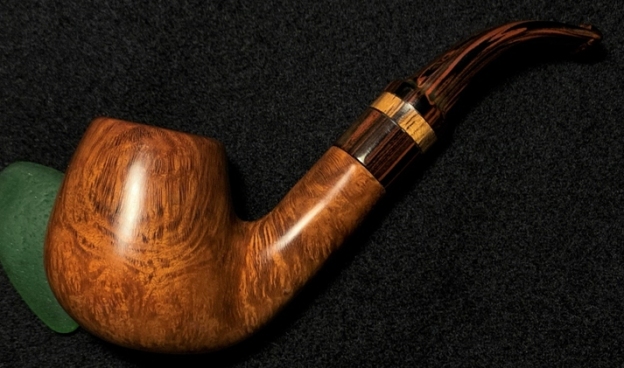
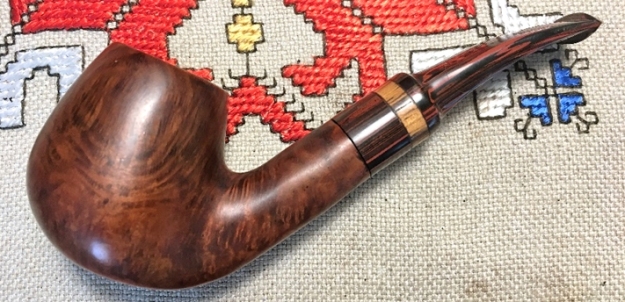
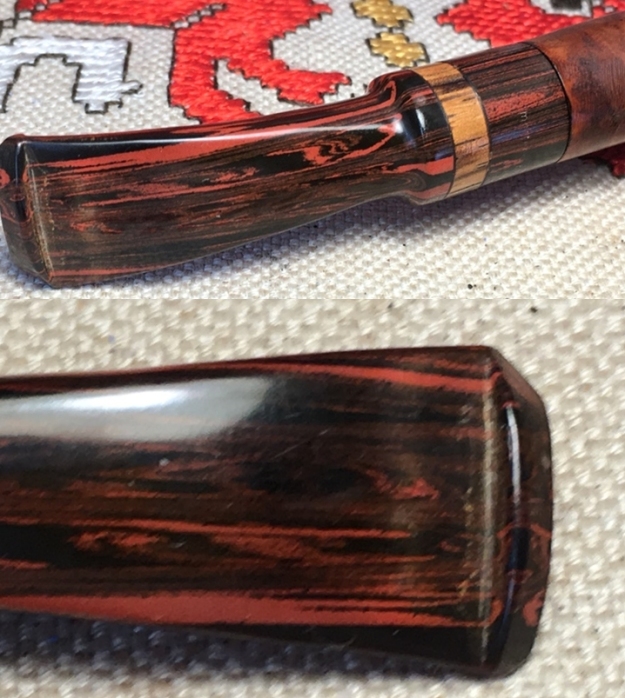
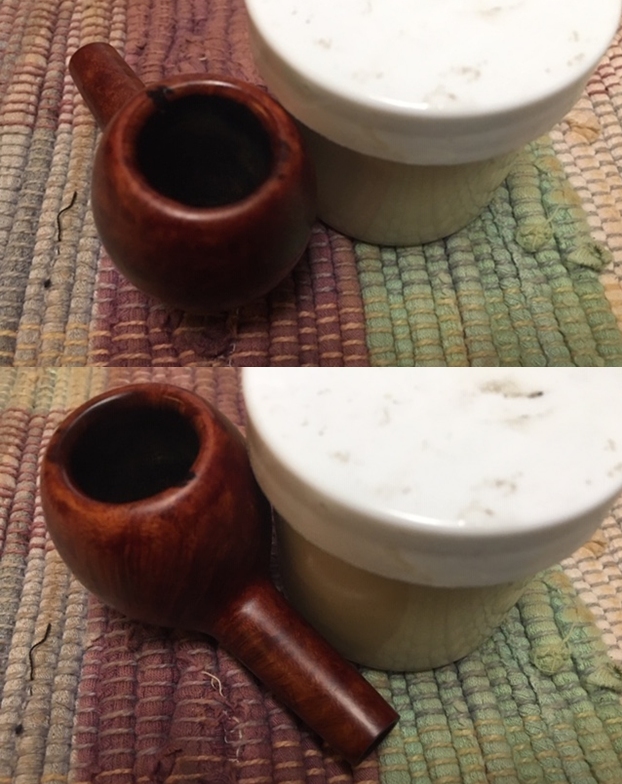
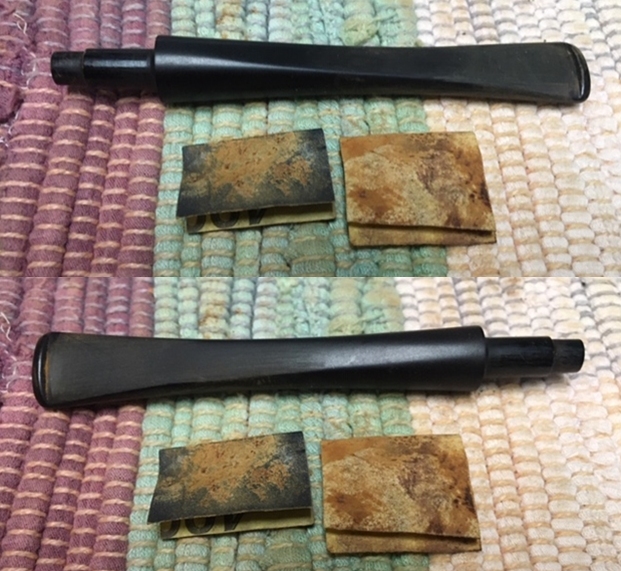
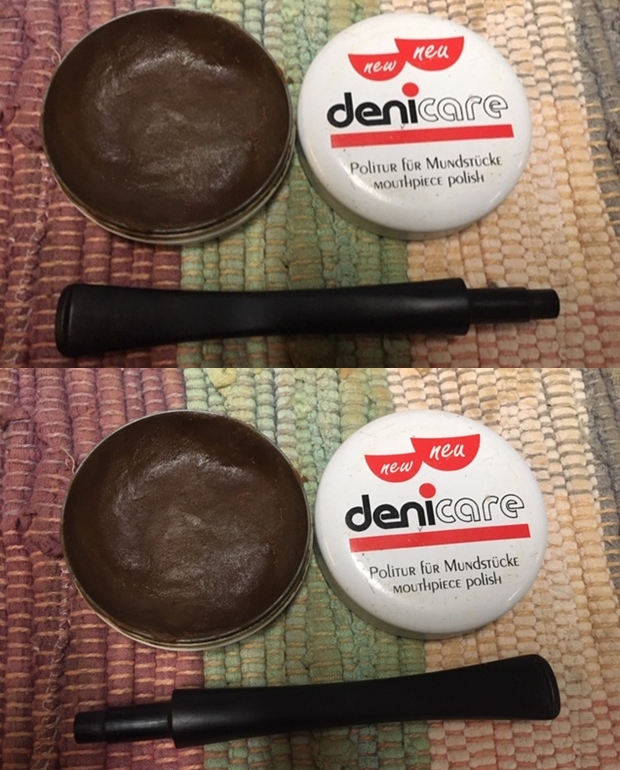
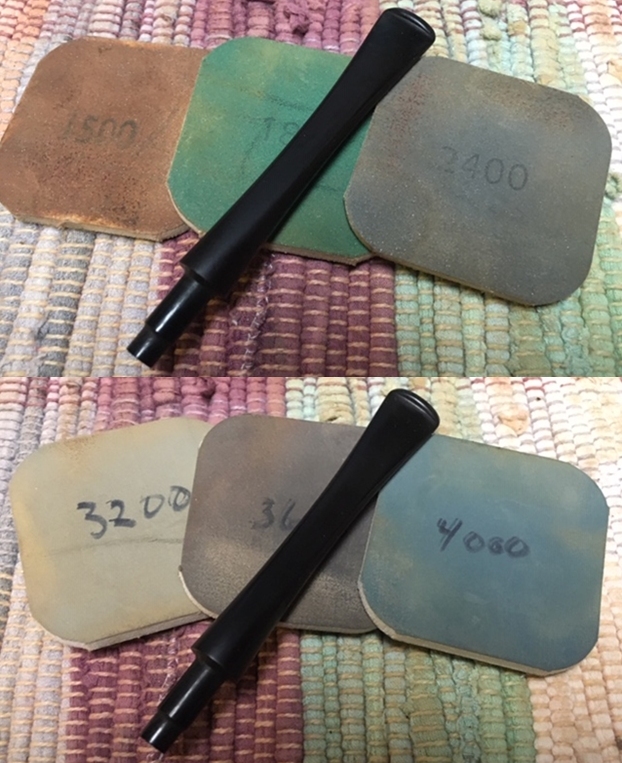
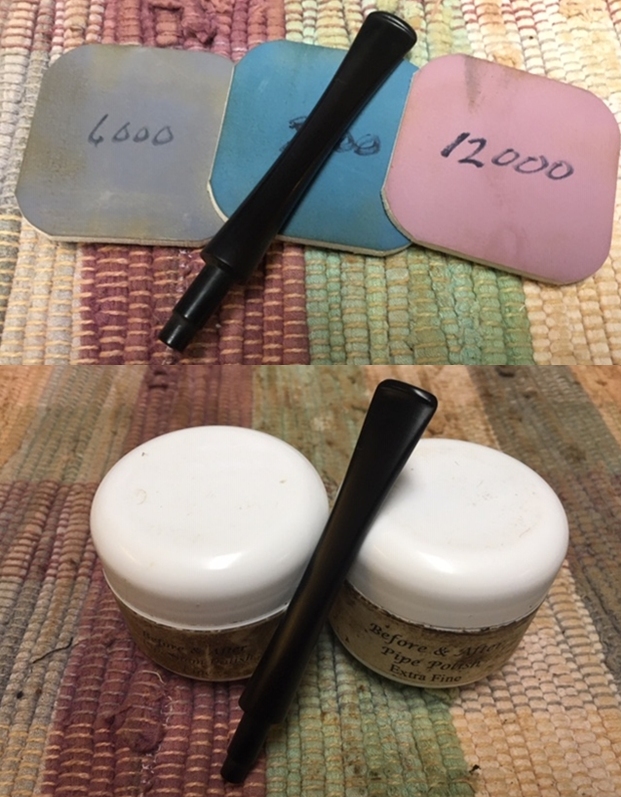
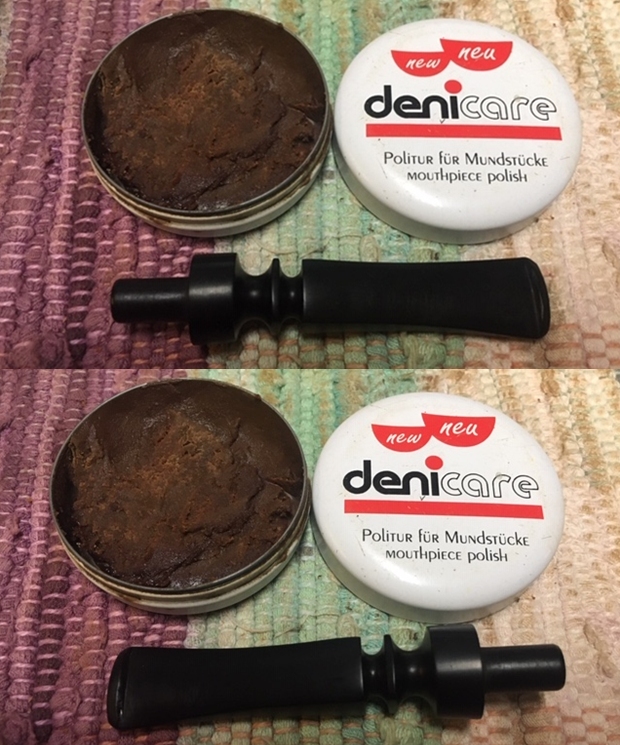
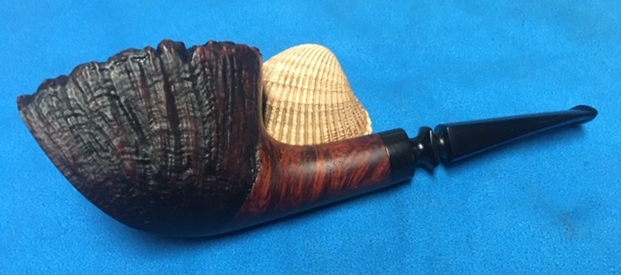
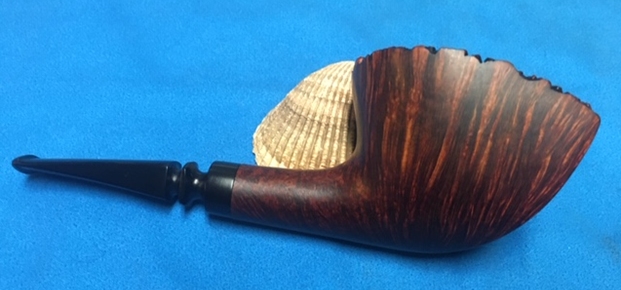
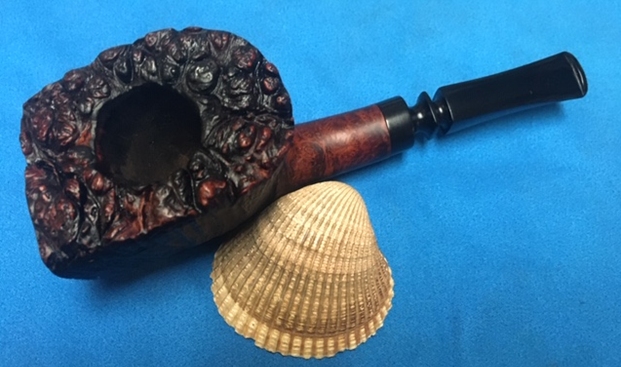
This St. Claude, France Ben Wade Calabash is quite stunning. The shape and flow of the briar, the rich red stains and the curve of the Lucite stem all combine to create a shape that is elegant and beautiful. Jeff picked this pipe up from a favourite shop in Utah. I have never seen one of these before even though I have worked on a lot of both English and Danish Ben Wade pipes. This one is a French Made Ben Wade. It is stamped on the left side of the curved shank with the words Ben Wade in script over Calabash. The name is also stamped on the left side of the half saddle stem. On the right side it is stamped St. Claude arched over Bruyere Garantie. To the left is a very tight stamp France. On the underside of the shank it is stamped with the letter F. There appears to be remnants of gold leaf in the stamping on both sides of the shank. It can be seen in the photos below. Jeff took some photos of the pipe before he began his cleanup work on it.The pipe was dirty and there were some worn spots on the plateau rim top. The original colour had been black but the dust had turned it almost grey. There was a cake in the bowl and some lava overflow on the plateau. The finish on the bowl was cordovan or oxblood. It was dirty as well with some nicks in the finish. You can see the chipped areas around the rim top and the lava in the plateau in the photos below.Jeff took photos of the bowl from various angles to give a picture of the grain and the condition on the finish of the pipe. It is a beautifully grained and finished pipe. The oxblood stain really works well to highlight and showcase the grain. Jeff also took photos of the stamping on the shank and the stem. The first two photos show the left side of the shank and stem. The third photo shows the stamping on the right side and the fourth shows the stamping on the underside. The acrylic/Lucite stem was dirty and there were tooth marks and chatter on the top and underside. There was one deep tooth mark on the underside up against the button edge. The flat surface of the button had tooth chatter and wear on both sides. Jeff also took a photo of the gentle curve of the half saddle stem and I have included that below. Jeff did his usual extensive cleanup of the pipe. He reamed it with a PipNet pipe reamer removing the cake from the bowl so that we could see what was going on underneath the surface. The interior of the bowl looked very good. He cleaned the internals of the pipe and stem with alcohol, cotton swabs and pipe cleaners until it was very clean. He scrubbed the externals with undiluted Murphy’s Oil Soap and a tooth brush. He worked over the plateau rim and edges with the brush and the soap and rinsed the pipe down with warm water. He cleaned the stem as well so that the externals and internals were clean. He did scrub the stem with Soft Scrub on cotton pads to remove the grime on the surface. It was acrylic so it was not oxidized so it was not necessary to soak it in a deoxidizer. I took photos of the pipe when I unpacked it and brought it to my work table. I took close up photos of the stem and the rim top to show the condition. The cragginess of the plateau is clean and shows the peaks and valleys in their fullness. You can also see some of the worn spots on the rim top where the finish has been removed. The stem looks good. The photo of the underside shows the deep tooth marks next to the button (third photo).I took some photos of the stamping on the sides of the shank to confirm what I mentioned above. The stamping is crisp and readable.I took the stem off the shank and took two photos to give a clear idea of the gentle curves of the pipe and the look of the rugged plateau rim on the delicate bowl. It really is a beauty! The tenon is drilled for a 6mm filter but could easily be smoked without one or with an adapter.Jeff and I were talking on Facetime and he was showing me how well the pipe had cleaned up. We do that often as he is in Idaho and I am in BC Canada. While he was carefully turning the stem into the shank we both heard and audible “POP”. That sound is a pipe restorer’s nightmare. If you have not heard that sound I can guarantee you will one day. Jeff groaned and showed me the crack in the shank. So when it arrived here in Vancouver I had a look. I took a photo of the crack and have included it below. It is on the top left side of the shank and is a good ½ inch long. That would need to be repaired. I also found some small hairline cracks on the top right side near the plateau top. They were not deep or serious but nonetheless they were present.I decided to deal with the cracked shank first. I went through some brass bands that I have that are polished gold in colour and would go well with the gold stamping on the stem and shank. They were quite thin and some have an inward bevel on the shank cover. I chose the band on the right and used my topping board to reduce the depth of the band by half. I wanted to retain as much of the stamping as possible and still bind the cracked shank together.I spread the crack in the shank and pushed some CA Glue into the space. Because of the way the curve in the shank I could not drill and hole at the end of the crack. I clamped it together until the glue cured. I did not glue the band on at this point because I wanted to touch up the gold stamping before I put it in place. Once the repair cured I put the stem on the shank and took a photo to give an idea of what the band looked like with the stem in place.   With that repair complete it was time to deal with the hairline cracks on rim edge. I used a tiny bit to put a hole at the end of each crack and filled them in with a bead of CA glue. The photo below is very blurry but shows the glued are well enough(I apologize for the lousy picture). I also filled in some of the pits in the back side of the bowl.Once the repairs had cured I sanded them smooth with a 1500 grit micromesh pad to blend them into the surface of the surrounding briar.I have found that the Mahogany stain pen I have blends really well with oxblood or cordovan stain. I touched up the sanded areas on the shank top, right side of the bowl at the topo and the back of the bowl with the pen and let it cure. I polished the briar with micromesh sanding pads – 1500-12000 grit pads. I wiped the bowl down with a damp cloth after each sanding pad to remove the debris. The bowl began to look very good. I also really like the look of the polished brass band on the shank end. I rubbed the bowl down with Before & After Restoration Balm. I worked it into the briar with my fingertips and into the plateau with a horsehair shoe brush. I let it sit for about 10 minutes and buffed it off with a soft cotton cloth. The product cleans, protects and preserves the briar and leaves it enriched and beautiful. I set the bowl aside and turned to the stem. I sanded the tooth chatter on both sides of the stem with particular attention to the large tooth mark on the underside of the stem just ahead of the button. I cleaned the tooth mark with alcohol on a cotton swab. I filled it in with a bead of clear CA glue and set it aside to cure. When the repair cured I used a needle file to sharpen the edge and flatten the repair.I sanded the repaired area and the rest of the tooth chatter areas on both sides of the stem with 220 grit sandpaper and followed up with a piece of 400 grit wet dry sandpaper.I polished the stem with Denicare Mouthpiece Polish from a tin of it I have in the drawer here. It is a gritty red paste that I rub on with my finger tips and work into the surface of the stem and button and buff off with a cotton pad. It gives me a bit of a head start on the polishing work.I polished the stem with micromesh sanding pads – wet sanding with 1500-12000 grit sanding pads. I wiped it down after each sanding pad with Obsidian Oil. I polished it with Before & After Pipe Stem Polish – both Fine and Extra Fine. I buffed the stem with a soft cloth to raise the shine. I paused in my polishing of the stem to touch up the gold leaf on the stem side and the sides of the shank. I used Rub’n Buff Antique Gold and pressed it in the stamping with the end of a tooth pick. I let it sit for a few minutes then buffed it off with a soft damp cloth to remove the excess. I went back to polishing the stem with Before & After Pipe Polish – both Fine and Extra Fine and buffed the stem with a clean cotton rag. The stem looks really good at this point.I used a dental spatula to spread some white glue around the shank end. Once the glue was evenly spread I pressed the band in place. I adjusted it so that it fit well. I set it aside to cure for a while as I wanted the band to be permanent. It looks very good now.I am excited to finish this beautiful Ben Wade Calabash from St. Claude France. It is both a rare one in terms of availability but also for me as I have never seen one before. I put the pipe back together and buffed it with Blue Diamond on the buffing wheel. I gave the bowl and the stem multiple coats of carnauba wax. I hand buffed the pipe with a clean buffing pad to raise the shine. It is fun to see what the polished bowl looks like with the grain popping through on the bowls sides and the contrast of the black plateau rim top. The brass band on the shank adds a touch class to the overall look in my opinion. When you add to that the polished black acrylic stem with the shining gold stamping you have a winning combination. The gold stamping also looks great on the shank and stem. This grain on the smooth finish Ben Wade Calabash is nice looking and the pipe feels great in my hand. It is light and well balanced for a large pipe. Have a look at it with the photos below. The dimensions are Length: 6 ¾ inches, Height: 3 inches, Outside diameter of the bowl: 2 inches, Chamber diameter: 7/8 of an inch. It is a beautiful pipe and one that will be on the rebornpipes store soon. If you are interested in adding it to your collection let me know. Thanks for walking through the restoration with me as I worked over this pipe. Thanks to each of you who are reading this blog. Remember we are not pipe owners; we are pipemen and women who hold our pipes in trust until they pass on into the trust of the next pipeman or woman.    
A Danish Borge Mortensen Handmade Brandy Recommissioned


Blog by Dal Stanton

This attractive Bent Brandy got my attention on the European side of eBay.  The seller in Germany posted several pictures.  The name, Borge Mortensen, was new to me, but my experience with Danish pipes had been good.  I was attracted as well to the Cumberland stem, but the lack of bend on it struck me as awkward – not the best orientation, but perhaps that was a Danish characteristic?  When the time ended my bid was enough and the pipe soon arrived here in Bulgaria for me to take a closer look.  I also posted it in the For “Pipe Dreamers” Only! online collection to be commissioned by another pipe man or woman benefiting the Daughters of Bulgaria – women and girls who have been trafficked and sexually exploited.The Mortensen also got the attention of Todd, who has commissioned other pipes from me in the past.  Todd is an avid pipe man and contributor to several discussion groups online.  Through our communications, I’ve discovered his love and concern for China in his professional work.  I’ve appreciated our growing relationship cultivated by our common appreciation for pipes.  This relationship developed when I had asked Todd if he minded being ‘bumped’ in the queue line to allow me to restore a very special pipe for a very special guest visiting with us here in Bulgaria for a few weeks.  Chrystal’s visit from China was a special time and resulted in a memorable blog posting for me:  A Special Gift for Her Grandfather in the People’s Republic of China – A Sculpted Rose Billiard of Italy.  Chrystal presented her grandfather the pipe for Chinese New Year and sent pictures to commemorate that special event.

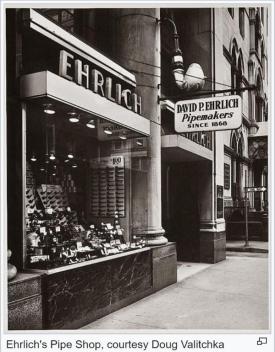
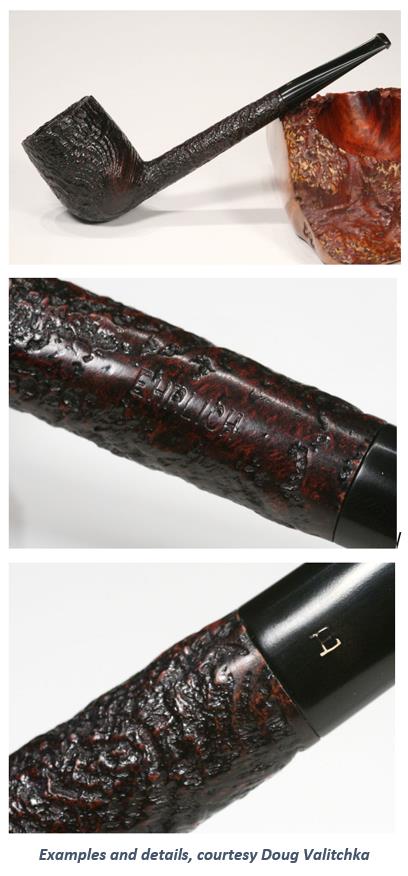
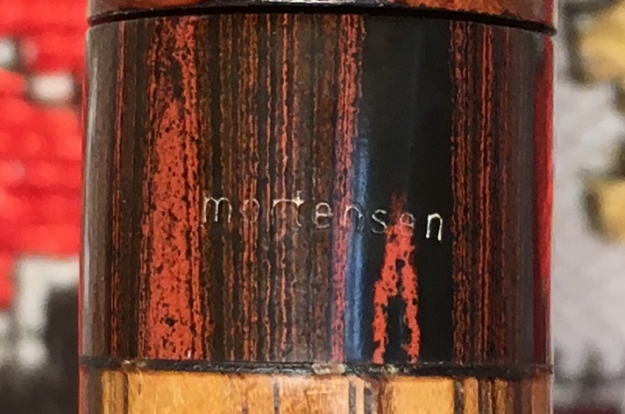
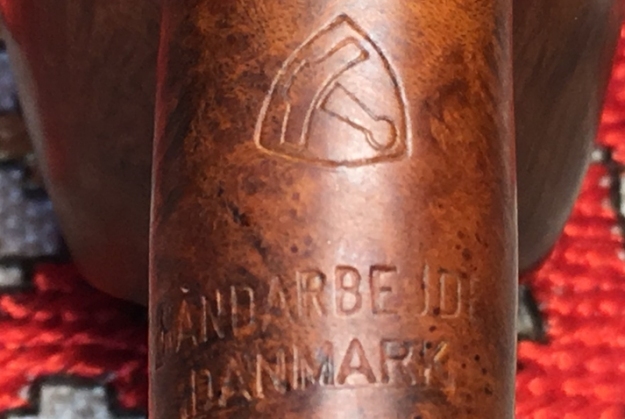
Through this initial encounter with Chrystal, I learned of Todd’s connection with China through his professional pursuits and since then we’ve shared more of each other’s life and family through our emailing….  We’ve decided to share a bowl in the future when our paths can merge on the same continent!  Todd saw this Borge Mortensen Handmade and commissioned it, along with two others that are next in the queue.  Now on the worktable, I take more pictures to get a closer look at the Danish Borge Mortensen. The nomenclature condition is good.  On the top of the Cumberland stem, ‘Mortensen’ is stamped but is thin.  The markings on the underside of the bent shank are impressive. A tilted hammer is ensconced in a shield shaped outline.  Underneath the hammer shield is HANDARBEJDE [over] DANMARK.  A quick trip to Google Translate renders “Handmade”. Scant information is available online about Borge Mortensen.  A quick search on the internet will show a few examples having been sold at different sites.  A small article is found on Pipedia with accompanying pictures ‘courtesy of Doug Valitchka’.

Borge Mortensen of Denmark

In the following example, the name is stamped very small on the top of the turned part of a Cumberland stem. The side has a unique symbol ” the hammer (Mjolnir) of Thor, the god of thunder “. There is also limited stamping on the wood: HANDARBEJDE, DANMARK.  From the examples online of Borge Mortensen pipes and from the Pipedia article (with the same information mirrored in Pipephil.eu) it seems that Mortensen pipes are standard with a Cumberland stem.  The additional information also describes the origin of the Mortensen symbol – the hammer of Thor, of Norse mythology. I would say that this is a distinctive Dane symbol and is cool.

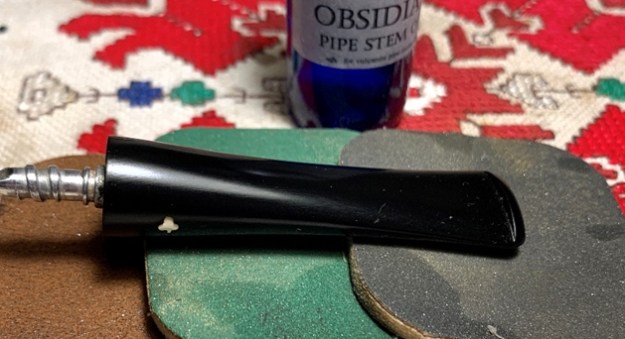
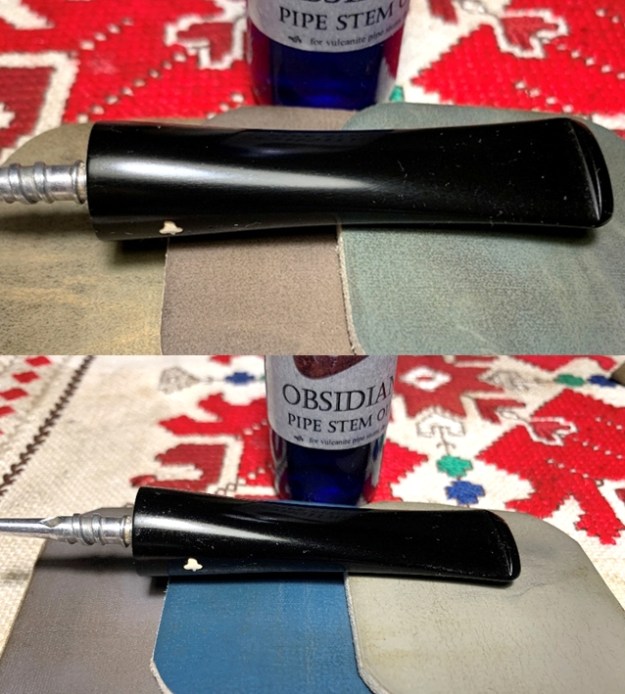
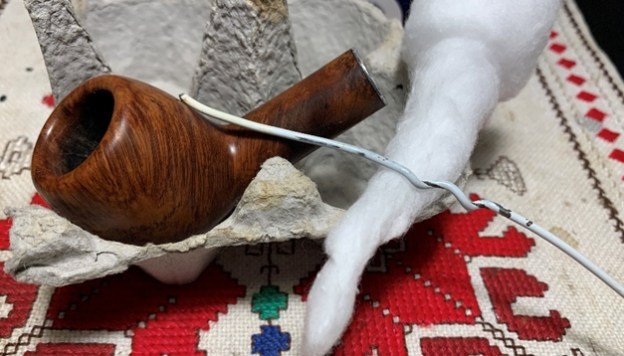
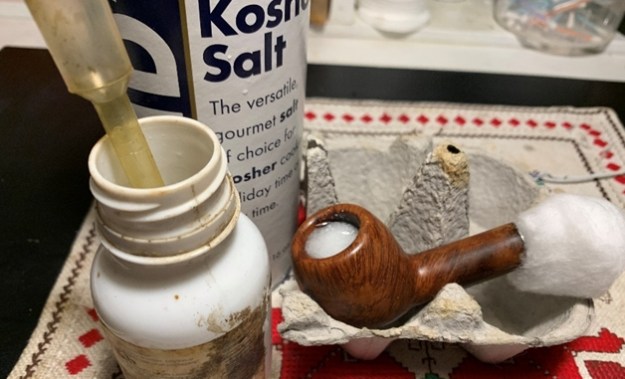
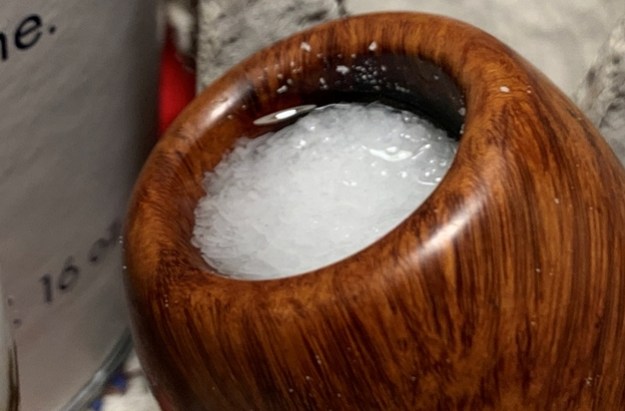
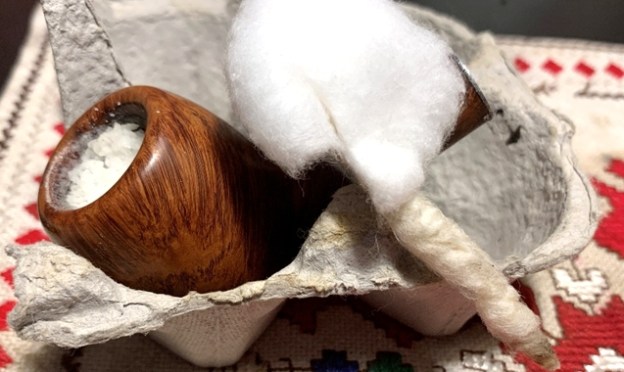
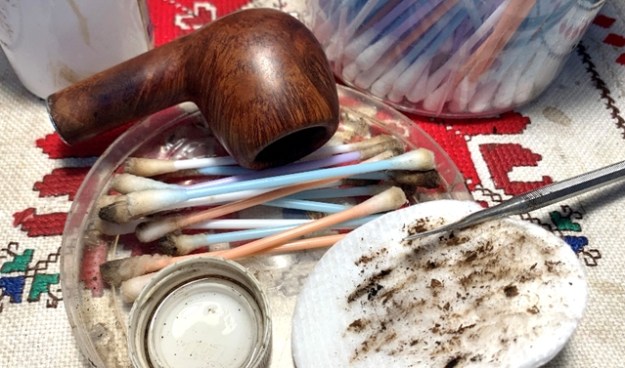
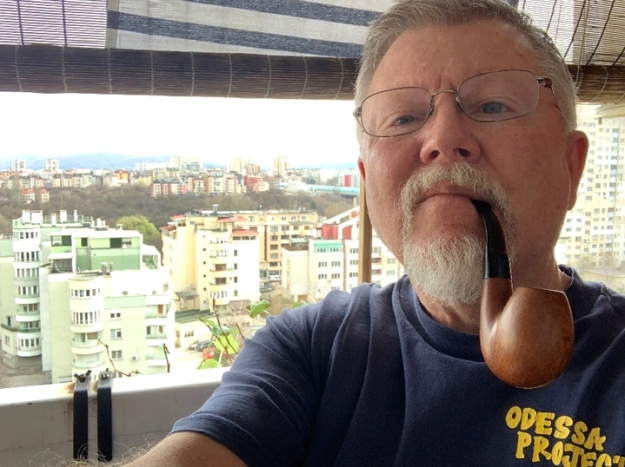
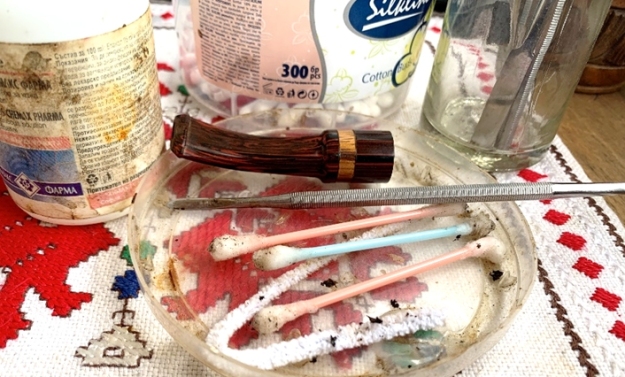
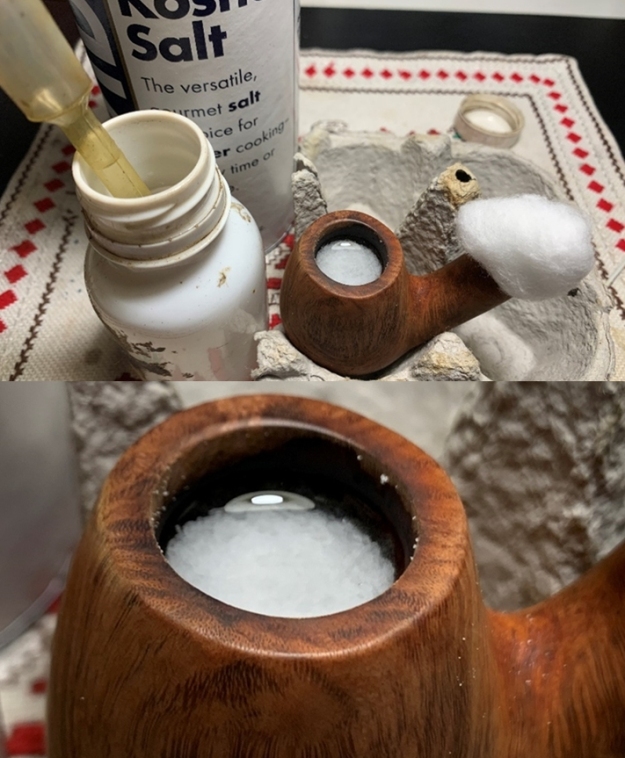
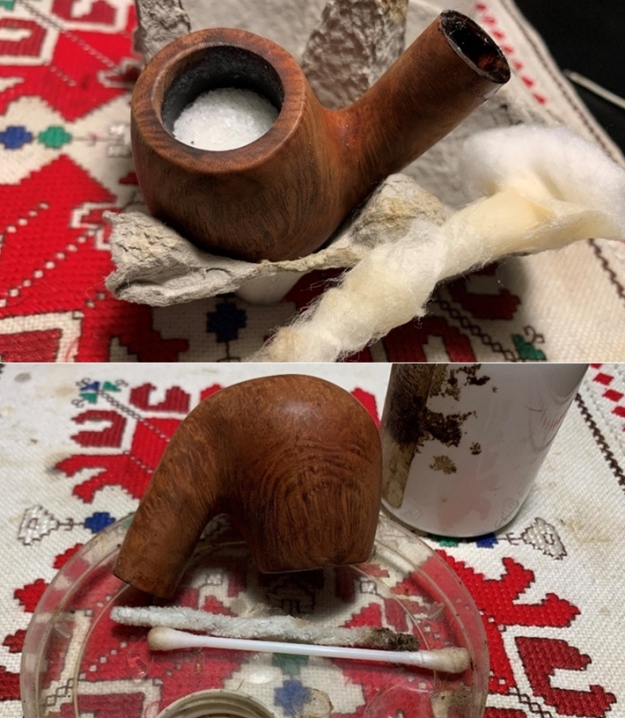
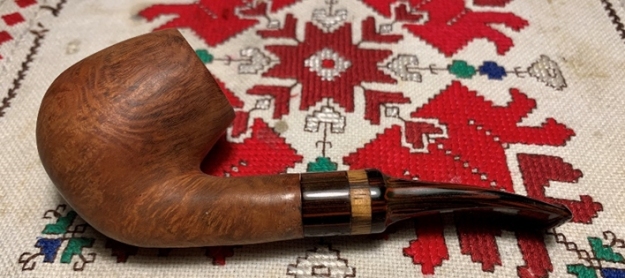
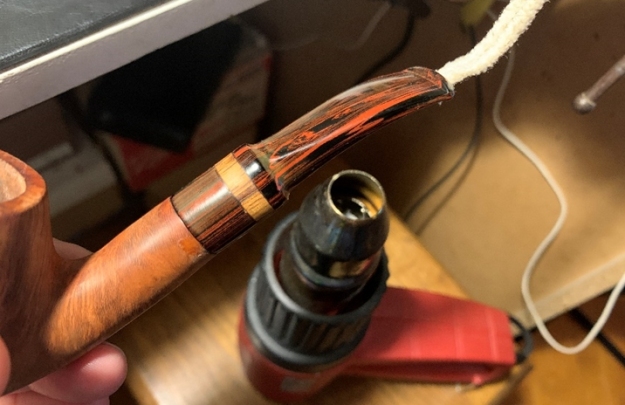
The condition of the pipe is generally good.  The chamber appears to have been reamed but I will clean it further.  The bowl shows nice grain and is generally in clean condition and the grain on the Brandy shape is very nice showing no fills.  The Cumberland stem shows almost no tooth chatter.  One issue is that the 9mm filter holder has separated from the stem and is stuck in the shank.  Care is needed in dislodging the plastic tube – breaking it will not be good.  The lighting is a bit different with the picture below since I’m using natural light while on my ‘Man Cave’ balcony enjoying spring weather on the 10 floor – with a great view!  A cameo appearance enjoying my L. J. Peretti Giant Egg loaded with Peretti Tobacconist of Boston’s, Black Virginia. A delightful time! To dislodge the filter holder from the shank, I put the bowl in the freezer with the hope that the cooling of the wood might help loosen it. While in the freezer, I turn to the Cumberland stem and clean the internals with pipe cleaners and cotton buds wetted with isopropyl 95%.  A small dental spoon tool is used to scrape the internal cavity of tars and oils. The upper and lower bit shows roughness which needs to be removed. Using 240 grade paper, I sand the upper and lower bit area as well as the button.Following the 240 paper, I wet sand the entire stem with 600 grade paper and follow with applying 000 steel wool.  I avoid the ‘Mortensen’ stamping on the top of the stem saddle section.Next, using the full regimen of 9 micromesh pads, I wet sand the stem with pads 1500 to 2400, then dry sand with pads 3200 to 4000 and 6000 to 12000.  Between each set of 3 pads, Obsidian Oil is applied to rejuvenate and protect the stem from oxidation. Moving back to the stummel – I had placed the stummel in the freezer in hopes that it would enable me to extract the plastic filter sheath.  After taking the bowl out of the freezer, I am able to hand turn the sheath and it comes out easily.  After taking another look at the chamber, the reaming job that had been done on it was not enough.  There remained carbon residue.  Using the Pipnet Reaming kit, I use 2 of the 4 blades available – starting with the smallest.  I follow this by using the Savinelli Fitsall Tool to scrape the chamber walls further.  To finish, I use 240 grade paper wrapped around a Sharpie Pen to sand the chamber to remove what carbon cake remained to expose fresher briar. After cleaning the chamber with a cotton pad wetted with isopropyl 95%, I inspect the chamber, and all looks good – no signs of heating problems.Next, moving to the external cleaning, using undiluted Murphy’s Oil Soap on a cotton pad, I scrub the briar surface.  Following this, I take the bowl to the kitchen sink and clean the mortise and airway with shank brushes and anti-oil liquid dish soap.  After scrubbing the internals well with hot water, I rinse the bowl thoroughly and transfer it back to the worktable and take a few pictures of the now cleaned surface – it looks good. Using pipe cleaners and cotton buds wetted with isopropyl 95%, I continue cleaning the internals.  A small dental spoon also works well to scrape old tars and oils off the mortise walls.  In time, the buds and pipe cleaners begin to emerge lighter and I call this phase of the internal cleaning finished.With the hour being late, I continue the internal cleaning using a kosher salt and alcohol soak.  After twisting and pulling a cotton ball to form a mortise ‘wick’, I use a stiff wire to help guide it down the mortise toward the draft hole.  The wick helps to draw out the old tars and oils to clean and refresh the bowl. Kosher salt is then used to fill the bowl which leaves no after taste and helps to freshen the briar.  With the bowl stabilized in an egg carton, a large eye dropper fills the chamber with isopropyl 95% until it surfaces over the salt.  After a few minutes, the alcohol is drawn into the salt and cotton wick, and I top it off one more time and turn out the lights.The next morning, I was surprised to see almost no soiling of the salt and cotton wick.  This means that the internals are clean indeed!  After removing the expended salt, wiping the chamber with paper towel, and forcefully blowing through the mortise, the expended salt residue is removed. I follow with a pipe cleaner and cotton bud dipped in isopropyl 95% to be sure all is clean.Before bending the Cumberland stem, the filter sheath needs to be reattached so that the stem can be seated correctly in the mortise.  The ribbing on the heavy plastic sheath clearly defines the correct orientation.  Using thick CA glue, a small amount of glue is applied around the ribbing of the sheath and a toothpick helps to spread it.  The sheath is then inserted firmly into the stem cavity and allowed to cure.With the sheath firmly in place, the filter sheath tenon seats well into the mortise.Next on the project list – to provide the Cumberland stem with a bend.  Ideally, the stem orientation should roughly parallel the plane of the rim.  The shortness of this stem creates a challenge for such a tight bend.  The diagram below shows the estimated bend and orientation that is the goal.  To be on the safe side, I insert two pipe cleaners into the airway to safeguard the integrity of the airway with the tight bend.  Using the hot air gun, I gradually and patiently warm the stem where the bend is to occur.  The pipe cleaners extending out from the stem are useful as a handle as the hot air warms the Cumberland blend of black and red vulcanite and becomes supple.When the stem becomes sufficiently supple from the heating, I gently bend the stem over a block of wood tightened in the vice.  The rounded curve on corner of the block acts as the mold to provide a tight even bend.After the stem is bent over the block, I hold it steady to allow the rubber to cool by itself.  After the stem firms up in its bend, I then take it to the sink and run cool water over the stem to solidify the bend.  The first attempt is good.  After taking it back to the worktable and placing it on the template I drew, I’m satisfied with the orientation of the bend.  The pipe cleaners do the job and they come out with a little tugging.The bend is good, but after a quick inspection, the underside of the stem has rippled.  This affect can happen with a sharp bend and I probably should have bent the stem sooner in the process before the stem sanding.  We learn with each restoration! To remove the rippling on the underside of the stem resulting from bending the stem, I do a quick detour with 240 grain paper, followed by 600 grade and 000 steel wool.  A quick run through all 9 micromesh pads, 1500 to 12000 with Obsidian Oil between each set of 3, bring the stem back to an acceptable state!  I move on. With the stem now on the sidelines, I focus on the Borge Mortensen stummel.  Not wishing to contribute to the erosion of the Thor’s Hammer Shield nomenclature, I cover the area with masking tape.  Beginning with the rim, there is residual darkened briar from the former steward’s lighting the chamber.  To address this, I use 240 grade sanding paper to sand very gently to clean the rim.  I also sand the interior rim edge to clean and freshen.Following the 240 sanding, I provide a gentle topping using medium and light grade sanding sponges.  This cleans the rim up well.Next, taking the bowl to the sink, I wet sand the stummel with pads 1500 to 2400 and dry sand with pads 3200 to 4000 and 6000 to 12000.  Wow!  I think for the first time in this restoration I’m taking note of the beautiful use of the grain in this Danish Bent Brandy shape. Mark Hoover’s Before and After Restoration Balm works wonders.  After putting a small amount on my fingers, I work the Balm into the briar surface.  The Balm brings out the more subtle tones of the briar hue.  After applying the Balm and letting it set for about 10 minutes, I use a microfiber cloth to wipe off the excess Balm and then buff up the briar surface.While I was waiting for the Restoration Balm to do its thing on the stummel, I apply Before & After Fine and Extra Fine Polish to the Cumberland stem. I start with the Fine Polish applying it to my finger and then rubbing it into the stem.  After rubbing it in, I leave it for about 10 minutes then wipe off the excess with a cloth.  The next stage is applying the Extra Fine Polish in the same way.  Mark’s claim for this product is that it not only rejuvenates but it continues the process of removing oxidation.  After the stem sets for about 10 minutes with Extra Fine Polish on it, again the excess is wiped off with a cloth and the stem is buffed.Now in the home stretch.  After rejoining the stem and stummel, a cotton cloth buffing wheel is mounted to the Dremel to apply Blue Diamond compound to stem and stummel.  With the speed set at about 40% full power the fine abrasive is applied to the surface.Following the application of the compound, after changing to another cotton cloth buffing wheel on the Dremel, maintaining the same speed, carnauba wax is applied to the entire pipe.  After the wax it applied, using a microfiber cloth, I give the pipe a rigorous hand buffing to raise the shine.The grain on this Borge Mortensen Handmade in Denmark is stunning.  The Bent Brandy shape uses the flow of the grain as it moves upwardly toward the top of the Brandy rim – the distinctive bird’s eye grain on the heel of the Brandy corresponds to the vertical grain.  The Cumberland stem is nice and the bend sets the right balance.  Todd commissioned this Borge Mortensen benefitting the Daughters of Bulgaria and he will have the first opportunity to acquire it in The Pipe Steward Store.  Thanks for joining me!

Another Fun Restore from Bob Kerr’s Estate – A BBB 2 Star Apple 11


Blog by Steve Laug

Even with the COVID-19 warnings rolling in incessantly I am still working on pipes! It keeps my mind busy and focused and not to get carried away with the sense of powerlessness. There is no reason to not enjoy the time alone at the work table bringing these old-timers back to life. After brief foray restoring pipes referred to me by my local pipe shop I am back to Bob Kerr’s estate (his photo is to the left). If you have not “met” the man and would like to read a bit of the history of the pipeman, his daughter has written a great tribute that is worth a read. Because I have included it in over 60 restorations to date I thought that I would leave it out this time. Be sure to check out some of the recent Dunhill restoration blog (https://rebornpipes.com/2020/01/01/restoring-the-last-of-bob-kerrs-dunhills-a-1962-dunhill-bruyere-656-f-t-bent-billiard/).

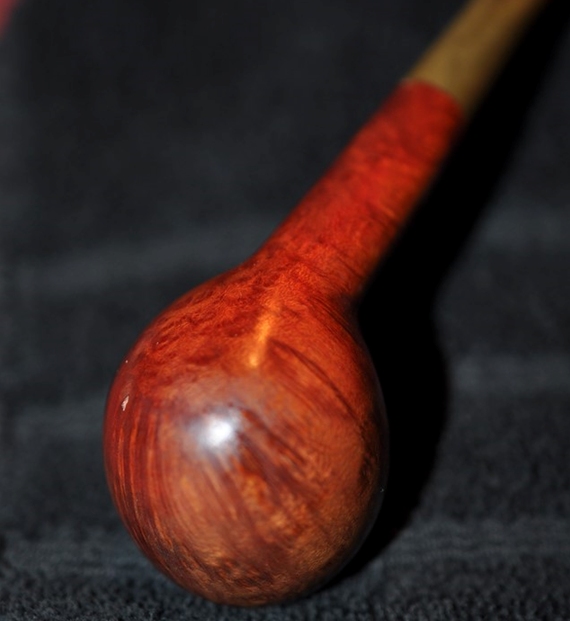
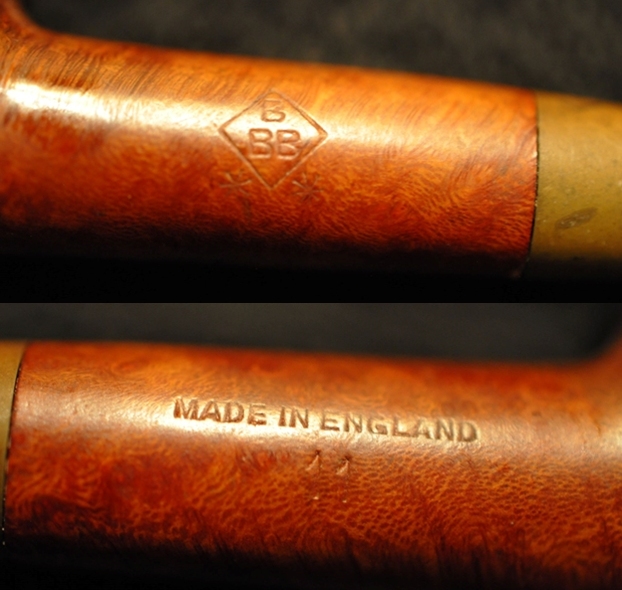
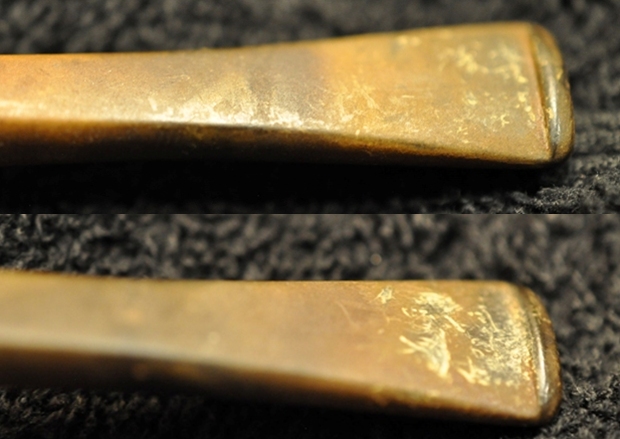
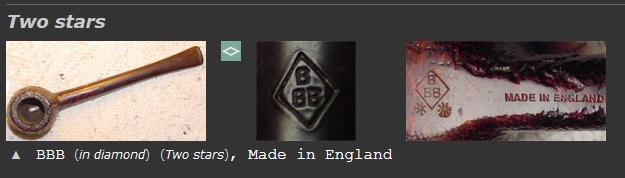
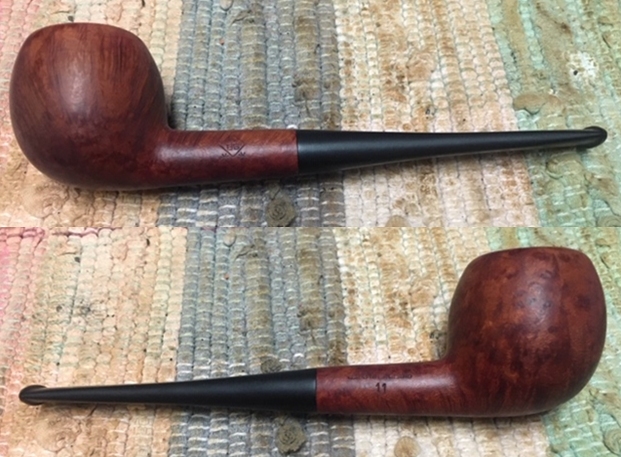
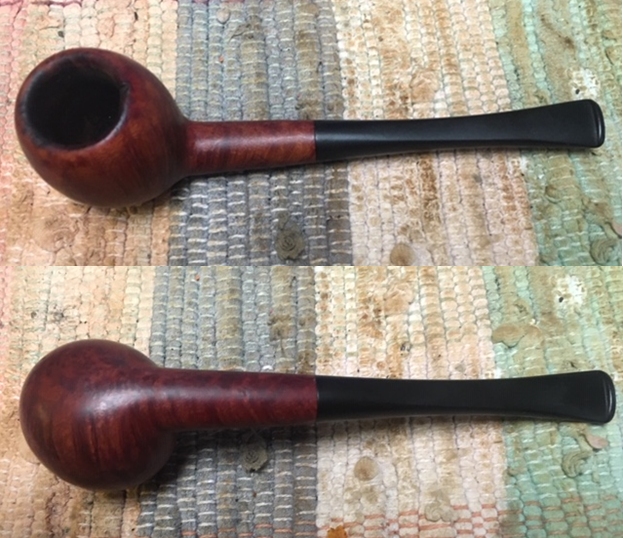
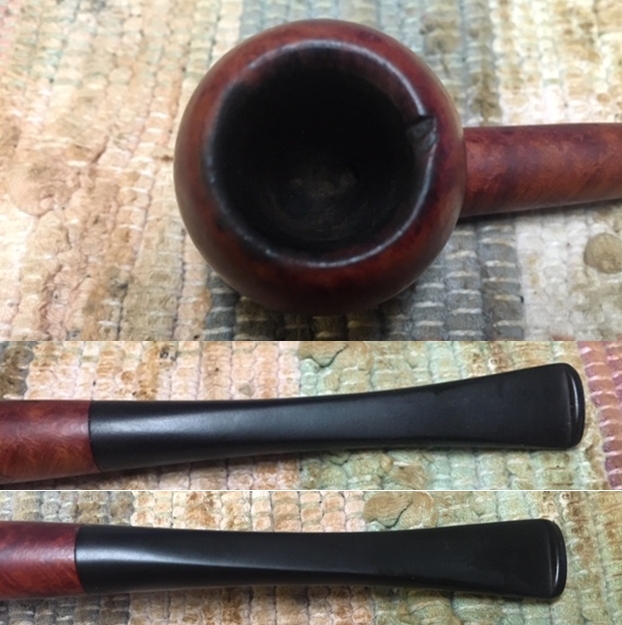
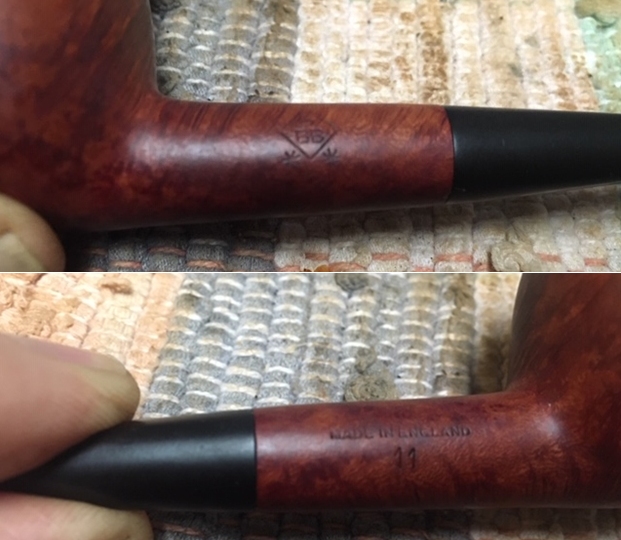
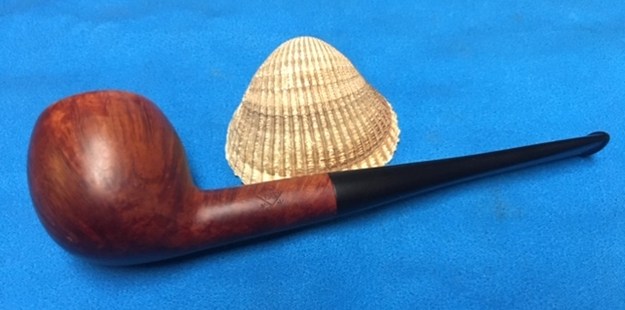
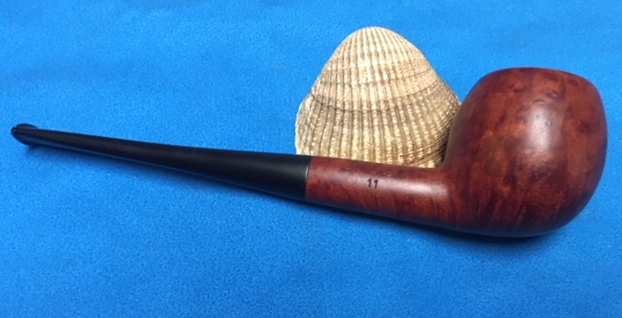
The next pipe I have chosen from his estate is an interesting looking Apple with a slender stem. It is stamped BBB in a diamond on the left side of the shank with a Star on each side of the diamond. On the right side of the shank it is stamped Made in England over the shape number 11. The slender stem does not bear the BBB brass logo. The tapered stem is oxidized and has tooth marks and chatter on both sides near the button. There is some calcification on the stem with damage to the button. The finish is worn and dirty. There is a thick cake and lava overflow on the rim top. There is some damage on top & edges. There appears to be some chips out of the thin rim top/edge that will need to be addressed in the restoration. Jeff took photos of the pipe to show its general condition before he did his cleanup. The finish on the pipe was very dirty – grime and grit from years of use and sitting fill the crevices in the rustication. The rim top was covered with a coat of thick lava that overflowed the bowl. There was also some darkening and chipping damage on the rim top. The bowl itself had a thick cake with flecks of tobacco stuck in the cake on the sides.Jeff took photos of the sides and the heel of the bowl to give a better feel for the grain around the bowl. He took a photo of the stamping on the sides of the. You can see that the stamping is very clear. On the left side it reads BBB in a diamond with a star on each side of the base. On the right side it reads Made in England over the shape number 11.The stem was dirty and extremely oxidized. Once again the stem appeared to be a replacement as I have learned Bob was a chewer and his stems seemed to have been replaced often. This one at least fit well to the shank and did not yet have the chew marks that were a norm on Bob’s pipes.Before I started my work on the pipe I decided to read a bit of BBB history to remind myself how the two stars fit into the hierarchy of BBB pipes. I turned first to Pipephil’s site (http://www.pipephil.eu/logos/en/logo-bbb.html). I have included a screen capture to show the stamping on the pipe. At this point I still did not know how it fit. Also the pipe I was working on did not have the BBB Diamond or Brass logo on the stem.I turned to Pipedia to see what I could gather there about the hierarchy of the Two Star pipe (https://pipedia.org/wiki/BBB). I read through the page and found some more information. I quote a pertinent section of the article that give the information that I was hoping for and expecting.

…In the Thirties, the top-of-the-range one becomes “BBB Best Make” with alternatives like “Super Stopping” and “Ultonia Thule”. The BBB Carlton, sold with the detail with 8/6 in 1938, is equipped with a system complicated out of metal, system which equipped the BBB London Dry too. Blue Peter was not estampillées BBB but BBB Ultonia, and the BBB Two Star (* *) become the bottom-of-the-range one.

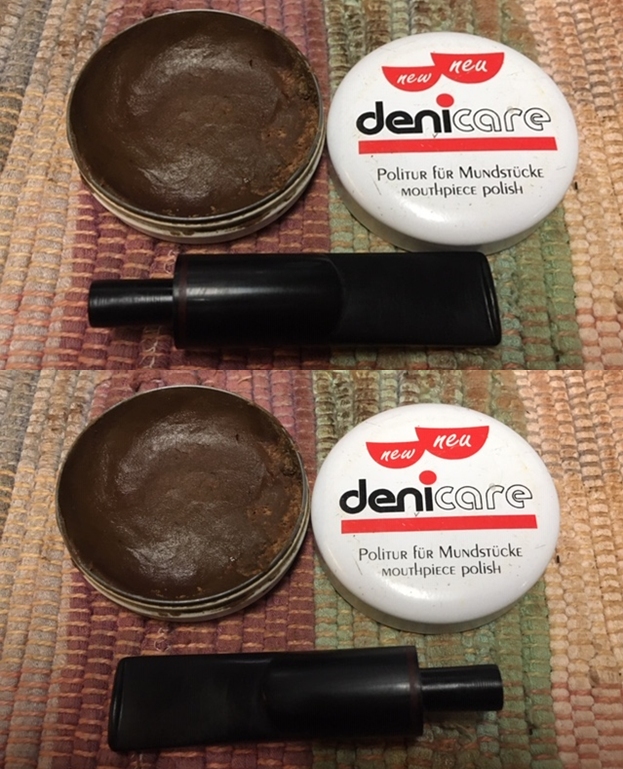
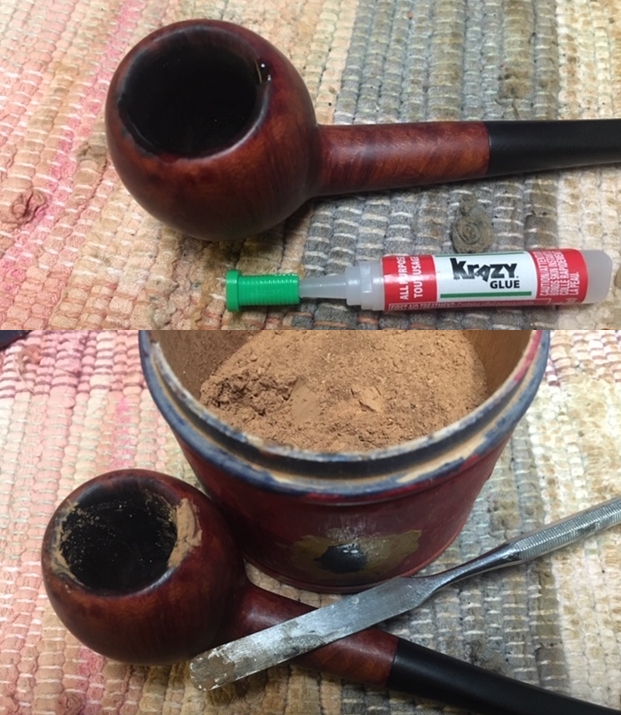
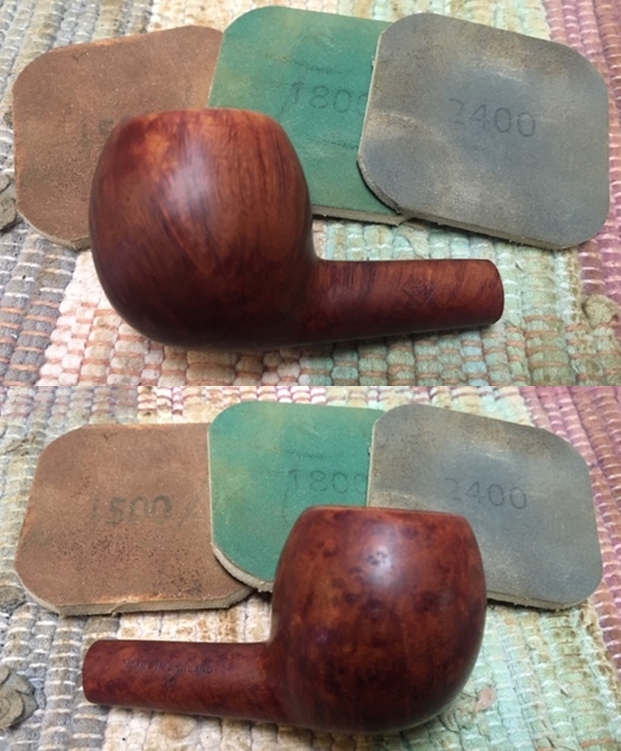
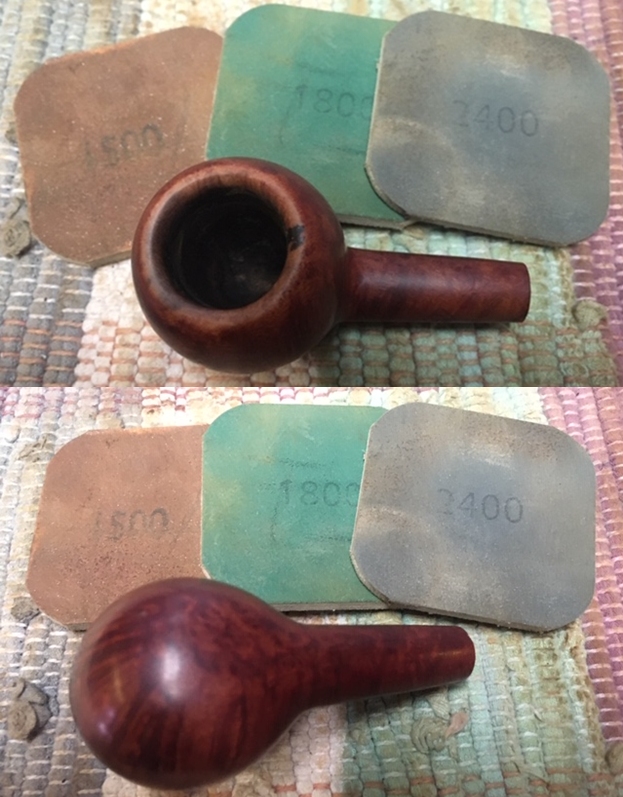
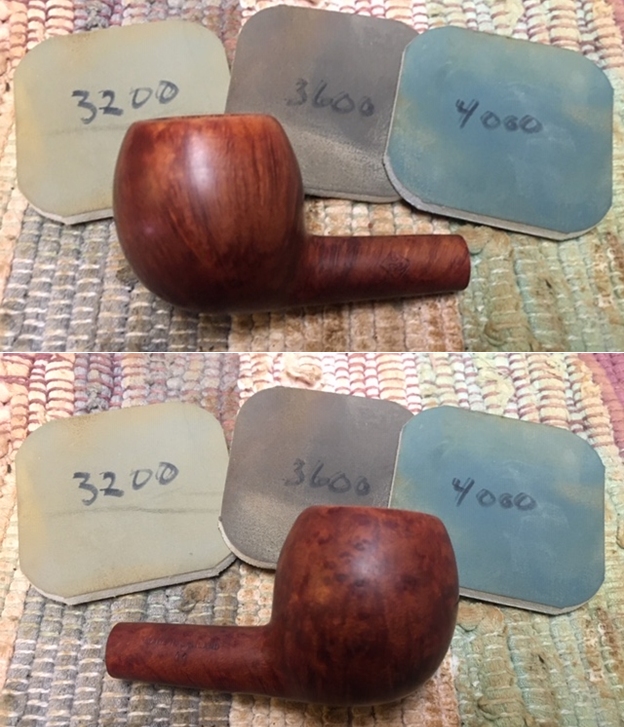
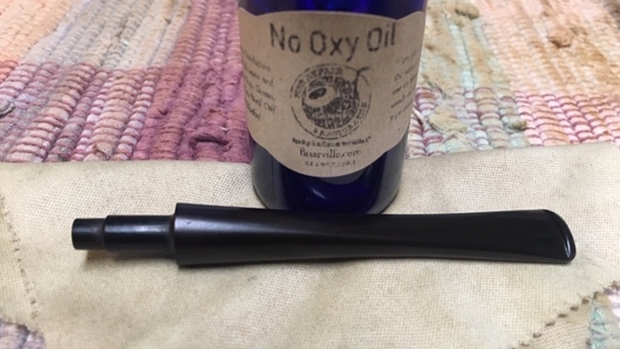
Now I knew about where the Two Star fit – at the bottom of the range. Armed with that information it was time to work on the pipe. Jeff cleaned this filthy pipe with his usual penchant for thoroughness that I really appreciate. This one was a real mess and I was looking forward to seeing what he had done with this one when I took it out of his box. It looked amazing and CLEAN and other than the stem work needing a little effort on my part. He reamed the bowl with a PipNet pipe reamer and cleaned up the reaming with a Savinelli Fitsall Pipe Knife. He scrubbed out the internals with alcohol, pipe cleaners and cotton swabs until the pipe was clean. He scrubbed the exterior of the bowl with Murphy’s Oil Soap and a tooth brush to remove the grime and grit on the briar and the lava on the rim top. The finish looks good with great looking grain around the bowl and shank. The rim top and front of the bowl was severely damaged with burns. The condition of the inner and outer edges was rough. The stem looked a lot better but damage was evident on the button. Jeff soaked the stem in Before & After Deoxidizer to remove the oxidation on the rubber. The pipe was ready for me to carry on the next part of the process. I took some close up photos of the rim top and also of the stem surface. I wanted to show how well it had cleaned up. The rim top was clean and the damage was very evident. There were several chips on the edge of the rim top with the largest being at the back of the bowl.  I also took close up photos of the stem to show how well surface looked on both sides. I took a photo of the stamping on the sides of the shank. You can see that it is stamped as noted above.I decided to start my restoration work on this one by dealing with the damaged rim top. I filled in the damaged areas with a drop of clear Krazy Glue (CA) and then pressed some briar dust into the glued areas with a dental spatula. I set the bowl aside to dry overnight.   I sanded the repaired areas with 220 and 400 grit sandpaper to shape the repaired areas and blend them into the rest of the bowl. I also worked over the edge and top to minimize the darkening to the edges.I polished the briar with micromesh sanding pads – wet sanding it with 1500-12000 grit pads. After each pad I wiped the briar down with a damp cloth. I touched up the rim top colour with a Maple Stain Pen to match the colour of the rest of the bowl. I let it dry and buffed it by hand.I worked some Before & After Restoration Balm into the surface of the briar with my fingertips to clean, enliven and protect the briar. I let the balm sit for a little while and then buffed with a cotton cloth to raise the shine. The photos show the bowl at this point in the restoration process. With that done the bowl was finished other than the final buffing. I set it aside and turned my attention to the stem. I sanded out the remaining tooth marks and chatter with 220 grit sand paper to blend them into the rest of the stem surface. I started to polish it with a folded piece of 400 wet dry sandpaper. Once it was finished it had begun to shine.        I polished the stem with Denicare Mouthpiece Polish from a tin of it I have in the drawer here. It is a gritty red paste that I rub on with my finger tips and work into the surface of the stem and button and buff off with a cotton pad. It gives me a bit of a head start on the polishing work.  I polished the stem with micromesh sanding pads – wet sanding with 1500-12000 grit sanding pads. I wiped it down after each sanding pad with Obsidian Oil. I polished it with Before & After Pipe Stem Polish – both Fine and Extra Fine. I am continuing to experiment with Briarville Pipe Repairs new product, No Oxy Oil so I rubbed the stem down with the oil on the cloth that was provided with it. This BBB Two Star 11 Apple was another interesting pipe to work on. It is a classic shaped Apple. It has a tapered vulcanite stem that I am pretty certain is a replacement stem. The grain on the pipe is very nice and the shape has a great look and feel in the hand. The smooth finish is beautiful and highlights the grain. The repaired rim top looks very good and blends in well. I polished stem and the bowl with Blue Diamond polish on the buffing wheel. I gave the bowl and the stem multiple coats of carnauba wax. I buffed the pipe with a clean buffing pad to raise the shine. I hand buffed it with a microfiber cloth to deepen the shine. The pipe polished up pretty nicely. The deeply grained briar took on life with the buffing. The rich browns of the briar works well with the polished vulcanite stem. The finished pipe has a rich look that is quite catching. Have a look at it with the photos below. The shape, finish and flow of the Apple are very well done even with the replacement stem. The dimensions are Length: 5 ½ inches, Height: 1 ½ inches, Outside diameter of the bowl: 1 ¼ inches, Chamber diameter: ¾ of an inch. It is a beautiful pipe and one that will be on the rebornpipes store soon. If you are interested in adding it to your collection let me know. Thanks for walking through the restoration with me as I worked over this pipe. 

Refurbishing A Preben Holm # 3 Freehand Pipe


Blog by Paresh Deshpande

The first ever Preben Holm in my collection was from eBay about two years back. It came to me with a broken stem and tenon stuck in to the mortise. This pipe received a new lease on life in the month of May last year when Steve, Jeff and Dal Stanton visited me here in India. I learned the process of tenon replacement along with many other tips and processes in pipe restoration. Here is the link to the informative write up by Steve on this pipe; https://rebornpipes.com/2019/05/14/restoring-a-preben-holm-hand-cut-sandblast-freehand-in-pune-india/

The second Preben Holm in my collection came from my Mumbai Bonanza, which I really enjoyed working on; (https://rebornpipes.com/2019/08/12/refurbishing-a-tired-preben-holm-1-from-the-mumbai-bonanza-lot/) .

The Preben Holm, currently on my work table, came to me from a seller on eBay along with another Preben Holm. Both these pipes had some serious stem issues which really kept other buyers away from placing their bids and lucky me, I got both these pipes for a really good price. Even though both pipes came to me together, I shall be working on them separately since they each have different set of issues involved.

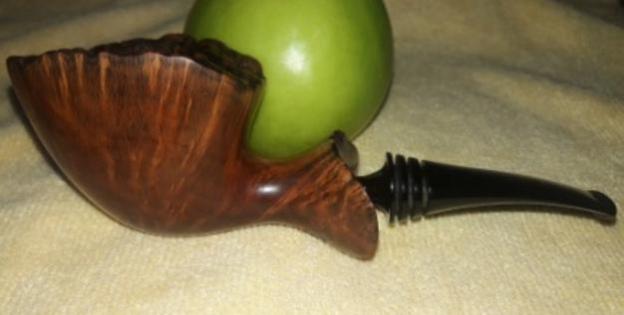
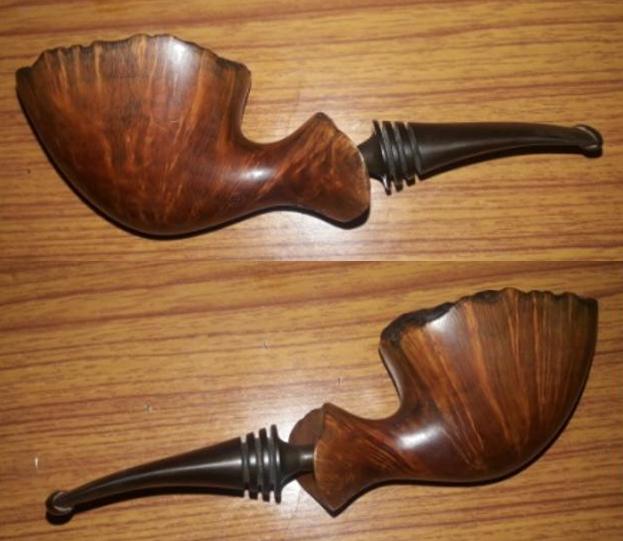
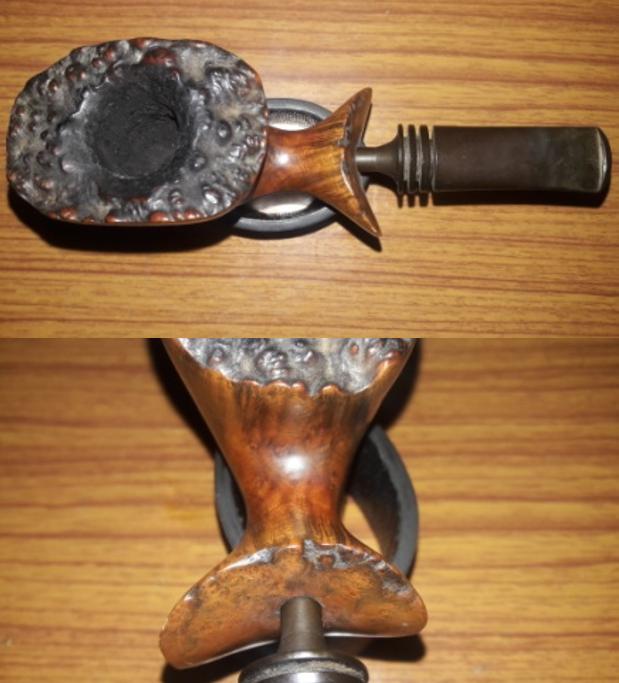
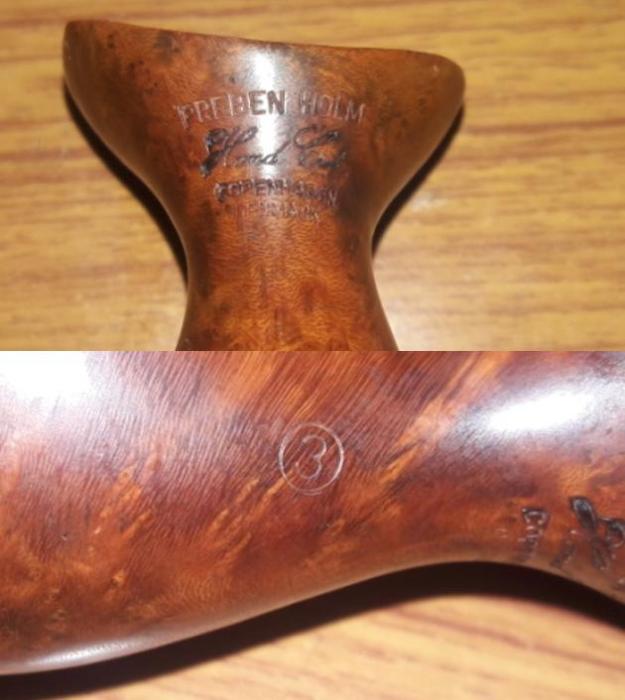
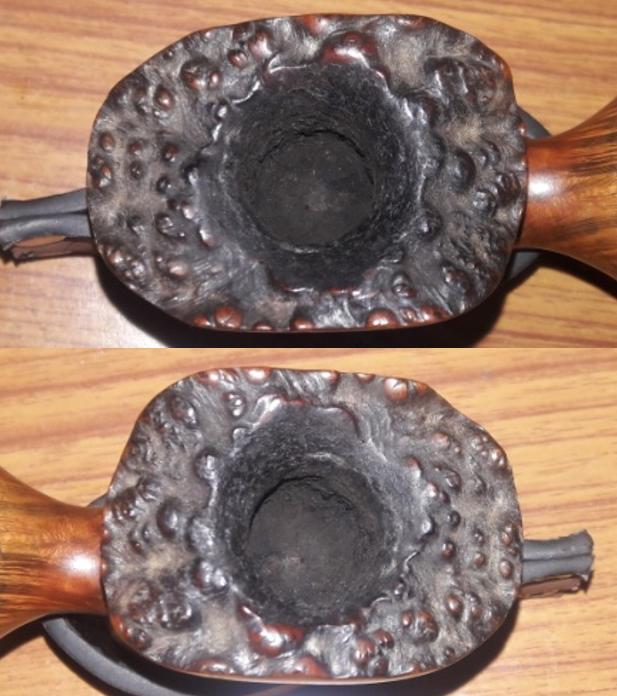
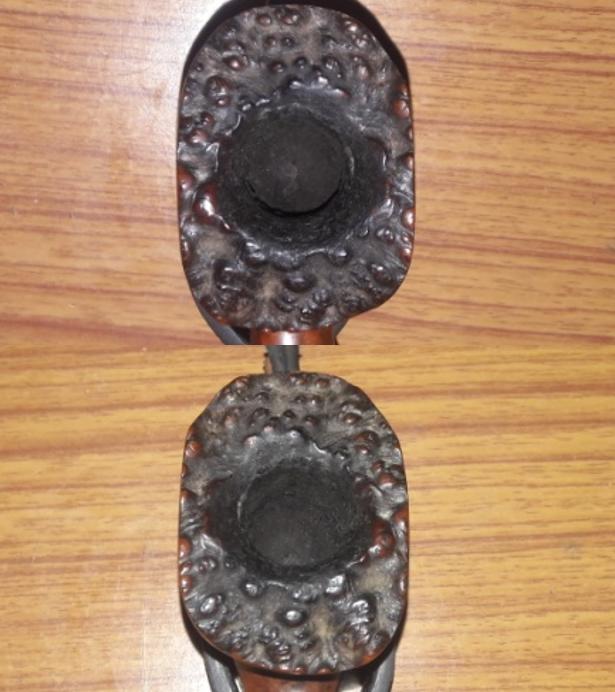
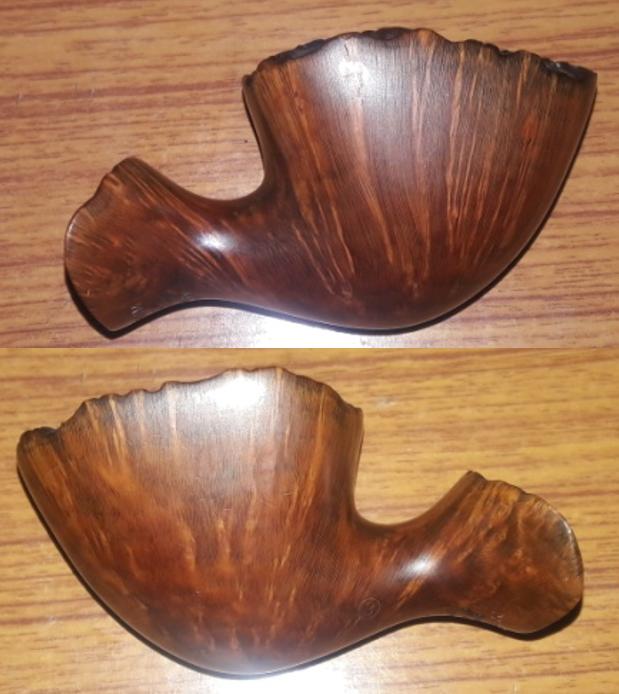
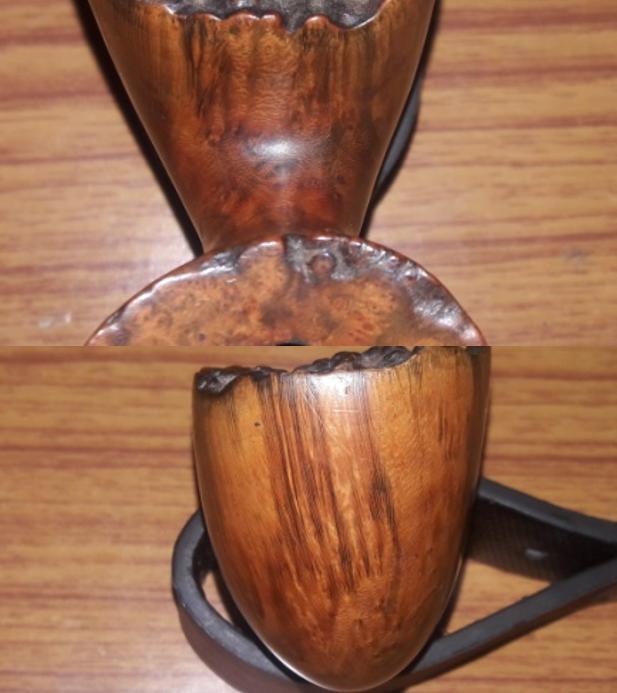
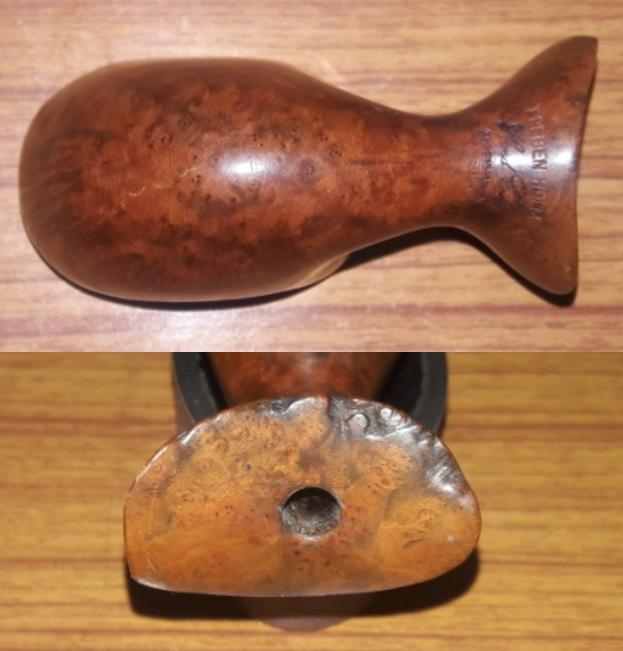
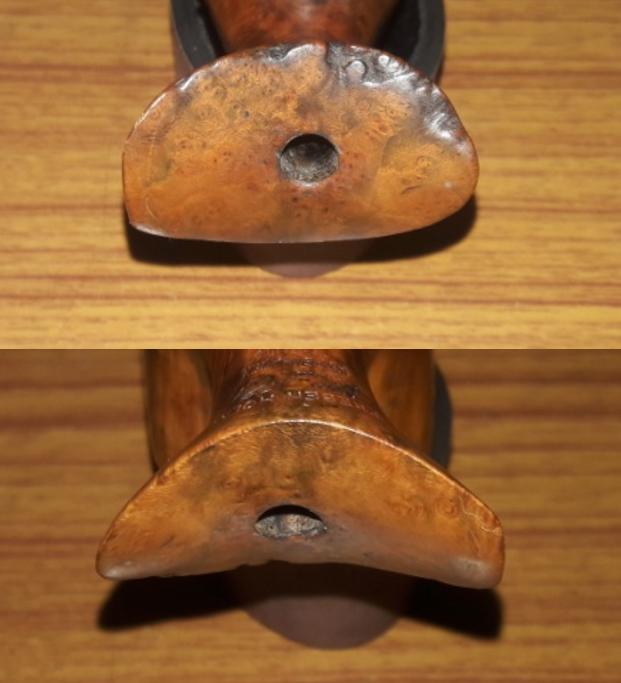
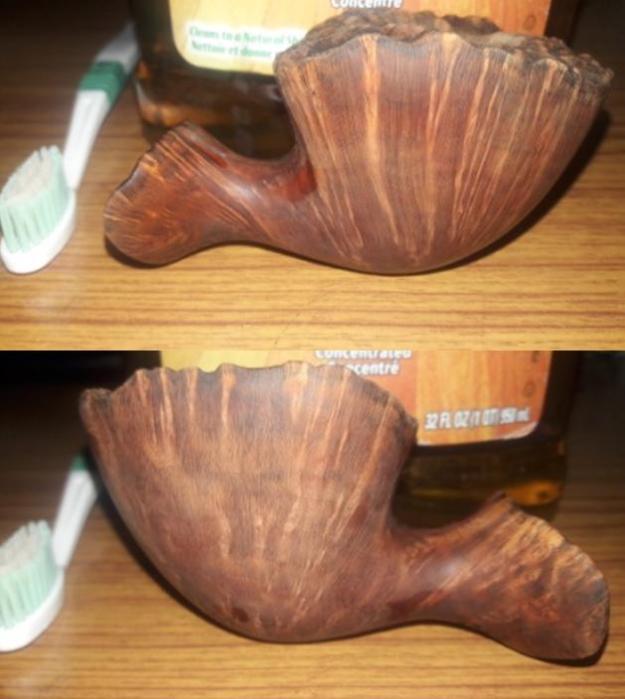
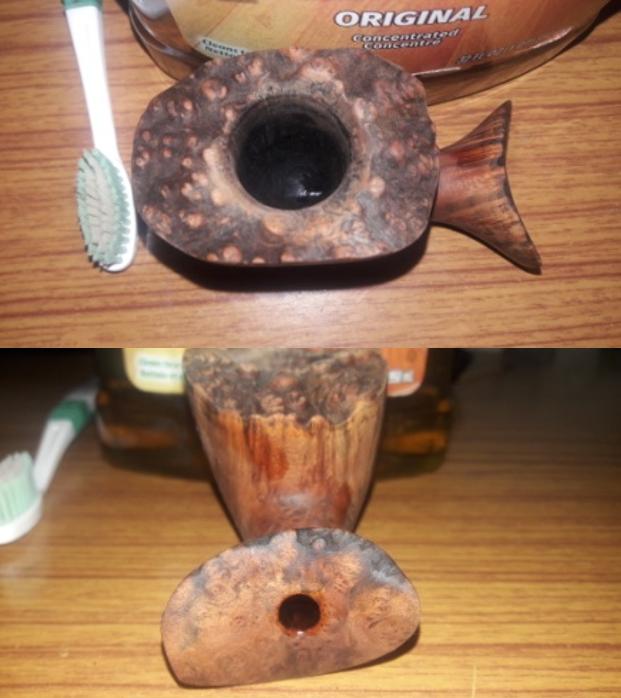
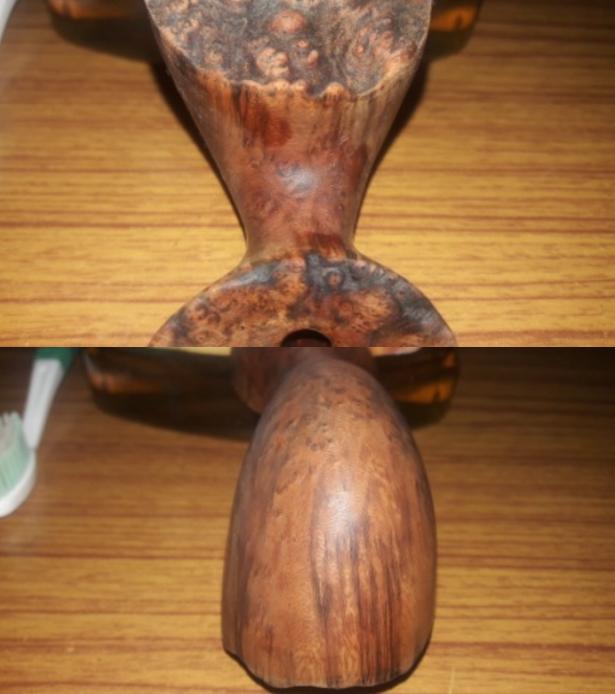
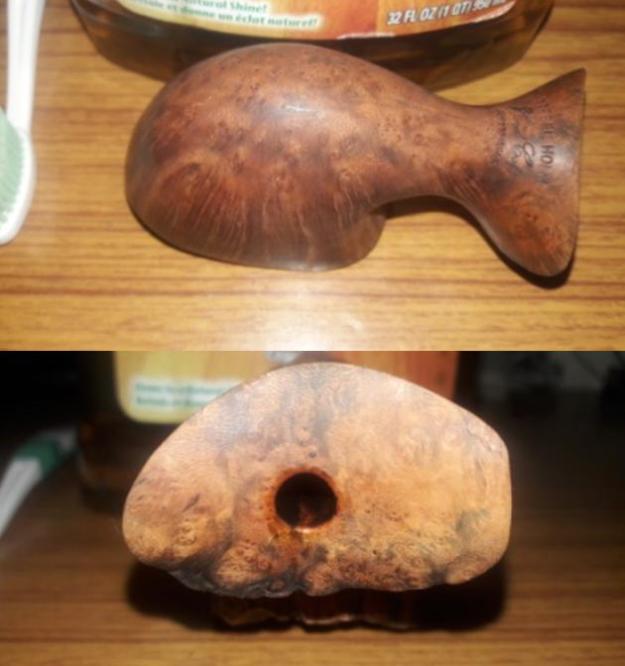
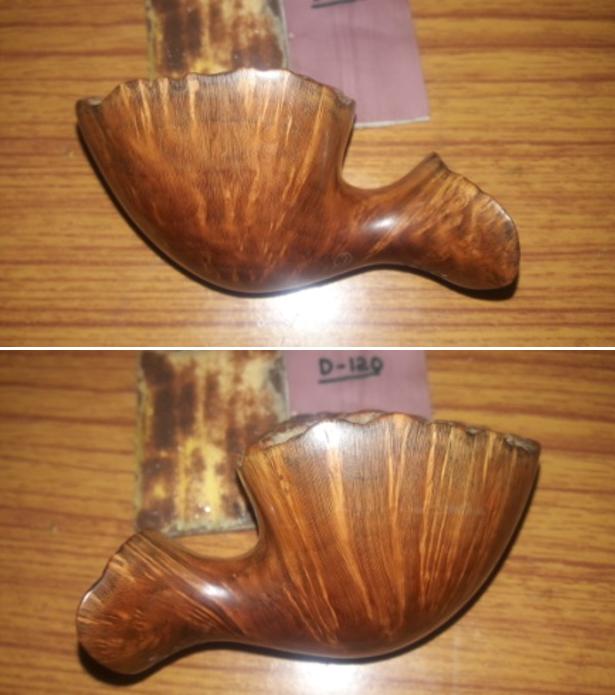
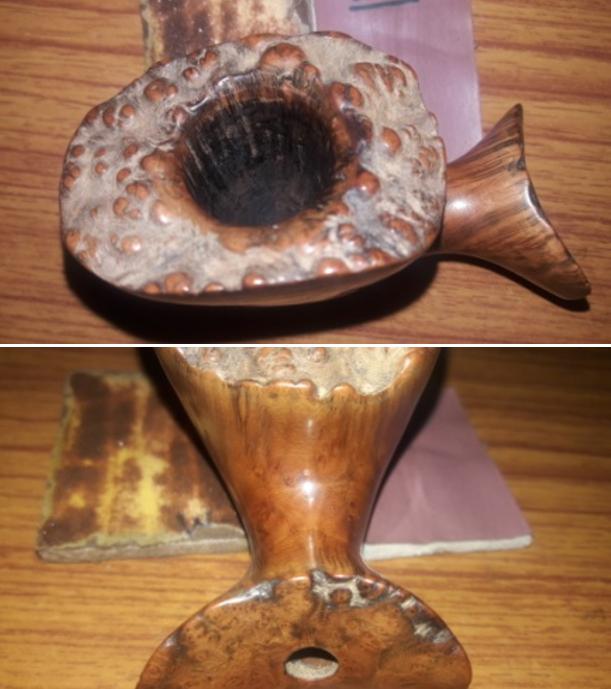
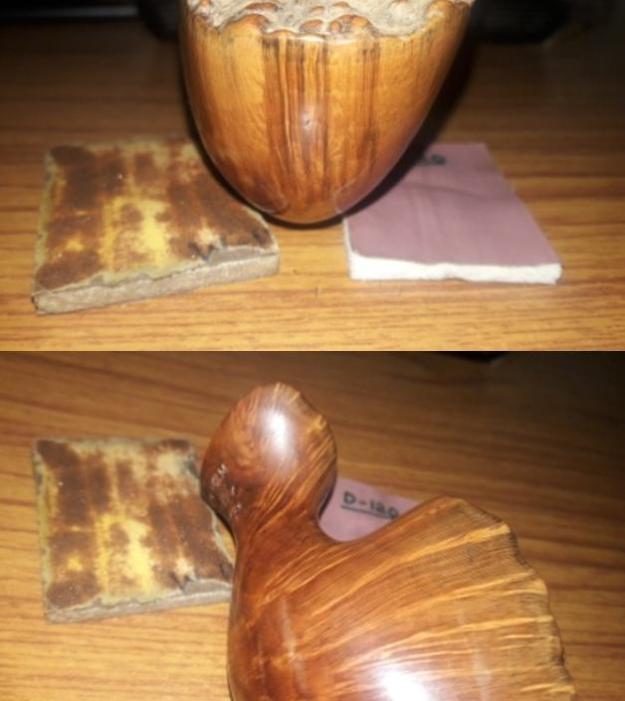
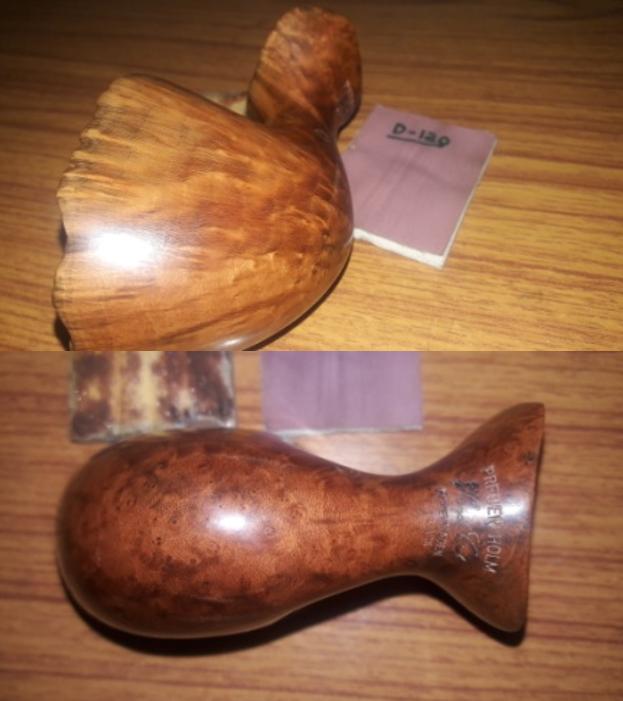
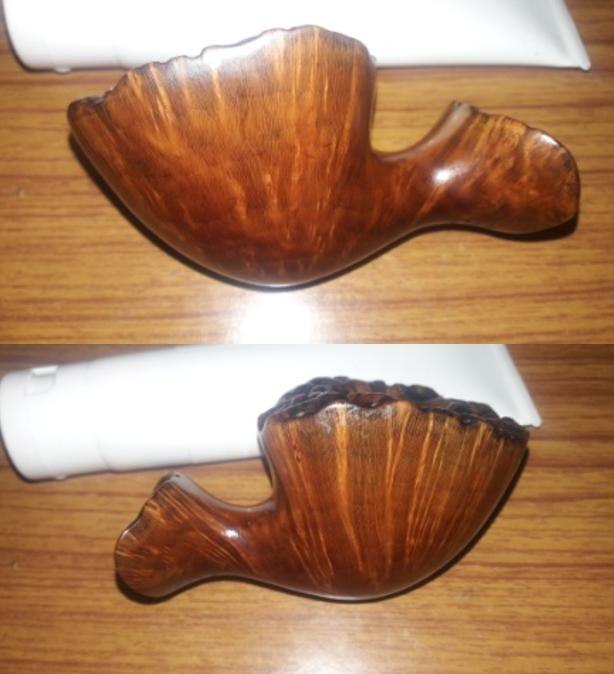
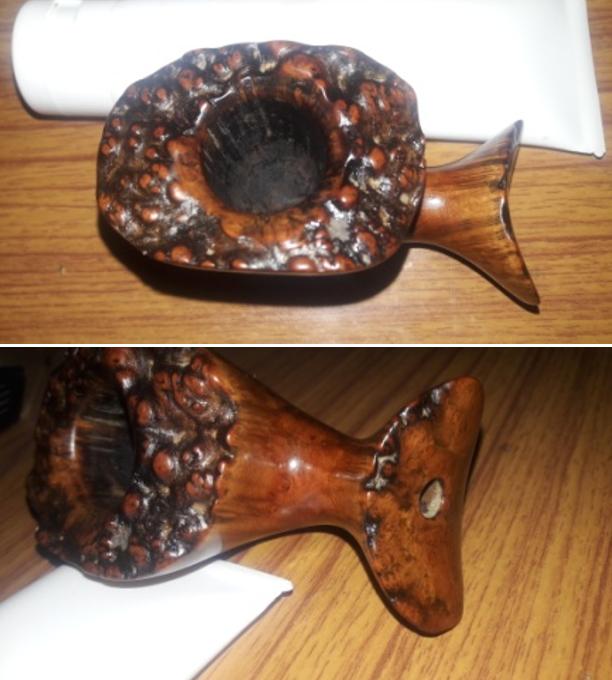
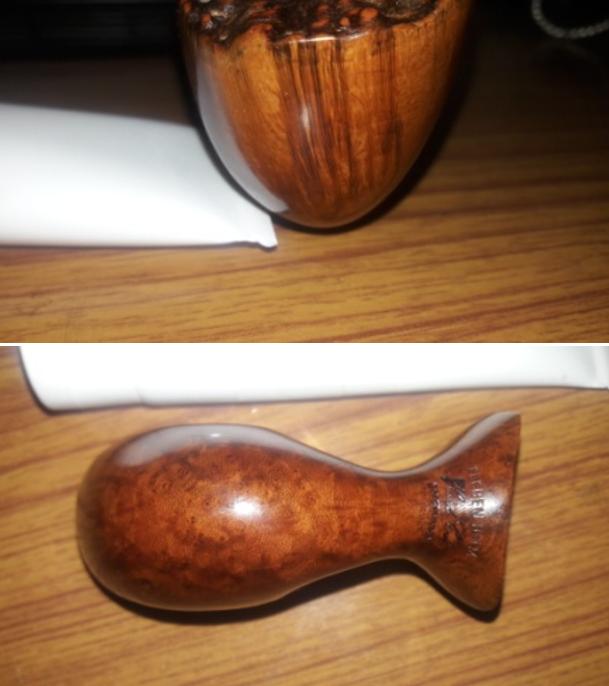
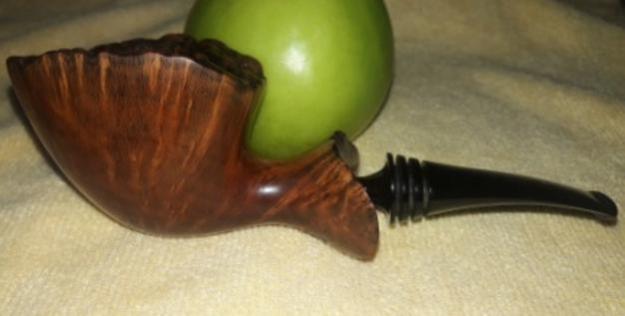
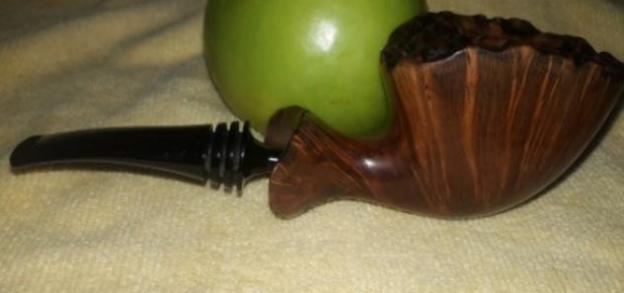
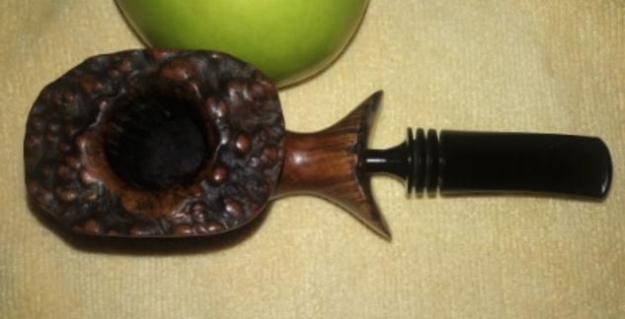
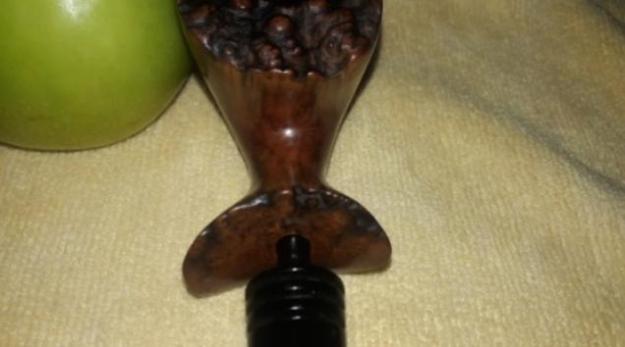
The first PH that I selected to work on is a beautiful freehand with some great flame grains all around the stummel and shank and bird’s eye at the foot of the stummel. The shank end has a nice large outward flare with a flattened lower edge, akin to a large whale tail fin. The rim top is a nice plateau with the shank end flare showing minor plateau along the upper outer edge, similar to the scars on a tail fin of a whale that has seen a few skirmishes in its lifetime. Here are the pictures of the pipe as it sits on my work table.   The pipe is stamped on the bottom of the flared shank end as “PREBEN HOLM” in block capital letters over “Hand Cut” in a cursive artistic hand over “COPENHAGEN” over “DENMARK”, all in block capitals. The left side of the shank bears the encircled numeral “3”. All the stampings are crisp and easily readable. The fancy vulcanite stem is devoid of any stampings.There is a lot of interesting information on the carver, Preben Holm, on pipedia.org (https://pipedia.org/wiki/Holm,_Preben) which makes for an interesting read, however, as before when I had worked on a PH from my Mumbai Bonanza, I still could not find any information on dating this particular piece of briar and also the significance of the # 3!!   I had made a humble appeal to all the readers then and making one again, to please share any information on this system of numbering followed by Preben Holm and also method of dating PH pipes.

Initial Visual Inspection
I am making a slight deviation from my usual process that I follow for my write ups in that, in this case, I shall first address an issue that I was aware of from the description given by the seller and thereafter continue with my initial inspection. The seller had advertised that the stem was stuck in to the pipe (mortise) and would not budge. True enough, when the pipe arrived, the stem was firmly stuck in to the mortise and no amount of twists and turns loosened the seating of the stem. I did not wrestle too hard with it as I did not want to have another broken tenon on my hands. I chucked the complete pipe in to the freezer and let it sit for 3-4 hours. Once I removed the pipe from the freezer, I heated the shank a little with my heat gun and gave it a gentle twist and the stem came out intact quite easily. I was very pleased with this progress. I sincerely apologize for not taking any pictures of this process. Now that the stem has been separated from the mortise, I proceed to complete my initial inspection.

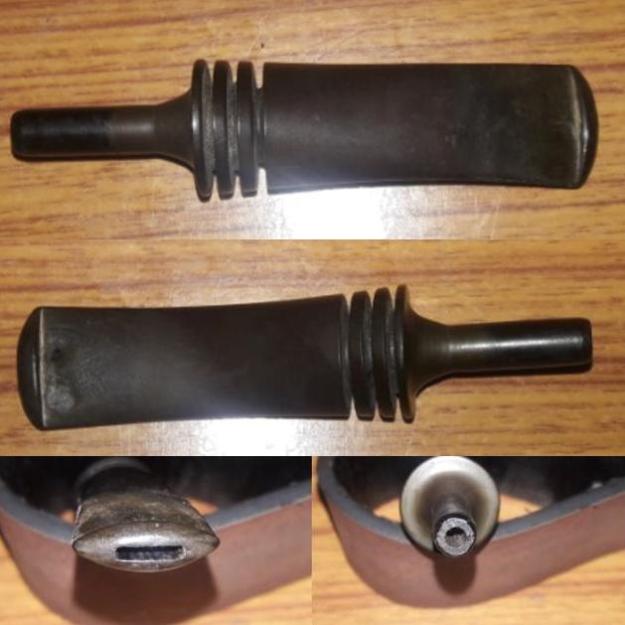
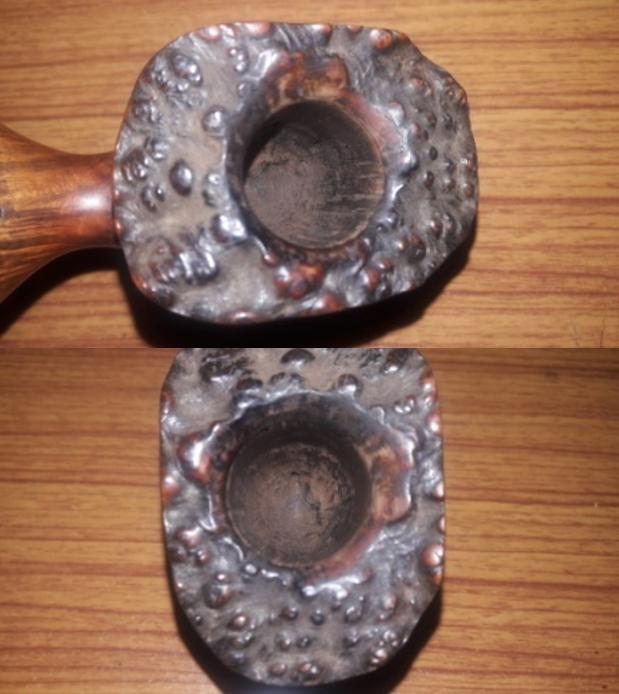
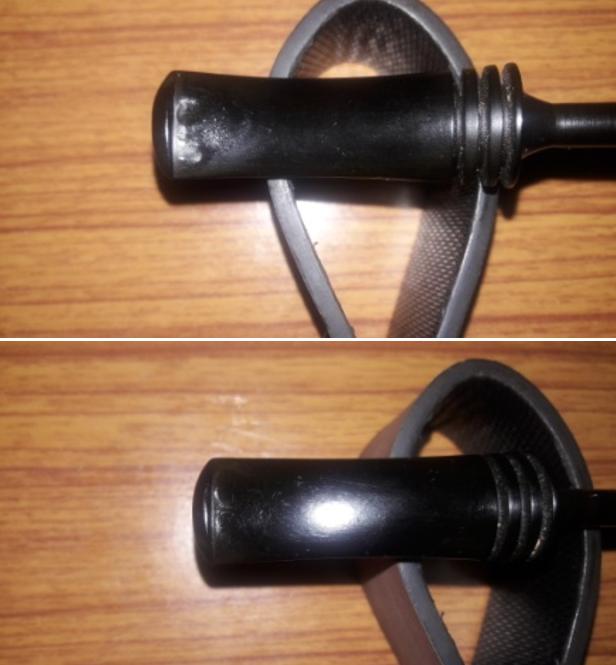
The chamber has a thick layer of dry and hard cake with heavy overflow of lava on to the platue rim top surface. The slightly outward flared inner rim edge is covered in oils and tars, but there are no apparent signs of charring. The condition of the inner walls of the chamber can be checked and ascertained only after the cake has been taken down to the bare briar. The stummel boasts of beautiful flame grains all around and extends over the shank surface too!! The surface is relatively clean and without any fills save for a few scratches that could have been caused during routine use. The flared end of the shank is clean with the partial plateau top edge showing accumulated dust and dirt which should be a breeze to clean. The foot of the stummel shows beautiful bird’s eye grains and is sans any damage. Overall, the stummel presents a well cared for pipe. The mortise is clogged with accumulated oils and tars. That the draw is not as smooth and full was expected, given that the stem was firmly stuck in. With a through leaning, this issue should be resolved.The fancy vulcanite stem is where maximum damage is seen on this pipe. It is heavily oxidized and is peppered with deep tooth chatter/ indentations on either surface of the stem. The lower button edge has a bite through and will need to be repaired. The horizontal slot end of the stem is heavily oxidized to a dark brown coloration while the tenon end is covered in dried oils and tars. The button edges on either surface have worn down and will need to be sharpened. The fancy stem, though looks beautiful when black and shiny, is a bear to clean with all the dips and narrow gaps between the beads and rings etc.The Process
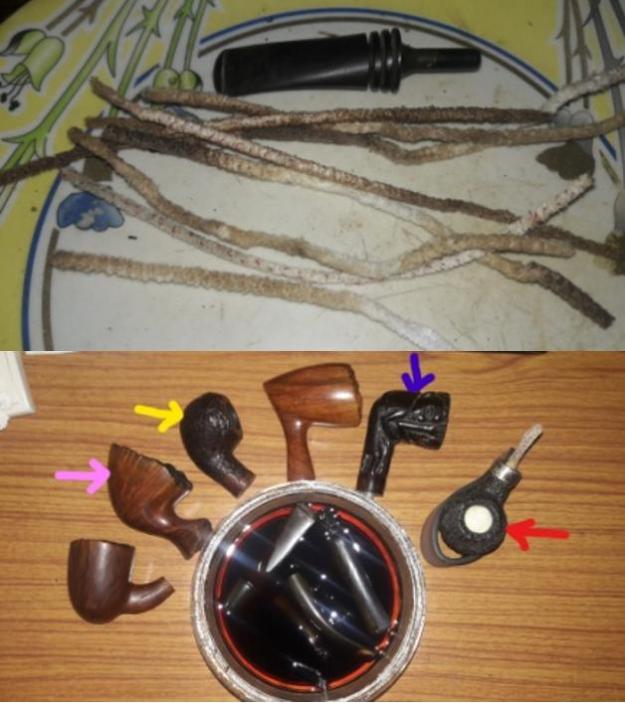
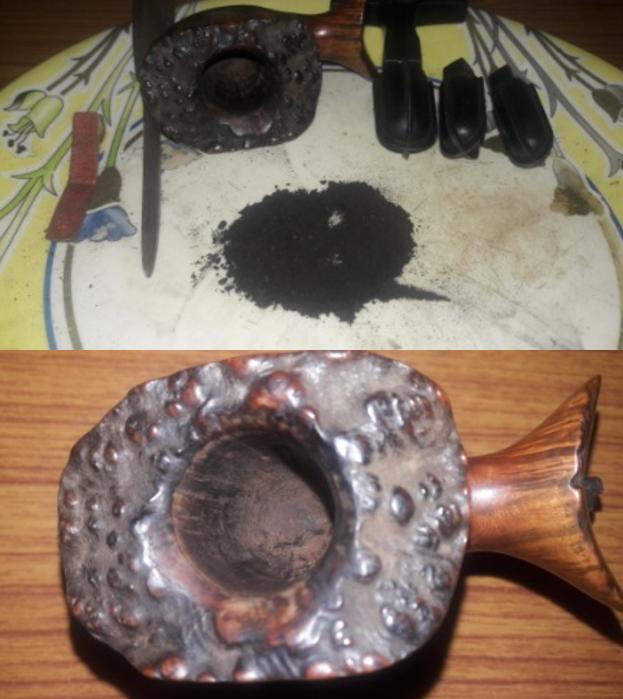
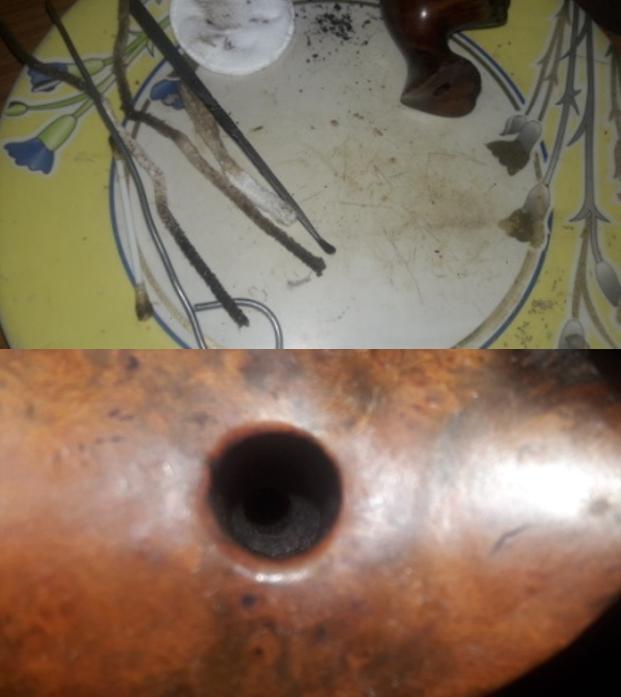
I began the process of refurbishing this pipe with cleaning the internals of the stem using pipe cleaners with isopropyl alcohol (99.9% pure) and dunking the stem in to “Before and After Deoxidizer” solution developed by my friend Mark Hoover. The solution helps to draw out heavy oxidation to the surface making its further removal a breeze, while the minor oxidation is eliminated to a very great extent. I usually dunk stems of 5-7 pipes that are in-line for restoration and this pipe is marked in pastel pink arrow. I generally allow the stems to soak in this solution overnight for the solution to do its work.With the stem soaking in the deoxidizer solution, I worked the stummel starting with reaming the chamber with a Castleford reamer tool, using the second, third and fourth head of the tool. Using my fabricated knife; I further take the cake down to the bare briar. With a 150 grit sand paper, the walls of the chamber were rid of all the remnants of the cake, revealing smooth and solid chamber walls. I further wiped the chamber with a cotton swab wetted with isopropyl alcohol to completely remove the sanding dust. Next, I tried cleaning the mortise with hard bristled and regular pipe cleaners dipped in isopropyl alcohol. However, the pipe cleaners would not pass through the draught hole and in to the chamber. I used my fabricated tool, a simple straightened cloth hanger, and pried clear the chunk of dried gunk. This was followed by cleaning the shank internals with pipe cleaners and isopropyl alcohol. I further scrapped out the entire moistened gunk with a dental tool. The shank internals cleaned up nicely with a smooth and full draw.I scrubbed the external surface of the bowl with undiluted Murphy’s oil soap and hard bristled tooth brush and dried it using paper towels and soft cotton cloth. I deliberately cleaned the plateau rim top to clean the entire lava overflow from the surface. The entire stummel cleaned up nicely. I set the stummel aside to dry out naturally. Staying with the stummel restoration, I polished the stummel with micromesh pads, wet sanding with 1500 to 12000 pads. I polished the raised surfaces on the plateau rim top surface. I wiped the surface with a soft cloth at the end of the micromesh cycle. The stummel looks amazing with a deep shine and beautiful grains popping over the stummel surface. However, I am not very happy with the way the rim top appears at this stage. No amount of wiping with a moist cloth could address this issue. If I wash it again with Murphy’s oil soap, it will be like going back to square one!! I would request all the esteemed readers to suggest remedial methods to this issue and help me learn. I rubbed a small quantity of “Before and After Restoration Balm” in to briar. I rubbed this balm deep in to the nooks and crannies of the plateau rim top surface with my fingers and let it rest for a few minutes. The balm almost immediately works its magic and the briar now has a nice vibrant appearance with the dark brown hues of the grain contrasting with the rest of the stummel surface. I further buff it with a horse hair shoe brush. The rim top has now taken on dark hues which is an eye sore at this stage. As mentioned in the write up on refurbishing S & R, Donegal Rocky # 999 and Countryman, I had worked on all the stems that had been soaking in the deoxidizer solution overnight. I fished out all the stems and cleaned them under running warm water and scrubbed the raised oxidation from the stem surface using Scotch Brite pad. I further removed the oxidation by scrubbing the stems with 0000 grade steel wool and applied a little olive oil to rehydrate the stems and set them aside for the oil to be absorbed. Unfortunately, I did not click any pictures of these stems at this stage.

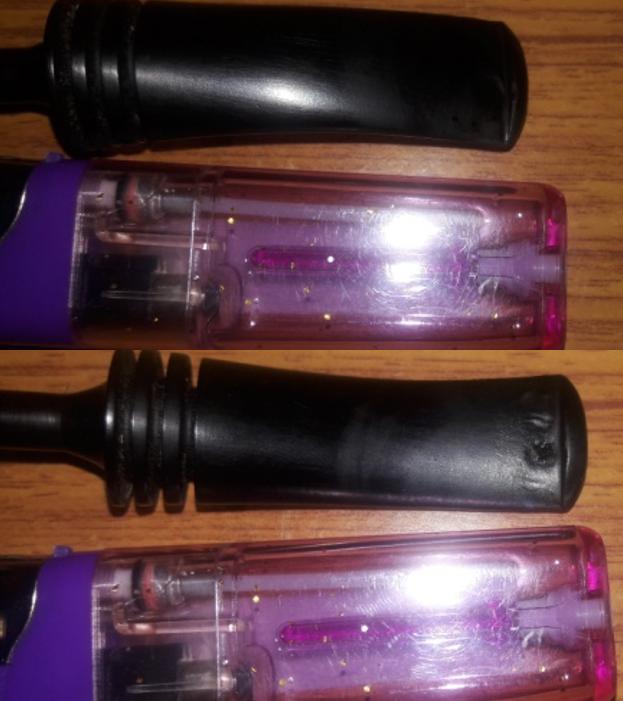
This is how the stem of this pipe came out after the stem cleaning described above. Deep tooth indentations are visible at the base of upper and lower button edges with heavy tooth chatter visible in the bite zone on the lower surface. Complete oxidation was removed on this stem by the process described above.

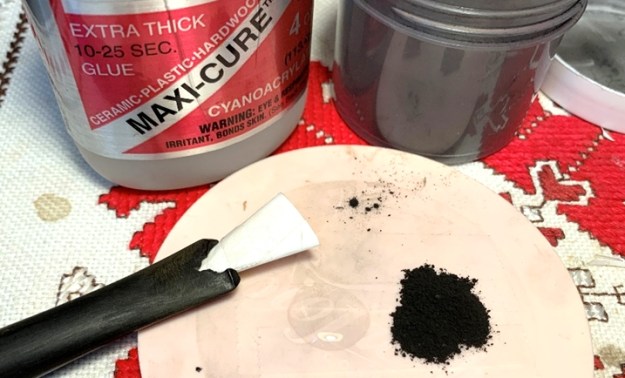
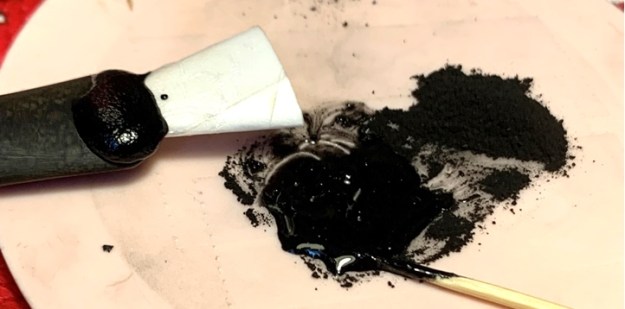
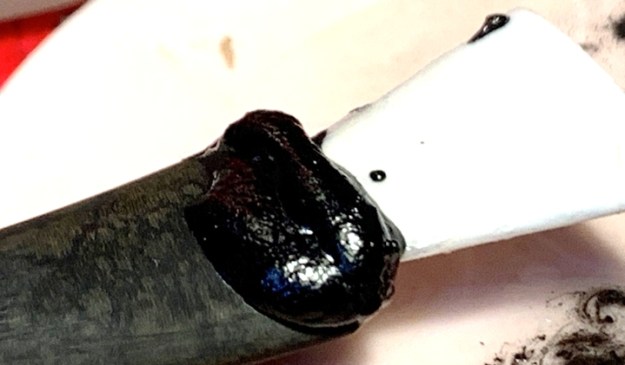
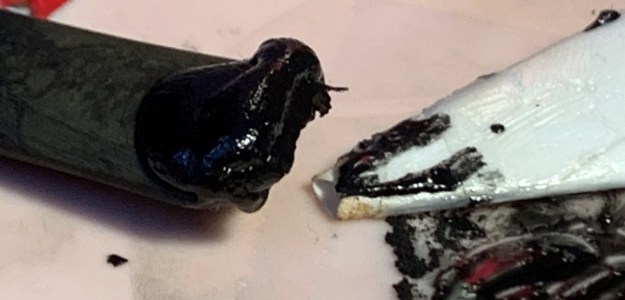
I painted both surfaces of the stem with the flame of a lighter to raise the tooth indentations to the surface. This also helps in loosening minor oxidation from the stem surface. I sand the entire stem surface with a folded piece of a 220 grit sand paper to even out the raised tooth chatter and the tooth indentations to a degree and also to remove the loosened oxidation. I wiped the stem with a cotton swab and Murphy’s oil soap to further remove the oxidation. Even though the most of the tooth chatter has been addressed by heating the damaged stem portion with the flame of a lighter, couple of deeper indentations and bite marks/ deformation to the button edges is still visible on both upper and lower surface in the bite zone. At this stage in stem repairs, I now had a clear idea as to the extent of the through hole in the bottom surface of the stem. I also realized that the surrounding stem surface around the hole has thinned out and is brittle. However, I am happy with the way this stem appears at this stage and also with the deoxidizer solution. I filled the tooth indentation in the button edge on both lower and upper stem surfaces with a mix of activated charcoal and CA superglue and set it aside for the fill to cure. Once the fill had cured sufficiently, with flat needle file I sanded the fills to match with rest of the stem surface. With the same file, I sharpened the button edge on both the upper and lower surface. I fine tuned the blending of the fill with the rest of the stem surface using a 220 grit sand paper and also sanded down the entire stem to remove the stubborn residual oxidation. I further sand the stem with 600 and 800 grit sand paper and wiped the stem with cotton pad dipped in alcohol to remove the resultant dust. I rubbed some extra virgin olive oil in to the stem and set it aside to be absorbed in to stem. I polished the stem with micromesh pads, wet sanding with 1500 to 12000 grit pads. I rubbed a little extra virgin olive oil in to the stem at the end of the micromesh pads polishing cycle. I completed the polishing regime of the stem by rubbing a small quantity of Paragon wax and giving it a final polish with a soft cotton cloth. The stem is now nice, smooth and shiny.To apply the finishing touches, I mount a cotton cloth buffing wheel on to my hand held rotary tool and apply a coat of Blue Diamond to the stem to polish out the minor scratches. With a cotton buffing wheel that I use for carnauba wax, I apply a coat of carnauba wax to the stummel and stem and continued to work on it till the complete coat of wax had been polished out. I mount a clean cotton cloth buffing wheel and gave the entire pipe a once over buff. I finished the restoration by giving the entire pipe a rigorous hand buffing using a microfiber cloth to deepen the shine further. The finished pipe is shown below. P.S. – This was an indeed an easy restoration. The issue of the stem being stuck inside the mortise had driven bidders away from this beautiful pipe and it proved to be my gain. I am really fortunate to be in the process of learning the nuances of pipe restoration and cannot thank Steve enough for his support and guidance.

I wish to request all the experienced readers to shed some light on the numbering system followed on Preben Holm pipes and also on dating these pipes for the larger good of our fraternity.

Thanks for your patience and looking forward to input about the write up. Cheers…

Another Pipe from the Eastern Canada Lot – A Hand Carved Bjarne Freehand


Blog by Steve Laug

I decided to work on another pipe from the fellow in Kitchener, Ontario who sent me some pipes he needed cleaned up. He had been referred to me by my local pipe and cigar shop. While I am not currently adding more pipes to my queue of repairs I have made a commitment to the shop to work on pipes for their customers. Generally they have one or two pipes that need a bit of work. This fellow sent me the following email:

I just came across my smoking pipes that I’ve had in storage for about 40 years. I’m wondering what you’d charge to have them refurbished. There are 17 in total (11 are Brighams and 6 are various).

It turns out he said he had 17 pipes. That was certainly more than I expected but I communicated that there was a large queue ahead of him and I would have to fit them in as I could. He was fine with whatever time it took. He sent me the following photos of his collection that he wanted restored. The first photo shows his eleven Brigham pipes – all very interesting shapes. The second photo shows the six various pipes in the collection – A Republic Era Peterson’s System 1312 (Canadian Import), A Bjarne Hand Carved Freehand, a Comoy’s Everyman London smooth billiard, a GBD Popular Dublin 12, an English made Kaywoodie Rustica 72B, a Kriswill Bernadotte 60 with a broken tenon. When the box arrived there were two additional pipes included for a total of 19 – a Ropp 803 Deluxe Cherrywood Poker and a Comoy’s Sandblast Everyman Canadian 296. It was a lot of pipes! I have been randomly choosing the next pipe to work on and chose the Bjarne Hand Carved Freehand that is shown in the second photo below. I have drawn a red box around the Bjarne in the second photo. I have also put and X through all of the pipes that I have finished. The Bjarne came in a royal blue satin pipe bag with gold letters reading bjarne pipes, the exclusive ones handmade in denmark. The pipe it was a smooth finish freehand with plateau on the rim top and shank end. It was stamped on the underside of the shank and read Bjarne over Hand-Carved over Made in Denmark. The finish was dull and dirty looking but had some amazing grain under the grime. The plateau rim top had a thick coat of lava filling in the plateau around the bowl. There was also some darkening on the top and the inner edge. The bowl had a thick cake in it that was rock hard. The fancy turned stem was oxidized and had tooth marks and chatter near the button on both sides. There was also some calcification for about an inch up the stem.     I took close up photos of the bowl and rim top to show the condition of the bowl and thick lava on the top and the beveled rim edge as well. You can also see the cake in the bowl. It is hard and quite thick. I also took close up photos of the stem to show its condition as mentioned above.     I took a photo of the stamping on the underside of the shank to show what I was speaking about above. It is very readable. It reads BJARNE Hand-Carved Made in Denmark. There is some nice grain around the bowl and shank.   I turned my favourite go to sites on background of brands. The first is Pipephil’s site (http://www.pipephil.eu/logos/en/logo-b5.html). There I looked up the Bjarne brand. I have copied the pertinent information below.

Bjarne Nielsen (1941 – † 2008) distributed his own “Bjarne” brand and pipes carved by Danish pipemakers (Mogens Johansen, Tonni Nielsen or Ph. Vigen). High grade pipes were stamped “Bjarne Nielsen” without any logo on the mouthpiece and graded A, B, C and D. Bjarne second brand: Viking.

I have included a screen capture of the section on the brand below.I turned to Pipedia and looked up the brand for a bit more information on the pipes that were stamped like the one that I am working on (https://pipedia.org/wiki/Bjarne). Toward the end of the article I found what I was looking for. I quote:

Among the pipemakers that worked for Bjarne were Johs (for the lower priced high volume pieces), and makers like Ph. Vigen, Ole Bandholm and Tonni Nielsen for high grade pieces. The cheaper line was stamped “Bjarne” while the highest grades were stamped “Bjarne Nielsen” (never with the pipemakers’ name) and graded, from highest to lowest, by the letters: AX, A, B, C, D, E, F, G, H, I, and J.

Now I knew that I was dealing with the cheaper line of pipe made by the company. It was stamped Bjarne while the higher grade pipes were stamped Bjarne Nielsen with a grade stamp. Now that I had the background information on the brand I went to work on the pipe.I reamed the bowl with a PipNet pipe reamer using the second and third cutting head to take the cake back to bare briar so I could inspect the walls. I cleaned up the remnants with a Savinelli Fitsall Pipe Knife. I sanded the bowl walls with 220 grit sandpaper on a piece of dowel to smooth them out and further examine them. I was happy that the walls looked very good.  I also scraped off the lava on the rim top and edges with the Fitsall Knife and a brass bristle wire brush to begin to break down the hard coat in the plateau.    I scrubbed the surface of the bowl and the plateau areas on the shank end and rim top with undiluted Murphy’s Oil Soap and a tooth brush to remove the grime and grit from the briar.   I used a folded piece of 220 grit sandpaper to clean up the darkened areas on the rim top and inner edge of the rim. I was able to remove the darkening and the remaining lava. I also sanded the high spots on the plateau to clean those up. I finished by using the brass bristle brush on the rim top and shank end.   I polished rim top and sides of the bowl with micromesh sanding pads – wet sanding with 1500-12000 grit pads. I wiped the bowl down after each sanding pad to remove the dust and debris from the sanding. The bowl was looking very good after the final polishing pad.   I interrupted the polishing to stain the plateau on the rim top and the shank end with a Maple stain pen before I polished the bowl with the last set of three pads – 6000, 8000, 12000. The pipe is looking very good at this point in the process. I rubbed the bowl and shank down with Before & After Restoration Balm. I worked it into the surface of the briar with my fingertips and a horse hair shoe brush to clean, enliven and protect it. I let the balm sit for a little while and then buffed with a cotton cloth to raise the shine. I set the bowl aside and turned my attention to the stem. I rubbed the stem down with Soft Scrub on with a cotton pad and it removed the oxidation and the calcification build up. It looked a lot better. Once the surface was cleaned off I found the Bj stamp on the top of the flat blade. Up until that point I was wondering if the stem was a replacement.  It was at this point that I remembered that I had not cleaned out the mortise and airway in the shank and stem. I paused and cleaned them with alcohol, cotton swabs and pipe cleaners. I am glad I remembered now because it was very dirty – as I would have guessed by the condition of the rim top.  Now that I had cleaned the pipe internally I went back to working on the stem. I sanded out the remaining tooth chatter and oxidation with 220 grit sandpaper and started the polishing with 400 grit wet dry sandpaper.        I rubbed down the stem with Denicare Mouthpiece Polish, a red gritty paste and a cotton pad to remove the remnants of oxidation and to blend in the sanding. The stem is starting to show promise at this point in the process.I polished the stem with micromesh sanding pads – wet sanding it with 1500-12000 grit pads. I wiped the stem down after each sanding pad with a cotton pad to remove the sanding debris.  I finished polishing the stem with Before & After Pipe Stem Polish – both fine and extra fine. I finished by wiping it down with Briarville’s No Oxy Oil and buffing it to a shine.   I finally feel like I am making progress on this 19 pipe lot from Eastern Canada. With the completion of this one I have finished 13 of the pipes. I put Bjarne Hand-Carved Freehand back together and buffed it with Blue Diamond on the buffing wheel. I gave the bowl and the stem multiple coats of carnauba wax. I hand buffed the pipe with a clean buffing pad to raise the shine. It is fun to see what the polished bowl looks like with the grain on both sides and the plateau on the rim top and shank end looked amazing. Added to that the polished black vulcanite stem was beautiful. This nicely grained Bjarne Freehand is nice looking and feels great in my hand. Have a look at it with the photos below. The dimensions are Length: 6 ½ inches, Height: 2 ¼ inches, Outside diameter of the bowl: 2 inches, Chamber diameter: 7/8 of an inch. Once again I am looking forward to what the pipeman who sent it thinks of this restoration. Only 6 more of these pipes to do in this lot! Thanks to each of you who are reading this blog. Remember we are not pipe owners; we are pipemen and women who hold our pipes in trust until they pass on the trust to the next pipeman or woman.
New Life for an Anscot Bullmoose


Blog by Steve Laug

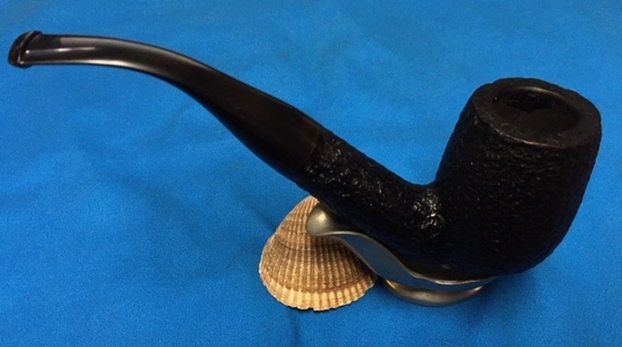
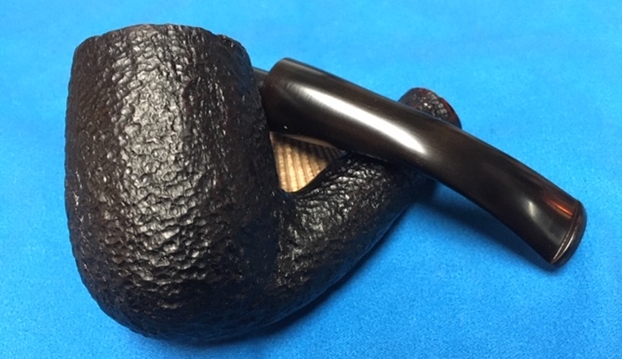
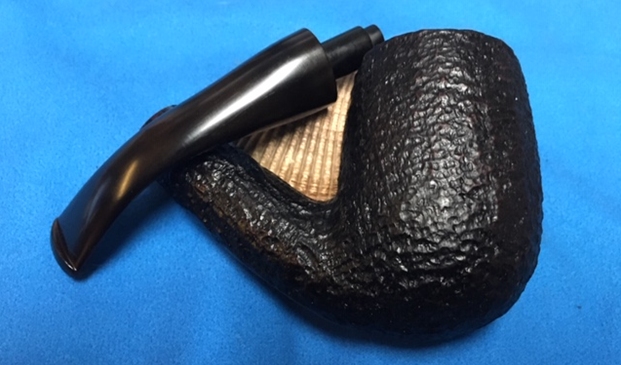
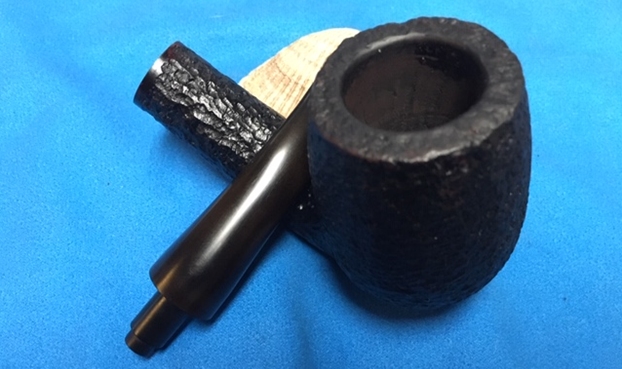
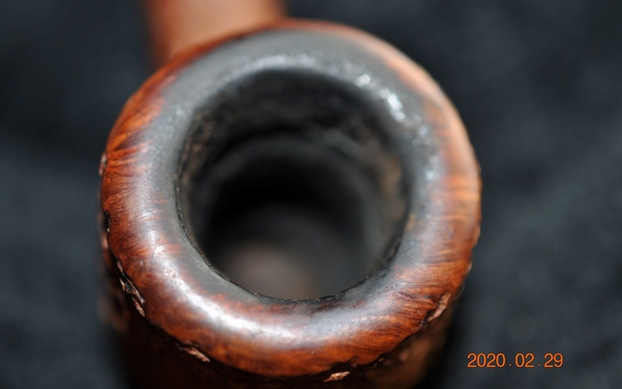
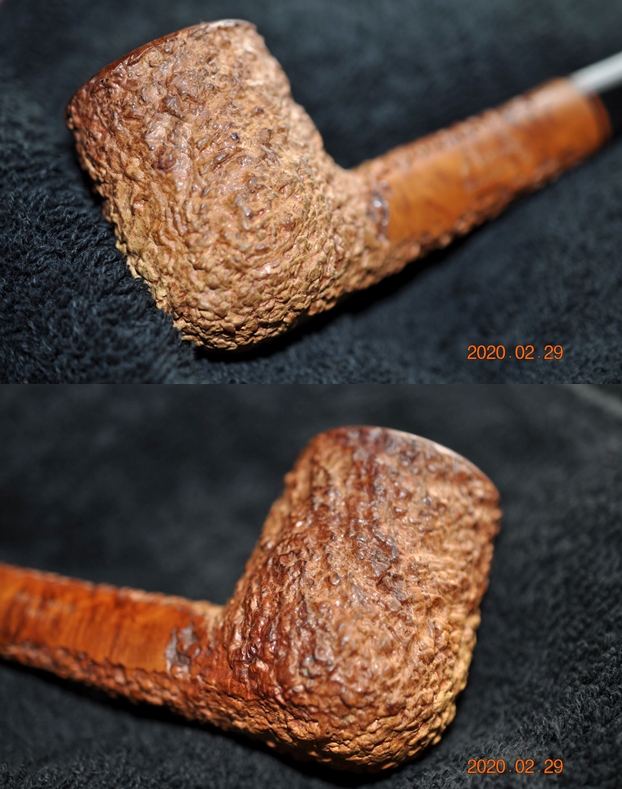
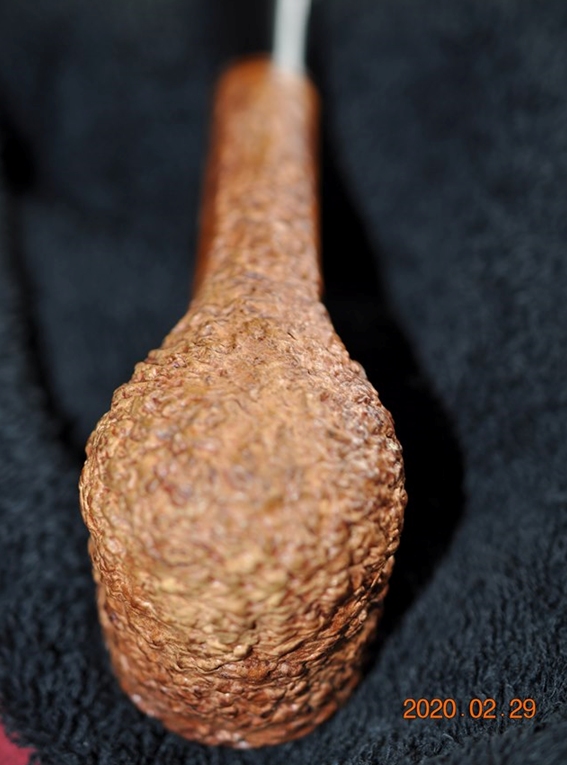
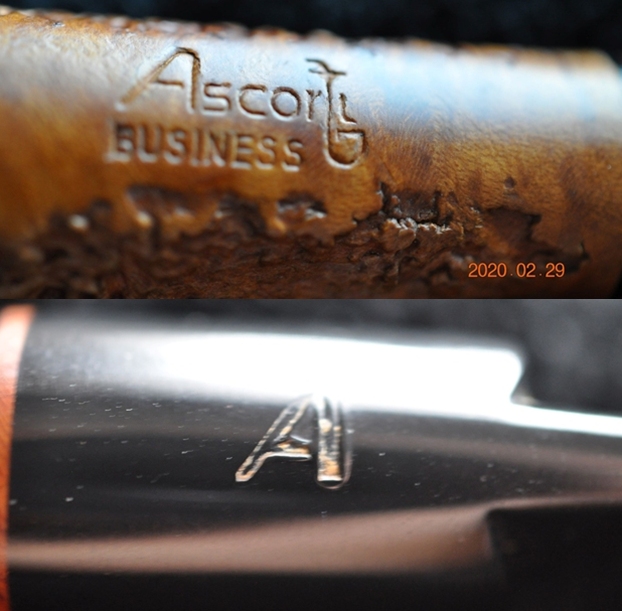
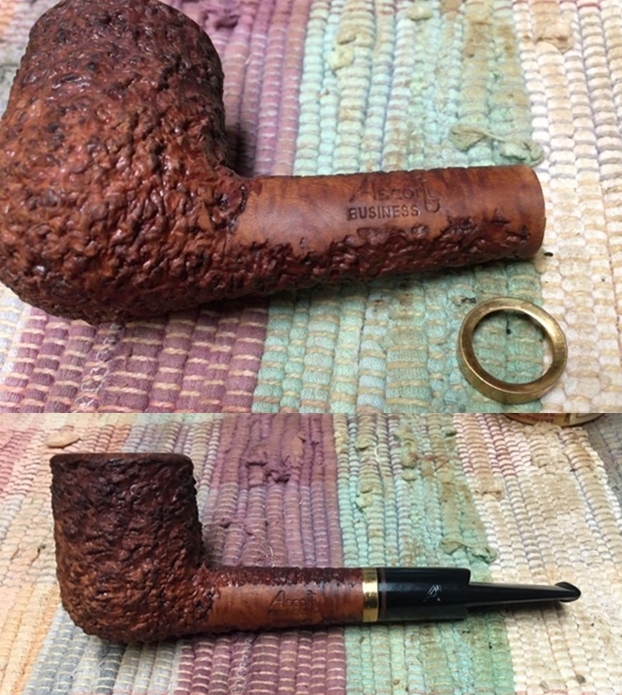
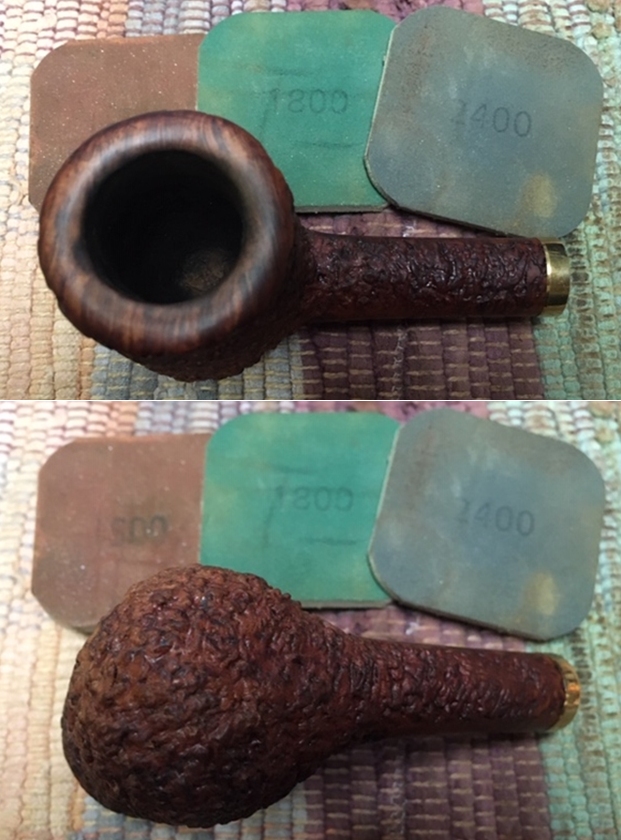
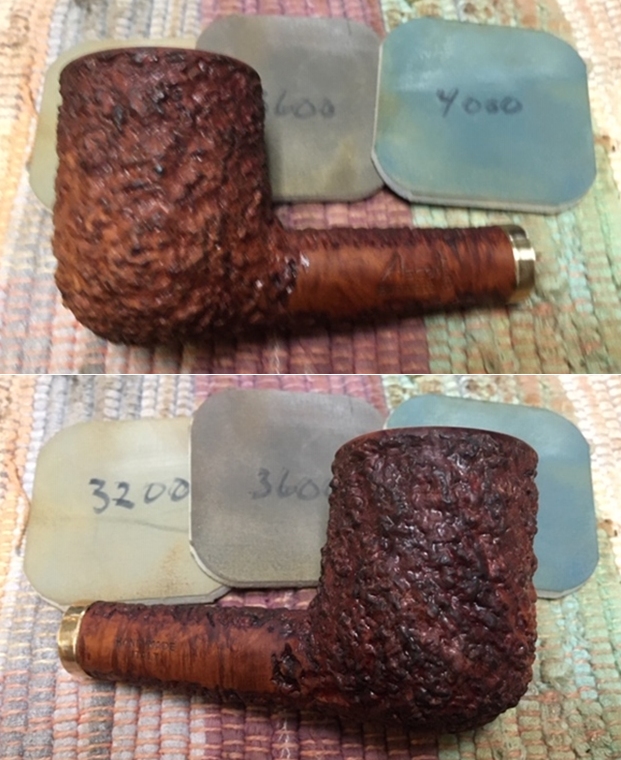
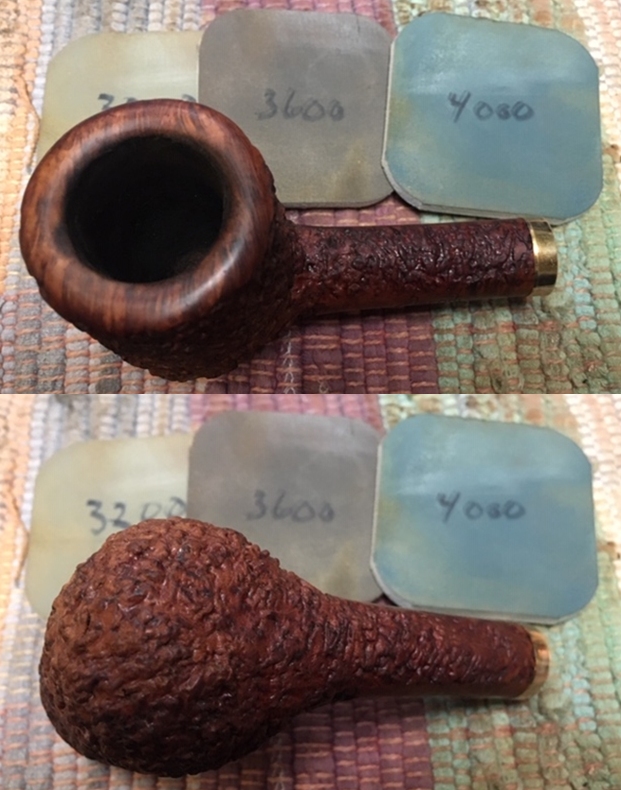
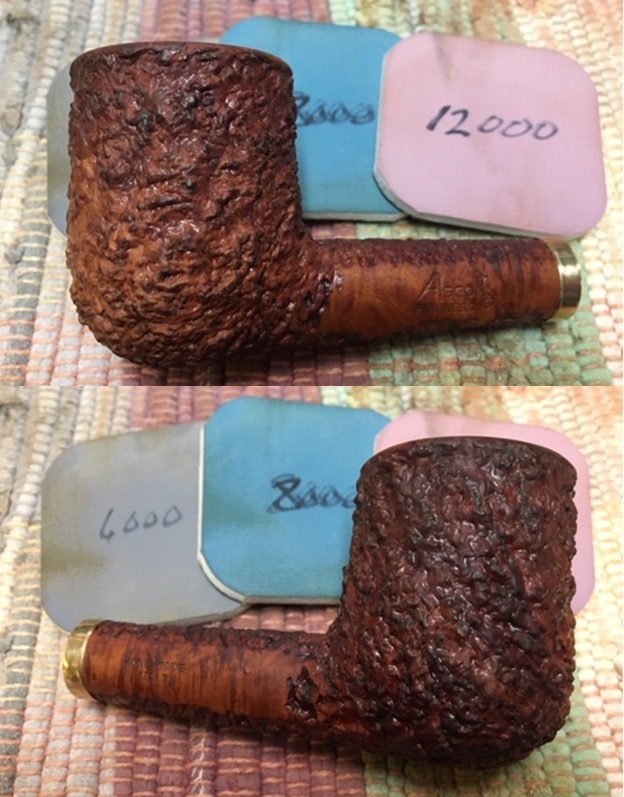
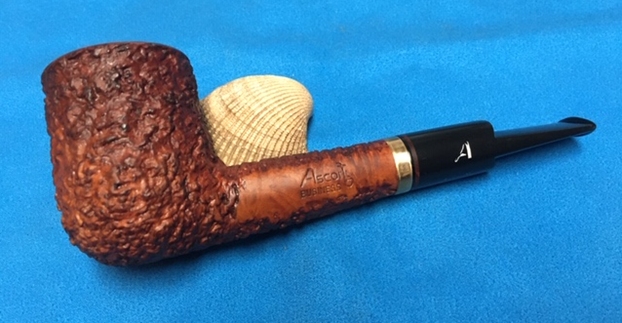
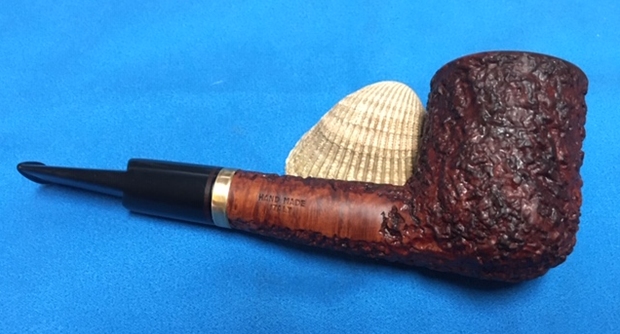
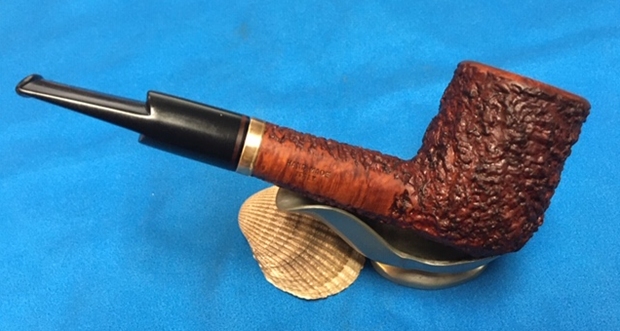
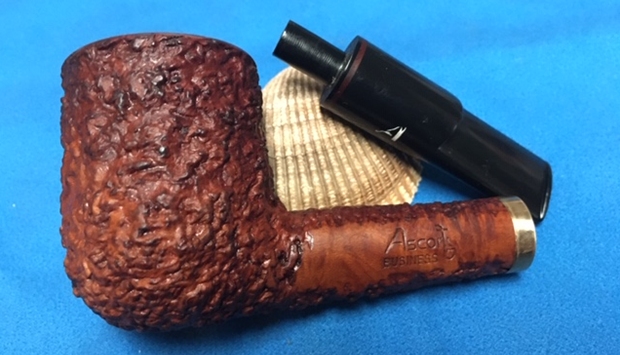
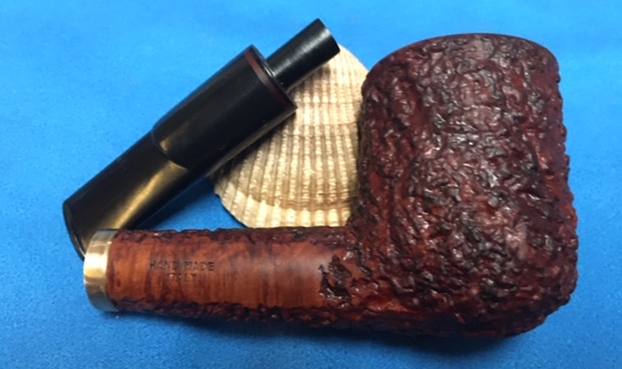
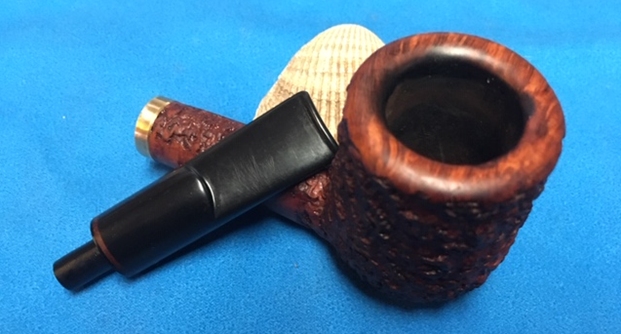
I just finished working on the Marxman Jumbo Bench Made Poker for the fellow in Quebec. I wrote a blog about it (https://rebornpipes.com/2020/02/28/restoring-an-obstinate-marxman-jumbo-war-club/). When he sent the Marxman he included another pipe that he wanted to donate for the support of the SA Foundation. I am always glad to work on those and pass them on to others who not only want a good pipe but want to donate to a worthy cause – the restoration and recovery of women and children who have escaped sexual exploitation and trafficking. It’s a large pipe stamped on the left side of the shank in script and read Anscot. On the right side it is stamped Mediterranean Aged Briar. The stamping is clear and readable. The stem did not seat in the shank completely and was very tight. The finish was shiny and dirty like it had been coated with varnish or shellac. There was one large fill on the front of the right side mid-bowl. The bowl had been cleaned and there was a small bit of cake in the base of the chamber near the entrance of the airway. The rim top had some burn damage on the inner edge of the bowl toward the front of the bowl. The inner edge of the chamber was out of round and damaged. The stem was high quality vulcanite and had tooth chatter and marks on both sides near the button. The stem would not seat against shank. The photos show what I saw as I examined the pipe. I took close up photos of the rim top and the stem. The photos confirm the condition of the pipe that I described in the paragraphs above. You can see the darkening on the inner edge of the rim top. There were also scratches and nicks all around the rim top. The stem is also lightly oxidized and has some deep tooth marks on the top and underside near the button.I took a photo of the stamping on the left side of the shank. It is stamped Anscot in script with the leg of the A extended in a swirl under the whole word. On the right side of the shank it is stamped Mediterranean Aged Briar.I looked up the brand on Pipephil and found nothing there. I did a search for the brand and found a link to a connection between Abraham & Straus, Inc. to Anscot in Brooklyn, New York. There was also a link to picclick (https://picclick.com/Superb-Lh-Stern-anscot-Large-Bull-Moose-Vintage-302658878312.html) where the author linked the brand to LH Stern. That link was tenuous as the photo on the link showed the same stamping that I showed in the photos above.

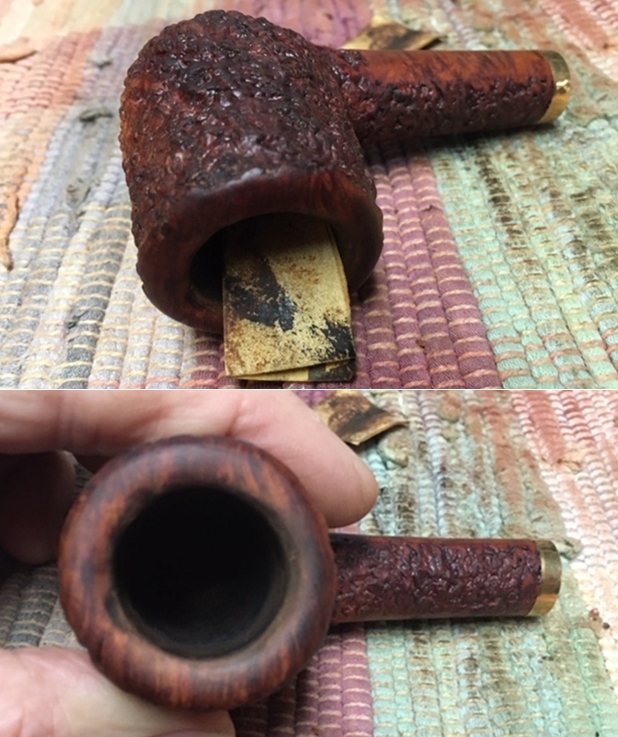
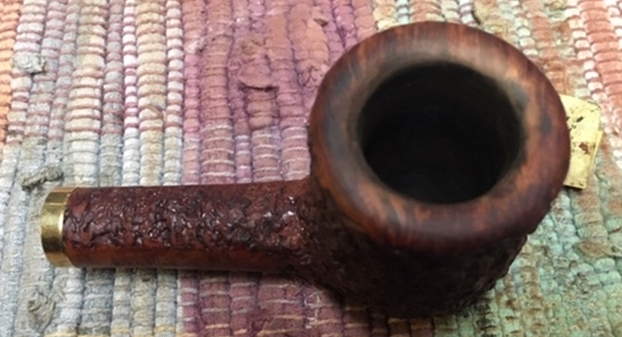
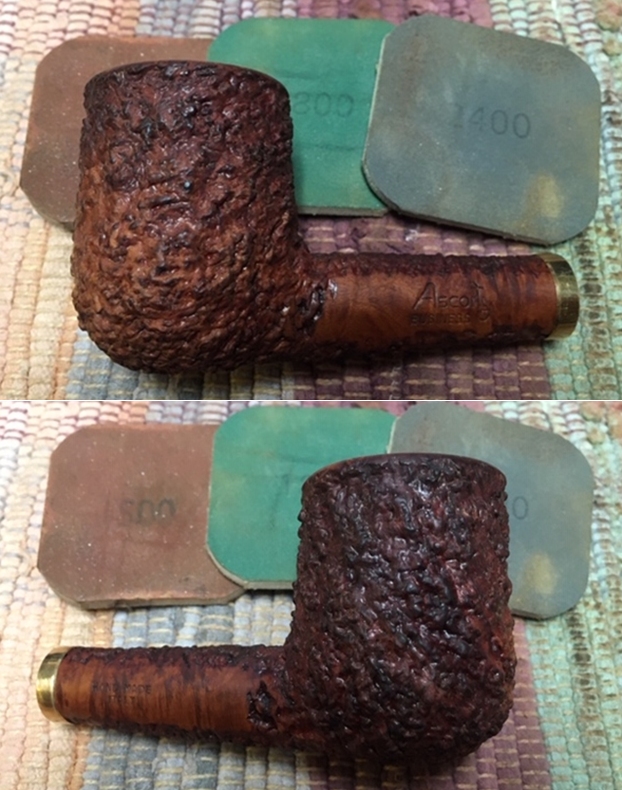
From the search I did the most I could find out was the link to the pipe shop in Brooklyn, New York. The tie to LHS was not reliable as I could not see any link to the LHS Company. I looked up LH Stern on Pipedia and read through that article but there was no link to Anscot. So the mystery remains. Now it was time to clean up the pipe and restore it. I removed the stem from the shank and saw an interesting stinger inserted in the shank. I took a photo of the pipe at this point.I took the bowl to the work table and reamed it. I used a Savinelli Fitsall Pipe Knife to clean up the light cake in the bowl. I cleaned up the inner edge of the rim with a folded piece of 220 grit sandpaper. I was able to remove the damage to the inner edge and the top of the bowl.I wiped the bowl down with acetone on a cotton pad to break through the thick varnish coat on the bowl. It took a bit of scrubbing but it looked far better. I cleaned the interior of the shank/mortise and the airway in the shank and the stem with pipe cleaners, cotton swabs and alcohol. I removed the stinger from the tenon so that I could clean the airway in the stem. The airway in both and the mortise were dirty and after I had scoured them the pipe was clean and smelled better. With that finished I moved on the polishing the bowl and the rim top with micromesh sanding pads. I polished them with 1500-12000 grit sanding pads and wiped the bowl down with damp cloth to remove the sanding dust. I used a Maple stain pen to touch up the sanded rim top and edges. Once the stain had dried I polished the rim top with micromesh sanding pads to blend it into the rest of the bowl. I rubbed the bowl down with Before & After Restoration Balm. I worked it into the finish with my fingertips. I set it aside to absorb into the briar for ten minutes. Once it had been sitting I polished the bowl surface with a soft cotton cloth. At this point in the process the briar is looking very good. I set the bowl and I turned my attention to the stem. I scrubbed the stem with Soft Scrub and a cotton pad to remove the oxidation and debris on the stem surface. The tooth marks were clearer and the chatter was ready to be polished out.The tooth marks on the top were light and would sand out later. There was one deep tooth mark on the underside of the stem. I cleaned it out with alcohol and a cotton swab. I filled it in with black super glue and let it cure.Once the glue repair cured I sanded it with 220 grit sandpaper to blend it into the surface of the vulcanite. I sanded out the tooth chatter and marks on both sides with 220 grit sandpaper and 400 grit wet dry sandpaper.I polished the stem with Denicare Mouthpiece Polish to remove the light scratching and the light oxidation on the stem surface. The product is a red paste that is gritty and when rubbed with a cotton pad it removes many of the scratches and remaining oxidation.I polished the stem with micromesh sanding pads – polishing it with 1500-12000 grit micromesh sanding pads. I wiped it down with cloth between each sanding pad. I polished it with Before & After Pipe Stem Polish – both Fine and Extra Fine. I gave it a rub down with Briarville’s No Oxy Oil to protect the stem from oxidizing. It was looking very good at this point.   I was looking forward to this part of the restoration when all the pieces are put back together so I can send a photo back to the fellow in Quebec. I put the pipe back together and buffed it with Blue Diamond on the buffing wheel. I gave the bowl and the stem multiple coats of carnauba wax. I hand buffed the pipe with a clean buffing pad to raise the shine. It is fun to see what the polished bowl looks like with the polished black vulcanite stem. This Anscot Mediterranean Aged Briar Bullmoose looks far better than it did when I started. The fill on the right side is present but has blended in very well. The rim top looks much better than when I began. The stem fits well in the shank. The pipe is nice looking and feels great in my hand. The pipe is a sitter so that it can be laid down on a desk top while the pipeman is working on something else. Have a look at it with the photos below. The dimensions are Length: 6 inches, Height: 1 ½ inches, Outside diameter of the bowl: 2 inches, Chamber diameter: 1 1/8 inches. This old Anscot is a beauty and I look forward to what the pipeman buys it thinks of it. Thanks to each of you who are reading this blog. Remember we are not pipe owners; we are pipemen and women who hold our pipes in trust until they pass on into the trust of the next pipeman or woman.
Restoring an Obstinate Marxman Jumbo War Club


Blog by Steve Laug

Not long ago I was emailing back and forth with a reader of the blog in Quebec about a pipe that he had purchased online. He said that it was a Marxman Jumbo Bench Made and it was huge. He said the photos of the pipe online were far better than what the pipe looked like when he received it. The pipe was marked on Etsy as follows: 1940s Rustic Tobacco Pipe Jumbo Marxman Carved Briar Root Wood Smoking Pipe OAK Handcarved Vintage Pipe Large Oversize Pipe. You and I know that the pipe was not OAK but Briar. Here are the photos that he sent me the link for. In the photos you can see the unique shape of this War Club/Hammer. It is quite big and I was expecting it to be much bigger than it actually is. The finish looks pretty good in the photos as well. The cake and lava on the rim looks negligible but present. It looks like a great deal but even in these photos you can see the large fills around the shank and bowl. We talked back and forth a bit and finally decided that the pipe should be sent to me in Vancouver. He wrote in the email that he sent before the pipe was mailed: “The stem seems stuck while the cake is relatively thick in the chamber. Also, the finish of the pipe seems stained and uneven. It’s a massive pipe but I’m confident it will look good”. With that I awaited the arrival of the pipe. Canada Post was efficient and it arrived three days after it was shipped. I opened the box and took photos of the pipe as it was when it arrived. He was right in saying it looked very different from the pipe in the Etsy seller’s photos.

The stem was solidly stuck in the shank and was upside down. The finish was flat and dirty with no life to it. There were large fills on the front and back sides of the bowl and all the way around the shank. The fills were what gave an uneven appearance to the finish on the pipe as they were a light tan/pink. The bowl had a thick, uneven cake and the pipe smelled musty and dank. The rim top had a coat of lava on the top around the bowl and the inner edge of the chamber was out of round and damaged. The stem was high quality vulcanite and had tooth chatter on both sides near the button but there were not any deep tooth marks in the vulcanite. The photos show you what I saw as I examined the pipe. I took close up photos of the rim top and the stem. The photos confirm the condition of the pipe that I described in the paragraphs above. You can see the damage to the inner edge of the rim top. It had been hacked and damaged with what looked like a knife.I took a photo of the stamping on the flat heel of the bowl. It is stamped with a letter C at the top of the heel. Under that is reads Jumbo in script over Bench Made. Underneath at the bottom it is stamped with the Marxman logo inside an arrow.I wanted to refresh my memory of the brand so I turned to Pipephil first to get a short summary of the history (http://www.pipephil.eu/logos/en/logo-m2.html). The site had a side note that the brand was created in 1934 and merged with Mastercraft Pipes in 1953.I then turned to Pipedia to find out a bit more information on the brand and the maker of the pipe (https://pipedia.org/wiki/Marxman). The site quote from Pipes, Artisans and Trademarks, by José Manuel Lopes. I include a portion of that information below.

Marxman (Marxman Pipe Company) was created by Robert (Bob) L. Marx in 1934, when he was 29, and after he had worked for the William Demuth Company. His pipes were not outstanding because of the quality of their wood (probably Algerian), but Bob started making unique sculpted pieces, which brought the brand fame in the World of Hollywood cinema. Actors like Zachery Scott, Dennis Morgan, Jack Carson, Alan Hale, Joel McRae, and Ronald Reagan were some of the faces that appeared on the bowls.

Bob new how to innovate and took full advantage of marketing and press advertising in order to sell the brand–one of his slogans being “Relax with a Marxman”.

From the information on the two sites I learned that the pipe was made between 1934 when the company started and 1953 when the company was taken over by Mastercraft. I have included an advertisement for the Marxman Jumbo that was included on the article (1946 Ad, Courtesy Doug Valitchka).

It includes the following information. “A rare treat for the pipe connoisseur is the Marxman Jumbo, distinguished by a carved bowl that is in perfect balance for easy, comfortable smoking. From the thousands of pieces of briar that flow into our factory we select the perfect and unusual. These are reserved only for the Marxman Jumbo – and are fashioned into truly elegant pipes of exclusive designs – unique in appearance and superior in smoking qualities. Each pipe is an individual artistic creation following the natural shape of the briar. No two pipes are alike. They are priced according to size.” The prices are noted in the ad that I included below.I went on to read the remainder of the article on Pipedia and include the pertinent portion below.

Bob also produced other brands, such as the “Bench Made”. The company lasted until 1953, the year in which it merged with Mastercraft, then the USA’s biggest pipe importer. Marxman Pipes Inc., was located at 27 West 24th St. New York 10, NY.

I had put the pipe in the freezer before I went to bed and in the morning I took it out and with a little effort I was able to remove the stem from the shank. It was very tight but it came out with patience.I took the bowl to the work table and reamed it. I used a PipNet pipe reamer with the second cutting head to remove the thick cake in the bowl.  I removed the remnants of the cake with a Savinelli Fitsall Pipe Knife and finished the bowl with a piece of 220 grit sandpaper wrapped around a piece of dowel. I used a dental spatula to scrape out the inside of the mortise and remove the thick lacquer that had built up there from much smoking. I cleaned the interior of the shank/mortise and the airway in the shank and the stem with pipe cleaners, cotton swabs and alcohol. They were very dirty and after I had scoured them the pipe was clean and smelled better. I would still need to do a cotton ball alcohol soak to draw out the rest of the mustiness.I scrubbed the exterior of the bowl and shank with a tooth brush and undiluted Murphy’s Oil Soap. I scrubbed the grooves of the rustication to remove the grime with the tooth brush. I rinsed the pipe off with warm running water and dried it off with a cotton cloth. The finish looked clean but you could see the fills very clearly now. I have circled them in red in the photos below. Now it was time to deal with the out of round bowl edges. I gently topped the bowl. I did not want to flatten the crowned rim just smooth out the top edge of the bowl. I used a folded piece of sandpaper to work a slight bevel to the inner edge to clean up the damaged edge and bring back to round. I also sanded the darkening on the rim edge to remove it as well. With that finished I moved on the polishing the smooth portions of the bowl and the rim top with micromesh sanding pads. I polished it with 1500-12000 grit sanding pads and wiped the bowl down with damp cloth to remove the sanding dust. I used a Walnut stain pen to touch up the fill areas and the lighter areas on the briar bowl. I covered all of them and set the bowl aside to dry. The stain actually hid the fills very well. Once the stain had dried I rubbed the bowl down with Before & After Restoration Balm. I worked it into the grooves of the finish with my fingertips and a horsehair shoe brush. I set it aside to absorb into the briar for ten minutes. Once it had been sitting I polished the bowl surface with a soft cotton cloth. At this point in the process the briar is looking very good. I filled the bowl with cotton balls and used and ear syringe to fill it with alcohol. I fit a folded pipe cleaner in the shank to keep the alcohol in the bowl. I left the alcohol and cotton ball in the bowl while I worked on the stem. It sat for over an hour and then I removed it from the bowl and took the photo of the cleaned pipe. I turned my attention to the stem. I   sanded out the tooth chatter and marks with 220 grit sandpaper and 400 grit wet dry sandpaper.I polished the stem with Denicare Mouthpiece Polish to remove the light scratching and the light oxidation on the stem surface. The product is a red paste that is gritty and when rubbed with a cotton pad it removes many of the scratches and remaining oxidation.I polished the stem with micromesh sanding pads – polishing it with 1500-12000 grit micromesh sanding pads. I wiped it down with cloth between each sanding pad. I polished it with Before & After Pipe Stem Polish – both Fine and Extra Fine. I gave it a rub down with Briarville’s No Oxy Oil to protect the stem from oxidizing. It was looking very good at this point. I was looking forward to this part of the restoration when all the pieces are put back together so I can send a photo back to the fellow in Quebec. I put the pipe back together and buffed it with Blue Diamond on the buffing wheel. I gave the bowl multiple coats of Conservator’s Wax and the stem multiple coats of carnauba wax. I hand buffed the pipe with a clean buffing pad to raise the shine. It is fun to see what the polished bowl looks like with the smooth portion and the rusticated portion contrasting well and added to that the polished black vulcanite stem. This Marxman Bench Made Jumbo looks far better than it did when I started. The fills are present but have blended in very well. The stem fits well in the shank. The pipe is nice looking and feels great in my hand. The pipe is a sitter so that it can be laid down on a desk top while the pipeman is working on something else. Have a look at it with the photos below. The dimensions are Length: 6 inches, Height: 2 1/8 inches, Outside diameter of the bowl: 1 ¾ inches, Chamber diameter: ¾ of an inch. This old Marxman Jumbo is a beauty and I look forward to what the pipeman who sent it thinks of this restoration. Thanks to each of you who are reading this blog. Remember we are not pipe owners; we are pipemen and women who hold our pipes in trust until they pass on into the trust of the next pipeman or woman.
Another Black Sea Coast Treasure – An Altinay Lattice Tear Drop Meerschaum


Blog by Dal Stanton

I love pipe picking especially in ‘hole in the wall’ treasure hunts on the Black Sea.  My wife and I were on summer holiday enjoying Bulgaria’s Black Sea venues.  I discovered this ‘hole in the wall’ antique shop on previous trips to the city of Burgas and on this return, I was not disappointed.  I purchased 7 pipes waiting to be adopted after negotiating with Kaloyan, the shop owner.  His mother was also there watching over things and she called Kaloyan on her cell phone when I asked about the pipes that I had found displayed.  He must have been down the street perhaps at a café taking a break and a smoke because his arrival in a matter of seconds commenced the negotiations for the 7 and a friendship emerged as a byproduct!  After taking my phone number he assured me if more treasures came his way that he would call.  As my wife and I were leaving, shaking hands with Kaloyan and grandmotherly mom, a look of shocked wonder came over Kaloyan’s face – he told us to wait and he ran back into the shop returning with two other pipes that were not in view that he had almost forgotten.  He reemerged with treasures in hand, a Vauen 6294 EX Billiard Saddle Stem (still available to be commissioned in For “Pipe Dreamers” Only!  Basket 3) and the Altinay now on my worktable.  I was immediately drawn to the exquisite detailed carving of the Altinay, a name I’m very familiar with among Meerschaum pipe carvers in Turkey.  The Altinay was petite but the detail amazingly complex and tight.  It also had developed some of the valued patina at the shank/bowl junction – the normal area.  Added as frosting on the Altinay cake was the original case – each carrier box is hand crafted for each pipe because each pipe is uniquely different being hand-carved.  The negotiations commenced for a second time adding the Vauen and Altinay to my growing Black Sea treasure trove.The entire Burgas Black Sea lot made it back to Sofia with us and eventually became available to be commissioned online in virtual “Help Me!” baskets in my For “Pipe Dreamers” Only! collection benefiting the Daughters of Bulgaria – women and girls who have been trafficked and sexually exploited.  This is where Jason found the Altinay and a French Leather Clad Longchamp which he commissioned.  The Longchamp came out great and now the Altinay awaits attention.I took these pictures of the Altinay Meerschaum on my worktable to get a closer look. The stem has the inlaid Altinay roundel marking its provenance.  The carrier box gives additional information: Altinay – Handcarved Block Meerschaum – Turkey.  Altinay’s website (https://www.altinaypipes.com/) is a quality presentation of their craftsmanship.  The ‘About’ tab on their site gives this information:

ALTINAY TURKISH COMPANY PRODUCING BEAUTIFULLY DESIGNED AND HANDMADE MEERSCHAUM PIPES AT OUR OWN MANUFACTURING FACILITY IN ESKISEHIR, TURKEY.

TIME BEGAN FOR ALTINAY IN 1964, WHEN WE EMBARKED ON A JOURNEY TO MAKE BEAUTIFULLY DESIGNED PIPES OF EXCEPTIONAL QUALITY. INSPIRED BY A LOVE OF CARVING MASTERPIECE PIPES WE ACHIEVED TO HAVE DISTRIBUTORS IN EACH EUROPEAN COUNTRY, USA, RUSSIA AND CHINA.

AND NOW, OUR PIPES ARE THE MOST POPULAR AND MOST WANTED MEERSCHAUM PIPES WORLDWIDE. WE DESIGN AND HAND CARVE TOP QUALITY PIPES BY USING FINEST QUALITY BLOCK MEERSCHAUM.

EACH PIPE IS DESIGNED TO APPEAL TO THOSE WHO SHARE OUR PASSION FOR – AND APPRECIATION OF – MASTERY BEHIND A BEAUTIFUL MEERSCHAUM PIPE. WE HOPE YOU ENJOY THE SAME SATISFACTION WHEN YOU TRY AN ALTINAY PIPE, AS WE DO IN CREATING ONE.

Another tab offers testimonials which I could add to.  I added an Altinay Meerschaum to my personal collection on a trip to Istanbul only last summer.  I found my Altinay Dimpled Billiard at the Grand Bazaar in Istanbul.  After looking at literally 100s of Meerschaums in the various shops in the bazaar maze, and all the carvings that characterize the Meerschaum genre, I settled on this classic shaped Altinay.  It now reveals the growing patina as the honey brown color expands on what started as a snow-white Meer surface.The Altinay on my worktable is in good shape regarding the condition of the Meerschaum lattice tear drop bowl.  It needs cleaning and the rim has lava darkening especially on the aft quadrant.  As you would expect with a healthy Meerschaum, there is very little cake build up in the chamber.  A Meer pipe needs/wants no cake build up to protect the chamber as with briar bowls. Another unique feature of Meerschaum pipes is that they do not need to rest.  They can be reloaded immediately and another bowl of one’s favorite blend can be enjoyed.The acrylic stem shows tooth chatter on the upper and lower bit which should sand out easily.Structurally, the only challenge is the lose 9mm filter tenon pictured below.  When I first unlinked the stem and the bowl and the plastic tenon was loose, I wasn’t sure which direction the threaded part of the plastic tenon was supposed to go – was it screwed into the mortise or into the stem?  I tested both directions and the only configuration that allowed the stem to seat with the shank was with the threaded part inserted into the mortise.  Yet, the threads would not grip anything revealing that the threads had been stripped. For now, I put this issue aside and start on the cleaning of the Altinay Meerschaum.  I first clean the acrylic stem airway using pipe cleaners wetted with isopropyl 95%.  The filter cavity is cleaned using cotton buds.Turning now to the Meer chamber, the carbon build-up is light, but I address it first by carefully scraping the chamber walls with the Savinelli Fitsall tool.  Using a reaming kit with blade heads is not a good idea with Meerschaum as the torque required could possibly crack the Meerschaum and that would not be a good thing.  The Savinelli tool works well to scrape evenly as well as to reach into the lower contour’s angles with the end of the tool being gently curved.  I scrape a little with a Winchester pocketknife and transition to sanding the walls with 240 grade paper wrapped around the Sharpie Pen. After wiping the bowl out with a cotton pad wetted with isopropyl 95% to remove carbon dust, the following picture shows that the lower chamber remains darkened, but it is clean by the touch and looks good.  I move on.The pictures above and below show well the blackened state of the rim resulting from lighting.  The condition of the Meerschaum will never again be the snow white that Meerschaums start with emerging from the factory or carver.  My desire is to remove as much of the charring from the rim without damaging the ornate carving on the rim.  My hope is to soften the contrasting coloring and then later, after applying a bee’s wax treatment, which helps color the Meerschaum toward the sought for patina which increases the value of the pipe.  The bee’s wax will help blend the hues in the Meerschaum.I use a cotton pad wetted with alcohol and work on the rim – working to break up the charring.I do a very gentle topping on a sanding sponge to encourage the charring to break up.  The medium sanding sponge is a very mild abrasive.The results are good.  The charring is removed in large measure.The plastic filter sheath is placed in alcohol to soak to see if it will help clean up the plastic – to lighten it or to lessen the stain. To clean the external Meer lattice surface, I mix a small portion of Murphy’s Oil soap in hot water.  It is a very diluted mixture.  I want the benefits that the agents that the soap has but I don’t want to saturate the surface with soap.  I use a bristled toothbrush to apply the soap water to the bowl and scrub the tear drop windows of the lattice work.  The mild soap removes the dirt and grime but does not remove the growing patina on the shank.I damp rinse with a dry cotton pad that draws out the moisture.  I set the stummel aside to allow it to fully dry.Shifting to the internals, using pipe cleaners and cotton buds wetted with isopropyl 95%, the internal cavity is clean in short order.The plastic filter sheath was soaking in alcohol and after fishing it out, I clean the internal cavity with cotton buds to remove the leftover gunk as well as to lighten the stained surface.  I used needle files on the end of the sheath to smooth it on the external threaded side as well as to open the air hole.  The brass bristled brush was also helpful to clean the caked crud in the threads and on the end.Switching now to the stem, the tooth chatter on the upper and lower bit is addressed with 240 sanding paper to erase the chatter. Following the 240 paper, the entire stem is wet sanded with 600 grade paper followed by applying 000 steel wool,Going directly to the micromesh regimen, using pads 1500 to 2400 the stem is wet sanded.  Following this, dry sanding continues the process using pads 3200 to 4000 and 6000 to 12000.  I like the way the micromesh pads have brought out the glassy pop of the acrylic stem. I’m at the point now, before moving to applying bees wax to the bowl, I want to fix the filter sheath – to reattach it.  Several months ago I reached out to the general email address I found on the Altinay website (altinaypipes.com).  I wanted to find out more information and I was hopeful that I might get a response.  I wrote with this question:

Greetings, I have one of your pipes.  The problem is that in the mortise insert that the filter tenon screws into is missing. So, now the tenon does not screw in to hold the stem firmly in place. Do you have replacement tenon systems? It is a 9mm filter tenon. This is a beautiful pipe and I’m hoping to put it back into action. Thank you.

I was surprised to see this response from Said whose last name is ‘Altinay’ arrive so quickly.

Dear Stanton

Of course we have replacement systems but even if you replace it with a new one, it will not be what you want.

While removing the mouthpiece if the pipe still hot, tenon can become stripped. It’s related to shank not tenon.

The method to be applied at this stage is fixing tenon with epoxy or etc..  Can you send me the photos of the pipe?and tenon?

Kind Regards

Said Altınay

I responded with pictures and this note and Said’s helpful reply:

Said,

Thank you so much for your response.  Yes, I understand what you are saying.  The internal shank insert is stripped – all that remains that I can see is the ‘skin’.  I’ve included pictures.  I look forward to hearing back from you.

Regards,

Dal Stanton

Dear Stanton

As I guess, there is no problem at tenon screw. Internal shank is stripped. As I said it needs to be fixed with epoxy or adhesive etc. If you want we can make the maintenance of this pipe….

Kind Regards

Said

I like to record interchanges like this and my appreciation for Said Altinay’s response to my questions.  With his information, I was able to confirm that the problem is with the shank and that the threads are stripped.  What was especially helpful was what would be his approach to repair – he would use an epoxy glue to reattach the filter holder.  I was unclear on this because gluing back into place create a more permanent repair – not like a screw in attachment.  So, if the expert whose name is Altinay says he would repair it this way, well… I first start with a test fitting and run a pipe cleaner through to make sure that the path from the insert to the draft hole was in alignment.  I had no problem finding the draft hole with the pipe cleaner.After the test fitting, I then apply BSI Maxi-Cure Extra Thick CA glue around the perimeter of the lower plastic filter sheath or tenon.  I then carefully insert the tenon and seat it well in the mortise.After the CA glue sets, I rejoin the stem and Meer stummel to look.  I like what I see.  The stem’s alignment is perfect.Applying bees wax helps to protect the Meerschaum as well as to help cultivate the coloring or the patina. The bees wax is readily available in the outdoor markets here in Bulgaria where honey is sold.  I have a mason jar of wax that has already been heated and melted.  I use a paint brush, not with synthetic hair which will melt in the heat, to apply the liquefied wax to the stummel.I warm the congealed wax with the hot air gun until it liquefies.After heating the Meer stummel as well with the hot air gun, I use the brush to paint the liquefied bees wax onto the Meer surface.  I’m not able to take a picture of the process because I don’t have enough hands! I keep the hot air gun on while on my lap (not burning me) and keep it aimed at the Mason jar on the stool in front of me between my legs.  I do the painting over the top of the Mason jar so that I’m not traveling too far with the brush and the hot air continues to keep the wax liquefied and the stummel warm.  This helps the wax to absorb into the porous Meerschaum surface and not to congeal in clumps on the surface.After I apply the wax with the brush thoroughly over the surface, including in the tear drop lattice windows, I allow the Meer stummel to cool down and after cooled, I first wipe the surface with a paper towel.  I do this to remove the thick areas of the wax sitting on the surface that wasn’t absorbed.  I then follow this by buffing the stummel with a microfiber cloth – not pictured.  You never know quite how the Meerschaum will receive the bees wax treatment.  This Altinay block of Meerschaum darkened a great deal as it soaked in the wax.  Nice!After rejoining stem and stummel, I mount the Dremel with a cotton cloth buffing wheel and with the speed set at about 40% full power, Blue Diamond compound is applied to the acrylic stem.  After this, after changing to another cotton cloth buffing wheel, a few coats of carnauba wax is applied to the stem at the same Dremel speed.  I finish this restoration by giving the pipe a rigorous hand buffing to raise the shine.

The patina that the bees wax treatment teased out of the Meerschaum is an added value to the collectability of this pipe.  Altinay is known for the quality of its Meerschaum block.  This petite bent Latticed Tear Drop Meerschaum is no exception.  The tightly carved intricacy of this classic Meerschaum genre is a great one to add to the collection and the addition of the custom made Altinay case completes the ensemble.  Jason has the first opportunity to add this commissioned pipe from The Pipe Steward Store to his Longchamp which benefit the Daughters of Bulgaria.  Thanks for joining me!

This Interesting Soren Hand Carved Freehand Turned Out to be More Work than Expected


Blog by Steve Laug

On a recent trip that Irene and I took with Jeff and his wife to the Oregon Coast we managed to do some pipe hunting. We found a few interesting pipes. I was in the mood today to work on a couple of them as a break from the restorations I am doing for others. The second of these is a pipe marked Soren over Hand Carved over Copenhagen over Denmark on the underside of the shank. It is a Freehand with a mix of sand blast and smooth finish on the bowl and shank. There is also plateau on the rim top and shank end. The pipe has a pair of fins on the underside of the bowl that allows the pipe to stand on its own. The bowl was a mess with a thick cake and tar overflow filling in the plateau rim top. There was a lot of dust and grim in the sandblast and buildup on the smooth portions. There were some chips missing on the ends of the fins but they did not detract from the unique beauty of the pipe. At first glance the stem was okay though it has some tooth marks and chatter near the button. There was some calcification and heavy oxidation in all of the turnings and smooth parts of the stem. When I removed the stem there was an issue – the tenon was ragged looking and probably half of it was missing. I took this one home as I decided I wanted to work on it. I took photos of the pipe before starting my cleanup work. I took close up photos of the rim top and bowl to show how clean it was. There is some nice cross grain on the rim top. I also took photos of the stem to show their condition. You can see the oxidation and tooth chatter on it but otherwise it is a pretty straight forward cleanup.I took a photo of the stamping on the underside of the shank. You can see it below and it read as noted above. I looked up the brand on Pipephil (http://www.pipephil.eu/logos/en/logo-s10.html) and found that the brand was carved by Søren Refbjerg Rasmussen. Pipes that he made for the European market were mostly stamped “Refbjerg” while those made for the US market were stamped “Soren”. Thus I knew that one I was working on was imported into the US market.

With that information I was clear on the maker of the pipe and I turned to work on the pipe itself. I reamed the bowl with a PipNet pipe reamers using the first three cutting heads to take the cake back to bare briar. I like to have a clear idea of the condition of the inside walls of the bowl before I consider a pipe finished. This one looked very good. I cleaned up the remnants of cake with a Savinelli Fitsall Pipe Knife and sanded the walls with a piece of 220 grit sandpaper wrapped around a dowel. I scrubbed the briar with undiluted Murphy’s Oil Soap, a tooth brush and a wire brush to clean out the grime and dust in the grain of the sand blast and in the plateau on the rim top and shank end. I rinsed soap off the bowl with warm running water and dried off the briar with a soft cloth. I cleaned the surface further with Mark Hoover’s Before & After Briar Cleaner – the Extra strength version. I rubbed it into the surface of the briar with a tooth brush and rinsed it off to remove the grime that it had trapped. I used a folded piece of 220 grit sandpaper to smooth out the damage on the fins. Both sides had small chips in the finish on the end of the fins.I rubbed the briar down with Before & After Restoration Balm. I worked it into the surface of the briar with my fingertips and a horsehair shoe brush. I let it sit for about 10 minutes. I buffed it off with a cotton cloth. You can see how well the product works to clean and enliven the briar and as a bonus it protects it as well. I set the bowl aside and turned my attention to the stem. While I was with Jeff in Oregon I picked up some of the Soft Scrub that he has found very useful in removing oxidation and calcification. I rubbed down the stem with it on a cotton pad. You can see the results on the pads in the photo below.I cleaned out the airway in the shank and stem and the inside of the mortise with pipe cleaners, cotton swabs and alcohol. It was a dirty pipe. The photo of the bowl came out pretty good but the stem photo is out of focus. You get the idea though on how dirty both were.I cleaned off the surface of the stem, painted it with the flame of a lighter to lift the tooth marks and filled in the remaining tooth marks with black super glue. I set the stem aside to let the repair cure overnight. While it cured I mulled over what I was going to do about the short, broken tenon on the stem. I had two options – I could cut off the remaining tenon and replace it or I could replace the stem. I like the fancy stem that was on the pipe so I was more prone to replace the tenon… I would let it sit and make a decision in the morning.When the glue cured and the repair hardened I recut the edge of the button on both sides with a needle file. I gave it more definition and flattened out the repaired areas on the top and underside. I smoothed out top and underside with 180 grit sandpaper.I smoothed out the sanding marks and worked on the oxidation with 220 grit sandpaper. I wiped the stem down afterwards with a damp cloth. Finally I feel like I am making some progress with the stem.I cleaned the stem with cotton swabs, cotton pads and Soft Scrub to remove more of the oxidation on the surface of the rubber. At this point the stem was looking pretty good.I paused at this point and thought about a third option for the tenon – not a replacement and not a new stem. There was another way that I thought might work. I used a needle file to reshape the broken tenon and take away some of the first disk of the turned stem. The photos below show the stem after I had removed some of the material and bought some more length on the tenon. I still need to smooth out the tenon and flatten the end but the fit is much better in the shank and actually looks better. I cleaned up the tenon and the fit is very good now. All that remains is to polish it.I polished the stem with micromesh sanding pads – wet sanding it with 1500-12000 grit pads. I wiped the stem down after each sanding pad with a cotton pad to remove the sanding debris.  I have to tell you I am not sorry to see this restoration come to an end. Generally it is fun to see the part all come together. This time I was glad that I could move on to work on another pipe! I had seen enough of the many issues that came with this pipe. I put the pipe back together and buffed it with Blue Diamond on the buffing wheel. I gave the bowl and the stem multiple coats of carnauba wax. I hand buffed the pipe with a clean buffing pad to raise the shine. It was good to see what the polished bowl looked like with the smooth portions, sandblast portions and the plateau on the rim top and shank end. They contrasted well the polished black vulcanite stem. This Soren Hand Carved in Denmark Freehand is nice looking and feels great in my hand. The pipe has the advantage of being a sitter as well as a Freehand. The fins on the front of the bowl act like legs that hold it upright. It is a very light weight and well balanced pipe. Have a look at it with the photos below. The dimensions are Length: 6 inches, Height: 3 inches, Outside diameter of the bowl: 1 ½ inches, Chamber diameter: 7/8 of an inch. This is a well-traveled pipe – Made in Denmark for an American Market, somehow ending up in Astoria, Oregon in the stall of a seller who bought it at an estate sale and now up to Vancouver, British Columbia in Canada. While the pipe had a lot of challenges they were fun to work on for the most part! Thanks to each of you who are reading this blog. Remember we are not pipe owners; we are pipemen and women who hold our pipes in trust until they pass on into the trust of the next pipeman or woman.
Replacing a Broken Tenon and Restoring a Kriswill Bernadotte Dublin


Blog by Steve Laug

This is another one of the pipes that came to me from a fellow in Kitchener, Ontario that needed some cleaning and in this case a tenon replacement. He had been referred to me by my local pipe and cigar shop. While I am not currently adding more pipes to my queue of repairs I have made a commitment to the shop to work on pipes for their customers. Generally they have one or two pipes that need a bit of work. This fellow sent me the following email:

I just came across my smoking pipes that I’ve had in storage for about 40 years. I’m wondering what you’d charge to have them refurbished. There are 17 in total (11 are Brighams and 6 are various).

It turns out he said he had 17 pipes. That was certainly more than I expected but I communicated that there was a large queue ahead of him and I would have to fit them in as I could. He was fine with whatever time it took. He sent me the following photos of his collection that he wanted restored. The first photo shows his eleven Brigham pipes – all very interesting shapes. The second photo shows the six various pipes in the collection – A Republic Era Peterson’s System 1312 (Canadian Import), A Bjarne Hand Carved Freehand, a Comoy’s Everyman London smooth billiard, a GBD Popular Dublin 12, an English made Kaywoodie Rustica 72B, a Kriswill Bernadotte 60 with a broken tenon. When the box arrived there were two additional pipes included for a total of 19 – a Ropp 803 Deluxe Cherrywood Poker and a Comoy’s Sandblast Everyman Canadian 296. It was a lot of pipes! I have been randomly choosing the next pipe to work on and chose the Kriswill that needed a tenon replacement and general over haul. I have drawn a red box around it in the photo below.Unlike the other pipes that I unwrapped this one needed much more work than the Brighams that I had worked on so far. It was a Kriswill Bernadotte Oval Shank Dublin. It was stamped on the top of the shank Kriswill over Bernadotte over Hand Made Denmark. On the underside of the shank next the shank/stem junction it bears the shape number 60. It had great grain that the shape not only followed but captured. The rim top had a lava overflow from the thick cake in the bowl and some darkening and lava on the beveled inner edge of the rim. It was a dirty pipe but appeared to be in okay condition under the grime. There was some shiny substance in the stamping of the portion that read Hand Made Denmark. As I examined it I saw a small hairline crack in the shank area just below the stamping and into that portion noted above. It appeared to have been glued. I would need to clean that up and re-glue it. The tapered stem was oxidized and had tooth marks and chatter near the button on both sides. There was a classic Kriswill snowflake logo on the top of the stem. The tenon was snapped off cleanly in the shank and was stuck there. I took close up photos of the bowl and rim top to show the condition of the bowl and rim as well as the thick cake and lava overflowing onto the rim top. I also took close up photos of the stem to show its condition as mentioned above.   I took a photo of the stamping on the top and underside of the shank to show what I was speaking about above. It is very clear and readable. You can see the shiny substance in the Hand Made Denmark portion of the stamp. I have also drawn an oval around the hairline crack in the shank in the photos below. The repair seems to have left glue in the stamping as the crack is not that long. I also have included a photo of the shape number stamp on the underside of the shank. There was also a hairline crack in the underside of the shank to the right of the shape number.I remembered that Pipephil had a great summary of the brand so I turned to that site and reviewed the history (http://www.pipephil.eu/logos/en/logo-k3.html). It was much as I expected but there was a part of the history there that I had not noted before. I have included a screen capture of the section on the site regarding Kriswill pipes.I quote the new information (at least for me) regarding the Bernadotte line. Kriswill is a brand of Kriswork Briar Trading, in Kolding (Denmark) established about 1955. Some of Kriswill pipes were designed by Sigvard Bernadotte, Swedish prince and brother to the late Queen Ingrid of Denmark. He collaborated with his Danish partner Acton Bjørn.

There was a small line at the bottom of the section that said Portrait of Sigvard Bernadotte. I clicked on it and was taken to the second screen capture I have included.From the site and the information on Sigvard Bernadotte I learned that the pipe I had in hand was designed for Kriswill by Sigvard Bernadotte, Swedish prince and brother to the late Queen Ingrid of Denmark. That was new information to me. I have worked on a lot of Kriswill pipes before but never made that connection. But now I knew… a pipe designed by royalty! I would never have guessed that prior to reading this.

Armed with that information I was ready to start on the Bernadotte pipe. I decided to start my work by addressing the broken tenon. I put the bowl in the freezer for about 10 minutes and then pulled the broken tenon from the shank with drywall screw. It was an easy pull. I then cleaned up the glue on the stamping with acetone on a cotton pad. I opened the hairline crack on both sides of the shank and put clear superglue in the crack. I pressed it together and clamped it until it cured. With the crack on both sides I am going to recommend to the pipeman that we put an elegant thin band on the shank. I set the bowl aside to let the repairs cure while I waited to hear from the pipeman regarding possible banding of the pipe. I turned my attention to replacing the tenon. I used the Dremel and sanding drum to flatten the face of the stem and remove the broken bits of vulcanite from the broken tenon.I started drilling out the airway with a bit slightly larger than the existing airway in the stem. I complication was that the airway was not centered in either the broken tenon or the stem at this point. I used a sharp pen knife to funnel the airway and straighten it out before I drilled. I was able to center the airway. I worked my way through three different drill bits to get the airway open enough to receive the new tenon. The next photo shows the threaded tenon before I went to work on it with the Dremel. My issue with this replacement was that the stem tapered quickly and did not allow much room. I used the Dremel and sanding drum to remove the hip on the new tenon and reduce the diameter of the portion going into the stem. I glued it into the stem with thick super glue. In the photo it looks like it is tapered a bit. I cleaned that up with a file so that the flow was smooth and the fit was snug in the airway.Once I made the flow of the tenon straight and smooth I slid it into the repaired shank to have a look. Some fine tuning to do for sure but I like the look of the new fit.I set the stem aside to let the tenon cure. I turned back to the bowl. I reamed it with a PipNet pipe reamer. The bowl was conical so I started with the small reaming head to take care of the bowl and worked my way up to the third head. I cleaned up the transitions with a Savinelli Fitsall Pipe Knife and trimmed the cake back so I could examine the walls. I sanded the walls of the bowl with 220 grit sandpaper on a piece of dowel. I scraped off the lava on the inner beveled rim with the Savinelli Fitsall knife. I worked on the inner beveled edge with a folded piece of 220 grit sandpaper to smooth it out and clean off the darkening.I scrubbed the bowl with a tooth brush and some of Mark Hoover’s new Briar Cleaning product. He sent me some to experiment with so this was the first test. I tried the Extra Strength version. It worked fairly well. The verdict is still out for me whether it is better than Murphy’s Oil Soap. I rinsed it off with warm water and dried the bowl off with a cotton cloth. I cleaned out the mortise area and airway to the bowl and the stem with pipe cleaners, cotton swabs and alcohol.I wet sanded the rim top and the bowl sides with micromesh sanding pads – 1500-12000 grit sanding pads. I wiped the bowl surface down with a damp cloth after each sanding pad to remove the sanding dust. Once I finished the bowl looked good.   I rubbed the bowl and shank down with Before & After Restoration Balm. I worked it into the surface of the briar with my fingertips to clean, enliven and protect it. I let the balm sit for a little while and then buffed it with a cotton cloth to raise the shine. It really makes the grain stand out on this pipe. I set the bowl aside and turned my attention to the stem. When I was in the US visiting Jeff and his wife I picked up some Soft Scrub. Jeff swears by this stuff as the first tool to use to remove a lot of the oxidation on the stem. I rubbed it on with a cotton pad and sure enough it removed the oxidation and the calcification build up. It looked a lot better.I cleaned out the marks with alcohol and a cotton swab. I filled them in with clear super glue and set the stem aside to cure.   While the repairs to the stem surface were curing I made a call to Neil in Eastern Canada to talk with him about banding the shank on this beautiful little pipe. I have some small brass bands that I can reduce to 1/8 of an inch in height that will allow me to band the pipe and still keep the stamping free and readable. He gave the go ahead so I worked on the band. I found a band that was the right diameter in my collection of bands. I tapped it with a small hammer to make it oval and put it on the shank. I tapped around the shank to smooth out the fit. I tapped the end of the shank to smooth out the small dents. I took it off and used the topping board to reduce the depth of the band to just under 1/8 of an inch. I topped the dented top of the band as well.Once I had it smoothed out and the shape correct for the shank I spread some all-purpose glue on the shank and pressed the band in place on the shank. The band looks great to me and should do the job in binding the cracked shank together.I took photos of the newly banded shank to give and idea of the new look to the pipe. What do you think? I set the bowl aside and returned to the stem. I smoothed out the repairs and sanded out the remaining oxidation with 220 grit sandpaper and started the polishing with 400 grit wet dry sandpaper.  I rubbed down the stem with Denicare Mouthpiece Polish and a cotton pad to remove the remnants of oxidation and to blend in the sanding. The stem is starting to show promise at this point in the process.  I polished the stem with micromesh sanding pads – wet sanding it with 1500-12000 grit pads. I wiped the stem down after each sanding pad with a cotton pad to remove the sanding debris. I finished polishing the stem with Before & After Pipe Stem Polish – both fine and extra fine. I finished by wiping it down with Briarville’s No Oxy Oil and buffing it to a shine. I always look forward to this part of the restoration when all the pieces are put back together. I put the pipe back together and buffed it with Blue Diamond on the buffing wheel. I gave the bowl and the stem multiple coats of carnauba wax. I hand buffed the pipe with a clean buffing pad to raise the shine. It is fun to see what the polished bowl looks like with the new brass band on the shank end. The combination of grain and the thin band add some elegance to the pipe when combined with the polished black vulcanite stem. This royalty designed Kriswill Bernadotte 60 Dublin is nice looking and feels great in my hand. The pipe is another light weight that could be clenched and smoked while doing other things as it is very well balanced. Have a look at it with the photos below. The dimensions are Length: 5 ¾ inches, Height: 1 ½ inches, Outside diameter of the bowl: 2 inches, Chamber diameter: 7/8 of an inch. This is the fifth of the pipes sent to me from Eastern Canada for restoration. Once again I am looking forward to what the pipeman who sent it thinks of this restoration. Lots more to do in this lot! Thanks to each of you who are reading this blog. Remember we are not pipe owners; we are pipemen and women who hold our pipes in trust until they pass on into the trust of the next pipeman or woman.