Tag Archives: Stem repairs

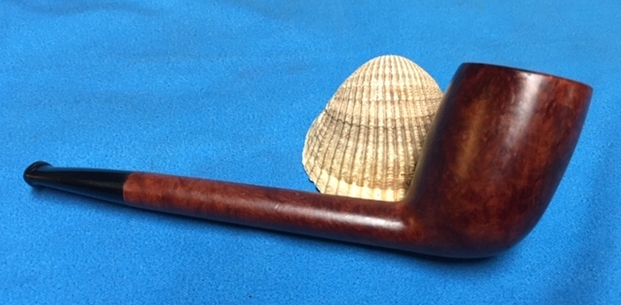
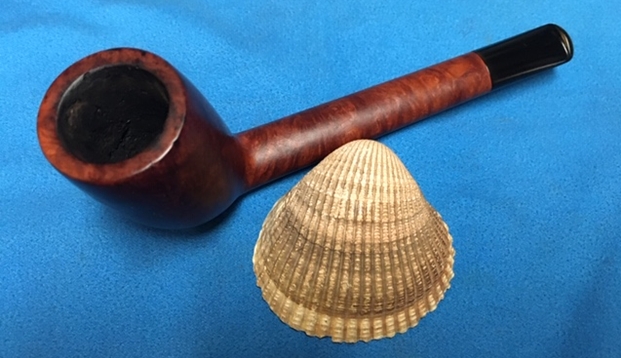
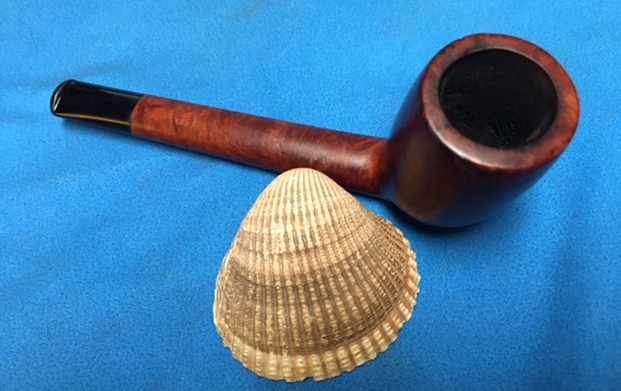
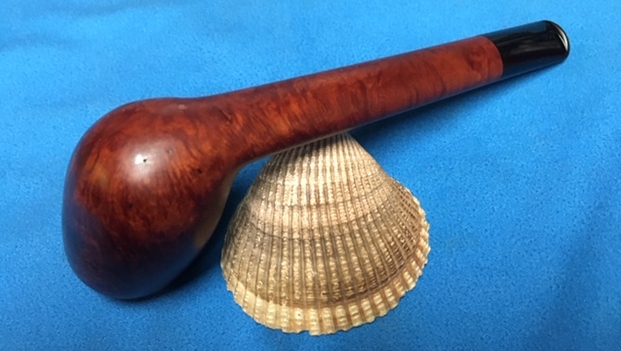
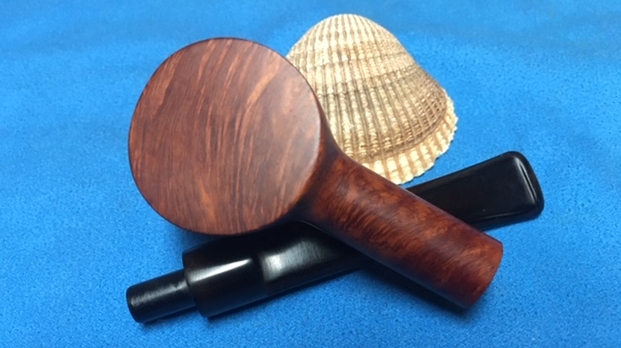
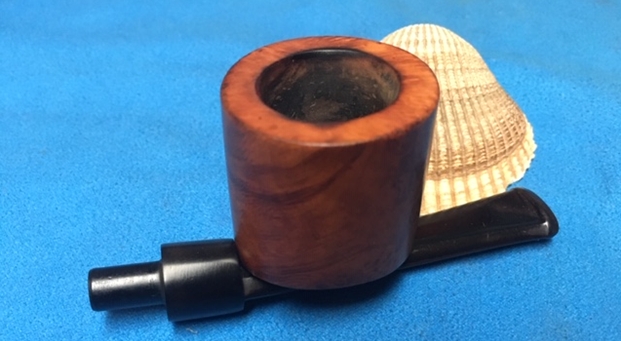
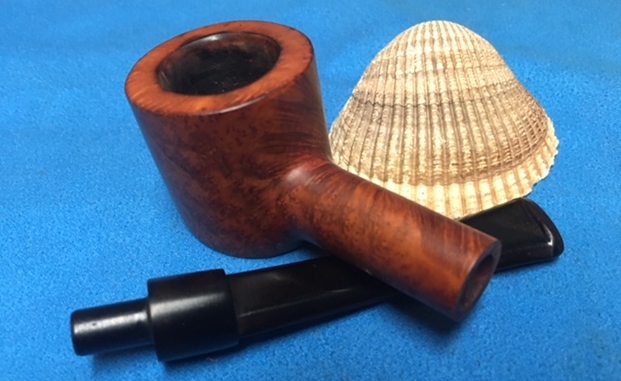
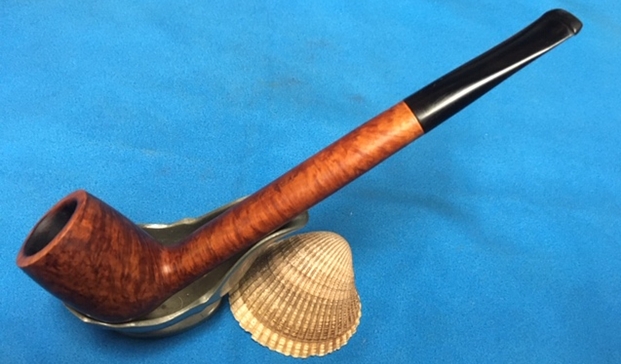
Sometimes You Find a Pipe You Know is Old – a No Name Canadian


Blog by Steve Laug

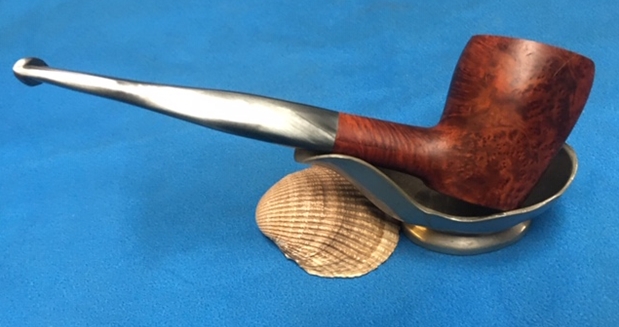
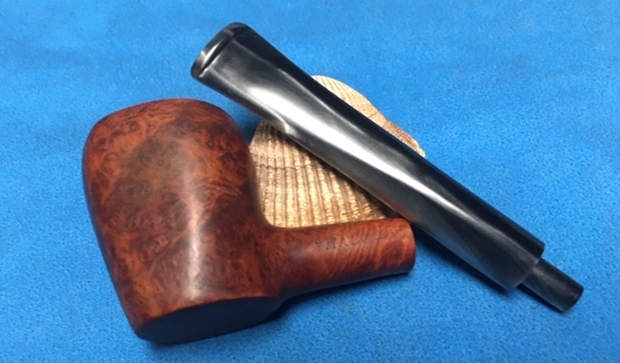
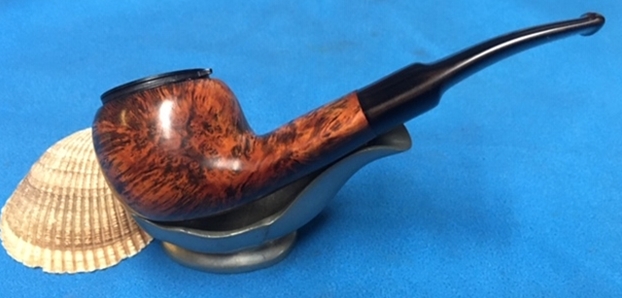
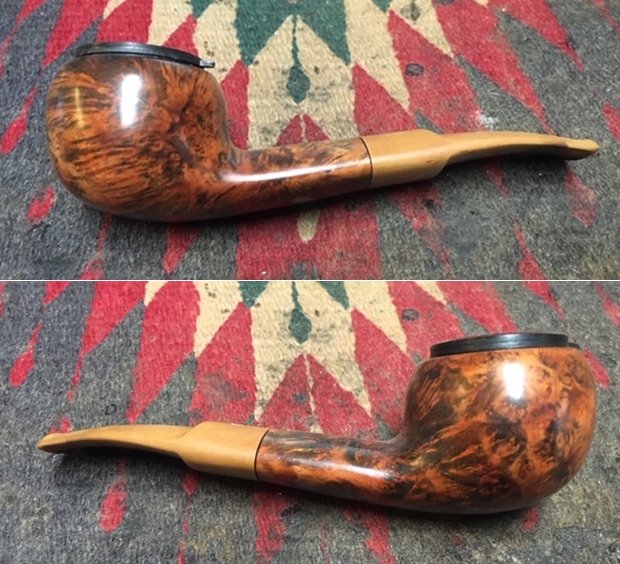
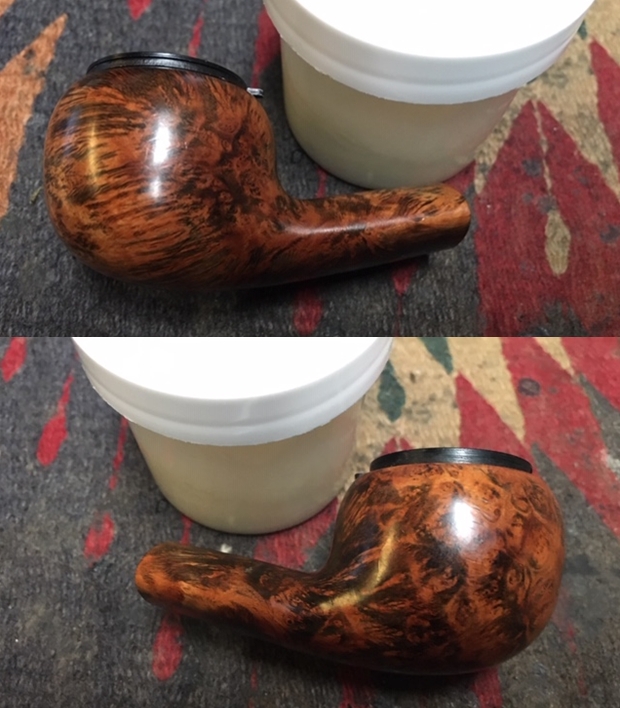
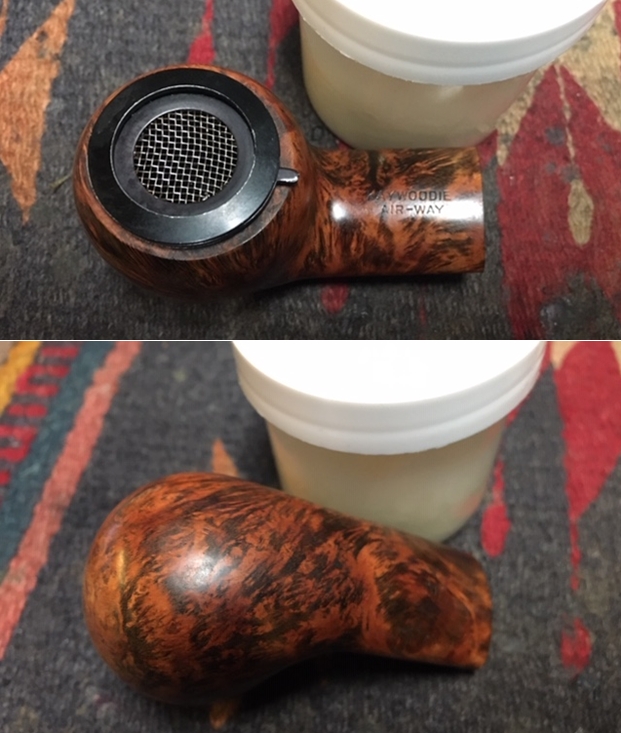
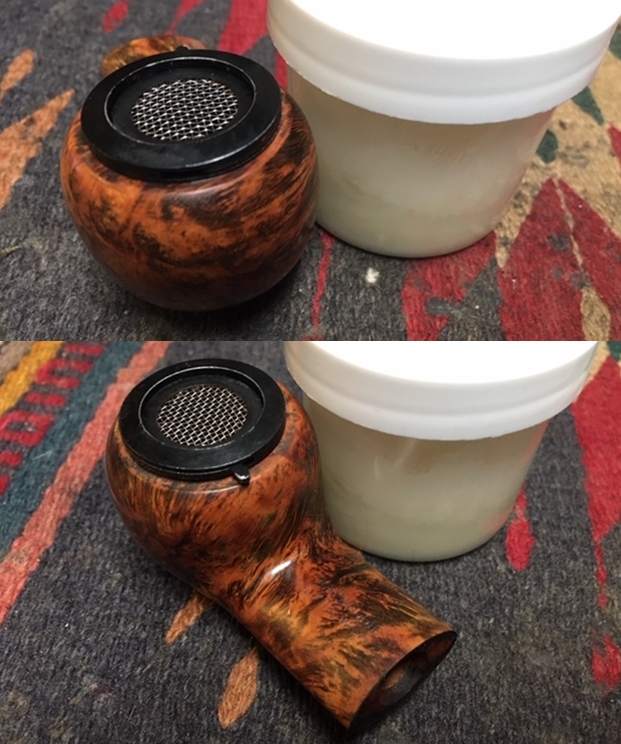
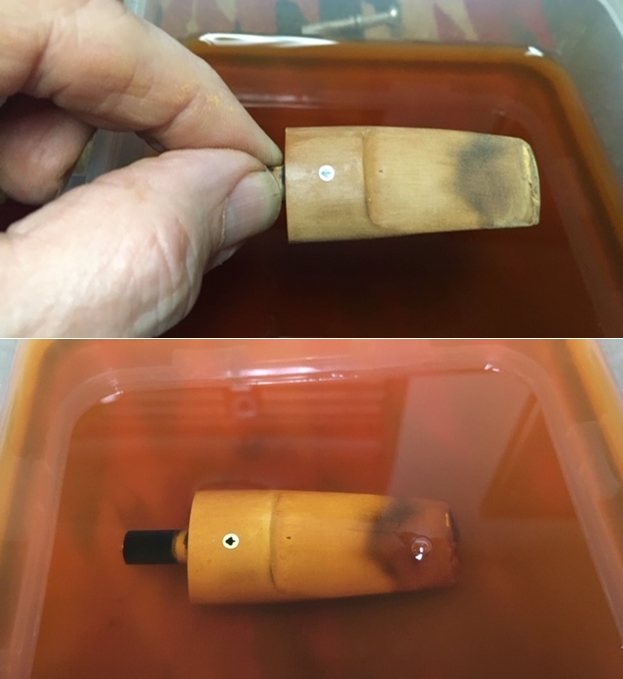
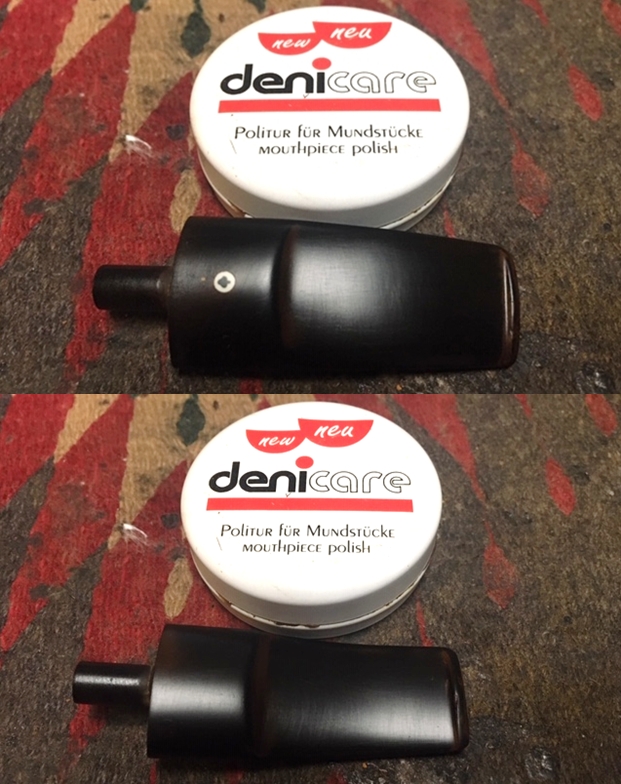
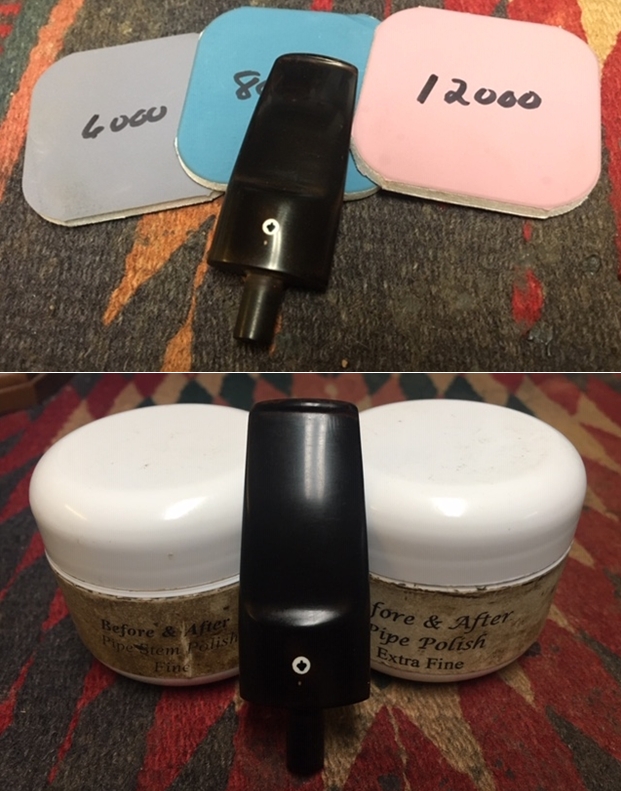
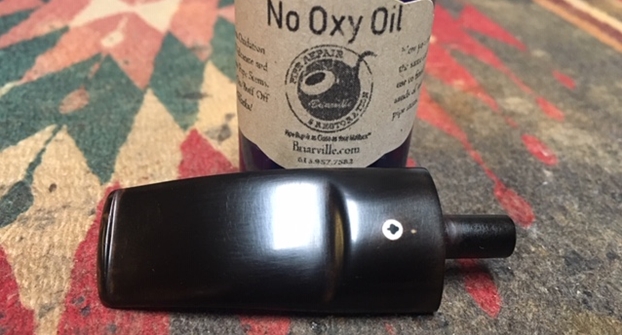
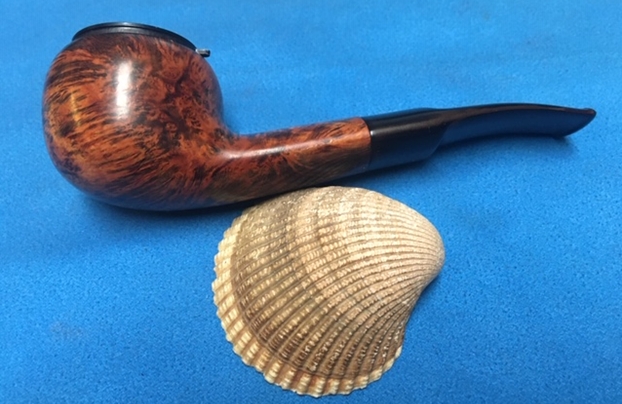
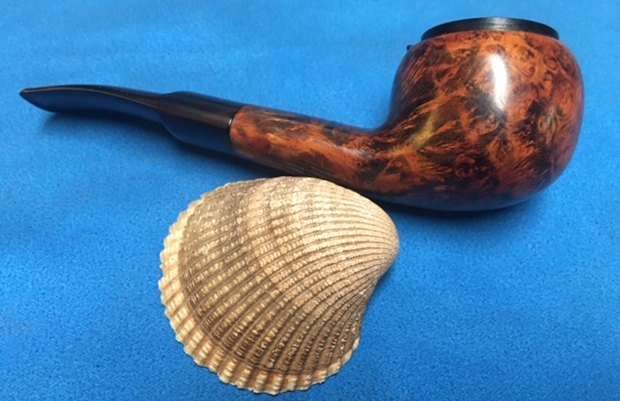
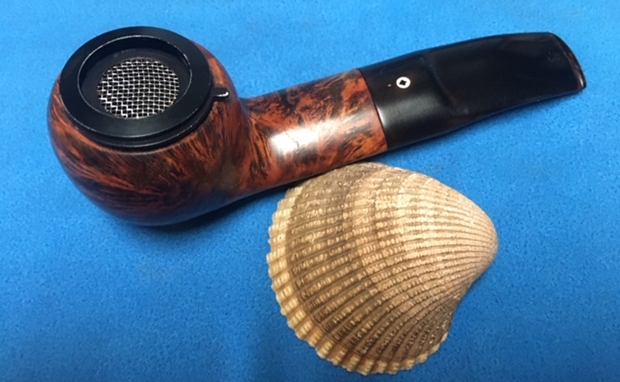
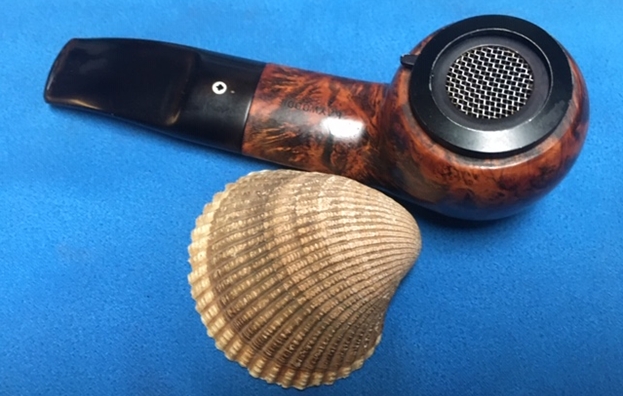
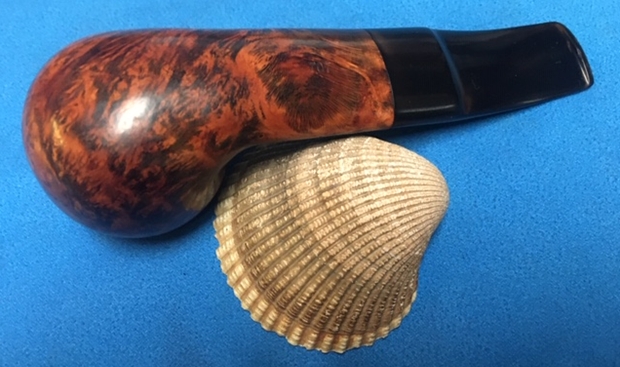
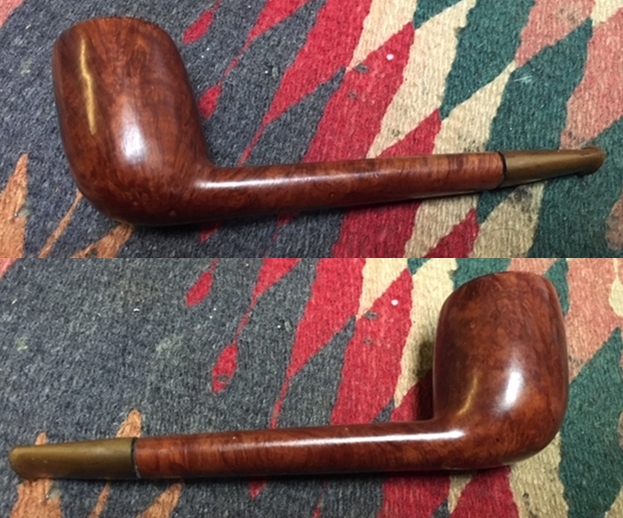
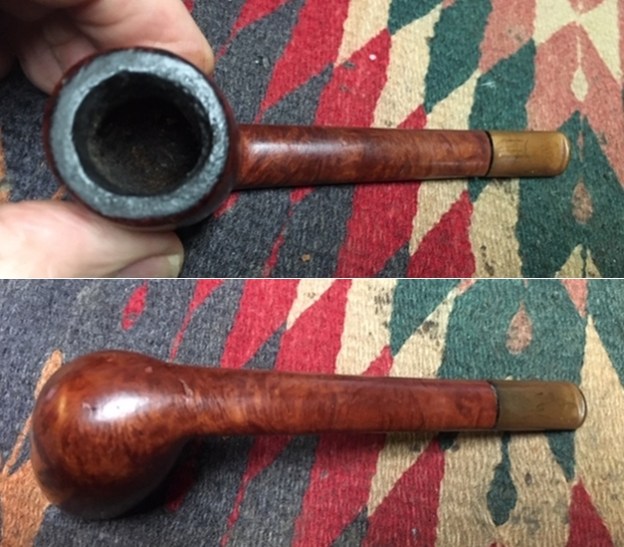
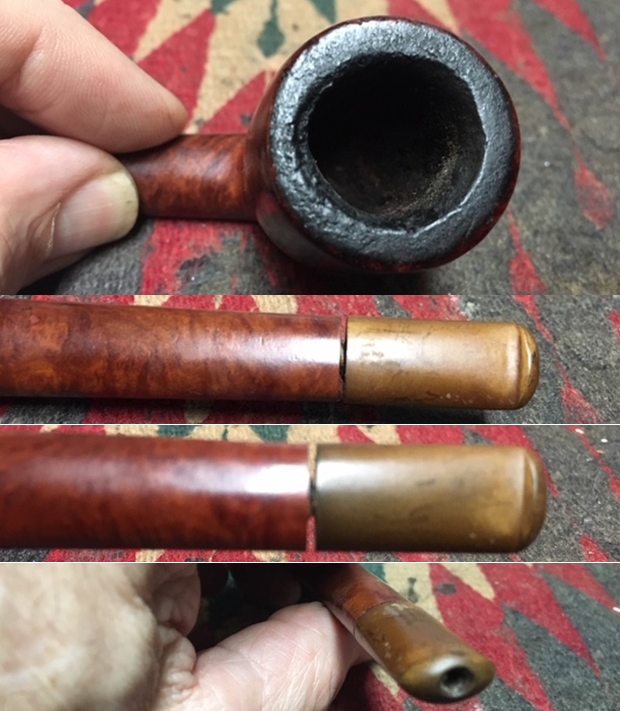
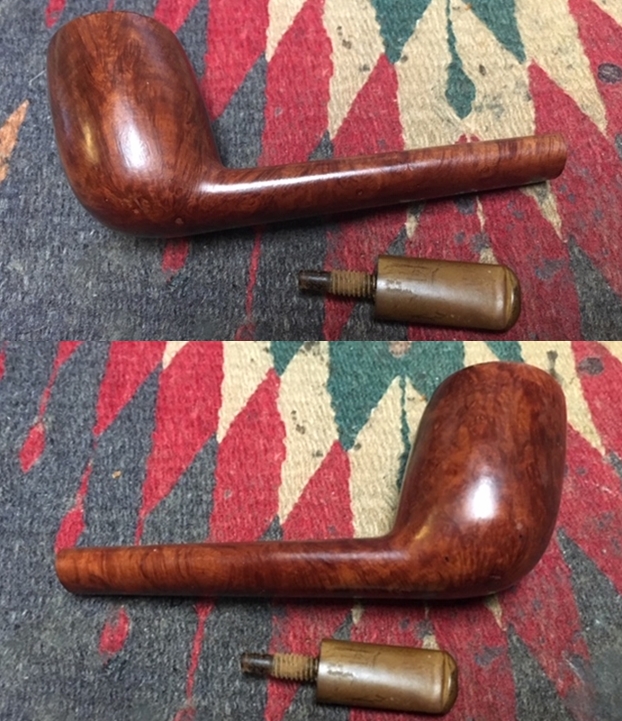
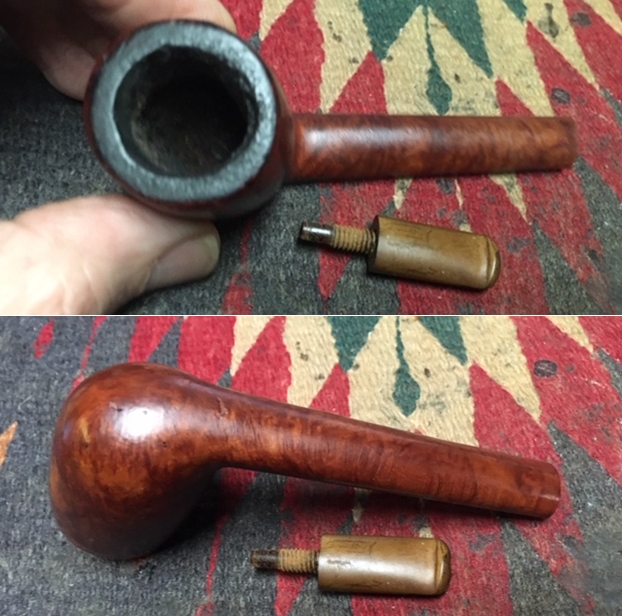
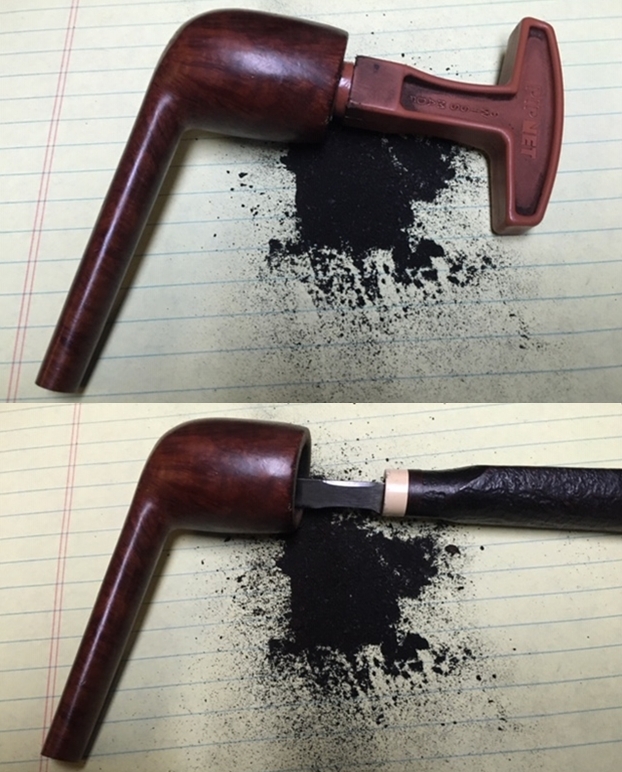
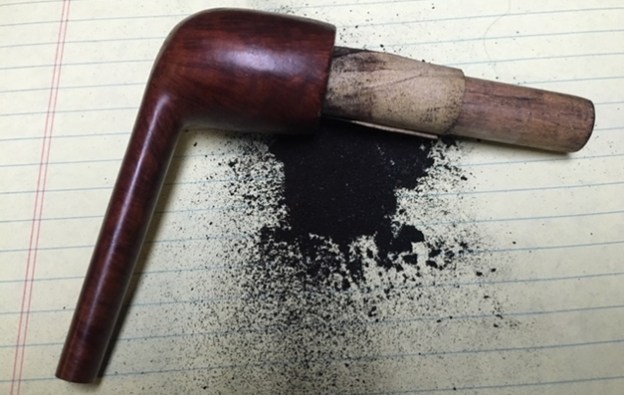
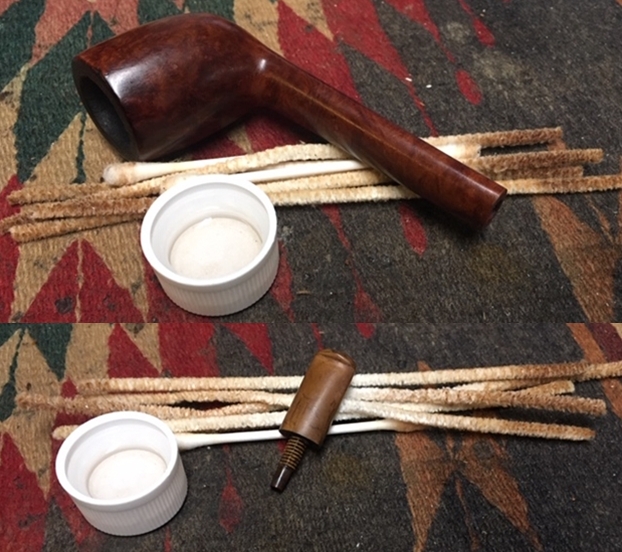
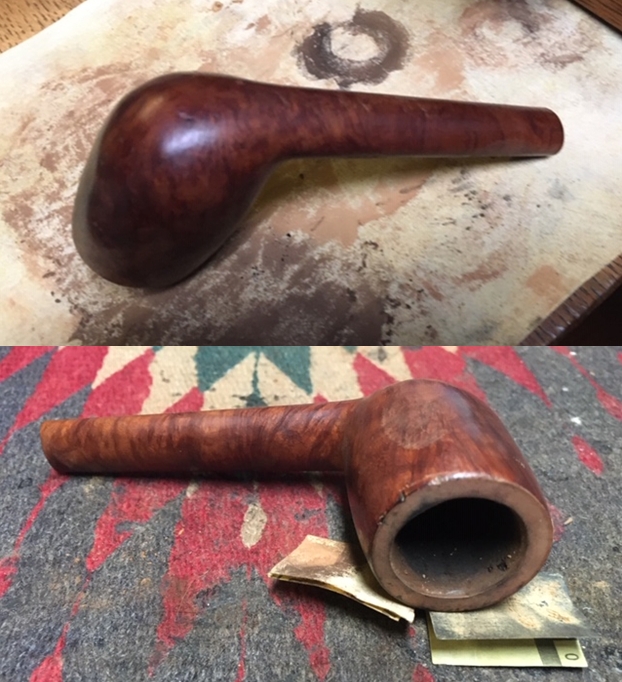
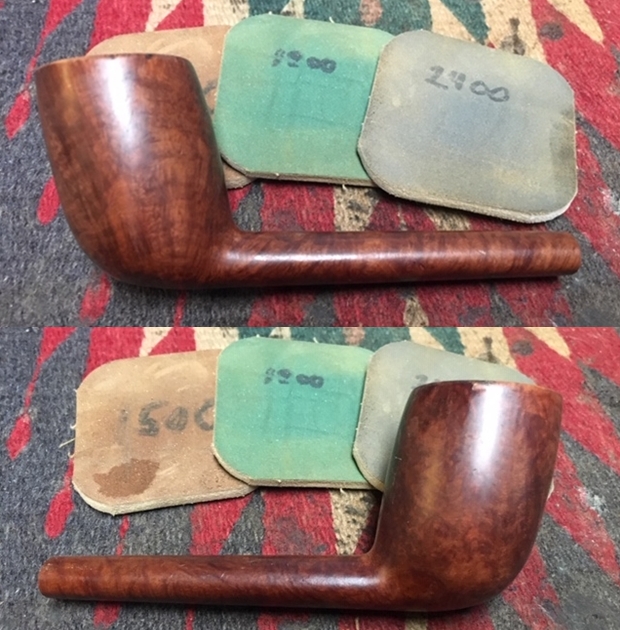
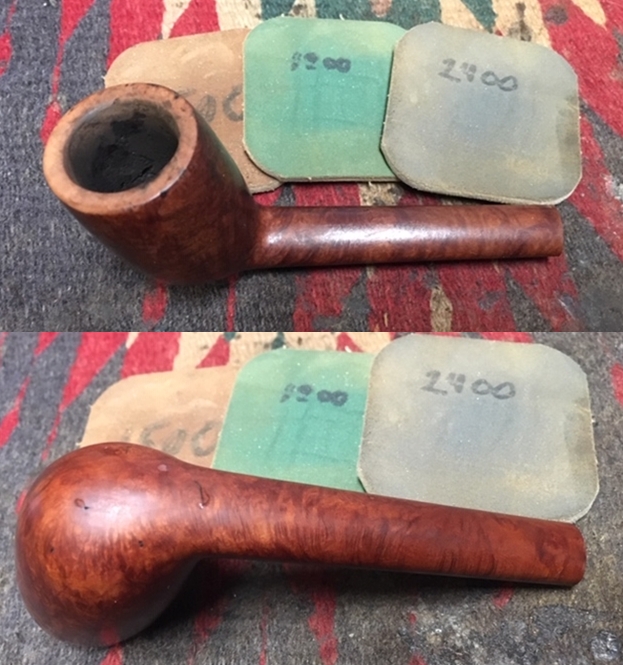
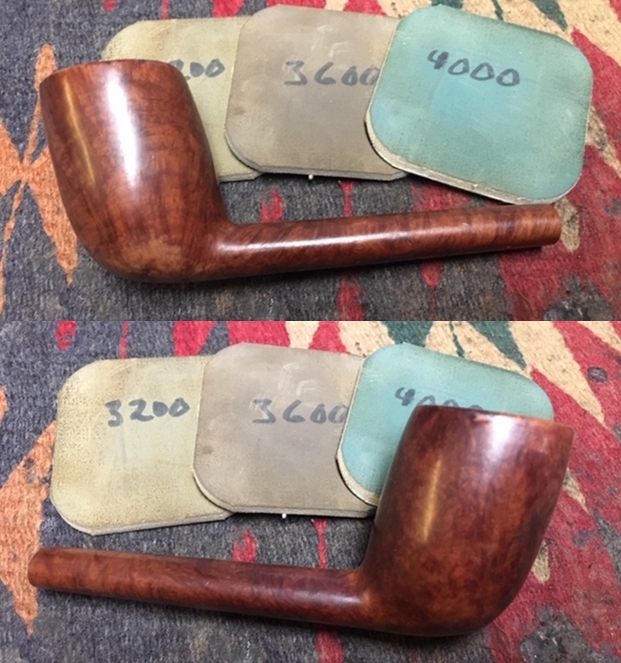
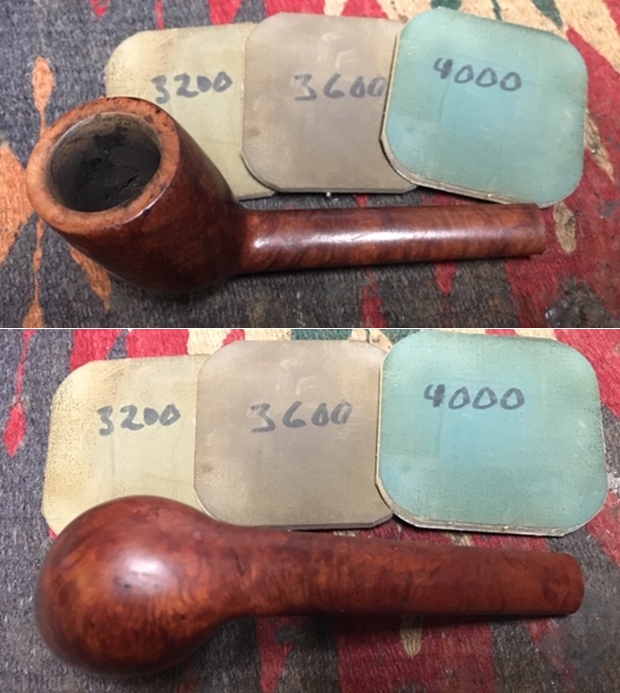
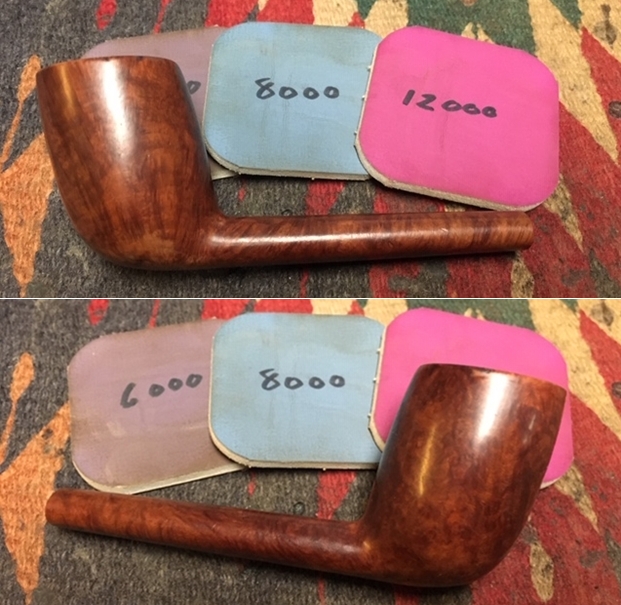
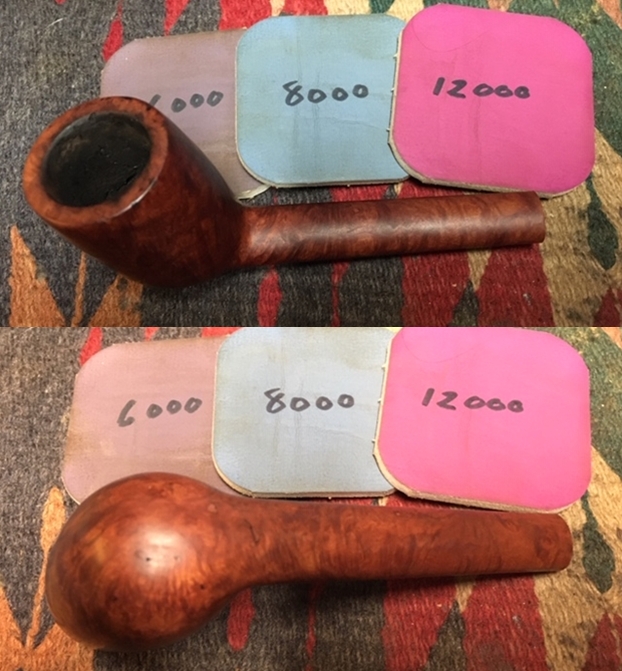
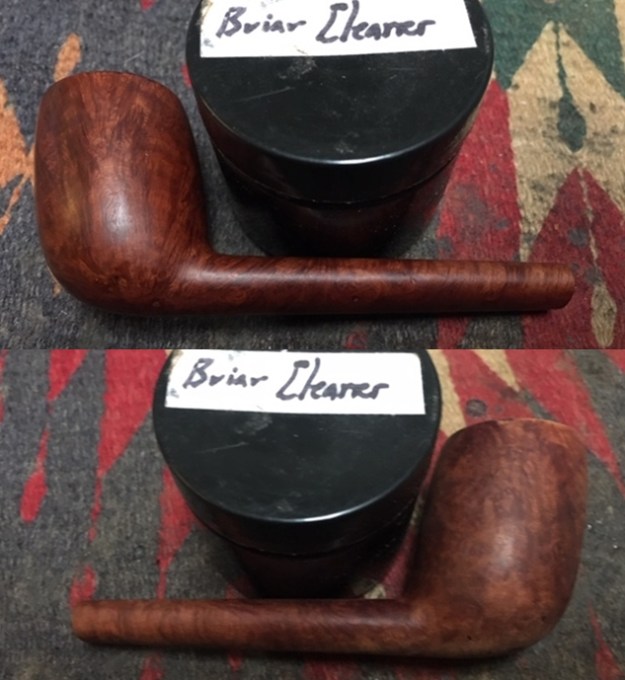
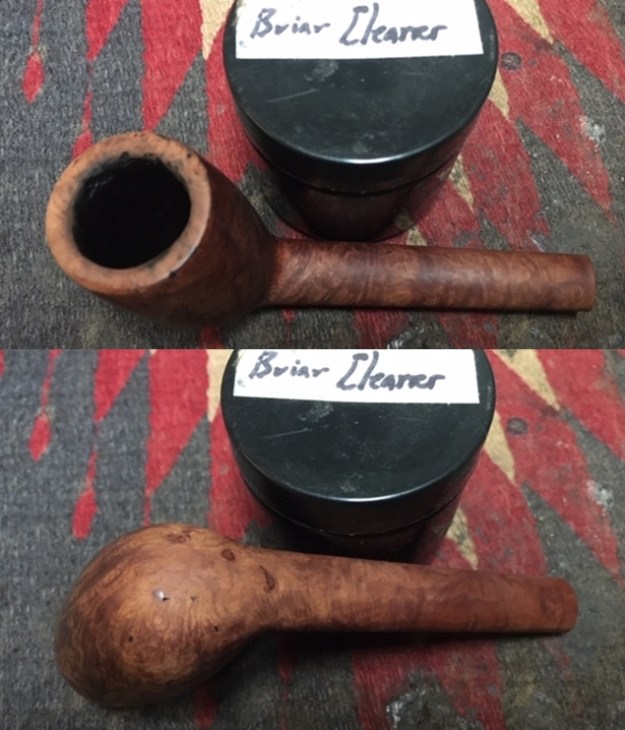
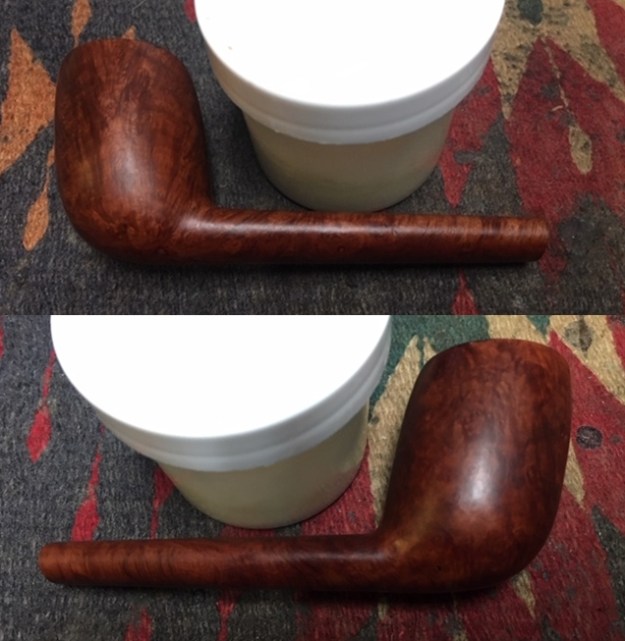
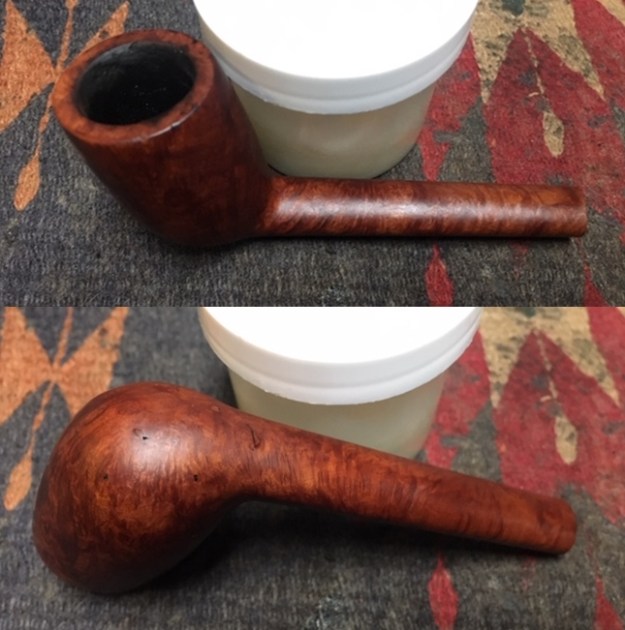
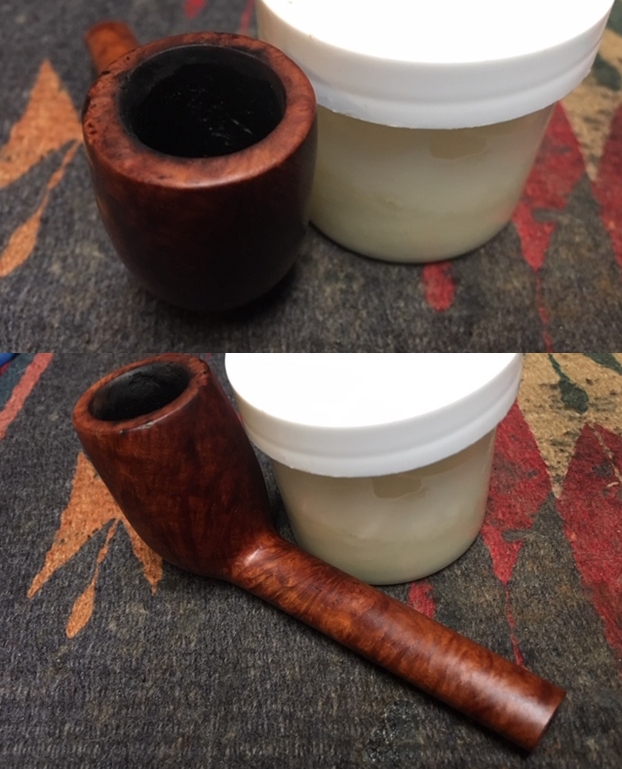
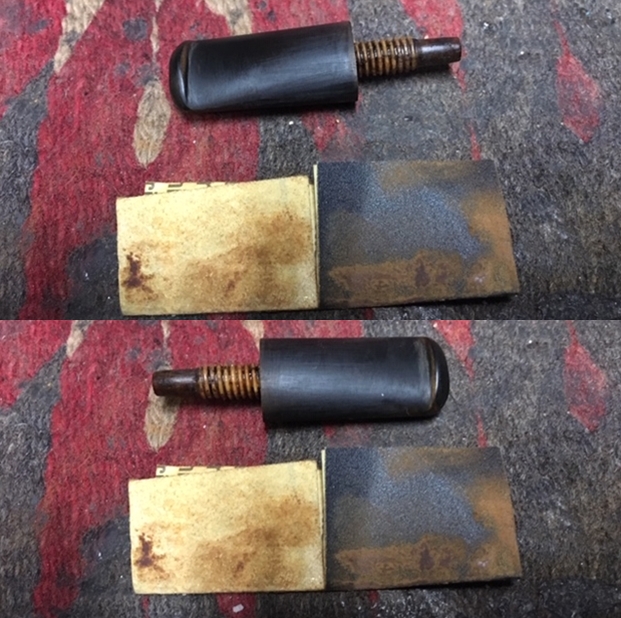
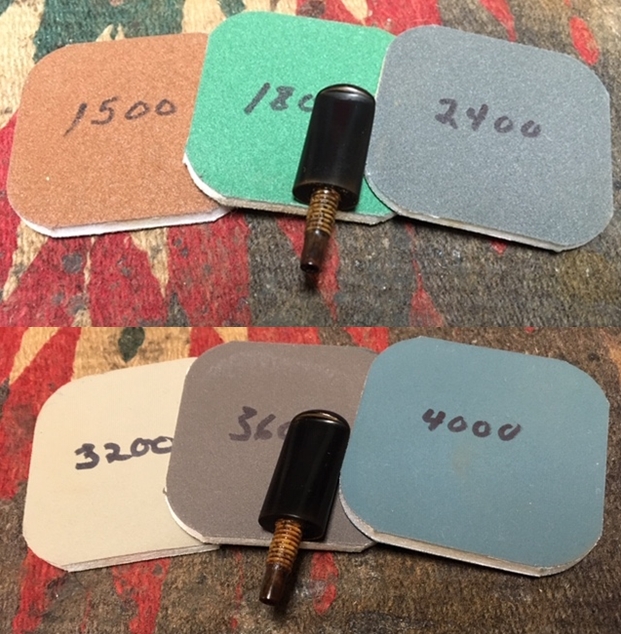
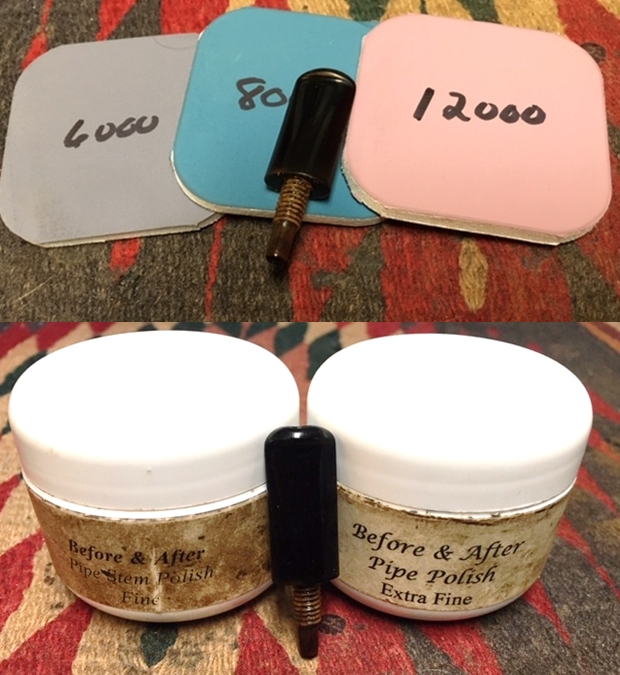
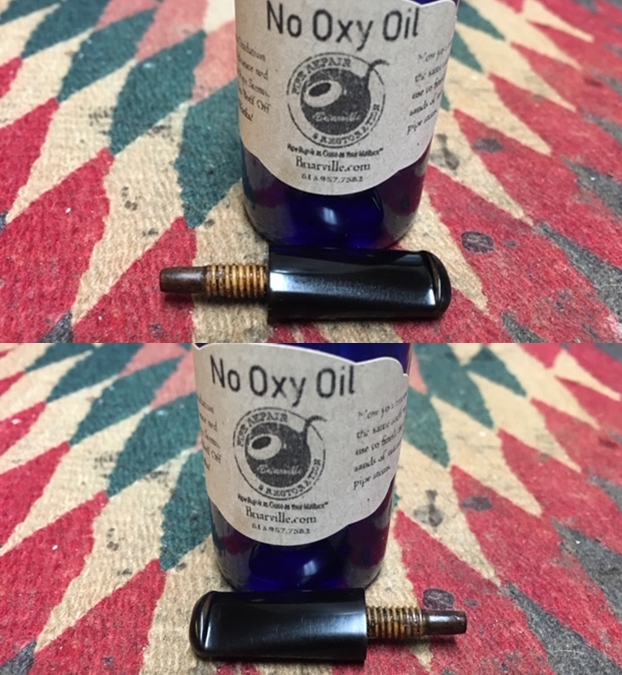
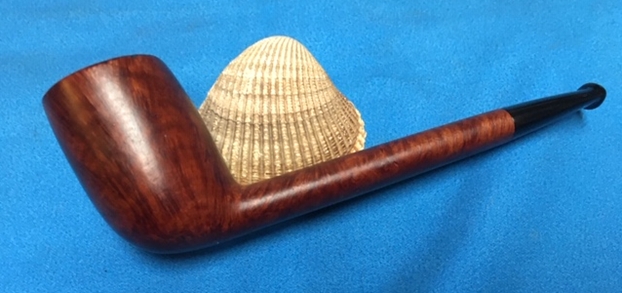
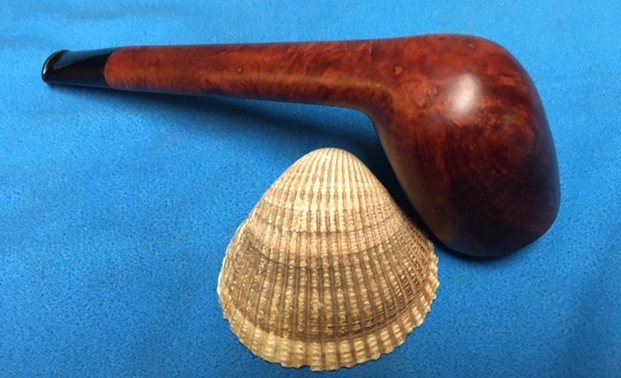
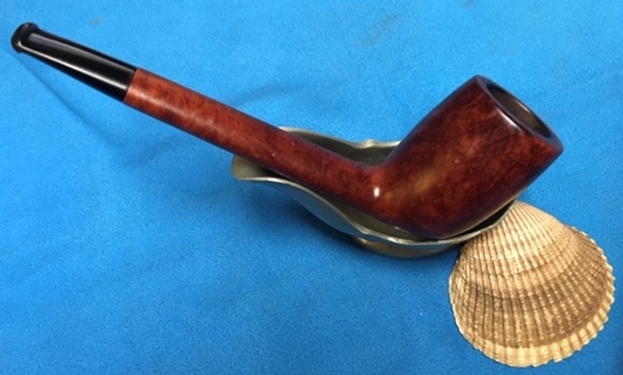
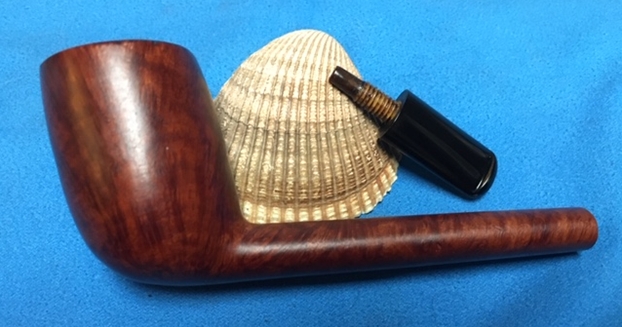
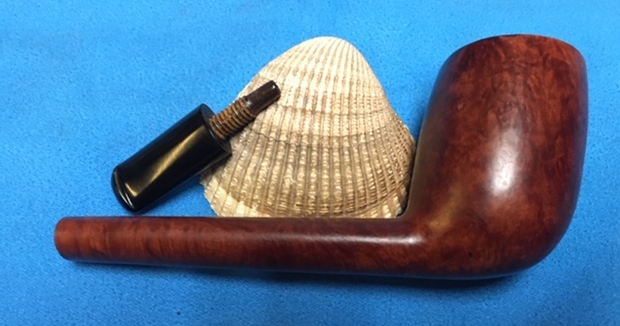
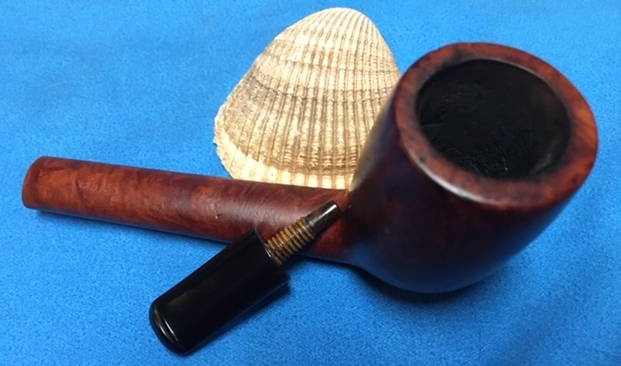
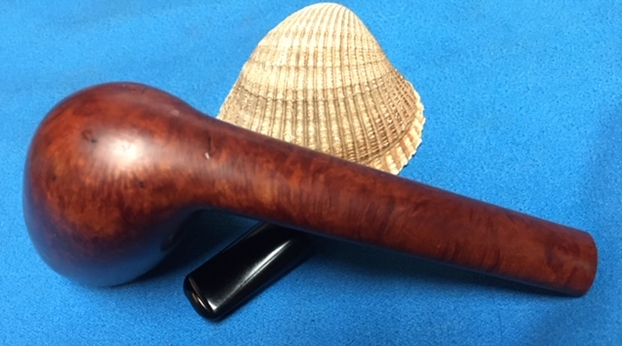
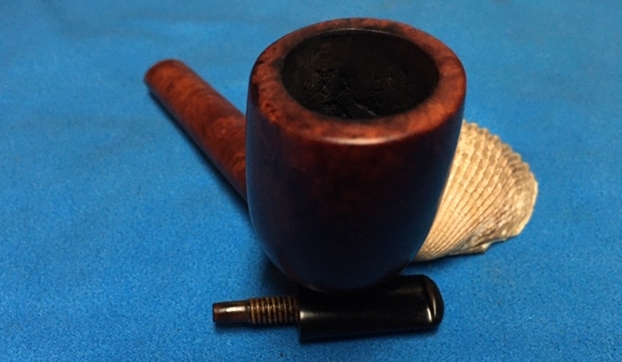
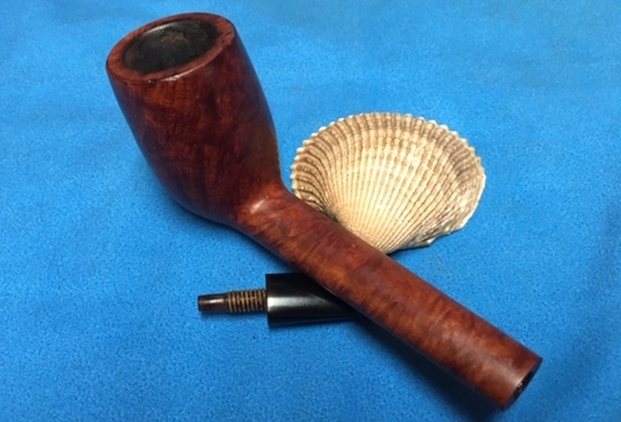
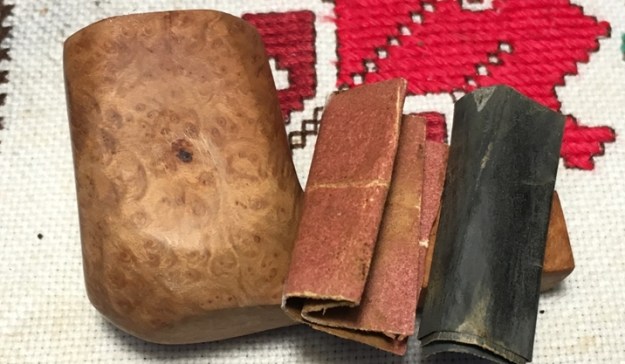
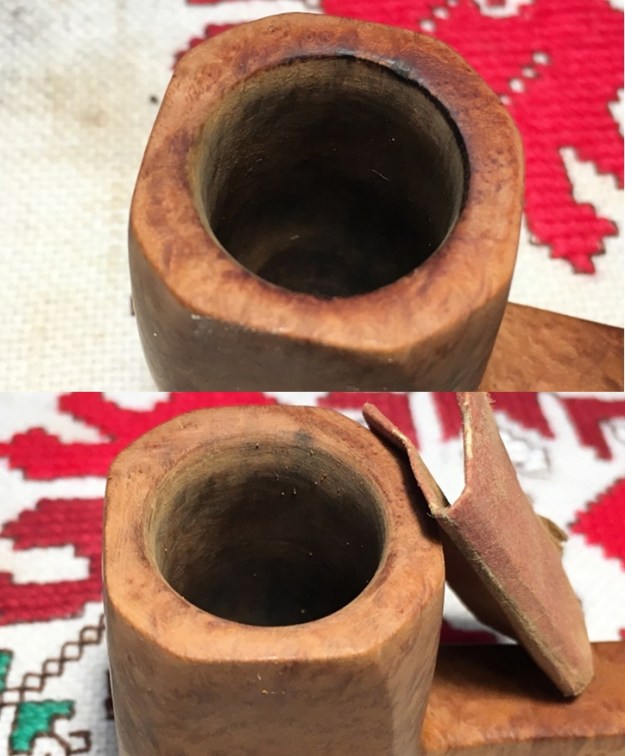
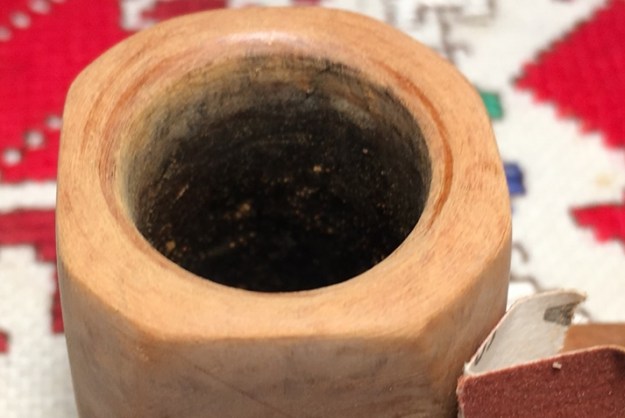
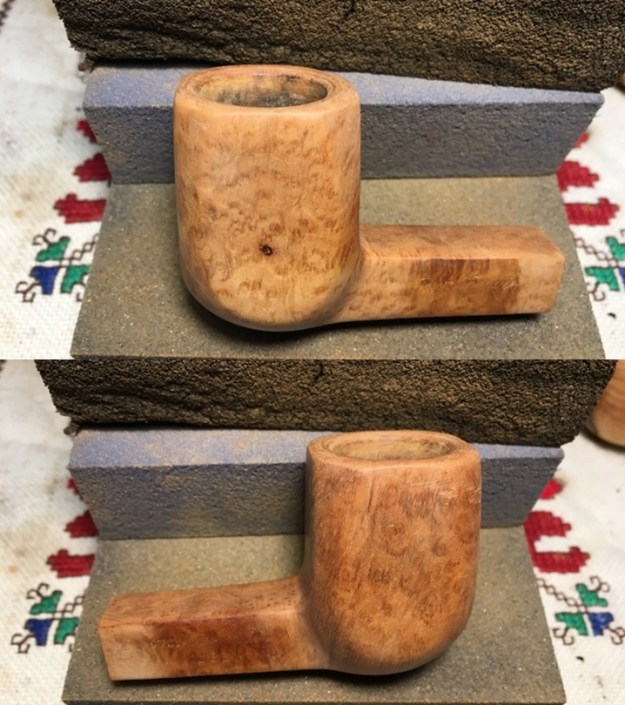
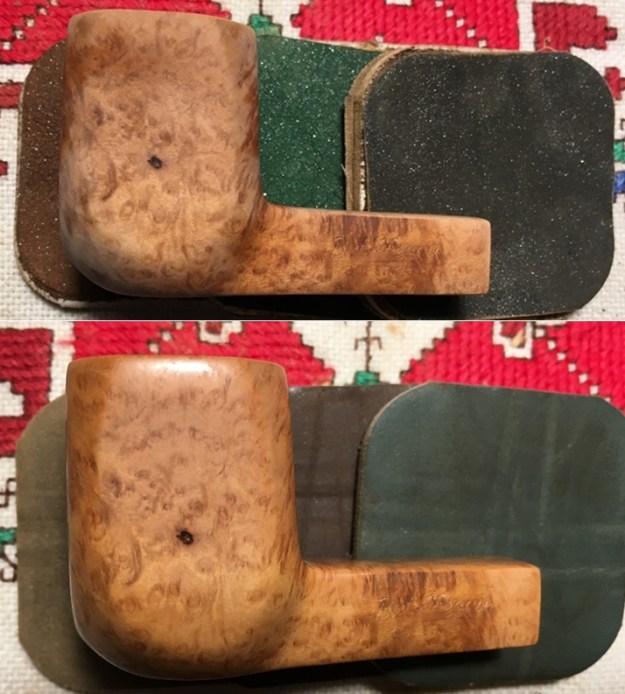
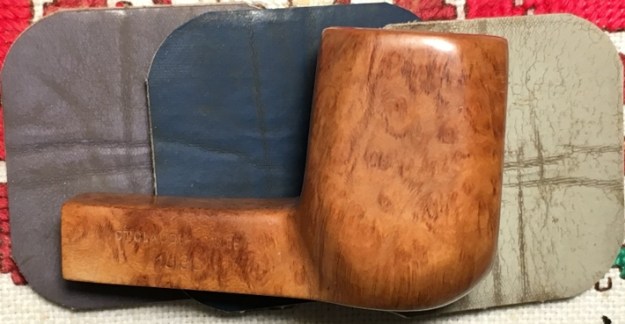
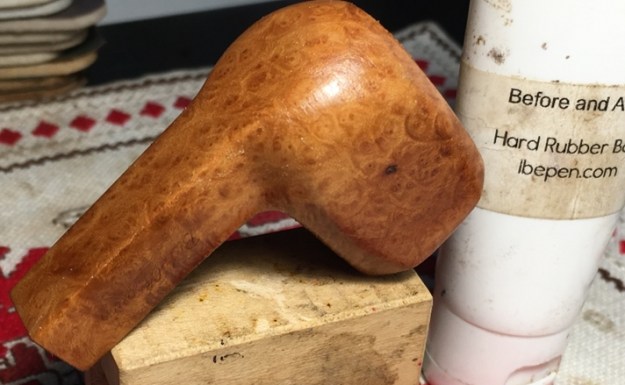
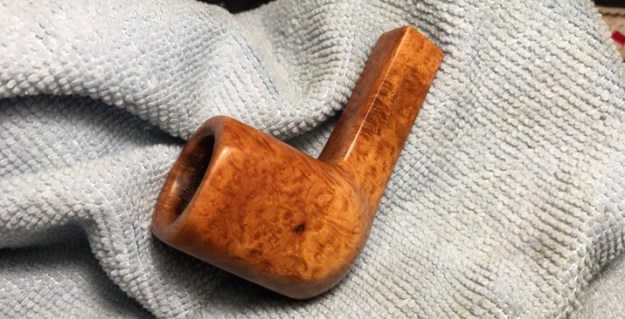
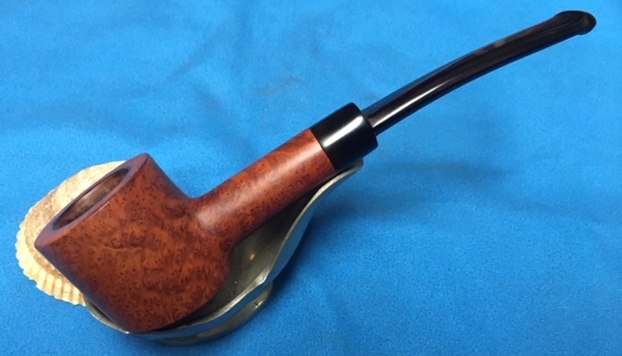
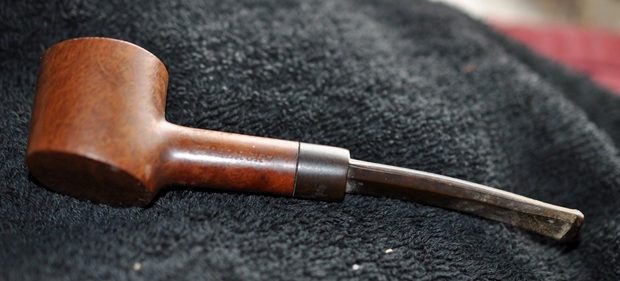
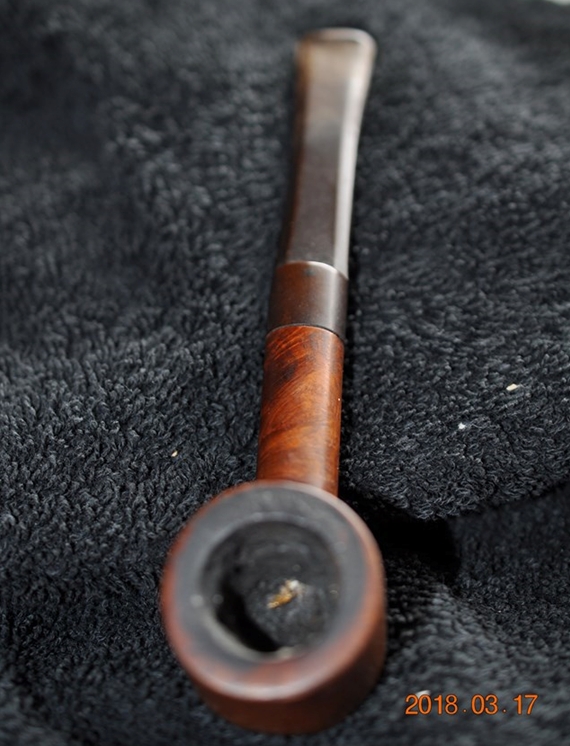
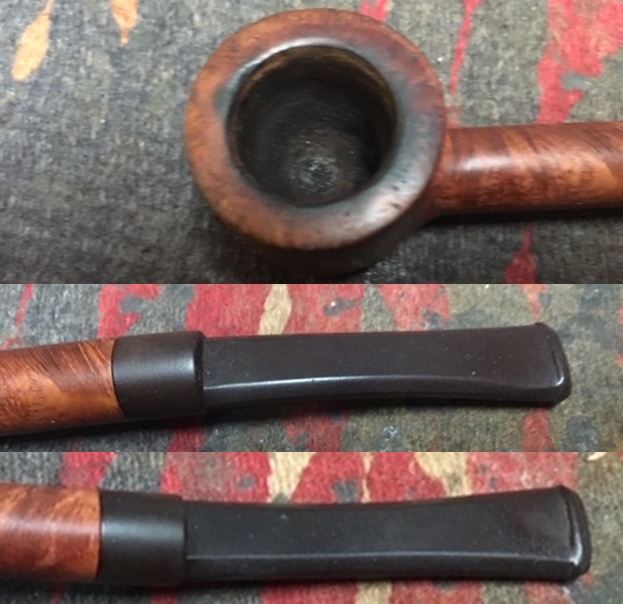
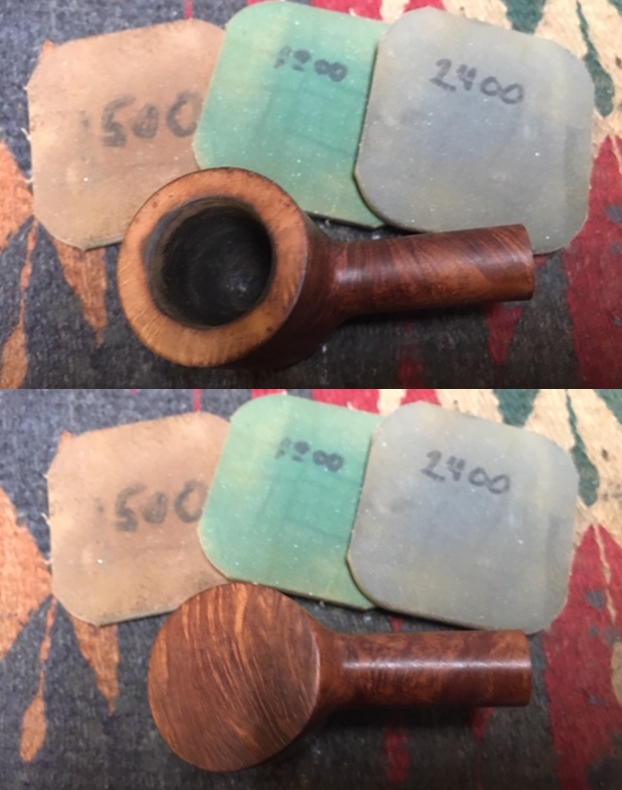
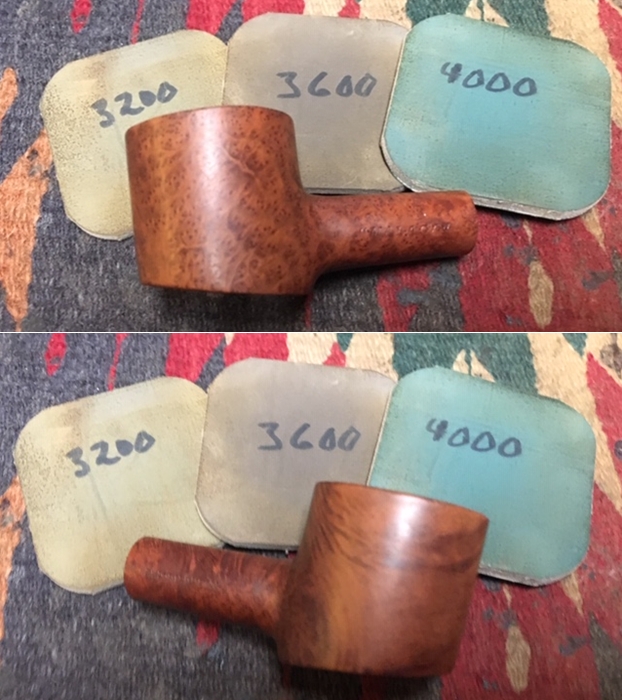
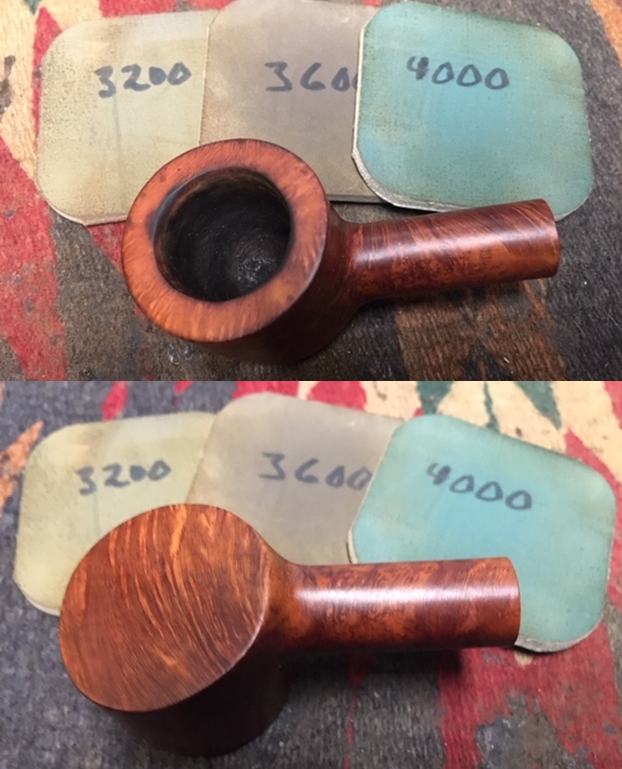
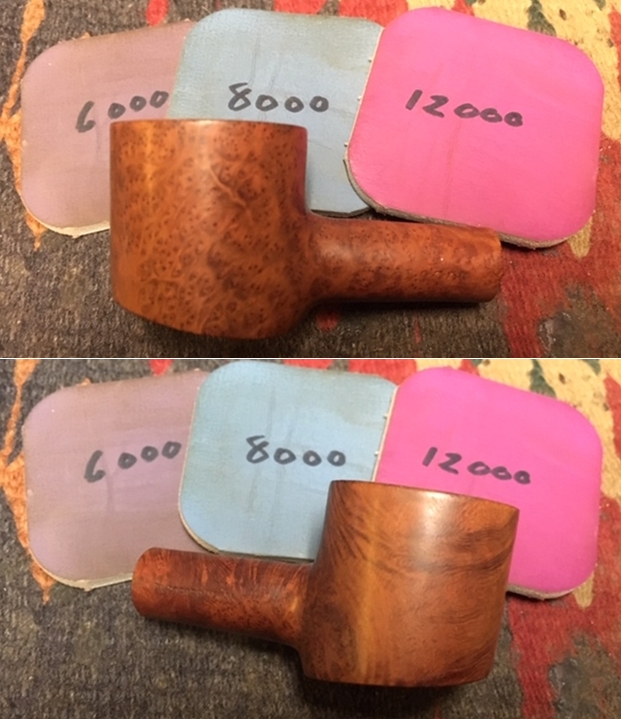
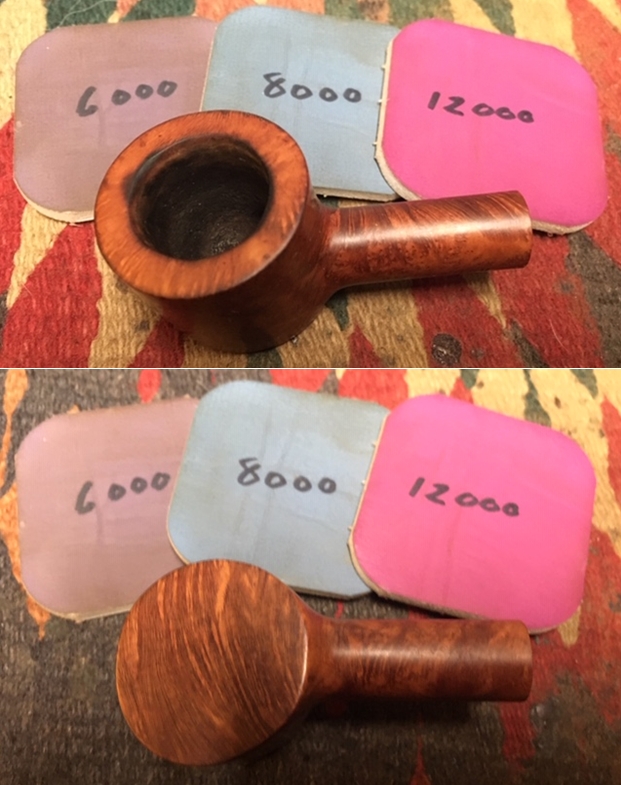
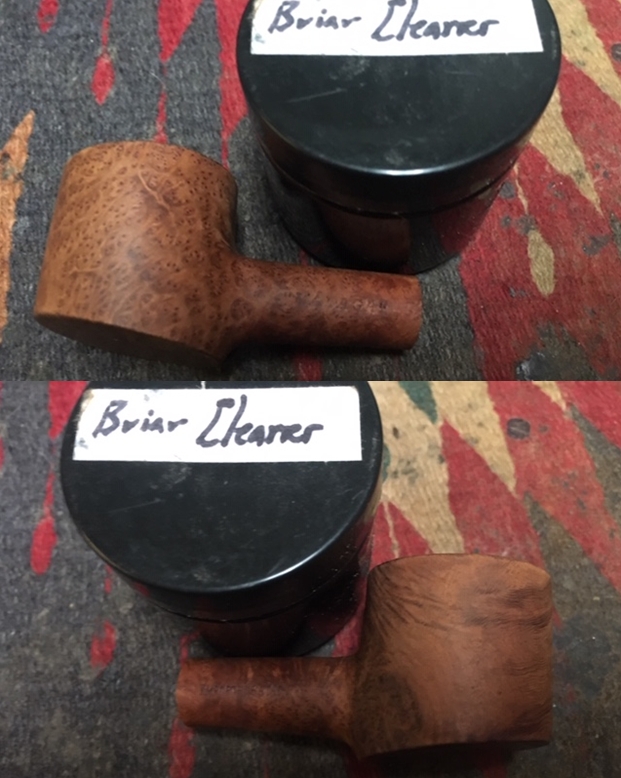
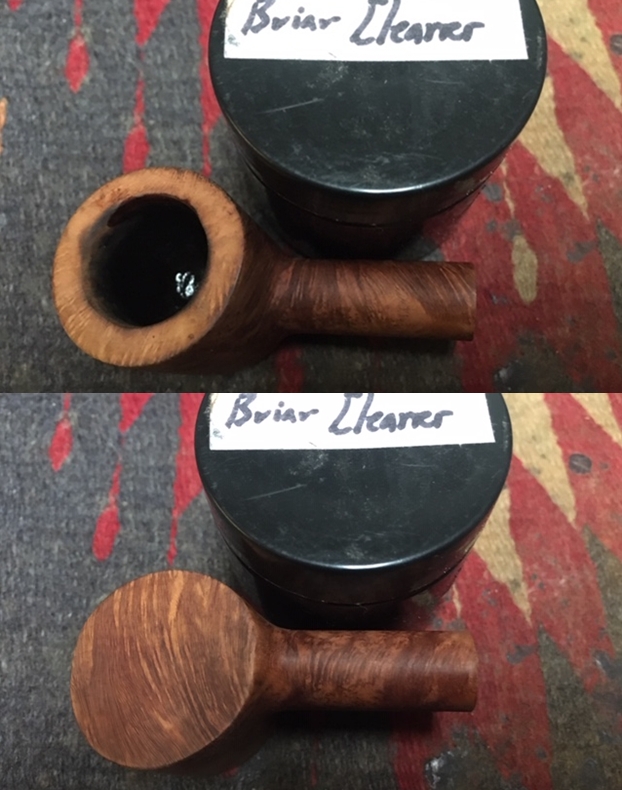
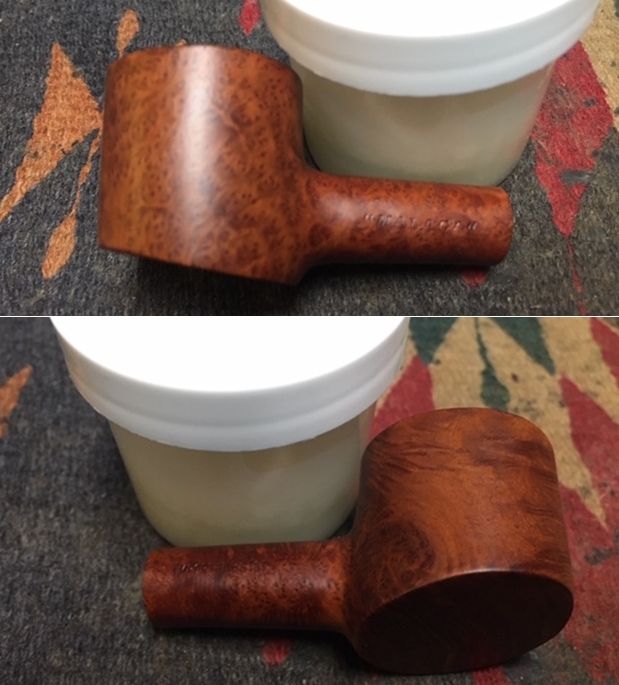
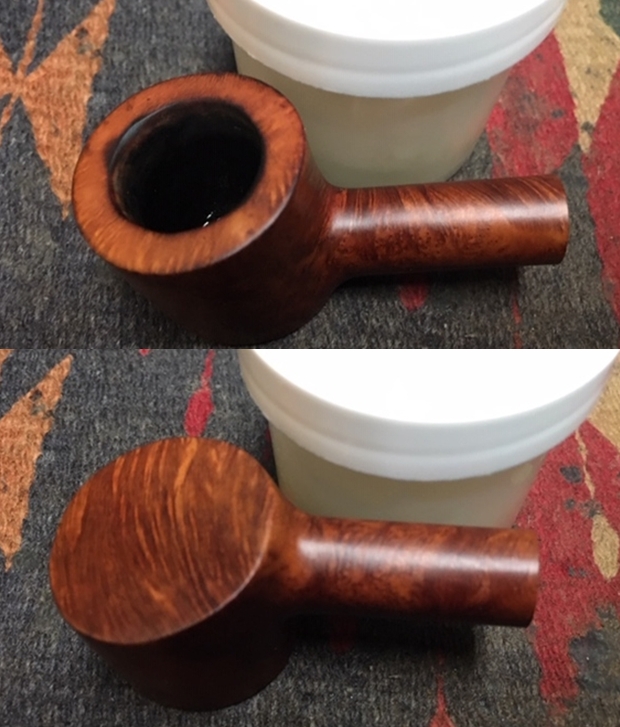
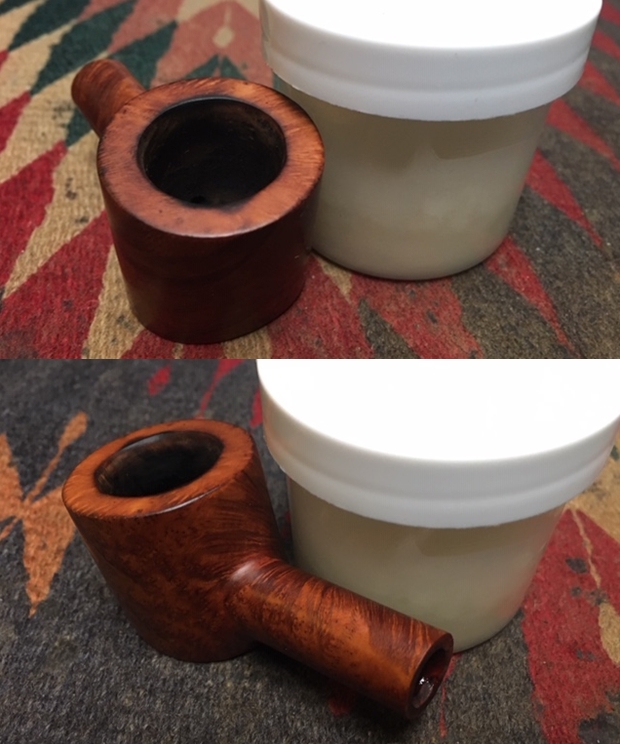
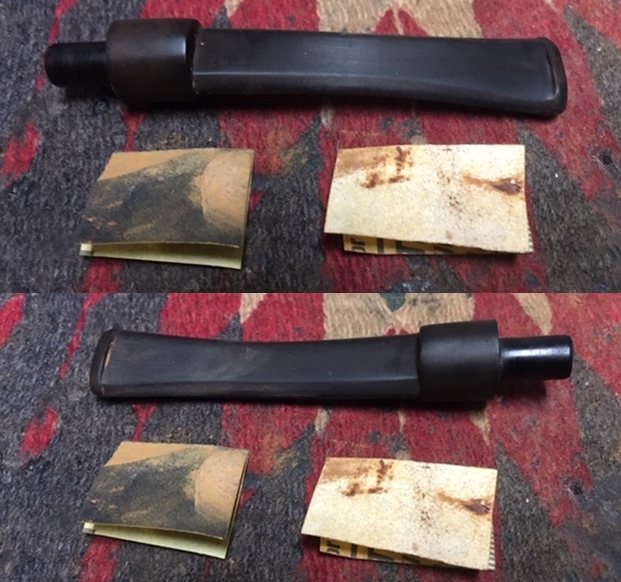
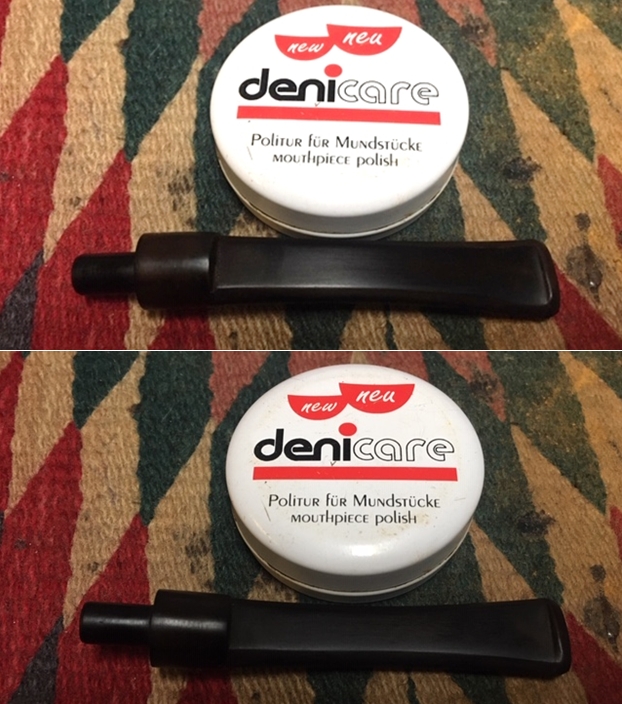
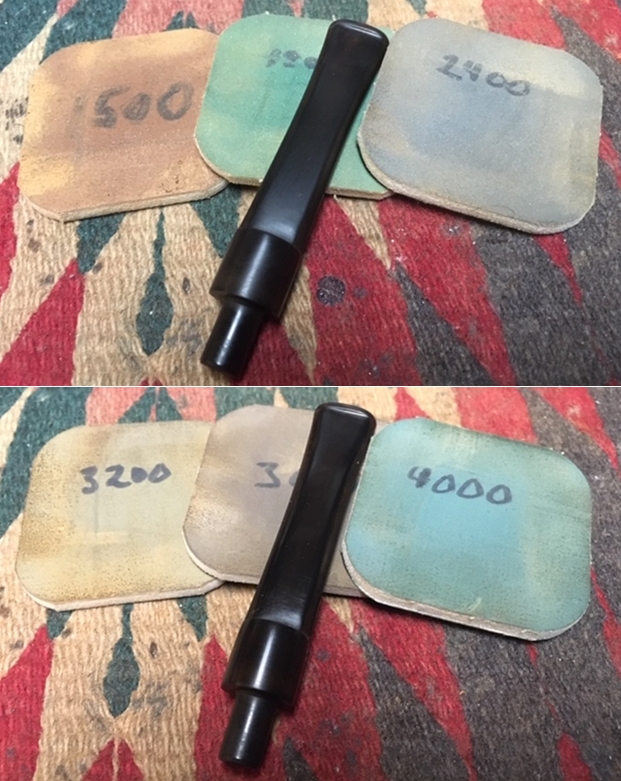
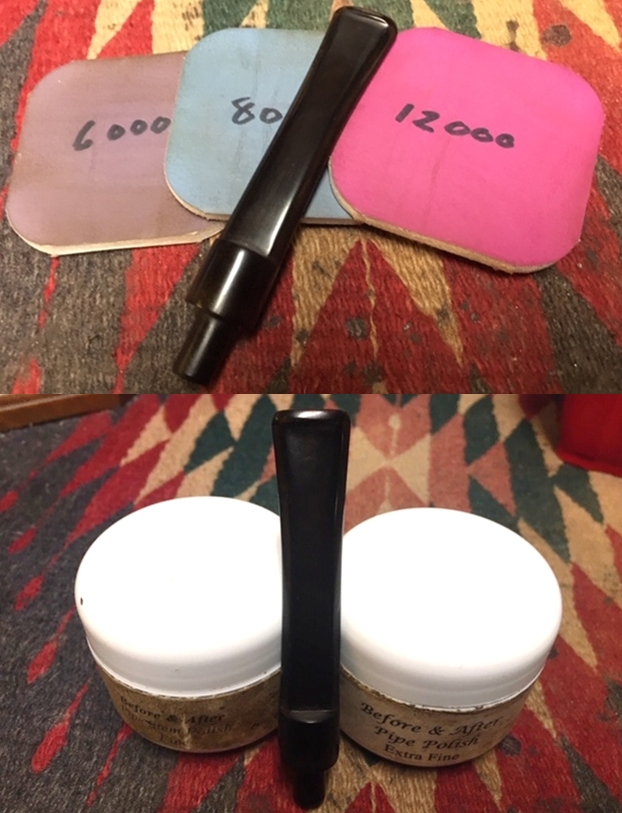
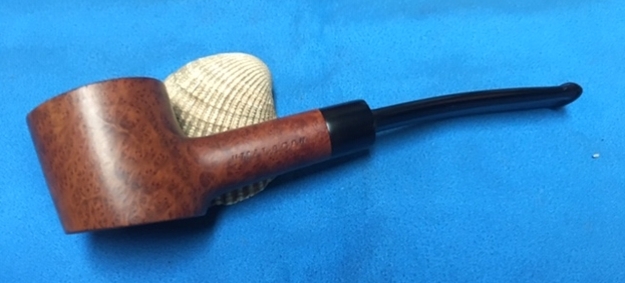
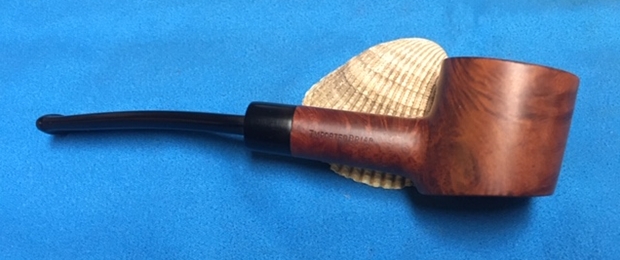
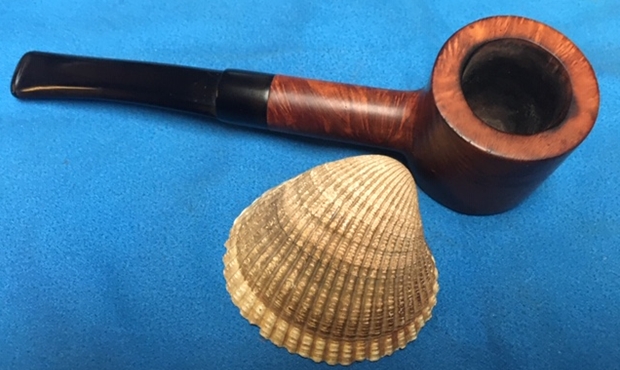
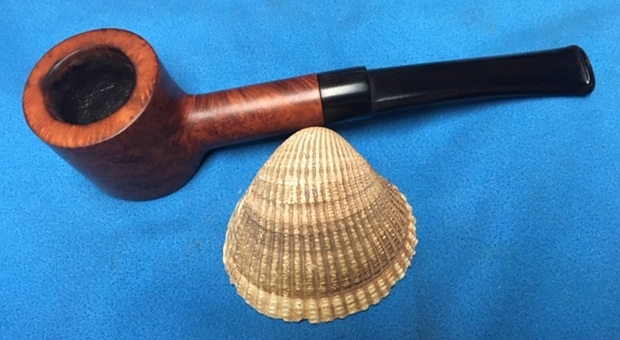
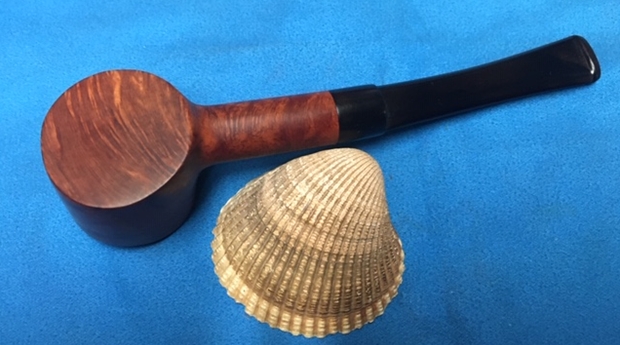
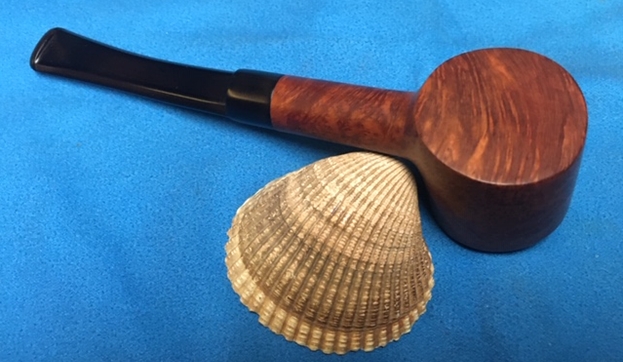
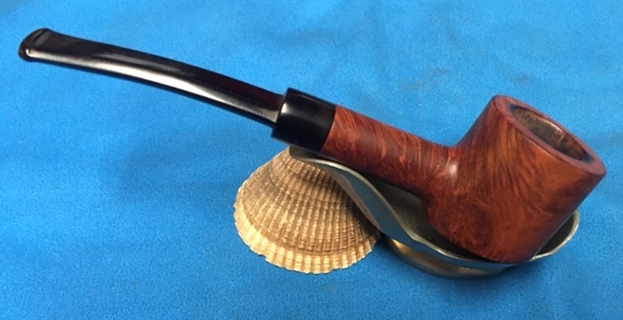
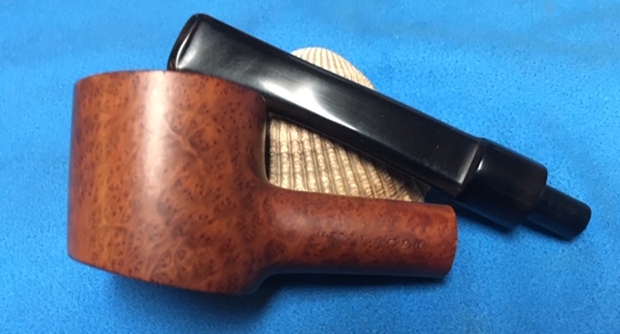
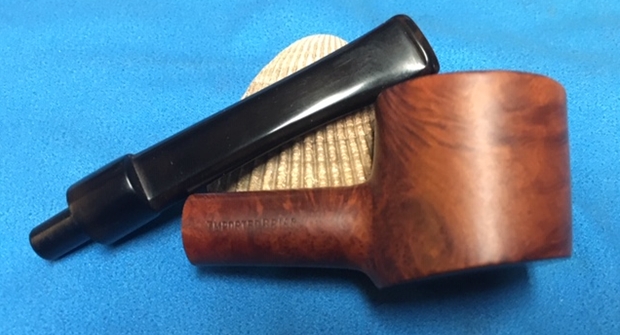
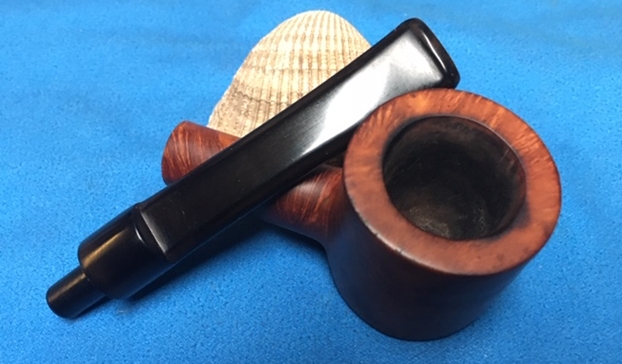
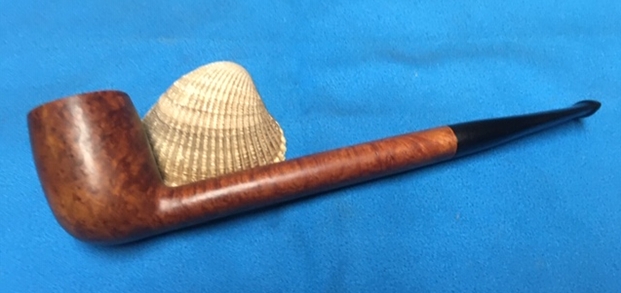
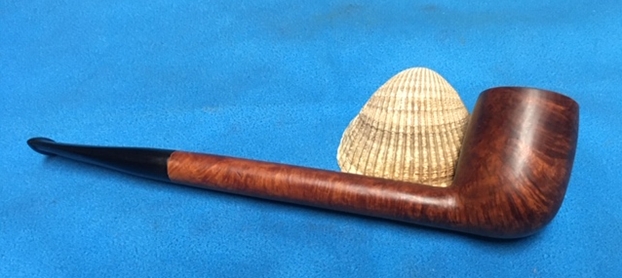
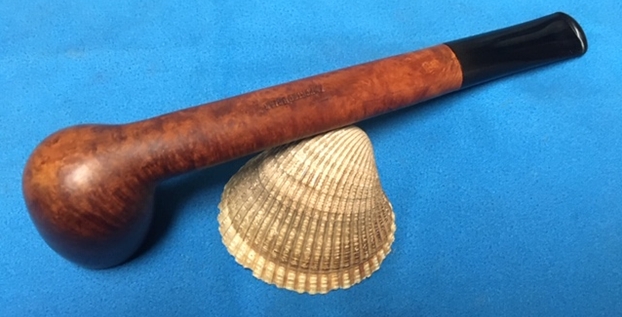
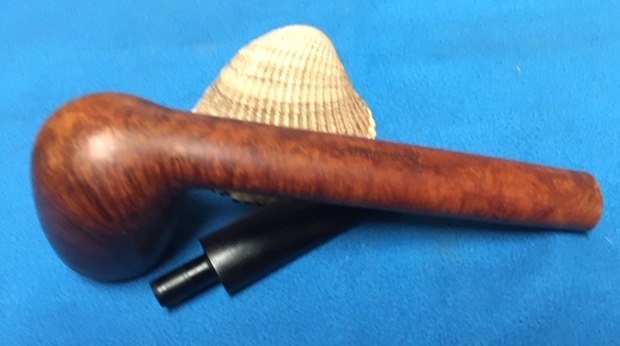
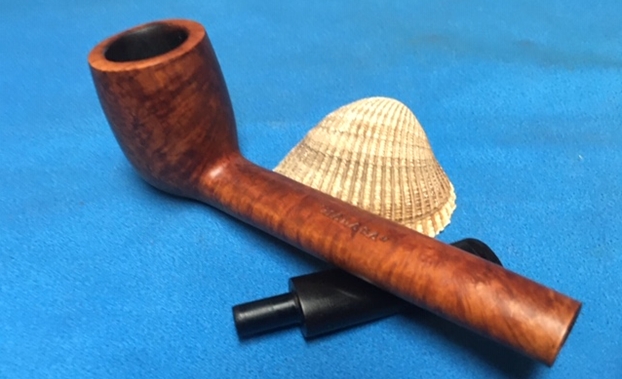
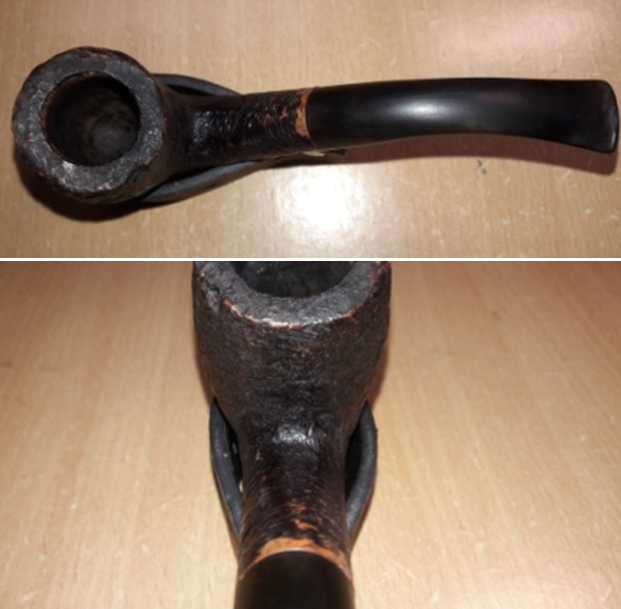
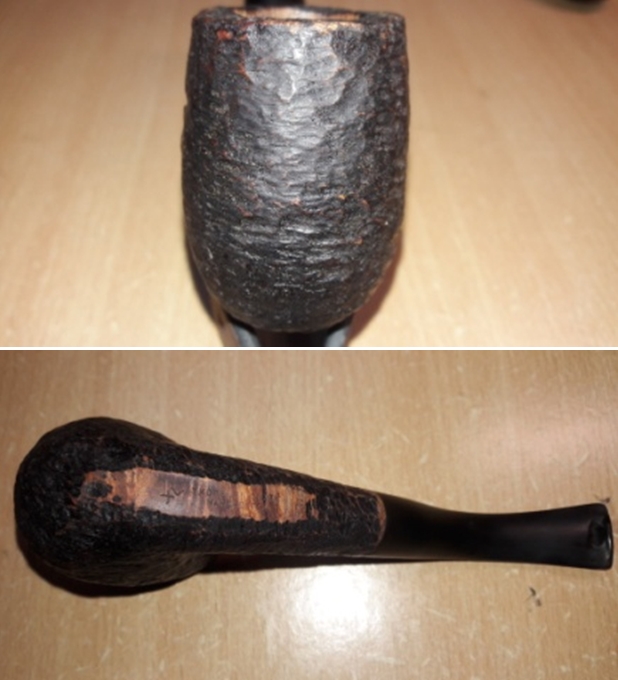
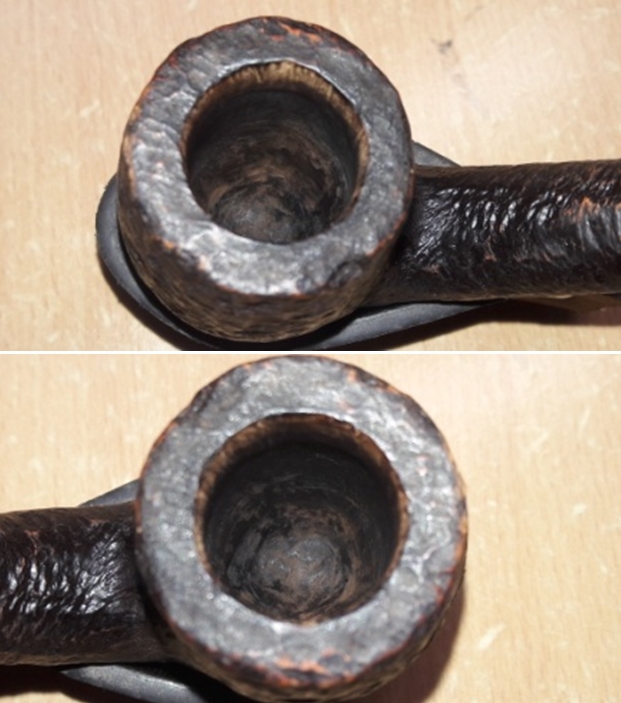
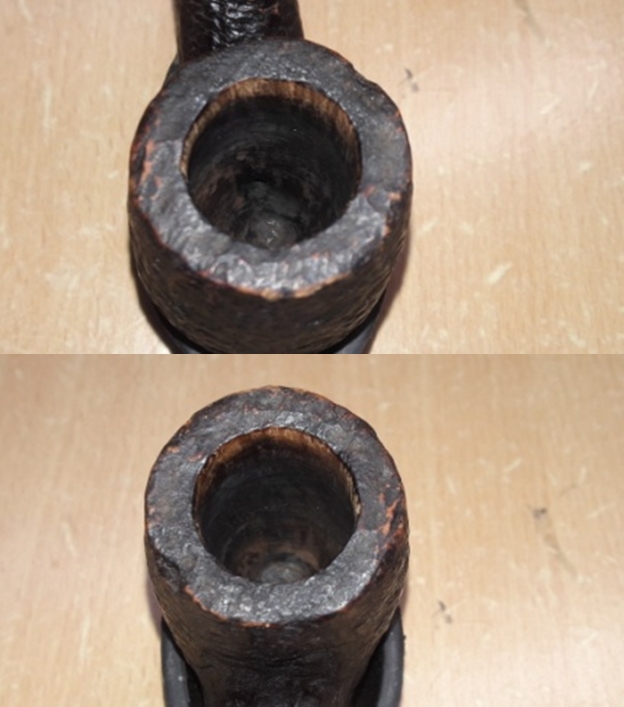
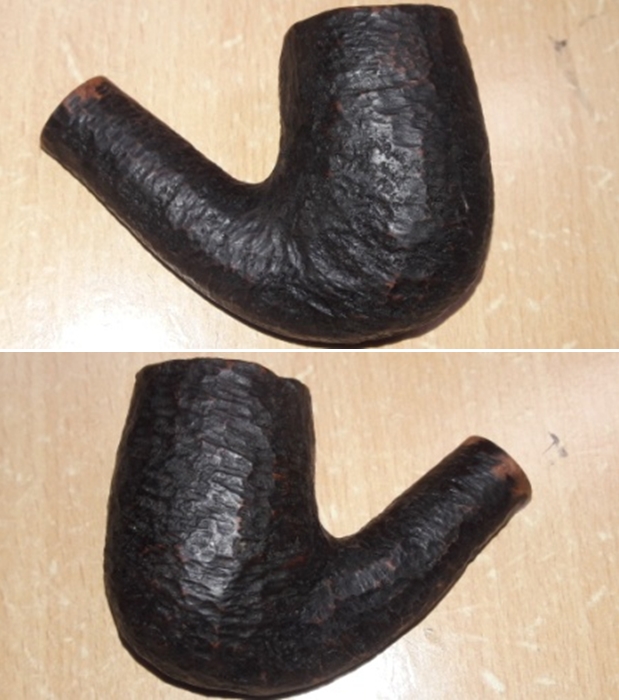
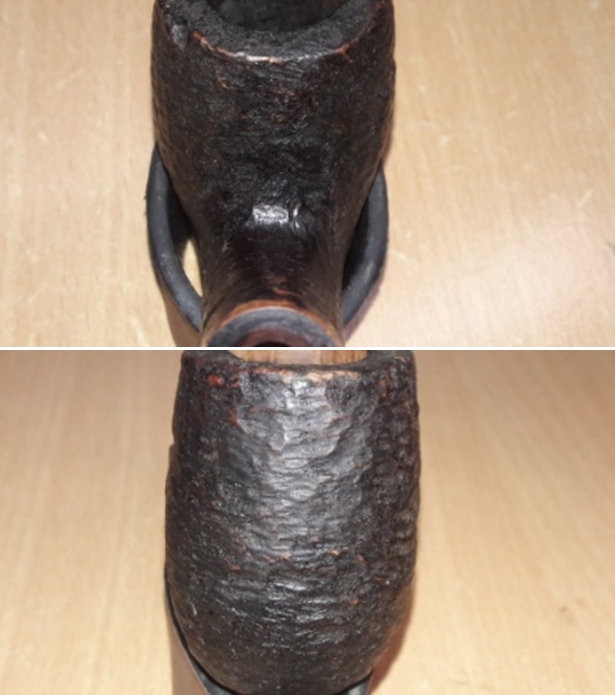
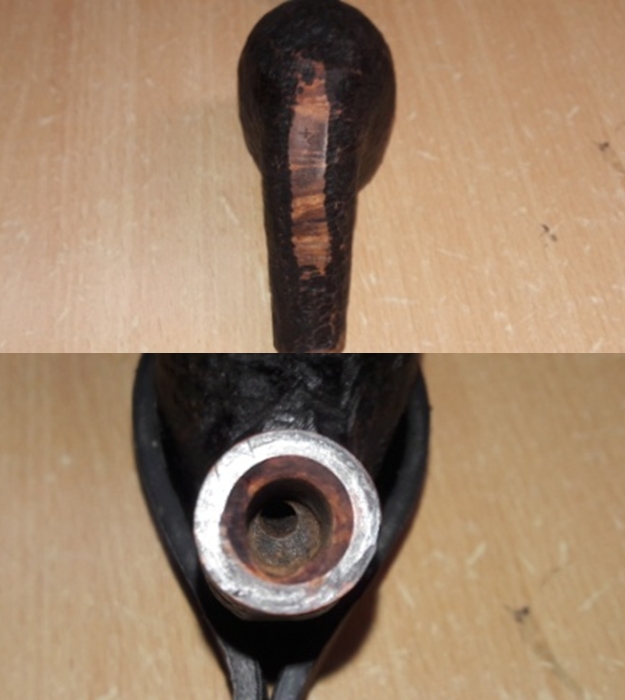
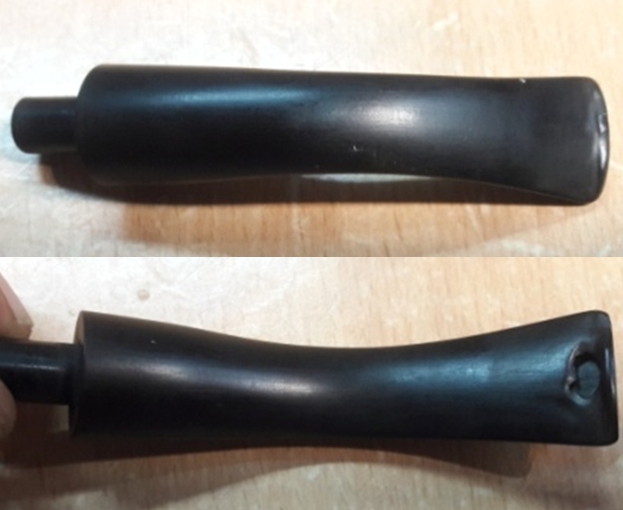
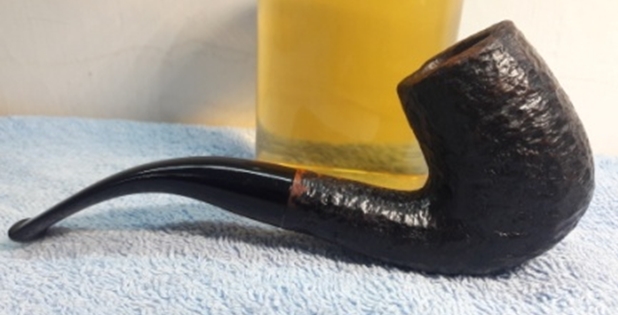
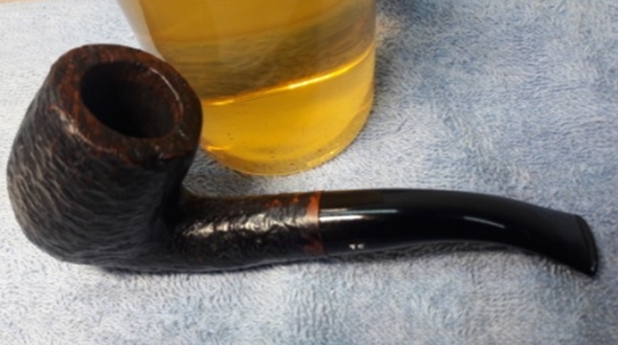
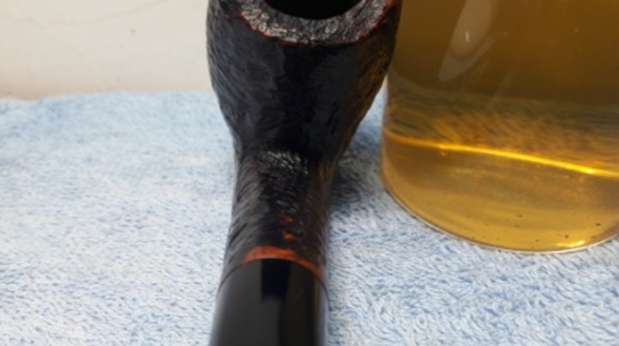
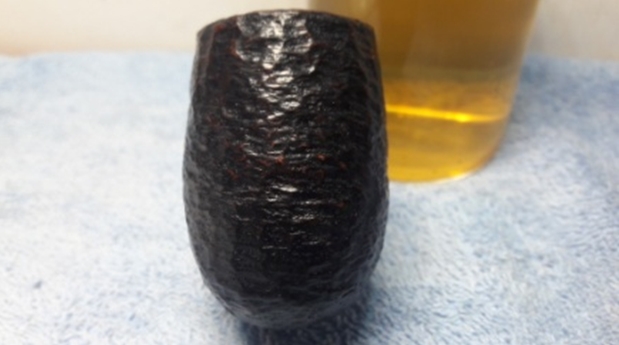
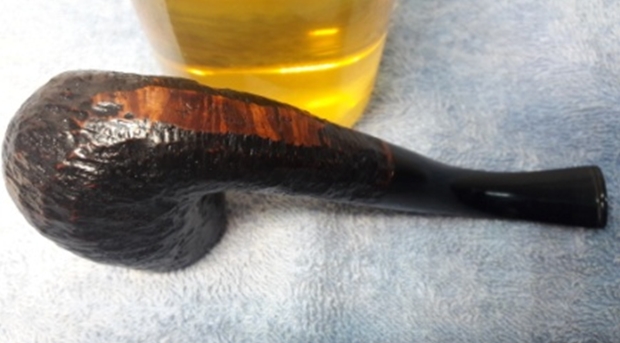
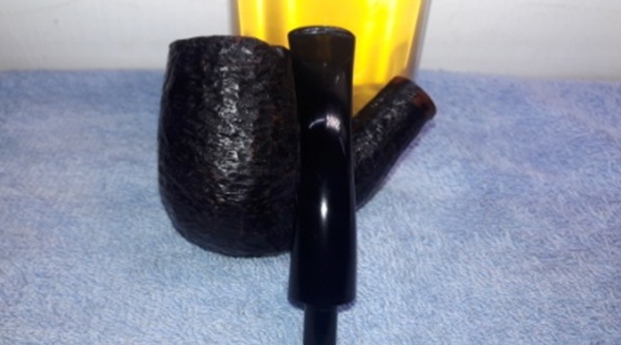
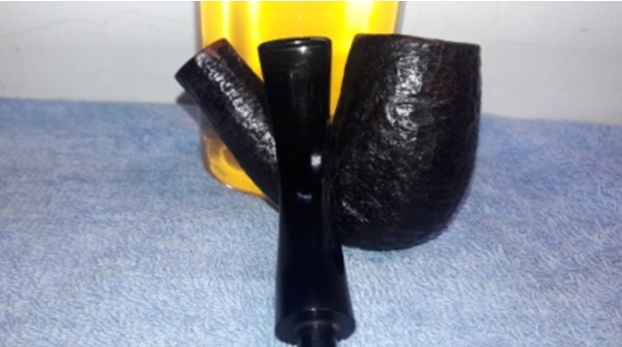
On our recent trip to Alberta we picked up quite a few pipes that were really nice. Some of them were brands we were familiar with and some were pipes that were unknown and unidentifiable. But if you are a pipe hunter you know the feeling when you are holding a particular pipe, no matter what the brand and it just speaks to you. That is what happened with this pipe. It was in a display case at an antique mall in Edmonton. The shape of the pipe, the forward canted bowl, the small short stem, the shape of the button and the single, orific opening on the end of the stem just looked old and I was going to add it to the finds.The grain under the dirty finish was quite nice with straight, flame and birdseye popping through around the bowl and shank. The bowl has a slight forward cant. The rim top had a thick layer of tars and there was sustained damage on the inner and the outer edge. There was a thick cake in the bowl that made it hard to see the extent of the damage to the inner edge. The stem was short vulcanite that had a threaded bone tenon that did not fit tightly against the shank. The stem was also heavily oxidized and had some tooth chatter on both sides near the button. The airway on the end of the stem was a round orific opening. I took a close up photo of the rim top to show the thickness of the cake in the bowl and the overflow of lava on the rim top. The damage to inner edge of the bowl and the nicks on the outer edge are evident in the photo. I took photos of the stem showing the oxidation and tooth chatter on both sides near the button. The third photo of the stem shown below gives a clear view of the orific opening in the stem end.I unscrewed the stem from the shank to show the threaded tenon on the end of the short stem. It has a bone tenon and has a long tube on the end of the threaded that works to funnel the smoke up the stem to the opening at the stem end. Since I had taken the pipe apart I decided to clean the parts. I started by reaming the bowl with a PipNet Pipe Reamer. I used the first two cutting heads to take the cake back to bare briar. I used a Savinelli Fitsall Pipe Knife to clean up the remnants of the cake on the bowl walls. I finished the bowl by sanding it with a length of dowel wrapped with a piece of 220 grit sandpaper. I scrubbed out the mortise, shank and the airway in the shank and stem with pipe cleaners, cotton swabs and alcohol. I worked them over until it was clean. I scrubbed the threads on the tenon with a brass bristle wire brush.To clean up the rim top I topped it lightly with a piece of 220 grit sandpaper on a flat board. I took off the damaged rim top to smooth out the inner and outer edge of the rim. I finished the clean up by reworking the edges of the bowl with folded 220 and 400 grit sandpaper.I used some small drops of clear super glue to fill in the deeper nicks and marks on the bottom of the bowl. I sanded them smooth and then polished the repaired areas on the bottom of the bowl, the outer edge of the bowl and the rest of the bowl and shank with micromesh sanding pads. I wet sanded with 1500-12000 grit sanding pads to smooth out the scratches and nicks in the bowl sides. I wiped the bowl down with a damp cloth to remove the sanding dust. I scrubbed the exterior of the bowl with Before & After Briar Cleaner. I worked it into the surface of the briar with my finger tips and let it sit for a short time to absorb the grime. I rinsed it down under warm water to remove the grime debris that was collected in the cleaner. I dried the bowl off with a soft cotton cloth and lightly polished it. I worked some Before and After Restoration Balm into the surface of the briar. I rubbed it into the briar to restore, preserve and polish the briar. I let it sit on the bowl for about 10 minutes and buffed it off with cotton cloth. I set the polished bowl aside to work on the stem. I sanded the stem surface with 220 grit sandpaper to remove the oxidation and tooth chatter. I started polishing it with 400 grit sandpaper to remove the scratches.I polished out the remaining scratches in the stem material with micromesh sanding pads. I wet sanded with 1500-12000 grit sanding pads. I wiped down the stem after each pad with some Obsidian Oil. Once I used the last pad – 12000 grit – I polished the stem with Before & After Pipe Stem Polish, both Fine and Extra Fine. I used a new product I am trying for Briarville called No Oxy Oil to give the stem a final wipe down and polish. I put the stem back on the pipe and polished both pipe and stem with Blue Diamond on the buffing wheel. I gave the pipe several coats of Carnauba Wax and buffed it with a clean buffing pad to raise a shine. I hand buffed it with a soft cotton cloth to deepen the shine. The finished pipe is shown in the photos below. It is a beautifully grained piece of briar with straight grain around the walls of the bowl and sides of the shank. The undersides of the bowl and shank show a mix of birdseye and swirled, mixed grain. The rich brown finish highlights the grain and contrasts well with the short black vulcanite stem. The shape and style of the button and stem point to an early date for this pipe. I only wish that it had some identifying stamping on the shank to help identify the maker. The threaded bone tenon is in excellent condition and to further protect it, I coated it with some Vaseline. The pipe is a beauty. There are some flaws in the pipe that I wish could help tell the story of this old pipe. The dimensions of the pipe are – Length: 5 ¼ inches, Height: 1 ¾ inches, Outside diameter of the bowl: 1 ¼ inches, Chamber diameter: ¾ of an inch. This is an old timer that I will add to my own collection. I am looking forward to loading a bowl in it and enjoying the taste of this old timer. I will carry on the legacy! Thanks for reading the blog.

I Guess I did not have enough to restore – breaking a tenon on a Ben Wade Spiral


Blog by Steve Laug

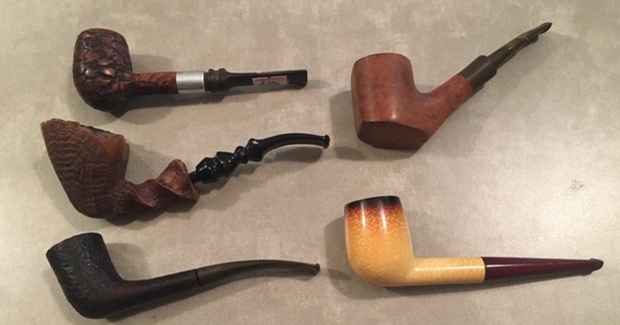
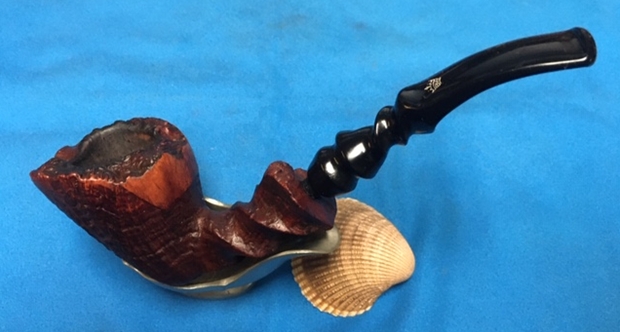
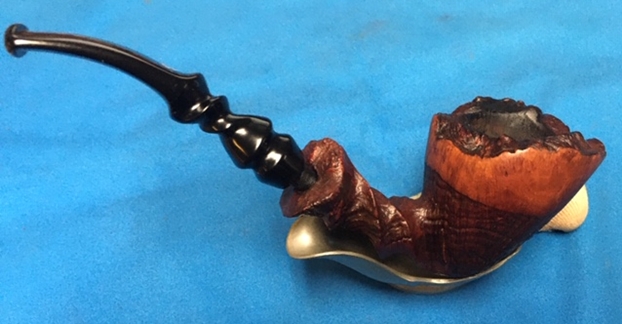
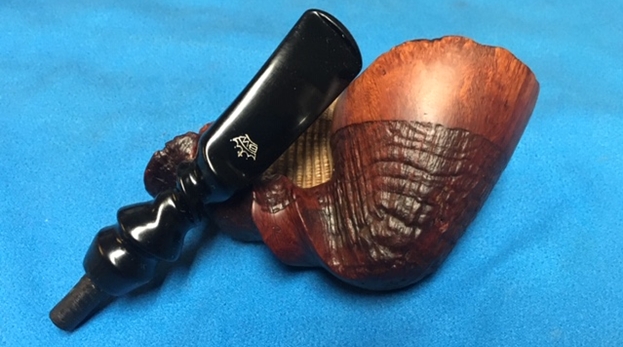
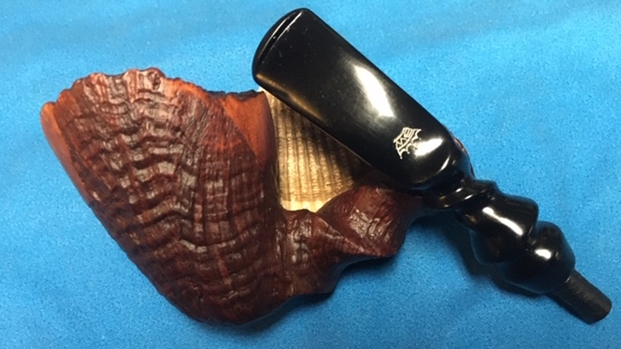
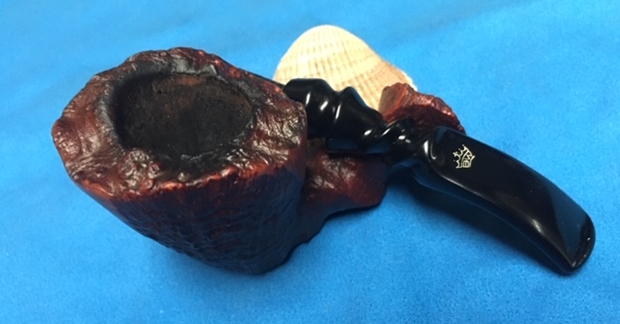
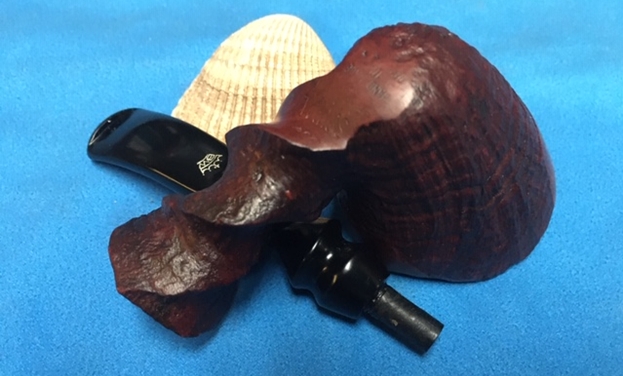
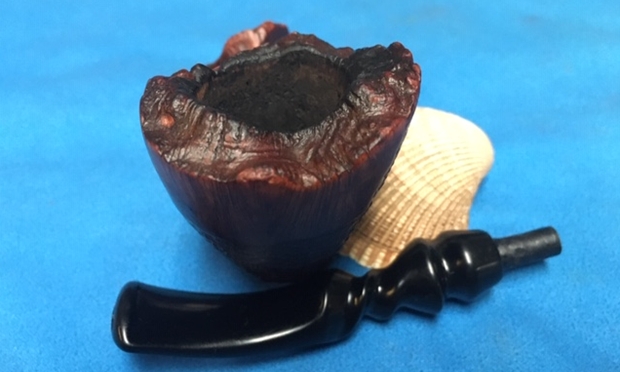
The photo below shows a group of five pipes that Jeff and I picked up at an antique mall near Calgary. There were five different pipes and all were nice, but the best of the lot was a nice looking Ben Wade Spiral Freehand. It had a spiral shank and the fancy turned stem also had a spiral saddle. When we took it out of the display case we already knew it was a Preben Holm made pipe. We had no doubt, as Preben Holm’s pipes are always very recognizable. This one had a great sandblast around the bowl and shank with a smooth portion on the front, right and rear about 1/3 of the way down the bowl from the rim edge. It had a plateau rim and shank end. We examined it and sure enough it was a Ben Wade pipe by Holm. It is stamped on a smooth twist on the underside of the shank and reads Ben Wade over Spiral Sandblast over Hand Made in Denmark. There was a crown with BW inside on the topside of the stem. It was in decent condition and the price was right. The finish on the bowl was dirty and dull. The plateau rim top and shank end were dirty. The plateau rim top had some lava overflow and darkening and there was a thick cake in the bowl. It was a dirty pipe but should clean up well. The stem was acrylic and dirty and had light tooth chatter on both sides. When got back to where we were staying I took photos of the group of pipes to highlight the find. They were some nice looking pipes.We were very excited about the finds from the trip and the last day Jeff and Sherry were with me we divided them up. Jeff would take the ones that needed to have his magic worked on them before I restored them and I would take the ones that were in decent condition. This was probably the first mistake we made. But the gravity of not sending them in Jeff’s car would become evident once I returned home.

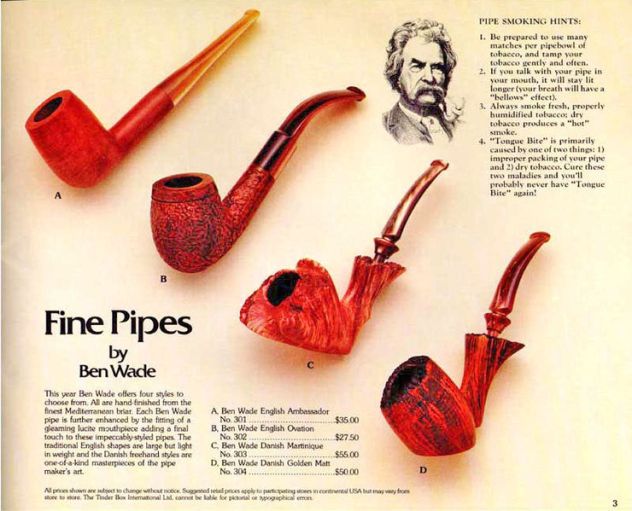
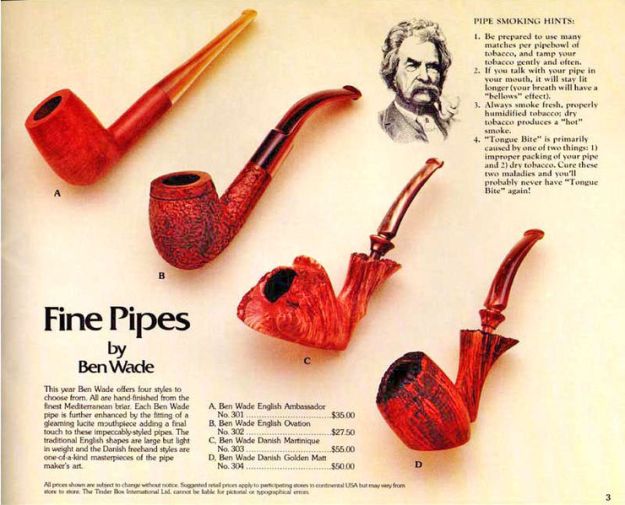
Ben Wade Ad in a Tinder Box catalog, courtesy Doug Valitchka

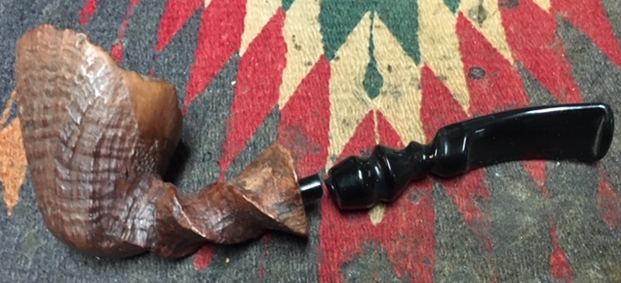
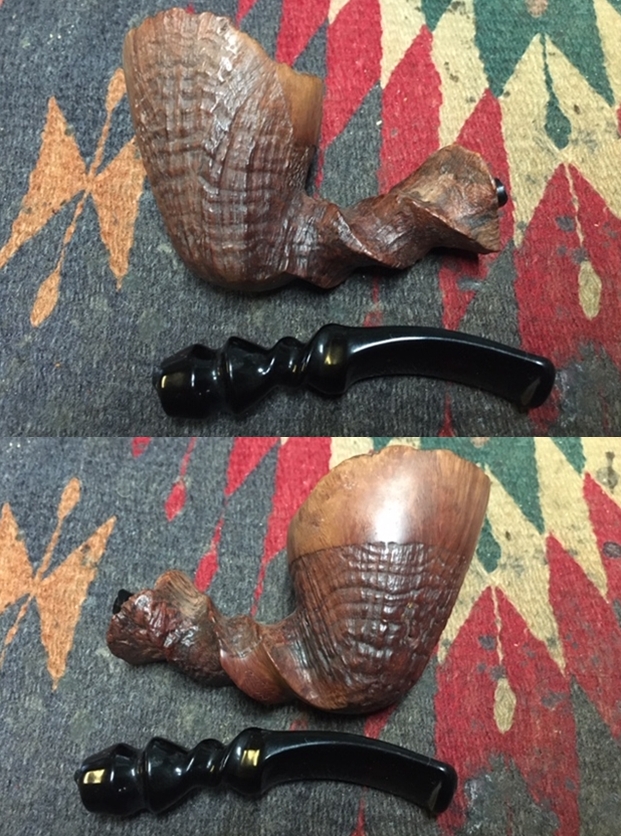
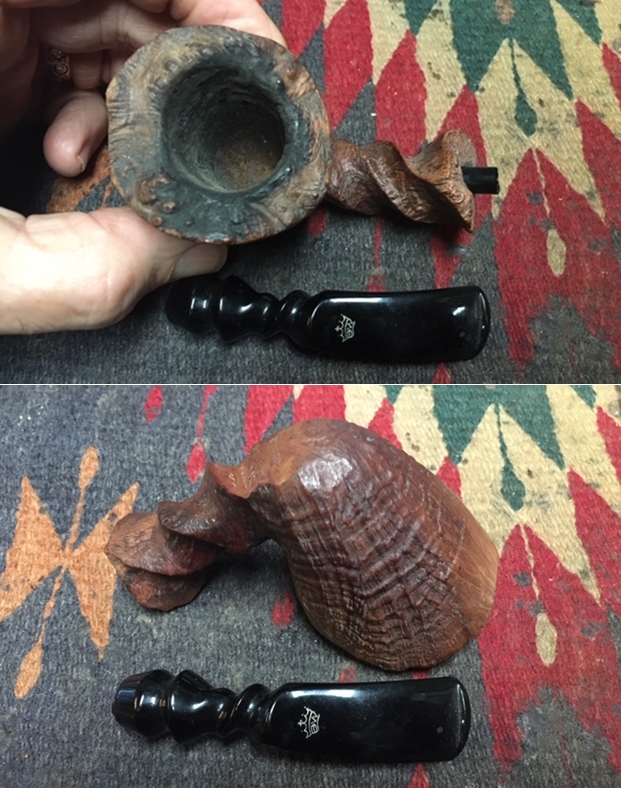
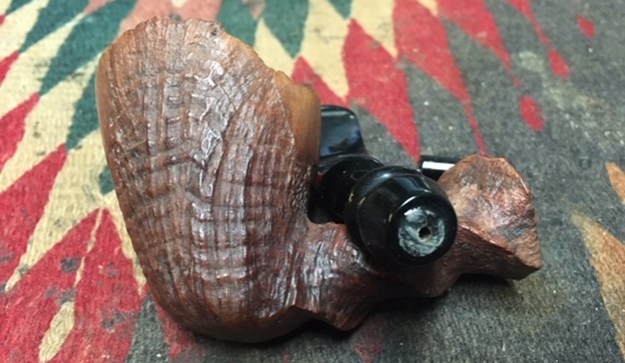
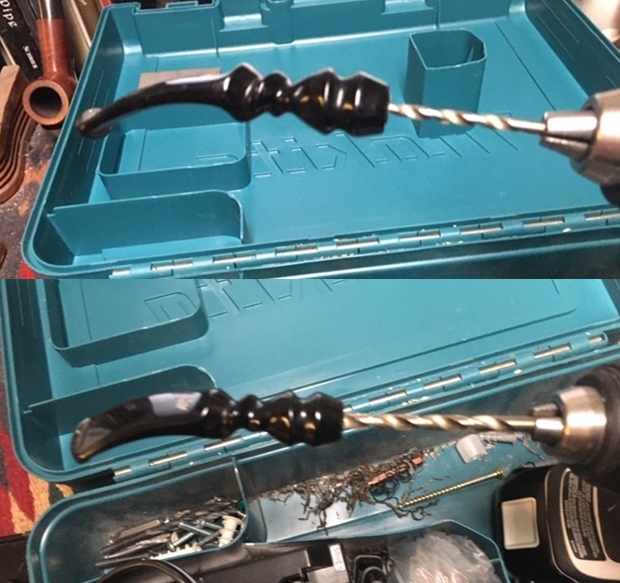
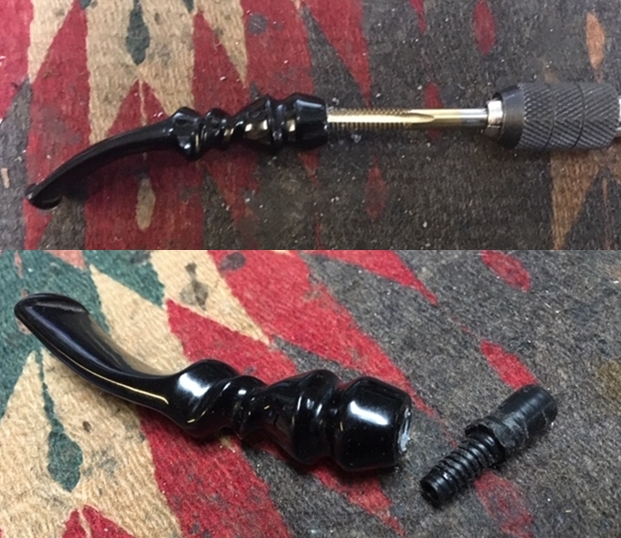
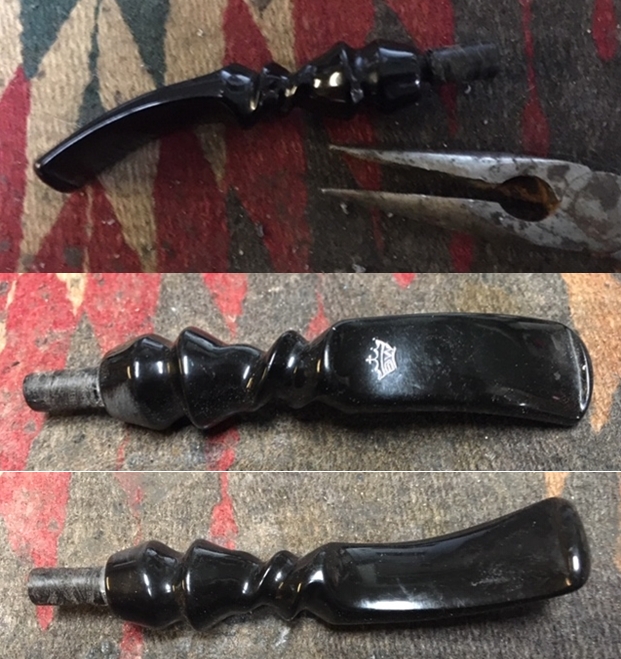
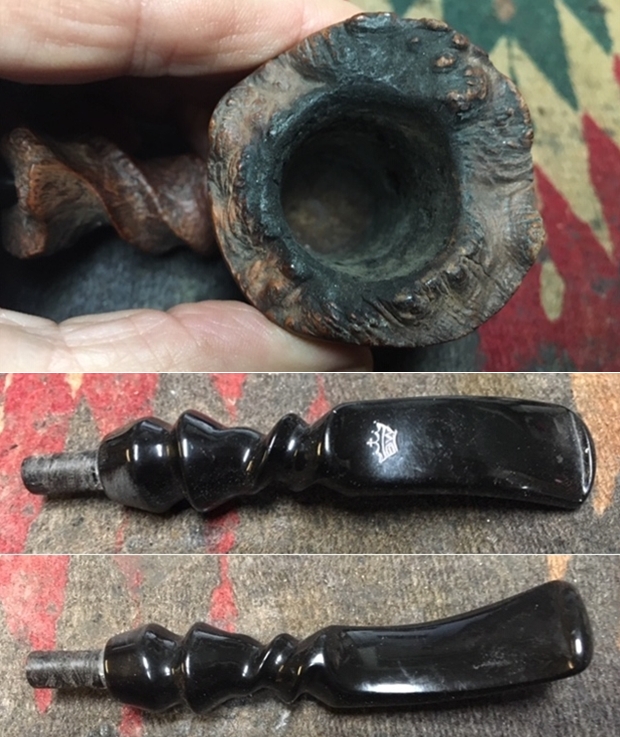
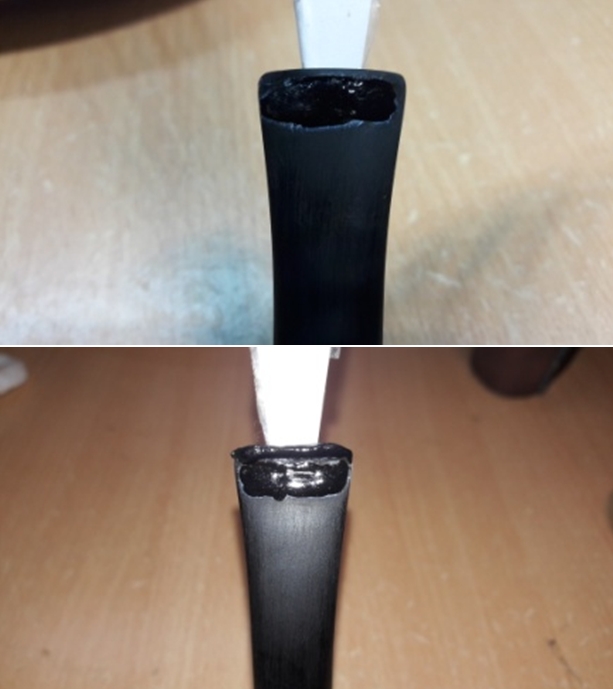
I wrapped all the pipes in packing tissue and rolled them in some of my clothes before packing them in my hard shell carry-on bag. I carefully put it in the overhead bin in the plane and then rolled it out once I was back in Vancouver. I put the bag aside and in the morning opened the suitcase and unpacked the pipes. Each pipe I took out and unwrapped was in excellent condition. No damage at all. I had purposely saved the Ben Wade for last and when I unwrapped it I almost cried. The tenon had snapped and the stem and pipe were apart. I have no idea how it happened but now I had a damaged pipe from the trip and it was truly one of the nicer finds! Here is a photo of what I found.I put the pipe in a baggie and set it aside until I had dealt with the feelings of stupidity for not having sent it with Jeff or at least packing it better. I cleaned up several other pipes before I even looked at this one. Then last evening I finally felt like dealing with it. I took it out of the bag and took photos of the pipe before I started working on it. (You have to agree it truly has a great sandblast!) I decided the first order of business was to pull the broken tenon. I used a pair of needle nose pliers and clamped down on the broken end of the tenon and wiggled it free. Fortunately the snapped tenon was not stuck in the shank and it came out quite easily as you can see from the photo below. Now I needed to drill out the stem and fit it with a replacement tenon.The first step in the process of fitting a replacement tenon is cleaning up the damage on the stem. I smoothed out the broken tenon with my Dremel and a sanding drum. I knocked off the sharp remnants of the broken edges and smooth it out. If you are paying attention you can see that the airway in the stem is not centered. This would make opening the airway and centering a new tenon a challenge to say the least. It could be done but I would need to pay attention and there would be some extra steps that would have to be done to fit it properly.I used a pen knife to chamfer the airway and bring it to a centered position so that when I drilled it I could follow it in and keep it centered. I started with a drill bit that was slightly larger than the airway in the stem. I drilled it as deep as the length of the threaded portion of the replacement tenon. I worked my way up to a drill bit as large in diameter as the tenon end.I used a tap to thread the inside of the stem to receive the new tenon. I twisted it into the stem until it was the depth of the threaded tenon end. I also used the Dremel to take the hip off the replacement stem so that it would fit flush against the stem. Once the stem was threaded I gave the threads on the tenon a light coat of epoxy and twisted it into the opening in the stem with a pair of pliers. I took photos of the stem with the tenon in place and set it aside for the glue to cure. I took close up photos of the bowl and rim top as well as the stem surface. You can see the condition of the rim top and bowl in the first photo. There was some lava overflow on the rim top on the left and rear of the bowl. There was also some darkening around the inner edge of the bowl and some on the rim top. The cake in the bowl was quite thick. The stem showed some tooth chatter on both sides near and on the button surface.I remembered a bit of history on the brand that thought that the Preben Holm pipes were marketed under the Ben Wade label in the US and imported through Lane Ltd. I turned to Pipedia and read the listing on the brand to refresh my memory and flesh out the knowledge of the brand (https://pipedia.org/wiki/Ben_Wade). I have included a photo from that site that was taken from a Tinderbox advertisement.

Ben Wade Ad in a Tinder Box catalog, courtesy Doug Valitchka

I quote the portion of the article that summarizes the Danish period of the history of the brand:

Young Copenhagen master pipemaker Preben Holm had made a meteoric career heading a pipe manufacture employing 45 people at the age of 22! But around the turn of 1970/71 he was in major financial difficulties. His US distributor, Snug Harbour Ltd. in New York City, left him in the lurch. Holm had three unpaid invoices on his desk and another large shipment was ready for the USA, when Snug Harbour’s manager told him on the phone that there was no money at all on the account to pay him.

So the Dane went to New York for an almost desperate search for a new distribution partner. He made contacts with Lane Ltd. and met Herman G. Lane in February 1971. Lane Ltd. had no interest in Holm’s serial pipes produced at that time but so much the more in the hand-carved freehands because the hype for Danish freehands and fancies in the States was still on its way to the climax then. The meeting resulted in an agreement to start a cooperation. Lane insisted to improve the quality considerably and in return he assured to be able to sell essentially larger quantities.

Holm went back home to work on new samples with all-new designs and altered finishes for Lane. Both, Lane and Holm, agreed that it would be unwise to sell the pipes under Preben Holm’s name as long as Snug Harbour had a considerable stock of Preben Holm pipes and might sell them pipes at very low prices just to bring in some money.

So on Mr. Lane’s proposal it was determined to use the name Ben Wade belonging to Lane Ltd. Lane spent considerable amounts of money for advertising the new brand in the big magazines– the centerpiece being whole-page ads showing a very exclusive Seven Day’s Set.

The cooperation with Lane Ltd. proved to be an eminent business success for both partners. Within a very short time Ben Wade Handmade Denmark sold in much larger quantities and at higher prices than they had ever dreamed of. And the hype these freehands and fancy pipes caused went on unbroken long after Herman G. Lane deceased. Preben Holm – obviously much more brilliant in pipe making than in pipe business – was in major troubles again in 1986 and had to sack most of his staff. The Ben Wade production was significantly lowered but continued until his untimely death in June of 1989.

Up to now Preben Holm made Ben Wade pipes are cult and highly sought for on the estate markets.

With that information my initial thoughts were confirmed. This pipe was a Preben Holm made Freehand distributed in the US by Lane Ltd under the name Ben Wade. The freehand rage occurred in the late 70s and the pipes were made until Preben’s death in 1989. My guess would be that this pipe was made sometime during that time period and potentially in the late 70s.

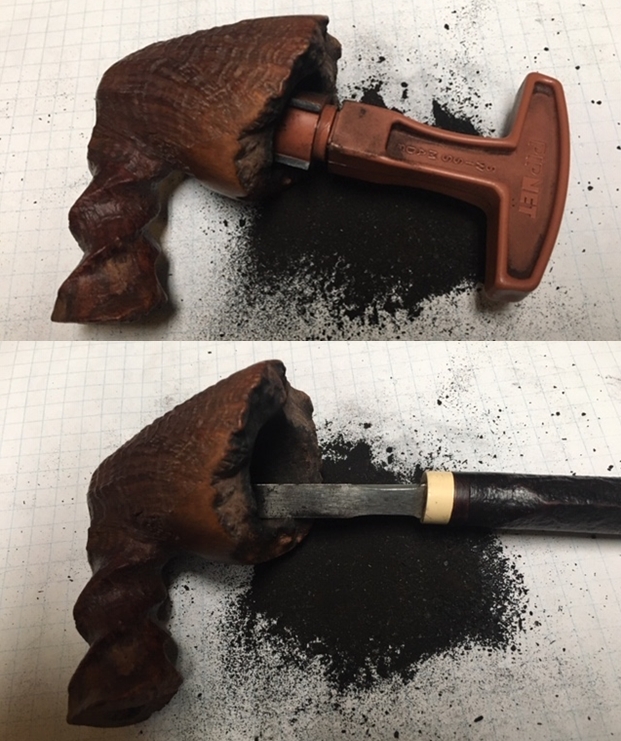
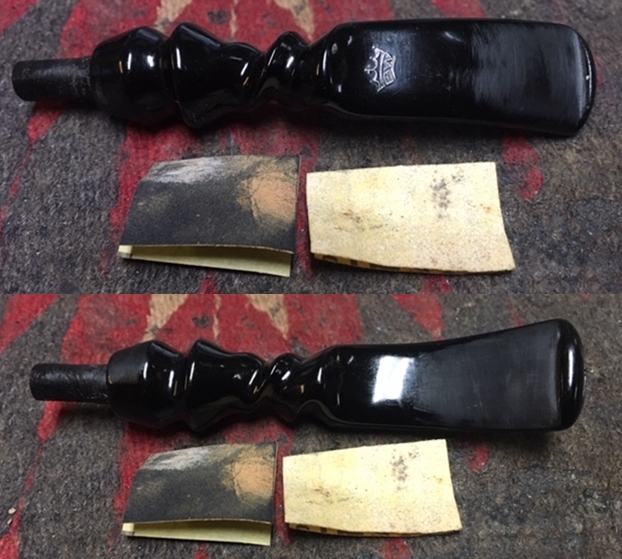
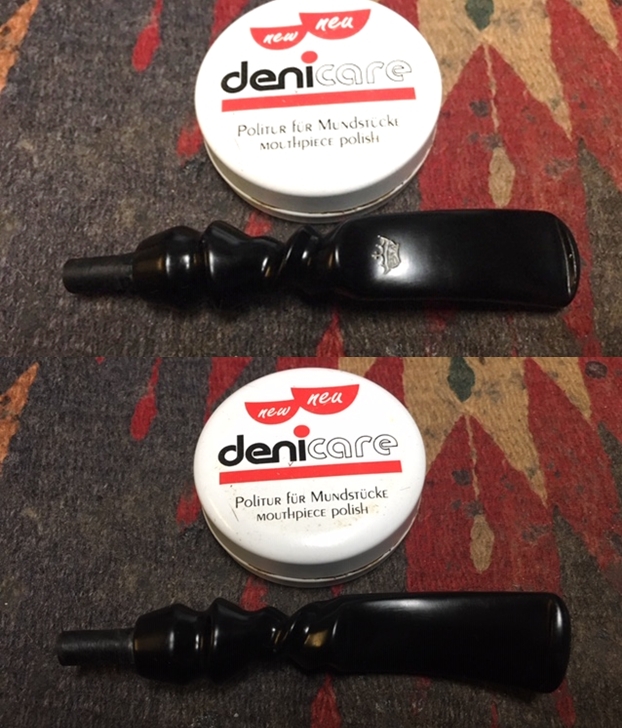
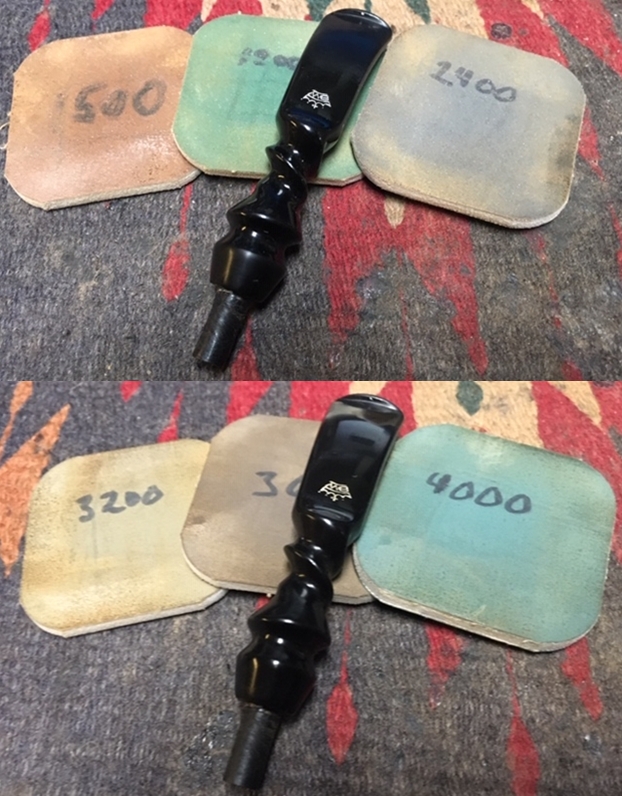
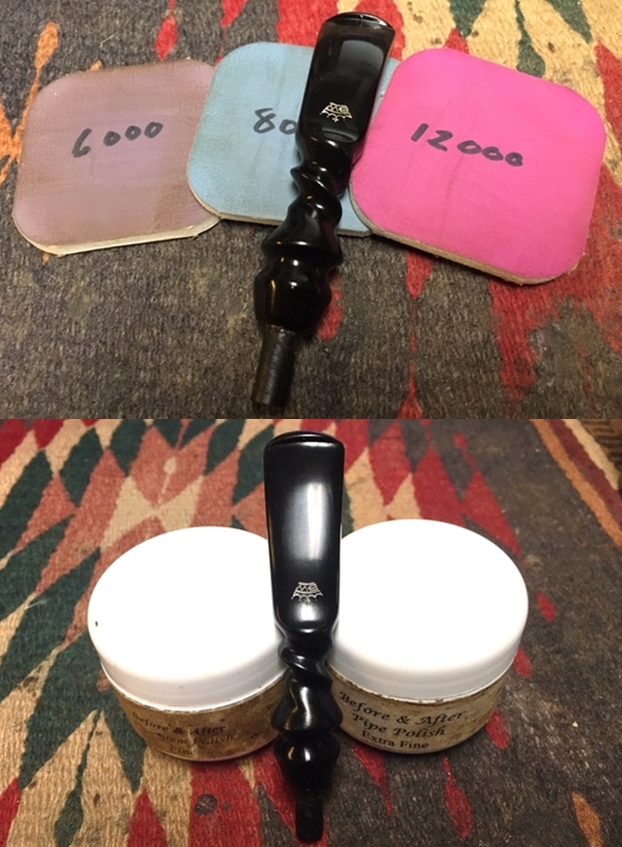
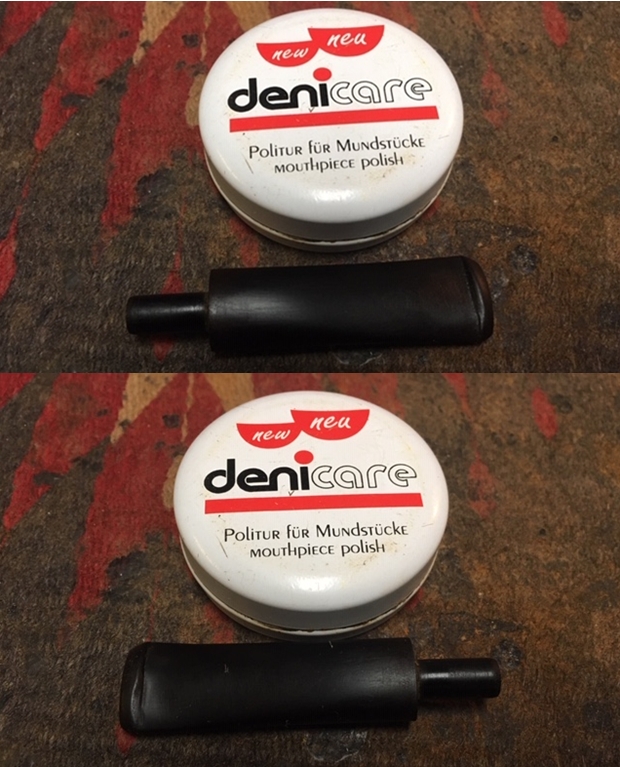
Armed with that information I followed the regular regimen that Jeff and I use for cleaning estates. I reamed the bowl with a PipNet pipe reamer using the largest cutting head as this pipe has a particularly large bowl. I followed up with a Savinelli Fitsall pipe knife to remove the remaining cake and smooth out the walls. I finished the bowl cleanup by sanding the bowl with 220 grit sandpaper wrapped around a piece of dowel to smooth out the inside walls of the bowl. I also scrubbed the rim top plateau with a wire brush to knock of the lava that was built up there. I scrubbed the briar with Murphy’s Oil Soap and a tooth brush. I worked to remove the remaining lava and minimize the darkening. I rinsed it under warm running water. The photos show the rim top after scrubbing. It looked much better at this point. I worked some Before & After Restoration Balm into the surface of the briar with my fingertips and into the plateau rim top and shank end with a horsehair shoe brush to clean, enliven and protect it. I let the balm sit for a little while and then buffed with a cotton cloth to raise the shine. The photos show the bowl at this point in the restoration process. With the outside cleaned and shining I moved on to clean up the inside airways and mortise in the shank and the stem. I scrubbed out the mortise and the airway in the shank and the stem with alcohol, cotton swabs and pipe cleaners.  I set the cleaned bowl aside and turned my attention to the stem. I sanded out the tooth chatter with 220 grit sandpaper and started to polish it with a folded piece of 400 wet dry sandpaper. Once it was finished it began to shine.I used some Denicare Mouthpiece Polish that I have in my kit to start polishing out some of the scratches and remaining oxidation on the stem. I rubbed it in with a cotton pad and my finger tip and buffed it off with a cotton pad.I polished the stem with micromesh sanding pads – wet sanding with 1500-12000 grit sanding pads. I wiped it down after each sanding pad with some Obsidian Oil. I finished polishing it with Before & After Pipe Stem Polish – both Fine and Extra Fine and buffed it off with a cotton cloth. When I finished I gave it another coat of Obsidian Oil. This is a beautiful Preben Holm made Ben Wade Spiral Freehand with a fancy, twisted, black acrylic/Lucite stem. It has a great look and feel. The shape fits well in the hand with the sandblast giving a nice tactile sense when held. I polished stem and the bowl with Blue Diamond polish on the buffing wheel. I gave the bowl multiple coats of Conservator’s Wax and the stem multiple coats of carnauba wax. I buffed the pipe with a clean buffing pad to raise the shine. I hand buffed it with a microfiber cloth to deepen the shine. The pipe polished up pretty nicely. The rich combination of sandblast and smooth finishes took on life with the buffing. The rich colour of the briar works well with the polished stem. I like the grain and finished look of this Preben Holm Ben Wade Spiral pipe. Have a look at it with the photos below. The shape, finish and flow of the pipe and stem are very well done. The dimensions are Length: 6 ¾ inches, Height: 2 ½ inches, Outside diameter of the bowl: 2 inches, Chamber diameter: 1 inch. This Danish Freehand is a real beauty. Thanks for walking through the restoration with me as I worked over another beautiful pipe.


Sprucing Up an Attractive Butz Choquin Supermate 1596 Panel


Blog by Dal Stanton

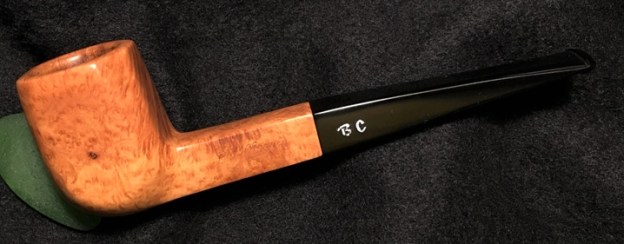
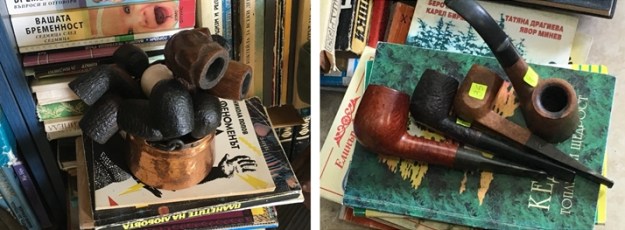
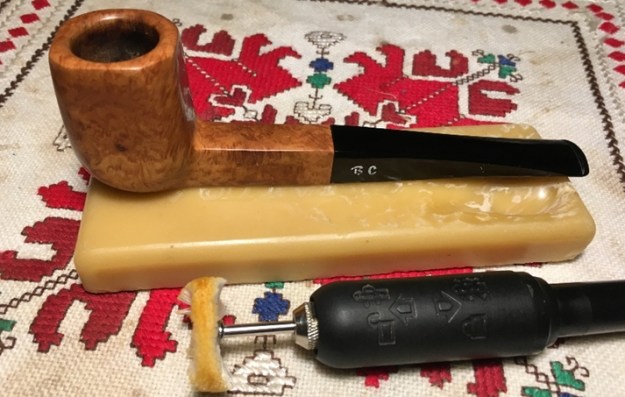
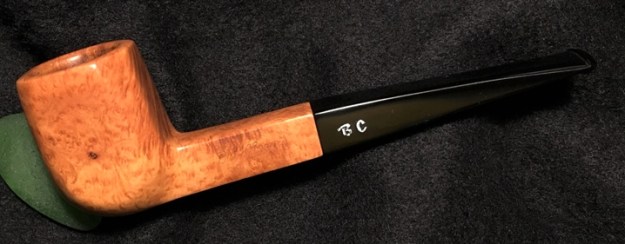
Without doubt, one of my favorite pastimes is go pipe picking!  My wife and I were on the Black Sea coast in the Bulgarian city of Burgas returning to an antique shop I had visited before on the main walking street very near the Black Sea coast.  I was not disappointed when I spied the copper pot full of pipes waiting for someone like me to come along.  The Butz Choquin Supermate now on my worktable was in the bunch that I pulled out to get a closer look.  To the left of the BC (pictured below) were a Oldo Billiard and Lincoln London Made with the Lindburgh Select Poker to the right.  Not pictured below that also came home with me is a Harvey Meer Lined Rusticated Dublin Rustified LONDON PARIS NEW YORK.  A very nice haul!

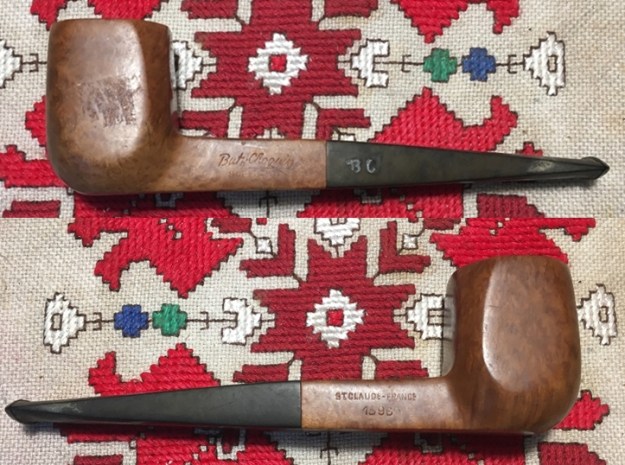
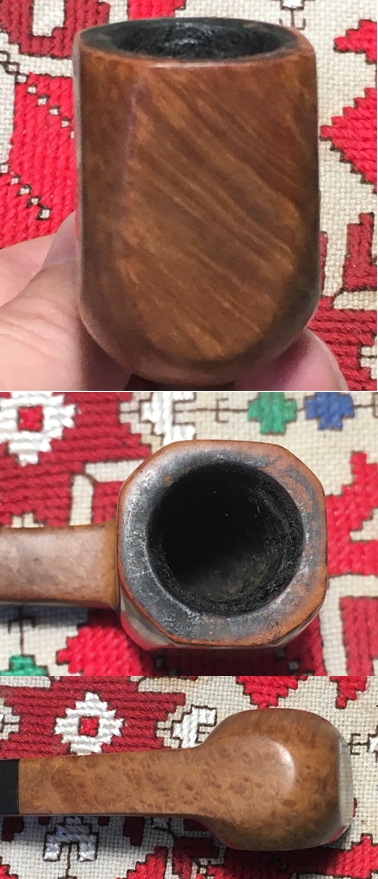
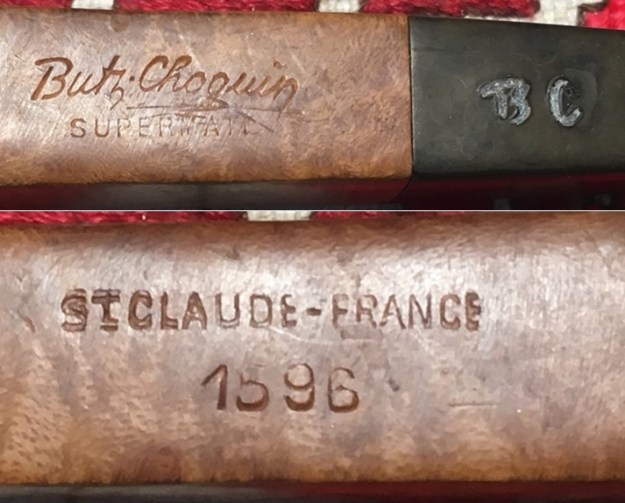
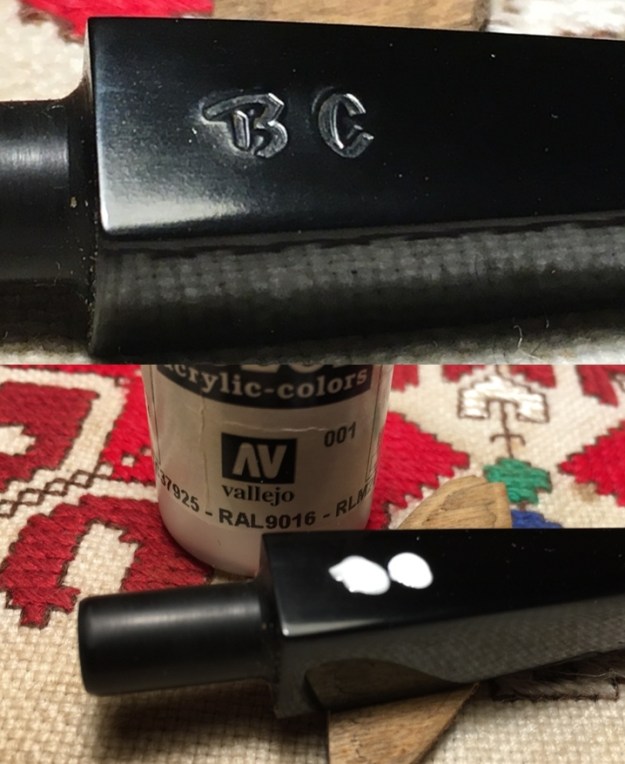
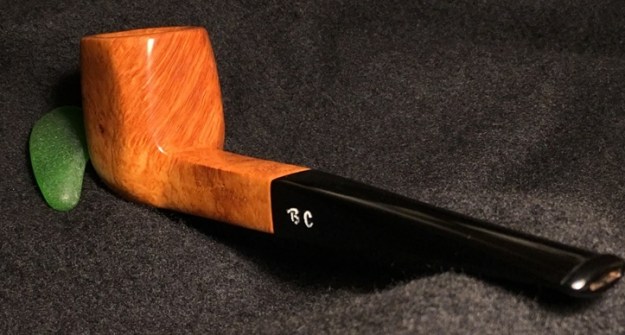
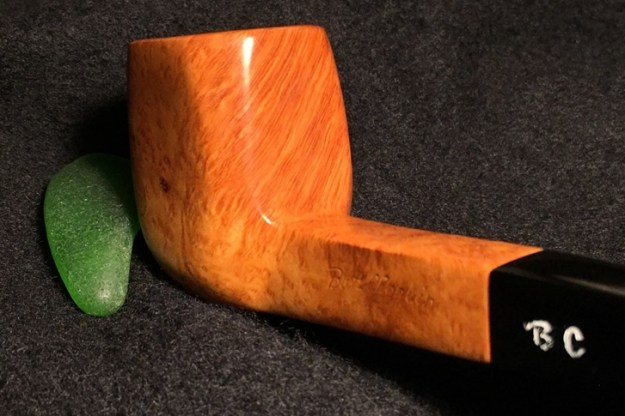
Jim saw the BC Supermate in the online ‘For “Pipe Dreamers” ONLY!’ collection along with a ‘Nightmare’ Canadian that was not needing a restoration but a resurrection!  In my communications with Jim, I discovered that he was from Pennsylvania and an engineer who has several hobbies that where he works with his hands and expressed appreciation for the restorations that he had seen posted from my worktable.  It was for that reason he looked at ThePipeSteward website and found two pipes that called his name and he commissioned them.  He also expressed appreciation for our work with the Daughters of Bulgaria – women and girls who have been trafficked and sexually exploited.  All the pipes commissioned by potential stewards benefit this cause. Here are pictures of this nice Paneled Butz Choquin 1596 now on my worktable.  The nomenclature on the left side of the shank is the BC fancy script ‘Butz-Choquin’ [over] ‘SUPERMATE’.  To the right, the stem is stamped with the traditional ‘BC’.  On the right shank side is the COM and shape number: ‘STCLAUDE – FRANCE’ [over] 1596.   I have heard on FB group postings that the long-time French pipe manufacturer is closing its doors.  I went to the main website of Butz Choquin and it was active, and I saw no notifications.  I’ll continue to investigate.  One of my first research projects with a French pipe, Jeantet, connected me with the history of St. Claude, France, the place that most say represent the birthplace of modern pipe manufacturing.  The BC name is among the earliest residents of St. Claude.  Pipedia provides this information about the origins of Butz Choquin:

Jean-Baptiste Choquin of Metz started out as a tobacconist. This enterprise was prosperous; he had several employees. Among those, there was a certain Gustave Butz who was its first workman and who became his son-in-law by marrying Choquin’s daughter Marie in 1858.  In 1858 Jean-Baptiste Choquin created, in collaboration with Gustave Butz, the Choquin pipe. This bent pipe with a flat-bottomed bowl was finished with an albatross-bone mouthpiece, fixed with silver rings.  In 1858, still in Metz, Gustave Butz built an establishment for the manufacture of the Choquin pipe which took the name of [Butz-Chochin]. In 1951, the Berrod-Regad company bought the trademark, continuing manufacture until 2002. Departing from Metz, the workshop was relocated to Saint-Claude, then also called ‘the world capital of the briar pipe,’ under the Berrod-Regad group. The Berrod-Regad group would go on to completely rebuild the network of representatives until finally entering the export market in 1960 and has since won several prizes, as well as the Gold Cup of French good taste.

In a few years, the brand’s collection increased from ten to seventy series. 135 years after it was founded, the pipe is still well-known not only in France but throughout the world. In 2002, the Berrod family, wishing to preserve manufacture of pipes in Saint-Claude, handed over the company to Fabien Guichon, a native of the area, who will continue to develop the brand during the 21st century.

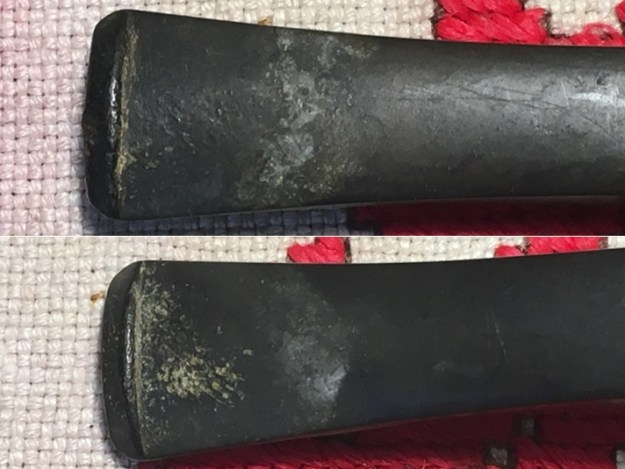
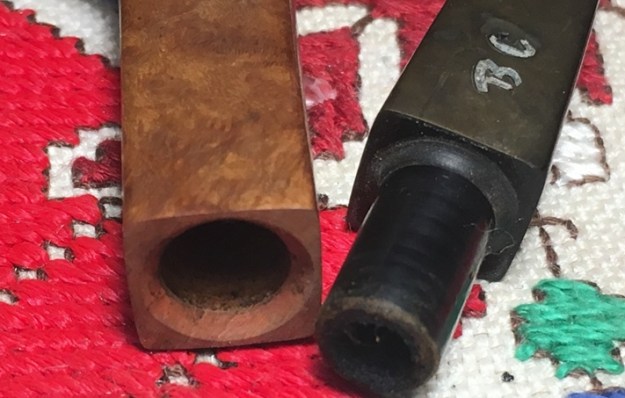
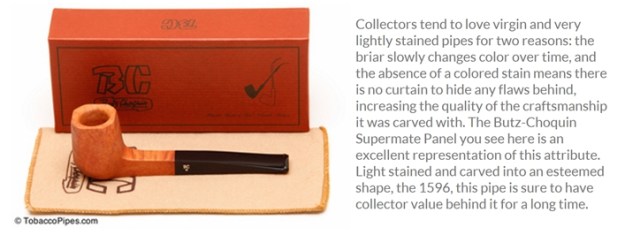
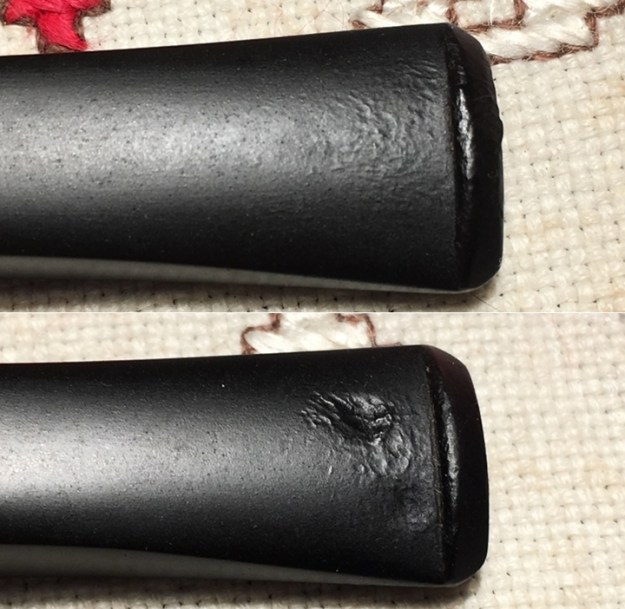
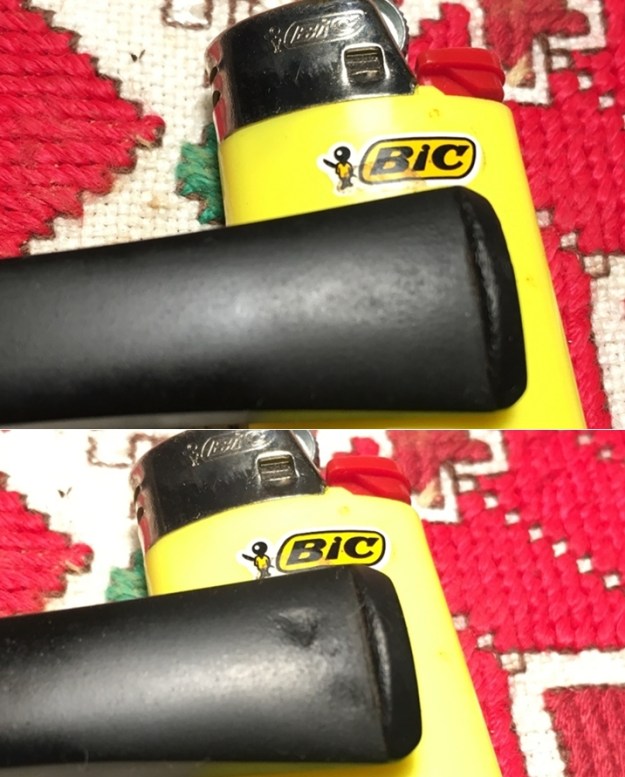
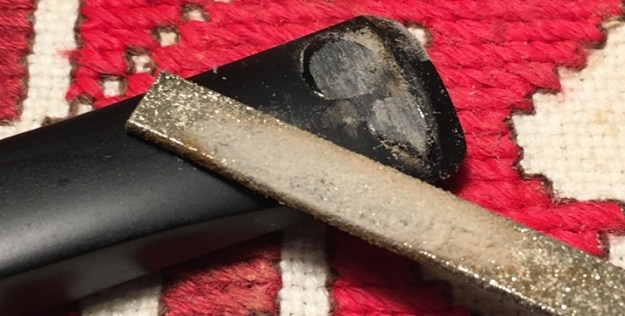
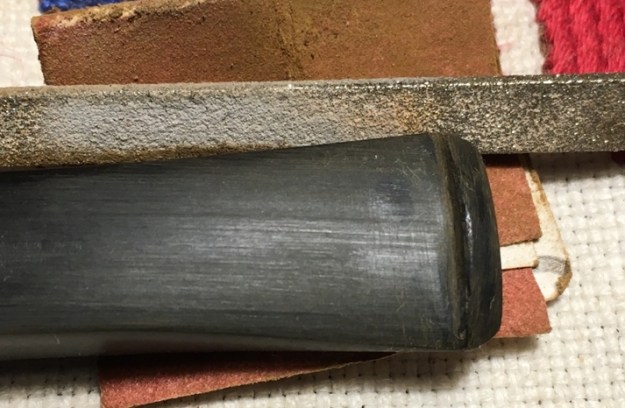
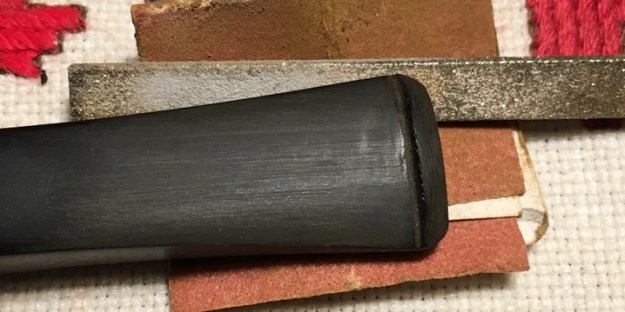
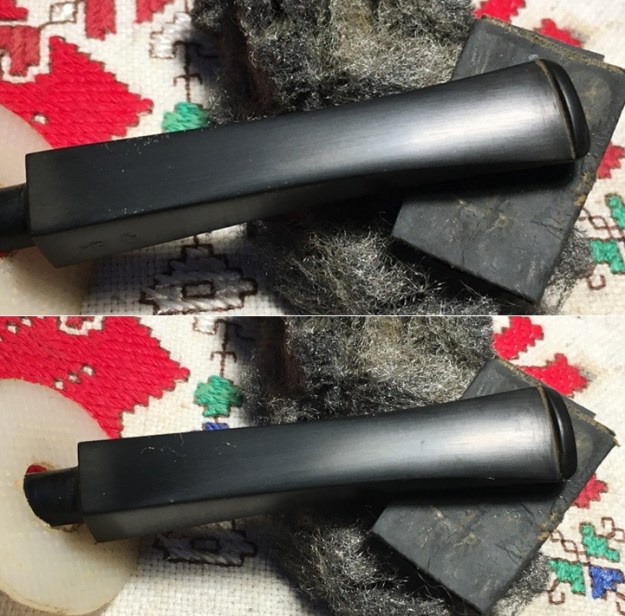
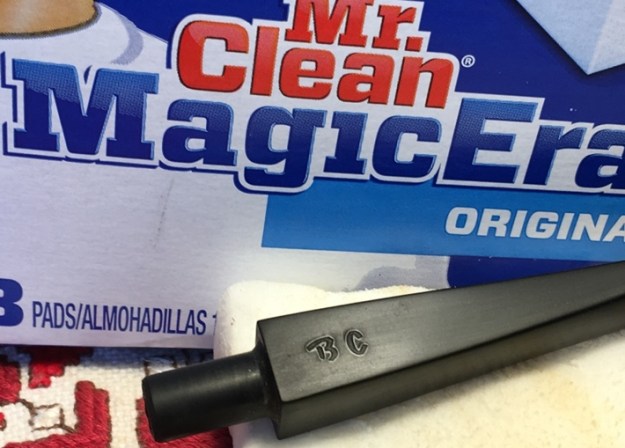
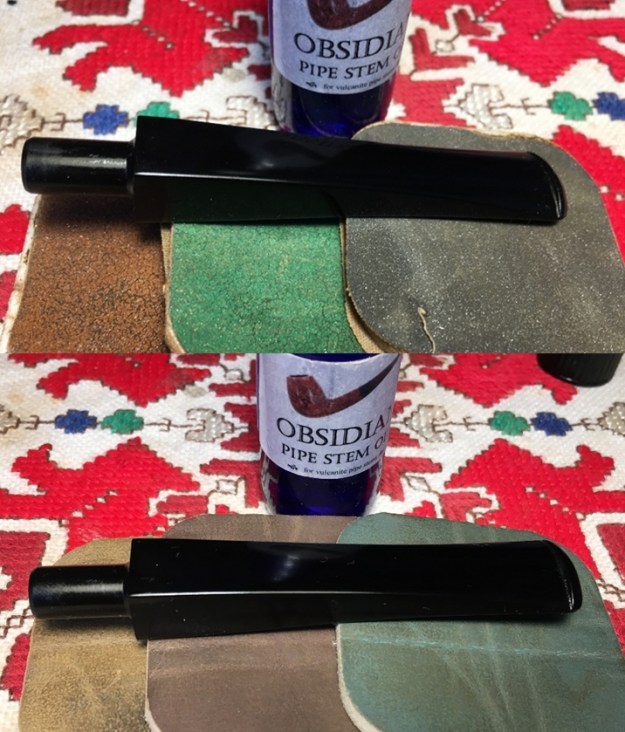
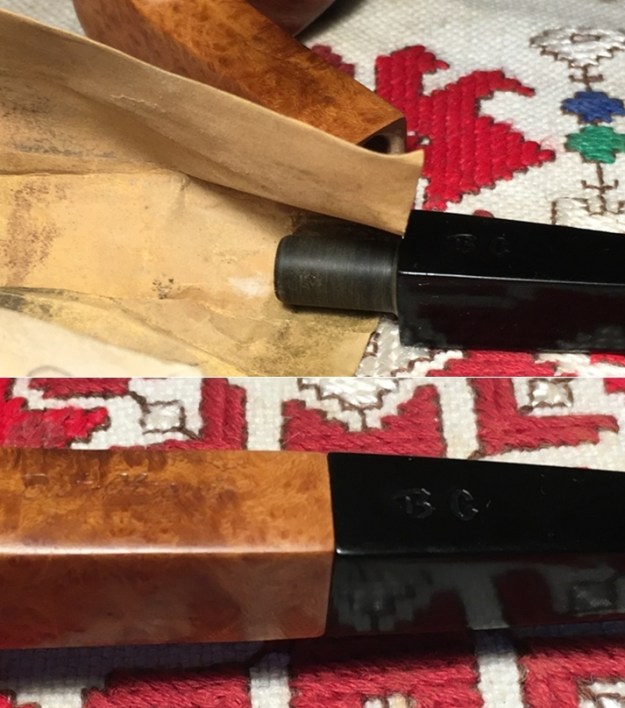
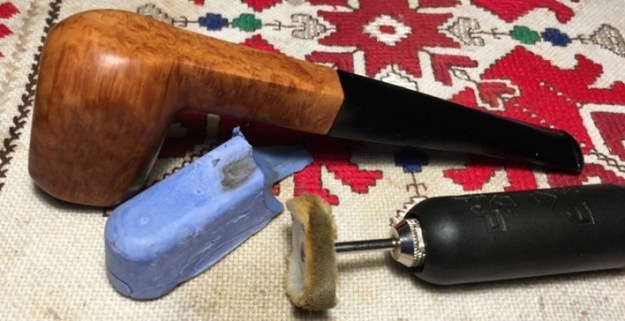
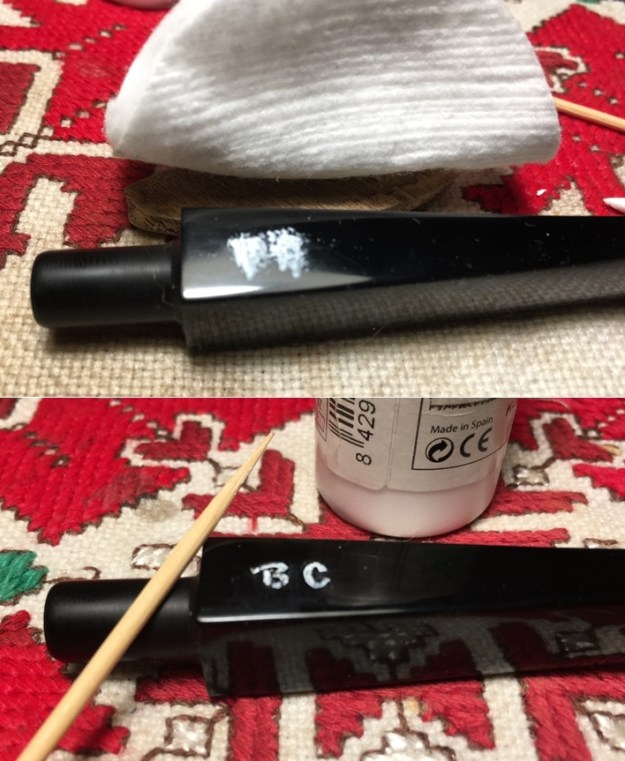
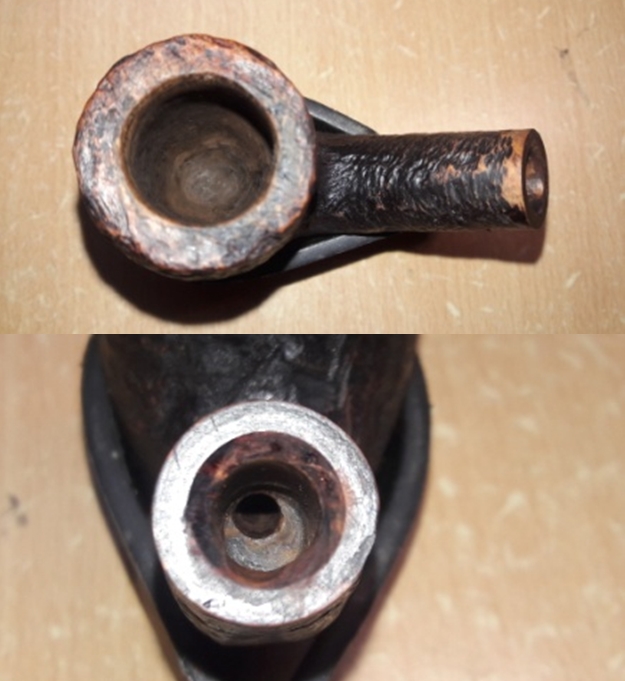
I found this great picture of the Butz Choquin Supermate Panel in an ad on TobaccoPipe.com.  The box is classic, and I wish I had the pipe sock to go along!  I found the text along with the picture to be interesting as well in its description of the finish and the collectibility of this 1596 shape.The condition of the pipe on my table is a far cry from the other pipe that Jim commissioned, the Comoy’s The Lumberman!  While the chamber has moderately thick cake and the rim shows lava flow, the pipe generally is in very good shape. Cleaning and working on the stem’s tooth chatter and oxidation do not appear to offer any surprises.  To begin the sprucing of this BC Supermate, the stem is removed and cleaned with a pipe cleaner wetted with isopropyl 95% and added to a soak of Before & After Deoxidizer with other stems in the queue.After several hours of being in the soak, I take out the BC stem and clean the airway with a pipe cleaner dipped in isopropyl 95% to remove the Deoxidizer.  I also wipe off the raised oxidation using cotton pads also wetted with alcohol.To revitalize the stem, paraffin oil is applied with a cotton pad.Next, I tackle the stummel cleaning.  The cake in the chamber is moderately thick.To remove the cake, I use 2 of the 4 blade heads that come in the Pipnet Reaming Kit.  Following this, using the Savinelli Fitsall Tool to scrape the chamber walls, helps to fine tune the removal of carbon cake. Finally, sanding the chamber walls with 240 grade paper wrapped around a Sharpie Pen provides further cleaning of the chamber and I then wipe the carbon dust remaining with a cotton pad wetted with alcohol.Inspection of the chamber afterwards reveals healthy briar.  I move on.The picture above shows the lava buildup on the rim.  I turn now to cleaning the external briar surface using undiluted Murphy’s Oil Soap and a cotton pad. I also utilize my Winchester pocketknife carefully to scrape the rim. I take the stummel to the sink and continue the cleaning the internals with bristled shank brushes and anti-oil dish liquid soap.  After a thorough rinsing, back to the worktable to continue.  The rim cleaned off well and the stummel surface looks good. Next, targeting the internal cleaning further, pipe cleaners and cotton buds wetted with isopropyl 95% are used.  Tar and oils are excavated from the mortise walls by scraping with a small dental spoon.  After much effort, the pipe cleaners and buds start lightening and I decide to save the rest of the cleaning for later by employing a kosher salt and alcohol soak.After inspecting the briar surface, I find one old fill that I dig out with a dental probe and refill using clear CA glue.  I spot drop the glue on the small pit and use an accelerator to quicken the curing time. With 240 then 600 grade papers, I sand off the excess glue.The rim is still discolored with a dark ring around the inner rim edge.  I use a piece of 240 grade paper very lightly to sand the rim as well as the dark ring.After lightly sanding, it is apparent that there was a bevel on the inside edge of the rim which I decide to fresh. Using 240 grade paper with a hard surface pressing behind helps to form the bevel. The bevel looks classy!  I like it.There are minor nicks and cuts on the stummel surface which I use sanding sponges to address.  Beginning with the coarse sponge and following with the medium and light grade sponges the nicks and cuts are cleaned up.  I like sanding sponges as they are not as invasive as sanding papers but clean up minor problems on the surface.Next, I use micromesh pads to clean and smooth the stummel.  Starting with pads 1500 to 2400, I wet sand followed by dry sanding with pads 3200 to 4000 and 6000 to 12000.  I stay clear of the shank panels holding the nomenclatures.  Using Before & After Restoration Balm brings out the natural hues of the briar with a subtlety that I find attractive.  To apply it to the surface, I put some of the Balm on my fingers and work the Balm into the briar.  The consistency of the Balm starts with a cream-like texture and then thickens into a waxy substance.  After the Balm is fully worked in, I put the stummel aside to allow the Balm to do its things.  I take a picture during this stage.After 20 to 30 minutes, I remove the excess Balm with a cloth and then buff it up some with a microfiber cloth dedicated to the post-Balm buffing.  As hoped and expected, the deepening of the natural hues is very attractive – it looks great.  Moving on.The stem repairs are waiting, and I take a closer look at the tooth chatter and compressions on the upper and lower bit.The first step is to use the heating method by painting the damaged areas with the flame of a Bic lighter.  As the vulcanite heats, physics take over and the rubber expands.  The chatter and indentations hopefully will also expand to regain the original condition, or closer to it.  After using the flame, the upper bit’s tooth chatter all but disappeared.  The lower bit compressions lessened but are still evident.Addressing the remaining compressions on the lower bit, I use Starbond Black Medium-Thick CA glue to fill the indentations.  I first wipe the area with a cotton pad wetted with alcohol to clean the area.  Carefully, I spot drop glue on each compression.  I set the stem aside for the CA glue to cure.After the Black CA glue cures, I go to work removing the excess patch material using a flat needle file.  I also work on the button to refresh the lines.Following the filing, 240 grade sanding paper is employed to erase the file marks and to smooth the lower bit. Also using the file to freshen the button lip and 240 grade paper on the upper bit, tooth chatter sands out with no problems.Next, wet sanding with 600 grade paper followed by 000 grade steel wool smooths further – the upper then the lower bit pictured. I’m careful to avoid sanding the BC stem stamping on the left stem panel.  In the second picture, a close look at the shiny reflection reveals the subtle lines of the patch.  It looks great!Even though the ‘BC’ stem stamp is healthy, which is nice for a change(!), I avoid direct sanding over it.  To clean around the stamping and to remove residual oxidation, I use a Mr. Clean Magic Eraser sponge which is less abrasive than sanding paper.  It helps to darken and clean the vulcanite around the stamping.On a roll, I move forward with the full regimen of 9 micromesh pads.  Starting with pads 1500 to 2400, wet sanding is employed.  Following this, using pads 3200 to 4000 and 6000 to 12000, I dry sand.  Between each set of 3 pads, Obsidian Oil is used to revitalize the vulcanite stem.  The pads and Oil do the job – nice! After attempting to rejoin the stem and the stummel to apply compound, as is the case sometimes, the tenon fit is too tight.  With the cleaning process, the briar expands, and this sometimes results in the fit being too tight.  It is best not to force the fit and risk cracking the shank.  I use a half round needle file to lightly file the mortise surface – very lightly.  After another try and discovering that it is still too tight, I use 470 grade paper wrapped around the tenon and rotate the stem while the paper hugs the tenon.  After a few attempts to fit, the tenon finally seats well.With the stem and stummel rejoined, a cotton cloth buffing wheel is mounted to the Dremel with the speed set at 40% full power.  Blue Diamond is then applied methodically to both stem and stummel.  After finishing with applying the compound, a felt cloth buffing helps to remove the residual compound dust in preparation for applying wax.Before applying the wax, one project awaits: the ‘BC’ stem stamp.  To refresh the ‘BC’ stamping on the stem I dab white acrylic paint on the lettering.  Then the excess paint is absorbed using a cotton pad.  It doesn’t take long for the paint to fully dry.  After it dries, I carefully remove the excess paint using the point of a toothpick.  I also use the flat edge of the toothpick to scrape over the top of the stamp to sharpen the lines.  It looks great! After changing the cotton cloth buffing wheel on the Dremel, maintaining the same speed, carnauba wax is applied to the entire stem.  After applying a few rounds of wax to the pipe, I follow by giving the pipe a serious buffing with a microfiber cloth to raise the shine.Earlier, the ad described this pipe shape as ‘esteemed’. This description fits well.  I have a square shank Peretti Billiard that I like a lot.  This Butz Choquin Supermate 1596’s square shank transitioning to a tapered square stem is very attractive – the lines draw the eye in for a closer look.  Added to this, the Panel shape alignment compliments the flow of the shank and stem to give an overall solid or full look.  The light hues of the briar grain also add to this ensemble.  Jim commissioned this BC Supermate and will have the first opportunity to acquire it in The Pipe Steward Store.  This pipe benefits our work here in Bulgaria with the Daughters of Bulgaria – women and girls who have been trafficked and sexually exploited.  Thanks for joining me!

Redeeming a Malaga Short Cherrywood – a 2nd of 2 pipes going home


Blog by Steve Laug

Yesterday afternoon I received and email from a reader of the rebornpipes blog who was on the hunt for a Malaga pipe or two for a colleague of hers. What made it interesting was that the colleague’s grandfather and family were the original owners of Malaga Pipes. Here is her message to me:

Hi There

I work with Lisa Holloway formerly Saraynian and her grandfather and consecutive family were the original owner of Malaga Pipes

I’d love to be able to purchase one for her for Christmas this year but since they went out of business in 1999 I have no idea where to get one or how much they are

Would you be able to help me find one and purchase it for her?

Please let me know thanks so much

Diane

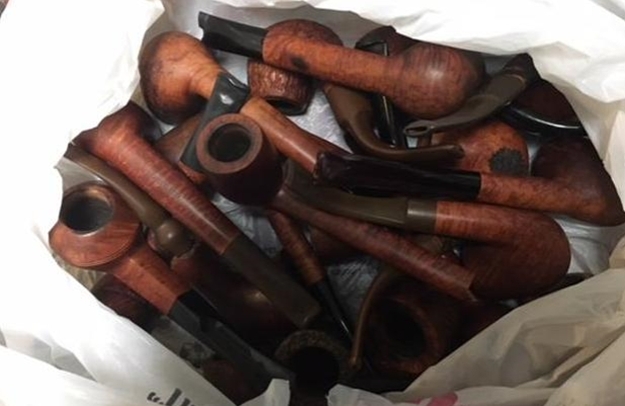
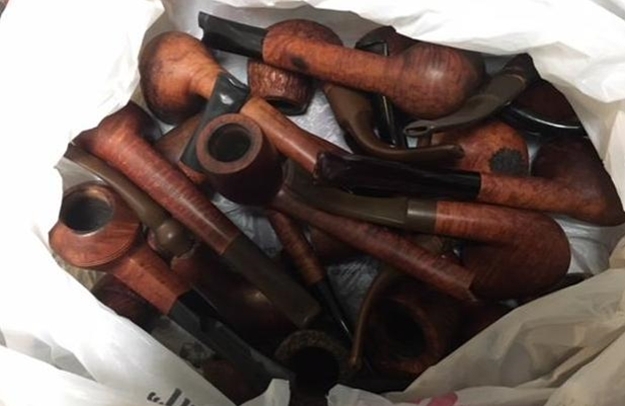
I read her email at work and when I got home I went through the Malaga pipes from George Koch’s estate. I picked two of them that I thought might interest her and sent her the pictures of the pipes that I had available. The two I chose needed to be restored before I could send them to her but they showed some promise. The first of them was a long shank Canadian that had some mixed grain and vulcanite stem that I restored yesterday and wrote a blog about the process (https://rebornpipes.com/2019/10/26/redeeming-a-malaga-canadian-the-first-of-two-that-are-going-home/). The second one is a short Cherrywood that has a great mix of grain styles around the bowl and shank combined with a saddle stem that makes it an interesting pipe. It is another one of the many Malaga pipes that came to my brother and me in several shipments of pipes from George’s daughter Kathy. When Jeff got each box the pipes were well wrapped and packed. Jeff unwrapped them and took the following photo to give an idea of the volume of the pipes that we purchased. This Malaga came in mixed in a box of pipes much like the one below.In each of the previous blogs that I have written on the restoration of George’s pipes I have told his story. If you have followed the restorations you will have read the information and the background piece that Kathy did on her father. Here is a link to one of the previous blogs on his Malaga pipes where I included her tribute in full (https://rebornpipes.com/2019/01/26/back-to-kathys-dads-pipes-restoring-a-%c2%bc-bent-malaga-author/). You can also read the bio on her Dad, George Koch. It is an interesting read and one that shows just how far our pipe collecting passion can go when we find a brand of pipes that we enjoy. I am going to only include the portion on the Malagas at this point. If you wish to read the rest follow the link above.
Kathy writes…We lived in Livonia, and that’s where his love for Malaga pipes began. After a few years he returned to Allis Chalmers and we moved back to Springfield. I remember that when we went back to Michigan to visit friends, Dad had to go to the Malaga store and acquire a few new pipes. Many a year I wrote to Malaga and they picked out a pipe for me to purchase that I could give Dad for a Christmas or birthday present. He was always pleased. His favorites were the straight stemmed medium sized bowl pipes, but he liked them all. 

He had some other pipes, but the Malagas were his favorites. I remember him smoking them sitting in his easy chair after work, with feet up on the ledge by the fire burning in the fireplace.  Growing up it was my job to clean them and he liked the inner bowl and stem coated with Watkins vanilla, leaving a little of that liquid in the bowl to soak in when I put them back on the rack…I’m very happy they are being restored by you and your brother and hope they find homes who enjoy them as much as Dad did. Thank-you for your care and interest. — Kathy, the oldest daughter

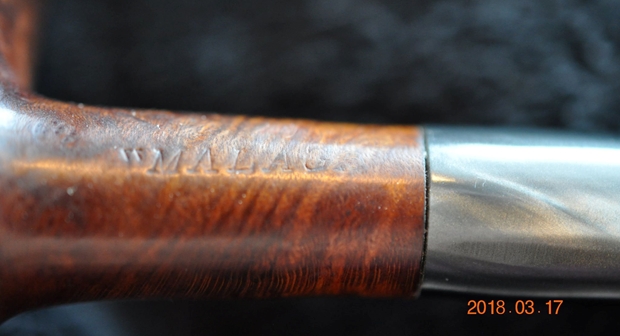
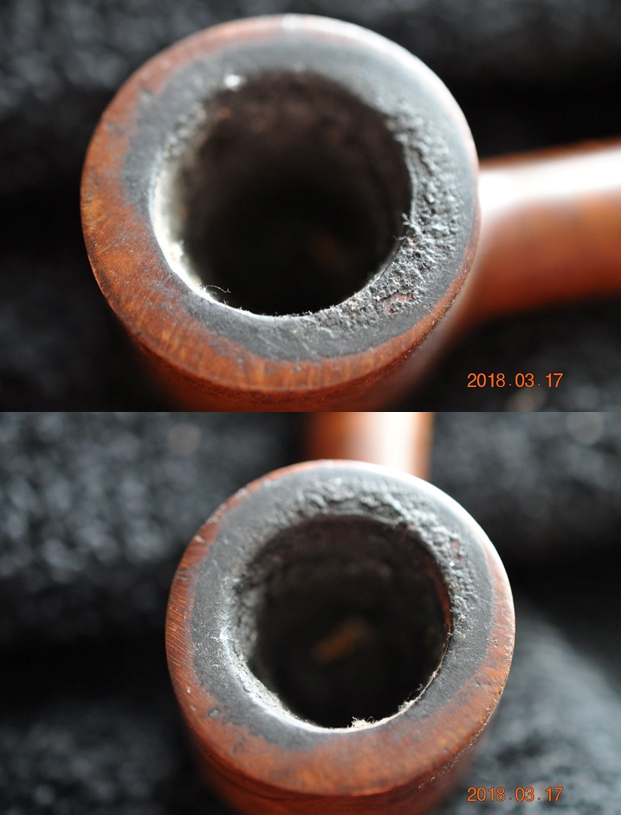
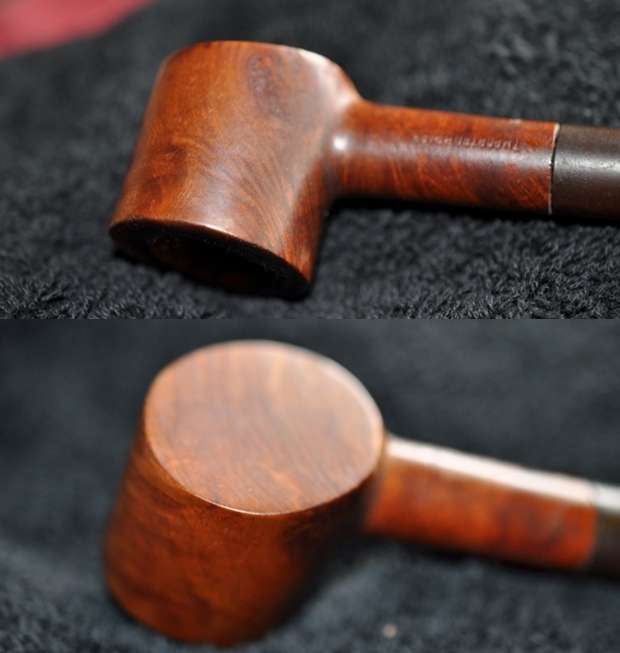
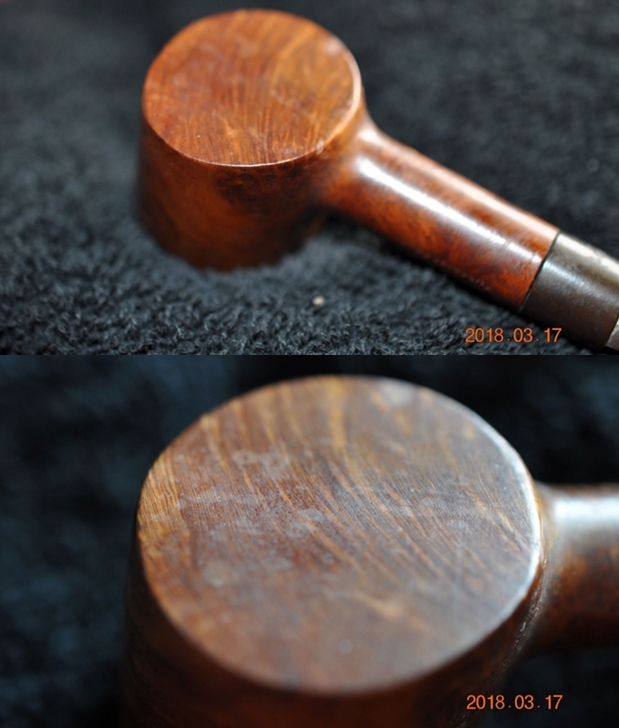
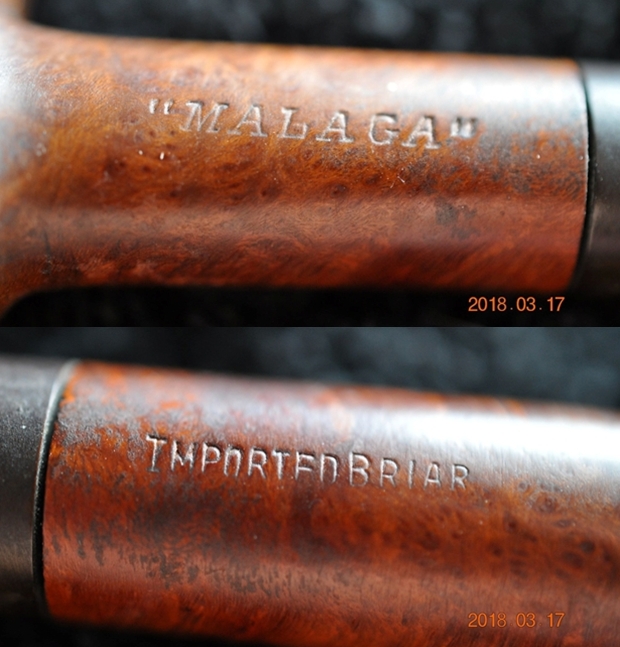
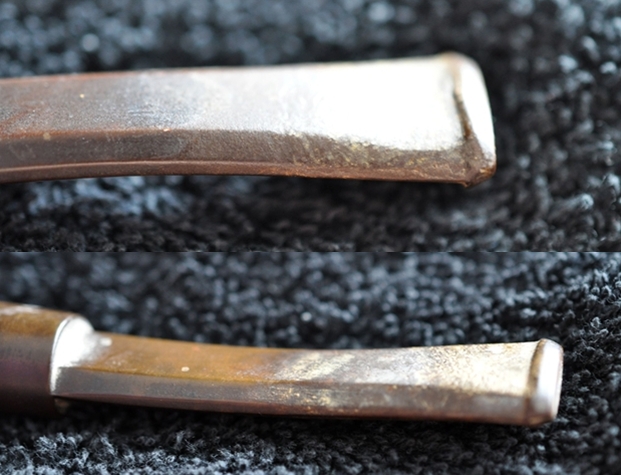
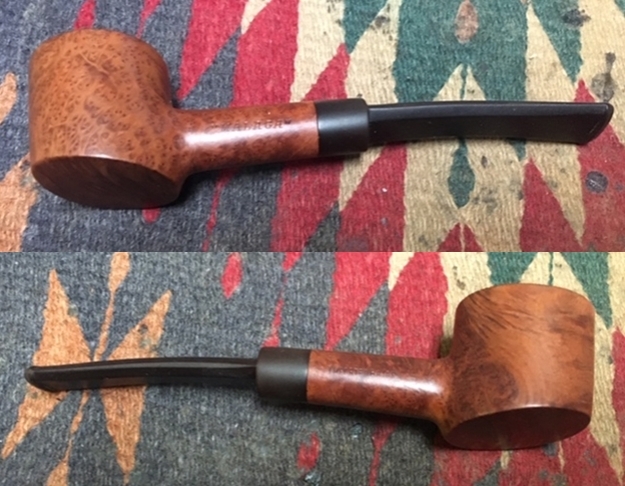
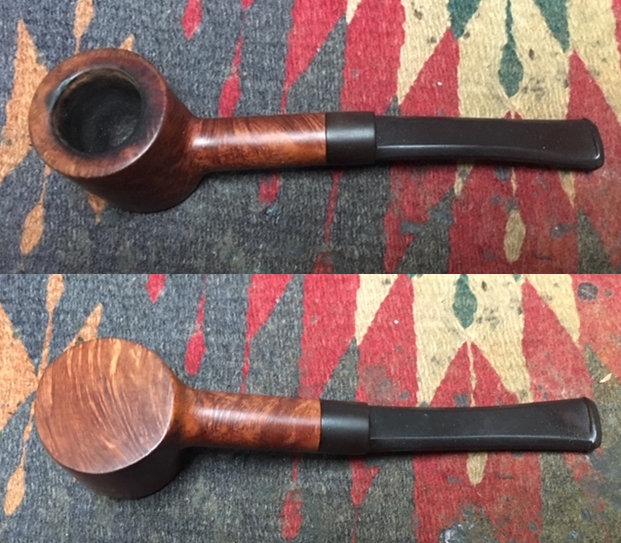
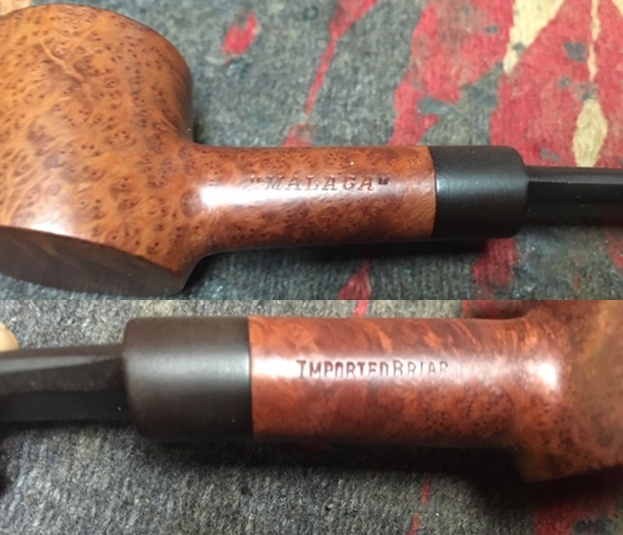
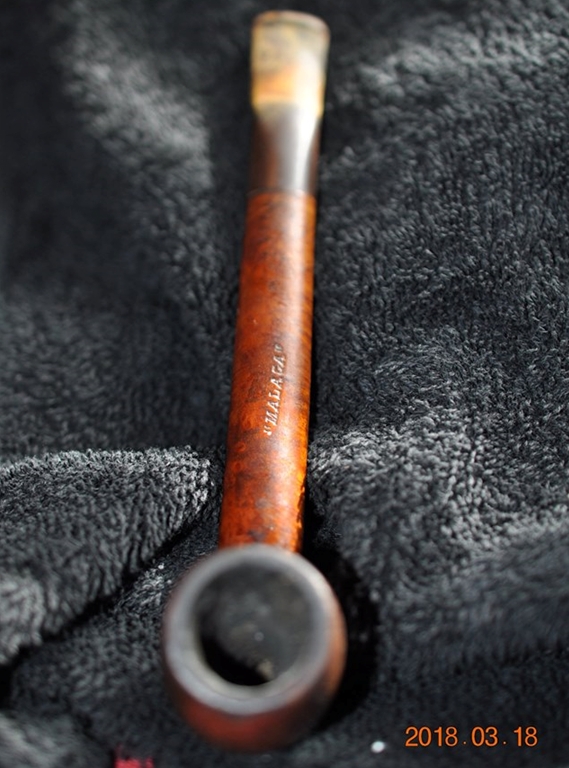
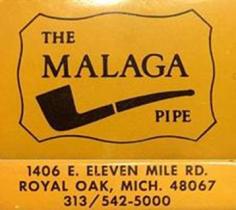
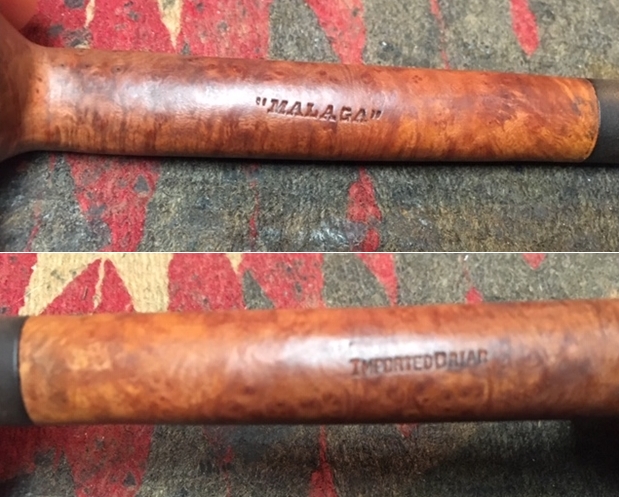
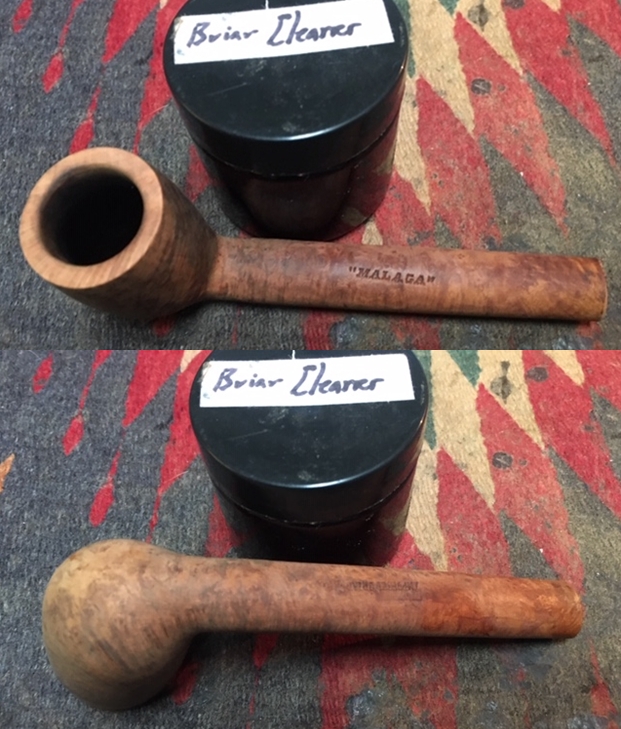
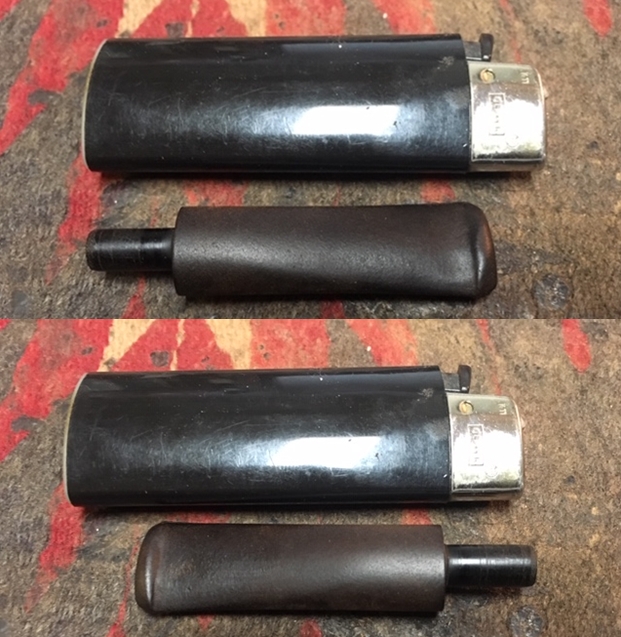
The “Malaga” Short Cherrywood is next pipe on the table. The carver did a great job of shaping the pipe to follow the grain on the briar. The bowl, round shank and straight saddle stem look very good. The bowl had a thick cake that overflowed with lava onto the rim so that it was impossible to see if there was damage on the inner edges. The sides of the bowl and shank are very dirty with grime and oils from prolonged use. The stamping on the right side of the shank read “MALAGA”. On the left side it is stamped IMPORTED BRIAR. The stem had tooth dents and chatter on the top and the underside of the stem. There was some thick calcification and also some oxidation deep in the vulcanite of the stem surface. Jeff took these photos before he started the cleanup work on the pipe. Jeff took close up photos of the bowl and rim to capture the condition of the pipe before he started his cleanup work. The rim top had some lava overflow and darkening on the back of the bowl. There appeared to be some damage to the inner edge of the grimy pipe. The outer edge looked to be in decent condition with perhaps some burn marks on the front.He also took photos of the side and bottom of the bowl and shank to show the beautiful grain around the bowl. The photos show the general condition of the bowl and dirt and wear on the rich oil finish. It is very dirty but this is another beautiful pipe. Jeff took a photo to capture the stamping on the top side of the shank. The photos show the stamping “MALAGA” on the left side of the shank and IMPORTED BRIAR on the right side. The stamping is very readable.The next photos show the stem surface. There are tooth marks and chatter on both sides near the button and wear on the button surface and edges. You can also see the calcification and the oxidation on the stem.I am also including the link to a blog that I wrote that gives some of the history of the Malaga brand and the Malaga Pipe Shop in Royal Oak, Michigan in the USA. I have written an earlier blog to give a little history of the Malaga Brand and the pipemaker, George Khoubesser. Here is the link – https://rebornpipes.com/tag/malaga-pipes/.That blog also includes links to a catalogue and the history of the pipemaker George Khoubesser. Follow the link to get a feel for the brand and the pipemaker.

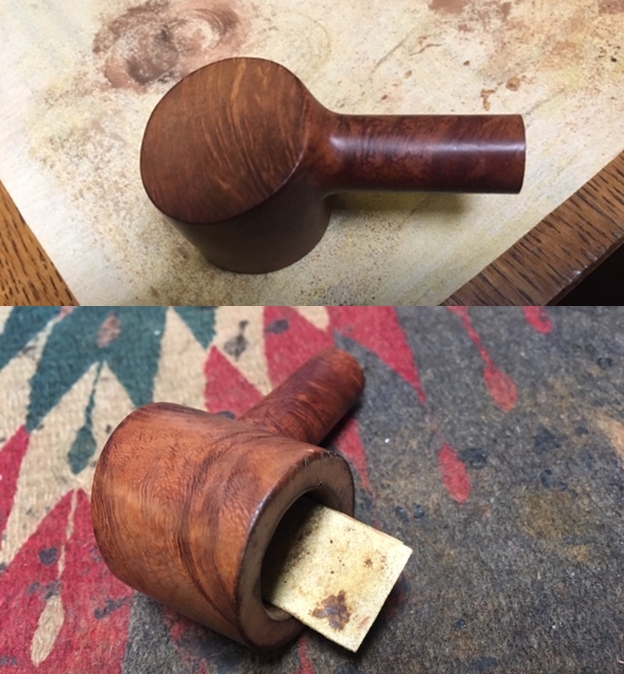
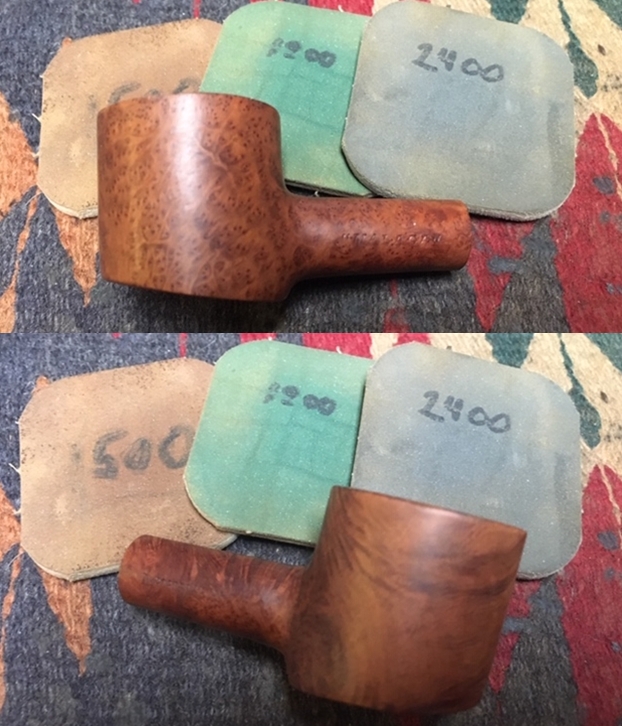
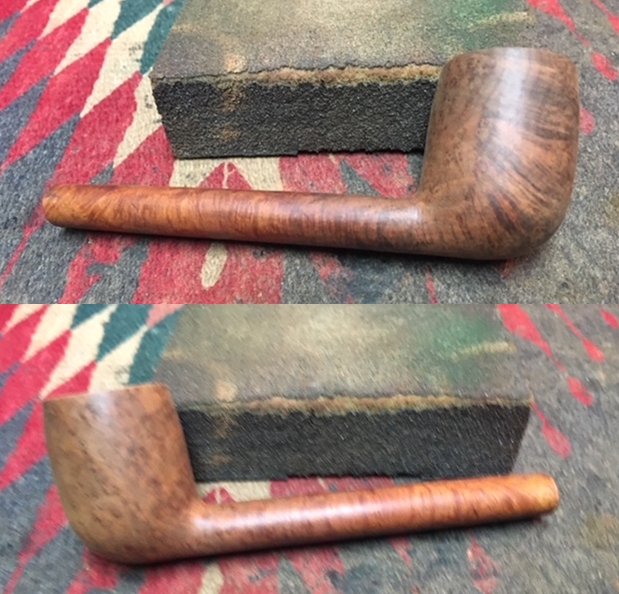
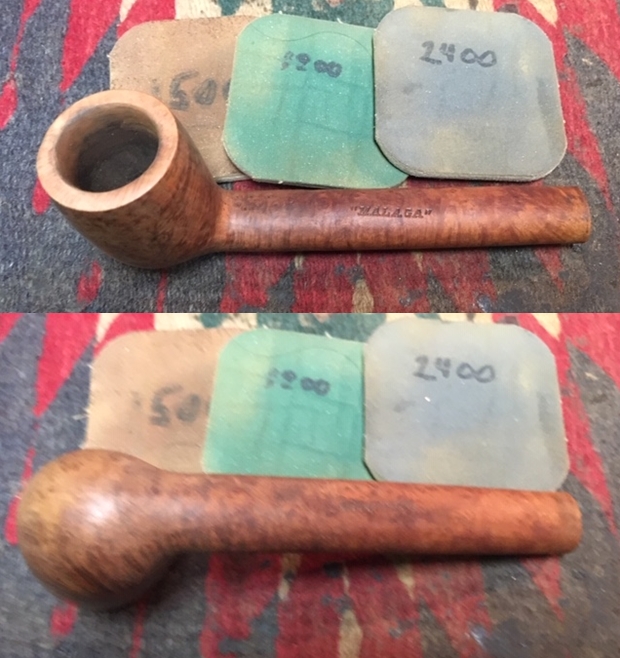
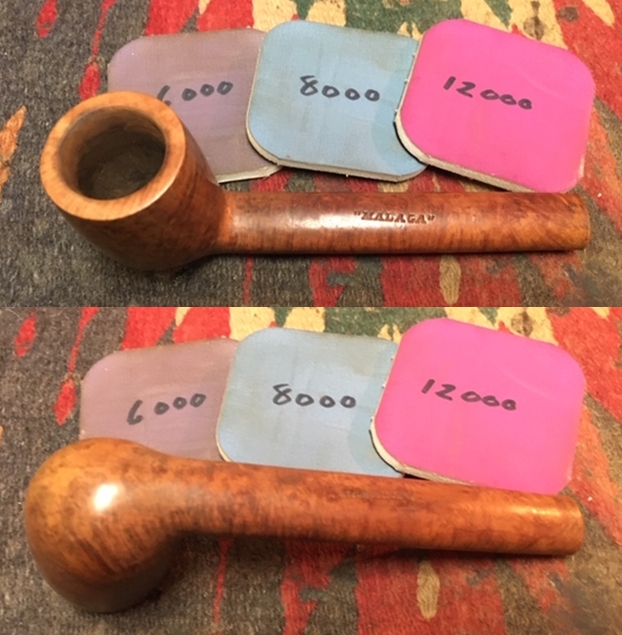
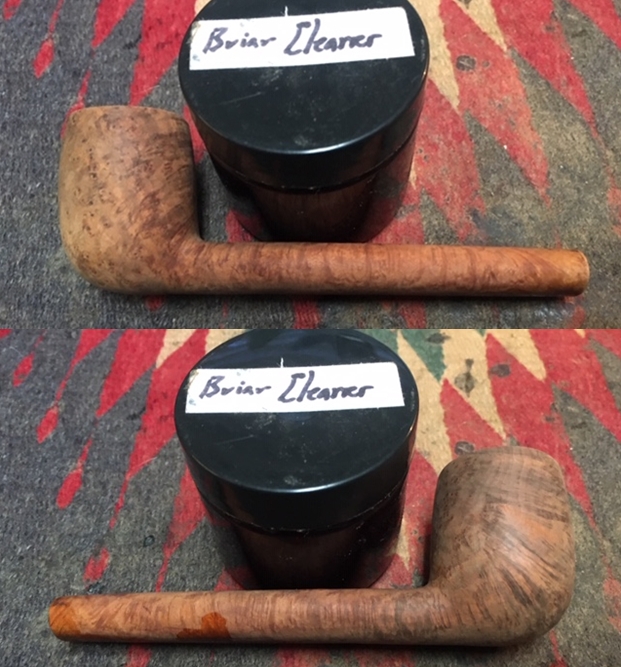
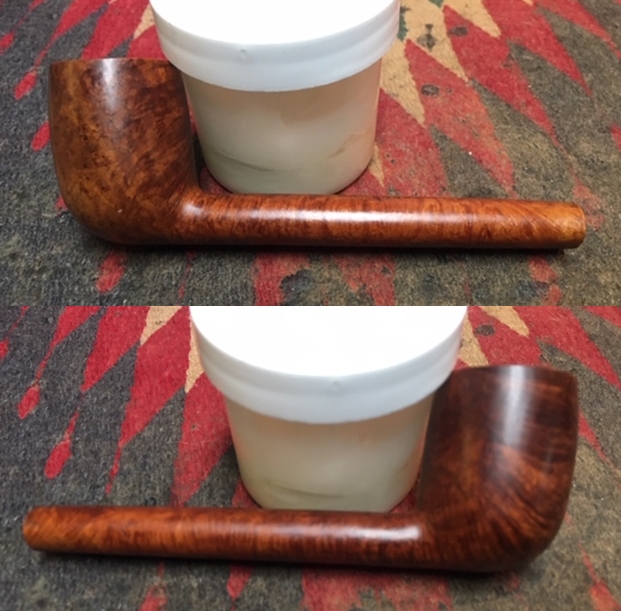
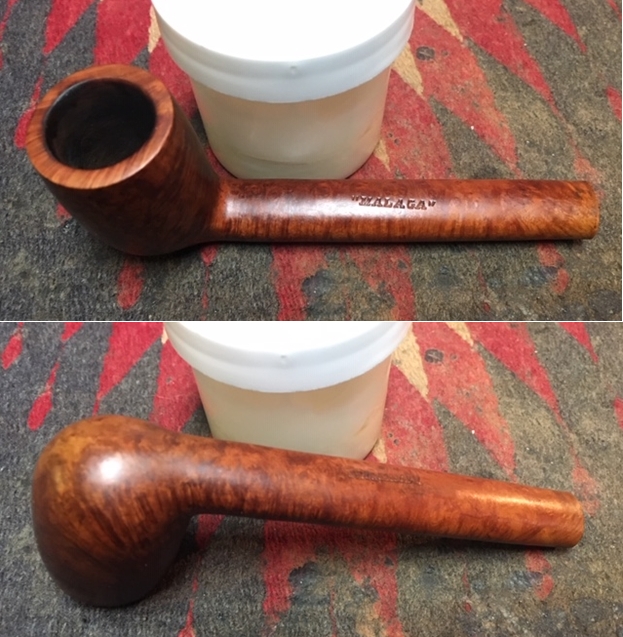
Jeff reamed the bowl with a PipNet pipe reamer and followed up with a Savinelli Fitsall pipe knife to remove the cake. He scrubbed out the mortise and the airway in the shank and the stem with alcohol, cotton swabs and pipe cleaners. He scrubbed the exterior of the bowl, rim, shank and stem with a tooth brush and Murphy’s Oil Soap to remove the oils and tars on the rim and the grime on the finish of the bowl. He rinsed it under running water. He dried it off with a soft cloth. He was able to remove the lava build up on the rim top and the flat surface of the rim top and the inner edge has some serious burn damage on the front and back side. The outer edge looked very good. I took photos of the pipe to show its condition before I started my work on it. The stem also looked better. I took close up photos of the bowl and rim top as well as the stem. You can see the condition of the rim top and bowl in the first photo. Jeff was able to remove all of the tar and oils but you can now see the damage on the top and inside rim edge. The edge is out of round. There is a burn mark that extends across back and right front edge of the rim top at that point. The stem had tooth marks and chatter on both sides near and on the button surface on both sides.I took a photo of the stamping on the shank to show how good the condition is. It shows the “MALAGA” and the IMPORTED BRIAR stamp and they are very legible.I decided to address the rim top first. I topped the bowl on a topping board with 220 grit sandpaper. I wanted to minimize the damage on the top, remove the darkening and clean up the damage on the inner edges of the bowl. I used a folded piece of 220 grit sandpaper to clean up the damage on the right rear inner edge of the bowl. I gave the inner edge a slight bevel to repair the damage. I polished the edge with 400 grit wet dry sandpaper. The rim top and edges really looked better (I forgot to take photos of the rim top at this point but did so with the micromesh).I polished the rim top and the briar with micromesh sanding pads. I wet sanded the bowl with 1500-12000 grit sanding pads. I wiped the bowl down after each pad with a damp cloth to remove the sanding dust. I scrubbed the briar with Before & After Briar Cleaner and a tooth brush. I rubbed it into the surface of the briar with my finger tips and let it sit for about 10 minutes then rinsed it off with running water. I dried it off with a soft cloth. I worked some Before & After Restoration Balm into the surface of the briar with my fingertips to clean, enliven and protect it. I let the balm sit for a little while and then buffed with a cotton cloth to raise the shine. The following photos show the bowl at this point in the restoration process. I am very happy with the results. I turned to the stem to address the issues on the surface of both sides at the button. I sanded both sides smooth with 220 grit sandpaper and 400 grit sandpaper to blend the tooth chatter into the surface of the stem. As I sanded and reshaped the button and stem surface the tooth chatter disappeared.I used some Denicare Mouthpiece Polish that I have in my kit to start polishing out some of the scratches and remaining oxidation on the stem. I rubbed it in with a cotton pad and my finger tip and buffed it off with a cotton pad.I polished the stem with micromesh sanding pads – wet sanding with 1500-12000 grit sanding pads. I wiped it down after each sanding pad Obsidian Oil. I finished by polishing it with Before & After Pipe Stem Polish both fine and extra Fine and then wiped it down with a final coat of Obsidian Oil. This is a “Malaga” Imported Briar small Cherrywood with a ¼ bent vulcanite saddle stem has a great look and feel. The shape of the bowl, the cut of the rim top and briar work well to highlight the grain around the bowl sides. I polished stem and the bowl with Blue Diamond polish on the buffing wheel. I gave the bowl and the stem multiple coats of carnauba wax. I buffed the pipe with a clean buffing pad to raise the shine. I hand buffed it with a microfiber cloth to deepen the shine. The pipe polished up pretty nicely. The grain took on life with the buffing. The rich oil cured colour works well with the polished vulcanite stem. The finished pipe has a rich look that is quite catching. Have a look at it with the photos below. The shape, finish and flow of the pipe and stem are very well done. The dimensions are Length: 5 ¾ inches, Height: 1 7/8 inches, Outside diameter of the bowl: 1 ¼ inches, Chamber diameter: ¾ of an inch. Now that the second Malaga is finished it is ready to mail off to Diane with the Canadian. I can’t wait to hear what her colleague thinks when she opens her Christmas present! I am glad that she is carrying on both the trust for George Koch and her family. Thanks for walking through the restoration with me as I worked over another one of Kathy’s Dad’s Pipes.

Redeeming a Malaga Canadian – the 1st of 2 pipes that are going home


Blog by Steve Laug

Yesterday afternoon I received and email from a reader of the rebornpipes blog who was on the hunt for a Malaga pipe or two for a colleague of hers. What made it interesting was that the colleague’s grandfather and family were the original owners of Malaga Pipes. Here is her message to me:

Hi There

I work with Lisa Holloway formerly Saraynian and her grandfather and consecutive family were the original owner of Malaga Pipes

Id love to be able to purchase one for her for Christmas this year but since they went out of business in 1999 I have no idea where to get one or how much they are

Would you be able to help me find one and purchase it for her.

Please let me know thanks so much

Diane

I read her email at work and when I got home I went through the Malaga pipes from George Koch’s estate. I picked two of them that I thought might interest her and sent her the pictures of the pipes that I had available. The two I chose needed to be restored before I could send them to her but they showed some promise. The first of them was a long shank Canadian that had some mixed grain and a vulcanite stem. The mix of grain styles around the bowl and shank combined with the stem make it a stunning pipe. It is one of the many Malaga pipes that came to my brother and me in several shipments of pipes from George’s daughter Kathy. When Jeff got each box the pipes were well wrapped and packed. Jeff unwrapped them and took the following photo to give an idea of the volume of the pipes that we purchased. This Malaga came in mixed in a box of pipes much like the one below. In each of the previous blogs that I have written on the restoration of George’s pipes I have told his story. If you have followed the restorations you will have read the information and the background piece that Kathy did on her father. Here is a link to one of the previous blogs on his Malaga pipes where I included her tribute in full (https://rebornpipes.com/2019/01/26/back-to-kathys-dads-pipes-restoring-a-%c2%bc-bent-malaga-author/). You can also read the bio on her Dad, George Koch. It is an interesting read and one that shows just how far our pipe collecting passion can go when we find a brand of pipes that we enjoy. I am going to only include the portion on the Malagas at this point. If you wish to read the rest follow the link above.

Kathy writes…We lived in Livonia, and that’s where his love for Malaga pipes began. After a few years he returned to Allis Chalmers and we moved back to Springfield. I remember that when we went back to Michigan to visit friends, Dad had to go to the Malaga store and acquire a few new pipes. Many a year I wrote to Malaga and they picked out a pipe for me to purchase that I could give Dad for a Christmas or birthday present. He was always pleased. His favorites were the straight stemmed medium sized bowl pipes, but he liked them all. 

He had some other pipes, but the Malagas were his favorites. I remember him smoking them sitting in his easy chair after work, with feet up on the ledge by the fire burning in the fireplace.  Growing up it was my job to clean them and he liked the inner bowl and stem coated with Watkins vanilla, leaving a little of that liquid in the bowl to soak in when I put them back on the rack…I’m very happy they are being restored by you and your brother and hope they find homes who enjoy them as much as Dad did. Thank-you for your care and interest. — Kathy, the oldest daughter

The “Malaga” Long Shank Canadian is next pipe on the table. The carver did a great job of shaping the pipe to follow the grain on the briar. The bowl, oval shank and straight tapered stem look very good. The bowl had a thick cake that overflowed with lava onto the rim so that it was impossible to see if there was damage on the inner edges. The sides of the bowl and shank are very dirty with grime and oils from prolonged use. The stamping on the top of the shank read “MALAGA”. On the underside it is stamped IMPORTED BRIAR. The stem had tooth dents and chatter on the top and the underside of the stem. There was some thick calcification and also some oxidation deep in the vulcanite of the stem surface. Jeff took these photos before he started the cleanup work on the pipe. Jeff took close up photos of the bowl and rim to capture the condition of the pipe before he started his cleanup work. The rim top had some lava overflow and darkening on the back of the bowl. There appeared to be deep gouges in the inner edge of the grimy pipe. The outer edge looked to be in decent condition with perhaps some burn marks on the front.He also took a photo of the side and bottom of the bowl and shank to show the beautiful grain around the bowl. The photos show the general condition of the bowl and dirt and wear on the rich oil finish. It is very dirty but this is another beautiful pipe.Jeff took a photo to capture the stamping on the top side of the shank. The photos show the stamping “MALAGA” on the topside of the shank and IMPORTED BRIAR on the underside. The stamping is very readable. The next photos show the stem surface. There are tooth marks and chatter on both sides near the button and wear on the button surface and edges. You can also see the calcification and the oxidation on the stem.I am also including the link to a blog that I wrote that gives some of the history of the Malaga brand and the Malaga Pipe Shop in Royal Oak, Michigan in the USA. I have written an earlier blog to give a little history of the Malaga Brand and the pipemaker, George Khoubesser. Here is the link – https://rebornpipes.com/tag/malaga-pipes/.That blog also includes links to a catalogue and the history of the pipemaker George Khoubesser. Follow the link to get a feel for the brand and the pipemaker.

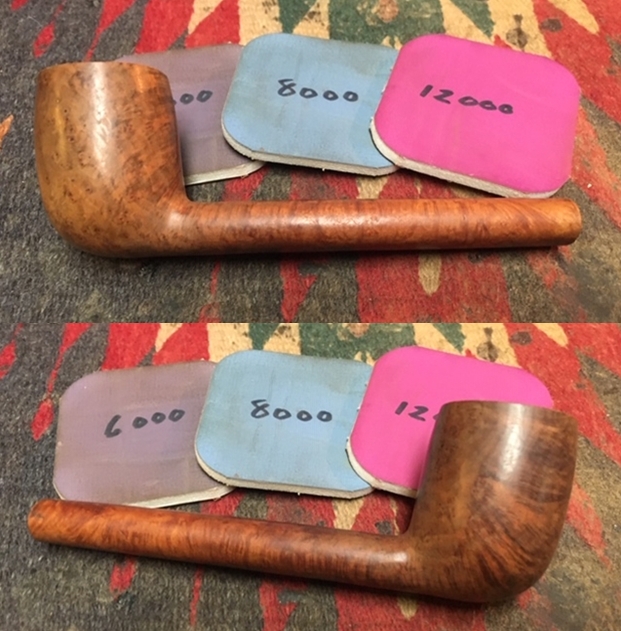
Jeff reamed the bowl with a PipNet pipe reamer and followed up with a Savinelli Fitsall pipe knife to remove the cake. He scrubbed out the mortise and the airway in the shank and the stem with alcohol, cotton swabs and pipe cleaners. He scrubbed the exterior of the bowl, rim, shank and stem with a tooth brush and Murphy’s Oil Soap to remove the oils and tars on the rim and the grime on the finish of the bowl. He rinsed it under running water. He dried it off with a soft cloth. He was able to remove the lava build up on the rim top and the flat surface of the rim top and the inner edge ha some serious burn damage on the front and back side. The outer edge looked very good. I took photos of the pipe to show its condition before I started my work on it. The stem also looked better. I took close up photos of the bowl and rim top as well as the stem. You can see the condition of the rim top and bowl in the first photo. Jeff was able to remove all of the tar and oils but you can now see the damage on the top and inside rim edge. The edge is out of round. There is a burn mark that extends across back and front edge of the rim top at that point. The stem had tooth marks and chatter on both sides near and on the button surface on both sides.I took a photo of the stamping on the shank to show how good the condition is. It shows the “MALAGA”and the IMPORTED BRIAR stamp and they are very legible.I decided to address the rim top first. I topped the bowl on a topping board with 220 grit sandpaper. I wanted to minimize the damage on the top, remove the darkening and clean up the damage on the inner edges of the bowl. I used a folded piece of 220 grit sandpaper to clean up the damage on the right rear inner edge of the bowl. I gave the inner edge a slight bevel to repair the damage. I polished the edge with 400 grit wet dry sandpaper. The rim top and edges really looked better.I polished the bowl and rim with a medium and a fine sanding sponge to begin the process of removing the scratches and blending the restored rim top into the rest of the bowl. The photos tell the story. I polished the rim top and the briar with micromesh sanding pads. I wet sanded the bowl with 1500-12000 grit sanding pads. I wiped the bowl down after each pad with a damp cloth to remove the sanding dust. I scrubbed the briar with Before & After Briar Cleaner and a tooth brush. I rubbed it into the surface of the briar with my finger tips and let it sit for about 10 minutes then rinsed it off with running water. I dried it off with a soft cloth. I worked some Before & After Restoration Balm into the surface of the briar with my fingertips to clean, enliven and protect it. I let the balm sit for a little while and then buffed with a cotton cloth to raise the shine. The following photos show the bowl at this point in the restoration process. I am very happy with the results. I turned to the stem to address the issues on the surface of both sides at the button. I painted the surface of the stem with the flame of a lighter to lift the indentations. Since vulcanite has “memory” it often will return to its original condition when heated. It worked pretty well leaving behind light chatter and one small tooth mark that will need to be repaired.I used a needle file to redefine the sharp edge and the surface of the button. It had been worn down and lost its definition.I filled in the one remaining tooth dent with a drop of clear super glue and set it aside for a few moments to cure.I sanded both sides smooth with 220 grit sandpaper and 400 grit sandpaper to blend the tooth chatter and the repair into the surface of the stem. As I sanded and reshaped the button and stem surface the repaired areas and the tooth chatter disappeared.I used some Denicare Mouthpiece Polish that I have in my kit to start polishing out some of the scratches and remaining oxidation on the stem. I rubbed it in with a cotton pad and my finger tip and buffed it off with a cotton pad.I polished the stem with micromesh sanding pads – wet sanding with 1500-12000 grit sanding pads. I wiped it down after each sanding pad Obsidian Oil. I finished by polishing it with Before & After Pipe Stem Polish both fine and extra Fine and then wiped it down with a final coat of Obsidian Oil. This is a Malaga Long Shank Canadian with a vulcanite tapered stem. It has a great look and feel. The shape of the bowl, the beveled rim top and the cut of the briar work well to highlight the grain around the bowl sides. I polished stem and the bowl with Blue Diamond polish on the buffing wheel. I gave the bowl and the stem multiple coats of carnauba wax. I buffed the pipe with a clean buffing pad to raise the shine. I hand buffed it with a microfiber cloth to deepen the shine. The pipe polished up pretty nicely. The grain took on life with the buffing. The rich oil cured colour works well with the polished vulcanite stem. The finished pipe has a rich look that is quite catching. Have a look at it with the photos below. The shape, finish and flow of the pipe and stem are very well done. The dimensions are Length: 6 ½ inches, Height: 1 ½ inches, Outside diameter of the bowl: 1 1/8 inches, Chamber diameter: ¾ of an inch. When the second Malaga is finished I will mail it off to Diane. I can’t wait to hear what her colleague thinks when she opens her Christmas present! I am glad that she is carrying on both the trust for George Koch and her family. Thanks for walking through the restoration with me as I worked over another one of Kathy’s Dad’s Pipes.

Restoring a Thorburn Clark XL Rusticated Pipe


Blog by Paresh Deshpande

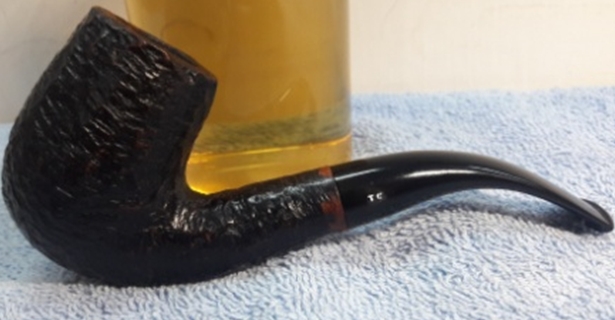
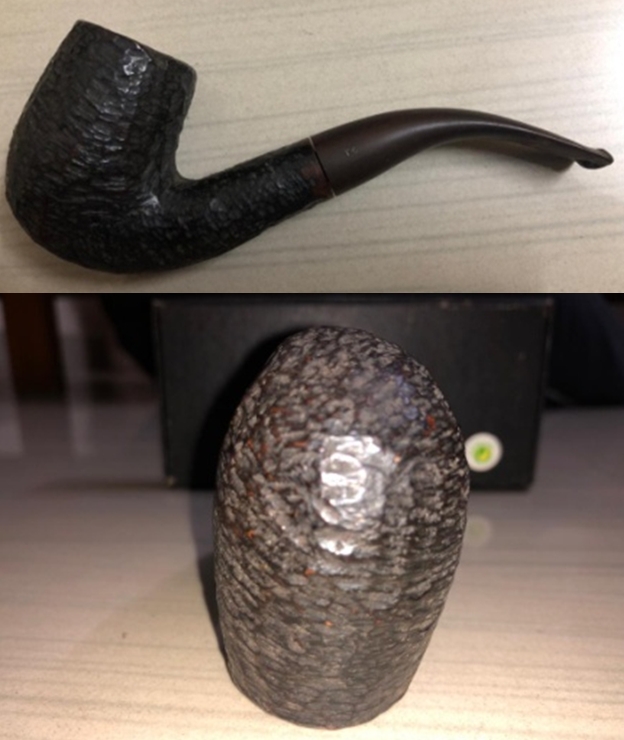
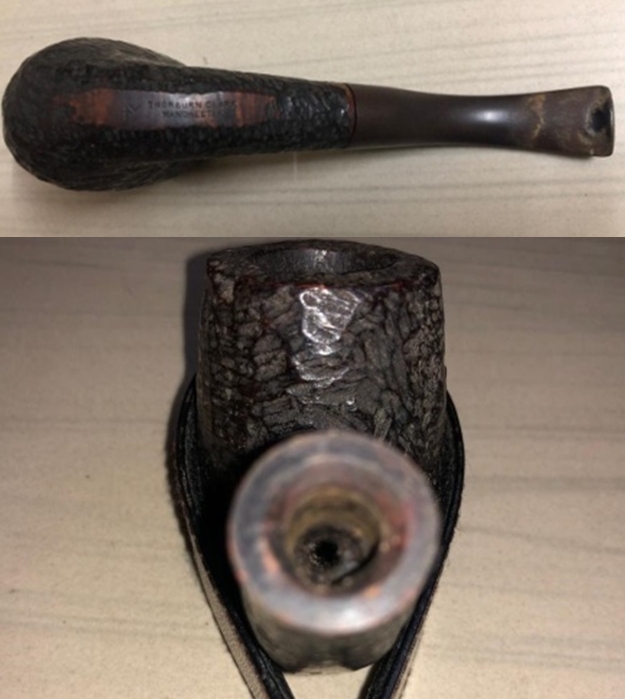
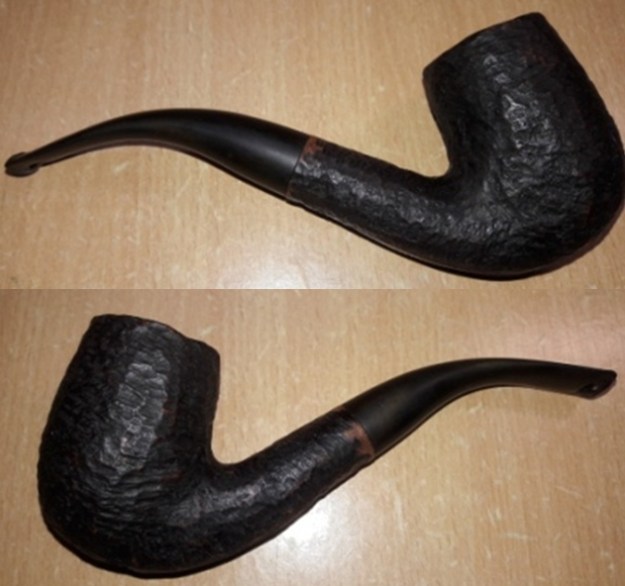
The next pipe that I picked up for restoration is a massive sized classic full bent Billiards shaped pipe that feels robust in the hands with a nice and comfortable feel in the mouth when clenched. It has the classic British shape which oozes excellent craftsmanship, very high quality of briar and vulcanite and screamed “VINTAGE”. No wonder then that this beauty had found its way in my grandfather’s rotation (seeing the condition that it was in) in the past and now will surely be part of my rotation too!!

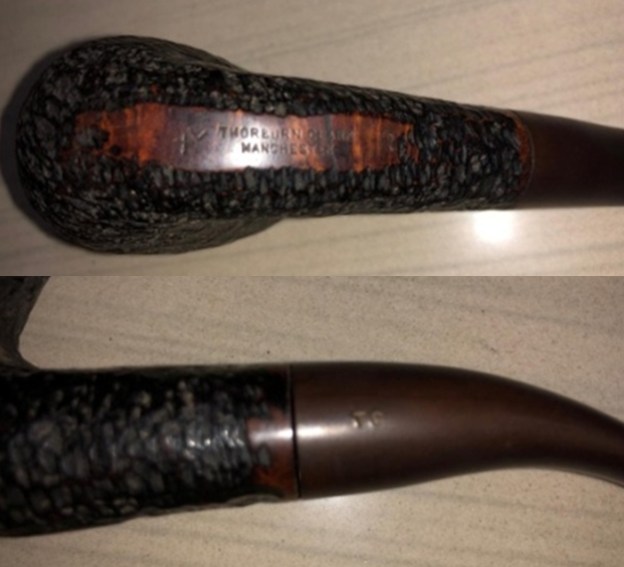
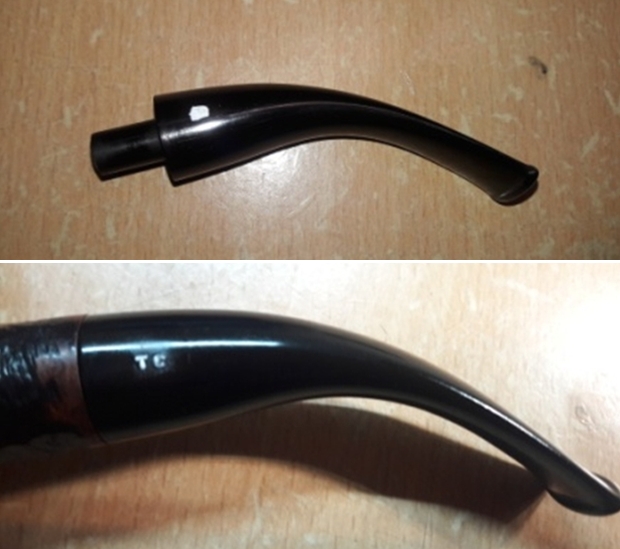
The stummel of this pipe appears to be a combination of rustication and sandblast!! It is unique and it sure does feel good to run your fingers over the surface of the stummel. There is a thin strip of smooth briar surface at the bottom of the shank which bears the stampings on this pipe. It is stamped as “THORBURN CLARK” over “MANCHESTER”. To the left of this stamp towards the foot of the stummel, it is stamped as “XL” at an angel and to the right towards the shank end it is stamped with the letter “R”. The set of stampings on this pipe are all crisp and in block capital letters. The vulcanite stem bears the logo “TC”, in separate capital letters.While researching any pipe, the first site that I visit is rebornpipes.com since this is one site where I usually find well researched information on any brand that has anything, even remotely related, to pipes!! Now, till the time I got this pipe on my work table, I had not heard or read anything on this pipe maker and now that I have decided to work on it, rebornpipes does have a write up by Steve on a similar shaped pipe, though considerably smaller and with same rustication pattern as the one on my work table, from this carver. He had thoroughly researched this pipe and makes for an interesting read. Here is the link to the write up: https://rebornpipes.com/2017/12/03/restoring-a-thorburn-clark-rusticated-bent-billiard/

From the information that I read and the fact that this pipe came from my grandfather’s collection, this one could be dated from the period 1930s to 1940s.

INITIAL VISUAL INSPECTION
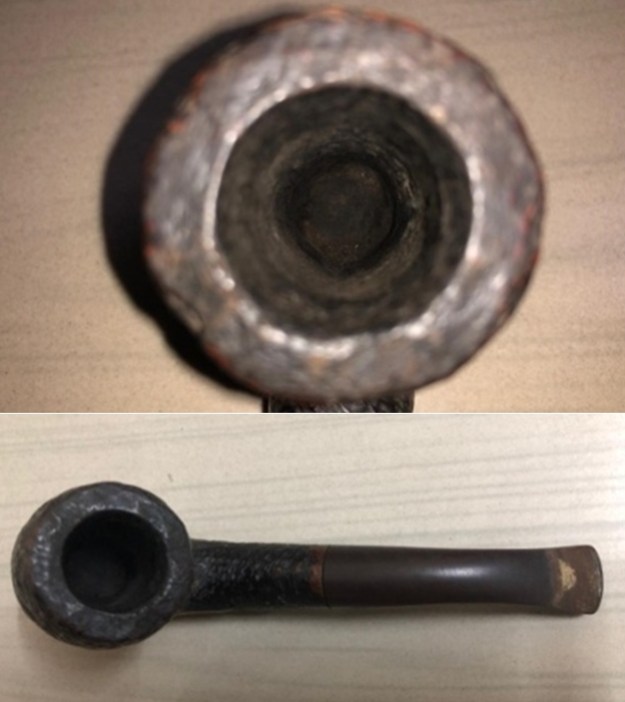
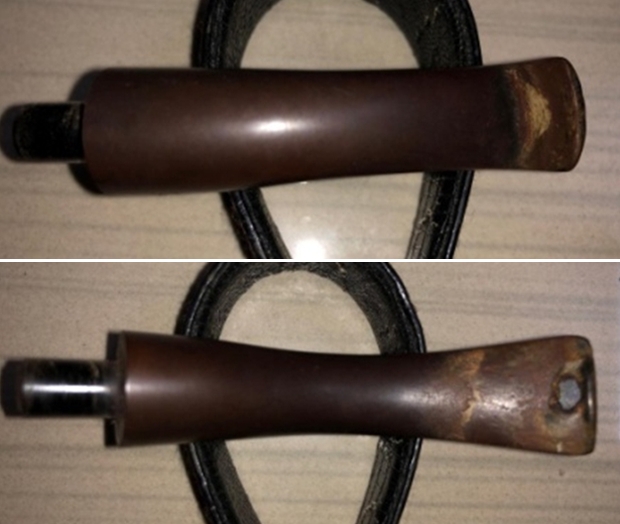
As observed with maximum of my inherited pipes, this too has a thick layer of cake in the chamber with overflow of lava on the rim top. The inner rim edge appears sans any damage and would be confirmed once the chamber has been reamed. The condition of the walls of the chamber can be commented upon once the cake has been taken down to the bare briar. However, the external surface of the stummel feels and looks solid and hence I do not foresee any major issues surprising me later. The ghost smells are very strong in the chamber.The rim top surface on this pipe as also rusticated like the rest of the stummel. As is commonly seen on rusticated or sandblasted pipes with some serious age on them, the crevices in these are always filled with dust, dirt, oils, tars and grime from all the years of smoking and storage. This one is no exception to this observation. The grooves of the sandblast are filled with dust while the small smooth bottom of the shank which bears the stamping is covered in dust and grime. The fact that the textured patterns of the rustications are dusty and filled with dirt is accentuated more due to the contrast of dark and medium brown stains on the stummel and the shank. The briar is looking lifeless and bone dry and has taken on black dull hues. The mortise is full of oils, tars and gunk and air flow is restricted. As usual, it is the stem that has suffered the maximum damage. Heavy oxidation, calcification in the bite zone, chewed and deformed button edges, heavy tooth chatter and a large through hole near the button edge on the lower surface are some of the common issues I have observed on maximum pipes in my inheritance. This is no exception. The tenon and slot on this stem is clogged with dried gunk making for a very laborious draw. The following pictures speak for themselves. INITIAL CLEANING BY ABHA…
The initial cleaning on this pipe was done by Abha, my wife (she has cleaned up around 40-50 pipes and these have now reached me for further restoration). She reamed out the complete cake and further smoothed out the chamber walls with a folded piece of 220 grit sand paper. She further cleaned out the internals of the shank with pipe cleaners and alcohol and cotton buds. She followed the internal cleaning of the shank with external cleaning of the stummel using Murphy’s Oil soap and hard bristled tooth brush and dried it with paper napkins and cotton cloth.

Next she cleaned out the internals of the stem air way and immersed it in “Before and After Deoxidizer” solution along with the stem of other pipes in line for restoration. Once the stem had soaked overnight, she cleaned the stem under running warm water and scrubbed the raised oxidation from the stem surface using scotch brite pad. She further removed the oxidation by scrubbing the stem with 0000 grade steel wool and applied a little olive oil to rehydrate the stem.

ONCE THE PIPE IS ON MY WORK TABLE…
The cleaned up pipes presents a very clear picture of what needs to be done to restore this pipe to a decent and smokable condition. I really cannot thank Abha, my wife, enough for all the help and support that she extends me in my pursuance of this hobby. I proceed to carry out my appreciation of the work that needs to be done on this pipe to restore it.

As with all the cleaned pipes that Abha packs, there was a note in the zip lock pouch with issues that she had observed in the pipe. The first point was that she was not happy with the way the stummel had cleaned up. Here are the pictures of the pipe as I had received. To be honest, the pipe had cleaned up nicely. What she thought is grime in the rustications is in fact the old stain which had loosened up. A simple wipe with Murphy’s Oil soap will clear out the loosened stain leaving behind a well set coat of darkened stain.

The second point was that the chamber has developed heat fissures. Close scrutiny of the chamber walls made me realize that there is still a very thin layer of cake in the chamber and it is my experience that this gives an appearance of heat fissures! Only after the cake has been completely removed will I be able to confirm presence of heat fissures or otherwise. There are traces of lava overflow deeply embedded in the rustications of the rim top surface. I now know what I should be gifting Abha for our forthcoming Anniversary (of course, a soft brass bristled wire brush as she does not have one…LoL!!). The outer and inner rim edges are in good condition. However, the ghost smells are still all pervasive. This would necessitate a more invasive internal cleaning of the shank and the chamber. The draught hole is dead center and at the bottom of the heel and should be a fantastic smoker. The stummel is clean with no traces of dust or dirt embedded in the nooks and crannies of the rustications other than what I have explained earlier. The stummel surface is solid and robust without any issues. The contrast of dark and medium brown stains looks gorgeous and should polish up nicely. This is really a well made pipe and the craftsmanship is right up in the ally of some really expensive and renowned brands. The mortise is clean. As expected, the stem is where major repairs are required. The button on the upper surface has completely worn down with deep bite marks as seen. The lower surface has a large gaping through hole very close to the edge of the button, exposing the stem’s air way. The button is completely worn out on the right side. Though an easy repair, it is time consuming. THE PROCESS
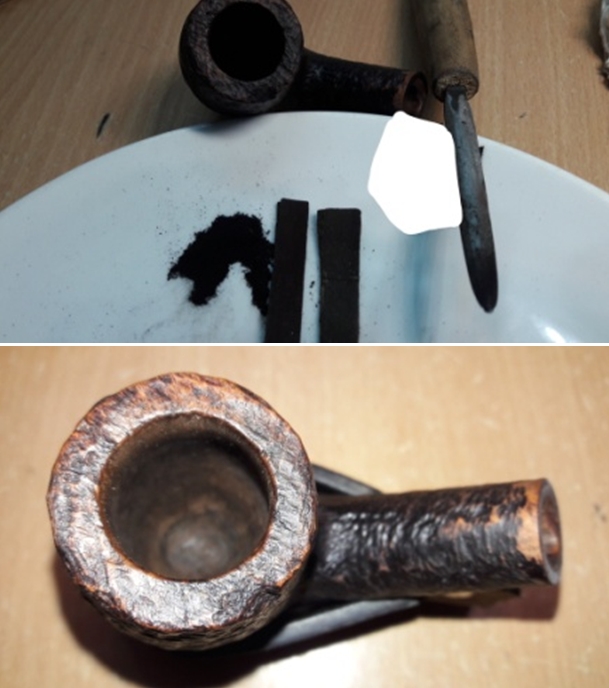
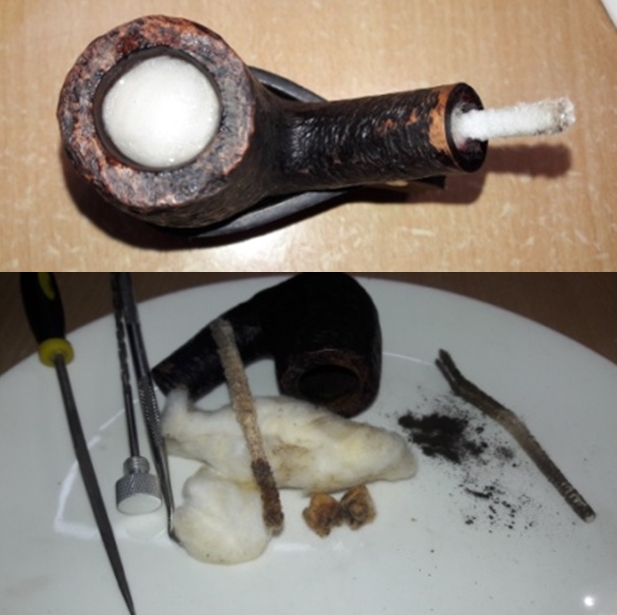
I embarked on the journey of restoring this pipe by addressing the stem first since it was damaged the most and would take considerable time to repair. Abha had done a fantastic job of cleaning the stem both internally and externally and this facilitated me to straight away heat the stem surface with the flame of a lighter which helps to raise the tooth indentation to the surface.I sand the stem surface with a 220 grit sand paper to even out the raised tooth indentation and remove what little oxidation that had remained on the surface. I follow it up by cleaning the surface with a cotton swab and alcohol. I wipe the stem with a cotton swab and Murphy’s oil soap to deep clean the surface. The stem surface is now ready for a fill.I appropriately folded an index card and covered it with a transparent tape which prevents the superglue and charcoal mix from sticking to the card. This is how it appears and fits in to the broken stem.I mix activated charcoal and superglue and fill the hole and the tooth indentations on the buttons and in the bite zone. I prefer to paint the entire bite zone with the mix and always apply a thick layer. This helps me in subsequent better blending of the fill with the rest of the stem surface by sanding it down. I set the stem aside for the fill to cure overnight.While the stem fill was curing, I worked the stummel surface. With my fabricated knife, I scraped out all the remaining cake from the chamber walls and followed it up by sanding with a 180 grit sand paper. This ensured that the cake was taken down to bare briar. I wiped the chamber with a cotton swab and alcohol to remove all the fine cake dust that was left behind. The amount of cake that was reamed out and that was after Abha had reamed and sanded it was surprising. But I was happy to note that there are no heat fissures in the walls of the chamber.With this reaming of the chamber, I had expected the ghost smells to be eliminated or at the least, considerably reduced. But that was not to be. I decided to address the issue of old odors in the chamber and shank by subjecting it to a cotton and alcohol bath. I wrapped some cotton around a folded pipe cleaner, keeping the tip of the pipe cleaner free of wrapped cotton as this would be inserted through the draught hole in to the chamber. This would form the wick for the shank. I tightly packed the chamber with cotton balls and filled it with 99% pure isopropyl alcohol using a syringe and set it aside. By next day, the cotton and alcohol had drawn out the tars and oils from the chamber and max from the shank. With tools at my disposal, I scraped out the entire loosened gunk (second picture) from the mortise and the airway leading to the draught hole. Am I glad that Abha’s fears of heat fissures in the walls were unfounded!! Next, I scrub the rusticated rim top surface and the stummel, cleaning it with a brass wired brush. This helped to dislodge the little overflow lava from rim top and the dried and loosened stain particles which previously were visible. I wiped the stummel surface with a cotton swab and Murphy’s oil soap. Next, I rub a small quantity of “Before and After Restoration Balm” in to the stummel surface with my finger tips and let it rest for a few minutes. I worked the restoration balm deep in to the textured rustications. The balm almost immediately works its magic and the briar now has a nice vibrant appearance. The stummel looks very handsome with the contrasting dark and light brown hues. Now that the stummel was nearly complete, I turned my attention to the stem refurbishing. The stem fill had cured well. Using a flat head needle file, I reshaped the button and roughly matched the fills with the rest of the stem surface. However, things rarely happen as you want them to happen and in this case, a few air pockets were revealed on both surfaces as I was sanding the fill with 220 grit sand paper. This is one phenomenon that I never want to see as it is involves a refill (time penalty) and still it is not always possible to address them completely!!I cleaned the surface with cotton swab and alcohol again and applied a fresh mix of activated charcoal and superglue. I set the stem fill aside to cure.Second round of sanding the stem and the end results… The air pockets are still visible in all their ugliness!! This was revealed when I had reached the end of my routine of sanding with ascending grit of sandpapers. Third round of fill and later sanding with 220, 400, 600, 800 and finishing with 0000 grade steel wool, I am happy with the results.I completed the polishing cycle of the stem by wet sanding the surface with 1500 to 12000 girt pads. The stem looks great with the fills nicely matched with the rest of the surface. I gave a final rub with “Before and After Extra Fine” stem polish compound to remove fine scratches from the stem surface. I rub a little quantity of Extra Virgin Olive oil in to the stem surface and set it aside to be absorbed by the vulcanite. The stem polished up nicely and the repairs appear good.To complete the restoration, I mount a cotton cloth buffing wheel on to my hand held rotary tool and applied a coat of Blue Diamond to the stummel and the stem to polish out the minor scratches.I refreshed the stem logo with a white correction pen and a tooth pick. The letter C appears slightly worn at the ends.With a cotton buffing wheel that I use for carnauba wax, I apply a coat of carnauba wax and continue to work on it till the complete coat of wax had been polished out. I finished the restoration by giving the entire pipe a rigorous hand buffing using a microfiber cloth to raise the shine further. The completed pipe looks fresh, vibrant and ready for its next innings with me. This piece of briar feels fantastic in hands with its textured rustications, classic size and will find a place of pride in my collection as a part of the memories left behind by my grand old man. If only it could tell me stories it had witnessed and what tobacco did my grandfather smoke in this pipe!! Thank you to all esteemed readers for joining me and walking with me through this restoration. Cheers!!

Restoring One of the Smallest Pipes in My Collection: A Peterson’s System 3 # 367, Eire


Blog by Paresh Deshpande

While going through the second box of my inherited pipes, I came across the smallest pipe in the entire collection and it was a Pete!! Given my grandfather’s love for large sized pipes, this was surprising and in all probability was a gift given to him by his departing British colleagues when we got our independence in 1947.

I have researched and worked on a few vintage as well as new Peterson’s and in first glance of this pipe I knew it to be a very old Peterson’s. The stummel has a nice spread of mixed grains all around and a nice feel in the hand despite its size. It is stamped vertically on the left side of the shank as “PETERSON’S” with a forked ‘P’ over “SYSTEM” over an encircled numeral “3”. The bottom of the shank close to the edge of the ferrule bears the COM stamp “EIRE” while model/ shape code “# 367” is stamped on the right side of the shank close to the bowl. The nickel ferrule bears the trademark Kapp & Peterson’s official logo of “K&P,” each in a shield shaped escutcheon.While dating a Peterson’s pipe, I always fall back to my under mentioned favorite site; http://thepetersonpipeproject.blogspot.com/2007/07/dating-peterons-pipes.html

I quote from the above site

Eire was formed on 29 December 1937. The Made in Eire Era will be from 1938 through roughly 1940(?) or 1941 (?).

The “Made in Ireland” block format (above) can be another headache in dating Peterson pipes since this stamp was used in the late Patent Era as well as the late 1940s. So for a guide we must take into consideration the style of lettering Peterson used on their pipes. From the start of the Patent Era until somewhere in the early 1930s, Peterson used the “Old Style” lettering that used a forked tail “P” in Peterson.

Thus from the above, it can be concluded that the pipe on my work table dates from 1930s.

INITIAL VISUAL INSPECTION
The chamber has a decent layer of cake signifying limited usage. This is not surprising given the small size of the pipe. The rim top surface has several scratch marks forming a squared pattern, probably caused by scraping against abrasive surface during years of uncared for storage. The inner edge of the rim is severely damaged. Nicks and dings are also seen along the outer rim edge and the chamber appears out of round. Chamber has strong odors of sweet smelling tobaccos. The condition of the inner walls of the chamber can be commented upon once the cake has been reamed down to the bare briar, but going by the solid feel of the external surface, I do not foresee any serious issues/ surprises with the chamber walls.The stummel surface is covered in dust, dirt and grime of years of disuse and uncared for storage. Oils and tars have overflowed over the stummel and have attracted dust giving a dull and lackluster appearance to the stummel. A number of minor dents and scratches are seen over the stummel, notably towards the front, foot and the bottom of the shank. There are two fills clearly visible in front of the stummel. The mortise is clogged with accumulated dried gunk and so is the sump. The pipe smells are too strong. The full bent P-lip vulcanite stem is in a relatively good condition with light tooth chatter on either surfaces of the stem. The lower end of the stem at the tenon end which enters the mortise shows severe scratch marks and chipped surface, the result of rubbing against the sharp edges of the ferrule at the shank end. The button edges on both surfaces will need to be sharpened. The upper surface of the P-lip has bite marks and the slot edges have deformed due to bite marks. The tenon end has accumulated dried gunk and grime, both inside and outside. The stem is oxidized and the air way is not clear as the draw is laborious.INITIAL CLEANING BY ABHA…
The initial cleaning on this pipe was done by Abha, my wife (she has cleaned up around 40-50 pipes and these have now reached me for further restoration). She reamed out the complete cake and further smoothed out the chamber walls with a folded piece of 220 grit sand paper. She further cleaned out the internals of the shank with pipe cleaners and alcohol and cotton buds. She followed the internal cleaning of the shank with external cleaning of the stummel using Murphy’s Oil soap and hard bristled tooth brush and dried it with paper napkins and cotton cloth.

Next she cleaned out the internals of the stem air way and immersed it in “Before and After Deoxidizer” solution along with the stem of other pipes in line for restoration. Once the stem had soaked overnight, she cleaned the stem under running warm water and scrubbed the raised oxidation from the stem surface using Scotch Brite pad. She further removed the oxidation by scrubbing the stem with 0000 grade steel wool and applied a little olive oil to rehydrate the stem.

ONCE THE PIPE IS ON MY WORK TABLE…
The cleaned up pipes presents a very clear picture of what needs to be done to restore this pipe to a pristine and smokable condition. I really cannot thank Abha, my wife, enough for all the help and support that she extends me in my pursuance of this hobby. I proceed to carry out my appreciation of the work that needs to be done on this pipe to restore it.

Abha had told me that this is a very small pipe, but how small the chamber was, is what I noticed first when I got the cleaned up pipe on my work table. The wall of the chamber shows insignificant beginnings of heat fissure on the front right and back of the chamber walls. Though insignificant now, if not addressed at this stage, these heat fissures may further lead to burn outs. I need to address this issue. The rim top surface is uneven and pock marked with dents and dings. The inner edge is peppered with dents and dings. The chamber is significantly out of round, most notably on the right side in 1o’clock direction and charred inner rim edge on the left side in 3 o’clock direction. It is one of the major repairs on this pipe. The chamber, in spite of all the thorough cleaning by Abha, still has a strong ghost smells.The nicely cleaned stummel looks solid with nice mixed grains and swirls all around. The two fill at the front of the stummel are now clearly visible. I shall refresh this fill with a mix of briar dust and superglue. Abha had painstakingly cleaned out the mortise and the sump. However, I could still see remnants of the gunk in the sump and the still strong odor is a pointer to the requirement of further sanitizing the internals of the stummel. The ferrule at the end of the shank end came loose as I was inspecting the stummel. This gave me an opportunity to closely inspect the shank end for cracks or any damage. I scrapped out the dried old glue from the shank end. I did notice a small crack at the top where the ferrule sat on the shank end (circled in red) that would need to be repaired. The edges of the ferrule at the shank end have become very sharp and had caused the damage observed on the tenon end of the stem. I need to address this issue.The cleaned up stem that came to me shows few scratches to the tenon end where it seats in to the mortise and was caused due to the sharp edges of the ferrule. I will address this issue by sanding the surface followed by a fill, if required. The upper surface and button edge of the P-lip shows damage and will have to sharpen the button while sanding and filling the surface. Similarly, the lower button edge has a few tooth indentations and will need a fill to repair. The edges around the slot has bite marks (marked in yellow), deforming the shape of the slot. I shall need to reshape the slot end. THE PROCESS
I started this project by sanding the stem surface with a 220 grit sand paper to address the issue of ferrule damage to the tenon end of the stem. Fortunately, the scratches were completely eliminated by sanding alone, obviating the need for a fill. I wiped the stem with alcohol on a cotton swab to remove all the vulcanite dust from the stem surface. I followed it up by wiping the surface with Murphy’s Oil soap.The next stem issue to be addressed was that of the damage at the slot end of the stem. The first two pictures below shows the extent of damage to the slot, upper surface button edge and lower button edge. I heat both the surfaces with the flame of a lighter to raise the tooth chatter and bite marks to the surface and sand it with a folded piece of 220 grit sand paper to even out the surface. The next set of pictures show the efficacy of this method in raising the damage to the surface. I mix clear superglue and activated charcoal and applied it over the both button edges, upper P-lip surface and lower surface of the P-lip. I set the stem aside for the fills to cure.Next I decided to address the issue of strong ghost smells in the chamber. To eliminate the ghost smells from the pipe, I decided to treat it with salt and alcohol. I pack the sump with cotton and draw out a wick from the cotton and along with a folded regular pipe cleaner; insert it in to the mortise and through the draught hole in the chamber. I pack cotton balls in to the remaining portion of the mortise. Thereafter, I pack the chamber with cotton balls to about quarter of an inch below the rim inner edge. I soak the cotton balls with isopropyl alcohol up to the brim. About half an hour later, the level of alcohol has gone down, having being absorbed by the cotton. I top it up once again and set it aside overnight. By next afternoon, the cotton and alcohol has drawn out all the remaining oils and tars from the chamber, sump and mortise. I removed the cotton balls and the dirt can be gauged by the appearance and coloration of the cotton balls and the pipe cleaner. With my fabricated knife and dental tools, I spent the next hour scrapping out the entire loosened gunk from the mortise and the sump. I ran pipe cleaners through the mortise to clean out all the loosened tars and gunk that had lodged when I cleaned the sump and mortise. The chamber now smells clean, fresh and looks it too. I set the stummel to dry out naturally. I sand the walls of the chamber with 180 grit sand paper and removed the little carbon cake that had loosened out. This also eliminated what I had thought to be heat fissures, which in effect was carbon cake. I heaved a sigh of relief at this development.

While the chamber was soaking in the alcohol bath, I worked the stem fills which had hardened considerably. With a flat head needle file, I sand these fills to achieve a rough match. I further fine tuned the match by sanding the filled area with a folded piece of 220 grit sand paper pinched between my thumb and forefinger. I followed it up by sanding the entire stem surface using 400, 600, 800 grit sand papers and finally with a piece of 0000 grade steel wool. This serves to remove the deep seated oxidation and also reduces the sanding marks of the more abrasive sand papers. I also sharpened the button edges while sanding. I wiped the stem with a cotton swab and alcohol to remove all the oxidation and sanding dust from the surface. I applied a little Extra Virgin Olive oil over the stem and set it aside to be absorbed by the vulcanite.The two fills that Abha had noticed, was picked clean with a thin sharp edged dental tools and would need to be filled. I refreshed the fills with a mix of briar dust and superglue and set the stummel aside for the fill to cure.Turning my attention back to the stem, I decided to polish and shine up the stem surface. I wet sand the stem with 1500 to 12000 girt micromesh pads. Next I rub a small quantity of extra fine stem polish that I had got from Mark and set it aside to let the balm work its magic. After about 10 minutes, I hand buffed the stem with a microfiber cloth to a nice shine. I rub a small quantity of olive oil in to the stem surface to hydrate it and set it aside. Turning my attention back to the stummel, I matched the fill with the rest of the stummel surface by sanding the fill with a flat head needle file followed by sanding the fill and the entire stummel with a folded piece of 220 grit sand paper. I was especially very careful around the stummel stampings, least I obliterate it by sanding. This also helped to remove much of the old glue from the shank end and provide a smooth surface. The next stummel issue that I addressed was that of the rim top surface damage. I topped the rim on a piece of 220 grit sand paper, checking frequently till I was satisfied that the charred inner rim edge on the left side in 3 ‘O’ clock direction was addressed to a great extent and the rim top surface is nice, smooth and even. The inner edge is still uneven, though much better than before topping, and shall be addressed next. With a folded piece of a 220 grit sand paper pinched between my thumb and forefinger, I created a slight bevel on the inner edge of the rim top surface. This helped to mask the out of round chamber and address the minor dents that had remained on the inner rim edge. It can never be perfect, it’s a repair after all, but the repairs sure looks great. I polished the stummel with micromesh pads, dry sanding with 1500 to 12000 pads. I polished the freshly topped rim surface and the newly created inner rim bevel. I wiped the surface with a soft cloth at the end of the micromesh cycle. The stummel looks amazing with a deep shine and beautiful grains popping over the stummel surface. I am surprised that the rim top surface has the same deep brown coloration as the rest of the stummel surface and use of stain pen was not required. I massaged a small quantity of “Before and After Restoration Balm” with my fingers into the briar. The immediate and incredible transformation that takes place is a worthy reward for all the efforts!!! I let the balm sit on the surface to be absorbed in to the briar for about 20 minutes. The bowl now looks fresh and attractive with the grains popping out any which way you look at the briar; it feels somewhat like DIWALI, festival of lights celebrated here in India. I polished off the balm with a soft cloth to a lovely shine. I mount a cotton cloth buffing wheel on to my hand held rotary tool and apply a coat of Blue Diamond to the stummel and the stem to polish out the minor scratches.Before I could move on to polishing with carnauba wax, there was one issue yet to be addressed. It was the small crack that was seen at the lip of the shank end over which the ferrule was to be glued back. The crack had developed in the thinnest part of the shank end. If I were to drill a counter hole at the end of the crack, there was a possibility that the resulting vibrations of the drill bit and rotary tool would cause the surrounding surface to break/ shatter or I could end up with a through hole. The best course thus, was to stabilize the crack with superglue and the ferrule would protect the crack from further external damage.

With the repair of the shank end crack sorted out, I move to polishing the ferrule. I rub a small quantity of ‘Colgate’ toothpowder over the ferrule surface. Those who have not tried out this trick, must try it out at least once, it works like magic and imparts a nice shine to the nickel plated (it works even better on Sterling Silver) ferrule. I apply superglue over the shank end, adding an extra dollop of glue over the crack, align the ferrule stamp with that on the shank and attach the ferrule over it. I press it down firmly for a couple of minutes to let the glue set. After the glue had completely cured, I tried the seating of the stem in to the mortise. It was perfect with no brushing against the edges of the ferrule. I applied a little petroleum jelly on the walls of the mortise with a q-tip as this reduces friction and moisturizes the briar and moved on to the final polishing with carnauba wax. With a cotton buffing wheel that I use for carnauba wax, I apply a coat of carnauba wax and continue to work on it till the complete coat of wax had been polished out. I mount a clean cotton cloth buffing wheel and give the entire pipe a once over buff. I finished the restoration by giving the entire pipe a rigorous hand buffing using a microfiber cloth to raise the shine further. The finished pipe looks beautiful and will be an addition to my collection of Peterson’s pipes!! P.S. The two refreshed fills have naturally blended in so well with the rest of the stummel that I did not feel it necessary to stain the stummel to mask them. This has to be one of the tiniest Peterson’s pipes or may be any pipes that I have worked on till date. I had just recently worked on a massive Yello-Bole “Imperial” # 68 C pipe and then this small pipe. It was fun though!! Here is a picture for size comparison between the two!Sincere gratitude to all the readers who have shared this part of my journey in to the world of pipe restoration…Cheers!!


New Life for a Savinelli 320KS stamped Knudsen’s Pipe Dream


Blog by Steve Laug

Recently I was traveling in Alberta with my brother Jeff and his wife, Sherry. In between work appointments and presentations we took some time to visit local antique shops and malls. We found quite a few pipes. In a small Antique Shop in Nanton we found a few interesting pipes. The fourth of the pipes that I have chosen to work on from that find is a beautifully grained Savinelli Shaped Author. The taper stem has a K.P.D. stamped logo on the left side. The pipe was dirty and caked when we picked it up. The rim top had a little lava and some small scratches in the edges of the bowl. The bowl had a thick cake in it that was hard and dense. The exterior of the bowl and shank are very dirty with grime and oils from prolonged use. It was also dull and lifeless. The stamping on the left side of the shank was readable and read Knudsen’s over Pipe Dream. On the right side of the shank it is stamped 320 KS over Italy. The vulcanite stem was had tooth chatter and tooth marks on the top and the underside near the button. I took photos of the pipe before I started the cleanup. I took close up photos of the bowl and rim to capture the condition of the pipe before I started my cleanup work. The rim top had some lava build up on the edge and there were some small nicks on the inner edge. There was a thick cake in the bowl. Other than being so dirty it appeared to be in great condition. The stem was dirty and there was tooth chatter and marks on the top and underside near the button and on the button surface itself. The stem was lightly oxidized.I took a photo to capture the stamping on the left side of the shank. The photo shows the stamping Knudsen’s Pipe Dream. The stamping on the right side says 320KS Italy. The first photo also shows the K.P.D. stamp on the left side of the stem. The shape number tells me this is a Savinelli made pipe and the shape is the 320KS.While we were traveling I decided to do a bit of work on some of the pipes that we had found. This was the fourth one that I worked on. I scraped the inside of the bowl with a sharp knife. I scraped the tars and lava off the top of the rim with the same knife.I scrubbed the exterior of the bowl with warm water and Dawn Dish Soap to remove the buildup of tars and grime around the bowl and on the rim top. I rinsed it well and wiped the bowl down with a clean paper towel to polish the finish on the bowl. The pictures that follow show the condition of the pipe after it had been scrubbed. When I got it home I would scrub the exterior and the interior some more. I did some digging to see if I could find anything out about the brand stamped on the left side of the shank. I found that there was a Knudsen’s Pipe Dream Pipe Shop in Regina, Saskatchewan. It was originally located at 4621 Rae St, Regina SK S4S 6K6. The company was originally incorporated on 7 February 1974 in Canada and was dissolved as a company on 2 May 2002. I worked on a previous Knudsen’s pipe that had been made by Charatan and was stamped London, England as opposed to having been made by Savinelli and stamped Italy. Here is the link to the previous blog on the English made pipe: https://rebornpipes.com/2016/09/09/charatan-made-knudsens-pipe-dream-oval-shank-banker-brought-back-to-life/

When I returned from my trip I turned my attention to cleaning up the pipes that we had found. I did a deeper and more thorough cleaning of the bowl and shank. I reamed the bowl with a PipNet Reamer using the largest cutting head to take the cake back to bare walls. I followed up with a Savinelli Fitsall pipe knife to remove the remnants of the cake in the bowl. I sanded the bowl with 220 grit sandpaper wrapped around a piece of dowel to smooth out the inside walls of the bowl. I scraped the inside of the mortise with a dental spatula to remove the buildup of tars and oils on the walls. I scrubbed out the mortise and the airway in the shank, the metal mortise and the stem with alcohol, cotton swabs and pipe cleaners. I cleaned up the scratching and darkening on the rim top with a medium and a fine grit sanding sponge. I steamed out the deeper scratches with a damp cloth and an iron. I polished the briar with micromesh sanding pads – wet sanding the bowl walls and rim top with 1500-12000 grit pads. I wiped the bowl down after each sanding pad with a damp cloth to wipe of the dust. I scrubbed the bowl down with Mark Hoover’s Before & After Briar Cleaner. I rubbed it into the surface of the briar, and as Mark wrote me it lifted the grime and dirt out of the briar. I rinsed the cleaner off the bowl with warm running water and dried it with a soft cloth. The photos below show the cleaned briar… Look at the grain on that pipe! I worked some Before & After Restoration Balm into the surface of the briar with my fingertips to clean, enliven and protect it. I let the balm sit for a little while and then buffed with a cotton cloth to raise the shine. The photos show the bowl at this point in the restoration process. I set the bowl aside and turned my attention to the stem. I painted the vulcanite stem with lighter to lift the tooth dents in the stem surface. I was able to lift them almost to the surface which allowed me to sand out the remnants of the tooth marks and chatter.I sanded out the remnants of the tooth marks with 220 grit sand paper and started to polish it with a folded piece of 400 wet dry sandpaper. I carefully worked my way around the KPD stamp on the left side of the stem. Once it was finished it began to shine.I polished the stem with some Denicare Mouthpiece Polish. It is a coarse red paste that works to remove oxidation. I rubbed it into the surface of the stem and buffed it off with the same cotton pad. It did a good job of further removing the oxidation.I polished the stem with micromesh sanding pads – wet sanding with 1500-12000 grit sanding pads. I wiped it down after each sanding pad with a damp cloth. I polished it with Before & After Pipe Stem Polish – both Fine and Extra Fine and buffed it off with a cotton cloth. This is a chubby shanked and nicely grained Savinelli made pipe with a black tapered vulcanite stem. It has a great look and feel. The shape is a handful and feels comfortable and substantial in my hand. I polished stem and the bowl with Blue Diamond polish on the buffing wheel. I gave the bowl and the stem multiple coats of carnauba wax. I buffed the pipe with a clean buffing pad to raise the shine. I hand buffed it with a microfiber cloth to deepen the shine. The pipe polished up pretty nicely. The grain on the bowl came alive with the buffing. The rich contrasting browns works well with the polished vulcanite stem. The finished pipe has a rich look that is quite catching. Have a look at it with the photos below. The shape, finish and flow of the pipe and stem are very well done. The dimensions are Length: 5 ½ inches, Height: 1 ¾ inches, Outside diameter of the bowl: 1 ¾ inches, Chamber diameter: 7/8 of an inch. Thanks for walking through the restoration with me as I worked over the next of the finds of Jeff and my Alberta pipe hunt. It is a beautiful straight grain Savinelli 320KS that bears the stamping of a now defunct Regina, Saskatchewan based pipe and tobacco shop. I will be adding it to the rebornpipes store soon so if you are interested in adding it to your collection let me know. 

A Nightmare Resurrecting from ‘Pipe Dreamers ONLY!’ – Comoy’s The Lumberman Special Canadian


Blog by Dal Stanton

There is no other way to describe this Canadian – a Nightmare.  I created the ‘For “Pipe Dreamers” ONLY!’ section on ThePipeSteward site to encourage people to see the hidden potential of a sad, neglected pipe BEFORE the restoration process.  So much of life and relationships we have are shaped by our ability to see what people can become and treat them in this manner.  Jim saw The Lumberman and commissioned him along with a very attractive Butz Choquin Supermate Panel.  In corresponding with Jim, I learned that he’s from Pennsylvania and an engineer by trade working at Pennsylvania State University as a research staff assistant writing software for all kinds of research efforts.  What interested me also was that he, like me, enjoys working with his hands – models, woodworking and Jim has his own shop where he works.  He also builds dioramas – models representing a scene with three-dimensional figures, usually in miniature or as a large-scale museum exhibit (had to look this up!).  In his initial email, Jim assessed The Lumberman that he said he wanted me to restore:

I realize that restoring the Canadian is going to be quite a tall order — it’s former owner seeming to have smoked it hard and hung it up wet — but I can’t help but look at the hints of cross-grain on the shank and think that there is still a solid pipe left underneath all of that dirty exterior.

My response to Jim was a bit more realistic and, let me be honest, skeptical(!):

Oh my.  The Lumberman is in bad shape.  I showed my wife the pipe and that someone had requested to restore it and her response was, ‘Why?’  Your description is an understatement.  He needs a lot of TLC.  The shank chip will probably need to be planed off to reseat the stem/tenon – losing about 1/16 inch of the shank length – doable.  The rim is an ICU inhabitant.  There’s no pretty way to deal with this.  I would clean the chamber to make sure all the briar is exposed.  I would then build up the rim as much as possible with briar dust putty and then sand/top it down until it looked acceptable.  Honestly, Jim, I can’t say how much top I’ll need to remove from the bowl – as little as possible, but he’s not in good shape.  I understand what you see in the grain underneath the years of dirt and grime.  Without a doubt, you are awarded the Pipe Dreamer of the Year award!  It’s difficult for me to put an estimate on it at this point because it will definitely qualify as a resurrection and not a restoration.  I’m game if you are game.  I love the challenge and with this guy, I’m not sure how I’ll value him, but the same applies.  If you’re not satisfied, you’re not obligated to purchase.  As I said before, the sale of these pipes benefit the Daughters of Bulgaria and I appreciate your desire to support that.

The ’Nightmare’ Canadian that Jim commissioned will be a challenge!  Here are pictures of The Lumberman before he reached my worktable as I took pictures to post in the ‘For “Pipe Dreamers” ONLY!’ online collection: The nomenclature found on the left flank of the long Canadian shank is THE [over an arched] LUMBERMAN.  Not until later, after starting the research, did I discover that on the shank’s right side is stamped, SPECIAL.I acquired The Lumberman in what I have called, ‘The Lot of 66’ which has produced many pipes for new stewards benefiting the Daughters of Bulgaria.  Honestly, in every ‘lot’ purchase, there are always pipes that are considered ‘throw aways’ and this pipe was included in that category!  Doing a quick search in Pipephil.eu, I find The Lumberman Special listed as a Comoy’s second.  Here is the panel:The ‘The Lumberman’ lettering is identical to the Canadian on my worktable.  What is distinctly different is that the SPECIAL stamping is not joined as in the example above.  The pipe on my table has the stamping separated on the right shank side.  Another difference is the COM – the example is stamped ‘Made in London England’.  I find no COM on our pipe, nor do I find the same three bar stem logo shown, which is also on other Comoy’s second brands.  A quick look at Pipedia’s Comoy’s article confirms that The Lumberman Special is a Comoy’s second.  Also included is a picture (Second examples, details, and nomenclature, courtesy Doug Valitchka) of a pristine example – a very attractive pipe.  This example of The Lumberman also seems to be without the three bar stem logo.Looking at the example of this pipe in pristine condition above and then gazing at the ‘Nightmare’ version on my table now, lets me know that this will be a grand challenge!  Yet, there’s absolutely nothing to lose.  This pipe was done.  He was no longer the object of anyone’s love or attention.  Now, with the challenge to see what it can become with some TLC (OK, LOTS of TLC) makes me thankful for the challenge Jim has made possible.  My approach generally will be to clean, patch and sand.  The chamber and the rim are the most daunting challenges.  I’ll be surprised if I don’t find heating issues in the chamber after clearing away the thick cake.  The rim is a total mess – charring has deteriorated most of the rim.  The chamber wall has eroded, and the rim plane is wobbled and uneven.  The outer edge of the rim is chipped and gouged.  The bowl is full of scratches and a few fills here and there with pitting as well.  A huge chip has taken almost a quarter of the shank facing.  The good news is that the Canadian short stem has heavy oxidation and nominal tooth and clamping compressions on the upper and lower bit.  I add a few more pictures now from my worktable complimenting the pictures above. To begin the restoration (or, resurrection?) of this Comoy’s The Lumberman Special, after cleaning the airway with a pipe cleaner wetted with isopropyl 95%, the stem joins other stems in the queue for a soak in Mark Hoover’s product (ibepen.com) Before & After Deoxidizer to address the thick, scaly oxidation. I just communicated with Mark to order more Deoxidizer and Restoration Balm which I’ll pick up on a trip to the US I will be leaving for soon.  I leave the stem in the soak for a few hours.  I include pictures from above to mark the starting point. After soaking for a few hours, I fish the stem out and run a pipe cleaner through the airway to remove the liquid.  I then wipe the oxidation off the stem using a cotton pad wetted with isopropyl 95%.  The B&A Deoxidizer has done a good job removing oxidation. Paraffin oil is then applied to the stem to revitalize and hydrate the vulcanite.  I put the stem on the side to absorb the oil.The starting point for working on the hurting stummel is simple cleaning to unmask as much as possible the plethora of issues underneath the cake in the chamber and the grime on the stummel surface.  To clear the chamber of cake, the Pipnet Reaming kit is used.  I take a picture of the chamber to mark the starting point. Not a happy view!After putting paper towel down to save on clean up, using the smallest of the Pipnet blade heads I go to work.  I use 2 of the 4 blade heads available to me and then transition to using the Savinelli Fitsall Tool to scrape the chamber walls further.  Finally, I finish by sanding the chamber with 240 grade paper wrapped around a Sharpie Pen and then wipe the chamber with a cotton pad wetted with alcohol to clear the carbon dust. The inspection of the now cleaned chamber shows the chamber wall proper to be in great condition!  This indeed was good news.  The briar is healthy and now it has a fresh start.Next, using undiluted Murphy’s Oil Soap the rim and external briar surface is cleaned using a cotton pad. A brass wire brush also proves useful in cleaning the charred rim.  After cleaning the surface, the stummel is transferred to the kitchen sink where it is rinsed in warm water and using wired shank brushes and anti-oil dish soap, I clean the internal mortise and airway. After rinsing thoroughly, I bring the stummel back to the worktable and clean the internals further using pipe cleaners and cotton buds dipped in isopropyl 95%.  I use a dental spoon to scrape the sides of the mortise as well as using shank brushes to work on the long Canadian shank. After a good bit of effort, progress has been made and since the hour is late, I will continue the cleaning using kosher salt and isopropyl 95% to soak through the night.  This methodology not only continues the internal cleaning but freshens the pipe for a new steward.  First, a cotton ball is pulled and twisted to form a wick that is used to push down the mortise and airway to serve as a ‘wick’ to draw out the residual tars and oils.  Using a stiff wire, the cotton wick is guided down the airway and after the stummel is placed in an egg carton to provide stability.  I then fill the bowl with kosher salt, which leaves no aftertaste unlike iodized salt.  Using a large eyedropper, I fill the bowl with isopropyl 95% until it surfaces over the salt.  With the longer Canadian shank, it takes longer for the alcohol to seep into the longer airway.  After topping it off with alcohol one last time, I turn out the lights and call it a day. The next morning, the salt is mildly soiled showing that it did its job through the night.  When I tug on the cotton wick, unfortunately, it doesn’t come out whole.  I must employ the use of a dental probe and tweezers to pull the remainder out.  Finally, I was able to push the rest through to the bowl with the help of the pointed needle file. To be sure the internals are finally cleaned, I deploy a few more pipe cleaners and cotton buds wetted with isopropyl 95% to clean up any residue.  After a short time, it is apparent that things look good and I move on.With the internal cleaning completed, my attention shifts now to the primary issue – the rim re-build.  From the picture below looking down on the rim, the remnants of the rim top are at 4 to 5 o’clock and at 9 to 1 o’clock.  These surfaces give me an idea of where the rim was and provide a target for a re-built rim – at least in an ideal world.  The inner rim edge is out of round from charring and…, who knows.  One thing for sure, this Canadian was loved and used, but rode into the ground! Looking now from the side, from both directions, the uneven plane is evident.  The challenge is how to save as much briar as possible off the top of the bowl to have a flat plane?  To top it until this happens will turn the Canadian into a long shank Pot! My path forward, after considering the options, is to start with a very minimal topping to even out the remaining rim plane to see more clearly the areas that will be targeted for patching.  The default option is to lose briar through topping, but I will seek to build the rim up with the patch material – briar dust putty, and top, shape and sand the rebuilt rim until it has a semblance of normality!  At least, this is the hope.  I take out the chopping board which becomes my topping board after placing a sheet of 240 grade paper on it.  The goal is to lightly top to establish the boundaries.Instead of rotating the first round, I drag the stummel across the board.  I do this because I want to stay on top of the remnant rim surface and not dip down into the damaged areas which will be softer.  Keeping the pressure on the high wood was easier this way.  The result shows the emerging boundaries.Next, this time, after rotating the stummel a few more times on the board, I come to the place of diminishing returns for topping.  I’ll apply briar dust putty to the damaged areas – on the rim and along the internal and external edges to fill in the gaps.  It will require a lot of patching, but the patch areas will provide the excess for sanding and shaping.The next area to prep for briar dust patch material is the large chip of the shank facing.  I insert a drill bit into the mortise which forms the boundary for the patch.  I’ll apply a bit of petroleum jelly to the bit to assure the briar putty patch will not stick to the bit.  Earlier, when communicating with Jim, my thinking was that I would simply plane the facing to remove the damage.  With this always being an option, my thinking now is to start with a patch, sand and shape – go from this point with the value on keeping as much briar as possible.The final prep area is a few small pits on the stummel surface that have old fill material in them.  I dig the old material out with a dental probe which will be refilled with briar putty.I clean all the patch areas with a cotton pad and alcohol in preparation for applying the briar putty.Using BSI Maxi Cure Extra Thick CA glue, I mix it with briar dust to form the putty.  I use a plastic disc as a mixing palette and place Scotch Tape on that simply to aid in cleaning.  I’m not sure if I can apply patch to the 3 areas in one batch, but I’ll start with the rim – the largest project.  I place a pile of briar dust on the palette and then a larger dollop of Extra Thick CA glue next to it.Using a toothpick, I gradually mix the briar dust into the glue until it thickens.  When it reaches the viscosity of molasses, I use the toothpick to apply the putty to the rim allowing for excess to be sanded and shaped later. What the following pictures show is that I was only able to address the rim patching with the first batch of briar dust putty.  As I applied the briar dust putty to the rim, I went in stages using an accelerator to quicken the curing and to hold the putty in place. I mix another batch of briar dust putty on the palette and again apply the putty to the shank facing and the pits.  As before, the use of an accelerator quickens the curing and holds the patch material in place. With a little nudge and twist the bit comes out easily with the help of some petroleum jelly.  The mortise circumference looks good though the patch needs to be sanded and shaped.The obvious next step is a lot of filing and sanding.  I start with filing.  I use both a flat and half circle pointed needle files to work on the excess putty.  I start with the rim by first filing down on the rim top to flatten the plane.  The pictures chronicle the progress. With the top rough filing completed, I move to the outer edge of the rim.The repairs are starting to show some promise!  Now to the inner rim edge.  This is critical in seeking to establish an even circumference.  I start with the slow approach of filing to get it right.  I finish up by loading a sanding drum onto the Dremel and fine-tune the edge and to smooth the transitions in the chamber from the patch material to the chamber wall.  I don’t want to leave ridges. Wow!  I showed this finished rough of the rim to my wife and she said with lessening skepticism that this pipe might just come back to life!Next, I quickly dispatch the two small fills under one glob of putty patch with the flat needle file.Finally, the filing is almost finished.  The flat needle file also goes to work on the shank facing and on the outer edge.  I’m very careful with filing the shank facing because too much removed can offset the proper seating of the tenon and create gaps between shank and stem. I also use the half-rounded needle file to create the sharp bevel on the edge of the mortise which accommodates the tenon’s base. After filing, I join the stem with the stummel to see how well the stem seats.  With some gaps, I do a bit more filing and finally I have the fit as good as I can get it.  It looks good!Now, back to the rim.  To even the rim, I take the stummel back to the topping board with 240 grade paper and give the stummel a few more rotations.  This helps blend the filing.The speckling of the putty patches is expected.  I’ll address this later when applying stain to the stummel which should take care of the contrast.  I want to smooth the inner and outer edges of the rim by applying a bevel. For the internal bevel, a hard bevel is the aim so a hard surface is used behind the 240 grade paper to provide a uniform edge.The internal bevel looks great.In addition to the internal bevel, I do a light sanding of the external rim edge simply to soften the edge and to remove any nicks and cuts.Next, I take the stummel back to the topping board covered now with 600 grade paper and rotate the stummel several times.Using both 240 and 600 grade papers, I sand both patches – the two fills and the shank facing.Now, to address the cuts, nicks and small pits of the very worn stummel surface, I’m hopeful that sanding sponges will be adequate to clean and smooth the briar surface so that I won’t need to employ more coarse sanding papers. I take the first 2 pictures to mark the start for comparison. I use first the coarse grade sponge followed by medium and light grades.  I’m careful throughout to guard the nomenclature on both sides of the shank.  Wow!  The grain underneath the old dark finish starts to make an appearance! On a roll, I continue the stummel sanding with the full regimen of 9 micromesh pads.  To begin, using pads 1500 to 2400, wet sanding is employed.  Following this, I dry sand using pads 3200 to 4000 and 6000 to 12000.  I’m amazed at the emergence of very nice grain – a horizontal grain on the fore of the bowl with large swirls of bird’s eye grain occupying the flanks.  Nice! There is no question regarding the next step.  Applying Fiebing’s Dark Brown Leather Dye to the stummel should do a good job of masking the rather large patches on the rim and shank facing.  Another benefit of using dye is to utilize the technique I’ve developed with the use of the Dremel using felt cloth buffing wheels to bring out the grain in striking ways.  I assemble the desktop staining station.After wiping the stummel down with a cotton pad wetted with alcohol to clean the surface, I heat the stummel with the use of a hot air gun.  This step is important as it expands the briar grain as the bowl heats, and this helps the wood to be more receptive to the dye.After the stummel is warmed, I use a folded over pipe cleaner to apply the dye which I’ve poured into a shot glass.  As I paint sections of the stummel with the dye-saturated pipe cleaner, I immediately ‘flame’ the dye with the lit candle.  This immediately combusts the alcohol in the aniline dye leaving behind the hue.  I work over the entire stummel thoroughly by applying dye and firing until the surface is fully covered.  I then put the stummel aside to ‘rest’ for several hours – till tomorrow in this case.  This ‘resting’ helps the dye to set more securely in the briar with less chance of the dye coming off on the hands of the new steward who fires the pipe up for the inauguration.With the newly stained bowl ‘resting’ I turn to the stem.  I take a closer look at the upper and lower bit.  There are bite compressions on both sides that need to be addressed.I first use the heating method.  Using a Bic lighter, I paint the upper and lower bit with flame to heat the vulcanite.  As the vulcanite heats it expands and hopefully the compressions will expand to the original condition – or closer to it.  The flame method did help but the compressions are still visible but lessened.Next, I utilize a flat needle file to freshen the button and with 240 paper sand out the compressions.Following the 240 sanding, with the help of a plastic disk to prevent shouldering, I wet sand the entire stem with 600 grade paper and follow with 000 grade steel wool.Next, the full set of nine micromesh pads are used.  With pads 1500 to 2400, wet sanding is applied.  Then dry sanding with pads 3200 to 4000 and 6000 to 12000.  Between each set of 3 pads, Obsidian Oil is applied to rejuvenate the vulcanite.  I like the pop of newly micromeshed stems! The morning has come, and the dye has set in the grain of the Comoy’s The Lumberman.  Time to ‘unwrap’ the crusted shell that now encases the pipe.  To do this, a felt cloth buffing wheel is mounted on the Dremel with the speed reduced to the lowest.  The decreases the heating factor of the rougher felt material. To unwrap I use Tripoli compound applying it with the felt wheel methodically over the stummel surface. The felt buffing wheel needs purging often to remove the ‘crust’ buildup.  I take a picture to show the unwrapping process which reveals a beautiful grain underneath! – and yes, during the staining and unwrapping process I wear surgical gloves! After completing the stummel proper with the felt wheel, I briefly change to a cotton cloth wheel to reach into the crook of the bowl and shank junction with Tripoli which the felt wheel was not able to reach.After the unwrapping process is completed, a very light wipe with a cotton pad wetted with alcohol helps to blend the newly stained surface.  With the aniline dye, if I wanted to lighten the finish, I could have applied more wiping.  This I do not do because I’m liking the dark brown finish very much and how well it is masking the repairs!With the Tripoli completed, another cotton cloth buffing wheel is mounted onto the Dremel, the speed is increased to about 40% full power, and after reuniting the Canadian stem and stummel, Blue Diamond compound is applied to the entire pipe.To clean the surface of leftover compound dust, which tends to cake up, I give the pipe a buffing with a felt cloth preparing the surface for the application of wax.After replacing the cotton buffing wheel used for applying Blue Diamond, another is mounted dedicated to the application of carnauba wax.  With the speed remaining the same at about 40% full power, carnauba wax is applied to both stem and stummel.  After completed, using a microfiber cloth, the shine is raised through a rigorous buffing.One more step and this Comoy’s The Lumberman Special will be completed.  To provide a ‘cake-starter’ for the new chamber and to provide a buffer for the patch repair work, which is on the upper rim level, a layer of a mixture of natural, non-flavored Bulgarian yogurt and charcoal dust does the job.  This mixture hardens like a rock providing a surface to start a new protective layer of carbon cake.  The thickness of this cake should be no more than the thickness of a US dime to provide optimal performance.  After placing a dollop of yogurt in a small Chinese rice cup, some charcoal dust is added until it thickens somewhat – not running off the pipe nail.  After pushing a pipe cleaner through the draft hole to protect it from being blocked, using the pipe nail as a trowel, I very carefully apply the mixture evenly over the chamber walls – avoiding drippage on the freshly waxed external surface!  It looks good! I am amazed.  I initially described this sorry pipe as a Nightmare without any expectations that it could again be described as hedging on pristine.  Yet, that is exactly what I am seeing – a very attractive Comoy’s The Lumberman Special Canadian.  What are also amazing to witness, even if I’m watching the work of my own hands, are the step by step logical, mechanical and artistic processes woven together toward certain micro outcomes resulting in a restored pipe.  Yet, this pipe wasn’t restored, but resurrected to be sure.  The rim repair, both with the fills and the reconstruction of a round presentation, is satisfying to behold. The grain now revealed from underneath the grime and years of use is striking.  Jim commissioned the ‘Nightmare’ from the ‘For “Pipe Dreamers” ONLY! collection and that itself was pretty amazing that he could see the potential.  As the commissioner, Jim will have the first opportunity to claim the Comoy’s The Lumberman Special from The Pipe Steward Store benefiting the Daughters of Bulgaria – women and girls who have been trafficked and sexually exploited.  Lest we forget, I start with a few ‘before’ pictures. Thanks for joining me!


An Unexpected Button Rebuild Recommissioning a French Butz Choquin Festival of St Claude 1305


Blog by Dal Stanton

I remember well where I found this very nice looking Butz Choquin Festival.  Living in Bulgaria, I have had the opportunity to visit our neighbor to the south several time – Greece.  We were with a group of interns who were participating in our summer training program in Sofia which included a field trip to visit the ancient city of Athens.  It is an amazing city with the Parthenon towering over the city set atop the acropolis right next to Mars Hill where the Apostle Paul made his historic stand arguing with the Greek philosophers.  Since I had seen these sites several times before, while the group of interns went hiking in that direction, I went in another toward the Ministirski area to do some pipe picking – one of my favorite pastimes!

This area has many secondhand stores and antique shops with hidden treasures that lurk in the most unexpected places – I couldn’t pass up this opportunity!  There happened to be a Flea Market in session near the ancient meat market area and it was there that I found the BC Festival now on my worktable.  I spied a cluster of pipes amidst coins, bracelets and knock-off sunglasses.  The lady vendor had some very nice pipes but the asking prices started too close to the stratosphere and my pocketbook was a bit closer to earth!  I decided to focus my attention on the French BC Festival.  The shape number is 1305 which pointed to the very shapely Bent Billiard I was focused on.  What attracted me was the very full bowl/shank transition continuing to a full stem bending toward the zenith.  It also had a very solid feel in the palm – one of those pipe whisperer moments – “Take me home!” After some serious negotiating, I think I got a good deal and the BC Festival came home with me and has been waiting for a new steward in my online collection, ‘For “Pipe Dreamers” Only!’. This is where a few months later, Michael from Kansas, wrote asking about the BC Festival.  After we communicated a bit, he commissioned the BC and he wrote this:

Sounds good! I saw this post on Facebook in the Gentlemen’s Pipe Club and was interested. I was taken by your work and wanted to know more.  I’m from the states (Kansas to be exact). Smack dab in the middle. Currently it’s 17 degrees out and a nice pipe sounds pretty tasty.  I’m looking forward to seeing this beauty restored.

I appreciated Michael’s words and I also appreciate his patience!  The Butz Choquin Festival he commissioned benefits our work here in Bulgaria with the Daughters of Bulgaria – working with women and girls who have been trafficked and sexually exploited.  The attractive BC is now on my worktable and I take more pictures for a closer look at this Athens find: The nomenclature is stamped on the left flank of the shank and reads in fancy cursive, ‘Butz Choquin’ [over] ‘Festival’.  The right shank side is stamped with a curved ST. CLAUDE [over] FRANCE [over] 1305.  A very thin, ghosted ‘BC’ is stamped on the left side of the stem.I’ve had the opportunity to restore several pipes from the center of French pipe making, St. Claude.  As a refresher, Pipedia provides this information about the origins of Butz Choquin:

Jean-Baptiste Choquin of Metz started out as a tobacconist. This enterprise was prosperous; he had several employees. Among those, there was a certain Gustave Butz who was its first workman and who became his son-in-law by marrying Choquin’s daughter Marie in 1858.  In 1858 Jean-Baptiste Choquin created, in collaboration with Gustave Butz, the Choquin pipe. This bent pipe with a flat-bottomed bowl was finished with an albatross-bone mouthpiece, fixed with silver rings.  In 1858, still in Metz, Gustave Butz built an establishment for the manufacture of the Choquin pipe which took the name of [Butz-Chochin]. In 1951, the Berrod-Regad company bought the trademark, continuing manufacture until 2002. Departing from Metz, the workshop was relocated to Saint-Claude, then also called ‘the world capital of the briar pipe,’ under the Berrod-Regad group. The Berrod-Regad group would go on to completely rebuild the network of representatives until finally entering the export market in 1960 and has since won several prizes, as well as the Gold Cup of French good taste.

In a few years, the brand’s collection increased from ten to seventy series. 135 years after it was founded, the pipe is still well-known not only in France but throughout the world. In 2002, the Berrod family, wishing to preserve manufacture of pipes in Saint-Claude, handed over the company to Fabien Guichon, a native of the area, who will continue to develop the brand during the 21st century.

The condition of the Festival on my worktable is generally good.  The chamber is clean, and I will soon find out whether the cleaning of the chamber is true also of the internals.  The external briar surface appears only to need a sprucing up, but with a closer look, I find several pockets and dents over the surface.  This will require some work to fill the pockets and to try raising the dents. I take a few pictures to show these challenges. The grain is very nice and expressive – this guy will clean up nicely.  The stem shows some oxidation and the bit has distinct biting compressions on the upper and lower bit.  This will be addressed. To begin the recommissioning this commissioned Butz-Choquin Festival, I address the oxidation issues of the stem using Before & After Deoxidizer.  I clean several stems of other pipes in the queue at the same time.  To preserve the Deoxidizer solution, I first run pipe cleaners wetted with isopropyl 95% through the stem’s airway to clean it.  Unfortunately, when I inserted a pipe cleaner into the BC’s airway, I discover it is blocked.  By measuring the pipe cleaners’ progress, the blockage is toward the button.  I try blowing through the airway and it is rock-solid blocked.  Since, I’m in the conveyer line of cleaning, I move forward with the deoxidation process first.After soaking in the B&A Deoxidizer for several hours, I fish out the BC’s stem and wipe it down to remove raised oxidation with cotton pads wetted with isopropyl 95%. I apply paraffin oil to begin rejuvenating the vulcanite stem and I set it aside to absorb.Before moving on, I need to figure out how to clear the airway of the blockage.  From the button, the blockage begins about 1/2 inch from the end of the stem.  When reaching with a pipe cleaner from the tenon side and measuring, the blockage appears to be about a 1/4 inch of blockage. I use the straightest dental probes I have and reach into the stem airway to extract the blockage.  The dental probes both have spurs on the topside of the metal points which prove useful in hooking and pulling out debris. What I start pulling out with the probes appears to be paper, of course shredded at this point.  I have no idea how paper would be lodged in the stem.  This method has some success, but soon the probes’ effectiveness is nullified by the bend in the stem. After some time of using the probe and realizing diminishing returns, I decide to straighten the stem to reduce the pressure in the bend.  I heated the stem with the hot air gun to do this.  As the vulcanite heats, I’m able to unbend the stem.  What I forgot to picture was the use of a drill bit that fit into the airway from the mortise side.  As I heat the vulcanite and as it unbent, I wedged the drill bit further into the airway.  I did this to keep the airway straight and it works well.  The downside was that the drill bit was not long enough to do the full job.With the stem straightened, I’m able to continue with some success the use of the dental probes. I use a long stiff wire to push from the tenon side, and then dig more with the dental probes from the button side.  The progress is slow.Progress was slow but unfortunately, overzealousness reaching with the dental probe cracked the button.  Ugh!  What I failed to do is to take into consideration the gradually expanding shaft of the probe that pushed outwardly on the slot and the rest is history.  Doing repairs on a pipe one is restoring is one thing.  Creating more problems for a restoration is not what we aim for!  I take a few closeups of the cracks – not a pretty picture!  I decide to continue carefully digging out the blockage.  Eventually, the paper, or whatever, is extricated and I’m able to run a pipe cleaner through.  This took a lot of time and unfortunately, friendly fire damage to the button to open the airway must now be addressed.I proceed with the stem repairs.  Before addressing the button damage – cracks and bite compressions, I re-bend the stem to restore it to the original profile.  Again, after placing a pipe cleaner through the stem to protect the airway integrity, I heat the vulcanite stem with the hot air gun, but I first focus on heating and bending the thicker section of the stem.  If I heat the whole stem at once to make one bend, the thinner part of the stem, toward the button, will accept the bend much easier and this will create a more severe end bend appearance rather than a gentle curve throughout. When the thicker portion of the stem becomes supple and willing to be shaped, I place it over a miniature cue ball #15 and gently shape the fat part of the stem.   I hold it in position over the ball for a few minutes allowing the vulcanite to cool and firm its position.  Then, holding the bend in place I take it to the sink to cool the rubber further under cool tap water.   I forgot to picture the current state of the stem’s orientation, but in the picture below you can see that the end of the stem is still shooting out straight without any bend.With the fat part of the stem’s bend solidified, I then take the stem back to the hot air gun heating the thinner section which softens much more rapidly.  When supple, I again take it to #15 and finish the bend.  My aim is to have the end of the stem’s trajectory parallel with the plane of the rim.  The finished bend looks good.  I move on.Now, I take another close look at the cracks and button biting problems.  Normally, at this point I would attempt to raise and expand the compressed vulcanite using the flame method – painting the vulcanite with the flame of a Bic lighter.  With the cracks, and a desire to salvage the stem as it is without the whole button cracking off, I also want to apply CA glue to weld the cracks together.  The question in my mind is concerning the composition of the CA glue.  If I apply CA glue now, before applying the heating method, will the composition of the CA glue be a problem if I then heat it?  If I use the flame first and then glue it, will the ‘new’ contour of the bit hinder gluing cleanly…  Or, should I forgo using the flame method?  Questions….Using regular clear CA glue, I apply a line of glue over the cracks.  I stress flex the cracked button a small amount allowing the thinner glue to seep into the cracks more efficiently.  My hope is that this will form a solid weld.After the clear CA glue cures, I go to work on the upper button repair.  I use a flat needle file to redefine the button lip and follow by sanding with 240 grade paper.  The crack is still visible at this point, but the repair appears to be solid.Flipping over to the lower bit, it has serious bite compressions and the button lip has been chewed.  I take a starting picture before using the flame technique to raise the compressed vulcanite.  I use a Bic lighter to paint the area with flame and as the vulcanite heats it expands and reclaims the original position of the stem – or at least in theory.After painting with the flame, there isn’t a substantive change in the compressions.  Using a medium thick black CA glue, I apply glue to the bit filling the compressed areas.  I also apply the glue to the button lip edge and put the stem aside for the glue to cure.With so much attention drawn to the challenges of the stem – obstruction, cracked button to repair and compressions, it’s been awhile since the stummel was in view.  Returning now to the regular rhythm of the restoration, with the stem put to the side, I now turn to cleaning the stummel.  There is no cake build up in the chamber and to clean the briar I use a piece of 240 grade sanding paper wrapped around a Sharpie Pen and sand the chamber.Next, using undiluted Murphy’s Oil Soap, I scrub the stummel using cotton pads.  The gunk on the rim comes off easily.  Then, taking the stummel to the sink, I rinse it with warm tap water.  Continuing the cleaning in the mortise and airway, I use shank brushes with a bit of anti-oil dish soap and scrub the internals.  After a thorough rinsing, I bring the stummel back to the worktable.I continue the internal cleaning using pipe cleaners, cotton buds dipped in isopropyl 95%.  A dental spoon assists in scraping oils and tar build-up off the sides of the mortise.  After some effort, the pipe cleaners and buds start to lighten, and I call it clean for now.  I’ll continue later with a kosher salt and alcohol soak to clean further.Looking at the external briar surface, I identified earlier a couple pits that need filling.  I use a dental probe to clean out the pits before filling. After wiping the surface with alcohol to clean, I go to work mixing briar dust and BSI Extra Thick CA Glue.  I do the mixing on an index card after covering a patch with scotch tape.  I use the tape to keep the moisture of the glue from being absorbed into the card stock. After putting a small mound of briar dust on the tape, I add a small puddle of CA glue next to it.  Using the toothpick as my stirrer and trowel, I pull small amounts of the briar dust into the puddle and stir with the toothpick as I go.  After the putty begins to thicken – about the consistency of molasses, I trowel the putty with the toothpick to fill the pits. The end of the toothpick is used to knead the putty before it begins to harden which hopefully minimizes air bubbles from being trapped.   I put the stummel aside for some hours for the putty patches to cure. The black CA glue filling the lower bit tooth compressions has cured.Using a flat needle file, I file carefully and gently remove the excess patch material and to form the button lip.After the file brings the patch material down to the stem surface, I sand using 240 grade paper to remove more patch material and to smooth.  I like the results.There are ripple marks in the vulcanite on the lower side at the bend.  These ripples developed when I re-bent the stem after clearing the airway obstruction.  I expand the sanding to smooth this area as well as the upper side of the stem. First, 240 grade paper is employed then following with 470 grade over the entire stem. Finally, I wet sand the stem using 600 grade paper.  Throughout the sanding process, I’ve avoided sanding the ‘BC’ stamping on the stem, which is already ghosting.  I follow the 600 grade paper with 0000 steel wool over the entire stem.  The repairs on the upper and lower bit are looking good.  I’m hopeful!The slot is rough.  A pointed, rounded needle file does a good job smoothing the slot edges.  Following the file, 240 grade paper finishes the edges well.The briar putty filling the pits on the stummel have cured.  Before sanding these, earlier, along with the pits, one dent was detected on the fore of the stummel.  I take another look at it before powering my wife’s iron.  Wood is porous and has sponge-like characteristics when exposed to heat and moisture.  To draw out the dent, I use the heat of the iron while pressing it on a wetted cloth against the dent – I use a cotton handkerchief, to ‘steam’ the dent.  I have been amazed how this has helped with previous restorations.  I take a close-up to show the dent with the help of the arrows.  I’ll use this picture to compare with the ‘after’ steaming picture. The procedure worked. The dent is gone as hoped!  Moving on.Next, using a flat needle file and following with 240 grade sanding paper, I go to work removing the excess briar putty on the 3 patches.  For each, I first apply the file over the patches by filing them down very close to the briar surface without slipping off the patches and causing collateral damage to the surrounding briar.  I then use 240 paper to bring the patch flush with the briar surface.  The pictures show the progress with each patch. The rim cleaned up nicely before but a residual ring of darkened briar on the internal edge of the rim from mild charring.Using 240 sanding paper, I gently sand the rim and I go with the slight internal beveling to remove the darkened briar.  I follow the 240 sanding with a quick 600 grit sanding.  The results look good.  The sanding does not impact the patina.To clean the briar surface further of minor nicks and scratching, I employ 3 sanding sponges – coarse, medium and light grade sponges.  I like using sanding sponges as they are gentler and are not as invasive as regular sanding papers.  After using each in succession, the briar surface looks good and the grain is emerging with nice bird’s eye patterns.From the sanding sponges, the full regimen of 9 micromesh pads is used by first wet sanding with pads 1500 to 2400 and then dry sanding with pads 3200 to 4000 and 6000 to 12000.  The pictures show the progression. Before proceeding further with the external briar surface conditioning, the internal cleaning is continued using the kosher salt and alcohol soak.  This not only cleans the internal briar more but freshens the pipe for the new steward.  Using a cotton ball, I pull and twist the cotton to form a wick to insert into the mortise and airway.  This ‘wick’ serves to draw the oils and tars out of the internal walls.I use a stiff piece of hanger wire to help guide the wick down through the airway. After the wick is in place, I fill the bowl with kosher salt which has no after taste and place the stummel in an egg carton for stability.  Next, using a large eye dropper, the bowl is filled with isopropyl 95% until it surfaces over the salt.  After a few minutes when the alcohol has been absorbed, the bowl is topped off once more.  I put the stummel aside for several hours allowing the soak to do its thing.With the stummel on the sidelines, attention is turned to the stem to apply the full regimen of micromesh pads.  Before starting, to guard against over-zealousness in sanding, a small piece of masking tape is cut and covers the ghosted ‘BC’ stem stamping.  The Butz Choquin stamp is on its last legs and I do not wish to add to its deteriorated condition!  Next, using pads 1500 to 2400, I wet sand the stem.  Following this, using pads 3200 to 4000 and 6000 to 12000, I dry sand.  Between each set of three pads Obsidian Oil is applied to the stem which aids in rejuvenating the vulcanite. After several hours, the kosher salt and alcohol soak resulted in soiled salt and wick.  I toss the expended salt in the waste and wipe the chamber with a paper towel as well as blow through the mortise to remove salt crystals.  To make sure the internals are clean, I run a few more cotton buds and pipe cleaners wetted with isopropyl 95% through the mortise and airway and all looks good.  Moving on.Next, with the cleaning complete, Before & After Restoration Balm is applied to the stummel by putting some on my fingers and rubbing it in to the briar surface.  I like the Balm because it brings out the subtle hues of the natural briar.  The Balm begins with a cream-like consistency and gradually thickens as it is massaged into the briar.  After applying the Balm, the stummel is set aside for about 15 or 20 minutes while the Balm is absorbed.  I take a picture during this state.  Following this, using a cloth I wipe the excess Balm away and buff the stummel with a microfiber cloth.  With the B&A Restoration process completed, I reunite Butz Choquin Festival stem and stummel and after mounting a cotton cloth buffing wheel on the Dremel, setting speed at 40% of full power, I apply Blue Diamond compound to the pipe.  When I finish, using a felt cloth I buff the pipe to remove the compound dust before applying the wax.  After applying the Blue Diamond, I take a closer look at the stem repair on the button and I’m not satisfied with what I’m seeing.  The button lip where the crack was repaired is not smooth.  I use a dental probe to test the seam of the repair and the piece of the button I tried to salvage pops off.  Well, the button repair was not successful and I’m glad that I discover this before shipping it off to a new steward!  I take a picture to show the break and new challenge.My second approach to repairing this button will be to mix activated charcoal and Extra Thick CA glue to form a patch material.  I first clean the area with alcohol then form an insert made from index card stock.  I form a cone with a pipe cleaner inserted through it.  The end of the cone is covered with scotch tape and I coat it with a small amount of petroleum jelly to prevent sticking with the CA glue.  The cone inserts into the open slot with the pipe cleaner in the airway.Next, I mix activated charcoal and Extra Thick CA glue.  I first cover a piece of index card with scotch tape so that the glue is not absorbed into the card stock.  After putting a small mound of charcoal on the card, I then put a small puddle of CA glue next to the charcoal.  Using a toothpick, I pull charcoal dust into the glue and mix as I go.  To thicken the patch material, I draw more charcoal into the mixture.  When it is about the thickness of molasses, I trowel the patch material with the toothpick and apply it to the bit. I fill the slot cavity and cover the entire button lip.  I do this to provide the foundation for filing and shaping a new button.  After applying the patch material, I set the stem aside, turn out the light and leave it to cure through the night.The next morning, with a little jiggling, the card stock wedge comes out of the slot.The view toward the ‘raw’ end of the stem.Using a flat needle file, the excess is first removed from the end of the stem and then the file is used to shape the rebuilt button.  The change in the work surface reveals that I’m enjoying a sunny day on our 10th floor balcony which I call my ‘Man Cave’.  First a picture of me enjoying a bowl while I work!  After filing to shape the button and slot, I use 240 grade paper to smooth further and remove excess patch material.After the 240 paper, I use in succession, 470, 600 and 000 steel wool to work on the surface. As I sand and smooth the area, the pits emerge which is irritating! I continue to try to figure out how to minimize the air pockets that always emerge after using the CA glue and activated charcoal patch pictured below. To remedy this, I use a regular, thin CA glue to fill the pits by painting the area with a thin film of glue using a toothpick.  After applying the CA glue, I put the stem aside to cure. To remove the excess CA glue, in succession I apply 470, 600 grade papers and 000 steel wool.Next, as before, I apply to the bit area the full 9 micromesh pads from 1500 to 12000 by first wet sanding with 1500 to 2400 and dry sanding from 3200 to 12000.  I apply Obsidian Oil between each set of three.I again apply Blue Diamond compound to the button and bit.  I shine up the stinger that came with the pipe with steel wool and replace it in the tenon.  After reuniting stem and stummel and changing the buffing wheel again to another cotton cloth buffing wheel, maintaining the same speed, I apply a few coats of carnauba wax to stem and stummel.  To complete the restoration, I give the pipe a rigorous hand buffing with a microfiber cloth to raise the shine.

This BC Festival Bent Billiard is a beautiful pipe.  The full Bent Billiard shape has a nice balance and settles well in the hand.  The grain is appealing with a serious patch of bird’s eye covering much of the bowl.  The challenges with the stem obstruction, leading to a friendly fire cracked button was not in the plan!  Yet, the repair is completed, and this French Butz Choquin Festival is ready for a new steward.  Michael will have the first opportunity to secure the BC Festival from The Pipe Steward Store benefiting our work here in Bulgaria working with women and girls who have been trafficked and sexually exploited – the Daughters of Bulgaria.  Thanks for joining me!