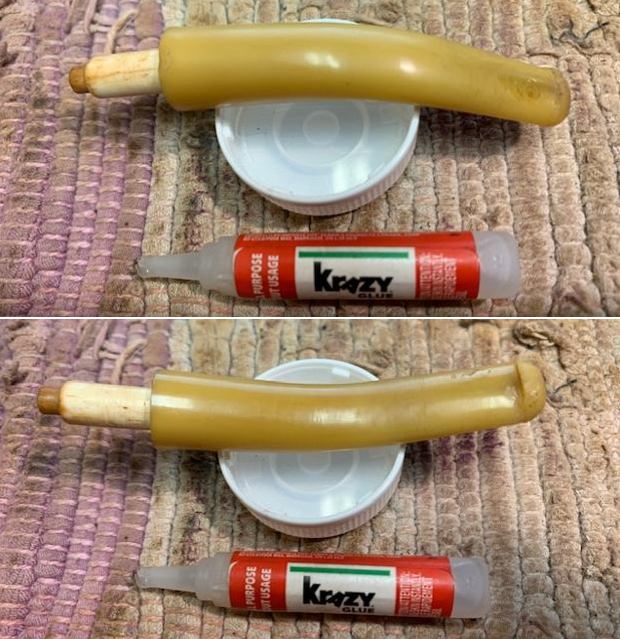
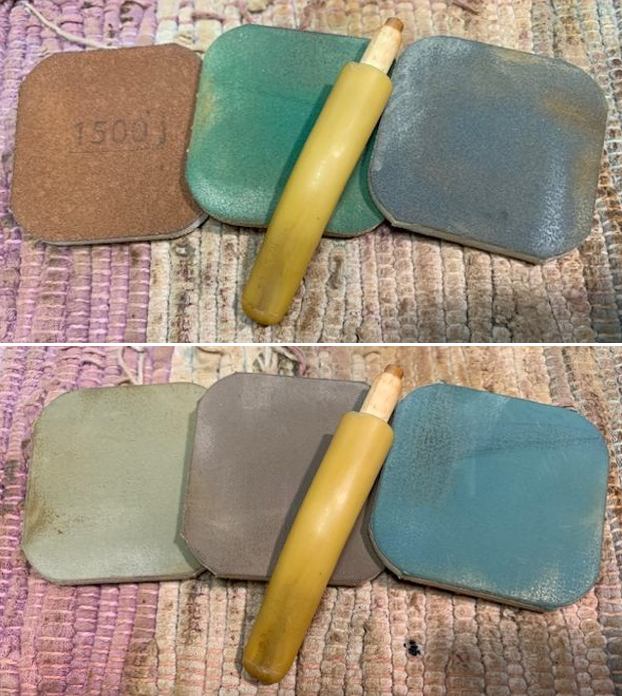
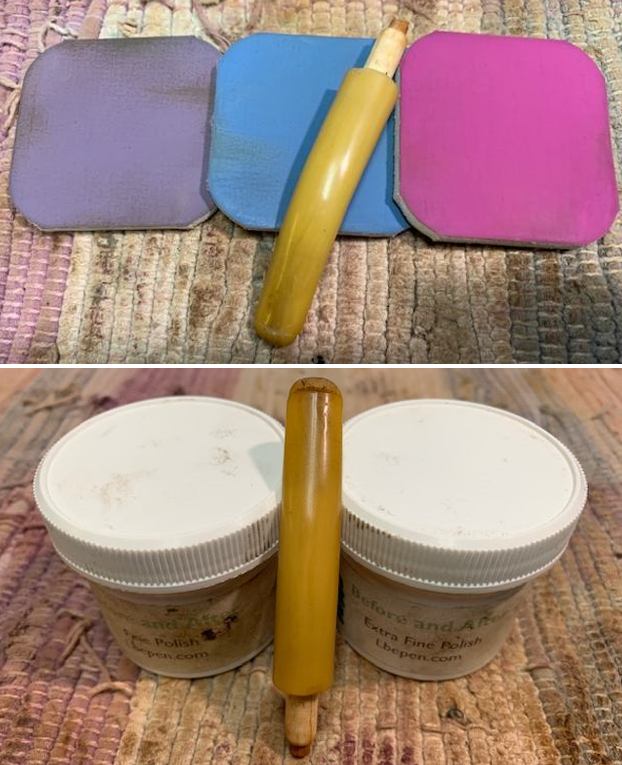
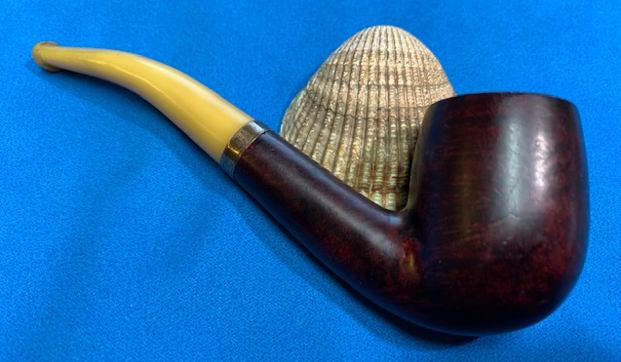
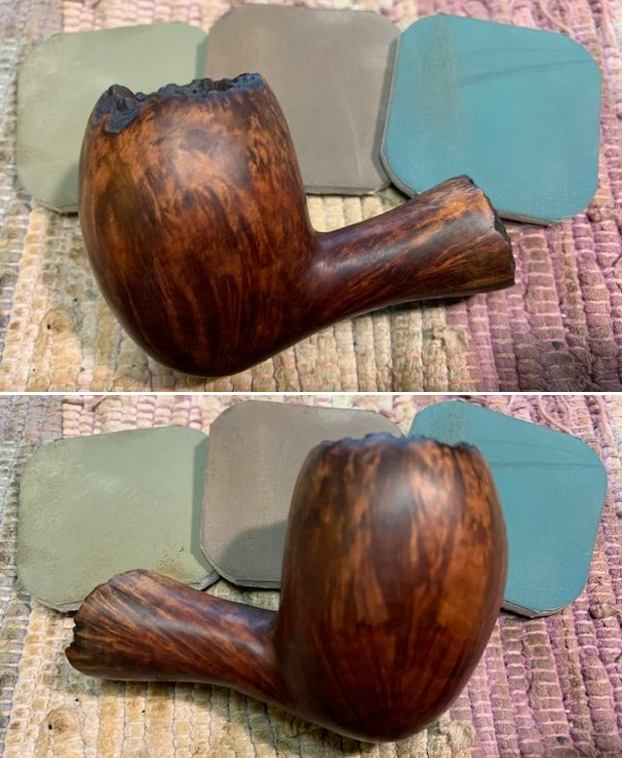
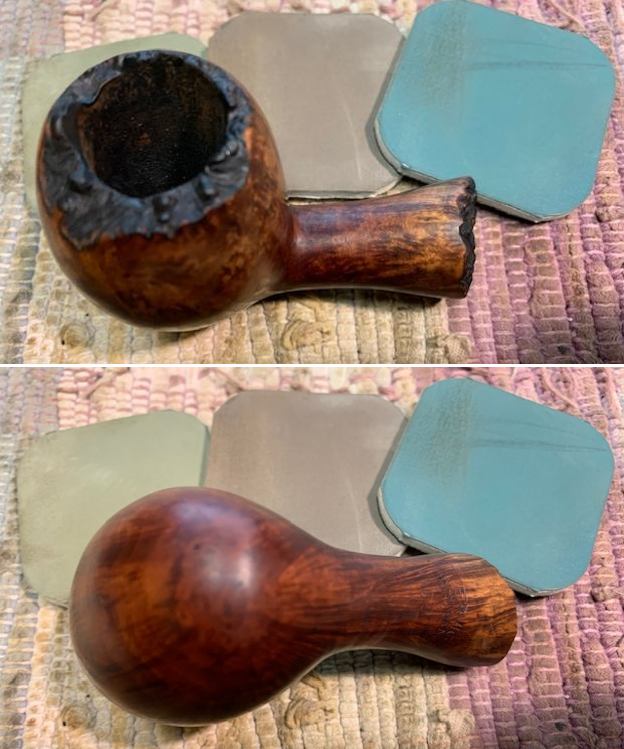
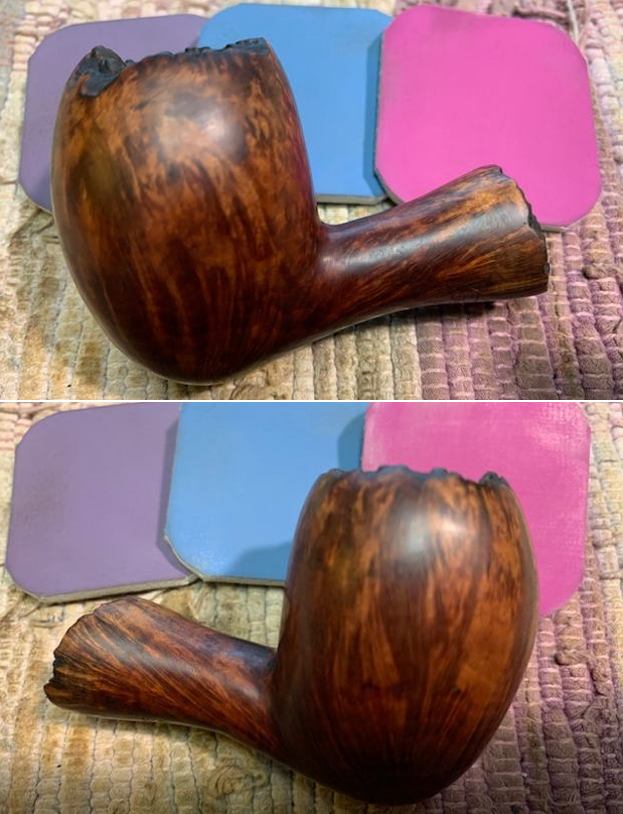
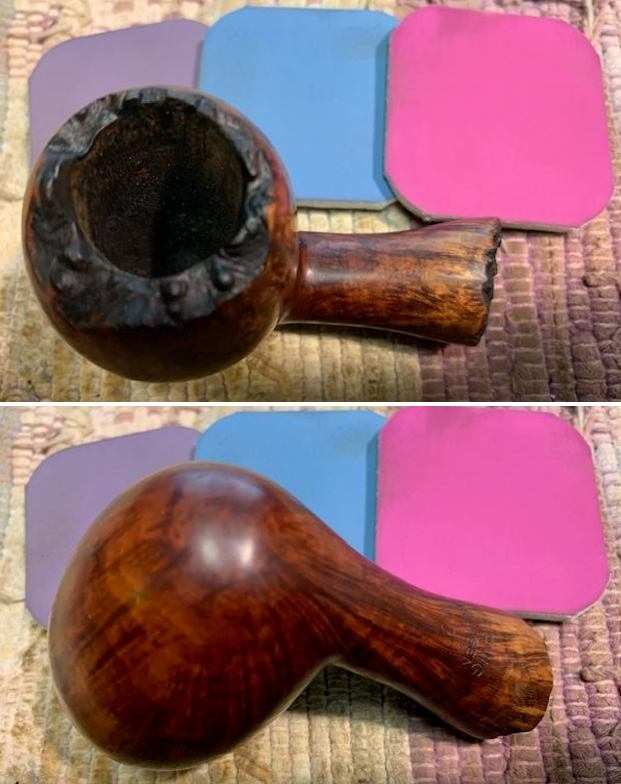
Tag Archives: restaining

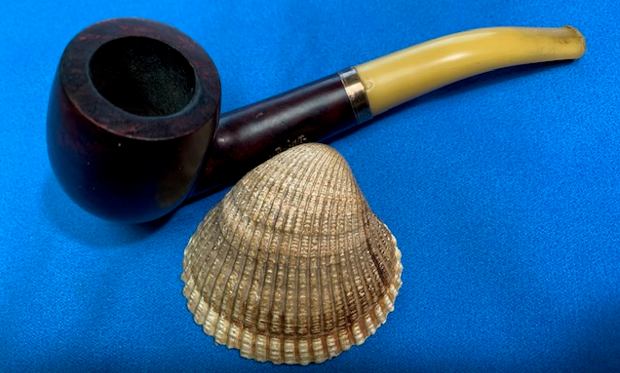
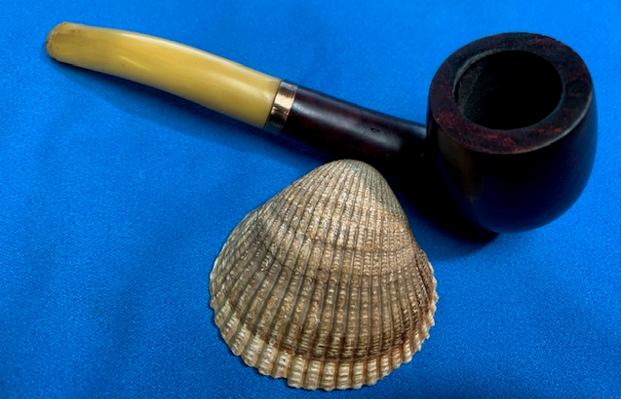
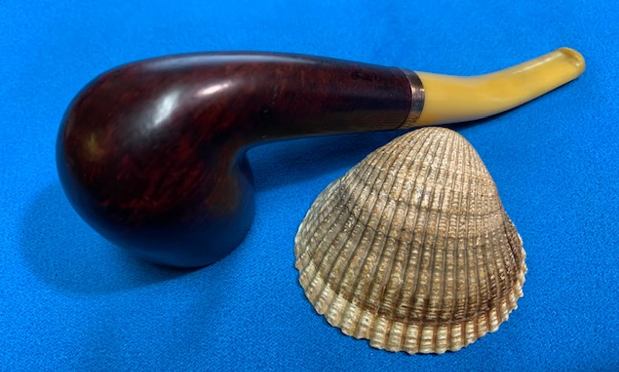
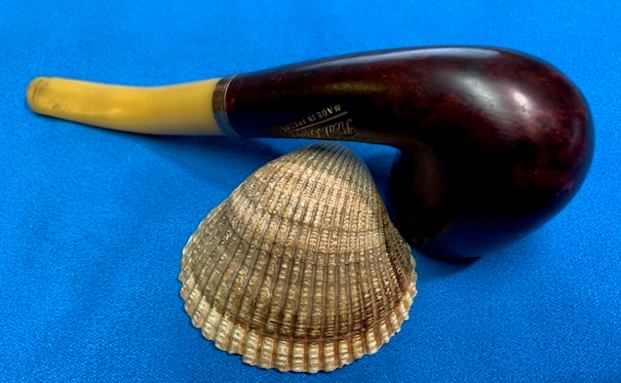
Another Old Timer – a Lightly Smoked but Beat up French Briar Apple


Blog by Steve Laug

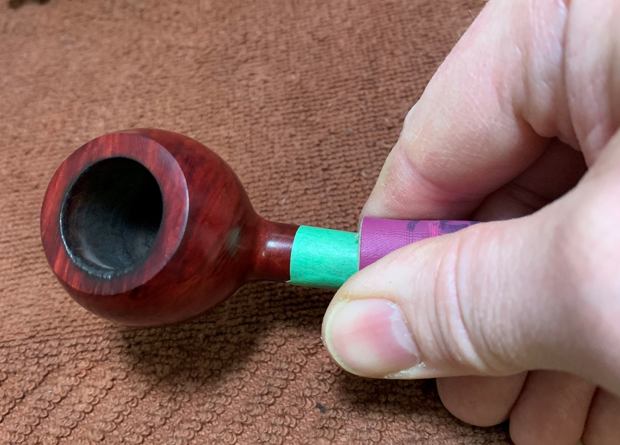
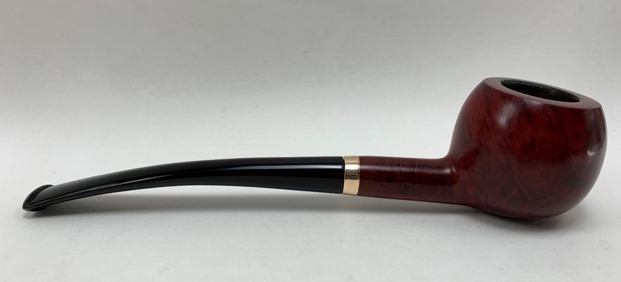
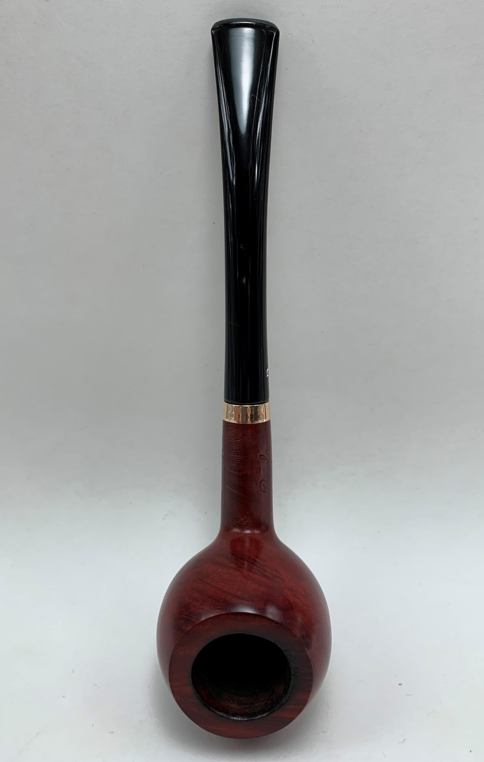
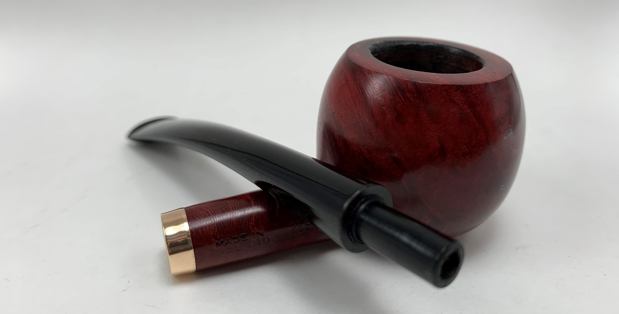
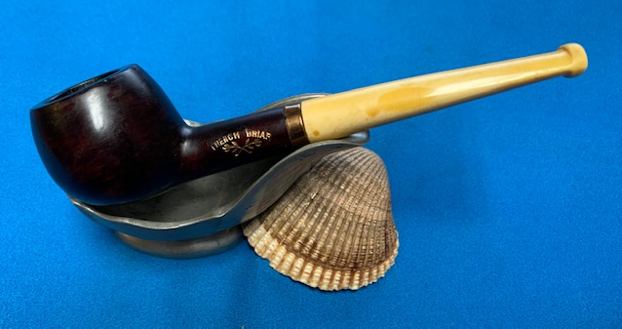
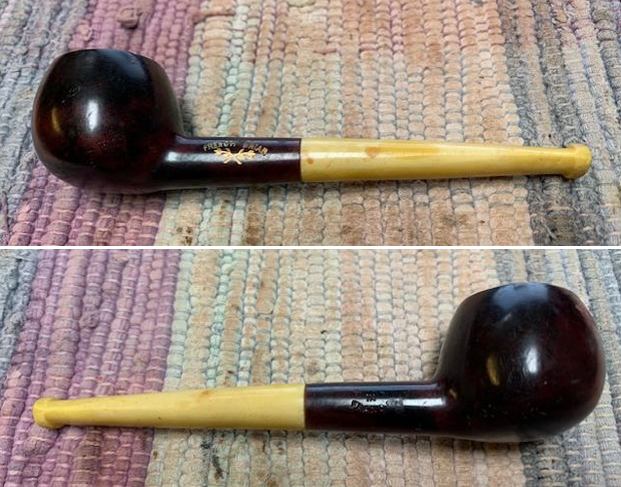
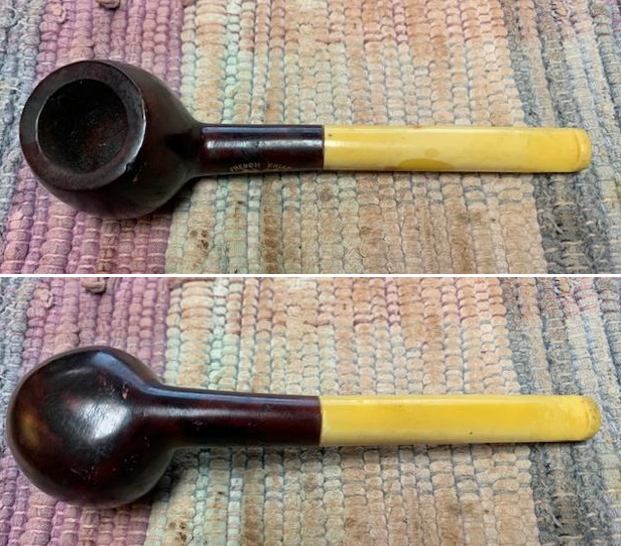
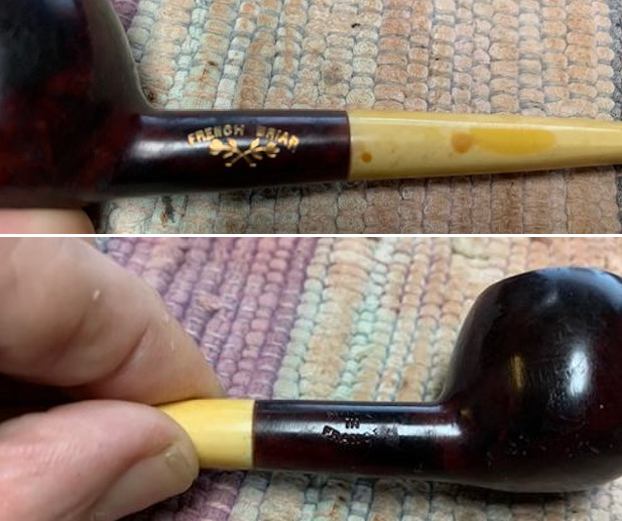
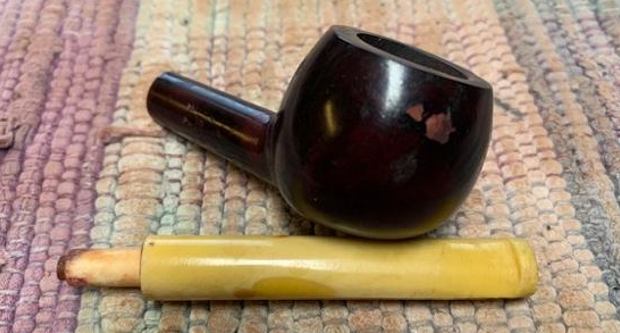
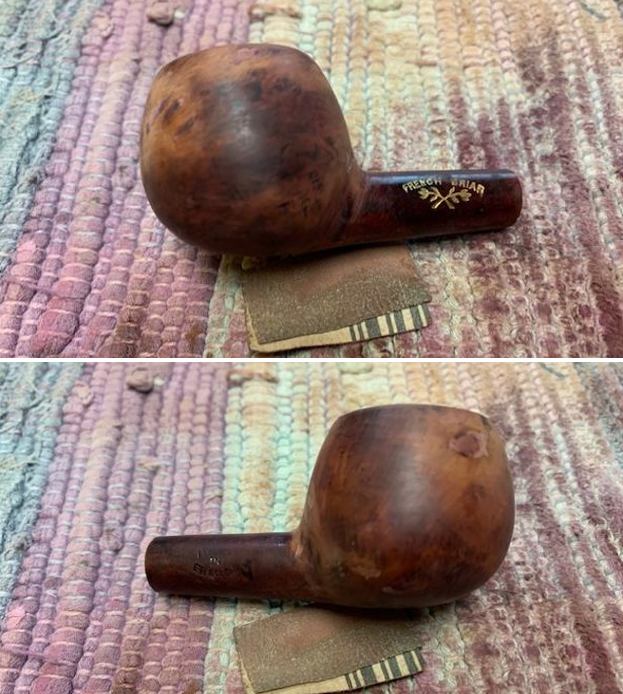
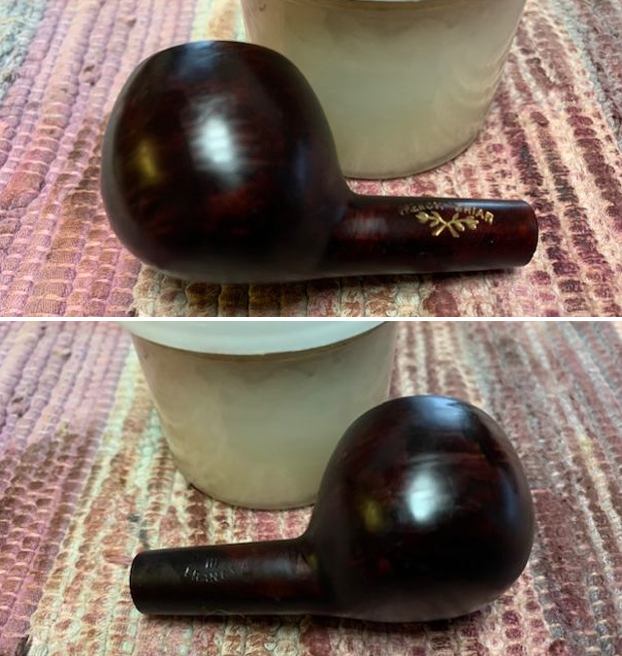
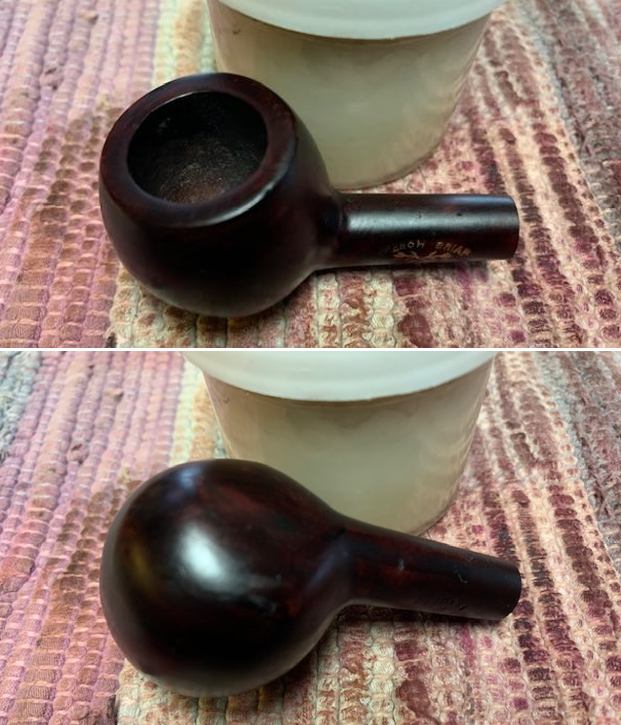
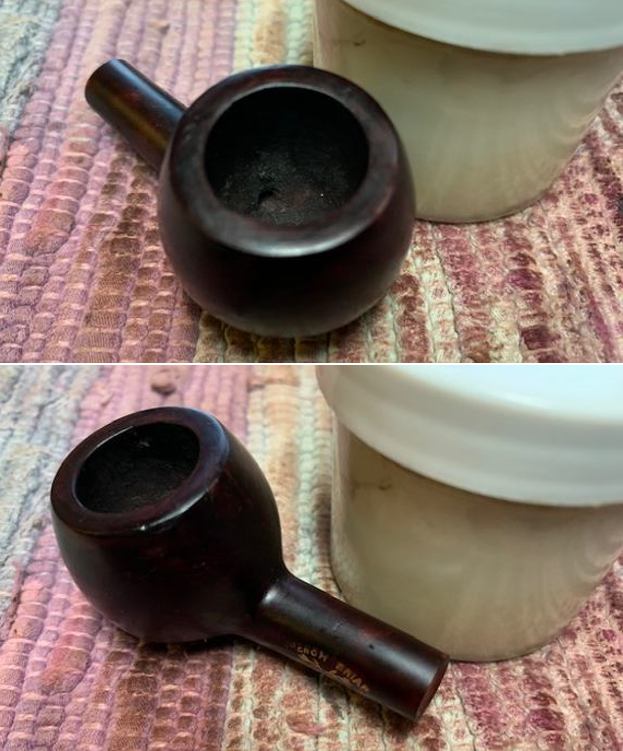
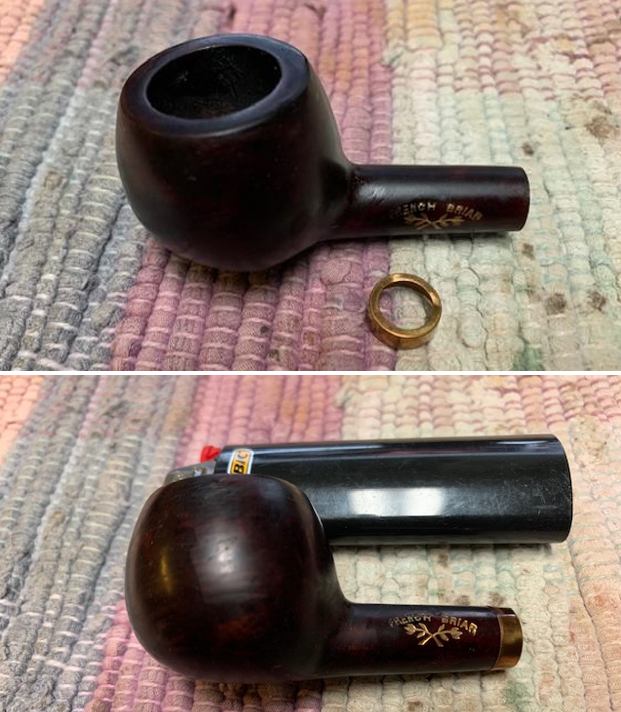
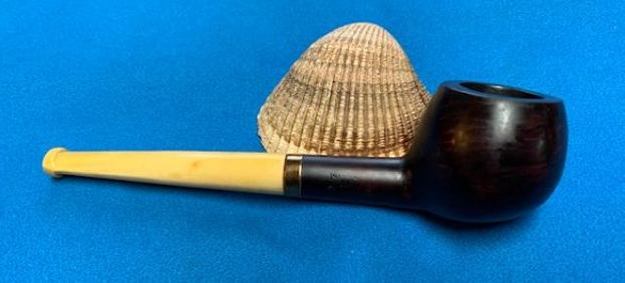
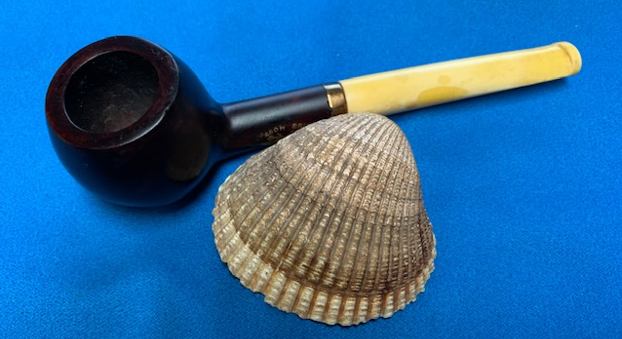
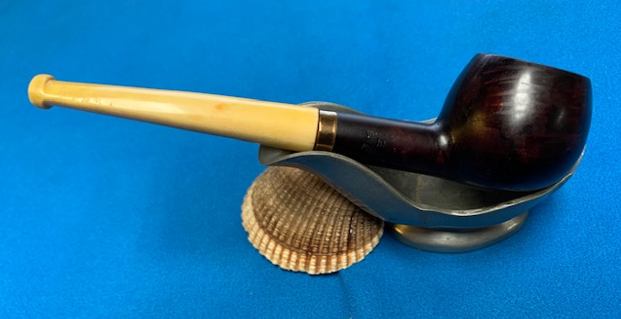
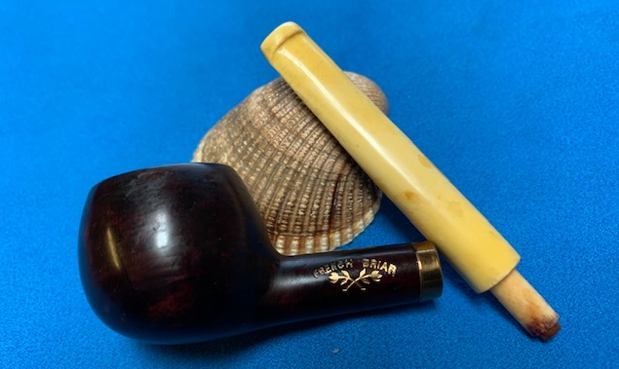
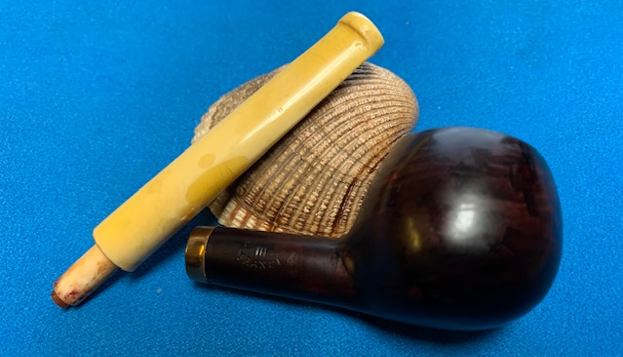
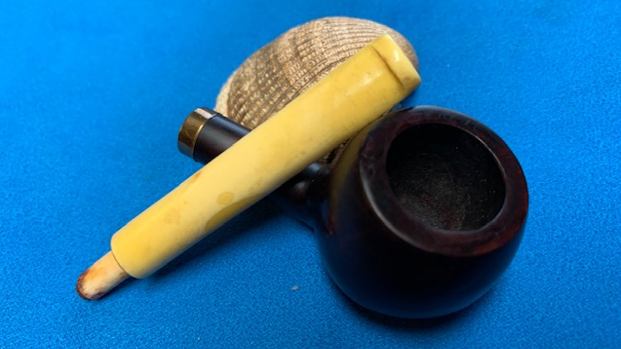
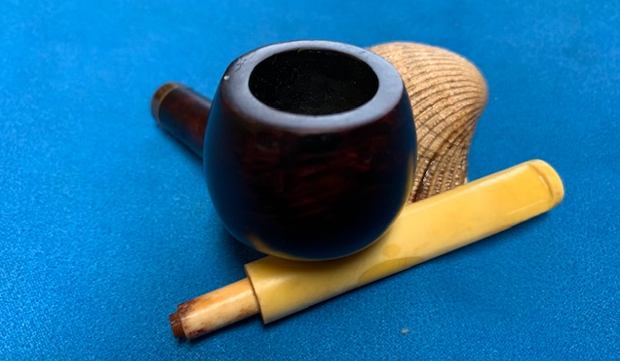
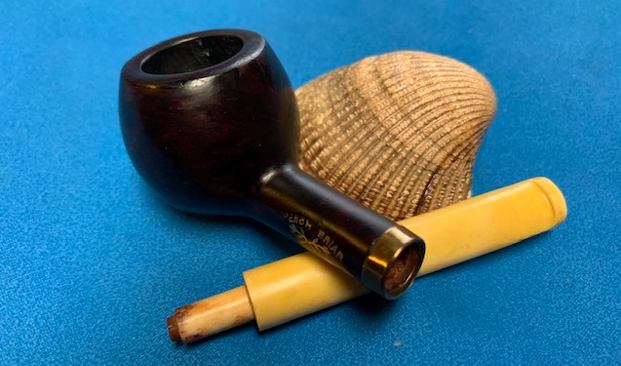
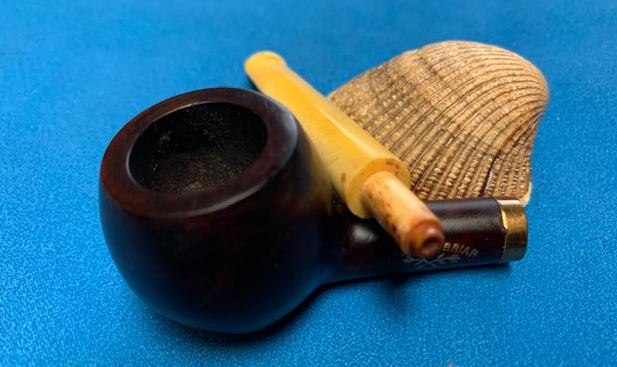
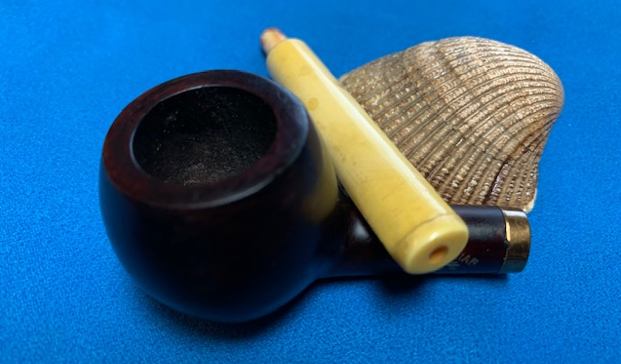
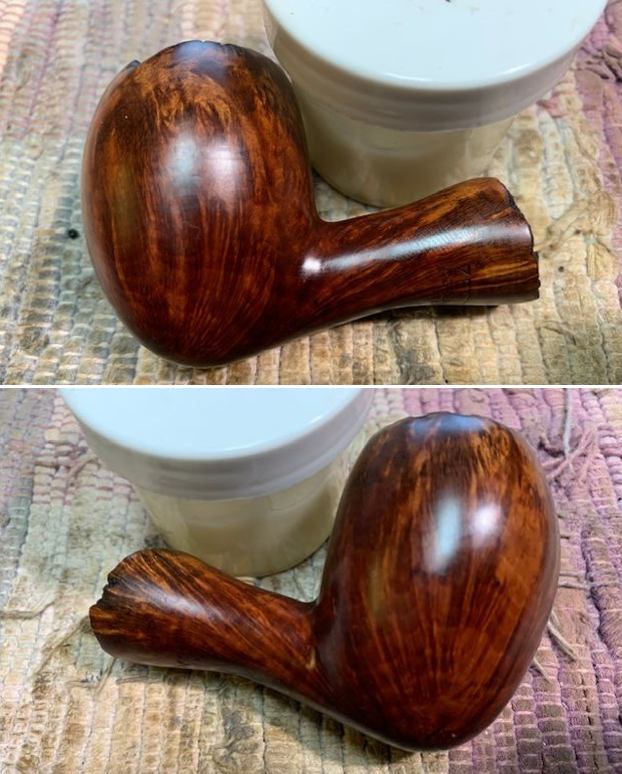
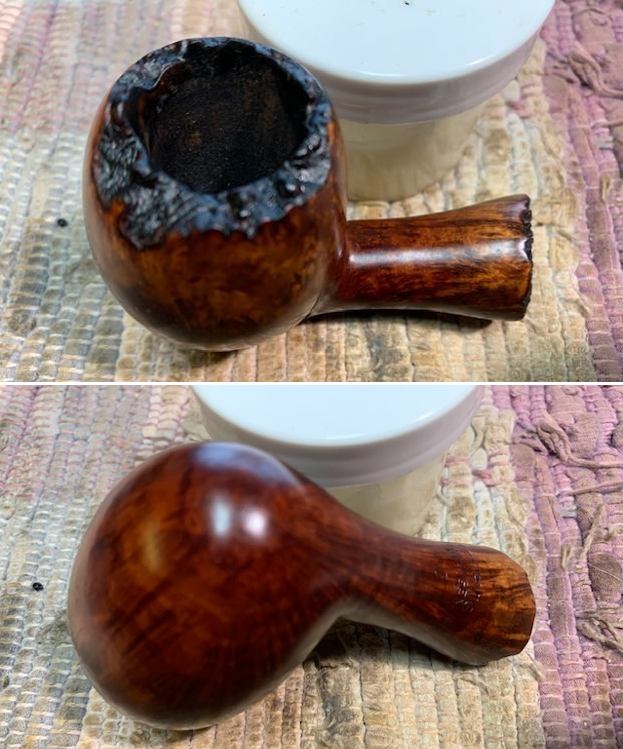
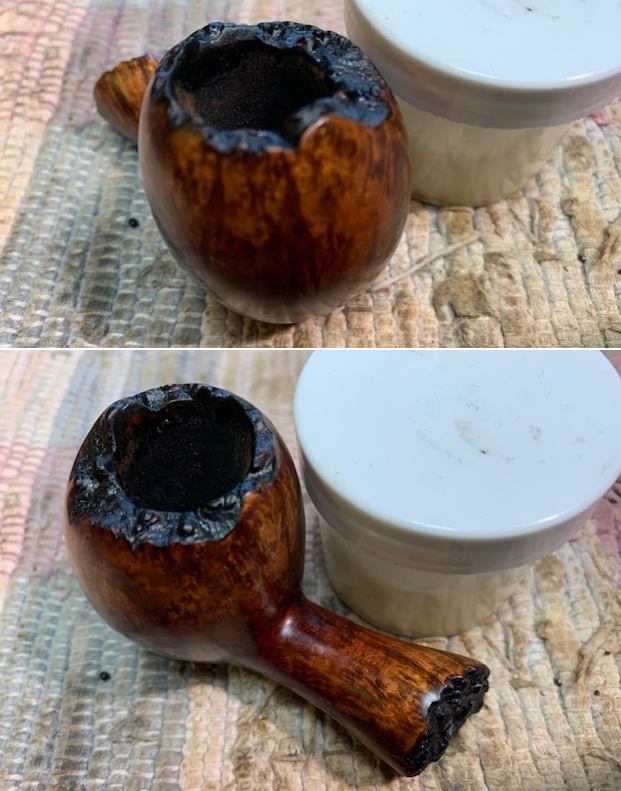
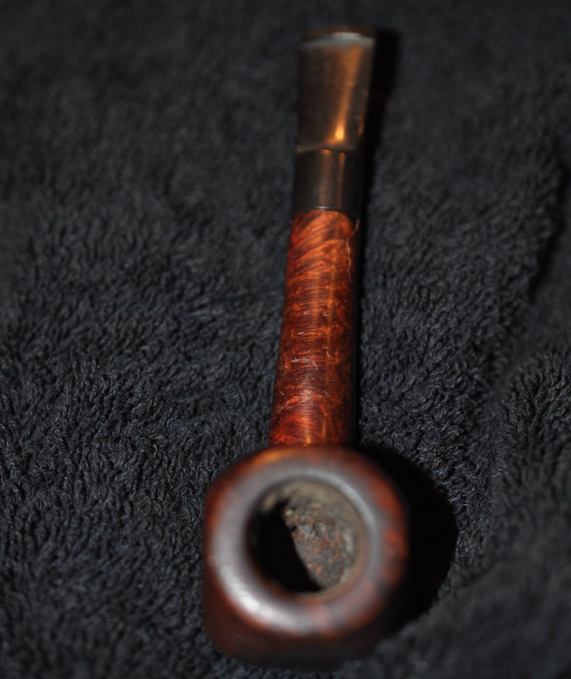
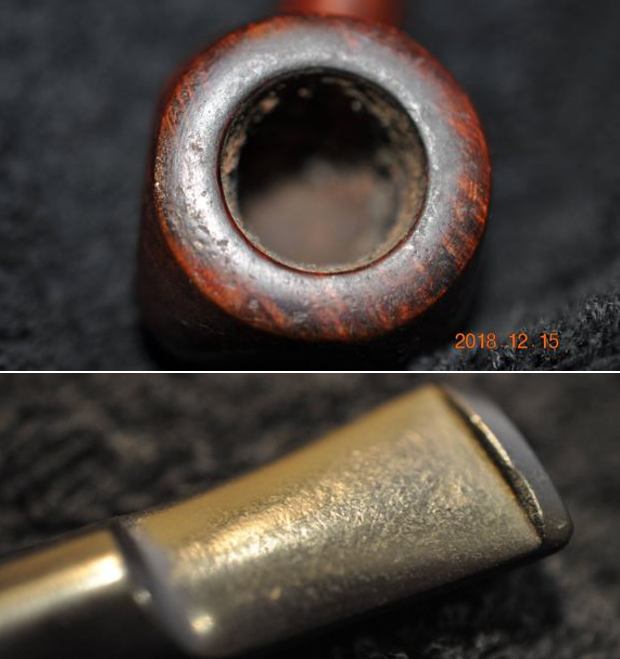
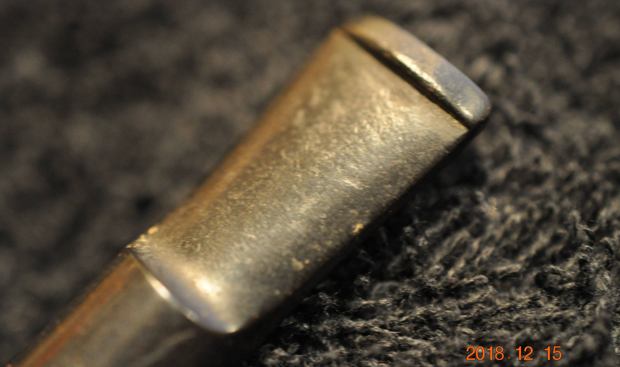
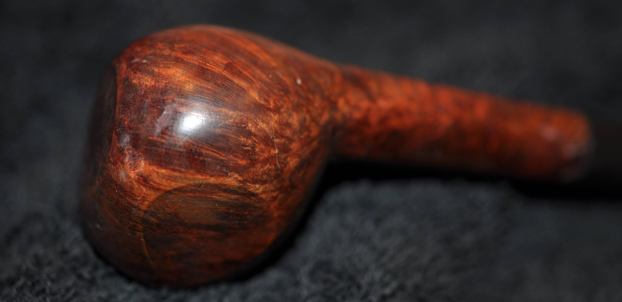
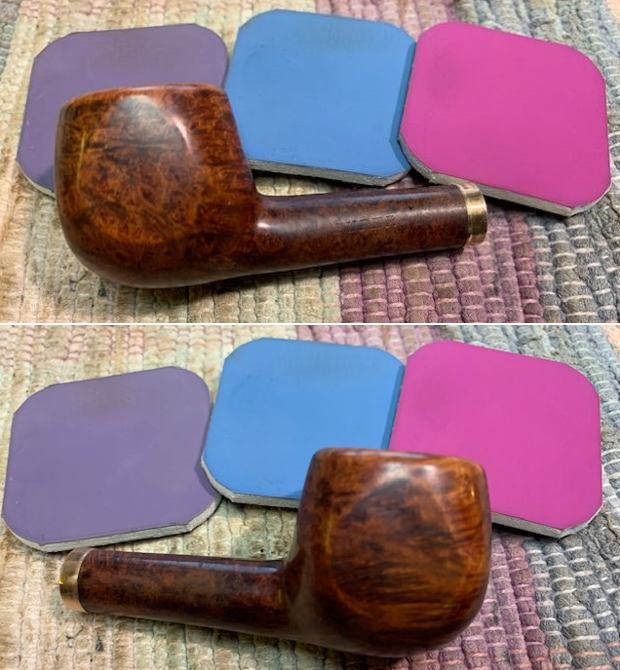
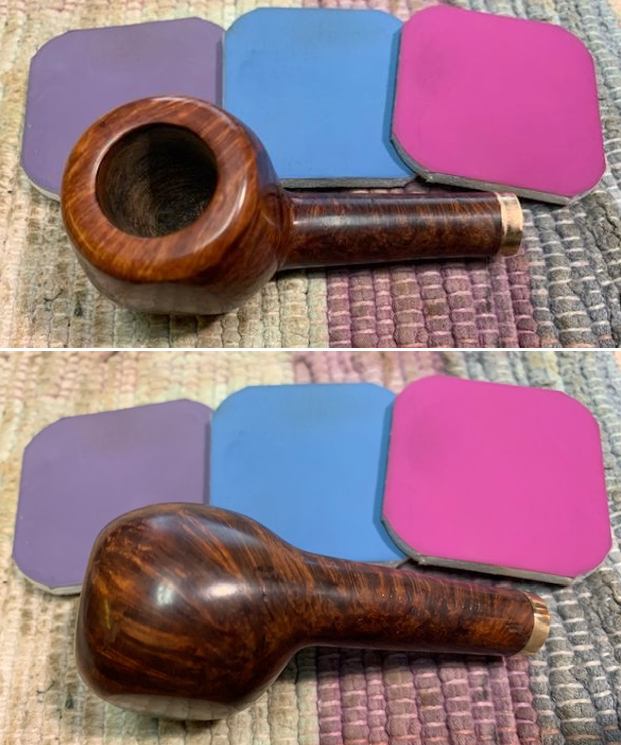
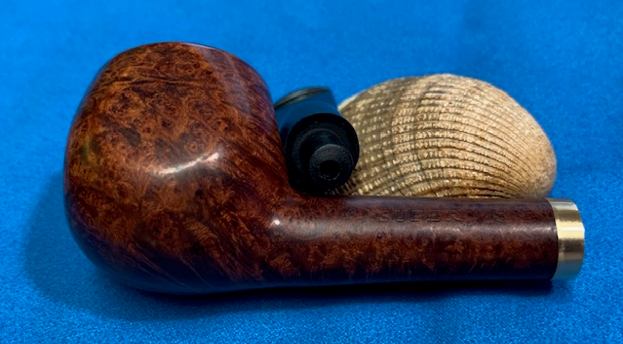
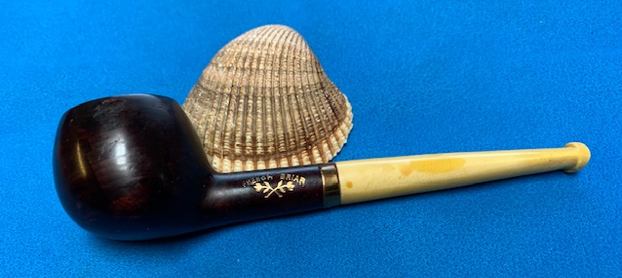
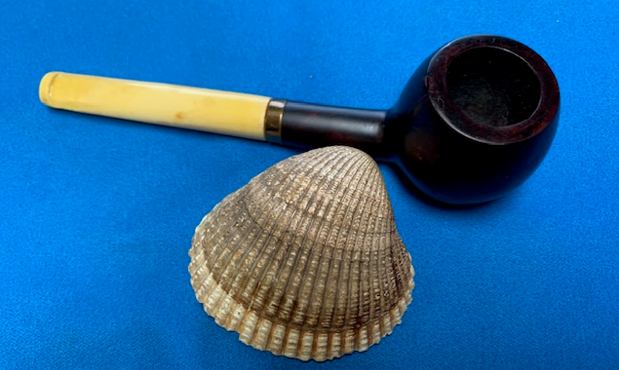
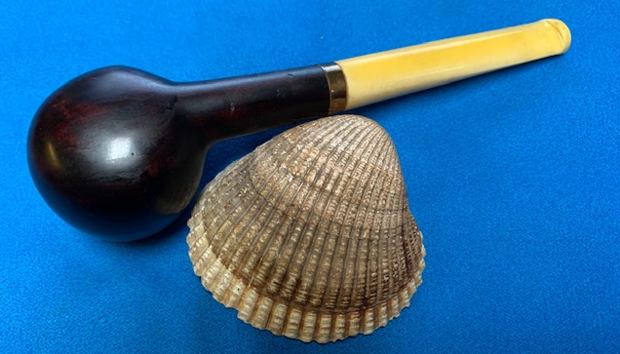
The next pipe on the worktable is another interesting piece of pipe history that comes from the bag of old unsmoked and lightly smoked pipes that I have been working on intermittently. It is a straight Apple. The bowl is lightly smoked. Like the others in this lot the briar of the bowl is nicked and chipped from being shuffled through the lives and boxes of a lot of people over the years. Some of the chips have broken through the finish and the rim top is also worn and dirty. The stem is made of an ivory coloured material that appears to be made of Bakelite. It has a push tenon from the same material that is part of the stem. Other than some tooth chatter and some staining on the stem surface the stem is in really good shape. A short description would be that it is an French made lightly smoked Apple with a Bakelite stem that is connected to the shank with a integrated push tenon. It is stamped on the left side of the shank and reads French Briar arched over a pair of crossed leaves. All are stamped in gold. On the right side of the shank it is stamped Made In France in a football shape with “IN” in the middle. The pipe is a bit of a mystery really with the stamping but as you have seen in the previous two C.P.F. pipes it seems that pipes of this time period often bore the French Briar stamp which I am assuming refers to Algerian Briar.

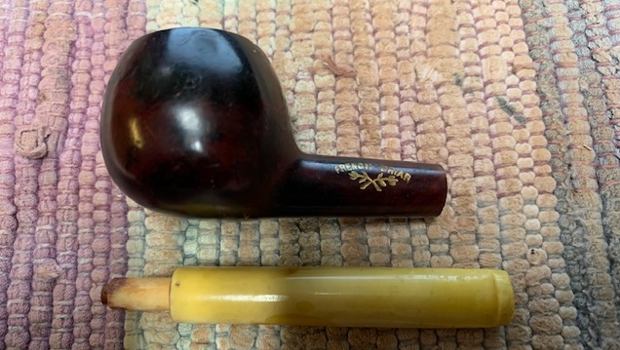
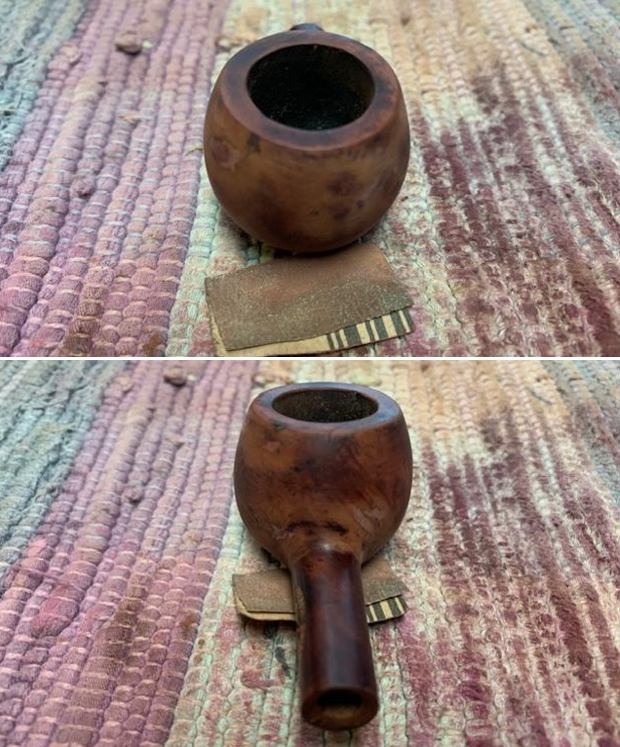
This pipe was probably in the worst condition of any of the older pipes that I have been working on recently. The rim top was dirty and the inner edge was a little chipped. The exterior of the bowl was a mess. The stain was opaque and I could not see any grain through it. There were a lot of nicks chips in the briar of the bowl sides. The odd thing is that the chips were very light coloured. My first thought was that it was briar but the more I looked the more I wondered if they were not putty fills. The gold stamping is clear and readable. The stem is a mottled and spotted butter coloured Bakelite. It had a lot of brown stain spots on the surface that were deep in the material and would not come out. There was tooth chatter on both sides ahead of the button but nothing deep. It has an orific button (round airhole) on the end of the button. I took some photos of the pipe to show the condition when we received it. It was dusty, dirty and had some grime worked into the surface of the briar from being shuffled around a lot since it was made. I took close up photos of the bowl and rim top and the stem to show their condition. You can see the drilling is centered in the bottom of the bowl You can also see the clean briar of the bowl sides. The stem looks odd with the mottled look of the stains on it.I took photos of the stamping on the left and right sides of the shank. You can see that they are somewhat faint on the right side but are still readable.I removed the stem from the shank and took a photo of the parts to give a sense of the beautiful proportions of this nice little pipe. It is going to take some work but I think it will be quite stunning once it is restored. I took a photo of the chipping on the front of the bowl. You can see why I thought that they were briar underneath the top coat of the heavy, dark finish. There were all around the bowl and at the shank/bowl junction on the right side. It really was a bit of a mess in terms of the finish.
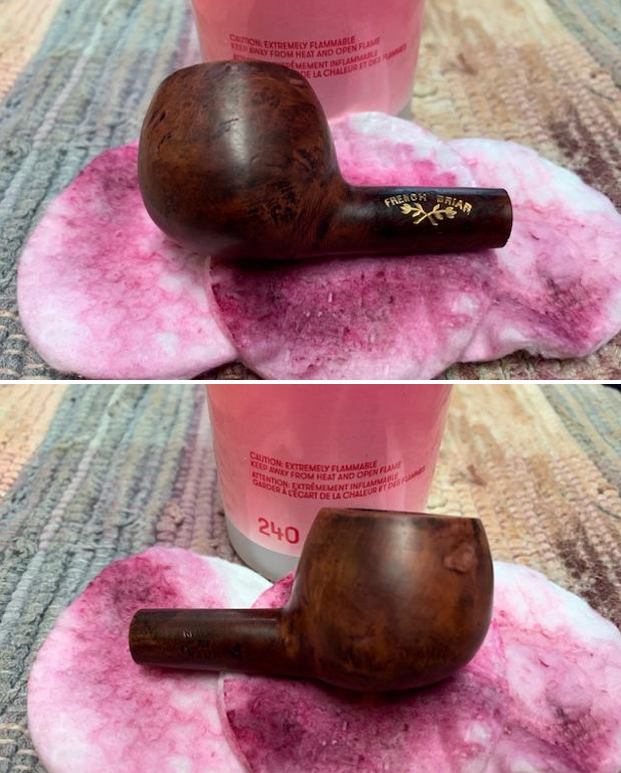
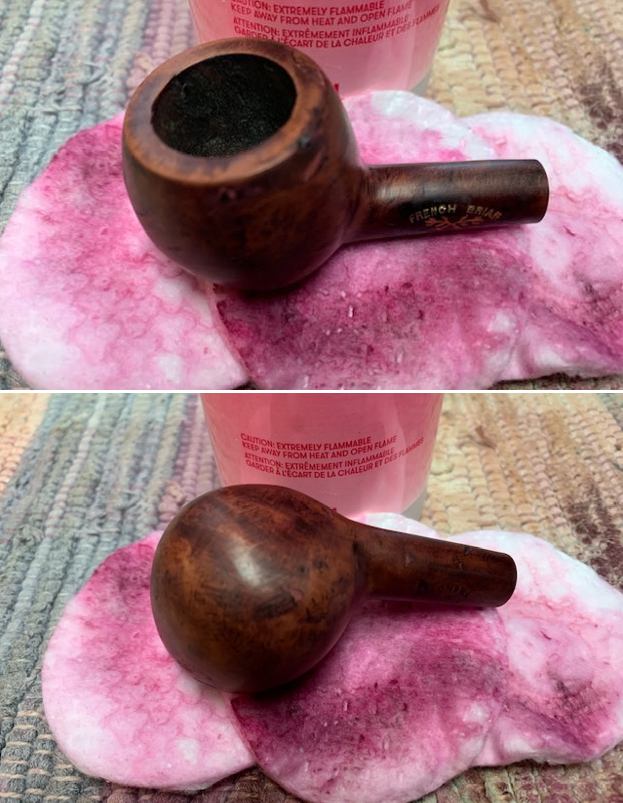
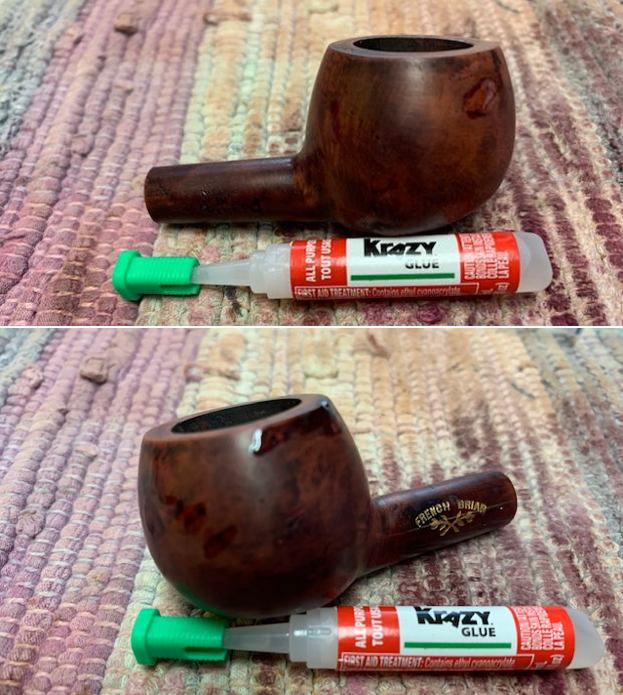
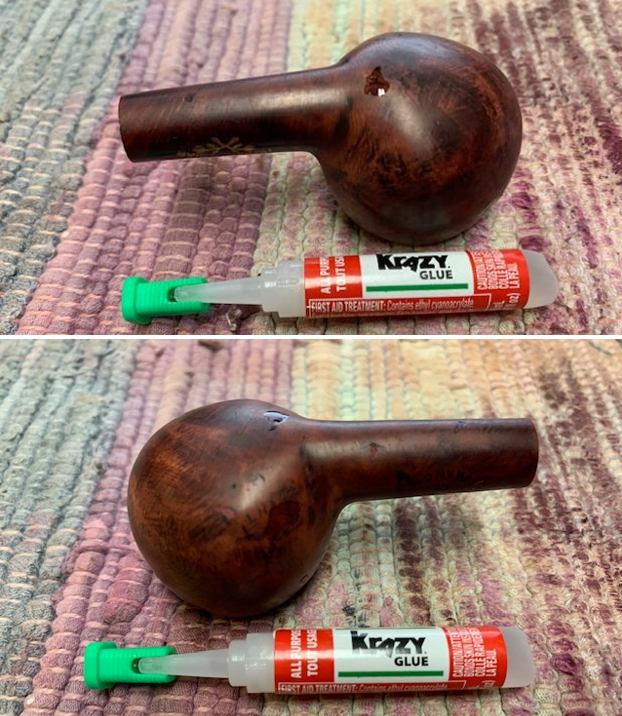
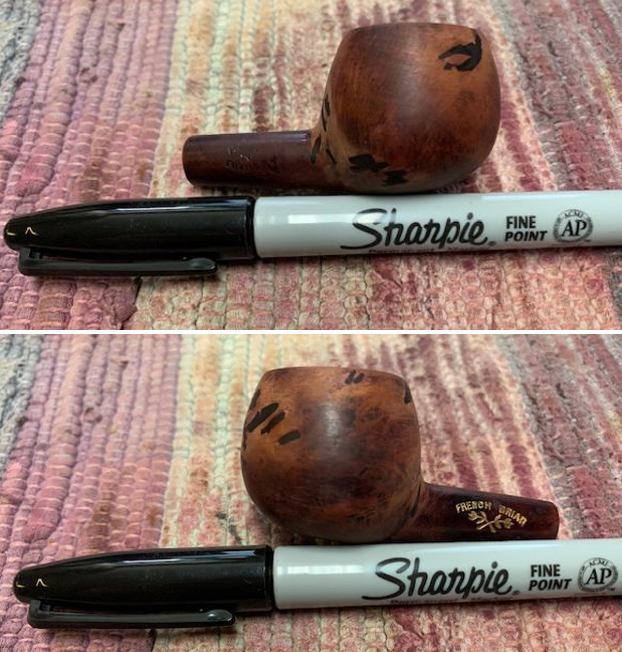
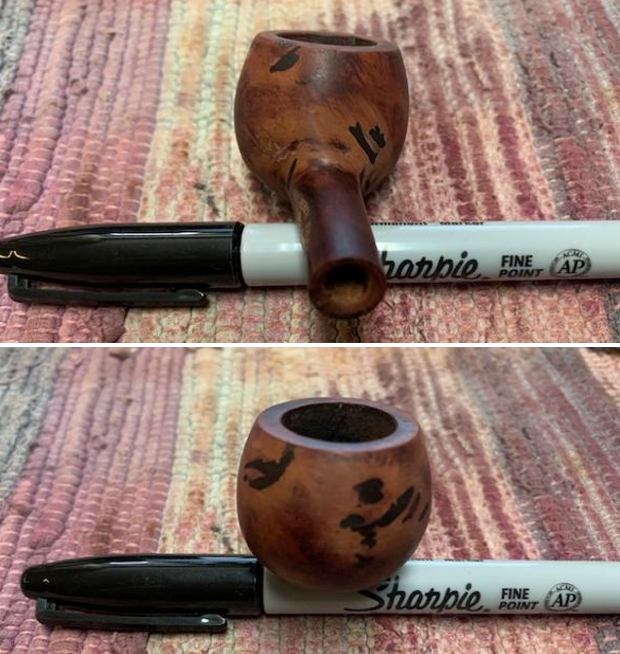
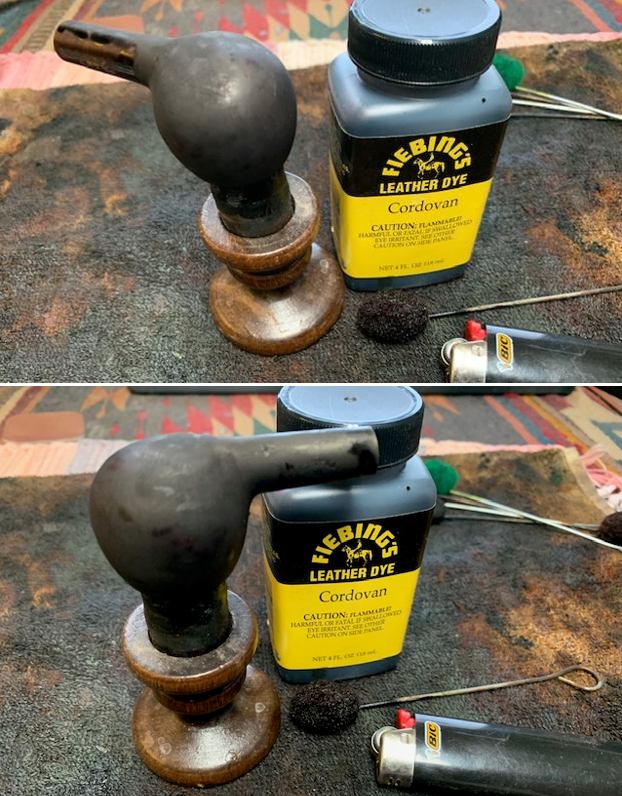
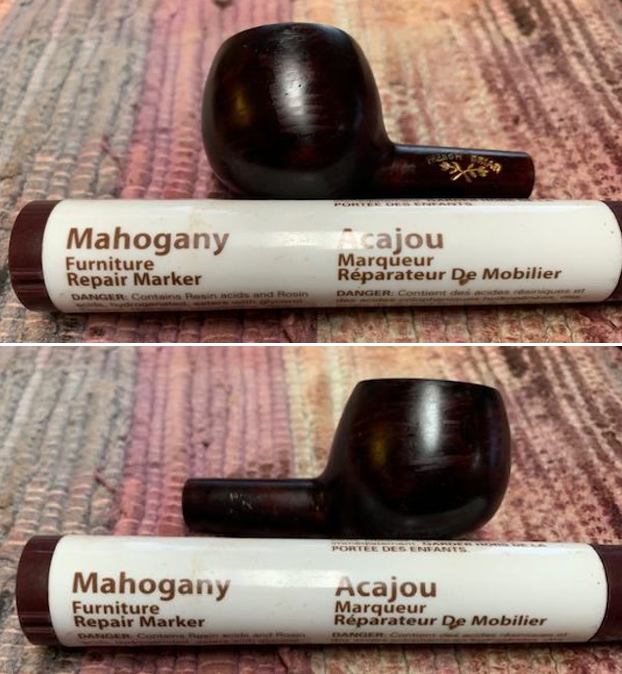
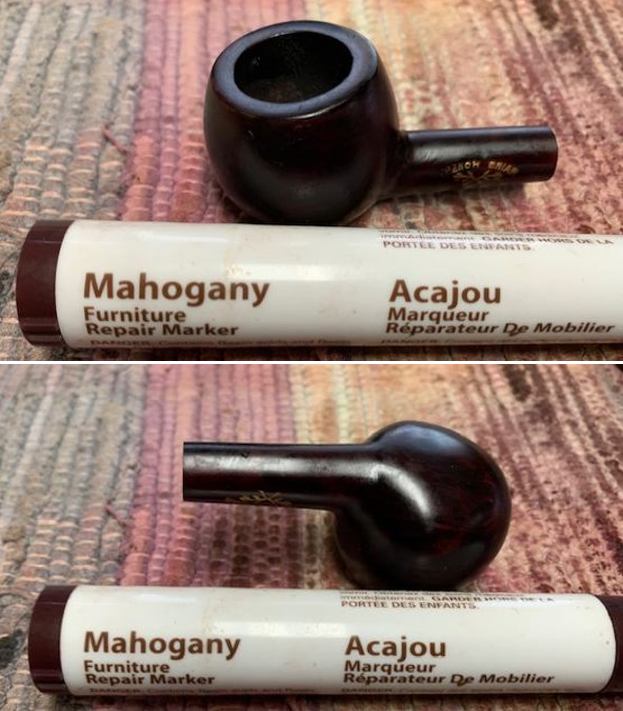
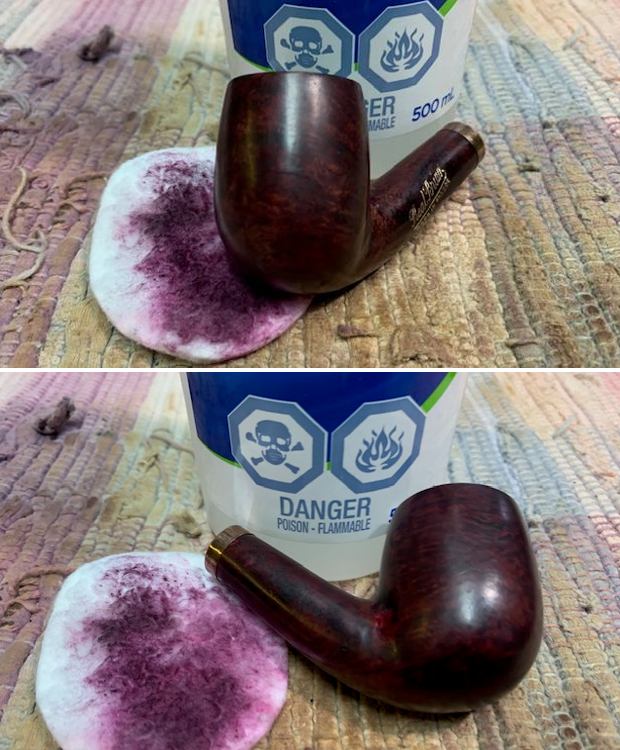
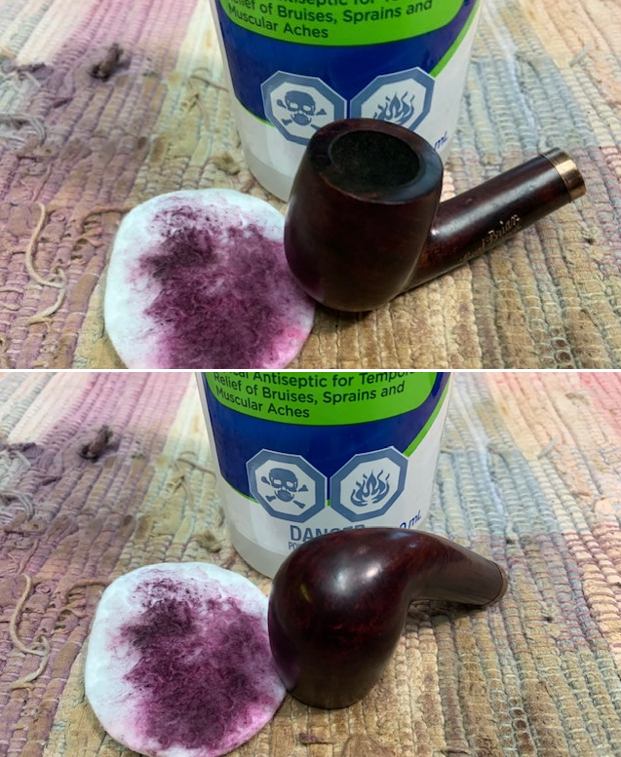
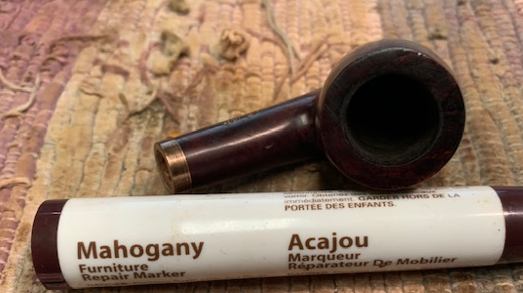
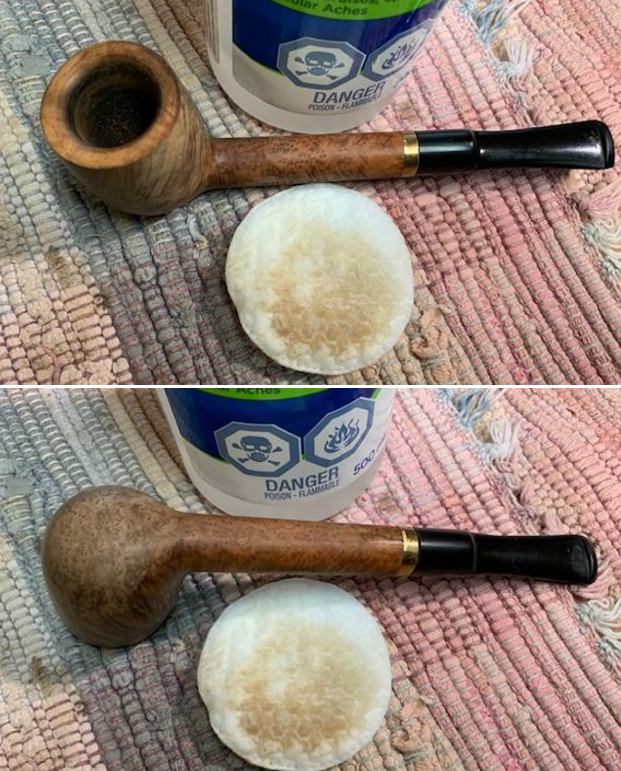
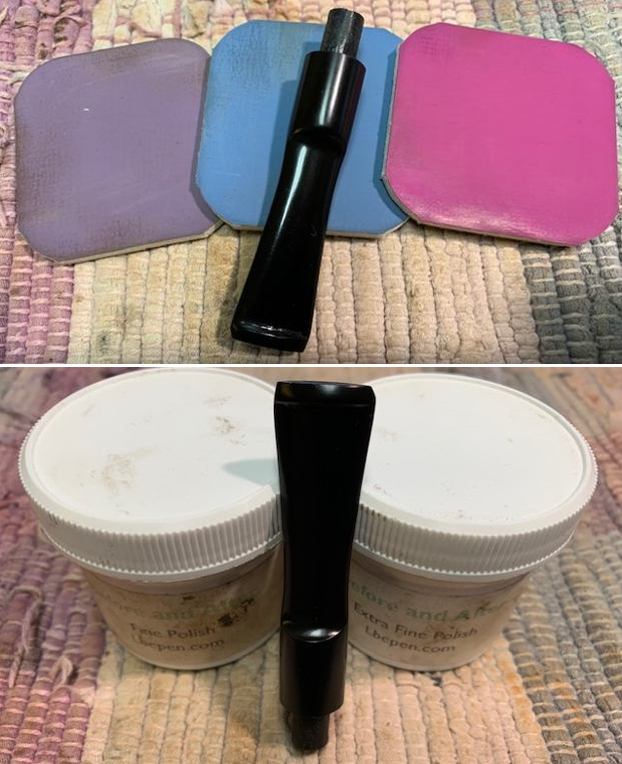
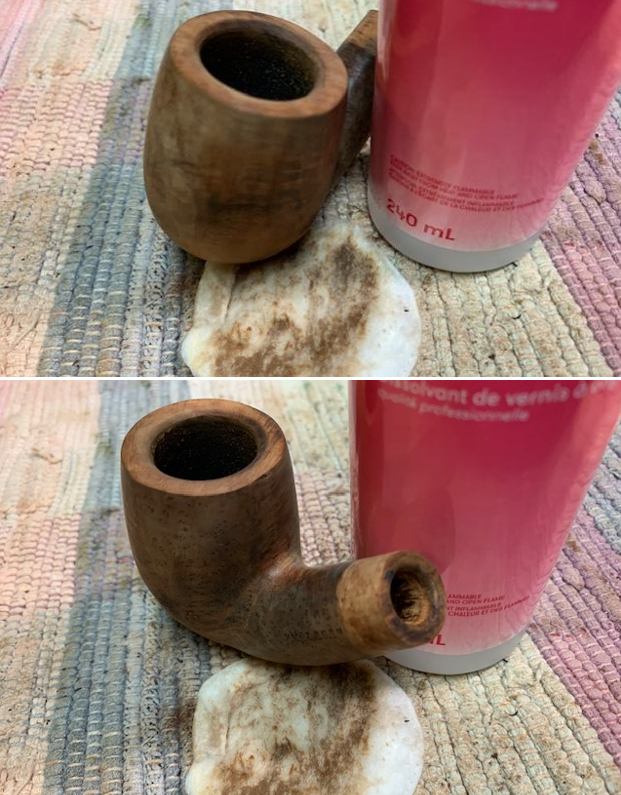
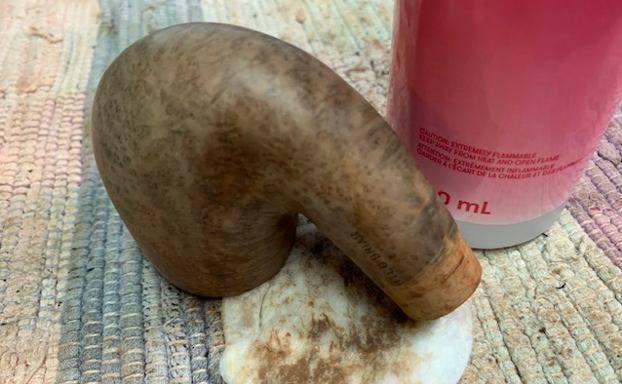
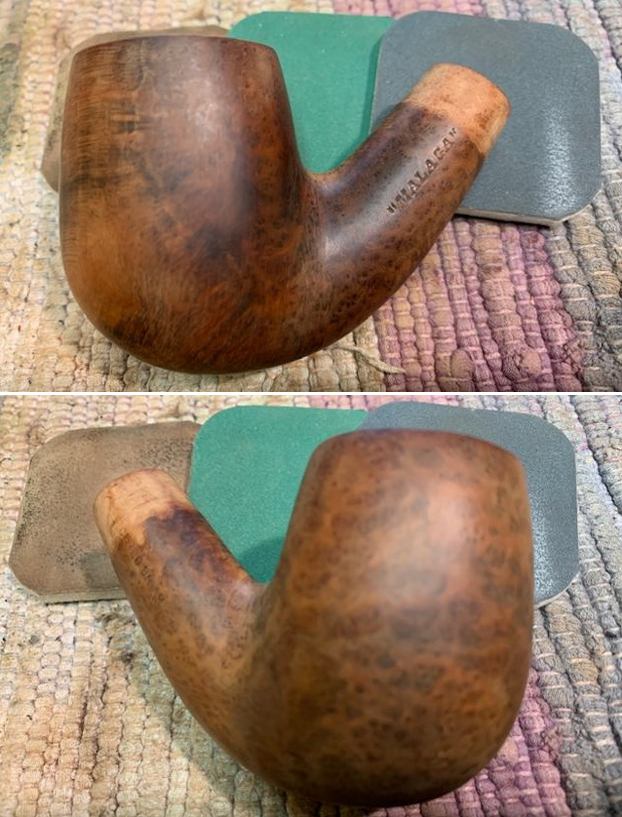
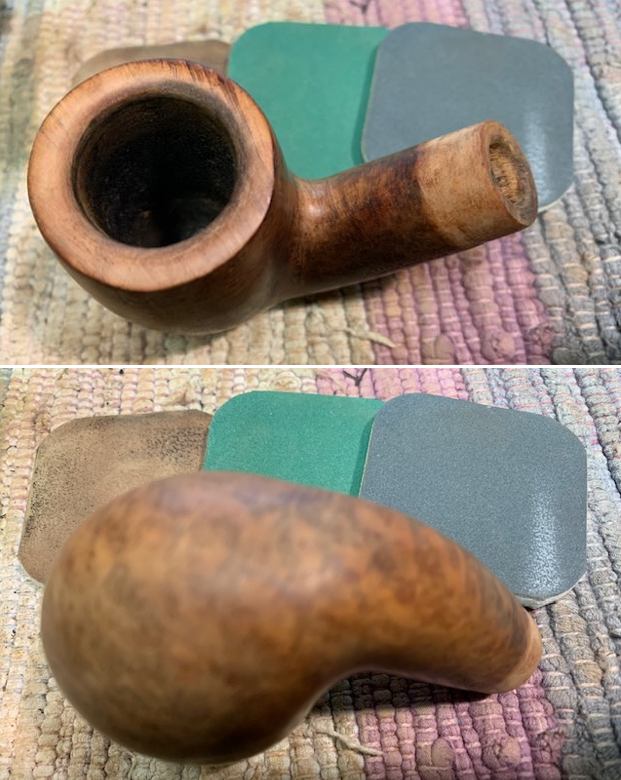
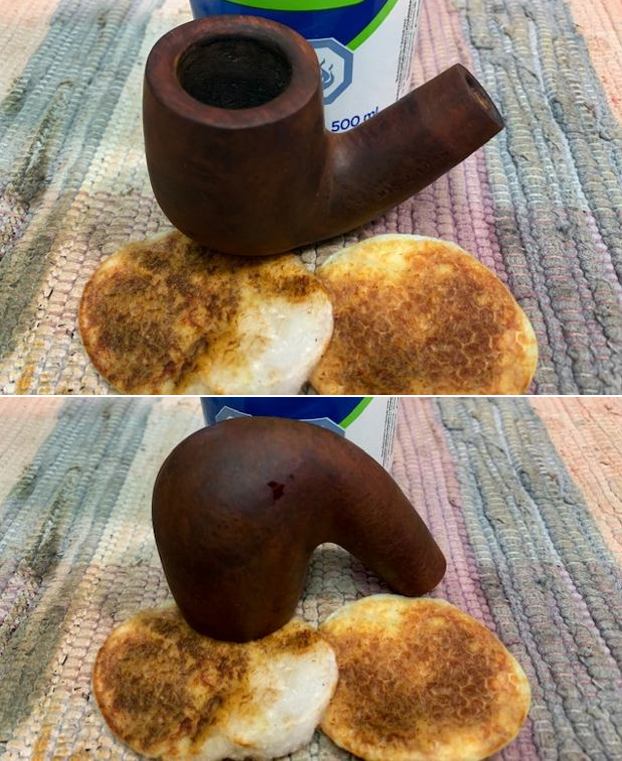
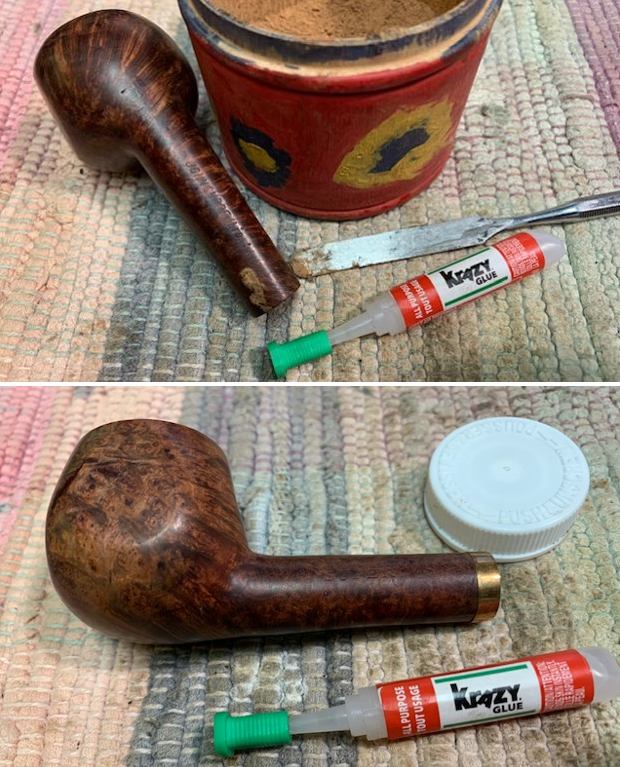
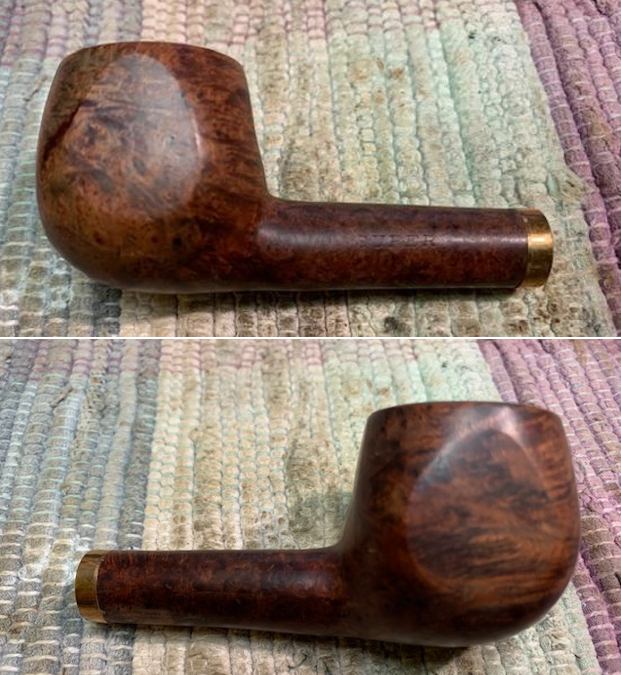
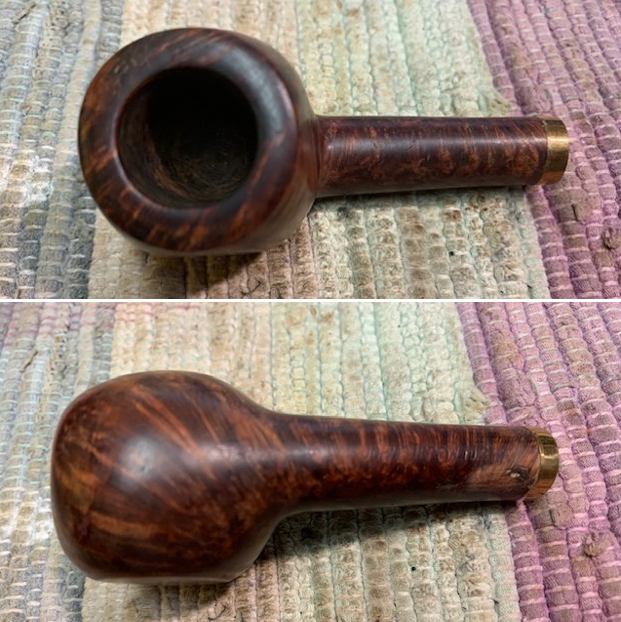
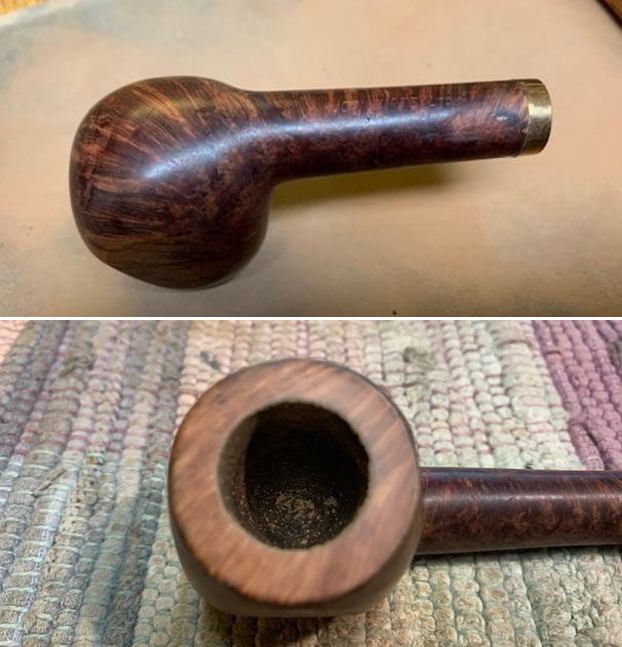
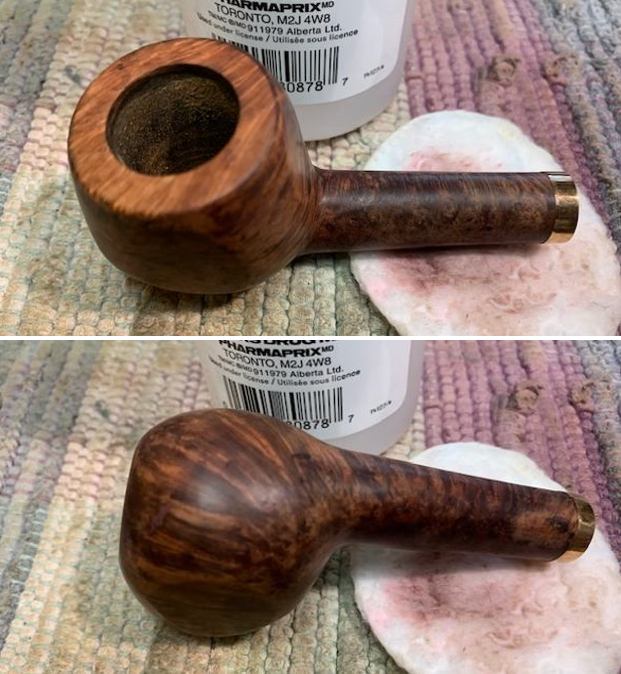
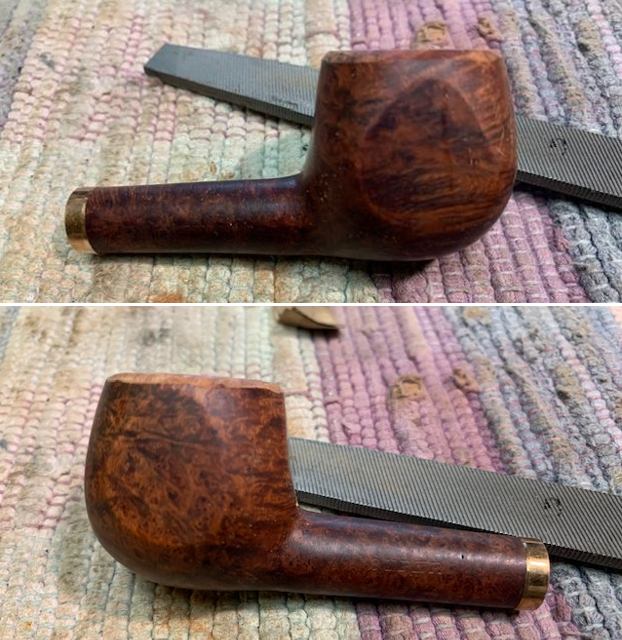
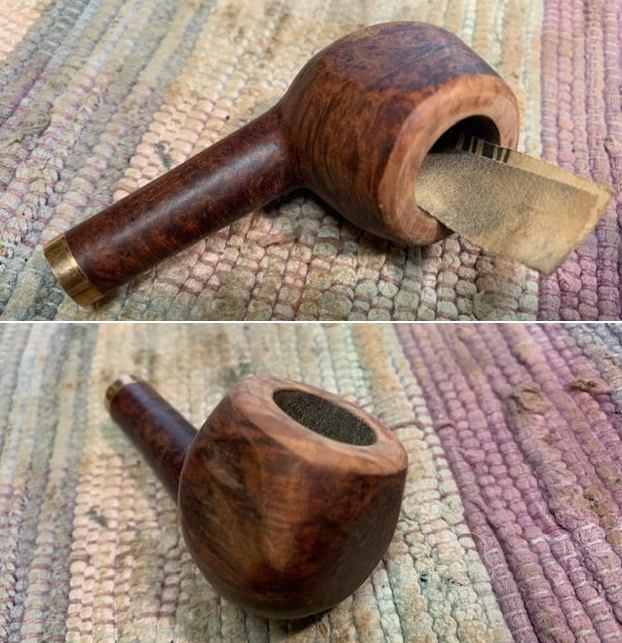
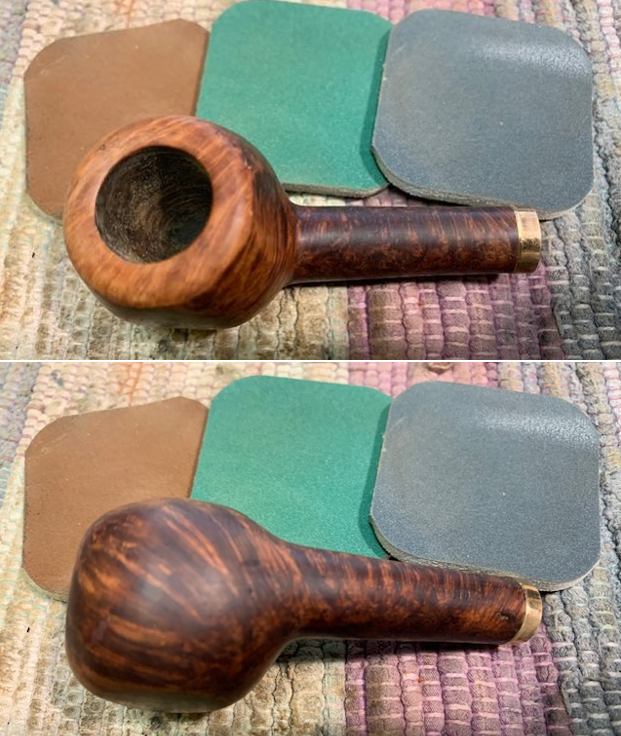
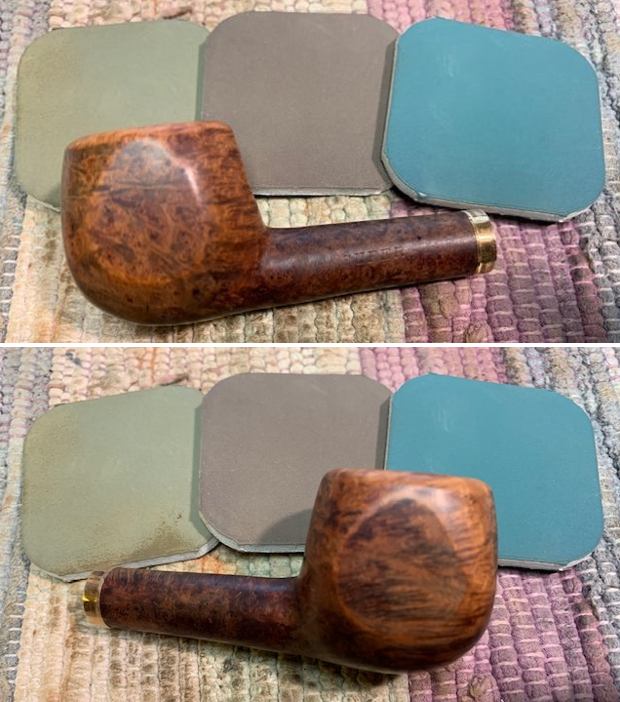
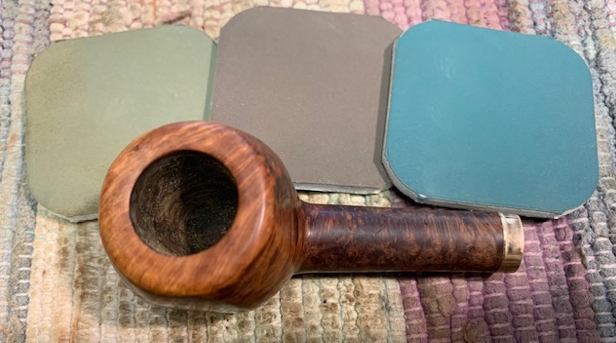
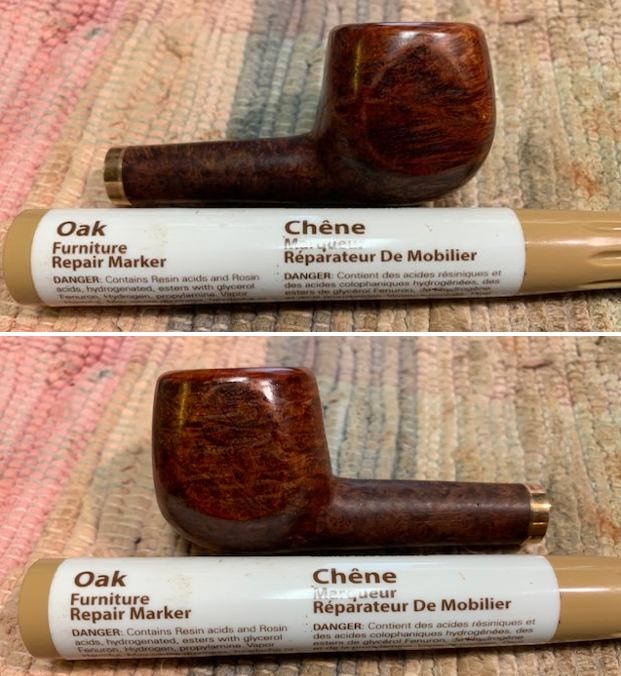
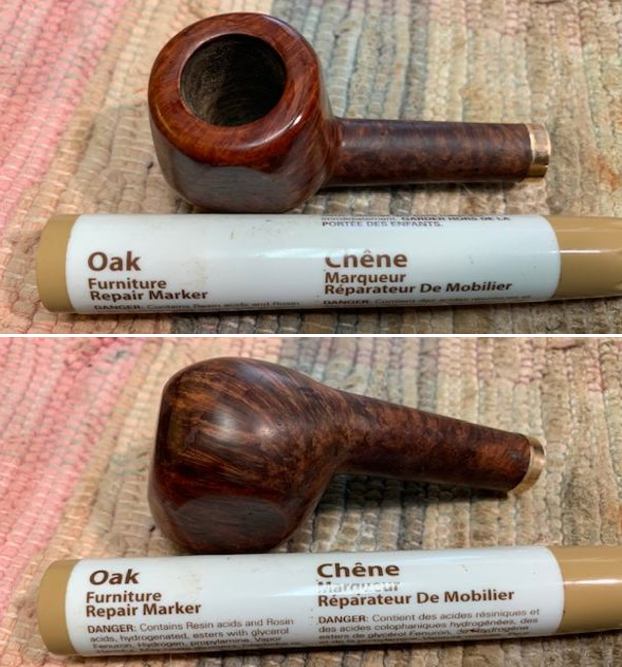
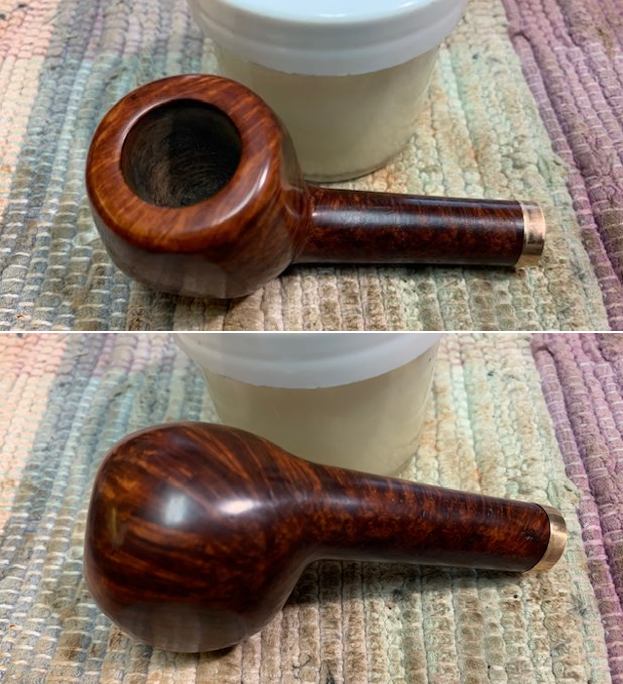
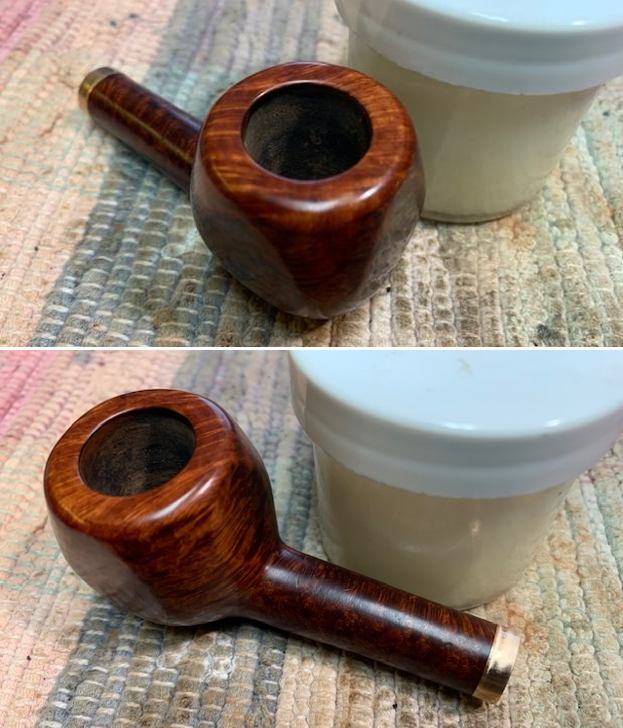
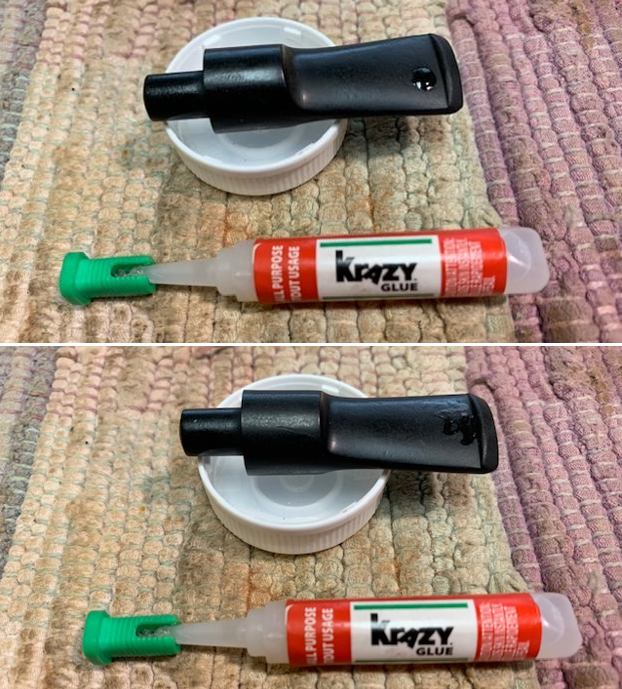
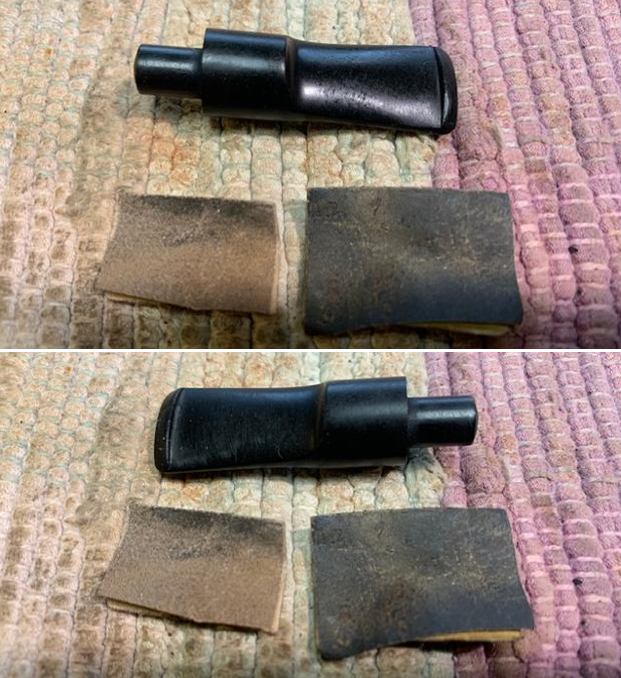
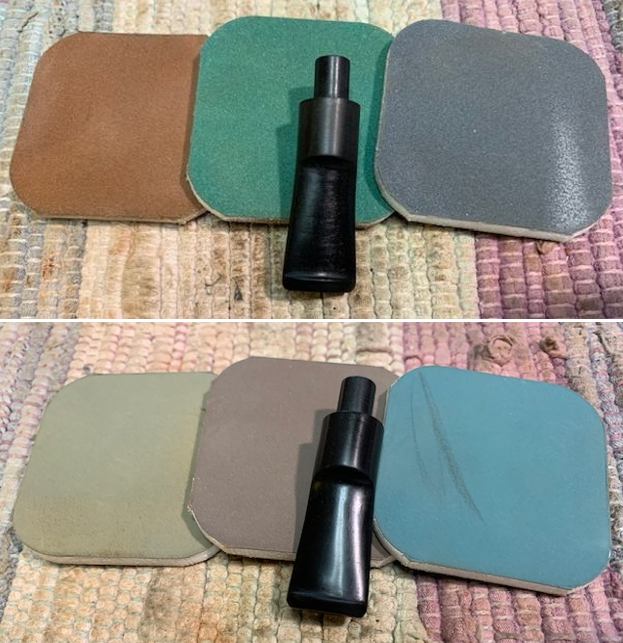
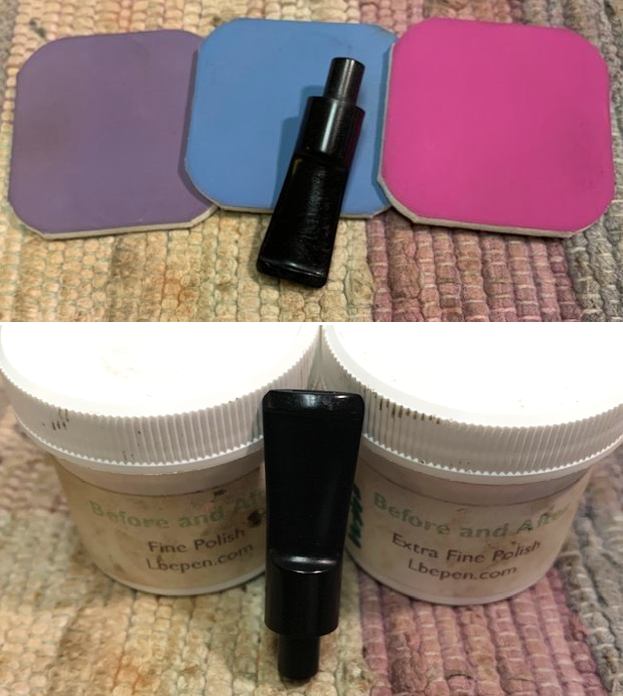
To deal with the damage around the bowl and shank I would need to remove the heavy finish. I am always nervous to do so as you never know what you will find with it gone. There was a reason for the thick, dark, opaque finish. But like a fool I proceeded to move ahead and wiped down the bowl and shank with acetone to break up the finish. With the opaque finish gone all of the ugly chips and marks in the finish stood out for what they were. If you look closely at the next four photos you can see all the ugly putty fills in the finish. There were at least 20 or more fills in the briar. Some were loose and chipped and some were tight and undamaged. I had definitely opened up Pandora’s Box with this clean up!! I repaired the chipped and damaged fills with clear CA glue. I was blown away by how many fills there were in this piece of briar. It really was an example of the “art of the fill”! I smoothed out the repairs with 220 grit sandpaper. I followed that with the full regimen of micromesh sanding pads. Of course in my frustration with the fills I forgot to take photos of the polishing cycle with the pads. I polished the briar with micromesh sanding pads and dry sanded with 1500-12000 grit pads. I wiped the bowl down after each pad to check and make sure there was progress. By the end the bowl was smooth and ready to stain.Now it was time to see what I could do with stain to blend in those ugly fills and give the bowl the same kind of deep reddish finish that it had before I stripped it off. I have my own process for doing this. I first used a black Sharpie pen to work on the fills in the briar. I usually work across them with various lines to approximate the grain patterns.The next step in the process was to stain the bowl with Fiebing’s Cordovan stain. I applied it with a dauber and flamed it to set the stain in the briar. I repeated the process until the coverage was solid.Once the stain had dried I wiped it off with alcohol on a cotton pad to remove the excess and blend the black and cordovan together. When I finished I stained the bowl with a Mahogany stain pen. I used it like a brush and painted the entirety of the bowl and shank with the pen. I was getting close to the colour I was aiming for – the one that I had removed! To further blend the stains together I rubbed the bowl and shank down with Before & After Restoration Balm. I worked it into the surface of the bowl sides and shank with my fingertips to clean, enliven and protect the briar. I let the balm sit for 10 minutes, then buffed with a cotton cloth to raise the shine. I repeated the process and let it sit another 10 minutes then buffed it off. The Balm did its magic and my colours worked well. The fills were hidden and the bowl looked good.Almost all of the old timer I have been working on have had brass or nickle bands. I decided to see what a brass band would add to the appearance of this old one. I have a bag of older style brass bands that work well. I heated the band and pressed it onto the shank. I like the looks of it.I polished out the scratches in the surface of the Bakelite with micromesh sanding pads – 1500-12000 grit pads. I was able to remove the tooth chatter on both sides. I also was able to minimize some of the stains on the surface. It was still odd looking. I wiped it down with Obsidian Oil after each pad. I used Before & After Pipe Polish – both Fine and Extra Fine to further polish the stem. I gave it a final coat of Obsidian Oil and set it aside to cure.I really enjoyed refurbishing this old French Briar Apple because I love the final touches that make it sing. I put the bowl and stem back together to have a look at the whole with the newly fit band on the shank. I carefully buffed the bowl and stem with Blue Diamond on the wheel. I gave it several coats of carnauba wax and buffed the pipe with a clean buffing pad to raise the shine. I hand buffed it with a microfiber cloth to deepen the shine. It is fun to see what the polished bowl looks like with the lacy shank band and the buttery coloured Bakelite stem. This richly finished Apple is light weight and it is clean and ready load up with a favourite tobacco (if you purchase it and decide to smoke this 100+ year old unsmoked pipe). Have a look at it in the photos below. As noted above, Its measurements are Length: 5 inches, Height: 1 ¼ inches, Outside diameter of the bowl: 1 inch, Diameter of the chamber: ¾ of an inch. The weight of the pipe is 24 grams/.85 oz. I will be putting it on the rebornpipes store in the French Pipe Makers section if you wish to add it to your collection. Thanks to each of you who are reading this blog. Remember we are not pipe owners; we are pipemen and women who hold our pipes in trust until they pass on into the trust of the next generation.

Reviving another Old Timer – a French Made Real Briar Bent Billiard


Blog by Steve Laug

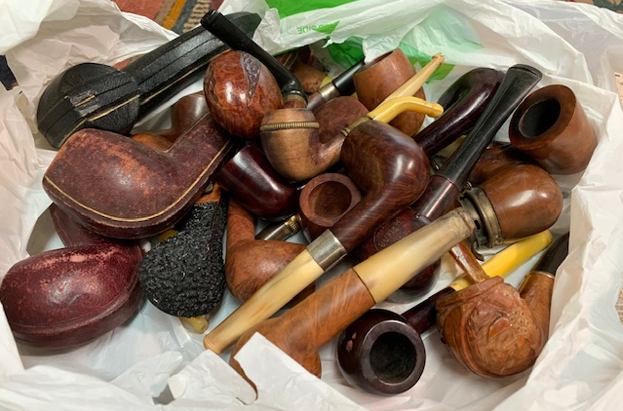
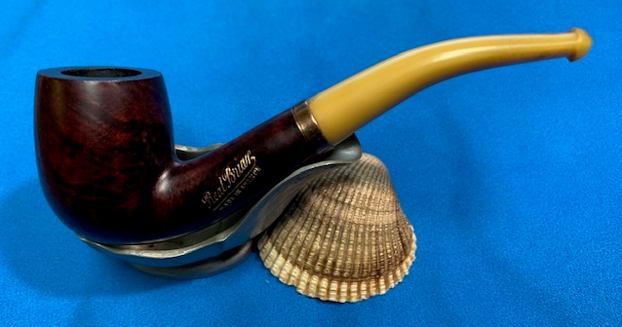
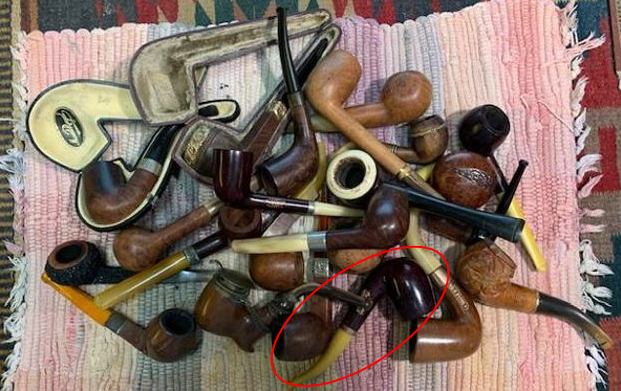
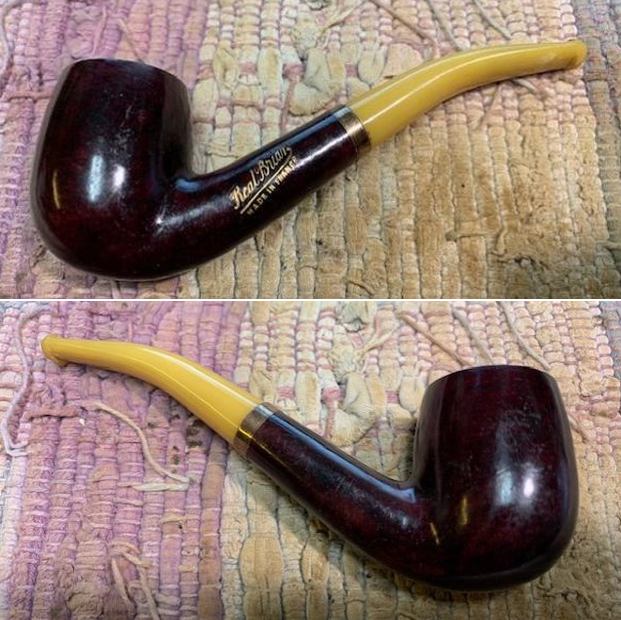
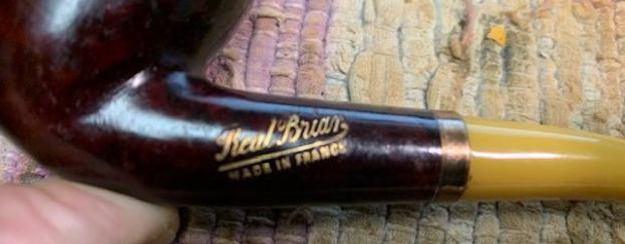
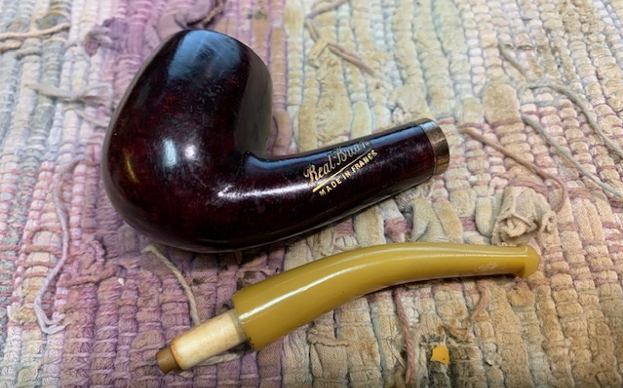
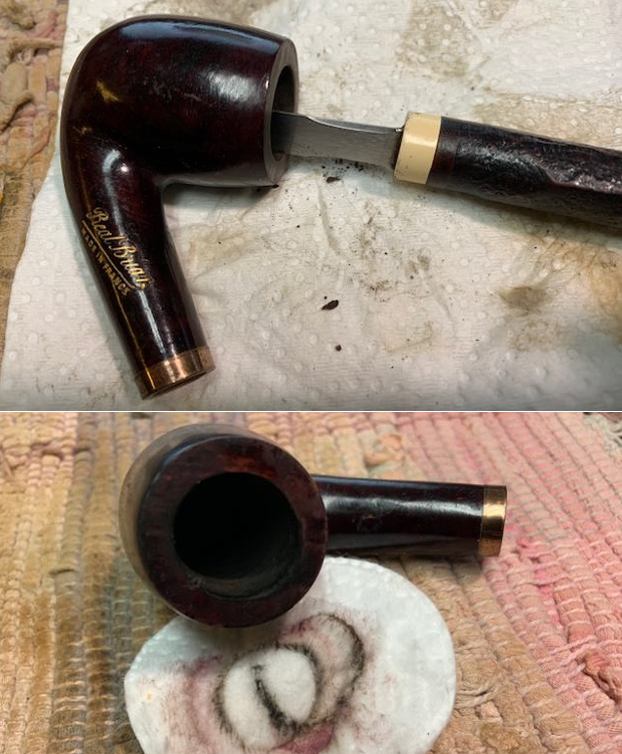
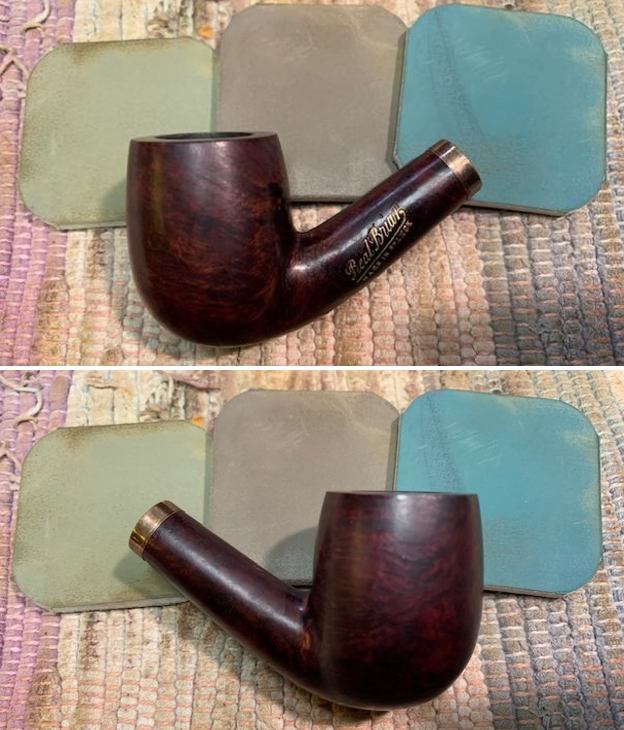
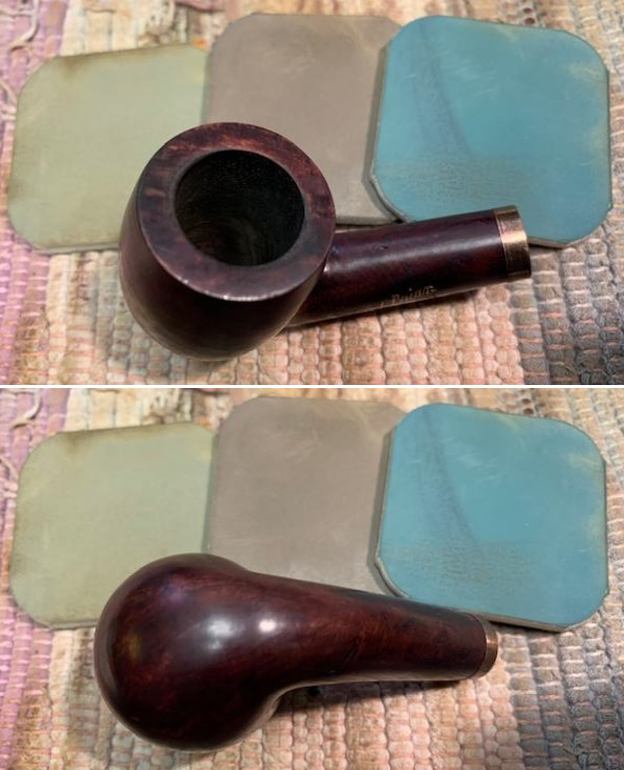
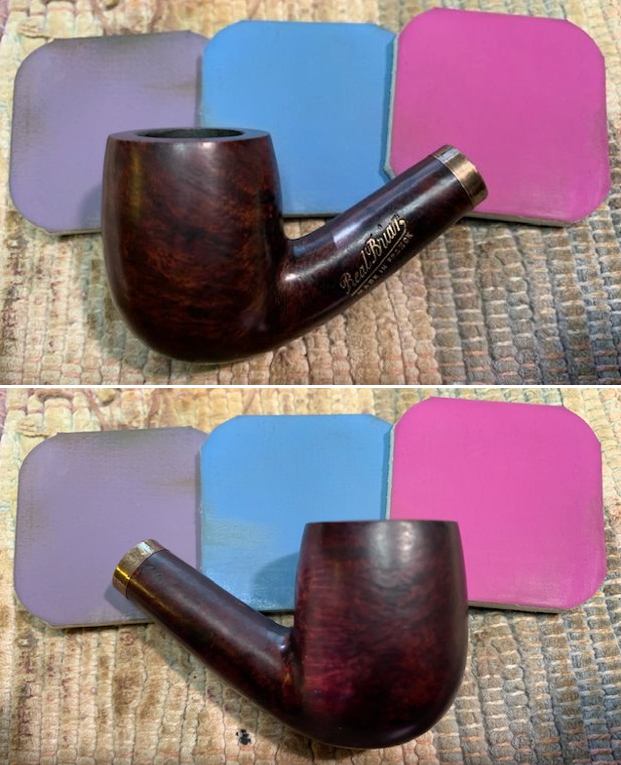
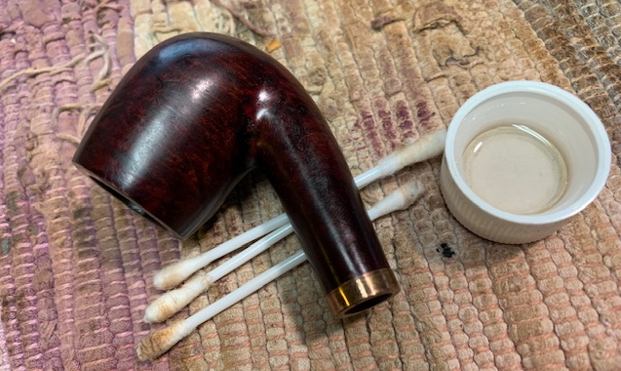
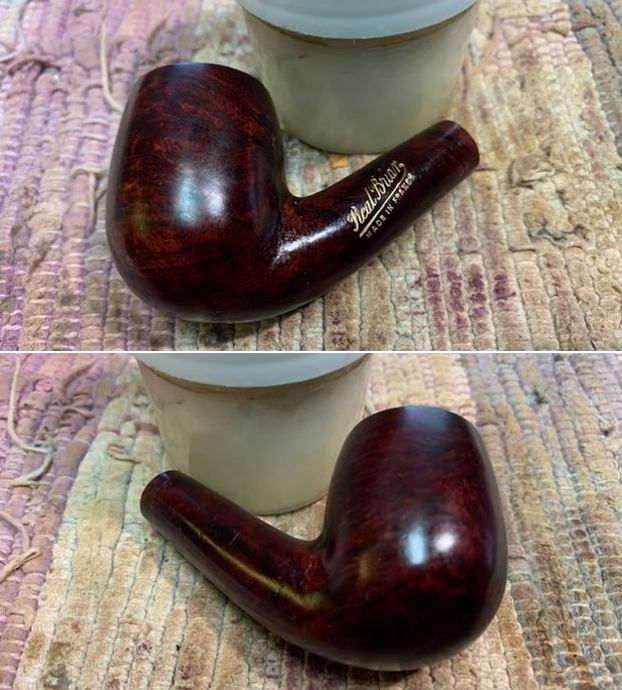
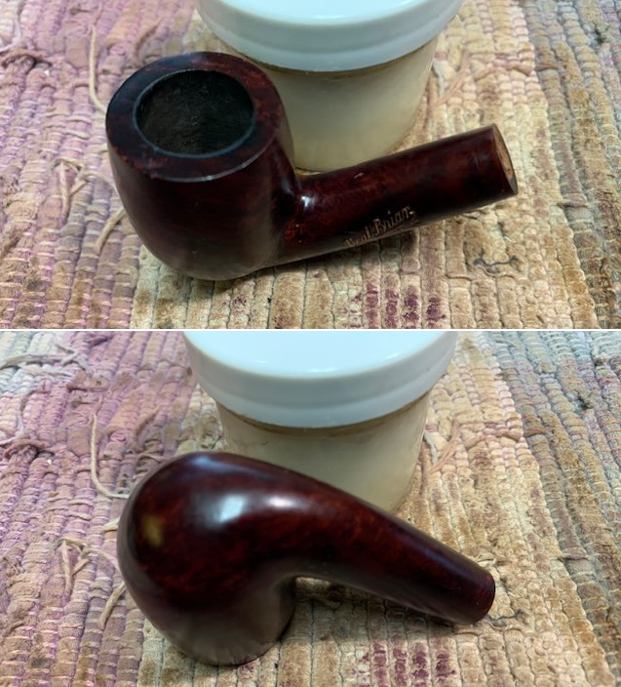
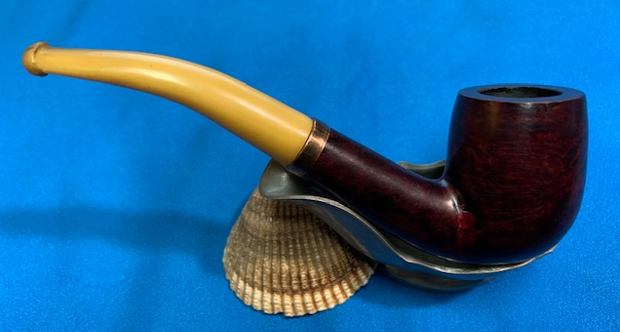
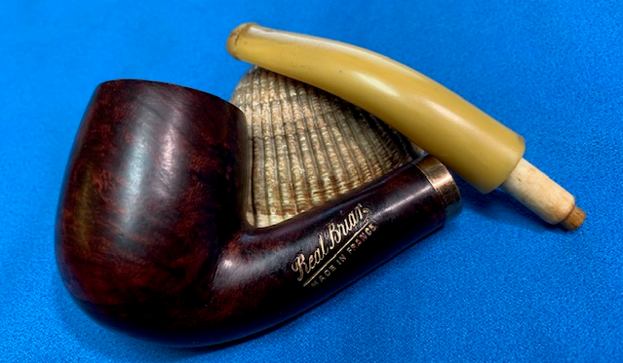
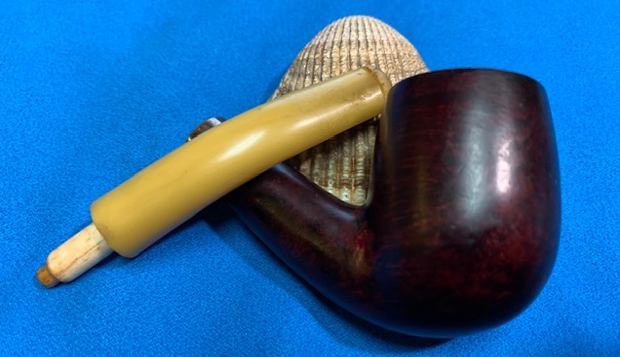
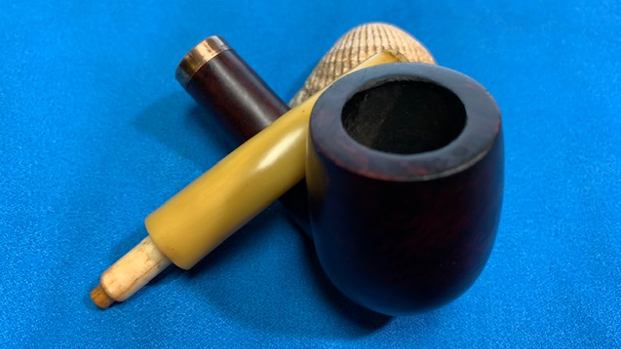
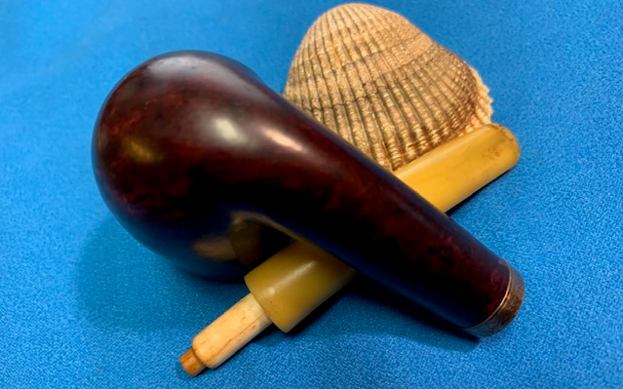
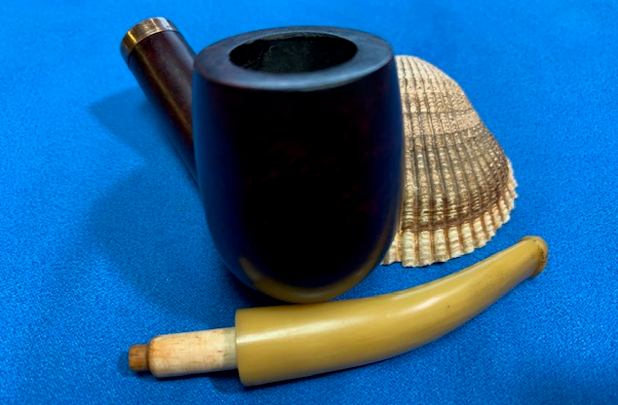
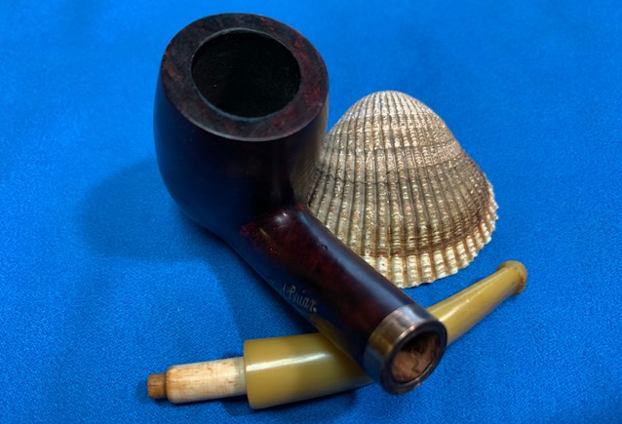
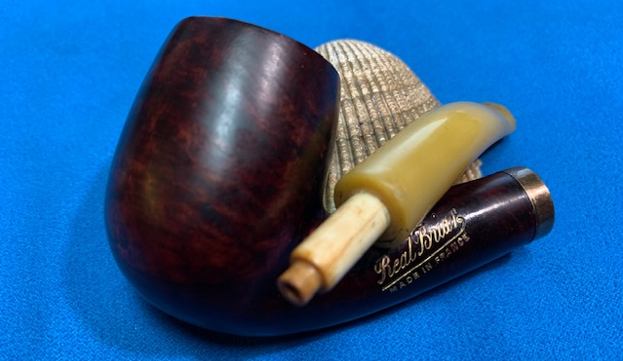
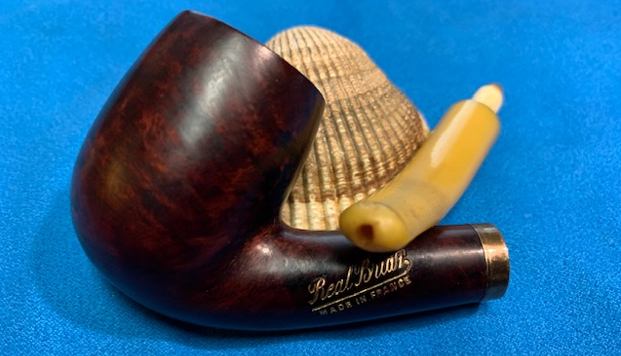
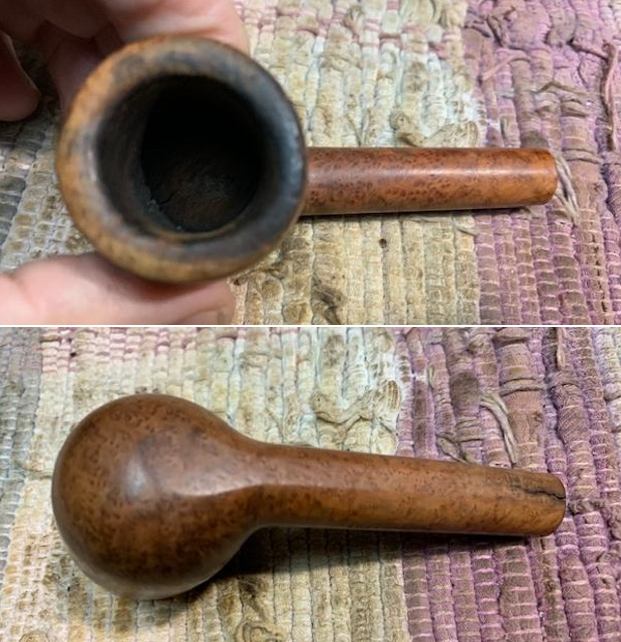
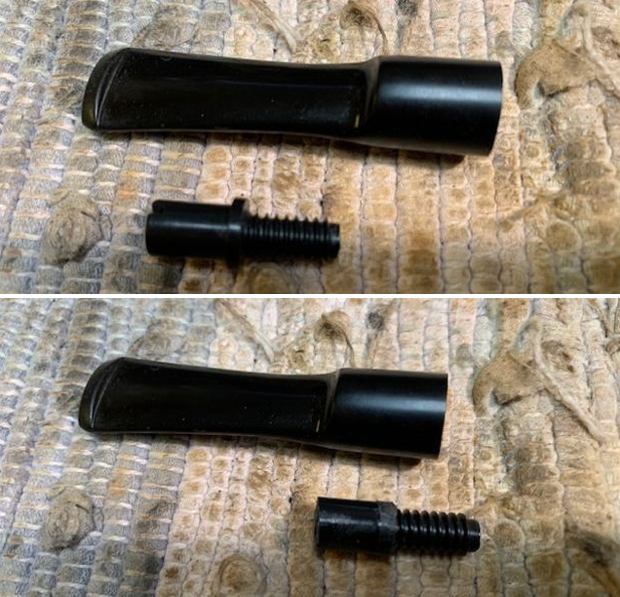
With the completion of the three pipes I just restemmed and wrote about I am returning to work on the bag of older NOS/unsmoked and lightly smoked pipes. I chose another old timer from the lot and this time picked another French Made pipe. It is buried in the pile in the photo below but it is clear in the second photo.In the photo of the poured out bag on my desk top I have circled the pipe that is next on the table. This was a lightly smoked Bent Billiard shaped pipe with a smooth finish that was dirty. The rim top had some light lava but there was minimal cake in the bowl. This little Bent Billiard really intrigued me, so it was next. The Bent Billiard was stamped in gold on the left side of the shank and read Real Briar [at an angle over] Made in France. The brass/nickel shank band was oxidized but still in decent condition. The bowl was lightly smoked and dusty but there was no cake. There was light lava on rim top toward the backside. The inner and outer edges looked good. The finish was dirty and the varnish top coat was spotty and peeling. The pipe had a Bakelite or Amberoid stem that was in good condition. There was one chip on the top near the shank joint. There were some light tooth marks and chatter on the stem. The button was orific – a round hole in the button end. The button had some wear and darkening but was in good condition. It has a push tenon that appears to be a synthetic material as well. Here are a few photos of the pipe before I did anything to it. I took photos of the bowl and stem. You can see the condition of the bowl. It is lightly cake and there is slight lava coat on the rim top. The edges look to be in good condition. The drilling is centered in the bottom of the bowl. It is a good sized bowl. The interior walls of the pipe are smooth and do not have drilling marks or checks or chips. The Bakelite/Amberoid stem is in good condition and has a push tenon and an orific button. There is a small chip in the Bakelite stem near the shank band and there are tooth marks on both sides near the button.I took a photo of the stamping on the left side of the shank. It reads as noted above. I removed the stem from the shank. You can see the brand new threaded bone tenon in the photo below. The proportions of this pipe are well done. The grain around the bowl is very nice. I knew from work on other older pipes that had the same stamp as this- Real Briar Made in France that there was not any clear cut information on that stamping on any of the usual sites. I also knew that the C.P.F. (Colossus Pipe Factory) that I had worked on bore this same stamp. My guess is that the pipe may have been made by them but I could not be sure.

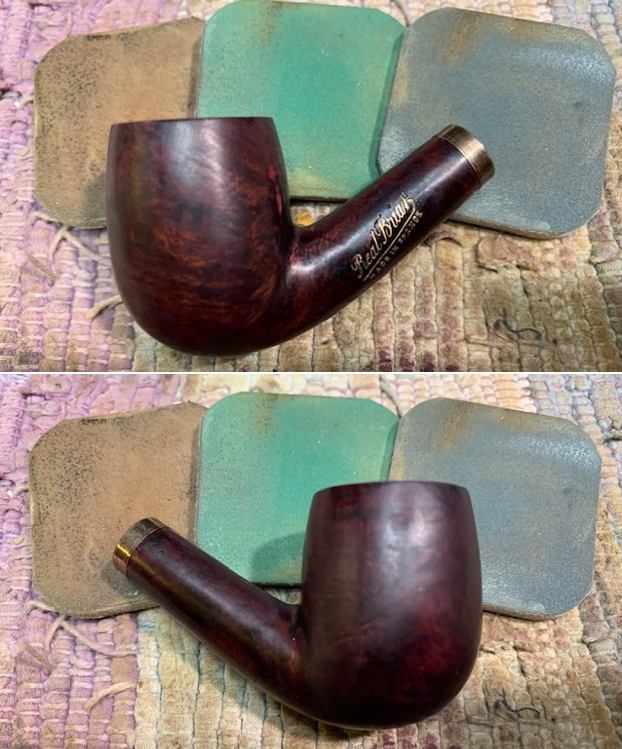
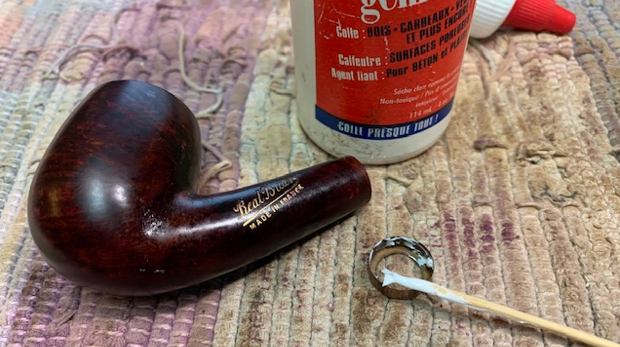
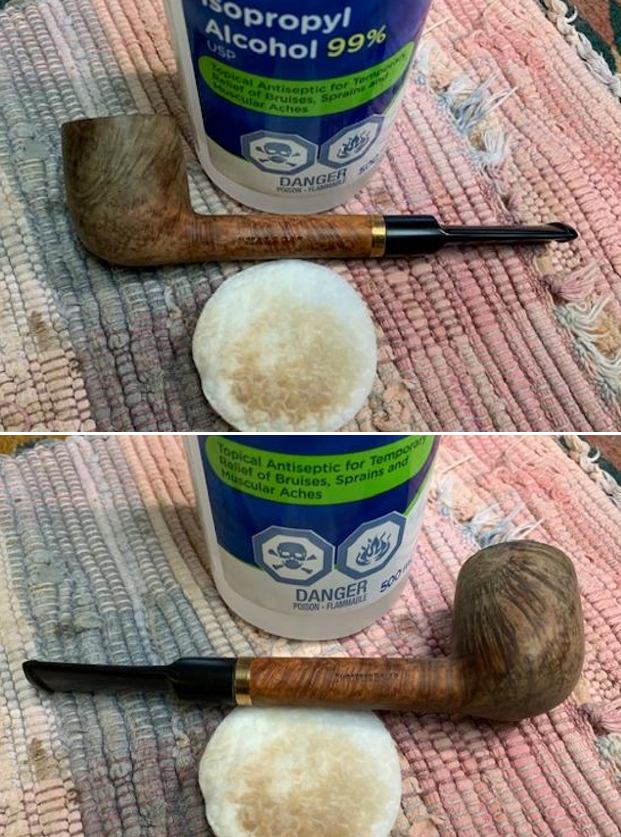
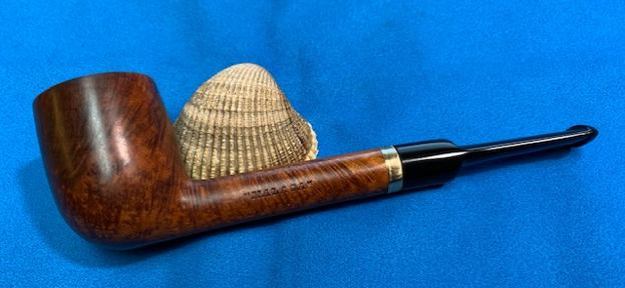
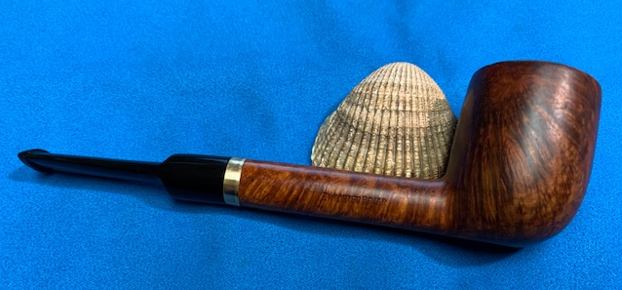
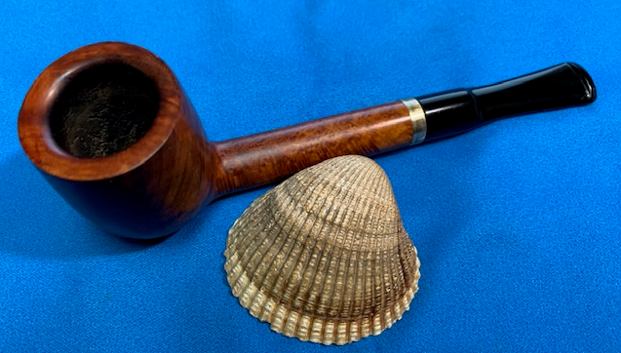
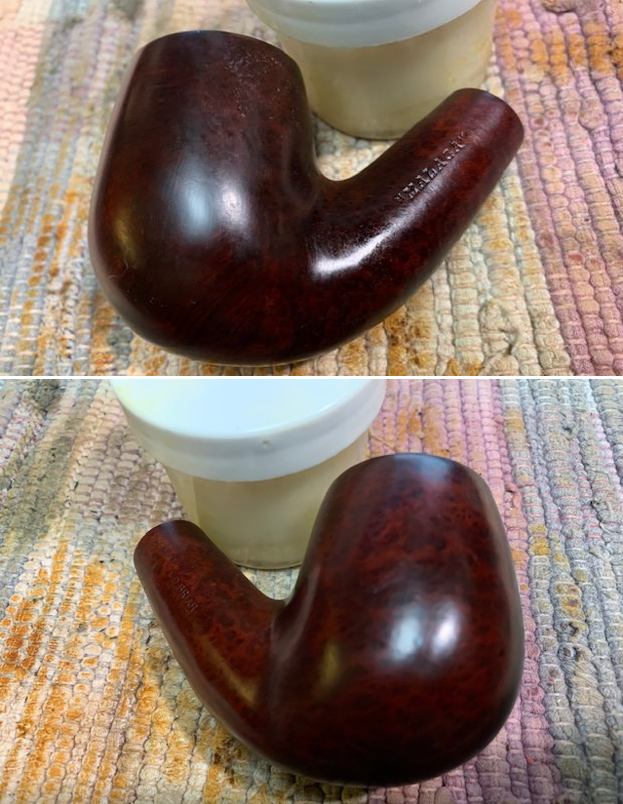
Now it was time to work on the pipe. I started my work on the pipe by scraping out the light cake in the bowl with a Savinelli Fitsall Pipe Knife. I also scrubbed off the lava on the rim top with a damp cotton pad.I wiped down the bowl with 99% Isopropyl alcohol on a cotton pad to remove the peeling varnish coat and grime on the finish of the bowl sides. Wiping it down revealed some great grain around the bowl and shank sides. I polished the briar and the nickel plated band with micromesh sanding pads. I dry sanded with 1500-12000 grit pads and wiped the bowl down with a damp cloth after each sanding pad. The briar began to really come alive. I touched up the stain on the rim top using a Mahogany stain pen and used a Black Sharpie Pen on the fills that became evident on the back of the bowl. I was able to blend the stain and pen into the surrounding briar and it looked very good.I used alcohol and cotton swabs to clean out the shank of any debris that may have gotten in from the reaming of the bowl. It was still quite clean.I rubbed the briar down with Before & After Restoration Balm. I worked it into the finish with my fingertips. The product works to clean, enliven and protect briar finished. I let it sit for 10 minutes then buffed it off with a cotton cloth. The grain on the bowl really came alive with the buffing. It is really a beautiful pipe.While working on the bowl the band came off the shank. It was loose so while it was off I polished it with a jewelers cloth to remove the oxidation and protect the finish on it. I used a tooth pick to put all purpose glue on the inside of the band and pressed it back in place on the shank.I set the bowl aside and filled in the chip on the top shank end edge and the tooth mark on the top and underside of the stem near the button. I used clear CA glue. Once it cured I polished it with micromesh sanding pads.I polished the vulcanite stem with micromesh sanding pads – 1500-12000 grit pads. I wiped the stem down after each pad with Obsidian Oil to protect and enliven the stem. I finished the polishing with Before & After Pipe Stem polish – both Fine and Extra Fine. I gave it a final coat of Obsidian Oil and set it aside to dry.This another interesting older pipe – Real Briar Made in France Bent Billiard turned out really well and it is a great looking pipe with a great shape to it. Once the varnish coat was removed the grain on the briar and the sheen on the stem really popped when the pipe was buffed with blue diamond on the buffing wheel. The brass/nickel band also took on a sheen. I gave the bowl and stem multiple coats of carnauba wax and buffed it with a clean buffing pad. I hand buffed the pipe with a microfiber cloth to deepen the shine. The finished French Made Real Briar Bent Billiard is comfortable to hold and is quite distinguished looking. Give the finished pipe a look in the photos below. The dimensions of the pipe are Length: 5 inches, Height: 1 ¾ inches, Outside diameter of the bowl: 1 inches, Chamber diameter: 5/8 of an inch. The weight of the pipe is 34 grams/1.20 ounces. It is a really beautiful pipe that I will be putting on the rebornpipes store in the French Pipe Makers section if you want to add it to your collection. Thanks for reading this blog and my reflections on the pipe while I worked on it. Keep an eye out on the blog as I have several other older pipes that I will be working on.

Restemming & Restoring a “Malaga” Lovat


Blog by Steve Laug

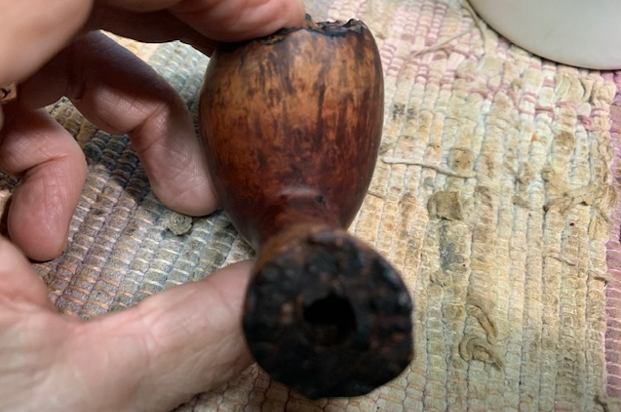
Sometimes the repetitive work on similar pipes and stems gets tiring to me and to alleviate the inevitable boredom I change things up a bit to refresh me. I have a box of stummels (bowls) here that I periodically go through and see if I have a potential stem that would fit them. Yesterday when I finished the old timer on my work I went through the box and picked out three bowls and found workable stems for them. All were in different states of need but all had been thoroughly cleaned before I boxed them up. The first restemmed and restored was a ZETTERVIG Copenhagen Handmade 900 Egg (https://rebornpipes.com/2021/09/04/restemming-restoring-a-zettervig-copenhagen-hand-made-900-egg/). The next one I chose to work on is a lovely Malaga Lovat stummel.  I have worked on a lot of Malaga pipes in the past so I am not a stranger to the brand. I have included the link below to a bit of history on the brand that I compiled.

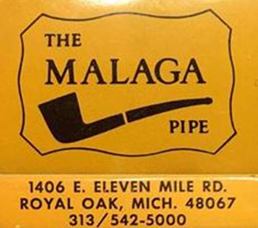
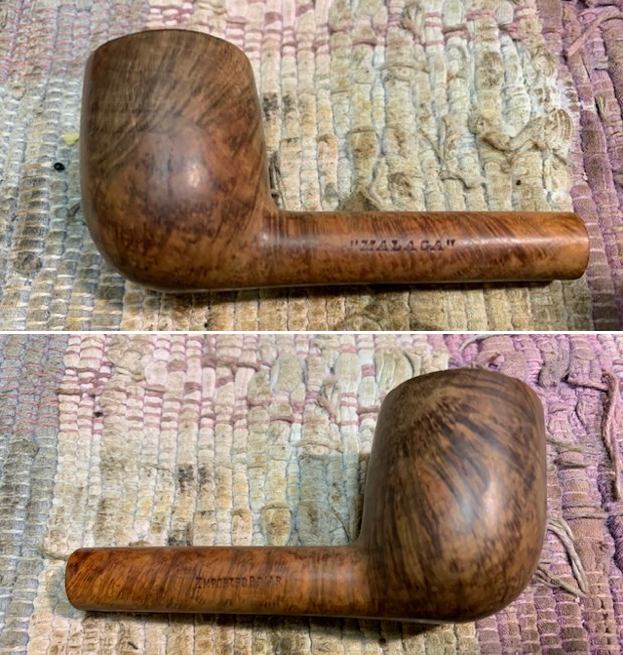
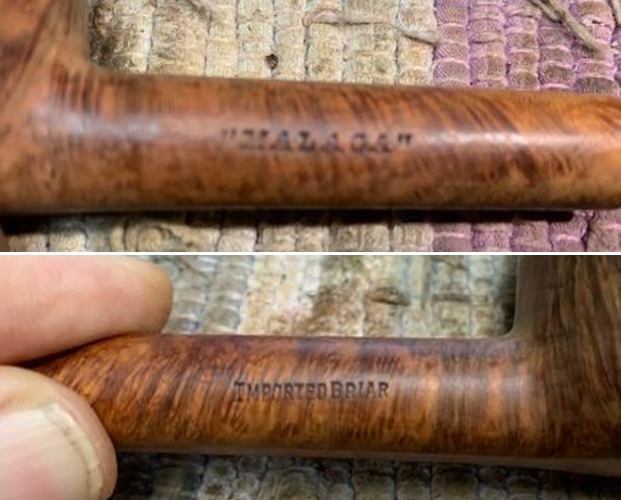
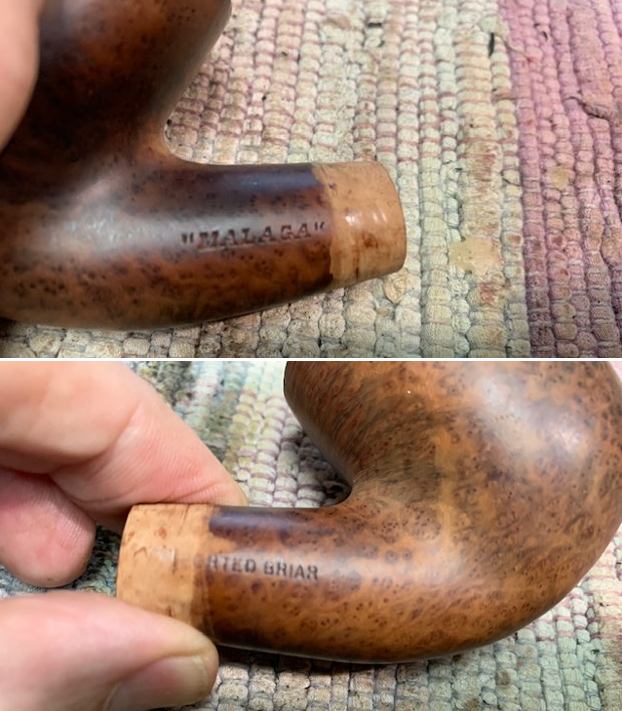
The bowl looked very good. The grain around the sides was quite nice and a mix of flame and birdseye grain. The rim top had some burn damage on the rear top and inner edge and some darkening all the way around. The bowl was slightly out of round. There was a crack in the underside of the shank that extended about ½ inch up the shank. The interior of the bowl was clean and there were not any chips, cracks or checking on the walls. Examining the mortise it was clean and well drilled with no issues other than the previously noted crack. The finish was washed out and bit and tired but still quite redeemable. The stamping on the pipe was clear and readable. On the left side it read “MALAGA” and on the right side it read IMPORTED BRIAR. I took some photos of the bowl before I started to work on it. I took a photo of the stamping on the sides of the shank. It reads as noted above and is clear and readable.I went through some of stems and found this saddle style stem without a tenon. It had been drilled for a tenon but it had never been finished. It was the right diameter and it fit the shank and the look of the pipe very well. It has a few tooth marks and chatter near the button but it would clean up well.I have worked on quite a few Malaga pipes and blogged their restorations, so rather than repeat previous blogs, I am including the link to one that gives some of the history of the Malaga brand and the Malaga Pipe Shop in Royal Oak, Michigan in the USA from a catalogue. It gives a sense of the brand and the history in their own words. Follow the link to get a feel for the brand and the pipemaker – https://rebornpipes.com/2013/02/09/george-khoubesser-and-malaga-pipes/.

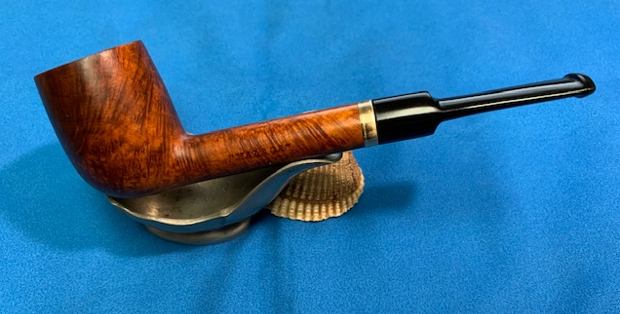
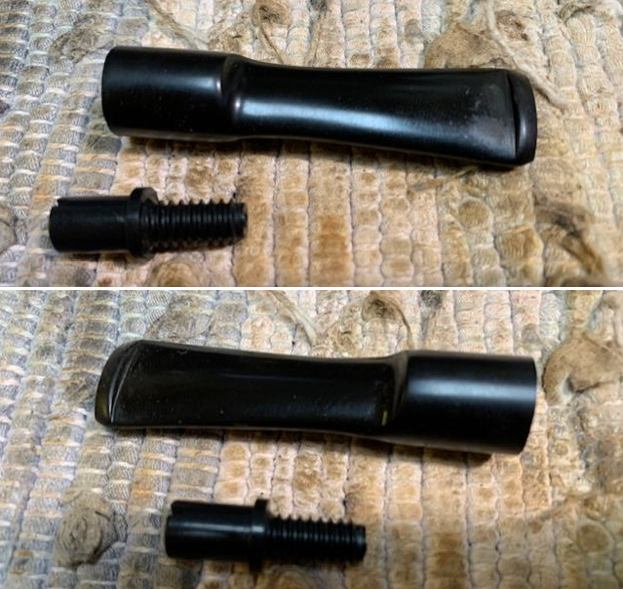
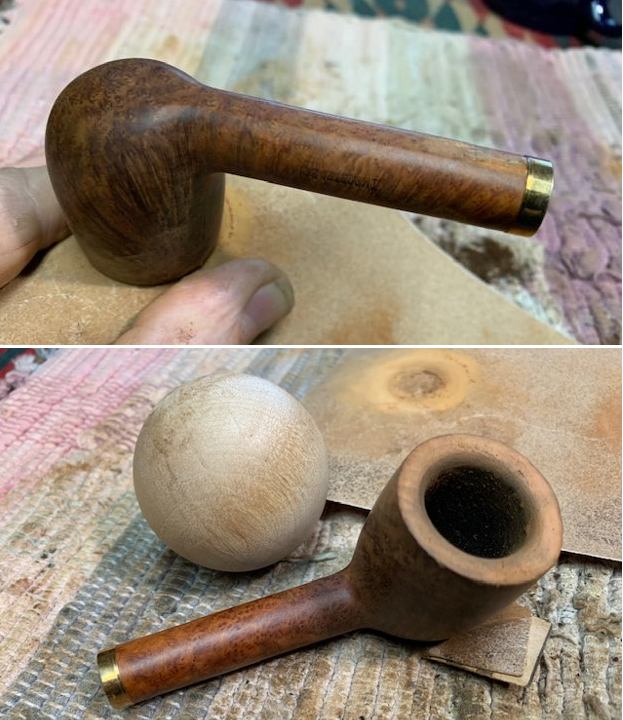
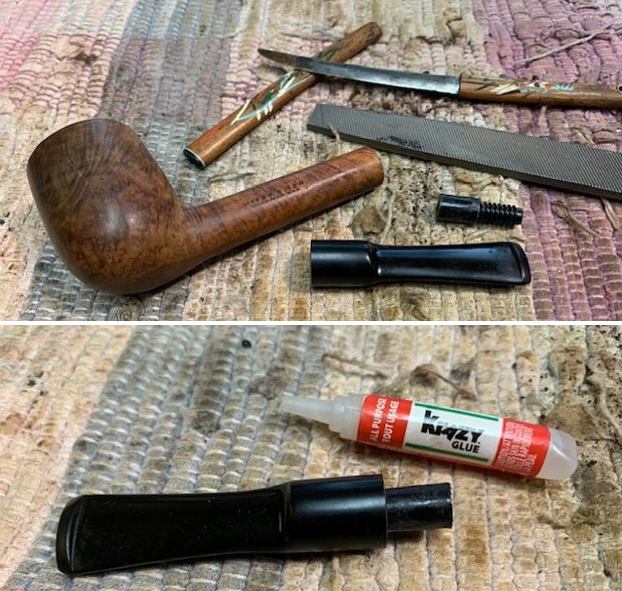
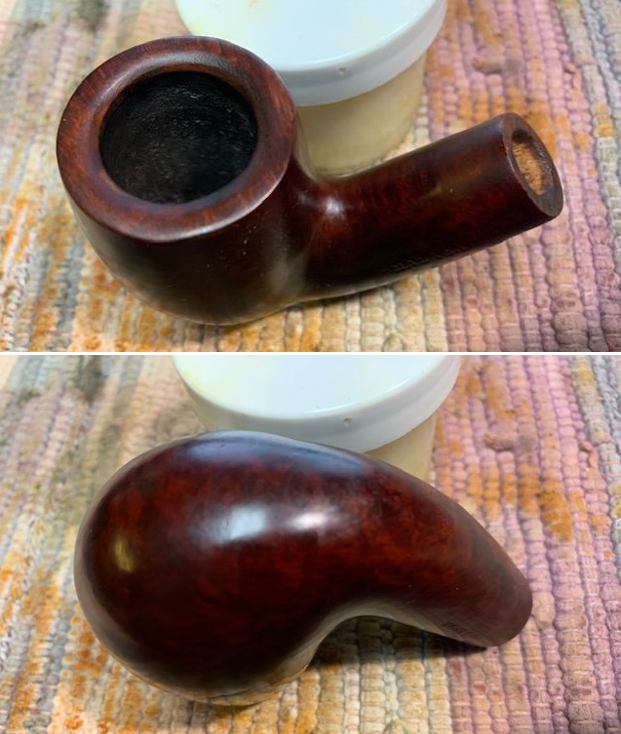
With that information in hand I turned to work on the bowl. I addressed the crack in the shank first. I cleaned it and smoothed it out. I used an awl and pressed a small hole in the shank at the end of the crack. I filled in the crack with clear CA glue and pressed it together until it cured. I pressed a brass band onto the end of the shank to further address the crack. It serves that function and also gives it a bit of bling. With that repaired I turned to deal with the rim top issues. I topped the bowl on a topping board with 220 grit sandpaper to smooth out and minimize the damage on the rim top. I used a small wooden ball that Kenneth gave me recently to give the inner edge a bevel to minimize the burn on the inner edge and bring the bowl back to round.I shortened the tenon to fit the shank of the pipe. I used the Dremel and sanding drum to remove the shoulder at the top of the tenon above the threads. I shaped the tenon fit with a small file and sanded it smooth. I glued the threaded end of the tenon with clear CA glue and pressed it into the stem. It cures quickly so it is key to move quickly and set it well as  you only get one chance! I put the stem in shank for a sense of the look of the pipe and then wiped the bowl down with alcohol on a cotton pad to remove the debris from the sanding and that was still in the surface of the briar. I liked what I saw. The grain was really quite nice and the band and new stem worked well with the pipe. I removed the stem and polished the briar with micromesh sanding pads – dry sanding with 1500-12000 grit pads and wiping it down with a damp cloth after each pad. It really began to shine. I stained the rim top and edges with a Maple stain pen to match the rest of the stain around the bowl sides. The rim top and inner edge look very good.I worked some Before & After Restoration Balm into the surface of the smooth briar with my finger tips. The product is amazing and works to clean, enliven and protect the briar. I let it sit on the briar for 10 or more minutes and then buff it off with a soft cloth. It really makes the grain sing. I set the bowl aside and turned my attention to the stem. I “painted” the stem surface with a Bic lighter flame to raise the tooth marks. I was able to lift all of them to the surface. I smoothed out what remained with 220 grit sandpaper and started polishing the stem with 400 grit wet dry sandpaper.I polished the stem with micromesh sanding pads – dry sanding with 1500-12000 grit pads. I wiped the stem down after each pad with a cloth and Obsidian Oil. I finished the polishing with Before & After Pipe Stem Polish – both Fine and Extra Fine. I gave it a final coat of Obsidian Oil. I put the pipe back together – the bowl with its new stem. This restored “Malaga” Imported Briar Oil Cured Lovat is a real beauty and I think the brass band and the chosen stem works well with it. The grain on the bowl came alive with the buffing. I used Blue Diamond on the buffing wheel on both the bowl and stem. I gave both multiple coats of carnauba wax on the wheel then buffed it with a clean buffing pad to raise the shine. I hand buffed it with a microfibre cloth to deepen the shine. The “Malaga” Lovat feels great in the hand. It is lightweight and the contrast in the browns of the briar, the brass of the band and the polished vulcanite stem with the popping grain on the mixed brown stained bowl is quite amazing. The dimensions of the pipe are Length: 6 inches, Height: 1 ¾ inches, Outer diameter of the bowl: 1 ¼ inches, Chamber diameter: 7/8 of an inch. The weight of the pipe is 1.34 ounces/38 grams. It really is a beauty. I will be putting it on the rebornpipes store in the American (US) Pipe Makers section shortly if you are interested in adding it to your collection. Thanks for walking through the restemming and the restoration with me. Cheers.

Restemming & Restoring a Zettervig Copenhagen Hand Made 900 Egg


Blog by Steve Laug

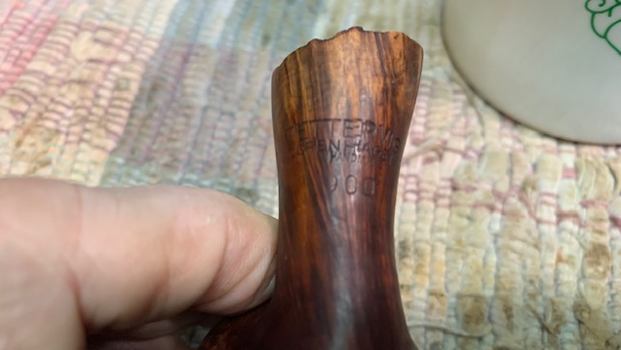
Sometimes the repetitive work on similar pipes and stems gets tiring to me and to alleviate the inevitable boredom I change things up a bit to refresh me. I have a box of stummels (bowls) here that I periodically go through and see if I have a potential stem that would fit them. This morning when I finished the last old timer I went through the box and picked out three bowls and found workable stems for them. All were in different states of need but all had been thoroughly cleaned before I boxed them up. The first of these was an interesting egg shaped freehand. It is stamped on the underside of the shank and reads ZETTERVIG (double stamped) [over] Copenhagen (also double stamped) [over] Handmade [over] 900. It had some great grain around the bowl and plateau on the rim top and shank end that was interesting.  I have worked on other Zettervig pipes in the past so I am not a stranger to the brand. I have included links to two different pipes that I worked on (https://rebornpipes.com/2013/12/05/a-complete-reworking-of-a-zettervig-freehand/)(https://rebornpipes.com/2018/07/28/restoring-and-restemming-a-zettervig-handmade-351-freehand/).

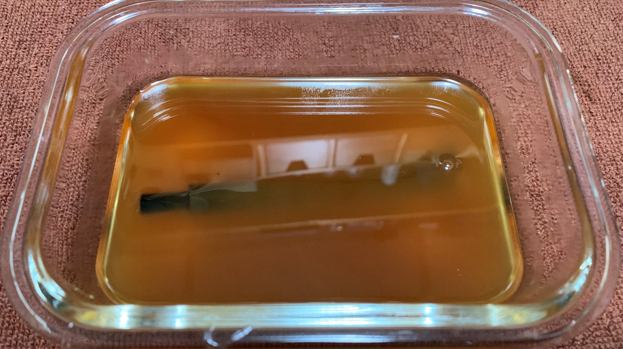
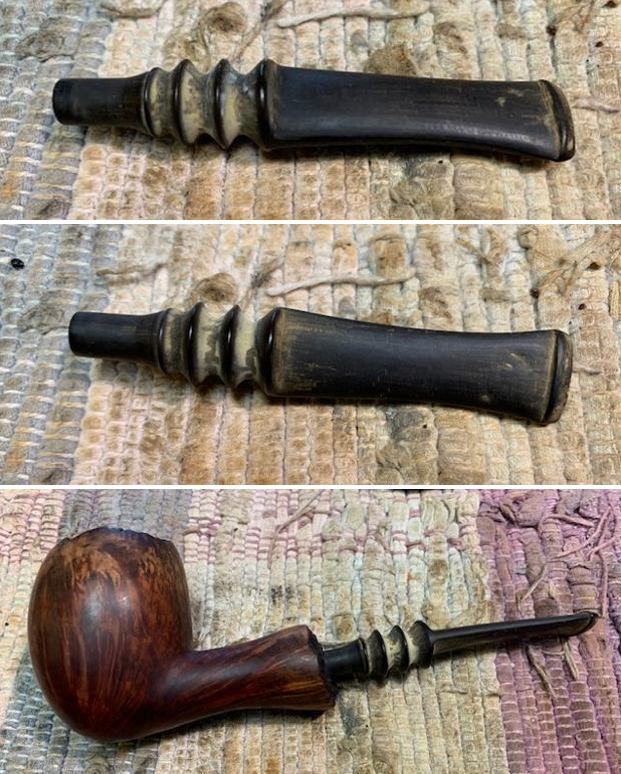
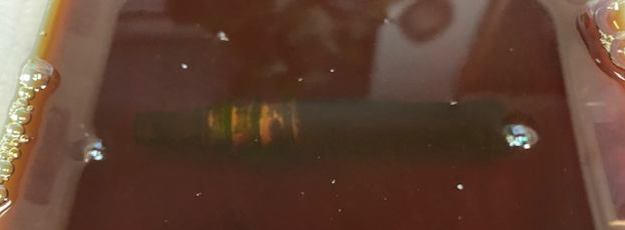
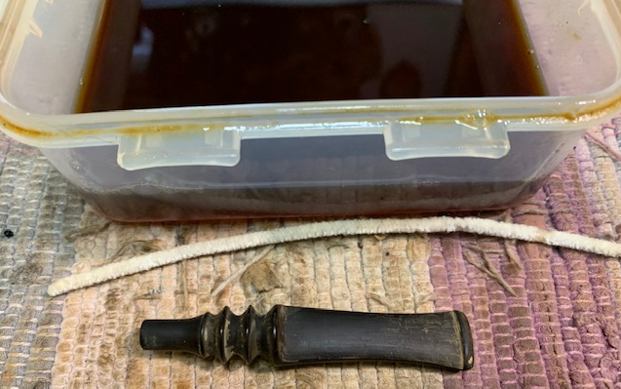
The bowl looked very good. The grain around the sides was quite nice and a mix of flame and straight grain. The plateau on the rim top and shank end looked good but the rim top was faded and worn. The shank end was black and looked very good. The bowl was clean and there were not any chips, cracks or checking on the walls. Examining the mortise it was clean and well drilled with no issues. The finish was washed out a bit and tired but still quite redeemable. I took some photos of the bowl before I started to work on it. I took a photo of the double stamping on the underside of the shank. It reads as noted above and is surprisingly clear and readable.I went through some of the fancy, turned freehand style stems and found this old timer. It is quite heavily oxidized and has some deep tooth marks but I think it will work with the Zettervig. I put the stem in place and took a photo to have a look at it in situation. What do you think? With the stem chosen I dropped it in a bath of Briarville’s Pipe Stem Deoxidizer that I have here. It is getting a bit tired but it still works. I let it sit while I worked on the bowl.While the stem soaked in the bath and before I started to work on the bowl I decided that I would look up some information on the Zettervig brand before I started the clean up on the pipe. I looked up information on two of my favourite sites. The first was Pipedia. Here is the link: https://pipedia.org/wiki/Zettervig. I quote in full:

In the 1960’s and into the early 1970’s Ole Zettervig had a shop in Copenhagen, Denmark where he was carving high quality pipes equal to Stanwell, Larsen, Anne Julie, Thurmann, Bang and others. These early pipes were marked “Copenhagen” and are very collectible. He sold his shop at some point in the 70’s and moved to Kolding and continued to produce pipes as a hobby, but the quality of briar and workmanship is said to not equal the early production. The later pipes he now marked as Kobenhaven rather than Copenhagen, and these were sold by Ole at flea markets throughout Europe.

That information told me I was working on an early one of his pipes from the 1960s to early 1970s as it is stamped Copenhagen.

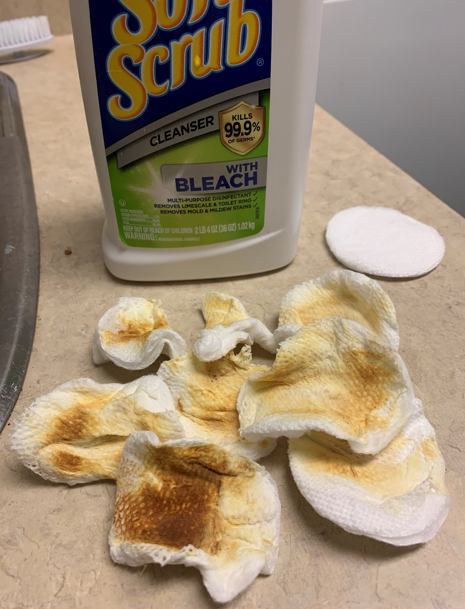
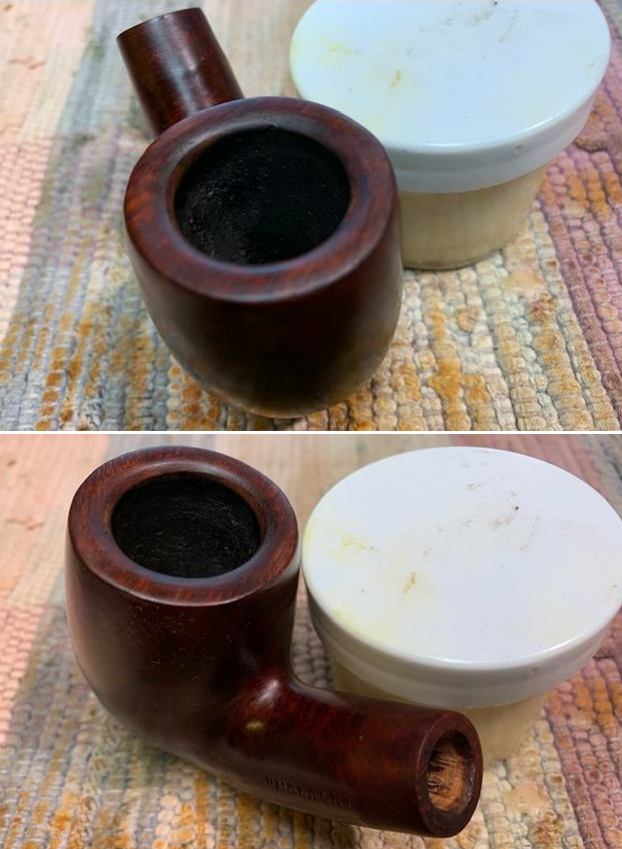
I turned to Pipephil’s site and did a screen capture of the information that was there. There was no addition info but it did show one of the pipes (http://www.pipephil.eu/logos/en/logo-z.html). You can also see the style of the stem and the Z on the top of the stem. The one I have chosen is very different but I think it will still work.With that information in hand I turned to work on the bowl. I used a brass bristle wire brush to clean out the remaining debris and lava in the grooves of the plateau rim top and to remove the dust from the plateau shank end. Once it was clean I used a Black Stain Pen to stain it black as it was originally. I polished the briar with micromesh sanding pads – dry sanding with 1500-12000 grit pads and wiping it down with a damp cloth after each pad. It really began to shine. I worked some Before & After Restoration Balm into the surface of the smooth briar with my finger tips and into the plateau rim top and shank end with a horsehair shoe brush. The product is amazing and works to clean, enliven and protect the briar. I let it sit on the briar for 10 or more minutes and then buff it off with a soft cloth. It really makes the grain sing. With the bowl finished I turned my attention to the stem. It had been sitting in the bath for several hours. I removed it and ran a pipe cleaner and alcohol through the airway to remove any remaining soak. I wiped the stem down with a paper towel to remove the oxidation that had been loosened. It looked much better than when I put it in the bath.I “painted” the stem surface with a Bic lighter flame to raise the tooth marks. I was able to lift many of them to the surface. What remained I would fill in later. I scrubbed the stem surface with cotton pads and Soft Scrub to remove the remaining oxidation. The stem was really starting to look very good. I cleaned out the ends of the stem and button with a pipe cleaner and alcohol to remove the bits of Soft Scrub that had gotten into the airway. I heated the stem and gave it a slight bend to fit the flow of the pipe better.I filled in the remaining divots and marks in the stem with clear CA glue. Once it had cured used a small file to flatten the repair and sharpen the edge of the button. I sanded it smooth with 220 grit sandpaper to blend it into the stem. I started the polishing with 400 grit wet dry sandpaper. I polished the stem with micromesh sanding pads – dry sanding with 1500-12000 grit pads. I wiped the stem down after each pad with a cloth and Obsidian Oil. I finished the polishing with Before & After Pipe Stem Polish – both Fine and Extra Fine. I gave it a final coat of Obsidian Oil. I put the pipe back together – the bowl with its new stem. This restored Zettervig Copenhagen Handmade 900 Egg is a real beauty and I think the chosen stem works well with it. The grain on the bowl came alive with the buffing. I used Blue Diamond on the buffing wheel on both the bowl and stem. I gave both multiple coats of carnauba wax on the wheel then buffed it with a clean buffing pad to raise the shine. I hand buffed it with a microfibre cloth to deepen the shine. The Zettervig Freehand Egg feels great in the hand. It is lightweight and the contrast in the blacks of the plateau and the polished vulcanite stem with the popping grain on the mixed brown stained bowl is quite amazing. The dimensions of the pipe are Length: 5 ¾ inches, Height: 2 inches, Outer diameter of the bowl: 1 ½ inches, Chamber diameter: ¾ of an inch. The weight of the pipe is 2.05 ounces/59 grams. It really is a beauty. I will be putting it on the rebornpipes store in the Danish Pipe Makers section shortly if you are interested in adding it to your collection. Thanks for walking through the restemming and the restoration with me. Cheers.

Resurrecting A Dreary No Name Briar Calabash Shaped Pipe


Blog by Paresh Deshpande

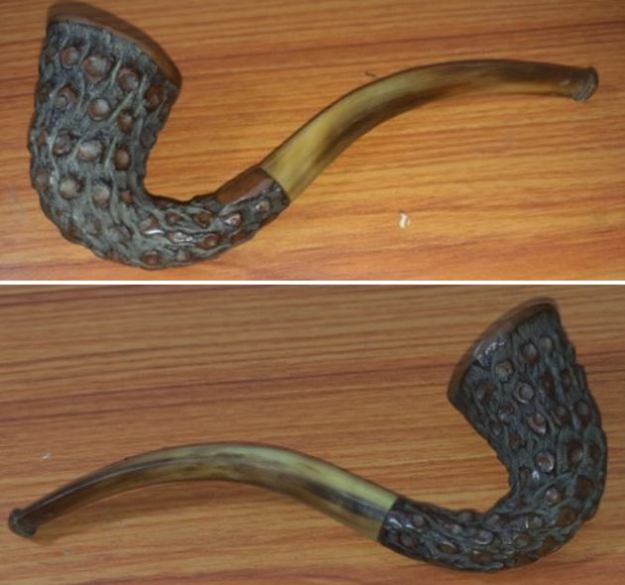
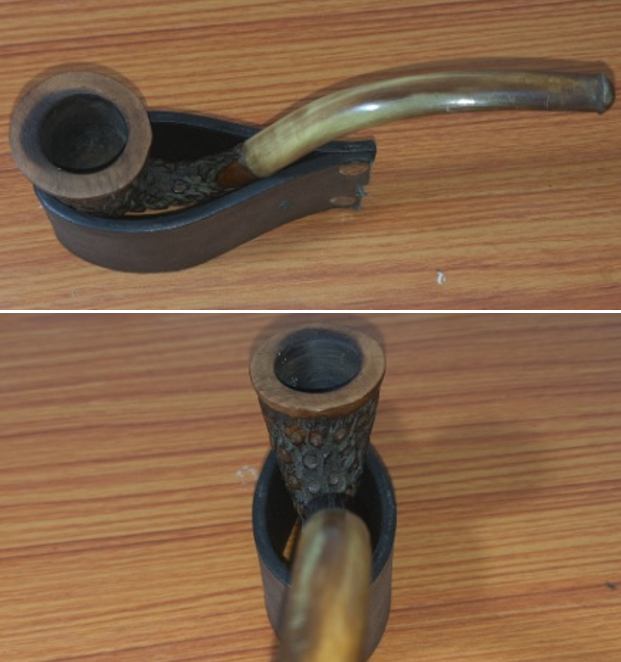
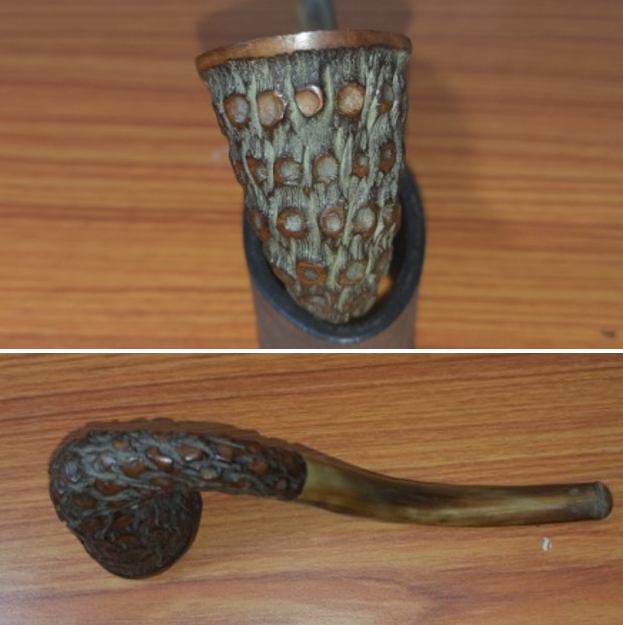
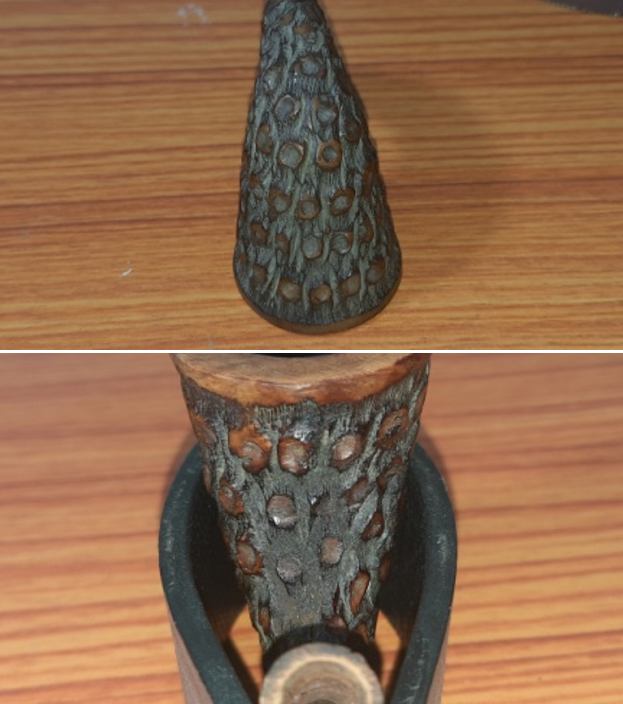
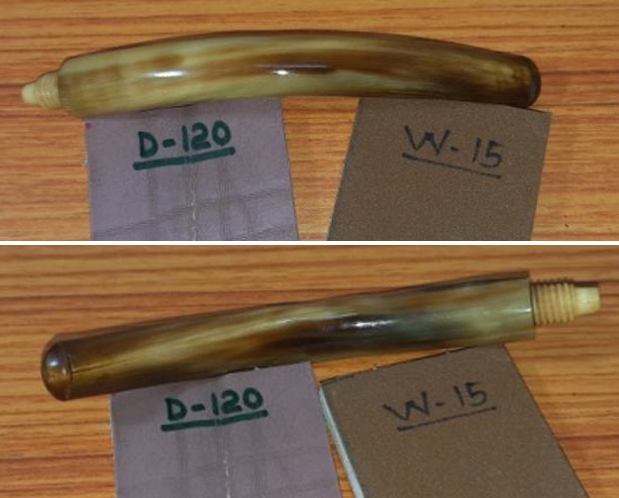
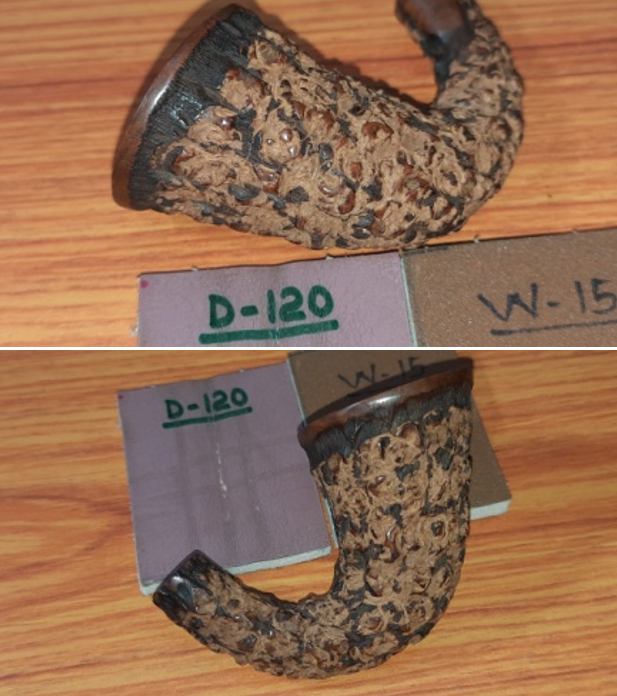
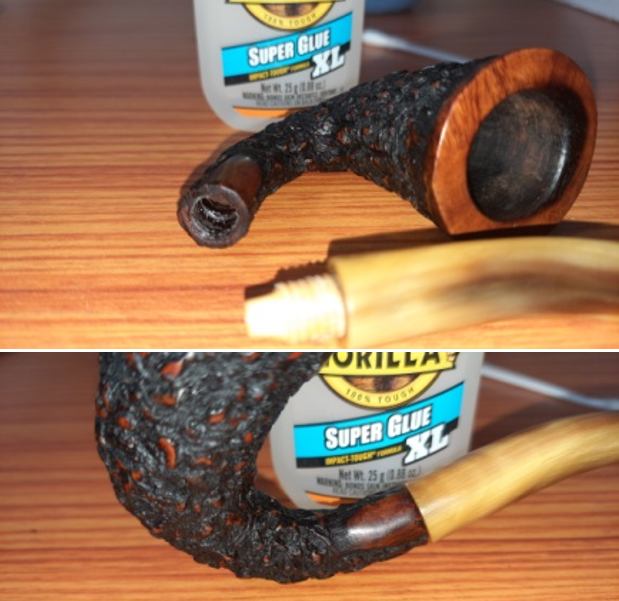
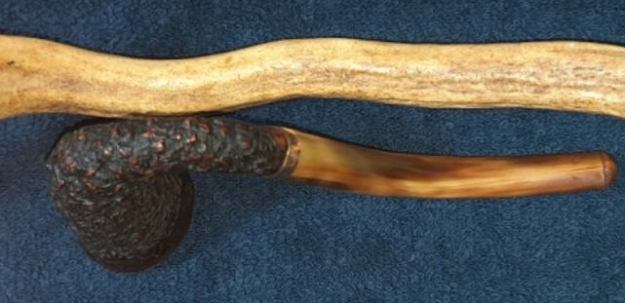
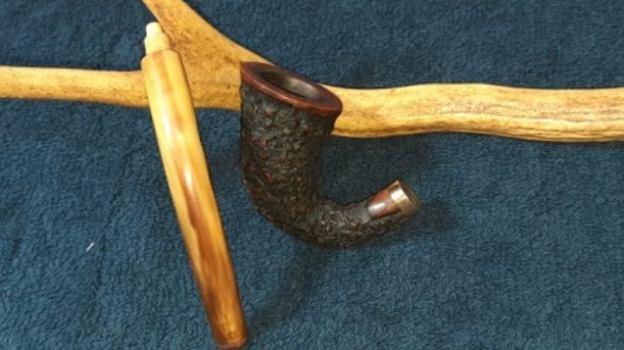
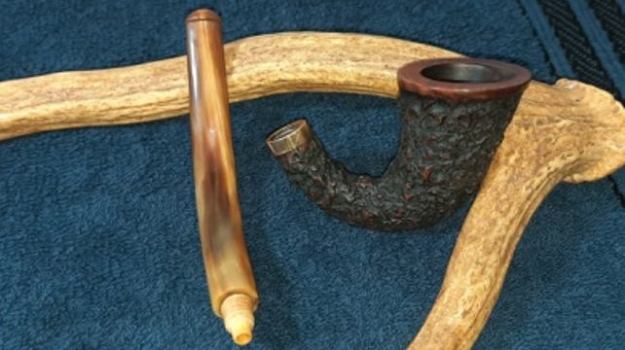
While surfing eBay for estate pipes, I came across this one ‘no name’ pipe with a horn stem and beautiful flowing calabash shape. The beautiful curvy shape apart, the pipe had some really hideous (IMHO) rustication on the stummel surface, a semblance of widely spaced scales with thin vertical lines. The perfect shape and spacing of the scales over the stummel surface points to machined and not hand crafted rustications. Notwithstanding the rustications on the stummel, I fell in love with the pipe and had already chalked out a plan for its transformation even before I had won the auction. As I had expected, there was only a couple of other bids and the pipe soon made its way to me. A month and a half later, the pipe had reached me and now it is on my work table.

As mentioned by the seller, the stummel and the stem are devoid of any stampings and there is absolutely no clue for me to establish the provenance of this beautiful pipe. However, the threaded bone tenon, horn stem and round orifice are indicative of this pipe being from the period 1900s to 1950s. It would be interesting if further light could be shed on this pipe as regards its origin, vintage etc by the esteemed readers of rebornpipes.

Initial Visual Inspection
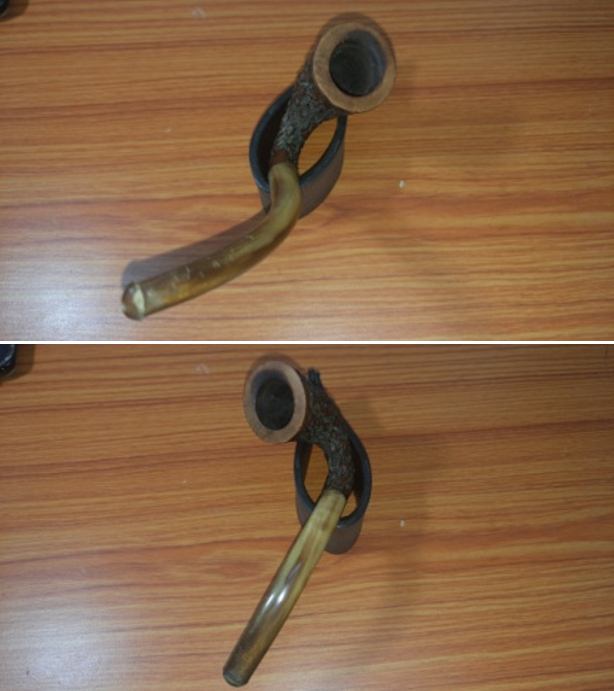
The first thing one can notice is the lovely shape of the pipe and the second is its ultra light weight. The chamber has been neatly reamed and the rim top surface is devoid of any lava overflow. There is severe charring to the inner edge in 12 o’clock direction. There are a couple of minor tooth indentations in the bite zone of the otherwise pristine stem. The stem is overturned to the right and not in alignment with the shank/ stummel. The stummel is dirty, dull and lifeless to look at. Overall, it is in decent condition as can be seen from the pictures below. Dimensions Of The Pipe
(a) Overall length of the pipe: –          5 3/4 inches.

(b) Bowl height: –                               1.5 inches.

(c) Inner diameter of chamber: –         0.7 inches

(d) Outer diameter of chamber: –        1.3 inches

Once The Pipe Is On My Work Table……
It appears that an attempt has been made to refurbish this pipe, but for reasons best known to the previous restorer, it was abandoned. Save for a little dust and soot, the chamber is nicely reamed back to the bare briar. The chamber walls, though not very thick, are without any heat fissures or pits and that’s a big relief. The rim top surface is peppered with numerous minor hairline scratches. The inner rim edge shows severe charring at 12 o’clock direction (encircled in yellow) and it extends over more than half way towards the outer edge. There is a smooth band of briar wood below and adjoining the outer rim edge. There are no ghost smells in the chamber. Addressing the charred inner rim edge is going to be tricky as the topping required would be extensive to the extent that the profile of the stummel and pipe as a whole, would be considerably altered. I would top the rim surface well within the limits of the smooth briar band below the outer rim edge and up to the point where I reach solid, albeit darkened briar. I would, thereafter polish it and attempt to blend the darkened areas by a applying a dark stain to the rest of the rim top surface. The stummel surface is without any damage. There is dust and dirt embedded in to the rusticated nooks and crannies giving the briar an old and lifeless look. The patterned scaled rustications also do not help in the overall appearance of the stummel. The mortise is threaded into which seat the threaded bone tenon of the stem and appears to be clean. I plan on complete rustication of the stummel and thereafter contrast staining with black and brown stains. The only issue I need to keep in mind is that the walls of the stummel are not very thick and thus I need to be cautious least I end up gouging too deep into the chamber wall. The tapered horn stem is clean with no major issues. The upper stem surface has a couple of minor bite marks at the base of the button and also over the button edge. The lower surface has some minor tooth indentations in the bite zone. The button edges on both the surfaces need to be sharpened. The round orifice and the tenon end are clean.The seating of the stem in to the mortise is overturned to the right by a huge margin and is very loose. This would need something more permanent than the clear nail polish coat application. The following pictures will give the readers a correct perspective of the issue.The Process
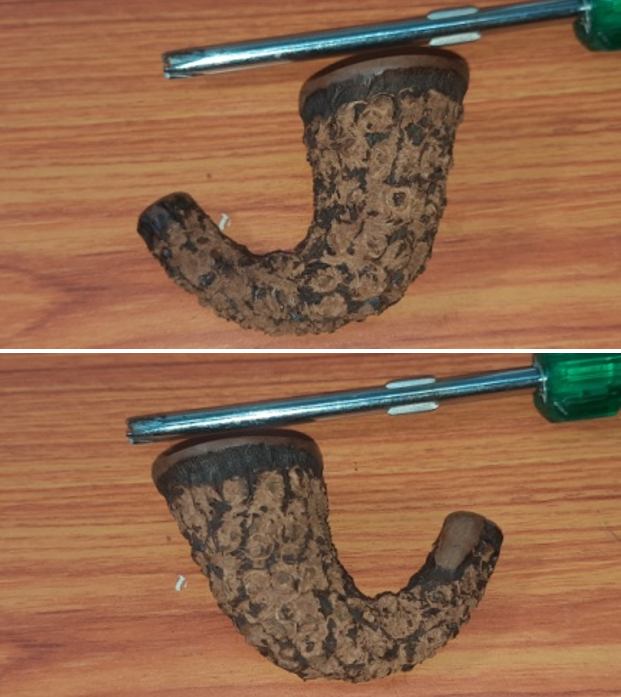
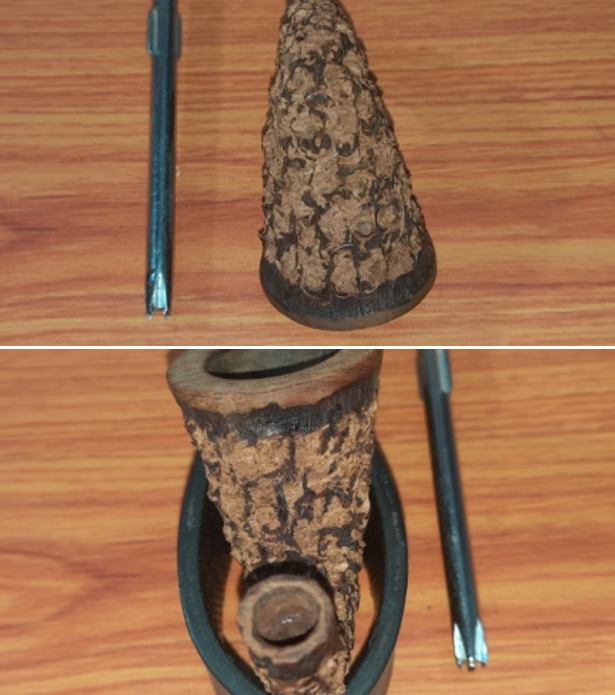
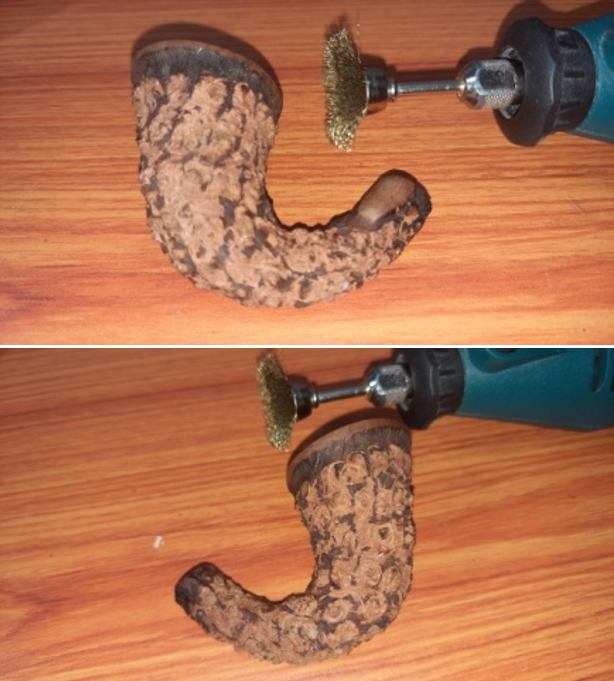
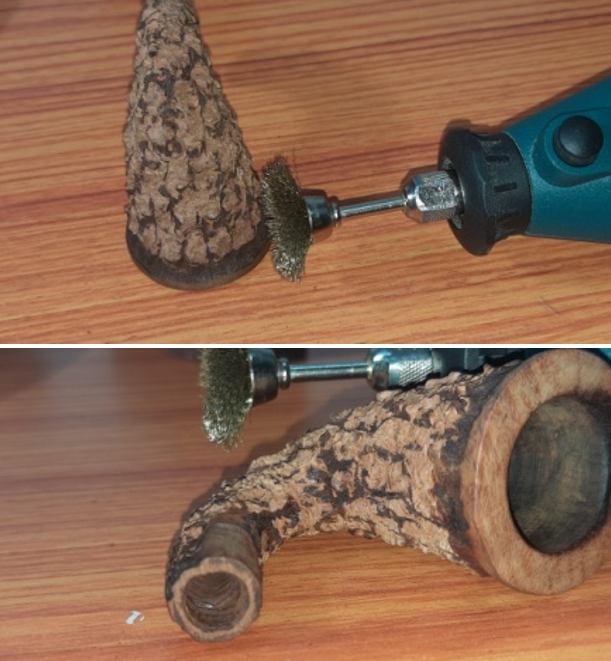
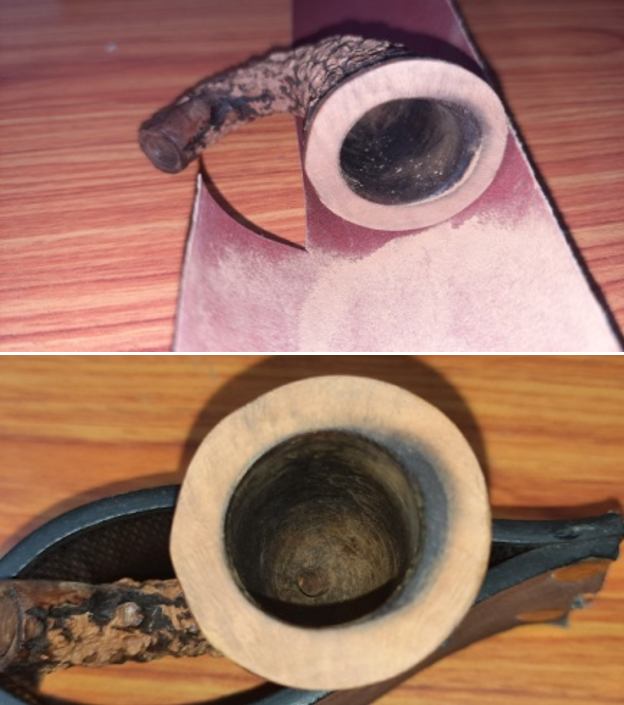
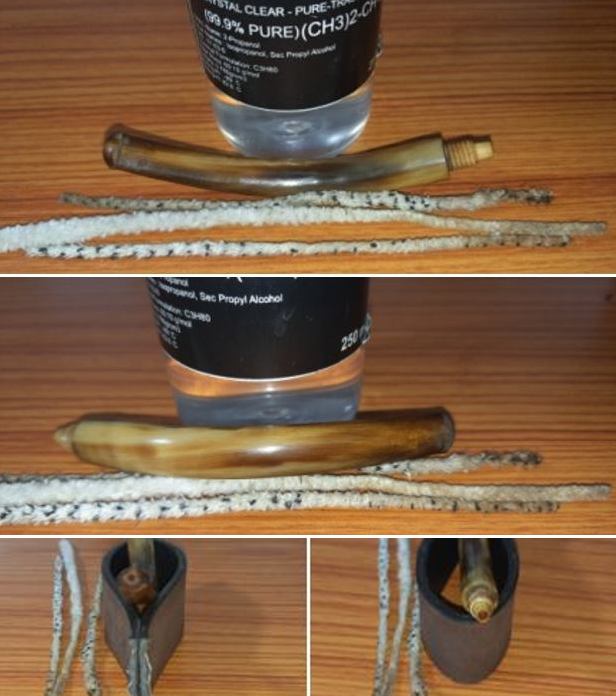
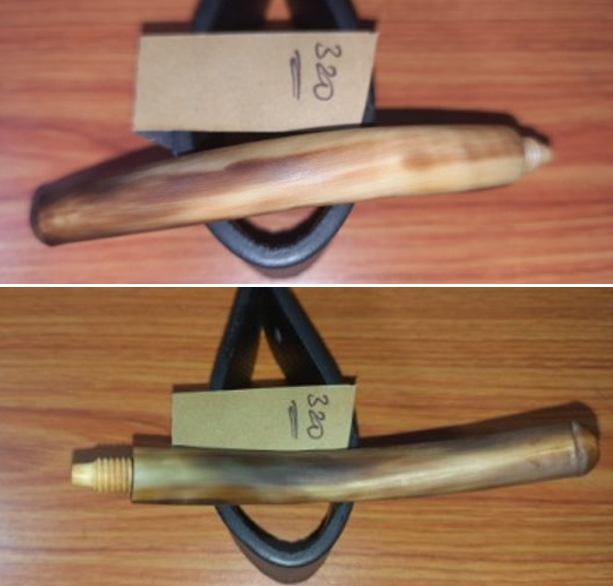
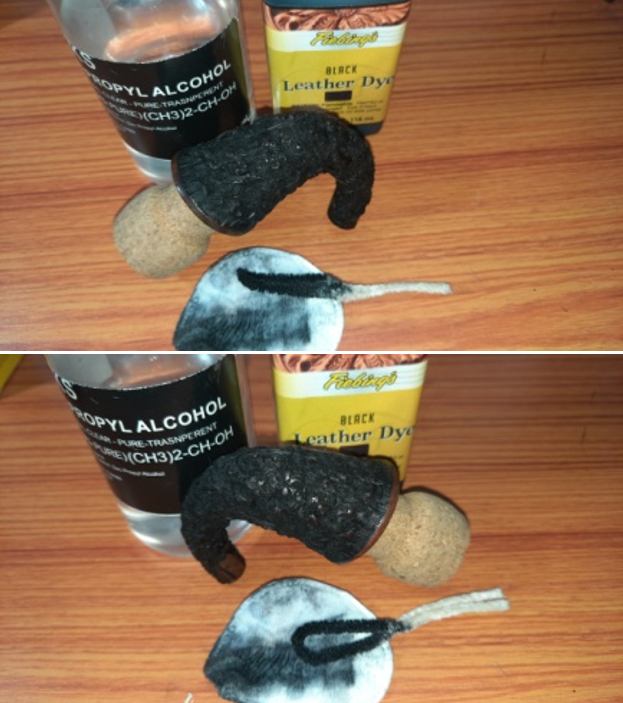
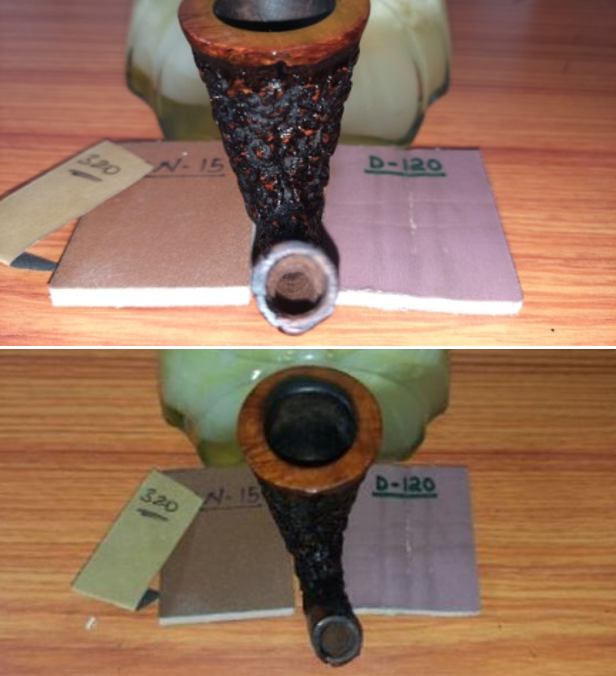
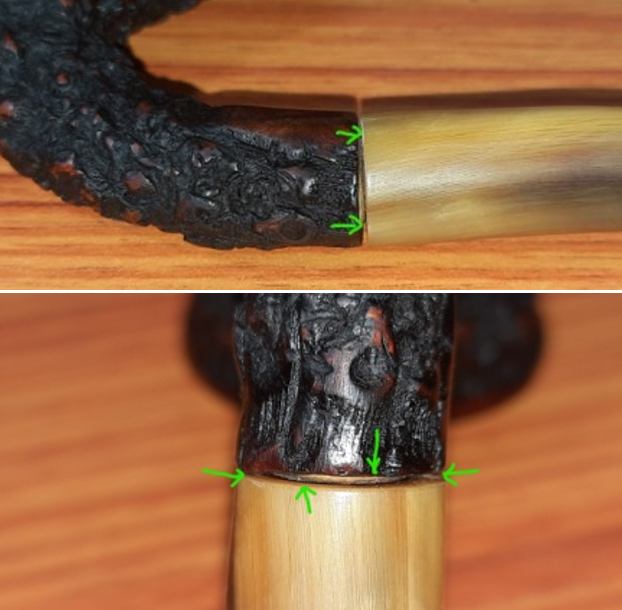
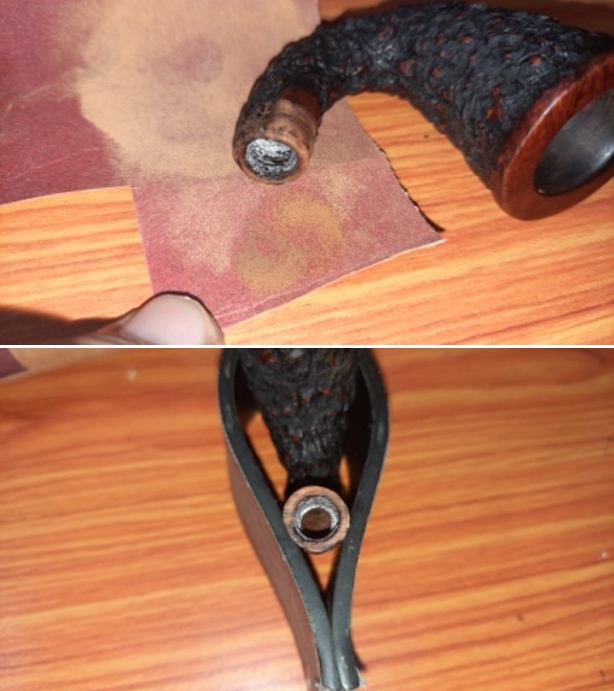
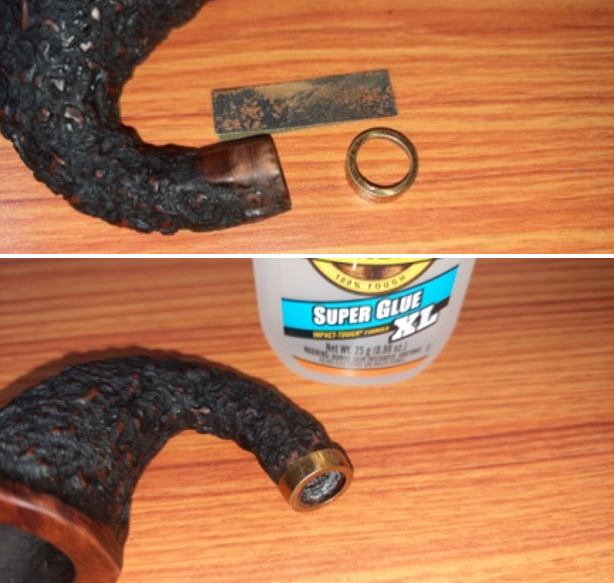
The process of transforming this pipe began with cleaning the chamber that had been reamed and cleaned before it reached me. With my fabricated knife, I completely removed the dust and little residual carbon from the walls of the chamber. I further cleaned the walls with a folded piece of 220 grit sand paper to completely remove the carbon from the walls and wiped the chamber with a cotton pad and alcohol. The charred surface at the inner rim edge was also gently scraped with the knife and sandpaper to remove the burnt briar till I reached solid briar underneath. Next, I cleaned the mortise and shank with regular and bristled pipe cleaners dipped in alcohol. At first I just could not get the pipe cleaner to pass through the mortise and out through the draught hole. I then inserted the pipe cleaner through the draught hole and with some efforts; it came out through the mortise dislodging some dried gunk from the air way as it came out. Other than the stuck dried gunk, the mortise was clean and just a couple of pipe cleaners were put to use. I was particularly deliberate in cleaning the threads in the mortise in preparation of further repairs to improve the seating of the threaded tenon, the process for which will be covered subsequently.After I was done with the internal cleaning of the stummel, I cleaned the external surface. I generously applied Murphy’s oil soap with a hard bristled tooth brush and scrubbed the stummel and rim top with the soap. I washed the stummel under running warm water with anti oil dish washing detergent and brass wired brush till the stummel surface was clean and dried it using paper towels and soft cotton cloth. The rim top surface was deliberately cleaned with a Scotch Brite pad to further remove the charred wood from the rim edge. I simultaneously cleaned the shank internals with the detergent and hard bristled shank brush. The stummel surface has cleaned up nicely with the scaly and thin lined rustication plainly visible. Truth be told, the stummel now appear more dull and unattractive to my eyes! Once the internals and the external surface of the stummel had been cleaned, I progress to rusticating the stummel. To rusticate, I firmly held the stummel in my left hand and using my right hand began gouging out the briar with my fabricated rusticating tool. The technique is to firmly press the pointed four prongs of the modified Philips screwdriver into the surface, rotate and gouge out the removed chunk of briar. I worked diligently till I was satisfied with the rustications and the appearance of the stummel. I was careful to avoid gouging too deep as the walls are not very thick and I feared that deep rustications will lead to further thinning of the walls and subsequent burn out. As I reviewed the rusticated stummel, the rustication is prominent while the thickness of the wall is not compromised at all. I am very pleased with the progress thus far. I cleaned the stummel surface with a brass wired wheel brush mounted on a handheld rotary tool. While cleaning the surface of all the debris, this rotating brass brush wheel also creates subtle patterns of its own and this adds an additional dimension to the appearance of the stummel. I sanded down the jagged high points in the rustication to a smooth and even surface using a worn out piece of 150 grit sand paper without compromising on the tactile feel to the hand.Next I decided to work on the damage to the rim top and inner rim edge. I topped the rim on a piece of 220 grit sand paper, checking frequently till I was satisfied that the darkened surface is addressed to an acceptable extent without compromising on the stummel profile and the rim top surface is nice, smooth and even. The darkened rim is still evident but the briar in this area is nice and solid and so I shall leave it be. All this while that I was working on the stummel, Abha quietly worked on the stem. She cleaned the stem internals with regular and bristled pipe cleaners dipped in alcohol. It didn’t take many pipe cleaners to get the stem air way clean.Next she sanded the stem surface with a 320 grit paper. This addressed the minor tooth indentations and bite marks on either surface in the bite zone. She progressively moved to polishing the stem through 400, 600, 800 and 1000 grit sand paper. She finished the stem refurbishing by wet sanding the stem with 1500 to 12000 grit micromesh pads. She rubbed a little Extra Virgin Olive oil into the stem surface to hydrate it and set it aside to be absorbed into the bone. Next I polished the rim top and the high spots in the rustication using micromesh pads, wet sanding with 1500 to 12000 grit pads. I wiped the bowl with a moist cloth after each pad to clean the surface. I am happy with the appearance of the stummel at this point in the restoration. The stummel is now ready for a fresh coat of stain.I wanted to highlight the difference between the rusticated and the smooth stummel surface. I decided to stain the rusticated surface with a black dye which would contrast beautifully with the browns of the rim top and the raised knobs of the rustications. I heated the rusticated portion of the stummel surface with my heat gun to open up the pores on the stummel so that the stain is well absorbed. I used Fiebing’s Black Leather dye and liberally applied it over the heated surface, flaming it with a lighter as I went ahead to different self designated zones on the surface. This helps in the setting of the stain in the grain of the briar. I ensured that every inch of the rusticated surface is coated with the dye. I immediately followed it by wiping the raised portions of the rustication with cotton pad and alcohol to lighten the knobs. Once polished, these will contrast with the black of the rest of the stummel surface. I set the stummel aside overnight for the dye to set into the briar surface.  The following day, I again wiped the stummel with a cotton swab and alcohol to remove any excess stain and followed it up by sanding the raised rustication with a folded piece of 320 grit sand paper. This was followed up by careful dry sanding of the entire stummel, especially the raised rustications with 1500 to 12000 grit micromesh pads. This lightens and highlights the high spots in the rustications. Next, I rubbed a small quantity of “Before and After Restoration Balm” in to the briar with my finger tips, working it deep into the rustications and let it rest for a few minutes. The balm almost immediately works its magic and the briar now has a nice vibrant appearance over the smooth surface with the beautiful rusticated patterns on full display. I further buffed it with a horse hair shoe brush. The only issue that remains unaddressed at this stage is the issue of loose and overturned seating of the stem into the mortise. I had the option of using the clear nail polish to tighten the seating but that would have been a temporary solution as the threaded bone tenon was way too loose fitting in to the mortise and no amount of smoking would have tightened the mortise to the required extent and hence was dropped. I decided on using CA superglue for the purpose. I applied a coat of superglue over the threads of both the mortise and tenon and let it set for a few seconds.  Thereafter, I threaded the tenon in to the mortise till the stem was perfectly aligned and again held it in place for a few seconds for the superglue to take the shape of the threads. I repeated the process once over and achieved a perfectly aligned and snug seating of the stem in to mortise. It was at this juncture that a new issue came to the fore as I was taking pictures of the stem and shank junction under magnification. The green arrows tell the story!Closer inspection revealed that the cause of this gap was the uneven shank end and the tenon was not flush with the stem face (which by the way is also not perfectly shaped). The gap was more on the lower surface than the upper. To address these issues, I firstly topped the shank face on a piece of 220 grit sandpaper till it was even. I was extremely careful while topping so that there was minimum loss of briar as the tenon was already slightly long and I had no desire to increase this gap any further. Secondly, I bridged the gap between the shank face and stem by using a brass band. This also added a nice touch of bling to the entire pipe. I like the way the pipe has shaped up. To complete the restoration, I first mounted a cotton cloth buffing wheel that is dedicated for use with Blue Diamond, onto my hand held rotary tool.  I set the speed at about half of the full power and polished the stem. The Blue Diamond compound helps to erase the minor scratches that are left behind even after micromesh polishing cycle and followed it by applying several coats of carnauba wax with a cotton cloth buffing wheel dedicated to Carnauba Wax. I finished the restoration by giving the entire pipe a rigorous hand buffing using a microfiber cloth to deepen the shine further. The finished pipe looks amazingly beautiful and has undergone quite a transformation. With its perfectly balanced weight, a nice full bent shape and light weight, this is a perfect pipe for clenching while working. This is one pipe that will I feel will not disappoint either aesthetically or functionally. In case this beauty calls out to you, please let me know and we shall work out a mutually beneficial deal. I wish to thank our esteemed readers for sparing their valuable time to read through and any input or advice is always welcome. And how can I not thank Abha, my wife for her patient efforts in imparting glass like finish to the stem and rim top surface!

Praying for the safety and well being of you and yours…stay home, stay safe and get your vaccines please.

It is about time to Breath Life into a new Frankenpipe


Blog by Steve Laug

I have not created a Frankenpipe for a long time. I call them Frankenpipes with a tip of the hat to Mary Shelley’s grand creation Frankenstein. These remind me of her story what with the gathering of parts, “stitching” them together and breathing life into them. It is a thoroughly creative process I enjoy and I suppose there is always the possibility of crafting of a monster. Over the years I have crafted quite a few of these pipes and they tend to stay in my collection. You can search on the blog and see the variety of Frankenpipes that have come together. I find them incredibly enjoyable because they are very different from a restoration. Truly it is looking at a bunch of parts and imagining combining them into something that reflects the parts but as a whole it very different from any of them.

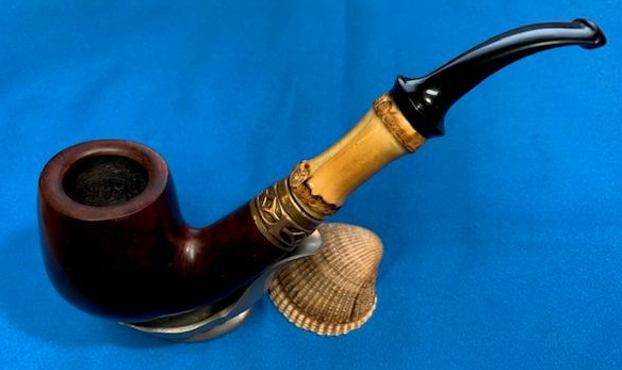
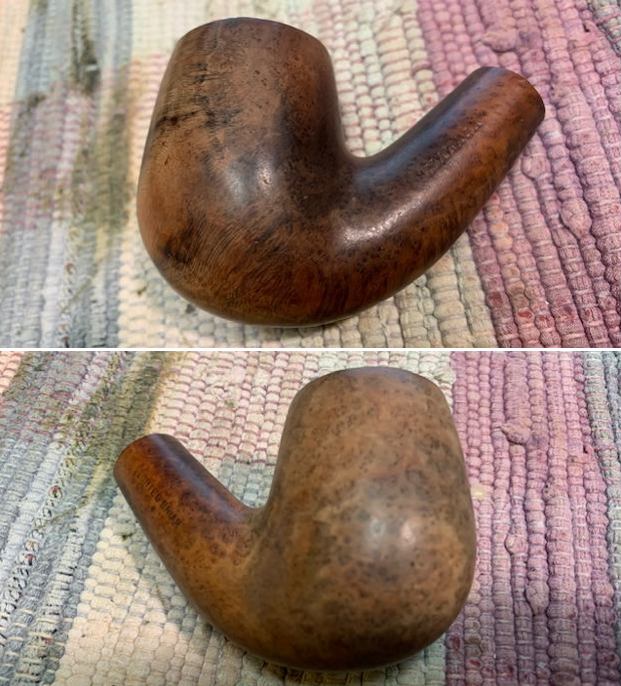
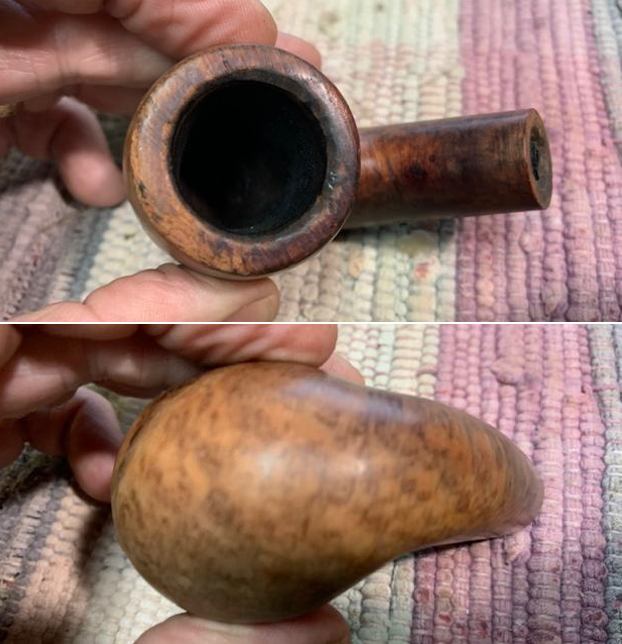
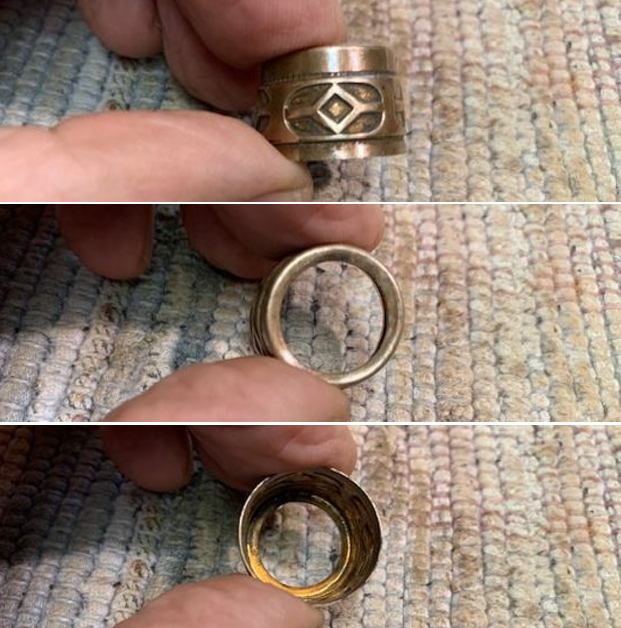
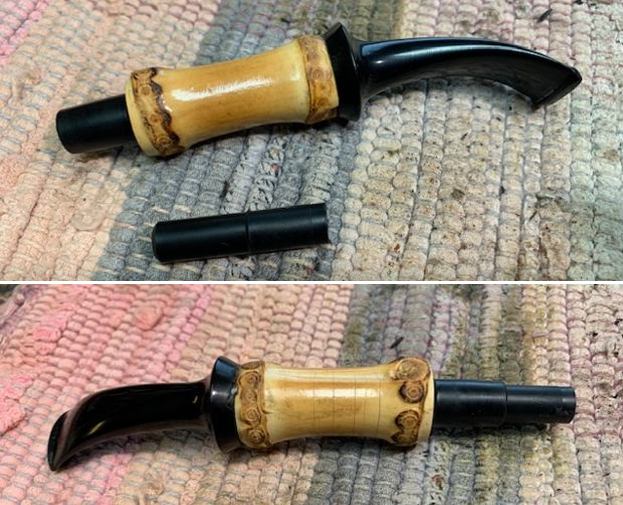
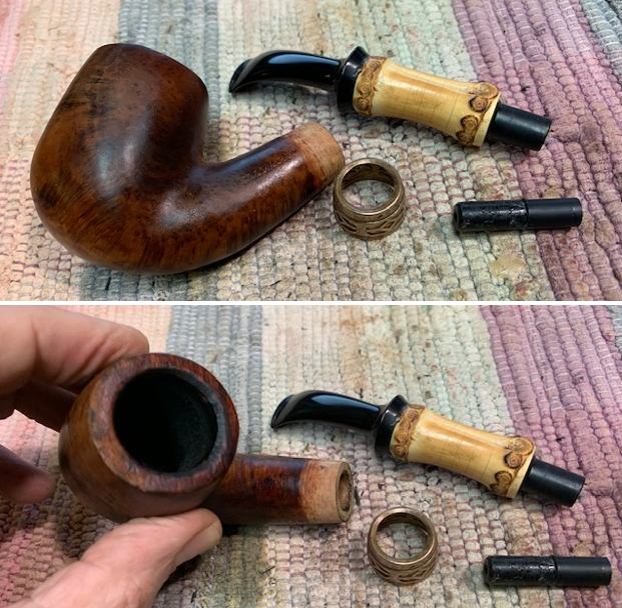
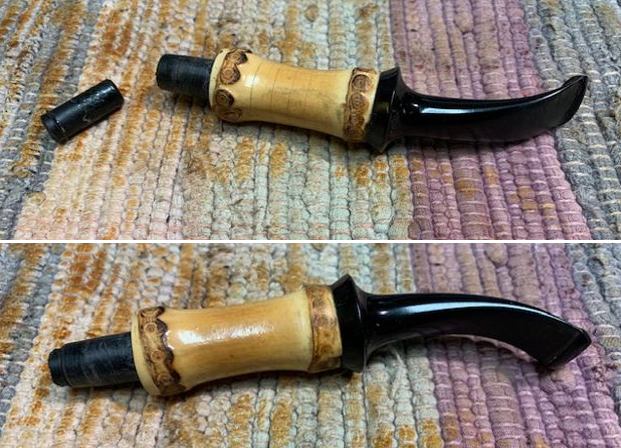
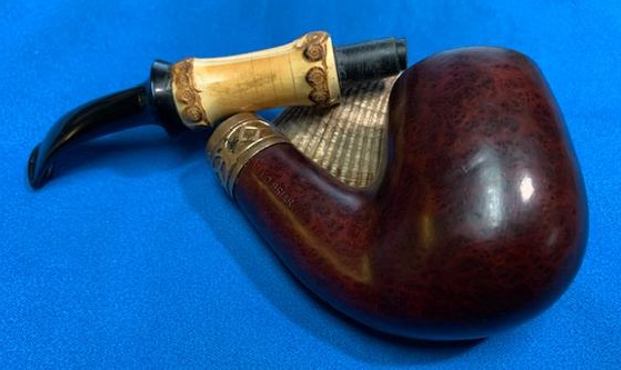
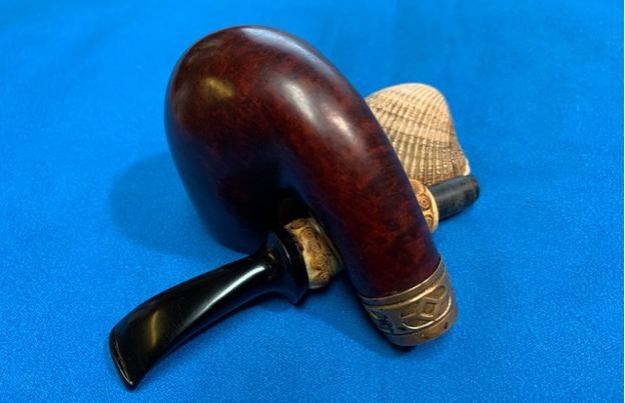
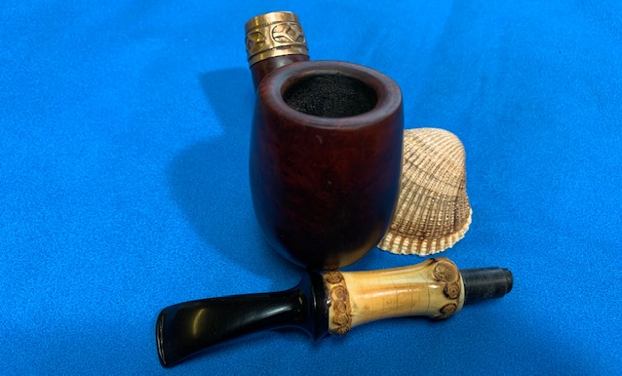
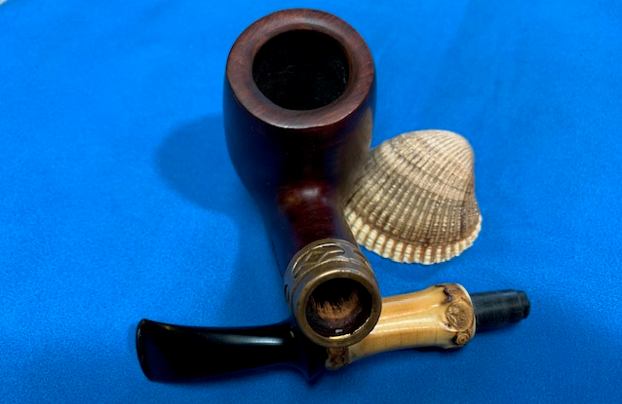
This afternoon I had an urge to make a Frankenpipe so after work I went through my parts. I found some parts that with some imagination could make an interesting looking pipe – at least in my mind’s eye. The parts for this Frankenpipe have all been around for a long time. The bowl is one I have had in a box here that had a snapped tenon in the shank. The stem had disappeared a long time ago and I did not have a stem for it that interested me. It is a large magnum sized “Malaga” bowl. It is far from a perfect piece of briar with a bald spot on the front left of the bowl. The rim top has burn marks and the bowl is out of round – thicker on the front side of the bowl than either side of the back of the bowl. The inner edge had a burned in “bevel” on the back right. The finish was worn and tired with black streaks over the bald spot on the left front of the bowl. It needed some serious TLC to bring life to it. Jeff had done his thorough clean up on the bowl so it was ready to work on. Here is what I saw with the bowl! As I stared at the bowl I thought that a band might look interesting on it. Don’t ask me why because as yet I had not chosen a stem for the bowl. I just thought a band would work. I went through my box of bands and nothing turned my crank or caught my eye. Then I remembered a bag of parts that I have from the mid to late 1800s. In that bag were several unique and original bands. There was one that caught my eye and I really thought it had promise. I took it out of the bag and found that it was in excellent condition and was probably never used. Here are some pictures of the decorative brass band.At that point I had an aha moment. I remembered an odd stem that I had in my collection of stems that just might be the thing that I was looking for on this Frankenpipe. It was unique and one that Jeff had picked up and save for me. I had never found a use for it but now I thought I might have. The two knuckle bamboo shank and acrylic stem is a single that has bend bonded together. The stem is thus a unit with the bamboo and the Delrin tenon on the other end is also integrated. It is drilled for a filter so I found a repair tenon that I could craft into an adapter to convert the tenon to a regular pipe sans filter. It would be removable if needed. Here is what it looked like with and without the tenon adapter. (The adapter would need to be shortened but you get the idea.)All of the parts have been here for quite a while. All of them give silent testimony to my crazy propensity to collect parts!! And all of them would finally come together to form a new Frankenpipe that was more than the sum of its parts. Read along as I walk through my process.

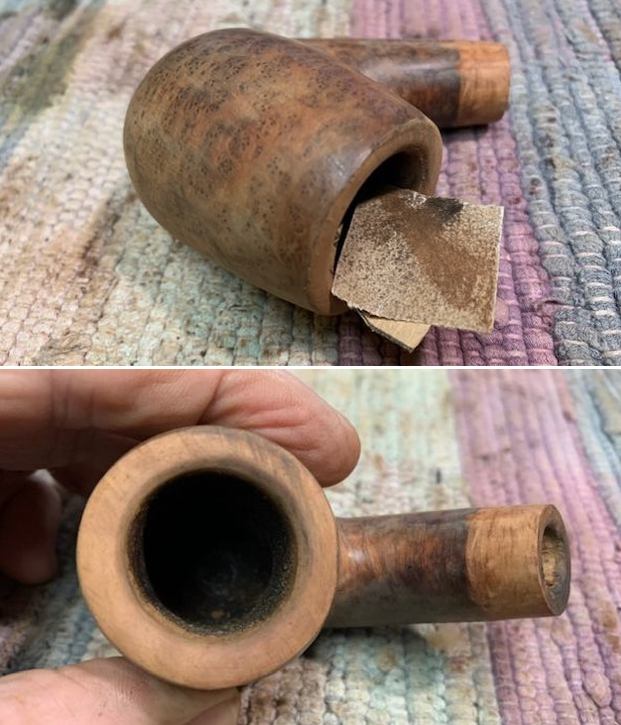
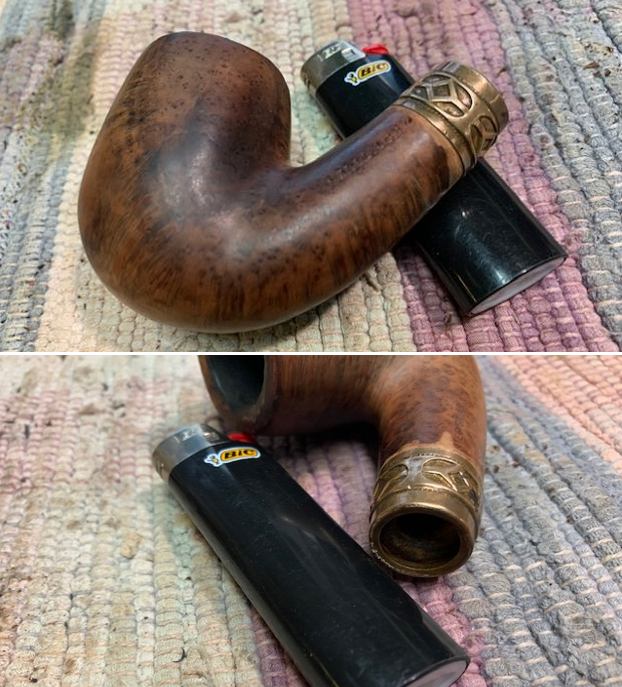
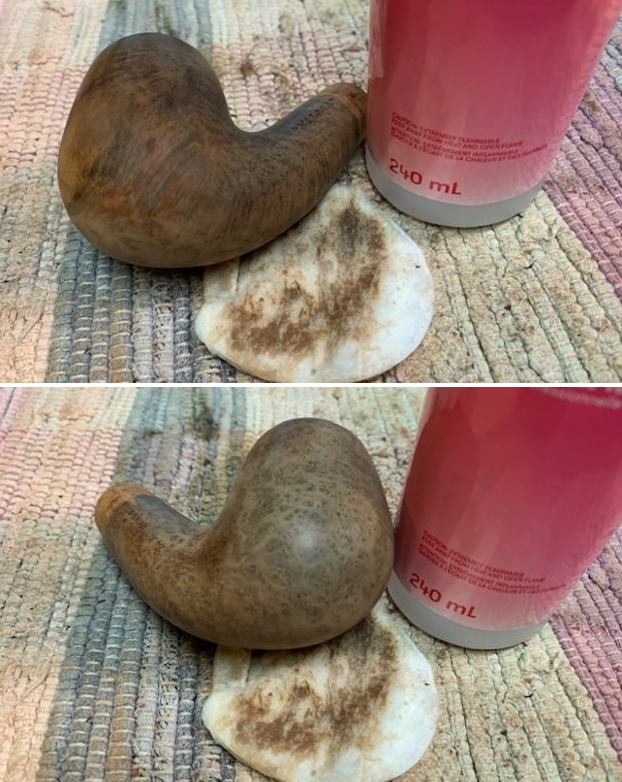
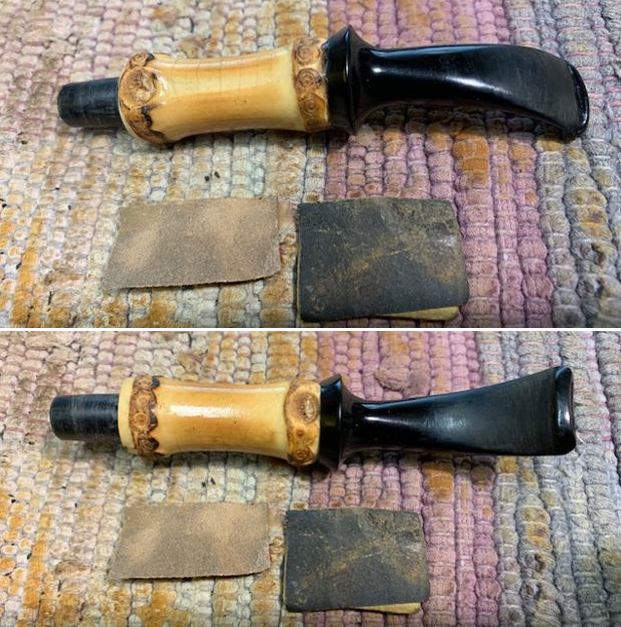
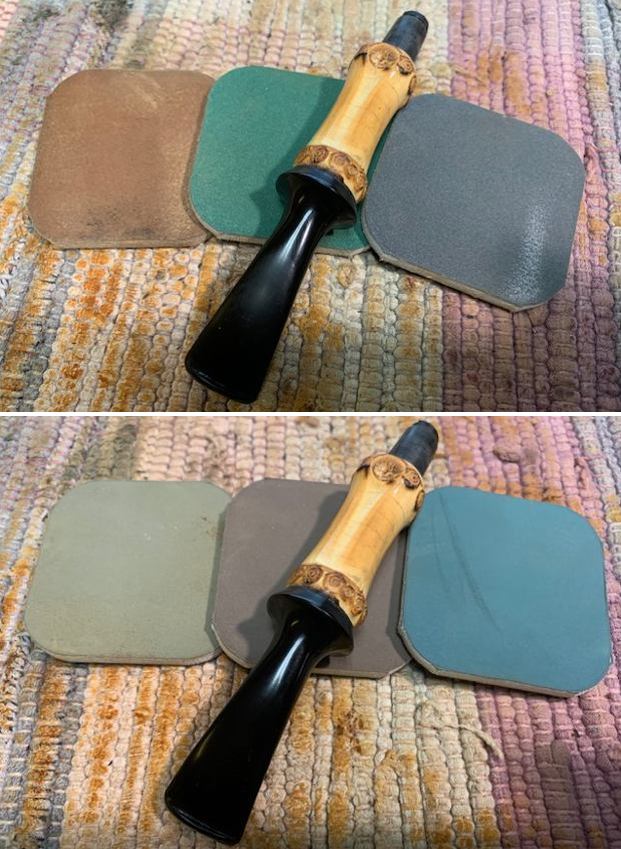
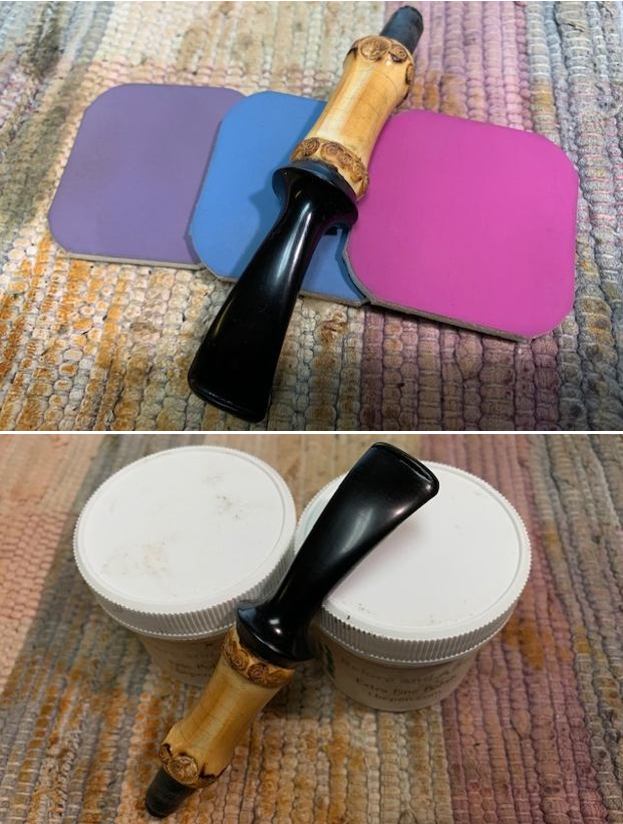
I began the work by addressing the issues with the bowl. I tried to pull the broken tenon with a screw. It was stuck so I put the bowl in the freezer for a little while. After about 10 minutes I tried again and was successful pulling the tenon out of the shank.With that finished I need to address the shank of the pipe to fit the conical ferrule/band that I had chosen. In the next photos you can see that I have chosen to shape the shank end to match the flow of the band. I did this with a Dremel and sanding drum and smooth it out with files and sandpaper. I was careful to leave the original Malaga stamp intact. I was not as concerned with the Imported Briar stamp on the right side of the shank. Progress is being made.I did a bit more shaping on the shank end. The decorative band now fit it quite well. I put the parts side by side and took some photos of the parts of the pipe. I took photos from various angles and sides. Can you begin to see what I am seeing with this pipe? I think it is going to work. Do you? Now back to work on the bowl! I decided to deal with the rim top damage by topping the bowl. It was in rough shape so I used 150 grit sandpaper on a topping board and remove the damaged parts of the rim top. It looked better. I worked over the inner edge of the rim with a folded piece of 150 sandpaper to give it all a bevel to match the burn damage at the back of the bowl. At this point I wanted to try the fit of the band on the shank. I heated it slightly with a lighter and pressed in place. I like what I am seeing. I removed the band once it cooled and went to work some more on the bowl. It needed to be polished and stained before I set the band in place but I wanted to have a look. Didn’t you? I wiped the bowl and shank down with acetone on a cotton pad to try to remove the dark patches and the remnants of the stain. All of this was in preparation for the future staining of the bowl. I polished the bowl with micromesh sanding pads – dry sanding with 1500-12000 grit pads to prepare it for staining. I wiped it down with a damp cloth to remove the debris after each pad. I stained the polished bowl with Fiebings Light Brown aniline stain. I applied the stain, flamed it and repeated the process until I was happy with the coverage. I set it aside to dry.Once the stain dried I wiped the bowl down with alcohol to make the stain more transparent. I buffed the pipe on the buffer with both Red Tripoli and Blue Diamond to further reduce the heaviness of the colour. I worked some Before & After Restoration Balm into the surface of the briar with my finger tips. The product works to clean, enliven and protect the briar. I let it sit on the briar for 10 minutes then buffed it off with a soft cloth. With the bowl finished and the stain cured it was time to press the band in place. I gave it a thin layer of white all purpose glue on the inside of the band and pressed it onto the shank end. It looks quite fetching to me. I set it aside to let the glue cure but I like it! I set the bowl aside and worked on the tenon adapter and the stem surface. I used the Dremel and sanding drum to shorten the adapter until the fit in the tenon allowed the shank to fit snug against the shank end.With the internals finished it was time to work on the tooth marks and chatter on the surface of the acrylic stem. I sanded them smooth with a folded piece of 220 grit sandpaper. I started polishing the stem surface with 400 grit wet dry sandpaper.I polished the stem with micromesh sanding pads – 1500-12000 grit pads. I dry sanded the stem with the pads and wiped it down with a damp cloth after each pad. I finished the polishing with Before & After Pipe Stem Polish – both Fine and Extra Fine. I gave it a final buff with a cloth and Obsidian Oil. I put the parts of the Frankenpipe together and took the pipe to the buffer. I buffed it with Blue Diamond and really like the way the brass and bamboo polished up. They looked great after buffing. The bowl and stem also shone but I expected that really. The combination of the darker stain on the bowl, the antique brass band, the 2 knuckle bamboo with developing patina and the black acrylic stem came together even better than expected. I gave the pipe several coats of carnauba wax on the buffing wheel. I buffed it with a clean buffing pad to raise the shine and hand buffed it with a microfibre cloth to deepen the shine. The finished pipe really shone with rich hues. The dimensions of this Frankenpipe are Length: 5 ½ inches from the front of the bowl to tip of the stem, Height: 2 inches, Outer diameter of the bowl: 1 ¾ inches, Chamber diameter: 7/8 of an inch. The weight of the pipe is 69 grams/ 2.47 ounces. It really surprised me as it looks to be a much bigger pipe than it is. I would say it is Dunhill Group 5 pipe at least in terms of bowl size. It really is a beautiful pipe in person and it will be staying with me along with the other Frankenpipes I have crafted. I am looking forward to enjoying a bowl shortly. It was a fun pipe to work on. I hope you enjoyed the process as you read about it. Thank you for taking time to read about it. As Paresh says – Stay safe/Stay healthy.

New Life for a Butz-Choquin Regate 1282 Zulu


Blog by Steve Laug

The next pipe on the table is one that came to us from Australia. It went to Jeff first then was shipped to me. It is a well traveled pipe that was purchased in 2020 from the estate of a fellow pipeman in Australia, shipped to the US and then to Canada. The shape is very nice, with the forward canted bowl and the quarter bent stem. It is a great shape with a taper vulcanite stem. The finish was dirty with grime ground into the finish around the bowl sides. There was a thick cake in the bowl and lava overflow on the top of the rim – heavier on the backside of the rim top but nonetheless on the entire rim top. There was some burn damage on the right front inner beveled edge of the bowl. The pipe is stamped on the left side of the shank and reads Butz-Choquin at an angle [over] Regate. On the right side it reads St. Claude – France [over] the shape number 1282. The stem was lightly oxidized and there were tooth marks and chatter on both sides near the button. The taper stem also has a BC stamped on the left side. Jeff took some photos of the pipe before he started the clean up work. He took photos of the rim top and bowl to give a clear picture of the thickness of the cake and well as the nicks, lava and darkening on the rim top. The inner edges showed some burn damage on the inner bevel of the bowl. The outer edges of the bowl appeared to be in great condition. He also took photos of the top and underside of the stem to show the light oxidation and the chatter and tooth marks. Jeff took a photo the sides and heel of the bowl to give a picture of the beautiful grain around the bowl and shank. There were also shiny spots of varnish around the bowl and shank sides. The stamping on the sides of the shank is clear and readable and read as noted above. There is also BC stamp on the left side of the stem. I turned to Pipephil’s site and looked for information on the Butz – Choquin Regate I was working on (http://pipephil.eu/logos/en/logo-butzchoquin.html). As always there was a good, brief description of the history of the brand.

I turned to Pipedia (https://pipedia.org/wiki/Butz-Choquin) to see what I could find on the brand that the Regate line there. I found a catalogue page from Doug Valitchka on the Regate that listed the pipe line and a description (https://pipedia.org/wiki/File:BC10.jpg). I have captured that image below. The description under the Regate heading reads –

Regate (and the description below is in both French and English)

Les veines classique qui rallie les suffrages de la plupart des fumeurs

A great classic which meets with the approval of the majority of smokers.

I have also included another picture from Doug Valitchka that shows the shape of the pipe that I am working on (https://pipedia.org/wiki/File:BC06.jpg). It is the second shape that is shown on the page – Shape 1282. The shape is called a Genoises. Now it was time to work on the pipe. Jeff had cleaned up the pipe following his usual procedures. He reamed the pipe with a PipNet pipe reamer and cleaned up the remnants with a Savinelli Fitsall Pipe Knife. He cleaned out the inside of the shank and the airway in the stem with 99% isopropyl alcohol, cotton swabs and pipe cleaners. He scrubbed the exterior of the bowl with undiluted Murphy’s Oil Soap and a tooth brush. He rinsed it under running warm water to remove the soap and grime. He soaked the stem in Before & After Deoxidizer and rinsed it off with warm water. I took photos of the pipe once I received it.  The rim top cleaned up really well. But the cleaning revealed some serious burn damage on the rim top and front inner edge toward the right side. The stem surface looked good and the light tooth marks and chatter would be easy to address. The stamping on the sides of the shank is readable and reads as noted above.I removed the stem and took a photo of the pipe to give a sense of the shape and the grain on the bowl and shank. It was a great looking shape and would be a beautiful pipe when I was finished. I decided to start my work on the pipe by wiping the bowl down with acetone on a cotton pad to remove the heavy stain around parts of the bowl sides. I wanted really be able to see the grain on the bowl. I dealt with the damage to the rim top by topping it on a topping board with 220 grit sandpaper. I cleaned up the beveled inner edge of the rim with 220 grit sandpaper to remove as much of the burn damage as possible. I polished the bowl with micromesh sanding pads – 1500-12000 grit pads. I wiped it down with a damp cloth after each sanding pad.  It was beginning to look good to my eyes. I stained the inner edge and rim top with an Oak Stain Pen to match the rest of the surrounding bowl. It helps to blend in the burned area some more. The rim top and edges definitely look better than when I started.I rubbed the bowl and shank down with Before & After Restoration Balm. I worked it into the surface of the bowl sides and shank with my fingertips to clean, enliven and protect the briar. I let the balm sit for ten minutes then buffed the bowl with a cotton cloth to raise the shine. I set the bowl aside and turned my attention to the stem. I “painted” both sides of the stem with the flame of a lighter to lift the tooth marks. It did a great job and left only one deep mark on the underside and some lighter tooth marks on the topside along the button. I filled them in with clear CA glue and once it cured I used a small file to sharpen the edge of the button and smooth out the repair. I sanded the stem with 220 grit sandpaper to smooth out the repairs. I started polishing it with 400 grit sandpaper.  I used some white acrylic fingernail polish to touch up the BC stamp on the left side of the stem. I painted it on with the brush and once it dried scraped it off and sanded it with a 1500 grit micromesh sanding pad.I polished the stem with micromesh sanding pads – 1500-12000 grit pads. I wiped it down with Obsidian Oil after each sanding pad. I used Before & After Pipe Polish – both Fine and Extra Fine to further polish the stem. This Butz-Choquin Regate 1282 Zulu is a great looking pipe now that it has been restored. The combination of various brown stains around the bowl is quite beautiful and highlights grain very well. The finish works well with the polished curved vulcanite taper stem. I put the stem back on the bowl and carefully buffed the pipe with Blue Diamond on the buffing wheel using a light touch on the briar. I gave the bowl and the stem multiple coats of carnauba wax on the buffing wheel and followed that by buffing the entire pipe with a clean buffing pad. I hand buffed the pipe with a microfiber cloth to deepen the shine. The finished Butz-Choquin Regate Zulu sits nicely in the hand and feels great. Give the finished pipe a look in the photos below. The dimensions of the pipe are Length: 6 inches, Height: 1 ¾ inches, Outside diameter of the bowl: 1 ¼ inches, Chamber diameter: ¾ inch. The weight of the pipe is 35 grams/1.23 ounces. I will be putting it on the French Pipemakers section of the rebornpipes store shortly. If you are interested in adding this pipe to your collection send me a message or an email. Thanks for reading this blog and my reflections on the pipe while I worked on it. There are many more to come! 

Restoring and Repairing a Cracked Shank on a John Surrey Ltd Super Panel Lovat


Blog by Steve Laug

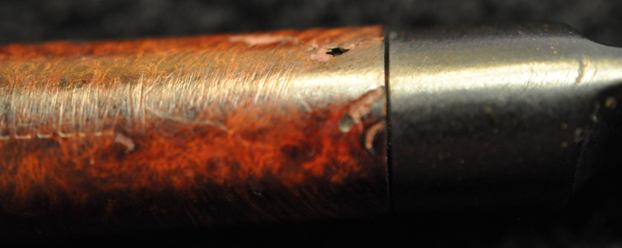
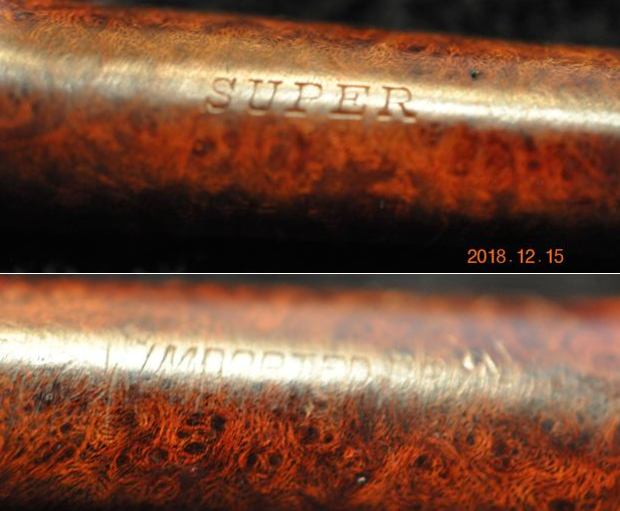
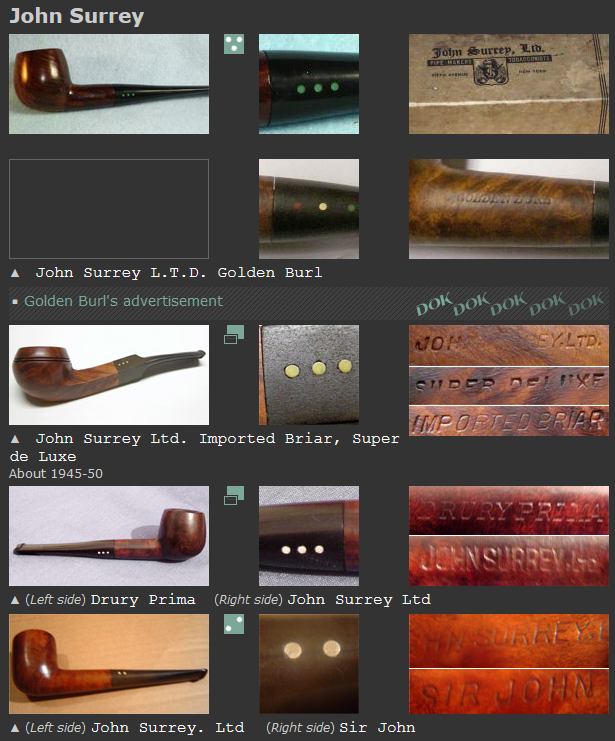
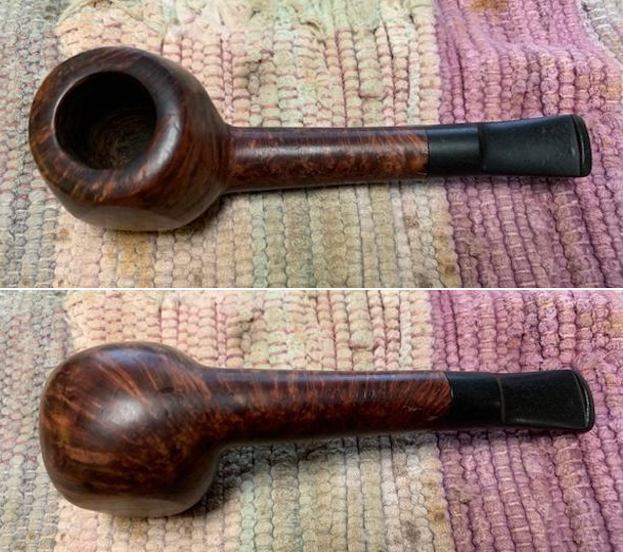
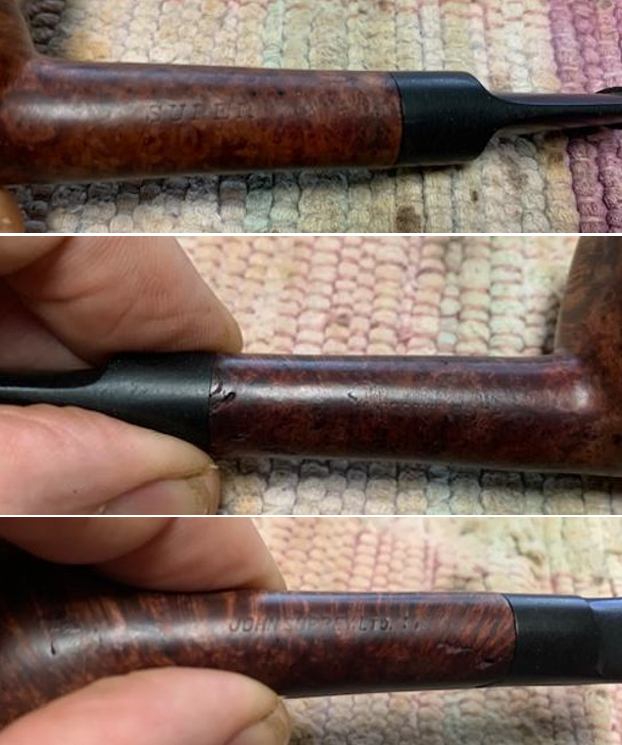
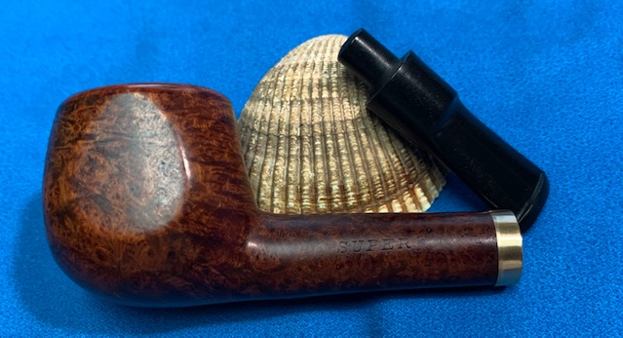
The next pipe on the table is one that we picked up back in 2018 and have no clear record of where and when we picked it up. The shape is what attracted us to the pipe. It is a unique shape with the panels on the bowl and the short Lovat style shank with a saddle stem. The finish was dirty with grime ground into the finish around the bowl sides. There were also some cracks in right side mid shank and on the lower part as well. The cracks were in the middle of some fills on that side of the bowl. There was a thick cake in the bowl and lava overflow on the top of the rim. There was also tobacco debris in the bowl. The stem was lightly oxidized and there were tooth marks and chatter on both sides near the button. The pipe is stamped on the left side of the shank and reads SUPER. On the right side it reads IMPORTED BRIAR. On the underside it is stamped John Surrey Ltd. The stamping is all clear and readable. He took photos of the rim top and bowl to give a clear picture of the thickness of the cake and well as the nicks, lava and darkening on the rim top. The inner and outer edges of the bowl were in great condition. He also took photos of the top and underside of the stem to show the light oxidation and the chatter and tooth marks.  Jeff took a photo the sides and heel of the bowl to give a picture of the beautiful grain around the bowl and shank. He also took a photo of the fills and damage to the right and underside of the shank – there were fills that had fallen out and there was a crack that needed attention.The stamping on the sides of the shank is clear and readable and read as noted above. Jeff did not take a photo of the John Surrey Ltd. stamp on the underside of the shank. I turned to Pipephil’s site and looked for information on the John Surrey Ltd pipe company (http://pipephil.eu/logos/en/logo-j3.html). I found that the company, John Surrey, Ltd. was originally located at 509 Fifth Avenue New York City, New York in the USA. I also did a screen capture of the section on the brand. Interestingly the Super line is not included in the list but all of the other pipes in the section are stamped with the same style stamping as the one I am working on. The closest one is the John Surrey Ltd. Imported Briar Super Deluxe. It is possible that the Deluxe stamp is worn off on this one but it is not clear.I turned to Pipedia in the US pipe makers section to see if I could find some more information on the brand (https://pipedia.org/wiki/John_Surrey_Ltd.). I found a short summary which I include below regarding the brand.

John Surrey Ltd. made John Surrey pipes. They were based at 509 Fifth Ave, New York. And in 1948 the company put a pipe on the market which sold very successfully: the Slugger Baseball Pipe (shank and stem like a baseball bat, and bowl similar to a baseball).

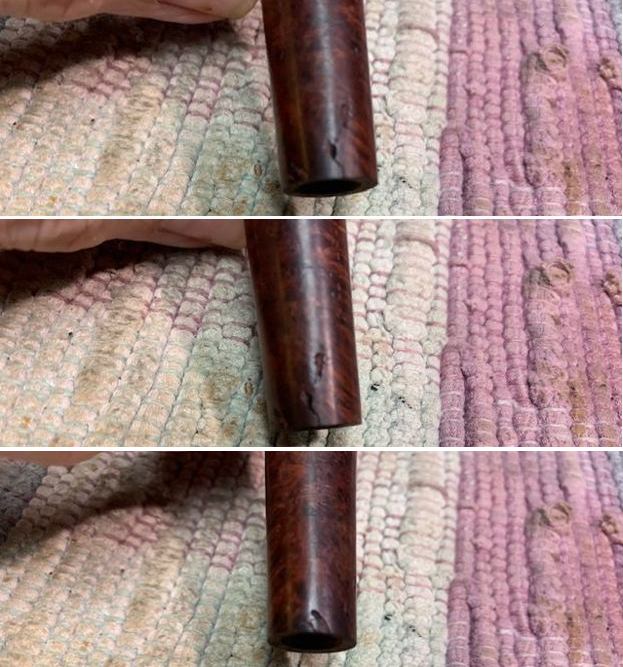
That was the extent of the information so it was not time to work on the pipe. Jeff had cleaned up the pipe following his usual procedures. He reamed the pipe with a PipNet pipe reamer and cleaned up the remnants with a Savinelli Fitsall Pipe Knife. He cleaned out the inside of the shank and the airway in the stem with 99% isopropyl alcohol, cotton swabs and pipe cleaners. He scrubbed the exterior of the bowl with undiluted Murphy’s Oil Soap and a tooth brush. He rinsed it under running warm water to remove the soap and grime. He soaked the stem in Before & After Deoxidizer and rinsed it off with warm water. I took photos of the pipe once I received it. The crowned rim top cleaned up really well. The rim top had a lot of nicks and deep gouges in it but the inner and outer edge of the bowl appeared to be in good condition. The stem surface looked very good and the tooth marks chatter on the stem on both sides near the button could probably be sanded out. The stamping on the sides of the shank is readable and reads as noted above.  I removed the stem and took two photos of the pipe to give a sense of the shape and the grain on the bowl and shank. It was a unique shape and would be a beautiful pipe when I was finished. I took a series of photos of the cracks on the shank and flaws where the putty fills had fallen out.I decided to start my work on the pipe by dealing with the damage on the shank end. I filled in the crack and the damaged fills with briar dust and clear CA glue. I found a thin brass band in my band collection that was a perfect fit on the shank so once the repair had cured and I sanded it down I fitted a band. I put a thin bead of glue around the shank end and pressed the band in place. It bound the repaired areas together and it gave the shank a touch of bling. I took some photos of the banded shank to give a picture of what I was seeing! I dealt with the damage to the rim top by topping it on a topping board with 220 grit sandpaper. Like so many other things in this process I also would need to redo the crowned rim top once I was finished.I wiped the bowl down with acetone on a cotton pad to remove the heavy stain around parts of the bowl sides. I wanted really be able to see the grain on the bowl. I also used this in preparation for reworking the bowl crown.I used a flat file to take down the outer edge and bevel it to bring the crowned rim back to the top of the bowl. I sanded the outer filed edge and the inner edge to give a slight inward bevel with 220 grit sandpaper to smooth out the file marks and fine tune the shape of the rim.I polished the newly shaped rim top and edges along with the rest of the bowl with micromesh sanding pads – 1500-12000 grit pads. I wiped it down with a damp cloth after each sanding pad. It was beginning to look good to my eyes. I forgot to take a photo of the underside at this point. I paused the polishing to stain the rim top and edges of the bowl with an Oak Stain Pen. I wanted to see if I could blend it into the bowl sides. I also touched up the light spots on the bowl sides at the same time. Once I finished that I buffed the bowl with Blue Diamond on the buffing wheel and returned to finish the polishing with 6000-12000 grit micromesh pads. I rubbed the bowl and shank down with Before & After Restoration Balm. I worked it into the surface of the bowl sides and shank with my fingertips to clean, enliven and protect the briar. I let the balm sit for ten minutes then buffed the bowl with a cotton cloth to raise the shine. I set the bowl aside and turned my attention to the stem. I “painted” both sides of the stem with the flame of a lighter to lift the tooth marks. It did a great job and left only one deep mark on the underside and some lighter tooth marks on the topside along the button. I filled them in with clear CA glue and once it cured I sanded the stem with 220 grit sandpaper to smooth out the repairs. I started polishing it with 400 grit sandpaper. I polished the stem with micromesh sanding pads – 1500-12000 grit pads. I wiped it down with Obsidian Oil after each sanding pad. I used Before & After Pipe Polish – both Fine and Extra Fine to further polish the stem.This John Surrey Ltd. Super Imported Briar Panel Lovat is a great looking pipe now that it has been restored. The combination of various brown stains around the bowl is quite beautiful and highlights grain very well. The finish works well with the thin brass band on the shank end and the polished vulcanite saddle stem. I put the stem back on the bowl and carefully buffed the pipe with Blue Diamond on the buffing wheel using a light touch on the briar. I gave the bowl and the stem multiple coats of carnauba wax on the buffing wheel and followed that by buffing the entire pipe with a clean buffing pad. I hand buffed the pipe with a microfiber cloth to deepen the shine. The finished John Surrey Ltd. Super Panel Lovat sits nicely in the hand and feels great. Give the finished pipe a look in the photos below. The dimensions of the pipe are Length: 4 ¾ inches, Height: 1 ½ inches, Outside diameter of the bowl: 1 ¼ inches, Chamber diameter: ¾ inch. The weight of the pipe is 38 grams/1.34 ounces. I will be putting it on the American (US) Pipemakers section of the rebornpipes store shortly. If you are interested in adding this pipe to your collection send me a message or an email. Thanks for reading this blog and my reflections on the pipe while I worked on it. There are many more to come!

Restoring a Sandblast Medico Ventilator Bent Billiard


Blog by Steve Laug

A while back I received a small box of pipes from a fellow pipeman who wanted to donate them to support  the non-profit organization I work for – the SA Foundation (www.safoundation.com). The organization has been providing long term recovery, housing and job training for women who have escaped sexual exploitation and trafficking. For over thirty years the work has gone on and thousands of young women and their children have been empowered to start over with skills and options. The work is currently in 7 countries and 12 cities around the world. If you are interested give the website a look.

Now back to the pipes. There were eight total pipes in the lot that he sent me. The first one I restored was a large Irish Second 05 Calabash that is heading off to Michigan. The second pipe was a Peterson’s Kapet pipe in a shape 124 (https://rebornpipes.com/2021/08/16/restoring-a-republic-era-petersons-kapet-124/). The third pipe was a very Danish looking Made in London, England Sandblast Acorn. (https://rebornpipes.com/2021/08/17/restoring-a-very-danish-looking-made-in-london-england-acorn/). The fourth pipe was a Bromma Bent Billiard with a screw on bowl (https://rebornpipes.com/2021/08/18/restoring-what-looks-like-a-swedish-bromma-pipe/). The fifth pipe is a Canadian Made Paradis Pipe (https://rebornpipes.com/2021/08/19/restoring-canadian-made-paradis-rustic-246-bent-dublin/). The sixth pipe was an unsmoked small carved figural meerschaum that is for sale on the rebornpipes store (https://rebornpipes.com/rebornpipes-store/meerschaum-pipes-smooth-figurals/).  All of the pipes were in clean condition and had been lightly reamed.

The next pipe, the seventh one is a bent Medico Ventilator with an aluminum slotted, ventilated shank. The pipe was clean on the inside but dusty on the sandblast finish. The sandblast was very well done and quite rugged. The rim top and edges looked very good. I think that this pipe was not smoked very much. The pipe was stamped on the flat heel of the bowl and read Medico [over] Ventilator [over] Imported Briar. The aluminum shank was dull looking but otherwise in great condition. The short bent saddle stem had a lot of tooth chatter and marks on both sides ahead of the button. There was a V logo stamped on the left side of the stem. The aluminum tenon was made to hold the classic Medico paper filter. I took some photos of the pipe before I started my clean up work on it. I took photos of the bowl and rim top as well as the stem to show the condition of the pipe. The rim top was dusty and worn looking but it was otherwise clean. The bowl was slightly misshapen like I have seen before on these Ventilator pipe. It is not quite round with the thicker edges on the front of the bowl and narrower on the sides and rear of the bowl. The stem had a lot of tooth chatter and some deep tooth marks on both the top and bottom. I took a photo of the stamping on the underside of the heel of the bowl. It was clear and readable as noted above. I removed the stem from the shank and took a photo of the pipe. The great sandblast and the unique design of the Ventilator is visible in the photo. I turned to Pipephil’s site for a quick summary (http://pipephil.eu/logos/en/logo-medico.html). I have included a screen capture of the information on the site.I also quote the information from the side bar of the entry on pipephil:

This model cannot be smoked without the use of the rolled paper filters.Others metal pipes logos & markings in these pages: Alco, Bryson, Duncan, Falcon, Kaywoodie (Filter Pipe , Filter plus, Filtronic), Ornsby

I turned to Pipedia for more info (https://pipedia.org/wiki/Medico). There was a brief writeup on the history of the brand and the paper filtration system but nothing specific on the Ventilator pipes.

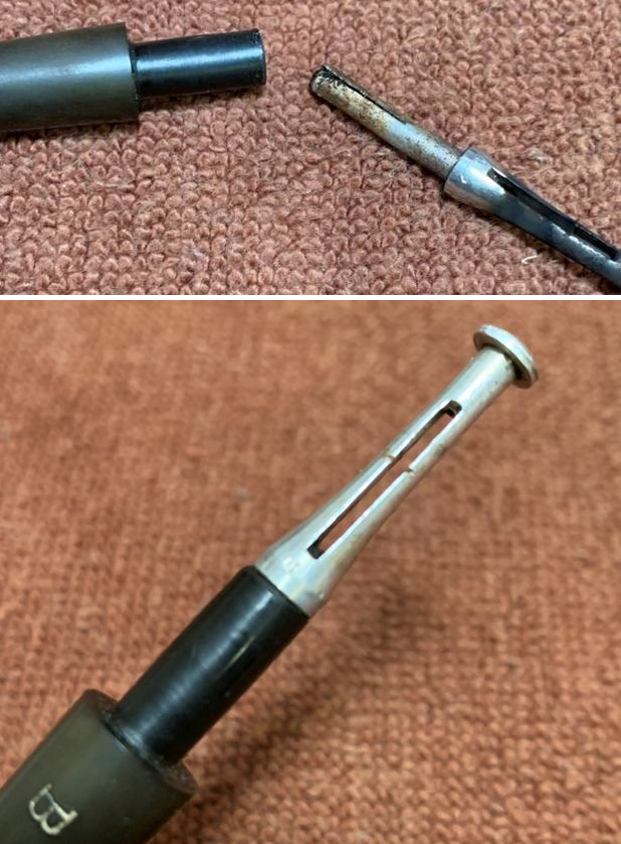
Now it was time to work on the pipe. I started my work on the pipe by scrubbing the bowl and shank exterior with undiluted Murphy’s Oil Soap. I scrubbed the sandblast and the aluminum with a tooth brush and the soap and rinsed it off with running water. I dried it off with a cotton towel. I touched up the stain on the rim top with a Walnut Stain Pen. It matched the rest of the bowl colour perfectly.I cleaned the mortise/and aluminum shank along with the airway in both the shank and the stem with 99% isopropyl alcohol, pipe cleaners and cotton swabs until the interior of the pipe was very clean.I rubbed the bowl and the briar portion of shank down with Before & After Restoration Balm. I worked it into the surface of the bowl sides and shank with my fingertips to clean, enliven and protect the briar. I let the balm sit for ten minutes then buffed the bowl with a cotton cloth to raise the shine. I polished the aluminum ventilated shank with micromesh sanding pads – dry sanding it with 1500-12000 grit pads. I wiped it down with a clean paper towel after each sanding pad. The aluminum took on a rich shine with the polishing.I set the bowl aside and turned my attention to the stem. There was a plastic/hard clear rubber insert that fit in the aluminum ventilated shank to hold the stem tightly in place. When I removed the stem the insert came out as well and was stuck on the aluminum tenon of the stem. I carefully used a pair of vise grips to hold the rubber insert and slowly turned the stem until I was able to remove it. Once the aluminum shank was cleaned I would glue it in place in the shank so that it would stay in place there. I coated the outside of the hard rubber/acrylic ring with white all-purpose glue and pushed it into place in the aluminum ventilator shank. I removed the stem and set the bowl and shank aside for the glue to cure.I “painted” the tooth marks and chatter on the stem surface with the flame of a lighter to try and raise the dents. The stem is a typical Medico stem which seems to be a mix of vulcanite and plastic or nylon so the flame did very little. I filled the tooth chatter and marks in with clear CA glue and set it aside to cure. Once it cured I used a small file to flatten out the repairs and reshape the button edge. I used 220 grit sandpaper to smooth out the repairs on both sides of the stem. I started to polish it with 400 grit wet dry sandpaper. The stem is looking much better. I polished the stem with micromesh sanding pads – 1500-12000 grit pads. I wiped it down with Obsidian Oil after each sanding pad. I used Before & After Pipe Polish – both Fine and Extra Fine to further polish the stem. I gave it a final rubdown with Obsidian Oil and set it aside to cure. I fitted the stem and shank with a Medico paper filter. It fit in the tenon and in the aluminum shank. All air flow from the bowl came through the filter and the cool air came in through the aluminum ventilator shank. The theory is it provided a cool smoke – mind you soggy but cool!I put the parts back together. This Medico Ventilator Imported Briar Bent Billiard is a great looking pipe with a great sandblast on the bowl. The rich, dark brown stained  sandblast bowl and the ventilated polished aluminum shank look surprisingly nice. The combination works well with the polished saddle stem. I carefully buffed the pipe with Blue Diamond on the buffing wheel using a light touch on the briar. I gave the bowl and the stem multiple coats of carnauba wax on the buffing wheel and followed that by buffing the entire pipe with a clean buffing pad. I hand buffed the pipe with a microfiber cloth to deepen the shine. The finished Medico Ventilator Bent Billiard is light and sits nicely in the hand and feels great. Give the finished pipe a look in the photos below. The dimensions of the pipe are Length: 5 ½ inches, Height: 1 ¾ inches, Outside diameter of the bowl: 1 ¼ inches, Chamber diameter: ¾ of an inch. The weight of the pipe is 44 grams/1.52 ounces. I will be putting it on the rebornpipes store shortly in the American (US) Pipemakers Section. If you are interested in adding this pipe to your collection send me a message or an email. Thanks for reading this blog and my reflections on the pipe while I worked on it. There are many more to come!
Restaining and Restoring a Green 2015 St. Patrick’s Day 05 Calabash


Blog by Steve Laug

The next pipe has been sitting here for almost three years. I have picked it up and looked at quite a few times and always set it back down for another day. Today is finally the day. It is a nice 05 Calabash from Peterson of Dublin. It is a Limited Edition 2015 St. Patrick’s Day Pipe. It came with the box, slip cover and green pipe bag. We bought it in 2018 knowing that it had some issues. The biggest was that the right side of the bowl and shank had faded to almost a green wash while the rest of the pipe was fully green. A second issue always stopped me was that the pipe had been dipped in a thick coat of urethane or at least varnish. I would have to remove it if I was to restain the pipe. The stem had a decaying rubber softee bit on it and we all know those can hide anything from tooth marks to bite-throughs and we would not be sure until it was in our hands and we removed it. Jeff took photos of the pipe before he cleaned it up. Jeff took a photo of the rim top and bowl to show its condition. It is faded and washed out looking as much as the rest of the pipe. However it is also well smoked. The previous owner had smoked it but was careful with the rim edges and top – no burn damage or poor reaming. Those are redeeming features. He also took photos of the stem with the Softee bit in place and removed. Another redeeming feature was that underneath it was quite clean and undamaged. I let out a big WHEW once I saw that as it is a major amount of work avoided in stem repair.  He took photos of the sides and heel of the bowl to show the condition of the stain and the briar underneath. It is an interesting looking pipe. He took a photo of the stamping on the left side of the shank and you can see the thick urethane coat almost filling in the stamping. It is readable but it is also awful with the plastic coating on it.To be honest with all of you I am not a big fan of coloured pipes to begin with so this really is a hard one for me. I also really have no idea what the pipe must have looked like before the sun fading and thick urethane coat. Maybe it would be better? I was not sure so I decided to pause my work for a little longer and see what I could find out about the original 2015 St. Patrick’s Day pipe.

I Googled and found a site that had a decent description of the pipe. I could almost picture it from the words. It was a shop called Mission Pipe. You have to answer the age questions to get in but here is the link (https://www.missionpipe.com/peterson-2015-st-patrick-s-day-pipe). They had a photo but it was not that clear. I quote their description below.

Peterson 2015 St. Patrick’s Day Pipe – Peterson of Dublin just released their annual St. Patrick’s Day Pipe, and being their 150th Anniversary year, they went all out. The Peterson’s 2015 St. Patrick’s Day Pipe features an amazing emerald stain, carving reminiscent of Celtic knots on the bowl and rings of silver-colors that match the emerald perfectly…

Google next took me to Mark Irwin’s Peterson Pipe Notes site. His description was spot on and the photos showed me what I needed to know (https://petersonpipenotes.wordpress.com/tag/dr-jekyll-and-mr-hyde/). I quote below. I have also included a photo of the shape 05 that I have.

St. Patricks Day Pipe 2015 – A combination of smooth (green) and rustic (black) finishes with a smooth flat top at the top of the bow. The rustication is a Celtic knot. Twelve shapes (as shown): 01, 05, 68, 69, XL90. X220, 408, 338, 306, 304, 105, 106.I now knew what I was aiming for with the pipe in question. First the removal of the urethane then a restain with this objective in front of me. A carved Celtic Knot black band around the top edge of the bowl and then a very green stain that matched the green between the polished silver in the band on the shank end.

Jeff had cleaned up the pipe as he normally does. He reamed it with a Pipnet Reamer and cleaned up the reaming with a Savinelli Fitsall Pipeknife. He scrubbed out the inside of the airway in the shank and stem with alcohol, pipe cleaners and cotton swabs. He scrubbed the exterior of the bowl with undiluted Murphy’s Oil Soap to see if he could break down the plastic coat. Unfortunately it did absolutely nothing to that finish. He removed the Softee Bit and scrubbed the stem with Soft Scrubb. He soaked it in Before & After Deoxidizer. He rinsed it off and recleaned it. I took the following pictures when it arrived. That shiny coat kills me! I took photos of the rim top and the stem to show the condition of them both. The rim top is blotchy green in colour and the finish is not smooth. The heavy urethane coat is not smooth on the top. The stem looks very good and other than very light chatter it is in excellent condition. I took photos of the stamping on the shank sides. It is clear and readable but you can also see the high gloss shine of the urethane on the bowl in these photos. It is really quite thick.I took a photo of the bowl and stem separated to give a sense of the pipe but also to highlight the urethane coat the predominates the finish on this once beautiful pipe.Now it was time to try and strip the urethane coat off the bowl so I could restain it. It was going to be a lot of work. I sanded the bowl with 1500 grit micromesh sanding pads and also a medium and a fine sanding block to try and break up the urethane seal. I sanded for a while then wiped the bowl down with acetone. Eventually I was able to break through the urethane coat on the bowl sides and rim top. It sounds simple but I spent probably 3-4 hours sanding and wiping the bowl down with acetone to finally break through the plastic… a foul and loathsome thing!! With the finish finally removed I stained the Celtic Knot carving around the top of the bowl with a Black stain pen as it was in the original. The black looks very good at this point in the process.With that finished it was time to stain the bowl with the green stain. I chose a green stain that matched the green ring in the shank band. It is a Fiebing’s Kelly Green. I applied it with the wool dauber that came with the stain and flamed it to set it in the briar. The flame burns off the excess alcohol and opens the pores in the briar to let the colour into the grain. I repeated the process until I was happy with the coverage around the bowl. I set the bowl aside to cure and took a break on the front porch for a couple of hours. Before I called it a night I took the cork from the bowl and took photos of the newly stained bowl. I set aside the bowl to let the stain cure before going further with it. I turned my attention to the stem. I repainted the P stamp on the left side with some white acrylic nail polish. I brush it on and scrape of the excess with a fingernail. I lightly sanded it with a 1500 micromesh sanding pad and wiped it down with Obsidian Oil.I polished the stem with micromesh sanding pads – dry sanding with 1500-12000 grit pads and wiping it down after each pad with Obsidian Oil. I finished polishing it with Before & After Fine and Extra Fine polish. I gave it a final coat of Obsidian Oil and set it aside to dry.This Peterson of Dublin St. Patrick’s Day 2015 shape 05 Calabash is a great looking pipe now that it has been restored. The Kelly Green stained finish around the bowl is quite beautiful and highlights grain very well. It also matches the green in the shank band. The finish works well with the polished vulcanite taper stem. I put the stem back on the bowl and carefully buffed the pipe with Blue Diamond on the buffing wheel using a light touch on the briar. I gave the bowl and the stem multiple coats of carnauba wax on the buffing wheel and followed that by buffing the entire pipe with a clean buffing pad. I hand buffed the pipe with a microfiber cloth to deepen the shine. (In taking the photos I can see that I need to do a heavier buff on the bowl and will do so after the finish cures a day or two.) The finished St. Patrick’s Day 2015 Bent Calabash sits nicely in the hand and feels great. Give the finished pipe a look in the photos below. The dimensions of the pipe are Length: 5 ¼ inches, Height: 1 ¾ inches, Outside diameter of the bowl: 1 ½ inches, Chamber diameter: ¾ inch. The weight of the pipe is 48 grams/1.69 ounces. I will be putting it on the rebornpipes store shortly. If you are interested in adding this pipe to your collection send me a message or an email. Thanks for reading this blog and my reflections on the pipe while I worked on it. There are many more to come!