Tag Archives: fitting a stem

New Life for a Malaga Rusticated Canadian for Alex


Blog by Steve Laug

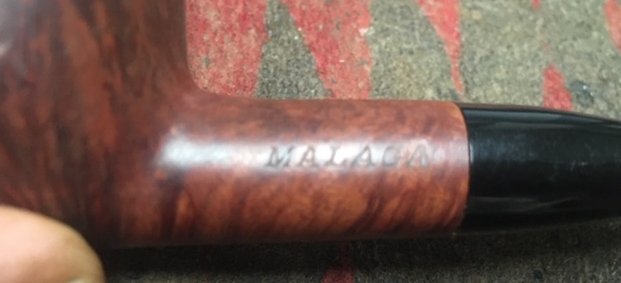
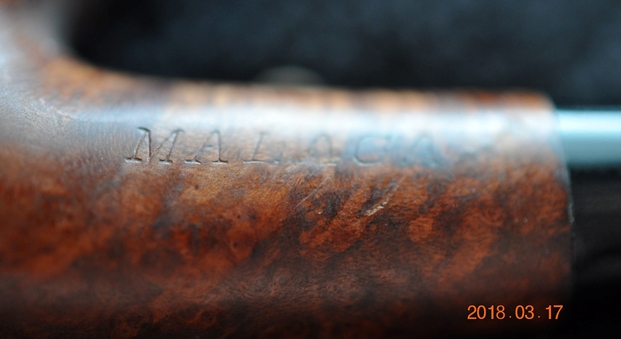
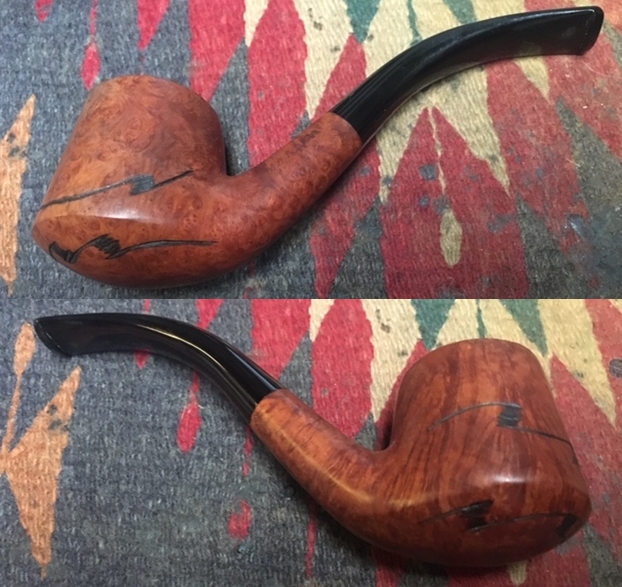
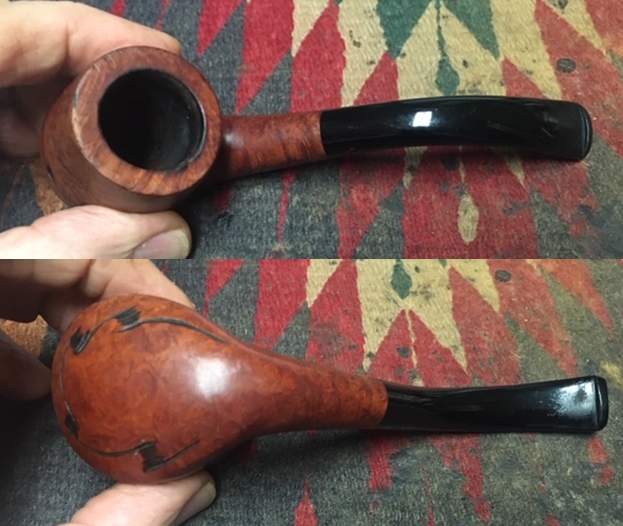
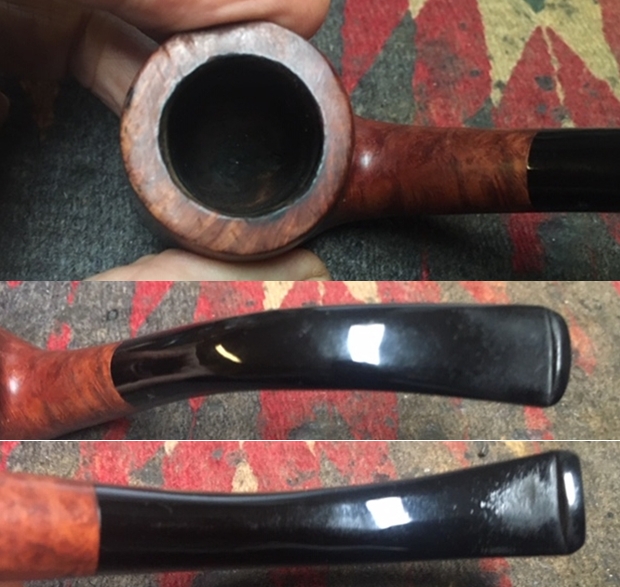
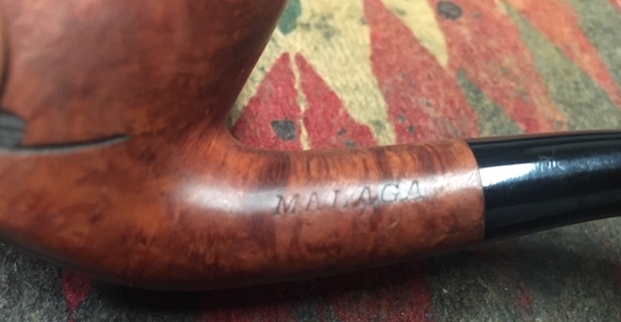
I have been working on a lot of different estate pipes and selling them for different families. Once in a while it is good to change things up a bit. Alex came by and went through the Malaga pipes I have awaiting restoration. He also brought other pipes to add to his box. I have a box of pipes from Alex that I am always working away at. He periodically drops more Malaga pipes into his box. There are quite a few of them to work on so I decided work on a few of them. The next one of these was another Malaga pipe. It is a beautiful oval shank Rusticated Canadian that has a very tight pattern of rustication. It also has a long striated grey/silver/black acrylic stem. The Malaga Canadian that Alex picked up from EBay. It had been mislabeled a Hungarian and the price was right. The pipe was dirty and caked when arrived. The rusticated rim top has a little lava filled but otherwise looked good. The bowl had a thin cake in it that was hard and dense. The exterior of the bowl and shank are very dirty with grime and oils from prolonged use. The stamping on the left side of the shank was in a smooth band on the thin shank. It read MALAGA. There was a thin band of smooth briar around the shank end. The acrylic stem was had tooth chatter on the top and the underside of the stem. I took photos of the pipe before I started the cleanup work. I took close up photos of the bowl and rim to capture the condition of the pipe before I started my cleanup work. The rim top had some lava embedded in the rusticated finish and was heavier on the back side. The outer and inner edges of the bowl were not too bad. The inside edge was clean and the outside looked very good. Other than being so dirty that it was in great condition. The stem was dirty and there was tooth chatter on the top and underside near the button and on the flat surfaces of the stem.I took a photo to capture the stamping on a smooth panel on the left side of the shank near the stem/shank joint. The photo shows the stamping MALAGA on the left side of the shank is very readable. If this is the first of the Malaga restorations that you have read about then you should know the backstory of the brand. I am including the link to a blog that I wrote that gives some of the history of the Malaga brand and the Malaga Pipe Shop in Royal Oak, Michigan in the USA. I have written an earlier blog to give a little history of the Malaga Brand and the pipemaker, George Khoubesser. Here is the link – https://rebornpipes.com/tag/malaga-pipes/.That blog also includes links to a catalogue and the history of the pipemaker George Khoubesser. Follow the link to get a feel for the brand and the pipemaker.

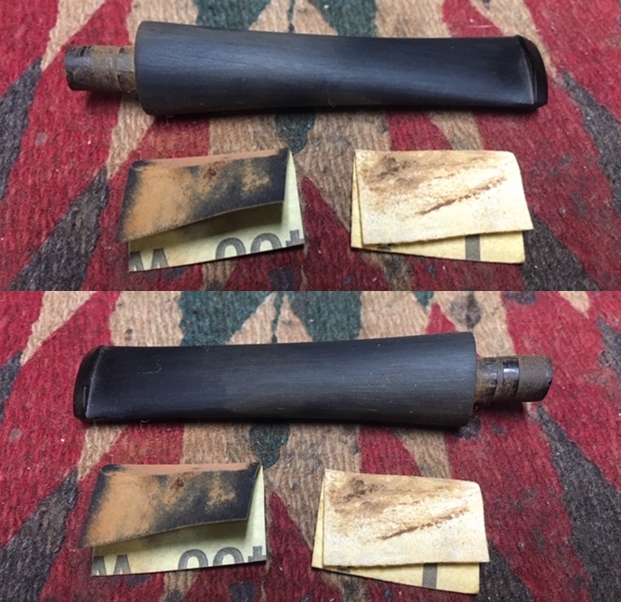
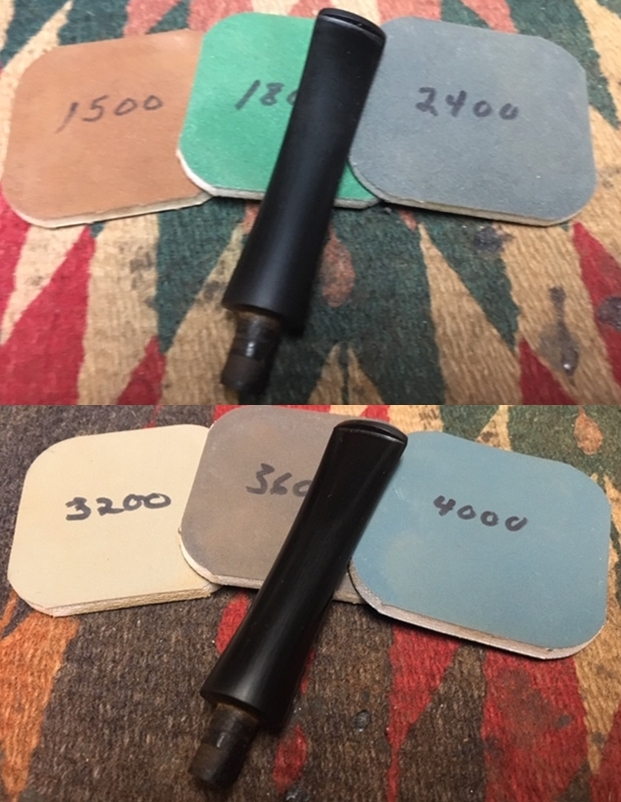
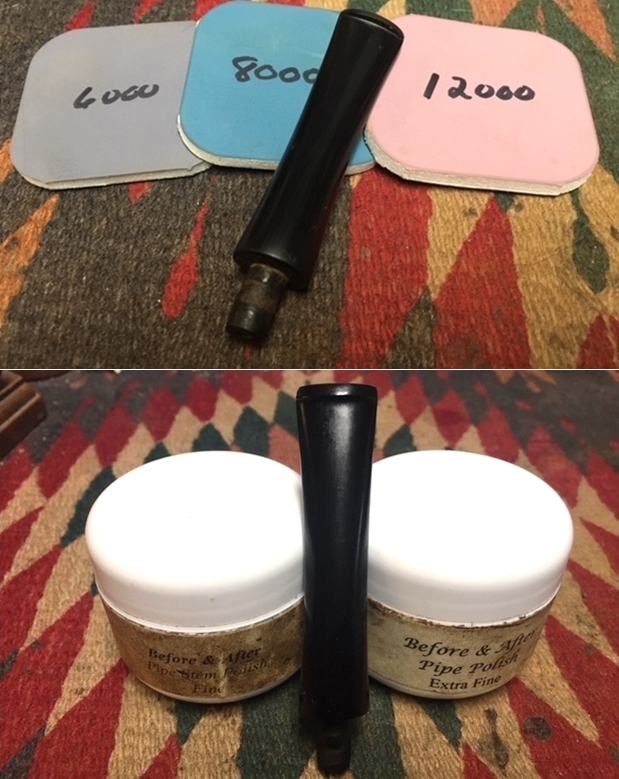
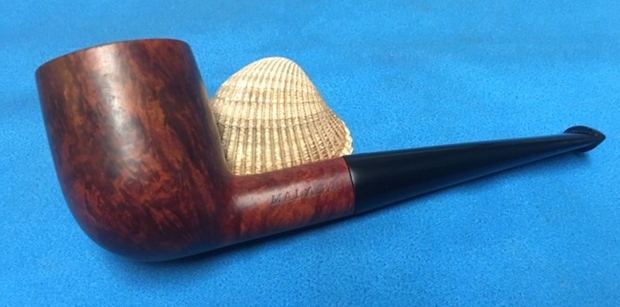
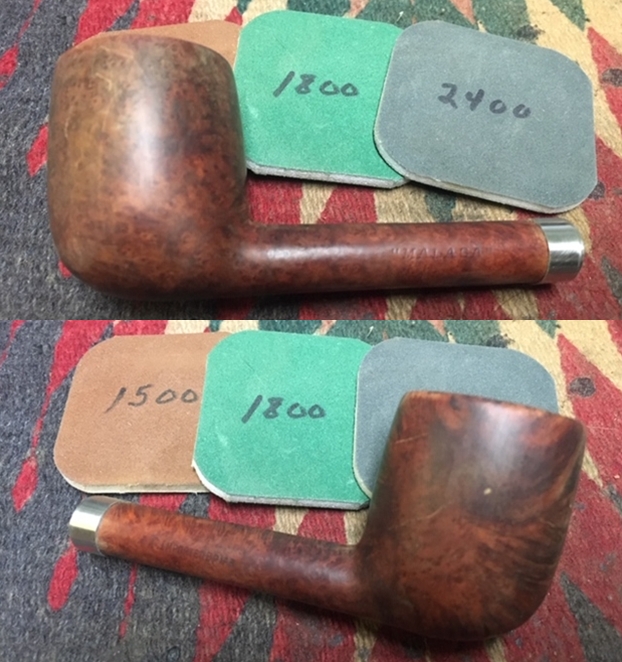
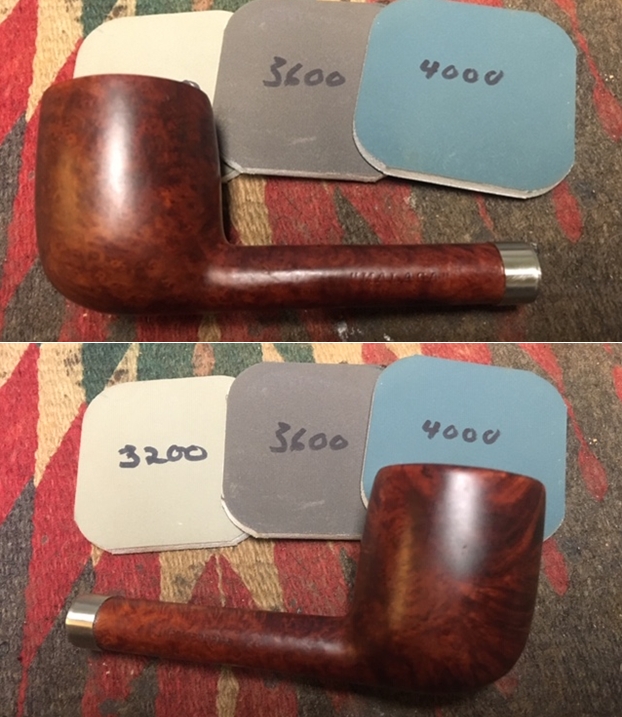
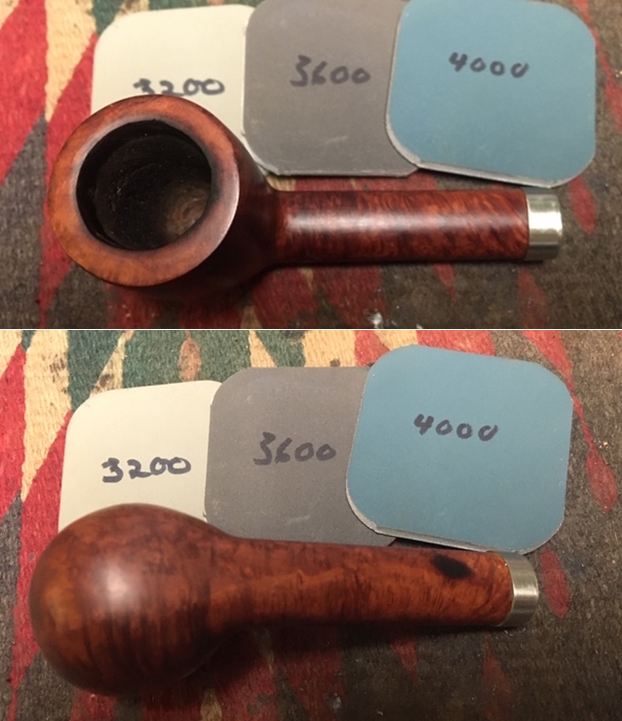
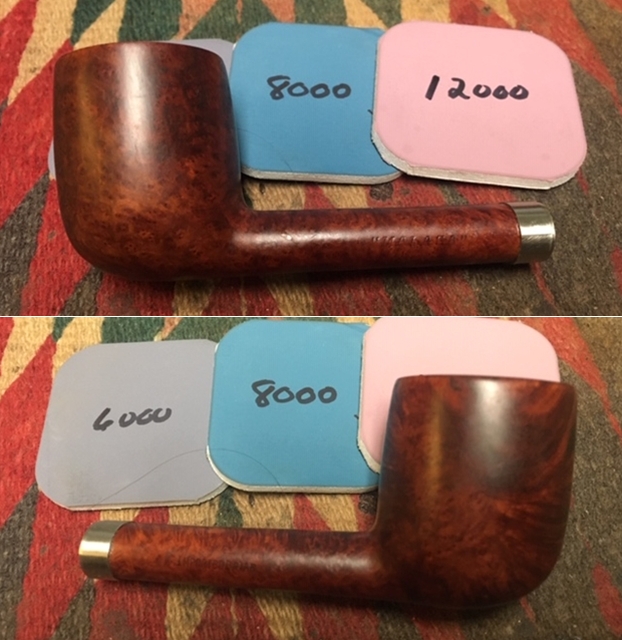
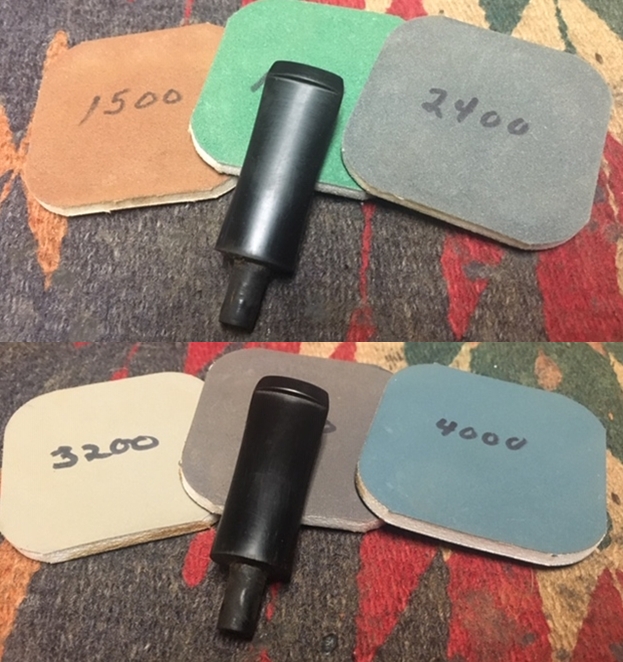
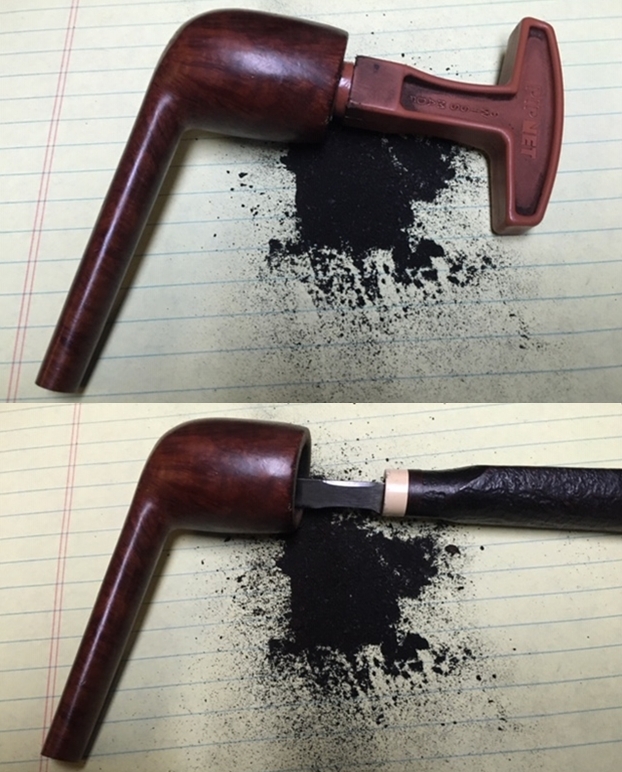
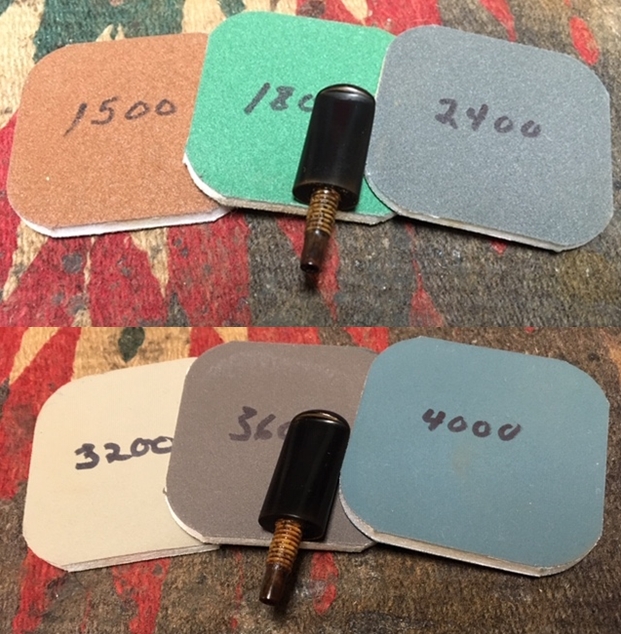
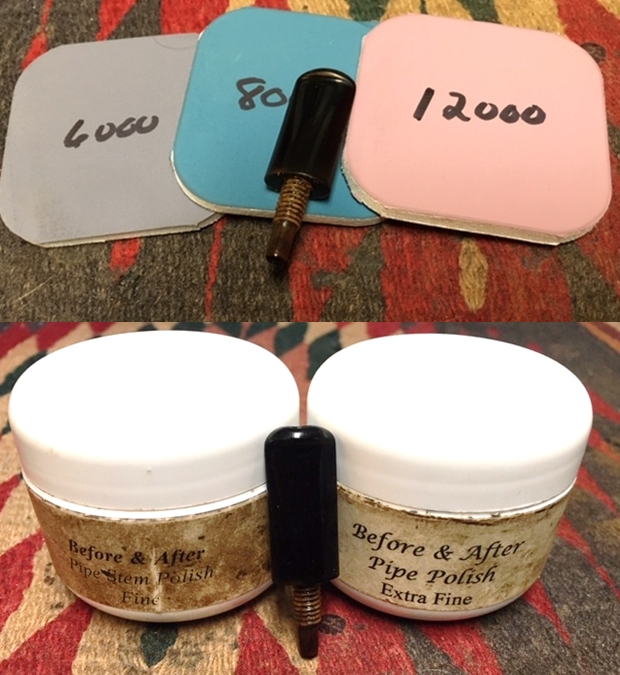
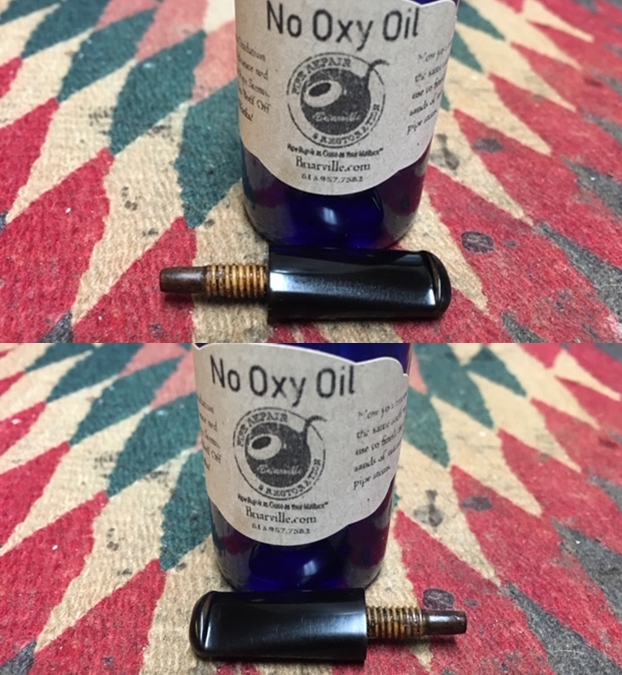
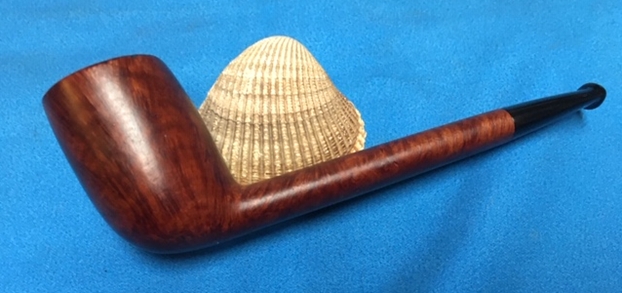
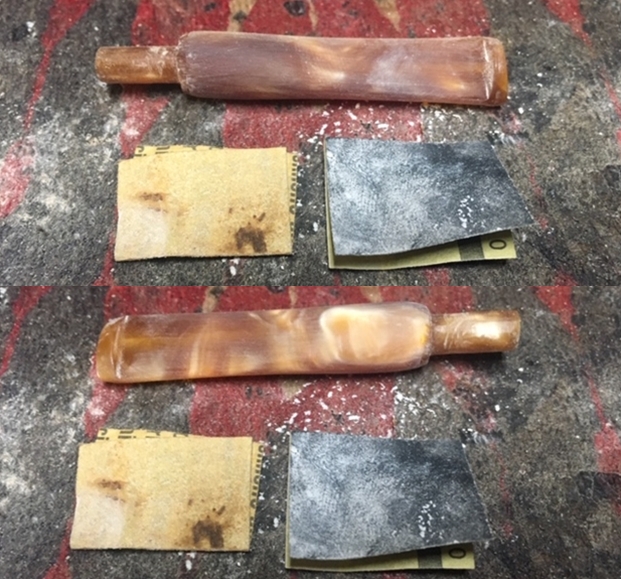
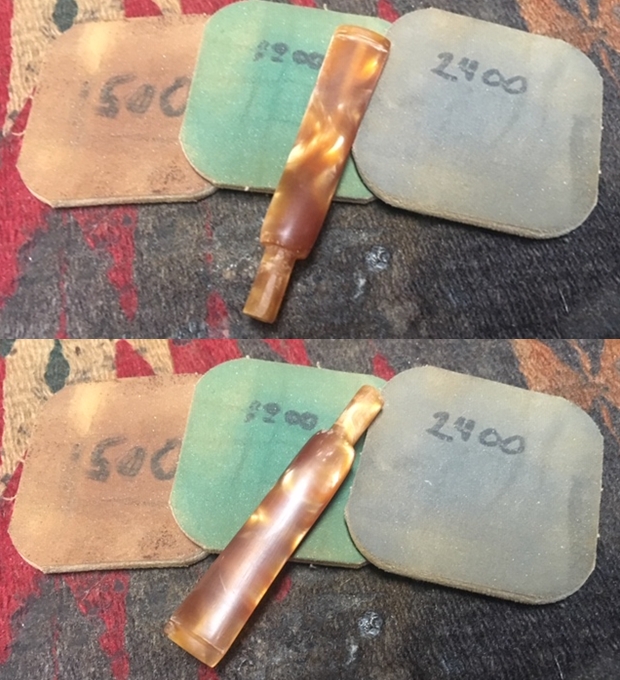
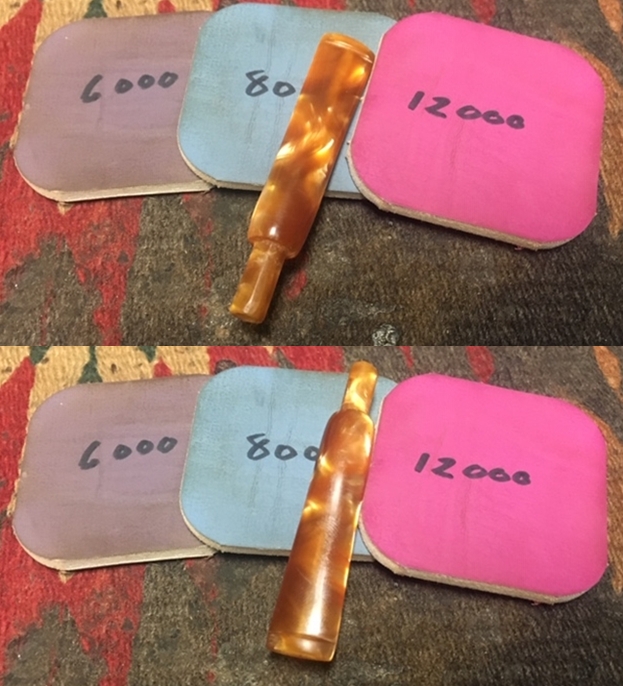
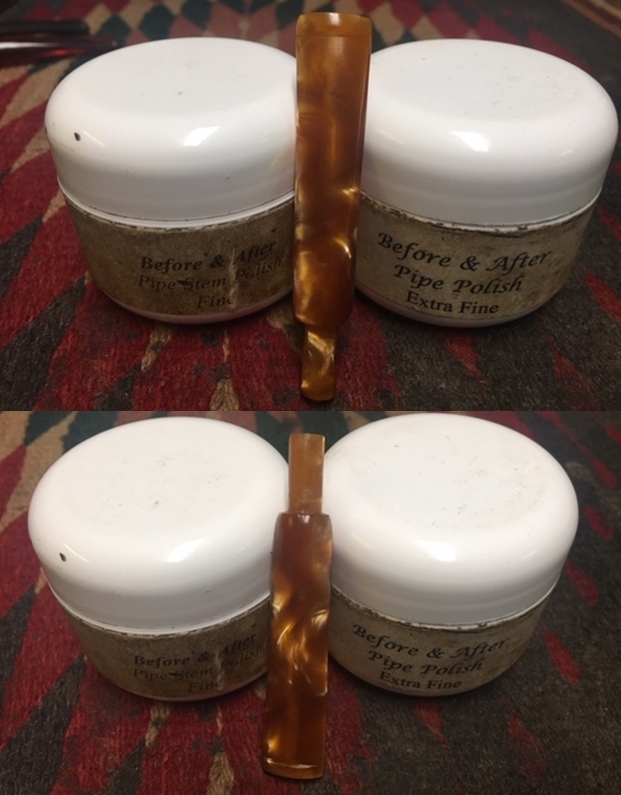
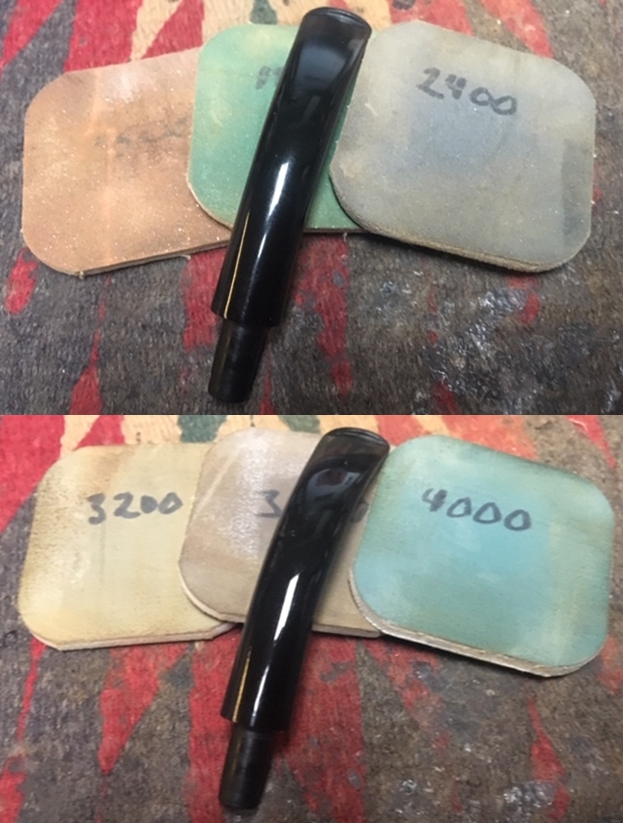
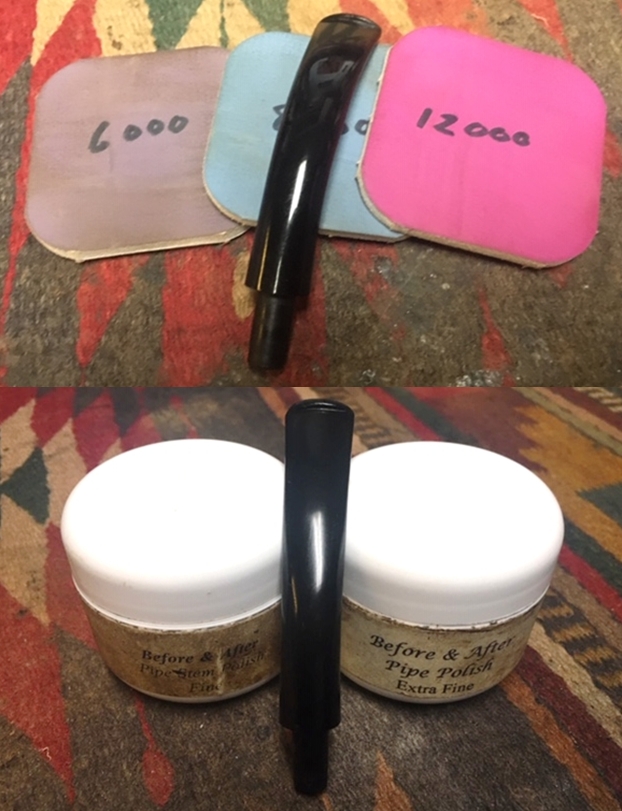
I followed our regular regimen for cleaning estates. I reamed the bowl with a PipNet pipe reamer and followed up with a Savinelli Fitsall pipe knife to remove the cake. I scraped out the dried tars and oils with a pen knife and then scrubbed out the mortise and the airway in the shank and the stem with alcohol, cotton swabs and pipe cleaners.I scrubbed the briar with Before & After Briar Cleaner. I rubbed it into the surface of the briar with my finger tips and let it sit for about 10 minutes then rinsed it off with running water. I dried it off with a soft cloth. I touched up the edges of the rim with a walnut stain pen to take care of the damage there. Then I worked some Before & After Restoration Balm into the surface of the briar with my fingertips and a horsehair shoe brush to clean, enliven and protect it. I let the balm sit for a little while and then buffed with a cotton cloth to raise the shine. The photos show the bowl at this point in the restoration process. The stem was in excellent condition but there was some light tooth chatter and no deep marks. It was well cut stem and had a great look and feel. I sanded out the tooth chatter with 220 grit sand paper and polished it with 400 wet dry sand paper. Once it was finished it began to shine.I polished the stem with micromesh sanding pads – wet sanding with 1500-12000 grit sanding pads. I wiped it down after each sanding pad with a damp cloth. I polished it with Before & After Pipe Stem Polish – both Fine and Extra Fine and buffed it off with a cotton cloth. This is a beautiful Malaga Rusticated Canadian with a variegated grey/black/silver acrylic stem. It has a great look and feel. The rustication is very tactile but also the pattern is well done and a tight pattern. It is a beauty. I polished stem and the bowl with Blue Diamond polish on the buffing wheel. I gave the bowl multiple coats of Conservator’s Wax and the stem multiple coats of carnauba wax. I buffed the pipe with a clean buffing pad to raise the shine. I hand buffed it with a microfiber cloth to deepen the shine. The pipe polished up pretty nicely. The rustication took on life with the buffing. The rich brown colours work well with the polished acrylic stem. The finished pipe has a rich look that is quite catching. Have a look at it with the photos below. The shape, finish and flow of the pipe and stem are very well done. The dimensions are Length: 7 inches, Height: 1 7/8 inches, Outside diameter of the bowl: 1 3/8 inches, Chamber diameter: 3/4 of an inch. I will be adding the pipe to the finished Malaga pipes that I have set aside for Alex. This will be a great addition to his collection of Malaga pipe. Thanks for walking through the restoration with me as I worked over another Malaga.
Replacing a Broken Tenon and Restoring a Harcourt Hand Carved S Freehand


Blog by Steve Laug

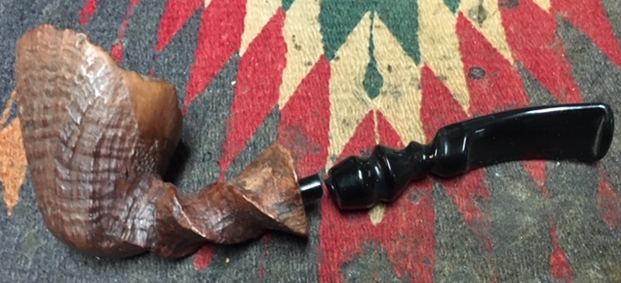
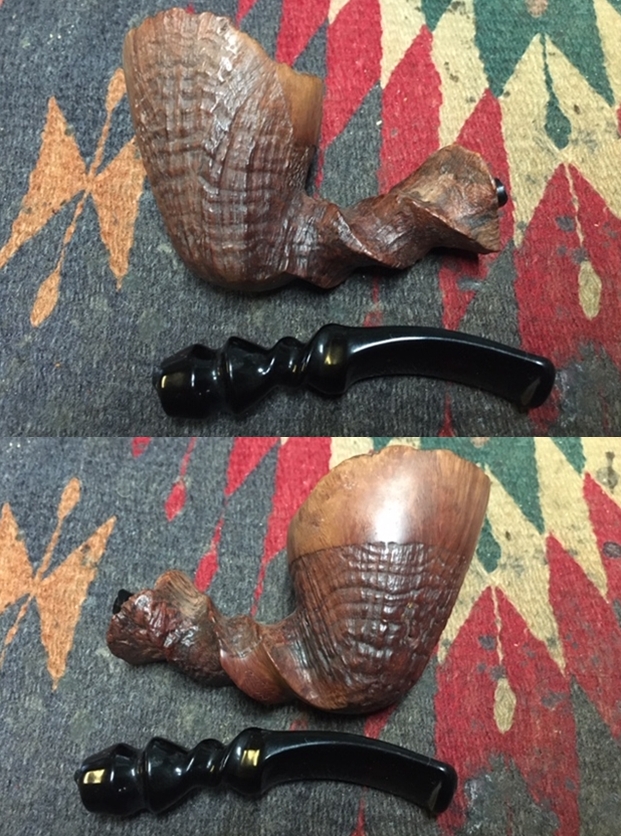
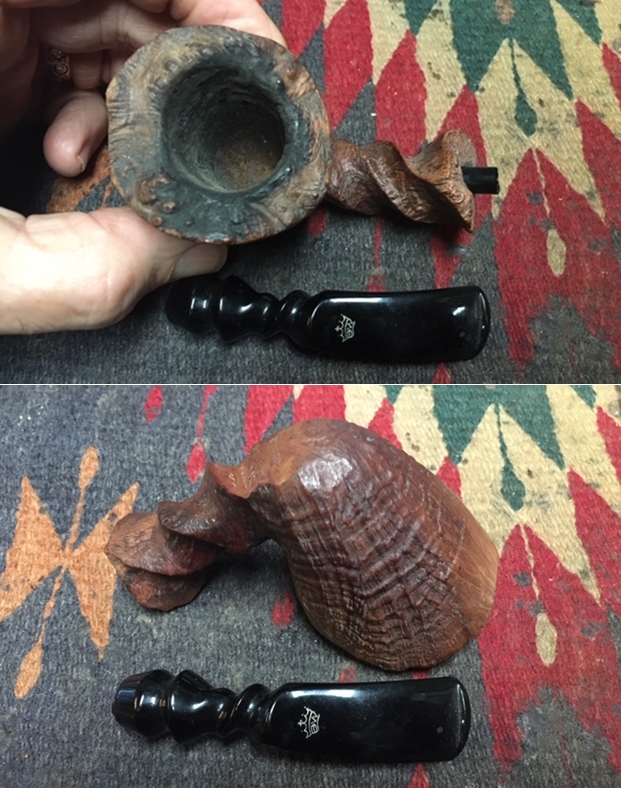
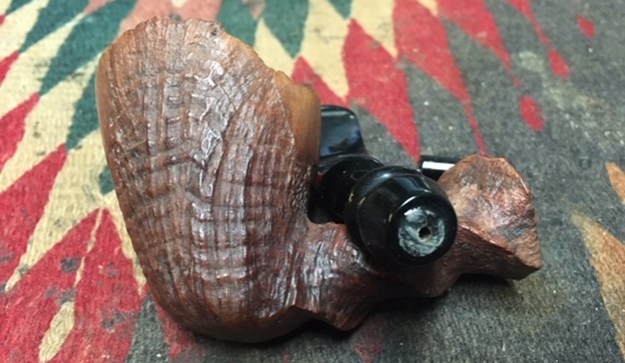
About a month ago I received a phone call from a guy from Nova Scotia who was visiting in Vancouver and had made a stop at City Cigar on 4th Ave. W. and asked about having a pipe repaired. He told me that he had a freehand pipe that had been sitting in a bag for years with a broken tenon. He was going to leave it with his brother in law and they would get in touch with me about repairing it. Earlier this week I received a text from his brother in law with photos of the pipe that needed the repair. I have included those photos below. It was a nice looking Freehand with a fancy turned stem. The tenon was snapped off in the shank and was stuck from the look of the photos. The shape and the look of the pipe reminded me of other freehands I have worked on that were made by Preben Holm. We made arrangements and we booked a time for him to drop the pipe off. Today I had the day off and I received a text that he was dropping the pipe by today for a repair. I took some photos of the pipe before I started working on it. The tenon was stuck in the shank and was not moveable. The finish was dusty but in excellent condition. The rim top and edges were in excellent condition. There was a light cake in the bowl and the pipe smelled of a strong vanilla aromatic in the bowl. The stem was lightly oxidized and was snapped very close to the square/diamond turned piece on the fancy stem. I took a photo of the plateau on the rim top and the shank end. The pipe was dusty but otherwise the finish was in great condition. I took a photo of the stem surfaces. Other than being lightly oxidized there were no tooth marks or chatter on the stem surface. I took a photo of the stamping on the underside of the shank. It had a uppercase S at the top of the stamping. Under that it read Harcourt over Hand Carved in Denmark.After I took the photos I put the bowl in the freezer so that I would be able to pull the broken tenon from the shank. The time in the freezer causes the briar to release the broken tenon that was stuck.  After a half hour in the freezer I took it out and the broken tenon easily came out of the shank. I took photos of the parts.I decided to refresh my memory about the brand before I started working on it. I did a quick search on rebornpipes to read the posts that I had there. The first of these was by Charles Lemon of Dad’s pipes (https://dadspipes.com/2016/10/20/in-praise-of-international-cooperation-cleaning-up-a-large-harcourt-grade-d-freehand-by-preben-holm-for-dunhill/). I quote the pertinent part of Charles piece.

By all accounts, the Danish Fancy pipe boom of the 1960s and 1970s caught the great English pipe house of Dunhill unprepared. Dunhill was unable to produce the new Freehand shapes in-house, so if the firm was to capitalize on the surging demand for Danish pipes, it would have to look elsewhere. The answer came in the form of a contract with the Preben Holm factory for the production of what became the Harcourt brand of pipes, destined for distribution through Dunhill’s network of principal pipe dealers.

The Harcourt on my worktable arrived in excellent estate condition. It is easily one of the largest pipes I’ve worked on – its overall length is just 5.75 inches, but the stummel is a real fistful of briar measuring 2.5 inches tall by 1.6 inches wide with a copious tobacco chamber of nearly one inch in diameter and 2.25 inches deep! Despite its size, the pipe weighs only 2.3 ounces or 64 grams.

That helped me confirm the connection to Preben Holm that I remembered. It connected Preben Holm with Dunhill as well. The other blog was one that had written on a Harcourt that I restored (https://rebornpipes.com/2018/06/29/a-harcourt-hand-carved-freehand-7-of-anthonys-dads-pipes/). I quote a portion of the blog and include one of the photos that I had used in that blog:

I had some vague memory about the Harcourt brand that had a connection to Preben Holm and the stamping seemed a lot like the way that he stamped his pipes. I did a bit of research on the brand to see the connection. The first place I looked was on Pipedia at the following link: https://pipedia.org/wiki/Harcourt. There I found the following information which I quote in full.
The brand Harcourt was produced by Preben Holm (†) for Dunhill to secure a share of the Danish fancy boom for Dunhill’s principal pipe dealers. Later Erik Nørding made Harcourt pipes for a shorter period. These pipe are sometimes (partially) rusticated.

It had been reported that the second generation of Harcourt pipes were sold exclusively through Dunhill stores, but we now know through Rich Mervin that the Brick Church Pipe Shop, a chain of 3 stores in NJ sold Danish freehands in the 1970s and 80s including Knute, Ben Wade, and Harcourt. They were also an authorized Charatan and Dunhill retailer. So, apparently Harcourt freehands were sold through at least some Dunhill dealers as well as the Dunhill stores.

I then turned to the pipephil site at this link and found out some more information on the brand. http://www.pipephil.eu/logos/en/infos/harcourt1.html. I followed the links there to some photos of a boxed pipe and the stamping on the shank.

This box contains a pipe carved for Dunhill in the 1970s. Harcourt pipes were Dunhill’s answer to the passion Danish style raised during this period.From my previous research I confirmed the connection between the pipe I am working on and the Harcourt pipes that were made by Preben Holm. The connection between Preben Holm and Dunhill’s desire to tap into the Danish Freehand market in the US was also helpful as it gave me a potential date for the pipe. It was made in the 1970s – the height of the Danish period in the US. Now it was time to replace the broken tenon.

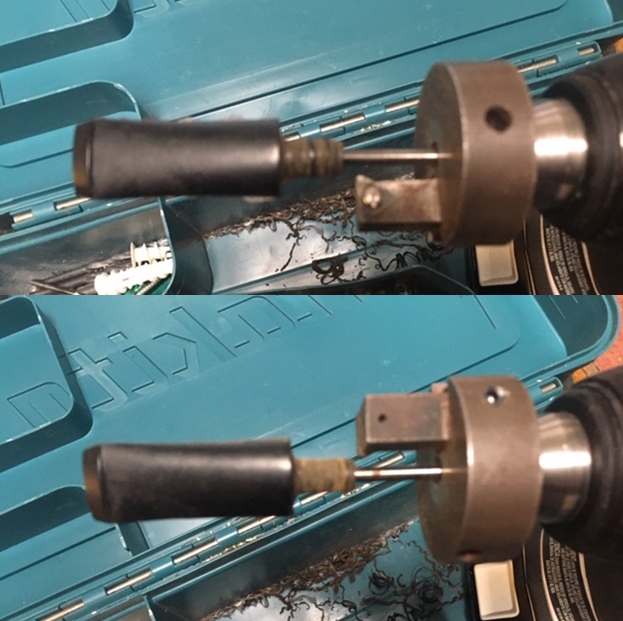
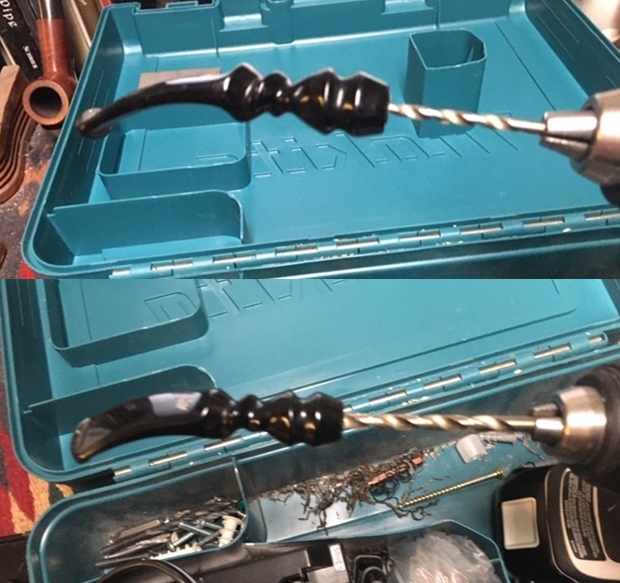
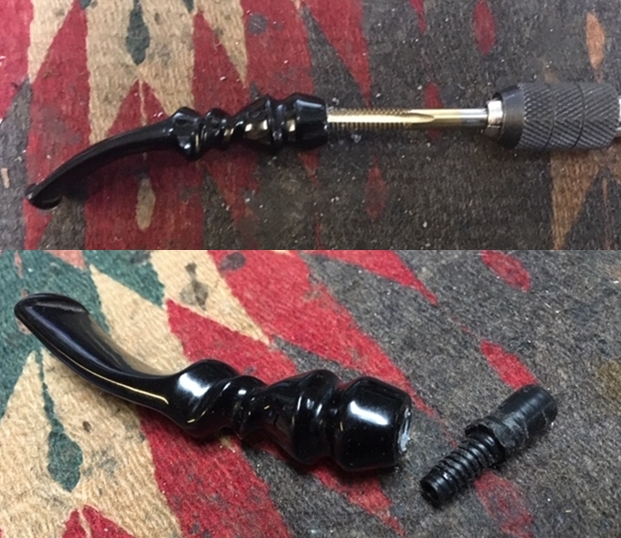
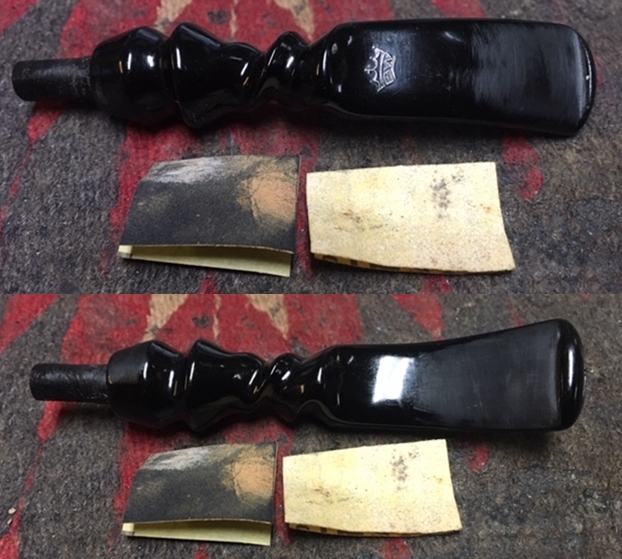
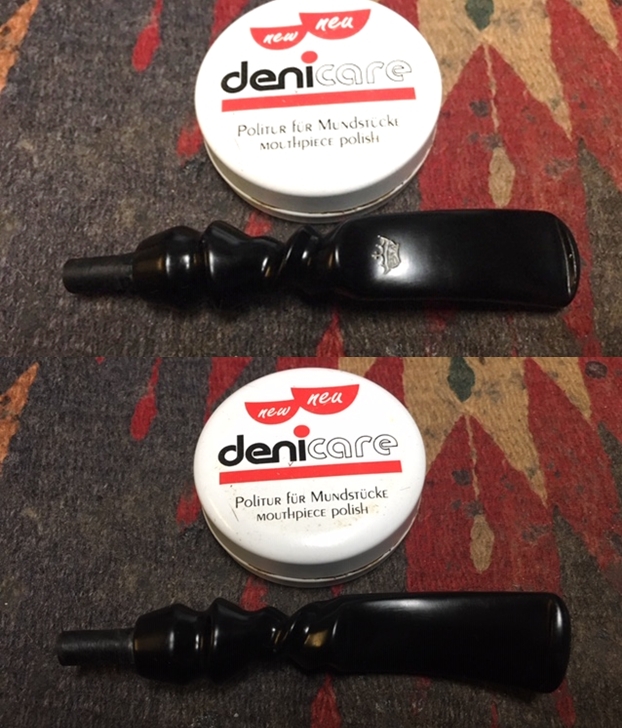
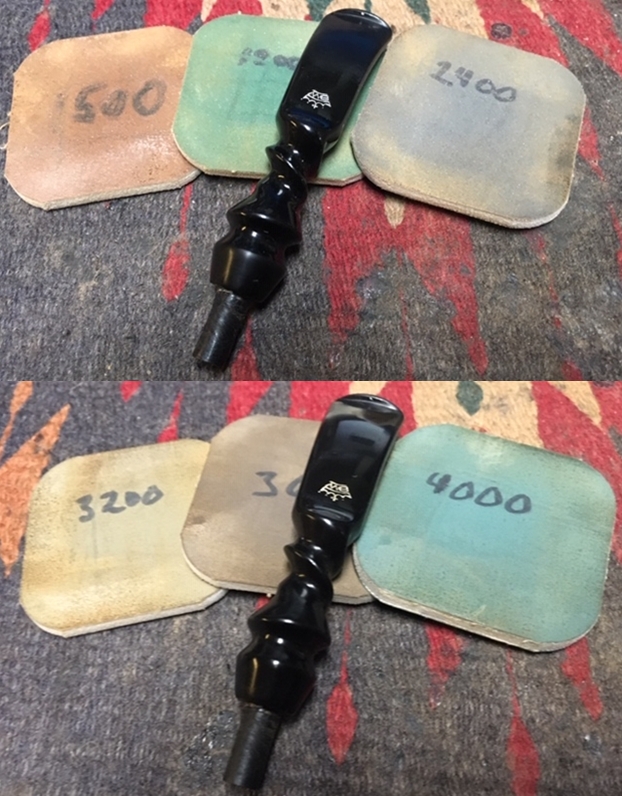
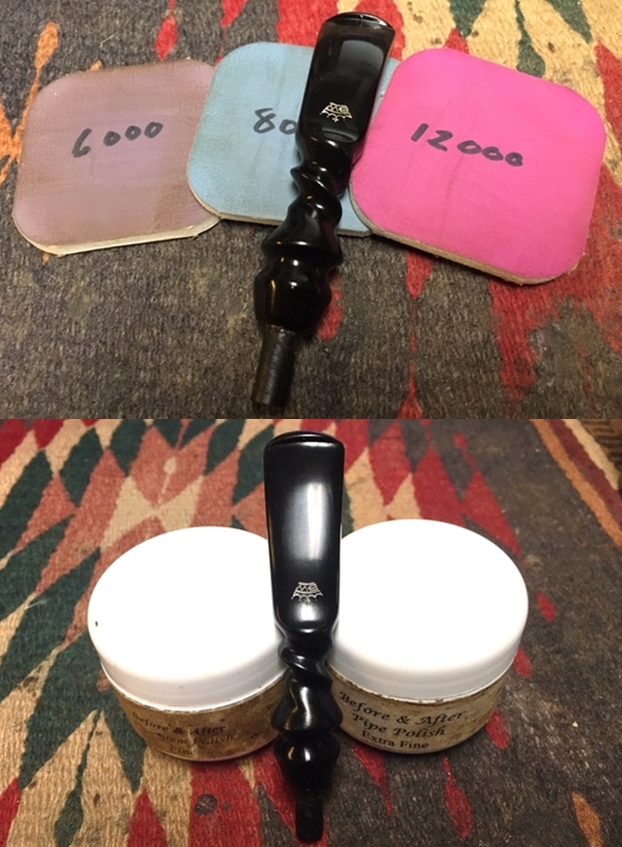
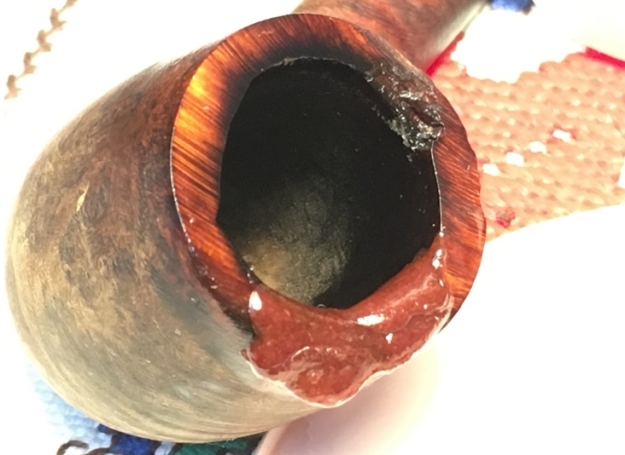
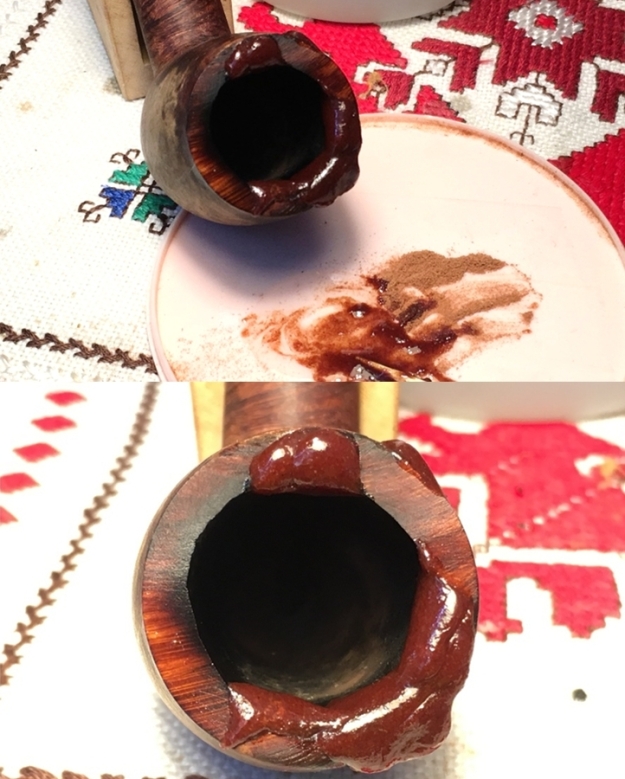
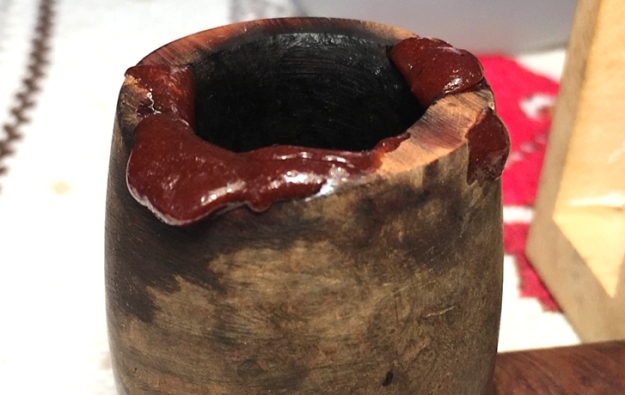
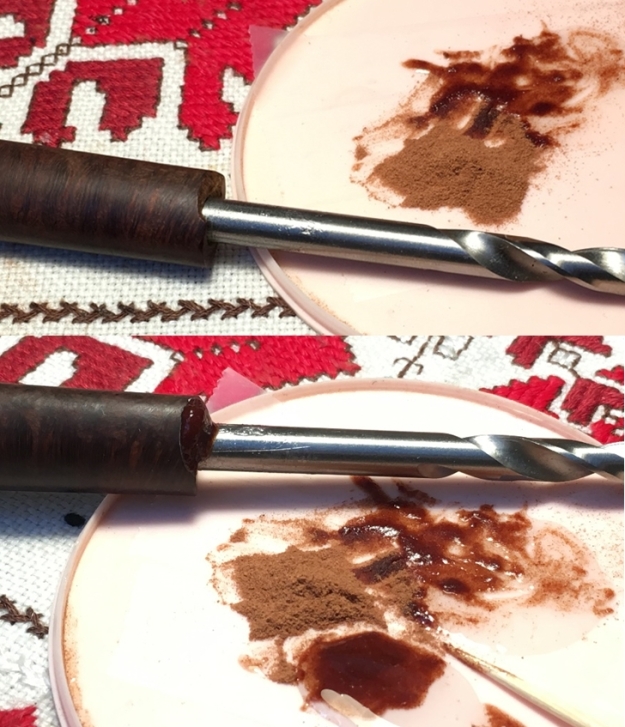
I used the Dremel and sanding drum to smooth out the face of the stem and remove the damaged portion of the broken tenon. I also went through my box of tenons and found one that would be a good replacement for the broken one. It was a threaded tenon that was a Jobey replacement tenon. It had the correct diameter and with a bit of work the threaded portion would anchor well in the stem.    I used my cordless drill to open the airway in the stem to the diameter of the threaded portion of the new tenon. I started with a bit slightly larger than the current airway. I drilled it to the depth of the threaded portion of the tenon. I worked my way through various drill bits until I had one that was slightly larger than the new tenon.I took a photo of the open airway on the stem. I roughed up the threads on the tenon replacement and removed the ridge in the middle with the Dremel and sanding drum. I coated the end of the tenon with super glue and pressed it into the open airway on the stem. Once the glue cured I took photos of the stem in the pipe. Once the glue cured I took photos of the stem in the pipe. The pipe still needed to be cleaned up but the look was very good and the feel in the hand and mouth was perfect. I took a photo of the stem out of the shank to show the finished tenon replacement. The stem and tenon needed to be polished but the fit and shape is perfect.With the stem repaired it was time to do the restoration on the pipe as a whole. I started with the bowl. I reamed the bowl with a Savinelli Fitsall Pipe Knife, scraping the light cake from the bowl. I sanded the inside of the bowl to remove the rest of the cake with 220 grit sandpaper wrapped around a piece of dowel.I cleaned out the inside of the shank and the airway to the bowl with alcohol, pipe cleaners and cotton swabs. I cleaned the inside of the airway in the stem at the same time.I rubbed the bowl down with Before & After Restoration Balm. I worked it into the surface of the briar with my fingertips and a horsehair shoe brush to clean, enliven and protect it. I let the balm sit for a little while and then buffed with a cotton cloth to raise the shine. Mark Hoover’s Balm is a product that I have come to appreciate and one I use on every pipe I have been working on.  I set the bowl aside and turned my attention to the stem. I sanded the stem with 220 grit sandpaper to break up the oxidation. I started the polishing with 400 grit wet dry sandpaper to remove the scratching. It is starting to look good.     I have one more tin of Denicare Mouthpiece Polish left from a few that I have picked up over the years. It is a coarse red pasted that serves to help remove oxidation. I polished the stem with that to further smooth out the surface of the vulcanite (and to be honest – to use it up). I polished the stem with micromesh sanding pads – wet sanding with 1500-12000 grit pads. I wiped the stem down after each sanding pad with Obsidian Oil. I polished it with Before & After Pipe Stem Polish – both Fine and Extra Fine. Once I had finished the polishing I gave it final coat of oil and set it aside to dry. When this pipe was dropped off yesterday I told the fellow that it would be a couple of weeks before I got to work on it. However, yesterday afternoon I felt like doing something a bit different in the restoration process. I finished the repair yesterday and finished the polishing it today. With every pipe I work on, I look forward to when it all comes back together, polished and waxed. I put the bowl and stem back together. I polished the bowl and stem with Blue Diamond to polish out the scratches in the briar and the vulcanite. I gave the bowl multiple coats of Conservator’s Wax and the stem multiple coats of carnauba wax. I buffed the pipe with a clean buffing pad to raise the shine. I hand buffed it with a microfiber cloth to deepen the shine. The pipe polished up pretty nicely. The sandblast finish looked really good with the polished black vulcanite. This Harcourt Hand Carved Preben Holm Freehand was another fun pipe to work on. It really has a great Freehand look that catches the eye. The combination of various oxblood, black and brown stains really makes the pipe look attractive. It is another comfortable pipe to hold in the hand. The finished pipe is shown in the photos below. The dimensions of the pipe are Length: 6 inches, Height: 3 inches, Outside diameter of the bowl: 2 inches, Chamber diameter: ¾ of an inch. I look forward to when the fellow picks it up and I get to hear what he thinks of the pipe. Thanks for reading this blog and my reflections on the pipe while I worked on it. This is an interesting estate to bring back to life.

Restoring a Second Custom-Bilt, a Large Billiard from My Inheritance


Blog by Paresh Deshpande

I have decided that I would now first complete all the Custom-Bilt pipes from my inheritance that I had got along with me to my place of work place and the remaining ones at my home town will be done later. I had professed my appreciation and liking for Custom-Bilt pipes for their large size, shape, hand feel and the rustic looks. The next pipe from the collection which I decided to work on was a huge Custom-Bilt briar pipe. The large size of the bowl, thick shank and large saddle stem, lends this pipe a weight which I particularly enjoy holding in my hand.

The pipe has deep and large vertical worm rustications along the entire length of the shank and height of the bowl. Within these large vertical rustications are very thin, closely stacked horizontal lines which give this pipe its unique appearance and are its trademark!! I absolutely love these pipes. These large rustications continue right up to the outer rim of the bowl. The thick rim top is covered with the same thin, closely stacked lines as seen between the vertical rustications. The worm rustications on the shank are much thin and precise as compared to the ones on the bowl and end about ¾ inch before the shank end giving a semblance of a shank end ring. These thin worm rustications can be seen at the foot of the stummel with smooth portions in between them. It is stamped on the left side of the shank as “Custom-Bilt” with a hyphen between the two words, in cursive hand. The “IMPORTED BRIAR”, a commonly observed stamp on these pipes, is seen in the smooth surface towards the front on the foot of the stummel followed by the number “3038” in the next portion towards the shank end.Having worked on a few Custom Bilt pipes in the past and researched this brand and based on the stampings seen on this pipe, I can say with an amount of certitude, that this pipe is from the period 1938-46. Here is the proof in determining the vintage based on stampings as researched by William E. Unger, Jr., PhD, which deals with the study of Custom-Bilt pipes.With this confirmation as regards to the vintage of this pipe, I move ahead with the initial visual inspection of this pipe.
INITIAL VISUAL INSPECTION
The pipe, as I received in the box, was carefully wrapped in a soft cotton cloth, stummel and stem separate!!! The condition of the stem and the stummel made me wonder if this pipe had been received after restoration/ repair work; it appears in such great condition. I thoroughly checked the entire pipe for any signs of repairs or damages. Fortunately there were none!! Only the stem appears brand new. Could it be a new replacement stem from an authorized store? No way to determine this as there are neither any receipts or documents nor any person in my family who could have confirmed this aspect.
The chamber has a thin layer of cake and does not appear to have been smoked much, may be a few bowls at the max. The condition of the inner walls of the chamber can be determined only after the cake has been completely reamed out down to the bare briar. The draught hole is dead center and at the bottom of the chamber. This should be a fantastic smoker. The thin worm rusticated rim top surface is covered in dust and grime all these years of storage. The outer and inner edges of the rim are in good condition with no damage. The craggy large vertical worm rustication with its horizontal thin line rustications within makes for a visual treat. The large vertical rustications are filled with dust and grime to such an extent that the horizontal lines lying within are barely visible. Same goes for the rim top. Though covered in dust and grime of all these years of storage, these should clean up nicely. I have seen an aluminum shank/ mortise extension fixed inside of the mortise on another very similarly sized and shaped Custom-Bilt from my Grandfather’s collection which I had restored about a year back!! This aluminum shank/ mortise extension (or should it be called a tenon?), was also seen on the previous Custom-Bilt Pot that I had restored just a couple of days back. However, this pipe has no such extension, just regular mortise and stem tenon construction. The mortise shows slight accumulation of oils and crud which has resulted in a slight gap between the stem and the shank end when seated. A thorough cleaning of the shank should address this issue. The wide straight saddle vulcanite stem is in pristine condition and seats with a slight gap in to the mortise with all the right noises. The tenon and the slot are also very clean. A polish with Blue diamond and coat of carnauba wax should suffice to deepen the shine on the stem. THE PROCESS
I started the restoration of this beautiful pipe by first reaming the chamber with my fabricated knife. I followed this reaming with sanding the chamber walls with a folded piece of 220 grit sand paper to completely remove any residual cake. This also helps to smooth the walls of the chamber. How I miss the help of Abha, my wife and Pavni, my youngest daughter who specializes in sanding the chamber walls to a smooth and even surface. I wiped the chamber with a cotton swab and alcohol to get rid of all the carbon dust and expose the bare briar of the chamber. As expected, the chamber is sans of any heat fissures/ lines. I followed up the cleaning of the chamber with that of the shank internals. With a bent dental spatula, I scrapped out the dried gunk from the mortise. Using hard and regular pipe cleaners and alcohol, I cleaned the mortise and the shank internals. A number of attempts and pipe cleaners later, the shank internals are clean and the draw is nice, smooth and even. I tried the seating of the stem in to the mortise and was pleased to note that the fit is now perfect and without any gaps. The internal cleaning was followed by external cleaning of the stummel surface using Murphy’s Oil soap and a hard bristled tooth brush. I also used a brass wired brush to diligently clean out all the dirt and grime from within the worm rustications. With a shank brush and dish washing soap, I thoroughly cleaned the shank internals and the mortise. I dried the bowl with paper napkins and soft cotton cloth and set it aside to dry out completely. With the stummel set aside to dry out naturally, it was time to move ahead with the stem restoration. I cleaned the stem internals with pipe cleaners and alcohol. With the bent flat end of a dental tool, I scrubbed the dried out oils and tars from the tenon of the stem and cleaned it with a cotton swab and alcohol. I wiped the stem with a small amount of Extra Virgin Olive oil and set it aside to be absorbed by the stem surface.While the stem was set aside to hydrate, I worked the stummel, micromesh polishing of the smooth raised surfaces on the stummel. I polished the stummel by wet sanding with 1500 to 12000 micromesh pads. With a moist cotton swab, I carefully wiped off all the sanding dust from within the worm rustications. I am pretty happy with the results!! Next, I rub a small quantity of “Before and After Restoration Balm” in to the briar with my finger tips and let it rest for a few minutes. The balm almost immediately works its magic and the briar now has a nice vibrant appearance with the beautiful worm rustication patterns on full display. I have been using this balm ever since I embarked on this journey and it is this part of restoration that I always look forward to. I further buff it with a horse hair shoe brush. On to the homestretch!! I mount a cotton cloth buffing wheel on to my hand held rotary tool and apply a coat of Blue Diamond to the stummel and the stem to polish out the minor scratches. With a cotton buffing wheel that I use for carnauba wax, I apply a coat of carnauba wax and continue to work on it till the complete coat of wax had been polished out. I mount a clean cotton cloth buffing wheel and give the entire pipe a once over buff. I finished the restoration by giving the entire pipe a rigorous hand buffing using a microfiber cloth to raise the shine further. The finished pipe looks amazingly beautiful and is now ready for its long second innings with me. I only wish it could share with me its life story of the past 70 plus years… Cheers!! P.S. These old Custom-Bilts may not be as elegant, delicate and quaint looking as most of the British pipes like say, Charatan’s, Barling’s, Comoy’s or an old Ben Wade, but there is a certain rustic charm about these pipes that appeals to me the most and of course, not to mention the size!! I am not sure if there are any serious Custom-Bilt collectors in our pipe world, but if any reader of rebornpipes.com is, I would definitely like to connect and share our common love for these magnificent pipes.
As usual, your comments and advice is requested as these will help me in my learning and improvements in future. I express my sincere gratitude to all readers who have dedicated their time to read through the write up and for being part of this journey.


Back to My Inherited Collection – Restoring a Custom-Bilt Pot


Blog by Paresh Deshpande

It’s been a while that I had worked on my Grandfather’s pipe collection and that is what I decided to work on as my next project. I had professed my appreciation and liking for Custom-Bilt pipes for their large size, shape, hand feel and the rustic looks.

The Custom-Bilt pipe that is now on my work table is a large Pot shaped pipe, having the trademark scraggy large vertical rustications and very fine, thin horizontal linear rustications in between. This is a beautifully carved pipe with a unique construction in that the chamber appears to be placed inside the outer casing of the briar wood. However, the chamber is carved from the same piece of briar with a smooth rim top surface that is slightly raised above the surrounding rim surface with thin rustications. The short shank is smooth and extends in to the large smooth foot of the stummel. It is stamped on the left side of the shank as “Custom-Bilt” with a hyphen between the two words, in cursive hand. There are two prominent red dots on either side of the shank with a square symbol on the right side of the shank towards the stummel joint. The IMPORTED BRIAR, a commonly observed stamp on these pipes, is conspicuous by its absence on this one!!Having worked on a few Custom Bilt pipes in the past and researched this brand and based on the stampings seen on this pipe, I can say with an amount of certitude, that this pipe is from the period 1938- 46. Here is the proof in determining the vintage based on stampings as researched by William E. Unger, Jr., PhD, which deals with the study of Custom-Bilt pipes.With this confirmation as regards to the vintage of this pipe, I move ahead with the initial visual inspection of this pipe.

INITIAL VISUAL INSPECTION
The chamber has an even decent layer of cake. The condition of the inner walls of the chamber can be determined only after the cake has been completely reamed out down to the bare briar. The draught hole is dead center and at the bottom of the chamber. This should be a fantastic smoker. The smooth and slightly raised rim top surface has severely charred inner rim edge on the left in 8 o’clock direction and a minor charring on the right side in the 3 o’clock direction, both marked in red circle causing the bowl to appear out of round. The remaining rusticated rim top surface is covered in dust and grime of overflowing lava. The flat bottomed stummel feels solid to the touch and makes for a nice fit in the hands of the smoker. The vertical worm rustication with its horizontal thin line rustications within makes for a visual treat. Though covered in dust and grime of all these years of uncared for storage, these should clean up nicely. The smooth flat bottom of the stummel has a number of perfectly rounded small dings and will need to be addressed. The short and smooth surfaced shank has an aluminum shank/ mortise extension fixed inside of the mortise. I have seen a similar extension on another Custom-Bilt from my Grandfather’s collection which I had restored about a year back!!! This aluminum shank/ mortise extension (or should it be called a tenon?), has two airways, a larger one above a smaller one, both with the same draught hole at the other end. The purpose of these two airways in the same tenon was shrouded in mystery then and to this day, still remains so. Any inputs on this mystery from the esteemed readers will help all other readers in understanding the functional aspects of this dual airway. Both these airways are clogged with oils and tars and dirt from all these years of smoking and storage, making the draw a bit laborious. This draw should even out once the shank extension and shank has been cleaned out.The slightly bent vulcanite stem sits atop the aluminum shank/ mortise extension and is peppered with tooth chatter on either surface of the stem. The edges of the button are slightly damaged due to tooth marks. These issues are not severe and should be easily addressed by sanding. The tenon end of the stem surface is chipped in at number of places with the edges slightly raised (indicated with red arrows). I shall address this issue first by sanding and if required, will fill it with a mix of superglue and activated charcoal. THE PROCESS
I started the restoration of this beautiful pipe by first reaming the chamber with size 3 followed by size 4 head of the PipNet pipe reamer. The amount of cake dislodged from the chamber points to the fact that this would have been a favorite of my Grandfather!! With my fabricated knife, I removed the cake from areas where the reamer head could not reach. I followed this reaming with sanding the chamber walls with a folded piece of 220 grit sand paper to completely remove any residual cake. This also helps to smooth the walls of the chamber. How I miss the help of Abha, my wife and Pavni, my youngest daughter who specializes in sanding the chamber walls to a smooth and even surface. I wiped the chamber with a cotton swab and alcohol to get rid of all the carbon dust and expose the bare briar of the chamber. It was a relief to note that the chamber is sans of any heat fissures/ lines. The next issue that I addressed was that of the charred inner rim edge. With a folded piece of a 220 grit sand paper, the charred surfaces were sanded down till I reached solid briar wood. A bevel to the inner edge would look out of place on this pipe and so it was decided to keep the edges straight. I sand the entire inner rim edge and the chamber with a folded 180 grit sand paper till it matched with the damaged rim edge. The inner rim edge looked good and also the chamber is now nicely rounded. I further sand the entire smooth rim top surface to remove the blackened surface from the charred area and also to get rid of any minor dents/ dings and grime from the surface. I followed up the cleaning of the chamber with that of the shank internals. Using hard and regular pipe cleaners and alcohol, I cleaned the aluminum mortise extension and the shank internals. It was a bit of an exercise to clean the lower of the two air ways as it sloped upwards and posed difficulties in maneuvering the pipe cleaner towards the draught hole. A number of attempts and pipe cleaners later, the shank internals are clean and the draw is nice, smooth and even.The internal cleaning was followed by external cleaning of the stummel surface using Murphy’s Oil soap and a hard bristled tooth brush. I also used a brass wired brush to diligently clean out all the dirt and grime from within the worm rustications. With a shank brush and dish washing soap, I thoroughly cleaned the shank internals and the mortise. I dried the bowl with paper napkins and soft cotton cloth. To expel all the moisture from the shank and the aluminum extension, I blew air through the draught hole and to my chagrin; there were droplets of water that came out from the joint between the shank end and extension (marked with red arrows). This is definitely a sign of leak from the joint. I wiped the area dry and with my sharp dental tool picked the area clean. With a toothpick, I applied clear superglue all around the joint and held it vertical for the glue to seep in to the joint. I was careful to apply a small quantity as I did not want the glue to enter and harden inside of the mortise. I wiped off the extra glue from the shank end as I would disturb the seating of the stem over the aluminum extension. I set the stummel aside for the glue to cure. With the stummel set aside for the glue to cure, it was time to move ahead with the stem restoration. I cleaned the stem internals with pipe cleaners, q-tips and alcohol. With the bent flat end of a dental tool, I scrubbed the dried out oils and tars from the area of the tenon end of the stem that seats on top of the aluminum shank/ mortise extension.I flamed the bite zone with the flame of a lighter. The heating of the vulcanite raises the tooth chatter to the surface and followed it with a light sanding with a piece of 220 grit sand paper to even out the surface around the bite zone. Using a flat head needle file, I reshaped and sharpened the button and button edges. This was followed by sanding the entire stem surface with 400 followed by 600, 800 and 1000 grit sand papers to remove the oxidation. I also evened out the raised indentations from the tenon end caused due to chipping. I finished the sanding with a 0000 grade steel wool. Using progressively higher grit sand papers helps in a smooth surface while minimizing the sanding marks left behind by the more abrasive sanding papers. I wiped the stem with a small amount of Extra Virgin Olive oil and set it aside to be absorbed by the stem surface. While the stem was set aside to hydrate, I worked the stummel, sanding away excess dried glue from the joint between shank end and the aluminum extension. I polished the extension with a piece of 0000 grade steel wool. The next issue that I addressed was the numerous rounded dings from the perfectly flattened foot of the stummel. I decided to steam out these dings since these dings were slightly deeper. I heated my fabricated knife over the flame of a candle till nice and hot. I covered the dings with a thick wet Turkish hand towel and placed the hot knife over it. The sizzling steam that is generated expands the briar and pulled out the dings. I am pretty happy with the results!! I set the stummel to dry out and went ahead with polishing and completing the stem. I followed up the sanding regime with micromesh polishing to bring a shine on the stem surface. I wet sand the stem with 1500 to 2400 girt micromesh pads. Continuing with my experimentation that I had spelled out in my previous posts, I mount a cotton buffing wheel on my hand held rotary tool and polish the stem with Red Rouge polish. Further, I mount a fresh buffing wheel on the rotary tool and polish the stem with White Diamond polish. I finish the stem polish by wet sanding with 6000 to 12000 grit pads of the micromesh. I rub a small quantity of olive oil in to the stem surface to hydrate it and set it aside again. I am really happy with this process of stem polishing as the results are excellent while saving me huge amounts of time and effort. With the stem polishing now completed, I moved ahead with micromesh polishing of the smooth surfaces on the stummel (part of the rim top surface, the short shank and the foot of the stummel). I polished the stummel by wet sanding with 1500 to 12000 micromesh pads.Next, I rub a small quantity of “Before and After Restoration Balm” in to the briar with my finger tips and let it rest for a few minutes. The balm almost immediately works its magic and the briar now has a nice vibrant appearance with the beautiful worm rustication patterns on full display. I have been using this balm ever since I embarked on this journey and it is this part of restoration that I always look forward to. I further buff it with a horse hair shoe brush. There are a few spots where I had missed out on the application of the balm, as would have been observed by some discerning readers in pictures below, but let me assure you that I had reapplied the balm using a q-tip but missed out on taking pictures. On to the homestretch!! I mount a cotton cloth buffing wheel on to my hand held rotary tool and apply a coat of Blue Diamond to the stummel and the stem to polish out the minor scratches.With a cotton buffing wheel that I use for carnauba wax, I apply a coat of carnauba wax and continue to work on it till the complete coat of wax had been polished out. I mount a clean cotton cloth buffing wheel and give the entire pipe a once over buff. I finished the restoration by giving the entire pipe a rigorous hand buffing using a microfiber cloth to raise the shine further. The finished pipe looks amazingly beautiful and is now ready for its long second innings with me. I only wish it could share with me its life story of the past 70 plus years, if only the pipe could tell some of my grand Old man’s stories and recount incidents it had witnessed while I enjoy smoking my favorite Virginia blend in it!! … Cheers!!

Restoring a Danmore Deluxe Volcano from Bob Kerr’s Estate


Blog by Steve Laug

The next pipe I chose to work on from Bob Kerr’s estate is part of his collection of Danish made pipes. I have worked on the restoration of others in this collection including a Stanwell Jubilee Shape 118 (https://rebornpipes.com/2019/08/11/another-bob-kerr-estate-a-stanwell-jubilee-1942-1982-shape-118/); a Stanwell de Luxe Shape 812 (https://rebornpipes.com/2019/08/10/back-to-bob-kerrs-estate-changing-up-and-working-on-a-danish-made-stanwell-de-luxe-812-billiard-regd-no-969-48/); a WO Larsen (https://rebornpipes.com/2019/01/13/restoring-pipe-17-from-bob-kerrs-estate-a-w-o-larsen-super-15-bent-stack/) and a Danish Sovereign Bulldog variation (https://rebornpipes.com/2019/08/11/another-bob-kerr-estate-a-danish-sovereign-305-bulldog-variant/).
To this list of Danish pipes I am adding the next  – a Danmore Handmade in Denmark Deluxe Volcano. Like the others it is part of Bob’s estate that the family asked me to clean up and move out to others who will carry on the trust that began with Bob. In the collection there were BBBs, Peterson’s, Dunhills, Comoy’s and Barlings as well many others – a total of 125 pipes. This is the largest estate that I have had the opportunity to work on. I created a spread sheet to track the pipes, restoration and sales. This job would take a fair amount of time to clean up. I could not pass up the opportunity to work on these pipes and help the family.
When I took the Danmore out of the box of cleaned up pipes that Jeff sent back I could see that it was stamped Danmore Handmade Denmark on the topside of the shank and Deluxe on the right side of the shank. It has straight and flame grain around the bowl and the oval shank and birdseye on the heel of the bowl and shank. The finish was dirty like the rest of the pipes in this estate. There was a thick cake in the bowl with remnants of tobacco stuck on the walls. There was an overflow of lava on the rim. The top and edges of the rim were dirty and there appears to be a deep chip on the front of the bowl edge. I could see a beautiful pipe underneath all of the grime and buildup of years of use. The stem was oxidized with tooth chatter on both sides. Surprisingly it had none of the deep tooth marks that I have come to expect from Bob’s pipes. Jeff took photos of the pipe before he started his cleanup work on it. Jeff took photos of the bowl and rim top to show the thick, hard cake in the bowl and the lava build up on the top of the rim and the edges of the bowl. You can see the chip on the rim top and inner edge of the bowl on the right side. There is some lava flowing down the outside of the bowl.   Jeff took photos of the sides and heel of the bowl to show the condition of the finish. You can see the beautiful mix of straight, flame and birdseye grain underneath the dirt and debris of the years. The birdseye grain on the heel was beautiful.    Jeff took photos of the stamping on both sides of the bowl and shank. The stamping on the topside was readable as you can see from the photos. It read danmore over Handmade Denmark. The stamp on the right side read Deluxe but Jeff did not take a photo of that stamp. You can see that the fit of the stem in the shank is off which tells me that the tenon is bent. Jeff took photos of the top and underside of the stem showing the tooth chatter, scratching and oxidation on the stem surface and wear on the edges of the button.    I turned first to Pipephil’s site to remind myself of the background of the Danmore brand. There was little information to be found there other than the factory was closed and third parties were making the pipes. I then turned to Pipedia’s article on the brand to see what I could garner from that information (https://pipedia.org/wiki/Danmore). I quote from there in full:

Danmore was founded by Hans Sørensen in the early 1970s, and produced pipes from that time until the early 1980s, at one point having up to 30 employees. The pipes were sold in the first Dan Pipe catalog. In the early 1980’s, however, production ceased in Denmark due to labor costs, and the company’s production was outsourced to Italy and Spain, and they began to also make pipecleaners and smokers articles.

Sørensen focused on the pipecleaner side of the concern, and eventually bought a share in the factory in the Far East making them. Today the company, owned by Hans’ sons Jesper and Lars Sørensen, no longer makes pipes, and instead makes only pipe cleaners under the name Danmore Hobby Aps, selling only to hobby and craftshops in Denmark and Scandinavia.

Hans Sørensen passed away in 2012. The Sørensen family continues to own the trademarks for the use of the Danmore name in relation to pipes, matches, and tobacco.

The article also included a Shape Chart that was courtesy of Doug Valitchka. I include that below as well. The shape of the pipe that I am working on is a variation on the 3014. It has a classic oval saddle stem rather than the more freehand looking one below. It also does not have the shank extension (https://pipedia.org/wiki/File:DanmoreCat.jpg). I have circled the shape in red to show which one is similar.I did a bit more searching online and found a copy of a brochure that was included in a box with a Danmore pipe on Redit in the archives. I was able to copy the photos of the pages of the brochure and have included them below. Have a look (https://www.reddit.com/r/PipeTobacco/comments/vclaj/does_anyone_know_much_about_danmore_pipes/). The Danmore I am working on is on the page labeled CORVETS. I have boxed in the pipe in red that I am working on. With that information in hand I knew what I was dealing with in terms of the stamping on the pipe. The pipe I have is the same shape as the one boxed in red – shape number 14 under section labeled CORVETS. The pipe was made for just a ten year period between early 1970s and the early 1980s. It seems that they have also been made since then by a third party. I believe this pipe was one from the original 10 year period by Hans Sørensen. Now it was time to work on the pipe.

With over 125 pipes to clean from Bob’s estate I am very glad for Jeff’s help cleaning them. He cleaned this filthy pipe with his usual penchant for thoroughness that I really appreciate. This one was a mess and I did not know what to expect when I unwrapped it from his box. He reamed it with a PipNet pipe reamer and cleaned up the reaming with a Savinelli Fitsall Pipe Knife. He scrubbed out the internals with alcohol, pipe cleaners and cotton swabs until the pipe was clean. He scrubbed the exterior of the bowl with Murphy’s Oil Soap and a tooth brush to remove the grime and grit on the briar and the lava on the rim top. The finish looks very good with great looking grain around the bowl and shank. Jeff soaked the stem in Before & After Deoxidizer to remove the oxidation on the rubber. When the pipe arrived here in Vancouver for the second stop of its restoration tour I was amazed it looked so good. I took photos before I started my part of the work.   I took some close up photos of the rim top and also of the stem surface. I wanted to show what an amazing job Jeff did in the cleanup of the rim top. I also wanted to show that the damage to the rim top was more extensive than I had originally thought. The thin rim top was burned and darkened with a few large nicks on the top and inner edge. The rim top was a nightmare of issues. I also took close up photos of the stem to show the lack of tooth marks and the light oxidation on the stem surface. You can also see gap between the stem and the shank end due to a bent tenon.        One of the things I appreciate about Jeff’s cleanup is that he works to protect and preserve the nomenclature on the shank of the pipes that he works on. The stamping on this one was very faint to start with so I was worried that it would disappear altogether with the cleanup. He was not only able to preserve it but it is clearer than shown in the earlier photos. I took some photos to show the clarity of the stamping. I have noticed that many restorers are not careful to protect the stamping in their cleaning process and often by the end of the restoration the nomenclature is almost destroyed. I would like to encourage all of us to be careful in our work to preserve this as it is a critical piece of pipe restoration! Since this is another pipe Bob’s estate I am sure that some of you have read at least some of the other restoration work that has been done on the previous pipes. You have also read what I have included about Bob Kerr, the pipeman who held these pipes in trust before I came to work on them (see photo to the left). Also, if you have followed the blog for long you will already know that I like to include background information on the pipeman whose pipes I am restoring. For me, when I am working on an estate I really like to have a sense of the person who held the pipes in trust before I worked on them. It gives me another dimension of the restoration work. I asked Brian if he or his wife would like to write a brief biographical tribute to her father, Bob. His daughter worked on it and I received the following short write up on him and some pictures to go along with the words including one of Bob’s carvings. Once again I thank you Brian and tell your wife thank you as well.

I am delighted to pass on these beloved pipes of my father’s. I hope each user gets many hours of contemplative pleasure as he did. I remember the aroma of tobacco in the rec room, as he put up his feet on his lazy boy. He’d be first at the paper then, no one could touch it before him. Maybe there would be a movie on with an actor smoking a pipe. He would have very definite opinions on whether the performer was a ‘real’ smoker or not, a distinction which I could never see but it would be very clear to him. He worked by day as a sales manager of a paper products company, a job he hated. What he longed for was the life of an artist, so on the weekends and sometimes mid-week evenings he would journey to his workshop and come out with wood sculptures, all of which he declared as crap but every one of them treasured by my sister and myself. Enjoy the pipes, and maybe a little of his creative spirit will enter you!

Now, on to the rest of the restoration of this beautifully grained Danmore Deluxe Volcano/Brandy. It was great that I did not need to clean the pipe. I decided to start the restoration process by addressing the poorly seated tenon. The first photo below shows the gap. I could see that the tenon itself had been bent and that caused the gap between the shank end and the face of the stem. I heated the tenon with a Bic lighter until the rubber was slightly flexible and then carefully inserted it in the mortise and adjusted the bend and fit. I held it in place until it cooled down. The fit was perfect. I took photos of the stem from the top and the side to show the repair.  I took the newly repaired stem off the shank and worked on the damage to rim top and the inner edge. From the extent of damage to the inner edge of the rim and the top of the bowl I decided I would need to top the bowl to remove as much of this damage as possible to restore the rim top back to a more pristine condition and bring the bowl back to round. I topped it on a topping board using 220 grit sandpaper. The photos show the topping process and the rim top after I had topped it to an acceptable point where the condition of the top and edges was good.  With the top cleaned up and repaired I moved on to address the inner edge surface itself. I used a folded piece of 220 grit sandpaper to bevel the edge inward to take care of the damage and thin the rim edge to its earlier dimensions. I followed that by sanding the rim top and edge with 400 grit wet dry sandpaper.I cleaned the briar with Mark Hoover’s Before & After Briar Cleaner to remove the debris left behind by the sanding of the rim top and to blend the repairs into the briar. I rubbed it into the surface of the briar and let it sit for 10 minutes. I rinsed the bowl off with warm running water to remove the product and the grime. The grain really began to stand out clearly. It was a beautiful piece of briar.  I stained the rim top and edges with a Cherry Stain pen to match the colour of the stain on the bowl. Once it was polished with micromesh sanding pads and Before & After Balm the stain would blend perfectly.I polished the briar with micromesh sanding pads to blend in the stain and to polish the briar and remove the scratches in the surface of the bowl, heel and shank. I wet sanded with 1500-12000 grit pads and wiped the bowl down between each pad with a damp cloth. I rubbed down the bowl with Before & After Restoration Balm. I worked it into the surface of the briar with my fingertips to clean, enliven and protect it. I let the balm sit for a little while and then buffed with a cotton cloth to raise the shine. Mark Hoover’s Balm is a product that I have come to appreciate and one I use on every pipe I have been working on. I set the bowl aside and worked on the stem. I sanded the stem with 220 grit sandpaper to break up the remaining oxidation and smooth out the file marks. I started the polishing with 400 grit wet dry sandpaper to remove the scratching. It is starting to look good.I have been using Denicare Mouthpiece Polish after sanding with 400 grit wet dry sandpaper for a while now as the grittiness of the product works to polish out the minor scratches in the vulcanite. I also have a few of these tins knocking around that I want to use up so it works for me to use it at this point.I polished the stem with micromesh sanding pads – wet sanding with 1500-12000 grit pads. I wiped the stem down after each sanding pad with Obsidian Oil. I polished it with Before & After Pipe Stem Polish – both Fine and Extra Fine. Once I had finished the polishing I gave it final coat of oil and set it aside to dry.   As usual at this point in the restoration process I am excited to be on the homestretch. I look forward to the final look when it is put back together, polished and waxed. I put the bowl and stem back together. I polished the bowl and stem with Blue Diamond to polish out the scratches in the briar and the vulcanite. I gave the bowl and the stem multiple coats of carnauba wax. I buffed the pipe with a clean buffing pad to raise the shine. I hand buffed it with a microfiber cloth to deepen the shine. The pipe polished up pretty nicely. The straight and flame grain really pop with the wax and polish. The shiny black vulcanite saddle stem is a beautiful contrast to the browns of the bowl. This Danmore Deluxe Volcano was another fun pipe to work on thanks to Jeff’s cleanup work. The pipemaker followed the grain in laying out this pipe to maximize the glory of the briar. The flow and feel of the pipe is appealing. The finished pipe is shown in the photos below. The dimensions of the pipe are Length: 5 ¾ inches, Height: 1 7/8 inches, Outside diameter of the bowl: 1 inch, Chamber diameter: ¾ of an inch. This beautiful pipe will be going on the rebornpipes store if you would like to add it to your collection and carry on Bob’s legacy. If not, I have a lot more of Bob’s estate to work on of various brands. Perhaps one of those will catch your attention. Thanks for reading this blog and my reflections on the pipe while I worked on it. This is an interesting estate to bring back to life.

Breathing Fresh Life into an Inherited Ben Wade “The Gem” from the Year 1900!


Blog by Paresh Deshpande

It’s been a while since I have worked on any of my grandfather’s pipe collection that I have inherited after his demise a few years ago. Amongst the collection, this small quaint Ben Wade was beckoning me for a long time. It is now that I decided to work on it. I had one Ben Wade without a stem, that Steve had taken back to Canada from his visit to India to fashion a stem from his bag of spares. This prompted me to fish out this Ben Wade and work towards its restoration.

This small sized straight Bulldog is typically classic British shape, with a diamond shank and a horn stem with a threaded bone tenon. The shank end is decorated with a sterling silver ferrule with embossed leaves, which is loose and came off easily. On this ferrule are the stamp details which will help in determining the vintage of this pipe. The silver shank ferrule is stamped as “A & Co” over a series of three hallmarks running from the left near the bowl end to the end of the shank on the right.The first hallmark is an “Anchor” in a shield shaped cartouche and identifies the city of Birmingham in England where the silver was crafted. The second hallmark is a passant Lion in a cartouche which signifies that the band is silver and that it was crafted by a British silversmith. The third hallmark is a square cartouche with the small letter “a” in the box which is a date letter that will give the year of the making of the pipe. Steve had recommended a site which he frequents while dating silver hallmarked pipes. Here is the link which helped me identify the city mark as Birmingham and further following the link on Birmingham date letter chart on the same page brought me to a separate page with all the letters along with the period in which they were stamped. I found the letter which matched to the one seen on the pipe in my hand and I can now say with authority that this silver ferrule is from the year of manufacture1900!! Unfortunately, the site did not allow me to copy/ edit and reproduce the relevant charts for including in this write up.

https://www.925-1000.com/british_marks.html

The next stamp which I researched was the “A & Co” stamp over the three hallmarks. I conferred with The-Beard-of-Knowledge on all things pipe, Steve and he suggested that I visit http://www.silvercollection.it and sure enough I got the information that I was looking for. I reproduce the relevant information from the site and also the link for those who may need to refer when researching their pipes.

http://www.silvercollection.it/englishsilvermarksXA.html

A business which is supposed to have been established in 1781 at Mitcham, Surrey, by William Asprey (died 1827).

CHRONOLOGY:
Francis Kennedy, c. 1804-c. 1841
Kennedy & Asprey, c. 1841-1843
Charles Asprey, 1843-c.1872
purchased the business of Charles Edwards, c.1857
Charles Asprey & Son, c.1872-c.1879
Charles Asprey & Sons, c.1879-c.1888
acquired Leuchars & Sons
C.& G.E. Asprey, c.1888-c.1900
Asprey (& Co), c.1900-1909
acquired Houghton & Gunn, 1906
acquired William Payne & Co, 1908
Asprey & Co Ltd, 1909- 1998
Asprey & Garrard, 1998-2002
Asprey & Co Ltd, 2002

The relevant stamping is highlighted in blue. The period/ vintage of the ferrule now perfectly matches and confirmed that it is from the year 1900.

With the year of make of the ferrule established as 1900, I wanted to confirm if this matched with the year of manufacture of the pipe itself. This is essential since the makers did stock up on such silver ferrule before they even made pipes for them. The stampings on the pipe itself should provide some clues to the link with the vintage of the pipe. The pipe is stamped as “B W” in a rectangle over “THE GEM”, all in golden block capital letters. There are no other markings on this pipe, not even COM stamp.I searched pipedia.org for information on this brand and further confirmation on dating this pipe. There are some interesting details on this brand and makes for an interesting read. I have reproduced some snippets of the information from pipedia.org which are relevant to dating this Ben Wade.

The company was founded by Benjamin Wade in 1860 in Leeds, Yorkshire, where it was located for over a century. Ben Wade started as a pipe trader, but yet in the 1860’s he established a workshop to produce briar pipes. The pipes were made in very many standard shapes – always extensively classic and “very British”. Many models tended to be of smaller dimensions. Ben Wade offered a very high standard of craftsmanship and quality without any fills. Thus the pipes were considered to be high grade and a major competitor to other famous English brands.

In the second World War the factory was destroyed by German air raids on Leeds. But the Ben Wade family decided to re-build it immediately after the war and pipe production was re-started soon and successfully linked to the fame from the pre-war years.

Before the second war Ben Wade clustered their offerings into three price points: “Ben Wade” included the higher end pipes (eg the Larnix, Super Grain, Selected Grain, etc), “BW” included the mid-level pipes (eg Statesman, Natural Grain, County, etc), and “BWL” were the least expensive (eg Hurlingham, Adelphi, Tense Grain). Champion was in the last group, and in the 1930s at least retailed for 2/6.

Even though the owner family decided to leave pipe business and sell off the firm. The family went into negotiations with Herman G. Lane, president of Lane Ltd. in New York at about the same time as the Charatan family. Lane Ltd. bought both firms in 1962.

From the above it is confirmed that the Ben Wade that I have inherited is from the family era and from the era before the second war, placing it before 1939. Now, I had read somewhere that it was common for pipe makers not stamp the pipe with the COM stamp in early 1900s and this was confirmed by Steve. Thus, to sum up all the information researched to date this particular piece, it is safe to conclude that this pipe is likely to have been made in the year 1900!! My inheritance indeed has some very nice and very old pipes.

INITIAL VISUAL INSPECTION
In the month of January this year, I had restored a Loewe Kenton from my inherited pipes that was nicely reamed with no overflowing lava over the rim top (https://rebornpipes.com/2019/01/17/restoring-a-classic-british-billiard-loewe-co-pipe/) and now this is the second pipe which is without a layer of cake in the chamber. However, the rim top surface is darkened and covered with lava overflow. I searched through the remaining large carton of inherited pipe for another pipe which is sans cake, but did not find any. Coming back to the pipe on my work table, the rim inner edge is mighty uneven, most probably a result of using a knife blade and shows signs of darkening due to charring. However, the outer edge is without any damage. The walls of the chamber are in excellent condition with no signs of heat fissures/ lines, but slightly uneven. A little magical touch from Pavni, my daughter who specializes in making the chamber smooth should address this issue. The stummel surface has developed a nice patina over 119 years of its existence and I have no intentions of destroying it during the restoration. Therefore, the few dents and dings that are visible shall stay and be a part of the pipes history through the years. Maybe, micromesh polishing will address a few of these dents and scratches. I wouldn’t say that this pipe has beautiful grains all round because it does not!! But yes, there is a smattering of some straight grains in the cap of the stummel and few on the shank while rest of the stummel has just some swirls of grains here and there. Even though the stummel is covered in dust, dirt and grime from years of uncared for storage, through it all the pipe still has a feel of quality maybe because of the shape or the proportions, I am not able to pin point exact reasons, but the pipe shouts vintage and quality!! The double ring separating the cap from the rest of the stummel is filled with dirt and dust, but is intact with no chipping or unevenness, which is surprising. At this stage of my initial inspection, in order to see the condition of the shank end and mortise, I tried to separate the bone stem from the shank end. The stem would not budge. I had no desire of applying more force for the fear of breaking the bone tenon inside the mortise and this would have really complicated the restoration for me as well as the originality of the pipe would have been compromised. I wanted neither and so in went the entire pipe in to freezer for a chill. A few hours later, I took the pipe out from the freezer and slightly heated the shank end. Once satisfied, I gingerly turned the stem with success. A little coaxing and finally the stem and shank were separated. Whew! What a relief. However, when I tried to reattach the two, there was a slight gap between the stem and the shank end and indicated with red arrows. I am sure that with the cleaning of the shank/ mortise of the entire gunk, the fit should improve. After the stem was separated from the shank end, the sterling silver ferrule too fell out easily. I will have to fix it with superglue. A closer examination of the mortise confirmed that it is clogged with accumulation of oils, tars and gunk of yesteryear. The threads too are covered in the gunk and most probably the cause of the incorrect seating of the stem in the mortise.The horn stem itself appears dull and lifeless and has tooth chatter on both the surfaces of the stem. The slot is perfectly round and correct for the time period of the pipe and shows accumulation of dried tars and dirt. The button edges, however, are sharp and sans any damage with a little dirt embedded at the bottom of the edges. I could make out one crack emanating from the right bottom edge of the diamond saddle and extending to more than half the length of the saddle panel. This crack is shown by a yellow arrow. The dark and light hues taken on by the stem over the years should polish out nicely and will add an additional touch of class to this classy pipe. THE PROCESS
Pavni, my youngest daughter loves to help me in pipe restoration in her free time and her forte is getting the walls of the chamber as smooth as a baby’s bottom. With a folded piece of 220 grit sand paper she completely evened out the wall surface. Once she was through with her sanding regime, I cleaned out the internals of the shank and the mortise with a few hard and regular pipe cleaners dipped in isopropyl alcohol. I also cleaned out the threads in the shank end with cotton buds and alcohol. With a sharp knife, I gently scraped away the lava overflow from the rim top surface. I followed it up by cleaning the external surface of the stummel with hard bristled tooth brush and Murphy’s oil soap. I rinsed it under running tap water and dried it with paper towels and a soft cotton cloth. I diligently scrubbed the rim top surface with a scotch-brite pad and Murphy’s oil soap to remove the remaining lava overflow. With this step on this particular project, I achieved two results; firstly, the gold lettered stamping on the shank was consigned to past tense and secondly, a couple of fills were revealed (marked in yellow arrows) at the front of the bowl and in the bottom left panel of the diamond shank. Thankfully, there is no charring over the inner and outer edge or the rim surface. I removed the old and loosened fills from the front of the bowl and one on the shank that was closer to the bowl. The old fill at the shank end; I let it be as it would be covered with superglue while attaching the silver ferrule. Next, I decided to address the issue of darkened rim top surface and uneven inner edge by topping the rim on a piece of 220 grit sand paper. The progress being made was frequently checked as I had no desire to lose any briar estate than absolutely necessary. Once satisfied with the result, I wiped the rim top surface with a moist cloth. The darkened rim top has been addressed completely, however, the inner rim edge is still uneven (though greatly reduced) with slight charred edges. I address these issues by simply running a piece of 220 grit sand paper along the inner rim edge without creating a bevel, but a nice rounded even surface.Next issue to be addressed was the fills. As mentioned above, I had cleaned out the old and loose fills using my sharp dental tool. I filled these with a mix of superglue and briar dust using the layering technique. Using a toothpick, I first spot fill superglue in to the surface of the intended fill and press briar dust over it. I repeat this process, if need be, till the fill is slightly above the rest of the surface. Once all the fills are covered, I set the stummel aside to cure. Once the fills are sufficiently hardened, which is quite rapid, I sand it with a flat head needle file to achieve a rough match with the rest of the stummel surface. I follow it up by sanding with a piece of 220, 600 and 800 grit sand papers to a perfect match. Discerning readers must have noted that I did not sand the entire stummel surface. This was because, as I had decided earlier that I would maintain the aged patina that the briar had taken on over the 119 years.At this stage, I decided that I would tackle the stem repairs as addressing the crack observed on the diamond saddle would require curing time and while the stem repair is curing, I could get back to the stummel, saving on time. I began by first cleaning the bone tenon and the stem surface with a cotton swab and alcohol to remove all the dirt and gunk from the surface. I was contemplating whether or not to drill a counter hole to prevent the crack from progressing further and after weighing the cons, I decided not to do so. The probability of the stem chipping or the crack developing further was reason enough for me to avoid this drilling. I filled this crack with plain superglue and set it aside to cure. The CA superglue would seep and spread inside and stabilize the crack. During his visit, while discussing various aspects of pipe restorations, Steve had made a passing comment that in his experience the best way to preserve the patina on a briar if you need to sand it is to dry sand the stummel with 1500 to 12000 grit micromesh pads. I followed his advice and went ahead and dry sanded the entire stummel surface with 1500 to 12000 grit micromesh pads. The results are amazing. The stummel has now a deep and rich dark brown coloration and this will further deepen once I go through the polishing and wax application regimen. Most of the readers would have noticed that the double ring separating the cap from the rest of the stummel shows accumulation of briar dust and grime. Also the fills are darker than the rest of the stummel surface. I have noticed it too and will clean the rings at the end as the polish and wax would also be accumulating in these gaps subsequently. The issue of the fills was addressed by staining the fills and surrounding surface with a dark brown stain pen. I set the stummel aside overnight for the stain to set. The blend is near perfect and should blend further after application of balm and carnauba wax polish.The superglue applied over the crack was by now well cured and had seeped in to the crack as well. I sand the entire stem and the fill in particular, with a worn piece of 220 grit sand paper. This helped to address the tooth chatter seen in the bite zone as well as blend the fill with the rest of the stem surface. I followed it up with dry sanding the stem with 1500 to 12000 grit micromesh pads. I wiped the stem with a moist cloth after every three pads to remove the resulting bone dust. To finish, I applied a liberal coat of Extra Virgin Olive oil and set it aside to be absorbed by the porous bone. I am very pleased with the way the contrasting dark browns and lighter grains in the bone are now highlighted. Once polished further, this will further add a touch of class to an already chic looking Bulldog!! I applied petroleum jelly over the bone tenon and tried the fit of it in to the mortise after temporarily attaching the silver ferrule over the shank end. The alignment and seating of the two was spot on. I separated all the parts again and continued further. While the stem was being hydrated with olive oil, I went back to work the stummel. The stain had set well by this time. I applied a little “Before and After Restoration” balm with my fingers and rubbed it deep in to the stummel surface. This balm rejuvenates the briar and the transformation in the appearance of the stummel is almost immediate. The fills are now so well blended in to the briar that it is difficult to spot them. The only part that needs TLC is the sterling silver ferrule. I polish the ferrule with a very soft powder specifically available locally, and widely used by jewelers, for polishing of silver. I align the ferrule stampings with the stummel stamping on the shank and fix it over the shank with a little superglue. The contrast that this shiny ferrule provides against the dark brown of the stummel looks fantastic.Next, I ran a thin and sharp knife through the double cap ring and cleaned it. To finish, I re-attach the stem with the stummel and mount a cotton cloth buffing wheel on to my rotary tool. I set the speed at about half of the full power and applied several coats of carnauba wax over the stummel and the stem of the pipe. I finished the restoration by giving the pipe a rigorous hand buff using a microfiber cloth to deepen the shine further. The completed pipe, with dark brown hues of the stummel contrasting with silver ferrule and the shiny dark browns and lighter grains in the bone stem makes for a visual treat. The pipe looks lovely, fresh and vibrant; the photographs speak for themselves. Thank you for your valuable time. P.S. This was the last pipe that I had restored during my leave from my work. The following write ups are now on pipes that I have already restored after returning to my work place. I shall sorely miss the help that Pavni, my 10 year youngest daughter and Abha, wifey dear, extend in my work. There are about 40 odd pipes that I have carried with me and which have been cleaned by Abha. So the next couple of months are going to be interesting. Keep following rebornpipes.com for some nice, unique and interesting pipes from here in India in the near future.

Oh, missed out on one aspect!! I tried to repaint the shank stamp with a gold glitter pen towards the end, but it would just not stay. Any suggestion would definitely help me mark this oldie as well as for future.


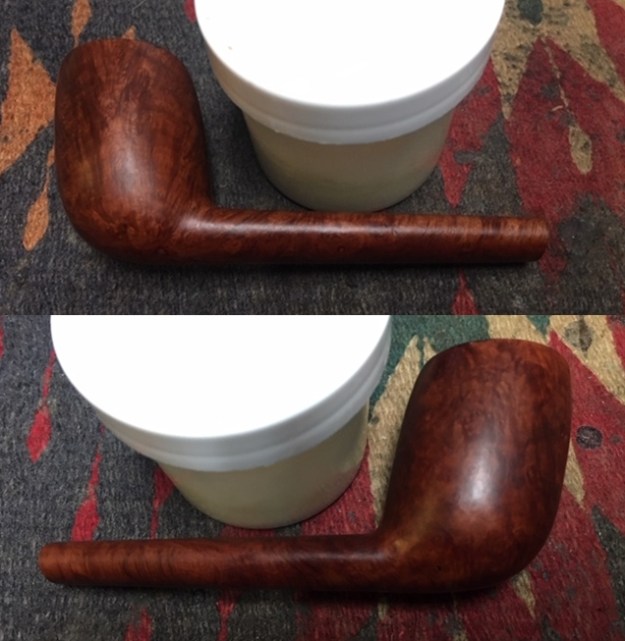
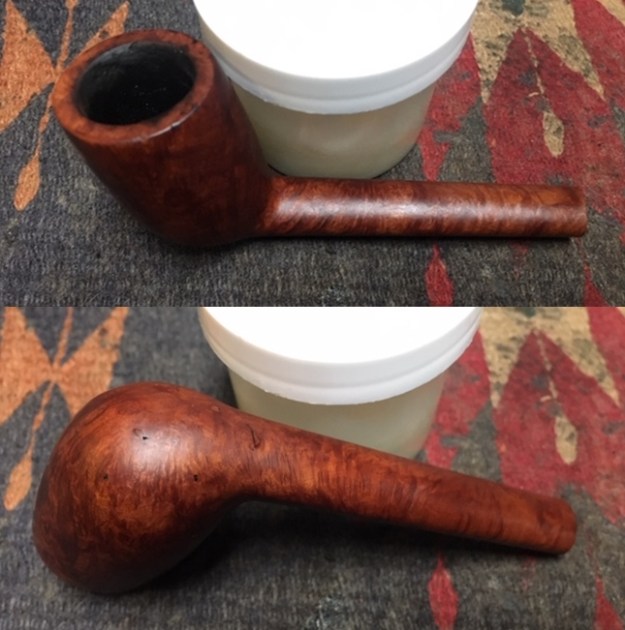
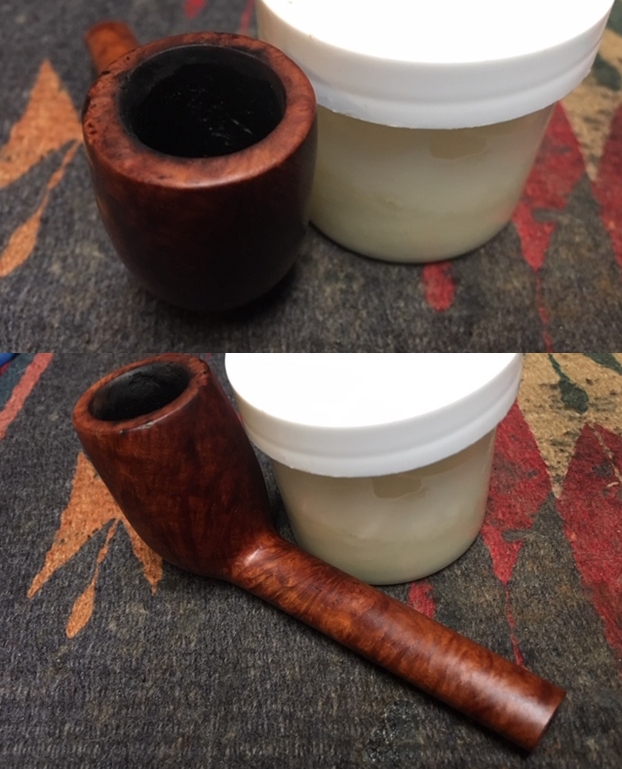
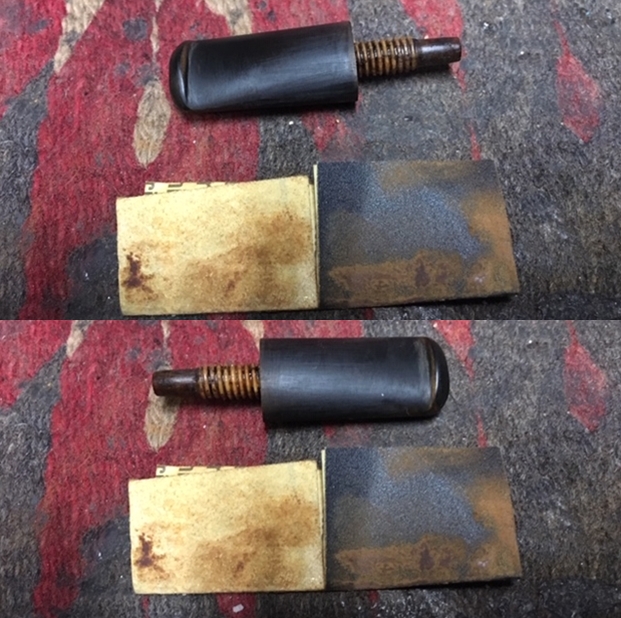
Giving a Second Chance to a Throw Away Bowl


Blog by Steve Laug

This morning I was looking through my boxes of pipes to restore to find what I wanted to do next. I went through several options and finally settled on a bowl that I brought back from Idaho. It was a Custombilt style bowl that we were ready to pitch in the trash because it was in rough condition. Someone had cut off the shank with a saw – a real hack job that left the shank end rough and the surface not flat. The bowl had a thick cake in it and an overflow of lava on the rim top. The inside and outside edges were dirty but it was unclear if there was damage. There was no stamping on the shank or underside. The finish was shot and there was a lot of dirt and grime in the grooves of the finish. There was also some shiny coat on the smooth portions of the bowl that made wonder if it had been varnished at some time in its life. It was an unbelievable mess. But it was enough of a challenge that I wanted to take it on. Here are some photos of the bowl when I started. I went through my cans of stems and found one that fit the mortise. I would need to work on the face of the shank itself to make it round again but it showed a lot of promise. The stem was lightly oxidized and the bend was too much but otherwise I liked the look of the saddle stem.I put the stem on the bowl and took a few photos of the pipe. To me it showed a lot of promise. It would take a bit of work to get the fit just right but the pipe had a lot of potential.I heated the stem with a heat gun to straighten out the bend. Once the vulcanite had become flexible I took the majority of the bend out so that the angle of the stem matched the angle of the top of the bowl. I took photos of it at this point in the process. I am happy with the progress. I set the stem aside and turned my attention to the bowl. I reamed it back to bare briar with a PipNet pipe reaming set. Once the bowl was smooth I cleaned up the reaming on the walls and scraped the rim top with a Savinelli Fitsall Pipe Knife. I topped the bowl on a topping board with 220 grit sandpaper to remove the damage and smooth out the surface of the rim. There was a lot of damage to the rim top and the topping took care of the damage to the rim top. I scrubbed the bowl with Murphy’s Oil Soap and a tooth brush under running water. I rinsed off the grime and took the following photos of the bowl. I cleaned out the internals on the mortise and the airway in the shank and the stem with 99% isopropyl alcohol, cotton swabs and pipe cleaners. I worked until the shank and mortise was clean and smelled new.There were still some shiny spots on the shank and smooth portions of the bowl. I wiped them down with acetone on a cotton pad. I used the Dremel and sanding drum and 220 grit sandpaper to reshape the shank. I rounded it to match the diameter of the stem and also faced the shank end on the topping board. I was moving through this restoration while I was talking with my brother and totally forgot to take photos of this part of the process. I smoothed out the sanded and reshaped shank and stem with micromesh sanding pads – wetsanding with 1500-6000 grit pads. I sanded the top of the bowl at the same time to smooth out the scratches.

Once I had finished shaping the shank I decided to continue my ongoing experiment with the Briar Cleaner on this pipe. I scrubbed it with the product from Mark Hoover of Before & After Products. He says that the briar cleaner has the capacity of absorbing grime and dirt from the surface of briar. I rubbed the bowl down with it to see how it would work in this setting. (Just a note: In speaking to Mark he noted that the product is completely safe to use. The main product is even FDA approved edible.) I rubbed it onto the bowl and rim top with my finger tips and worked it into the remaining sanding grit on the bowl. I let it sit on the pipe for about 5 minutes before I rinsed it under warm running water to remove the residue. I hand dried it with a microfiber cloth. I was pleasantly surprised by how clean the surface on the bowl looked when I was finished. The various surfaces of the carved briar just begged for a variety of stains to give the pipe some real dimensionality. I heated the briar and gave it the first coat of stain – a Tan Fiebings. This tan has some red tints in the dried and fired coat. I applied the stain with a dauber and then flamed it with a Bic lighter to set it in the grain. I repeated the process until the coverage was what I wanted. I buffed the bowl with a clean microfiber cloth and gave the bowl a light shine. All of this was preliminary for the next stain coat. I put the stem on the bowl and buffed the pipe with Blue Diamond on the buffing wheel. The buffing really brought the reds to the surface of the briar. It helped me to make the next decision regarding the contrast stain. I touched up the rim top with a Mahogany stain pen to smooth out the finish. I then stain the entire bowl with the contrast stain coat using Watco’s Danish Oil with a Cherry stain. I rubbed it on with a soft cloth and let it sit for a while before buffing it off with a soft cloth. I gave the bowl several coats of Conservator’s Wax and buffed it with a horsehair shoe brush. I also buffed it with a microfiber cloth to deepen the shine. I set the bowl aside and turned my attention to polishing the stem. I worked it over with micromesh sanding pads – wet sanding with 1500-2400 grit pads. I buffed it on the buffing wheel with Red Tripoli to further remove the oxidation on the surface. I reworked it with micromesh sanding pads. I wet sanded it with 1500-12000 grit pads. I wiped the stem down after each pad with Obsidian Oil. I finished polishing it with Before & After Pipe Stem Polish – both Fine and Extra Fine. I gave it a final coat of Obsidian Oil and set it apart. With both parts of the pipe finished I put the pipe back together again and I polished the bowl and the stem with Blue Diamond polish on the buffing wheel. I gave the bowl multiple coats of Conservator’s Wax and the stem multiple coats of carnauba wax. I buffed the pipe with a clean buffing pad to raise the shine. I hand buffed it with a microfiber cloth to deepen the shine. The pipe polished up pretty nicely. The rich finish and the interesting grain on this briar came alive with the buffing. The finish on the briar works well with the polished black vulcanite stem. The finished pipe looks almost like it came out of the factory like this. It is a well-proportioned, nicely grained shape that I would call Bent Apple. Have a look at it with the photos below. The dimensions are Length: 5 ¾ inches, Height: 1 ½ inches, Outside diameter of the bowl: 1 ½ inches, Chamber diameter: ¾ of an inch. This throw away, cut off bowl met a stem from another place and the pipe that came out is a beauty. The condition of the bowl showed that it was a great smoker so this new edition should also be one! I am not sure who made the bowl originally but from the looks of the finish it could very well be a Custombilt. I am not sure I will ever know with certainty but it has the look. Thanks for walking through the restoration with me.

Restoration of a No Name “Genuine Briar” from Steve’s Grab Box


Blog by Paresh Deshpande

During one of the many Facetime interactions with Steve, I expressed my anxiety of ‘what after’ I had gone through restoring all of my inherited collection. Also discussed during this interaction was that I would be interested in working on pipes from various makers and with greater variety of repair works to gain more experience and learn new techniques. Since the ‘pipe culture’ in India met its last in the early 1970s, I did not have access to large lots of estate pipes as is available in Europe and USA. Steve suggested that I grab one of the grab boxes which he had in his store. I requested him to make one from an assortment of pipes that he had to which he agreed. Soon the awaited grab bag along with other pipes that I had liked arrived in my home town and was received by Abha. She sent me this picture of the pipes that were received. The one crossed in red is a Dunhill Cherrywood sitter that is added to my personal collection.There are a total of 15 pipes in the grab bag, each with different shapes, issues and requiring different skill sets to address them. This is exactly what I was looking for and that there are some nice branded ones is like an icing on the cake. This lot included pipes that Jeff, (Steve’s brother who does all the preliminary cleaning of pipes) had cleaned and sent to Steve for further restoration works.

The next pipe on my work table is a no name Pot that had been reamed, cleaned and readied for next stage of restoration by Jeff. The only visible stamping of “Genuine Briar” is on the right side of the shank. This pipe is marked in yellow arrow with the numeral 1.The pipe has some beautiful and densely packed straight and cross grains on the left side of the bowl and shank. Dark swirls adorn the rest of the stummel. The only stamping that is present on the right side of the stummel seen is “Genuine Briar”. There is no COM stamping and even the stem is devoid of any logo, in short there are no identifying marks that will help me in identifying or dating this pipe. However, this classic Pot shape and quality somehow makes me wonder that this could very well be an English made pipe. Since there is nothing that points me to the maker or country of origin or model/ shape code on this pipe, I move ahead with initial inspection of the pipe for further restoration process.INITIAL VISUAL INSPECTION
The stummel is clean and one can make out beautiful densely packed straight grains all around on the left and interspersed with dark swirls of grains on the right. There are very few minor dents and dings on the stummel surface. In all probability, I shall let these minor dents and dings remain. Maybe, sanding and further micromesh polishing will address a few of these dents and scratches. There are a few very minor fills towards the back and on the heel of the stummel. The stummel has a natural finish to the briar. The bottom of the shank is flat, making it a sitter. This is the first time that I am working on a pipe that has been cleaned by Jeff and he does amazing prep work, I say. The chamber is clean and odorless without any trace of the old cake. There is no damage to the inner walls of the chamber. A few specks of yellow paint are seen on the front of the bowl, but nothing serious to address. The rim top has the maximum damage and is peppered with numerous deep dents and dings, probably caused due to knocking the rim against a hard surface to remove dottle.  The rim top surface is darkened but not because of any overflow of lava, but maybe due to charring. There is significant damage to both the inner and outer edge of the rim all around, more so on the on the right side in 3 o’clock direction (marked in yellow arrows) due to charring. Simple topping of the bowl on a piece of 220 grit sandpaper should address this issue, however, in addressing this issue, though I absolutely hate it unfortunately, I would be losing some briar estate, a price I am willing to pay to resurrect this beauty. The shank end of the pipe is clean and so is the mortise. The draw is smooth, full and open. The vulcanite stem has minor tooth chatter on the upper and lower surface. Both upper and lower button has minor tooth marks and would need to be made crisp. The stem no oxidation and is an even black. The tenon is also clean and though the seating of the tenon in the shank is flush, attaching it is very hard and requires effort and there is a possibility of breaking the tenon if too much pressure is applied. I would need to address this issue. The air way is clear and draw is easy and smooth.THE PROCESS
Since Jeff had done the initial cleaning, I straight away get on with addressing the issues as observed during my initial inspection. The first issue that I decided to address is the fit of the tenon in to the mortise. Close examination of the mortise revealed an uneven surface and this could be the reason for the extremely tight fit. I roll a piece of 220 grit sand paper and sand the inner surface of the mortise to even out the surface. Once satisfied, I tried the fit of the stem in to the mortise. The fit is nice and snug with all the right noises! I sand the entire stummel surface with a folded piece of 220 grit sand paper. This should address the minor dents and dings on the stummel that I had initially observed and even out the entire stummel surface. I was careful around the only stamping on the shank. I absolutely detest losing any briar from the stummel, but to address the issue of uneven rim top surface and the dents and dings on the rim edges, this is a necessary evil. Thus, with a heavy heart, I began the process of topping the rim to reduce the charred surface and bring the bowl back to round. I use a square piece of 220 grit sand paper and firmly hold it with my hand on my work table. I work the rim top on the sand paper in circular motion, frequently checking the progress as I wanted to keep the briar loss to a bare minimum necessity. Once I was satisfied that the charred surface has been reduced and the roundness of the bowl has been restored to the extent possible, I created an inner edge bevel by pinching a folded piece of 180 grit sand paper between my thumb and forefinger and moving along the inner edge with a constant pressure, to minimize the charring on the inner edge of the rim. Similarly, I created a slight bevel on the outer edge of the rim. Thereafter, I moved to the next stage of polishing and revitalizing the entire rim top and the stummel. I even out stummel surface by polishing with micromesh pads, wet sanding with 1500 to 12000 grit pads. I wiped the stummel with a moist cloth after each wet pad to see the progress. I paid special attention to the rim top surface and the newly created inner and outer rim edge bevels. I rub a small quantity of “Before and After Restoration Balm” in to briar and let it rest for a few minutes. The balm almost immediately works its magic and the briar now has a nice vibrant appearance. I further buff it with a horse hair shoe brush. I ran a couple of hard bristled and regular pipe cleaners dipped in alcohol to be sure that the internals of the stem are cleaned out. A little bit of filing with a flat head needle file followed by sanding with folded pieces of 220 and 600 grit sand papers smoothed out the little damage to the buttons and the button edges are now even and crisp. I polished the stem with micromesh sanding pads – wet sanding with 1500 to 12000 grit pads. I rubbed the stem down with Extra Virgin Olive Oil after each set of three pads. I set the stem aside to dry. To finish, I re-attach the stem with the stummel. I mount a cotton cloth buffing wheel on to my hand held rotary tool and applied several coats of carnauba wax over the stummel and the stem. I finished the restoration by giving the pipe a rigorous hand buffing using a microfiber cloth to raise the shine further. The completed pipe, with the natural finish and beautiful grains on the stummel contrasting with the shiny black stem looks lovely, fresh and vibrant; the photographs speak for themselves. P.S. While working on the stummel a thought to stain the stummel with either dark brown or a combination of dark brown and cherry red stain did cross my mind. I did not entertain that thought long though, as I was convinced that as the pipe is smoked, it would darken beautifully and would add to the character of the pipe.

Thank you all for walking on this journey as a part of me.

Restoring a Dr. Grabow “Commodore” #39


Blog by Paresh Deshpande

After we bid our farewells to my Guru and Mentor, Steve Laug and his brother, Jeff, (Dal had left a couple of days earlier) I felt a void. All of a sudden there was nothing to look forward to, no pipe talks, no planned activities, nobody to share a smoke with and above all, their mere presence was being missed by Abha, my wife and both daughters, not to mention me too! It was my youngest daughter, Pavni, who suggested that we restore a pipe!! What a suggestion that was! Our spirits immediately soared and I pulled out my “MUMBAI BONANZA” pipe box to select one pipe.

The one that caught our collective attention was a pick axe shaped pipe that we had come to associate with Kriswill as I have inherited a few. However, this had a “Spade” stamped on its stem in white. It was a Dr. Grabow.

For those readers who have missed out on my previous work, I was fortunate enough to have heeded the advice of my dear friend and mentor, Steve, and struck a deal with a junk collector from Mumbai. He did not know what he was selling and I did not know what I was buying as we reside in different cities!! The argument that Mr. Steve presented was that if not anything, I shall at least have some spares and this was logical. I struck a deal and here are pictures of the pipes that I received in this lot.     This lot contains some very nice collectible pipes, a few well known brands and some mediocre brands. Overall, with seven Dunhill pipes, a Preben Holm #1 FH, a couple of “Made in England” Pete System pipes, a couple of  Charatan’s Belvedere, Custom-Bilt, Stanwell and other assorted pipes, I would say that I had struck a decent haul!!! This is indeed my “Mumbai Bonanza”.

The eleventh pipe that we decided to work on from this find is a pickaxe shaped pipe and is indicated in red colored arrow in the picture below. It is stamped on the right side of the shank as “COMMODORE” in block letter over “DR. GRABOW” again in block letter. The shape code “# 39” is also stamped on the right side towards the shank end and away in the middle of the two lines. The left side of the shank is devoid of any stamping, which is slightly unusual as most of carvers and makers prefer to stamp their pipes on the left. The stem bears the famous “Ace of Spades” logo in white, embedded on the left side of the stem. Now coming to the research of this brand and line/ model in specific, I referred to pipedia.org and as expected there is an extensive research on this pipe and even has a separate page on the dating of Dr. Grabow pipes, starting from the Linkman era to later pipe lines and numbers which makes for an interesting read and is highly recommended. This research has been done by Russell McKay, and is from his website DrGrabow-pipe-info.com. Here is the link to the page on pipedia.org:

https://pipedia.org/wiki/Dr._Grabow_Models_(Series,Line)_Names_Through_the_Years

I found what I was looking for in the list of most “newer” Dr. Grabow pipe names and is reproduced below;

COMMODORE (c1964) — First appears in a magazine ad for $7.95 as early as 1964. Like the Sculptura, later models were sandblasted in a “big” blast circa 1967-69 (See “Sculptura” for details.)

From the above information, it is evident that the pipe currently on my work table is from the period 1967-69, even though the line was first introduced in 1964 since the stummel is beautifully sandblasted. With this input on the vintage of this pipe, I move ahead with the restoration of this 50 plus years old pipe!

INITIAL VISUAL INSPECTION
I usually start my initial visual inspection by going over the chamber first. However, in this particular pipe, I was so drawn by the beautiful sandblast on the stummel that I decided to change the order and start with the stummel.

The stummel boasts one of the most beautiful sandblast patterns with the front of the bowl having circular blasted pattern and from the outer most part of this blast ring, the sandblast that radiates from the front of the stummel and moving around to the sides and back of the stummel with the cross grains and the straight grains forming an intricate crisscross patterns. It is a visual treat to say the least and difficult to explain in mere words! The following two pictures of the cleaned stummel will give the readers an idea of the sandblast patterns on the stummel.The sandblasted stummel is covered in dirt and grime of 50 plus years of its existence. This should clean up nicely. The stummel surface is solid with no damage to the external surface. The dark browns of the raised sandblast contrast beautifully with the black stain of rest of the stummel. A thick layer of cake can be seen in the chamber. The sandblasted rim top surface is covered in thick overflow of lava, dirt, dust and grime. The condition of the inner walls of the chamber and rim top surface will be known once the cake has been taken down to bare briar and the rim top crud has been scraped off completely (thankfully readers cannot see or hear me muttering silent prayers!!). The inner rim condition appears to be in good condition with no burn/ charred surfaces. Even the outer rim edge appears to be in a decent condition. Only once the stummel has been thoroughly cleaned that I can be sure of my initial appreciation. In spite of the thick cake, the chamber odor is, surprisingly, not strong and should be addressed once the cake has been taken down to the bare briar. The shank end has a metal band around the center and this metal band extends inside the shank with threads, over which the threaded stem stinger is seated in to the mortise. Thankfully, the band and threads are all intact. The mortise is blocked with dried gunk, adversely affecting the airflow. The metal band is dull and dirty in appearance.The stem is an “Adjustomatic” type (a patent for stem to shank threading system, later Patent #2461905 which was filed on 25th January 1946 by David P. Lavietes). This patent allows the stem to be turned in the shank for a perfect alignment without having to detach the two. The stem is attached to the shank by a threaded “tool” stinger (again patented by the brand way back in 1924 and upgraded over the years) and the stem can be turned over this stinger for alignment of the shank and stem. Unfortunately, the previous owner had this stinger cut ahead of the threaded portion so that the attachment of the stem to the shank is not affected at all. The vulcanite stem is heavily oxidized and has calcification deposits towards the button end. There are a few deep tooth marks on the lower and upper stem surface. The button edges also have bite marks. The stinger opening and the horizontal slot shows accumulated oils and tars. The threaded portion of what remains of the stinger is covered in dried dust, dirt and grime. The alignment of the stem and shank skewed with the stem being overturned to the right.THE PROCESS
I started the restoration with cleaning of the stummel as I was keen to know the condition of the walls of the chamber. With size 1 head of a Castleford pipe reamer, I took the cake down to bare briar. Using a folded piece of 180 grit sand paper, I sand out the last traces of cake and expose the walls of the chamber to ascertain that there are no cracks/ heat fissures. I wiped the chamber with a cotton pad dipped in isopropyl alcohol to remove the carbon dust left behind by all the reaming and sanding process. I was happy to note that the walls of the chamber are in pristine condition without any heat fissures or pits. The inner and outer edge of the rim are intact and without any burn or char marks. Next I decided to address the stem. I cleaned the internals of the stem using hard and normal bristled pipe cleaners and isopropyl alcohol. The stem airway and the open ended stinger were filthy as can be made out from the number of pipe cleaners that were used up in the cleaning process. I cleaned the complete stem with a cotton swab and alcohol to remove the calcification from the button end and thereafter flamed the stem surface with the flame of a lighter to raise the tooth indentation to the surface. I scrubbed and cleaned the portion of the stinger that remained. I liberally applied petroleum jelly to the stinger to protect it and dropped the stem in to the “Before and After Deoxidizer” solution which Jeff had lugged all the way from Idaho, USA for me. This solution, which has been developed by Mark Hoover, has reduced my time in working on removing stem oxidation by ¼ and should form a part of the list of ‘must have’ items for restoring a pipe.While the stem was soaking in the “Before and After Deoxidizer” solution, I cleaned out the internals of the shank and mortise. Using my fabricated tool, I scraped out all the dried oils, tars and gunk that had accumulated in the shank airway and mortise. The amount of crud that was scrapped out leaves no surprise why air flow through it was restricted. I finished the cleaning by running a few pipe cleaners dipped in isopropyl alcohol. I also wiped the metal band and the threads with cotton buds and alcohol. With this cleaning, all old smells in the pipe are history. The pipe now smells clean and fresh.With the internals of the stummel now clean, I cleaned the external surface using a hard bristled toothbrush and Murphy’s Oil Soap. I diligently scrubbed the crevices formed by the sandblast to remove all the dust and dirt that was embedded in between. With a soft bristled brass wired brush, I gently removed the overflowing lava from the rim top surface and rinsed it under running tap water. I wiped the stummel dry with an absorbent soft cotton cloth. I am very pleased with the way the stummel has cleaned up. The sandblast looks absolutely gorgeous. Next, I rub a small quantity of “Before and After Restoration Balm” in to the briar with my finger tips, work it deep in to the sandblasts and let it rest for a few minutes. The balm almost immediately works its magic and the briar now has a nice vibrant appearance with the beautiful sandblast patterns on full display. I further buff it with a horse hair shoe brush. With this, I keep the stummel aside and turn my attention to the stem repairs. While I was working on the stummel, Abha, my wife had in the meanwhile fished out the stem from the ‘Before and After Deoxidizer’ solution after a soak of about 6 hours. She rinsed it under running tap water to remove all the sticky solution that remained on the surface. She also let the water run through the stem airway and blew through it to dislodge the solution that remained inside and followed it up with a thorough cleaning with Mr. Magiclean sponge and 0000 grade steel wool. She finished her part in cleaning of the stem with a vigorous rubbing with a microfiber cloth. This removed nearly all of the oxidation from the stem surface, however, the deep tooth indentations at the button edge and in the bite zone still needed to be addressed. And as is her habit, she did not take any pictures of this process.

I began my part of stem repairs by sanding the stem with a folded piece of 220 grit sand paper. This helps in getting rid of what little oxidation remained while providing a smooth surface for the intended fills to reconstruct the damaged bite zone on both surfaces and also the button edges. I wiped the stem surface, particularly the damaged areas, with a cotton pad and alcohol to remove any traces of dirt and grime. I prepared a mix of CA superglue and activated charcoal and carefully applied it over the damaged bite zone on both surfaces, and button edges and set it aside for curing over night. I had applied this mix in sufficient thickness which would help during the filing and sanding to match the fills with the stem surface and shaping the button. Once the fills had cured sufficiently, using a flat head needle file, I reshaped the button and roughly matched the fills with the rest of the stem surface. I followed it up by further sanding the stem with 320, 600 and 800 grit sand papers to achieve a perfect blending of the fills with the stem surface and a crisp button edge on either side of the stem. Using the micromesh pads, I complete the polishing cycle by wet sanding the surface with 1500 to 12000 girt pads. The stem looks great with the fills nicely matched with the rest of the surface. I rub a little quantity of Extra Virgin Olive oil in to the stem surface and set it aside to be absorbed by the vulcanite. The only issue that remains unaddressed at this stage is the issue of overturned stem. Being an adjustomatic stem, I fixed the stem in to the shank and tried to turn the stem to match the shank applying just adequate pressure. However, the stem would not budge. Not wanting to create further complications like broken stinger or wearing down of the threads, I unscrewed the stem from the shank. With the flame of a lighter, I heated the aluminum stinger to a point where the stem was just about able to rotate on the stinger. I reattached the stem to the shank while the stinger was still warm, and turned it till the alignment was perfect as I desired and set it aside to cool down. Actually the reasoning behind heating the stinger is that the gunk which accumulates on the stinger and further percolates inside is loosened, thus freeing the stem.

To complete the restoration, I mounted a cotton cloth buffing wheel on to my hand held rotary tool.  I set the speed at about half of the full power and applied White Diamond compound to the entire pipe. I wiped/ buffed the pipe with a soft cotton cloth to clear it of any leftover compound dust. With a cotton buffing wheel earmarked for Red Tripoli, which has a finer grit than White compound, I buffed the stem to a fine glossy finish. I then mounted another cotton cloth wheel on to the polishing machine and applied several coats of carnauba wax. I finished the restoration by giving the entire pipe a rigorous hand buffing using a microfiber cloth to raise the shine further. The finished pipe looks amazingly beautiful and is now ready for its long second innings with me. I only wish it could share with me its life story of the past 50 plus years while I enjoy smoking my favorite Virginia blend in it!! P.S. I have to admit to the readers of this blog that I had completed this project in the month of May 2019 but I kept procrastinating on the write up. To be honest, I find doing the write up on any project more tedious and difficult than working on the project itself and Steve will bear with me on this fact. And the fact that English is not my first language further makes it all the more challenging. There are nine more pending write ups which I shall be tackling before I undertake any new restoration, God!! I don’t want to scare myself!! I wish to thank each one for sparing their valuable time to read through and any inputs or advice is always welcome.

Gifting my Mentor and Dear Friend, Steve, an Alexander Zavvos Hygrosystem Pipe.


Blog by Paresh Deshpande

When Steve, his brother, Jeff and Dal Stanton, The Pipe Steward, were on a visit to India, I had a desire that there should be a unique pipe which all three of us should have (Mr. Jeff being a non smoker) and had laid down for myself, the following parameters for identifying THAT PIPE!

(a) Both should not be having this pipe in their personal collection (knowing well that this would be a very tall order!!)

(b) The pipe must have some historical significance and should have made a contribution to the world’s pipe history.

(c) It must come from a well-known carver or manufacturer.

I began this selection with going through my own personal modest collection, rather my Grandfather’s collection to which I have made miniscule additions. Amidst all the WDCs, Charatans, Comoy’s, Barlings, Ben Wades, Stanwells and Kriswills, there was this one pipe which was very different. Very early in my association with Steve, we had discussed this pipe which Mr. Steve had not come across (which was unbelievable!!!) and did not own a pipe from this carver, but was very much interested in it. An oblique enquiry from Dal also confirmed that he did not have this make. Well, this helped me zero in on this pipe to be gifted to my friends during their visit to India. The pipe selected is an ALEXANDER ZAVVOS HYGROSYSTEM, PAT.No 87033, made in the 1970s-80s. What followed was an extensive and prolonged hunt for two such pipes of which the first one was purchased from one seller on Pinterest and the second was on eBay. These pipes were received separately and the last delivery materialized a couple of days prior to the arrival of my esteemed guests. Here are both the pipes as I received them.Since Dal was the first to arrive in India (and being the youngest amongst arriving guests…LoL), he was given a choice between the two. He selected one with an Apple shape and the remaining willy-nilly came to Steve. At that point in time, both Dal and I discussed that it would be the Apple shape that Steve would have selected but… Well after working on Steve’s pipe, am I glad that the Dublin came to Steve as it provided me with an opportunity to present my first ever rusticated pipe to the person who has introduced me to this art and mentored me all along. Thank you Steve for being with Abha and me on this journey.

The stamping on the Dublin is pretty worn out and hard to make out. However, the stampings on my pipe and that on Dal’s is pretty crisp and clear. It reads on the left of the shank as “ALEXANDER” over “HYGROSYSTEM” over a square with letter “Zb” over “GREECE”. The bottom of the shank bears the stamping “PAT No. 87033” over “03/ 89”, which I believe is the date code indicating that the pipe was made in March of 1989. This stamping is visible only under a white light with a magnifying glass and the area around the stampings has bubbled up skin surface, something akin to chipped paint.I researched this pipe on pipedia.org and reproduce excerpts of information on this pipe carver, in his own words, and his immense contributions to the Greek pipe industry in particular and entire world’s pipe community.

I am Alexandros Zavvos, born in Molos, Thermopylae, near Lamia. Since I was a child I had an inclination for art, starting with painting. I studied Radio-electronics, and at age 23 I got involved with commerce with a capital of 150.000 drs. in 1962.

 I entered the pipe business where I met, by total chance, with Mr. Libero G. Albanese, first technician and producer of briar-wood models in Kalabria, Italy. When I told him that I am Greek, he almost prayed, saying that we Greeks have the best briar in the world for pipe-making! From that moment on I understood that this fellow is in love woth his work – and he transmitted that to me instantly!

From mid-1962 to 1963 I searched all over the world for a college or a school in order to be taught the art of pipe-making, but in vain – there were none. Moreover, I wasn’t able to make it through the big European pipe-makers of that time (British, Italian, Danish). I was convinced that only through experience there was a chance of me becoming what I wanted.

In 1964 I started the commercial briar-wood model production, in 1965 I constructed empirically my first pipe and in 1967 I started the vertical production (this is from the briar Greek woods to the consumer) – maybe there is no other factory in the world producing smoking pipes vertically.

In 1970 I started the research, which was accomplished in 1984, on the 1st generation hygrostatic system. In that same period we founded, my brother and I, our factory in Lamia for the production of ebony epistomes.

Today, 40 years later, I have successfully arrived at the production of the 5th generation hygrostatic pipe. I will finish by saying that this pipe, to what concerns the pleasure it provides, has nothing to do with that pipe for peace, offered by American Indians.

Update: Today I am saddened by the news that Alexander passed away on February 10th, 2015. Our thoughts and prayers are with his family and friends. We are very thankful for his contributions to the World of pipes. —sethile (talk) 21:00, 12 February 2015 (UTC).

The description given by the seller on eBay was equally informative and I reproduce the same for the readers to get a fair idea of the famed Hygrosystem that has been incorporated into the construction of this pipe.

A patented Hygro-system pipe by the greatest and most known (now deceased) Greek pipe manufacturer Alexander (Zabos / Zavvos). His old pieces are by now becoming rare and sought after, as his son who took over the business is not equal to the father. His stamp (Z with a B lower) comes from the two consonants in his name the way it is spelled in Greek. Very big and well known European pipe makers have purchased top briars from Alexander Zavvos, since the Greek briars are among the best in the world.

A few things about Alexader Zabos’s patent: The hygrostatic system  is the result of 35 years research and experience. It is based on the Bernoulli principle, has been allowed to be patterned (No 87833) by the Greek Ministry of Industry and Energy. Unlike most filter or no-filter pipes, the Alexander Hygrostatic Pipe reduces drastically moisture and other heavy residue (such as tar etc), which otherwise could be inhaled into our lungs and extinguishes a bitterness and a burning on the tongue.

Alexander Zavvos’s Hygrosystem pipes were quite expensive if bought new (the cheapest had a value of 160-170 euros) and have become highly collectible after the death of the manufacturer.

From the above information, it is safe to infer that this pipe is from the first generation of the hygrosystem pipes from Alexander Zavvos and made in March 1989.

DECONSTRUCTING THE PIPE
In my quest to understand the functional principal of the famed HYGROSYSTEM used in this pipe, I began by first dismantling the pipe. The pipe was dismantled in three parts; first the stummel, secondly the aluminum screw-in shank extension which has an aluminum tube to house a filter, probably a 6 mm, and lastly vulcanite stem with a fused briar wood saddle. From my appreciation, it is the shank extension which forms the critical component in the famed Hygro-System, at the stem end of which a smaller aperture pipe protrusion is seen. A similar sized protrusion is seen at the tenon end of the vulcanite stem. The fit of the tenon in to the aluminum shank extension is made air tight with a thin ring of briar wood (not leather, as it is not pliable at all).APPLICATION OF BERNOULLI’S PRINCIPLE IN THE HYGROSYSTEM

Bernoulli’s principle states that an increase in the speed of a fluid occurs simultaneously with a decrease in pressure or a decrease in the fluid‘s potential energy. This is applicable to flow of gases also.

In simple layman’s understanding, the above principle states that “Pressure is inversely proportional to the speed of the liquid or gaseous flow”. So how does this principle work in the hygrosystem of this pipe? To explain application of this principle, refer to the picture of the pipe below that I have drawn:(a) Hot smoke along with heavy particulates of oils, tars and moisture from the chamber enters the mortise and expands due to width of the mortise. As a result, speed is reduced. High pressure is created in the mortise.

(b) Once the smoke enters in to the aluminum shank extension, it is compressed and speeds up considerably creating a low pressure area. Due to the low pressure, heavy particles like oils, tars and moisture settle down and are trapped in the filter in the aluminum tube of the shank extension.

(c) The speed is further increased when the smoke passes through the smaller aperture tube due to further compression, shown in green arrows, further lowering the pressure. When this smoke leaves the smaller aperture tube and enters the wide stem end of the shank extension, there is a sudden increase in pressure. This sudden variation in pressures results in heavy particulates settling down and only smoke, being lighter, propelled ahead.

(d) Similar pressure changes are affected when the smoke passes through the wide tenon and through the smaller aperture tube in the stem, further precipitating the heavy particulates of oils, tars and moisture. The end result is a pure smoke without any oils or tars.

The above understanding is my own reasoning based on my learning of science till Graduation level. Any corrections or clarifications from more knowledgeable readers is always enriching and welcomed.

INITIAL VISUAL INSPECTION
Starting with the rim and rim top surface, there is a slight overflow of lava on the rim top and the surface itself is peppered with numerous dents and dings which should be easy to sort out by topping the rim top. The rim edges are sans any serious damage, save for an odd chip on the outer edge, marked in blue arrow.The chamber however tells a very different story. There is a thin layer of cake which has taken on a grey coloration, which is a first for me, by the way. The way the cake appears to the eye, I suspect a few heat lines in the walls of the chamber towards the back and right side. I just hope that the issue is not a major one and just a bowl coating should suffice. Well, I shall cross the bridge when I reach it. There is strong smell emanating from the chamber which should be addressed to a great extent once the chamber has been reamed and the shank has been cleaned. The stummel surface has signs of accumulated dirt, dust and grime and should clean up nicely. It was surprising to note that these accumulations are in patches, almost following the cross grains seen on the right and front and over the entire shank. The left side, which has some beautiful bird’s eye grain, is clean. There are a large number of dents and dings all around the stummel surface. The shank surface has bubbled up near and around the stampings towards the shank end. Just near to the shank and bowl junction, I could make out a very thin line running all round the shank forming a circle (marked in yellow arrow). This worries me as at this stage, I am not sure about the extent of the depth of the crack. Also along this crack line, I could make out one fill. All in all, this is going to be a challenging restoration to get it back to being smoke worthy. There is a brass ring at the shank end which extends inside the shank with threads on to which the aluminum shank extension is screwed in. This brass ring should add a bit of glitz to the pipe appearance once polished. The mortise is clogged and heavy crust of dried oils and tars are clearly visible. This will take some effort to clean out.   The screw-in aluminum shank extension that houses a filter is covered in oils and tars. Also the smaller aperture pipe protrusion at the stem end is covered in gunk and tars. The briar coating at the top of this extension is chipped at one place (marked in yellow arrow) exposing the underlying aluminum shank extension. At the stem end of this extension, the brass ring is missing (marked in orange). I don’t have any brass rings and hence will have to improvise one that will fit. The vulcanite stem with its fused briar saddle at the tenon end is generally in good shape, save for the broken button end. The stem is very lightly oxidized and has minor tooth chatter on the lower lip surface towards the button end. The lower button itself shows minor tooth marks. Rebuilding of the missing button portion of the upper surface and reshaping of the lower button shouldn’t pose any major issue. The tenon is dirty with all the gunk and dried oils and tars left behind by the previous owner of this pipe. THE PROCESS
Since any stem reconstruction takes the most amount of time what with all the curing, sanding, refilling if needed, shaping and polishing, I always prefer to start with repairs to the stem. Firstly, I sand off all the tooth chatter and the area of intended fill with a piece of 220 grit sand paper. This not only evens out the surface for the fill but also gets rid of the oxidation which would otherwise show itself through the fills as a brown patch after polishing. This was followed by cleaning up the internals of the stem and the tenon with regular and bristled pipe cleaners dipped in 99% pure isopropyl alcohol. With a dental pick, I scrubbed out the dried gunk from the tenon and from along the broken button end edges. I had seen Dal use a folded triangular index card while reconstructing a broken button end whereas I always used a Vaseline coated pipe cleaner inserted in to the air way to keep it open. My method, though effective, was time consuming as I had to completely reshape the slot thereafter. Therefore for this repair, I decided to adopt Dal’s method. I appropriately folded an index card and covered it with a transparent tape which prevents the superglue and charcoal mix from sticking to the card. This is how it appears and fits in to the broken stem.I prepared a thick mix of CA superglue and food grade activated charcoal and applied it over the broken button area. I also applied this mix over the lip edge to make it even and cover the tooth marks. Once this layer had cured, I applied another layer of the mix. The trick here is that this type of reconstruction needs to be done in layers to a thickness more than the adjoining stem surface. This thereafter can be filed and sanded down to match the stem surface. I did exactly as described above and set the stem aside to cure.First layer.Second layer.Third layer.Final layer.

Once the mix had cured hard, I went about matching these fills with a flat head needle file and followed it up with a piece of 220 grit sand paper. As expected, I observed a couple of air pockets and also that one of the lip edge had been filed down more than the other and was dotted with many air pockets. I addressed these issues with a layer of superglue and charcoal powder mix. However, in this mix, the percentage of superglue was higher than the charcoal powder. I set the stem aside to cure. After the stem fills had cured, I repeated the process explained above to match the filled surface with the stem surface using needle files and sand paper. Now the lip edges are even, however, the air pockets persist. It’s very frustrating, I know but you have to be equally persistent. I applied a layer of clear CA superglue (would have ideally applied black CA glue, but……don’t have it) and set it aside. To take my mind off the troublesome stem repair, I decided to tackle the issue of missing brass band from the stem end of the shank extension. Working with limited spares, materials and tools has its advantages. It forces you to think out-of-the-box for ways around the hurdle, many a times with startling and successful results but you pay the price in terms of time penalties. Well, time I have aplenty!!! I decided to fabricate a brass ring of adequate thickness. My fabricator informed me that it would not be possible to make one with this width as he had only wires and not strips of brass. No issues, I had two rings made!! These rings fit perfectly and add a nice unique touch. These should polish up nicely. I shall fix these rings towards the end of the restoration process. Moving ahead, I reamed the chamber with size 1 and 2 head of the PipNet reamer. Using my smaller sized fabricated knife, I further reamed out the cake from places where the PipNet reamer could not reach. I gently scrapped out the lava overflow from the rim top surface. I followed it with sanding the chamber walls with a 220 grit sand paper. How I miss my younger daughter, Pavni, who specializes in smoothing the chamber walls and removing every trace of the old cake. Steve, hope I have come close to her finesse!! Once the cake was taken down to bare briar, my initial fears of heat fissures/line were confirmed, with the only difference being that these were not linear but pits, another first for me. These pits were only on the right side of the stummel and marked in yellow.  To use J B Weld or only a bowl coating (which I prefer) would suffice, shall be decided later. Removing the overflow of lava from the rim top revealed a surface that is peppered with numerous dents and dings. Other than these issues, the walls of the chamber are even and solid. I still did not have the inclination to work on the stem (actually it’s the fear of unknown result of the last fill!!) and continued with cleaning of the stummel. I worked the mortise using the dental tool first to scrap out the dried out gunk, oils and tars left behind by the previous steward. The amount of grime scrapped out is a testimony to the efficacy of this HygroSystem, I say. A few pipe cleaners dipped in alcohol later, the shank is clean. Now that the chamber and shank internals are clean, the smells though reduced, is still prevalent.Staying with the stummel, I cleaned the externals with Murphy’s oil soap and toothbrush. Rinsing under tap water (remember, I am in India and its hot here and even tap water is equally warm!!!!) was the start of my nightmare and prolonged conversations with Steve and on our FB messenger group. Here are the pictures first; description of my observations will follow subsequently. Just follow the arrows… As I had noted during my initial inspection, the hairline crack towards the bowl end is now prominently visible and marked with yellow arrows in each picture. This hairline crack runs all around the shank and is joined end-to-end. This still was okay as I had anticipated it, but what surprised me, or rather rocked my feet, was the thick fill of putty running all around the shank end. The same is marked with blue arrows. This fill runs in a more perfect circle than the one near the bowl shank joint and right through the middle of all stampings!! Aargh……There goes the stampings… Sorry Steve, hope you understand.

As if the hairline crack and the all-round fill at the shank end was not enough, the right side of the stummel is…. Actually, I am lost for words and the words that come to my mind are most definitely unprintable and I definitely have no desire for a rap on my knuckles from Steve. Have a look at the pictures and please decide for yourself a suitable description. There is not an inch on the right side of the stummel and shank that is free of any fills. Undaunted, I began the arduous journey of removing the old fills and preparing the stummel for a fresh fill. Using my newly acquired dental tools which were procured when Steve, Jeff, Abha and I had gone around the town shopping for tools for pipe resto work, I progressed to removing the fills. This is how the pipe appeared after the old fills were removed, a cheesecake pipe!!!! The fills were large and deep. The only saving grace was the crack near the bowl shank joint was only superficial and the fills on it would act as counter hole, what am I writing!! It’s a complete circular crack. The long and short of it is that the crack is stable and going nowhere damaging the structural integrity of the pipe. At this point in the restoration, I decided to address the issue of old odors in the chamber and shank by subjecting it to a cotton and alcohol bath. I wrapped some cotton around a folded pipe cleaner, keeping the tip of the pipe cleaner free of wrapped cotton as this would be inserted through the draught hole in to the chamber. This would form the wick for the shank. I tightly packed the chamber with cotton balls and filled it with 99% pure isopropyl alcohol using a syringe and set it aside. Immediately a few seconds later, the alcohol started oozing out of all the fills. The pipe appears to be shedding tears at its present condition, and so am I. I shared these pictures with my FB messenger group friends inquiring whether to discard the pipe or continue and ways to progress ahead with the restoration. The unanimous reply was to continue and rustication was the way ahead. Well I moved ahead with my work on the pipe but was not sure about the rustication part. Here is how the pipe appeared at this stage in restoration: By next day, the cotton and alcohol had drawn out the tars and oils from the chamber and max from the shank.I let the stummel fills dry out completely and after all the alcohol had evaporated, proceeded to fill the deep gouges with CA superglue and briar dust using the layering technique. I my part of the world, the moment briar dust came in to contact with the glue it becomes rock hard even after trying every trick that Dal had shared with me and Steve when we were together in India. Therefore, I adopted the layering technique where I put down a thin layer of superglue in to the fill and press briar dust over the glue. I continue with this till the fill rises above rest of the stummel surface. Believe you me readers, I spent an entire evening working well past midnight, to get all the gouges filled up. I set the stummel aside to cure for the next 24 hours. Still working on the stummel, I file the raised mounds of the patched fills with a flat needle file. The only drawback of the layering technique is that a number of air pockets are revealed after the filing. This time was no exception and I refilled the exposed air pockets only with superglue and set it aside to cure. Since there was still time before I hit the bed, I decided to address the stem. I sand the fill to match the surface of the stem. For a better blending, I further sand the entire stem with 220. I topped the slot on a piece of 220 grit sand paper to even it out. The repairs looked good at this stage. With the stummel fills nicely cured, it was time again to work on it. Using a flat head needle file, I sanded the fills and followed it with further sanding with a folded piece of 220 grit sand paper. Again the same sordid story, the fills revealed numerous air pockets through which the briar dust was seen. In my quest to make this restoration as perfect as possible, it refilled these air pockets with superglue and briar dust. This time around, I mixed a minuscule amount of briar dust with superglue and surprise! The mix remained pliable for just enough seconds in which I could apply it over the fills. Again I set the stummel aside to cure. This sure is trying my patience and stubbornness. I shall prevail, is what I have decided. Since the glue and briar dust mix had hardened immediately, but not hard enough to use a flat head needle file on it, I decided to address the issue of the numerous dents, dings and scratches on the rim top surface. To do this, I spread out a patch of 220 grit sand paper on my work table. Firmly holding the patch in my left hand and the stummel in my right, I gave a few firm rotations to the rim top over the sand paper patch. I continued the process, checking ever so frequently, till I was satisfied with the result. The rim no appears pristine and even. This was the only uneventful part in the entire restoration, LoL!!The fills on the stummel having sufficiently cured, I went ahead and filed the fills with a folded worn out piece of 150 grit sand paper and followed it up with sanding with a piece of 220 grit sand paper. My reasoning for not using a flat head needle file was that maybe the hard abrasiveness of the file is causing the fill to come out exposing the air pockets. But no, the air pockets still showed themselves in all their ugliness. I decided to press on with the process, even though Steve was still gently prodding me to take the rustication route. This was followed up with micromesh polishing cycle. I wet sanded the stummel going through with 1500 to 12000 grit pads. Intermittent wiping of the stummel with a moist cloth helps firstly, to remove the sanded dust and secondly, gives an idea of the progress being made and areas which needed more attention. The stummel has taken a beautiful sheen where there are no fills, but the right and front of the stummel and the shank tells a different story, it does not look presentable to put it mildly. While going through with the micromesh polishing cycle, I extend this care to the brass band at the shank end. The now nicely shining brass band adds a touch of class to the pipe and some bling too!!I shared the above pictures with Steve and asked for suggestions for the way ahead. He suggested applying some “Before and After” restoration balm as it may also help in further blending the fills. As he was suggesting this, there was a ping on my mobile and there were some pictures of beautifully rusticated pipes that Steve had done over the years. I just smiled and went ahead with applying the balm and see the results. The results were not encouraging at all to say the least. To be honest, the thought of going the rustication route to salvage this pipe had started taking roots in my head, mind you head and not the heart! Disappointed with the stummel appearance at this stage, I turned my attention back to the stem. I had sanded the stem, including the briar insert at the tenon end with a 220 grit paper. I picked it up from there and progressively sanded the entire stem with 600 and 800 grit sand paper. I expected a clean and neat looking stem to stare back at me, but what I saw made me cringe. The top of the button showed some beautiful white spots of air pockets (marked in circle)!! Why, why can’t this restoration progress without any hiccups? I decided to take a break and cleaned out my work table. I loaded my large W. O. Larsen bent brandy pipe with my favorite G. L. Pease Virginia blend, Telegraph Hill (thanks Steve for this pipe and the tobacco, though my gift to you is testing my endurance and determination!) and went out and sat down in the lawns closing my eyes. I thoroughly enjoyed my smoke and came back refreshed. I rubbed a little Extra Virgin Olive oil in to the stem surface to hydrate it and set it aside to be absorbed in to the vulcanite.I had undertaken restoration of two of the three parts of this pipe, the stem and the stummel, and this had proved to be tedious and frustrating. I left them aside in various stages of progress and now turned my attention to the third and last part, the aluminum shank extension. The only issue that I had seen in my initial inspection was that of the chip and bubble in the surface of the briar coating over the aluminum insert. I picked out the bubble and lo, behold, the small chip instantly transformed itself in to larger than life sized!!!! The thickness of the coat was very thin, a few microns, maybe, and instantly peeled of like wall paint. I immediately realized that I am in for a long haul on this one too. Here is what happened and for comprehension, reproducing the picture taken during the initial inspection.It was interesting to note that the aluminum shank extension had a nice design, indicated with a yellow arrow, below the briar finish coat and the coat was pressed on to it. That the coat is heated and wrapped around is evident from the fact that this design can be seen on the intact coat surface. I decided to address the issue of chipped coating by filling it with a mixture of briar dust and superglue. I set the shank extension aside to cure after applying the mix. I missed out on taking pictures of the fill.While fill on the shank extension was curing, I decided to complete the stem repairs. I completely gouged out the area with air pocket for a fresh fill. With a black marker I darkened the fill and thereafter spot filled it with a mix of charcoal powder and superglue, superglue being more than charcoal and set it aside to cure. The mix hardened immediately and I continued with sanding and shaping the button. The fills and stem reconstruction came out good and I was satisfied with the way the stem has now turned out. I followed it up with sanding the entire stem with a folded piece of 220, 400 and 600 grit sandpaper in that order. I finished the stem reconstruction with a polishing with micromesh pads, wet sanding with 1500 to 12000 grit pads. I applied a small quantity of Extra Virgin Olive oil to the stem and set it aside. The fill on the shank extension had cured and I progressed with filing it with a flat head needle file followed with a sanding with a piece of 220 grit sand paper. I further matched the fill with the rest of the surface by sanding the entire wood coating on the shank extension with folded pieces of 400 and 600 grit sand papers. In the pictures below, one may think that there are air pockets in the fill; however, the fill is solid without any air pockets. I also evened out the edges over the aluminum extension in preparation for fixing the two fabricated brass rings, described above. Staying with the shank extension, I cleaned out the aluminum tube protrusion and the threading with a brass wire brush. I further polished it with a 0000 grade steel wool. The aluminum tube is now clean and shining. I finished the cleaning regime of the tube and threads in the shank extension by polishing it with a multipurpose liquid polish.Now it was time to affix the two fabricated brass rings. I applied a little superglue over the exposed aluminum protrusion of the shank extension towards the stem end and fixed the rings over it. I polished the shank extension, the aluminum tube and the two brass rings included, with micromesh pads, wet sanding with 1500 to 12000 grit pads. The shank extension now has a nice shine and the aluminum tube looks like new. The fill does show through in all its awfulness, but this will blend in nicely when I stain and subsequently polish it further. I applied a little “Before and After” restoration balm and buff it with a microfiber cloth after 20 minutes.I cleaned out the wood gasket which makes the fit of the tenon in to the shank extension airtight with cotton buds dipped in alcohol. I applied a little Extra Virgin Olive oil to this gasket, inside and out, to hydrate the wood and set it aside to be absorbed in the wood. When I had initially dismantled the pipe, this gasket came out attached to the tenon. However, close observation of the outer surface of the gasket points to the fact that the gasket was stuck inside the shank extension towards the stem end. I did not sand the outer surface to a smooth finish as I wanted to keep the surface rough when I applied superglue and reaffixed it inside the shank extension.Now that I had completed the restoration and reconstruction of the shank extension and stem respectively, I turned my attention back to the stummel with all its imperfections. Even at this stage, while on Face time with Steve he suggested that I rusticate the stummel. However, when he saw the reluctance, he suggested that I should try to blend the fills, which were standing out like sore thumbs, with a darkest stain available to me. I decided to stain the stummel and the rim top surface with black stain first and later with a dark brown stain in the hope that the contrast would help in a nice blend. I heated the stummel surface with my heat gun to open up the pores on the stummel so that the stain is well set. I mixed black stain powder with isopropyl alcohol and liberally applied it over the heated surface, flaming it with the flame of a lighter as I went ahead to different self designated zones of the surface. This helps in the setting of the stain in the grain of the briar. Similarly, I applied the black stain over the wood of the shank extension. I set both the stummel and shank extension aside for the stain to dry and get completely absorbed in the surface. The next evening, approximately 18 hours later, as Dal describes, I began to unwrap the stain in the hope to see beautiful grains. I mount a felt cloth buffing wheel (for the first time I admit, as I had only recently purchased these) on my hand held rotary tool. Setting the tool at its slowest speed as Dal had explained to me that a felt cloth wheel generates tremendous heat, I began to peel of the stain from the stummel surface first. But, hell there was no unwrapping at all!!! Not an iota of stain was buffed out. Therefore, I decided to increase the speed of the rotary tool a notch higher and still no result. I further upped the ante and took the speed regulator to half of the full power. Now the stain was peeled out gradually. This was followed with wiping the stummel with a cotton swab and alcohol to lighten the stain a little as it was too dark for my liking and this also helps in cleaning the surface of all the residual stain. But as soon as I reached to the right side of the stummel, I started seeing the dreaded patches where the fills got removed. Same for the shank extension!!! Here are the pictures as I saw the after effects of this buffing. Following are my observation on the stummel at this stage:-

(a) The stain had not set in over certain fills. These stood out like red blisters and are gory to look at.

(b) The fills had come out at certain spots. This was due to my mistake. I had either heated thestummel too much prior to staining or could be that I erred in my handling of the newly acquired felt cloth buffing wheel. Unknowingly, I got the stummel overheated, ditto for the shank extension.

It was extremely frustrating to say the least. Now I had option of either refilling the spots or “RUSTICATING” the stummel and the shank. To the readers, I would like to inform that during the process of filling and subsequent sanding of the stummel there were numerous, or countless I say, times when I had to spot fill small pockets and repeat the sanding of these small spots. I really had no desire to go that route as it would have literally meant starting from square one!! And it has already been nearly 25 days that I have been working on this pipe (and simultaneously on Dal’s pipe too with its own share of challenges!). I decided to go the path pointed by my mentor and rusticate the stummel. I messaged Steve about this decision and his first response was a terse “Good”!!! Before I could forward a message lamenting further about not having suitable tools, he sent me a link on rebornpipes.com about how to make rustication tool from a Philips screwdriver. From the speed and swiftness with which he forwarded the link, it appeared as if he had anticipated this. Here is the link and is a must read for all new exponents of this art. https://rebornpipes.com/2012/11/03/making-a-rustication-tool-out-of-a-phillips-screwdriver/

The article is worded very simple and articulate enough for anyone to follow and make a rustication tool for oneself.  Lucky for me, I had ordered a DIY rotary tool kit with complete accessories and this kit included all the tools that were essential to make myself a rustication tool. Shown below are a few pictures of the tools used and the completed rustication tool. With this, I geared myself for the first ever rustication of a pipe amidst a lot of trepidation. It was after a lot of effort that I had laid my hands on a pipe from this maker with this system, was meant to be a gift for someone I admire and as such did not want to ruin it. However, if you do not take a step further, you never progress and never learn and so I began the process of rusticating the bowl and shank.

I first wiped the stummel with a cotton pad and isopropyl alcohol to clean the surface and lighten the dark stain. The rim and about half an inch below the rim was in decent shape and I decided to maintain a smooth ring atop the rustication. Since I did not have a masking tape, I used a transparent tape to demarcate the area that I wanted to keep smooth that is the rim top and about half an inch below the rim outer edge. Similarly, I covered whatever little that remained of the stamping. This is a very essential step as I realized during rusticating that it is very easy to lose track and transgress over the areas and stampings which you wish to preserve. To rusticate, I firmly held the stummel in my left hand and with my right hand and began gouging out the briar. The technique is to firmly press the pointed four prongs of the modified Philips screwdriver in to the surface, rotate and pull out the removed chunk of briar. During the entire process, I kept sharing pictures of the progress that I was making, with Steve. As Steve suggested, I was pretty aggressive in my rustications. Once I had completed the rustications over the intended areas, I removed the transparent tape and cleaned the entire stummel with a soft bristled brass brush to remove all the debris from the rusticated surface. Here is how the stummel appeared after the cleaning process. I am happy with the way the stummel appears at this stage. I wanted to smooth out the jagged edges left behind by the screwdriver. I decided to scrub the entire stummel with a hardwired bristled circular brush mounted on my rotary tool. I hoped that this would thoroughly clean the rustications, smooth out the rough edges, and remove the chipped surface which could not be removed by the soft wired brass brush while adding a new dimension to the rusticated surface. Well, honestly I am not sure about the last aspect that I had hoped to achieve, but the other objectives we successfully achieved. I cleaned the smooth and rusticated surface with a cotton swab dipped in isopropyl alcohol to remove the sticky mark left behind by the tape and clean the rusticated surface in preparation for application of black stain. Once satisfied with the cleaning, I heated the stummel with my heat gun and applied a coat of black stain as described above. I set the stummel aside to set the stain in the surface. Once the stain had dried, I did observe a few spots that missed the application of the stain. However, I am not overly concerned with this, as these spots would eventually get stained when I apply the second coat of dark brown. Once the stain had set in well, I again warmed the stummel with my heat gun. This helps the stain to be absorbed and set further in to the briar. This heating also helps in reducing/preventing the stain from bleeding onto one’s hands while smoking or that is what I have read. I mounted a felt cloth buffing wheel on my rotary tool and gently buffed the entire stummel surface. Not wanting to repeat my previous mistake, I kept the speed of the rotary tool at its minimum. It took some time before I was finally able to remove the crust formed by the black stain. I wiped the stummel with a cotton swab and alcohol to remove any excess stain and followed it up sanding the raised rustication with a folded piece of 220 grit sand paper. This was followed up by carefully dry sanding of the entire stummel, especially the raised rustications with 1500 to 12000 grit micromesh pads. This not only lightened and highlighted the rustications, but would also provide a smooth surface for the next coat of dark brown stain. I was contemplating either a cherry red or oxblood stain apart from the dark brown as suggested by Steve, for the next coat. Also the present look of the stummel was equally beautiful. So there I was, at cross roads for deciding stain or no stain for the second coat. I decided to go by Steve’s suggestion as he is more experienced and as also this was to be his pipe. Here is how the pipe appeared before I applied the second coat of dark brown stain. I buffed the stummel with a horse hair shoe brush to remove any sanding dust resulting from the micromesh sanding. I applied a small quantity of “Before and After” restoration balm to rehydrate and rejuvenate the briar and set it aside for some time. Thereafter, I buffed and cleaned the stummel with a microfiber cloth. I applied a second coat of dark brown stain over the stummel and the shank extension, going through the same method as described above and set them aside for the stain to set. However, in my exuberance to cross the finish line, which by the way was now within sight, I completely missed out on taking pictures of this stage. Once the stain was set, I wiped down the stummel with a cotton swab and alcohol to remove any excess stain and lighten it from the raised rustications. Mounting a felt cloth buffing wheel on my rotary tool, I went about removing the crust formed by the stain over the raised rustication. The second coat of brown stain has added another layer of texture to the appearance of the stummel and aluminum shank extension. I like the way the stummel now appears to the eye. Now, the fear that besieged me was the stain running down Steve’s hand as he smoked the pipe and I shared this anxiety with him. He suggested that I should set the stain by again heating the stummel surface with the heat gun and this is exactly what I did. Next, I mounted a cotton cloth buffing wheel and setting the speed to ¼ of the full power, I applied a coat of carnauba wax over the stummel, aluminum shank extension and the stem. I worked the complete pipe to a beautiful and lustrous shine.I followed this wax polish by a mounting a clean cotton buffing wheel on the rotary tool and cleaned the stummel surface to remove any excess wax that had lodged itself in the rustications. The last issue that remains unaddressed is the thin chamber wall on the right side of the stummel. I had an option of either applying JB Weld or using plain bowl coating. I decided to go with the latter as, in my appreciation, this should suffice and also, in case my appreciation goes awry, I know Steve would apply JB Weld to make it functional again. Had this pipe been for anyone else, I would have applied JB Weld followed by a layer of bowl coat, just to be sure.Before re-assembling the pipe, I once again thoroughly cleaned the internals of the shank, aluminum shank extension and the stem airway with pipe cleaners and ear buds dipped in isopropyl alcohol. I also fixed the wooden gasket with superglue in to the stem end of the shank extension. I checked the draw to make sure that the airways in the shank, extension and stem are open. The draw is nice, smooth and open and somewhat similar to the draw experienced on a Peterson’s P-lip stem. I also applied a little Vaseline over the threads of the aluminum shank extension and the wood gasket to protect and keep it soft.To finish, I reassembled the complete pipe and gave it a final buff with a microfiber cloth to deepen the shine. This dude has come a long way from being on the verge of being discarded, to be my first ever attempt at rustication, to being my first gift to my Guru and mentor, Steve. I am pleased with the way this pipe has turned out and I sincerely hope that Steve likes it too. This pipe will soon be on its way to another part of the world, Vancouver, Canada to be precise, to be enjoyed and to serve my dear friend while he reminisces about his visit to me, Abha, Mudra and Pavni. I sincerely thank all the readers to have spared their valuable time in going through this long, and at times repetitive, write up. P.S. This project has been a great learning, with its fair share of frustrations and moments of euphoria, both of which are memorable to me. I enjoyed researching and understanding the working principle employed in this pipe. Any input and suggestions are always valuable to me and most appreciated as they help me grow and improve.