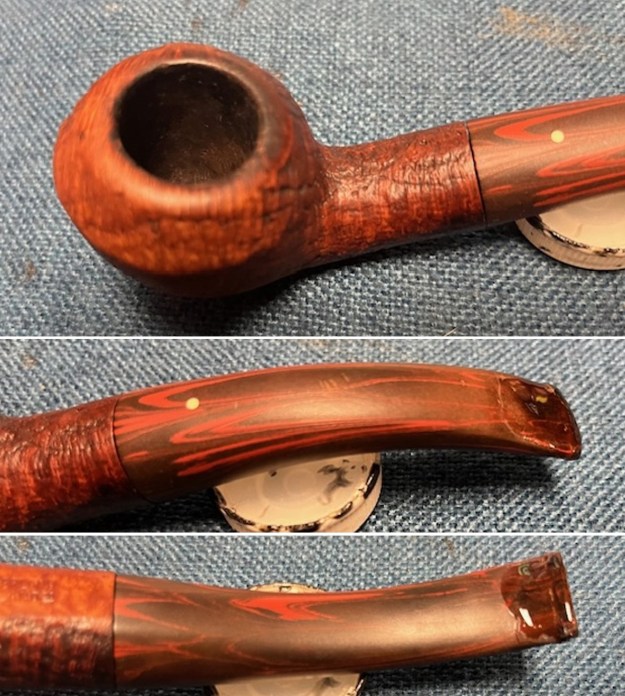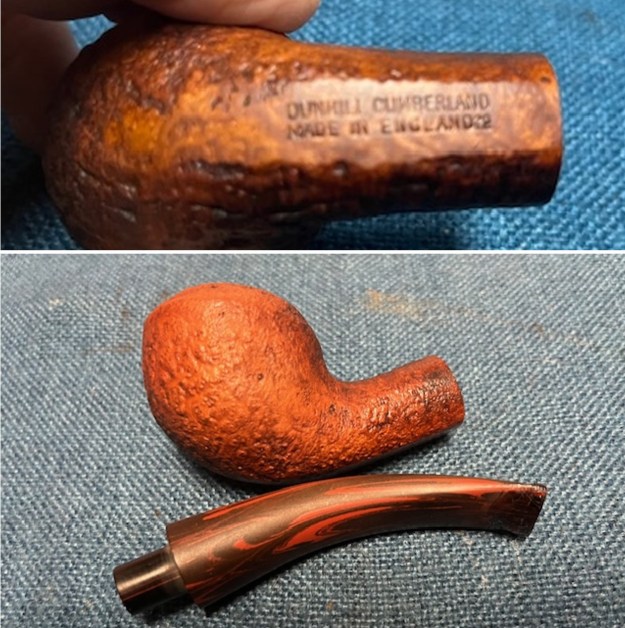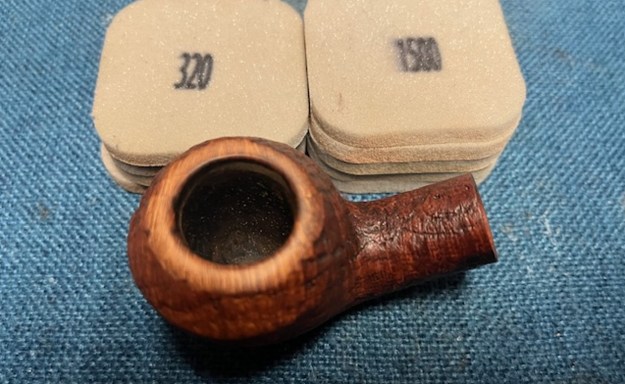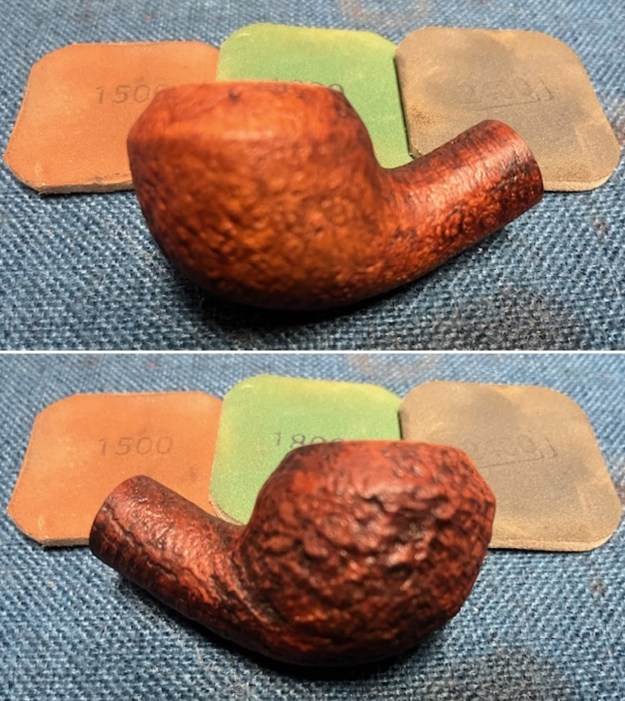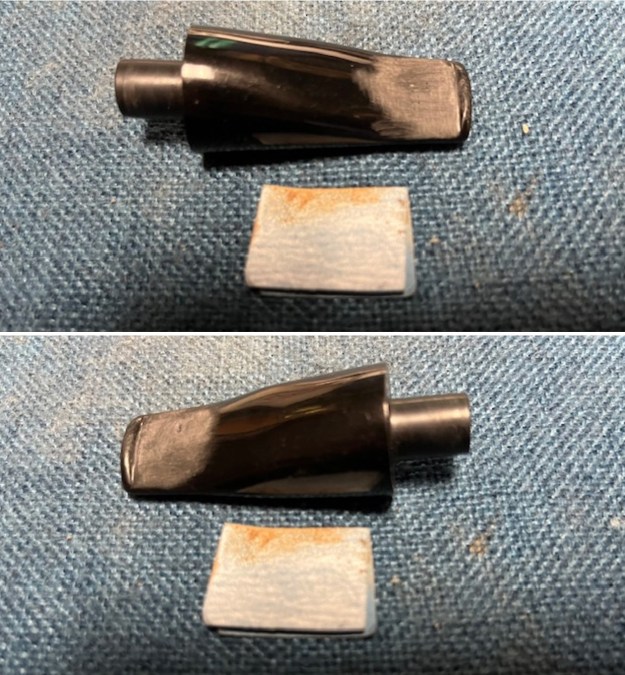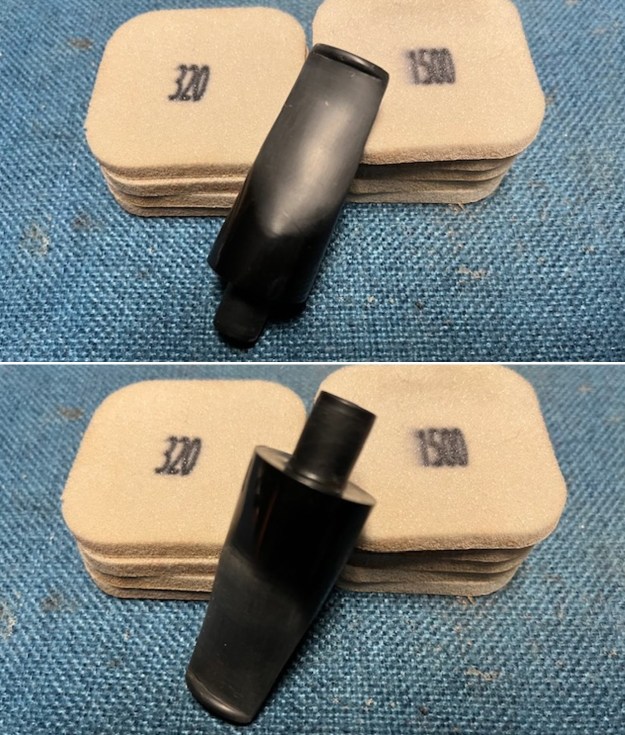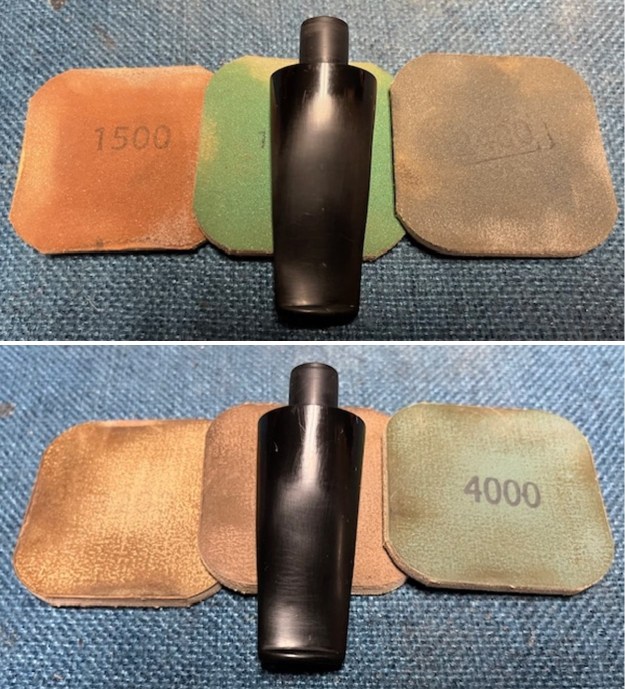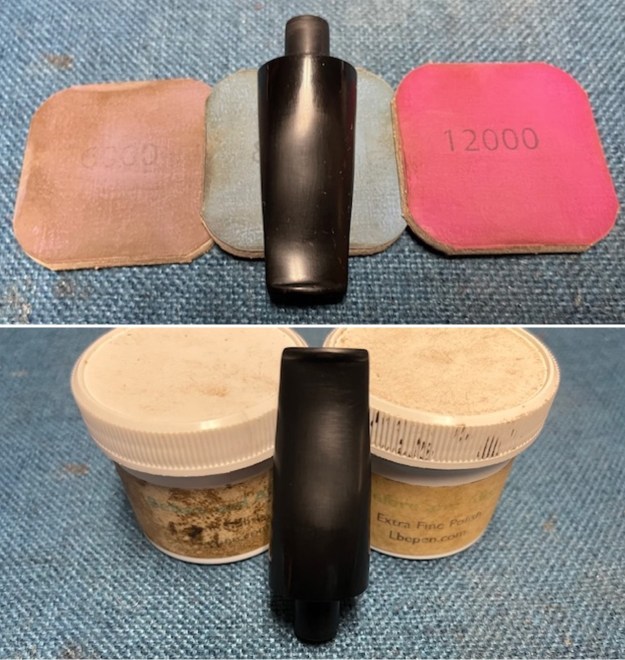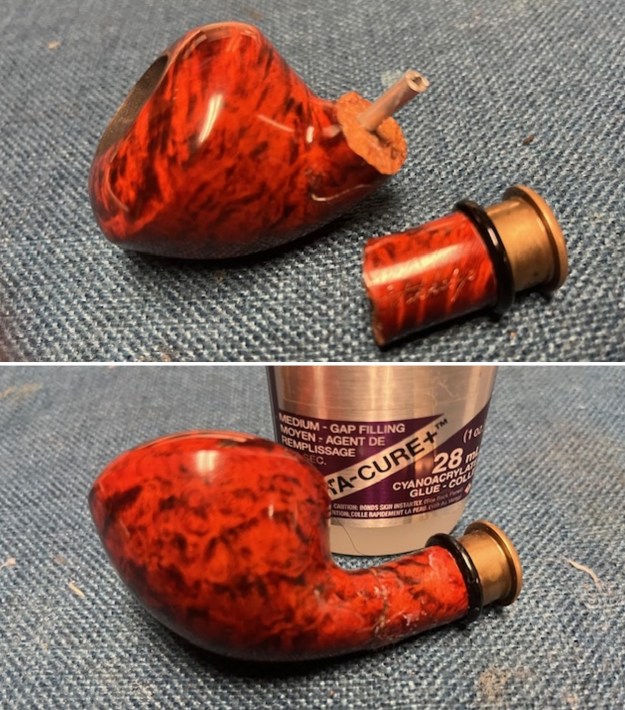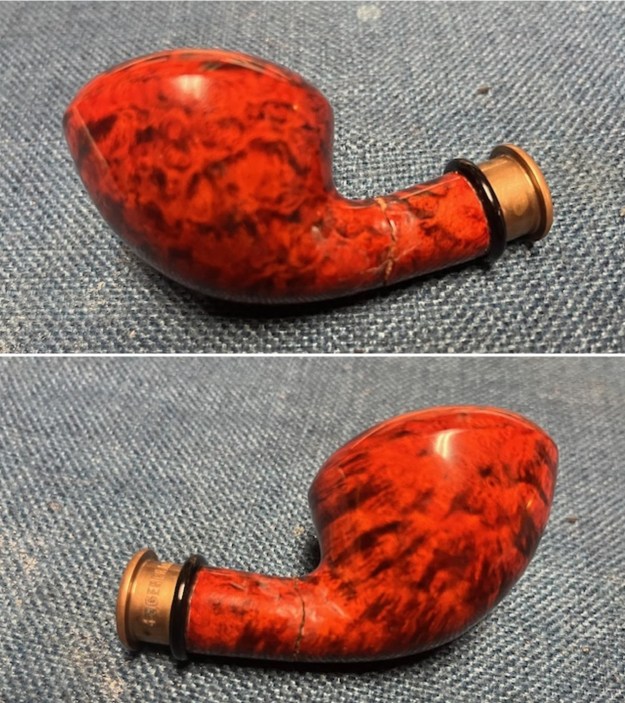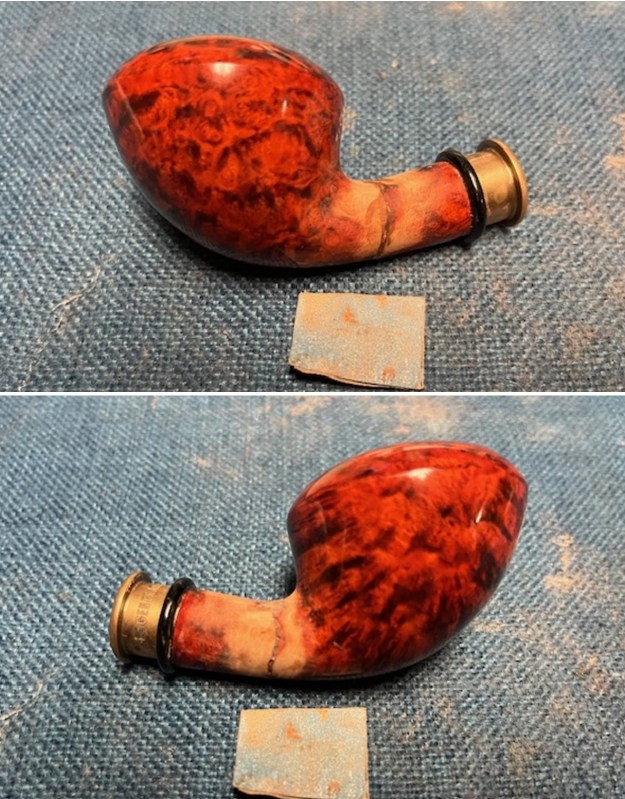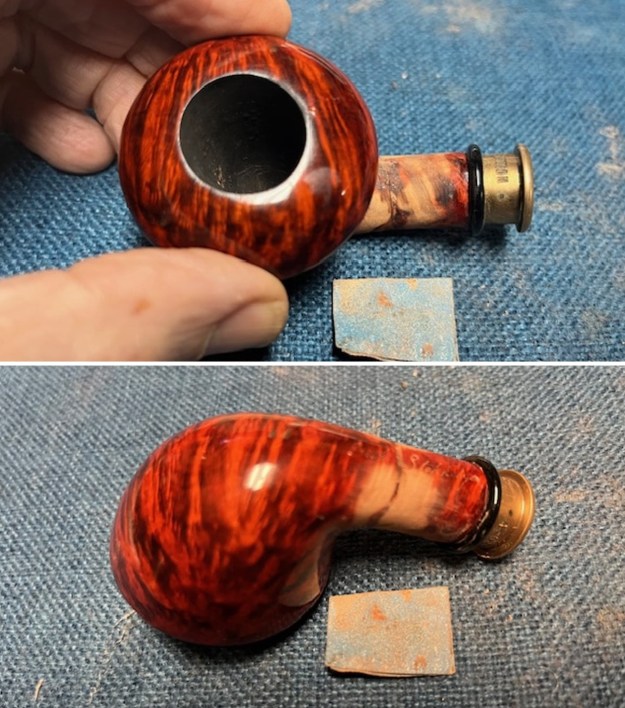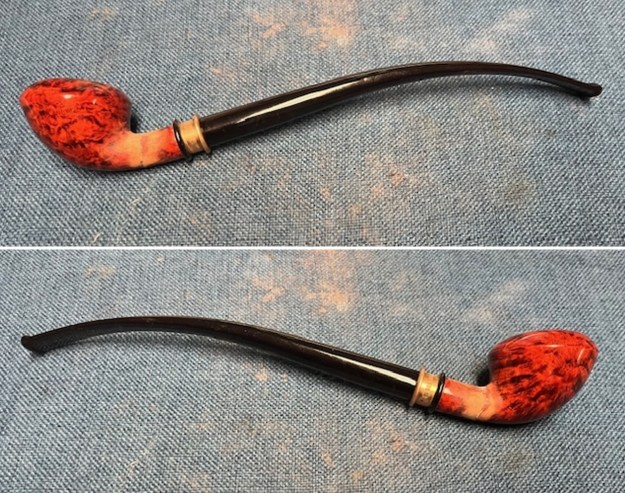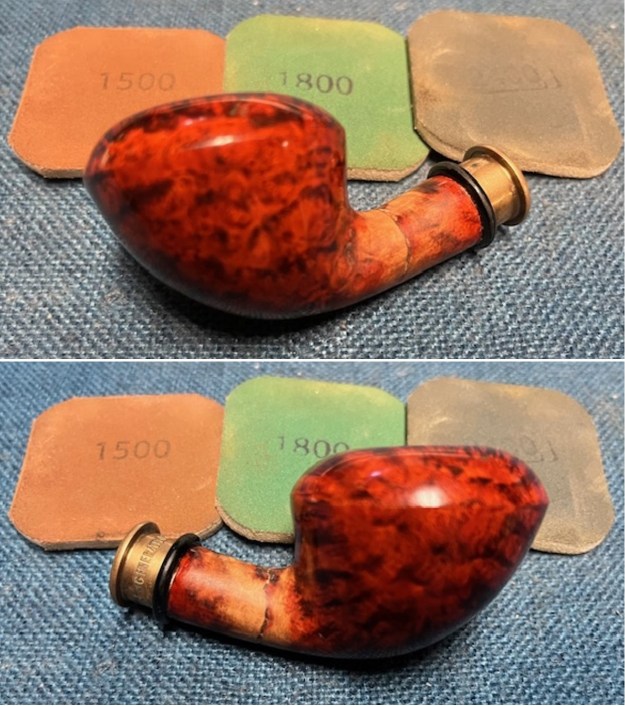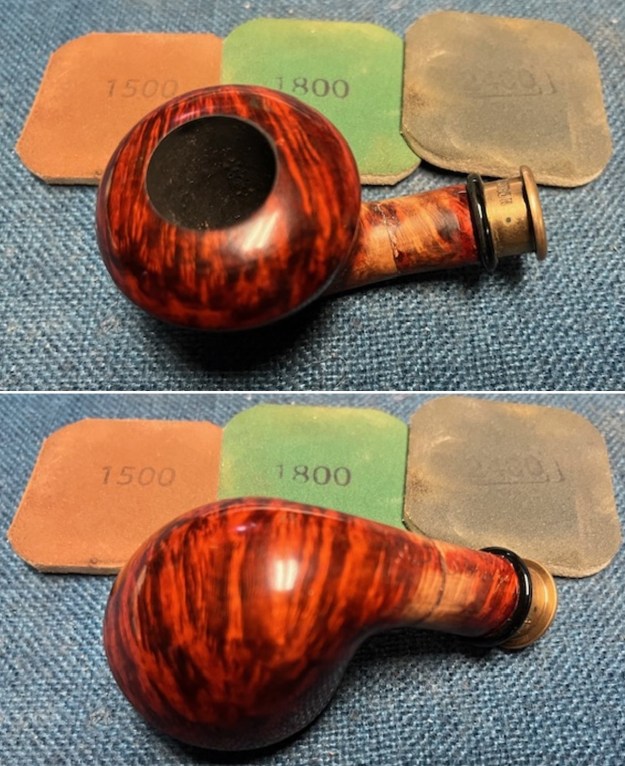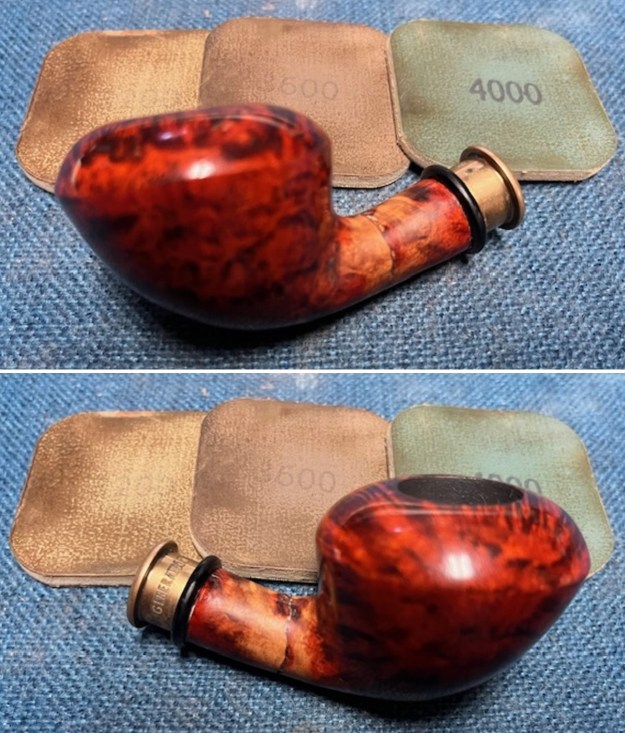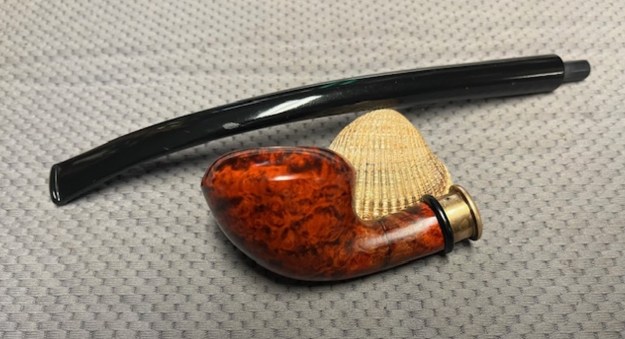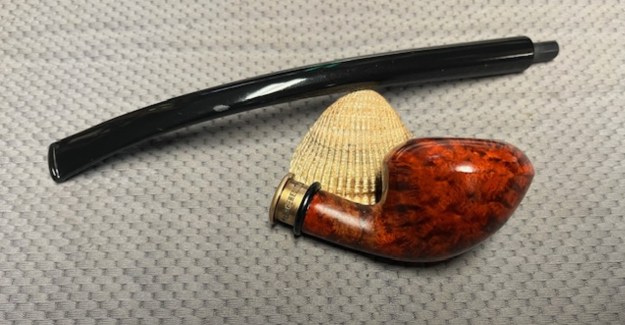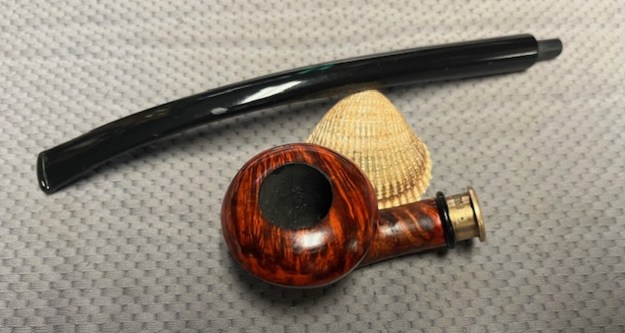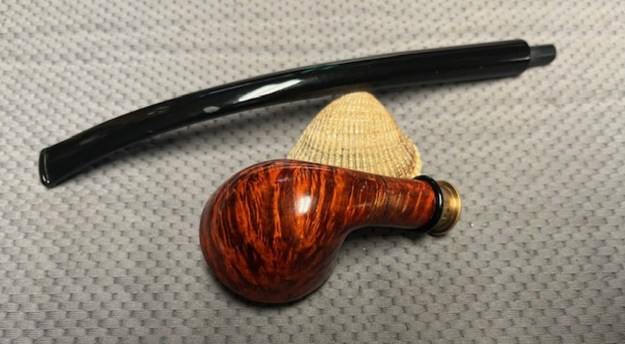
Tag Archives: Bowls – refinishing

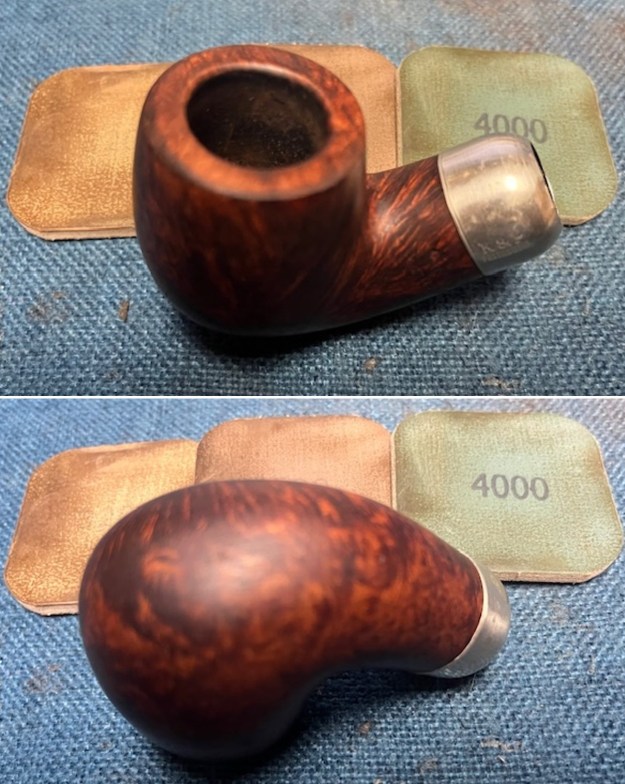
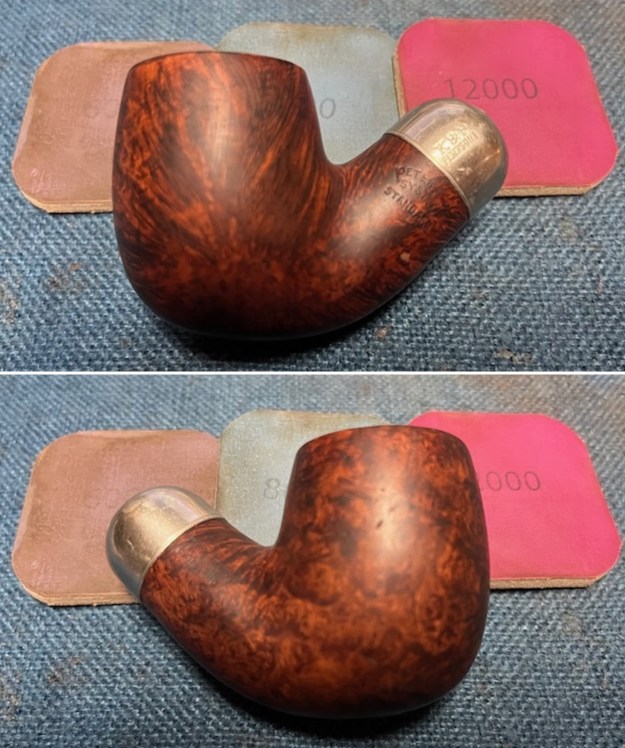
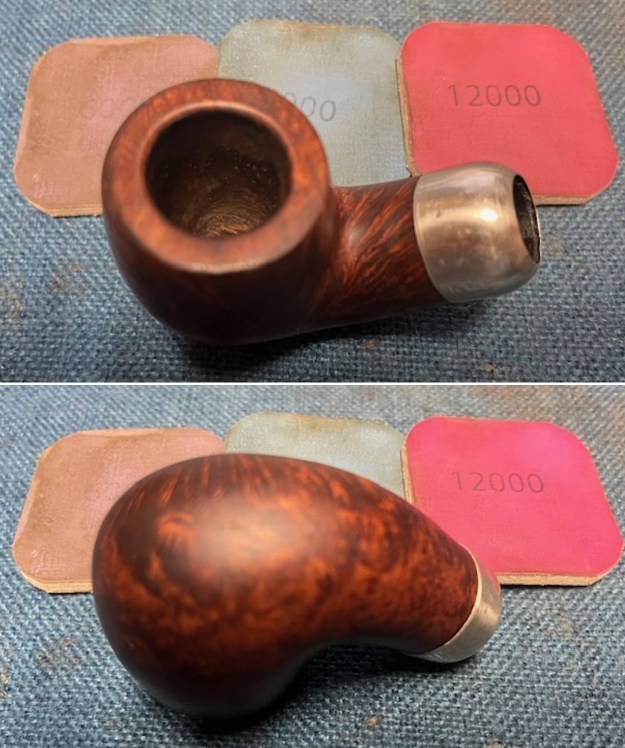
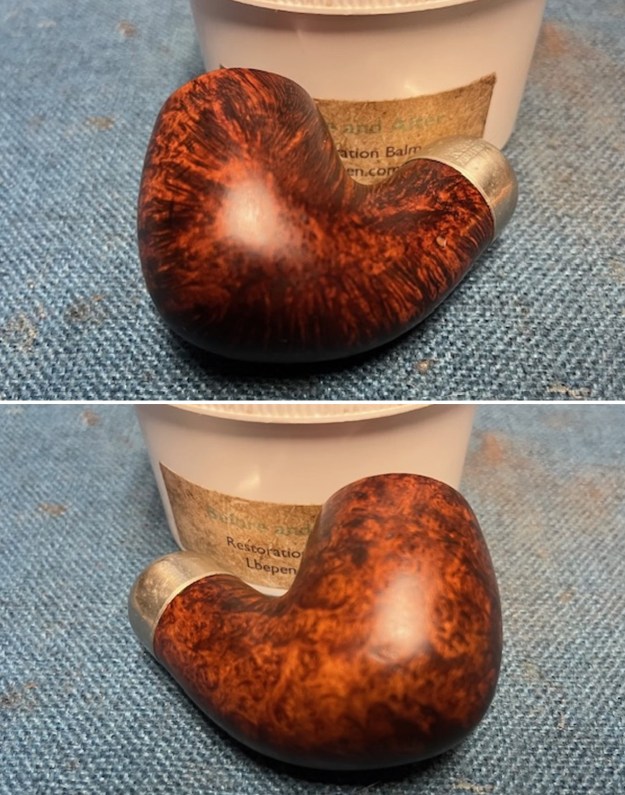
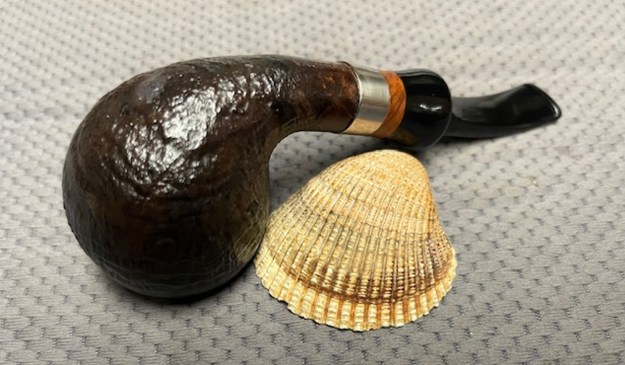
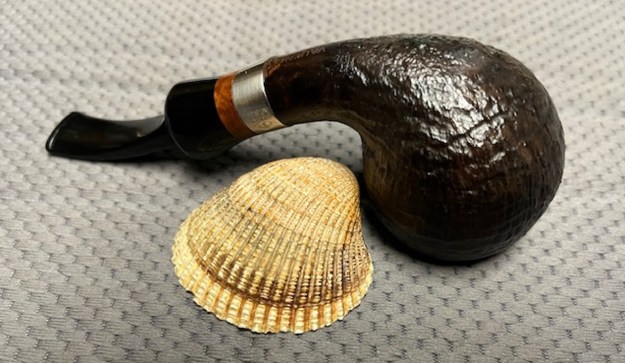
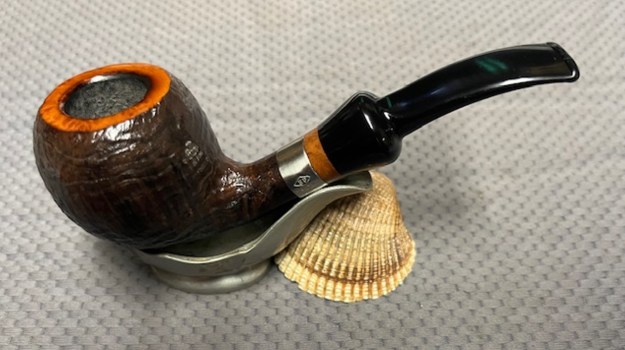
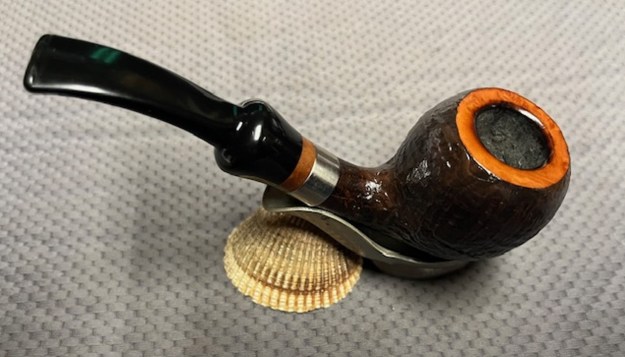
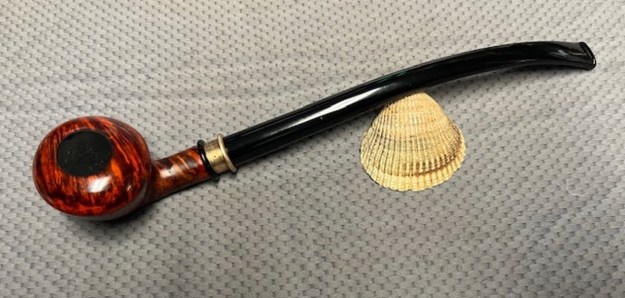
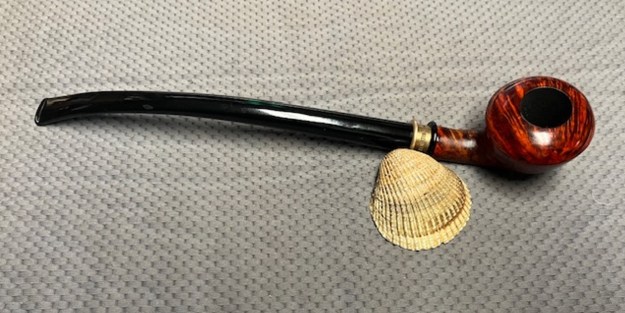
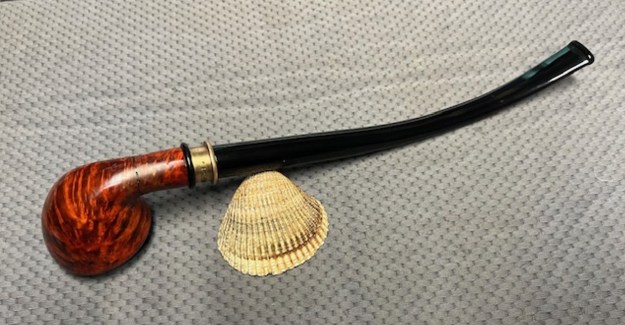
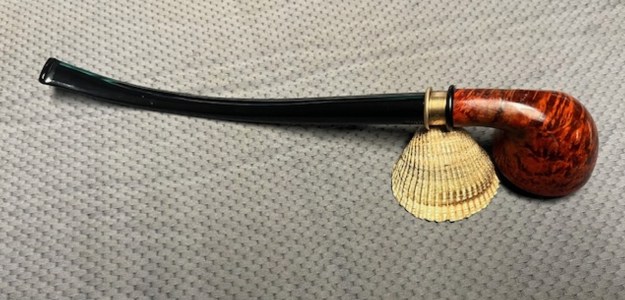
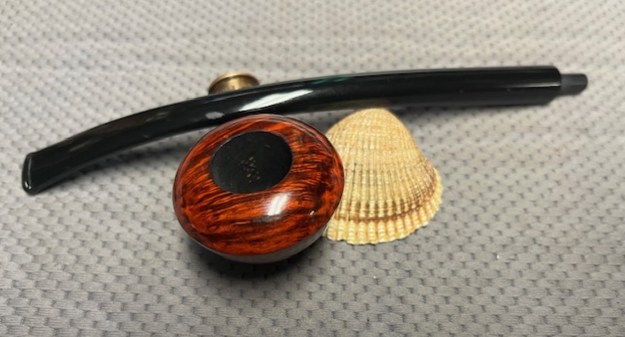
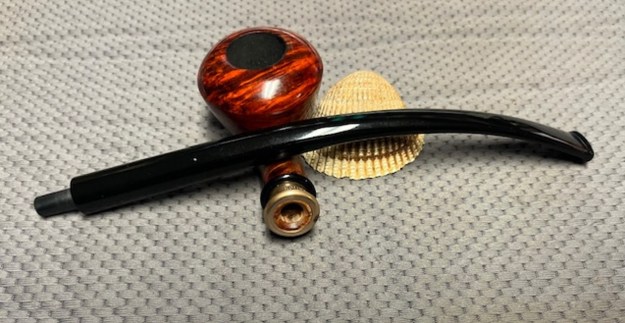
Restoring a Quirky Kaywoodie 179R Bent Billiard


by Kenneth Lieblich

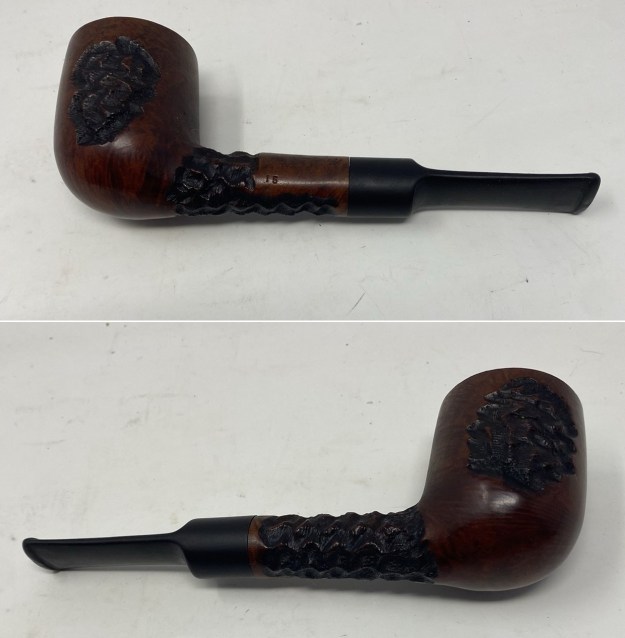
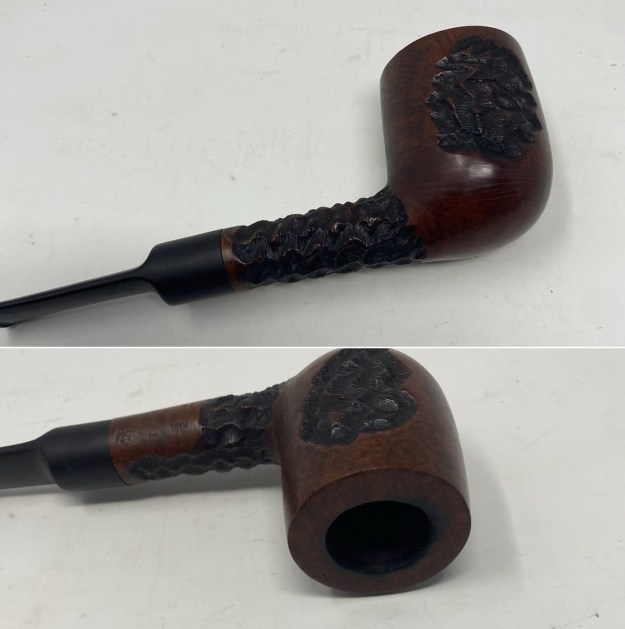
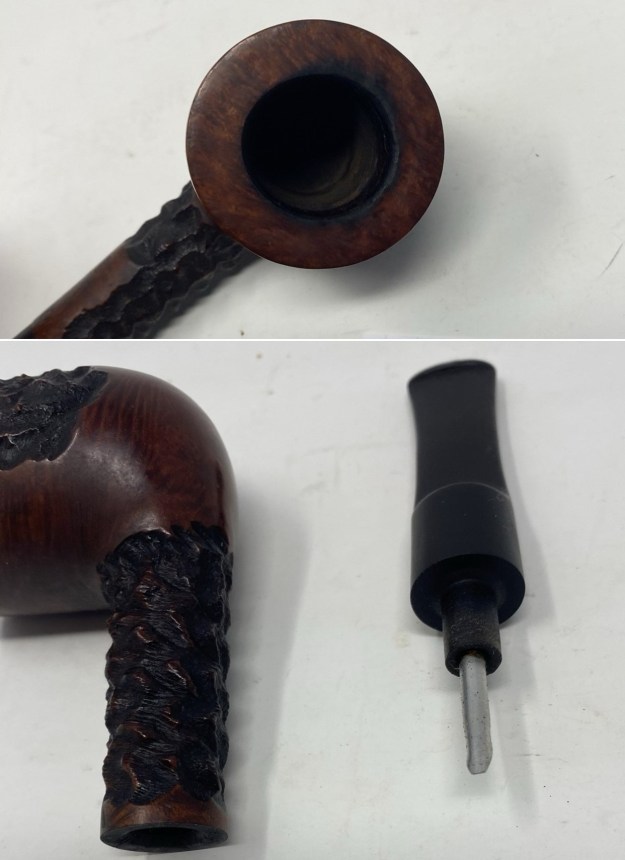
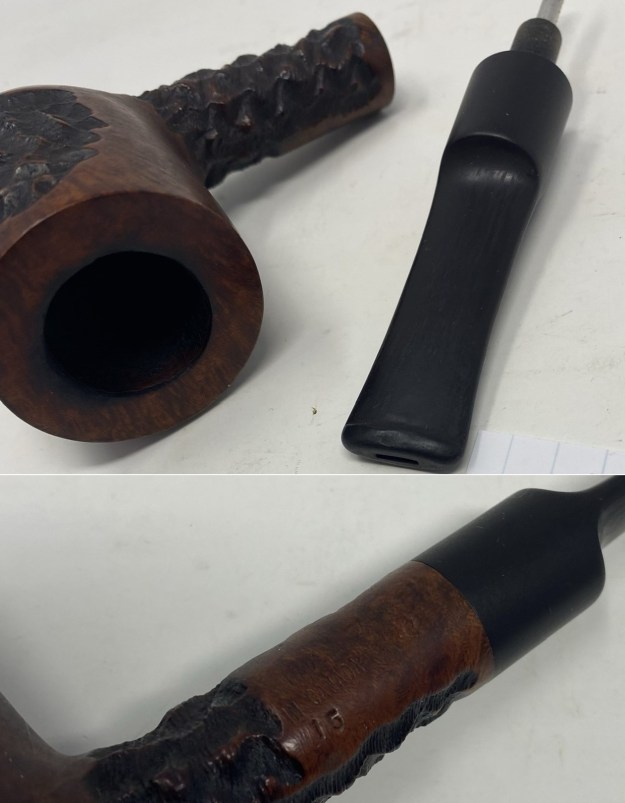
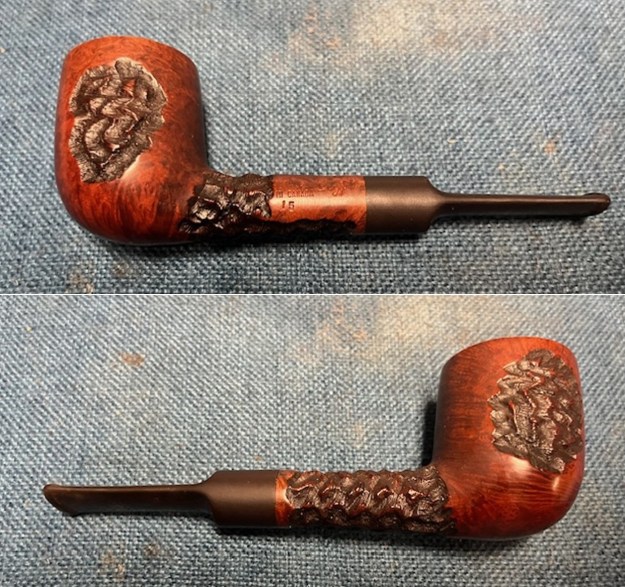
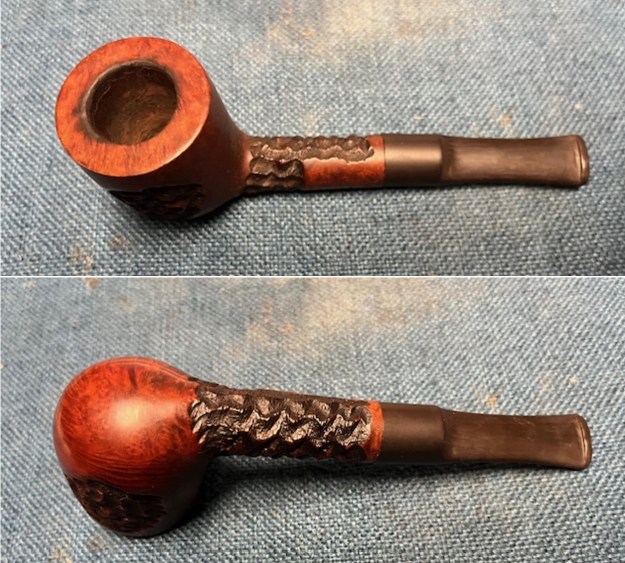
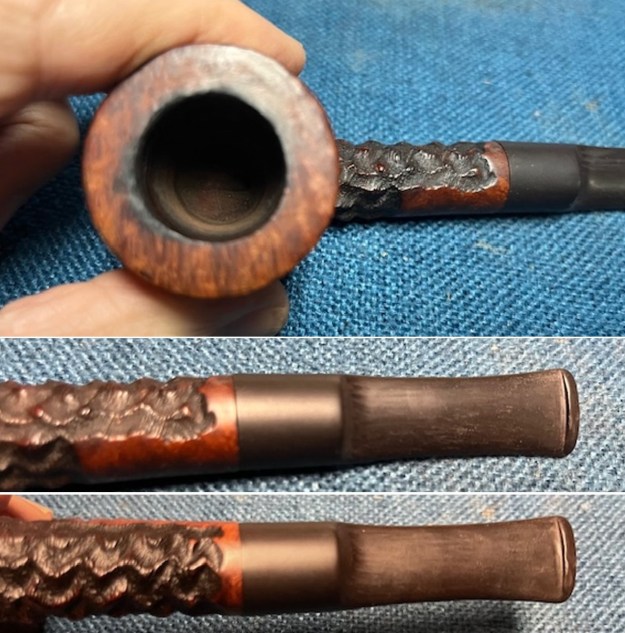
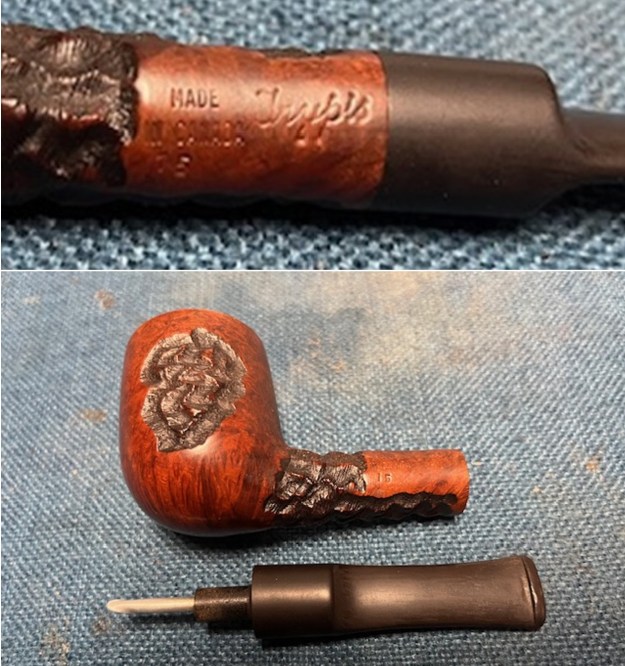
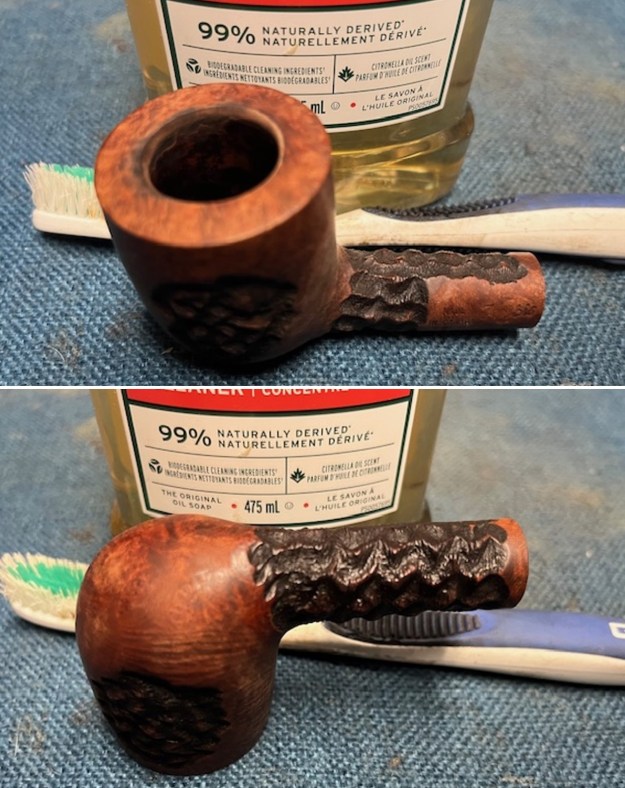
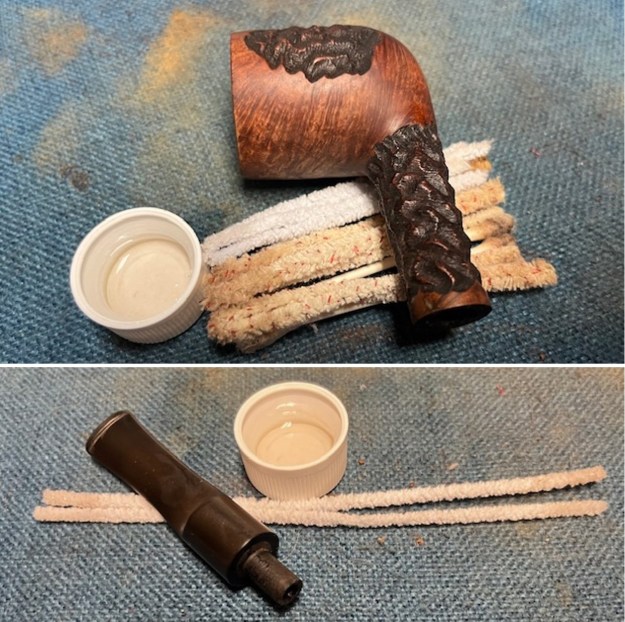
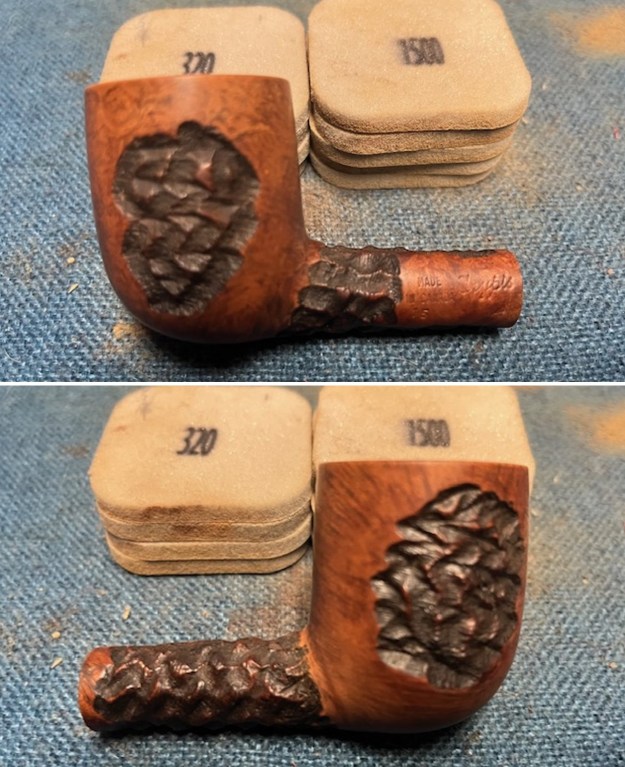
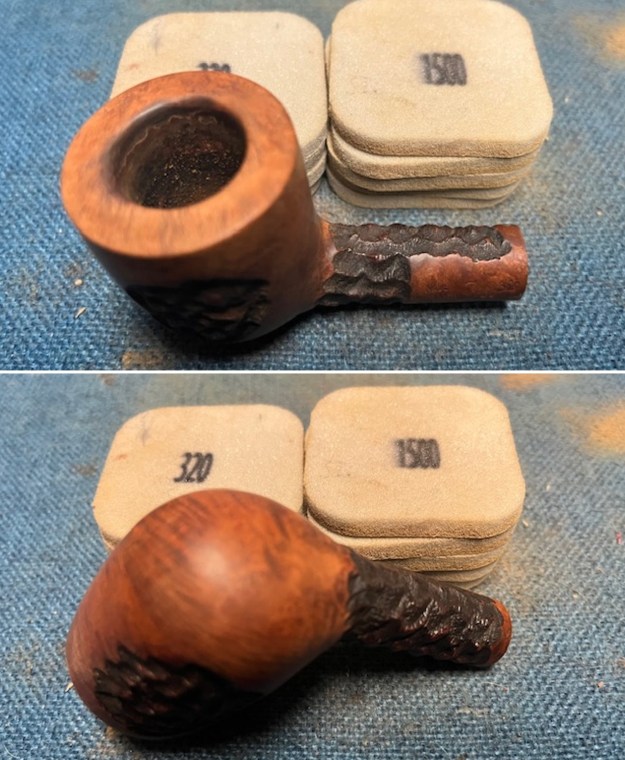
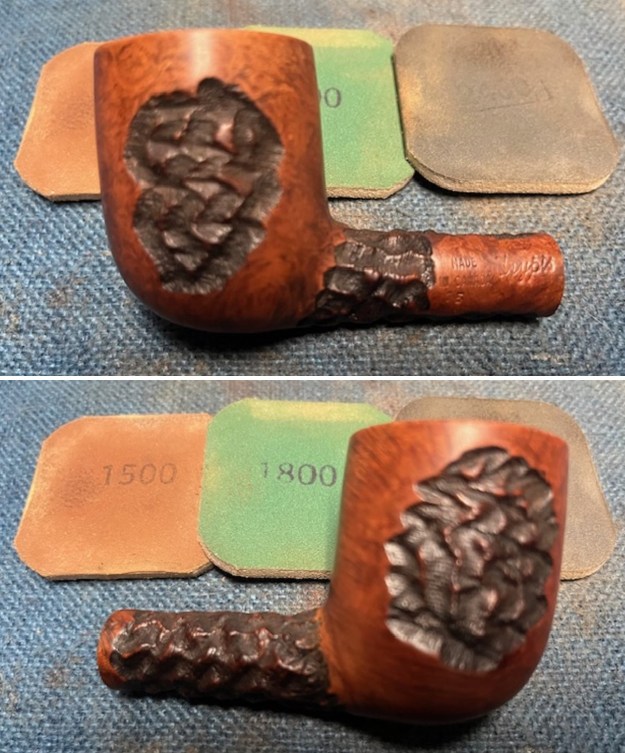
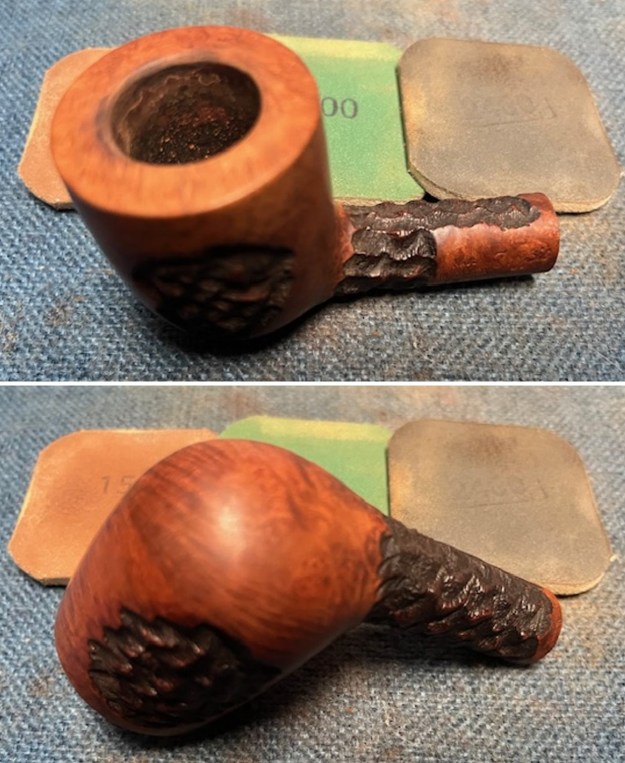
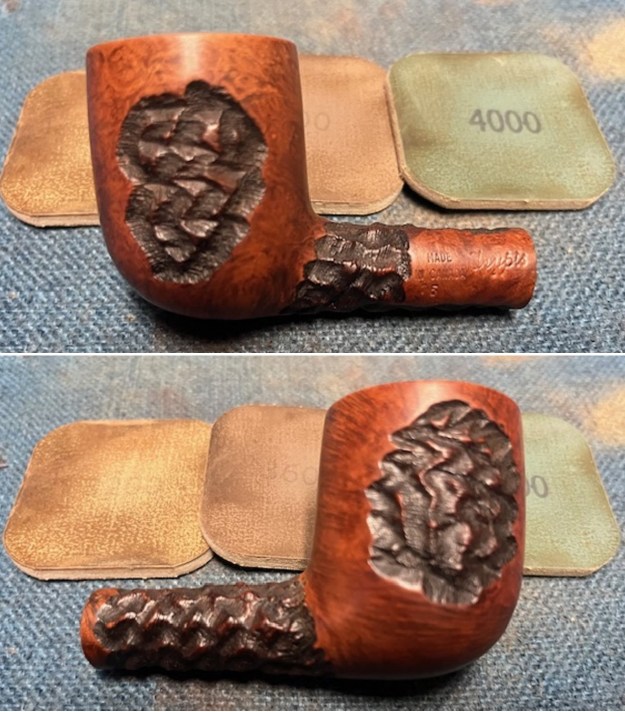
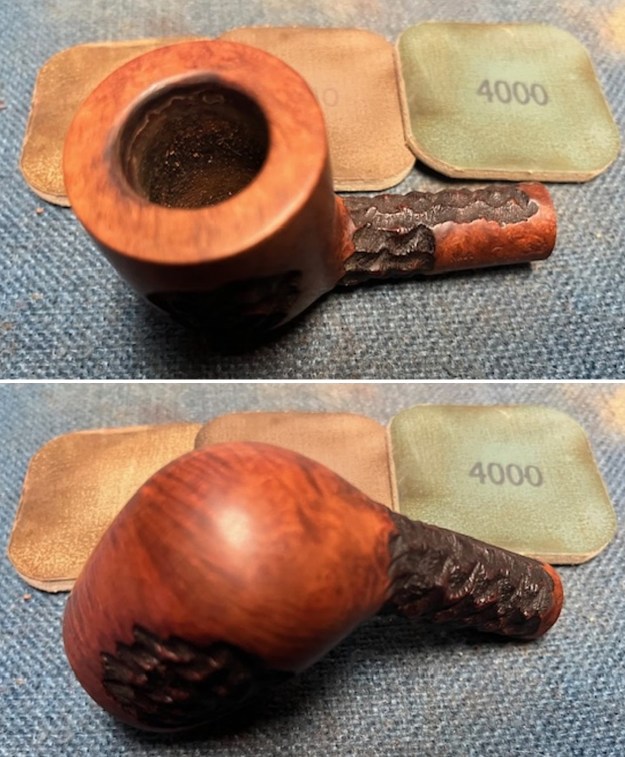
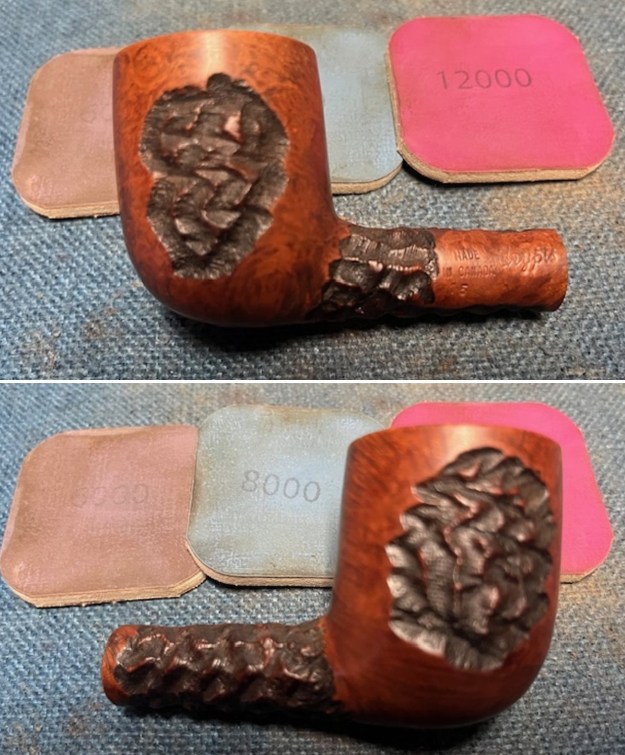
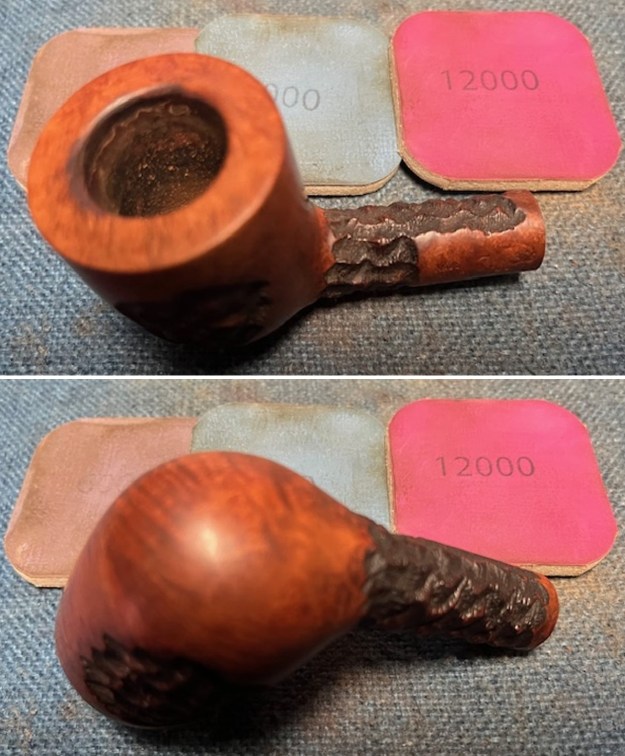
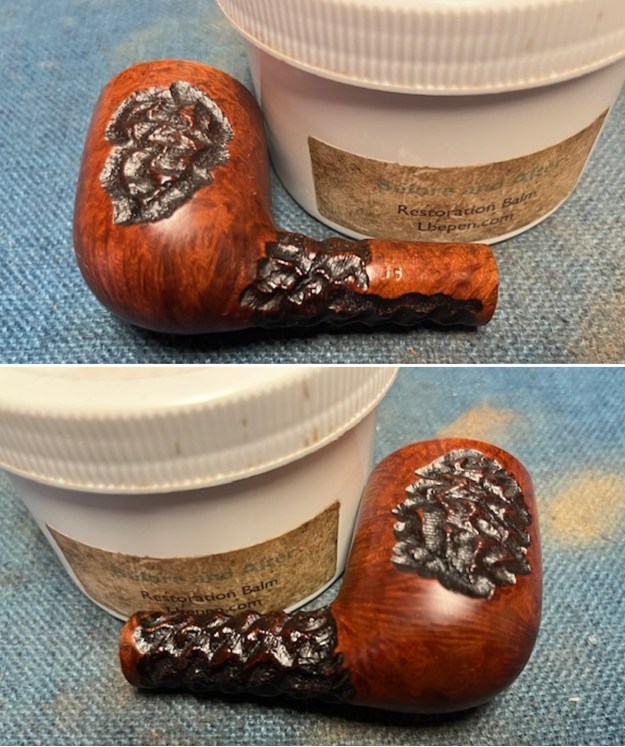
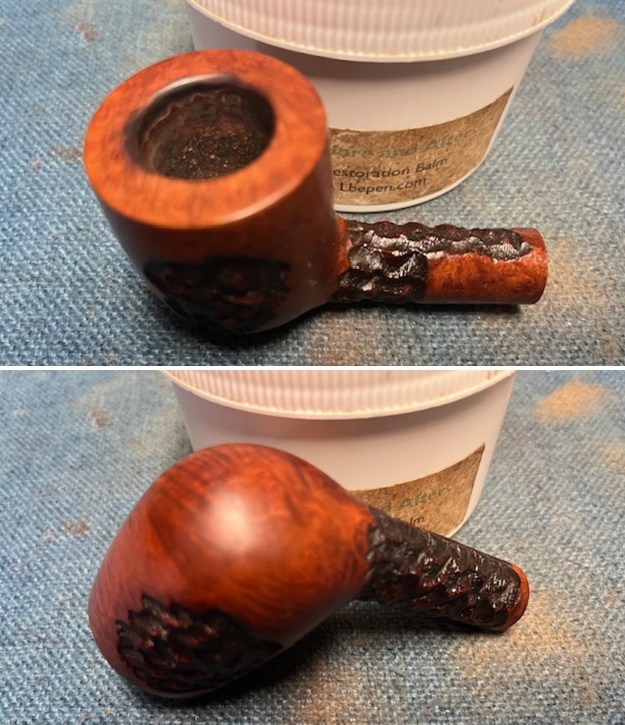
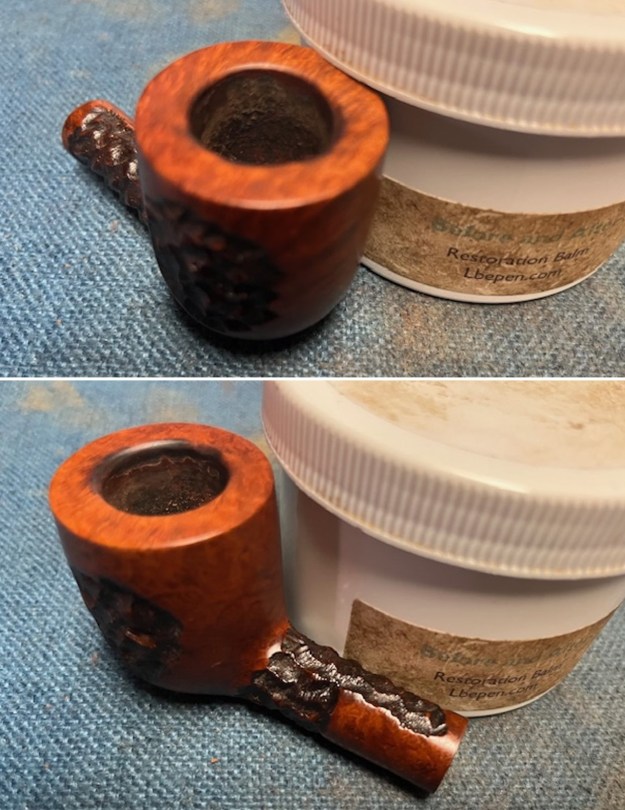
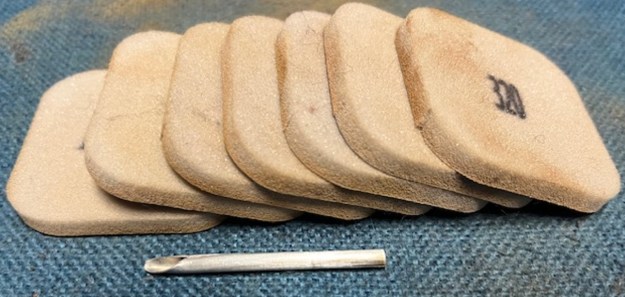
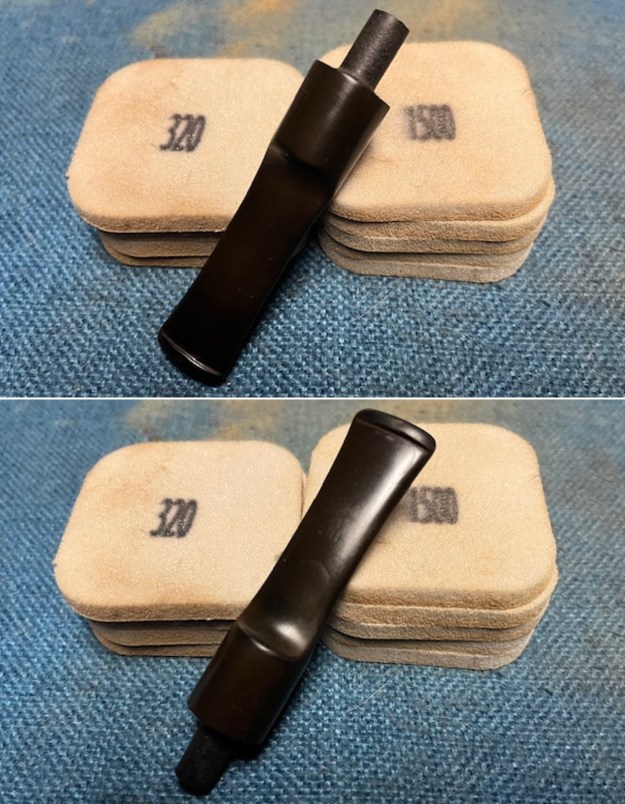
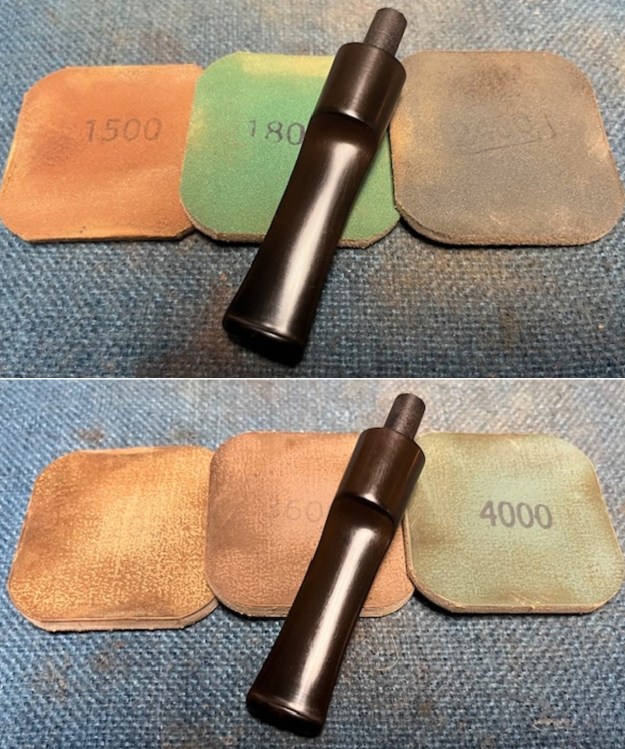
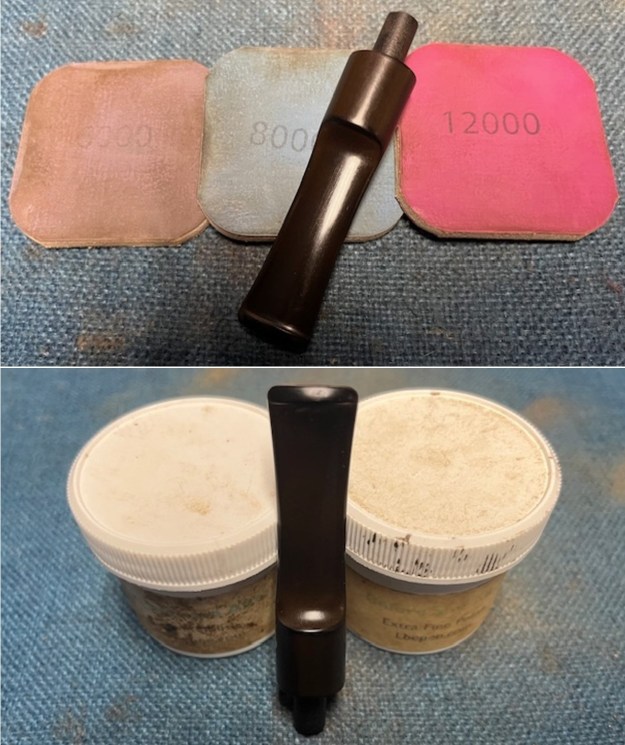
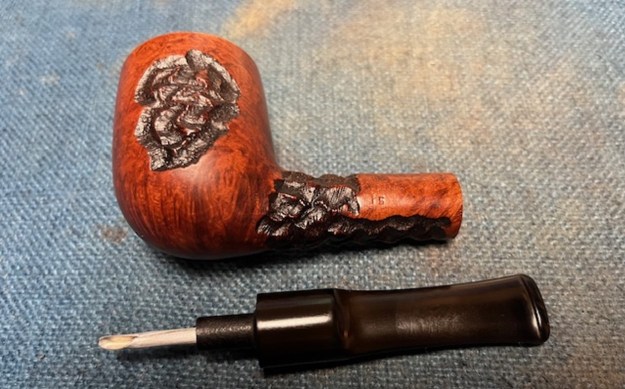
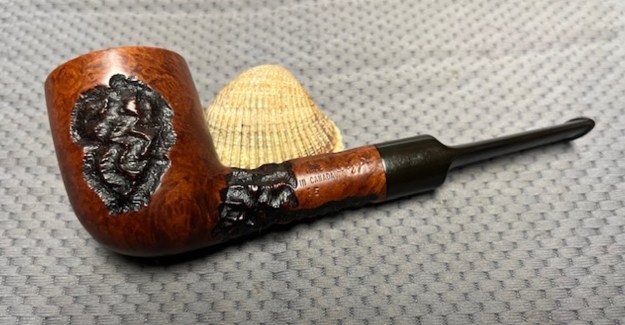
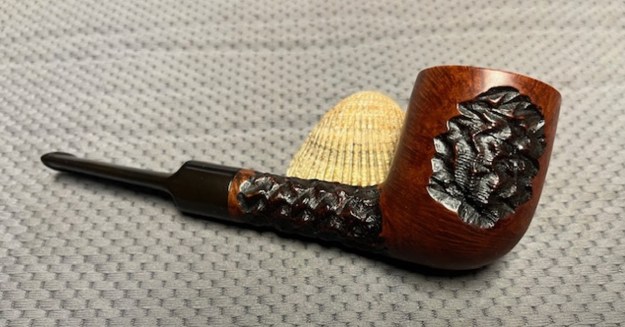
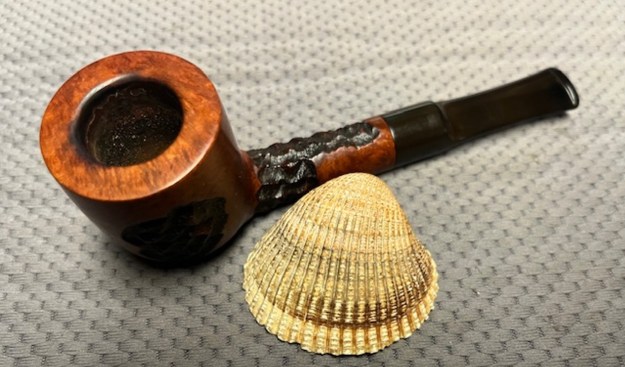
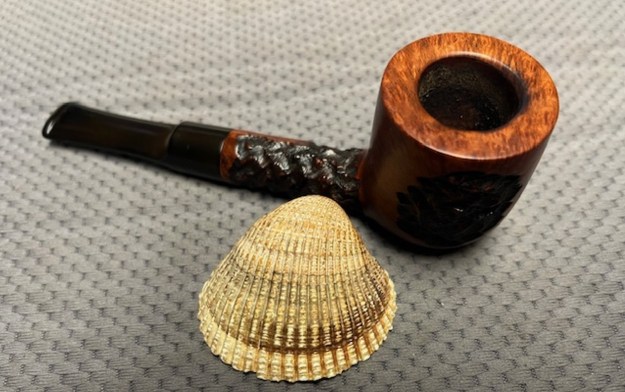
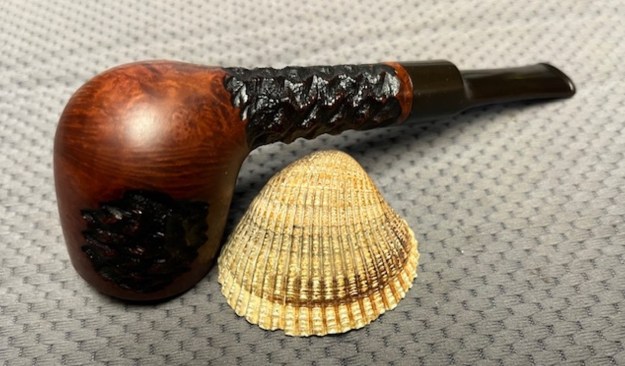
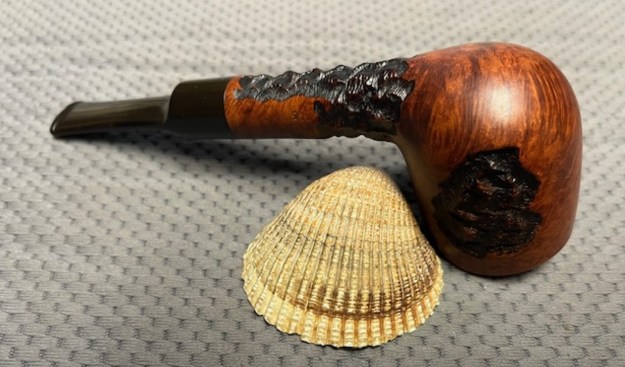
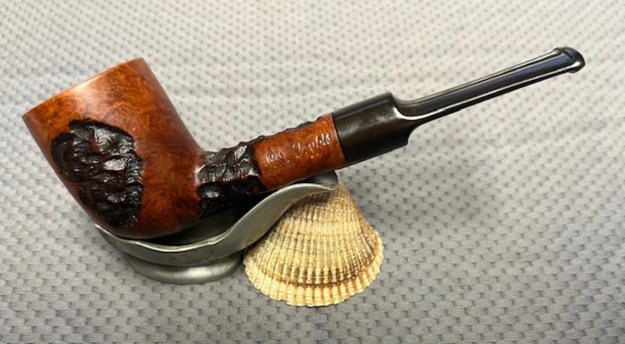
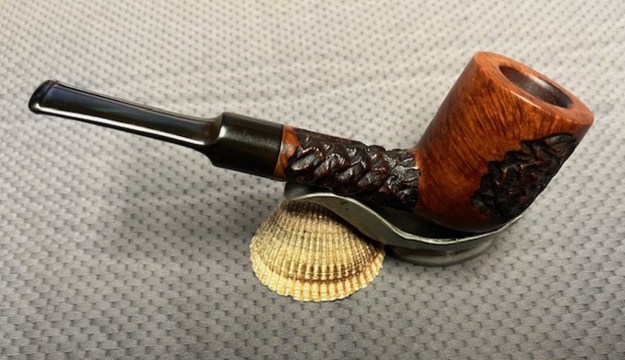
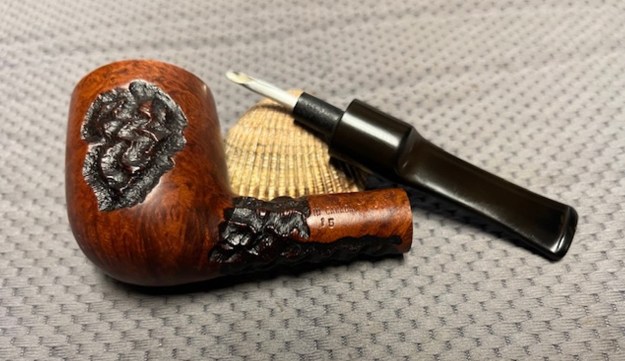
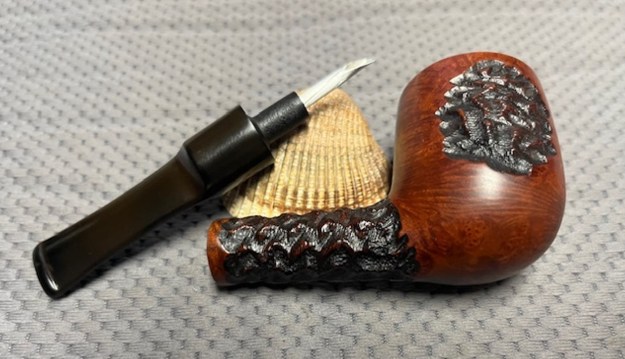
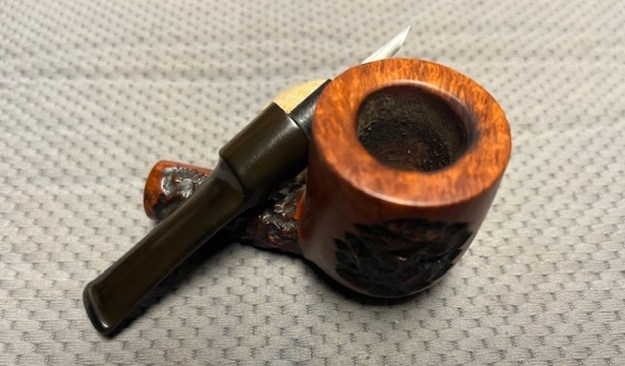
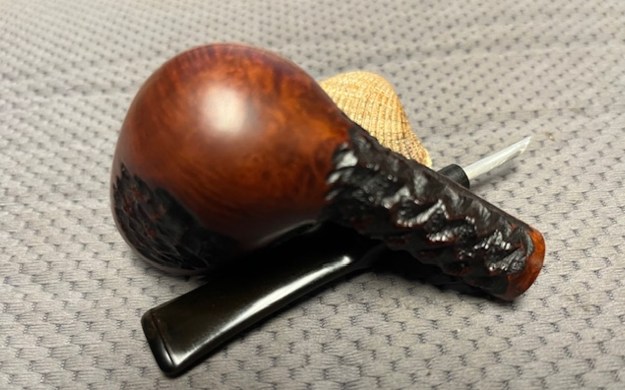
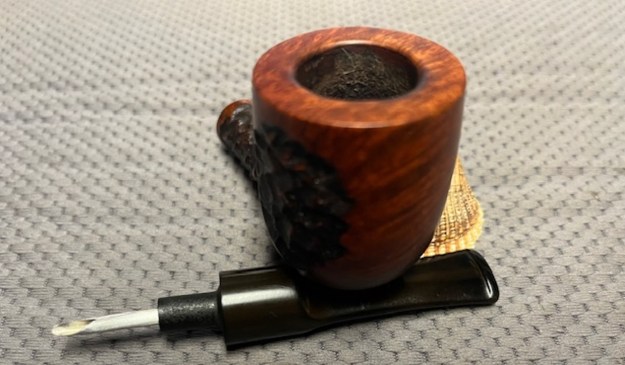
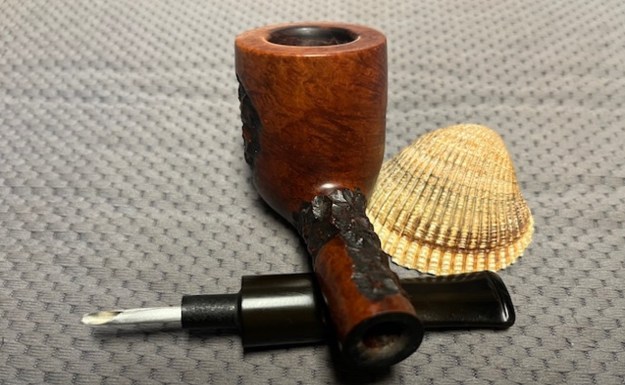
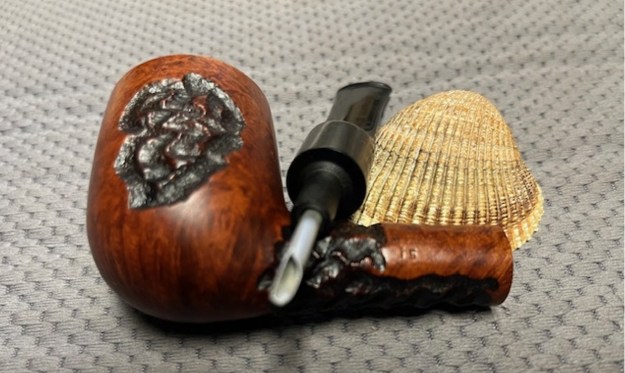
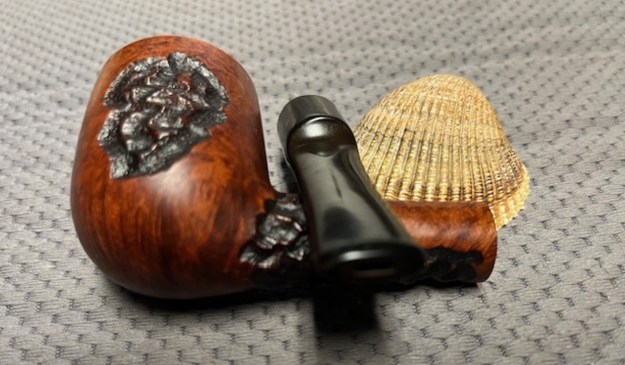
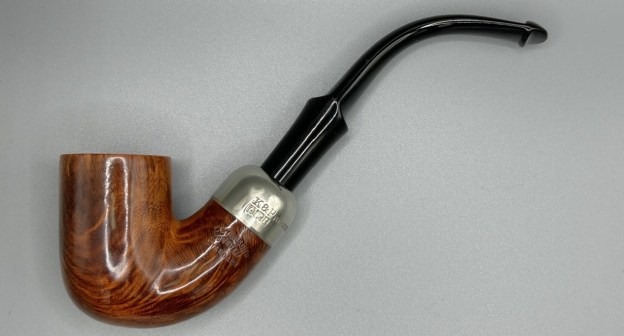
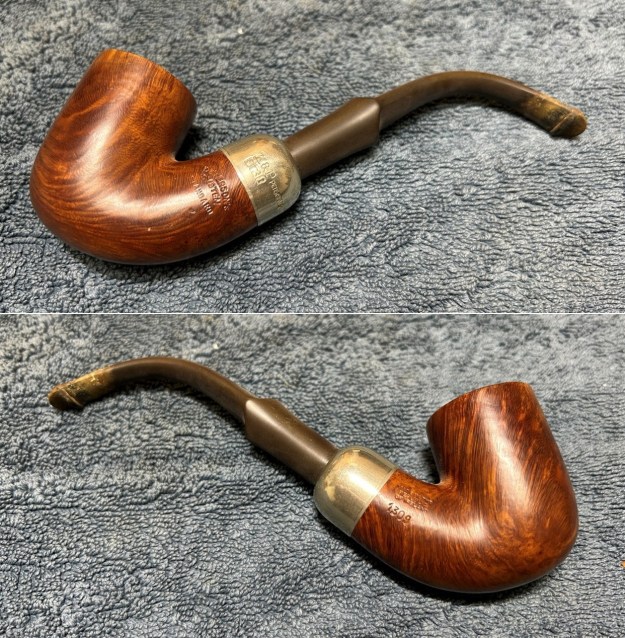
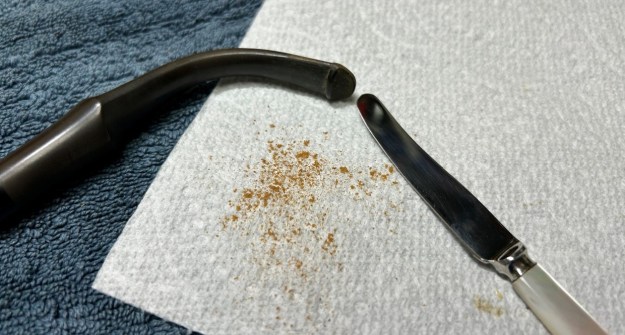
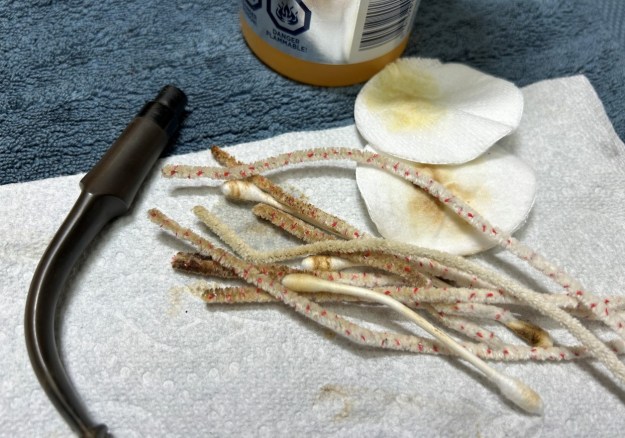
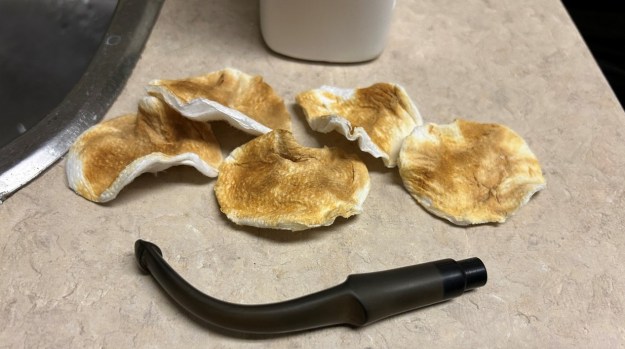
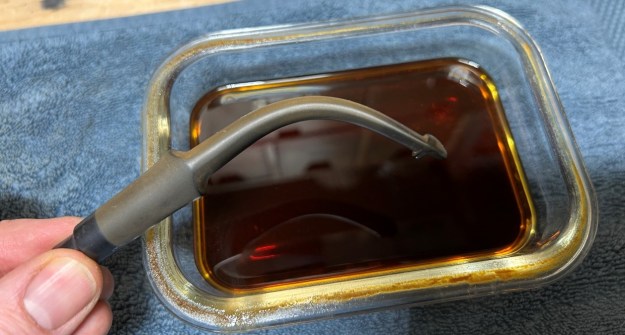
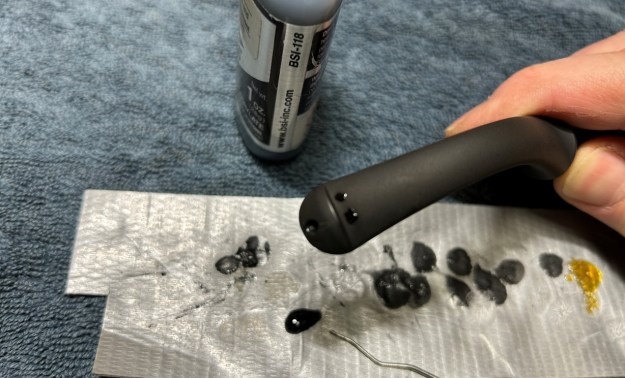
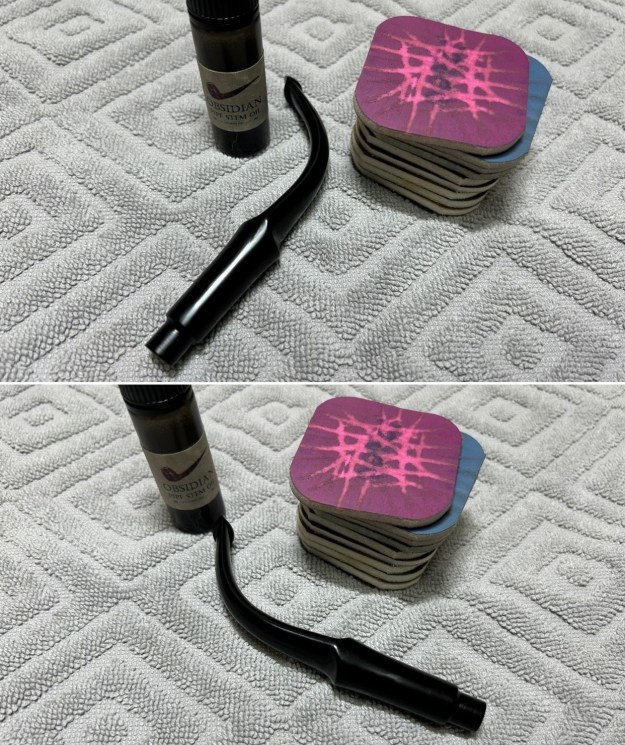
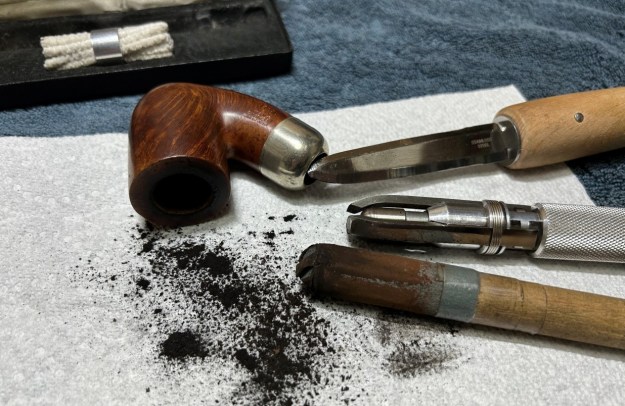
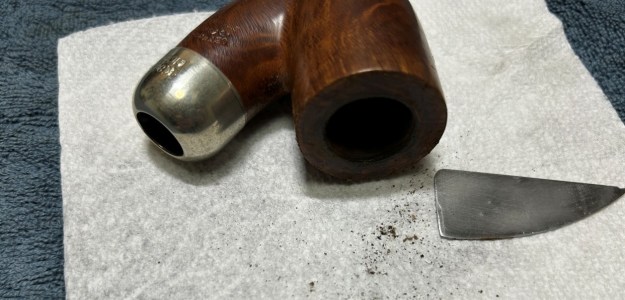
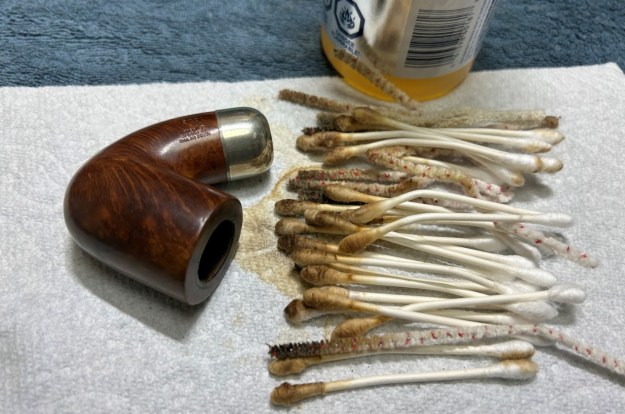
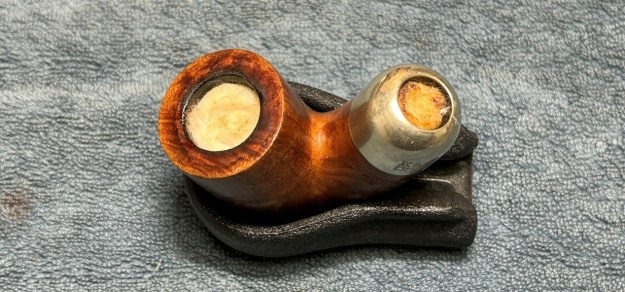
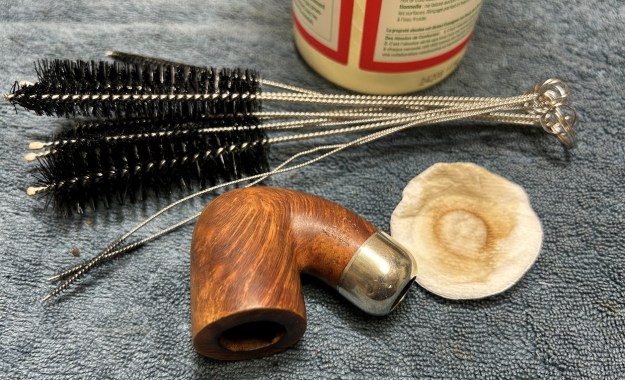
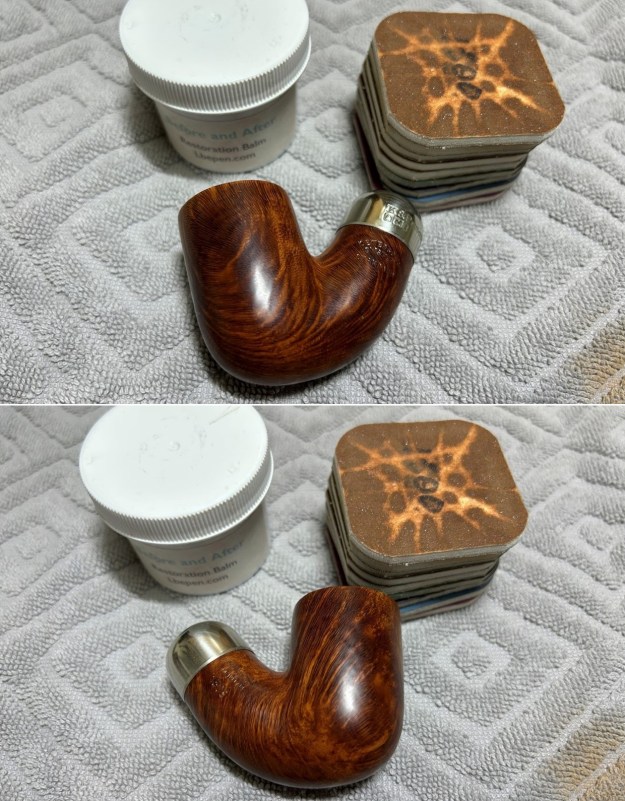
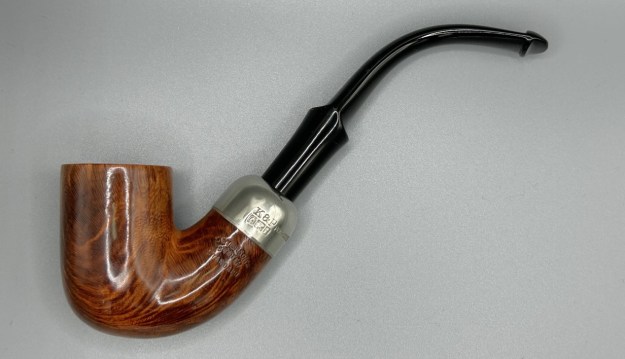
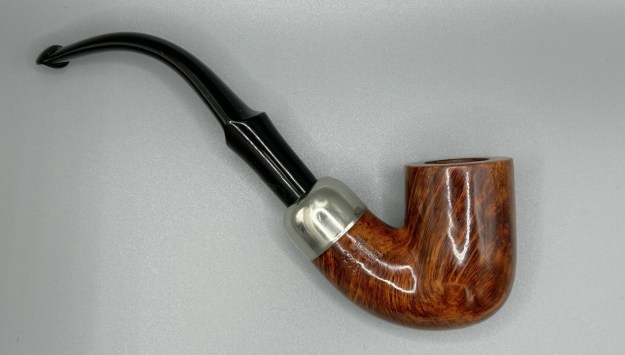
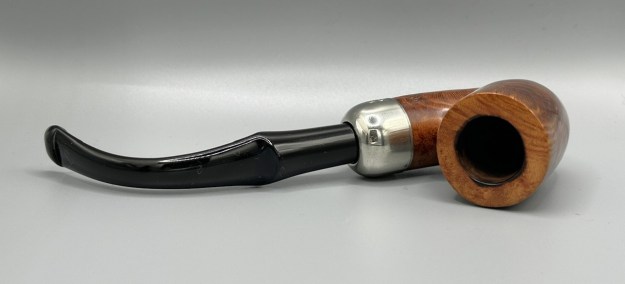
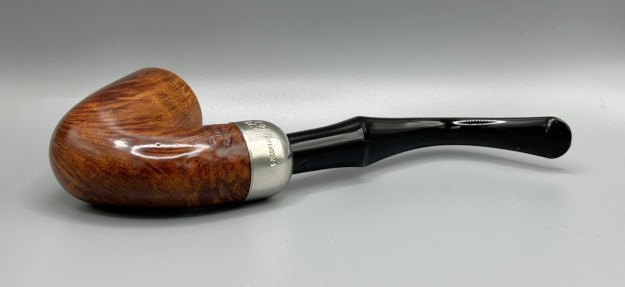
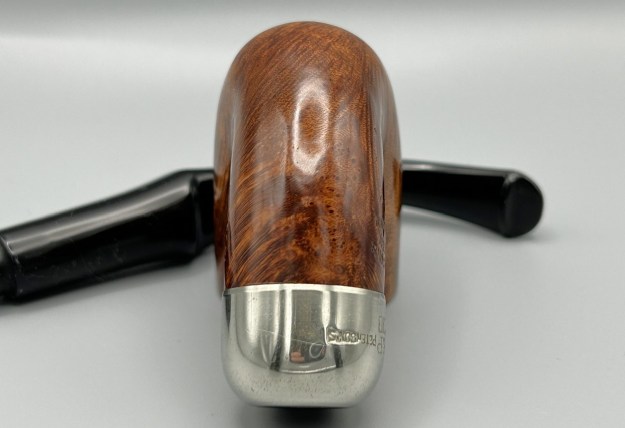
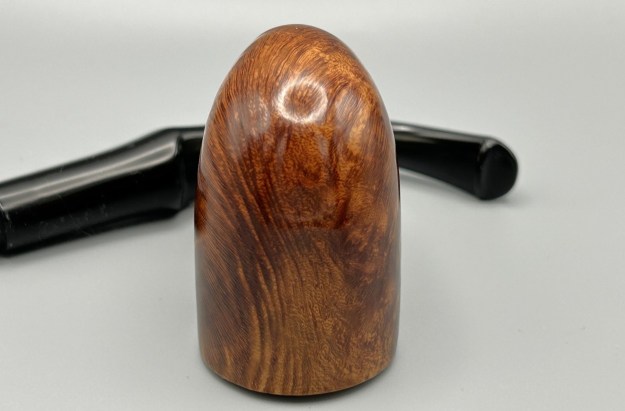
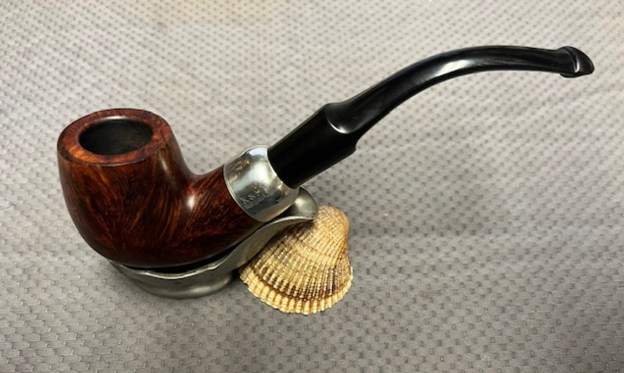
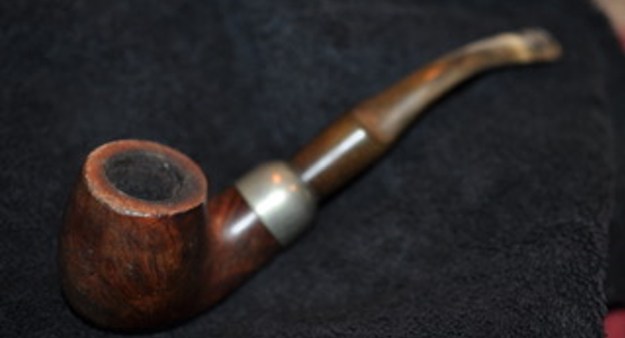
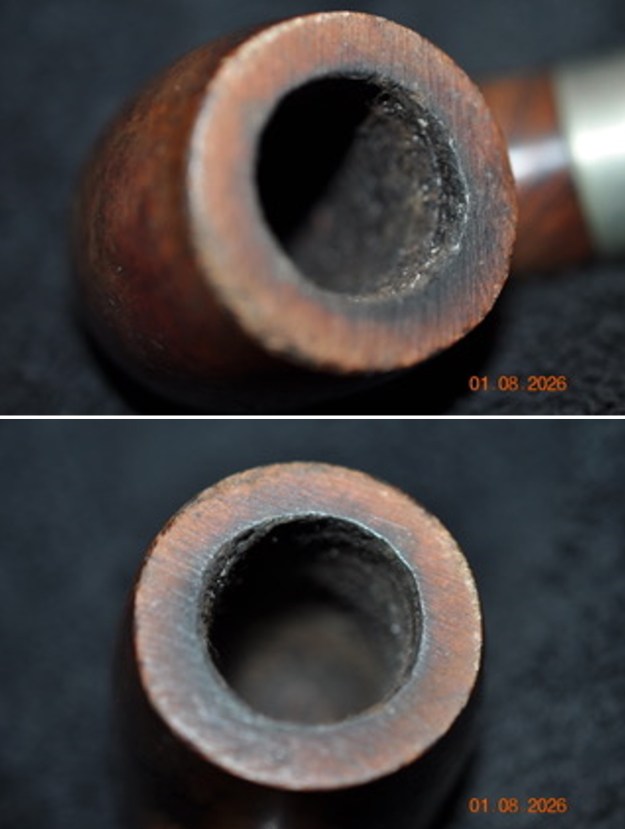
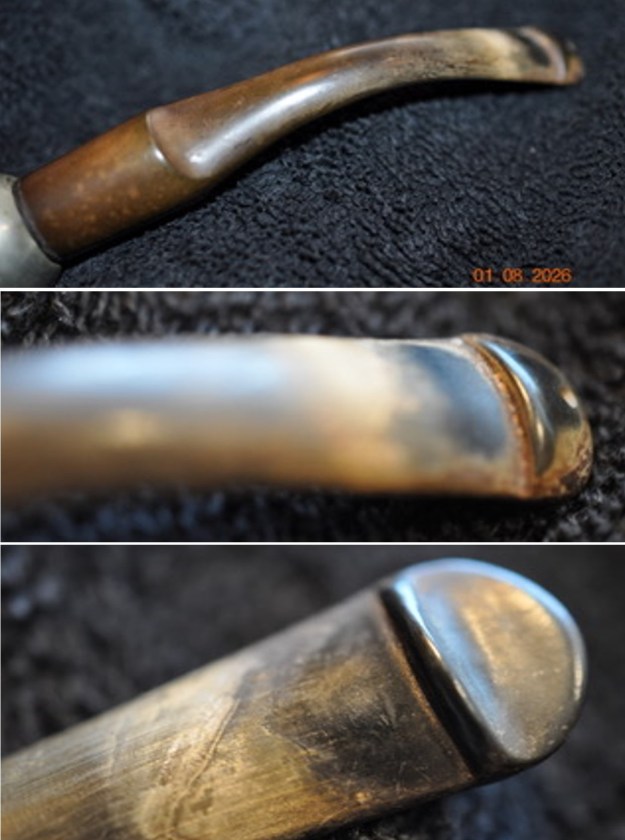
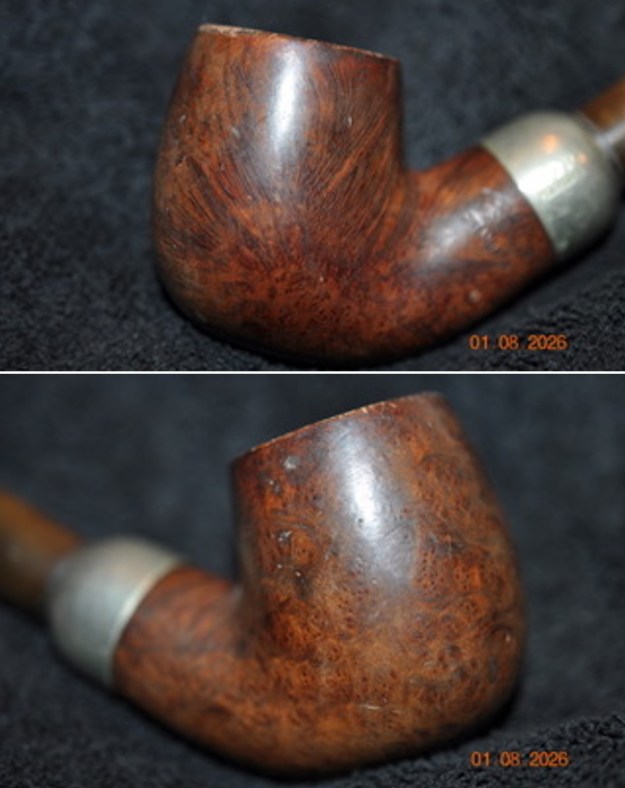
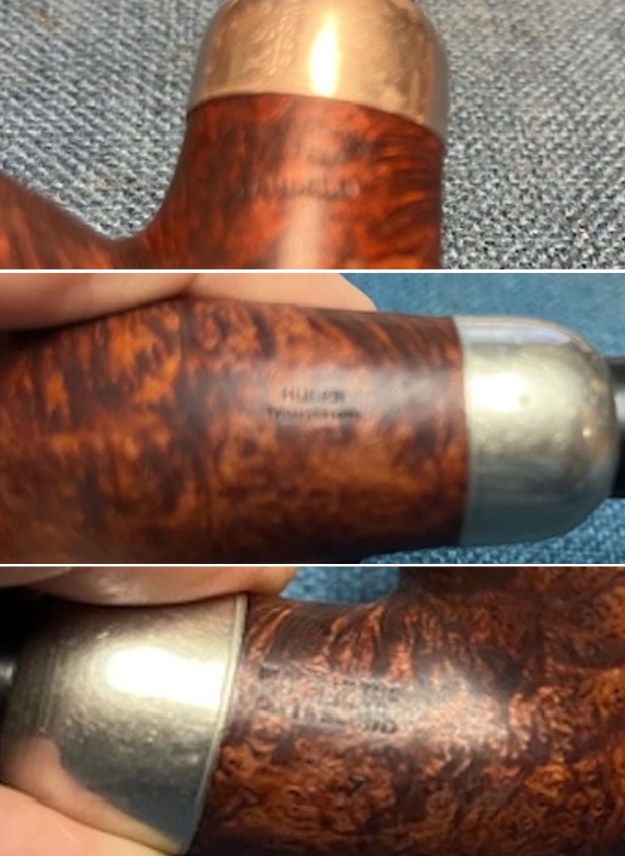
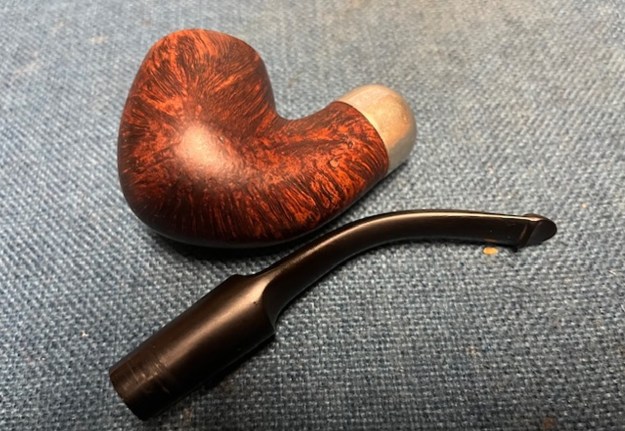
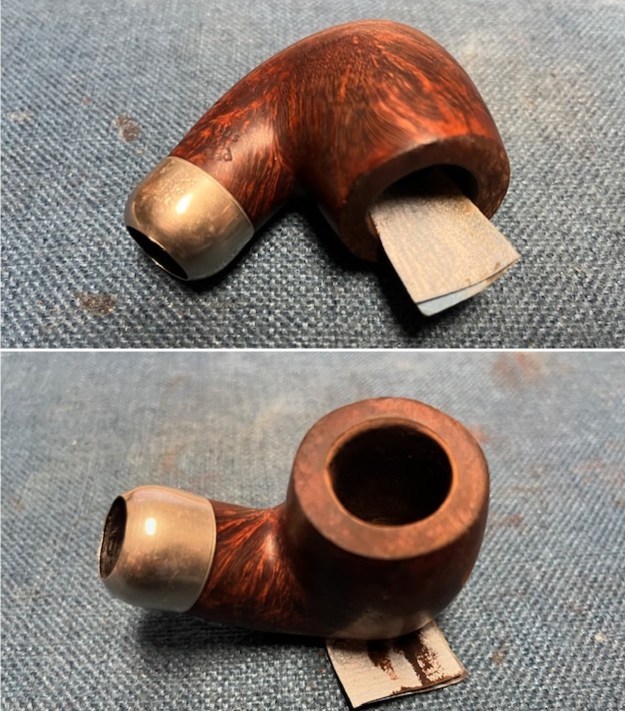
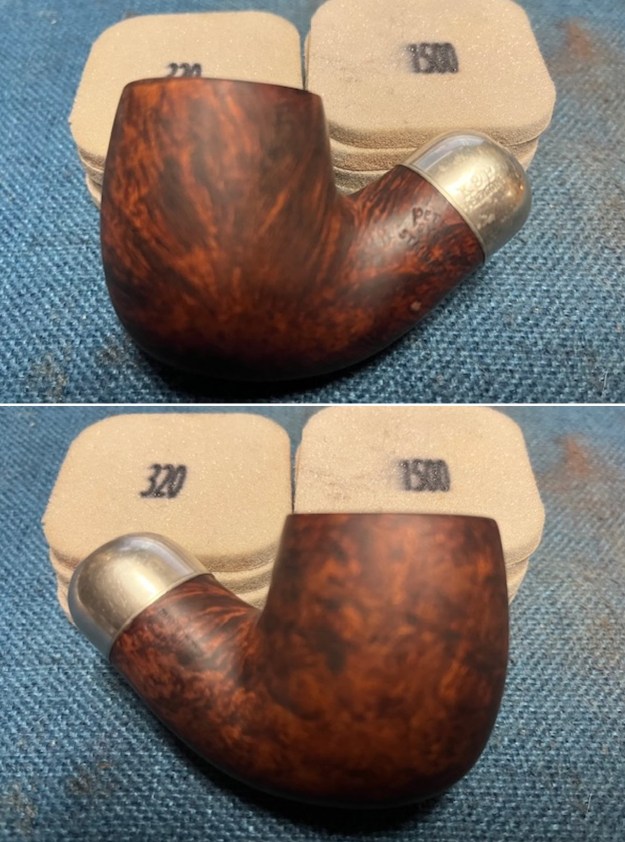
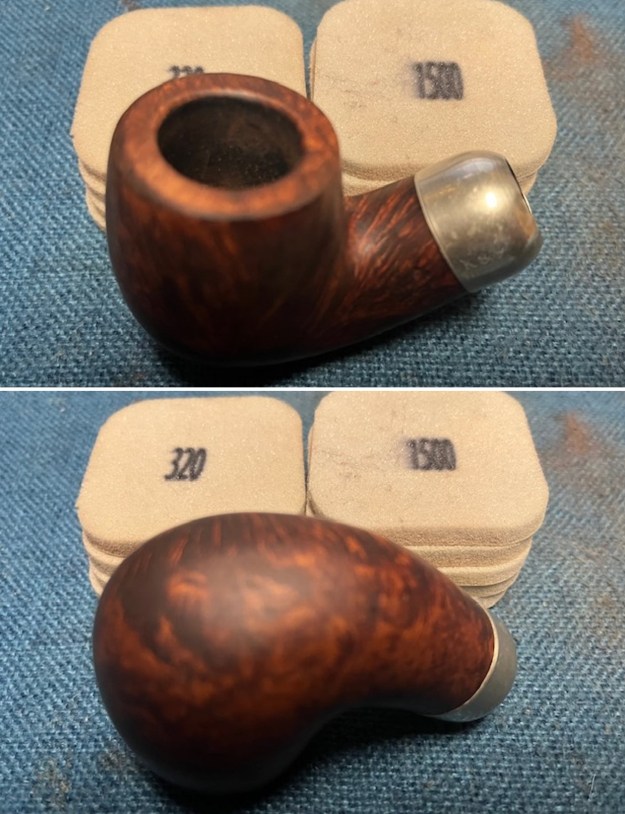
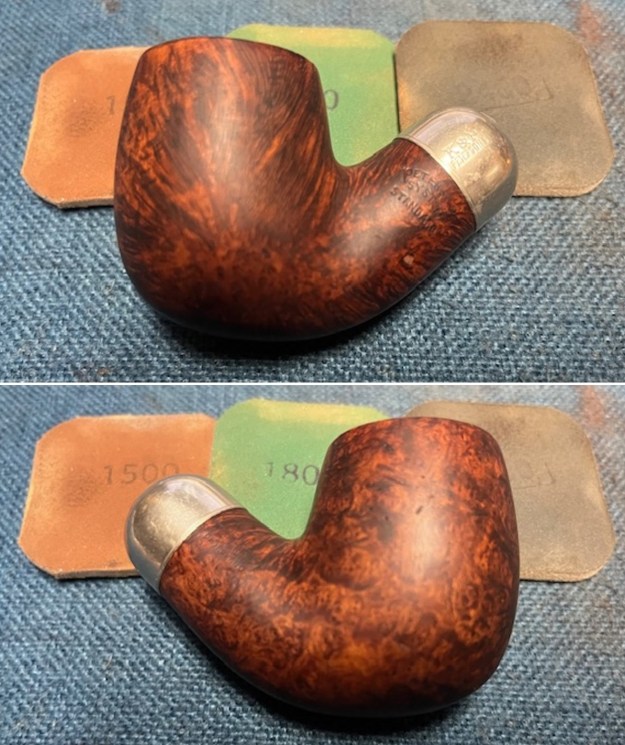
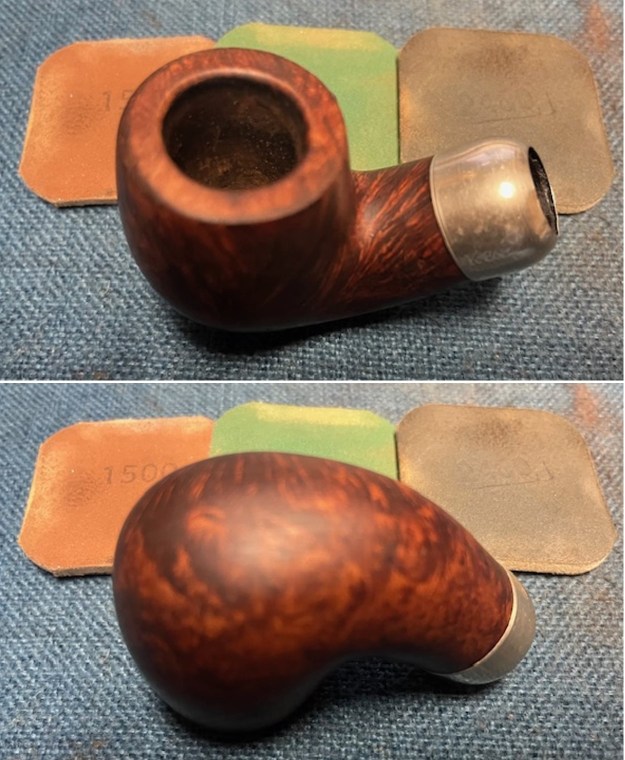
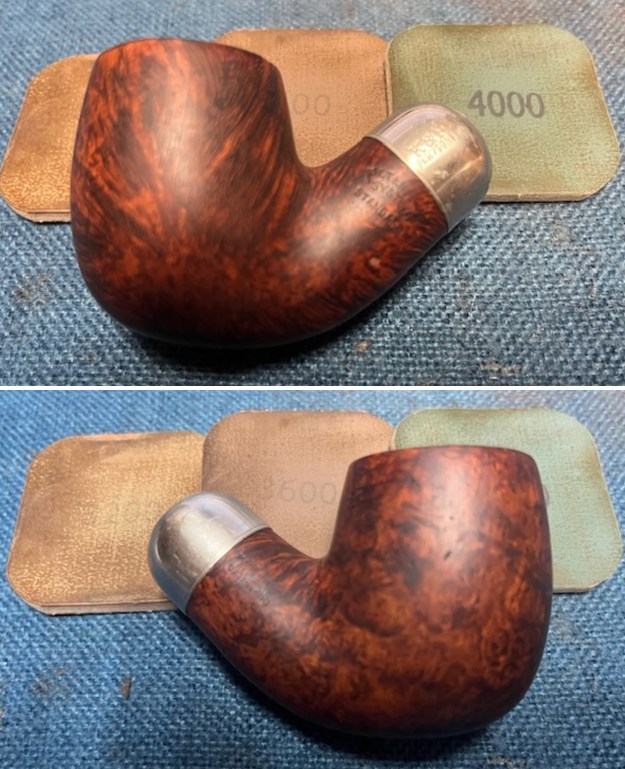
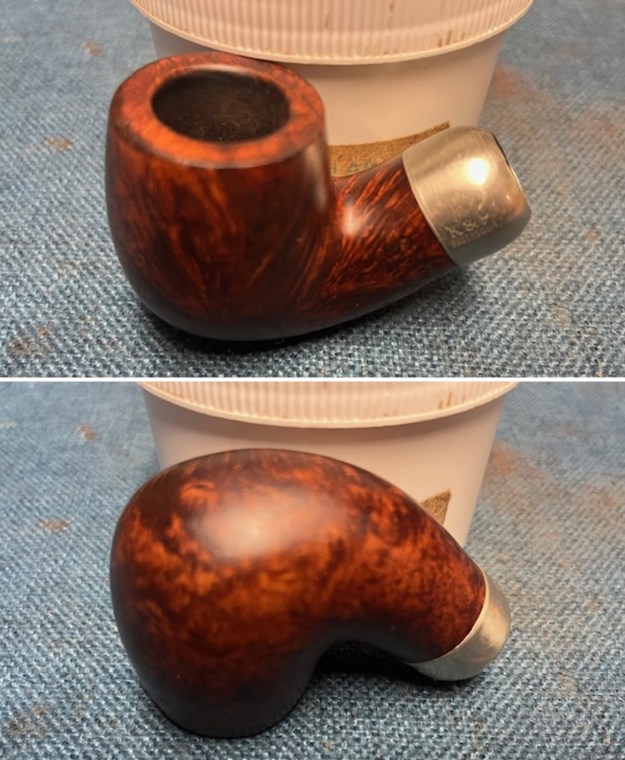
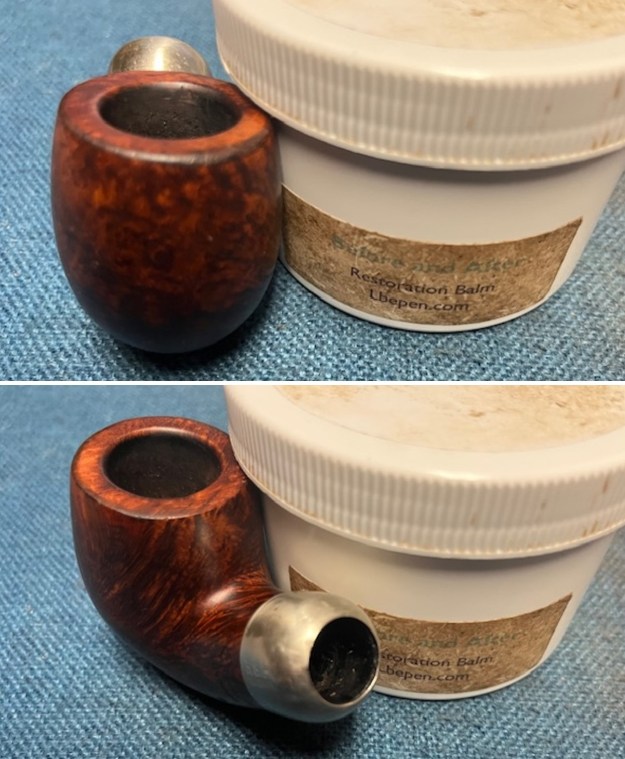
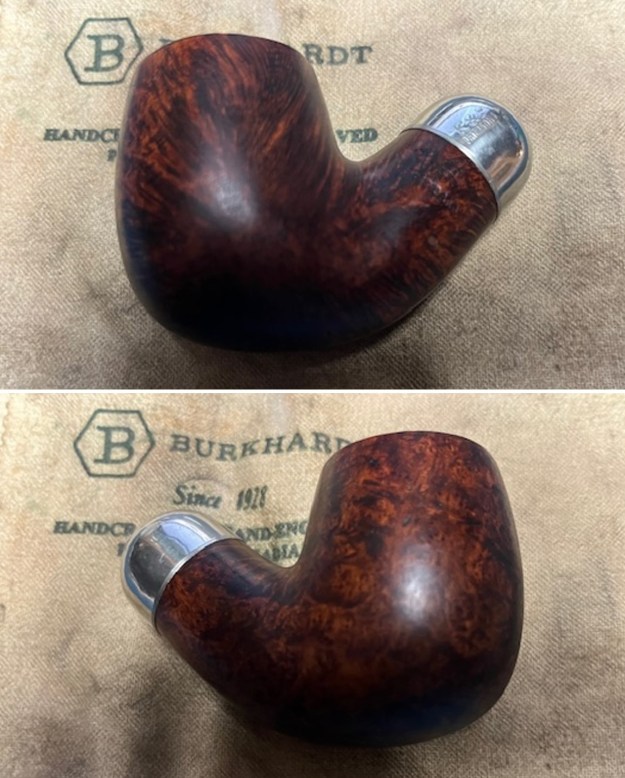
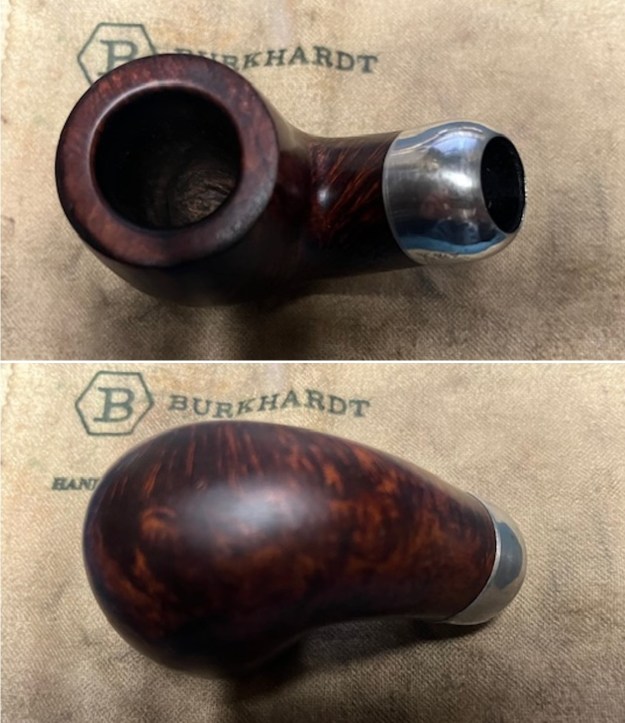
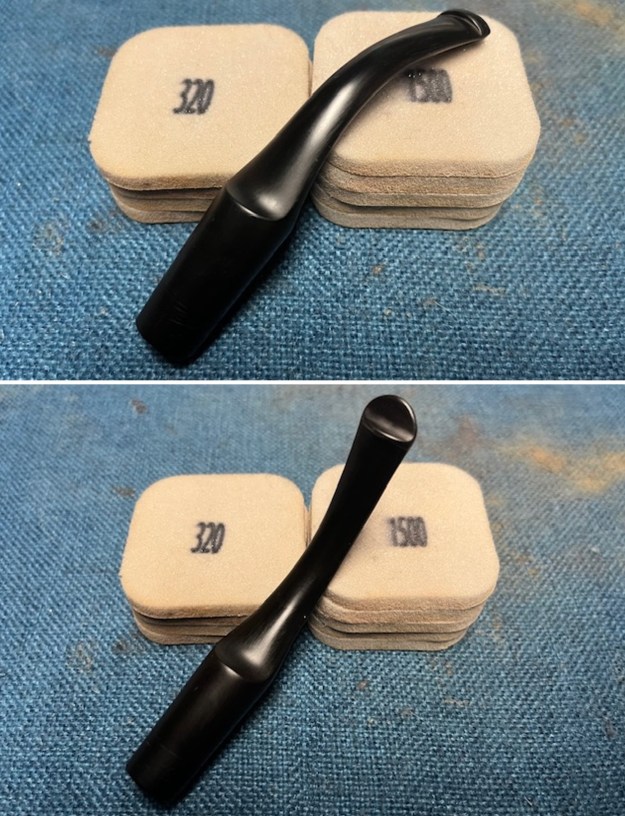
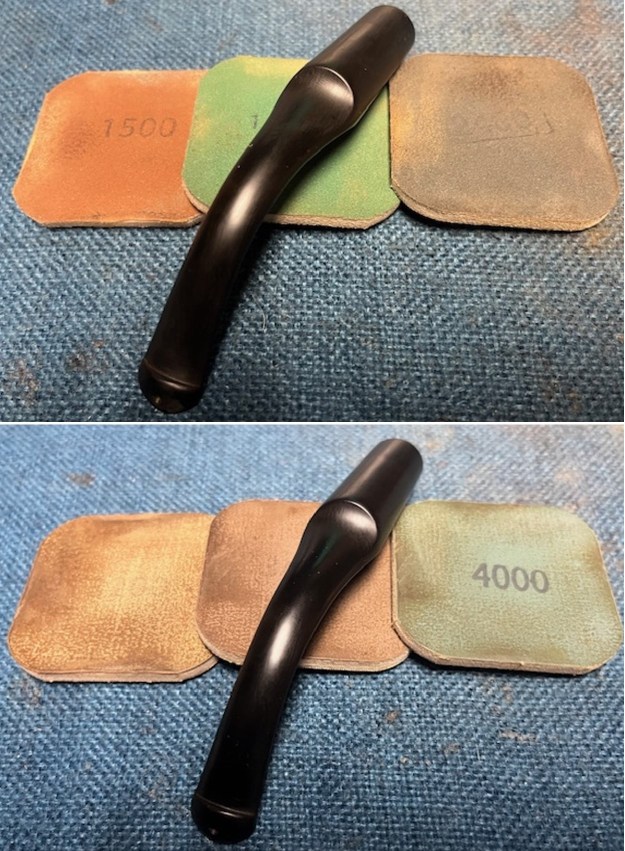
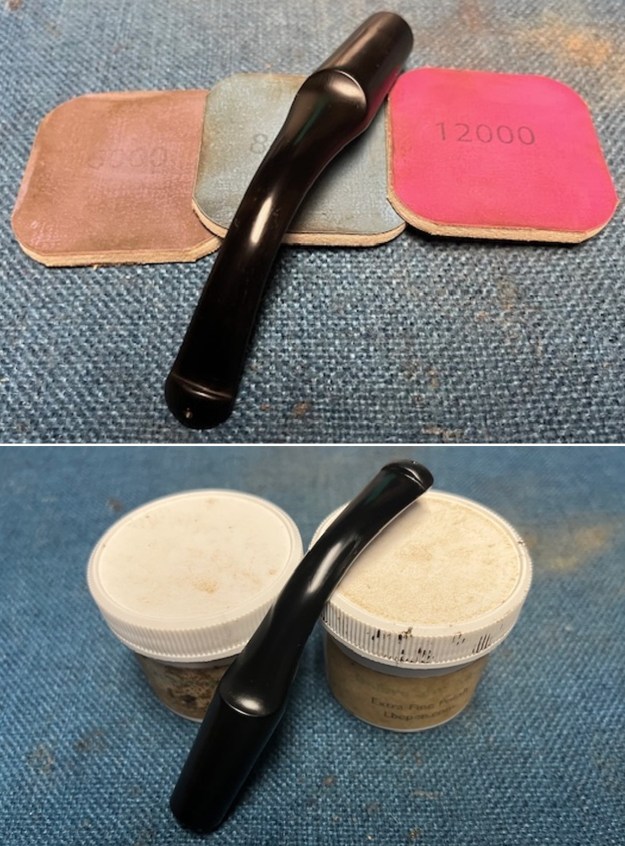
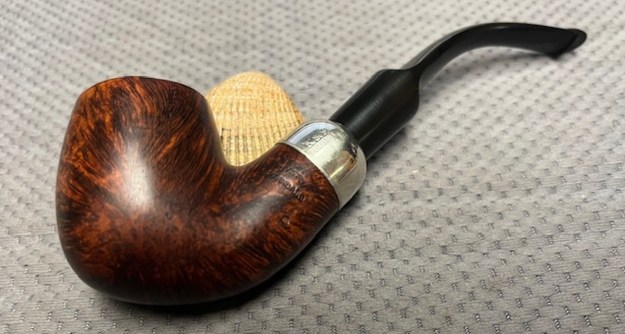
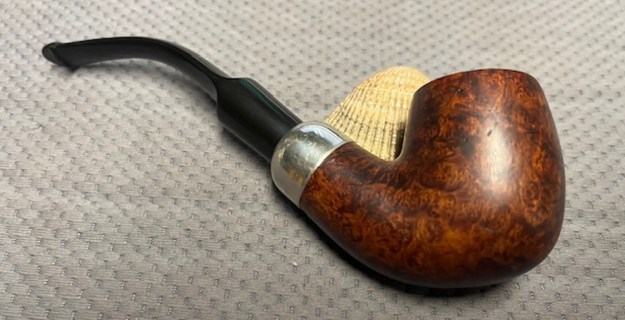
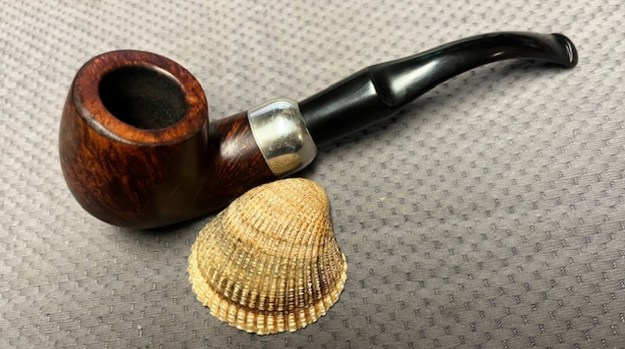
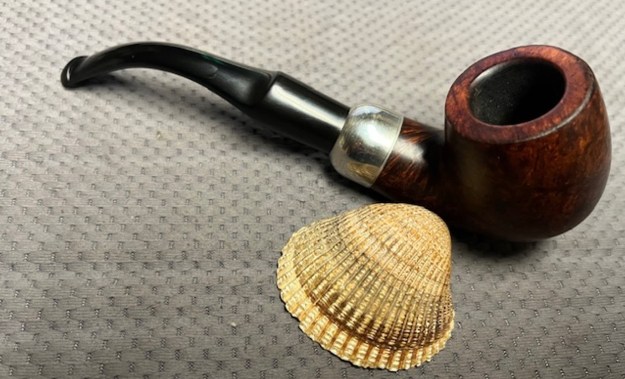
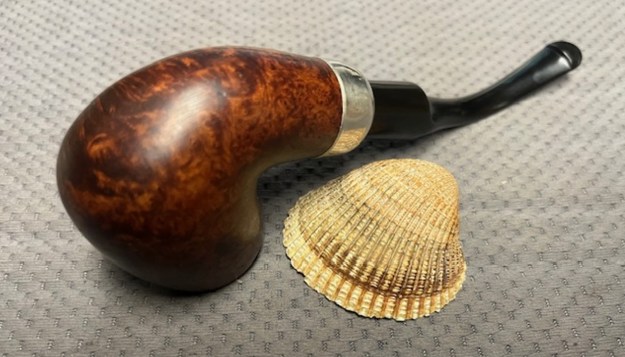
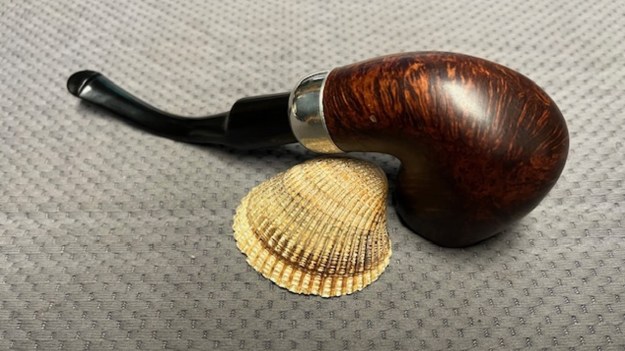
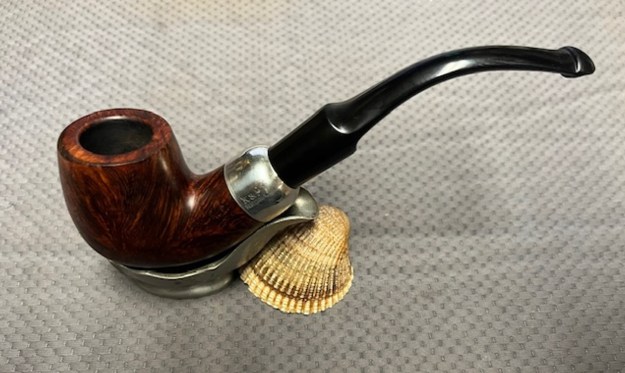
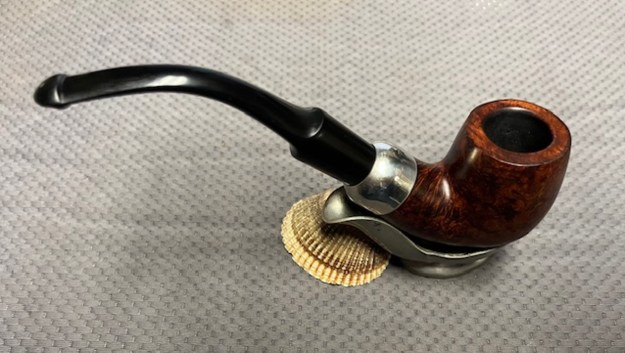
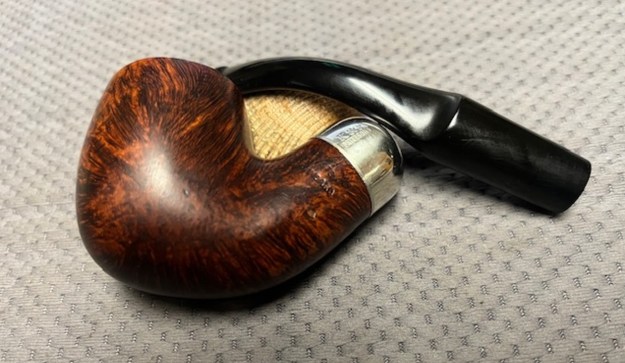
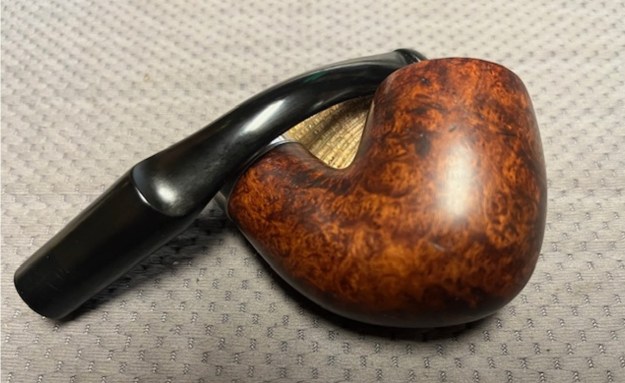
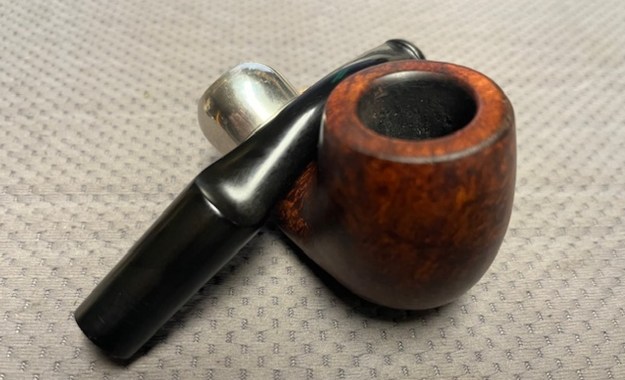
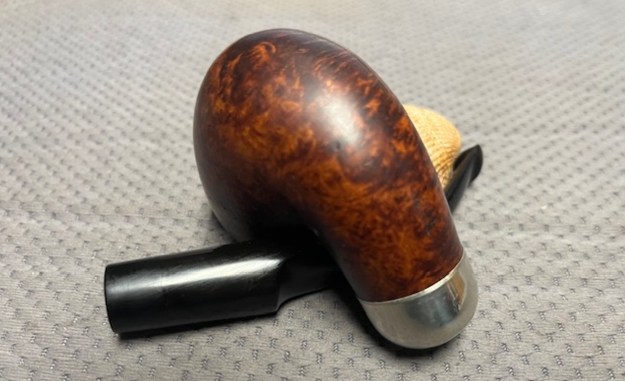
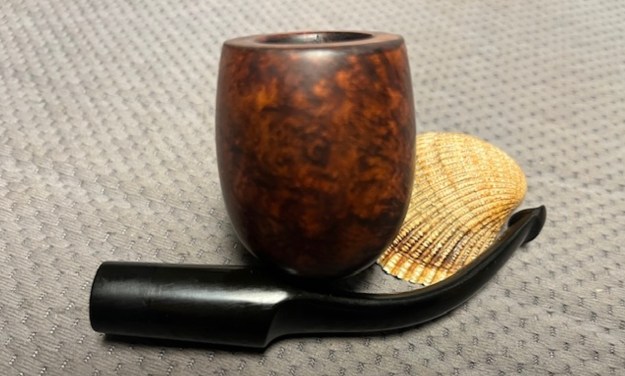
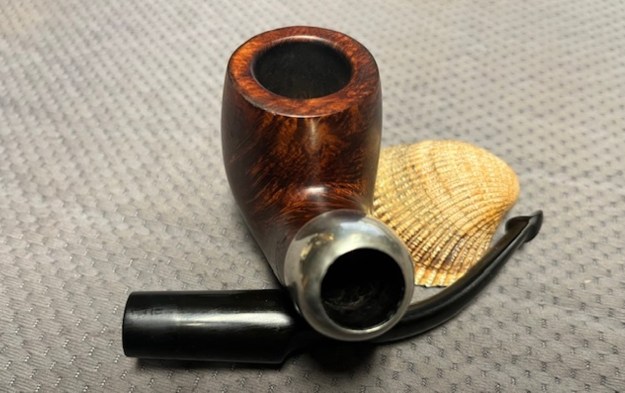
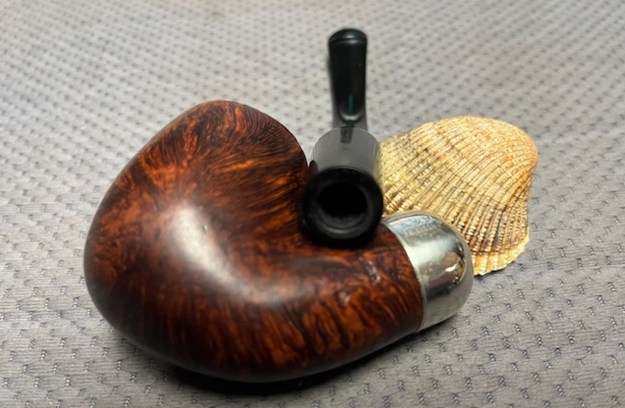
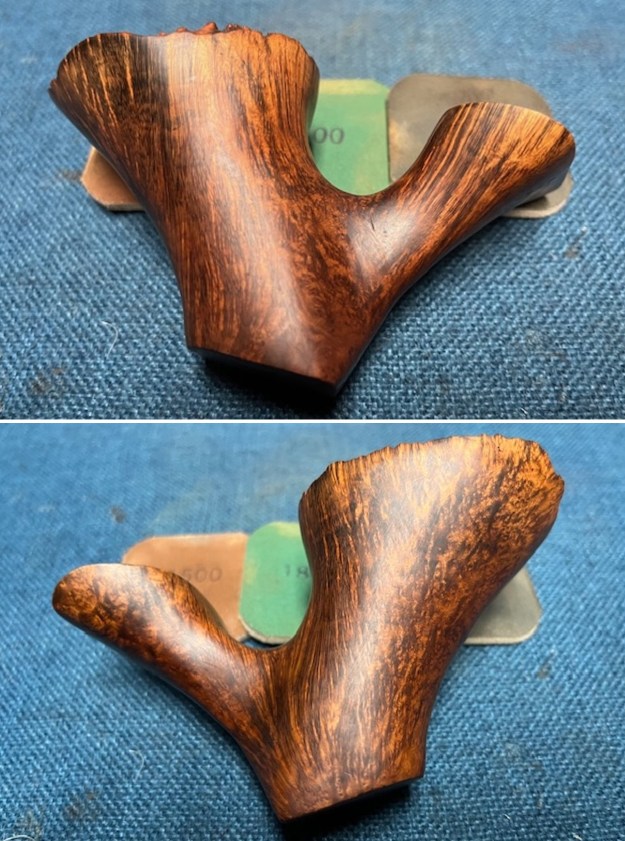
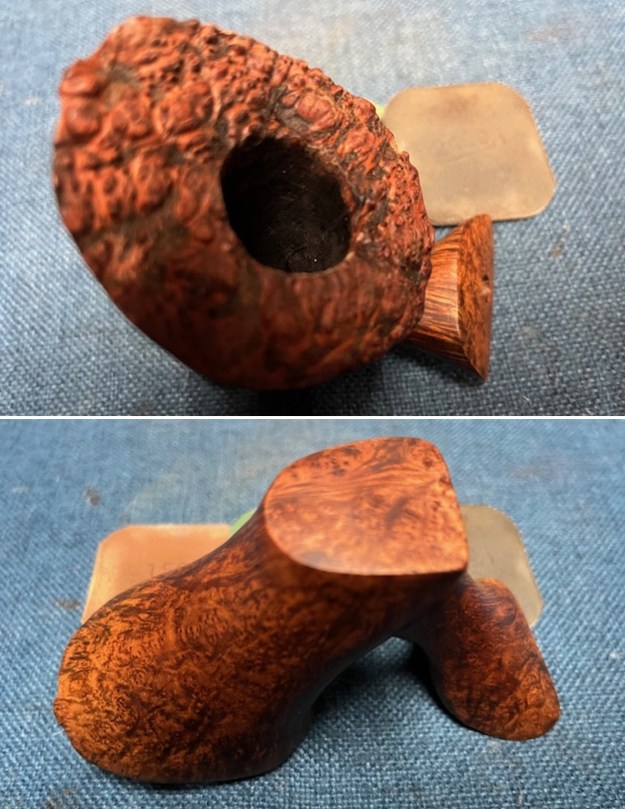
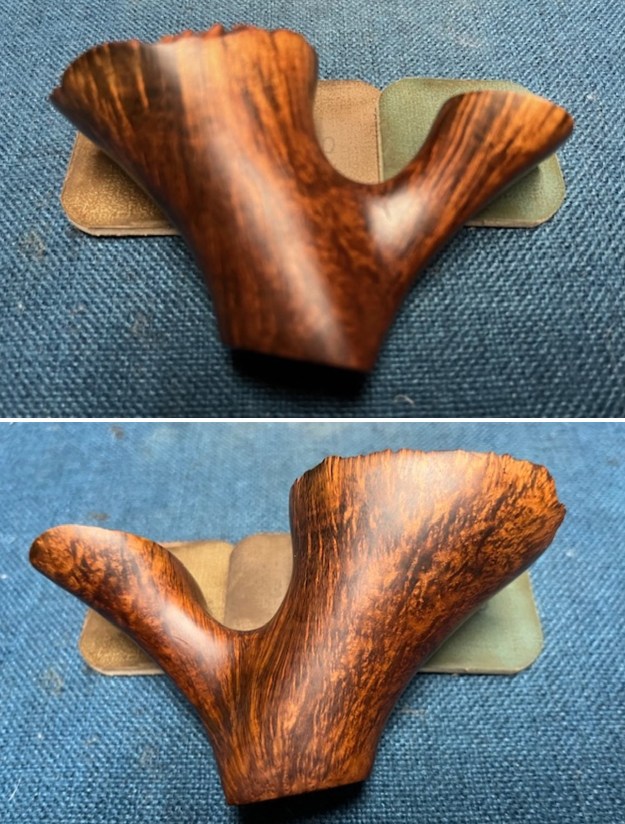
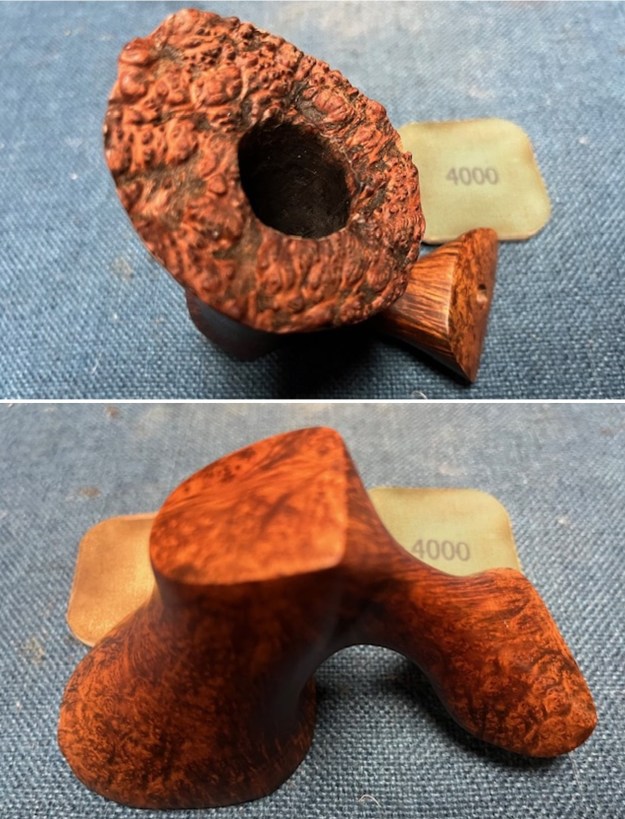
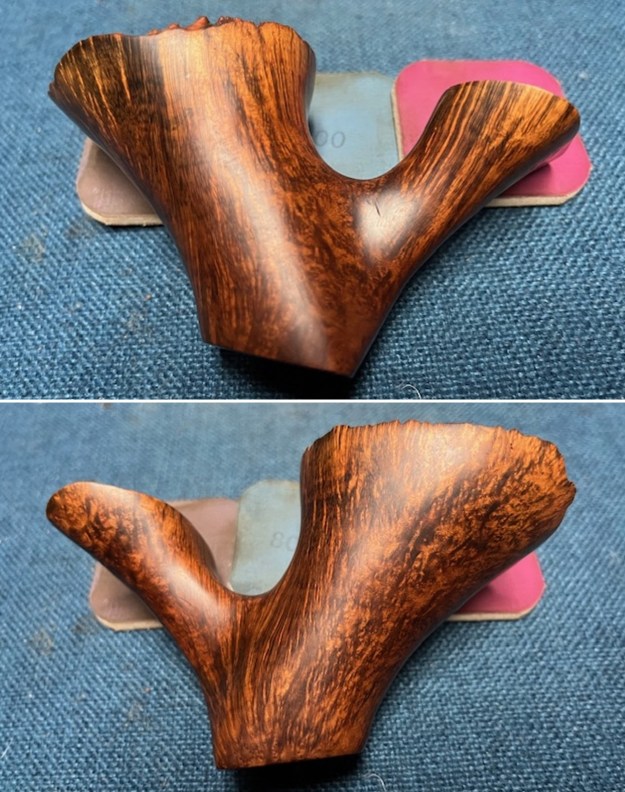
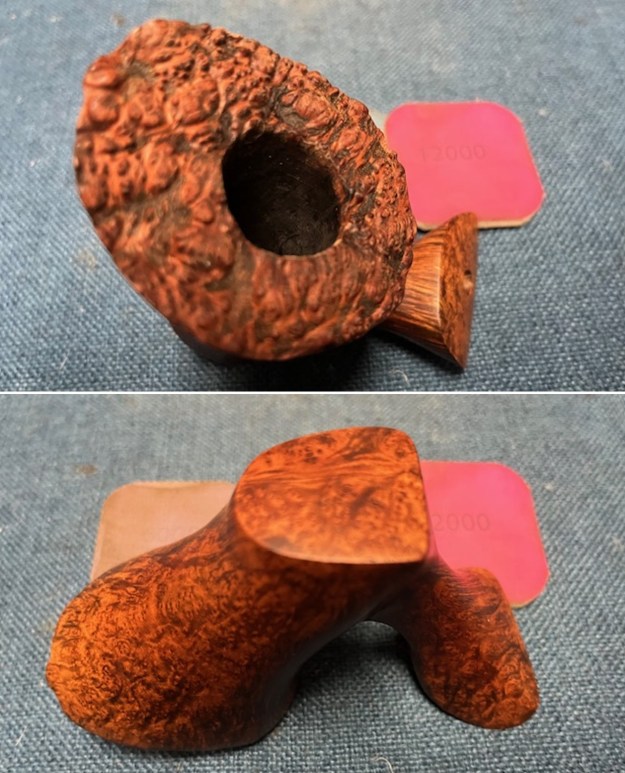
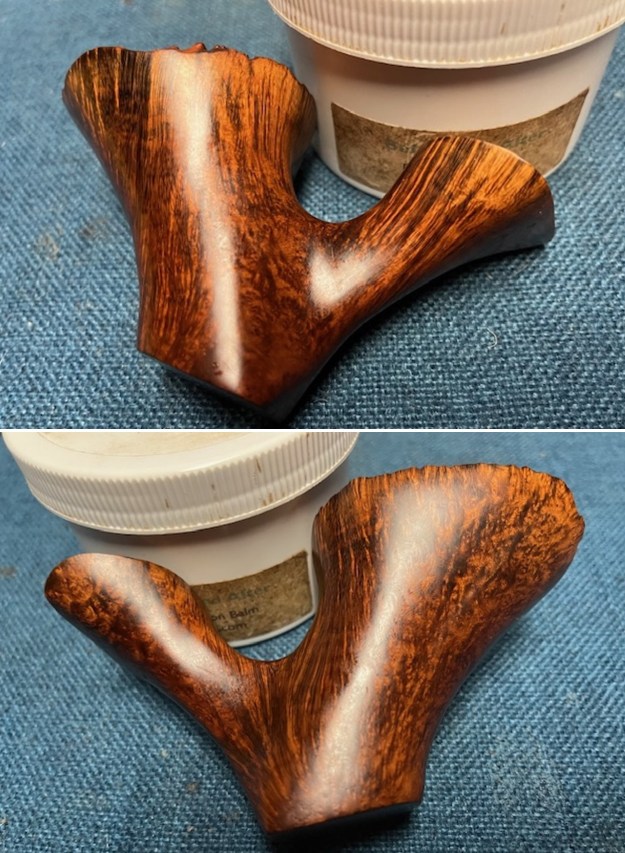
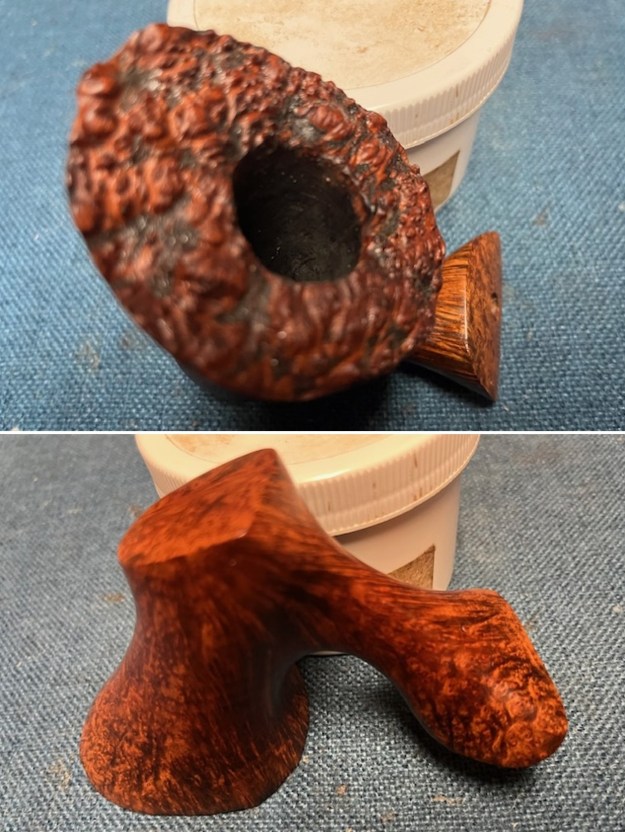
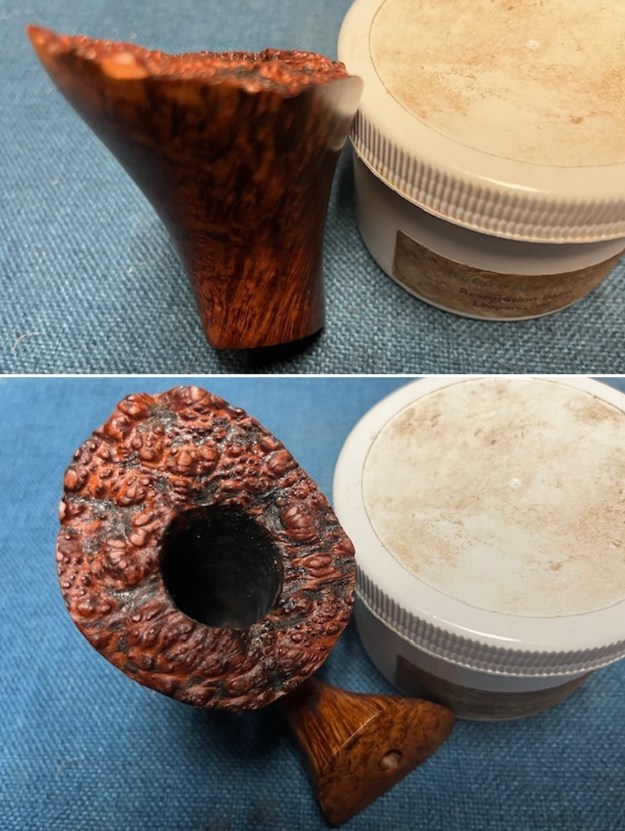
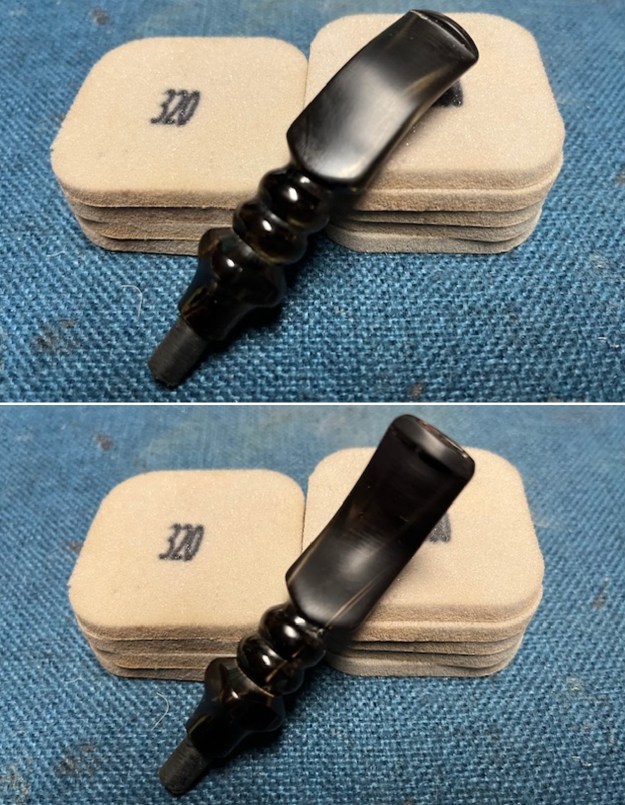
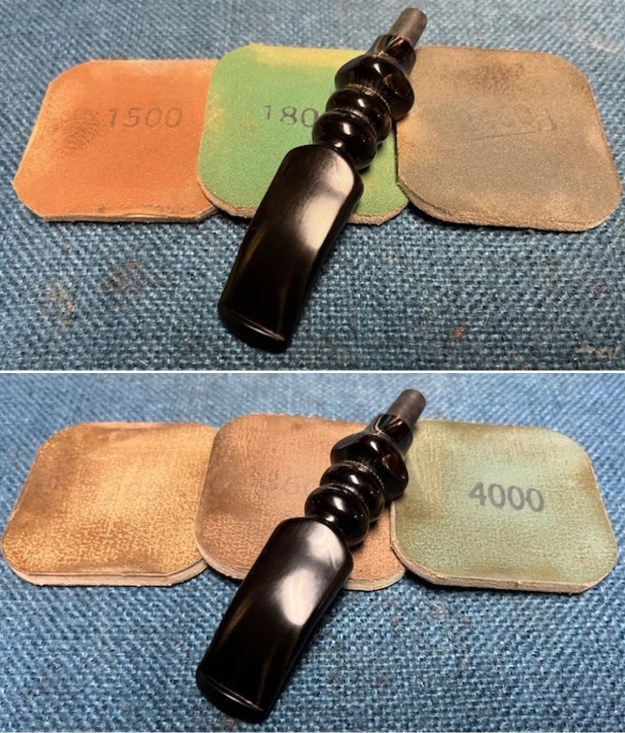
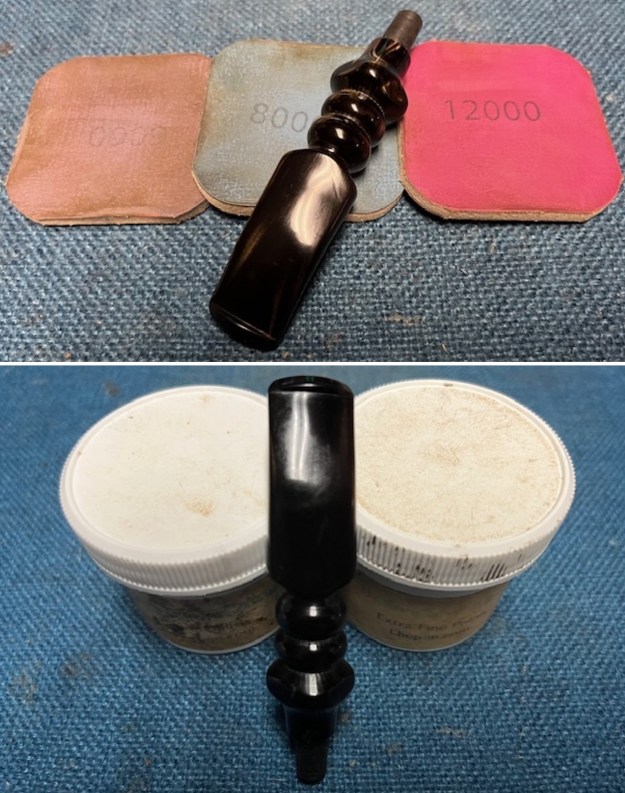
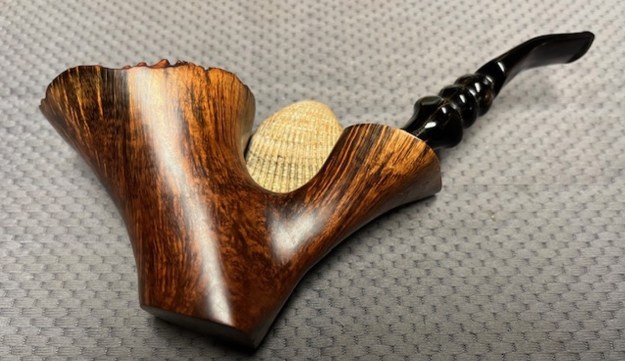
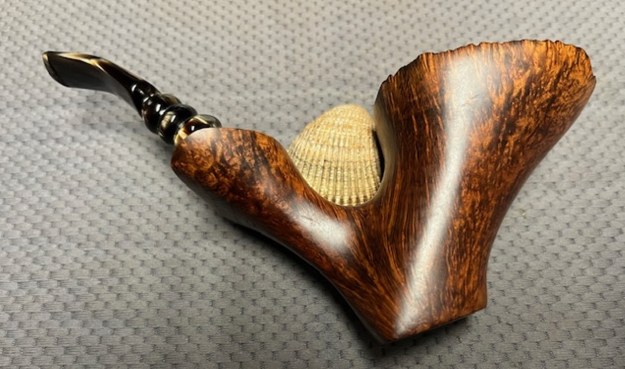
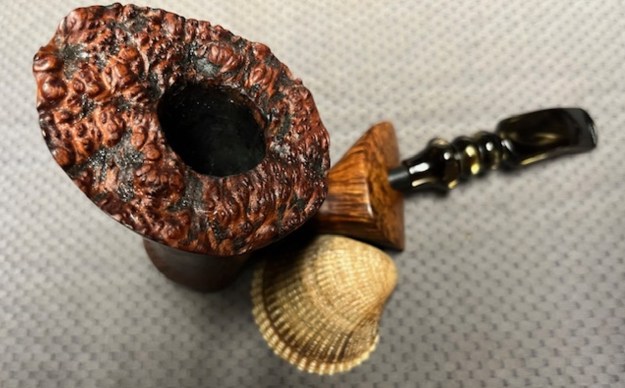
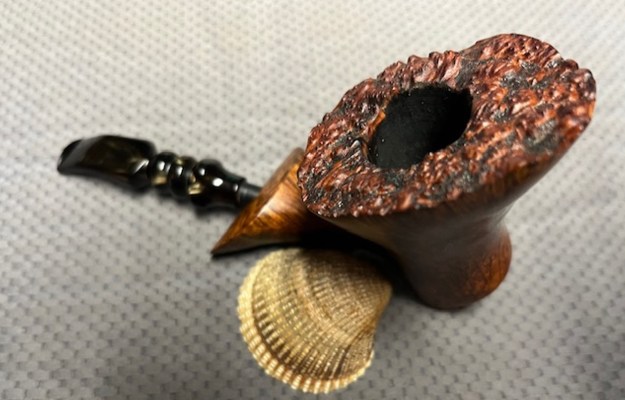
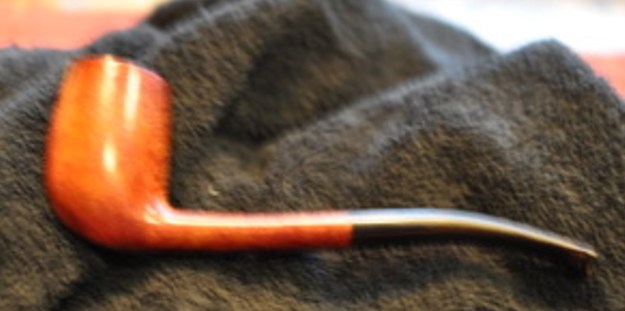
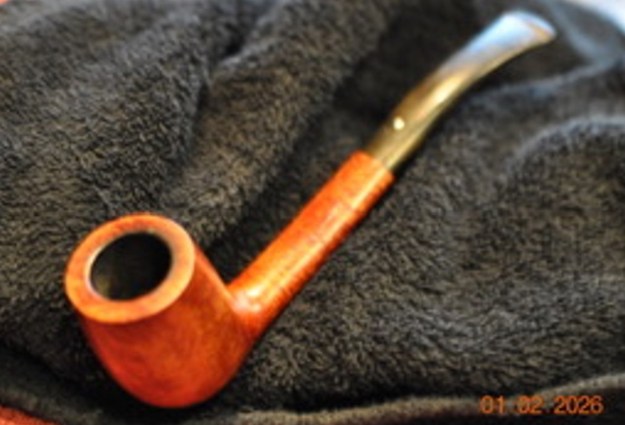
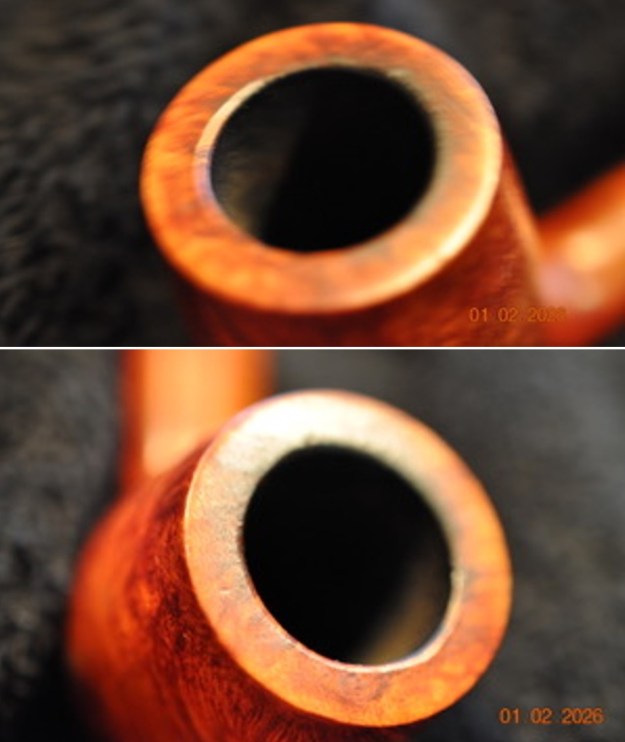
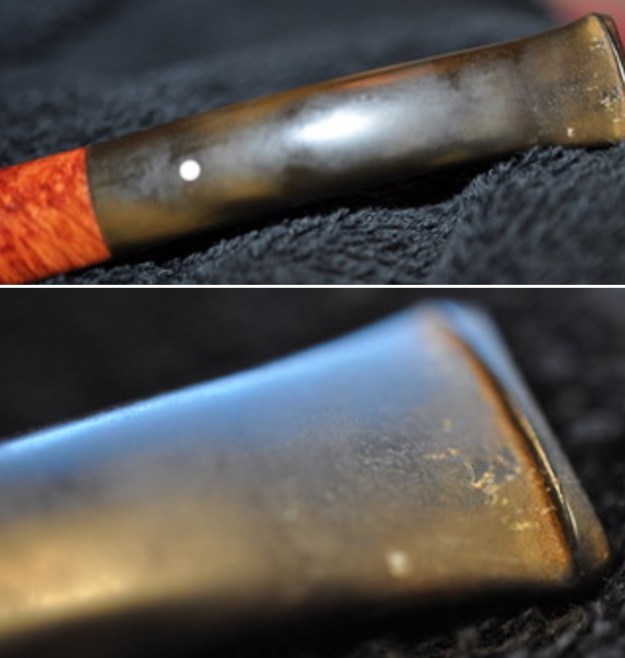
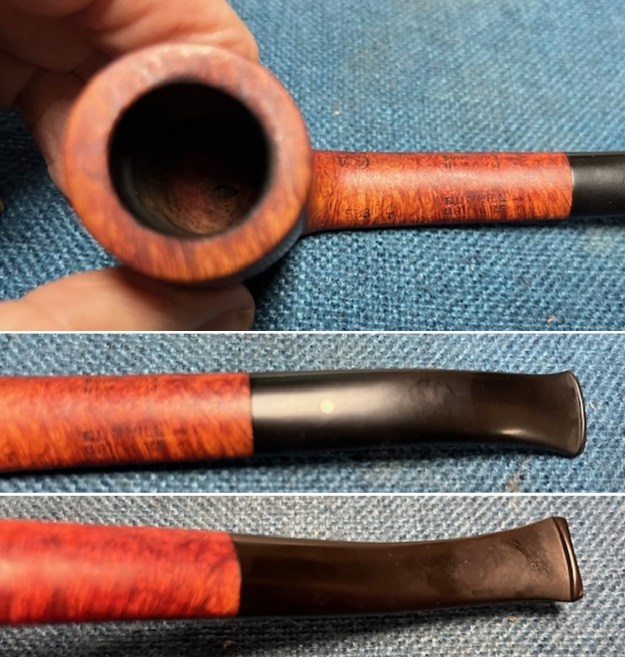
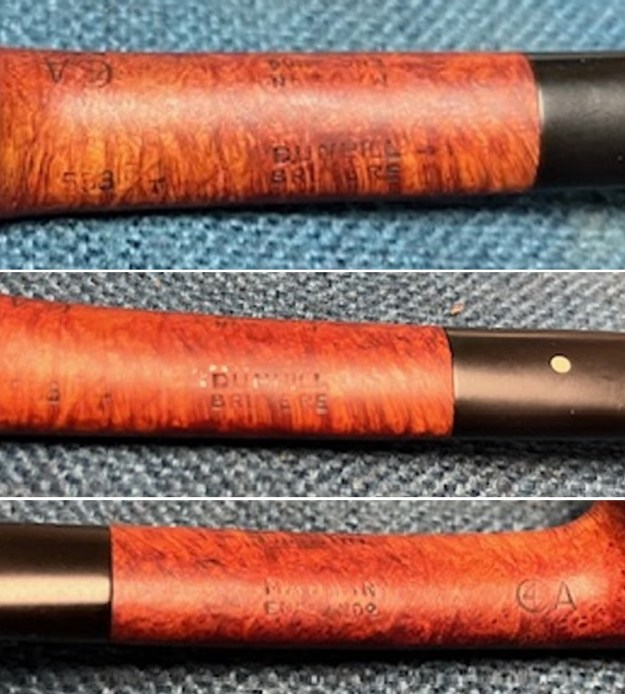
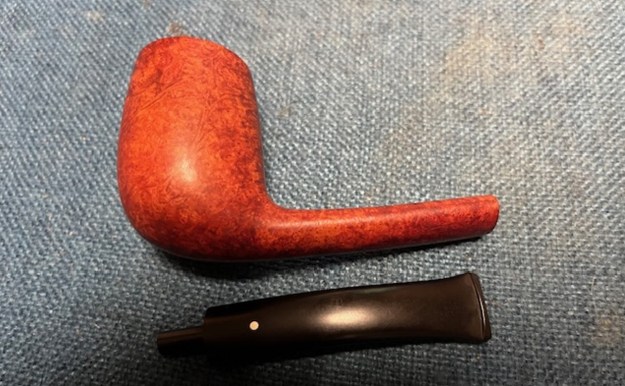
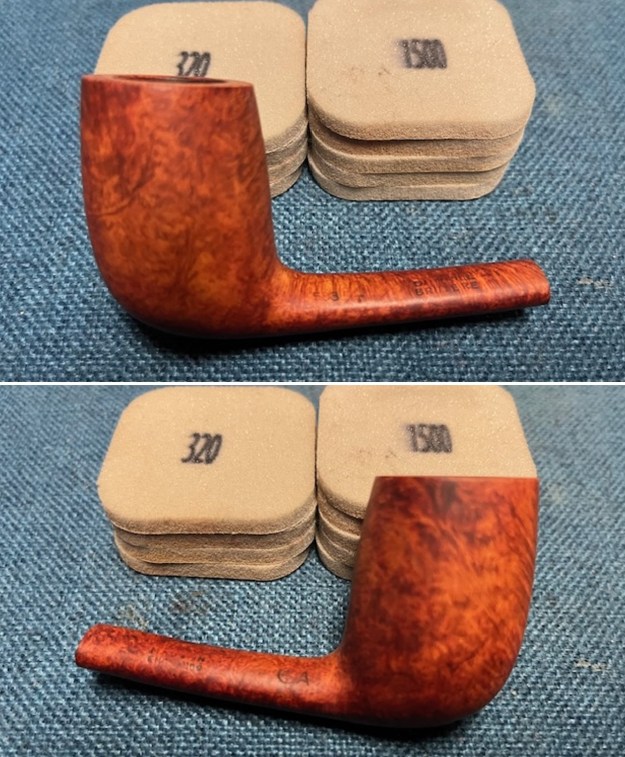
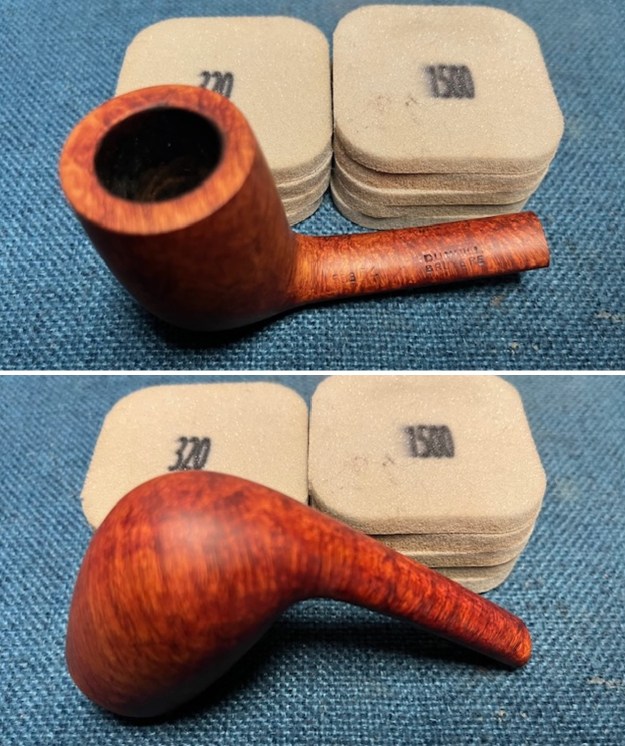
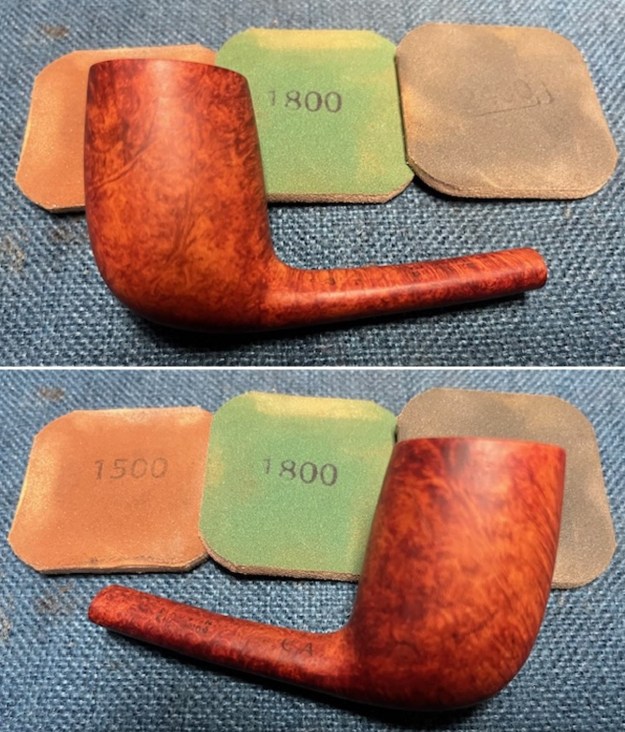
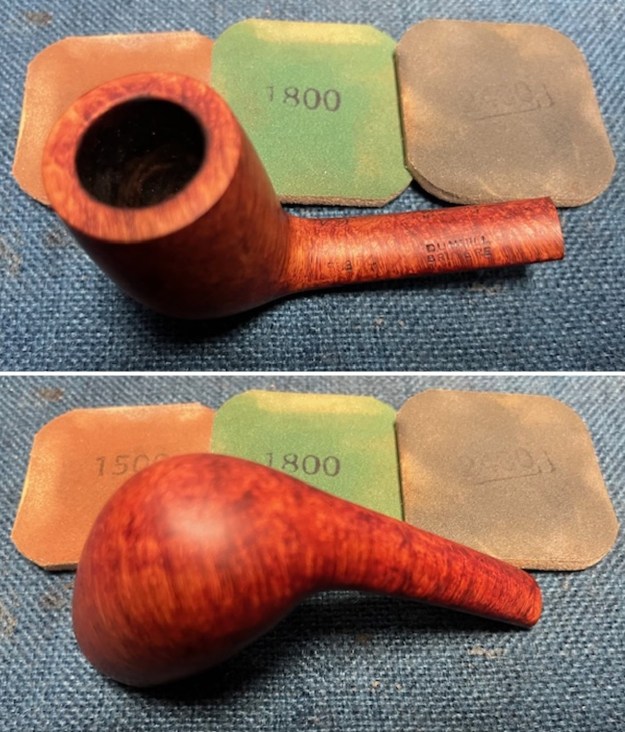
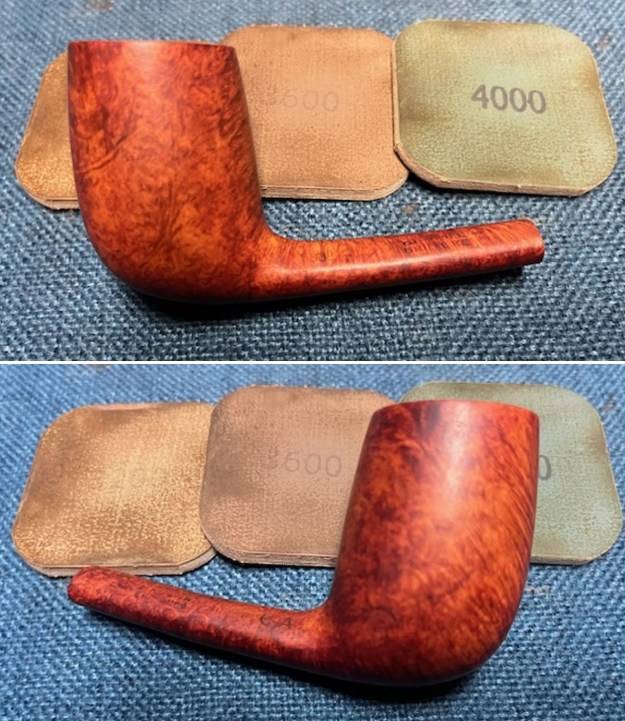
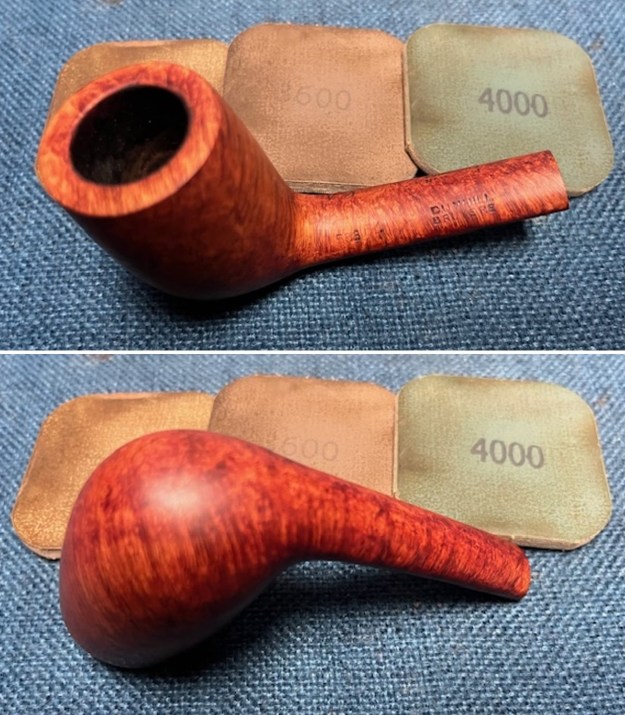
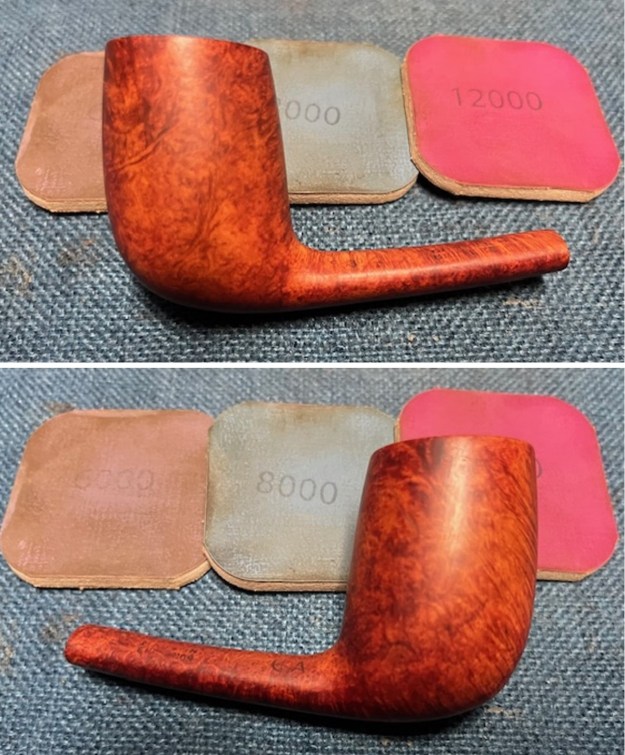
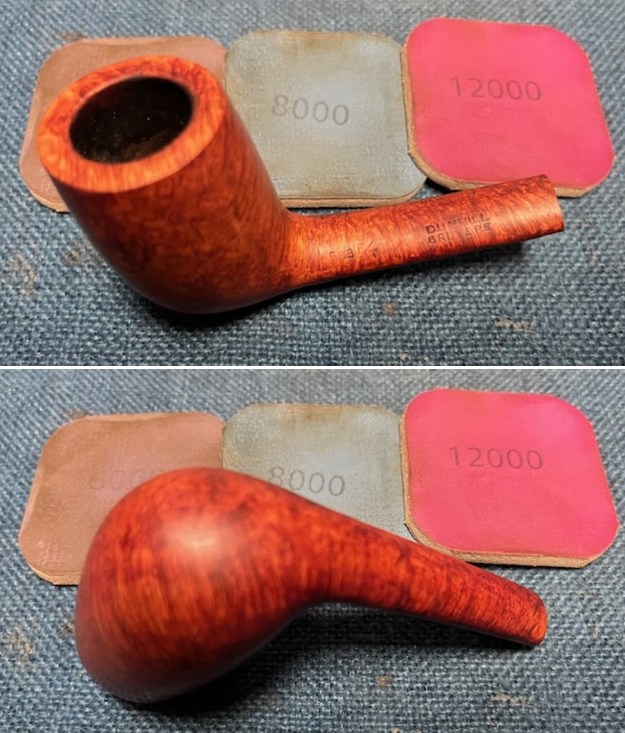
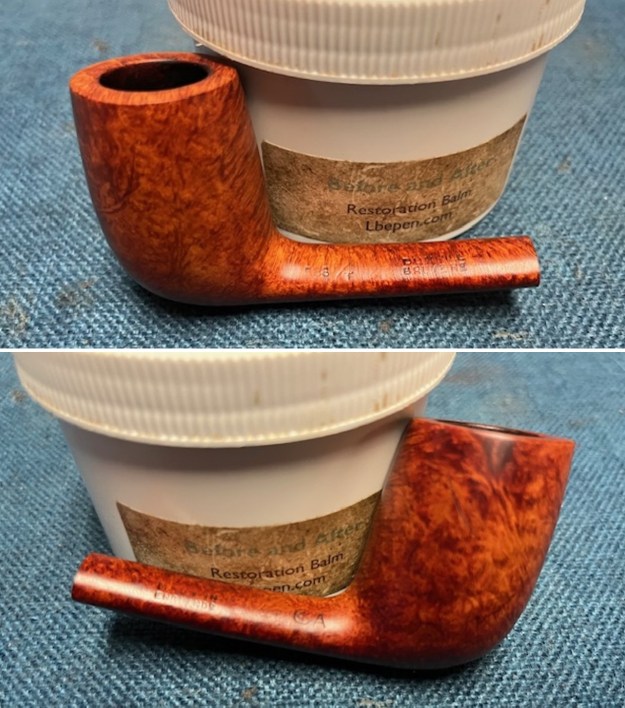
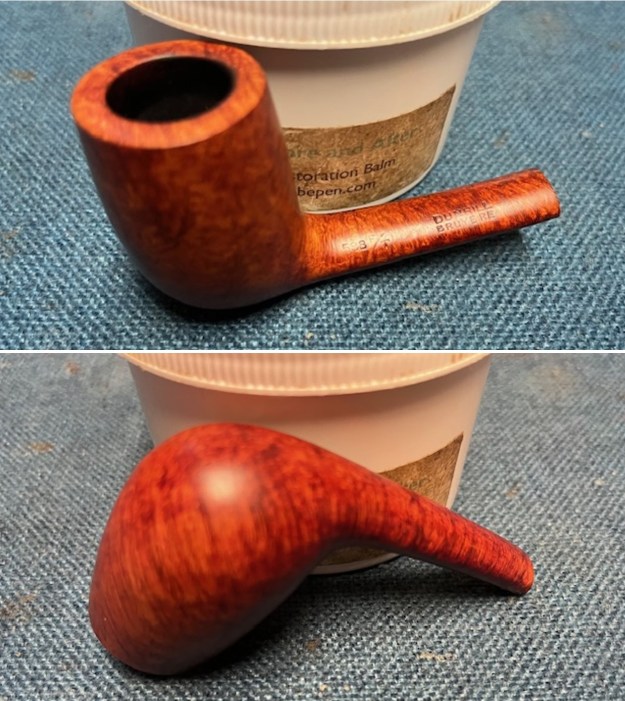
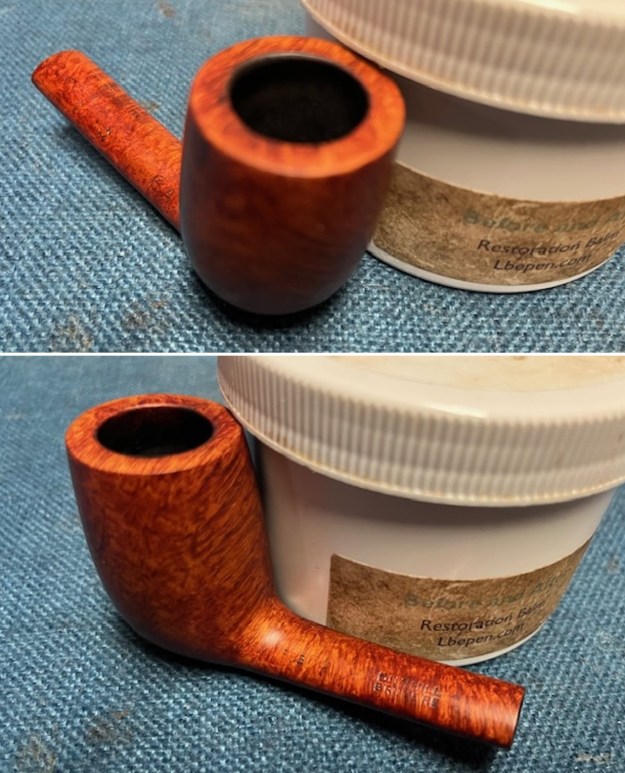
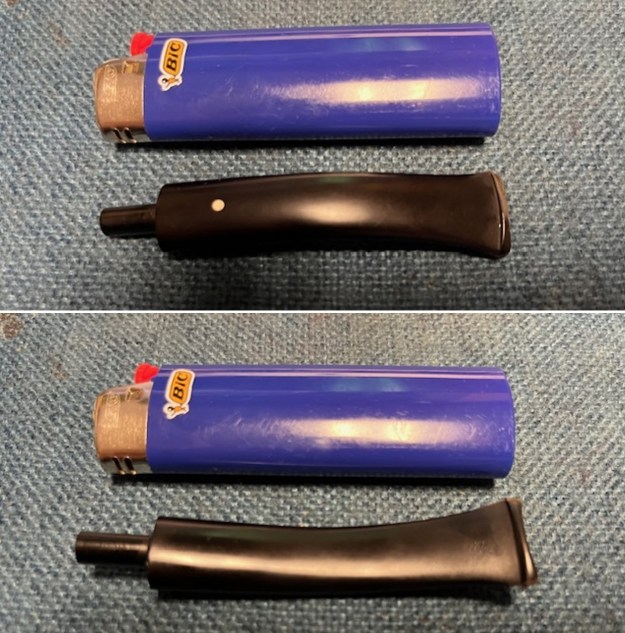
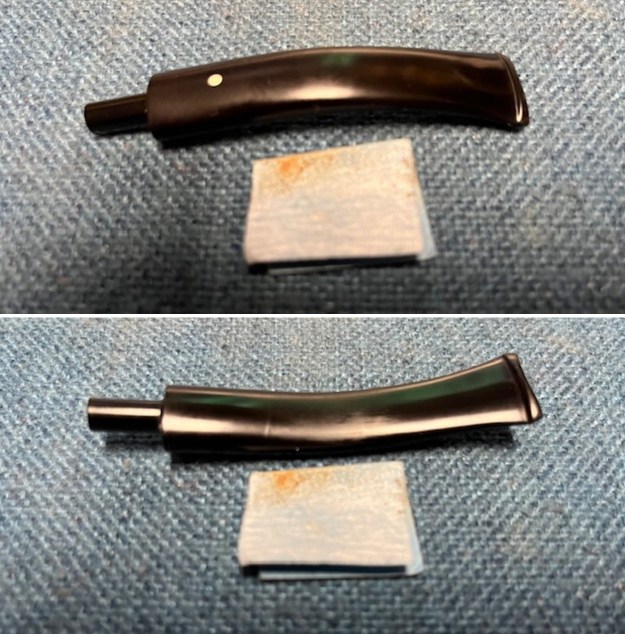
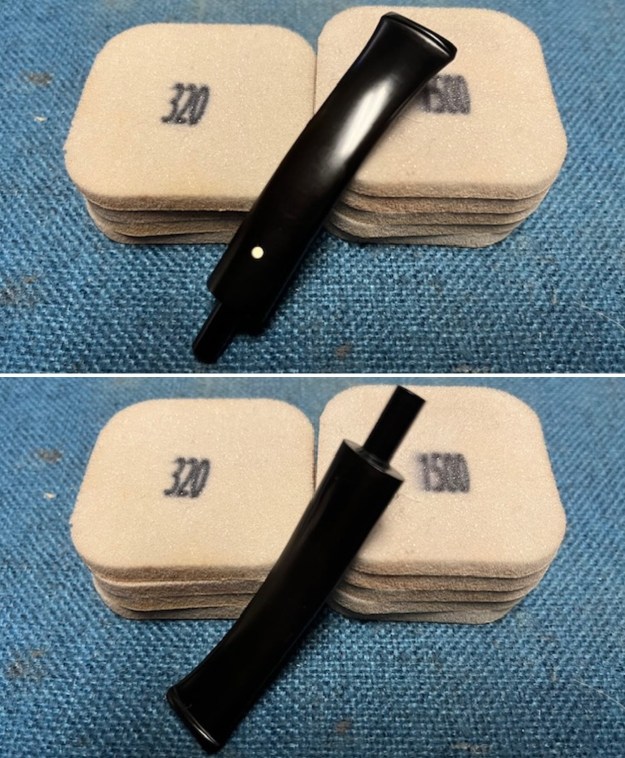
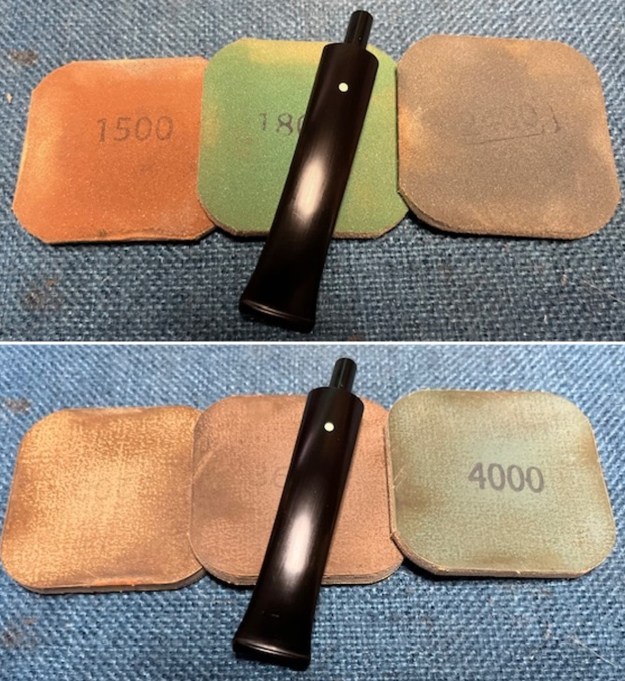
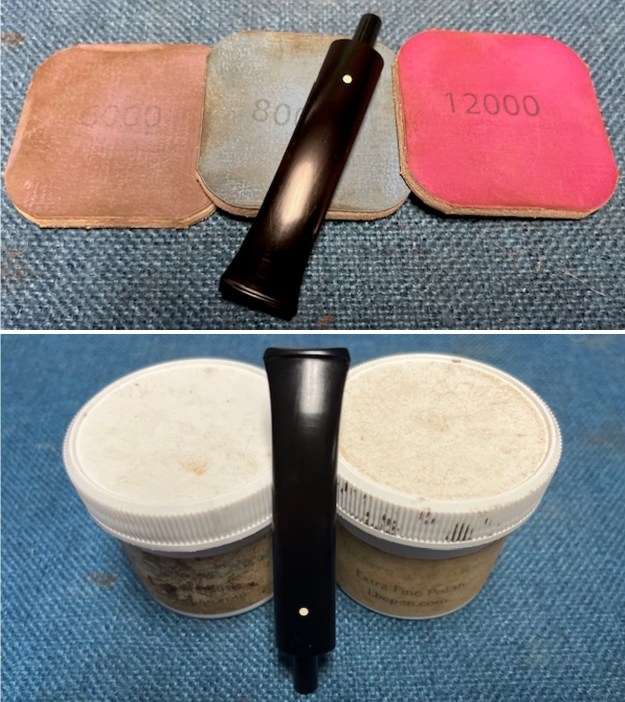
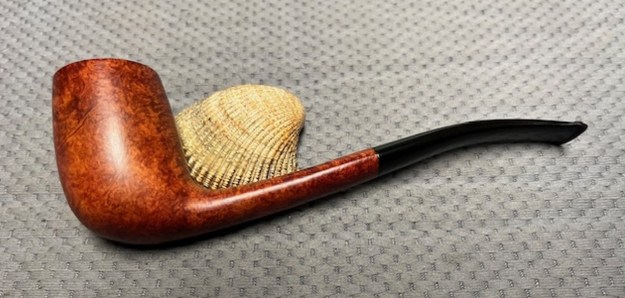
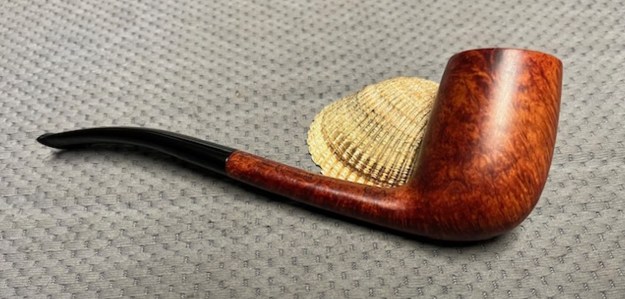
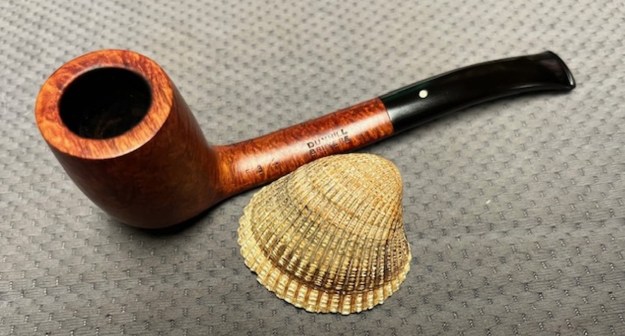
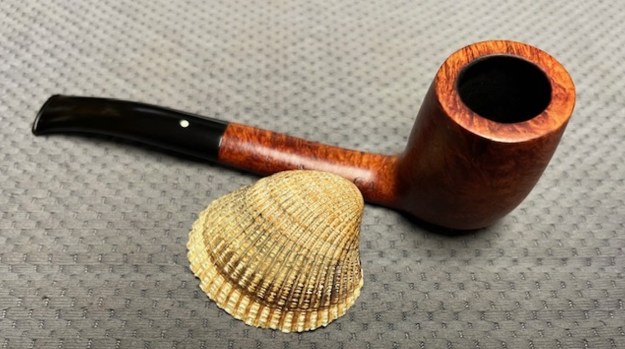
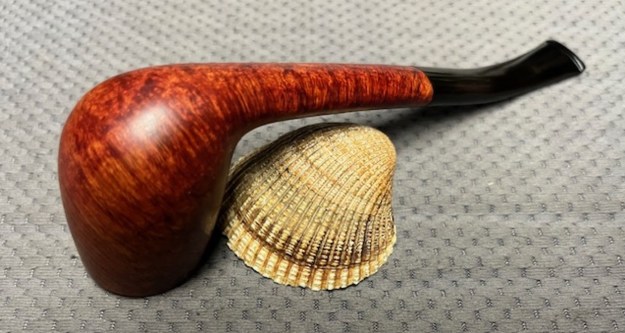
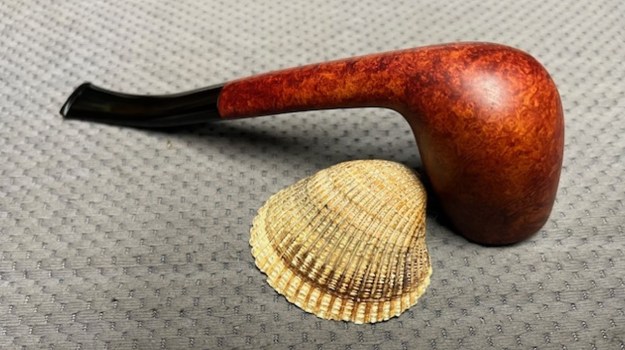
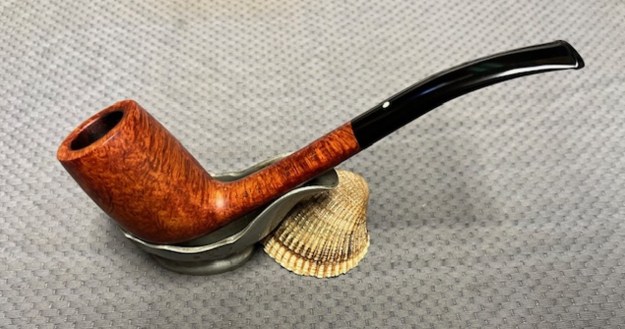
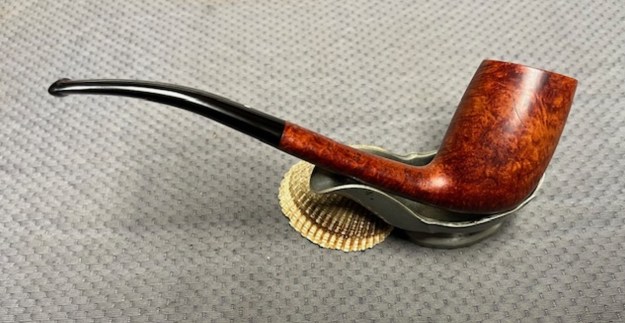
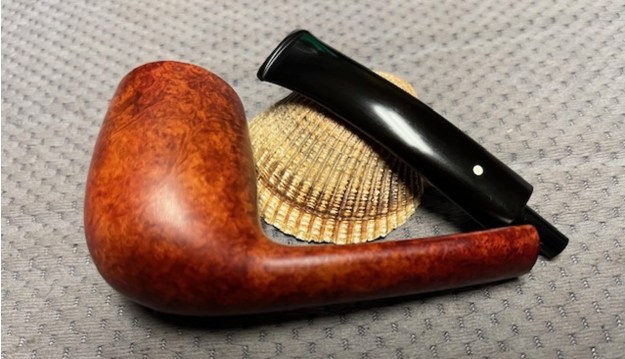
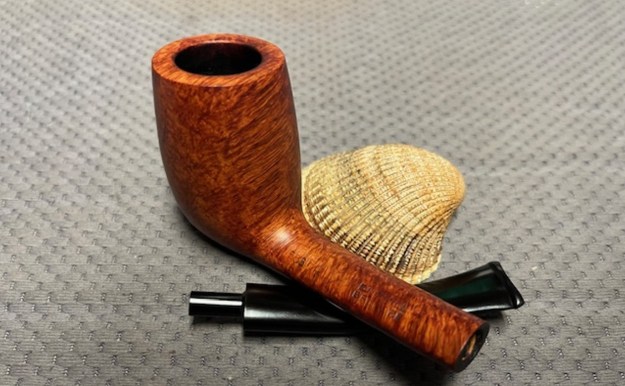
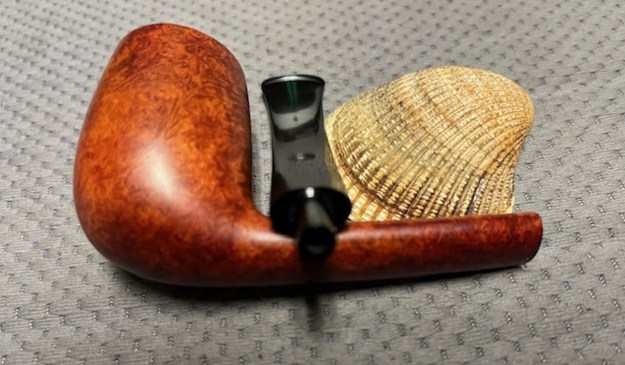
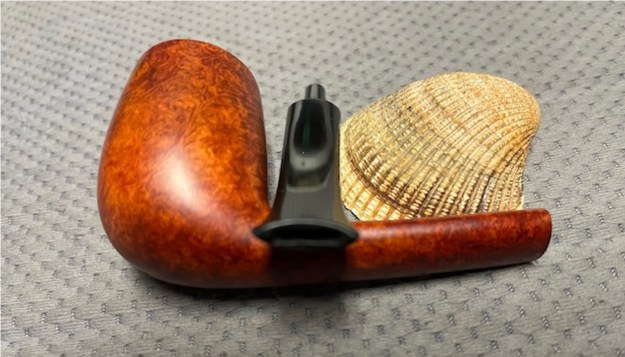
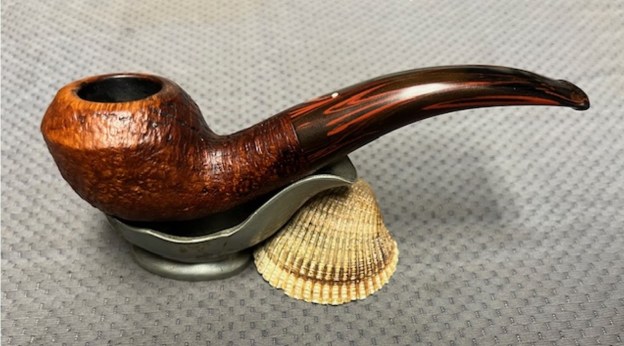
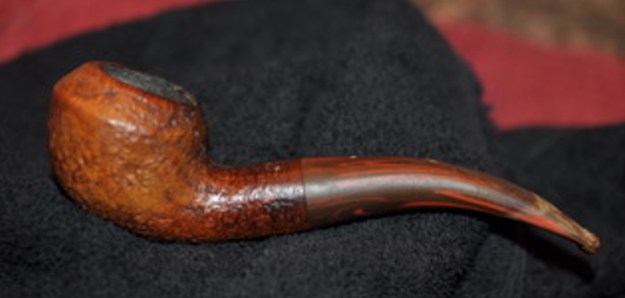
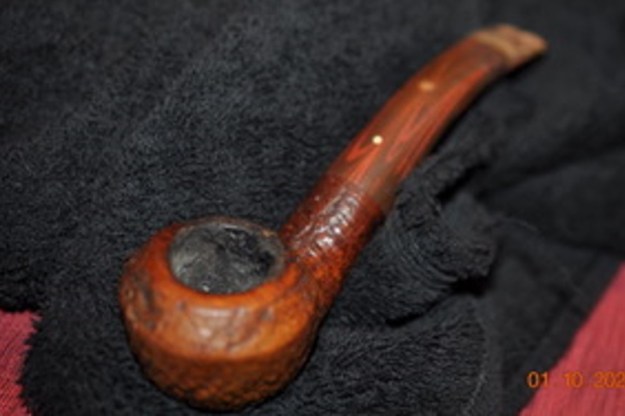
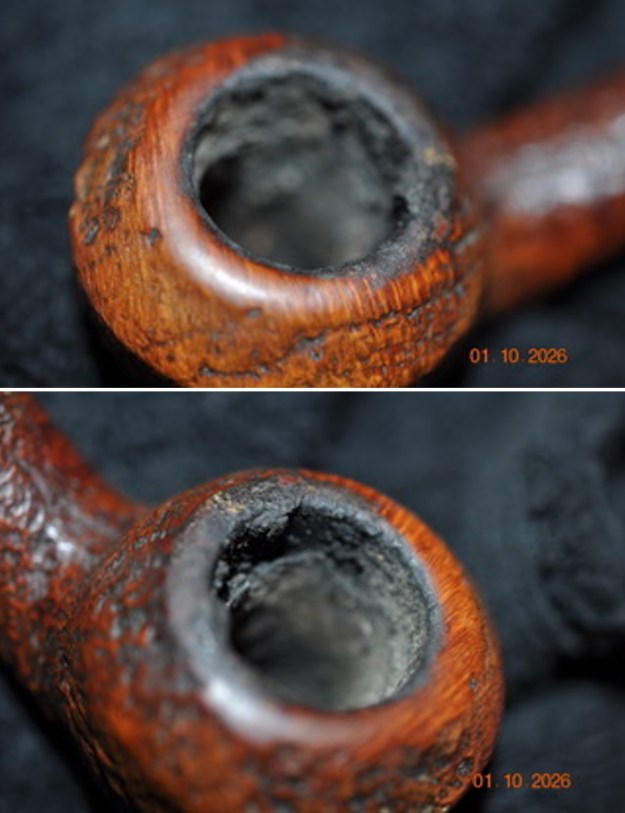
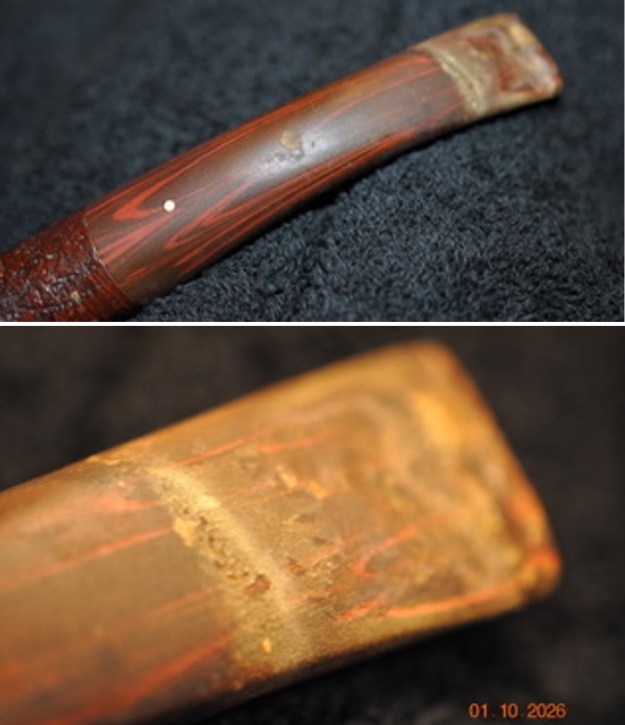
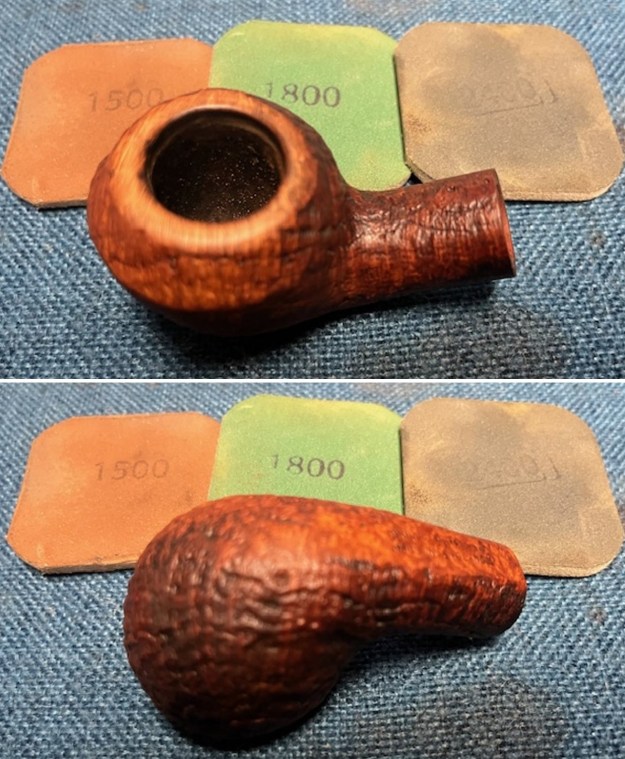
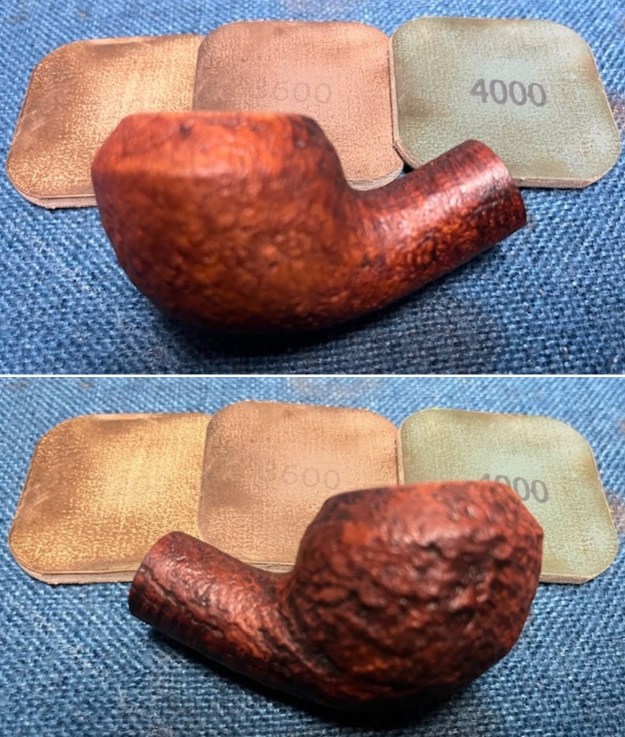
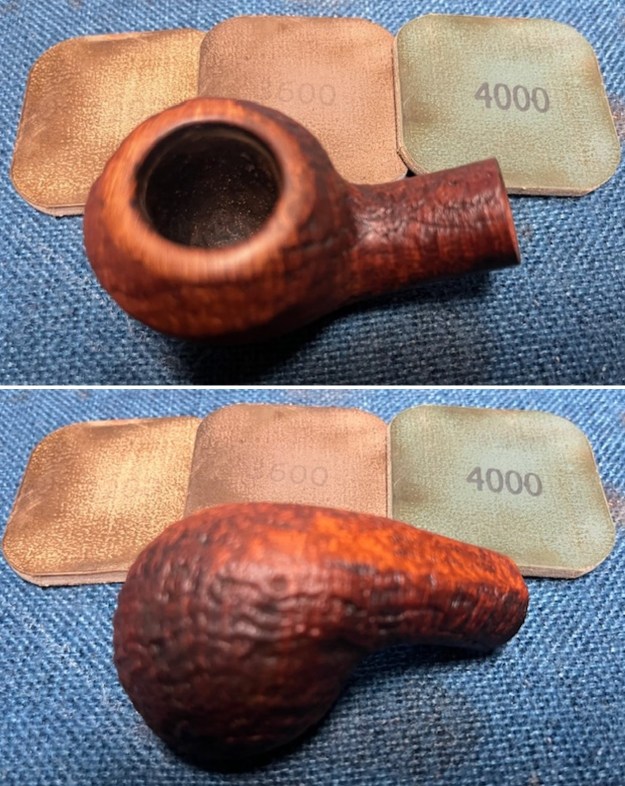
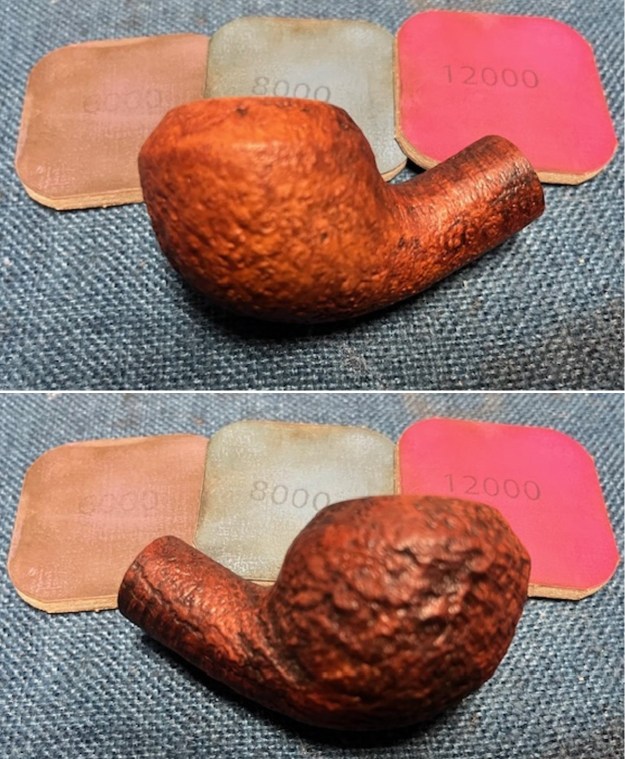
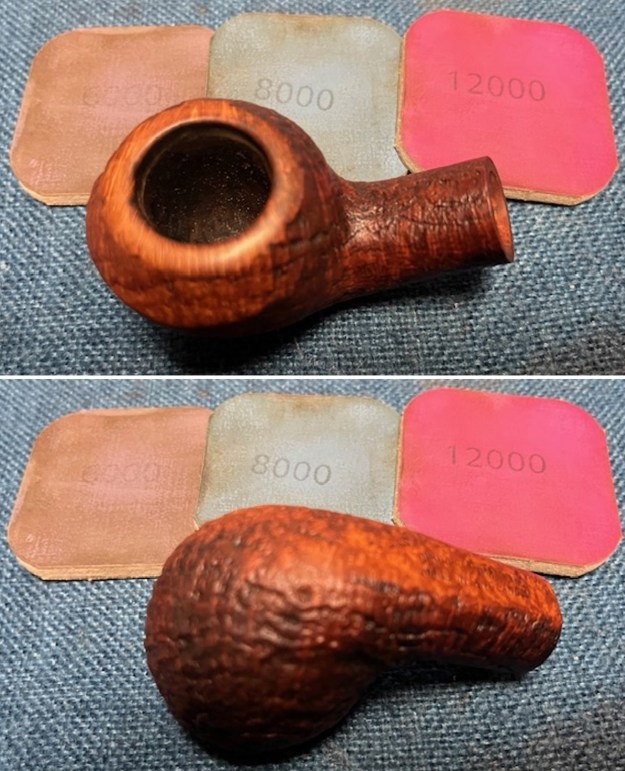
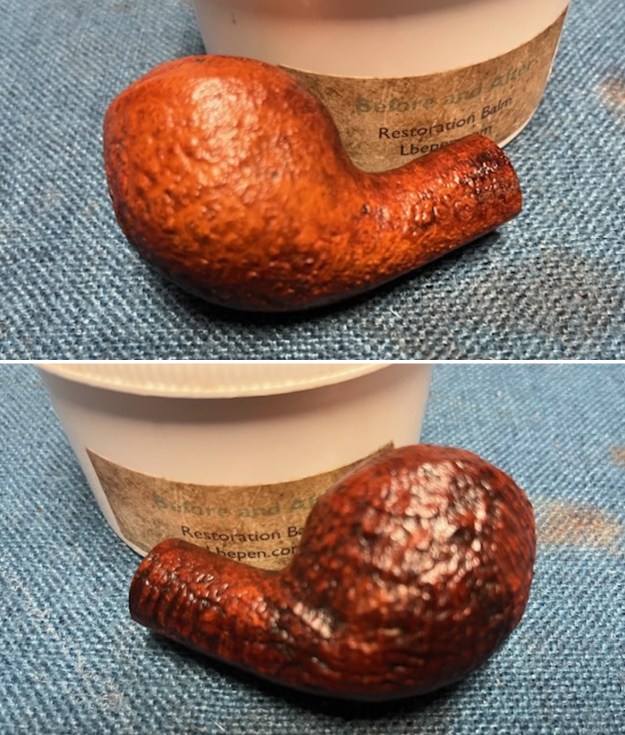
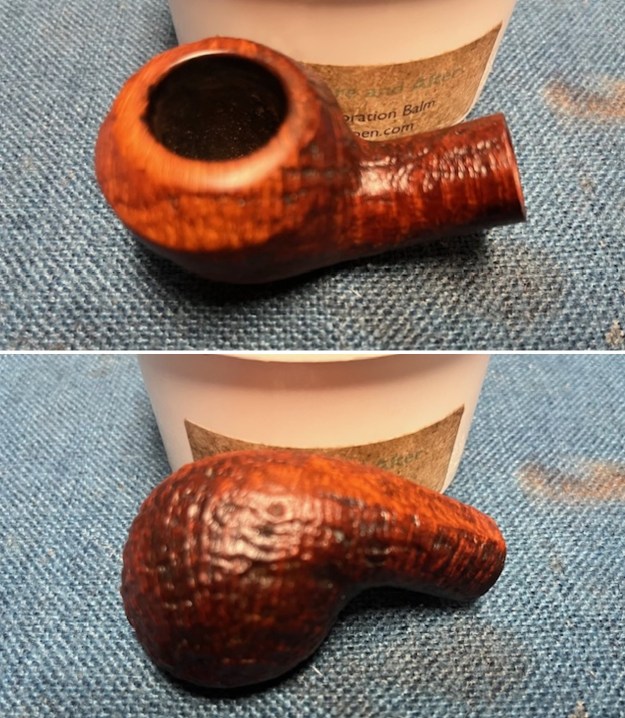
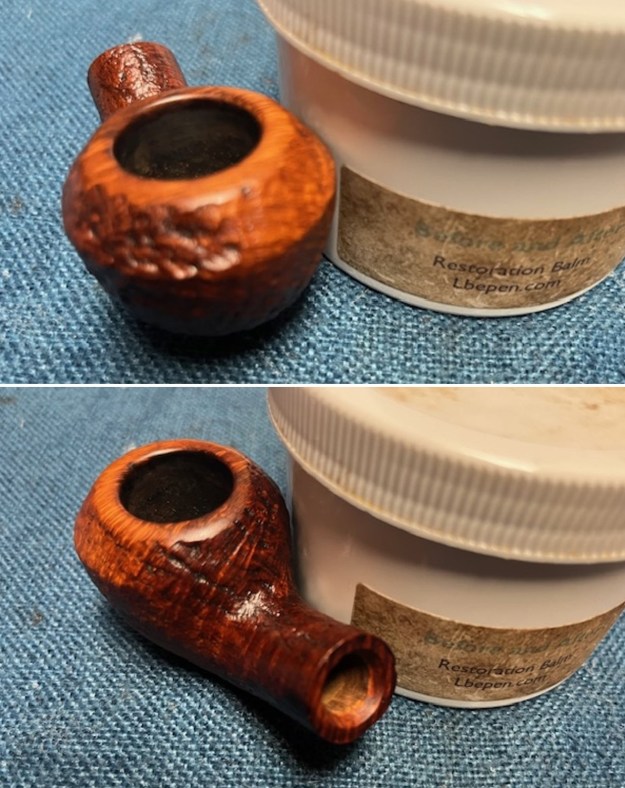
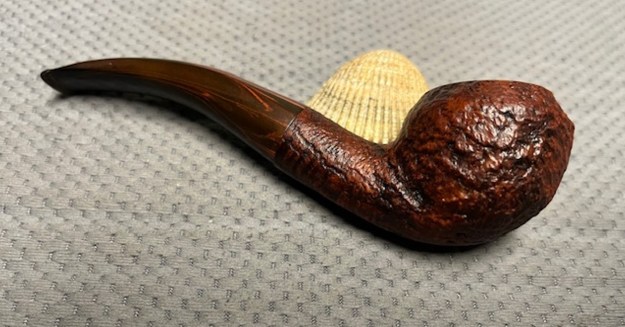
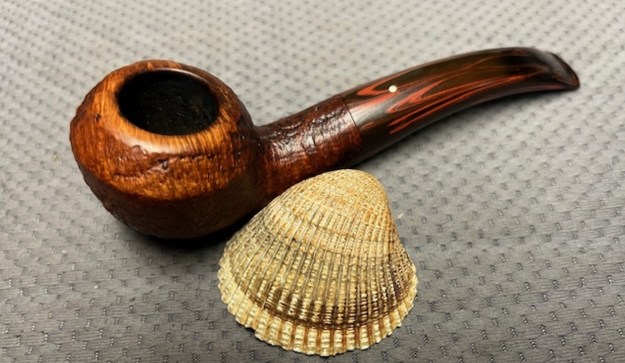
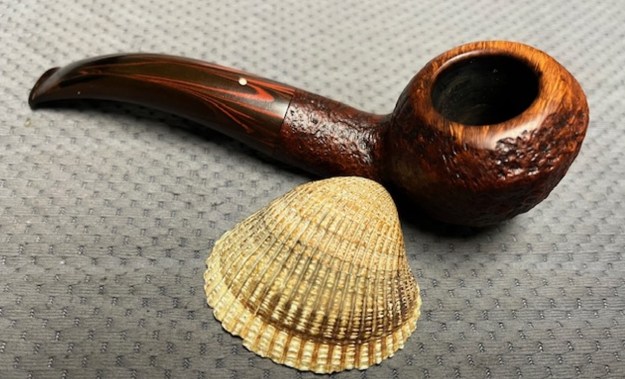
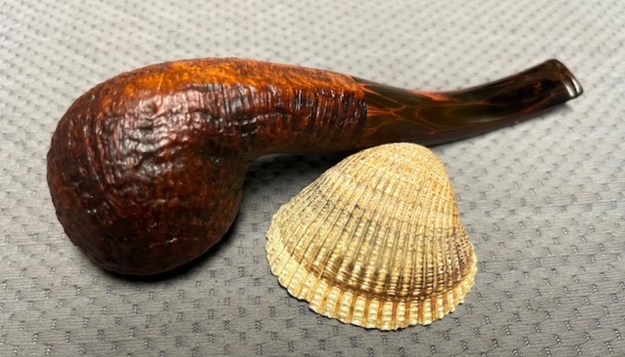
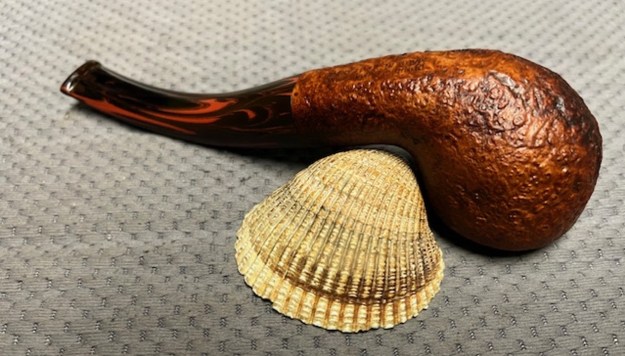
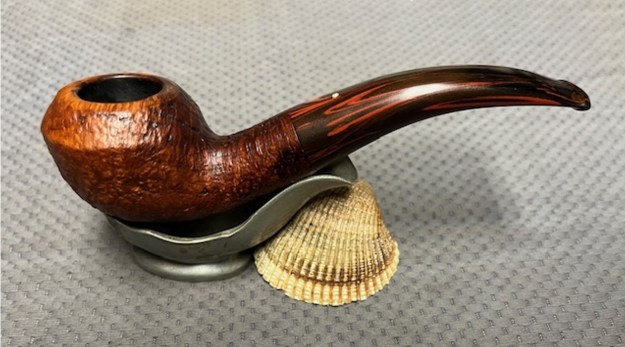
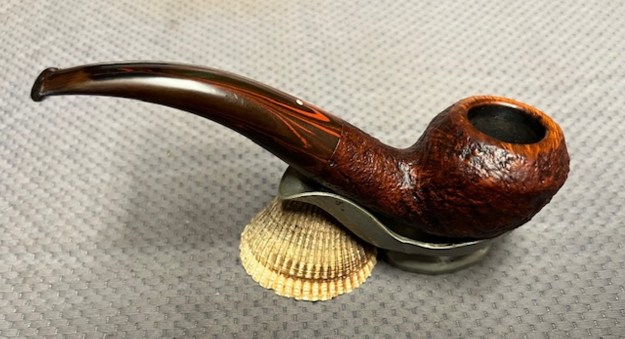
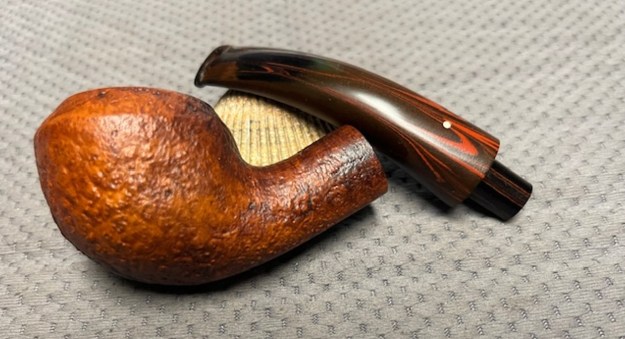
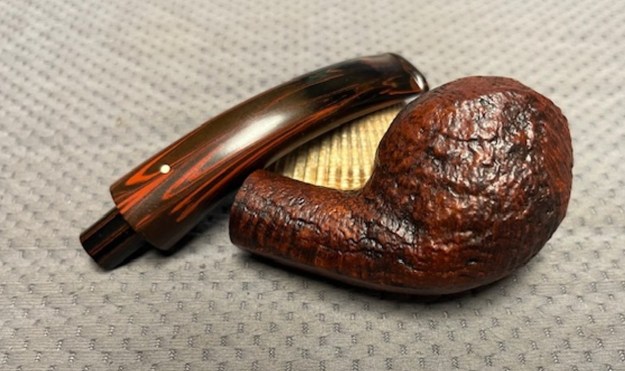
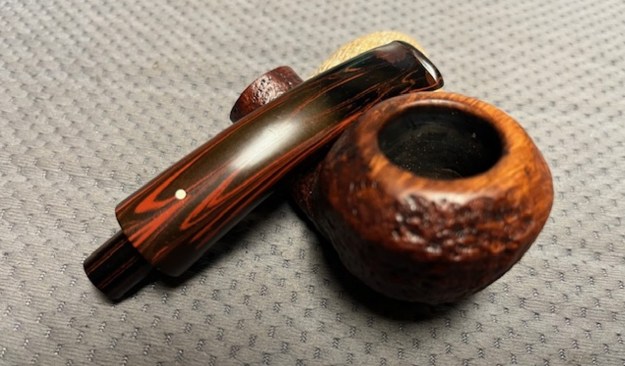
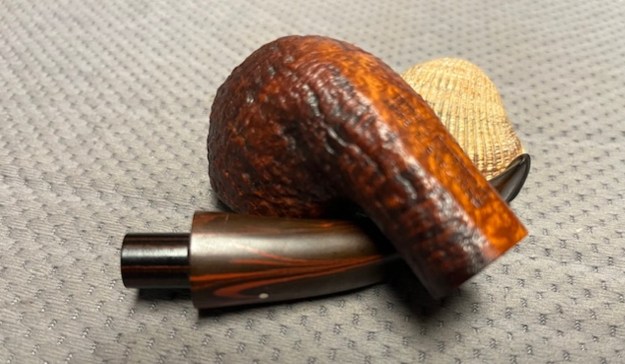
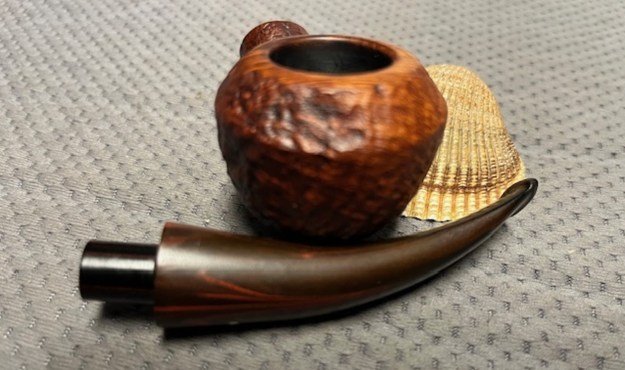
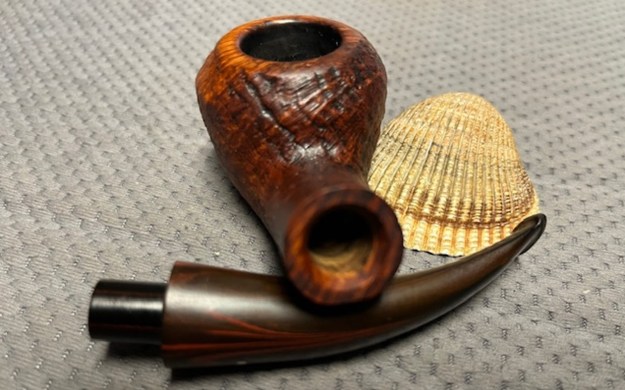
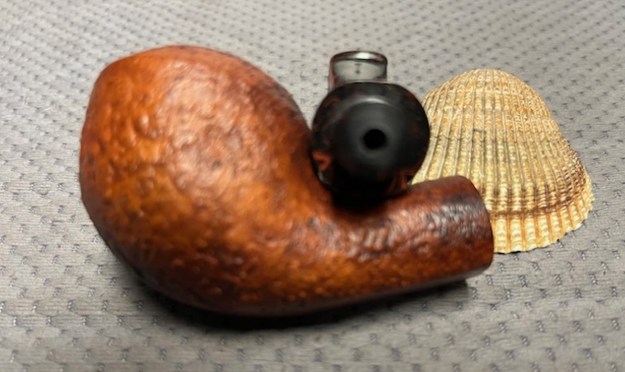
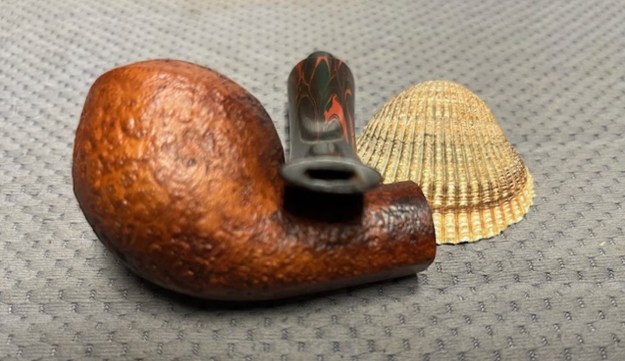
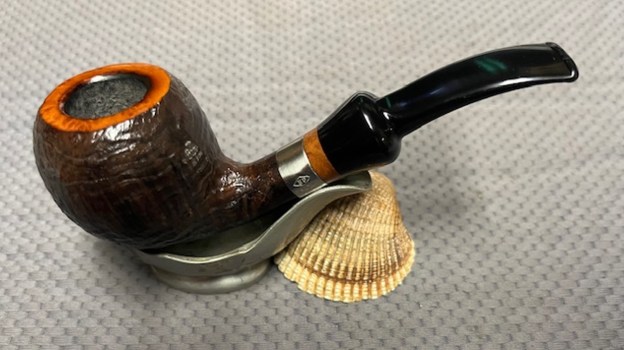
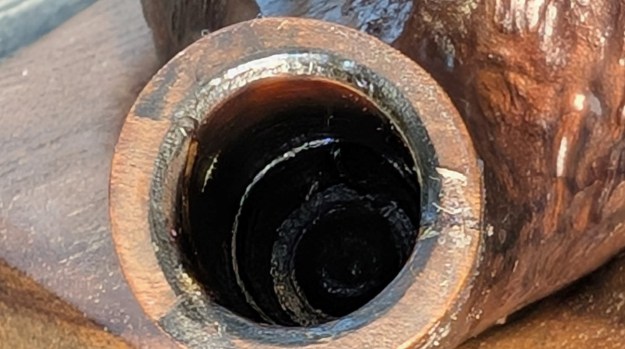
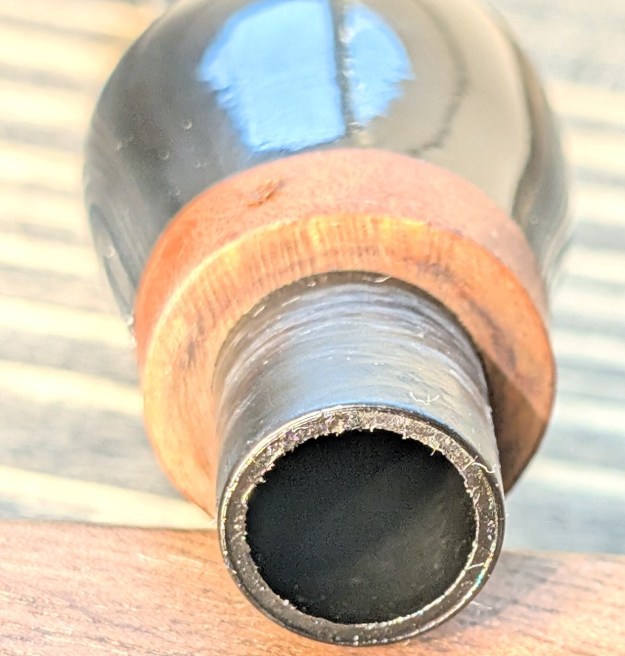
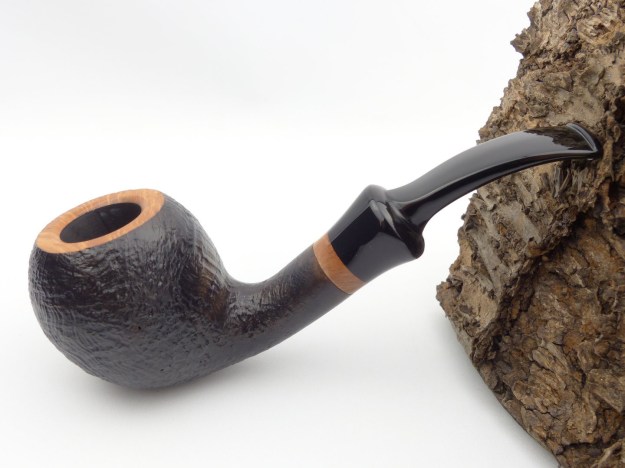
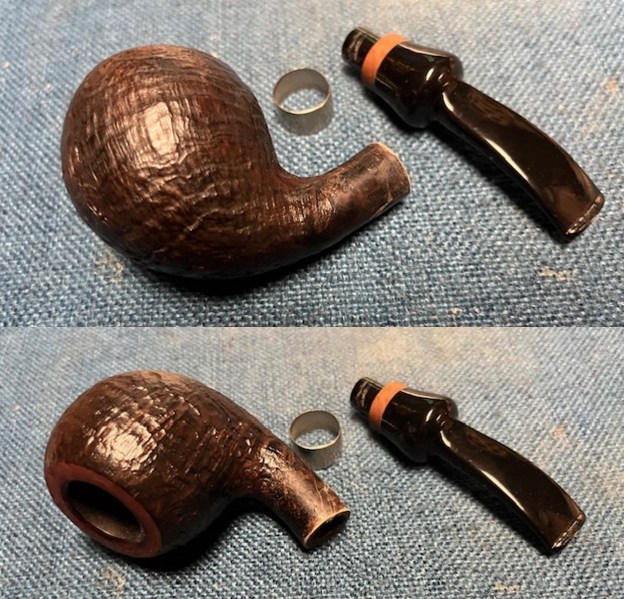
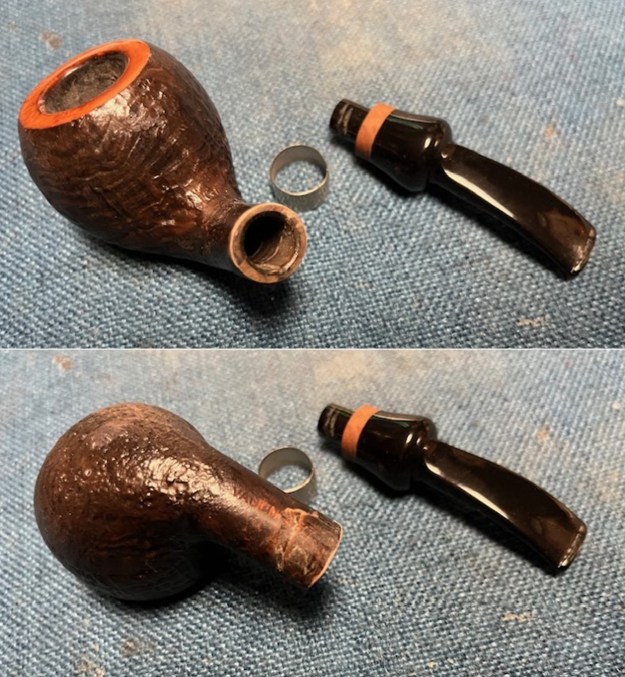
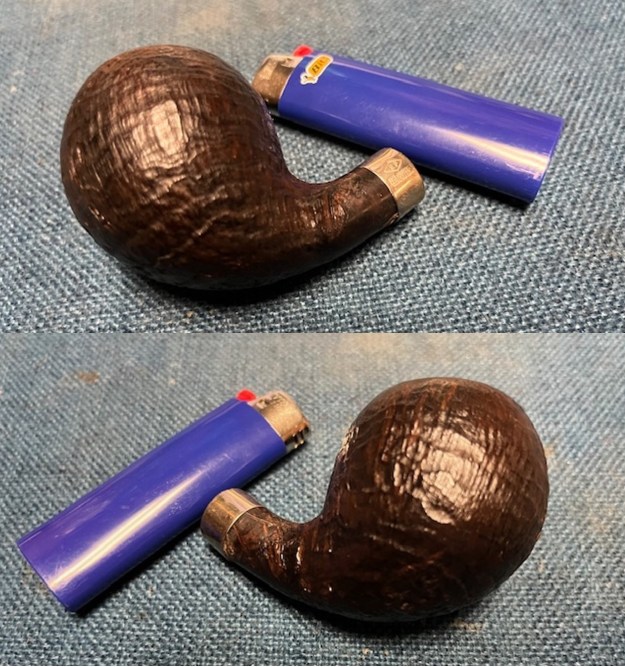
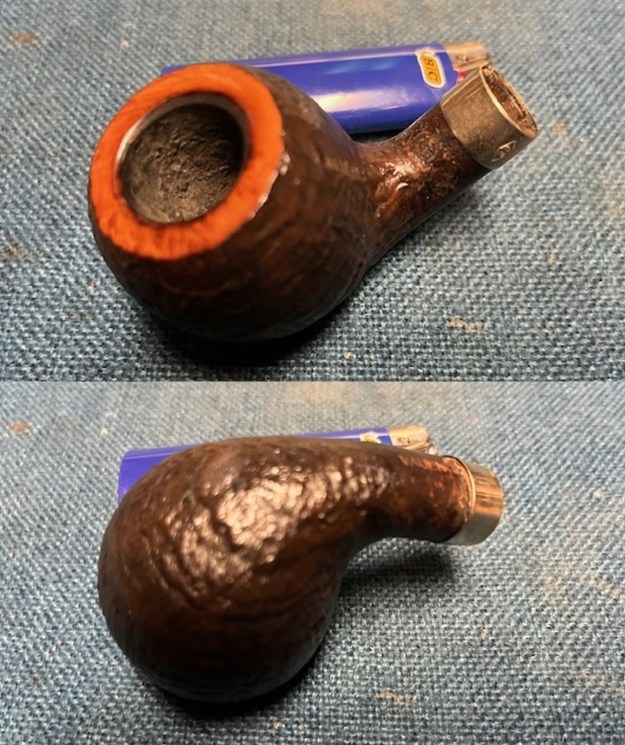
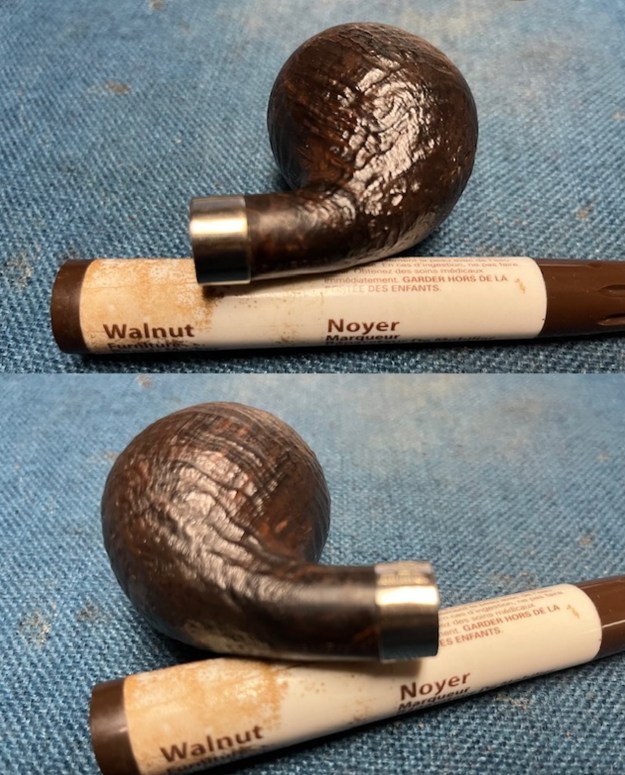
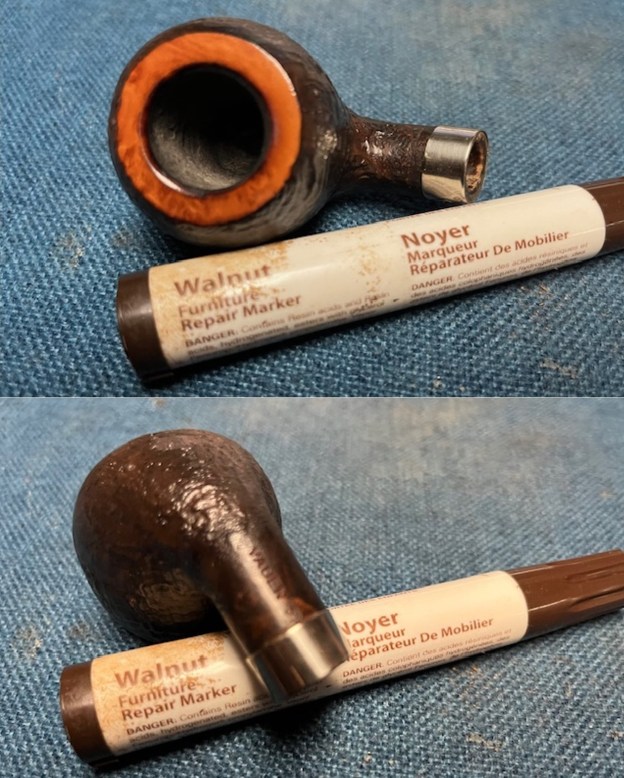
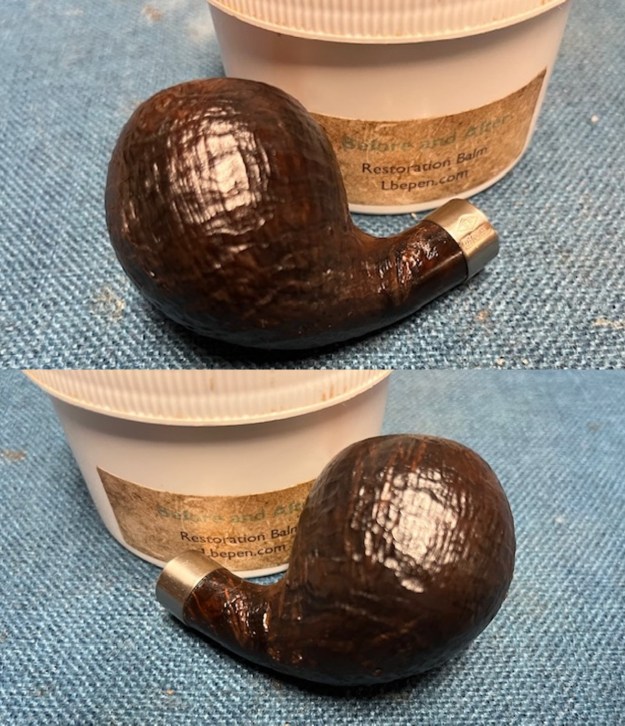
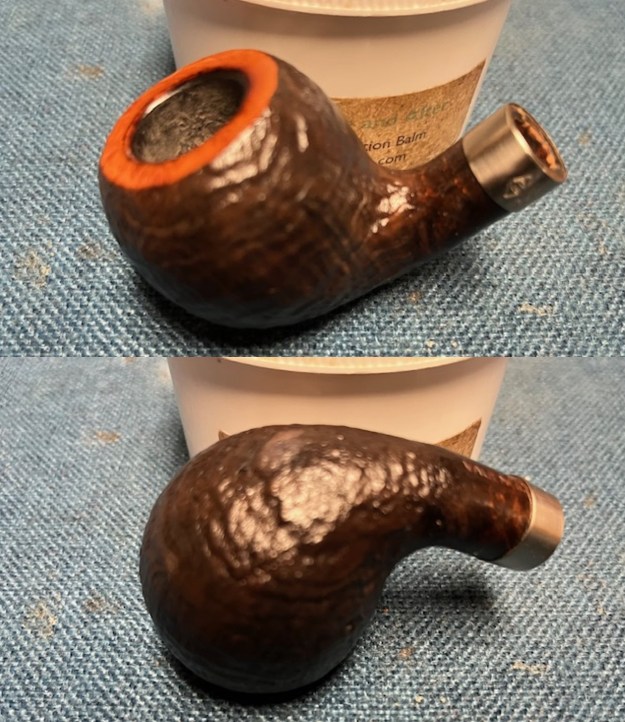
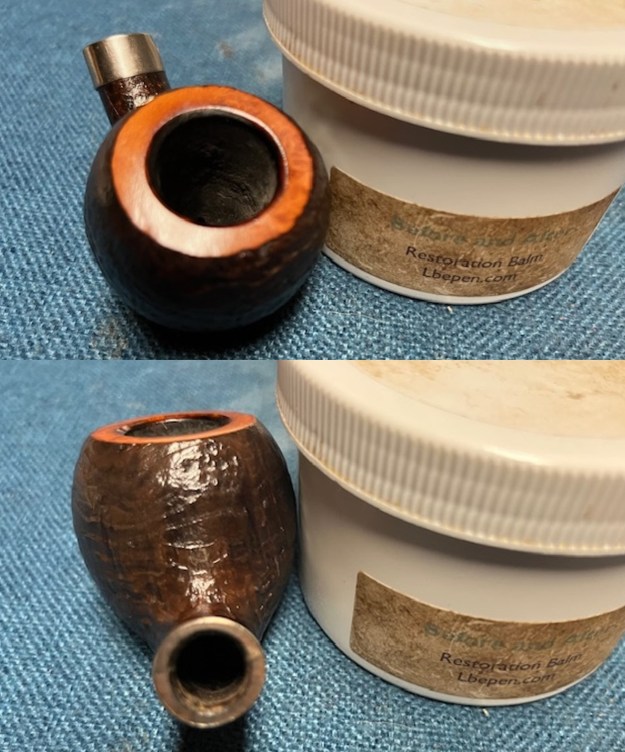
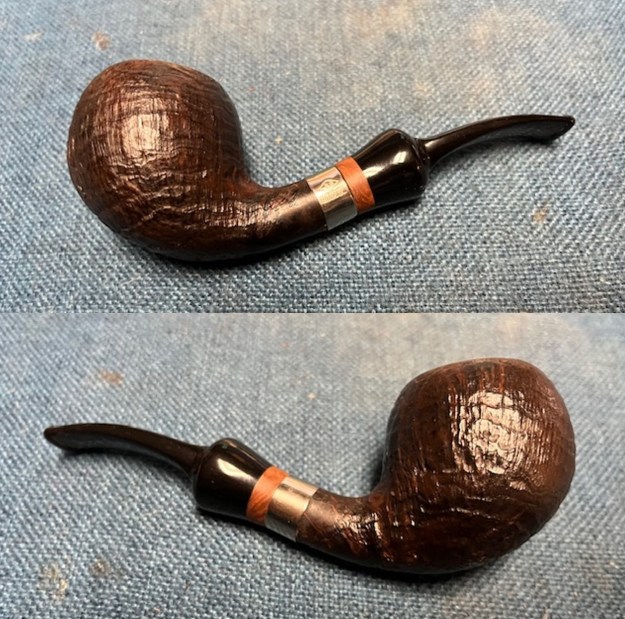
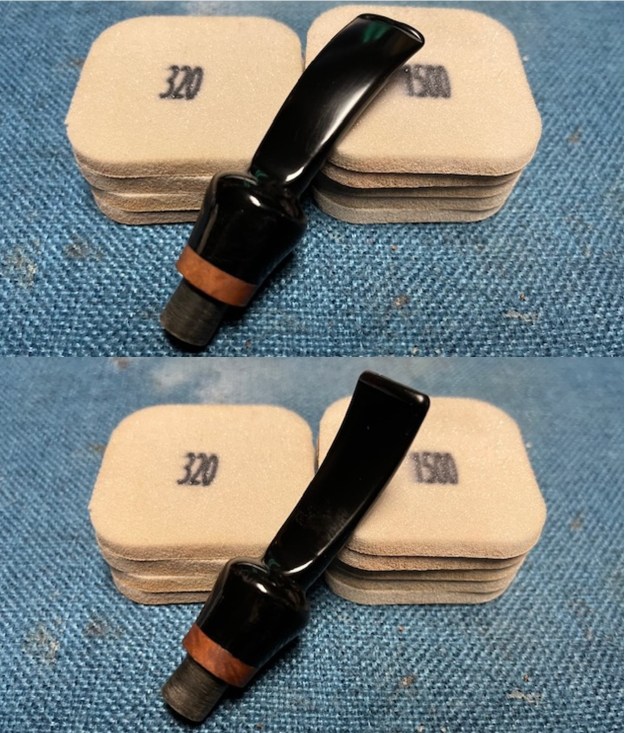
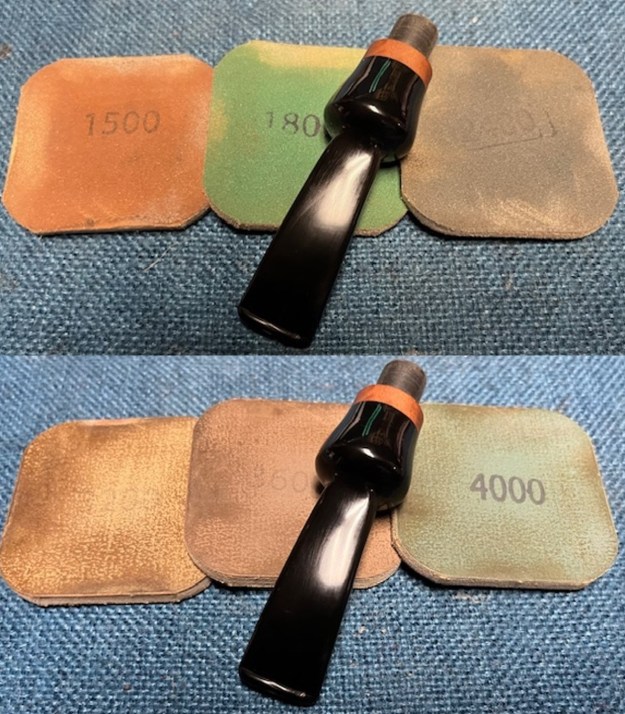
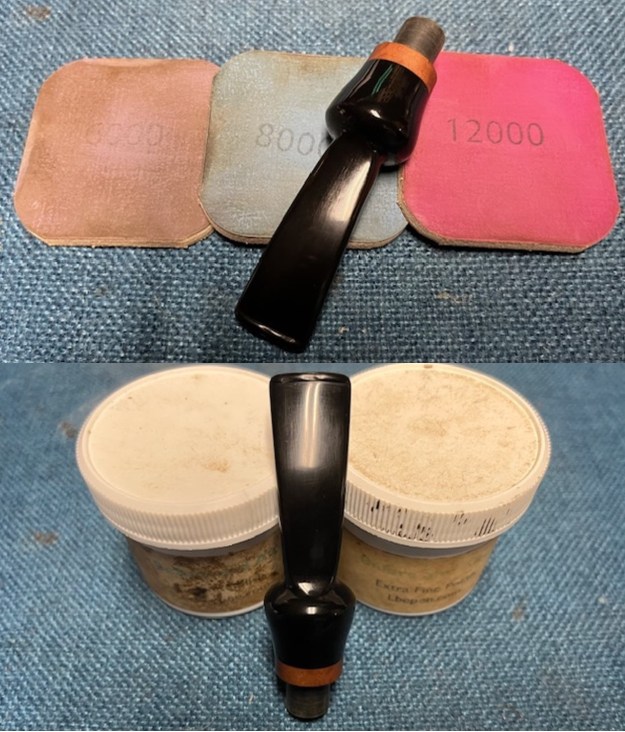
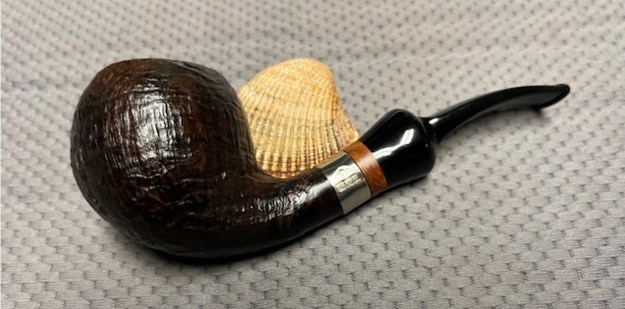
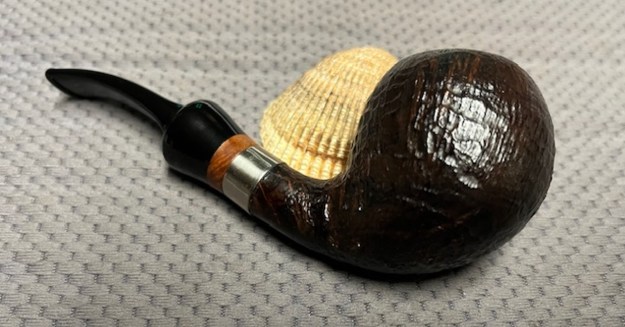
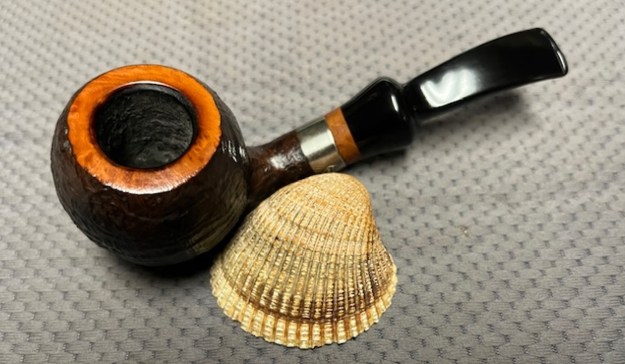
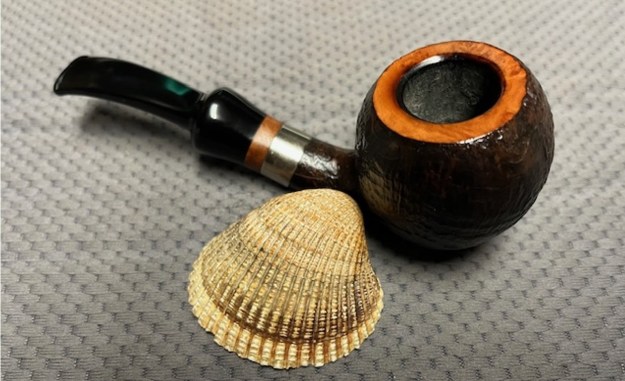
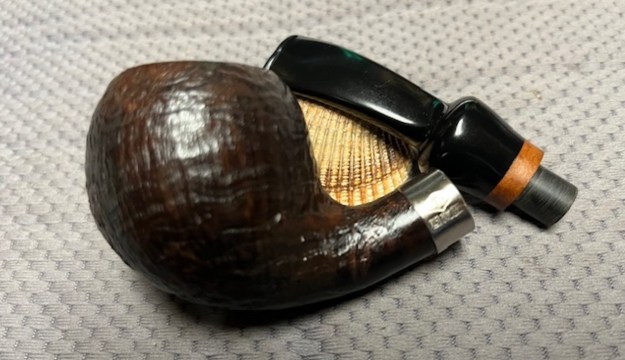
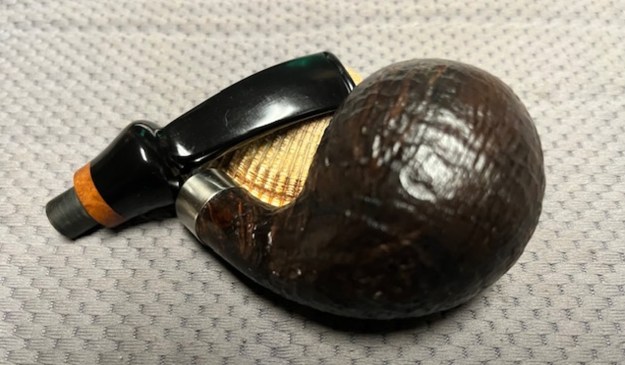
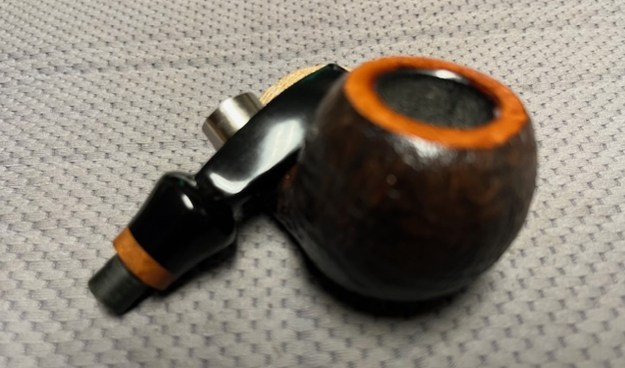
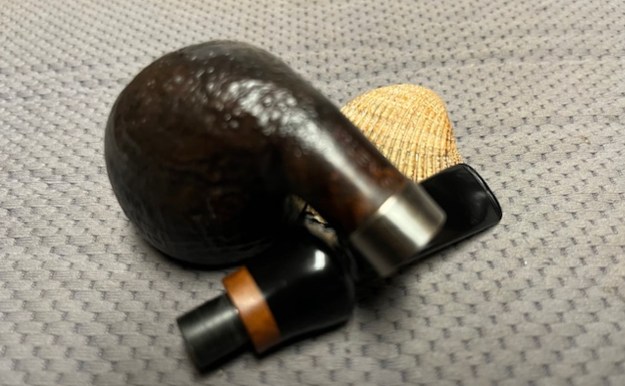
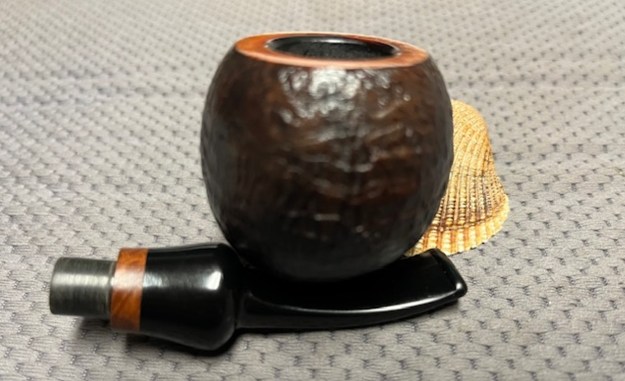
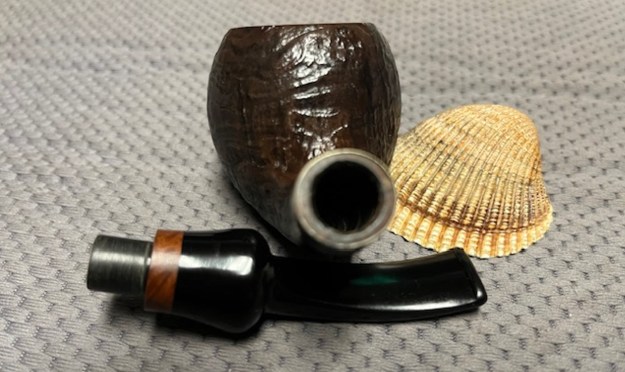
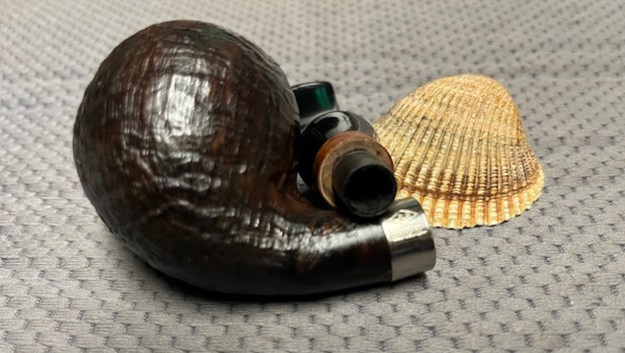
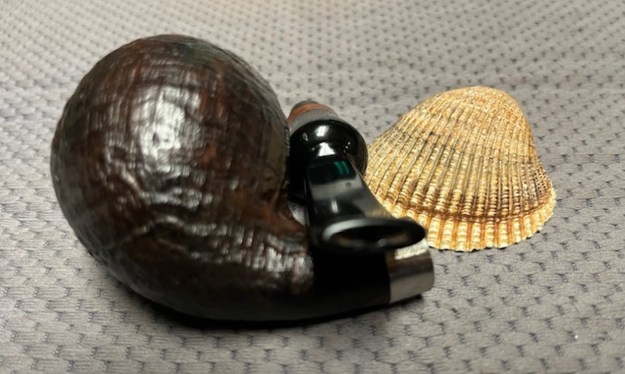
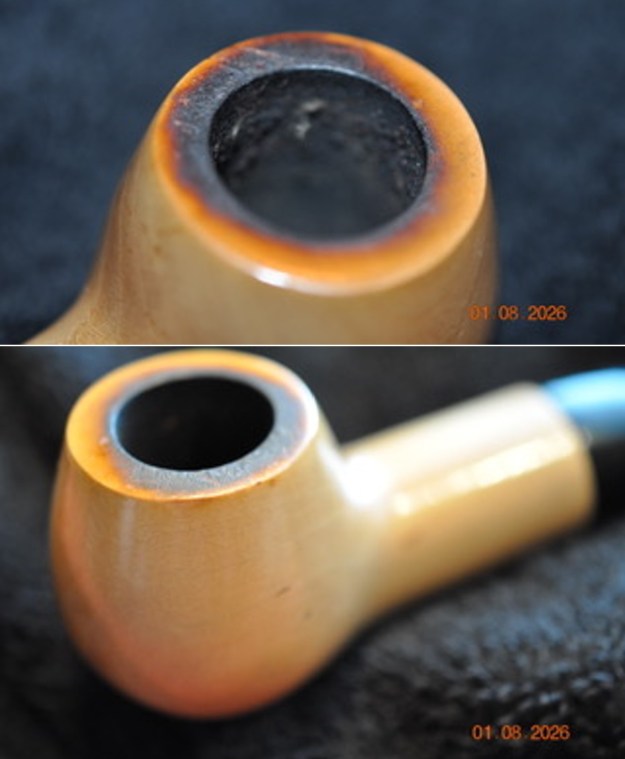
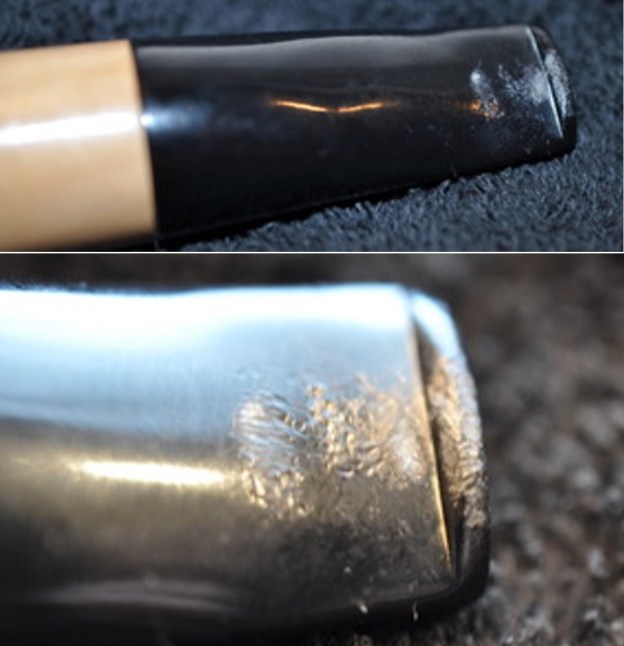
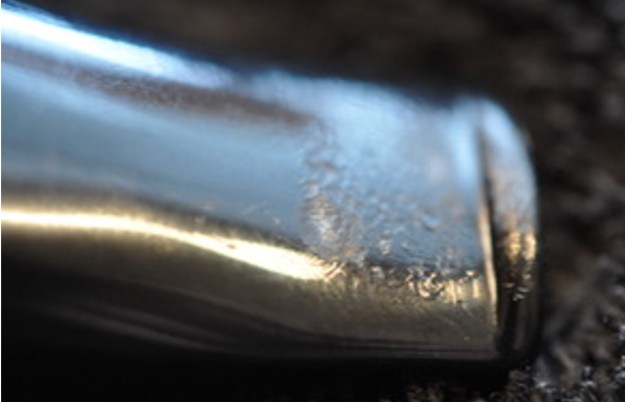
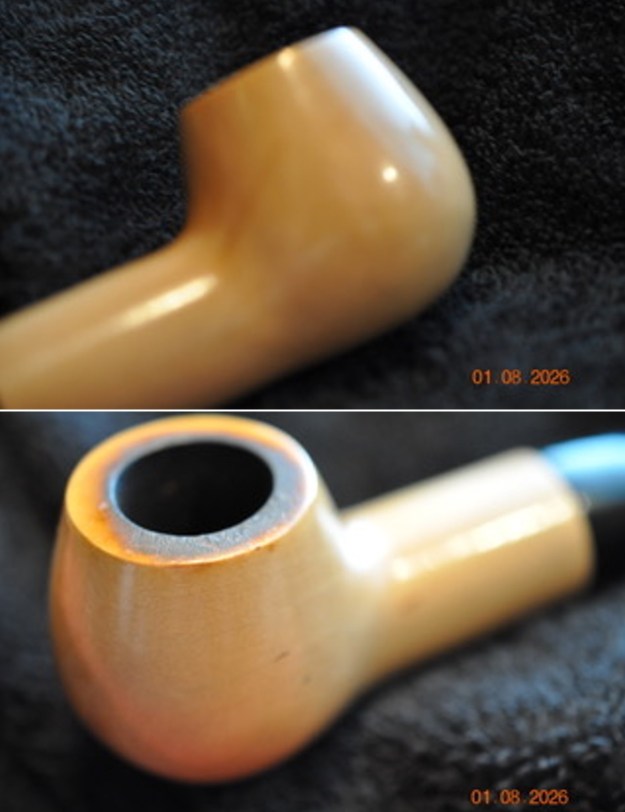
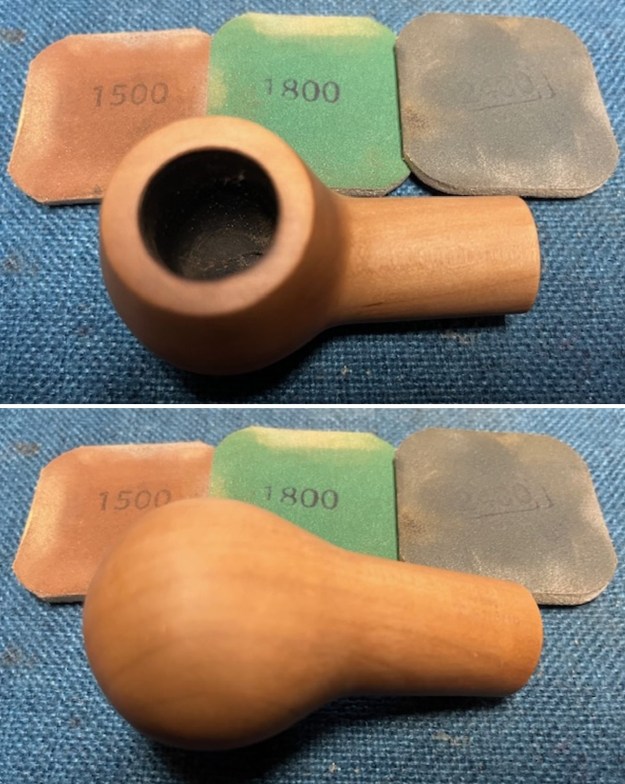
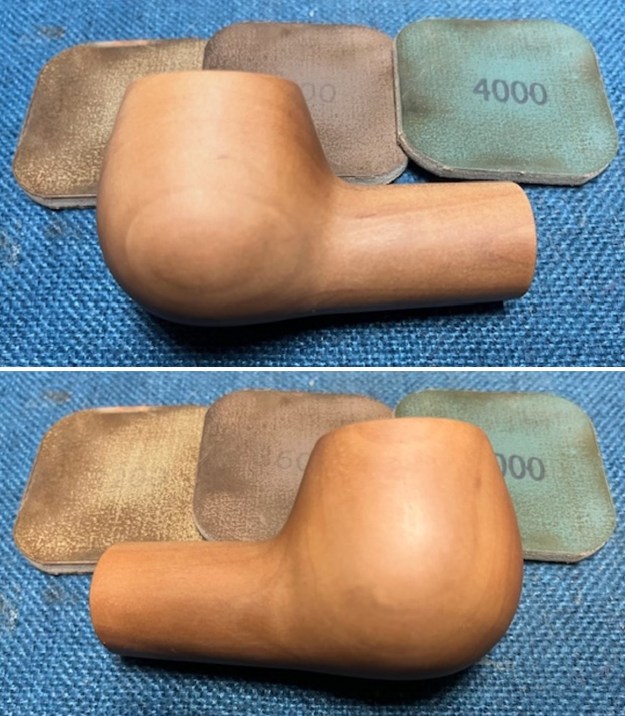
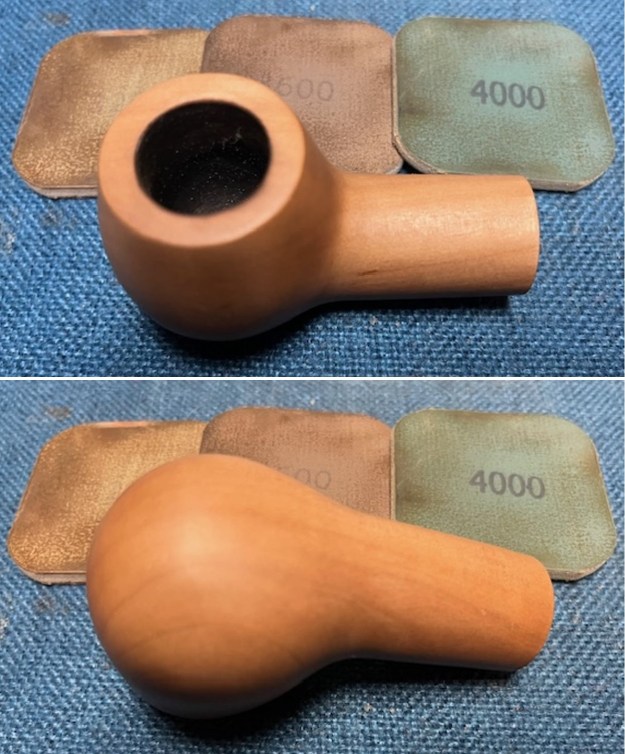
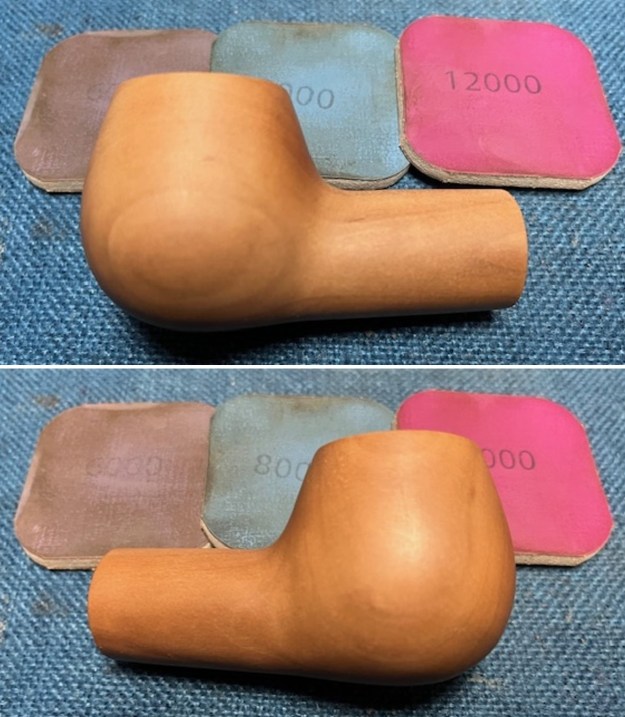
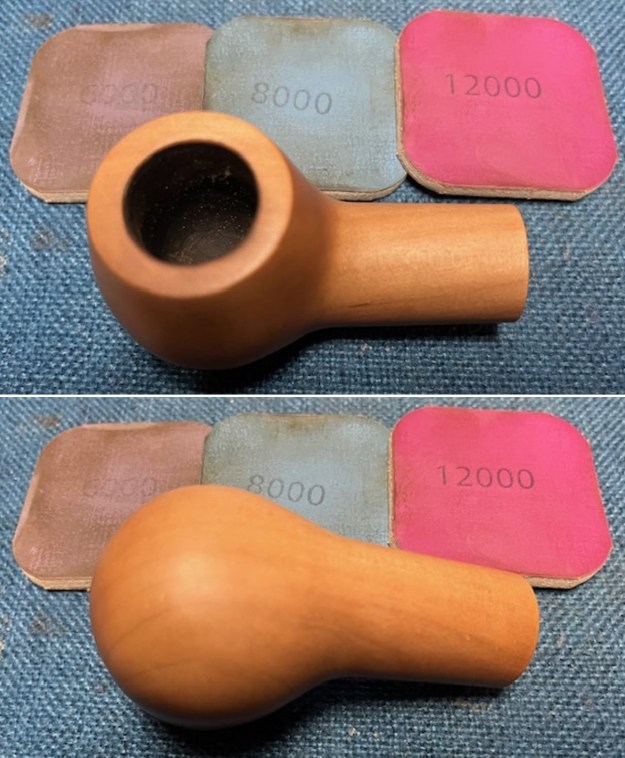
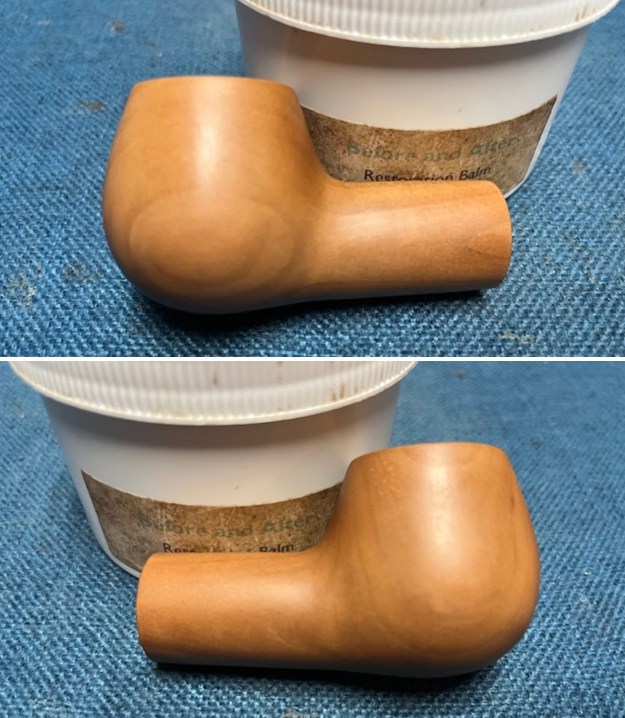
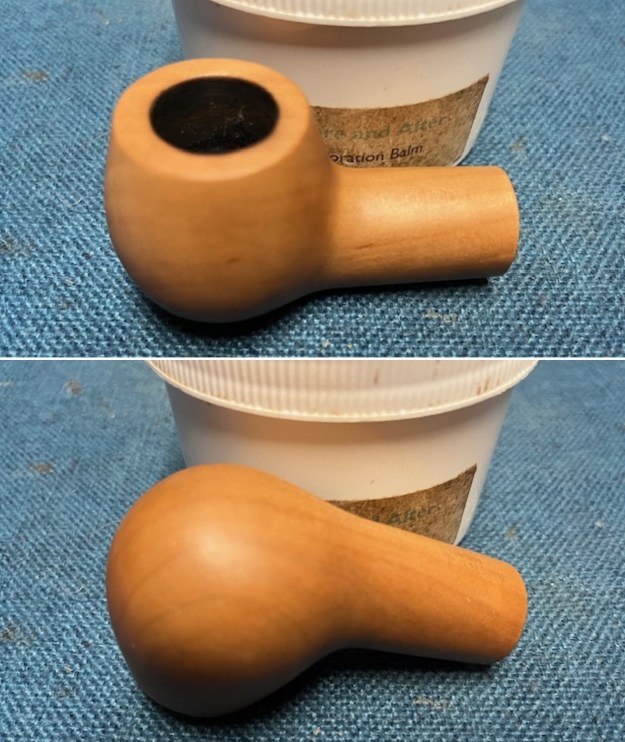
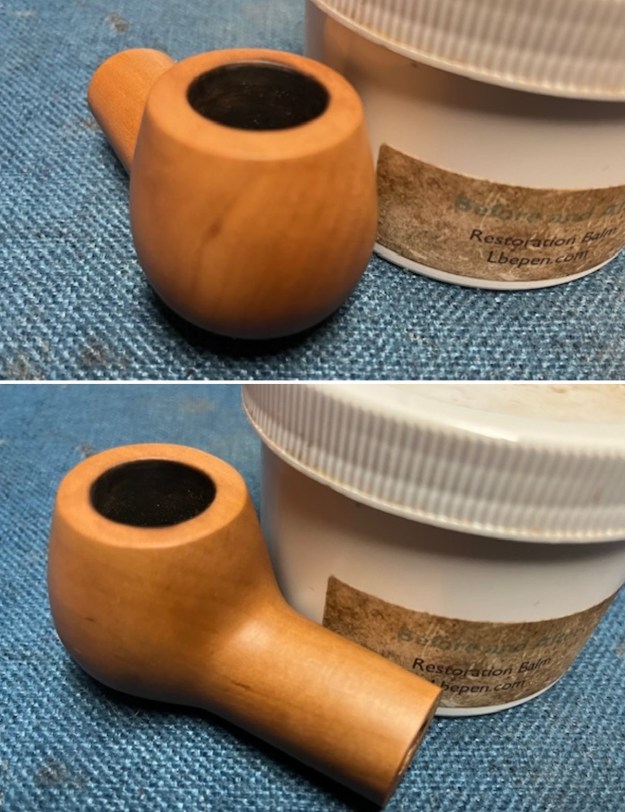
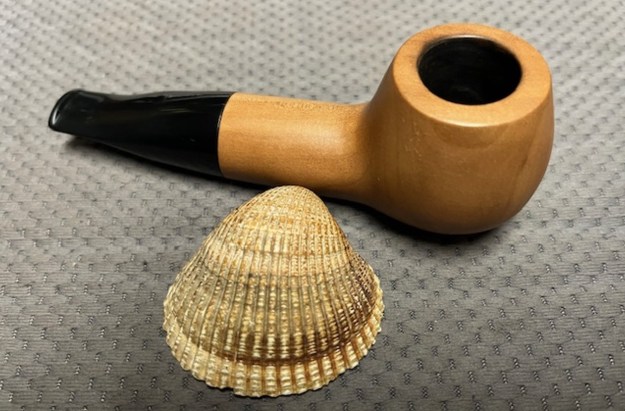
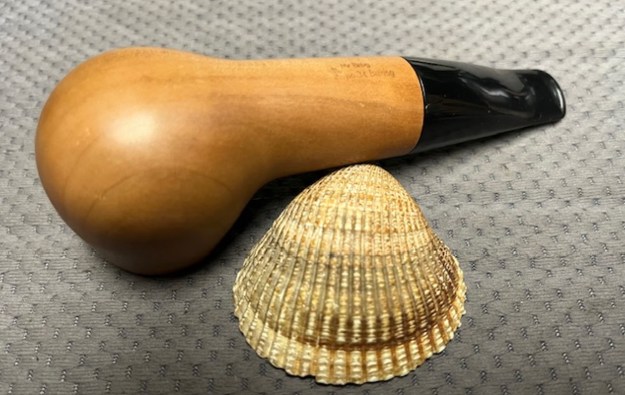
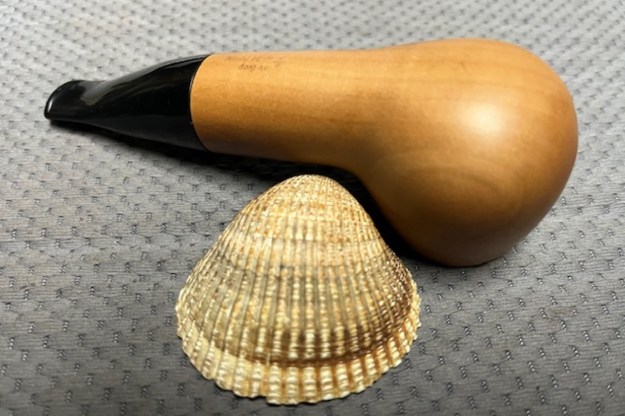
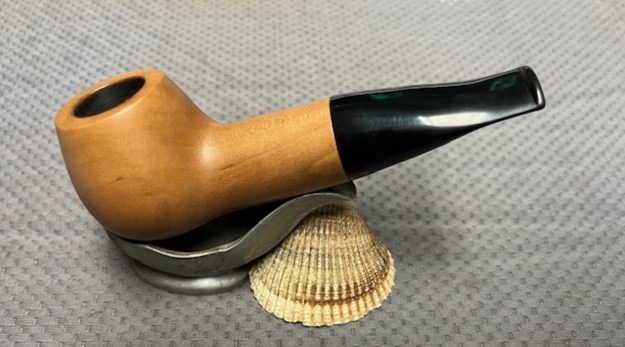
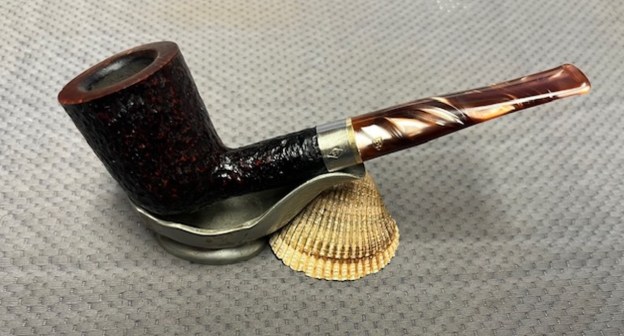
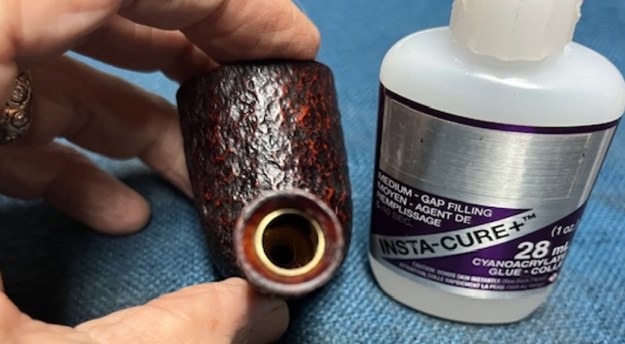
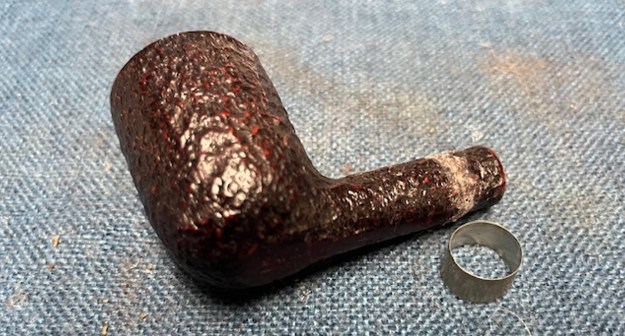
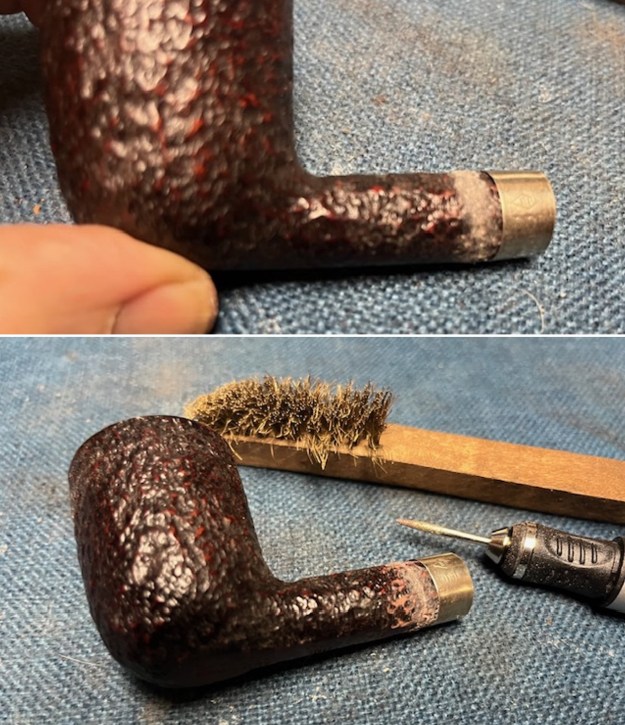
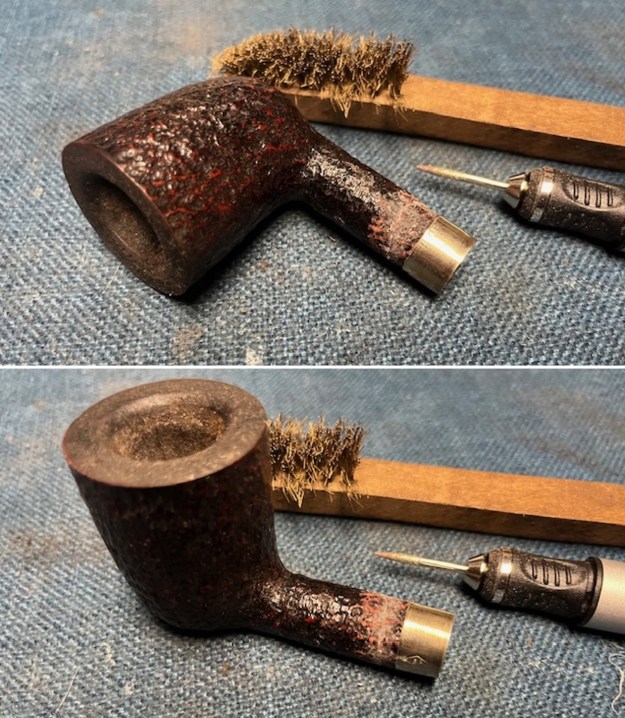
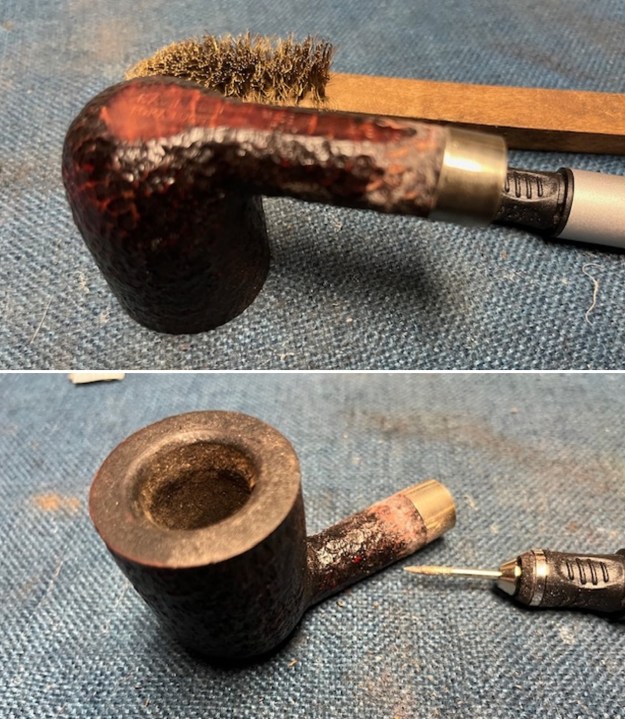
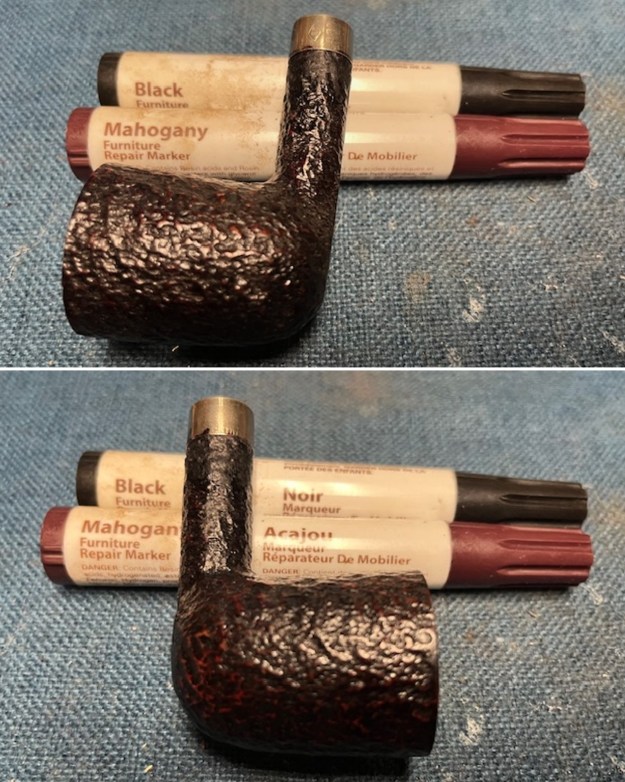
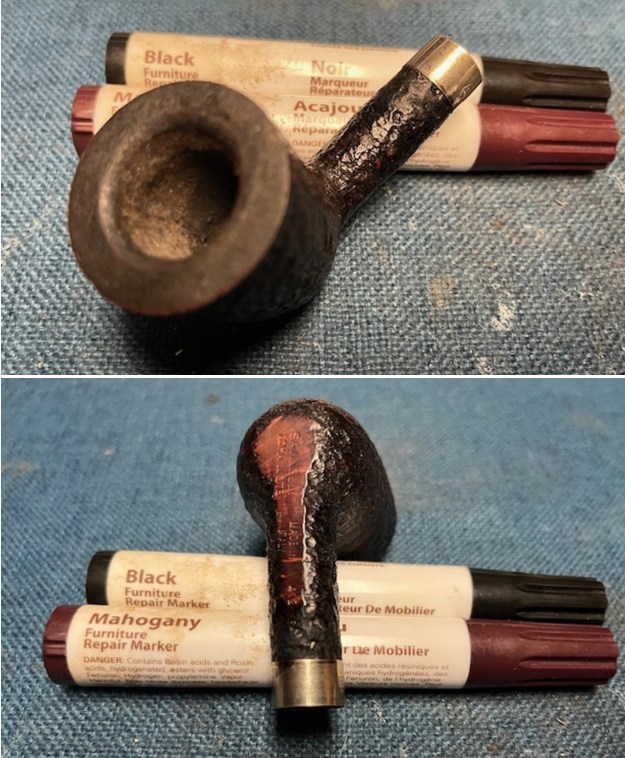
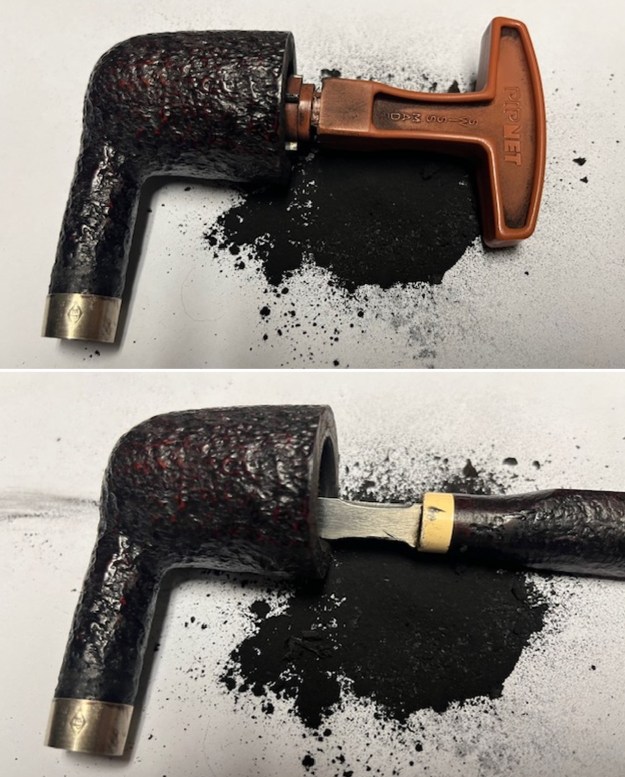
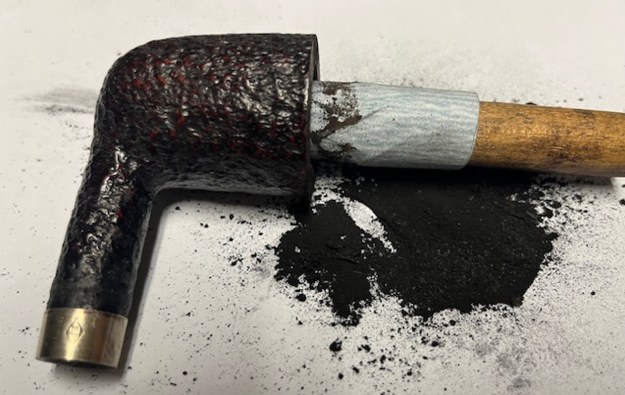
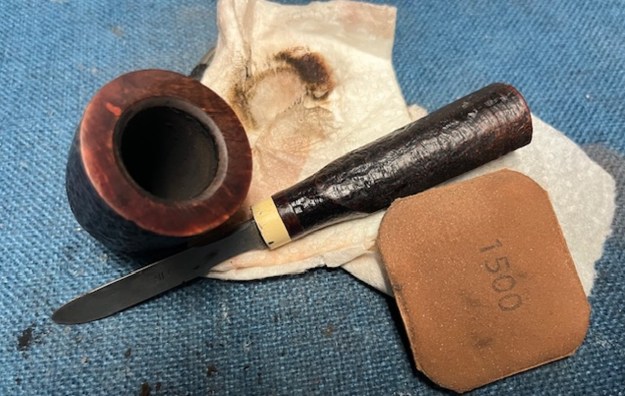
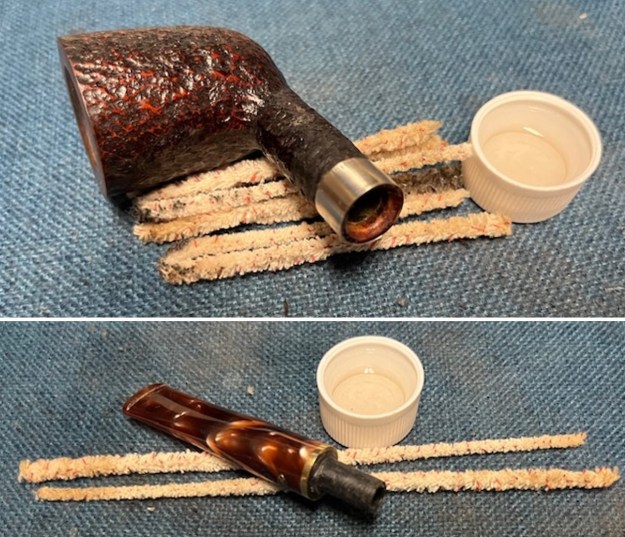
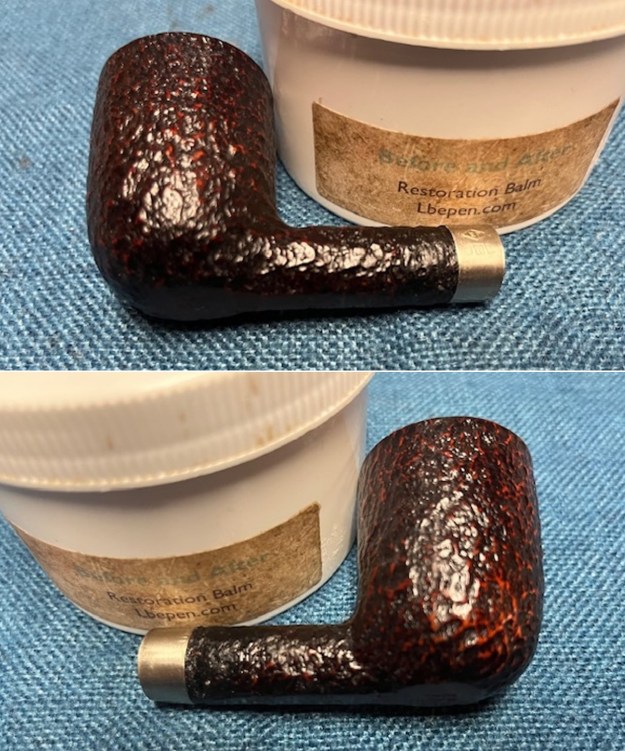
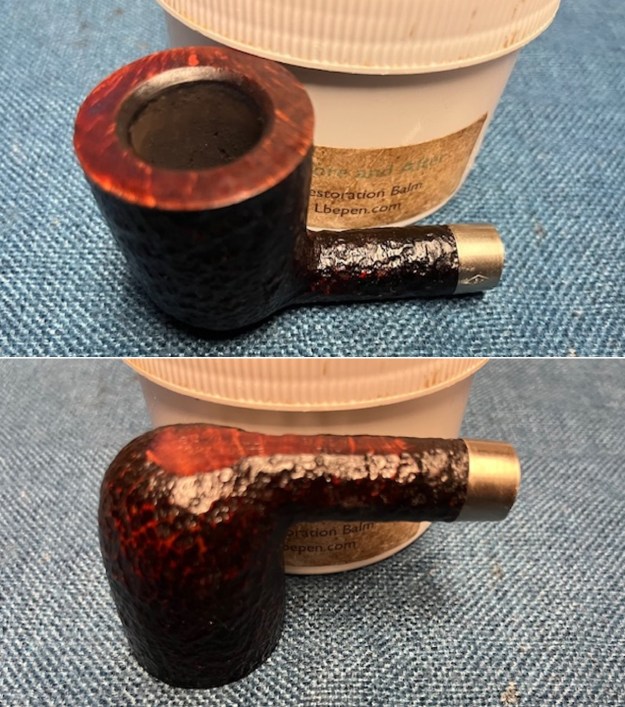
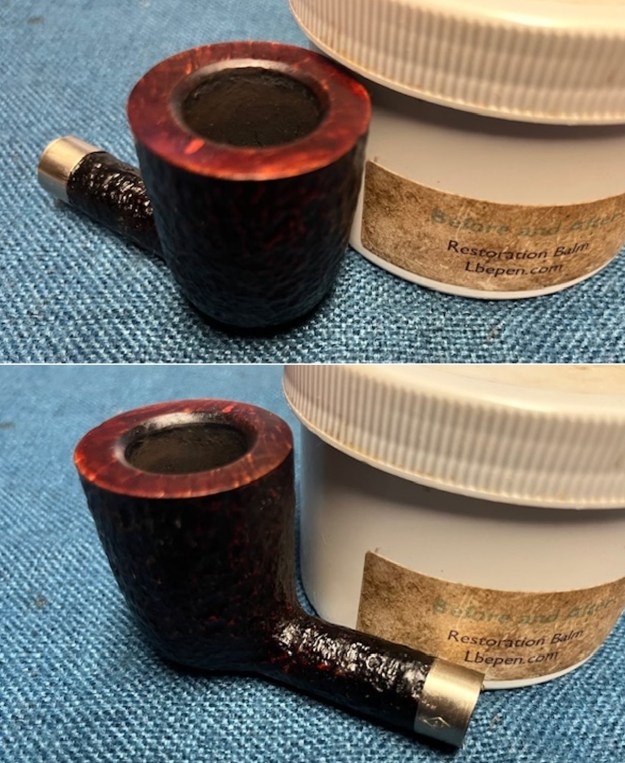
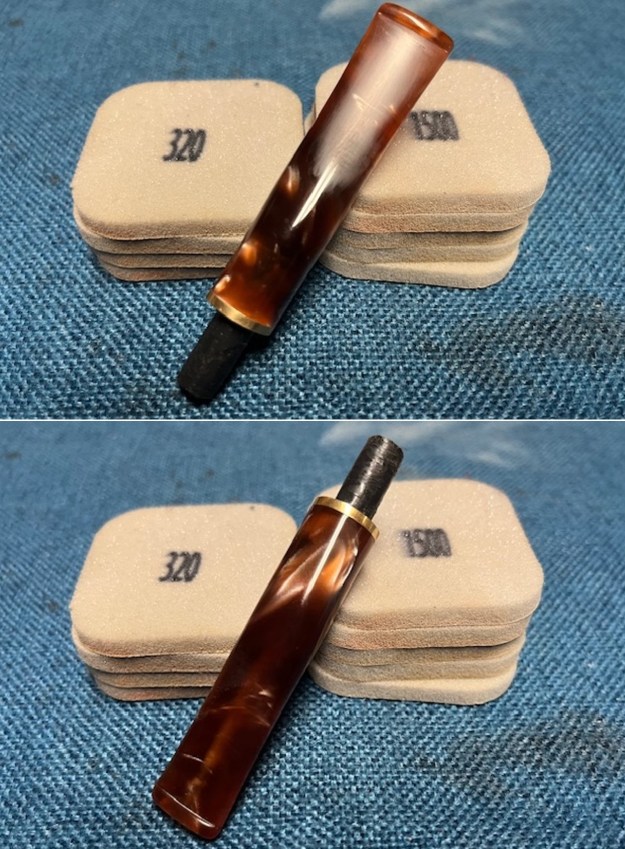
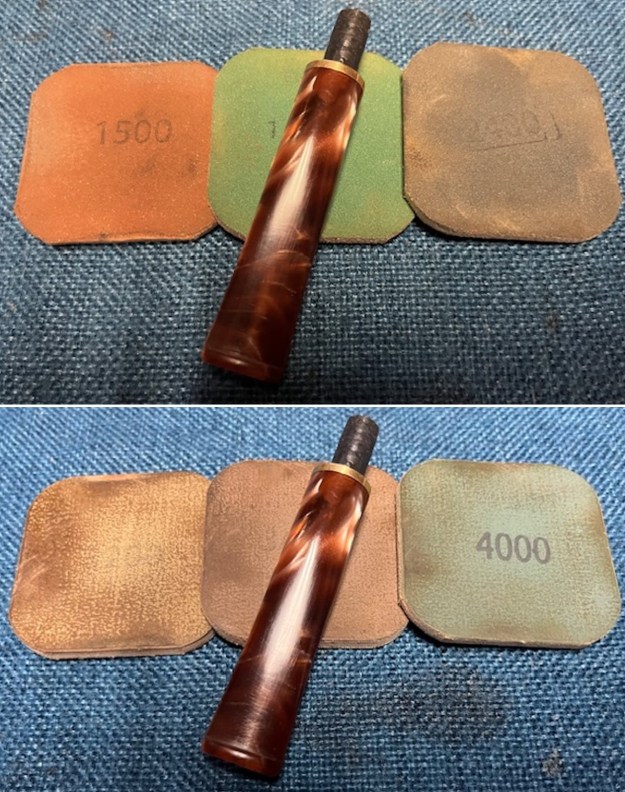
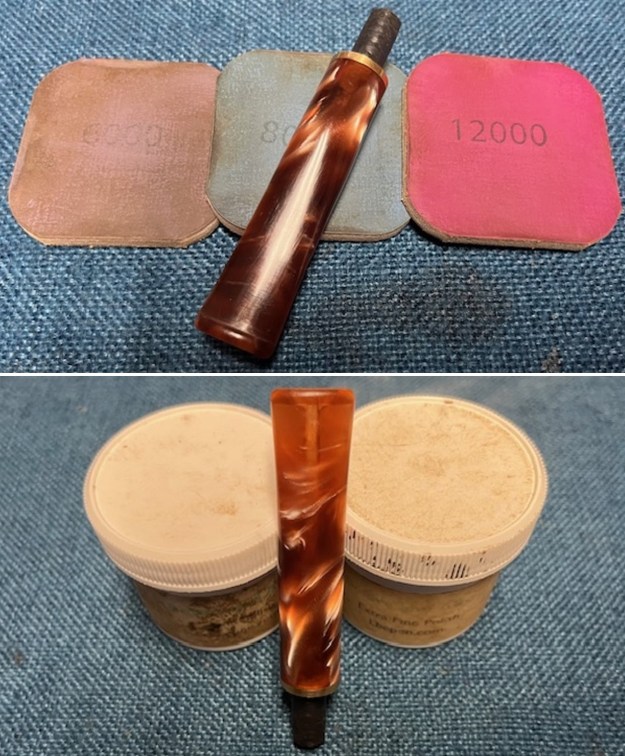
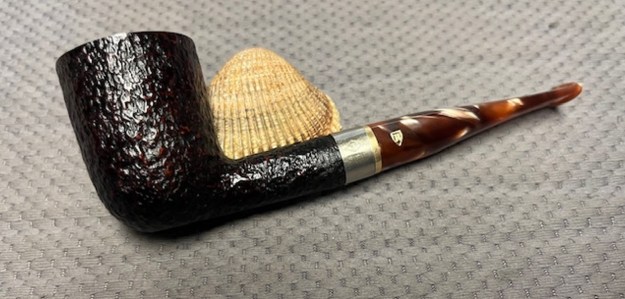
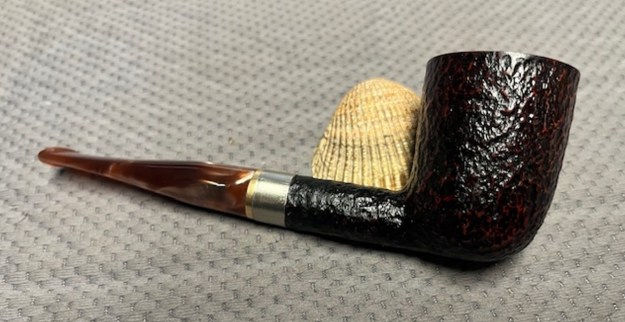
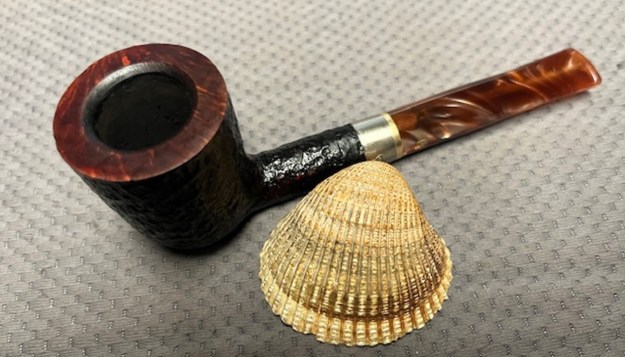
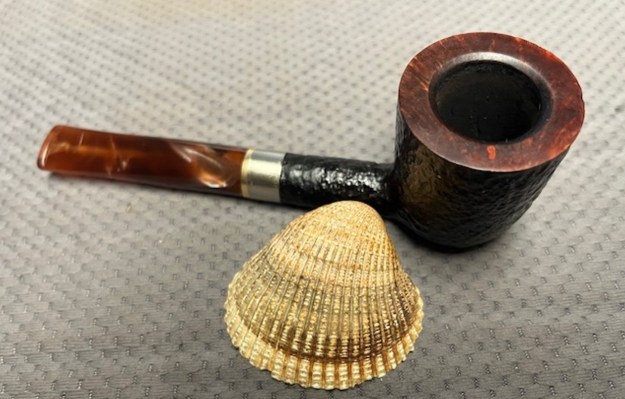
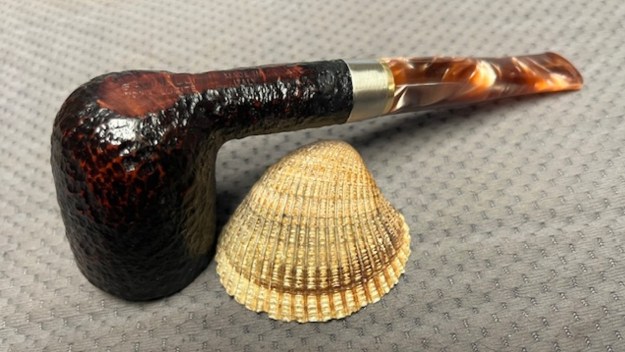
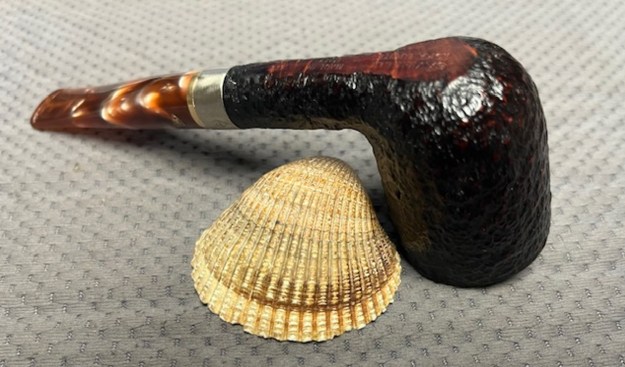
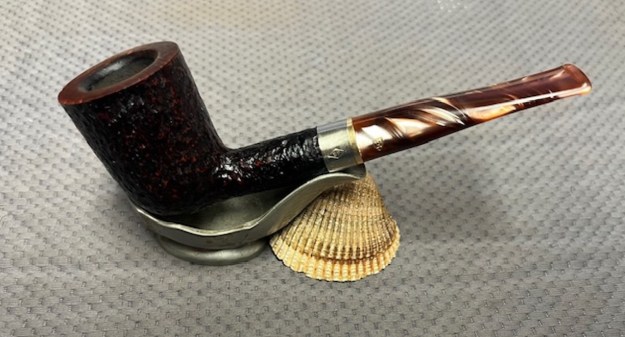
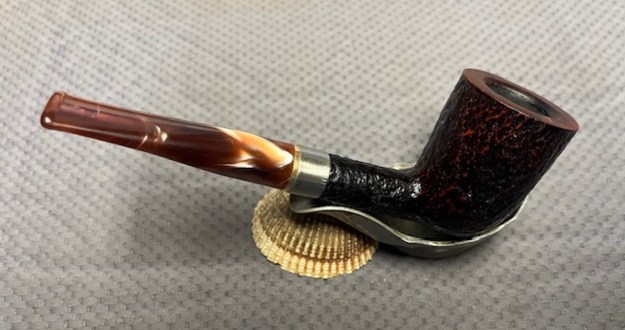
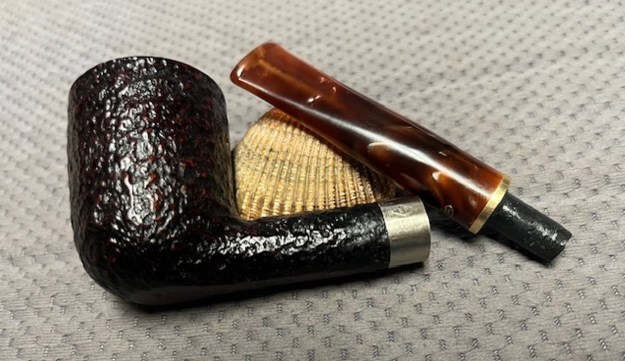
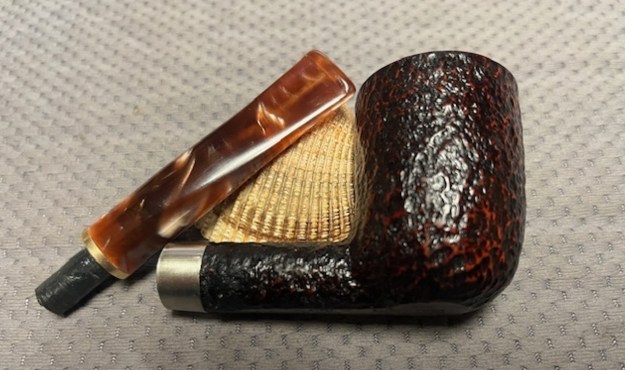
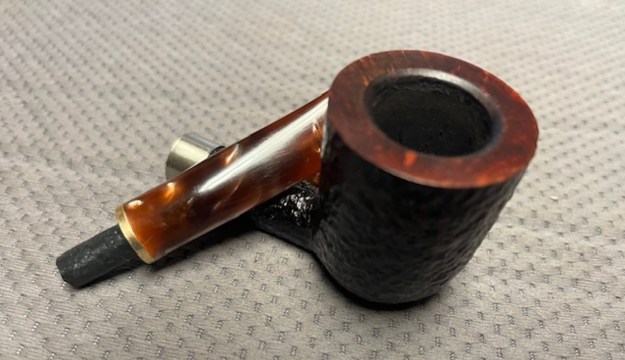
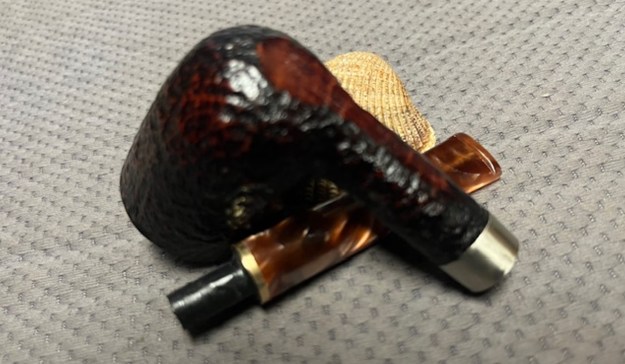
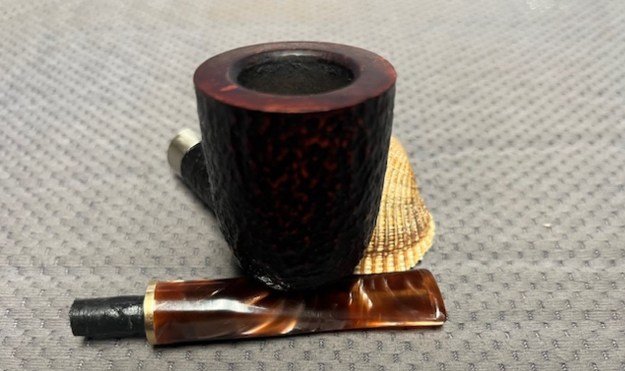
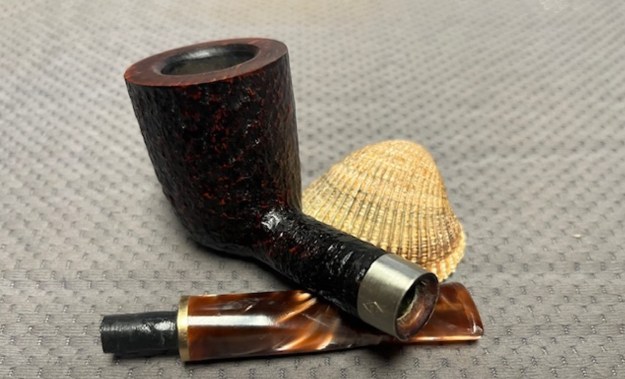
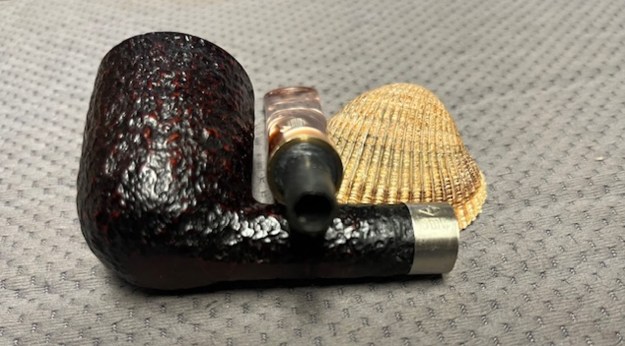
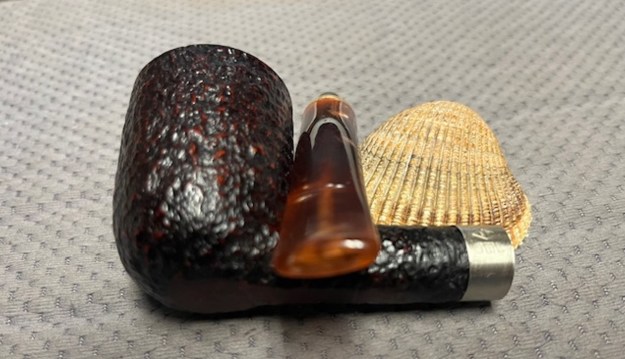
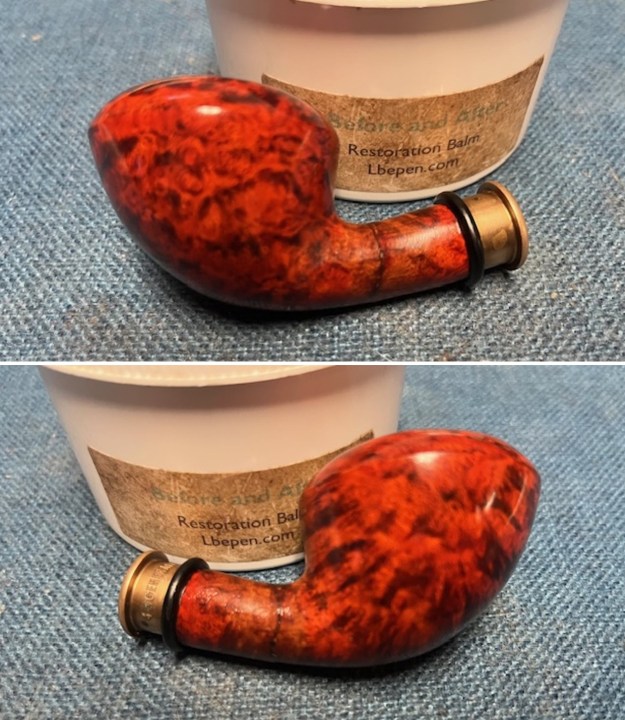
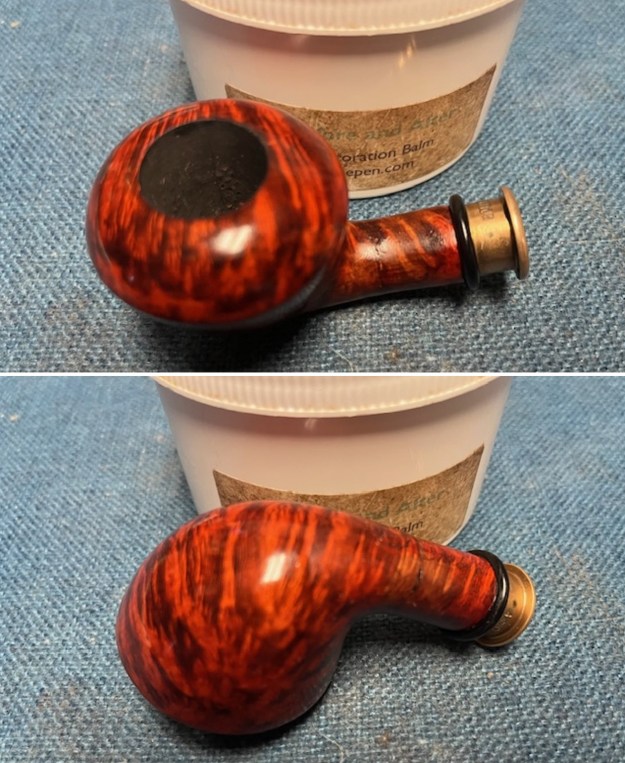
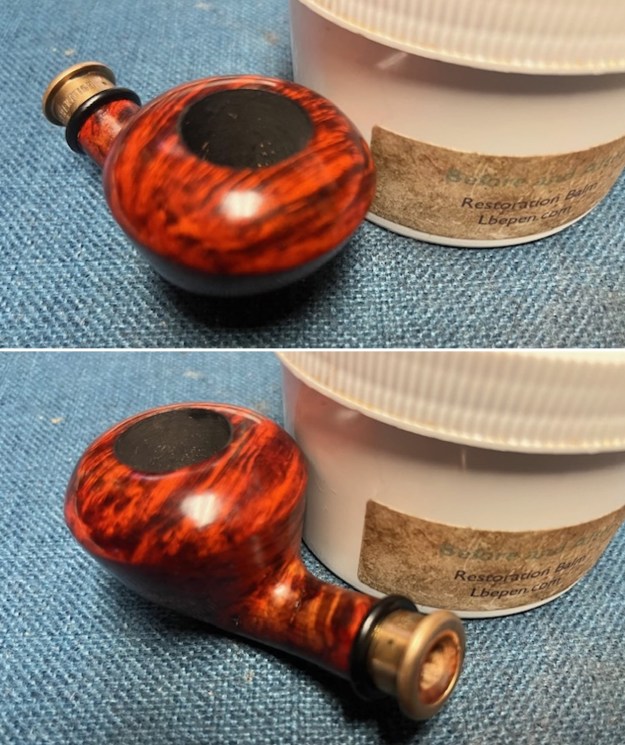
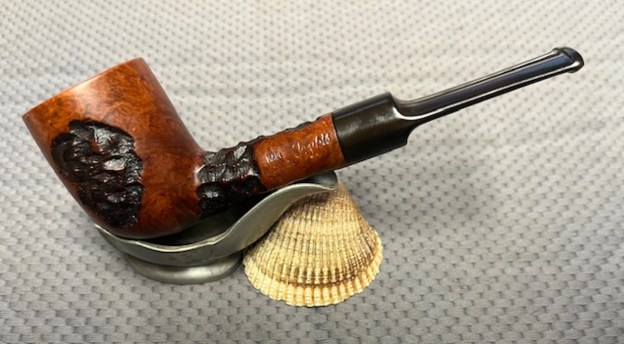
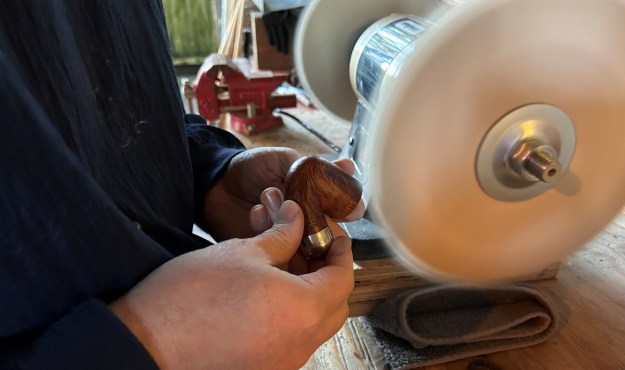
It’s been a while since I worked on a Kaywoodie and the time has come again. This is an interesting pipe and a type that I haven’t seen before. It is a craggy Kaywoodie 179R sandblast and it is a fully-bent billiard, with a crown as a rim. It’s almost an Oom Paul – almost, but not quite. I could only find one other example of this same pipe online, so I suppose it’s a little unusual. This pipe’s logo is a black cloverleaf in a white circle. On the underside of the stummel, we can see this pipe’s markings. First, we see Kaywoodie [over] Relief Grain. Then, to the right, is the shape number: 179R. The R, of course, refers to relief grain. Three-digit shape numbers seem to date from the 1970s and 80s, so it’s safe to assume that this pipe is from that time period. It’s also worth noting that the ‘Drinkless Filter’ (i.e. the stinger) on this pipe is fully intact and has three holes (not four).Kaywoodie is a venerable institution in the United States, and has a long and interesting history. I encourage you to read the Pipedia article here and the Pipephil article here.Let’s look at this particular pipe’s condition. The stem is dirty and quite heavily chewed. It is made from acrylic, so there is no issue with oxidation. The tenon screws into the mortise in the stummel and is also quite dirty. The stummel looks to be in decent shape. It’s been well loved, so it’s quite dirty – inside and outside. The craggy blast on the briar has a few flecks of white paint, but that should be easily removed. On with the work! I started by using isopropyl alcohol on a few cotton rounds and wiped down the stem to provide an initial cleaning of filth before moving on to the next steps. The primary cleaning came next. I disinfected the inside of the stem with both pipe cleaners and cotton swabs dipped in lemon-infused 99% isopropyl alcohol. I scrubbed thoroughly to make sure the interior was very clean.Even thought the stinger was now clean, it still looked a bit drab. So I sanded it with some 0000-grit steel wool – not to make it shine, but to make it look decent again.As the stem was now clean and dry, I set about fixing the marks and dents in the acrylic. This was done by filling those divots with black cyanoacrylate adhesive, impregnated with carbon and rubber. I left this to cure and then sanded. I used all nine of the micromesh sanding pads (1,500 through 12,000 grit) to sand out flaws, even out the acrylic, and provide gentle polishing of the finished surface. I also applied pipe-stem oil while using the last five micromesh pads. There was a wonderful, deep black shine to the stem when I was done.As the stem was (nearly) complete, I moved on to the stummel. The first step was to ream out the bowl – that is to say, remove all the cake inside the bowl. This accomplished a couple of things. First (and most obviously), it cleaned the bowl and provided a refurbished chamber for future smoking. Second, when the old cake was removed, I could inspect the interior walls of the bowl and determine if there was damage or not. I used a reamer, a pipe knife, and a piece of sandpaper taped to a wooden dowel. Collectively, these ensured that all the debris was removed.Similar to the stem, I then cleaned the stummel with both pipe cleaners and cotton swabs dipped in lemon-infused 99% isopropyl alcohol. With a pipe this dirty, it took quite a while and much cotton to clean.I then decided to ‘de-ghost’ the pipe – that is to say, exorcize the remaining filth from the briar. I filled the bowl and the shank with cotton balls, then saturated them with 99% isopropyl alcohol. I let the stummel sit overnight. This caused the remaining oils, tars and smells to leach out into the cotton.To tidy up the briar, I wiped down the outside, using a solution of a pH-neutral detergent and some distilled water, with cotton rounds. I also used a toothbrush in the crevices. This did a good job of cleaning any latent dirt on the surface of the briar. The last step of the cleaning process was to scour the inside of the stummel with the same mild detergent and tube brushes. This was the culmination of a lot of hard work in getting the pipe clean.I rubbed some LBE Before & After Restoration Balm into the briar and let it sit for 30 minutes or so. The balm moisturizes the wood and gives a beautiful depth to the briar. I then buffed the stummel with a microfibre cloth. For the final step, I took the pipe to my bench polisher and carefully buffed it – first with a blue diamond compound, then with three coats of carnauba wax. This procedure makes the pipe look its best – the stummel sings and the stem glows.
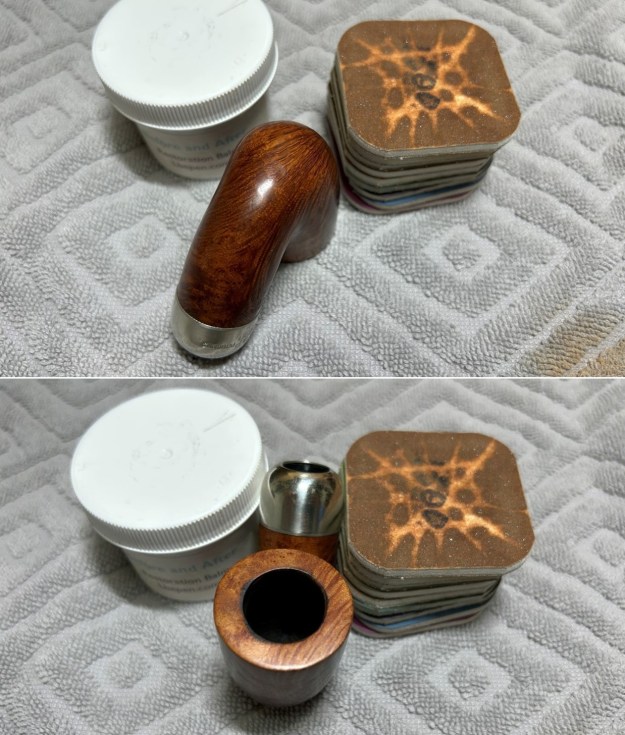
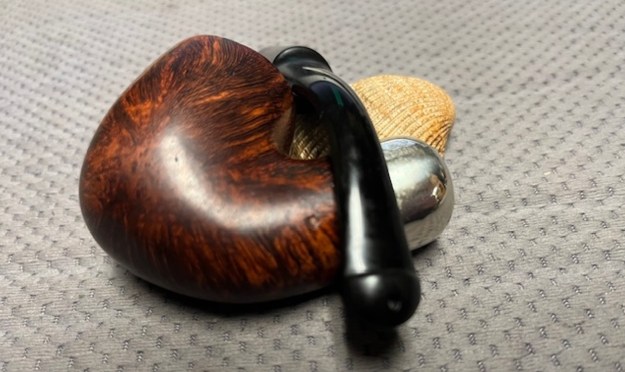
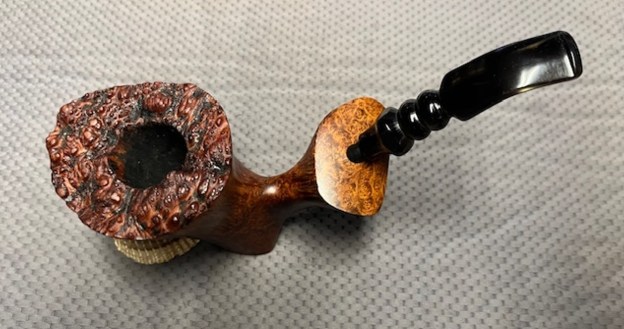
All done! This handsome Kaywoodie 179R Relief Grain looks fantastic again and is ready to be enjoyed by its next owner. I am pleased to announce that this pipe is for sale! If you are interested in acquiring it for your collection, please have a look in the ‘American’ section of the store here on Steve’s website. You can also email me directly at kenneth@knightsofthepipe.com. The approximate dimensions of the pipe are as follows: length 4¼ in. (108 mm); height 5½ in. (141 mm); bowl diameter 1⅓ in. (34 mm); chamber diameter ⅞ in. (21 mm). The weight of the pipe is 1½ oz. (44 g). I hope you enjoyed reading the story of this pipe’s restoration as much as I enjoyed restoring it. If you are interested in more of my work, please follow me here on Steve’s website or send me an email. Thank you very much for reading and, as always, I welcome and encourage your comments.

Breathing Life into a Larsen Copenhagen Super 78 Handmade Oval Shank Billiard


by Steve Laug

The next pipe on the table is another one that came to us from the seller in Caldwell, Idaho, USA on 07/12/2025. It is a Larsen with an oval shank and oval vulcanite saddle stem. I would call the shape a Billiard but others may have other ideas. It is in dirty but in good condition as can be seen in the photos below. It is stamped on the underside of the shank and reads 78 vertically just past the heel. Then it is stamped Larsen [over] Copenhagen. That is followed by Handmade [over] Made in Denmark. Next to the shank stem joint it is vertically stamped SUPER. The stamping is faint in spots but is still readable. It has rich sandblast finish with a blend of black and brown stains on a deep sandblast finish that the shape follows well. The finish was dusty and dirty with grime ground into the finish. It was also spotty and possibly faded. The bowl had a moderate cake and there was tobacco debris in the bowl. The rim top had a thick lava coat on the top and edges. The stem was quite dirty and oxidized. It has light tooth marks and chatter on both sides. I took photos of the pipe to show what it looked like before I started working on it.   I took photos of the bowl and rim top to show the thickness of the cake and the lava coat on the rim top. There was some tobacco debris in the bottom of the bowl. The stem photos show the condition of the taper stem ahead of the button.The stamping on the underside of the shank is faint in spots but readable as noted above. I took a photo of the pipe with the stem removed to give a sense of the proportions of the pipe. It is a real beauty. One of the first things I like to do is to unpack the stamping and understand each element in it. I have worked on quite a few W.O. Larsen pipes that are well made Danish takes on classic shapes. Several of them have been Brandy shaped pipes. This sandblast Canadian has a bowl that is almost a Brandy shape. Here is a link to the blog describing the background and history of the brand (https://rebornpipes.com/2021/10/25/restoring-a-sandblast-canadian-hand-made-designed-by-w-o-larsen-super-tan-65/). I quote from that blog in information that follows.

I turned to Pipephil (http://www.pipephil.eu/logos/en/logo-l2.html) to get a quick view of the brand once again. I did a screen capture of the site’s information and have included that below. The pipe I am working on is a W.O. Larsen as it is stamped similarly to the ones in the photos. I quote from the sidebar below:

In the 1960s Ole Larsen, owner of the Copenhagen tobacco store, retails pipes carved by Sixten Ivarsson, Poul Rasmussen, Sven Knudsen or Peter Brakner. Faced with the success and urged by Sven Bang (store manager), Sven Knudsen and Former (Hans Nielsen) are successively hired to carve pipes in the basement of the shop at the beginning and in the old Larsen cigar factory afterwards. Carver like Teddy Knudsen, Tonni Nielsen, Jess Chonowitch, Peter Hedegaard work a while in this context. When Nils, son of Ole Larsen, succeeds his father he acquires the Georg Jensen pipe factory to focus on less expensive pipes. This turns out to be an error ending with the sale of W.O. Larsen trademark to Stanwell. The famous tobacco shop at Strøget, Amagertorv 9 closed down for good on Dec 31, 2004. Do not confuse W.O. Larsen with: Jorgen Larsen

I turned to Pipedia (https://pipedia.org/wiki/W.%C3%98._Larsen) for a quick read. The site is worth reading the history of the shop and the brand and its influence on Danish pipe carving. I quote a portion of the article below:

The workshop of W.Ø.Larsen

W.Ø.Larsen is Denmark’s oldest and probably most famous pipes and tobacco store, placed in the center of Copenhagen on the main pedestrian street, Stroget. If you visit Copenhagen and do a “pipe crawl” this store is a must. In the beginning of the 1960’s the store began to sell Danish hand-made pipes, especially those of Poul Rasmussen. This went very well and Poul Rasmussen could not keep up with the demand. W.Ø.Larsen, with their dynamic business manager Svend Bang (who later started his own pipe business), decided to establish their own workshop in rooms next to the store.

The first manager of the pipe workshop was Sven Knudsen, but he soon left to make pipes under his own name. The next manager was Hans Nielsen, also known as “Former” (named after the late British actor George Formby, whom he was said to resemble. Coincidentally, in Danish, “Former” means “shapes”). Under the management of Former the workshop grew and W.Ø.Larsen pipes became a prominent name abroad. Among the prominent pipemakers educated here were Else Larsen (Denmark’s first female pipemaker), Poul Ilsted, Ph. Vigen, Teddy Knudsen, Tonni Nielsen, and Peter Hedegaard.

Typical for the W.Ø.Larsen School were semi-classic shapes, meaning classic shapes, but with slight differences, often bring a little more full or round. The pipes often had lower center of gravity. A typical billiard would have a bowl shaped more like a pear and the connection between the bowl and the shank would be clearly distinguished. Yellow and orange were colors more widely used for the finishes.

What I learned from the research is that the pipe is a Larsen Handmade pipe made by one of the famous carvers who worked in the shop. It is a beautiful pipe in both shape and finish.

I turned to work on the pipe itself. I reamed the bowl with a PipNet pipe reamer using the cutting heads 2 and 3. I finished the reaming with a Savinelli Fitsall Pipe Knife. I sanded the walls of the bowl with 220 grit sandpaper wrapped around a piece of dowel. I worked over the sandblast rim top with a brass bristle wire brush to clean up the debris in the valleys of the blast. It looked better. I cleaned out the inside of the shank and the airway in the stem with alcohol, cotton swabs and both bristle and regular pipe cleaners. I scrubbed the bowl and shank with a tooth brush and some undiluted Murphy’s Oil Soap. I rinsed it off with warm water to remove the dust and soap from the finish. I dried it off with a soft cloth and it looked much better. I rubbed the briar down with Before & After Restoration Balm. I worked it into the briar with my fingertips to work it into the finish. The product works to clean, enliven and preserve the briar. I let it sit for 10 minutes then I buffed it with a cotton cloth to deepen the shine. The briar really comes alive with the balm. I set the bowl aside and worked on the stem. I sanded the surface of the stem with a folded piece of 220 grit sandpaper to remove the oxidation and clean up the tooth marks and chatter on both sides of the stem ahead of the button.I sanded the stem with 320-3500 grit 2×2 inch pads. I wiped the stem down with an Obsidian Oil cloth after each sanding pad.I polished the vulcanite with micromesh sanding pads – 1500-12000 grit pads. I wiped it down with Obsidian Oil after each sanding pad. I used Before & After Pipe Polish – both Fine and Extra Fine to further polish the stem. I am really happy with the way that this Larsen Copenhagen Handmade Super 78 Oval Shank Long Billiard turned out. It really is a beautiful looking pipe with a unique shape and sandblast finish. The vulcanite saddle stem is really nice. The briar really came alive with the buffing. The rich brown and black stains of the finish gave the pipe a sense of depth with the polishing and waxing. I put the stem back on the bowl and carefully buffed the pipe with Blue Diamond on the buffing wheel using a light touch on the briar. I gave the bowl and the stem multiple coats of carnauba wax on the buffing wheel. I buffed the pipe with a clean buffing pad to raise the shine. I hand buffed the pipe with a microfiber cloth to deepen the shine. The finished Larsen Copenhagen Handmade Super 78 Oval shank Billiard really is a beauty and feels great in the hand and looks very good. Give the finished pipe a look in the photos below. The dimensions of the pipe are Length: 6 inches, Height: 2 inches, Outside diameter of the bowl: 1 ¼ inches, Chamber diameter: ¾ of an inch. The weight of the pipe is 38 grams/1.34 ounces. The pipe will be going on the rebornpipes store in the Danish Pipe Makers Section if you would like to add it to your collection. Thanks for reading this blog and my reflections on the pipe while I worked on it. It was a fun one to work on!

Restoring a Unique Prince of Wales Hand Made Panelled Sitter


by Steve Laug

The next pipe on the table is one I had seen the last few times I visited Jeff in Idaho. This time I brought it home. It is an interesting shape – kind of a Panel with some odd curves and ending with a flat bottom making it a sitter. It is stamped on the left side of the shank – very tightly against the stem shank union. It reads Prince of Wales [over] Hand Made. On the right side against the stem it is stamp vertically and reads Italy. We purchased the pipe on 06/07/25 from a Facebook auction in Spirit Lake, Iowa, USA. The finish is rusticated on the left side and back of the bowl as well as on the top and underside of the shank. The rim top is also rusticated following the same pattern as the left side. The finish is dusty and grimy in the grooves of the rustication and there is a moderated cake in the bowl. There is light lava in the rustication on the rim top. The stem is oxidized and had light tooth chatter on both sides ahead of the button. It is an interesting looking pipe. I have included photos of the pipe before I started my work on it. I took a photo of the bowl and rim top to show the thickness of the cake and the light lava coat on the rim top. There was some tobacco debris in the bottom of the bowl. The stem photos show the condition of the fancy saddle stem ahead of the button.The stamping on the sides of the shank is readable as noted above. The stamping on the left side is missing the “es” on Wales as the shank is quite short. It has not been cut off as the Italy stamp is very readable on the opposite side of the shank. There is a Scottish flag stamped on the left side of the stem and it is faint but visible. I took a photo of the pipe with the stem removed to give a sense of the proportions of the pipe. It is a real beauty. Before I started my part of the restoration I wanted to have a clear picture of the background on the brand and what the stem logo looked like on the Prince of Wales pipe. I turned to Pipephil as he often has photos and sidebar information that give me the information that I am looking for (http://www.pipephil.eu/logos/en/logo-p5.html). Sure enough, he had a photo showing the stamped Scottish Flag on the stem. It is white and it is faint in spots on the pipe I am working on. Hopefully in the restoration process I can get it back a bit. I did a screen capture of the picture on the site and include it below.What is interesting in these photos is that it is the same logo but several of them say made in Leeds. They seem to be English made or at least maybe made for a pipe shop. The logo is a Scottish Flag. The one I have is stamped Italy which makes me think that someone had the pipe made by an Italian company for their shop.

I turned to Pipedia and looked up the brand there (https://pipedia.org/wiki/Prince_Of_Wales). Here is what I found there. I quote in full.

It is quite a three pipe problem, …”

  • The name “Prince of Wales” was used at times by GBD for a sub-brand.
  • Pipephil shows English made Prince of Wales which bear the Union Jack (the flag of the United Kingdom) as logo.Also listed by Pipephil is a brand named P.O.W. attributed to a Scottish firm G.M. Frame. Now, if P.O.W. doesn’t stand for “prisoner of war”, this might be an indication that there are two different Prince of Wales productions.
  • Danish made semi-freehands stamped “PRINCE OF WALES” + “DANISH LINE” + “HANDMADE IN DENMARK”. The stems, as usual for the bulk of such pipes, often as stitch in stems. Decorated with a white ring and a stylized Danish flag. (Were once mentioned as order production for GBD. – Unconfirmed!).
  • Prince of Wales Made in Italy. Quotation: “In the spirit of the Bing’s Favorite Pipe, Savinelli expands it’s line of pipes favored by famous pipesmokers. Prince of Wales Favorite series features a new mosaic designed mouthpiece which gives it a unique look like no other series. This pipe can be used with or without Savinelli balsa inserts (20pk included).”

Now I knew I was dealing with a bit of a mystery pipe. It has a Scottish Flag on the stem, an Italy stamp on the shank and the name Prince of Wales which sounds British. Very interesting piece. But no definitive information!!

I turned to work on the pipe itself. I reamed the bowl with a PipNet pipe reamer using the cutting heads 2 and 3. I finished the reaming with a Savinelli Fitsall Pipe Knife. I sanded the walls of the bowl with 220 grit sandpaper wrapped around a piece of dowel. I turned to work on the pipe itself. I reamed the bowl with a PipNet pipe reamer using the cutting heads 2 and 3. I finished the reaming with a Savinelli Fitsall Pipe Knife. I sanded the walls of the bowl with 220 grit sandpaper wrapped around a piece of dowel. I worked over the sandblast rim top with a brass bristle wire brush to clean up the debris in the valleys of the blast. It looked better.I cleaned out the inside of the shank and the airway in the stem with alcohol, cotton swabs and both bristle and regular pipe cleaners. I scrubbed the bowl and shank with a tooth brush and some undiluted Murphy’s Oil Soap. I rinsed it off with warm water to remove the dust and soap from the finish. I dried it off with a soft cloth and it looked much better. I rubbed the briar down with Before & After Restoration Balm. I worked it into the briar with my fingertips to work it into the finish. The product works to clean, enliven and preserve the briar. I let it sit for 10 minutes then I buffed it with a cotton cloth to deepen the shine. The briar really comes alive with the balm. I set the bowl aside and worked on the stem. I scrubbed the stem surface with some Soft Scrub on cotton pads to remove some of the oxidation. I sanded the surface of the stem with a folded piece of 220 grit sandpaper to remove the oxidation and clean up the tooth marks and chatter on both sides of the stem ahead of the button.I soaked the stem in some Briarville’s Pipe Stem Deoxidizer for 2 hours. Afterwards I wiped off the excess and ran some pipe cleaners through the airway on the stem.I sanded the stem with 320-3500 grit 2×2 inch pads. I wiped the stem down with an Obsidian Oil cloth after each sanding pad.I touched up the Scottish Flag logo on the left side of the stem with white acrylic fingernail polish. I scraped off the excess and sanded it lightly with a 320 grit sanding sponge. I polished the vulcanite with micromesh sanding pads – 1500-12000 grit pads. I wiped it down with Obsidian Oil after each sanding pad. I used Before & After Pipe Polish – both Fine and Extra Fine to further polish the stem. As always I am excited to finish a pipe that I am working on. I put the Prince of Wales Hand Made Panel Sitter pipe back together and buffed it using a light touch with Blue Diamond on the buffing wheel. I gave the bowl several coats of Conservator’s Wax and the stem multiple coats of carnauba wax. I buffed the pipe with a clean buffing pad and hand buffed it to raise the shine. It is fun to see what the polished bowl looks like with the grain and the variations of colour in the rustication around the bowl and shank. Added to that the polished vulcanite saddle stem was a beautiful touch. This is nice looking pipe and I am sure that the tactile nature of the rustication will feel great as the bowl warms up during smoking. The Prince of Wales Hand Made is light and well balanced. Have a look at it with the photos below. The dimensions are Length: 5 ½ inches, Height: 2 inches, Outside diameter of the bowl: 1 ¼ inches, Chamber diameter: ¾ of an inch. The weight of the pipe is 1.69 ounces/48 grams. It is a beautiful pipe and one that will be on the rebornpipes store Pipes by Italian Pipe Makers Section. If you are interested in adding it to your collection let me know. Thanks for walking through the restoration with me as I worked over this pipe.

Thanks to each of you who are reading this blog. I want to keep reminding us of the fact that we are not pipe owners; we are pipemen and women who hold our pipes in trust until they pass on into the trust of the next pipeman or woman.

Restoring and Restemming a Grant’s Tanblast 831 Canadian with a Taper Stem


by Steve Laug

The next pipe on the table is another one that came to us from the seller in Caldwell, Idaho, USA on 07/12/2025. It is a Canadian bowl with a broken tenon in shank and no stem. It is in dirty but in good condition as can be seen in the photos below. It is stamped on the underside of the shank and reads Grant’s [over] Tanblast. That is followed by the shape number 831 and stamped after that Made in London [over] England. The stamping is clear and readable. It has rich natural sandblast Finish on a nicely grained sandblast finish that the shape follows well. The finish was dusty and dirty with grime ground into the finish. The bowl had a moderate cake and there was tobacco debris in the bowl. The rim top had a lava coat on the top and edges. The stem was missing but the broken tenon was stuck in the shank. I would need to pull it and restem it. I took photos of the pipe to show what it looked like before I started working on it. I took a closer photo of the rim top and bowl to show the condition of the bowl and rim. You can see the light cake in the bowl and the darkening and lava on the top and inner edge. It was heavier on the left side but also covered the back and front of the rim and top.I took a photos of the stamping on the underside of the shank. It is clear and readable as noted above.Before starting working on the pipe I did a Google search to see what I could learn about a Grant’s Tanblast 831 Canadian. The first thing that came up is a pretty clear and succinct AI Overview of the stamping. I am including that information below.

Based on the stamping “Made in London England” and “Grant’s,” this pipe is a house brand from Grant’s Pipe Shop in San Francisco, California. These pipes were produced in London for Ed Grant, who purchased the historic Sutliff pipe shop in 1953 and retired in 1988. 

Key Information regarding Grant’s Pipe Shop Pipes:

  • Manufacturer: Many Grant’s Pipe Shop pipes, including the “Corinthian” line, were manufactured in London by Comoy’s.
  • Stamping: The pipes often feature “Grant’s Pipe Shop,” “San Francisco,” and “London Made” or “Made in England”.
  • “Tanblast”: This likely refers to a specific finish or line offered by the shop, featuring a tan/brown sandblasted finish.
  • Number 831: This indicates the specific shape number for the pipe in the Grant’s/Comoy’s catalog.
  • Period: These are typically vintage pipes, largely dating between the mid-1950s and the late 1980s. 

Grant’s Pipe Shop was a renowned Californian tobacconist that sold high-quality English-made estate pipes

This information gave me a clear connection to Grant’s Pipe Shop and the Tanblast stamping on the underside. It also linked the 831 shape number to both the Grant’s Pipe Shop and Comoy’s catalogue. Thus, I know that pipe is linked to Grant’s Pipe Shop and Comoy’s shape 831 Canadian.

Now that I have the link to Grant’s Pipe Shop in San Francisco, California I turned to Pipephil’s site to see if I could learn more (http://www.pipephil.eu/logos/en/logo-g5.html). I did a screen capture of the information on Grant’s and have included it and the side bar information below.Tobacconist’s brand founded 1849 by Henry Sutliff. In 1925, Sutliff opened a shop in the 500 Block of Market St. In 1953, Ed Grant the manager, purchased the store renaming it Grant’s Pipe Shop. He retired in 1988 and passed away in 2003. Ted Ware and Joe Barron took over the oldest Californian tobacconist in 2004.

I turned to Pipedia and found an interesting article on the shop and its closure in 2012. There was also an advert card on the shop showing what the shop looked like inside and out from 1849-2012 (https://pipedia.org/wiki/Grants_Pipe_Shop). I have done a screen capture of the card and added it below.I enjoy working on Pipe Shop pipes and it is fun to be able to trace them back to the company that made the pipe – in this case Comoy’s of London. I turned to work on the pipe itself. Before addressing the bowl, I decided to pull the broken tenon from the shank. I used a drywall screw and turned it into the airway. I wiggled the tenon free from the shank. With it removed it was ready to be fit with a new stem once it was clean.I turned to clean up the bowl in preparation for the restemming. I reamed the bowl with a PipNet pipe reamer using the cutting heads 2 and 3. I finished the reaming with a Savinelli Fitsall Pipe Knife. I sanded the walls of the bowl with 220 grit sandpaper wrapped around a piece of dowel. I worked on the darkening on the rim top with a brass bristle wire brush. I was able to remove the majority of the darkening with this method.I cleaned out the inside of the shank and the airway in the stem with alcohol, cotton swabs and both bristle and regular pipe cleaners.I scrubbed the bowl and shank with a tooth brush and some undiluted Murphy’s Oil Soap. I rinsed it off with warm water to remove the dust and soap from the finish. I dried it off with a soft cloth and it looked much better. I had a stem in my can of stems that would work on this pipe. I fitted the stem to the shank. It would take a bit of adjusting to get the fit in the shank correct. I used a folded piece of 220 grit sandpaper and some small flat files. I removed the stem and set it aside. I rubbed the briar down with Before & After Restoration Balm. I worked it into the briar with my fingertips to work it into the finish. The product works to clean, enliven and preserve the briar. I let it sit for 10 minutes then I buffed it with a cotton cloth to deepen the shine. The briar really comes alive with the balm. I set the bowl aside to let the Before & After Restoration Balm do its magic and turned to work on the thickness of the stem at the side, top and underside. It was quite close but some fine tuning would clean it up and make the fit seamless. I sanded the surface of the stem with a folded piece of 220 grit sandpaper to shape the fit to the shank. I sanded the stem with 320-3500 grit 2×2 inch pads to further adjust the fit of the stem to the shank. I wiped the stem down with an Obsidian Oil cloth after each sanding pad.I polished the vulcanite with micromesh sanding pads – 1500-12000 grit pads. I wiped it down with Obsidian Oil after each sanding pad. I used Before & After Pipe Polish – both Fine and Extra Fine to further polish the stem. I the polished newly fit vulcanite taper stem and the Grant’s Tanblast 831 Canadian bowl with Blue Diamond to polish out the remaining small scratches and raise the shine. I gave the bowl and the stem several coats of carnauba wax then buffed the pipe with a clean buffing pad to raise the shine. I hand buffed it with a microfiber cloth to deepen the shine. The pipe polished up pretty nicely. This turned out to be a beautiful Grant’s Tanblast 831 Canadian with a Taper Stem. The finished pipe is shown in the photos below. The dimensions are Length: 5 ½ inches, Height: 1 ¾ inches, Outside diameter of the bowl: 1 ¼ inches, Chamber diameter: ¾ of an inch. The weight of the pipe is 1.23 ounces/35 grams. Thanks for walking through the restoration and restemming with me as I worked this beautiful little Comoy’s Made Grant’s House Pipe. I will be adding it to the rebornpipes store in the British Pipe Makers Section if you would like to add it to your collection. Thanks for looking.

New Life for a Dunhill Shell Briar 83 F/T Yachtsman with a Taper Stem


by Steve Laug

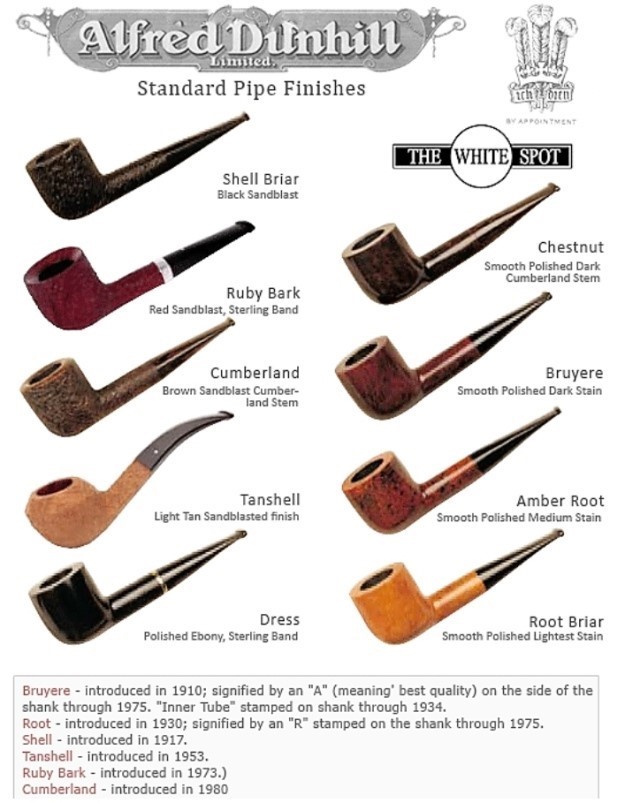
The next pipe on the table is another one that came to us from the seller in Caldwell, Idaho, USA on 07/12/2025. It is a Dunhill Shell Briar Zulu or Yachtsman with a vulcanite taper stem. It is in dirty but in good condition as can be seen in the photos below. It is stamped on the underside of the shank and reads 83 F/T [followed by] Dunhill [over] Shell Briar. That is followed by Made in [over] England6 and a 9 slightly below the first number. It is followed by a stamping Circle 3S. The stamping is faint in spots but is still readable. It has rich Shell Briar Sandblast Finish with a blend of black, brown and oxblood stains on a richly grained sandblast finish that the shape follows well. The finish was dusty and dirty with grime ground into the finish. It was also spotty and possibly faded. The bowl had a moderate cake and there was tobacco debris in the bowl. The rim top had a thick lava coat on the top and edges. The stem was quite dirty and there was a dark dot on the top that appears to be a brass circle like Orlik has on their stem or a darkened white spot. I will know when I clean it up. It is oxidized and has light tooth marks and chatter on both sides. I took photos of the pipe to show what it looked like before I started working on it. I took photos of the bowl and rim top to show the thickness of the cake and the lava coat on the rim top. There was some tobacco debris in the bottom of the bowl. The stem photos show the condition of the taper stem ahead of the button.The stamping on the underside of the shank is faint in spots but readable as noted above. I took a photo of the pipe with the stem removed to give a sense of the proportions of the pipe. It is a real beauty.One of the first things I like to do is to unpack the stamping and understand each element in it. I turned to Pipephil’s helpful site (http://pipephil.eu/logos/en/dunhill/shell-briar1.html). The stamping is interpreted as follows: The 83 is the shape number for a Zulu or Yachtsman shape. The F/T gives the shape of the stem as a Fishtail on this taper stem. The Dunhill Shell Briar is the finish. Following the Made In England6 gives the year that the pipe was made the superscript 9 that follows that is the year it was sold to a retailer. The Circle 3S is the Group 3 size pipe and the S is the stamp for a Shell Briar.

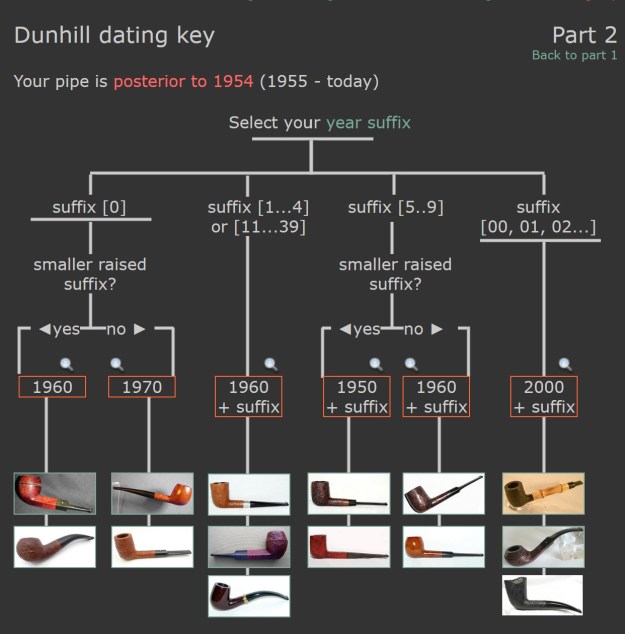
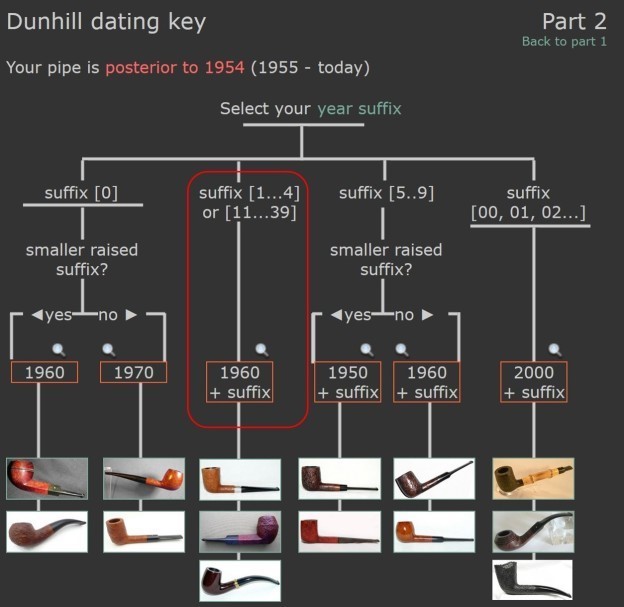
From there I wanted to pin down the date stamp 6 and 9. I have included Page 2 of the Dunhill Dating Key (http://www.pipephil.eu/logos/en/dunhill/cledat-en1a.html). Following that it takes me to the box with 1950+suffix. That tells me that the pipe is a 1956 made pipe sent to a retailer in 1959.    I wanted to know more about the Shell finish and when it was introduced by Dunhill and how that fit the Patent stamp on the bowl. I turned to a listing on Pipedia that gave me the information I was looking for (https://pipedia.org/wiki/Dunhill).

Shell

The Shell is a deep, craggy sandblast finish with a black stain, traditionally applied to soft, beautifully grained Algerian briar. While perhaps not the first-ever use of sandblasting on pipes, the technique perfected by Dunhill is considered one of the brand’s most significant contributions to the art of pipe making. The development is documented in English patent No. 119708/17; preliminary work began on October 13, 1917, and the patent was granted a year later, just weeks before the end of the First World War.

The origin of the finish is famously recounted as an “Accidental Discovery” in early Dunhill catalogues. The story tells of Algerian briar blocks being inadvertently left near a furnace, causing the softer wood to shrink and the harder grain to stand out in a textured relief. The reality, as detailed in the patent application, was a deliberate process of steeping the briar in oil for weeks, followed by a heat treatment. Only then was the sandblast applied to cut away the softer wood, resulting in a durable, lightweight, and cool-smoking pipe.

In 1986, Dunhill introduced a premium version of the Shell finish called the ‘Ring Grain’. These pipes feature a particularly deep blast reminiscent of the classic style of the 1930s to mid-1960s, applied to briar with a superior grain pattern. The ‘Ring Grain’ name was later changed to ‘Shilling’ in 1995. Regarded by many enthusiasts as among the finest modern Dunhills, these pipes are produced in limited quantities and are exceptionally rare.[122][123]

Now I knew that I was working on a Dunhill Shell Briar 83F/T Yachtsman with a replacement Taper Stem that was made in 1956 and sent to a retailer in 1959.

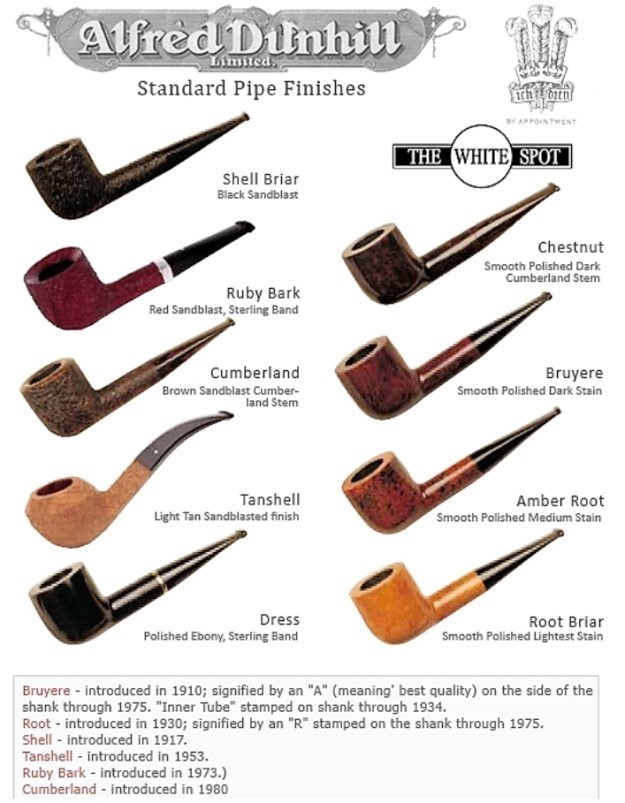
I turned to work on the pipe itself. I reamed the bowl with a PipNet pipe reamer using the cutting heads 2 and 3. I finished the reaming with a Savinelli Fitsall Pipe Knife. I sanded the walls of the bowl with 220 grit sandpaper wrapped around a piece of dowel. I turned to work on the pipe itself. I reamed the bowl with a PipNet pipe reamer using the cutting heads 2 and 3. I finished the reaming with a Savinelli Fitsall Pipe Knife. I sanded the walls of the bowl with 220 grit sandpaper wrapped around a piece of dowel. I worked over the sandblast rim top with a brass bristle wire brush to clean up the debris in the valleys of the blast. It looked better.I cleaned out the inside of the shank and the airway in the stem with alcohol, cotton swabs and both bristle and regular pipe cleaners. I scrubbed the bowl and shank with a tooth brush and some undiluted Murphy’s Oil Soap. I rinsed it off with warm water to remove the dust and soap from the finish. I dried it off with a soft cloth and it looked much better. I rubbed the briar down with Before & After Restoration Balm. I worked it into the briar with my fingertips to work it into the finish. The product works to clean, enliven and preserve the briar. I let it sit for 10 minutes then I buffed it with a cotton cloth to deepen the shine. The briar really comes alive with the balm.  I set the bowl aside and worked on the stem. I sanded the surface of the stem with a folded piece of 220 grit sandpaper to remove the oxidation and clean up the tooth marks and chatter on both sides of the stem ahead of the button. I worked on the area around the spot on the top of the stem. What first appeared to be a brass circle became obviously a Dunhill spot-like insert. I believe that it is a darkened white spot that is shrunken slightly and has some grime around the edge. I examined it carefully with a lens and bright light and it is definitely not a ring but a spot. It looks like I have an original stem on the pipe.I sanded the stem with 320-3500 grit 2×2 inch pads. I wiped the stem down with an Obsidian Oil cloth after each sanding pad.I polished the vulcanite with micromesh sanding pads – 1500-12000 grit pads. I wiped it down with Obsidian Oil after each sanding pad. I used Before & After Pipe Polish – both Fine and Extra Fine to further polish the stem. I the polished vulcanite taper stem and the 1956 Dunhill Shell Briar 83 F/T Yachtsman bowl with Blue Diamond to polish out the remaining small scratches and raise the shine. I gave the bowl and the stem several coats of carnauba wax then buffed the pipe with a clean buffing pad to raise the shine. I hand buffed it with a microfiber cloth to deepen the shine. The pipe polished up pretty nicely. The dark spot/darkened white spot on the stem is very visible. This turned out to be a beautiful Dunhill Shell Briar 83 F/T Yachtsman with a Taper Stem. The finished pipe is shown in the photos below. The dimensions are Length: 5 ½ inches, Height: 1 ¾ inches, Outside diameter of the bowl: 1 ¼ inches, Chamber diameter: ¾ of an inch. The weight of the pipe is .95 ounces/27 grams. Thanks for walking through the restoration with me as I worked this beautiful little Dunhill Shell Briar. I will be adding it to the rebornpipes store in the British Pipe Makers Section if you would like to add it to your collection. Thanks for looking.

Restoring an Old and Rare C.P.F. Egg and Claw Beauty


by Kenneth Lieblich

It isn’t often that I get to work on pipes that are more than a century old. It does happen from time-to-time, but – regardless – it is a delight when it does happen. This pipe came to me from an auction and it immediately caught my eye. First, I saw the initials, C.P.F., and I knew that meant the pipe was very old. Second, the shape of the pipe was unusual: an egg and claw. This is something that one sees in meerschaum pipes occasionally, but less so in briar pipes. Third, I could tell that the rim cap was lost to time and that the stem seemed … odd – but I couldn’t (yet) put my finger on why. A special thanks is due to Steve for his help on this restoration. The pipe is absolutely charming and a wonderful example of the pipe-making of a different era. As mentioned, the markings of the pipe included the initials C.P.F. on the left side of the shank. No other markings were in the briar. However, the brass (or nickel) band also had some markings. First, there were a set of faux hallmarks (anchor, star, bird?) above another engraving of C.P.F.C.P.F. stands for Colossus Pipe Factory and is one of those 19th century pipe firms that is shrouded in mystery. Perhaps the mystery is simply a paucity of documentary records. There are entries for Colossus at both Pipedia and Pipephil, but the information is scant. Here’s a quotation from the Pipedia article:

There is not much known about the Colossus Pipe Factory. By the mid 1890’s it was owned by Kaufmann Bros. & Bondy. Bill Feuerbach has an old invoice from KB&B dated 1898 that has “C.P.F.” in the upper corner, with Trademark underneath. So they owned the brand by then. It could have been a company that was acquired by KB&B or possibly even founded by them. Bill Feuerbach is a VP at S. M. Frank & Co. (Kaywoodie) and has also provided the evidence to the name Colossus below. I have always been under the impression that the initials C.P.F. stood for Consolidated Pipe Factory. Many pipe collectors that I know believe the same thing. However only this week I had that cleared up. A pipe collector friend in Seattle emailed a scan of a page from a trade magazine called “The Jeweler’s Circular”, dated August 23, 1899. A reader wrote in the following question, “Please inform us who manufactures briar pipes with trademark, C.P.F.?” The answer was, “These letters stand for Colossus Pipe Factory, the business being conducted by Kaufmann Bros. & Bondy, 129 Grand Street, New York.” I have seen pipes with both the C.P.F. logo and KB&B logo on them that date to pre-1900. This may have been a way to let the public now that the companies were affiliated. As far as I can tell, the C.P.F. brand was discontinued sometime in the 1910-1920 range.

Steve has restored a few C.P.F. pipes and, quite frankly, this article he wrote about their history is probably the best place to look. You can also see some of his restorations of C.P.F. pipes here and here and here. From everything I can gather, this pipe is well in excess of 100 years old and might be much older than that. How about the condition of this pipe? Let’s talk about the stummel first. It was dirty – very dirty. The briar was in good shape, but more than a century’s worth of dust and debris have been ground into the pipe’s crevasses. I was pleased to see how few scratches were in the wood and that made me hopeful. The inside of the bowl, however, was full of cake and seemed heavily smoked. As I mentioned earlier, the rim cap was missing. Meanwhile, the stem was the thing that made me pause. I asked Steve about it and, after a thorough chat with him about this pipe, he was of the view that this stem was not the original. It didn’t fit quite right and looked a bit too long. That made a lot of sense because this stem seemed cheap and unusually brittle. There was a bone tenon connecting stem and stummel and, although it seemed sound, I wasn’t sure it was original either. The first item on my agenda was to extricate the tenon from the stummel – it was stuck. I opted to warm the area with my heat gun and this provided just enough softening of the internal goo to allow me to extract it.Since the stem was both not-the-original and badly damaged, I elected to set it aside for now and figure out what to do with it later. For now, I decided to remove all the cake inside the bowl. This accomplished a couple of things. First (and most obviously), it cleaned the bowl and provided a refurbished chamber for future smoking. Second, when the old cake was removed, I could inspect the interior walls of the bowl and determine if there was damage or not. I used a reamer, a pipe knife, and a piece of sandpaper taped to a wooden dowel. Collectively, these ensured that all the debris was removed. However, it was clear that the walls of the bowl had been heavily smoked, excessively reamed, and showed signs of char and craze lines. I would have to address that later.My next step was to remove the lava on the rim. For this, I took a piece of machine steel and gently scraped the lava away. The metal’s edge is sharp enough to remove what I need, but not so sharp that it damages the rim.I then cleaned the stummel with both pipe cleaners and cotton swabs dipped in lemon-infused 99% isopropyl alcohol. With a pipe this dirty, it took quite a while and much cotton to clean.I then decided to ‘de-ghost’ the pipe – that is to say, exorcize the remaining filth from the briar. I filled the bowl and the shank with cotton balls, then saturated them with 99% isopropyl alcohol. I let the stummel sit overnight. This caused the remaining oils, tars and smells to leach out into the cotton.To tidy up the briar, I wiped down the outside, using a solution of a pH-neutral detergent and some distilled water, with cotton rounds. I also used a toothbrush in the crevices. This did a good job of cleaning any latent dirt on the surface of the briar. The last step of the cleaning process was to scour the inside of the stummel with the same mild detergent and tube brushes. This was the culmination of a lot of hard work in getting the pipe clean.Back to the damaged interior of the bowl. To repair the craze lines, etc., I used an epoxy adhesive that is extremely hard, resistant to high temperatures, and completely inert when cured. It worked superbly. I lined the affected area with the epoxy and let it cure for a full 24 hours. I forgot to take photos of this step, so you’ll just have to take my word for it. The next day, I roughened up the epoxy’s surface with 220-grit sandpaper for the next step. I thinly coated the inside of the bowl with a mixture of my wife’s homemade yogurt and activated charcoal. Once hardened, this provided a good, faintly rough surface for a new cake to build. I used all nine micromesh pads (1,500 through 12,000 grit) to sand the outside of the stummel and finish it off. This sanding minimizes flaws in the briar and provides a beautiful smoothness to the wood.Steve and I both have a few very old rim caps, specifically for C.P.F. pipes. We scoured both of our piles and found a perfect one in his collection. It fits correctly and is just the sort of piece that a C.P.F. pipe of that era would have had. I gave it a quick buffing with some old MicroMesh pads.Now to address the stem issue. Similar to the rim cap, I went to my collection of stems and found an ideal replacement, based on Steve’s recommendation. I have several, very old, Bakelite stems that would be just right. The one I selected dates from the same time period as the pipe and, best of all, was unused – never smoked. The stem was marked Germany, the place of manufacture. I married the stem and stummel, and both Steve and I agreed that it looked perfect. I also had to hunt in my stores for an old bone tenon. This took a long time, but I finally found one that fit both the new stem’s mortise and the existing shank’s mortise. I quickly cleaned and polished up the stem (didn’t take long, as it was new) and put it aside.Next, I polished the brass (or nickel) band with a few grey sanding pads. This made it shine beautifully. I took the band and the rim top and glued them in place with pH-neutral adhesive. I was very pleased with the results.I rubbed some LBE Before & After Restoration Balm into the briar and let it sit for 30 minutes or so. The balm moisturizes the wood and gives a beautiful depth to the briar. I then buffed the stummel with a microfibre cloth. For the final step, I took the stem (only) to my bench polisher and carefully buffed it – first with a blue diamond compound, then with carnauba wax. I chose not to buff the stummel on the bench polisher, as there were too many points for the wheel to catch on the stummel. Instead, I polished it by hand with conservator’s wax.All done! This C.P.F. Egg and Claw looks fantastic again and is ready to be enjoyed by its next owner. It was a tough restoration, but this pipe is a trophy and worth having in your collection. I am pleased to announce that this pipe is for sale! If you are interested in acquiring it for your collection, please have a look in the ‘American’ section of the store here on Steve’s website. You can also email me directly at kenneth@knightsofthepipe.com. The approximate dimensions of the pipe are as follows: length 5⅓ in. (135 mm); height 2 in. (52 mm); bowl diameter 1⅝ in. (41 mm); chamber diameter ¾ in. (18 mm). The weight of the pipe is 1⅜ oz. (42 g). I hope you enjoyed reading the story of this pipe’s restoration as much as I enjoyed restoring it. If you are interested in more of my work, please follow me here on Steve’s website or send me an email. Thank you very much for reading and, as always, I welcome and encourage your comments.

New Life and a New Stem for a 1973 Dunhill Red Bark N792 F/T Canadian


by Steve Laug

The next pipe on the table is another one that came to us from the seller in Caldwell, Idaho, USA on 07/12/2025. It is a Dunhill Red Bark Canadian missing the original stem. It is in dirty but in good condition as can be seen in the photos below. It is stamped on the underside of the shank and reads N792 F/T [followed by] Dunhill [over] Red Bark. That is followed by Made in [over] England13. That is followed by a stamping Circle 4R/B. The stamping is clear and readable. The pipe has rich Red Bark Sandblast Finish with a blend of red/oxblood stains on a richly grained sandblast finish that the shape follows well. The finish was dusty and dirty with grime ground into the finish. It appeared to have a crack in the shank on the topside that extended into the shank about ½ inch. The bowl had a moderate cake and there was tobacco debris in the bowl. The rim top had a thick lava coat on the top and edges. I was excited to work on the pipe and forgot to take photos before I started working on it. I had a tarnished Sterling Silver Band that would fit the shank well so I heated it and pressed it in place. Then I remembered that I had not taken photos before the band. I took photos of the pipe with the banded shank to show what it looked like before I started working on it. The stamping on the underside of the shank is readable as noted above. I took a photo of the stamping.One of the first things I like to do is to unpack the stamping and understand each element in it. I turned to Pipephil’s helpful site (http://pipephil.eu/logos/en/dunhill/shell-briar1.html). The stamping is interpreted as follows: The N792 is the shape of the pipe which is a Canadian. The F/T designates a Fishtail stem. The Dunhill Red Bark is a red stained sandblast finish. Following the Made In England13 gives the year that the pipe was made.  The circle 4R/B is the stamp for a Group 4 in a Red Bark finish.

From the above information I could see that I was working on a Red Bark Canadian shaped pipe.

From there I wanted to pin down the date stamp 1. I have included Page 2 of the Dunhill Dating Key (http://www.pipephil.eu/logos/en/dunhill/cledat-en1a.html). Following that it takes me to the box with 1960+suffix. That tells me that the pipe is a 1973 pipe.I wanted to know more about the Red Bark finish and when it was introduced by Dunhill. I turned to a listing on Pipedia that gave me the information I was looking for (https://pipedia.org/wiki/Dunhill).

Red Bark:

Red Bark: Introduced in 1972, the Redbark was a sandblasted finish characterized by a reddish stain and is arguably the most famous of Dunhill’s discontinued lines. Initially, the stain was a medium red, but a few years after its introduction, it was changed to a significantly brighter, almost pinkish hue. This new colour proved unpopular, causing sales to plummet. In response, the company reverted to the original, darker red stain in 1976. The Redbark finish was officially discontinued in 1987.[122][123]

Now I knew that I was working on a Dunhill Red Bark N792 which original would have had a Taper Stem that was made in 1973 and was only made until 1987 before it was discontinued.

I turned to work on the pipe itself. I reamed the bowl with a PipNet pipe reamer using the cutting heads 2 and 3. I finished the reaming with a Savinelli Fitsall Pipe Knife. I sanded the walls of the bowl with 220 grit sandpaper wrapped around a piece of dowel. I cleaned out the inside of the shank and the airway in the stem with alcohol, cotton swabs and both bristle and regular pipe cleaners. I scrubbed the bowl and shank with a tooth brush and some undiluted Murphy’s Oil Soap. I rinsed it off with warm water to remove the dust and soap from the finish. I dried it off with a soft cloth and it looked much better. I worked on the darkening on the rim top with a brass bristle wire brush and some Before & After Briar Cleaner. I worked it into the grooves on rim top sandblast and let it sit for 5 minutes. I repeated the process four times and when finished I wiped it off. I was able to remove the majority of the darkening with this method. I polished the band with micromesh sanding pads. I wiped it down after each sanding pad with an Obsidian Oil Cloth to clean it up and add to the shine. I cleaned the Sterling Band with a jeweller’s cloth to remove the tarnish and protect the silver from further tarnishing. I rubbed the briar down with Before & After Restoration Balm. I worked it into the briar with my fingertips to work it into the finish. The product works to clean, enliven and preserve the briar. I let it sit for 10 minutes then I buffed it with a cotton cloth to deepen the shine. The briar really comes alive with the balm. I set the bowl aside and turned to deal with the stem. I had a stem in my can of stems that would work on this pipe. I fitted the stem to the shank. It did not take any adjustments to the tenon or the stem. It is a perfect fit to the shank.I sanded the surface of the stem with a folded piece of 220 grit sandpaper to remove the oxidation and clean up the tooth marks and chatter on both sides of the stem ahead of the button. I sanded the stem with 320-3500 grit 2×2 inch pads. I wiped the stem down with an Obsidian Oil cloth after each sanding pad.I polished the vulcanite with micromesh sanding pads – 1500-12000 grit pads. I wiped it down with Obsidian Oil after each sanding pad. I used Before & After Pipe Polish – both Fine and Extra Fine to further polish the stem. I the polished newly fit Sterling Silver Band and the new vulcanite taper stem and the 1973 Dunhill Red Bark N792 F/T Canadian bowl with Blue Diamond to polish out the remaining small scratches and raise the shine. I gave the bowl and the stem several coats of carnauba wax then buffed the pipe with a clean buffing pad to raise the shine. I hand buffed it with a microfiber cloth to deepen the shine. The pipe polished up pretty nicely. This turned out to be a beautiful Dunhill Red Bark N792 F/T Canadian with a Taper Stem. The finished pipe is shown in the photos below. The dimensions are Length: 5 ½ inches, Height: 1 ¾ inches, Outside diameter of the bowl: 1 ¼ inches, Chamber diameter: ¾ of an inch. The weight of the pipe is 1.38 ounces/38 grams. Thanks for walking through the restoration and restemming with me as I worked this beautiful little Dunhill Red Bark. I will be adding it to the rebornpipes store in the British Pipe Makers Section if you would like to add it to your collection. Thanks for looking.

The third of a foursome of Beautiful pipes sent to me with Potential Burn Out Issues


by Steve Laug

On November 29 I received an email from a fellow regarding a Moretti that came to him from a dear friend. He stated that it had a burnout and that he had someone ream it for him. I have included his first email below.

Steve, I have a Moretti pipe that belonged to a dear friend. It had a burnout and I had the bowl reamed, but I’m afraid to smoke it. Can you offer a suggestion of how the inside of the bowl can be treated against possible future burnout, or can you fit the bowl with either a meerschaum or graphite liner? – Michael

We talked back and forth regarding the pipe and various options for repair. I agreed to work on them and told him to mail it to me. Once he packed it he added another three pipes to the box that he was sure had the same issues. He mailed them to me on December 8 and sent me another email.

You have convinced me that you’re the person who can help restore my pipes! I shipped 4 pipes to you today by USPS, and declared their value at $5 each for a total of $20 as you requested. I’m embarrassed to admit it, but all four have had burnout issues and I’m hoping that you can clean them out and coat the inside of the bowls as you described. If you feel that more effort is needed, please let me know.

On December 28th I received the package from Michael. I opened the box and inside there were four beautiful Italian Made pipes. I have listed them below and included photos of the pipes.

Savinelli Autograph Sandblast Bent Cherrywood
2008 Ardor DR bent Dublin
Mastro Beraldi 2 Bent Dublin
2005 Moretti 1 Bent Rhodesian

The third pipe I brought to the table is a Savinelli Autograph Sandblast Bent Cherrywood. Overall it looks very good. It is stamped on smooth heel of the bowl and reads Savinelli [over] Autograph [followed by] Made in [over] Italy and to the right it is stamped with a 2. The stamping is clear and very readable. The pipe has a mix of black, brown and oxblood stains on a sandblast finish and the blast shows amazing grain that the shape follows well. The crowned rim cap is also sandblast and the heel of the bowl is smooth in a patch that bears the stamping. The shank end is a blue/white acrylic. The finish was very clean and the bowl had a light cake on the walls but the rim top was clean. I inspected the walls of the bowl and could not find any issues or divots in the walls. I spoke with Michael and he mentioned that it looked like it had some small checking/cracking on the walls of the bowl. Initial inspection reveals that the light cracking in the cake on the bowl walls. I would need to examine it further once it had been reamed and cleaned. The acrylic black original saddle stem is on the pipe and has an autograph on the top of the taper. The stem showed light tooth marks or chatter on both sides. I took photos of the pipe to show what it looked like before I started working on it. I took photos of the bowl and rim top to show the clean finish on the bowl. The photos show a moderate cake in the bowl and a very clean rim top. The stem photos show the condition of the taper stem ahead of the button. I took photos of the stamping on the left and underside of the shank. It is clear and readable as noted above. I removed the stem and took a photo of the pipe to give a sense of the proportions of the pipe.I wanted to remind myself a bit about the Autograph line from Savinelli so I reread a blog I had written on a previous Autograph restoration (https://rebornpipes.com/2019/01/05/restoring-a-savinelli-autograph-3-rhodesian-dublin-long-shank/). I quote a portion of the blog now:

I turned first to the Pipephil website (http://www.pipephil.eu/logos/en/logo-savinelli1.html) to get a brief overview of the Autograph line. There I found out that the Autographs were hand made and unique. The Autograph Grading system is ascending: 3, 4, … 8, 0, 00, 000.

I turned then to Pipedia to get a more background on the Autograph line. I had the outline I needed from pipephil for the pipe but wanted more (https://pipedia.org/wiki/Savinelli). I quote in part from the article on that site.

While Savinelli’s serially produced pipes account for around 98% of annual production, the marque also creates a number of artisanal, handmade pieces as well. The Autographs, the Creativity line, and the Mr. A. line are all the result of Savinelli’s unique handmade process, with the Autographs reflecting the larger Freehand aesthetic, the Creativity line delving into more complex hand carving, and the Mr. A. line sidestepping the standard shape chart for remarkable and unusual pipes.

All of the briar for Savinelli’s Autographs and other freehand pipes is sourced specifically for those pieces. While the majority of the marque’s serial production is made from extra grade ebauchon blocks, Savinelli keeps a separate supply of Extra Extra plateau blocks for Freehands. This variety of briar is much larger, and of a higher quality, which explains why so many Autographs and Savinelli handmades are naturally larger designs.

These handmade pieces are shaped much like traditional Danish Freehands: they are shaped first and drilled second. Using this method, Savinelli’s team of artisans is able to showcase their own creativity, as it maximizes flexibility and facilitates a more grain-centric approach to shaping. The resulting Freehand designs are at once both a departure from the marque’s classical standard shapes, yet very much still “Savinelli” in their nature—i.e. proportioned so that the bowl is the visual focus when viewed from the profile, juxtaposed by the comparatively trim lines of the shank and stem. To provide a little more insight into the differences between Savinelli’s standard production and freehand lines, Luisa Bozzetti comments:

“When we choose to make Freehand pipes we must stop production on the standard shapes. The process for Freehands is much more involved and takes much more time. Finding the best people from the production line and pulling them to make Freehands is challenging since it’s not an assembly line, but rather a one or two man operation.

After the rough shaping of the stummel, we must get together and brainstorm which style of stem will be paired before the pipe can be finished since we do not use pre-shaped stems. All accents and stems for the Freehands are cut from rod here in the factory. A lot of care goes into the few pieces lucky enough to make the cut; to end up with a certain number of Autographs, for instance, means that many, many more will be made, and only the few will be selected.”

The quality control process for Savinelli handmades is even more rigorous than that employed in the standard lineup. Many blocks are started and later discarded because of pits or defects. While Savinelli’s briar sourcing is a constant process, working with some of Italy’s top cutters to ensure only the finest and most suitable blocks make their way to the factory, it’s impossible to source plateau briar that’s completely free from flaws. That’s just nature. Savinelli creates the standard for quality by working through the rough (a very high-quality rough, mind you) to find that shining diamond with the potential to become a Savinelli handmade.

I turned to work on the pipe itself. I reamed the bowl with a PipNet pipe reamer using the cutting heads 2 and 3. I finished the reaming with a Savinelli Fitsall Pipe Knife. I sanded the walls of the bowl with 220 grit sandpaper wrapped around a piece of dowel. I turned to work on the pipe itself. I reamed the bowl with a PipNet pipe reamer using the cutting heads 2 and 3. I finished the reaming with a Savinelli Fitsall Pipe Knife. I sanded the walls of the bowl with 220 grit sandpaper wrapped around a piece of dowel. I then thoroughly cleaned the bowl walls, shank and the airway in the stem. I used cotton swabs, pipe cleaners (both bristle and regular) and Isopropyl alcohol.I scrubbed the bowl and shank with a tooth brush and some undiluted Murphy’s Oil Soap. I rinsed it off with warm water to remove the dust and soap from the finish. I dried it off with a soft cloth and it looked much better. I rubbed the briar down with Before & After Restoration Balm. I worked it into the briar with my fingertips to work it into the finish. The product works to clean, enliven and preserve the briar. I let it sit for 10 minutes then I buffed it with a cotton cloth to deepen the shine. The briar really comes alive with the balm. I examined the cleaned walls of the bowl and found a divot on the left side of the bowl half way down across the side. I could feel it with my fingers. I wiped the bowl clean with a cotton pad and alcohol to remove any debris on the surface. I mixed a batch of JB Weld to repair the divot on the bowl wall. I pressed it into the damaged area with a tooth pick and a dental spatula. I set the bowl aside for the repair to cure. Once it cured I sanded it smooth with a piece of 220 grit sandpaper wrapped around a piece of dowel to smooth out the repair. I wiped it down with a damp pad to remove the sanding debris.I mixed a bowl coating of sour cream and activated charcoal powder. I inserted a pipe cleaner in the airway entrance to the bowl to keep it open. I applied it to the walls of the pipe with a folded pipe cleaner and repeated it until I had the walls thoroughly covered. I set the bowl aside and worked on the stem. I sanded the stem with 320-3500 grit 2×2 inch pads. I wiped the stem down with an Obsidian Oil cloth after each sanding pad. I polished the acrylic with micromesh sanding pads – 1500-12000 grit pads. I wiped it down with Obsidian Oil after each sanding pad. I used Before & After Pipe Polish – both Fine and Extra Fine to further polish the stem. I the polished mottled brown acrylic taper stem and the Savinelli Autograph 2 Cherrywood bowl with Blue Diamond to polish out the remaining small scratches and raise the shine. I gave the stem and the bowl several coats of Carnauba Wax then buffed the pipe with a clean buffing pad to raise the shine. I hand buffed it with a microfiber cloth to deepen the shine. The pipe polished up pretty nicely. This turned out to be a beautiful Savinelli Autograph 2 with a black acrylic saddle stem. The finished pipe is shown in the photos below. The dimensions are Length: 5 ½ inches, Height: 1 ¾ inches, Outside diameter of the bowl: 1 ½ inches wide x 1 ¾ inches long, Chamber diameter: ¾ of an inch. The weight of the pipe is 2.08 ounces/58 grams. Thanks for walking through the restoration with me as I worked this beautiful Bent Dublin. This one will join the first one I restored both will await my completion of the work on the other two pipes Michael sent me. Thanks for looking.

New Life for a 1964 Dunhill Shell Briar 142 F/T Dublin with a Taper Stem


by Steve Laug

The next pipe on the table is another one that came to us from the seller in Caldwell, Idaho, USA on 07/12/2025. It is a Dunhill Shell Briar Dublin with a vulcanite taper stem. It is in dirty but in good condition as can be seen in the photos below. It is stamped on the underside of the shank and reads 142 F/T [followed by] Dunhill [over] Shell Briar. That is followed by Made in [over] England4. That is followed by a stamping Circle 4S. The stamping is clear and readable. The pipe has rich Shell Briar Sandblast Finish with a blend of black, brown and oxblood stains on a richly grained sandblast finish that the shape follows well. The finish was dusty and dirty with grime ground into the finish. It was also spotty and possibly faded. The bowl had a moderate cake and there was tobacco debris in the bowl. The rim top had a thick lava coat on the top and edges. The original white spot taper stem is dirty and oxidized with light tooth marks and chatter on both sides. I took photos of the pipe to show what it looked like before I started working on it. I took photos of the bowl and rim top to show the thickness of the cake and the lava coat on the rim top. There was some tobacco debris in the bottom of the bowl. The stem photos show the condition of the taper stem ahead of the button.The stamping on the sides of the shank are faint but readable as noted above. I took a photo of the pipe with the stem removed to give a sense of the proportions of the pipe. It is a real beauty. One of the first things I like to do is to unpack the stamping and understand each element in it. I turned to Pipephil’s helpful site (http://pipephil.eu/logos/en/dunhill/shell-briar1.html). The stamping is interpreted as follows: The 142 is the shape number for one of many Dunhill Billiard shapes. The F/T gives the shape of the stem as a Fishtail on this taper stem. The Dunhill Shell Briar is the finish. Following the Made In England4 gives the year that the pipe was made. The Circle 4S is the Group 4 size pipe and the S is the stamp for a Shell Briar.

From there I wanted to pin down the date stamp 4. I have included Page 2 of the Dunhill Dating Key (http://www.pipephil.eu/logos/en/dunhill/cledat-en1a.html). Following that it takes me to the box with 1960+suffix. That tells me that the pipe is a 1964 made pipe.    I wanted to know more about the Shell finish and when it was introduced by Dunhill and how that fit the Patent stamp on the bowl. I turned to a listing on Pipedia that gave me the information I was looking for (https://pipedia.org/wiki/Dunhill).

Shell

The Shell is a deep, craggy sandblast finish with a black stain, traditionally applied to soft, beautifully grained Algerian briar. While perhaps not the first-ever use of sandblasting on pipes, the technique perfected by Dunhill is considered one of the brand’s most significant contributions to the art of pipe making. The development is documented in English patent No. 119708/17; preliminary work began on October 13, 1917, and the patent was granted a year later, just weeks before the end of the First World War.

The origin of the finish is famously recounted as an “Accidental Discovery” in early Dunhill catalogues. The story tells of Algerian briar blocks being inadvertently left near a furnace, causing the softer wood to shrink and the harder grain to stand out in a textured relief. The reality, as detailed in the patent application, was a deliberate process of steeping the briar in oil for weeks, followed by a heat treatment. Only then was the sandblast applied to cut away the softer wood, resulting in a durable, lightweight, and cool-smoking pipe.

In 1986, Dunhill introduced a premium version of the Shell finish called the ‘Ring Grain’. These pipes feature a particularly deep blast reminiscent of the classic style of the 1930s to mid-1960s, applied to briar with a superior grain pattern. The ‘Ring Grain’ name was later changed to ‘Shilling’ in 1995. Regarded by many enthusiasts as among the finest modern Dunhills, these pipes are produced in limited quantities and are exceptionally rare.[122][123]

Now I knew that I was working on a Dunhill Shell Briar 142F/T Dublin with a Taper Stem that was made in 1964.

I turned to work on the pipe itself. I reamed the bowl with a PipNet pipe reamer using the cutting heads 2 and 3. I finished the reaming with a Savinelli Fitsall Pipe Knife. I sanded the walls of the bowl with 220 grit sandpaper wrapped around a piece of dowel. I turned to work on the pipe itself. I reamed the bowl with a PipNet pipe reamer using the cutting heads 2 and 3. I finished the reaming with a Savinelli Fitsall Pipe Knife. I sanded the walls of the bowl with 220 grit sandpaper wrapped around a piece of dowel. I worked over the sandblast rim top with a brass bristle wire brush to clean up the debris in the valleys of the blast. It looked better.I cleaned out the inside of the shank and the airway in the stem with alcohol, cotton swabs and both bristle and regular pipe cleaners. I scrubbed the bowl and shank with a tooth brush and some undiluted Murphy’s Oil Soap. I rinsed it off with warm water to remove the dust and soap from the finish. I dried it off with a soft cloth and it looked much better. I rubbed the briar down with Before & After Restoration Balm. I worked it into the briar with my fingertips to work it into the finish. The product works to clean, enliven and preserve the briar. I let it sit for 10 minutes then I buffed it with a cotton cloth to deepen the shine. The briar really comes alive with the balm. I set the bowl aside and worked on the stem. I sanded the surface of the stem with a folded piece of 220 grit sandpaper to remove the oxidation and clean up the tooth marks and chatter on both sides of the stem ahead of the button. I sanded the stem with 320-3500 grit 2×2 inch pads. I wiped the stem down with an Obsidian Oil cloth after each sanding pad.I polished the vulcanite with micromesh sanding pads – 1500-12000 grit pads. I wiped it down with Obsidian Oil after each sanding pad. I used Before & After Pipe Polish – both Fine and Extra Fine to further polish the stem. I the polished vulcanite taper stem and the 1964 Dunhill Shell Briar 142 F/T Dublin bowl with Blue Diamond to polish out the remaining small scratches and raise the shine. I gave the bowl and the stem several coats of carnauba wax then buffed the pipe with a clean buffing pad to raise the shine. I hand buffed it with a microfiber cloth to deepen the shine. The pipe polished up pretty nicely. This turned out to be a beautiful Dunhill Shell Briar 142 F/T Dublin with a Taper Stem. The finished pipe is shown in the photos below. The dimensions are Length: 5 ¾ inches, Height: 1 ¾ inches, Outside diameter of the bowl: 1 ¼ inches, Chamber diameter: ¾ of an inch. The weight of the pipe is 1.20 ounces/34 grams. Thanks for walking through the restoration with me as I worked this beautiful little Dunhill Shell Briar. I will be adding it to the rebornpipes store in the British Pipe Makers Section if you would like to add it to your collection. Thanks for looking.

Restoring a Terrific GBD-made Dr Plumb 753 Author


by Kenneth Lieblich

Here is a handsome and unusually-shaped pipe, which caught my eye as soon as I saw it. It is solid and chunky and thick – and feels so satisfying in the hand. It is a Dr Plumb 753 author, made by GBD. Although Dr Plumb was a sub-brand of GBD, it is a fantastic pipe and is looking for a new home. When I took possession of it, it looked rather worse-for-wear, but I managed to recapture its beauty. Read on and learn more about this nifty pipe. The markings are clear and (mostly) understandable. On the stem, we read the word Plumb above the traditional red dot logo seen on their pipes. On top of the shank, we read Dr Plumb [over] Saint-Claude. On the underside of the shank, we see France [over] 753 – and, to the right, an image of an airplane. I have no idea what the airplane represents, as it is not associated with either Dr Plumb or GBD. It reminds me of the airplane seen on tins of Hi-Plane Tobacco – similar but not the same. It might be connected to whichever pipe shop sold it (in an airport, perchance?). Anyway, the last of the following photos shows the airplane after I’d cleaned off the dirt. If you have any idea of what this airplane represents, please let me know in the comments below. Let’s learn a bit about the brand. The man, Dr Plumb, wasn’t a doctor at all! Leslie Watts Plumb was a chartered accountant and a director of Maréchal-Ruchon, one of the most venerable pipe companies of France. The history of Dr Plumb is quite interesting. I encourage you to read the article at Pipedia here and at Pipephil on this page. Here is an extract from the Pipedia article:

The Dr. Plumb’s brand name is owned by A. Oppenheimer & Co., Limited, owners of Cadogan Investments, Ltd. J.B. Rubinovich, GBD’s Parisian sales manager, created this brand in 1925. The pipes was produced by the Ruchon & Verguet and also Ropp factories (Saint-Claude, France). These pipes have long been advertised as Dr. Plumb’s Perfect Pipe, that name coming from an aluminum tube system designed to keep the smoke cool and dry while at the same time permitting the “cooling chamber” to be cleaned by simply twisting the stem. While Dr. Plumb’s pipes were long made in France and stamped accordingly, they are now British made.

Here are some photos of old Leslie Watts Plumb:In that article, they quote from a letter by John Edward Plumb, son of the eponymous Dr Plumb:

I am the son of the late Leslie Watts Plumb, FCA. Before World War II, he managed the business affairs of a smoking pipe factory Verguet Freres/ Marechal Ruchon at St Claude in the French Jura Mountains… where his Plumb Family lived in a flat adjacent to the factory premises. He lent his name to the Dr Plumb Smoking Pipe & I had always understood that he played a part in its promotion & design of the pipe’s unique aluminum cooling filter system.

This pipe is an earlier, French-made, Dr Plumb, coming before Cadogan took over the works. Based on the information I gleaned from an article that Steve wrote on a GBD Coronet 753, I date this pipe to between 1951 and 1976. You can read Steve’s article here. His was exactly the same shape of pipe, albeit with a slightly different stem from mine. Steve’s article has lots of good information, and I quote just a brief passage:

From all of that information I had learned that the pipe was a French Made GBD Coronet made in St. Claude France between 1951-1976. It was made with a matte finish and a recessed platform style stem. I also learned that it was an AUTHOR shape with a 1/8th bend to the stem. Now it was time to work on the pipe.

I did look up the shape number 753 on a GBD pipe shape chart and found (as Steve did) that the 753 is described as

753   author   one-eighth bend   round stem shape

Well, ‘author’ I can understand, ‘one-eighth’ is certainly accurate, but I can’t help wondering if ‘round’ is a typo – as neither Steve’s nor my pipe have round stems. They are decidedly oval.

Let’s have a look at the condition of the pipe. Overall, the condition was good – just remarkably dirty! The stem was well-chewed and had lots of tooth scratches. It was oxidized and calcified, and had a haze of dust on it. Meanwhile, the stummel was sound – it had only a few minor nicks and lots of dirt and grime. There was also a large, hideous stain on the bottom. Only time would tell if I could get rid of that stain. This stem had a stinger in it – and it was being quite stubborn about coming out of the tenon! I opted to warm the stem and stinger with my heat gun and this provided just enough softening of the internal goo to allow me to extract it. It then went for a soak in some lemon-infused 99% isopropyl alcohol. I let it sit for several hours and then cleaned it off and it looked much improved. I then finished it with some 0000-grit steel wool and moved on.I used isopropyl alcohol on a few cotton rounds and wiped down the stem to provide an initial cleaning of filth before moving on to the next steps. The primary cleaning came next. I disinfected the inside of the stem with both pipe cleaners and cotton swabs dipped in lemon-infused 99% isopropyl alcohol. I scrubbed thoroughly to make sure the interior was very clean.The goal of the next step is the removal (or minimization) of oxidation. Going to my sink, I used cream cleanser, cotton rounds, and a toothbrush, and scoured the stem to remove as much surface oxidation as possible. As the photos show, the result was a hideous, ochre-coloured mess – but better off the stem than on it.While I was cleaning the stem, the red dot logo popped out! Thank goodness that it landed on my work cloth and didn’t disappear into nothingness. Later, once the stem was fully clean, I glued it carefully back in place.Once the stem was reasonably clean, I soaked it overnight in some Briarville Stem Oxidation Remover. This solution works to draw oxidation in the stem to the surface of the vulcanite. This is a major aid and an important step in ensuring a clean stem. The following day, I drew out the stem from its bath and scrubbed the lingering fluid with a toothbrush. After this, I painted the logo on the stem with some enamel nail polish. I restored the logo carefully and let it fully set before proceeding.The penultimate step for the stem is sanding. First, with my set of needle files, I reduced the bulk of the cyanoacrylate repairs. I removed the excess adhesive as near to the surface as possible, without cutting into the vulcanite. Following that, I used all nine of the micromesh sanding pads (1,500 through 12,000 grit) to sand out flaws, even out the vulcanite, and provide gentle polishing of the finished surface. I also applied pipe-stem oil while using the last five micromesh pads. There was a wonderful, deep black shine to the stem when I was done.As the stem was (nearly) complete, I moved on to the stummel. The first step was to ream out the bowl – that is to say, remove all the cake inside the bowl. This accomplished a couple of things. First (and most obviously), it cleaned the bowl and provided a refurbished chamber for future smoking. Second, when the old cake was removed, I could inspect the interior walls of the bowl and determine if there was damage or not. Since this bowl was not too dirty inside, I only used a pipe knife and a piece of sandpaper taped to a wooden dowel. Collectively, these ensured that all the debris was removed.My next step was to remove the lava on the rim. For this, I took a piece of machine steel and gently scraped the lava away. The metal’s edge is sharp enough to remove what I need, but not so sharp that it damages the rim.Similar to the stem, I then cleaned the stummel with both pipe cleaners and cotton swabs dipped in lemon-infused 99% isopropyl alcohol. It took quite a while and much cotton to clean.I then decided to ‘de-ghost’ the pipe – that is to say, exorcize the remaining filth from the briar. I filled the bowl and the shank with cotton balls, then saturated them with 99% isopropyl alcohol. I let the stummel sit overnight. This caused the remaining oils, tars and smells to leach out into the cotton.To tidy up the briar, I wiped down the outside, using a solution of a pH-neutral detergent and some distilled water, with cotton rounds. I also used a toothbrush in the crevices. This did a good job of cleaning any latent dirt on the surface of the briar. The last step of the cleaning process was to scour the inside of the stummel with the same mild detergent and tube brushes. This was the culmination of a lot of hard work in getting the pipe clean. However, it would take sanding for all of the large stain to be removed.Having completed that, I was able to address the nicks on the underside of the bowl. I dug out my iron and a damp cotton flannel cloth. By laying the cloth over the affected areas and applying the iron to it, the hot and moist steam can cause the wood to swell slightly and return to shape. I was pleasantly surprised at how well it worked in this case. I used all nine micromesh pads (1,500 through 12,000 grit) to sand the outside of the stummel and finish it off. This sanding minimizes flaws in the briar and provides a beautiful smoothness to the wood. It also removed the stain once and for all. I rubbed some LBE Before & After Restoration Balm into the briar and let it sit for 30 minutes or so. The balm moisturizes the wood and gives a beautiful depth to the briar. I then buffed the stummel with a microfibre cloth. For the final step, I took the pipe to my bench polisher and carefully buffed it – first with a blue diamond compound, then with three coats of carnauba wax. This procedure makes the pipe look its best – the stummel sings and the stem glows.All done! This handsome Dr Plumb 753 author looks fantastic again and is ready to be enjoyed by its next owner. I am pleased to announce that this pipe is for sale! If you are interested in acquiring it for your collection, please have a look in the ‘French’ section of the store here on Steve’s website. You can also email me directly at kenneth@knightsofthepipe.com. The approximate dimensions of the pipe are as follows: length 5¾ in. (146 mm); height 1⅜ in. (35 mm); bowl diameter 2 in. (51 mm); chamber diameter ⅞ in. (22 mm). The weight of the pipe is 1⅞ oz. (54 g). I hope you enjoyed reading the story of this pipe’s restoration as much as I enjoyed restoring it. If you are interested in more of my work, please follow me here on Steve’s website or send me an email. Thank you very much for reading and, as always, I welcome and encourage your comments.