Tag Archives: Bowls – refinishing

Breathing new life into a London Royal Bullmoose Pot


Blog by Steve Laug

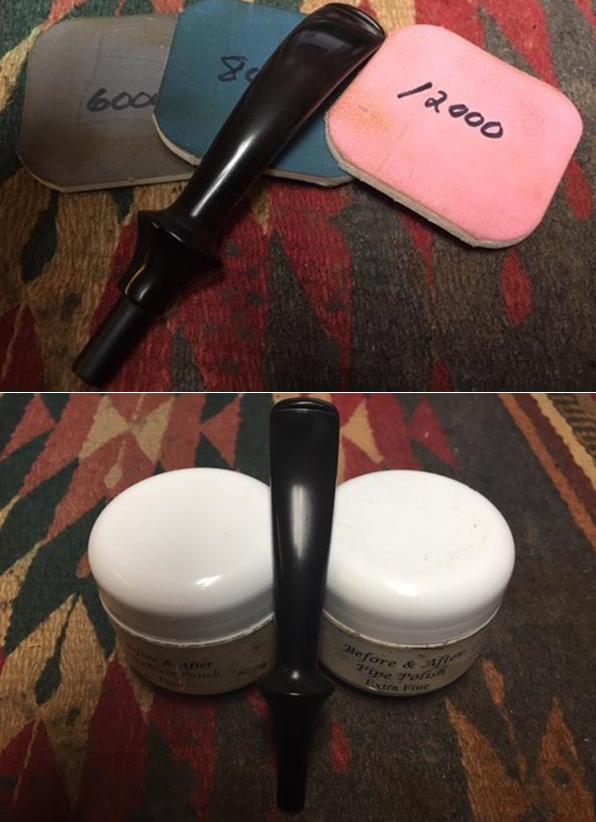
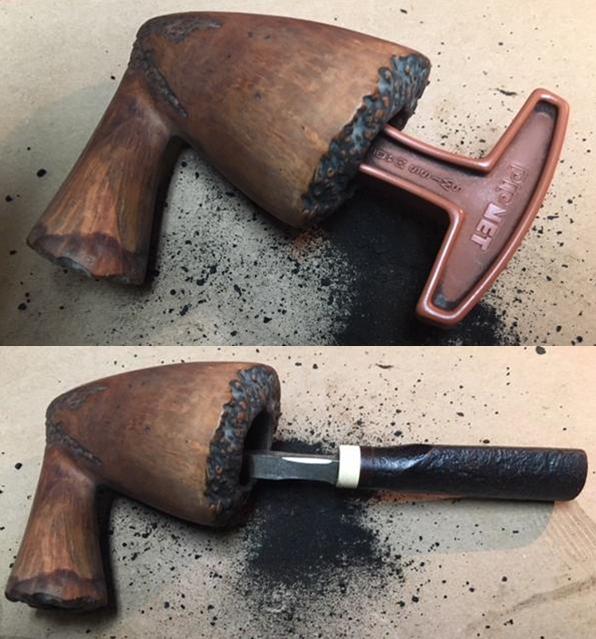
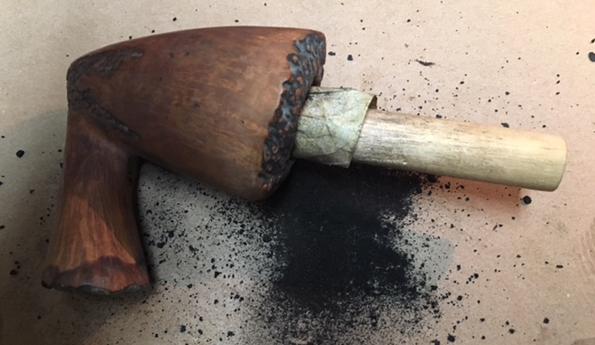
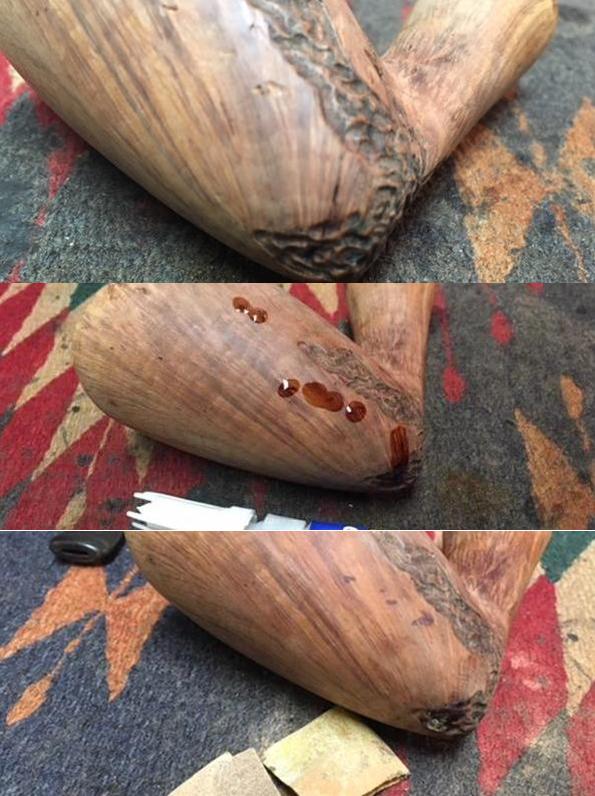
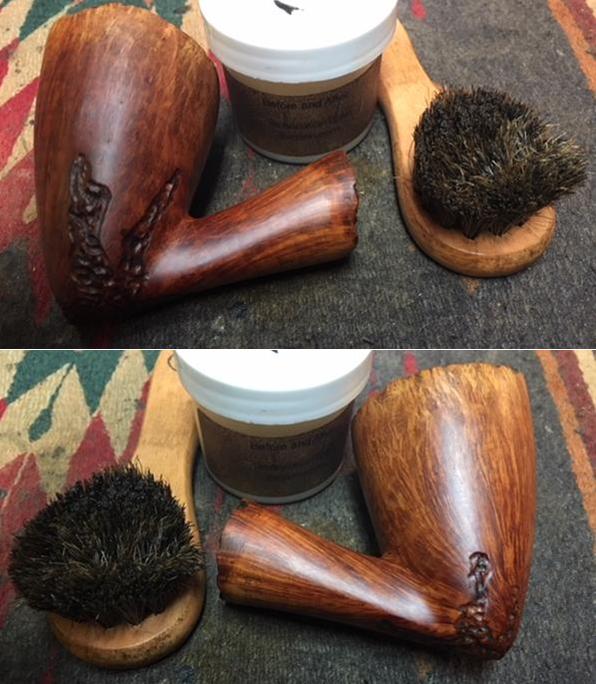
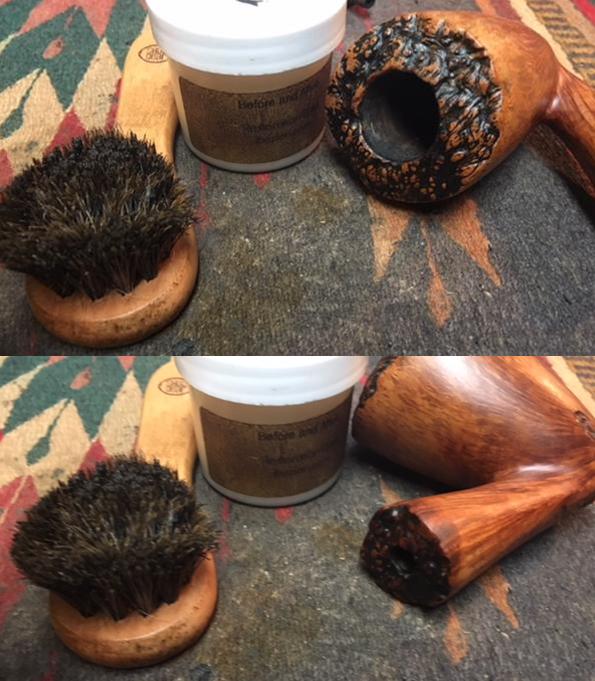
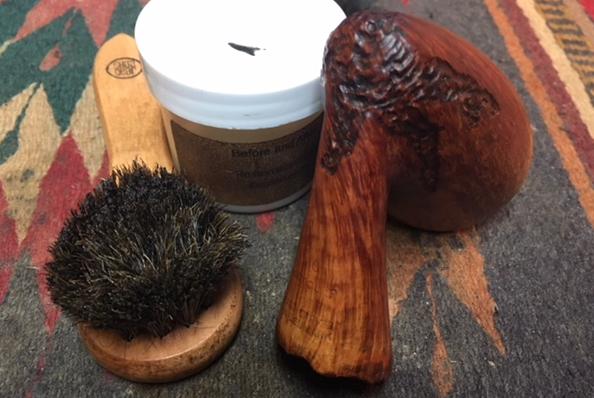
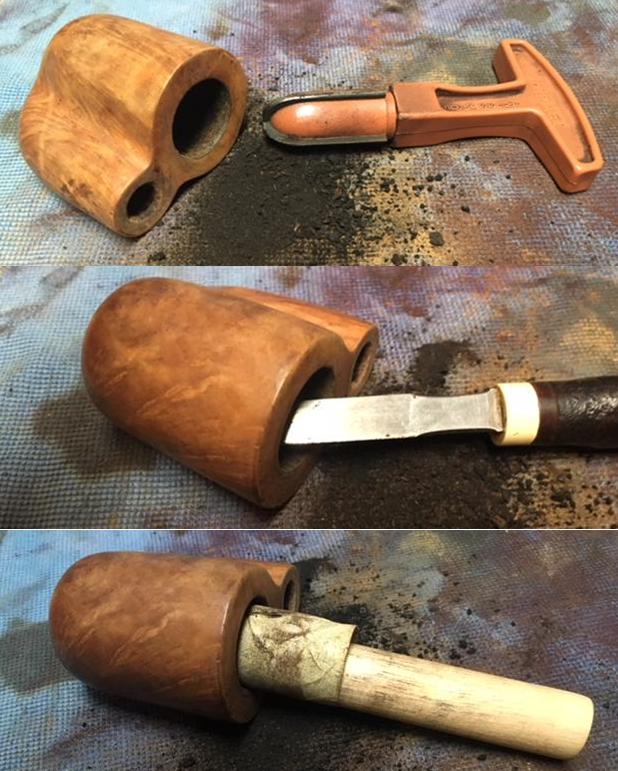
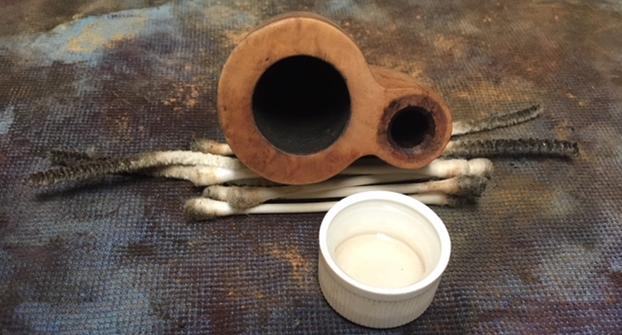
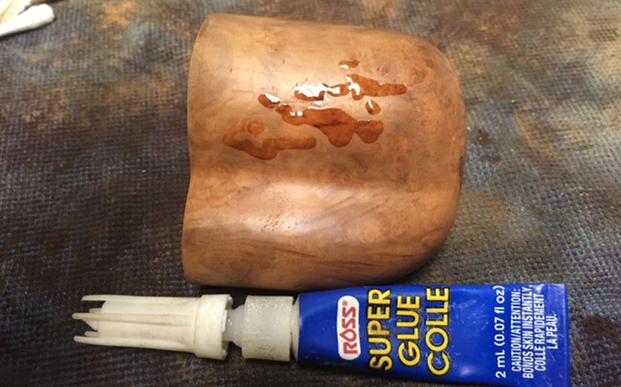
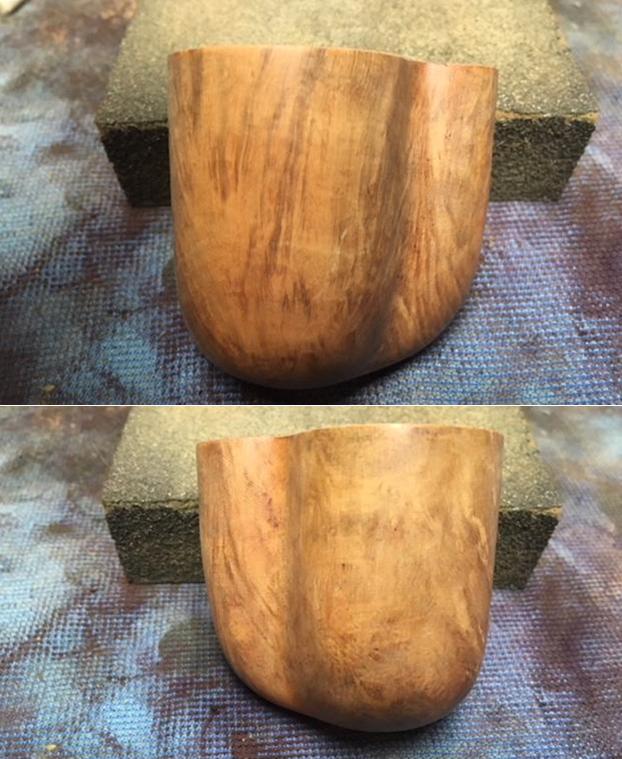
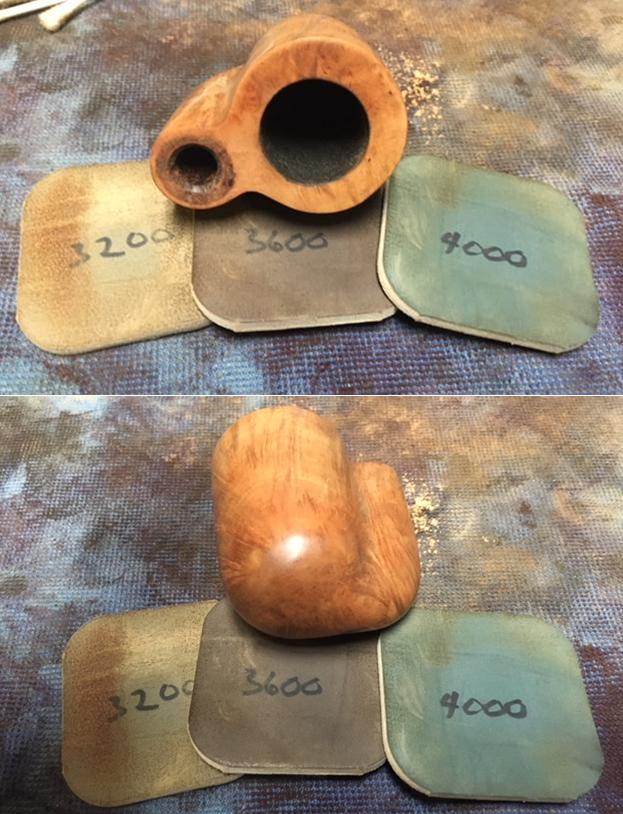
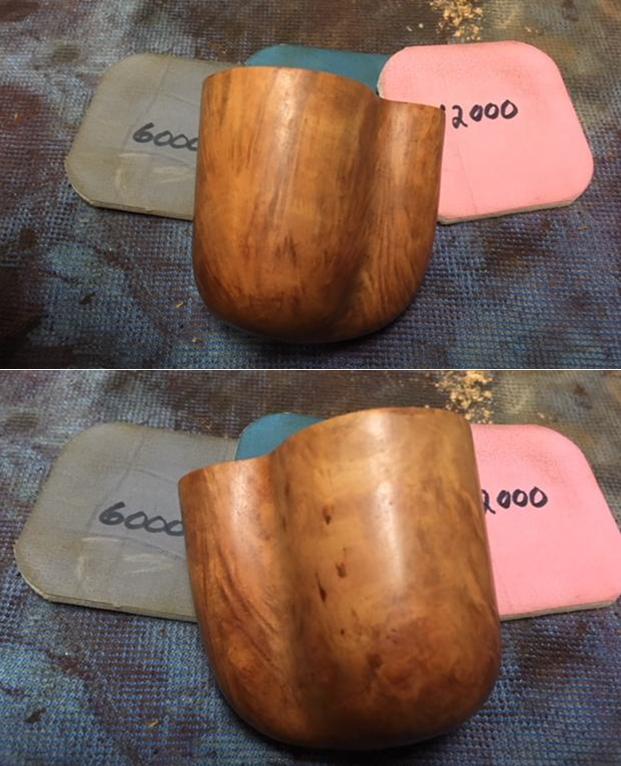
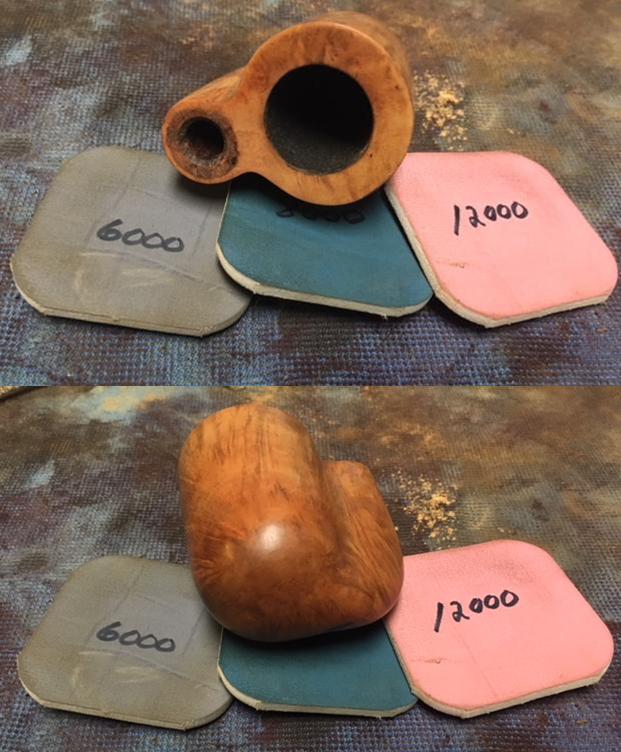
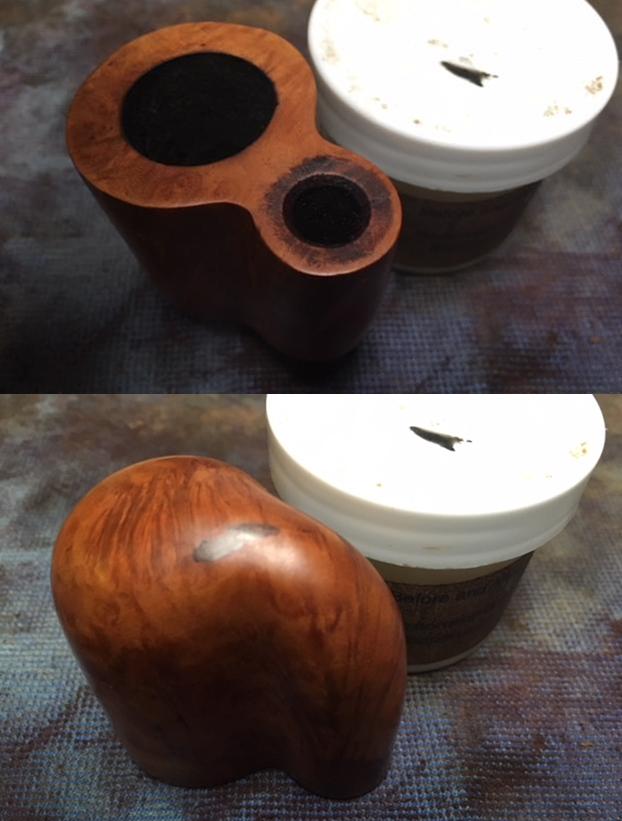
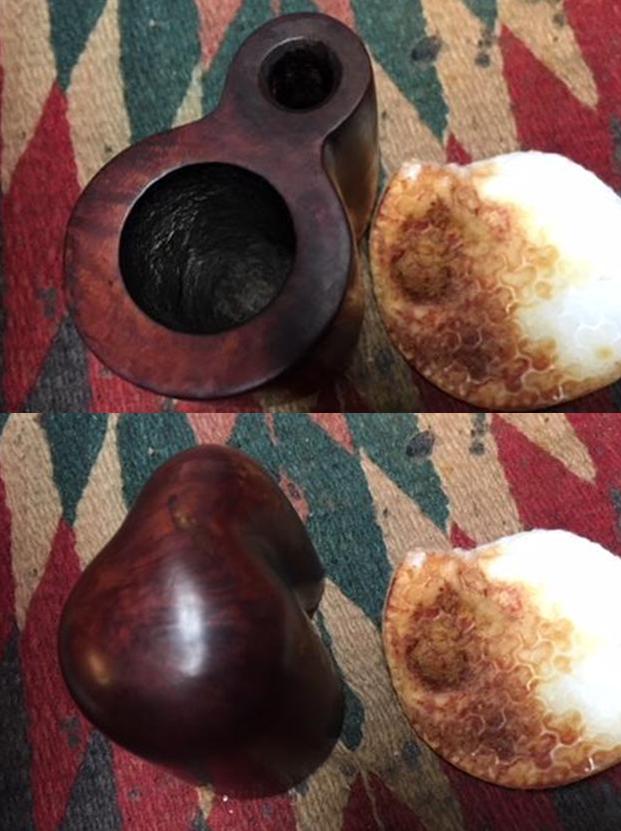
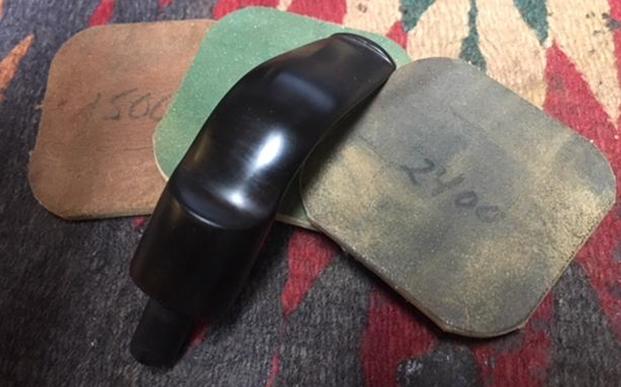
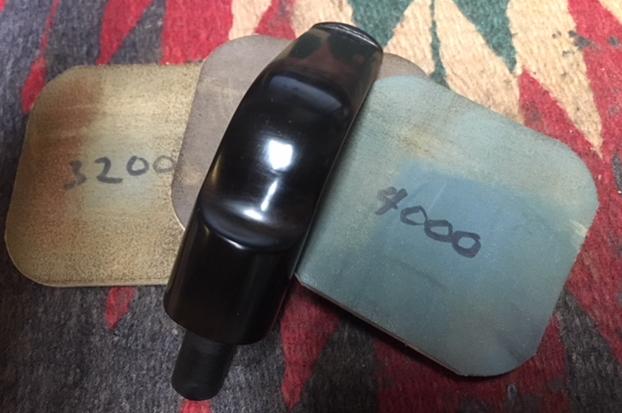
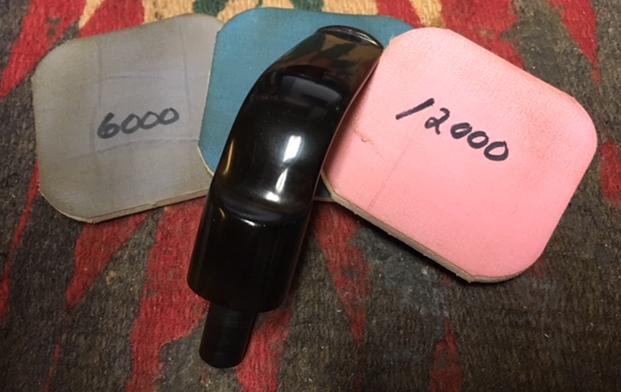
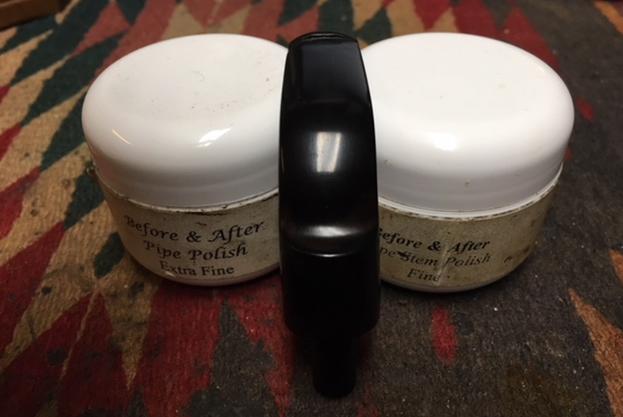
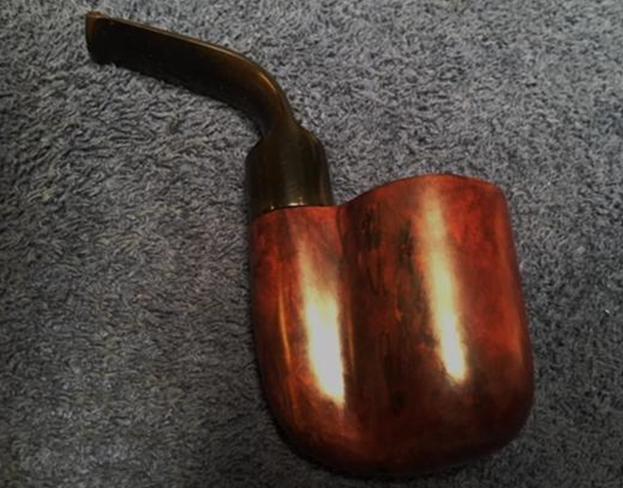
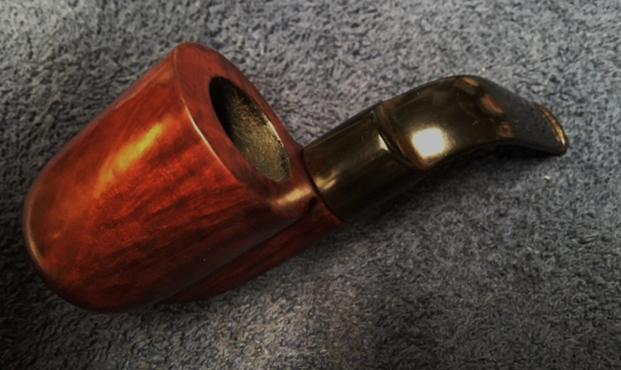
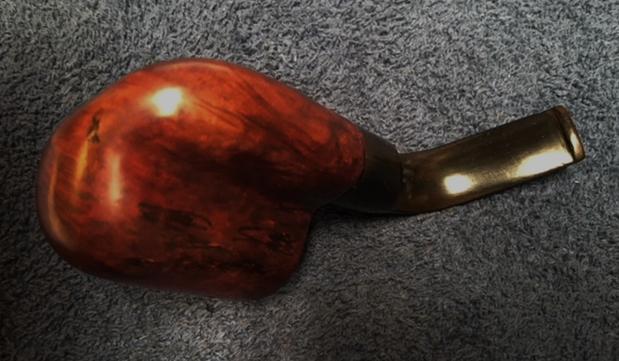
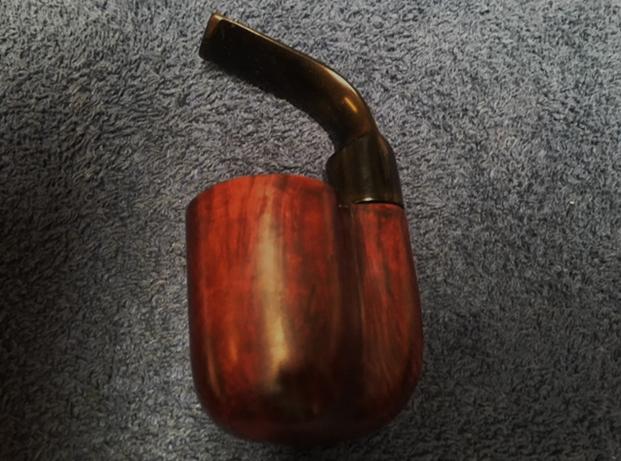
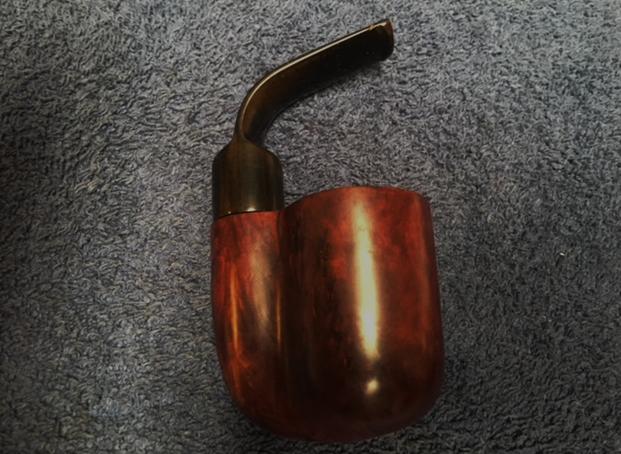
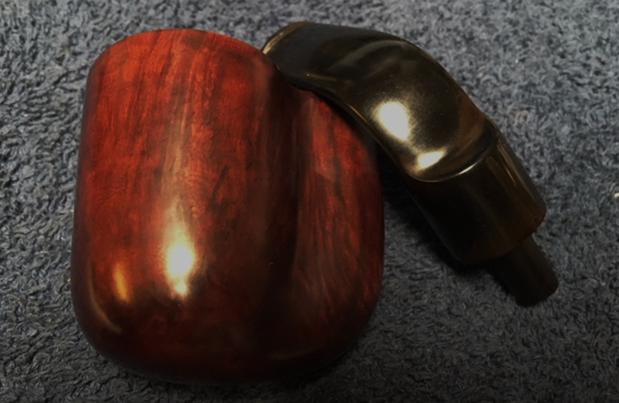
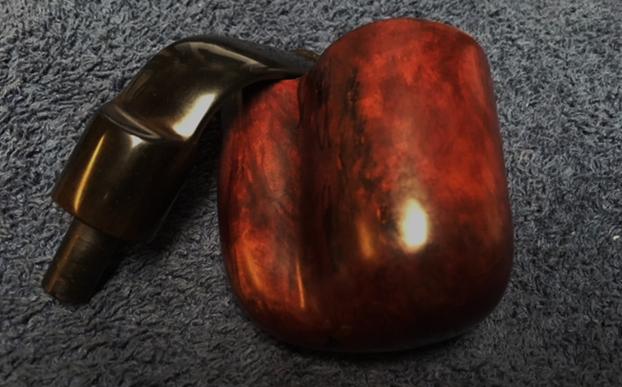
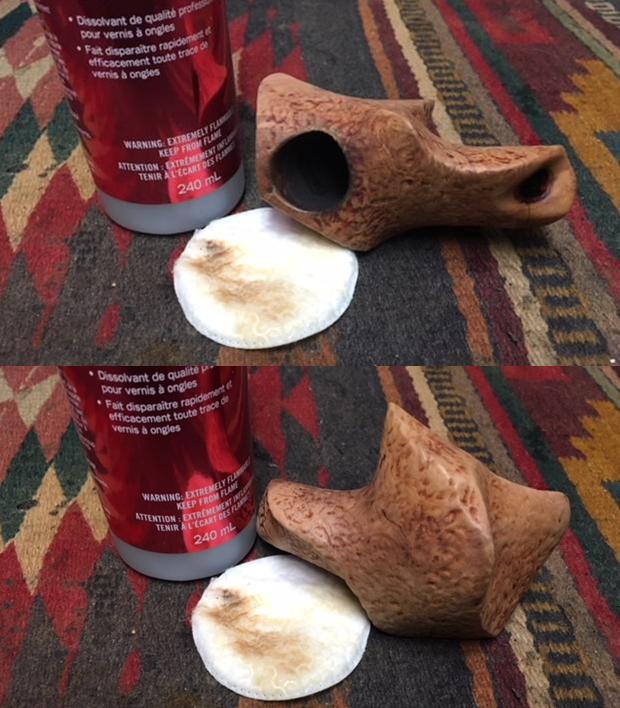
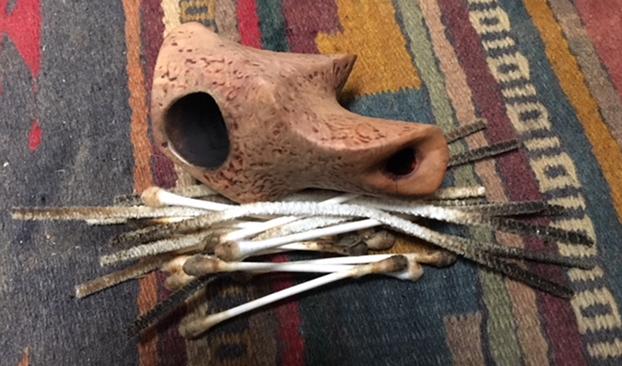
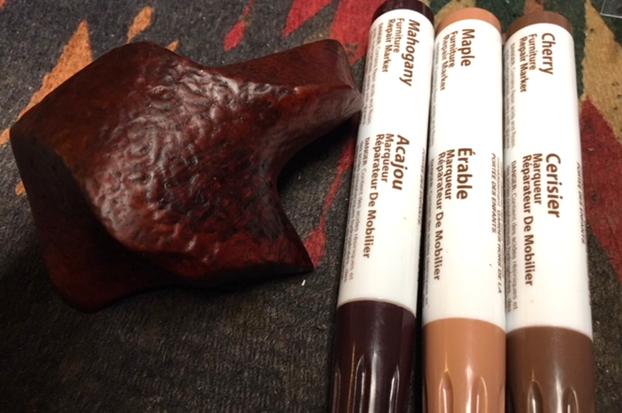
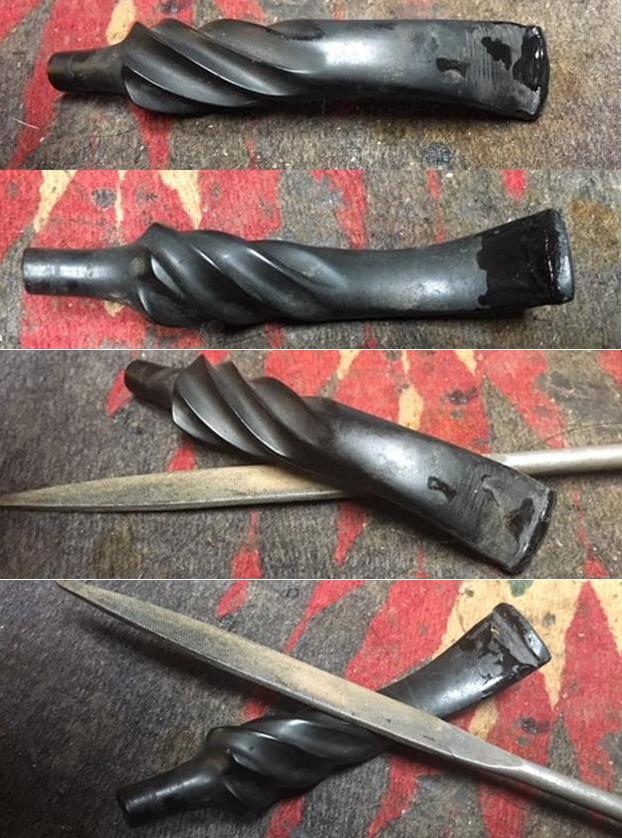
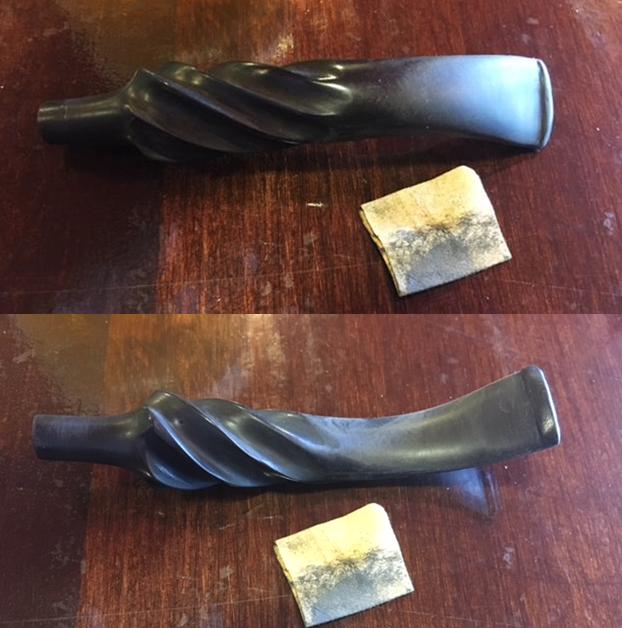
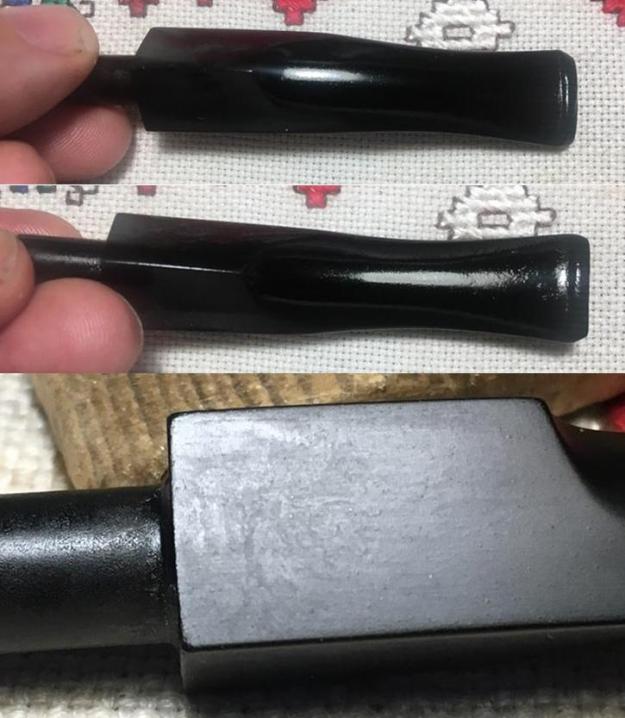
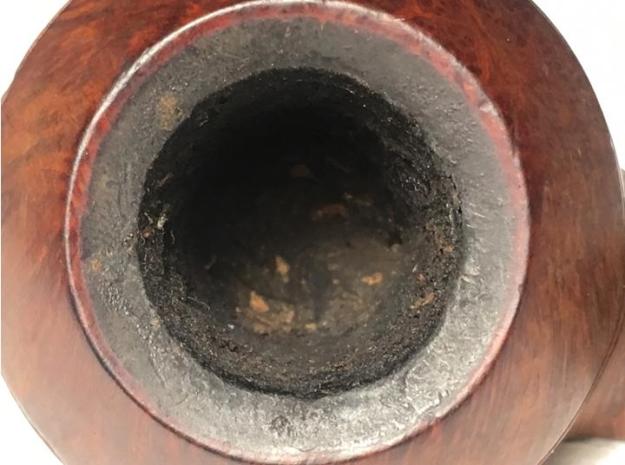
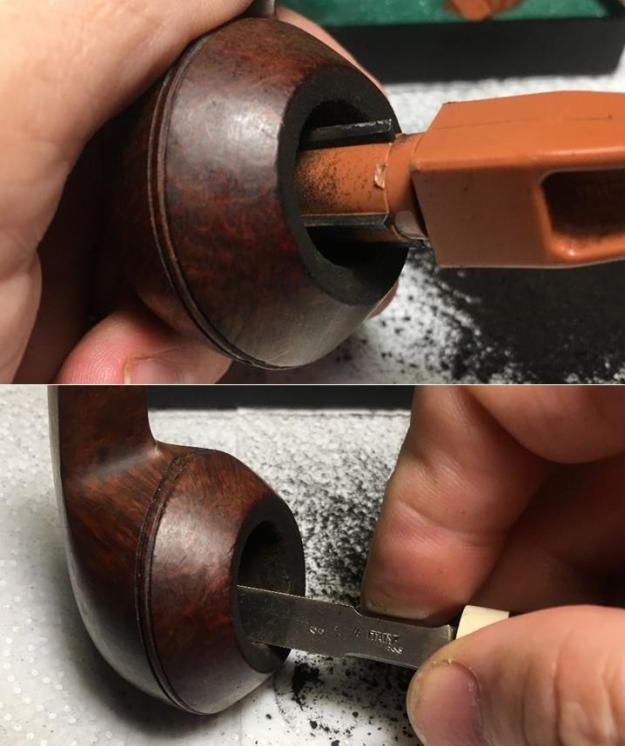
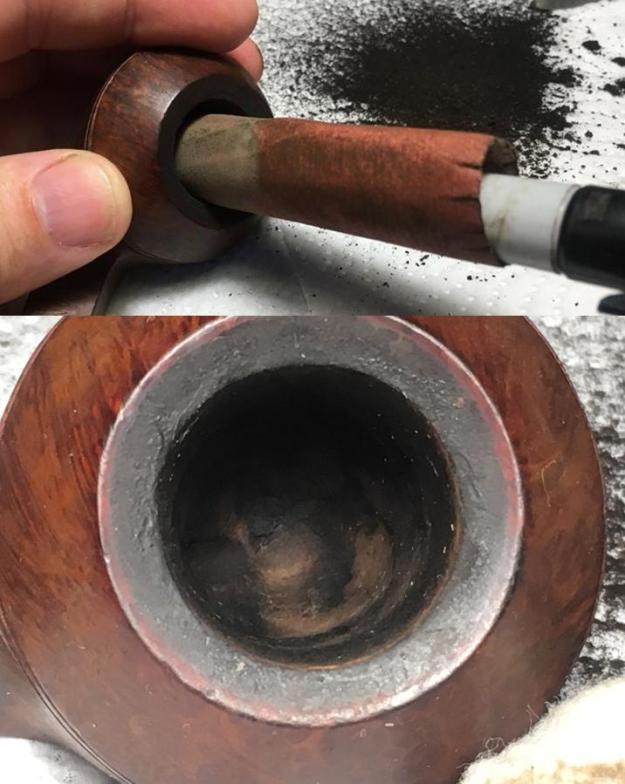
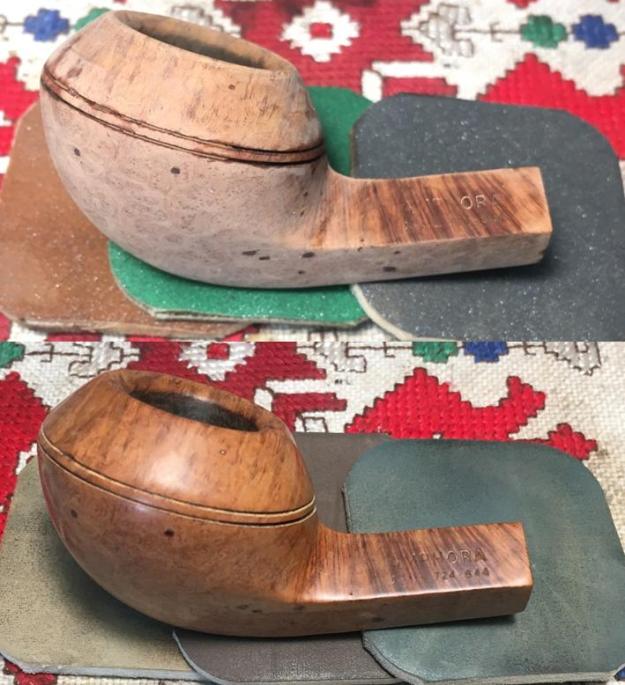
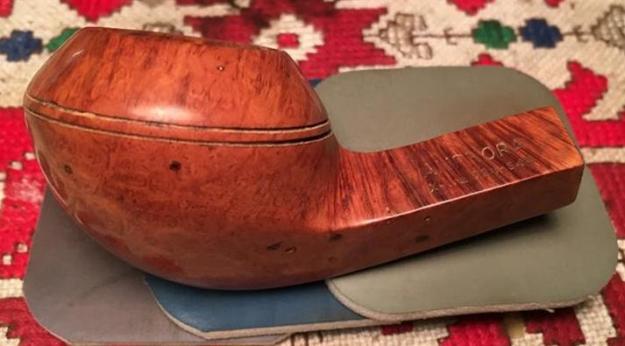
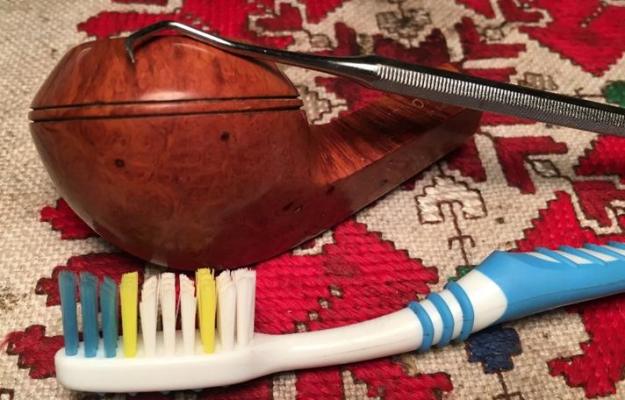
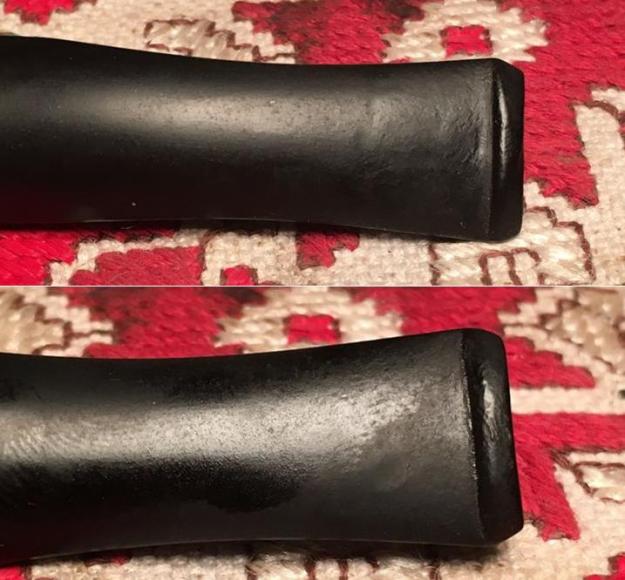
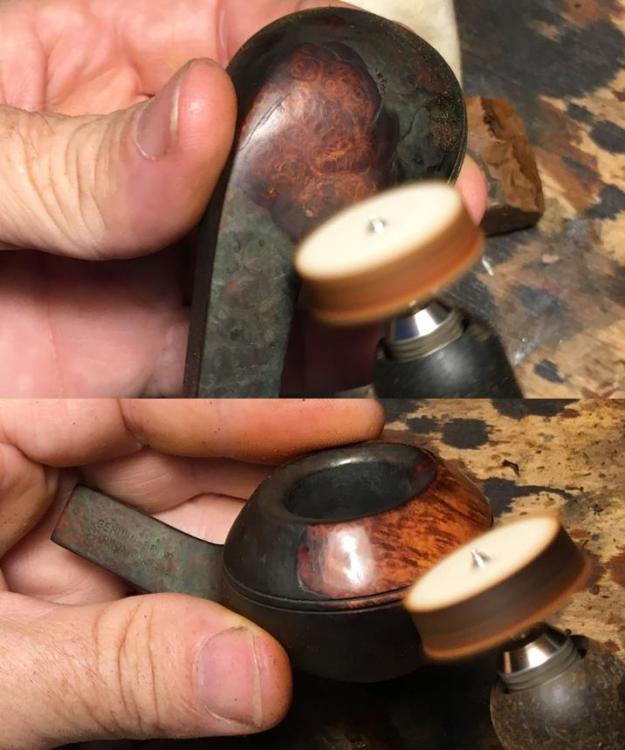
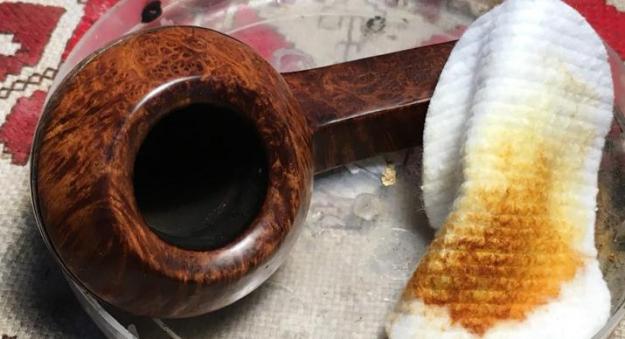
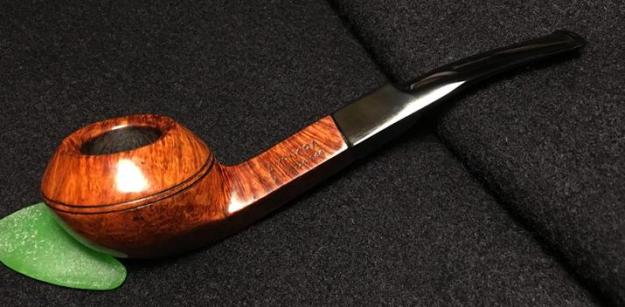
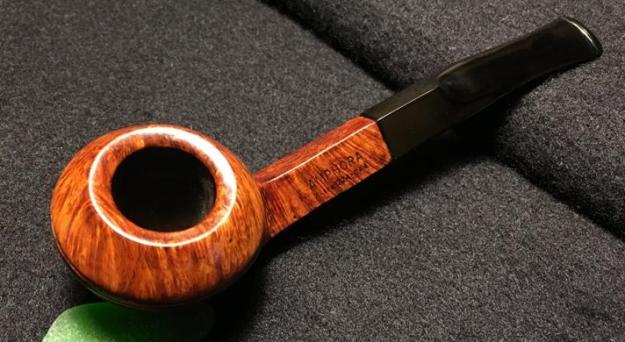
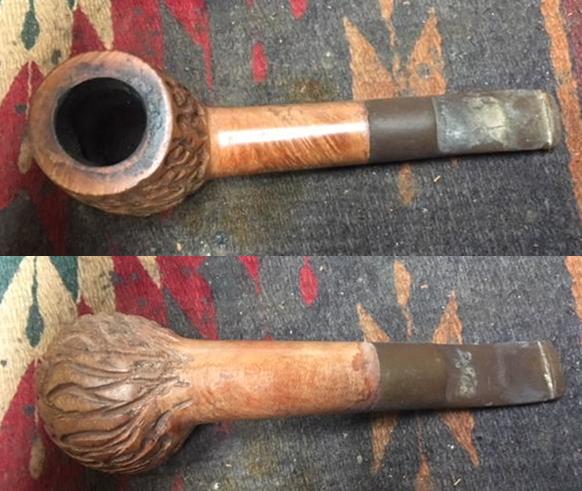
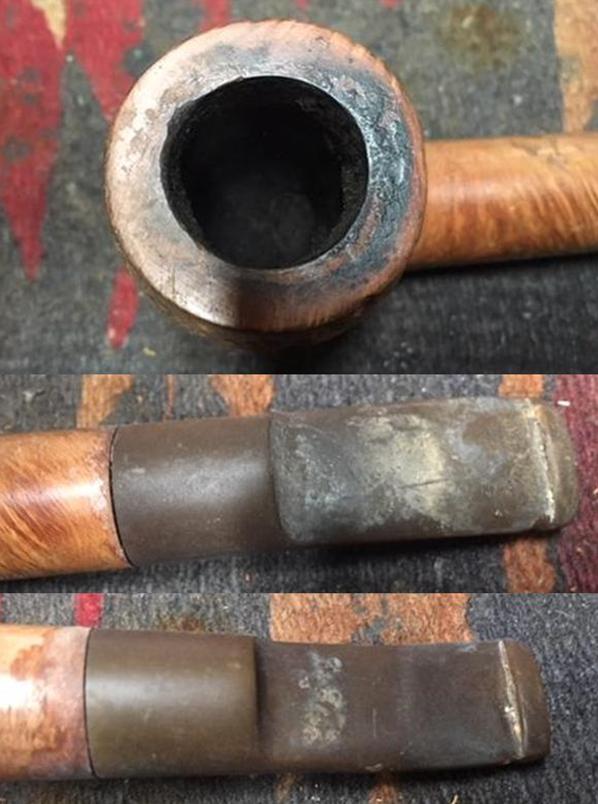
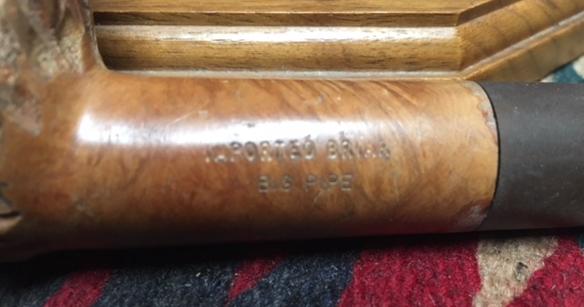
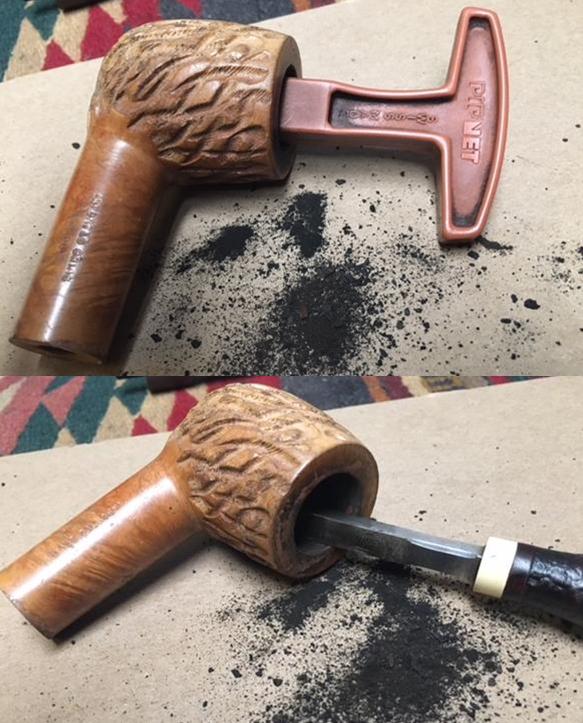
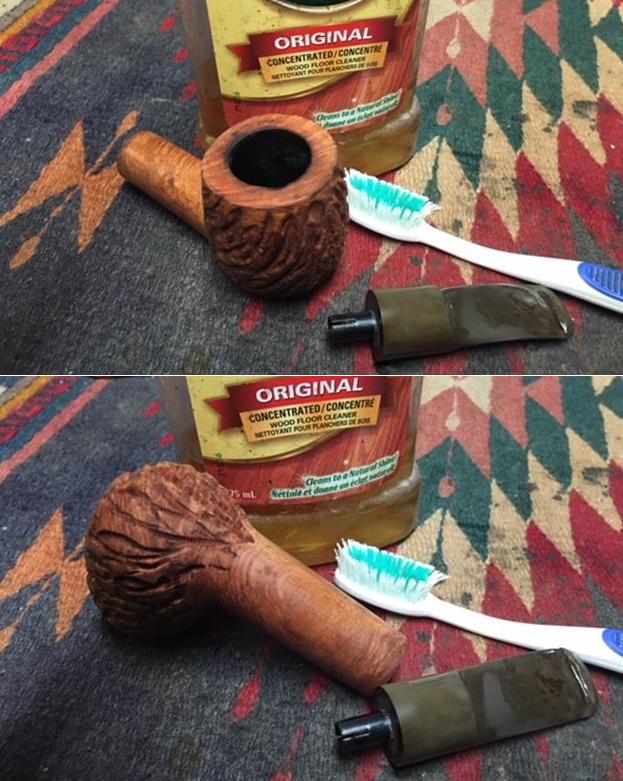
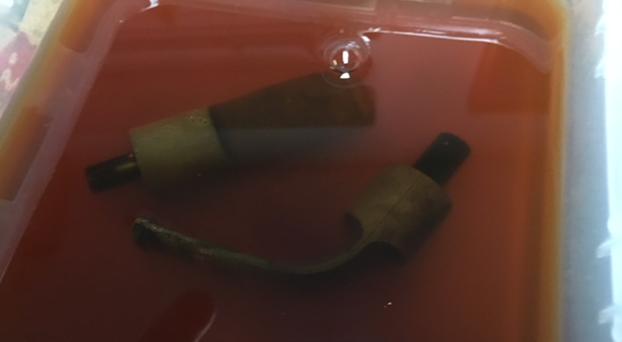
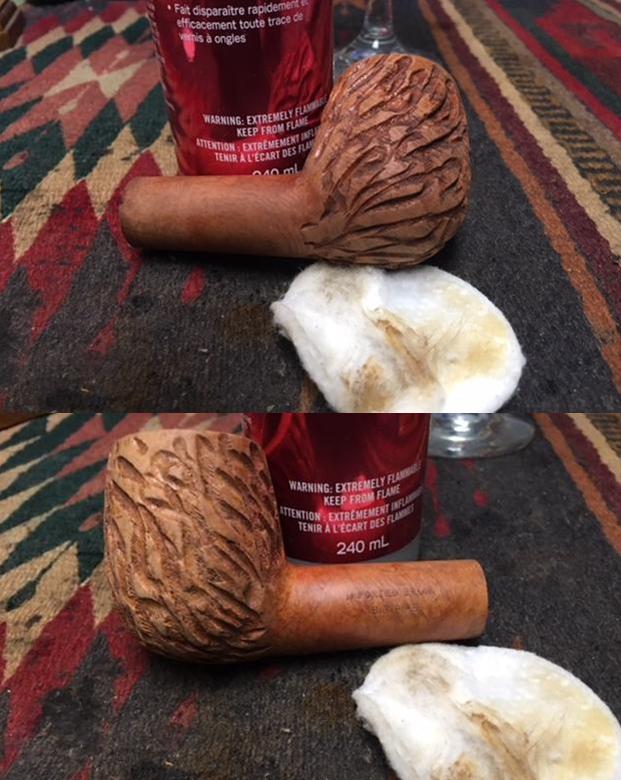
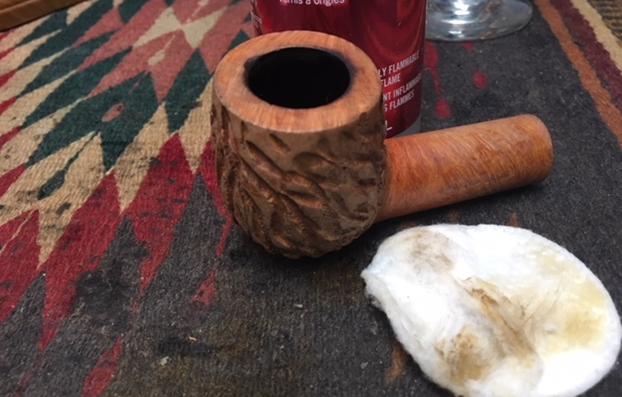
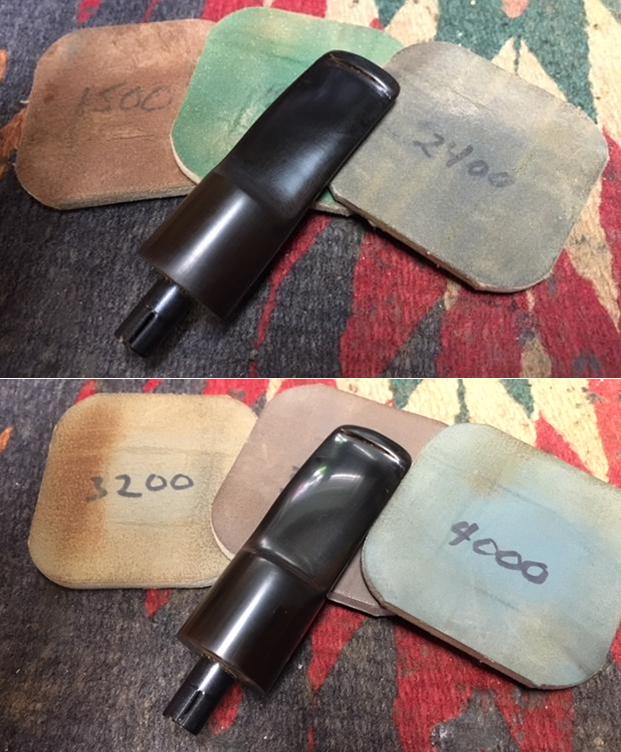
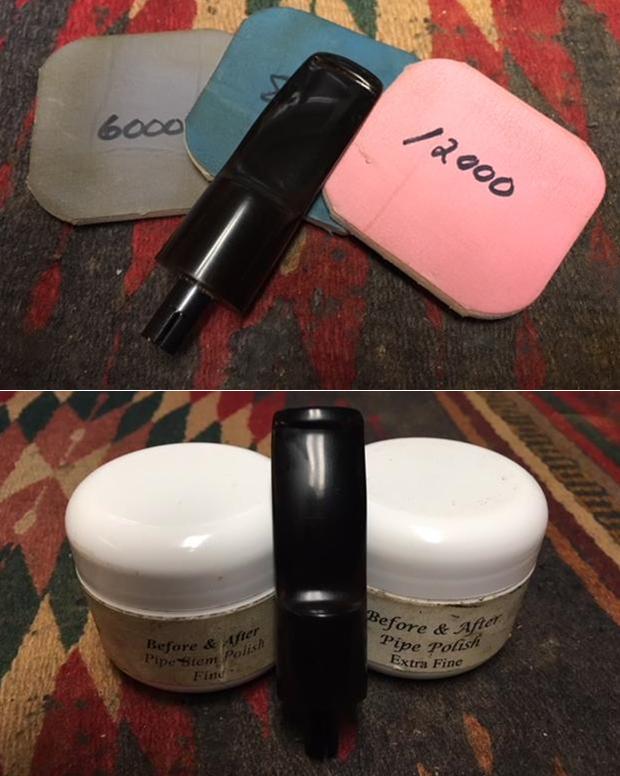
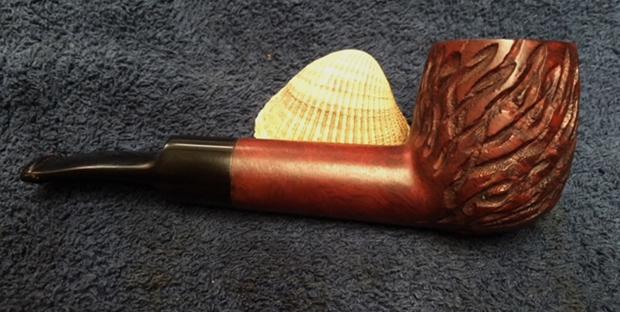
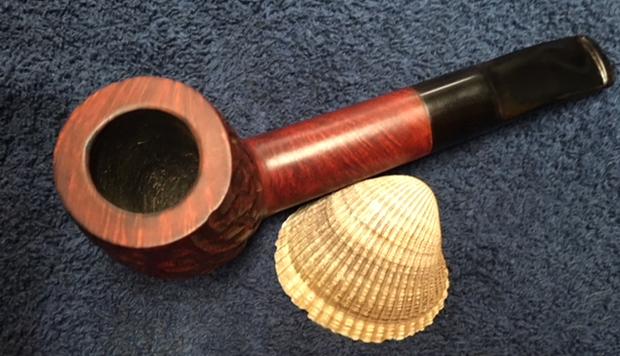
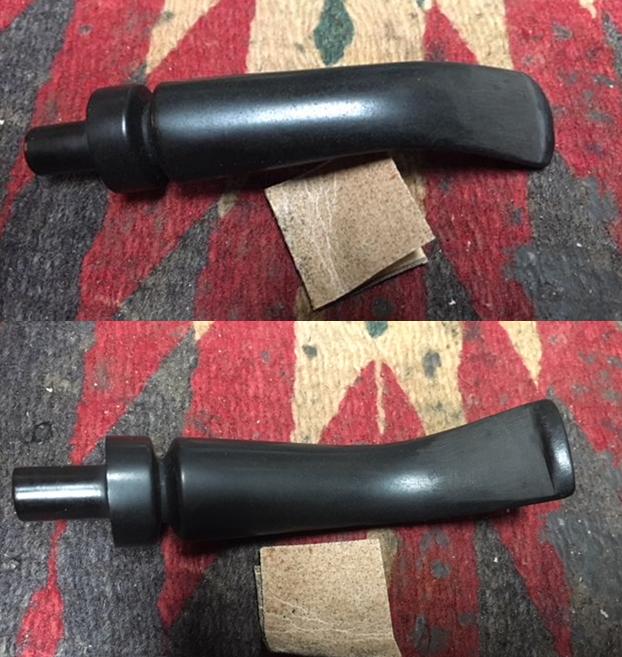
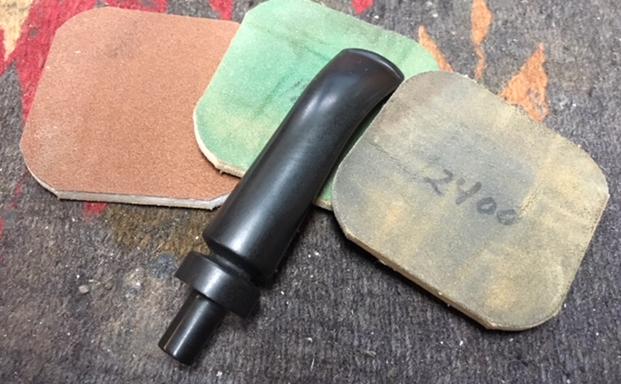
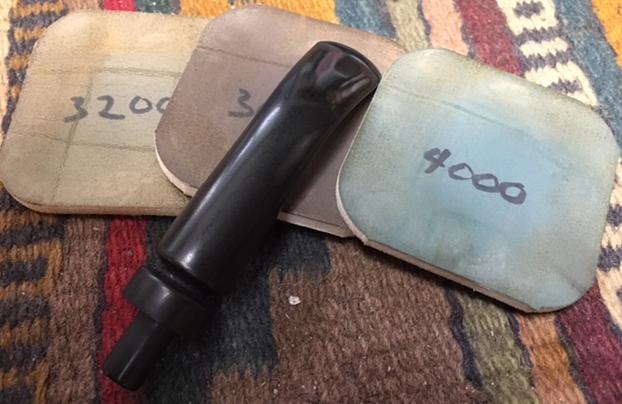
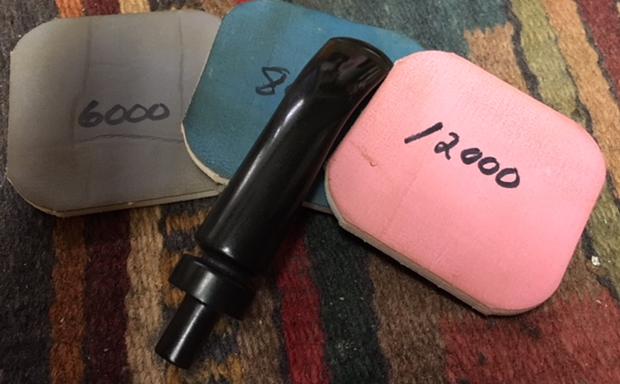
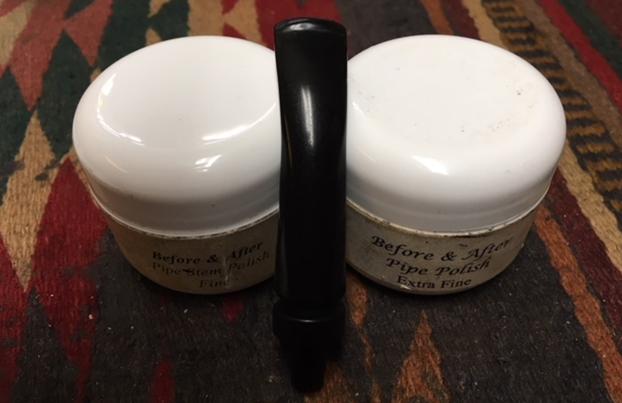
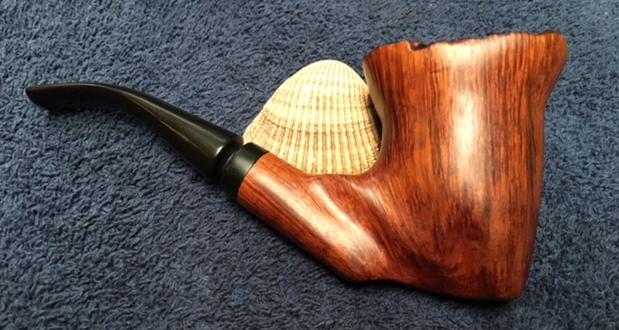
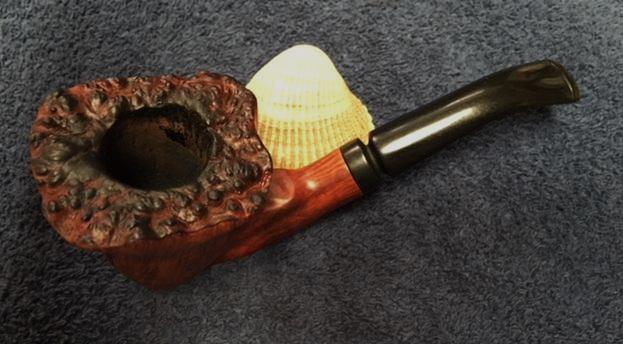
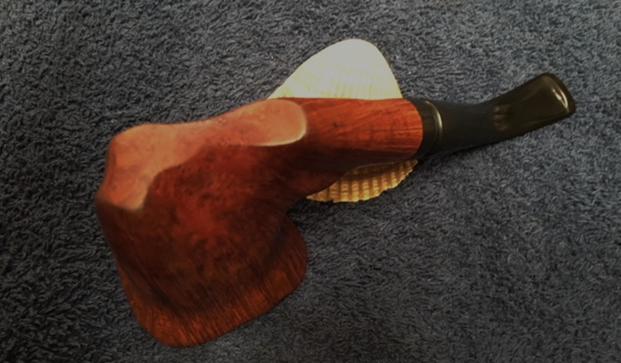
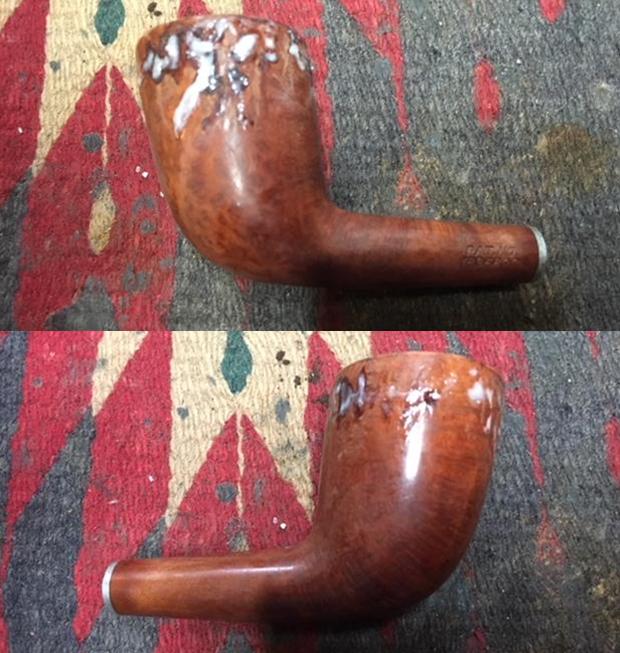
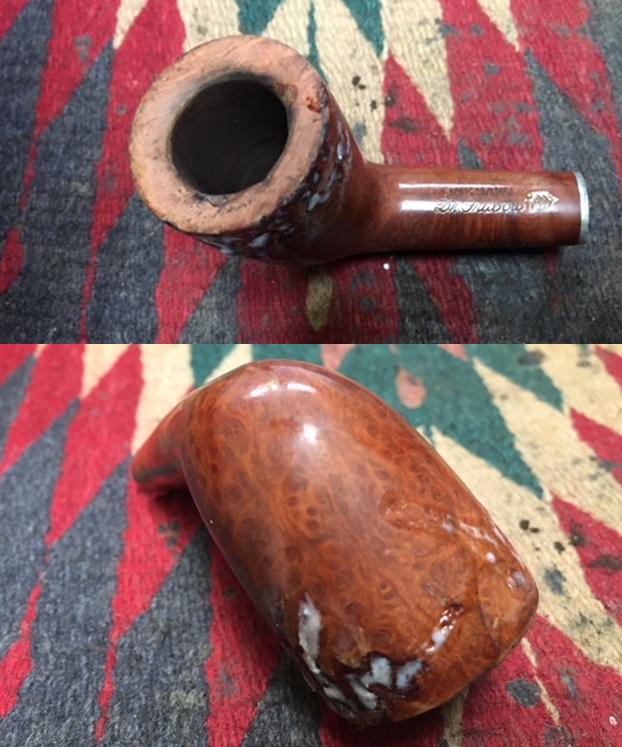
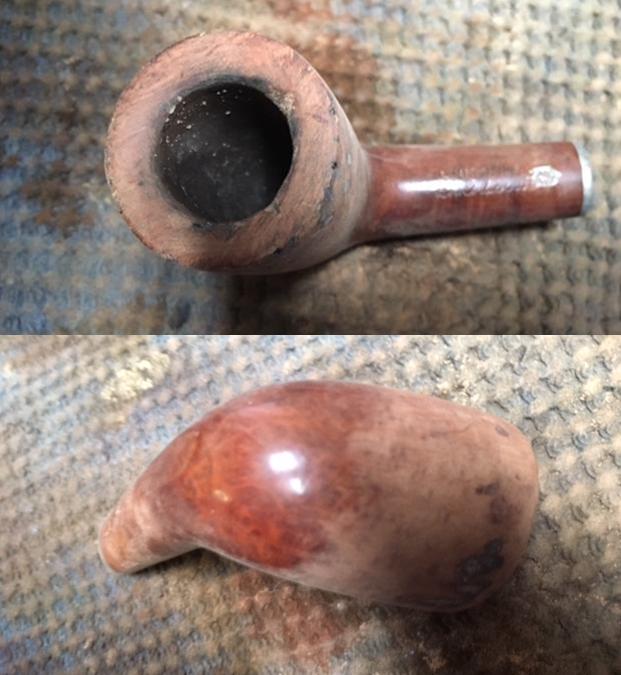
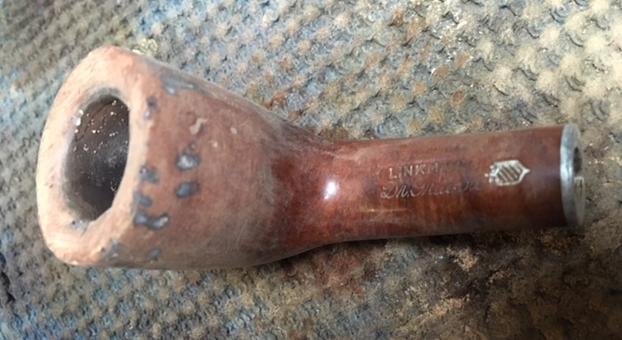
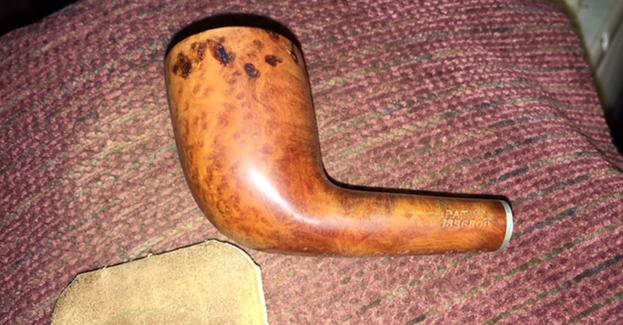
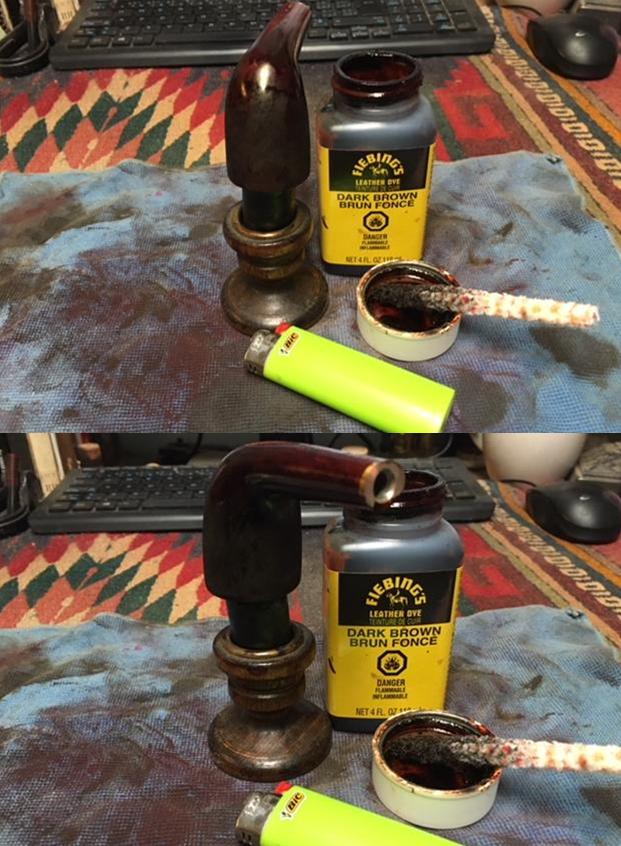
Not too long ago I sent a meerschaum lined pipe to Jim. He received it and sent me a note saying that he had sent two pipes to me to have a look at and refurbish. The first of them was a Bullmoose shaped pot. It was an interesting shaped pipe and was stamped on the left side of the shank with the words London Royal and on the right side Imported Briar. I looked on Pipephil’s website http://www.pipephil.eu/logos/en/logo-l5.html and found the following.It appears that the pipe was made by LH Stern (LHS) in Brooklyn, New York in the US. The pipe that Jim sent to me was in rough shape. The bowl had a thick cake and the rim had a lava overflow and had been hammered out on hard surfaces to the point that the bowl front at the top was beaten and damaged. The inner edge of the rim top was damaged and the bowl was out of round. The finish was in really rough condition as well. It was cloudy and looked like the pipe was water damaged. It had a 14K thin gold band on the shank end and a saddle stem that had some tooth chatter and tooth marks on both the top and underside near the button. There was a faint hat logo on the left side of the saddle. The vulcanite was lightly oxidized but otherwise the damage was quite minimal. Jim included a note in the package that said the slot was too narrow to take a pipe cleaner. The tenon was threaded and still aligned with the shank. With a pipe in this condition I am always looking for pluses. I took close up photos of the rim top and the stem to show the general condition of the bowl and stem surfaces. The close up of the rim top shows the dents and damage to the front of the rim top. The out of round bowl edge is also visible. There is a thick cake in the bowl and lava overflow on the top surface. The stem is in decent condition. There are some tooth marks on the top and underside near the button. The gold band also has some damage to the finish and the band is loose on the shank. It is not torn or split.I unscrewed the stem from the shank and the inside of the mortise and the threaded tenon was dirty and coated with thick tars and oils.I reamed the bowl with a PipNet pipe reamer. I used the third cutting head and took the cake back to bare walls. I cleaned it up with a Savinelli Fitsall Pipe Knife to remove all remaining remnants of cake.I wiped down the outside of the briar with acetone on cotton pads to remove the spotted, water damaged finish on the bowl and shank. I took photos to show how it looked at this point in the process. I topped the bowl lightly on a piece of 220 grit sandpaper on a topping board. I sanded the bowl with folded pieces of 220 grit sandpaper to remove the finish.I wiped the bowl down with alcohol on cotton pads. I filled in the damaged areas on the bowl and rim top with clear super glue.Once the glue dried I sanded the repaired areas back to smooth. I wanted to blend the repaired spots into the surface of the briar. The band was loose on the shank so I removed it and cleaned off the briar and the inside of the band so I could reglue it to the shank.I cleaned out the inside of the shank with pipe cleaners, cotton swabs and alcohol to remove the tars and oils that had built up on the threads of the metal insert and the mortise ahead of the insert.I polished the briar with micromesh sanding pads – wet sanding with 1500-2400 grit pads and dry sanding with 3200-12000 grit pads. I polished the gold band at the same time. The photos that follow show the progress. I used a Maple stain pen to touch up the sanded rim top. I scrubbed the bowl with Before and After Restoration Balm. I rubbed it into the surface of the briar to enliven, clean and protect the briar. It also evened out the stain on the rim top. I buffed the bowl with a cotton cloth to polish the briar. I used some Weldbond all-purpose white glue to reset the band on the shank. I pressed it place and aligned the 14K stamp on the band on the underside of the shank. I wiped off the excess glue with a water dampened cotton pad.I set the bowl aside and turned my attention to the stem. I sanded the stem with 220 grit sandpaper to remove the oxidation on the surface of the vulcanite. I sanded out the tooth chatter and also sanded around the tooth marks on both sides.I used needle files to open the slot in the button of the stem. I reshaped and opened it to make it easier to push a pipe cleaner through the slot. The first photo shows the slot before I had worked on it. The second one shows the opened slot.With the slot opened I was able to clean out the inside of the stem and tenon. I used pipe cleaners, cotton swabs and alcohol to clean out the oils. I scrubbed the threads on the tenon with steel wool and alcohol.I used some Rub’n Buff Antique Gold to touch up the top hat logo on the left side of the saddle stem.I polished the stem with micromesh sanding pads – wet sanding the stem with 1500-2400 grit pads and dry sanding it with 3200-12000 grit pads. The photos show the increasing shine on the stem. I finished by polishing it with Before and After Pipe Stem Polish – both Fine and Extra Fine and hand buffed it with a soft cloth. This Imported Briar London Royal Bullmoose Pot turned out to be a real beauty with a mix of interesting grain underneath the grime and the damaged finish. The grain really is quite stunning. The rim top looks much better. The vulcanite stem is high quality and shined up well. I buffed the bowl and the stem with Blue Diamond polish to raise the shine on the briar and the vulcanite. I was careful to not buff the stamping and damage it. I gave the bowl and stem multiple coats of carnauba wax. I buffed the entire pipe with a clean buffing pad to raise the shine. I hand buffed it with a microfiber cloth to deepen the shine. The finished pipe is shown in the photos below. The rich brown stain allows the grain to really stand out on this little pipe and it works well with the rich black of the vulcanite stem. I will be sending it back to Jim once I finish working on his second pipe. I will be sending it to him soon and I know that he is looking forward to enjoying his first bowl in it. Thanks for walking through the restoration with me.

Two of Boston’s L. J. Peretti Oom Pauls Recommissioned


Blog by Dal Stanton

With all pipe man honesty, what could I do?  What would you do if faced with this staring at you on the eBay auction block?J. Peretti Co., all, looking back at me! – the pipe name that I had unintentionally started collecting and liking a lot. The seller was from Everett, Massachusetts, near Boston’s L. J. Peretti Co. Tobacconist, second oldest Tobacconist in the US. Even though Peretti Tobacconist is more known for their 1000s of custom blends of tobacco which I have enjoyed (see below presents from last Christmas from my daughter-in-law!), they have also produced pipes over the years bearing the Peretti name.  It became obvious to me that this seller had Peretti estate pipes which had belonged to a pipe man who loved Peretti pipes, and I was attracted to the Lot for all the Peretti shapes that I do not yet have in my collection.  The massive amount of briar jumping out at me also caught my eye – oh my, Oom Pauls, and some sitters that were borderline Oom Pauls with strong ¾ bent stems and the quint essential long, tight, tall bowls.  Also, in the Lot I saw a large, graceful Bent Egg, a Calabash, a gentle Half Bent Billiard and a huge, colossus of a Billiard!  I was happy to bring this Peretti Lot of 10 back with me to Bulgaria destined for the worktable. My enjoyment of Peretti pipes started Christmas of 2016 with our family gathering in Denver.  My son, Josiah, secured a proud, square shank Billiard bearing the Peretti stamp and an amputated stem from the Armadillo Antique Mall.  I found it under the Christmas tree with Josiah’s encouragement, ‘Dad, I know you can do something with it!’  And I did.  I cannibalized another stem and spliced it on the existing stem – I wanted to save the Peretti ‘P’ stem stamp at all cost!  This stout square shanked Billiard is a good smoker and a regular friend in my rotation!Doing research for the Peretti Christmas gift stem splice restoration (See: LINK), introduced me to the Peretti name which I was surprised to discover is not an Italian pipe name, as I originally assumed!  The family originally came from the southern slopes of the Swiss Alps which would have much Italian influence, just to the south. I discovered the beginning of a significant story of Americana pipe history with the establishment of the L. J. Peretti Company of Boston in 1870 (Pipedia citing: Pipes, Artisans and Trademarks, by José Manuel Lopes), the second oldest tobacco shop in the US, second only to Iwan Ries & Co. of Chicago established in 1857 (See: Link).  Going to the Peretti shop in Boston is on my bucket list where blends are still hand mixed and I’ve read that you can take your pipe and try some blends out before purchasing.  Not bad.My second Peretti found me serendipitously in Oslo, Norway, as I, along with a few other colleagues met to take in the European Biathlon finals (that’s skiing and shooting!).  Jon gave me a very sharp looking square shanked Rhodesian, also bearing the name, Peretti.  He said he wasn’t using it anymore and I welcomed this Peretti into the fold.  I now had what I started calling, the Peretti Brothers.  Here is the restoration of the Peretti Rhodesian.In the Peretti Lot of 10, I’ve already restored the Large Bent Egg and added it to my collection of Perettis.  It is a stunning pipe and fits the palm amply and nicely!  When smoking this pipe, I’ve warded off random hawkers trying to barter him away from me!  I’ve remained strong.I have been looking forward to tackling the Oom Pauls for some time.  I will add one to my collection, and the others are up for adoption and will benefit a good and worthy effort, the Daughters of Bulgaria, helping women and girls (and their children) who have been trafficked and sexually exploited.  As I approach restoring the Oom Pauls, there is no doubt as to the popularity of this shape and that everyone wants to have at least one in their collection.  In Pipedia, Bill Burney’s description of the Oom Party is helpful:He also describes that the Oom Paul is always a full bent, with a large tobacco chamber and relatively heavy.  Yet, because of the way it hangs, it is a comfortable hands-free pipe.  To me, the attraction to the Oom Paul is the solid, massive merger between the bowl and shank – it creates a hefty presence in the palm and it hangs from the mouth great with the full bent style.

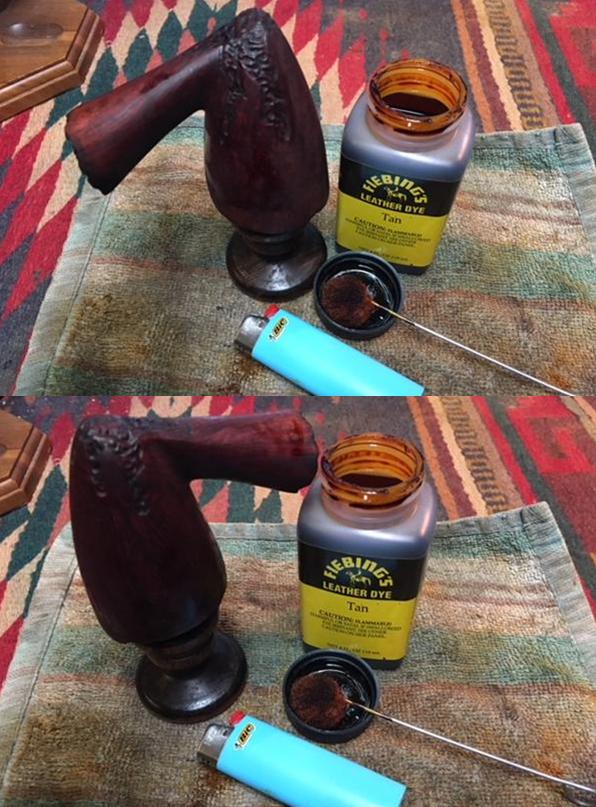
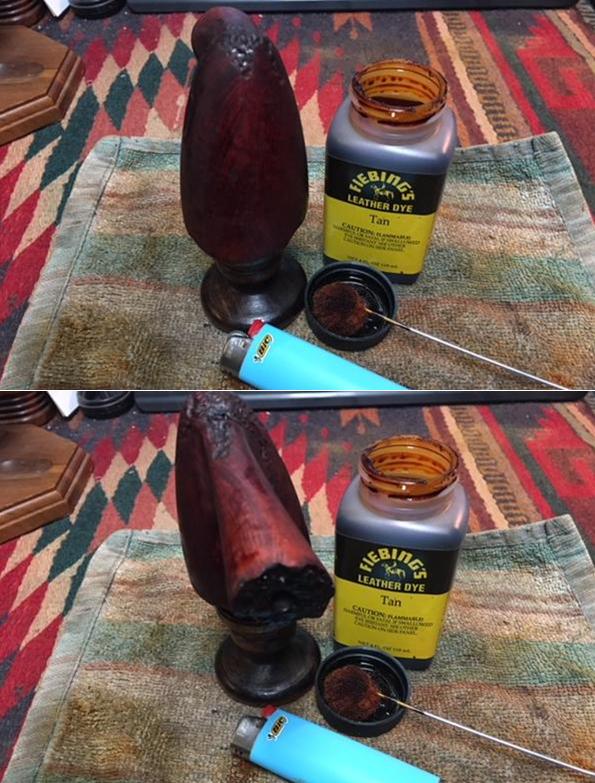
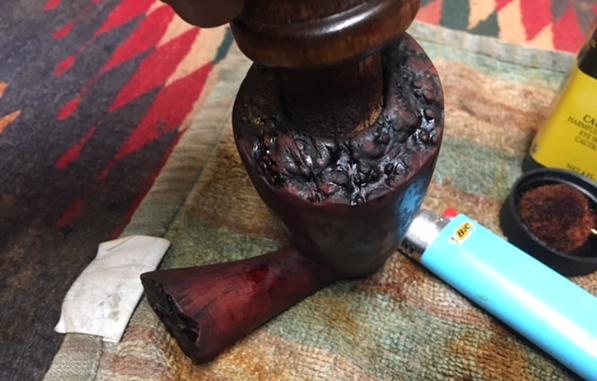
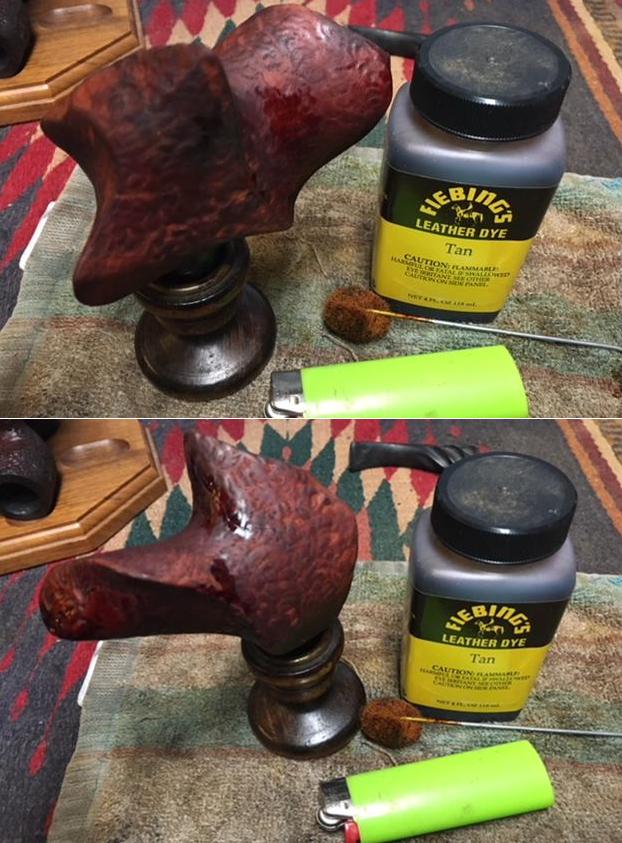
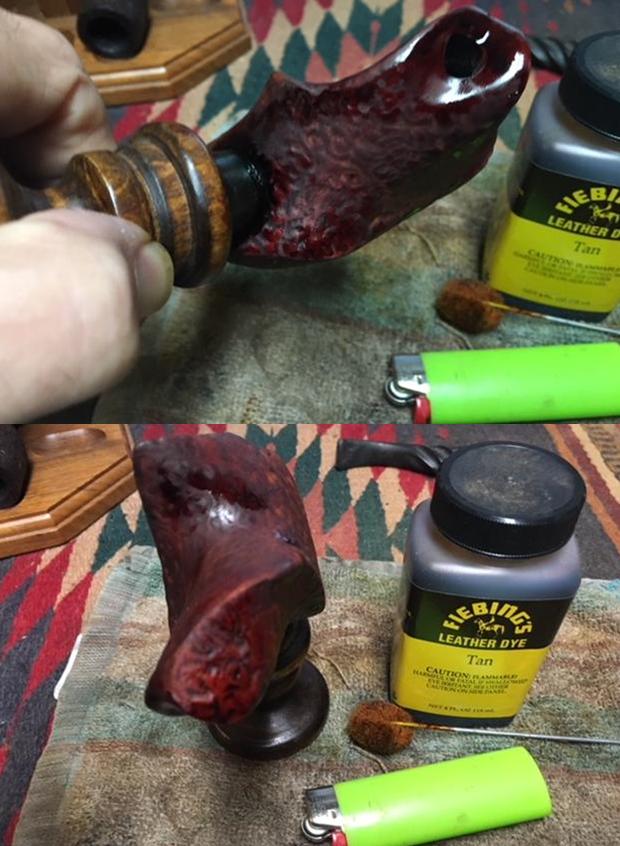
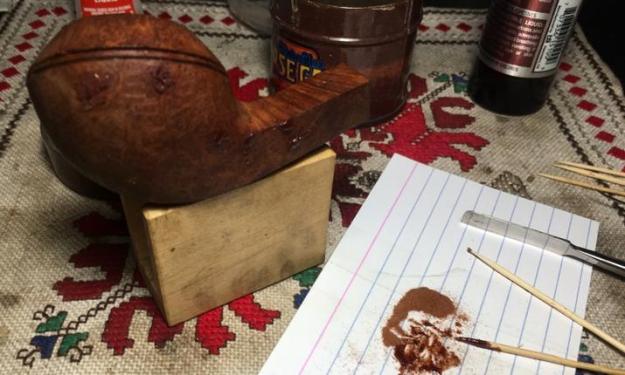
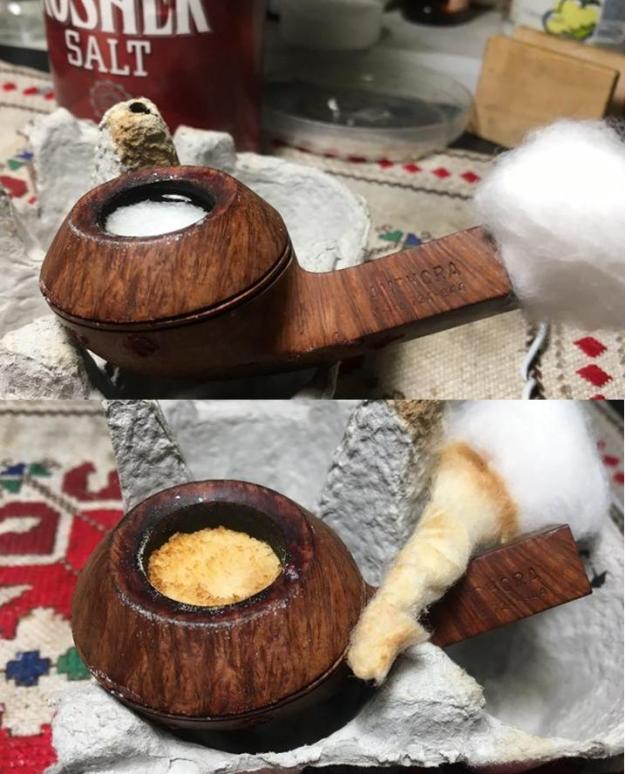
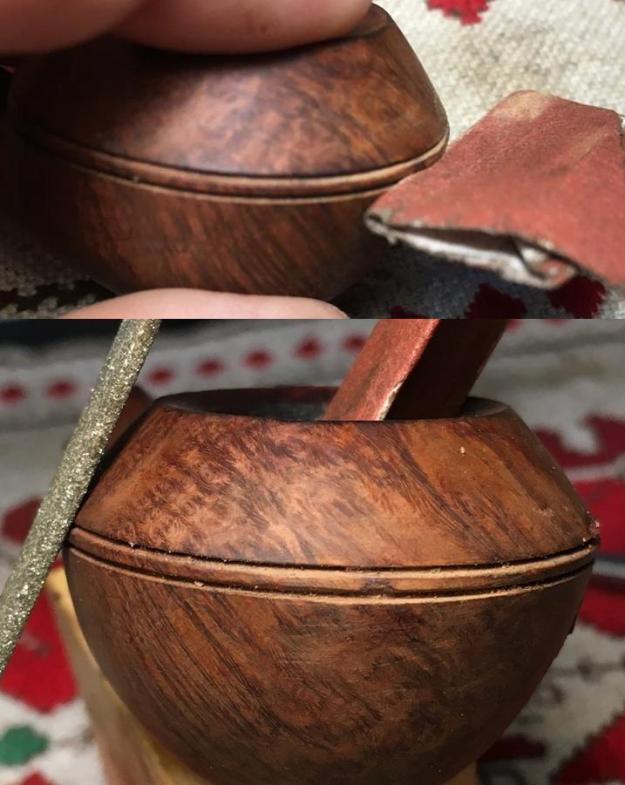
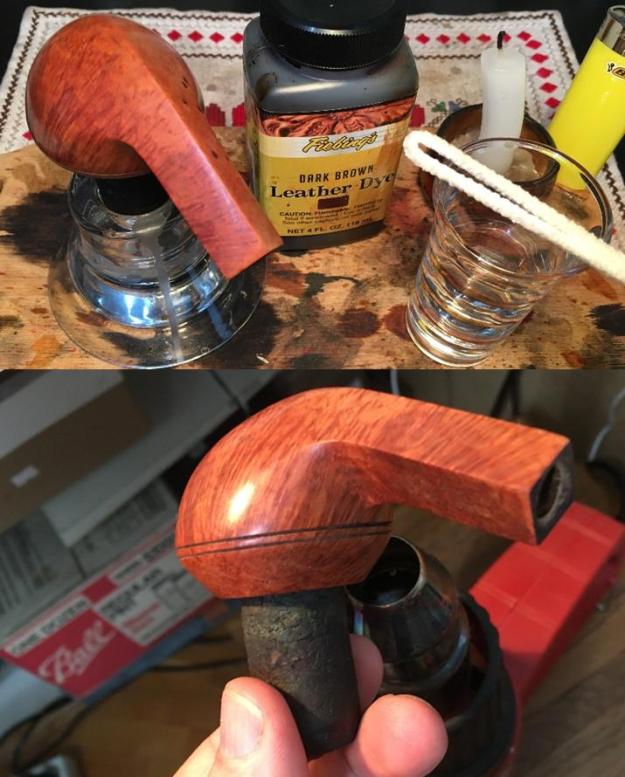
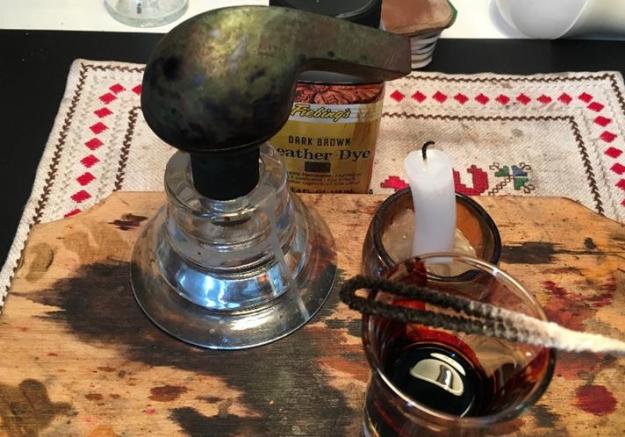
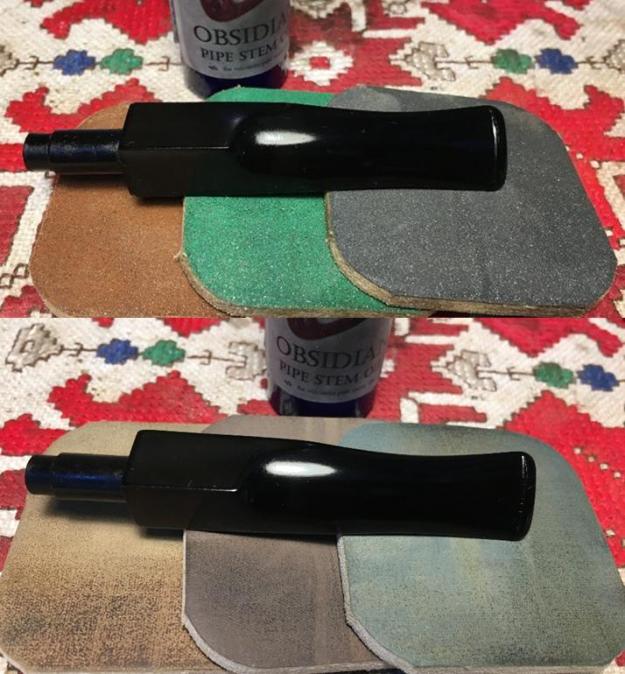
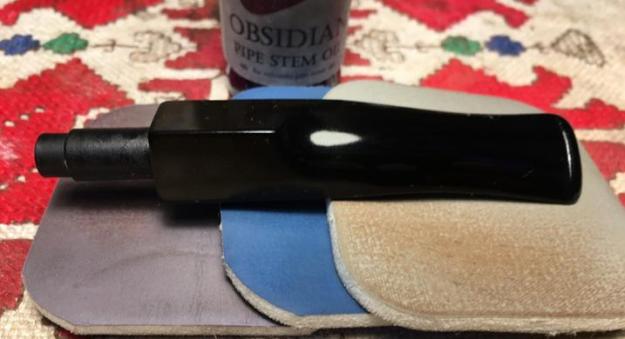
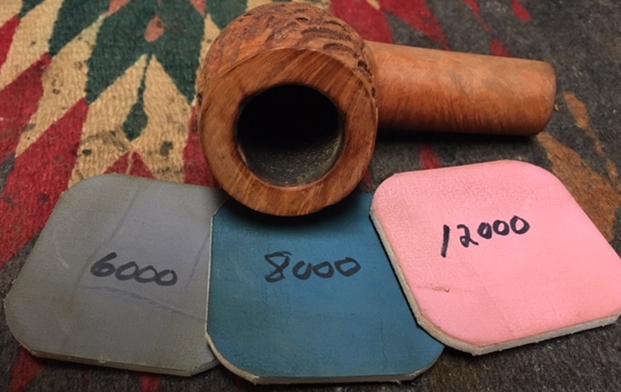
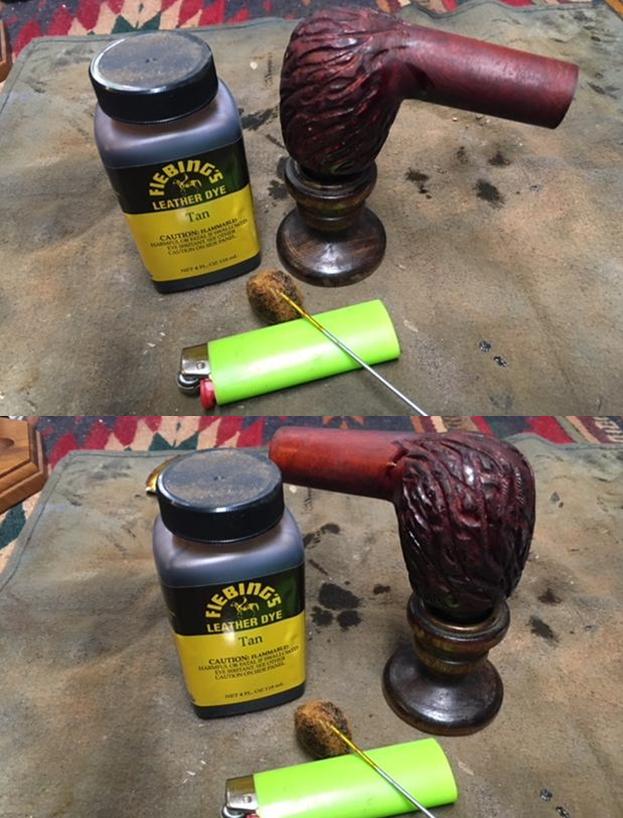
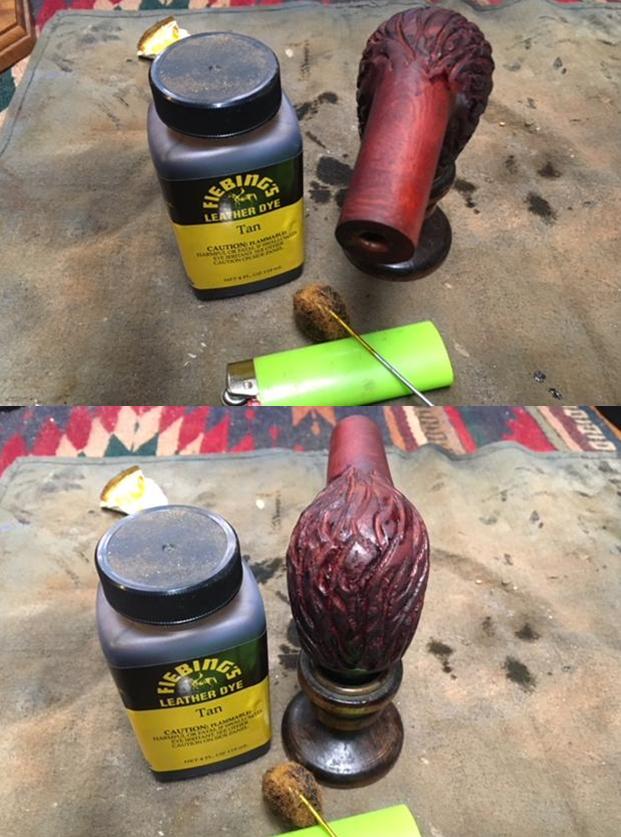
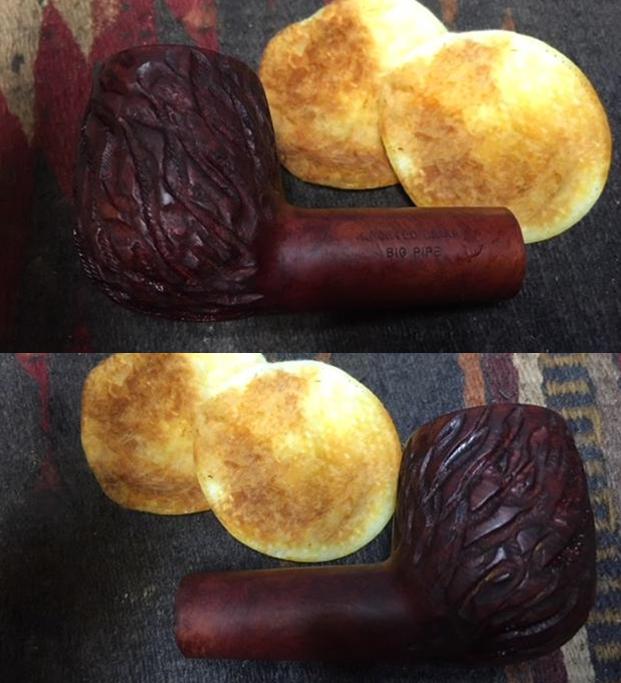
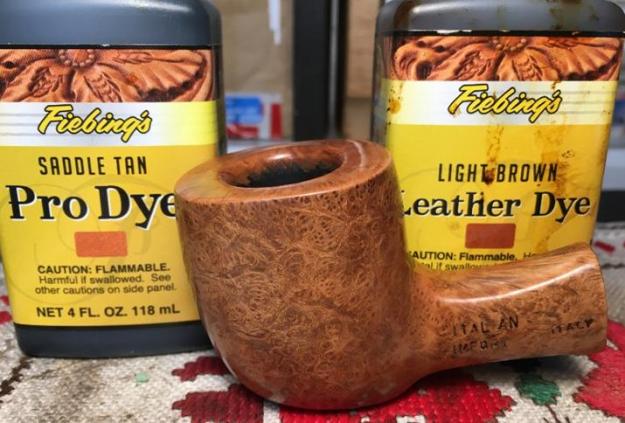
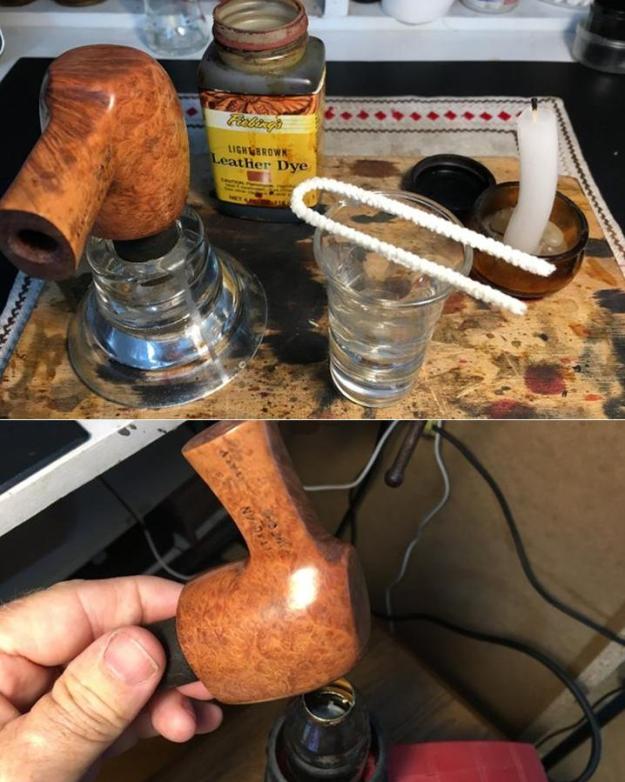
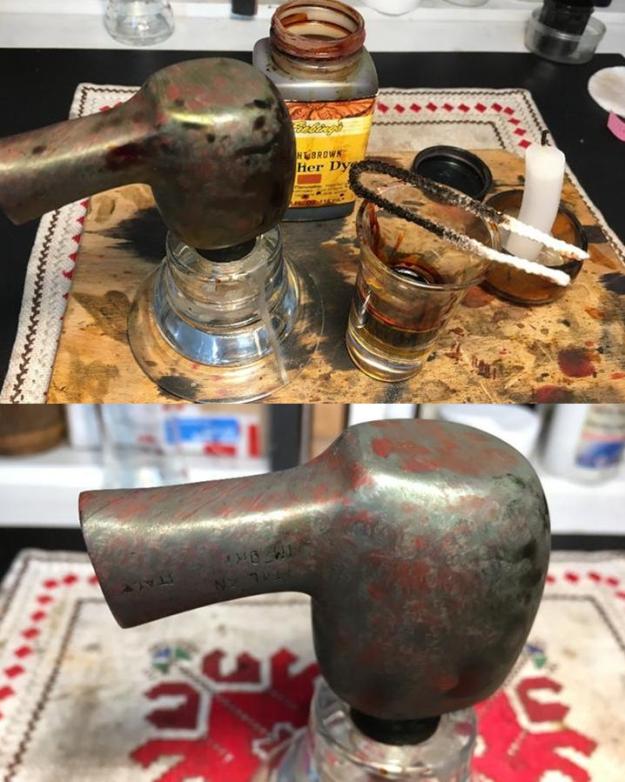
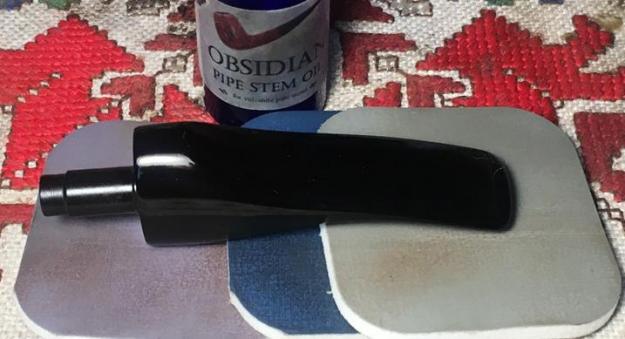
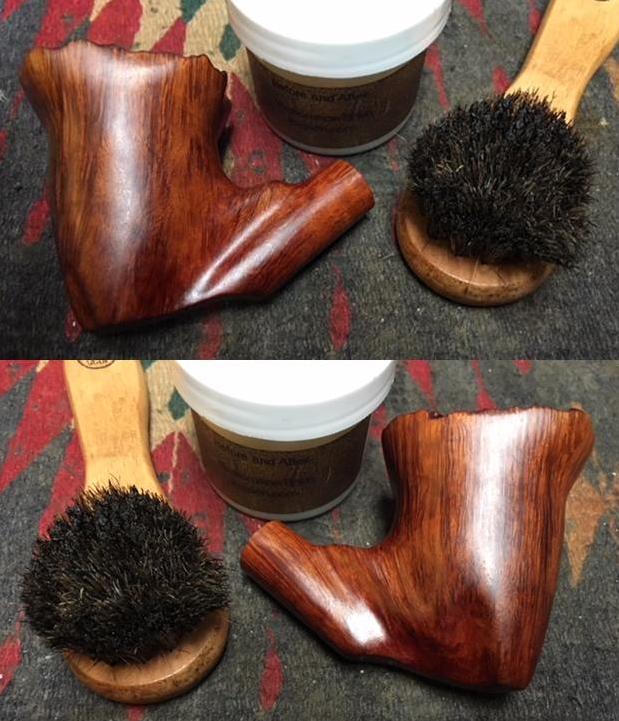
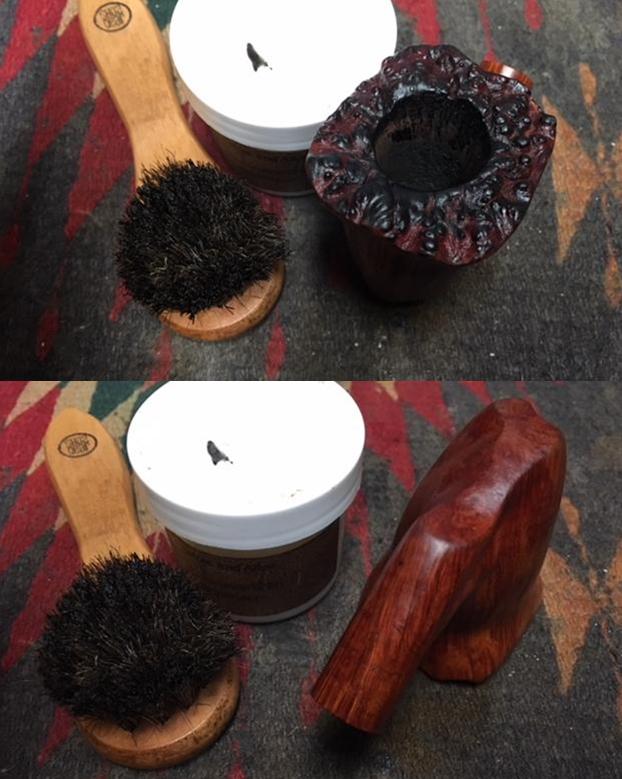
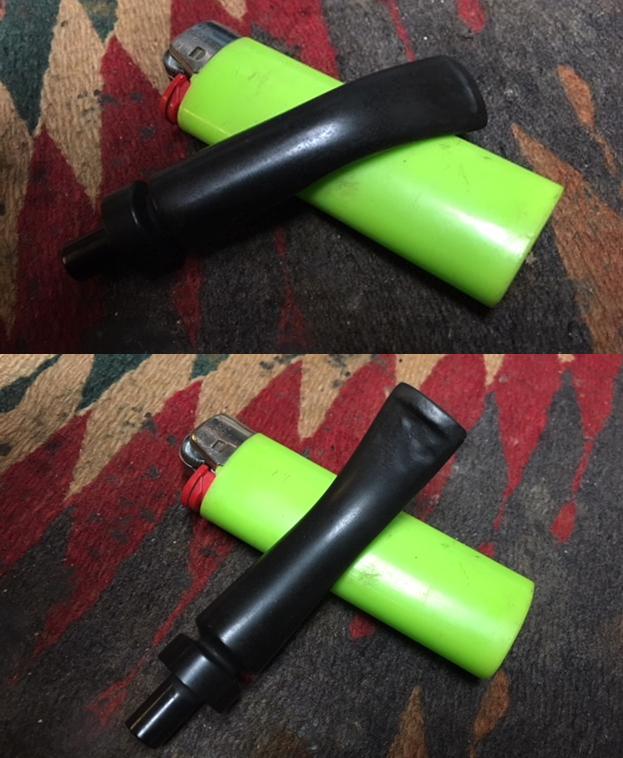
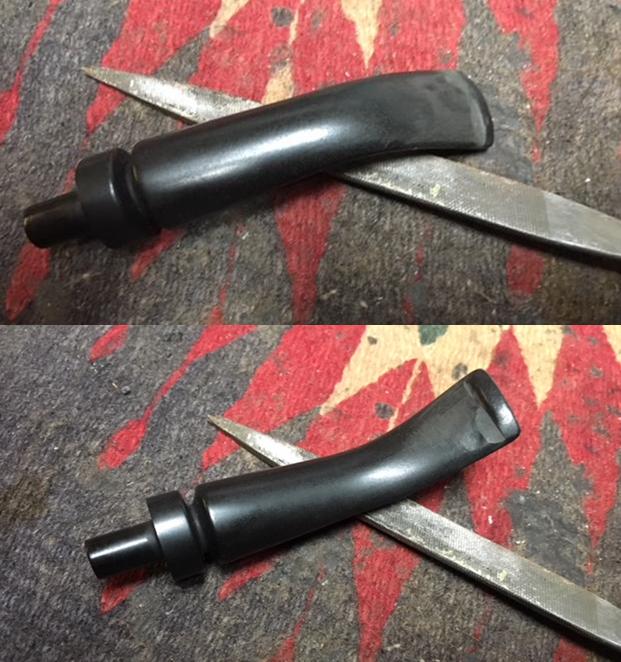
I will attempt something I’ve never done before as I approach the restoration of the Oom Pauls, I’m going to tackle 2 at once – first, the Oom Paul that I’ve chosen to add to my collection and the first Oom Paul that will go in the Pipe Steward Store where a new steward will be sought!  To keep things straight and abbreviated, my Oom Paul will be ‘MOP’ and the available Oom Paul will be ‘OP’!  I want to use MOP to test the overall approach to the hue of the Oom Paul stummels, which I want to keep as close to the original Peretti scheme as much as possible. The pictures below were numbered so that I wouldn’t mix them up while in the ‘Help Me!’ basket.  Here first, is MOP: And now, OP showing beautiful horizontal grain that I think is eye catching on the large Oom Paul stummel: The forensics of all the pipes of the Peretti Lot of 10, show similarities of condition and areas of need, which point to all 10 having had a common steward.  MOP and OP both have thick cake in the long Oom Paul chamber which has run over the rim with crusty lava flow.  Both pipes show deterioration on the right side of the rim where the lighting of the tobacco was faithfully administered.  Both show consistent, tooth chatter and dents on the upper and lower bit – attesting to the great hands-free ‘hanging’ capacity of an Oom Paul but without using a bit guard!  MOP’s stem is severely oxidized, and OP’s is lightly showing oxidation.  MOP enjoys the only stem marking of all the Oom Pauls – the Peretti ‘P’ is crisp but in need of refreshing. I notice that OP’s stem is not snug against the shank and as I rub my finger over the transition from shank to the saddle stem, there is a slight hang of the stem over the shank.  On the stummel heel of OP I see a cut in the briar from some trauma.  I detect a microscopic hairline crack running from the end of the cut toward the shank (on top in the second picture below), a few millimeters.  This needs to be addressed.  I take some pictures to show the stem seating and cut on OP.On my last restoration of an Meer lined Italian Croc Skin Zulu, which has arrived in Edinburgh, Scotland, to meet his new steward, I tested the Before & After Deoxidizer and both of the stems of MOP and OP were among the volunteers for testing.  From pictures above, MOP’s ‘P’ stamped stem shows significant oxidation, while OP is in good shape.  Before & After is also supposed to be stem stamp friendly – which proved to be true.  The stems of Mop and OP are below – of the larger stems in the first picture below, the first and third.  After cleaning each stem with pipe cleaners dipped in isopropyl 95%, I placed all the stems in the Before & After Deoxidizer keeping them in order!    I left them in the soak overnight, though the directions do not require that long. One at a time, I removed them from the Deoxidizer and wiped each with a cotton pad with mineral water (in Bulgaria, its light paraffin oil) buffing each with the cotton pad until all the solution was removed and the residue oxidation.  I am pleased with how the product works.I am especially pleased to see how the Peretti ‘P’ cleaned up and rejuvenated on MOP!  The Before & After Deoxidizer is advertised to be nice to stem stamping and it seems to be the case!  A before and after picture.I then applied Before & After Fine Polish and then Extra Fine Polish.  I put a small amount on my finger and worked it into the vulcanite.  As I work it in, the vulcanite absorbs it.  The results are good causing the vulcanite to look rejuvenated.I do the same for OP’s stem.  It’s looking very nice as well!I now turn to the stummels.  The first thing for both stummels is to clean the internals, starting with reaming the deep Oom Paul chambers.  Before I can determine the condition of the chamber walls the cake will be removed down to the briar.  Using the Pipnet Reaming Kit, I start with the smallest blade, then working to the larger. I start with MOP and take a closer picture of the rim and chamber.  It’s thick and crusty.  I use 3 of the 4 blades available to remove the carbon cake.  I then scrape more of the chamber wall with the Savinelli Fitsall tool and finish with wrapping a piece of 240 grit paper around a Sharpie pen and sand the chamber.  I wet a cotton pad with alcohol and wipe the chamber clean of carbon dust.  The chamber looks great – solid, no cracks or fissures.  Pictures of MOPS: I do the same with OPs.  I take a starting picture, ream with 3 of the 4 blades in the Pipnet Kit.  I fine tune with the Savinelli Fitsall tool, sand the chamber with 240 grit paper and wipe the chamber clean of carbon dust.  The chamber wall looks good as well.  What I do see is what I noted earlier.  The rim on the right side was burned by the lighting of the tobacco and the scorched briar has eroded on that side. Now, to clean the external briar stummel and rim.  Starting with MOP, I use undiluted Murphys Oil Soap with a cotton pad to scrub the surface and rim.  I also use a brass brush to work on the thick cake on the rim.  With my Winchester pen knife, I carefully scrape the old scorched lava crust on the rim.  The stummel of MOP cleaned up nicely and no fills are detected.  The challenge will be to clean up the internal rim, removing all the scorched briar in a way that doesn’t remove a lot of good briar.  Pictures of MOP showing the progress: Now, to clean the externals of OP with Murphys Oil Soap in the same way with the same tools.  The grime is stiff, and I also use a bristled tooth brush to reach into the full bent shank area which is the beauty of an Oom Paul, but a pain to clean.  Again, after employing a brass brush on the thick lava flow on the rim, I carefully scrape using my pin knife to remove the crust, utilizing a fingernail here and there.  I then rinse OP in cool tap water and take a closer look at the stummel.  The stummel of OP cleaned up well.  Like my Oom Paul, the internal rim on OP needs to be cleaned of charred briar down to healthy wood.  I take a picture showing the start and then the cleaned stummel of OP.It was going so well until it wasn’t!  I see what no one restoring a pipe wants to see!  With difficulty I see a crack in the shank nestled in the armpit of the bend, where it’s difficult to clean.  With a magnifying glass I can see it better.  It runs from the very joint of the bend where bowl and shank meet, up the shank about ¾ of the way, but does not run to the top of the shank.  This strikes me as strange.  Most shank cracks are caused by improperly mounting or dismounting the stem and mortise, putting pressure on the thin briar at the junction and the briar gives way and cracks.  These cracks usually start from the top of the shank and run down toward the bowl.  What I’m looking at with OP is that it originates at the elbow of the bend and moves upwardly toward the top of the shank, where the stem is mounted.  My first thought is that this is good news!  It means that the integrity of the shank is still in place at the most vulnerable point – where shank and stem meet.  Yet, however this crack originated, it can continue to creep up the shank if nothing is done to arrest it.  With the magnifying glass I carefully check around the shank and mortise opening to see if there is another crack lurking, but I see nothing.  Here are the pictures of the crack discovery on OP. As I have done in the past to get more input on a challenge, with his wealth of experience shared on Rebornpipes, I send these pictures off to Steve to see what he has to say!  OP has two projects so far catalogued for the stummel – the cut on the heel and now this crack on the lower shank.   I then turn to completing the cleaning of the internals of both stummels.  Using isopropyl 95%, I employ cotton buds, pipe cleaners to clean the mortise and airway.  I also use a bristled shank brush down the airway which does a good job breaking up the tars and oils.  With the design of the drilling for the full bent Oom Paul design, the initial mortise drill going down the shank forms a trap where gunk collects.  Then, the angled airway drilling runs off the initial mortise chamber down to airhole.  To dig gunk out of the trap, I also use a dental spatula to scrape the mortise walls and trap area.  All went well for both my Oom Paul and OP.  The pictures show the results.I want to address the rim issues before moving on.  Both stummels’ rims have scorching issues around the internal lip. With MOP (remember, My Oom Paul), it is engineered slightly different from OP and is a bit smaller.  I pull out the topping board to remove a bit of the rim top to clean up as much as I can.  MOP’s full bent shank barely fits on top of the board without touching.  OP’s shank extends beyond the plane of the rim, that will be a bit more challenging to top but not impossible.  I take a picture of MOP and then take it to the topping board with a sheet of 240 grit paper on it.  I had noticed before that the shank and the plane of the rim were not perpendicular – the rim plane has a left leaning tilt, but I’m not worrying about that – I think.  To correct it would need too much briar to be removed. The more that I look at the rim plane tilt, the more I realize that it will drive me crazy when I’m smoking this guy down the road and wondering why I didn’t correct it!  Since, it IS my Oom Paul, I decide to trade some briar for a bit of sanity.  I start sanding the high right side of the rim down to bring the plane and shank into closer perpendicular alignment.  I use a flat needle file as well as a miniature sanding block to do this. With the rim in closer alignment with the shank, I first cut an internal bevel with a coarse 120 grit paper rolled up tightly.  I pinch the roll over the internal rim with my thumb and remove the charred briar and start shaping the internal lip.  I follow this with 240, 320 and then 600 papers.  Because the rim’s width is not consistent around its circumference, I also introduce a gentle rounding bevel to the external edge of the rim.  This has the effect of making the rim look more balanced and softer, hiding some of the problems with dimension.  I am very pleased with the look of the repaired rim.  The pictures show the progress!  I suppose some briar for a bit of sanity was a good trade! With MOP’s rim work finished for now, I turn to OP’s rim.  The last steward was very consistent in his practices – especially lighting his tobacco.  Again, the left side of the rim has taken the brunt of the flame which was pulled down over the side of the rim.  Pipe ladies and gentlemen, light tobacco ABOVE the chamber – not over the side!! The charring here needs to be removed to uncover healthy briar, but it will leave, as before, an imbalance in the width of the rim.  As with MOP, I take a picture at the beginning to mark the progress and to show the charred area.  I then take the topping board with 240 grit paper and lightly top it on the side of the board – the full bent shank is extending beyond the plane of the rim.  After 240, I use 600 on the board.  Thankfully, OM’s rim is in closer perpendicular alignment than was MOP’s.  After looking at the picture immediately above, I decide to take more top off to regain a precious few millimeters of rim width to help balance the appearance.  I use a miniature sanding block to sand down the surface to build up the left rim width.  I find the sanding block useful when I need to ‘steer’ the rim in a certain direction.  I still have a flat surface, but with pressure can strategically leverage the sanding. I then take the stummel back to the board with 240 and then 600 to level the rim. I think this helped to regain some rim width, but the imbalance is still evident but less so. Now, cutting a bevel as I did before with MOP, on the internal and external rim edges helps round and blend the appearance.  I use 120 grit to do the major shaping then 240, 320, and 600.  It’s as good as I can manage without taking a lot more off the top to even out the rim width.  It does work, and I move on to the next challenge.I had written to Steve earlier to get input on how to approach the crack I discovered in OP’s shank.  His response came with a picture.  I already knew that I needed to drill a counter creep hole at the top of the crack where it was obviously creeping.  Steve said that a counter creep hole was needed at the bottom as well – in the bend itself.  It will be a bit of a challenge with the angle and drilling, but I think possible.  The holes at the end of the cracks arrests the expansion of the crack.  Steve’s picture follows:The other challenge that I’ll attack at the same time is on the cut and creeping crack on the heel of OP’s stummel.  This injury will also need drilling at each end to arrest any growth in the crack or cut.  As Steve did for me, I’ve circled the points where drilling is needed.  I needed a magnifying glass to see the cracks accurately.I use the Dremel for these drillings mounted with a 1mm drill bit.  The great thing working with the Dremel is its flexibility.  The bad thing about using the Dremel, is its flexibility!  In my workspace on the 10th floor of a former Communist block apartment building, I don’t have much room.  So, the Dremel does everything for me, almost!  One of these days I will find a universal mounting system that will allow me to strap the tool in so that I can make precision movements, like this drilling project, which is more difficult in the handheld mode.  In the drilling of the holes, one does not want to break through the briar to the inner chamber or mortise!  The hole depth only needs to be 2 or so mm.  I start with the cut on the heel, the easier of the two projects.  To guide my drilling, with the use of the magnifying glass, I use the sharp point of a needle file to press a guide hole into the briar.  I then follow with drilling the shank crack holes.  The pictures show the results which turn out well despite my handheld approach! Now to apply patch material.  Again, I start with the heel repair.  Using a toothpick to guide, I apply a drop of thin Hot Stuff CA glue directly into the cut.  I want the glue to sink deeply into the fracture to sure things up.  I sprinkle some briar dust on it.  After this, on an index card, I mix a little briar dust with Hot Stuff Special T CA glue – a bit thicker.  This forms a briar dust putty that I mix and apply to the 3 holes I drilled.  I build a mound with the briar dust putty, that after cured, provides thorough coverage over the entire repair area that will be sanded down and blended. After about 45 minutes, the heel patch has set up enough for me to work on the shank crack.  Just to be on the safe side, I mask the sides of the shank to protect from CA glue accidentally running down the sides.  I am especially protective of the L J Peretti Co. stamping. As before, I place a line of thin CA glue along the crack to seep in and fill the open areas in the fracture.  Then, I mix another batch of briar dust putty using thicker CA glue and apply this on the holes and over the full length of the crack.  A toothpick acts a trowel.  It’s time to go to bed so I’ll leave the patches to cure overnight. The pictures show the patch progress on OP’s restoration. The next morning the patches have cured thoroughly and I’m ready to start filing down the patch mounds beginning with a flat edged needle file.  I’ll work down the mound starting first with the heel patch.  The key is to ride the patch mound down as far as possible with the file then switch to sand paper which will be less intrusive to the healthy briar around the patch.  When I near the briar surface with the file, I reduce the pressure I’m exerting on the file.  When down close to the briar surface, I switch to 240 grade sanding paper, again, keeping the sanding on the patch material to remove the excess patch from the briar leaving only the fills.  The patch looks good.  I will blend later. The pictures show the progress with OP. After nearly a week in Athens, Greece, attending a conference and doing some pipe hunting, I return to Sofia and to my worktable where the shank patch and sanding are waiting for me.  It will be a bit more of a challenge.  Not only because of where the crack patch is located, but because sanding in the area will impact the end of the shank, potentially affecting the stem union.  I noted before that I wasn’t satisfied the seating of the stem.  There were small gaps showing between shank base and the stem.  I also could feel lips where the shank and the saddle stem were not flush.  My plan is to address these issues as I sand down the shank crack patch.  I start first with a flat and a rounded needle file to work down the patch. I progress to the crook of the bend and file with a round needle file. When I’m close to the surface with the needle files, I then switch to 240 grade sanding paper to remove more patch material down to the briar.  Then I follow using 600 grade paper to smooth out the coarser sanding scratches and to blend. While I’m sanding in the shank area, I work on the stem/shank alignment. I previously noticed that there was ‘daylight’ between the contact point between the shank and stem.  As much as possible, I want a seamless fit between the shank and the stem.  I notice also that the vulcanite on the end of the stem is not smooth which might be contributing to the stem’s fitting issues.  I decide to ‘top’ the stem at the tenon base using a piece of wood with a hole to accommodate the tenon.  I place a piece of 240 grade sanding paper over the topping board also with a tenon hole, insert the stem and rotate it.  This enables the smoothing of the vulcanite at the tenon base and hopefully, achieve a tighter, more true contact point between stem and shank. That does the job partially – the stem is snugger, but I still see a bit of daylight through the right side of where the shank and stem meet.  To address this, I need to remove the high spot on the left side of the junction to achieve a better seating of the stem in the shank.  I use a piece of 320 grade sanding paper folded and inserted between the shank and stem over the high spot and sand down the area.  I saw this method used by Charles Lemon on Dad’s Pipes to help improve the stem connection.  This does the job very well and after working the sanding paper around the high area, the stem contact looks better.Finally, I want to smooth out the lip that is caused by an overhang of the stem which I can detect by rubbing my finger over the shank and stem junction.  On the lower shank/stem the stem is a bit over the shank.  I use 240 grit paper to sand the lip down so that there is no lip between stem and shank.  After sanding down the area, the fit of the stem is much better all around.  I like it!With the major stummel repair projects completed, I rejoin stems with the stummels of MOP and OM and look.  As I work I’m admiring the briar on these larger Oom Paul bowls.  MOP is dominated by bird’s eye pattern with lateral grain on the bow of the stummel.  While OM has striking horizontal flame grain tying both shank and bowl and culminates at the bow of the stummel with bird’s eye.  Very nice.  What I love about Oom Pauls is the ample briar real estate on display!Before I switch my focus to the stems, while I think about the next steps for the bowl restorations, I decide to augment the internal cleaning of the stummels using a kosher salt and alcohol soak.  For both MOP and OP I fill the bowls with kosher salt.  I then pull and stretch cotton balls to form ‘wicks’ that I stuff down the mortise of each stummel.  The cotton wicks act to draw out the oils and tars left behind.  This method also helps to freshen the briar for a fresher taste for the new steward.  Placing each stummel in an egg crate for stability, with a large eye dropper I fill each bowl with isopropyl 95% and wait a few minutes and top it off again.  It takes a good bit!  I then set the bowls aside for several hours to allow the salt and alcohol to do their work.Turning to the stems, I start with My Oom Paul.  I take a close-up of the upper and lower bit area of MOP.  The former steward of these Oom Pauls was a clencher.  The good news is that he didn’t chew on the button too much – it’s in good shape.  With the dents and chatter, I start by using a flame to heat and expand the dents as much as possible.  I use a cheap Bic lighter.  This does raise and soften the dents.  The before and after of upper and then lower bit pictures follow. Using 240 grit sanding paper, I sand out the dents and chatter.  I also use a flat needle file to re-establish a crisp button. After sanding, I’m able to identify the remaining dents that need to be filled.  One dent on the upper bit with also a small indentation on the button needs attention.  On the lower, two areas need more attention on the bit and a bite on the button. Using cotton pads, I clean the upper and lower bit area with alcohol before applying drops of Starbond Black Medium KE – 150 CA glue to the problem areas on the lower bit.  I will wait an hour or so before turning the bit to apply Black CA glue on the upper bit. After the Black CA cures, I work the patches down on the lower and upper bit with a flat needle file then fine tune with 240 grit paper.Now, turning to OP’s stem, I take close-ups of the upper and lower bit area to show the starting point.  Again, as with MOP, the tooth dents are on both sides.  I paint the bit with fire from a Bic lighter to expand the vulcanite and raise the tooth dents.  As before, the heating did raise the dents so that sanding becomes more effective.  Before and after pictures of the heating for upper bit and then lower bit. As before, using 240 grit sanding paper I sand out as much as possible the dents on the bit and button. I also use a flat needle file to define the button lips more.  That worked out well.  All the dents sanded out except for one small area on the lower bit.  No patch is necessary on the top. After cleaning the area with alcohol, I apply a drop of Black Medium CA Glue to the spot.  I set OP’s stem aside for a few hours for the patch to cure.  When cured I sand the patch with 240 grit paper.  The pictures show the progress with the OP’s stem. Looking back at the stummels, the kosher salt/alcohol soak did the job.  The salt and wicks have discolored indicating that the tars and oils have been drawn out.  I remove the salt, wipe the bowls out with paper towel assuring that all the salt is removed. For the sake of abbreviation in this long blog, both stems proceed through the finishing process.  I use 600 grade paper to erase the 240 grade sanding and then buff up the stems using 0000 grade steel wool.  From here, I take the stems through the full process of 9 micromesh pads from 1500 to 12000, wet sanding 1500 to 2400 then dry sanding with 3200 to 4000 and then 6000 to 12000.  Between each set of three I applied Obsidian Oil to enrich the vulcanite.  The results are good.  The Peretti ‘P’ stamped on my Oom Paul looks great.Now to the stummels.  I begin with MOP.  I start with taking a few pictures to take in the great looking bird’s eye grain.  I love the wide expanse of the briar on the Oom Paul stummel – it goes on and on.  To remove the nicks and minor scratches on the briar surface I use sanding sponges progressing from coarser, medium, and then, light. I follow the sponge sanding by doing a full regimen of micromesh pad sanding.  Using 1500 to 2400, I wet sand, then with the remaining pads, 3200 to 12000 I dry sand.  This process brings out the grain very nicely and I’m liking what I see! As I now look to the OP stummel, I’ve been going back and forth as to what to do with this stage of the process.  OP has two crack/cut repairs to blend into the finished coloring of the bowl.  It also has many normal nicks and scratches which need to be addressed.  I want to keep both L J Peretti pipes as close to the color scheme as possible, but to provide some blending cover for the cut/crack patches, I will need to darken the color some for OP.  Even so, I know that most likely, patches will still be detectable but much subdued.  My thinking now is waffling between staining my Oom Paul with a new color of Fiebing’s leather dye I brought back from the US – Saddle Tan Pro Dye.  I tested it on a raw piece of wood and I like the results.  The other approach I want to test is simply using Before and After Briar Balm or as it’s called on the label, ‘Hard Rubber Balm’.  Steve recommended this approach to me in lieu of stain.  With waffling completed, I will use the Briar Balm on MOP first to see how it turns out.  Then, for OP, which needs more blending activity, I’ll use the Saddle Tan dye. With this decided, I take a few more close-ups of OP to mark the start.  I begin preparing the briar surface using sanding sponges – from coarser, to medium, and to fine to clean the surface of scratches and nicks.  Throughout, I am careful to guard the L. J. Peretti Co. nomenclature on the shank.  As with My Oom Paul, I use micromesh pads following the sponge sanding.  I wet sand using pads 1500 to 2400, then dry sand from 3200 to 12000.  I record the progress after each set of 3.  I love this phase of the process.  The micromesh pads do a great job bringing out the fine detail of the grain.  The OP has a distinctive lateral, horizontal flame grain that spans the bowl and full bent shank.  It culminates in the front with bird’s eye grain – the perpendicular view of the horizontal flow of grain.  Very nice.  The pictures capture a bit of what I’m seeing emerge with OP. Now testing time.  I will apply the Before and After Briar Balm to MOP – My Oom Paul, to see how the briar absorbs and reacts.  I’ve seen Steve apply the balm to several pipes he’s restored on Reborn Pipes with very nice results.  The process is easy.  Apply balm to the briar and work it in with your fingers.  I take a picture of each side of the stummel to show the starting point.  I put some balm on my fingers and I work it in.  The balm is loose and oily when it first begins but as it is worked in, it thickens as it is absorbed into the briar.  After applying the balm, I wait about 10 minutes and wipe/buff the stummel with a clean cotton cloth.  The difference is noticeable – the briar has a deeper, richer appearance.  I like it! I take two ‘after’ pictures to compare.  The first picture is the right side of the bowl and the second, left.  Before the balm is on the left and after application, is on the right.  The pictures speak for themselves. Now, turning to OM, I will apply Fiebing’s Saddle Tan Pro Dye. I first wipe the bowl down with alcohol to make sure it is free of dust and dirt.  I insert a cork into the shank to serve as a handle and heat up the stummel using an air gun to expand the briar making it more receptive to the dye.  Then, I thoroughly apply the aniline based Saddle Tan dye to the stummel with a pipe cleaner and then flame the wet dye which immediately burns off the alcohol setting the pigment into the briar.  I repeat the process and flaming and set the stummel aside to rest overnight allowing the dye to set.  The good thing about aniline dye is that I can use alcohol on a cotton pad to wipe the stummel later to lighten the hue if I choose.  Another day has come to an end.Early the next morning before heading out to another full day of work, I’m anxious to ‘unwrap’ OP’s bowl that rested through the night.  I take a picture of the ‘rested’ stummel.  Using the Dremel, set to the lowest speed, I mount a felt buffing wheel dedicated to applying Red Tripoli compound.  After purging the wheel to soften it and clean it, I methodically work the wheel around the stummel ‘unwrapping’ the fired dye revealing the briar surface.  I do not apply a lot of pressure on the felt wheel but allow the fine abrasive nature of the Tripoli compound, speed of the Dremel and the felt wheel to do the work.  Since the felt buffing wheel is not flexible, I mount a cotton cloth wheel with Tripoli to reach into the crook of the shank’s bend.  I take a picture of the ‘unwrapping’ with the Tripoli compound to give an idea of what I’m seeing.At this point, I yoke both Oom Paul stummels together in the process.  I reunite stems to both and after mounting a cotton cloth buffing wheel, I leave the Dremel’s speed the same slowest setting, and apply Blue Diamond compound to both stummels and stems. When I finish, I buff each with a felt cloth to remove the compound dust from the pipes in preparation for the wax.  I mount a dedicated cotton cloth buffing wheel on the Dremel, increase the speed to about 40% and apply carnauba wax to both MOP and OP, stem and stummel.  After applying several coats of carnauba to each pipe, to finish I give both a good buffing from a micromesh cloth to deepen the shine more.

These two Oom Pauls provided some challenges in their restorations, but I am pleased with the results!  After this I don’t believe I will do another ‘double restoration’ write-up – too much!  The grain on both Oom Pauls is striking.  My Oom Paul’s finish came out well using Before and After Briar Balm and the grain is dominated by a large orchard of bird’s eye pattern.  I look forward to his inaugural smoke as I add him to my growing L. J. Peretti Co. collection.

The Oom Paul heading to The Pipe Steward Store had some challenges with cracks and cuts, and loving abuse from his former steward whose practice of lighting over the edge of the rim presented some hurdles.  The Saddle Tan finish looks great – it has masked the cut repair on the heel but not fully hidden – he takes some signs of his past life war wounds into the future! But OH MY, the lateral flame grain flowing through the stummel from the full bent shank to the front of the bowl culminating with a sprinkling of bird’s eye is striking and a beautiful example of God’s handiwork!  He’s bigger than my Oom Paul with the length (in full bent position) is 6 inches, height of the bowl: 2 ½ inches, rim width: 1 ½ inches, chamber width: 15/16 inches, chamber depth: 2 1/8 inches.  He is ready for a new steward and the adoption of this Oom Paul will benefit the Daughters of Bulgaria, our work with women and girls (along with their children!) who have been trafficked and sexually exploited.  The pictures following start with MOP and OP together, two pictures of MOP happily heading to my rack, and then the remaining pictures of the Oom Paul heading to The Pipe Steward Store!  They turned out to be a handsome pair of dudes! Thanks for joining me!

Paresh’s Grandfather’s Pipe #3 – A Dr. Grabow Starfire


Blog by Steve Laug

I have repaired pipes for Paresh in India over the past four months and not long ago he sent me seven of his Grandfather’s pipes to restore. It is an interesting assortment of older pipes that come from the period of 1937-1950s. His Grandfather worked for the Indian Railroad many years and was a pipeman. Paresh is also a pipeman and recently found out that his Grandfather smoked a pipe as well. The third of the pipes is an older Dr. Grabow Starfire Adjustomatic Tomahawk #21. It is stamped on the right side of the shank Starfire over Dr. Grabow. From what I can find out the pipe was part of the Continental X-Series that came in 12 unique shapes that were originally released in 1959. When the Continentals were first put into production they may have been available only by coupon in the Westbrook, Emperor and Sculptura lines, but they were available in the regular production–non coupon lines such as Viscount, Starfire and Eldorado. The coupon pipes were given XO shape numbers while the regular production lines (meaning sold in retail stores) were given standard shape numbers. The XO numbers were never stamped on the pipes, but the regular production pipes will sometimes have a stamped shape number. This particular pipe that I am working on for Paresh is a Starfire line pipe. I have included the following shape chart to help identify the pipe. It is the third pipe down in the column on the right side – shape #21. (Quoted from the late Ed James, a man who knew a lot about Grabow pipes and who is dearly missed by those of us who knew and enjoyed his company.  http://pipesmagazine.com/forums/topic/3-year-journey-complete-set-of-continental-x-series-pic-heavy.) I took the following photos of the pipe before I stated to work on it. It was probably one of the dirtiest of the pipes that Paresh’s wife Abha sent me – even then it was not that dirty because she had removed much of the cake bowl and the grime in the wire rustication.  The rim top has lava that has overflowed from the bowl and filled in the wire rustication. It is quite thick and hard. It will need to be scraped off when I started the cleaning. I am not sure what the inside edge of the rim looks like at this point because of the lava overflow. The outer edge of the bowl looks pretty good with a little wear on the front edge and back right side. The bowl still the remnants of cake left behind that I will need to take care of. I also took a close up photos of both sides of the stem. The stem significantly overclocked to the right giving the pipe an odd look. You can see the tooth chatter and calcification on the top and underside of the stem just in front of the button. It appears that the stem must have had a softee bit that was later cut off and left behind the debris.I always enjoy getting some background information on the pipeman whose pipes I am restoring when I am working estate pipes from the family members. If you have followed rebornpipes for a while you have read a few of these summaries from estates like Kathy’s Dad, Barry’s Dad and Farida’s Dad. Each of them did a great job summarizing their fathers’ estates. Since the next group of seven pipes that I will be working came to from India and belonged to the Grandfather of Paresh, I asked him to write a short tribute to his Grandfather. What follows is his writeup.

Respected Sir,

Now that the first batch of my Grandfather’s pipes has reached you, I would like to share my memories of him with you, the aim being to provide you with an insight to his personality, the era in which he lived, and a brief history associated with the pipes that I have inherited from him.

My Grandfather, Ananta (named after an exotic seasonal white flower having lovely fragrance), was born in a small coastal town of Konkan region of Maharashtra, India, in 1918. These were very turbulent times when India’s freedom struggle against British rule was gathering momentum and the atmosphere was charged with “Quit India Movement”. Having completed his graduation from Bombay, he joined Railways in 1937. This also marked the beginning of his journey into the world of pipe smoking!!!!!

Having seen his potential, in 1945, he was sponsored by the Government to visit England, for gaining further experience and expertise in his profession. This was a period when India’s Independence was round the corner and efforts were being made to train Indians for various administrative appointments in future Independent India. He returned back to India after a year, in 1946 and with him came some pipes that he had purchased in England. I believe a few of his Petes, Barlings, Charatans and GBDs are from this visit.

In 1947, when the British finally left India for good, my Grandfather was gifted pipes by his British peers, subordinates and Superior Officers as a parting gift. He stayed in touch with a few of them over all these years, even visiting them in 1959-60. Some of his later era Charatans and Barlings and Petes are from this trip. He quit smoking in early 1970s (before I was even born!!!!) and his pipes were packed up. There were a number of pipes which were used as TINDER for lighting fires (CAN’T BELIEVE IT…… I have not overcome my grief of this loss till date!!!!!) due to ignorance!!!!!!

My Grandfather was a very strict disciplinarian and temperamental (I did not know this as he was neither when dealing with me as I am the youngest of all his grandchildren!!!!!! He was always the most understanding and loving person in my life). I later learned that in his office, he was not to be disturbed when his pipe was lit, as he would be in his thinking/ contemplating mode while it was just the opposite as he lit his pipe in the evening while at home, when he would be at his relaxed best!!!!.

The interesting part is that neither of us knew that we each smoked a pipe until after his demise in Jan 2018!!!! In our culture, to this day, smoking or alcohol consumption is socially never talked about (mute acceptance!!!). It was during his last rites that absent mindedly I lighted my pipe and looking into the flickering flames of his funeral pyre, remembered and recollected all the wonderful memories and talks that we had shared. No one said a word to me about my lighting up a pipe!!!!!! Immediately thereafter, I rejoined my duty station. A few days later, my wife, Abha, received a box from my Uncle with a note that said “Grandfather would have loved Paresh to have these”. This box contained a collection of his fountain pens and 8-10 of his pipes (since then as my folks are winding up his belongings, I have received 2-3 packets and a large number of pipes, some in decent condition and some in unspeakable state). Abha immediately messaged me with pictures of these pipes and pens. I had been collecting and restoring (no major repairs, though) fountain pens since long and immediately recognized some of them as highly collectibles, however, pipes were a totally different ball game! I was inexperienced with no knowledge/ information regarding various brands/ pipe makers, shapes and materials. I knew nothing about the value of these pipes, nothing about pipe restorations, nothing about caring for them; I mean zero knowledge about collecting pipes. I smoked some real cheap Chinese pipes which were readily and unfortunately, the only ones, available in India and some inexpensive pipes from eBay India!!!!! Also regular pipe cleaning, pipe rotation, pipe cleaners and such things were unknown to me.

Thus, to know more about the REAL pipes, I embarked upon the journey of exploring finer nuances of pipe brands/ makers, their history and watching “How to videos” on packing a pipe, cleaning, repairing and caring for ones pipes. I found it extremely interesting and satisfying. It was while meandering through this confusing quagmire of pipe world that I came across rebornpipes.com website and eventually established contact with you, Mr Steve, who has since been my mentor, guide and GURU, making this journey a wonderful and satisfying experience.

Sir, there is one more thing that I need to thank you for and that is when you asked me to write a brief about my grandfather and his pipes, I realized how little I knew about him, in fact, knew nothing, as I was not even aware that he was a “pipeman” as no one in my family ever spoke about it being taboo subject and since he had quit a long time before I was even born!!!! This led me to ask the elders in my family, questions on the subject and came to know the above details. I cannot thank you enough for prodding me to get to know my grandfather and his pipes a lot better. Sir, these pipes of his, with your help and guidance, will remain with me forever in mint condition……

Thanks Paresh for this great descriptive take of your Grandfather. It really gives me a sense of the pipes that you have sent me and what they meant to him. It is obvious from the variety of pipes that you sent and the overall condition that he knew how to choose good quality pipes and obviously enjoyed smoking them throughout most of his life.

Paresh’s wife Abha cleaned the pipes before she sent them to me here in Canada and did an amazing job cleaning them up. She reamed the bowls, cleaned the rims and scrubbed the exterior of the pipes and the stems with Murphy’s Oil Soap and cleaned off the buildup on the stems. She had removed much of the cake on this pipe and done a great job cleaning the exterior of the bowl. The lava on the rim top was very hard and thick so she left that behind so as not to damage the top edge. The stamping on the right side of the shank was very readable. The stem was oxidized on both sides of the stem and had quite a bit of tooth chatter and calcification on both.

Since the stem was an adjustomatic according to what I had read I decided to work on the alignment before working on the rest of the pipe. I removed the stem and heated the metal tenon and stinger to loosen the tars and oils that had hardened on it. Once it was heated I turned the stem into the mortise and adjusted it by turning it clockwise until all was aligned.I let the heat dissipate from the stem and then removed it from the shank and started my work on the bowl itself. I cleaned up the cake in the bowl with a Savinelli Fitsall Pipe Knife and took the rest of the cake off until I had bare briar walls. I wanted to check out the condition of the interior of the bowl. It looked very good once it was cleaned off. There was no checking or cracking on the bowl walls. There was no sign of burn out inside. I scraped the rim top with the sharp edge of the Savinelli Knife and took off the thick lava that was there. I used a brass bristle wire brush to clean out the cake from the wire rustication on the surface. You can see the thick chunks of lava that came off the rim top on the white sheet of paper.I scrubbed the exterior of the bowl and shank with Murphy’s Oil Soap and a tooth brush to clean out the debris I left behind from the rim clean up. I also used the brass bristle brush with the soap to work over the rustication on the rim top. I rinsed it in running water and dried it off with a cloth. I restained the rim top with a Walnut stain pen to match the colour of the rest of the bowl. I touched up random spots on the shank and bowl sides where the finish was worn or nicked.I cleaned out the mortise and the airway in the shank with pipe cleaners, cotton swabs and alcohol. It took a lot of scraping and scrubbing to remove all of the thick tars and oils that had accumulated around the Grabow spoon stinger.I worked Before & After Restoration Balm deep into the briar to clean, enliven and protect it. I worked it into the finish with my fingertips. I worked it into the rim and shank end. I set it aside for a few minutes to let the balm work. I wiped it off and buffed it with a soft cloth to polish it. The briar really began to have a deep shine. I took some photos of the bowl at this point to mark the progress in the restoration. The bowl is really beginning to look good and the pipe is waxed I think it will really have a rich glow to wire rusticated finish.  I set the bowl aside and worked on the stem. I used a brass bristle wire brush to clean off the spoon stinger enough that I could remove it and clean out the rest of the stem. I cleaned up the stinger and the airway in the stem with pipe cleaners, cotton swabs and alcohol until they were clean. I would buff the metal with the buffing wheel to take off the rest of the staining later. I sanded out the tooth chatter and the calcification on both sides of the stem at the button with 220 grit sand paper.I polished the stem with micromesh sanding pads – wet sanding with 1500-2400 grit sanding pads and dry sanding with 3200-12000 grit pads. I wiped the stem down with Obsidian Oil after each sanding pad. I finished polishing the stem with Before & After Pipe Stem Polish both Fine and Extra Fine to remove the last of the scratches. I gave it a final coat of Obsidian Oil and set it aside to dry. With the stem polished I put it back on the pipe and lightly buffed the bowl and more heavily buffed the stem with Blue Diamond. I gave the bowl several coats of Conservator’s Wax and the stem multiple coats of carnauba wax. I buffed the pipe with a clean buffing pad to raise the shine and hand buffed it with a microfiber cloth to deepen the shine. The pipe polished up pretty nicely. The finished pipe is shown in the photos below. I have four more of Paresh’s Grandfather’s pipes to finish and then I will pack them up and send across the sea to India where he can carry on the legacy. I know that he is looking forward to having them in hand and enjoying a bowl of his favourite tobacco in memory of his Grandfather. Thanks for walking through the restoration with me as I worked this pipe over.


Breathing Life into a Republic Era Peterson’s System 313 Pipe


Blog by Steve Laug

I have been corresponding with Paresh for some time now and have repaired and restored two of his pipes and sent him others as well. We carry on conversation via WhatsApp on the internet and discuss the various pipes he is purchasing as well as ones that he has inherited from his grandfather. This Peterson 313 System pipe came to me direct from the eBay seller in England. It took so long to get here (almost 2 months) that we both had pretty well given up on it. It arrived in a crushed package that I had to pick up at the post office. I was worried that the pipe inside had been damaged as well. This was one of those times that the seller had done a very thorough wrapping of the pipe in bubble wrap so it was unscathed by the crushing of the box. The pipe was stamped Peterson’s arched over System over Standard on the left side of the shank and Made in the Republic of Ireland on the right of the shank with the shape number 313 under that. The nickel ferrule was stamped K&P over Peterson.

The finish on the pipe was very dirty with a lot of dents on the bottom side of the bowl and shank. There was a long deep dent on the front of the bowl. The bowl had a very thick, hard cake that had overflowed onto the rim top. The bowl was out of round and the inner bevel was burned and damaged. It looked as if some had tried to ream the bowl with a knife sometime in its life. There were two fills – one on the back left and one on the back right. In the angle of where the shank and bowl connected there was a heavy oily grime build up. The inside of the shank and sump were filled with tars and oils. The nickel ferrule was in great condition with light scratching but no real oxidation. The stem was a mess. The top side of the stem had deep tooth grooves extending forward from the p-lip button about 1 inch. On the underside there were also tooth marks. Both sides had a lot of serious chatter and some calcification build up. The stem was oxidized and very dirty. I took some photos of the pipe before I started working on it. I took close up photos of the rim top and the stem to show the condition it was in when it arrived in Vancouver. You can see the heavy lava buildup on the rim top. You can also see the damage on the inner edge, particularly heavy on the right front side. The cake was quite thick and very hard leaving barely enough room for my little finger to fit in the bowl. You can see the condition of the stem and the tooth marks in the oxidation on both sides. The tooth marks and chatter on both sides are deep and worn looking.The stem was stuck in the shank and would not move. I tried to twist it and turn it but nothing moved. I put the pipe in the freezer for half an hour let it do its magic. At the end of the half hour I was able to easily remove the stem from the shank.I decided to soak the stem in a bath of Before & After Pipe Stem Deoxidizer so I dropped it in the airtight container and set it aside overnight to let it do its work.I turned my attention to the bowl. I started by reaming the hard cake back with a PipNet pipe reamer. I started with the smallest cutting head and worked my way up to the second head. I took the cake all the way back to bare briar. I cleaned up the remnants in the bowl with a Savinelli Fitsall Pipe Knife. The knife allowed me to get all the way to the bottom of the bowl and remove the cake that still remained around the airway.I topped the bowl on a topping board with 220 grit sandpaper. I worked on it until I had removed the damage on the top of the rim and was able to minimize the damage to the inner and outer edges of the bowl. I used a folded piece of sandpaper to rework the inner edge of the bowl and give it a slight bevel to hide the burn marks and the damage from the knife reaming. With a little work I was able to remove the damage on the inner edge of the bowl. I also ran the folded sandpaper around the outer edge to smooth out the nicks and marks.The briar on the bowl had some dents around the sides, front and back of the bowl. The underside of the shank was also dented. Before I dealt with the dents in the surface I decided to polish the briar and raise a shine. I wet sanded it with 1500-2400 grit micromesh sanding pads and dry sanded it with 3200-12000 grit pads. I wiped it down after each pad with a damp cloth to remove any sanding dust. The grain in the briar really began to stand out. There was some really nice birdseye on the sides of the bowl and cross grain on the front and back sides. I used a cherry stain pen to restain the rim top to match the colour of the rest of the bowl. I have found that this particular cherry stain perfectly matches the colour of the Peterson’s System Standard pipe.I cleaned out the inside of the shank, the sump and the airway into the bowl with pipe cleaners, cotton swabs and alcohol. It took a few of each but after while the cleaners and cotton swabs came out clean and the pipe smelled fresh.With the internals clean and the externals clean I decided to address all of the dents in the briar on the bottom and front of the bowl. I took photos of the dents to give an idea of the sheer number of them all around the shank, bowl bottom and up the front. They were all quite rounded dents rather than cuts so I figured that I could steam most of them out. I use a wet cloth (not dripping but enough to make steam when heated) and a hot butter knife to steam the dents. I heated the knife over a flame on my gas stove, put the wet cloth over the dents and touched the surface of the briar with the hot knife. The heated blade on the wet cloth created steam and began to lift the dents. I repeated the process until the majority of the dents had been lifted. I took photos of the pipe, knife and wet cloth.I dried off the bowl and took photos of the briar to show how well the steam had lifted the dents in the wood. I rubbed some Before & After Restoration Balm into the briar to lift out the dust in the grain, enliven and protect the clean and steamed bowl. I let it sit for a little while then buffed it off with a soft cloth. I like the way the grain stands out now. Some of the dents are still visible on the bottom left side of the shank but they are far better than they were. I took the bowl to my buffer and buffed it with Blue Diamond to polish it and raise a shine. I was careful around the stamping so as not to damage it or reduce its readability. The bowl looks really good at this point. All that remains for the bowl is to wax it and buff it. I set it aside and began my work on the stem. I took the stem out of the Before & After Stem Deoxidizer bath and rinsed it under warm water. I blew air through the stem to remove the deoxidizer from the inside of the airway. I dried it off with a paper towel to remove the residual oxidation that was on the surface. I took photos of the stem at this point in the process. You can see some of the calcification on the stem around the button and the tooth marks on both sides. The tooth marks on the underside are by far the deepest.I cleaned the inside of the stem with pipe cleaners, cotton swabs and alcohol to remove the residual deoxidizer in the airway.I painted the surface of the stem with the flame of a Bic lighter to left as much of the tooth denting as possible. Once I had repeated that and the stem would no longer rise I sanded it with 220 grit sandpaper to smooth out the damage. I finished by sanding it with 400 grit wet/dry sandpaper to remove more of the scratches in the vulcanite. I sanded the entire stem with 220 grit sandpaper to remove the calcification and remaining oxidation. I used a needle files to sharpen and reshape the sharp edge of the p-lip button on the top side and the shelf on the underside. I need to clean up those areas before I could repair the deep tooth marks. I cleaned out the deeper tooth marks with alcohol and cotton swabs to remove the debris and dust from the divots. I dried them off with a cotton pads. I filled in the tooth dents with black super glue. I spread the glue and smoothed it out with a dental spatula. I set it aside to let the glue cure.I sanded the repairs smooth with 220 grit sandpaper and with 400 grit wet/dry sandpaper. I blended them into the surface or the stem and reshaped the button and shelf. I polished the stem with micromesh sanding pads. I wet sanded it with 1500-2400 grit pads and dry sanded with 3200-12000 grit pads. I wiped the stem down after each pad with a damp cloth. I finished polishing the stem with Before & After Pipe Polish – both Fine and Extra Fine. I rubbed it into the stem and polished it with a cotton pad. I gave it a final coat of Obsidian Oil and set it aside to dry. With the stem reshaped and polished I put it back on the pipe and buffed the bowl and stem with Blue Diamond. I used a light touch on the stem to polish out any remaining scratches. I gave the bowl and the stem several coats of carnauba wax and buffed the pipe with a clean buffing pad to raise the shine. I hand buffed it with a microfiber cloth to deepen the shine. The pipe polished up pretty nicely. The finished pipe is shown in the photos below. This is the fifth pipe I have worked over for Paresh. Once I finish the other two pipes that he has in the queue I will pack them up and send them to India. I look forward to hearing what he thinks one he has them in hand. Thanks for walking through the restoration with me as this one provided a few different challenges to the restoration craft. Cheers.

A Pipe for Vanity – a Stanton for a Stanton


Blog by Dal Stanton

I suppose it IS vain to restart my restoration operations after 6 months with a pipe bearing my name.  In my recent travelogue blog, ‘There and Back again – to Bulgaria’, I described what I called my ‘Vanity Pipe’ as one of the 105 pipes I acquired during our 6 month US visit.  I came across this name-sake while trolling eBay’s offerings.  I hadn’t come across a ‘Stanton’ before and so I decided to place a bid.  As it turned out, I was the only Stanton bidding on the Stanton and claimed my Vanity Pipe with no competition.Name aside, the medium sized billiard looked to me like he was a hearty pipe – I will see if he’s a good smoker.  Yet, if the heavy use, thick cake, and banged up stummel is any indication of the former steward’s affections, I would say it was very much part of the rotation and saw much active duty!  The eBay seller provided good pictures of the Stanton which show the numerous challenges, but also the potential.  The grain is attractive and will look great when the surface is refurbished and polished up.  Here are some the pictures I saw on eBay. ‘STANTON’ is stamped on the left side of the shank, and ‘IMPORTED’ over ‘Briar’ on the right.  Of course, one of my first questions when I landed the Stanton from eBay was, where was this pipe manufactured?  Are there any clues?  My first inquiry was in Wilczak & Colwell’s, ‘Who Made That Pipe?’  Stanton was listed but designated as ‘Unknown’.  My next stop after Pipedia came up empty, was PipePhil.eu where I found my first Stanton cousin listed:There were some differences in the nomenclature – my Stanton has ‘Imported Briar’ stamped on the left side shank.  The specimen from Pipephil has ‘Genuine Briar’ under Stanton.  Another difference is the dot.  My Stanton’s saddle stem has no identifying mark.  Yet, what was very clear from the comparison of the ‘Stanton’ on both pipes is that the same stamp pressed Stanton in the briar.  The font is identical.  My Stanton is the lower comparison. Simple google searches revealed the clan was larger with additional Stanton cousins showing up demonstrating a variety of shapes being produced under the Stanton name.

Two cousins from eBay:The only thing I found of a Stanton that provided any remote tidbit on origin was from SmokingPipes.com where the listing was for a very attractive Stanton Rhodesian described as an American Estate pipe.  I liked Eric N. Squires’ description which I thought was apropos for my rugged and worn billiard:

American Estates: Stanton Smooth Rhodesian

Product Number: 004-009-6323

Here is another example of a pipe that was built extra stout, where it is a good thing that it was. This is because whoever else owned it, sure as hell didn’t baby it. I can see why they kept it so long though, as the broad chamber promises plenty of flavor, the drilling is nice and straight, and wide, firmly rounded bowl is pleasing in hand.

– Eric N. SquiresSo, it’s starting to become clearer – my new Vanity Pipe isn’t quite as vain as I!  He has humble origins it would seem.  If anyone can add information to this query into this Stanton’s roots, I would be appreciative.

When I take a closer look at the Stanton billiard on my Pipe Steward work table here in Sofia, Bulgaria, I take a few more pictures to chronicle some of the challenges.  The rim is in rough shape, with most of the front quadrant showing heavy wear – almost looks like the edge was scraped on concrete. The cake is heavy and thick in the chamber and will need to be removed to reveal the condition of the chamber wall.  The bowl surface is grimy and dark with old finish, several pocks and dents.  Surprisingly, I do not detect any fills – the briar underneath the surface carnage looks to be very expressive, with much flow and character.  The heel of the stummel is populated with tight bird’s eye grain. The saddle stem looks to be in good condition, with some oxidation and wee bit of tooth chatter and dents.  The old screw in stinger needs to be cleaned along with the nickel insert/band – which seems to be a consistent design with the other Stantons.  I did note that the set of the tenon, when fully engaged, is under-clocked.  I’ll need to address this as well.   I begin the restoration of my first pipe after a 6-month hiatus AND one bearing my name by inserting a pipe cleaner into the stem, through the stinger, and putting it into OxiClean solution to raise the oxidation from the vulcanite.  As a side note, after reading several of Steve’s posts testing and then using Before & After Deoxidizer from Ibepen.com, I decided to try it.  I brought a bottle of it back with me to Bulgaria along with the balm and polishes.  Down the road I’ll give them a try.Turning to the stummel, I begin the reaming process with my newly acquired vintage Swiss Made Pipnet reaming kit made with heavier duty hard rubber.  Previously, I used the acrylic version that Pipnet put out later which tended to be more prone to breaking – the blades cracked on harder jobs.  With a bit of patience watching eBay, the older, stronger Pipnet system surfaced and I’m thankful to have it back in Bulgaria! Now, to take the new Pipnet blades for a test spin!  After putting some paper towel down to help in cleanup, starting with the smallest blade, I work on removing the hard, thick cake.  The blade went through with little effort.  The next larger blade did its job as well.  I then used the Savinelli Fitsall reaming tool to fine tune, removing more of the carbon in the harder to reach places.  Then, wrapping a piece of 240 grade sanding paper around a dowel rod, I sand the chamber walls and finish the job wiping out the remaining carbon dust with a cotton pad wetted with alcohol.  The pictures show the reaming process. Turning to the rim and the stummel surface, I need to clean the lava off the rim and the grime on the briar surface.  Using undiluted Murphys Oil Soap, I scrub the rim and surface with a cotton pad.  I also utilize a brass brush to work on the rim which will not add to the damage already present.  I then rinse the stummel with cool tap water.  While I’m working on the surface, I take 0000 steel wool and clean the nickel plate band/connector.  An inspection of the clean chamber walls reveals no problems.After the surface cleaning, I take a closer look at the stummel surface.  The rim will need to be topped, but it is possible that the severe outer lip damage to the rim can be leveraged to my advantage.  I can introduce an outer, rounded bevel and blend it with the freshened top.  This can allow less real estate to be lost in the topping process.  Along with the dents and pocks I saw before, I notice a dark area on the left front quadrant of the stummel which may indicate overheating of the stummel.  I also note that in the shank area, around the stamping, the old, shiny finish persists.  I want to remove all the old finish, especially around the stampings. To address this old residue of finish I use acetone and a cotton pad and make short work of the finish.  As hoped, the surface is now clean.Before moving further with the surface, I attack the internal cleaning of the mortise and airway.  I use pipe cleaners, cotton buds wetted with isopropyl 95% to do the dirty work.  I also use a dental probe to scrape the mortise surface and to excavate the oils and tars that have congealed over time in the airway.  That was the frontal attack.  With grunge still surfacing on the cotton buds, and with the late hour approaching, I decide to use the passive-aggressive approach.  Using Kosher salt, I fill the bowl and then add alcohol to sit overnight to work on cleaning the mortise.  I set the stummel in an egg crate to provide stability.  Then I fill the bowl with Kosher salt – not iodized salt which leaves an aftertaste.  I then stretch and twist a cotton ball, to create ‘wick’ to draw the crud out of the mortise as the salt/alcohol does its work.  I then fill the bowl with isopropyl alcohol 95% until full.  I wait a few minutes and top it off.  With that, I turn off the lights and head to bed.  Another day coming.  The next day, as hoped, the salt and cotton wick showed signs of the extraction of old oils and tars from the internals of the stummel.  I clean out the dried salt and used a dry paper towel and bristle brushes to remove the residue salt.  I also blow through the airway to help out.  Even after the salt treatment, there is gunk left in the mortise.  I continued to scrape the mortise wall with a dental spatula and follow with cotton buds dipped in alcohol to finish the job.  The pictures tell the story. I put the stummel aside to work on the stem, now soaking in OxiClean.  After taking it out of the soak, I take a picture and see that a moderate amount of oxidation had raised to the surface.  Taking a piece of 600 grade paper I wet sand the stem removing the oxidation from the vulcanite.  I also use a brass brush to remove the caked residue off the stinger.  Taking a close look at the bit, there were only very small dents remaining after the sanding.  I returned with the 600-grade paper focusing on those minute points and the stem is looking good. On a hunch, after the cleaning of the stinger and the mortise receptor band/plate, I refitted the stem to see if it still was under-clocked a few degrees as I saw earlier.  As hoped, the cleaning corrected the alignment – now, looking down the pipe from the steward’s view, one sees a true alignment.  Nice..To complete the clean-up, I turn to the stem using pipe cleaners dipped in isopropyl 95%.  I also utilize a long-bristled brush.  I find that utilizing the set of bristled brushes that I acquired some time ago saves on the pipe cleaners and are effective in getting at the gunk.  Stem and stummel are now clean. The rim needs my attention now.  I take a close look again.  I will top the stummel using 240 grade paper on a chopping board.  Looking at the first picture below, most of the external rim damage is on the front – 7 to 11 o’clock in the picture.  What I’m a bit concerned about is the large internal rim divot at the 2 o’clock position.  I’ll top a little and see if can address this without taking too much briar off.  Otherwise, I’ll need to fill it with a superglue/briar dust patch to build it up to the rim surface.On the topping board with 240 grade paper, I rotate the stummel as evenly as I can to avoid leaning in one direction or the other.  I check the progress to make sure I’m not leaning into softer wood.  I take some intermittent pictures below to show the progress.  I come to a point where not all the damage is removed, but enough that can be addressed by cutting bevels in the external and internal lips of the rim.  To me, applying bevels to rims generally makes it look classier.  I finish the topping by using a sheet of 600 grade and rotate the stummel several times to provide a smoothing of the surface.  The pictures show the progress.  Without going any further with the topping, I look closely at the dents and pocks on the stummel surface.  I see that some of the ‘pocks’ as I’ve described them may be very small fills on the underside of the shank and one on the top.  The fill is a light material.  The shank-side of the stummel is especially banged up with small dents.  I utilize sanding sponges to remove these and work toward smoothing out and rounding of the outer rim lip to remove the damage.  Careful to avoid the stampings on the shank, I progress by using the roughest grade, medium then fine grade sanding sponges in order.  I’m pleased with the results with most all the damage removed from the stummel.  The rounding of the rim looks great.  The pictures show the progress. The inner lip of the rim is next.  The one major divot at the 2 o’clock position I decide is too deep to remove it by creating an internal bevel.  To build this divot up, I apply a few drops of Hot Stuff Special ‘T’ CA Glue.  I’ll let the glue sit overnight before I bevel the inside lip. The next day, the CA has cured well.  To re-establish crisp rim lines, I take the stummel again to the topping board covered by 600 grade paper.  I’ll remove the CA glue mound and redefine the rim after the rounding of the rim edge.  I take a before and after pix. That does the job. Next, to complete this phase of the rim repair, I roll pieces of 120, 240 and 600 grade papers and cut an internal rim bevel to remove the remaining nicks and to soften the look.  With each rolled piece, I pinch the inside of the rim with the paper using my thumb and rotate evenly around the circumference.  The bevel is slight, and I think it looks good.  Again, before internal bevel and after pictures. I set the stummel aside and turn now to the stem.  The initial wet sanding of the stem with 600 grade paper removed the minor bite marks and I’m ready to move to the micromesh cycle.  Using all nine pads, 1500 to 12000, I wet sand with 1500 to 2400, then dry sand from 3200 to 4000 then 6000 to 12000.  Between each set of 3 pads, I apply an ample amount of Obsidian Oil to refresh the vulcanite stem. I love the pop of newly polished vulcanite!  My vanity pipe is shaping up nicely. As I pick up the stummel, I look closely at the briar grain and a dark area I thought might be an overheating of the stummel – scorching.  Now, with the old finish off and the hidden briar making an appearance, the area is a briar knot – a tight swirl of briar. It has character and I think it looks good.  To continue the preparation of the stummel, I wet sand using micromesh pads 1500 to 2400, followed by dry sanding with grades 3200 to 4000 then finishing up with pads 6000 to 12000.After finishing the first wet sanding cycle, I notice that the ‘pocks’ or fills on the shank had softened and become more noticeable and in need of filling.  A detour, but better now than later!  I use a dental probe to work out the softer fill.  I then mixed a small batch of superglue and briar dust to fill the holes.  I use a dental spoon to pack the mixture in the holes and put the stummel aside for it to cure. After the glue cures, I use a flat needle file surgically to bring the patch mounds down to the briar surface.  I am careful to keep the file on the glue mound not to create collateral damage to the surrounding briar.  Then using a tightly rolled piece of 240 grade paper, I remove the remaining glue residue by using the tight abrasive edge of the roll and rotate it in a circular motion over the mound area.  With touch and a close look, I’m able to determine the excess glue is removed.  Then, using 600 grade paper, I fine tune the entire area, not as concerned about the overrun on neighboring briar.  At this point the fine abrasion is blending and shining.  I finish the patches by catching the repair areas up with the first 3 micromesh pads.  The areas are still visible, but now smooth and will blend better as I continue with the finishing process.  The pictures show the detour progress. With the detour completed, I continue with the last two sets of dry sanding with micromesh pads 3200 to 12000.  This pipe’s briar is looking very nice. Well, there are a few pipes the make it through the restoration gauntlet up to this point, and the natural briar just says, I’m enough.  I had been planning to apply a lighter dye to the surface, but now…no.  The actual look of the briar is lighter than the pictures above, which I like.  So, with that decision made by my Stanton Vanity Pipe 😊, “I’m enough!”, I reunite the waiting stem with the stummel and take a picture – the bird’s eye view looks good.To tease out the briar grain even more, I finally take my Dremel off the hook and again use it after the 6 months hiatus!  Using Red Tripoli compound, I begin the buffing process on stem and stummel using a cotton cloth wheel mounted on the Dremel at the lowest speed. After completing a methodical circuit with the Tripoli, I switch to the lesser abrasive, Blue Diamond, using another cotton cloth wheel at the same speed.  Completing the abrasive compounds, I give the pipe a quick buff with a clean cotton cloth to remove the compound dust/powder before applying the wax.  I apply the carnauba wax with, yet another cotton cloth wheel dedicated to application of wax.  I increase the speed of the Dremel by about 20% and I apply a couple of coats of wax to the entire pipe.  For those who have not read my restorations, I live on the 10th floor of a former Communist block apartment building here in Sofia.  I do not have a lot of room, so my techniques for restoration, especially polishing techniques have had to bend to the realities – hence, my exclusive utilization of a Dremel with no room for the more powerful full wheel buffers.  After Steve asked me to write an essay on my techniques using a Dremel, I discovered out in the blogosphere many people who appreciated what I had written out of my own trials and errors.  You can find this essay at the Pipe Steward website here: My Dremel Polishing Techniques with a No-Name pipe from Sozopol Bulgaria.  My techniques have developed since then, but it’s a helpful essay.  Thanks to my wife for helping take the following pixs since I don’t have a third hand to use!After completing the application of carnauba wax, I give the pipe a rigorous hand buffing with a microfiber cloth.  This helps bring out the shine even more but also removes wax buildups that I may have not spread adequately with the Dremel.

The Stanton Vanity pipe came out well.  I’m please with the rim repair that was significant. The removal of the old finish and cleaning revealed a very nice presentation of briar grain – the highlight is the dark knot cluster that almost looks like a thumb print.  If anyone has any leads on more information about the ‘Stanton’ nomenclature I would appreciate a note!  It is good to back to The Pipe Steward work table.  The vast majority of my pipes are put in the store to help benefit the Daughters of Bulgaria, helping women and girls who have been trafficked and sexually exploited, but this fellow, Stanton, is staying in my collection.  Thanks for joining me!


Breathing New Life into a Royal Esquire French Made Poker


Blog by Steve Laug

The next pipe on the work table is another pipe from the estate of a Vancouver pipe smoker whose widow left them with a local Pipe Shop. I was asked to clean them up and sell them for the shop after it closed. The photos show the pipe as it was when I brought it to my work table. It is a light weight Poker shape – with some interesting grain but the number of small putty fills in the bowl on the sides, back and shank detract from the cross grain on the bowl sides and birdseye on the front and back sides. The bowl was heavily caked with a lava coat on the top of the rim. It was hard to tell how the inner and outer edge of the rim actually looked until the bowl was reamed. The exterior of the bowl was dirty and covered with grime. The stem had the same tooth marks and chatter on the top and underside near the button as the rest of the pipes in this estate. There was calcification on the first inch from what looked like a Softee bit. The stem has a Top Hat logo on the left side of the saddle. The pipe is stamped on the left side of the shank with the words Royal Esquire over Made in France. There is no other stamping on the pipe. When I went back to the States after Christmas to visit my parents and brothers I took a box of these pipes with me so that I could have Jeff clean them for me. When they came back to Canada they looked like different pipes. He reamed the bowl with a PipNet pipe reamer and cleaned it up with a Savinelli Fitsall Pipe Knife. He scrubbed the exterior with Murphy’s Oil Soap and a tooth brush to clean off the grime on the finish and the heavy overflow of lava on the rim top. He cleaned up the internals of the shank, mortise and stem with pipe cleaners, cotton swabs and alcohol to remove all of the oils and tars in the pipe. When it came back to Vancouver it was a quite different pipe. I was in a hurry this afternoon when I worked on this one and forgot to take photos of the bowl and stem before I started working on the pipe. There were so many fills and places where the putty had shrunk that I had a hard time even looking at it the way it was. I had already refilled the fills in the sides and shank with clear super glue and then remembered to take photos. You will have to imagine it without all the super glue freckles around the bowl. I took photos of the rim top and the stem to show their condition. Jeff was able to clean out the bowl completely and the rim top. He removed the tars and lava and left behind a clean top that would need to be topped to remove some of the deep scratches and burn marks around the edges of the rim. The stem was lightly oxidized and there was tooth chatter and marks on both sides near the button and on the surface edges of the button itself.I took the stem off the bowl and took photos of the repaired fills all around the bowl and shank. Somehow the pink putty that was in them really stood out and made them highly visible. They look like pox marks. Once the repairs had dried/cured I sanded them smooth with 220 grit sandpaper to blend them into the surface of the bowl. It took a lot of sanding to smooth them all out. I was careful around the stamping on the left side of the shank so I would not damage it. To clean up the damaged rim top I used 220 grit sandpaper on a topping board. I topped the bowl until the surface was smooth and the damage was removed. It did not take too much work to remove the damaged areas.I cleaned up the inner edge and the slight bevel with a folded piece of sandpaper. I worked it around the bowl to smooth out the damage and minimize the darkening on the inner edge.I polished the bowl top and sides with micromesh sanding pads – wet sanding with 1500-2400 grit pads and dry sanding with 3200-12000 grit pads. I wiped the briar down after each sanding pad with a damp cloth. I was amazed at how many of the fills blended into the finish of the bowl and virtually disappeared. There were still some showing on the shank but the overall effect of the polishing was really apparent. I decided to stain the pipe with a Cherry stain pen to blend the repaired fills into the rest of the briar. The stain looks streaked and uneven but it will blend in nicely to the grain once I am finished with it. Once the stain dried I wiped the bowl and shank down with alcohol on a cotton pad to remove the streaking and blend the colours on the briar. The pictures below show the pipe at this point in the process. The fills have all but disappeared into the stain. The pipe looks considerably better at this point. I rubbed down the briar with Before & After Restoration Balm. I worked it into the surface of the briar to clean, enliven and protect the new finish. It also evened out the stain coat and gave the stain a multidimensional feel. I let the balm sit for a little while and then buffed it with a cotton cloth to raise the shine. The following photos show the bowl now. The fills are invisible. The bowl is pretty well finished. I still need to wax and buff it but that will wait for the stem. I turned my attention to the stem and worked on the tooth marks and chatter near the button. I sanded it with 220 grit sandpaper until I removed the lighter marks on the surface of the stem.I painted the surface of the stem with the flame of a Bic lighter to lift the tooth marks. One of the benefits of the lighter is that it burned off the sulfur on the surface of the stem. The tooth chatter and marks lifted on both sides of the stem. A little sanding would smooth it out well. I polished out the scratches in the vulcanite with 400 grit wet dry sandpaper and with micromesh sanding pads. I wet sanded with 1500-2400 grit pads and dry sanded with 3200-12000 grit pads. I wiped the stem down after each pad with Obsidian Oil. After sanding with the 12000 grit pad I polished the stem with Before & After Pipe Stem Polish – both Fine and Extra Fine. With the stem polished I put it back on the pipe and lightly buffed the bowl with Blue Diamond. I buffed the stem with a more aggressive buff of Blue Diamond. I gave the bowl and the stem several coats of carnauba wax and buffed the pipe with a clean buffing pad to raise the shine. I hand buffed it with a microfiber cloth to deepen the shine. The pipe polished up pretty nicely and the many fills virtually disappeared with the new stain. The finished pipe is shown in the photos below. I will be posting it on the rebornpipes store very soon. It should make a nice addition to your pipe rack if you have been looking for a reasonably priced pipe that can be used as a yard or shop pipe. It should be a great smoking pipe with a good hand feel. The dimensions are Length: 5 1/2 inches, Height: 1 3/4 inches, Outside diameter of the bowl: 1 1/4 inches, Chamber diameter: 3/4 inches. Thanks for walking through the restoration with me as I worked this pipe over.

Restoring a Savinelli Churchwarden 3003


Blog by Steve Laug

I finished the restoration work on Mark’s uncle’s pipes and a few of his own and sent them back to him in late January of this year. I wrote a blog on each of the restorations. They were a fun batch of pipes to restore for him. He sent me another package a few weeks ago that had just three pipes in it – A GBD Classic Straight Bulldog, a GBD 9242 Rhodesian (one of my holy grail pipes) and a long Churchwarden pipe that had originally belonged to his uncle. Each pipe had a different set of issues that would provide a variety of challenges. The Bulldog was in excellent condition other than the first ½ inch of the stem missing in chunks. The Churchwarden had a broken tenon that was still stuck in the shank. By far the worst of the lot was the 9242 pipe. When I saw it in the bag I was excited. When I took it out of the bag I was saddened at the condition of the pipe. The bowl was dirty and there was some lava and rim darkening on the top. There were a few nicks in the edges of the bowl. The finish was dirty but the grain on the pipe was really nice. If I had stopped my observation at this point I would have been quite happy.

The second pipe I chose to work on from the batch of pipes was the Churchwarden that had belonged to his uncle. The Prince shaped bowl was in decent condition. The bowl was actually quite clean on the inside but the drilling where the airway entered the bowl was slightly off to the right side of the bowl. Other than having the tenon stuck in it; the shank looked pretty good as well. The rim top was dirty and there was a burn mark on the inner bevel of the left side. The finish was dirty and there were quite a few nicks and dents on the surface of the briar. The shank was stamped on the left side with the words Churchwarden over Aged Briar. On the right side of the shank it is stamped with the shape number 3003 and next to that was the Savinelli S shield. The underside of the shank is stamped Savinelli over Italy. The stem was quite oxidized and pitted. There were tooth marks and chatter on both sides of the stem at the button. The broken tenon remnants were on the end of the stem. It was broken pretty close to the stem/shank junction.

Sooo… here we go on the second of Mark’s restoration projects. I took photos of the pipe to show what it looked like when it arrived in all of its tattered splendour. The bowl had some beautiful grain underneath the grime. The photos show the stem the broken tenon and how close to the shank it was snapped off. The above photo shows the damage on the rim top to the inner edge. It is a burn mark from repeated lighting of the pipe in that spot. The photos below show the chatter and tooth marks on both sides of the stem at the button.The broken tenon was stuck in the shank when I first tried to pull it so I put it in the freezer for 30 minutes. I tried again using a long drywall screw and was able to get it free with the first try. I went through my jar of replacement tenons and found one that I thought would work. It is a threaded Delrin replacement tenon. Once I had the broken tenon out of the shank I compared them and found that the diameter was the same on both.  I tried it in the mortise and found that it was a perfect fit. Even the length was correct. I flattened the broken pieces on the end of the stem with a Dremel and sanding drum and then on the topping board. I wanted a flush surface to mount the new tenon on and also to have a snug fit against the shank. The airway was not centered in the stem so I had to do a bit of fussing with it to get it ready for the new tenon. I used a sharp pen knife to flare the side of the airway that was off to get it more centered before I drilled. Once I had done that I drilled the airway with a bit slightly larger in diameter than the airway and worked to keep it both straight and centered. This is yet another time I wished I had a drill press.I followed that drill bit with one that was the same diameter as the threaded portion of the new tenon. I sanded the threads to slightly reduce the diameter and pressed it into the stem. The fit was very good. I took a photo of the stem  at this point to show the look of the new tenon.I used black super glue that had a medium viscosity so that I had time to align the stem and the shank before the glue set. Once it was aligned I took a few photos of the fit of the stem to the shank. I would need to make a few minor adjustments but considering how off the airway was the fit was quite good. I carefully removed the stem and set it aside to let the glue on the tenon set firmly. I turned my attention to the bowl. The first item of business for me was to work on the rim top. I cleaned up the flat surface of the rim with 1500-2400 micromesh sanding pads and then shaped the inner bevel of the rim with a folded piece of 220 grit sandpaper to minimize the damage on the right inner edge. When I finished it definitely looked better. I would do a bit of finessing it once I worked on it with the micromesh pads.I decided to address the many nicks, scratches and cuts in the surface of the finish by filling them in with clear super glue. The next series of photos show the many spots on the front and bottom of the bowl.Once the repairs had dried I sanded them smooth with 220 grit sandpaper to blend them in with the surface of the bowl. I then wet sanded the entire bowl and rim with 1500-2400 grit micromesh pads and dry sanded it with 3200-12000 grit pads until the rim and the surface of the bowl was smooth and polished. I wiped down the surface of the bowl with a damp cloth to remove the sanding dust between each pad. I decided to highlight the reds in the briar and finish so I stained it with a mahogany stain pen. It looks streaked and poorly applied in the photos but the story is not over yet. I am more interested in getting the bowl covered with a stain that is transparent so when I take the next step the grain will come through the finish. Of course I was in a hurry at this point to call it a night so I forgot to take pictures of the next step. I wiped the bowl down with a cotton pad and isopropyl alcohol to spread the stain and wipe away the excess. When the grain stood out and the repairs remained hidden I rubbed the bowl down with Before & After Restoration Balm. I rubbed it into the finish to clean, enliven and protect the finish. I let it sit for a few moments and buffed it off with a cotton cloth. The photos below show the bowl at this point. Once the bowl was finished I set it aside to work on the stem. I sanded out the tooth marks and chatter on the top and underside of the stem at the button. I sanded the entire stem with 220 grit sandpaper to remove the damage and oxidation.I polished the vulcanite with micromesh sanding pads to remove the scratching and remaining oxidation. I wet sanded it with 1500-2400 grit pads and dry sanded it with 3200-12000 grit pads. I wiped the stem down with Obsidian Oil after each pad to remove the dust. I finished polishing the stem with Before & After Pipe Stem Polish – both Fine and Extra Fine to remove the rest of the scratches in the hard rubber surface. I put the stem back on the bowl and buffed the pipe with Blue Diamond on the buffing wheel. I gave it several coats of carnauba wax and buffed it with a clean buffing pad to raise a shine. I hand buffed it with a microfiber cloth to deepen the shine. The finished pipe is shown in the photos below. The repairs on the finish blend in really well with the overall finish of the pipe. The new tenon on the stem works very well and is a snug fit in the mortise. It really is a nice looking Savinelli Churchwarden. There is some nice grain on the bowl. This is the last of Mark’s uncle’s pipes and it is ready to head back to Mark for his smoking pleasure. I have one more pipe to fix for him then this one and the others will be in the post back to Mark. I think it is better than it was… thanks for looking.
 

The Worst Pipe I Ever Bought


Blog by Robert M. Boughton

Copyright © Reborn Pipes and the Author except as cited
https://www.facebook.com/roadrunnerpipes/

Look beneath the surface; let not the several quality of a thing nor its worth escape thee.
— Marcus Aurelius (121 AD – 180 AD), Roman Emperor, in Meditations

NOTE: My decision to post this blog was difficult because of my failure thus far to restore the pipe to a suitable condition.  The project remains a work in progress.  I now know what needs to be done to finish the job and will discuss those steps after the “Restoration” I offer now in a guileless attempt to show what horrors can follow the online purchase of a pipe that is just plain rotten to the core – a Frankenstein, if you will.  Still, this is no excuse for my frustrating defeat.  Maybe I should have extended the title to add “and the Worst Restoration I Ever Committed.” RMB

INTRODUCTION

Old Marcus knew what he was about, and his meditation on recognizing the full potential of a thing speaks to this precise pipe in an almost prescient way.  I wish I could say I always heed the sage advice, but I cannot tell that big a lie.  In the case of this tiny, smooth (in the roughest sense of the word), straight apple purported to be a Kaufman Brothers and Bondy Rocky Briar apple, I failed to a degree that does not now escape me in the least.  Where I should have listened to the voice in my head that screamed how the color was just wrong – not red or maroon but what I call Chinese Fake – part of me didn’t care because it was so cheap.  As it turned out, that term took on more than one meaning as well.  Where the numerous photos of the pipe offered for examination online showed blatant signs of serious damages, visions of repairing each of them overcame my usual better instincts and blinded me to the obvious conclusion that something still graver was hidden.  The result, as I suggested in my opening Note, is the absolute worst job of repairing a pipe I have ever made.  And so, when I opened the petite package that arrived soon enough in the mail and absorbed the monstrous truth, all that saved me from an explosion of temper was the song “Always Look on the Bright Side of Life,” from Monty Python’s Life of Bryan, and particularly the opening.

Some things in life are bad
They can really make you mad
Other things just make you swear and curse.
When you’re chewing on life’s gristle
Don’t grumble, give a whistle,
And this’ll help things turn out for the best.

I mean, what else could I do but whistle, other than spend more than it was worth in return postage to the seller who went out of his way to hide the one definite fatal flaw, which was a pin-point hole in the bowl?  Oh, but if only that were the sole point at issue with this small yet abominable pipe!  Here are the sometimes poor but always honest pics I snapped with my old cell phone, showing every detail. The actual unique Chinese Fake color shows best in the fifth and sixth photos, close on the front and top with the latter including the stripped end of a small paper clip inserted through the hole it penetrated with precision.  This inexplicable tunnel, by the way, has no signs of being caused by a burnout.  It’s as if someone deliberately pierced through the dubious wood to test its physical density, perhaps a previous owner who was as doubtful as I that it’s briar.

The next shot above reveals the approximate length, beside the pack of six-inch long cleaners, to be a little more than an inch short, or the size of a salesman sample.  If the pipe were a real KBB, without the ampersand as shown in the nomenclature pic – and I’m stating categorically that I do not believe it is – then it would date to the early 20th century, at least pre-1930s.  More about that later.

Now, a little extra info about the size, which would be expected to make the pipe light.  But this thing has so little density as to be comparable to holding your empty palm before you and imagining a visible cloud of radon, the heaviest noble gas at 4.4 g/cubic cm, floating there!  Okay, okay, for those who don’t go in for such sarcasm, compare the weight at most to a strip from the tail end of a classic Guillow’s Balsa Wood Flying Machine Kit.  And that’s no exaggeration.

Returning to the veracity of the dainty pipe’s origins having any connection to KB&B, take a close look at the Reg US Pat No in the last shot above.  The number is 298978, which is a known KB&B Patent even though neither I nor anyone else I found searching online for a copy seems able to find one.  However, the number is fortunate in having two instances each of the numerals 9 and 8.  Now give the nomenclature still more scrutiny, and you’ll see neither pair is the same.  That is, the 9s don’t match each other any more than the 8s.  This sort of inconsistency just doesn’t happen in Patent stamps on pipes made by legitimate brands.  The two 8s are easier to spot the problem: the one at the end of the first half of the number is in the form of two separate tiny zeroes, one atop the other, while the final digit clearly shows a connection, or intersection, of the halves.  There’s also the absence of any shape number on the right shank that is present on every real Rocky Briar ever made.  Here are the two pertinent pictures again, this time followed by genuine KBB Rocky Briar examples.  Never mind the glare on the right shank of my fake; you won’t spot any number on the successive views following the worthless pipe’s restoration either.

See the weakness of the marks on my pipe as opposed to the crispness of the others.  Also note the varied but normal stain colors of the three authentic specimens, which can be viewed better at links in the sources, compared to the obvious dodgy glaze or varnish that clings to the questionable wood of mine as though still desperately trying to gain purchase.  I’ve made my point, but I’m sure those who doubt the very real and common existence of pipe forgeries will insist I just got my hands on a bad apple if I may be allowed the pun.

RESTORATION

Let’s escape the hideous stummel altogether for the short time possible and start with the bit.  At least it’s Vulcanite for sure!Cleaning the bore with isopropyl alcohol was easy.  I suspect nobody who ever smoked the pipe did so more than once.Having read in this forum that using a small, relatively soft Brillo pad is a less invasive way to begin smoothing a bit, that’s how I began.  You’ll notice I still needed some practice with the method that was new to me.Then I gave it a wet micro mesh all the way from 1500-12000 with my older kit.And the same dry treatment with my newer kit.I recall using my Bic to pull out the minor chatter but seem not to have bothered recording the step.  Anyway, here’s how it worked out – a little dark, I apologize.Alright, fun time’s over.  For the stummel, I commenced the process that at times made me despair of the point of it all with the 150-grit side of a sanding pad.  At least I achieved a spotty resemblance to briar.See?  Still no sign of a shape number.

Here the thought that someone poked that hole in the bowl on purpose will seem a little saner.  My only guess at the cause of the glaring black mark, like a dark shape from a photo of the moon, is that it’s some weird sort of filling.  Check out the wear around the shank opening.  Does that look like briar?I gave the outer wood another full micro mesh progression, and it even started to look somewhat prettier. I stuffed the pin hole, from the chamber side, with wood putty and sealed the outer bowl side with Super Glue using the same exposed end of the paper clip from earlier.  Later I know I smoothed it with several of the finest micro mesh pads, but again didn’t record it.The next step was giving the wood a real stain.  I used Lincoln Brown Leather Dye and flamed it with my Bic.Hoping to obscure the dreadful damage to the front of the pipe with the darkness of the stain, I micro meshed from 3600-12000.  Everything was fine at that point but the front view. This is when the whistling stopped for the last time, and the gloves came off.  If the foul spot wouldn’t play nice, I rationalized, I’d just have to get rough.  And so, in inexcusable anger, I took 220- and 320-grit papers to the whole misbegotten stummel, micro meshed all the way one last time and gave the wood a few spins of carnauba.  Again, all but the final step went un-photographed, so ready to be done with the mess was I.  Somewhere in all the above steps I did retort the pipe.

Alrighty, then, here I go with the frankly awful results.Take a deep breath with me, as here comes the most deplorable result of my efforts, and the remainder.

Any doubters of the notion that this pipe is a forgery should consider the final closeup of the nomenclature showing the mottled stem mark.  Compare it again to Steve’s salesman sample stem crisp logo.

CONCLUSION

Embarrassment does not begin to describe the thoughts I’m having as I finish up this shameful example of how badly things can go when emotions are allowed to interfere with the task of dealing with each stage of a pipe restoration.  The work shown here was set aside at least a year ago in sheer disgust and mental exhaustion after setting out with such lofty ideals.  The fact that I knew I would never offer the pipe for sale and kept it for my own perverse enjoyment does nothing to mitigate my responsibility for the outcome.

I have not given up – I never do – but only taken the time to gird myself for the final confrontation.  In fact, it should be simple now, a mere matter of gentle sanding to remove the obvious abundance of scratches followed by another round of micro mesh, then re-staining the stummel dark brown or maybe maroon before the final electric buffing with carnauba.  And, of course, fixing the stem alignment.

Marcus Aurelius really had it right with the opening quote.  Quality and value are to be found in everything, regardless of the degrees.  My job remains to bring out the full potential for this faux KBB.

SOURCES

http://www.pipephil.eu/logos/en/logo-kbb.html#rockybriar
https://www.smokingpipes.com/pipes/new/peterson/moreinfo.cfm?product_id=40705
https://www.smokingpipes.com/pipes/estate/united-states/moreinfo.cfm?product_id=200676
https://rebornpipes.com/2016/08/12/restemming-and-restoring-a-tiny-kbb-rocky-briar-1540b-salesmans-pipe/
https://forums.arrowheads.com/forum/information-center-gc33/fakes-frauds-reproductions-authentication-gc94/identifying-fakes-reproductions-gc95/123908-pipe-smoking-instrument-fakes
http://pipesmagazine.com/forums/topic/warning-fraudster-on-ebay-selling-counterfeit-eltangs-possibly-castellos-etc
https://www.smokingpipes.com/pipes/new/castello/moreinfo.cfm?product_id=272648
https://pipedia.org/wiki/Kaywoodie
https://rebornpipes.com/2014/12/15/narrowing-down-a-date-for-kaufman-brothers-bondy-kbb-and-kbb-pipes/

An Ornery Falcon International Bulldog


Blog by Robert M. Boughton
Copyright © Reborn Pipes and the Author except as cited

If you get to thinking you’re a person of some importance, try ordering someone else’s dog around.

— William Penn Adair “Will” Rogers (1879-1935), U.S. stage and motion picture actor, vaudeville performer, cowboy, newspaper columnist and social humorist

INTRODUCTION

I came to understand the humorous comment above before push even came to shove with this Falcon International bent bulldog.  When I stumbled upon it on eBay, the metal system pipe’s most endearing aspect – that’s sarcasm, by the way – was its color, or rather, apparent lack of any.  Although I’m sure they exist, I had never seen one dressed all in black, or so I thought.  If for no other reason, as if I needed one, I had to have this thing, maybe to see if I could restore the rather ugly example of a type of pipe known for the more common sleek, shiny aluminum stems (which include the bit, shank and system filter dish) to the original condition.  But, of course, the threaded bowl coated with a thick black varnish did create a temptation, whether subconscious or not, to discover what lay beneath, and perhaps improve upon the condition, to my own way of thinking.

Understand, I have nothing against dress pipes, also called dinner or ebony, and have owned some remarkable representatives, from a Nat Sherman #862 billiard to a Peterson Kilarney #150 bulldog.  The International I purchased just seemed a bit wrong in that company.  I suppose my growing codger inclinations might be making me a tad old-fashioned, but in my humble opinion, the only proper place for a dress pipe is among fashionable all wood varieties.  I’ve always been against discrimination, but if that’s what this is, so be it!

Created in 1936 by an American engineer named Kenley Bugg, the Falcon idea was to use a novel system design that provided for the tobacco smoke and resulting moisture to pass from an interchangeable wooden bowl that screwed onto the dish.  The Humidome., as the small aluminum area was known, trapped the dottle that would have ended up in the unfortunate smoker’s mouth, or worse yet, all the way to his stomach.  The revolutionary arrangement of the parts presented other benefits such as ease of cleaning and maintaining, not to mention that if an owner were so crass as to burn out, crack or otherwise lay waste to the bowl, instead of tossing the entire pipe, all that was needed was a less expensive replacement bowl.  Truly this must have been the dawn of the disposable age!  However, the greatest achievement of the Falcon is the potential lack of any need to give the pipes a resting period – again because of the interchangeability of the bowls.  One frame had the potential to facilitate countless pipes.

At first an oddity that some pipers embraced as such or owing to P.A.D., which must have afflicted some though likely fewer connoisseurs then as now, after World War II the situation that could have been called a fad began to turn into serious business.  More than six million of the increasing Falcon models sold during the brief nine years from 1958 to 1963 in the U.S. alone.  Current worldwide sales figures are hard to come by, but from 1958-1974, Falcon sold more than 14 million pipes outside the U.S.

In a blog I wrote in January 2016 about the restorations of two different brands of similar pipes, one a Kaywoodie and the other a Delta, I concluded that Frederick Kirsten was the original inventor of the metal system pipe.  This may be true, but the fact remains that both Kirsten and Bugg came up with independent designs the same year: 1936.  Kirsten, however, filed for his U.S. Patent № 112,701 in 1937, while Bugg’s U.S. Patent № 2,561,169 wasn’t filed until 1947.  And so, who is the father of the metal system pipe?  We may never know. Here are the problems I saw to some extent in the eBay photos, but (surprise, surprise) with much more clarity using my own eyes and, better yet, taking pics, which always seems to reveal more.

  1. The briar bowl was coarse from whatever inappropriate black substance was used to “stain” it – much like the type of result one sees when the covered surface is not smooth enough.
  2. The right side of the base where the bowl screws in appeared to have a wicked scrape at best or a crack at worst.
  3. The rim was charred and dinged, and the coating was gone.
  4. The indented circular groove of the bulldog shape had a reddish tinge I suspected was the result of wear.
  5. The chamber had been cleaned but was crude, as if it had never been smoothed and sanded.
  6. The inside of the Humidome was dirty, but not very.
  7. The round, hard rubbery seal on the bottom of the bowl was grimy, and its hole was caked with sticky old tobacco by-products.
  8. The shape I saw on the lower top side of the bit looked more like a gash than a deliberate mark, and the tenon had an unnatural, uniform rawness.
  9. The overall appearance of the pipe was that it was all metal.

A good friend once told me I’m attracted to wounded people and things, and the International had all the earmarks of a nice challenge.

RESTORATION

Now, I really do try not to resort to alcohol stripping and/or sanding when less invasive measures will do.  Nevertheless, this called for more than the ideal.  Also, I had decided I needed to uncover the briar beneath the unholy glaze covering if only to see how bad it could be.  I soaked the bowl except for the rubbery seal in isopropyl alcohol for 10 hours, but confidence was high there would be minimal if any effect.  The last pic shows some of the crud I scraped out from around the hole.  Next, I used the 150-grit side of a sanding pad followed by 220-grit paper with somewhat better results.  The near absence of any grain at all explained why the folks at Falcon chose to obliterate it, although the use of varnish or some other glaze is never justified. Note the sparkling bits within the toxic coal black substance, which prevented the wood from expanding, or breathing to use the more apt word, when tobacco was lit.   The coal black almost debris covered the pad that has a normal maroon color.  The bowl needed another couple of hours in alcohol.  I have to say I was surprised by the improvement in the general look and color a full micro mesh progression made. Sanding the chamber with 150-, 320- and 600-grit paper worked well to render it smooth.Cleaning the Humidome with a cotton pad soaked with alcohol and a small piece of superfine 0000 steel wool was simple.I think this was the first time I worked on a pipe when the bit was dirtier than the shank.At last, my favorite part arrived – staining and flaming the wood.  Only the 8000 and 12000 micro mesh was needed to clear away the soot and improve the color.The last part was micro meshing the stem to remove scratches.  In the process, the apparent gash or crack turned out to be just a bigger scratch that almost disappeared. I gave the whole thing three coats of carnauba only. CONCLUSION

I chose to leave good enough alone concerning the remaining minor scratches on the stem.  I’ve tried to stain metal before, and it’s a nightmare if you don’t know what you’re doing.  My friend Don Gilmore, who makes beautiful pipes and accessories, is knowledgeable about Falcons in general.  He had never seen one with the rounded shank and told me at last months pipe club meting he thought it might be a Chinese knock-off.  He suggested I check Smoking Metal, and when I showed him the following pic from that site he was relieved.  So was I.

Falcon Internationals courtesy Smoking Metal

This is one unusual example of the company’s products I wanted to add to my own collection.  But I decided to offer it for sale at my online store, https://www.facebook.com/rebornpipes/ (click on Store in the left column).  I hope it finds a good home.

SOURCES

https://www.uktobacco.com/acatalog/Falcon-Pipe-Accessories.html
http://www.tobaccopipes.com/falcon-history/
http://www.gqtobaccos.com/falcon-metal-pipes
http://www.smokingmetal.co.uk/pipe.php?page=103
https://rebornpipes.com/2016/01/10/i-got-the-kaywoodie-delta-blues/
http://www.chesapeakepipeandcigar.com/?page_id=2952
https://patents.google.com/patent/US2581169A/en?oq=2581169
https://patents.google.com/patent/USD112701

Farida’s Dad’s Pipes #4 – Restoring a Dunhill Red Bark Pot 43061


Blog by Steve Laug

The next collection of pipes that I am working on comes from the estate of an elderly gentleman here in Vancouver. I met with his daughter Farida last summer and we looked at his pipes and talked about them then. Over the Christmas holiday she brought them by for me to work on, restore and then sell for her. There are 10 pipes in all – 7 Dunhills (one of them, a Shell Bulldog, has a burned out bowl), 2 Charatans, and a Savinelli Autograph. His pipes are worn and dirty and for some folks they have a lot of damage and wear that reduce their value. To me each one tells a story. I only wish they could speak and talk about the travels they have had with Farida’s Dad.

When I wrote the blog on the Classic Series Dunhill and thinking about its travels, Farida sent me an email with a short write up on her Dad. She remembered that I had asked her for it so that I could have a sense of the stories of her Dad’s pipes. Here is what she wrote: My dad, John Barber, loved his pipes. He was a huge fan of Dunhill and his favourite smoke was St. Bruno. No one ever complained of the smell of St. Bruno, we all loved it. I see the bowls and they’re large because he had big hands. When he was finished with his couple of puffs, he would grasp the bowl in the palm of his hand, holding the warmth as the embers faded. The rough bowled pipes were for daytime and especially if he was fixing something. The smooth bowled pipes were for an evening with a glass of brandy and a good movie. In his 20s, he was an adventurer travelling the world on ships as their radio operator. He spent a year in the Antarctic, a year in the Arctic and stopped in most ports in all the other continents. He immigrated to Canada in the mid-fifties, working on the BC Ferries earning money to pay for his education. He graduated from UBC as an engineer and spent the rest of his working life as a consultant, mostly to the mining companies. Whatever he was doing though, his pipe was always close by. 
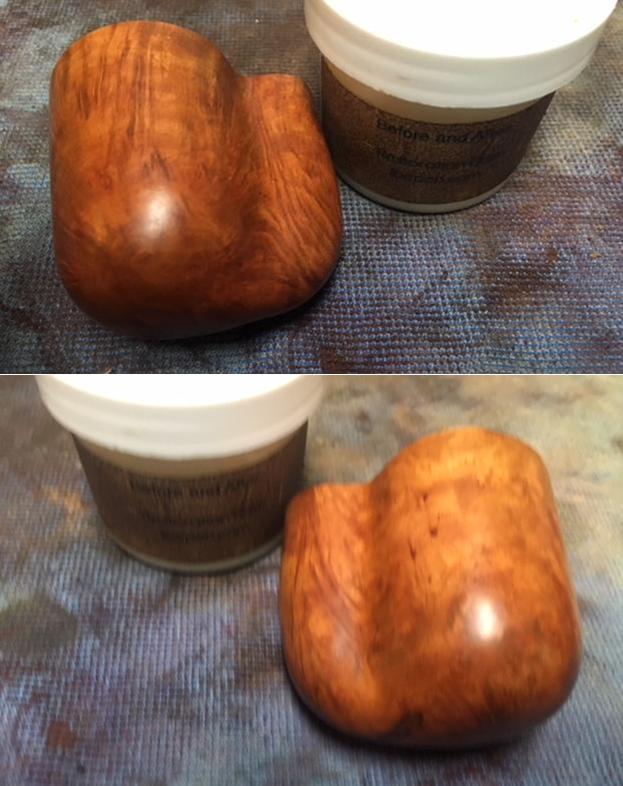
She sent along this photo of him with his sled dogs in the Antarctic sometime in 1953-1954. It is a fascinating photo showing him with a pipe in his mouth. He is happily rough housing with his dogs. As a true pipeman the cold does not seem to bother him at all.Thank you Farida for sending the photo and the background story on your Dad for me to use on the blog. I find that it really explains a lot about their condition and gives me a sense of who Dad was. If your Dad was rarely without a pipe I can certainly tell which pipes were his favourites. As I looked over the pipes I noted that each of them had extensive rim damage and some had deeply burned gouges in the rim tops. The bowls seemed to have been reamed not too long ago because they did not show the amount of cake I would have expected. The stems were all covered with deep tooth marks and chatter and were oxidized and dirty. The internals of the mortise, the airway in the shank and stem were filled with tars and oils. These were nice looking pipes when her Dad bought them and they would be nice looking one more when I finished.

I finished two of the pipes and have written a blog on each of them. The first one was the Dunhill Shell with the oval shank pot (https://rebornpipes.com/2018/02/04/restoring-a-1983-dunhill-shell-41009-oval-shank-pot/) and the second was the Dunhill Classic Series Shell Billiard (https://rebornpipes.com/2018/02/08/faridas-dads-pipes-2-restoring-a-1990-lbs-classic-series-dunhill-shell-billiard/). The third pipe I restored from the estate was a Savinelli Autograph (https://rebornpipes.com/2018/02/15/faridas-dads-pipes-3-restoring-a-savinelli-autograph-4/).

I went back to the Dunhills today so I chose to work on a Dunhill Red Bark 43061 pot. It was so dirty it was hard to tell what it looked like under the thick grime. The blast itself was almost filled in with thick, oily grime. I wiped the grime off the underside of the shank to be able to read the stamping. It was worn but readable. On the bottom of the bowl is the 43061 shape number. Next to that it is stamped Dunhill Red Bark over Made in England 17.  Dating this pipe is a fairly easy proposition. You take the two digits following the D in England and add them to 1960. In this case it is 1960+17= 1977. (Pipephil’s site has a helpful dating tool for Dunhill pipes that I use regularly http://www.pipephil.eu/logos/en/dunhill/redbark1.html). The bowl was thickly caked and the cake had flowed over onto the light sandblast finish on the rim top forming a hard lava that made the top almost smooth. The inner and outer edges of the rim were damaged. On the front of the bowl the rim had been scraped and damaged and then burned. On the back edge there was the same kind of damage that was on the other Dunhill pipes in this estate. This one however was not quite as deep so it would need to be dealt with a bit differently when I got to that point. The stem was oxidized and calcified at the button end. There were tooth marks and chatter on both sides in front of the button. The Dunhill white spot was intact on the top of the stem. I took photos of the pipe to show what it looked like before I started the cleanup work. I took close up photos of the bowl and rim top as well as the stem. You can see the condition of the rim top and bowl in the first photo. The stem has tooth chatter and some deep bite marks on the top edge of the button and a deep tooth mark on the underside of the stem just ahead of the button. There is a lot of calcification and wear on the rest of the stem as well.I reamed the bowl with a PipNet reamer and I had to use three of the four cutting heads to clean out the cake. The bowl thickly caked so I started with the smallest of the three and worked my way up to the third which was about the same size as the bowl diameter. I took back the cake to bare briar. I took a photo of the cleaned bowl. I scrubbed the surface of the sandblast with Murphy’s Oil Soap and a tooth brush to clean out all of the dust. I worked on the top of the rim with a brass bristle wire brush and a brass bristle polishing brush to remove the lava on the rim. I scrubbed the stem with the tooth brush as well to remove the calcification and grime. I rinsed the pipe under warm running water to remove the dirt, grime and soap. I dried off the bowl with a soft rag. The cleaned and scrubbed pipe really made the rim top damage very clear. It looked to me that I would need to top the bowl. I cleaned up the reaming of the bowl with a Savinelli Fitsall Pipe Knife to remove the remaining cake that was on the walls around the airway and the lower part of the bowl.I topped the bowl to remove the damage to the top surface of the rim and clean up the damage to the edges. I did not have to remove a lot and repeatedly checked it to make sure that I had removed enough but not too much.I used a series of dental burrs on the Dremel to etch a pattern into the top of the rim to blend it into the sandblast around the bowl sides. It was not a deep sandblast so the pattern on the rim needed to be random looking and not deep. I wanted it to blend in the damaged area on the back side of the rim. The photo below shows the rusticated rim top and the three burrs that I used to create it.I restained the bowl and rim with a Mahogany stain pen. I wanted to match the colour of the Red Bark shown in the photo below. After I stained the pipe with the Mahogany and I used a red oil based stain. I rubbed it onto the finish and buffed it off with a soft cloth. I rubbed down the briar with Before & After Restoration Balm. I worked it into the nooks and crannies of the sandblast finish to clean, enliven and protect the new finish. It also evened out the stain coat and gave the stain a dimensional feel. I let the balm sit for a little wall and then buffed it with a horsehair shoe brush. I buffed the bowl with a cotton cloth to raise the shine. Once again I have gotten so used to Jeff cleaning the pipes before I got them I just I realized that I had not worked on the internals of the pipe. I looked down the shank and it was filthy as was to be expected. Arghhh. Went back to clean out the shank and airway in the stem and shank. I scraped the hardened tars on the walls of the mortise with a pen knife. I cleaned the mortise and the airway in the shank with pipe cleaners, cotton swabs and alcohol until it was clean. I painted the surface of the stem with the flame of a Bic lighter to lift the tooth dents in the underside of the stem. It took a few swaths of the lighter and the dents lifted. There was only one small pin prick left next to the button that would need to be repaired.  I repaired the remaining deep tooth marks on both sides of the stem with black super glue. Once it dried I sanded the surface of the stem with 220 grit sandpaper to smooth out the repaired tooth marks and chatter and removing the remnants of calcification and oxidation on the stem until the oxidation was removed.I polished the stem with micromesh sanding pads – wet sanding with 1500-2400 grit micromesh sanding pads and dry sanding it with 3200-12000 grit pads. I rubbed the stem down with Obsidian Oil after each pad. I polished it further with Before & After Pipe Polish, using both the Fine and Extra Fine polishes to further protect and polish out the scratches. When I finished with those I gave it a final rub down with the oil and set it aside to dry. With the stem polished I put it back on the pipe and lightly buffed the bowl with Blue Diamond. I buffed the stem with a more aggressive buff of Blue Diamond. I gave the bowl several coats of Conservator’s Wax and the stem several coats of carnauba wax and buffed the pipe with a clean buffing pad to raise the shine. I hand buffed it with a microfiber cloth to deepen the shine. The pipe polished up pretty nicely. The finished pipe is shown in the photos below. This is the fourth of Farida’s Dad’s pipes that I am restoring from his collection. I am looking forward to hearing what Farida thinks once she sees the finished pipe on the blog. I will be posting it on the rebornpipes store very soon. It should make a nice addition to your pipe rack if you have been looking for a reasonably priced Dunhill. When you add it to your collection you carry on the trust from her father. The dimensions are Length: 5 3/4 inches, Height: 1 1/2 inches, Outside diameter of the bowl: 1 1/2 inches, Chamber diameter: ¾ inches. Thanks for walking through the restoration with me as I worked over this estate Autograph. More of his pipes will follow including some Charatans and more Dunhills.