Monthly Archives: November 2019

New Life for a Malaga Poker/Sitter for Alex


Blog by Steve Laug

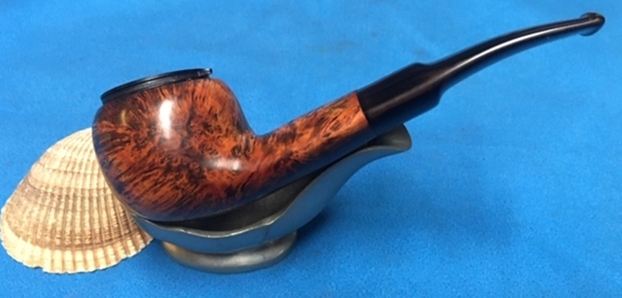
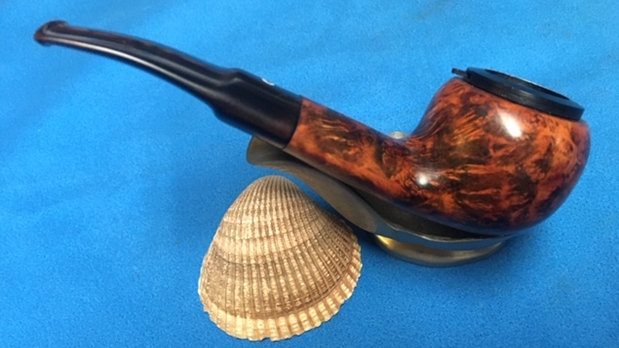
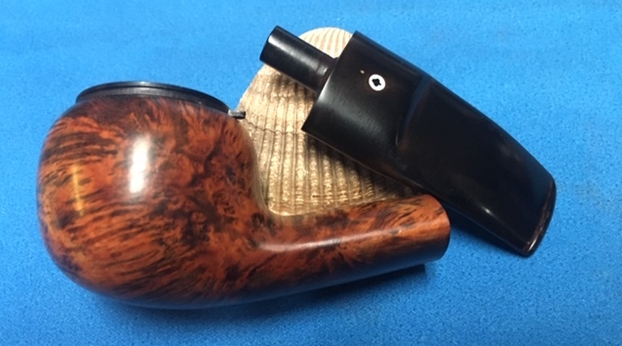
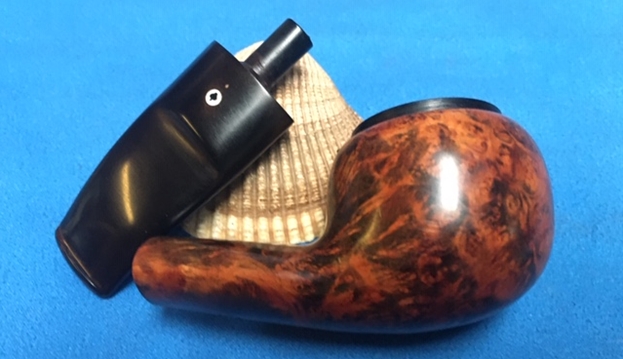
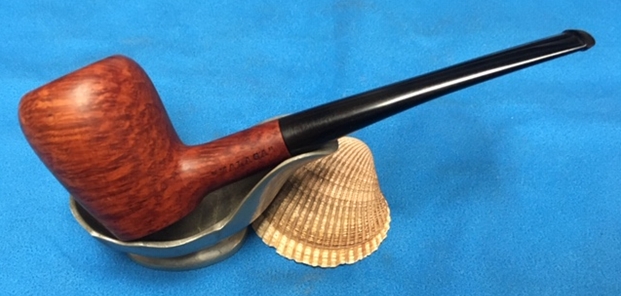
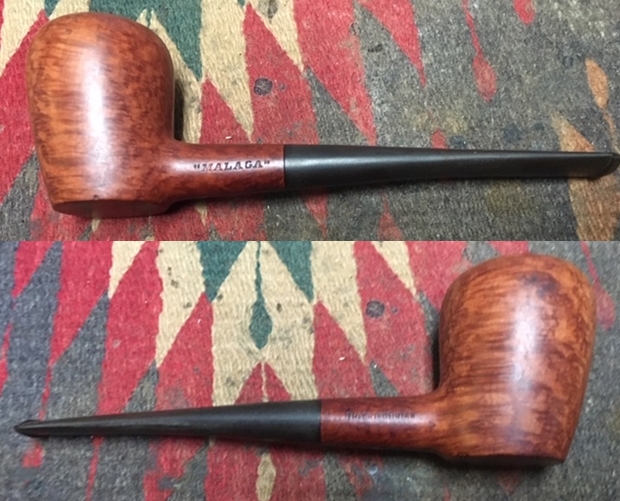
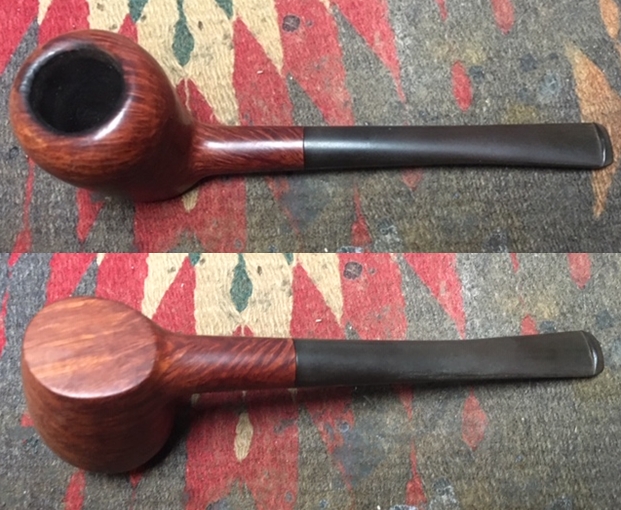
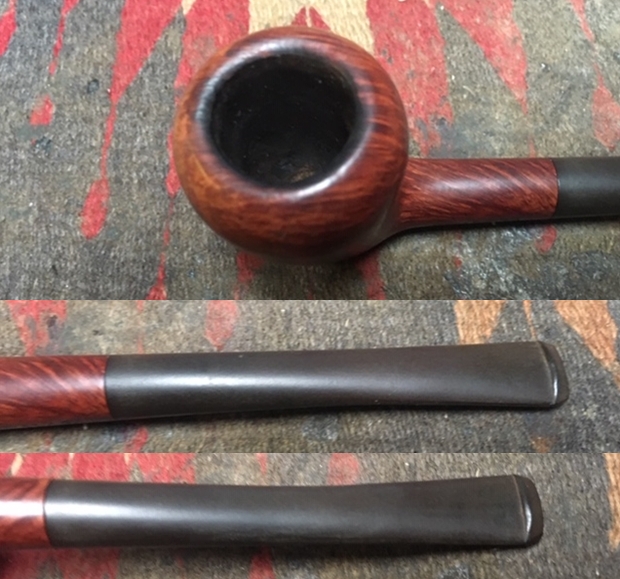
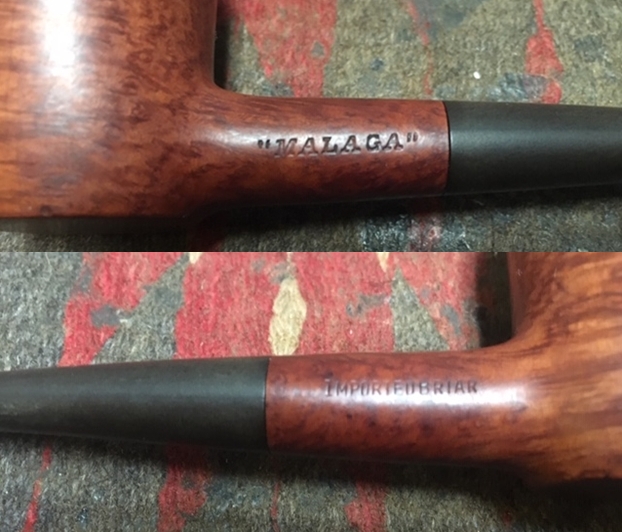
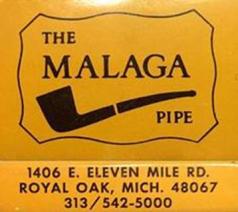
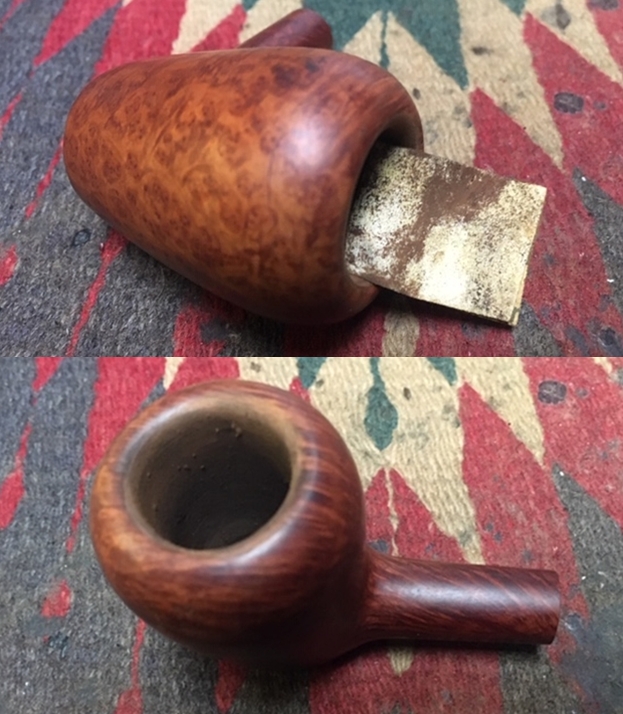
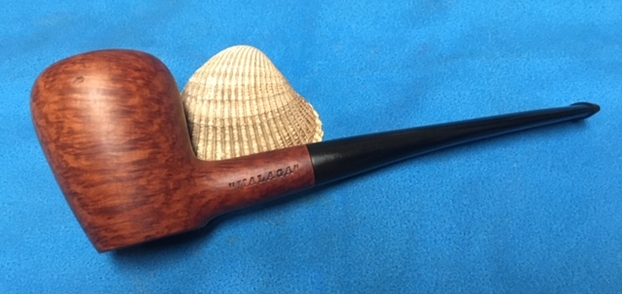
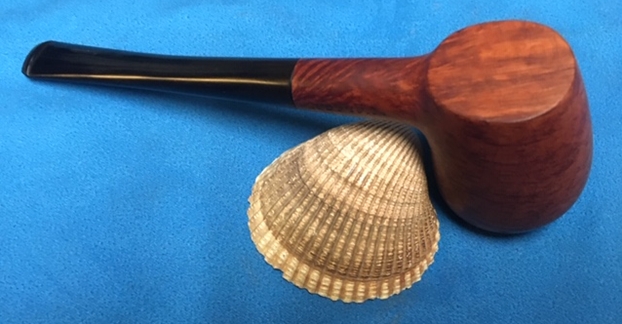
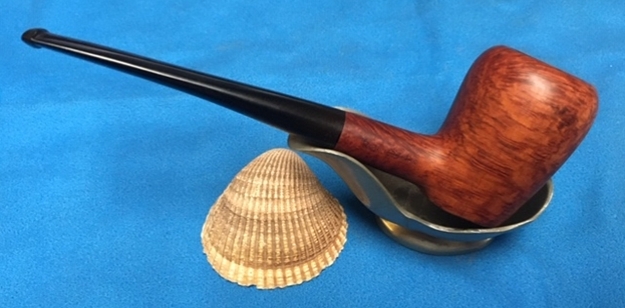
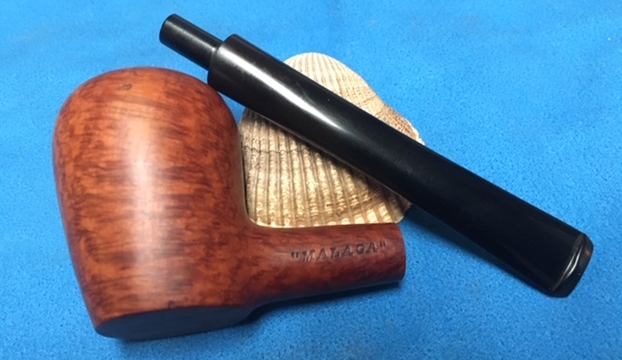
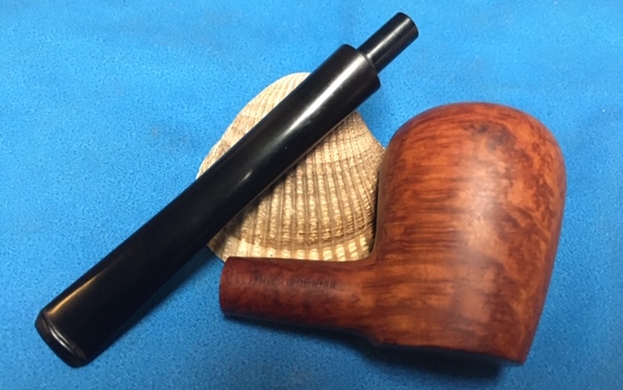
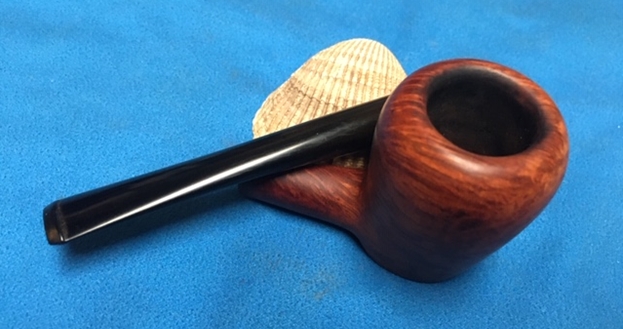
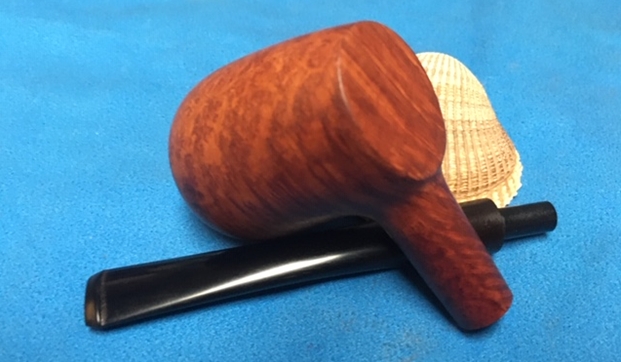
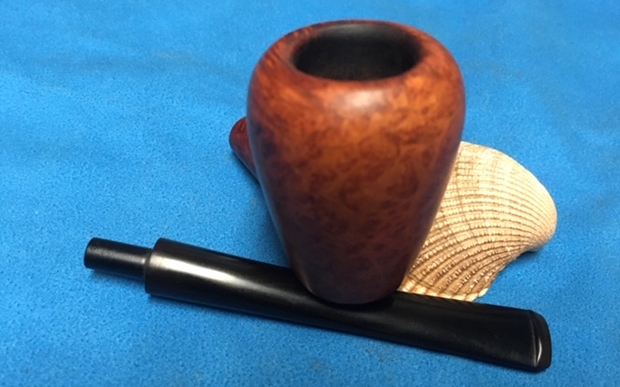
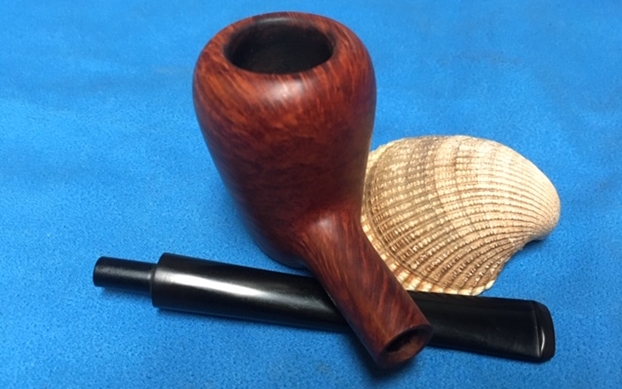
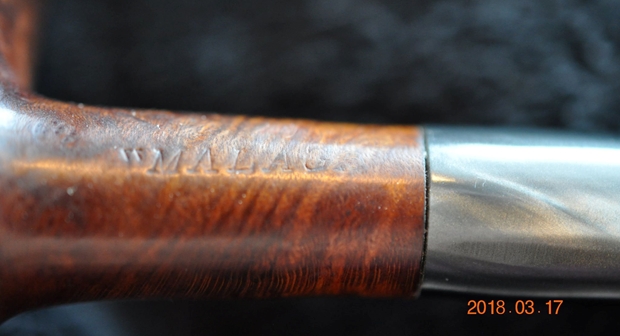
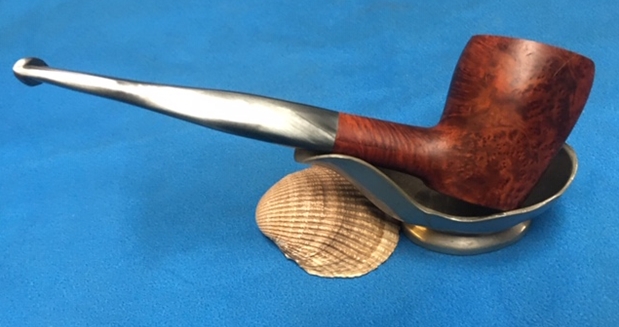
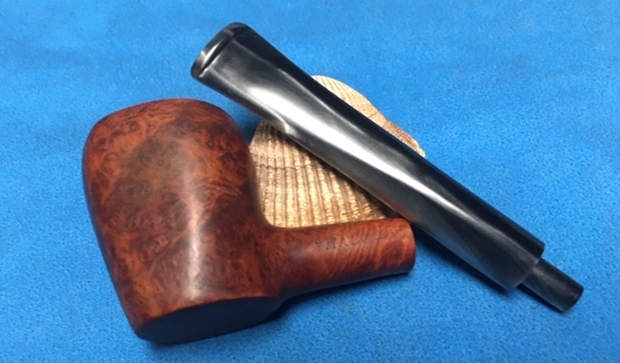
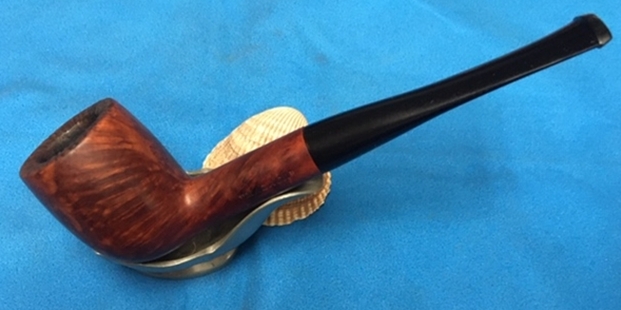
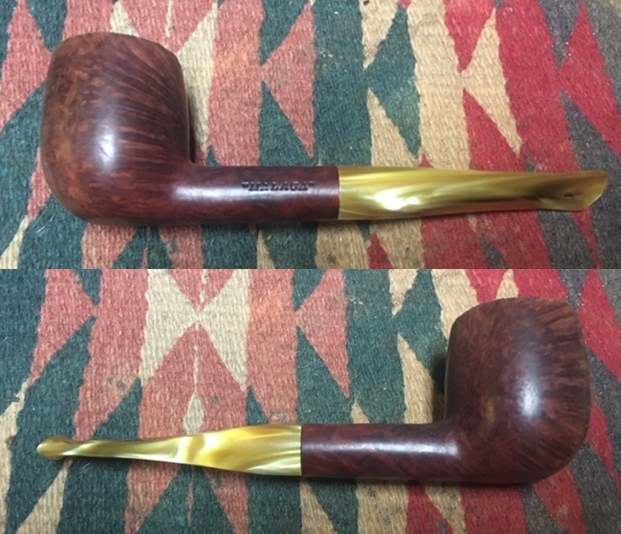
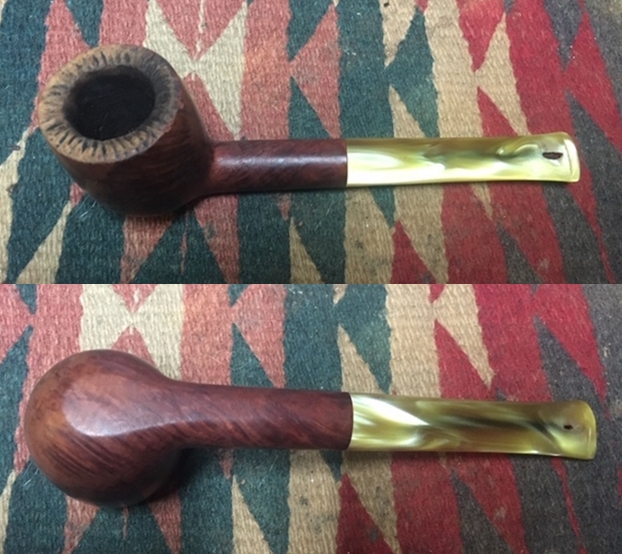
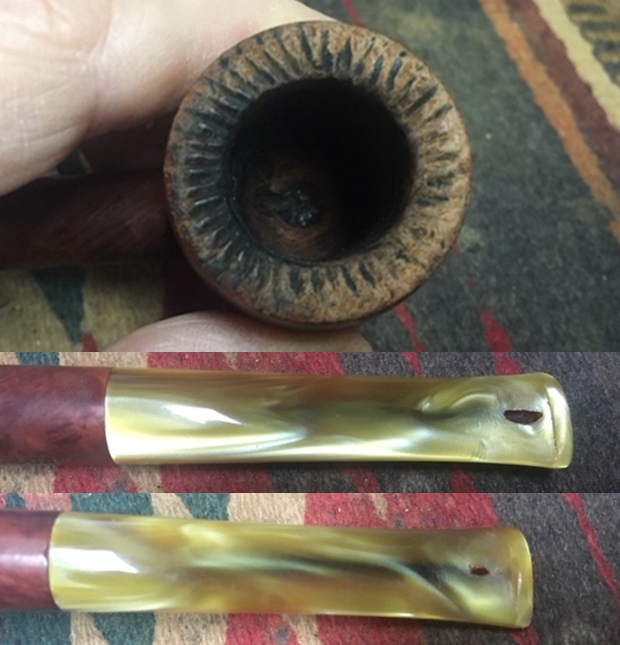
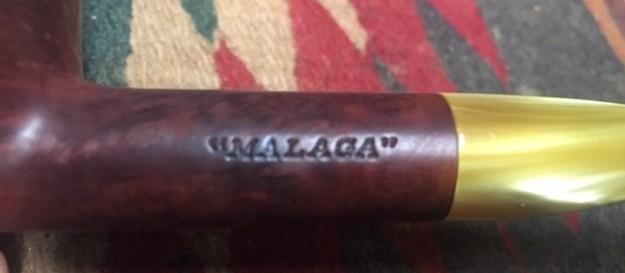
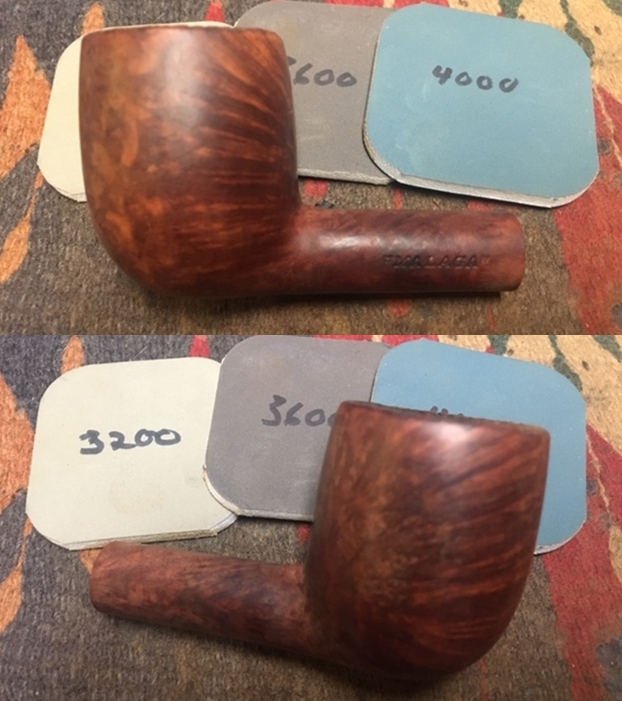
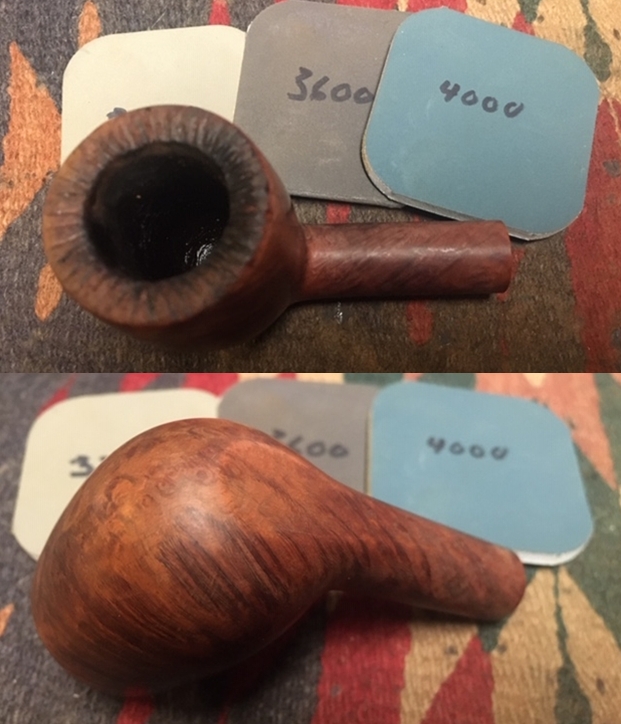
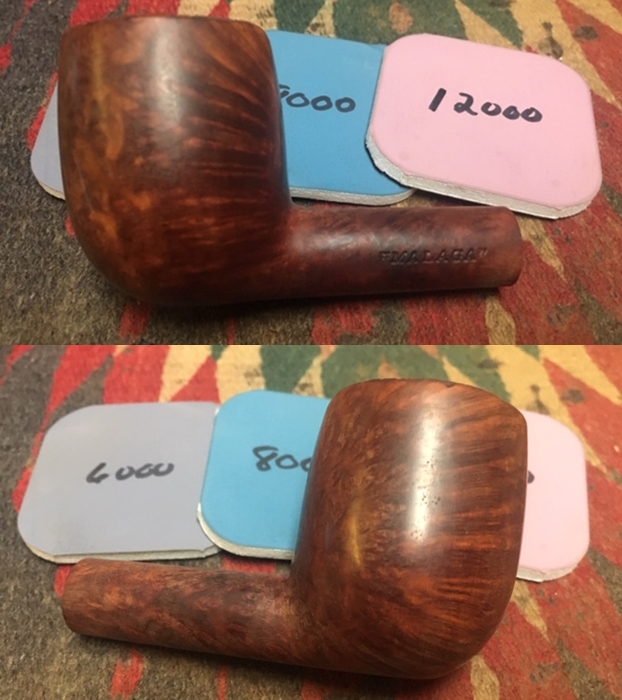
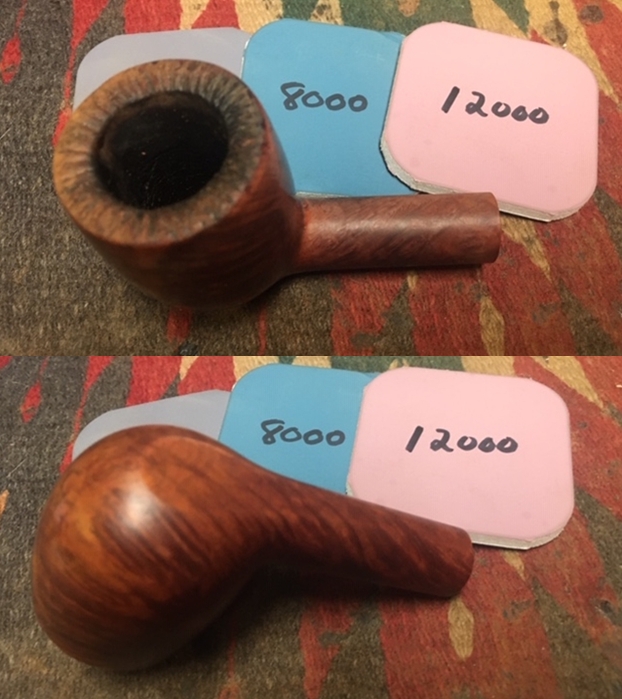
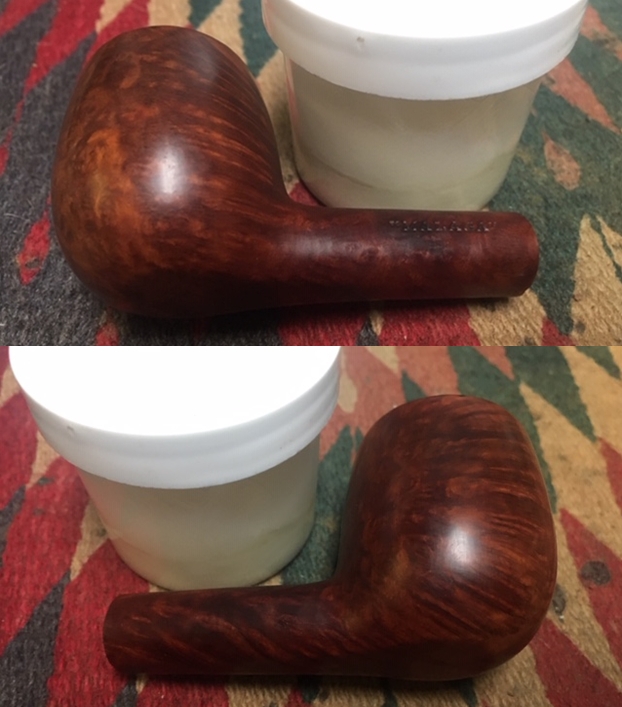
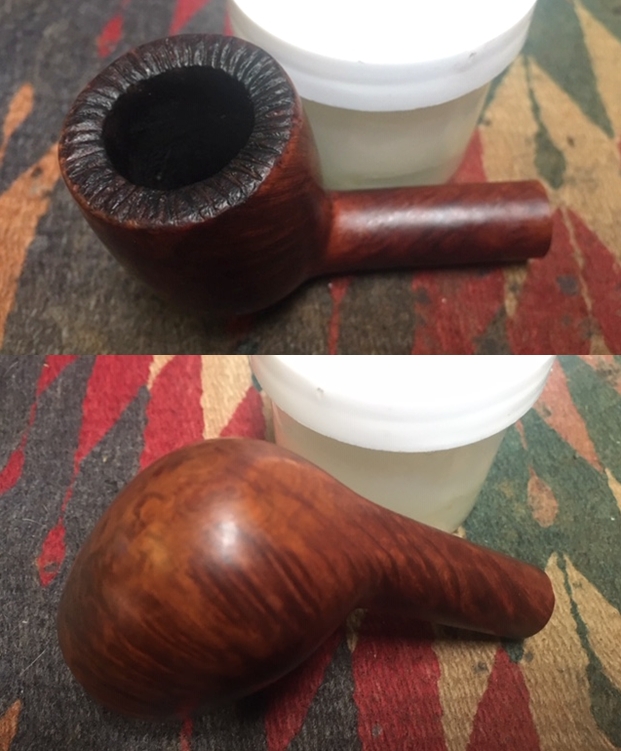
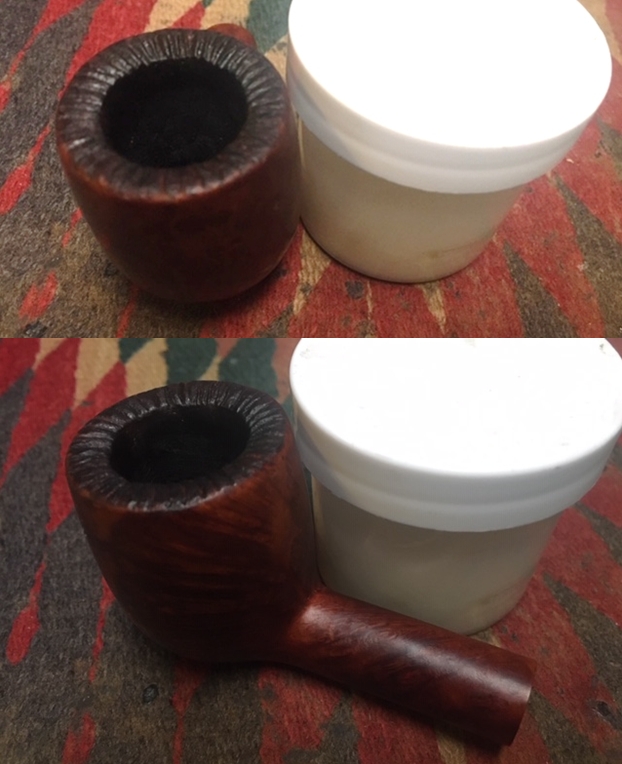
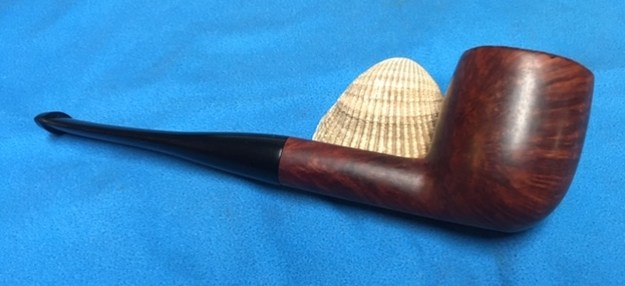
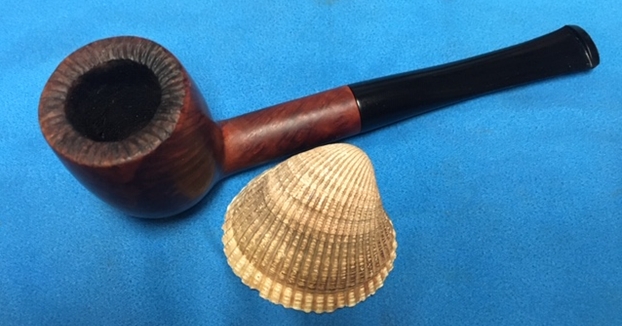
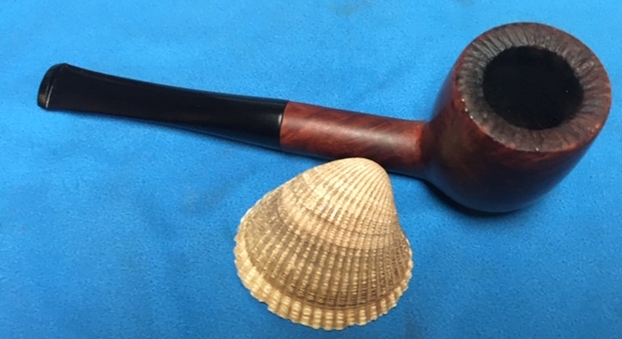
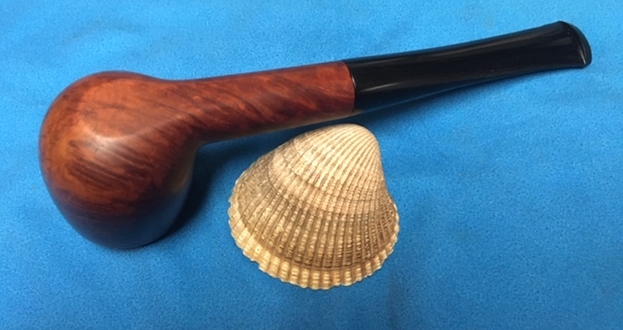
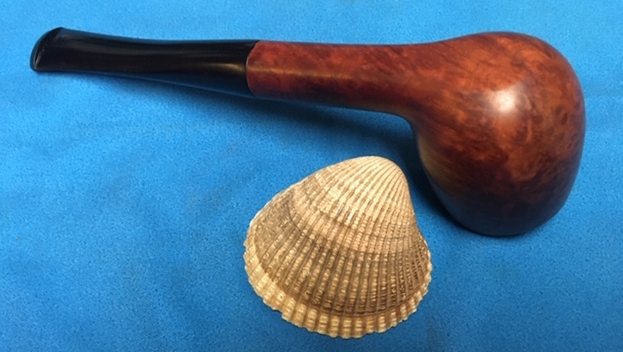
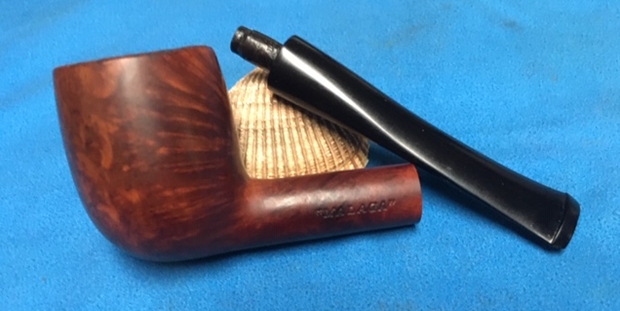
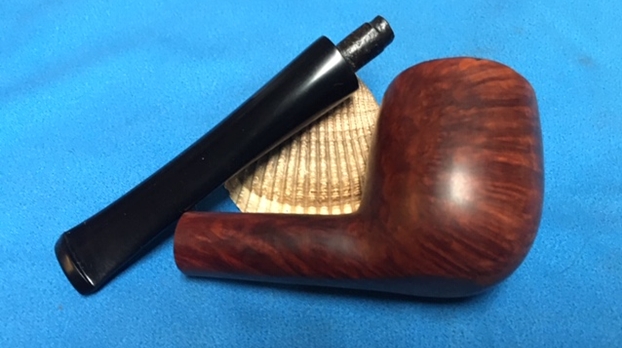
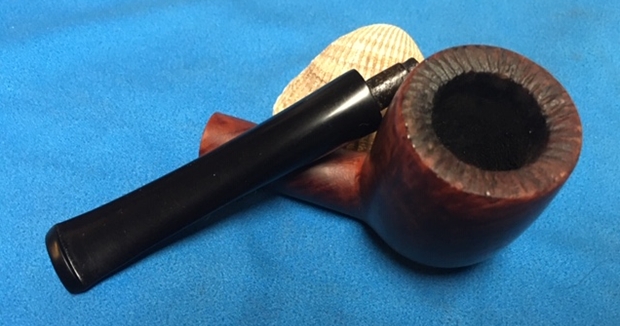
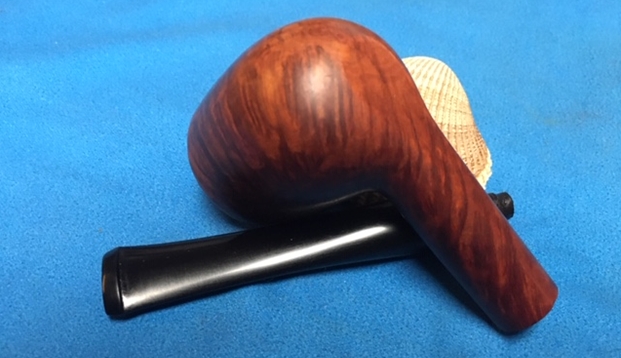
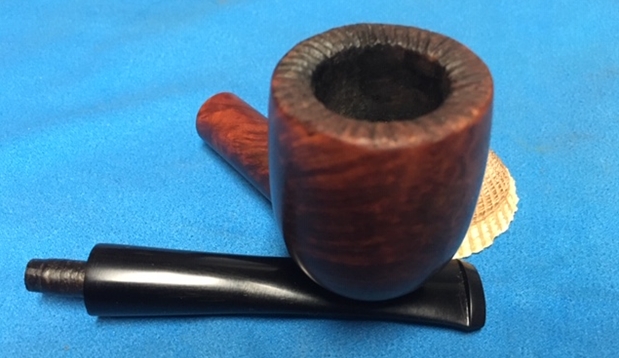
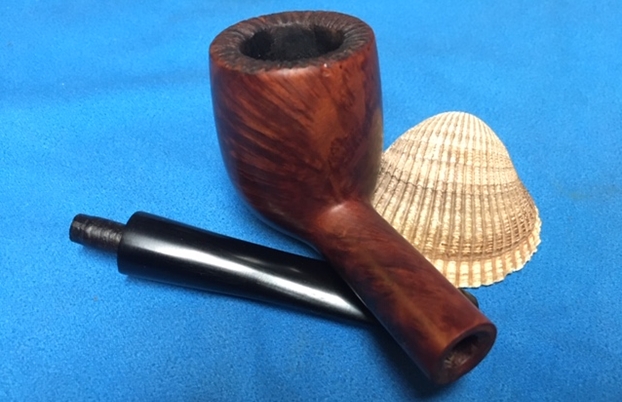
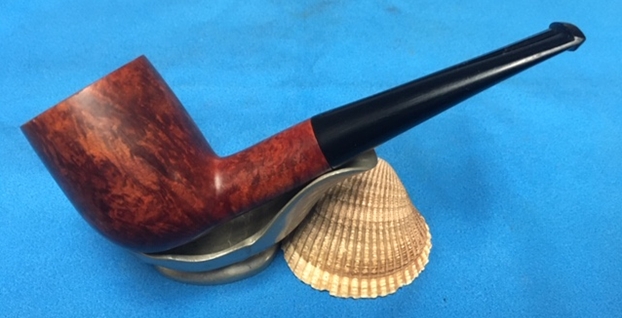
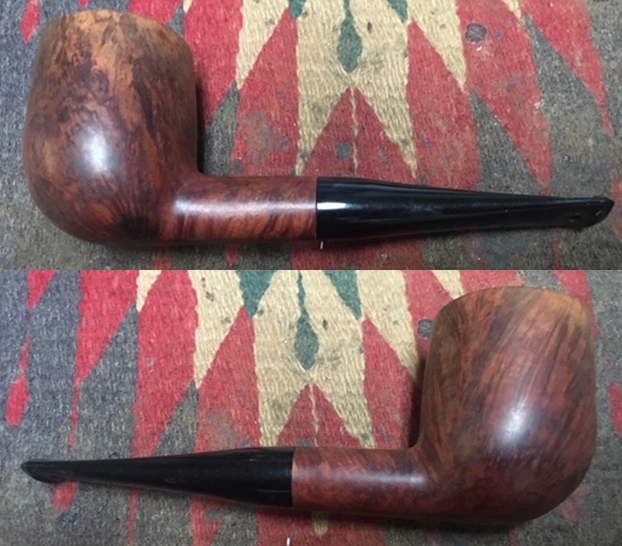
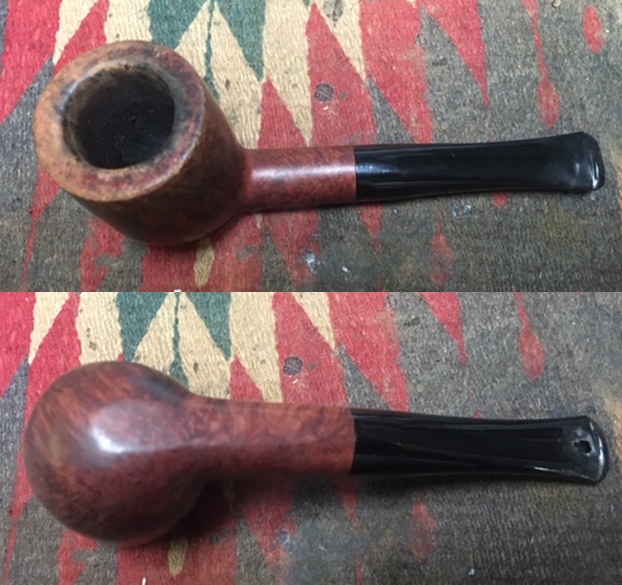
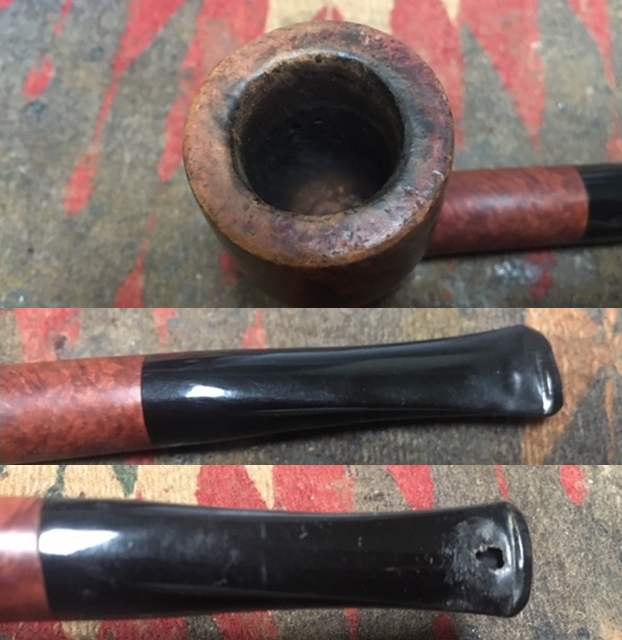
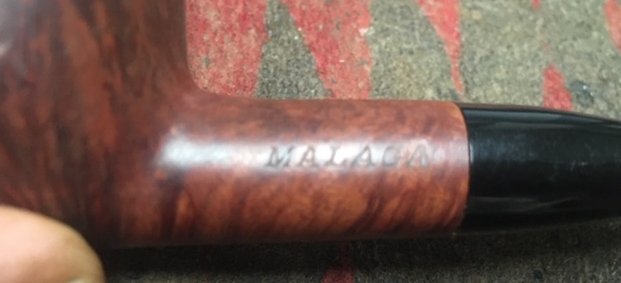
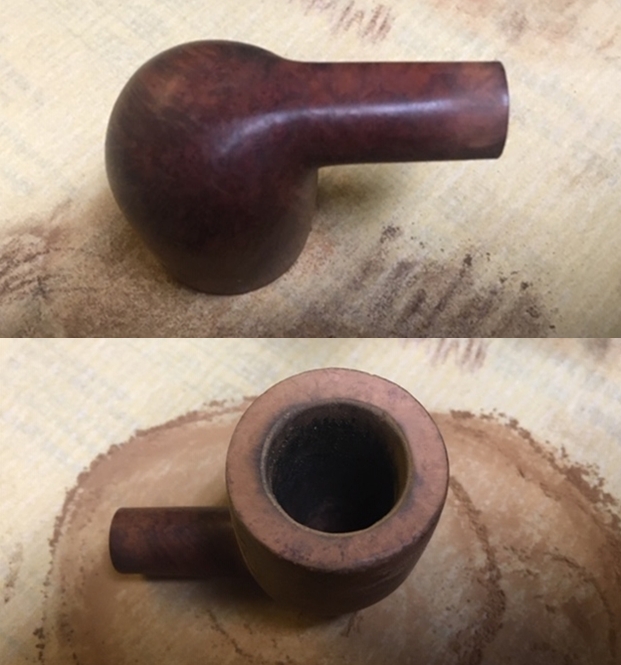
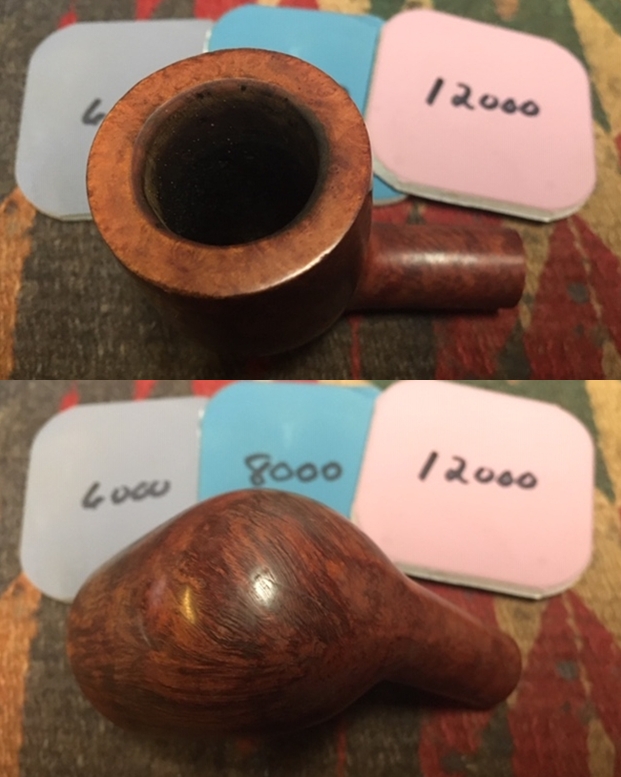
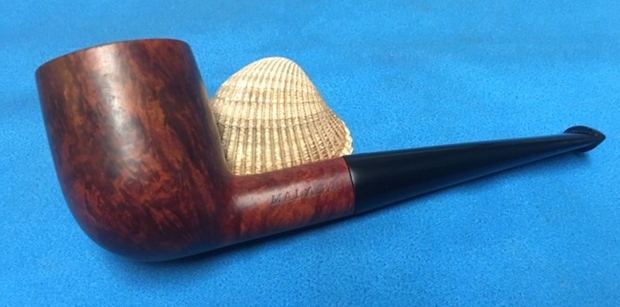
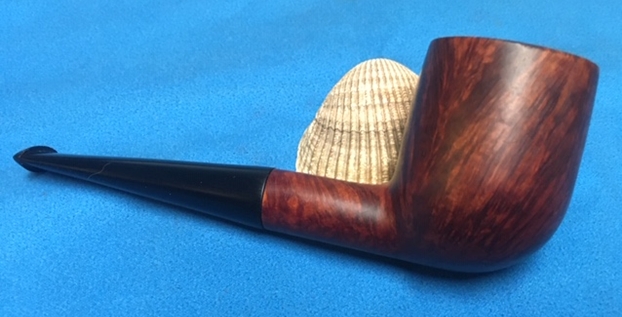
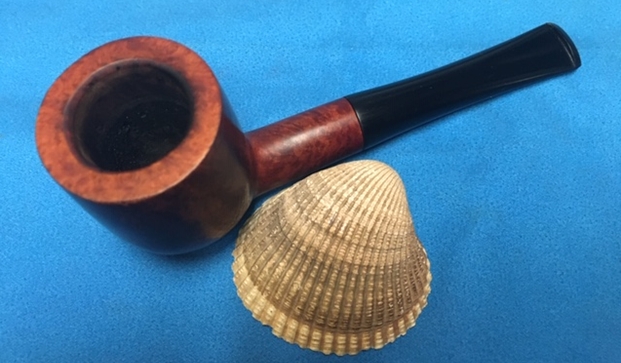
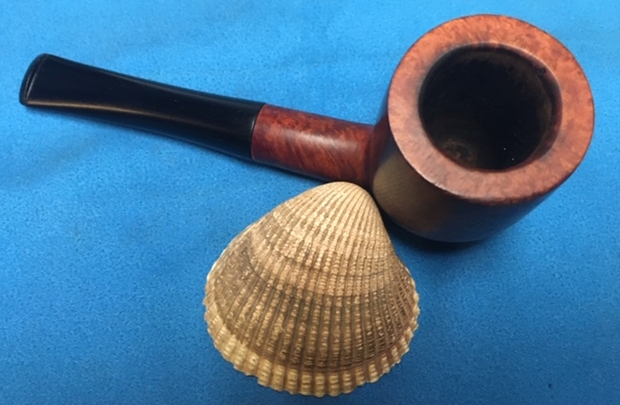
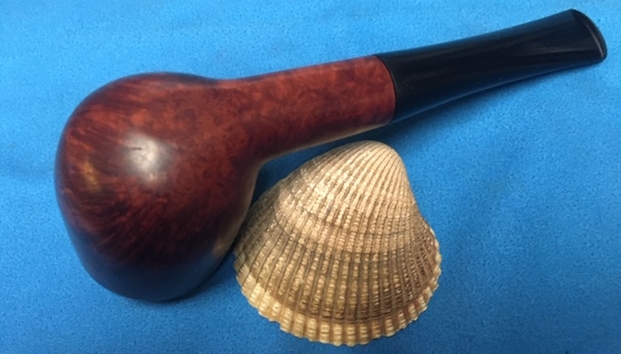
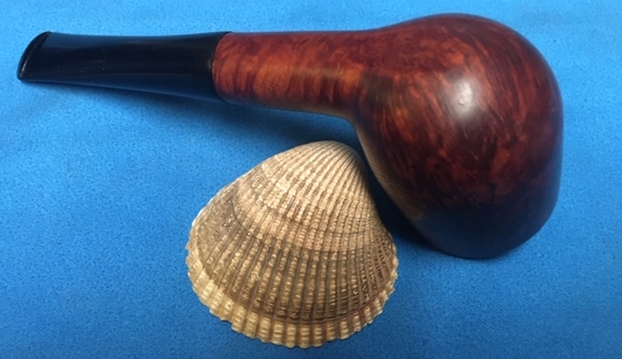
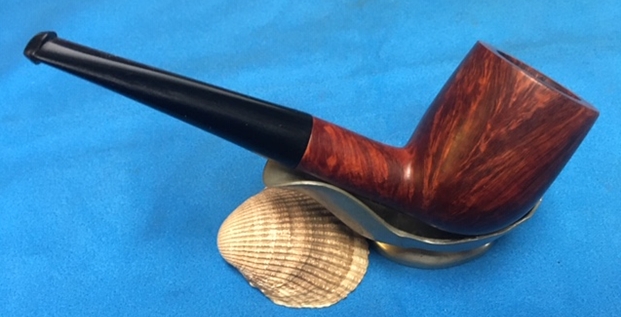
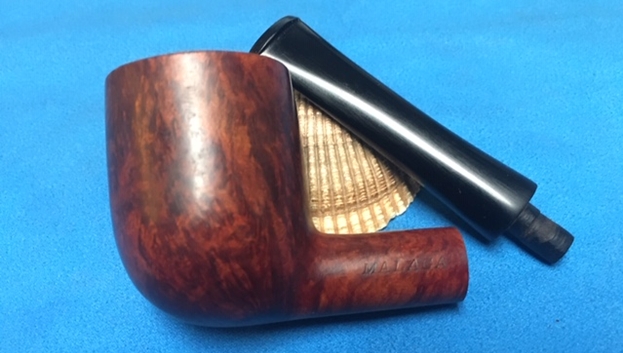
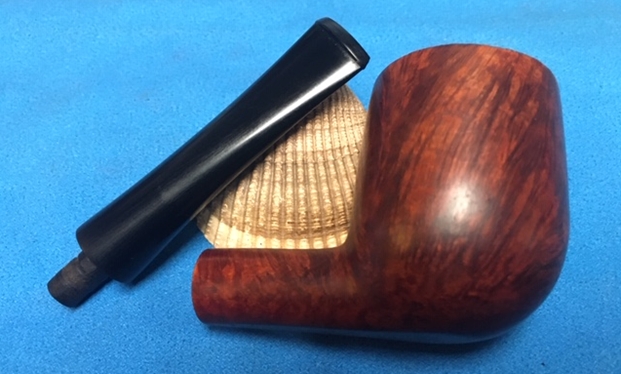
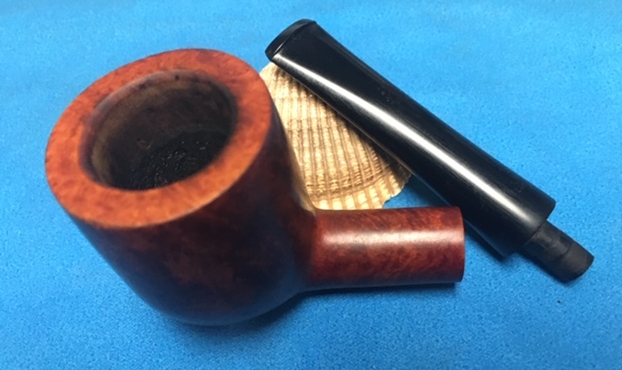
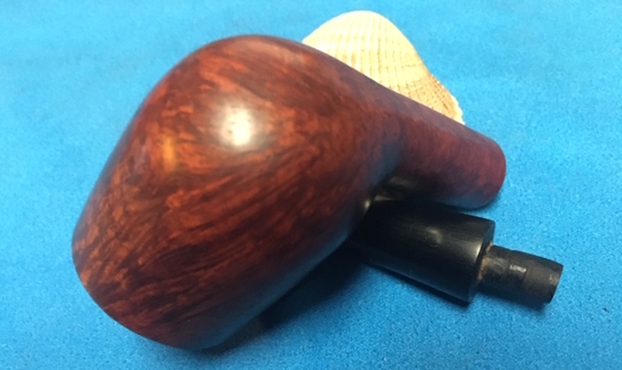
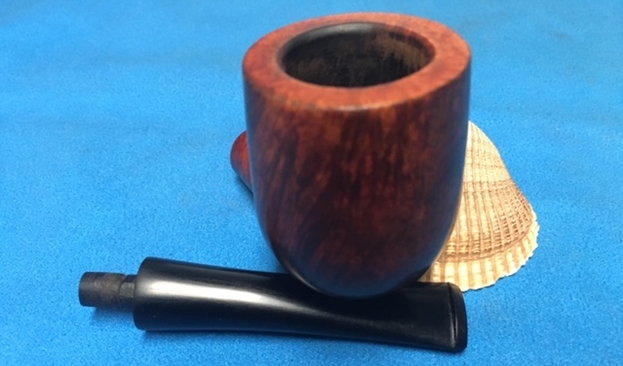
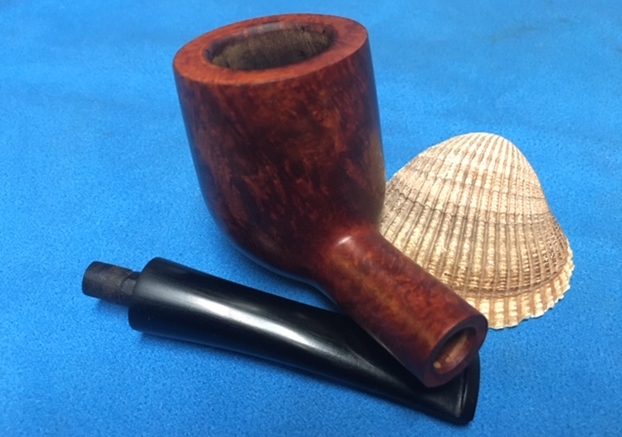
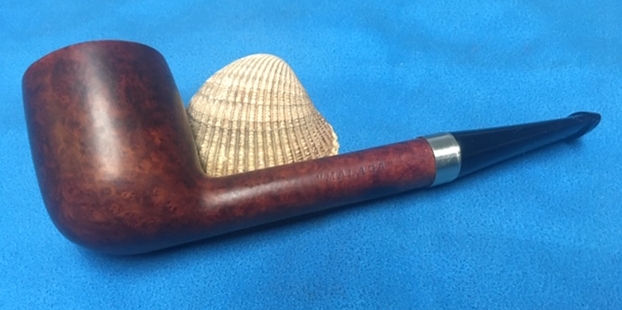
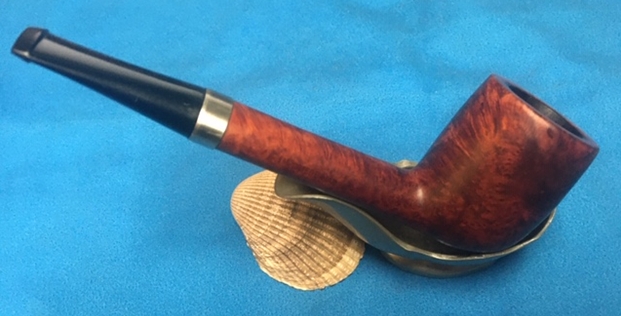
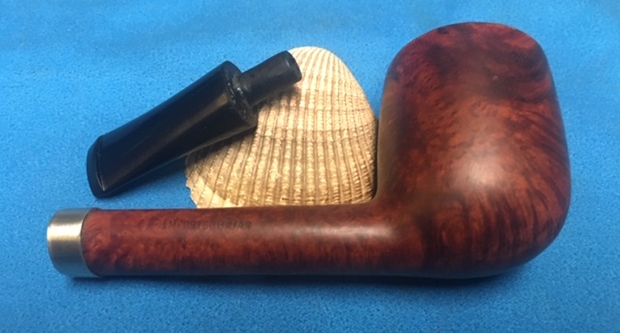
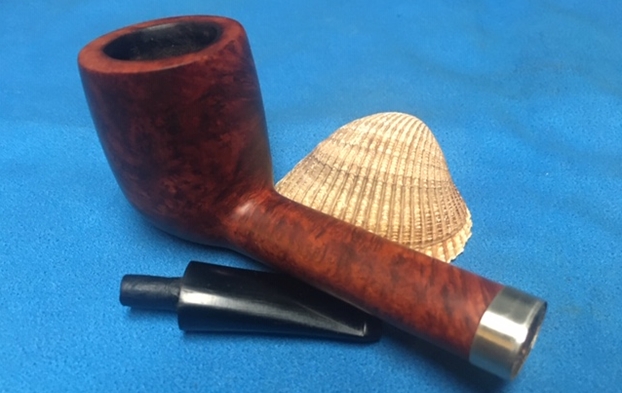
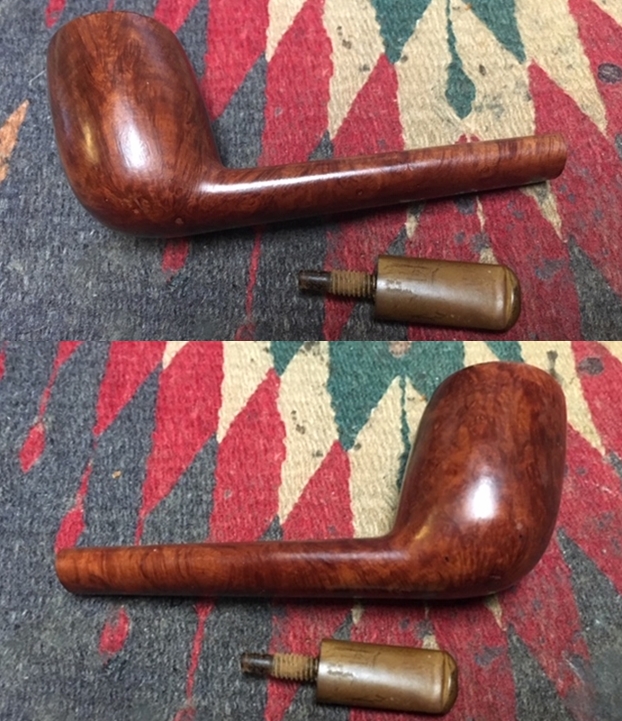
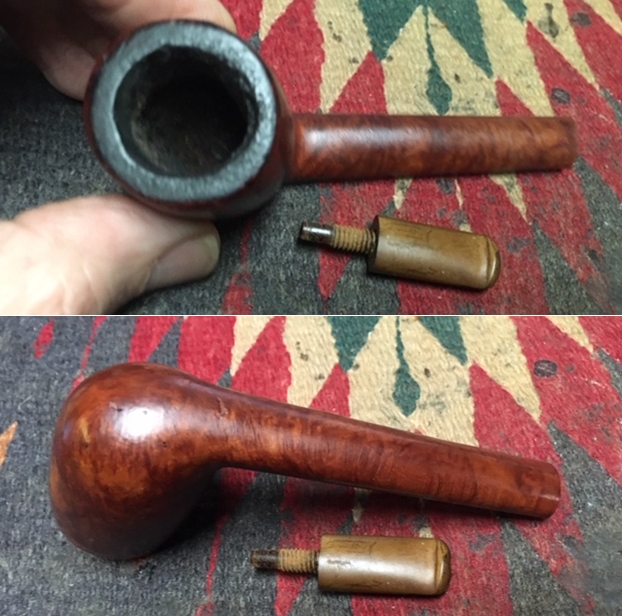
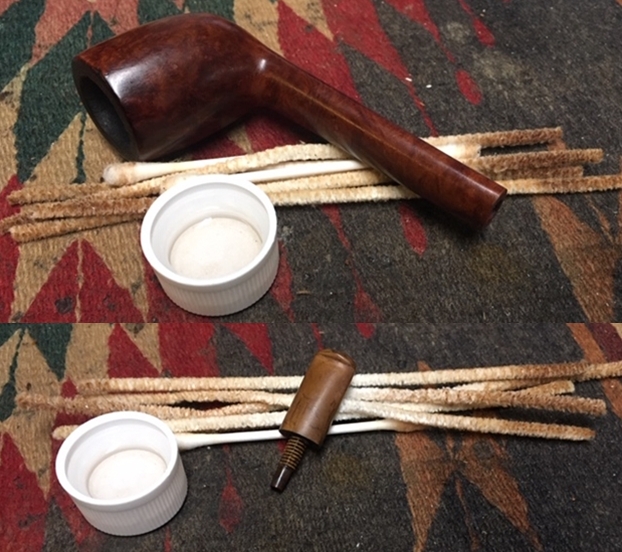
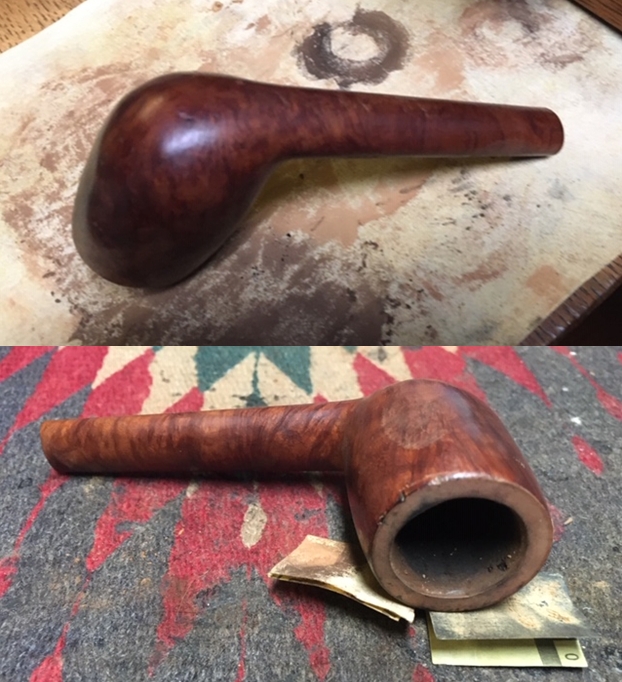
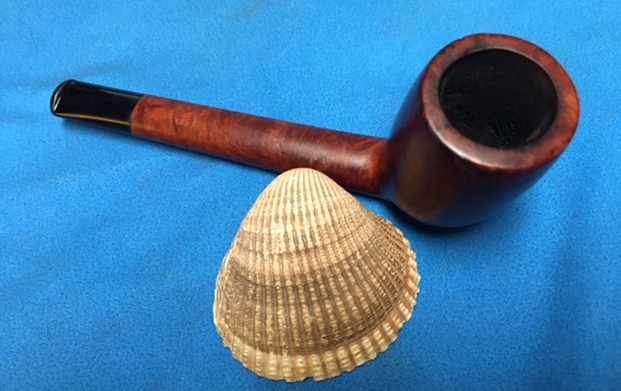
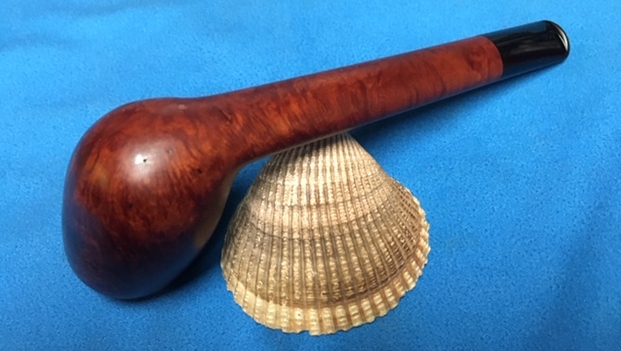
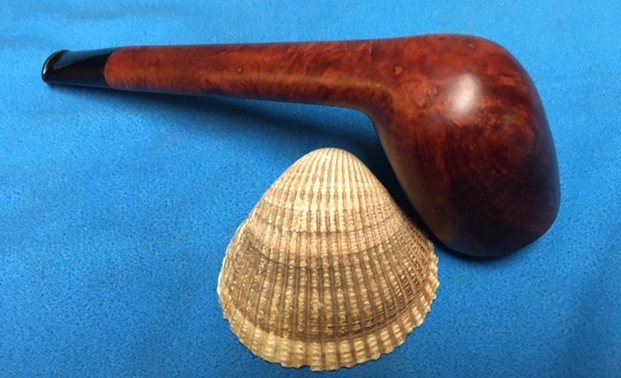
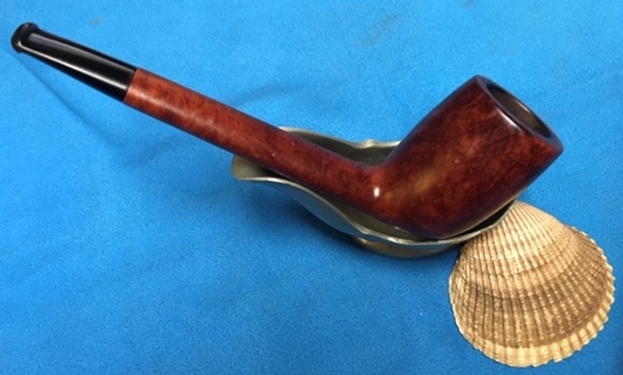
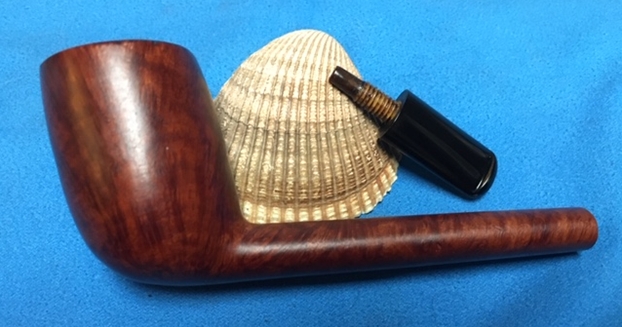
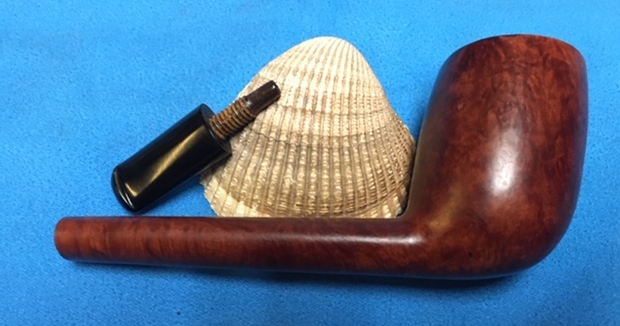
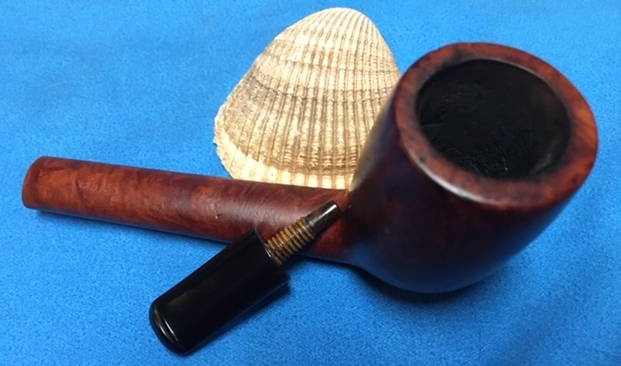
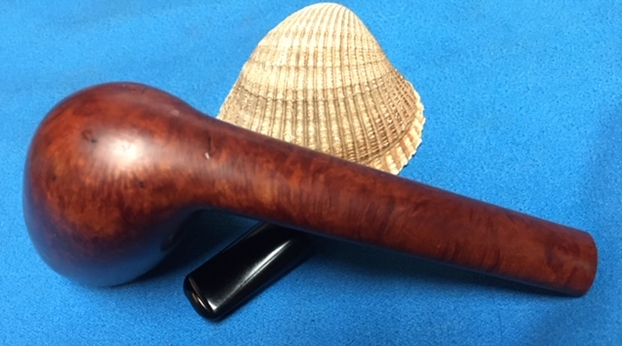
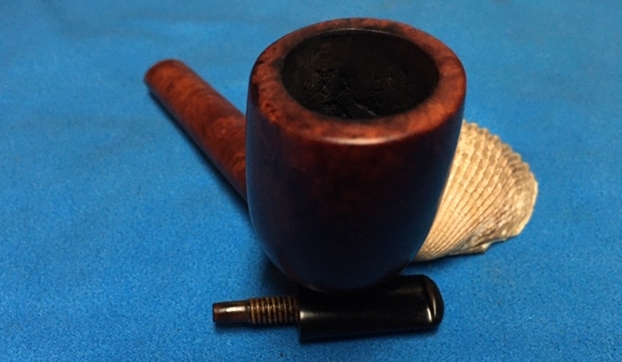
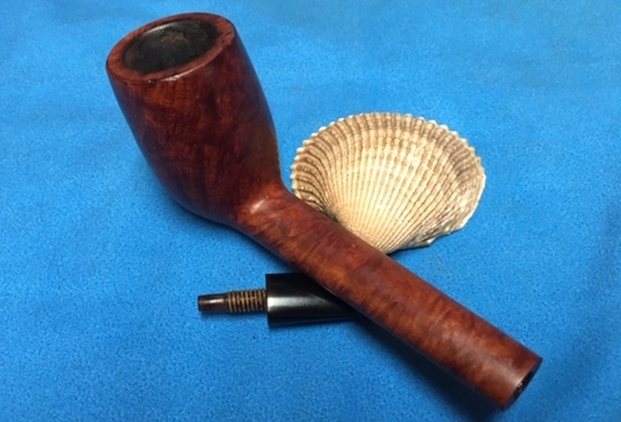
I have been working on a lot of different estate pipes and selling them for different families. I am continuing to work on the Malaga pipes that Alex put aside for restoration. He also brought other pipes to add to his box. I have a box of pipes from Alex that I am always working away at. He periodically drops more Malaga pipes into his box. There are quite a few of them to work on so I decided work on a few of them. The next one of these was another Malaga pipe. It is a beautiful Poker Sitter that is almost pear shaped. It has a very tight grain pattern around the bowl – cross grain on the sides and birdseye on the front and back of the bowl. It also has a tapered vulcanite stem. The pipe was dirty and caked when arrived. The rim top has a little lava and some darkening on the top rear edge of the bowl. The bowl had a thin cake in it that was hard and dense. The exterior of the bowl and shank are dirty with grime and oils from prolonged use. The stamping on the left side of the shank read “MALAGA” and on the right side it read Imported Briar. The vulcanite stem was in great condition and had tooth chatter on the top and the underside of the stem. I took photos of the pipe before I started the cleanup work. I took close up photos of the bowl and rim to capture the condition of the pipe before I started my cleanup work. The rim top had some light lava and darkening on the front and back edge. The inner edge was slightly bevel and was darkened. Other than being so dirty it was in great condition. There was a light hard cake in the bowl interior. The stem was dirty and there was tooth chatter on the top and underside near the button. The stem was also lightly oxidized.I took a photo to capture the stamping on the shank. The first photo shows the stamping “MALAGA” on the left side of the shank is very readable. The second photo shows the stamping Imported Briar on the right side.If this is the first of the Malaga restorations that you have read about then you should know the backstory of the brand. I am including the link to a blog that I wrote that gives some of the history of the Malaga brand and the Malaga Pipe Shop in Royal Oak, Michigan in the USA. I have written an earlier blog to give a little history of the Malaga Brand and the pipemaker, George Khoubesser. Here is the link – https://rebornpipes.com/tag/malaga-pipes/.That blog also includes links to a catalogue and the history of the pipemaker George Khoubesser. Follow the link to get a feel for the brand and the pipemaker.

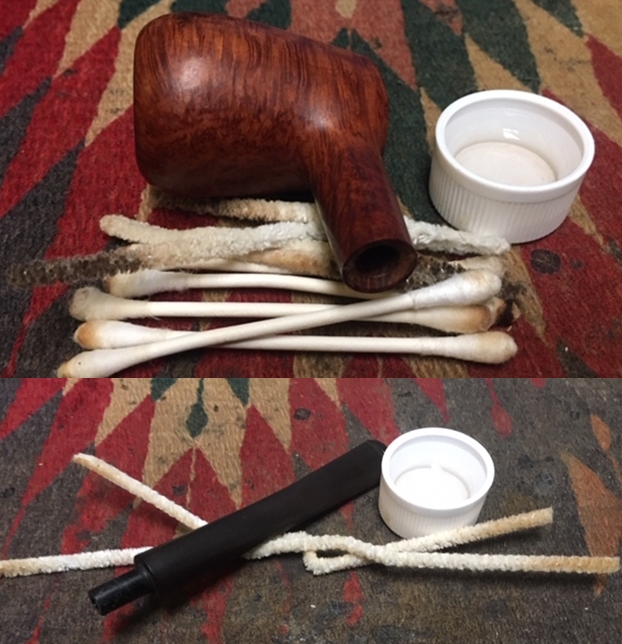
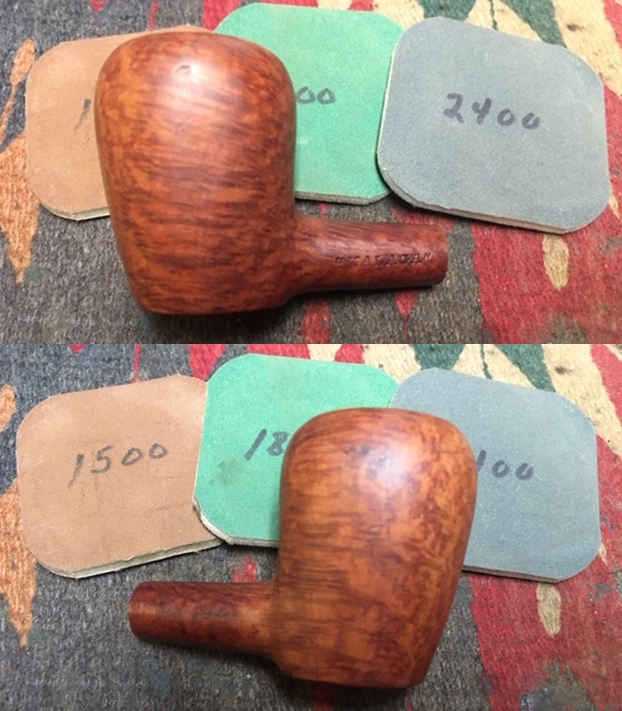
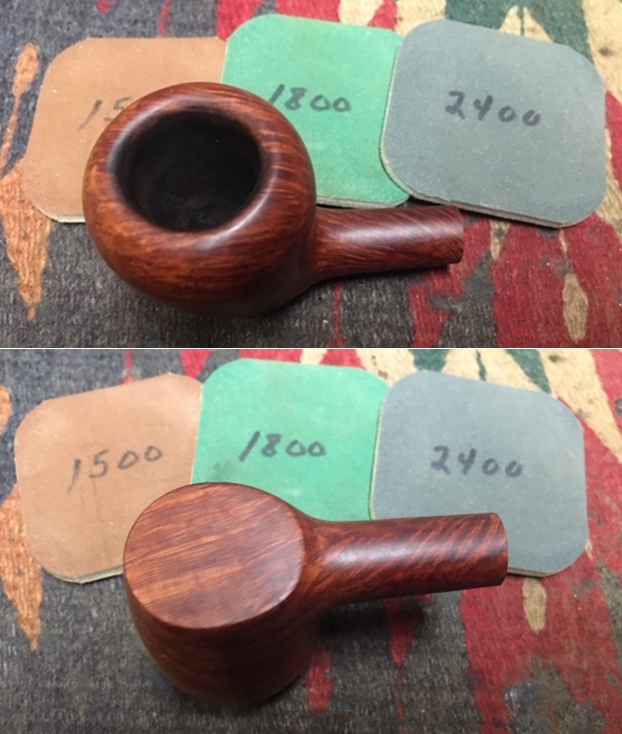
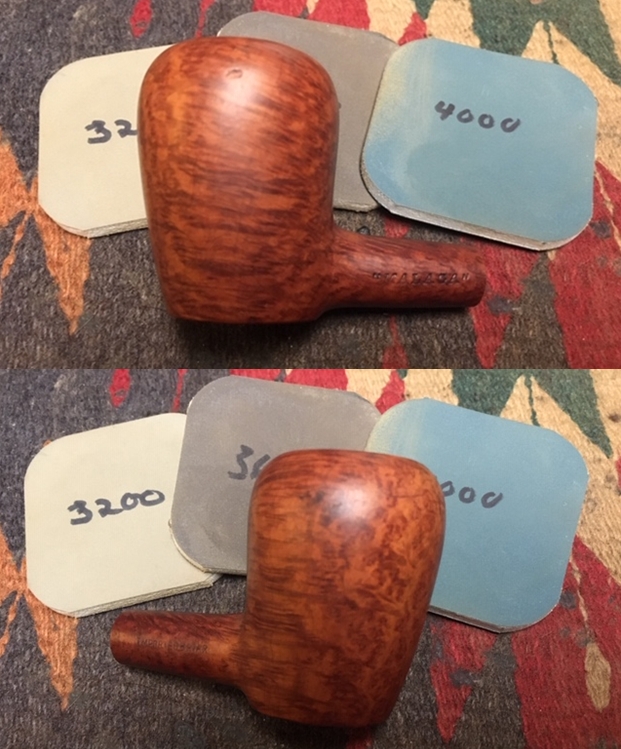
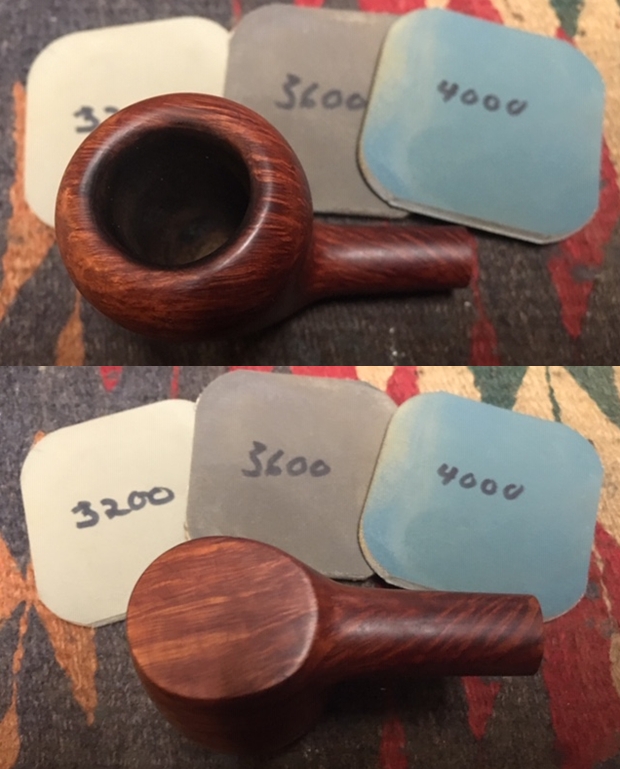
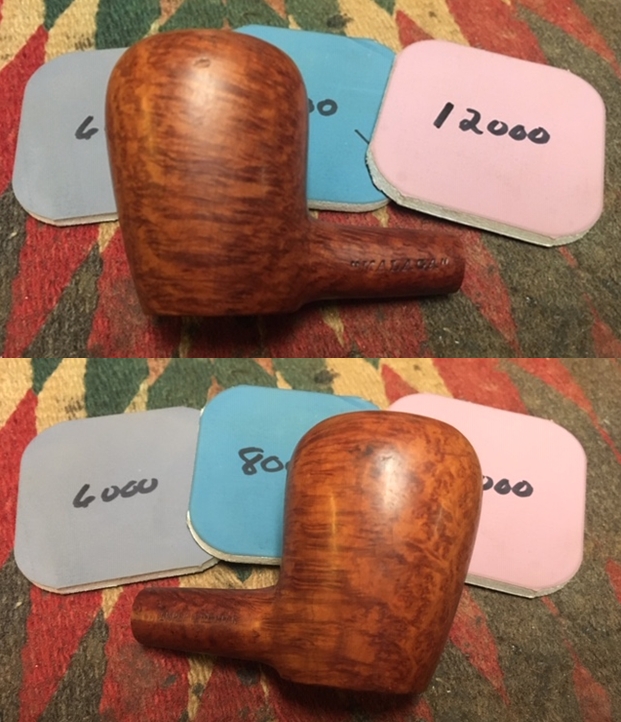
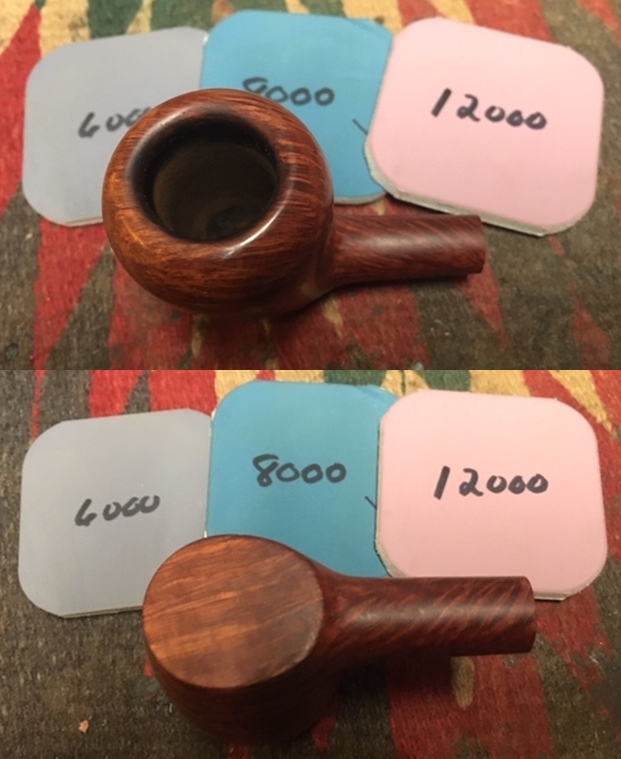
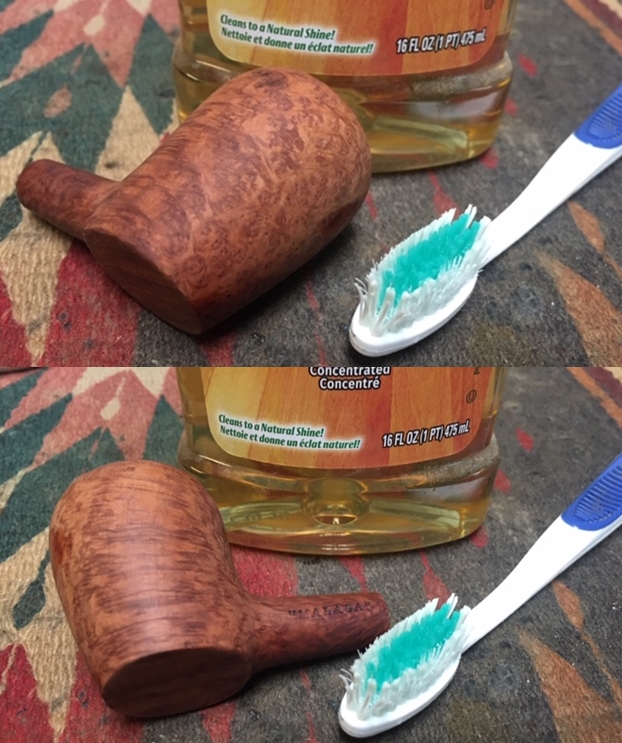
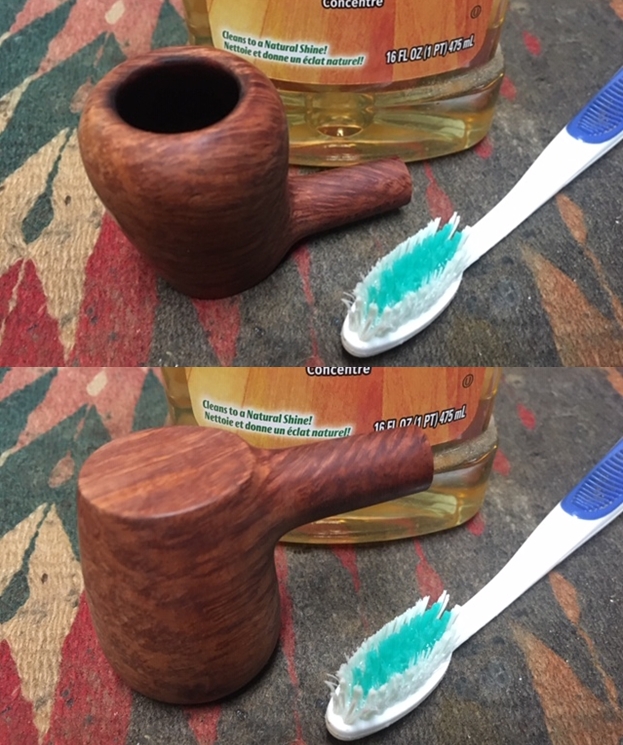
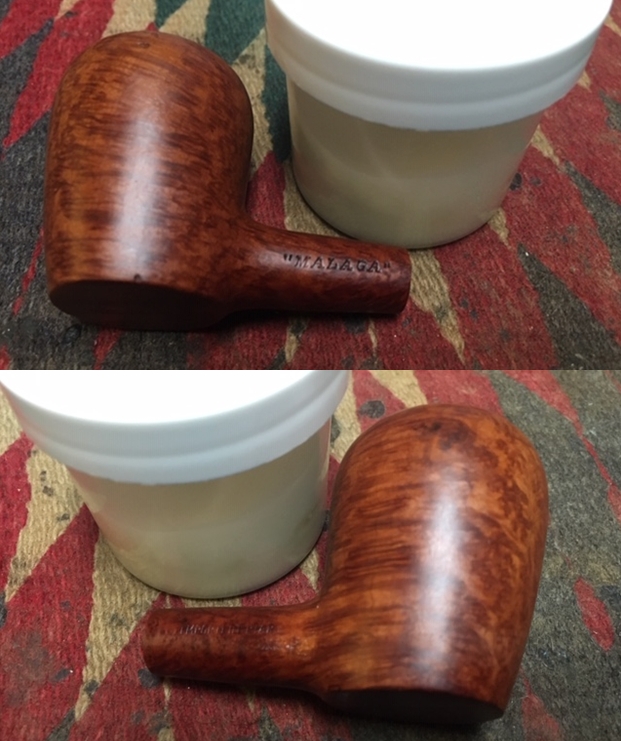
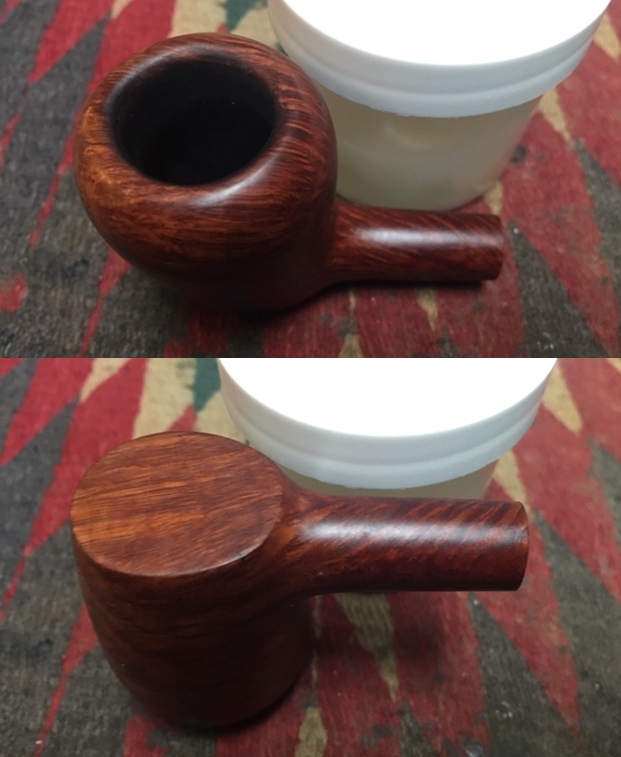
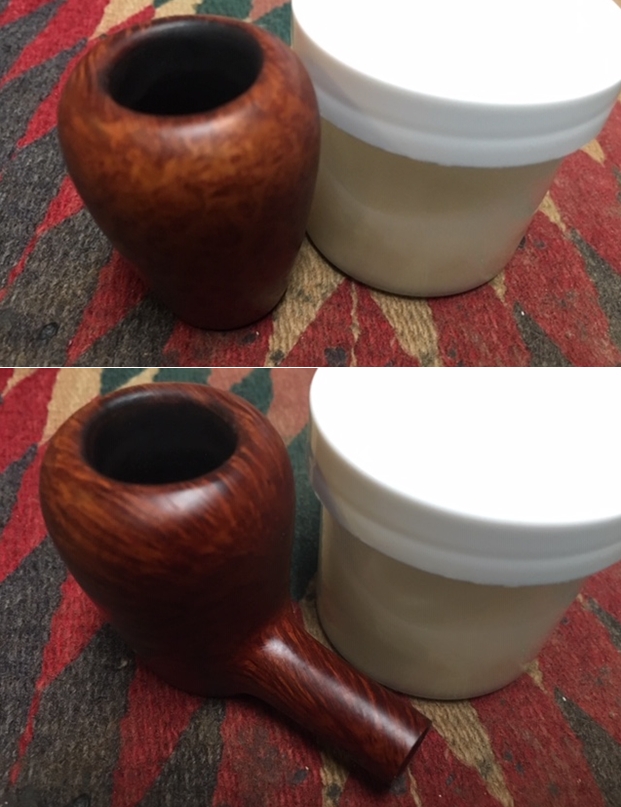
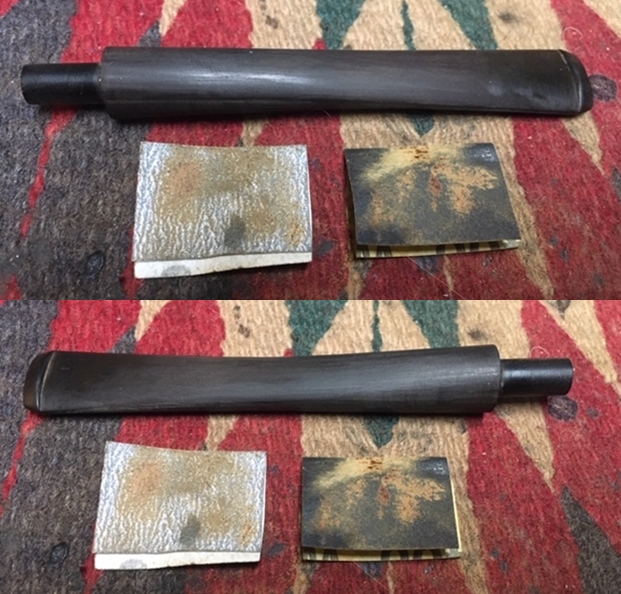
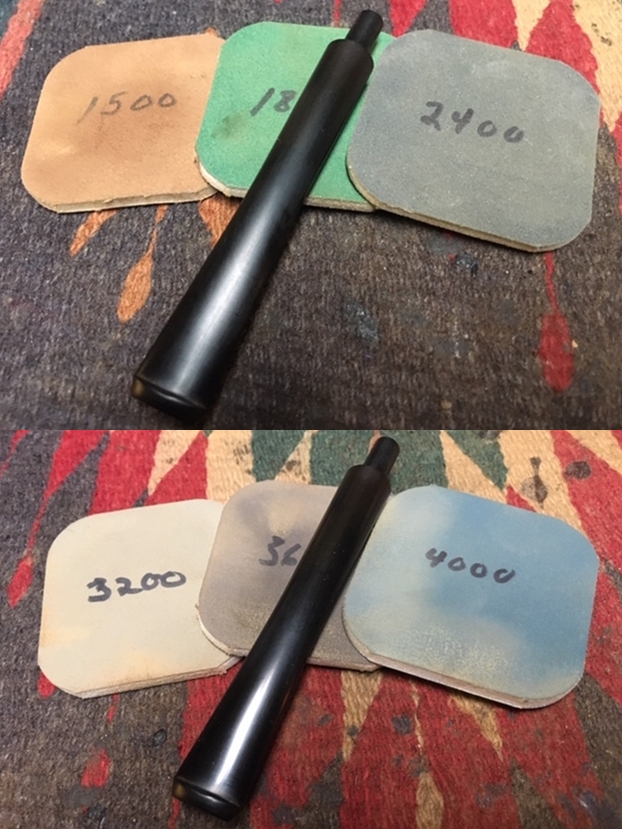
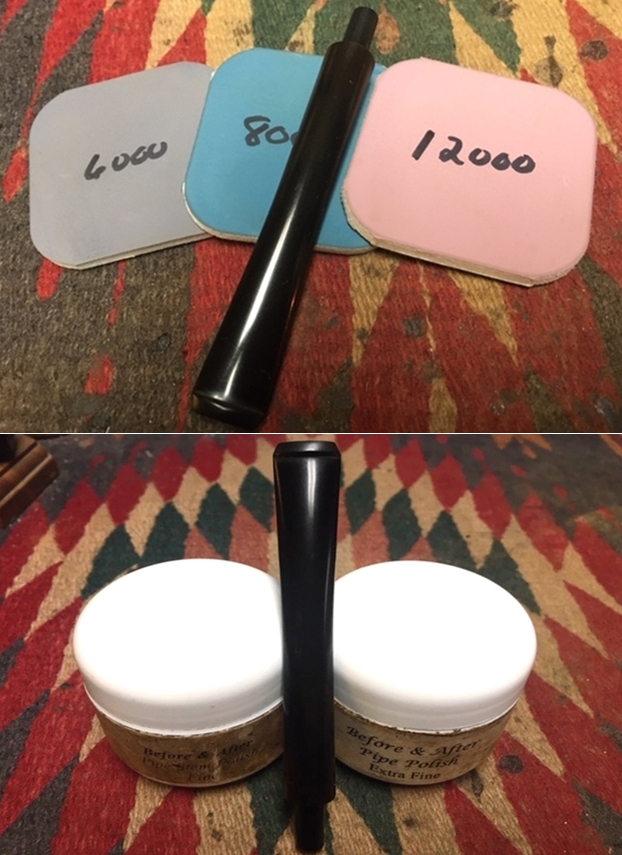
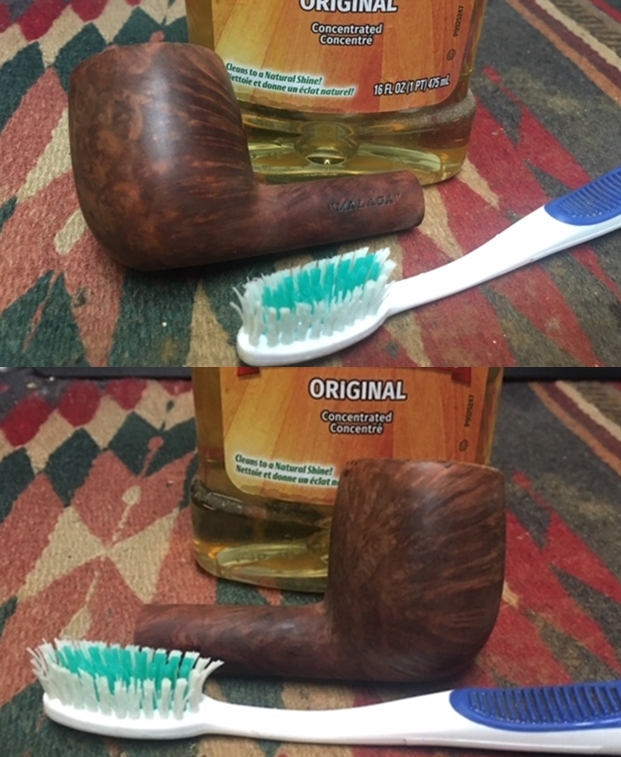
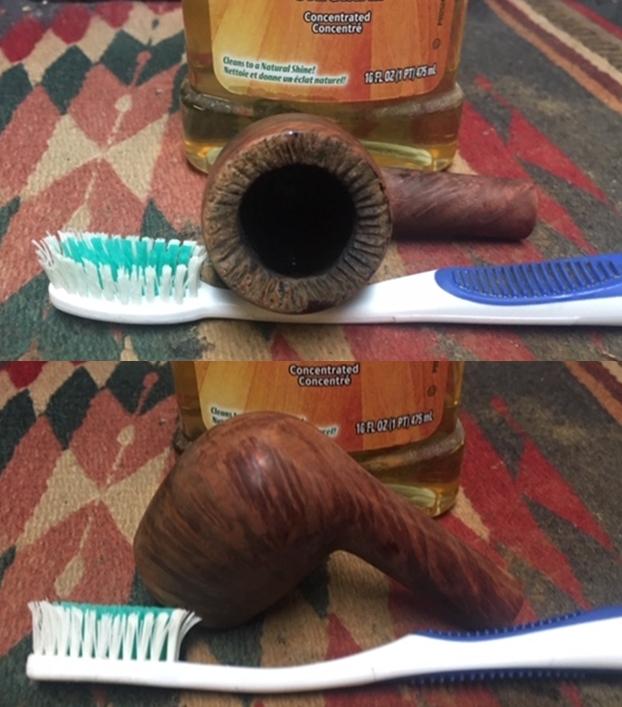
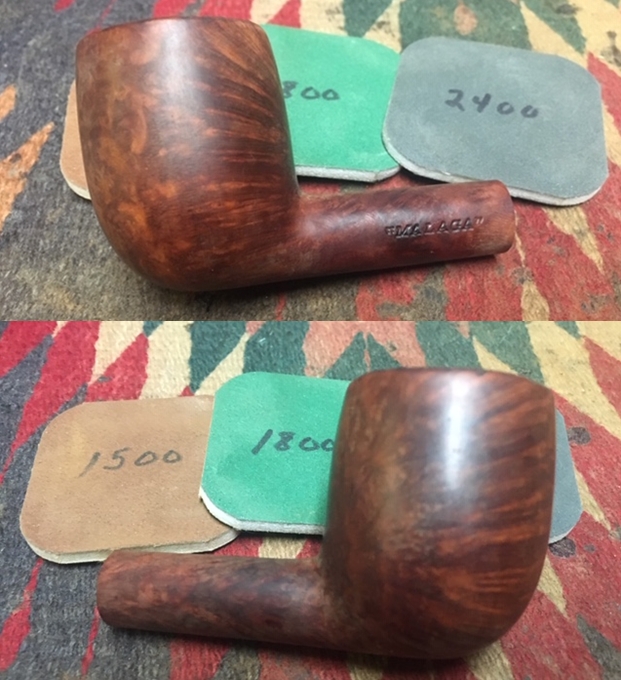
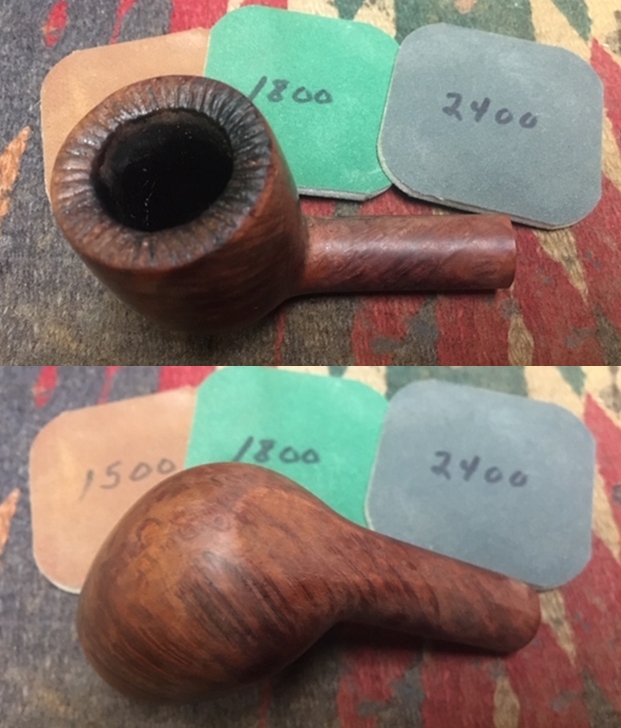
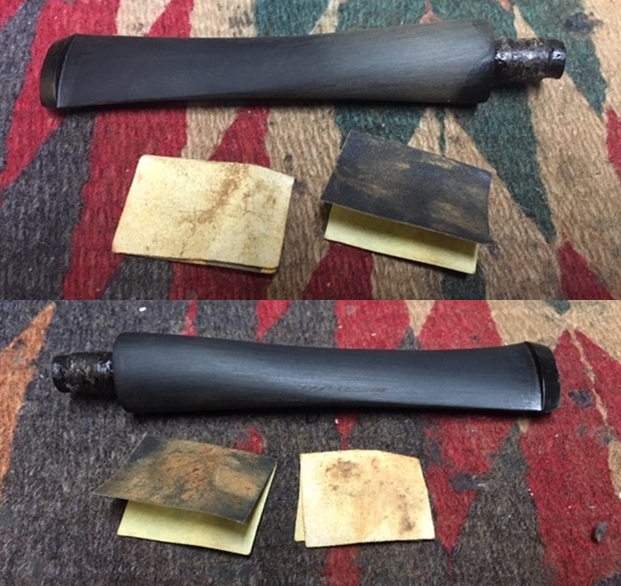
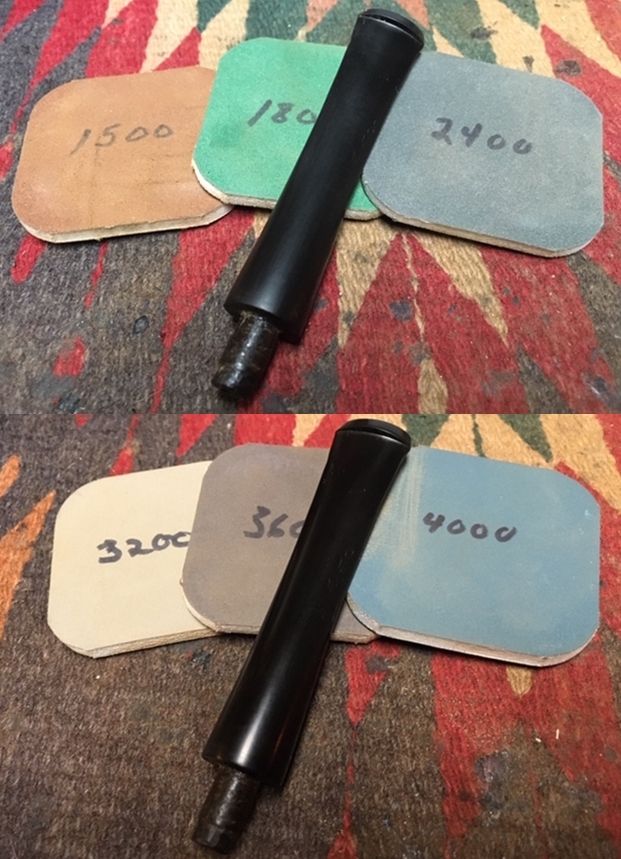
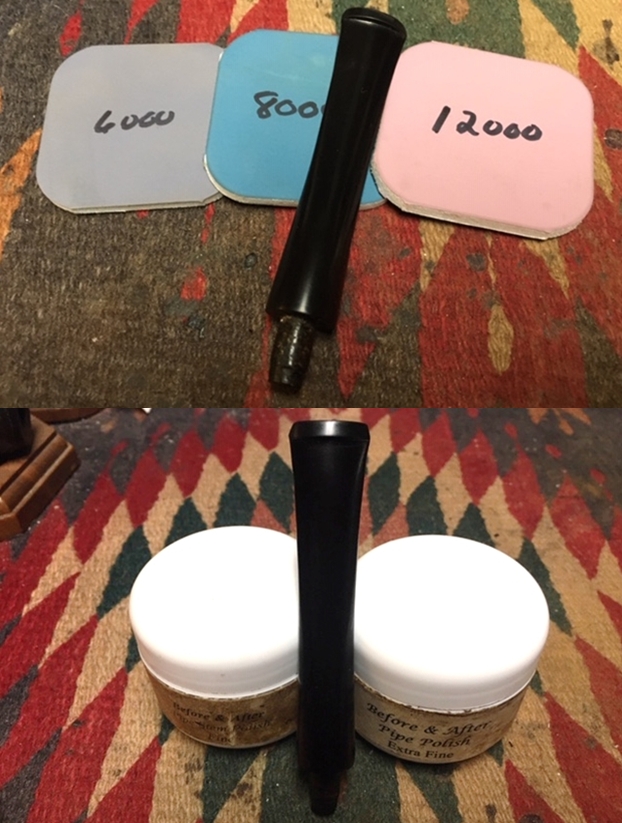
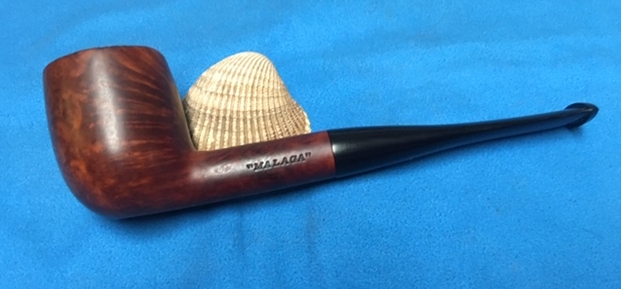
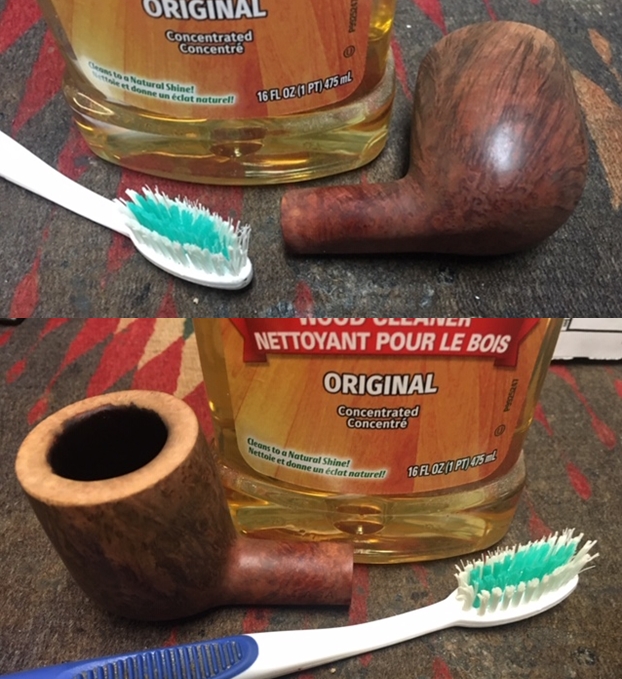
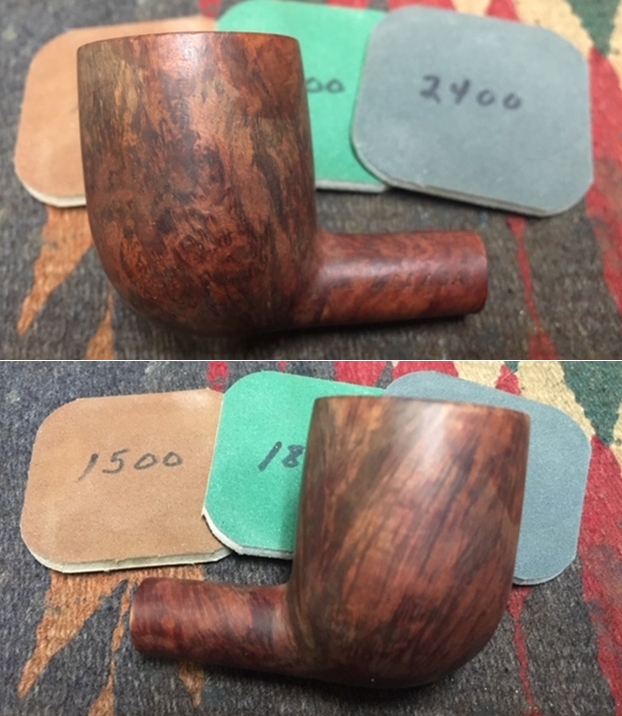
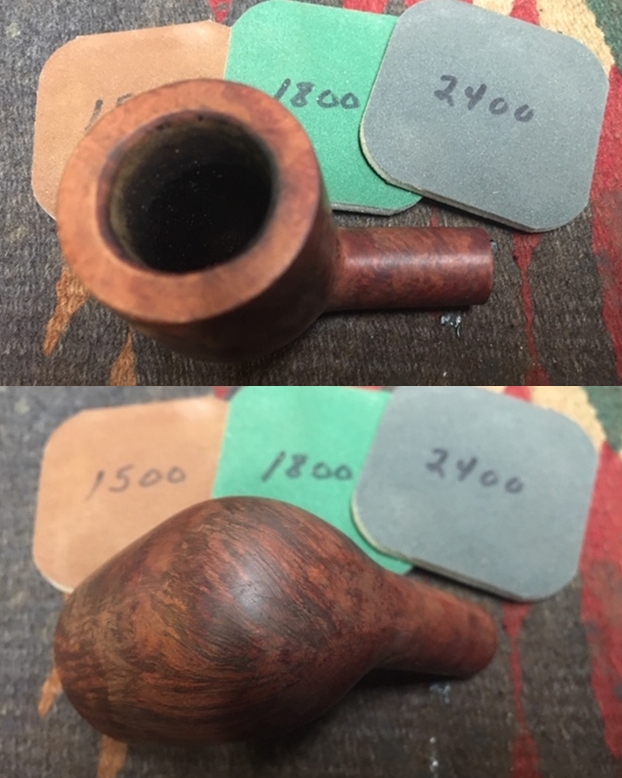
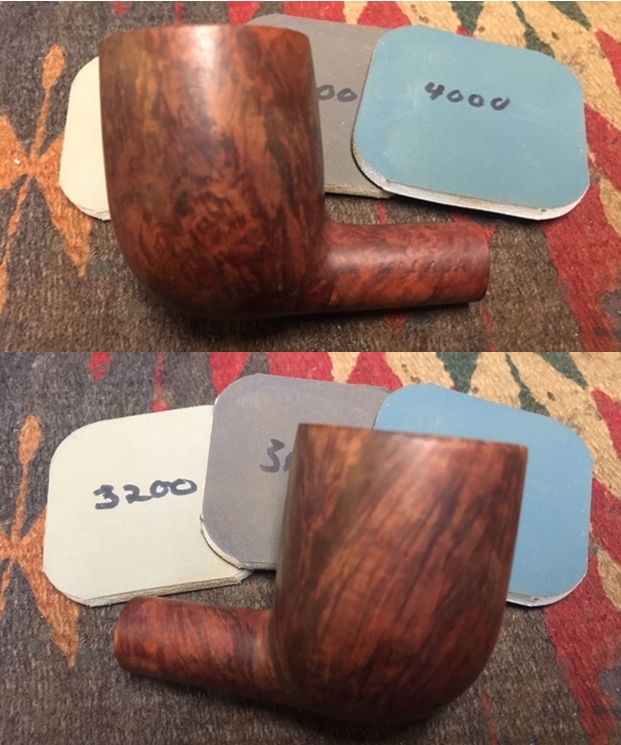
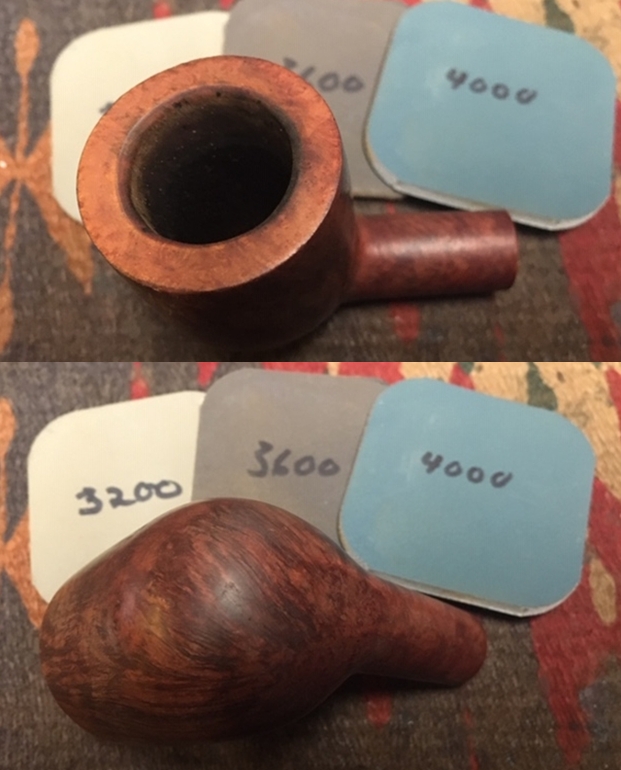
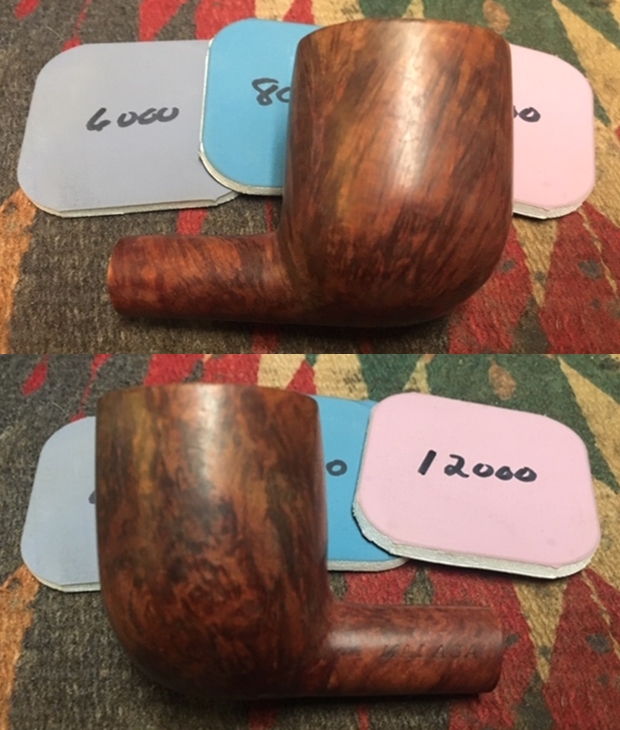
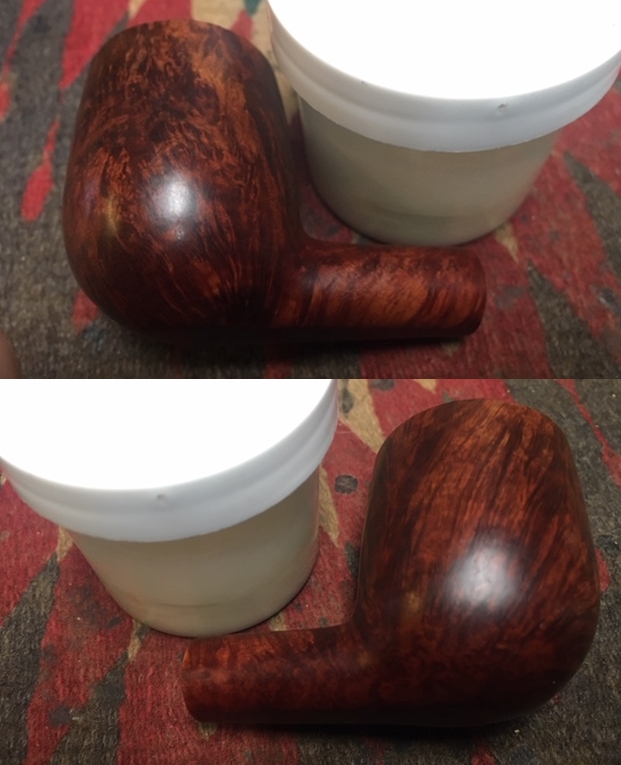
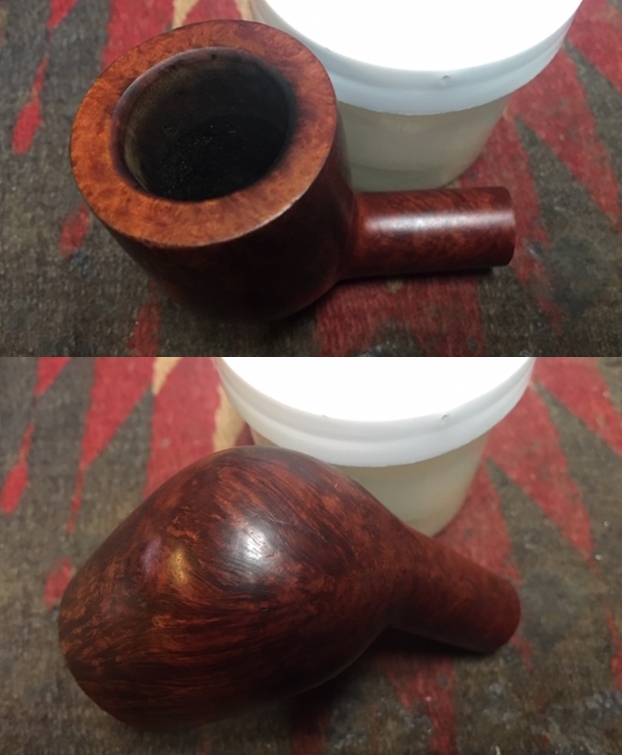
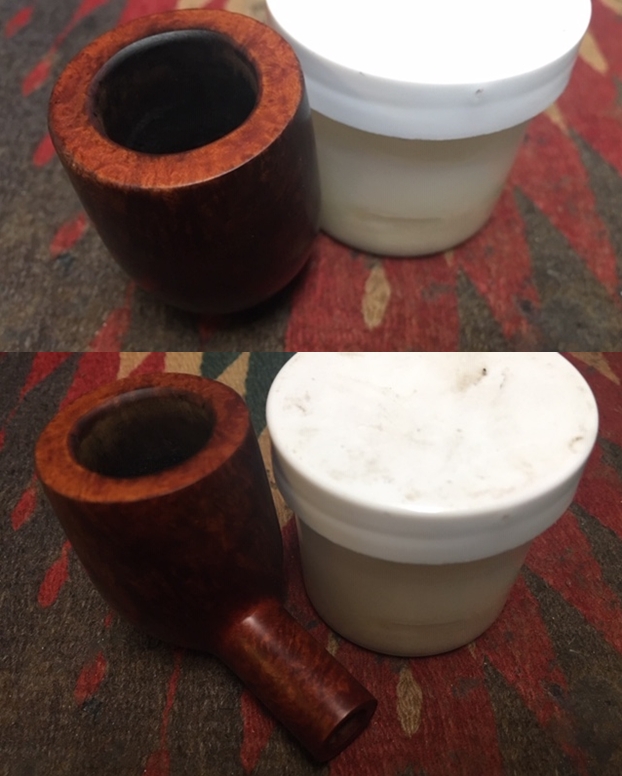
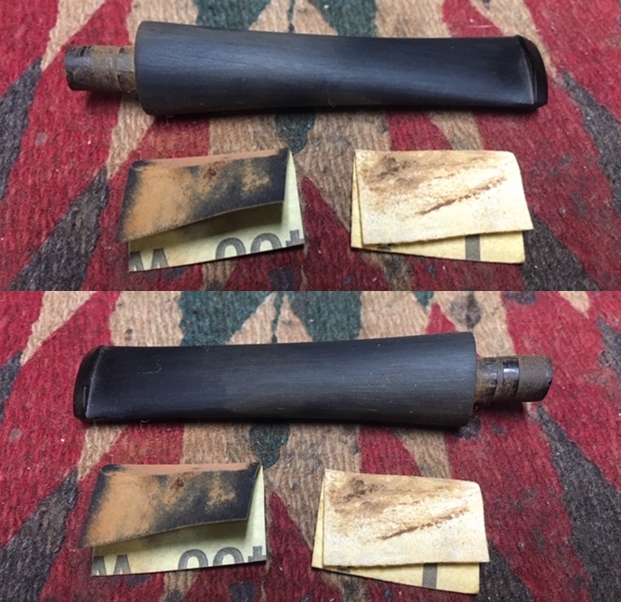
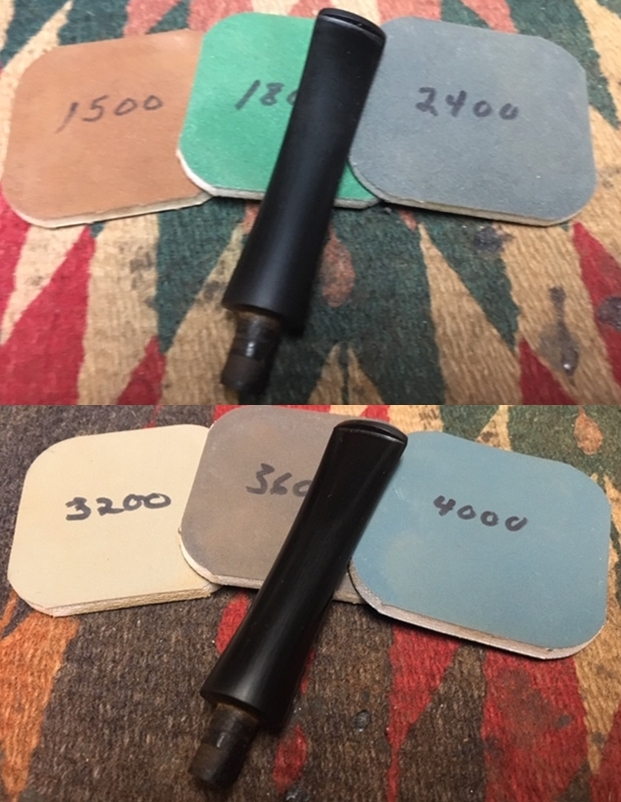
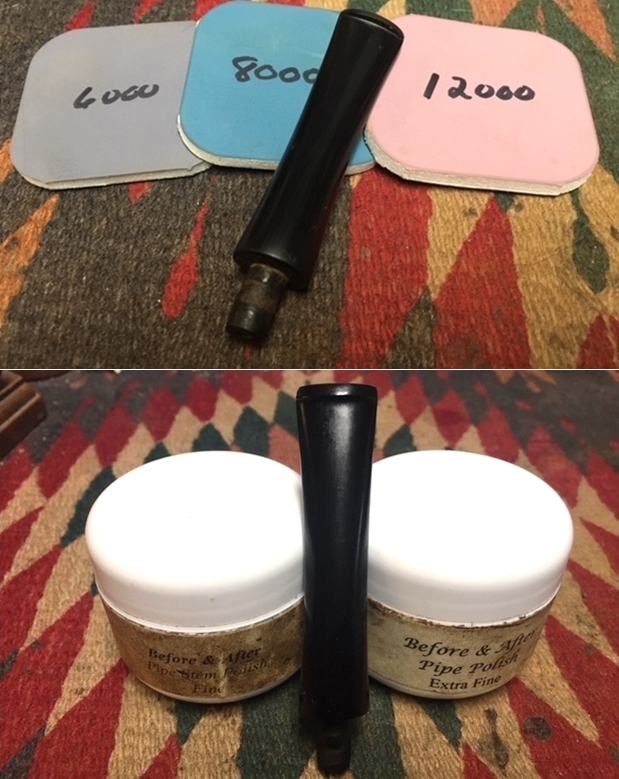
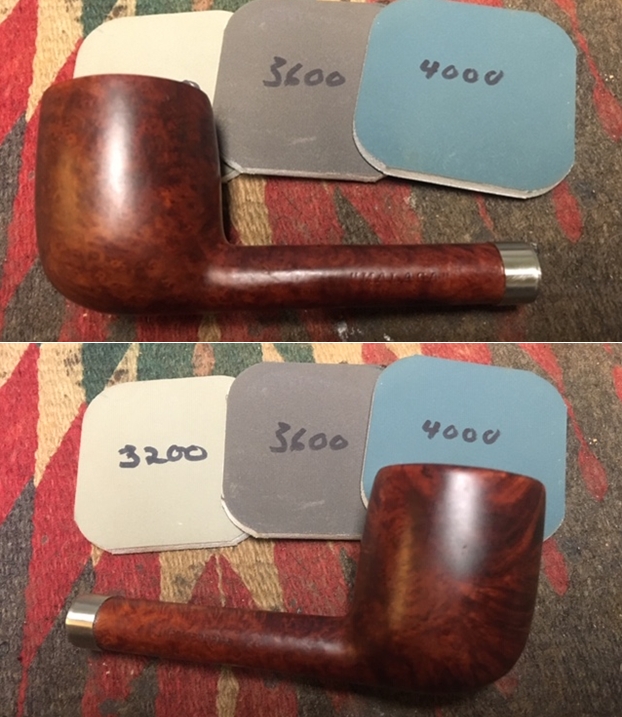
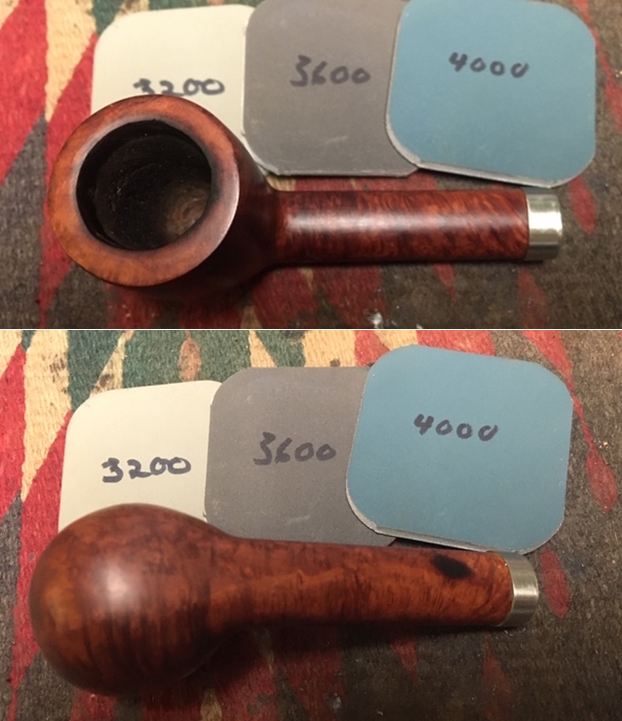
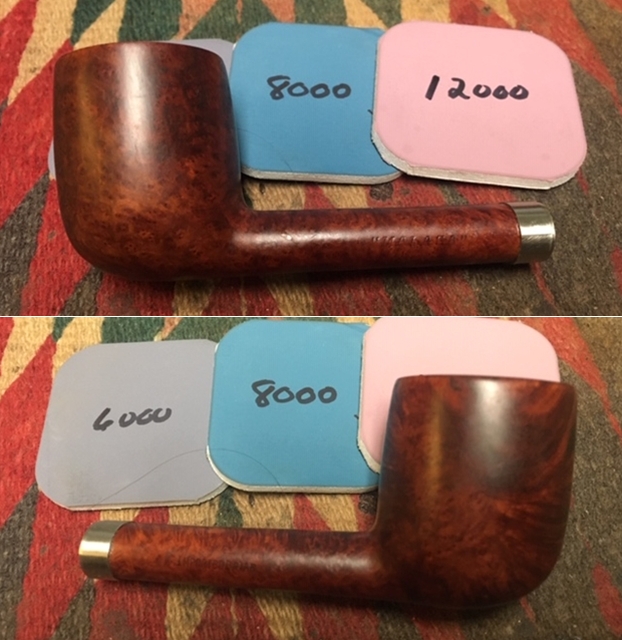
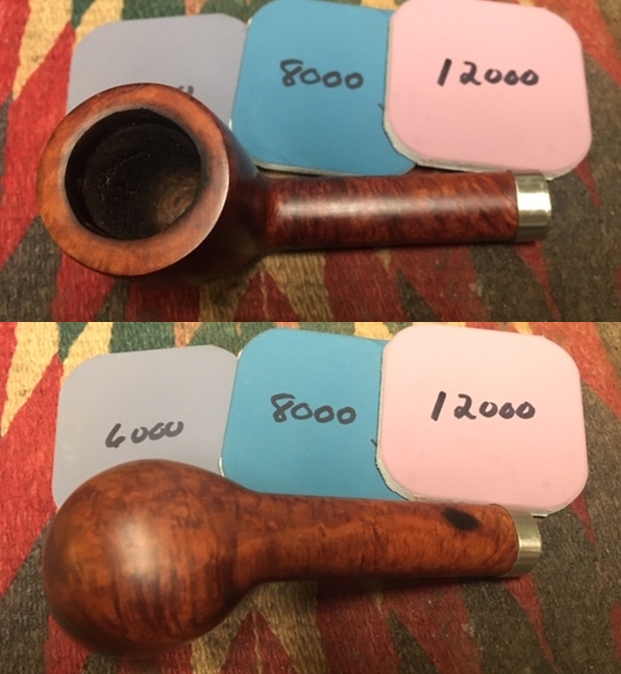
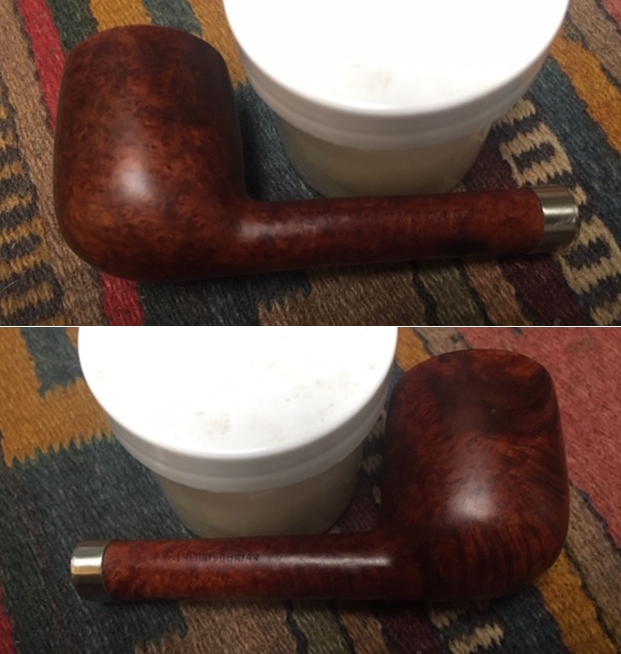
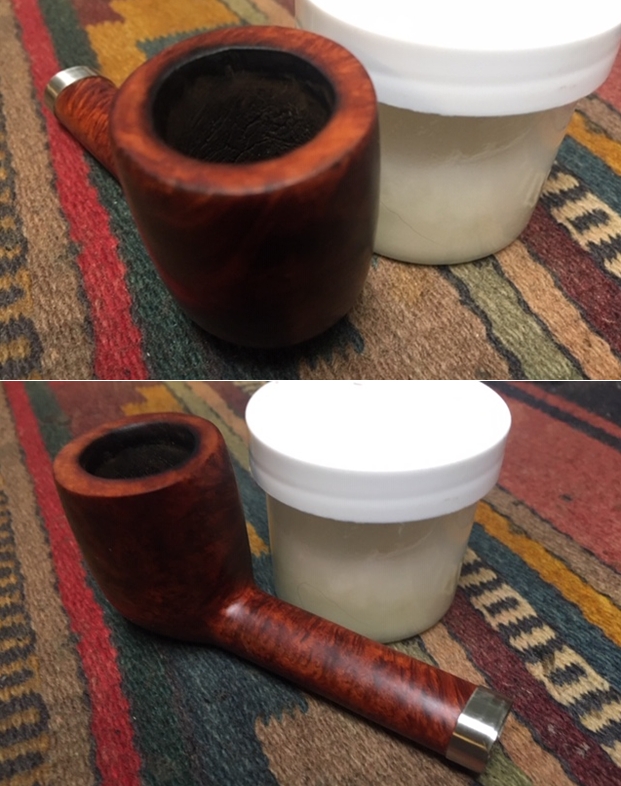
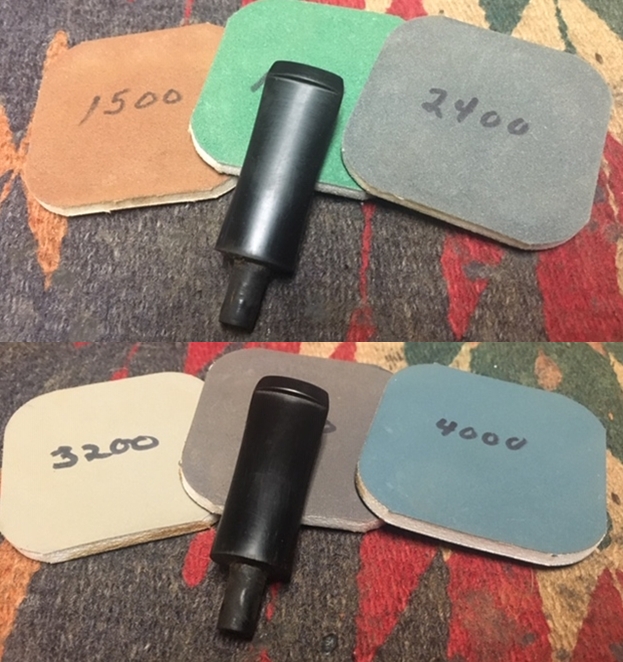
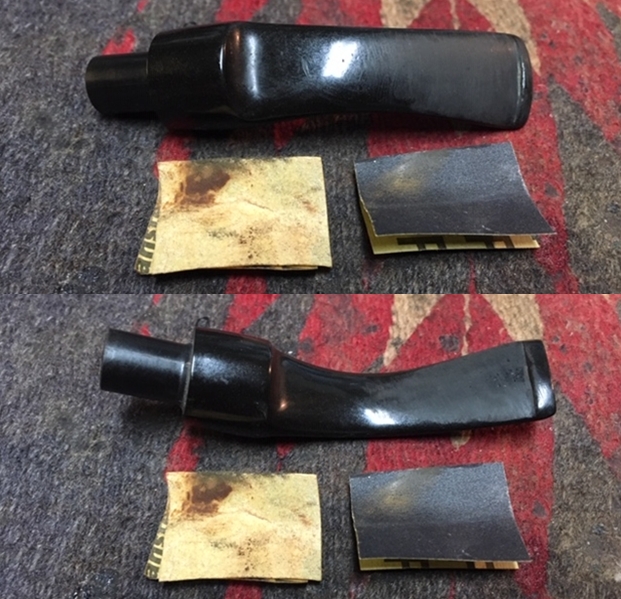
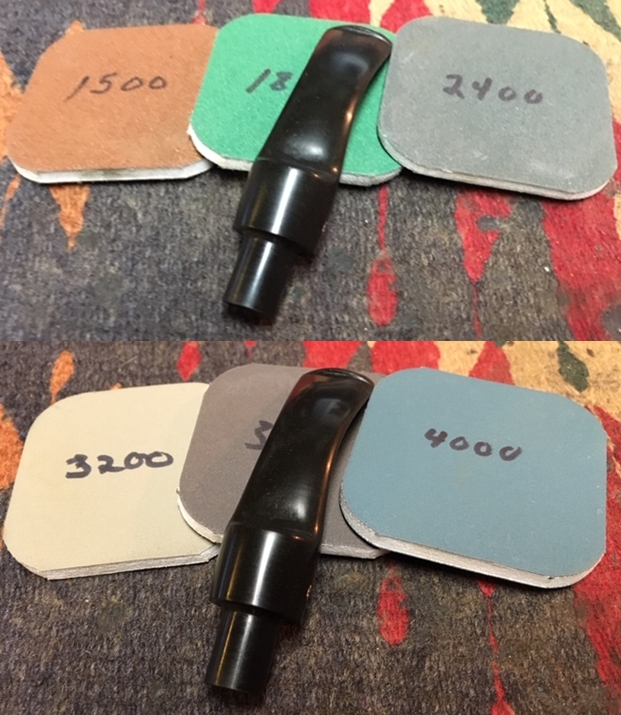
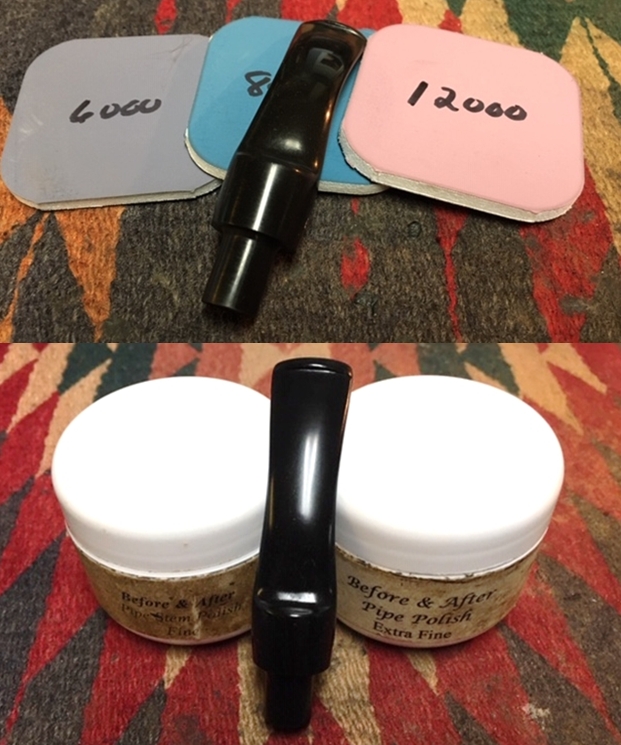
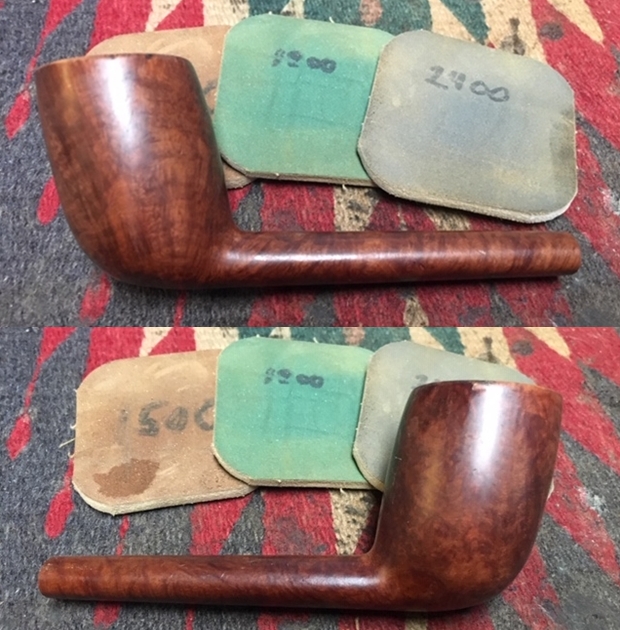
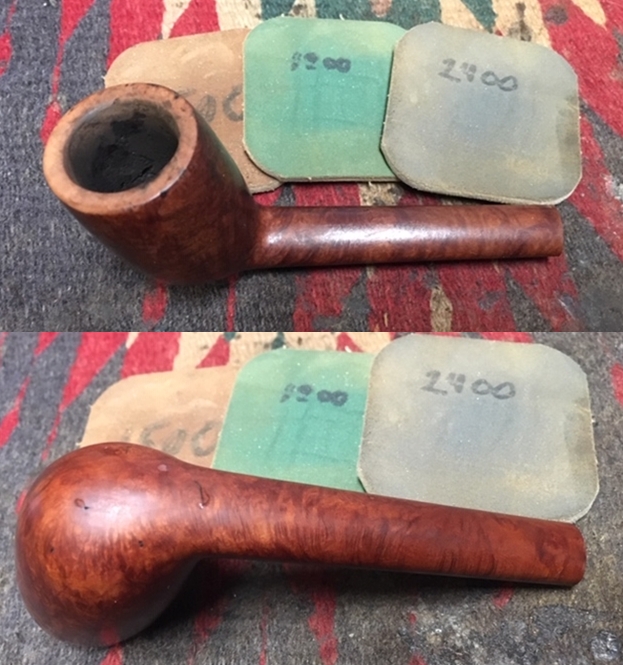
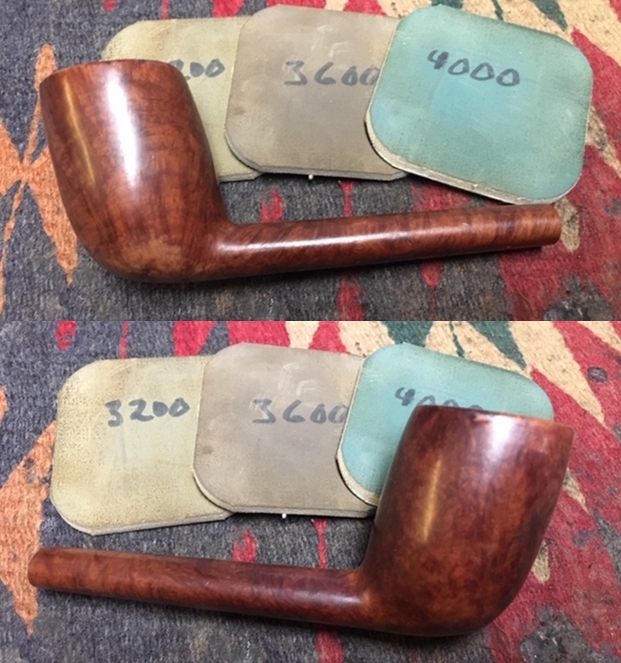
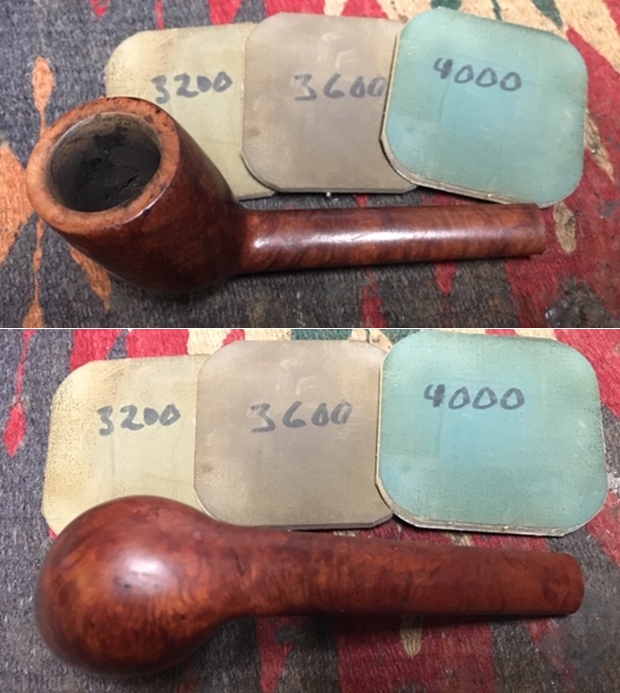
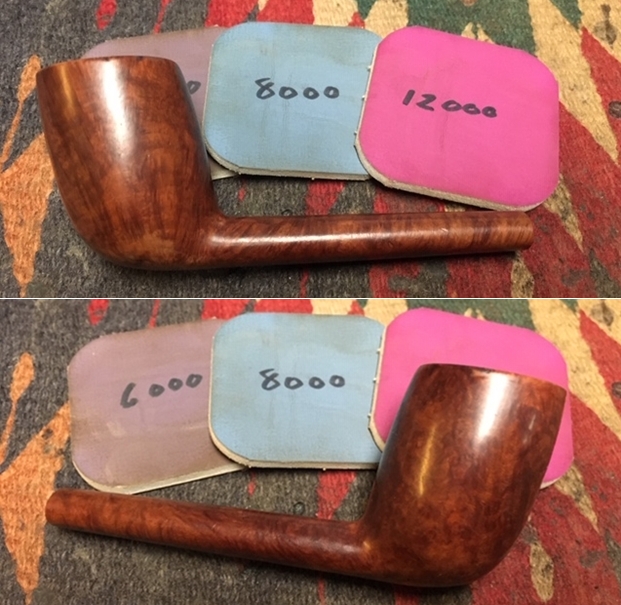
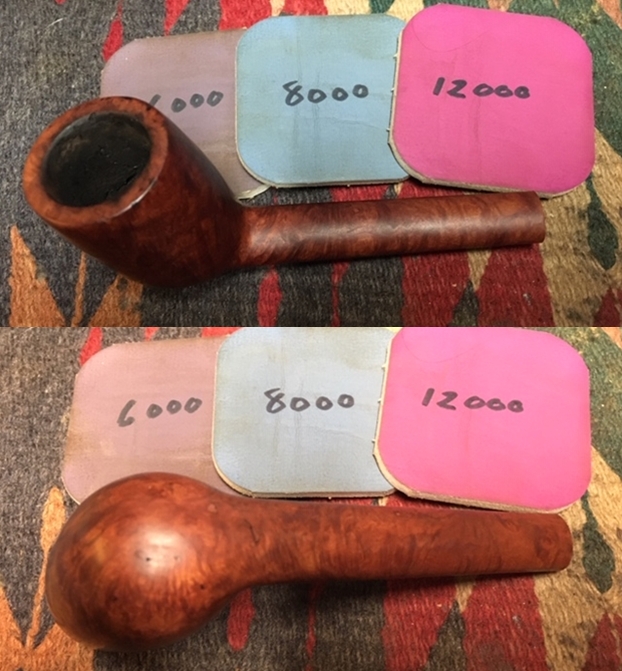
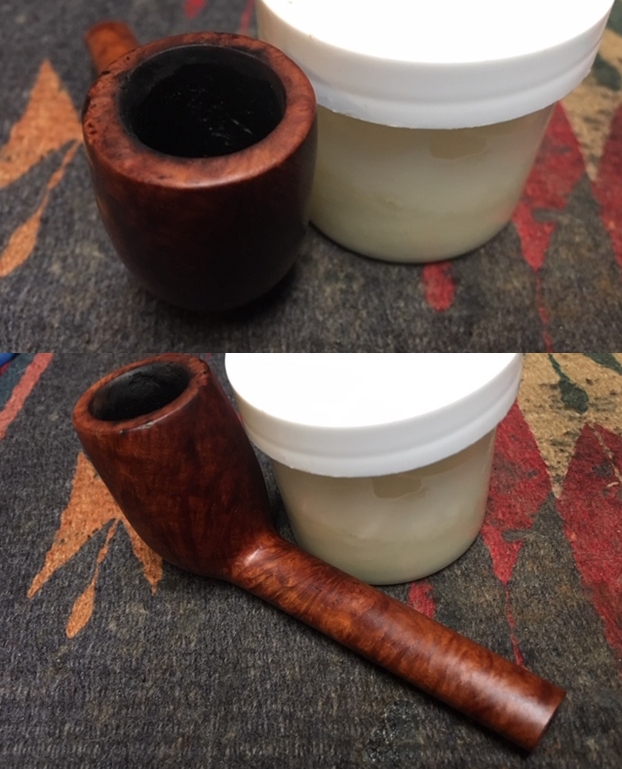
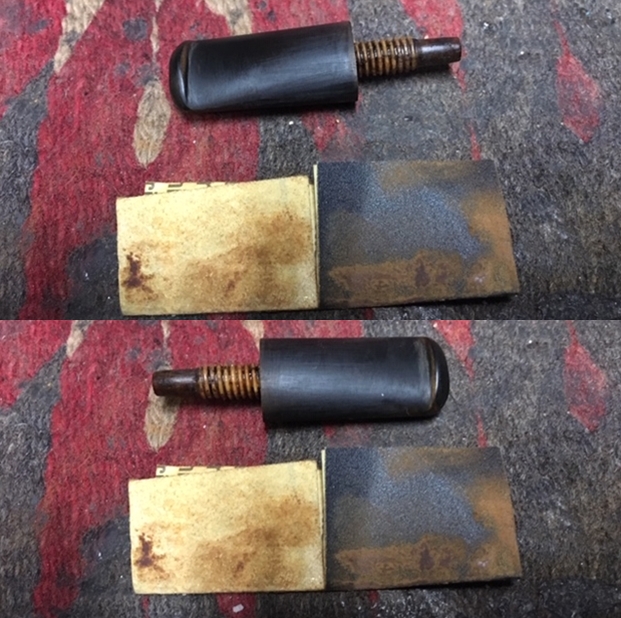
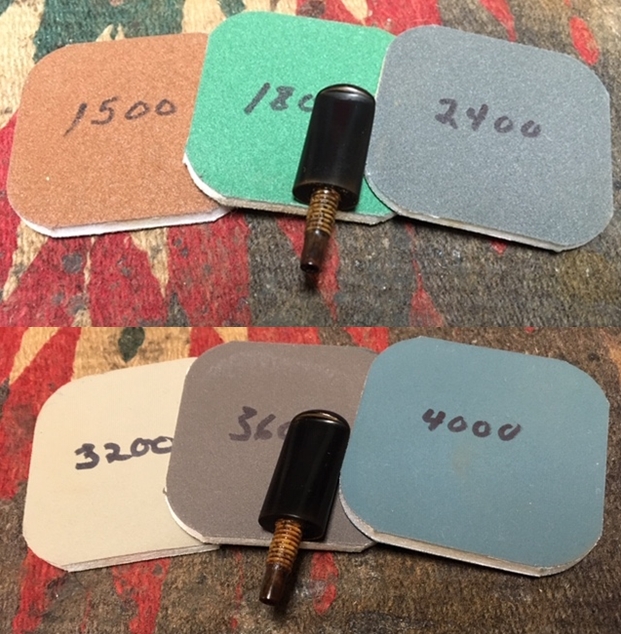
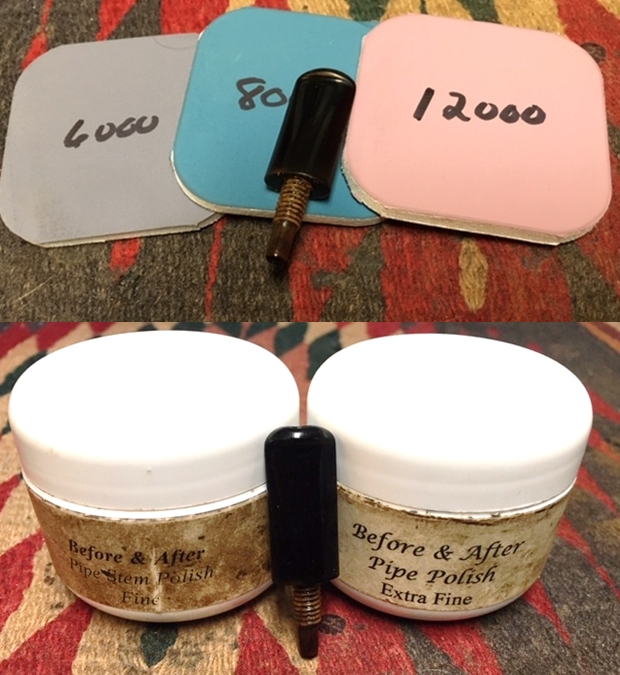
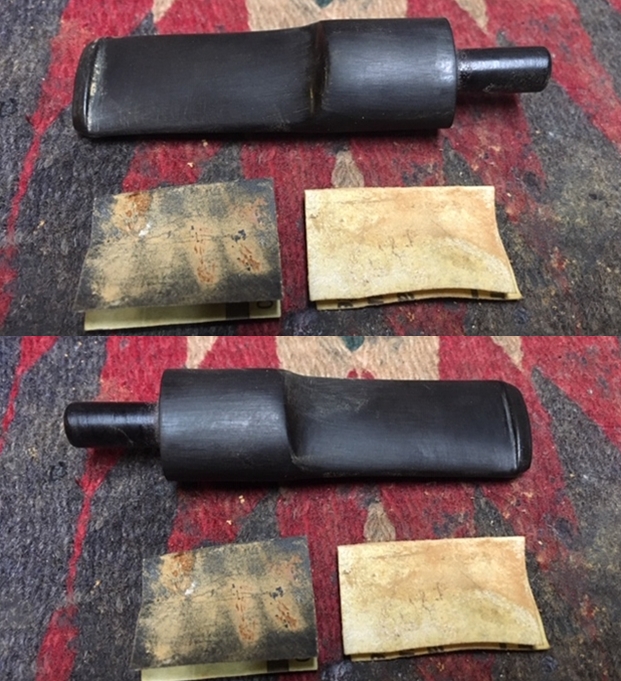
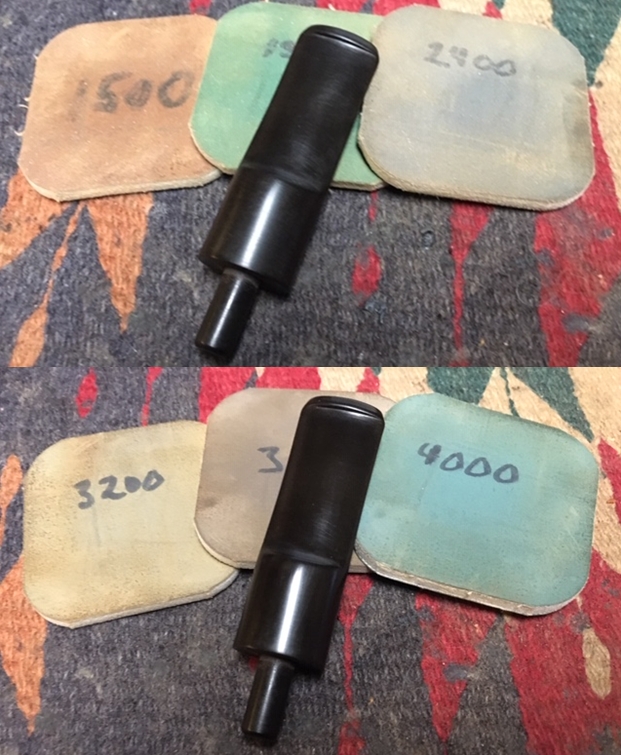
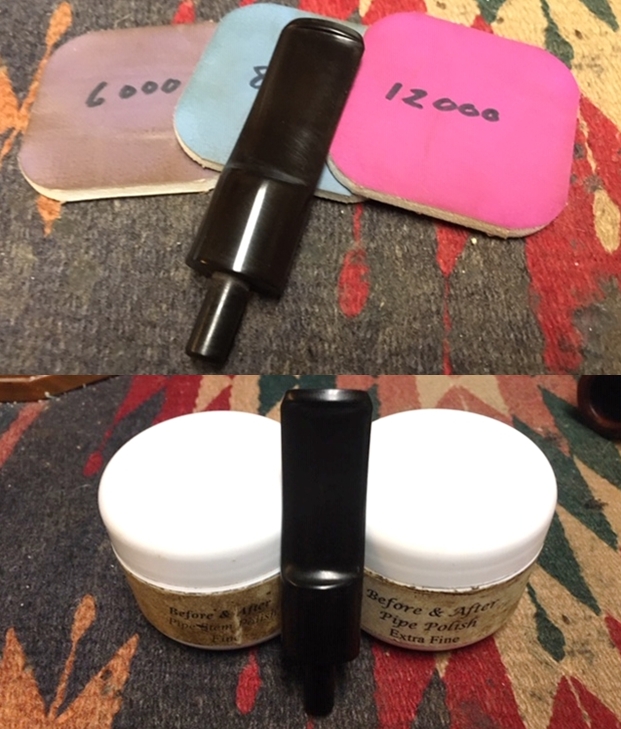
I decided to start with the issues with the rim top first. I wiped down the rim top of the bowl with a damp cotton pad to remove the tars and lava. I used a folded piece of 220 grit sandpaper to smooth out the burn damage and the darkening on the bevel.I followed Jeff and my regular regimen for cleaning estates. I reamed the light cake in the bowl with a Savinelli Fitsall pipe knife to remove the cake. I sanded the bowl with 220 grit sandpaper wrapped around a piece of dowel to smooth out the inside walls of the bowl.I scrubbed out the mortise and the airway in the shank and the stem with alcohol, cotton swabs and pipe cleaners.I polished the briar with micromesh sanding pads – 1500-12000 grit pads. I wiped the bowl down after each sanding pad with a damp cloth to wipe of the dust. I scrubbed the briar with Murphy’s Oil Soap with a tooth brush. I scrubbed it off with running water to remove the soap and the grime on the bowl. I dried it off with a soft cloth. I worked some Before & After Restoration Balm into the surface of the briar with my fingertips and a horsehair shoe brush to clean, enliven and protect it. I let the balm sit for a little while and then buffed with a cotton cloth to raise the shine. The photos show the bowl at this point in the restoration process. I set the bowl aside and turned my attention to the stem. I sanded out the tooth chatter with 220 grit sand paper and started to polish it with a folded piece of 400 wet dry sandpaper. Once it was finished it the tooth chatter and oxidation was gone and it began to shine.I polished the stem with micromesh sanding pads – wet sanding with 1500-12000 grit sanding pads. I wiped it down after each sanding pad with Obsidian Oil. I polished it with Before & After Pipe Stem Polish – both Fine and Extra Fine and buffed it off with a final coat of Obsidian Oil. This is a beautiful “Malaga” Imported Briar Poker Sitter with a tapered black vulcanite stem. It has a great look and feel. The shape fits well in the hand and sits on the desk when you are resting. The grain makes it a real beauty. I polished stem and the bowl with Blue Diamond polish on the buffing wheel. I gave the bowl and the stem multiple coats of carnauba wax. I buffed the pipe with a clean buffing pad to raise the shine. I hand buffed it with a microfiber cloth to deepen the shine. The pipe polished up pretty nicely. The rich oil cured briar took on life with the buffing. The rich brown colour of the briar works well with the polished vulcanite stem. The finished pipe has a rich look that is quite catching. Have a look at it with the photos below. The shape, finish and flow of the pipe and stem are very well done. The dimensions are Length: 6 inches, Height: 2 inches, Outside diameter of the bowl: 1 ½ inches, Chamber diameter:  ¾ of an inch. I will be adding the pipe to the finished Malaga pipes that I have set aside for Alex. This will be a great addition to his collection of Malaga pipes. Thanks for walking through the restoration with me as I worked over another Malaga.

Restoring a Faceted “Malaga” Poker from Kathy’s Dad’s Pipes


Blog by Steve Laug

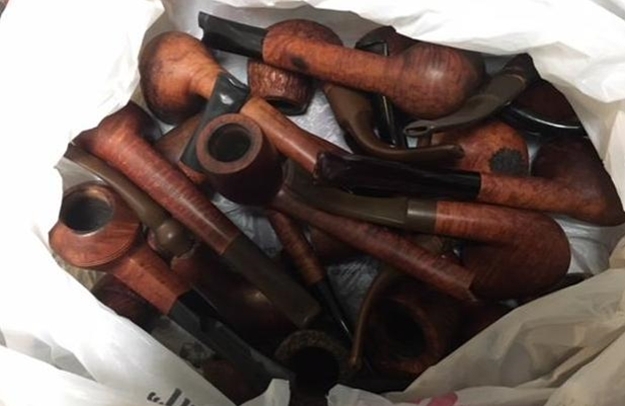
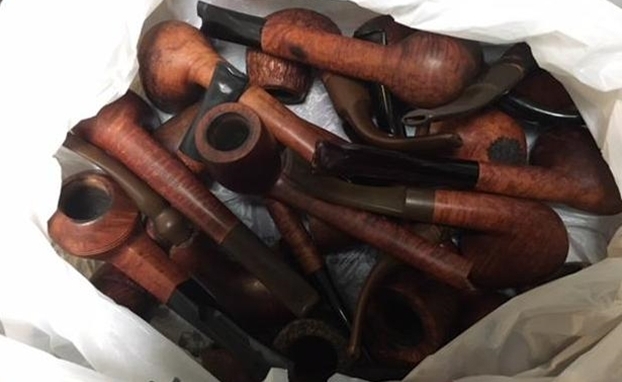
This morning I was looking through the bag of pipes that Alex chose from George Koch’s estate. This one is the first of two interestingly shaped Poker Sitters. The rim was well knocked about and the acrylic stem had some tooth dents and deep gouges in the surface of the variegated silver. The inner and outer edges of the rim top were damaged from knocking the pipe out against a hard surface. The carver had done a great job matching the mixed grain to the flow of the shape of the bowl and shank. Remember that all of these Malaga pipes came to my brother and me in several shipments of pipes from George’s daughter Kathy. Jeff unwrapped the pipes when they came to him and took the following photo to give an idea of the volume of the pipes that we purchased. The carver did a great job of shaping the pipe to follow the grain on the briar. The large bowl, round shank and tapered variegated silver acrylic stem look very good. The bowl had a thick cake that overflowed with lava onto the rim. The inner and outer edges of the rim were in rough shape as was the rim top. The sides of the bowl and shank are very dirty with grime and oils from prolonged use. The stamping on the left side of the shank read “MALAGA”. The right side read Imported Briar. The acrylic stem had tooth dents and chatter on the top and the underside. Jeff took these photos before he started the cleanup work on the pipe. Jeff took close up photos of the bowl and rim to capture the condition of the pipe before he started his cleanup work. The rim top had some lava overflow and darkening and wear under the lava on the rim at the back of the bowl. There appeared to be deep nicks in the outer edge at the front of the grimy pipe. He also took photos of the sides and bottom of the bowl and shank to show the beautiful grain and unique carvings around the bowl. The photos show the general condition of the bowl and wear on the finish. It is very dirty but this is another beautiful pipe. Jeff took a photo to capture the stamping on the top side of the shank. The photos show the stamping “MALAGA” on the left side of the shank. The stamping is very readable. The next photos show the stem surface. There are tooth marks and chatter on both sides near the button and wear on the button surface and edges.In each of the previous blogs that I have written on the restoration of George’s pipes I have told his story. If you have followed the restorations you will have read the information and the background piece that Kathy did on her father. Here is a link to one of the previous blogs on his Malaga pipes where I included her tribute in full (https://rebornpipes.com/2019/01/26/back-to-kathys-dads-pipes-restoring-a-%c2%bc-bent-malaga-author/). You can also read the bio on her Dad, George Koch. It is an interesting read and one that shows just how far our pipe collecting passion can go when we find a brand of pipes that we enjoy. I am going to only include the portion on the Malagas at this point. If you wish to read the rest follow the link above.

Kathy writes…We lived in Livonia, and that’s where his love for Malaga pipes began. After a few years he returned to Allis Chalmers and we moved back to Springfield. I remember that when we went back to Michigan to visit friends, Dad had to go to the Malaga store and acquire a few new pipes. Many a year I wrote to Malaga and they picked out a pipe for me to purchase that I could give Dad for a Christmas or birthday present. He was always pleased. His favorites were the straight stemmed medium sized bowl pipes, but he liked them all. 

He had some other pipes, but the Malagas were his favorites. I remember him smoking them sitting in his easy chair after work, with feet up on the ledge by the fire burning in the fireplace.  Growing up it was my job to clean them and he liked the inner bowl and stem coated with Watkins vanilla, leaving a little of that liquid in the bowl to soak in when I put them back on the rack…I’m very happy they are being restored by you and your brother and hope they find homes who enjoy them as much as Dad did. Thank-you for your care and interest. — Kathy, the oldest daughter

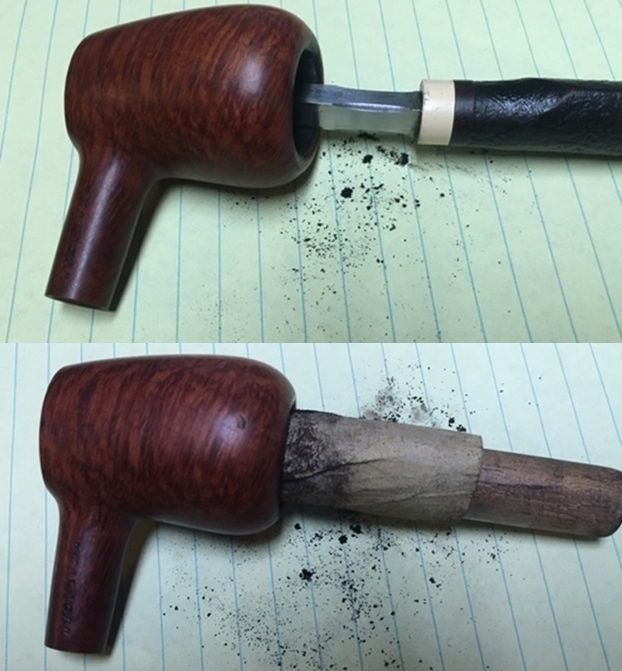
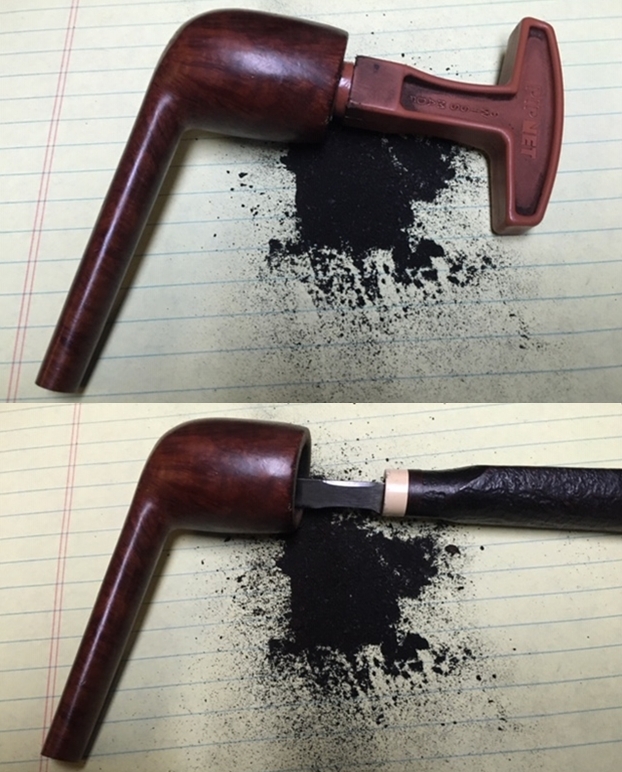
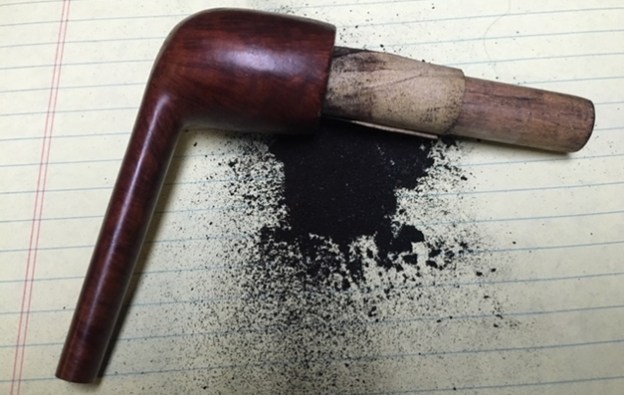
Jeff reamed the bowl with a PipNet pipe reamer and followed up with a Savinelli Fitsall pipe knife to remove the cake. He scrubbed out the mortise and the airway in the shank and the stem with alcohol, cotton swabs and pipe cleaners. He scrubbed the exterior of the bowl, rim, shank and stem with a tooth brush and Murphy’s Oil Soap to remove the oils and tars on the rim and the grime on the finish of the bowl. He rinsed it under running water. He dried it off with a soft cloth. Even after the cleanup it is another on that is in rough condition. But even in its damaged condition you can see the great grain on the bowl. The photos show the damaged rim top. The interesting shape, round shank and chewed acrylic stem give a clear picture of what the pipe must have looked like when George bought it at the shop. The rim top had been knocked hard against rough surfaces to knock out the dottle and left damage. The stamping on the left side of the shank read “MALAGA” and on the right side it read Imported Briar. The acrylic stem had been chewed but could be easily repaired. I took photos of the pipe before I started my work. I took a photo of the  rim top and bowl to show the condition of the pipe. You can see why I said it was used as a hammer. The surface of the rim is very rough and you can see the damage on both the inner and outer edge of the rim. There is some darkening on the back edge and surface of the rim top. I took photos of the stem to show the chewed condition it was in. Remember this is hard acrylic so it took some real gnawing to do this to it!I took photos of the shank to capture the stamping on both sides. The first photo shows the stamping “MALAGA” on the left and the second shows Imported Briar on the right. Both are clear and readable.I am also including the link to a blog that I wrote that gives some of the history of the Malaga brand and the Malaga Pipe Shop in Royal Oak, Michigan in the USA. I have written an earlier blog to give a little history of the Malaga Brand and the pipemaker, George Khoubesser. Here is the link – https://rebornpipes.com/tag/malaga-pipes/.That blog also includes links to a catalogue and the history of the pipemaker George Khoubesser. Follow the link to get a feel for the brand and the pipemaker.

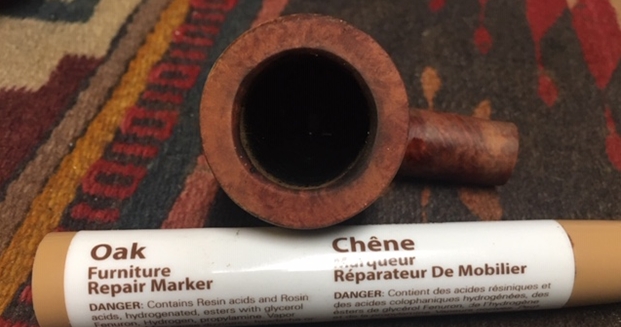
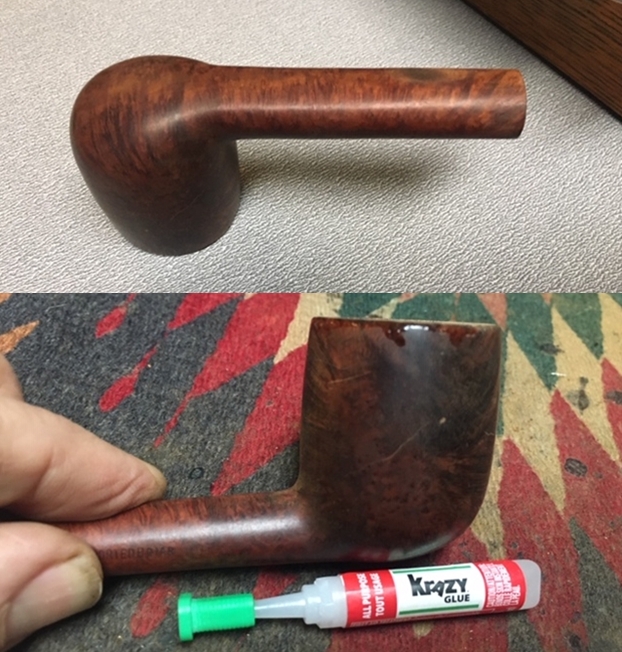
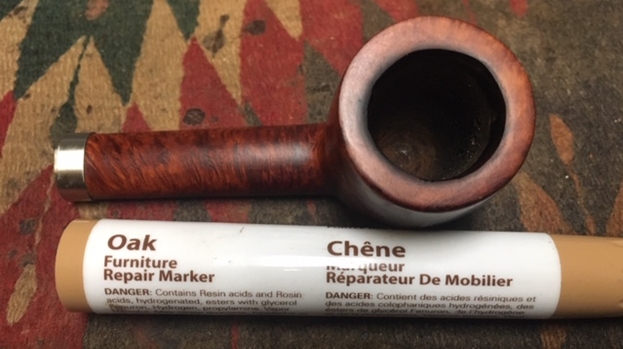
I decided to start the restoration of the pipe by dealing with the rim top. I topped it on a topping board with 220 grit sandpaper and cleaned up the inner edge with a piece of folded 220 grit sandpaper. I used some clear Krazy Glue to fill in the rim damage on the front edge. It was nicked and worn so I filled it in to smooth it out. I sanded the repair after the glue cured. I smoothed out surface of the front edge and rim top until it blended into the surface. I polished the bowl and rim top with micromesh sanding pads to smooth out the rim edge repairs and top. I wet sanded with 1500-12000 grit pads and wiped the bowl down with a damp cloth after each pad. The photos show the progress. I scrubbed the briar with Murphy’s Oil Soap and a tooth brush. I rubbed it into the surface of the briar with my finger tips and let it sit for about 10 minutes then rinsed it off with running water. I dried it off with a soft cloth. I used an Oak Stain Pen to stain the rim top to blend topping and darkening into the bowl colour. I buffed it with a clean buffing pad. You can see from the photo below it blends well.I worked some Before & After Restoration Balm into the surface of the briar with my fingertips to clean, enliven and protect it. I let the balm sit for a little while and then buffed with a cotton cloth to raise the shine. The following photos show the bowl at this point in the restoration process. I am very happy with the results. I turned to the stem and filled in the deep tooth marks on both sides of the stem with clear Krazy Glue. I set it aside to let the repairs cure.I used a needle file to reshape the button edge on both sides. I sanded the surface of the stem with 220 grit sandpaper and 400 grit sandpaper to clean up the stem.I polished the stem with micromesh sanding pads – wet sanding with 1500-12000 grit sanding pads. I wiped it down after each sanding pad with a damp cloth. I finished by polishing it with Before & After Pipe Stem Polish both Fine and Extra Fine and then wiped it down a final time with a damp cloth. This restored “Malaga” Poker with a taper acrylic stem is a beauty. The unique shape of the bowl, the reshaped and repaired rim top and the cut of the briar work well to highlight the grain around the bowl sides. I polished acrylic silver variegated stem and the bowl with Blue Diamond polish on the buffing wheel. I gave the bowl and the stem multiple coats of carnauba wax. I buffed the pipe with a clean buffing pad to raise the shine. I hand buffed it with a microfiber cloth to deepen the shine. The pipe polished up pretty nicely. The grain took on life with the buffing. The rich oil cured colour works well with the polished acrylic stem. The finished pipe has a rich look that is quite catching. Have a look at it with the photos below. The shape, finish and flow of the pipe and stem are very well done. The dimensions are Length: 6 inches, Height: 1 ¾ inches, Outside diameter of the bowl: 1 ¼ inches, Chamber diameter: ¾ of an inch. I will be adding the pipe to the box of finished Malaga pipes that I have completed for Alex. I am looking forward to hearing what he thinks of this beauty and once he fires it up and carries on the trust for George Koch. Thanks for walking through the restoration with me as I worked over another one of Kathy’s Dad’s Pipes.

Restemming a “Malaga” Billiard from Kathy’s Dad’s Pipes


Blog by Steve Laug

I have been working on a lot of different estate pipes and selling them for different families. This morning I was looking through the bag of pipes that I have left from George Koch’s estate. There are only three of them and all were in pretty rough shape. The rims were well knocked about and the stems were either chewed off or through and really would need to be carefully worked over and have new stems fit to them. The second of these three Malaga pipes that need a lot of attention was the next one I picked up this morning. It is a Billiard with a chewed through stem. Once again the rim top was used as a hammer or at least spent a lot of time being knocked against hard surface. The rim top was scored and originally had a bit of sunburst look around the chamber. But sides of the bowl had a mix of grain styles that was fascinating. It is the second of the last three Malaga pipes that came to my brother and me in several shipments of pipes from George’s daughter Kathy. Alex had gone through the bag in essence had passed on these three. Jeff unwrapped the pipes when they came to him and took the following photo to give an idea of the volume of the pipes that we purchased. In each of the previous blogs that I have written on the restoration of George’s pipes I have told his story. If you have followed the restorations you will have read the information and the background piece that Kathy did on her father. Here is a link to one of the previous blogs on his Malaga pipes where I included her tribute in full (https://rebornpipes.com/2019/01/26/back-to-kathys-dads-pipes-restoring-a-%c2%bc-bent-malaga-author/). You can also read the bio on her Dad, George Koch. It is an interesting read and one that shows just how far our pipe collecting passion can go when we find a brand of pipes that we enjoy. I am going to only include the portion on the Malagas at this point. If you wish to read the rest follow the link above.

Kathy writes…We lived in Livonia, and that’s where his love for Malaga pipes began. After a few years he returned to Allis Chalmers and we moved back to Springfield. I remember that when we went back to Michigan to visit friends, Dad had to go to the Malaga store and acquire a few new pipes. Many a year I wrote to Malaga and they picked out a pipe for me to purchase that I could give Dad for a Christmas or birthday present. He was always pleased. His favorites were the straight stemmed medium sized bowl pipes, but he liked them all. 

He had some other pipes, but the Malagas were his favorites. I remember him smoking them sitting in his easy chair after work, with feet up on the ledge by the fire burning in the fireplace.  Growing up it was my job to clean them and he liked the inner bowl and stem coated with Watkins vanilla, leaving a little of that liquid in the bowl to soak in when I put them back on the rack…I’m very happy they are being restored by you and your brother and hope they find homes who enjoy them as much as Dad did. Thank-you for your care and interest. — Kathy, the oldest daughter

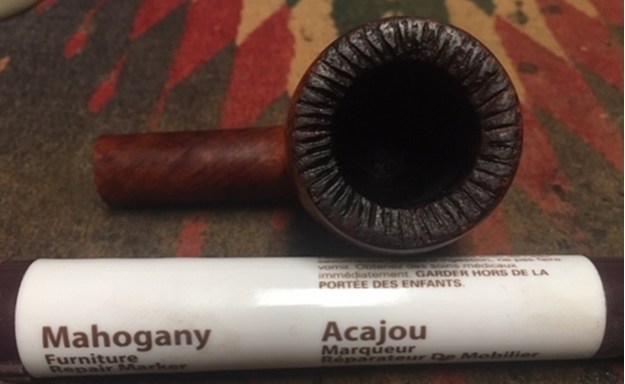
The “Malaga” Billiard on the table is another on that is in rough condition. But even under the damage and dirt I can see the great grain on the briar. There was an interesting sunburst pattern of grooves carved in the rim top. The large bowl, round shank and chewed through acrylic stem give a clear picture of what the pipe must have looked like when George bought it at the shop. Again, I did not bother Jeff for the pre-cleanup photos because really it was obvious what the pipe must have looked like. From the condition of the bowl and rim post cleanup I could see that it originally had a thick cake that overflowed with lava onto the rim so that there was damage on the inner edges. The rim top had been knocked hard against rough surfaces to knock out the dottle and left damage. The sides of the bowl and shank are very dirty with grime and oils from prolonged use. The stamping on the left side of the shank read “MALAGA”. The acrylic stem had been gnawed through leaving a useless stem that would need to be replaced. Since Paresh is not here in Canada it will be replaced rather than rebuilt! 😉 I took photos of the pipe before I started my work. The condition of the pipe will be shown in the photos below. I took a photo of the  rim top and bowl to show the condition of the pipe. You can see why I said it was used as a hammer. The surface of the rim is very rough but you can see the carved sun burst like grooves.  The inner edge of the rim looks good while the outer edge has some damage. There is some darkening on the back edge and surface of the rim top. I think that this pipe must have been another shop pipe or knock about pipe for George as it was very well smoked! I took photos of the stem to show the broken and chewed condition it was in. Remember this is hard acrylic so it took some real gnawing to do this to it!I took a photo to capture the stamping on left side of the shank. The photo shows the stamping “MALAGA” and is very readable.I am also including the link to a blog that I wrote that gives some of the history of the Malaga brand and the Malaga Pipe Shop in Royal Oak, Michigan in the USA. I have written an earlier blog to give a little history of the Malaga Brand and the pipemaker, George Khoubesser. Here is the link – https://rebornpipes.com/tag/malaga-pipes/.That blog also includes links to a catalogue and the history of the pipemaker George Khoubesser. Follow the link to get a feel for the brand and the pipemaker.

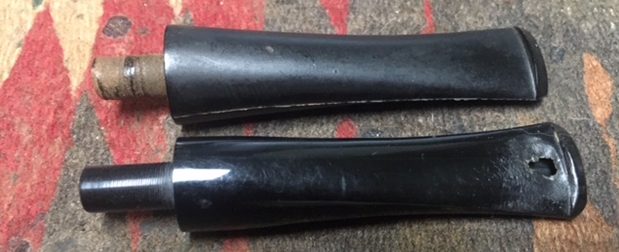
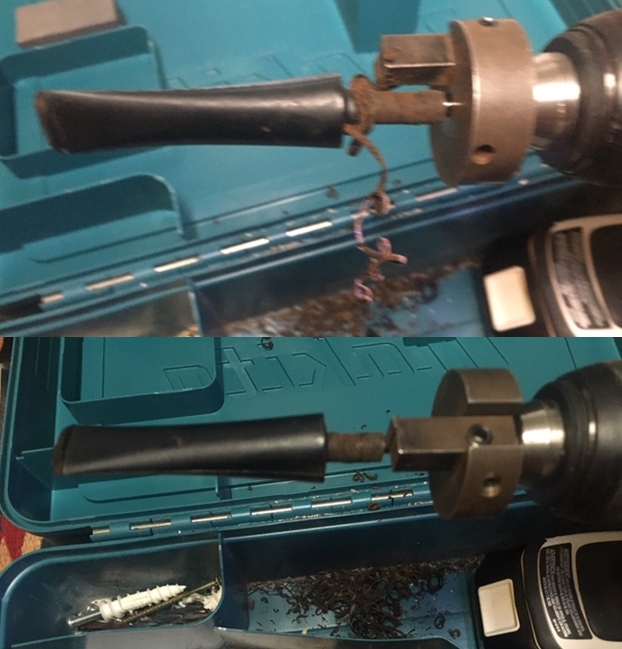
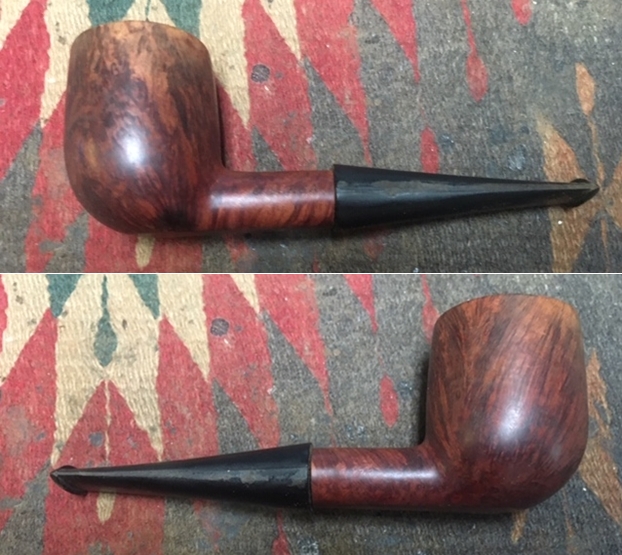
Jeff had gone to the trouble to ream the bowl with a PipNet pipe reamer and followed up with a Savinelli Fitsall pipe knife to remove the cake. He scrubbed out the mortise and the airway in the shank and the stem with alcohol, cotton swabs and pipe cleaners. He scrubbed the exterior of the bowl, rim, shank and stem with a tooth brush and Murphy’s Oil Soap to remove the oils and tars on the rim and the grime on the finish of the bowl. He rinsed it under running water. He dried it off with a soft cloth. All of his work gave me a clean pipe to work on to say the least. I decided to start with the new stem. I went through my collection of stems to find one that was the same dimensions as the ruined stem. I found one in my can that would fit the bill. Interestingly it is a twin bore bite proof stem like the other ones that Malaga used when they restemmed pipes.I set up my cordless drill with the PIMO Tenon Turning Tool in the chuck and started turning the tenon on the new stem back to match the broken one. I usually do the turning in several passes, adjusting the depth of the blade between each cut. In this case I did it in three passes. I got it close and finished the fit with my Dremel and sanding drum.I sanded off the castings on the sides and slot end of the stem with the Dremel and sanding drum and did a few turns on the tenon with the sanding drum. You can see from the first photo below that it was very close. I cleaned it up with a folded piece of 220 grit sandpaper. You can see the fit in the photos below.I set the stem aside and turned my attention to the bowl. I used a folded piece of 220 grit sandpaper to clean up the outer edge on rim top. Once I had the edges smooth I filled in the deeper nicks and chips in the outer edge of the rim with clear Krazy Glue. Once the repairs cured I sanded them smooth with 220 grit sandpaper and a piece of 400 grit sandpaper. I used a pen knife to clean up the cut marks on the rim top. Some of them were worn so I recut them to give them more definition. I cleaned up the carving with a brass bristle wire brush to clean up the repairs. The second photo shows the cleaned up rim top.I scrubbed the briar with Murphy’s Oil Soap and a tooth brush. I rubbed it into the surface of the briar with my finger tips and let it sit for about 10 minutes then rinsed it off with running water. I dried it off with a soft cloth. I polished the bowl with micromesh sanding pads to smooth out the rim edge repairs and the nicks in the bowl sides. I wet sanded with 1500-12000 grit pads and wiped the bowl down with a damp cloth after each pad. The photos show the progress. I used a Mahogany Stain Pen to stain the carvings on the rim top to blend all of the darkening together and make it stand out. I buffed it with a clean buffing pad. You can see from the photo below that I was able to blend it into the rest of the bowl.I worked some Before & After Restoration Balm into the surface of the briar with my fingertips to clean, enliven and protect it. I let the balm sit for a little while and then buffed with a cotton cloth to raise the shine. The following photos show the bowl at this point in the restoration process. I am very happy with the results. I turned to the stem and started by sanding the surface. I wanted to smooth out the surface of the vulcanite to remove the castings and the sanding marks. I sanded it with 220 grit sandpaper and 400 grit sandpaper to clean up the stem.I polished the stem with micromesh sanding pads – wet sanding with 1500-12000 grit sanding pads. I wiped it down after each sanding pad Obsidian Oil. I finished by polishing it with Before & After Pipe Stem Polish both Fine and Extra Fine and then wiped it down with a final coat of Obsidian Oil. This is a restemmed and restored “Malaga” Billiard with a vulcanite tapered “bite-proof” stem. The new black vulcanite stem looks good in place of the yellow acrylic stem. It has a great look and feel. The shape of the bowl, the reshaped and repaired rim top and the cut of the briar work well to highlight the grain around the bowl sides. I polished stem and the bowl with Blue Diamond polish on the buffing wheel. I gave the bowl and the stem multiple coats of carnauba wax. I buffed the pipe with a clean buffing pad to raise the shine. I hand buffed it with a microfiber cloth to deepen the shine. The pipe polished up pretty nicely. The grain took on life with the buffing. The rich oil cured colour works well with the polished vulcanite stem. The finished pipe has a rich look that is quite catching. Have a look at it with the photos below. The shape, finish and flow of the pipe and stem are very well done. The dimensions are Length: 6 ¼ inches, Height: 1 7/8 inches, Outside diameter of the bowl: 1 ½ inches, Chamber diameter: ¾ of an inch. I will be adding the pipe to the finished Malaga pipes that I have completed. I am looking forward to a new pipeman picking up this pipe and will carry on the trust for George Koch. Thanks for walking through the restoration with me as I worked over another one of Kathy’s Dad’s Pipes.

Restemming another “Malaga” Billiard from Kathy’s Dad’s Pipes


Blog by Steve Laug

I have been working on a lot of different estate pipes and selling them for different families. This morning I was looking through the bag of pipes that I have left from George Koch’s estate. There are only three of them and all were in pretty rough shape. The rims were well knocked about and the stems were either chewed off or through and really would need to be carefully worked over and have new stems fit to them. The third of these three Malaga pipes that need a lot of attention was the next one I picked up this morning. It is a Billiard with a chewed through acrylic stem. Of the three was the least beat up of the three. The rim top had some damage on the flat surface and the inner edge. But sides of the bowl had great looking flame and mixed grain that was fascinating. It is the last of the three Malaga pipes needing restemming that came to my brother and me in several shipments of pipes from George’s daughter Kathy. Alex had gone through the bag and had passed on these three. Jeff unwrapped the pipes when they came to him and took the following photo to give an idea of the volume of the pipes that we purchased. In each of the previous blogs that I have written on the restoration of George’s pipes I have told his story. If you have followed the restorations you will have read the information and the background piece that Kathy did on her father. Here is a link to one of the previous blogs on his Malaga pipes where I included her tribute in full (https://rebornpipes.com/2019/01/26/back-to-kathys-dads-pipes-restoring-a-%c2%bc-bent-malaga-author/). You can also read the bio on her Dad, George Koch. It is an interesting read and one that shows just how far our pipe collecting passion can go when we find a brand of pipes that we enjoy. I am going to only include the portion on the Malagas at this point. If you wish to read the rest follow the link above.

Kathy writes…We lived in Livonia, and that’s where his love for Malaga pipes began. After a few years he returned to Allis Chalmers and we moved back to Springfield. I remember that when we went back to Michigan to visit friends, Dad had to go to the Malaga store and acquire a few new pipes. Many a year I wrote to Malaga and they picked out a pipe for me to purchase that I could give Dad for a Christmas or birthday present. He was always pleased. His favorites were the straight stemmed medium sized bowl pipes, but he liked them all. 

He had some other pipes, but the Malagas were his favorites. I remember him smoking them sitting in his easy chair after work, with feet up on the ledge by the fire burning in the fireplace.  Growing up it was my job to clean them and he liked the inner bowl and stem coated with Watkins vanilla, leaving a little of that liquid in the bowl to soak in when I put them back on the rack…I’m very happy they are being restored by you and your brother and hope they find homes who enjoy them as much as Dad did. Thank-you for your care and interest. — Kathy, the oldest daughter

This second “Malaga” Billiard on the table is the least damaged of the three. Under the damage and dirt I can see the great grain on the briar. There were some scratches and nicks in surface of the rim top. The large bowl, round shank and chewed through acrylic stem give a clear picture of what the pipe must have looked like when George bought it at the shop. Again, I did not bother Jeff for the pre-cleanup photos because really it was obvious what the pipe must have looked like. From the condition of the bowl and rim post cleanup I could see that it originally had a thick cake that overflowed with lava onto the rim so that there was damage on the inner edges. The rim top had been knocked hard against rough surfaces to knock out the dottle and left damage. The sides of the bowl and shank are very dirty with grime and oils from prolonged use. The stamping on the left side of the shank read MALAGA. The acrylic stem had been gnawed through leaving a useless stem that would need to be replaced. Since Paresh is not here in Canada this is another that will be replaced rather than rebuilt! 😉 I took photos of the pipe before I started my work. The condition of the pipe will be shown in the photos below. I took a photo of the  rim top and bowl to show the condition of the pipe. You can see why I said it was used as a hammer – though less than the others. The surface of the rim is very rough. The inner and the outer edge have some damage. There is some darkening on the back inner edge, bevel and surface of the rim top. I think that this pipe must have been another shop pipe or knock about pipe for George as it was very well smoked! I took photos of the stem to show the broken and chewed condition it was in. Remember this is hard acrylic so it took some real gnawing to do this to it!I took a photo to capture the stamping on left side of the shank. The photo shows the stamping MALAGA and is very readable.I am also including the link to a blog that I wrote that gives some of the history of the Malaga brand and the Malaga Pipe Shop in Royal Oak, Michigan in the USA. I have written an earlier blog to give a little history of the Malaga Brand and the pipemaker, George Khoubesser. Here is the link – https://rebornpipes.com/tag/malaga-pipes/.That blog also includes links to a catalogue and the history of the pipemaker George Khoubesser. Follow the link to get a feel for the brand and the pipemaker.

Jeff had gone to the trouble to ream the bowl with a PipNet pipe reamer and followed up with a Savinelli Fitsall pipe knife to remove the cake. He scrubbed out the mortise and the airway in the shank and the stem with alcohol, cotton swabs and pipe cleaners. He scrubbed the exterior of the bowl, rim, shank and stem with a tooth brush and Murphy’s Oil Soap to remove the oils and tars on the rim and the grime on the finish of the bowl. He rinsed it under running water. He dried it off with a soft cloth. All of his work gave me a clean pipe to work on to say the least. I decided to start with the new stem. I went through my collection of stems to find one that was the same dimensions as the ruined stem. I found one in my can that would fit the bill.I set up my cordless drill with the PIMO Tenon Turning Tool in the chuck and started turning the tenon on the new stem back to match the broken one. I usually do the turning in several passes, adjusting the depth of the blade between each cut. In this case I did it in three passes. I got it close and finished the fit with my Dremel and sanding drum.I sanded off the castings on the sides and slot end of the stem with the Dremel and sanding drum and did a few turns on the tenon with the sanding drum. You can see from the first photo below that it was a good snug fit. The diameter of the stem was larger than the shank do I would need to remove the excess material to get a solid fit.I used a Dremel and sanding drum to remove the excess material from the stem and get it close to the diameter of the shank. I worked over the diameter with a folded piece of 220 grit sandpaper to smooth out the stem. It still has a ways to go before it was finished but it was getting pretty close. I set the stem aside and turned my attention to the bowl. I topped the bowl with 220 grit sandpaper on a topping board. I removed the damaged areas on the rim top. I did not need to remove too much to bring it back to smooth condition and the outer edge was still clean.I used a folded piece of 220 grit sandpaper to clean up the inner bevel of the bowl. I worked it at an angle to clean up the edge and to give it a smooth bevel.I scrubbed the briar with Murphy’s Oil Soap and a tooth brush. I rubbed it into the surface of the briar with my finger tips and let it sit for about 10 minutes then rinsed it off with running water. I dried it off with a soft cloth. I used an Oak Stain Pen to stain the carvings on the rim top to blend all of the darkening together and make it stand out. I buffed it with a clean buffing pad. You can see from the photo below that I was able to blend it into the rest of the bowl.I polished the bowl with micromesh sanding pads to smooth out the rim edge repairs and the nicks in the bowl sides. I wet sanded with 1500-12000 grit pads and wiped the bowl down with a damp cloth after each pad. The photos show the progress. I worked some Before & After Restoration Balm into the surface of the briar with my fingertips to clean, enliven and protect it. I let the balm sit for a little while and then buffed with a cotton cloth to raise the shine. The following photos show the bowl at this point in the restoration process. I am very happy with the results. I turned to the stem and started by sanding the surface. I wanted to smooth out the surface of the vulcanite to remove the castings and the sanding marks. I sanded it with 220 grit sandpaper and 400 grit sandpaper to clean up the stem.I polished the stem with micromesh sanding pads – wet sanding with 1500-12000 grit sanding pads. I wiped it down after each sanding pad Obsidian Oil. I finished by polishing it with Before & After Pipe Stem Polish both Fine and Extra Fine and then wiped it down with a final coat of Obsidian Oil. This is a restemmed and restored Malaga Billiard with a vulcanite tapered stem. The new black vulcanite stem looks good in place of the black chewed acrylic stem. It has a great look and feel. The shape of the bowl, the reshaped and repaired rim top and the cut of the briar work well to highlight the grain around the bowl sides. I polished stem and the bowl with Blue Diamond polish on the buffing wheel. I gave the bowl and the stem multiple coats of carnauba wax. I buffed the pipe with a clean buffing pad to raise the shine. I hand buffed it with a microfiber cloth to deepen the shine. The pipe polished up pretty nicely. The grain took on life with the buffing. The rich oil cured colour works well with the polished vulcanite stem. The finished pipe has a rich look that is quite catching. Have a look at it with the photos below. The shape, finish and flow of the pipe and stem are very well done. The dimensions are Length: 5 ¼ inches, Height: 2 inches, Outside diameter of the bowl: 1 ½ inches, Chamber diameter: ¾ of an inch. I will be adding the pipe to the finished Malaga pipes that I have completed. I am looking forward to a new pipeman picking up this pipe and will carry on the trust for George Koch. Thanks for walking through the restoration with me as I worked over another one of Kathy’s Dad’s Pipes.

Restemming & Restoring a “Malaga” Canadian from Kathy’s Dad’s Pipes


Blog by Steve Laug

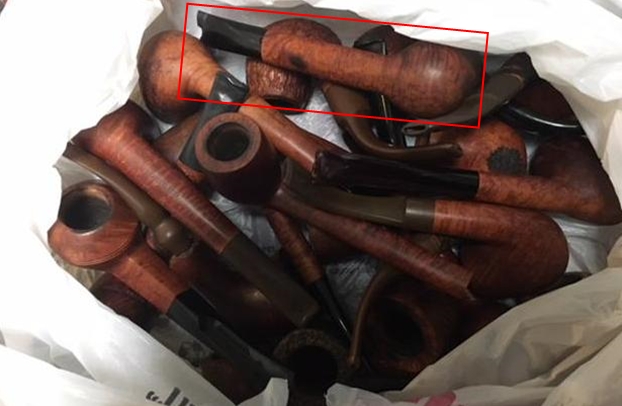
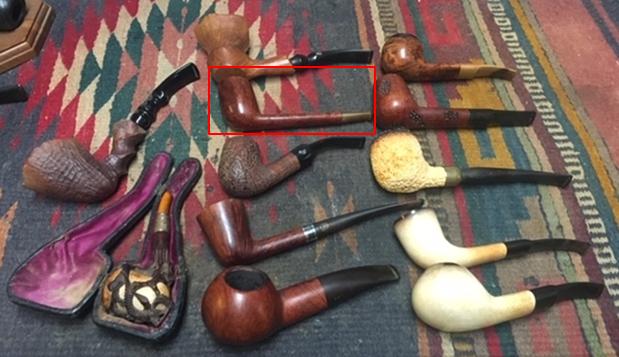
I have been working on a lot of different estate pipes and selling them for different families. This morning I was looking through the bag of pipes that I have left from George Koch’s estate. There are only three of them and all were in pretty rough shape. The rims were well knocked about and the stems were either chewed off or through and really would need to be carefully worked over and have new stems fit to them. The first of these three Malaga pipes that need a lot of attention was the one I picked up this morning. It is a Canadian with a broken or chewed off stem. The rim top was used as a hammer or at least spent a lot of time being knocked against hard surface. But sides of the bowl had a mix of grain styles that was fascinating. It is one of the last three Malaga pipes that came to my brother and me in several shipments of pipes from George’s daughter Kathy. Alex had gone through the bag in essence had passed on these three. Jeff unwrapped the pipes when they came to him and took the following photo to give an idea of the volume of the pipes that we purchased. This Malaga is actually shown in the photo of the box of pipes below. I have drawn a red box around it so you can see it clearly.In each of the previous blogs that I have written on the restoration of George’s pipes I have told his story. If you have followed the restorations you will have read the information and the background piece that Kathy did on her father. Here is a link to one of the previous blogs on his Malaga pipes where I included her tribute in full (https://rebornpipes.com/2019/01/26/back-to-kathys-dads-pipes-restoring-a-%c2%bc-bent-malaga-author/). You can also read the bio on her Dad, George Koch. It is an interesting read and one that shows just how far our pipe collecting passion can go when we find a brand of pipes that we enjoy. I am going to only include the portion on the Malagas at this point. If you wish to read the rest follow the link above.

Kathy writes…We lived in Livonia, and that’s where his love for Malaga pipes began. After a few years he returned to Allis Chalmers and we moved back to Springfield. I remember that when we went back to Michigan to visit friends, Dad had to go to the Malaga store and acquire a few new pipes. Many a year I wrote to Malaga and they picked out a pipe for me to purchase that I could give Dad for a Christmas or birthday present. He was always pleased. His favorites were the straight stemmed medium sized bowl pipes, but he liked them all. 

He had some other pipes, but the Malagas were his favorites. I remember him smoking them sitting in his easy chair after work, with feet up on the ledge by the fire burning in the fireplace.  Growing up it was my job to clean them and he liked the inner bowl and stem coated with Watkins vanilla, leaving a little of that liquid in the bowl to soak in when I put them back on the rack…I’m very happy they are being restored by you and your brother and hope they find homes who enjoy them as much as Dad did. Thank-you for your care and interest. — Kathy, the oldest daughter

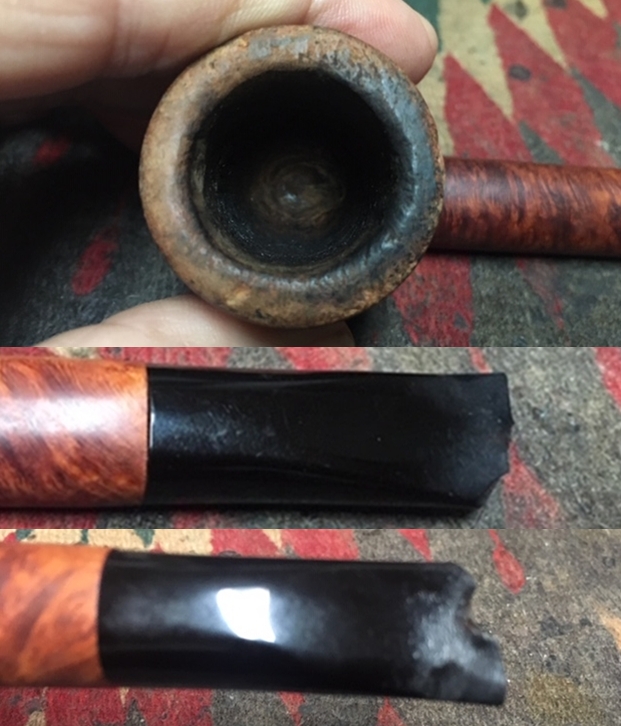
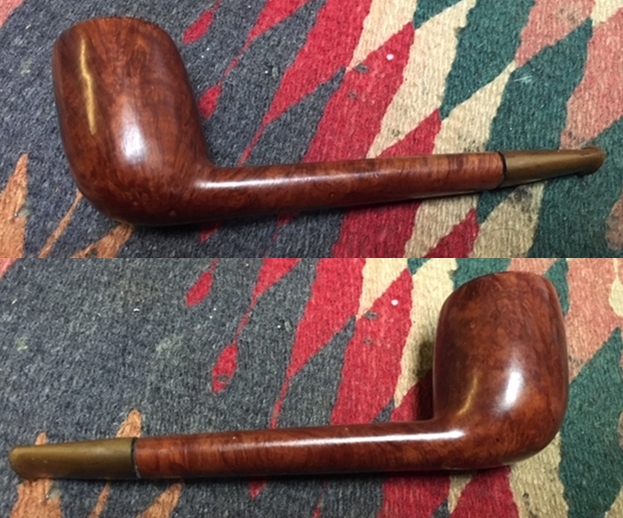
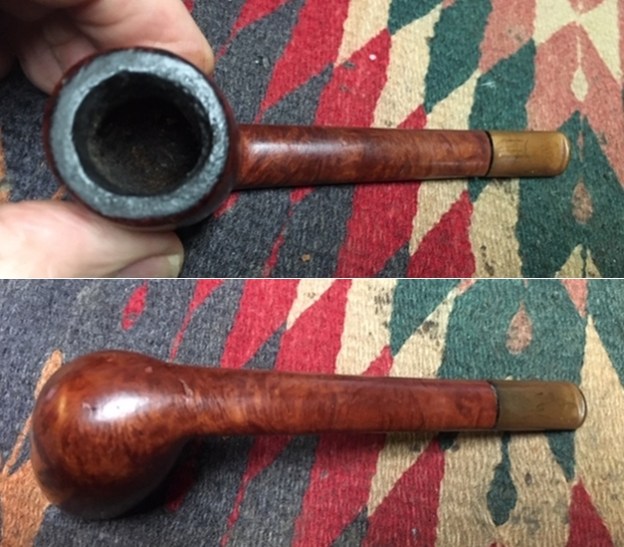
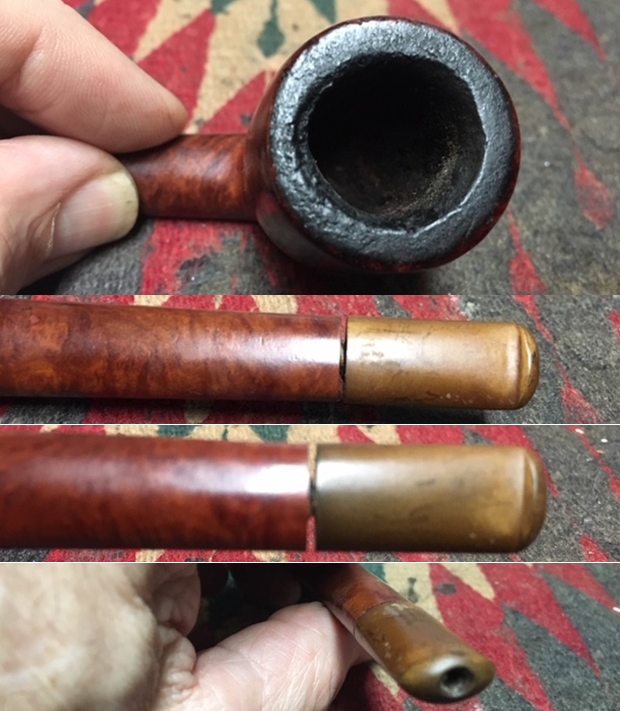
The “Malaga” Canadian on the table is in rough condition. But even under the damage and dirt I can see that the carver did a great job of shaping the pipe to follow the grain on the briar. The large bowl, oval shank and short broken stem give a clear picture of what the pipe must have looked like when George bought it at the shop. I did not bother Jeff for the pre-cleanup photos because really it was obvious what the pipe must have looked like. From the condition of the bowl and rim post cleanup I could see that it originally had a thick cake that overflowed with lava onto the rim so that there was damage on the inner edges. The rim top had been knocked hard against rough surfaces to knock out the dottle and left damage. The sides of the bowl and shank are very dirty with grime and oils from prolonged use. The stamping on the left side of the shank read “MALAGA”. On the right side it read Imported Briar. There was a burn mark on the underside of the shank near the stem/shank junction that looked like the pipe had been set down in an ashtray. The acrylic stem had been broken or gnawed off leaving a useless stem that would need to be replaced. Since Paresh is not here in Canada it will be replaced rather than rebuilt! 😉 I took photos of the pipe before I started my work. Somehow the rest of the before photos of the pipe as a whole were out of focus. The condition of the pipe will be shown in the remaining photos however.I took a photo of the  rim top and bowl to show the condition of the pipe. You can see why I said it was used as a hammer. The surface of the rim is very rough. The outer and inner edges fo the rim are  also in very bad condition. There is some darkening on the back edge and surface of the rim top. I think that this pipe must have been kind of shop pipe or knock about pipe for George as it was very well smoked! I took photos of the stem to show the broken and chewed condition it was in. Remember this is hard acrylic so it took some real gnawing to do this to it!I took a photo of the burn mark on the underside of the shank. It was not a deep mark and the wood was still solid so it was not badly damaged.I took a photo to capture the stamping on each side of the shank. The photos show the stamping “MALAGA” on the left side of the shank and Imported Briar on the right side. The stamping is faint but still readable. I am also including the link to a blog that I wrote that gives some of the history of the Malaga brand and the Malaga Pipe Shop in Royal Oak, Michigan in the USA. I have written an earlier blog to give a little history of the Malaga Brand and the pipemaker, George Khoubesser. Here is the link – https://rebornpipes.com/tag/malaga-pipes/.That blog also includes links to a catalogue and the history of the pipemaker George Khoubesser. Follow the link to get a feel for the brand and the pipemaker.

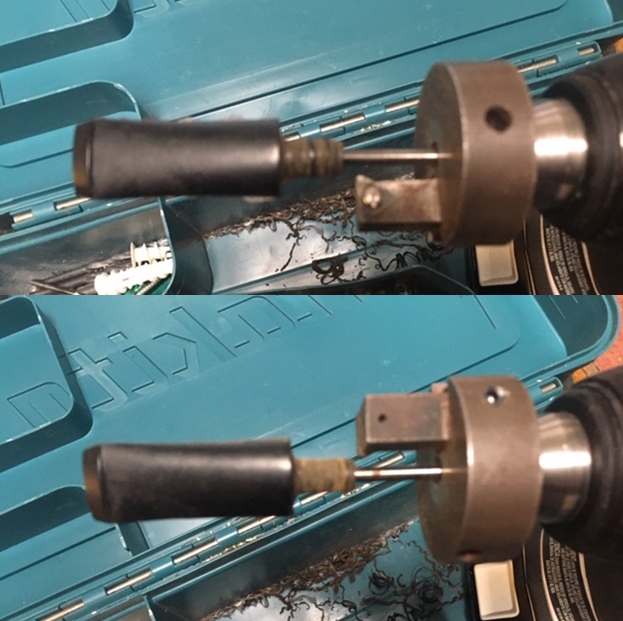
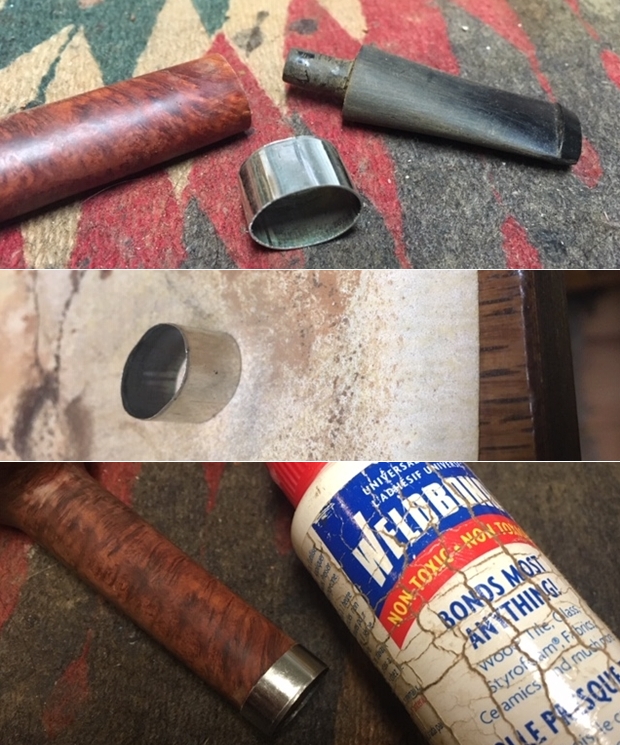
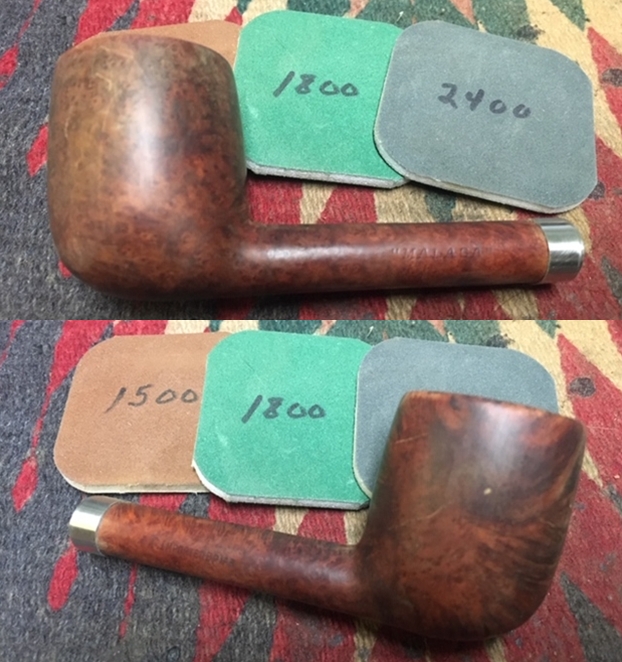
Jeff had gone to the trouble to ream the bowl with a PipNet pipe reamer and followed up with a Savinelli Fitsall pipe knife to remove the cake. He scrubbed out the mortise and the airway in the shank and the stem with alcohol, cotton swabs and pipe cleaners. He scrubbed the exterior of the bowl, rim, shank and stem with a tooth brush and Murphy’s Oil Soap to remove the oils and tars on the rim and the grime on the finish of the bowl. He rinsed it under running water. He dried it off with a soft cloth. All of his work gave me a clean pipe to work on to say the least. I decided to start with the new stem. I went through my collection of stems to find one that was the same dimensions as the broken stem. I found one in my can that would fit the bill. I set up my cordless drill with the PIMO Tenon Turning Tool in the chuck and started turning the tenon on the new stem back to match the broken one. I usually do the turning in several passes, adjusting the depth of the blade between each cut. In this case I did it in three passes. I got it close and finished the fit with my Dremel and sanding drum.I sanded off the castings on the sides and slot end of the stem with the Dremel and sanding drum and did a few turns on the tenon with the sanding drum. You can see from the first photo below that it was very close. I took it back to the Dremel and did a few more passes on the tenon and cleaned it up with a folded piece of 220 grit sandpaper. You can see the fit in the second photo. There was some gap where it did not sit flush against the shank. The issue was not the fit of the tenon but rather the shank end. I could see that it was uneven and rough so I would need to make a few decisions on how to address that issue.I decided that the best way to address the fit and give the pipe a little pizzazz would be to use a nickel band. They come from the maker quite thick – ½ of an inch and I wanted something about ¼ of an inch thick. I used the topping board and the Dremel to thin down the height of the band. It took a bit of time but I like the way it looks once it is finished. Once I had the band done I set it aside and cleaned the briar. The third photo shows the finished band glued in place on the shank using Weldbond all-purpose glue. The ¼ of an inch thick band works for me!I topped the bowl on a new piece of 220 grit sandpaper on the topping board. Once I had the top smooth I filled in the deeper nicks and chips in the outer edge of the rim with clear Krazy Glue. Once the repairs cured I sanded them smooth with 220 grit sandpaper and retopped the bowl to remove the excess glue. I used a folded piece of sandpaper to sand out some of the burn damage on the underside of the shank. I scrubbed the briar with Before & After Briar Cleaner and a tooth brush. I rubbed it into the surface of the briar with my finger tips and let it sit for about 10 minutes then rinsed it off with running water. I dried it off with a soft cloth. I polished the bowl with micromesh sanding pads to smooth out the rim top repairs and the nicks in the bowl sides. I wet sanded with 1500-12000 grit pads and wiped the bowl down with a damp cloth after each pad. The photos show the progress. I used an Oak Stain Pen to blend in a few of the spots on the rim top and edges that were lighter than the bowl. I buffed it with a clean buffing pad. You can see from the photo below that I was able to blend it into the rest of the bowl.I worked some Before & After Restoration Balm into the surface of the briar with my fingertips to clean, enliven and protect it. I let the balm sit for a little while and then buffed with a cotton cloth to raise the shine. The following photos show the bowl at this point in the restoration process. I am very happy with the results. I turned to the stem and started by sanding the surface. I wanted to smooth out the surface of the vulcanite to remove the castings and the sanding marks. I sanded it with 220 grit sandpaper and 400 grit sandpaper to clean up the stem.I polished the stem with micromesh sanding pads – wet sanding with 1500-12000 grit sanding pads. I wiped it down after each sanding pad Obsidian Oil. I finished by polishing it with Before & After Pipe Stem Polish both Fine and Extra Fine and then wiped it down with a final coat of Obsidian Oil. This is a restemmed and restored “Malaga” Canadian with a vulcanite tapered stem. The nickel band adds a touch of class that truly makes the pipe stand out from the other Malaga pipes that I have worked on. It has a great look and feel. The shape of the bowl, the reshaped and repaired rim top and the cut of the briar work well to highlight the grain around the bowl sides. I polished stem and the bowl with Blue Diamond polish on the buffing wheel. I gave the bowl and the stem multiple coats of carnauba wax. I buffed the pipe with a clean buffing pad to raise the shine. I hand buffed it with a microfiber cloth to deepen the shine. The pipe polished up pretty nicely. The grain took on life with the buffing. The rich oil cured colour works well with the polished vulcanite stem. The finished pipe has a rich look that is quite catching. Have a look at it with the photos below. The shape, finish and flow of the pipe and stem are very well done. The dimensions are Length: 5 ½ inches, Height: 1 7/8 inches, Outside diameter of the bowl: 1 ¼ inches, Chamber diameter: ¾ of an inch. I will be adding the pipe to the finished Malaga pipes that I have completed. I am looking forward to a new pipeman picking up this pipe and will carry on the trust for George Koch. Thanks for walking through the restoration with me as I worked over another one of Kathy’s Dad’s Pipes.

Cleaning up an English Made Kaywoodie Air-way 707 Diplomat


Blog by Steve Laug

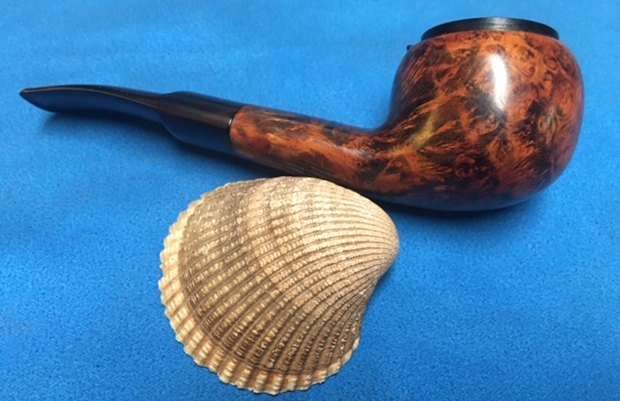
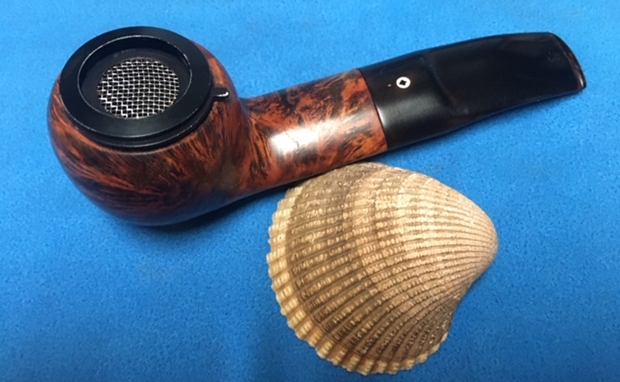
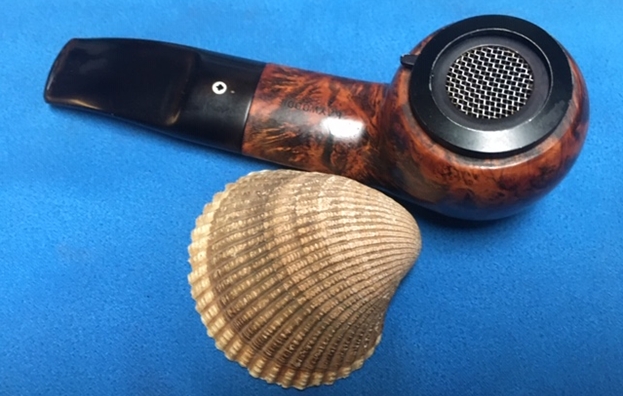
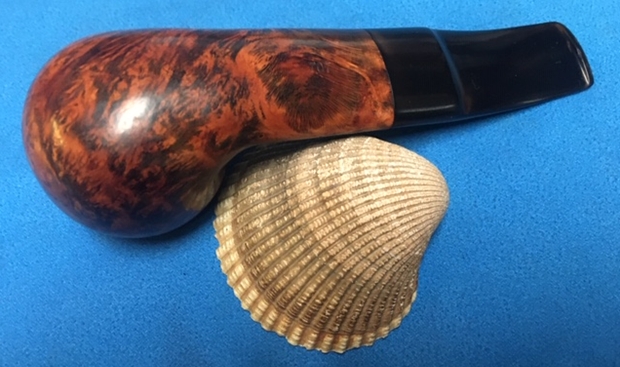
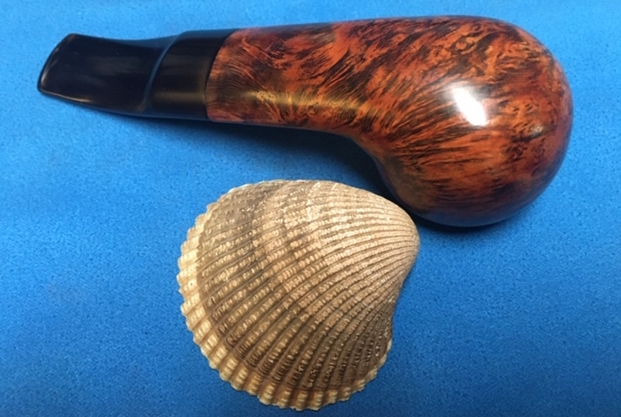
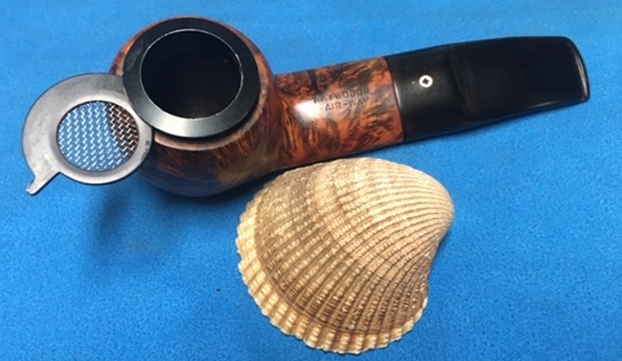
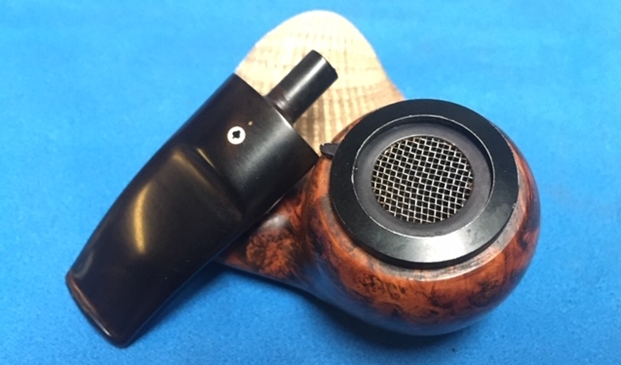
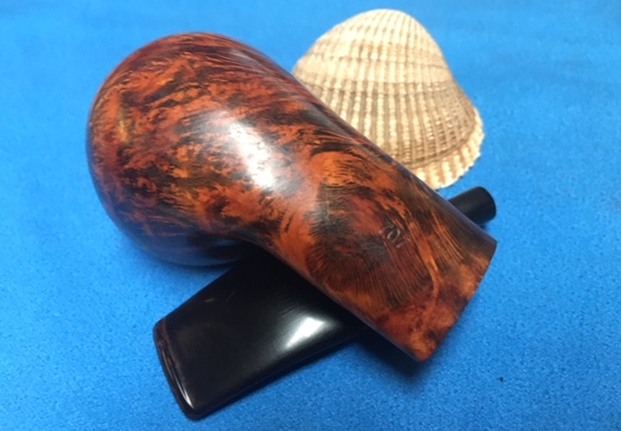
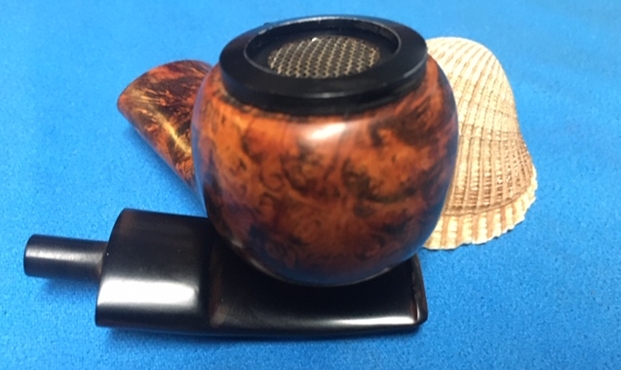
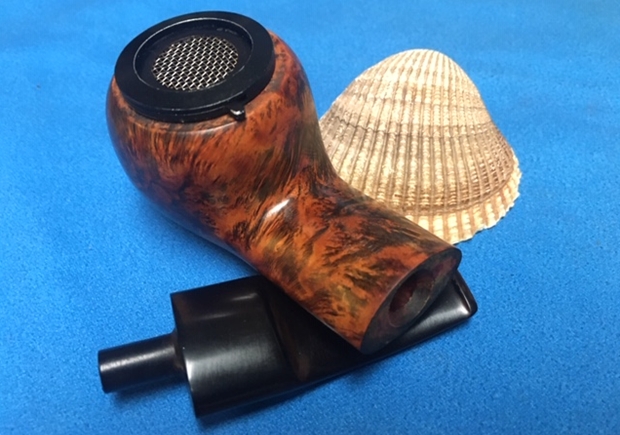
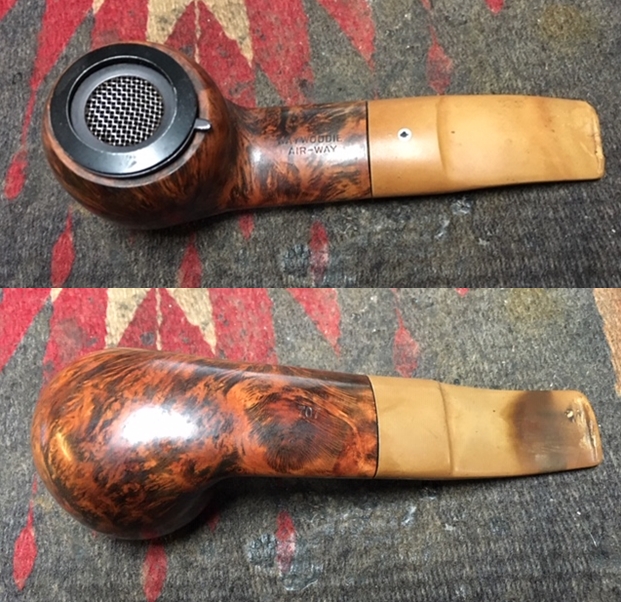
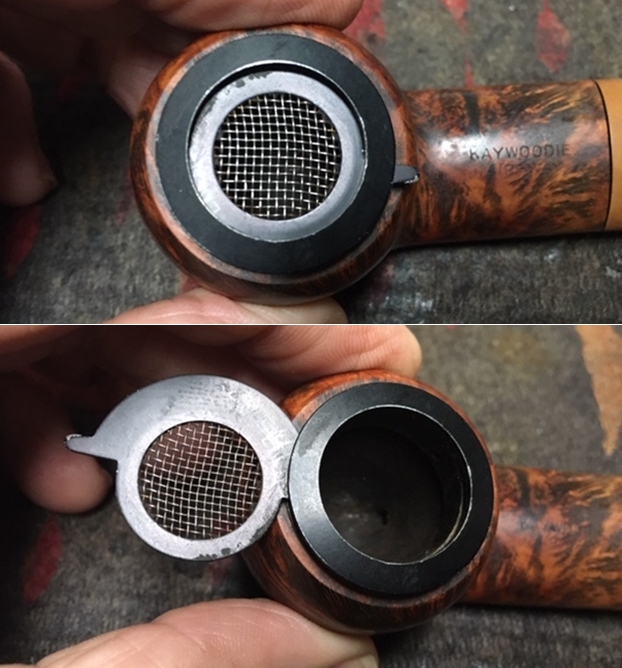
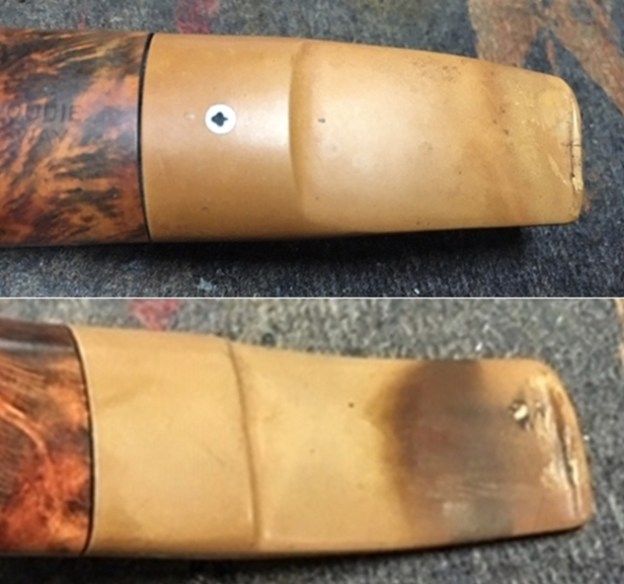
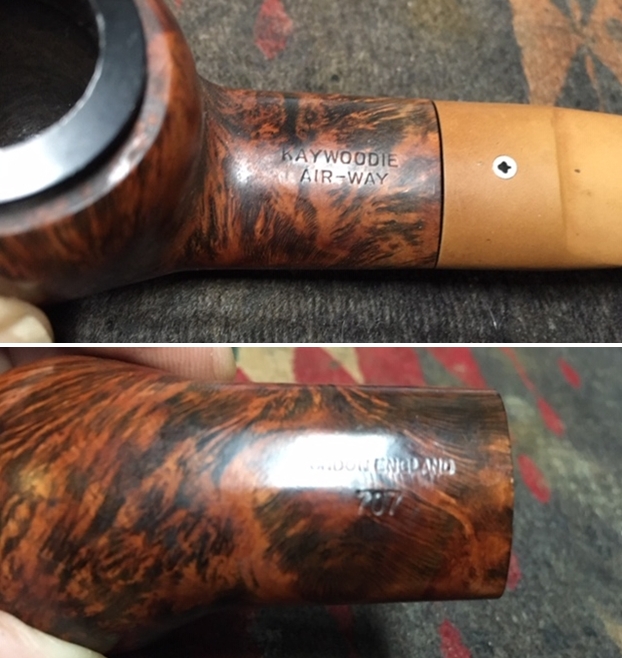
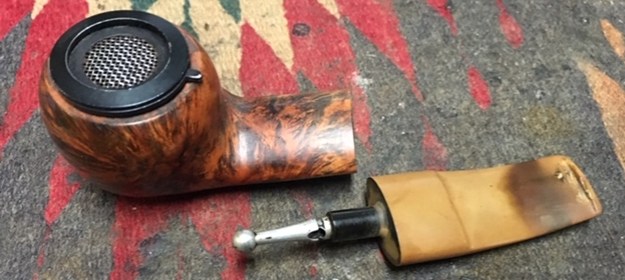
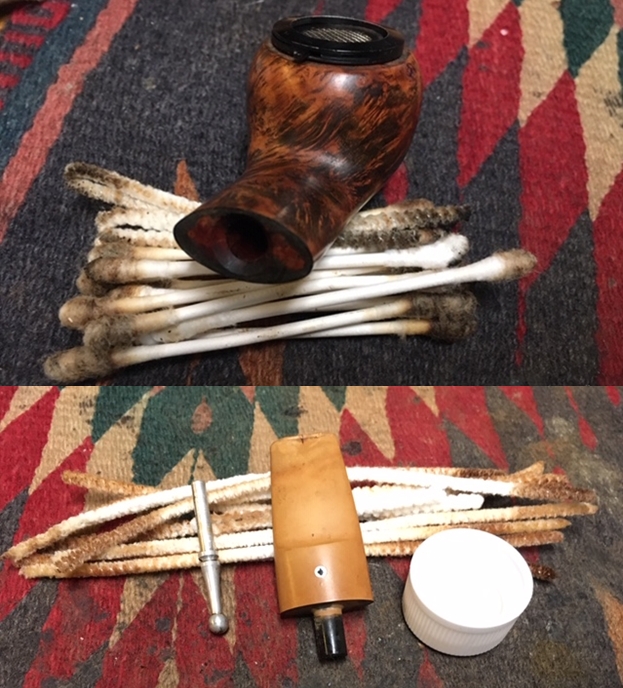
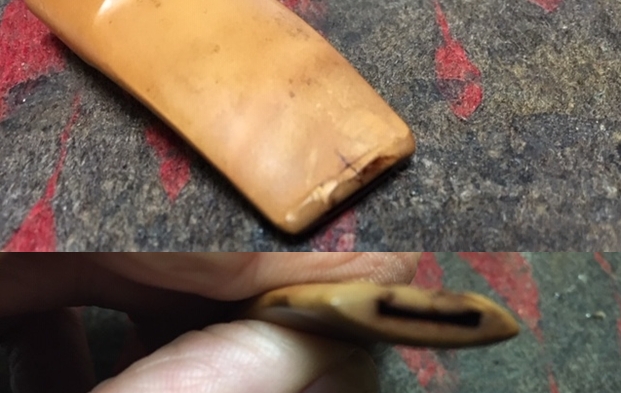
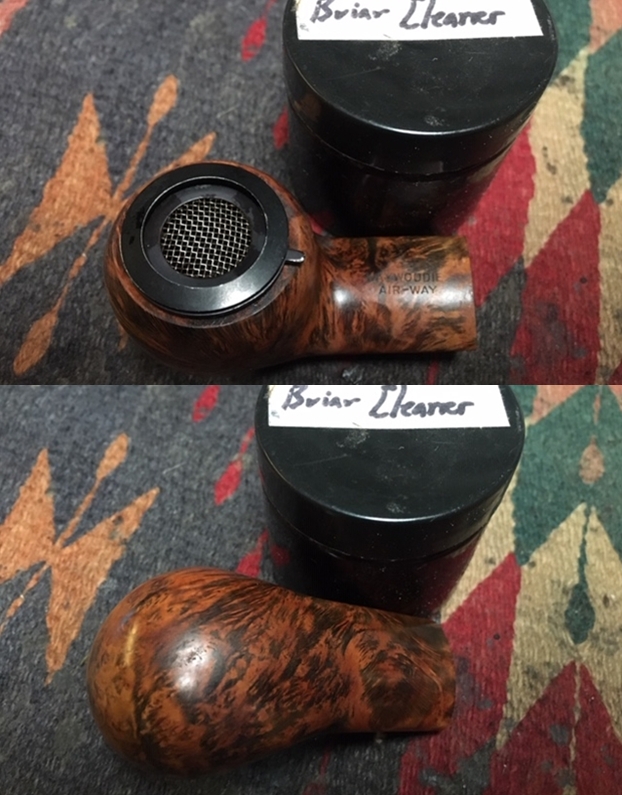
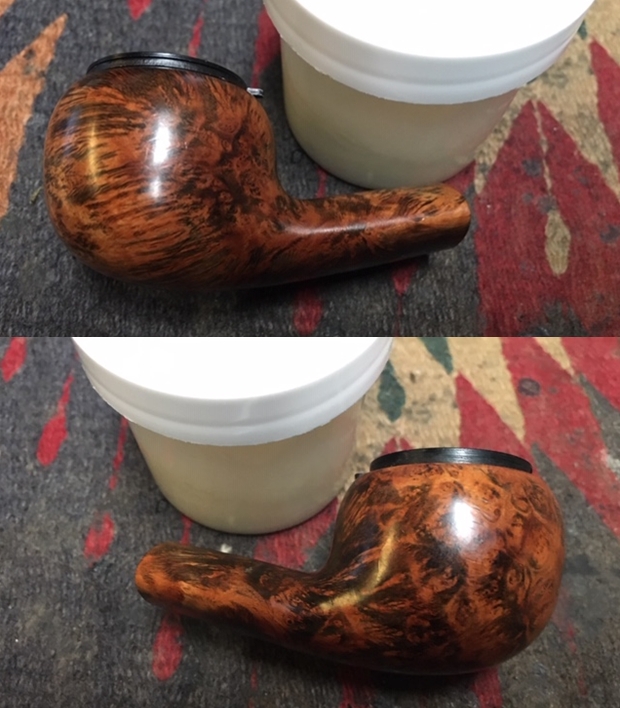
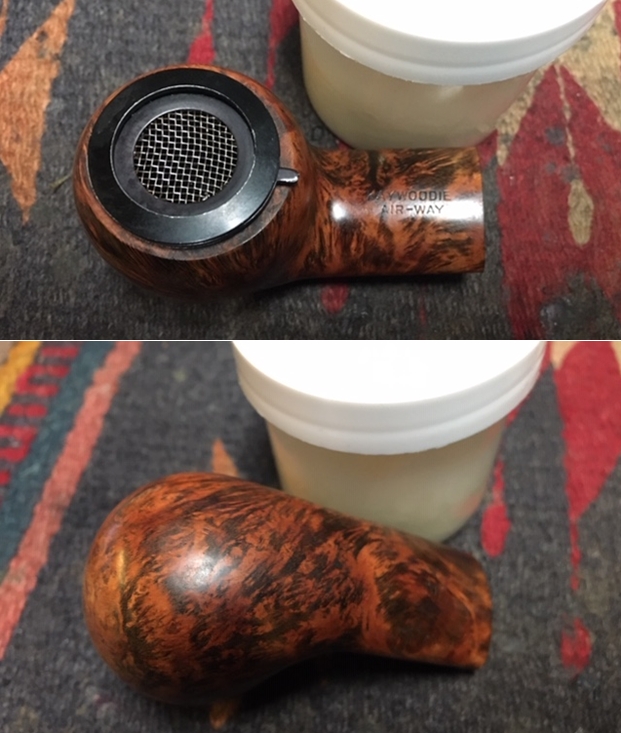
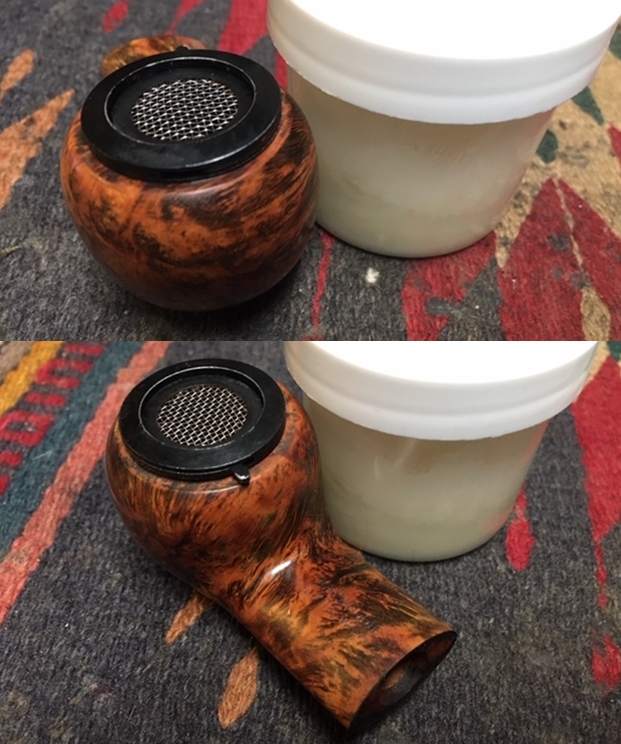
On our recent trip to Alberta we picked up quite a few pipes that were really nice. Some of them were brands we were familiar with and some were pipes that were unknown and unidentifiable. But if you are a pipe hunter you know the feeling when you are holding a particular pipe, no matter what the brand and it just speaks to you. That is what happened with this next pipe. It was in a display case at an antique mall in Edmonton. The shape of the pipe, the wind cap that was an integral part of the rim top and the interesting staining that highlighted some unique grain called my name. The stamping on the top of the shank read Kaywoodie over Air-way and on the underside it was stamped London, England and the shape number 707. It was a shape I had not seen before and the wind cap mechanism was a new one for me as well. The fact that it was an English made Kaywoodie also insure that it was going home with me. I have drawn a red box around the pipe at the top of the column on the right.The grain under the dirty finish was unique and the finish was interesting. The diplomat shape is one that I enjoy smoking and it has a good feel in the hand. The rim top was truly unique. The wind cap was fascinated on the rim top and the screen can be swiveled to the left to open the bowl. The bowl itself had a think cake in the bowl and the inside of the bowl and rim edges looked very good. The finish was dirty but still in good condition under the grime. The vulcanite stem was so heavily oxidized that it was butterscotch colour. It had some tooth marks and chatter on both sides near the button. There were some small cracks and the slot was slightly collapsed on the left side. The Kaywoodie club logo on the top of the saddle stem was a white circle with a black club inside. I took close up photos of the wind screen mechanism on the rim top with it open and closed to show how it worked. You can see the condition of the bowl in the second photo below.I took photos of the stem showing the deep oxidation and tooth chatter on both sides near the button. You can also see the small cracks on the top side of the button. It is thin so it easily was chipped and cracked when clenched.I took some photos of the stamping on the shank. The first photo shows the Kaywoodie Air-Way stamp and the white circle/black club insert on the stem top. The second photo shows the London, England and shape number 707 on the underside of the shank.I took a closer look at the inside of the bowl and took a photo. It was dirty but very lightly caked.I took a photo of the pipe with the push stem removed from the shank. The stinger was different from the usual Kaywoodie stinger. It had a ball on the end of the stinger but no holes in it. There was a ring around the stinger just above the tenon insert and a slotted hole. Before doing cleanup work on the pipe I decided to do some research on the pipe. I looked first on the Pipephil website and found some information on the white circle/black club stamp on the top of the stem. I did a screen capture of the pertinent information on the logo itself (http://www.pipephil.eu/logos/en/logo-kaywoodie.html). From there I learned that the logo was used first in 1937 and up until the late 1940s for the higher grade pipes. Also until the late 40s early 50s the logo was on top of the stem.
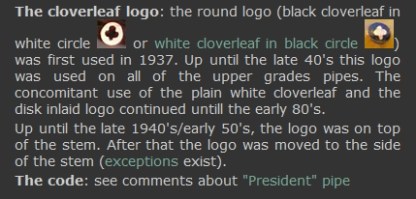
There was no other information on the Air-way line on the site and nothing under the section on the London/British made Kaywoodie pipes. That meant I would need to turn elsewhere to find that information. This would be an interesting hunt and restoration.

I turned to Pipedia (https://pipedia.org/wiki/Kaywoodie) and read the section on the rough outline on the history of the brand that links the brand with the English section of the company. I quote:

Again, demand for KBB pipes and especially Kaywoodie prompted another move for both the manufacturing facilities and the corporate offices. In 1930 the corporate office moved into the Empire State Building on Fifth Avenue in New York. By 1935, the manufacturing operations moved from Union City to 6400 Broadway in West New York, New Jersey which, at the time, was touted as the largest pipe making facility in the world. At the height of production, there were 500 employees producing up to 10,000 pipes per day.

The corporate offices were relocated in 1936 to the International Building, Rockefeller Center, 630 Fifth Avenue, New York. The invitation to visit the new office reads, “Kaywoodie is now on display at the world’s most famous address – Rockefeller Center. Here Kaywoodie takes its place among the leaders of industry and commerce.” The move to Rockefeller Center coincided with The Kaywoodie Company’s emergence as a subsidiary of KBB. All of the pipes manufactured by KBB including the Yello-Bole line were also on display here. By 1938 Kaywoodie had opened an office in London to meet worldwide demand. Kaywoodie of London was jointly owned with another famous pipemaker, Comoy’s of London.

I am also including a screen capture of a picture of a pipe that is the same shape as the one that I am working on. Thanks to Doug Valitchka for the photo.From there I turned to a link on the article to a section called Guide to Kaywoodie Pipes (https://pipedia.org/wiki/Collector%27s_Guide_to_Kaywoodie_Pipes#NOTES_ON_.22OTHER.E2.80.9D_KAYWOODIE_PIPES).  It gave some pertinent information on the Air-way line. I quote two sections from that article below. I have highlighted the Air-way brand name in the second paragraph.
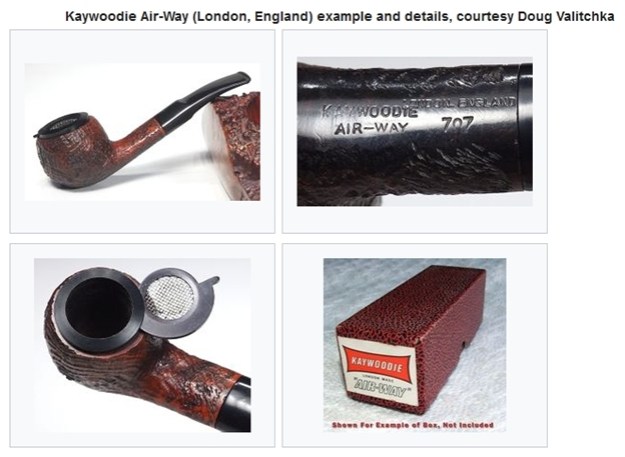
English Kaywoodies. All of the catalogs reviewed in this research contained the following copyright notification: Printed in U.S.A., Kaufmann Bros. and Bondy, Inc., New York and London. Kaywoodie Pipe cases and smoker’s accessories were also marked with “New York and London”. The catalogs, however, do not present any information concerning Kaywoodie’s London operations, or how the English Kaywoodies might have differed from those manufactured and marketed in the U.S. Lowndes notes that he has several English Kaywoodies acquired in

Vaduz and Zurich. English Kaywoodies are now made by Oppenheimer pipes. Lowndes notes that English Kaywoodies with the “screw-in bit” come in Ruby Grain, Custom Grain, Standard, and Relief Grain grades. The traditional push-bit models come in Continental Plain and Relief, London Made, Minaret, Air-way Polished No. 707, and Lightweight grades. Prices in 1985 ranged from 9.50 (pounds) to 26.00 (pounds). Lowndes notes that the Super Star was a special edition English Kaywoodie made of finest briar with a handmade silver band. Lowndes has two: one from Zurich with a large white-outlined logo, and beautifully cased; and one in walnut finish with the black-­in-white logo. A recent catalog shows the Super Star without a band and the ordinary small white logo. A 1985 letter from Oppenheimer states that the black-in-white logo has been discontinued and only the regular white logo is now used.

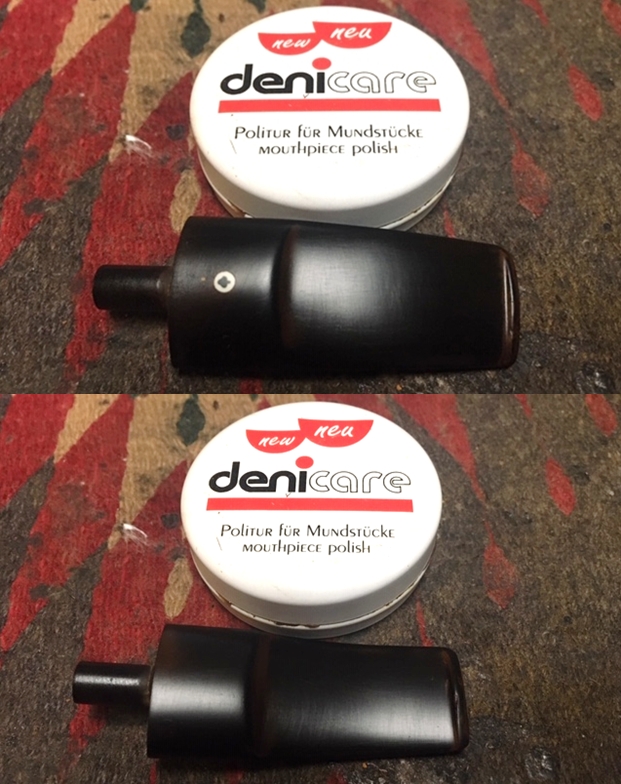
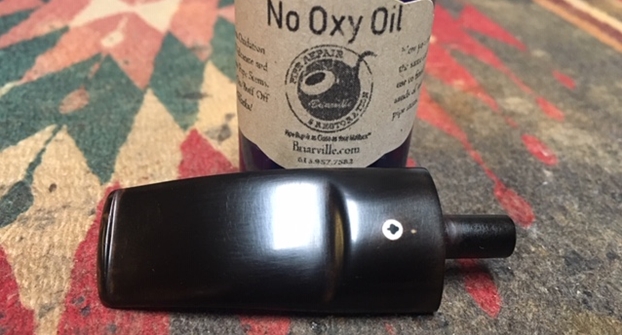
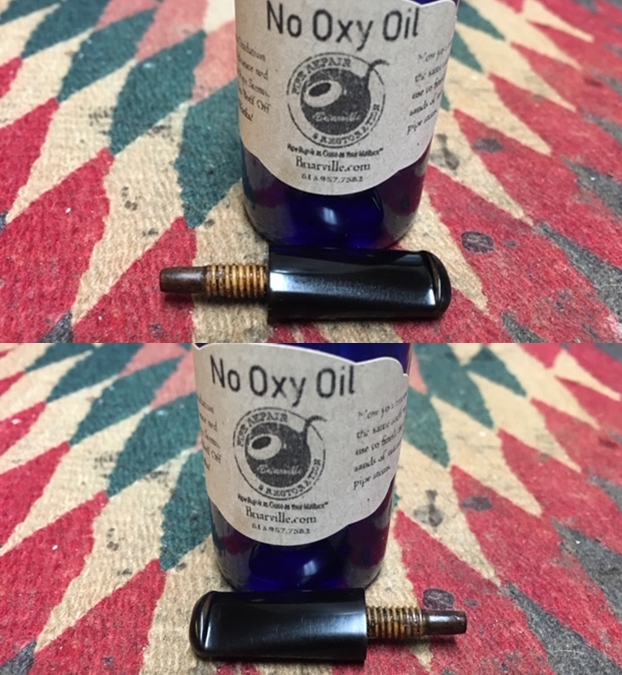
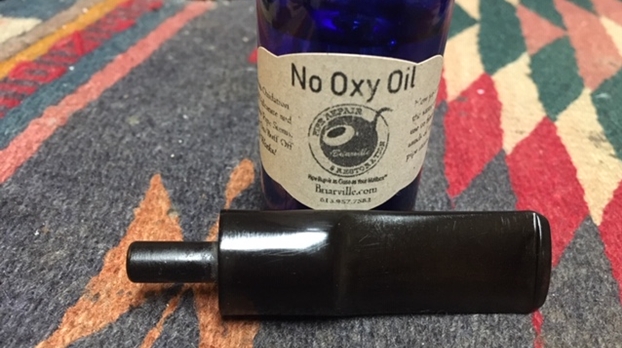
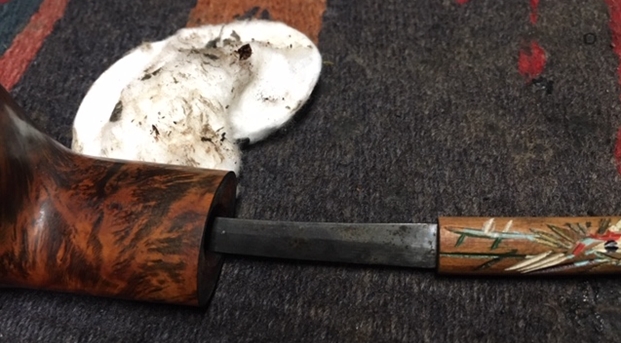
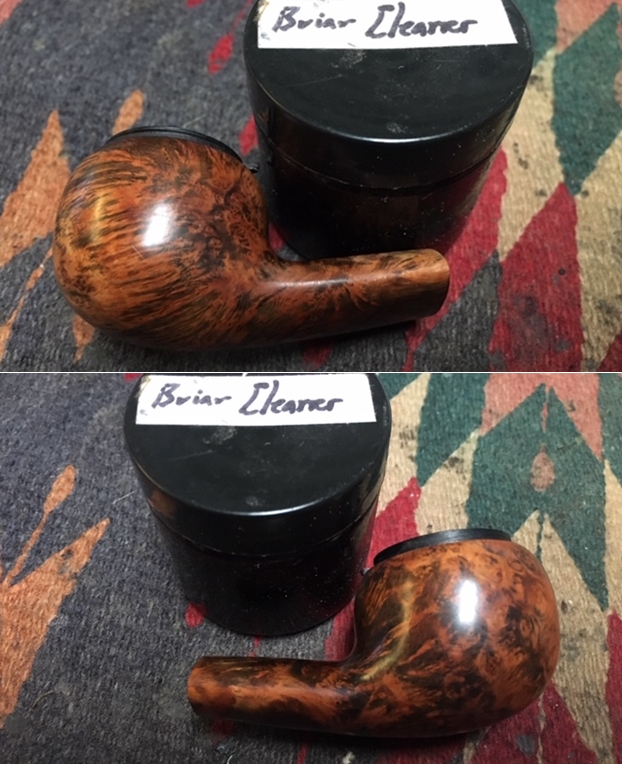
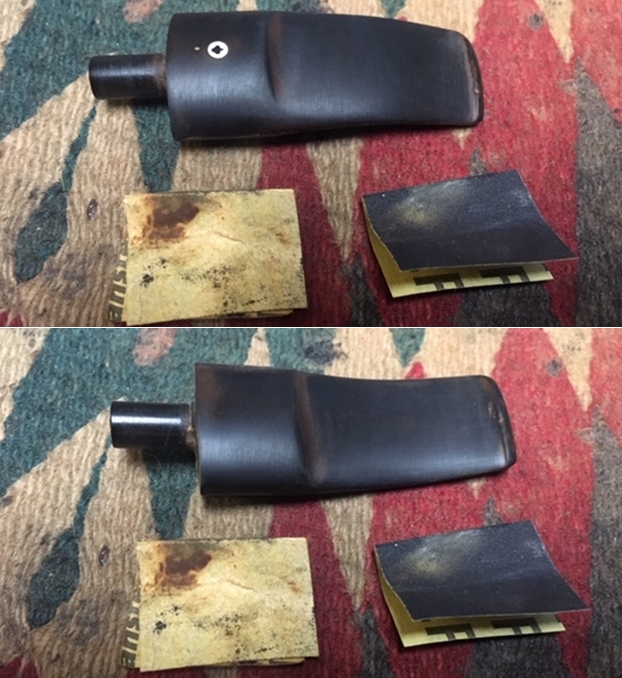
From that information I now knew that the pipe in hand was made prior to 1985 in London by Oppenheimer. It had a traditional push-bit rather than the threaded screw in bit. After 1985 Oppenheimer discontinued the black in white logo. It was time to work on the pipe now. I scraped the shank with a pen knife to remove the tarry buildup that did not allow the stem to seat properly. I cleaned out the mortise and the airway in the shank and the stem with alcohol, cotton swabs and pipe cleaners. I took some close up photos of the cleaned button and slot to show how it had a crack and had been collapsed slightly on the left side of the top.I scrubbed the exterior of the bowl with Before & After Briar Cleaner. I worked it into the surface of the briar with my finger tips and let it sit for a short time to absorb the grime. I rinsed it down under warm water to remove the grime debris that was collected in the cleaner. At the same time I used a tooth brush to scrub out the inside of the bowl and rinsed it. I dried the bowl off with a soft cotton cloth and lightly polished it. I worked some Before and After Restoration Balm into the surface of the briar. I rubbed it into the briar to restore, preserve and polish the briar. I let it sit on the bowl for about 10 minutes and buffed it off with cotton cloth. It was getting late so I set the polished bowl aside for the night and put the stem into a bath of Before & After Pipe Stem Deoxidizer to soak overnight. In the morning I would take it out and start working on the stem.I took it out of the bath in the morning and wiped it down with a microfiber cloth. Much of the oxidation on the surface came off. I used a Scotch Brite pad to scrub off the oxidation. You can see from the photos that some still remained.I put it back in the bath overnight again to see what would happen. When I took it out it looked better but there was still a lot of work to do with it.I decided to address the damaged button on the top edge. The top edge of the button had collapsed partially into the slot. There were small cracks on the surface. I have used clear super glue in the past to address this but I had an idea for an experiment. I heated the blade of a dental spatula and inserted it into the slot. I repeated the process several times until I had the slot opened and lined up. I touched the heated blade to the cracks on the top of the button and stem and to the tooth mark on the underside. The tooth marks disappeared and the cracks were sealed with the heat welding the pieces together. Whereas before the repair I could not insert a pipe cleaner, I now could slide it in and out with ease.I sanded the stem surface with 220 grit sandpaper to remove the oxidation and tooth chatter. I started polishing it with 400 grit sandpaper to remove the scratches.I polished the stem surface with Denicare Mouthpiece Polish to polish out the scratches left behind by the sandpaper. It also works well to remove stubborn oxidation in the saddle and along the edge of the button. It worked really well to remove the oxidation and leave the stem looking far better.I polished out the remaining scratches in the stem material with micromesh sanding pads. I wet sanded with 1500-12000 grit sanding pads. I wiped down the stem after each pad with some Obsidian Oil. Once I used the last pad – 12000 grit – I polished the stem with Before & After Pipe Stem Polish, both Fine and Extra Fine. I used a new product I am trying for Briarville called No Oxy Oil to give the stem a final wipe down and polish. I put the stem back on the pipe and polished both pipe and stem with Blue Diamond on the buffing wheel. I avoided the wind screen with the buffing wheel. I gave the pipe several coats of Carnauba Wax and buffed it with a clean buffing pad to raise a shine. I hand buffed it with a soft cotton cloth to deepen the shine. The finished pipe is shown in the photos below. The original stain looks really good and the polishing brought the grain back to life. The contrasting rich brown finish highlight the grain and contrasts well with the black vulcanite stem. The Air-way Diplomat is a beautiful pipe that really has the look of an English made pipe. The tie to Oppenheimer is clear in looking at the shape of the pipe and the finish. The black metal wind screen with the flip screen cover is unique and seems very functional. The dimensions of the pipe are – Length: 4 ¾ inches, Height: 1 ½ inches, Outside diameter of the bowl: 1 ½ inches, Chamber diameter: ¾ of an inch. I left the stinger out of the shank because I plan keeping this unique English made Kaywoodie for my own collection. It tics all the boxes for me – shape, finish, grain, etc.  I am looking forward to loading a bowl in it and enjoying a great smoke. I will carry on the legacy! Thanks for reading the blog.
 

A Quick Cleanup of a Big Ben Crosley Sandblast Bent Billiard


Blog by Steve Laug

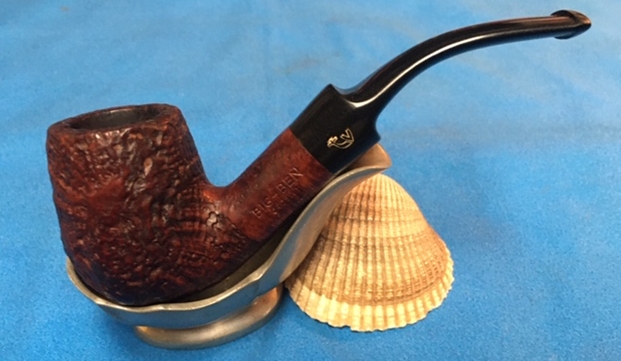
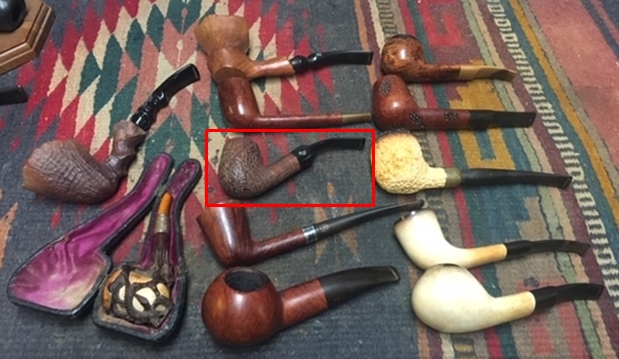
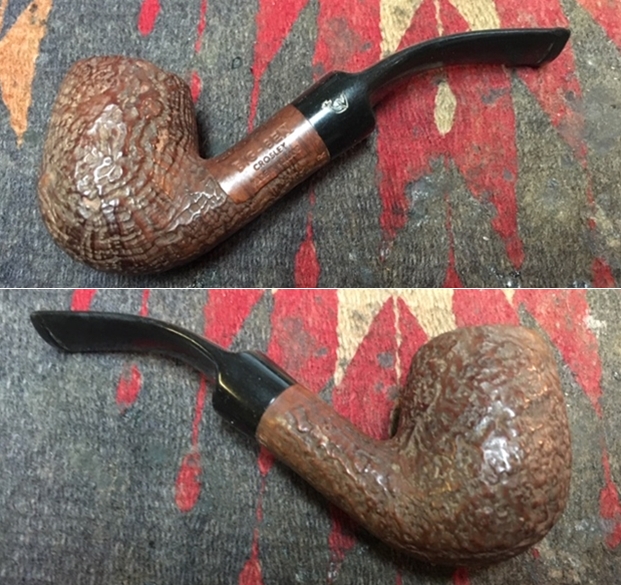
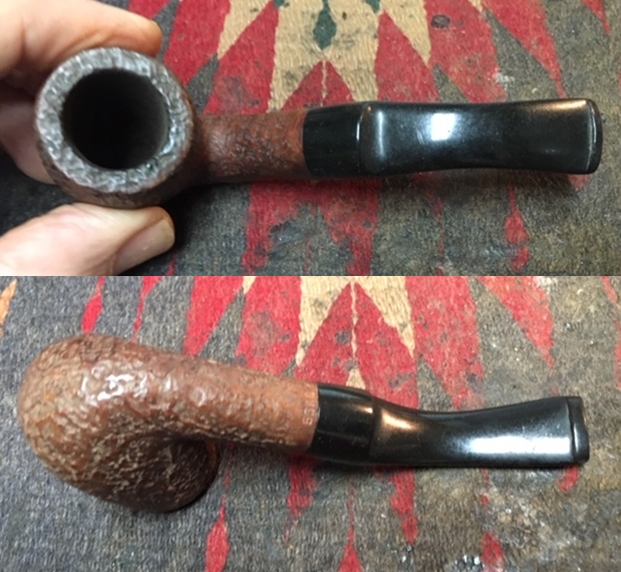
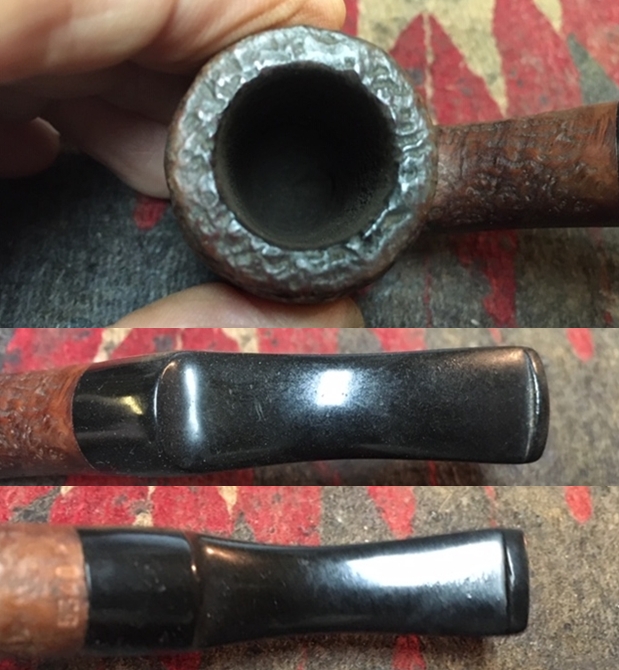
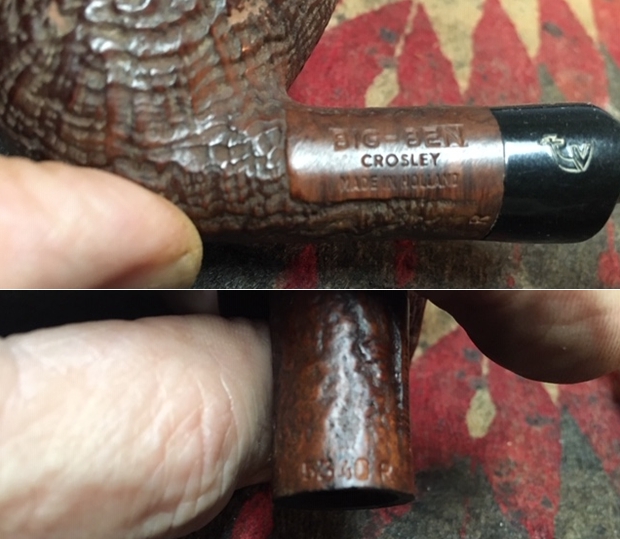
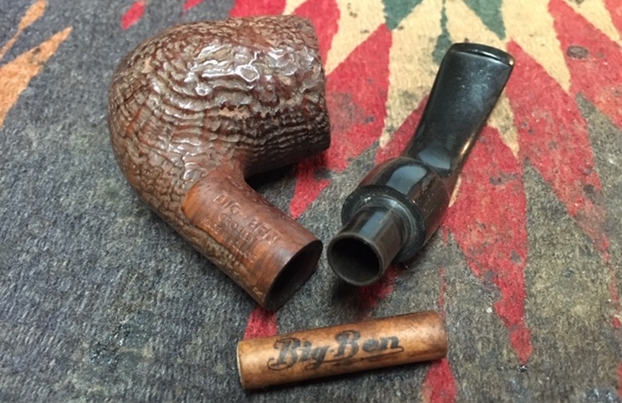
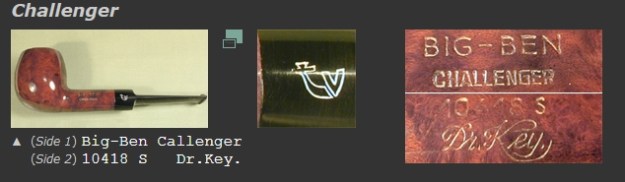
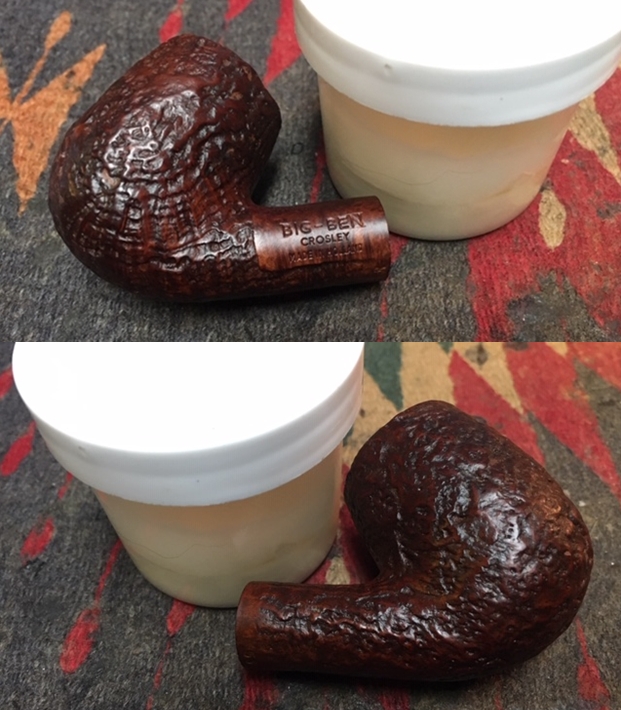
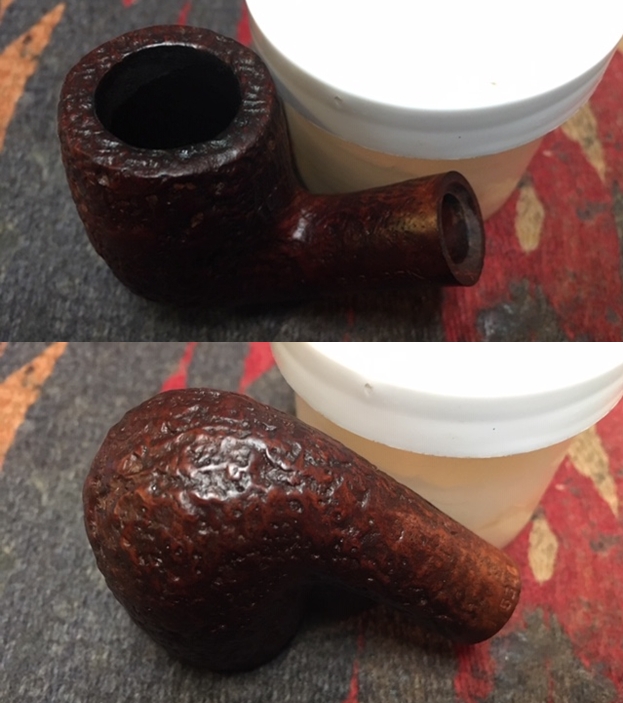
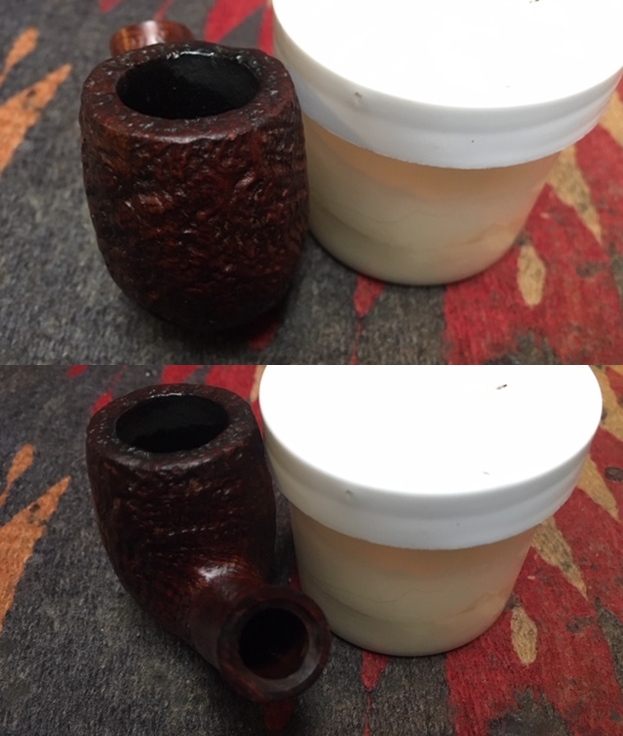
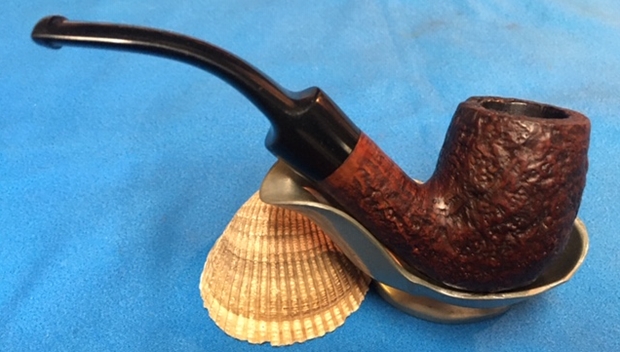
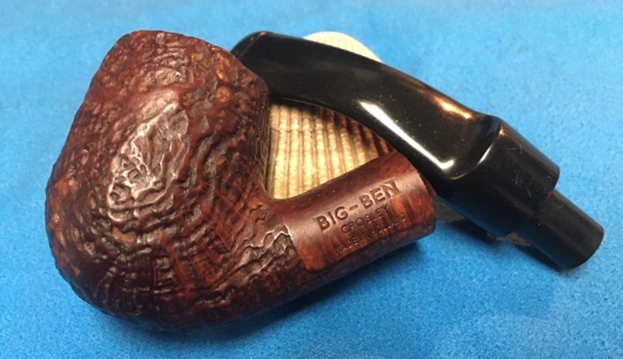
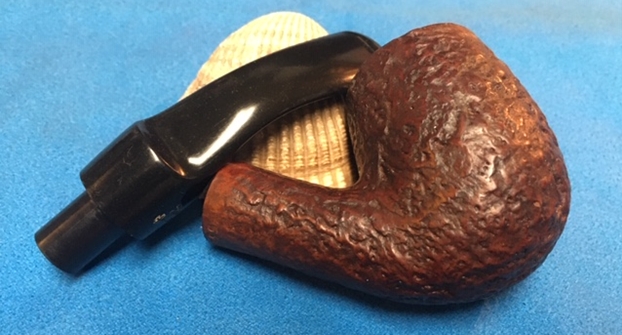
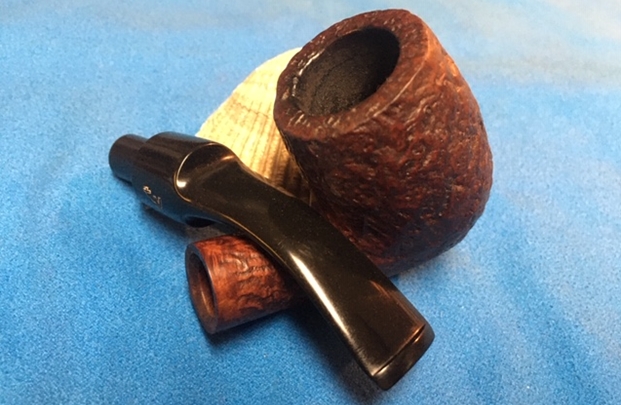
The next pipe on the table is another one from our recent trip to Alberta. In the lot of pipes that we picked up there were a lot of interesting pieces that were new to me. Some of them were brands we were familiar with and some were pipes that were unknown and unidentifiable. But if you are a pipe hunter you know the feeling when you are holding a particular pipe, no matter what the brand and it just speaks to you. That is what happened with this next pipe. It was in a display case at an antique mall in Edmonton. The shape of the pipe, the rugged sandblast and the contrasting brown stains that highlighted some unique grain called my name. The stamping on a smooth panel on the left side of the shank read Big Ben over Crosley over Made in Holland and on the underside at the stem shank union it was stamped with the shape number 534CR. It had a craggy sandblast that was quite stunning. I have drawn a red box around the pipe at the top of the column on the right.The grain under the dirty sandblast finish was a combination of swirls and birdseye. The rim top was very clean and there was no cake in the bowl. The inner and outer rim edges looked very good. The finish was dirty but still in good condition under the grime. The high grade vulcanite stem was clean and there was a TV logo in gold on the stem. It had some tooth marks and chatter on both sides near the button. I took photos of the pipe before I started my cleanup work. I took photos of the rim top and bowl to show the condition of the pipe when I started. It looked amazingly good. I also took photos of the stem showing the light oxidation and tooth chatter on both sides near the button.I took some photos of the stamping on the shank. The first photo shows the Big-Ben Crosley Made in Holland stamp and the white TV stamp on the left side of the  saddle stem. The second photo shows the shape number 534CR on the underside of the shank at the stem/shank junction.I took the stem off the shank and there was a 9mm filter in the shank. The photo shows the 9MM tenon and the dirty Big Ben Filter that was still in the pipe. You can also see the tooth chatter on the underside of the stem and the grime in the grooves of the deep sandblast on the side of the bowl. Before doing cleanup work on the pipe I decided to do some research on the pipe. I looked first on the Pipephil website and found some information on the TV stamp on the left side of the saddle stem. I did a screen capture to show the same logo on a Big Ben Challenger pipe (http://www.pipephil.eu/logos/en/logo-bigben.html#challenger). There was no listing for the Big-Ben Crosley line.I turned to Pipedia (https://pipedia.org/wiki/Big_Ben) and read the section on the brand prior to the buyout by Gubbels & Zonen B.V. I quote:

The brand name Big Ben was originally owned by a small trade company in Amsterdam which was already well established in several countries selling pipes among other goods. The firm was bought by Elbert Gubbels & Zonen B.V. – see Gubbels – who were in search for a suitable brand name to further expansion on international markets. Big Ben became Gubbels’ mainstay brand with its own website.

I turned to the section on Pipedia on Gubbels (https://pipedia.org/wiki/Gubbels) to draw some background. I quote a pertinent section of the article that describes the acquisition of the brand from Big Ben in Holland.

…The production grew steadily but it showed now that an “international” brand name was required for further expansion on international markets – obviously no one cared too much for pipes made in the Netherlands. Feeling that the time involved to get a new brand established was too lengthy, Mr. Gubbels bought a small trade company in Amsterdam which owned all the rights to the brand Big Ben and was already well established in other countries selling pipes among other goods. A real happenstance – Gubbels products could be marketed now in all European countries, the USA, Canada and many other countries, and nowadays they can be found in almost every country world-wide.

In December 1972 the company opened new and very modern factory in Roermond at Keulsebaan 505. With the official opening by the Governor of the Province of Limburg, the Gubbels company was, on behalf of Her Majesty Queen Juliana of the Netherlands, granted the title “Royal” so that the official name became: Elbert Gubbels & Zonen – Koninklijke Fabriek van Tabakspijpen (Elbert Gubbels & Sons – Royal Dutch Pipe Factory). In honour of this title, a new brand was designed and named Royal Dutch. This brand was also created, to negate the belief that Big Ben was of English origin.

At the end of the 1970’s, there were only two briar pipe factories in the Benelux countries: Gubbels in the Netherlands and Hillen in Bree, Belgium. When the latter encountered major financial difficulties in 1980, Gubbels bought the company together with its brand Hilson – a well established brand, which was selling better on the most important German market than Gubbels’ mainstay Big Ben. The factory in Bree was closed soon, so Gubbels is presently the only briar pipe producer in the Benelux countries. (Exept less than a handful of pipemakers!)

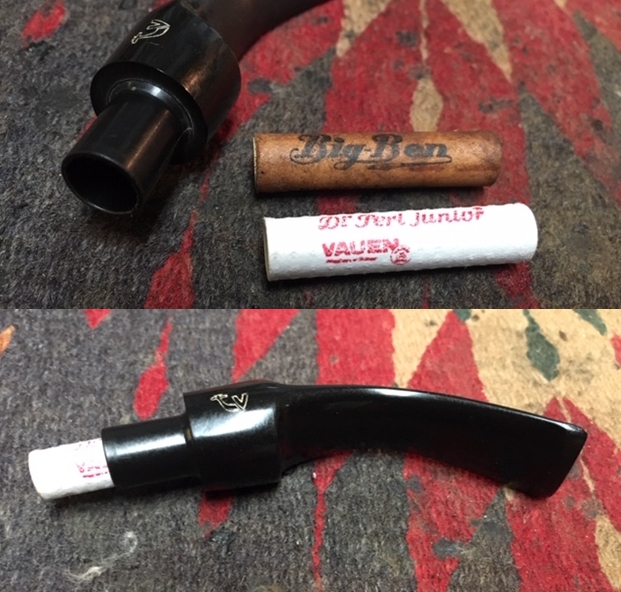
I now knew a lot about the company and what it stood for but I still did not clearly know if it was a pre-Gubbels pipe or after the purchase. Ah well, it is an interesting brand nonetheless. I turned now to work on the pipe. I scrubbed the exterior of the bowl with Before & After Briar Cleaner. I worked it into the surface of the briar with my finger tips and a tooth brush to get it into the nooks and crannies of the blast. I let it sit for a short time to absorb the grime. I rinsed it down under warm water to remove the grime debris that was collected in the cleaner. At the same time I used a tooth brush to scrub out the inside of the bowl and rinsed it. I dried the bowl off with a soft cotton cloth and lightly polished it. I worked some Before and After Restoration Balm into the surface of the briar. I rubbed it into the briar with a horse hair shoe brush to restore, preserve and polish the briar. I let it sit on the bowl for about 10 minutes and buffed it off with cotton cloth. I cleaned out the mortise and the airway in the shank and the stem with alcohol, cotton swabs and pipe cleaners. It was quite dirty in the shank with oils and also in the wide opening of the 9MM tenon. It did not take too long to clean it however.I set the bowl aside and worked on the stem. I sanded the stem surface with 220 grit sandpaper to remove the oxidation, tooth marks and tooth chatter. I started polishing it with 400 grit sandpaper to remove the scratches.I replaced the Big Ben filter with a 9MM filter from Vauen. It is the same size and is probably made by the same manufacturer.I polished out the remaining scratches in the stem with micromesh sanding pads. I wet sanded with 1500-12000 grit sanding pads. I wiped down the stem after each pad with some Obsidian Oil. Once I used the last pad – 12000 grit – I polished the stem with Before & After Pipe Stem Polish, both Fine and Extra Fine. I wiped it down with a final coat of Obsidian Oil and set it aside to dry. I put the stem back on the pipe and polished both pipe and stem with Blue Diamond on the buffing wheel. I used a light touch on the briar to avoid filling in the crevices with the polishing compound. I gave the bowl several coats of Conservator’s Wax and the stem several coats of Carnauba Wax. I buffed it with a clean buffing pad to raise a shine. I hand buffed it with a soft cotton cloth to deepen the shine. The finished pipe is shown in the photos below. The original contrasting brown stains look really good and the polishing brought the contrasts back to life. The contrasting rich brown finish highlight the grain and contrasts well with the black vulcanite stem. The Big-Ben Crosley is a beautiful pipe that really has the flaired saddle of a typical Dutch made Big-Ben pipe. The dimensions of the pipe are – Length: 5 inches, Height: 1 ¾ inches, Outside diameter of the bowl: 1 ¼ inches, Chamber diameter: ¾ of an inch. This craggy sandblasted Big-Ben Crosley is a great looking pipe and different from other Big-Ben pipes I have restored. It will be a great smoking pipe for someone to carry on the legacy of the pipeman who first purchased it and smoked it! Thanks for reading the blog.
Sometimes You Find a Pipe You Know is Old – a No Name Canadian


Blog by Steve Laug

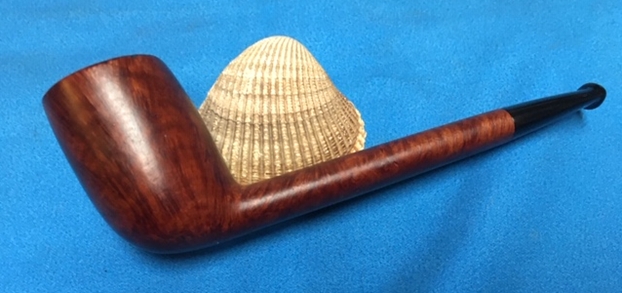
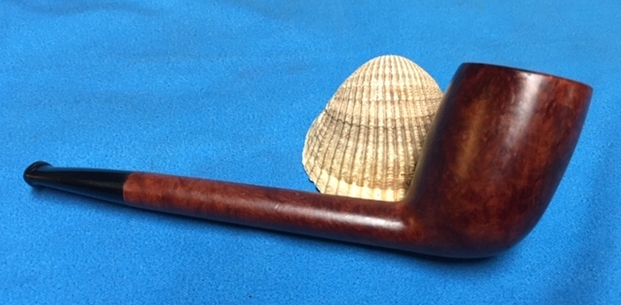
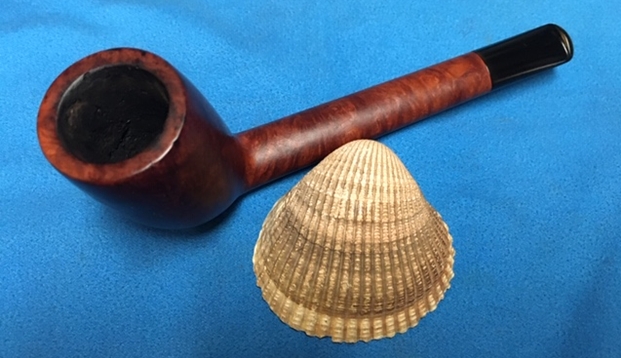
On our recent trip to Alberta we picked up quite a few pipes that were really nice. Some of them were brands we were familiar with and some were pipes that were unknown and unidentifiable. But if you are a pipe hunter you know the feeling when you are holding a particular pipe, no matter what the brand and it just speaks to you. That is what happened with this pipe. It was in a display case at an antique mall in Edmonton. The shape of the pipe, the forward canted bowl, the small short stem, the shape of the button and the single, orific opening on the end of the stem just looked old and I was going to add it to the finds.The grain under the dirty finish was quite nice with straight, flame and birdseye popping through around the bowl and shank. The bowl has a slight forward cant. The rim top had a thick layer of tars and there was sustained damage on the inner and the outer edge. There was a thick cake in the bowl that made it hard to see the extent of the damage to the inner edge. The stem was short vulcanite that had a threaded bone tenon that did not fit tightly against the shank. The stem was also heavily oxidized and had some tooth chatter on both sides near the button. The airway on the end of the stem was a round orific opening. I took a close up photo of the rim top to show the thickness of the cake in the bowl and the overflow of lava on the rim top. The damage to inner edge of the bowl and the nicks on the outer edge are evident in the photo. I took photos of the stem showing the oxidation and tooth chatter on both sides near the button. The third photo of the stem shown below gives a clear view of the orific opening in the stem end.I unscrewed the stem from the shank to show the threaded tenon on the end of the short stem. It has a bone tenon and has a long tube on the end of the threaded that works to funnel the smoke up the stem to the opening at the stem end. Since I had taken the pipe apart I decided to clean the parts. I started by reaming the bowl with a PipNet Pipe Reamer. I used the first two cutting heads to take the cake back to bare briar. I used a Savinelli Fitsall Pipe Knife to clean up the remnants of the cake on the bowl walls. I finished the bowl by sanding it with a length of dowel wrapped with a piece of 220 grit sandpaper. I scrubbed out the mortise, shank and the airway in the shank and stem with pipe cleaners, cotton swabs and alcohol. I worked them over until it was clean. I scrubbed the threads on the tenon with a brass bristle wire brush.To clean up the rim top I topped it lightly with a piece of 220 grit sandpaper on a flat board. I took off the damaged rim top to smooth out the inner and outer edge of the rim. I finished the clean up by reworking the edges of the bowl with folded 220 and 400 grit sandpaper.I used some small drops of clear super glue to fill in the deeper nicks and marks on the bottom of the bowl. I sanded them smooth and then polished the repaired areas on the bottom of the bowl, the outer edge of the bowl and the rest of the bowl and shank with micromesh sanding pads. I wet sanded with 1500-12000 grit sanding pads to smooth out the scratches and nicks in the bowl sides. I wiped the bowl down with a damp cloth to remove the sanding dust. I scrubbed the exterior of the bowl with Before & After Briar Cleaner. I worked it into the surface of the briar with my finger tips and let it sit for a short time to absorb the grime. I rinsed it down under warm water to remove the grime debris that was collected in the cleaner. I dried the bowl off with a soft cotton cloth and lightly polished it. I worked some Before and After Restoration Balm into the surface of the briar. I rubbed it into the briar to restore, preserve and polish the briar. I let it sit on the bowl for about 10 minutes and buffed it off with cotton cloth. I set the polished bowl aside to work on the stem. I sanded the stem surface with 220 grit sandpaper to remove the oxidation and tooth chatter. I started polishing it with 400 grit sandpaper to remove the scratches.I polished out the remaining scratches in the stem material with micromesh sanding pads. I wet sanded with 1500-12000 grit sanding pads. I wiped down the stem after each pad with some Obsidian Oil. Once I used the last pad – 12000 grit – I polished the stem with Before & After Pipe Stem Polish, both Fine and Extra Fine. I used a new product I am trying for Briarville called No Oxy Oil to give the stem a final wipe down and polish. I put the stem back on the pipe and polished both pipe and stem with Blue Diamond on the buffing wheel. I gave the pipe several coats of Carnauba Wax and buffed it with a clean buffing pad to raise a shine. I hand buffed it with a soft cotton cloth to deepen the shine. The finished pipe is shown in the photos below. It is a beautifully grained piece of briar with straight grain around the walls of the bowl and sides of the shank. The undersides of the bowl and shank show a mix of birdseye and swirled, mixed grain. The rich brown finish highlights the grain and contrasts well with the short black vulcanite stem. The shape and style of the button and stem point to an early date for this pipe. I only wish that it had some identifying stamping on the shank to help identify the maker. The threaded bone tenon is in excellent condition and to further protect it, I coated it with some Vaseline. The pipe is a beauty. There are some flaws in the pipe that I wish could help tell the story of this old pipe. The dimensions of the pipe are – Length: 5 ¼ inches, Height: 1 ¾ inches, Outside diameter of the bowl: 1 ¼ inches, Chamber diameter: ¾ of an inch. This is an old timer that I will add to my own collection. I am looking forward to loading a bowl in it and enjoying the taste of this old timer. I will carry on the legacy! Thanks for reading the blog.
Comoy’s Shape 303 Sandblast/Sterling Prince Restoration


By Al Jones

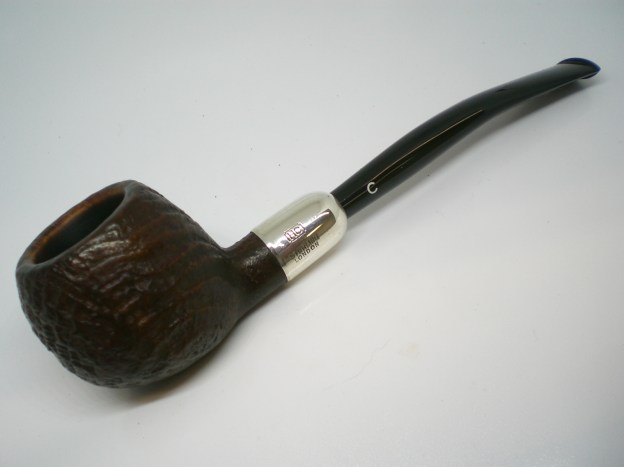
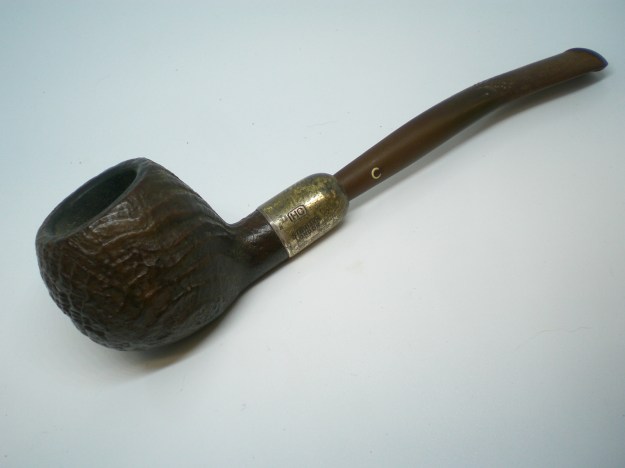
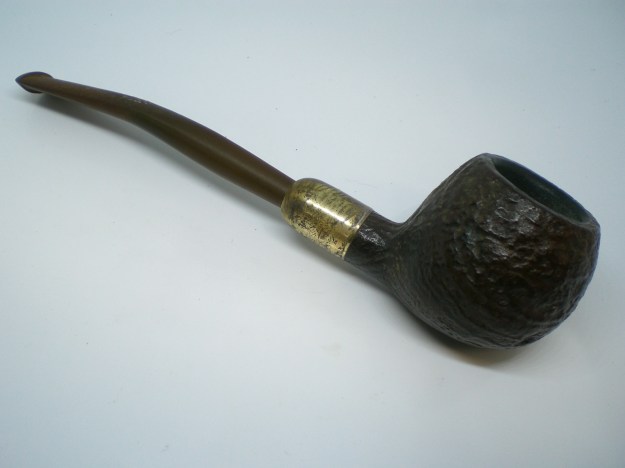
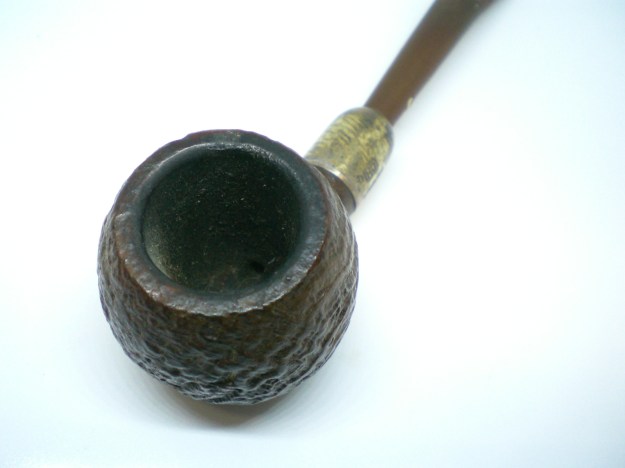
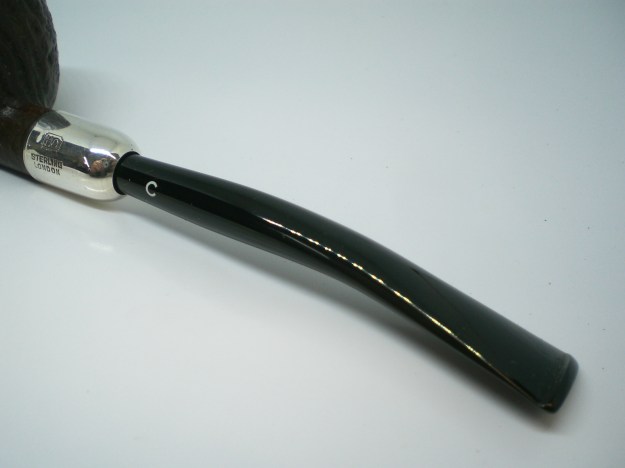
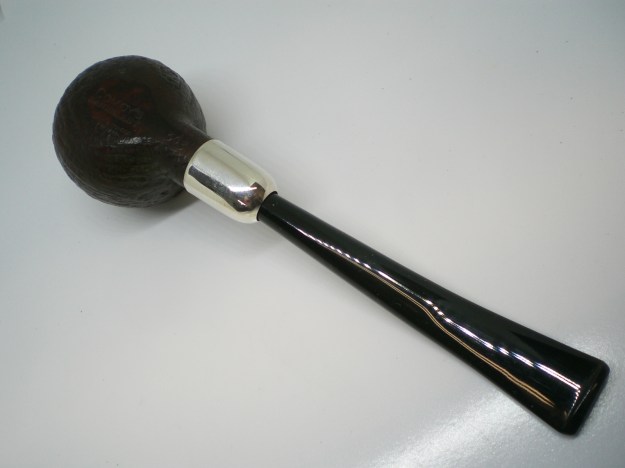
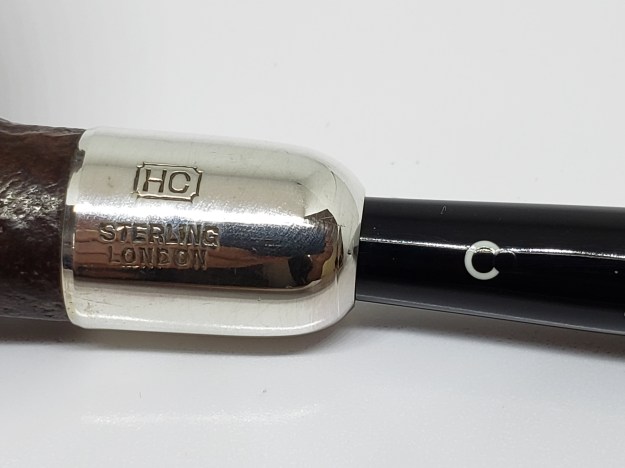
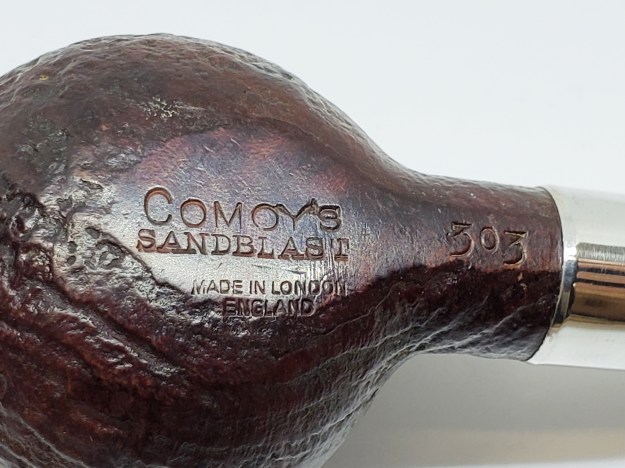
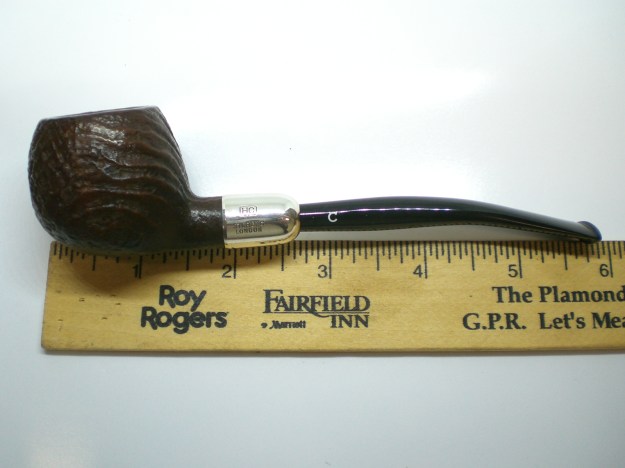
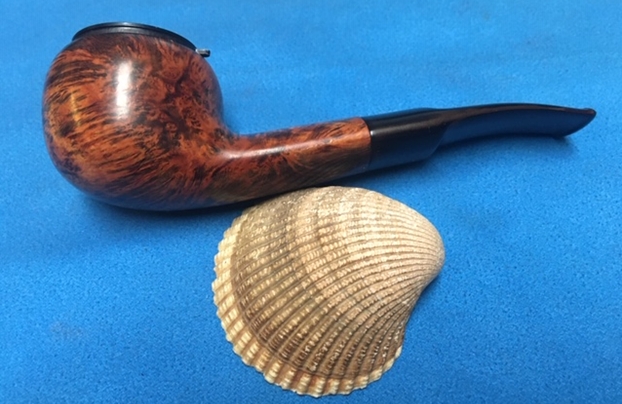
A silver ferrule Comoy’s sandblast Prince shape has been on my wish list, and I’ve always managed to lose the few that have come up on auction.  I thought this was the Comoy’s 337 Prince shape more commonly seen, but was surprised to see it is was a shape 303.  I managed to win the auction for a pipe that looked to be in really good condition.  I was a little surprised to discover no other examples of the 303 shape and it is not on any of my vintage Comoy’s catalogs.  Too bad the silver cap is not hallmarked.

Below is the pipe as it was received.

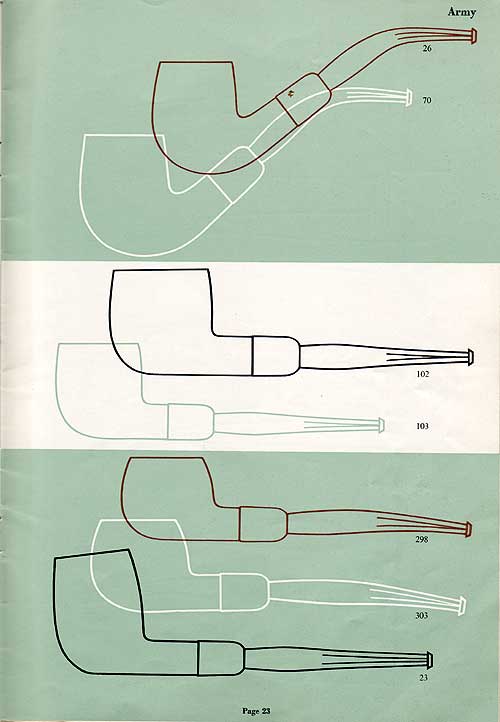
Thanks to PipesMagazine.com forum member “snagstang”, a fellow British pipe enthusiast – who found this 1964 Comoy’s catalog page showing the Shape 303.  I suspect this pipe was from the “Deluxe” line, an Army mount series.  They were available in Walnut and Sandblast finishes, with a silver cap.  I’d love to find out why these were not hallmark dated.

Catalog_shape_303

This one was in great shape with only some bowl top build up and a heavily oxidized stem to clean.  The silver cap was oxidized, but appeared to be undamaged.  The bowl had very little cake and was quickly cleaned up and not surprisingly, it was in very good condition.  I soaked the three piece “C” logo stem in a mild solution of Oxy-Clean solution.  I used a piece of worn Scotch brite to remove the build-up on the bowl top.  The bowl still had most of the trademark Comoys beveled rim.

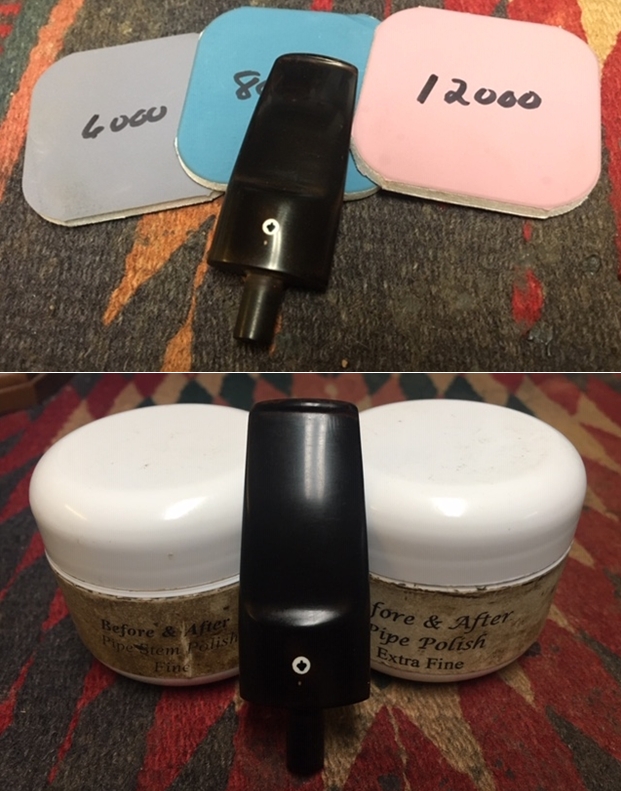
I used a jewelers cloth to remove the tarnish on the silver cap.  After the stem soak, I pondered how to clean the oxidation from the stem.  The stem didn’t have any teeth marks and the button was mint.  Same for the drilled C stem logo, which I never tire of admiring.  I decided to hold it free hand versus mounting on the bowl.  With the military stem mount, I didn’t need to worry about rounding off the stem profile.  I used 800 grit paper to remove the heavy coating of oxidation, stopping about 1/8″ short of the end of the tenon, which would be inserted into the shank and not visible.  This was followed by 1,500 and 2,000 grade wet paper, followed by 8,000 and 12,000 micromesh sheets.

The stem was buffed with White Diamond rouge and Meguiars Plastic Polish.  I hand buffed the briar with Halycon wax.

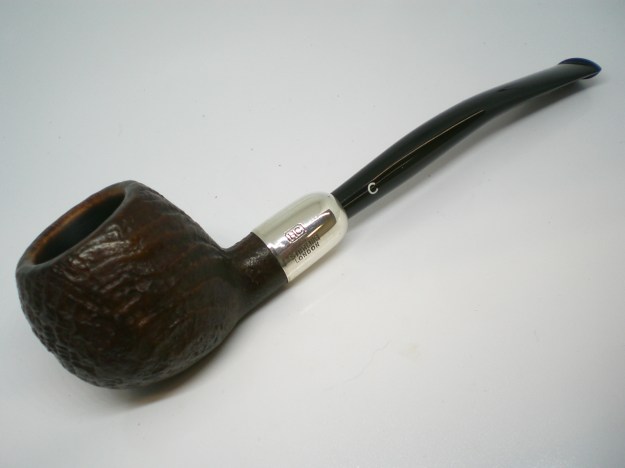
Below is the finished pipe.  I don’t add too many pipes to my collection these days, but this one definitely goes in my cabinet.

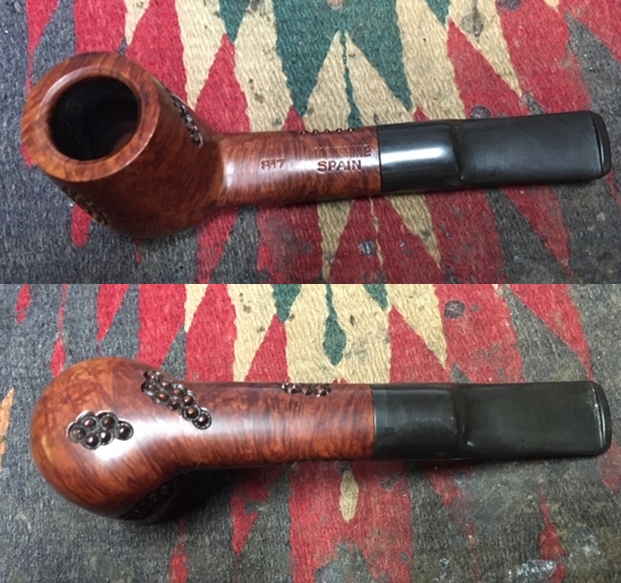
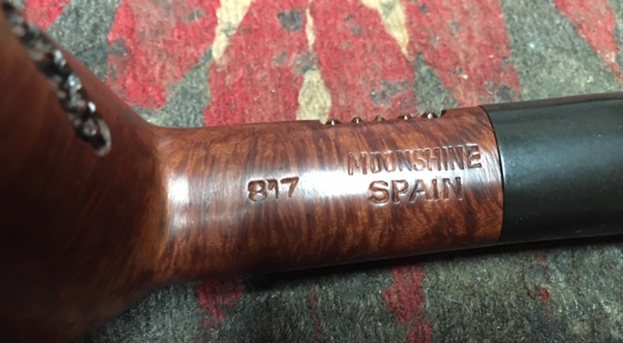
This MOONSHINE Spain Brandy reminds of the LUNAR Spain Canadian I worked on


Blog by Steve Laug

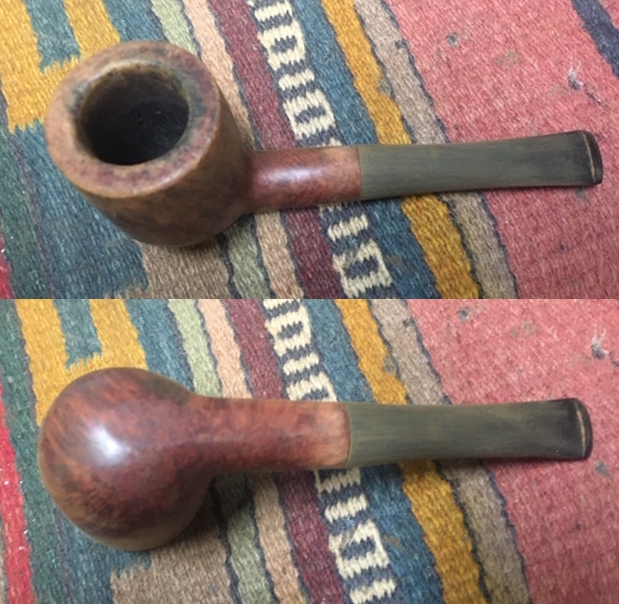
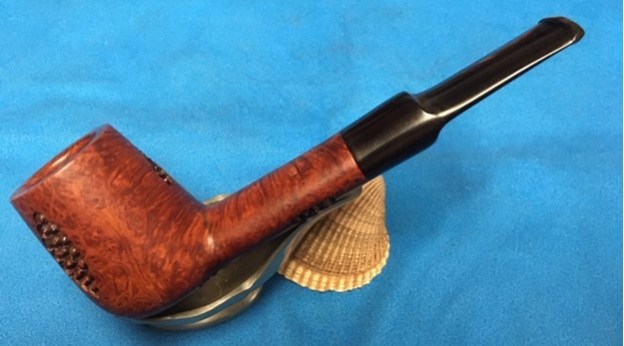
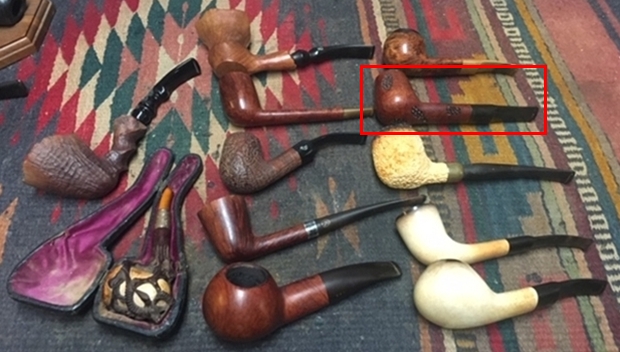
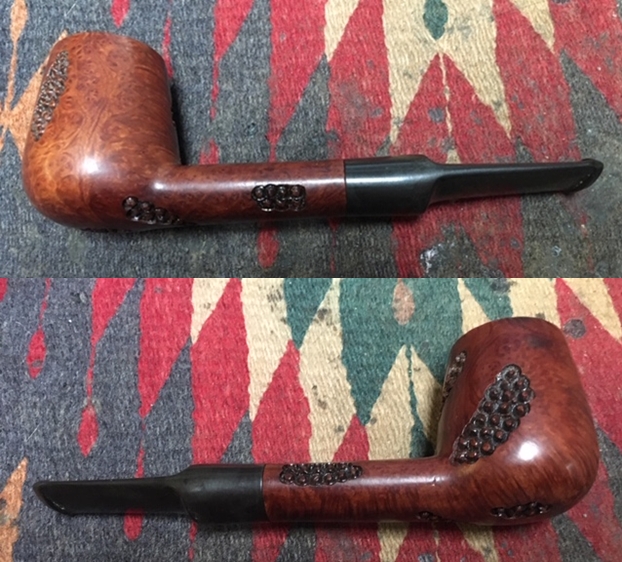
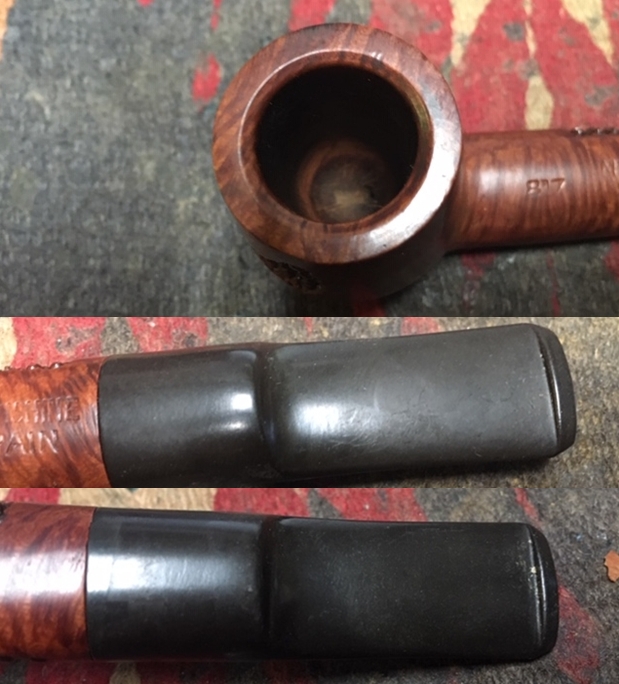
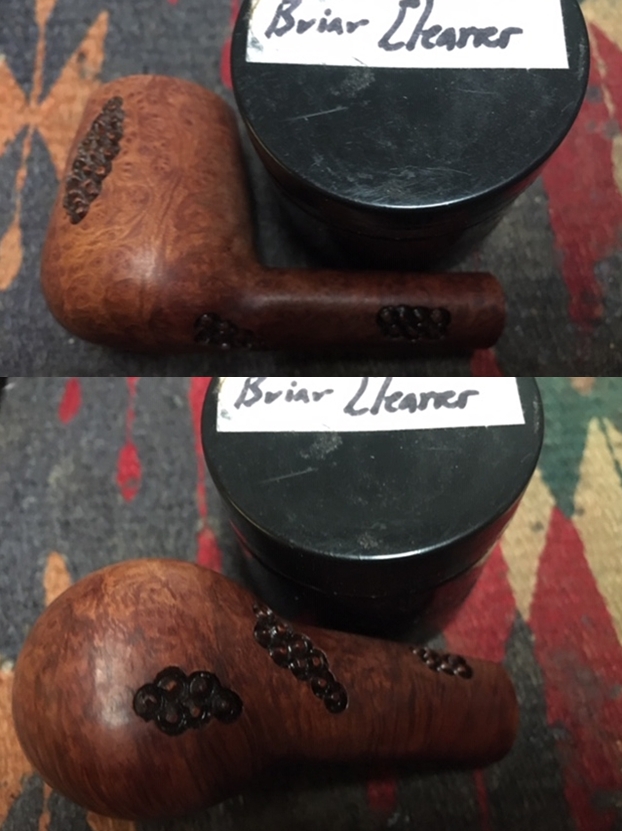
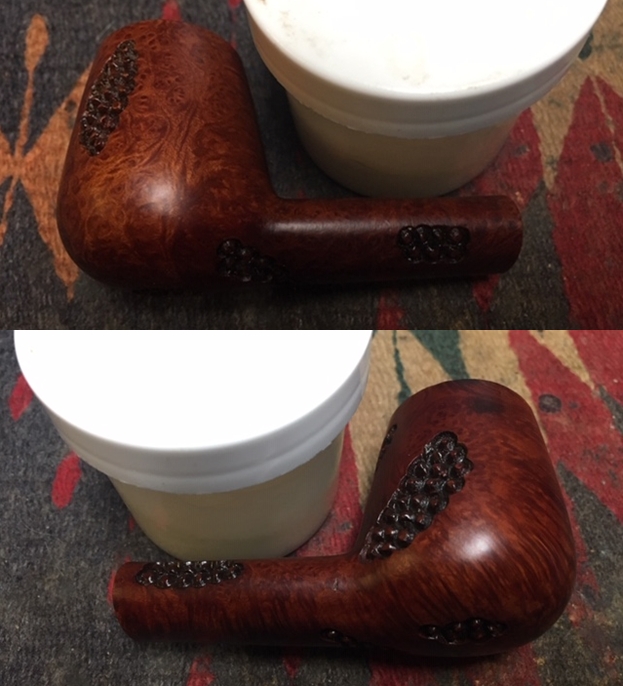
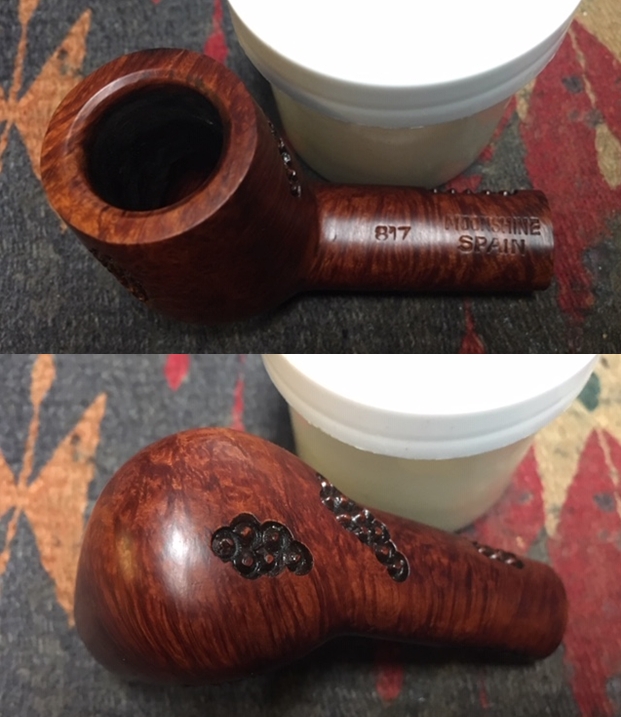
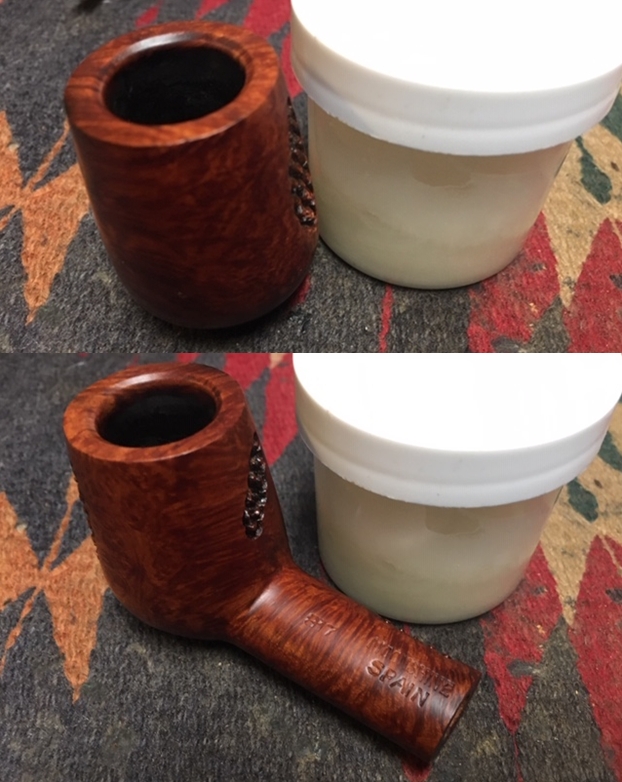
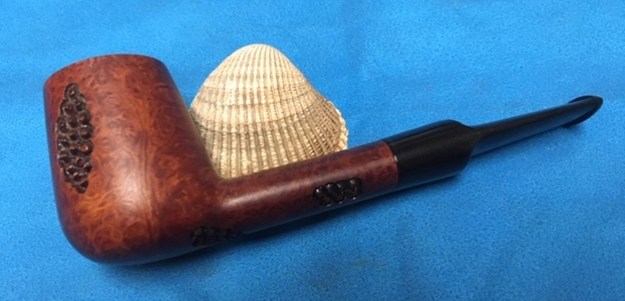
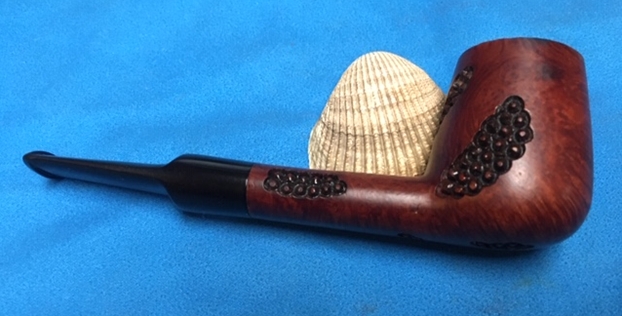
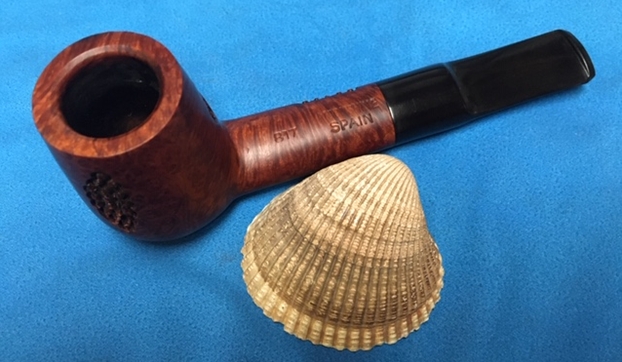
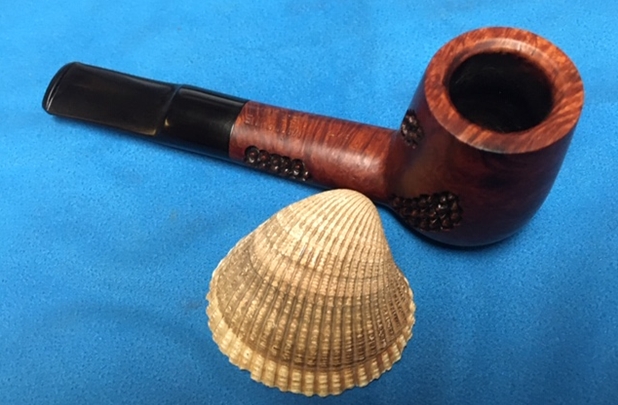
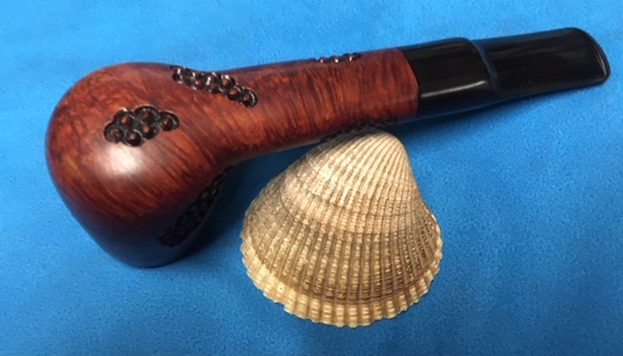
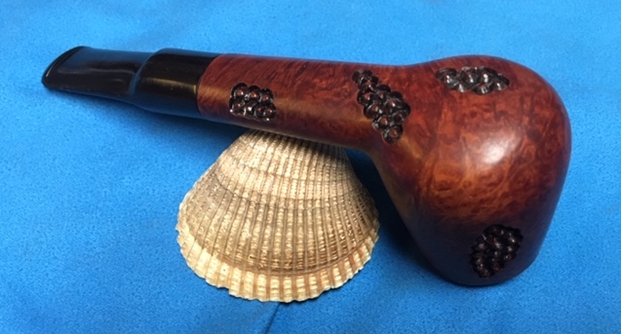
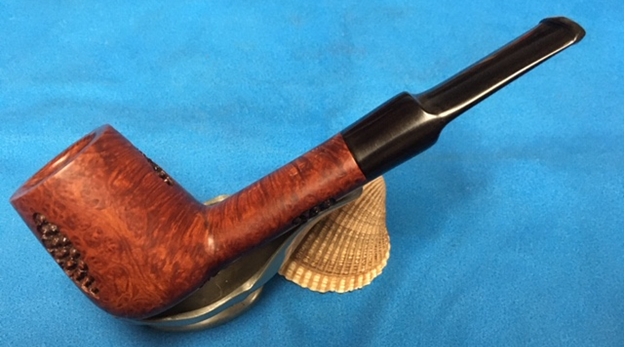
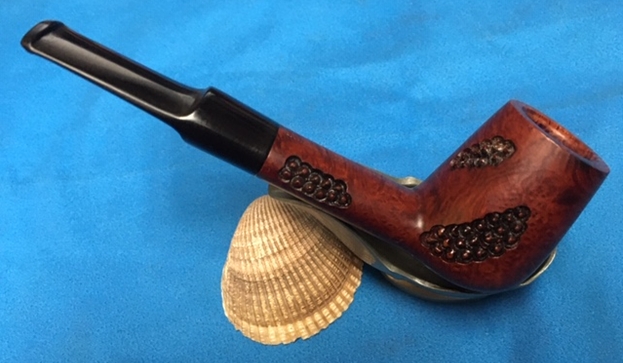
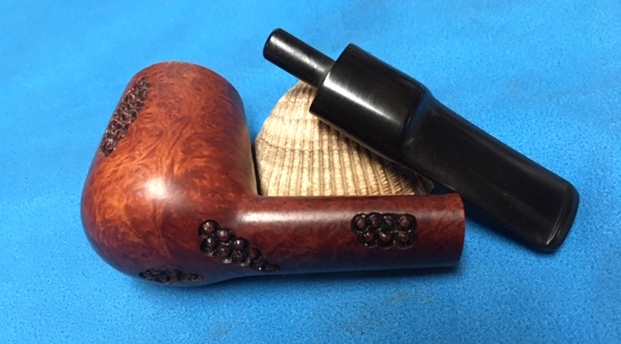
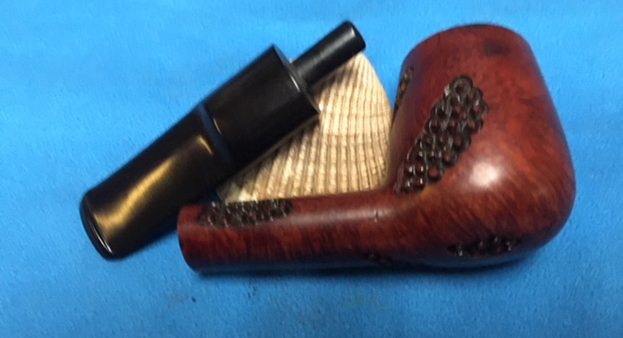
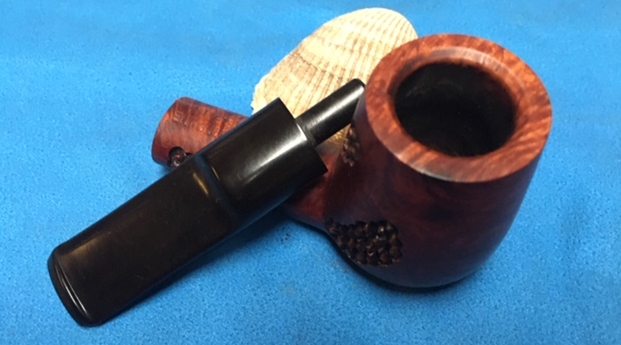
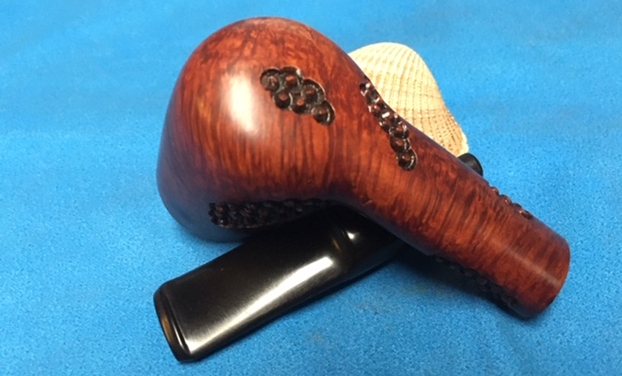
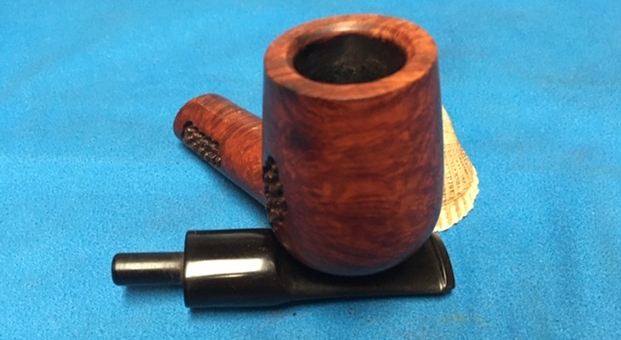
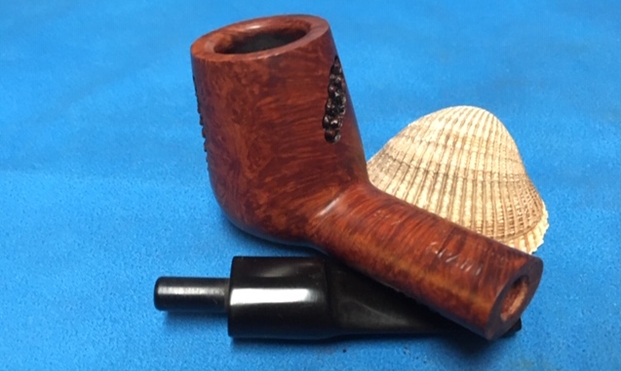
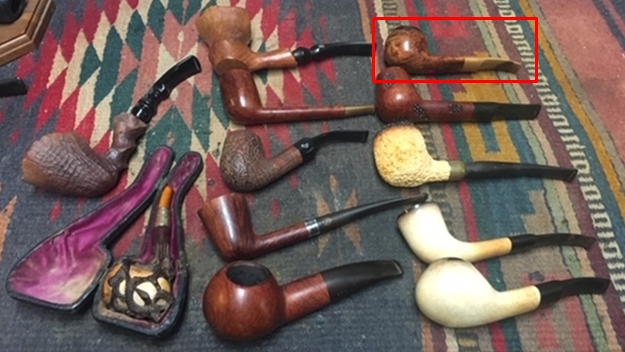
The next pipe on the table is another one of the pipes that Jeff picked up in Helena, Montana on his way to meet me for our recent Alberta trip . It is the second pipe down on the far right column in the photo below. It is a semi rusticated Spain Moonshine Brandy shaped pipe with a saddle bit. I have drawn a red rectangle around it in the photo below to make its identification easier.The Brandy shaped pipe has a smooth finish on the bowl with grape like rustication around spots on the bowl and shank sides. It reminded me of another Spanish pipe that I had worked on that was stamped LUNAR over Spain. It also had a unique rustication pattern on the bowl. The finish on both pipes was very similar as was the workmanship. Here is the link to the blog on that restoration for comparison sake (https://rebornpipes.com/2019/02/24/this-is-a-new-brand-to-me-lunar-spain-canadian/). In the blog I wrote that I could find little information on the brand that was any help and that is also the case with this one.

It is nicely made pipe that shall remain a bit of a mystery. The pipe was in excellent condition. The finish was clean other than a little dust in the rustication patterns. The grain was quite pretty and the pipe carver had shaped the bowl and shank accordingly. The pipe had been lightly smoked with the bottom third of the bowl raw briar. There is some darkening around the top two thirds of the bowl. The pipe smelled like tobacco but was unidentifiable as to type. The top of the oval shank was stamped with 817 which I think is the shape number followed by MOONSHINE over Spain. The stem was vulcanite and had no identifying logos on the oval stem. I took photos of the pipe before I did the cleanup. I took close up photos of the bowl and rim top as well as the stem surface. You can see the condition of the rim top and bowl in the first photo. It was in spectacular condition with no tars, lava or buildup on the top or edges. The inner edge of the rim was nicely beveled. The lightly smoked bowl did not have any cake and was smooth to touch. The stem showed some light oxidation and tooth chatter on both sides near and on the button surface.The stamping on the shank was also clear and readable. You can see the stamping reads as noted above.I rubbed the briar and rustication down with Before & After Briar Cleaner. I worked it into the rustication patterns so that it would get the dust out. I rinsed it under warm running water. The photos show the rim top after scrubbing. It looked much better at this point.I worked some Before & After Restoration Balm into finish of the briar with my fingertips and into the rustication patterns with a horsehair shoe brush to clean, enliven and protect it. I let the balm sit for a little while and then buffed with a cotton cloth to raise the shine. The Restoration Balm really makes the grain stands out beautifully. With the outside cleaned and shining I moved on to clean up the inside airways and mortise in the shank and the stem. I scrubbed out the mortise and the airway in the shank and the stem with alcohol, cotton swabs and pipe cleaners.  I set the cleaned bowl aside and turned my attention to the stem. I sanded out the tooth chatter with 220 grit sandpaper and started to polish it with a folded piece of 400 wet dry sandpaper. Once it was finished it began to shine. I polished the stem with micromesh sanding pads – wet sanding with 1500-12000 grit sanding pads. I wiped it down after each sanding pad with some Obsidian Oil. I finished polishing it with Before & After Pipe Stem Polish – both Fine and Extra Fine and buffed it off with a cotton cloth. When I finished I gave a coat of a new product that Briarville Pipe Repair released called No Oxy Oil. It is rubbed down with the oil and the soft cloth that came with it. I am going to be experimenting with it for a while now. This is a finely carved, Spanish made Brandy shaped pipe marked Moonshine over Spain with the shape number 817 next to the shank/bowl junction. It has an interesting carved finish with grape-like shapes around the shank and bowl. It has a great look and feel. The shape fits well in the hand with the rustication giving the pipe a nice tactile sense when held. I polished stem and the bowl with Blue Diamond polish on the buffing wheel. I gave the bowl and the stem multiple coats of carnauba wax. I buffed the pipe with a clean buffing pad to raise the shine. I hand buffed it with a microfiber cloth to deepen the shine. The pipe polished up pretty nicely. The rich combination of the browns on the briar along with the carvings and the polished vulcanite stem work well together. I like the finished look of this Spanish Made Brandy. Have a look at it with the photos below. The shape, finish and flow of the pipe and stem are very well done. The dimensions are Length: 5 ½ inches, Height: 1 ¾ inches, Outside diameter of the bowl: 1 ¼ inches, Chamber diameter: ¾ of an inch. This Moonshine Brandy is a unique beauty. Thanks for walking through the restoration with me as I worked over another beautiful pipe.