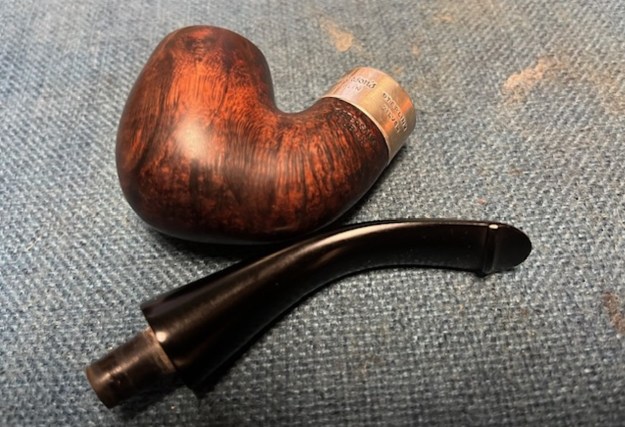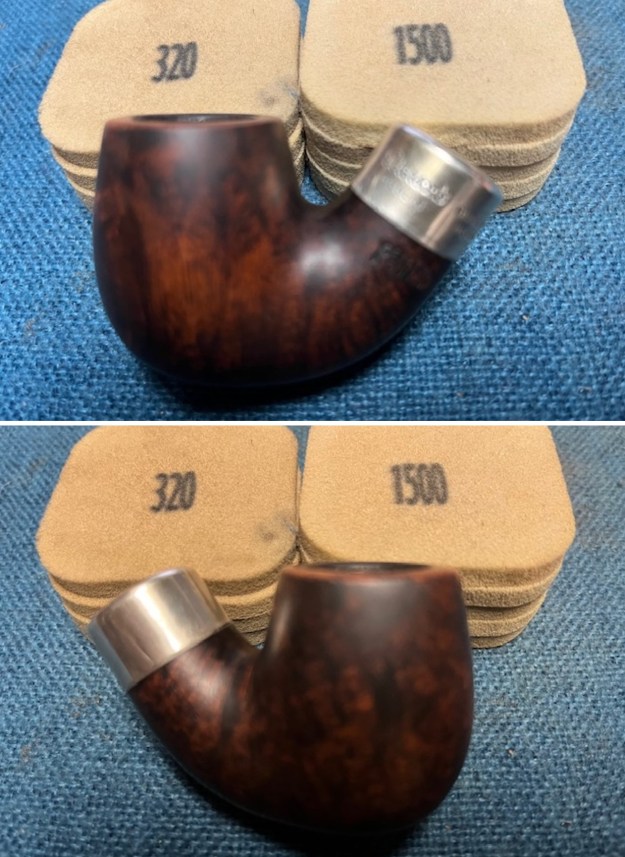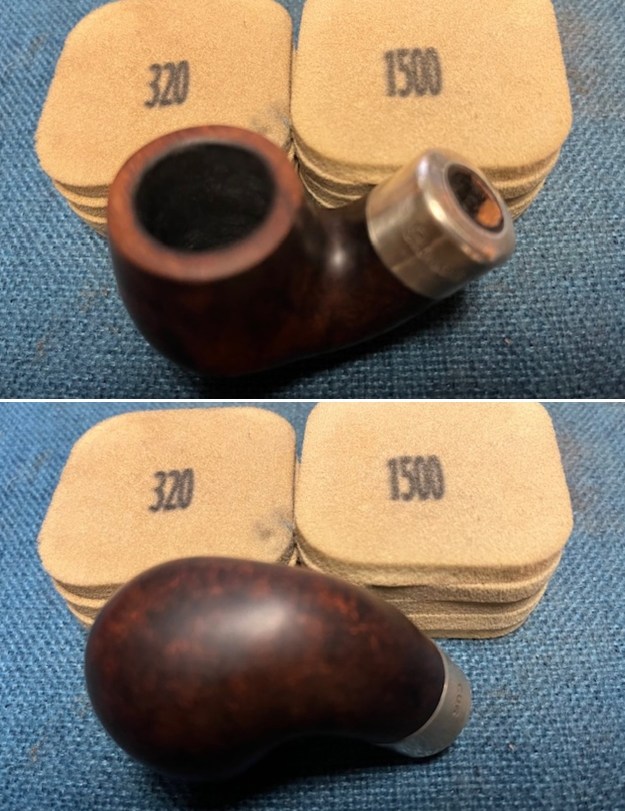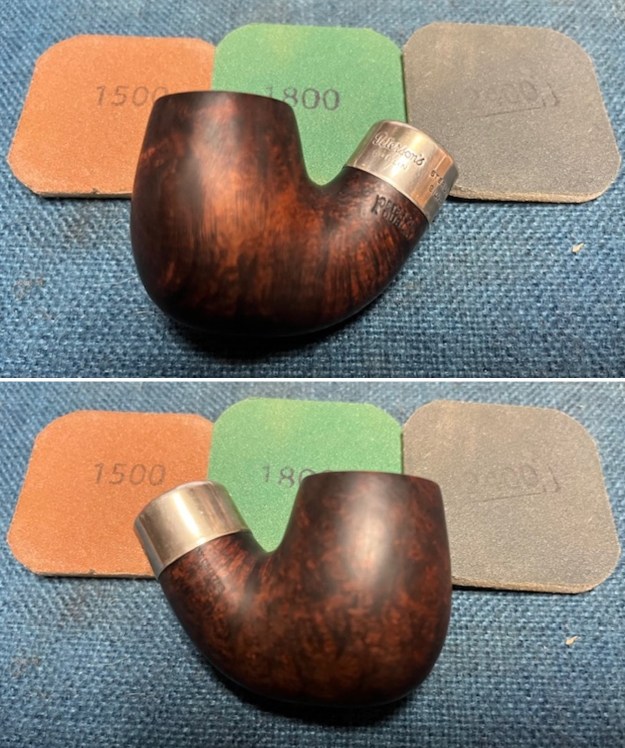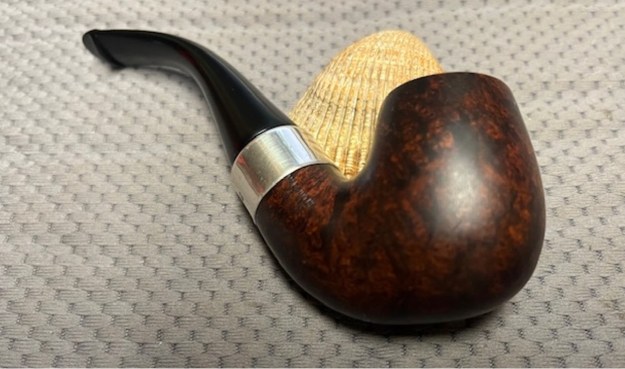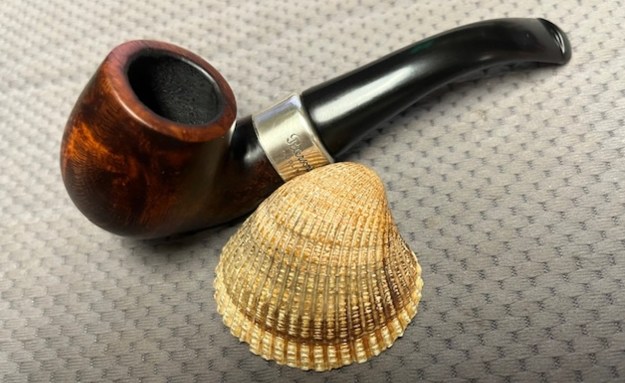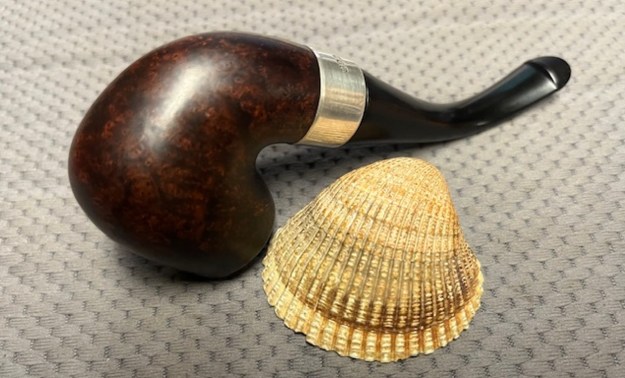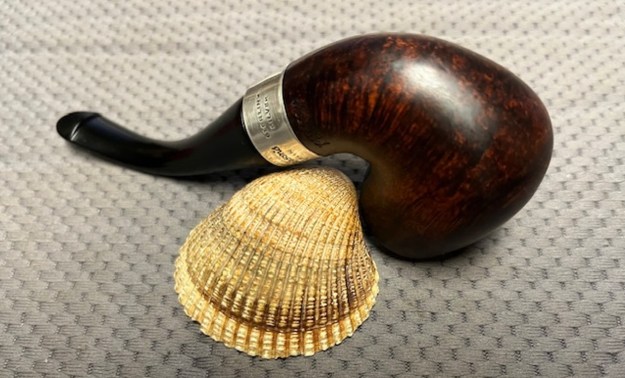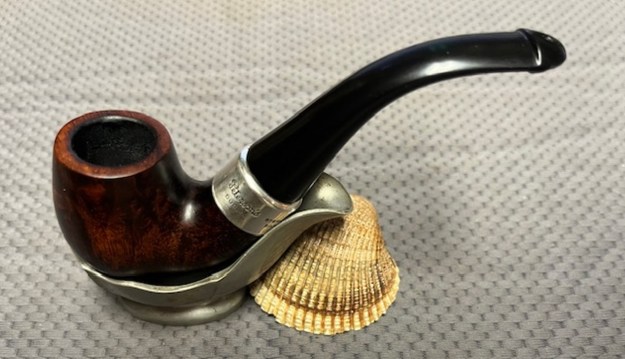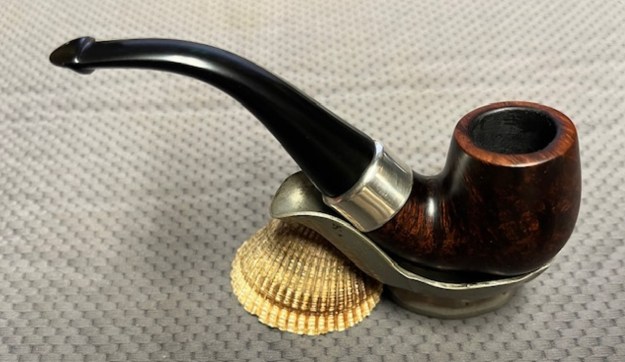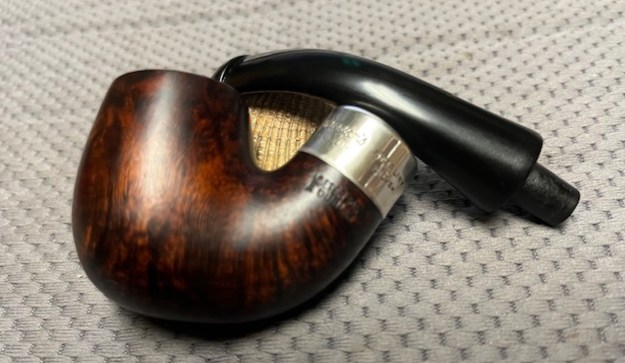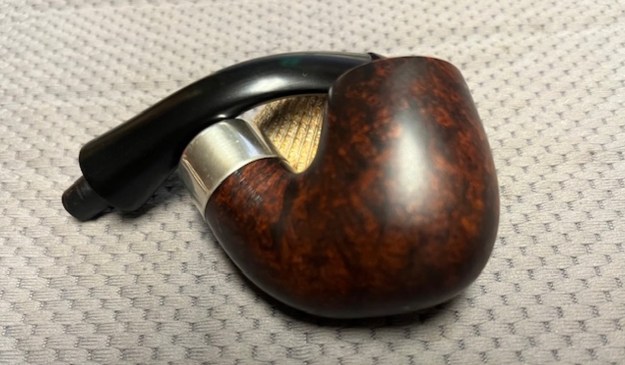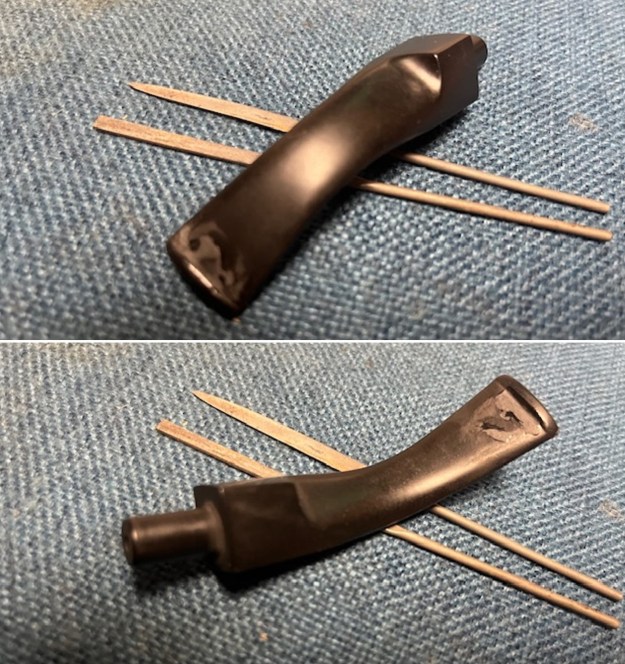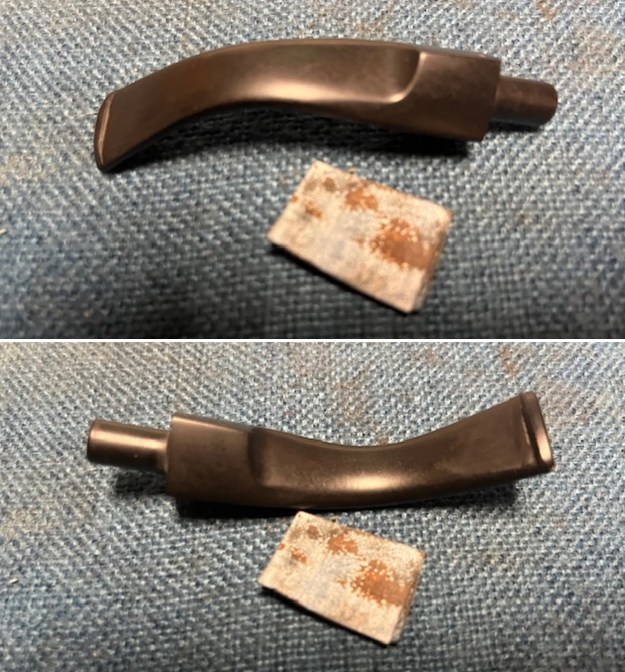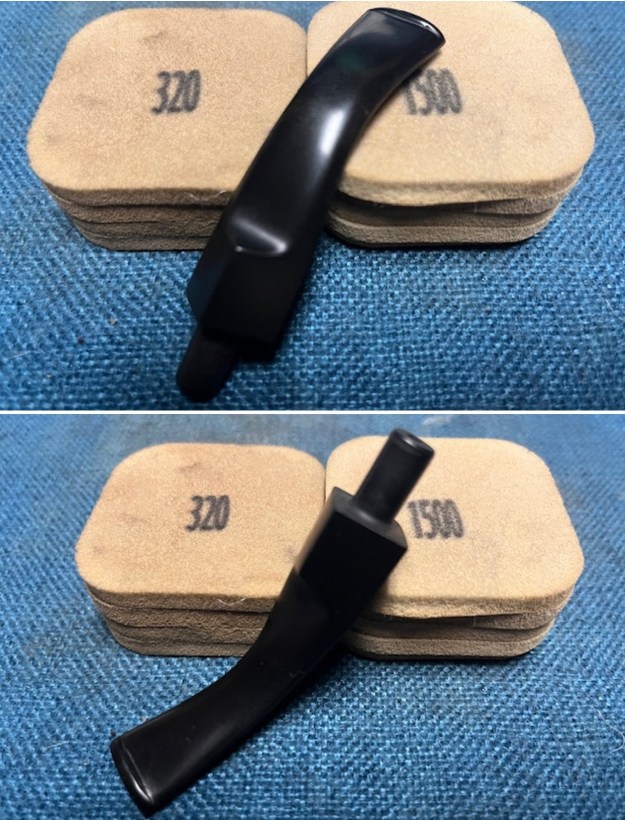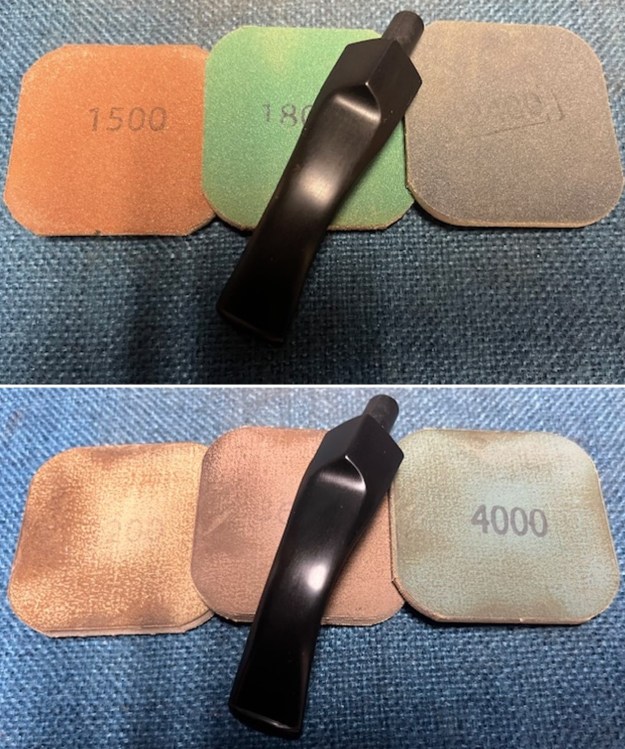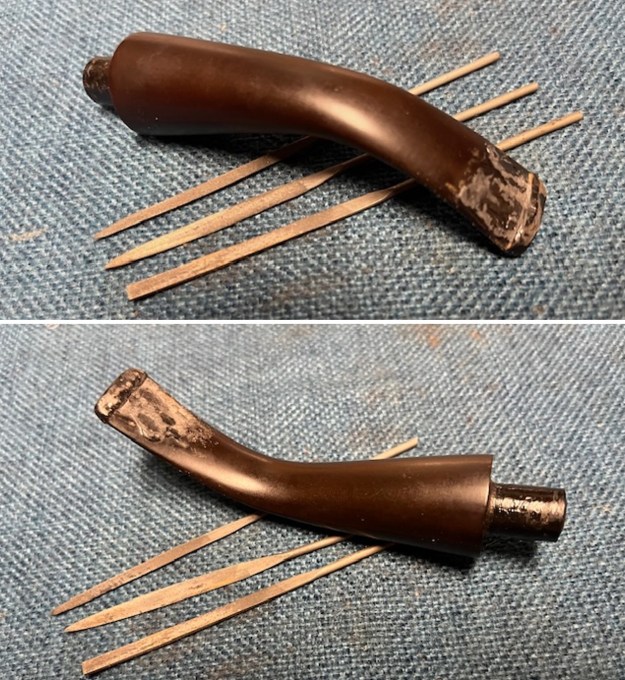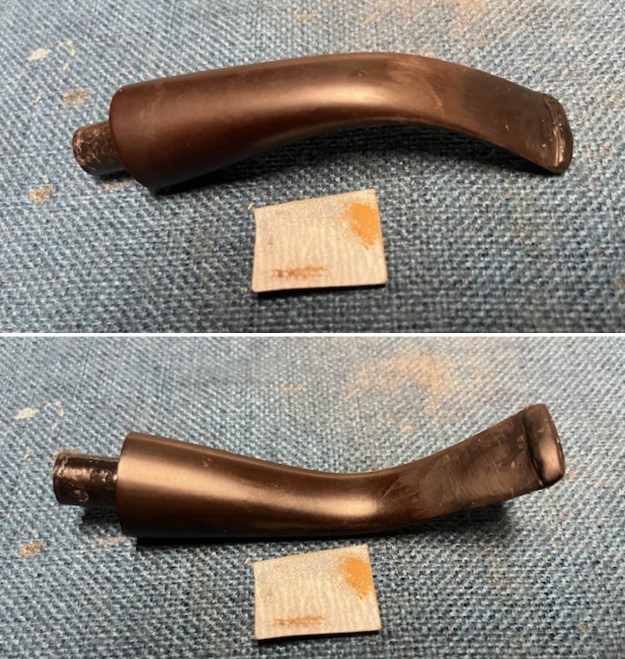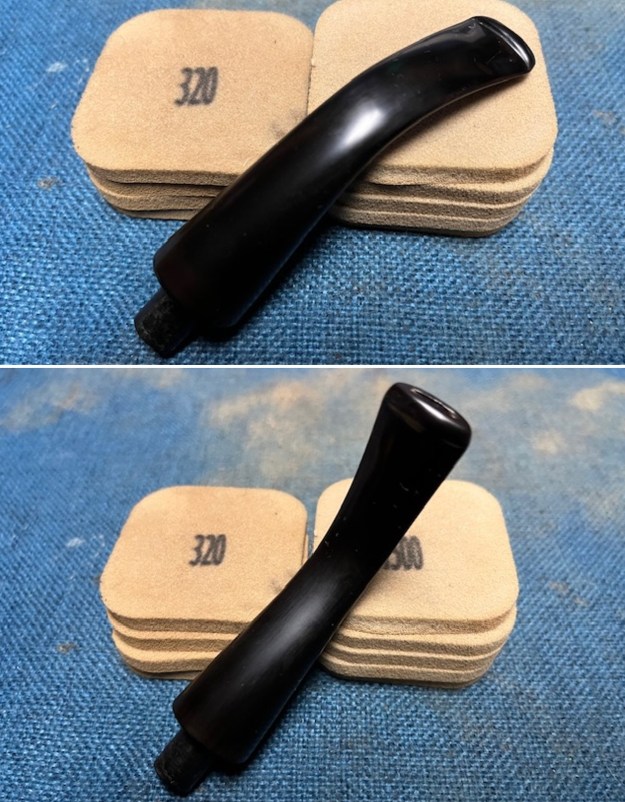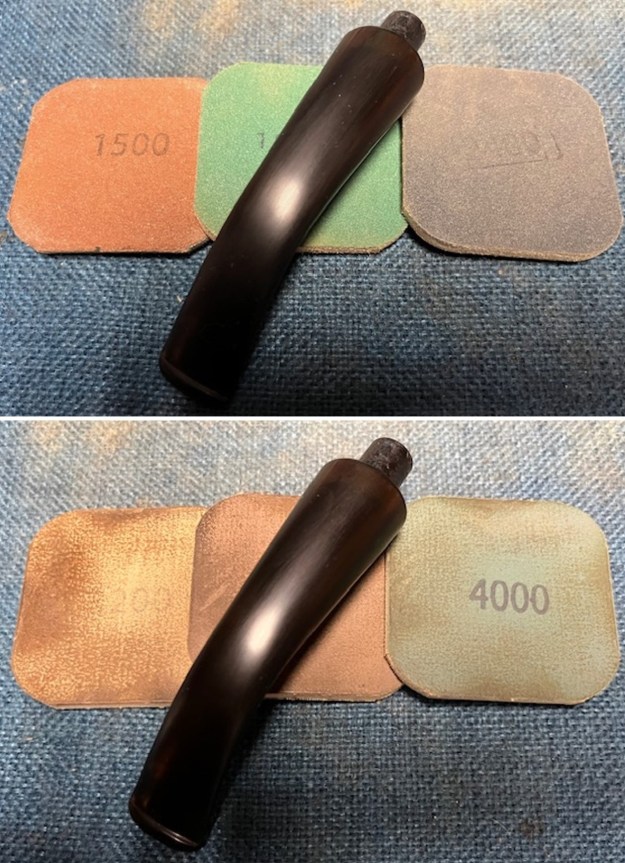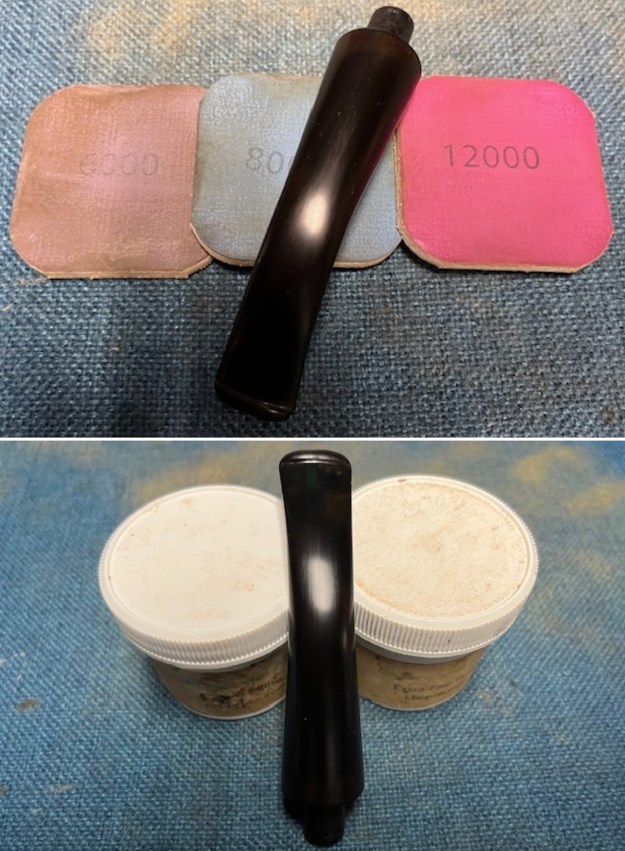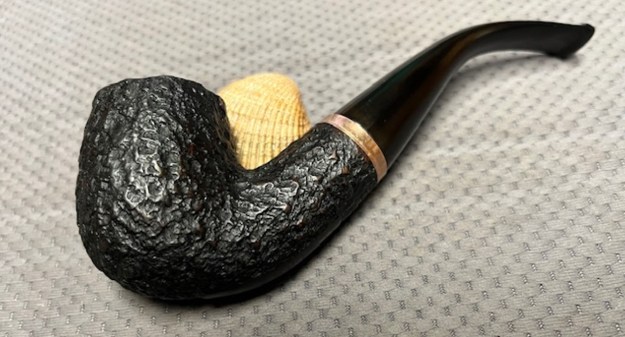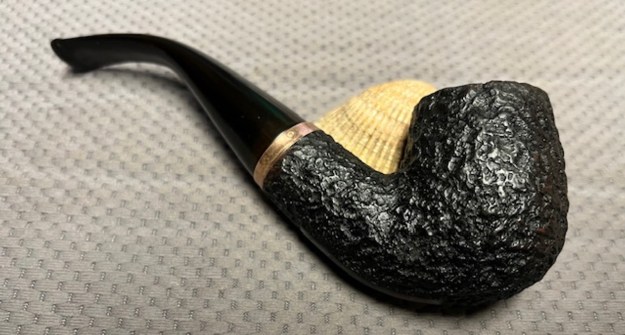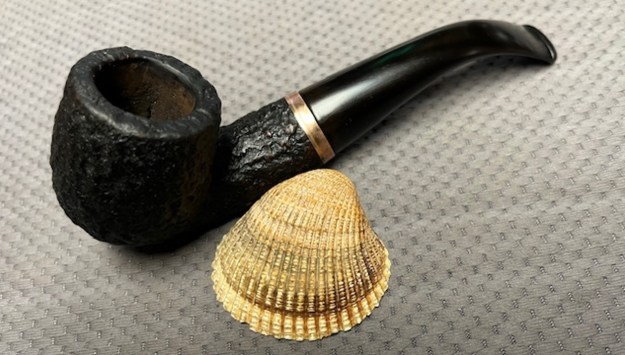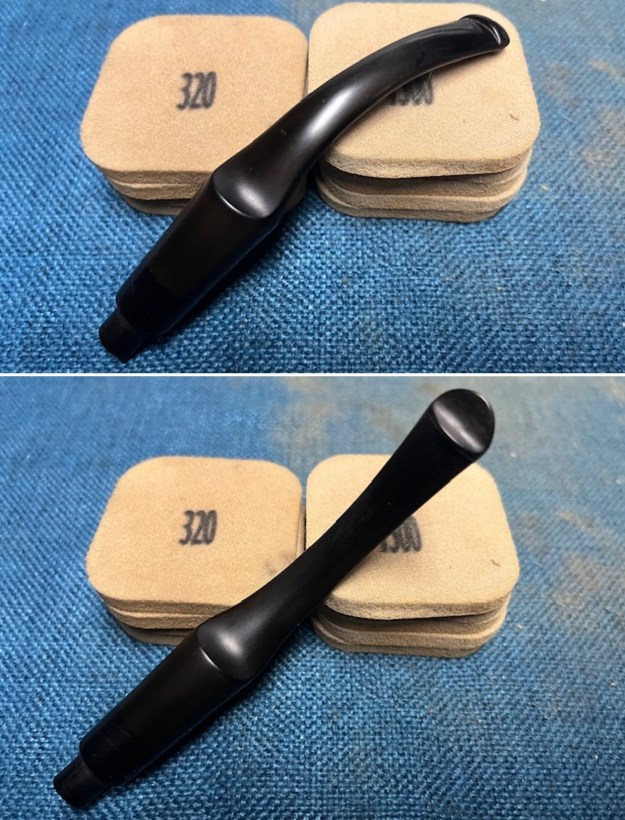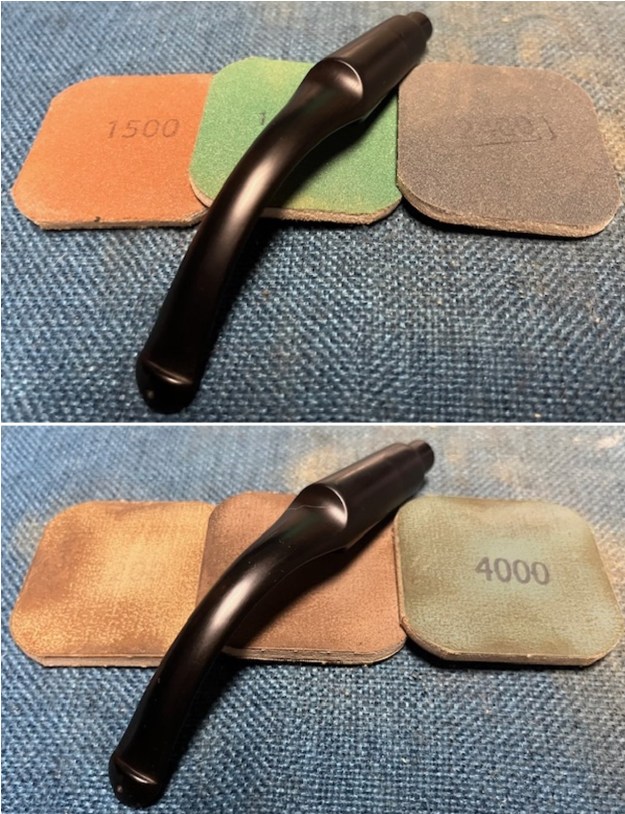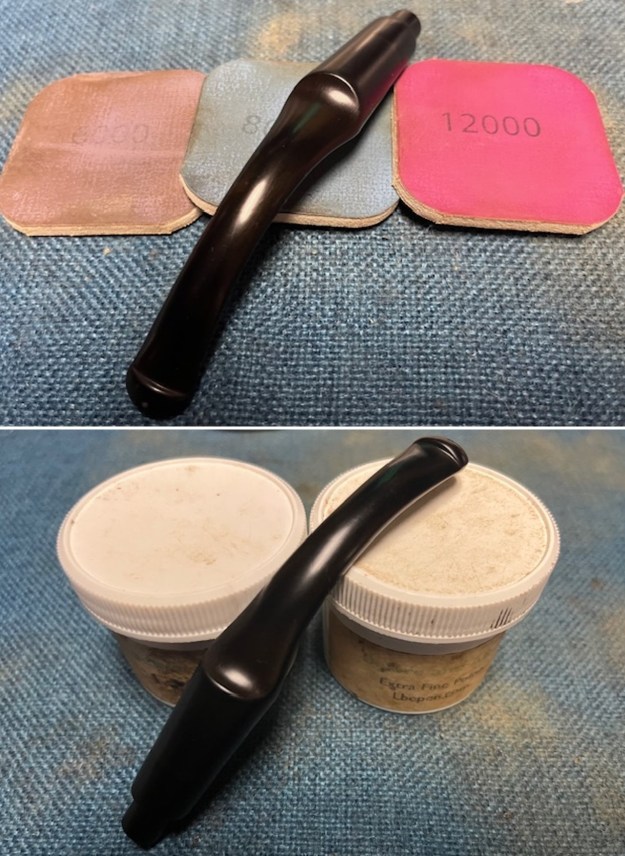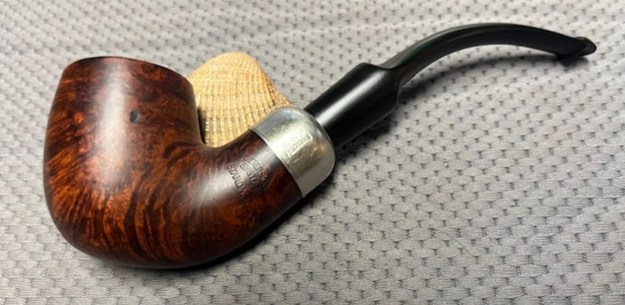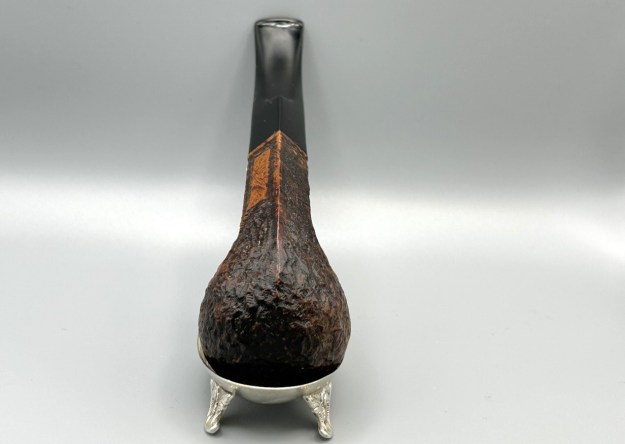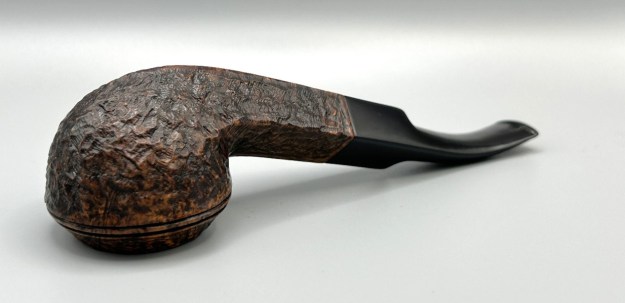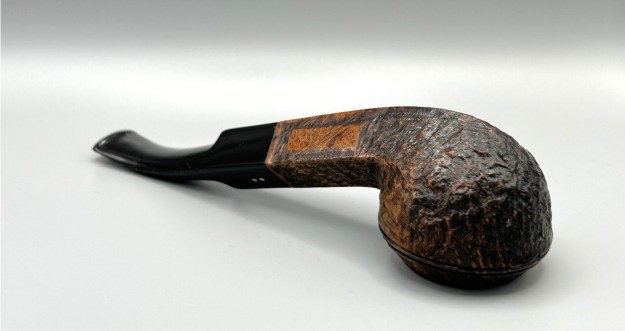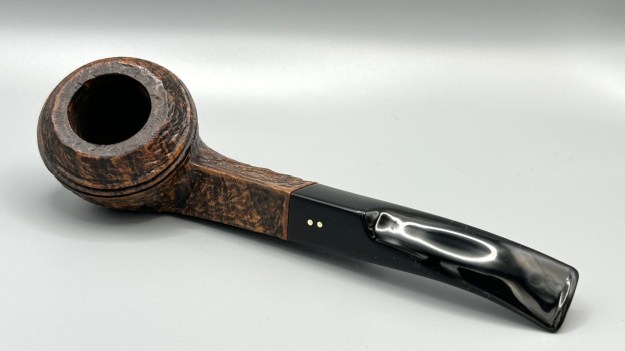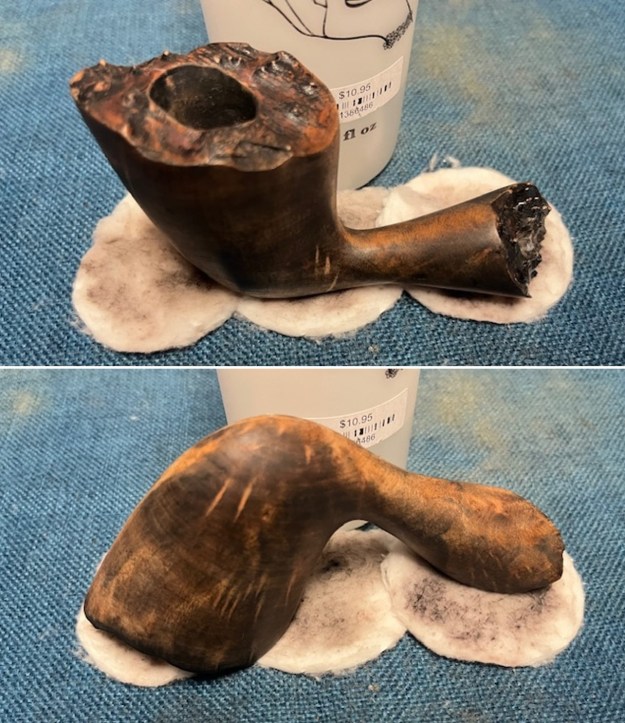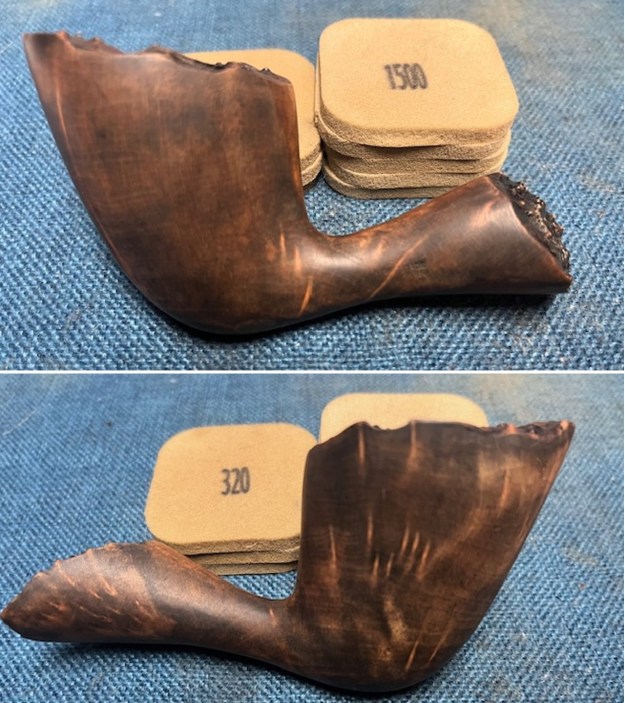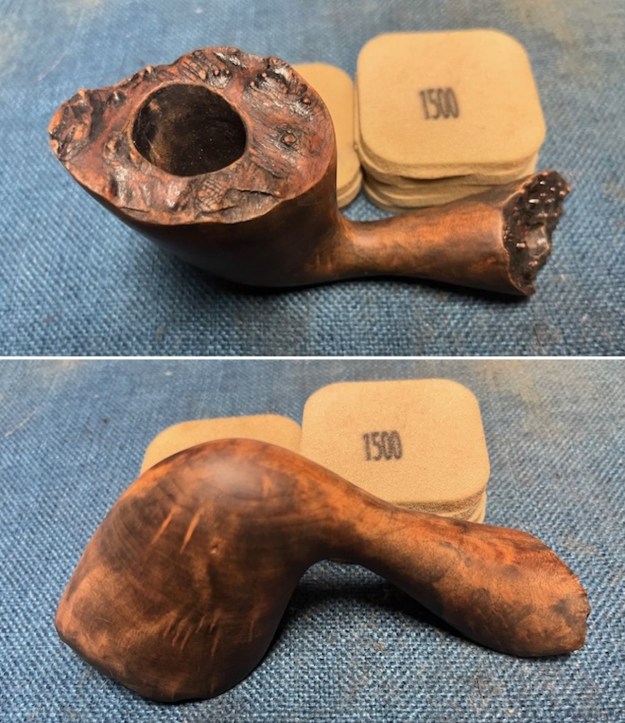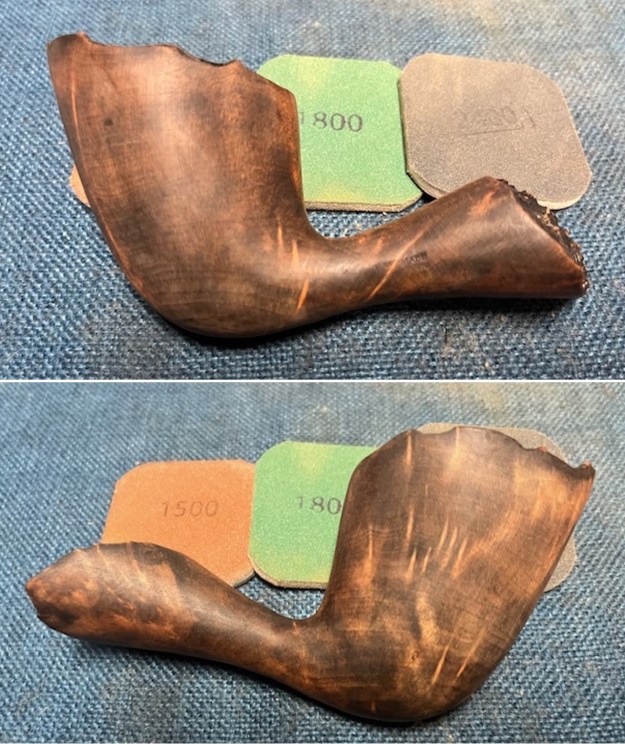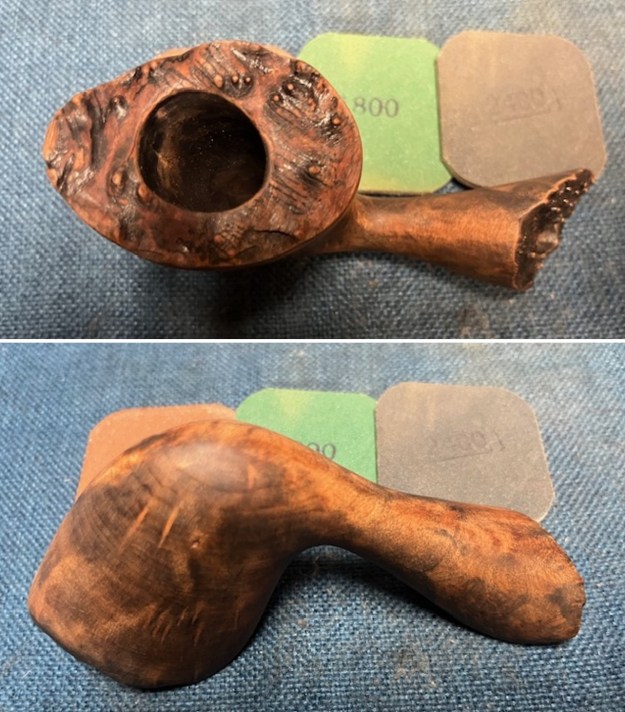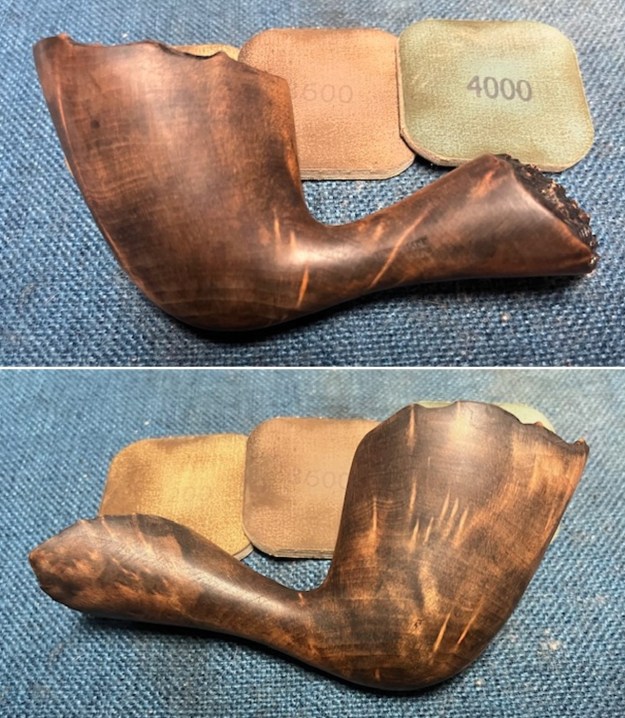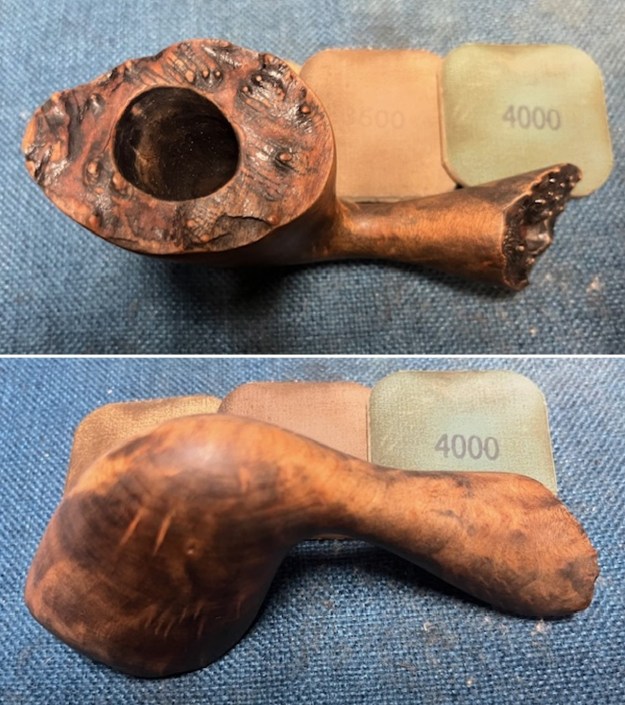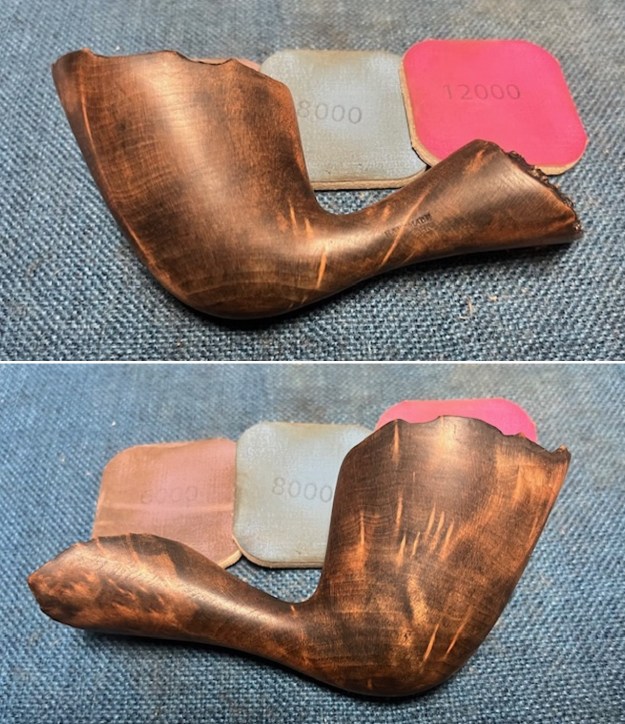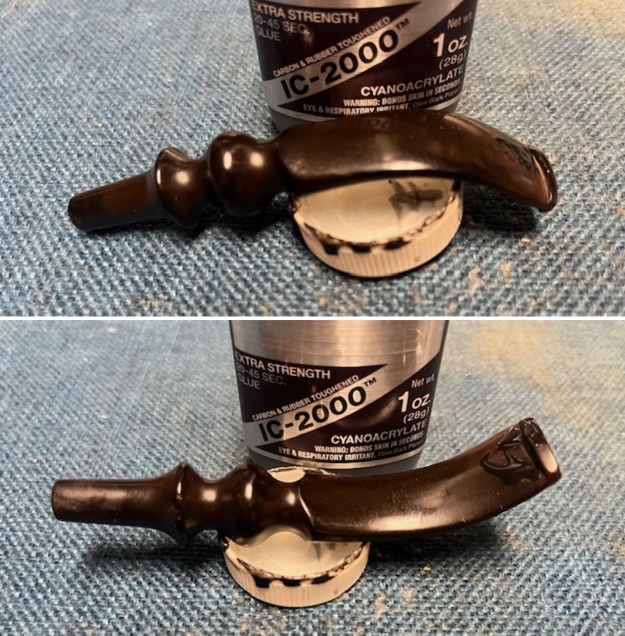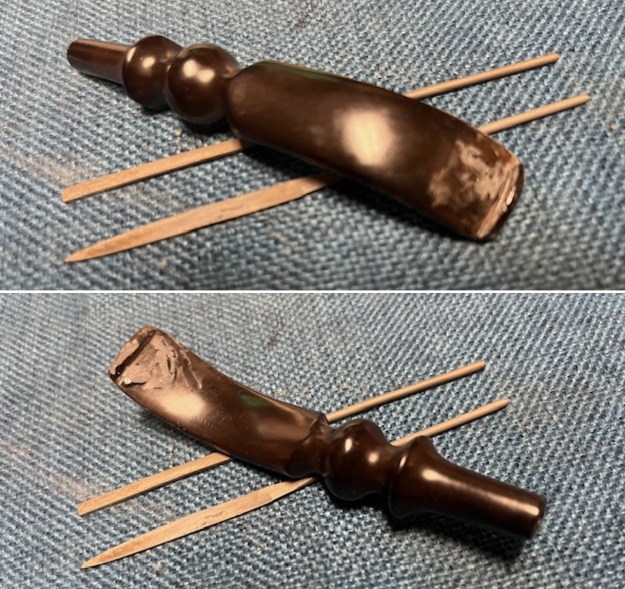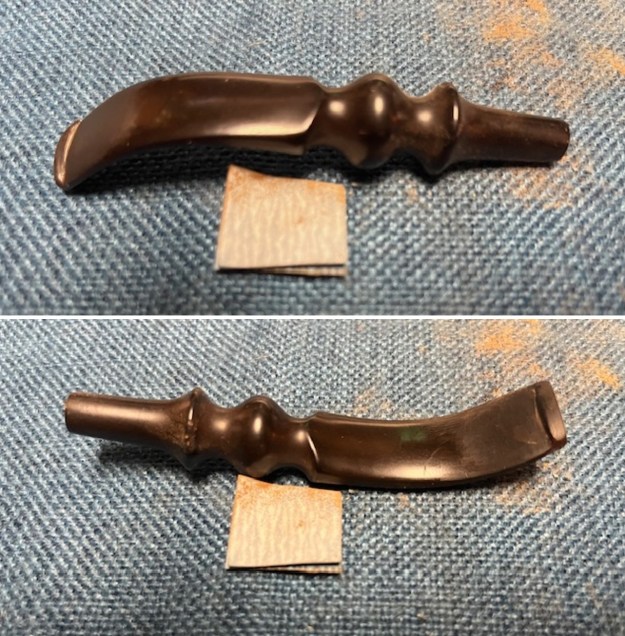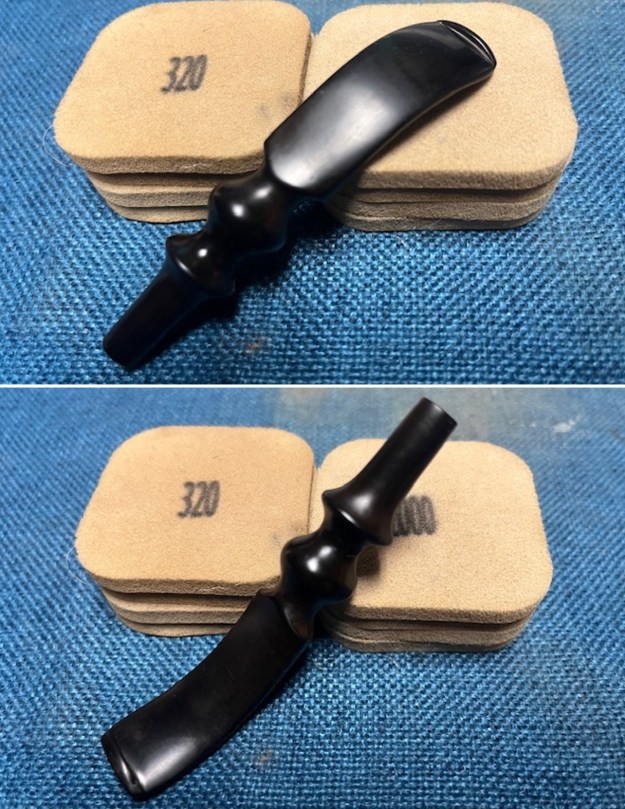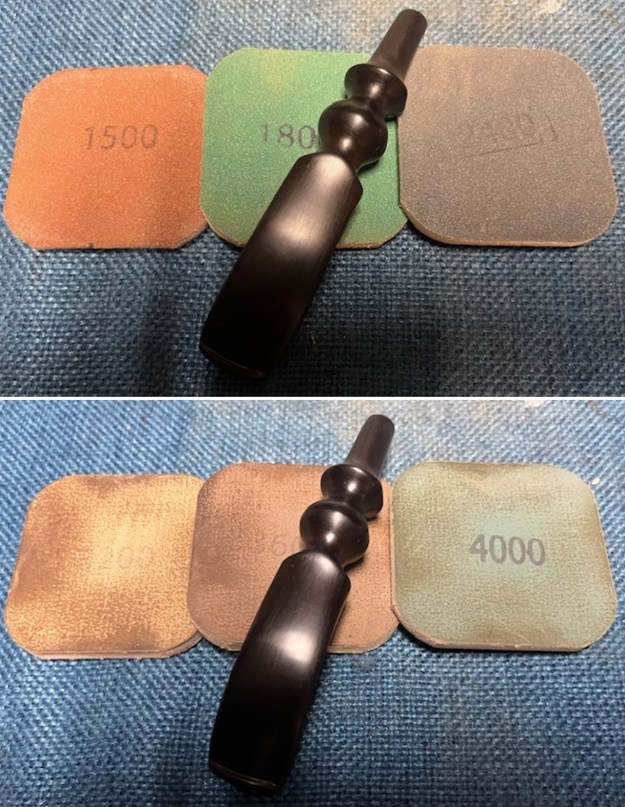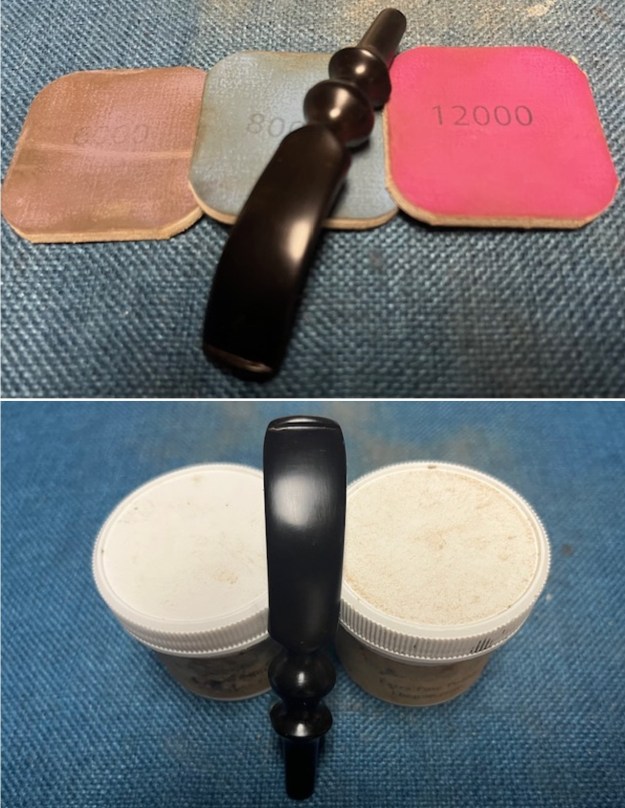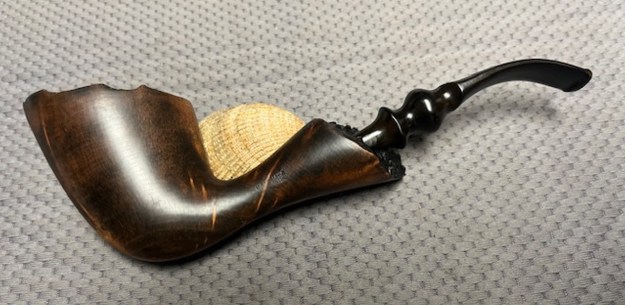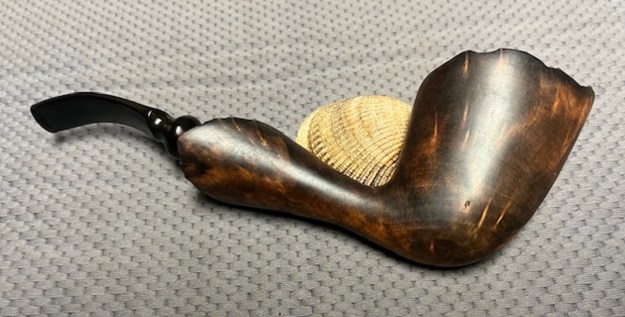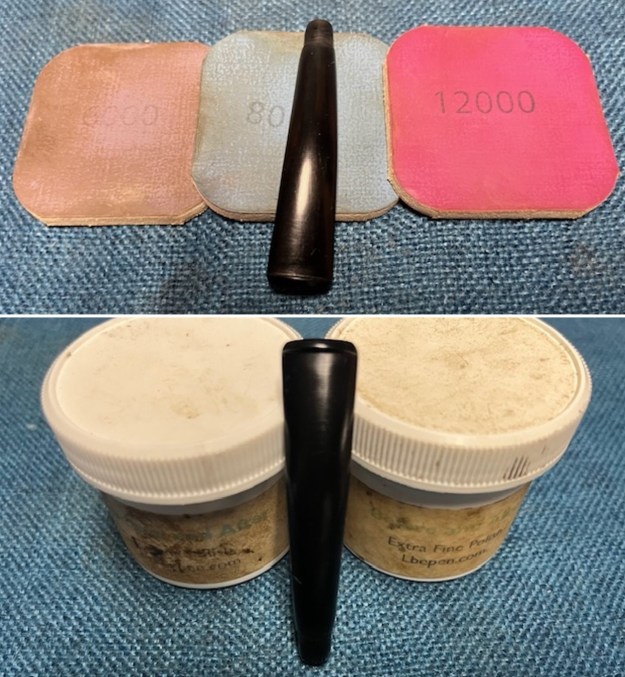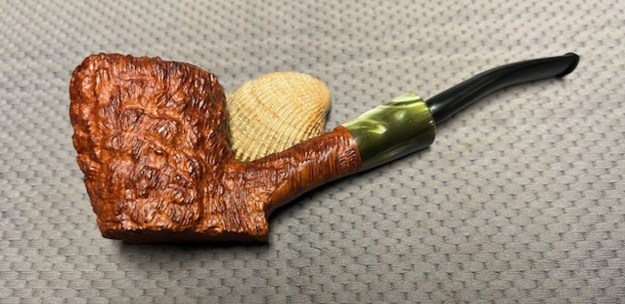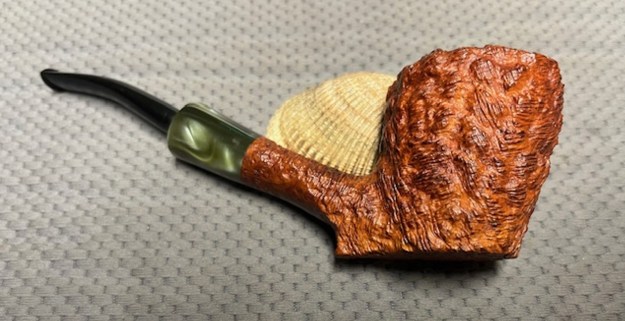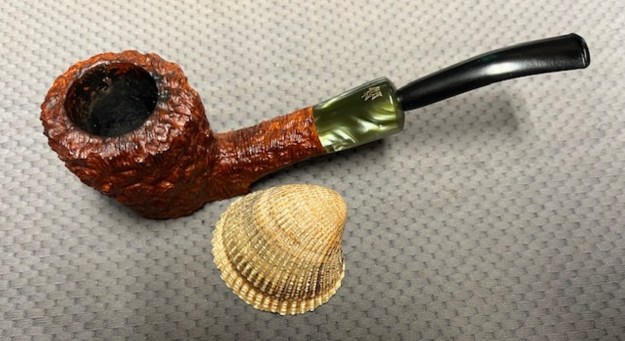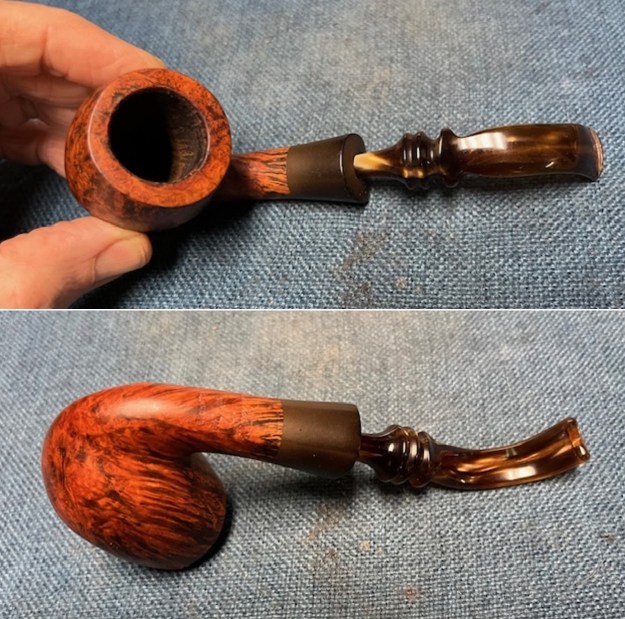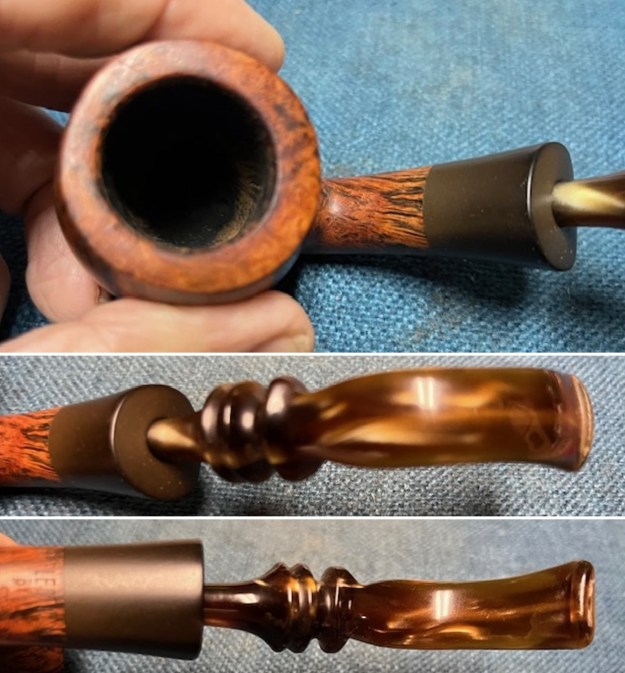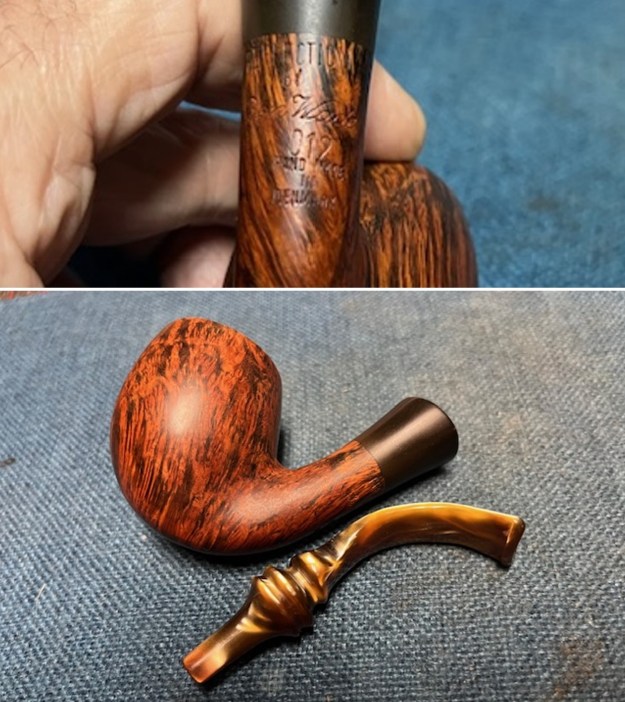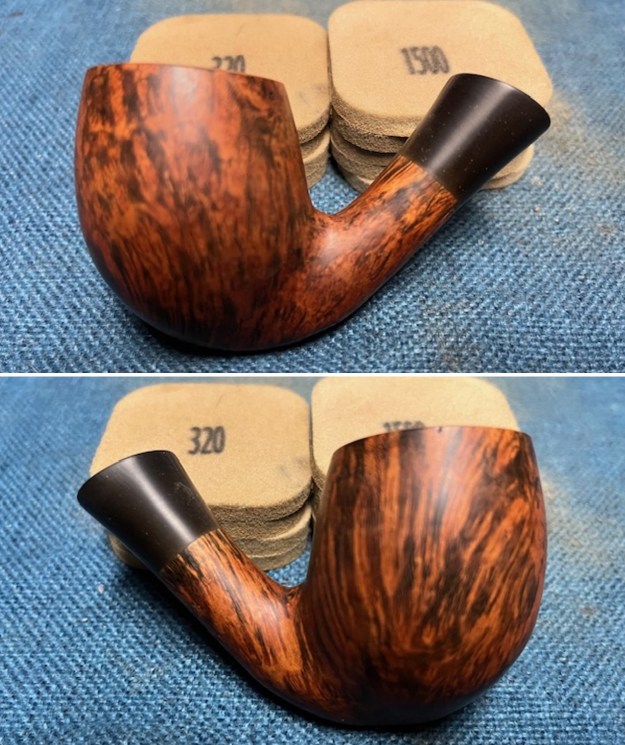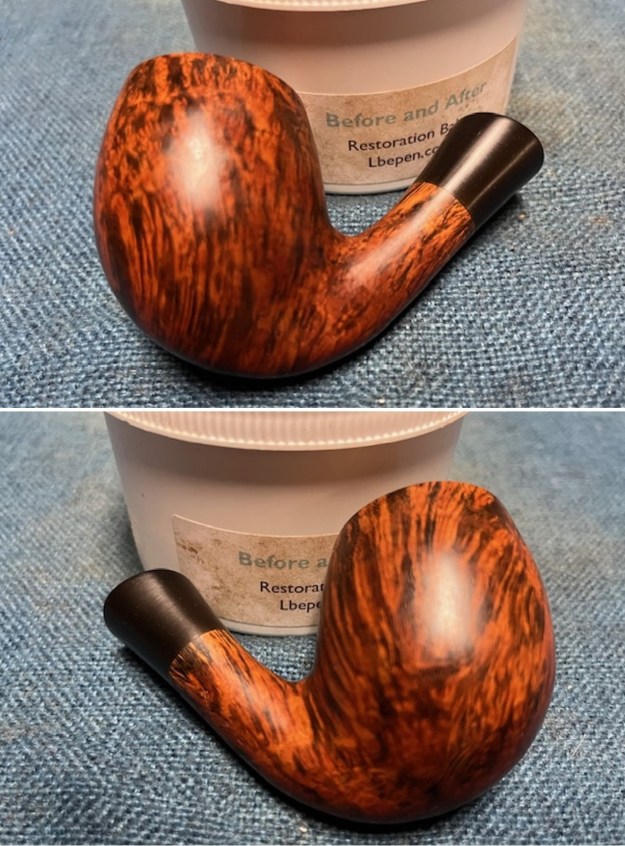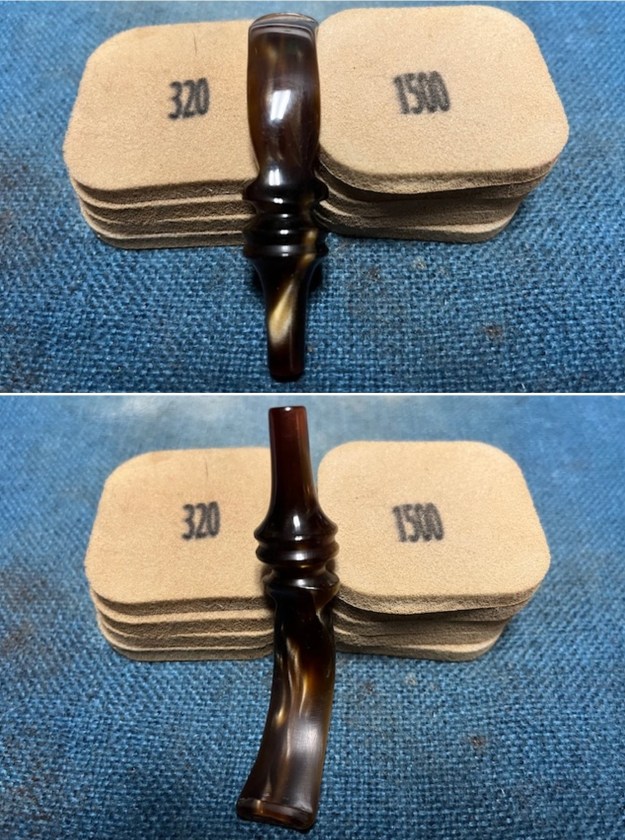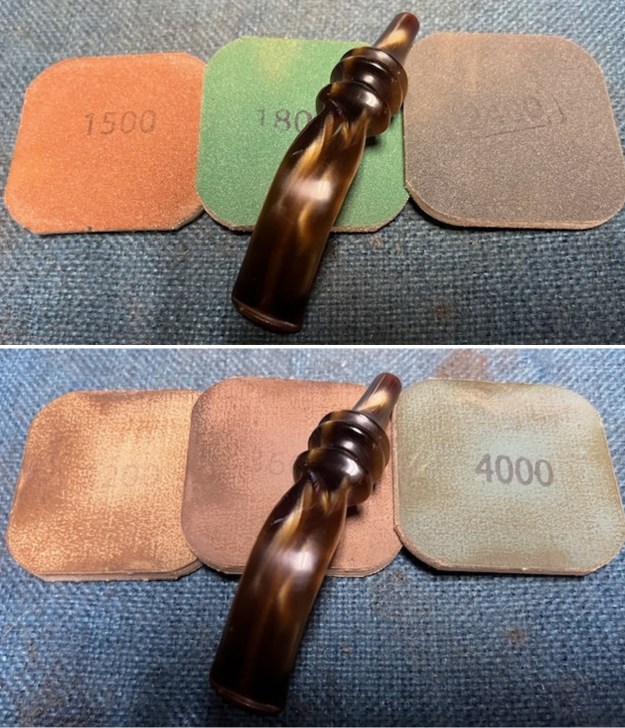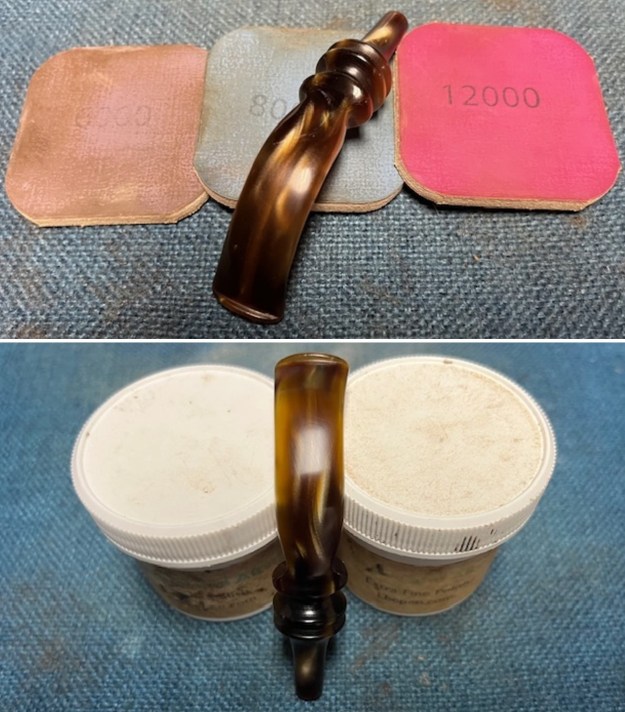
Tag Archives: shaping a stem

Restoring a SMS Meerschaum Skater with a Variegated Orange Acrylic Stem


by Steve Laug

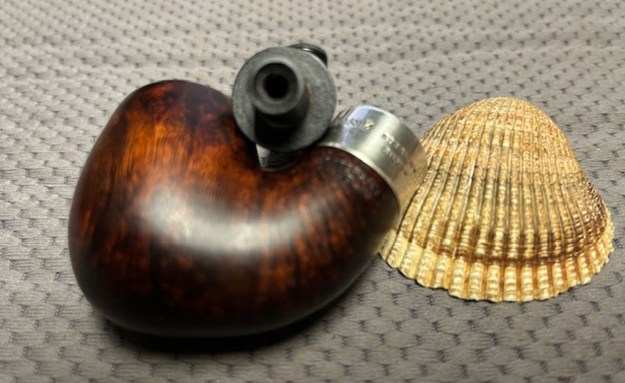
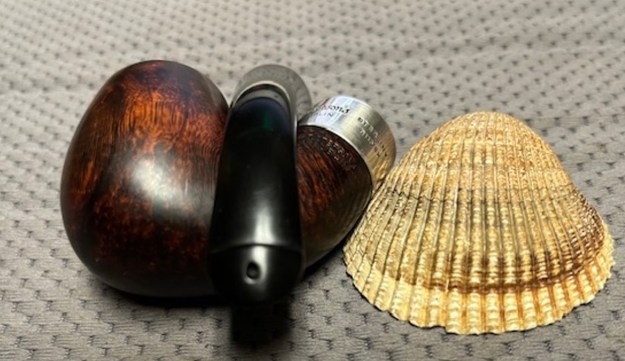
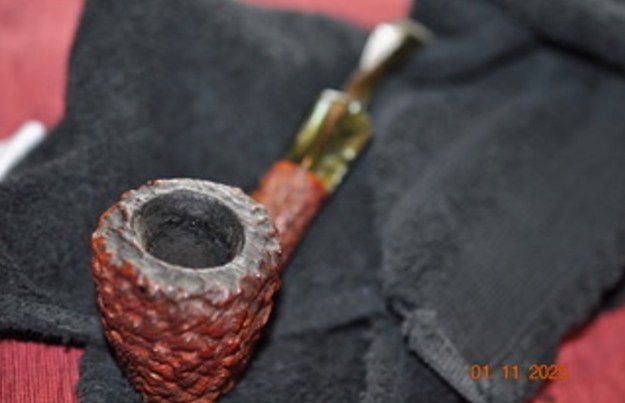
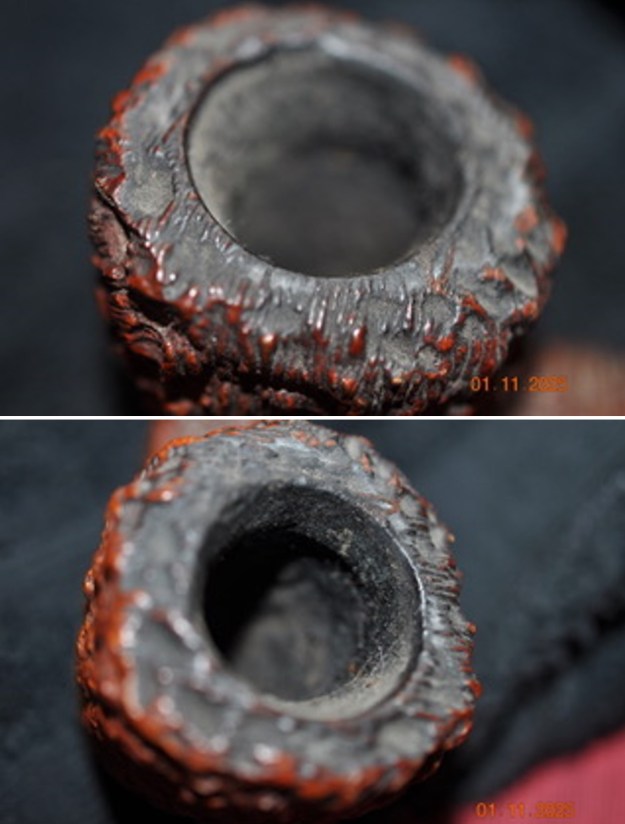
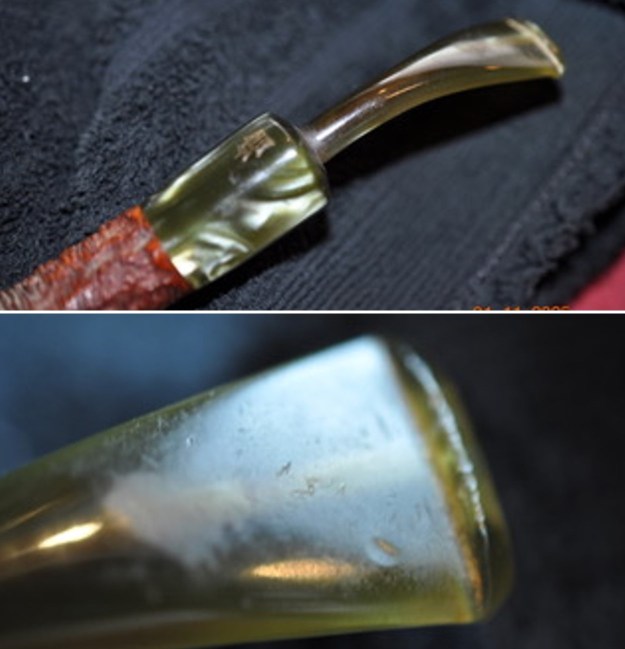
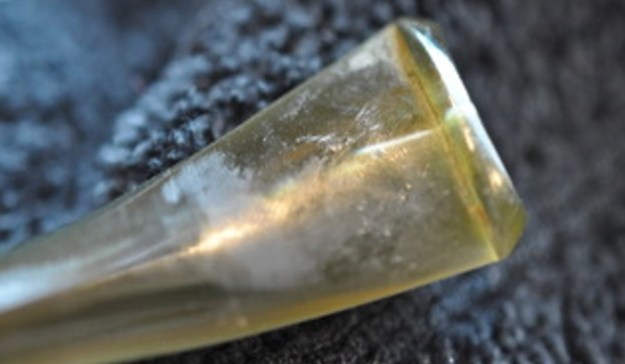
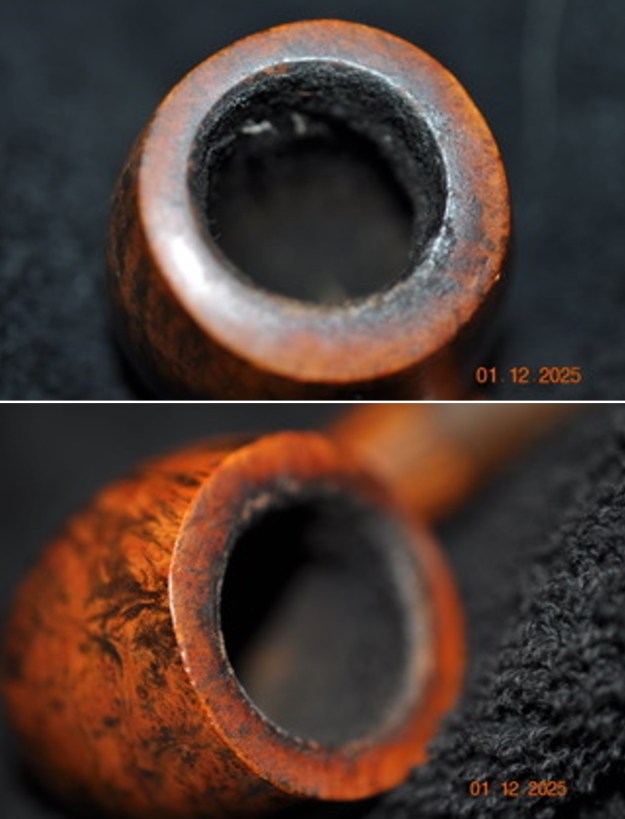
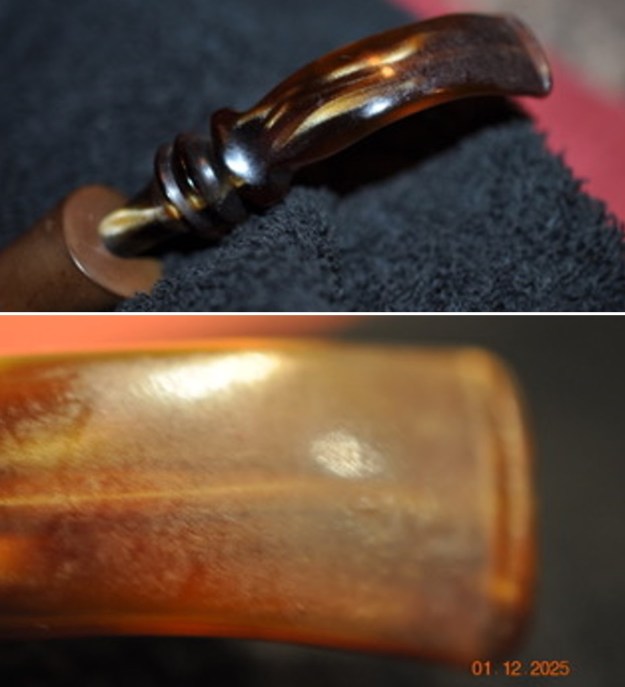
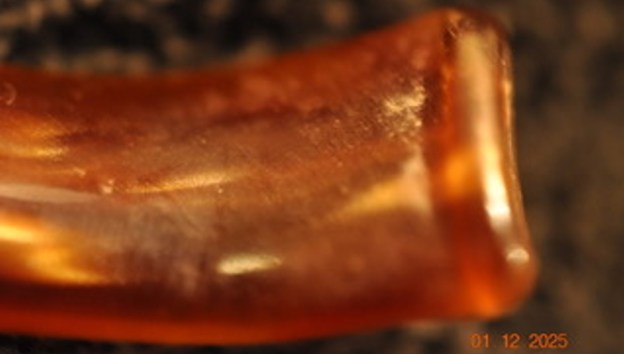
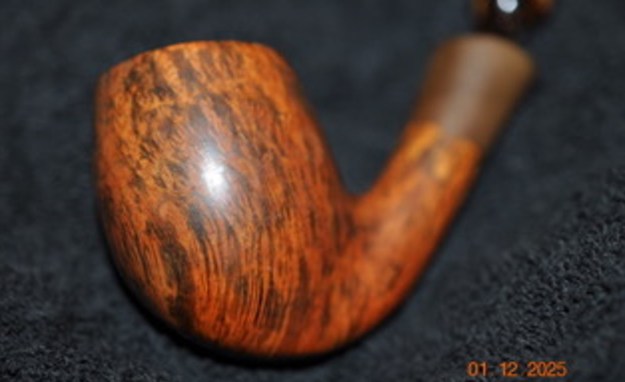
This afternoon I decided to work on the pipe that I no longer know where or when we purchase it. I have a large box of Meerschaum pipes that is sitting in my storage that I need to clean up and restore. I have honestly avoided them for years but now was the time to start my work on some of them. Today I chose a cased one. It is a black cased pipe and when opened it held a Skater shaped meerschaum. The case is lined with golden soft fabric that protected the bowl. The case bears an SMS logo and the left side of the taper stem bears the same logo. It is a beautifully shaped Skater shaped meer with scratches from its journey and some nice patina around the shank and sides. The meer is dirty from use with a thick cake in the bowl and a light overflow of lava on the inner edge and thin rim top, heavier on the back side. The variegated orange acrylic stem fit well against the shank end and was slightly dirty and had tooth marks and chatter on both sides ahead of the button. I took photos of the case and the pipe before I started my clean up work on it. I took photos of the rim top and the stem to show the condition of the pipe when I brought it to the worktable. You can see the cake in the bowl and the build up of lava and debris on the edge and top of the rim. It is another dirty pipe but still a charmer. The variegated orange acrylic stem has chatter and deep tooth marks on both sides near the button.I took a photo of the logo stamp on the inside of the case and on the left side of the acrylic taper stem. It I s clear and readable. The label in the case reads SMS in the centre and around the outside of the circle it read Handcarved Block Meerschaum Turkey. I removed the stem from the shank and took a photo of the parts. I had some faint recall of the make but could not remember his name so I turned to pipephil’s site (http://www.pipephil.eu/logos/en/logo-s9.html) for some help. I found a quick note on the founding of the SMS brand which was the USA import brand for pipes made by Samil Sermet and his wife Beth. There was also a link there to the company website.I clicked on the site link (http://www.smspipes.com/) to get a bigger picture of the brand and the makers. I quote the section of the site marked “About Us” and quote the following:
Welcome to SMS Pipes!!

We are proud to present a wide selection of premium smoking pipes. SMS Pipes features Turkish Block Meerschaum, supplied exclusively by SMS Meerschaums, and Italian Briar, supplied by Lorenzo of Italy. All the pipes offered by SMS Pipes meet or surpass our exacting “Standard of Excellence.”

Samil & Beth Sermet – SMS Pipes is family owned and operated extension of SMS Meerschaums, founded in 1980 by Samil Sermet and his wife, Beth. SMS Meerschaums is recognized nationwide as a trusted supplier by nearly 500 retail tobacconists. SMS Pipes promises to continue the philosophy embraced by SMS Meerschaums and provide premium smoking pipes that are:

Distinctive… each pipe is carefully selected for its uniqueness, quality and reliability.

Affordable… a wide range of prices makes owning a fine pipe possible for everyone.

Collectable… the timeless beauty of each pipe will be treasured for generations.

Key to the success of SMS Pipes is our dedicated staff. Based in the USA and Turkey, they maintain contact with our exceptionally talented pipe carvers and case makers and perform all the daily business activities described below:

 Samil Sermet, a native of Turkey, is the buyer for SMS Meerschaums. His hometown is Eskisehir, Turkey, where a majority of the meerschaum pipe carvers live and have their shops. Samil makes a buying trip to Turkey each year and has a close working relationship with all the carvers. He is responsible for sales analysis and placing the orders necessary to maintain adequate stock in the warehouse. (samil@smspipes.com)

Beth Sermet, office manager of SMS Meerschaums, processes all orders. Even though Beth was born in Iowa, she is fluent in Turkish after living in Turkey for several years and knows all the carvers. The owners of Lorenzo Briars work closely with Beth to assure ample supply of their premium pipes. Beth also personally selects and photographs all the pipes shown on SMS Pipes. (beth@smspipes.com)

Mert Sermet, son of Samil and Beth, manages the daily operations of SMS Pipes. He is in charge of processing and shipping all orders. Mert has in-depth knowledge of every aspect of pipe manufacturing both in Turkey and Italy. He will personally respond to any comments, questions or concerns you may have about SMS Pipes by e-mail. (mert@smspipes.com)

Emel Sagtekin, Samil’s sister, is responsible for quality control and shipments of pipes to SMS Meerschaums from Turkey. Since 1988, Emel has personally checked thousands of pipes. She evaluates each pipe based on strict criteria set by SMS Meerschaums and selects only the pipes that meet or surpass our high standards.

SMS Pipes provides a wide variety of services for our customers. Although the inventory on SMS Pipes is reserved for Internet sale only, it is possible to have a selection of similar pipes sent “On Approval” to any tobacconist listed on the site. Membership in the SMS Collectors Society provides additional amenities for those interested in collecting our pipes. Our Master Carvers can be commissioned to carve custom pipe designs by special arrangement. We also offer repair and re-waxing services for all SMS Pipes.”

We are happy to have the opportunity to serve you. We hope your time spent with SMS Pipes is enjoyable and worthwhile.

Now I had a clearer picture of the brand and the makers. I knew that pipe was made after 1980 when the company began. Now it was time to work on the pipe itself.

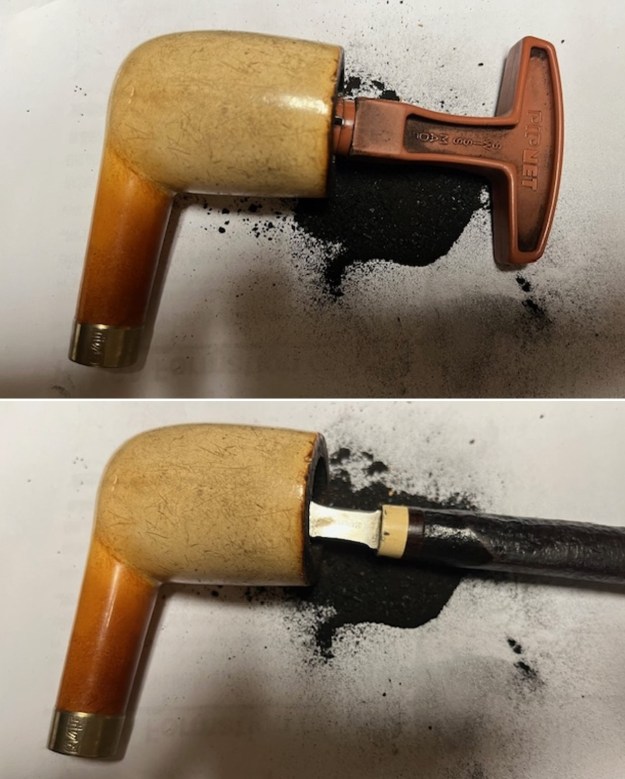
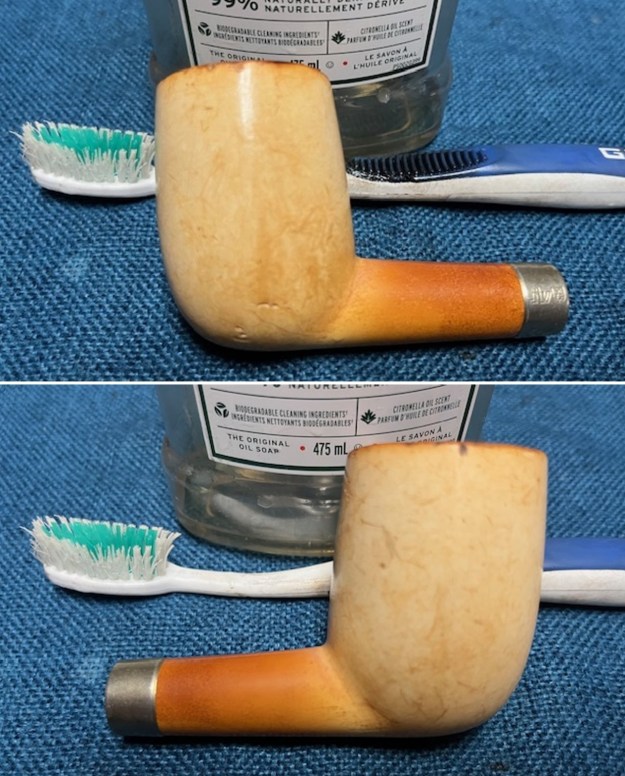
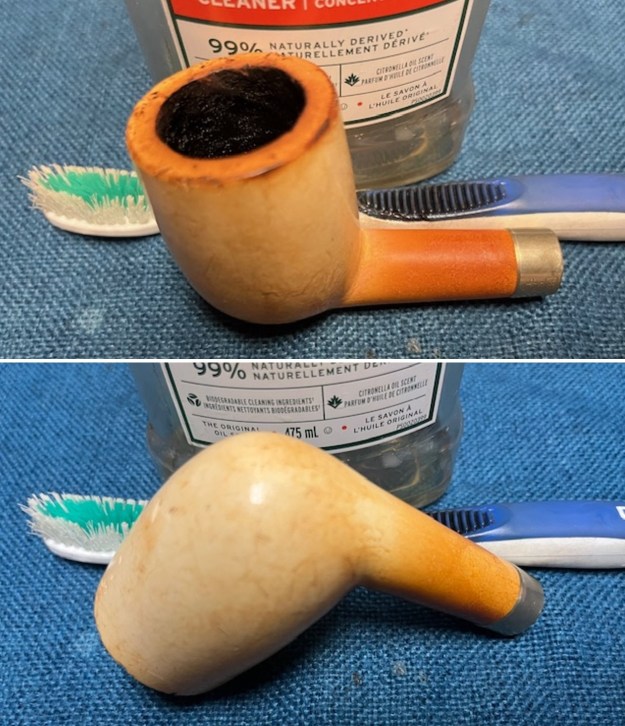
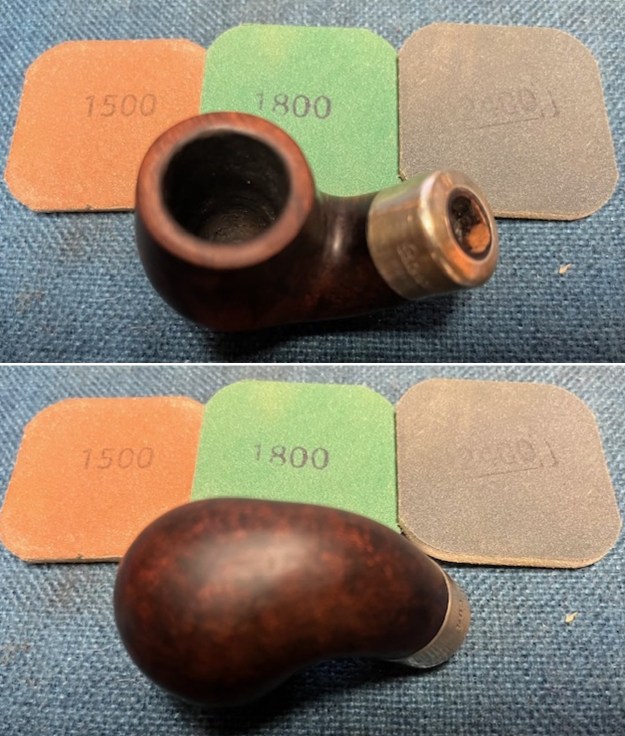
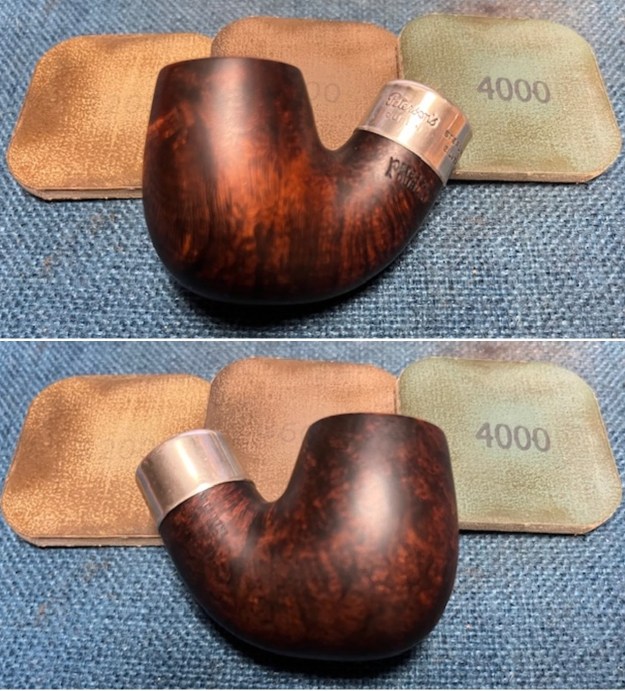
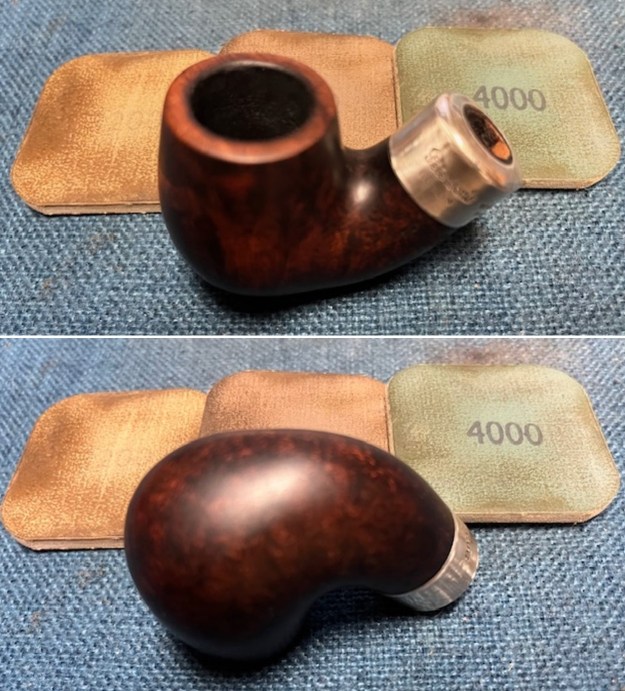
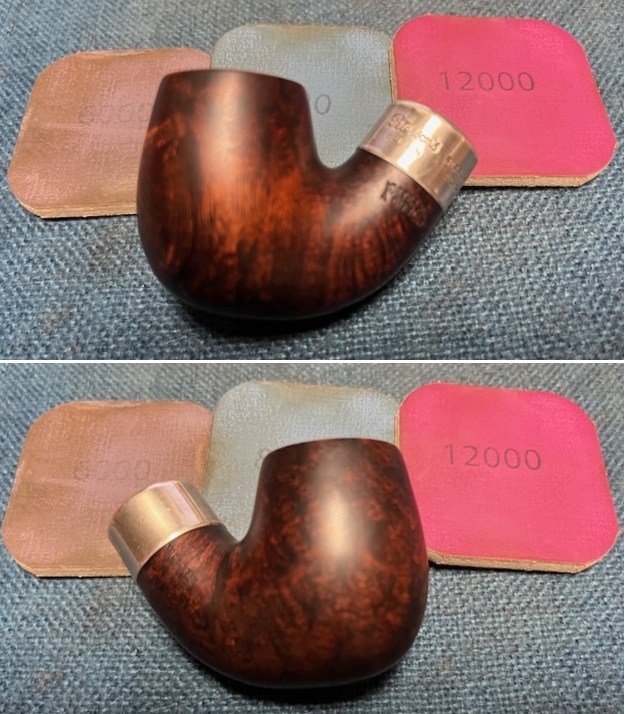
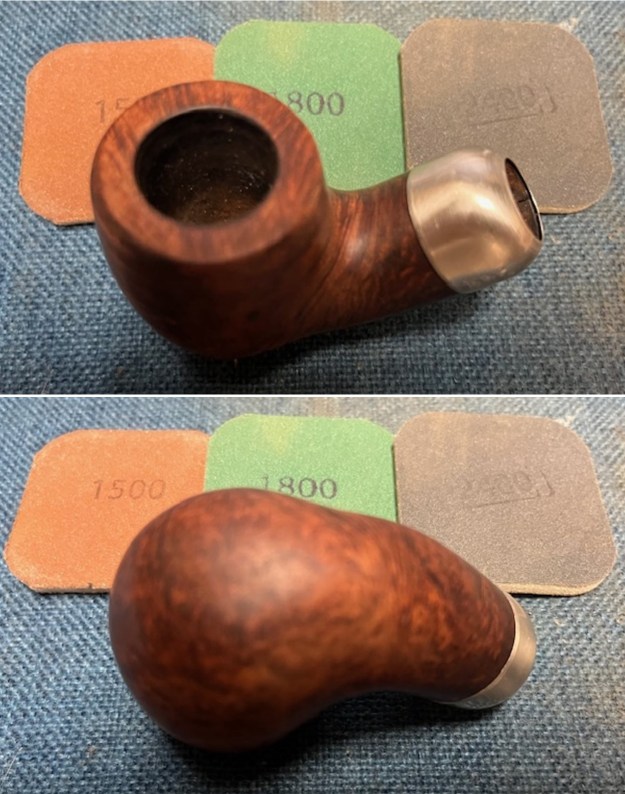
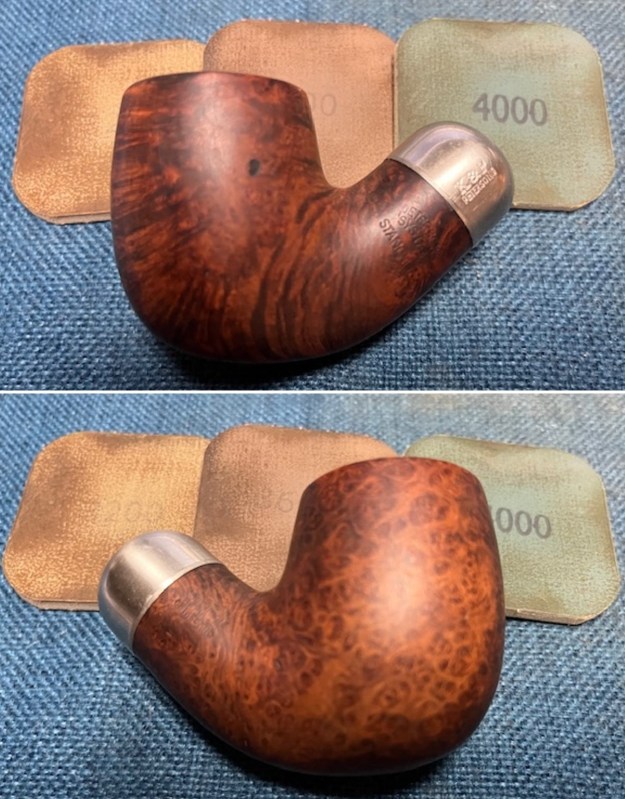
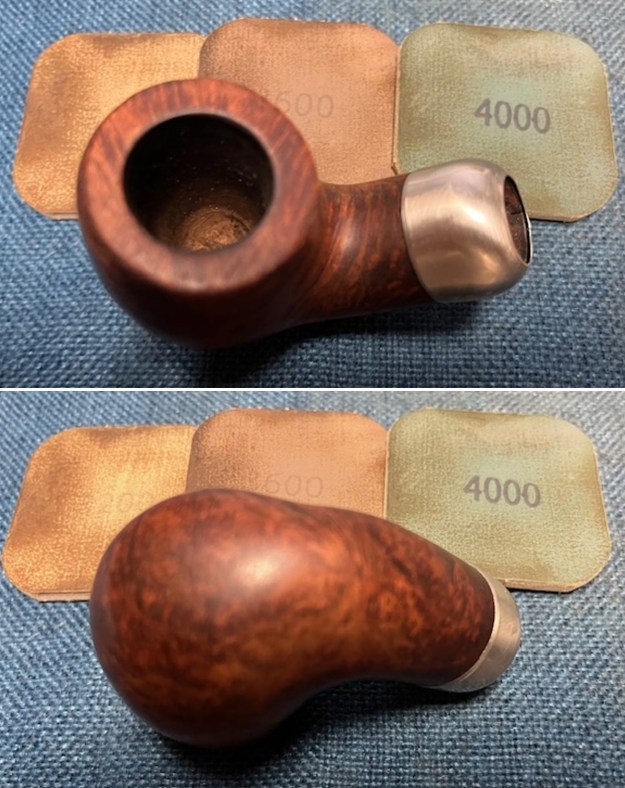
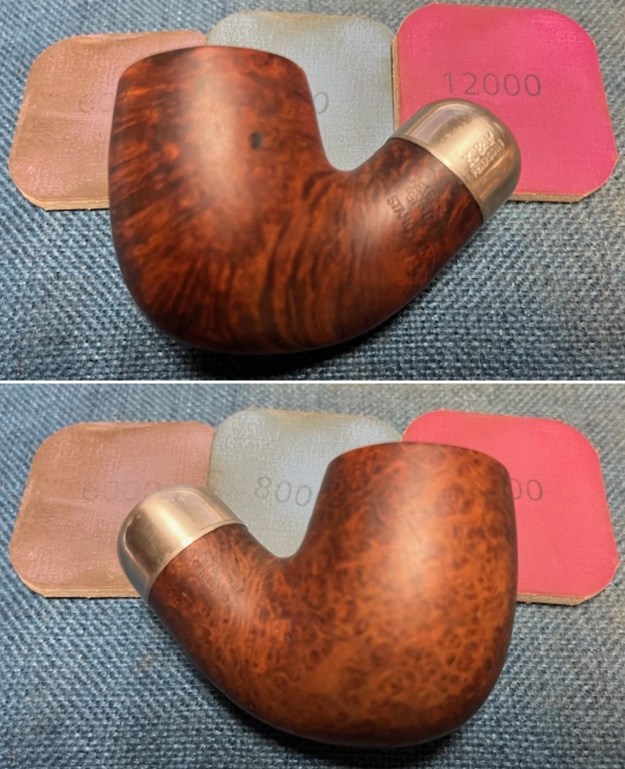
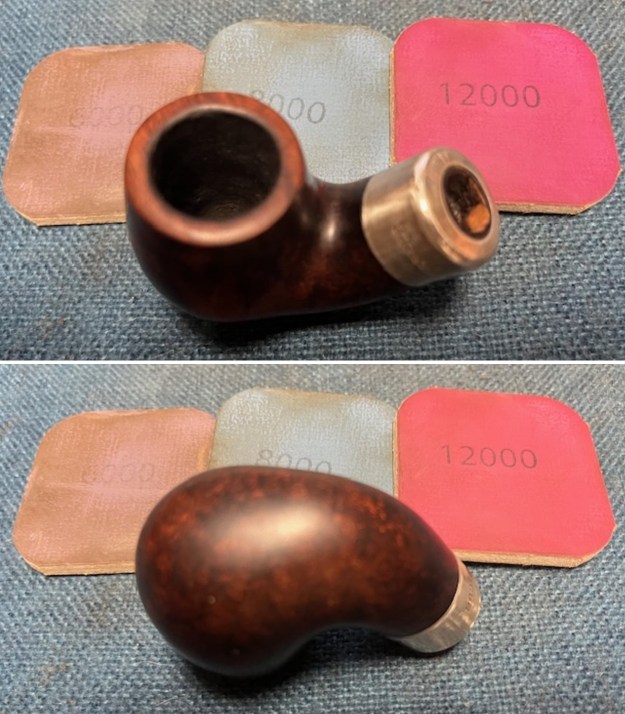
I started my work on the bowl by reaming the thick cake out of the bowl. I started with a PipNet reamer and the 2nd and 3rd cutting heads to take back the cake to the walls of the bowl. I cleaned up the reaming with a Savinelli Fitsall Pipe Knife. I sanded the bowl walls with a piece of dowel wrapped with 220 grit sandpaper. Once finished the walls of the bowl looked very good. I scraped off some of the lava coat on the rim top. I used a topping board and some worn 220 grit sandpaper to smooth out the damage on the rim top and remove the rest of the darkening on the meer. It looked much better once I finished.I scrubbed the bowl surface with a tooth brush and undiluted Murphy’s Oil Soap. I rinsed the bowl with warm running water to wash off the dirt and the soap. It looked much better at this point. I cleaned out the airway in the shank and mortise as well as in the new stem with pipe cleaners (both bristle and regular). It was much better.I polished the meerschaum with micromesh sanding pads – dry sanding with 1500-12000 grit pads. I wiped the bowl down after each pad with a damp cotton cloth. The bowl took on a shine by the last pad. I gave the bowl multiple coats of Clapham’s Beeswax Polish which is a soft wax. I rubbed the wax on the bowl sides and the shank end with my finger tips and set it aside to dry. Once the wax cured I buffed the bowl with a clean buffing pad and then with a soft microfibre cloth. The bowl has a rich glow. I set the bowl aside and turned my attention to the stem. I sanded it with 220 grit sandpaper to smooth the tooth marks and chatter on the stem surface.I continued sanding the stem surface with 320-3500 grit 2×2 inch sanding pads. I wiped the stem down after each pad with a damp pad to remove the debris. By the end it was quite shiny and ready for polishing.I polished the stem with micromesh sanding pads – wet sanding it 1500-12000 pads. I wiped it down with a damp cloth after each pad to protect it and preserve it. it with Before After Pipe Polish – both Fine and Extra Fine. I polished the stem on the buffer with Blue Diamond. I put the pipe back together and gave it a buff on the wheel with Blue Diamond polish. I use a light touch on the acrylic as too heavy a touch can cause the heat to damage to acrylic. I gave the stem multiple coats of carnauba wax and buffed the pipe with a clean buffing pad to raise the shine. I hand buffed it with a soft cloth to deepen the shine. I put it back in the case and took a photo of the pipe in case.I took photos of the finished SMS Skater with a variegated orange acrylic stem to show the shine and the patina around the bowl. The acrylic stem looks very good with the deepening colour on the shank and the bottom of the bowl. With time the contrast will grow richer and deeper to a thing of beauty. The finished SMS Skater fits nicely in the hand and I think it will feel great as it heats up with a good tobacco. Give the finished pipe a look in the photos below. The dimensions of the pipe are Length: 6 inches, Height: 2 inches, Outside diameter of the bowl: 1 ½ inches, Chamber diameter: ¾ of an inch. The weight of the pipe is 1.13 ounces/32 grams. If you are interested in carrying on the legacy of this pipe it will be going on the rebornpipes store shortly. It is listed in the Ceramic and Meerschaum Section. You can send me a message or an email to let know you are interested. Thanks for reading this blog and my reflections on the pipe while I worked on it. This is an interesting estate to bring back to life.

Restemming and Restoring a Meerschaum Apple


by Steve Laug

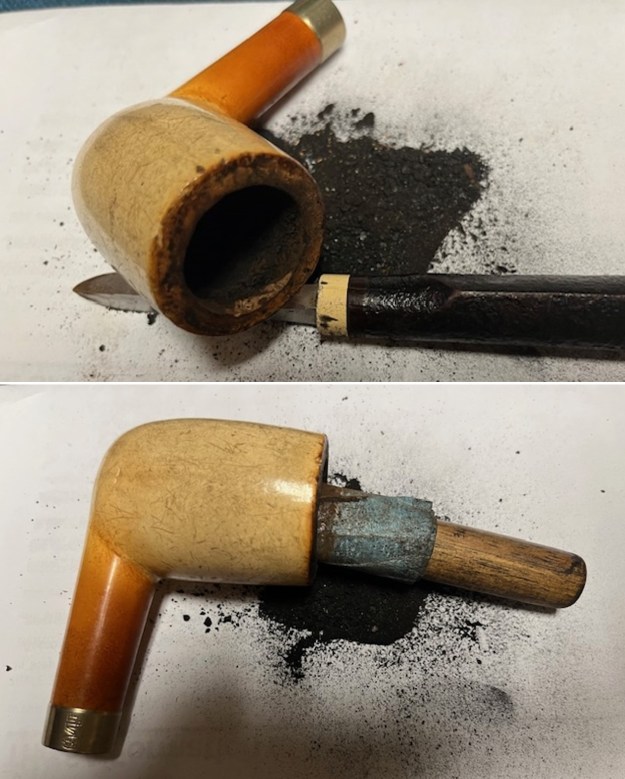
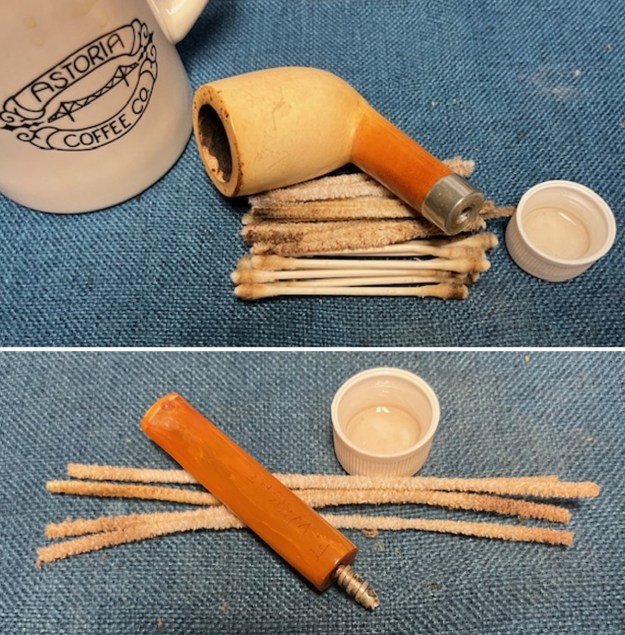
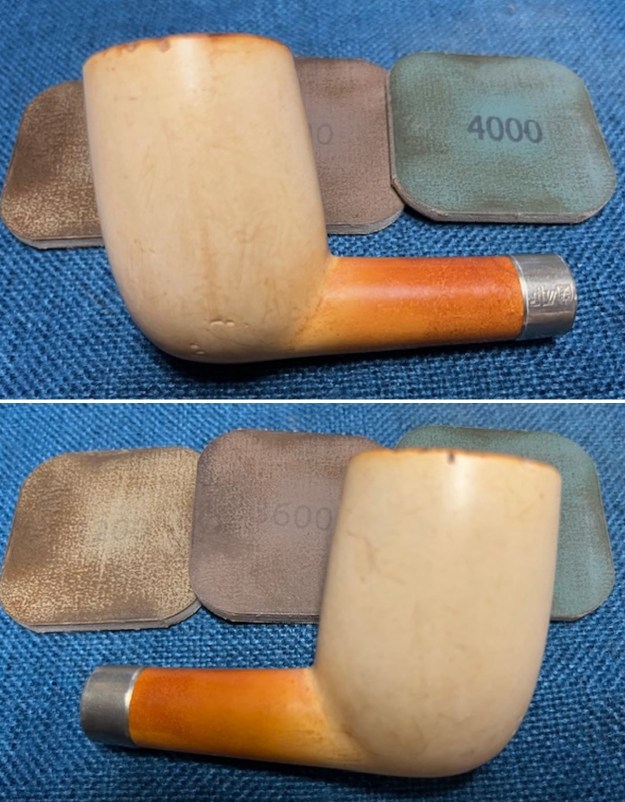
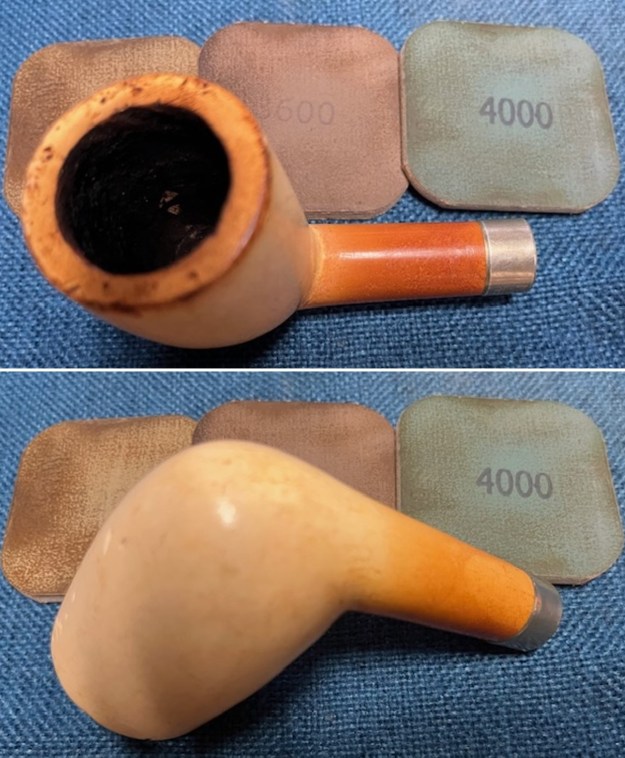
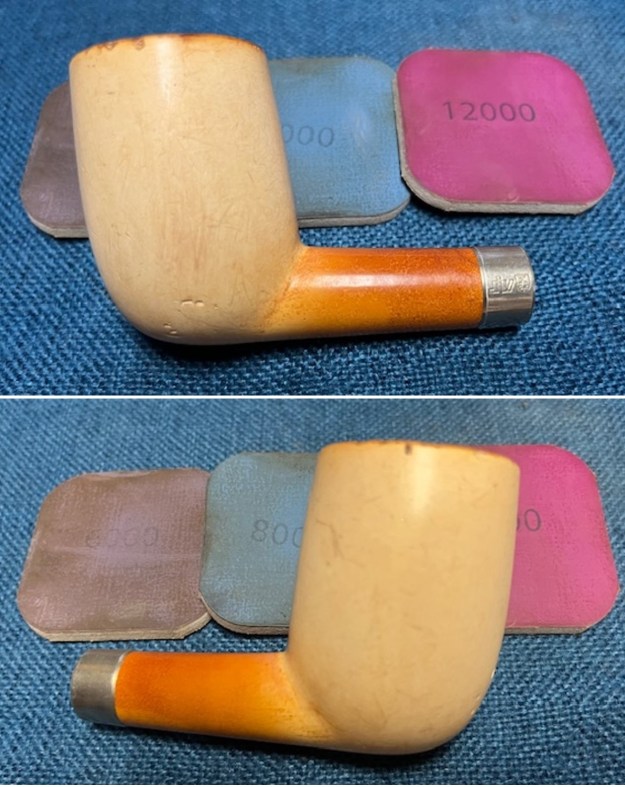
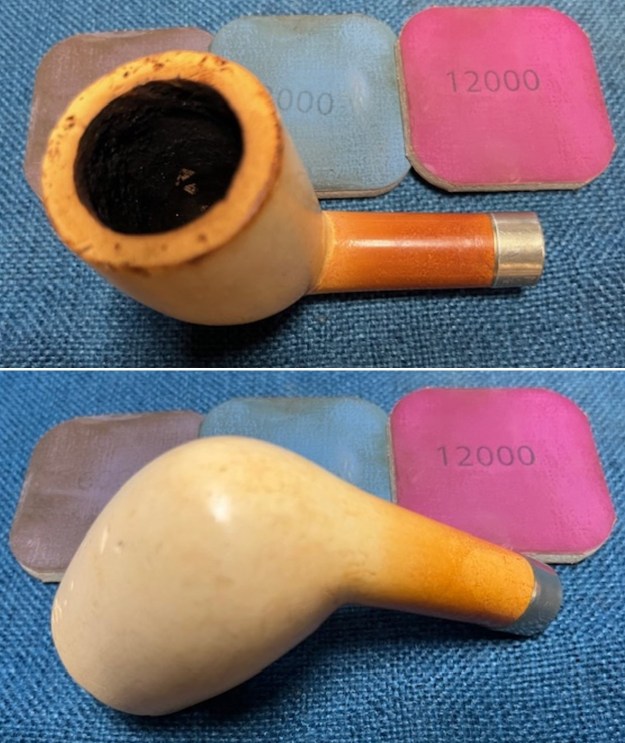
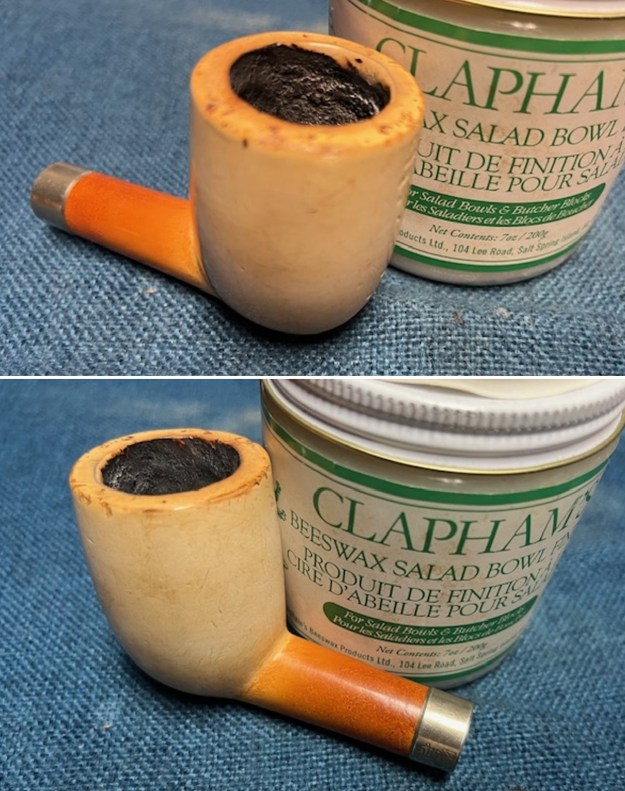
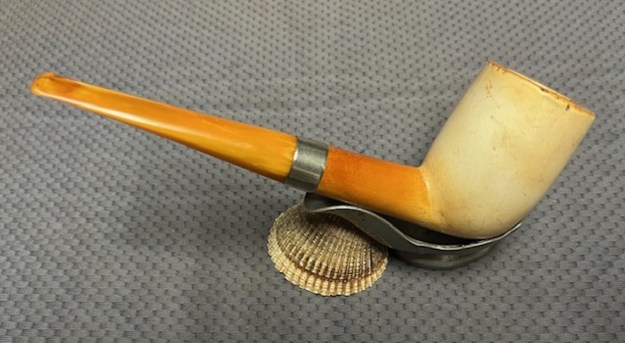
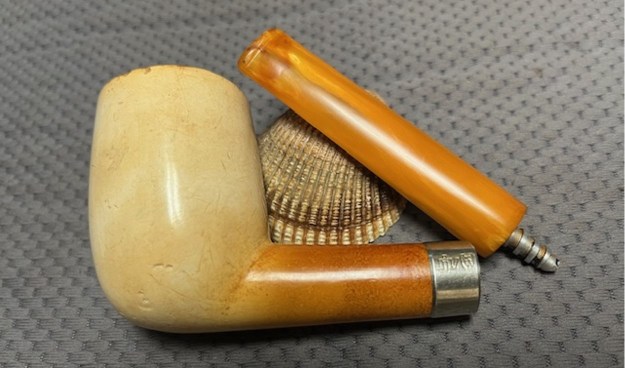
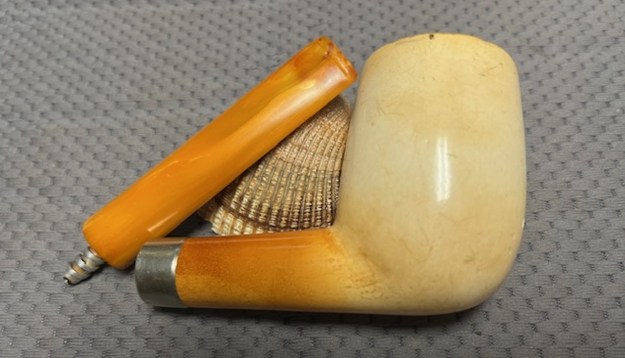
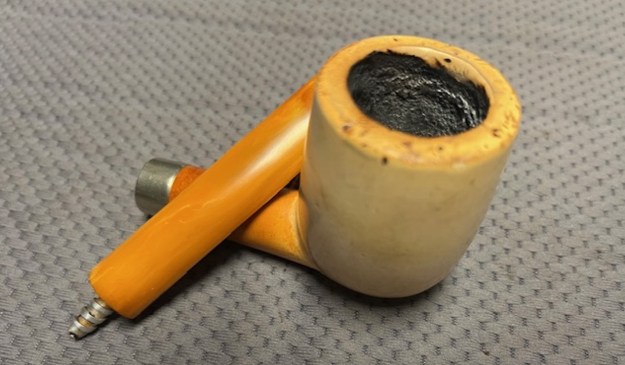
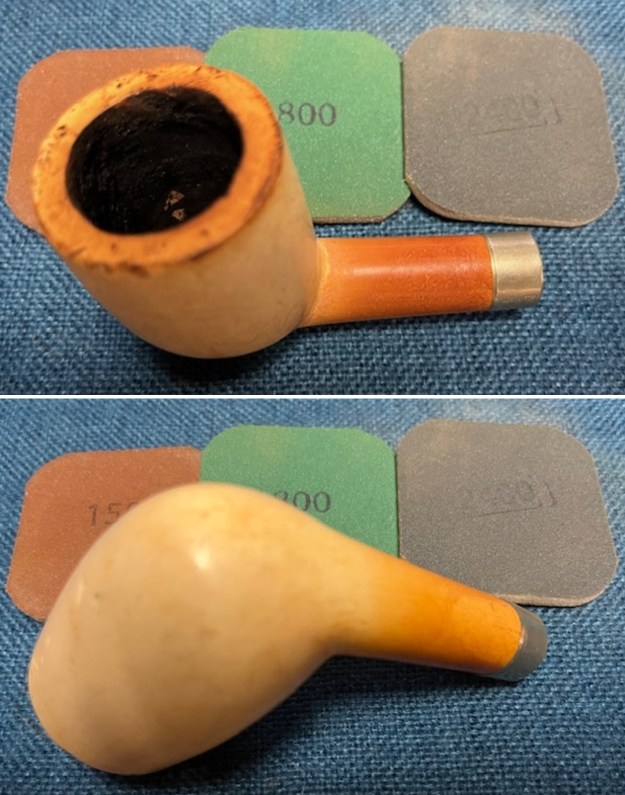
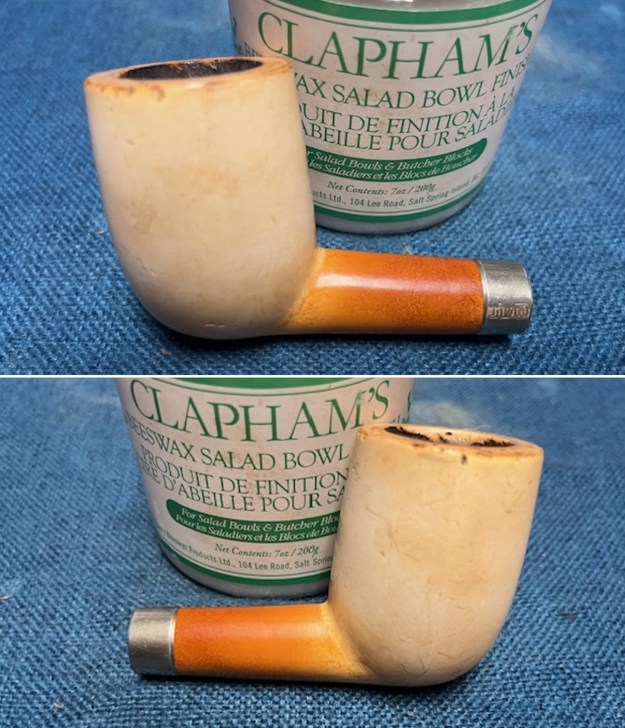
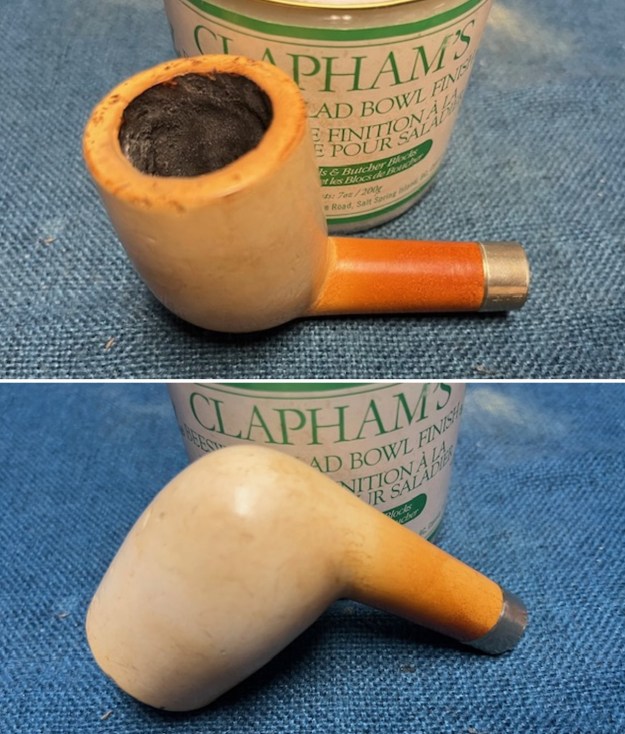
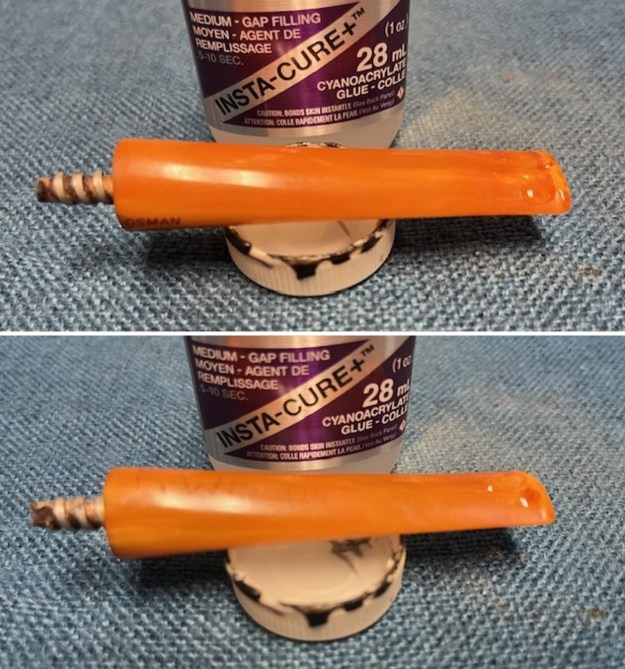
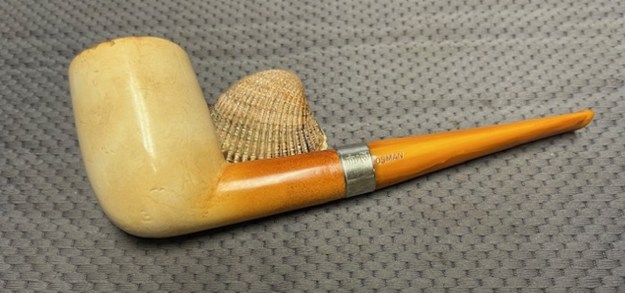
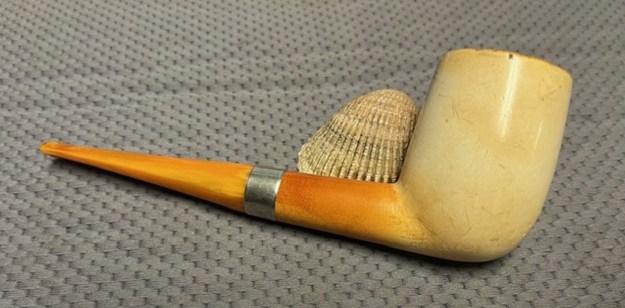
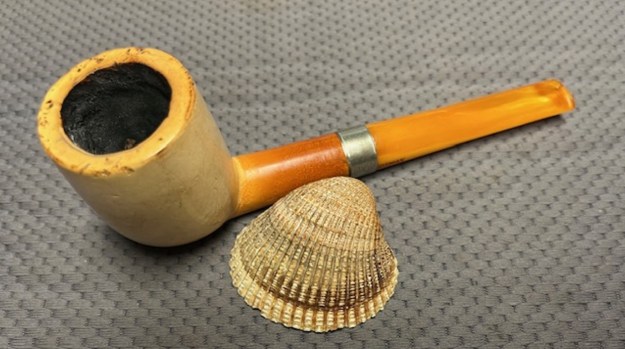
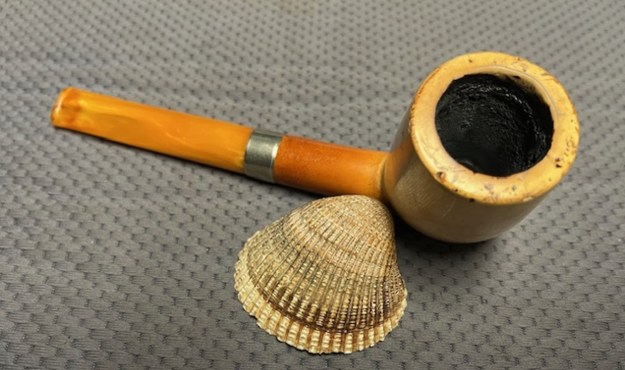
This afternoon I decided to work on the pipe that I no longer know where or when we purchase it. I have a large box of Meerschaum pipes that is sitting in my storage that I need to clean up and restore. I have honestly avoided them for years but now was the time to start my work on some of them. The first one I chose was definitely an older ball or apple shaped smooth meerschaum with a red acrylic shank extension. It is a beautifully shaped meer with scratches from its journey and some nice patina around the shank and sides. The meer is dirty from use with a thick cake in the bowl and a light overflow of lava on the inner edge and thin rim top. The acrylic shank extension was loose and would need to be cleaned. The stem fit well against the shank end however it was a Preben Holm vulcanite stem and it was too long. It would need to be replaced with a more fitting stem for the size of the pipe. There were no identifying logos on the bowl or shank. I took photos of the pipe before I started my clean up work on it. I took photos of the rim top and the stem to show the condition of the pipe when I brought it to the worktable. You can see the cake in the bowl and the build up of lava and debris on the edge and top of the thin rim top. It is another dirty pipe but still a charmer. The vulcanite stem has chatter and deep tooth marks on both sides near the button. It also has a Preben Holm crown on the top of the stem. It will be replaced so fortunately I will not need to deal with it.I removed the stem from the shank and took a photo of the parts. To me proportionally the stem is too long for this pipe. I went through my stems and found a stem that would work well. In the photos it looks the same length or longer but it is about an inch shorter and the blade is also wider and looks good. I took a photo of the pipe with the new stem. I shortened the tenon a bit to bring it closer to the shank extension. The second photo of the stem in the shank shows the new look. I reamed the thick cake out of the bowl. I started with a PipNet reamer and the 2nd and 3rd cutting heads to take back the cake to the walls of the bowl. I cleaned up the reaming with a Savinelli Fitsall Pipe Knife. I sanded the bowl walls with a piece of dowel wrapped with 220 grit sandpaper. Once finished it looked very good. I cleaned out the airway in the shank and mortise as well as in the new stem with pipe cleaners (both bristle and regular). It was much better.I cleaned up the rim top and edges of the bowl with a 320 grit sanding pad. I removed the darkening and damage and it looked better.The shank extension was held to the shank with a white Delrin tenon. The shank on the pipe was thread and the smooth end fit partially into the extension. When screwed into the shank it was a snug fit. I chose not to glue it but leave it unglued and removable.Now it was time to work on the bowl itself. I started my work by sanding with 320-3500 grit 2×2 inch sanding pads. It smoothed out the scratches and revealed more and more of the patina around the bowl and shank. It is a beautiful looking pipe. I polished the meerschaum with micromesh sanding pads – dry sanding with 1500-12000 grit pads. I wiped the bowl down after each pad with a damp cotton cloth. The bowl took on a shine by the last pads. I gave the bowl multiple coats of Clapham’s Wax that blends both carnauba and beeswax in a soft wax. I rubbed the wax on the bowl sides and the shank end with my fingers and set it aside to dry. Once the wax cured I buffed the bowl with a clean buffing pad and then with a soft microfibre cloth. The bowl has a rich glow. I set the bowl aside and turned my attention to the stem. I “painted” the surface of the stem with the flame of a lighter to lift the tooth marks on the surface. It lifted many of them. I filled in those that remained with some black, rubberized CA glue. When it cured I flattened out the repair with a small flat file and then sanded it with 220 grit sandpaper to smooth it out. I continued sanding the stem surface with 320-3500 grit 2×2 inch sanding pads. I wiped the stem down after each pad with a damp pad to remove the debris. By the end it was quite shiny and ready for polishing.I polished the stem with micromesh sanding pads – dry sanding it 1500-12000 pads. I wiped it down with a damp cloth after each pad to protect it and preserve it. I polished it with Before After Pipe Polish – both Fine and Extra Fine. I am really happy with the way that this Meerschaum Freehand Style Apple turned out. It really is a beautiful looking pipe with a unique shape and smooth meerschaum bowl. The acrylic shank extension and the fancy vulcanite saddle stem are really nice. The patina on the meerschaum came alive with waxing and buffing. The rich patina on the finish gave the pipe a sense of depth with the polishing and waxing. I put the stem back on the bowl and carefully buffed the pipe with Blue Diamond on the buffing wheel. I gave the bowl and the stem multiple coats of beeswax/carnauba wax and buffed the pipe with a clean buffing pad to raise the shine. I hand buffed the pipe with a microfiber cloth to deepen the shine. The finished Meerschaum style Freehand really is a beauty and feels great in the hand and looks very good. Give the finished pipe a look in the photos below. The dimensions of the pipe are Length: 6 inches, Height: 2 inches, Outside diameter of the bowl: 1 ¼ inches, Chamber diameter: 1 inch. The weight of the pipe is 66 grams/2.33 ounces. The pipe will be going on the rebornpipes store soon. It will be in the Ceramic and Meerschaum Pipes Section if you would like to add it to your collection. Thanks for reading this blog and my reflections on the pipe while I worked on it. It was a fun one to work on!
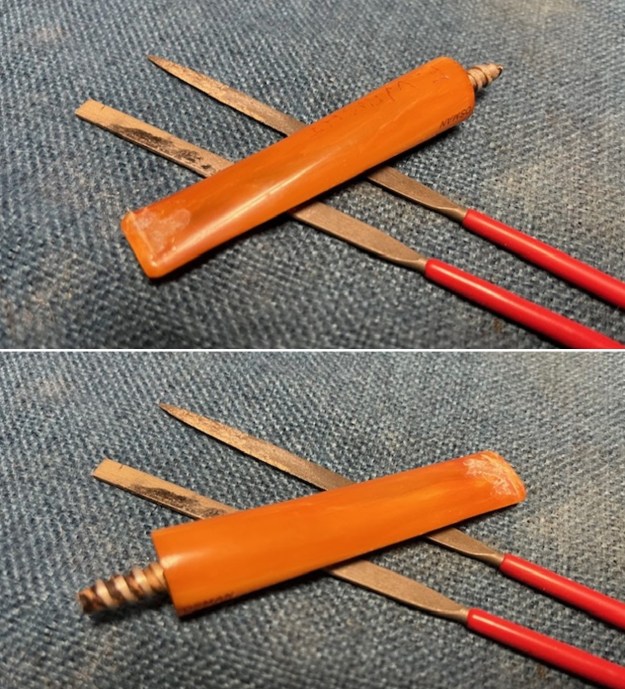
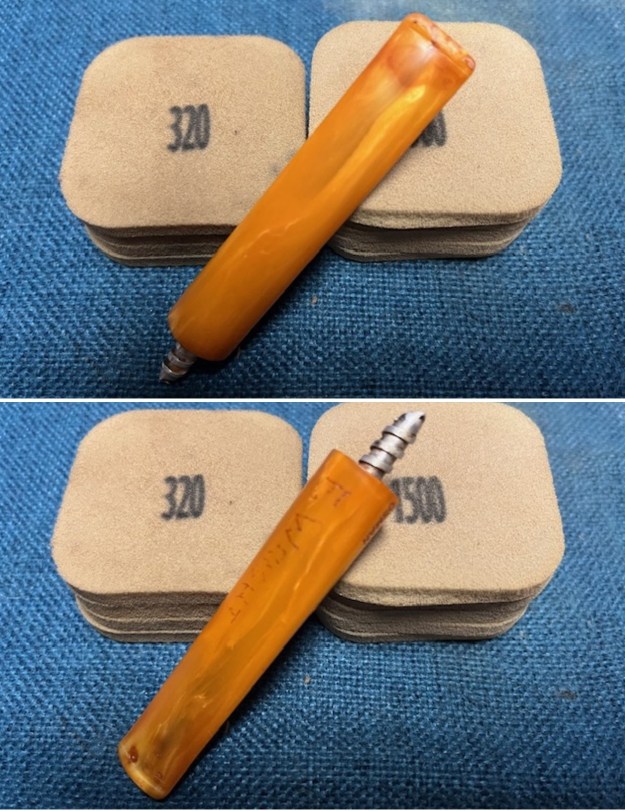
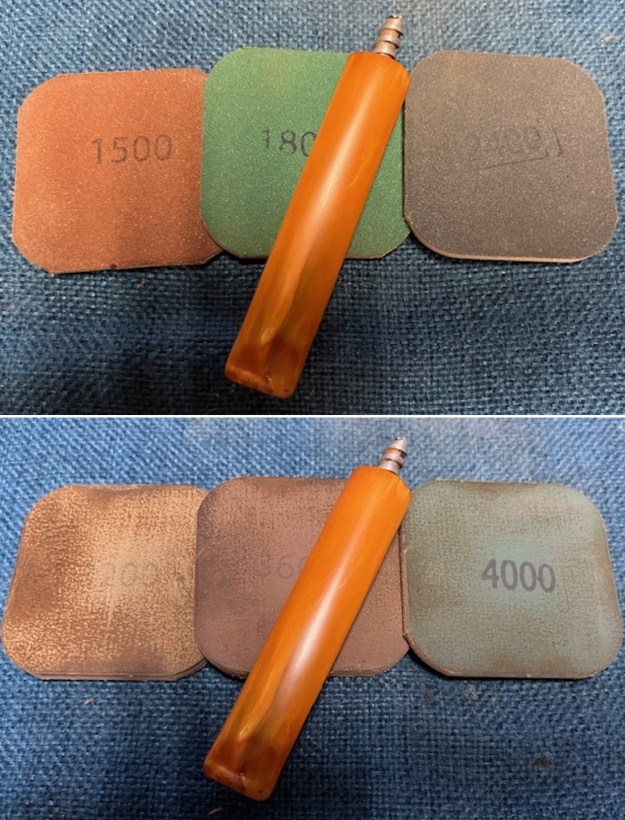
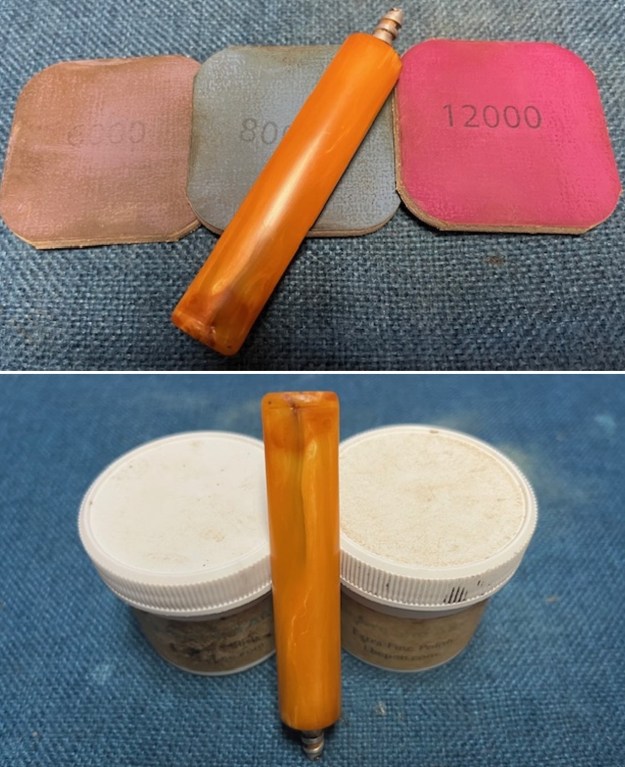
Life for a Bjarne Hand Made in Denmark rose variegated acrylic stem Freehand


by Steve Laug

This afternoon I decided to work on the pipe that Jeff picked up from a seller in Nampa, Idaho, USA on 11/09/2023. It is a beautifully grained Freehand with a Plateau rim and shank end. The right and left side of the bowl are panels with the left side fluted. The bottom is flattened and the pipe stands well on the heel. It has a fancy variegated rose coloured acrylic saddle stem. It is a beautiful grained piece of briar that I can appreciate why he chose it. The pipe is stamped on the underside of the shank and reads Bjarne [over] Handmade [over] In Denmark. The briar is dirty from use with a moderate cake in the bowl and a light overflow of lava on the bevelled inner edge and rim top filling in some of the plateau around the edge. The plateau shank end was dusty and dirty. The stem fit well against the shank end. The variegated rose coloured acrylic saddle stem had some tooth chatter and scratches on the top and underside of the stem ahead of the button. There was a Bjarne bj logo on the stem. Jeff took photos of the pipe before he started his clean up work on it. I have included them below. Jeff took photos of the rim top and the stem to show the condition of the pipe when we received it. You can see the cake in the bowl and the build up of lava and debris in the plateau of the rim top and shank end. I really is a dirty pipe. The variegated rose acrylic stem and has chatter and a few deep tooth marks on both sides near the button. He took photos of the sides of the bowl and the heel to give an idea of the shape and the condition of the briar around the bowl. It really is a nicely shaped pipe that has a great finish under the grime on the briar. The next photos Jeff took show the stamping on the underside of the shank. It is faint in spots but still readable as noted above. He also took a photo to show the stem logo. In a previous blog I had researched the brand quite a bit. I have included it in full below for information on this pipe (https://rebornpipes.com/2020/03/07/another-pipe-from-the-eastern-canada-lot-a-hand-carved-bjarne-freehand/). I quote:

I turned my favourite go to sites on background of brands. The first is Pipephil’s site (http://www.pipephil.eu/logos/en/logo-b5.html). There I looked up the Bjarne brand. I have copied the pertinent information below.

Bjarne Nielsen (1941 – † 2008) distributed his own “Bjarne” brand and pipes carved by Danish pipemakers (Mogens Johansen, Tonni Nielsen or Ph. Vigen). High grade pipes were stamped “Bjarne Nielsen” without any logo on the mouthpiece and graded A, B, C and D. Bjarne second brand: Viking.

I have included a screen capture of the section on the brand below. I turned to Pipedia and looked up the brand for a bit more information on the pipes that were stamped like the one that I am working on (https://pipedia.org/wiki/Bjarne). Toward the end of the article I found what I was looking for. I quote:

Among the pipemakers that worked for Bjarne were Johs (for the lower priced high volume pieces), and makers like Ph. Vigen, Ole Bandholm and Tonni Nielsen for high grade pieces. The cheaper line was stamped “Bjarne” while the highest grades were stamped “Bjarne Nielsen” (never with the pipemakers’ name) and graded, from highest to lowest, by the letters: AX, A, B, C, D, E, F, G, H, I, and J.

Now I knew that I was dealing with the cheaper line of pipe made by the company. It was stamped Bjarne while the higher grade pipes were stamped Bjarne Nielsen with a grade stamp.

Jeff did a great job cleaning off the debris and grime on this old. He reamed it with a PipNet reamer and smoothed the walls of the bowl with a Savinelli Fitsall pipe knife. He scrubbed out the mortise and the airway in the shank and the stem with alcohol, cotton swabs and pipe cleaners. He scrubbed the exterior of the bowl, rim and shank with a tooth brush and Murphy’s Oil Soap to the oils and tars on the bowl, rim and shank. He rinsed it under running water. He dried it off with a soft cloth. Once the grime was removed the finish underneath was in stellar condition. There is a scratch on the right side toward the top that is visible. The rich patina of the older briar was a variegated finish of smooth and plateau looked great. He scrubbed the exterior of the stem with Soft Scrub then soaked it in a bath of Briarville’s Pipe Stem Deoxidizer. He rinsed off the deoxidizer with warm water and wiped the bowl and stem down with a light coat of olive oil to rehydrate both. The pipe really was quite stunning. I took photos of the pipe to show its condition before I started my work on it. I took close up photos of the stem and the rim top to show both how clean they were. The rim top and bowl were in good condition with some darkening on the inner bevel of the bowl edge and some lightening of the grooves of the plateau rim top. The stem looked better but the deep tooth marks and chatter were still present. I would need to remove those to bring the stem back.I took a photo of the stamping on the underside of the shank. You can see from the photo that it is readable. It is clearer on the top half of the stamp than the lower but it is still readable. I removed the stem from the bowl and took a photo of the parts to give a sense of the beauty of the pipe.I started my work on this pipe by addressing the darkening on the high spots on the rim top and the bevelled bowl edge. I sanded the edge bevel with a folded piece of 220 grit sandpaper to smooth out the edge and to smooth it and to reduce the darkening. I touched up the valleys in the plateau with a black Sharpie pen. It looked better when I had finished.As I examined the exterior of the bowl before polishing it I noticed some flaws or nicks (potential small cracks) in the briar on both side of the bowl where it joined the shank. I filled them in with clear CA glue. Once cured I sanded them smooth with 220 grit sandpaper to blend them into the surface. I touched up the sanded area with a Cherry stain pen. They came out looking very good. There was also a deep scratch on the right top edge that looked like a crack but on examination I affirmed it was a scratch. I polished the briar with micromesh sanding pads – dry sanding with 1500-12000 grit pads. I wiped the bowl down after each pad with a damp cotton cloth. The briar took on a shine by the last pads. I worked some Before & After Restoration Balm into the surface of the briar with my finger tips and a horse hair shoe brush to get into the crevices of the plateau rim top and shank end. The product is incredible and the way it brings the grain to the fore is unique. It works to clean, protect and invigorate the wood. I set the bowl aside and turned my attention to the stem. I sanded tooth chatter and marks smooth with 220 grit sandpaper to blend them into the surface of the acrylic. I continued sanding the stem surface with 320-3500 grit 2×2 inch sanding pads. I wiped the stem down after each pad with a damp pad to remove the debris. By the end it was quite shiny and ready for polishing.I polished the stem with micromesh sanding pads – wet sanding it 1500-12000 pads. I wiped it down with a damp cloth after each pad to protect it and preserve it. I polished it with Before After Pipe Polish – both Fine and Extra Fine. I am really happy with the way that this Bjarne Hand Carved Freehand turned out. It really is a beautiful looking pipe with a unique shape and smooth and plateau finishes. The fancy original acrylic saddle stem is really nice. The briar really came alive with the buffing. The rich brown and black stains of the finish gave the pipe a sense of depth with the polishing and waxing. I put the stem back on the bowl and carefully buffed the pipe with Blue Diamond on the buffing wheel using a light touch on the briar. I gave the bowl and the stem multiple coats of carnauba wax on the buffing wheel. I buffed the pipe with a clean buffing pad to raise the shine. I hand buffed the pipe with a microfiber cloth to deepen the shine. The finished Bjarne Freehand really is a beauty and feels great in the hand and looks very good. Give the finished pipe a look in the photos below. The dimensions of the pipe are Length: 6 inches, Height: 2 ½ inches, Outside diameter of the bowl: 1 ½ inches long x 1 ¾ inches wide, Chamber diameter: ¾ of an inch. The weight of the pipe is 57 grams/2.01 ounces. The pipe will be going on the rebornpipes store soon. It will be in the Danish Pipe Makers Section if you would like to add it to your collection. Thanks for reading this blog and my reflections on the pipe while I worked on it. It was a fun one to work on!
Restoring a Comoy’s Tradition 203 Cutty


by Kenneth Lieblich

Oh, I really love the look of this pipe! This older Comoy’s came to me in an auction lot and, although it was filthy, I was immediately charmed by its shape. This is a beautiful cutty shape, from the Tradition line, and marked with the 203-shape number. The briar has some very attractive grain hidden away. The pipe has a nice, long shank and a nice, long, oval, vulcanite, taper stem. It has endured a hard life, but must have been well loved over the years. Many of the marks of its hardship still remain, but they are an important part of this pipe’s story. This pipe is actually a bit of a stunner, and it’s light and comfortable to hold. Let’s look at the markings. They are slightly worn, but still very readable. On the top of the shank (but towards the left side), we see Comoy’s [over] Tradition. On the top of the shank (but towards the right side), we see the circular logo showing Made [over] in [over] London. Then below the circle is the word England. Further along the shank, we see the shape number, 203. In addition, the left side of the stem has the so-called three-piece “C”. Comoy’s shape number chart lists the number 203 as being a straight cutty with an oval stem, and that describes exactly what we’ve got. I consulted with the dating guide on Pipedia to narrow down the date of this pipe. If you want to read along, please have a look at https://pipedia.org/wiki/Comoy%27s_Dating_Guide in order to see what I’m talking about. This pipe dates from the 1950s onwards and corresponds to the first variant of Comoy’s stamp during this period, which is
(1) A simple block-letter style without serifs but with the C larger than the other letters and the apostrophe before the “S”.

You can see that this matches my markings. Next, the Tradition line is also referenced in this article. It provides some further information:

Tradition. This grade was introduced in 1925 to mark 100 years of pipe making and continued in production until the 1970s. In 1965, it was priced at $20.In addition, the “Made in” stamp also corresponds to the same time period as above. The same article mentions the following:

This is again stamped in a circle with “Made” at the top, “In” in the middle, and “London” at the bottom, with “England in a straight line beneath the F/B. I believe this stamp was first used in the export drive in the early 1950s, and I have not seen any pre-WW II Comoy’s stamped in this way.

The three-piece “C” on the stem also dates from the 1950s onwards and was discontinued in the early 1980s, when Cadogan took over. So we know this pipe is before the Cadogan era. We are left with a date range of the 1950s to the 1970s. I am making an assumption that because this pipe corresponds to the first stamping variant listed in the guide, it is of an earlier part of that range. However, I have reason to make that assumption. I looked at Greg Pease’s writeup on Comoy’s and his dating information is basically the same as the Pipedia stuff above. Pease, however, adds this important tidbit:

Sometime in the 60’s, the serifs were returned to the “COMOY’S” lettering, though, as mentioned above, the typeface is not as fancy as the earlier one. It appears that some grades carried different stamps or at least that the stamping changed in different years for some grades. At this point, this is highly speculative, as my sample size is too small to verify it.

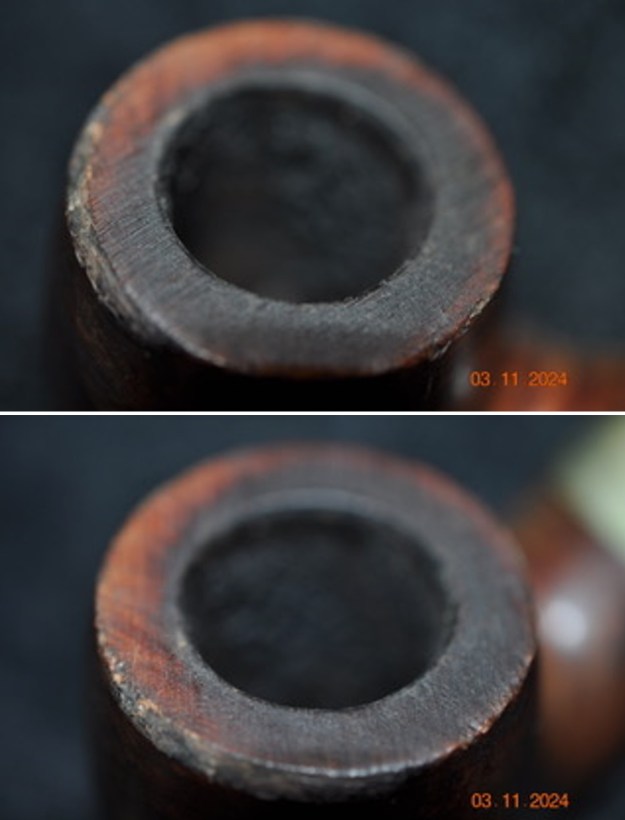
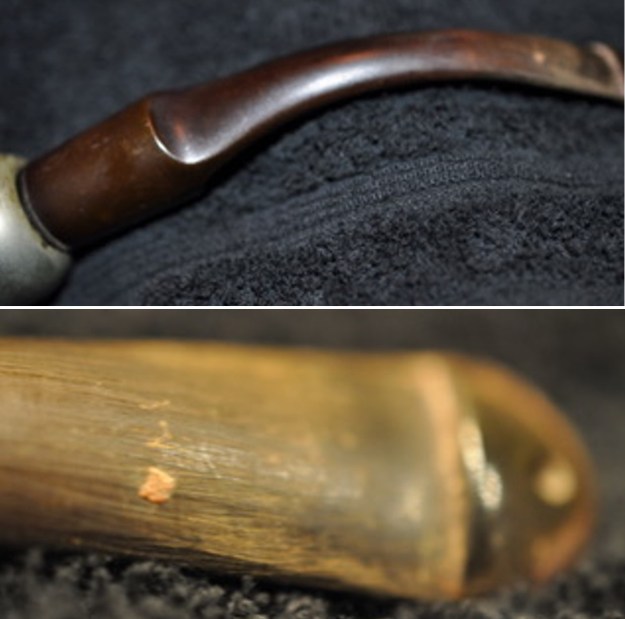
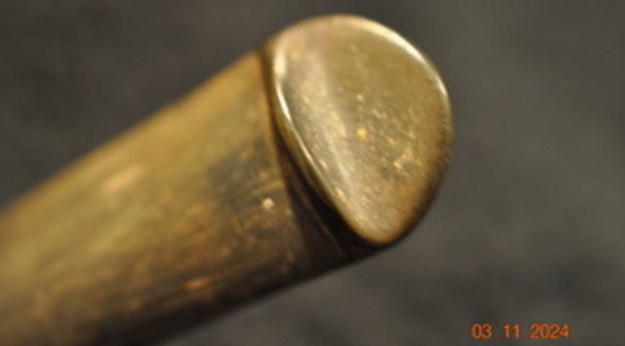
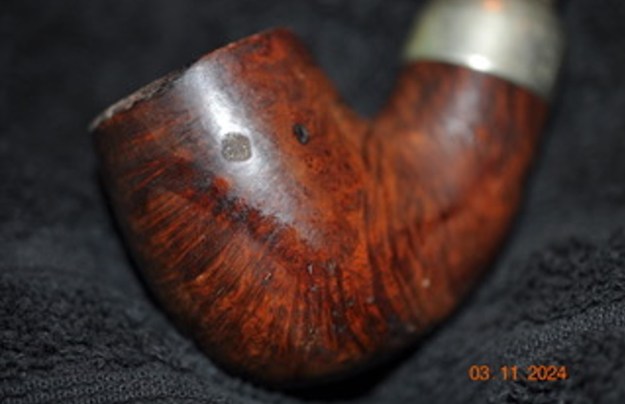
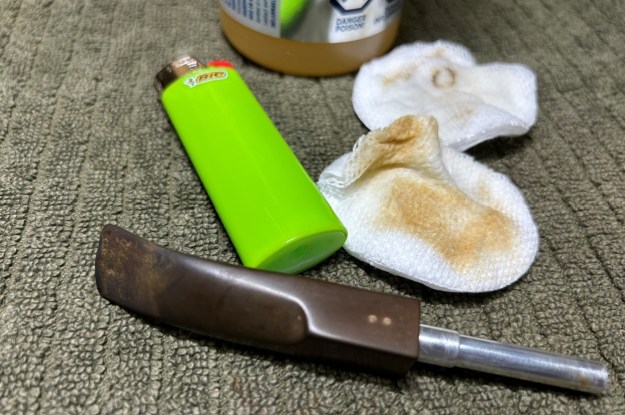
Based on this, I am going to suggest that this pipe probably (but not definitely) dates from the 1950s. If you can shed some light on this, please do so in the comments below.This was one dirty, harried pipe. The stem was thoroughly oxidized and had much calcification on it. This would take some work! There were a couple of small tooth marks, but nothing serious. The stummel was coated in grime and needed rejuvenating. The bowl was choked with cake and the rim had lava everywhere. Who knows what I would find under there? I could see that the edge of the rim had several small nicks, but nothing that disturbed my peace. Let’s get to work! I used a disposable lighter and ‘painted’ the stem with its flame. The gentle heat of the flame can cause the dents in the vulcanite of the stem to expand back into shape. In this case, next-to-nothing happened. Alas. The stem’s calcification was quite substantial. I used an old butter knife and gently scraped some of the thicker accretion off. Doing this now helps later in removing the oxidation. I used alcohol on a few cotton rounds and wiped down the stem to provide an initial cleaning of filth before moving on to the next steps.
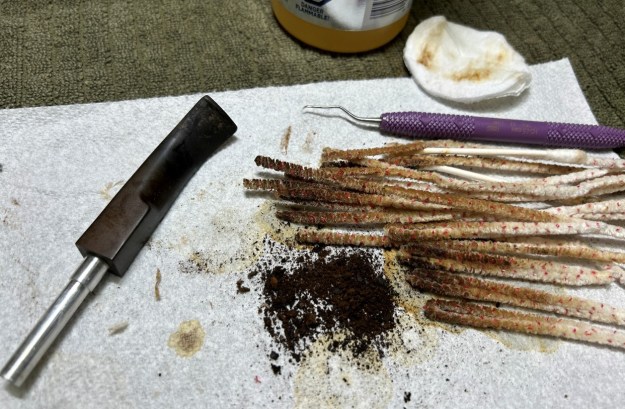
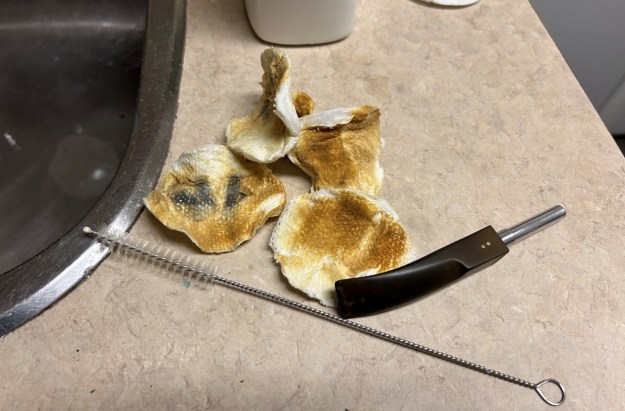
The primary cleaning came next. I disinfected the inside of the stem with both pipe cleaners and cotton swabs dipped in lemon-infused 99% isopropyl alcohol. I scrubbed thoroughly to make sure the interior was very clean. Boy, was it dirty! I used many pipe cleaners and cotton swabs.The goal of the next step is the removal (or minimization) of oxidation. Going to my sink, I used cream cleanser, cotton rounds, and a toothbrush, and scoured the stem to remove as much surface oxidation as possible. As the photos show, the result was a hideous, brownish mess – but better off the stem than on it.Once the stem was reasonably clean, I soaked it overnight in some Briarville Stem Oxidation Remover. This solution works to draw oxidation in the stem to the surface of the vulcanite. This is a major aid and an important step in ensuring a clean stem. The following day, I drew out the stem from its bath and scrubbed the lingering fluid with a toothbrush. Due to the severity of the oxidation, I then repeated the scrubbing with the cream cleanser for maximum effect.As the stem was now clean and dry, I set about fixing the marks and dents in the vulcanite. This was done by filling those divots with black cyanoacrylate adhesive, impregnated with carbon and rubber. I left this to cure and moved on.The penultimate step for the stem is sanding. First, with my set of needle files, I reduced the bulk of the cyanoacrylate repairs. I removed the excess adhesive as near to the surface as possible, without cutting into the vulcanite. Following that, I used all nine of the micromesh sanding pads (1,500 through 12,000 grit) to sand out flaws, even out the vulcanite, and provide gentle polishing of the finished surface. I also applied pipe-stem oil while using the last five micromesh pads. There was a wonderful, deep black shine to the stem when I was done.As the stem was (nearly) complete, I moved on to the stummel. The first step was to ream out the bowl – that is to say, remove all the cake inside the bowl. This accomplished a couple of things. First (and most obviously), it cleaned the bowl and provided a refurbished chamber for future smoking. Second, when the old cake was removed, I could inspect the interior walls of the bowl and determine if there was damage or not. I used a couple of reamers, a pipe knife, and a piece of sandpaper taped to a wooden dowel. Collectively, these ensured that all the debris was removed. Humorously, the cake in the bowl was so hard, that I actually got a blister on my hand from cranking the reamer.My next step was to remove the lava on the rim. For this, I took a piece of machine steel and gently scraped the lava away. The metal’s edge is sharp enough to remove what I need, but not so sharp that it damages the rim. This work revealed that there was some notably burn marks and a few more nicks. Too bad, but no problem to restore. Similar to the stem, I then cleaned the stummel with both pipe cleaners and cotton swabs dipped in lemon-infused 99% isopropyl alcohol. With a pipe this dirty, it took quite a while and much cotton to get clean. Oh, it was so filthy! The previous owner must never have heard of pipe cleaners.I then decided to ‘de-ghost’ the pipe – that is to say, exorcize the remaining filth from the briar. I filled the bowl and the shank with cotton balls, then saturated them with 99% isopropyl alcohol. I let the stummel sit overnight. This caused the remaining oils, tars and smells to leach out into the cotton.To tidy up the briar, I wiped down the outside, using a solution of a pH-neutral detergent and distilled water, with cotton rounds. This did a good job of cleaning any latent dirt on the surface of the briar. However, it also revealed a mild burn on the underside of the bowl. We’ll come back to that in a moment.The last step of the cleaning process was to scour the inside of the stummel with some detergent and tube brushes. This was the culmination of a lot of hard work in getting the pipe clean.To deal with the burn, I took some crystalized oxalic acid and dissolved it in warm water. I used some cotton swaps, dipped in the solution, and rubbed the burned spot vigorously. The weak acid works very nicely to alleviate superficial burns (burns where the integrity of the wood is still sound). The burn is quite superficial and the solution did work a bit, but the burn will remain as part of the pipe’s history.The damage to the rim was significant. In order to lessen the burns and nicks on the rim, I ‘topped’ the pipe – that is to say, I gently and evenly sanded the rim on a piece of 400-grit sandpaper. This effectively minimized the damage, without altering the look of the pipe.I used all nine micromesh pads (1,500 through 12,000 grit) to sand the outside of the stummel and finish it off. This sanding minimizes flaws in the briar and provides a beautiful smoothness to the wood. I rubbed some LBE Before & After Restoration Balm into the briar and let it sit for 30 minutes or so. The balm moisturizes the wood and gives a beautiful depth to the briar. I then buffed the stummel with a microfibre cloth. For the final step, I took the pipe to my bench polisher and carefully buffed it – first with a blue diamond compound, then with three coats of carnauba wax. This procedure makes the pipe look its best – the stummel sings and the stem glows.This Comoy’s Tradition 203 Cutty looks fantastic again and is ready to be enjoyed by its next owner. I am pleased to announce that this pipe is for sale! If you are interested in acquiring it for your collection, please have a look in the ‘British’ pipe section of the store here on Steve’s website. You can also email me directly at kenneth@knightsofthepipe.com. The approximate dimensions of the pipe are as follows: length 5⅞ in. (150 mm); height 1¾ in. (46 mm); bowl diameter 1¼ in. (32 mm); chamber diameter ¾ in. (19 mm). The weight of the pipe is 1 oz. (32 g). I hope you enjoyed reading the story of this pipe’s restoration as much as I did restoring it. If you are interested in more of my work, please follow me here on Steve’s website or send me an email. Thank you very much for reading and, as always, I welcome and encourage your comments.

Cleaning up an Italian Made Plateau Rim Top Amorelli One Star Hand Made Horn


by Steve Laug

This morning I decided to work on the pipe that Jeff picked up on Facebook Marketplace from a seller in Wellsville, Kansas, USA on 12/09/2024. It is a unique looking Horn with a plateau rim top. It is a beautiful grained piece of briar that I can appreciate why he chose it. The pipe is stamped on the left side of the and reads Amorelli [over]* On the right side of the shank it is stamped Hand Made [over] what looks like a clock stamp [over] Italy. The clock appears to read 7:05 or 20 minutes to 2. I have no idea what that means at this point in the process. The briar is dirty from use with a moderate cake in the bowl and a light overflow of lava on the rim top.  The stem fit well against the shank end. The black, acrylic saddle stem appeared to have some light tooth chatter on the top and underside of the stem ahead of the button. There was an inset gold bar logo in the top of the stem and the top of the shank.  On the shank there is a stamp next to the gold bar that reads 18Kt. The two parts line up for a straight fit to the shank. Jeff took photos of the pipe before he started his clean up work on it. I have included them below. Jeff took some close up photos of the bowl and rim top. You can see the light lava coat in the plateau top. The inner edge of the rim looks good. There is a light cake in the bowl that seems to have been recently reamed. The photos of the stem show the scratching, oxidation and tooth marks in the stem at the button. Jeff took photos of the sides of the bowl to show the interesting grain on the horn and how the shape chases it. He took photos of the stamping on the sides of the shank. It is clear and readable as noted above. I have worked on one other Amorelli recently but needed to refresh my memory about the brand. I turned first to Pipephil’s site for a short introduction to the brand and was not disappointed by what a I found (http://www.pipephil.eu/logos/en/logo-a5.html). I have included the screen capture below as well as the side bar information on the grading of the pipes.
Artisan: Salvatore Amorelli. Grading (ascending): 1 to 5 stars. 5 stars pipes may be differentiated by some golden stars: (* * * * * or * * * * *)

I turned to Pipedia to add more to what I had learned above on Pipephil about the Amorelli brand (https://pipedia.org/wiki/Amorelli). There was a short article full of information. I quote from it below.

An Amorelli pipe is recognized by an unmistakable logo: an 18k Gold bar, placed in the centre of the junction of the shank and mouthpiece, and which allows a perfect positioning. Projecting and making with a scrupulous rigour, Amorelli refers to the most exigent pipe connoisseur who will be able to recognize a very high smoking quality and prize a processing of the highest level, rich in refined details. It climaxes in a delicate process of finishing, where esteemed Brazilian bee waxes are used to feed and exalt the fibre of the wood, allowing the pipe to breathe.

25 years have passed since Totò Amorelli entered the scene with his creations, inimitable still today: busbee, frac, lyra, fish-tail, nayl, unicum, interpretaions of a new point of view and to realize a pipe. The 18k Gold logo, only Sicilian and selected briar, 5 years seasoned and interpreted piece by piece…

What will the near future hold? A new line of pipes for everyone: “La Siciliana”, together with Amorelli pipes, made from the best briar collected from Sicilian Mountains overlooking Taormina, cut, boiled and seasoned directly in the new workshop of Caltanissetta, everything overseen by Totò. 

The pipe I was working on was an Amorelli made of Sicilian Briar! It was a 1-star grade pipe which fits the great grain on this particular pipe. Now it was time to turn my attention to the pipe itself.

Jeff reamed the bowl with a PipNet pipe reamer and followed up with a Savinelli Fitsall pipe knife to remove the cake. He scrubbed out the mortise and the airway in the shank and the stem with alcohol, cotton swabs and pipe cleaners. He scrubbed the exterior of the bowl, rim, shank and stem with a tooth brush and Murphy’s Oil Soap to remove the oils and tars on the rim and the grime on the finish of the bowl of the pipe. He rinsed it off under running water. He dried it off with a soft cloth. He was able to remove most of the lava build up on the rim top of the pipe leaving a clean rim with some debris in the sandblast. I took photos of the pipe to show its condition before I started my work. I took a close up photo of the rim top to show the condition of the sandblast finish of the rim. The inner and outer edge of the bowl looks really good. The stem photos show the light tooth marks and pit on the top surface.I took photos of the stamping on the sides of the shank to capture the words if possible. It was clear and read as noted above. I removed the stem and took a photo of the parts of the pipe to give a sense of the proportion of the parts to the whole. It is a well designed and made pipe. I worked over the plateau rim top with a brass bristle wire brush to knock off the debris in the plateau valleys and clean it up.I polished the briar with micromesh sanding pads – dry sanding with 1500-12000 grit pads. I wiped the bowl down after each sanding pad to remove the sanding debris from the surface. It looked very good by the time I finished. I worked some Before & After Restoration Balm into the surface of the briar with my fingertips to clean, enliven and protect it. I let the balm sit for a little while and then buffed with a cotton cloth to raise the shine. The photos show the bowl at this point in the restoration process. With the bowl finished I set it aside and turned my attention to the stem. It was in great condition that I moved ahead and polished the stem with micromesh sanding pads – wet sanding it with 1500-2400 grit pads and dry sanding it with 3200-12000 grit pads. I wiped the stem down with Obsidian Oil after each pad. I polished it with some Before & After Pipe Polish – both Fine and Extra to deepen the shine. I wiped it down with a final coat of Obsidian Oil and set it aside to dry. This Amorelli * Hand Made Italy Horn with a Plateau Rim Top is a great looking pipe now that it has been restored. The brown stains really highlight the grain and the polished finish is stunning. The polished plateau rim top looked very good as well. I put the acrylic saddle stem back on the bowl and carefully buffed the pipe with Blue Diamond on the buffing wheel. I gave the bowl and the stem multiple coats of carnauba wax on the buffing wheel and followed that by buffing the entire pipe with a clean buffing pad. I hand buffed the pipe with a microfiber cloth to deepen the shine. The finished Amorelli * Hand Made Horn fits nicely in the hand and feels great. Give the finished pipe a look in the photos below. The dimensions of the pipe are Length: 5 ½ inches, Height: 2 ¼ inches, Outside diameter of the bowl: 1 ½ inches wide x 1 ¾ inches long, Chamber diameter: 7/8 of an inch. The weight of the pipe is 48 grams /1.66 ounces. It is a beautiful pipe. If you are interested in adding it to your rack let me know. It will be on the rebornpipes store in the Italian Pipe Makers Section. Thanks for reading this blog and my reflections on the pipe while I worked on it.

As always, I encourage your questions and comments as you read the blog. Thanks to each of you who are reading this blog. Remember we are not pipe owners; we are pipe men and women who hold our pipes in trust until they pass on into the trust of those who follow us.

Bringing Dad’s Two Pipes – Second Pipe the Medico Gold Crest Back to Life for his Daughter.


by Steve Laug

At the end of last week, I received an email from Terrica in Florida regarding some pipes that she wanted me to clean up for her. I have included her first email below:

I would like to send my deceased father’s old tobacco pipes for cleaning. I will not be using the pipes but would like to get them cleaned up so I can keep them on display.

I wrote back asking what the pipes looked like in terms of condition. I also wanted to know her general wishes on the clean up and how far she wanted me to go with it. She responded as follows and sent photos of the two pipes that I have included below.

Thank you very much for responding. As you can see, these are very inexpensive pipes. My deceased dad likely purchased them at a local drugstore. I have no doubt that they have never been cleaned.

I will never be using them, but I would at least like them presentable. Thank you very much, Terrica

I took a look at the photos and was able to discern that the top pipe was a Medico Gold Crest Pot shaped pipe that had a thick cake in the bowl and was very dirty with grime ground into the finish. The stem, other than being very dirty did not have deep tooth marks. There was tooth chatter and grime on the vulcanite filter stem that would need to be cleaned up and removed. The second pipe was stamped Venturi and was made out of a resin that was used in The Pipe, The Smoke and the Venturi. This was a bent Billiard. It was dirty and had a cake in the bowl. The stem was also very dirty and had some tooth chatter on the surface.I chose to work on the Medico Gold Crest next. The finish was dirty and there were nicks around the outer edge of the rim top. The inwardly bevelled rim top was very dirty with a thick lava build up and there was a thick cake in the bowl. The stamping on the left side of the shank was clear but had a lot of dust in the stamping. It read as noted above – Medico [over] Gold Crest [over] Imported Briar. On the right side of the shank it is stamped 149 (shape number). There is a 14K gold plated band on the shank that is stamped Medico [over] 1/30 14K RGP. The “1/30 14K RGP” likely refers to the gold content of the band, indicating it is a 14K gold rolled gold plate. The stem appears to be a Medico synthetic rather than rubber but I am not sure. There surface as dirty and had some build up ahead of the button on both sides. There was some tooth chatter on both sides ahead of the button edge. The pipe smelled of the tobacco that had obviously been smoked in it. The style of the build up/cake make me think of a drug store tobacco of the style of Prince Albert or Sir Walter Raleigh. I will certainly l know more once work on the second pipe. I took photos of the pipe before I started my work on it. I took photos of the rim top and the stem to show the condition. You can see the cake in the bowl and the thick overflow of lava on the rim top. The photos of the stem show the tooth marks and chatter on the top and the underside of the stem.I took a photo of the stamping on the left side of the shank to capture it. The left side read as noted above. I removed the stem and took a photo of the parts to give a sense of the look of the pipe. I paused in the restoration to gather backgound on the brand. I turned first to Pipephil’s site to see what I could learn (http://www.pipephil.eu/logos/en/logo-medico.html). I have included a screen capture of the section on the Gold Crest. The stamping shown in the capture below is identical to the one that I am working on.From there I turned to Pipedia to see if I could gather more information on the brand as a whole and specifically the Gold Crest Line (https://pipedia.org/wiki/Medico). I quote below:

Medico was created in 1933, and is still produced by S.M. Frank. The brand is famous for its pipe filters, which were launched in the same year. Since 1966, some models have been made in Brylon, a synthetic material, and others in briar. The brand was also sold by the English company Cadogan and Oppenheimer Pipe. Symbol: M inside a shield, although early pipes, like the example bellow, had a + sign, like a Medic would have on their sleeve.

I have also included some of the advertising flyers that were on the site as well. They give a sense of the pipe’s look and feel and the old descriptions are great to read. Now it was time to turn my attention to the pipe itself. I started my work on it by reaming the bowl with a PipNet reamer. I used the first cutting head and took the cake back to bare briar. I cleaned up the reaming with a Savinelli Fitsall Pipe Knife and removed all the remnants of the cake. I scraped the rim top with the flat edge of the blade at the same time and removed most of the thick lava build up. I sanded the walls of the bowl with a piece of dowel wrapped in 220 grit sandpaper. The walls look very good at his point in the process. I cleaned out the shank, the airway and the mortise as well as the airway in the stem with alcohol, cotton swabs, hard bristle and soft bristle pipe cleaners. It was a very dirty pipe which just meant that it had really been enjoyed by the previous pipe man.I scrubbed the exterior of the bowl and shank with a tooth brush and undiluted Murphy’s Oil Soap. I scrubbed the lava on the rim top and overflow on the outside of the bowl with the soap. I rinsed the briar with warm water to remove the grime and debris of the scrubbing. It looked significantly better after the scrubbing. Once I cleaned the bowl with the soap it looked much better. I wiped the bowl down with acetone on cotton pads to remove the spotty varnish coat on the bowl and to break up the darkening on the top of the rim. I worked over the darkening on the back topside and inner edge of the bowl with 220 grit sandpaper. It took a lot of elbow grease but it was getting better with each piece of sandpaper. I sanded the briar further with 320-3500 grit 2×2 inch sanding pads. I wiped the bowl down with a damp cloth after each sanding pad. It began to look very good. I polished the briar bowl with micromesh sanding pads – dry sanding with 1500-12000 grit pads. I wiped the bowl down after each sanding pad with an olive oil cloth. By the final sanding pad the bowl had taken on a significant shine. I rubbed the bowl and shank down with Before & After Restoration Balm to deep clean the finish on the briar bowl and shank. The product works to clean, enliven and protect the briar and gives the briar a rich shine. I worked it in with my fingers to get it into the surface. I let it sit for 10 minutes then I wiped it off and buffed it with a soft cloth. The bowl began to have a rich shine. I took some photos of the bowl at this point to mark the progress in the restoration. It is a beautiful bowl. I set the clean and polished bowl aside and turned my attention to the stem. I sanded the stem smooth with 220 grit sandpaper to clean up the marks and chatter. It was smooth and all that remained was to polish it.I wiped the stem down with olive oil and sanded the surface with the 2 x 2-inch sanding pads – 320-3500 grit pads to clean up the sanding marks on the stem surface. I wiped it down after each sanding pad and by the final 3500 grit pad the stem started to really shine.I touched up the faint M shield on the left side of the stem with Rub’n Buff Antique Gold. I worked it into the stamping with a tooth pick. I buffed it off with a paper towel and wiped the stem down with some Obsidian Oil. It is faint in spots but looks very good.I polished the stem with micromesh sanding pads – dry sanding with 1500-12000 grit pads. I wiped the stem down after each sanding pad with Obsidian Oil. I gave the stem a final polish with Before & After Pipe Stem Polish both Fine and Extra Fine. I rubbed the stem with them and then gave them a final coat of Obsidian Oil. I set it aside to dry. I fit the metal tenon with a new Medico Paper Filter. Even though the pipe probably would not be smoked I thought it was important to put it together the way it was originally.I am excited to finish this Medico Gold Crest Gold Banded Pot with a saddle stem. I put the pipe back together and buffed it with Blue Diamond on the buffing wheel. I gave the bowl and stem multiple coats of carnauba wax. I buffed the pipe with a clean buffing pad to raise the shine and then by hand with a microfibre cloth to deepen it. It is fun to see what the polished bowl looks like with the polished stem. This Medico Gold Crest Pot is great looking and the pipe feels great in my hand. It is light and well balanced. Have a look at it with the photos below. The dimensions are Length: 5 ½ inches, Height: 1 ½ inches, Outside diameter of the bowl: 1 ½ inches, Chamber diameter: 7/8 of an inch. The weight of the pipe is 43 grams/1.52 ounces. This second and last of Terrica’s Dad’s pipes is a real beauty. I will be packing the pair up and sending them back to her later this week. I look forward to hearing what she thinks of both of these resurrected beauties. Both should be great memories of her late Dad.

As always, I encourage your questions and comments as you read the blog. Thanks to each of you who are reading this blog. Remember we are not pipe owners; we are pipe men and women who hold our pipes in trust until they pass on into the trust of those who follow us.

Breathing Life into an S&R Sandblast Oom Paul


by Steve Laug

Years ago, I met Steve and Roswitha of S&R pipes at the Chicago Pipe Show. I cannot even remember the year but I remember having a good conversation with them. I was not able to pick up one of their pipes at that time but I was amazed at the beauty and style of pipes that the two of them were creating in their shop, Pipes & Pleasures in Columbus, Ohio. This pipe came to us from a seller in Memphis, Tennessee, USA on 08/27/2024. Jeff took some photos of the pipe when he received it to show the general condition. I have included the photos of the S&R pipe. The sandblast finish was dirty and dusty looking. There was a moderate cake in the bowl and surprisingly no lava overflow on the rim top. The sandblast follows the grain of the bowl and shank. The stamping is very clear and shows the interlocked SR with a pipe on the left side of the shank. The sandblast is quite deep and really shows the grain and is nicely done. The saddle stem is vulcanite and oxidized. There are tooth marks and chatter on both sides of the stem ahead of the button and some scratching on the stem surface. The photos below tell the story and give a glimpse of the Oom Paul shape.Here is a close up of the bowl and rim top. You can see the light lava coat. The inner edge of the rim looks good. There is a moderate cake in the bowl that is hard and rough. The photos of the stem show the scratching, oxidation and tooth marks in the stem at the button. Jeff took photos of the sides of the bowl to show the interesting grain in the sandblast. The swirls and depths of the sandblast are intricate and quite beautiful. Jeff took a photo of the S&R logo on the left side of the shank. It is a unique interlocked S&R stamp with the pipe. It is clear and legible.I decided to take some time to review my knowledge of the brand. I turned to Pipedia and read the article that was included there (https://pipedia.org/wiki/S%26R_Pipes). I quote in full below:

Stephen and Roswitha Anderson of S&R Pipes, also known as S&R Woodcrafters, have become pipe makers renowned throughout the world as talented carvers of high-grade briar pipes. They have been featured in several trade publications and magazines such as Pipes and Tobaccos and PipeSmoker, and have several pieces on display in museums in Europe and the United States.

They are the first American pipe carvers honored with induction into the Conferee of Pipe Makers of St. Claude, France; the very place where the carving of briar pipes became a world-wide industry. Sadly, Steve passed away in March of 2009. Roswitha is still carving S&R pipes and carrying on with the shop with help from her “guys” David, Marty, and Tony.

Steve and Roswitha began carving pipes in the 1960’s. They travelled to pipe shows and arts and crafts shows throughout the country and Europe selling their pipes and built up quite an extensive loyal customer base. Eventually, it became time to offer their pipes to the retail fraternity of pipe smokers.

Pipes & Pleasures had its grand opening in a distinct red brick house on Main Street in Columbus, Ohio in 1977. The front section of the house was converted into a traditional tobacco shop selling pipe tobacco, cigars, and pipes manufactured by well known companies such as Dunhill, Charatan, and Savinelli as well as the high-grade S&R pipes that Steve and Roswitha carved. A workshop was set up in the back section of the house.

When the cigar boom hit in the ’90’s, the shop was expanded by building a large computer controlled walk-in humidor. It’s no secret throughout the country that Pipes & Pleasures has the best maintained cigars in the Columbus area as well as the best selection of premium cigars available in the area including the much sought-after Davidoff line.

Soon after the boom began, Steve and Roswitha moved their pipe making workshop to their farm and converted that space into a large smoking lounge for their many customers. The lounge features comfortable easy chairs, a television set, a stereo, a library of books and magazines about every aspect of tobacciana, a chess table, and a couple of card tables. The lounge is populated daily with long-time loyal customers and newcomers to the enjoyment and relaxation of cigar and pipe smoking. It’s also the room where several cigar tastings and samplings are held every year by representatives from cigar companies such as Davidoff and La Flor Dominicana.

I captured a photo of the shop from the Pipedia article to include below. It is a great looking shop.

The Pipes & Pleasures shop, home of S&R Woodcrafters

I also turned to the Pipes & Pleasures website and copied the “About Us” section. Here is the link to the site (https://www.pipesandpleasures.biz/maintenance). I quote in part.

Pipes & Pleasures proprietors Stephen and Roswitha Anderson have become pipe makers renowned throughout the world as talented carvers of high-grade briar pipes. They have been featured in several trade publications and magazines such as Pipes and Tobaccos and PipeSmoker, and have several pieces on display in museums in Europe and the United States. They are the first American pipe carvers honored with induction into the Conferee of Pipe Makers of St. Claude, France; the very place where the carving of briar pipes became a world-wide industry.

Steve and Roswitha began carving pipes in the 1960’s. They travelled to pipe shows and arts and crafts shows throughout the country and Europe selling their pipes and built up quite an extensive loyal customer base. Eventually, it became time to offer their pipes to the retail fraternity of pipe smokers…

…Sadly, Steve passed away in March of 2009. Roswitha is still carving S&R pipes and carrying on with the shop with help from her “guys” David, Marty, and Tony, who welcome you to this website.

Jeff reamed the bowl with a PipNet pipe reamer and followed up with a Savinelli Fitsall pipe knife to remove the cake. He scrubbed out the mortise and the airway in the shank and the stem with alcohol, cotton swabs and pipe cleaners. He scrubbed the exterior of the bowl, rim, shank and stem with a tooth brush and Murphy’s Oil Soap to remove the oils and tars on the rim and the grime on the finish of the bowl of the pipe. He rinsed it off under running water. He dried it off with a soft cloth. He was able to remove most of the lava build up on the rim top of the pipe leaving a clean rim with some debris in the sandblast. I took photos of the pipe to show its condition before I started my work. I took a close up photo of the rim top to show the condition of the sandblast finish of the rim. The inner and outer edge of the bowl looks really good. The stem photos show the light tooth marks and pit on the top surface.I removed the stem and took a photo of the parts of the pipe to give a sense of the proportion of the parts to the whole. It is a well designed and crafted pipe.I worked some Before & After Restoration Balm into the surface of the briar with my fingertips to clean, enliven and protect it. I let the balm sit for a little while and then buffed with a cotton cloth to raise the shine. The photos show the bowl at this point in the restoration process. With the bowl finished I set it aside and turned my attention to the stem. I filled in the pit on the top of the stem mid stem right side and the tooth damage at the button edge on the underside of the stem with Extra Strength Rubberized Black CA glue. I set it aside to let the repairs cure for morning. After work today I smoothed out the fills with a folded piece of 220 grit sandpaper to blend them into the surface. I sanded the stem surface further with 320-3500 grit sanding pads to finish smoothing out the repairs and removing residual oxidation. I wiped the stem down after each pad with a cloth impregnated with Obsidian Oil. It began to look very good.I polished the stem with micromesh sanding pads – wet sanding it with 1500-2400 grit pads and dry sanding it with 3200-12000 grit pads. I wiped the stem down with Obsidian Oil after each pad. I polished it with some Before & After Pipe Polish – both Fine and Extra to deepen the shine. I wiped it down with a final coat of Obsidian Oil and set it aside to dry. This S&R Sandblast Oom Paul is a beauty. It is a stunning example of Steve & Roswitha’s craft – the sandblast finish and the dark stain is very well done. I polished the stem with Blue Diamond polish on the buffing wheel. I gave the bowl multiple coats of Conservator’s Wax and the stem multiple coats of carnauba wax. I buffed the pipe with a clean buffing pad to raise the shine. I hand buffed it with a microfiber cloth to deepen the shine. The pipe polished up pretty nicely. The contrasting finishes came alive with the buffing. The rich, contrasting dark stain work well with the polished black vulcanite stem. The finished pipe is a beauty and feels great in the hand. Have a look at it with the photos below. The dimensions are Length: 5 inches, Height: 2 inches, Outside diameter of the bowl: 1 inch, Chamber diameter: ¾ of an inch. The weight of the pipe is 47 grams/1.66 ounces. I will be putting this beautiful S&R Oom Paul on the rebornpipes online store soon. It may well the kind of unique pipe you have been looking for so have a look. Thanks for walking through the restoration of this pipe with me. It was a fun one to work on.

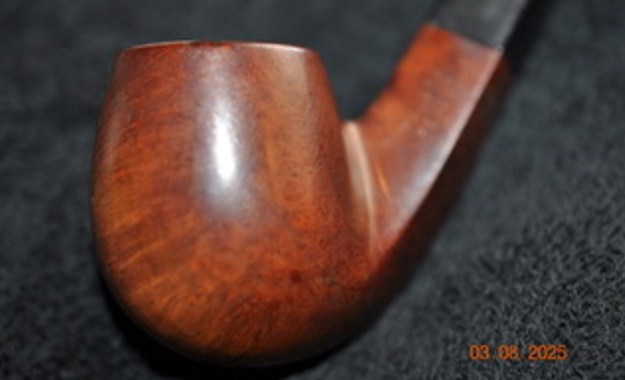
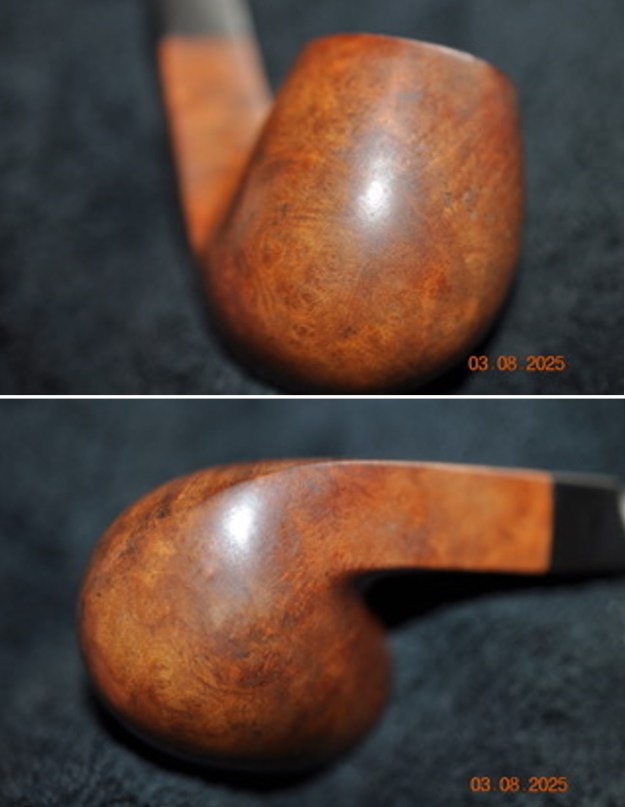
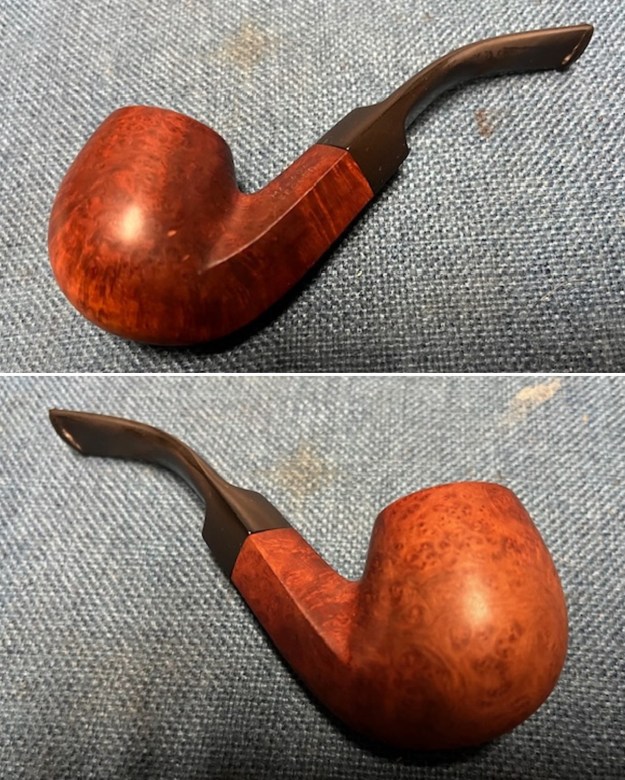
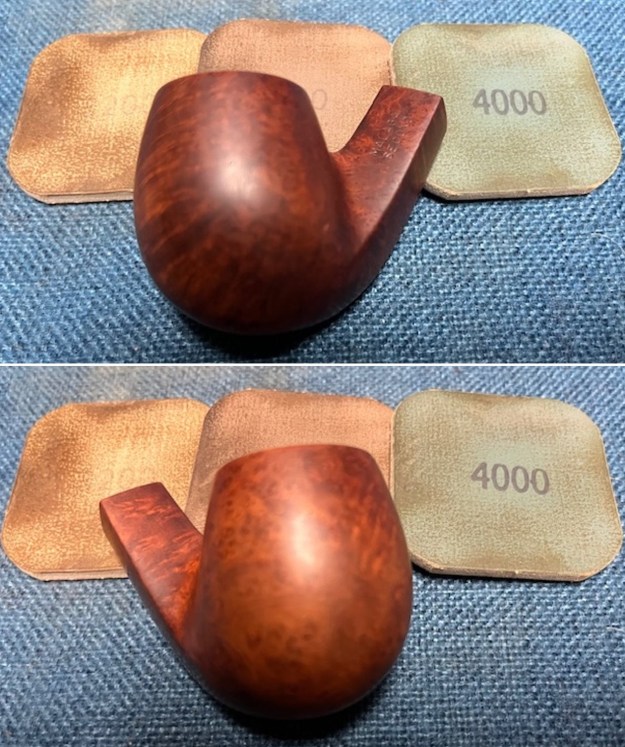
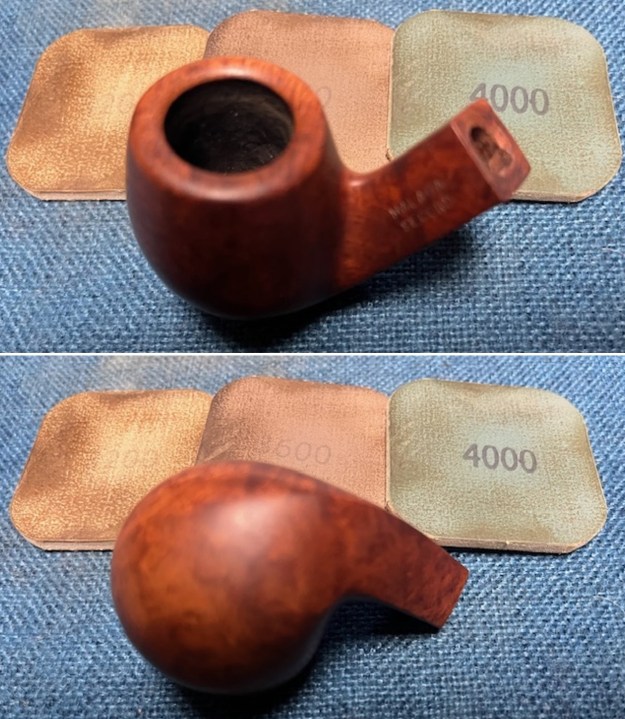
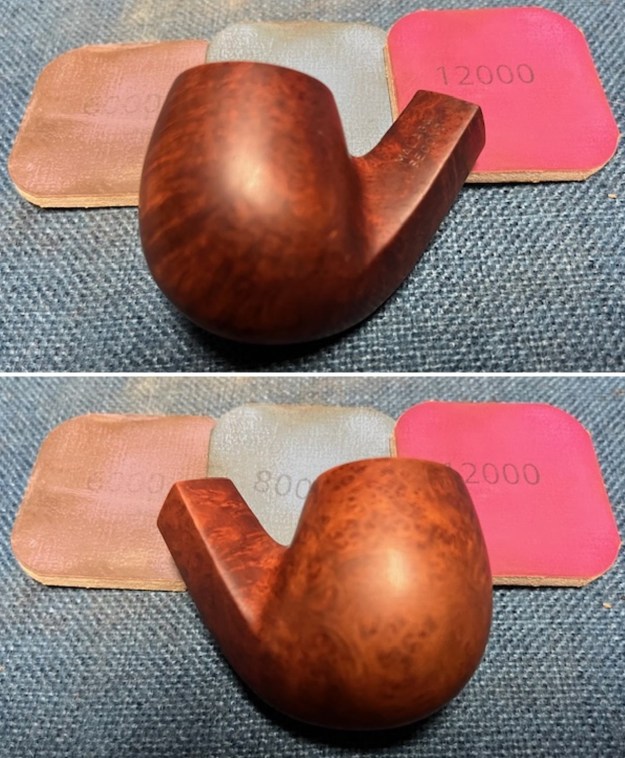
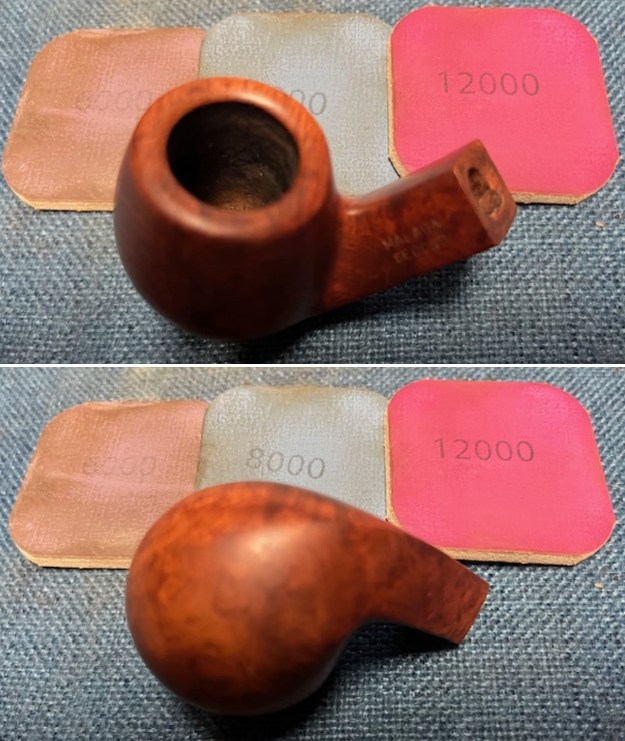
Breathing new life into another Beautiful “Malaga” M-2 Acorn


by Steve Laug

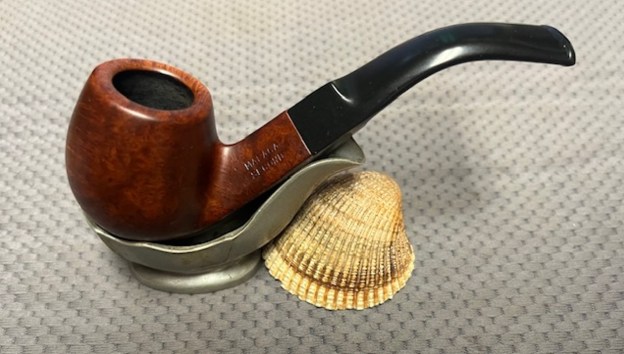
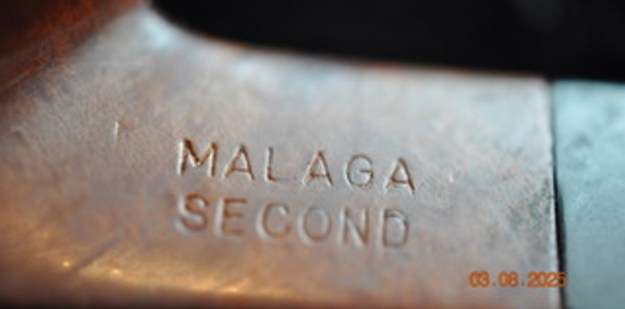
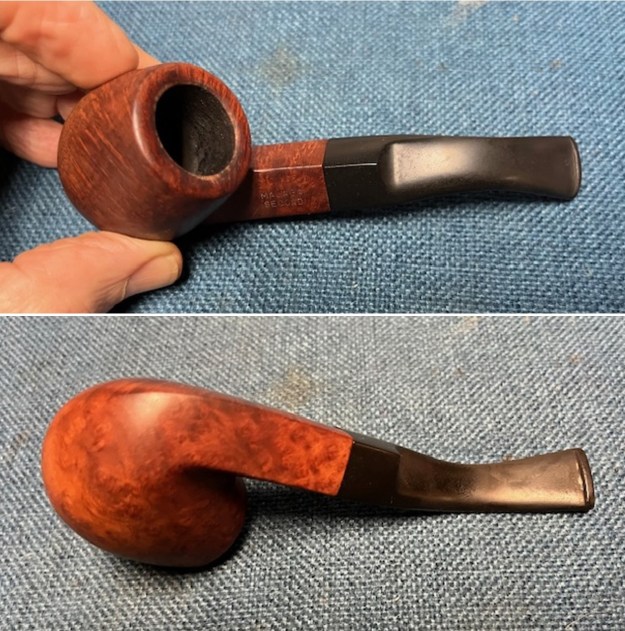
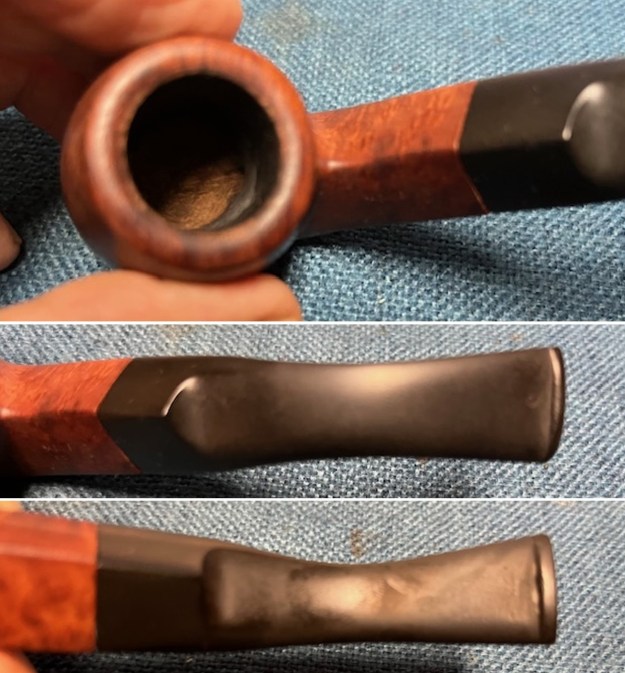
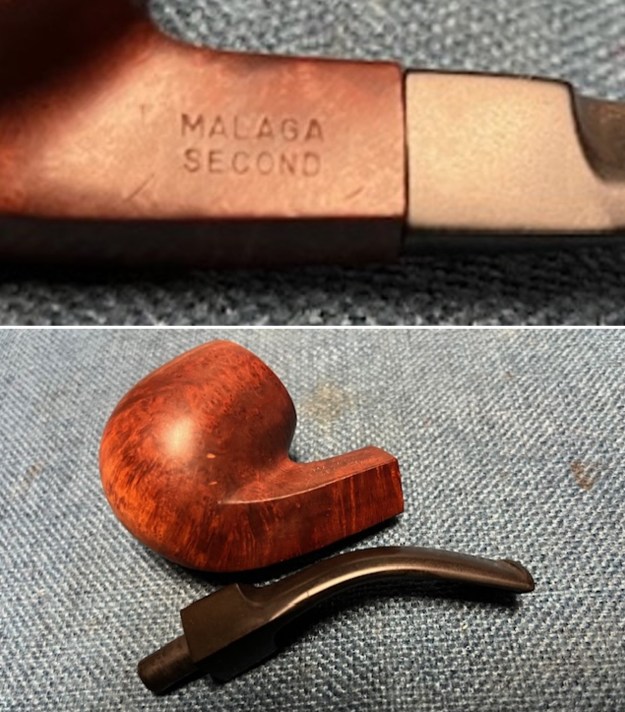
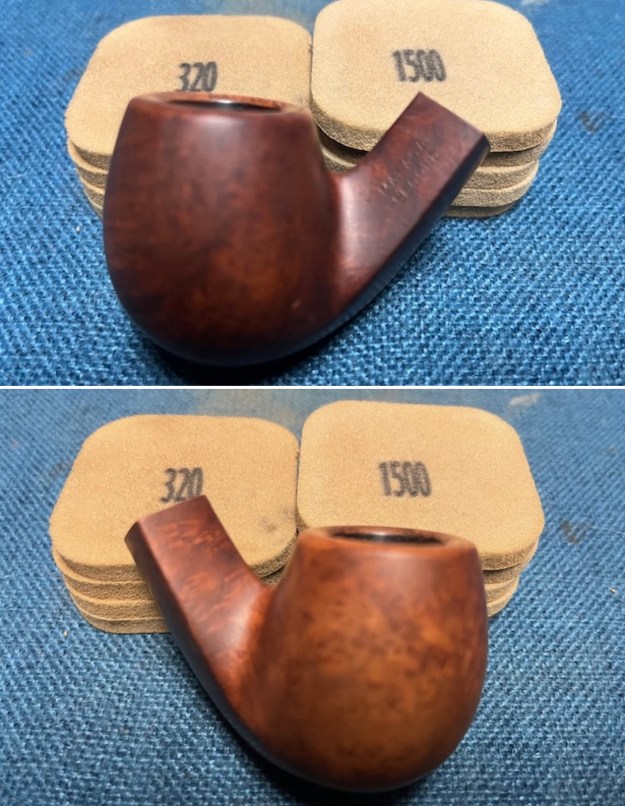
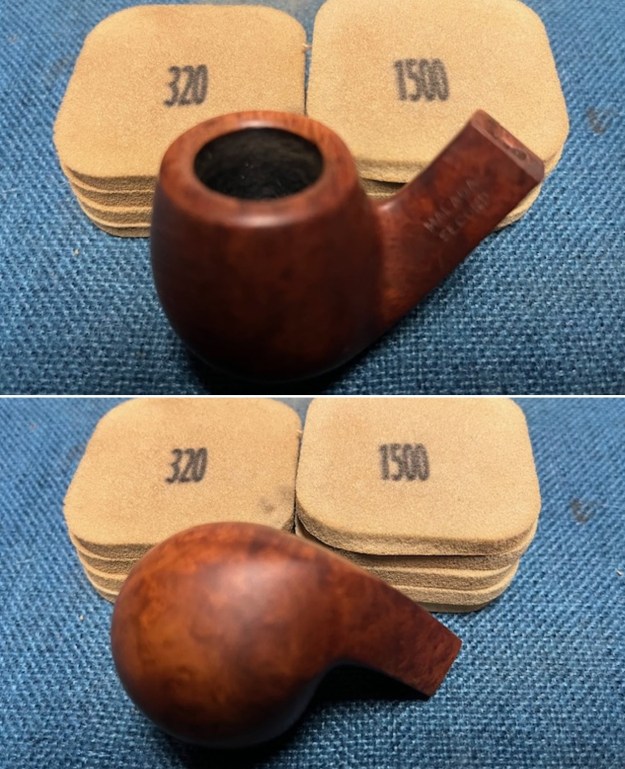
The “Malaga” Bent Acorn is next pipe on the table. We purchased it off eBay on 09/16/24 from a seller in Center Line, Michigan, USA. The carver did a great job of shaping the pipe to follow the grain on the briar. The acorn shaped bowl, round shank and quarter Bent tapered stem look very good. The bowl had a moderate cake that overflowed with a spotty lava coat on the rim and edges look good. The sides of the bowl and shank are very dirty with grime and oils from prolonged use. The grain around the bowl and shank appeared to be very nice mixed grain under the grime on the briar. The stamping on the left side of the shank read “MALAGA”. On the top of the shank just ahead of the stem junction it is stamped M-2. The stem had light tooth marks and chatter on the top and the underside of the stem ahead of the button. There was some light oxidation on the stem surface. Jeff took these photos before he started the cleanup work on the pipe.Jeff took close up photos of the bowl and rim to capture the condition of the pipe before he started his cleanup work. The rim top had thick lava overflow. The outer edge looked to be in decent condition. The stem is oxidized, calcified and has tooth marks and chatter on both sides. He also took a photo of the side and bottom of the bowl and shank to show the beautiful grain around the bowl. The photos show the general condition of the bowl and dirt and wear on the rich oil finish. You can also see the flaws in the briar which explains the M-2, or second designation. It is very dirty but this is another beautiful pipe. Jeff took a photo to capture the stamping on the left and top side of the shank. The photo shows the stamping “MALAGA” on the left side and M-2 on the top side of the shank. The stamping is very readable under the heavy grime.Before I started working on the pipe itself I went back and reread what I had found when I had worked on many of the Malaga pipes that had come across my work table. I am including a few pieces of information that I have gathered in the process.

For those of you reading this blog who are unfamiliar with the brand, I am including the link to a previous blog that I wrote. It gives some of the history of the Malaga brand and the Malaga Pipe Shop in Royal Oak, Michigan in the USA. Here is the link – https://rebornpipes.com/tag/malaga-pipes/.

I have also included a link to a catalogue and the history of the pipemaker George Khoubesser. If you are interested to learn more, then I invite you to follow the link to get a feel for the brand and the pipemaker.

George Khoubesser (picture to the left) started Malaga Briar Pipe Company and located it in Royal Oak, Michigan in the USA in 1939. It closed its doors for the last time in 1999 after 60 years in business. I have an old Malaga Catalogue that I scanned and put on the blog (https://rebornpipes.com/2013/02/09/george-khoubesser-and-malaga-pipes/). The catalogue describes the manufacture of the pipes as follows:

Painstaking caution is exercised in selecting flawless, perfect briar wood for the purpose of making and Curing of the “Malaga.” You can be certain of this fact, because none other than the choicest and finest select briarwood will withstand the “Malaga” Curing process. Other than the choicest quality and grain, will split wide open in the Curing vats… The Curing method renders all “Malaga” pipes, light in weight… Most all “Malaga” Senior pipes are left in their natural state; except for a skillful waxing which brings out the rich beauty of the virgin grain. No artificial polishing stain, shellac or varnishes are added. Malaga closed in 1999 after 60 years in business.

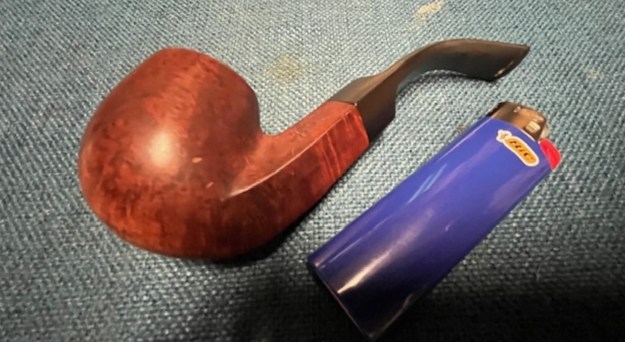
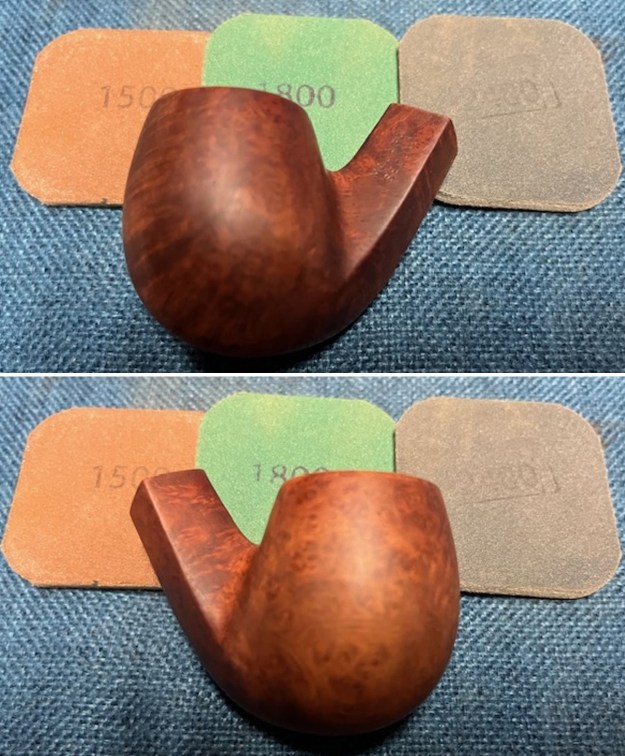
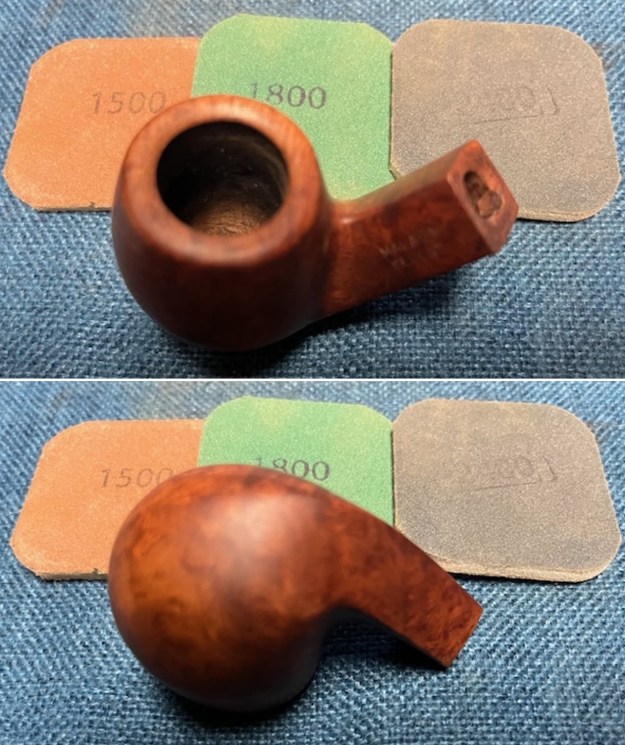
Jeff reamed the bowl with a PipNet pipe reamer and followed up with a Savinelli Fitsall pipe knife to remove the cake. He scrubbed out the mortise and the airway in the shank and the stem with alcohol, cotton swabs, shank brushes and pipe cleaners. He scrubbed the exterior of the bowl, rim, shank and stem with a tooth brush and Murphy’s Oil Soap to remove the oils and tars on the rim and the grime on the finish of the bowl. He rinsed it under running water. He dried it off with a soft cloth. He was able to remove the lava build up on the rim top and the flat surface of the rim top and the inner edge had some burn damage on the front and back side. The outer edge was rough and nicked. I took photos of the pipe to show its condition before I started my work on it. The stem also looked better. I took close up photos of the bowl and rim top as well as the stem. You can see the condition of the rim top and bowl in the first photo. Jeff was able to remove all of the tar and oils and you can that the top and the edges of the bowl look very good. The stem had light tooth marks and chatter on both sides near the button on both sides.I took a photo of the stamping on the shank to show the condition. The “MALAGA” stamp is far more clear and and readable than my blurry photos show. The M-2 stamp on the top of the shank is also more clear than the photos. I removed the stem from the shank and took a photo to give a sense of how the pipe looked. I decided to address the many poxy looking flaws in the briar first. There were no fills at all just sandpits that were all different sizes all around the bowl. The worst were on the right side followed by the front of the bowl. The right side and rim top were in excellent condition. I filled them all in with briar dust and clear CA glue. Once they cured I flattened them with a small flat file and then sanded them smooth with 220 grit sandpaper to blend them into the briar. I wiped the bowl down to remove the sanding dust with isopropyl alcohol and cotton pads. Once the repairs looked significantly better than the flaws in the briar that existed before. I sanded the bowl and rim with 320-3500 grit sanding pads to begin the process of removing the scratches and blending the restored rim top into the rest of the bowl. I wiped the bowl down after each pad with a damp cloth to remove the dust and debris. The photos tell the story. I polished the rim top and the briar with micromesh sanding pads. I dry sanded the bowl with 1500-12000 grit sanding pads. I wiped the bowl down after each pad with a damp cloth to remove the sanding dust. I worked some Before & After Restoration Balm into the surface of the briar with my fingertips to clean, enliven and protect it. I let the balm sit for a little while and then buffed with a cotton cloth to raise the shine. The following photos show the bowl at this point in the restoration process. I am very happy with the results. I set the bowl aside and “painted” the stem surface with the flame and was able to lift the tooth marks significantly. I filled in the ones that remained with black extra strength CA glue. I set it aside to cure. Once it cured I flattened the repair with a small file and then sanded it smooth with 220 grit sandpaper. It began to look much better. I turned to the stem to address the issues on the surface of both sides at the button. I sanded the stem with 320-3500 grit sanding pads. I wiped the stem down with an Obsidian Oil cloth after each sanding pad. I think I finally beat the oxidation.I polished the stem with micromesh sanding pads – wet sanding with 1500-12000 grit sanding pads. I wiped it down after each sanding pad Obsidian Oil. I finished by polishing it with Before & After Pipe Stem Polish both fine and extra Fine and then wiped it down with a final coat of Obsidian Oil. This is a beautiful Malaga M-2 Bent Acorn with a vulcanite tapered stem. It has a great look and feel. The shape of the bowl, the rim top and the cut of the briar work well to highlight the grain around the bowl sides. I polished stem and the bowl with Blue Diamond polish on the buffing wheel. I gave the bowl and the stem multiple coats of carnauba wax. I buffed the pipe with a clean buffing pad to raise the shine. I hand buffed it with a microfiber cloth to deepen the shine. The pipe polished up pretty nicely. The grain took on life with the buffing. The rich oil cured colour works well with the polished vulcanite stem. The finished Malaga M-2 Acorn has a rich look that is quite catching. The repaired flaws look better and are smooth. Have a look at it with the photos below. The shape, finish and flow of the pipe and stem are very well done. The dimensions are Length: 5 ½ inches, Height: 1 ¾ inches, Outside diameter of the bowl: 1 1/8 inches, Chamber diameter: ¾ of an inch. The weight of the pipe is 1.23 ounces/35 grams. It is a beautiful pipe. I will be putting it on the rebornpipes store shortly in the American Pipemakers Section if you are interested in adding it to your collection. Thanks for walking with me through the restoration.

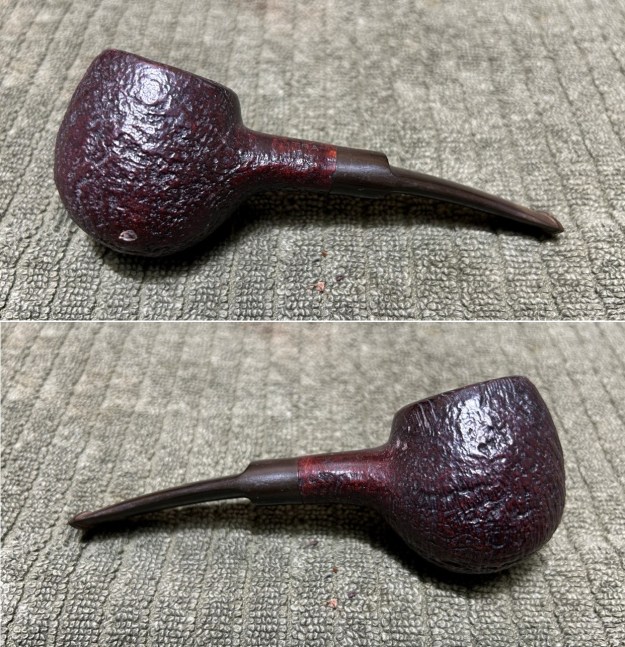
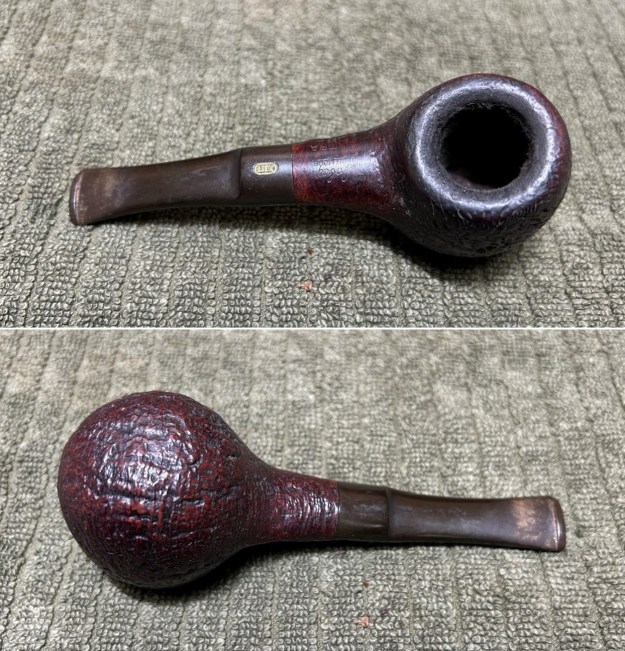
Bringing a Ben Wade 53 Skater Back from the Brink


by Kenneth Lieblich

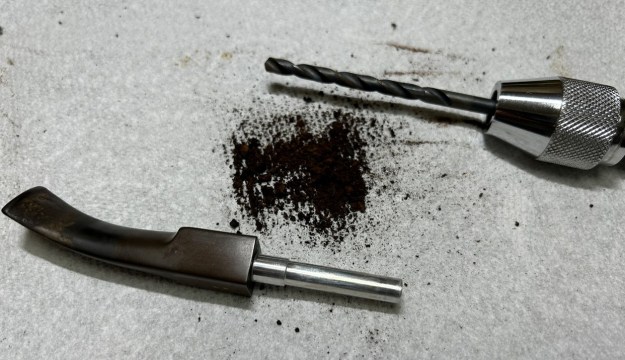
I’ve had this pipe in my stash for a long time, and I don’t really remember acquiring it. I always thought it was a neat shape and just required the right moment for restoration. Well, the pipe found its way back into my hand and the time for restoration has come. This is a Ben Wade Standard 53 skater and it has seen better days. The pipe is worn, dirty, and tired-looking. There is some stunning grain under the grime and it holds a real charm. I’m sure you will be charmed! Here are the markings on the pipe. On the left side of the shank, we see Ben Wade [over] Standard [over] London England. On the right side, we see the shape number 53. Meanwhile, on the top of the stem, we see the words Ben [over] Wade. Doing some elementary research and comparing styles of nomenclature, this pipe looks to me as though it could be from the ‘post-family, pre-Lane’ era of Ben Wade, but I am not sure. Based on what Steve told me, it also seems possible that this Ben Wade comes from the Charatan era. The skater was a well-known Charatan shape. I suppose that shape number 53 is probably a Ben Wade number, rather than a Charatan one. I am, naturally, inclined to trust Steve’s judgment over my own on this.Pipedia has a good write-up on Ben Wade and I encourage you to read it here. This is a little snippet of the article:

Ben Wade is one of the great names in English pipe making. As Richard Carleton Hacker noticed correctly Ben Wade, like many British pipe companies, has had a checkered history. Very checkered in this case. The company was founded by Benjamin Wade in 1860 in Leeds, Yorkshire, where it was located for over a century. Ben Wade started as a pipe trader, but yet in the 1860’s he established a workshop to produce briar pipes. The pipes were made in very many standard shapes – always extensively classic and “very British”. Many models tended to be of smaller dimensions. Ben Wade offered a very high standard of craftsmanship and quality without any fills. Thus the pipes were considered to be high grade and a major competitor to other famous English brands. The often heard comparison to Charatan seems to be a little bit inadequate because those days’ Charatans were entirely handmade.Let’s examine the condition. First and foremost, this pipe is really dirty. There’s lots of filth matted everywhere – especially the rim. There wasn’t much damage to the briar to be seen initially – although that would change once cleaning began. Having said that, there were a few small nicks in the briar. The smoking chamber had plenty of cake and looked like it would take some hard work to clean up. The stem was coated in oxidation and calcification. It was very dirty too and had a few tooth dents. In short, I had my work cut out for me. The stem’s calcification was quite substantial. I used an old butter knife and gently scraped some of the thicker accretion off. Doing this now helps later in removing the oxidation. I then used alcohol on a few cotton rounds and wiped down the stem to provide an initial cleaning of filth before moving on to the next steps. The primary cleaning came next. I disinfected the inside of the stem with both pipe cleaners and cotton swabs dipped in lemon-infused 99% isopropyl alcohol. I scrubbed thoroughly to make sure the interior was very clean. This stem is so dirty. I used a LOT of pipe cleaners and cotton swabs.The goal of the next step is the removal (or minimization) of oxidation. Going to my sink, I used cream cleanser, cotton rounds, and a toothbrush, and scoured the stem to remove as much surface oxidation as possible. As the photos show, the result was a hideous, brownish mess – but better off the stem than on it.Once the stem was reasonably clean, I soaked it overnight in some Briarville Stem Oxidation Remover. This solution works to draw oxidation in the stem to the surface of the vulcanite. This is a major aid and an important step in ensuring a clean stem. The following day, I drew out the stem from its bath and scrubbed the lingering fluid with a toothbrush. Due to the severity of the oxidation, I then repeated the scrubbing with the cream cleanser for maximum effect.As the stem was now clean and dry, I set about fixing the marks and dents in the vulcanite. This was done by filling those divots with black cyanoacrylate adhesive, impregnated with carbon and rubber. I left this to cure and moved on. After this, I painted the logo on the stem with some enamel nail polish. I restored the logo carefully and let it fully set before proceeding.The penultimate step for the stem is sanding. First, with my set of needle files, I reduced the bulk of the cyanoacrylate repairs. I removed the excess adhesive as near to the surface as possible, without cutting into the vulcanite. Following that, I used all nine of the micromesh sanding pads (1,500 through 12,000 grit) to sand out flaws, even out the vulcanite, and provide gentle polishing of the finished surface. I also applied pipe-stem oil while using the last five micromesh pads. There was a wonderful, deep black shine to the stem when I was done.As the stem was (nearly) complete, I moved on to the stummel. The first step was to ream out the bowl – that is to say, remove all the cake inside the bowl. This accomplished a couple of things. First (and most obviously), it cleaned the bowl and provided a refurbished chamber for future smoking. Second, when the old cake was removed, I could inspect the interior walls of the bowl and determine if there was damage or not. I used a reamer, a pipe knife, and a piece of sandpaper taped to a wooden dowel. Collectively, these ensured that all the debris was removed.My next step was to remove the lava on the rim. For this, I took a piece of machine steel and gently scraped the lava away. The metal’s edge is sharp enough to remove what I need, but not so sharp that it damages the rim. This work revealed some serious damage to the rim. It was badly scraped and I would need to address that.The inside of the stummel needed to be cleaned thoroughly. However, this pipe was so clogged, that I first needed to open the horribly occluded airway. So, I took a long drill bit and hand-cranked it to dislodge the dreadful detritus inside. Hand cranking is essential because it provides a precision and caution that a power drill cannot provide. Similar to the stem, I then cleaned the stummel with both pipe cleaners and cotton swabs dipped in lemon-infused 99% isopropyl alcohol. This stummel was sooooo dirty. It took ages and much cotton to get clean – much more than is shown in the photo.I then decided to ‘de-ghost’ the pipe – that is to say, exorcize the remaining filth from the briar. I filled the bowl and the shank with cotton balls, then saturated them with 99% isopropyl alcohol. I let the stummel sit overnight. This caused the remaining oils, tars and smells to leach out into the cotton.To tidy up the briar, I also wiped down the outside with some oil soap on cotton rounds. This did a good job of cleaning any latent dirt on the surface of the briar. The last step of the cleaning process was to scour the inside of the stummel with some soap and tube brushes. This was the culmination of a lot of hard work in getting the pipe clean.Having completed that, I was able to address the nicks on the bowl. I dug out my iron and a damp cotton flannel cloth. By laying the cloth over the affected areas and applying the iron to it, the hot and moist steam can cause the wood to swell slightly and return to shape. There was some improvement – not a lot, but it was better than doing nothing. The damage to the rim was significant. In order to lessen the scrapes on the rim, I ‘topped’ the pipe – that is to say, I gently and evenly sanded the rim on a piece of 220-grit sandpaper. This effectively minimized the damage, without altering the look of the pipe. Some damage will always remain and that is fine – it’s part of this pipe’s history. I used all nine micromesh pads (1,500 through 12,000 grit) to sand the outside of the stummel and finish it off. This sanding minimizes flaws in the briar and provides a beautiful smoothness to the wood. I rubbed some LBE Before & After Restoration Balm into the briar and let it sit for 30 minutes or so. The balm moisturizes the wood and gives a beautiful depth to the briar. I then buffed the stummel with a microfibre cloth. For the final step, I took the pipe to my bench polisher and carefully buffed it – first with a blue diamond compound, then with three coats of carnauba wax. This procedure makes the pipe look its best – the stummel sings and the stem glows.This Ben Wade Standard 53 skater looks fantastic again and is ready to be enjoyed by its next owner. I am pleased to announce that this pipe is for sale! If you are interested in acquiring it for your collection, please have a look in the ‘British’ pipe section of the store here on Steve’s website. You can also email me directly at kenneth@knightsofthepipe.com. The approximate dimensions of the pipe are as follows: length 6 in. (153 mm); height 1⅝ in. (41 mm); bowl diameter 1½ in. (39 mm); chamber diameter ⅞ in. (22 mm). The weight of the pipe is 1¼ oz. (38 g). I hope you enjoyed reading the story of this pipe’s restoration as much as I did restoring it. If you are interested in more of my work, please follow me here on Steve’s website or send me an email. Thank you very much for reading and, as always, I welcome and encourage your comments.

Breathing new life into another Beautiful “Malaga” Quarter Bent Egg


by Steve Laug

The “Malaga” Bent Egg is next pipe on the table. We purchased it off eBay on 08/22/24 from a seller in Harrison Township, Michigan, USA. The carver did a great job of shaping the pipe to follow the grain on the briar. The egg-shaped bowl, round shank and quarter Bent tapered stem look very good. The bowl had a thick cake that overflowed with thick lava onto the rim so that it was impossible to see if there was damage on the inner edges. The sides of the bowl and shank are very dirty with grime and oils from prolonged use. The grain around the bowl and shank appeared to be very nice mixed grain under the grime on the briar. The stamping on the left side of the shank read “MALAGA”. There was no other stamping on it. The stem had light tooth marks and chatter on the top and the underside of the stem ahead of the button. There was some oxidation deep in the vulcanite of the stem surface. Jeff took these photos before he started the cleanup work on the pipe.Jeff took close up photos of the bowl and rim to capture the condition of the pipe before he started his cleanup work. The rim top had thick lava overflow. The outer edge looked to be in decent condition. The stem is oxidized, calcified and has tooth marks and chatter on both sides. He also took a photo of the side and bottom of the bowl and shank to show the beautiful grain around the bowl. The photos show the general condition of the bowl and dirt and wear on the rich oil finish. It is very dirty but this is another beautiful pipe. Jeff took a photo to capture the stamping on the left side of the shank. The photo shows the stamping “MALAGA”. The stamping is very readable under the heavy grime.Before I started working on the pipe itself I went back and reread what I had found when I had worked on many of the Malaga pipes that had come across my work table. I am including a few pieces of information that I have gathered in the process.

For those of you reading this blog who are unfamiliar with the brand, I am including the link to a previous blog that I wrote. It gives some of the history of the Malaga brand and the Malaga Pipe Shop in Royal Oak, Michigan in the USA. Here is the link – https://rebornpipes.com/tag/malaga-pipes/.

I have also included a link to a catalogue and the history of the pipemaker George Khoubesser. If you are interested to learn more, then I invite you to follow the link to get a feel for the brand and the pipemaker.

George Khoubesser (picture to the left) started Malaga Briar Pipe Company and located it in Royal Oak, Michigan in the USA in 1939. It closed its doors for the last time in 1999 after 60 years in business. I have an old Malaga Catalogue that I scanned and put on the blog (https://rebornpipes.com/2013/02/09/george-khoubesser-and-malaga-pipes/). The catalogue describes the manufacture of the pipes as follows:

Painstaking caution is exercised in selecting flawless, perfect briar wood for the purpose of making and Curing of the “Malaga.” You can be certain of this fact, because none other than the choicest and finest select briarwood will withstand the “Malaga” Curing process. Other than the choicest quality and grain, will split wide open in the Curing vats… The Curing method renders all “Malaga” pipes, light in weight… Most all “Malaga” Senior pipes are left in their natural state; except for a skillful waxing which brings out the rich beauty of the virgin grain. No artificial polishing stain, shellac or varnishes are added. Malaga closed in 1999 after 60 years in business.

Jeff reamed the bowl with a PipNet pipe reamer and followed up with a Savinelli Fitsall pipe knife to remove the cake. He scrubbed out the mortise and the airway in the shank and the stem with alcohol, cotton swabs, shank brushes and pipe cleaners. He scrubbed the exterior of the bowl, rim, shank and stem with a tooth brush and Murphy’s Oil Soap to remove the oils and tars on the rim and the grime on the finish of the bowl. He rinsed it under running water. He dried it off with a soft cloth. He was able to remove the lava build up on the rim top and the flat surface of the rim top and the inner edge had some burn damage on the front and back side. The outer edge was rough and nicked. I took photos of the pipe to show its condition before I started my work on it. The stem also looked better. I took close up photos of the bowl and rim top as well as the stem. You can see the condition of the rim top and bowl in the first photo. Jeff was able to remove all of the tar and oils but you can now see the damage on the top and the edges of the bowl. The top of the rim is rough and there is some burn damage and darkening on the inner edge on the front. The stem had light tooth marks and chatter on both sides near the button on both sides.I took a photo of the stamping on the shank to show the condition. The “MALAGA” stamp is clear and readable. I removed the stem from the shank and took a photo to give a sense of how the pipe looked. I decided to address the rim top and damaged inner edge of the bowl first. To remove the damage on the rim top and edges of the bowl sanded the top with 220 grit sandpaper. That removed a lot of the damage on the rim top and outer edge. I used a piece of 220 grit sandpaper to work on the inner edge of the rim and remove the darkening and clean up the damage.I sanded the bowl and rim with 320-3500 grit sanding pads to begin the process of removing the scratches and blending the restored rim top into the rest of the bowl. I wiped the bowl down after each pad with a damp cloth to remove the dust and debris. The photos tell the story. I polished the rim top and the briar with micromesh sanding pads. I dry sanded the bowl with 1500-12000 grit sanding pads. I wiped the bowl down after each pad with a damp cloth to remove the sanding dust. I worked some Before & After Restoration Balm into the surface of the briar with my fingertips to clean, enliven and protect it. I let the balm sit for a little while and then buffed with a cotton cloth to raise the shine. The following photos show the bowl at this point in the restoration process. I am very happy with the results. Before turning to work on the stem I decided to bend the stem to match the angels of the bowl. I “painted” it with a lighter to soften the vulcanite enough to bend it. I pressed the rim top flat against the desk top and bent the stem to the same angle. I “painted” the stem surface with the flame and was able to lift the tooth marks significantly. I filled in the ones that remained with black extra strength CA glue. I set it aside to cure. Once it cured I flattened the repair with a small file and then sanded it smooth with 220 grit sandpaper. It began to look much better. I turned to the stem to address the issues on the surface of both sides at the button. I sanded the stem with 320-3500 grit sanding pads. I wiped the stem down with an Obsidian Oil cloth after each sanding pad. I think I finally beat the oxidation.I polished the stem with micromesh sanding pads – wet sanding with 1500-12000 grit sanding pads. I wiped it down after each sanding pad Obsidian Oil. I finished by polishing it with Before & After Pipe Stem Polish both fine and extra Fine and then wiped it down with a final coat of Obsidian Oil. This is a beautiful “Malaga” Quarter Bent Egg with a vulcanite tapered stem. It has a great look and feel. The shape of the bowl, the rim top and the cut of the briar work well to highlight the grain around the bowl sides. I polished stem and the bowl with Blue Diamond polish on the buffing wheel. I gave the bowl and the stem multiple coats of carnauba wax. I buffed the pipe with a clean buffing pad to raise the shine. I hand buffed it with a microfiber cloth to deepen the shine. The pipe polished up pretty nicely. The grain took on life with the buffing. The rich oil cured colour works well with the polished vulcanite stem. The finished Malaga Quarter Bent Egg has a rich look that is quite catching. Have a look at it with the photos below. The shape, finish and flow of the pipe and stem are very well done. The dimensions are Length: 5 ½ inches, Height: 2 inches, Outside diameter of the bowl: 1 ¼ inches, Chamber diameter: ¾ of an inch. The weight of the pipe is 1.41 ounces/40 grams. It is a beautiful pipe. I will be putting it on the rebornpipes store shortly in the American Pipemakers Section if you are interested in adding it to your collection. Thanks for walking with me through the restoration.