Tag Archives: Oxidation

Refurbishing A Vintage Cased “Karoo” Gourd Calabash With Elephant Ivory Shank Extension


Blog by Paresh Deshpande

About two years back, I had worked on the only Gourd Calabash pipe that I had inherited, a 1912 William Harrison, and posted it on rebornpipes. I had smoked this pipe after it was restored and was amazed at how different the smoking characteristics of a gourd are when compared to a briar or a meerschaum pipe. Since then I was on a lookout for some good quality and condition gourd calabash estates and snagged a couple at very competitive rates. This is the first of the two gourd calabash pipes that is now on my work table.

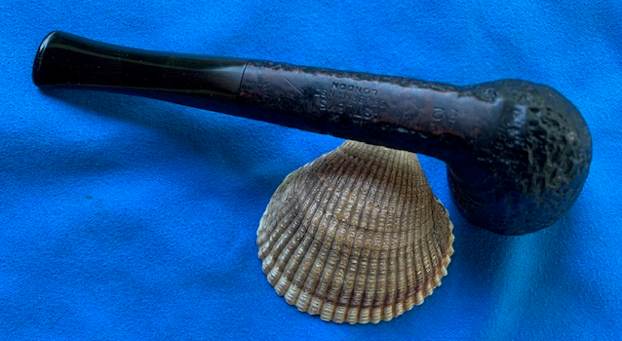
This medium sized gourd calabash came in its original case. The case and the pipe it housed are in good shape and appears to have been well looked after. There is a beautiful ivory colored band with argyle patterns at the shank end that lends it a classy high end feel. It is stamped on the left side of the gourd as “KAROO” in an oval. There is no other stamping seen on the gourd. The vulcanite stem with a threaded bone tenon is stamped on the upper surface as “LONDON” over MADE”. There are no other stampings seen on either the gourd or the stem. The only knowledge about the pipe I had was that KAROO was an arid region of South Africa where these gourds were grown. However, there was no information on the brand KAROO that was available either on Pipedia.org or pipephil.eu. I couldn’t find any information on this brand even on rebornpipes!!

I messaged Steve and shared pictures of this gourd calabash pipe with him. He sent me this link to Pipe Club of London which had information on this brand and the same is being reproduced further down in this write up. There was an interesting discussion on the band that was at the shank end. The possibilities ranged from the band being made of hardened plastic or Bakelite or bone or even African Ivory. However, it was the evenly arranged argyle patterns that made us think on the lines of the band being of some high grade and quality material. Abha, my wife, took close up pictures of the band and patterns and she got on the task of researching the material of the band on the internet. Her research conclusively proved that the band is an Elephant Ivory. Here is the link to a site that was particularly helpful in supporting her conclusions. (https://www.realorrepro.com/article/Ivory-genuine-fake–confusing).

The argyle patterns that I had been mentioning all through are, in fact, Schreger Lines and the patterns perfectly match the ones seen on the shank end band. Having confirmed that the shank extension is elephant ivory, it was time to search for the brand KAROO.

I searched the net as suggested by Steve and found this snippet of information on Pipe Club of London (http://pipecluboflondon.com/members-pipes/calabashes/karoo-calabash/) and reproduce the same information for the benefit of the larger pipe community.

Calabash gourds (“bottle gourds” – were grown on the Little Karoo River in South Africa by Boer farmers who exported them – cut & dried – to England for fitting with bowls and mouthpieces. The heyday of the calabash was 1905 to 1915 after which the briar began to steal the spotlight.

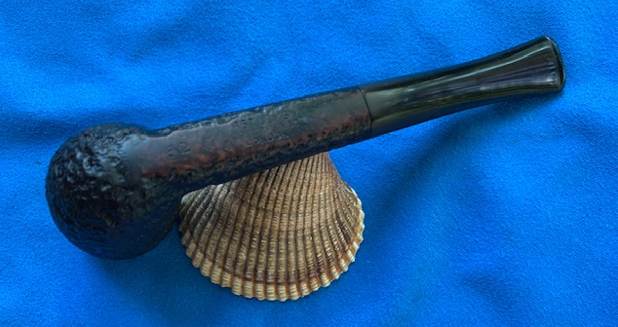
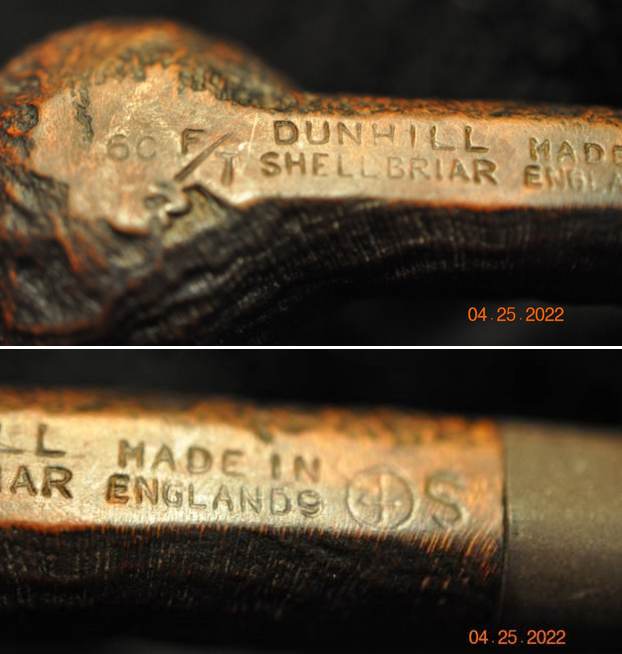
From the Johnny Long collection PCoL #UK603F – pictured on a handmade South African tapestry. Below – the Karoo brand & hallmarks.

There was no further information lead that was worth following that would establish the provenance of this pipe. All that I can say with certainty based on the threaded bone tenon, oval slot at the stem end, Elephant Ivory shank extension and the information reproduced above, this pipe has to be from the early 20th Century, maybe prior to 1920s.

This time period is just a ”guesstimation” and any input from the knowledgeable Readers on this brand and dating is most welcome.

Initial Visual Inspection
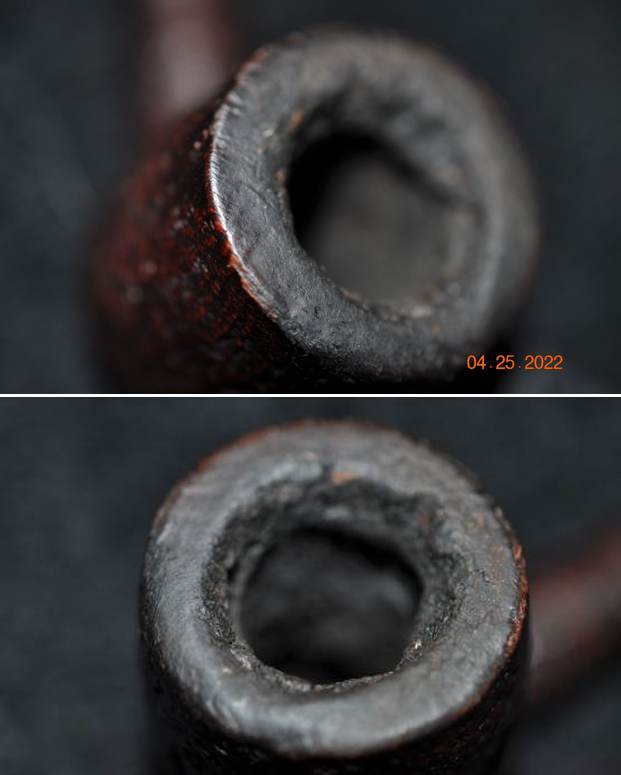
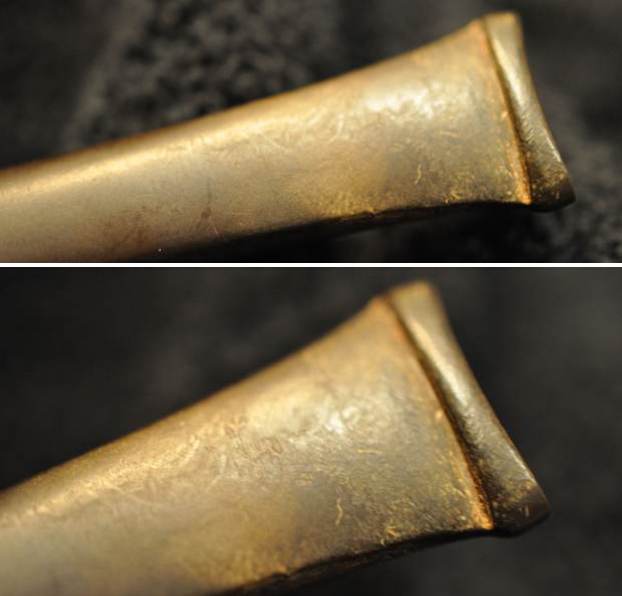
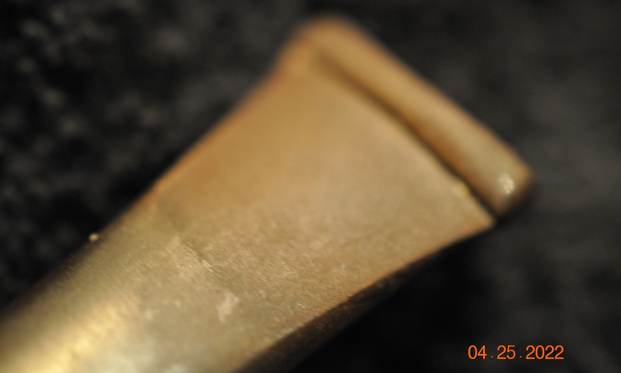
The case and the pipe appear to be well cared for. The case has functional hinges and clasp and closes with a reassuring click. The surface leather on the case is also intact and in good condition. The red velvet internal lining of the case is stained at the place where the rim and mouthpiece rests inside the pipe. There is a lot of debris in the nooks and corners of the case. The pipe sits perfectly inside the case. The gourd has taken on a dark color and its surface is dust covered and dirty. The meerschaum cup has a decent layer of even cake with a darkened rim top that has traces of lava overflow. There are a few minor superficial scratches over the meerschaum cup. The stem is oxidized, has tooth chatter/ bites marks in the bite zone and is under turned to the right. Overall, this old timer has been well looked after and is in great shape considering its perceived age. Dimensions Of The Pipe
Length: 5.6 inches

Height: 2.8 inches.

Diameter of the porcelain cup: 1.8 inches.

Diameter of the chamber: 0.9 inch.

Depth of the chamber: 1.3 inches.

Detailed Visual Inspection
I first dismantled the pipe in to its various components; the Gourd, the meerschaum cup and the threaded bone tenon stem. Here are a couple of pictures.

The meerschaum cup is medium sized and has a moderate layer of even cake. The inner rim edge has a thin layer of lava overflow on an otherwise clean rim top surface. There are minor scratches over the rim surface which will be addressed when the meerschaum cup is cleaned and polished. There are no breakages or chipped surfaces or cracks in the cup which is a big relief. The draught hole at the center bottom of the cup is clogged with oils/ tars and gunk. The outer surface of the cup is covered in dried oils, tars and gunk and towards the rim top; there are traces of cork lining which has stuck to the cup (this is actually mysterious!) at the base of the rim. The gourd surface has colored beautiful and it will be my endeavor to preserve the patina that has developed on the surface due to smoking. The surface is covered in old oils, tars, grime and dirt from all these years. There is no damage to the gourd surface and that’s a big relief. This piece of gourd will look stunningly beautiful and rich once it has been cleaned and polished. The meerschaum bowl is held in place inside the gourd with a cork gasket. This cork gasket was dry with a thin outer surface layer stuck to the meerschaum. This is not a major issue as the bowl still sits firmly in the gourd. The inside of the gourd has depositions of oils and tars and ash and would benefit from a thorough cleaning. The ivory shank extension has yellowed a fraction but is sans any damage. The full bent tapered vulcanite stem is oxidized with tooth chatter on either surface in the bite zone. The threaded long bone tenon is covered in grime and oils and could be a contributing factor for the misaligned seating of the stem in to the shank. The oval opening of the slot and the tenon opening is constricted due to accumulation of old and dried oils/ tars. The Process
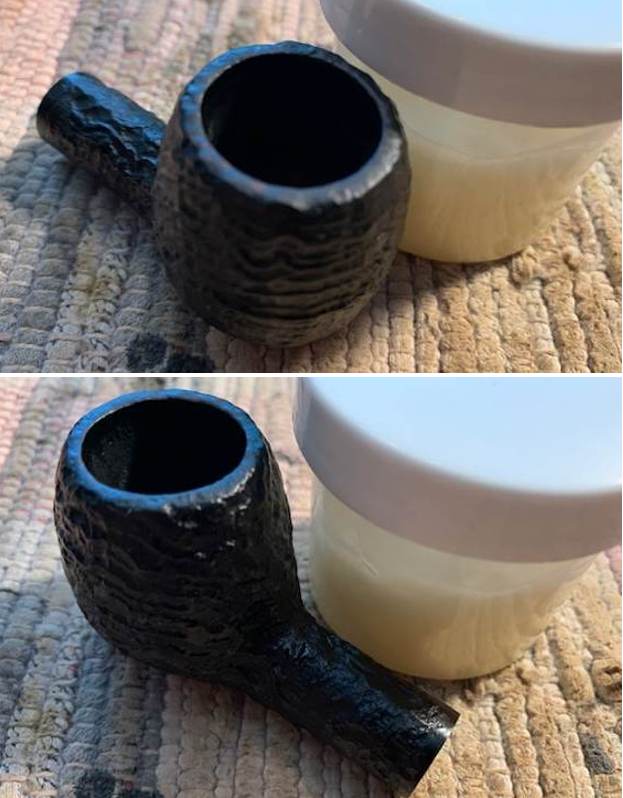
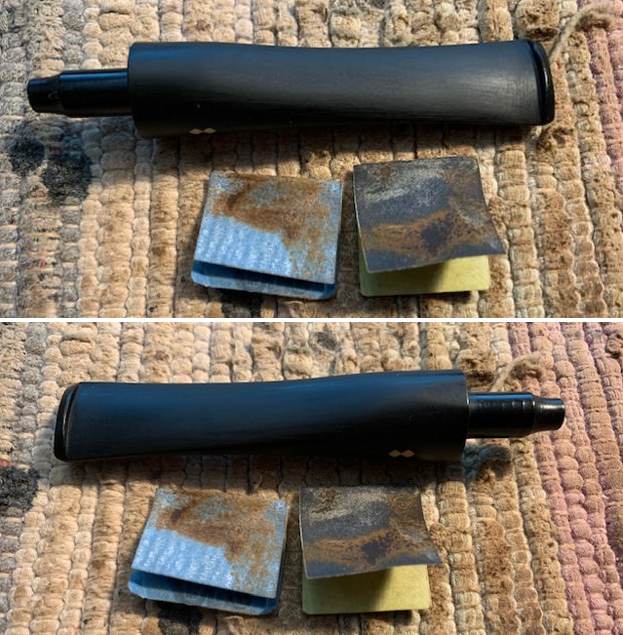
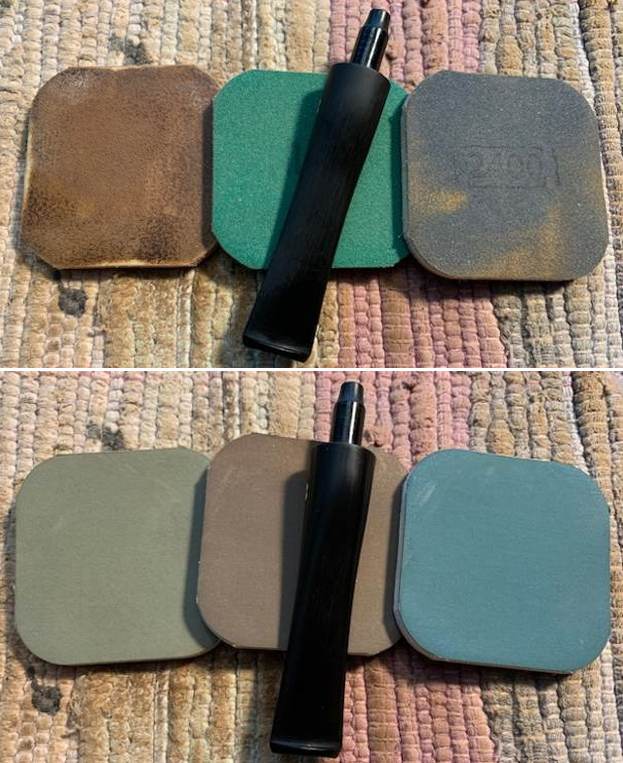
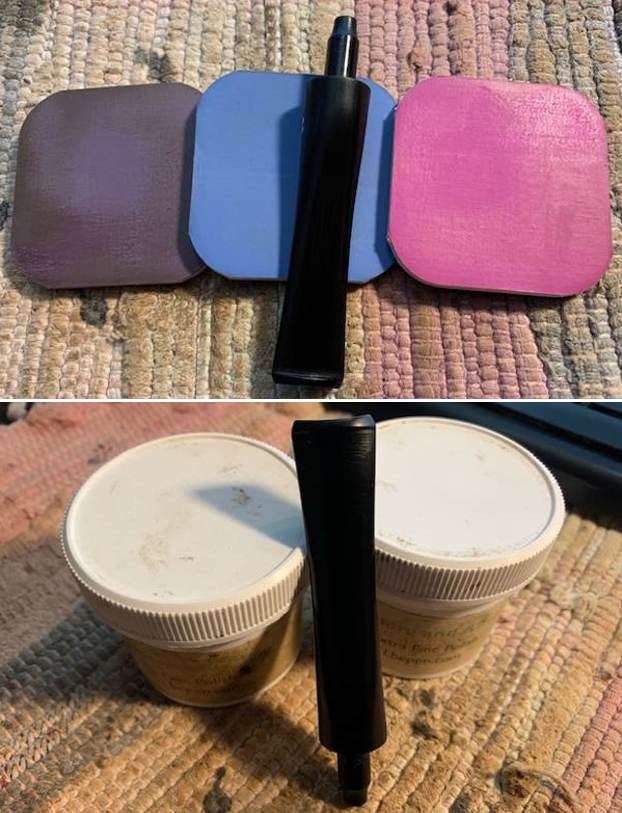
I started the process with reaming the meerschaum cup with PipNet reamer heads 1, 2 and 3. I further cleaned the bowl with my fabricated knife to completely rid the chamber of carbon that couldn’t be reached by the reamer heads. I used a 220 grit sand paper, pinched between my thumb and forefinger, to sand the inner walls of the chamber of the pipe. Once I had reached the bare walls, I wiped the chamber with a cotton pad dipped in isopropyl alcohol. This removed all the residual carbon dust and also rid the chamber of all ghost smells. The walls of the chamber are nice and solid with no signs of heat fissures or cracks.I gently scraped off the dried gunk and remnants of the cork with my sharp fabricated knife. I further cleaned the surface with a cotton swab dipped in alcohol. I cleaned the external surface of the meerschaum cup with a cotton swab and Murphy’s Oil Soap. I further wiped the surface with a moist soft cloth and rid the surface of the soap. I ran a couple of hard bristled pipe cleaners dipped in isopropyl alcohol through the draught hole and thoroughly cleaned it. I set the bowl aside to dry out completely.I cleaned the stem airway using thin shank brushes and anti oil dish soap. I also cleaned the tenon surface with the soap and wiped it dry with a paper towel. The tenon opening and the oval slot is now clean.Since the tooth chatter on upper and lower surface was superficial, I decided to address this issue by sanding down the tooth chatter rather than resorting to the filling method. I sand the bite zone with a 220 grit sandpaper to remove the tooth chatter. I followed it up by further sanding the stem with 320, 600 and 800 grit sand papers. Once I was satisfied that the tooth chatter had perfectly matched the rest of the stem surface, I completed the polishing cycle by wet sanding the surface with 1500 to 12000 grit micromesh pads. The stem looks great with the tooth chatter nicely matched with the rest of the surface. I rub a little quantity of Extra Virgin Olive oil into the stem surface and set it aside to rehydrate the vulcanite. While I was working on the stem, Abha went about the task of polishing the meerschaum cup. She polished the bowl by dry sanding it with 1500 to 12000 grit micromesh pads. She applied a little Before and After Balm, though it does not affect the meerschaum in any which way, and set it aside. A few minutes later, she buffed it with a microfiber cloth.Next in the process was the cleaning and refurbishing of the gourd itself. Using my fabricated dental tool and sharp knife, I carefully, read that as very (2x) carefully, scraped out all the dried gunk and grime from the inner walls of the gourd. I ran a couple of pipe cleaners and q-tips dipped in alcohol through the shank end. I wiped the inner walls with a cotton swab moistened with alcohol. At this point in restoration, the internal cleaning of the stem, mortise and gourd is completed. The stem repairs and polishing is also completed and so is the refurbishing of the meerschaum cup. Next I decided to clean and polish the external surface of the gourd. I cleaned the external surface of the gourd with Murphy’s Oil soap on cotton swabs. I wiped the surface with a moist cloth and set the gourd aside to dry out completely. After the gourd had dried out, I polished the gourd surface with micromesh pads. I wanted to preserve the patina and deep coloration that has developed on the gourd surface and so I dry sand the stummel surface with 1500 to 12000 grit micromesh pads. This is starting to look really nice. I rub a small quantity of “Before and After Restoration Balm” in to the gourd with my finger tips and let it rest for a few minutes. The balm almost immediately works its magic and the gourd now has a nice vibrant appearance with the beautiful darkened colors on full display. I further buff it with a horse hair shoe brush. All that remained was the original case that housed this pipe. Firstly, I reattached all the black linings that had come loose with superglue. I wiped the leather cover with Murphy’s Oil soap on a cotton swab. The color on the swabs should give the readers an idea of how dirty the surface was!! I wanted to further scrub the leather surface, but unsure that I was as to how the leather would hold up to all the scrubbing, I left it at that (remember my mantra… Less is more!!). I cleaned the inner satin and velvet linings of the lid and bottom respectively, with a mild soap in warm water and a soft bristled tooth brush. I was very gentle with this as I had no intention of tearing the lining. I completely dried the lining using paper towels. It now does look nice and rich. To apply the finishing touches, I mount a cotton cloth buffing wheel on to my hand held rotary tool and apply a coat of Blue Diamond to the gourd and the stem to polish out the minor scratches. With a cotton buffing wheel that I use for carnauba wax, I apply a coat of the wax and continue to work on it till the complete coat of wax had been polished out. I mount a clean cotton cloth buffing wheel and give the entire pipe a once over buff. I finish the restoration by giving the entire pipe a rigorous hand buffing using a microfiber cloth to raise the shine further. The finished pipe looks beautiful and is ready to be added to my restored pipe collection. When, or if at all I will, smoke this pipe only time will tell!! Here are the pictures of the refurbished pipe. P.S.: The alignment of the stem with the gourd stummel was restored to perfection once the threads of the bone tenon, threads at the shank end and the internals of the gourd was thoroughly cleaned. I rejuvenated and hydrated the cork gasket by applying a generous layer of natural Petroleum Jelly.

Thanks to all readers of rebornpipes who have spared a moment of their invaluable time in reading through this write up and as is always, your suggestions and advice are always welcome as this would not only help me but  also help the new pursuers of this art.

Praying for the safety and well being of all the readers and their loved ones …

Restoring a “Peterson’s Product” – a Made in Ireland  Shamrock 53 Lovat


Blog by Steve Laug

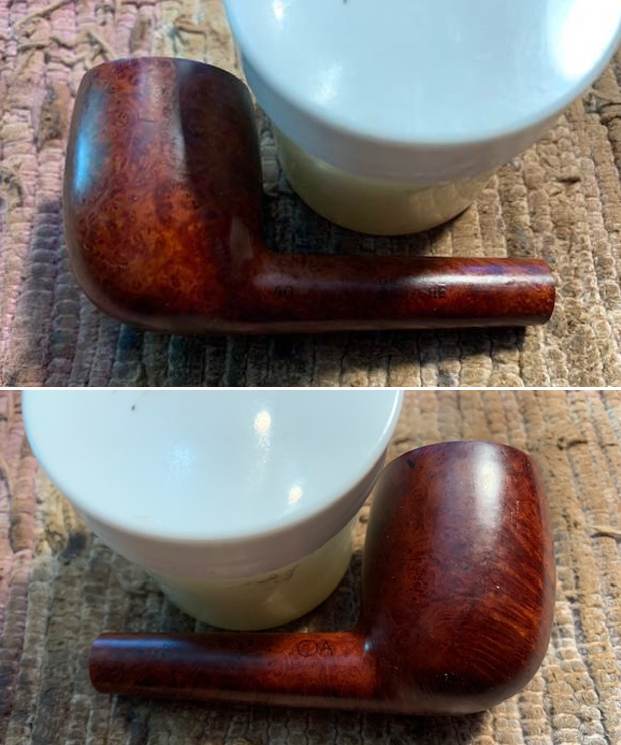
With the flood in our office/basement/workshop we moved my pipe work upstairs with my day job work to occupy the dining room table. I went through the boxes of pipes I have to work on sorting things to work on from those I will likely put in grab bags and came across this nice looking Lovat with a shiny band and a P-lip style saddle stem. It turns out that it is stamped on the left side of the shank and read SHAMROCK. It was also stamped on the right side and reads “A PETERSON’S [over] PRODUCT” over MADE IN IRELAND (3 lines) with the shape number 53 next to the bowl. The silver coloured (nickel I think) band was stamped with a Shamrock[over] three symbols in cartouches – a shamrock, a crouching lion and a standing figure. The band had rotated so these were on the underside of the shank rather than on the left. The vulcanite stem lightly oxidized and had some light tooth marks and chatter on both sides ahead of the button. The bowl had been reamed and cleaned as obviously Jeff had done his magic on it before I got it. He had scrubbed the exterior with Murphy’s Oil Soap and a tooth brush. He had rinsed it with warm water. He cleaned out the inside of the shank and stem with alcohol, cotton swabs and pipe cleaners. He scrubbed the exterior of the stem with Soft Scrub and left the stem looking quite good. I took photos of the pipe before I started my work on it. I took photos of the rim top and the bowl to show the condition. The rim top was smooth and clean. There was some burn damage on the inner edge of the rim at the back of the bowl. I also took photos of both sides of the stem to show the light oxidation and tooth chatter. Over all the pipe was in good condition. I took photos of the sides of the shank to show the stamping. The stamping is readable in the photos below and is as noted above.I took the stem off the pipe and took a photo of the parts to give a sense of proportion.I am including the link to the Pipedia’s article on Peterson pipes. It is a great read in terms of the history of the brand (https://pipedia.org/wiki/Peterson).

I turned to “The Peterson Pipe” by Mark Irwin and Gary Malmberg to get some background on the Peterson’s Shamrock Pipe. On page 312 it had the following information.

Shamrock (c1941-2009) Originally stamped SHAMROCK with no brand name, an inexpensive line first described in George Yale (New York) mail order booklet in 1941, imported by Rogers Import. The line was actively promoted beginning in ’45, aggressively promoted in US by Rogers from early ‘50s when they registered the Shamrock logo with US Patent Office, claiming propriety since ’38. Over the years offered with P-lip or fishtail mouthpiece, with or without nickel band, with or without shamrock logo on the band, with or without S stamped in white or later in gold on mouthpiece. Appearing in 2008 as unstained smooth and rustic, fishtail mouthpiece with gold impressed P on the stem. COMS of MADE IN over IRELAND (C1945-1965), MADE IN IRELAND forming a circle (c1945-1965), “A PETERSON’S PRODUCT” over MADE IN IRELAND (c1945-1965), MADE IN THE over REPUBLIC over OF IRELAND9c1948-1998). Model is always difficult or impossible to date.

Judging from the description above, the pipe I am working on is stamped with the stamp noted in red above. It reads “A Peterson’s Product” over Made in Ireland which narrows the date to between approximately 1945-1965. It is just stamped SHAMROCK with no brand name and no stem.

I decided to start my work on the pipe by loosening and adjusting the fit on the shank. It had twisted to the underside of the shank and it needed to be turned a quarter turn so that the stamping aligned with the stamping on the left side of the shank. I heated some water in the microwave until it was boiling, removed the stem and stood the shank end in the water until the glue softened. I turned the band and aligned it with the left side of the shank. I set it aside and let the glue set.

I then turned to address the darkening and damage on the inner edge of the rim. I used a folded piece of 220 grit sandpaper to smooth out and clean up the edge. It looked much better! I decided to leave the sandpits on the bowl side and filling them seemed unnecessary to me. I polished the briar with micromesh sanding pads – dry sanding with 1500-12000 grit sanding pads. I wiped the bowl down with a damp cloth after each sanding pad.  (Note the sandpit on the left side of the shank near the bowl.)  I worked some Before & After Restoration Balm into the surface of the briar with my fingertips to clean, enliven and protect the briar. I let the balm sit for 15 minutes and then buffed with a cotton cloth to raise the shine. The photos show the bowl at this point in the restoration process. I sanded the diameter of the stem at the shank end with 220 grit sandpaper to take down the left side so that it matched the side of the band on the shank. I worked it over until the flow between the nickel band and the stem was smooth. I started the polishing with 400 grit wet dry sandpaper.  I set the bowl aside and polished the stem with micromesh sanding pads – wet sanding with 1500-12000 grit sanding pads. I wiped it down after each sanding pad with Obsidian Oil. I polished it with Before & After Pipe Stem Polish – both Fine and Extra Fine.     I am excited to finish this Nickel Banded OlderPeterson’s Product” Shamrock 53 Lovat. I put the pipe back together and buffed it with Blue Diamond on the buffing wheel. I gave the bowl and the stem multiple coats of carnauba wax. I hand buffed the pipe with a clean buffing pad to raise the shine. It is fun to see what the polished bowl looks like with beautiful mixed grain all around it. The polished nickel band is losing some of the plating but it still looks great with the black vulcanite stem. This smooth Classic Shamrock 53 Lovat is great looking and the pipe feels great in my hand. It is light and well balanced. Have a look at it with the photos below. The dimensions are Length: 5 inches, Height: 1 ¾ inches, Outside diameter of the bowl: 1 ¼ inches, Chamber diameter: ¾ of an inch. The weight of the pipe is 37 grams/1.16 oz. It turned out to be a beautiful pipe. I will be putting on the rebornpipes store in the Irish Pipe Makers Section. Thanks for your time and as Paresh says each time – Stay Safe.
Restoring an interesting Long Shank Rusticated Peterson’s of Dublin Canadian


Blog by Steve Laug

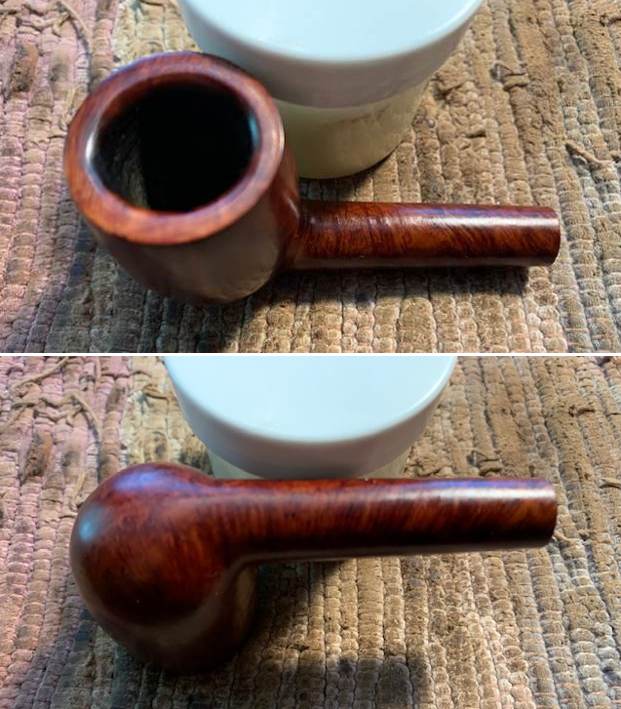
With the flood in our office/basement/workshop we moved my pipe work upstairs with my day job work to occupy the dining room table. I went through the boxes of pipes I have to work on sorting things to work on from those I will likely put in grab bags and came across this rusticated long shank Canadian with a Sterling Silver Band. It turns out that it is stamped on the underside of the bowl and reads Peterson’s [arched over] Dublin [over] Made in the Republic of Ireland in the standard three line. The silver band was stamped with K& P in cartouches [over] Sterling Silver. The vulcanite stem lightly oxidized and dirty with tooth chatter on both sides ahead of the button. The bowl had been reamed and cleaned as obviously Jeff had done his magic on it before I got it. He had scrubbed the exterior with Murphy’s Oil Soap and a tooth brush. He had rinsed it with warm water. The silver band was still oxidized (probably from sitting here). He cleaned out the inside of the shank and stem with alcohol, cotton swabs and pipe cleaners. He scrubbed the exterior of the stem with Soft Scrub and left the stem looking quite good. I took photos of the pipe before I started my work on it. I took photos of the rim top and the bowl to show the condition. The rim top was rusticated and uneven looking. There was some grime and debris in the rustication on back of the rim top. The inner edge was in decent condition. I also took photos of both sides of the stem to show the light oxidation and tooth chatter. Over all the pipe was in good condition. I took a photo of the stamping on the heel of the bowl and on the silver band on the shank. It is clear and it reads as noted above.I took a photo of the pipe with the stem removed to give an overall picture of the pipe. The rugged rustication is quite beautiful. There also appears to be a shiny coat of varnish on the surface of the briar that needs to go!I turned to the Peterson’s Pipe by Mark Irwin and Gary Malmberg to ferret out information on the stamping of this pipe to try to pin down a date. Under the section, Dublin on Page 298 I found information on the stamping on this pipe. I quote:
Dublin (1906-2003) Although DUBLIN appears under PETERSON’S on many pipes  over the decades, it has served  mostly as part of the brand name. The word first appeared on pipes hallmarked 1906-11, stamped PETERSON’S over PATENT over DUBLIN. The simpler PETERSON’S over DUBLIN appeared on pipes hallmarked 1912 after the expiration of the patent… Specimens of the former will bear either an Irish COM or LONDON MADE over ENGLAND  COM and almost certainly date from 1945-62.  It was first mentioned in print as part of a model name in the ’68 price list, as K&P Dublin…

I looked also at the information on page 304 about the K&P stamping on the silver band. I quote below.

K&P Another set of three marks, each in a shield-shaped frame are frequently mistaken as hallmarks and are seen on sterling bands. See Maker’s Mark…

On page 305

 K&P on Mount …A second style of maker’s mark, K&P in three shields, was registered on June 26,1908 and has been in continuous use since.

On page 307

Maker’s Mark Collectors frequently mistake this row of three shields for hallmarks, especially on pipes made between 1938-68 when Peterson sterling mounts had no proper hallmarks. Collectors tend to label these faux hallmarks. The three shields are not hallmarks at all but their presence on the mount does confirm the mounting is sterling.

Now at least I had a time frame for the pipe. It had the three maker’s marks in three separate shields (K&P). The sterling silver band did no have any proper hallmarks so it came from the time period between 1938-1968. The K&P stamp on the silver and the Dublin stamp on the heel of the bowl seem to point to the 1968 time period as well. The pipe was also a Republic Era Pipe which dated it from 1950-1989. Armed with that history and having a sense of the brand it was now time to do a bit of spiffing with the pipe itself.

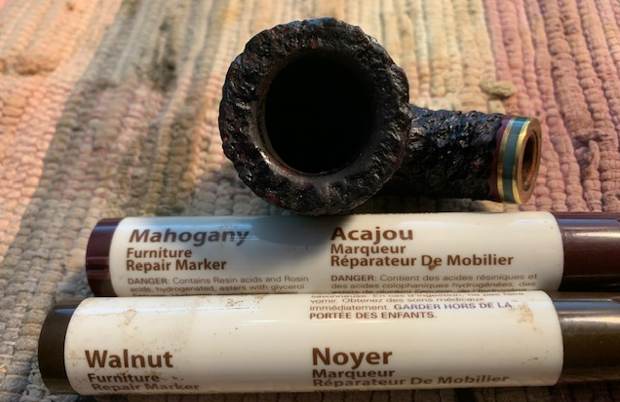
I wiped the bowl down with acetone to break through the varnish coat and worked the surface or the pipe over with a brass bristle wire brush to further remove it. It took several repetitions of the process to remove the finish coat but when I did it was better. I stained the faded rim top with a Walnut Stain Pen to match the colour around the bowl and shank. It looked good and once it was polished would match very well.I rubbed the bowl down with some Before & After Restoration Balm. I worked it into the briar with my fingertips and a horse hair shoe brush. The product works to clean, renew and protect briar. I let it do its work for 15 minutes then buffed it off with a soft cloth. The pipe is really quite a beauty. I polished the silver with Silver polish and tarnish remover. It really came out looking shiny. I set the bowl aside and turned my attention to the stem. I scrubbed off the residual oxidation on the stem surface with Soft Scrub cleanser and was able to remove the majority of it. What remains should come of easily with the micromesh sanding pads.I polished the surface of the acrylic stem on both sides using micromesh sanding pads. I dry sanded the stem with the 1500-12000 grit pads, then wiped it down with a cloth impregnated with Obsidian Oil. I finished polishing it with Before & After stem polish – both Fine and Extra Fine. I gave it a final coat of Obsidian Oil and set it aside to dry. I am excited to finish this Republic Era Peterson’s Dublin Rusticated Canadian. I put the pipe back together and buffed it lightly with Blue Diamond on the buffing wheel. I gave the bowl multiple coats of Conservator’s Wax and the stem multiple coats of carnauba wax. I buffed the pipe with a clean buffing pad to raise the shine and hand buffed it with microfiber cloth to deepen the shine. It is fun to see what the polished bowl looks like with the polished black acrylic stem with the silver band. It really was a beautiful pipe. The grain shining through the rich red stain on this Peterson’s Dublin Rustic Canadian is nice looking and the pipe feels great in my hand. It is light and well balanced. Have a look at it with the photos below. The dimensions are Length: 7 inches, Height: 1 ¾ inches, Outside diameter of the bowl: 1 ¼ inches, Chamber diameter: ¾ of an inch. The weight of the pipe is 1.73 ounces/50 grams. It is a beautiful pipe and one that will be on the rebornpipes store in the Irish Pipe Makers Section soon. If you are interested in adding it to your collection let me know. Thanks for walking through the cleanup with me as I worked over this pipe. Thanks to each of you who are reading this blog. Remember we are not pipe owners; we are pipemen and women who hold our pipes in trust until they pass on into the trust of those who follow us.

Restoring a Beautifully Grained Amphora X-tra 725 Bent Billiard


Blog by Steve Laug

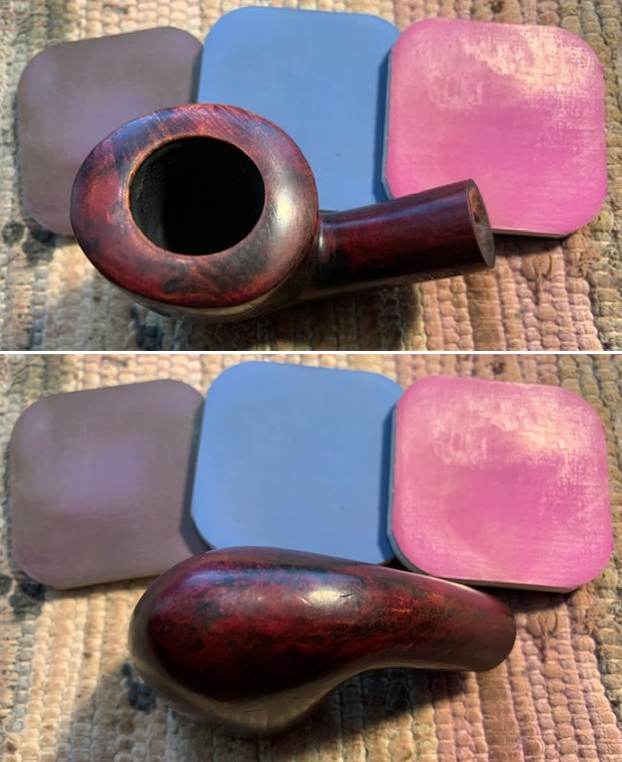
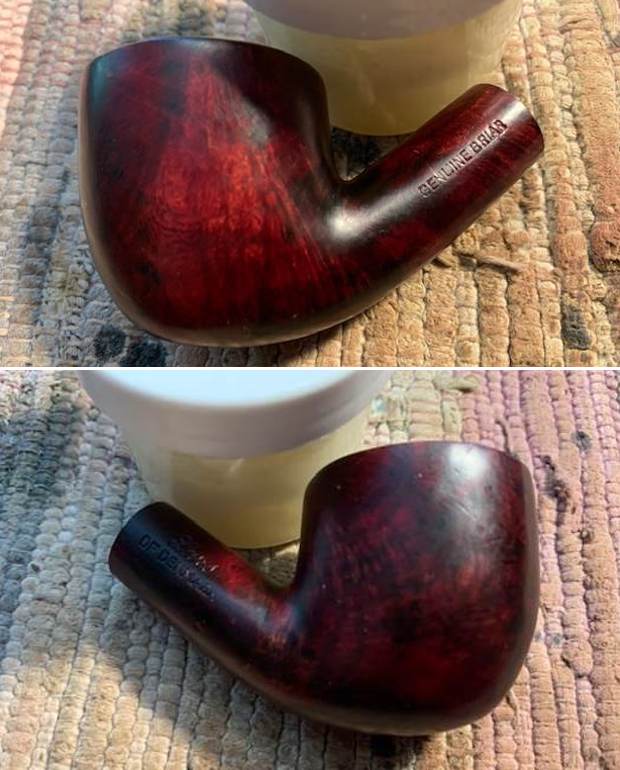
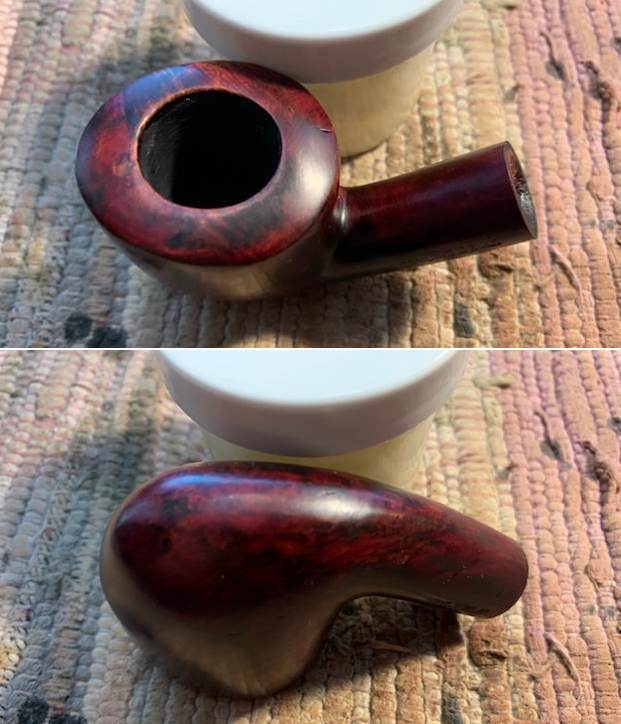
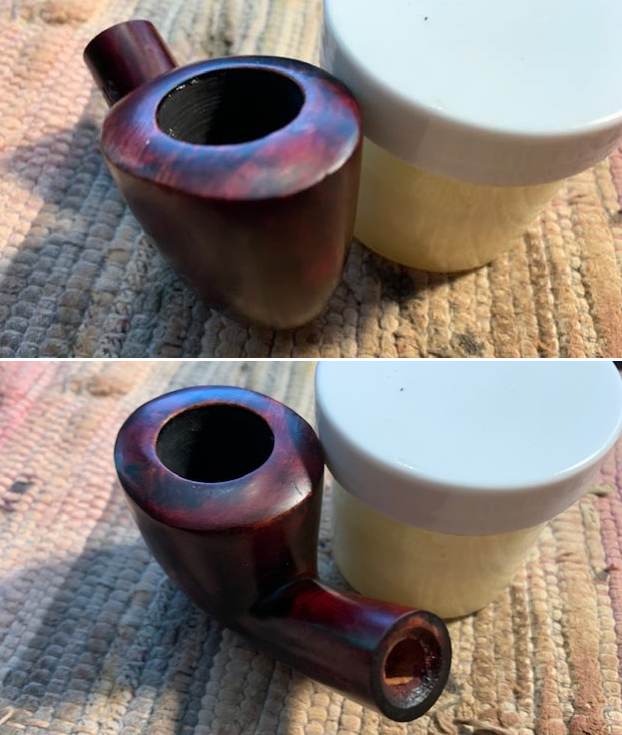
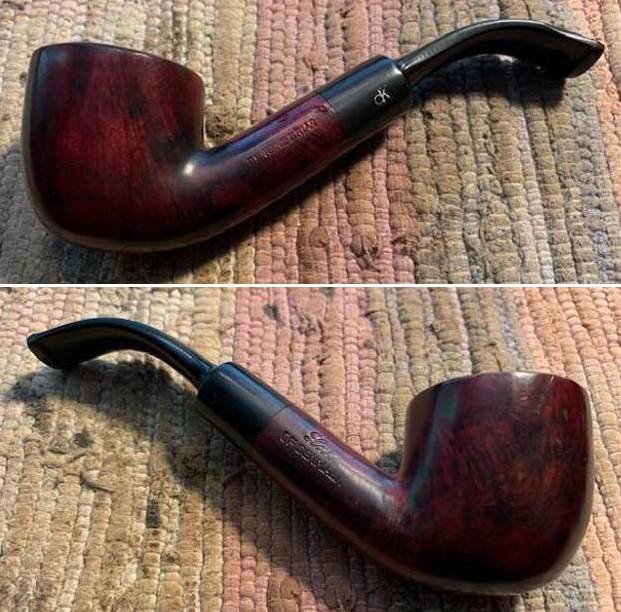
For the next pipe, I chose a unique looking pipe that we picked up back in March of 2018 from a friend in St. Leonard, Maryland, USA. It has been here for a while and I am just now getting to it. This one is an Amphora Bent Billiard. It has a really nice mix of flame and straight grain around the bowl and shank. It was stamped on the sides of the shank. On the left side it reads Amphora [over] X-tra [followed by] the shape number 725. On the right side it reads Genuine Briar [over] AMPHORA, Holland. The pipe was dirty with grime ground into the finish. The grain really shined through the grime. There was a thick cake in the bowl and a light lava overflow and darkening on the thin rim top. The inner edge of the rim looked very good. The vulcanite saddle stem was heavily oxidized and had tooth marks and chatter ahead of the button on both sides. There is an A in a circle inset on the left side of the saddle stem that is faded and worn looking. Jeff took photos of the pipe before he started his clean up. He took photos of the bowl, rim top and stem to show the condition of the pipe. The bowl is heavily caked and you can see the light lava and darkening on the rim top around the bowl. The stem is very oxidized and there are some light tooth mark on the top and underside of the button.Jeff took photos of the sides of the bowl to show the grain on the sides. It is really quite a pretty looking piece of briar.He took photos of the stamping on the sides of the shank. It is clear and readable with some faint stamping on the edges.I knew from past work that there was a connection between Amphora and the Royal Dutch Pipe Factory. The Amphora – Holland stamped pointed to that for me. I turned to Pipephil’s site to remind myself of the connection (http://pipephil.eu/logos/en/logo-a5.html). I have included a screen capture of the section on the site that give some photos of the stamping. The pipe I am working on is stamped like the first photo below.There was also some information in the side bar that I have included below:

A brand of Elbert Gubbels & Sons – Royal Dutch Pipe Factory who has gone bankrupt on March 2012. See also: Big-Ben, Humbry, IRC, Roermond, Royal Dutch, Thompson and Porsche Design.

Now that I was reminded about the Royal Dutch Pipe Factory connection it was time to work on the pipe on my end.

Jeff had done a great clean up of the pipe. He had reamed it with a PipNet reamer and took the cake back to bare briar. He cleaned up the remnants with a Savinelli Fitsall Pipe Knife. He scrubbed internals of the shank and stem with alcohol, cotton swabs and pipe cleaners. He cleaned the exterior of the pipe with undiluted Murphy’s Oil Soap and a tooth brush to remove the grime and the lava on the rim top. He scrubbed the stem with Soft Scrub to remove the debris that had accumulated on it. The pipe looked clean and ready for the next step in the process. Here are some photos of it when I finally got around to working on it 4 years later. I took some close up photos of the bowl, rim top and the stem surface. It looked amazingly good. The stem looks good with a little oxidation at the button end. There were also some light tooth marks and chatter on both sides near the button.I took photos of the stamping on the sides of the shank. It was readable though faint on both sides of the shank and stem side.I removed the stem from the shank to show the components of the pipe. It is a great shape and is a beauty.I polished the briar with micromesh sanding pads – dry sanding with 1500-12000 grit pads. I wiped the bowl down with a damp cloth after each sanding pad. It really began to take on a shine. I rubbed the bowl down with some Before & After Restoration Balm. I worked it into the briar with my fingertips. The product works to clean, renew and protect briar. I let it do its work for 15 minutes then buffed it off with a soft cloth. The pipe is really quite a beauty. I set the bowl aside and turned my attention to the stem. I scrubbed off the surface of the stem with Soft Scrub All Purpose Cleanser to remove the residual oxidation on the shank end of the pipe. It looked much better.I used 220 grit sandpaper to sand out the tooth marks and chatter on both sides near the button. I started the polishing with 400 grit wet dry sandpaper to further blend in the sanded areas.I polished the stem on both sides using micromesh sanding pads. I dry sanded the stem with the 1500-12000 grit pads, then wiped it down with a cloth impregnated with Obsidian Oil. I finished polishing it with Before & After stem polish – both Fine and Extra Fine. I gave it a final coat of Obsidian Oil and set it aside to dry. This is another pipe I am excited to finish. It is a Amphora X-tra 725 Bent Billiard with some beautiful grain. I put the pipe back together and buffed it lightly with Blue Diamond on the buffing wheel. I gave the bowl and the stem multiple coats of carnauba wax. I buffed the pipe with a clean buffing pad to raise the shine and hand buffed it with microfiber cloth to deepen the shine. It is fun to see what the polished bowl looks like with the polished stem. It really was a beautiful pipe. The mix of flame and straight grain shining through the rich browns/black stain on this Amphora X-tra Bent Billiard is nice looking and the pipe feels great in my hand. It is light and well balanced. Have a look at it with the photos below. The dimensions are Length: 5 ½ inches, Height: 1 ¾ inches, Outside diameter of the bowl: 1 ¼ inches, Chamber diameter: ¾ of an inch. The weight of the pipe is 1.48 ounces/42 grams. It is a beautiful pipe and one that will be on the rebornpipes store in the Pipe From Various Makers section soon. If you are interested in adding it to your collection let me know. Thanks for walking through the cleanup with me as I worked over this pipe. Thanks to each of you who are reading this blog. Remember we are not pipe owners; we are pipemen and women who hold our pipes in trust until they pass on into the trust of those who follow us.

Restoring a Bari Special Handcut Danish 01 Bent Brandy


Blog by Steve Laug

For the next pipe, I chose a unique looking pipe that we picked up off EBay back in December of 2016 from a seller in Marlboro, New Jersey, USA. It has been here for a while and I am just now getting to it. This one is a Bari Special Handcut Bent Brandy. It has a really mix of flame and straight grain around the bowl and shank. It was stamped on the sides of the shank. On the left side it reads Bari [over] Special [over] Handcut. On the right side it reads Made in Denmark [over] 01 which is probably the shape number. The pipe was dirty with grime ground into the finish. The bowl had a thin coat of varnish on the bowl and shank that was spotty and worn.  There was a thick cake in the bowl and lava overflow and darkening on the thin rim top. The inner edge of the rim was covered so thickly in lava it was hard to know what was underneath. The vulcanite stem was lightly oxidized and had tooth marks and chatter ahead of the button on both sides. HANDCUT was faintly stamped on the left side of the taper stem and coloured white. Jeff took photos of the pipe before he started his clean up. He took photos of the bowl, rim top and stem to show the condition of the pipe. The bowl is moderately caked and you can see the lava and darkening on the rim top around the bowl. The stem looks good other than the tooth mark on the underside of the button. Before I started working on it I did a bit of research on the brand to remind myself of the maker. I have worked on quite a few Bari’s in the past so rather than rework all of that I am including the information I found while working on a Bari Special Handcut Made in Denmark Dublin Freehand (https://rebornpipes.com/2020/07/22/cleaning-up-a-danish-made-bari-special-handcut-b-dublin-freehand/). I quote below from that blog.

I quoted a section from Pipedia on Bari pipes (https://pipedia.org/wiki/Bari). It is good to be reminded of the fact that Viggo Nielsen was the pipe maker.

Pipedia states that Bari Piber was founded by Viggo Nielsen in Kolding, Denmark around the turn of 1950/51. His sons Kai and Jørgen both grew into their father’s business from a very young age and worked there till 1975. Both have become successful pipe makers.

Bari successfully adapted the new Danish design that had been started mainly by Stanwell for its own models. Bari was sold in 1978 to Van Eicken Tobaccos in Hamburg, Germany though the pipes were still made in Denmark. From 1978 to 1993 Åge Bogelund and Helmer Thomsen headed Bari’s pipe production.

Helmer Thomson bought the company in 1993 re-naming it to “Bari Piber Helmer Thomsen”. The workshop moved to more convenient buildings in Vejen. Bogelund, who created very respectable freehands of his own during the time at Bari got lost somehow after 1993. Bari’s basic conception fundamentally stayed the same for decades: series pipes pre-worked by machines and carefully finished by hand – thus no spectacular highgrades but solid, reliable every day’s companions were what they turned out. The most famous series are the smooth “Classic Diamond” and the blasted “Wiking”.

I did a quick look at Pipephil’s site (http://www.pipephil.eu/logos/en/logo-b1.html) and did a screen capture of the section on Bari pipes.Now that I was reminded about the Viggo Nielsen connection it was time to work on the pipe on my end.

Jeff had done a great clean up of the pipe. He had reamed it with a PipNet reamer and took the cake back to bare briar. He cleaned up the remnants with a Savinelli Fitsall Pipe Knife. He scrubbed internals of the shank and stem with alcohol, cotton swabs and pipe cleaners. He cleaned the exterior of the pipe with undiluted Murphy’s Oil Soap and a tooth brush to remove the grime and the lava on the rim top. He scrubbed the stem with Soft Scrub to remove the debris that had accumulated on it. The pipe looked clean and ready for the next step in the process. Here are some photos of it when I finally got around to working on it 5 years later. I took some close up photos of the bowl, rim top and the stem surface. It looked amazingly good. There was still some darkening on the rim edges. The varnish coat on the bowl and shank would also need to be removed. The stem looks good with a little oxidation at the shank end. There were also some tooth marks and chatter on both sides near the button.I took photos of the stamping on the sides of the shank. It was readable though faint on both sides of the shank and stem side.I removed the stem from the shank to show the components of the pipe. It is a great shape and is a beauty.I wiped the bowl down with alcohol on a cotton pad to remove the spotty varnish coat. It really looked better without the varnish. I polished the briar with micromesh sanding pads – dry sanding with 1500-12000 grit pads. I wiped the bowl down with a damp cloth after each sanding pad. It really began to take on a shine. I rubbed the bowl down with some Before & After Restoration Balm. I worked it into the briar with my fingertips. The product works to clean, renew and protect briar. I let it do its work for 15 minutes then buffed it off with a soft cloth. The pipe is really quite a beauty. I set the bowl aside and turned my attention to the stem. I scrubbed off the surface of the stem with Soft Scrub All Purpose Cleanser to remove the residual oxidation on the shank end of the pipe. It looked much better.I used 220 grit sandpaper to sand out the tooth marks and chatter on both sides near the button. I started the polishing with 400 grit wet dry sandpaper to further blend in the sanded areas.I touched up the faint stamping on the left side of the taper stem. It read HANDCUT the H and the UT were deep enough to take the touch up. The rest of the stamping was not as deep and did not hold the Rub’n Buff Antique Gold. I polished the excess off  and took photos of the stem at this point.I polished the stem on both sides using micromesh sanding pads. I dry sanded the stem with the 1500-12000 grit pads, then wiped it down with a cloth impregnated with Obsidian Oil. I finished polishing it with Before & After stem polish – both Fine and Extra Fine. I gave it a final coat of Obsidian Oil and set it aside to dry. This is another pipe I am excited to finish. It is a Bari Special Handcut Danish 01 Bent Brandy. I put the pipe back together and buffed it lightly with Blue Diamond on the buffing wheel. I gave the bowl and the stem multiple coats of carnauba wax. I buffed the pipe with a clean buffing pad to raise the shine and hand buffed it with microfiber cloth to deepen the shine. It is fun to see what the polished bowl looks like with the polished stem with the golden acrylic spacer. It really was a beautiful pipe. The sandblasted grain shining through the rich browns/black stain on this Bari Special Handcut is nice looking and the pipe feels great in my hand. It is light and well balanced. Have a look at it with the photos below. The dimensions are Length: 5 ½ inches, Height: 2 ¼ inches, Outside diameter of the bowl: 1 ¼ inches, Chamber diameter: ¾ of an inch. The weight of the pipe is 2.12 ounces/60 grams. It is a beautiful pipe and one that will be on the rebornpipes store in the Danish Pipe Makers Section soon. If you are interested in adding it to your collection let me know. Thanks for walking through the cleanup with me as I worked over this pipe. Thanks to each of you who are reading this blog. Remember we are not pipe owners; we are pipemen and women who hold our pipes in trust until they pass on into the trust of those who follow us.

Restoring a Ben Wade Hand Model London Made Large Pot


Blog by Steve Laug

After a long week of dealing with insurance issues on flood damage to my basement office and now waiting for a plumber to come and give his report on Monday I decided it was time to take a break and just work on a pipe that interested me. I chose a unique looking pipe that we picked up off EBay back in December of 2016 from a seller in Marlboro, New Jersey, USA. It is a long shank Pot with a craggy and deep sandblast and an unusual shape to the bottom of the bowl. The yellow spacer on the pipe is a part of the stem. The pipe is stamped on the underside and reads Ben Wade in script [over] Hand Model [over] London Made. There are no shape numbers on the pipe. I have worked on quite a few English made Ben Wade pipes but never one that was stamped like this. It would be interesting to learn more about it. The pipe was dirty with a moderate cake in the bowl and some lava overflow in the sandblast on the rim. The edges of the bowl were in good condition. The saddle stem  (vulcanite with a yellow acrylic spacer attached) was shiny but had tooth damage to the button on the underside. Jeff took photos of the pipe before he started his clean up. He took photos of the bowl, rim top and stem to show the condition of the pipe. The bowl is moderately caked and you can see the lava in the sandblast of the rim top toward the back of the bowl. The stem looks good other than the tooth mark on the underside of the button. Jeff took photos of the bowl and sides to give a sense of the sandblast and the depth of that finish. It is really a beautifully blasted pipe and well executed. You can also see the slight slope to the bottom of the bowl on the front. He took a photo of the stamping on the underside of the shank which was clear and readable as noted above. It is the source of the mystery for me – what and when was the Hand Model made.Now it was time to try and figure out the stamping on this pipe. I remembered chatting with Dal Stanton, the Pipe Steward about a pipe he was working on that had this stamping. At least I thought I had. I knew it was a while ago so I did a quick search on the blog for Ben Wade Hand Model London Made pipes and found what I was looking for. Here is the link to the blog Dal wrote and his research on it (https://rebornpipes.com/2019/02/13/rejuvenating-a-ben-wade-hand-model-london-made-billiard/). I am quoting extensively from what he wrote as there is no need to go back through the same sources he did.

I’ve discovered through the reading I’ve done about the name ‘Ben Wade’ that it has an up and down history. The Pipedia article is helpful in simplifying the history in four helpful ‘eras’ which I’ve summarized from the Pipedia:

The Family era (1860 to 1962) – the heydays of the English name when the pipes were stamped Made in Leeds, England.

Charatan / Lane second (1962 to 1988) – When Herman G. Lane purchased the name, the transition from a higher quality pipe during the long Family Era transitioned exclusively to the fabrication of machine-made pipes. Lane moved the production from the Leeds factory (closed in 1965) to Charatan’s Prescott Street factory. Ben Wade became essentially lower quality series pipes produced in standard shapes. The pipes during this period were stamped, “Made in London, England” or dropping the “London” and stamped with “England” alone. After Lane died, in 1978 his heirs sold the Charatan and Ben Wade names to Dunhill, which left the production of Charatan/Ben wade at the Prescott Street factor. In 1988 production came to an end for Ben Wade when the Charatan’s Prescott Street factory closed.

Ben Wade turns Danish (1971-1989) – During this era Preben Holm, from Denmark, was in financial difficulties and Herman Lane and he went into partnership producing the Handmade and fancy pipes. These pipes were marked “Ben Wade Made in Denmark”. These pipes gained great popularity, especially as the were marketed in the US. After Lane’s death, Preben Holm, not the businessman, was in financial difficulties and reduced his workforce and production, but at his death in 1989, production of the Danish Preben Holm pipes came to an end.

Resurrection – (1998 to present) – Duncan Briars bought the Ben Wade name from Dunhill in 1998 and production of Ben Wade pipes restarted at the Walthamstow plant, sharing the same space where Dunhill pipes are produced and reportedly benefiting from the same quality of production. During this present era, the stamping on the pipes is: “Ben Wade, Made in London, England”

The reason I went through this summary of Ben Wade’s morphing history is because in nothing I’ve read about Ben Wade (and I’m sure there’s more out there), I found no reference to a Ben Wade Hand Model with the COM, London Made. The stamping on the pipe before me is ‘Ben Wade’ [over] HAND MODEL [over] LONDON MADE. The saddle stem has the Ben Wade stamped on the upper side of the stem saddle. My first glance at the blasted finish made me wonder whether this Ben Wade came out during the ‘mystery’ Resurrection period in the Pipedia article. Here is the full text that made me wonder:

As said before Preben Holm’s death marked the third end of Ben Wade and for long years there were no Ben Wade pipes in the shops anymore. But then, all of a sudden they were back in the USA some years ago! Who made these pipes? A concrete manufacturer was not known at first.

The rumors spreading were considerable. Especially because these Ben Wades – originally all blasted and in deep black color – featured so perfect straight and / or ring-grain that they were almost suspicious in view of the prices. The supposition that “Mother Nature” had been given a leg up by means of rustication combined with subsequent blasting was evident as different sources confirmed.

Dal also posted the following with some anecdotal information that linked the pipe he was working to Charatan. I quote:

I sent out pictures of some pictures and the nomenclature to various pipe Facebook groups and the responses I did get, though they were anecdotal, pointed to an earlier period. Paul, from Pipe Smoker of America FB Group, said that he believed it was a Pre-78 and made in Charatan factory. He also said that these were some of his best smokers are London BWs. It sounds good to me!

Following Dal’s lead I posted pictures of the stamping and the pipe on Facebook groups I am part of and hope to learn some more. Tom Myron, a good friend replied on the Gentlemen’s Pipe Smoking Society and wrote as follows:

Yeah, Steve, that’s absolutely a Charatan shape in their ‘After Hours’ style – 60s / 70s.

Jeff had done a great clean up of the pipe. He had reamed it with a PipNet reamer and took the cake back to bare briar. He cleaned up the remnants with a Savinelli Fitsall Pipe Knife. He scrubbed internals of the shank and stem with alcohol, cotton swabs and pipe cleaners. He cleaned the exterior of the pipe with undiluted Murphy’s Oil Soap and a tooth brush to remove the grime and the lava on the rim top. He scrubbed the stem with Soft Scrub to remove the debris that had accumulated on it. The pipe looked clean and ready for the next step in the process. Here are some photos of it when I finally got around to working on it 5 years later. Look at the craggy sandblast on this pipe! Wow. I took some close up photos of the bowl, rim top and the stem surface. It looked amazingly good. The damage on the underside of the stem button is not as bad as I expected.I took a photo of the stamping on the underside of the shank. It is clear and readable as noted above.I removed the stem from the shank to show the spacer and tenon on the pipe as it is quite unique. I also wanted to get a clear picture of the components of the pipe. It is a beauty.The pipe bowl was in such great condition that I did not need to do a lot of work on it. I rubbed the bowl down with some Before & After Restoration Balm. I worked it into the briar with my fingertips and a horse hair shoe brush. The product works to clean, renew and protect briar. I let it do its work for 15 minutes then buffed it off with a soft cloth. The pipe is really quite a beauty. The depth of the blast is quite stunning. I set the bowl aside and turned my attention to the stem. I built up the tooth mark in the button surface with Medium Thick Black Super Glue. I sprayed it with a shot of accelerator to harden the surface and set the stem aside to cure overnight. In the morning I reshaped the button edge and surface with a small file.I sanded and reshaped the repaired area on the underside of the stem and the tooth chatter on the top side with 220 grit sandpaper. I started polishing it with 400 grit wet dry sandpaper.I polished the stem on both sides using micromesh sanding pads. I dry sanded the stem with the 1500-12000 grit pads, then wiped it down with a cloth impregnated with Obsidian Oil. I finished polishing it with Before & After stem polish – both Fine and Extra Fine. I gave it a final coat of Obsidian Oil and set it aside to dry. This is another pipe I am excited to finish. It is a Ben Wade Hand Model London Made Long Pot. I put the pipe back together and buffed it lightly with Blue Diamond on the buffing wheel. I gave the bowl multiple coats of Conservator’s Wax and the stem multiple coats of carnauba wax. I buffed the pipe with a clean buffing pad to raise the shine and hand buffed it with microfiber cloth to deepen the shine. It is fun to see what the polished bowl looks like with the polished stem with the golden acrylic spacer. It really was a beautiful pipe. The sandblasted grain shining through the rich browns/black stain on this Ben Wade Hand Model is nice looking and the pipe feels great in my hand. It is light and well balanced. Have a look at it with the photos below. The dimensions are Length: 6 ½ inches, Height: 1 ¾ inches, Outside diameter of the bowl: 1 ¾ inches, Chamber diameter: 1 of an inch. The weight of the pipe is 2.08 ounces/59 grams. It is a beautiful pipe and one that will be on the rebornpipes store in the British Pipe Makers Section soon. If you are interested in adding it to your collection let me know. Thanks for walking through the cleanup with me as I worked over this pipe. Thanks to each of you who are reading this blog. Remember we are not pipe owners; we are pipemen and women who hold our pipes in trust until they pass on into the trust of those who follow us.

Restoring a Brigham Made in Canada (1Dot) 189 Bent Acorn


Blog by Steve Laug

Not too long ago my wife and I had dinner with some good friends here in Vancouver – first time since COVID-19 so it was good to see them. At the beginning of the meal he handed me a box that he said was for me. In it were some pipes that he was giving to me and a bunch of cigars. The pipes included two Brigham rusticated pipes that I have included photos of below. The two pipes in the photo were clean but well smoked. The bowls had light cake and some lava and darkening on the rim top. The stems were lightly oxidized and had tooth chatter on both sides ahead of the button. I decided I would work on them next. I finished the Sportsman Dublin first and now turned my attention to the second pipe. It is a classic Brigham Shape I call an acorn. It is well carved with a rusticated finish and a smooth rim top. It is stamped on the underside and reads 189 followed by Brigham [over] Made in Canada. There was one dot on the stem side and tooth chatter and oxidation. It was going to be a beauty once cleaned up. I took photos of the pipe when it brought it to the desk top. There was a moderate cake in the bowl in the bowl with lava overflowing into the rim top. There were some dark spots on the top of the rim on the front and the back sides. There was also some damage on the inner edge of the rim that would need to be dealt with. The shank and airways were dirty with tars and oil. The finish was dirty and would need scrubbing. I was hoping to bring it back to the natural finish. There was no Hard Rock Maple filter in the tenon and the pipe smelled of stale tobacco. The stem was lightly oxidized and there was some light tooth chatter to the top or underside of the stem. The button had no damage. Overall the pipe looked good even though it was a dirty one. I took photos of the rim top and the bowl to show the condition. The rim top was smooth with some nicks and dents in the surface. It also had some darkening around the top and damage to the inner edges. I also took photos of both sides of the stem to show the tooth marks and chatter. Over all the pipe was in okay condition.I took a photo of the stamping on the underside of the shank. It is clear and t it reads as noted above.I took a photo of the pipe with the stem removed to give an overall picture of the pipe. It really is quite beautiful.For historical background for those unfamiliar with the brand I am including the information from Pipedia on Brigham pipes. It is a great read in terms of the history and background on the pipes (https://pipedia.org/wiki/Brigham_Pipes). Charles Lemon (Dadspipes) is currently working on a book on the history of the brand. Until that is complete this article is a good summary. I have included it below.

Roy Brigham, after serving an apprenticeship under an Austrian pipesmith, started his own pipe repair shop in Toronto, in 1906. By 1918 the business had grown to include five other craftsmen and had developed a reputation across Canada for the high quality of workmanship. After repairing many different brands of pipes over the years, Roy noted certain recurring complaints by pipe smokers, the most common referred to as “tongue bite”. Tongue bite is a burning sensation on the smoker’s tongue, previously thought to be due to the heat of the smoke (i.e. a “hot smoking pipe”).

He soon began manufacturing his own pipes, which were lightweight, yet featured a more rugged construction, strengthening the weak points observed in other pipes. The problem of tongue bite intrigued him, and he decided to make overcoming it a future goal.

About 1938, Roy’s son Herb joined him to assist in the business. The business barely survived the great depression because pipes were considered to be a luxury, not a necessity, and selling pipes was difficult indeed. In approximately 1937 [1], after some experimentation, Roy and Herb discovered that tongue bite was in fact a form of mild chemical burn to the tongue, caused by tars and acids in the smoke. They found that by filtering the smoke, it was possible to retain the flavour of the tobacco and yet remove these impurities and thereby stop the tongue bite.

Just as Thomas Edison had searched far and wide for the perfect material from which to make the first electric light bulb filaments, Roy & Herb began experimenting with many materials, both common and exotic, in the quest for the perfect pipe filter. Results varied wildly. Most of the materials didn’t work at all and some actually imparted their own flavour into the smoke. They eventually found just two materials that were satisfactory in pipes: bamboo and rock maple. As bamboo was obviously not as readily available, rock maple then became the logical choice.

They were able to manufacture a replaceable hollow wooden tube made from rock maple dowelling, which when inserted into a specially made pipe, caused absolutely no restriction to the draw of the pipe, yet extracted many of the impurities which had caused tongue bite. The result was indeed a truly better smoking pipe…

Interestingly the pipe I have in hand is a 1 Dot grade but very well done. It is stamped with the shape number 189 followed by Brigham [over] Made in Canada.

Charles Lemon has also written a great article on the stampings and marking on the Brigham pipes that fit into a time line that he has drafted. It is well worth a read and is fascinating. (https://pipedia.org/wiki/Brigham_Pipes_%E2%80%93_A_Closer_Look_at_Dots,_Dates_and_Markings). I quote from the pertinent section on the time frame for this pipe.

Around the late 1960s or early 1970s, at the beginning of what I’ve called the Canadian Era (roughly 1970 – 1980), the stampings changed again as Brigham moved to modernize its logo. Pipes are stamped with the 3-digit shape number and “Brigham” over “Made in Canada”. Note these two variants of this stamping.

This solidly places the pipe I am working on in the period of Brigham production that Charles calls the Canadian Era (1969/70-1980). It is a great looking pipe with the classic rusticated style of finish.

The Original Brigham Dot System 1938 – 1980

Brigham pipes are renown in the pipe world for their famous “Brigham Dots”, a system of brass pins inset in the stem to denote the grade of each pipe. The original 8-grade pinning system, used for 42 years between 1938 and 1978 (spanning the Patent, Post-Patent and Canadian Eras) looked like this:I knew that I was dealing with a pipe made between 1969-1980 from Canadian Era. It sports 1 dot making it Brigham Standard pipe. There is a 189 shape number on the pipe. Now to do a bit of spiffing with the pipe itself.

I reamed the pipe with a PipNet pipe reamer to remove the light cake from the bowl walls. It was uneven and needed to be removed so I took it back to bare briar. I cleaned up the reaming with a Savinelli Fitsall Pipe Knife and then sanded the bowl with a dowel wrapped with 220 grit sandpaper to smooth out the walls. I worked on the damage to the rim top and the inner edge of the rim with 220 grit sandpaper. It looked much better.I scrubbed the exterior of the pipe with a tooth brush with undiluted Murphy’s Oil Soap. I scrubbed it to remove the build up on the rim top. I rinsed it with warm water and dried it off with a soft cloth. I cleaned out the internals with alcohol, cotton swabs and pipe cleaners to remove the debris and the oils from the shank and tenon as well as the airway into the stem and bowl.I polished the darkening on the rim top with micromesh sanding pads – dry sanding with 1500-12000 grit pads to remove as much of the darkening as I could. Once it was complete I stained the rim top with an Oak stain pen to match the smooth portions of the finish on the shank end and underside. I rubbed the bowl down with some Before & After Restoration Balm. I worked it into the briar with my fingertips and a horse hair shoe brush. The product works to clean, renew and protect briar. I let it do its work for 15 minutes then buffed it off with a soft cloth. The pipe is really quite a beauty. I set the bowl aside and turned my attention to the stem. I scrubbed it with Soft Scrub All Purpose cleaner to remove the oxidation as much as possible. It needed to be clean before I could address the tooth marks.Once it was clean I “painted” the tooth marks and chatter with the flame of a lighter. I was able to raise all of the damage on the underside of the stem and the majority on the topside. I lightly sanded the topside with 220 grit sandpaper to prepare for the repair. I filled in the tooth marks that remained with black superglue and set the stem aside to cure. Once it cured I flattened out the repaired area with a small file to start the process of blending it into the surrounding briar. I sanded the surface with 220 grit sandpaper to remove the remaining oxidation and also finish blending in the repair. I started polishing it with 400 grit wet dry sandpaper. It is beginning to look quite good. I polished the surface of the stem on both sides using micromesh sanding pads. I dry sanded the stem with the 1500-12000 grit pads, then wiped it down with a cloth impregnated with Obsidian Oil. I finished polishing it with Before & After stem polish – both Fine and Extra Fine. I gave it a final coat of Obsidian Oil and set it aside to dry. I fit the clean and polished stem with the Brigham Rock Maple Distillator and took photos to show what it looked like. This is in essence a hollow Maple wood tube that serves to filter out the moisture and deliver a clean and flavourful smoke. I am excited to finish this 1969-1980 Brigham Made in Canada Acorn 189 – 1 Dot from the Canadian Era. I put the pipe back together and buffed it with Blue Diamond on the buffing wheel. I gave the bowl multiple coats of Conservator’s Wax and the stem multiple coats of carnauba wax. I buffed the pipe with a clean buffing pad to raise the shine and hand buffed it with microfiber cloth to deepen the shine. It is fun to see what the polished bowl looks like with the rusticated finish. Added to that the polished black vulcanite stem with the shining brass pins was beautiful. This mixed grain on the rusticated Brigham Standard 1 Dot 189 Acorn is nice looking and the pipe feels great in my hand. It is light and well balanced. Have a look at it with the photos below. The dimensions are Length: 6 inches, Height: 1 ¾ inches, Outside diameter of the bowl: 1 ¼ inches, Chamber diameter: ¾ of an inch. The weight of the pipe is 1.45 ounces/41 grams. It is a beautiful pipe and one that will be on the rebornpipes store in the Canadian Pipe Makers Section soon. If you are interested in adding it to your collection let me know. Thanks for walking through the cleanup with me as I worked over this pipe. Thanks to each of you who are reading this blog. Remember we are not pipe owners; we are pipemen and women who hold our pipes in trust until they pass on into the trust of those who follow us.

Restoring a Made in Canada Brigham (2 Dot) Sportsman Bent Dublin


Blog by Steve Laug

Not too long ago my wife and I had dinner with some good friends here in Vancouver – first time since COVID-19 so it was good to see them. At the beginning of the meal he handed me a box that he said was for me. In it were some pipes that he was giving to me and a bunch of cigars. The pipes included to Brigham rusticated pipes that I have included photos of below. The two pipes in the photo were clean but well smoked. The bowls had light cake and some lava and darkening on the rim top. The stems were lightly oxidized and had tooth chatter on both sides ahead of the button. I decided I would work on them next. I turned to the first of them, a Brigham 2 Dot Sportsman Dublin from Brigham’s unfinished line. It is well carved but the finish is partially unfinished and there is no stain or topping coat on it. It is stamped on the underside and reads Made in Canada followed by the Brigham logo. There were two dots on the stem side and tooth chatter and oxidation. It was going to be a beauty once cleaned up. I took photos of the pipe when it arrived. There was a light cake in the bowl in the bowl with lava overflowing into the rim top. The shank and airways seem to be dirty with tars and oil. The finish was dirty and would need scrubbing. I was hoping to bring it back to the natural finish. It had a clean Hard Rock Maple filter in the tenon and the pipe smelled surprisingly clean. The stem was lightly oxidized and there was some light tooth chatter to the top or underside of the stem. The button had no damage. Overall the pipe looked good even though it was a dirty one. I took photos of the rim top and the bowl to show the condition. The rim top was smooth and covered in lava at the back of the bowl. The inner and outer edges of the bowl looked very good. I also took photos of both sides of the stem to show the tooth marks and chatter. Over all the pipe was in okay condition.I took a photo of the stamping on the underside of the shank. It is faint but it reads as noted above.I took a photo of the pipe with the stem removed to give an overall picture of the pipe. It really is quite beautiful.For historical background for those unfamiliar with the brand I am including the information from Pipedia on Brigham pipes. It is a great read in terms of the history and background on the pipes (https://pipedia.org/wiki/Brigham_Pipes). Charles Lemon (Dadspipes) is currently working on a book on the history of the brand. Until that is complete this article is a good summary. I have included it below.

Roy Brigham, after serving an apprenticeship under an Austrian pipesmith, started his own pipe repair shop in Toronto, in 1906. By 1918 the business had grown to include five other craftsmen and had developed a reputation across Canada for the high quality of workmanship. After repairing many different brands of pipes over the years, Roy noted certain recurring complaints by pipe smokers, the most common referred to as “tongue bite”. Tongue bite is a burning sensation on the smoker’s tongue, previously thought to be due to the heat of the smoke (i.e. a “hot smoking pipe”).

He soon began manufacturing his own pipes, which were lightweight, yet featured a more rugged construction, strengthening the weak points observed in other pipes. The problem of tongue bite intrigued him, and he decided to make overcoming it a future goal.

About 1938, Roy’s son Herb joined him to assist in the business. The business barely survived the great depression because pipes were considered to be a luxury, not a necessity, and selling pipes was difficult indeed. In approximately 1937 [1], after some experimentation, Roy and Herb discovered that tongue bite was in fact a form of mild chemical burn to the tongue, caused by tars and acids in the smoke. They found that by filtering the smoke, it was possible to retain the flavour of the tobacco and yet remove these impurities and thereby stop the tongue bite.

Just as Thomas Edison had searched far and wide for the perfect material from which to make the first electric light bulb filaments, Roy & Herb began experimenting with many materials, both common and exotic, in the quest for the perfect pipe filter. Results varied wildly. Most of the materials didn’t work at all and some actually imparted their own flavour into the smoke. They eventually found just two materials that were satisfactory in pipes: bamboo and rock maple. As bamboo was obviously not as readily available, rock maple then became the logical choice.

They were able to manufacture a replaceable hollow wooden tube made from rock maple dowelling, which when inserted into a specially made pipe, caused absolutely no restriction to the draw of the pipe, yet extracted many of the impurities which had caused tongue bite. The result was indeed a truly better smoking pipe…

I remembered that Charles had done a blog on a pair of Brigham Sportsman pipes for his Dadspipes Blog. I looked that up to get a bit of background on this series of pipes so I could understand it better (https://dadspipes.com/2017/05/04/a-bevy-of-brighams-part-iii-a-pair-of-unsmoked-3-dot-sportsman-pipes/).  I quote a section of the blog below:

For those unfamiliar with this series, the Sportsman pipes were roughly shaped, semi-finished and sold each year at the Toronto Sportsman’s Show as rugged, rough-and-ready pipes suitable for bringing along to the cottage, hunt camp, fishing lodge or campground. The briar blocks were factory drilled, had the top half or so of the bowl machine-turned, and were fitted with a stem containing the Brigham filter system. The bottom half of the bowl and the shank were left roughly carved. Many of the Sportsman pipes were graded at a 3 Dot level, though I believe they were available in 3, 4 and 5 Dot grades.

Interestingly the pipe I have in hand is a 2 Dot grade but very well done. It is stamped Made in Canada followed by the Brigham logo.

Charles Lemon has also written a great article on the stampings and marking on the Brigham pipes that fit into a time line that he has drafted. It is well worth a read and is fascinating. (https://pipedia.org/wiki/Brigham_Pipes_%E2%80%93_A_Closer_Look_at_Dots,_Dates_and_Markings). I quote from the pertinent section on the time frame for this pipe.

The patent on the Brigham filter system expired in 1955, ushering in the Post-Patent Era (1956 – roughly 1969). The “CAN PAT” stamp was replaced by a “Made in Canada” stamp in block letters. The 1960s saw the introduction of new product lines, including the Norsemen and Valhalla series of rusticated and smooth (respectively) freehand-style pipes created to capitalize on the growing demand for Danish pipe shapes.

This solidly places the pipe I am working on in the period of Brigham production that Charles calls the Post-Patent Era (1956-1969). It is a great looking pipe with the Sportsman style of finish.

The Original Brigham Dot System 1938 – 1980

Brigham pipes are reknown in the pipe world for their famous “Brigham Dots”, a system of brass pins inset in the stem to denote the grade of each pipe. The original 8-grade pinning system, used for 42 years between 1938 and 1978 (spanning the Patent, Post-Patent and Canadian Eras) looked like this:I knew that I was dealing with a pipe made between 1956-1969 from the Post-Patent Era. It sports 2 dot making it Brigham Select pipe but the fact that it is a Sportsman Series pipe I am not sure that the dot information applies. There is not a shape number on the pipe. Now to do a bit of spiffing with the pipe itself.

I reamed the pipe with a PipNet pipe reamer to remove the light cake from the bowl walls. It was uneven and needed to be removed so I took it back to bare briar. I cleaned up the reaming with a Savinelli Fitsall Pipe Knife and then sanded the bowl with a dowel wrapped with 220 grit sandpaper to smooth out the walls. I scrubbed the exterior of the pipe with a tooth brush with undiluted Murphy’s Oil Soap. I scrubbed it to remove the build up on the rim top. I rinsed it with warm water and dried it off with a soft cloth.I cleaned out the internals with alcohol, cotton swabs and pipe cleaners to remove the debris and the oils from the shank and tenon as well as the airway into the stem and bowl. I rubbed the bowl down with some Before & After Restoration Balm. I worked it into the briar with my fingertips. The product works to clean, renew and protect briar. I let it do its work for 15 minutes then buffed it off with a soft cloth. The pipe is really quite a beauty. I set the bowl aside and turned my attention to the stem. I sanded out the tooth marks and chatter on both sides with 220 and then started the polishing with 400 grit wet dry sandpaper. I polished out the surface of the stem ahead of the button on both sides using micromesh sanding pads. I dry sanded the stem with the 1500-12000 grit pads, then wiped it down with a cloth impregnated with Obsidian Oil. I finished polishing it with Before & After stem polish – both Fine and Extra Fine. I gave it a final coat of Obsidian Oil and set it aside to dry. I fit the clean and polished stem with the Brigham Rock Maple Distillator and took photos to show what it looked like. This is in essence a hollow Maple wood tube that serves to filter out the moisture and deliver a clean and flavourful smoke. I am excited to finish this 1956-1969 Post-Patent Era Brigham Sportsman 2 Dot Dublin. I put the pipe back together and buffed it with Blue Diamond on the buffing wheel. I gave the bowl and the stem multiple coats of carnauba wax. I buffed the pipe with a clean buffing pad to raise the shine and hand buffed it with microfiber cloth to deepen the shine. It is fun to see what the polished bowl looks like with the rustic finish. Added to that the polished black vulcanite stem with the shining brass pins was beautiful. This mixed grain on the rustic Brigham Sportsman 2 Dot Dublin is nice looking and the pipe feels great in my hand. It is light and well balanced. Have a look at it with the photos below. The dimensions are Length: 6 inches, Height: 2 ¼ inches, Outside diameter of the bowl: 1 ¾ inches, Chamber diameter: 7/8 of an inch. The weight of the pipe is 1.90 ounces/54 grams. It is a beautiful pipe and one that will be on the rebornpipes store in the Canadian Pipe Makers Section soon. If you are interested in adding it to your collection let me know. Thanks for walking through the cleanup with me as I worked over this pipe. Thanks to each of you who are reading this blog. Remember we are not pipe owners; we are pipemen and women who hold our pipes in trust until they pass on into the trust of those who follow us.

Restoring a Brigham (1 Dot) Rusticated 184 Bent Volcano


Blog by Steve Laug

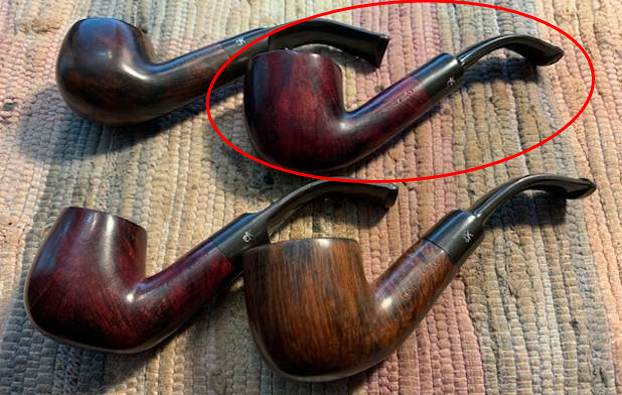
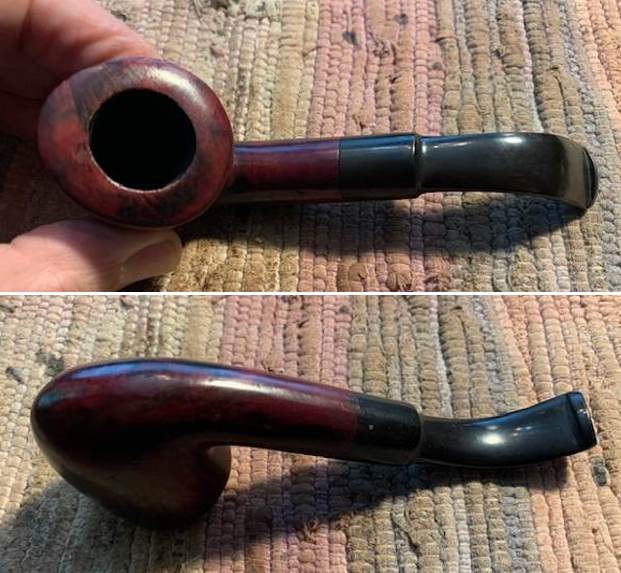
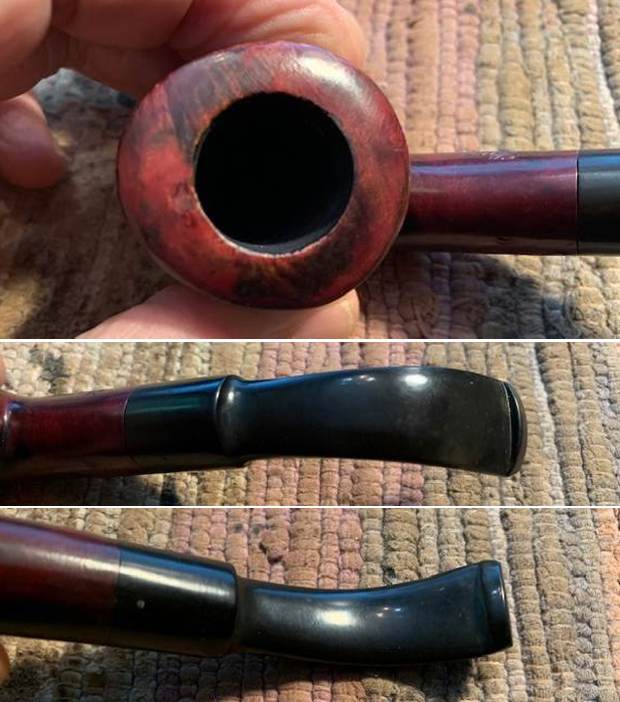
Not too long ago a fellow in Eastern Canada was selling a foursome of Brigham rusticated pipes on Facebook. Jeff contacted him and we became the new owners of the pipes. He sent us some photos of the pipes that I have included below. It did not take long for them to arrive here in Vancouver. When they did I was amazed at how good they looked. Two of them were relatively clean and two were used. The top two pipes in the photo were clean and the bottom two were still dirty with cake and debris in the bowls. I decided I would work on them next. I turned to the final pipe of the lot a Bent Volcano shape – the second from the bottom in the photos below as marked by the red box outlining it. It is stamped on the underside with the shape number 184 on the shank followed further down the shank by Brigham. It was by far the most used of the four pipes. It had the thickest cake in the bowl, lava on the rim top and some damage to the end of the metal tenon/keeper for the Brigham Rock Maple Distillator. It was also probably the newest of the lot of four but I would figure that out as I worked on it. I took photos of the pipe when it arrived. There was some damage on the inner edge with the bowl being out of round. There was a moderate cake in the bowl in the bowl with lava overflowing into the rustication of the rim top. The shank and airways seem to be dirty with tars and oil. It did not have the Hard Rock Maple filter in the shank but the interior smelled strongly of tobacco. The stem was very clean and shiny without any tooth damage to the top or underside of the stem. The button was clean with no damage. Overall the pipe looked good even though it was a dirty one. I took photos of the rim top and the bowl to show the condition. The rim top was rusticated and covered in lava heavily at the back of the bowl. You can see the damage on the inner edge of the bowl making it out of round and the thick cake that is present. I also took photos of both sides of the stem to show the lack of tooth marks and chatter. Over all the pipe was in okay condition.I took a photo of the stamping on the underside of the shank. It is faint but it reads as noted above.I took a photo of the pipe with the stem removed to give an overall picture of the pipe. It really is quite beautiful.I took a photo of the rim top to show how out of round the bowl was and of the damage on the end of the aluminum Distillator holder/tenon. I have included them below. The red arrow shows one of the spots where the damage is visible.For historical background for those unfamiliar with the brand I am including the information from Pipedia on Brigham pipes. It is a great read in terms of the history and background on the pipes (https://pipedia.org/wiki/Brigham_Pipes). Charles Lemon (Dadspipes) is currently working on a book on the history of the brand. Until that is complete this article is a good summary. I have included it below.

Roy Brigham, after serving an apprenticeship under an Austrian pipesmith, started his own pipe repair shop in Toronto, in 1906. By 1918 the business had grown to include five other craftsmen and had developed a reputation across Canada for the high quality of workmanship. After repairing many different brands of pipes over the years, Roy noted certain recurring complaints by pipe smokers, the most common referred to as “tongue bite”. Tongue bite is a burning sensation on the smoker’s tongue, previously thought to be due to the heat of the smoke (i.e. a “hot smoking pipe”).

He soon began manufacturing his own pipes, which were lightweight, yet featured a more rugged construction, strengthening the weak points observed in other pipes. The problem of tongue bite intrigued him, and he decided to make overcoming it a future goal.

About 1938, Roy’s son Herb joined him to assist in the business. The business barely survived the great depression because pipes were considered to be a luxury, not a necessity, and selling pipes was difficult indeed. In approximately 1937 [1], after some experimentation, Roy and Herb discovered that tongue bite was in fact a form of mild chemical burn to the tongue, caused by tars and acids in the smoke. They found that by filtering the smoke, it was possible to retain the flavour of the tobacco and yet remove these impurities and thereby stop the tongue bite.

Just as Thomas Edison had searched far and wide for the perfect material from which to make the first electric light bulb filaments, Roy & Herb began experimenting with many materials, both common and exotic, in the quest for the perfect pipe filter. Results varied wildly. Most of the materials didn’t work at all and some actually imparted their own flavour into the smoke. They eventually found just two materials that were satisfactory in pipes: bamboo and rock maple. As bamboo was obviously not as readily available, rock maple then became the logical choice.

They were able to manufacture a replaceable hollow wooden tube made from rock maple dowelling, which when inserted into a specially made pipe, caused absolutely no restriction to the draw of the pipe, yet extracted many of the impurities which had caused tongue bite. The result was indeed a truly better smoking pipe…

Charles Lemon has also written a great article on the stampings and marking on the Brigham pipes that fit into a time line that he has drafted. It is well worth a read and is fascinating. (https://pipedia.org/wiki/Brigham_Pipes_%E2%80%93_A_Closer_Look_at_Dots,_Dates_and_Markings). I quote from the pertinent section on the time frame for this pipe.

I have dubbed the decades between 1980 and 2000 the Late Canadian Era, a period that saw several changes at Brigham that are of note to the collector. First, the traditional 8-grade pinning system (the famous Brigham “Dots” which denoted the quality of the pipe) was changed to a 7-grade system to simplify pinning (more on this below), and the Norsemen and Valhalla series were merged to form the President Series, which represented the very finest pipes coming out of the Toronto factory. Early pipes from this era (left, below) are stamped with a shape number and “Brigham” over “Canada”; later pipes (late 1980s+, on right below) are stamped simply with a shape number and the Brigham logo.

This solidly places the pipe I am working on in the period of Brigham production that Charles calls the Late Canadian Era (1980-2000). It is a great looking pipe with an older style rustication pattern than the later Brighams that I have worked on.

Charles also put together a chart that helps the restorer to understand the Brigham dot system. I quote from the same link on Pipedia as noted above.

Revised Dot System 1980

Brigham changed the Dot system in 1980, adding a 7 Dot at the top of the line, dropping the names of each series and eliminating the confusing vertical and horizontal 3 Dot configurations. The Norsemen and Valhalla series were combined to form the President series of freehand pipes, which adopted a 3 Dot pattern with a larger dot on the right as shown below. The 7- grade pinning system stayed in place from 1980 to 2001. I knew that I was dealing with a pipe made between 1980-2000 from the Late Canadian Era. It sports 1 dot making it Brigham Series 100 pipe with a 3 digit shape number 184. Now to do a bit of spiffing with the pipe itself.

I reamed the pipe with a PipNet pipe reamer to remove the light cake from the bowl walls. It was uneven and needed to be removed so I took it back to bare briar. I cleaned up the reaming with a Savinelli Fitsall Pipe Knife and then sanded the bowl with a dowel wrapped with 220 grit sandpaper to smooth out the walls. I cleaned up the damage to the inner edge of the rim with a folded piece of 220 grit sandpaper and made the bowl edge both smooth and round.I scrubbed the exterior of the pipe with a brass bristle wire brush and a tooth brush with undiluted Murphy’s Oil Soap. I scrubbed it to remove the build up on the rim top. I rinsed it with warm water and dried it off with a soft cloth. I touched up the stain on the rim top and edges with a Maple Stain Pen to match the surrounding colour of the briar. Once it is buffed and polished I think it will look good.I cleaned out the internals with alcohol, cotton swabs and pipe cleaners to remove the debris and the oils from the shank and tenon as well as the airway into the stem and bowl. I rubbed the bowl down with some Before & After Restoration Balm. I worked it into the briar with my fingertips and a horse hair shoe brush. The product works to clean, renew and protect briar. I let it do its work for 15 minutes then buffed it off with a soft cloth. The pipe is really quite a beauty. I set the bowl aside and turned my attention to the stem. I polished out the surface of the stem ahead of the button on both sides using micromesh sanding pads. I also polished out the damaged end of the aluminum tube. I was not perfect but it was smooth and held the filter in place. I dry sanded the stem and tenon with the 1500-12000 grit pads, then wiped it down with a cloth impregnated with Obsidian Oil. I finished polishing it with Before & After stem polish – both Fine and Extra Fine. I gave it a final coat of Obsidian Oil and set it aside to dry.  I fit the clean and polished stem with the Brigham Rock Maple Distillator and took photos to show what it looked like. This is in essence a hollow Maple wood tube that serves to filter out the moisture and deliver a clean and flavourful smoke.  I am excited to finish this Late Canadian Era Made in Canada Brigham 184 Bent Volcano. I put the pipe back together and buffed it with Blue Diamond on the buffing wheel. I gave the bowl multiple coats of Conservator’s Wax and the stem multiple coats of carnauba wax. I buffed the pipe with a clean buffing pad to raise the shine and hand buffed it with microfiber cloth to deepen the shine. It is fun to see what the polished bowl looks like with the rusticated finish. Added to that the polished black vulcanite stem with the shining brass pin was beautiful. This mixed grain on the rusticated Brigham 184 Volcano is nice looking and the pipe feels great in my hand. It is light and well balanced. Have a look at it with the photos below. The dimensions are Length: 6 inches, Height: 1 ¾ inches, Outside diameter of the bowl: 1 ¼ inches, Chamber diameter: ¾ of an inch. The weight of the pipe is 1.55 ounces/44 grams. It is a beautiful pipe and one that will be on the rebornpipes store in the Canadian Pipe Makers Section soon. If you are interested in adding it to your collection let me know. Thanks for walking through the cleanup with me as I worked over this pipe. Thanks to each of you who are reading this blog. Remember we are not pipe owners; we are pipemen and women who hold our pipes in trust until they pass on into the trust of those who follow us.

Cleaning up a Crown Duke, Dr. Grabow Bent Billiard for a Memory Box of Dad


Blog by Steve Laug

I received an email a while ago from a lady who wanted to have one of her Dad’s pipe cleaned and restored. As we emailed back and forth it was clear that it was one of those pieces that was filled with memories. I pressed to see if she was sure that she wanted it cleaned as it would remove the remnants of debris and tobacco from her Dad’s use of the pipe. She was clear that she wanted it cleaned up to look as good as possible because she was going to make a shadow box to hold the pipe and a photo and other memorabilia of her late Dad. When it finally arrived here in Vancouver I could see why she wanted it clean. The pipe was very dirty and there was a crack in the shank. The pipe had not been smoked for a long time and there was no tobacco smell in it at all. There was a hard thin cake in the bowl and lava on the rim top. The stem was oxidized and had calcification on the button end. It was a filter pipe that had been smoked without a filter so the insides were dirty. The pipe was stamped on the left side and read Crown Duke [over] Dr. Grabow. On the right side it read Imported Briar. There was a blue Grabow Spade on the left side of the taper stem. It was dirty and worn looking with some obvious fills around the bowl. I took some photos of the pipe before I started to work on it.    I took a photo of the rim top and bowl to give a clear picture of what I was dealing with. I also captured the crack in the top of the shank in the photo (I have outlined it in a red box). Other than being incredibly dirty the stem was in decent condition with light tooth chatter and light marks near the button edge.The stamping on the shank sides was faint but readable and reads as noted above.I took a better photo of the crack in the top of the shank and have included it below. It was quite wide open but came to an end in the squiggle at the end toward the bowl. I would need to glue and band it to make it solid again.I took a photo of the pipe with the stem removed to get a sense of the look of the Bent Billiard.I picked a band out of my box of bands. It is far too deep so I will need to take it down for a proper fit on the shank. I started the process by using a topping board. I then used my Dremel and sanding drum to remove the full amount I wanted gone. I finished the shaping of the band on the topping board.Once I had the fit correct, I removed it from the shank and cleaned up the area around the crack with alcohol and cotton swabs. I filled in the crack with clear super glue and clamped the crack shut. Once the glue cured I heated the band and pressed it onto the shank. I took some photos of the repaired shank and band. Now it was time to clean the bowl. I have often done the process in reverse but I really wanted to stabilize the crack before I worked on cleaning the exterior and interior of the bowl and shank. I did not want to chance making the crack worse. I reamed the cake out of the bowl with a Pipnet pipe reamer and took the cake back to bare briar. I cleaned up the reaming with a Savinelli Fitsall pipe knife and sanded the bowl walls smooth with a piece of dowel wrapped with 220 grit sandpaper. I wanted the bowl to be smooth for the display. I scrubbed the exterior of the bowl with undiluted Murphy’s Oil Soap and a tooth brush. I was able to remove the debris and grime around the bowl and clear off the lava on the rim top. I dried the bowl off with a cloth and took these photos. You can see the dark fills and spots around the bowl sides. The largest was a rough fill on the front of the bowl that was pink putty. I repaired the pink, rough fill on the front of the bowl with clear super glue. Once the repair cured I sanded it smooth with 220 grit sandpaper. It was now smooth to the touch. It would be interesting to try to blend it into the surrounding briar once I was staining it. I sanded the entire bowl with 1500 grit micromesh at the same time.I cleaned out the airway in the shank and the stem with cotton swabs, pipe cleaners and isopropyl alcohol. It took quite a few to get the tars and oils out of the airways.I buffed the pipe on the buffer with Blue Diamond and then stained it with a light brown stain. I applied the stain and then flamed it to set it. I used a black and brown Sharpie pen to stain the pinkish fill on the front of the bowl.I set the bowl aside for the stain to cure and turned my attention to the stem. I sanded out the tooth chatter and marks on the stem with 220 grit sandpaper and started the polishing with 400 grit wet dry sandpaper. It is actually beginning to look much better. I polished the stem with micromesh sanding pads – dry sanding with 1500-12000 grit pads. I wiped the stem down after each pad with an Obsidian Oil impregnated cloth to give the pads a little more bite. I polished it with Before & After Stem Polish both Fine and Extra Fine and gave it a final rub down with Obsidian Oil. I set the stem aside to dry and worked on the bowl again. By this time the stain was dry and I was able to tackle the bowl again. I wiped it down with alcohol on paper towels to make the stain more transparent. Because of the fills in the bowl I decided to leave it dark as it did a good job masking them. I buffed the bowl on the wheel with Blue Diamond to further aid the transparency. It is hard to see in the photos but in person the grain is there and not terribly hidden. The fills are hidden and other than the large one on the front of the bowl they look good. I put the stem on the bowl and buffed the pipe with Blue Diamond on the buffing wheel. I was careful when buffing around the stamping and the logo on the stem. I had decided to leave some of the nicks and marks in the briar as they were a part of the story of the pipe and its owner. I wanted it to still bear his definitive marks so that when it was in the shadow box those who knew him would remember the story of the pipe.  I did not want the pipe to look brand new as that would remove the story from it. The nickel band worked well to bind together the crack in the shank. The aluminum spacer on the stem sits up against it and looks quite nice as a joint with the band. It almost gives the band the look of a ferrule. The pipe came out quite well. The darker stain is very similar to what was originally on the pipe when it was new. It also did a good job of masking the fills around the bowl. I will soon be packing it up and sending it back to the pipeman’s daughter so she can build her tribute to her Dad. Thanks for reading the blog.