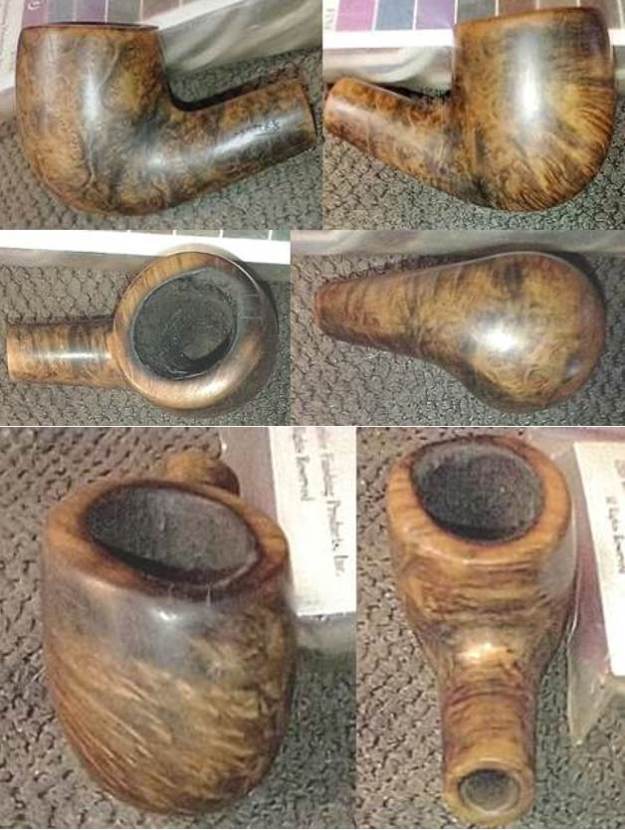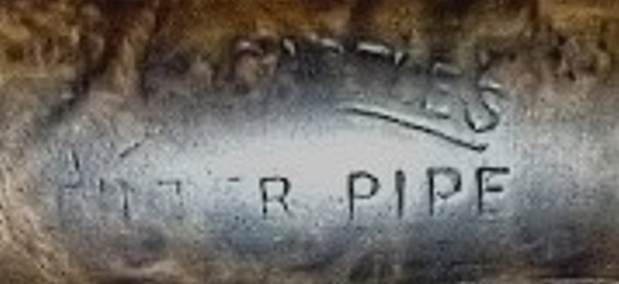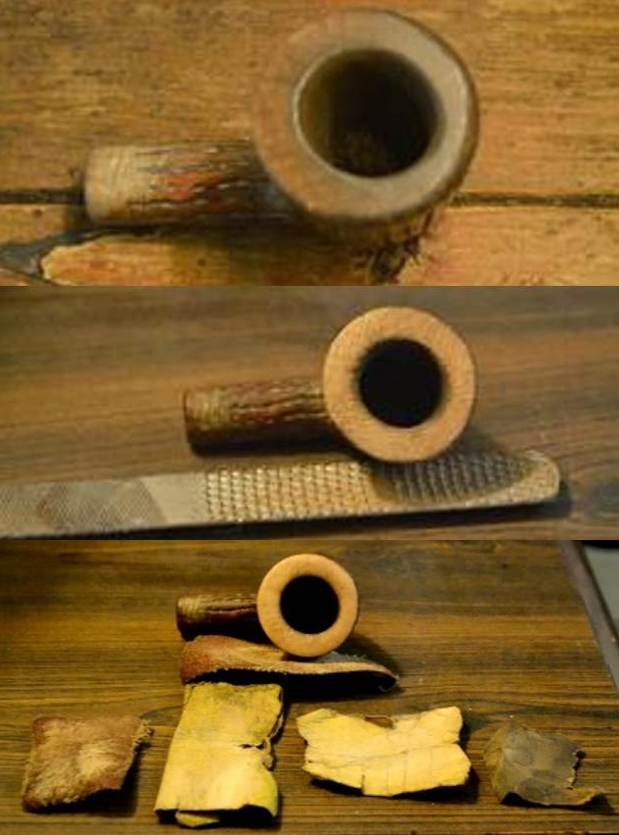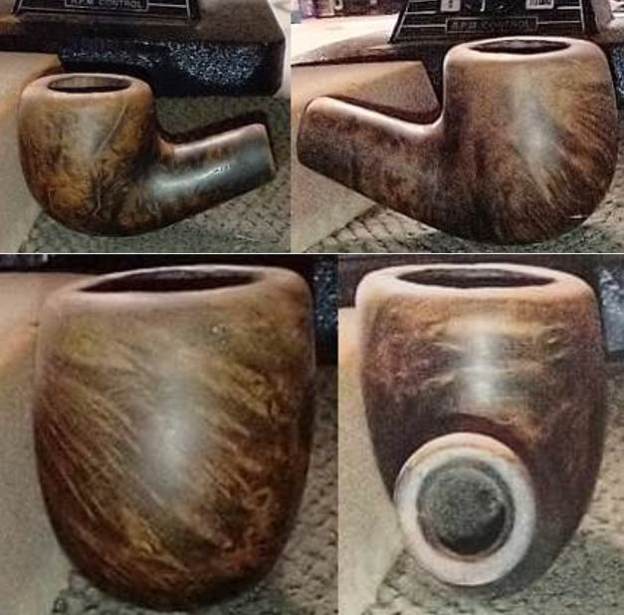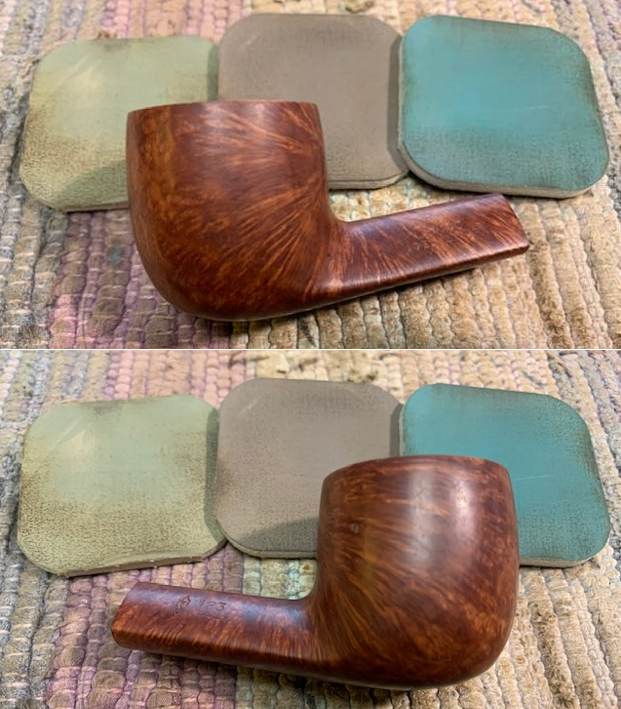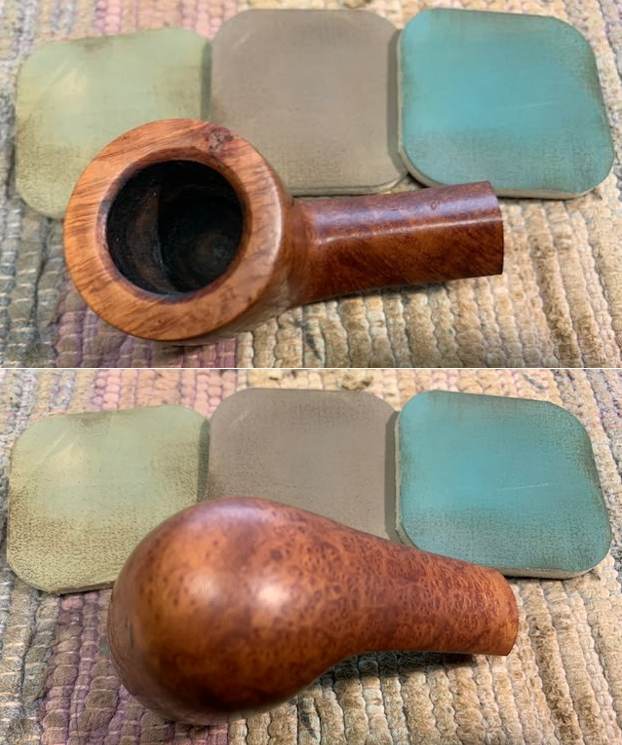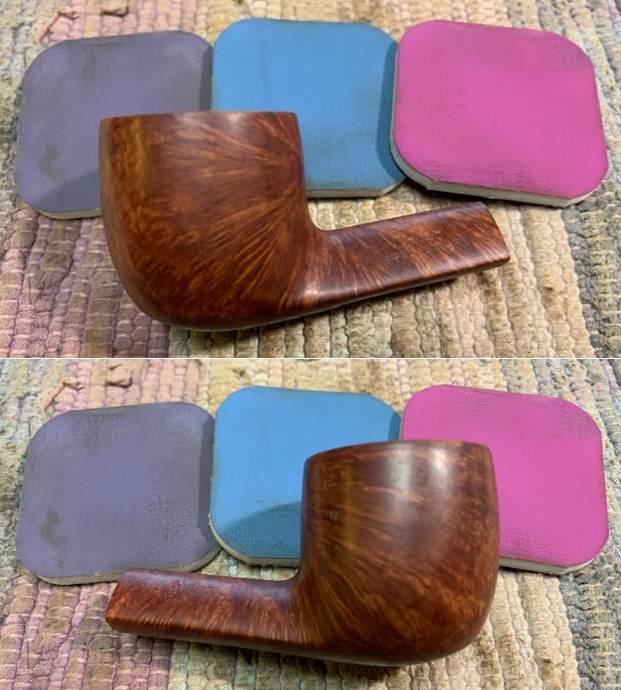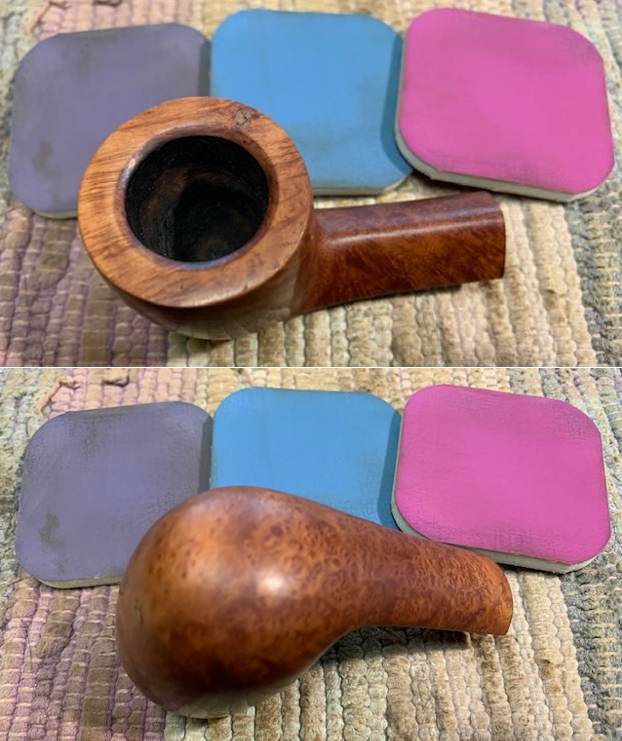
Tag Archives: bowl topping

New Life for a Nat Sherman 14K Gold Banded Canadian


Blog by Steve Laug

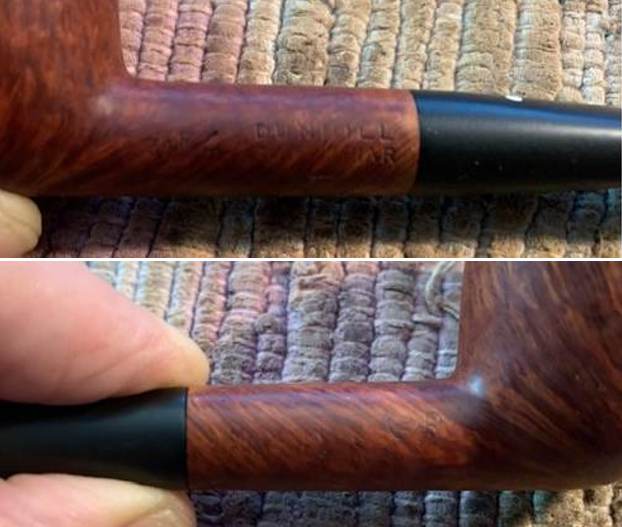
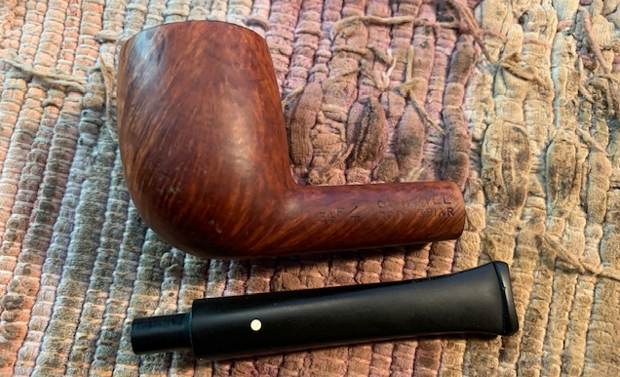
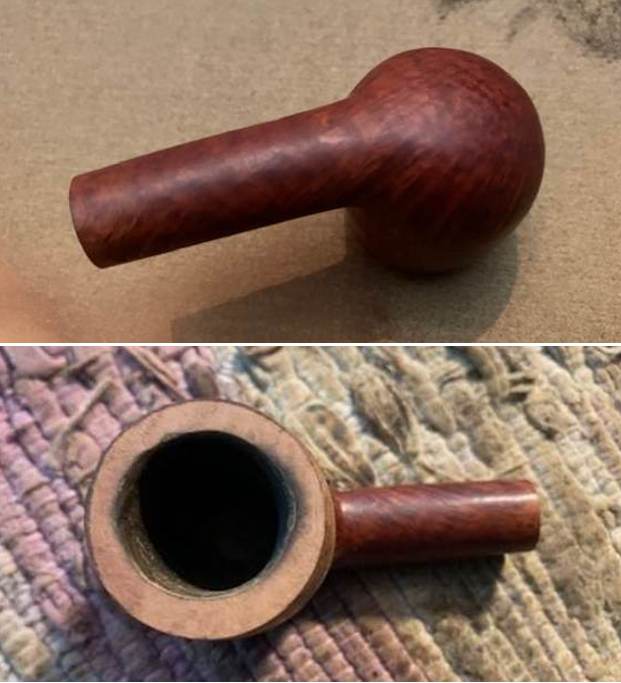
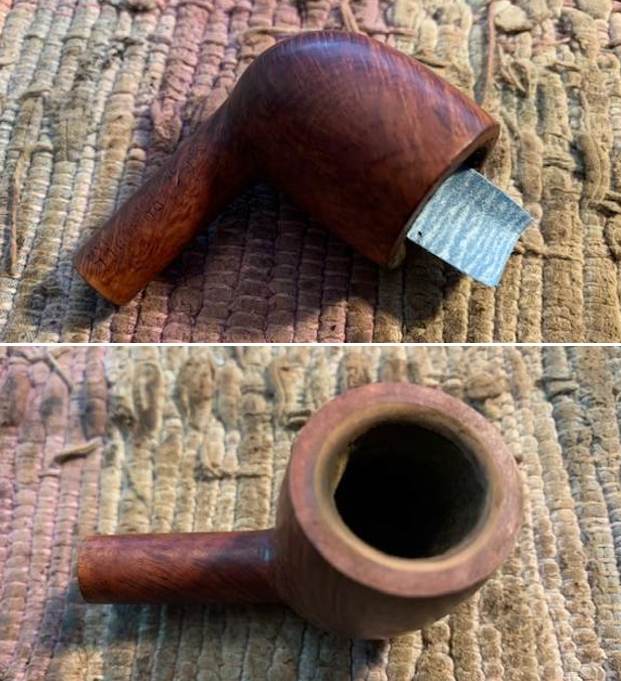
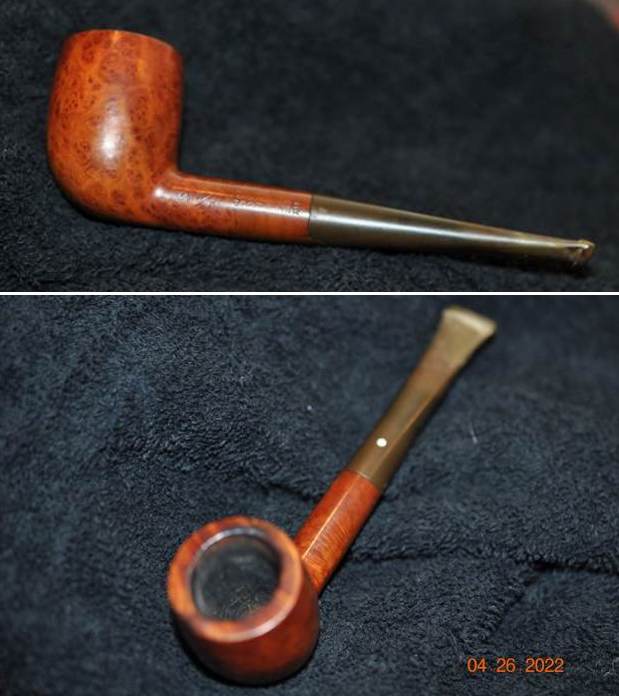
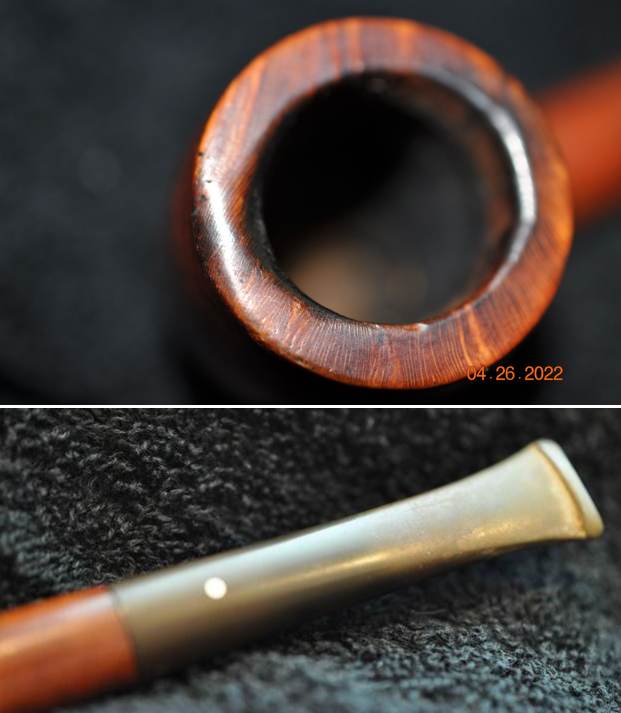
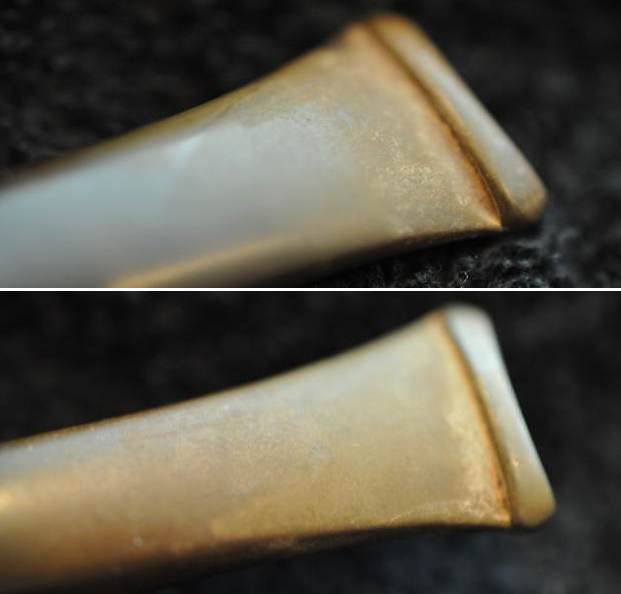
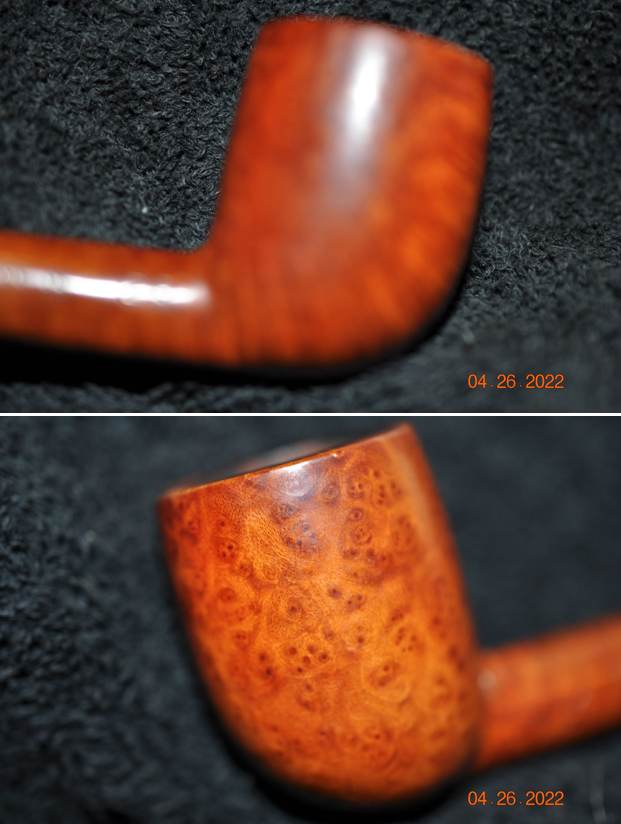
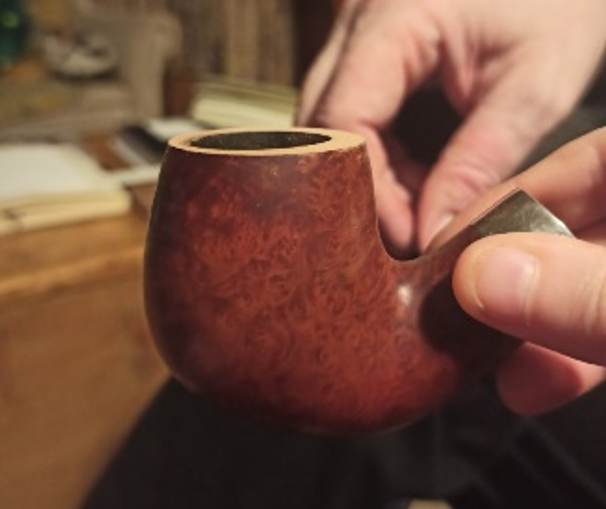
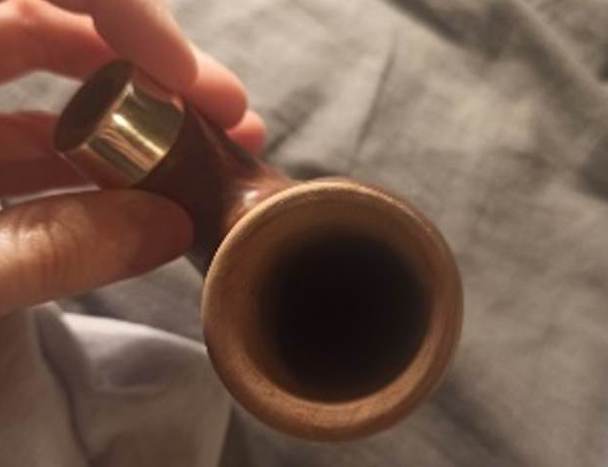
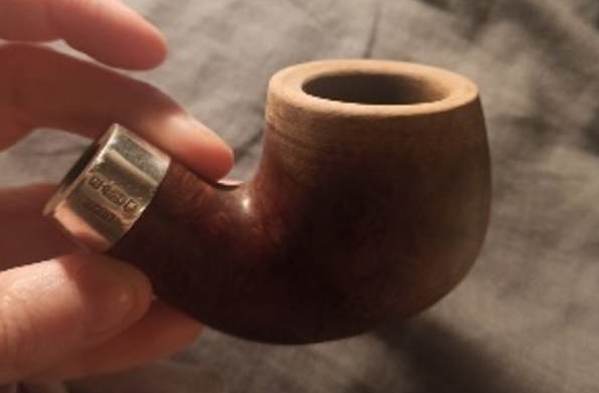
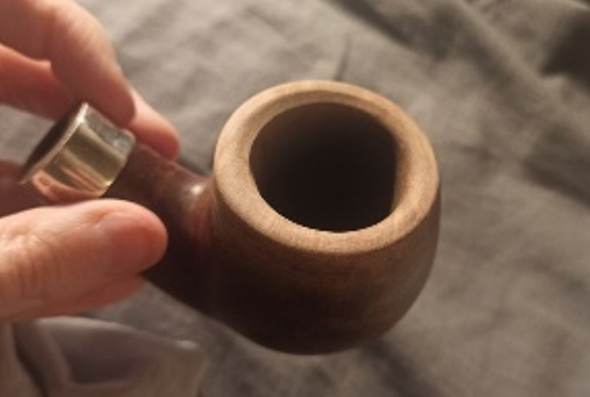
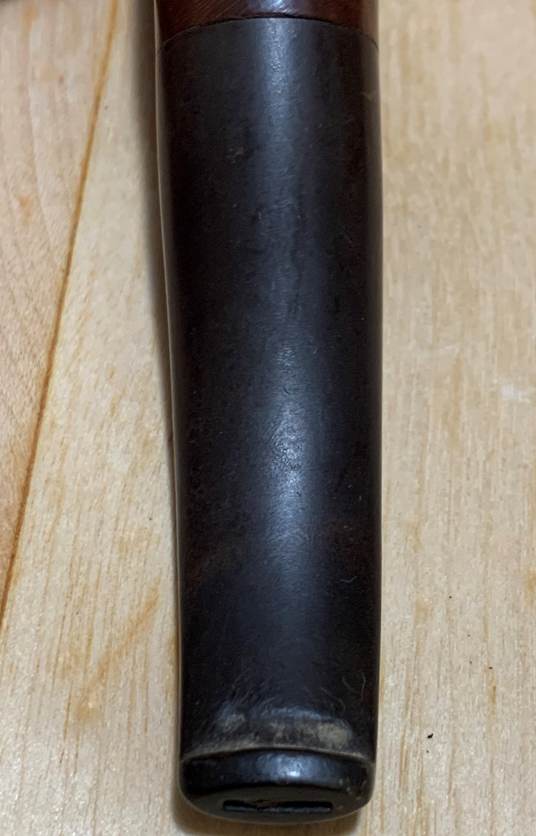
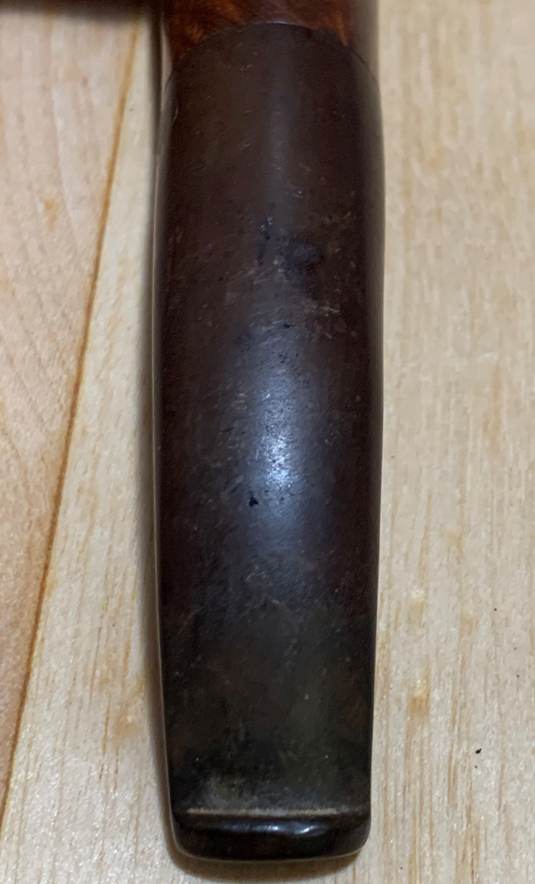
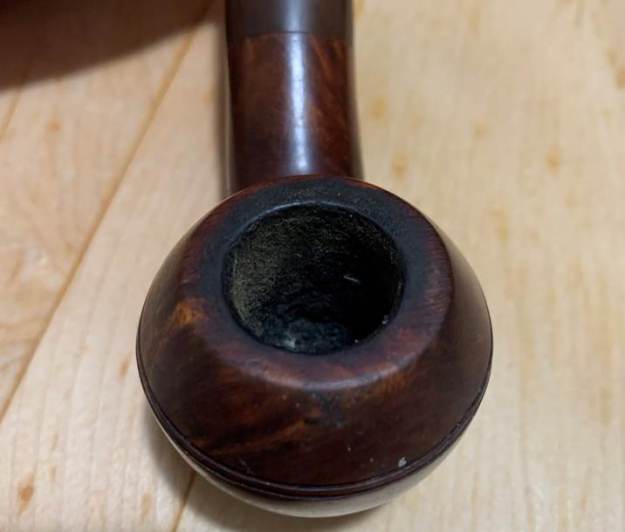
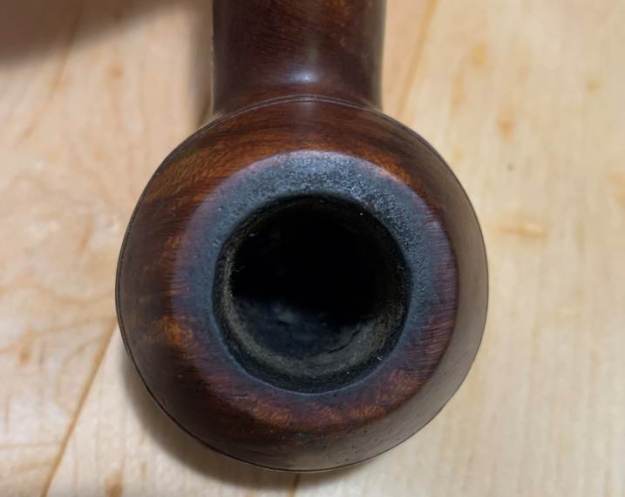
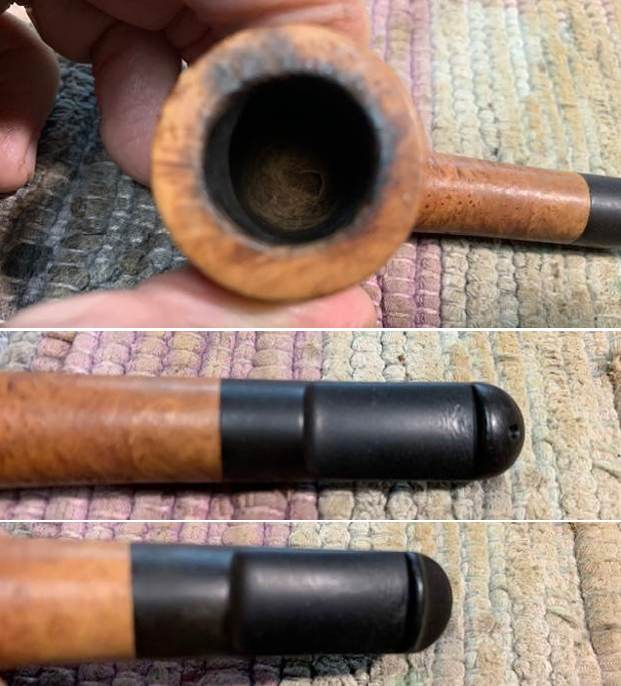
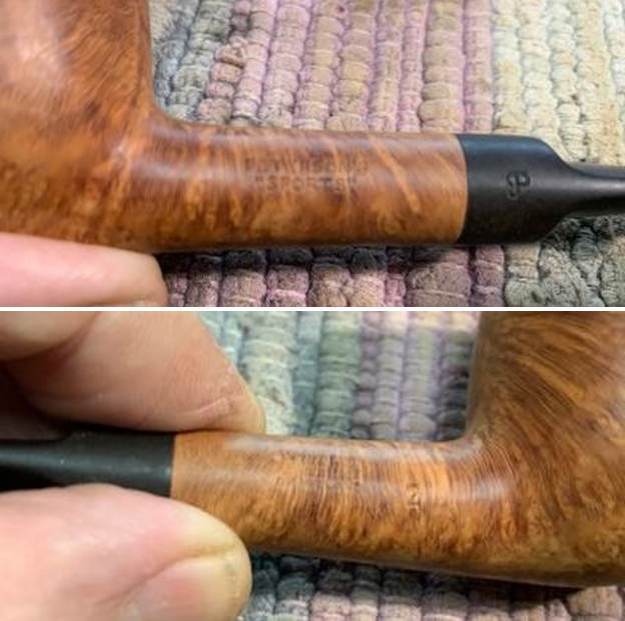
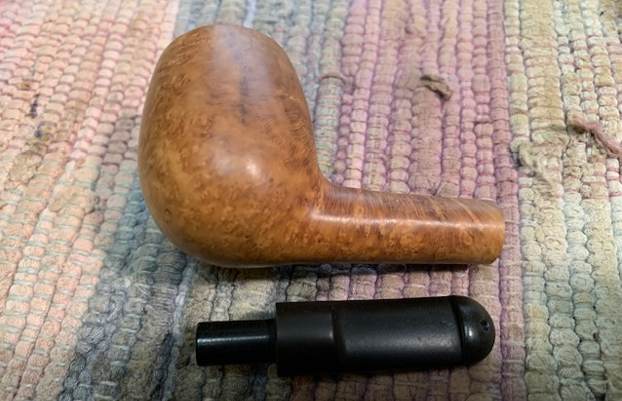
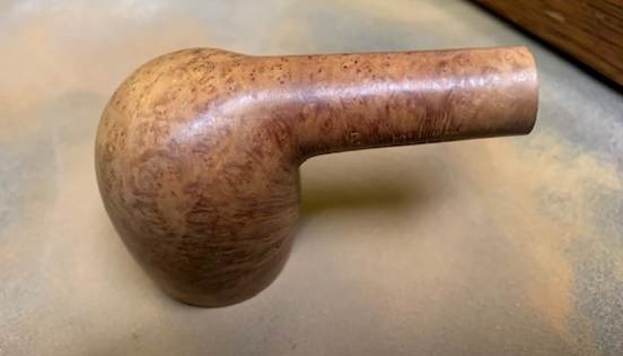
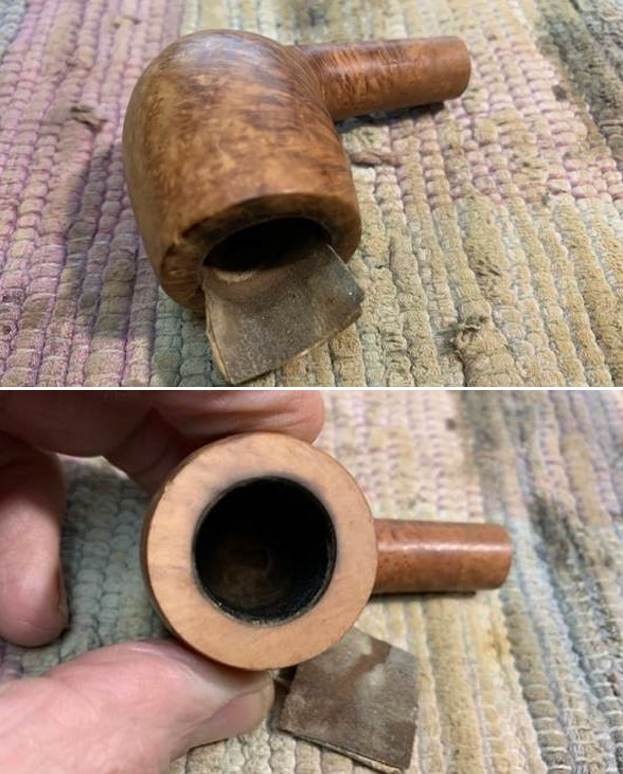
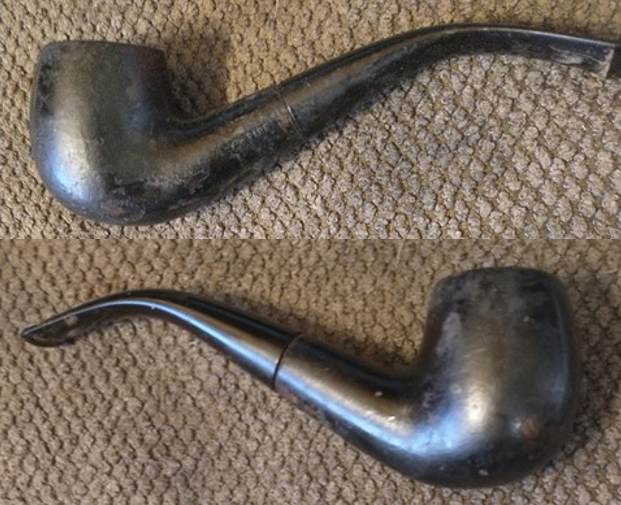
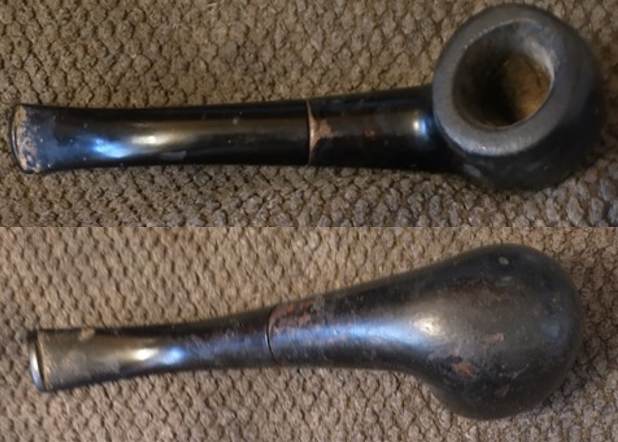
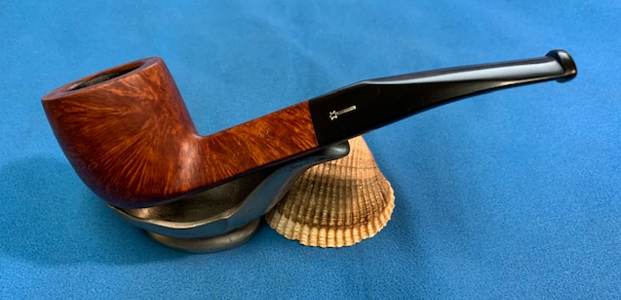
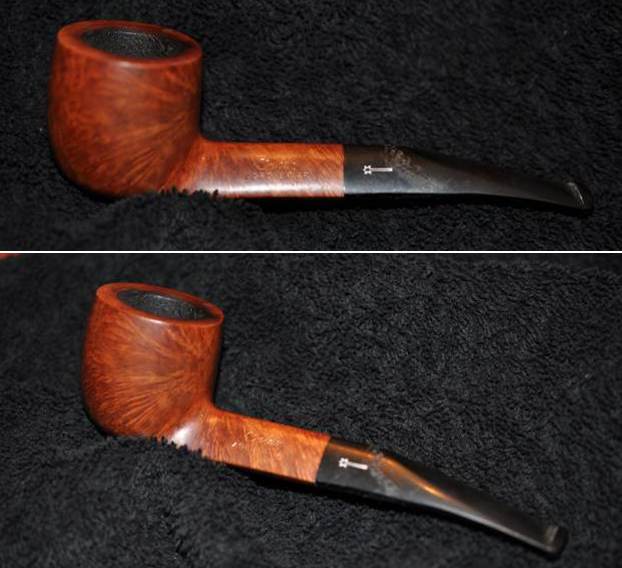
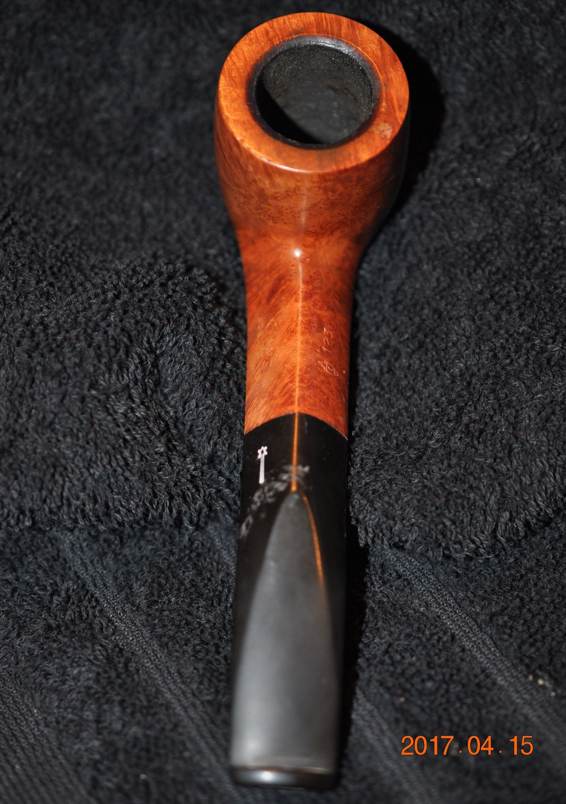
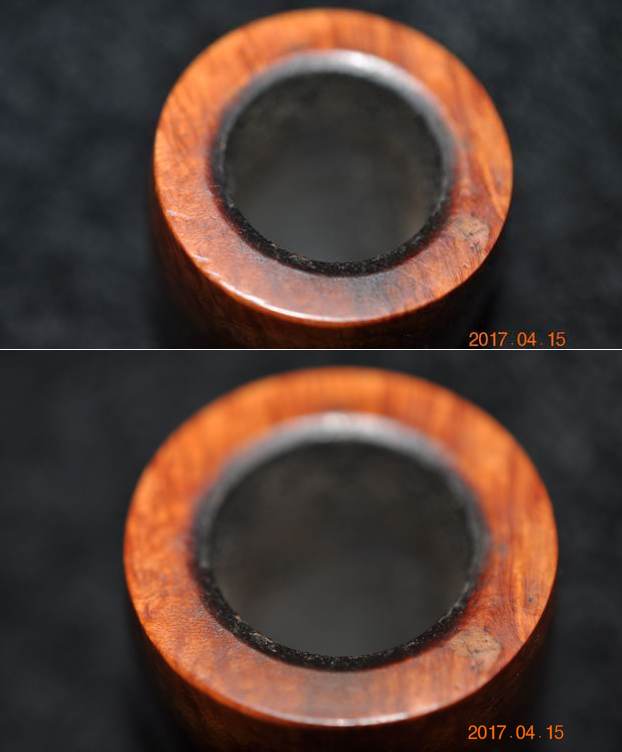
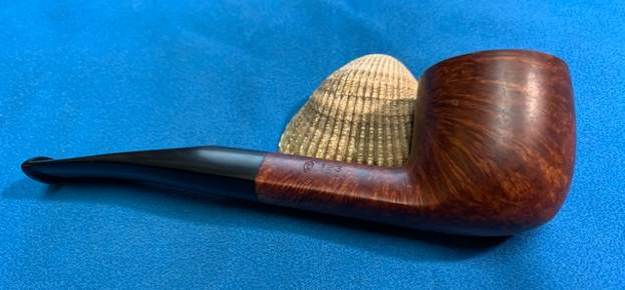
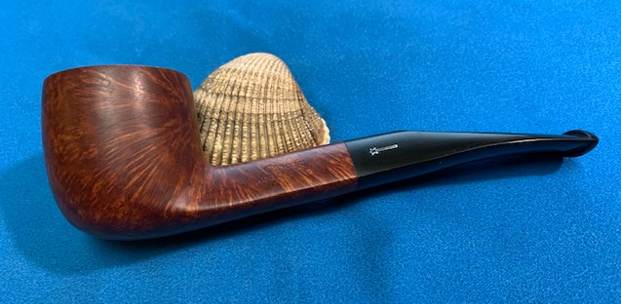
The next pipe on the work table is another one that came to me from either a trade I made (pipes for labour) or a find on one of my pipe hunts. I honestly don’t remember where it came from. It has been around for a while waiting to be worked on. It is an older long shank Canadian with a gold coloured band on the shank. It is quite dirty but has some great grain on the bowl and the shank. The stamping on this Canadian is faint but and readable. It is stamped on the topside mid-shank and reads Nat Sherman. There is no shape number on the shank that I can see. The gold band is stamped 1/20, 14K, Diamond T, G.F. The pipe had a lot of grime ground into the smooth finish on the bowl. The bowl had been heavily caked but had been reamed somewhere in its journey. The rim top and inner edges had darkening, burn damage and some nicks in the surface all the way around though heavier on the back side. The vulcanite stem was dirty and had light tooth chatter and marks on the top and underside ahead of the button. There were no identifying logos or markings on the taper stem. The pipe had promise but it was very dirty. I took photos of the pipe before I started my cleanup work.   I took photos of the rim top and bowl to give a clear picture of the bowl and the damage on the rim top and edges. The 14K Gold Band is tarnished and scratched. I also took photos of the top and underside of the stem to show the light chatter and tooth marks. I took photos of the stamping on the top side of the shank. It reads as noted above and is faint but readable. The gold band is stamped on the top as noted above.I removed the stem from the shank and took a photo of the pipe. I also took a photo of the shank end to show that there was no crack under the band. It appears that it was solely for adornment. I wanted to see if I could narrow down a time frame for this Nat Sherman pipe so I turned first to Pipephil’s site to get a good overview and see if there were photos of a similar looking stamping on a pipe there. There was no information on the brand on the site.

From there I turned to Pipedia to read more information about the time periods and the stamping on this particular pipe (https://pipedia.org/wiki/American_Pipe_Brands_%26_Makers_N_-_Q). There was only a note on the search page. It read as follows: Brand made for well known New York City Tobacconist of the same name.

I turned to Wikipedia to see what I could learn about the brand as it was one of the few articles on the history (https://en.wikipedia.org/wiki/Nat_Sherman).

Nat Sherman is the brand name for a line of handmade cigars and “luxury cigarettes”. The company, which began as a retail tobacconist, continued to operate a flagship retail shop, known as the “Nat Sherman Townhouse”, located on 42nd Street, off Fifth Avenue, in New York City from 1930 to 2020, when it closed its doors. Corporate offices are now located at the foot of the George Washington Bridge in Fort Lee, New Jersey…

…During the 1960s, the Sherman shop expanded its wares to include pipes. Over 1,000 pipes were offered for sale in a 40-foot (12 m) long case hung along the wall of the store.[1] The company also began to sell pipe tobacco under the “Nat Sherman” brand name.[1] At the time of its expansion, the company’s pipe department was perhaps the largest in New York City and the United States. Quoted from an interview with Joel Sherman noted below.            (Sherman, Joel. “An Interview with Joel Sherman of Nat Sherman”, PipesMagazine.com, November 25, 2009. Retrieved February 12, 2011)

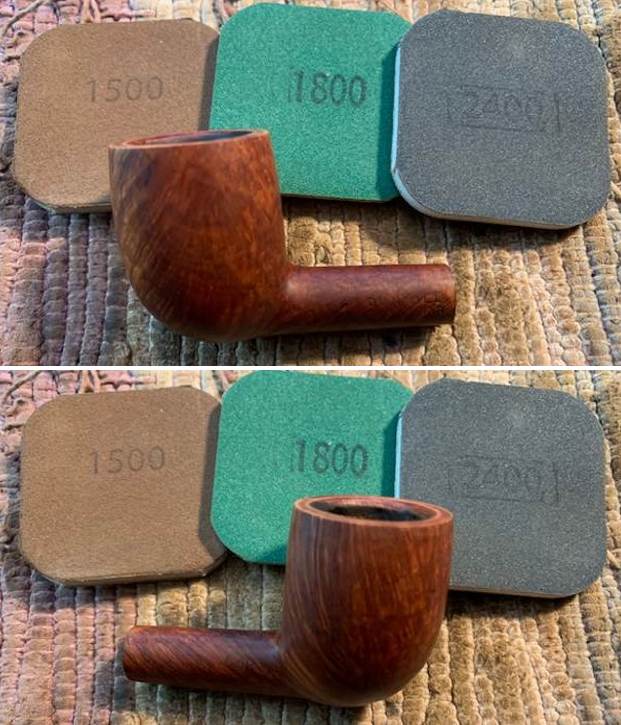
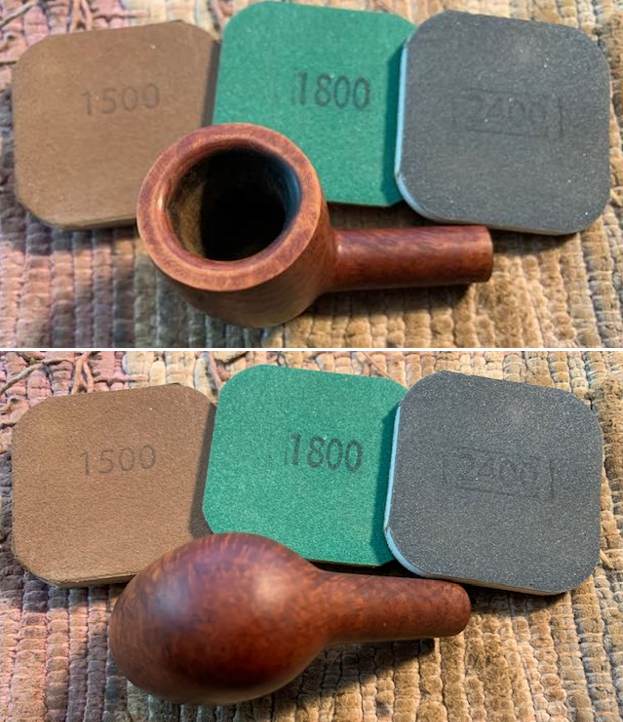
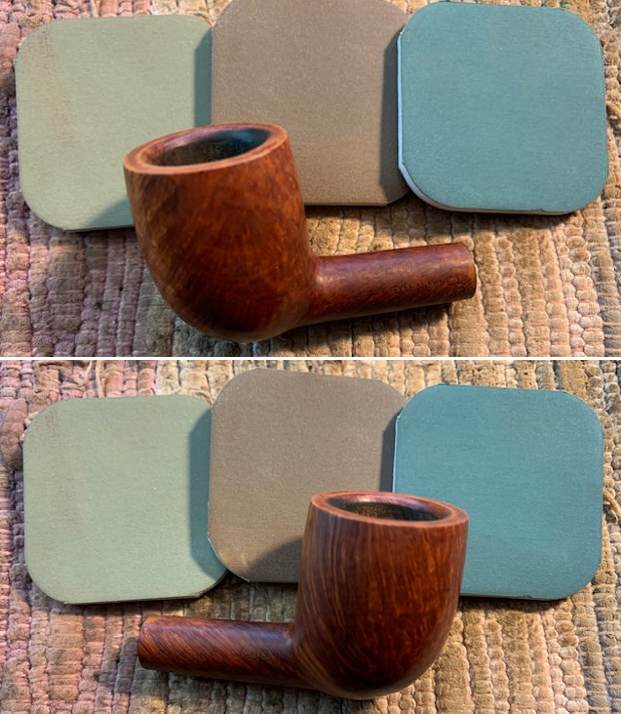
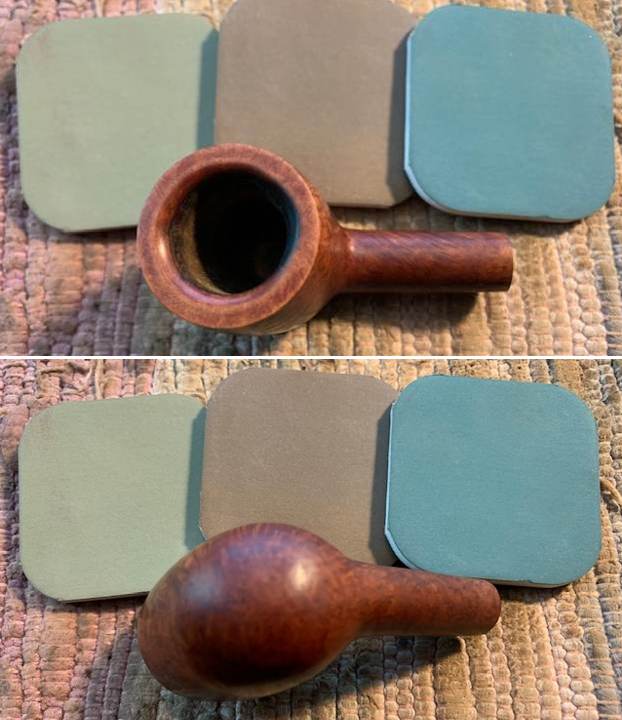
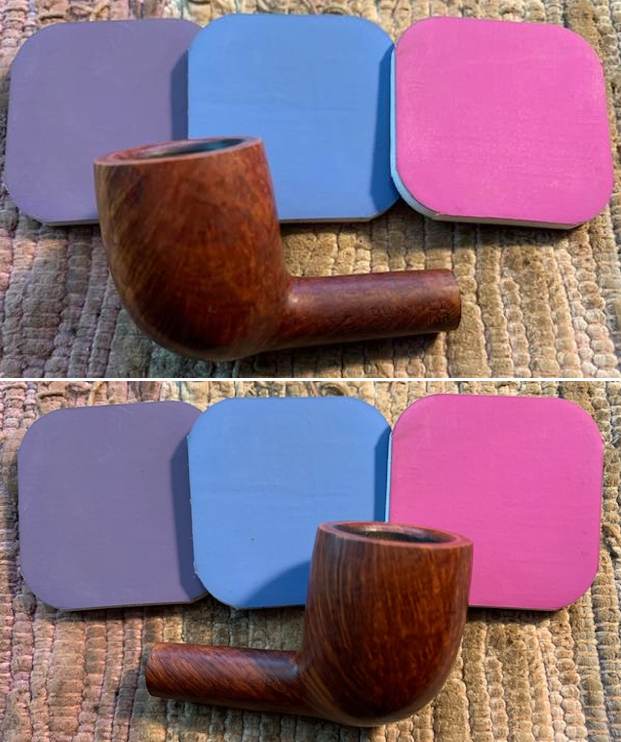
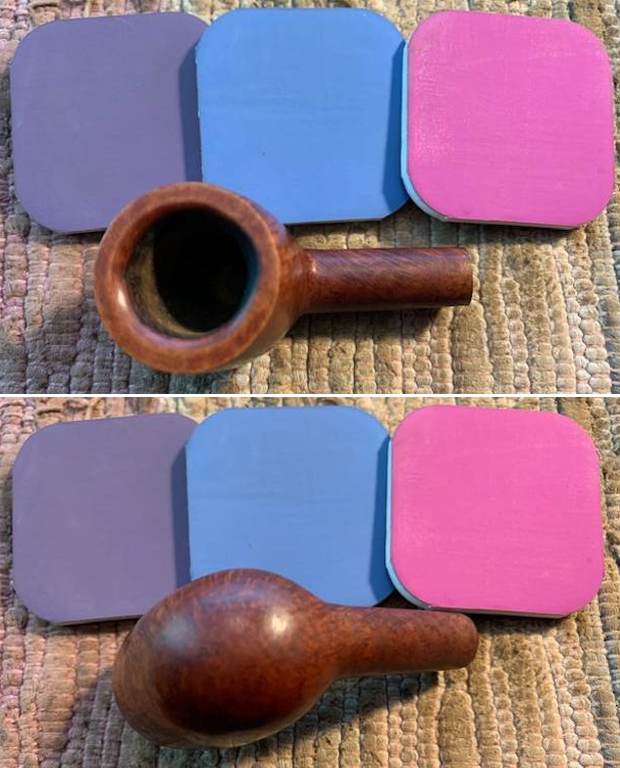
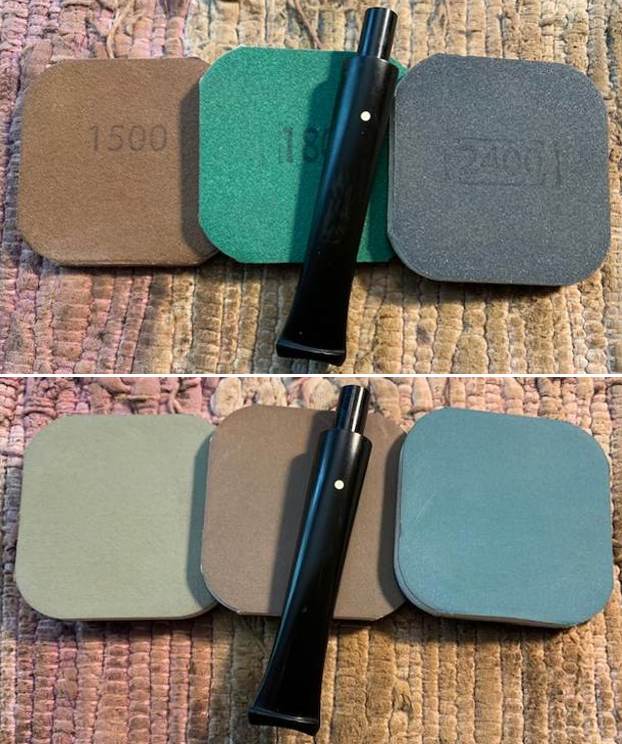
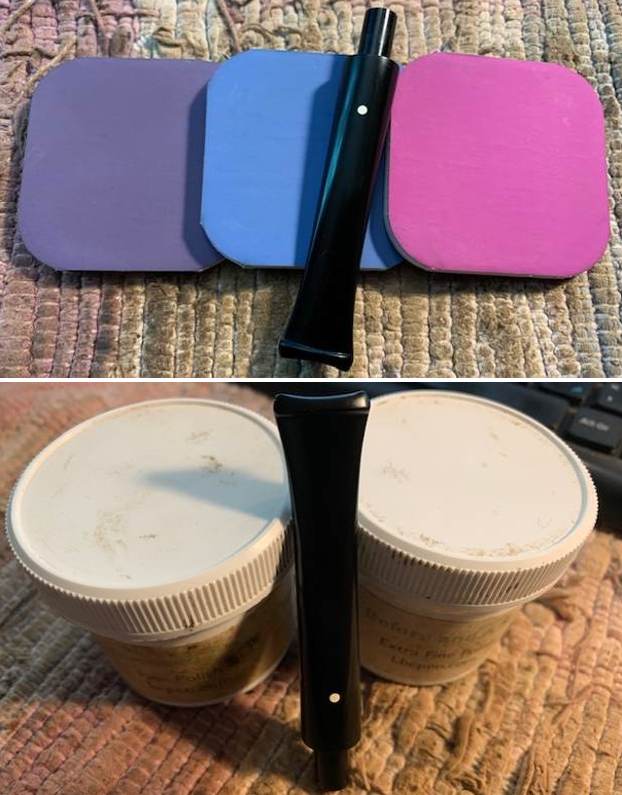
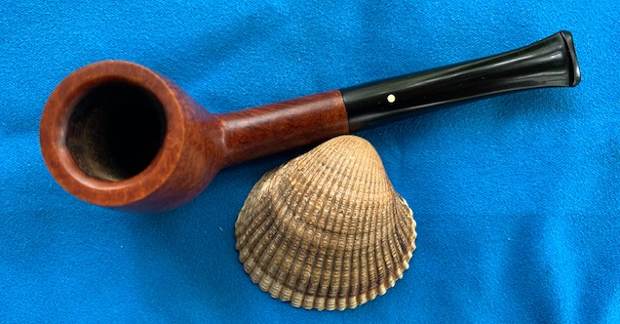
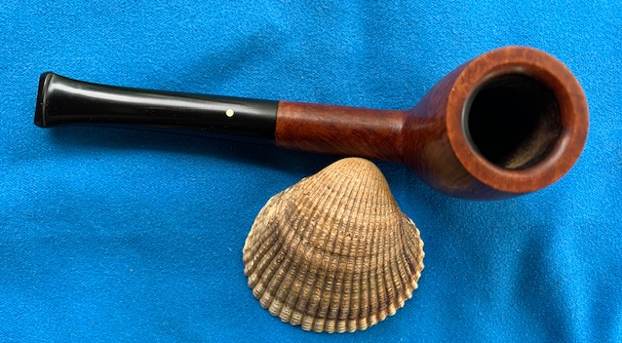
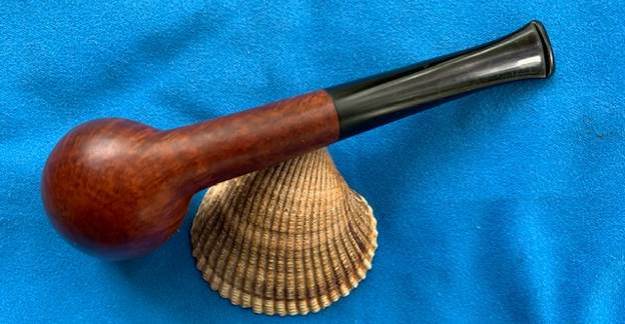
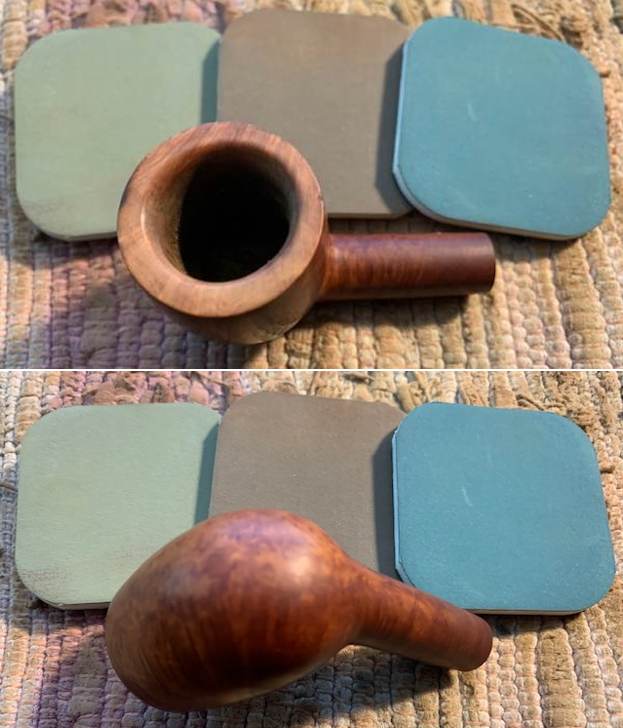
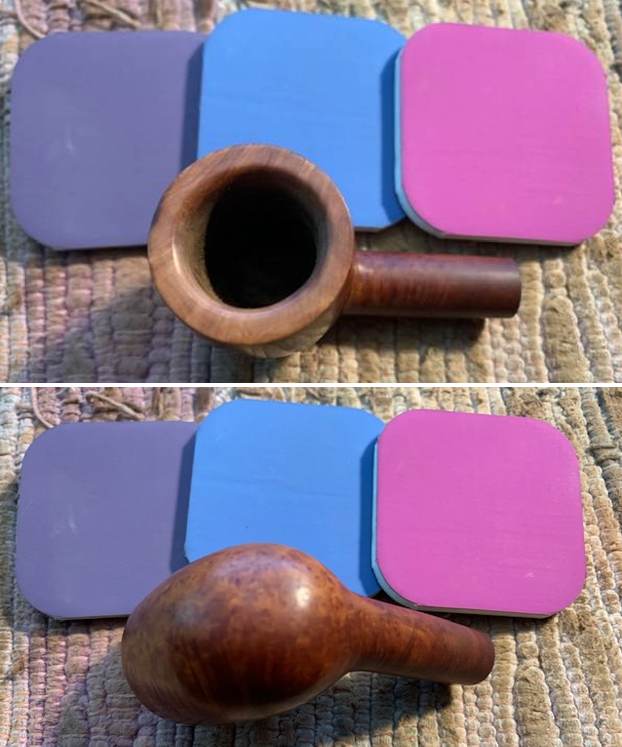
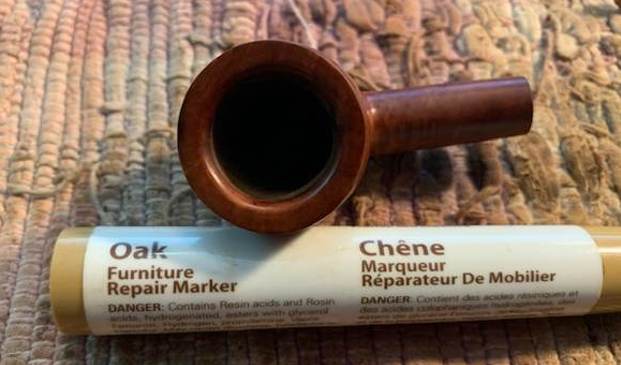
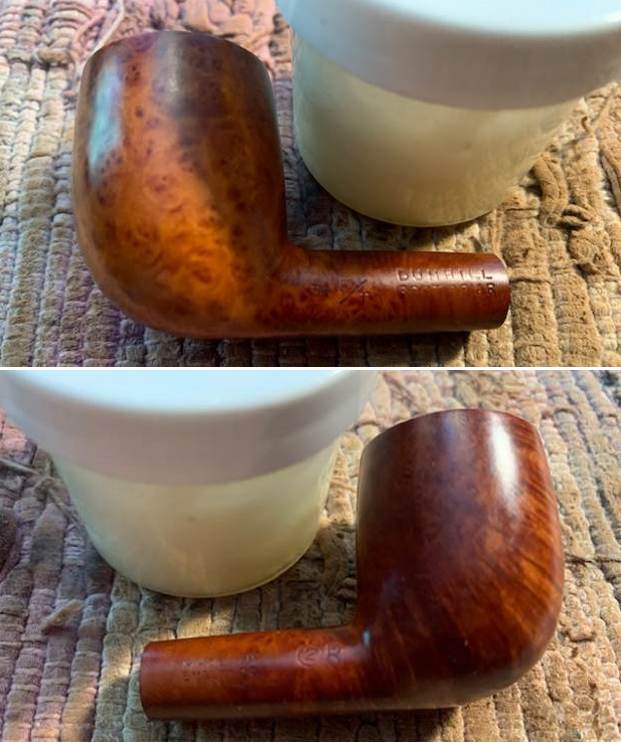
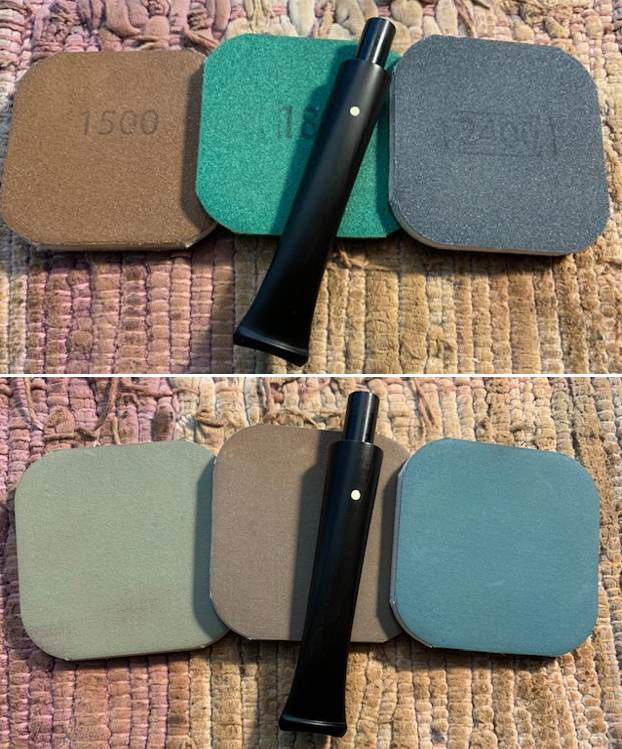
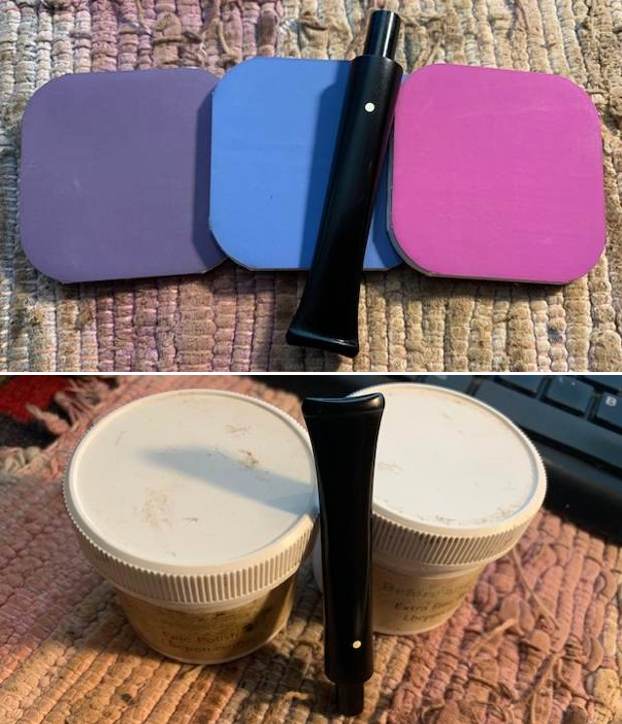
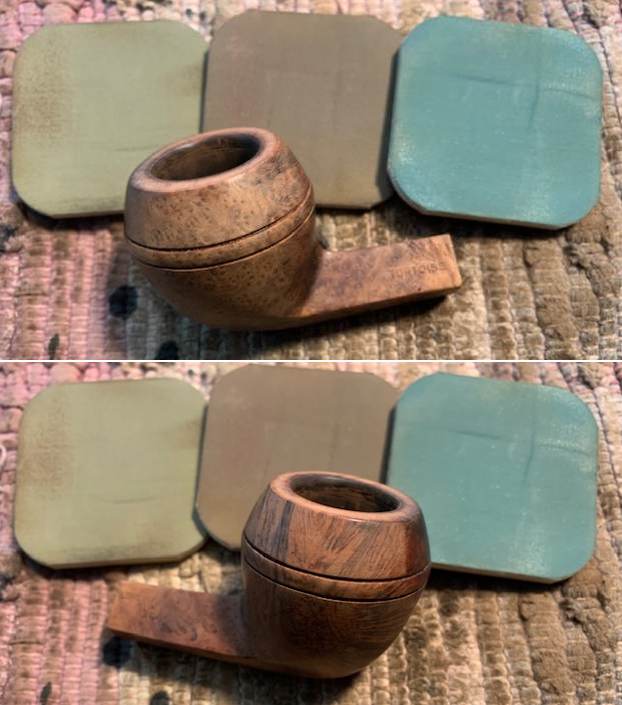
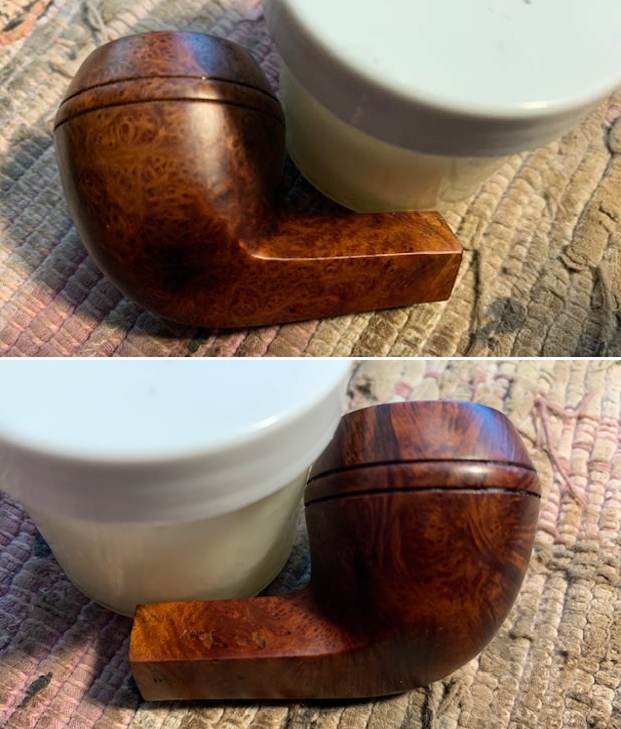
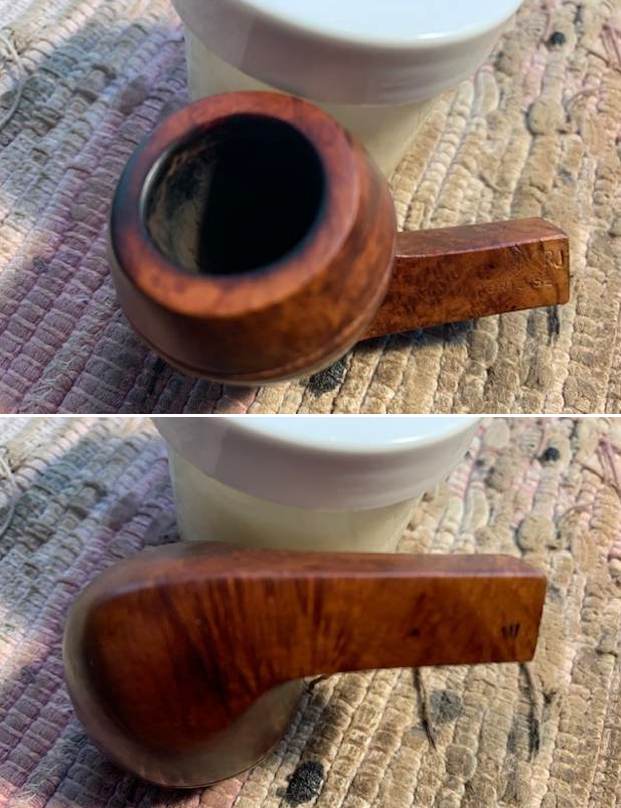
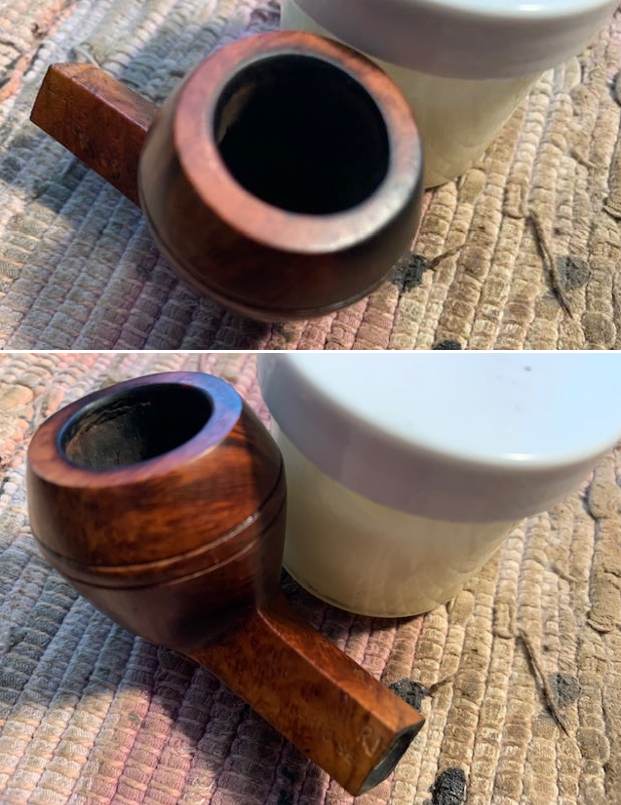
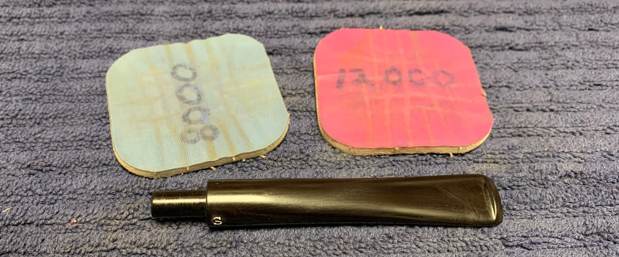
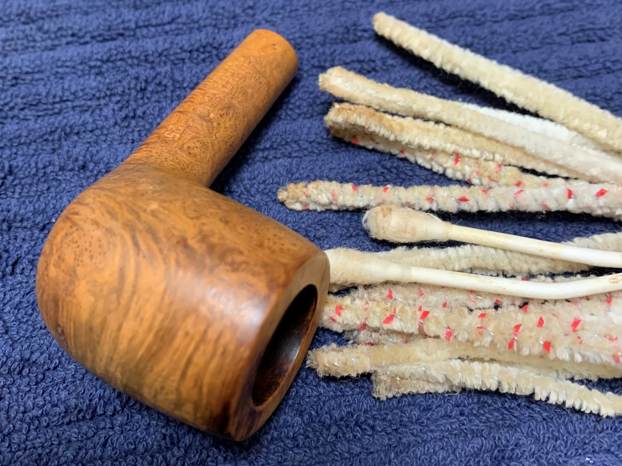
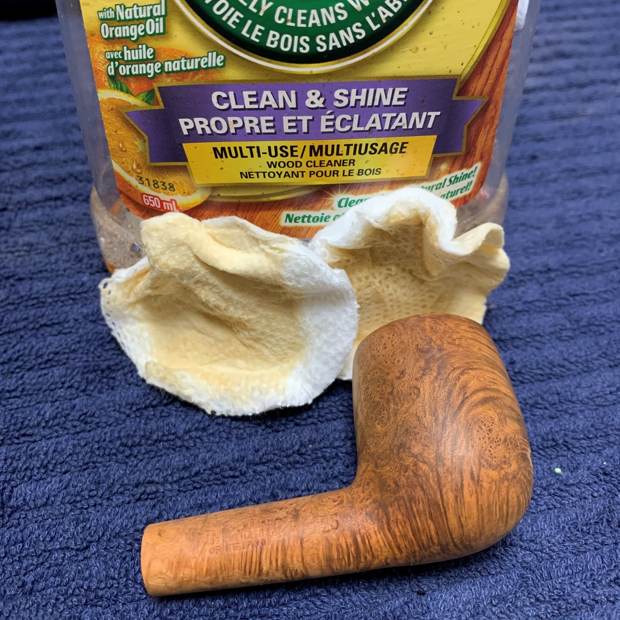
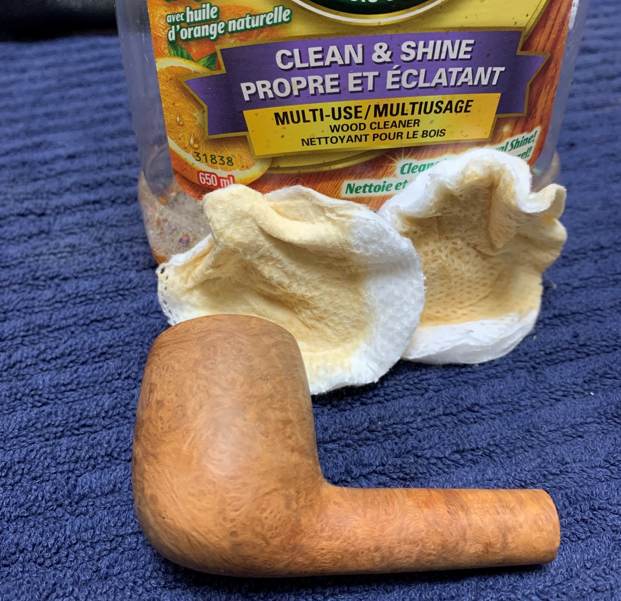
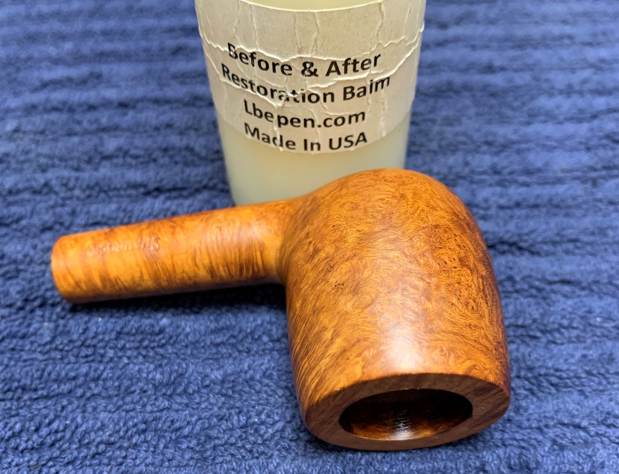
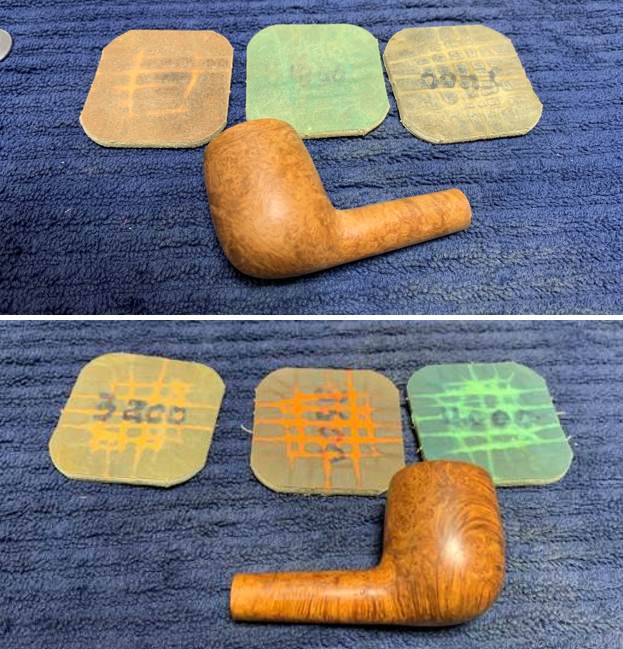
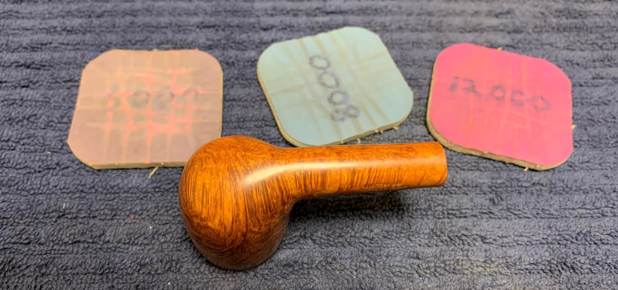
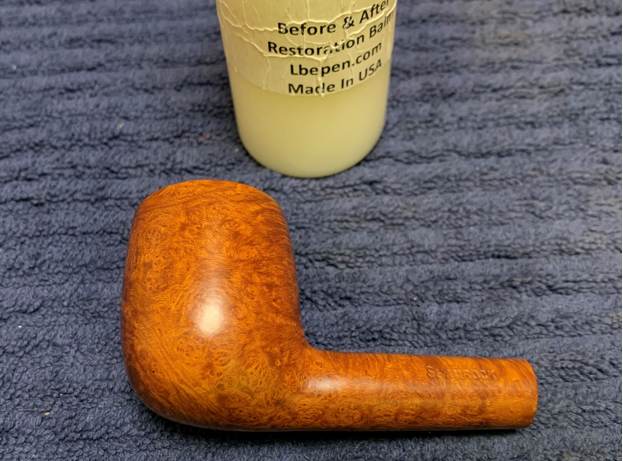
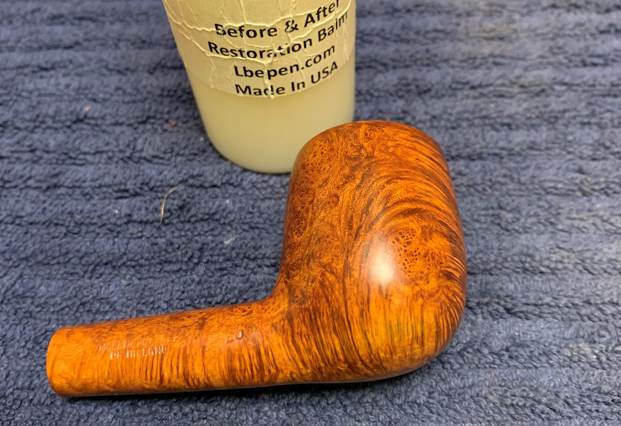
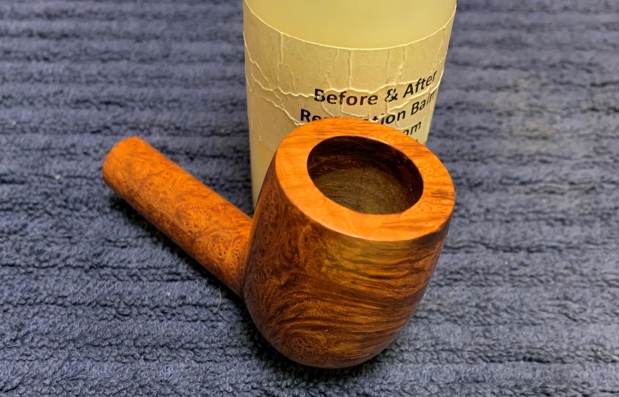
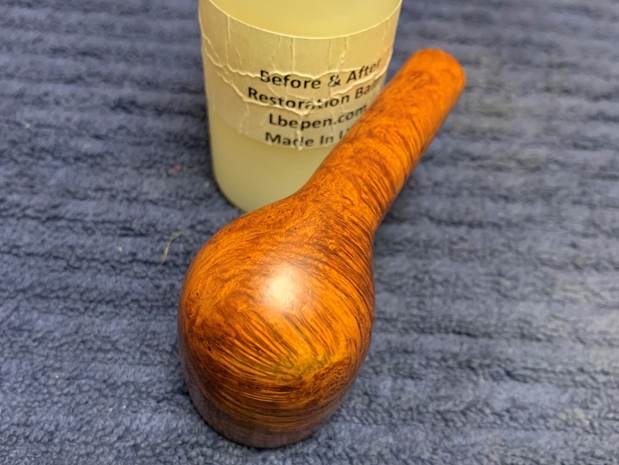
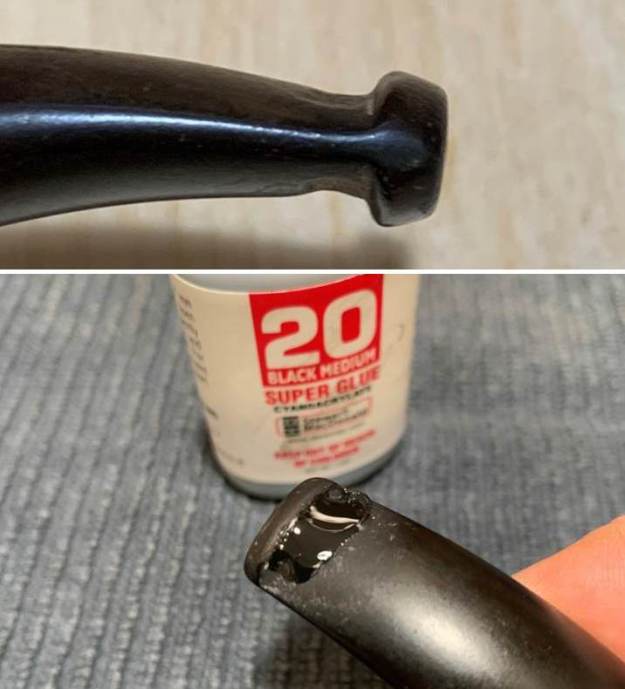
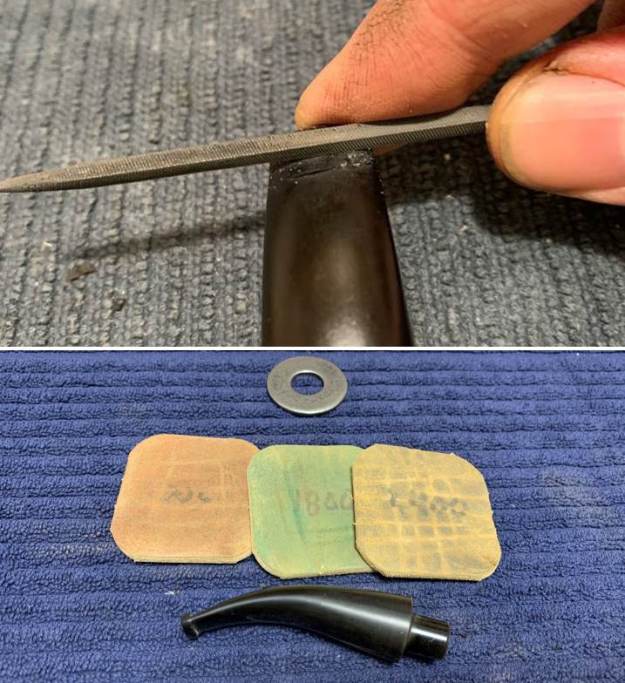
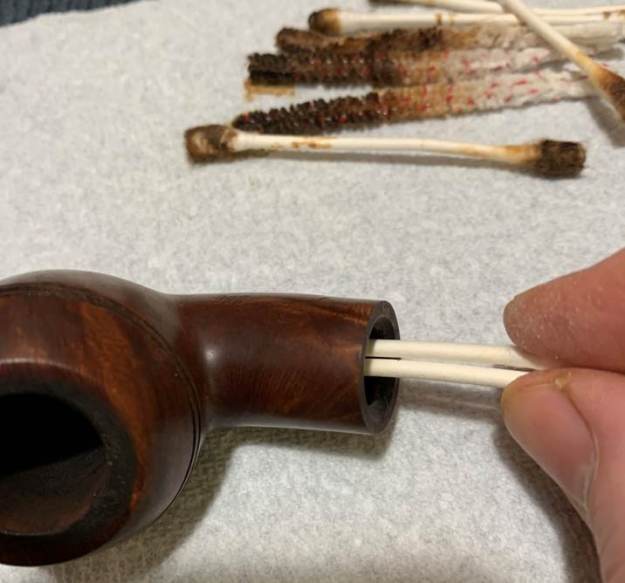
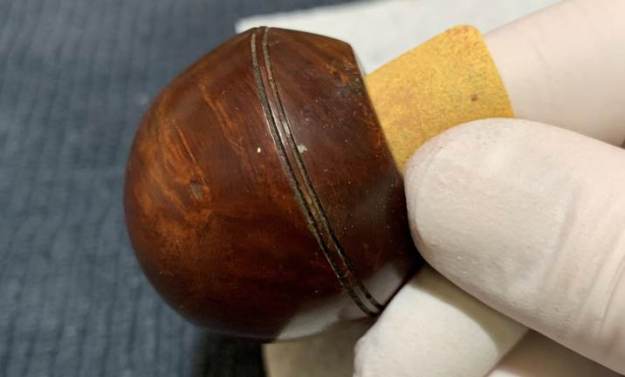
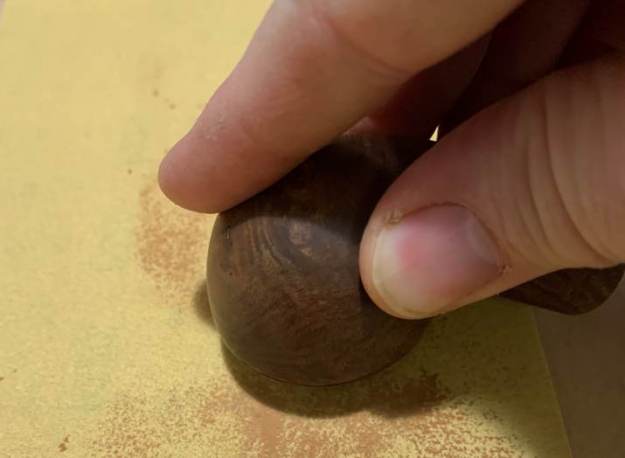
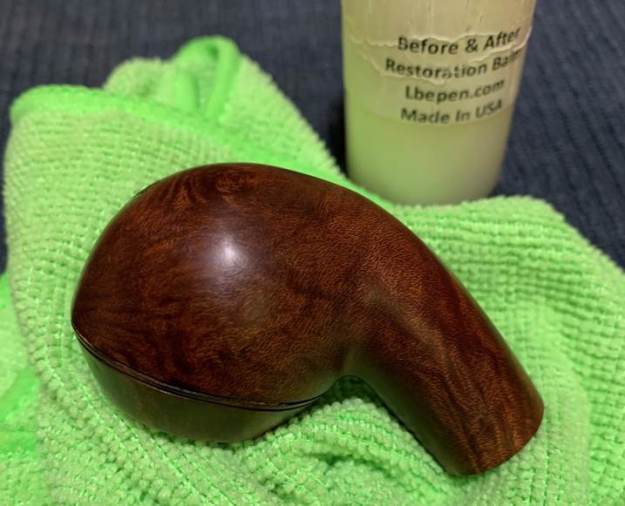
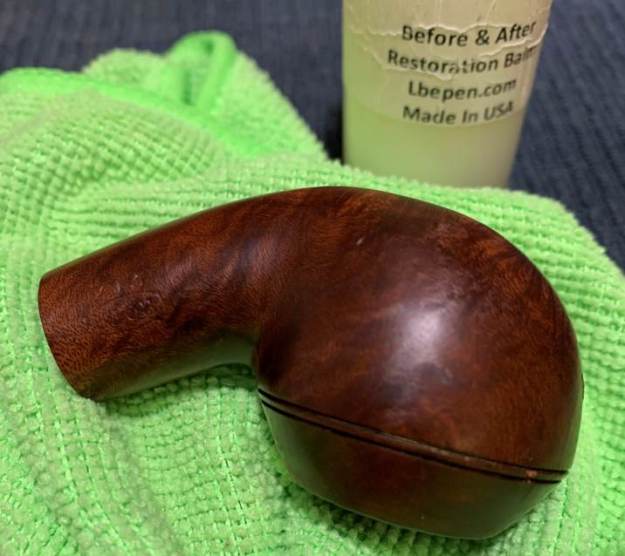
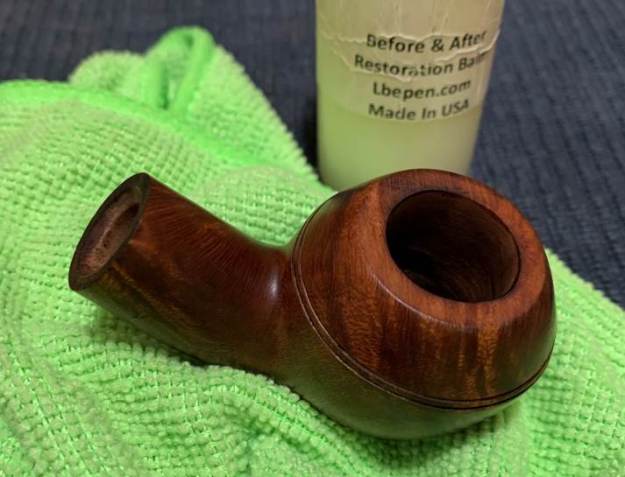
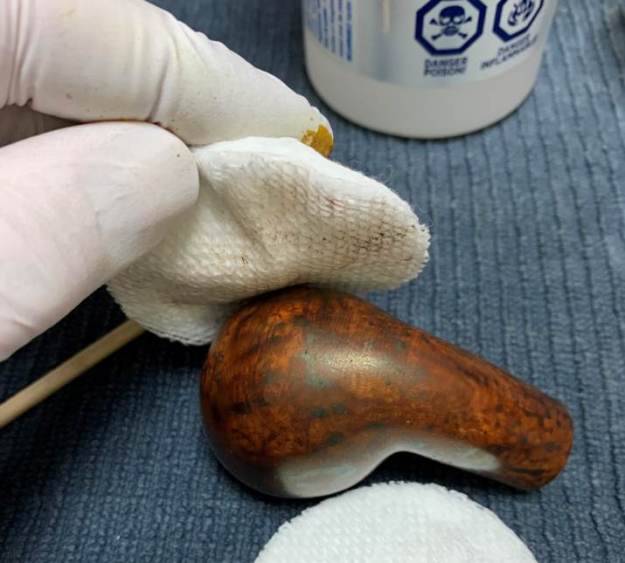
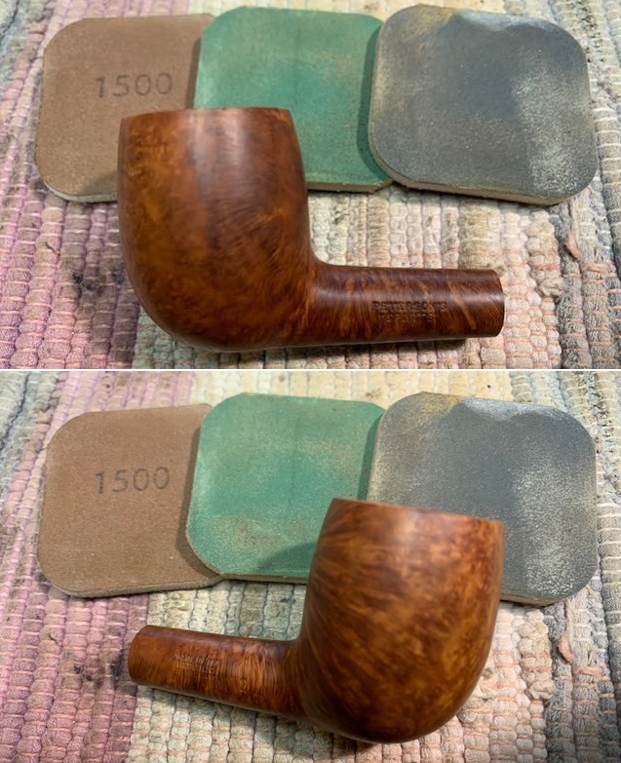
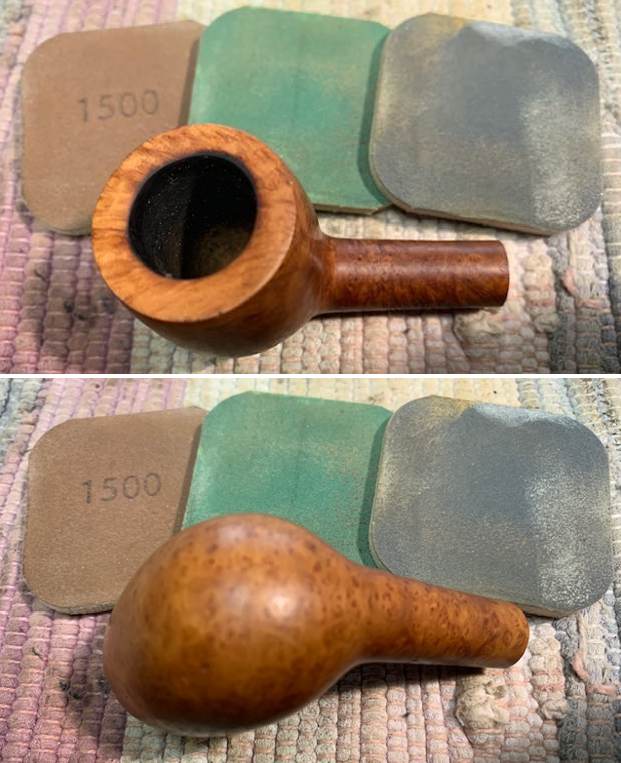
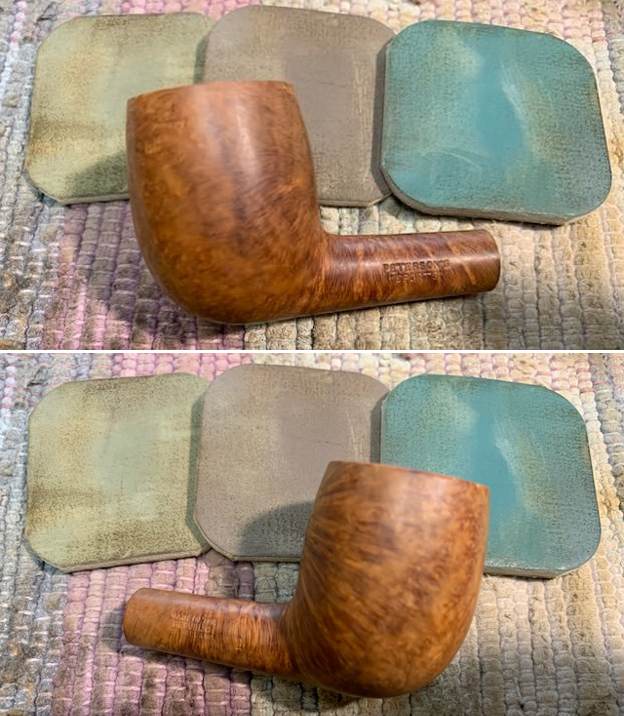
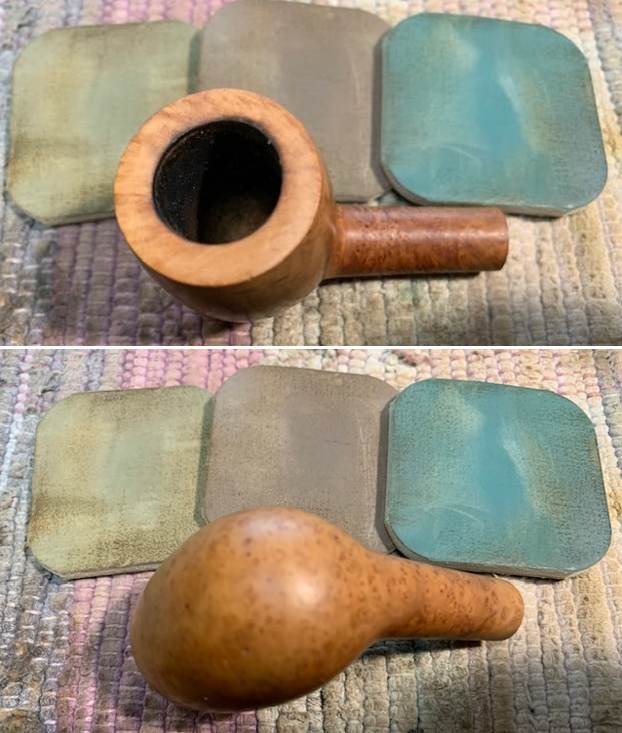
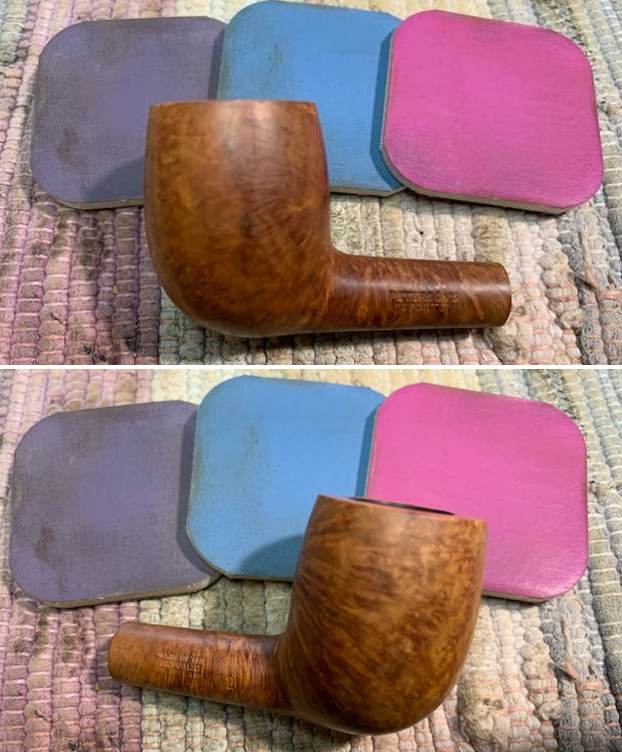
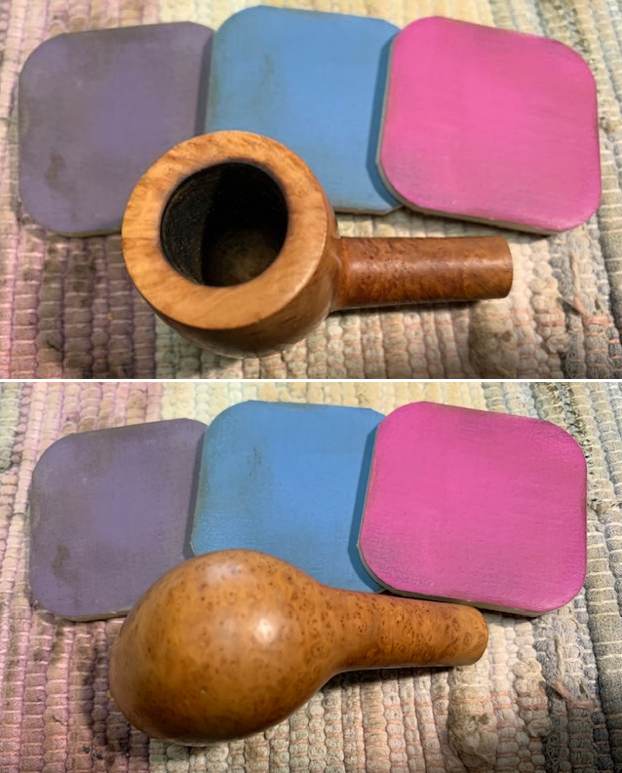
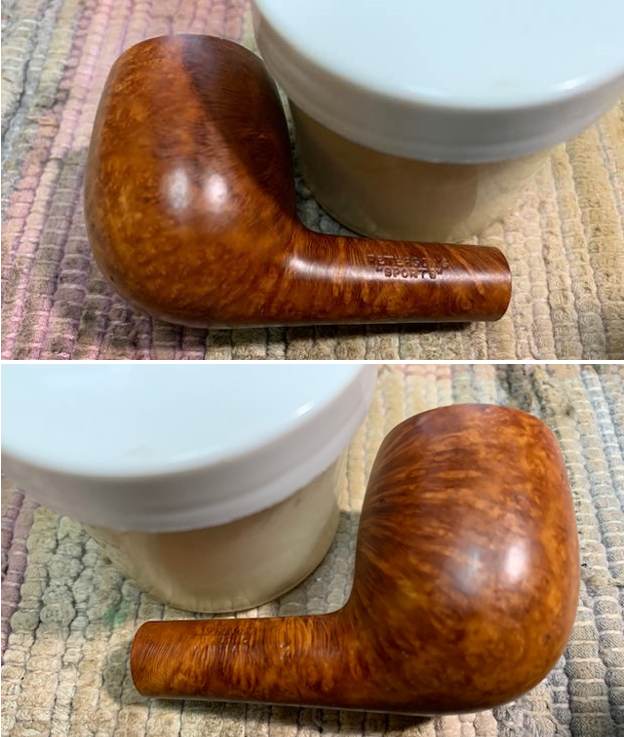
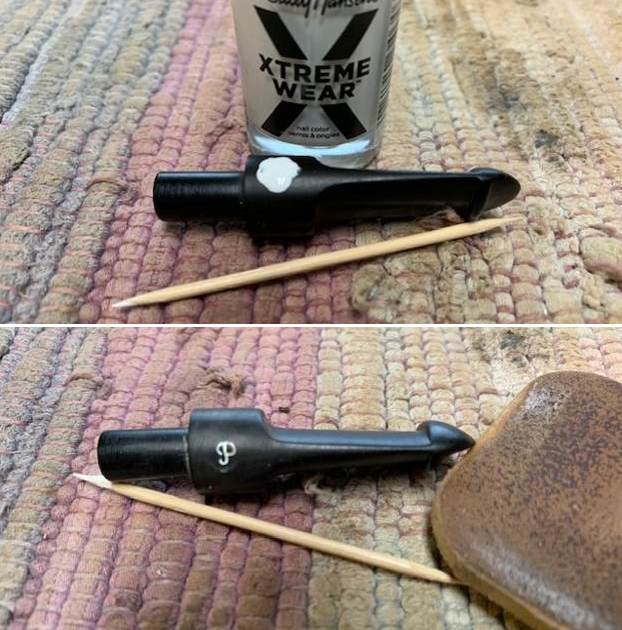
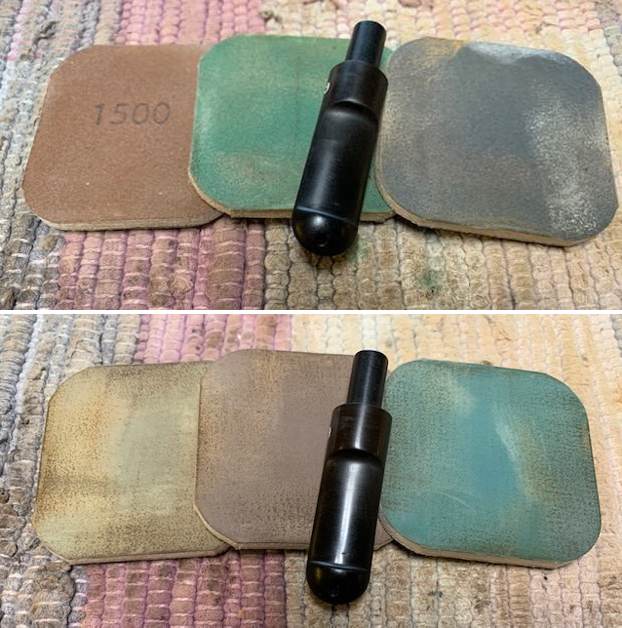
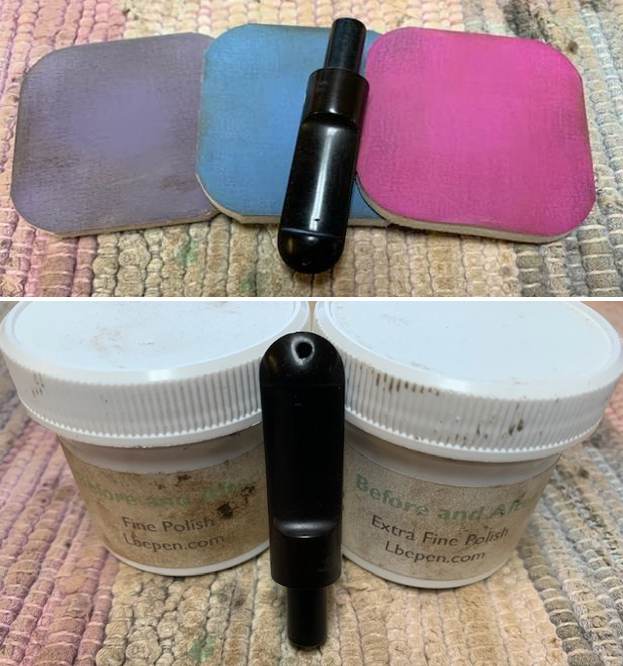
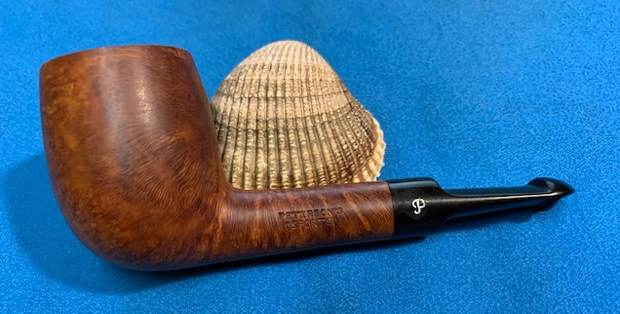
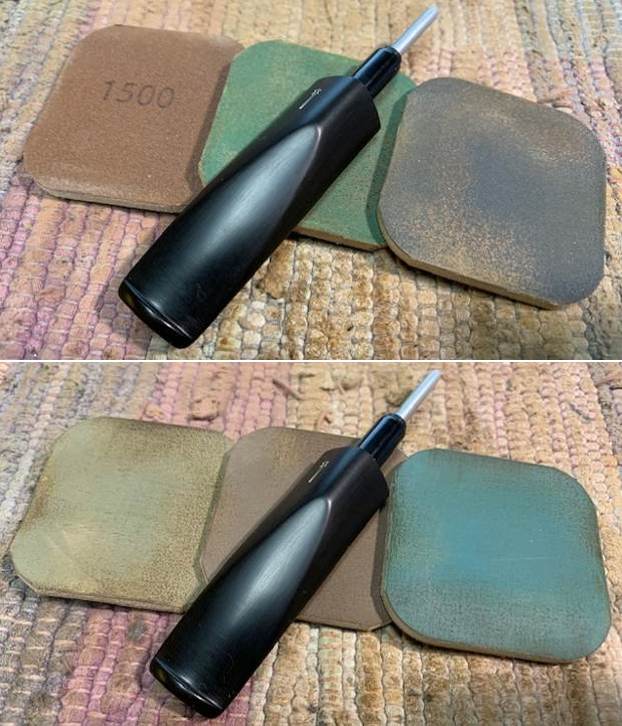
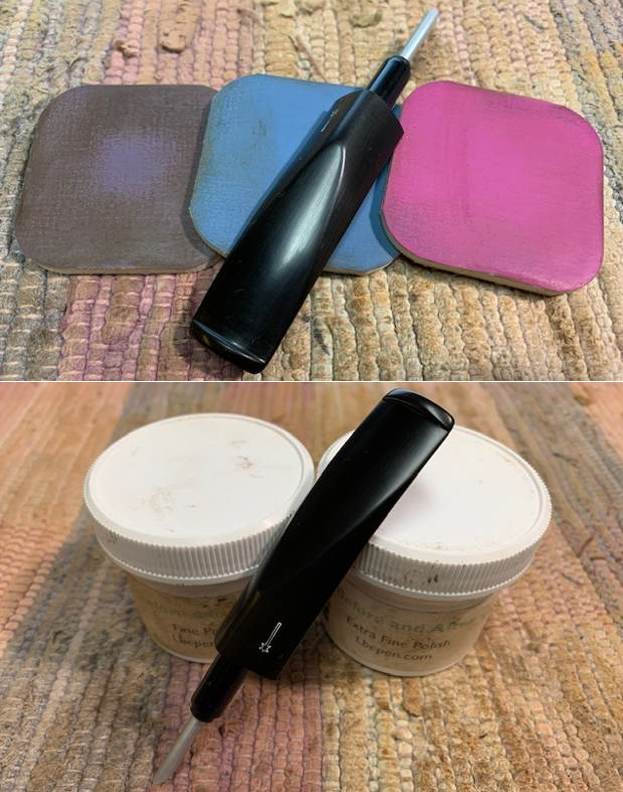
Now it was time to work on the pipe. I cleaned up the reaming of the bowl with a Savinelli Fitsall Pipe Knife. It did not take too much work to clean it up internally. I then turned my attention to the rim top and edges. I lightly topped the bowl on a topping board and 220 grit sandpaper to remove the damage on the top of the rim. I also worked over the inside edge of the bowl with a folded piece of sandpaper to give it a gentle bevel.  I polished the 14K Gold shank band with a jeweler’s cloth to remove the tarnish and oxidation. It also works to slow down the tarnish process. I took some photos of the band after the polishing. I cleaned out the mortise and airway in the shank with pipe cleaners, cotton swabs and alcohol. It took quite a few of them to clean out the chamber. I cleaned the stem with pipe cleaners, cotton swabs and alcohol as well. Once finished the pipe smelled far better.      I scrubbed the exterior of the bowl and rim top with a tooth brush and undiluted Murphy’s Oil Soap to remove the debris from the finish. I rinsed the bowl with warm water to remove the grime and soap and dried it off with a soft towel.    I polished the briar with micromesh sanding pads – dry sanding with 1500-12000 grit pads and wiping it down with a damp cloth after each pad.   I rubbed the bowl and shank down with Before & After Restoration Balm. I worked it into the surface of the bowl sides and shank with my fingertips to clean, enliven and protect the briar. I let the balm sit for a little while and then buffed with a cotton cloth to raise the shine. I really like what I was seeing! I set the bowl aside and turned my attention to the stem. I noted that there was a metal tube in the tenon that added strength. I started working on it by dealing with the tooth marks on the stem and button. I “painted” the stem with the flame of a lighter and lifted the bite marks on the surface of the stem (forgot to take photos). I filled in the deep marks on both sides of the stem with black super glue and set it aside to cure.   I used a small flat file to flatten out the repairs and to recut the edge of the button. I sanded the repairs further with 220 grit sandpaper and started the polishing with 400 grit wet dry sandpaper.  There was some residual oxidation at the shank end of the stem and some deep spots just ahead of the button. I scrubbed it with SoftScrub All Purpose cleanser to scrub off the oxidation on the stem. I was able to remove the remnant of oxidation.I polished the vulcanite stem with micromesh sanding pads – 1500-12000 grit pads. I wiped it down with an Obsidian Oil impregnated cloth after each sanding pad. I used Before & After Pipe Polish – both Fine and Extra Fine to further polish the stem. I gave it a final coat of Obsidian Oil.   This beautiful Nat Sherman 14K Gold Banded Canadian with a vulcanite taper stem is a great looking pipe now that it has been restored. The rich brown stain on the bowl allows the grain to really show. It came alive with the polishing and waxing. The 14K Gold band is a great transition between the briar and the vulcanite. I gave the bowl and the stem multiple coats of carnauba wax on the buffing wheel and followed that by buffing the entire pipe with a clean buffing pad. I hand buffed the pipe with a microfiber cloth to deepen the shine. The finished Nat Sherman Canadian is a beauty and fits nicely in the hand and looks very good. Give the finished pipe a look in the photos below. The dimensions of the pipe are Length: 6 inches, Height: 1 ¾ inches, Outside diameter of the bowl: 1 ¼ inches, Chamber diameter: 7/8 of an inch. The weight of the pipe is 43 grams/1.52 oz. This one will go in the US Pipe makers section of the rebornpipes store. If you are interested in adding it to your collection let me know. Thanks for reading this blog and my reflections on the pipe while I worked on it. There are many more to come!
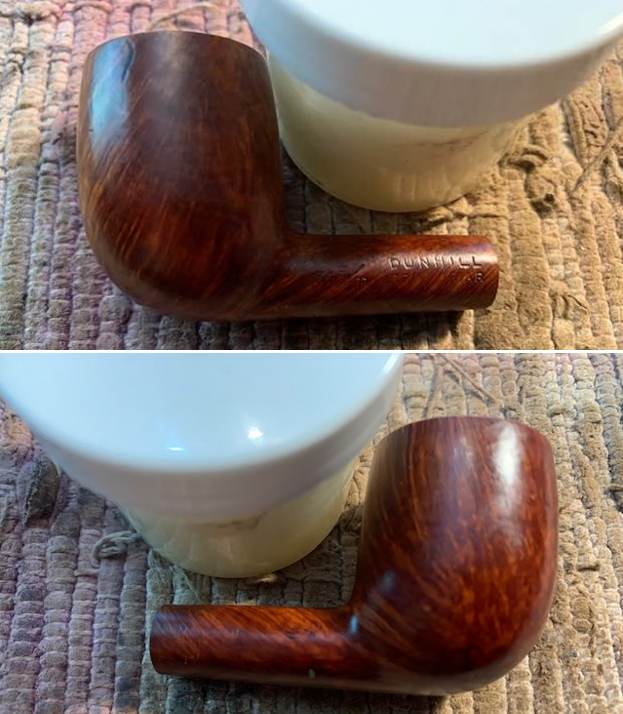
Breathing New Life into Sasieni London Made Patent No. 150221/20 Canadian


Blog by Steve Laug

The next pipe on the work table came to me from either a trade I made (pipes for labour) or a find on one of my pipe hunts. I honestly don’t remember where it came from. It has been around for a while waiting to be worked on. It is an older long shank Canadian with a Sterling Silver band on the shank. It is quite dirty but has some great grain on the shank and stem. The stamping on this Canadian is faint but and readable. It is stamped on the topside of the shank next to the bowl and reads Made in England in an oval. That is followed by Sasieni [over] London Made [over] Pat. No. 150221/20. There is no shape number on the shank that I can see. The pipe had a lot of grime ground into the smooth finish on the bowl. The bowl had been heavily caked but had been reamed somewhere in its journey. The rim top and inner edge had darkening and some burn damage all the way around though heavier on the right and back side. The vulcanite stem was dirty and had light tooth chatter and marks on the top and underside ahead of the button. There were four pale blue dots on the top side of the taper stem that is common on a Sasieni. The pipe had promise but it was very dirty. I took photos of the pipe before I started my cleanup work.   I took photos of the rim top and bowl to give a clear picture of the bowl and the damage on the rim top and edges. The Sterling Silver band is tarnished and black. I also took photos of the top and underside of the stem to show the light chatter and tooth marks. I took photos of the stamping on the top side of the shank. It reads as noted above and is faint but readable. The silver band is stamped Sterling Silver on the top and there are four light blue dots on the top of the taper stem.   I wanted to see if I could narrow down a time frame for this Sasieni London Made Patent pipe so I turned first to Pipephil’s site to get a good overview and see if there were photos of a similar looking stamping on a pipe there (http://www.pipephil.eu/logos/en/logo-sasieni.html). I quote the summary of the history of the brand from the top of the page:

One may distinguish three major periods in the Sasieni brand history:

  • The so called pre-transition period during which the family totally owned the business.
  • The transition period from 1979 to 1986. The corporate has been bought by Ian Chase and a group of South African investors.
  • The post-transition period from 1986 up to the present. At first the corporate has been bought by James B. Russell and after him by Cadogan Investments Ltd (A. Oppenheimer & Co. Ltd).

With that information I scrolled through the photos of shapes and stamping on the pipes shown. The one that bore the same stamping as the Canadian I am working on was a billiard shown below. I did a screen capture to show the stamping look and design. The shape number on the Canadian is obviously buffed off on the pipe I have. From that information I knew that the pipe I had was a Pre-Transition Period pipe made between 1919-1924. This is demonstrated by the style of the Sasieni Stamp (with a flourish) and the rest of the stamping including the  Pat. No.

From there I turned to Pipedia to read more information about the time periods and the stamping on this particular pipe (https://pipedia.org/wiki/Sasieni). I quote a pertinent section below.

To begin with, there are three main elements to dating the Sasieni pipe, the patent number, the style of the name “Sasieni” as it appears on the shank, and the Dots themselves. Naturally, there are exceptions to these rules (this hobby would be boring without them), but for the most part these guidelines apply better than 95% of the time. All Sasieni One, Four, and Eight Dot pipes made before W.W.II and destined for the U. S. market carried a patent number on the shank which usually started with the numbers “15″, with 150221/20 and 1513428 being representative of the group. Also, the name “Sasieni” was stamped on the shank in a very florid manner, with the tail of the last “i” sweeping underneath the name forming a shape which has been compared to a fish by more than one collector. This script was discontinued by Alfred almost immediately after he took over the company, so this alone tells you your pipe is pre W.W.II. Underneath in block lettering are the words “London Made”, with the patent number making the third line.

The dots will help you narrow this down further. As we mentioned, the short lived U. S. market One Dot was introduced around 1920, and was replaced by the early to mid 1920’s by the Four Dot. The 1920’s Four Dot is distinguishable by the florid Sasieni script, a patent number, and four blue dots, which are quite small compared to the pipes of post war years. Furthermore, by 1935 Sasieni began stamping pipes, based on the shape, with their own names, which were usually, but not always, English towns. For example, apples were stamped “Hurlingham”, bulldogs were “Grosvenor” or “Danzey”, and panels were “Lincoln”. One rare and interesting variation of this was the large bent, dubbed “Viscount Lascelles”. Even in this soft Sasieni market, these pipes regularly sell for $150 in their rare appearances in mailers.

Once Alfred took over the company in 1946, these elements changed in fairly rapid succession. The first thing to be changed was the nomenclature itself. In place of the elaborate “Sasieni” stamp of pre war pipes, a simpler, though still script style, “Sasieni” was used. This can be seen on patent pipes which have the small, old style dots.

This further gave me a time period and date for this pipe. It was definitely pre-WWII and probably made between 1919-1924. So it was an older pipe that was in decent condition for a pipe that age.

Now it was time to work on the pipe. I cleaned up the reaming of the bowl with a Savinelli Fitsall Pipe Knife. It did not take too much work to clean it up internally. On a pipe of this age once again I exercised restraint in how far I went to clean up the top. I do not want to change look or feel of a pipe that is at least 100 years old. I then turned my attention to the rim top and edges. I lightly topped the bowl on a topping board and 220 grit sandpaper to remove the damage on the top of the rim. I also worked over the inside edge of the bowl with a folded piece of sandpaper to give it a gentle bevel.      I polished the Sterling Silver shank band with a jeweler’s cloth to remove the tarnish and oxidation. It also works to slow down the tarnish process. I took some photos of the band and bowl after the polishing. I scrubbed the exterior of the bowl and rim top with a tooth brush and undiluted Murphy’s Oil Soap to remove the debris from the finish. I rinsed the bowl with warm water to remove the grime and soap and dried it off with a soft towel.    I cleaned out the mortise and airway in the shank with pipe cleaners, cotton swabs and alcohol. It took quite a few of them to clean out the chamber. I cleaned the stem with pipe cleaners, cotton swabs and alcohol as well. Once finished the pipe smelled far better.      I polished the briar with micromesh sanding pads – dry sanding with 1500-12000 grit pads and wiping it down with a damp cloth after each pad.     I rubbed the bowl and shank down with Before & After Restoration Balm. I worked it into the surface of the bowl sides and shank with my fingertips to clean, enliven and protect the briar. I let the balm sit for a little while and then buffed with a cotton cloth to raise the shine. I really like what I was seeing!   I set the bowl aside to let the wall repairs cure overnight. I turned my attention to the stem. I “painted” the stem surface with the flame of a lighter to lift the tooth marks. It worked quite well but there were some left behind. I filled in the remaining marks with clear CA glue and set it aside to cure.   I used a small flat file to flatten out the repairs and to recut the edge of the button. I sanded the repairs further with 220 grit sandpaper and started the polishing with 400 grit wet dry sandpaper. I polished the vulcanite stem with micromesh sanding pads – 1500-12000 grit pads. I wiped it down with an Obsidian Oil impregnated cloth after each sanding pad. I used Before & After Pipe Polish – both Fine and Extra Fine to further polish the stem. I gave it a final coat of Obsidian Oil. This beautiful Sasieni London Made Pat. No. 150221-20 Canadian with a vulcanite taper stem is a great looking pipe now that it has been restored. The rich brown stain on the bowl allows the grain to really show. It came alive with the polishing and waxing. The silver band is a great transition between the briar and the vulcanite. I gave the bowl and the stem multiple coats of carnauba wax on the buffing wheel and followed that by buffing the entire pipe with a clean buffing pad. I hand buffed the pipe with a microfiber cloth to deepen the shine. The finished Sasieni London Made Canadian is a beauty and fits nicely in the hand and looks very good. Give the finished pipe a look in the photos below. The dimensions of the pipe are Length: 5 ¾ inches, Height: 1 ¾ inches, Outside diameter of the bowl: 1 ¼ inches, Chamber diameter: ¾ of an inch. The weight of the pipe is 32 grams/1.13 oz. I am still figuring out what to do with this one. It may stay here but if I decide to let it go watch for it on the store. Thanks for reading this blog and my reflections on the pipe while I worked on it. There are many more to come!
The Poker Barrel


by Kenneth Lieblich

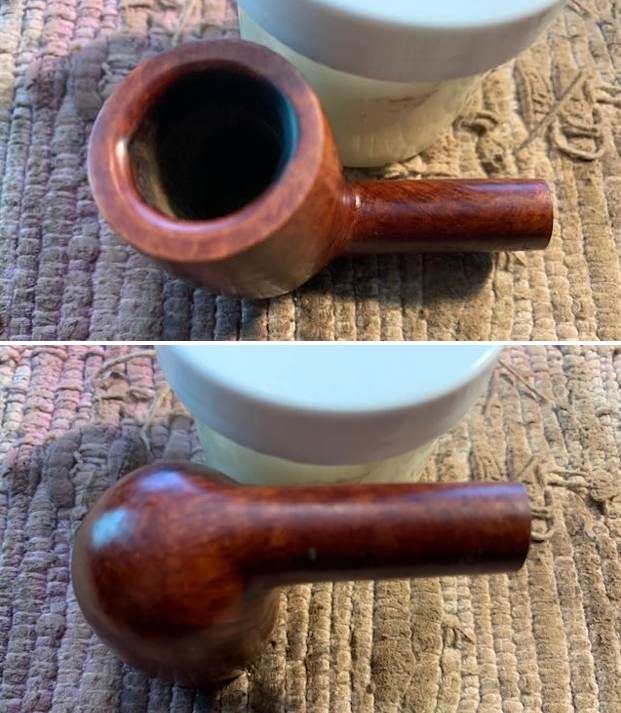
Next on the chopping block is this charming Chacom Champion. It comes from the estate of a man from Winnipeg, whose relatives live here in Vancouver. I purchased several of the late gentleman’s pipes, along with this one. I have a particular interest in French pipes and pipeworks, so this was the first pipe I grabbed from the lot for restoration. It is an attractive pipe and needed just a little help to come back to life.This pipe was made by the French giant, Chacom. They are known for making very nice pipes, many of which were designed by such names as Pierre Morel, Claude Robin, and Erwin van Handenhoven. The markings on the left-hand side of the shank read Chacom [over] Champion. On the underside of the shank, the marking reads 157, which is the shape number. Also, on the stem, there is the Chacom logo: CC, encircled in a silver-coloured oval.This is a poker-shaped pipe (a flat bottom) – and a really pretty one too. I always felt that it looked a bit like an old oak barrel, hence the title of this article: The Poker Barrel. It feels very comfortable in the hand. It was obvious from the start that this was a great pipe that just needed some attention and TLC.

Chacom is a company that dates back, in its earliest form, to 1825. The name is a portmanteau of Chapuis Comoy. For a large part of the twentieth century, Chapuis Comoy was the largest pipe company in the world. For more on their history, please have a look at their website: https://www.pipechacom.com/en/history.htm. In fact, the shape number I mentioned above, 157, is a Comoy shape number and is designated as a straight-stemmed, flat-bottomed, billiard. But I am still going to call it a Poker Barrel anyway.

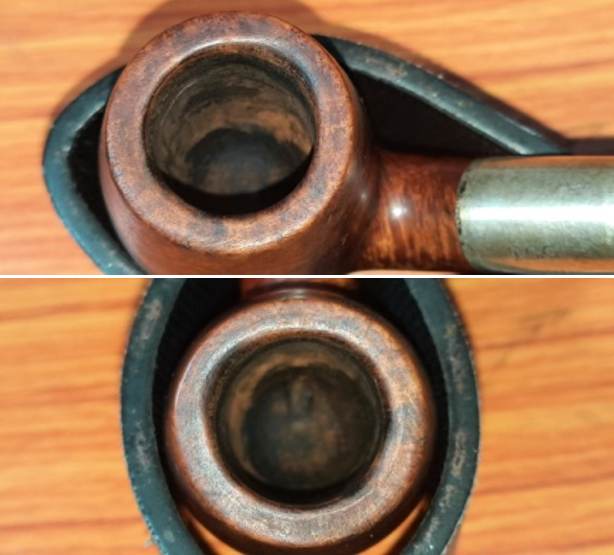
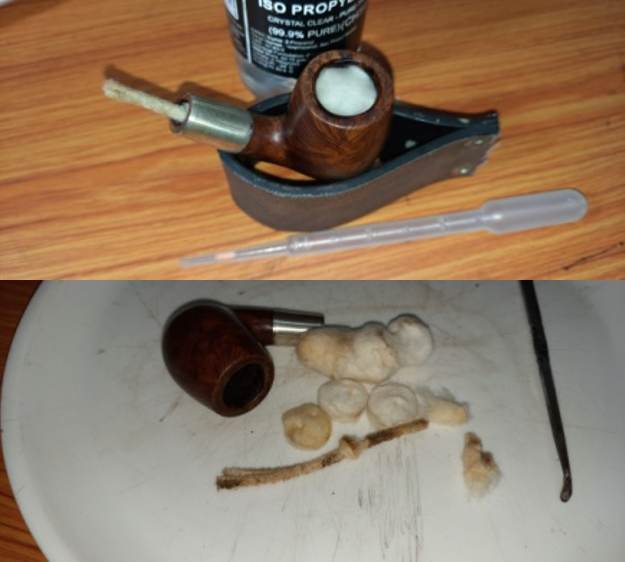
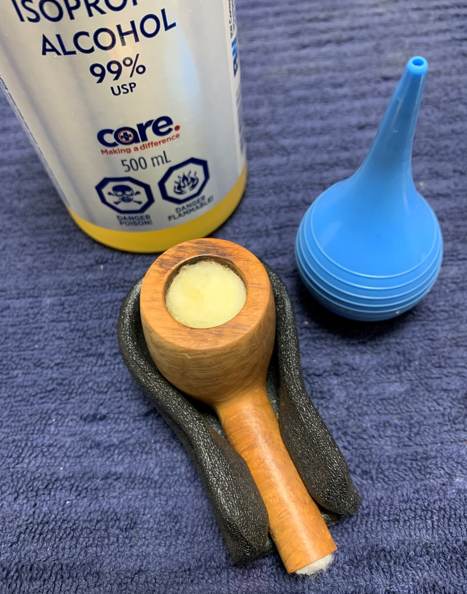
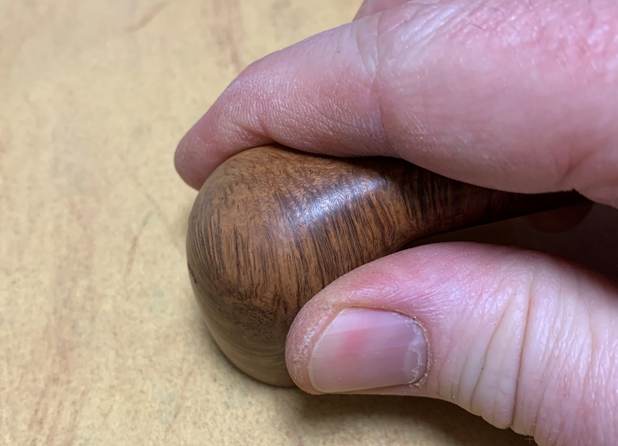
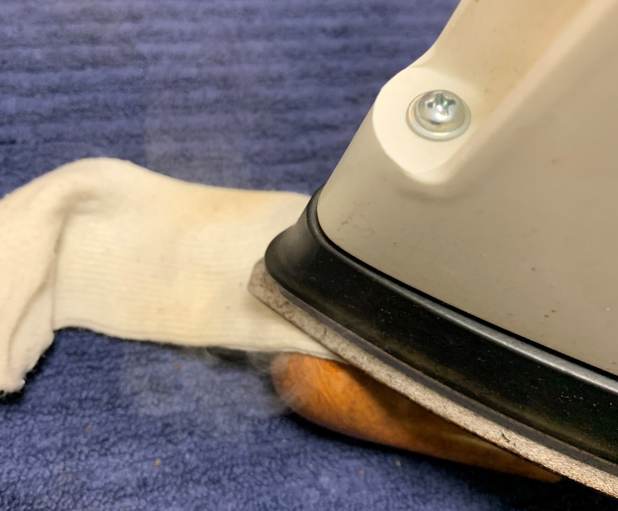
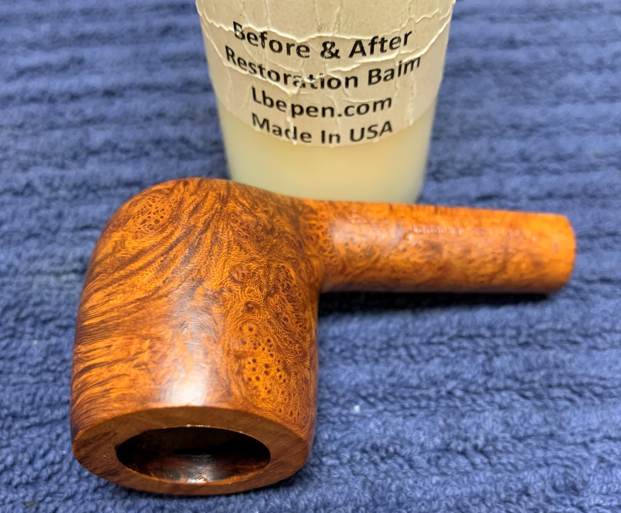
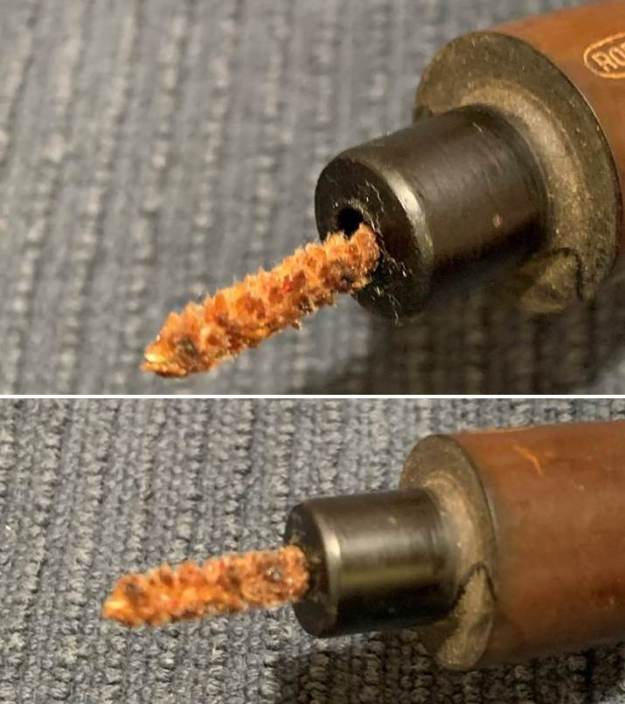
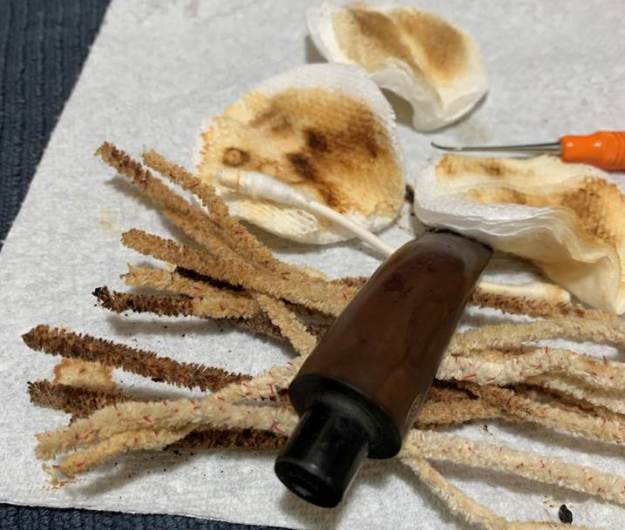
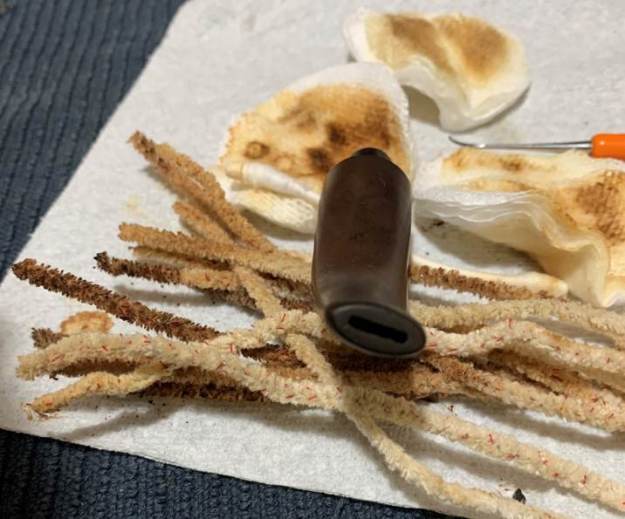
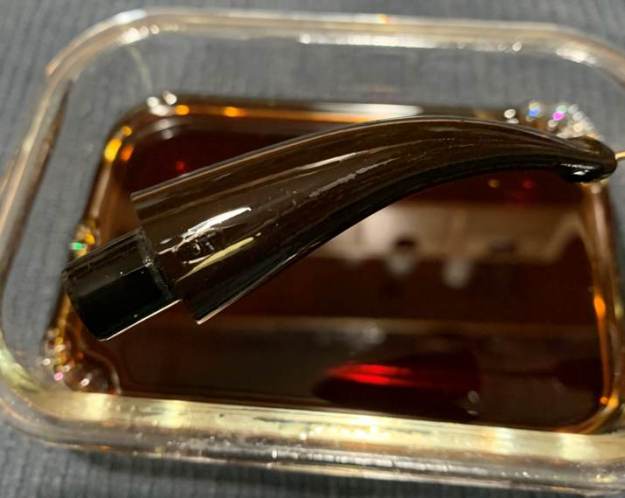
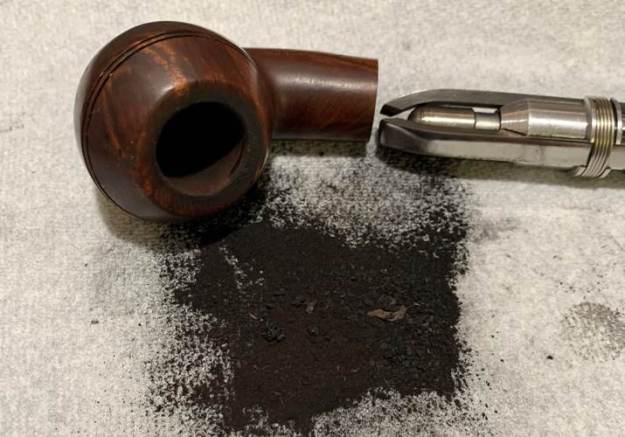
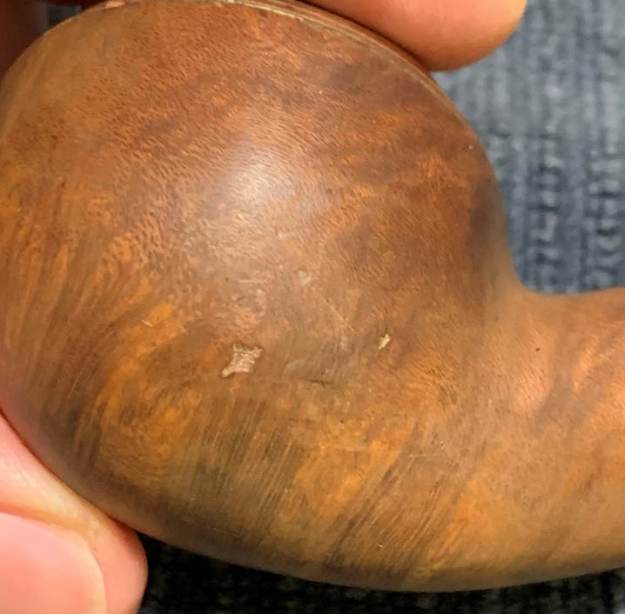
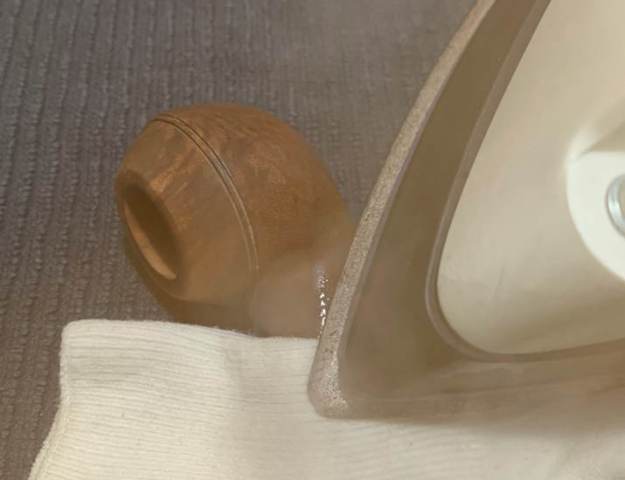
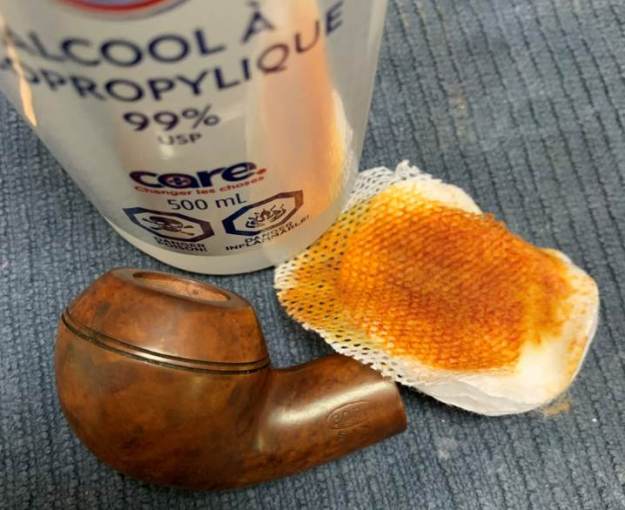
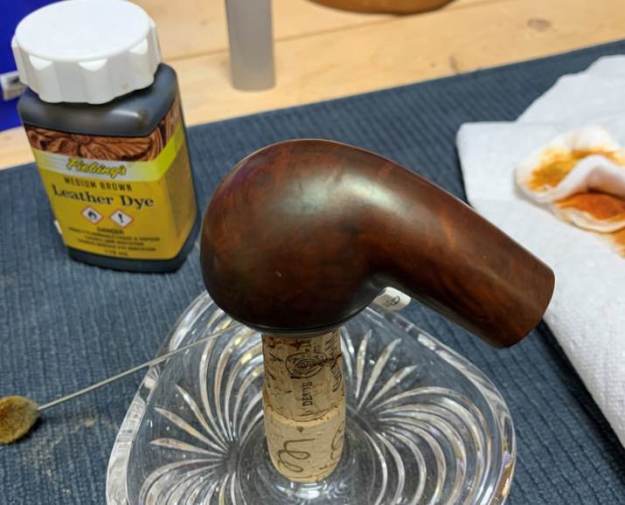
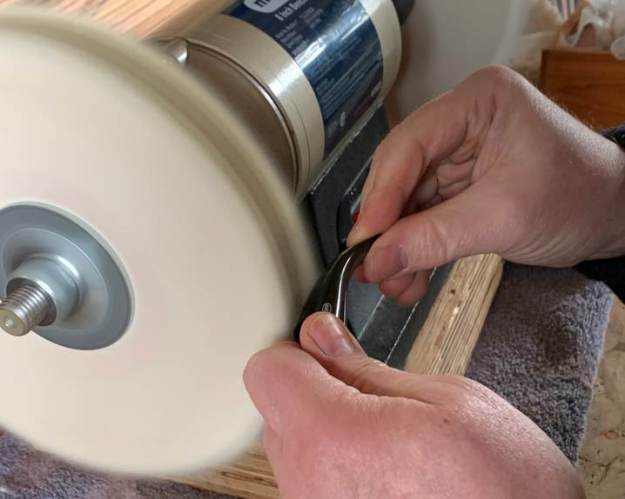
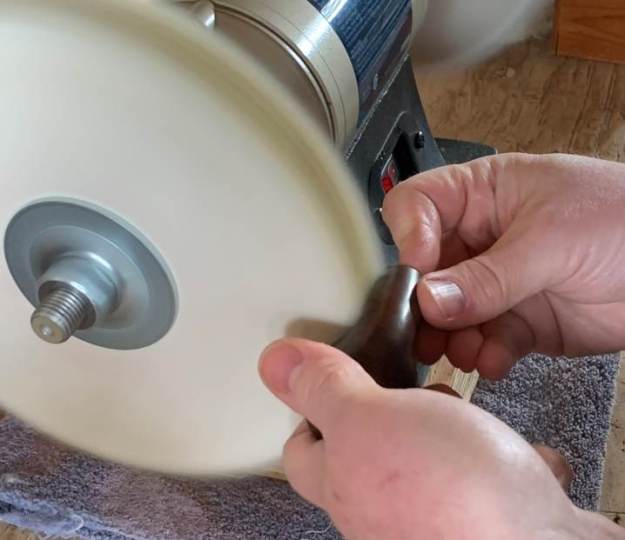
On to the pipe: it was in decent shape, but it had a few issues. The stem was mostly fine. There was a bit of oxidation, some tooth chatter and scratches, and that was about it. Meanwhile, the stummel had a few more issues. The outside of the bowl had some scratches and a couple of fills that needed to be redone. There was plenty of lava and debris on the rim and I suspected there would also be some burn marks. The inside was pretty dirty too – just how dirty it was became an event in itself.The stem was first on my list. I wiped down the outside of the stem with Murphy’s Oil Soap on some cotton pads. I also took a BIC lighter and ‘painted’ the stem with its flame in order to lift the bite marks and dents. This was not particularly successful in raising the damage. During this process, I noticed that the inside of the tenon on the stem was threaded. There was clearly a stinger here once upon a time. Thankfully, it is long gone.Then, I cleaned out the insides with pipe cleaners and isopropyl alcohol. Look at that! Lots of work to get this clean! Once this process was done, the stem went for an overnight soak in the Pipe Stem Oxidation Remover. The following day, I cleaned all of the de-oxidizing mess off with alcohol, pipe cleaners, et cetera. The oxidation had migrated to the surface and would be fairly straightforward to remove. I scrubbed with SoftScrub on some cotton pads to remove the leftover oxidation. I built up the dents on the stem with cyanoacrylate adhesive and let them fully cure. I then sanded the adhesive down with 220-, 400-, and 600-grit sandpapers to meld seamlessly into the stem. I did the same to the remaining tooth marks. I then used all nine Micromesh pads (1,500 through 12,000 grit) to bring out the lovely black lustre on the stem. I also used Obsidian Pipe Stem Oil in between each pad scrubbing. On to the stummel, and the usual cleaning procedures were in order for this pipe. This stummel was a bit of a mess inside, so I first decided to ream out the bowl. I used both the PipNet Reamer and the KleenReem to remove the built-up cake and followed that with 220-grit sandpaper to eliminate as much as I could. I took the bowl down to bare briar, as I wanted to ensure there were no hidden flaws in the walls of the bowl. Fortunately, there were none. I then proceeded to clean out the insides of the shank with Q-tips, pipe cleaners, and isopropyl alcohol. There was considerable filth inside this stummel and it took a lot of cotton to get it “clean”. I put the word clean in quotation marks for reasons that will be evident shortly. I used a small butter knife to gently chip away at the lava on the rim. I then used more Murphy’s with a scrub brush to remove any remainder. This actually worked quite well. I then moved on to cleaning the outside of the stummel with Murphy’s Oil Soap and some cotton pads. That removed any latent dirt that blighted the wood. A de-ghosting session also seemed in order, so I thrust cotton balls in the bowl and the shank, and saturated them with 99% isopropyl alcohol. I let the stummel sit overnight. This caused the oils, tars and smells to leech out into the cotton.In order to remove the remaining burns and nicks on the rim, I “topped” the pipe – that is to say, I gently and evenly sanded down the rim on a piece of 220-grit sandpaper. This effectively removed the damage, without altering the look of the pipe. Then, to further clean the inside of the pipe, I put the stem and stummel back together and used my pipe retort system. This system uses boiling isopropyl alcohol and a vacuum (a void, not the household appliance) to clean the interior of a pipe. As you can see by the brownish colour of the alcohol, the retort worked well. I managed to extract lots of otherwise inaccessible filth from inside the pipe. At this point, I had a hunch that I should run another Q-tip or two through the shank. What I discovered was shocking: it took a truck load of Q-tips and pipe cleaners to actually clean this frustrating pipe! Look at the pile I used! I then finished cleaning up the insides of the stummel with some dish soap and tube brushes. Extraordinary, but I did it and it is now clean.Having completed that, I was able to address the scratches and fills. I took out my steam iron and a damp cloth to try and raise the nicks. The hot and moist steam created can often cause the wood to swell slightly and return to shape. Fortunately, there was considerable movement – I was really pleased with the results. The repair was not perfect, but the remaining scratches would be improved by sanding.After that, a light application of Before & After Restoration Balm brought out the best in the stummel’s grain. There is some beautiful wood after all. It is a very handsome pipe. The same was true with the fills. I lined the two fills with cyanoacrylate adhesive and briar dust. After letting them cure, I sanded the fill repairs down with 200-, 400-, and 600-grit sandpaper. I then used all nine Micromesh pads (1,500 through 12,000 grit) on the stummel to finish it off. On to another problem: the colour. During the course of my vigorous cleaning, this pipe had lost some vibrancy of colour. So, in order to accentuate the external beauty of this pipe, I opted for aniline dye. I applied some of Fiebing’s Medium Brown Leather Dye. As usual, I applied flame from a BIC lighter in order to set the colour. What a difference that made! It looked so much better with a fresh coat of stain.   I applied some more Before & After Restoration Balm and then it was off for a trip to the buffer. A dose of White Diamond and a few coats of carnauba wax were just what this pipe needed. The lovely shine made the wood very attractive. This is a very handsome pipe and will provide many years of smoking pleasure.This Chacom Champion is back to its old glory and ready to be enjoyed again by the next owner. I am pleased to announce that this pipe is for sale! If you are interested in acquiring it for your collection, please have a look in the ‘French’ pipe section of the store here on Steve’s website. You can also email me directly at kenneth@knightsofthepipe.com. The approximate dimensions of the pipe are as follows: length 5 in. (130 mm); height 1⅝ in. (40 mm); bowl diameter 1¼ in. (30 mm); chamber diameter ¾ in. (20 mm). The weight of the pipe is 1 oz. (29 g). I hope you enjoyed reading the story of this pipe’s restoration as much I as I did restoring it. If you are interested in more of my work, please follow me here on Steve’s website or send me an email. Thank you very much for reading and, as always, I welcome and encourage your comments.

A Beautiful Petite “FCC” Double Footed Cutty Restored To Its Former Glory


Blog by Paresh Deshpande

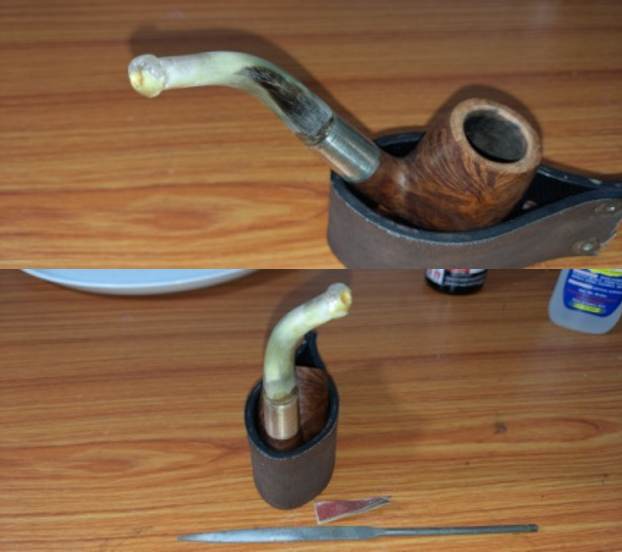
The next pipe that I chose to work on was a petite slender two legged classic Cutty shaped pipe that is stamped as “FCC”, each letter in a square and all the squares are co-joined to form a rectangle. Apart from the FCC stamp, there is no other stamp on the briar. The shank end has a nickel ferrule (most probably) with a squat diamond bearing letters “A–B” over three cartouches with its engravings completely worn out. Now the reasoning for assuming the ferrule to be nickel plated is firstly that I could not find any silversmith with letter “A B” in a diamond on my usual go to sites as well as searching the net. Secondly, during the course of restoring the pipe, the ferrule came loose revealing a prominent crack to the shank end and this ferrule was a repair band that was put by the previous repairman. Here are the pictures of the stampings. It would be interesting to know the views and opinions on my musings. There was no information about this pipe that was available on the internet. The lack of COM stamp also contributed to the mystery of this pipe. Even “Who Made That Pipe” by Herb Wilczak and Tom Colwell finds no mention of this brand and as stated above the ferrule has faux stampings. The only pointer that this is an old timer comes from the oval stem slot which was seen on early pipes.

In the interest of pipe collector community, I request the readers to share any information that they may have about this brand.

Initial Visual Inspection
The double legged Cutty shaped pipe has beautiful mixed grains around the stummel which is covered in dust. The stummel has a couple of deep scratches and one fill towards the foot. The rim top is covered in lava overflow with some serious damage to the inner rim edge and as a result appears out of round. There is a thick layer of cake in the chamber. The slender vulcanite stem is heavily oxidized with a chunk of vulcanite missing from end of the step tenon. There are issues that need to be addressed, but it still is a beautiful pipe and once it is restored, the elegance and beauty of this pipe shall be worth appreciating. Here are a few pictures of the pipe before I begin working on it. Dimensions Of The Pipe
(a) Overall length of the pipe:          6 inches.

(b) Bowl height:                                  1.4 inches.

(c) Inner diameter of chamber:       0.6 inches.

(d) Outer diameter of chamber:        1.1 inches.

Detailed Inspection…
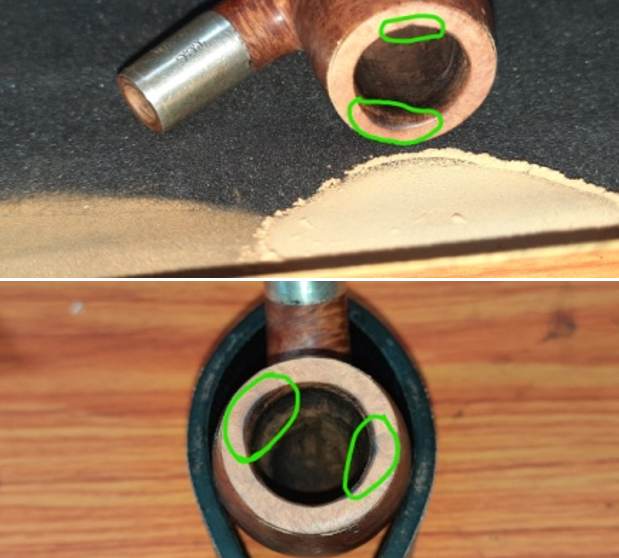
The chamber has a thick layer of even cake and has a strong sweet smell to it. The rim top surface has darkened due to lava overflow which is not very thick. The inner edge is uneven, but closer inspection makes me believe it to be more so because of uneven cake at the rim edge. The inner edge appears to be charred in 11 o’clock and 6 o’clock direction (encircled in pastel blue). The outer edge has a very shallow ding which is encircled in yellow. The stummel has some interesting grain patterns hidden under the dust that has accumulated over the surface. There is a fill towards the foot of the stummel on the left side and is encircled in green. This fill seems like a crack but it is not. The stummel surface has a few scratches but the two on the right side of the stummel are prominently visible (encircled in yellow). The two legs of the bowl are perfectly flat and angled making the pipe a sitter. The long slender shank has a dark patch (encircled in red) at the bowl shank junction and is likely another fill or a crack. I shall be sure about this only once the surface is thoroughly cleaned. The shank has heavy accumulation of oils, tars and gunk. The sweet smell is pretty strong here too. The long and slender vulcanite stem slightly tapers towards the tenon end giving a very classy look to the pipe. The step tenon has a chunk of vulcanite missing from the end and would need to be rebuilt. The stem has deep seated oxidation that imparts to it a greenish brown hue. The bite zone has minor tooth chatter and the buttons are sans any damage. The oval shape of the slot end and the slot itself is old fashioned and is a pointer to this being an older pipe from the 20s- 30s. Both the tenon end and slot end shows heavy accumulation of gunk and has an awful stink to it. This stem is going to be a bear to clean.The Process…
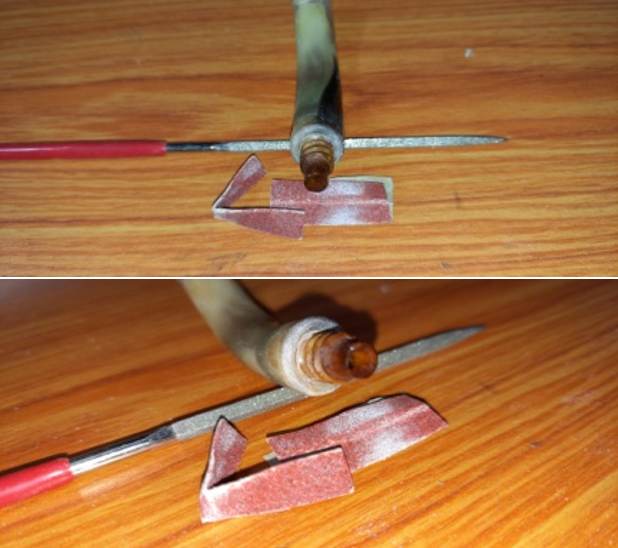
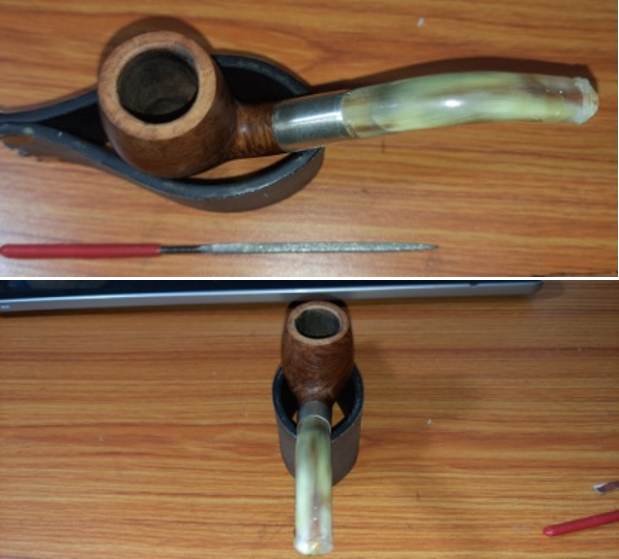
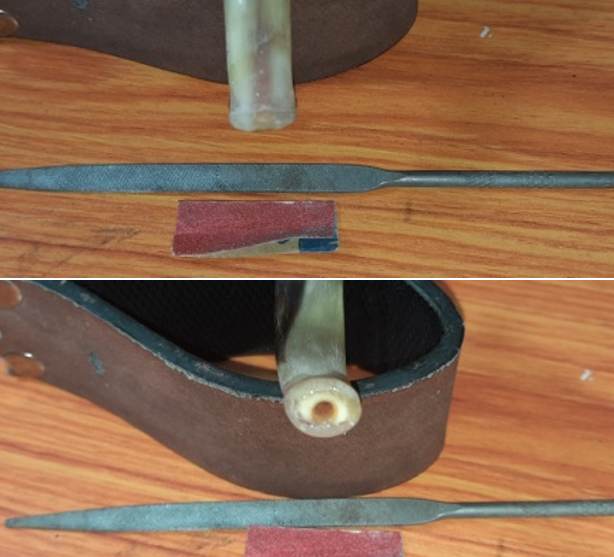
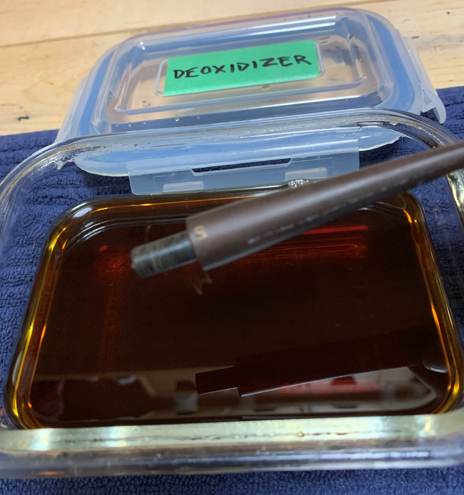
Since there were other stems that were ready to be put into the stem deoxidizer solution, I decided to clean the internals of this stem first so that it could be put in the solution with other stems. I cleaned the stem airway with a thin shank brush and anti oil soap. The amount of gunk that was cleaned can be judged from the pictures below. It took considerable time and elbow grease to get the stem airway clean. I further cleaned the internals with regular and bristled pipe cleaners dipped in alcohol. Once I was done with the internal cleaning of the stem airway, I sanded the stem surface with a folded piece of 220 grit sandpaper to loosen and remove superficial oxidation from the stem surface. I wiped the stem clean with Murphy’s Oil Soap on a cotton swab. It has been our experience that such sanding yields the best end results after the deoxidizer solution has completed its assigned task.The stem was immersed in the Before and After Deoxidizer solution, a product that has been developed by Mark Hoover. This solution raises the oxidation to the stem surface and helps in easy removal and imparting a nice shine to the stem after polishing. The pipe is indicated with a yellow arrow indicator. The stem was allowed to soak into this solution overnight.The next morning, Abha took the stem out from the solution. She cleaned the stem under running warm water and scrubbed the raised oxidation from the stem surface using a Scotch Brite pad and cleaned the airway with a thin shank brush. She further removed the oxidation by scrubbing the stem with 0000 grade steel wool and applied a little EVO to rehydrate the stem. She ran a couple of pipe cleaners through the stem airway to clean the airway of the deoxidizer solution and water.Staying with stem repairs, I warmed up the bite zone with the flame of a lighter to raise the minor tooth indentations to the surface. The heat helps the vulcanite to expand and regain its original shape. This method may not always completely raise the depressions to the surface, but most of the times, to a great extent. In this case the tooth indentations were raised completely to the surface. I followed up the heating of the stem surface with sanding the bite zone with a piece of 220 grit sandpaper to even out the surface.Next, I decided to address the broken end of the step tenon. I first inserted a pipe cleaner that had been smeared with petroleum jelly (Vaseline) through the tenon end into the stem air way. This helps prevent the CA superglue and charcoal mix from sticking to the pipe cleaner and prevents the mix from running down into the air way and clogging it. I generously applied a mix of CA superglue and activated charcoal over the tenon end to be rebuilt. I applied a thick layer of the mix as this provides sufficient patch material to work with during subsequent filing and shaping to match the repairs with the stem surface. Once I had applied the mix, I set it aside to cure overnight.By next afternoon, the tenon rebuild had cured perfectly and was fit to work on. I used a folded piece of 220 grit sand paper to sand the patch and achieve an even match with the rest of the tenon surface. I shaped the opening of the rebuilt tenon for smooth and even airway surface using a round needle file and topped the tenon face on a piece of 220 girt sand paper to achieve a perfect seating of the step tenon into the mortise.I further sanded the entire stem with 320 followed by 400, 600, 800 and 1000 grit sand paper. This helps to reduce the scratch marks left behind by the more abrasive 220 grit paper and also to remove complete oxidation from the stem surface. I rubbed a small quantity of EVO to rehydrate the stem and set it aside.With the stem set aside, I had a second look at the stummel and decided to start with reaming the chamber. Using size 1 head of the PipNet reamer, I took the cake down to the bare briar. I used my fabricated knife to remove the carbon layer from areas which could not be accessed by the reamer head. Next, with a folded piece of 220 grit sandpaper pinched between fingers, I sanded the wall surface to a smooth finish and ensured there are no traces of residual carbon anywhere in the chamber. I cleaned the chamber with a cotton swab wetted with alcohol. There are a couple of heat fissures that can be seen over the surface of the wall but they seem to be superficial. It could be just a thin layer of residual cake that has hardened rock solid or could be a heat fissure proper and in that case, I would need to fix it. But first, I would need to soften the cake. I cleaned the mortise using q-tips, pipe cleaners and alcohol. I scrubbed out the dried oils and tars from the walls of the shank using a bent dental tool. It was only once the shank internals were cleaned that I could see the thin crack to the shank. However, the repair band was firmly glued to over the shank end. I shall continue further cleaning of the shank internals when I clean the external surface of the stummel.I decided to give the stummel a salt and alcohol treatment. This would address three issues, firstly the strong sweet ghosting smell secondly, loosen the rock hard carbon layer from the chamber wall and lastly the alcohol may loosen the glue that kept the repair band firmly attached to the shank. I wrapped a little cotton around a pipe cleaner and inserted it through the mortise into the chamber. I packed the space around this pipe cleaner in the shank with cotton balls. Next, I firmly packed the cotton balls in to the chamber about half an inch below the rim and soaked the cotton balls with isopropyl alcohol up to the brim. About half an hour later, the level of alcohol had gone down, having being absorbed by the cotton. I topped it up once again and set it aside overnight. By next morning, the cotton and alcohol had drawn out all the remaining oils and tars from the chamber and mortise, fulfilling its intended task. I removed the cotton balls and ran pipe cleaners through the mortise to clean out all the loosened tars and gunk and further cleaned it with alcohol and q-tips. The chamber now smells clean and fresh. I set the stummel aside to dry out naturally. All the three issues that I wanted to address with this process have been achieved as will be brought out subsequently.With the bowl internals clean, I moved to clean the exterior of the stummel. I used a hard bristled tooth brush and Murphy’s Oil soap to scrub the stummel and rim top. For this stummel cleaning, l used Murphy’s Oil soap as I wanted to preserve the old patina that had developed on the stummel and was not sure how the Briar cleaner product would affect it. After the scrub with oil soap, I washed the stummel under running warm water with anti oil dish washing detergent till the stummel surface was clean and dried it using paper towels and a soft cotton cloth. I simultaneously cleaned the shank internals with the detergent and hard bristled shank brush and set the stummel aside to dry out naturally. This cleaning had now exposed all the fills (encircled in pastel blue), charred rim surface at 11 and 3 o’clock directions (encircled in yellow) and scratches over the stummel surface. As spelled out earlier, during the alcohol bath, alcohol had seeped through the crack in the shank and loosened the glue that held the band over the shank and during the external cleaning the band came out easily revealing the crack that it had covered. It’s a large crack that would need to be addressed.I cleaned the mortise and shank internals with anti oil soap and shank brushes. I also removed all the debris and old glue from within the crack using a thin sharp fabricated tool. I further cleaned the crack using cotton swab and alcohol.With the prep for the crack repair completed, it was time to move on with the task. Under a magnifying glass, I marked the end point of the crack with a marker pen. This is the guide point where I shall drill a counter hole to prevent further spread of the crack in any direction. Using a 1mm drill bit mounted on my hand held rotary tool, I drilled a counter hole at the end of the crack. I also inspected the fills that I had observed after external cleaning of the stummel. The only fill that would need to be refreshed was the one on the left side of the stummel near the foot. With my fabricated sharp knife, I removed the old putty fill and cleaned the pit with alcohol.I filled the pit and the shank crack, counter hole included, with a mix of briar dust and superglue. I sprayed an Accelerator over the fills to hasten the process of curing.Remember the issue of heat fissures I had brought out earlier? Well, after the alcohol bath, I checked the chamber again and it was confirmed that these are not just a result of hardened carbon cake but indeed the briar had charred along these heat lines. Using a sharp and thin knife, I checked all the heat lines and removed the charred briar from the two of these heat fissures (indicated with green line). I needed to address this as it could lead to a burnout at a later date when it is smoked.Once the shank crack and the refreshed fill had completely cured, using a flat head needle file, I sanded the repaired areas to achieve a rough match of the fills with the surrounding surface. I used a round needle file to even out the fill which had seeped inside the shank. I further evened out the fills with a folded piece of 320 grit sand paper. I checked the seating of the repair band over the shank and fine tuned the adjustment and glued it in place once it was perfect. Next I addressed the charring to the rim surface that I had ascertained after the cleaning of the stummel. I topped the rim surface over a piece of 220 grit sandpaper, frequently checking for the progress being made. It was peculiar to note that the charring at 11 and 3 o’clock directions was over both the inner and outer rim edges. I masked these charred marks by creating a bevel over both the edges with a piece of 220 grit sandpaper pinched between fingers. The results were definitely satisfactory. I sanded the entire stummel with a folded piece of 220 grit sandpaper. This addressed many of the scratches and dings from the surface. Those that remained are being accepted as part of the pipe’s journey thus far. I have addressed all the repair issues of the pipe and now handed it over to Abha, my wife, to work her magic in polishing the stummel and stem. To bring a deep shine to the vulcanite stem, Abha went through the complete set of micromesh pads, wet sanding with 1500 to 12000 grit pads. She wiped the stem with moist cloth after each pad and rubbed it down with Extra Virgin Olive oil to rejuvenate the vulcanite. The finished stem is shown below.She wet sanded the entire stummel with 1500 to 12000 grit micromesh pads, wiping frequently with a moist cloth to check the progress. Next, she rubbed a small quantity of “Before and After Restoration Balm” deep in to the briar with her finger tips and let it rest for a few minutes. The briar now has a nice vibrant appearance with the beautiful grain patterns displayed in their complete splendor. She further buffed it with a horse hair brush. After Abha handed over the shining stummel, I ran my fingers along the chamber walls and realized with a cringe that I had not addressed the issue of heat fissures. I decided to fill only the heat fissures from where I had removed the charred briar with layer of J B Weld. J B Weld is a two-part epoxy Cold Weld in two tubes; hardener and steel which are mixed in two equal parts (ratio of 1:1) with hardening time of 5-6 minutes and complete curing time of 6-8 hours. I poured the contents of the two tubes and mixed it well. I applied this mix, as evenly as possible, over the heat lines in the chamber wall surface. I worked fast to ensure an even coat before the weld could harden. I set the stummel aside for the application to harden and cure overnight. By the next afternoon, the J B Weld had cured and hardened considerably. With a folded piece of 150 grit sandpaper, I sanded the filled JB Weld from the heat lines till all that remained was a smooth surface with the weld deeply embedded into the heat lines and protecting the briar from further damage. There was only one more issue that needed to be addressed and one that could not be ignored, being a functional issue. After I had lined the walls of the chamber with a thin coat of J. B. Weld, it was necessary to prevent the walls from coming in to direct contact with the burning tobacco. I addressed this issue by mixing activated charcoal and plain yogurt to a thicker consistency, just enough that it would spread easily and thereafter applied it evenly all along the chamber walls after inserting a folded pipe cleaner through the draught hole to keep it open. Once dry and set, this will not only protect the walls but also aid in faster build up of cake.Now onto the home stretch… To complete the restoration, I re-attached the stem with the stummel. I mounted a cotton cloth buffing wheel to my hand held rotary tool, set the speed at about half of the full power and applied Blue Diamond compound to the entire pipe to remove all the minor scratches that remained. I wiped/ buffed the pipe with a soft cotton cloth to clear it of any leftover compound dust. With a cotton buffing wheel earmarked for carnauba wax, I applied several coats of carnauba wax. I worked the complete pipe till the time all the wax was absorbed by the briar. The pipe now boasted of a beautiful and lustrous shine. I vigorously rubbed the pipe with a microfiber cloth to deepen the shine and also clean away any residual wax that had been left behind. I vigorously buffed the nickel ferrule with a jeweler’s cloth and brought it to a nice shine. I was very happy with the way this beauty had turned out. The following pictures speak of the transformation that the pipe has undergone.

From The Brink Of No Return… A c1916 BBB Own Make Bulldog


Blog by Paresh Deshpande

The journey of this pipe began way back in the year 1916 when it came out of the workshop as a brand new Blumfeld’s Best Briar pipe in the classical Bulldog shape. Thereafter this pipe traveled with a British piper across the seven seas aboard a steamer from England and reached the shores of India. And during its stay here in India, it served its Steward well and when the British left India for good, it was gifted to my grandfather and thence continued to serve him till he quit enjoying his pipe in 1970s. Whether this pipe was gifted or it was purchased as a brand new by my grandfather cannot be ascertained, but given the economics of that era, the former appears to be most likely.

Well, now a 105 years later, this pipe is on my work table, nicely cleaned by Abha way back in 2018. It was in that huge lot of around 50 plus pipes that she had cleaned up and sent me for further restoration when I was away from my family for work. As the pipe sits on my table, I very well know the reason for the delay in working on this pipe.

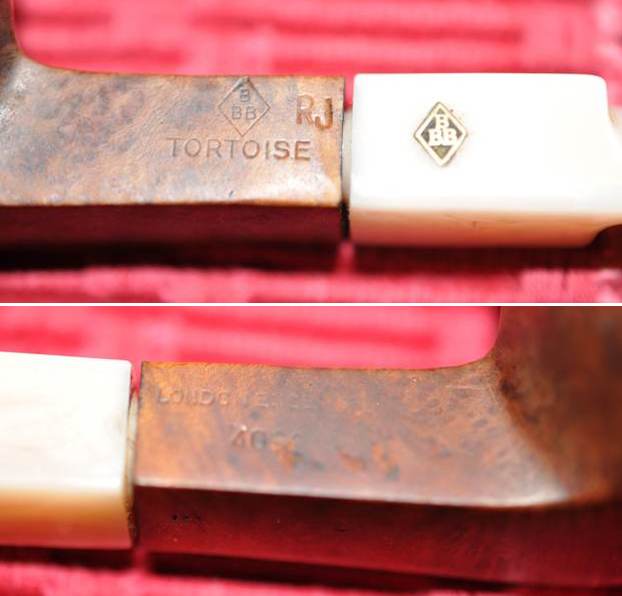
This classic shaped square shank Bulldog has some beautiful mixed grains that can be made out from under the dull and lackluster stummel surface. It is stamped on the left side of the stummel as “BBB” in a rhombus with “OWN” and “MAKE” on either side of the rhombus. The Sterling silver ferrule at the square shank end is stamped as “BBB” in a rhombus over “AF & Co.” in a rectangle over the three cartouche bearing hallmarks. Starting from the left, the first cartouche bears the stamp of an “Anchor” for  the Birmingham Assay Office followed by the “Lion Passant” certifying the silver quality and the last cartouche bears the Date letter “r”. The vulcanite saddle stem is devoid of any stem logo. The stampings are clear and easily discernible. BBB – Pipedia has detailed information on the origins of the brand and transition to the Cadogan group and would be a good read for those interested. I would like to highlight that, quote “At the beginning, BBB produces two qualities. One, BBB Own Make, became finally BBB Best Make, other pipes being simply estampillées BBB. There are reasons to believe that Own Make in fact were produced in London (Reject pipes cuts year R stamped one them.), whereas the simple BBB were imported, and this, to the paddle of the 20th century. However, if all that is not very clear, it is probable that the lines low-of-range were an import of Saint-Claude un-quote.

Now coming on to the most interesting and satisfying part of the research on this piece of briar and that is establishing the probable date of manufacture of this pipe. I prefer to follow English silver marks: the guide to hallmarks of London sterling silver (silvercollection.it)  while establishing the dates on the basis of the date letter in the hallmarks. The Anchor points to the Birmingham Assaying Office. Thereafter, I followed the link to the dating guide of the Birmingham Assay Office to date this pipe. I have included a hallmark chart for dating the pipe. I have put a red mark around the letter for 1916. It is the same style of “r” and the cartouche that holds the letter stamp, matches the photo as well.

To summarize, this BBB was made in 1916, give or take a year as the ferrules were assayed in bulk and used as required. The stamp of Own Make designates this as the finest quality pipe that was made in London for the local market in a Bulldog shape which was made in limited quantities.

Initial Visual Inspection
As stated at the beginning of the write up, Abha, my wife who helps with the initial cleaning, had worked on this pipe in 2018 and sent it out to me for further restoration along with 50 odd pipes. She had reamed the chamber down to bare briar, cleaned the internal of the shank and stem followed by external cleaning of the stummel using Murphy’s Oil soap. Unfortunately there are no ‘before’ and ‘during the process’ pictures. The initial condition of the pipe can be gauged from the pictures of the pipe as it sits on my work table. Dimensions Of The Pipe
(a) Overall length of the pipe: –          4.5 inches.

(b) Bowl height: –                               1.2 inches.

(c) Inner diameter of chamber: –         0.8 inches

(d) Outer diameter of chamber: –        1.2 inches

Detailed Inspection
The rim top surface is where the maximum damage is on this pipe. The rim edges have been subjected to a heavy knocking all around but moreover in the 6 and 7 o’clock direction (encircled in green). A small crack is seen extending over the rim surface down towards the twin rings in 12 o’clock direction and is indicated with red arrows. This crack extends inside the chamber and the same is encircled in red. The rim has thinned out considerably towards the front between 12 and 1 o’clock direction (encircled in yellow). There is a chunk of briar that is missing from 3 o’clock direction either due to knocking against a hard edge or could be due to charring or combination of both. This damaged portion of the rim is encircled in pastel blue. The chamber walls show webbing of heat lines/ fissures. These repairs to the rim surface damage will be the most challenging part of the resurrection of this pipe.  The stummel surface is dull and lackluster with dirty brownish yellow hues to the briar surface. A few very minor scratches and dings can be seen over the stummel surface. The front and aft of the stummel surface in the crown is darkened. I would need to check if the charring is deep grained or just superficial. The gap between the twin rings separating the crown from the rest of the stummel is uneven, but thankfully, it is unbroken. The beauty and quality of this old pipe lies in the perfectly proportioned shape and the fact that there is not a single fill over the entire briar surface of the stummel. The shank and mortise are nicely cleaned up by Abha. The diamond shaped vulcanite saddle stem is deeply oxidized. The tenon is missing a portion of the surface and would need to be rebuilt. The bite zone has tooth indentations on either surface. The buttons on either surface is worn down and has deep bite marks at the corner. Abha had already cleaned the stem internals and thus, I can proceed with stem repairs and restoration.The Process…
I started the restoration of this old timer by immersing the stem in to the deoxidizer solution from Mark Hoover. Before dunking the stem in to the solution, I ran a couple of pipe cleaners dipped in alcohol through the previously cleaned airway to remove the dust that may have accumulated over the last three years. I scrubbed the stem surface with a piece of 220 grit sandpaper to loosen up the oxidation from the surface and further cleaned it with Murphy’s Oil soap on a cotton swab. Once the surface was cleaned, I dunked the stem in to the deoxidizer solution along with the other pipe stems that are in queue for restoration and indicated with a green arrow. The stem is allowed to soak in the solution overnight giving ample time for the solution to pull much of the oxidation to the surface.The next morning, Abha removed the stems (stem indicated with pastel green arrow is the one being worked on) that had been soaking in the deoxidizer solution overnight. She cleaned the stem and the stem airway under running warm water and scrubbed the raised oxidation from the stem surface using a Scotch Brite pad and the airway with a thin shank brush. She further removed the oxidation by scrubbing the stem with 0000 grade steel wool and applied a little EVO to rehydrate the stem. This now gives a clearer picture of the extent of damage as can be seen in the pictures below. The lower bite zone including the button edges on either surface have deep tooth indentations and will need to be reconstructed. The tenon end would also need to be rebuilt. Fortunately, there are no traces of deep seated residual oxidation visible over the surface. I heated the bite zone of the stem with the flame of a lighter to raise the tooth indentations to the surface by causing the vulcanite to expand. This did raise the bite marks to an extent; however, I would still need to rebuild the buttons and fill the bite marks in the bite zone.To begin repairs to the stem, I first inserted a pipe cleaner that had been smeared with petroleum jelly (Vaseline) through the tenon end in to the stem air way. This helps prevent the CA superglue and charcoal mix from sticking to the pipe cleaner and prevents the mix from running down in to the air way and clogging it. I generously applied a mix of CA superglue and activated charcoal over the stem areas to be rebuilt. I apply a thick layer of the mix as this provides sufficient patch material to work with during subsequent filing and shaping to match the repairs with the stem surface. Once I had applied the mix, I set it aside to cure overnight.With the stem repairs set aside to cure, I turned my attention to the stummel repairs. The summary of major issues identified during the detailed inspection is given below:-

(a) Crack to the front of stummel that extends to the inside of the chamber.

(b) The large trough to the rim surface and thinning of the rim on the right side of the stummel.

(c) Heat lines/ fissures over the walls of the chamber.

With a flat head needle file, I removed the charred briar from the rim surface till I reached solid briar wood. This now gives a clearer idea as to the exact extent of damage and the repairs required.  I decided to address the crack to the stummel surface first. I marked the end point of the crack with a sharpie pen under magnification. This helps to identify the end point later with naked eye and also provides start point for the drill bit to bite in. With a 1 mm drill bit mounted on to my hand held rotary machine, I drilled a counter hole at the end of the crack, taking care not to go too deep and end up drilling a through-hole. I had to mark and drill a second counter hole as I later realized that the crack extended slightly below the first one that I had drilled. I ran the sharp dental tool along the crack to remove the dirt and debris that may have been lodged in the crack. This crack and counter holes would get filled with briar dust and CA superglue when I would reconstruct the trough in the rim surface and so I did not proceed to fill the same at this stage. Next, I got around to addressing the rim top damage. The extent of the dip or trough caused due to banging against a hard surface and or charring of the rim edge was deep and would necessitate heavy topping off of the rim surface, and I for one, absolutely wish to avoid any loss of briar. Also topping to the extent that was required to eliminate the deep trough would completely alter the original shape and symmetry of this pipe.  So, I planned on first filling up the deep trough on the rim edge using briar dust and superglue to roughly match the surrounding intact rim surface and some more and then topping it to achieve a smooth even surface. Theoretically, this sounds logical.

I resorted to the layering method again; first I layered superglue along the damaged surfaces of the rim followed by sprinkling of briar dust, another layer of superglue followed by a final layer of briar dust. This final layer of briar dust reduces the probability of air pockets (or so I thought). In the second picture, you can see that the layering has not been done to the level of the rim surface but above the surrounding intact rim surface as I would be sanding the rim subsequently. Using the same technique, I rebuilt the inner surface to increase the thickness of the rim that was thinned out. I set the stummel aside to cure.  The stem repairs had hardened considerably over the past 18 odd hours. I used a flat head needle file to sand the patch and achieve a rough match with the rest of the stem surface. I further evened out the patch with a folded piece of 220 grit sand paper. Similarly, I shaped the rebuilt tenon for perfect seating into the mortise. For a better blending, I further sanded the entire stem with 320 followed by 400, 600, 800 and 1000 grit sand paper. This helps to reduce the scratch marks left behind by the more abrasive 220 grit paper. I rubbed a small quantity of EVO to rehydrate the stem and set it aside. With the stem set aside, I turned my attention back to the stummel and rim repairs where the fills/ repairs had hardened completely. To speed up the removal of excess mix of briar dust and superglue from the repaired areas, I mounted a sanding drum over my hand held rotary tool and carefully sanded down the excess patch material. I further shaped and matched the repaired area with the rest of the stummel by sanding with a 180 grit sand paper. At this point, I noticed a large number of air pockets in the repaired areas and can be identified in the form of light colored pockets in the surface.And so here I was, filling the air pockets with a mix of briar dust and superglue and praying that these pockets are completely filled. Once I was done, I set the stummel aside for the mix to harden.While I was working on the stummel repairs, Abha, my wife was quietly giving finishing touches to the stem. She went through the entire set of micromesh pads, wet sanding with 1500 through to 12000 grit pads. She applied a little quantity of EVO and set the stem aside for final polish with polishing compounds.By next afternoon, the repairs to the rim had completely hardened. I set about sanding the repaired surface with a sanding drum mounted on to my rotary tool to match the rest of the surface. With a folded piece of 180 grit sand paper, I fine tuned the match further. At this stage, even though the air pockets have reduced to an extent, but not eliminated. I further realized that the rim top is still thin on the right side and needs to be built up further. To get the rim thickness to match the rest of the rim surface, I coated that portion of the inner wall that needed to be built up with a mix of briar dust and superglue. One has to be careful to coat only the required areas as it would mean extra effort and time wasted to remove the unwanted coat at a later stage. I set the stummel aside for the mix to cure.As I was busy with the rim repairs, Abha had polished the stem and had placed it on my work table. She polished the stem with micromesh pads, wet sanding with 1500 to 12000 grit pads. When she was through with the micromesh cycle, she deeply rubbed a small quantity of EVO in to the stem surface to rehydrate it and set it aside for me to give a final polish with blue diamond and carnauba wax. The finished stem looks a nice shining black. It was after I clicked pictures that I noticed that air pockets can be seen in the repairs to the bite zone. Is it the superglue that is at fault or is it me doing something wrong? Well, I shall live with it for now as these air pockets are not easy to discern with naked eye and maybe later someday I shall redo the stem repairs.Once the repairs to the rim had cured, I used a sanding drum mounted on to my rotary tool to smooth and even out the fills. I fine tuned the matching of the repairs with the surrounding surface by sanding with a piece of 180 grit sand paper. Now to even out the rim top surface…To even out the rim top surface, I topped the rim surface on a piece of 220 grit sandpaper till I had achieved an even a rim surface as was achievable while maintaining the shape and proportions of the stummel. A few light spots are seen where the glue did not mix with the briar dust forming an air pocket which got exposed during the sanding process.I addressed the issue of these air pockets by spot filling them with superglue using a toothpick. To speed things up, I used an accelerator to hasten the curing of the superglue. Once the glue had hardened, I evened out the fills by sanding with a 220 grit sand paper to a smooth finish. Unfortunately, I lost the pictures of this stage somewhere during transferring of data from mobile phone to my laptop.

With the rim repairs completed, I sanded the entire stummel progressively using 320, 600 and 800 grit sand papers. This not only addressed the minor scratches and dings over the surface, but also evened out any high spots left behind during the rim repairs. Satisfied with the progress made, I handed over the stummel to Abha for her to weave her magic with the micromesh pads. She polished the stummel, going through the entire set of 9 micromesh pads. To further blend the repairs with the surrounding surface, I stained the repaired area with a dark brown stain pen and set the stummel aside overnight for the stain to set. Once the stain was set, I rubbed a small quantity of “Before and After Restoration Balm”, a product developed by Mark Hoover that helps to rejuvenate and protect the briar. The transformation is almost immediate and the results are outstanding. The repairs, though visible on closer inspection, have blended in beautifully. Save for the final wax polish, the cosmetic aspect of this pipe has been taken care of and with great results! Now to address the functional aspects…

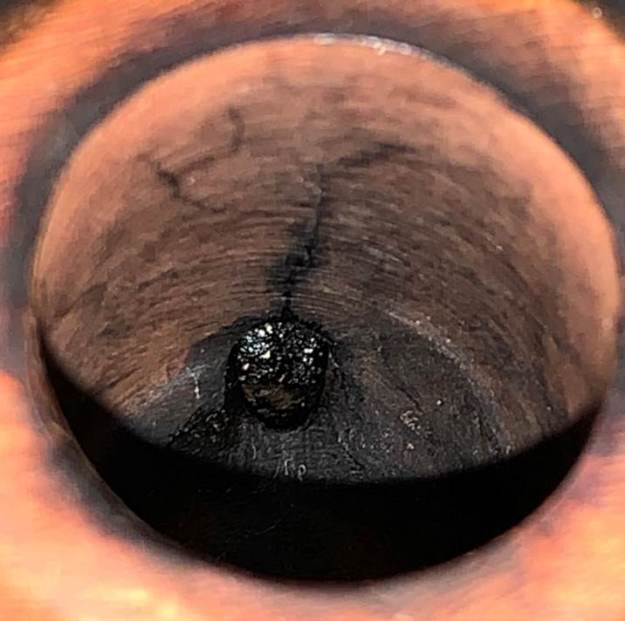
While carrying out the detailed inspection, I had observed and noted heat lines along the inner walls of the chamber. These heat lines are places from where burnouts usually happen if not addressed. Added to this was the rebuilt rim surface using briar dust and superglue. To isolate the heat lines and the rebuilt rim top surface from coming in direct contact with smoldering tobaccos, I decided to give a thin coat of JB Weld to the inner chamber walls and once the weld had hardened, a coat of activated charcoal and yogurt which is organic, neutral tasting and completely safe for humans would be applied over the JB Weld layer. This coat also aids in a faster build up of the cake.

With the PoA ready, I mixed the two part epoxy. J B Weld is a two-part epoxy Cold Weld in two tubes; hardener and steel which are mixed in two equal parts (ratio of 1:1) with hardening time of 5-6 minutes and complete curing time of 6-8 hours. I poured the contents of the two tubes and mixed it well. I inserted a petroleum jelly coated regular pipe cleaner through the draught hole to prevent it from getting blocked due to the J B Weld mix. I applied this mix, as evenly as possible, over the entire chamber wall surface and worked fast to ensure an even coat over the chamber walls before the weld could harden. I set the stummel aside for the application to harden and cure overnight. The J B Weld coat had hardened considerably by next day evening when I got around to working on the pipe. I mounted a sanding drum on to my hand held rotary tool and after setting the speed to half of the full RPM, I sanded the excess coat from the chamber walls. To further fine tune and keep the coat to a minimum thickness, I further sanded with a 150 grit sand paper till I had a coat thickness that was just sufficient to protect the briar underneath. Here is how the chamber appeared at this stage. After I had protected the repaired portion of the rim and the walls of the chamber with a coat of J B Weld, it was necessary to prevent this coat from coming into contact with the burning tobacco. I addressed this by mixing activated charcoal and plain yogurt to a thicker consistency, just enough that it would spread easily and applied it evenly all along the chamber walls after inserting a folded pipe cleaner through the draught hole to keep it open. Once dry and set, this will not only protect the walls but also aid in faster build up of cake.To complete the restoration, I mounted a cotton cloth buffing wheel onto my hand held rotary tool and polished the stummel and stem with Blue Diamond compound. This compound helps to remove the minor scratch marks that remain from the sanding. I mounted another cotton buffing wheel that I have earmarked for carnauba wax and applied several coats of the wax. I finished the restoration by giving the entire pipe a rigorous hand buffing using a microfiber cloth to raise the shine further. The finished pipe looks amazingly beautiful and is ready to join my collection of other BBB pipes that I have inherited. I only wish it could share with me its story of the past years while I enjoy smoking my favorite Virginia blend in it or maybe an English blend or maybe just keep admiring it.

Another Of My Inherited BBB Restored…And What A Mess It Was


Blog by Paresh Deshpande

The next pipe that had moved up the queue of pipes for restoration is also a BBB, but from a newer era as compared to the c.1916 pipe that I had just restored. The aim of selecting this pipe was to show the general condition of the pipes that I had inherited. All or most of them were very well loved and thus extensively smoked without any signs of ever having being cleaned and maintained. The philosophy was simple, select one favorite pipe, smoke the pipe till it fouls up then chuck it, buy a new pipe and repeat the process… It was an era when Barling family still owned the brand and Loewe pipes were still made in the Haymarket area! Ah….. That bygone era of beautiful and superb quality English pipes.

This is a beautiful well grained bent billiards with a nice hand feel, is perfectly proportioned and the quality just oozes out of every inch of the pipe. The sterling silver ferrule at the shank end bears the stamp of “BBB” enclosed in trademark rhombus over “STERLING” over “SILVER”. The stamping on the right side is greatly faded and only “MAKE” is visible under magnification and bright lights. The left side of the shank bears the slightly worn out shape code “304”. The high quality vulcanite stem has the trademark metal rhombus stamped “BBB”. I have worked on quite a few BBB pipes in the past and read a ton of material from various sources on BBB and to save time of our esteemed readers, I shall not reproduce the article but have provided a link for the most reliable and concise information on pipedia.org, https://pipedia.org/wiki/BBB

What were of interest to me, however, were the BBB catalogs that Doug Valitchka has contributed on pipedia.org. I reproduce a picture of the Sterling Silver line of pipes from BBB that gives out a brief introduction to the line and also the cost of the Sterling Silver line of pipes prevalent at that time. This and the subsequent link that I shall be providing, is a strongly recommended read for all those interested in old flyers and promotional endeavors from BBB.Pipedia.org also has a link to a PDF copy of 1960 brochure which is a very strong recommendation either for referencing or as a general read (https://pipedia.org/images/e/e8/BBB_1960.pdf). The pipe currently on my table has a shape number 304 which has been described in the brochure as a Bent Billiard.

Thus from the above, this pipe must have been with my grandfather from somewhere since late 1950s or very early 1960s making it 60 year old, give or take a few.

Initial Visual Inspection
The chamber has a thick layer of cake, so thick that I am unable to see the heel of the chamber. There is a heavy overflow of lava over the rim surface. The stummel appears dull and lackluster from all the heavy use and overflowing oils and tars which has attracted a ton of dust and grime from years of storage. However beneath all the dirt and grime some beautiful bird’s eye and cross grain over the stummel awaits revelation. There are a few dents, dings and chipped surface in the stummel. The sterling Silver band has turned black due to oxidation. The vulcanite stem is heavily oxidized with deep tooth chatter/ bite marks and calcification in the bite zone. The airway is clogged with dried oils and crud. Shown below is the pipe as it presents itself on my worktable. Dimensions Of The Pipe
(a) Overall length of the pipe:          5.2 inches.

(b) Bowl height:                                  1.7 inches.

(c) Inner diameter of chamber:        0.8 inches.

(d) Outer diameter of chamber:      1.2 inches.

Detailed Inspection
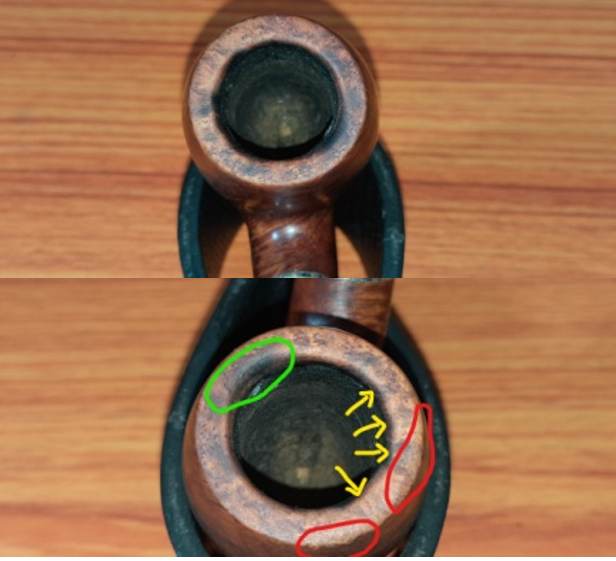
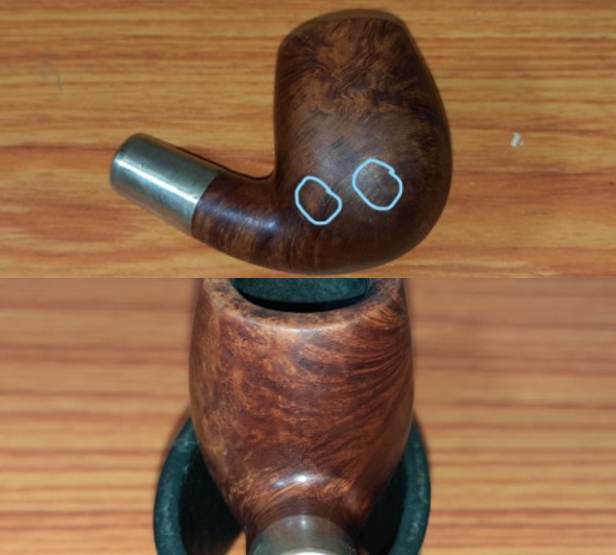
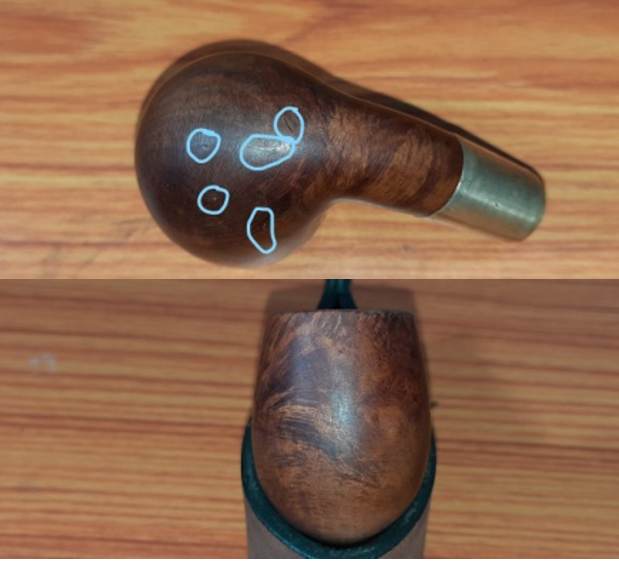
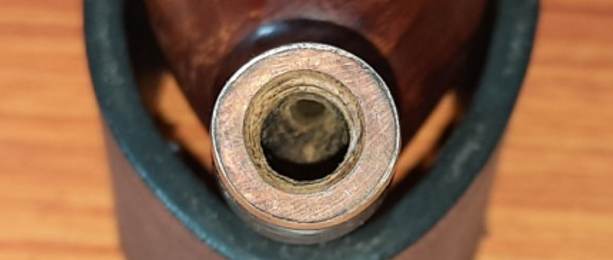
Apparently this chamber has never ever seen a pipe reamer nor has ever experienced the luxury of having a cake of the thickness of a dime. There is a thick layer of cake in the chamber which restricts reaching to the bottom of the chamber. The cake is very hard and dry and it was with some difficulty that I could pry out a couple of chips of cake from the rim surface with my knife. This is going to be one bugger to clean, I say. The thick lava overflow over the rim top surface obscures the condition of the rim surface and will be ascertained only after the crud is removed. Ditto as regards the condition of the chamber wall. I shall deliberate in detail on these issues once the cake has been rid of. The ghost smells are very strong, in fact so strong that the entire room reeked of the smell of rancid tobacco. The stummel is covered in overflowing carbon, oils and ash. Add to this grime, the many years of dust and dirt due to uncared for storage ground into the surface and you have a filthy, dull and dirty looking briar. There are some tightly packed Bird’s eye grains peeking from either sides of the stummel while beautiful cross grains adorn the fore and aft of the bowl. There are a few scratches, dents and dings over the stummel surface (enclosed in pastel blue), nothing severe that would need to be filled. However, to the front of the bowl just below and along the outer edge of the rim, there are a couple of spots that are missing briar (green circle). I may have to rebuild it using briar dust and superglue. The mortise is chock-a-block with old oils, tars and gunk to the extent that I couldn’t see the light in the chamber. The Sterling Silver ferrule is deeply oxidized but without any damage. Cleaning this pipe will be a long haul. The vulcanite stem is deeply oxidized but thankfully without any major damage. There are few tooth indentations and tooth chatter on either surfaces of the stem along with calcification in the bite zone. The button edges on either side have been chewed and would benefit from a rebuild/ reshaping. The step tenon opening is completely clogged and remnants of oils and tars and gunk can be easily observed on the sides and on the inside of the opening. The horizontal slot face is brutally oxidized and filled with gunk. The smells emanating from the stem are quite strong and repulsive. The brass logo is crisp and intact and would benefit from a nice polish.The Process…
Since there were other stems that were ready to be put into the stem deoxidizer solution, I decided to clean the internals of this stem first so that it could be put in the solution with other stems. I cleaned the stem airway with a thin shank brush and anti oil soap. The amount of gunk that was cleaned can be judged from the pictures below. It took considerable time and elbow grease to get the stem airway clean. In spite of my best efforts, I could not get the brush to completely pass through the stem. Closer inspection of the slot end confirmed my worst fears and I could see that the slot was blocked with the crud from the stem airway. I used a sharp dental tool to pry out the block and further cleaned the internals with regular and bristled pipe cleaners dipped in alcohol.This internal cleaning was followed by sanding the stem external surface with a folded piece of 220 grit sandpaper to loosen up and remove superficial oxidation. It has been our experience that such sanding yields the best end results after the deoxidizer solution has completed its assigned task. Before dunking the stem in the deoxidizer solution, it was cleaned up with Murphy’s Oil Soap and a cotton swab.The stem was immersed in the Before and After Deoxidizer solution, a product that has been developed by Mark Hoover. This solution raises the oxidation to the stem surface and helps in easy removal and imparting a nice shine to the stem after polishing. The pipe is indicated with an orange arrow indicator. The stem is allowed to soak into this solution overnight.The next morning, Abha took the stem out from the solution. She cleaned the stem under running warm water and scrubbed the raised oxidation from the stem surface using a Scotch Brite pad and cleaned the airway with a thin shank brush. She further removed the oxidation by scrubbing the stem with 0000 grade steel wool and applied a little EVO to rehydrate the stem. She ran a couple of pipe cleaners through the stem airway to clean the airway of the deoxidizer solution and water. There is a need to further sand the stem to completely remove the oxidation.Continuing with the stem repairs, to address the deeper tooth indentations/ bite marks, I warmed up the bite zone with the flame of a lighter. The heat helps to expand the vulcanite and retain its original shape. This method may not always completely raise the depressions to the surface, but most of the times, to a great extent. In this case the tooth indentations were raised to a great extent, but the damage to the button edge would require a rebuild. I followed up the heating of the stem surface with sanding the bite zone with a worn out piece of 180 grit sandpaper to even out the surface. Next I rebuilt the button edge with a mix of activated charcoal and superglue. I applied it over the buttons on either sides of the stem and set it aside for the mix to cure.Now it was time for me to work on the stummel. I did this by first reaming the chamber with size 1 followed by size 2 PipNet reamer head. I further scraped the chamber walls with my fabricated knife to remove the remaining carbon deposits where the reamer head could not reach. I scraped out the lava overflow from the rim top surface. Once the cake was reamed back to the bare briar, I used a 150 grit sand paper followed by 220 grit sand paper to remove all the traces of remaining cake and also to smooth out the inner walls of the chamber surface. Finally, to remove the residual carbon dust, I wiped the chamber with a cotton pad wetted with 99.9% pure isopropyl alcohol. The huge pile of carbon dust that was reamed out is an indication enough to the amount of carbon that had accumulated in the chamber.With the chamber and rim top surface free of all the cake and overflowing oils and tars, I took a closer look at the chamber and rim top surface. The rim top has a number of dents and is undulated, probably a result of striking against a hard surface to remove dottle. Also a result of these strikes is that the outer rim edge is chipped and damaged on the left side between 9 and 12 o’clock direction (encircled in pastel blue). The inner rim appears to have had a bevel and there seem to be signs of charring on the right side (encircled in yellow). There are webbings of thin superficial heat lines along the wall of the chamber (indicated by green arrows); however these are to be expected in a pipe that has been so heavily smoked. These heat lines are very minor and superficial and do not detract from the smoke worthiness of this pipe for the next 60 years.During the handling of the stummel, the Sterling silver band came off allowing me to check for damage underneath the band. Thankfully other than being filthy, there was none. I cleaned the mortise with hard bristled pipe cleaners and alcohol. Using a fabricated tool, I scraped the dried accumulated gunk from the mortise to the extent possible. The mortise would be further cleaned during the stummel cleaning. With the internal cleaning done, it was time for the external cleaning of the stummel surface. I used a hard bristled tooth brush and Murphy’s Oil Soap, to scrub the stummel and rim top. The hardened and stubborn cake was dislodged from the rim surface and shank end using Scotch Brite pad and with a brass wired brush. I washed the stummel under running warm water with anti oil dish washing detergent till the stummel surface was clean and dried it using paper towels and soft cotton cloth. I simultaneously cleaned the shank internals with the detergent and hard bristled shank brush and set the stummel aside to dry out naturally. It is pertinent to mention here that even after all this cleaning of the chamber and shank internals, the ghost smells are still very invasive. This would require adoption of more invasive methods to get rid of these old smells.Since the stummel and stem were drying and curing respectively, I completed one of the mundane but equally important tasks of polishing the Sterling silver band. I used a local product that is available in India only to polish the band. The liquid polish was applied to the band and wiped it out after a few seconds. The polish completely removed the oxidation and gave a nice shine to the band.To address the rim top damage, I topped the rim top on 220 grit sandpaper till the surface was nice and even. I hate losing any briar and restrict it to the barest minimum that is required. The damage to the outer rim edge, though greatly eliminated, can still be seen to the front side (encircled in green). This would need to be reconstructed subsequently. The charring to the inner rim edge is still visible (encircled in orange). These issues could be completely addressed by the process of topping but the extent of topping that would be required to do so would alter the bowl height and also the entire pipe profile. I decided subject the stummel to an alcohol bath to address the strong smells from the stummel before moving ahead with repairs to the inner and outer rim edges. I used cotton balls which is an at par substitute to Kosher salt as I have realized over the years. I drew out a wick from the cotton and along with a folded regular pipe cleaner; inserted it into the mortise and through the draught hole into the chamber. Thereafter, I packed the chamber with cotton balls to about quarter of an inch below the inner rim edge and soaked the cotton balls with isopropyl alcohol up to the brim. About half an hour later, the level of alcohol had gone down, having being absorbed by the cotton. I topped it up once again and set it aside overnight. By next morning, the cotton and alcohol had drawn out all the remaining oils and tars from the chamber and mortise, fulfilling its intended task. I removed the cotton balls and ran pipe cleaners through the mortise to clean out all the loosened tars and gunk and further cleaned it with alcohol and q-tips. The chamber now smells clean and fresh. I set the stummel aside to dry out naturally. While the stummel was soaking in the alcohol bath, I had a look at the stem repairs and found the repairs completely cured. With a flat head needle file, I sanded these fills to achieve a rough match with the stem surface. I further fine tuned the match by sanding the repairs with a folded piece of 220 grit sand paper pinched between my thumb and forefinger. I followed it up by sanding the entire stem surface using 320, 400, 600, 800, 1000, 1500 and finally with a piece of 2000 grit sand paper. This serves to reduce the sanding marks of the more abrasive sand papers. I also sharpened the button edges while sanding. I wiped the stem with a cotton swab and alcohol to remove all the oxidation and sanding dust from the surface. I applied a little Extra Virgin Olive oil over the stem and set it aside to be absorbed by the vulcanite. Returning back to the stummel repairs, with a folded piece of worn out 180 grit sand paper pinched between my thumb and forefinger, I carefully gave a rough bevel to the inner rim edge and addressed the issue of charred inner rim edge. I filled up the chipped areas on the outer rim edge with a mix of superglue and briar dust and set the stummel aside for the fills to cure and harden.Once the mix had hardened, with a flat head needle file I sanded the fills to achieve a rough match with the rest of the rim edge. I further blended in the fills with a folded piece of 180 grit sand paper. I also sharpened the rough bevel to the inner edge that I had cut earlier. The rim top surface and the edges look much better at this stage of restoration. I further sanded the entire stummel with a piece of 220 grit sand paper to address the minor scratches and dings that would otherwise show after micromesh polishing cycle. I followed it by wet sanding the stummel with 1500 to 12000 grit micromesh pads, wiping frequently with a moist cloth to check the progress. I rubbed a small quantity of “Before and After Restoration Balm” deep into the briar with my finger tips and let it rest for a few minutes. The balm almost immediately works its magic and the briar now has a nice vibrant appearance with the beautiful grain patterns displayed in their complete splendor. I further buffed it with a horse hair brush and gave a vigorous buff with a microfiber cloth to deepen the shine. The beauty of this piece of briar is marred ever so slightly by a small pit on the left side of the bowl at the shank and bowl junction. Other than this, the briar only has only bird’s eyes and cross grains to boast. No wonder then that it was sold as a mid level line, below VIRGIN and above THORNEYCROFT.

To put the finishing touches, I mounted a cotton cloth buffing wheel onto my hand held rotary tool and polished the stummel and stem with Blue Diamond compound. This compound helps to remove the minor scratch marks that remain from the sanding. Next, I mounted another cotton buffing wheel that I have earmarked for carnauba wax and applied several coats of the wax. I mounted a clean cotton cloth buffing wheel and gave the entire pipe a once over buff. I finished the restoration by giving the entire pipe a rigorous hand buffing using a microfiber cloth to raise the shine further. The finished pipe with the aged patina to the briar looks amazingly beautiful and is now ready for its long second innings with me.

Breathing Life into a 1921 Peterson’s Dublin Prince


Blog by Steve Laug

The next pipe came to me for work from a friend of mine. It is a nice looking Peterson’s Prince that was quite a mess. The finish was worn and tired with fading on the left side of the bowl and shank. The rim top was damaged and darkened with a lava build up. The inner edges of the rim were damaged and worn. The silver ferrule was tarnished but the stamping was readable. The stamping on the shank sides was readable with a lens. It is stamped diagonally on the left side and reads Peterson’s [over] Dublin. On the right side it is also stamped diagonally and reads Made In [over] Ireland. The silver ferrule is stamped K&P [over] three hallmarks -1. Hibernia seated on a throne (represents Ireland) 2. Crowned harp (signifying the quality of the silver) 3. The letter “f” (giving the year of manufacture). All are in scalloped square shaped cartouches. Under these it is stamped Peterson [over] Dublin. I will need to confirm the date stamps and the stamping to confirm the dating of the pipe. I have included the pictures of the pipe that my friend sent to me early on in our conversation.It took nearly a month for the pipes to arrive in Canada for me to work on. I took photos of them to have an idea of what I was dealing with. You can see from the photos what I saw. The finish is really worn and faded on the left side mid bowl back to the ferrule on the shank. The older finish was dark on the rest of the bowl. Rim top showed darkening as noted above and there were cuts or marks on the top of the rim. The inner edge had some damage and nicks at the front side of the bowl. There was a build up of lava on the rim top and a light build up of cake in the bowl. The silver ferrule was tarnished but readable. I took some photos of the rim top and bowl to capture the condition of the pipe. You can see the cake in the bowl. There is heavier lava on the top left and back of the rim than on the rest. There was damage all around the inner edge of the bowl that included reaming and burn damage. The military stick bit style stem was heavily oxidized and there was some calcification on the top and underside of the stem near the button. There were tooth marks and chatter on both sides.I took photos of the stamping on the shank sides and the silver ferrule to try and capture them as best as I could. They were weak but they are readable with a lens. They read as noted above.I removed the stem from the bowl and took a photo of it to show its appearance. The tenon end of the stem has some calcification (or possibly some dried silver polish) where it sat against the silver.Before I started the restoration process on the pipe I wanted to confirm the date that my friend had sent to me for this pipe. I turned to Peterson’s Hallmark Chart that I have on rebornpipes to pin down the date (https://rebornpipes.com/tag/peterson-hallmark-chart/). I have include a copy of that chart below. I drew a red box around the date stamp that matches the one on the pipe. It is indeed a 1921 Peterson. I expanded the chart above and captured the section that included the section from 1907-1961 below. It confirms that the date is indeed 1921.Now I knew that I was working on a Peterson Prince made in 1921 and the Dublin stamp tells me it was made in Dublin.

I turned to Peterson’s Dublin in the book, The Peterson Pipe by Mark Irwin & Gary Malmberg. I quote from that section below:

 Dublin (1906-2003) Although DUBLIN appears under PETERSON’S on many pipes over the decades, it has served mostly as part of the brand name. The word first appeared on pipes hallmarked 1906-11, stamped PETERSON’S over PATENT OVER DUBLIN. The simpler PETERSON’S over DUBLIN first appeared on pipes hallmarked 1912 after the expiration of the patent. Illustrations of pipes in the ’37 catalogue show a random dispersion of the stamp PETERSON’S over OF DUBLIN together with the ordinary PETERSON’S over DUBLIN on every model offered. Specimen of the former will bear either an Irish COM or LONDON MADE over ENGLAND COM and almost certainly date from 1945-62. It was first mentioned in print as part of a model name in the ’68 price list, as K&P DUBLIN, in ’92 for a Danish market line…

Armed with this information I started working on the pipe. I put the stem in a bath of Briarville’s Pipe Stem Deoxidizer to deal with the thick oxidation on the surface. I would let it sit for about 6 hours and then remove it and work on it in the mean time I decided to work on the bowl. I lightly topped it with  220 grit sandpaper on a topping board to remove the damage on the rim top and the thick lava coat.I reamed the bowl with a PipNet pipe reamer to remove the cake from the bowl. I cleaned up the remaining cake with a Savinelli Fistall Pipe Knife. I sanded the bowl with 220 grit sandpaper wrapped around a piece of dowel to smooth out the inside of the bowl. The walls looked very good with no checking or heat damage. After reaming the bowl I turned my attention back to the rim edge and top of the bowl. I worked over the edge of the bowl with 220 grit sandpaper to smooth out the burned edge and the rim top. I wrapped a small wood ball in sandpaper and used it to sand the top and inner edge and give it a light bevel to minimize the inner edge. I scrubbed the bowl with Murphy’s Oil Soap to clean off the thick oils and grime ground into the surface of the briar. I scrubbed it on undiluted and rinsed it off with warm water to remove the soap and the grime. The bowl looked much better and the grain really began to stand out clearly. I cleaned out the shank with pipe cleaners, cotton swabs and 99% alcohol to remove the oils from the walls. It was filthy and when I was finished it smelled clean and fresh.I polished the briar (carefully avoiding the areas where the pipe is stamped on the shank sides) with micromesh sanding pads. I dry sanded it with 1500-12000 grit sanding pads. I wiped it down after each pad with a damp cloth to remove the sanding debris. I worked some Before & After Restoration Balm into the surface of the smooth briar with my finger tips. The product is amazing and works to clean, enliven and protect the briar. I let it sit on the briar for 10 or more minutes and then buff it off with a soft cloth. It really makes the grain sing. I polished the silver ferrule with a jewelers cloth to remove the remaining tarnish/oxidation and protect it against further tarnishing. There are a few dings in the silver but I chose to leave them as part of the story of the pipe. I set the bowl aside and turned my attention to the stem. I took it out of the Briarville Pipe Stem Deoxidizer and cleaned off the outside and the inside of the stem. I rubbed the stem down with a paper towel to clean off the remaining oxidation. I cleaned out the inside of the stem with alcohol and pipe cleaners.I “painted” the tooth marks in the vulcanite with the flame of a Bic lighter and was able to life the tooth marks to the surface. The surface looked really good.I polished the vulcanite with micromesh sanding pads. I used 1500-12000 grit pads to polish the vulcanite. I wiped down the stem with Obsidian Oil after each sanding pad. I have an oil impregnated piece of cloth that I use after each pad. I polished it further with Before & After Stem Polish both Fine and Extra Fine polishes. I gave it a further coat of Obsidian Oil and set it aside to dry.I put the pipe back together – the bowl with its new stem. This smooth finished 1921 Peterson’s Dublin Prince is a real beauty with great grain around the bowl. The thin P-lip style vulcanite stem works very well with silver ferrule and the medium brown briar. This Irish made Prince is a very collectible part of Peterson’s history. The grain on the bowl is quite beautiful and came alive with the buffing. I used Blue Diamond on the buffing wheel on both the bowl and stem. I gave both multiple coats of carnauba wax on the wheel then buffed it with a clean buffing pad to raise the shine. I hand buffed it with a microfibre cloth to deepen the shine. The Peterson’s Prince feels great in the hand. It is lightweight and the contrast in the browns of the briar, the sterling silver ferrule and the polished vulcanite stem is quite amazing. The dimensions of the pipe are Length: 6 inches, Height: 1 ½ inches, Outer diameter of the bowl: 1 ¼ inches, Chamber diameter: 7/8 of an inch. The weight of the pipe is 1.20 ounces/34 grams. It really is a beauty. I have three other pipes to work on from my friends collection and then I will send them all back to him. Thanks for walking through the restemming and the restoration with me. Cheers.

Restemming & Restoring a Malaga Second Long Shank Billiard


Blog by Steve Laug

I have been on a restemming binge for the last week or so. I have a box of stummels (bowls) here that I periodically go through and see if I have a potential stem that would fit them. Yesterday when I finished the restoration and restem on the Viking Brandy, I went through the box and picked out three bowls and found workable stems for them. All were in different states of need but all had been thoroughly cleaned before I boxed them up. The first of those that I chose to restem and restore is a lovely Malaga Second Long Shank Billiard stummel. If you have followed me for long you will know that I have worked on a lot of Malaga pipes in the past so I am not a stranger to the brand. This particular bowl is actually quite beautiful and for the life of me I have no idea why is stamped a Second.

The bowl looked very good. The grain around the sides was quite nice and a mix of cross grain and birdseye grain. The rim top had light damage to the inner edge and some nicks of flaws in the outer edge. The rim top had been beat about a bit and showed the wear and damage and there was darkening around the top and edges. The interior of the bowl was clean and there was some light checking on the walls. Examining the mortise it was clean and well drilled with no issues. The finish was washed out and bit and tired but still quite redeemable. The stamping on the pipe was clear and readable. On the left side it read MALAGA [over] Second. I took some photos of the bowl before I started to work on it. I took a photo of the stamping on the side of the shank. It reads as noted above and is clear and readable.I went through some of stems and found this shorter taper stem that needed some work on the tenon and diameter at the shank but it was exactly what I wanted. It has a few tooth marks and chatter on both sides near the button but it would clean up well. I have worked on quite a few Malaga pipes and blogged their restorations, so rather than repeat previous blogs, I am including the link to one that gives some of the history of the Malaga brand and the Malaga Pipe Shop in Royal Oak, Michigan in the USA from a catalogue. It gives a sense of the brand and the history in their own words. Follow the link to get a feel for the brand and the pipemaker – https://rebornpipes.com/2013/02/09/george-khoubesser-and-malaga-pipes/.

Now it was time to work on the stem and fit it to the shank of the pipe. The diameter of the tenon was close. I used the Dremel and sanding drum to bring it close to a fit and then used two files that I have here that work well for me to do the fine tuning of the fit.I used a piece of 220 grit sandpaper to smooth out the file marks on the tenon and make sure it was round. It is an interesting stem in that it has a tube in the tenon for making it “unbreakable”. I fit it on the pipe and took photos of the fit at this point. The fit against the shank was perfect. There were spots where the stem diameter and the shank diameter did not match. I used a folded piece of 220 grit sandpaper to smooth out the transition between the two so it was smooth.I set the bowl aside and turned my attention to the remainder of the stem. I “painted” the stem surface with a Bic lighter flame to raise the tooth marks. I was able to lift some of them to the surface. I filled in what remained with clear CA glue. Once it cured I flattened the repairs and reshaped the button with a small flat file. I then repaired areas 220 grit sandpaper to blend them into the rest of the surrounding vulcanite. I finished this part of the process by starting the polishing of the stem with 400 grit wet dry sandpaper. I polished the stem with micromesh sanding pads – dry sanding with 1500-12000 grit pads. I wiped the stem down after each pad with a cloth and Obsidian Oil. I finished the polishing with Before & After Pipe Stem Polish – both Fine and Extra Fine. I gave it a final coat of Obsidian Oil. I set the stem aside and turned my attention to the bowl. I started with the rim top issues. I used a folded piece of 220 grit sandpaper to smooth out the inner and the outer edge of the rim. I topped the bowl on a topping board with 220 grit sandpaper to smooth out and minimize the damage on the rim top. The top and edges looked much better at this point in the process. I polished the briar with micromesh sanding pads – dry sanding with 1500-12000 grit pads and wiping it down with a damp cloth after each pad. It really began to shine. I worked some Before & After Restoration Balm into the surface of the smooth briar with my finger tips. The product is amazing and works to clean, enliven and protect the briar. I let it sit on the briar for 10 or more minutes and then buff it off with a soft cloth. It really makes the grain sing. Before I finished the buffing on the pipe I wanted to address the checking on the inside of the bowl. I noticed it while I was taking the photos. Sometimes it is part of the cake and sometimes not. This time I was able to clean out the majority of it with a Savinelli Fitsall Pipe Knife and then sandpaper wrapped around a piece of dowel. There is still some shallow checking on the front of the bowl toward the top and a little on the backside but it is far better and should be good for many years. I cleaned out the bowl, shank and stem with alcohol and pipe cleaners to remove the sanding and scraping debris.I put the pipe back together – the bowl with its new stem. This restored Malaga Second Long Shank Billiard is a real beauty and the chosen stem works well with it. I have no idea why it would be marked a second other than the pits on the rim top. The grain on the bowl is quite beautiful came alive with the buffing. I used Blue Diamond on the buffing wheel on both the bowl and stem. I gave both multiple coats of carnauba wax on the wheel then buffed it with a clean buffing pad to raise the shine. I hand buffed it with a microfibre cloth to deepen the shine. The Malaga Second Billiard feels great in the hand. It is lightweight and the contrast in the browns of the briar and the polished vulcanite stem is quite amazing. The dimensions of the pipe are Length: 6 inches, Height: 2 inches, Outer diameter of the bowl: 1 ½ inches, Chamber diameter: 7/8 of an inch. The weight of the pipe is 1.98 ounces/56 grams. It really is a beauty. I will be putting it on the rebornpipes store in the American (US) Pipe Makers section shortly if you are interested in adding it to your collection. Thanks for walking through the restemming and the restoration with me. Cheers.

Restemming & Restoring a French Made GBD Sauvage 1345 Poker/Pot


Blog by Steve Laug

The next pipe I chose to work on was another bowl from my box of bowls to restem. It is a different looking bowl that combines both a Pot and a Poker shape. It has a inward beveled rim, flat bottom and worm trails curled around the bowl sides. When I examined the shank it had a small hairline crack on the right side that would need to be repaired but otherwise it was solid. It was unique enough I wanted to work on it. It is stamped on the left side of the shank and has a GBD oval logo next to the bowl/shank union followed by Sauvage. On the right side of the shank it is stamped FRANCE [over] the shape number 1345. The stamping was clear and readable with a lens. The bowl had been cleaned and reamed somewhere along the way by either Jeff or me. I honestly don’t remember when or where we got this bowl. It looked very good and I was looking forward to seeing the finished pipe. The stem was long gone so this would be a restemming job. I took some photos of the bowl to give a sense of the condition of bowl. The stamping was on both sides of the shank and it is clear and readable as noted above. I have also drawn a red rectangle around the area where the crack in the shank is located in the photo below.The next photo shows the rounded rim top and edges. It also shows the condition of the bowl and rim top/edges. It is clean and looks quite good. There is some burn damage on the inner edge of the bowl and on the beveled rim top at the front and the back of the bowl.Now it was time to begin my restemming work on this pipe. I went through my can of stems and chose a stem that would work. I would need to remove some the diameter of the tenon and the saddle portion to fit the thin almost pencil shank of the pipe. I used a flat file to remove the small amount of excess on the tenon. It was a close fit but I did not want to make the crack in the shank worse by a tenon that was not correct.When I had finished shaping the tenon I sanded it with a piece of 220 grit sandpaper and inserted it in the shank. It was looking pretty good. I would need to trim back some of the diameter of the saddle portion but I liked it! I generally use a Dremel and sanding drum to reduce the diameter of the stem. I do this with the stem in place on the shank so that I do not overdo it. It is a touchy exercise and one slip and I could easily damage the shank and make more work for myself. I move carefully and take it back as close as I can at this point. Once I band the shank I will need to do some more work on it but it is starting to look right. With the fit close enough it was time to band the shank. I generally do the final adjustments on the stem diameter after I have fit the band in place. I picked a band out that would fit when heated. I took a photo of the crack in the shank to show what I was working with. I sanded the shank end and gave it a slight bevel to facilitate pressing the band in place. Once it was ready I put the band on the shank. It was tight so I heated it with a lighter and when it had expanded I pressed it against the pad on my desk and pushed it all the way onto the shank. It covered the “e” on Sauvage slightly but the length of the crack defined what I needed to band it. I used some 220 grit sandpaper to once again take a little bit off the diameter of the tenon and the band compresses the crack and the diameter of the mortise changes. When I was finished I put the stem in the shank and took photos of the newly banded shank. It was going to look good once I finished shaping the stem diameter but it is very close at this point. What do you think of the new look? I finished adjusting the fit of stem diameter with 220 grit sandpaper and everything was aligned. I started the polishing with 400 grit wet dry sandpaper and the stem was looking very good at this point. Now I needed to deal with the tooth marks and chatter on the end of the stem. I “painted” them with the flame of a lighter to lift them as much as possible. I filled in the ones that remained with clear super glue. Once the glue cured I flattened out the repairs with a small flat file. I followed that by sanding the stem with 220 grit sandpaper to blend them into the surface. I started polishing the stem with 400 grit wet dry sandpaper. I polished the stem with micromesh sanding pads – wet sanding with 1500-12000 grit pads. I wiped the stem down after each sanding pad with Obsidian Oil. I polished the stem with Before & After Pipe Stem Polish – both Fine and Extra Fine and buffed it with a cotton cloth. Once I had finished the polishing I gave it final coat of Obsidian Oil and set it aside to dry. With the stem finished (other than to buff the pipe at the end)I set it aside and I turned my attention to the bowl. I used a wooden ball that Kenneth gave me with a piece of 220 grit sandpaper to clean up the bevel. I finished with a folded piece of 220 grit sandpaper to further minimize the burn damage. I touched up the stain with an Oak Stain pen to match the surrounding briar of the bowl. It looked much better at this point. I polished the briar with micromesh sanding pads – dry sanding with 1500-12000 grit pads. I wiped the bowl down after each pad with a damp cloth to remove the sanding debris left behind. I rubbed the bowl and shank down with Before & After Restoration Balm. I worked it into the surface of the smooth and worm trails on the bowl and shank with my fingertips to clean, enliven and protect the briar. I let the balm sit for a little while and then buffed with a cotton cloth to raise the shine. The Balm did its magic and the grain really took on dimension and colour. I am excited to be on the homestretch with this petite French Made GBD Sauvage 1345 Poker/Pot. This is the part I look forward to when it all comes back together, polished and waxed. I put the bowl and the new stem together and polished the stem and bowl with Blue Diamond to polish out the scratches in the vulcanite and give a light shine to the bowl. I gave the bowl and the stem multiple coats of carnauba wax. I buffed the pipe with a clean buffing pad to raise the shine. I hand buffed it with a microfiber cloth to deepen the shine. The pipe polished up pretty nicely. The worm trail carving on the bowl actually looks okay with the rest of the smooth finish. The banded shank and new polished black saddle vulcanite stem works well with this little sitter. This GBD Sauvage Poker/Pot was another fun pipe to work on and came out looking great. It is a comfortable sized pipe to hold in the hand. The finished pipe is shown in the photos below. The dimensions of the pipe are Length: 5 ¾ inches, Height: 1 ½ inches, Outside diameter of the bowl: 1 ½ inches, Chamber diameter: ¾ of an inch. The weight of the pipe is 33 grams/1.16 ounces. If you are interested in adding this pipe to your rack it will be on the rebornpipes store in the French Pipemakers Section soon. Thanks for reading this blog and my reflections on the pipe while I worked on it.
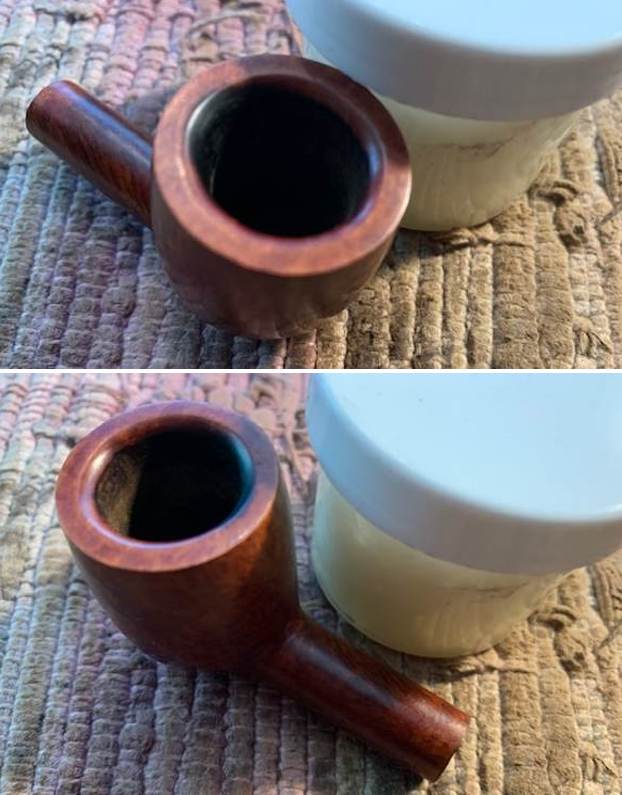
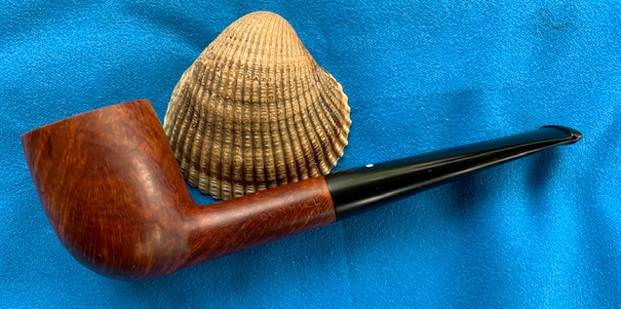
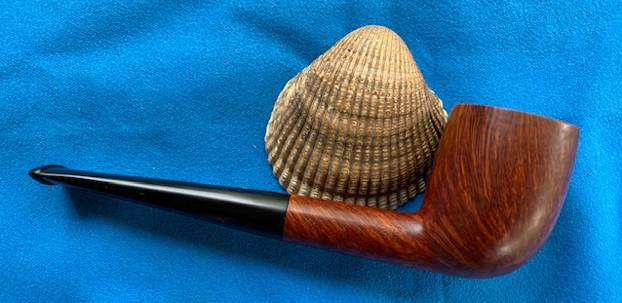
Life for a Beautifully Grained Royal Saxon Canadian


Blog by Steve Laug

This pipe was bought from an online auction on 04/04/19 in Wilkes Barre, Pennsylvania, USA. It is a nicely grained Canadian with a Sterling Silver shank band and a vulcanite taper stem. The bowl had a thick cake in the bowl and burn damage all around the inner edge of the bowl. There is also a burn mark on the outer edge on the front top and left edge of the bowl. There are some nicks in the left side toward the front of the bowl. The finish is very dirty with a lot of debris and grime ground into all the way around. The Sterling Silver band is oxidized and tarnished. The stamping on the pipe is on the top of the shank and reads Royal Saxon. There is no other stamping on the briar. The band is stamped Sterling Silver on the top side. There does not appear to be any cracks in the shank so it is solely for cosmetic purposes. The stem is oxidized and has tooth marks on the top and underside ahead of the button. Jeff took some photo of the pipe before he started his work on it. Jeff took photos of the bowl and rim top to show the cake in the bowl and the burn damage on the top and on the beveled inner edge of the bowl. He also took photos of the stem to show the tooth marks and chatter on the oxidized stem. He took photos of the bowl and heel to show the condition of the finish. You can see the small chip/nick on the front middle of the bowl on left side. It is solid but it is visible at this point.Jeff took photos of the stamping on the top of the shank and the silver band. They read as noted above and were in excellent condition. I checked on both Pipephil’s site and Pipedia for information on the Royal Saxon brand and neither site had any information. I checked on Who Made That Pipe and again found no information. So I Googled Royal Saxon Smoking Pipes and found information on Worthpoint and on Smokingpipes.com that said the pipe was an Italian Made pipe. They showed a variety of shapes – smooth, rusticated and blasted that all were stamped exactly like the one I am working on. Thus I know that the pipe is an Italian Made pipe but I have no idea who made it.
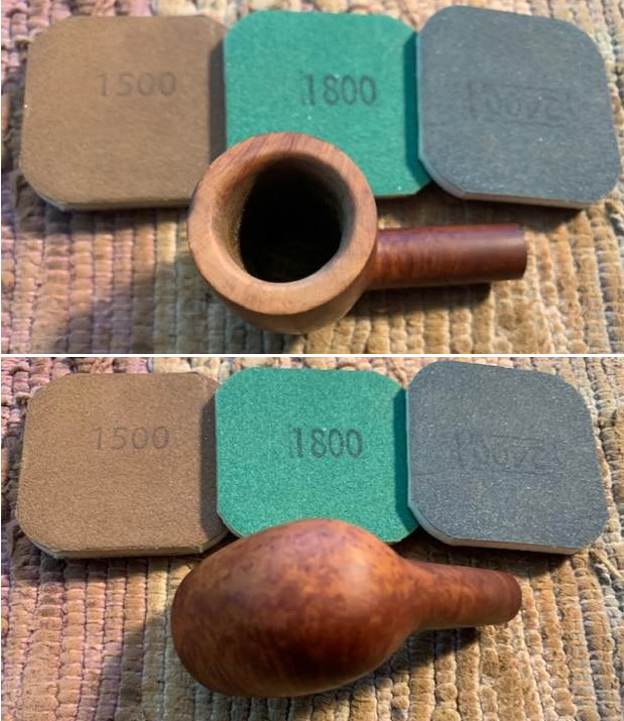
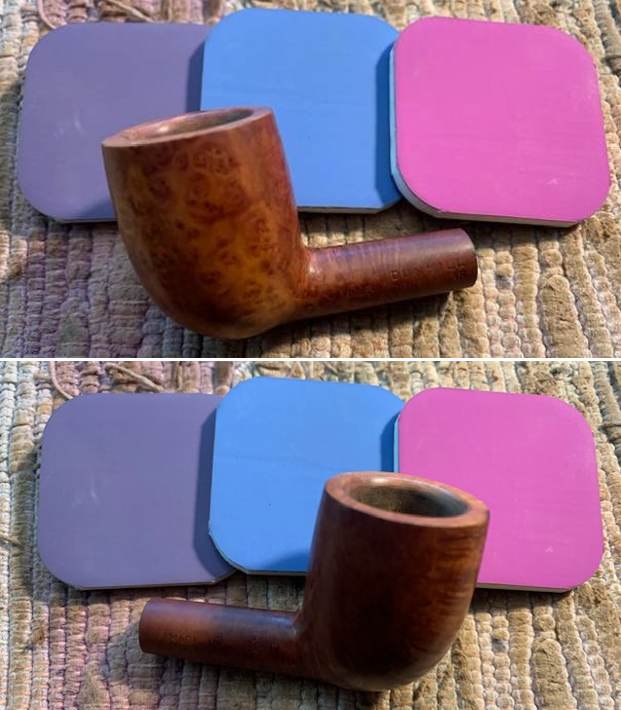
I did a bit of digging on Savinelli seconds but no Royal Saxon was listed as made by them. I also checked with Lorenzo as they made a lot of seconds lines and there was no listing for the Royal Saxon so I was at a dead end. Oh well – now it was time to work on the pipe.

Jeff had cleaned up this nicely grained Royal Saxon with his usual pattern. He reamed the bowl with a PipNet pipe reamer and then cleaned up the inside of the bowl with a Savinelli Fitsall Pipe Knife. He scrubbed the exterior of the bowl and shank with Murphy’s Oil Soap and a tooth brush to remove the grime on the rim top and bowl. He cleaned the internals of the shank and stem with pipe cleaners, cotton swabs and alcohol until the airways were clean and the pipe smelled fresh. The pipe looked much better once the bowl and stem were clean. He scrubbed the stem with Soft Scrub to remove the oxidation and then let it soak in Before & After Pipe Stem Deoxidizer. He rinsed it with warm water when he took out of the soak. Before I started my part of the work I took photos of the pipe. I took close up photos of the bowl and the rim top to show the condition. The photo clearly shows the burn damage to the inner and outer edge of the bowl at the front. You can also see the roughening of the rest of the inner edge and rim top. It was going to take some work to bring it back. I also took photos of both sides of the stem to give a sense of the condition of both sides at the button. There is tooth marking and damage on the top of the button on both sides as well as ahead of the button. The silver band is shown in the photos and is clearly tarnished.I took a photo of the stamping on the shank and silver band. It was readable but had some faint spots. What was interesting to me is that in the first photo there is also a stamp that shows up on the top side of the stem that I had not seen before. It is almost like a Old English “C” but I am not sure.I removed the stem from the shank and took a photo of the pipe to give a sense of the proportions of the whole.The first photo below shows the condition on the rim top, outer and inner edge before I started reworking it. I took a photo of the wooden ball that Kenneth gave me that I use in beveling a rim edge. I started work on this one by topping the bowl to take care of the deep burn marks on the top at the front of the bowl. I then reshaped the top and the bowl edges with a piece of sandpaper on a wooden ball. The ball and sandpaper helped clean up the beveled edge and blended in the burn and cuts in the briar as well as bring the bowl back into round. I used a folded piece of 220 grit sandpaper to further shape the bowl. Once I had it smoothed out and shaped I gave it an initial coat of stain with an Oak Stain Pen to match the stain colour around the bowl and shank. Lots of polishing yet to do but it is looking better. The burn mark on the top could not be totally removed without changing the profile of the pipe so I minimized it and it is significantly better. It will just be a permanent part of the pipe’s story.I polished the bowl and rim top with micromesh sanding pads – dry sanding with 1500-12000 grit pads and wiped down the bowl after each sanding pad. I rubbed the bowl and shank down with Before & After Restoration Balm. I worked it into the surface of the bowl sides and shank with my fingertips to clean, enliven and protect the briar. I let the balm sit for a little while and then buffed with a cotton cloth to raise the shine. The Balm did its magic and the grain stood out. I polished the Sterling Silver band with a jewelers cloth to remove the tarnish and protect it from further tarnish. I set the bowl aside and turned my attention to the stem. I wanted to see if I could use some acrylic white fingernail polish to bring back the stamp to readability on the top of the stem. I applied the acrylic and let it cure. I scraped it away and it was a little readable but not clear enough.I “painted” the stem with the flame of a lighter to try and lift the tooth marks on the stem and button surface. While it did some lifting there were some deeper ones that remained. I filled them in with clear CA glue and set it aside to cure. Once it cured I flattened them out with a small file and recut the button edge. I sanded them with 220 grit sandpaper and started the polishing with 400 grit wet dry sandpaper. I polished the stem with micromesh sanding pads – 1500-12000 grit pads. I wiped it down with Obsidian Oil after each sanding pad. I used Before & After Pipe Polish – both Fine and Extra Fine to further polish the stem. I gave it a final coat of Obsidian Oil and set it aside to dry. This nicely grained Royal Saxon Canadian with a Sterling Silver Band and a vulcanite taper stem is a great looking pipe now that it has been restored. The briar around the bowl is clean and really came alive. The rim top looks much better than when I began. The rich brown stains gave the grain a sense of depth with the polishing and waxing. The grain really popped. I put the vulcanite stem back on the bowl and carefully buffed the pipe with Blue Diamond on the buffing wheel using a light touch on the briar. I gave the bowl and the stem multiple coats of carnauba wax on the buffing wheel. I buffed the pipe with a clean buffing pad to raise the shine. I hand buffed the pipe with a microfiber cloth to deepen the shine. The finished Royal Saxon Canadian is a beauty and feels great in the hand and looks very good. Give the finished pipe a look in the photos below. The dimensions of the pipe are Length: 6 inches, Height: 1 ½ inches, Outside diameter of the bowl: 1 1/8 inches, Chamber diameter: ¾ of an inch. The weight of pipe is 1.13 ounces /32 grams. It is much more beautiful in person than these photos can capture. I will be putting it on the rebornpipes store soon. Look for it in the Italian Pipe Makers section. If you would like to add it to your collection let me know. This is another pipe that has the possibility of transporting the pipe man or woman back to a slower paced time in history where you can enjoy a respite. Thanks for walking through the restoration with me.