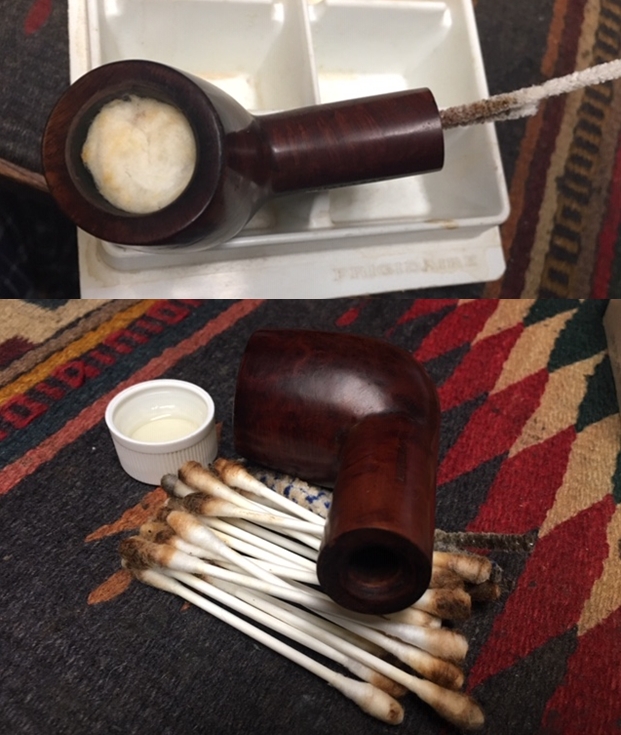
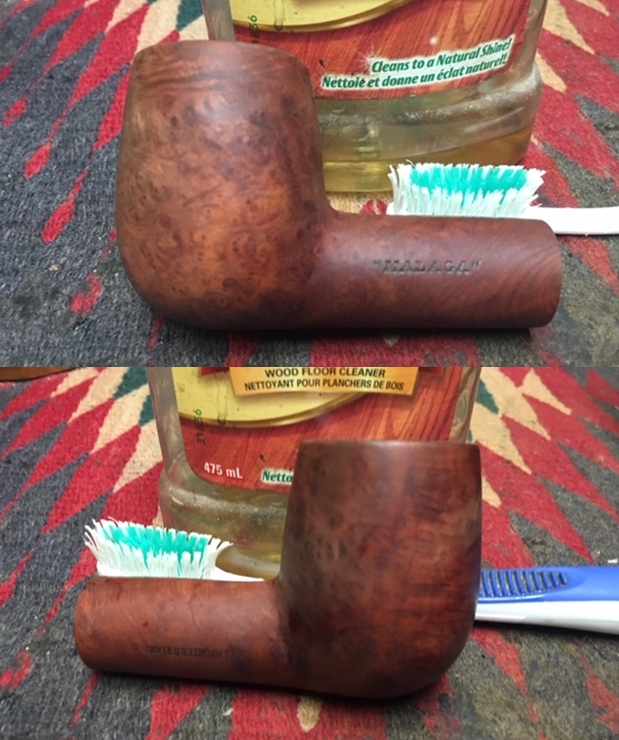
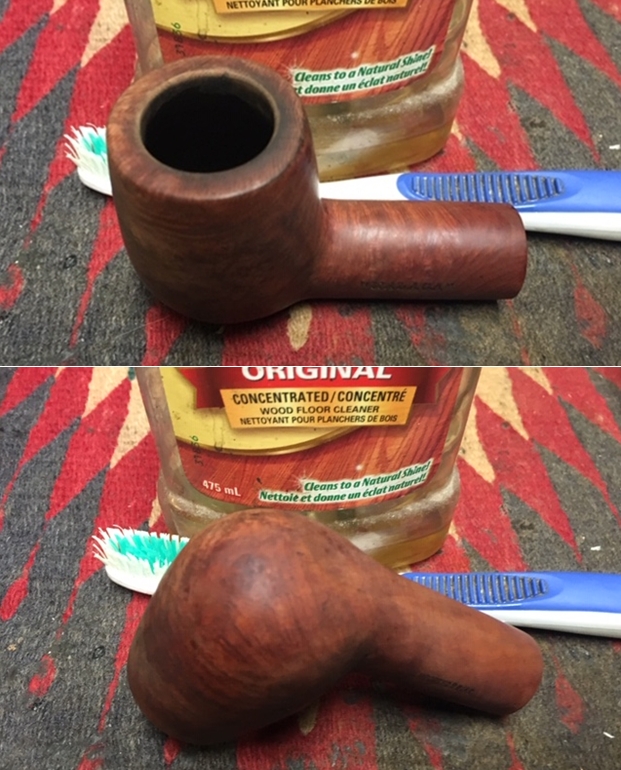
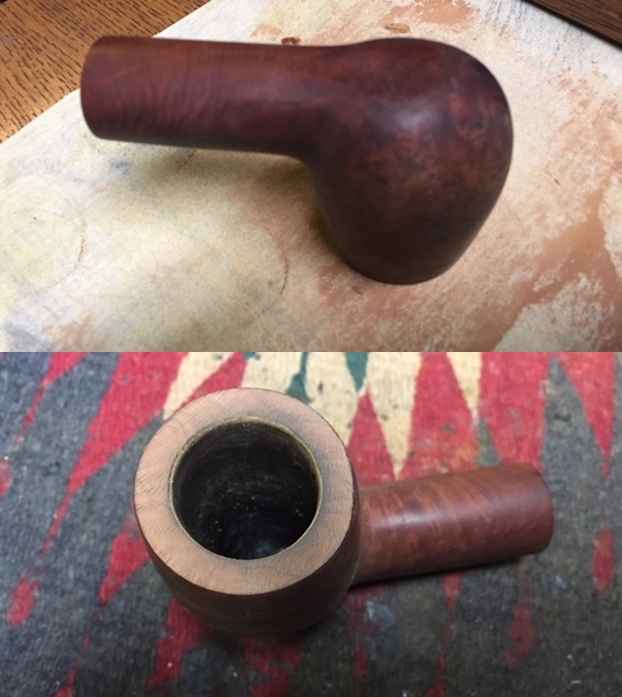
Tag Archives: bite marks

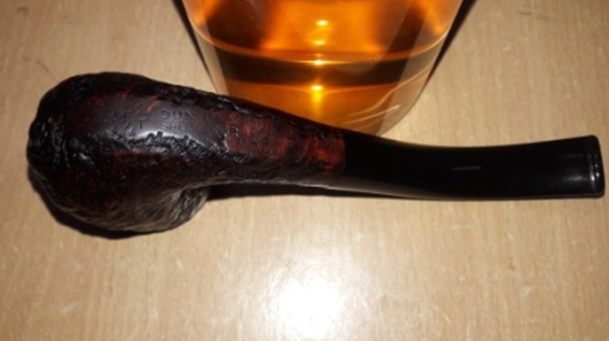
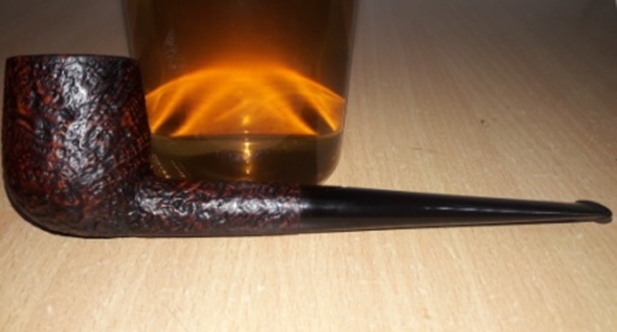
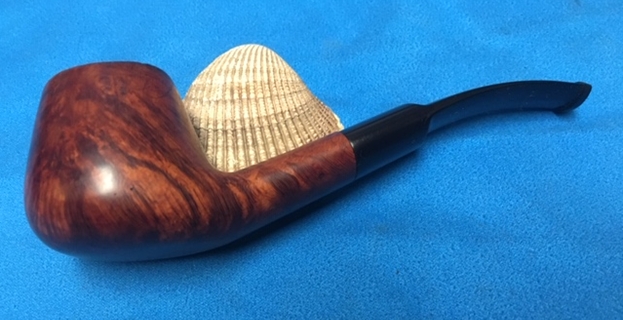
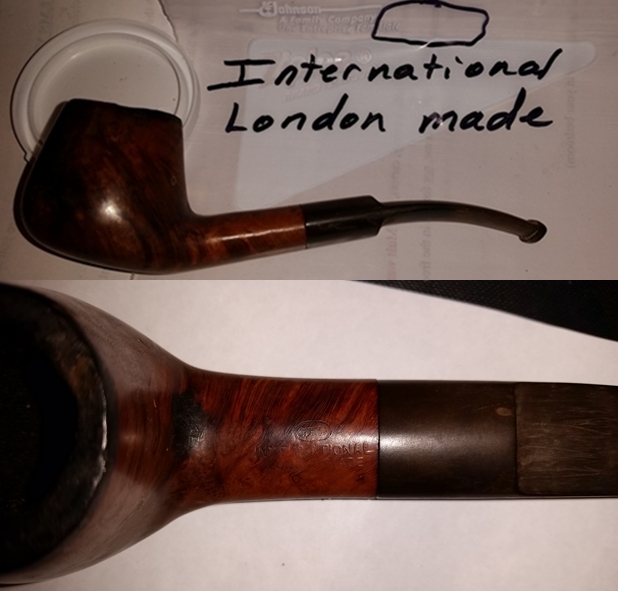
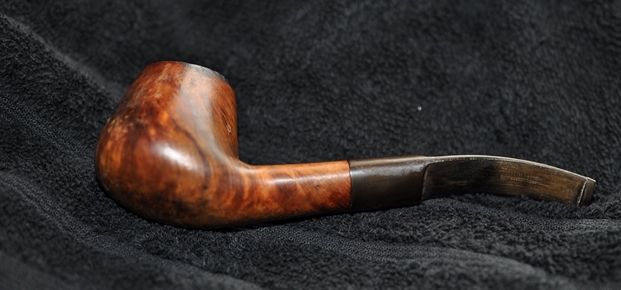
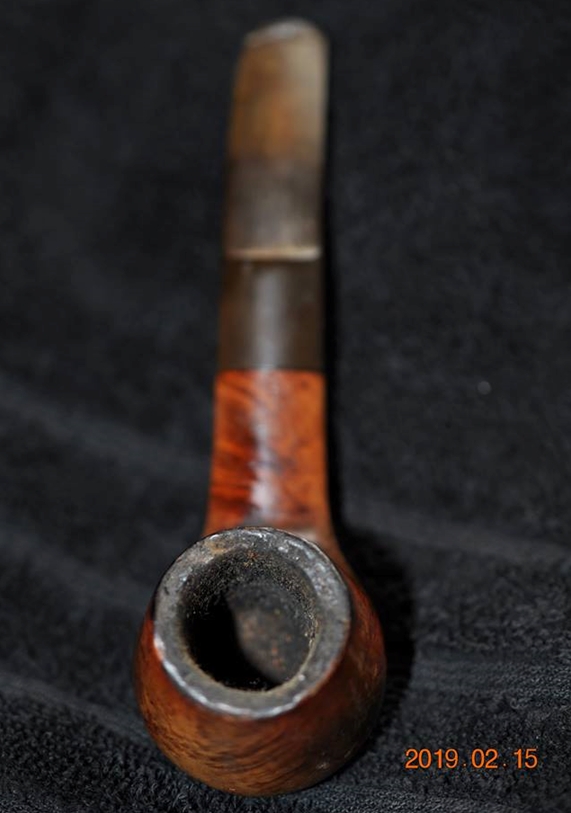
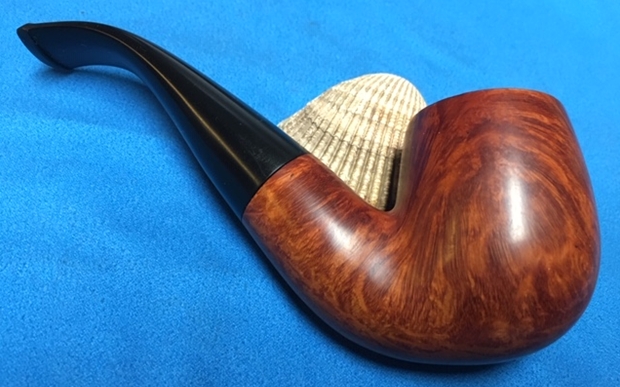
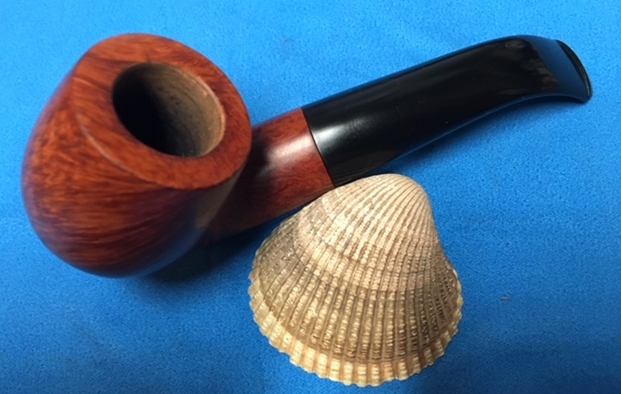
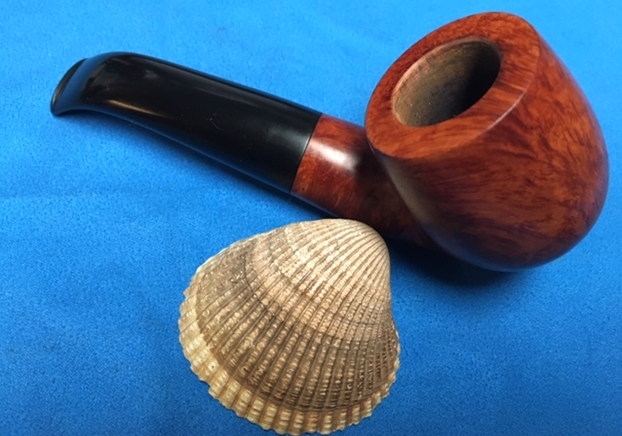
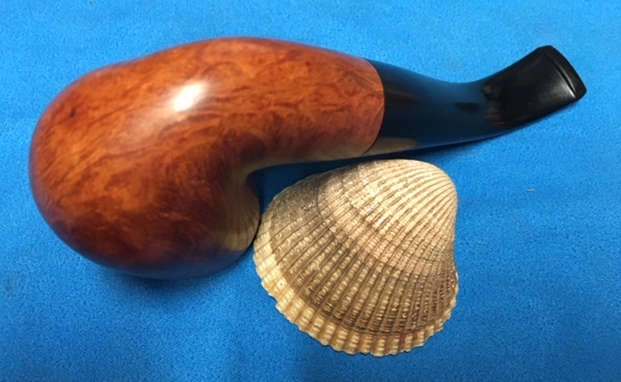
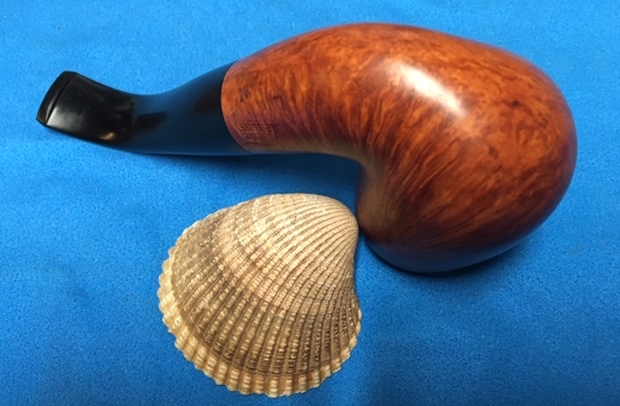
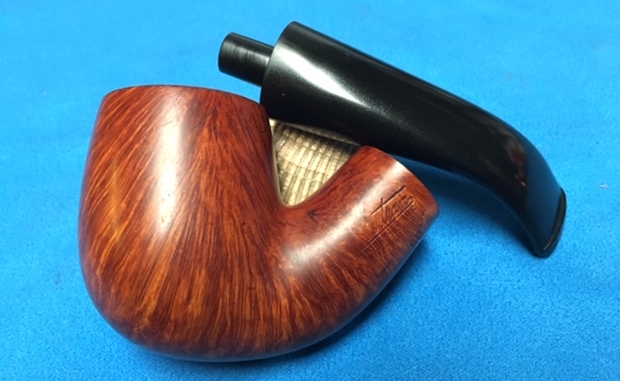
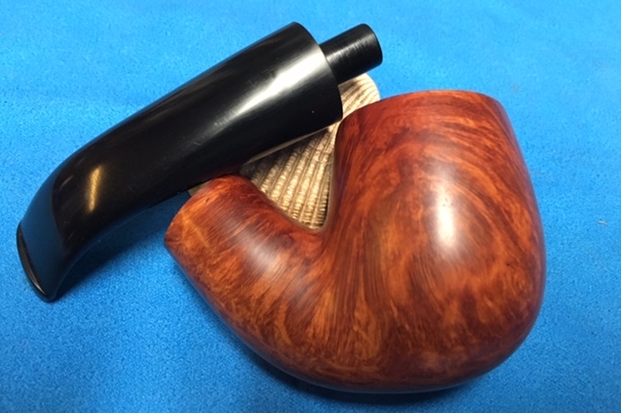
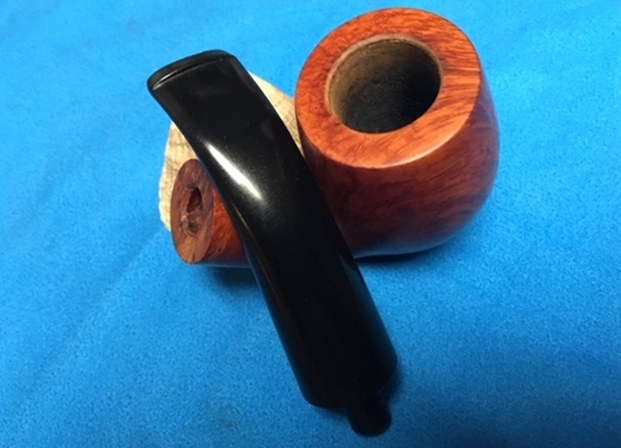
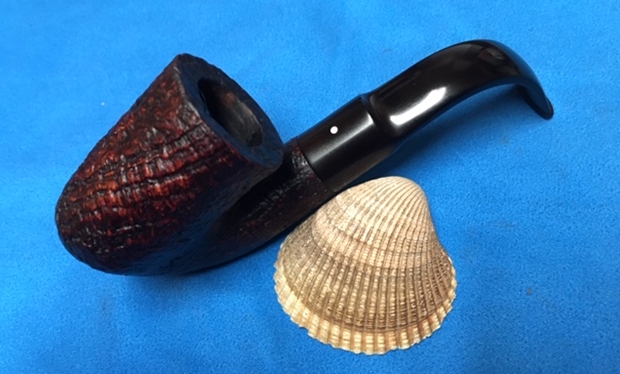
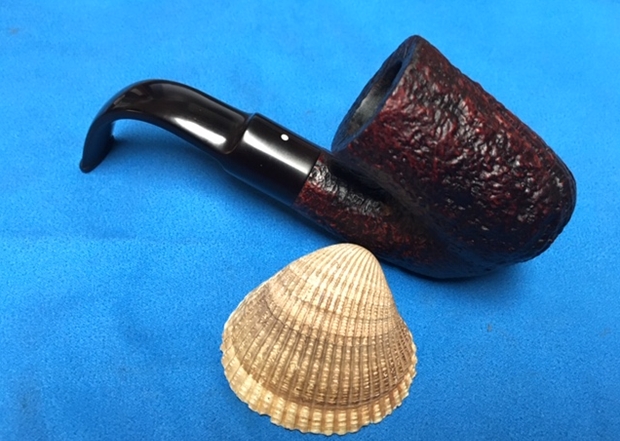
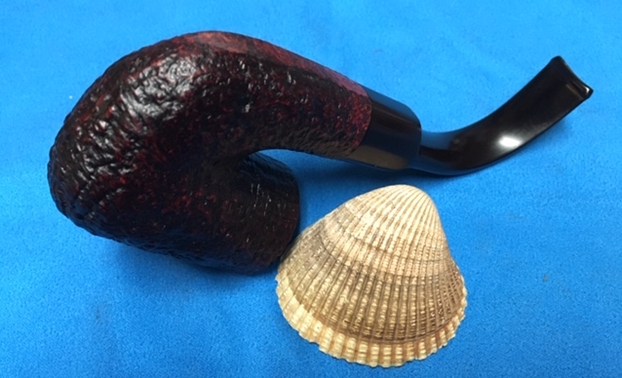
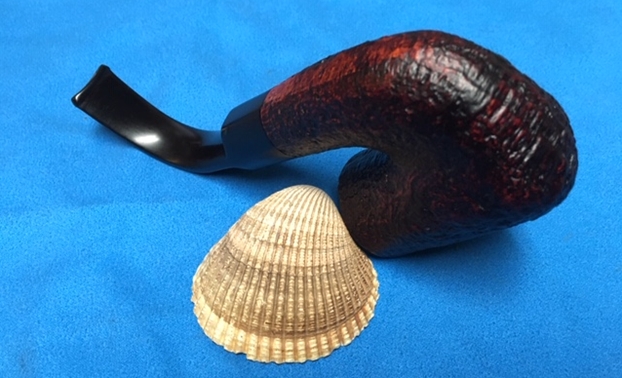
Restoring a Sandblast Danish Shaped Loewe’s Cutlass 21 Bent Acorn


Blog by Steve Laug

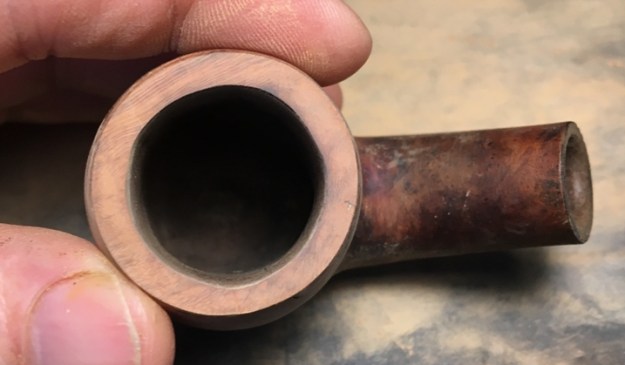
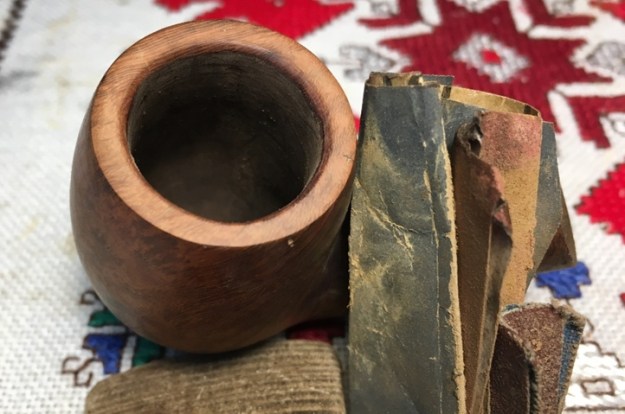
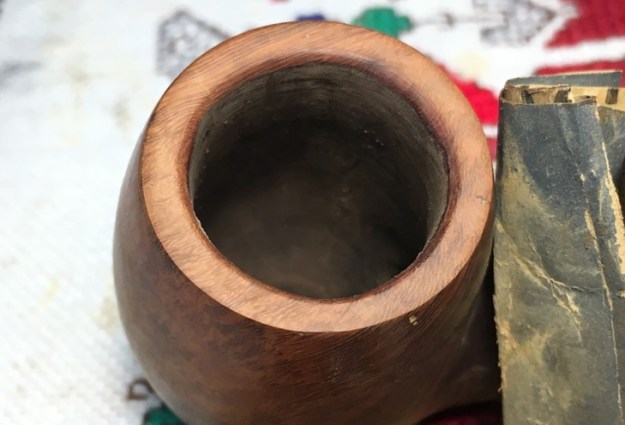
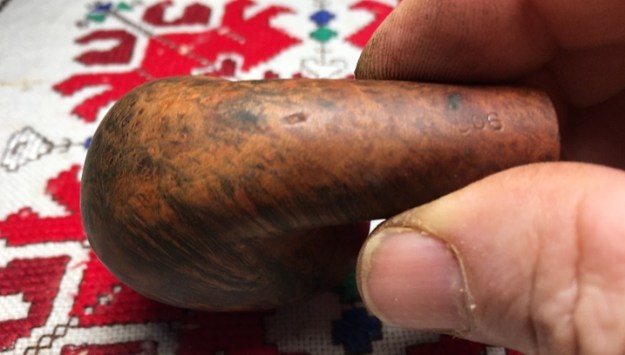
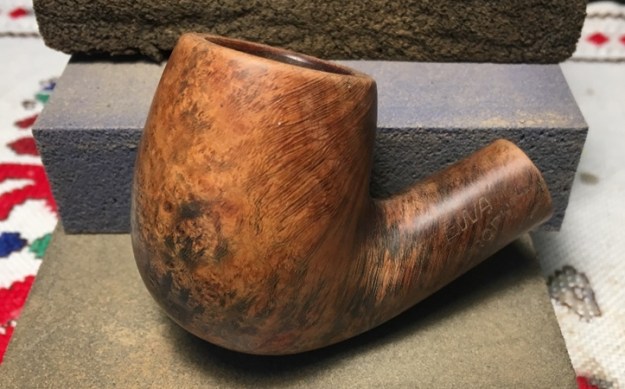
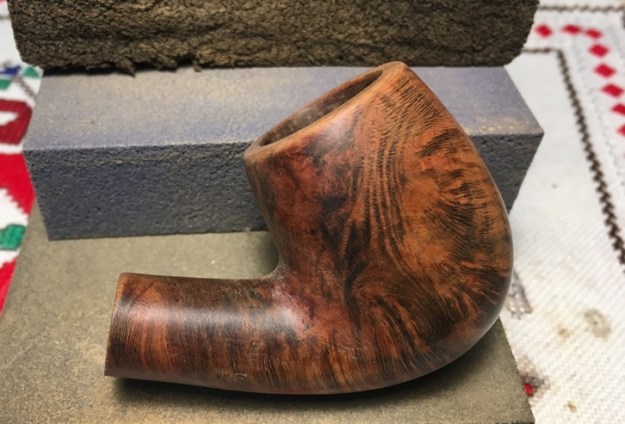
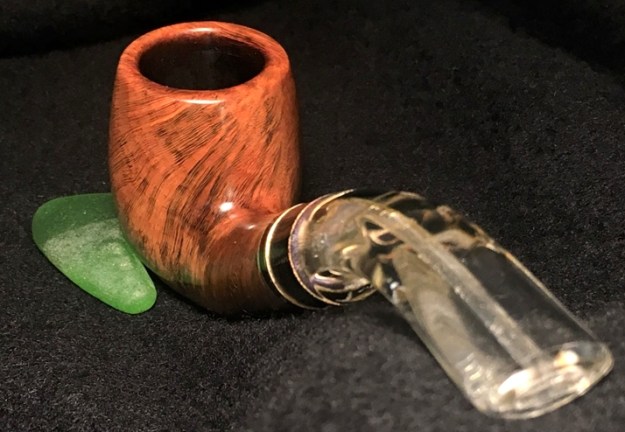
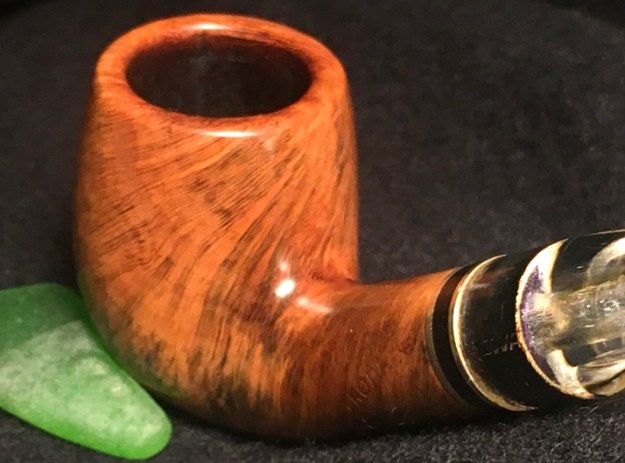
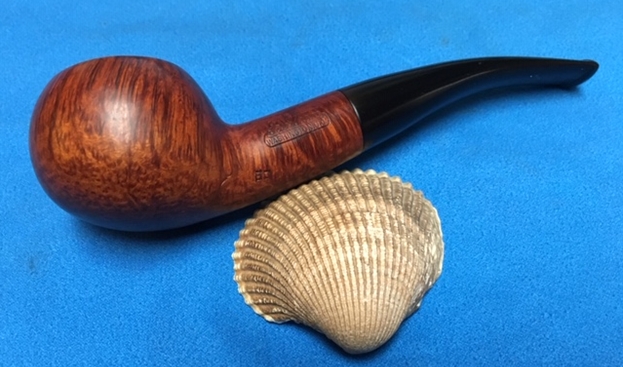
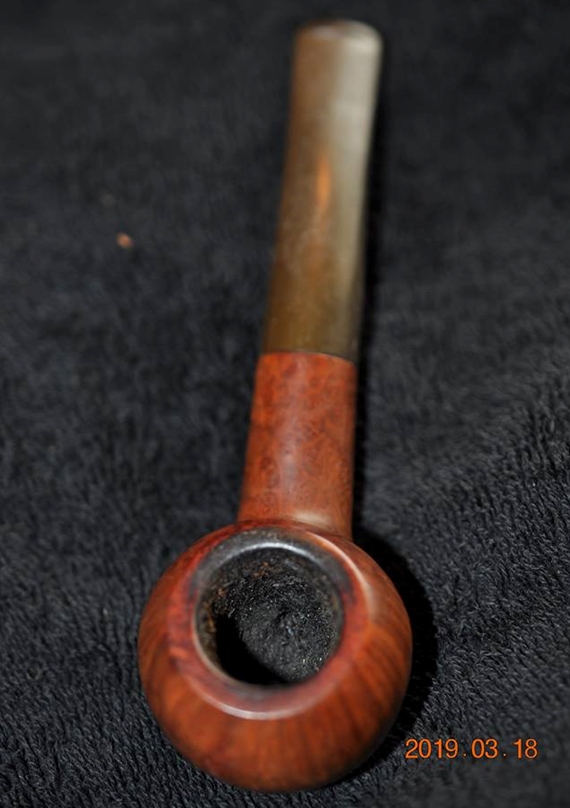
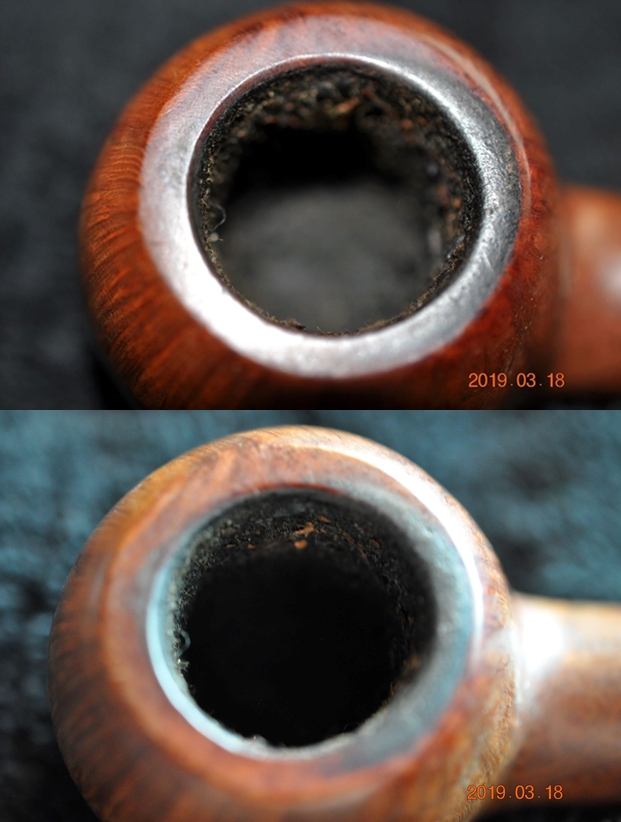
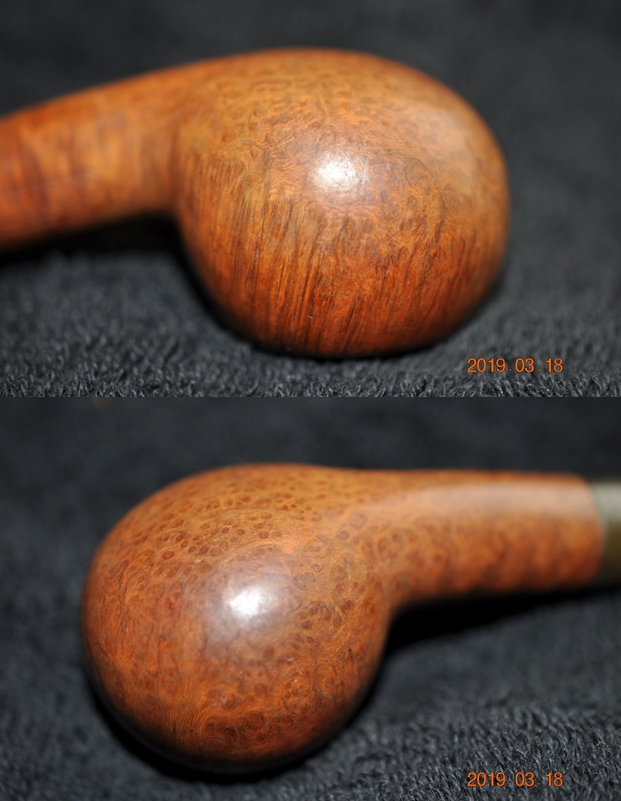
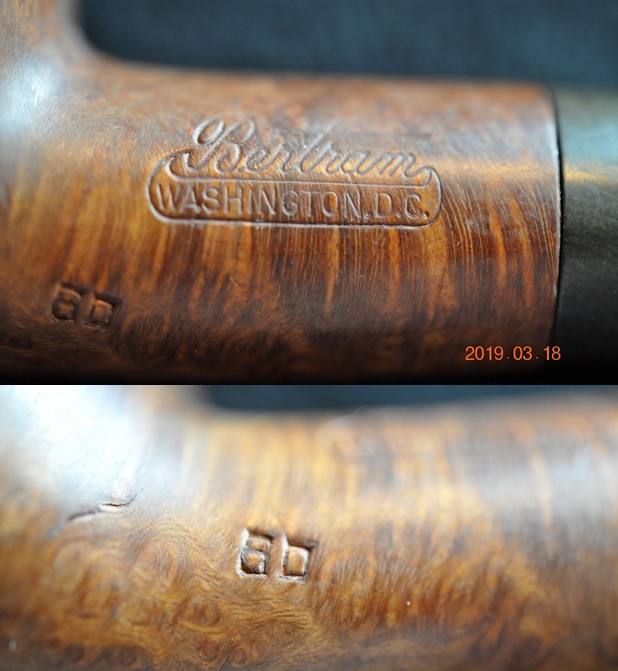
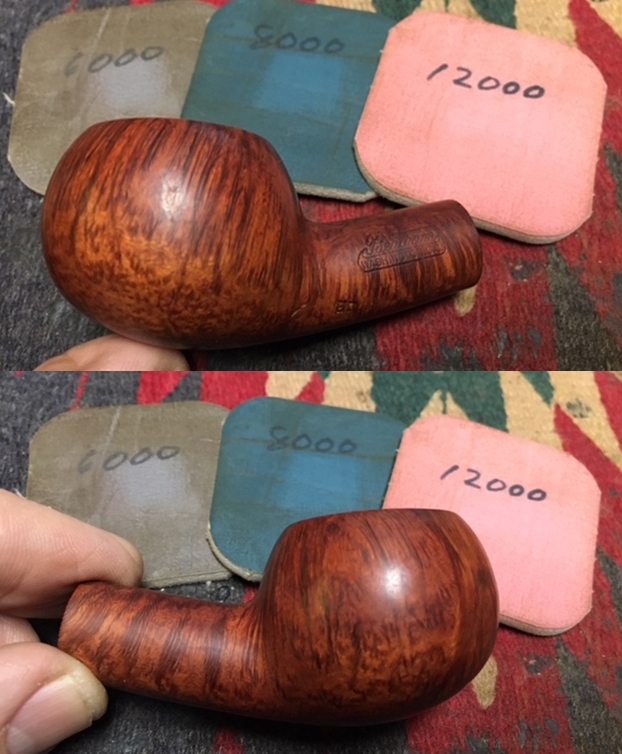
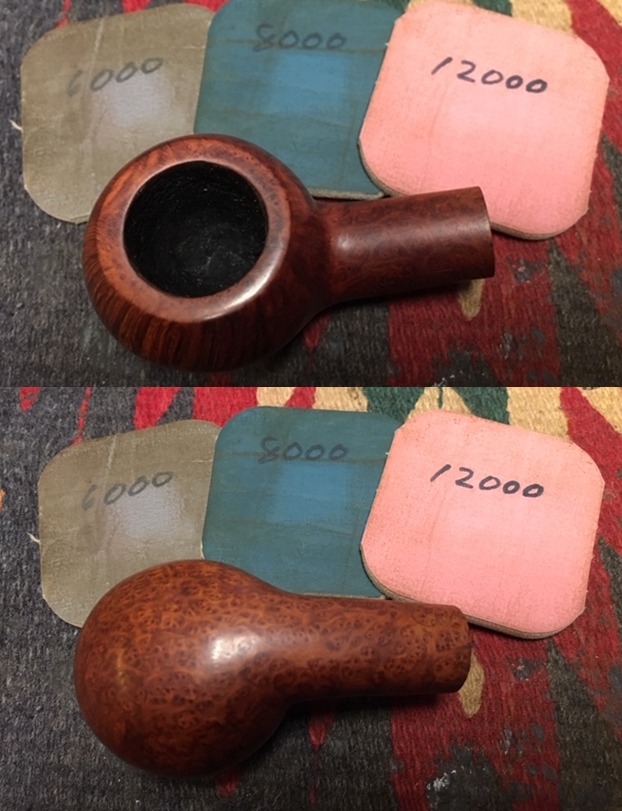
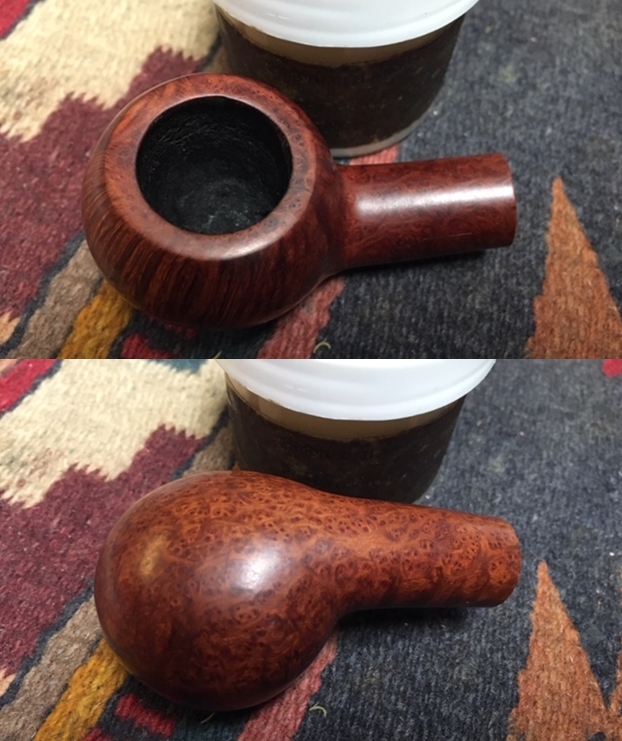
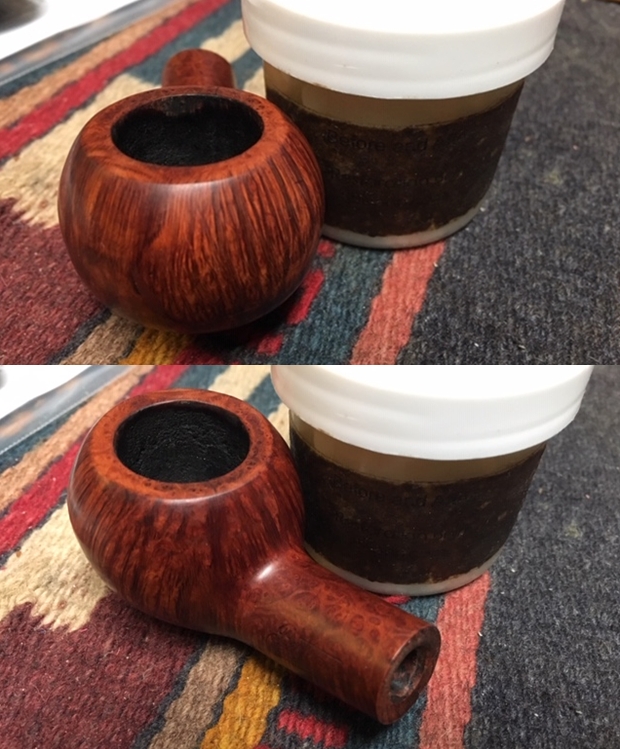
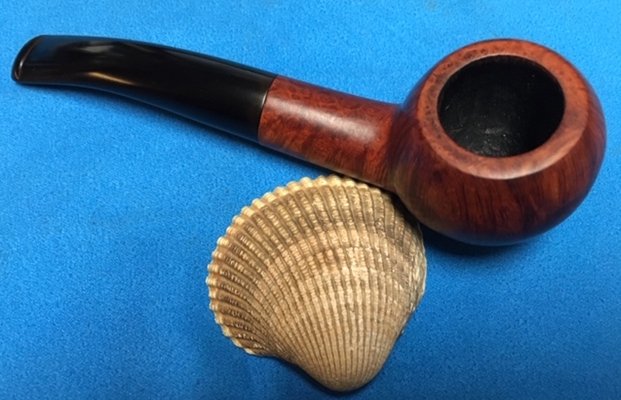
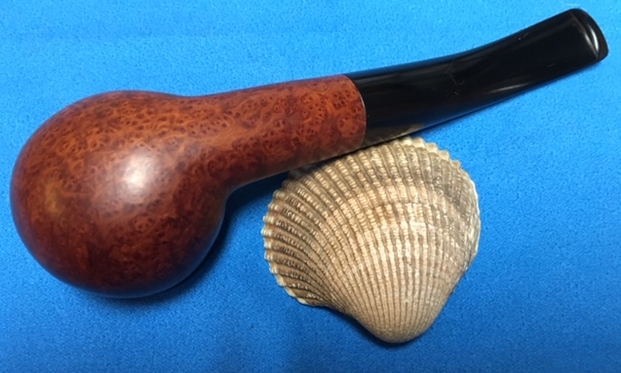
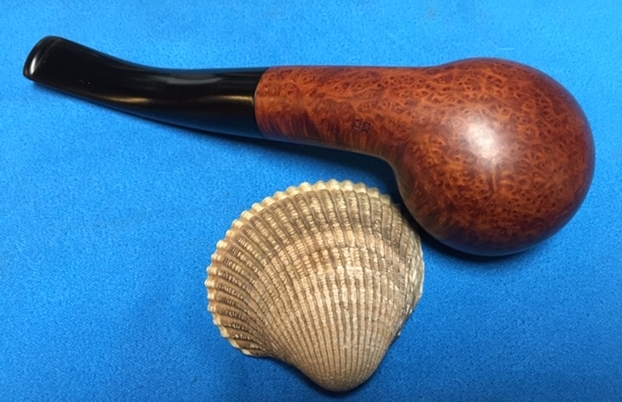
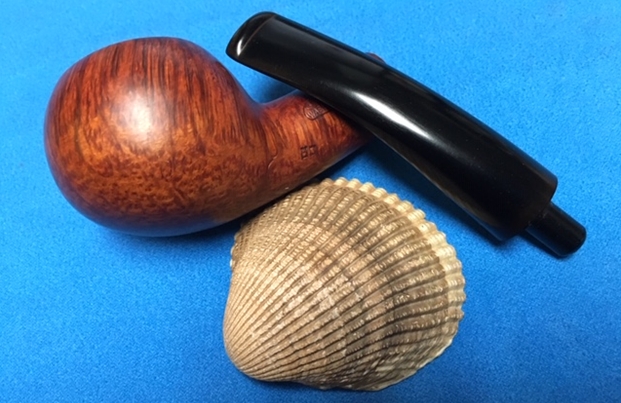
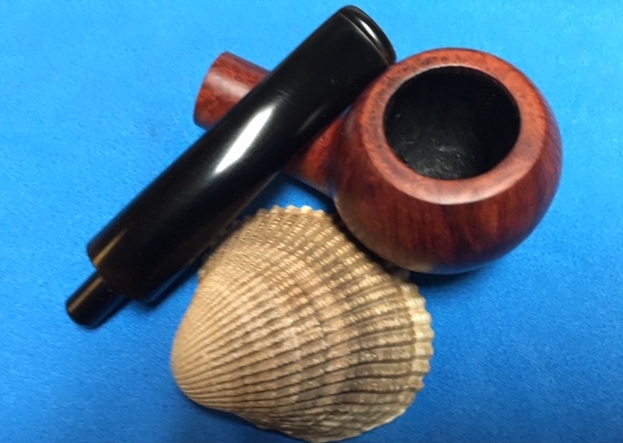
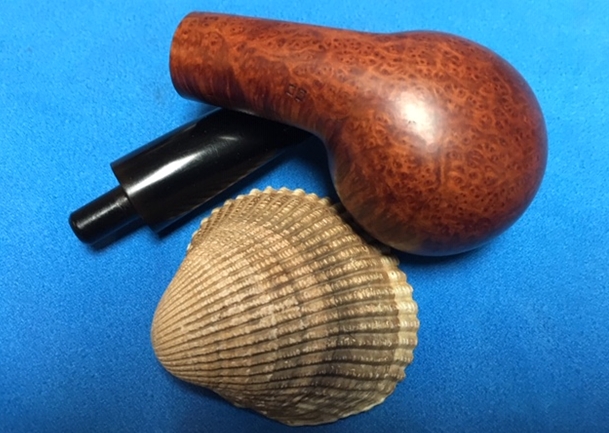
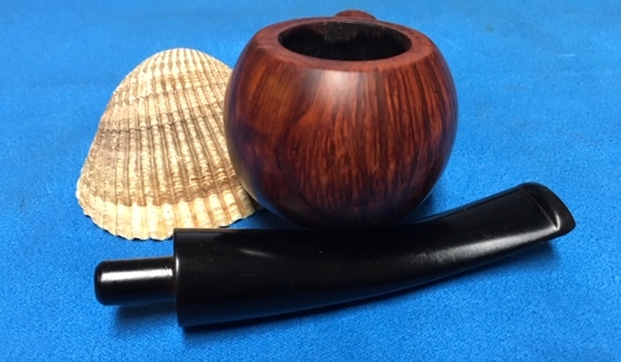
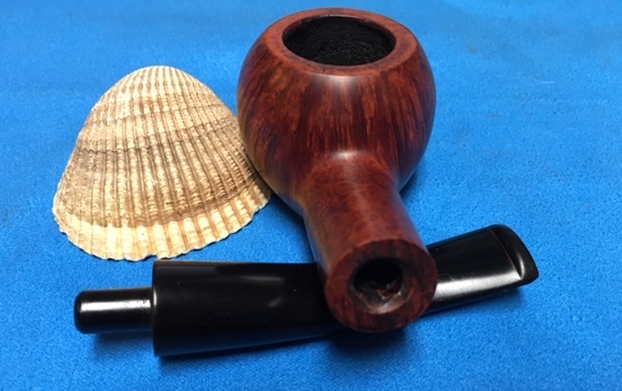
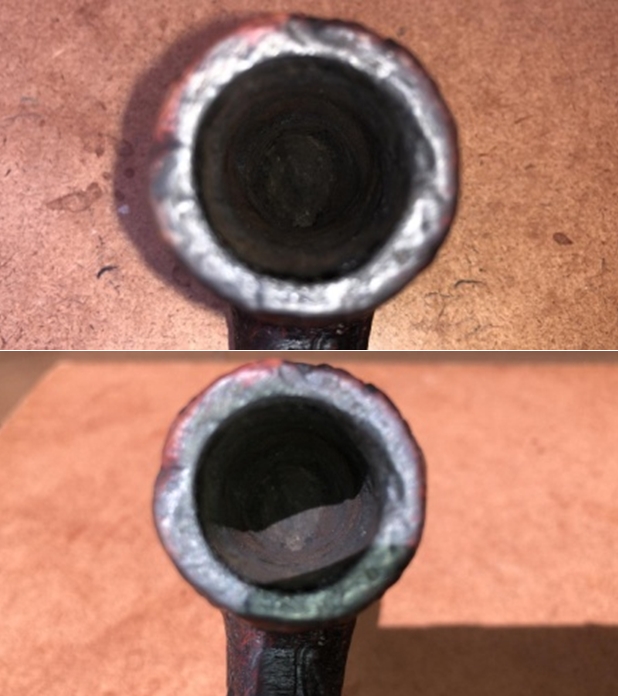
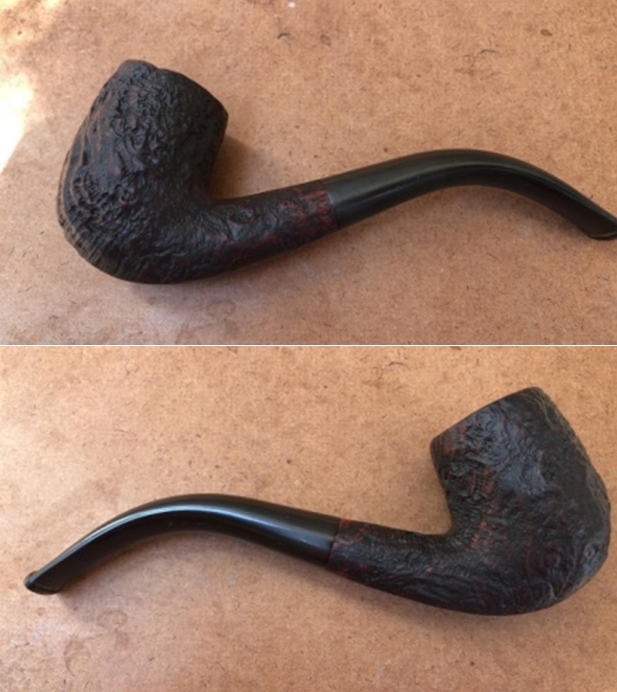
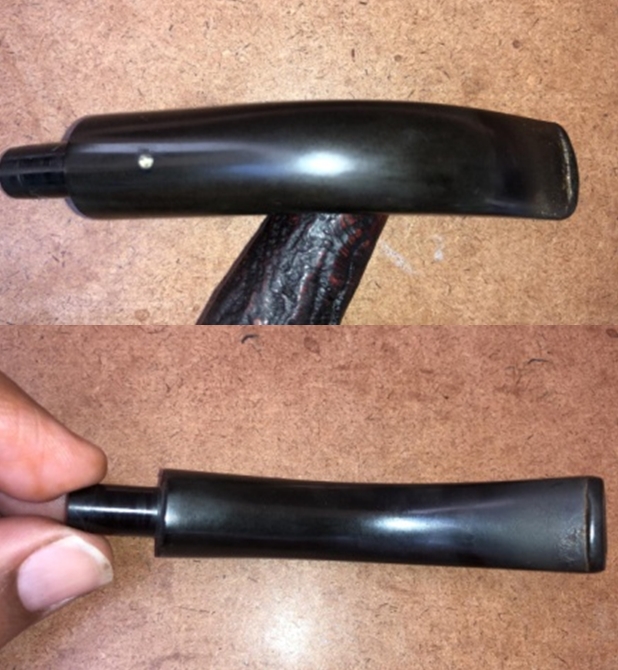
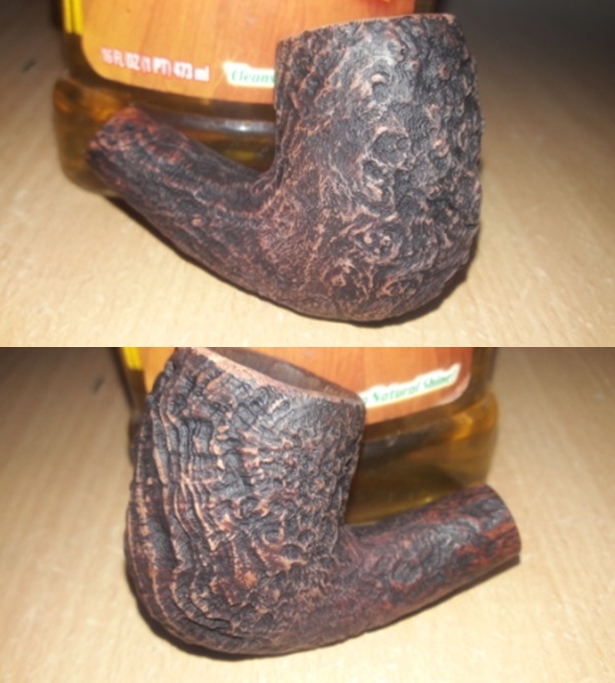
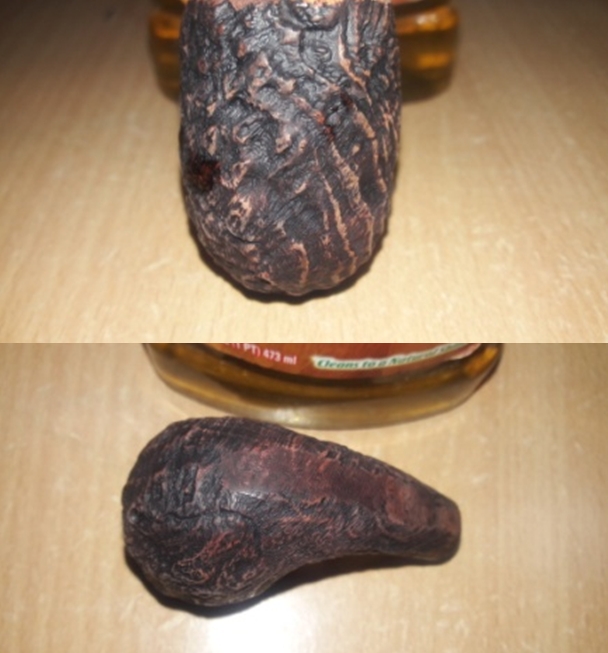
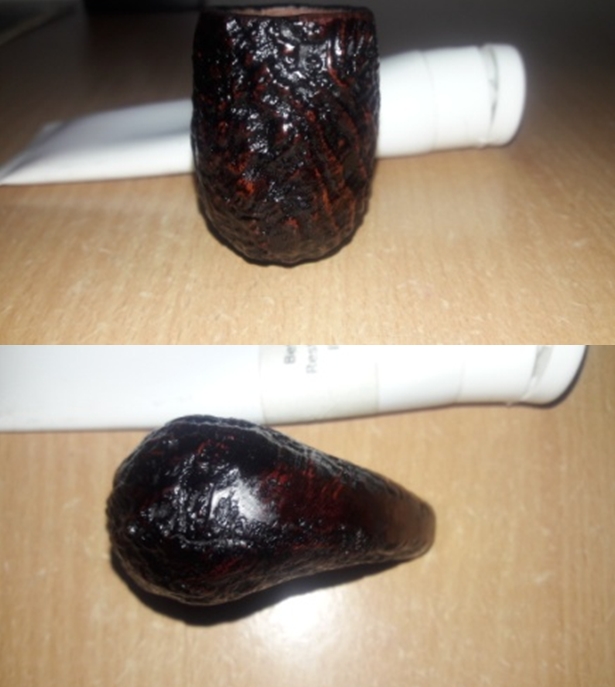
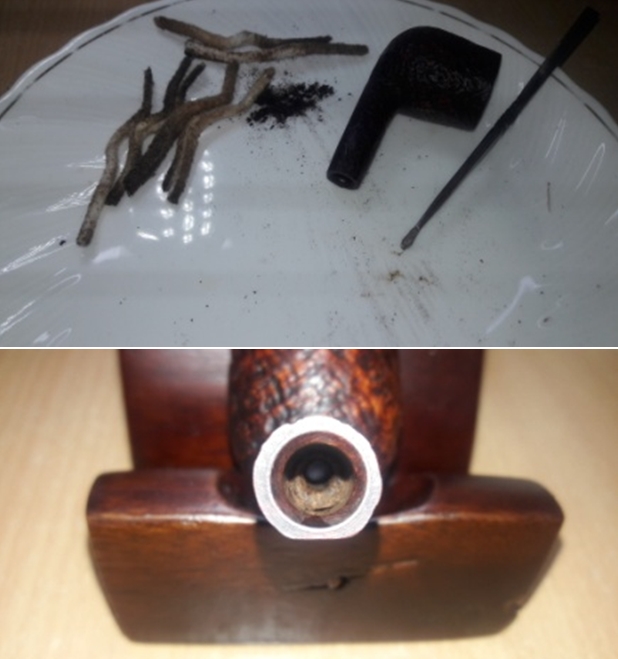
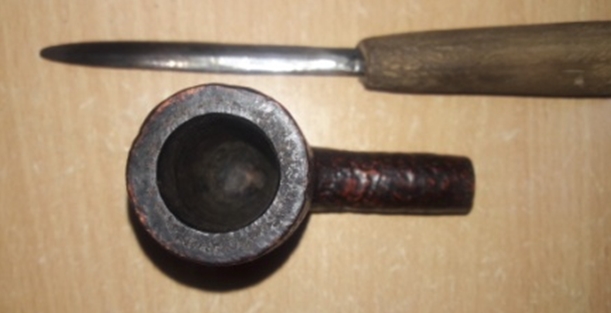
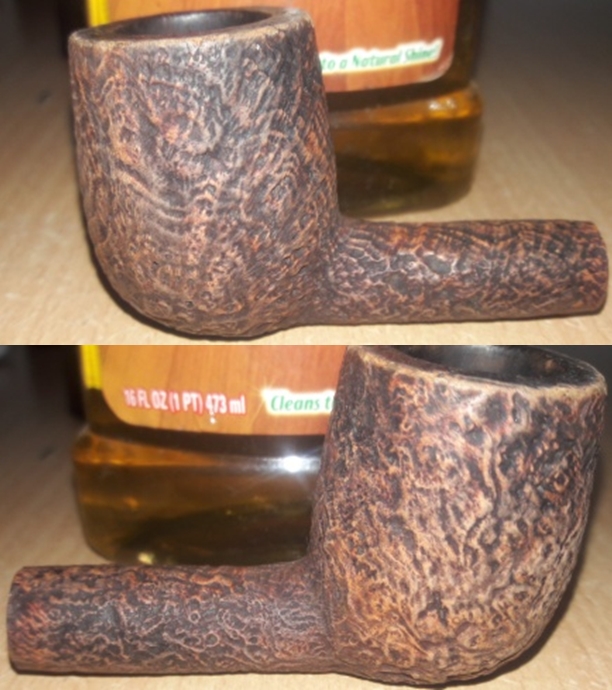
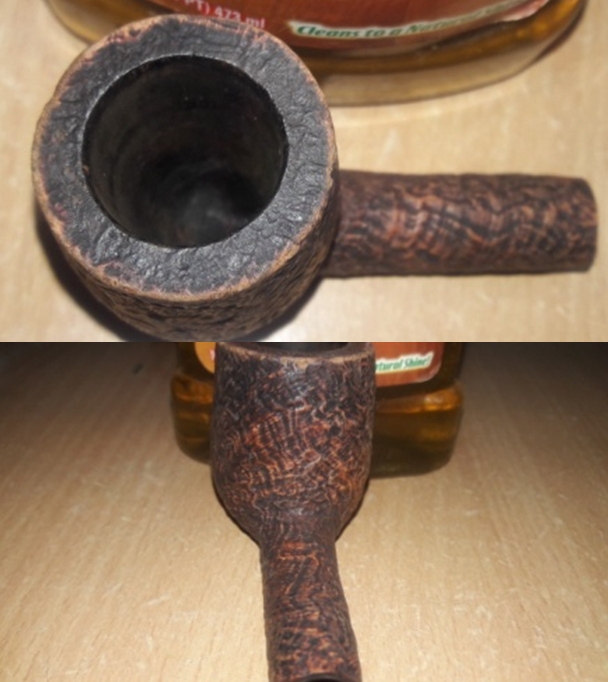
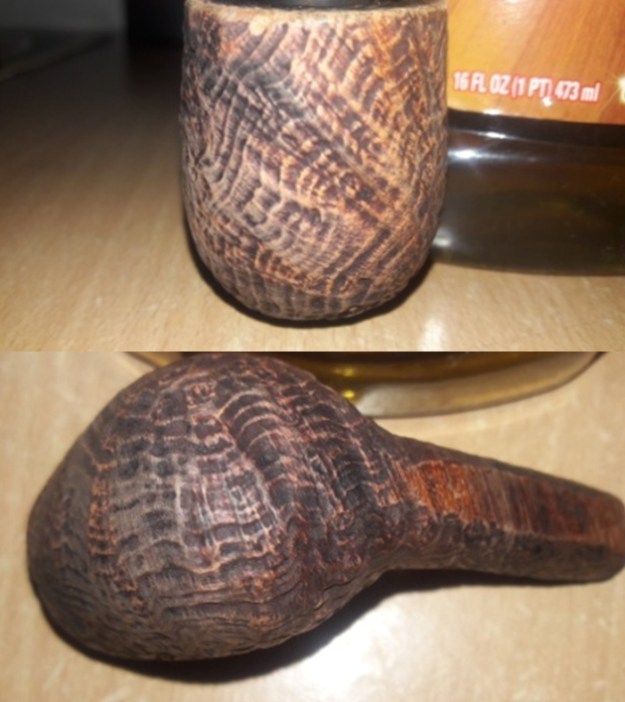
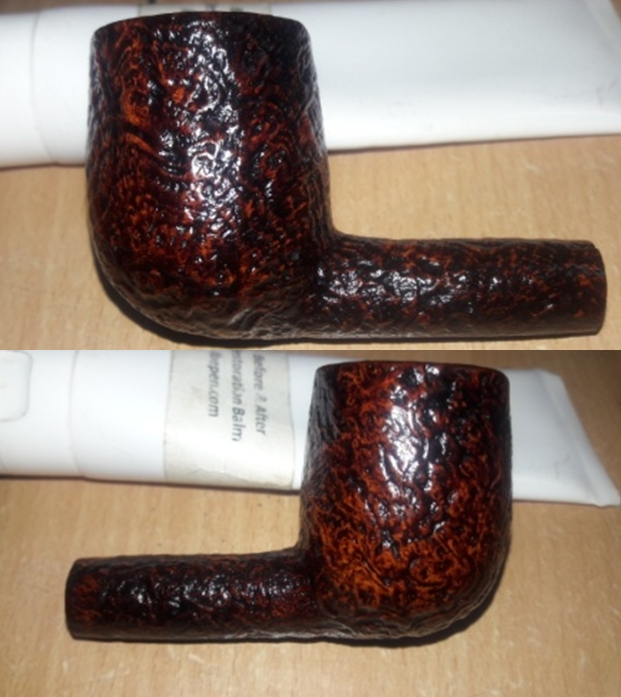
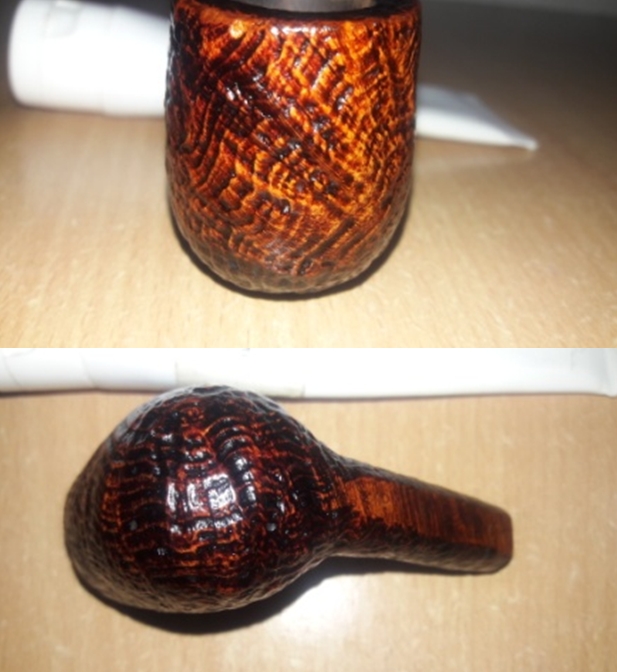
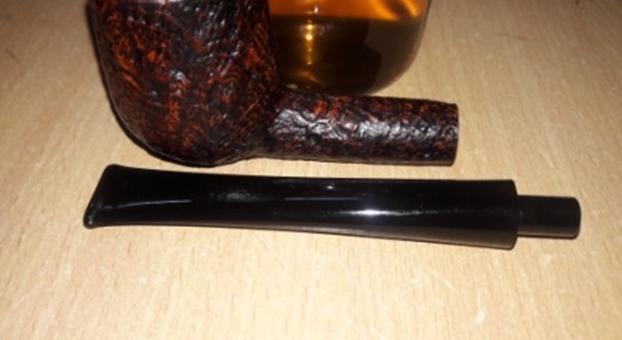
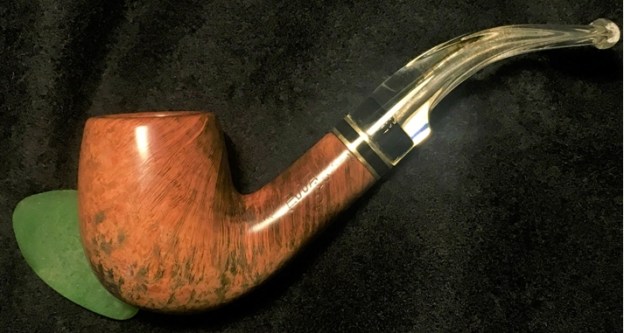
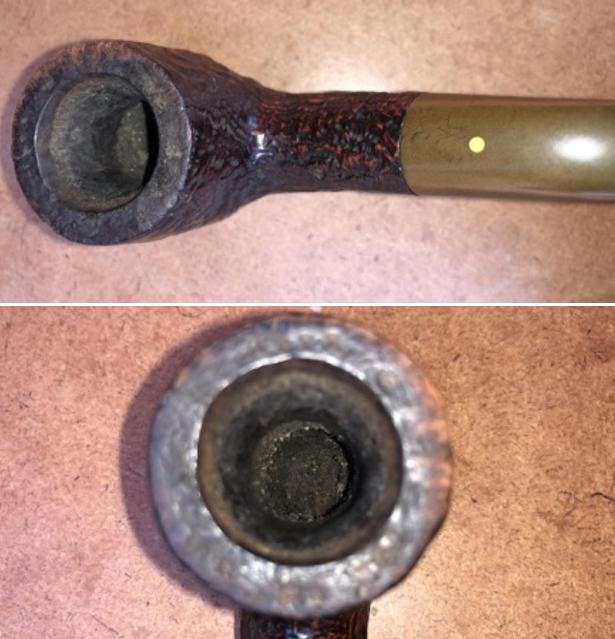
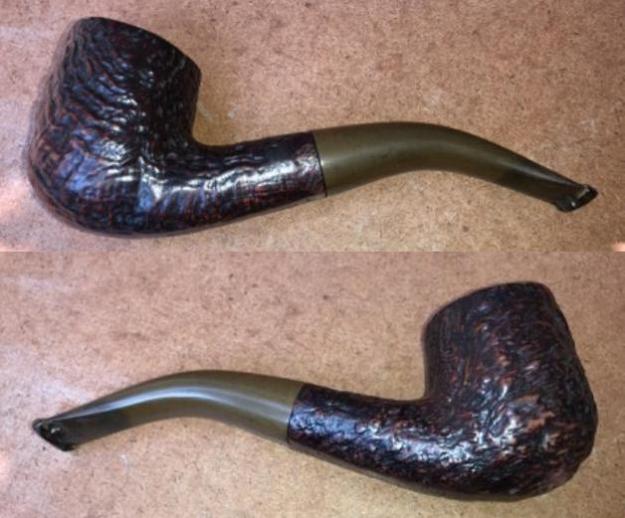
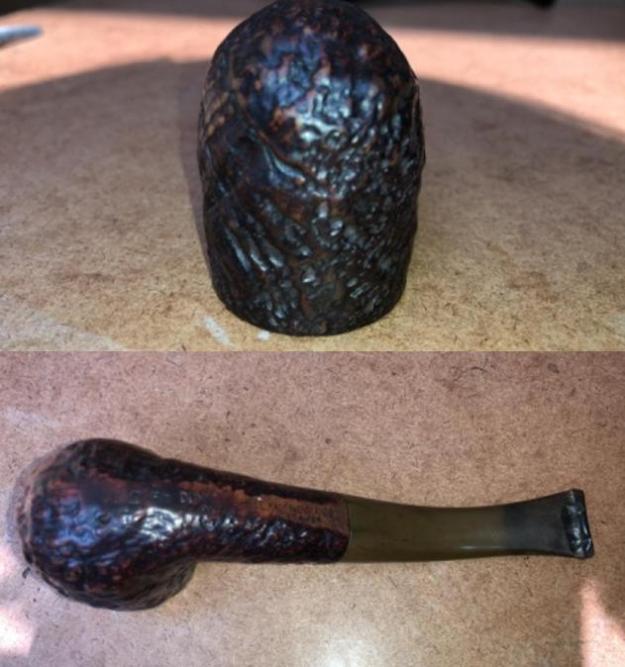
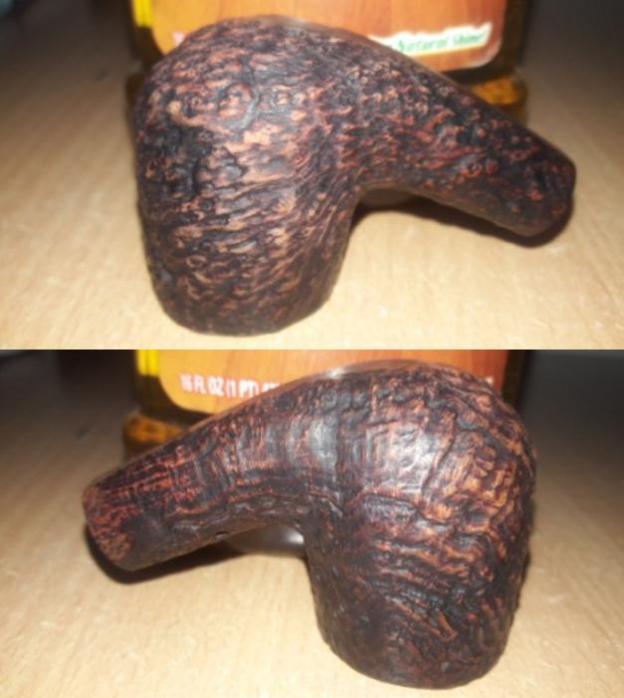
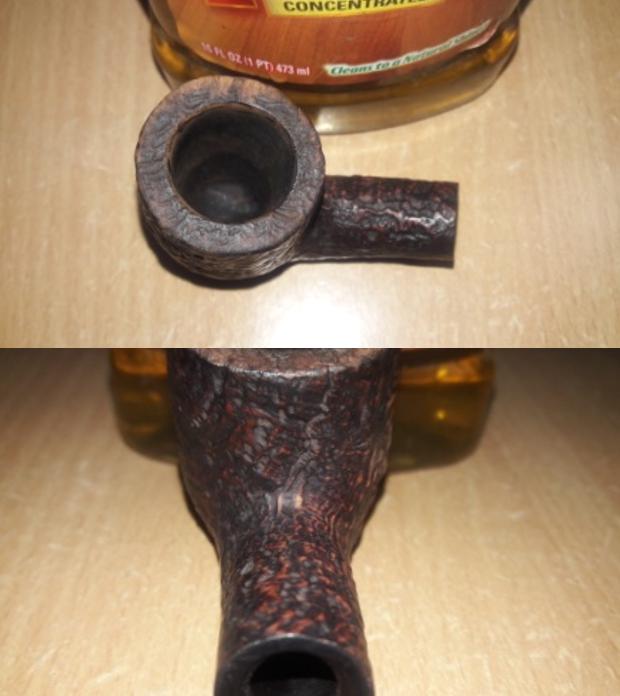
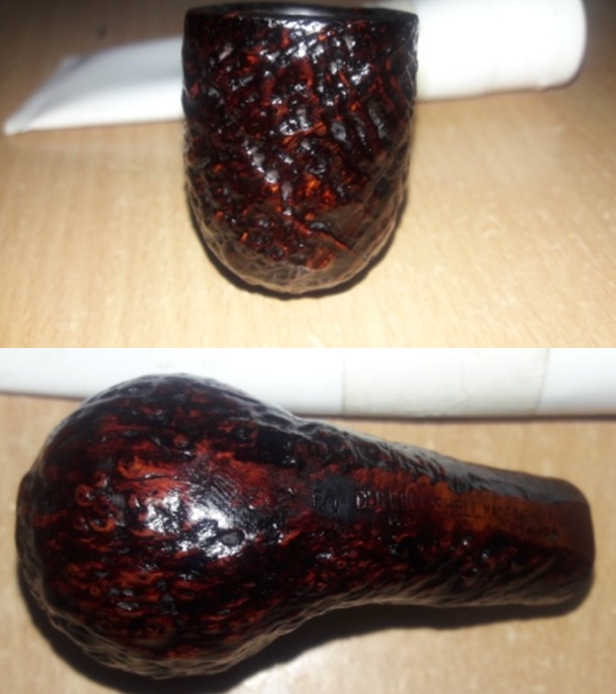
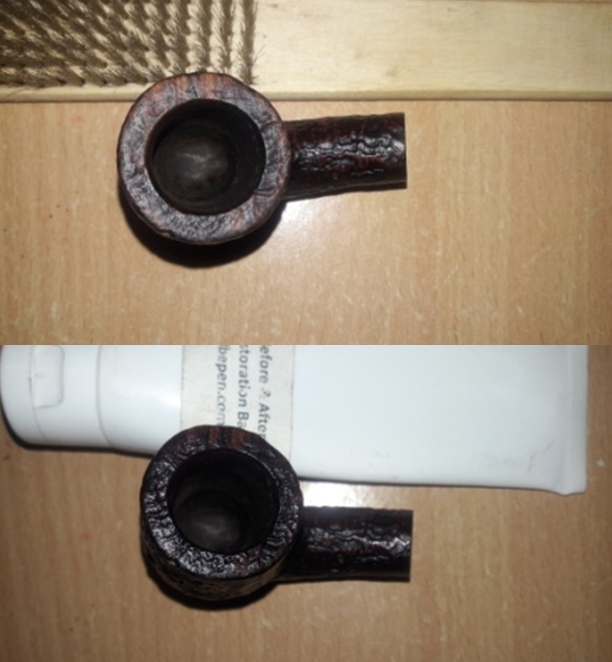
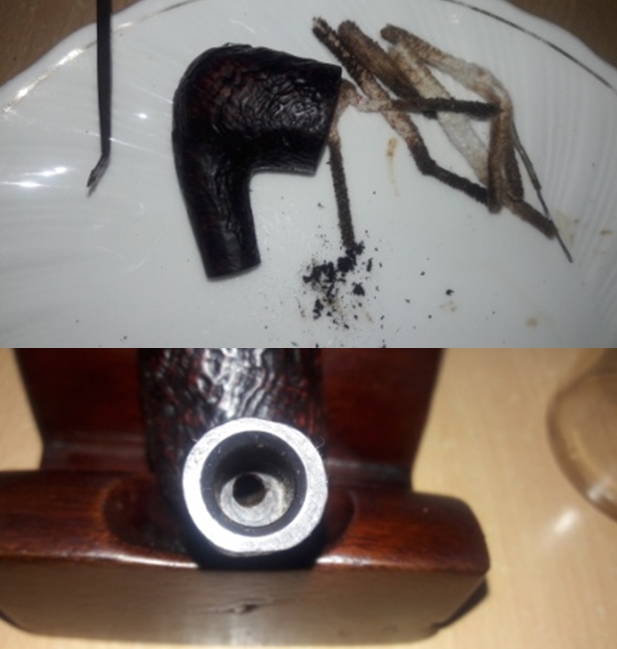
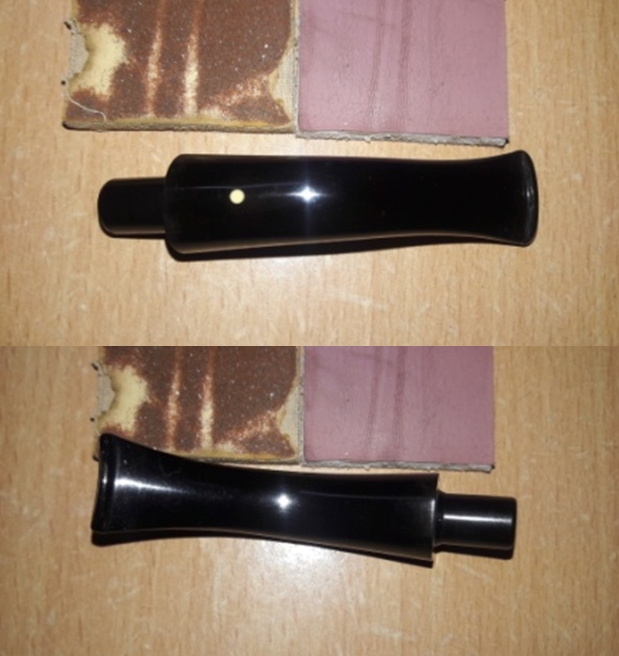
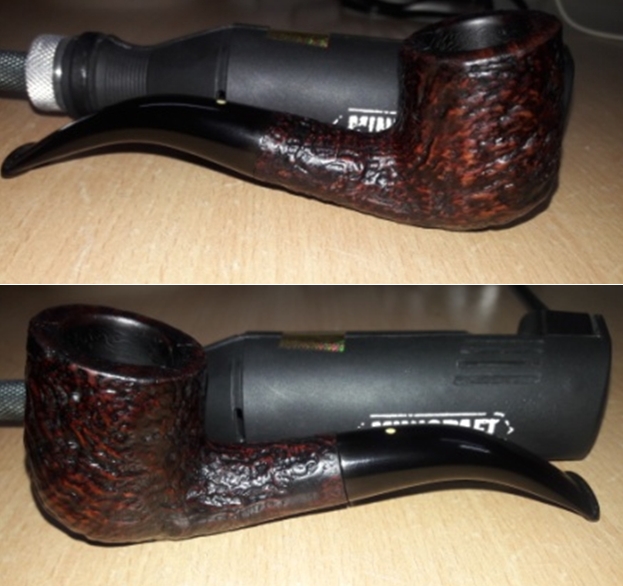
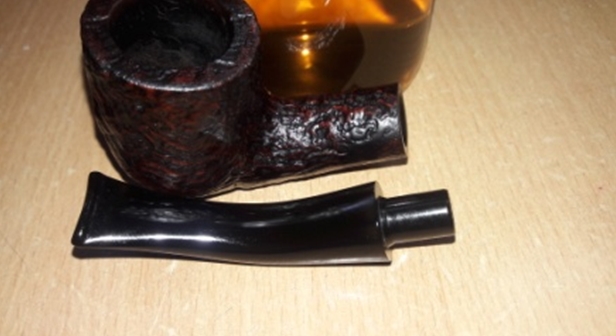
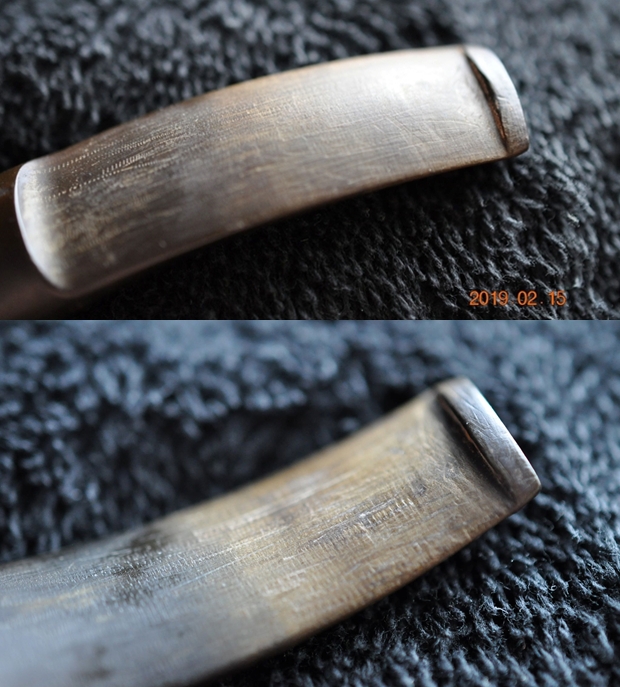
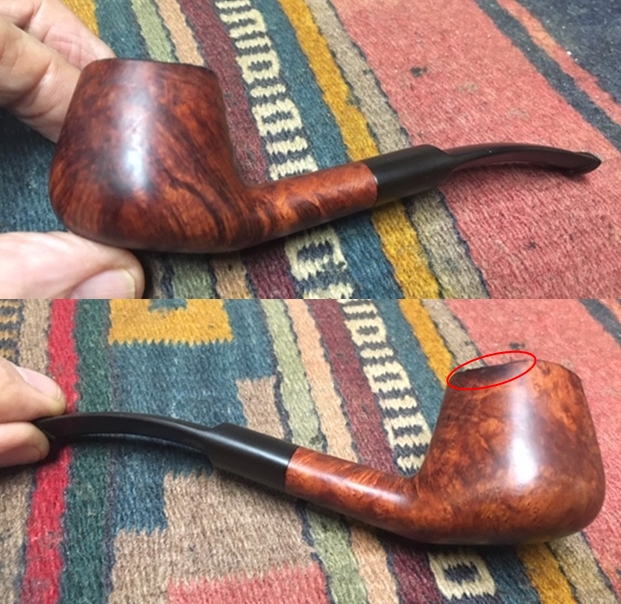
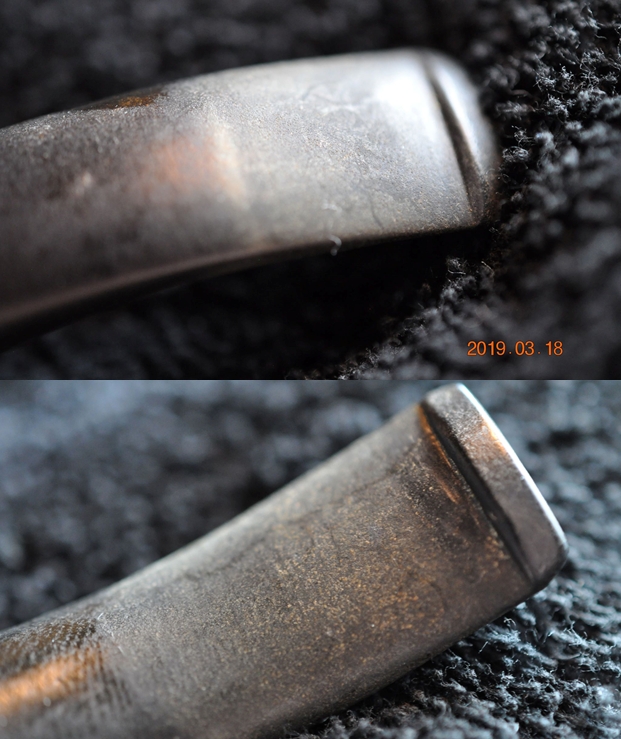
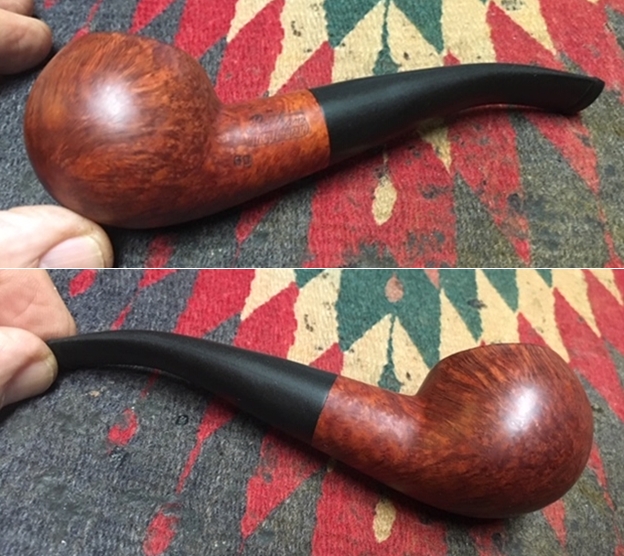
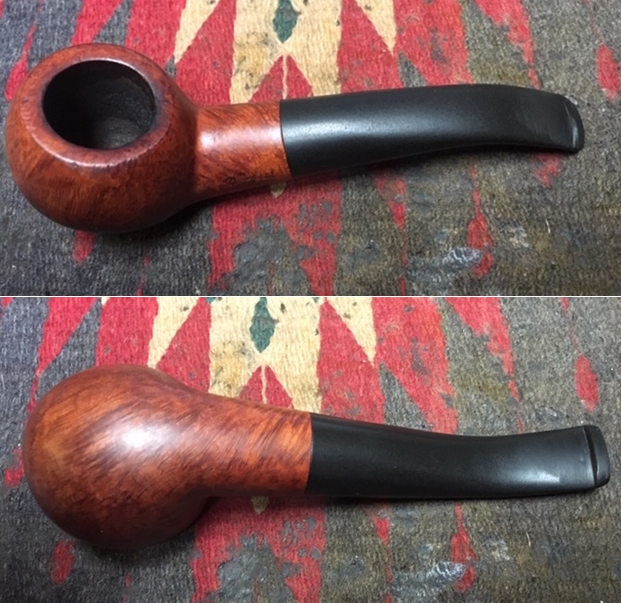
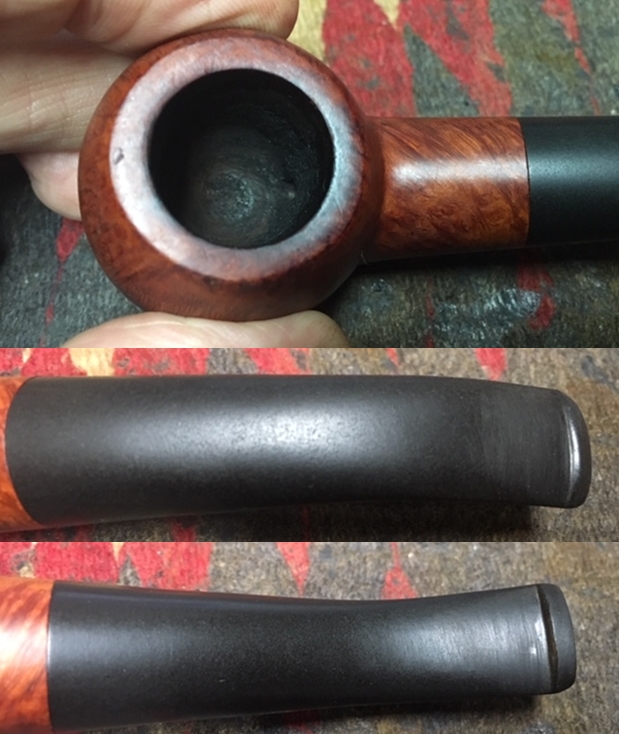
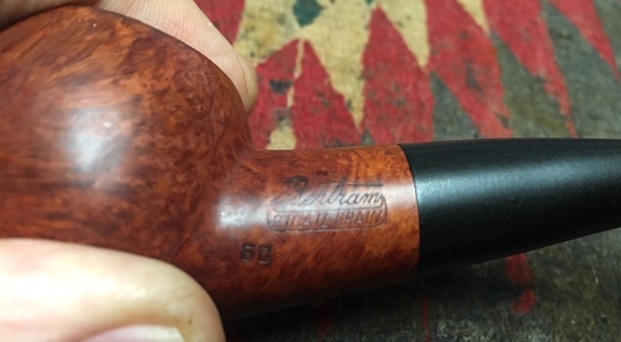
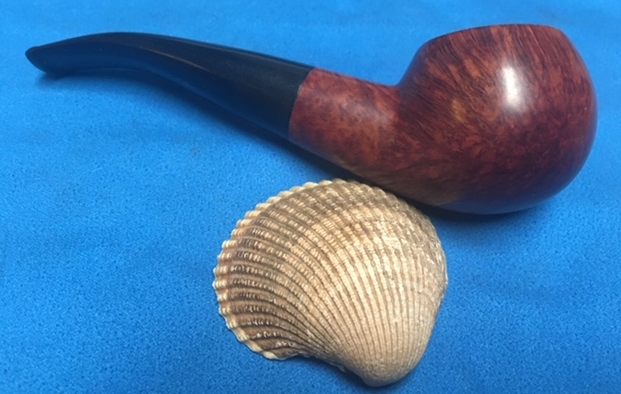
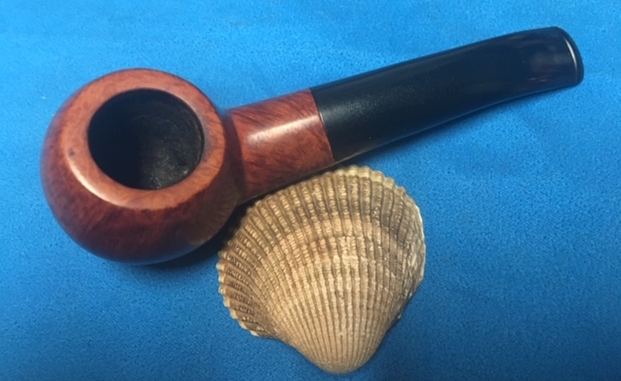
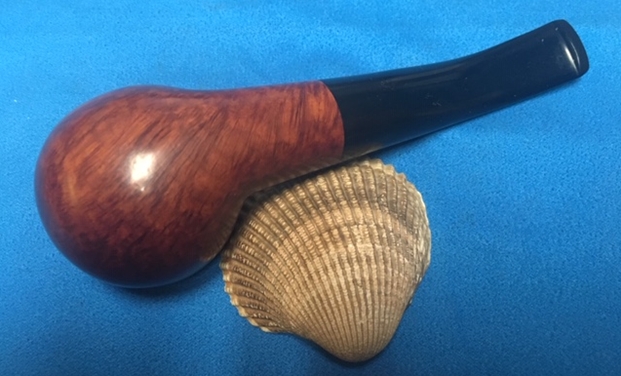
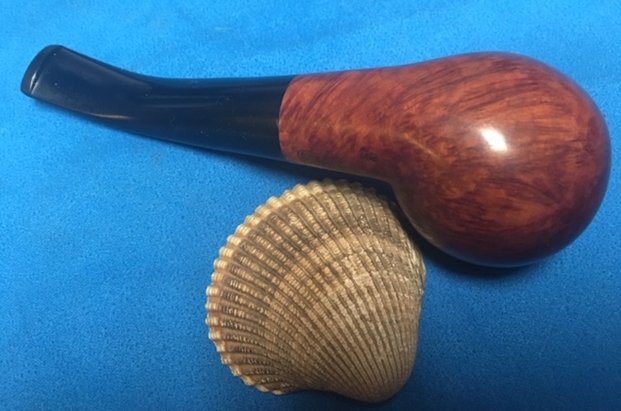
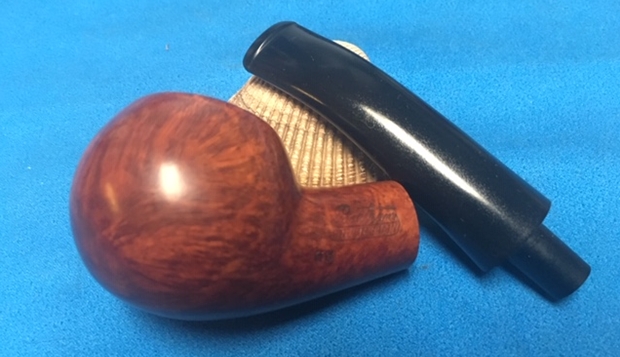
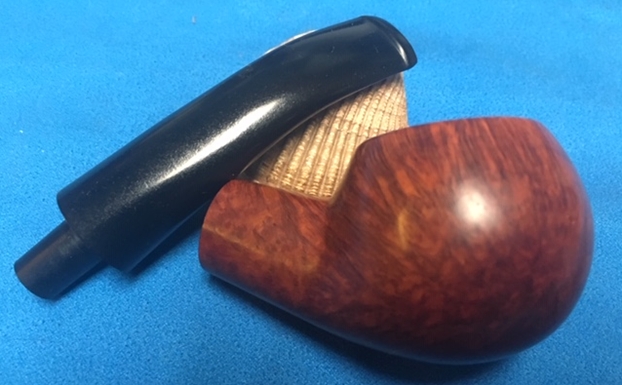
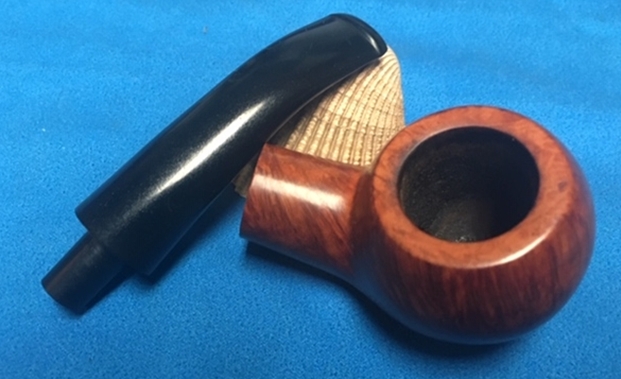
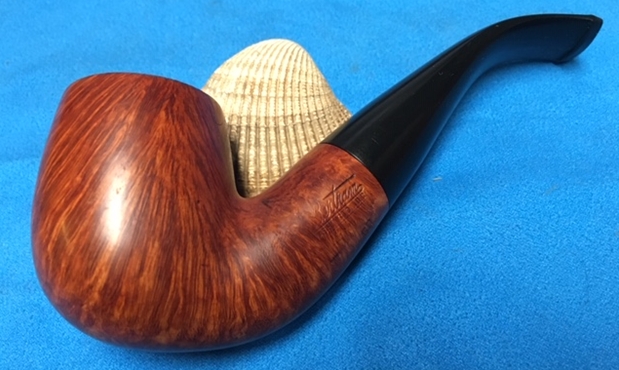
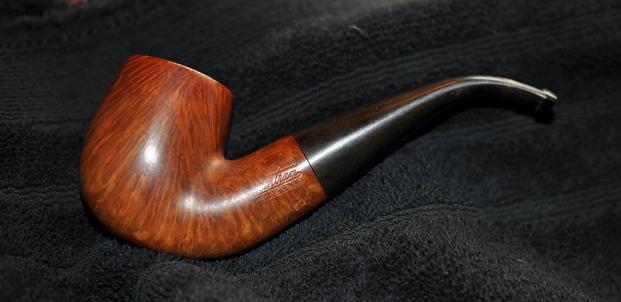
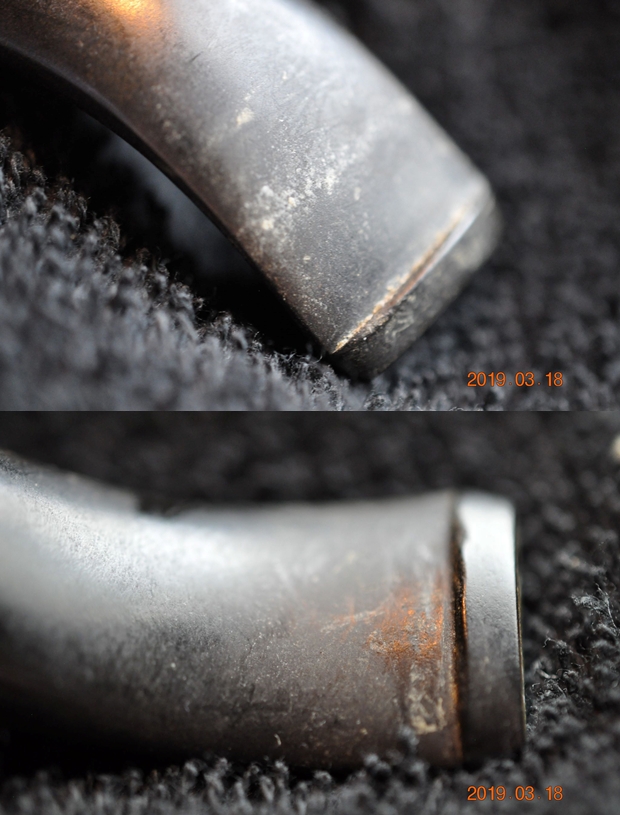
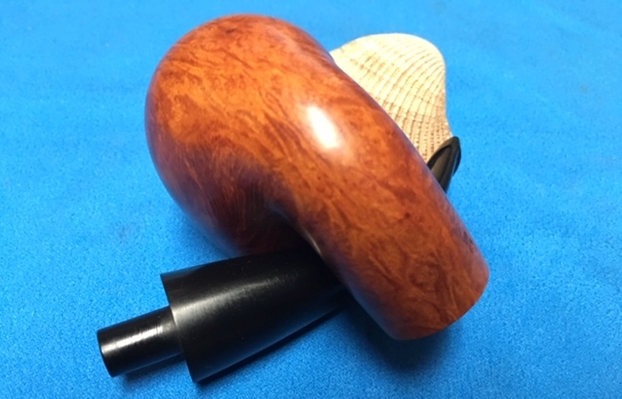
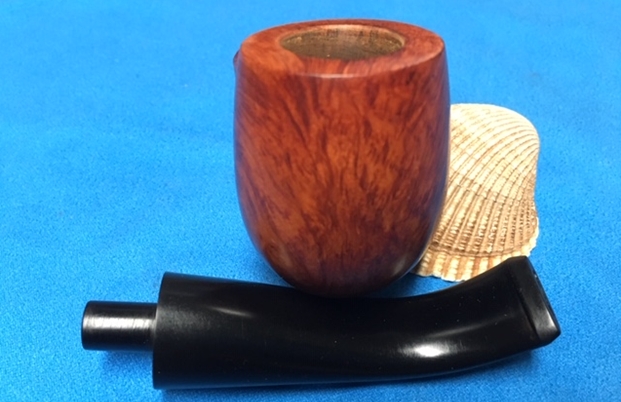
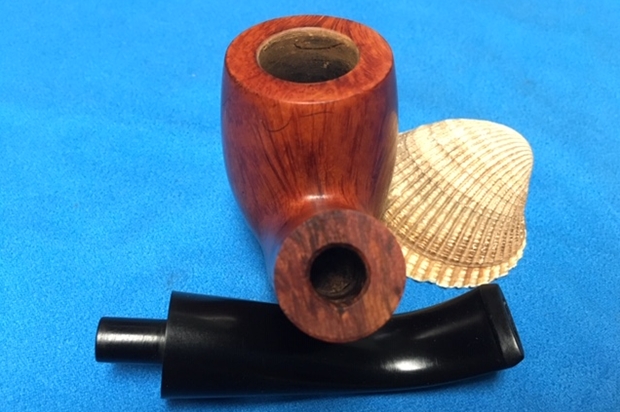
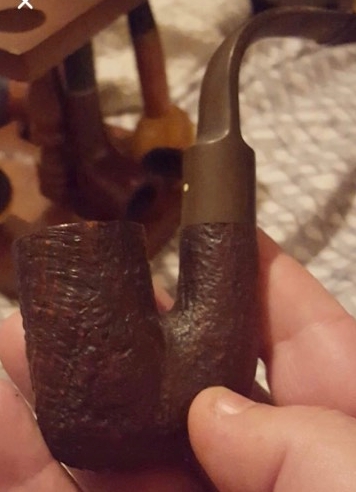
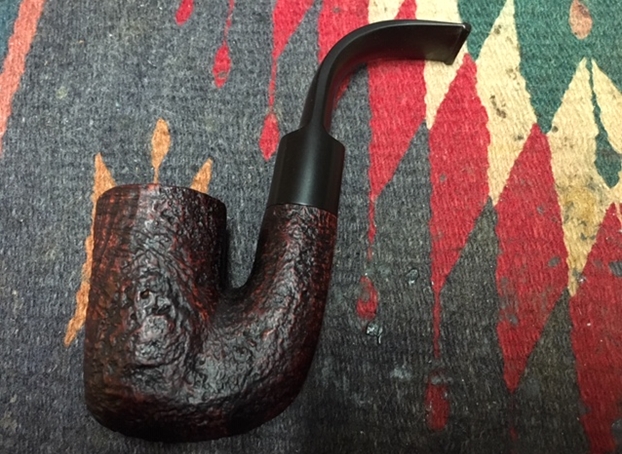
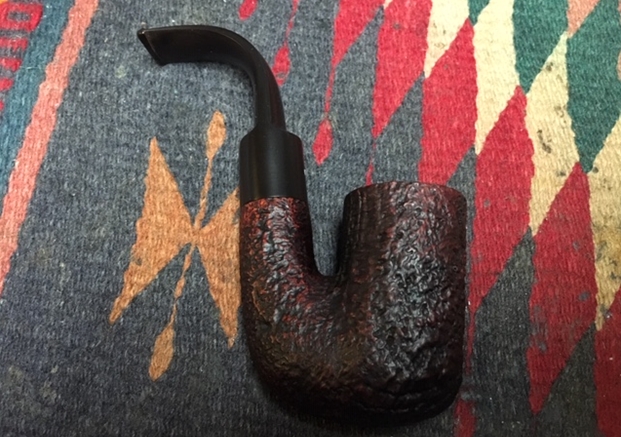
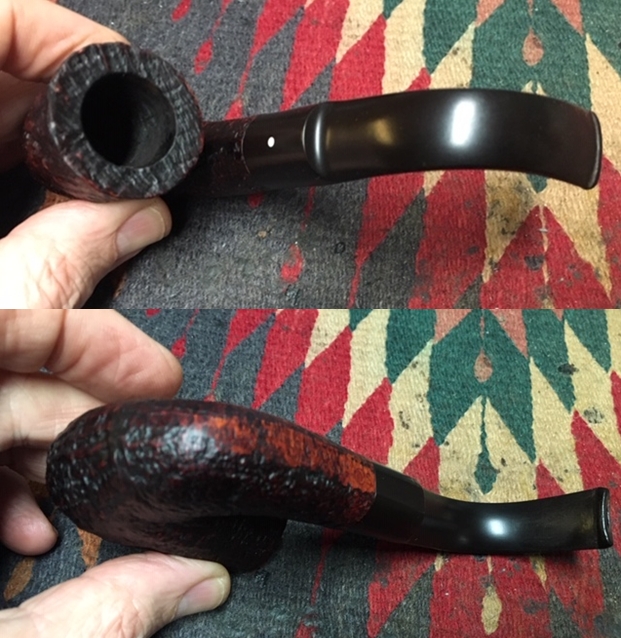
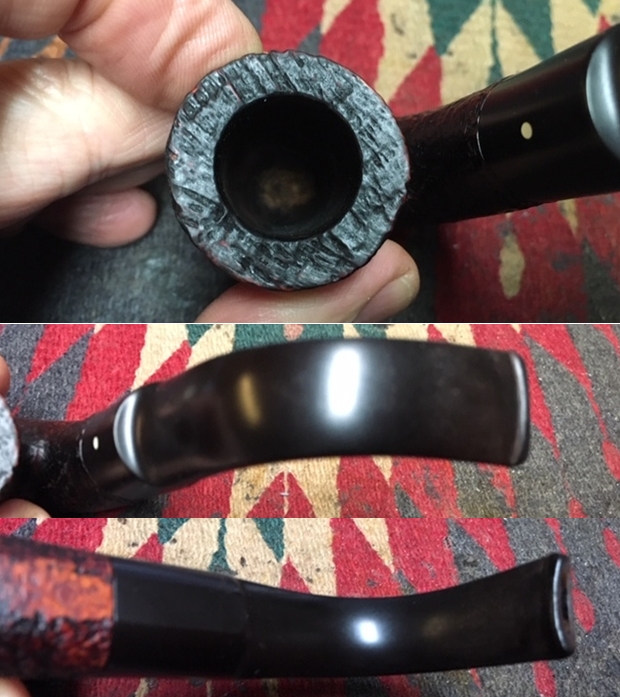
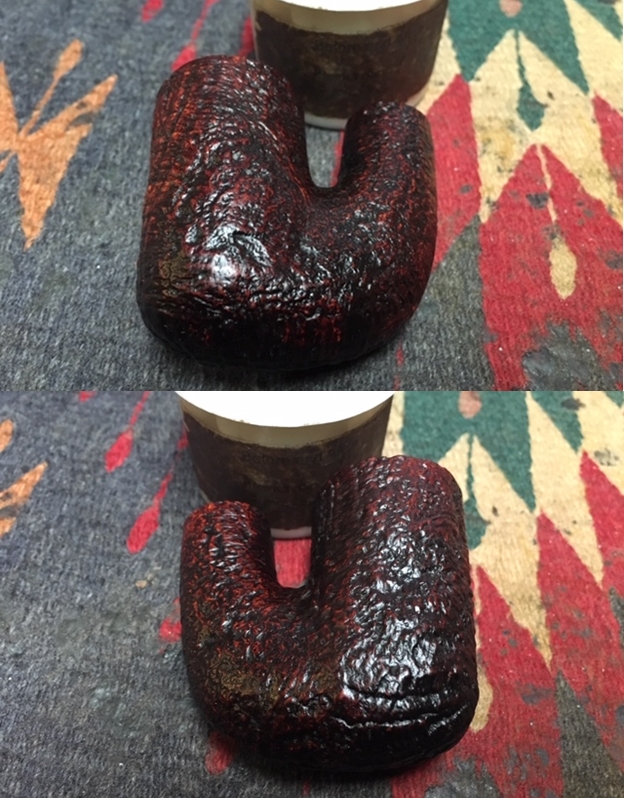
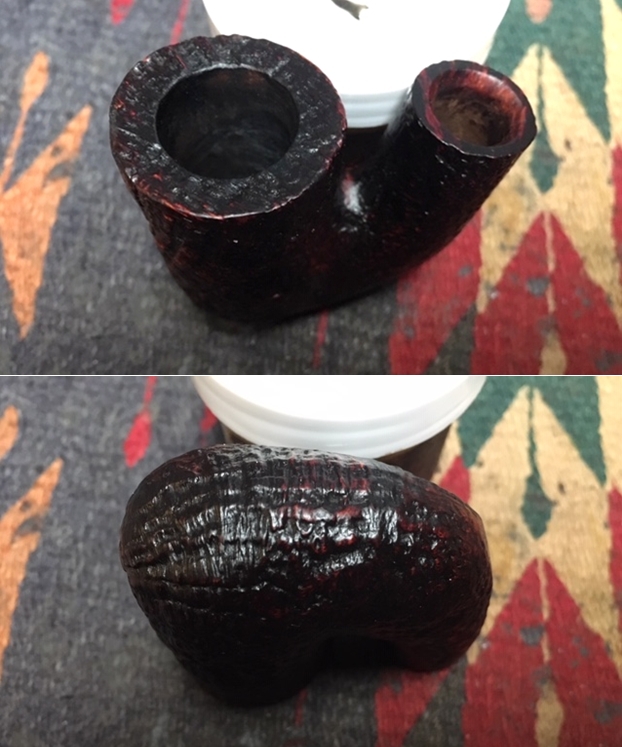
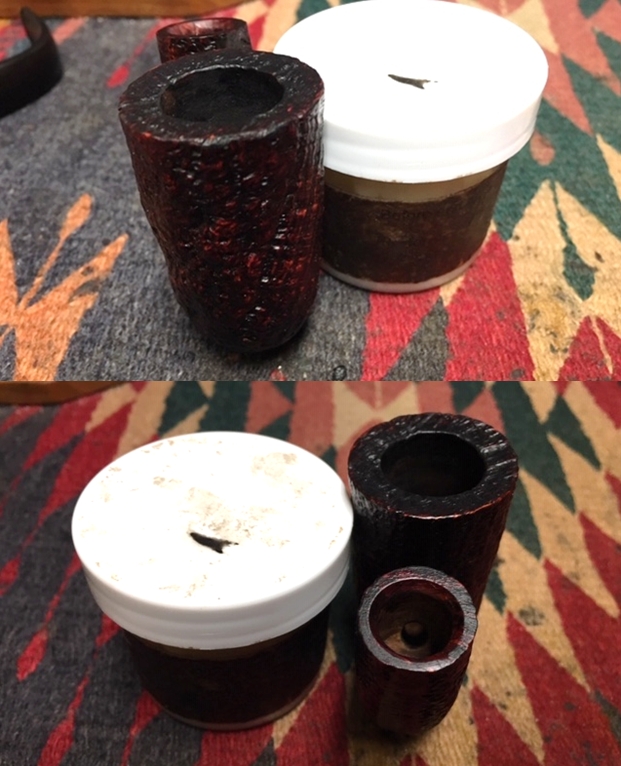
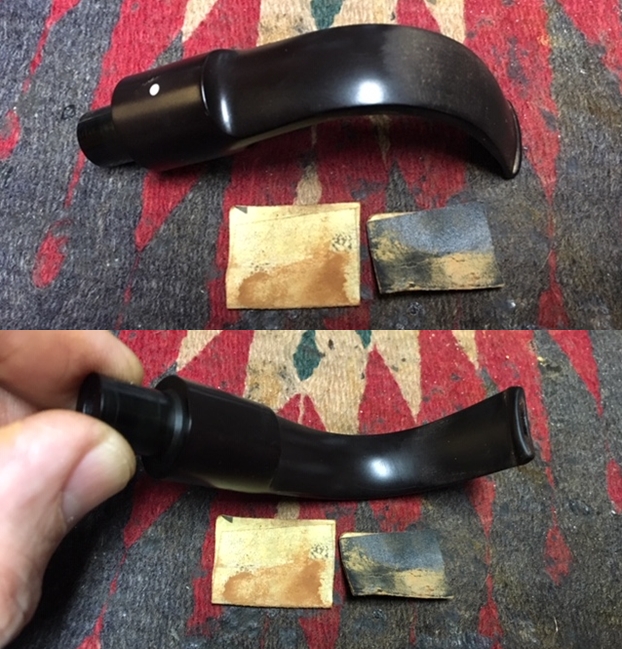
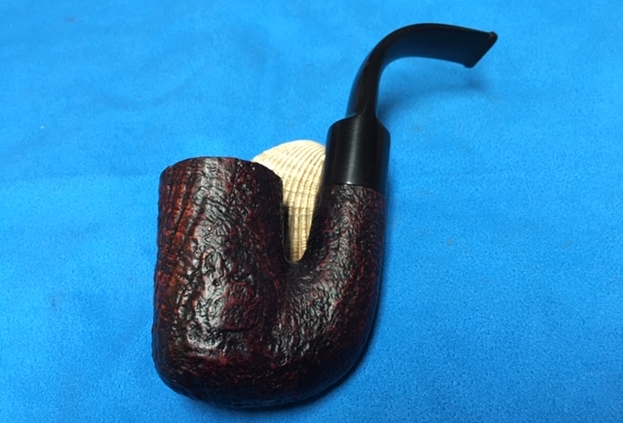
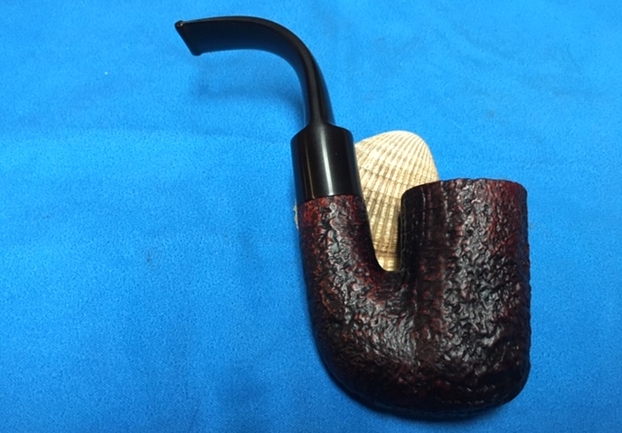
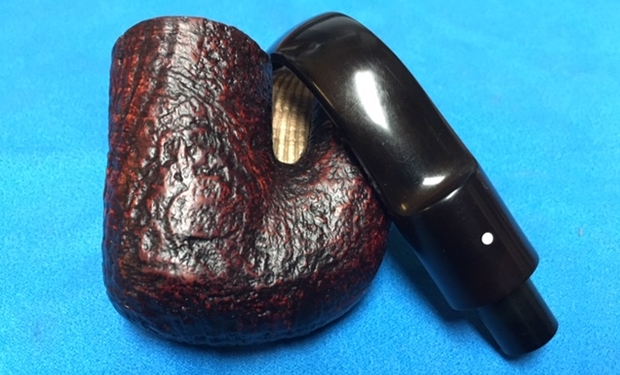
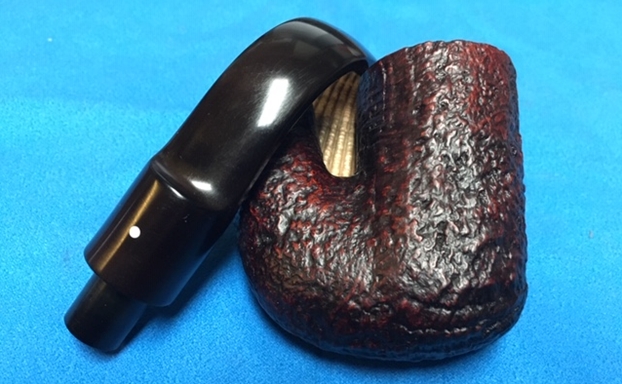
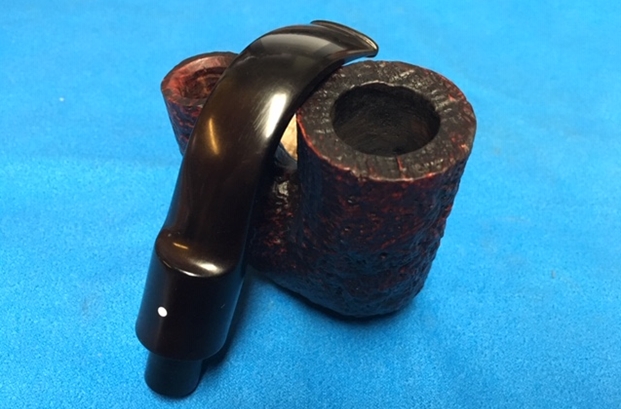
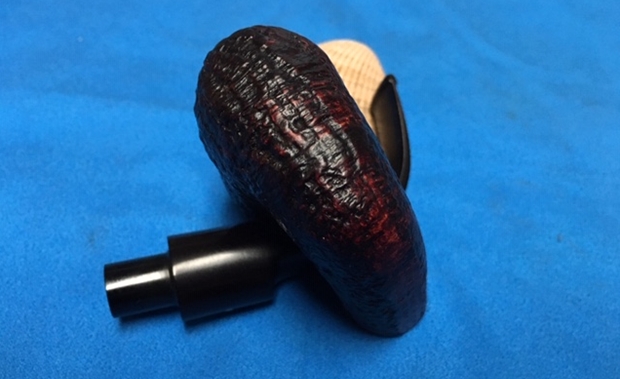
This Loewe’s Bent Acorn is yet another pipe from a local pipe shop. It came from the estate of an older gentleman whose wife returned his pipes to the shop for restoration and resale. This one is a sandblast finished Loewe Danish Shaped Cutlass. The rim top is smooth briar and the bowl and shank are all sandblast. It is stamped on a smooth band on the underside of the shank Loewe Cutlass with the shape number next to the shank/stem junction it has the shape number 21. On the left side of the saddle stem is the Loewe’s brass box L logo. The pipe was very dirty with a thick cake in the bowl and some lava overflowing on to the rim top. It was hard to know what the inner edge of the rim looked like because of the lava and cake. The stem was lightly oxidized and had come calcification where a pipe Softee bit had been. There was some tooth chatter and tooth marks on both sides of the stem at the button. This was included in the pipes that I sent off to my brother for cleaning. I can’t say enough how much I appreciate his willingness to clean and ream the pipes for me. It allows me to move through the repairs much more quickly. When he received the pipe he took a series of photos of it to show its condition. He took photos of the rim top to show the thick cake in the bowl and the overflow of lava on the rim top.He took photos of the sides and bottom of the bowl to give a clear picture of the beauty of the sandblast finish on this old pipe. Under the grime there is some great grain peeking through.Jeff took a photo of the stamping to capture the clarity of it even under the grime. He also included a photo of the L square logo on the stem and the FRANCE stamping on the underside. The stem looked dirty and oxidized with the calcification left behind by a pipe Softee bit. The edges of the button had bite marks and there was some tooth damage to the surface of the stem next to the button on both sides.I have worked on quite a few Loewe pipes over the years but have never worked on one with this shape. Most of the others have been classic English shaped pipes. I have always enjoyed the shapes and the craftsmanship on each of them. It is well made and well-shaped. I turned to my usual sources to check out the particular “Cutlass” line pipe. First I turned to the pipephil site (http://www.pipephil.eu/logos/en/logo-l5.html). I have included a screen capture from that site that highlights the line I am working on. In fact the pipe given as an example is similar to the one I am working on. I have enclosed the pipe in the photo below in a red box.I turned next to Pipedia to read some more detail of the history and see if there was more detailed information on the Cutlass line (https://pipedia.org/wiki/Loewe_%26_Co). There was no more detail or help in dating the pipe I was working on.

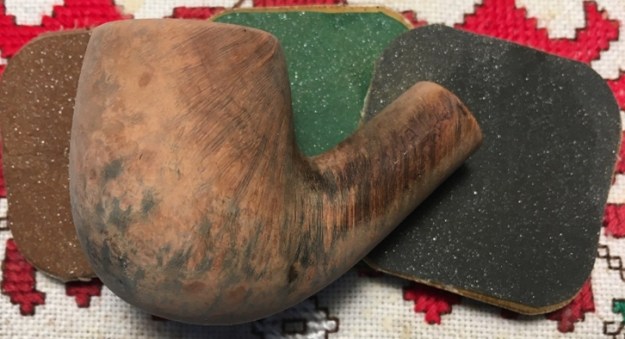
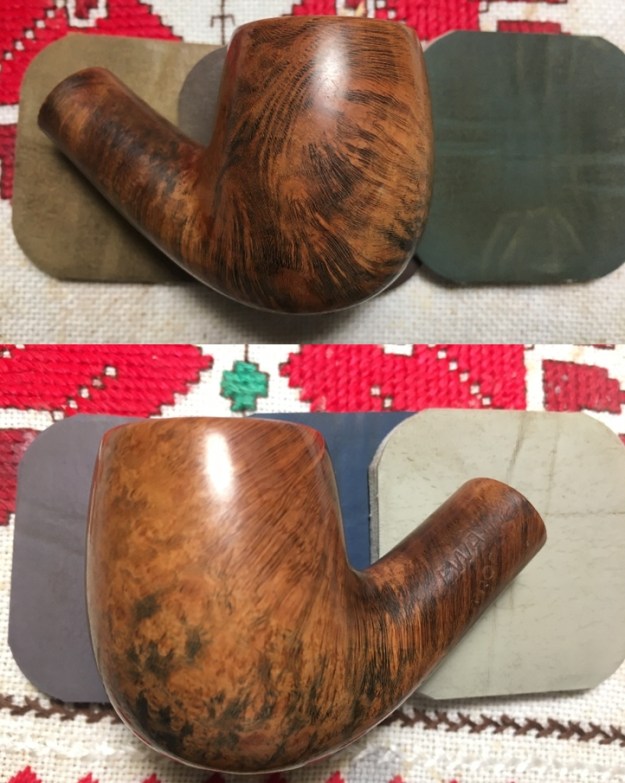
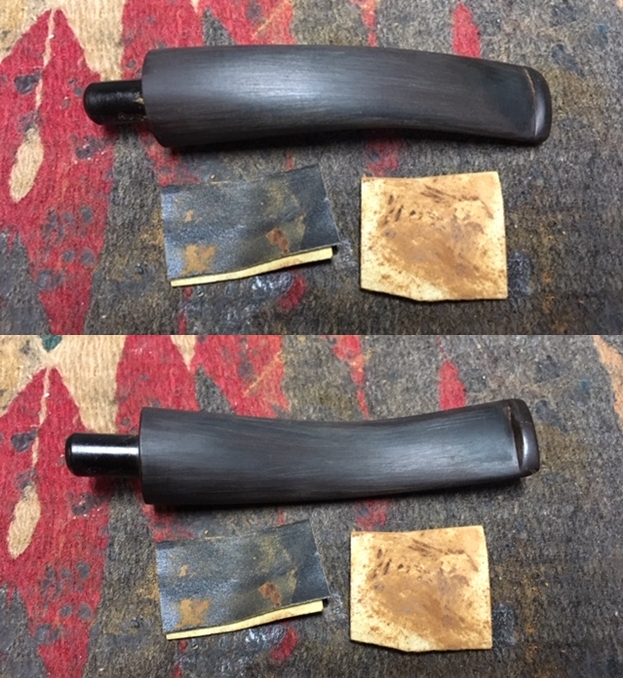
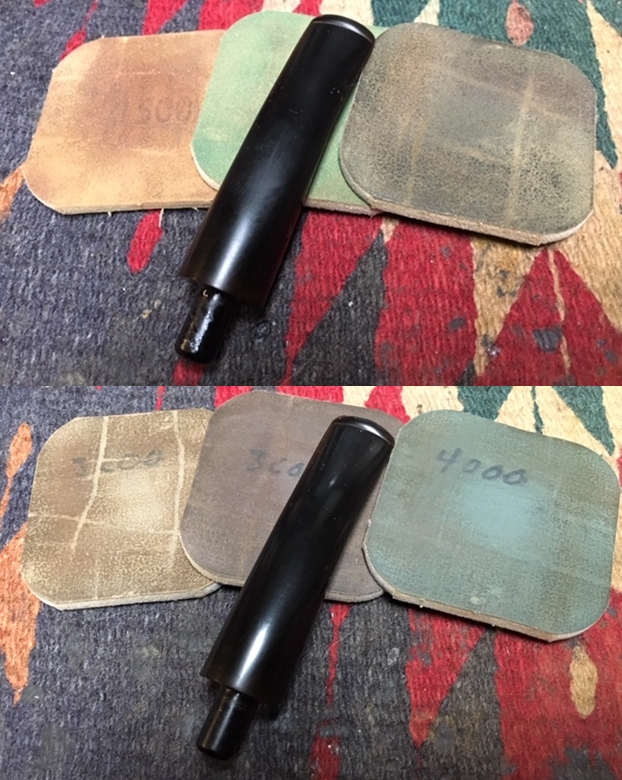
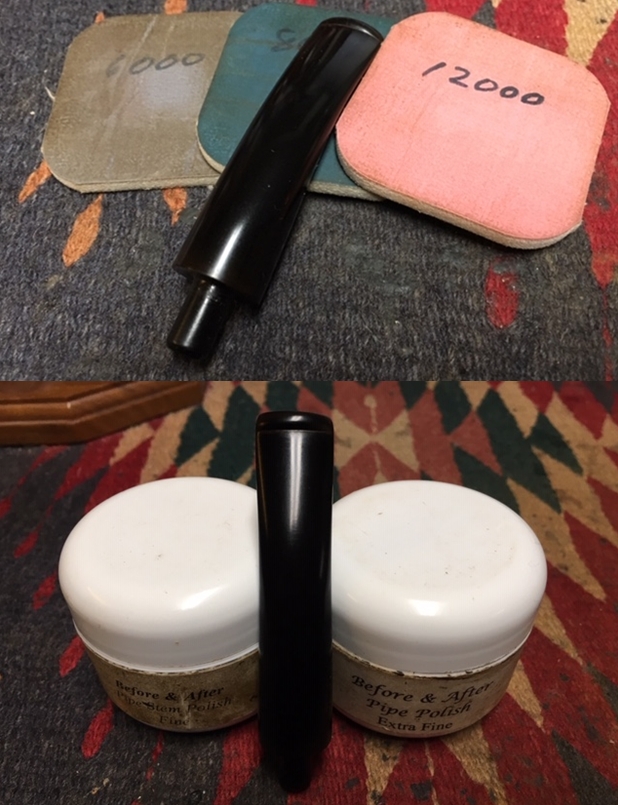
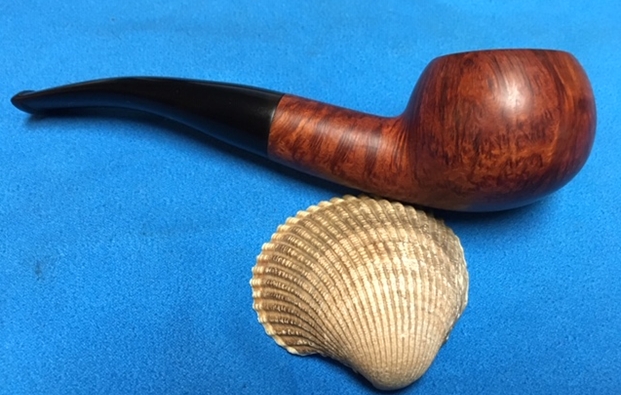
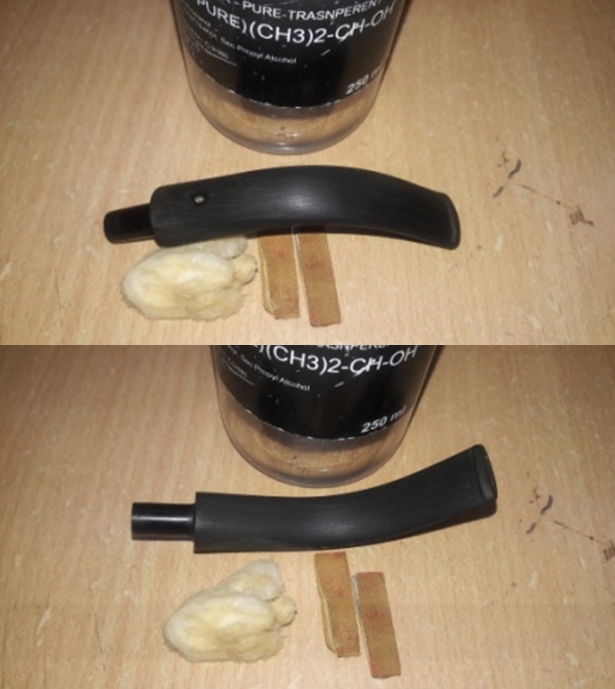
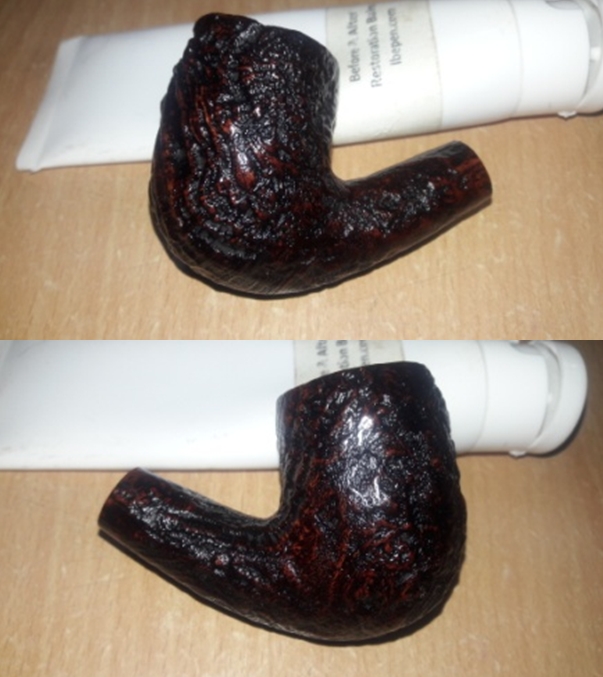
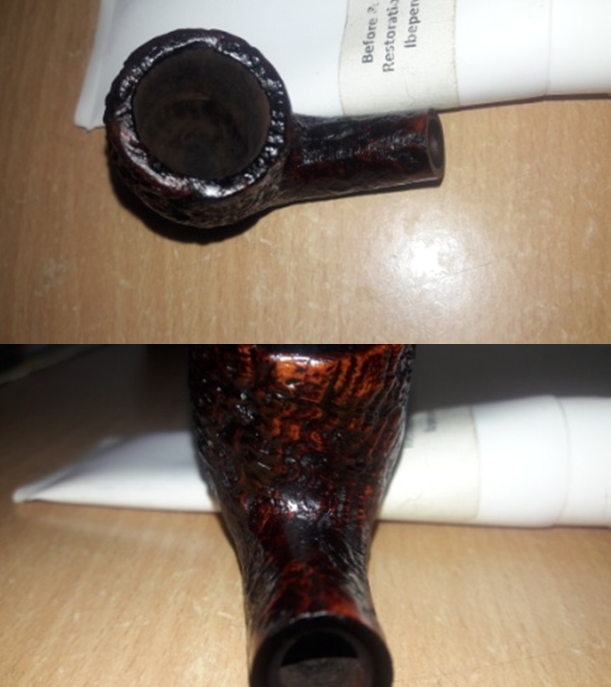
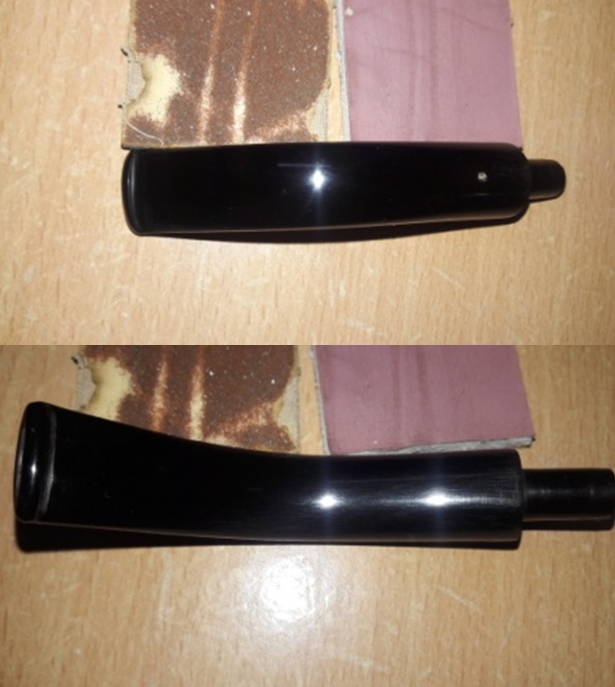
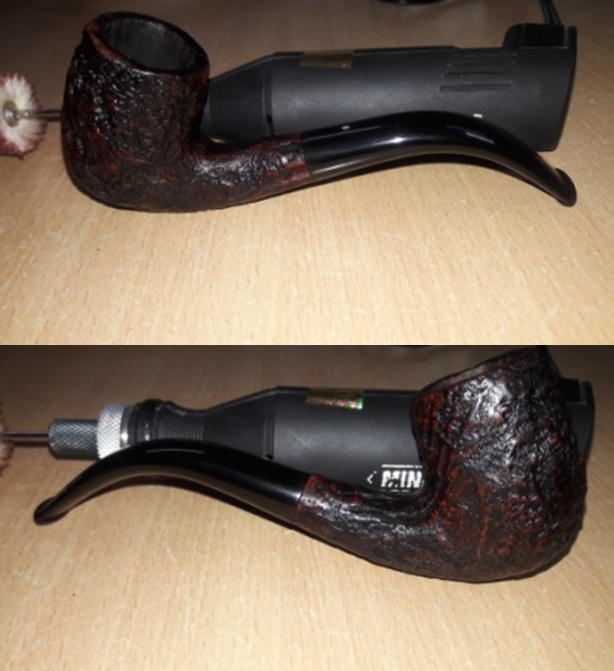
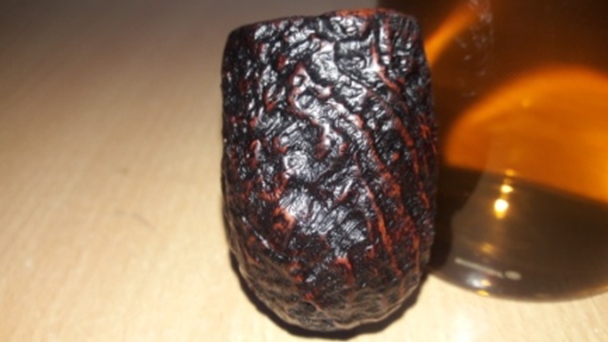
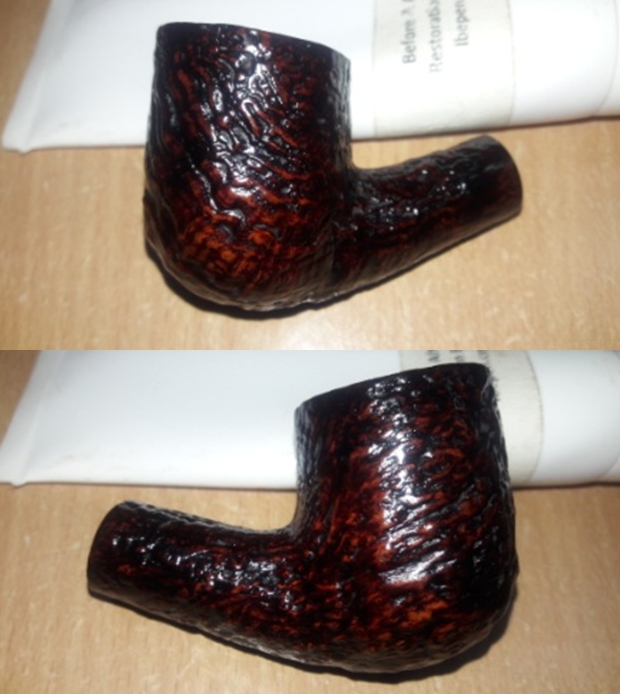
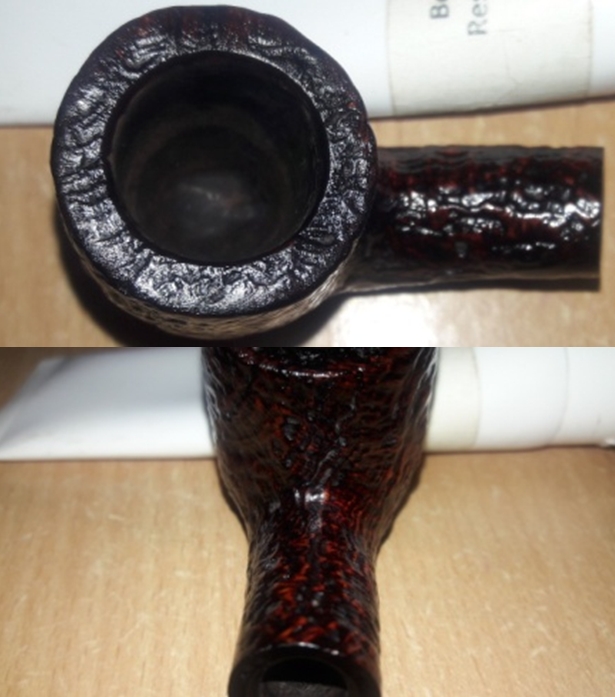
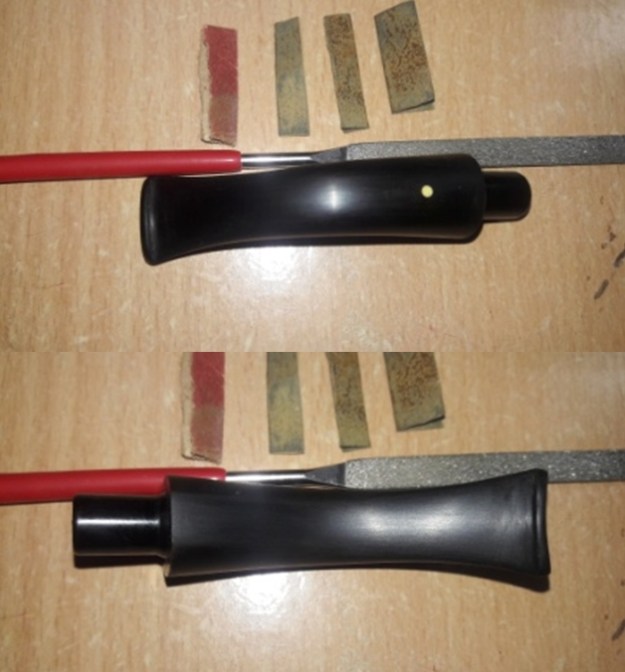
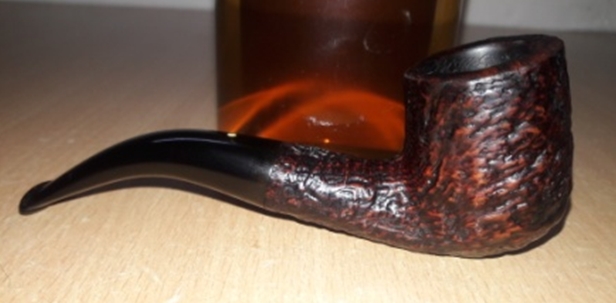
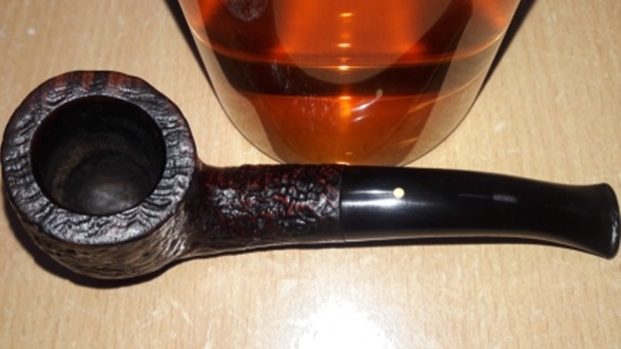
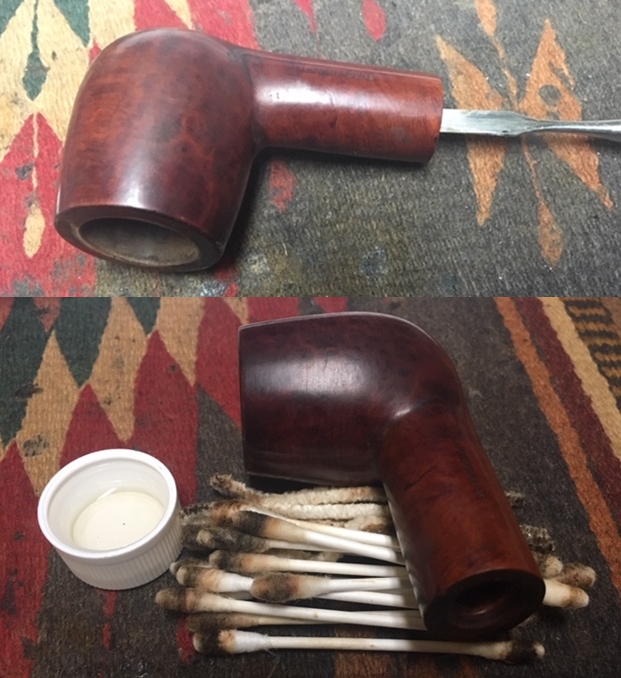
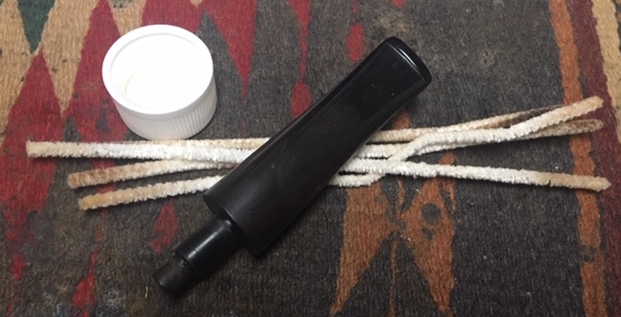
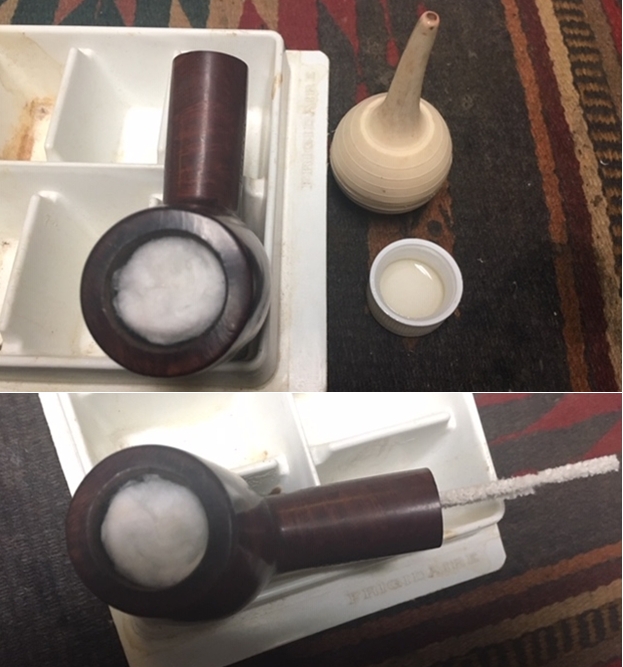
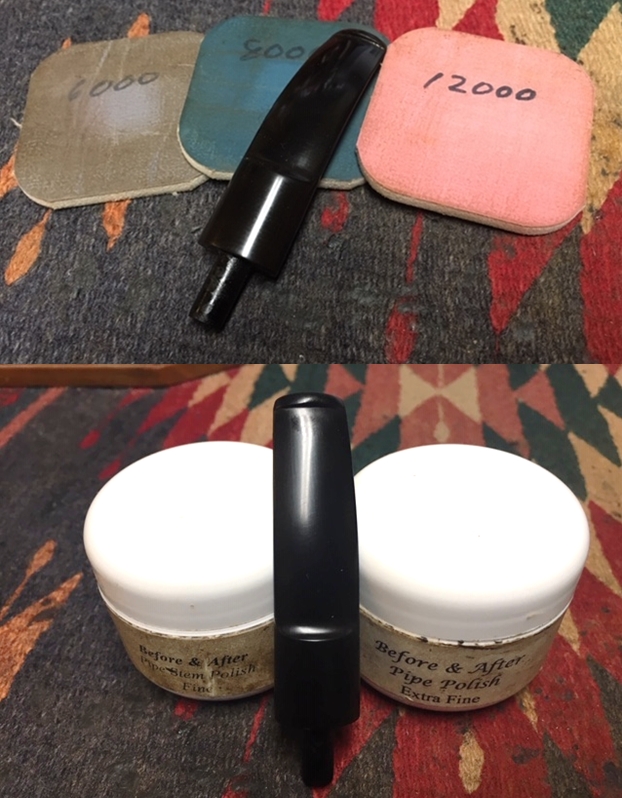
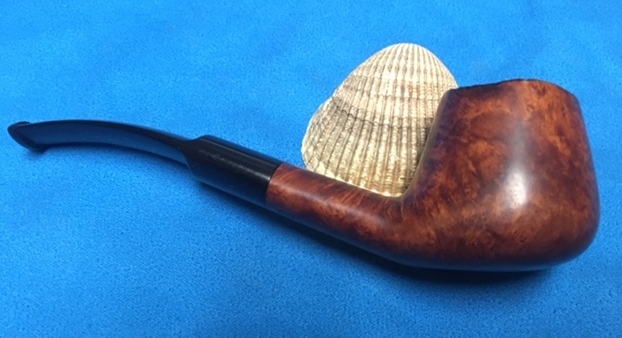
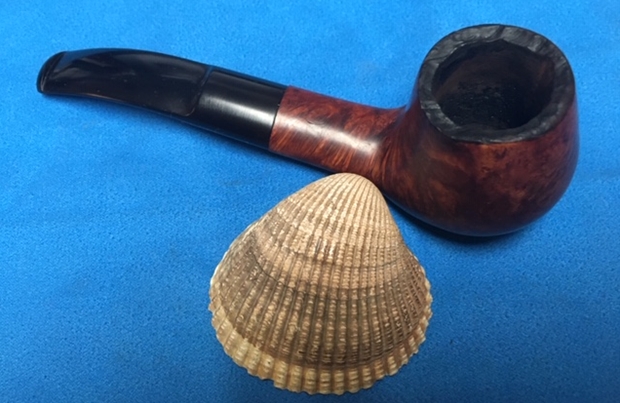
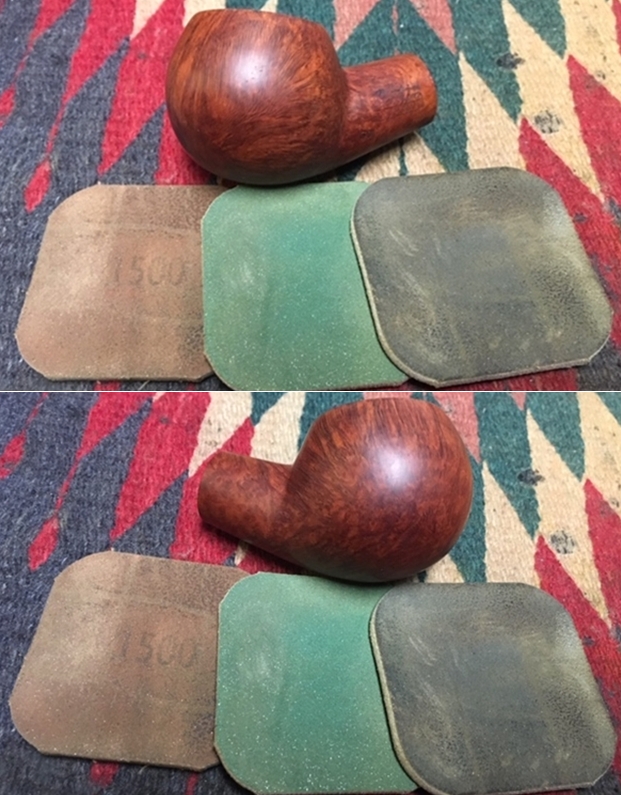
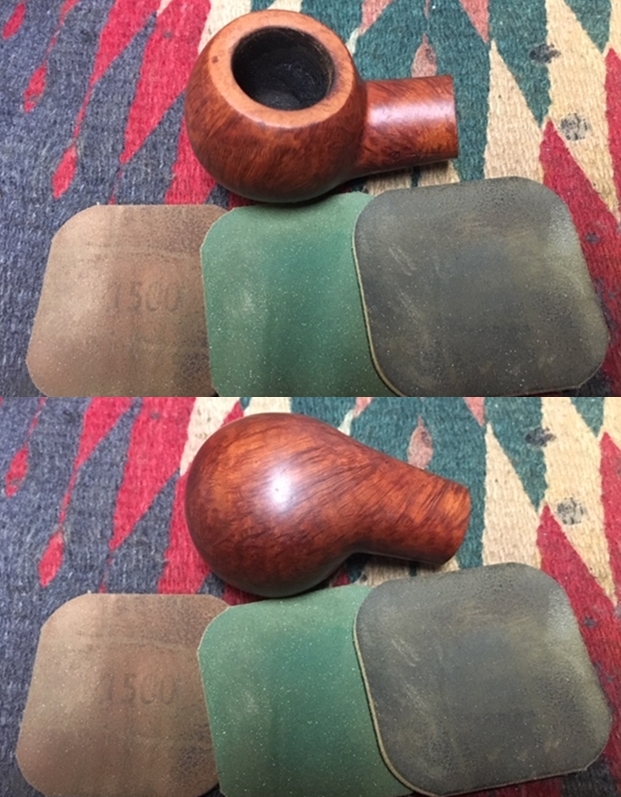
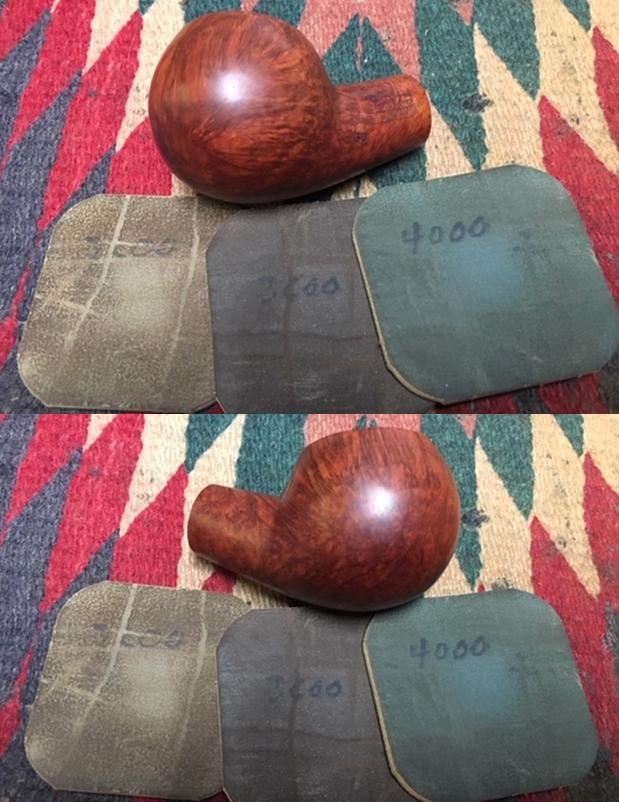
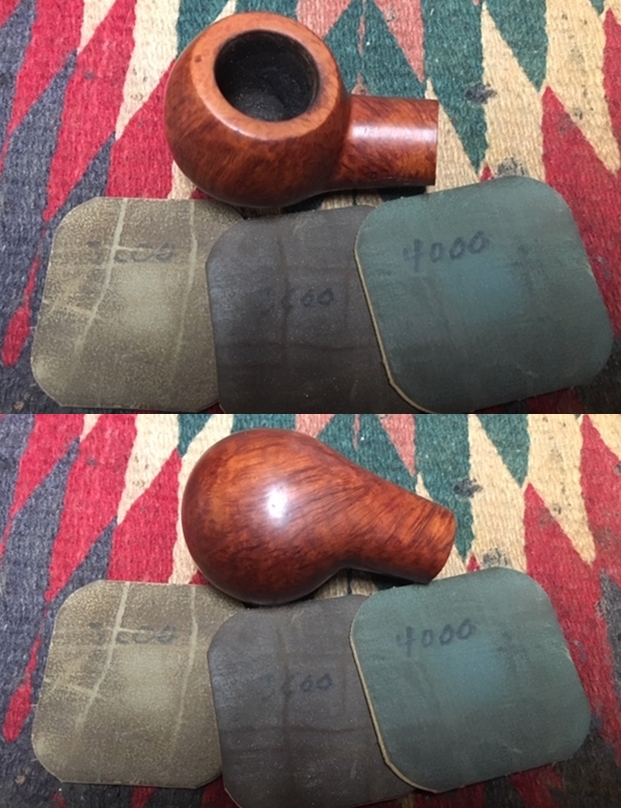
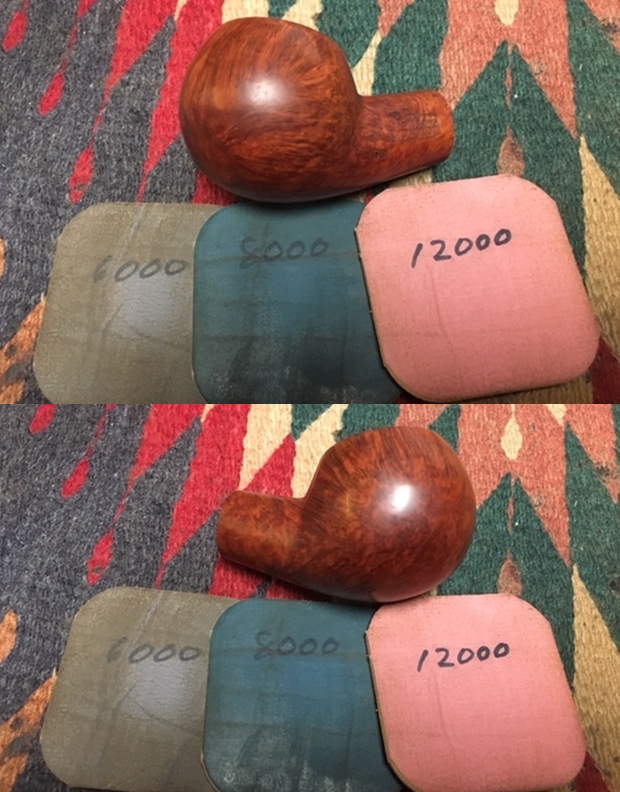
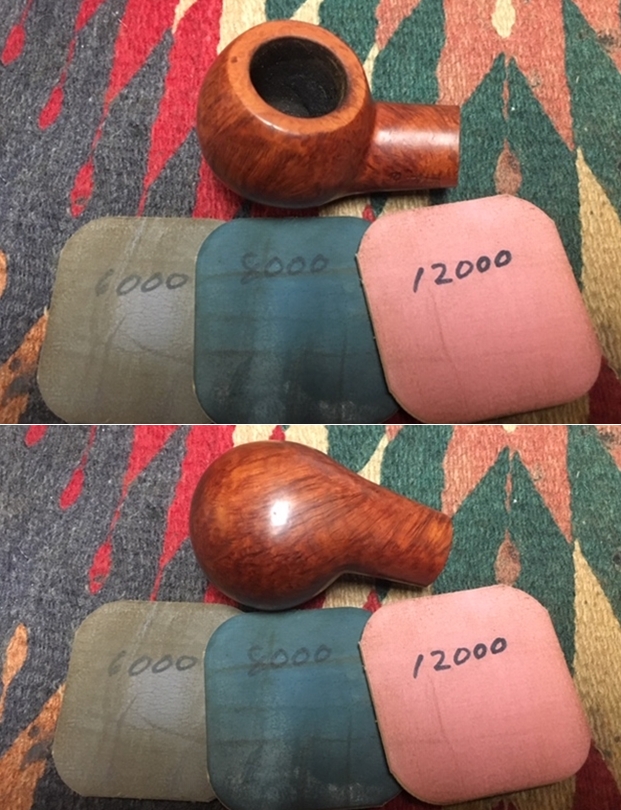
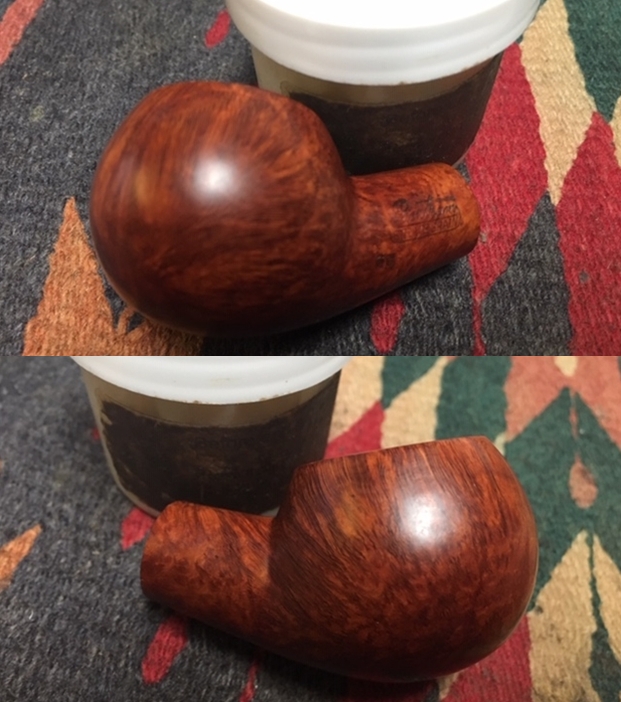
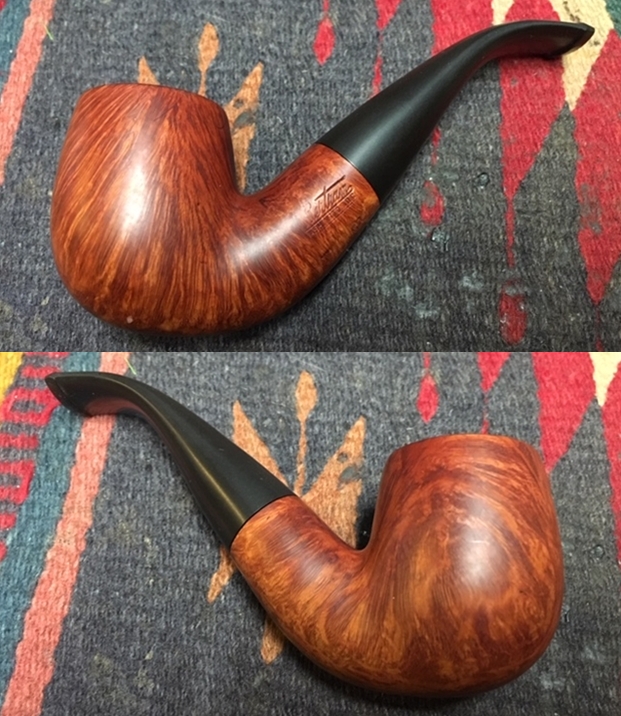
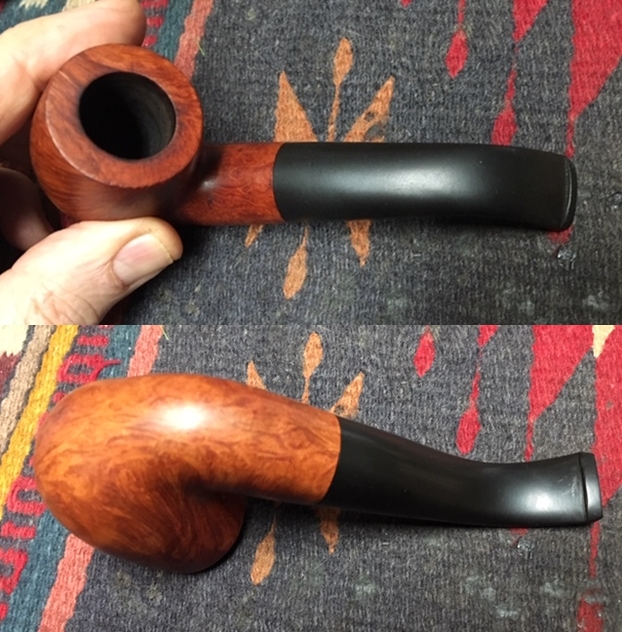
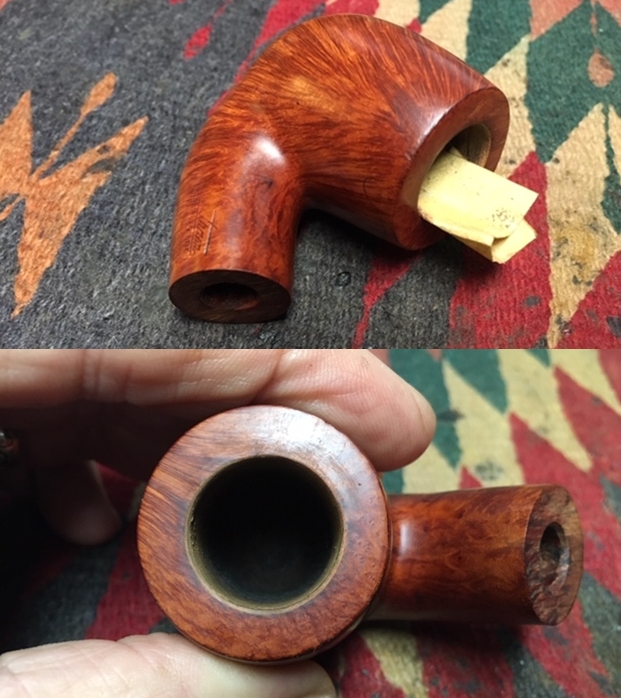
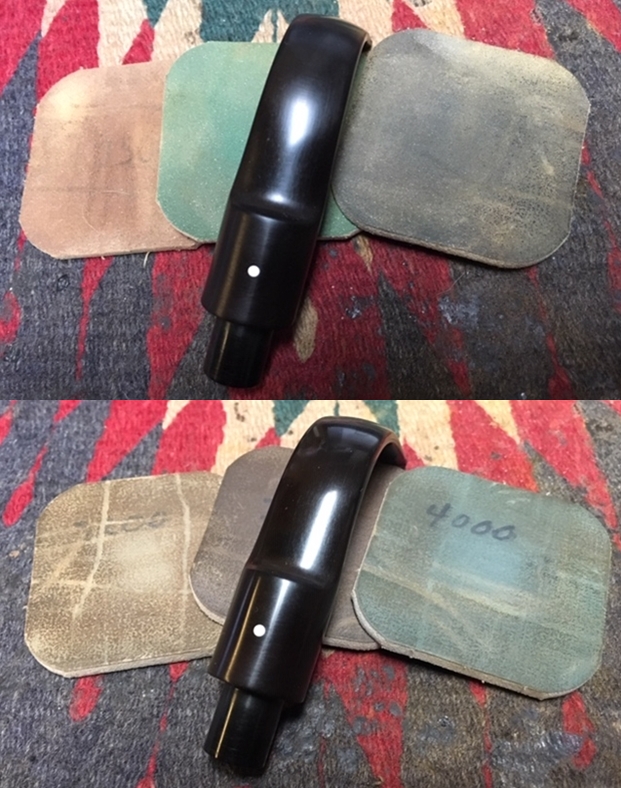
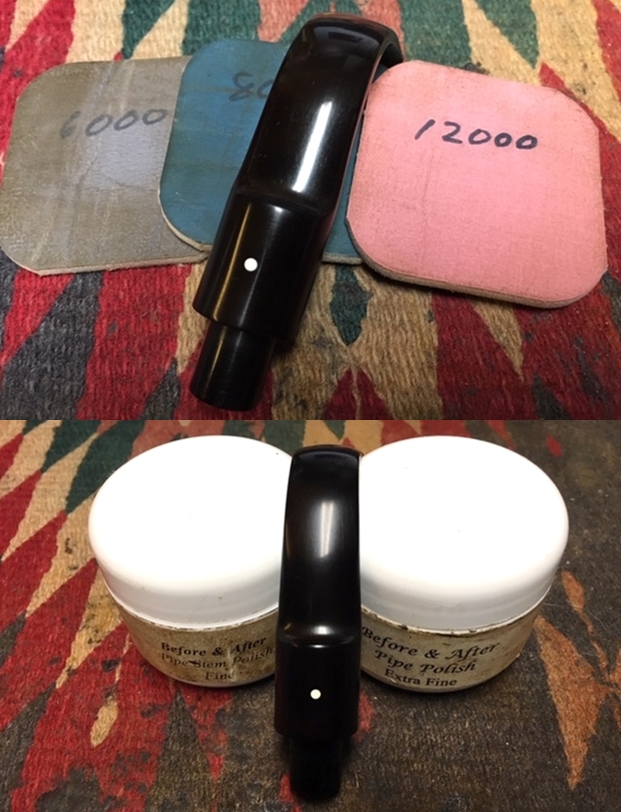
Jeff cleaned up the pipe for me. He reamed the bowl with a PipNet pipe reamer and cleaned it up with a Savinelli Fitsall Pipe Knife. He scrubbed the exterior with Murphy’s Oil Soap and a tooth brush to clean off the grime in the sandblast finish and the heavy overflow of lava on the smooth rim top. He cleaned up the internals of the shank, mortise and stem with pipe cleaners, cotton swabs and alcohol to remove all of the oils and tars in the pipe. When it came back to Vancouver it a cleaner and better looking pipe. I took photos of it before I started the restoration. I took photos of the rim top and the stem to show their condition. Jeff was able to clean up the grime and darkening on the rim top. The inner edge of the bowl looked pretty good. The stem had light tooth chatter and some deeper tooth marks on both sides near the button. I was able to get a very clear picture of the stamping on the shank and the L square logo on the saddle stem.I polished the rim top and the smooth portions of the bowl and shank with micromesh sanding pads – wet sanding with 1500-2400 grit pads and dry sanding with 3200-12000 grit pads. I wiped the bowl down after each pad with a damp cloth. The photos tell the story. I rubbed the bowl and shank down with Before & After Restoration Balm to deep clean the sandblast finish on the bowl and shank and the smooth portion on the rim and underside of the shank. The product works to clean, enliven and protect the briar. I worked it in with my fingers to get it into the sandblast finish. After it sat for a little while I wiped it off with a soft cloth. I buffed the bowl with a horsehair shoe brush to polish it. The briar really began to have a rich shine. I took some photos of the bowl at this point to mark the progress in the restoration. I set the bowl aside and worked on the stem. I repaired the tooth marks with clear super glue. I set the stem aside to let the repairs cure. Once the glue cured I cleaned up the edge of the button and the repaired areas with folded pieces of 220 and 400 grit sandpaper until the repairs were blended into surface of the stem. I polished the stem with micromesh sanding pads – wet sanding with 1500-2400 grit pads and dry sanding with 3200-12000 grit pads. I wiped the stem down after each pad with a damp cloth to remove the sanding dust. I used the Before & After Pipe Polish to remove the small minute scratches left in the vulcanite. I finished by wiping the stem down with a final coat of Obsidian Oil and set it aside to dry. I put the stem back on the pipe and worked it over with Blue Diamond to polish out the remaining small scratches. I lightly buffed the sandblast bowl. I gave the bowl multiple coats of Conservator’s Wax and the stem several coats of carnauba wax and buffed the pipe with a clean buffing pad to raise the shine. I hand buffed it with a microfiber cloth to deepen the shine. The pipe polished up pretty nicely. The finished pipe is shown in the photos below. There is something about the pipe that reminds me of a Stanwell shape and finish. The shape is very Danish and the restoration has brought it back to life. The dimensions of the pipe are Length: 5 1/4 inches, Height: 2 1/4 inches, Outside diameter of the bowl: 1 3/8 inches, Chamber diameter: 3/4 of an inch. I will be putting it on the rebornpipes online store shortly, if you are interested in adding it to your collection. Thanks for walking through the restoration with me as I worked over this interesting and unique sandblast Loewe Cutlass 21.

Restoring a Danish Handmade Kriswill Chief 50 Oom Paul


Blog by Steve Laug

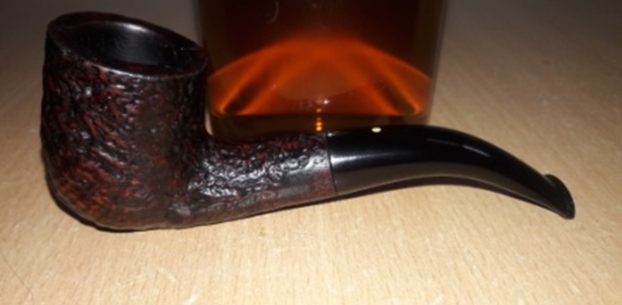
This Kriswill is yet another one from a local pipe shop. It came from the estate of an older gentleman whose wife returned his pipes to the shop for restoration and resale. This one is a smooth finished Kriswill Full Bent/Oom Paul. The briar is a combination of mixed grain around the bowl. It is stamped on the left side of the shank Kriswill over Chief over Handmade in Denmark. On the underside near the shank stem junction it has the shape number 50. On the left side of the saddle stem is the Kriswill Snowflake logo. The pipe was very dirty with a thick cake in the bowl and some lava overflowing on to the rim top. It was hard to know what the inner edge of the rim looked like because of the lava and cake. The stem was lightly oxidized and had come calcification where a pipe Softee bit had been. There was some tooth chatter and tooth marks on both sides of the stem at the button.This was included in the pipes that I sent off to my brother for cleaning. This is probably the 24/25 pipe that I have brought to the work table from the lot of about 50 to rework. I can’t say enough how much I appreciate his willingness to clean and ream the pipes for me. It allows me to move through the repairs much more quickly. When he received the pipe he took a series of photos of it to show its condition. He took photos of the rim top to show the thick cake in the bowl and the overflow of lava on the rim top.He took photos of the sides and bottom of the bowl to give a clear picture of the beauty of the grain on this old pipe. Under the grime there is some great grain peeking through. Jeff took a photo of the stamping to capture the clarity of it even under the grime.The stem looked dirty and oxidized with the calcification left behind by a pipe Softee bit. The edges of the button had bite marks and there was some tooth damage to the surface of the stem next to the button on both sides.I have worked on quite a few Kriswill pipes over the years and have always enjoyed the shapes and the craftsmanship on each of them. This one is no different. It is well made and well-shaped. I reviewed the information I had on Kriswill and have included some of that here.Kriswill was one of the large pipe manufacturers in Denmark during the 1960s and 1970s, and closed around 20 years ago. Their catalog cover read “By Appointment to the Royal Danish Court, KRISWILL, Kriswork Briar Trading, Briar Pipes Hand Made in Denmark.” After the Danish Kriswill enterprise ended, pipes were made in Norway and in France under the Kriswill label. In the 1970s Kriswill was bought by Lillehammer, and in the 1980s the pipes were made for a while at the Catalan factory, Iberica de Pipas  (https://pipedia.org/wiki/File:Kriswill_Factory.jpg).

Jeff cleaned up the pipe for me. He reamed the bowl with a PipNet pipe reamer and cleaned it up with a Savinelli Fitsall Pipe Knife. He scrubbed the exterior with Murphy’s Oil Soap and a tooth brush to clean off the grime in the rustication and the heavy overflow of lava on the rim top. He cleaned up the internals of the shank, mortise and stem with pipe cleaners, cotton swabs and alcohol to remove all of the oils and tars in the pipe. When it came back to Vancouver it a cleaner and better looking pipe. I took photos of it before I started the restoration. I took photos of the rim top and the stem to show their condition. Jeff was able to clean up the grime and darkening on the rim top. The inner edge of the bowl looked pretty good. The stem had light tooth chatter and some deeper tooth marks on both sides near the button. I took a photo of the stamping on the shank and the Kriswill Snowflake Logo on the left side of the saddle stem.I worked over the inner edge of the rim with a folded piece of 220 grit sandpaper to remove the damaged portions of the inside edge of the rim. It did not take a lot of sanding to smooth out the damaged areas.I polished the rim top and the rest of the bowl and shank with micromesh sanding pads – wet sanding with 1500-2400 grit pads and dry sanding with 3200-12000 grit pads. I wiped the bowl down after each pad with a damp cloth. The photos tell the story. I rubbed the bowl down with Before & After Restoration Balm to deep clean the briar on the bowl and rim. The product works to clean, enliven and protect the briar. I hand rubbed it with my fingers and worked it into the briar. I wiped it off with a soft cloth. I buffed the bowl with a horsehair shoe brush to polish it. The briar really began to have a rich shine. I took some photos of the bowl at this point to mark the progress in the restoration. I set the bowl aside and worked on the stem. I repaired the tooth marks with clear super glue. I set the stem aside to let the repairs cure. Once the glue cured I cleaned up the edge of the button and the repaired areas with folded pieces of 220 and 400 grit sandpaper until the repairs were blended into surface of the stem. I polished the stem with micromesh sanding pads – wet sanding with 1500-2400 grit pads and dry sanding with 3200-12000 grit pads. I wiped the stem down after each pad with a damp cloth to remove the sanding dust. I used the Before & After Pipe Polish to remove the small minute scratches left in the vulcanite. I finished by wiping the stem down with a final coat of Obsidian Oil and set it aside to dry. The pipe has been sitting in the queue since late in 2017 so the stem was loose in the shank. I know from experience that once the pipe is smoked it will be good and snug. To take care of the interim period I gave the tenon a light coat of clear nail polish. Once it dries the stem will fit snugly in the mortise.I put the stem back on the pipe and worked it over with Blue Diamond to polish out the remaining small scratches. I gave the bowl and the stem several coats of carnauba wax and buffed the pipe with a clean buffing pad to raise the shine. I hand buffed it with a microfiber cloth to deepen the shine. The pipe polished up pretty nicely. The finished pipe is shown in the photos below. Though the briar has some fills on the left side of the bowl it is nonetheless a beautiful piece of briar. The shape is a Danish version of a classic Oom Paul pipe and with the restoration has been brought back to life. The dimensions of the pipe are Length: 5 inches, Height: 2 1/4 inches, Outside diameter of the bowl: 1 3/8 inches, Chamber diameter: 3/4 inch. I will be putting it on the rebornpipes online store shortly, if you are interested in adding it to your collection. Thanks for walking through the restoration with me as I worked over this interesting Kriswill Chief 50 Oom Paul.

Restoring an Interesting Piece of American Pipe History – Pat Vottis’ Contribution to the Ongoing Quest for a Cool Smoke


Blog Steve Laug

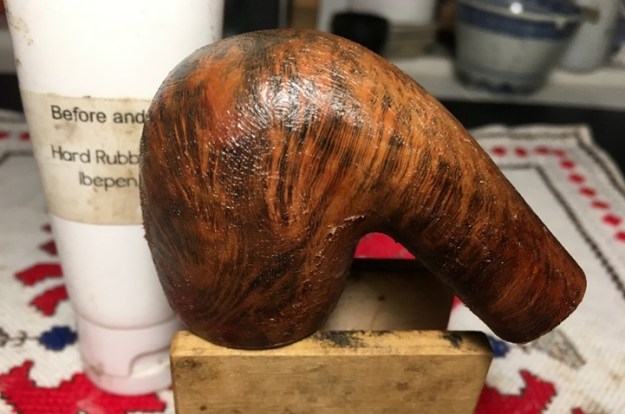
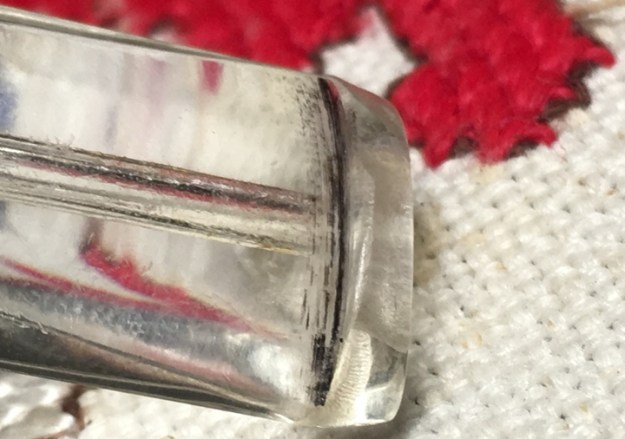
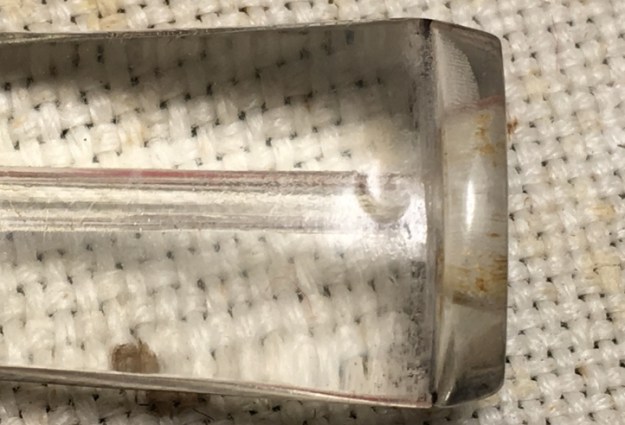
Every so often my brother and I come across very unique pipes that are worth restoring just for the thing that makes them particularly notable. Each pipe that falls into this category has its own uniqueness that sets them apart as different. These unique pipes come to us from a large variety of different sources and the one I am working on now came to me from a reader of rebornpipes.  Christine contacted me to see if I would be interested in purchasing her Grandfather’s pipes and restoring them. She was particularly interested in seeing what I could do with a Vottis pipe that he had. She sent me photos of the lot and we struck a deal. Over the years I have worked on several Vottis pipes coming from different sources. But this Vottis pipe from Albany, New York is not like anything I have ever seen before. I am including some photos to show the system. There is an air hole (not big) on each side of the shank near the bowl (Photos 1 and 2). These run parallel to the airway and come out on either side of the mortise (Photo 3). The stem is drilled with the same two small channels that run the length and out the button on either side of the slot (Photos 4 and 5). The red arrows in each photo point to the airways that I am referring to throughout the blog. The basic airflow diagram is illustrated by the red lines on the photo below. The thinner lines on either side reflect the airflow running parallel to the airway in the shank and mortise. The shank airway is shown by the thicker red line and runs to the bottom of the bowl from the slot in the button. I am convinced that the mechanics were designed to pull cool air into the tubes alongside the shank to cool the smoke in the chamber and cool it all the way to the end of the button. If I plug the slot in the button I can pull air out of the twin tubes and it is a steady stream. Once the pipe is restored I will load a bowl and try it out to test my hypothesis. I will soon know how it works. It is definitely a unique design and one that is in the camp of the proverbial eternal hunt for a cooler smoke. With that information have a look at the restoration of this Vottis design pipe.With the mechanics clearly spelled out in the above diagrams and explanations it is time to do a bit of research on the brand and see if there is any mention of this cooling system design. I looked at the various sites that I usually go to (pipedia and pipephil) and there was nothing about this kind of pipe on either site. So I dug a bit more deeply. I read the obituaries of Pat (Pasquale) Vottis and S. Vottis in the Albany newspapers and the online Funeral Home sites. Lots of references were made to their shop in Albany and Schenectady, New York but nothing on the unique designs they may have done with pipes. It did add colour to my understanding of the carvers of the pipes – both were local philanthropists and involved in their local Catholic parishes. Both were well loved by the community.

I went on to look further and found more info on the brand on the brothers of the briar site (http://www.brothersofbriar.com/t5244-information-on-s-m-vottis-pipes). The site gave two links that sadly are no longer active. I am including them in case they ever come back on line. I quote as follows:

I think that the information you are looking for is in the following link: http://www.jbriarpipes.com/blog/2014/12/10/the-rise-and-fall-of-a-historic-local-landmark-paying-homage-to-the-vottis-pipe-shop found on the J Briar Pipes site.  Pat (Pasquale) Vottis and his brother S. (Salvatore) Vottis had a pipe shop in Schenectady NY.  The article referenced contains information about the Vottis Pipe Shop.  A second link found on the page directs you to an Albany Times-Union article (archived) (http://alb.merlinone.net/mweb/wmsql.wm.request?oneimage&imageid=5580379) that contains more info.  Happy reading!  I enjoyed finding these articles and reading them.  I have lived within 50 miles of Albany NY most of my life and never knew about Vottis pipes.

I also followed a link to a thread on pipes.org that was very interesting. It is written by Pat Vottis’ grandson and is interesting to read. Here is the link to the quote. (http://pipes.org/forums/messages/23/46034.html?1171913269) It is also tied back to a thread on pipes.org that I cannot access. I include that link as well should some of you be able to access the information. This post references Harold Vance Post #4 username hbvance and Jose Manuel Lopes Post #91 in the Archive of 2005 Sept 20 with a Subject Title of Vottis Pipes (http://pipes.org/forums/discus~discus/discus~discus/discus/cgi-bin/discus/show.cgi?tpc=23&post=45187#POST451 87).

Jose, I am not quite sure where you obtained your information regarding Pat Vottis but it is incorrect and I would like to share a bit of good information for the audience.

Pasquale (Pat) Vottis is my grandfather. He did not die as you have posted on the web in 2005. He actually died this morning at 99 yrs 9 months of age on Feb 18, 2007. He had a passion for the customers and the business.

My grandfather opened his first pipe shop in Albany, NY on South Pearl St. It was in the Bank Building (which took up a whole city block) at the corner of State Street and South Pearl. We also opened a second shop in Albany which was in the Empire State Plaza on the Concourse level. This was to serve all of the State Workers so they could do business at lunch time and not be strapped for time while trying to get down to the South Pearl shop. We still have the Vottis Pipe Shop Sign and the Vottis Pipe Shop Clock that was a landmark for the customers.

Harold Vance’s pipes may very well came from a pipeshop in Santa Monica. We mailed pipes all over the world. My grandfather’s sister actually lived in Santa Monica for many years. We also had a very large tobacco mail order business in which I mixed 1000s of pounds of tobacco and mailed them all around the world as well. We closed the pipe shops in the early 90s due to the numerous break-ins late at night. The locals would throw rocks through the store front windows to steal the hand carved pipes and the meerschaums.

My grandfather hand carved many, many pipes himself. He usually carved the big blocks. My grandfather, my uncle, and my father repaired pipes for everyone even if they had not bought a pipe at our shops. We had a metal lathe in the basement as well as a stove. They machined the tenon portion of the stem with a carbide cutter to match the stem of the bowl for a perfect fit every time. To match the stem or the fit of the customer, we custom bent the stems of the pipes to their satisfaction.

I recall boxes of briar blocks that were rough turned and my uncle, my father, and my grandfather would also hand finish these too. We had a lot of fun in the stores too. Mixing different formulas of tobaccos to see how the public would respond. We had numerous successful formulas. Our approach was to make all natural formulas with no sugars added, no sugar sprays, or flavorings added.

The most popular formula was created by grandfather and was called Black Watch. Some of the other blends were North Woods, Vottis’s Own, Vottis Club, Boulevard 76, No#9. These blends were comprised of barley, yellow Cavendish, black Cavendish, Turkish, Latakia, and others of which I do not recall. Ironically, for the namesake, my grandfather has died at a Nursing Home named North Woods just like one of his tobacco blends called North Woods.

Finally, I also found a PDF of a brochure that Pat Vottis put together for his Albany Pipe Shop. I am including it as it is an interesting read.

When the pipe arrived at Jeff’s in Idaho he took photos of it before he started his clean up. It is one of my favourite shapes – a squat Rhodesian with a thick shank and saddle stem. The briar was dirty but had some amazing grain on the bowl. The stamping on the left side of the shank is clear and readable – Vottis in script. The rim top had some lava overflowing the bowl particularly on the back side. The edges looked very good – both inner and outer. The cake in the bowl was quite thick and hard. The double rings around the bowl below the rim cap were in good condition other than the usual collection of debris and dust. The stem was clean but had some light oxidation and tooth marks on both sides of the stem near the button. The button surface also had some tooth damage. Jeff’s photos are below (The above photos of the airways also are from Jeff). Jeff took some photos of the rim top to show the lava overflow and the cake in the bowl. The two photos are from slightly different angles and have different exposures but clearly show the condition. The inner edge of the bowl looks good but I will know more once it is cleaned and reamed. There appears to be some damage on the rear right of the bowl but again it is not clear until the bowl has been reamed and cleaned.Jeff also took photos of the sides and bottom of the bowl and shank to give an idea of the beautiful grain on this pipe. The photos of the stem show the deep tooth marks and chatter on both sides near the button as well as the damage to the button edge and surface. You can also see the scratching and oxidation in the photos.When Christine wrote me about the pipes and the deal was struck I asked her if she would like to put together a brief tribute to her Grandfather to include in these blogs. She was happy to write it and send it to me. I include her tribute now go give a glimpse in to the life of the pipeman who held this pipe in trust before it came to me.

My grandfather, Paul Richter, first came to the United States from Germany in the mid 1920’s with his younger brother, Walter.  Paul was born in 1899 in Leipzig, Germany. He had a degree in engineering and was looking for a better life to start a family.  Paul and Walter were hired to work at a machine shop in Flushing, NY. They then heard about a town in upstate NY called Schenectady and decided it was worth a trip to check it out. They stayed at a boarding house next to the railroad station and were eaten up by bed bugs.  Despite this experience, my grandfather decided that Schenectady was a good place to live and start his career with the General Electric Company (GE).

In 1928 he returned to Germany and brought his new wife from Leipzig to Flushing via boat and shortly after they moved to Schenectady. Paul worked hard and earned his way up the ladder to a management position; eventually managing 400 people at the GE main plant in downtown Schenectady. With his wife, Ella, they raised 2 sons, Ralph and Peter who both ended up with lifelong careers at GE.  Schenectady was a thriving and exciting city during this time with much to keep a family happy. One of the things that Paul enjoyed was quality tobacco smoked in a finely crafted pipe.  He found one of his favorite pipes at the Vottis Pipe Shop on Erie Blvd in downtown Schenectady. After Paul passed away in 1979, his son Peter (my father) kept all of his Dad’s old pipes among other sentimental memorabilia.  The pipes were packed away in a box until 2018, when I opened the box and smelled that wonderful pipe aroma that I recall from many years ago. The aroma brings back fond memories of time spent with my family!

Thanks for giving Paul’s Vottis pipe another life! — Christine

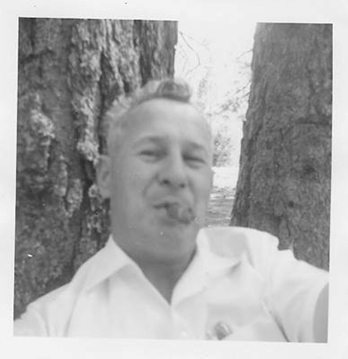
Thanks for writing this Christine. It helps to set the stage for this restoration and give colour to the story. I was excited to work on this interesting old pipe. In fact so much so that I forgot to take pics of it before I started working on it. I filled in the tooth marks on both sides of the stem and rebuilt the edge of the button at the same time.At that point I remembered I had not taken photos so I put the stem back on the shank and took some photos of the bowl and stem to show the magnificent cleanup job Jeff had done with the pipe and to show the areas that I would need to work on. I took some photos of the rim top to show the area at the back that had been covered in lava. It was now clean but had some darkening and would need a bit of polishing to remove the darkening. I also took photos of the stem surfaces to show the repaired areas to highlight the tooth damage that had been present.I took photos of the stamping on the shank sides. The left side read Vottis in script looking like it was almost engraved. The right side read Genuine Algerian Briar.I cleaned up the darkening on the rim top and the inner edge of the bowl with a folded piece of 220 grit sandpaper. I worked it over the surface and around the edge to smooth out the damages and also to remove the darkening. Over all the sandpaper did the trick. The edge and top still show some damage but polishing it should remove the remaining damages.I polished the bowl and rim cap with micromesh sanding pads. I wet sanded with 1500-2400 grit pads and dry sanded with 3200-12000 grit pads. I wiped the bowl down after each sanding pad with a damp cloth to remove the dust and check my progress. The photos tell the story. Once I was finished polishing the bowl and rim, I worked some Before & After Restoration Balm into the surface of the briar with my fingertips to clean, enliven and protect it. I let the balm sit for a little while and then buffed with a cotton cloth to raise the shine. I took photos of the pipe at this point to show how good the pipe was beginning to look. The bowl and the rim top look really good and the grain really stood out on the smooth rim. The finish looks very good and the birdseye grain on the bottom and the cap of the bowl and flame grain on the sides stand out in all their beauty. I set the bowl aside and turned my attention to the stem. The repairs to the button area had cured so I used a needle file to clean up the edge of the button and flatten the repairs on the surface of the stem. I also reshaped the button surface. I blended in the repairs and removed the scratching from the file with 220 and 440 grit sandpaper. The repairs and shape of the button looked really good at this point. I polished the stem with micromesh sanding pads – wet sanding with 1500-2400 grit pads and dry sanding it with 3200-4000 grit pads. I buffed the stem with red Tripoli and brought it back to the work table and finished polishing it with 6000-12000 grit pads. I wiped the stem down with Obsidian Oil after each pad. I further polished it with Before & After Pipe Polish – both Fine and Extra Fine. I finished by giving it a final coat of Obsidian Oil and setting it aside to dry. Since I had finished both the bowl and stem I put them back together and polished the bowl and stem with Blue Diamond polish on the buffing wheel. I gave the bowl and the stem multiple coats of carnauba wax. I buffed the pipe with a clean buffing pad to raise the shine. I hand buffed it with a microfiber cloth to deepen the shine. The pipe polished up pretty nicely. The birdseye grain on the rim cap and the beautiful straight/flame grain around the sides of the bowl and shank came alive on the buffing wheel. The rich brown stain works well with polished black saddle vulcanite stem. The finish looks amazing and it is smooth and light weight in the hand. Judging from the condition of the pipe when we got it, I am sure that it will be an amazing smoker. Have a look at it with the photos below. The dimensions are Length: 5 1/2 inches, Height: 1 7/8 inches, Outside diameter of the bowl: 2 1/4 inches, Chamber diameter: 1 inch. Thanks Christine for sending this pipe to me from your Grandfather Paul Ricther. It is a beauty and a pipe that I intend to hold onto (at least for now). I have never seen another like it and I am anxious to fire up a bowl and try it out.
A Unique Piece of Pipe History – A Beautiful WDC Calabash with Bling


Blog by Steve Laug

The next pipe in the queue is an old timer that Jeff picked up somewhere in his journeys whether online in his pipe hunting is antique shops. This one an interesting older WDC Calabash with a brass shank cap and a rim top cap. The stem is Bakelite with an amber colour. It is stamped on the left side of the shank WDC in a triangle (William DeMuth & Company). It is a Calabash shaped pipe decorated with a brass rim top and cap as well as a brass ferrule. Both have a pattern of filigree and hearts. These older WDC and CPF Calabashes were decorative and had a real flourish that makes them readily identifiable. The finish is smooth and is in good condition despite the years. The brass rim top has some dings in it and there was some lava buildup on various spots. The inner edge of the brass cap was turned down into the inner edge of the bowl. It was dirty with lava and there was a thick cake in the bowl. The brass was tarnished but looked easy to clean up. The pipe was dusty but the finish looked like it was rich and would clean up well. The stem is an amber coloured Bakelite with a threaded tenon in the shank and the stem. The stem has tooth marks and chatter on both sides at the button edge. The photos below tell the story and give a glimpse of the pipe before clean up. Jeff took a photo of the bowl and rim to show the condition of the pipe before he started his cleanup work. The spots of lava overflowing on the rim top made me thick that some of the lava had been scraped off by the seller.  There was a thick cake in the bowl that would need to be reamed out. There was dust and debris in the curls and curves of the brass cap.He also took a photo of the right side and underside of the bowl and shank to show the amazing birdseye and swirling grain around the bowl. The classic WDC stain looked pretty good under the grime.Jeff took photos of the stamping on the left side of the shank and the setting between the brass ferrule and the bowl. The WDC triangle logo stamping is legible and very readable.The next photos show the rim cap and ferrule and highlight the heart and filigree patterns in the brass. You can also see the oxidation on the brass in the photos.The next two photos show the stem surface. They show the tooth marks and chatter on both sides near the button. They also show the deep oxidation on the stem. The third photo below shows the threaded bone tenon. Jeff did a thorough clean up job on the pipe so that  when it arrived here in Vancouver it looked amazingly good for a pipe that is at least a hundred years old. Jeff carefully reamed the bowl with a PipNet pipe reamer and followed up with a Savinelli Fitsall pipe knife to remove the cake. He scrubbed out the mortise and the airway in the shank and the stem with alcohol, cotton swabs and pipe cleaners. He scrubbed the exterior of the bowl, rim, shank and stem with a tooth brush and Murphy’s Oil Soap to remove the oils and tars on the rim and the grime on the finish of the bowl of the pipe. He rinsed it off under running water. He dried it off with a soft cloth. He was able to remove all of the lava build up on the beveled rim top of the pipe. The brass rim top and ferrule looked very good. The birdseye and cross grain was beautiful and the pipe looked very good. There were tooth marks and chatter visible on both sides of the stem at the button. I took photos of the pipe to show its condition before I started my work. I took close up photos of the bowl, rim and stem surfaces to capture the condition of the pipe after Jeff had done his cleanup. The rim top was clean and the brass inner edge was in excellent condition. The stem was quite clean with some tooth marks and chatter on the top and underside near the button.I took a photo of the stamping on the left side of the shank and the flow of the grain on the shank and bowl side. It is a beautiful piece of briar.The bowl and rim top looked really good after Jeff’s clean up work. I decided to go straight to polishing the bowl. I worked some Before & After Restoration Balm into the surface of the briar with my fingertips to clean, enliven and protect it. I let the balm sit for a little while and then buffed the bowl with a cotton cloth to raise the shine. The following photos show the bowl at this point in the restoration process. The bowl and the rim top look really good and the grain really stood out on the smooth rim. The finish looks very good with the grain popping through the brown stain on the bowl and the brass on the rim top and shank end. I set the bowl aside and turned my attention to the stem. I filled in the deep tooth marks on both sides with clear super glue. It takes a while  to cure so I set it aside and worked on another pipe while it hardened.Once the repairs had cured I used a needle file to sharpen the edge of the button and smooth out the repairs on the surface of the stem. I sanded it with 220 and 400 grit sand paper to smooth out the repairs and blend them into the surface of the stem. I polished the stem with micromesh sanding pads – wet sanding with 1500-2400 grit pads and dry sanding it with 3200-12000 grit pads. I wiped the stem down with Obsidian Oil after each pad. I further polished it with Before & After Pipe Polish – both Fine and Extra Fine. I finished by giving it a final coat of Obsidian Oil and setting it aside to dry. Since I had finished both the bowl and stem I put them back together and carefully polished the bowl and stem with Blue Diamond polish on the buffing wheel. The combination of metal, Bakelite and briar makes this a very touch process. I gave the bowl and the stem multiple coats of Conservator’s Wax. I carefully buffed the pipe with a clean buffing pad to raise the shine. I hand buffed it with a microfiber cloth to deepen the shine. The pipe polished up pretty nicely. The brass rim cap and shank end and the beautiful grain of the briar on the bowl came alive on the buffing wheel. The rich brown stain works well with polished amber coloured Bakelite stem. The finish looks amazing and it is smooth and light weight in the hand. Judging from the condition when we got it, I am sure that this will be another amazing smoker. Have a look at it with the photos below. The dimensions are Length: 5 1/4 inches, Height: 2 inches, Outside diameter of the bowl: 1 7/8 inches, Chamber diameter: 3/4 of an inch. This beauty will be going into my collection of old WDC and CPF. Thanks for walking through the restoration with me on this beautiful old time WDC Calabash pipe.

What a Mess – a Weary Comoy’s Tradition 157 Barrel


Blog by Steve Laug

The next pipe in the queue came from an auction in Los Angeles, California that Jeff picked up online. This one was a Comoy’s Tradition Barrel Billiard. It is stamped on the left side of the shank Comoy’s Tradition and on the right side of the shank is the Comoy’s COM Stamp (Made in London in a circle over England) as well as the shape numberb157. It is a barrel shaped pipe with a flat bottom on the heel and sits well as a sitter. As is typical of Comoy’s Tradition pipe this one is a beauty. The finish is smooth and looks like nice grain under the grime of years. The rim top was smooth and had a beveled inner rim edge. There was a thick coat of lava on the rim and on the beveled inner edge. The pipe was dusty but the finish looked like it was rich and would clean up well. The stem is a vulcanite taper with a Comoy’s three part inlaid C on the left side of the stem. The stem has tooth marks and chatter on both sides at the button edge. The photos below tell the story and give a glimpse of the pipe before clean up. Jeff took a photo of the bowl and rim to show the condition of the pipe before he started his cleanup work. The lava overflowing the thick cake in the bowl all but concealed the inner and outer edge of the bowl and made it impossible to know the condition of the pipe. There was also tobacco debris in the bowl and stuck in the lava on the rim top.He also took photos of the right side and left side and underside of the bowl and shank to show the amazing birdseye and cross grain around the bowl and the smooth bottom that made the bowl a sitter. The classic Comoy’s stain looked pretty good under the grime.Jeff took photos of the stamping on both the left and right side of the shank and the Comoy’s C on the left side of the stem. It reads as noted above. The stamping is legible and very readable. The next two photos show the stem surface. They show the tooth marks and chatter on both sides near the button. They also show the deep oxidation on the stem.Once again, Jeff did his usual thorough clean up job on the pipe so that  when it arrived here in Vancouver it looked amazingly good – almost like a different pipe. Jeff reamed the bowl with a PipNet pipe reamer and followed up with a Savinelli Fitsall pipe knife to remove the cake. He scrubbed out the mortise and the airway in the shank and the stem with alcohol, cotton swabs and pipe cleaners. He scrubbed the exterior of the bowl, rim, shank and stem with a tooth brush and Murphy’s Oil Soap to remove the oils and tars on the rim and the grime on the finish of the bowl of the pipe. He rinsed it off under running water. He dried it off with a soft cloth. He was able to remove all of the lava build up on the beveled rim top of the pipe. The rim top and beveled edge looked very good. The birdseye grain was beautiful and the pipe looked very good. The stem looked a lot better than previously. Jeff had soaked it in Before & After Deoxidizer and it had done a great job on the oxidation. There were tooth marks and chatter visible on both sides of the stem at the button. I took photos of the pipe to show its condition before I started my work. I took close up photos of the bowl, rim and stem surfaces to capture the condition of the pipe after Jeff had done his cleanup. It reminded me once again how glad I am that he does this work for me and I can work on a clean pipe. The rim top was clean and the beveled inner edge was in excellent condition. There was some rim and edge darkening but it was relatively undamaged. The stem was quite clean with some tooth marks and chatter on the top and underside near the button.I decided to address the rim darkening first so I used a folded piece of 220 grit sandpaper to smooth out the edge of the bevel and clean up the darkening.I polished the briar with micromesh sanding pads (1500-1200 grit pads) and wiped the bowl down with a wet cloth to remove the sanding dust. I was so intent on doing it that I forgot to take pictures of this part of the work but you all know the effectiveness of micromesh in polishing briar. Once I was finished polishing it I worked some Before & After Restoration Balm into the surface of the briar with my fingertips to clean, enliven and protect it. I let the balm sit for a little while and then buffed with a cotton cloth to raise the shine. At this point I remembered to take photos. The following photos show the bowl at this point in the restoration process. The bowl and the rim top look really good and the grain really stood out on the smooth rim. The finish looks very good with the combined dark and medium brown stain on the bowl and rim. I set the bowl aside and turned my attention to the stem. I filled in the deep tooth marks on both sides with black super glue. It takes a while  to cure so I set it aside and worked on another pipe while it hardened. Once the repair had cured, I sanded it with 220 and 400 grit sand paper to smooth out the repairs and blend them into the surface of the stem. I polished the stem with micromesh sanding pads – wet sanding with 1500-2400 grit pads and dry sanding it with 3200-4000 grit pads. I buffed the stem with red Tripoli and brought it back to the work table and finished polishing it with 6000-12000 grit pads. I wiped the stem down with Obsidian Oil after each pad. I further polished it with Before & After Pipe Polish – both Fine and Extra Fine. I finished by giving it a final coat of Obsidian Oil and setting it aside to dry. Since I had finished both the bowl and stem I put them back together and polished the bowl and stem with Blue Diamond polish on the buffing wheel. I gave the bowl and the stem multiple coats of carnauba wax. I buffed the pipe with a clean buffing pad to raise the shine. I hand buffed it with a microfiber cloth to deepen the shine. The pipe polished up pretty nicely. The smooth rim top and the beautiful birdseye and cross grain finish on the bowl came alive on the buffing wheel. The rich brown stain works well with polished black tapered vulcanite stem. The finish looks amazing and it is smooth and light weight in the hand. Judging from the condition when we got it, I am sure that it will be an amazing smoker. Have a look at it with the photos below. The dimensions are Length: 5 1/4 inches, Height: 1 3/4 inches, Outside diameter of the bowl: 1 1/4 inches, Chamber diameter: 3/4 of an inch. I will be putting this beauty on the rebornpipes store shortly and it can be added to your collection. Thanks for walking through the restoration with me on this beautiful Comoy’s Tradition Barrel 157 pipe.


Reconstructing a Broken Stem on a 1964 Dunhill Shell 253 f/t


Blog by Paresh Despande

I had just finished a second of the 30 pipes from my Mumbai Bonanza find, a 1979 DUNHILL BRUYERE 51671; here is the link to the write up; https://rebornpipes.com/2019/03/13/reconstructing-a-broken-stem-on-dunhill-bruyere-51671/

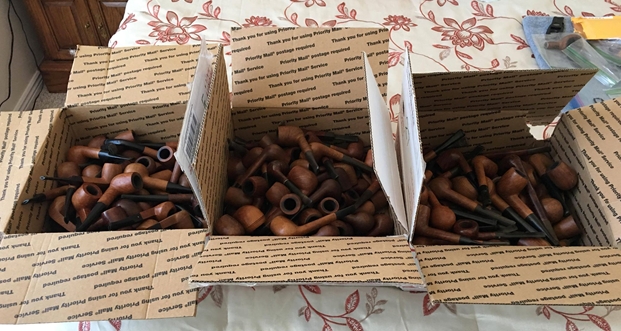
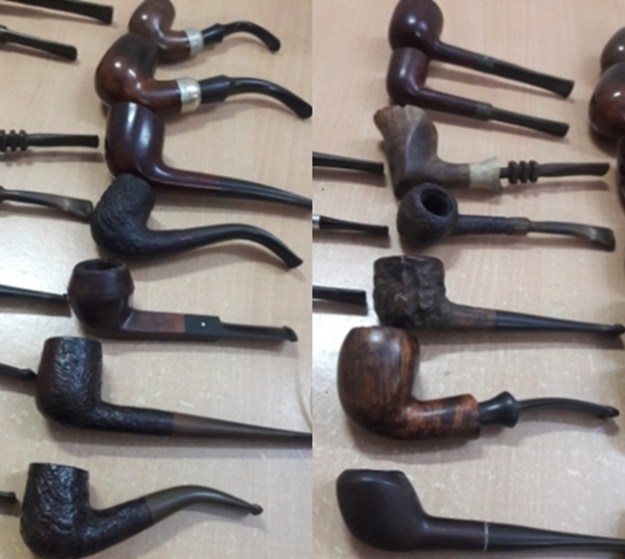
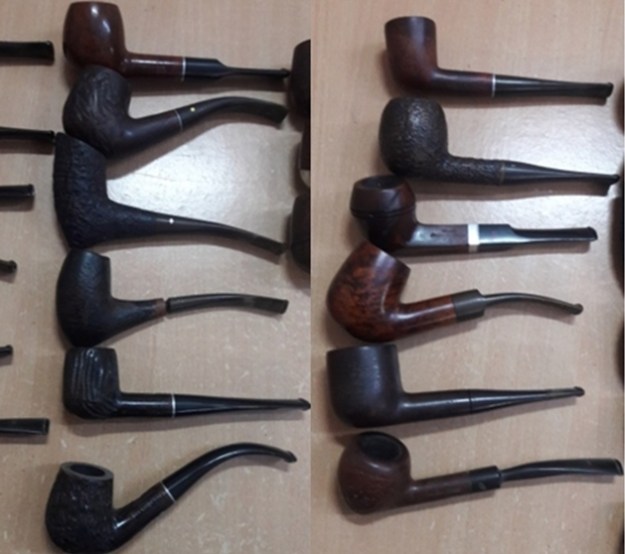
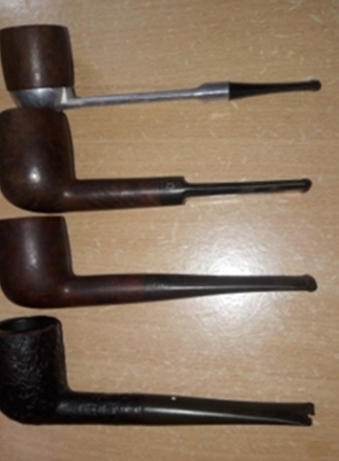
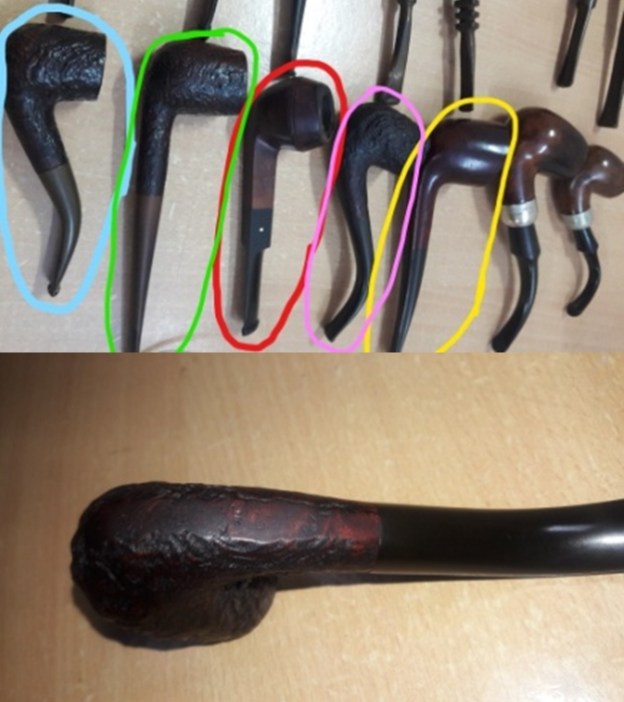
I was fortunate enough to have heeded to the advice of my dear friend and mentor, Mr. Steve, and struck a deal with a trash collector from Mumbai. He did not know what he was selling and I did not know what I was buying as we reside in different cities!! The argument that Mr. Steve presented was that if not anything, I shall at least have some spares and this was logical. I struck a deal and here are pictures of the pipes that I received in this lot. This lot contains some very nice collectible pipes, a few well known brand pipes and some mediocre pipe brands. Overall, with seven Dunhills, a Preben Holm #1, a couple of Made in England Pete System pipes, Charatan’s, Custom-Bilt, Stanwell and other assorted pipes, I would say that I had hit a huge jack pot!! Hence, I like to call this find as “Mumbai Bonanza”.

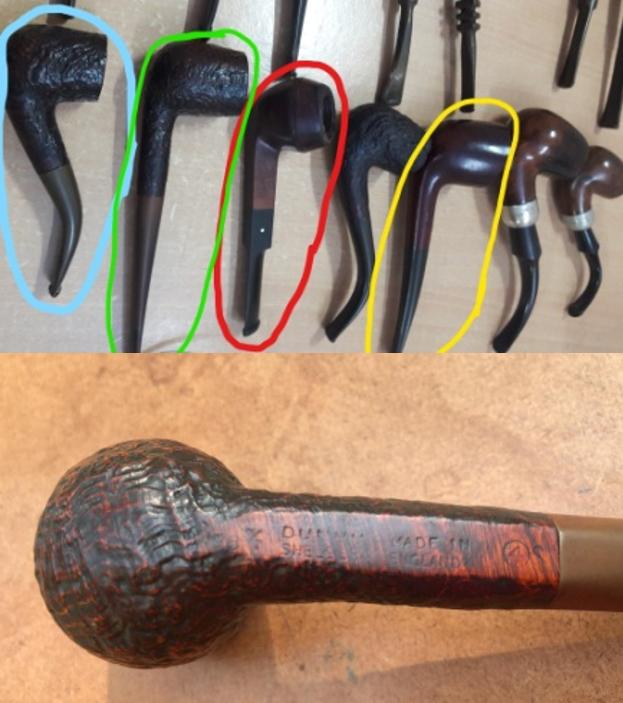
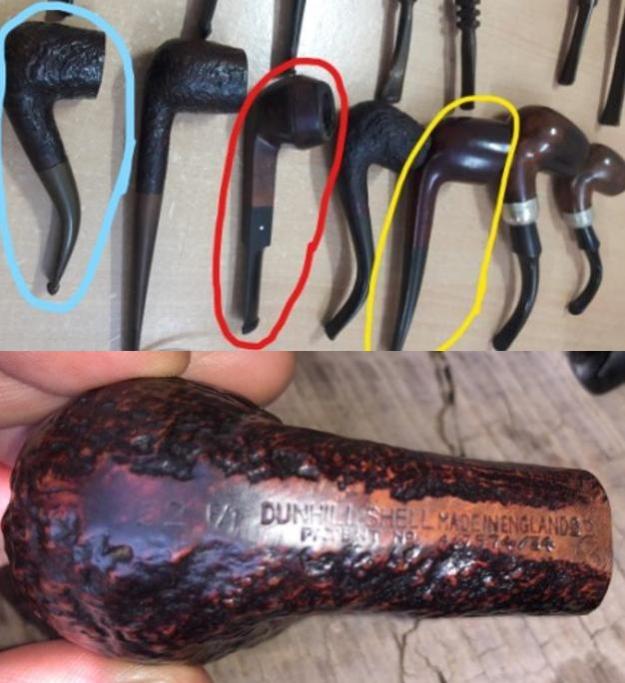
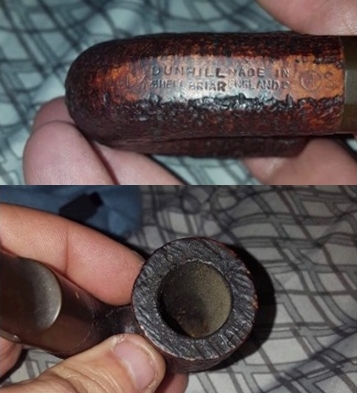
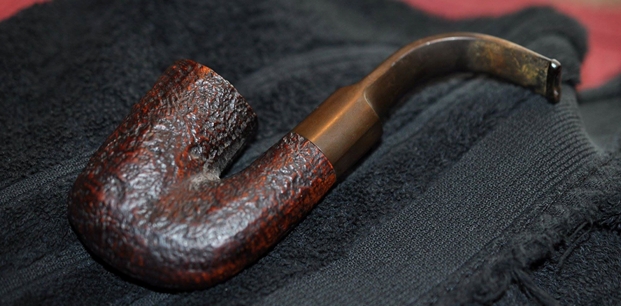
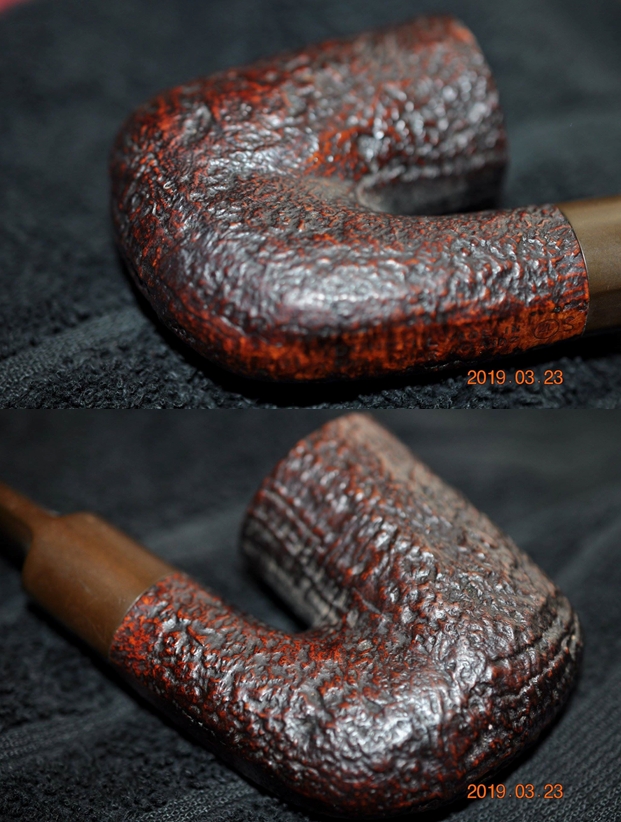
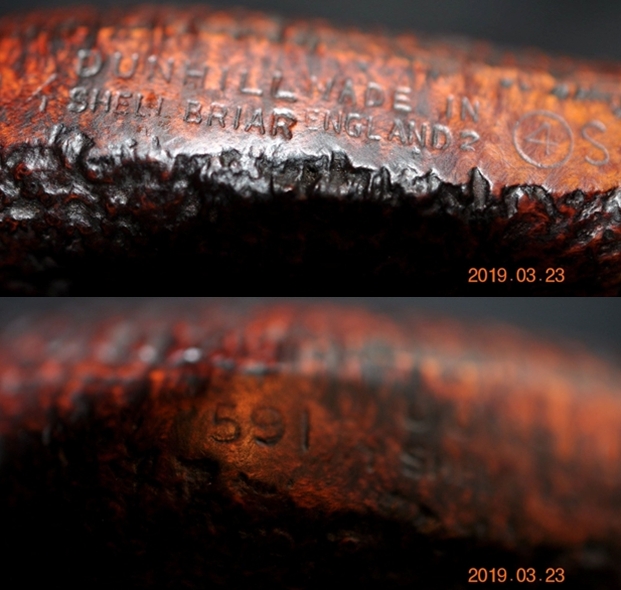
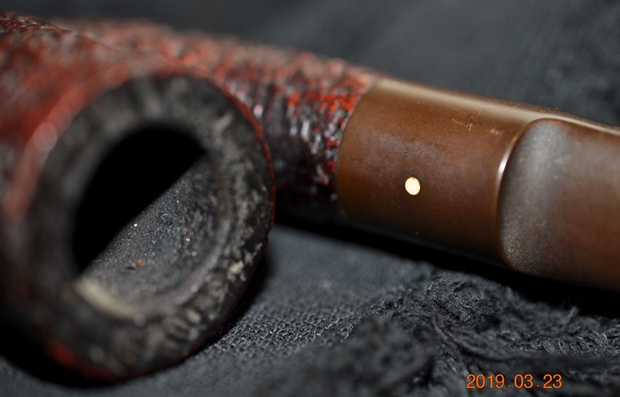
The pipe that I decided to work on next from this find is another Dunhill, a 1964 Shell Briar billiard, and is marked in an indigo circle in the picture below. It is stamped on the heel and the underside of the shank with the shape number 253 over a star followed by F/T followed by DUNHILL over Shell Briar over the COM stamp Made in England 4 which dates it as being made in 1964. This is followed by Group size number 4 in a circle and letter S for Shell. Dunhill White Dot adorns the top of the vulcanite stem. The stampings are deep, crisp and clear. I tried to search on pipedia.org for the significance of the star on the heel. However, the information available did not match with the stampings on the pipe on my worktable. I approached members in my group on FB. Their learned response indicated that Dunhill stamped their replacement stummel with a star at the bottom of the heel. They also assured me that these replacement bowls are intrinsically original with same quality as the original and that this does not affect the value of this pipe.

With assurance, I move ahead with the restoration of this beautiful medium sized and sandblasted Dunhill billiard.

INITIAL VISUAL INSPECTION
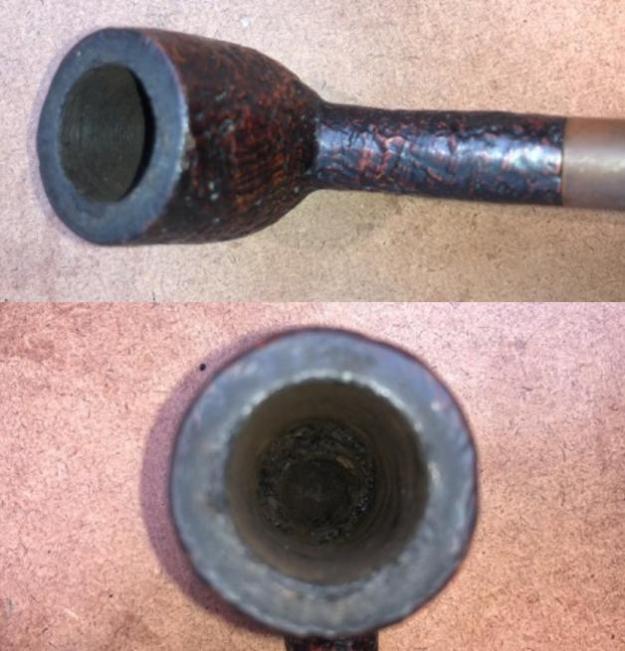
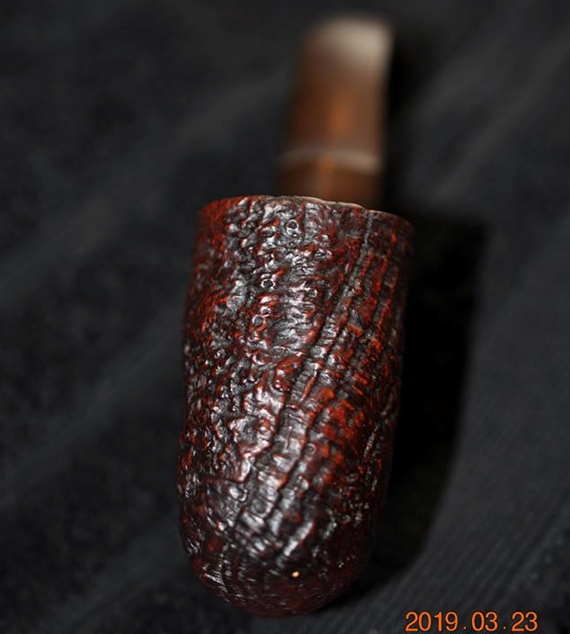
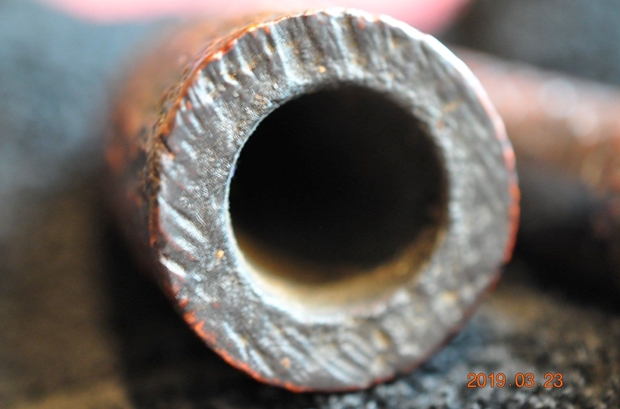
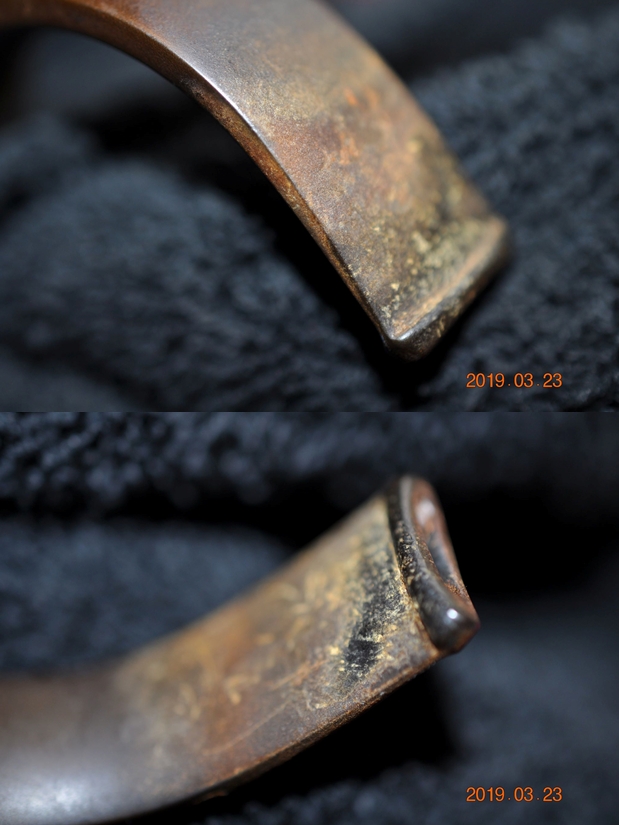
The chamber is clean with a thin layer of cake which indicates that the pipe has been kept clean by its previous Steward. From what I can see, the chamber walls appear to be without any damage. The chamber is odorless. There is an overflow of lava on the rim top surface. The inner rim edge show minor unevenness which should be easy to address. It is the outer rim edge that shows significant damage in the form of dents, dings and scratches, all along the circumference. This must have been caused due to hammering of the edge against a hard surface to remove dottle!!!!! This being a Dunhill Shell, it will be a challenge for me to fix these dents. The mortise is clean and so is the shank airway. The condition of this pipe is very similar to the earlier Dunhill Bruyere that I have restored and makes me wonder if these could have come from the collection of the same Steward. The stummel boasts of some beautiful sandblast patterns, a mix of straight and cross grain all around. It is dirty with grime and tar filling in much of the craggy finish. The briar looks lifeless and dull which is nothing serious to address. The round shank of the Billiard flows into a long tapered stem which has a flare, like a fish tail, at the button end and hence the stamp F/T. The vulcanite stem shows significant damage to the button end, in fact, there is no button at all, similar to the Dunhill Bruyere that was restored earlier!!!!! This convinces me that there is a high probability that these have been previously enjoyed by the same Steward. The stem end is missing, well, about an inch of vulcanite. This pipe would have been his favorite and he had continued to enjoy bowls of his favorite tobacco long after the button end had been chewed off. This is evident from the significant tooth chatter on both the surfaces of the stem. I intend to reconstruct/ rebuild this portion of the stem, including the slot, while maintaining the stem and general profile of the pipe. This will require major repairs. The quality of vulcanite is good. The condenser tube inside the stem however will have to be cleaned and sanitized. In this project, repairs to the damaged outer edge and stem rebuild will be a major challenge, the stem more so, as achieving the fish tailed profile of the stem will need to be adhered to for overall aesthetic appeal of this piece of briar. Having just finished the tedious restoration of the Dunhill Bruyere, I am aware of the challenges this restoration will present en-route.

THE PROCESS
Since the stem has significant damage, and from my experience of stem repairs this will be time consuming and laborious part, I start this project by tackling the stem first. I had decided to rebuild the entire stem including the button and the slot, while giving the button end a slight flare which is the trademark of a fish tail stem. This decision was partly dictated by the fact that I do not have a rotary cutting blade to cut the damaged button end and partly to my innate desire to maintain the originality of the pipe. It’s a Dunhill after all!!

Now that I was clear about the path to be followed, I first flame both the surfaces of the stem with a Bic lighter. The heat from the flame raises the vulcanite to the surface and takes care of the tooth chatter that was seen earlier. I sand the stem end with a folded piece of 220 grit sand paper to erase the scratches and provide a smooth surface for the intended fill. I cleaned out the internals of the stem with hard bristled and regular pipe cleaners dipped in isopropyl alcohol. Once I was satisfied with the internal cleaning, I wiped the stem surface, particularly the damaged button end, with a cotton pad and alcohol to remove any traces of dirt and grime. To begin the stem repairs, I smeared a folded pipe cleaner with petroleum jelly and inserted it in to the stem airway. I prepared a mix of CA superglue and activated charcoal and generously applied it over and extending beyond the broken surface and set it aside for curing over night. I have not researched and measured the exact length that I had to reconstruct, but eyeballed the length using the longer right side of the stem where a portion of the button was still intact. Before moving ahead, I would like to mention here that I had applied this mix in layers, over the week, to achieve sufficient thickness which would help during the filing and sanding while shaping the button and achieving the correct stem profile. While the stem repair was set aside to cure, I moved ahead to deal with the stummel repairs. There was practically no cake in the chamber and so I directly used a folded piece of 180 grit sand paper to sand out the traces of cake and expose the walls of the chamber to ascertain that there are no cracks/ heat fissures. I wiped the chamber with a cotton pad dipped in isopropyl alcohol to remove the carbon dust left behind by all the reaming and sanding process. The walls of the chamber were solid with no damage. This was followed by cleaning the mortise by scraping away at the dried gunk with my fabricated spatula and followed it up with further cleaning using cue tips, pipe cleaners and shank brush dipped in isopropyl alcohol. This eliminated all traces of old smells from previous usage.Continuing with the cleaning regimen, using a soft brass wired brush I gently scraped away the thick lava coat in the blast of the rim. With a hard bristled tooth brush and dipped in undiluted Murphy’s oil soap, I very deliberately scrubbed the sandblast finish on the stummel and the rim top. The stummel and rim top was dried using paper napkins and soft cotton cloth and set it aside to dry out naturally. The stummel looks fresh and clean. The damages to the outer rim edge are now clearly visible in the above pictures after the cleaning. At this point in the restoration, I was faced with the dilemma of whether or not should I top the bowl to address the rim damage. The issue was recreating the sandblast on the rim top after topping. I put this question to my friends from pipe restoration community on FB. Mr. Steve and Mr. Mark Domingues suggested that I stain the damaged areas with a stain pen and if this does not work, topping is the only recourse available. I went ahead with the suggestion and stained the damaged rim edges and rim top using Mahogany color stain pen. After it had dried completely, I again stained it with dark brown stain pen to darken it further. I set it aside for several hours before working on it any further. Here is how the rim appeared at this stage. Next, I rub a small quantity of “Before and After Restoration Balm” in to the briar with my finger tips and let it rest for a few minutes. The balm almost immediately works its magic and the briar now has a nice vibrant appearance with the beautiful contrasting hues colors that are unique to this sandblast pipe, on full display. I further buff it with a horse hair shoe brush. I had hoped that the balm would work its magic on the filled area and help in blending it a bit, and in this instance, the blend was perfect. The damaged surface has blended to an extent that it appears like a sandblasted surface. Sometimes in life, the most difficult issues have the simplest solutions!! I set the stummel aside and turned my attention to the stem repair. The fill had cured nicely and I moved ahead and began the process of filing and shaping the button end with a flat head needle file. This time around it was more  challenging as I had set for my self the aim of creating a fish tail shape (or rather as close a match to fish tail as possible), a straight thin slot and a concave shape to the button end as seen on original stems. Learning from past mistakes, I marked a straight line for the slot orientation and using only the tip of the pointed needle file, I carved out the slot. I followed it up by sanding with folded pieces of 180 grit sand papers to laboriously shape and widen the slot, always taking care to maintain a straight line. Once I was satisfied with the profile of the slot, I went ahead and shaped the button by first achieving a rough shape with a flat head needle file and there after fine tuning it by sanding it down with a 220 grit sand paper. Unfortunately, being so engrossed in this process made me forget to take pictures of the progess of these stages.

For a better blending, I further sand the entire stem with 220 followed by 400, 600 and 800 grit sand paper. This helps to reduce the sanding marks left behind by the more abrasive 220 grit paper. To bring a deep shine to the vulcanite stem, I went through the complete set of micromesh pads, wet sanding with 1500 to 2400 grit pads and dry sanding with 3200 to 12000 grit pads. I wiped the stem with alcohol after each pad and rubbed it down with Extra Virgin Olive oil to rehydrate the vulcanite. The repairs have blended in very well and the stem now looks shiny black and beautiful. The internals of the stem was once again cleaned out using alcohol and pipe cleaners to clear the airway of all the debris resulting due to the sanding. The finished stem is shown below. To finish, I re-attach the stem with the stummel. I mounted a cotton cloth buffing wheel to my local machine which is similar to the Dremel.  I set the speed at about half of the full power and applied White Diamond compound to the entire pipe. I wiped/ buffed the pipe with a soft cotton cloth to clear it of any leftover compound dust. I then mounted another cotton cloth wheel on to the polishing machine and applied several coats of carnauba wax. I finished the restoration by giving the entire pipe a rigorous hand buffing using a microfiber cloth to raise the shine further. The completed pipe looks lovely, fresh and vibrant. I cannot thank enough my friends Mr. Dal Stanton, Mr. Sam Vior, Mr. Victor Naddeo and Mr. Steve for helping me to research and complete this lovely 1964 made Dunhill Shell billiard.


Reconstructing a Broken Stem on Dunhill Bruyere # 51671


Blog by Paresh Deshpande

I had just finished the first of the 30 pipes from my Mumbai Bonanza find, a Stefano “EXCLUSIVE”; here is the link to the write up; https://rebornpipes.com/2019/03/11/mumbai-bonanza-stefano-exclusive-restorationa-month-long-project/

How did I land up with this lot makes for an interesting read and one which I have written about in the above restoration. Here are pictures of the pipes that I received in this lot. This lot contains some very nice collectible pipes, a few well known brand pipes and some mediocre pipe brands. Overall, with seven Dunhills, a Preben Holm #1, a couple of Made in England Pete System pipes, Charatan’s and other assorted pipes, I would say that I had hit a huge jack pot!!! Hence, I like to call this find as “Mumbai Bonanza”.

The pipe that I decided to work on is from this find and is marked in a red circle in the picture below. The stummel surface boasts of some beautiful bird’s eye grain on either side of the stummel while densely packed cross grain adorns the front and back of the stummel and also the shank top and bottom surface. It is stamped with “# 51671” towards the bowl and followed by “DUNHILL” over “BRUYERE” on the left side of the shank while the right side bears the COM stamp “MADE IN” over “ENGLAND” followed by underlined numeral “19”. Dunhill White Dot adorns the top of the vulcanite stem. The stampings on either side is deep, crisp and clear. The dating of this pipe is very straight forward and dates to 1979 (1960+19). However, deciphering the shape code, 51671, proved to be a challenge. The first digit 5 identifies this pipe as being Group size 5, second numeral, 1, identifies the style of mouthpiece as being tapered and this is where the ease ends and led to a lot of confusion with the next two digits. Though the shape appears as Zulu, it is not so since the shank is rounded. The profile of the pipe points towards it being a Horn shaped, but the shape code supports neither a Zulu nor a Horn!!! Well, another mystery which is likely to remain unresolved!!

With this information, I proceed ahead with the restoration of this handsome pipe, my first ever DUNHILL!

INITIAL VISUAL INSPECTION
The chamber is clean with a thin layer of cake which indicates that the pipe has been kept clean by its previous Steward. From what I can see, the chamber walls appear to be without any damage. The chamber is odorless. The inner rim edge show minor unevenness which should be easy to address. It is the outer rim edge that shows significant damage on the left side in 7 o’clock and 11 o’clock directions. This must have been caused due to hammering of the edge against a hard surface to remove dottle!! The rim top surface has a number of dents due to the same reason. The mortise is clean and so is the shank airway. The stummel surface is peppered with numerous dents and dings and scratches. Being a Dunhill, any issue of fills is never to be expected and hold true for this pipe too. These dents and ding are probably caused due to uncared for storage by the previous Steward and further contributed to by the trash collector who had sold the pipes to me. The stummel is covered in dirt and grime and is surprisingly slightly stick to the touch. The briar looks lifeless and dull which is nothing serious to address. The vulcanite stem shows significant damage to the button end, in fact, there is no button at all!! The stem end is missing, well, about half an inch of vulcanite. Heavy and slightly deep scratches can be seen extending upwards from the broken button side. The stem surface is very thin at the place where it has been chewed off by the previous owner. I intend to reconstruct/ rebuild this portion of the stem, including the slot, while maintaining the stem and general profile of the pipe. This will require major repairs. The quality of vulcanite is good. In this project, repairs to the damaged outer edge and stem rebuild will be a major challenge, the stem more so, as maintaining the tapered profile of the stem will need to be adhered to for overall appeal of this piece of briar. Having just finished the tedious restoration of the Stefano, I am aware of the challenges this restoration will be presenting enroute.

THE PROCESS
Since the stem has significant damage, and from my experience of stem repairs (Stefano nightmare!) this will be the most time consuming and laborious part of this restoration, I start this project by tackling the stem first. I was faced with two options in my approach to this stem repair; first was to recreate a new button around the broken part and maintain the existing stem profile with a straight slot and the second option was to cut away the damaged button and reconstruct an entirely new button with a straight horizontal slot, sacrificing the overall length of the pipe. I decided to take the former approach. This decision was partly dictated by the fact that I do not have a rotary cutting blade to cut the damaged button end and partly to my innate desire to maintain the originality of the pipe. It’s a Dunhill after all!!

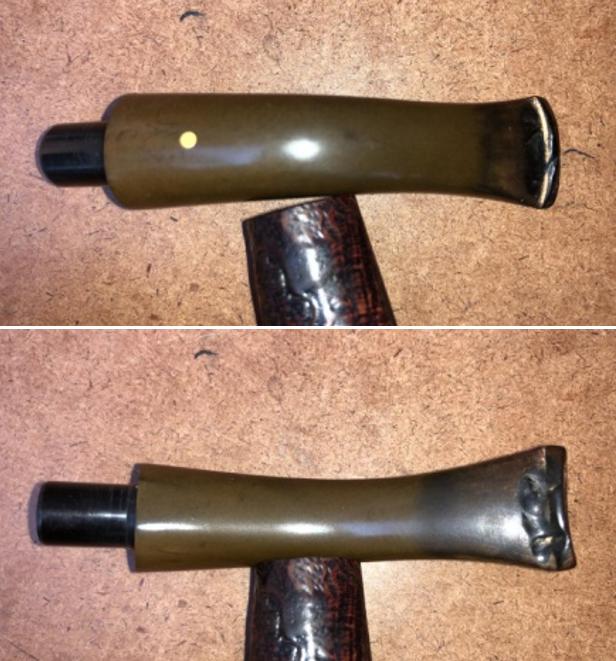
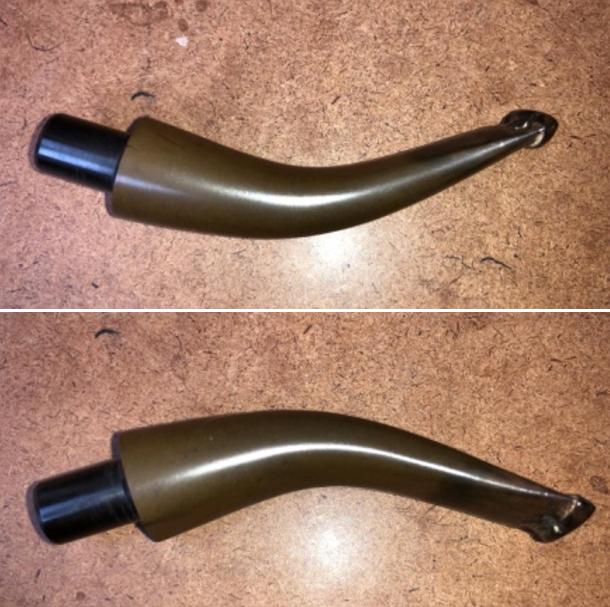
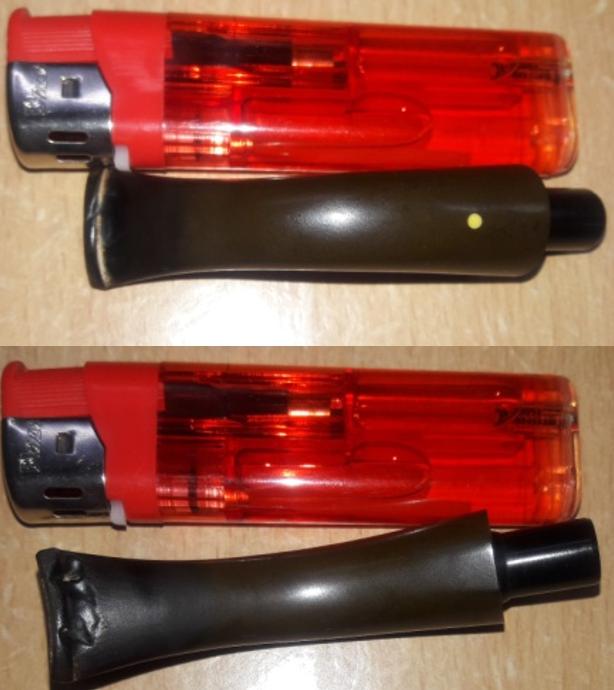
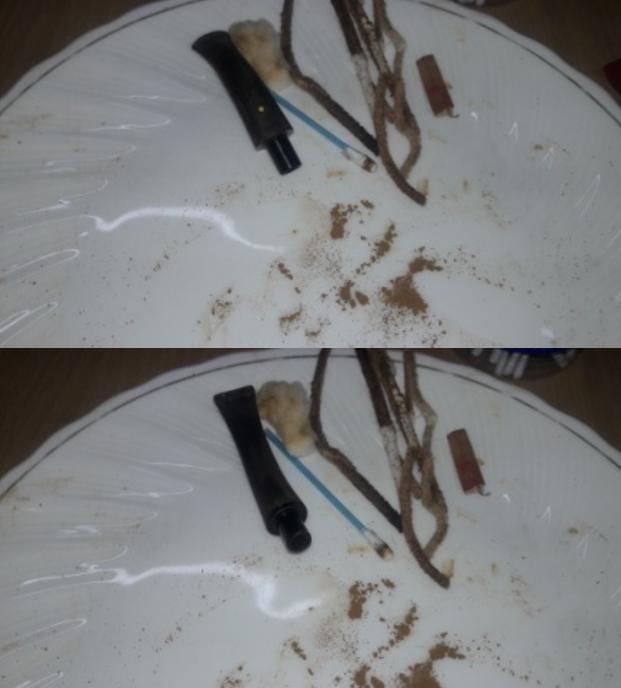
Now that I was clear about the path to be followed, I sand the stem end with a folded piece of 220 grit sand paper to erase the scratches and provide a smooth surface for the intended fill. I cleaned out the internals of the stem with hard bristled and regular pipe cleaners dipped in isopropyl alcohol. Once I was satisfied with the internal cleaning, I wiped the stem surface, particularly the damaged button end, with a cotton pad and alcohol to remove any traces of dirt and grime. To begin the stem repairs, I smeared a folded pipe cleaner with petroleum jelly and inserted it in to the stem airway. I prepared a mix of CA superglue and activated charcoal and generously applied it over and extending beyond the broken surface and set it aside for curing over night. To be honest, I have not researched and measured the exact length that I had to reconstruct, but eyeballed the length using the longer left side of the stem (where a very tiny raised portion of the button is still visible) as a guiding length. Before moving ahead, I would like to mention here that I had applied this mix in layers, over the week, to achieve sufficient thickness which would help during the filing and sanding while shaping the button and achieving the correct stem profile. Once I was satisfied that the fill had cured nicely, I moved ahead and began the process of filing and shaping the button end with a flat head needle file. And then this happened… As you can see in the following pictures, not everything was lost. There remained a portion of the fill which was intact. Not one to give up and having the experience of the Stefano behind me, I persisted with the reconstruction. I made a fresh mix of activated charcoal and CA superglue, this time around increasing the amount of superglue, and reapplied it over the broken button end after inserting a petroleum jelly smeared a folded pipe cleaner. I continued with the layering technique of building up the fill.The next set of pictures show the progress of the stem rebuild using the layering technique. Slowly but surely, I am getting there!Once I had achieved the desired thickness and having let the fill cure for a few days, I proceed with shaping the button using flat head needle files. I am quite pleased with the way things are progressing at this point in restoration. However, fingers remain crossed and mentally remained prepared for disaster to strike anytime. At this stage, I am pretty satisfied with the profile of the stem, the thickness of the button and, in general, the overall progress on the stem rebuild. Also glad that there have been no further setbacks!!!! With this I proceed to shape the horizontal slot for the button. It is a long drawn process and a tedious one at that!! The inside of the slot needed to be smoothed out while maintaining the thickness of the button edge on either side. I build up the insides of the slot by layering it with superglue, letting it cure, sanding and then applying a fresh layer. I must have repeated this process for good about a week plus!!!! The external surface of the slot was also developed the same way and this helped in maintaining the thickness of the button edge.While the stem repair was progressing at its own pace, I moved ahead to deal with the stummel repairs. Given the size of the chamber, I reamed the chamber with size 4 head of a PipNet reamer. The cake was thicker at the bottom and used the size 2 head to remove the cake. I used my fabricated knife and scraped out all the remaining cake. The amount of cake reamed out of the chamber really surprised me as I was expecting minimum cake. I further used one folded piece of 180 grit sand paper to sand out the last traces of remaining cake and expose the walls of the chamber to ascertain that there are no cracks/ heat fissures. I wiped the chamber with a cotton pad dipped in isopropyl alcohol to remove the carbon dust left behind by all the reaming and sanding process. The walls of the chamber were solid with no damage. This was followed by cleaning the mortise by scraping away at the dried gunk with my fabricated spatula and followed it up with further cleaning using cue tips, pipe cleaners and shank brush dipped in isopropyl alcohol. This eliminated all traces of old smells from previous usage. Continuing with the cleaning regime, using a hard bristled tooth brush dipped in undiluted Murphy’s oil soap, I very deliberately scrubbed the surface of the stummel and the rim top. The original reddish dye was also washed away to some extent. The stummel and rim top was dried using paper napkins and soft cotton cloth. I set the stummel aside to dry out naturally. The damages to the outer rim edge, uneven inner rim edge and stummel dents and dings are now clearly visible in the above pictures after the cleaning.

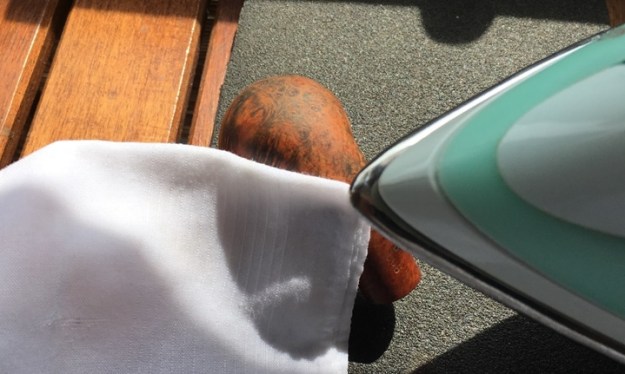
Next, I decided to address the dents and dings on the stummel surface and the damage on the rim outer edge by steaming them out. I heated my fabricated knife over the flame of a candle, placed a wet Turkish hand towel over the damaged areas and steamed out the dents by placing the heated knife over the towel. Though some dents were still observed, these were greatly reduced when compared to before steaming. The steaming method had raised to the surface all the major dents and dings. However, the outer edge of the rim still remained unaffected. The steaming method having failed to address the issue of the damaged outer rim edge, I decided to use a more aggressive method of topping the rim top. Personally, I prefer to avoid topping as I do not appreciate loosing even one mm of briar estate, but in this instance, I was left with no recourse but to top the rim. I topped the rim on a 220 grit sand paper, checking frequently the progress being made. The damage to the outer rim was so extensive that the even after what felt like ages of topping, the damage was still apparent. Finally, I just did not feel like topping any further and hence decided on another course of action. I would rebuild the outer edge with briar dust and superglue. Having decided on this course of action, I lightly top it on 600 grit sand paper to reduce the sanding marks left behind by the 220. The only benefit derived from this topping was that the inner rim is now perfect and I collected some briar dust!

I tried mixing briar dust with superglue, but to no avail. The moment the two came in contact with each other, the mix hardened. So I resorted to the layering method again, first I layered superglue over the damaged surface followed by sprinkling of briar dust and one final layer of superglue. I set the stummel aside to cure. The only problem with this method is the high probability of presence of air pockets.The next evening, the repairs to the edge had completely cured and I move ahead by filing and rough shaping with a flat head needle file. I further fine tune the blending by sanding it down with 220, 320, 600 and 800 grit sand papers. Here is how the repaired area appears at this stage. I am very pleased with the way this repair progressed.Steaming out the dents and dings from the stummel surface had necessitated that the surface of the stummel be evened out by sanding. I sand the entire stummel using 220, 400, 600 and 800 grit sand papers. The little dents and dings that remained on the stummel and outer rim edge were also evened out under this sanding process. This was followed by polishing with micromesh pads. I wet sand the stummel with 1500 to 2400 grit pads and follow it up by dry sanding with 3200 to 12000 grit pads. I wiped the surface with a moist cotton cloth after every wet pad to check the progress. The repaired rim edge now appears shiny and glossy. This has got me a bit worried as it stands out from the rest of the stummel surface. I fervently pray that this is masked after I have stained it. I rub a small quantity of “Before and After Restoration Balm” in to the briar with my finger tips and let it rest for a few minutes. The balm almost immediately works its magic and the briar now has a nice vibrant appearance. I further buff it with a horse hair shoe brush. I had hoped that the balm would work its magic on the filled area and help in blending it a bit, but that did not happen. I had simultaneously been working on the stem reconstruction by building up the slot and button using the layering technique. Though tedious, I have reached a satisfactory stage from where I can fine tune the slot and button edges. What followed were hours of tedious, back breaking and nerve wracking process of sanding and shaping of the slot and the button. Though the slot is not a perfect horizontal straight opening, rather a slight oval, I have managed to match the profile and dimensions of the original stem and the pipe is definitely smokable. Here are pictures of the progress.For a better blending, I further sanded the entire stem with 220 followed by 400, 600 and 800 grit sand paper. This helps to reduce the sanding marks left behind by the more abrasive 220 grit paper. To bring a deep shine to the vulcanite stem, I went through the complete set of micromesh pads, wet sanding with 1500 to 2400 grit pads and dry sanding with 3200 to 12000 grit pads. I wiped the stem with alcohol after each pad and rubbed it down with Extra Virgin Olive oil to rehydrate the vulcanite. The repairs have blended in very well and the stem now looks a shiny black and beautiful. The internals of the stem was cleaned out using alcohol and pipe cleaners. The finished stem is shown below. I kept the stem aside to let the stem absorb the oil and turn my attention towards the stummel. I decided to stain the stummel in cherry red stain which was the original stain true to the Bruyere line of Dunhill pipes. I use the powder variety of stain and mix it with 99% isopropyl alcohol. I heated the stummel surface with a heat gun and applied the stain with a folded pipe cleaner. As I paint the stummel with stain over sections at a time, I burn the dye using a Bic lighter that combusts the alcohol in the aniline dye and sets the dye pigmentation in the wood.  After fully saturating the stummel and covering the whole surface, including the rim top, I set the stummel aside to rest for several hours. By next evening, the stain had set nicely. I mount a cotton cloth buffing wheel (because I do not have felt cloth buffing wheels!!) on the Dremel and set the speed at about 40% of full RPM and apply red compound to the stummel. This does help in revealing the grains gradually; however, my fears had come true. The repairs to the outer edge of the rim did not absorb the stain and is encircled in yellow. To finish, I re-attach the stem with the stummel. I mounted a cotton cloth buffing wheel to the Dremel (actually it is not the brand machine, but a local machine which is similar).  I set the speed at about half of the full power and applied White Diamond compound to the entire pipe. I wiped/ buffed the pipe with a soft cotton cloth to clear it of any leftover compound dust. I then mounted another cotton cloth wheel on to the polishing machine and applied several coats of carnauba wax. I finished the restoration by giving the entire pipe a rigorous hand buffing using a microfiber cloth to raise the shine further. The completed pipe looks lovely, fresh and vibrant; the photographs in this case, do not do justice to the appearance of this beautiful pipe, my first Dunhill. I cannot thank enough my friends Mr. Dal Stanton, Mr. Sam Vior, Mr. Victor Naddeo and Mr. Steve for helping me to research and complete this mysteriously stamped Dunhill pipe. PS: The readers would have observed the fact that the rim repair could not blend completely in spite of my best of efforts and still I have highlighted the flaw while the general tendency is to hide it. True, there are reasons for me highlighting the flaws; firstly, if I cannot hide it from myself, than why attempt to pretend it’s not there and secondly, the highlighting will encourage you to have a closer look at the flaw and maybe you could have an explanation for it in the first place and share it with me. This will help me in avoiding these mistakes in my future restorations. Third and most important reason is that a newbie somewhere who is not so fortunate like me to have friends and mentor that I have will also benefit from my mistakes.


Mumbai Bonanza: Stefano “Exclusive” Restoration…a month long project


Blog by Paresh Deshpande

I was on leave a few months back. Two days before I was to rejoin my work place, I received a call from a friend in Mumbai saying that he had come across a person who collects trash and unwanted items from all posh bungalows and apartments in the area and that he had a seen a few pipes, similar to the ones I restore, in his cart. This friend had taken down his contact number and shared it with me. Now the readers of this write up must understand that we do not have a “Pipe Culture”!! During colonial days, smoking a pipe was common and after the British left, in next few decades, it died its natural death. Today, pipes are not available here and neither is pipe tobacco!! So with this background, it came as a big surprise to me that a trash collector had pipes. I had nothing to lose by giving him a call and this is exactly what I did. While I was speaking to him, it dawned on me that this person did not know what he was selling, could not read or text me the stampings on the pipes. The conversation that I had with him in my local dialect was nothing short of being hilarious. I could not make out what I would be purchasing and he did not know what he was trying to sell!! He had 30 pipes for sale. I am very pathetic at any form of gambling and in such case bad luck follows me like a shadow. I shared this dilemma with Mr. Steve who suggested that I should go ahead and strike a deal. If nothing else, I shall have some spares!! That sounded logical and I struck a deal with the “kabadiwala” (this is what a trash collector is called here in local parlance) for all 30 pipes. The next day I joined my work place and the parcel reached Abha, my wife, after about 10 days. Here is what she received in the parcel. This parcel contained some very nice collectible pipes, a few well known brand pipes and some mediocre pipe brands. Overall, with seven Dunhills, a Preben Holm #1, a couple of Made in England Pete System pipes, Charatan’s and other assorted pipes, I would say that I had hit a huge jack pot!!! Hence, I like to call this find as “Mumbai Bonanza”.

The pipe that I decided to work on is from this find and is marked in a red circle in the picture below (little did I know what I was getting in to at this point!!!). It’s stamped as “Stefano” in small italics over “EXCLUSIVE” in block letters on the left side of the shank and on the right side of the shank it is stamped as “SELECTED” over “BRIAR”. The stummel shows some lovely straight grain which contrasts with the rest of the swirls on the stummel surface. The quarter bent tapered saddle vulcanite stem bears the “crown” logo on the top surface and is designed to take a 9mm filter.

To research this pipe, I turned to pipedia.org and the search for “Stefano” led me to the page on Stefano Santambrogio,  here is the link to the page; https://pipedia.org/wiki/Santambrogio

The information gleaned from this page is that this is an Italian manufactured pipe by Santambrogio family who are in to pipe manufacturing since 1912!! The present owner, Mr. Stefano Santambrogio has been at the helm of affairs since 1981. What really baffled me was the stem logo which was very different to what I have on the pipe in front of me. I decided to narrow down my research for the stem logo and turned to another site which I frequent, pipephil.eu.

I specifically searched for stems with crown logo and there it was at the end of the list marked as “Stefano”. The match was perfect. One click on the link led me to http://www.pipephil.eu/logos/en/logo-s3.html#santambrogio

Here the information available was more or less similar to that on pipedia.org, however, it was mentioned that Stefano could be a Santambrogio second. Another click on Stefano took me to a page which had pipes with identical stamping on the shank and stem logo to the one I was working on. It was revealed that Stefano was indeed a Santambrogio export for the German market!!
With this information, I proceed ahead with the restoration of this handsome pipe.

INITIAL VISUAL INSPECTION
The chamber is clean with a thin layer of cake which pleases me no end as this would be a first for me. From what I can see, the chamber walls appear to be sans any damage. The chamber smells of a strong aromatic tobacco and needs to be addressed.The stummel is stained in an orange dye which has worn out in time. At places, it appears like a patch work. The stummel surface is peppered with numerous dents and dings, and a large number of huge fills on the right side of the stummel and the shank. These fills need to be refreshed. I intend to sand the stummel surface with grit papers with two-fold aim; first is to get rid of the orange stain color and second is to minimize the dents and dings from the surface. The plateau rim top surface has little traces of lava overflow and should be easy to deal with. The mortise is surprisingly filthy given how clean the chamber and the rim top appear to be. The vulcanite stem shows significant damage to the upper button, side wall and the round slot, but it is not oxidized. The pseudo p-lip style bit has a through and through hole exposing the airway. This will require major repairs. The quality of vulcanite is good.

THE PROCESS
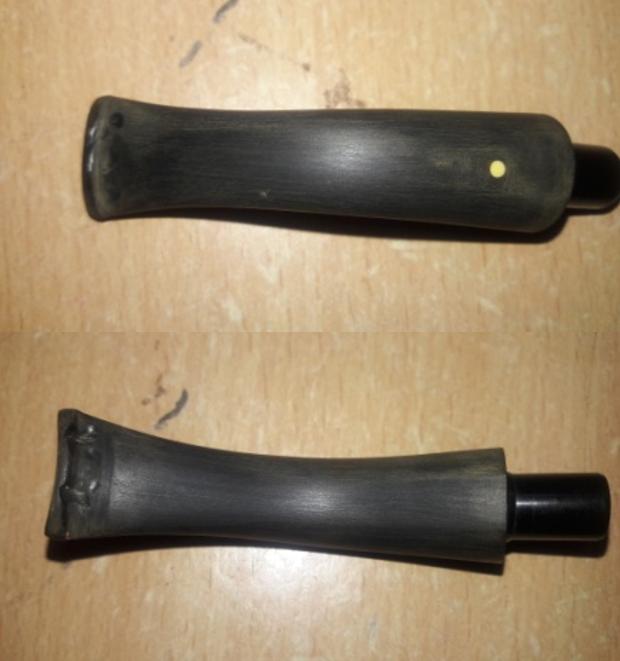
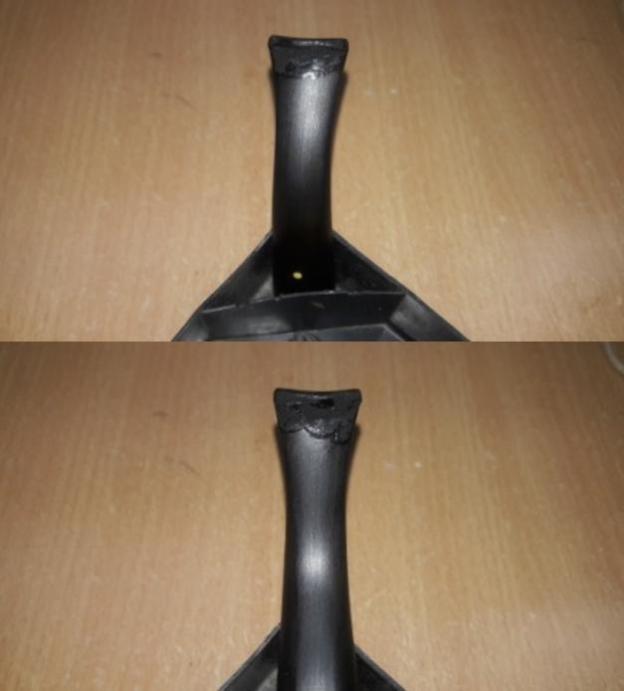
Since the stem has significant damage, and from my experience of stem repairs this will be the most time consuming and laborious part of this restoration, I start this project by tackling the stem first. I was faced with two options in my approach to this stem repair; first was to recreate a new button around the broken part and maintain the existing stem profile with a round slot and the second option was to cut away the damaged button and reconstruct an entirely new button with a straight horizontal slot, sacrificing the P-lip shape. I decided to take the former approach. This decision was partly dictated by the fact that I do not have a rotary cutting blade to cut the damaged button end and partly to my innate desire to maintain the originality of any pipe.

Now that I was clear about the path to be followed, I cleaned out the internals of the stem with hard bristled and regular pipe cleaners dipped in isopropyl alcohol. I also cleaned the wide tenon with q-tips dipped in alcohol. Once I was satisfied with the internal cleaning, I wiped the stem surface, particularly the damaged button end, with a cotton pad and alcohol to remove any traces of dirt and grime. To begin the stem repairs, I smeared a pipe cleaner with petroleum jelly and inserted it in to the stem airway. I prepared a mix of CA superglue and activated charcoal and generously applied it over the gaping hole in the button of the stem and set it aside for curing over night. Before moving ahead, I would like to mention here that I had applied this mix in layers, over the week, to achieve sufficient thickness which would help during the filing and sanding while shaping the button.While the stem repair was progressing at its own pace, I moved ahead to deal with the stummel repairs. Given the size of the chamber, I reamed the chamber with size 4 head of a PipNet reamer. I used my fabricated knife and scraped out all the remaining cake. The amount of cake reamed out of the chamber really surprised me as I was expecting minimum cake. I further used a folded piece of 180 grit sand paper to sand out the last traces of remaining cake and expose the walls of the chamber to ascertain that there are no cracks/ heat fissures. I wiped the chamber with a cotton pad dipped in isopropyl alcohol to remove the carbon dust left behind by all the reaming and sanding process. The walls of the chamber were solid with no damage. I gently scraped the plateau rim top surface with a sharp knife to remove the lava overflow. This was followed by cleaning the mortise with cue tips, pipe cleaners and shank brush dipped in isopropyl alcohol. This further eliminated traces of old smells from previous usage. The old smell was still strong, though. Continuing the cleaning regime, using a hard bristled tooth brush dipped in undiluted Murphy’s oil soap, I very deliberately scrubbed the surface of the stummel. I cleaned the plateau rim top with a brass wired brush. The original orange dye was also washed away to some extent. The stummel and rim top was dried using paper napkins and soft cotton cloth. The old fills are now clearly visible and appear like festering flesh wound, ugly in appearance. This will have to be addressed. I set the stummel aside to dry out naturally. To completely eliminate the smell, I decided to resort to alcohol bath. I packed the chamber, just below the rim, with cotton balls. I stretched a cotton ball into a thick wick, tapering at one end, and inserted it in to the shank and pushed it as far inside as I could along with a regular pipe cleaner. I topped the bowl with isopropyl alcohol using a syringe. I know that it is generally a practice to use Kosher salt for this procedure, but since Kosher salt is not easily available here, and when available, it’s very expensive, I use cotton balls. I find that cotton balls work just fine in drawing out all the tars and smells from the mortise and the bowl. I topped the bowl with alcohol again after 30 minutes when the alcohol level had gone down and set it aside overnight for the cotton and alcohol to do its intended job. The next day, the cotton and alcohol had fulfilled its intended task. The pipe cleaner had also drawn out all the stain from within the mortise. I removed the cotton balls and ran pipe cleaners through the mortise to clean out all the loosened tars and gunk. The internals of the stummel is now clean and fresh and the ghost smells are history too.The stage is now set for repairs to the stummel surface. I address the fills, first by gouging out the old fills with a sharp knife and cleaning the surface with a cotton pad dipped in isopropyl alcohol. This was followed by filling these gouges with a mix of briar dust and CA superglue. I always over fill the gouges so that when I sand them down they are smooth and I can feather in the fills with the rest of the briar. I set the stummel aside to cure overnight. I would like to remind the readers that all these days, layering of the stem button with charcoal and superglue had been in progress and now I was satisfied with the thickness of the layering. Using a needle file, I sand the filling to match the surface of the stem. However, disaster struck within a few moments of filing!! The filling broke away from the intact portion of the button. It was, in all probability, due to higher content ratio of activated charcoal in the mix (though I am not convinced entirely) or could be lack of adequate curing (most likely). The bottom line remains that I had to repeat the entire layering process on the button end again…..frustrating to say the least, thus NO PICTURES OF THE DISASTER TAKEN!!Well, what was to happen has happened!! Moving on, the stummel fills had cured and I proceeded to sand the fills with a flat head needle file and 180 and 220 grit sand papers to achieve a rough blend of the fills with the rest of the stummel.  For a better blending, I further sanded the entire stummel with 220 followed by 400 and 800 grit sand paper. This helps to reduce the sanding marks left behind by the more abrasive 220 grit paper. To bring a deep shine, I went through the complete set of micromesh pads, wet sanding with 1500 to 2400 grit pads and dry sanding with 3200 to 12000 grit pads. I wiped the stummel with a moist cloth after each wet pad. The fills are still looking ugly and somehow I have a gut feeling that this pipe is not yet done with me!! This pipe is really testing my skills and patience!! I rub a small quantity of “Before and After Restoration Balm” in to the briar with my finger tips and let it rest for a few minutes. The balm almost immediately works its magic and the briar now has a nice vibrant appearance. I further buff it with a horse hair shoe brush. This is when I observed that there are air pockets in two fills (marked in yellow circle) and the plateau rim top is still not clean! Aargh…both my faults, I know. I will address them all over again. I would like to remind the readers that all this while the layering of stem is still a work in progress!! I spot fill these air pockets with superglue and let it cure for complete two days. Finally, the button construction appears solid and I progress with filing with a flat head needle file and followed it up with sanding and finer shaping using 220, 320, 600 and 800 grit sand papers. I shaped the round slot by gentle use of a round needle file. I liberally rub some Extra Virgin Olive oil to rehydrate the vulcanite stem. But readers please do not rejoice just yet!! The repairs show a white edge in the repairs near the round slot indicating that the repair is not solid and likely to fall apart and also presence of the dreaded air pockets!! This pipe is just not willing to take repairs. It’s now becoming a fight of WILLS between us. I kept up the self conviction and self confidence, which was constantly assuaged by the encouraging words of my mentor, Mr. Steve. I persisted with the repairs and filled these areas with clear superglue and keep it aside for curing. Not wanting to waste time, I picked up the stummel again and went through the complete process of filing and sanding the fills and ending with the micromesh cycle. The fills are nice, solid and even. I even cleaned up the plateau rim top by scrubbing it with a dry brass wired brush till clean. Here is the picture of the fill at this stage. Now the only thing that remains is to blend these fills with the rest of the stummel. I intend to stain it in dark brown dye.I use the powder variety of stain and mix it with 99% isopropyl alcohol. I heated the stummel surface with a heat gun and applied the stain with a folded pipe cleaner. As I paint the stummel with stain over sections at a time, I burn the dye using a Bic lighter that combusts the alcohol in the aniline dye and sets the dye pigmentation in the wood.  After fully saturating the stummel and covering the whole surface, including the plateau rim top, I set the stummel aside to rest for several hours. Now with the stummel surface absorbing the stain, I turn towards the stem repair again. I followed the complete regime, as previously described, till I reached the stage which required micromesh sanding to bring deep shine to the vulcanite. All looked good till this stage. I sand the entire stem with 220 followed by 400 and 800 grit sand paper. This helps to reduce the sanding marks left behind by the more abrasive 220 grit paper. To bring a deep shine, I went through the complete set of micromesh pads, wet sanding with 1500 to 2400 grit pads and dry sanding with 3200 to 12000 grit pads. I wiped the stem with alcohol after each pad and rubbed it down with Extra Virgin Olive oil. Once I was through with the micromesh cycle, this is what I saw…DO NOT LOOSE HEART, I kept reminding myself and proceed to redo the entire button repair again for… I do not even remember the number of times!!! After going through the entire stages again, these repairs turn out to be good enough. But I forgot to take pictures!!!
Once the stem repair was completed, I turned my attention to the stummel. The stain had set nicely. I mount a cotton cloth buffing wheel (because I do not have felt cloth buffing wheels!!) on the Dremel and set the speed at about 40% of full RPM and apply red compound to the stummel. This does help in revealing the grains gradually while masking the darker fills.

To finish, I re-attach the stem with the stummel. I mounted a cotton cloth buffing wheel to the Dremel (actually it is not the brand machine, but a local machine which is similar).  I set the speed at about half of the full power and applied White Diamond compound to the entire pipe. I wiped/ buffed the pipe with a soft cotton cloth to clear it of any leftover compound dust. I then mounted another cotton cloth wheel on to the polishing machine and applied several coats of carnauba wax. I finished the restoration by giving the entire pipe a rigorous hand buffing using a microfiber cloth to raise the shine further. The completed pipe looks lovely, fresh and vibrant; the photographs in this case, do not do justice to the appearance of this beautiful little pipe. Thank you for having the patience to reach this far while reading the write up, which I felt was boring and a drag while typing. So these thanks are well deserved for you. PS: – I agree with all who have observed that the stummel fills are still visible. I have observed it too, but no amount of stain pen usage, re-staining and polishing made any difference. Some fills just do not blend for whatever reason. An interesting definition of a Fill in glossary page on pipedia.org means: “A void, pit or flaw in the briar which is made level with the surface of the pipe with either putty or a mix of briar dust and cyanoacrylate glue and which, despite staining, is often visible on close inspection”.


Fresh Life for  a Stanwell Brazilia 87 Apple


Blog by Steve Laug

The next pipe in the queue came from a group of pipes Jeff and I purchased from a fellow in Pennsylvania who was selling out his collection as he no longer smoked a pipe. We picked up quite a few of his pipes and they included this beautiful Stanwell Made in Denmark Brazilia with a horn shank extension. It is a round apple shaped pipe with a round rim top curving from the sides into the bowl. The entire pipe had some beautiful mixed grain around the bowl. The rim top was covered with a thick tar and lava coat. The pipe was filthy but the grain underneath was rich and the finish looked like it would clean up well. The pipe is stamped on the underside of the shank and reads Stanwell over Brazilia over Made in Denmark. On the right side of the shank it is stamped with the shape number 87. The stem is vulcanite and has the Stanwell Crown S on the top side. The stem is dirty and had deep tooth marks and chatter on both sides of the stem at the button edge. The photos below tell the story and give a glimpse of the pipe before clean up.Jeff took photos of the bowl and rim from various angles to capture the condition of the pipe before he started his cleanup work. There was a thick coat of lava on the rim and the cake in the bowl. It appeared that the beveled inner edges were in good condition. The outer edges actually appeared to be in excellent condition. He also took a series of photos of the sides of the bowl and shank to show the straight grain around the bowl. It is very dirty but the grain is visible in the photo. Jeff took photos of the stamping on the underside and the right of the shank. It reads as noted above and is clear and legible. The horn shank extension is quite stunning and should shine up nicely. The next two photos show the stem surface. They show the deep tooth marks on both sides near the button. The stem is oxidized and has a thick build up around the button end.Jeff did his usual thorough clean up job on the pipe so that  when it arrived here in Vancouver it looked really good. Jeff reamed the bowl with a PipNet pipe reamer and followed up with a Savinelli Fitsall pipe knife to remove the cake. He scrubbed out the mortise and the airway in the shank and the stem with alcohol, cotton swabs and pipe cleaners. He scrubbed the exterior of the bowl, rim, shank and stem with a tooth brush and Murphy’s Oil Soap to remove the oils and tars on the rim and the grime on the finish of the bowl of the pipe. He rinsed it off under running water. He dried it off with a soft cloth. He was able to remove all of the lava build up on the beveled rim top of the pipe. The rim top looked really good with a little darkening on the inner bevel toward the front of the bowl. The mixed grain stood out on the clean pipe. He soaked the stem in Before & After Deoxidizer and was able to remove the oxidation. The pipe looked very good.I took photos of the pipe to show its condition before I started my work. I took a close up photo of the bowl and rim to capture the condition of the pipe before he started my restoration of the pipe. The rim top was clean but had some darkening on the inside edge of the rim at the front of the bowl. It was solid so it was not charred. The horn shank extension looked dry and lifeless but otherwise in good condition. The stem was quite clean with some deep tooth marks on the top and underside near the button.I started the process of the restoration by working on the bowl. I worked over the inner bevel of the rim with 220 grit sandpaper to address the darkening and light damage.I polished the briar with 2400-12000 grit micromesh sanding pads – wet sanding with 1500-2400 grit pads and dry sanding with 3200-4000 grit pads. I wiped the bowl down with a damp cloth after each pad. I found that with each successive grit of micromesh the grain on the bowl and shank sides stood out more and gave a shine to the pipe. The sanded rim top was beginning to blend in quite well. I stained the top of the bowl to match the rest of the bowl. I used a Maple stain pen and set it aside to dry.As is my pattern on these restorations, I worked some Before & After Restoration Balm into the surface of the briar with my fingertips to clean, enliven and protect it. I let the balm sit for a little while and then buffed with a cotton cloth to raise the shine. The following photos show the bowl at this point in the restoration process. The bowl and the rim top look really good and the darkening is lessened. The finish looks very good with the rich brown stain on the bowl and rim. The horn has come alive once again and the striations of colour are rich. I am very happy with the results. With the bowl finished I set it aside and turned my attention to the stem. I filled in the deep tooth marks with black super glue and rebuilt the damage on the button. I set the stem aside to let the repairs cure overnight.In the morning when the repairs had cured I used a needle file to cut the sharp edge of the button and to flatten out the repairs. I sanded the stem surface with 220 grit sandpaper to smooth out tooth chatter and light tooth marks. I polished the surface of the whole stem with 400 grit wet dry sandpaper.I touched up the Stanwell Crown S with a white touch up pen. I used a dental pick to push it into the grooves and polished the excess off with a coarse cotton cloth. I did it early in the polishing to make sure I did not polish off any of the deep grooves of the stamp.I continued to polish the stem with micromesh sanding pads – wet sanding it with 1500-2400 grit pads and dry sanding it with 3200-12000 grit pads. I wiped the stem down with a damp cloth after each pad. I further polished it with Before & After Pipe Polish – both Fine and Extra Fine. I wiped it down with a coat of Obsidian Oil and set it aside to dry. Since I had finished both the bowl and stem I put them together and polished them both with Blue Diamond polish on the buffing wheel. I gave the bowl multiple and the stem multiple coats of carnauba wax. I buffed the pipe with a clean buffing pad to raise the shine. I hand buffed it with a microfiber cloth to deepen the shine. The pipe polished up pretty nicely. The mixed grain really began to stand out with contrast as I buff the bowl. The rich medium brown finish on the briar works well with the polished horn shank extension and the black vulcanite stem. Stanwell has a knack for making pipes that not only look good but also feel great in the hand. Have a look at it with the photos below. The dimensions are Length: 5 1/2 inches, Height: 1 7/8 inches, Outside diameter of the bowl: 1 1/2 inches, Chamber diameter: 3/4 of an inch. I will be putting this beauty on the rebornpipes store shortly and it can be added to your collection. Thanks for walking through the restoration with me on this beautiful Stanwell Brazilia 87 Apple.

Giving New Life to a “Malaga” Custom Carved Acorn


Blog by Steve Laug

I am working through a lot of the queue of pipes that are sitting in my repair bin in the evenings this week. Next on the table is another Malaga from Alex that he dropped off for a restoration. It is what Malaga called a Custom Carved pipe. It is an Acorn or Strawberry shaped pipe with a smooth finish. The top is slightly crowned with a flat rim top. The pipe has an unstained natural oil finish. The pipe had been lightly reamed and cleaned according to the seller. The bowl and shank were dirty but there was a light cake that was heavier in the bottom half. The rim top had a thick lava coat and some damage on the top surface. There was a deeper burn mark on the front inner edge. The pipe is stamped on the right side of the shank and reads “MALAGA” over Custom Carved. The finish on the pipe is spotty with a lot of grime and dust ground into the finish. The stem was very deeply oxidized and polished over the oxidation. There was tooth damage on the button itself and on both sides of the stem. The photos give a pretty clear picture of the shape of the pipe and its general condition when I received it. I took a close up photo of the bowl and rim to capture the condition of the pipe before I started my restoration of the pipe. The rim top had some tars and lava build up but the edges were fairly clean. There was a light burned are on the right front inner edge of the bowl. The stem itself was an interesting mess. It had been shinned and polished but there was still some very deep oxidation that is visible – with the shine is a cloudy brown colour. There are also tooth marks on both sides of the stem and on the button surface. I took a photo to capture the stamping on the right side of the shank and one of the underside of the shank. The first photo shows stamping as noted above. The stamping on this pipe is clear and readable. This time it includes the quotation marks that show up on various Malaga pipes. There was also the letter C was stamped on the underside of the shank at the stem/shank junction. I believe this refers to the fact that the pipe has the Malaga Carved finish. For those of you who are unfamiliar with the brand, I am also including the link to a blog that I wrote that gives some of the history of the Malaga brand and the Malaga Pipe Shop in Royal Oak, Michigan in the USA. Here is the link – https://rebornpipes.com/tag/malaga-pipes/. That blog also includes links to a catalogue and the history of the pipemaker George Khoubesser. If you are interested to learn more, than I invite you to follow the link to get a feel for the brand and the pipemaker.

I reamed the bowl with a Savinelli Fitsall Pipe Knife to clean up the remaining cake and to scrape away the tars and lava on the rim top.I scrubbed the exterior of the bowl with undiluted Murphy’s Oil Soap and a tooth brush. I rinsed the bowl under running water and dried it off with a soft cloth. I took photos of the bowl at this point in the cleanup process. I started my work on the pipe topping the bowl on a topping board with 220 grit sandpaper. I wanted to remove as much of the damage to the rim top as possible and minimize the burn damage on the front edge of the bowl. Once I had the bowl topped I repaired a damaged spot on the front of the bowl with clear super glue and briar dust. While the repair dried I used a folded piece of sandpaper to smooth out the inner edge of the bowl. Once the repair cured I sanded it smooth. I polished the bowl, shank and the freshly sanded rim top with 2400-12000 grit micromesh sanding pads – wet sanding with 1500-2400 grit pads and dry sanding with 3200-12000 grit pads. I wiped the rim top down with a damp cloth after each pad. I found that with each successive grit of micromesh the grain stood out more and gave a shine to the pipe. I liked what I saw when I looked at it. I worked some Before & After Restoration Balm into the surface of the briar with my fingertips to clean, enliven and protect it. I let the balm sit for a little while and then buffed with a cotton cloth to raise the shine. The following photos show the bowl at this point in the restoration process. The bowl and the rim top look really good and the darkening is gone. The finish looks very good with the rich oil finish on the bowl and rim. I am very happy with the results. I cleaned out the airway in the shank and wiped out the bowl to clean out the tars and oils. I used a dental spatula to scrape out the hard tars that coated the walls of the mortise. I scrubbed it with cotton swabs, pipe cleaners and isopropyl alcohol. With the bowl finished I set it aside and turned my attention to the stem. I “painted” the surface of the stem with the flame of a lighter to raise the deep tooth marks. Heat can raise dents and level out the surface of the stem. Even though I was not able to remove all of them I was able to remove the majority.I filled in the remaining two tooth dents on each side of the stem with clear super glue and set the stem aside to let the repairs cure.Once the repairs cured, I sanded the stem surface with 220 grit sandpaper to blend in the repairs with the surface of the stem and to remove the oxidation. I am happy with the stem surface once that was done. I started the polishing of the surface with 400 grit wet dry sandpaper.I cleaned out the airway in the stem with alcohol and pipe cleaners until all of the tars and oils were removed.I polished the stem with micromesh sanding pads – wet sanding it with 1500-2400 grit pads and dry sanding it with 3200-12000 grit pads. I wiped the stem down with a damp cloth after each pad. I further polished it with Before & After Pipe Polish – both Fine and Extra Fine. I wiped it down with a coat of Obsidian Oil and set it aside to dry. Now with both parts of the pipe finished, I polished stem with Blue Diamond polish on the buffing wheel. I gave the bowl and the stem multiple coats of carnauba wax. I buffed the pipe with a clean buffing pad to raise the shine. I hand buffed it with a microfiber cloth to deepen the shine. The pipe polished up pretty nicely. The grain came alive with the buffing. The rich oil finish on the briar works well with the polished black vulcanite stem. The finished pipe is a beauty and feels great in the hand. Have a look at it with the photos below. The dimensions are Length: 5 3/4 inches, Height: 2 inches, Outside diameter of the bowl: 1 1/2 inches, Chamber diameter: 3/4 of an inch. This one will be going back to Alex with the rest of his pipes that I am working on. Thanks for walking through the restoration on this Custom Carved “Malaga” Acorn.