Tag Archives: bite marks

Completing a Long Pending Repair and Restoration of Comoy’s Made “Air-O-Dry 212”


Blog by Paresh Deshpande

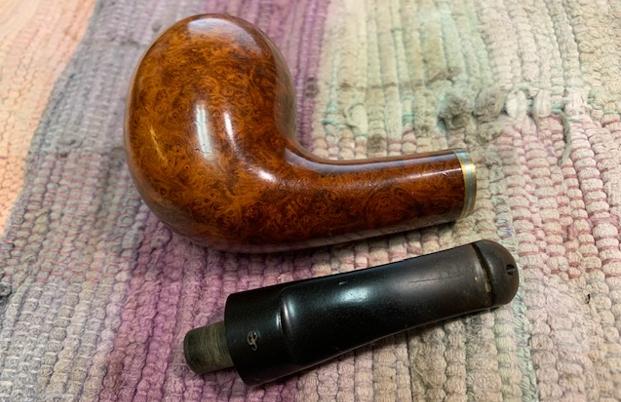
As I was winding up my stay at the old duty station, I came across a neatly packed zip-lock pouch that was stowed away in to the deepest part of the cupboard. In that pouch were three pipes; two Comoys and one Drury Lane # 484. I remembered that the Comoy’s had stingers that needed leather gaskets and one needed a top nut for the stinger. Steve had sent me the leather gaskets/ washers while a replacement for the stinger that required top nut, was in post that was delayed for more than a year due to the prevalent worldwide pandemic situation. I completed refurbishing the Drury Lane # 484 (Another Of My Inherited Pipes Restored…. A “Drury Lane # 484” | rebornpipes) and decided to work on the Comoy’s pipe that had an intact top nut but needed a leather gasket.

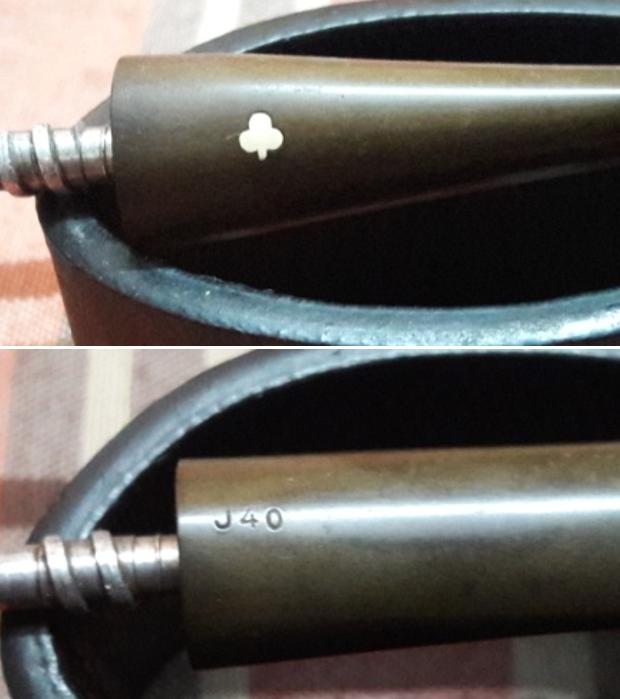
This pipe is a classic Lovat shape and is stamped on the left of the shank towards the shank end as “AIR-O-DRY” in fancy Gothic script. The right side of the shank surface is stamped as “MADE IN ENGLAND” over “BY” over “COMOY’S” and followed by the shape number “212” towards the chamber end. The bottom of the shank is stamped with *5 (this number denotes the leather washer size) over letter “K” (a mystery!!). The high quality vulcanite saddle stem bears the trademark BAR logo that appears to be an aluminum strip embedded in to the vulcanite. All the stampings are crisp and easily readable.The stampings on the pipe were categorical in pointing out that the pipe is English made and linked with Comoy’s. The shape code # 212 of Comoy’s Shape Number chart also corresponds to LOVAT shape of the pipe on my work table. However, the Air- O- Dry line does not find a mention in the list of seconds from Comoy’s on pipedia.org.

Pipedia.org has some information on this line of pipes and I quote:-

The Air-o-Dry pipe that follows was made by Comoy’s according to the stamp. The patent for the unusual stinger system shows it was invented by Marcel C.H. Jacquemin, as “Annexed” in Montreal, June 27th, 1933.

Here are a couple of pictures of the pipe and the patented details of the stinger that were available on pipedia.org, courtesy Dough Valitchka.The three digit shape number, COM stamp and the stinger system make me believe this pipe is from the 1930s to 1950s.  

Initial Visual Inspection
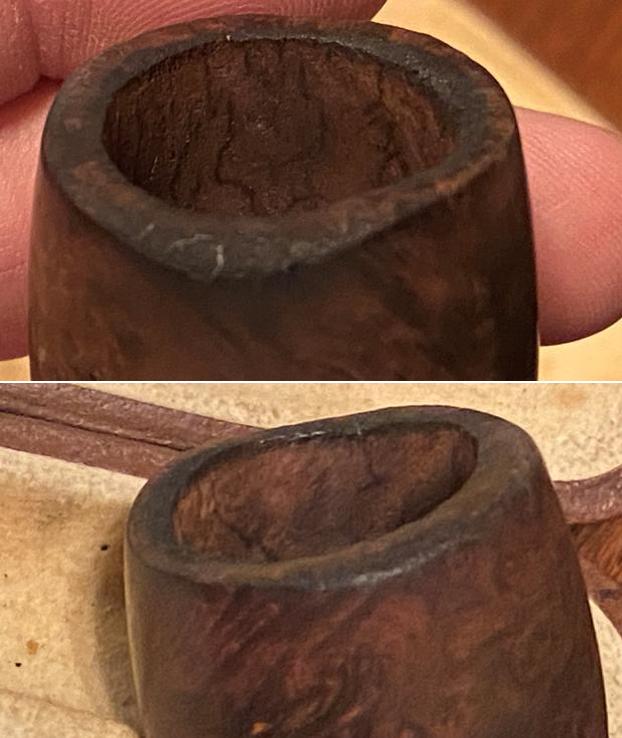
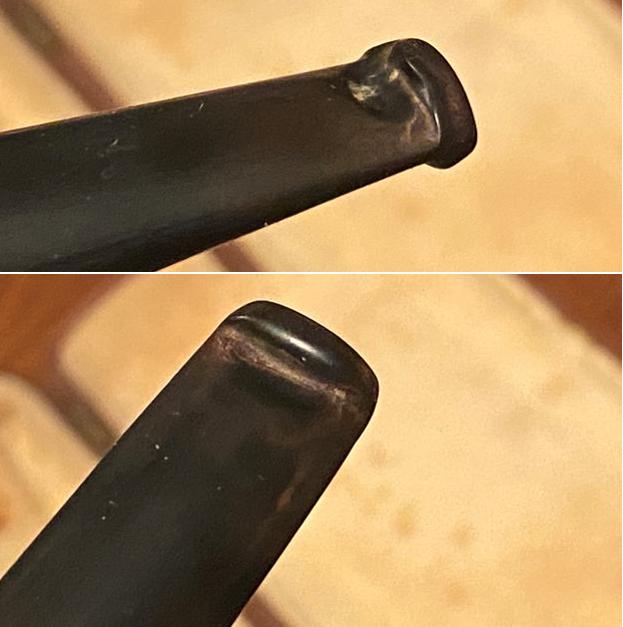
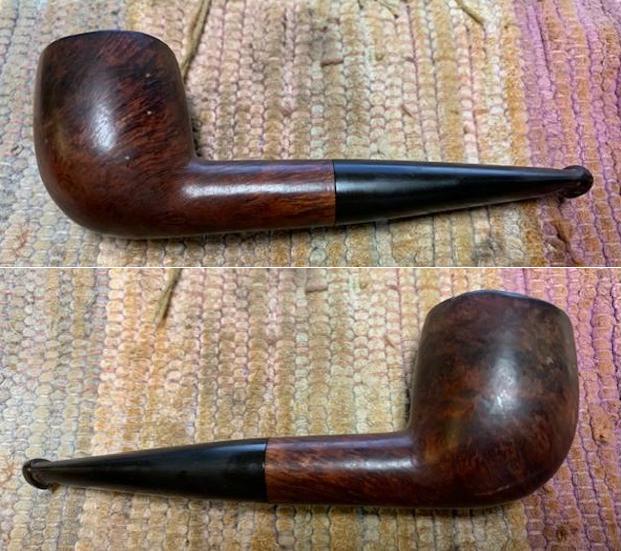
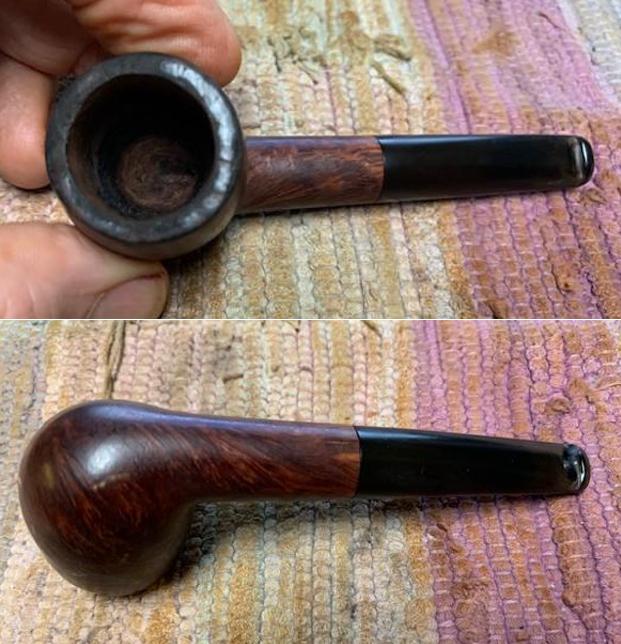
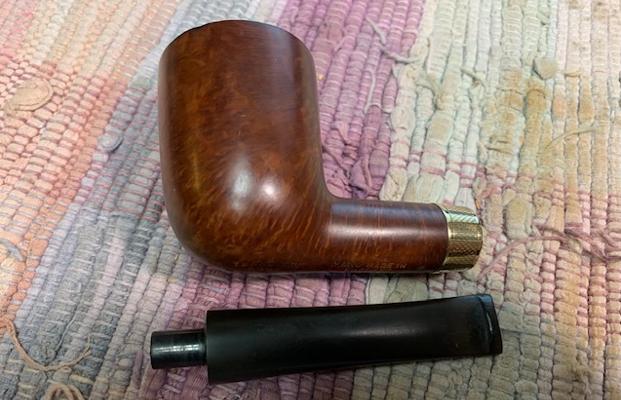
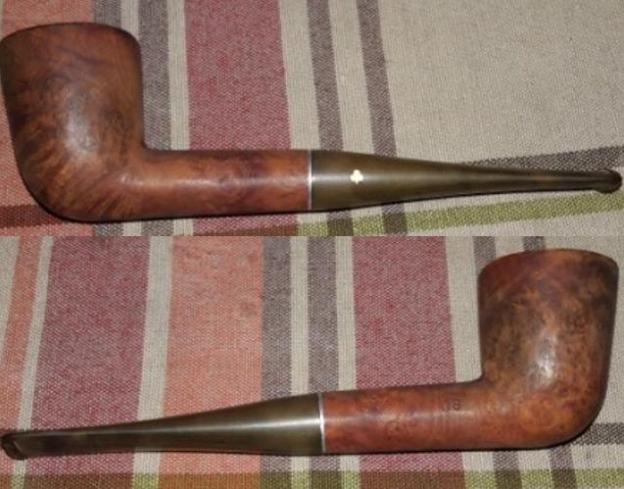
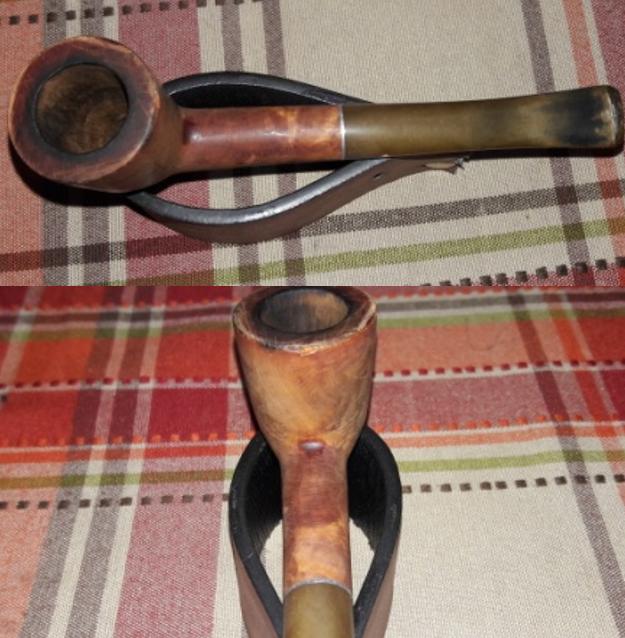
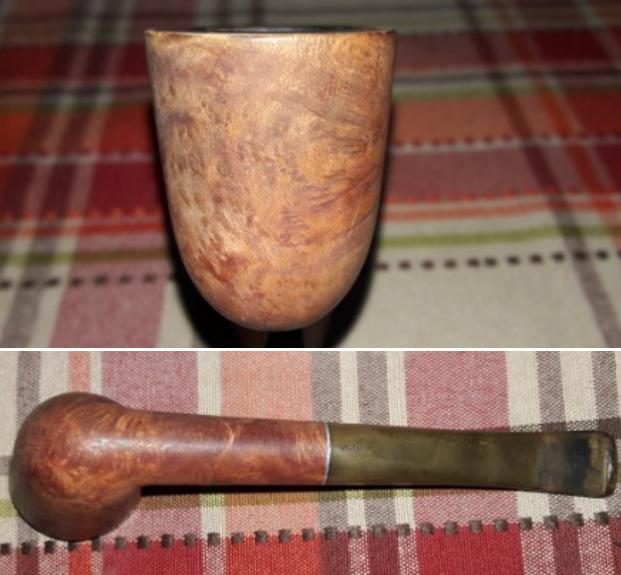
The pipe that is currently on my work table has a classic Lovat shape with a nice hand feel and heft to it. The stummel has rich light brown coloration that has turned dark over the years due to regular use. The stummel has a beautiful mix of cross grains and tightly packed bird’s eye grains peeking out from underneath the dirt and grime. Once the stummel has been cleaned and polished, these beautiful grains should add to the visual appeal of this piece of the briar. There is a thick layer of cake in the chamber with lava overflow over the rim top surface. The beveled inner rim edge has dents and dings and suspected charring in 12 o’clock and 6 o’clock directions. The outer edge has chipped surfaces all around, probably the pipe having being knocked against a hard surface. The vulcanite saddle stem is heavily oxidized with minor calcification and damage to the bite zone on either surface. The buttons on both surfaces have worn out slightly with minor tooth indentations. The following pictures will give the Readers an idea of the overall condition of the pipe as it sits on my work table. Detailed Visual Inspection
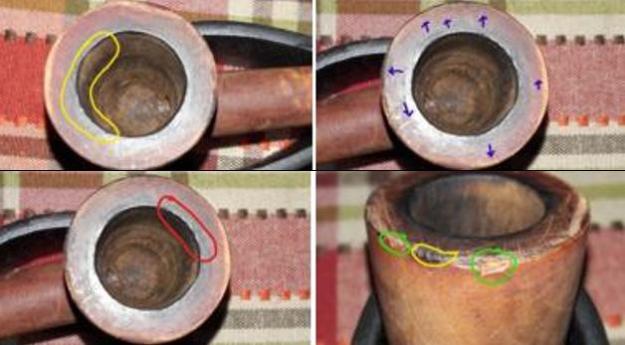
A thick and even layer of cake is seen in the chamber. The rim top surface is covered in overflow of lava, dirt, dust and grime and appears uneven underneath the overflow of lava. The condition of the inner walls of the chamber and rim top surface will be known once the cake has been taken down to the bare briar and the rim top crud has been scraped off completely. The inner rim has suspected burn/ charred surface in 12 o’clock (low probability, I guess) and 6 o’clock directions and is marked in yellow circle. Only once the stummel has been thoroughly cleaned that I can be sure of my initial appreciation. The outer rim edge has chipped surfaces all around (indicated with green arrows) but the most severe damage is in the 3 o’clock direction and is encircled in green. The chamber odor is strong.

Notes: – The stummel feels solid to the touch and I do not foresee any major issues with the condition of the chamber walls. The dents and dings to the rim top surface will necessitate topping. A thin delicate bevel to the outer edge should address the damage to a great extent. The strong ghost smells should be addressed to some extent once the cake has been taken down to the bare briar and the shank internals have been thoroughly cleaned. In case required, more invasive measures like salt and alcohol treatment will be resorted to if the ghosting prevails.Being a seconds pipe from Comoy’s, I had expected to find a few fills and some non-descript grain on the stummel briar. However, I was surprised to note that there is just a single fill in the stummel surface that’s already loosened (encircled in pastel pink). The stummel surface boasts of some beautiful cross grains around the front, back and over the shank surface while tightly packed Bird’s eye adorns the sides and foot of the bowl. The stummel surface is covered in dirt and grime giving the stummel a dull and oily appearance. The surface shows a few scratches, dents and dings (indicated in red). The mortise shows accumulation of old oils and tars which would need to be cleaned.

Note: – The loose fill will need to be refreshed with a mix of CA superglue and briar dust. Light sanding of the stummel with a piece of 220 grit sand paper should address the minor scratches and dings over the surface. A nice polish with micromesh grit pads will bring a nice shine to the stummel and highlight the grains. It does have a quality which is seen on vintage pipes in terms of perfection in size, briar material, quality of stem and perfectly centered draught hole drilled right at the bottom of the chamber. And not to forget, this is nearly a 50 plus year old pipe!! The vulcanite saddle stem is heavily oxidized, but otherwise in a decent condition. The bite zone on either surface shows some minor tooth indentations with a small amount of calcification at the base of the button edge. The button edges on either surface have worn down with minor bite marks. The horizontal slot and stinger openings show accumulation of dried oils and tars. There is a gap at the stinger head, between the top nut and the shoulder of the stinger (indicated by red arrows), where the leather washer is seated.

Note: The button edges will need to be sharpened and reshaped. The gap at the stinger head will be covered with the leather washer. All in all, the stem presents no major damage and should be an easy clean up.The Process
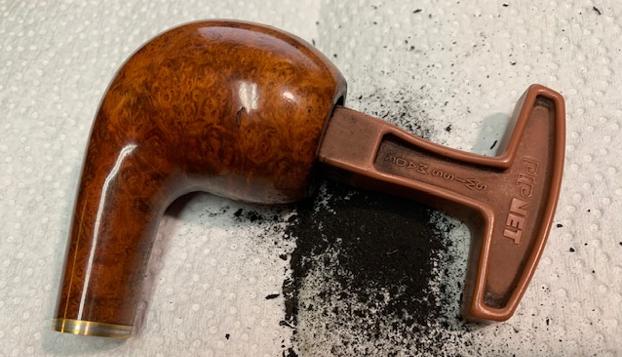
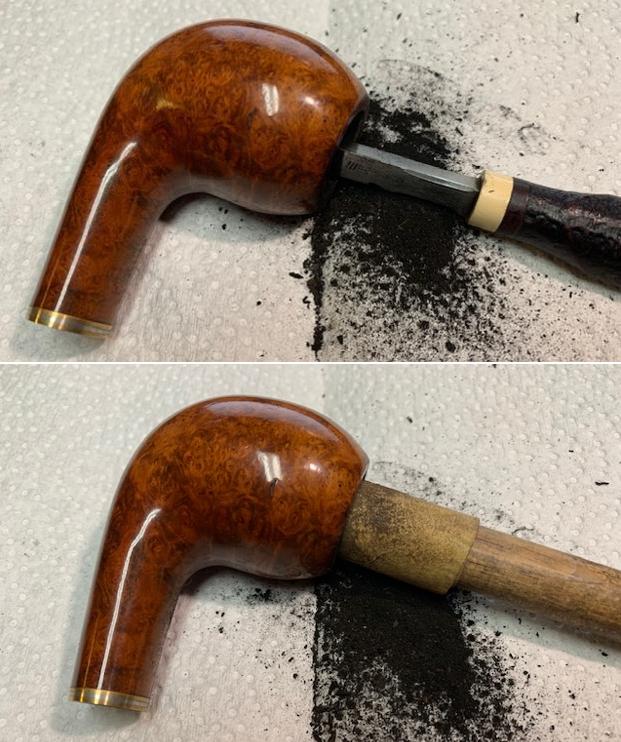
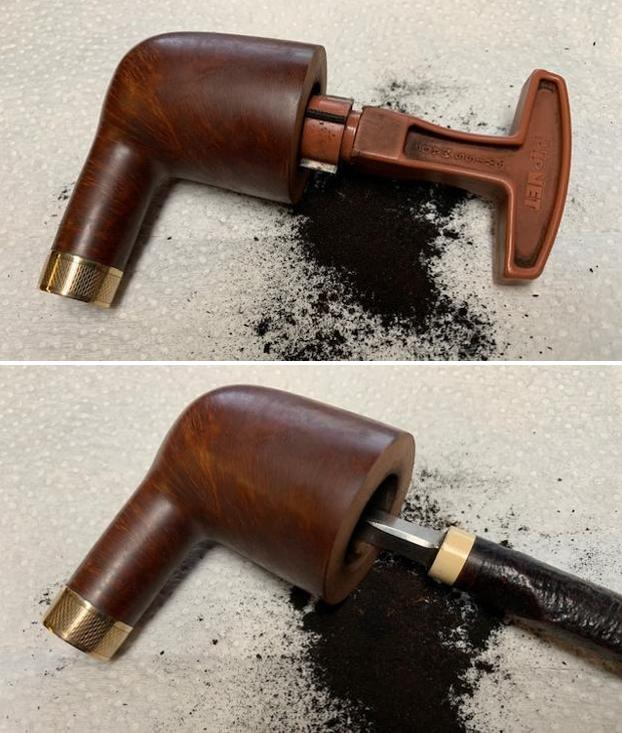
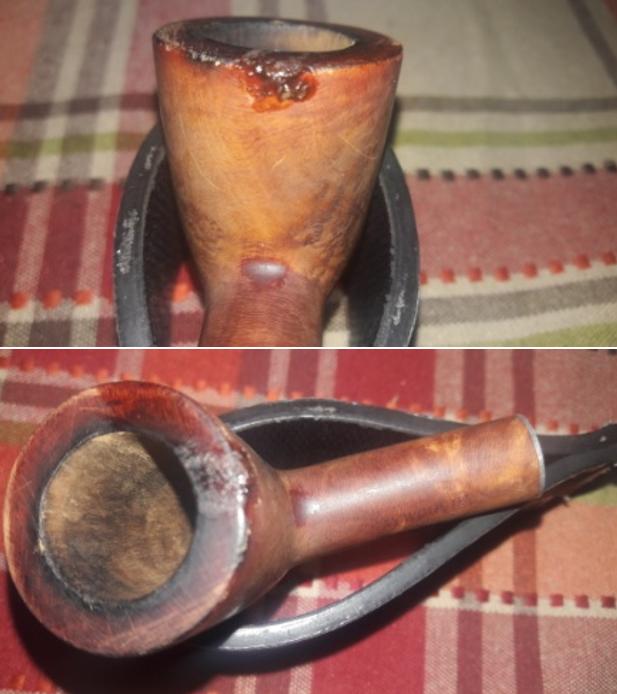
I started the restoration by reaming the chamber with size 2 followed by size 3 head of the PipNet reamer as I was keen to know the condition of the walls of the chamber. With my sharp fabricated knife, I removed the cake from the chamber where the reamer head could not reach and thereafter, using a folded piece of 180 grit sand paper, I sanded out the last traces of cake and exposed the walls of the chamber. I wiped the chamber with a cotton swab dipped in isopropyl alcohol to remove the carbon dust left behind by all the reaming and sanding process. Once the chamber walls were cleaned out, I was pleased to note a solid chamber. With the same sharp knife, I gently scraped off the lava overflow from the rim top surface. It was a big relief to note that the suspected charring in 6 o’clock and 12 o’clock direction is non-existent and the beveled inner rim edge has just darkened as a result of the lighting habits of my grandfather. However, the damage to the outer rim edge is very much a reality and will need to be addressed. Next, I cleaned out the internals of the shank and mortise. Using my dental tool, I scraped out all the dried oils, tars and gunk that had accumulated in the draught hole and on the walls of the mortise. The amount of crud that was scrapped out is an indicator as to how dirty the shank internal is.

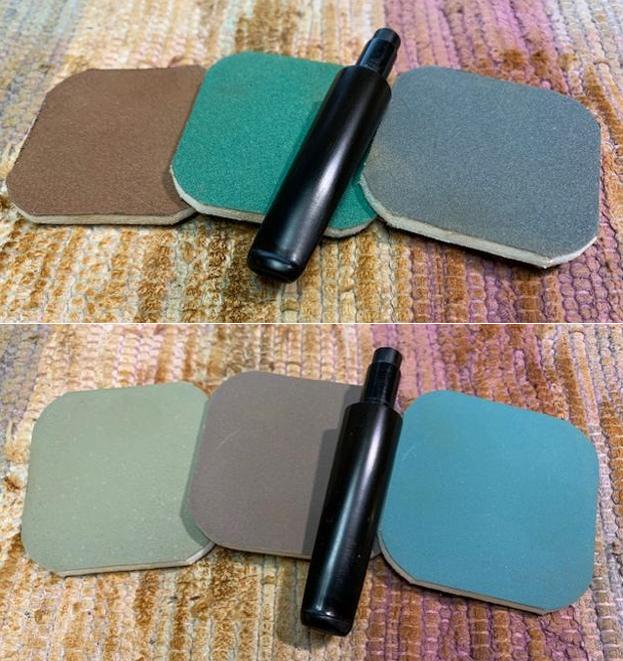
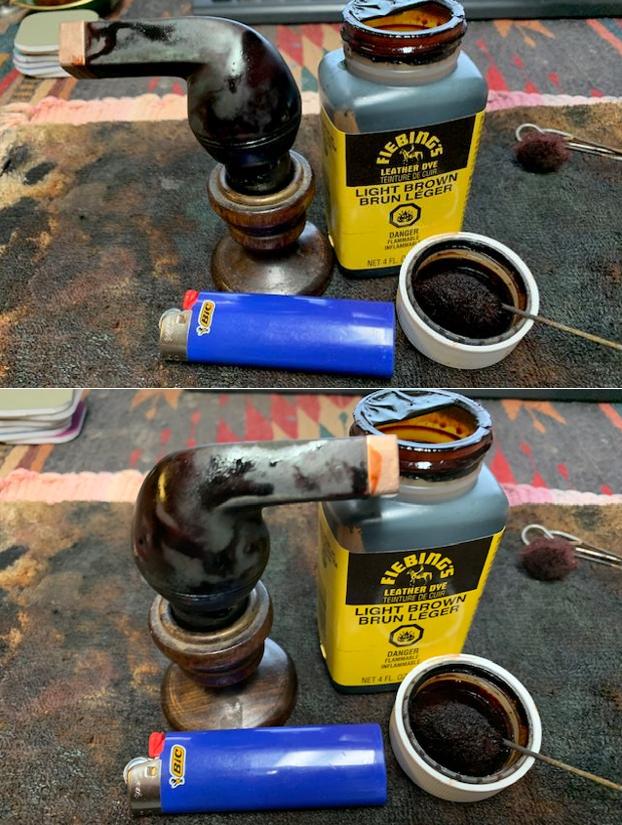
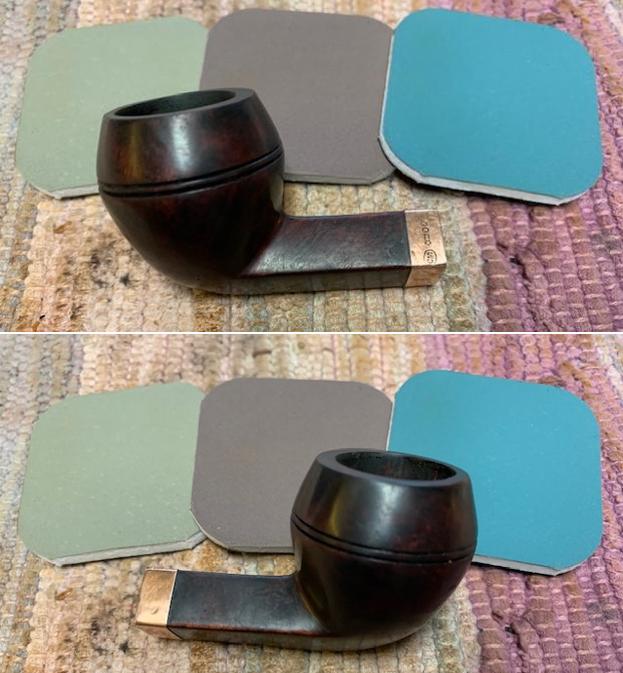
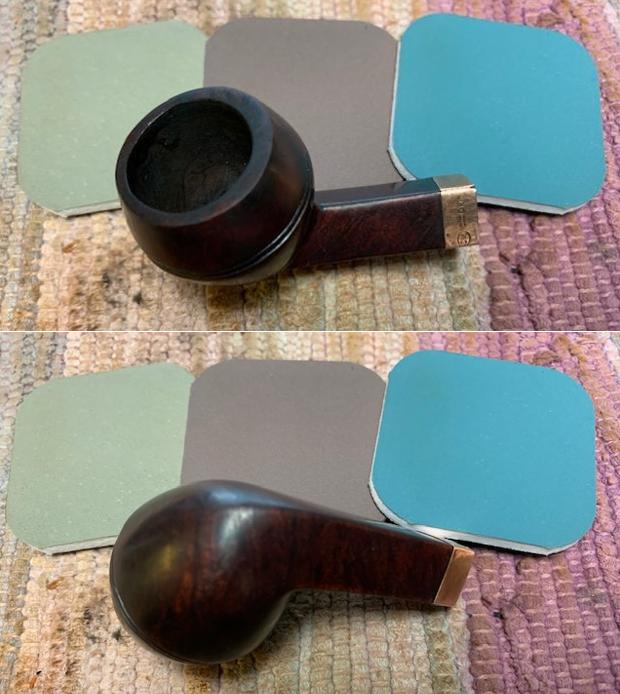
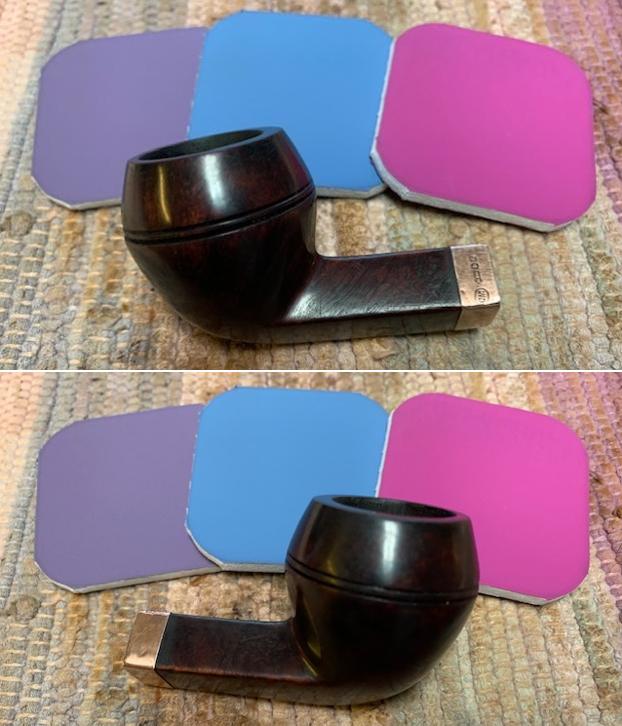
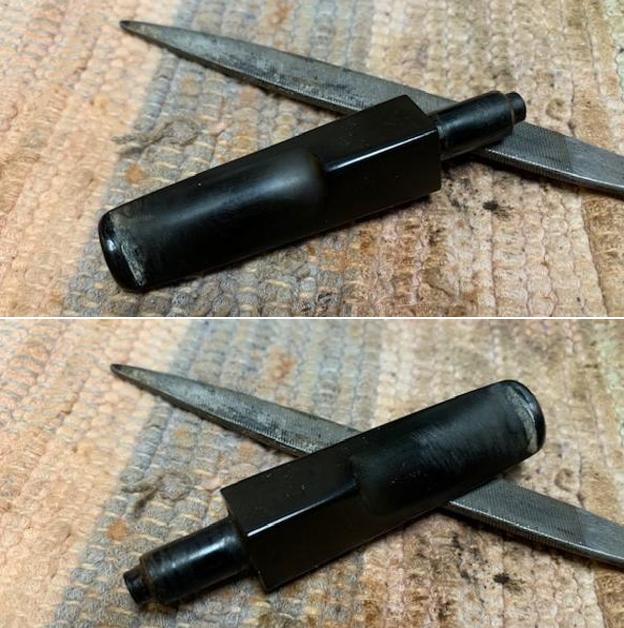
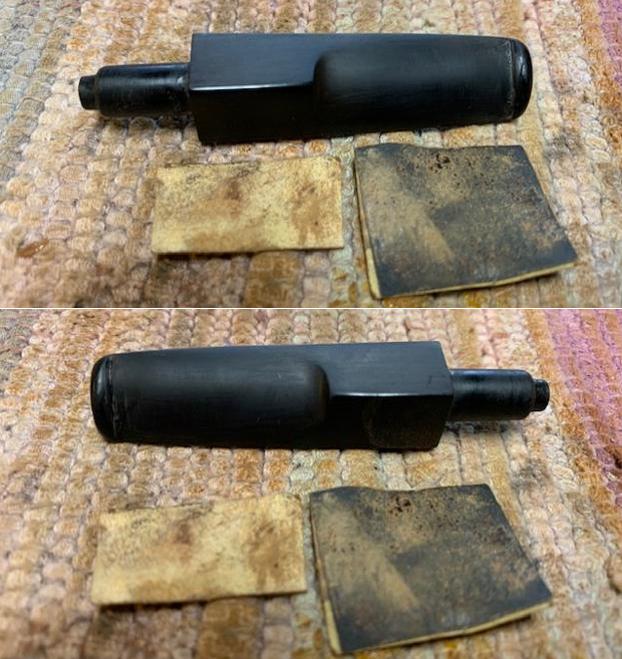
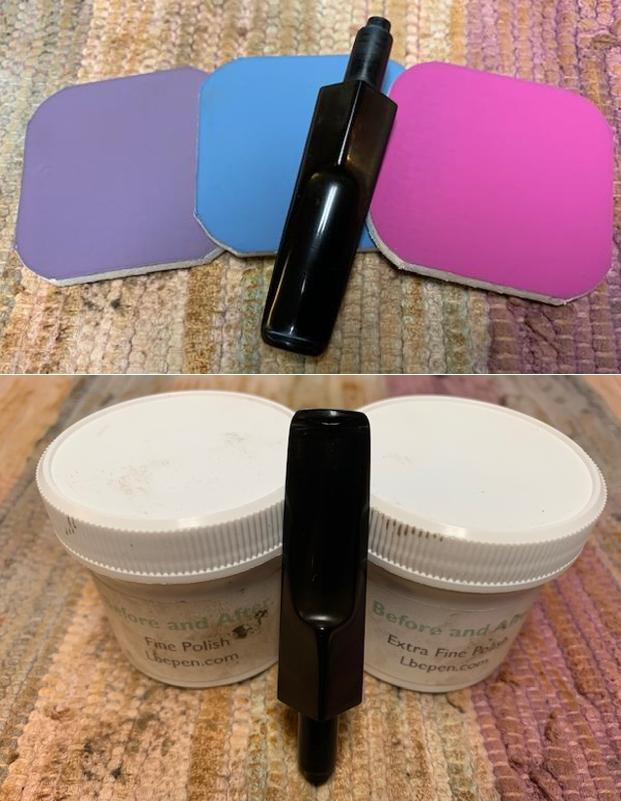
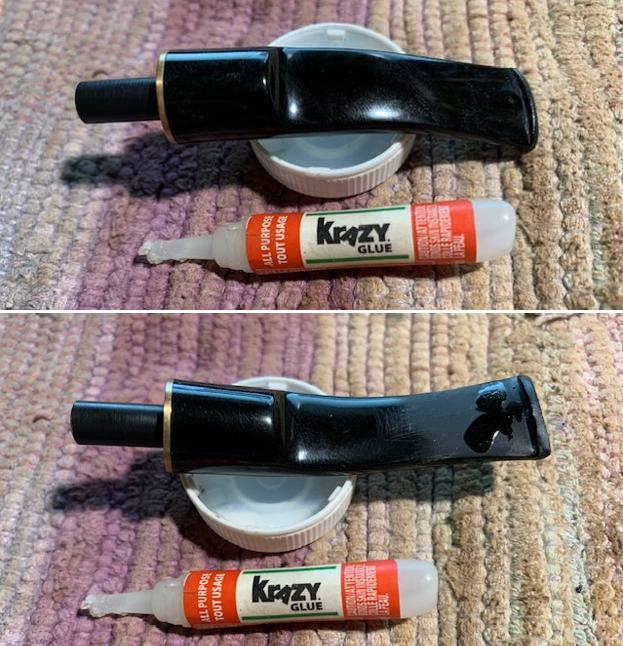
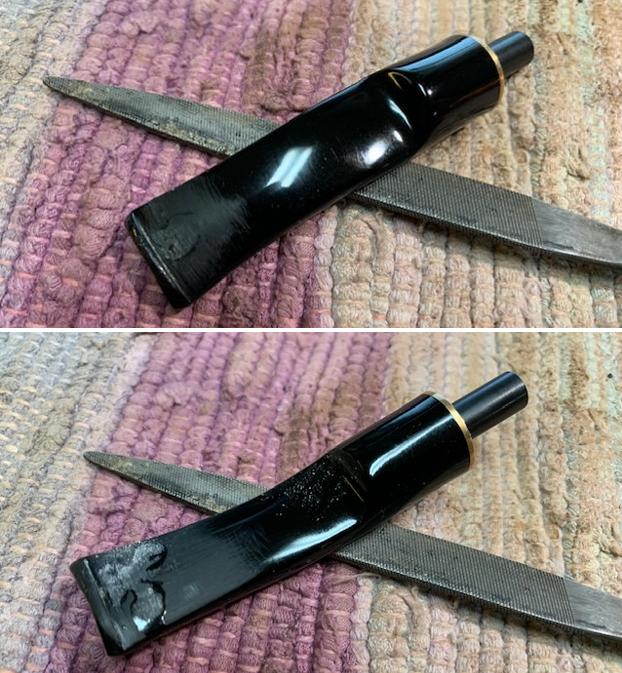
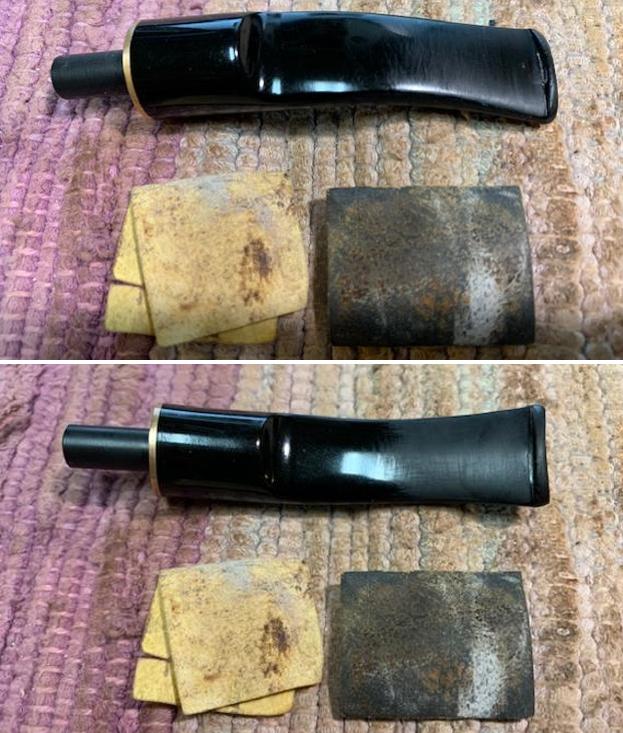
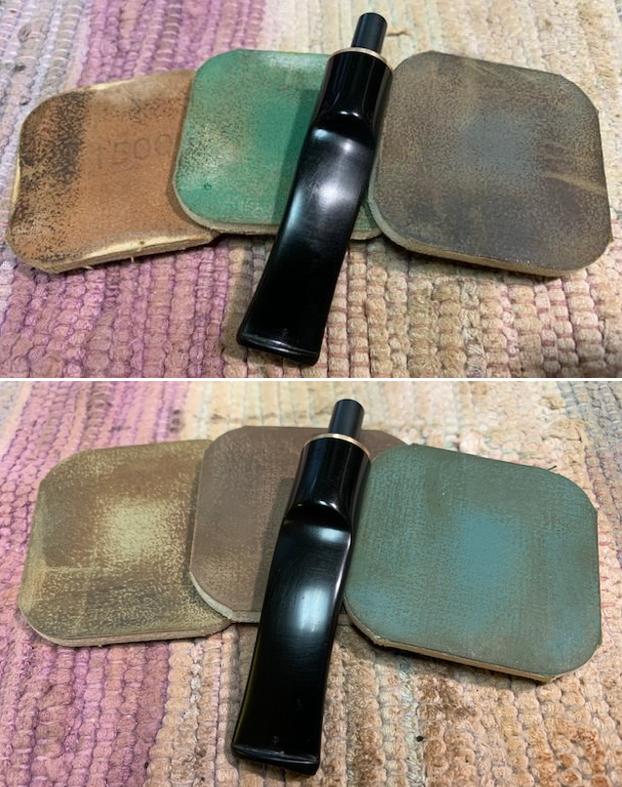
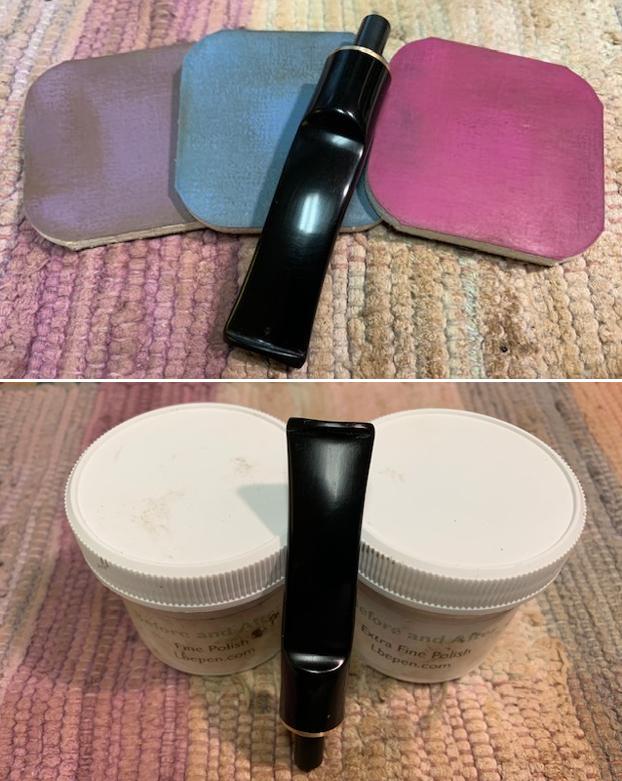
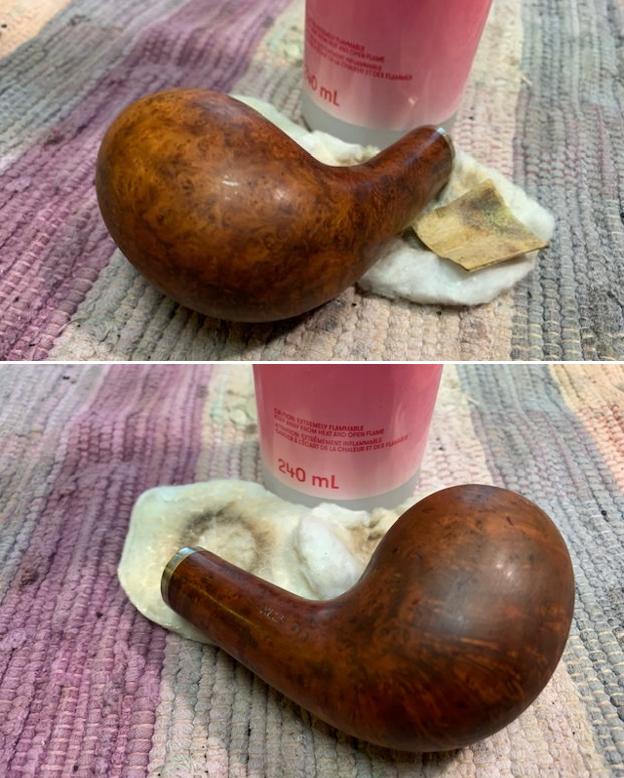
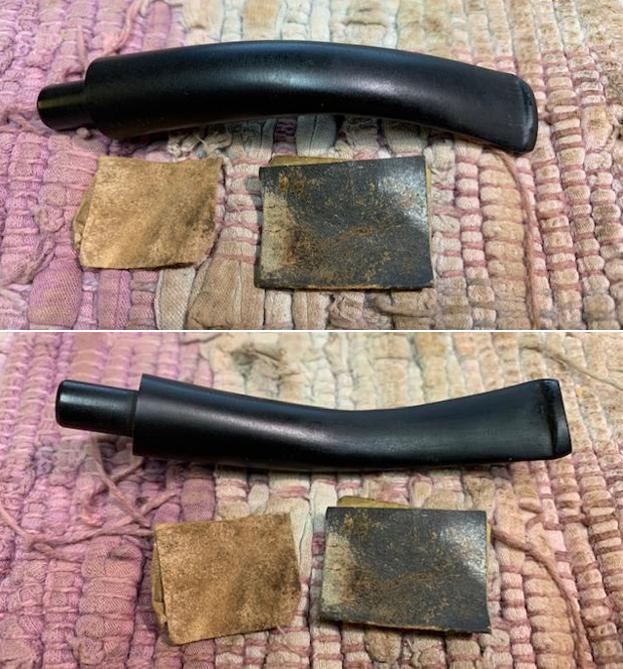
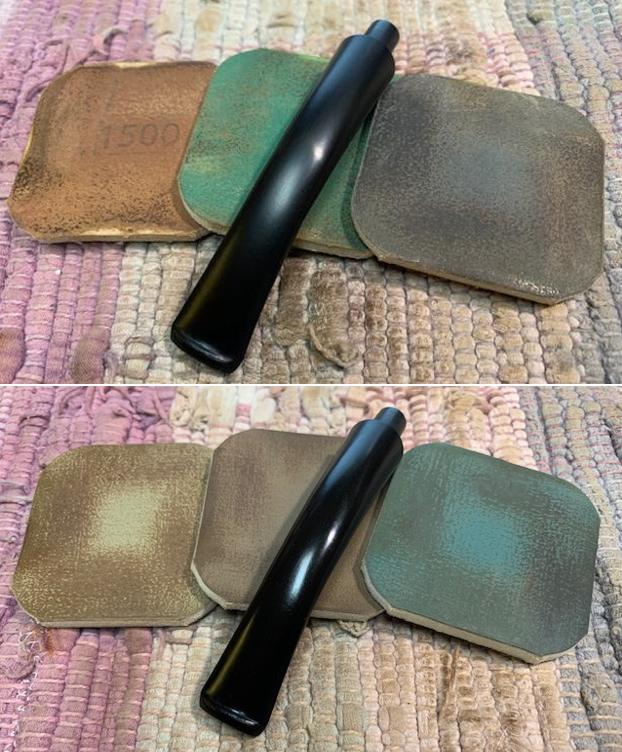
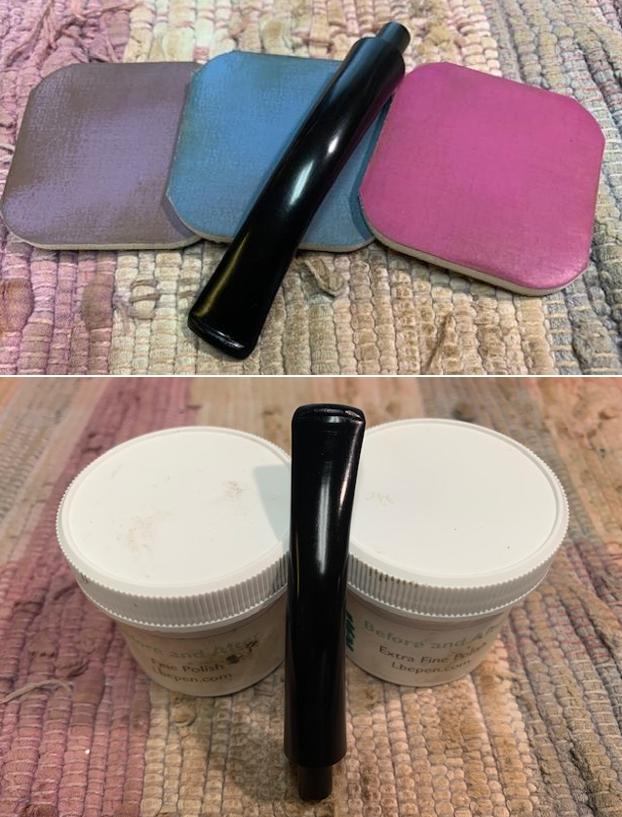
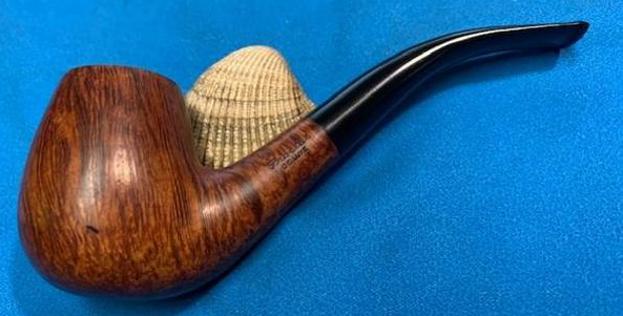
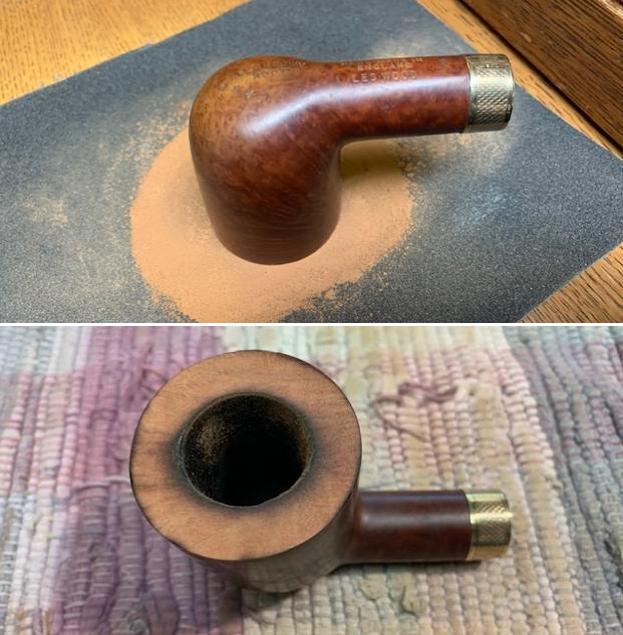
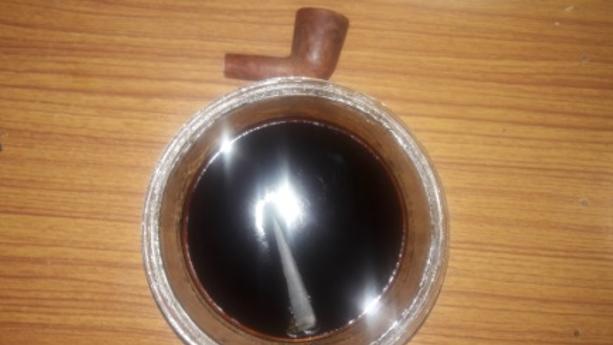
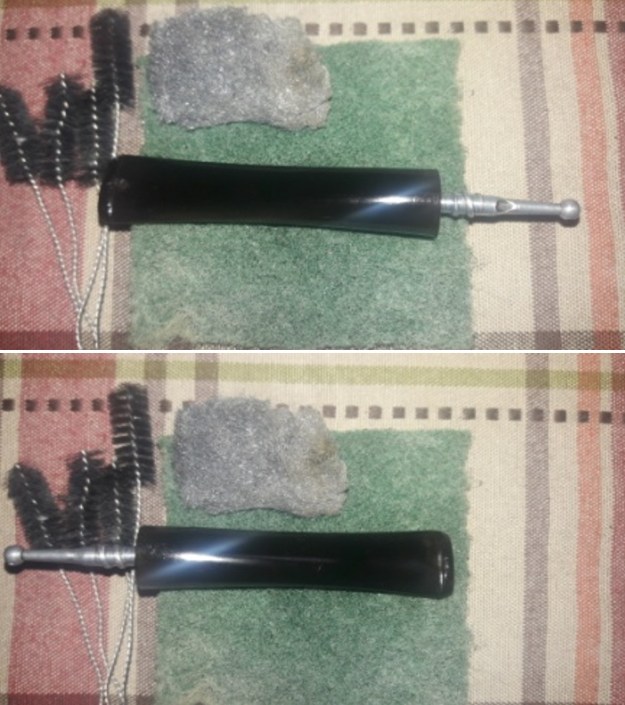
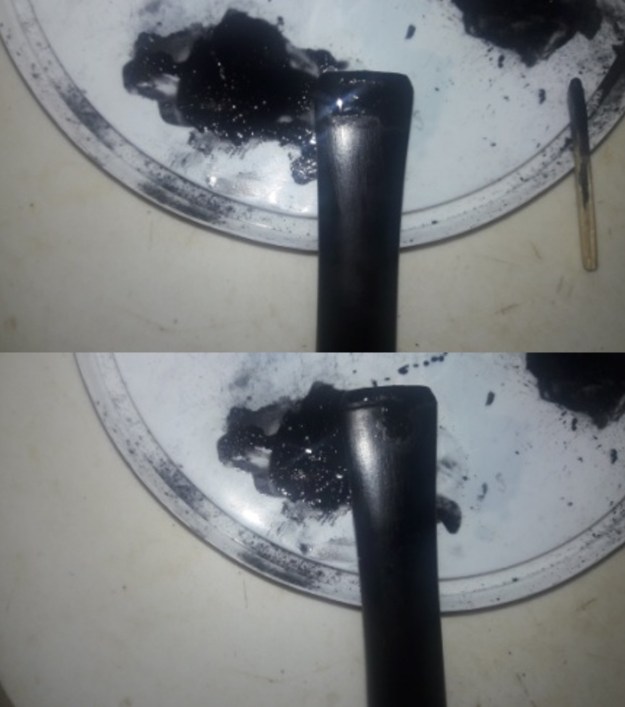
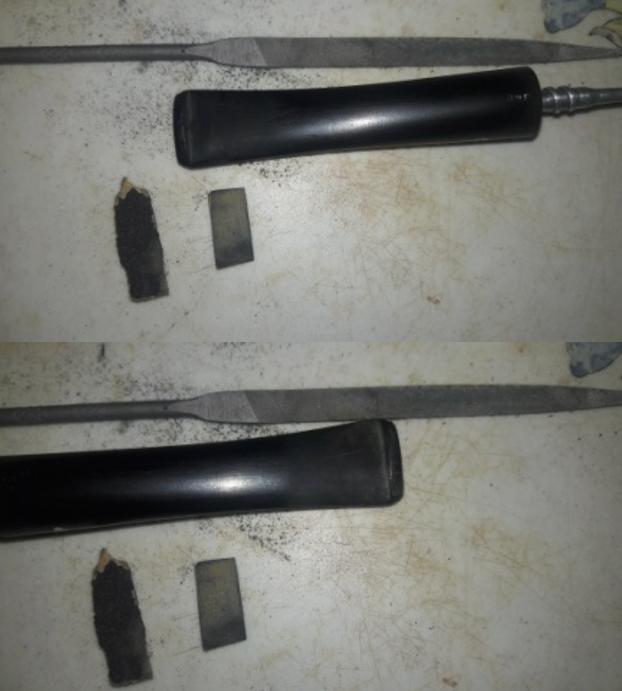
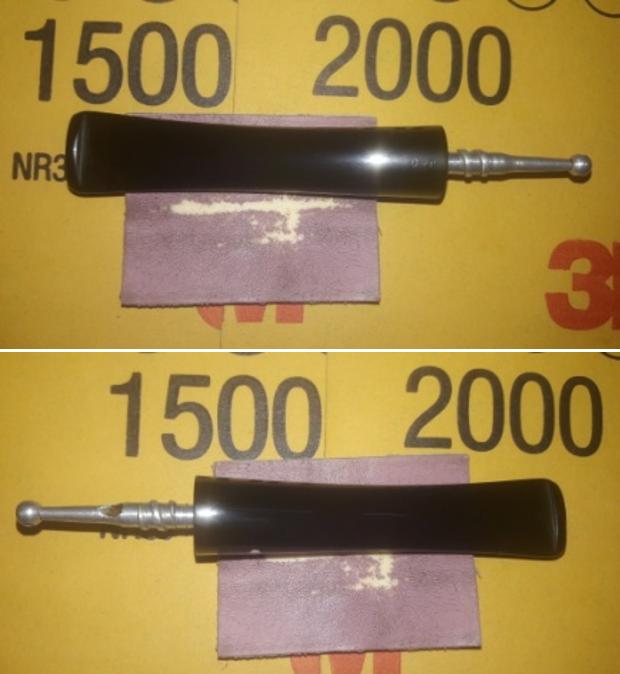
Note: The darkened and uneven beveled inner rim edge and the dents/ dings to the rim top surface are now clearly seen. These issues should be easily addressed by topping and light sanding of the existing inner edge bevel. Similarly, the outer rim edge issue would be reduced after topping and what chipped areas remain will be masked by creating a light delicate bevel. The ghosting is still prevalent and will, in all probability, require invasive methods to completely eliminate it. I continued the cleaning of the chamber and shank internals with a salt and alcohol bath. I usually use cotton balls which is an at par substitute to Kosher salt as I have realized over the years. I drew out a wick from the cotton and along with a folded regular pipe cleaner; inserted it in to the mortise and through the draught hole into the chamber. Thereafter, I packed the chamber with cotton balls to about quarter of an inch below the inner rim edge and filled it with isopropyl alcohol up to the brim. About half an hour later, the level of alcohol had gone down, having been absorbed by the cotton. I topped it up once again with isopropyl alcohol and set it aside overnight. By next afternoon, the cotton was dark colored and with alcohol, had drawn out all the remaining oils and tars from the chamber and mortise, fulfilling its intended task. I removed the cotton balls from the chamber and the pipe cleaner with cotton from the shank and ran pipe cleaners through the mortise to clean out all the loosened tars and gunk. I further cleaned the mortise and chamber by scarping the walls with a dental tool and knife respectively, to completely remove the gunk. I blew through the draught hole to dislodge the trapped gunk, wiped the bowl clean and dried the shank and bowl with paper napkins and set it aside to dry for an entire day. By next day, the pipe was nice and dry and all the smells were history. With the stummel set aside for drying, I turned to address the stem issues. I addressed the deeper oxidation by sanding the entire stem with a folded piece of 220 grit sand paper. Once the oxidation was completely removed, I wiped the surface clean with Murphy’s oil soap on a cotton swab. I cleaned up the oils and tars from the surface of the stinger using alcohol on cotton pads followed by Murphy’s Oil soap. I followed it up with cleaning the internals of the stem using hard and normal bristled pipe cleaners and isopropyl alcohol. The gunk that came out with the pipe cleaners tells the sordid tale of the stem condition. To save on to the requirement of number of pipe cleaners, I have resorted to cleaning the stem internals using thin shank brushes with anti-oil dish washing soap and finally rinsing the stem with warm water to clean and freshen up the stem internals. With a pointed dental tool, I scraped out the entire dried gunk from the horizontal slot. I rubbed a little Extra Virgin Olive oil to hydrate the stem and kept it aside. Continuing with the stem refurbishing, I heated the bite zone with the flame of a lighter to raise the tooth indentations to the surface. Though the issue was addressed to a great extent, one bite mark on both surfaces (encircled in yellow) along with damage to the button edge (indicated in pastel blue) was still evident. The button edges and deeper tooth indentations on either surface of the stem were filled with a mix of CA superglue and activated charcoal powder and set aside for the fill to cure.With the stem repairs set aside for curing, I decided to clean the external surface of the stummel. I used a hard bristled tooth brush and Murphy’s Oil Soap to scrub the stummel and rim top. I further scrubbed the rim top surface with a brass bristled brush to completely remove the dirt and grime from the rim surface. I rinsed the stummel under running warm water. I cleaned the stummel with anti oil dish washing detergent till the stummel surface was clean and dried it using paper towels and soft cotton cloth. I simultaneously cleaned the shank internals with the detergent and hard bristled shank brush and set the stummel aside to dry out naturally.While the stummel was set aside for drying, I decided to complete the stem repairs and refurbishing. With a flat head needle file, I sanded the stem fills on either surface till I had achieved a rough match with the rest of the stummel surface. I reshaped and sharpened the button edges with the same flat needle file. The filled surface and button edges were worked upon with a piece of 220 grit sand paper to further blend in the repairs. I followed it up by further dry sanding the stem with 400, 600, 800 and wet sanding with 1000 grit sand papers to completely rid the surface of the oxidation and bring out the shine in the vulcanite. I applied a little EVO to stem surface to hydrate it and set it aside. While the stem was set aside to absorb the EVO, I addressed the issue of one single fill in the entire stummel surface. I removed the old fill from the surface with a sharp dental tool and cleaned the area with isopropyl alcohol in preparation for refreshing the fill. Since the area to be filled was very minute, I decided to fill it with a drop of CA superglue alone. Once that was done, I set the stummel aside for the fill to cure.Once the stummel fill had cured, I sanded it first with a flat needle file and followed it up with a piece of 220 grit sand paper. Simultaneously, I sanded the entire stummel surface with the 220 grit paper to eliminate the minor scratches and dings from the surface.The next stummel issue that I addressed was of uneven rim top and damages to the rim edges. I decided to address the issue of uneven and darkened rim top surface by topping the rim surface on a piece of 220 grit sand paper. The progress being made was frequently checked as I had no desire to lose any briar estate than was absolutely necessary. Once satisfied with the result, I wiped the rim top surface with a moist cloth. The darkened rim top had been addressed completely, however, the beveled inner rim edge was still dark and uneven (though greatly reduced) with slight charred edges. I addressed these issues by simply running a piece of 220 grit sand paper along the inner rim edge bevel, till the darkening was eliminated. I created a delicate but sharp bevel to the outer edge for a smooth and an evenly rounded outer edge. However, I was extremely careful that the profile of the stummel was not altered with the creation of the bevel. I subjected the stummel to a complete cycle of micromesh polish, dry sanding with 1500 to 12000 grit pads. I paid greater attention to polish the rim top surface and the bevel created on the inner and outer rim edge. I wiped the stummel with a moist cloth after every grit pad to remove the sanding dust left behind by the pads. This also helps in monitoring the progress being made and provides an opportunity to take early corrective action, if required. I was happy with the progress being made till now. The briar had taken on a nice deep shine with the original natural brown of the stummel and the darker brown stains to the grains contrasting beautifully. I really liked the dark brown coloration and the patina that was seen over the stummel surface. Next, I rubbed a small quantity of “Before and After Restoration Balm” into the briar with my finger tips and worked it deep in to the surface and let the balm be absorbed by the briar for a few minutes. The balm almost immediately works its magic and the briar now has a nice vibrant appearance with the beautiful straight and Bird’s eye grain patterns on full display. The contrast of the dark browns of the grain with the light brown hues of the rest of the stummel adds an interesting dimension to the appearance of the stummel. I further buffed it with a horse hair brush to further deepen the shine. Using micromesh pads, I completed the polishing of the stem by wet sanding the stem surface with 1500 to 12000 girt pads. I gave a final rub with “Before and After Extra Fine” stem polish compound from Mark Hoover to remove fine scratches from the stem surface. I rubbed a little quantity of Extra Virgin Olive oil in to the stem surface and set it aside to be absorbed by the vulcanite. The stem polished up nicely and appears as good as when new.The only repair aspect that remained was replacing the leather washer in the stinger head. Steve, my Guru/ Mentor/ Friend, had spared me two size 5 leather washers, for this pipe and other for Comoy’s “Grand Slam”. These leather washers will be put to good use, I assure you Steve!!

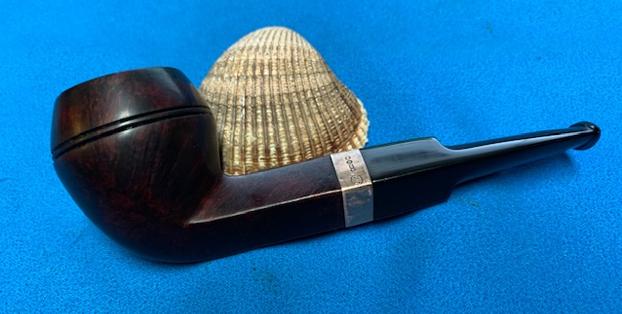
I soaked one leather washer in water to make it soft and more pliable. Carefully unscrewing the top nut (I had broken the top nut on the stinger of Grand Slam while trying to unscrew and the memory of the pain is still vivid), I fixed the leather washer and gently tightened the top nut. With a piece of 220 grit sand paper, I sanded off the excess leather material from the washer, frequently checking for the seating of the stinger into the mortise (remember my mantra… SAND ONCE, CHECK TWICE!). Once the seating was snug and just perfect, I stopped any further sanding and applied petroleum jelly to the washer to keep it moist and pliable.To put the finishing touches, I mounted a cotton cloth buffing wheel onto my hand held rotary tool and polished the stummel and stem with Blue Diamond compound. This compound helps to remove the minor scratch marks that remain from the sanding. Next, I mounted another cotton buffing wheel that I have earmarked for carnauba wax and applied several coats of the wax. I mounted a clean cotton cloth buffing wheel and gave the entire pipe a once over buff. I finished the restoration by giving the entire pipe a rigorous hand buffing using a microfiber cloth to raise the shine further. The finished pipe with the aged patina to the briar looks amazingly beautiful and now all that remains for me is to load it with some Regent’s Flake and get transported back in time when things were a bit more contemplative and people had time for each other… time to share!! P.S. The completion of this project would not have been possible without the help that was extended by Steve and I am really thankful to him.

Praying for the health and safety of all the readers and their loved ones in these troubled times…


Resurrecting a Briar WDC Campaign Pipe


Blog by Steve Laug

I have finished restoring quite a few of the pipes in this collection that we purchased from the older gentleman. He sent me the photos and I was amazed at what I saw. You have seen many of the pipes that he had. These included Dunhill, BBB, Orlik, Barclay Rex, a cased Ben Wade, an H. Simmons all briar, Hardcastles and some Meerschaums. There were also some assorted others that I will get to in the days ahead. It was a great collection.

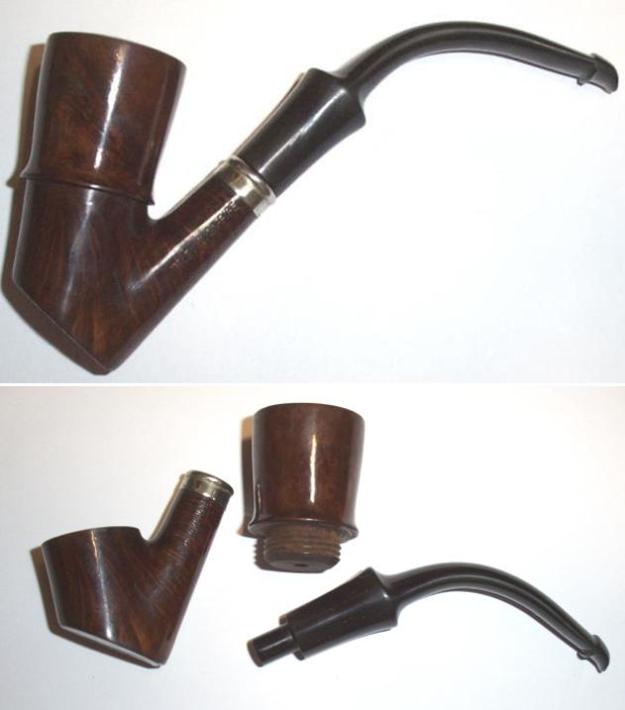
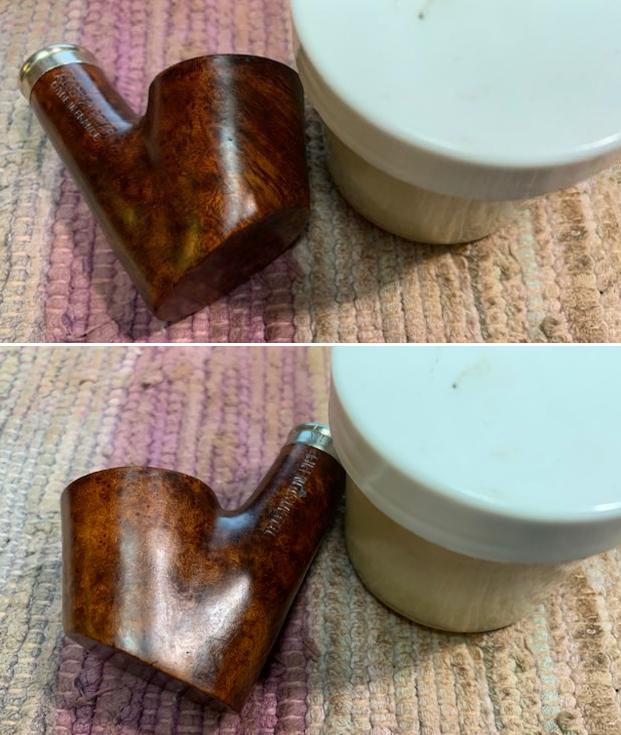
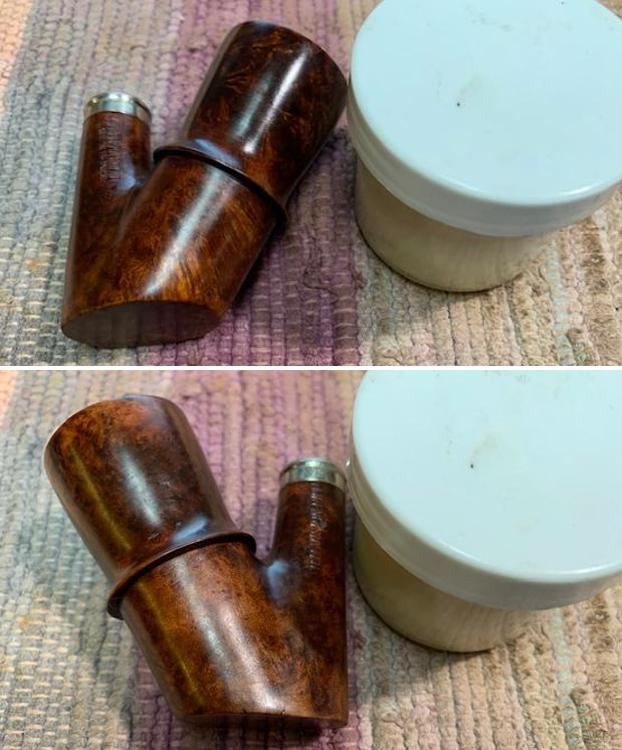
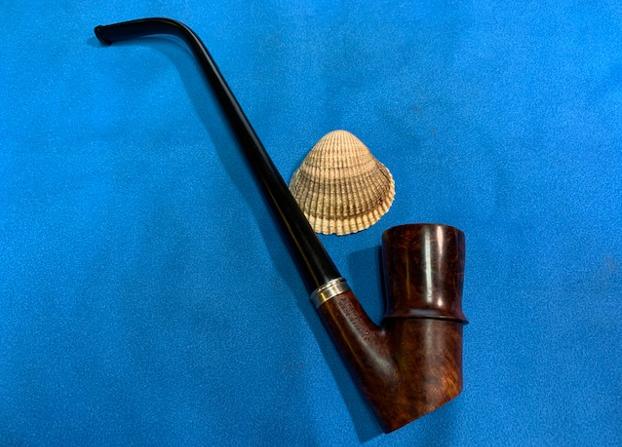
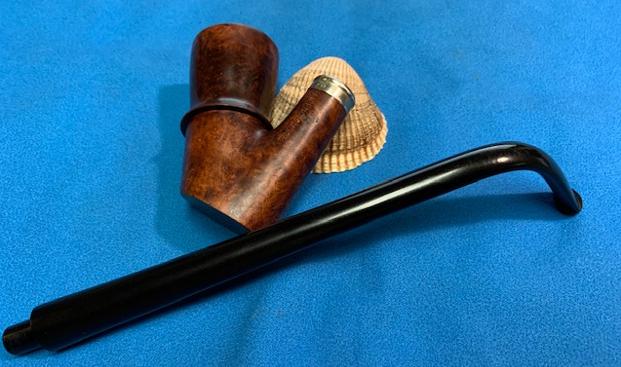
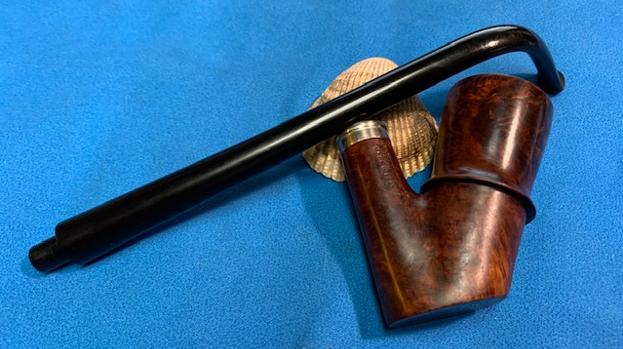
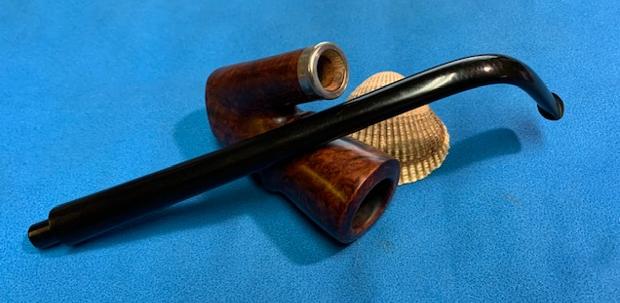
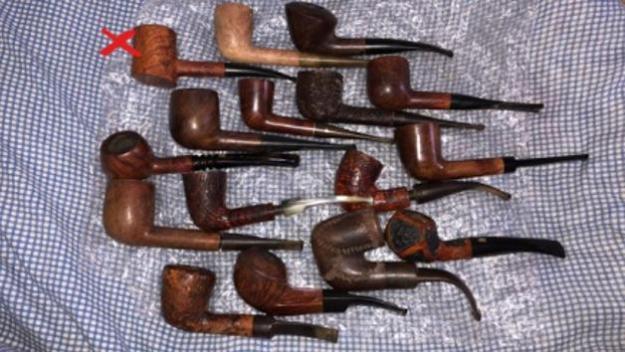
The next pipe I have chosen is a worn and damaged WDC Campaign Pipe with a calabash style bowl. I have drawn a red box around the pipe in the photo above. There was a thick cake in the bowl and the rim top of the cup. The inside of the calabash style base was also very dirty. The rim top and edges were buried under a thick coat of lava. There was a large chip of briar out of the back of the rim top cup. It was filthy both inside and out. The shape caught my eye because it is quite lovely even under the grime and wear. The stem is hard rubber with flecks of metal in the rubber. It had tooth marks and chatter on both surfaces of the stem ahead of the button. This was another well loved pipe that obviously been a good smoker!

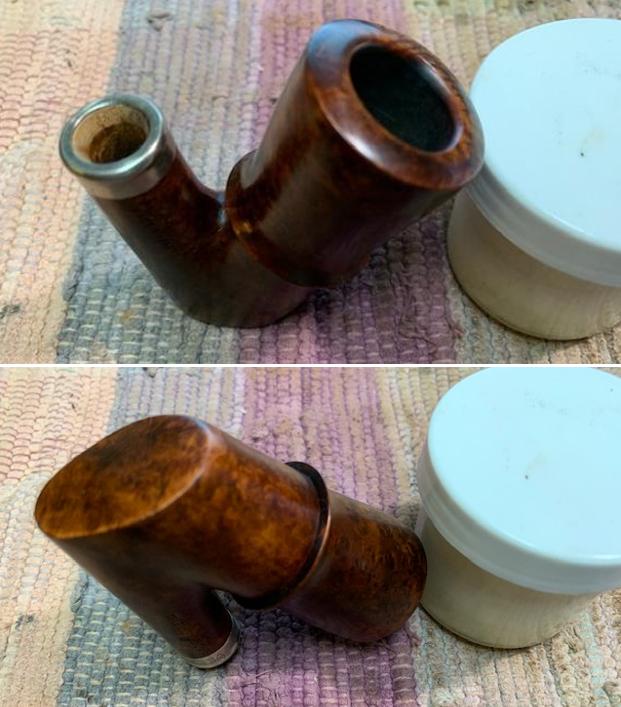
Jeff took some photos of the WDC Campaign Calabash before he worked his magic in cleaning up the pipe. It is a an interesting pipe with a lot of potential and what appears to be some great grain under the grime and debris of the years. Jeff took photos of the bowl, rim top to show the thickness of the cake in the bowl and the thick lava on the rim top of the cup. The rim top was thickly covered and there was a large chunk of briar missing on the back of the cap. He took photos of the top and underside of the hard rubber stem showing the tooth marks and chatter on both sides. Jeff also took some photos of the threaded bowl removed from the calabash base. You can see the small crack in the base of the cup. You can also see the dirty condition of both the inside of the base and the bottom of the cup.He also took photos of the base of the cup to show the cracks in the bottom of the bowl. He also took a photo of the chip in the top of the cap. Jeff took photos of the sides and heel of the bowl to show the condition of the briar. You can see the beautiful shape of the bowl and some interesting grain even through the dirt and debris of many years. I turned to Pipedia to have a look at the article on the William Demuth Company and see if there was any information on the Campaign (https://pipedia.org/wiki/William_Demuth_Company). There a great article on the history of the brand. There was also a picture of a countertop display for the pipes and also a picture of the stamping on the side of the bowl. I am including them both below. This all briar pipe with a removable bowl is made by the American Company, William Demuth Co. It is a nicely grained older pipe that has a very interesting look to it. Because the old gentleman that we bought the pipes from intimated that he purchased his pipes at the Manhattan Barclay-Rex store I would imagine that he may have purchased this one from them as well. I was unable to pin down any information regarding the date this pipe but I am assuming it is as old as the other pipes in the collection.

Jeff carefully took the pipe apart and cleaned it. He cleaned the calabash base and reamed it with a PipNet pipe reamer and then cleaned up the reaming with a Savinelli Fitsall Pipe Knife. He scrubbed out the internals of the shank, stem and shank extension with alcohol, pipe cleaners and cotton swabs until the pipe was clean. He scrubbed the exterior of the bowl with Murphy’s Oil Soap and a tooth brush to remove the grime and grit on the briar and lava on the rim top. The finish looks much better and has a deep richness in the colour of the briar. The edges of the cup had a huge chip out of the back edge. He scrubbed the hard rubber stem with Soft Scrub to remove the grime and soaked it in Briarville’s Pipe Stem Deoxidizer to remove the oxidation. When the pipe arrived here in Vancouver I was amazed that it looked so good. Here are some photos of what I saw. I took some close up photos of the rim top and the stem surface. The top of the rim showed some darkening/heavy tars and there was heavy damage at the back of the bowl and edge. The stem had tooth marks and chatter on both sides near the button.I took a photo of the stamping on the left side of the bowl. It was stamped with a WDC logo triangle and under that was clearly stamped CAMPAIGN. The stamping was clear and readable.I removed the bowl from the base, the stem from the shank and took a photo of the parts of the pipe. I started my work on the pipe by addressing the damage on the back top of the bowl. I cut a chip of briar out of an old broken bowl that I have here. I used a Dremel to reduce the size of the briar chip. I glued it in place in the chipped area with clear CA glue. I filled in the crevices around the repaired chunk of briar with briar dust and clear CA to clean up the transitions between the bowl rim top and the repair. I used a Dremel and sanding drum to thin down and shape the rim cap. I also shaped the edge of the repair with the Dremel. I carefully removed more of the edge and the thickness of the repair with the sanding drum and Dremel. It was starting to look very good. I sanded the rim cap top with 220 grit sandpaper to smooth it out and blend it into the surface. I restained the rim top with a mixture of Mahogany and Walnut Stain pens to blend it into the rest of the bowl.I polished the rim top of the cup and the entire briar base with micromesh sanding pads – dry sanding with 1500-12000 grit sanding pads. I wiped the bowl down after each pad with a damp cloth to remove the sanding debris. I worked some Before & After Restoration Balm into the surface of the cup, bowl and shank with my fingertips to clean, enliven and protect the briar. I let the balm sit for 15 minutes and then buffed with a cotton cloth to raise the shine. The photos show the bowl at this point in the restoration process. I set the bowl aside and turned my attention to the old stem. The hard rubber had flecks of metal throughout the surface which told me it was a war years pipe or one made slightly after the war. I sanded it smooth with 220 grit sandpaper and started the polishing with 400 grit wet dry sandpaper.I polished the stem with micromesh sanding pads – dry sanding with 1500-12000 grit sanding pads. I wiped it down after each sanding pad with Obsidian Oil. I polished it with Before & After Pipe Stem Polish – both Fine and Extra Fine. I gave it a final coat of Obsidian Oil. You can see the flecks of metal polished as well as the rubber stem! With the cup, bowl and the stem finished I buffed WDC Campaign “Calabash” base and stem with Blue Diamond to give it a shine. I avoided doing that to the rim cap/cup so as not to risk damaging it. I buffed it by hand. I gave the base and stem multiple coats of carnauba wax on the wheel. I buffed the pipe with a horsehair shoe brush to raise the shine. I gave the cup multiple coats of Conservator’s Wax. I hand buffed pipe with a microfiber cloth to deepen the shine. I polished the nickel band with a jeweler’s cloth. The smooth finish on the bowl is a great looking. The dimensions of the pipe are – Length: 5 inches, Height: 1 ¾ inches, Outside diameter of the bowl: 1 ½ inches, Chamber diameter: ¾ of an inch. The weight of this large pipe is 1.55 ounces /44 grams. This Older WDC Campaign Pipe is another great find from this collection. It is much more beautiful in person than these photos can capture. I will be adding it to the rebornpipes store soon. If you want to add it to your collection it will make a fine smoking addition. This is another pipe that has the possibility of transporting the pipe man or woman back to a slower paced time in history where you can enjoy a respite. Thanks for walking through the restoration with me.
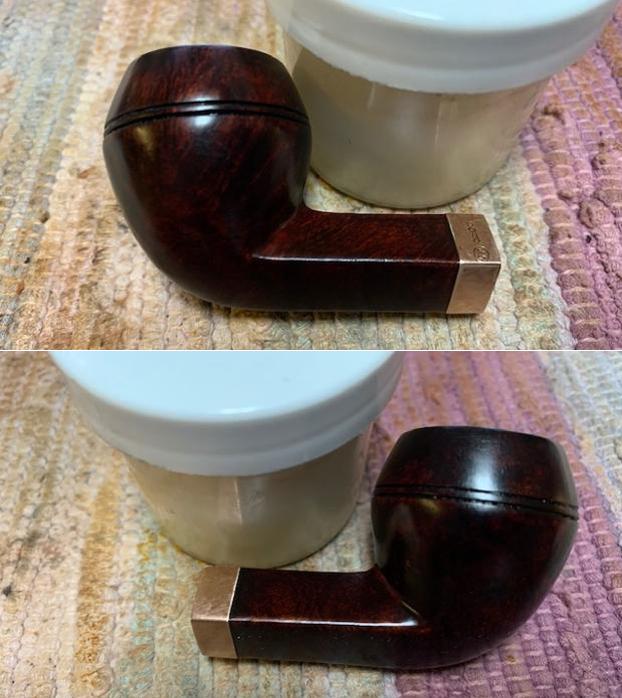
Restoring A Vintage Kriswill “Chief # 35” Pickaxe


Blog by Paresh Deshpande

The next pipe selected for refurbishing is a commonly shaped pickaxe Danish pipe. I say common because through the 1960s and 70s, this shape and its variations was the most loved and common on many Kriswill and Stanwell pipes as well as with various artisan pipe carvers from Denmark.

This pipe has a smooth stummel with a natural finish (I guess) that has darkened over a period of time. For a pipe with a length of 5 ½ inches and bowl height of 2 inches and chamber depth of 1 ¾ inches, it’s pretty much ultra light weight, making it a perfect pipe to clench. The vulcanite stem is thin and delicate. The smooth stummel surface displays beautiful cross grains to the front and aft of the bowl while the sides boast of lovely bird’s eye grains. It would need a good TLC to bring these grains to the fore. Here are a few pictures of the pipe that Abha had taken before she did her part of initial cleaning of the pipe. The pipe is stamped on the left surface of the shank as “Kriswill” in script hand over “CHIEF” over “HANDMADE DENMARK”. The bottom of the shank, at the shank end, is stamped with the shape code “35”. The vulcanite stem bears the stamp “KRISWILL” in script hand over the left surface. Last year, I had worked on a unique Kriswill “GOLDEN CLIPPER” that had a stummel shaped like the chimney of early steam locomotive engines. Here is the link for the write up… Restoring a Kriswill “Golden Clipper” Freehand Chimney | rebornpipes. I am sure you will find it an interesting read.

I had researched the brand at that time and I went through the above write up and also through the material that was available on pipedia.org and pipephil.eu. There are three facts which I wish to highlight:-

Firstly, Prior to 1970 the stampings are in script letters on the shank and on the mouthpiece. The star on the stem and block letters on the shank were introduced from that date on”

Secondly, the stem stamping changed to “stylized compass rose” prior to 1969 and not 1970 as evidenced from the Kriswill Pipe catalog pages of January 1969 (https://pipedia.org/images/5/5f/KriswillCatalog-Jan1969.pdf)

Thirdly, there is no mention of this shape code # 35 in the “CHIEF” line up in the 1969 and 1970 catalogs further implying that this shape code was discontinued after 1969,of course this is assuming that the complete catalog is made available at the above given link.

On pipedia.org, I came across an early catalog which does have a shape code # 35 pipe that is currently on my work table and is indicated with a red arrow. It’s a Nature finished pipe in brown color as indicated by the shape code.Thus from the above, the pipe that I am now working on definitely pre-dates to 1970s since the stamping is in script and the stem is sans the star and probably even prior to 1969.

With the provenance of the pipe satisfactorily established, I proceeded to carry out a visual inspection of the condition of the pipe in my hand. This helps me map the road to restoring the pipe by identifying the issues involved and identify methods/ options to address the same beforehand.

Initial Visual Inspection
The chamber is so filled with cake that I am unable to reach the bottom of the bowl with my little finger. The build-up of the cake is heavier on the bottom half of the bowl, but overall well maintained. The condition of the inner walls of the chamber can be commented upon only after the cake has been taken down to the bare briar. The rim top appears darkened and is covered with dust, lava and grime. The inner rim edge is uneven under the lava overflow and the exact condition will be ascertained once the rim top has been cleaned. The chamber odors are not very strong and should be completely eliminated once the cake has been removed and the shank has been thoroughly cleaned.The stummel surface appears dull and lackluster due to the accumulated dirt, dust and grime of years of usage and subsequent uncared for storage. One minor nick (encircled in yellow) and a scratch (indicated with green arrow) is seen over the front of the stummel surface. The mortise is clogged with oils and tars. This should be an easy clean up job. The vulcanite stem is heavily oxidized. The button has some bite marks on both surfaces and will need to be rebuilt and reshaped. There is minor tooth chatter in the bite zone on both the surfaces. The airway in the stem is blocked resulting in a restricted draw and will need to be cleaned. The tenon and the horizontal slot show accumulation of dried oils, tars and gunk on the inside as well as on the outside. This will have to be cleaned. The aluminum inner tube is covered in dried oils and tars. I shall clean it and keep it aside in my box with other inner tubes and stingers as I never use them with my pipes.Initial Cleaning By Abha…
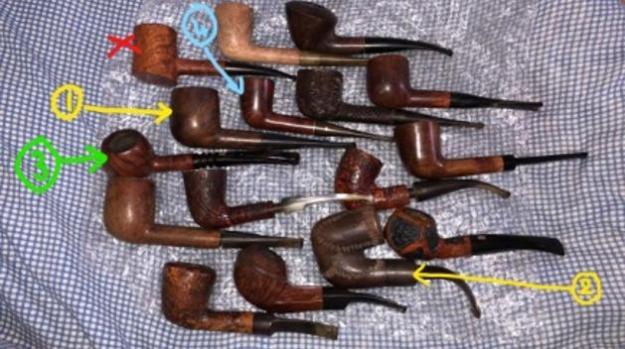
The initial cleaning on this pipe was done by Abha, my wife (she has cleaned up around 40-50 pipes and these had reached me for further restoration). She reamed out the complete cake and further smoothed out the chamber walls with a folded piece of 220 grit sand paper. She further cleaned out the internals of the shank with pipe cleaners and alcohol and cotton buds. She followed the internal cleaning of the shank with external cleaning of the stummel using Murphy’s Oil soap and hard bristled tooth brush and dried it with paper napkins and cotton cloth.Next she cleaned out the internals of the stem air way and immersed it in “Before and After Deoxidizer” solution along with the stem of other pipes in line for restoration (the pipe that I am working on is indicated by yellow arrow). Once the stem had soaked overnight, she cleaned the stem under running warm water and scrubbed the raised oxidation from the stem surface using Scotch Brite pad. She further removed the oxidation by scrubbing the stem with 0000 grade steel wool and applied a little olive oil to rehydrate the stem. She had removed the inner tube from the tenon and cleaned it with cotton swabs, pipe cleaners and alcohol.Once The Pipe Is On My Work Table…
The initial cleaning by Abha, my wife, is thorough and while saving me time, it also provides a clear picture of all the issues that needs to be addressed during the restoration process. She also makes a note of all the issues that she observed during initial cleaning for me to address and includes this note with each pipe that she packs. It’s a big saving on the time factor and I am really thankful to her for indulging me.

This is how the pipe came to me after Abha had worked her magic. The stampings on this pipe, as detailed above, are crisp and easily readable.The rim top surface does have a few issues that have now come to the fore after cleaning. The inner edge has minor charring between 12 o’clock and 1 o’clock direction and is encircled in yellow. The chamber walls have numerous, disjointed and very minor heat fissures which would need to be addressed. These heat fissures are indicated with green arrows. The inner edge is uneven in the 6 o’clock direction (encircled in blue). It has been my experience that these heat lines/ fissures may also appear if the complete cake has not been reamed out and once the complete carbon cake is reamed out, these lines disappear. That is what I shall try first! Through the cleaned stummel surface, the beauty of this piece of briar can be appreciated further. The beautiful bird’s eye and cross grains over the stummel will be further highlighted once the stummel has been polished and rejuvenated. I shall deal with the small nick that is observed over the front of the bowl either by filling it or may even leave it be. This nick and the scratch should be addressed to a great extent after I sand the stummel surface followed by subsequent polishing pads. The mortise is nice and clean with no ghost smells.The stem has cleaned up nicely and the oxidation is completely eliminated. One deep tooth indentation (marked in pastel blue) is seen on both the upper and lower stem surface in the bite zone. I shall address this issue with a fill of activated charcoal and CA superglue. The horizontal slot and the tenon end are clean with a full and even draw.The Process…
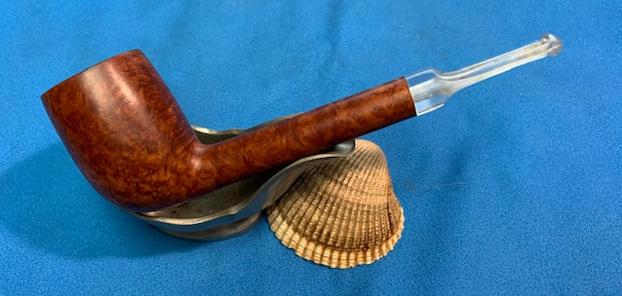
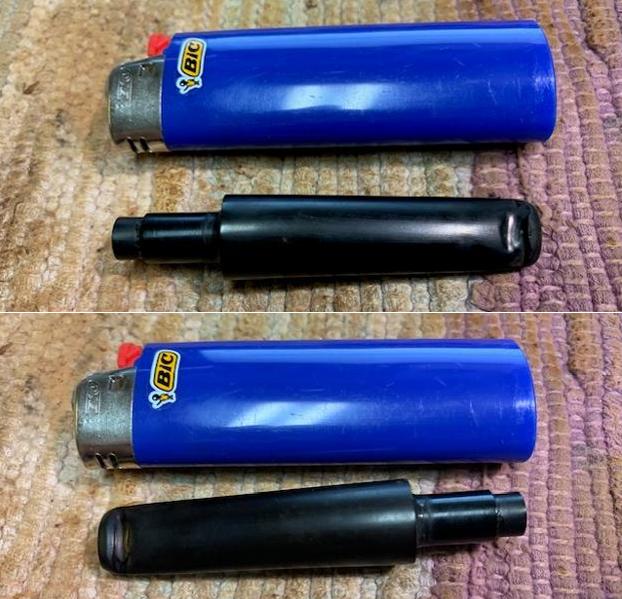
The first issue that I addressed was that of the stem repairs. I flamed the surface of the stem with a lighter to raise the tooth indentations on the stem. The heat from the flame of the lighter causes the vulcanite to expand and regain its natural shape, reducing the marks. I wiped the stem surface clean with a cotton pad dipped in alcohol to remove all the dust and dirt from the surface. The tooth marks which were visible after the flaming and sanding were filled with a mix of activated charcoal and clear CA superglue and set aside to cure overnight.With the stem fills set aside for curing, I worked the rim top surface. To address the uneven and charring of the inner rim edge, I topped the rim surface on a 220 grit sand paper. Though it is recommended to have a wooden board with the 220 grit sand paper firmly fixed over it, I just keep the sand paper on a flat table top, holding it firmly with my left hand and rotating the rim top over it with my right hand. I have come to realize that this set up gives me lot more freedom of movement, better control and convenience of storage. I frequently checked the progress being made as I hate to lose briar estate any more than absolutely necessary. I am pretty happy with the inner rim edge and what little darkening and unevenness remains will be masked by creating a slight bevel to the edge. This is how the rim top appears at this point in restoration. Taking these pictures, I remembered to ream the chamber to address the issue of suspected heat fissures. Using my fabricated small knife, I scraped away all the carbon from the chamber walls and followed it by sanding the wall surface using a 220 grit sand paper to a smooth surface. The chamber appears to be solid with no issues to the chamber walls. Staying with the rim, the next issue that I addressed was with the rim edges, both inner and outer. With a folded piece of 220 grit sand paper pinched between my thumb and fore finger, I created a bevel on the inner edge. This addressed the issue of the uneven and out of round chamber and also reduced the darkened edge.Next, I sanded the entire stummel with a piece of 220 grit sand paper. This helps to remove the minor scratches, nicks and dings from the stummel surface. While I was working on the stummel, the stem fills had completely cured. With a flat head needle file, I worked on the filling till I had achieved a rough match with the surrounding surface and had sufficiently sharpened the button edges. I further sanded the fills with a piece of 220 grit sand paper to achieve a better match. Thereafter, I began the process of bringing a nice shine to the surface by sanding with 320, 400, 600, 800 and 1000 grit sandpapers. I applied a little EVO to the stem surface to hydrate it and set the stem aside for the oil to be absorbed in to the surface.To bring a deep shine to the stem, I went through the complete set of micromesh pads, wet sanding with 1500 to 12000 grit sandpapers. I wiped the stem with moist cloth after each pad. At the end of micromesh cycle, I polished the stem with “Before and After Fine & Extra Fine” paste. I also refreshed the stem stamping with a white correction pen. The finished stem is shown below. With the repair completed, I turned my attention back to the stummel. I wet sanded the stummel with 1500 to 12000 grit micromesh pads, wiping frequently with a moist cloth to check the progress. I really like the looks of the stummel at this point in restoration. The grains and the clean lines of this piece of briar is really appreciable. Next, I rubbed a small quantity of “Before and After Restoration Balm” deep in to the briar with my finger tips and let it rest for a few minutes. The balm almost immediately works its magic and the briar now has a nice vibrant appearance with the beautiful grain patterns displayed in their complete splendor. I further buffed it with a horse hair brush. The contrast of the dark browns of the Bird’s eye and cross grains with the natural finish of the rest of the stummel adds an interesting dimension to the appearance of the stummel which may be insufficiently described in words and be rather seen in person. I have now reached the homestretch in this restoration project. To complete the restoration, I mounted a cotton cloth buffing wheel on to my hand held rotary tool and polished the stummel and stem with Blue Diamond compound. This compound helps to remove the minor scratch marks that remain from the sanding. Next, I mounted another cotton buffing wheel that I have earmarked for carnauba wax and applied several coats of the wax. I finished the restoration by giving the entire pipe a rigorous hand buffing using a microfiber cloth to raise the shine further. The finished pipe looks amazingly beautiful and is ready to join my collection. I only wish it could share with me it’s story of the past years while I enjoy smoking my favorite Virginia blend in it or maybe an English blend or maybe just keep admiring it!! The finished pipe is as shown below. P.S. I had completed this pipe (and next 6 restorations) during the months of November and December of last year. The reason for the delayed write ups is because I have moved out to a new work place and my luggage, including pipe restoration equipment, materials and pipes, were transported from old station to new place of work. My family will be moving in with me now (after a separation of nearly five years) by next month end after winding up the household in Pune. I should be settling down in to my new routine by end of April and only then will I be able to undertake any new projects. So in the intervening period, I intend to complete all my pending write ups so that I am still in touch with all the esteemed readers, who I miss very much.

A note of thanks to all the readers who have joined me in this journey that has been such a pleasure! You and your loved ones are always in our prayers…Stay home…stay safe!!

Another Of My Inherited Pipes Restored…. A “Drury Lane # 484”


Blog by Paresh Deshpande

As I was winding up my stay at the old duty station, I came across a neatly packed zip-lock pouch that was stowed away in to the deepest part of the cupboard. In that pouch were three pipes; two Comoys and one Drury Lane # 484. I remembered that the Comoy’s had stingers that needed leather gaskets and one needed a top nut for the stinger. Steve had sent me the leather gaskets while a replacement for the stinger that required top nut, was in post that was delayed for more than a year due to the prevalent worldwide pandemic situation. I decided to work on the Drury Lane and the one Comoy’s that just needed the leather gasket to be replaced.

The Drury Lane pipe is stamped on the left of the shank as “DRURY LANE” in an arch over “LONDON”, all in block capital letters. The right side of the shank surface bears the shape number “484” towards the chamber end with the COM stamp “MADE IN ENGLAND” with “MADE” at the top, “IN” in the middle, and “ENGLAND” forming the bottom of the circle (Football shaped stamping). The high quality twin bore vulcanite saddle stem bears the stamping “BITE” over “PROOF”. All the stampings are crisp and easily readable save for the stem logo which has a faint and the worn out letter P in the word PROOF.The stampings on the pipe were categorical in pointing out that the pipe is an English made and the way Drury Lane is stamped in an arch helped me narrow down the connection to early production of either Barling’s or Comoy’s brands as both had an arched stamp. To be sure of my assumptions, I visited pipephil.eu which confirmed my assumption; this brand is indeed linked with Comoy’s. Here is the link: Dra-Duk — Pipes : Logos & Markings (pipephil.eu)

Next, I visited pipedia.org for detailed information on the brand Comoy’s in general and this line of pipes in particular. The information that is given on the website makes for an interesting read and should anyone be interested in referencing the brand, the link is given below. Comoy’s – Pipedia

Further down under on the same web page, under the sub head “SECONDs MADE BY COMOY’S” is the complete list of seconds and I reproduce the same for ease of reference. The pipe on my work table finds a mention here and is highlighted in red.

Seconds made by Comoy’s
Academy Award, Ace of spades, Ancestor, Astor, Ayres, Britannia, Carlyle, Charles Cross, Claridge, Coronet?, Cromwell, Damman?, Dorchester, Dunbar, Drury Lane, Emerson, Everyman, Festival of Britain, Golden Arrow, Grand Master, Gresham, Guildhall, Hamilton (according to Who Made That Pipe), Kingsway, Lion’s Head, Lord Clive, Lumberman, Hyde Park, Lloyds, Mc Gahey, Moorgate, Newcastle, Oxford, O’Gorman, Rosebery Extra, Royal Falcon, Royal Guard, Royal Lane, Scotland Yard, St JamesSunrise, Super Sports, Sussex, The Academy Award, The Golden Arrow, The Mansion House, The Exmoor Pipe, Throgmorton, Tinder Box Royal Coachman, Townhall, Trident, Trocadero, Westminster, Wilshire.

Next, I was keen to research and link the shape code with Comoy’s pipes and at the bottom of the page is the link to Comoy’s Shape Number Chart (Comoy’s Shape Number Chart – Pipedia)

Comoy’s pipes were given shape numbers in the 1909 catalogue and also names for each shape, but it would seem that these numbers were NOT stamped on the pipes until sometime in the 1920’s. The earliest known is from 1925. The shape numbers are all 3 digits until after the Cadogan acquisition of Comoy’s in 1979, when some shapes were introduced with 4 digit numbers. However, they may have been introduced earlier in 1976, 1977 or 1978. On pre- Cadogan pipes additional letters can be found after the three numbers:

  • M on Meerschaum lined pipes.
  • P on Panel shaped bowls. ( This may not always be the case as I have now seen a photograph of a non panel Shape 309 with a P)
  • C on some shapes with curved bits. This does not seem to be universal for all curved bits and it would appear to be mainly on Princes and Bulldogs.
  • F believed to indicate a “Fishtail” bit. Verified on an early 1930’s Virgin Briar with the shape number 206F and a fishtail bit exactly like the Dunhill F/T, that was not introduced until 1950.

(S)=saddle bit – A/M=army mount – sq=squat – sq.shank=square shank

S=small – M=medium – L=large – XL=extraordinare shape – LW=lightweight shape

Circa 1975 (Pre-Cadogan) Shape Charts, courtesy Dough Valitchka which have been uploaded, finds a mention of the exact shape code seen on the Drury Lane that I am working on and is indicated with a red arrow. It is a Large Billiard with saddle stem.Here is another link from the same page which takes the readers to an absolutely well researched page on Dating of Comoy’s;

Comoy’s Dating Guide – Pipedia
Though the pipe currently on my work table is a Comoy’s second, I have attempted to date this pipe based on the stampings, particularly the COM stamp and have reproduced the relevant portions which have helped me in dating this pipe.

Made in England
This is stamped in a circle with “MADE” at the top, “IN” in the middle, and “ENGLAND” forming the bottom of the circle. This can be seen on a Cecil as early as 1910 and on an Old Bruyere of 1921 and more frequent from the 1930s. It can also appear as “MADE” arched, “IN” below, and “ENGLAND” arched the other way. These stamps are in an oval rugby-ball shape rather than a circle round shape.Thus I can conclusively say that the DRURY LANE pipe on my work table is from the period 1910 to 1930s

Initial Visual Inspection
The pipe that is currently on my work table has a classic Billiard shape with thick walls. The stummel has rich medium brown stain and is covered in dirt and grime through which flame grains can be seen around the sides of the stummel and over the shank surface while Bird’s eye adorns the front, aft, rim top and the foot of the stummel. There is a well maintained layer of cake in the chamber with heavy lava overflow over the rim top surface. The inner rim edge has a nice bevel that is covered in lava overflow. The twin bore vulcanite saddle stem is heavily oxidized with minor damage to the bite zone on either surface. The buttons on both surfaces show bite marks. The following pictures will give readers an idea of the overall condition of the pipe as it sits on my work table. Overall, the thin layer of cake and excellent condition of the stem are pointers to the fact that the pipe seems to be well looked after. It should be an easy restoration project, unless some gremlins pop up during the process. Detailed Visual Inspection
A thin and even layer of cake is seen in the chamber. The rim top surface is covered in overflow of lava, dirt, dust and grime through which a number of dents and dings can be seen. The exact condition of the inner walls of the chamber and rim top surface will be known once the cake has been taken down to bare briar and the rim top crud has been scraped off completely. The outer rim is uneven with a couple of dents/ chipped surface in 2 ‘O’ clock and 6 ‘O’ clock directions (marked in yellow circle). Only once the stummel has been thoroughly cleaned that I can be sure of my initial appreciation. The beveled inner rim edge is covered in lava overflow, masking the real condition of the rim edge. The chamber odor is strong and should be addressed to some extent once the cake has been taken down to the bare briar and the shank internals have been thoroughly cleaned. The stummel feels solid to the touch and I do not foresee any major issues with the condition of the chamber walls. To be honest with you, this being a Comoy’s seconds pipe, I had expected to find a few fills and some non-descript grain on the stummel briar. However, I was surprised to note that there are only four very minute fills (encircled in yellow) in the stummel surface and the surface boasts of some beautiful cross grains around the sides and over the shank surface while beautiful packed Bird’s eye adorns the front, aft and foot of the stummel. The stummel surface is covered in dirt and grime giving the stummel a dull and dirty appearance. The stummel surface shows a few dents and dings. It does have a quality which is seen on vintage pipes, not to forget, this is nearly an 80 plus year old pipe, but difficult to explain in words. The mortise shows minor accumulation of old oils and tars which would need to be cleaned. The fills over the stummel surface is one issue that I am not sure about dealing with since I absolutely love the old dark brown color and the patina that has developed over time that needs to be preserved and also since these fills are too minor to be noticed. A nice polish with micromesh grit pads will bring a nice shine to the stummel and highlight the grains.The twin bore vulcanite saddle stem is heavily oxidized, but otherwise in a decent condition. The bite zone on either surface shows some minor tooth indentations with a small amount of calcification at the base of the button edge. The twin holed slot and tenon opening shows accumulation of dried oils and tars. All in all, the stem presents no major damage and should be an easy clean up.The Process
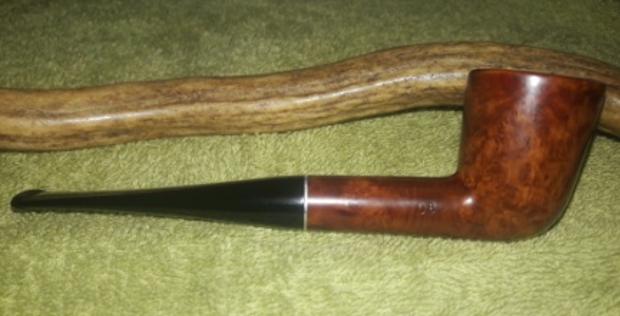
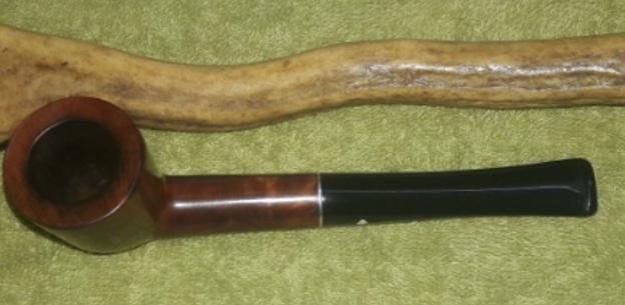
I started the restoration with cleaning of the stummel as I was keen to know the condition of the walls of the chamber. I worked on the stummel by first reaming the chamber with size 3 PipNet reamer head. With my fabricated knife, I further scraped the chamber walls to remove the remaining carbon deposits and also scraped out the lava overflow from the rim top surface. Once the cake was reamed back to the bare briar, I used a 150 grit sand paper followed by 220 grit sand paper to remove all the traces of remaining cake and also to smoothen out the inner walls of the chamber surface. Finally, to remove the residual carbon dust, I wiped the chamber with a cotton pad wetted with 99.9% pure isopropyl alcohol. Few very minor webs of heat lines can be seen along the heel and walls of the chamber. I am not sure if these are heat lines or remnants of old cake over the wall surface. With the same sharp knife, I gently scraped off the lava overflow from the rim top surface. The inner rim edge bevel has darkened, but I don’t think it is charred. Gently running a folded piece of 220 grit sandpaper along the inner edge should suffice to clean up the bevel. The issue of dents and dings over the rim top surface will be addressed by topping it over a 220 grit sandpaper.Next, I cleaned out the internals of the shank and mortise. Using my dental tool, I scraped out all the dried oils, tars and gunk that had accumulated in the draught hole and on the walls of the mortise. I finished the cleaning by running a few pipe cleaners dipped in isopropyl alcohol through the mortise. I shall continue with further cleaning of the shank internals when I clean the external stummel surface.With the bowl internals clean, I moved to clean the exterior of the stummel. I used a hard bristled tooth brush and Murphy’s Oil Soap to scrub the stummel and rim top. I rinsed the stummel under running warm water with anti oil dish washing detergent till the stummel surface was clean and dried it using paper towels and soft cotton cloth. I simultaneously cleaned the shank internals with the detergent and hard bristled shank brush and set the stummel aside to dry out naturally. The stummel surface has cleaned up nicely and the beautiful grain patterns are now on full display.With the stummel internals and externals cleaned and spruced up, I turned to address the stem issues. I cleaned the internals of the stem using hard and normal bristled pipe cleaners and isopropyl alcohol. I addressed the deeper oxidation by sanding the entire stem with a folded piece of 220 grit sand paper. Once the oxidation was completely removed, I wiped the surface clean with Murphy’s oil soap on a cotton swab. I rubbed a little Extra Virgin Olive oil to hydrate the stem and kept it aside. The stem at this point in restoration is shown below. The deeper tooth indentations on either surface of the stem were filled with a mix of CA superglue and activated charcoal powder and set aside for the fill to cure.Now that the rim top surface is clean and free of the entire lava overflow, the extent of the darkening to the inner bevel and dents and dings over the rim top surface are fairly apparent. I addressed the darkened inner edge by running a folded piece of 220 grit sand paper pinched between my thumb and index finger along the beveled surface and polished the freshly cleaned inner rim edge bevel with a piece of 600 grit sandpaper. I am very happy with the way inner rim edge bevel appears at this stage in restoration.I addressed the dents and dings over the rim top surface by topping it over a piece of 220 grit sandpaper. I checked the progress frequently to ensure that the topping is just adequate. This also addressed the issue of damage to the outer rim edge at 2 o’clock and 6 o’clock directions.The stem repairs had hardened considerably and I decided to complete the stem refurbishing. Using a flat head needle file, I reshaped the button and followed it up by sanding the stem with a folded piece of 220 grit sand paper to achieve a rough match with the rest of the stem surface. I further dry sanded the stem with 400, 600 and 800 grit sand papers. This helps to fine tune the matching of the fill with the stem surface while removing the deep rooted oxidation from the stem surface. I followed it up by wet sanding with a piece of 1000 grit sand paper to completely rid the surface of the oxidation and bring out the shine in the vulcanite. Once I was satisfied that the fills had perfectly matched with the rest of the stem surface and oxidation has been eliminated, using micromesh pads, I completed the polishing cycle by wet sanding the surface with 1500 to 12000 grit pads. The stem looks great with the fills nicely matched with the rest of the surface. I rubbed a little quantity of Extra Virgin Olive oil into the stem surface.  I gave a final rub with “Before and After Extra Fine” stem polish compound from Mark to remove fine scratches from the stem surface. Then I rubbed a little quantity of Extra Virgin Olive oil in to the stem surface and set it aside to be absorbed by the vulcanite. The stem polished up nicely and appears as good as new. Turning my attention back to the stummel, I subjected the stummel to a complete cycle of micromesh polish, dry sanding with 1500 to 12000 grit pads. I paid greater attention to polish the rim top surface and the bevel created on the inner rim edge. I wiped the stummel with a moist cloth after every grit pad to remove the sanding dust left behind by the pads. This also helps in monitoring the progress being made and provides an opportunity to take early corrective action, if required. I am happy with the progress being made till now. The briar has taken on a nice deep shine with the original medium brown of the stummel and the darker brown stains to the grains contrasting beautifully. I really like the dark brown coloration and the patina that is seen over the stummel surface. Next, I rubbed a small quantity of “Before and After Restoration Balm” into the briar with my finger tips and worked it deep in to the surface and let it rest for a few minutes. The balm almost immediately works it’s magic and the briar now has a nice vibrant appearance with the beautiful cross and Bird’s eye grain patterns on full display. The contrast of the dark browns of the grain with the light brown hues of the rest of the stummel adds an interesting dimension to the appearance of the stummel. I further buffed it with a horse hair brush to further deepen the shine. To refresh the stem logo, I coated the stem logo with white correction ink and let it dry out completely. Once the ink had dried out, with a toothpick, I gently removed the excess ink from the surrounding surface. I am happy with the crisp stem stamp, even though the alphabet “P” is a bit worn out.To put the finishing touches, I mounted a cotton cloth buffing wheel on to my hand held rotary tool and polished the stummel and stem with Blue Diamond compound. This compound helps to remove the minor scratch marks that remain from the sanding. Next, I mounted another cotton buffing wheel that I have earmarked for carnauba wax and applied several coats of the wax. I mounted a clean cotton cloth buffing wheel and gave the entire pipe a once over buff. I finished the restoration by giving the entire pipe a rigorous hand buffing using a microfiber cloth to raise the shine further. The finished pipe with the aged patina to the briar looks amazingly beautiful and is now ready for its long second inning with me. P.S. I have attempted to preserve the aged patina which has developed over the stummel surface with the passage of time. I did accept the minor fills that were seen over the stummel surface and let them be as they had blended in perfectly with the rest of the stummel surface.

Even though this old vintage pipe is a seconds from the Comoy’s brand, it has the same high quality feel and geometry as one expects from the top of the line Comoy’s.

Praying for the health and safety of all the readers and their loved ones in these troubled times…


Resurrecting an old Bulldog with a Bakelite Stem


Blog by Steve Laug

I have finished restoring quite a few of the pipes in this collection that we purchased from the older gentleman. He sent me the photos and I was amazed at what I saw. You have seen many of the pipes that he had. These included Dunhill, BBB, Orlik, Barclay Rex, a cased Ben Wade, an H. Simmons all briar, Hardcastles and some Meerschaums. There were also some assorted others that I will get to in the days ahead. It was a great collection.

The next pipe I have chosen is a tired and worn looking older style Bulldog with a Bakelite stem with a bone tenon. I don’t know what it is about this pipe that caught my eye but something did. It certainly was not the condition of pipe. The bowl was in very rough shape. There was a thick cake in the bowl and the rim top and edges were told buried under a thick coat of lava. The pipe was really a stranger to pipe cleaners. It was filthy both inside and out. The shape probably caught my eye because it is quite lovely even under the grime and wear. The stem is Bakelite and it was a complete mess. It had the end gnawed off  leaving behind a chipped and chewed end that was not eve square. I am not sure how much longer it was when it was made but it must have been longer than what we saw when we got. This was one well loved pipe that had been “ridden hard and put away wet”! It would be a challenge to see what I could do with it! In the end that is probably what drew me to the pipe!

Jeff took some photos of the Bakelite Stemmed Bulldog before he worked his magic in cleaning up the pipe. It is a an interesting pipe with a lot of potential and what appears to be some great grain under the grime and debris of the years.Jeff took photos of the bowl, rim top to show the thickness of the cake in the bowl and the thick lava on the rim top. The rim top and both inner and outer edges are so thickly covered that it is hard to know their condition. It appears that there were nicks and chips on the outer edge at the back of the bowl that will require a bit of attention. All of the issues will become clearer after the clean up. He took photos of the top and underside of the Bakelite stem showing the gnawed end of the stem and the broken and missing chunks from the stem end. It appears that there were button remnants on both sides. Jeff also took some photos of the bone tenon and the shank end to show the appearance and condition of both.Jeff took photos of the sides and heel of the bowl to show the condition of the briar. You can see the beautiful shape of the bowl and some interesting grain even through the dirt and debris of many years.   Jeff took photos of the stamping on the sides of the shank to show the lack of a stamping. It appears that both sides had some sort of stamp on them but it was worn away.This unstamped Bulldog is an interesting looking pipe. Because the old gentleman that we bought the pipes from intimated that he purchased his pipes at the Manhattan Barclay-Rex store I would imagine that he may have purchased this one from them as well. I was unable to pin down any information regarding the date this pipe was made but the fact that it is among the old timers I have been working on and the older Bakelite stem make me think it is older as well.

Jeff carefully cleaned the pipe. He reamed it with a PipNet pipe reamer and then cleaned up the reaming with a Savinelli Fitsall Pipe Knife. He scrubbed out the internals of the shank, stem and shank extension with alcohol, pipe cleaners and cotton swabs until the pipe was clean. He scrubbed the exterior of the bowl with Murphy’s Oil Soap and a tooth brush to remove the grime and grit on the briar and lava on the rim top. The finish looks much better and has a deep richness in the colour that highlights the dimensions of the grain. The edges looked good otherwise. He scrubbed the Bakelite stem with Soft Scrub to remove the grime and oils on the stem and chewed stem end. When the pipe arrived here in Vancouver I was amazed that it looked so good. Here are some photos of what I saw. I took some close up photos of the rim top and the stem surface. The top and inner and outer edge of the rim showed damage. There was serious damage back outer edge of the bowl. The stem was gnawed and that damage is very visible in the photos. I took photos of the shank sides to show that the stamping was worn away.I removed the stem from the shank and took a photo of the parts of the pipe. I started my work on the pipe by dealing with the chewed end of the stem. I used a file/rasp that I have here to flatten the chewed off end. I squared it off to have a fresh surface to work on a new button. I propped the stem up on the shank to take a picture of the squared end of the stem.I used a triangular file to recut the sharp edge of a button on the newly shaped stem end. I used 220 grit sandpaper to shape the top of the stem and shape the angles.I spread a coat of clear CA glue on top of the button to seal the new edge and top of the button and set it aside to cure. I followed up on that by layering glue on the top of the button to build it up and give it some shape. Once the button repair cured I used the triangle file and 180 grit sandpaper to shape the button surface.There was still more shaping to do but the  stem was taking form. I took profile pictures of it to give a sense of the shape. There is much more sanding to do but it was coming along.I set the stem aside and turned my attention to the bowl. I used a folded piece of 180 grit sandpaper to bring the inner edges of the bowl back into round. I topped the bowl with 220 grit sandpaper to minimize the damage on the rim top and particularly the back of the bowl. I took a photo of the rim top after the topping. I polished the briar with micromesh sanding pads – dry sanding with 1500-12000 grit sanding pads. I wiped the bowl down after each pad with a damp cloth to remove the sanding debris. I stained the rim top with an Oak stain pen to match the surrounding briar. Once it is buffed the match should be perfect.I worked some Before & After Restoration Balm into the surface of the bowl and shank with my fingertips to clean, enliven and protect the briar. I let the balm sit for 15 minutes and then buffed with a cotton cloth to raise the shine. The photos show the bowl at this point in the restoration process. With stem reshaped and built earlier in the process all that remained was to polish it. I polished the stem with micromesh sanding pads – dry sanding with 1500-12000 grit sanding pads. I wiped it down after each sanding pad with Obsidian Oil. I polished it with Before & After Pipe Stem Polish – both Fine and Extra Fine. I gave it a final coat of Obsidian Oil. With the bowl and the stem finished I put the beautiful No Name Bulldog back together and buffed it on the wheel using Blue Diamond to give it a shine. I gave the bowl and the stem multiple coats of carnauba wax on the wheel. I buffed it with a clean buffing pad to raise the shine. I hand buffed it with a microfiber cloth to deepen the shine. The grain on this pipe really is a great looking. The dimensions of the pipe are – Length: 4 ¾ inches, Height: 1 ¾ inch, Outside diameter of the bowl: 1 ¼ inches, Chamber diameter: ¾ of an inch. The weight of this large pipe is 1.16 ounces /33 grams. This Old Bakelite Stemmed Bulldog is another great find from this collection. It is much more beautiful in person than these photos can capture. This is another pipe that has the possibility of transporting the pipe man or woman back to a slower paced time in history where you can enjoy a respite. Thanks for walking through the restoration with me.

Resurrecting an interesting GBD  Square Shank Dura Mount 9488 Pot


Blog by Steve Laug

I have quite a few of the pipes in this collection that we purchased from the older gentleman. He sent me the photos and I was amazed at what I saw. You have seen many of the pipes that he had. These included Dunhill, BBB, Orlik, Barclay Rex, a cased Ben Wade, an H. Simmons all briar, Hardcastles and some Meerschaums. There were also some assorted others that I will get to in the days ahead. It was a great collection.

Now it was time to work on some of the single pipes that he had. The next one of these is a interesting Pot that is stamped on the left side of the diamond shank and reads DURA [over] GBD in an oval [over] MOUNT. On the right side it is stamped LONDON, ENGLAND [over] 9488 (the shape number). The stamping is clear and readable. It is a nice looking Pot that has the kind of damage to the rim edges that I have come to expect in this lot. The Duramount fitting on the shank end is something I have not seen before. The vulcanite saddle stem does not have any stamping on either side. It is the top pipe in the above photo.

Jeff took some photos of the GBD Dura Mount 9488 Pot before he worked his magic in cleaning up the pipe. It is a an interesting pipe with a lot of potential and what appears to be some great grain under the grime and debris of the years.Jeff took photos of the bowl, rim top to show the thickness of the cake in the bowl and the thick lava on the rim top. The rim top and both inner and outer edges are so thickly covered that it is hard to know their condition. It appears that there is a large chip on the outer edge at the back of the bowl that will require a bit of attention. All of the issues will become clearer after the clean up. He took photos of the top and underside of the vulcanite stem showing the oxidation, calcification, tooth marks, chatter and wear on the stem and button. Jeff took photos of the sides and heel of the bowl to show the condition of the briar. You can see the beautiful shape of the bowl and some interesting grain even through the dirt and debris of many years.   Jeff took photos of the stamping on the sides of the shank to show the clarity and readability of the stamp. It reads as mentioned above. He also took a photo of the brass GBD logo on the stem. I turned to Pipephil’s site and to the general GBD listing for the GBD Dura Mount pipe and other than a picture of the pipe and the stamping on Pipedia there was not any significant information on the line. I turned to the section on Pipedia on GBD Model Information to see what I could find (https://pipedia.org/wiki/GBD_Model_Information). There was one short line that I quote below.

Dura Mount — Factory unknown: Metal stem/bit fitting?

I assume from the design of the pipe the note above on Metal Stem/Bit Fitting ? is referring to the aluminum shank extension and mortise that holds the tenon firmly in place. I would guess that it was designed to protect both the shank and the tenon by providing this “DURABLE” shank end.

This GBD DURA MOUNT 9488 Pot is an interesting looking pipe. Because the old gentleman that we bought the pipes from intimated that he purchased his pipes at the Manhattan Barclay-Rex store I would imagine that he bought this one from them as well. I was unable to pin down any information regarding the date this pipe was made but the fact that it is among the old timers I have been working on makes me think it is older as well.

Jeff carefully cleaned the pipe. He reamed it with a PipNet pipe reamer and then cleaned up the reaming with a Savinelli Fitsall Pipe Knife. He scrubbed out the internals of the shank, stem and shank extension with alcohol, pipe cleaners and cotton swabs until the pipe was clean. He scrubbed the exterior of the bowl with Murphy’s Oil Soap and a tooth brush to remove the grime and grit on the briar and lava on the rim top. The finish looks much better and has a deep richness in the colour that highlights the dimensions of the grain. The chip on the back of the rim top was clear and looked like a relatively easy repair. The edges looked good otherwise. He soaked the stem in Briarville’s Pipe Stem Deoxidizer and scrubbed it with Soft Scrub to remove the remnants of oxidation. When the pipe arrived here in Vancouver I was amazed that it looked so good. Here are some photos of what I saw. I took some close up photos of the rim top and the stem surface. The top and inner and outer edge of the rim showed damage. There was serious damage back outer edge of the bowl. The stem had tooth marks just ahead of the button and on the button surface. I took photos of the stamping on the sides of the shank. It is readable and clear.I removed the stem from the shank and took a photo of the parts of the pipe. I started my work on the pipe by dealing with the damaged rim top and edges. I used a folded piece of 180 grit sandpaper to smooth out the nicks the inner edge of the bowl. I lightly sanded the rim top in preparation for the repair to the back outer edge. I stained the chipped area with a Maple stain pen to match the bowl and then built it up with clear CA glue. Once the glue cured I topped the bowl on a topping board with 220 grit sandpaper and sanded the outer edge with 220 at the same time. I took a photo of the rim top at this point in the process. I polished the briar and aluminum shank extension with micromesh sanding pads – dry sanding with 1500-12000 grit sanding pads. I wiped the bowl down after each pad with a damp cloth to remove the sanding debris. I stained the rim top with a Maple and a Cherry Stain pen to match the surrounding briar. Once it is buffed the match should be perfect.I worked some Before & After Restoration Balm into the surface of the bowl and shank with my fingertips to clean, enliven and protect the briar. I let the balm sit for 15 minutes and then buffed with a cotton cloth to raise the shine. The photos show the bowl at this point in the restoration process. I set the bowl aside and turned my attention to the stem. I “painted” the surface of the stem on both sides to lift the tooth marks. I was able to lift most of them. I filled in what remained next to the button with clear CA glue. Once the repairs cured, I sanded them with a folded piece of 220 grit sandpaper to smooth out the surface of the stem and reshape the button. I started polishing the stem with 400 grit wet dry sandpaper. I polished the stem with micromesh sanding pads – dry sanding with 1500-12000 grit sanding pads. I wiped it down after each sanding pad with Obsidian Oil. I polished it with Before & After Pipe Stem Polish – both Fine and Extra Fine. I gave it a final coat of Obsidian Oil. With the bowl and the stem finished I put the beautiful GBD Dura Mount 9488 Pot back together and buffed it on the wheel using Blue Diamond to give it a shine. I gave the bowl and the stem multiple coats of carnauba wax on the wheel. I buffed it with a clean buffing pad to raise the shine. I hand buffed it with a microfiber cloth to deepen the shine. The grain on this pipe really is a great looking. The dimensions of the pipe are – Length: 5 ¾ inches, Height: 1 ¾ inch, Outside diameter of the bowl: 1 ½ inches, Chamber diameter: 1 of an inch. The weight of this large pipe is 1.34 ounces /39 grams. This GBD Dura Mount is another great find from this collection. It is much more beautiful in person than these photos can capture. I will be putting it on the rebornpipes store soon. If you would like to add it to your collection let me know. This is another pipe that has the possibility of transporting the pipe man or woman back to a slower paced time in history where you can enjoy a respite. Thanks for walking through the restoration with me.

The Second of Two Algerian Briar French Made Pipes – a Bent Bulldog


Blog by Steve Laug

I have quite a few of the pipes in this collection that we purchased from the older gentleman. He sent me the photos and I was amazed at what I saw. You have seen many of the pipes that he had. These included Dunhill, BBB, Orlik, Barclay Rex, a cased Ben Wade, an H. Simmons all briar, Hardcastles and some Meerschaums. There were also some assorted others that I will get to in the days ahead. It was a great collection.

Now it was time to work on some of the single pipes that he had. The next one of these is a beautifully grained Bulldog that is stamped on the top right side of the diamond shank. It reads ALGERIAN BRIAR [over] Made in France. The stamping is clear and readable. It is a nice looking Bent Bulldog. The vulcanite saddle stem does not have any stamping on either side. It is the top pipe in the above photo.

Jeff took some photos of the ALGERIAN BRIAR BULLDOG before he worked his magic in cleaning up the pipe. It is a an interesting pipe with a lot of potential and what appears to be some great grain under the grime and debris of the years.Jeff took photos of the bowl, rim top to show the thickness of the cake in the bowl and the thick lava on the rim top. The rim top and both inner and outer edges are so thickly covered that it is hard to know their condition. It appears that there are some nicks and chips on the outer edge that visible but not deep. All of the issues will become clearer after the clean up. He took photos of the top and underside of the vulcanite stem showing the oxidation, calcification, tooth marks, chatter and wear on the stem and button. Jeff took photos of the sides and heel of the bowl to show the condition of the briar. You can see the beautiful shape of the bowl and some interesting grain even through the dirt and debris of many years.   Jeff took a photo of the stamping on the top left side of the shank to show the clarity and readability of the stamp. It reads as mentioned above.This Algerian Briar French Made Bulldog is a great looking pipe. Because the old gentleman that we bought the pipes from intimated that he purchased it at the Manhattan Barclay-Rex store I wonder if these were pipes made for them. I was unable to pin down any information regarding the date this pipe was made but the fact that it is among the old timers I have been working on makes me think it is older as well.

Jeff carefully cleaned the pipe. He reamed it with a PipNet pipe reamer and then cleaned up the reaming with a Savinelli Fitsall Pipe Knife. He scrubbed out the internals of the shank, stem and shank extension with alcohol, pipe cleaners and cotton swabs until the pipe was clean. He scrubbed the exterior of the bowl with Murphy’s Oil Soap and a tooth brush to remove the grime and grit on the briar and lava on the rim top. The finish looks much better and has a deep richness in the colour that highlights the dimensions of the grain. The rim top nicks in the briar on the top the inner edge was darkened. He soaked the stem in Briarville’s Pipe Stem Deoxidizer and scrubbed it with Soft Scrub to remove the remnants of oxidation. When the pipe arrived here in Vancouver I was amazed that it looked so good. Here are some photos of what I saw. I took some close up photos of the rim top and the stem surface. The top and edges of the rim looked good and there was some nicks and scratches on the top and outer edge. The inner edge had some darkening but looked good. The stem pitted and there was tooth chatter on the top an bottom of the stem ahead of the button and on the button surfaceI took a photo of the stamping on the top right side of the diamond shank. It is readable and clear.I removed the stem from the shank and took a photo of the parts of the pipe. I started my work on the pipe by dealing with the damaged rim top and edges. I used a folded piece of 220 grit sandpaper to smooth out the nicks on the outer edge of the rim cap and blend them into the surface of the briar.I polished the briar with micromesh sanding pads – dry sanding with 1500-12000 grit sanding pads. I wiped the bowl down after each pad with a damp cloth to remove the sanding debris. I worked some Before & After Restoration Balm into the surface of the bowl and shank with my fingertips to clean, enliven and protect the briar. I let the balm sit for 15 minutes and then buffed with a cotton cloth to raise the shine. The photos show the bowl at this point in the restoration process. I set the bowl aside and turned my attention to the stem. The surface was rough but there were not any tooth marks. I sanded it with a folded piece of 220 grit sandpaper to smooth out the surface of the stem and reshape the button. I started polishing the stem with 400 grit wet dry sandpaper.I polished the stem with micromesh sanding pads – dry sanding with 1500-12000 grit sanding pads. I wiped it down after each sanding pad with Obsidian Oil. I polished it with Before & After Pipe Stem Polish – both Fine and Extra Fine. I gave it a final coat of Obsidian Oil. As I sanded it I was not surprised to find flecks of metal in the rubber of this stem as well which helped in dating the pipe to the war years of the 30s and 40s. With the bowl and the stem finished I put the beautiful Algerian Briar Bent Bulldog back together and buffed it on the wheel using Blue Diamond to give it a shine. I gave the bowl and the stem multiple coats of carnauba wax on the wheel. I buffed it with a clean buffing pad to raise the shine. I hand buffed it with a microfiber cloth to deepen the shine. It really is a great looking pipe with beautiful grain. The dimensions of the pipe are – Length: 5 inches, Height: 1 ½ inch, Outside diameter of the bowl: 1 ½ inches, Chamber diameter: 5/8 of an inch. The weight of this large pipe is 1.27 ounces /35 grams. This Algerian Briar Bulldog is another great find in this collection. It is much more beautiful in person than these photos can capture. I will be putting it on the rebornpipes store soon. If you would like to add it to your collection let me know. This is another pipe that has the possibility of transporting the pipe man or woman back to a slower paced time in history where you can enjoy a respite. Thanks for walking through the restoration with me.


The First of Two Algerian Briar French Made Pipes – a 421 Canadian


Blog by Steve Laug

I have quite a few of the pipes in this collection that we purchased from the older gentleman. He sent me the photos and I was amazed at what I saw. You have seen many of the pipes that he had. These included Dunhill, BBB, Orlik, Barclay Rex, a cased Ben Wade, an H. Simmons all briar, Hardcastles and some Meerschaums. There were also some assorted others that I will get to in the days ahead. It was a great collection.

Now it was time to work on some of the single pipes that he had. The next one of these is a beautifully grained Canadian that is stamped on the underside of the shank. It reads ALGERIAN BRIAR [over] Made in France [over] 421. The stamping is clear and readable. It is a nice looking Canadian. The short taper vulcanite stem does not have any stamping on either side. It is the lower pipe in the above photo.

Jeff took some photos of the ALGERIAN BRIAR 421 CANADIAN before he worked his magic in cleaning up the pipe. It is a an interesting pipe with a lot of potential and what appears to be some great grain under the grime and debris of the years.Jeff took photos of the bowl, rim top to show the thickness of the cake in the bowl and the thick lava on the rim top. The rim top and both inner and outer edges are so thickly covered that it is hard to know their condition. It appears that there are some nicks and chips on the outer edge that are quite deep. All of the issues will become clearer after the clean up. He took photos of the top and underside of the vulcanite stem showing the oxidation, calcification, tooth marks, chatter and wear on the stem and button. Jeff took photos of the sides and heel of the bowl to show the condition of the briar. You can see the beautiful shape of the bowl and some interesting grain even through the dirt and debris of many years.   Jeff took a photo of the stamping on the underside of the shank to show the clarity and readability of the stamp. It reads as mentioned above.This Algerian Briar French Made Canadian is a great looking pipe. Because the old gentleman that we bought the pipes from intimated that he purchased it at the Manhattan Barclay-Rex store I wonder if these were pipes made for them. I was unable to pin down any information regarding the date this pipe was made but the fact that it is among the old timers I have been working on makes me think it is older as well.

Jeff carefully cleaned the pipe. He reamed it with a PipNet pipe reamer and then cleaned up the reaming with a Savinelli Fitsall Pipe Knife. He scrubbed out the internals of the shank, stem and shank extension with alcohol, pipe cleaners and cotton swabs until the pipe was clean. He scrubbed the exterior of the bowl with Murphy’s Oil Soap and a tooth brush to remove the grime and grit on the briar and lava on the rim top. The finish looks much better and has a deep richness in the colour that highlights the dimensions of the grain. The rim top was in rough condition with nicks and gouges on the top and on the inner and outer edges. He soaked the stem in Briarville’s Pipe Stem Deoxidizer and scrubbed it with Soft Scrub to remove the remnants of oxidation. When the pipe arrived here in Vancouver I was amazed that it looked so good. Here are some photos of what I saw. I took some close up photos of the rim top and the stem surface. The top and inner and outer edge of the rim were in rough condition. There was serious damage back outer edge of the bowl. The stem had deep tooth marks just ahead of the button and on the button surface. I removed the stem from the shank and took a photo of the parts of the pipe. I started my work on the pipe by dealing with the damaged rim top and edges. I worked on the inner edge cleaning up the bevel with 180 grit sandpaper. I rebuilt the damaged outer edge on the bowl on the back of the pipe with clear CA glue and briar dust. I topped the damaged rim top on a topping board with 220 grit sandpaper to smooth out the damage. I used a folded piece of 220 grit sandpaper to smooth the roughness on the outer edge of the rim. Next I turned to the gouges in the sides of the bowl. I filled them in with clear CA glue and briar dust. Once the repairs cured I sanded them smooth with 180 and 220 grit sandpaper. I polished the briar with micromesh sanding pads – dry sanding with 1500-12000 grit pads. I wiped the briar down after each grit with a damp cloth. The grain began to really stand out. Once it was finished I stained the rim top and edges with a combination of Cherry, Maple and Oak stain pens to blend the areas I had sanded into the rest of the bowl.  I worked some Before & After Restoration Balm into the surface of the bowl and shank with my fingertips to clean, enliven and protect the briar. I let the balm sit for 15 minutes and then buffed with a cotton cloth to raise the shine. The photos show the bowl at this point in the restoration process. I set the bowl aside and turned my attention to the stem. I “painted” the stem surface with the flame of a lighter to lift the marks. Many lifted all the way but those that remained I filled in with clear CA glue. Once it cured I sanded it with a folded piece of 220 grit sandpaper to blend them in the rest of the stem surface. I started polishing the stem with 400 grit wet dry sandpaper. As I sanded it I was not surprised to find flecks of metal in the rubber which helped in dating the pipe to the war years of the 30s and 40s.  I polished the stem with micromesh sanding pads – dry sanding with 1500-12000 grit sanding pads. I wiped it down after each sanding pad with Obsidian Oil. I polished it with Before & After Pipe Stem Polish – both Fine and Extra Fine. I gave it a final coat of Obsidian Oil. With the bowl and the stem finished I put the beautiful Algerian Briar 421 Canadian back together and buffed it on the wheel using Blue Diamond to give it a shine. I gave the bowl and the stem multiple coats of carnauba wax on the wheel. I buffed it with a clean buffing pad to raise the shine. I hand buffed it with a microfiber cloth to deepen the shine. It really has some great looking grain. The dimensions of the pipe are – Length: 5 ¾ inches, Height: 1 ½ inch, Outside diameter of the bowl: 1 1/8 inches, Chamber diameter: ¾ of an inch. The weight of this large pipe is 1.13 ounces /31 grams. This Algerian Briar Canadian is another great find in this collection. I try to use the same prop with the pipes I photograph to give a sense of size and proportion of the pipe. You can see from the dimensions given above this is a petite pipe that makes this small shell seem quite large. It is much more beautiful in person than these photos can capture. I will be putting it on the rebornpipes store soon. If you would like to add it to your collection let me know. This is another pipe that has the possibility of transporting the pipe man or woman back to a slower paced time in history where you can enjoy a respite. Thanks for walking through the restoration with me.


Restoring a Mystery Lovat with very faint stamping


Blog by Steve Laug

I have finished restoring all of the Barclay-Rex pipes in the collection of pipes that we purchased from the older gentleman. He sent me the photos and I was amazed at what I saw. You have seen many of the pipes that he had. These included Dunhill, BBB, Orlik, Barclay Rex, a cased Ben Wade, an H. Simmons all briar, Hardcastles and some Meerschaums. There were also some assorted others that I will get to in the days ahead. It was a great collection.

Now it was time to work on some of the single pipes that he had. The next one of these is a beautifully grained Lovat that very faint stamping on both sides of the shank. On the left side it is stamped very faintly and could read DUNHILL??? or maybe something else. But not for sure. The right side also has a shape number next to the shank/bowl junction that looks like 36/56/66 or something close to that. The stamping is faint but readable. It is a nice little Lovat with an older style stem that is stamped AA. That is a bit mystifying as it is hard to know if it is original. The stamp could be for an Alexander & Alexander pipe. The stamping on the shank is very faint and I am unable to identify it with any certainty. It is a mystery that will remain so while I work on it. I have drawn a red box around the pipe in the above photo to identify it for you.

Jeff took some photos of the Mystery Lovat before he worked his magic in cleaning up the pipe. It is a an interesting pipe with a lot of potential and what appears to be some great grain under the grime and debris of the years.Jeff took photos of the bowl, rim top to show the thickness of the cake in the bowl and the thick lava on the rim top. The rim top and both inner and outer edges are so thickly covered that it is hard to know their condition. But if there are issues it will become clearer after the clean up. He took photos of the top and underside of the vulcanite stem showing the oxidation, calcification, tooth marks, chatter and wear on the stem and button. Jeff took photos of the sides and heel of the bowl to show the condition of the briar. You can see the beautiful shape of the bowl and some interesting grain even through the dirt and debris of many years.Jeff took a photo of the stamping on the left side of the stem capture what was visible on the pipe. You can see the AA on the left side at the shank junction.Without any further verification of the faint stamping on the shank it was time to work on the pipe. The old gentleman that we bought the pipes from intimated that he purchased it at the Manhattan Barclay-Rex store. I was unable to pin down any information regarding the date this pipe was made but the shape of the stem made me think it was another old timer.  

Jeff carefully cleaned the pipe. He reamed it with a PipNet pipe reamer and then cleaned up the reaming with a Savinelli Fitsall Pipe Knife. He scrubbed out the internals of the shank, stem and shank extension with alcohol, pipe cleaners and cotton swabs until the pipe was clean. He scrubbed the exterior of the bowl with Murphy’s Oil Soap and a tooth brush to remove the grime and grit on the briar and lava on the rim top. The finish looks much better and has a deep richness in the colour that highlights the dimensions of the grain. The rim top was in rough condition with nicks and gouges on the top and on the inner and outer edges. He soaked the stem in Briarville’s Pipe Stem Deoxidizer and scrubbed it with Soft Scrub to remove the remnants of oxidation. When the pipe arrived here in Vancouver I was amazed that it looked so good. Here are some photos of what I saw. I took some close up photos of the rim top and the stem surface. The top and inner and outer edge of the rim were in rough condition. There was serious damage on the inner edge of the bowl. The stem had deep tooth marks just ahead of the button and on the button surface. I took a picture of the shank sides to try and capture the faint stamping but I could not get it to show up in the photos below.I removed the stem from the shank and took a photo of the parts of the pipe. I started my work on the pipe by dealing with the damaged rim top and edges. I worked on the inner edge giving it a slight bevel with 180 grit sandpaper. I topped the damaged rim top on a topping board with 220 grit sandpaper to smooth out the damage. I used a folded piece of 220 grit sandpaper to work on the outer edge of the rim. Once it was finished I stained the rim top and edges with a Walnut stain pen to blend the areas into the rest of the bowl.  I polished the briar with micromesh sanding pads – dry sanding with 1500-12000 grit pads. I wiped the briar down after each grit with a damp cloth. The grain began to really stand out. I worked some Before & After Restoration Balm into the surface of the bowl and shank with my fingertips to clean, enliven and protect the briar. I let the balm sit for 15 minutes and then buffed with a cotton cloth to raise the shine. The photos show the bowl at this point in the restoration process. I set the bowl aside and turned my attention to the stem. I filled in the deep tooth marks with clear CA glue. Once it cured I sanded it with a folded piece of 220 grit sandpaper to blend them in the rest of the stem surface. I started polishing the stem with 400 grit wet dry sandpaper. I polished the stem with micromesh sanding pads – dry sanding with 1500-12000 grit sanding pads. I wiped it down after each sanding pad with Obsidian Oil. I polished it with Before & After Pipe Stem Polish – both Fine and Extra Fine. I gave it a final coat of Obsidian Oil. With the bowl and the stem finished I put the beautiful Little Mystery Lovat back together and buffed it on the wheel using Blue Diamond to give it a shine. I gave the bowl and the stem multiple coats of carnauba wax on the wheel. I buffed it with a clean buffing pad to raise the shine. I hand buffed it with a microfiber cloth to deepen the shine. It really is a great looking sandblast. The dimensions of the pipe are – Length: 5 ½ inches, Height: 1 ¾ inch, Outside diameter of the bowl: 1 ¼ inches, Chamber diameter: ¾ of an inch. The weight of this large pipe is 1.13 ounces /32 grams. This Mystery Lovat is another great find in this collection. I try to use the same prop with the pipes I photograph to give a sense of size and proportion of the pipe. You can see from the dimensions given above this is a petite pipe that makes this small shell seem quite large. It is much more beautiful in person than these photos can capture. I will be putting it on the rebornpipes store soon. If you would like to add it to your collection let me know. This is another pipe that has the possibility of transporting the pipe man or woman back to a slower paced time in history where you can enjoy a respite. Thanks for walking through the restoration with me.

Restoring a French Made Strand Bent Billiard (Comoy’s)


Blog by Steve Laug

I have finished restoring all of the Barclay-Rex pipes in the collection of pipes that we purchased from the older gentleman. He sent me the photos and I was amazed at what I saw. You have seen many of the pipes that he had. These included Dunhill, BBB, Orlik, Barclay Rex, a cased Ben Wade, an H. Simmons all briar, Hardcastles and some Meerschaums. There were also some assorted others that I will get to in the days ahead. It was a great collection.

Now it was time to work on some of the single pipes that he had. The next one of these is a beautiful Bent Billiard that is stamped Strand in an oval on the left side of the shank. On the right side it is stamped Made in France. The stamping is faint but readable. It is a nice little Bent Billiard with an older style stem. It appears to have had a band on the shank originally but that had disappeared. There is no crack so it was probably just decorative. I have drawn a red box around the pipe in the above photo to identify it for you.

Jeff took some photos of French Made Strand Bent Billiard before he worked his magic in cleaning up the pipe. It is a an interesting pipe with a lot of potential and what appears to be some great grain under the grime and debris of the years.Jeff took photos of the bowl, rim top to show the thickness of the cake in the bowl and the thick lava on the rim top. The rim top and both inner and outer edges looked good. But if there are issues it will become clearer after the clean up. He took photos of the top and underside of the vulcanite stem showing the oxidation, calcification, tooth marks, chatter and wear on the stem and button. Jeff took photos of the sides and heel of the bowl to show the condition of the briar. You can see the beautiful shape of the bowl even through the dirt and debris of many years. Jeff took a photo of the stamping on the left side of the shank to capture that it is faint but readable. As is my habit I turned to Pipephil’s site but there was no information on the brand that I could find there in the several spots that I looked at.

I turned to Pipedia as well to check and came up empty there as well. There was no listing for the Strand brand or tie to other French made pipes.

I had one more possible link to check so I turned to my copy of Who Made That Pipe to see if there were any listings for the Strand line. Here is what I found. The Strand pipe had three possible makers – Comoy’s, L. Orlik and L&HS. The first two were noted as English pipemakers and the third I believe should read LH Stern is an American pipemaker. Since the pipe was made in France it pretty well removed LH Stern and Orlik from the running. The only company who made pipes both in England and France was Comoy’s. I think I may have found the link to who made this pipe.With the information from Who Made That Pipe it seems that the pipe was made by Comoy’s and it certainly showed similarities to that brand. The old gentleman that we bought the pipes from intimated that he purchased it at the Manhattan Barclay-Rex store. I was unable to pin down any information regarding the date this pipe was made. Now it was time to work on the pipe.

Jeff carefully cleaned the pipe. He reamed it with a PipNet pipe reamer and then cleaned up the reaming with a Savinelli Fitsall Pipe Knife. He scrubbed out the internals of the shank, stem and shank extension with alcohol, pipe cleaners and cotton swabs until the pipe was clean. He scrubbed the exterior of the bowl with Murphy’s Oil Soap and a tooth brush to remove the grime and grit on the briar and lava on the rim top. The finish looks much better and has a deep richness in the colour that highlights the dimensions of the grain. The rim top looked good with some darkening on the top and damage to the back outer edge of the bowl. He soaked the stem in Briarville’s Pipe Stem Deoxidizer and scrubbed it with Soft Scrub to remove the remnants of oxidation. When the pipe arrived here in Vancouver I was amazed it looked so good. Here are some photos of what I saw. I took some close up photos of the rim top and the stem surface. The top and inner and outer edge of the rim look very good. There was light damage on the inner edge of the bowl. The stem was older Hard Rubber and had deep tooth marks just ahead of the button. I took a picture of the stamping on the left side of the shank and it was faint but readable as noted above.I removed the stem from the shank and took a photo of the parts of the pipe. I started my work on the pipe by examining the shank end. There is a clear demarcation on the shank end that tells me that the pipe originally had a band. I examined the shank end and externals and there was no cracking so the band had to have been ornamental. With the age of the pipe estimated to the 1930s or 1940s I was pretty sure that the band would have been a standard decoration. I went through my bands and found a nice 14K gold band that would work well. It was deeper than I needed so I would need to reduce that to get a fit like the previous band. I heated the band with a lighter and pressed it onto the shank to get a fit that covered the line left on the shank.I took a photo of the band on the shank to show the extra band depth that I would need to remove before the fit was proper. I used a topping board and 220 grit sandpaper to carefully remove the excess band depth. I cleaned up the sharp edge with micromesh sanding pads. I was careful to not damage the stamping on the band. Once I finished I was pretty happy with the fit.I sanded the tenon a little to get a snug fit in the shank and put the stem in place. I took photos of the pipe with the new band. Lots of polishing to do on all the parts but it looked good. I used a folded piece of 220 grit sandpaper to smooth out the damage on the rim edge and clean up the marks on the rim top.I polished the briar with micromesh sanding pads – dry sanding with 1500-12000 grit pads. I wiped the briar down after each grit with a damp cloth. The grain began to really stand out. I worked some Before & After Restoration Balm into the surface of the bowl and shank with my fingertips to clean, enliven and protect the briar. I let the balm sit for 15 minutes and then buffed with a cotton cloth to raise the shine. I polished the band with a jeweler’s cloth. The photos show the bowl at this point in the restoration process. I set the bowl aside and turned my attention to the stem. I “painted” it with the flame of a Bic lighter to lift the tooth dents in the vulcanite on both sides. I raised them significantly but I am very careful with burning older hard rubber. It is easy to char the rubber then you have more issues to deal with! When I had finished I filled in the remaining dents with clear CA glue. Once it cured I sanded it with a folded piece of 220 grit sandpaper to blend them in the rest of the stem surface. I started polishing the stem with 400 grit wet dry sandpaper. I polished the stem with micromesh sanding pads – dry sanding with 1500-12000 grit sanding pads. I wiped it down after each sanding pad with Obsidian Oil. I polished it with Before & After Pipe Stem Polish – both Fine and Extra Fine. I gave it a final coat of Obsidian Oil. With the bowl and the stem finished I put the beautiful French Made Comoy’s Strand Bent Billiard back together and buffed it on the wheel using Blue Diamond to give it a shine. I gave the bowl and the stem multiple coats of carnauba wax on the wheel. I buffed it with a clean buffing pad to raise the shine. I hand buffed it with a microfiber cloth to deepen the shine. It really is a great looking sandblast. The dimensions of the pipe are – Length: 5 inches, Height: 1 ¾ inch, Outside diameter of the bowl: 1 inches, Chamber diameter: ¾ of an inch. The weight of this large pipe is 1.13 ounces /32 grams. This Strand Bent Billiard is another great find in this collection. I try to use the same prop with the pipes I photograph to give a sense of size and proportion of the pipe. You can see from the dimensions given above this is a petite pipe that makes this small shell seem quite large. It is much more beautiful in person than these photos can capture. I will be putting it on the rebornpipes store soon. If you would like to add it to your collection let me know. This is another pipe that has the possibility of transporting the pipe man or woman back to a slower paced time in history where you can enjoy a respite. Thanks for walking through the restoration with me.