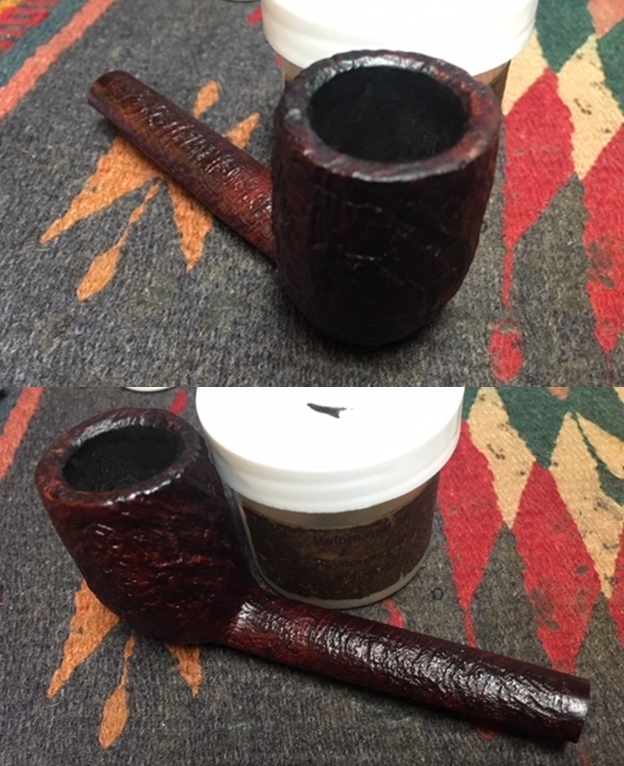
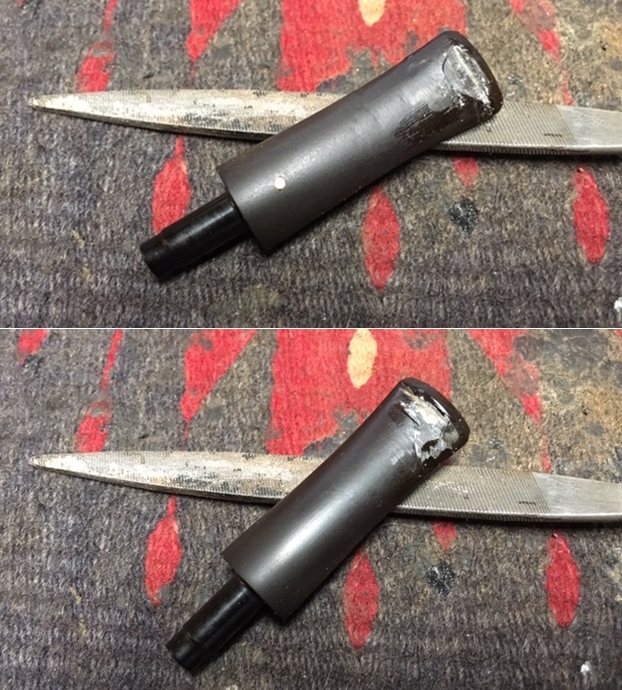
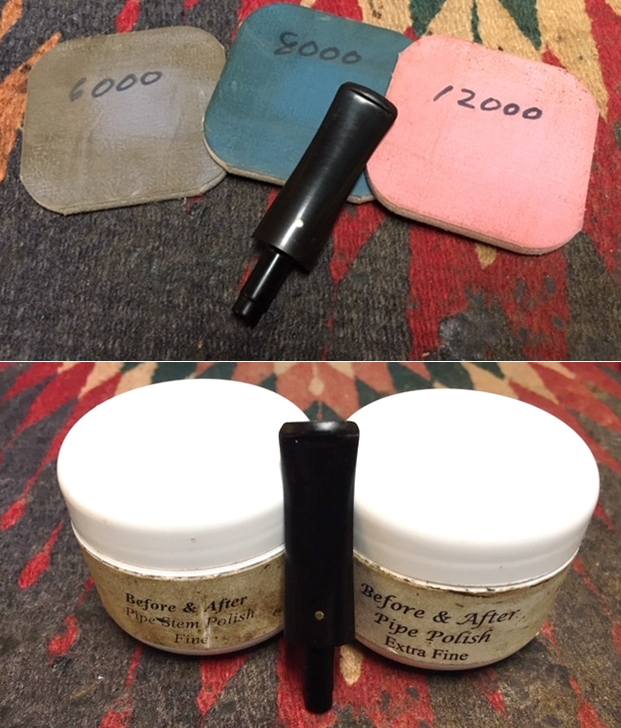
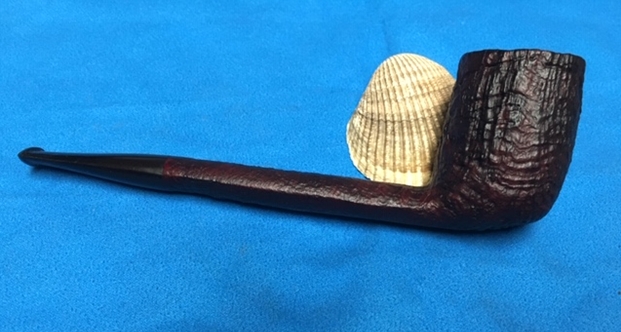
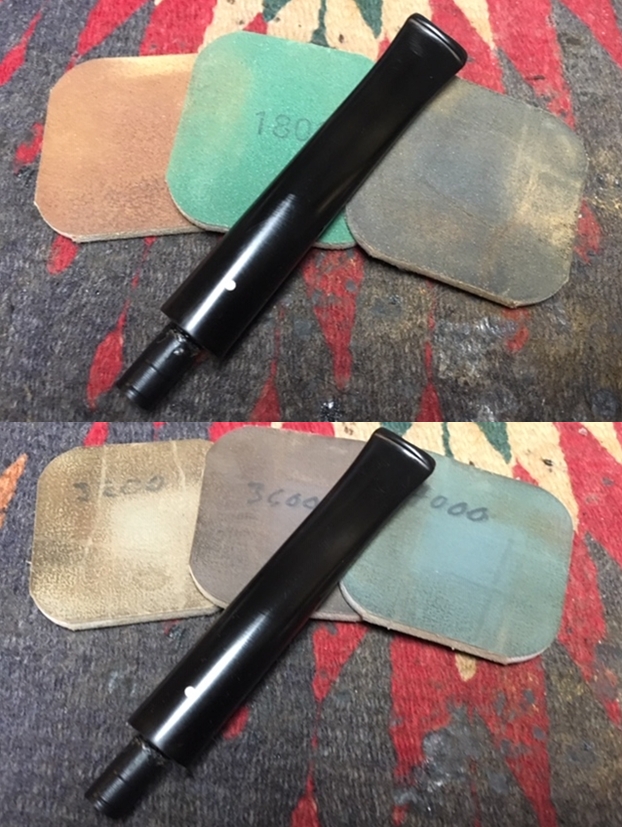
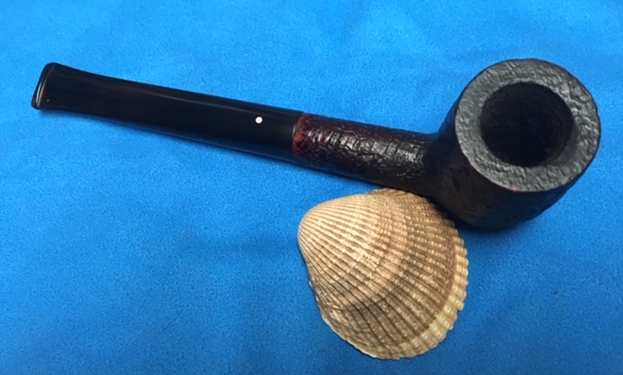
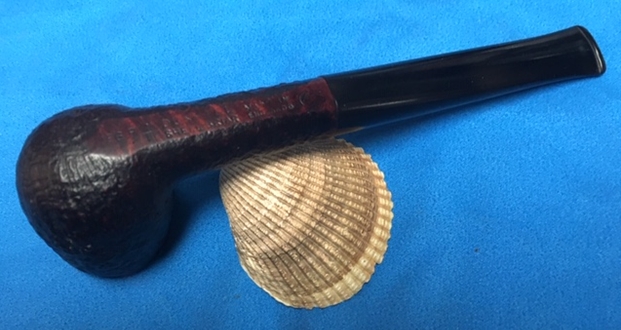
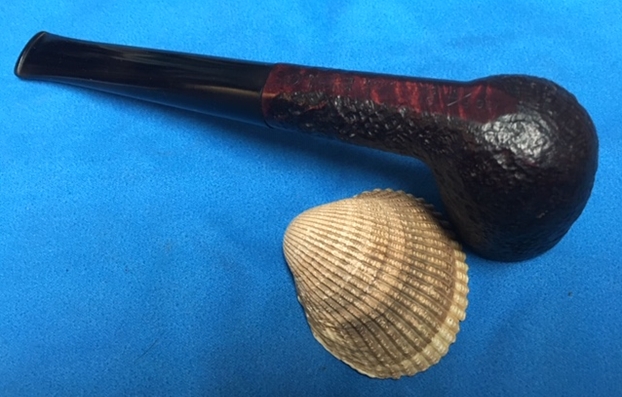
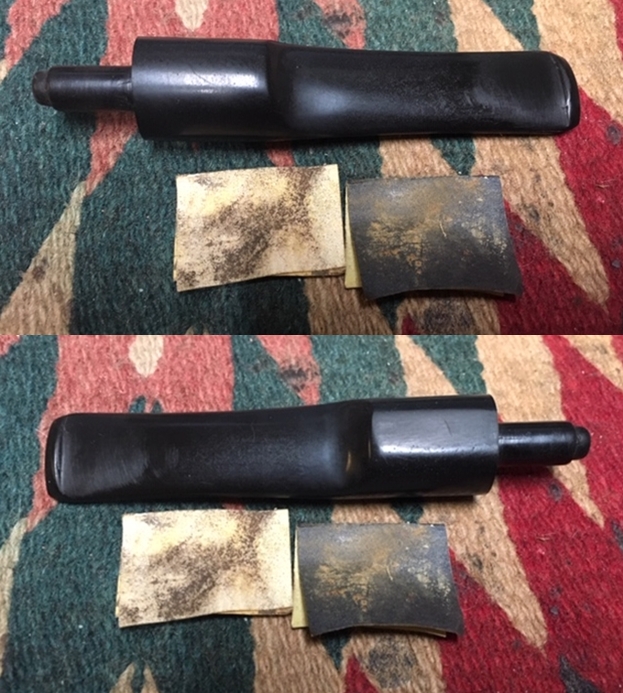
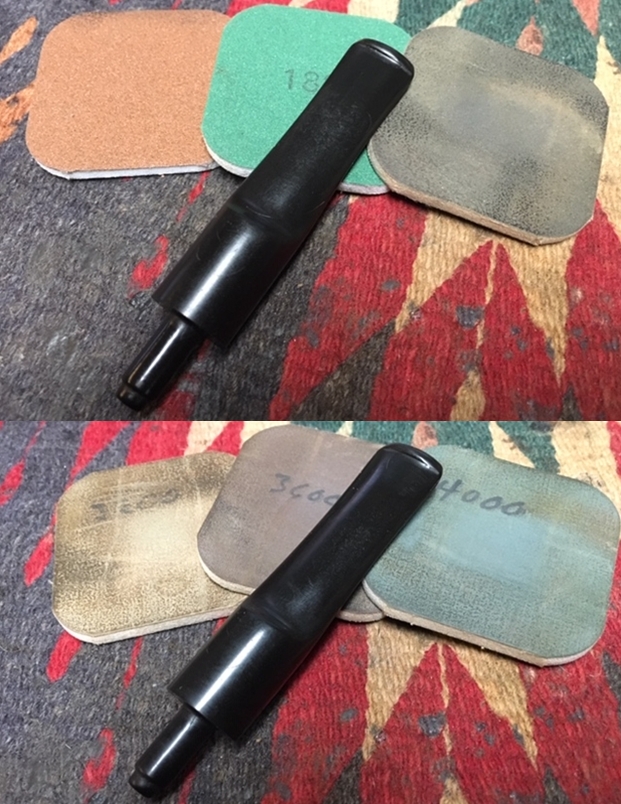
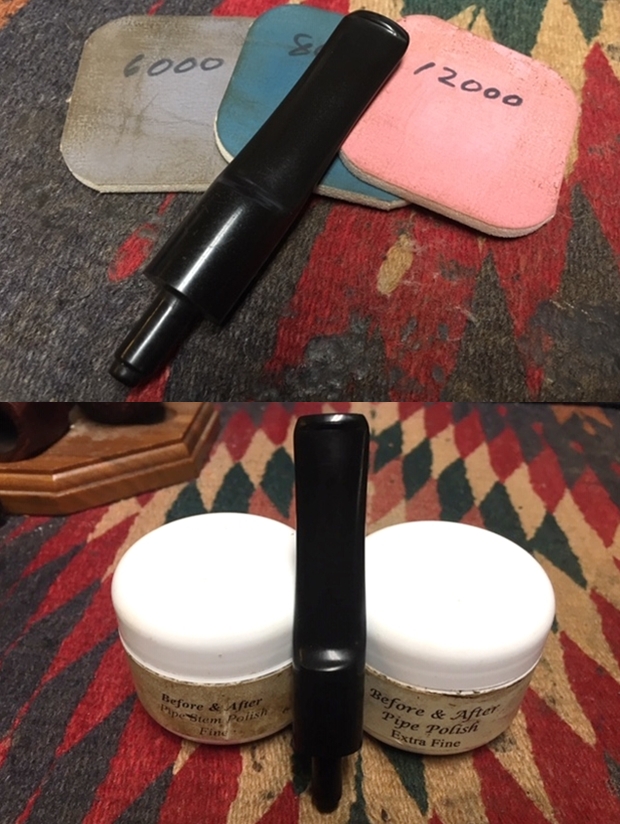
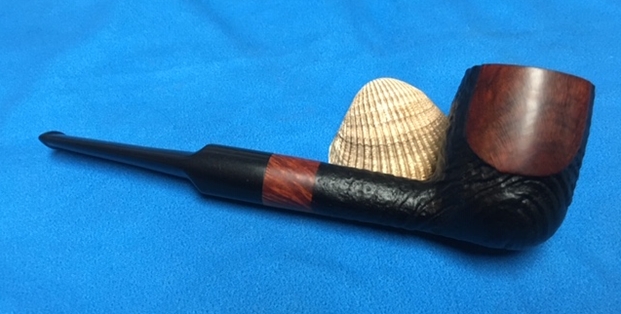
Tag Archives: super glue

New Life for a Charatan Lonsdale 87X Cutty


Blog by Steve Laug

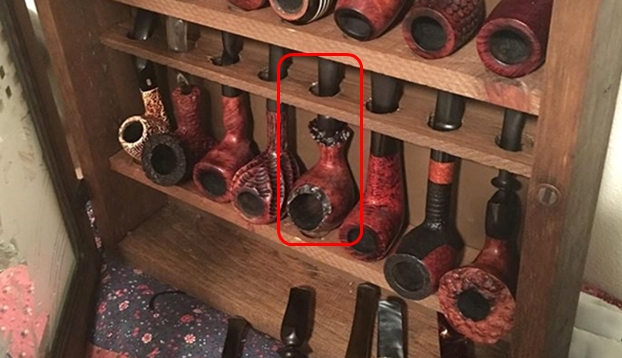
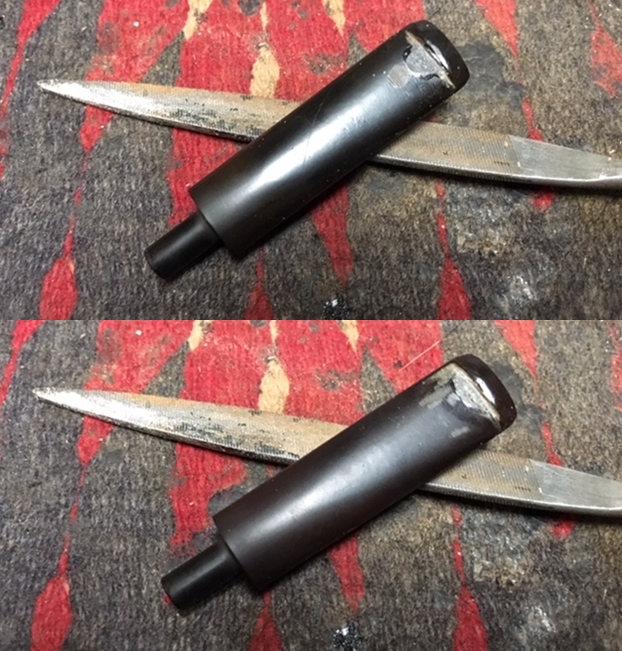
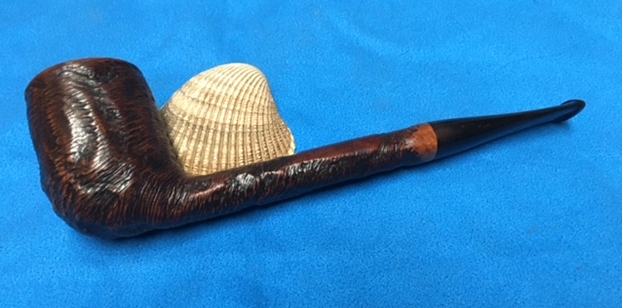
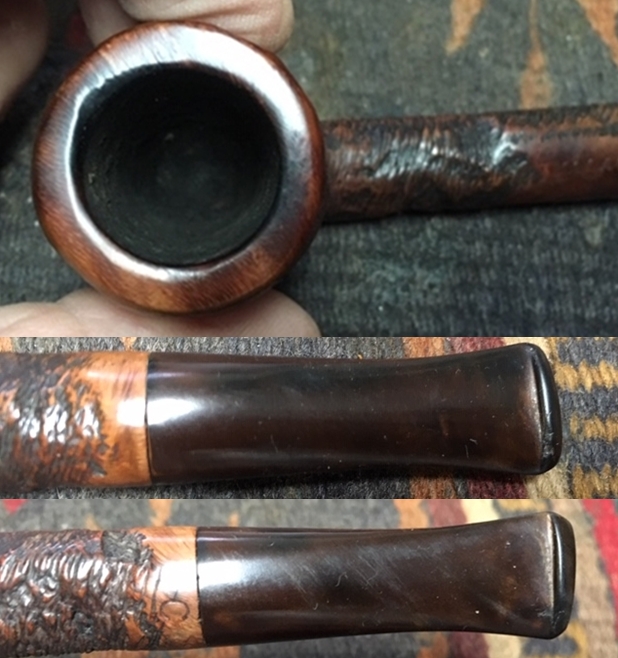
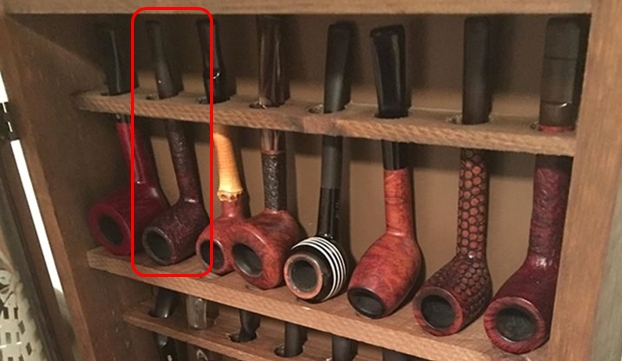
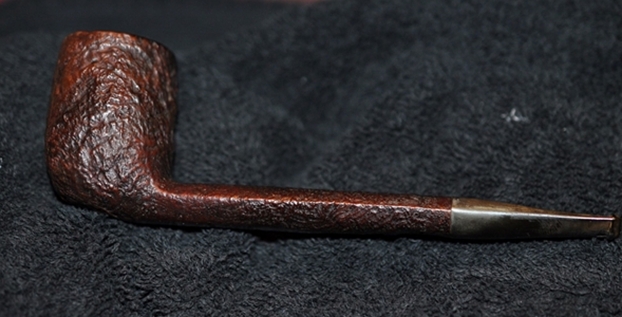
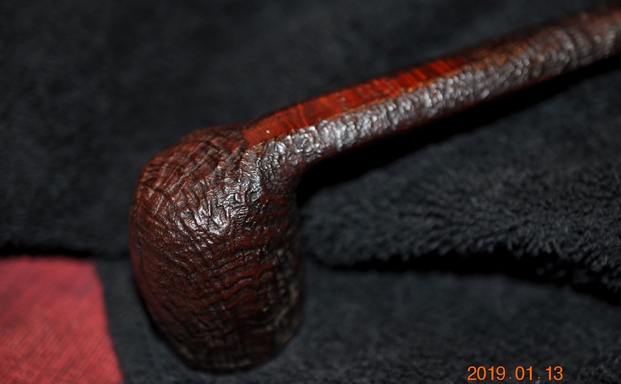
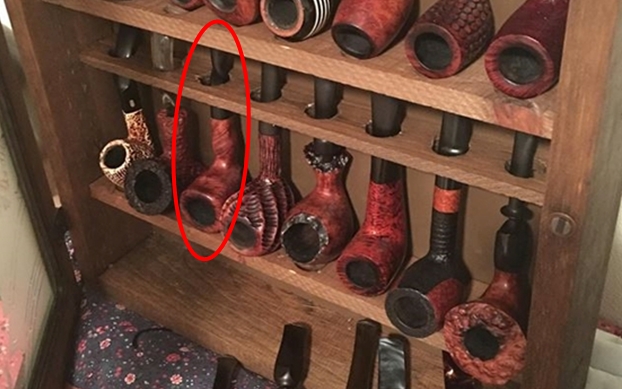
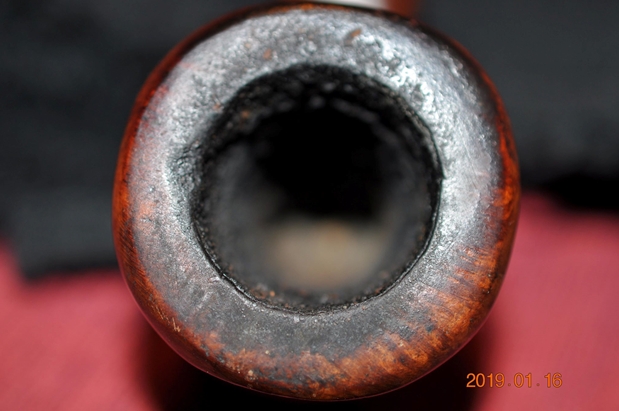
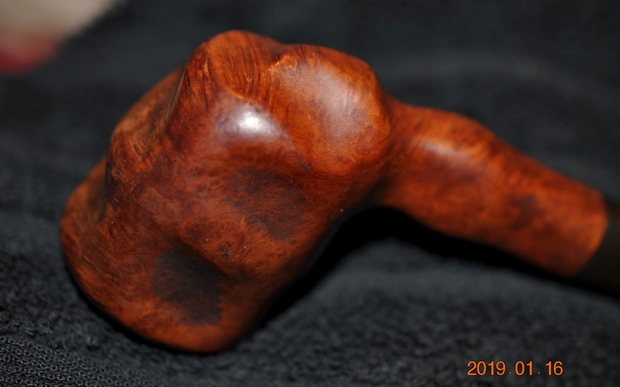
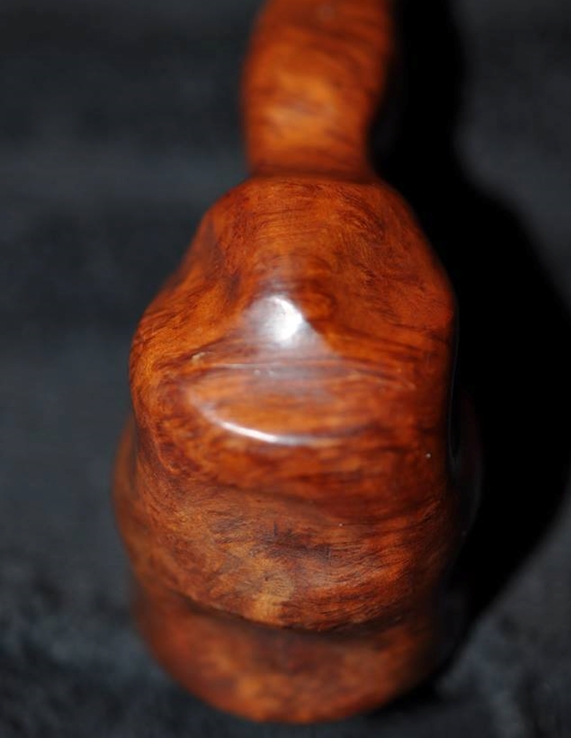
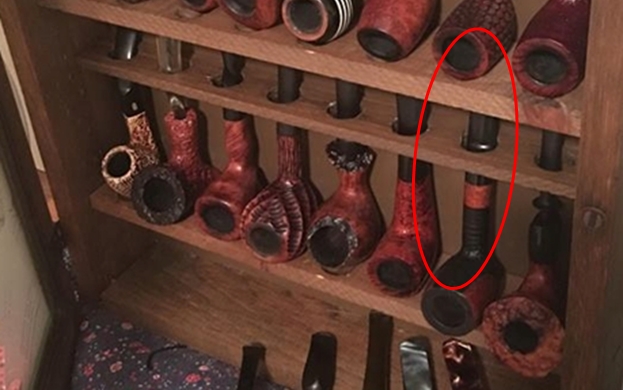
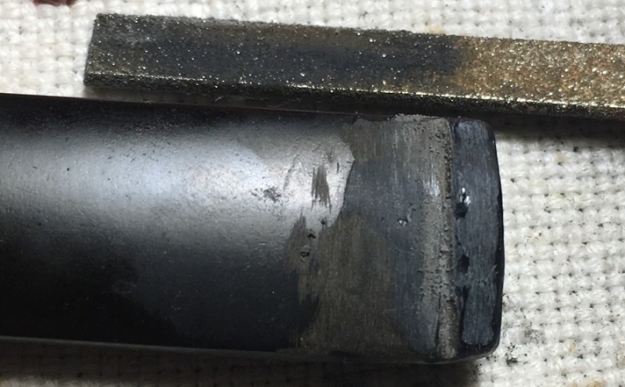
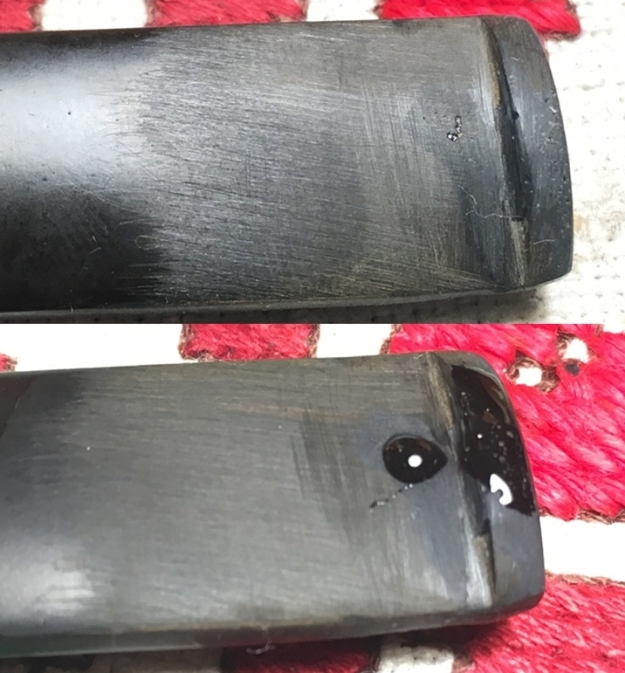
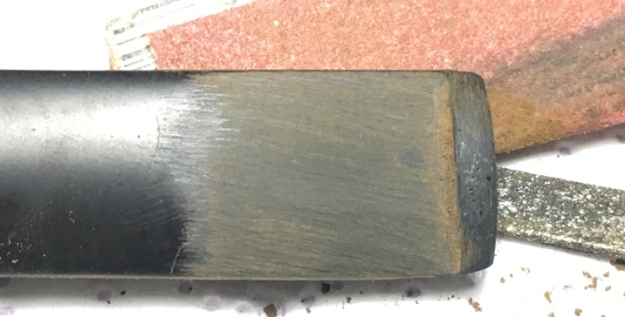
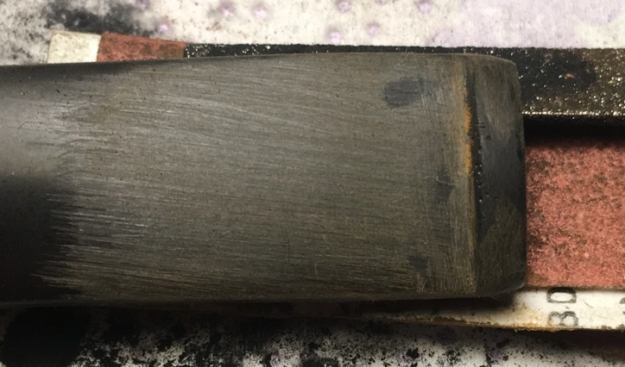
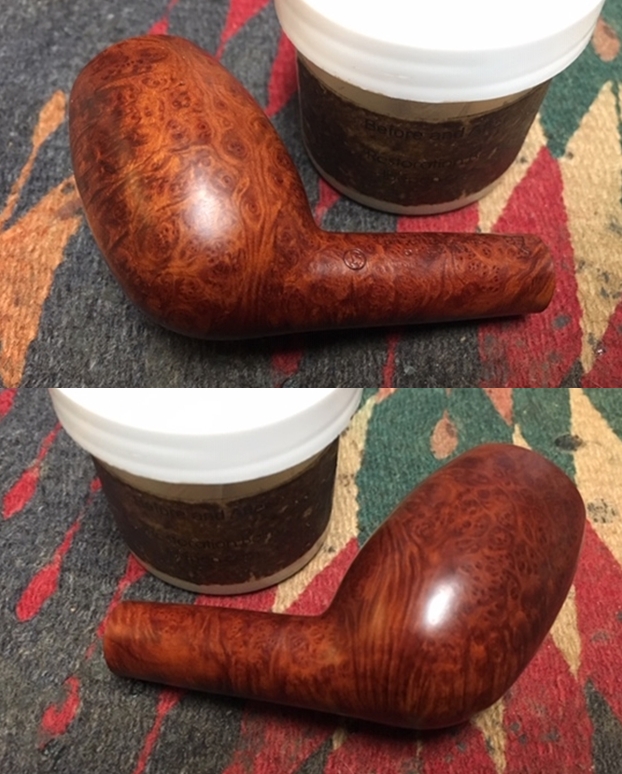
The next pipe in the queue is yet another interesting pipe from the Michigan lot – a well-made Charatan Cutty with plateau on the rim top and shank end. The entire pipe had some beautiful cross grain on the front and rear of the bowl and the top and underside of the shank. It had some great birdseye grain on both sides of the bowl and shank. The bowl has a forward cant to it that defines the cutty shape. The pipe has a natural briar finish that really makes the grain on the pipe pop. The carver did a great job utilizing the block of briar to maximize the grain. The pipe is stamped on the left side of the shank. It reads Charatan’s Make (over) London, England (over) SPECIAL. There is the circle cursive L identifying the pipe as a Lane era made Charatan. To the right of the stamping is the shape number 87X. The stem is an obvious replacement and is Lucite rather than the original vulcanite and has no marking or stamping on it. It is given a unique saddle shape that looks good with the Cutty pipe. This is another nice looking piece much like the rest of those in this 21 pipe Michigan pipe lot. The Charatan’s Make I am working on is shown on the top shelf of the rack pictured below. It is the third pipe from the right and I put a red box around it to make it easy to identify.Jeff took some photos of the pipe when he received them to show the general condition of the pipe before he started his cleanup work. Like the rest of the pipes from the Michigan collection this pipe was very dirty and well used. There was a thick cake in the bowl and lava overflowing onto the plateau rim top. It was hard to know if the edges of the bowl were damaged or not because of the cake and lava. The exterior of the briar was dirty with grease and oils from being held. The Lucite stem is dirty and had bite marks but still had a gloss to it. There were deep tooth marks on both sides of the stem at the button edge and some wear on the button edge itself. The photos below tell the story and give a glimpse of the beautiful canted Cutty shape. Jeff took a photo of the bowl and rim to capture the condition of the pipe before he started his cleanup work. There was a thick coat of lava on the rim and the cake in the bowl. It shows the mess this pipe was in when we received it. The thick lava overflow on the rim top made it hard to know what the inner edges of the bowl looked like. The outer edges had some damage from knocking the bowl out against a hard surface. There is also a general accumulation of grease and grime ground into the finish on the rest of the bowl and shank.He also took a photo of the right and underside of the bowl and shank to show the interesting grain around the bowl and shank. The finish is very dirty but the grain is visible in the photos.Jeff took a photo of the stamping on the left side of the shank. It reads as noted above and is clear and legible.The next two photos show the stem surface. They show the tooth marks and chatter on both sides near the button. There are also some marks on the sharp edge of the button. The stem is dirty and is covered in scratches. I wanted to know where the Special fit in the Charatan Hierarchy so I turned to Pipedia to get a grasp of the order of the various pipes that were made. Here is the link(https://pipedia.org/wiki/Charatan). I did a screen capture of the poster to the left showing that the SPECIAL is just below the strain grain and was noted for perfection in grain and had a natural finish.

I thus knew I was dealing with a higher grade Charatan’s Make pipe. It also has the circled L which was the Lane Trademark. Pipedia said that:

The Lane Trademark serif and circled L indicates the pipe is from the “Lane Era” (approx. 1955 to 1979 -1984?), however it appears that both the English factory or Lane themselves sometimes, or perhaps even often forget to stamp the L on a pipe. The Charatan factory was known for inconsistencies, especially in stampings. Therefore, although an L on the pipe definitely defines it as a Lane Era pipe, the lack of it could simply mean the pipe missed receiving the stamp from the factory. The lack of the trademark could also mean the pipe was destined for the European market.

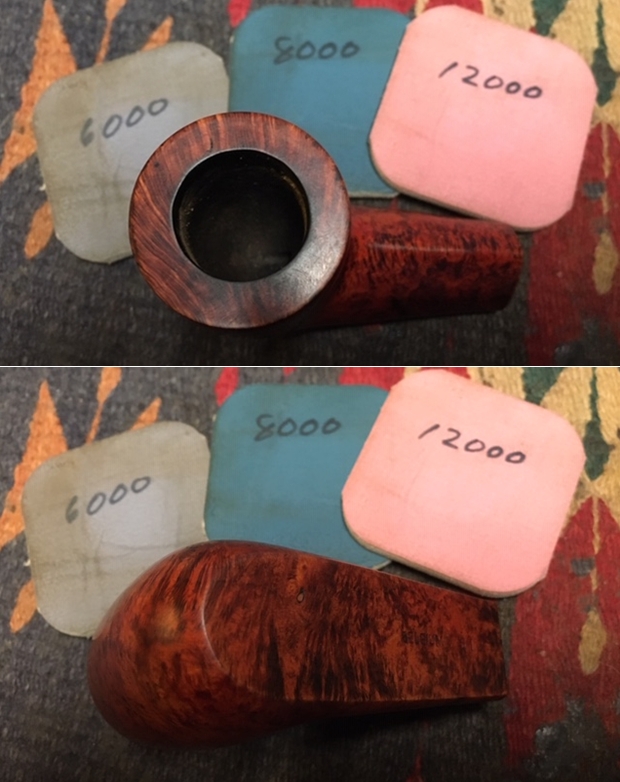
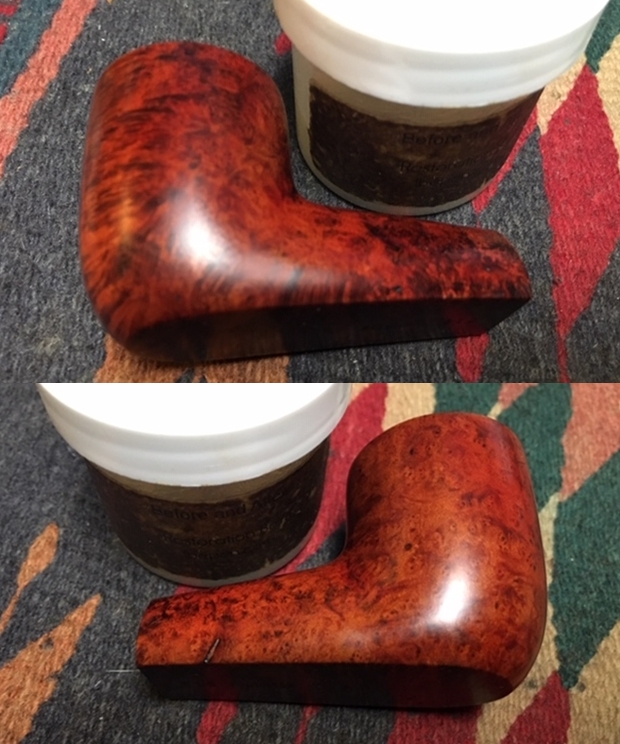
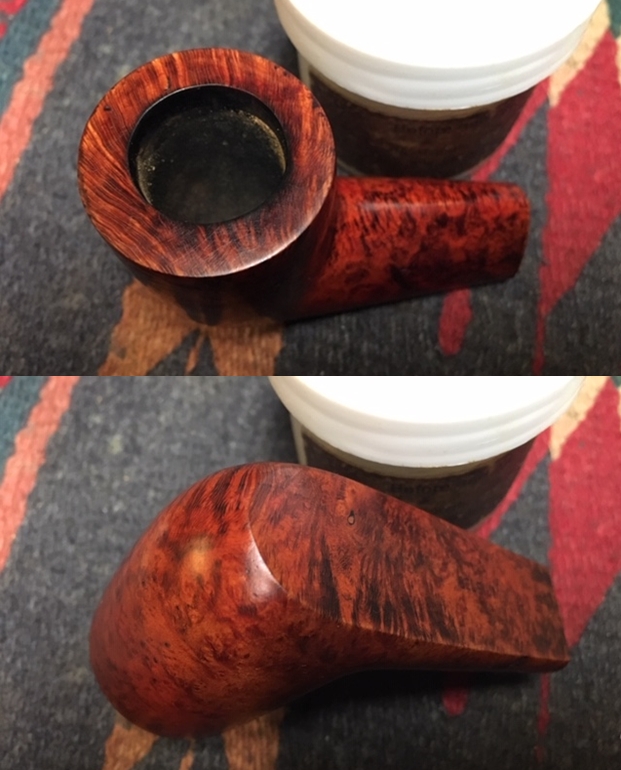
From there I turned to do some reading in a link on Pipedia to a 1951 Charatan Catalogue. I wanted to be able to do some more reading on the “Natural Finish” noted above and also to see if I could identify the shape 87X that was stamped on the left side of the shank at the stem/shank junction. Here is the link (https://pipedia.org/images/3/37/CHARATAN_1951.pdf). I did a screen capture of pertinent parts of the catalogue. The first is the concept of their Natural Bruyere. The second gives a listing of the hierarchy of pipes. Note in that clipping that the SPECIAL pipes were Premier quality pipes, cut in “cross grain” or “bird’s eye” graining. In paging through the catalogue, I found what I was looking for in terms of shape designations. I had looked on various shape charts and had not found the shape 87 number. In this catalogue not only did I find the shape number but a drawing of the shape with the original’s stem. The pipe is what Charatan called the Lonsdale with the 87 being the larger Lonsdale shape.Jeff reamed the bowl with a PipNet pipe reamer and followed up with a Savinelli Fitsall pipe knife to remove the cake. He scrubbed out the mortise and the airway in the shank and the stem with alcohol, cotton swabs and pipe cleaners. He scrubbed the exterior of the bowl, rim, shank and stem with a tooth brush and Murphy’s Oil Soap to remove the oils and tars on the rim and the grime on the finish of the bowl. He rinsed it under running water. He dried it off with a soft cloth. He was able to remove the lava build up on the rim top and you could see the overall condition of the bowl top and edges of the rim. He scrubbed the stem with soap to remove the grime on the surface. I took photos of the pipe to show its condition before I started work on it. I took a close up photo of the rim top to show the darkening on the top and the burn damage on the front and right inner edge. Jeff had done an amazing job cleaning off the lava buildup. The outer edge of the rim has some deep nicks on the front of the bowl. The bowl is slightly out of round on the right rear inner edge. The Lucite saddle stem photos show the tooth marks and the wear on the button surface on both sides.I decided to start my work on the pipe by addressing the darkening and damage to the rim top and edges. I topped the bowl on a topping board with 220 grit sandpaper to remove the damage and minimize the outer and inner edge damage. I was able to remove much of the damage. To address the burn on the front edge and the area on the right rear edge making the bowl out of round I used a folded piece of 220 grit sandpaper to give the rim edge a slight bevel. The bevel worked to hide the damage and bring the bowl back into round. I polished the bowl sides and rim top with micromesh sanding pads. I wet sanded with 1500-2400 grit pads and dry sanded with 3200-12000 grit pads. I wiped the bowl and rim down with a damp cloth after each pad. As I polished it the sanded rim top began to shine and blend in with the rest of the briar. I worked some Before & After Restoration Balm into the surface of the briar with my fingertips to clean, enliven and protect it. I let the balm sit for a little while and then buffed with a cotton cloth to raise the shine. The following photos show the bowl at this point in the restoration process. The bowl and the rim top look really good. The finish looks very good with the rich finish on the bowl and rim. I am very happy with the results. I used a folded piece of 240 grit sandpaper to blend the repairs into the surface of the stem. Once the surface was smooth I sanded out the scratch marks and started the polishing of the stem with a folded piece of 400 grit sandpaper. I wiped the stem down with Obsidian Oil and took the following photos.I polished the stem with micromesh sanding pads – wet sanding it with 1500-2400 grit pads and dry sanding it with 3200-12000 grit pads. I wiped the stem down with a damp cloth after each pad. I wiped it down with a coat of Obsidian Oil and set it aside to dry. I put the stem back on the bowl and polished them both with Blue Diamond polish on the buffing wheel. I gave the bowl and stem multiple coats of carnauba wax. I buffed the pipe with a clean buffing pad to raise the shine. I hand buffed it with a microfiber cloth to deepen the shine. The pipe polished up pretty nicely. The natural brown briar that had darkened over time came alive with the buffing. The replacement Lucite stem had an interesting asymmetrical saddle that looked very good with the stem. Have a look at it with the photos below. The dimensions are Length: 6 inches, Height: 2 inches, Outside diameter of the bowl: 1 1/4 inches, Chamber diameter: 3/4 of an inch. This beauty will soon be on the rebornpipes store. It would make a a beautiful addition to somebody’s pipe rack. Thanks for walking through the restoration of this uniquely carved Charatan from the Lane Era with me it was a pleasure to work on.
 

Rejuvenating a No Name Freehand


Blog by Steve Laug

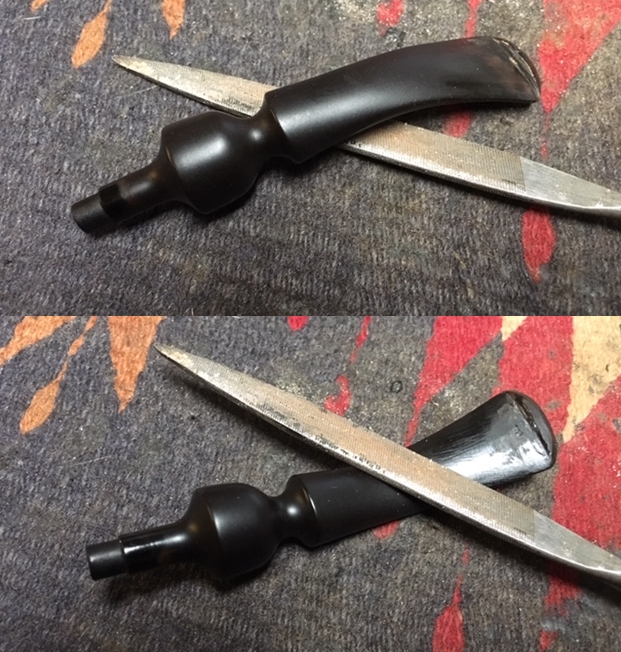
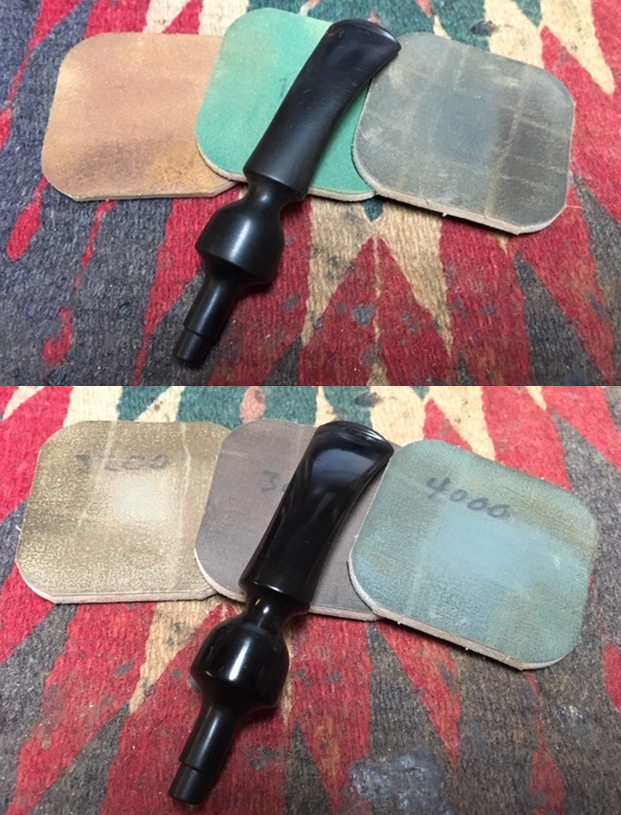
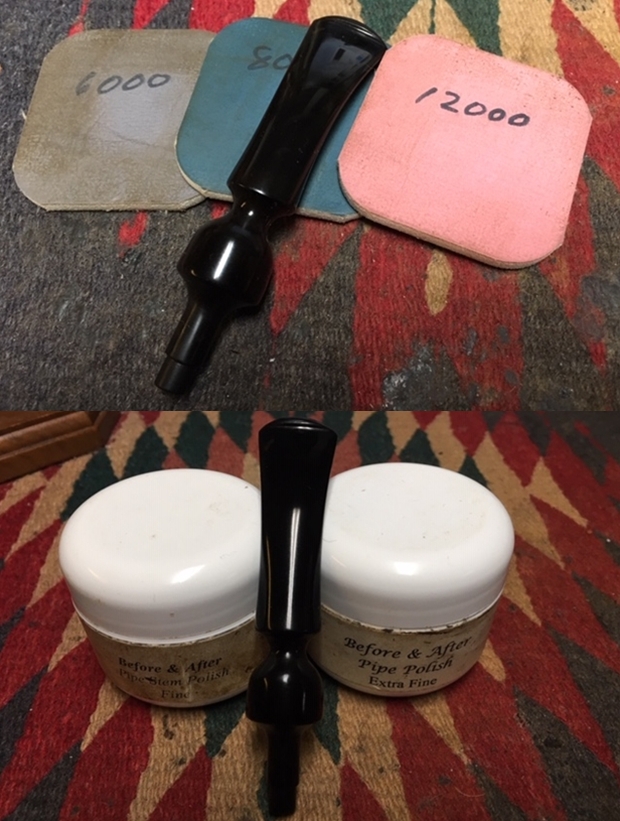
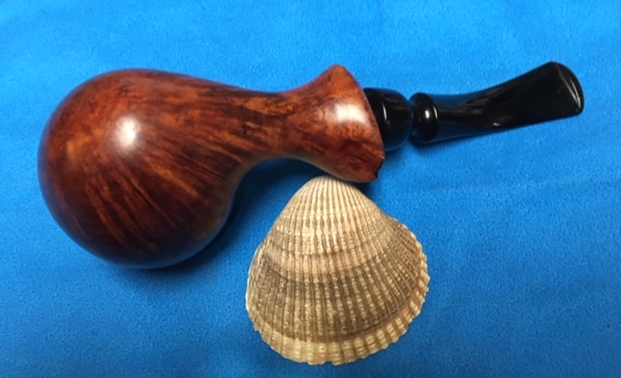
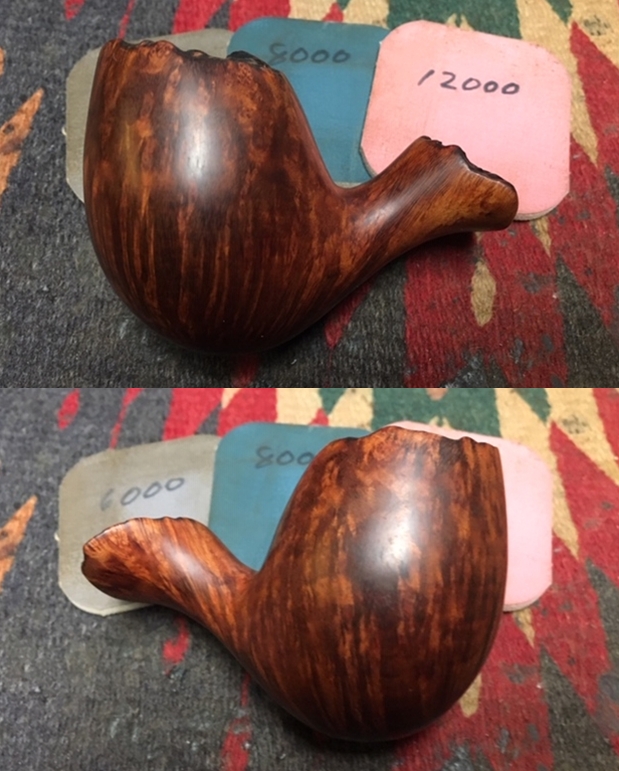
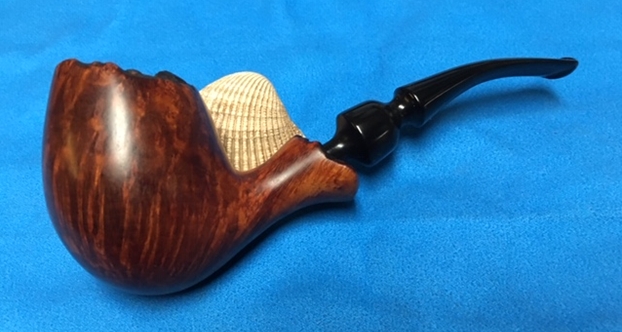
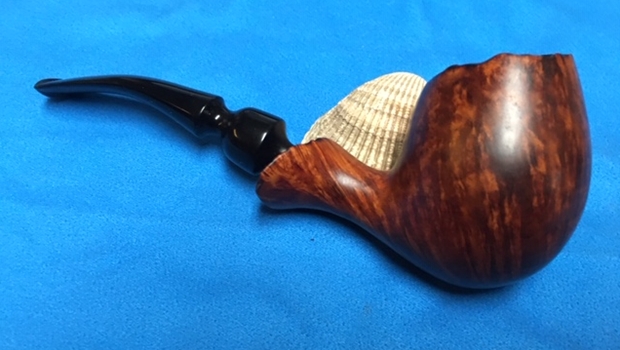
The next pipe in the queue is yet another interesting pipe from the Michigan lot – a well-made Freehand with plateau on the rim top and shank end. The entire pipe had some beautiful straight and flame grain around the bowl and shank with birdseye on the bottom of the bowl and shank. It is one of the unique freehand pipes that were in the collection. It is not a large pipe – but the bowl is large enough that I can put my entire thumb inside. The rim top is tapered and thin on the front half of the bowl and thicker at the backside. The entire rim is plateau. The shank end is flared and is also plateau briar. The pipe has a contrasting black stain on the plateau areas and medium brown stain coat on the rest of the bowl. The combination really accentuates the grain. There is no identifying brand or maker stamp on the shank sides or underside. The freehand style stem is vulcanite and has no marking or stamping on it. This is another nice looking piece much like the rest of those in this 21 pipe Michigan pipe lot. The Freehand I am working on is shown on the bottom shelf of the rack pictured below. It is the fourth pipe from the right and I put a red box around it to make it easy to identify.Jeff took some photos of the pipe when he received them to show the general condition of the pipe before he started his cleanup work. Like the rest of the pipes from the Michigan collection this pipe was very dirty and well used. There was a thick cake in the bowl and lava overflowing onto the plateau rim top. It was hard to know if the edges of the bowl were damaged or not because of the cake and lava. The exterior of the briar was dirty with grease and oils from being held. The vulcanite stem is lightly oxidized and has some calcification at the button. There are scratches in the surface of the vulcanite from what looked like an attempt to scrape off oxidation. There were deep tooth marks on both sides of the stem at the button edge and some wear on the button edge itself. The photos below tell the story and give a glimpse of the beautiful no name Freehand. Jeff took two photos of the bowl and rim to capture the condition of the pipe before he started his cleanup work. The second photo is a close up of the lava on the rim and the cake in the bowl. It shows the mess this pipe was in when we received it. There was a thick hard cake in the bowl from lots of use. The rim top had some thick lava overflow and some darkening. The thick lava on the rim top made it hard to know what the inner and outer edges of the bowl looked like. There is also a general accumulation of dust in the finish on the rest of the bowl and shank.He also took photos of the right and underside of the bowl and shank to show the interesting grain around the bowl and shank. The finish is very dirty but the grain is visible in each of the photos. This is another beautiful pipe. The next two photos show the stem surface. They show the tooth marks and chatter on both sides near the button. There are also some marks on the sharp edge of the button. The stem is dirty, oxidized and is covered in scratches. Jeff reamed the bowl with a PipNet pipe reamer and followed up with a Savinelli Fitsall pipe knife to remove the cake. He scrubbed out the mortise and the airway in the shank and the stem with alcohol, cotton swabs and pipe cleaners. He scrubbed the exterior of the bowl, rim, shank and stem with a tooth brush and Murphy’s Oil Soap to remove the oils and tars on the rim and the grime on the finish of the bowl. He rinsed it under running water. He dried it off with a soft cloth. He was able to remove the lava build up on the rim top and you could see the great condition of the bowl top and edges of the rim. He soaked the stem in Before & After Deoxidizer to remove the oxidation. I took photos of the pipe to show its condition before I started my work on it. I took a close up photo of the rim top to show the plateau on the surface of the rim. Jeff had done an amazing job cleaning off the lava buildup. The front part of the rim top is thinner and the bowl angles back toward the rear of the pipe. The outer edge of the rim looks really good. The plateau on the shank end is also visible in the photos of the stem. The stem photos show the tooth marks and the wear on the button surface on both sides. The bowl and shank of the pipe were in great condition so I started by polishing it with micromesh sanding pads. I wet sanded with 1500-2400 grit pads and dry sanded with 3200-12000 grit pads. I wiped the bowl and rim down with a damp cloth after each pad. I worked some Before & After Restoration Balm into the surface of the briar with my fingertips to clean, enliven and protect it. I used a horsehair shoe brush to work it into the nooks and crannies of the plateau rim top and shank end. I let the balm sit for a little while and then buffed with a cotton cloth to raise the shine. The following photos show the bowl at this point in the restoration process. The bowl and the rim top look really good. The finish looks very good with the rich finish on the bowl and rim. I am very happy with the results. With the bowl finished I set it aside and turned my attention to the stem. I cleaned out the tooth marks on both sides of the stem with a cotton swab and alcohol. I filled in the tooth marks with clear super glue. Once the repairs had cured I used a needle file to flatten out the repaired areas. I filed it until the patches were smooth with the surface of the stem. I used a folded piece of 240 grit sandpaper to blend the repairs into the surface of the stem. Once the surface was smooth I sanded out the scratch marks and started the polishing of the stem with a folded piece of 400 grit sandpaper. I wiped the stem down with Obsidian Oil and took the following photos.I polished the stem with micromesh sanding pads – wet sanding it with 1500-2400 grit pads and dry sanding it with 3200-12000 grit pads. I wiped the stem down with a damp cloth after each pad. I further polished it with Before & After Pipe Polish – both Fine and Extra Fine. I wiped it down with a coat of Obsidian Oil and set it aside to dry. I put the stem back on the bowl and polished them both with Blue Diamond polish on the buffing wheel. I gave the bowl and stem multiple coats of carnauba wax. I buffed the pipe with a clean buffing pad to raise the shine. I hand buffed it with a microfiber cloth to deepen the shine. The pipe polished up pretty nicely. The dark stained plateau on the rim top and shank end was a great contrast with the black and brown stain on the rest of the bowl and shank. Once again the pipe came alive with the buffing. I have no idea who carved the pipe but it is well laid out and proportioned and feels great in the hand. Have a look at it with the photos below. The dimensions are Length: 6 inches, Height: 2 inches, Outside diameter of the bowl: 1 ½ inches, Chamber diameter: 7/8 of an inch. This beauty will soon be on the rebornpipes store. It would make a great Freehand addition to somebody’s pipe rack. Thanks for walking through the restoration of this interesting Freehand with me it was a pleasure to work on.

This is a new brand to me – LUNAR Spain Canadian


Blog by Steve Laug

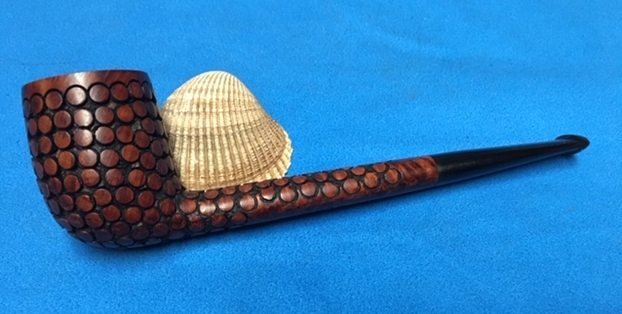
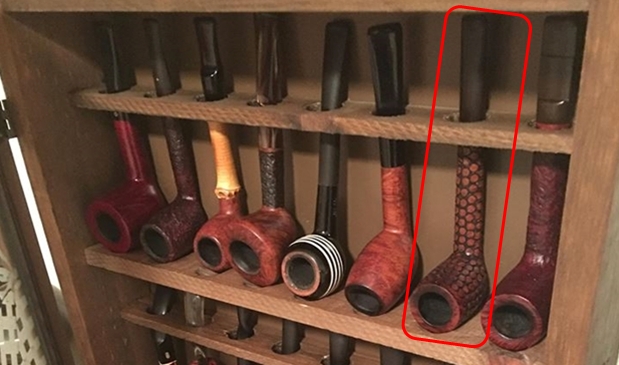
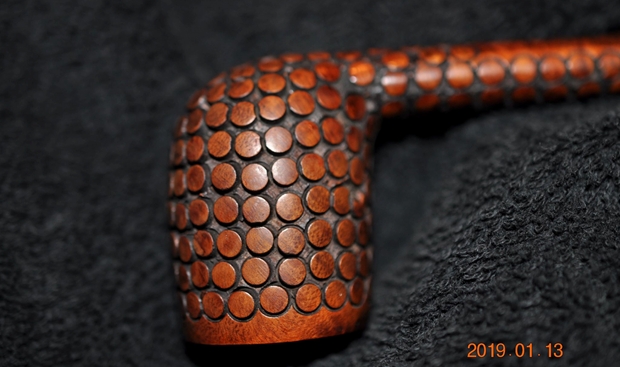
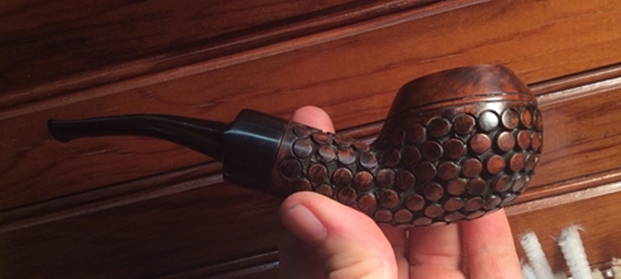
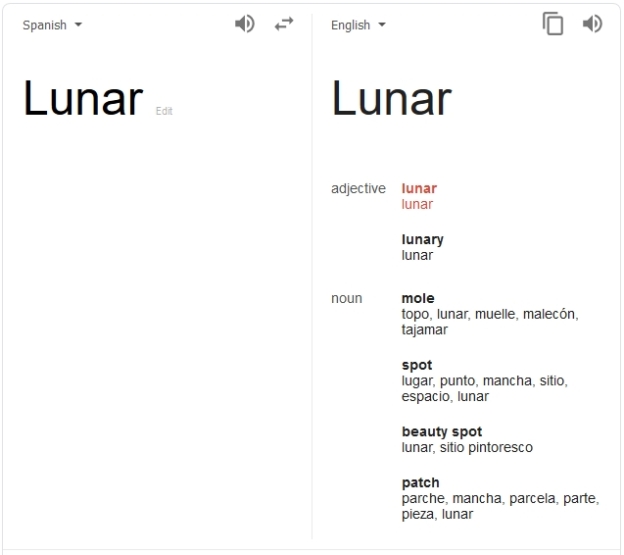
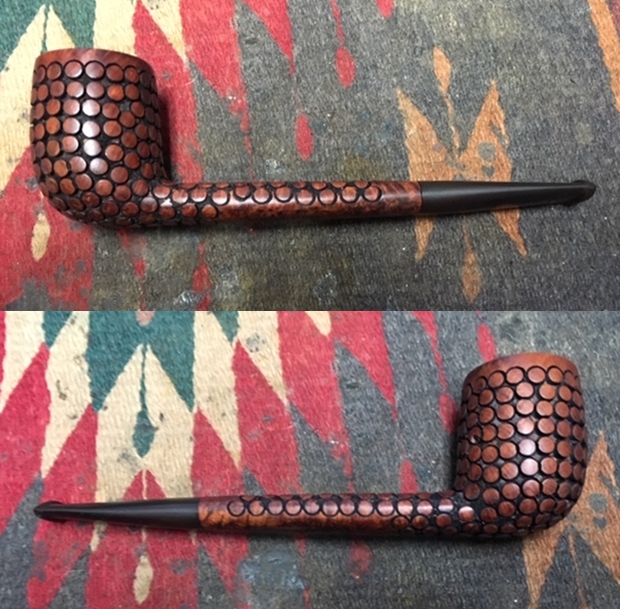
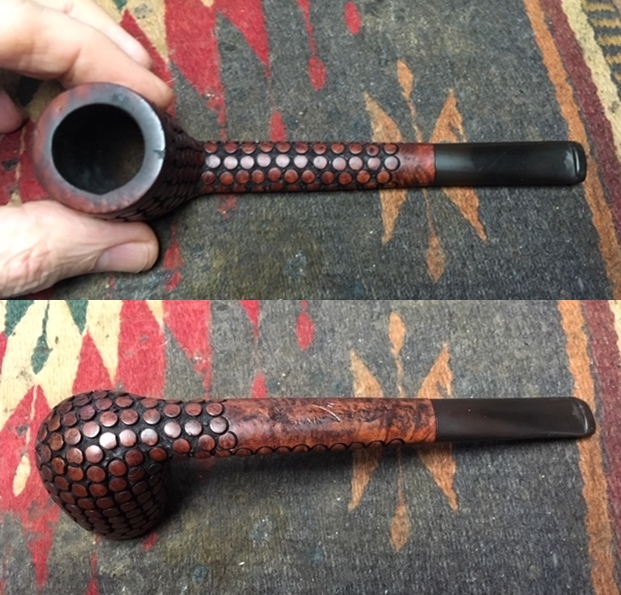
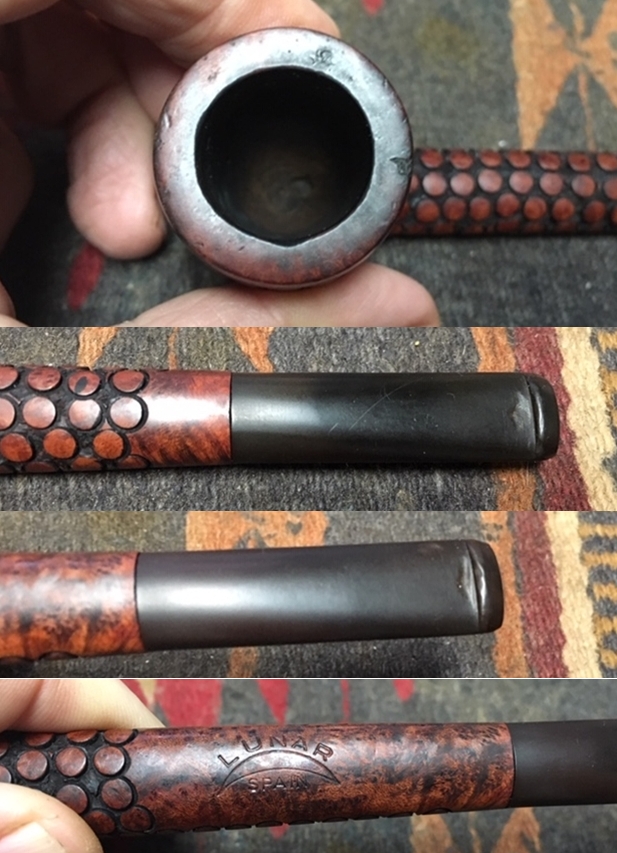
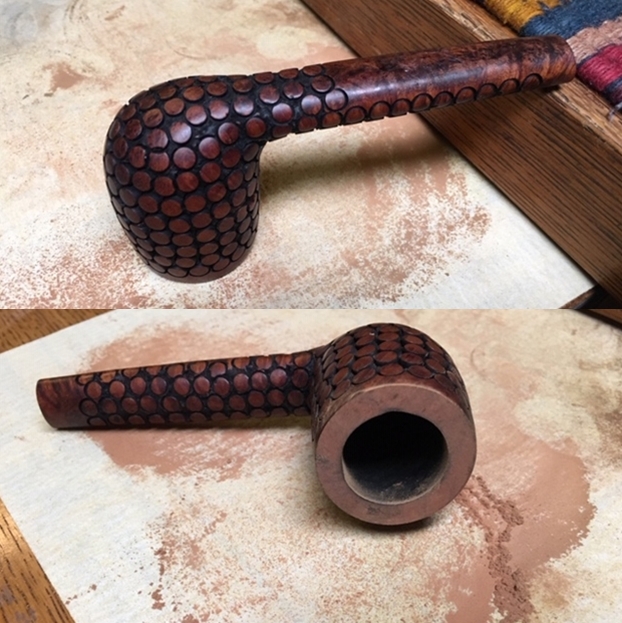
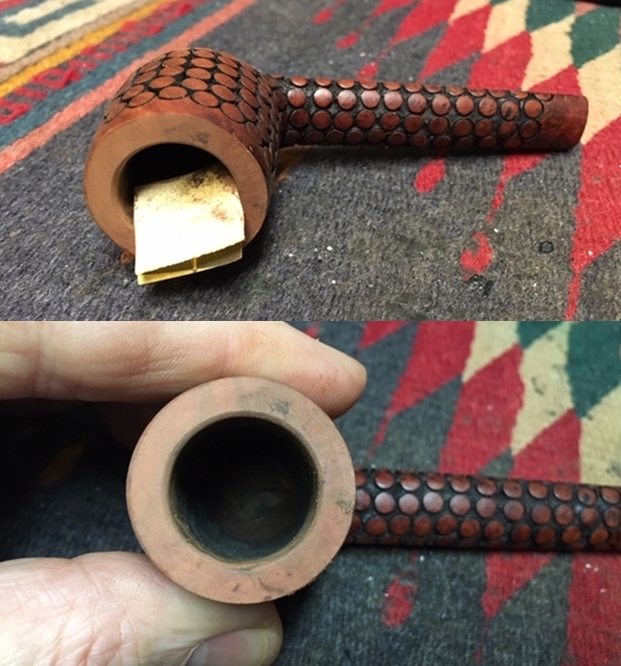
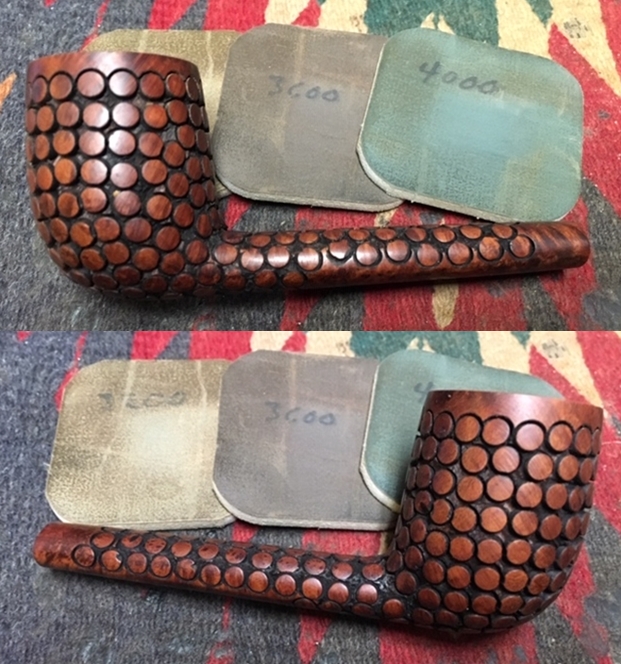
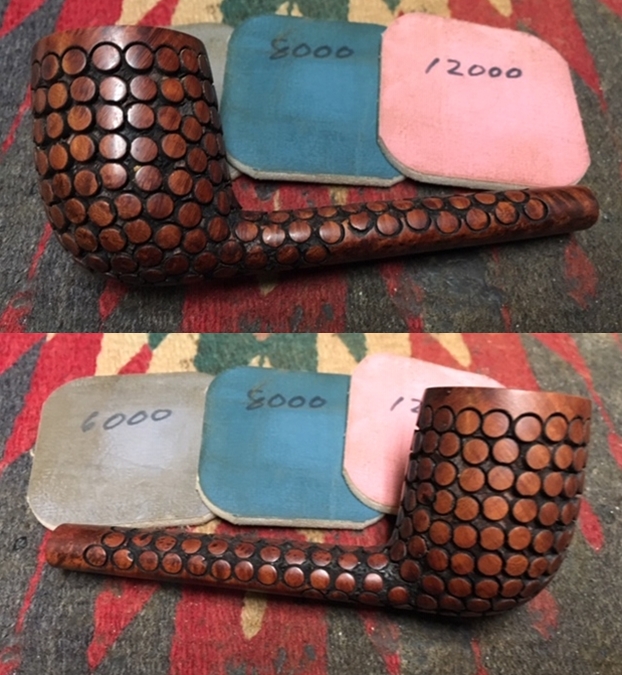
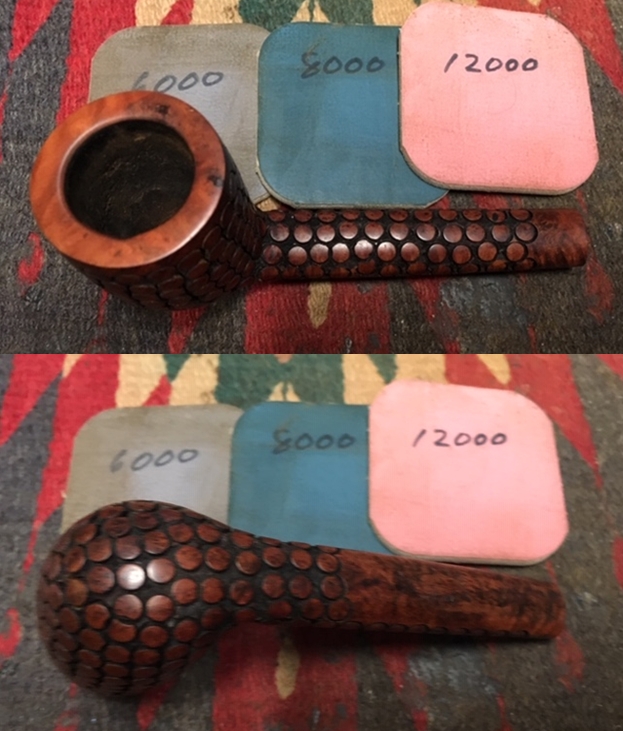
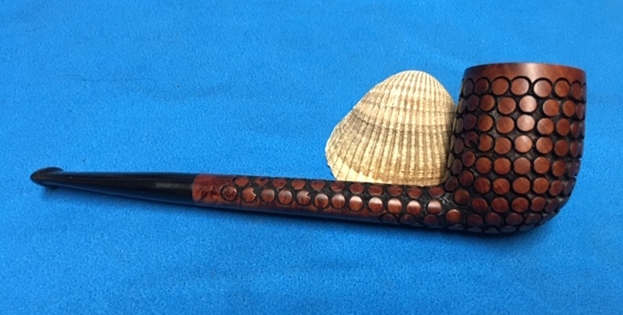
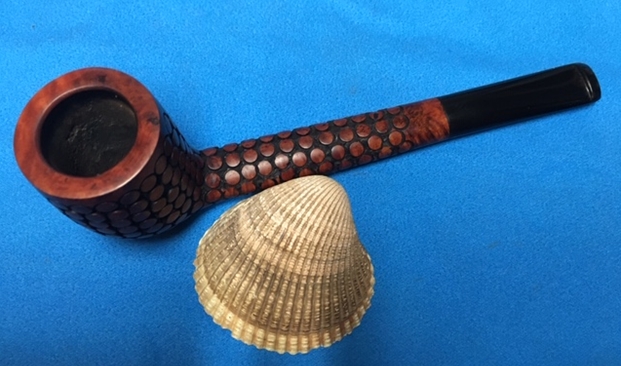
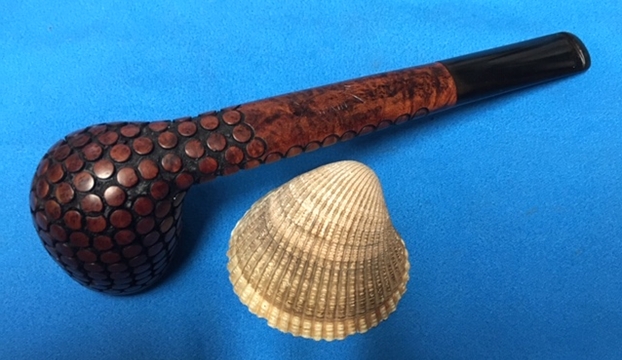
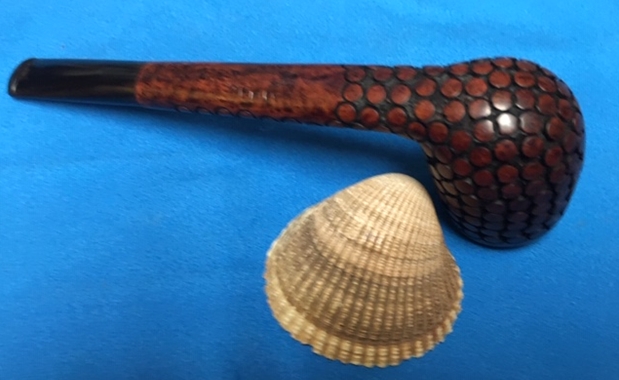
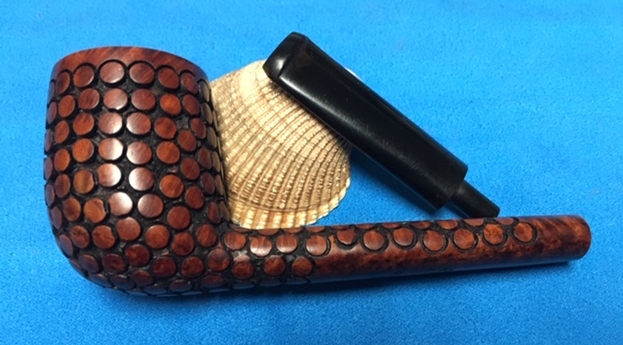
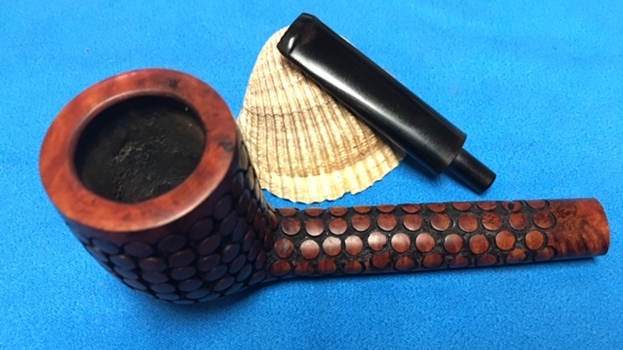
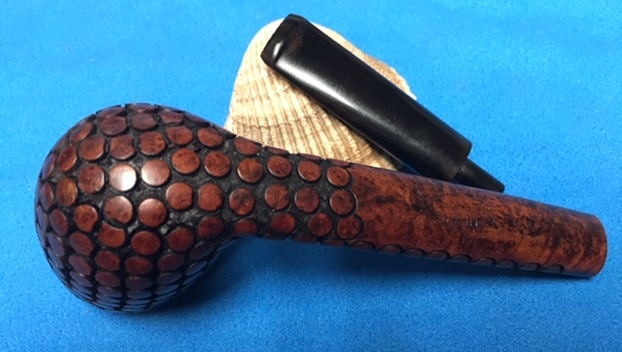
The next pipe in the queue is yet another interesting pipe from the Michigan lot – a really nice Canadian with rustication pattern like nothing I have ever seen before. The entire pipe – bowl, rim and shank is covered in small circles or dots with the area between the dots lightly rusticated and stained darker than the dots. The rim top, band around the rim and a band on the shank end are the only non-carved portions of the Canadian.  It is another totally unique pipe and different from any of the other pipes in the collection. It is not a large pipe – probably a Group 4 sized bowl. The rim top is flat and smooth with some darkening and damage to the finish. The pipe has a contrasting black and medium brown stain coat that highlights and accentuates the unusual finish. The underside of the shank is smooth for the majority of the shank. It is stamped LUNAR arched over a crescent moon shape under the arched moon is stamped SPAIN. Obviously the pipe is made in Spain and I will need to do a bit of work to find out about the brand. The stem is vulcanite and has no marking or stamping on it. This is another nice looking piece much like the rest of those in this 21 pipe Michigan pipe lot. The LUNAR Canadian I am working on is shown on the first shelf of the rack pictured below. It is the second pipe on the right and I put a red box around it to make it easy to identify.Jeff took some photos of the pipe when he received them to show the general condition of the pipe before he started his cleanup work. Like the rest of the pipes from the Michigan collection this pipe was dirty and well used. There was a thick cake in the bowl and lava overflowing onto the rim top. It was hard to know if the edges of the bowl were damaged or not because of the cake and lava. The carved dots or circles on the entire pipe made it very interesting. The vulcanite stem is lightly oxidized and has some calcification at the button. There are deep tooth marks on both sides of the stem at the button edge and some wear on the button edge itself. There are also scratches in the vulcanite where it looks like someone scraped off some of the calcification. The photos below tell the story and give a glimpse of another beautiful Canadian. Jeff took a close up photo of the bowl and rim to capture the condition of the pipe before he started his cleanup work. There was a thick hard cake in the bowl which made me think it was a favourite pipe. The rim top had some thick lava overflow and some darkening. The thick lava on the rim top made it hard to know what the inner and outer edges of the bowl looked like. There is also a general accumulation of dust in the finish on the rest of the bowl and shank.He also took photo of the right side of the bowl and shank to show the interesting circular carving on the finish. The finish is very dirty but the grain is visible in each of the circles. The rustication pattern between the circles give it a fascinating look. This is another beautiful pipe.Jeff took a photo to capture the stamping on the underside of the shank. The photo shows stamping as noted above. The stamping on this pipe is clear and readable.The next two photos show the stem surface. They show the tooth marks and chatter on both sides near the button. There are also some marks on the sharp edge of the button. The stem is dirty, oxidized and has a yellow cast to it. I looked in all of my usual sources for information on the brand. There was nothing on Pipedia or on Pipephil. The brand was unknown and this point all I knew was the stamping on the pipe – it was made in Spain. It was also not listed in Who Made That Pipe. It was also not listed in Lopes book on pipes. I then did a general Google search for Lunar Smoking Pipes Spain. The search turned up lots of useless information but it came up with one helpful discussion on the brand on the Pipesmagazine forum (http://pipesmagazine.com/forums/topic/luna-spain-very-unique-pipe). The fellow posting there put up the following photo and asked for information about the brand and company that made it. There was not a lot of helpful information there but several posters gave suggestions about how they thought the finish was achieved. One fellow also said that LUNAR could be translated as Mole or Polka Dot. That led to look at some other sites for information.I did a search on Google Translator Spanish-English and put in the English word Lunar. It gave me the following information (https://www.google.com/search?client=firefox-b-d&q=translate+from+spanish+to+english).

That was all the information that I could find online or in my reference books that usually give me information. I knew nothing about the brand but found that the name could mean mole, spot, or even polka dot. Kind of a fitting translation given the pattern on the bowl and shank.

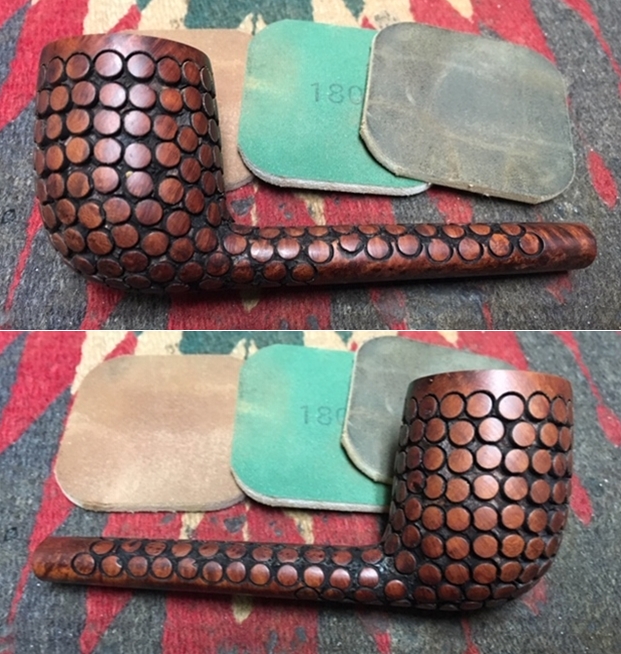
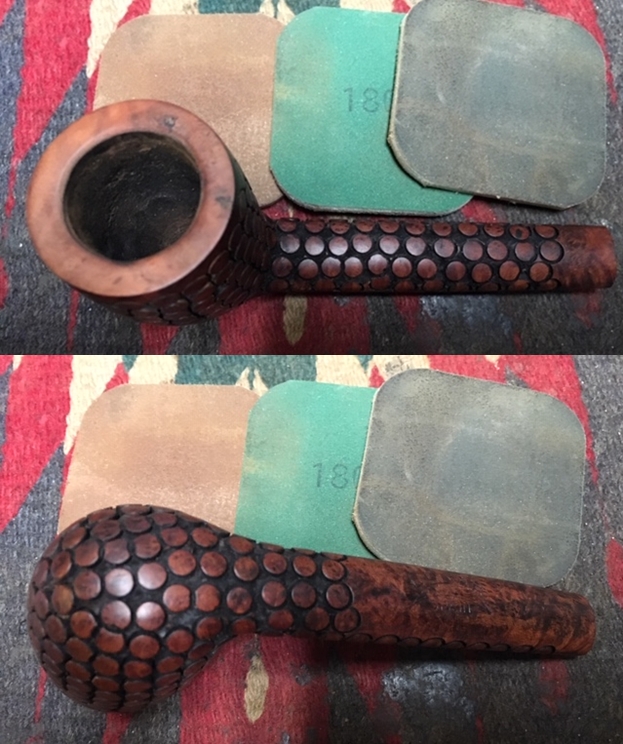
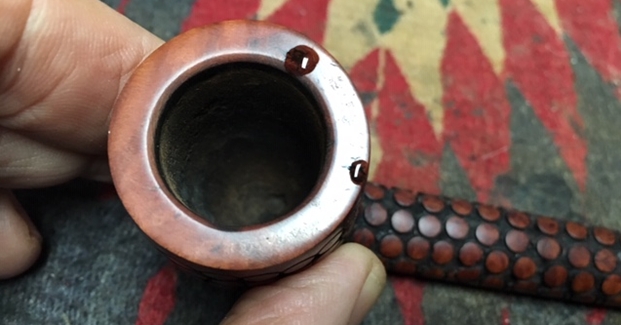
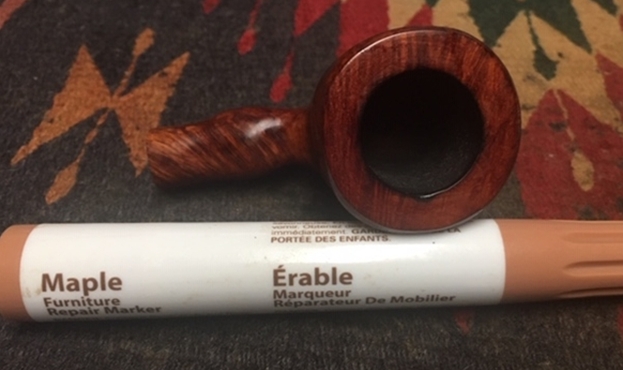
Jeff reamed the bowl with a PipNet pipe reamer and followed up with a Savinelli Fitsall pipe knife to remove the cake. He scrubbed out the mortise and the airway in the shank and the stem with alcohol, cotton swabs and pipe cleaners. He scrubbed the exterior of the bowl, rim, shank and stem with a tooth brush and Murphy’s Oil Soap to remove the oils and tars on the rim and the grime on the finish of the bowl. He rinsed it under running water. He dried it off with a soft cloth. He was able to remove the lava build up on the rim top and you could see the great condition of the bowl top and edges of the rim. He soaked the stem in Before & After Deoxidizer to remove the oxidation. I took photos of the pipe to show its condition before I started my work on it. I took a close up photo of the rim top to show the darkening on the surface of the rim toward the back of the bowl that was normal with use. The front part of the rim top looked a little lighter in colour but there were also deep sandpits and nicks on the entire top. The inner edge showed some burn damage and also some cuts and nicks from a knife that was used to ream the bowl sometime in its life time. The outer edge of the rim looks really good. The stem photos show the tooth marks and the wear on the button surface on both sides. The final close up photos shows the LUNAR stamping on the underside of the shank (as noted above).I decided to start with the rim top and see what I could do with the damage to the top surface and the burn marks on the inner edge of the bowl. I topped the bowl on a topping board with 220 grit sandpaper to remove the damage to the rim surface and minimize the burn damage to the inner edge of the bowl. I also wanted to work toward bringing the bowl back into round. After topping I used a folded piece of sandpaper to give the inner edge a slight bevel to hide the damage. I polished the smooth portion of the bowl and the rim top with micromesh sanding pads. I wet sanded with 1500-2400 grit pads and dry sanded with 3200-12000 grit pads. I wiped the bowl and rim down with a damp cloth after each pad. When I had finished polishing the rim with the 4000 grit pad the small flaws on the top needed to be addressed. It was almost as if during the sanding process some of the fill material was dislodged leaving pits. I stopped and filled in the pits with clear super glue and then worked my way back through the micromesh until I finished with 6000-12000 grit pads. I used a Maple stain pen to match the rim top to the colour of the rest of the pipe. I applied the stain and let it sit for a little while to cure before buffing the bowl with a soft cotton cloth.I worked some Before & After Restoration Balm into the surface of the briar with my fingertips to clean, enliven and protect it. I used a horsehair shoe brush to work it into the nooks and crannies around each circular spot. It was hard to get it into the grooves and the shoe brush did the trick. I let the balm sit for a little while and then buffed with a cotton cloth to raise the shine. The following photos show the bowl at this point in the restoration process. The bowl and the rim top look really good and the darkening is gone. The finish looks very good with the rich oil finish on the bowl and rim. I am very happy with the results. With the bowl finished I set it aside and turned my attention to the stem. I cleaned out the tooth marks on both sides of the stem with a cotton swab and alcohol. I filled in the tooth marks with clear super glue. Once the repairs had cured I used a needle file to flatten out the repaired areas. I filed it until the patches were smooth with the surface of the stem. I used a folded piece of 240 grit sandpaper to blend the repairs into the surface of the stem. Once the surface was smooth I sanded out the scratch marks and started the polishing of the stem with a folded piece of 400 grit sandpaper. I wiped the stem down with Obsidian Oil and took the following photos.I polished the stem with micromesh sanding pads – wet sanding it with 1500-2400 grit pads and dry sanding it with 3200-12000 grit pads. I wiped the stem down with a damp cloth after each pad. I further polished it with Before & After Pipe Polish – both Fine and Extra Fine. I wiped it down with a coat of Obsidian Oil and set it aside to dry. I put the stem back on the bowl so I could polish it without rounding the edges as the shank union. I polished stem with Blue Diamond polish on the buffing wheel. I gave the bowl multiple coats of Conservator’s Wax and the stem multiple coats of carnauba wax. I buffed the pipe with a clean buffing pad to raise the shine. I hand buffed it with a microfiber cloth to deepen the shine. The pipe polished up pretty nicely. The contrasting circular carved Polka Dots and the grooves between them gave an interesting texture to the bowl and shank. It truly came alive with the buffing. The rich brown stain on the high surfaces and the black stain in the crevices worked very well with the polished black vulcanite stem. The finished pipe is a beauty and feels great in the hand. Have a look at it with the photos below. The dimensions are Length: 6 inches, Height: 1 7/8 inches, Outside diameter of the bowl: 1 1/4 inches, Chamber diameter: 3/4 of an inch. This beauty has already been claimed; just the details have to be worked out with the buyers. Thanks for walking through the restoration of this beautiful Canadian with me it was a pleasure to work on.

Breathing new life into a Malaga Carved Canadian


Blog by Steve Laug

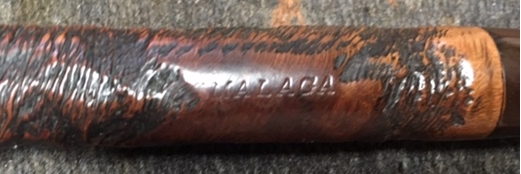
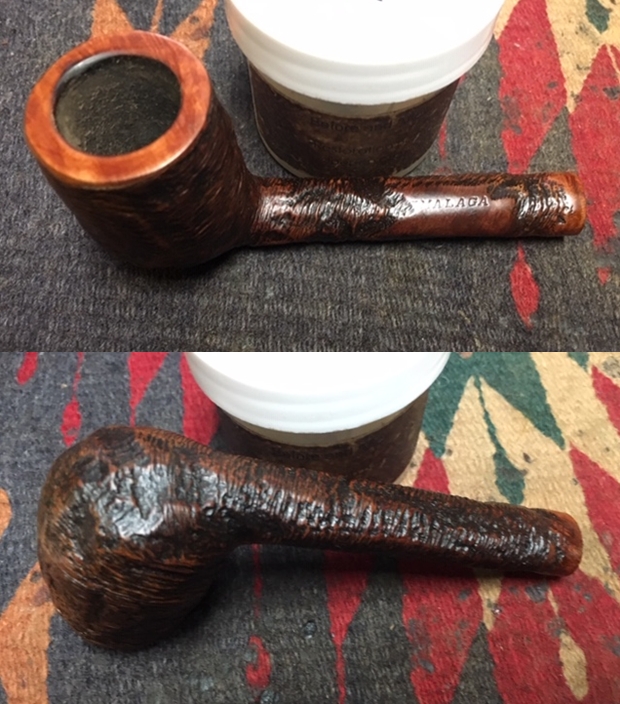
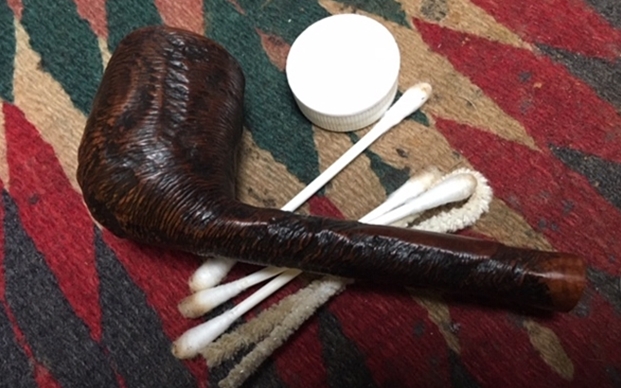
I am working through a lot of the queue of pipes that are sitting in my repair bin this weekend. Next on the table is another Malaga from Alex that he dropped off for a restoration. It is what Malaga would have called one of their carved finishes. It is a Canadian with a double rusticated finish. The underfinish is almost Custombilt like in the deep worm trail grooves on the bowl and shank. The top finish is a wire rustication that covers the bowl sides and shank over the top of the previous finish. The rim top and a band on the shank end are smooth and stained with a contrasting lighter stain. It is an interestingly piece with a very unique finish that has grown on me as I worked on it.

The pipe had been reamed and cleaned according to the seller. The bowl and shank were pretty clean bowl. The rim top had some damage on the top surface and a deeper burn mark on the right front inner edge. The pipe is stamped on the topside of the shank horizontally and reads MALAGA. The finish on the pipe is very in good condition with a lot of grime and dust in the finish. The stem was very deeply oxidized and polished over the oxidation. There were waves and marks on the surface of both sides at the button and tooth damage on the button itself. The photos give a pretty clear picture of the shape of the pipe and its general condition when I received it. I took a close up photo of the bowl and rim to capture the condition of the pipe before he started my restoration of the pipe. The rim top was clean but had some darkening and chipping on the surface at the back of the bowl. The right front inner edge and bowl top had some burn damage that was quite extensive. The stem itself was an interesting mess. It had been shinned and polished but there was still some very deep oxidation that is visible – with the shine is a cloudy red colour. There are also tooth marks on the button surface of the topside (shown in the second photo) as well as some general waviness to the stem just ahead of the button that spoke of some one trying to buff out the tooth marks. Also note the stamped C on the shank underside in the third photo. I believe this refers to the fact that the pipe has the Malaga Carved finish.I took a photo to capture the stamping on the topside of the shank. The photo shows stamping as noted above. The stamping on this pipe is clear and readable. Once again it does not include the quotation marks that show up on various Malaga pipes.For those of you who are unfamiliar with the brand, I am also including the link to a blog that I wrote that gives some of the history of the Malaga brand and the Malaga Pipe Shop in Royal Oak, Michigan in the USA. Here is the link – https://rebornpipes.com/tag/malaga-pipes/. That blog also includes links to a catalogue and the history of the pipemaker George Khoubesser. If you are interested to learn more then I invite you to follow the link to get a feel for the brand and the pipemaker.

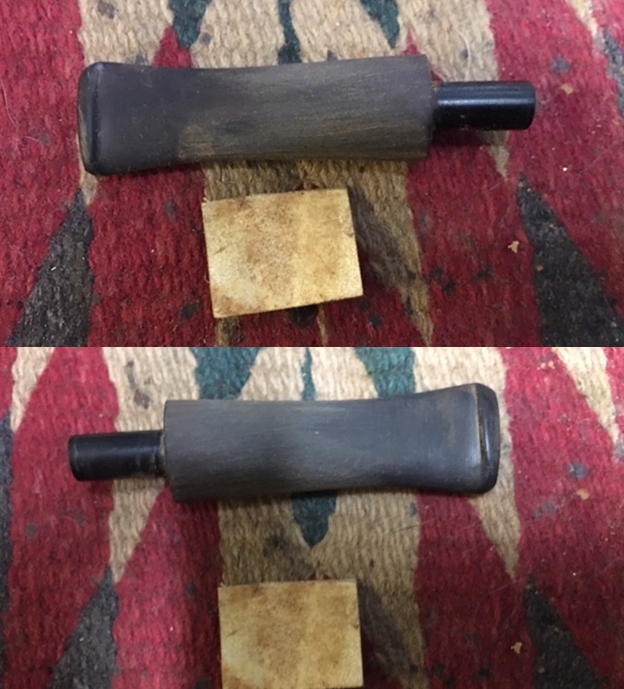
Since the bowl had been reamed and the pipe appeared to be clean I left the cleanup work until after I had reworked the shank and stem. I started my work on the pipe by working on the rim top and inner edge of the bowl. I started by topping the bowl on a topping board with 220 grit sandpaper. I wanted to remove as much of the damage to the rim top as possible and minimize the burn damage on the front edge of the bowl. What limited the topping was the smooth band around the top of the bowl. Even though it was thin I could safely remove some of the damage without compromising the band. Once I had it topped I used a folded piece of 220 grit sandpaper to give the inner edge a slight bevel to further hide the burn damage. I polished the freshly sanded briar with 2400-12000 grit micromesh sanding pads – wet sanding with 1500-2400 grit pads and dry sanding with 3200-12000 grit pads. I wiped the rim top down with a damp cloth after each pad. I found that with each successive grit of micromesh the grain stood out more and gave a shine to the pipe. I liked what I saw when I looked at it. While it was a close match to the smooth band on the shank and around the rim top it would need to be stained to give a more perfect match. I used an Oak Stain pen to touch up the rim top and the light spots on the band around the shank end. I worked some Before & After Restoration Balm into the surface of the briar with my fingertips to clean, enliven and protect it. I let the balm sit for a little while and then buffed with a cotton cloth to raise the shine. The following photos show the bowl at this point in the restoration process. The bowl and the rim top look really good and the darkening is gone. The finish looks very good with the rich oil finish on the bowl and rim. I am very happy with the results. I cleaned out the airway in the shank and wiped out the bowl to make sure there was no debris left behind. The pipe had been well cleaned on the inside by the seller. Because of that most of what I got was the sanding debris that had drifted in the bowl and shank when I had topped the rim. With the bowl finished I set it aside and turned my attention to the stem. I sanded the stem surface with 220 grit sandpaper to smooth out the waves, remove the oxidation and smooth out the tooth marks on the surface of the button. The oxidation and waviness of the stem surface was hardest to deal with in order to not accentuate the waves instead of removing them. I sanded with long strokes on the surface to blend in the high and low spots. I am happy with the stem surface once that was done. I started the polishing of the surface with 400 grit wet dry sandpaper. I cleaned out the debris from the airway and slot in the stem after the sanding was completed. I used alcohol and pipe cleaners.I polished the stem with micromesh sanding pads – wet sanding it with 1500-2400 grit pads and dry sanding it with 3200-12000 grit pads. I wiped the stem down with a damp cloth after each pad. I further polished it with Before & After Pipe Polish – both Fine and Extra Fine. I wiped it down with a coat of Obsidian Oil and set it aside to dry. Now with both parts of the pipe finished, I polished stem with Blue Diamond polish on the buffing wheel. I gave the bowl multiple coats of Conservator’s Wax and the stem multiple coats of carnauba wax. I buffed the pipe with a clean buffing pad to raise the shine. I hand buffed it with a microfiber cloth to deepen the shine. The pipe polished up pretty nicely. The grain under the double rustication came alive with the buffing. The rich oil finish on the briar works well with the new, polished black vulcanite stem. The finished pipe is a beauty and feels great in the hand. Have a look at it with the photos below. The dimensions are Length: 6 inches, Height: 1 3/4 inches, Outside diameter of the bowl: 1 1/4 inches, Chamber diameter: 3/4 of an inch. This one will be going back to Alex with the rest of his pipes that I am working on. Thanks for walking through the restoration and restemming with me on this uniquely carved Malaga Canadian.


New Life for a Savinell Punto Oro 8004 Canadian


Blog by Steve Laug

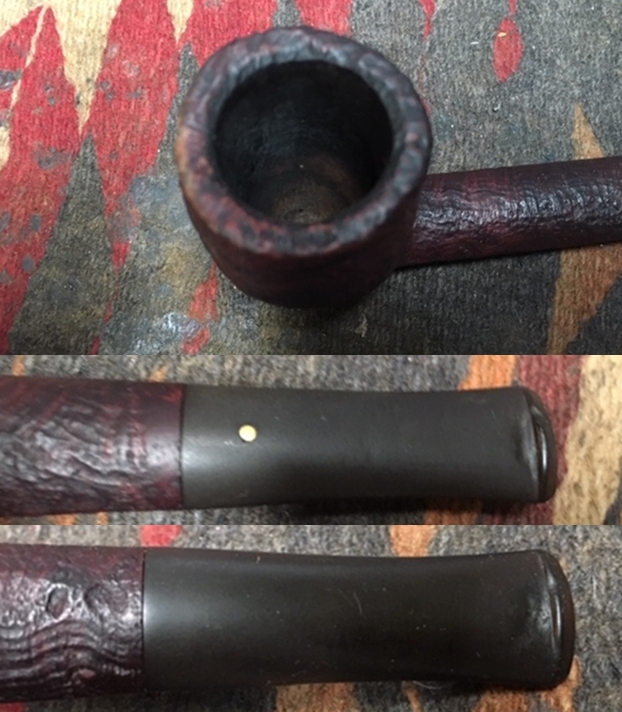
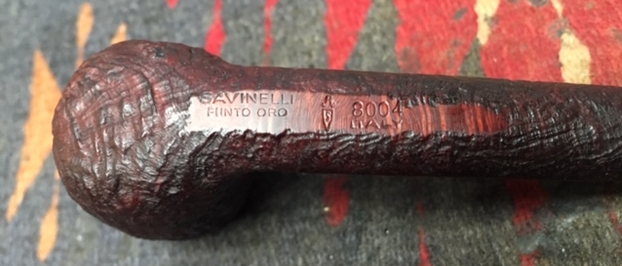
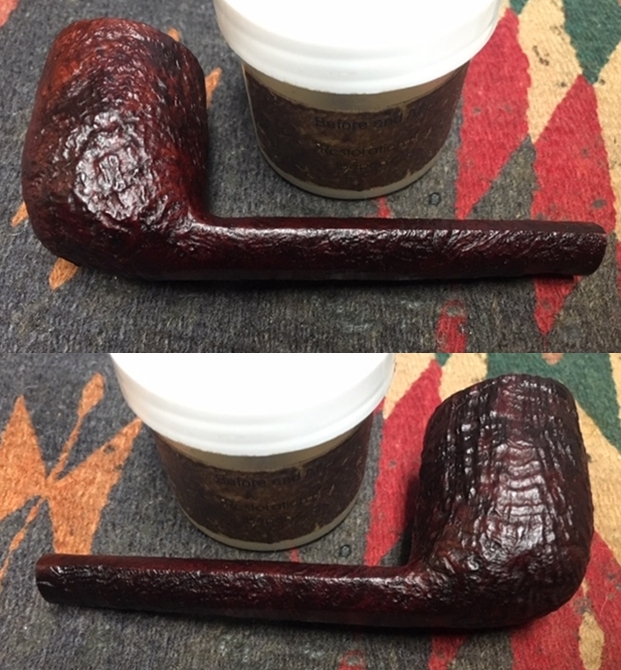
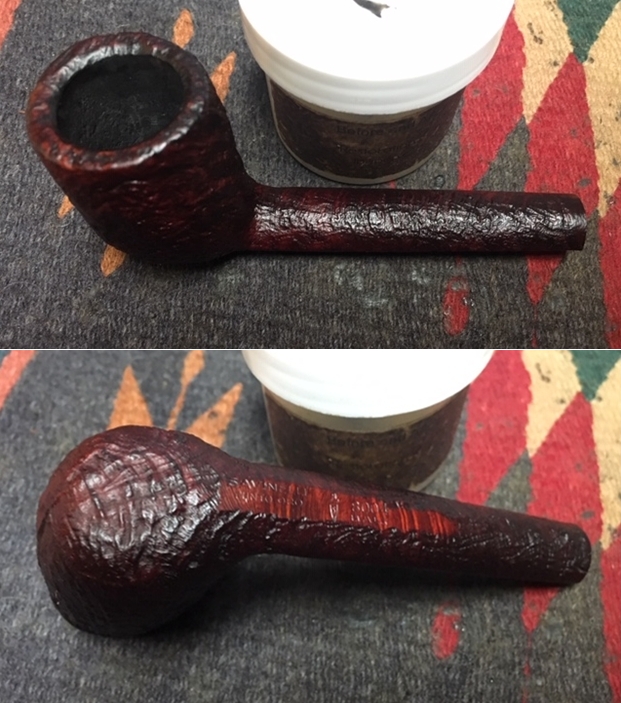
The next pipe in the queue is yet another interesting pipe from the Michigan lot – a really nice sandblasted Canadian with a deep blast and lots of great grain. The entire pipe – bowl, rim and shank sandblasted with a thin, smooth band at the end of the shank. It is another totally unique pipe and different from any of the other pipes in the collection. It is not a large pipe – probably a Group 4 sized bowl. The rim top has a slight inward bevel on the inner edge of the flat rim top. The pipe has a contrasting black, oxblood and brown stain coats that highlights and accentuates the blast. The underside of the shank has a smooth patch from the heel down most of the shank. It is stamped Savinelli over Punto Oro with a Savinelli S shield followed by the shape number 8004 over Italy. The stem is vulcanite and has a small brass dot on the top near the shank. This is another nice looking piece much like the rest of those in this 21 pipe Michigan pipe lot. The Savinelli I am working on now is on the first shelf of the rack. It is the second pipe on the left and I put a red box around it to make it easy to identify. Jeff took some photos of the pipe when he received them to show the general condition of the pipe before he started his cleanup work. Like the rest of the pipes from the Michigan collection this pipe was dirty and well used. There was a thick cake in the bowl and lava overflowing onto the rim top. It was hard to know if the edges of the bowl were damaged or not because of the cake and lava. The deep sandblast on the bowl, shank make the pipe very interesting. The vulcanite stem is lightly oxidized and has some calcification at the button. There are deep tooth marks on both sides of the stem at the button edge and some wear on the button edge itself. There are also scratches in the vulcanite where it looks like someone scraped off some of the calcification. The photos below tell the story and give a glimpse of the beautiful Canadian. Jeff took a close up photo of the bowl and rim to capture the condition of the pipe before he started his cleanup work. The rim top had some thick lava overflow and some darkening. The thick lava on the rim top made it hard to know what the inner and outer edges of the bowl looked like. There is also a general accumulation of dust in the finish on the rest of the bowl and shank.He also took photo of the right and underside of the bowl and shank to show the interesting sandblast finish. The finish is very dirty but this is another beautiful pipe.Jeff took a photo to capture the stamping on the underside of the shank. The photo shows stamping as noted above. The stamping on this pipe is clear and readable.The next two photos show the stem surface. They show the tooth marks and chatter on both sides near the button. There are also some marks on the sharp edge of the button. The stem is dirty, oxidized and has a yellow cast to it. The single brass Punto dot on the top of the stem is almost invisible.Jeff reamed the bowl with a PipNet pipe reamer and followed up with a Savinelli Fitsall pipe knife to remove the cake. He scrubbed out the mortise and the airway in the shank and the stem with alcohol, cotton swabs and pipe cleaners. He scrubbed the exterior of the bowl, rim, shank and stem with a tooth brush and Murphy’s Oil Soap to remove the oils and tars on the rim and the grime on the finish of the bowl. He rinsed it under running water. He dried it off with a soft cloth. He was able to remove the lava build up on the rim top and you could see the great condition of the bowl top and edges of the rim. He soaked the stem in Before & After Deoxidizer to remove the oxidation. I took photos of the pipe to show its condition before I started my work on it. I took a close up photo of the rim top to show the darkening on the surface of the rim toward the back of the bowl that was normal with use. The front part of the rim top looked a little lighter in colour but the sandblast on the entire rim made the rim top repairs minimal. The inner edge and the outer edge of the rim look really good. The stem photos show the tooth marks and the wear on the button surface on both sides. The final close up photos shows the Savinelli stamping on the underside of the shank. Jeff had done such a great job cleaning the surface of the pipe that there was nothing I needed to do move forward. I started by working some Before & After Restoration Balm into the sand blast finish of the briar with my fingertips to clean, enliven and protect it. I let the balm sit for a little while and then buffed with a cotton cloth to raise the shine. The following photos show the bowl at this point in the restoration process. The bowl and the rim top look really good and the darkening and lava are gone. The finish looks very good and I am very happy with the results. With the bowl finished I set it aside and turned my attention to the stem. I cleaned out the tooth marks on both sides of the stem with a cotton swab and alcohol. I filled in the tooth marks with clear super glue. Once the repairs had cured I used a needle file to flatten out the repaired areas. I filed it until the patches were smooth with the surface of the stem. I used a folded piece of 240 grit sandpaper to blend the repairs into the surface of the stem. Once the surface was smooth I sanded out the scratch marks and started the polishing of the stem with a folded piece of 400 grit sandpaper. I wiped the stem down with a damp cloth and took the following photos.I polished the stem with micromesh sanding pads – wetsanding it with 1500-2400 grit pads and dry sanding it with 3200-12000 grit pads. I wiped the stem down with a damp cloth after each pad. I further polished it with Before & After Pipe Polish – both Fine and Extra Fine. I wiped it down with a coat of Obsidian Oil and set it aside to dry. I put the stem back on the bowl so I could polish it without rounding the edges as the shank union. I polished stem with Blue Diamond polish on the buffing wheel. I gave the bowl multiple coats of Conservator’s Wax and the stem multiple coats of carnauba wax. I buffed the pipe with a clean buffing pad to raise the shine. I hand buffed it with a microfiber cloth to deepen the shine. The pipe polished up pretty nicely. The contrasting deep sandblast showed the contrasts between the valleys and the high spots. It truly came alive with the buffing. The rich browns and oxblood stains worked very well with the polished black vulcanite stem. The finished pipe is a beauty and feels great in the hand. Have a look at it with the photos below. The dimensions are Length: 6 inches, Height: 2 inches, Outside diameter of the bowl: 1 1/4 inches, Chamber diameter: 3/4 of an inch. This beauty will be on the rebornpipes store sometime in the days ahead. It may well be the kind of sandblasted Canadian you have been looking for. Let me know if you are interested. Thanks for walking through the restoration of this beautiful Canadian with me it was a pleasure to work on.


Replacing a Broken Tenon in a Dunhill 196F/T Shell Briar


Blog by Steve Laug

This is one of the Dunhill Shell Briar pipes that I sold earlier this year. It is a 196F/T Shell Billiard. Not too long ago I received an email from Bill the buyer of the pipe saying that there had been an accident and that the stem had broken off the pipe leaving the tenon in the shank. He was a bit forlorn in asking if it was repairable or not. I assured him that it could be fixed and told him to send it up to me in Vancouver. I had to laugh in that when it arrived it was in the original box that I had used to ship it to him – all the packing etc. was the same. Great use of the boxes. It will soon make its second trip to Bill. This is a well-traveled box and pipe – twice to the East Coast of the US from Canada and once back to me for repair. I put the pipe in queue as I have a large backlog of pipes to work on from several estates that the families are waiting on. I figured I would be able to slip into the work somewhere along the way.

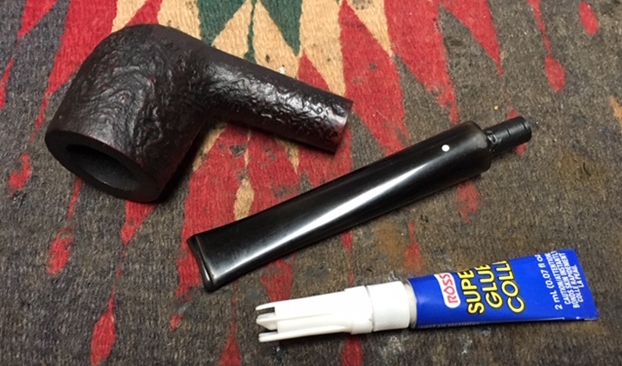
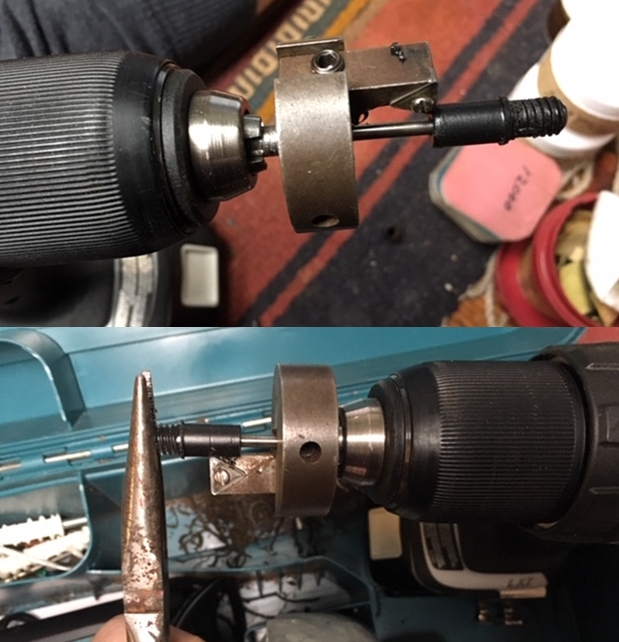
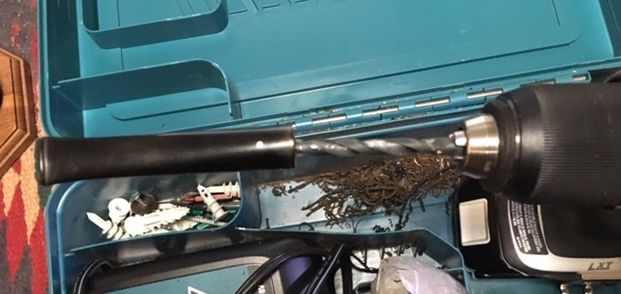
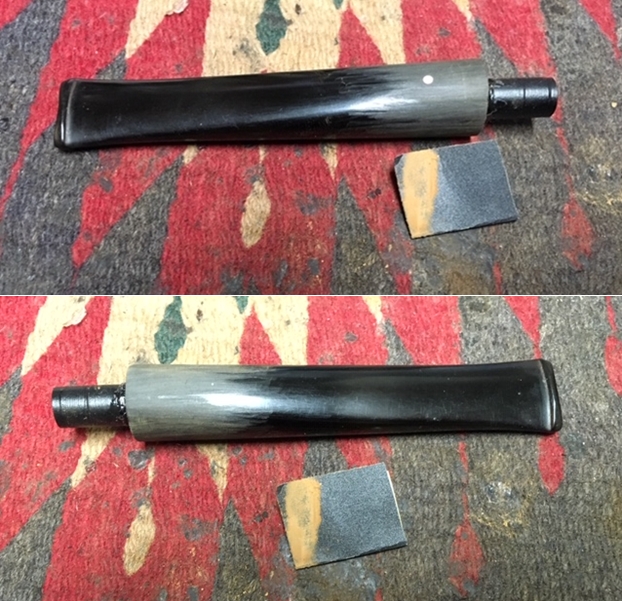
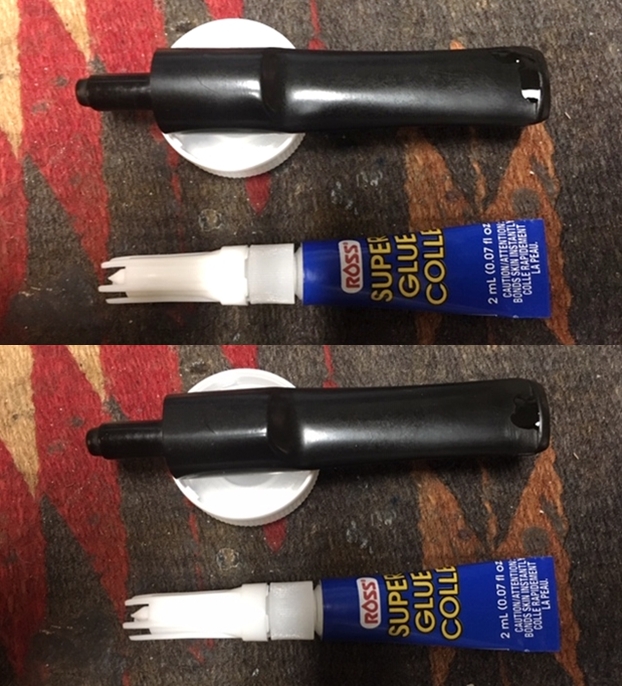
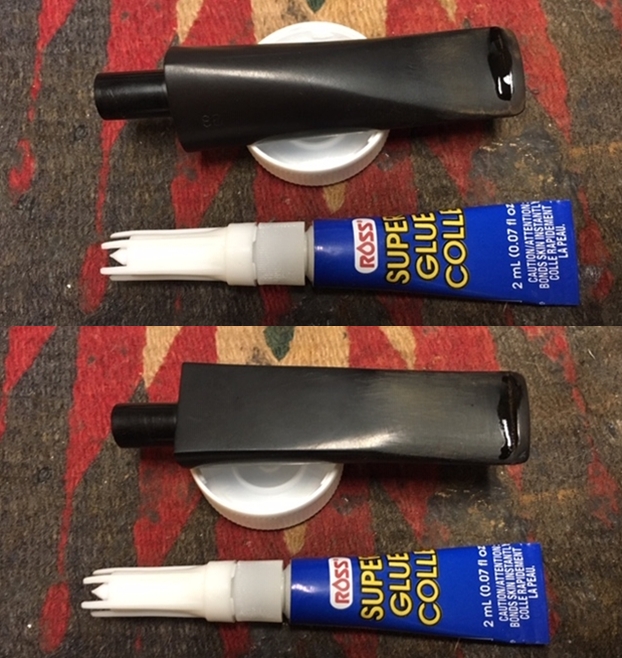
Today was the day. I finished a lot of pipes lately so I felt ok about working on this one. I figured it would be pretty straight forward to pull the broken tenon and replace it. Boy was I wrong. The broken tenon was stuck in the shank. My usual tricks for pulling a broken tenon – a screw in the airway and wiggling it free – did not work. Even a trip to the freezer did not work. I had to resort to more serious tools.I got out my cordless drill and chucked up a series of drill bits to see if I could pull it that way. I have often found that in the process of drilling out the tenon it will stick to the bit and come out as I back out the drill. That did not happen on this pipe! I ended up working through the bits until I finally was finished and the mortise was smooth and clear of the old tenon.With the airway cleared in the mortise I measured it for a new tenon. Yet again another setback. I did not have any tenons that were the right diameter for the mortise! I chucked the PIMO tenon turning tool in my cordless drill and reduced the diameter of a threaded tenon replacement that I had in stock until it was the right diameter to fit the mortise. I tried to hold the tenon by hand and turn it but soon realized that did not work this time. I used a pair of needle nose pliers to hold it until the tenon was finished.When I finished there was a small hip between the threaded portion and the smooth portion of the new tenon. I worked the tool back and forth to remove that. I also held a needle file against the hip while the tenon was spinning on the drill. It did not take too long to remedy that issue. The new tenon was almost ready to use. I would still need to reduce the diameter of the threaded portion before I could use it but it was good for the moment.I drilled out the airway in the stem to receive the new tenon. This is always a little tricky as you need to keep the stem absolutely straight so that you do not angle the airway. I always start with a bit slightly larger than the airway and work my way up to the size of the tenon insert. In this case I also needed to be careful not to drill the stem too deeply as the tape is quite long and it would be easy to ruin the stem. With the airway opened in the stem to take the threaded tenon end I used a tap to thread the airway inside the bowl. I had to open the airway a little more so I used a penknife to widen the diameter to take the tap. I used a Dremel with a sanding drum to reduce the diameter of the threaded portion of the new tenon until it could be screwed into the stem.I coated the threaded end of the tenon with super glue and turned it into the end of the stem. I pressed it completely in place against the table top so there was not a gap. I filled in the slight gap with some clear super glue and laid the stem aside to let the repair cure.When the glue cured I addressed some oxidation at the shank end of the stem. I sanded it with 400 grit wet dry sandpaper until the oxidation was removed from the stem surface. I wiped the stem down with Obsidian Oil and let it dry.I polished the stem surface with micromesh sanding pads to bring back the shine to the vulcanite. I wet sanded it with 1500-2400 grit pads and dry sanded it with 3200-12000 grit pads. I rubbed it down with Obsidian Oil after each pad and a final coat after the 12000 grit pad. I polished the stem with Blue Diamond on the buffing wheel and gave it several coats of carnauba wax. I gave the bowl several coats of Conservator’s Wax. I buffed the finished pipe with a clean buffing pad to raise the shine. The finished pipe is shown in the photos below and I think it came out looking pretty good. I just got back from the Post Office and sent it back to Bill. I look forward to seeing what he thinks once it is in hand once again. Thanks for reading this.

Restoring another Malaga – A Billiard with a Twist from Bowl to Button


Blog by Steve Laug

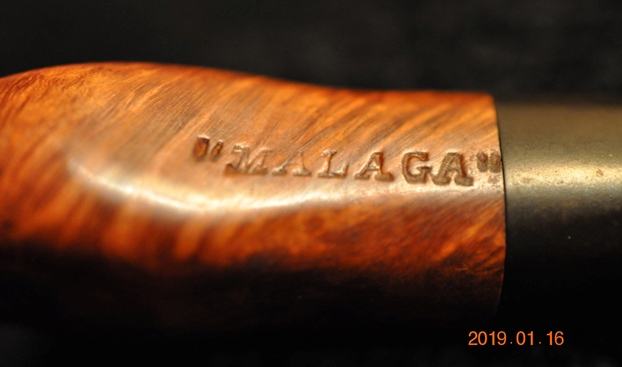
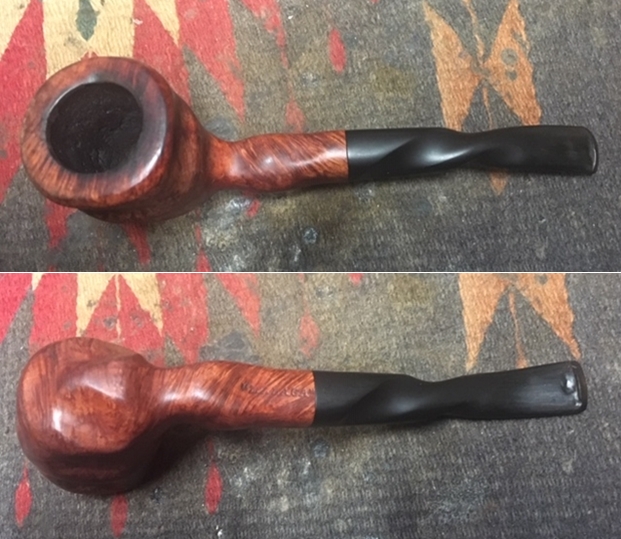
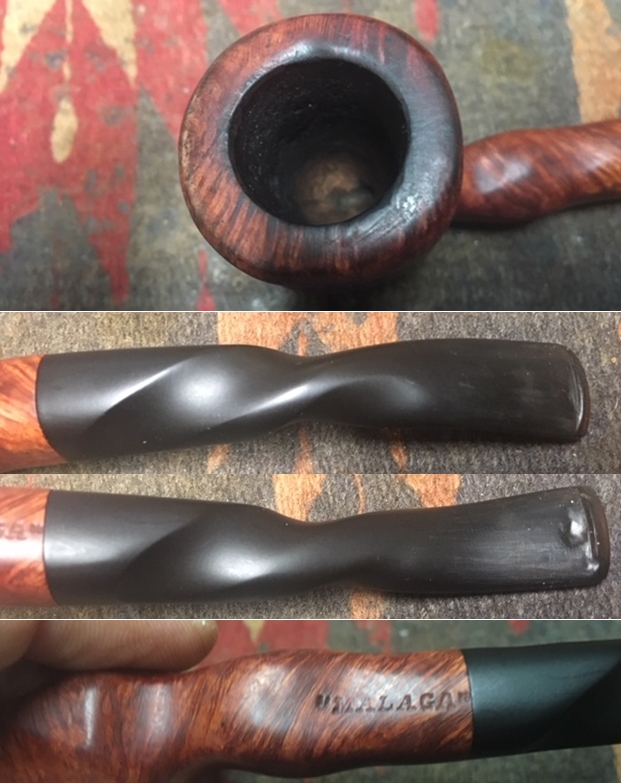
The next pipe in the queue is another interesting pipe from the Michigan lot – a Twisted Billiard with a twist going from the rim to the button. It is a totally unique pipe and different from any of the other Malaga pipes that I have worked on. It is not a large pipe – probably a Group 4 sized bowl. The twist is carved in around what appears to have been originally a panel bowl but I am not even sure of that as it has a round rim top. The finish is smooth and well finished in the oil cured style of other pipes from the brand. On the underside is a small flat panel running parallel to the shank that is stamped “MALAGA” with the quotation marks. The stem is vulcanite and carries on the twist of the shank and bowl. This is another nice looking piece much like the rest of those in this 21 pipe Michigan pipe lot. This Malaga joins the rusticated billiard that I worked on earlier and a freehand that also has a very interesting Malaga shape. The Malaga I am working on now is on the mat in front of the rack. It is the third pipe on the left and I have circled it in red to make it easy to identify. Jeff took some photos of the pipe when he received them to show the general condition of the pipe before he started his cleanup work. Like the rest of the pipes from the Michigan collection this pipe was dirty and well used. There was a thick cake in the bowl and lava overflowing onto the rim top. The inner edge of the bowl was damaged with nicks and cuts from a previous reaming job with a knife. The twisted carving in the bowl sides and shanks fit comfortably in the hand as it was wrapped around the bowl sides. The carving on the bowl, shank and stem make the pipe very interesting. It is another pipe that is unlike any of the Malaga pipes that I have worked on. It is grooves/twists are quite deep and are parallel on the right and left side and the front and the back. The vulcanite stem is carved in the same manner as the bowl and carries on the twist. There are deep tooth marks on both sides of the stem at the button edge and some wear on the button edge itself. The photos below tell the story and give a glimpse of the carved twisted billiard. Jeff took a close up photo of the bowl and rim to capture the condition of the pipe before he started his cleanup work. The rim top had a thick lava overflow and some darkening. There were some nicks and cuts around the rim. There also appeared to be a burn mark on the right inner edge of the rim at mid bowl and possibly on the left inner edge toward the read of the bowl . There is also a general accumulation of dust and grime in the carving of the bowl and shank.He also took photo of the right side and the bottom of the bowl and shank to show the interesting twisted carving that covers the pipe. The carving is unique and gives the pipe a rugged and tactile look and feel in the hand. It should be interesting as the pipe warms up when smoked. The finish is very dirty but this is another beautiful pipe. Jeff took a photo to capture the stamping on the underside of the shank. The photo shows stamping “MALAGA”. The stamping has the quotation marks that I have seen on some of the pipes. I have yet to figure out what the quotation marks mean as they are not on all of the pipes. Perhaps some of you might know. How about a note about this?The next three photos show the stem surface. The first shows the twist in the stem flowing out of the shank. There is some light oxidation on the stem surface. The next two show the tooth marks and chatter on both sides near the button. There are also some marks on the sharp edge of the button. The surface of the blade in front of the button also has some scratches from whoever attempted to clean it up. Once again I am including the link to a blog that I wrote that gives some of the history of the Malaga brand and the Malaga Pipe Shop in Royal Oak, Michigan in the USA. Here is the link – https://rebornpipes.com/tag/malaga-pipes/. That blog also includes links to a catalogue and the history of the pipemaker George Khoubesser. Follow the link to get a feel for the brand and the pipemaker.

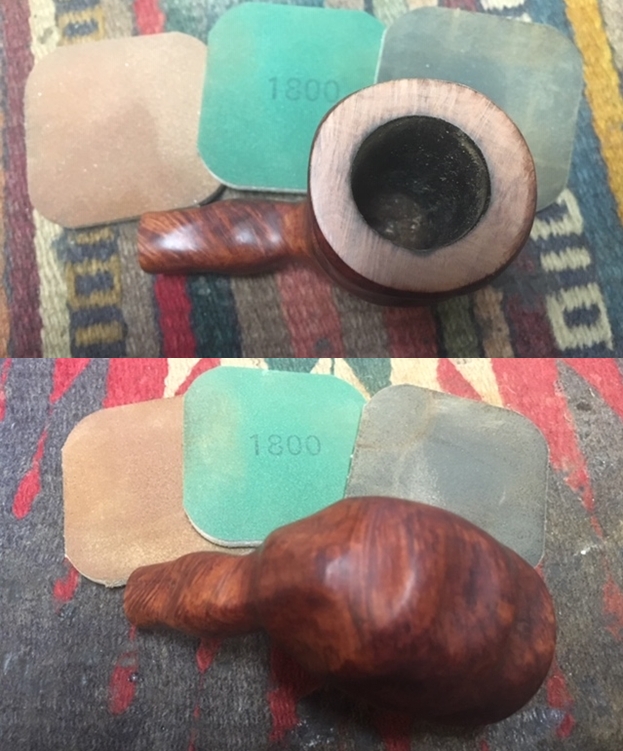
Jeff reamed the bowl with a PipNet pipe reamer and followed up with a Savinelli Fitsall pipe knife to remove the cake. He scrubbed out the mortise and the airway in the shank and the stem with alcohol, cotton swabs and pipe cleaners. He scrubbed the exterior of the bowl, rim, shank and stem with a tooth brush and Murphy’s Oil Soap to remove the oils and tars on the rim and the grime on the finish of the bowl. He rinsed it under running water. He dried it off with a soft cloth. He was able to remove the lava build up on the rim top and you could see the damage to the flat surface of the rim and the inner edge on the right side and toward the front of the bowl. I took photos of the pipe to show its condition before I started my work on it. I took a close up photo of the rim top to show the darkening on the surface of the rim toward the back of the bowl. There were also some burn marks on the right side toward the middle and the ledge side toward the rear of the rim top. The inner edge of the bowl had some damage from burns and reaming but the outside edge looks really good. The stem photos show the tooth marks and the wear on the button surface on both sides. The final close up photos shows the “MALAGA” stamping on the underside of the shank.To remove the damage to the top of the rim I topped it on a topping board with 220 grit sandpaper. I worked on it to remove the burned areas and the damage to the inner edge of the rim as much as possible. I am happy with how it turned out.I used a folded piece of 220 grit sandpaper to clean up the inner edge of the round rim top. I was able to remove the majority of the damage, leaving behind a dark spot on the right side of the rim top at the inner edge. I wiped the rim top down with a damp cotton pad to remove the dust. I polished the bowl and the rim top with micromesh sanding pads – wet sanding with 1500-2400 grit pads and dry sanding with 3200-12000 grit pads. I wiped the rim down after each pad with a damp cloth. I touched up the stain on the rim with a Maple stain pen and blended it into the grain. Once it dried I buffed it with Blue Diamond to spread it out. With the rim top and bowl polished, I worked some Before & After Restoration Balm into the surface of the briar with my fingertips to clean, enliven and protect it. I let the balm sit for a little while and then buffed with a cotton cloth to raise the shine. The following photos show the bowl at this point in the restoration process. The bowl and the rim top look really good and the darkening and lava are gone. The finish looks very good with the swirling carving on the sides of the bowl and shank. The Maple stain on the rim matched the rest of the bowl perfectly. I am very happy with the results. With the bowl finished I set it aside and turned my attention to the stem. I cleaned out the tooth marks on both sides of the stem with a cotton swab and alcohol. Once the repairs had cured I used a needle file to flatten out the repaired areas. I filed it until the patches were smooth with the surface of the stem. I polished the stem with micromesh sanding pads – wet sanding it with 1500-2400 grit pads and dry sanding it with 3200-12000 grit pads. I wiped the stem down with Obsidian Oil after each pad. I further polished it with Before & After Pipe Polish – both Fine and Extra Fine. I gave it a final coat of Obsidian Oil and set it aside to dry. I polished stem with Blue Diamond polish on the buffing wheel. I gave the bowl and the stem multiple coats of carnauba wax. I buffed the pipe with a clean buffing pad to raise the shine. I hand buffed it with a microfiber cloth to deepen the shine. The pipe polished up pretty nicely. The contrasting grain came alive with the buffing. The rich browns work well with the polished black vulcanite stem. The finished pipe is a beauty and feels great in the hand. Have a look at it with the photos below. The dimensions are Length: 6 inches, Height: 2 1/4 inches, Outside diameter of the bowl: 1 1/2 inches, Chamber diameter: 7/16 of an inch. This pipe will be going on the rebornpipes store. Thanks for walking through the restoration with me on this twisted Malaga billiard.

A Breath of Life for a Variegated Finish S&R Sitter Billiard


Blog by Steve Laug

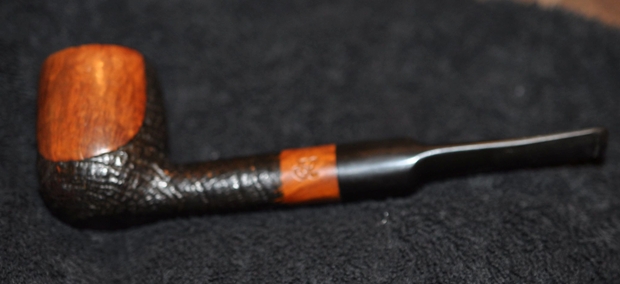
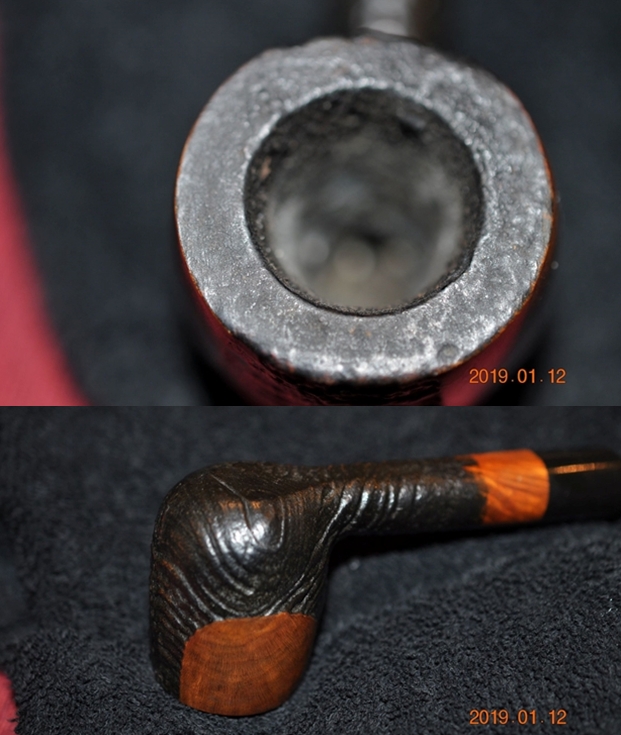
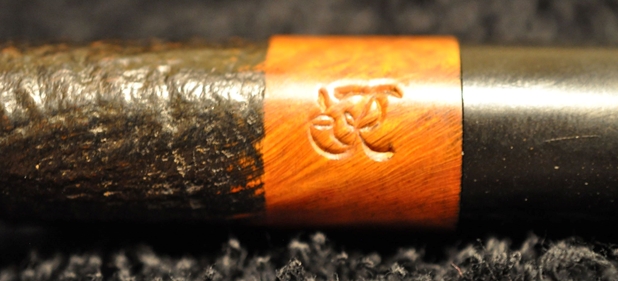
Years ago now I met Steve and Roswitha at the Chicago Pipe Show. I cannot even remember the year but I remember having a good conversation with them. I was not able to pick up one of their pipes at that time but I was amazed at the beauty and style of pipes that the two of them were creating in their shop, Pipes & Pleasures in Columbus, Ohio. Over the years I have watched for them and even bid on a few on eBay. Sadly, I never won any of the pipes that I bid on. They all escaped my grasp. Given that you may have a sense of the surprise I had when my brother and I picked up a pipe rack and 21 pipes from a fellow in Michigan and it had an S&R billiard. I clipped a photo of the collection and circled the S&R in the photo. It is the second pipe from the right on the second shelf of the rack. It is a nice looking two toned sitter billiard – sporting both smooth panels on the sides of the bowl and an interesting sandblast finish.Jeff took some photos of the pipe when he received them to show the general condition. I have included the photos of the S&R pipe. It was dirty and worn looking. There was a thick cake in the bowl and heavy lava overflow on the rim top. The smooth panels on both sides of the bowl and the ring around the shank end have great grain that follows the grain of the sandblast next to them. The stamping is very clear and shows the interlocked SR with a pipe. The sandblast is well done and really shows the grain. It is not to deep or rugged but it is very nicely done. The stem is vulcanite and slightly oxidized. There are deep tooth marks on both sides of the stem at the button edge and some scratching on the stem surface. The photos below tell the story and give a glimpse of the saddle billiard shape. Here is a close up of the bowl and rim top. You can see the thick lava coat. It is hard to see if there is any damage on the inner or outer edge of the rim. There is a thick cake in the bowl that is hard and rough. The second photo is a close up of the right side and the flat underside of the bowl. You can see the interesting grain in the sandblast.The next photo shows the interlocked S&R stamp with the pipe. It is clear and legible.The next two photos show the scratching, oxidation and tooth marks in the stem at the button. The first photo shows the top side of the stem and the second the underside.I decided to take some time to review my knowledge of the brand. I turned to Pipedia and read the article that was included there (https://pipedia.org/wiki/S%26R_Pipes). I quote in full below:

Stephen and Roswitha Anderson of S&R Pipes, also known as S&R Woodcrafters, have become pipe makers renowned throughout the world as talented carvers of high-grade briar pipes. They have been featured in several trade publications and magazines such as Pipes and Tobaccos and PipeSmoker, and have several pieces on display in museums in Europe and the United States.

They are the first American pipe carvers honored with induction into the Conferee of Pipe Makers of St. Claude, France; the very place where the carving of briar pipes became a world-wide industry. Sadly, Steve passed away in March of 2009. Roswitha is still carving S&R pipes and carrying on with the shop with help from her “guys” David, Marty, and Tony.

Steve and Roswitha began carving pipes in the 1960’s. They travelled to pipe shows and arts and crafts shows throughout the country and Europe selling their pipes and built up quite an extensive loyal customer base. Eventually, it became time to offer their pipes to the retail fraternity of pipe smokers.

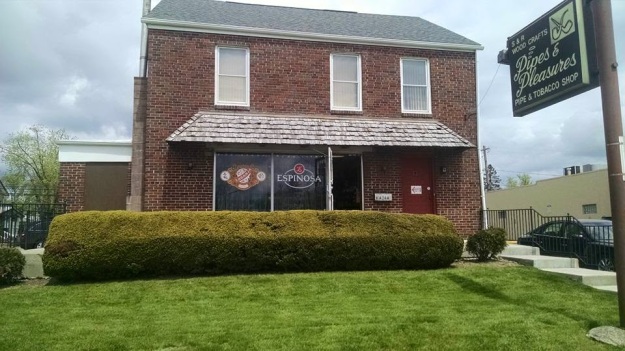
Pipes & Pleasures had its grand opening in a distinct red brick house on Main Street in Columbus, Ohio in 1977. The front section of the house was converted into a traditional tobacco shop selling pipe tobacco, cigars, and pipes manufactured by well known companies such as Dunhill, Charatan, and Savinelli as well as the high-grade S&R pipes that Steve and Roswitha carved. A workshop was set up in the back section of the house.

When the cigar boom hit in the ’90’s, the shop was expanded by building a large computer controlled walk-in humidor. It’s no secret throughout the country that Pipes & Pleasures has the best maintained cigars in the Columbus area as well as the best selection of premium cigars available in the area including the much sought-after Davidoff line.

Soon after the boom began, Steve and Roswitha moved their pipe making workshop to their farm and converted that space into a large smoking lounge for their many customers. The lounge features comfortable easy chairs, a television set, a stereo, a library of books and magazines about every aspect of tobacciana, a chess table, and a couple of card tables. The lounge is populated daily with long-time loyal customers and newcomers to the enjoyment and relaxation of cigar and pipe smoking. It’s also the room where several cigar tastings and samplings are held every year by representatives from cigar companies such as Davidoff and La Flor Dominicana.

I captured a photof the shop from the Pipedia article to include below. It is a great looking shop.

The Pipes & Pleasures shop, home of S&R Woodcrafters

I also turned to the Pipes & Pleasures website and copied the “About Us” section. Here is the link to the site (https://www.pipesandpleasures.biz/maintenance). I quote in part.

Pipes & Pleasures proprietors Stephen and Roswitha Anderson have become pipe makers renowned throughout the world as talented carvers of high-grade briar pipes. They have been featured in several trade publications and magazines such as Pipes and Tobaccos and PipeSmoker, and have several pieces on display in museums in Europe and the United States. They are the first American pipe carvers honored with induction into the Conferee of Pipe Makers of St. Claude, France; the very place where the carving of briar pipes became a world-wide industry.

Steve and Roswitha began carving pipes in the 1960’s. They travelled to pipe shows and arts and crafts shows throughout the country and Europe selling their pipes and built up quite an extensive loyal customer base. Eventually, it became time to offer their pipes to the retail fraternity of pipe smokers…

…Sadly, Steve passed away in March of 2009. Roswitha is still carving S&R pipes and carrying on with the shop with help from her “guys” David, Marty, and Tony, who welcome you to this website.

Jeff reamed the bowl with a PipNet pipe reamer and followed up with a Savinelli Fitsall pipe knife to remove the cake. He scrubbed out the mortise and the airway in the shank and the stem with alcohol, cotton swabs and pipe cleaners. He scrubbed the exterior of the bowl, rim, shank and stem with a tooth brush and Murphy’s Oil Soap to remove the oils and tars on the rim and the grime on the finish of the bowl of the pipe. He rinsed it off under running water. He dried it off with a soft cloth. He was able to remove most of the lava build up on the rim top of the pipe leaving a clean rim with some debris in the sandblast. I took photos of the pipe to show its condition before I started my work. I took a close up photo of the rim top to show the light debris in the sandblast finish of the rim. The inner and outer edge of the bowl looks really good. The stem photos show the scratching I noted above that extends from the button forward about an inch. They also show the tooth marks and the wear on the button surface on both sides.I started my restoration with the rim top. I used a brass bristle brush to clean out the remaining debris in the grooves of the sandblast. I wiped the rim top down with a damp cotton pad to remove the dust. I used a Walnut Brown and a Black stain pen to blend the colour on the rim top match the rest of the sandblast portion of the bowl.With the rim top cleaned and restained, I worked some Before & After Restoration Balm into the sandblast and smooth surfaces of the briar with my fingertips to clean, enliven and protect it. I let the balm sit for a little while and then buffed with a cotton cloth to raise the shine. The following photos show the bowl at this point in the restoration process. The bowl and the rim top look good. I am very happy with the results. With the bowl finished I set it aside and turned my attention to the stem. I sanded the scratches and the tooth marks on the stem and then filled it in with clear super glue. I set it aside to cure for overnight. In the morning I smoothed out the fills with a needle file to dress up the sharp edge of the button. I sanded the repairs with 220 grit and 400 grit sandpaper to blend them into the surface. I polished the stem with micromesh sanding pads – wet sanding it with 1500-2400 grit pads and dry sanding it with 3200-12000 grit pads. I wiped the stem down with Obsidian Oil after each pad. I polished it with some Before & After Pipe Polish – both Fine and Extra to deepen the shine. I wiped it down with a final coat of Obsidian Oil and set it aside to dry. This interestingly finished S&R billiard was a surprise to me. I had pretty much forgotten about ever restoring one of Steve and Roswitha’s pipes when this one came to me in a lot my brother and I bought from Michigan. It is a stunning example of their craft – the mixed smooth panels, band and sandblast finish and the contrasting stain is very well done. I polished the stem with Blue Diamond polish on the buffing wheel. I gave the bowl multiple coats of Conservator’s Wax and the stem multiple coats of carnauba wax. I buffed the pipe with a clean buffing pad to raise the shine. I hand buffed it with a microfiber cloth to deepen the shine. The pipe polished up pretty nicely. The contrasting finishes came alive with the buffing. The rich, contrasting brown and black colours work well with the polished black vulcanite stem. The finished pipe is a beauty and feels great in the hand. Have a look at it with the photos below. The dimensions are Length: 6 1/4 inches, Height: 2 inches, Outside diameter of the bowl: 1 1/2 inches, Chamber diameter: ¾ of an inch. I will be putting this beautiful billiard on the rebornpipes online store soon. It may well the kind of unique pipe you have been looking for so have a look. Thanks for walking through the restoration of this pipe with me. It was a fun one to work on.
Rejuvenating a Ben Wade Hand Model London Made Billiard


Blog by Dal Stanton

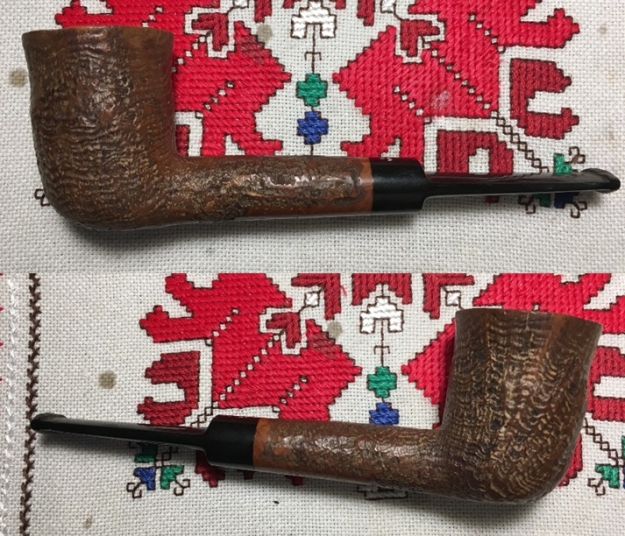
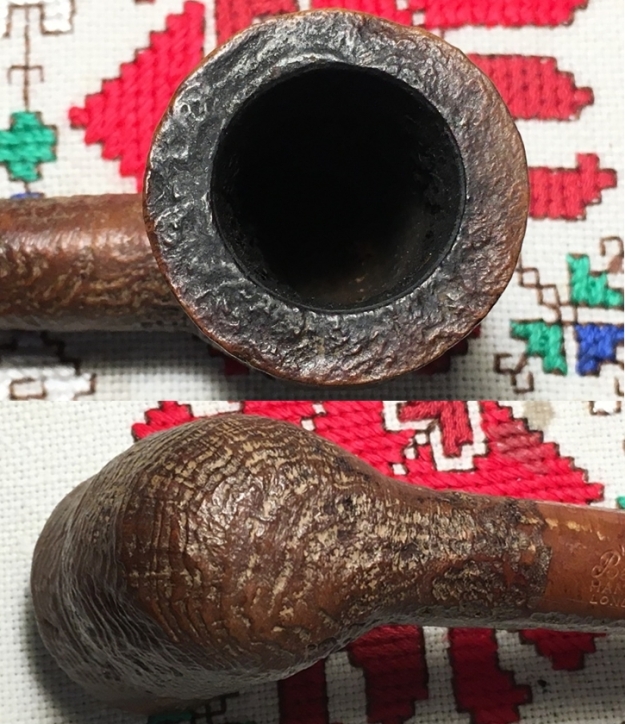
This Ben Wade came to me a couple of years back when I landed, from the eBay auction block, what I have called the Lot of 66. It continues to yield nice collectable pipes. The finish on this Ben Wade is a rustic looking blasted finish which is eye catching with the detail and bowl shaping. It caught Todd’s eye in the For “Pipe Dreamers” Only! collection and is the last of 3 that he has commissioned. Here are pictures of the Ben Wade Hand Model now on my worktable: I’ve discovered through the reading I’ve done about the name ‘Ben Wade’ that it has an up and down history. The Pipedia article is helpful in simplifying the history in four helpful ‘eras’ which I’ve summarized from the Pipedia:

The Family era (1860 to 1962) – the heydays of the English name when the pipes were stamped Made in Leeds, England.

Charatan / Lane second (1962 to 1988) – When Herman G. Lane purchased the name, the transition from a higher quality pipe during the long Family Era transitioned exclusively to the fabrication of machine-made pipes. Lane moved the production from the Leeds factory (closed in 1965) to Charatan’s Prescott Street factory. Ben Wade became essentially lower quality series pipes produced in standard shapes. The pipes during this period were stamped, “Made in London, England” or dropping the “London” and stamped with “England” alone. After Lane died, in 1978 his heirs sold the Charatan and Ben Wade names to Dunhill, which left the production of Charatan/Ben wade at the Prescott Street factor. In 1988 production came to an end for Ben Wade when the Charatan’s Prescott Street factory closed.

Ben Wade turns Danish (1971-1989) – During this era Preben Holm, from Denmark, was in financial difficulties and Herman Lane and he went into partnership producing the Handmade and fancy pipes. These pipes were marked “Ben Wade Made in Denmark”. These pipes gained great popularity, especially as the were marketed in the US. After Lane’s death, Preben Holm, not the businessman, was in financial difficulties and reduced his workforce and production, but at his death in 1989, production of the Danish Preben Holm pipes came to an end.

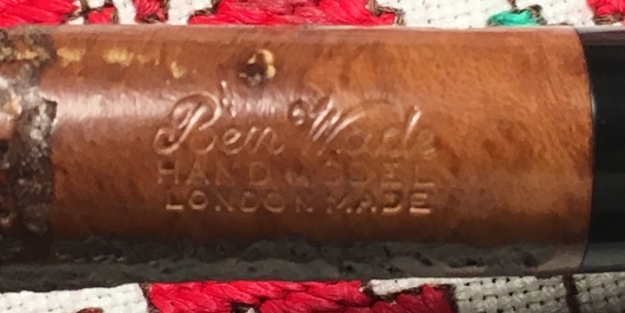
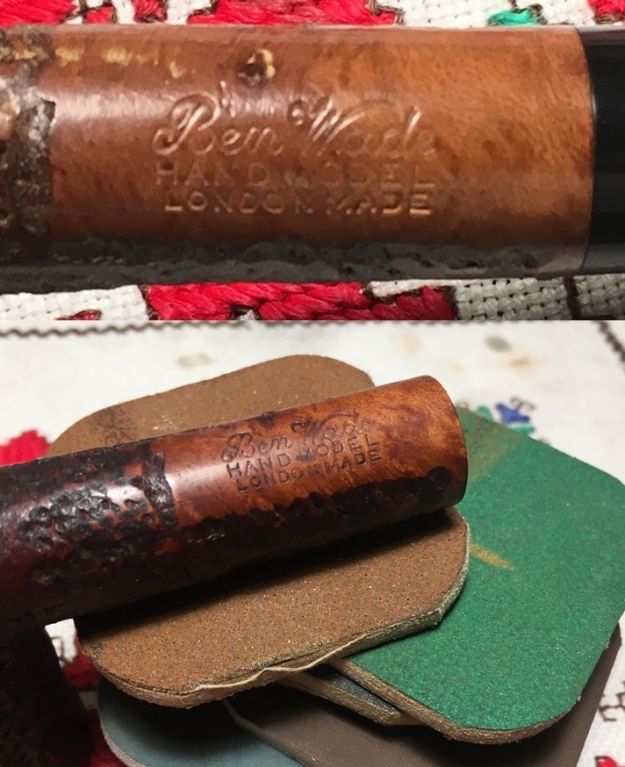
Resurrection – (1998 to present) – Duncan Briars bought the Ben Wade name from Dunhill in 1998 and production of Ben Wade pipes restarted at the Walthamstow plant, sharing the same space where Dunhill pipes are produced and reportedly benefiting from the same quality of production. During this present era, the stamping on the pipes is: “Ben Wade, Made in London, England”The reason I went through this summary of Ben Wade’s morphing history is because in nothing I’ve read about Ben Wade (and I’m sure there’s more out there), I found no reference to a Ben Wade Hand Model with the COM, London Made. The stamping on the pipe before me is ‘Ben Wade’ [over] HAND MODEL [over] LONDON MADE. The saddle stem has the Ben Wade stamped on the upper side of the stem saddle. My first glance at the blasted finish made me wonder whether this Ben Wade came out during the ‘mystery’ Resurrection period in the Pipedia article. Here is the full text that made me wonder:
As said before Preben Holm’s death marked the third end of Ben Wade and for long years there were no Ben Wade pipes in the shops anymore. But then, all of a sudden they were back in the USA some years ago! Who made these pipes? A concrete manufacturer was not known at first.

The rumors spreading were considerable. Especially because these Ben Wades – originally all blasted and in deep black color – featured so perfect straight and / or ring-grain that they were almost suspicious in view of the prices. The supposition that “Mother Nature” had been given a leg up by means of rustication combined with subsequent blasting was evident as different sources confirmed.

Steve on rebornpipes refers to pipes as having a ‘blasticated’ finish. The process is blasting a rusticated pipe making it appear naturally blasted but the more perfect lines make it seem better than ‘mother nature’ as the Pipedia described. As I look at this Ben Wade, I wonder if it’s from that time period and the grain looks so good, is it blastication? I sent Steve the picture below and his verdict was not blastication, but a really nice looking blasted finish. Yet, I’m stumped by the COM marking. Here’s a close-up of the stummel, very nice natural 3-D blasted grain and not blastication. I sent out pictures of some pictures and the nomenclature to various pipe Facebook groups and the responses I did get, though they were anecdotal, pointed to an earlier period. Paul, from Pipe Smoker of America FB Group, said that he believed it was a Pre-78 and made in Charatan factory. He also said that these were some of his best smokers are London BWs. It sounds good to me!
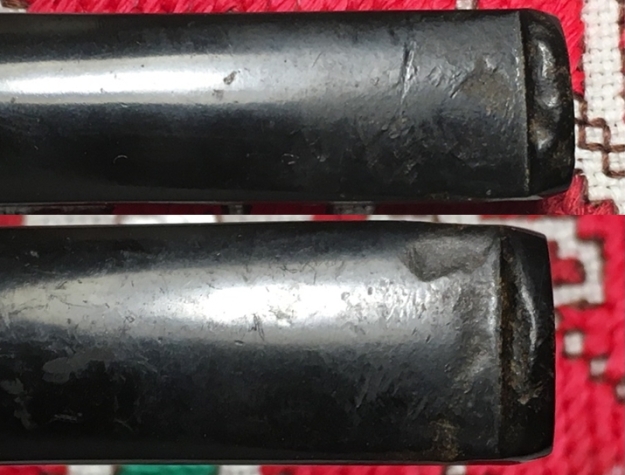
As I look at the condition of this Ben Wade, the surface needs cleaning to see what the finish will do. The finish is dark and tired as I look at it. The chamber shows light cake buildup and the rim is darkened with some lava flow. The stem will need to be cleaned of the oxidation and the button is chewed some with bite compressions on both the upper and lower bit.

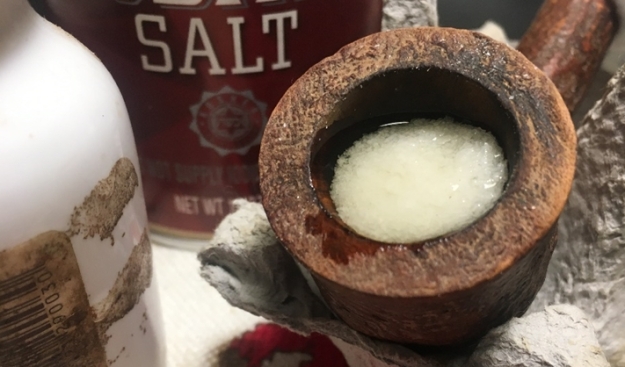
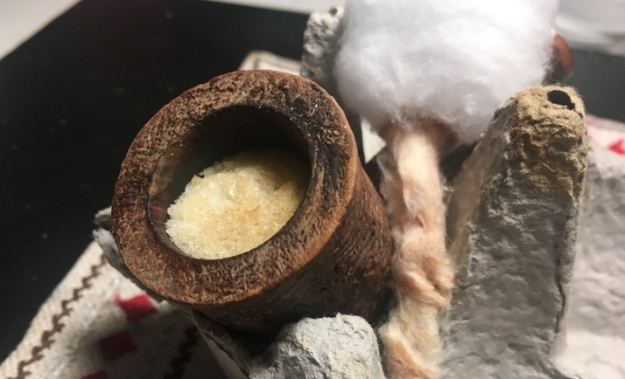
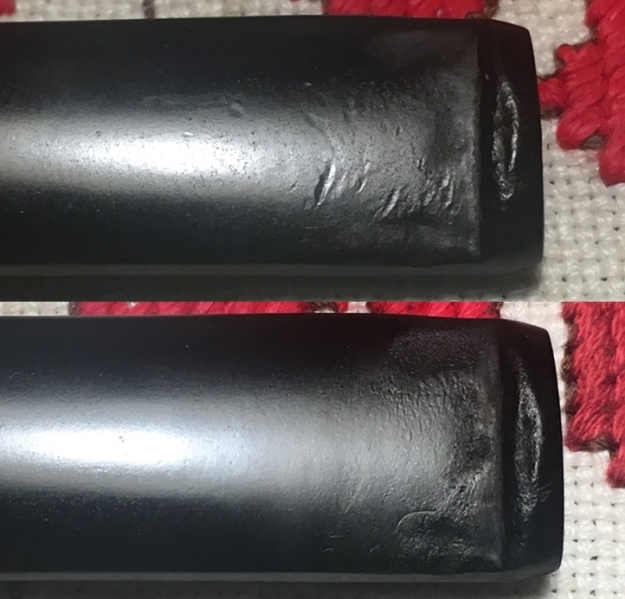
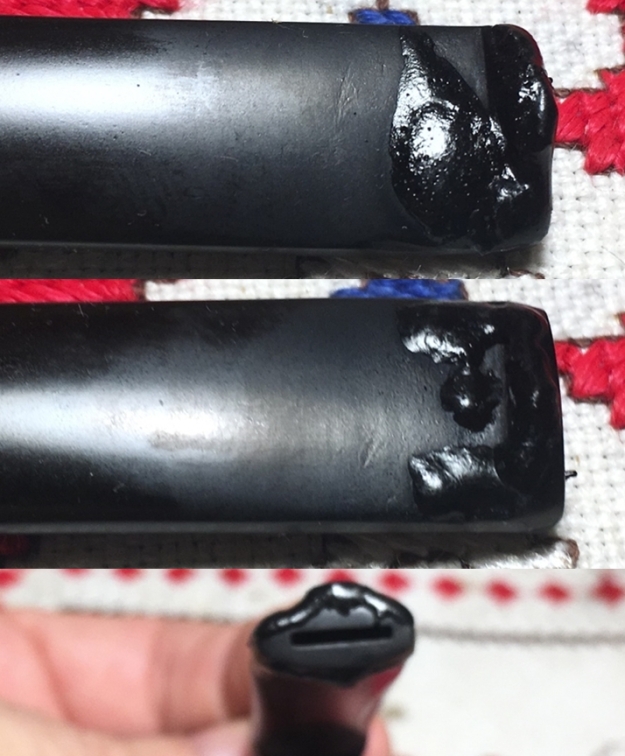
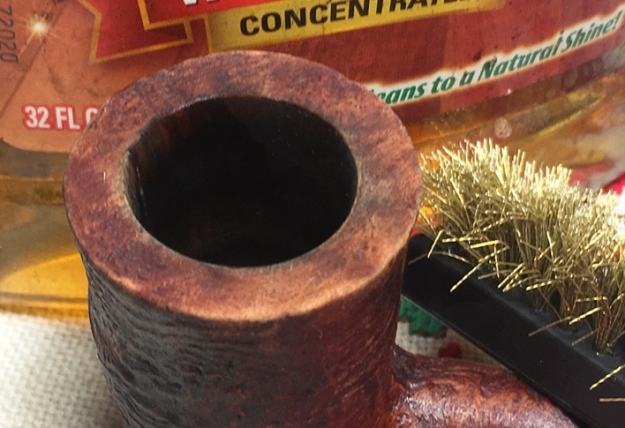
With a better knowledge of the Ben Wade Hand Model Billiard on my worktable, I begin by cleaning the stem airway with pipe cleaners wetted with alcohol and then add it to a bath of Before & After Deoxidizer along with other pipes and stems in the queue. After several hours, I fish out the Ben Wade’s stem and wipe it down with cotton pads wet with alcohol to remove the raised oxidation. The Deoxidizer did a great job.To begin to rejuvenate the stem, I apply a coat of paraffin oil (a mineral oil) to the vulcanite and then put it aside.Next, I go to work on the chamber using the Pipnet Reaming Kit. After putting paper towel down, I ream using 3 of the 4 blade heads available. I follow by fine-tuning with the Savinelli Fitsall tool and finish by sanding the chamber with 240 grit paper wrapped around a Sharpie Pen giving the briar a fresh start. I then wipe the chamber with a cotton pad and alcohol ridding it of leftover carbon dust. After inspecting the chamber, I see no heating or burning problems. I move on! The internals of the mortise and airway are next on the cleaning regimen. Using cotton buds and a few pipe cleaners, things clean up quickly. I also use a dental spatula and scrape the mortise wall and remove very little tars and oils. It’s nice when a stummel isn’t horrendously grungy! Moving on.Moving now to the external blasted finish, I use undiluted Murphy’s Oil Soap with a cotton pad to scrub. I’m wondering how strong the finish is – it appears a bit thin and the cleaning will reveal the answer. I also use a bristled tooth brush as well as a brass wire brush on the rim. After scrubbing, I take it to the sink and rinse the stummel with cool tap water without allowing water in the internals! The verdict is that the finish is worn and the scrubbing on the rim has left bare briar. With the day closing, I want to give the internals a further cleaning using kosher salt and alcohol as a soak. I create a wick from a cotton ball by pulling and twisting it. The wick serves to draw the tars and oils out. I then insert the wick down the mortise and airway with the help of a stiff wire. I then fill the bowl with kosher salt (which leaves no aftertaste) and after placing the stummel in an egg carton to keep it stable; I put isopropyl 95% into the chamber until it fills. I wait a few minutes and top off the alcohol once more. I turn out the light allowing the stummel to soak through the night. The next morning, I discover that the soak has not unearthed too much additional tars and oils from the internals of the pipe. This was confirmed after I followed with a few cotton buds and pipe cleaners dipped in alcohol. Cleaned!Turning my attention now to the Ben Wade stem, the Before & After Deoxidizer did a great job excising the oxidation from the vulcanite rubber compound. Now I focus on the bit and button repair which have some significant bite compressions. I take a closer look with a couple of pictures to mark the start of the repair. I start by painting the bit area with a Bic lighter to heat and expand the vulcanite. After doing this for some time I take comparison pictures to show the unsatisfactory progress. Comparing first:
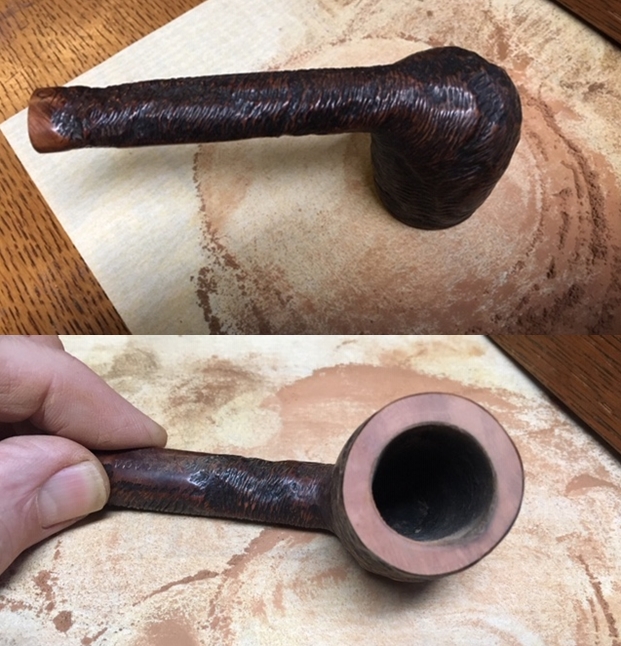
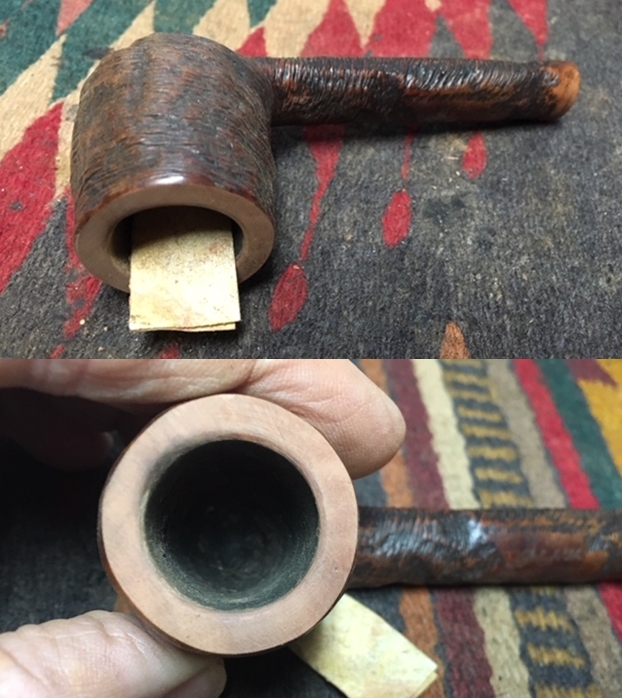
Upper bit, before and after:Lower bit, before and after:The heating process made little progress. I now mix activated charcoal with CA glue to form a patch material and apply it to the tooth compressions and to the button lips – I’ll need to reshape the button. I first clean the stem area with isopropyl 95%. I then gradually mix thick CA glue with activated charcoal on an index card. I aim for a thickness of molasses so it’s thick enough to stay in place not run but will allow some manipulation once applied. On the first mixing, I mixed too much activated charcoal with the CA glue and got one of the chemical reactions where the mixture hardens instantly giving off an acrid smoke!! This has happened before. I need to apply the mixture before it thickens too much. The next mixtures work well. After applying patch material to both upper and lower I set the stem aside to allow the patch to cure. I turn my attention now to the Ben Wade Hand Model stummel. I like the rustic look of this stummel. What I also like about it is that there is a curving or narrowing in the shaping of the bowl about 2/3s up as it moves toward the rim. With the rough finish, rough is good and the surface reminds me of tree bark! With the stummel being dry and with a light blotchy look in the valleys of the blasted areas, I decide to add some paraffin oil to the briar to hydrate it. Doing this also allows me to get a sneak preview of what the briar will look like somewhat finished, I apply paraffin oil to the surface with a cotton pad. This moisturizes the briar and I like what I’m seeing. The only thing I’m not liking is that the scorched place on the back side of the rim is still evident even with the help of a darkened blend. The pictures show what I’m seeing. I decide to go back to an elbow grease methodology and focus cleaning on the rim with a brass wire brush and Murphy’s Oil Soap. This time Murphy’s has its way. I did do a lot of scrubbing and the rim surface shows the skinned lighter area on the rim where the cleaning was, but the scorched area was removed.To darken the rim to blend with the rest of the bowl, I use a cherry dye stick which matches pretty well and I color the rim as well as the edge of the rim – external and internal. This looks good and will blend in more as I polish.Next, to clean up the lower shank panel, I very quickly and lightly, run the area through the full regimen of 9 micromesh pads from 1500 to 12000 – dry sanding with each. I wasn’t worried about the nomenclature because it is deep and solid, and I sanded very lightly with the pads. This gently cleaned the smooth briar of minor nicks and scratches.I like the look of the finish and decide that it looks good just as it is. In order to deepen and enrich the natural grain, I apply Before & After Restoration Balm. I like this product that can be found at http://www.lbepen.com. I apply some of the Balm to my fingers and thoroughly work it into the briar surface – into the nooks and crannies of the richly blasted briar. After applying, I let the stummel sit for a few minutes – 10 or so, and then I wipe the stummel with a microfiber cloth to remove the excess Balm and to buff it up a bit. I take a picture during the ‘absorbing’ period.The patches on bit and button of the stem are now cured after several hours. I begin to remove the excess patch material on the upper bit using a flat needle file. I’m careful to establish the new inner lip of the button. As I filed to shape the new button lip, I discover a crevasse hidden below which is too severe simply to remove. There are other pockets on the button that don’t look too promising. It is normal in my experience, that its necessary to apply additional patch material to fill pockets and gaps that appear during filing and sanding.To address patching the button problems, this time I use a black CA glue to fill the crevasse and pockets and I apply an accelerator to quicken the curing process. Again, filing and shaping the upper button lip and this time better results are realized.I follow filing by sanding with 240 grit paper (which I forgot to add as a prop to this picture!) to erase the marks left by filing. As with the filing of the button, the finer 240 paper reveal a cluster of pockets in the center bit area in the patch. Again, I spot drop black CA glue to fill the pockets, apply an accelerator and file the excess then sand the bit area with 240 grit paper. The upper bit and button area look good. The same process is repeated on the lower bit and button. It too, looks good. With the bit repairs completed and with the repaired button shaped, I continue by wet sanding the entire stem with 600 grade paper. I’m careful to work around the BEN WADE stem stamp on the saddle. After wet sanding with 600 grit, I apply 0000 steel wool to stem. Finally, I wet scrub the stem with Magic Eraser. I’m satisfied with the progress. I move forward with the micromesh pad regimen wet sanding using pads 1500 to 2400 followed by dry sanding with pads 3200 to 4000 and 6000 to 12000. I follow each set of 3 pads with an application of Obsidian Oil which further rejuvenates the vulcanite. I like that vulcanite pop! The stem looks great. I try to reunite the stem and the stummel and as is the case sometimes, after cleaning the mortise, the briar inside can expand causing the fit with the tenon to become too tight. I do not want to force the stem and risk a cracked shank, so I gently ream the mortise with a half-rounded needle file. Then I gently sand the tenon by wrapping 600 grit paper around the tenon.This works and I am able then to reunite the stem with the stummel and mount a cotton cloth buffing wheel to the Dremel and set the speed at about 40% full power.  I apply Blue Diamond compound to the entire pipe.  I run the wheel along the grain of the blasting to bring out the contrasts of rough briar as well as to buff it up into a shine.  After completing the Blue Diamond, before applying wax, I freshen the Ben Wade white stem stamp.  I clean the area with alcohol and then I dab a bit of white acrylic paint over the stamping.  I then use a cotton pad to tamp the wet paint which draws off the excess paint and helps the paint to dry sooner. Then using a toothpick, I gently scrape off the excess paint leaving a refreshed BEN WADE stamp.  It looks nice and crisp.I then mount another cotton cloth buffing wheel onto the Dremel and apply carnauba wax to the stummel.  I increase the speed of the Dremel from my usual 40% up to about 50 to 60% full power.  I do this to create more heat with the friction of the wheel to encourage the wax to dissolve in the craggy blasted briar surface.  Waxing a rough surface can cause the wax to collect and not to absorb into the surface.  The added heat encourages this and as I look at the waxing action, it looks like it’s having the desired effect.  Nice!  After finishing the waxing process, I then give the stem and stummel a rigorous and substantial hand buffing to remove any excess wax and to raise the shine.

The blasted grain on this Ben Wade Hand Model is distinctive.  It looked so good I thought that it might be the blastification process, but it is the real deal.  The shaping of the bowl also adds to the rustic effect with it tightening near the top and then flaring out.  The blasted briar displays many hues of grain – very eye pleasing.  This is the third of three pipes that Todd commissioned, and he will have the first opportunity to acquire this Ben Wade Hand Model from The Pipe Steward Store.  These pipes benefit the work we do here in Bulgaria with the Daughters of Bulgaria working among women and girls who have been trafficked and sexually exploited.  Thank you for joining me!

Life for an interesting Triangle Shank Enrico Bocci Belgium 612


Blog by Steve Laug

The next pipe in the queue is an interesting triangular shaped billiard – I think that is what I would call it. It came to us in the lot that included the pipe cabinet and 21 pipes. There is a decided slope from the button to the junction of the bowl and shank. The bottom of the bowl and shank is flattened and broad so that it is a very stable sitter. It is a unique piece and like many of those in this lot it is a brand that I have not seen before. It is on the second shelf, the third pipe from the right in the photo below. I have circled it in red to make it easier to identify.The finish on the pipe is very dirty with an interesting orange and black contrasting stain. I look forward to seeing it cleaned. There is a thick cake in the bowl and a lava overflow on the rim top. I can see some damage to the outer edge of the rim but because of the cake and tars it is hard to know what the inner edge looks like. Jeff took photos of the pipe before cleaning it. The photos give a pretty clear picture of the shape of the pipe and its general condition when we received it. Jeff took some photos of the bowl/rim top and the sides and bottom of the bowl to give and idea of the condition and the shape. You can see the nicks on the back and front side of the outer edge of the rim. He also took photos of the stamping on the left and underside of the shank. The left side was clear and readable. It read Enrico Bocci in script over Marrone. On the underside it said Belgium followed by the shape number 612. The left side of the stem also had a stamped EB logo. The stem had some deep scratching in the surface ahead of the button and some small tooth marks next to the button. There was also wear on the sharp edge of the button.Enrico Bocci was a brand that I was unfamiliar with so I did some research on the web to see what I could learn about the brand and the maker. I turned first to Pipephil and found the first lead. As usual the site gives a great summary. It identified the maker as Enrico Bocci and the brand as Italian (http://www.pipephil.eu/logos/en/logo-e3.html). This did not match the Belgium stamping on the underside of the shank so more searching would be necessary. I have included a screen capture from Pipephil that gave the initial information on the brand. It seems that Bocci retired from pipe making in the 1980s so that helped to date the pipe that I am working on.I turned then to Pipedia to see what I could find out there (https://pipedia.org/wiki/Bocci). The brand was listed under the country of Belgium. Sadly there was not a lot of information. I have copied the information and included it below.

Enrico Bocci, presumed to be of Italian origin, primarily turned out machine made pipes. The better ones were pre-turned and finally shaped and finished by hand.

From that at least I found that the maker was of Italian origin (not hard with a name like that). I knew that the pipe I had in hand was Belgian made and made prior to 1980. I also could deduce from the listing being in the Belgian list of pipemakers that Bocci lived there. Armed with that information I turned to deal with the pipe on the table.

As usual Jeff does a lot of the clean up on the pipes that we buy. He does a great job. When I pick them up here or do repairs here in Canada I am reminded just how much work he does to get the pipes to the point they are when I open his box to work on them.

Jeff reamed the bowl with a PipNet pipe reamer and followed up with a Savinelli Fitsall pipe knife to remove the cake. He scrubbed out the mortise and the airway in the shank and the stem with alcohol, cotton swabs and pipe cleaners. He scrubbed the exterior of the bowl, rim, shank and stem with a tooth brush and Murphy’s Oil Soap to remove the oils and tars on the rim and the grime on the finish of the bowl of the pipe. He rinsed it off under running water. He dried it off with a soft cloth. He was able to remove most of the lava build up on the rim top of the pipe leaving behind some darkening and a clear view of the damage to the outer edge. I took photos of the pipe to show its condition before I started my work. I took a close up photo of the rim top to show the darkening on the top and the damage to the outer edge at both the back and the front. You can also see some nicks and marks on the surface of the rim top. The stem photos show the scratching I noted above that extends from the button forward about an inch. They also show the tooth marks and the wear on the button surface on both sides.I took photos of the stamping to document what it looked like at this point in our cleanup process. You can also see some of the fills in the bowl and shank.I decided to address the damage to the rim top and edges of the bowl first. I used a folded piece of 220 grit sandpaper to clean up the inner edge of the bowl first. Once that was complete, I topped the bowl on a topping board using 220 grit sandpaper to remove the damage along the top surface and minimize the damage to the outer edge of the bowl. It looks like I forgot to take a photo of the rim top at this point. I removed the damaged surface (a minimal topping). I worked over the outer edge with a 1500 grit micromesh sanding pad to smooth out the damage on the edges (the condition of the rim top can be seen in the third photo below). Once I finished that I polished the entire bowl and shank with micromesh sanding pads. I wet sanded it with 1500-2400 grit pads to clean up the rim and smooth out the bowl. There were shiny spots on the finish from what looked like a light varnish coat that needed to be removed as well. I decided to stain the rim top and touch up the spots on the bowl and shank that needed it with a Maple stain pen before proceeding with the rest of the polishing. This might seem odd but I have found that it can work to blend the colours better. I let the stain coat dry for about 30 minutes and worked on the stem. Once the stain had cured for that time I continued polishing the bowl.I continued to polish the bowl with 3200-12000 grit micromesh sanding pads. Each successive grit of micromesh made the grain stand out more and hid the fills better. The overall look of the bowl improved. With the rim top and bowl polished, I worked some Before & After Restoration Balm into the surface of the briar with my fingertips to clean, enliven and protect it. I let the balm sit for a little while and then buffed with a cotton cloth to raise the shine. The following photos show the bowl at this point in the restoration process. The bowl and the rim top look really good and the darkening and lava are gone. The finish looks good and though the fills are visible they are not as obnoxious looking as before. I am very happy with the results. With the bowl finished I set it aside and turned my attention to the stem. I sanded the scratches and the tooth marks on the stem and then filled it in with clear super glue. I set it aside to cure for about a half hour then smoothed out the fills with a needle file to dress up the sharp edge of the button. I sanded the repairs with 220 grit and 400 grit sandpaper to blend them into the surface. I polished the stem with micromesh sanding pads – wetsanding it with 1500-2400 grit pads and dry sanding it with 3200-12000 grit pads. I wiped the stem down with Obsidian Oil after each pad. I used some liquid paper or correction white out to touch up the stamping on the stem. I applied it with a tooth pick and when it had dried I buffed the excess off with a cotton pad.I further polished it with Before & After Pipe Polish – both Fine and Extra Fine. I gave it a final coat of Obsidian Oil and set it aside to dry.This interestingly shaped Enrico Bocci surprised me. When I first saw it I thought it was a Lorenzo pipe and expected a real mess under the stain and lacquer coat. It turned out I was wrong. I polished stem and the bowl with Blue Diamond polish on the buffing wheel. I gave the bowl and the stem multiple coats of carnauba wax. I buffed the pipe with a clean buffing pad to raise the shine. I hand buffed it with a microfiber cloth to deepen the shine. The pipe polished up pretty nicely. The contrasting grain came alive with the buffing. The rich contrasting orange/brown and black colour works well with the polished black vulcanite stem. The finished pipe is a beauty and feels great in the hand. Have a look at it with the photos below. The dimensions are Length: 5 ½ inches, Height: 1 ¾ inches, Outside diameter of the bowl: 1 1/2 inches, Chamber diameter: ¾ of an inch. I will be putting this triangular shanked billiard on the rebornpipes online store soon. It may well the kind of unique pipe you have been looking for so have a look. Thanks for walking through the restoration with me on this interestingly shaped Enrico Bocci.