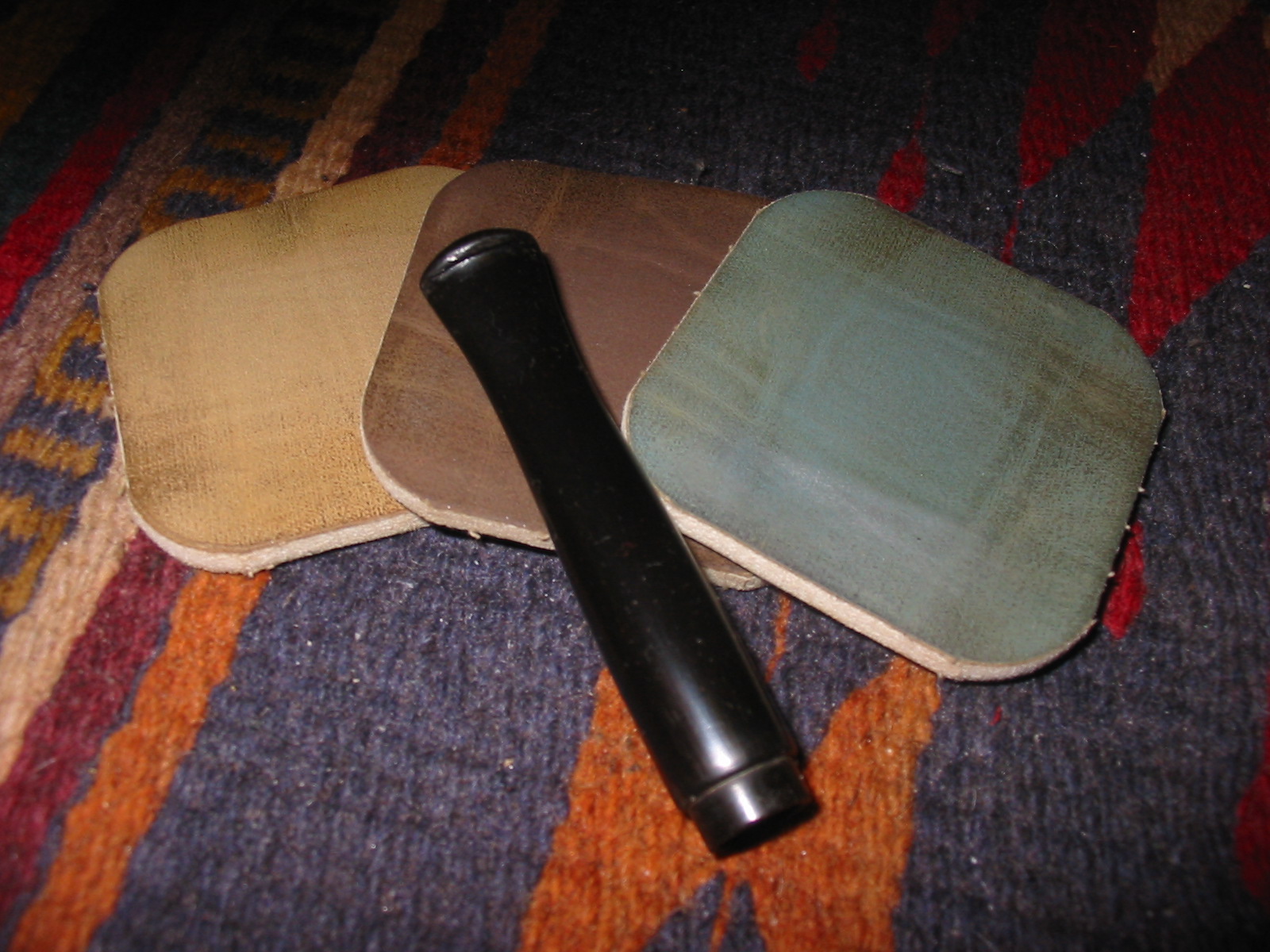
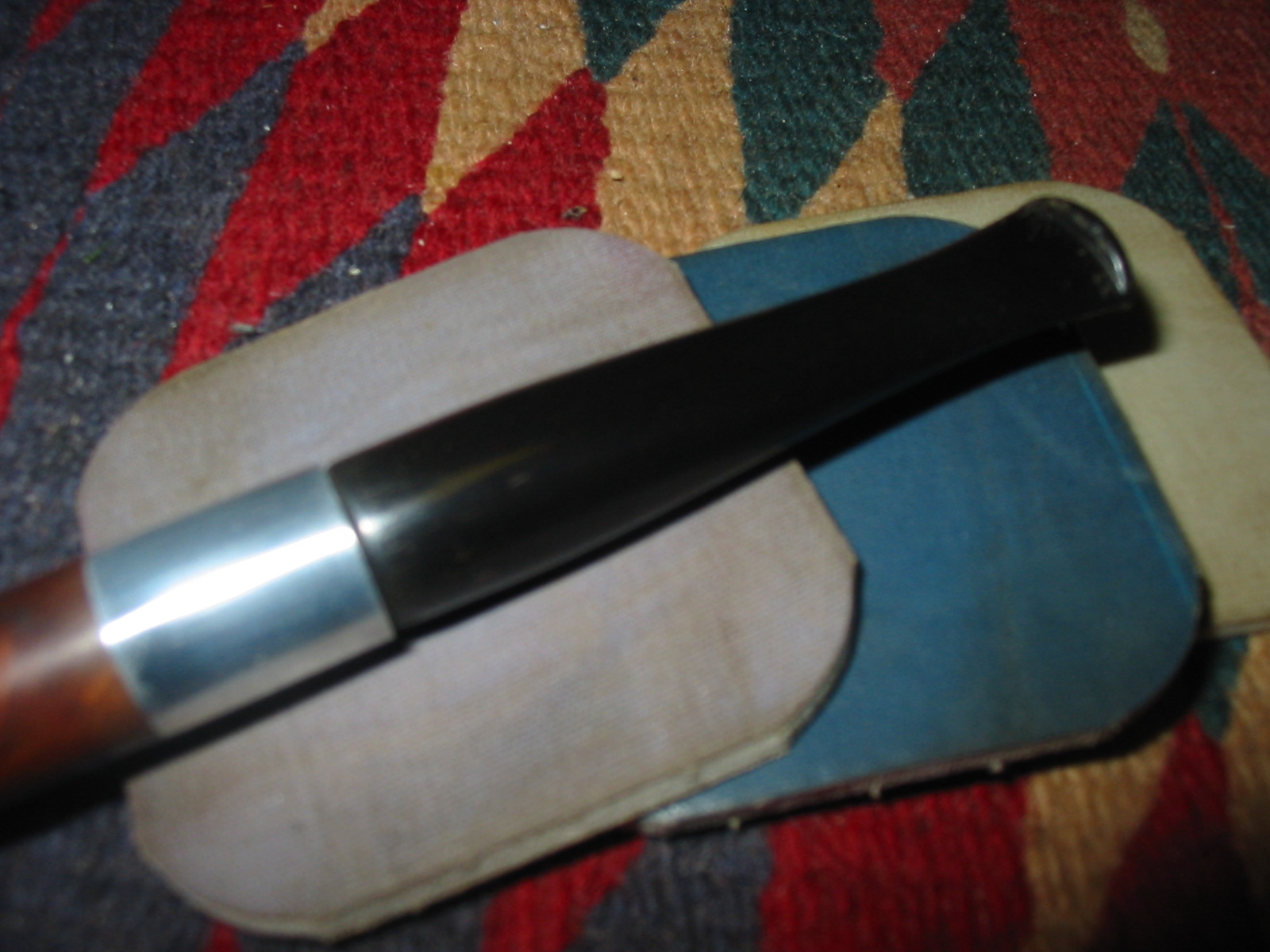
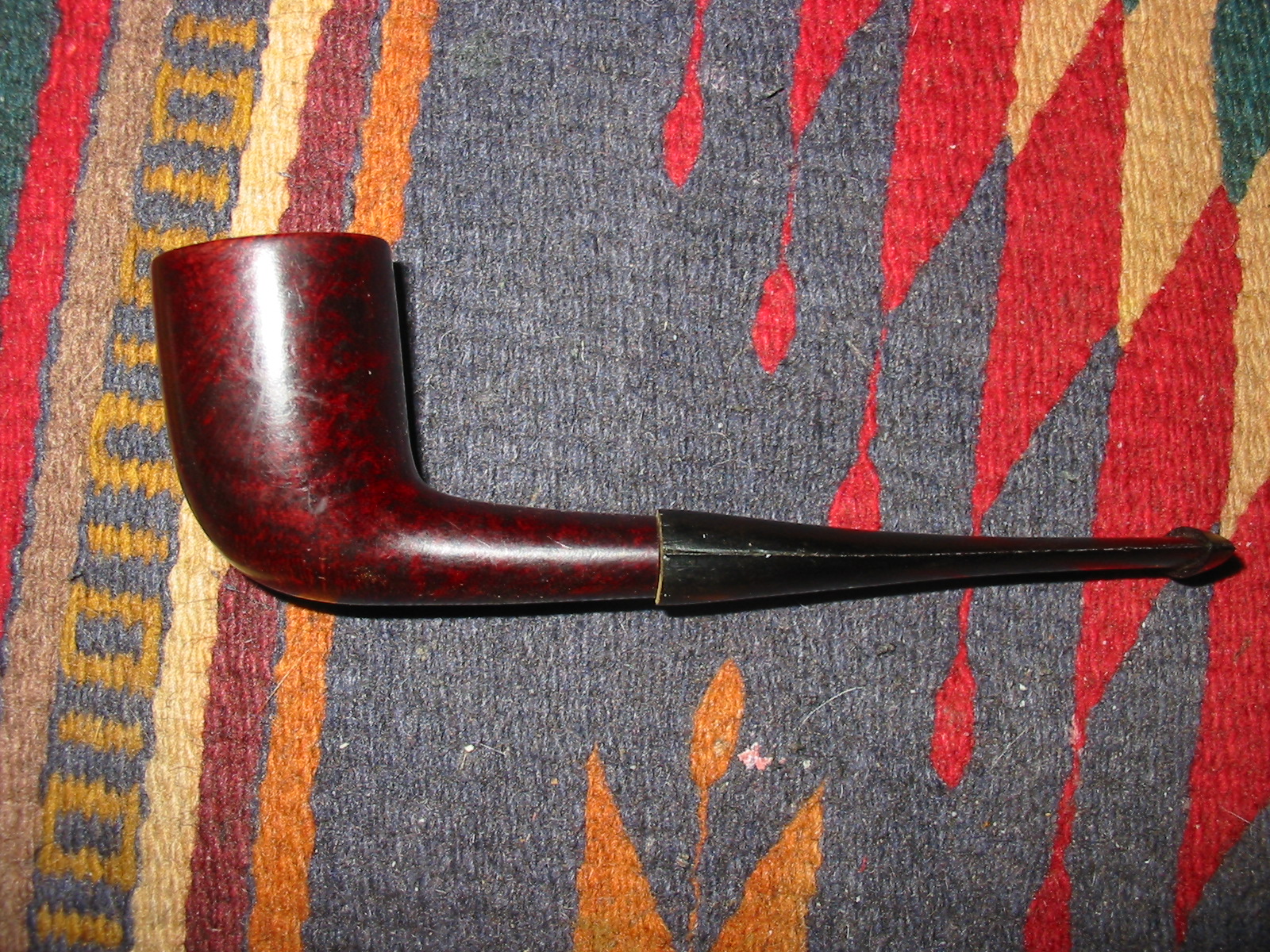
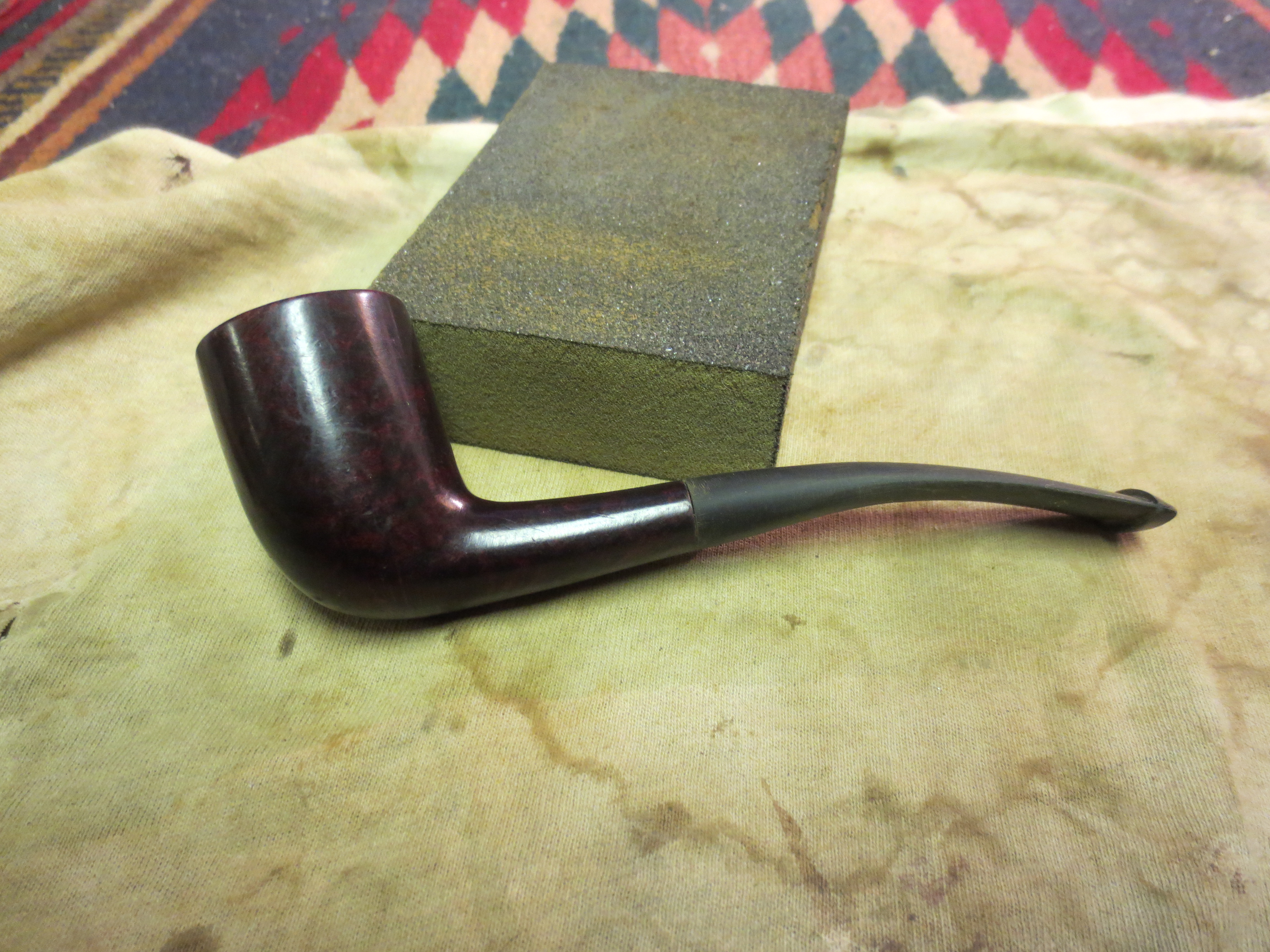
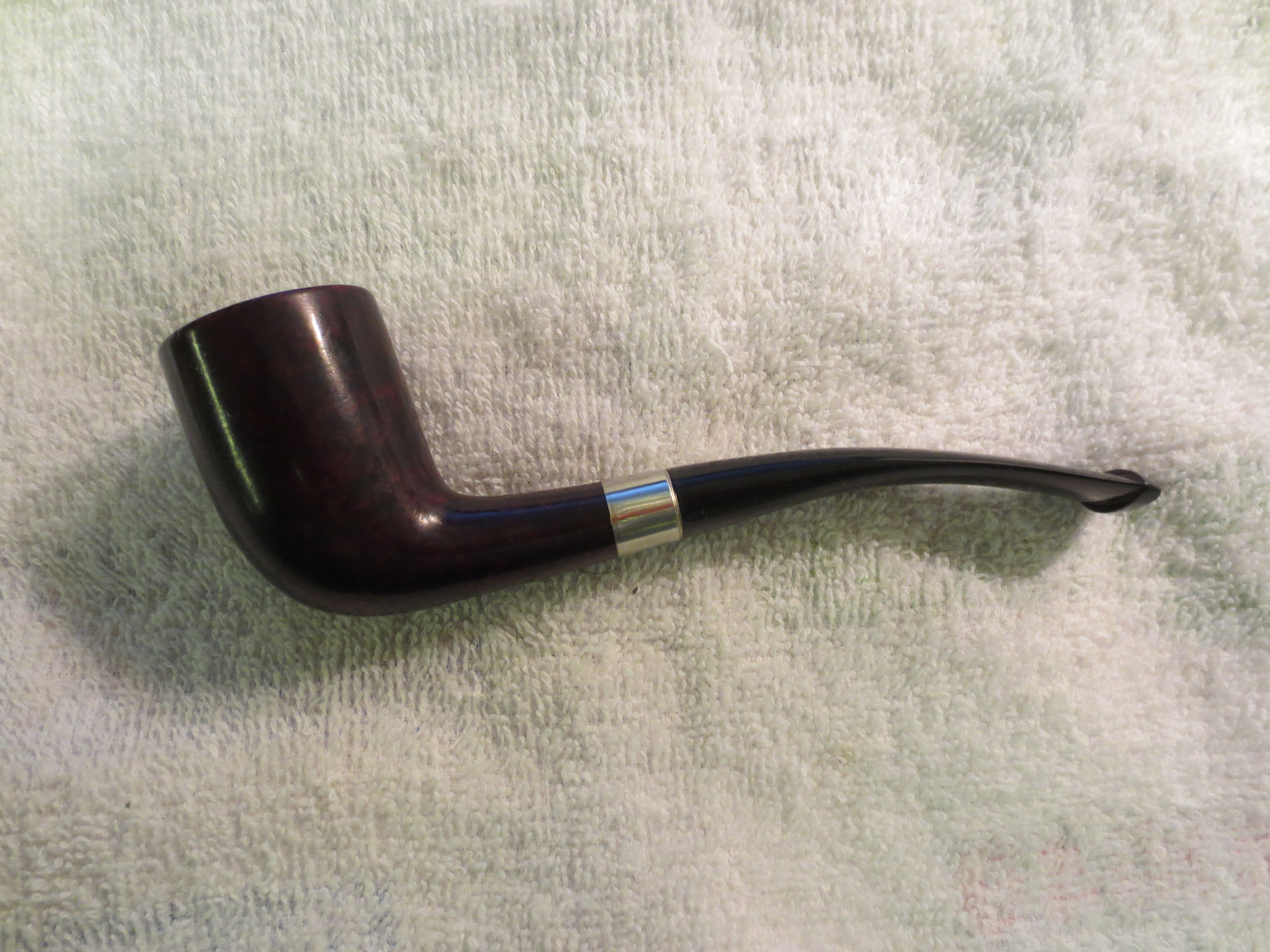
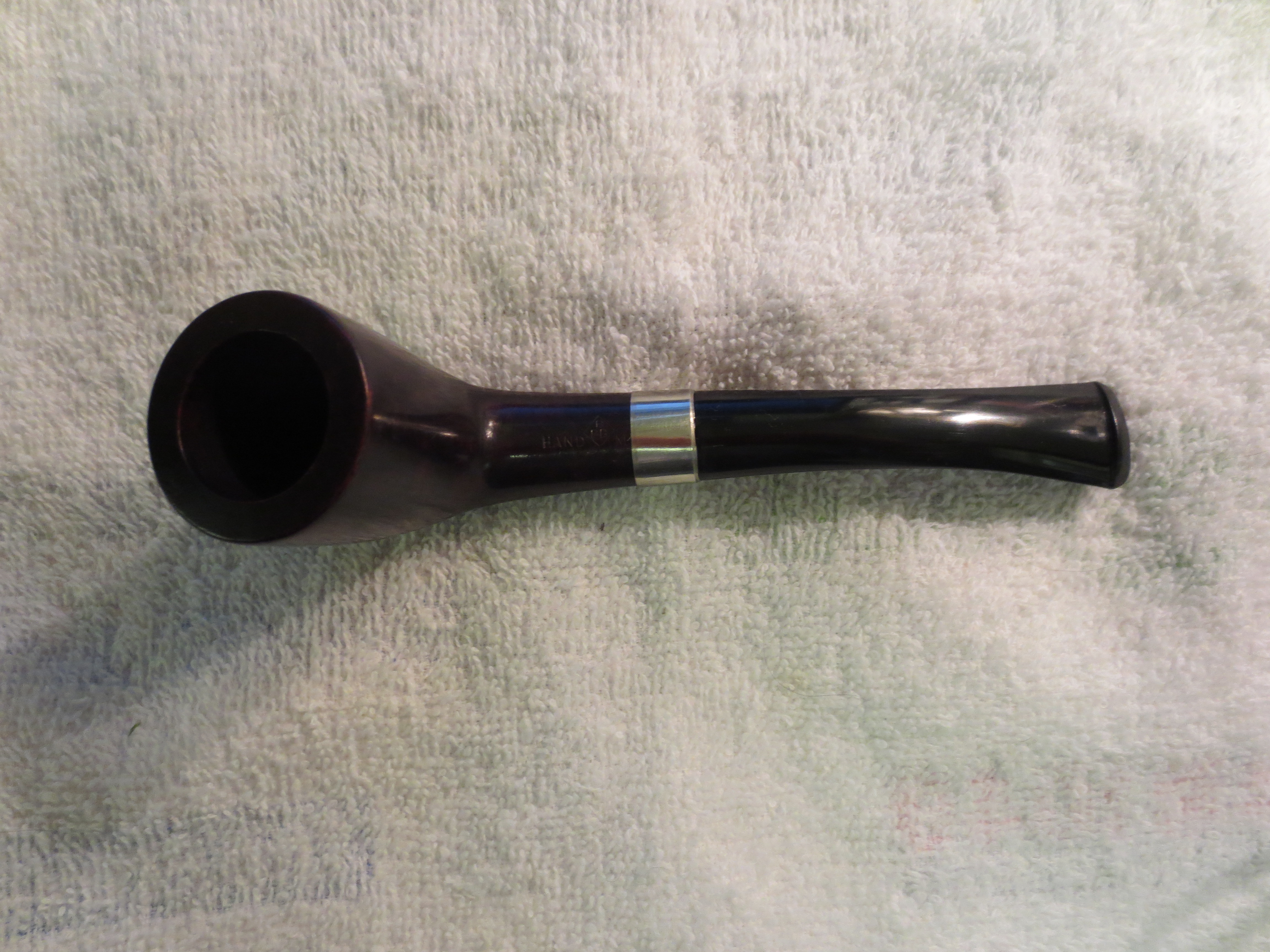
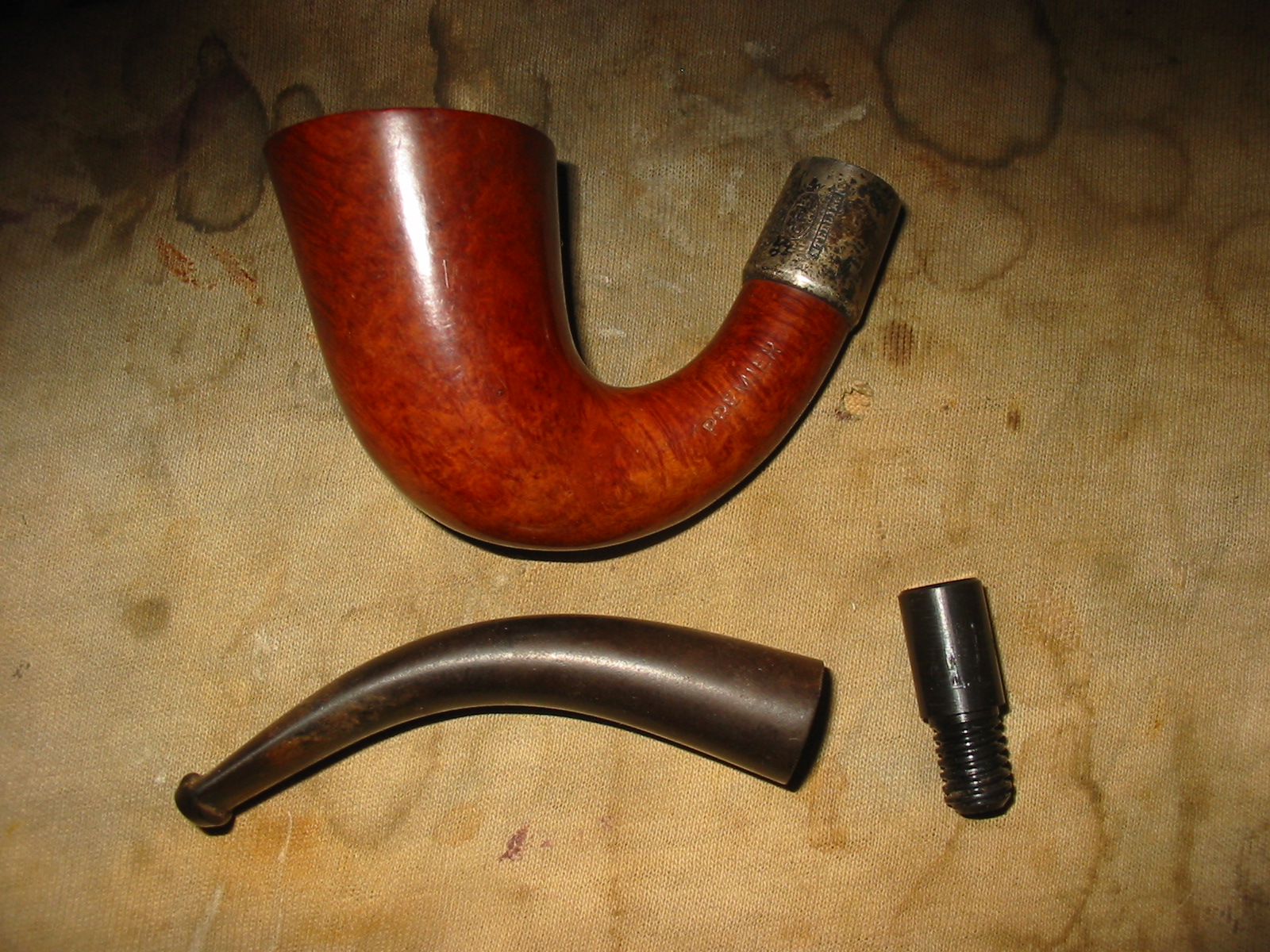
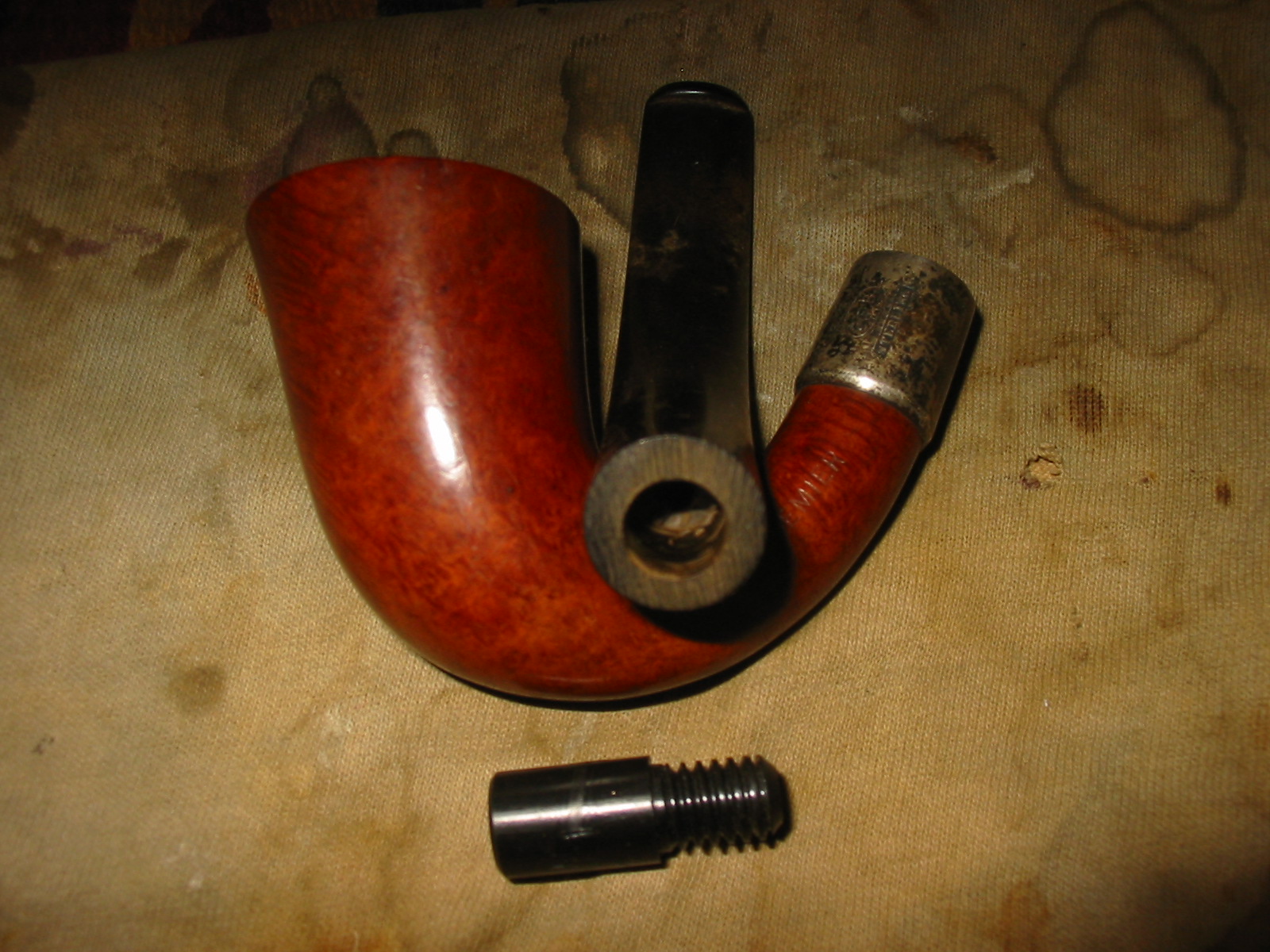
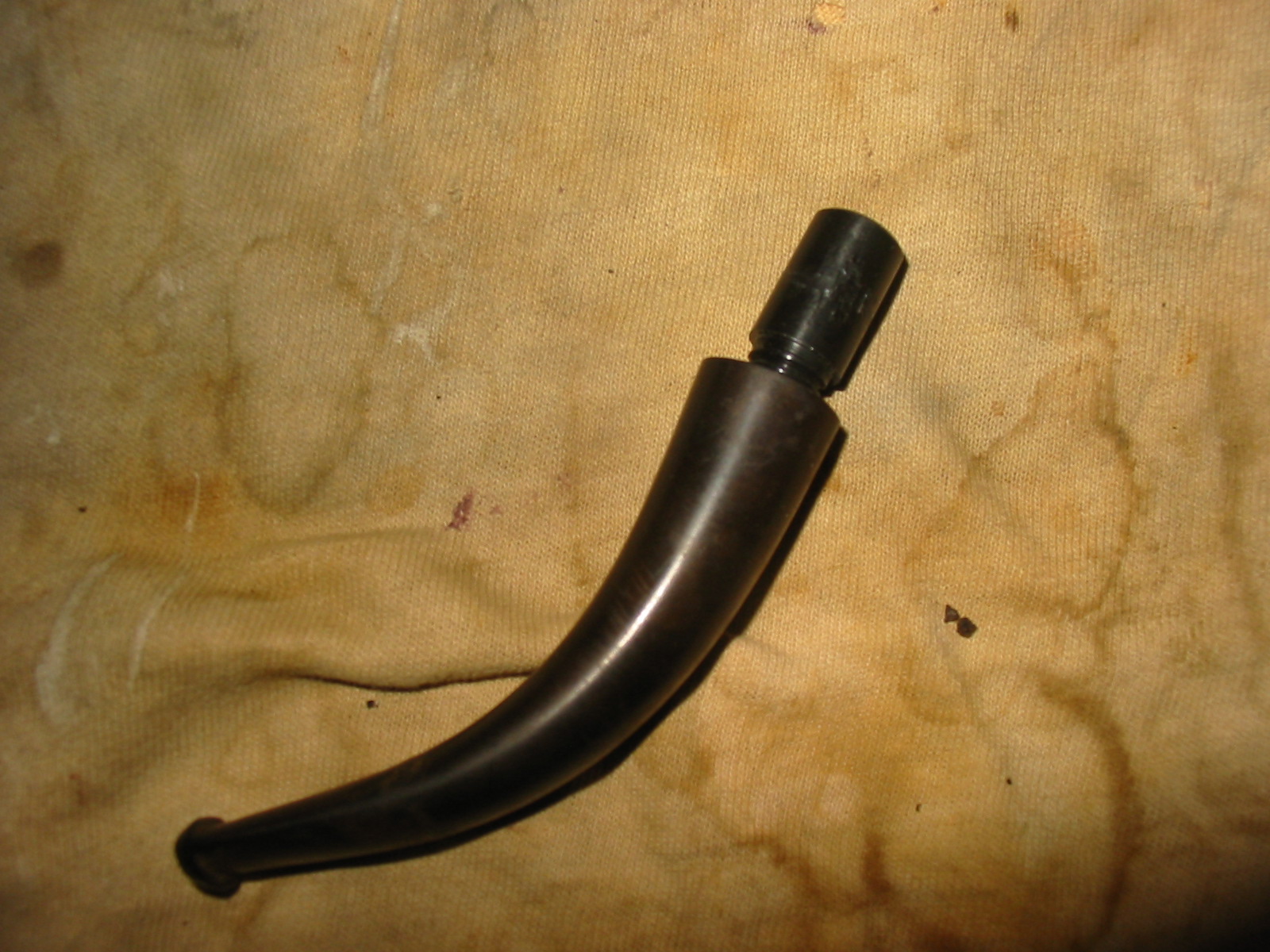
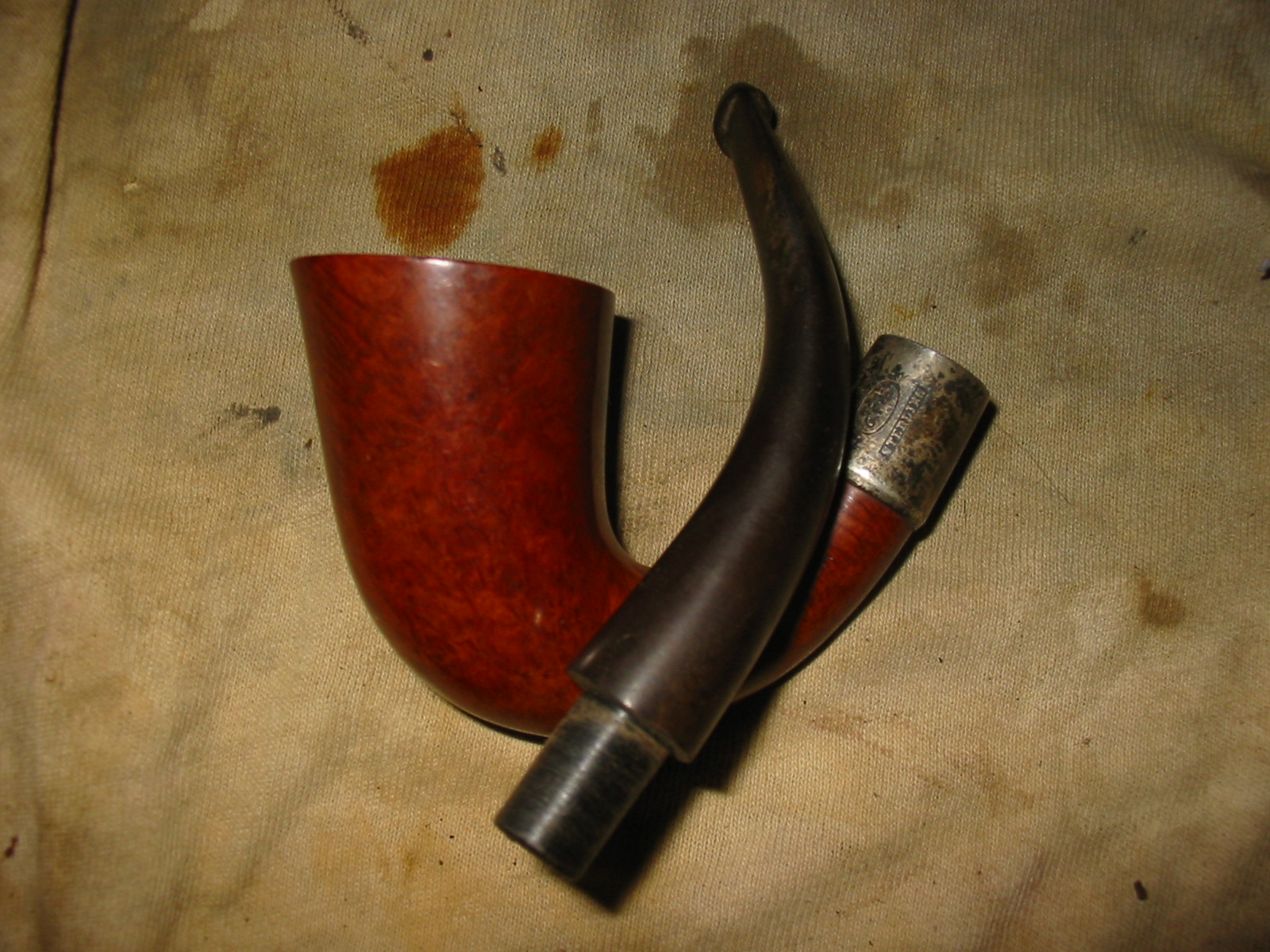
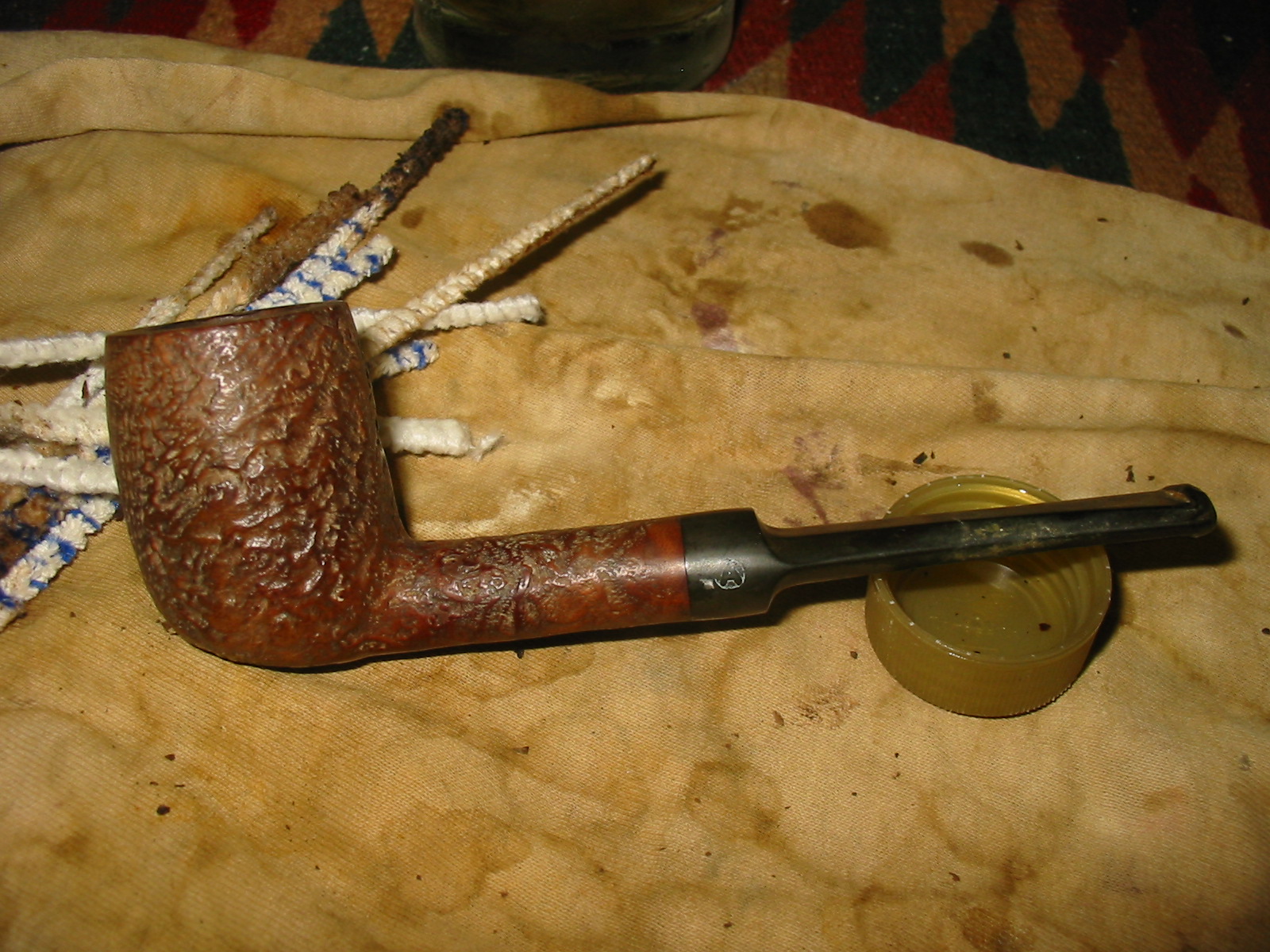
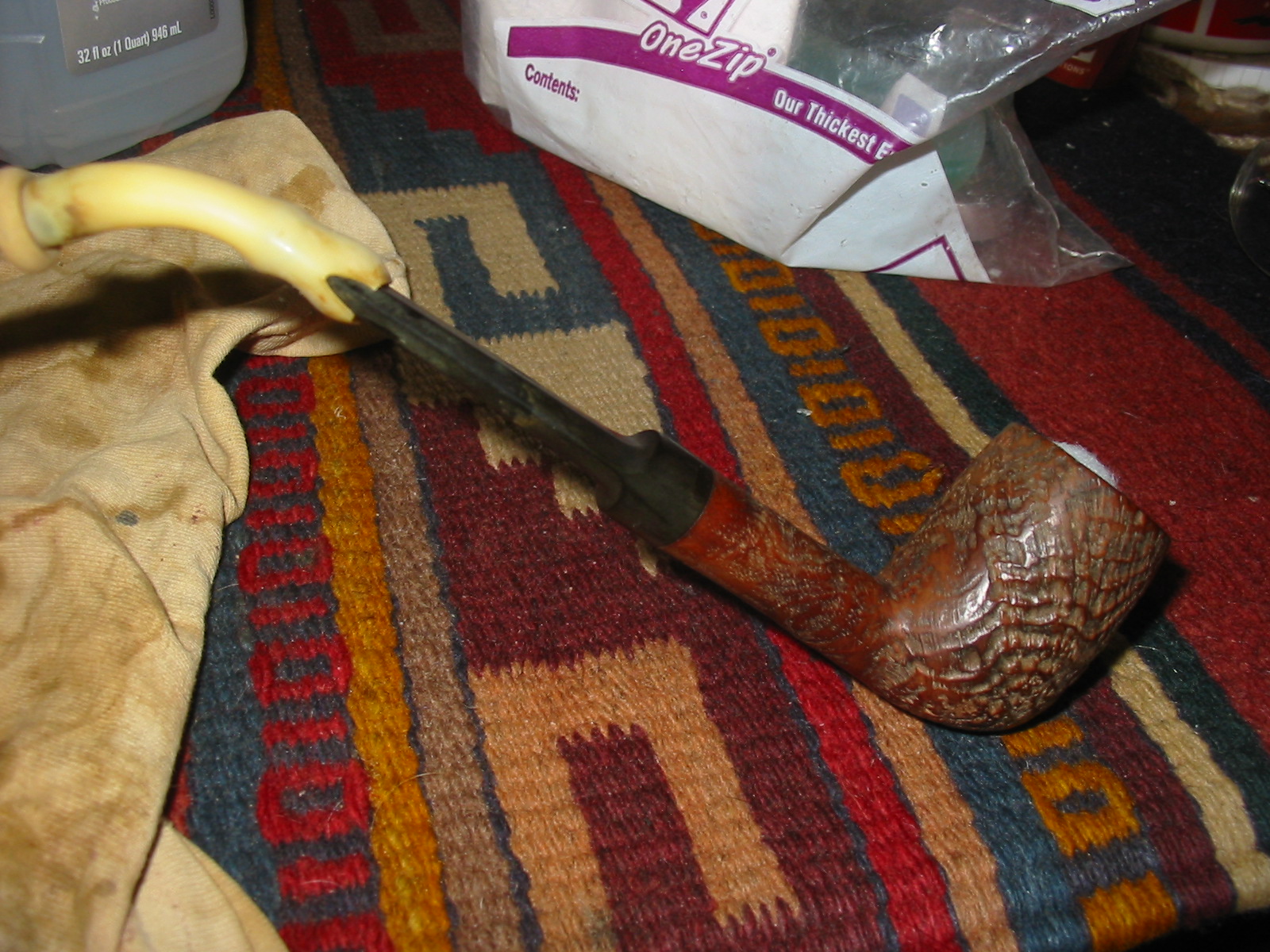
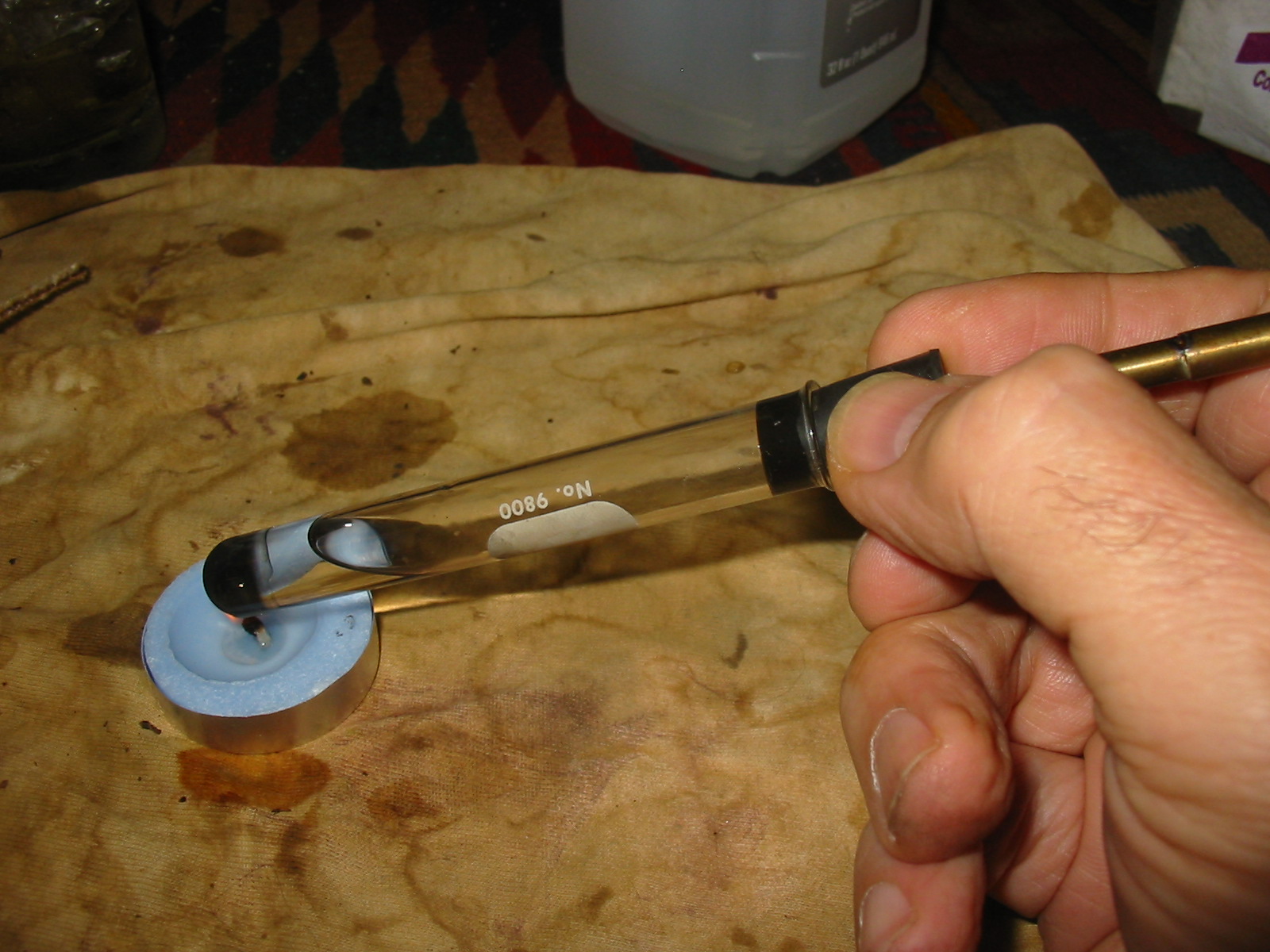
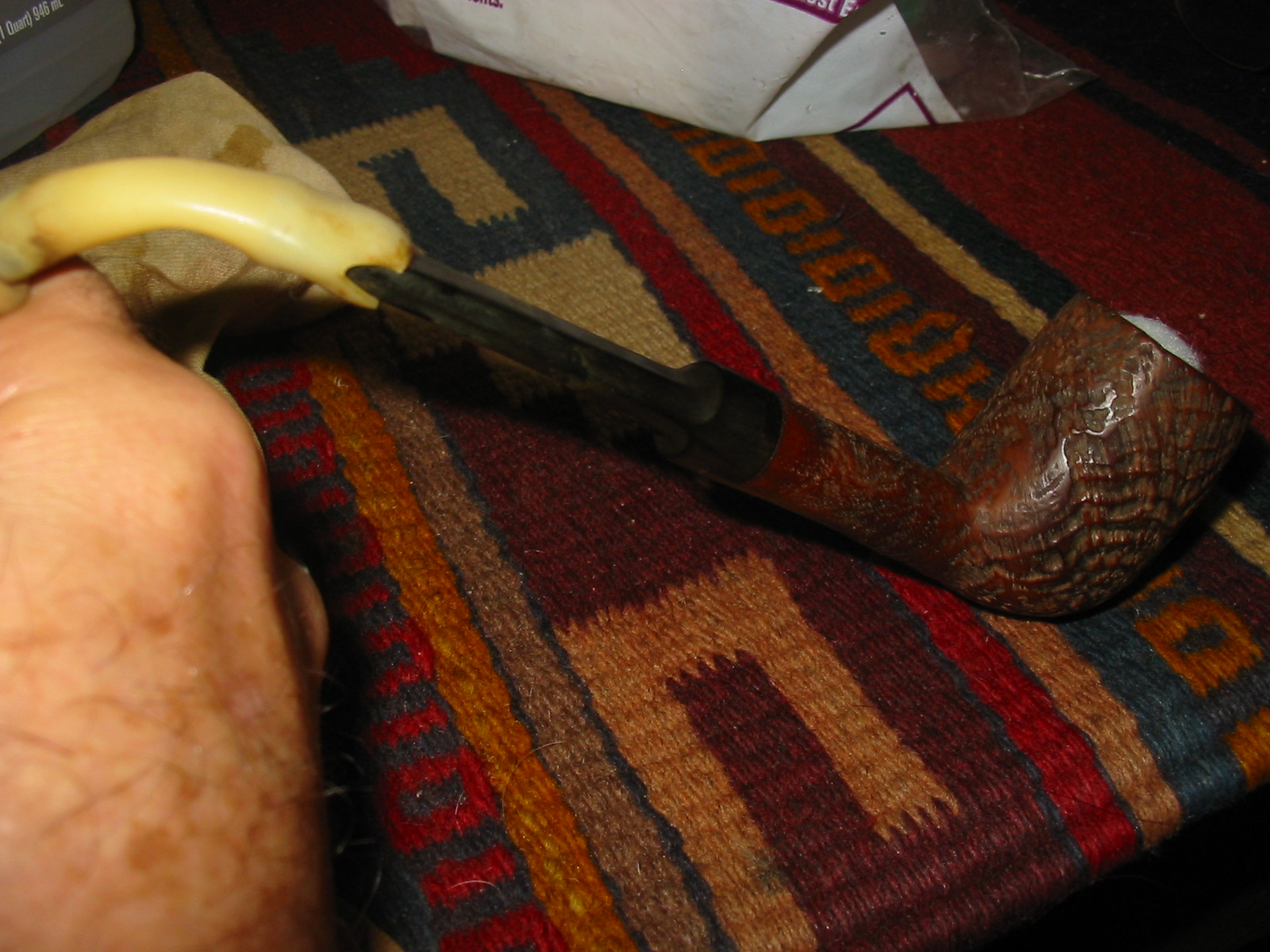
Tag Archives: stem work

Restoring and Reclaiming a Byford Prince


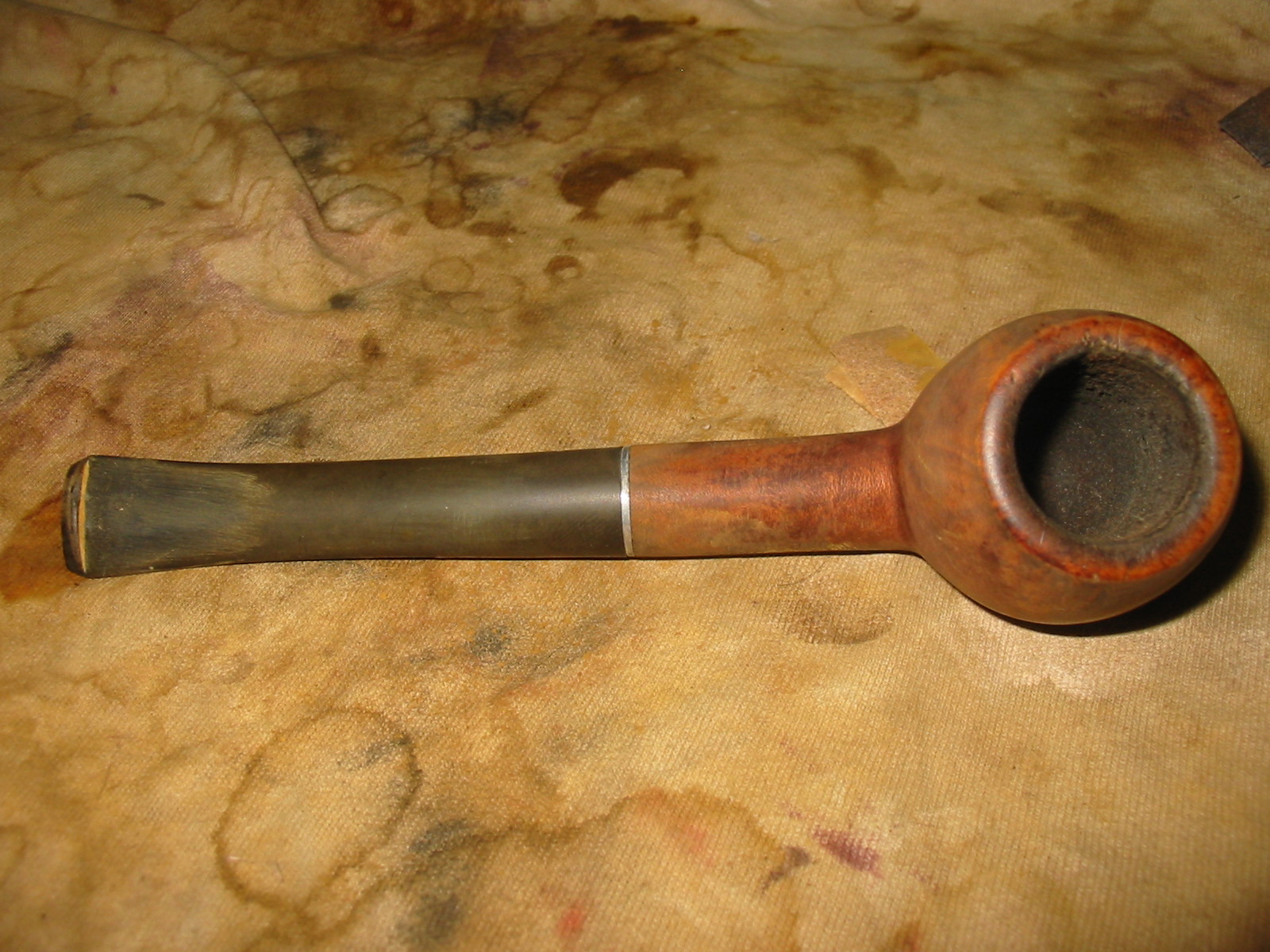
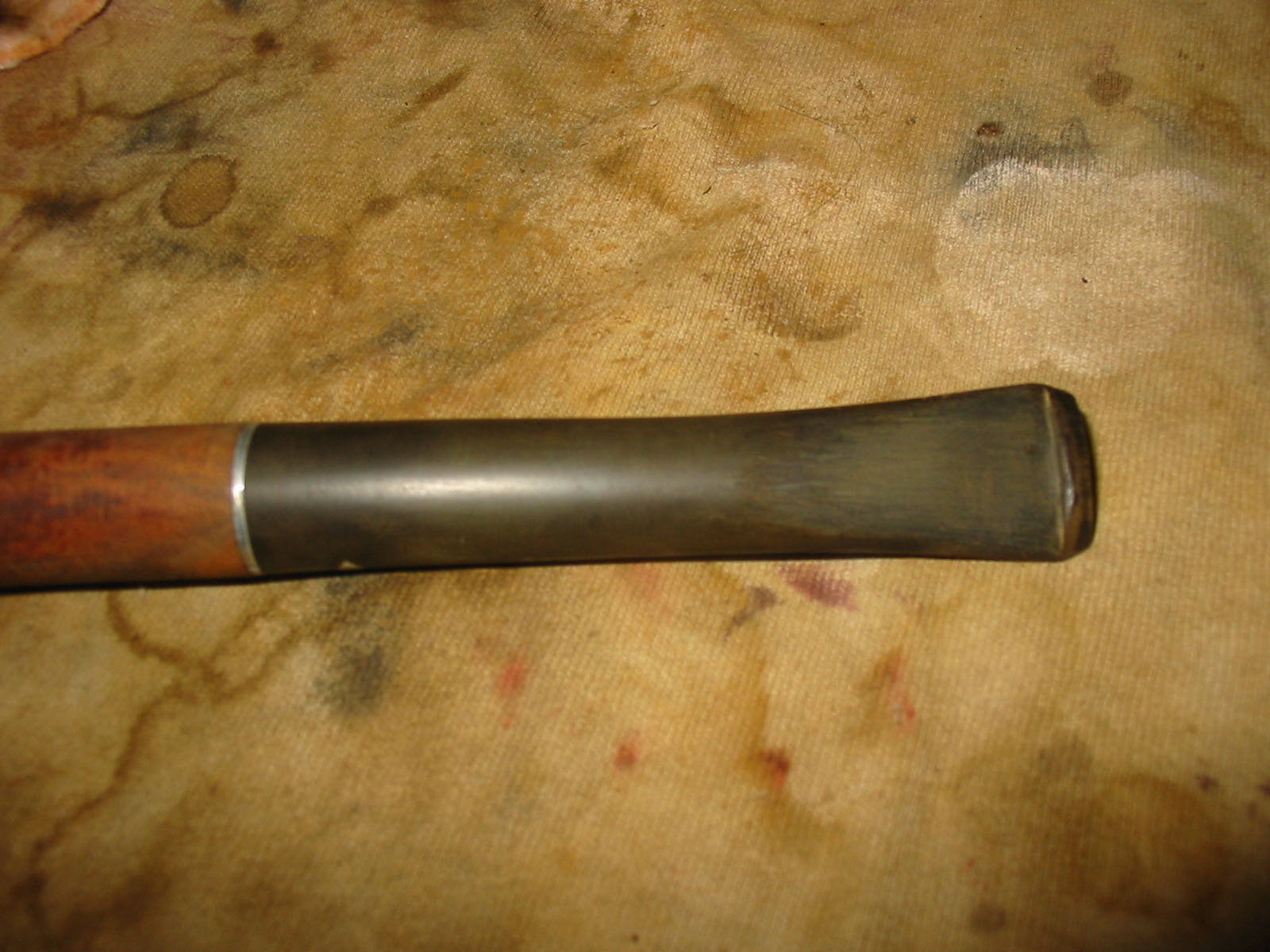
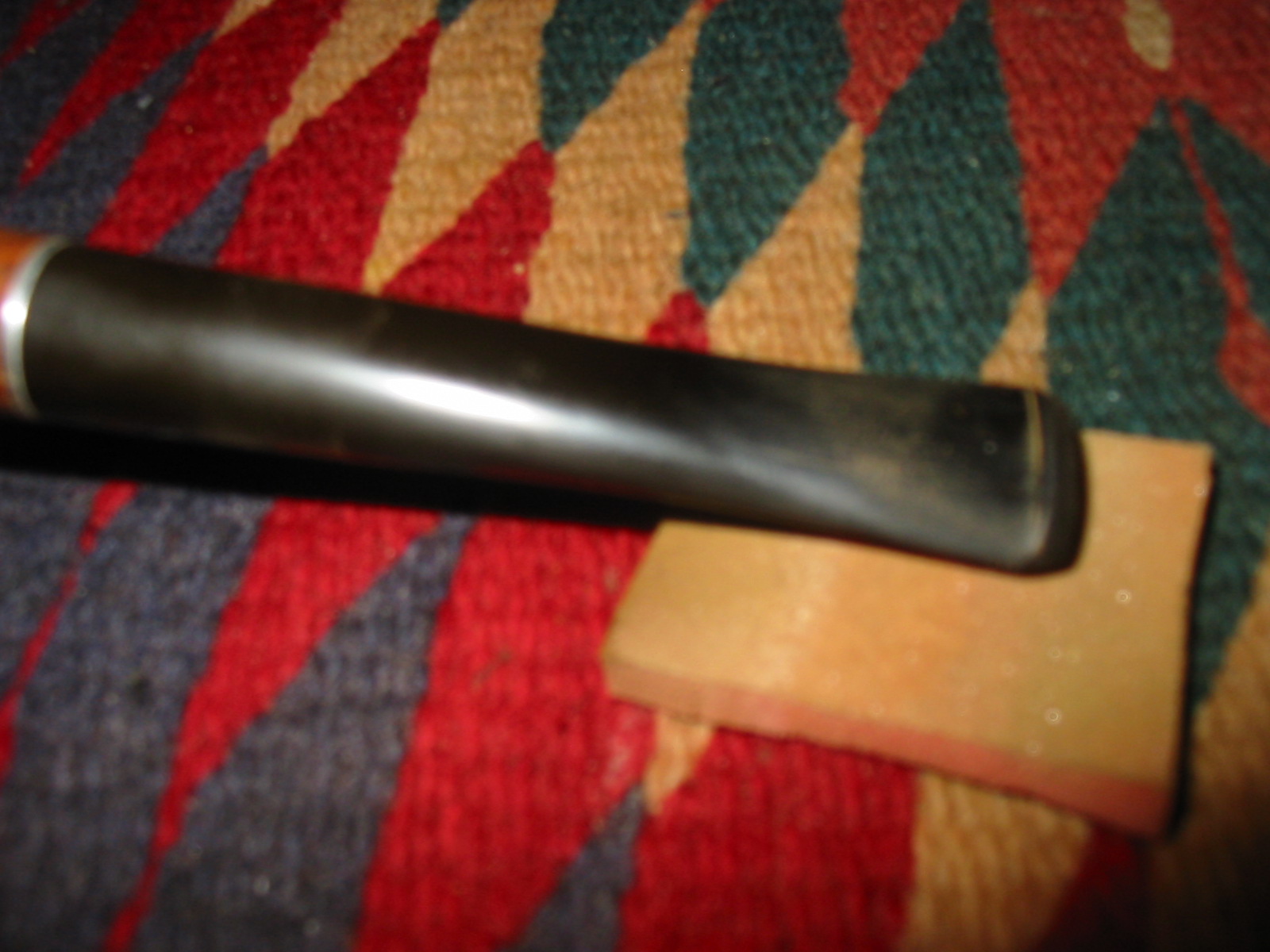
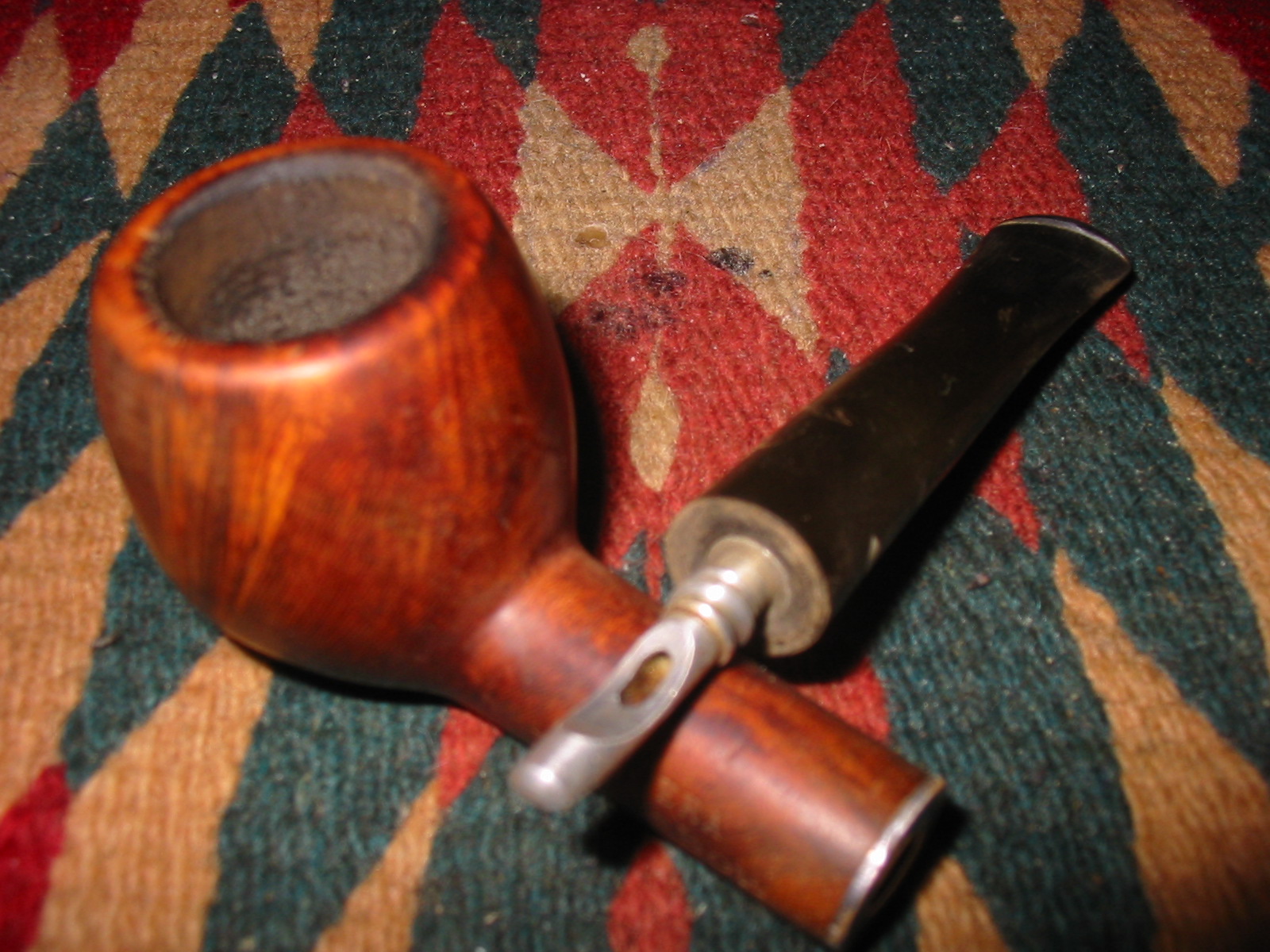
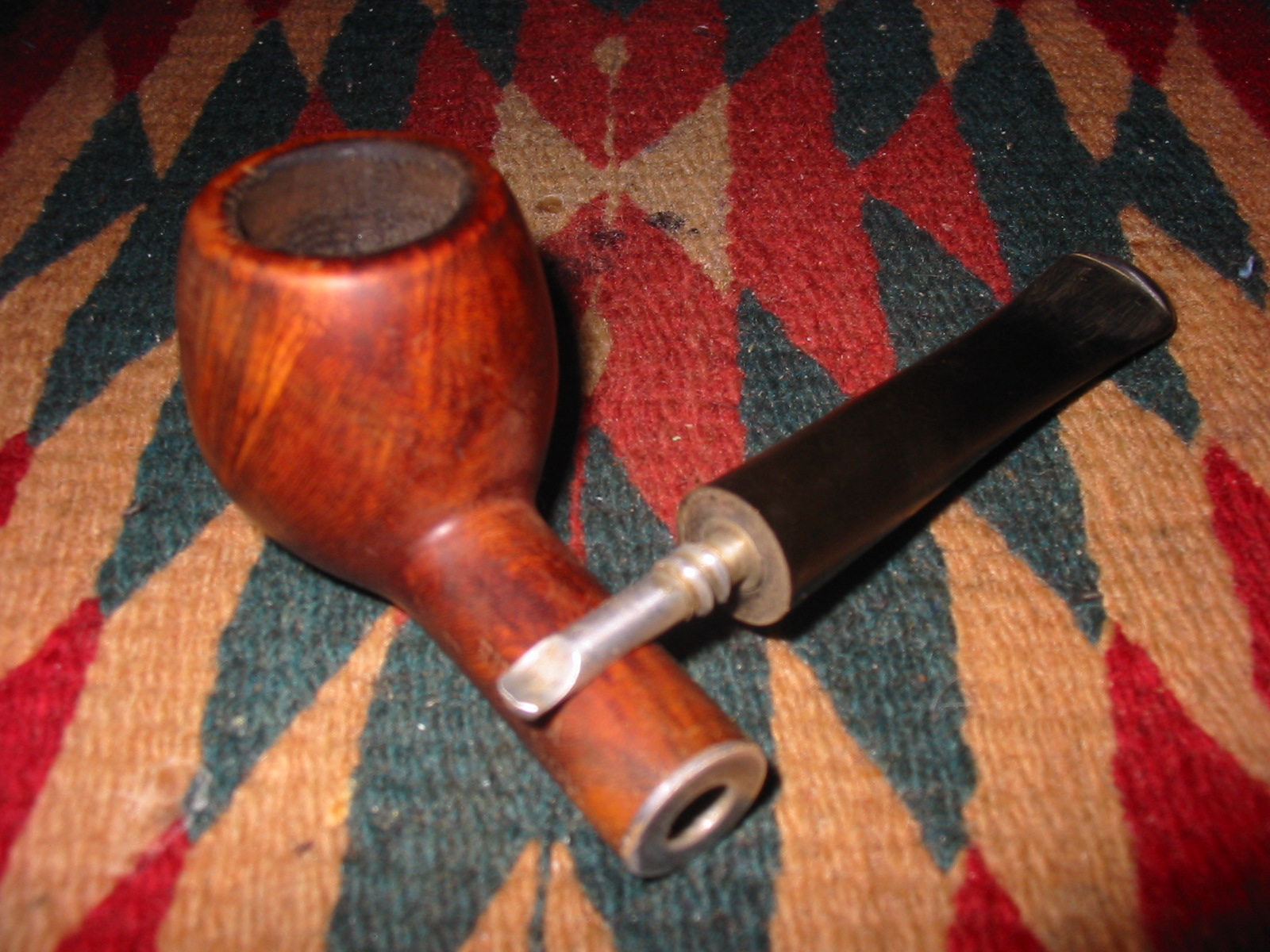
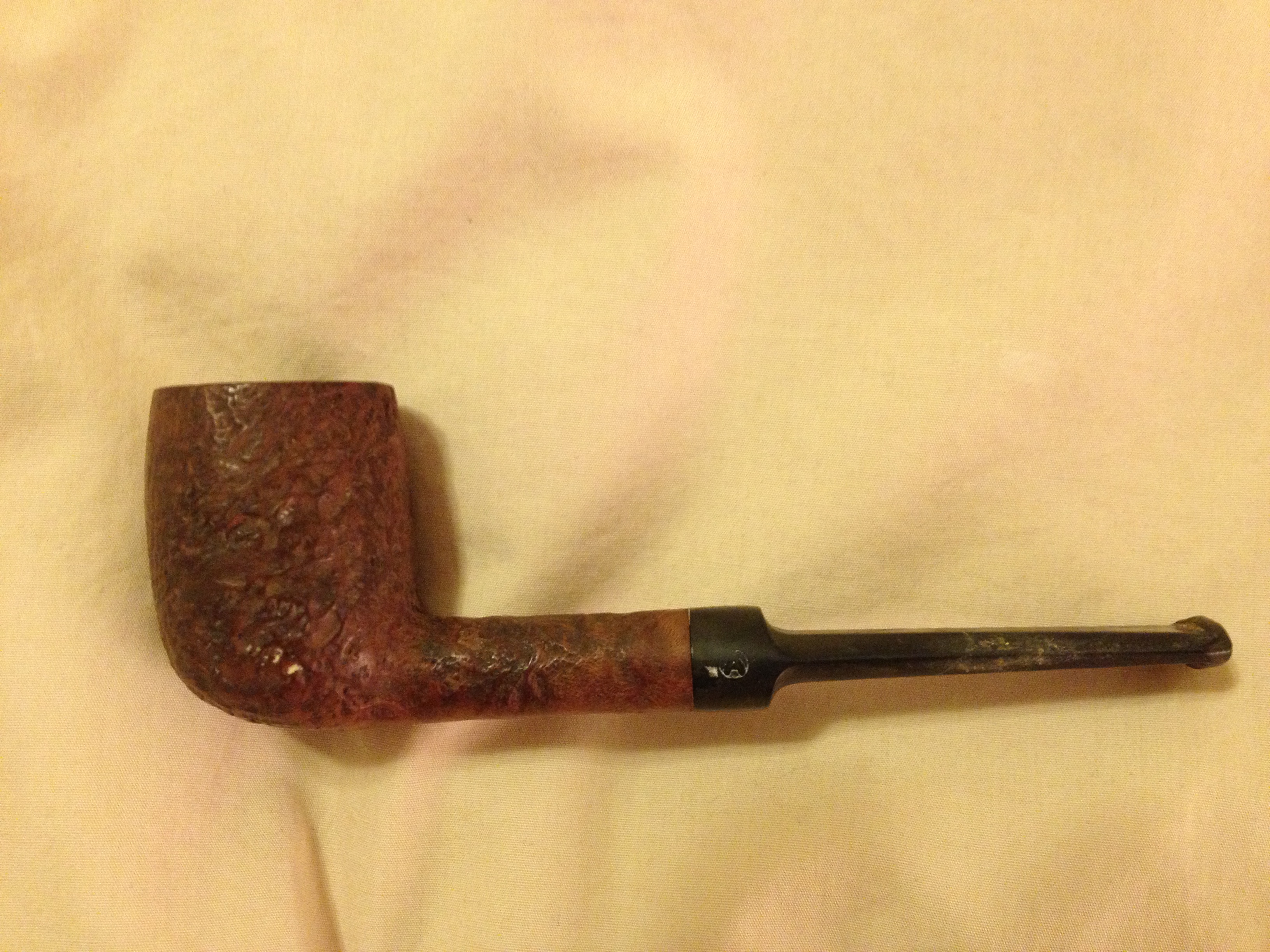
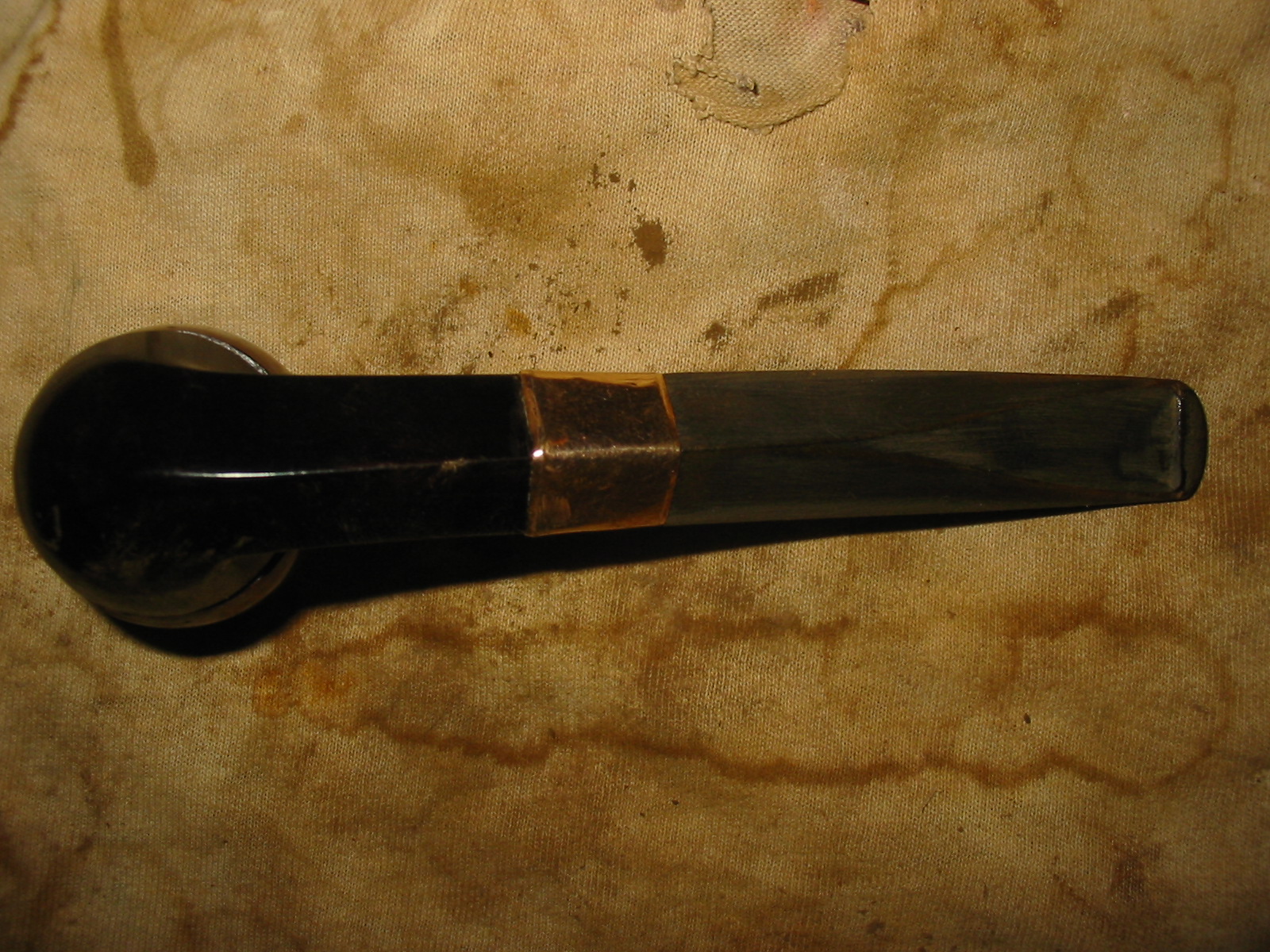
I was gifted three old pipes by a friend on Smokers Forums. The first that caught my attention was an older Byford Prince. It was pretty worn but the wood was in good shape under the wear and tear. The stem was shot. It had a split along the stop side and was missing a few pieces. When I removed it I found that it was quite brittle. Once I took the stem off I found the most interesting system inside. The shank had an aluminum attachment which held two metal tubes inside of it. On the inside of the broken stem was a third metal tube. These formed three concentric, nested circles which wicked out the moisture of the smoke while not hampering the flow of air in the pipe from bowl to button. The photo below shows magnified picture of the interior of the stem and shank.
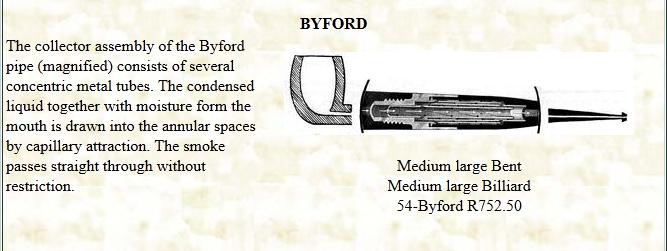
Byford Pipes

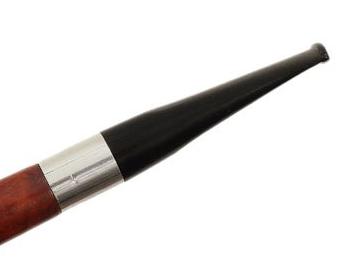
The stem was so broken and damaged that I was not sure how the flow of the angles on the taper was supposed to look. I did not know what the button and the stem were supposed to be like. I did a search on the internet and found this photo of a Byford stem that showed the proper angles on the stem. I used the stem in the photo as a template for my replacement stem. I made one modification which I will speak about in the explanation of the restemming below.
Byford stem

The next photo shows the interior of the stem and shank – the system part of the pipe. The tube in the stem sits between the other two tubes in the shank creating three rings on the inside of the shank and stem. It looked like this stem apparatus would be a bear to clean up. I would have to used cotton swabs, folded pipe cleaners and whatever I could to get in between the layers.

Byford2

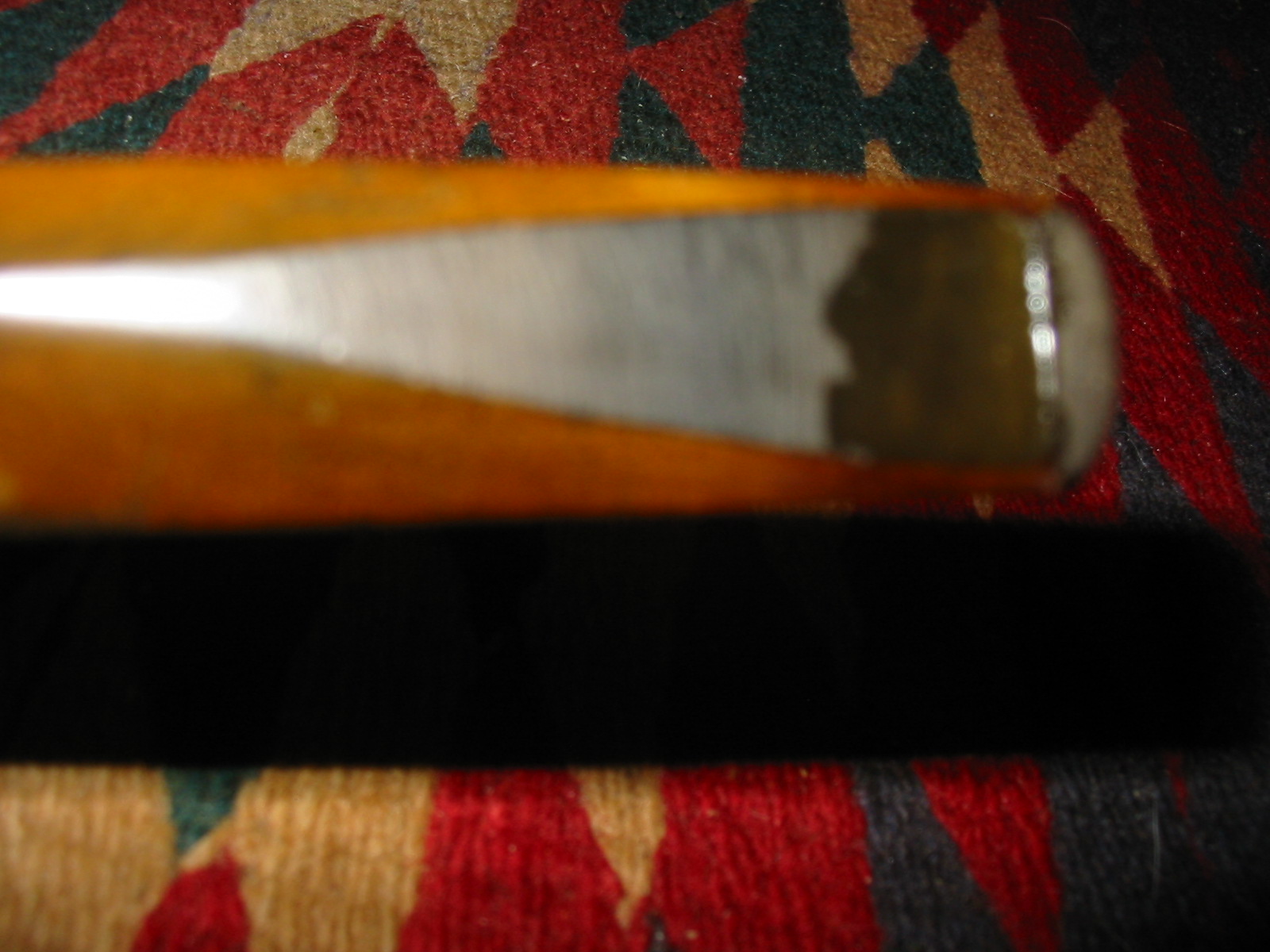
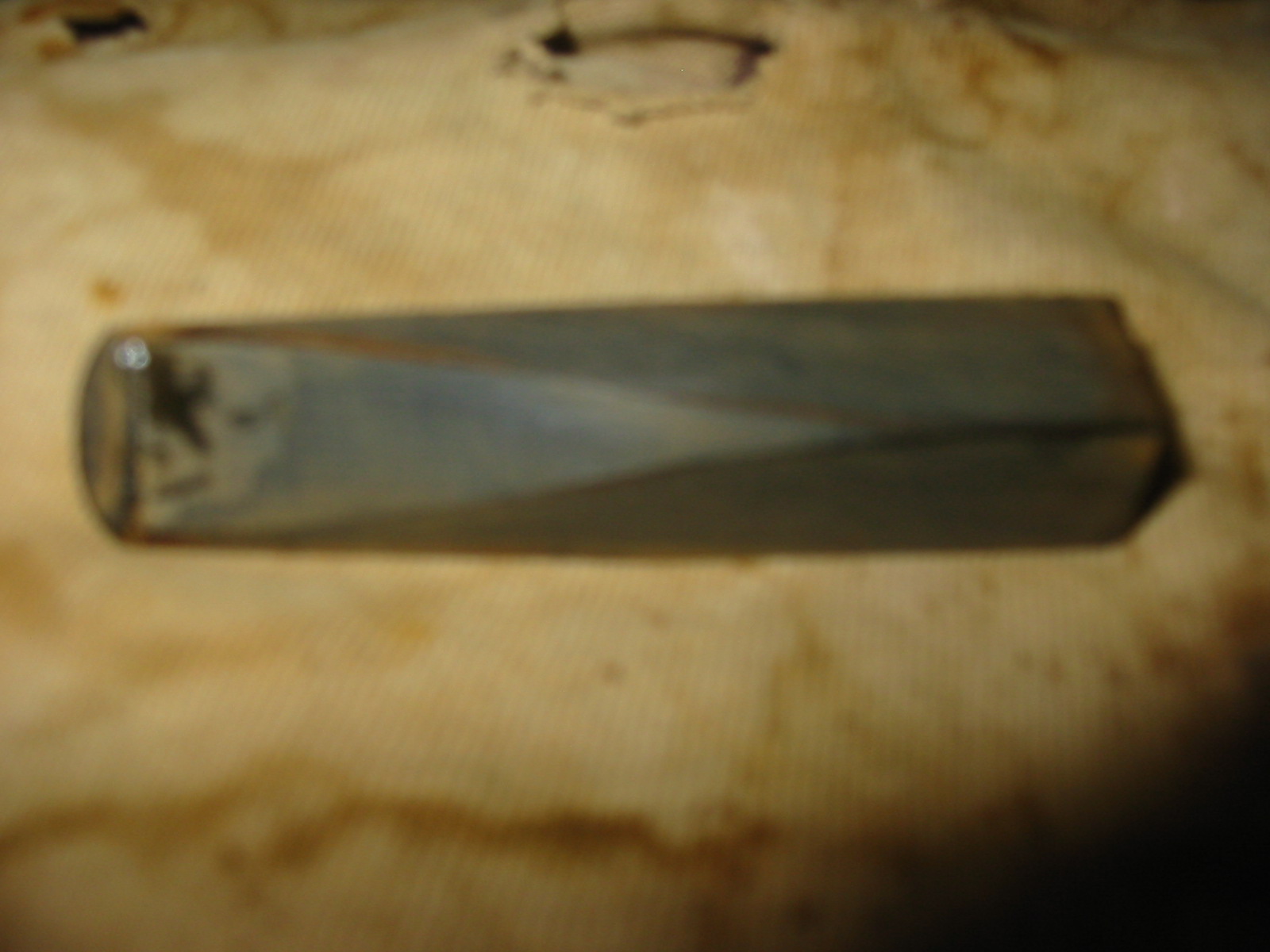
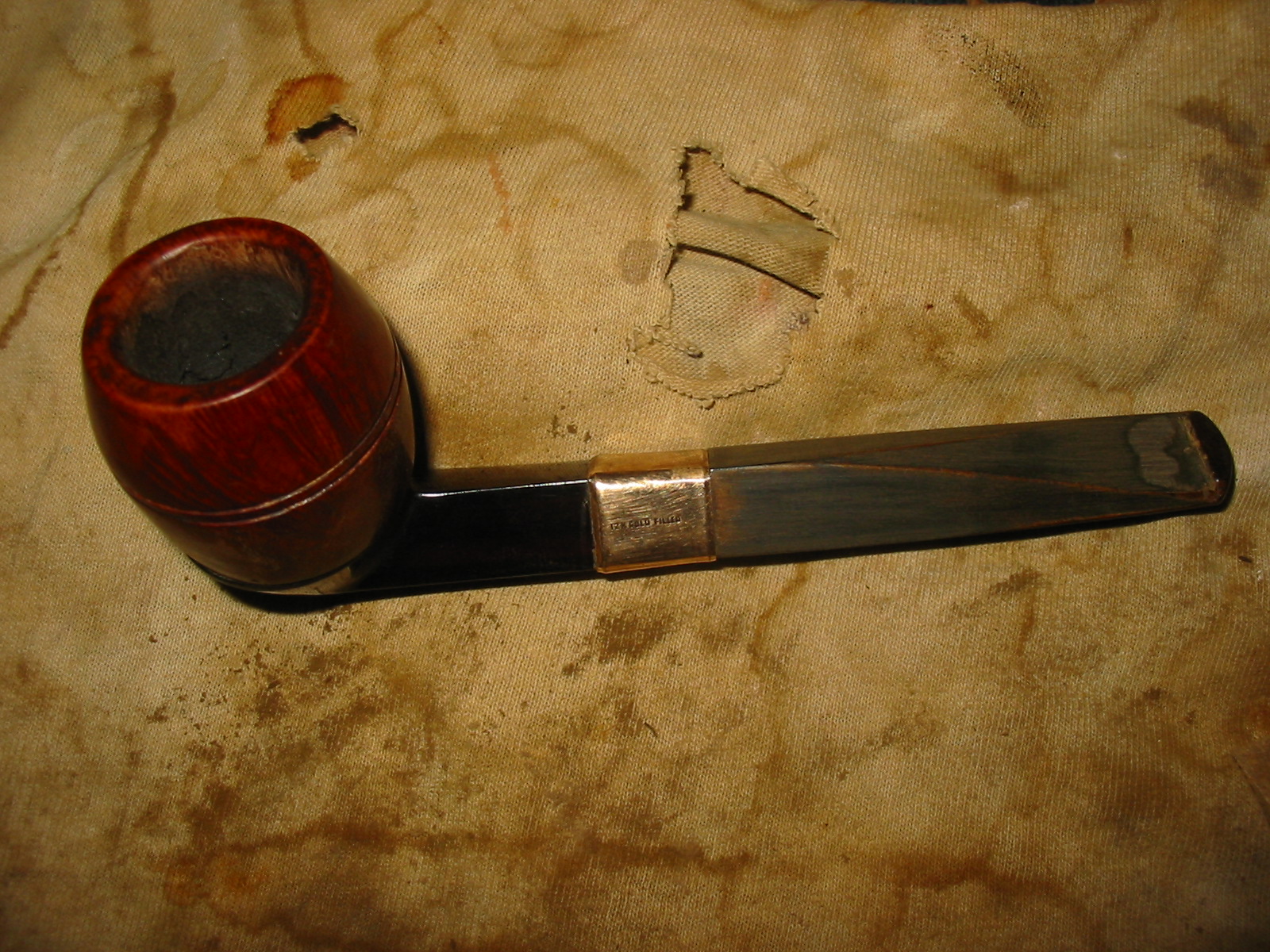
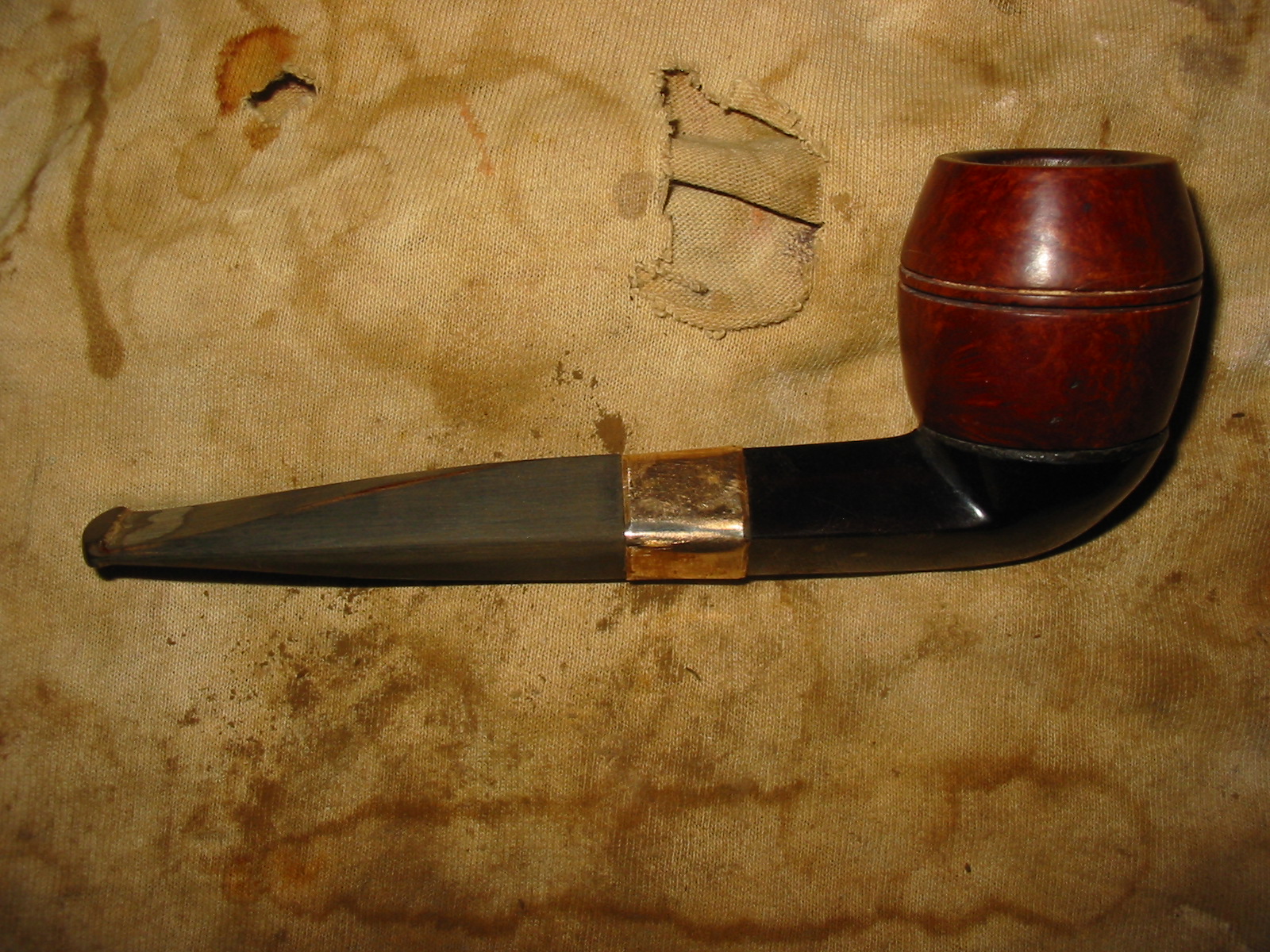
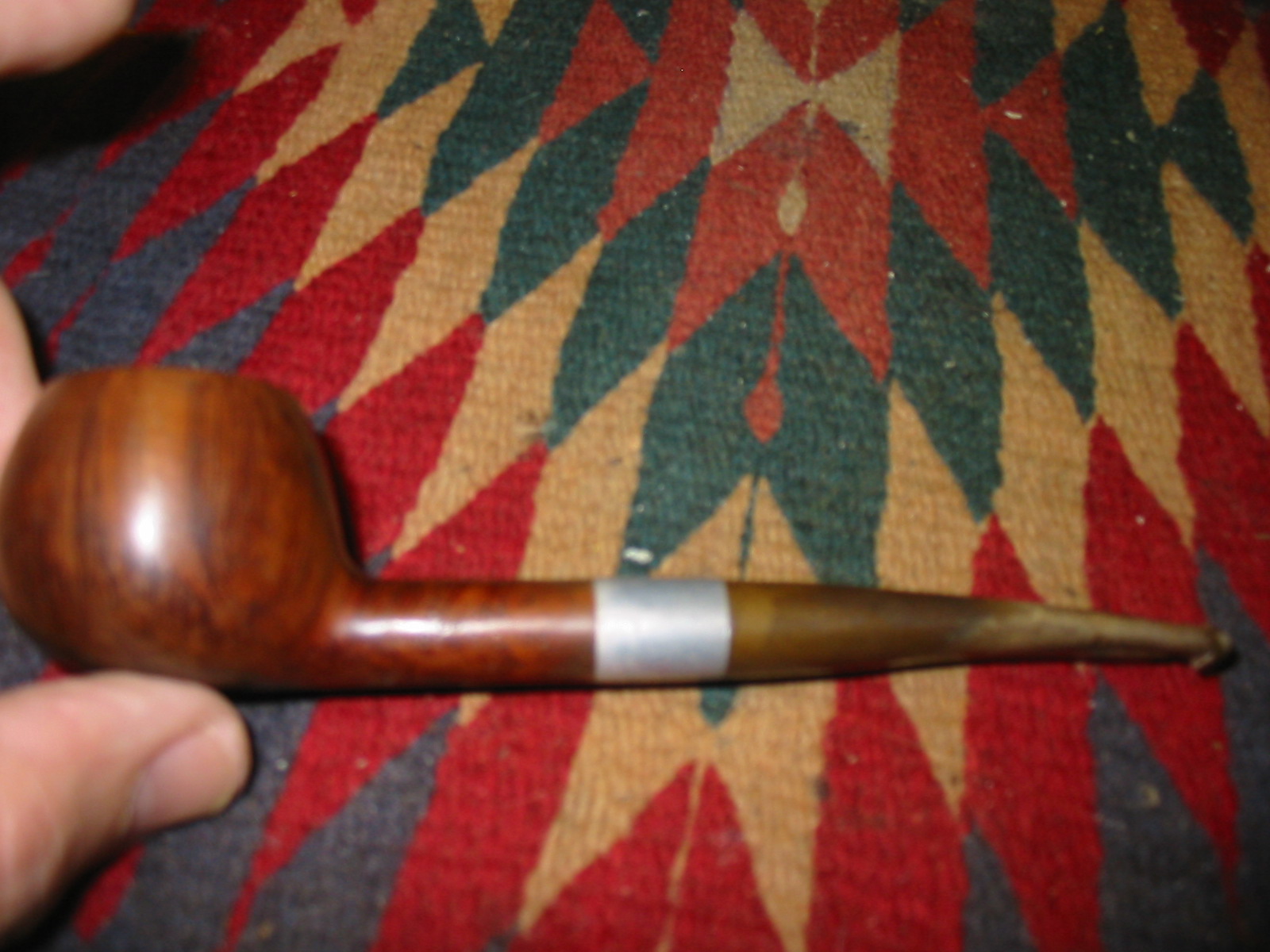
The bowl was badly caked with a broken cake. It was soft rather than hard. There was also a buildup of some blue substance on the bowl. I am not sure what it was but it smelled suspiciously like a mold. The stem as you can see in the poor quality pictures below was damaged beyond repair. The aluminum band or shank end was oxidized and rough. Underneath all of the grime it was a beautiful piece of briar. The shape is a well executed prince. The old stem seemed a bit long to my liking so the new one would be slightly shorter and accommodate the lines of the one in the photo.

IMG_1012

IMG_1013

IMG_1014

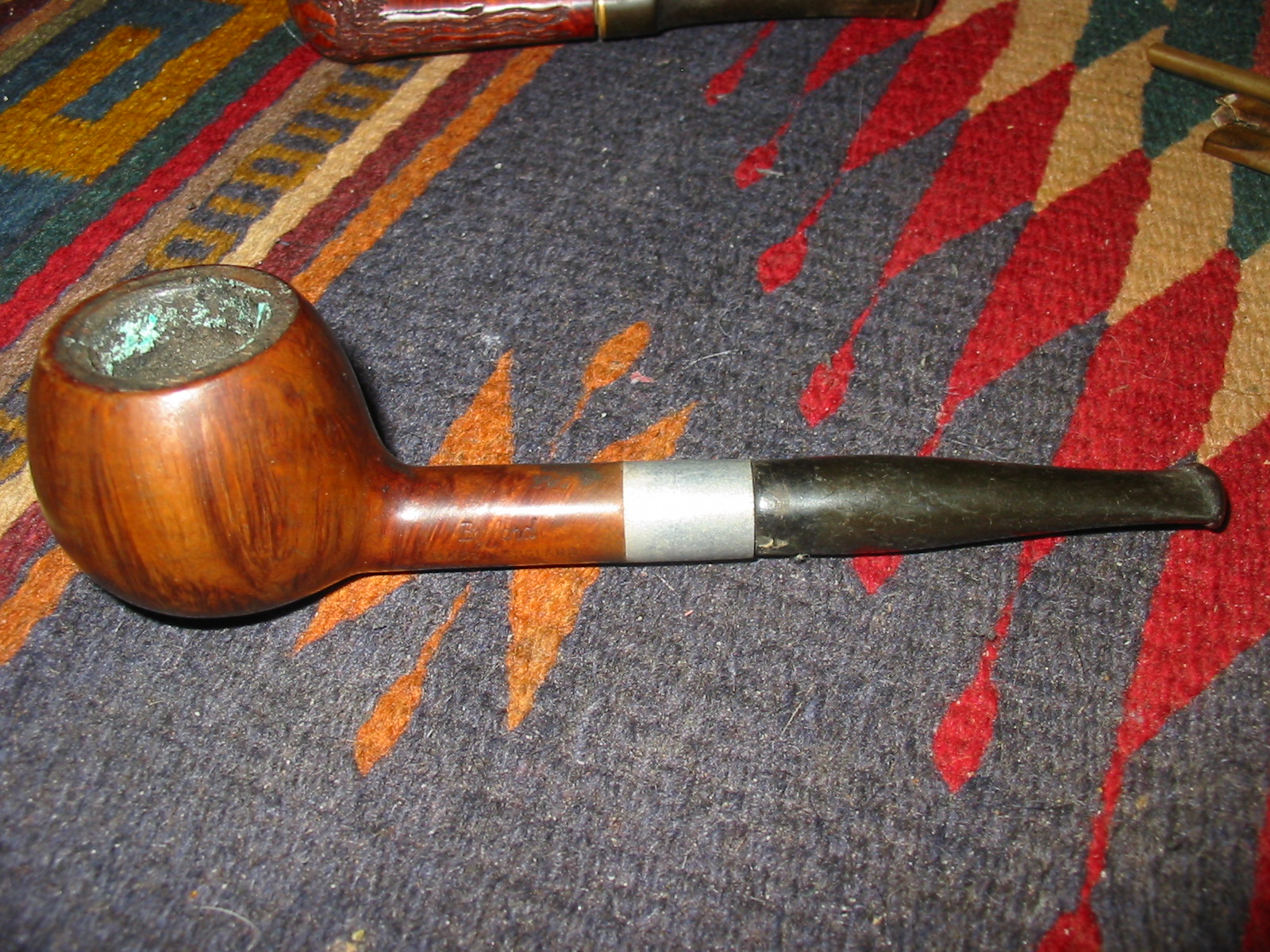
I removed the old stem and went through my box of stem and found what I was looking for. The drilling on this had to be very wide to accommodate the apparatus on the system of the Byford pictured above. This older style stem had exactly the right fit. It slipped into place and looked good. It was a bit flared on each side and on the top and bottom so that would need to be sanded back to a flush angle. In the photo below you can see the fit of the new stem before I did any shaping on it. You can also see the blue/green substance on the bowl.
IMG_1019

I used a Dremel with a sanding drum to remove the excess vulcanite and shape the stem to the proper angles. I reamed the bowl with a PipNet reamer starting with the smallest head and working up to the third head which took the cake back to bare wood. I wanted to remove the cake and whatever the buildup on the bowl and rim that was there.
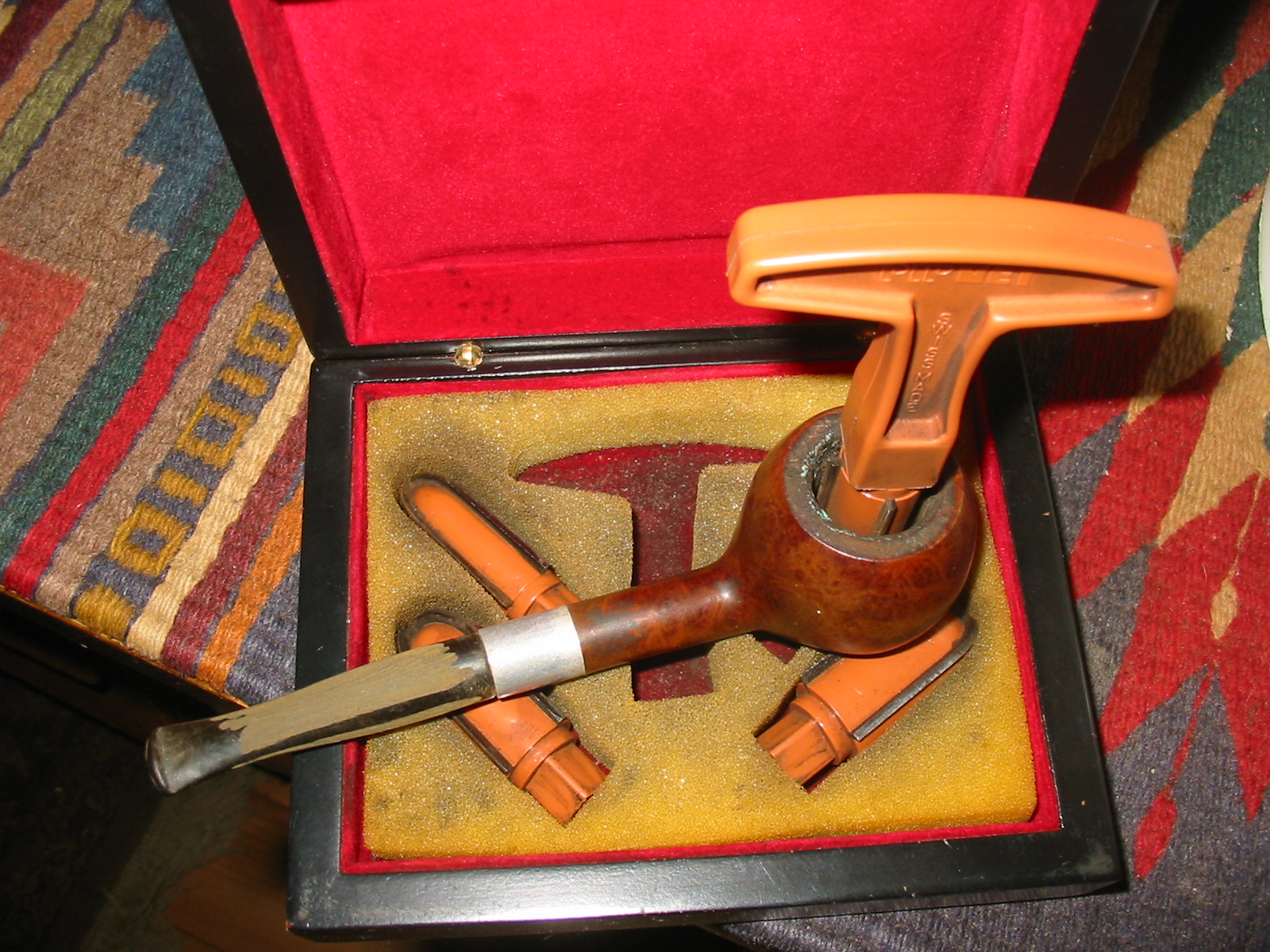
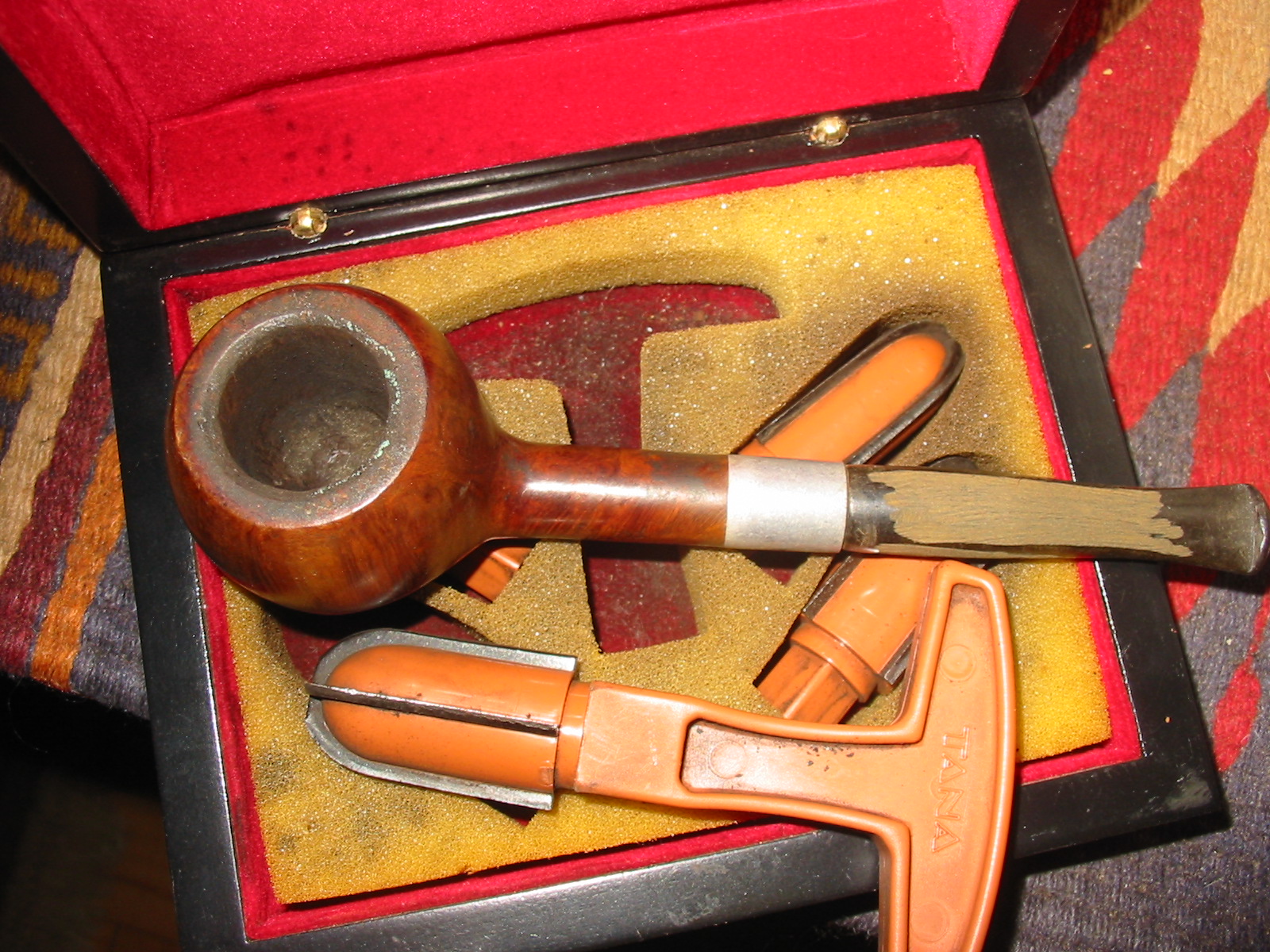
IMG_1024

IMG_1025

IMG_1026

After reaming the bowl back I sanded the rim and inner edge with a fine grit sanding sponge to remove the remaining blue/green substance. I also sanded the inside of the bowl smooth to remove any thing that was buildup on the inside edges. I sanded the stem with 220 grit sandpaper to remove the scratches caused by the Dremel and sanding drum. I sanded the exterior of the bowl and the oxidized aluminum on the shank end with the fine grit sanding sponge as well. The next three photos below show the state of the bowl and stem at this point in the process.
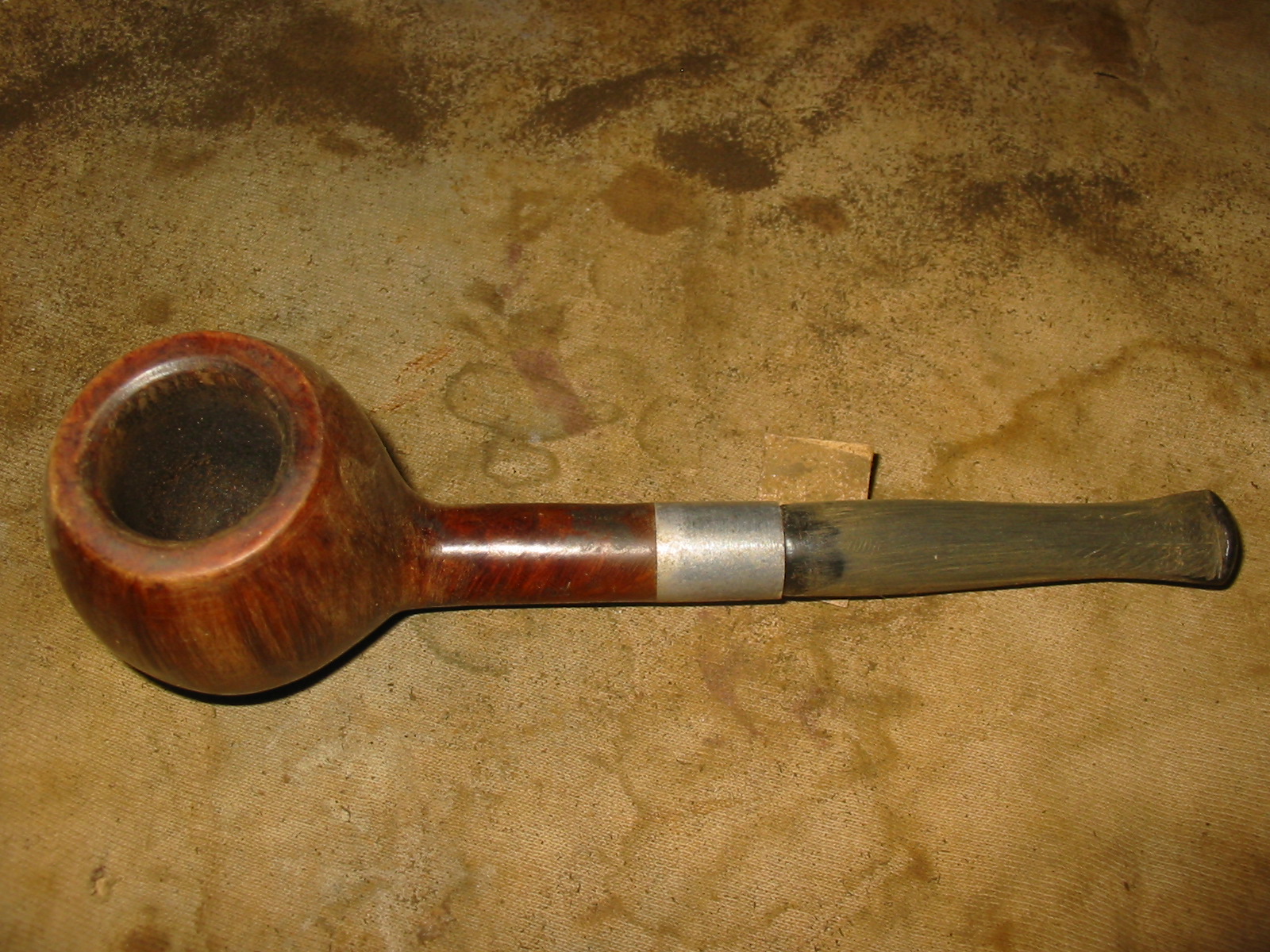
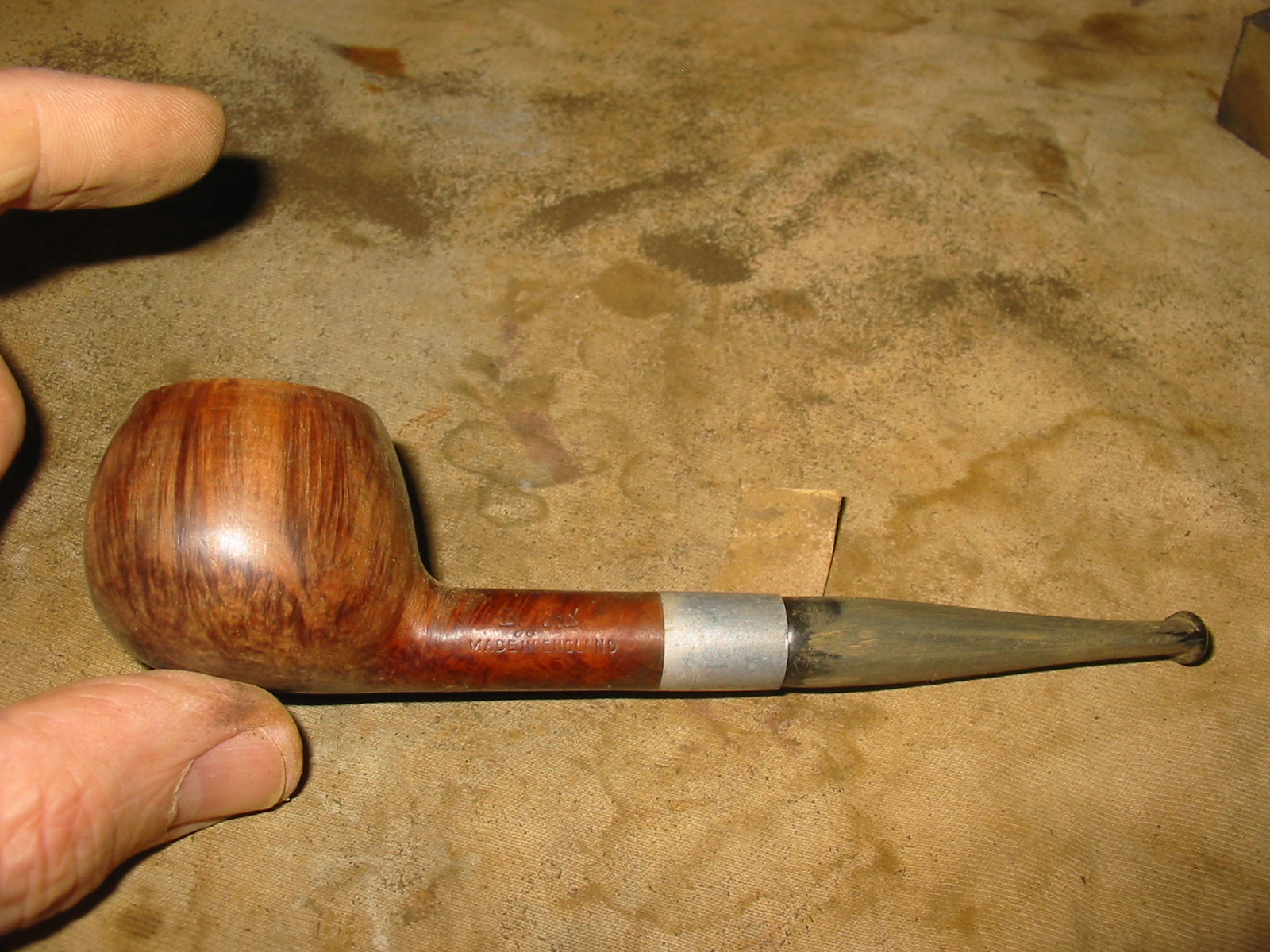
IMG_1031

IMG_1032

IMG_1033

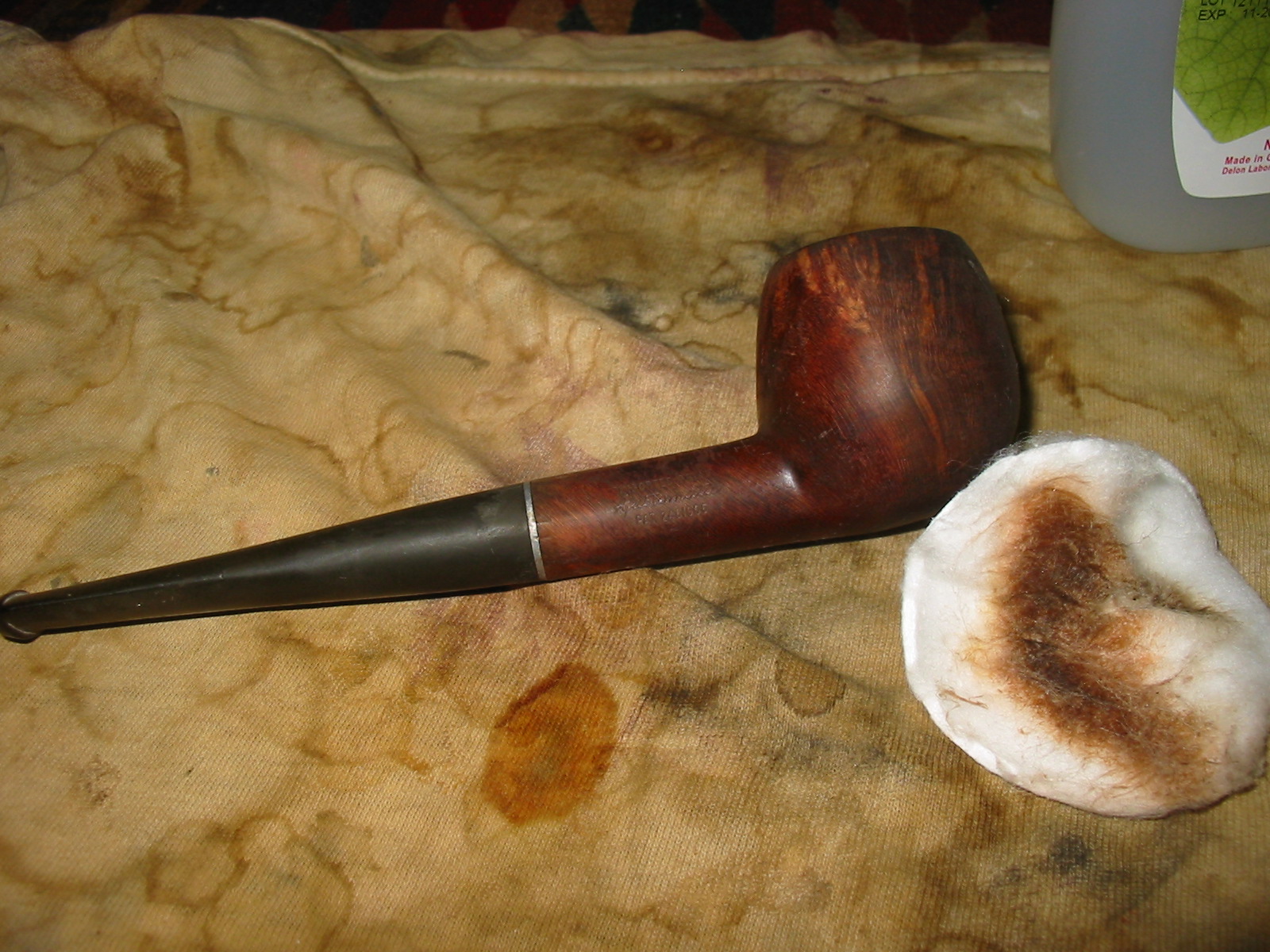
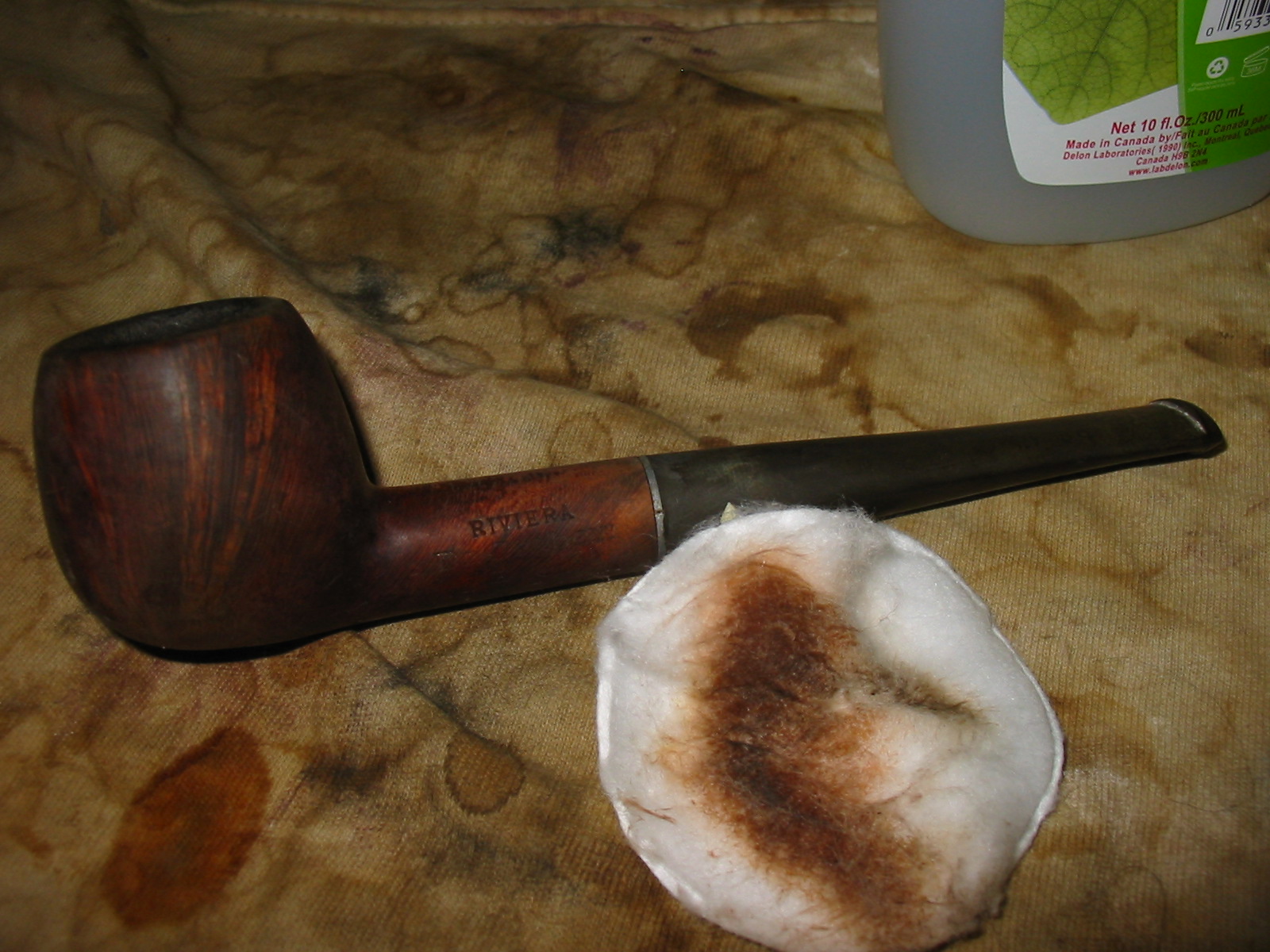
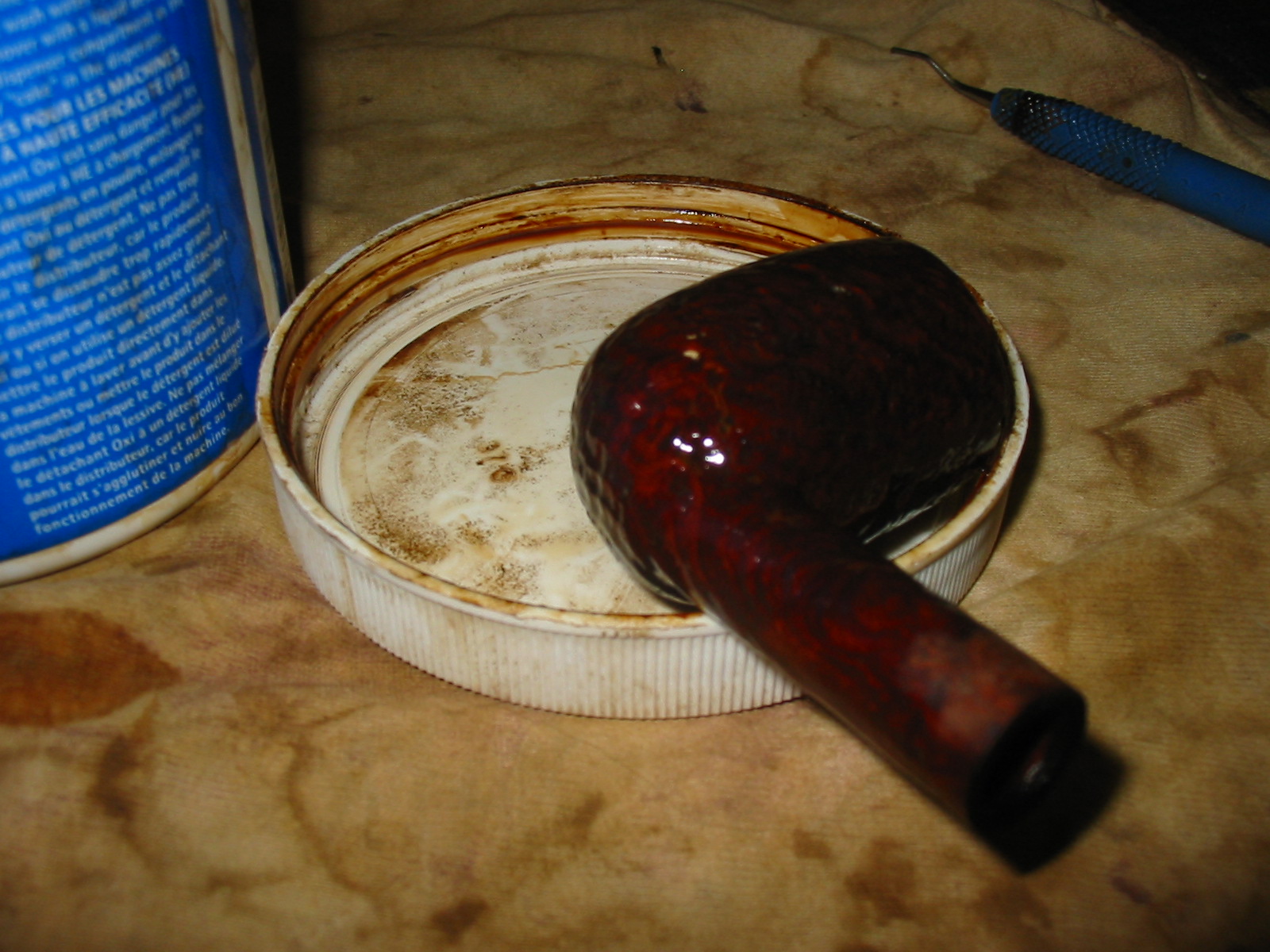
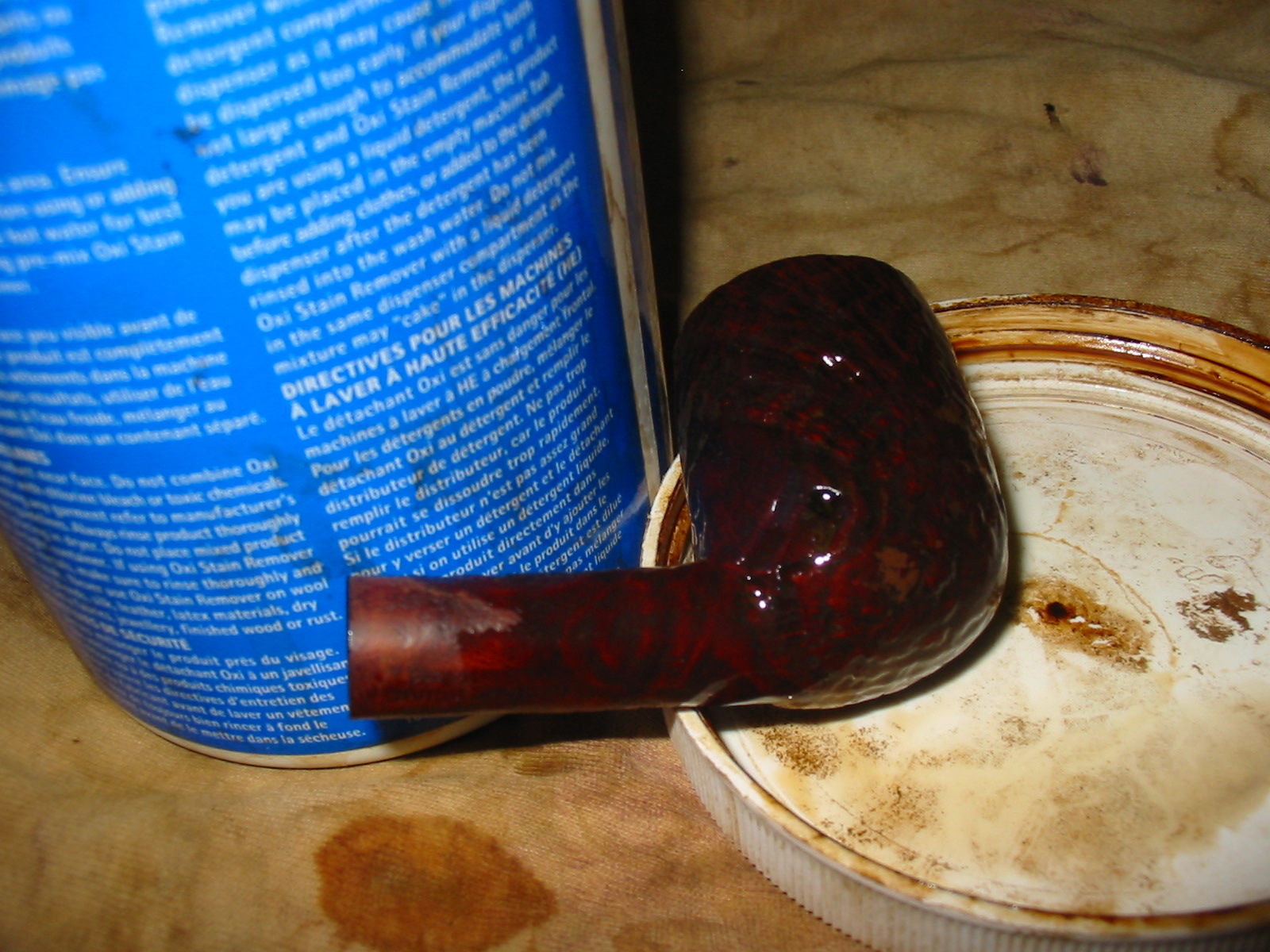
I wiped the bowl down with an acetone wetted cotton pad to remove the grime and the old finish. The next two photos show the bowl at this point. The cotton pad is below the bowl to show the amount of finish and grime that came off. I find that the acetone will even out the finish and clean up any remaining grime.
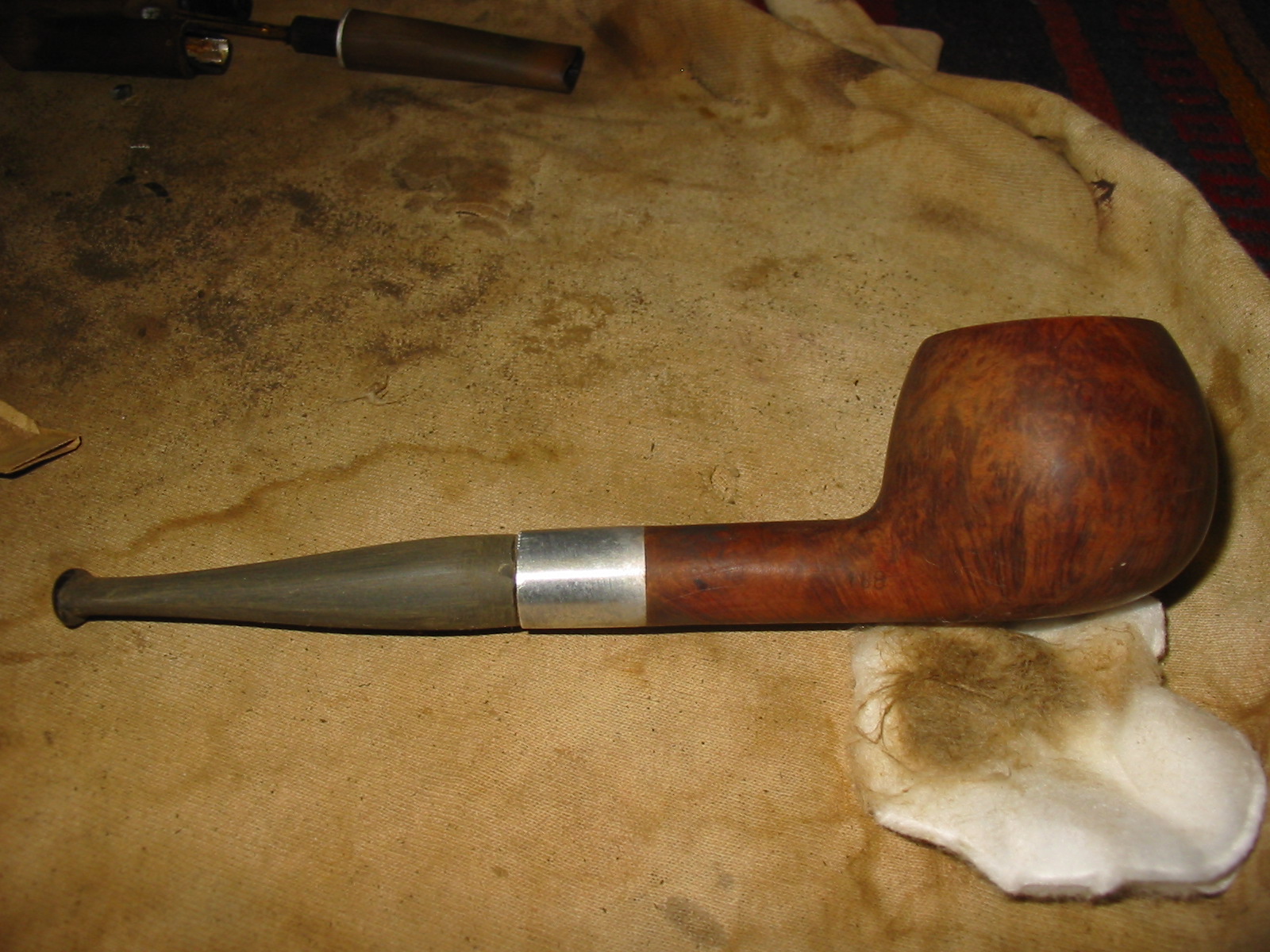
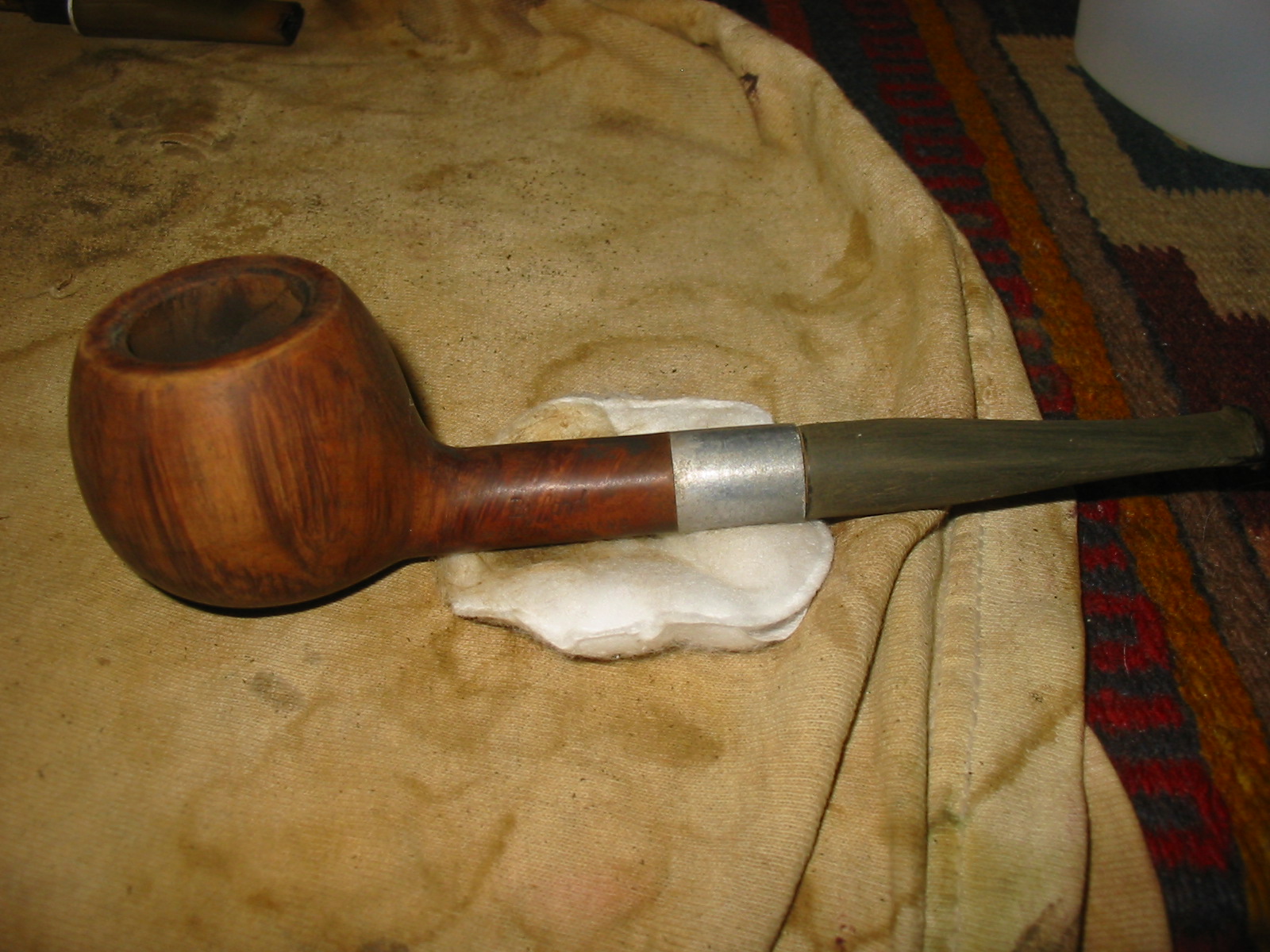
IMG_1034

IMG_1035

I continued to sand the stem with 220 grit sandpaper and also cleaned out the shank apparatus with Everclear and cotton swabs. That was a challenge! The grime that built up in the concentric tubes took some bends and twists of cotton swabs and pipe cleaners to remove from the shank. I also scrubbed down the interior of the bowl with Everclear on the cotton swabs and then scoured it out with 0000 steel wool. I did not want any remnants of the blue/green stuff. While the bowl was wet with the alcohol I also flamed the inside with a lighter. The alcohol burns quickly and should destroy whatever remnants of the sludge that may have been resident in the briar. I sanded the aluminum with 1500 grit micromesh sanding pads to remove the oxidation and crust that had built up at the junction of the aluminum and the briar.
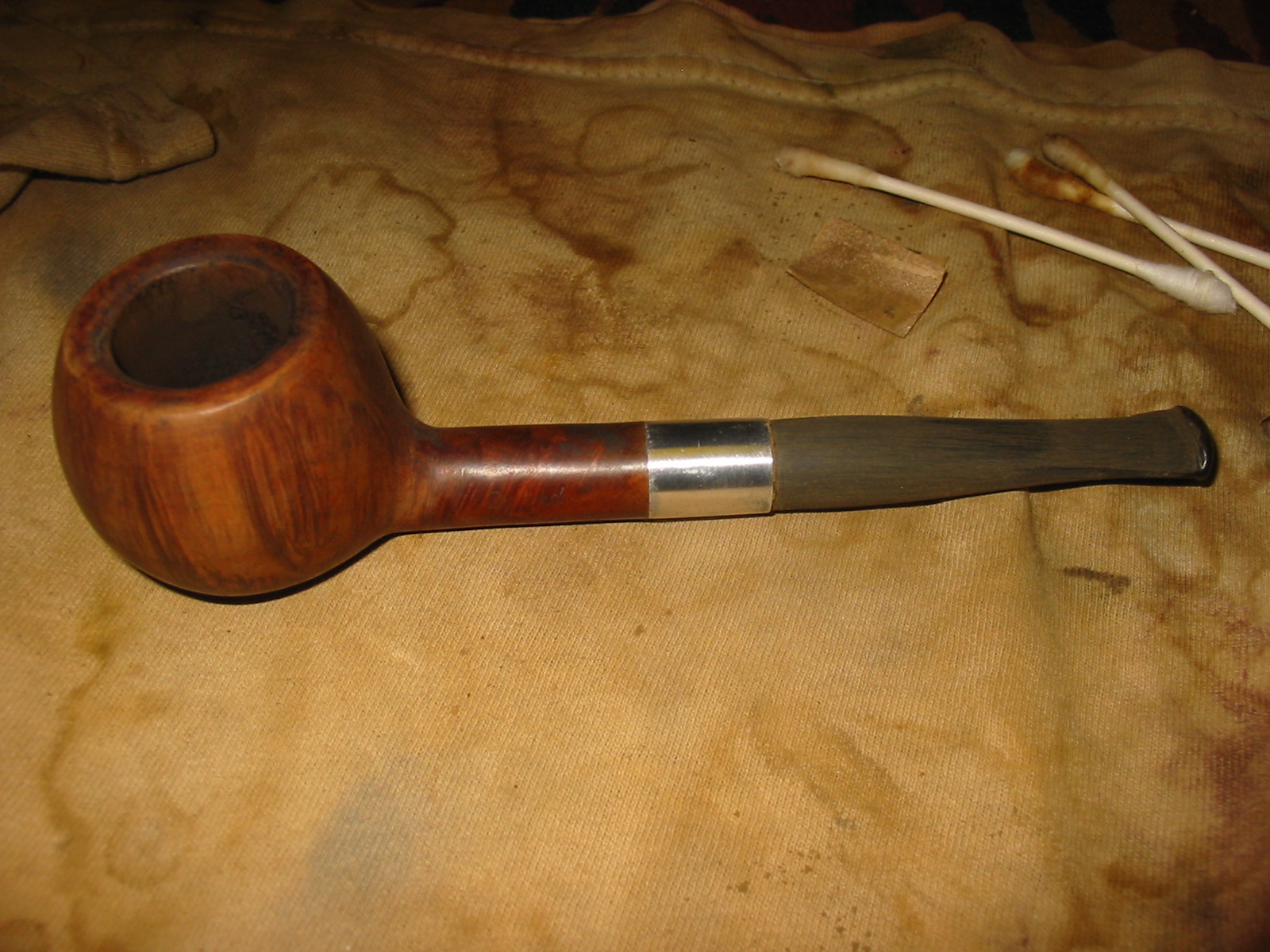
IMG_1036

IMG_1037

The next two photos show the stem after the pipe and stem have been cleaned and after I had finished shaping the stem with the 220 grit and 340 grit sandpaper. The angles matched the photo above that I was trying to duplicate.
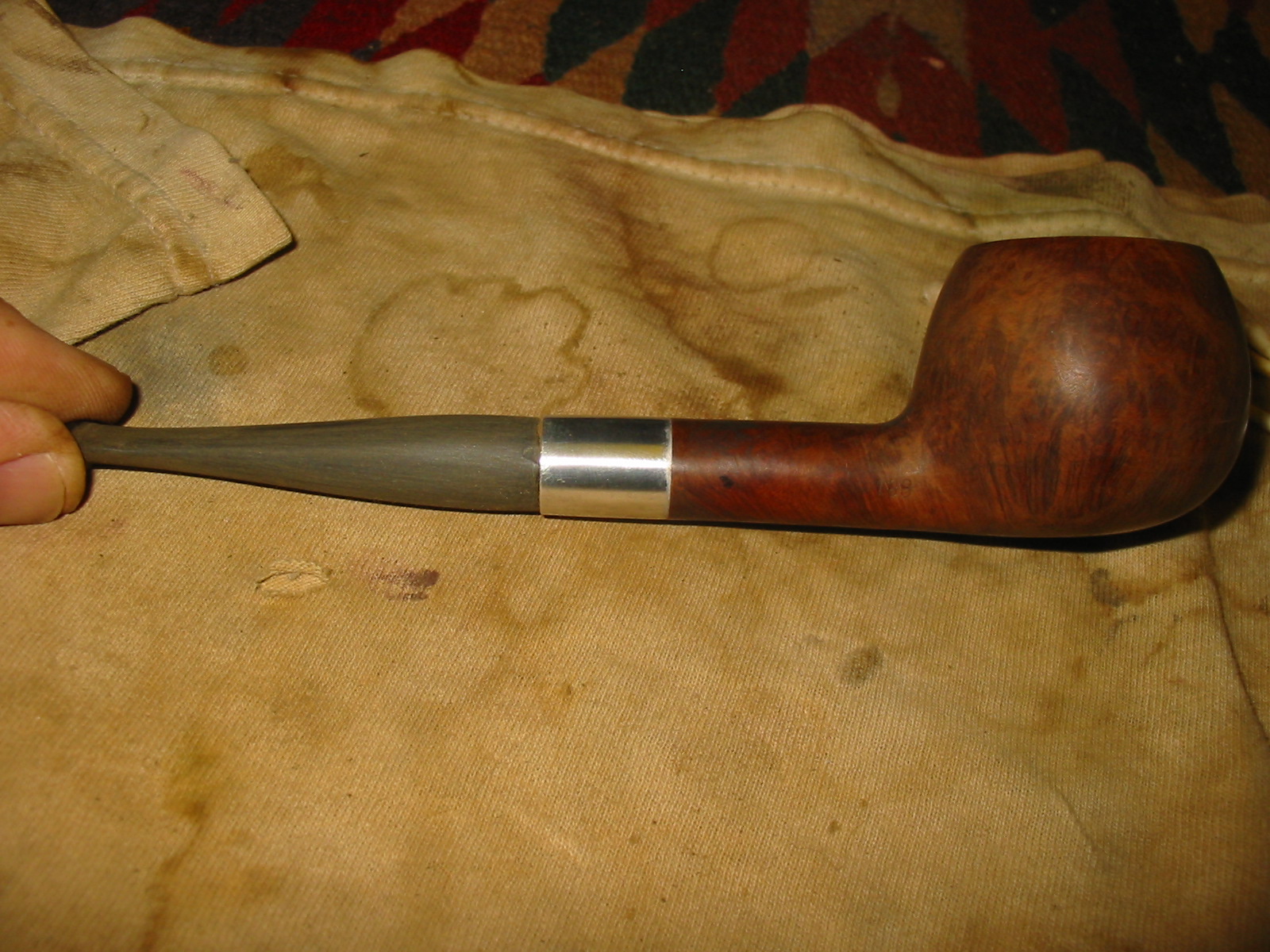
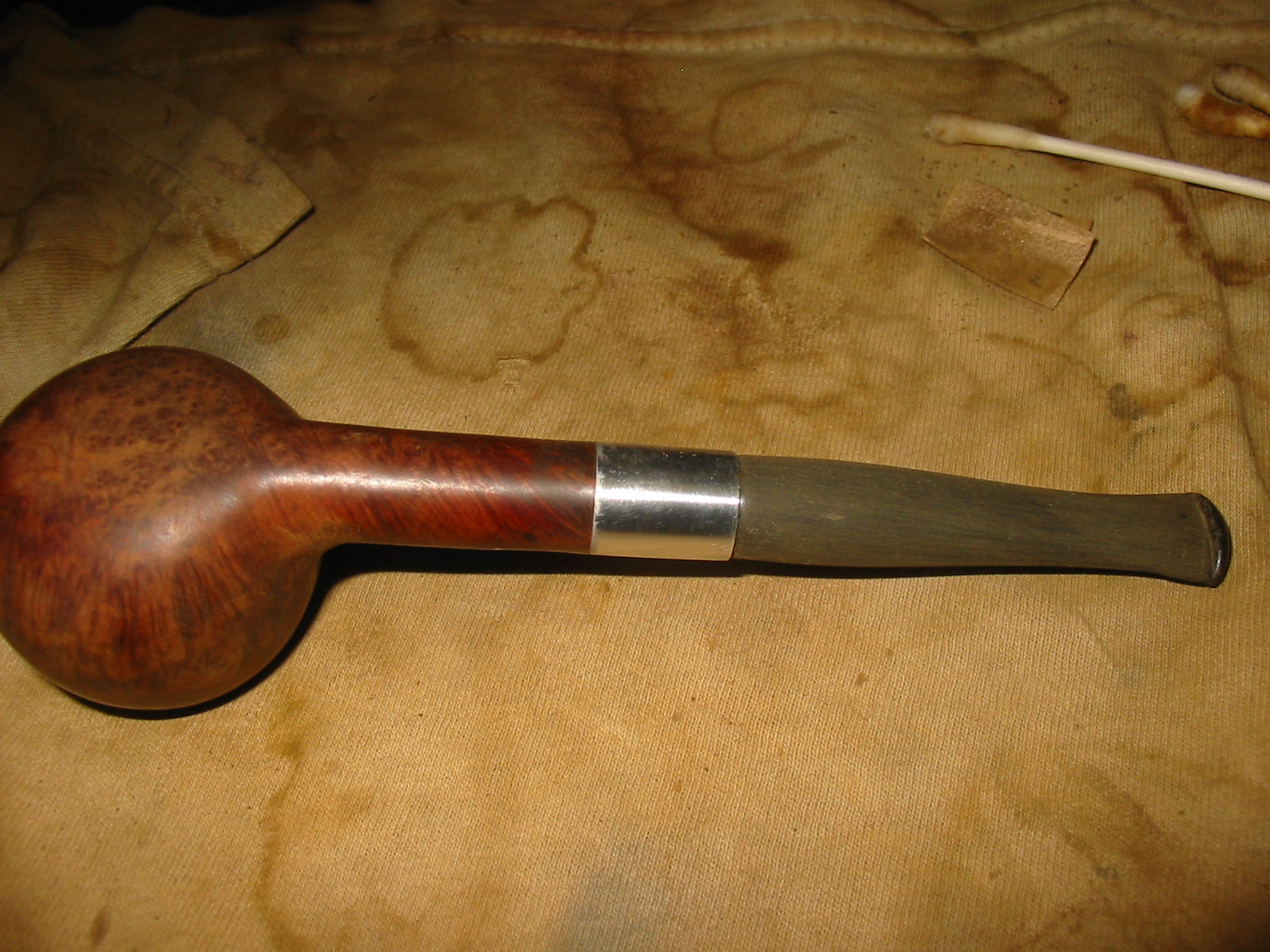
IMG_1038

IMG_1039

At this point it was time to sand with the micromesh sanding pads. The next series of five photos show the progressive shine that comes through the micromesh. I wet sanded with 1500 and 1800 grit micromesh to remove the scratches and begin to give the stem a polish. I also sanded the bowl with these two grits as well. I followed up by dry sanding with the remaining grits of micromesh from 2400-12,000. I sanded the bowl, the aluminum shank end and the stem.

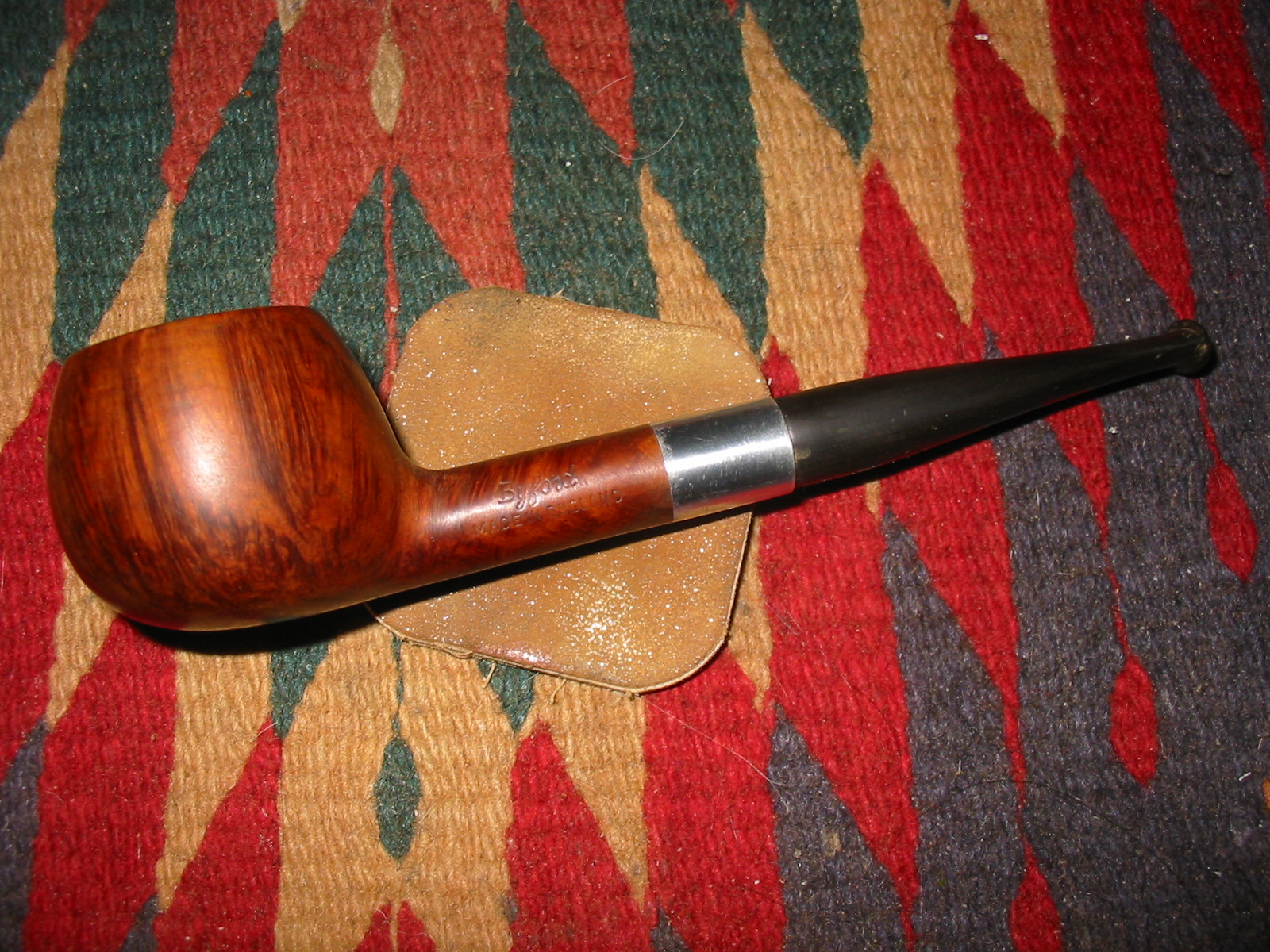
IMG_1040

IMG_1041

IMG_1042

IMG_1043

IMG_1044

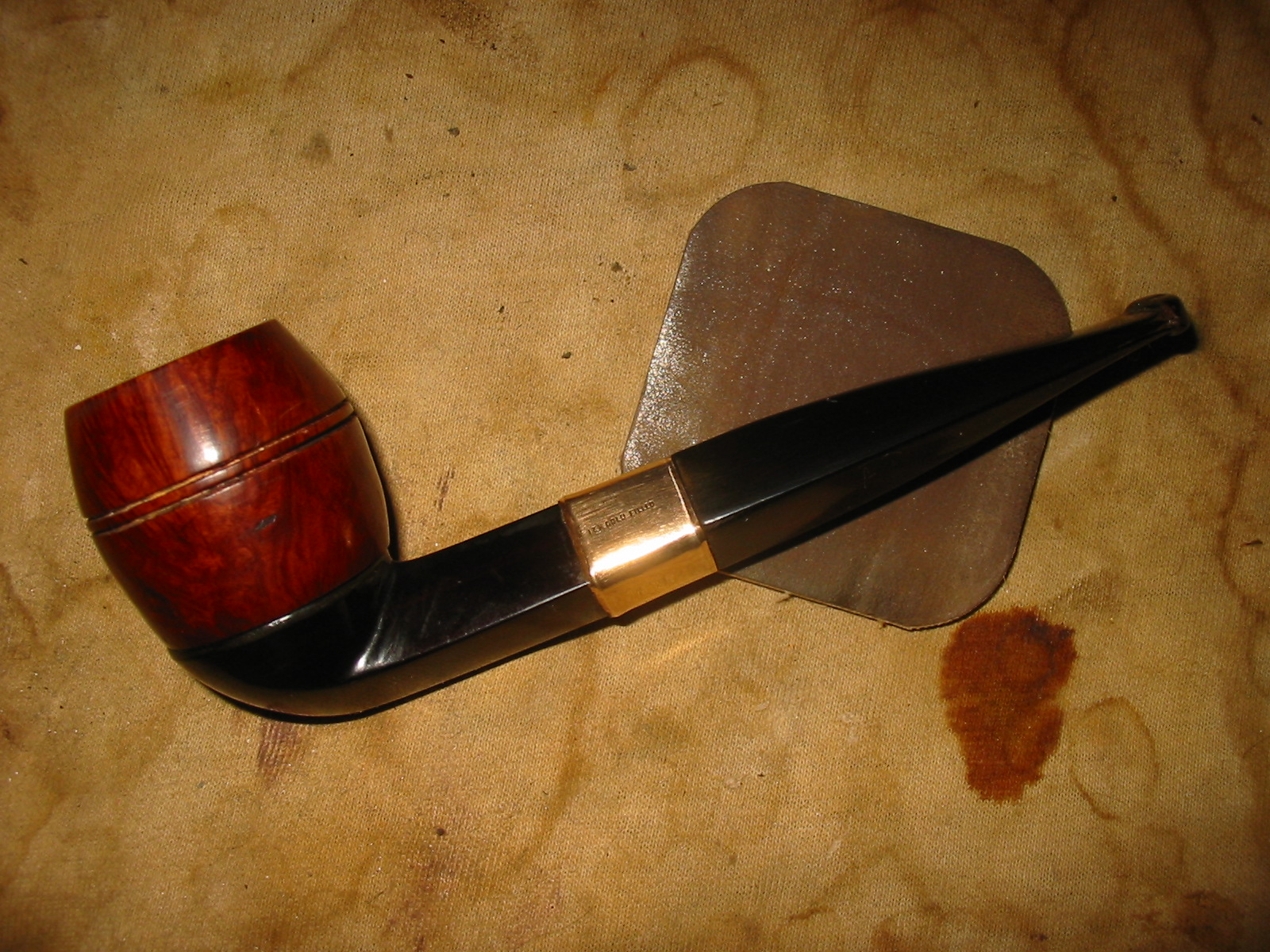
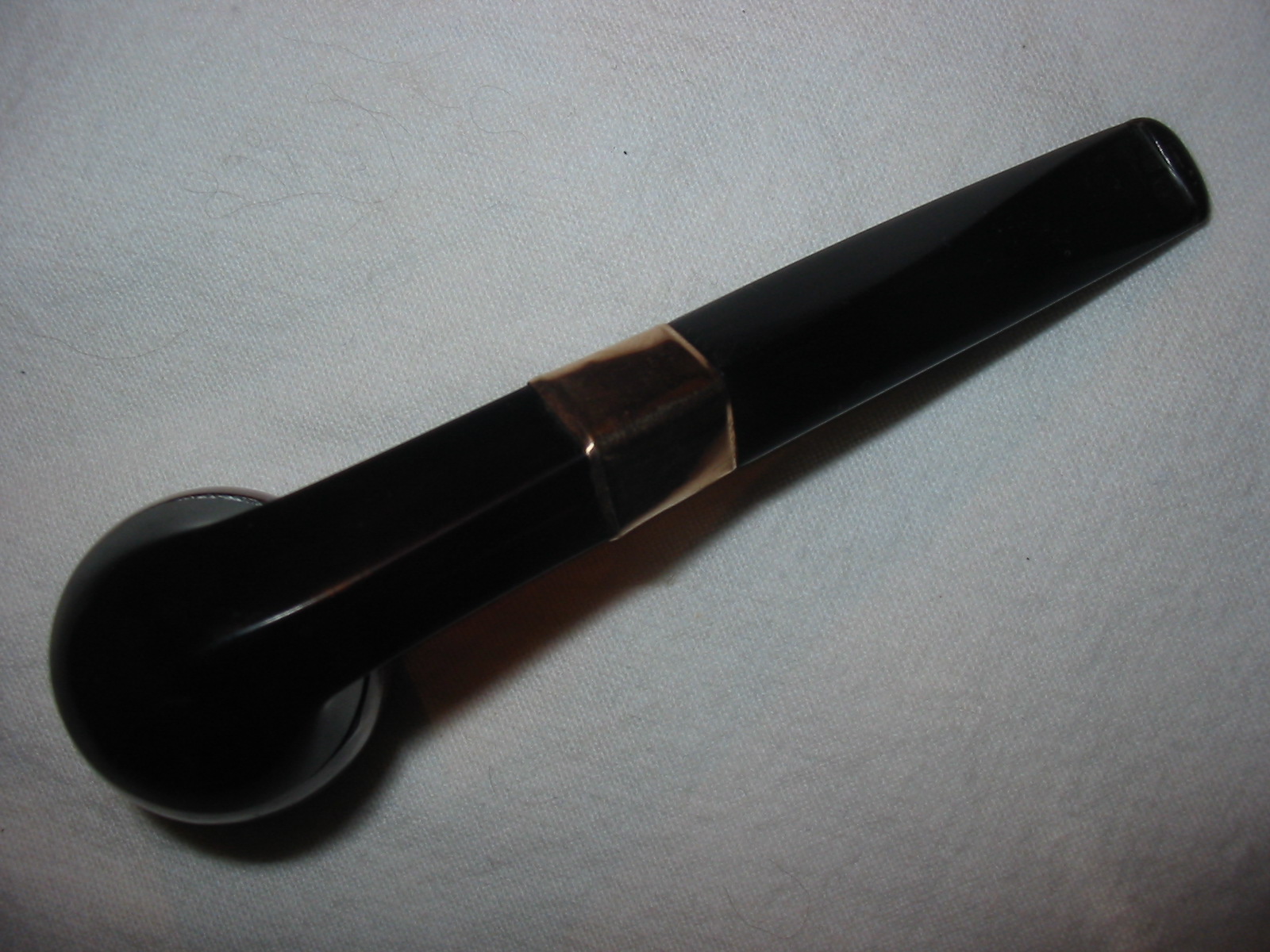
Upon completing the sanding and polishing with the micromesh pads I took the pipe to the buffer and buffed the stem and bowl with White Diamond on the wheel. It brought out the shine and help highlight the grain. I wiped down the stem with Obsidian Oil to protect it and then gave the entire pipe several coats of carnauba wax and buffed it to a shine. The last series of four photos show the finished pipe.
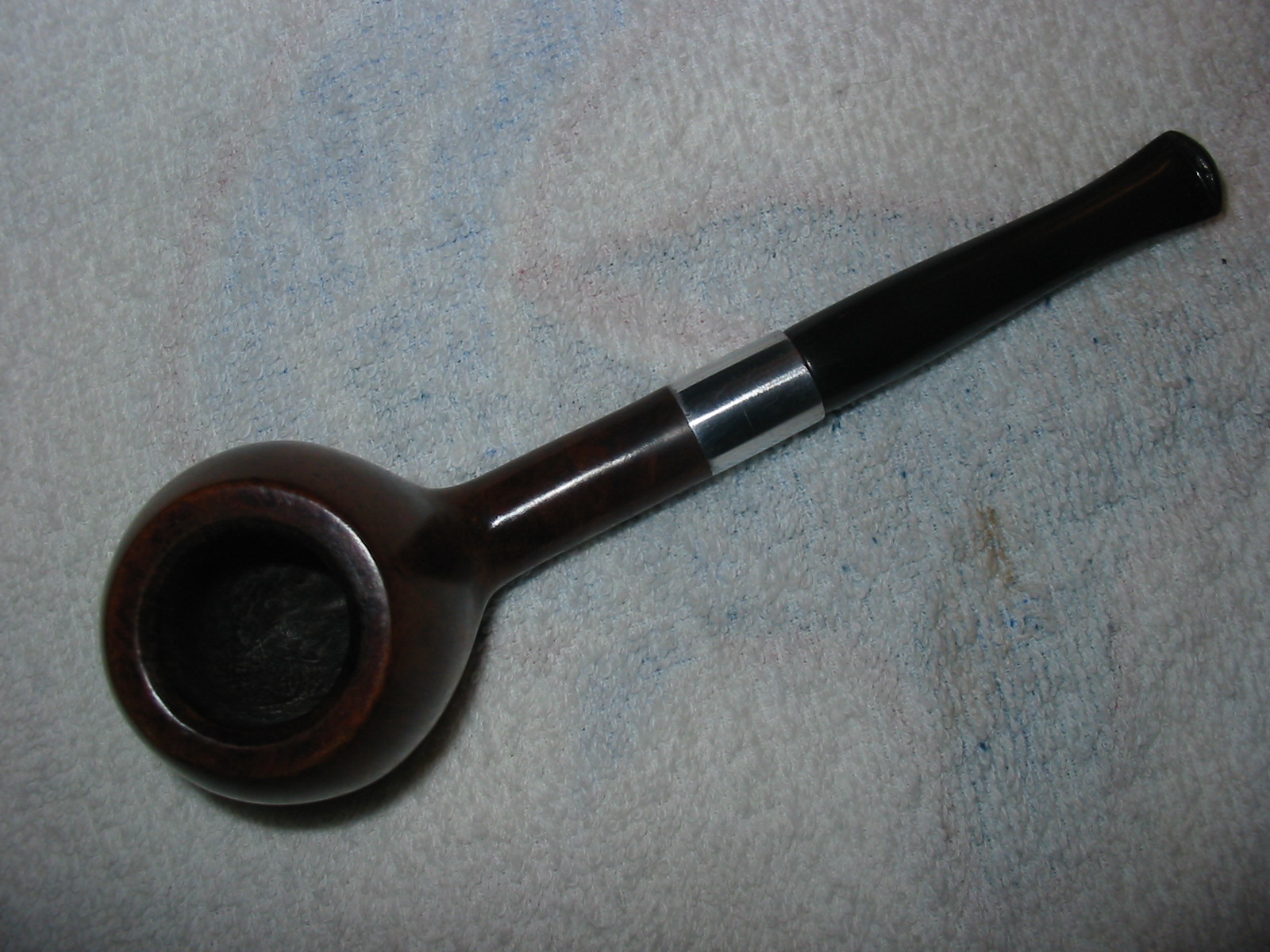
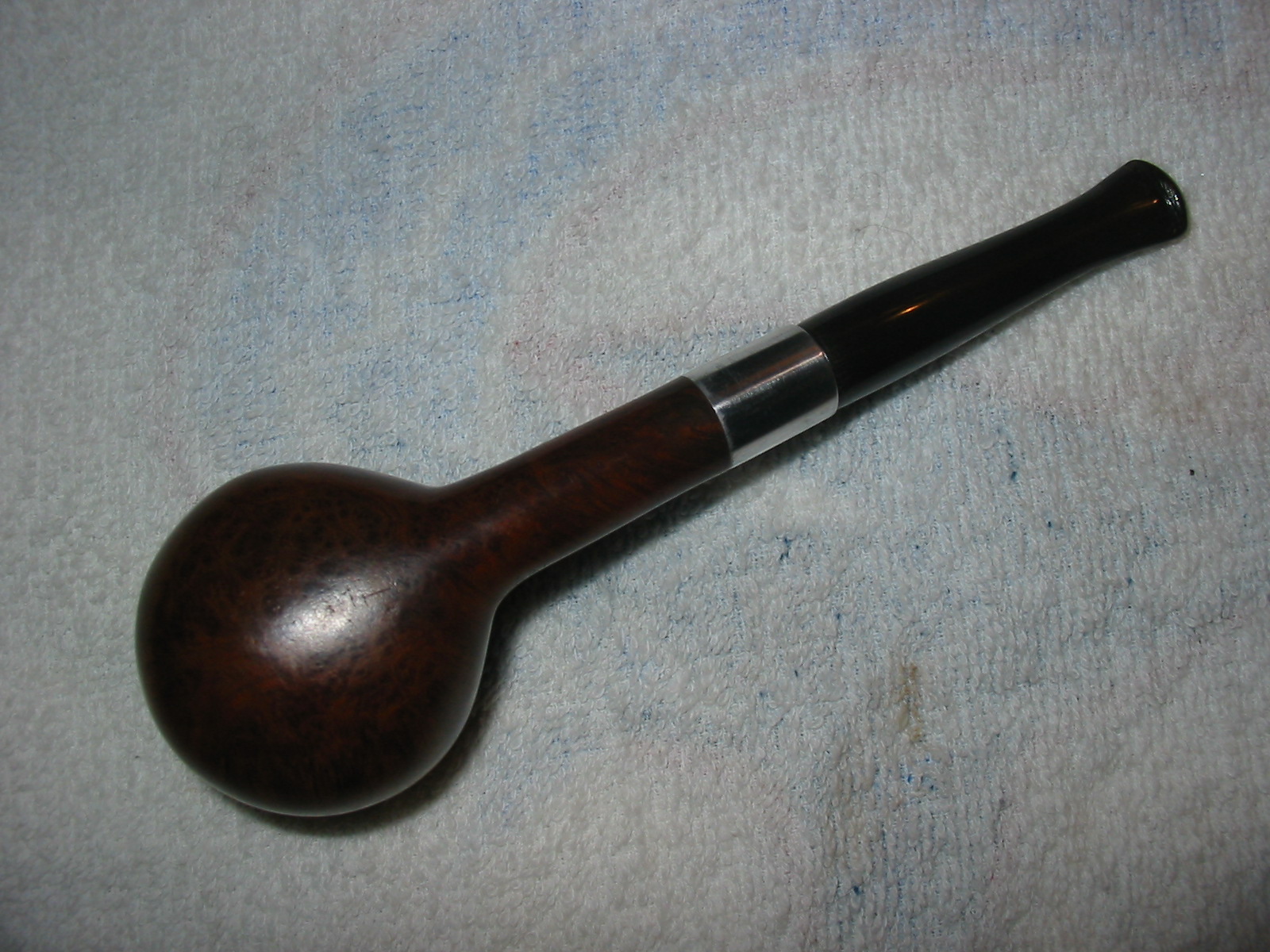
IMG_1045

IMG_1046

IMG_1047

IMG_1048

ADDENDUM 03/07/15
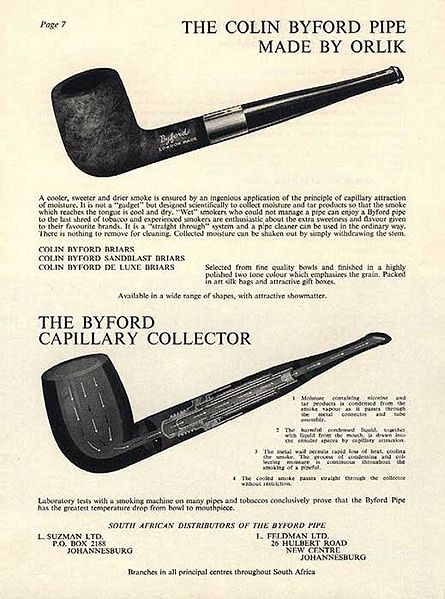
Just recently I discovered this interesting piece on the Byford pipes. They were originally made by Orlik. Here is a page from their catalogue.
445px-Orlik_70S07

Restemming and Reclaiming a BBB Hand Made Unsmoked Bowl


Blog by Steve Laug

This is the third unsmoked New Old Stock pipe bowl I picked up on EBay. It is stamped BBB in a diamond with Hand Made split by the Diamond on the top of the shank. The finish was very good and the bowl absolutely clean. Again it had no stem. I talked with a friend on the forums and he is sending some stems that may work. But, I decided to give it a go with fitting a stem blank while I was waiting. Sometimes the old impatience can be productive! The first series of four photos are from the EBay seller and show the condition of the bowl.

BBB1

BBB4

BBB3

BBB2

I sorted through my box of stems and chose an oval stem that looked to be the right length and close to the diameter that I needed. I used the PIMO tenon turning tool on my cordless drill to cut the tenon close to the diameter I was looking for. One issue with the turning tool is the inability to get accurate cuts so over time I have learned to take it very close and then finish the fit by hand. The first photo below shows the stem on the turning tool. Prior to putting it on the turner I had to drill out the airway to the same size as the stabilizing pin on the tool.

IMG_0958

The next photo shows the tenon after turning it on the tool. I needed to sand it by hand to get a proper fit in the mortise. I use medium grit emery paper to sand the tenon down and then 220 grit sandpaper to smooth it out.

IMG_0959

After sanding the tenon the fit is perfect. The next two photos show the stem in place. There are still casting marks on the sides of the stem and the diameter of the stem needs to be trimmed to match the diameter of the shank. I use a Dremel with a sanding drum to bring the stem diameter down close to the shank size. I am careful to not trim to close to the shank as I do not want to inadvertently scratch the shank and cause more work. I also run the Dremel the length of the stem to take down the casting marks and excess vulcanite. I use it the same way on the end of the button to remove excess and also clean up the marks from the cast.

IMG_0960

IMG_0961

After removing the excess material from the stem as close as I can to the shank using the Dremel the rest is handwork. I begin with medium grit emery paper to quickly remove more material. This is by far the most labour intensive part of the work. There is no way to rush it as it just takes patience to keep sanding until the fit is correct. I work it on the shank and off the shank. Photos one and two below show the results after the stem has been sanded with the emery paper. The diameter is getting close. Photos three, four and five below show the next progress of the shaping. For that I used 220 grit sandpaper. I cut it into squares and fold it so that I can get in close to the button and also close to the shank without scratching the shank. I also used a heat gun to bend the stem. This was done in several installments before I actually got it the way I wanted. The bend in the early photos below is a bit abrupt and too close to the button. I reheated and rebent the stem over a wooden rolling pin that I appropriated for this purpose.

IMG_1301

IMG_1302

IMG_1303

IMG_1304

IMG_1305

I continued sanding the stem to get the fit right with 340 grit sandpaper and then a fine grit sanding sponge. You can see from the photos that the shank stem junction is well fitted. There is no gap at the joint. The next two photos show the progress of the shaping after I used the sanding sponge. They also show the stem after it was rebent to the angle I wanted for this pipe.

IMG_1306

IMG_1307

Though the fit was good and the pipe looked and the stem was getting smoother, it just seemed bland to me. There was something missing to the look that would dress up this pipe and take it beyond just a well fit stem and a darkly stained bowl. I decided to shape and press on a nickel band to dress up the shank. The band was not necessary as the shank and stem union was perfect and the shank was uncracked. It was solely done for decorative purposes – to add a bit of bling to the shank of the pipe and dress it up (in my opinion!). The next three photos show the newly banded shank and the fit and look of the stem in place. The delicate bend of the stem, the flow of the bowl and the band all work together to give this pipe a touch of elegance.

IMG_1308

IMG_1309

IMG_1310

The next series of six photos show the progressive polishing of the new stem with micromesh sanding pads from 1500-12,000 grit. Each successive grit of micromesh sanding pad gives a deeper and more polished shine to the stem. It always amazes me to see the difference between the stem before the last three grits of micromesh (6000, 8000, 12000) and the previous grits.

IMG_1311

IMG_1312

IMG_1313

IMG_1314

IMG_1315

IMG_1316

Once I finished with the micromesh pads I took it to the buffer and buffed the bowl and stem with White Diamond polish on the wheel. The next two photos show the pipe after the buff. The shine is almost glass like by this point in the process. All that remains is to buff on several coats of carnauba wax and polish the metal band with metal polish.

IMG_1317

IMG_1318

The next four photos show the finished pipe. To me it has a gentle elegance to the shape and the bend. The slender stem and the bend make the pipe sit well in the mouth. The light weight makes this a likely clencher. The deep shine in the bowl and stem give it the look of a new pipe – which for all intents and purposes it is. This Hand Made BBB has come back to life to fulfill the purposes for which it was originally made.

IMG_1319

IMG_1320

IMG_1321

IMG_1322

Restemming and Reclaiming an Old, Unsmoked Rex Bulldog


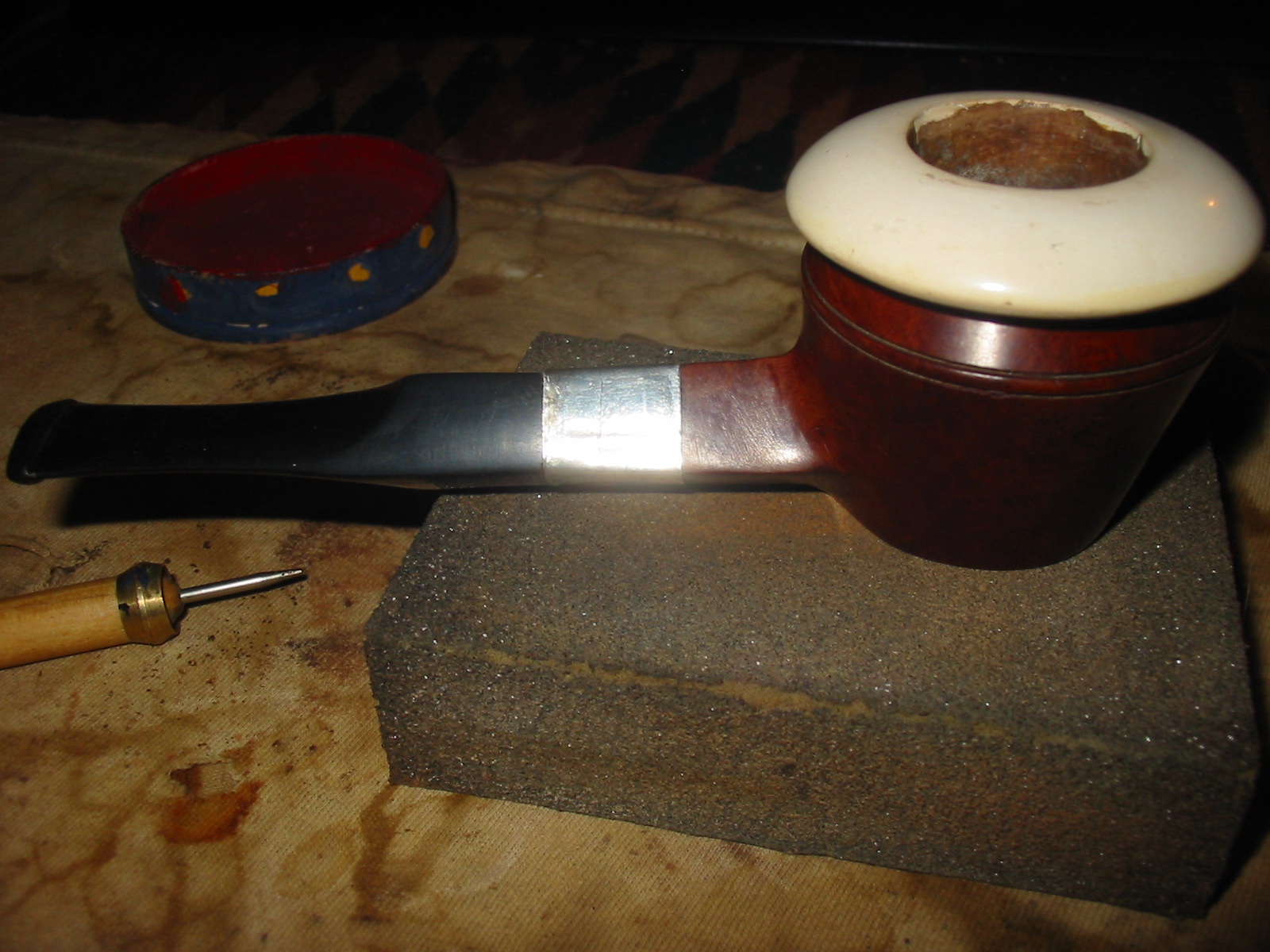
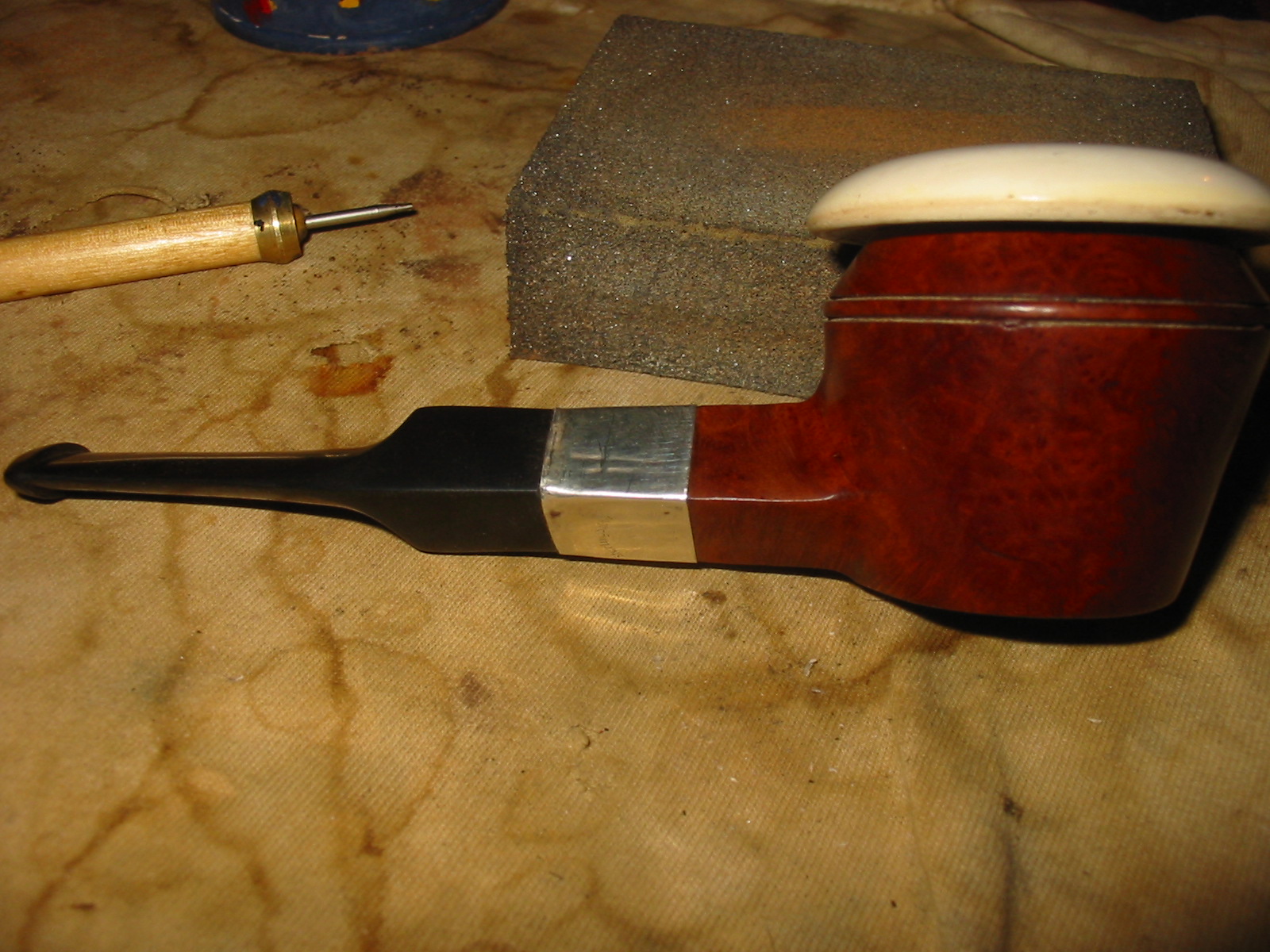
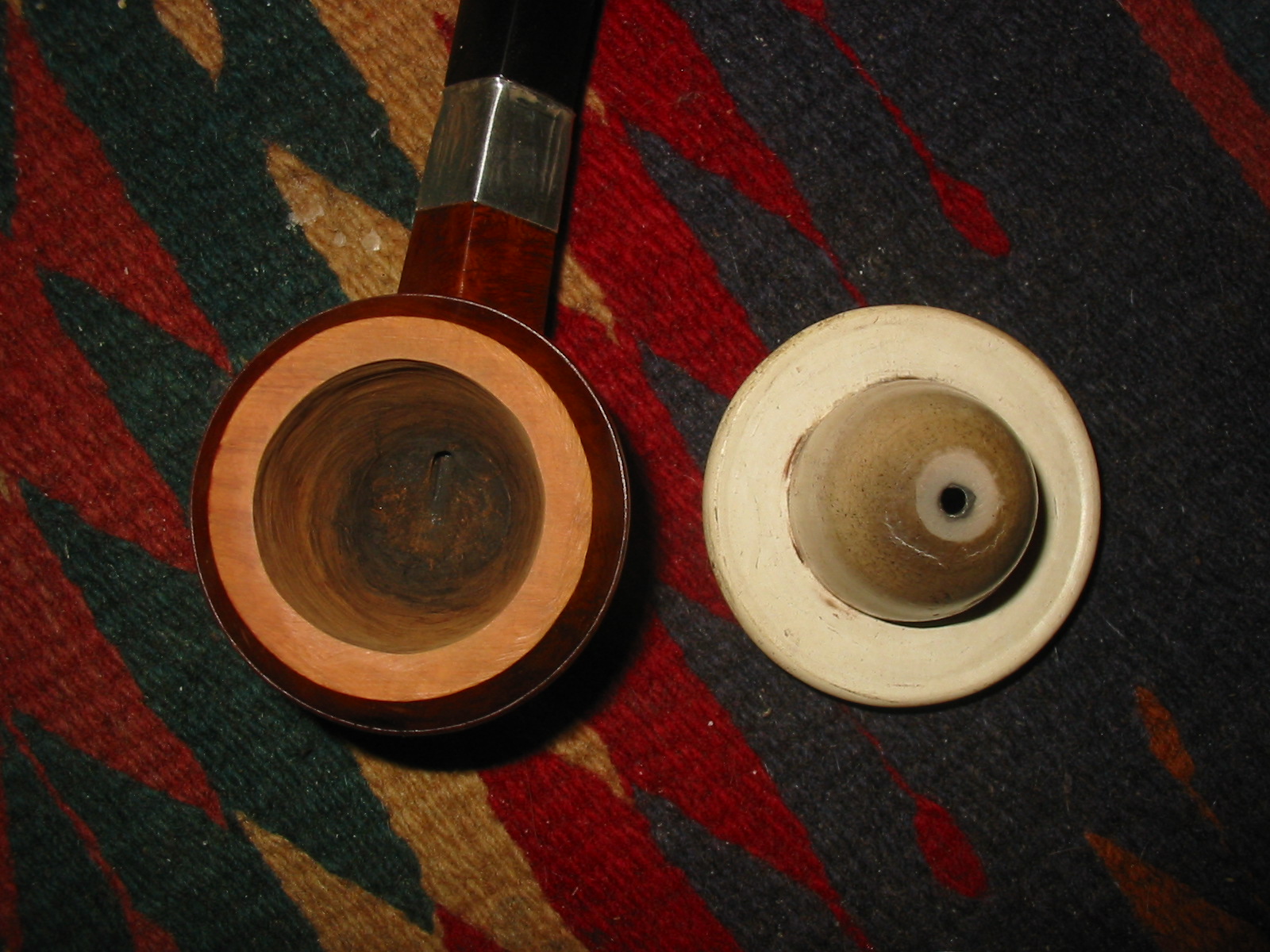
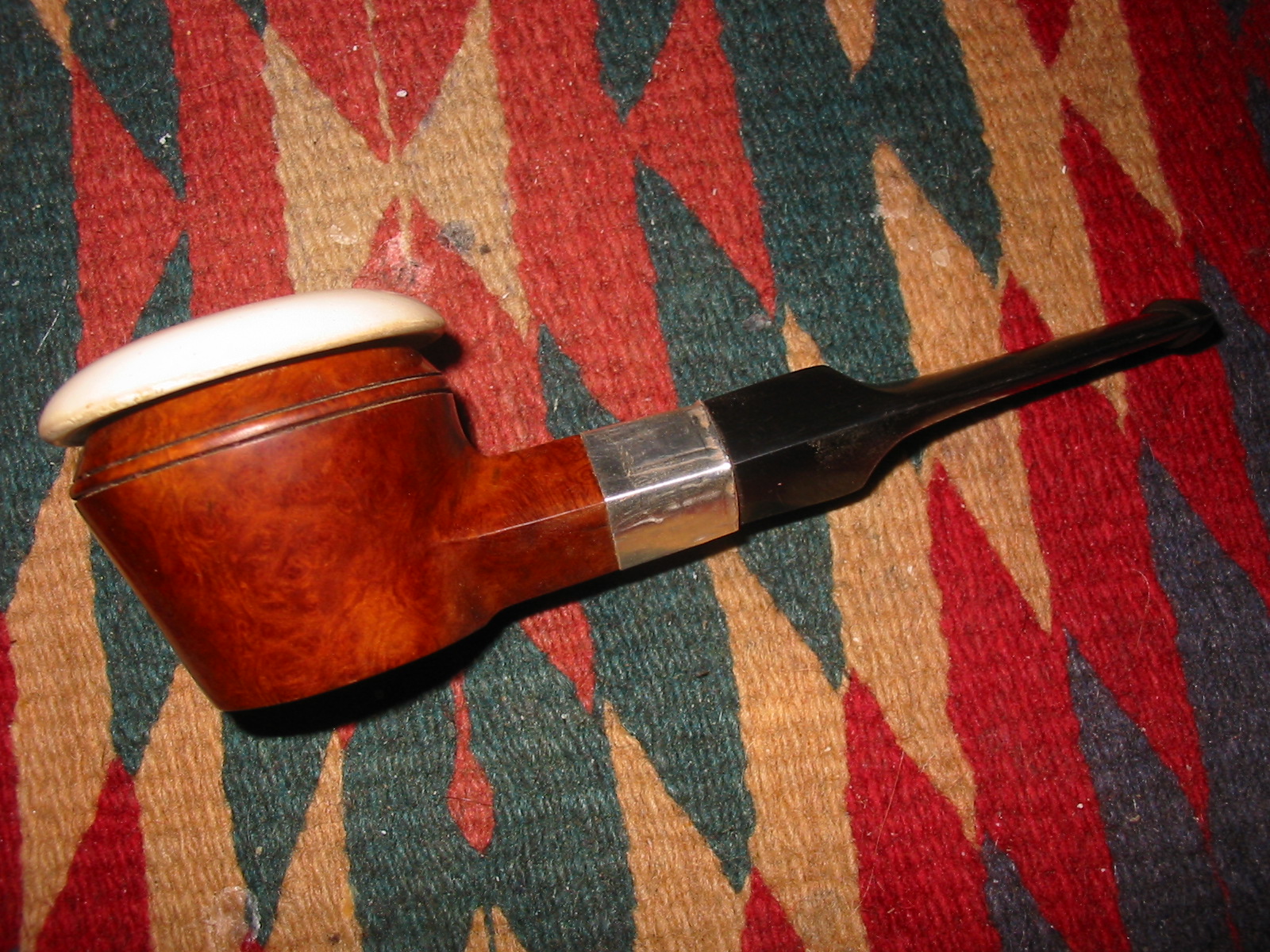
This is the second of the old unsmoked pipe bowls I picked up on EBay. It is one that I can find absolutely no information on anywhere. Some have thought it was a Barclay Rex but I can find nothing that would link it to that shop in NYC. It is stamped Rex in cursive script on the right side of the shank and also stamped Rex over Sterling on the band. It has the look and feel of an older English-made pipe. But I am not sure. The seller said it was from the late 1800’s but all attempts to contact them on the source of that information have remained unanswered. So it remains a bit of a mystery to me. It is one though that I will continue to hunt down until I can come up with something. This shape is what is called in some of the older catalogues a Bulldog. I personally am not sure what to call it. It has the shape of a bulldog on the bowl and the double ring separating the bottom of the bowl from the cap. The shank however, is oval. It has a factory installed band on it that is also stamped Rex. The script on the shank is in gold leaf. The bowl is very clean. There was a small crack in the shank on the shank at about one o’clock looking toward the bowl. This may have been the reason for the band or the band may have been decorative. There was no stem with this pipe so I was not sure of the length of the stem to make for it. The drilling is very interesting. It is drilled like some of the calabash bowls or bowls that were screwed onto Bakelite shank and bases in the late 1800s. It is directly in the bottom of the bowl and seems to have a small hollow chamber under the hole. The airway meets it directly underneath. I have not seen this drilling on briar pipes of newer eras. The bowl is smooth inside and almost polished. The briar is quite nice and sports mixed grains from cross grain to birdseye to flame around the bowl. The double cut rings are clean and are not clogged with wax or dirt. There appears to be a thin coat of shellac on the outside of the bowl to give it a shine as it shines with or without the application of wax. The silver band is interestingly shaped as well. It is somewhat conical – wider toward the bowl side and narrower on the stem side. There is also a stepped down lip on both sides of the band. Where it is on the bowl is stepped down to a small ring around the shank. On the stem side it is also stepped down. This would make fitting a stem to the shank a challenge. It was not too badly oxidized so it would clean up very easily. The first series of five photos are those taken by the Ebay seller and give a good idea of the look and condition of the pipe. The one thing not clear to me was the size of the pipe. I took a chance on it as the apparent age and the assumed age stated by the seller made the likelihood of it being smaller was very high. When it arrived it was indeed quite small. The bowl and shank are roughly 3 inches long without the stem. The height of the bowl is 1 5/8 inches. The inside diameter of the bowl is ¾ inches and the outside diameter is 1 ¼ inches.

Rex1

Rex2

Rex3

Rex4

Rex5

Once I started working on it the first decision that needed to be made was on the type and length of the stem to be used. I fitted several oval stems to the bowl – a standard length billiard type stem, a thicker and a thinner oval Canadian stem and a Lovat style saddle stem. The longer stem did not work well with the longer shank on the pipe. The thicker Canadian stem also made the stem look quite chunky and large as did the saddle stem of the Lovat. The stem I settled on was the thinner Canadian oval. Even this one would require considerable thinning to make for a proper fit against the bevel of the band. The first photo below shows the two Canadian taper style oval stems. I chose the bottom stem in the photo.

IMG_0968

I used the PIMO tenon turning tool to turn the tenon so that it would fit in the shank. The next three photos show the initial fit of the stem. You will note in the photos the gap where the bevel of the band lies. I had to make a decision to either leave the gap or work on the stem size so that it fit against the bevel and thus was slightly thinner than the shank prior to the band.

IMG_0969

IMG_0970

IMG_0971

I decided to thin the stem to fit against the bevel. I used the Dremel with a sanding drum to bring it close to the finished size. I then sanded it with medium grit emery paper to smooth out the scratches and grooves from the Dremel. Once I had most of the scratches removed I sanded it with a medium grit sanding sponge to further shape the stem and remove excess material. The next series of three photos show the fit of the stem after it was sanded with the sanding sponge (pink square in the photos).

IMG_0997

IMG_0998

IMG_0999

At this point in the process I had to take it back and sand off some more material with 340 grit sandpaper. It still was too thick to fit well. I also had to finesse the fit against the band with needle files as in some places it was not quite straight. When I had it fitting well I moved on to sanding with a 1500 grit micromesh sanding pad (the next two photos). I also did a small repair on the crack in the top of the shank. I pried it open slightly and dripped some clear super glue into the crack. It did not go all the way through into the shank which was interesting. It seemed to be a surface crack. The repair worked well. I polished that portion of the shank with the 1500 grit micromesh sanding pad as well to remove the slight excess of glue left behind (third photo below).

IMG_1000

IMG_1001

IMG_1002

After the repair I continued sanding and polishing the stem with 1800-12,000 grit micromesh sanding pads. The next four photos highlight the sanding/polishing process. Notice the slight hip on the stem at the band edge. In the photos this appears to be more drastic than it is in actual life. The fit is more of a pinched look.

IMG_1003

IMG_1004

IMG_1005

IMG_1006

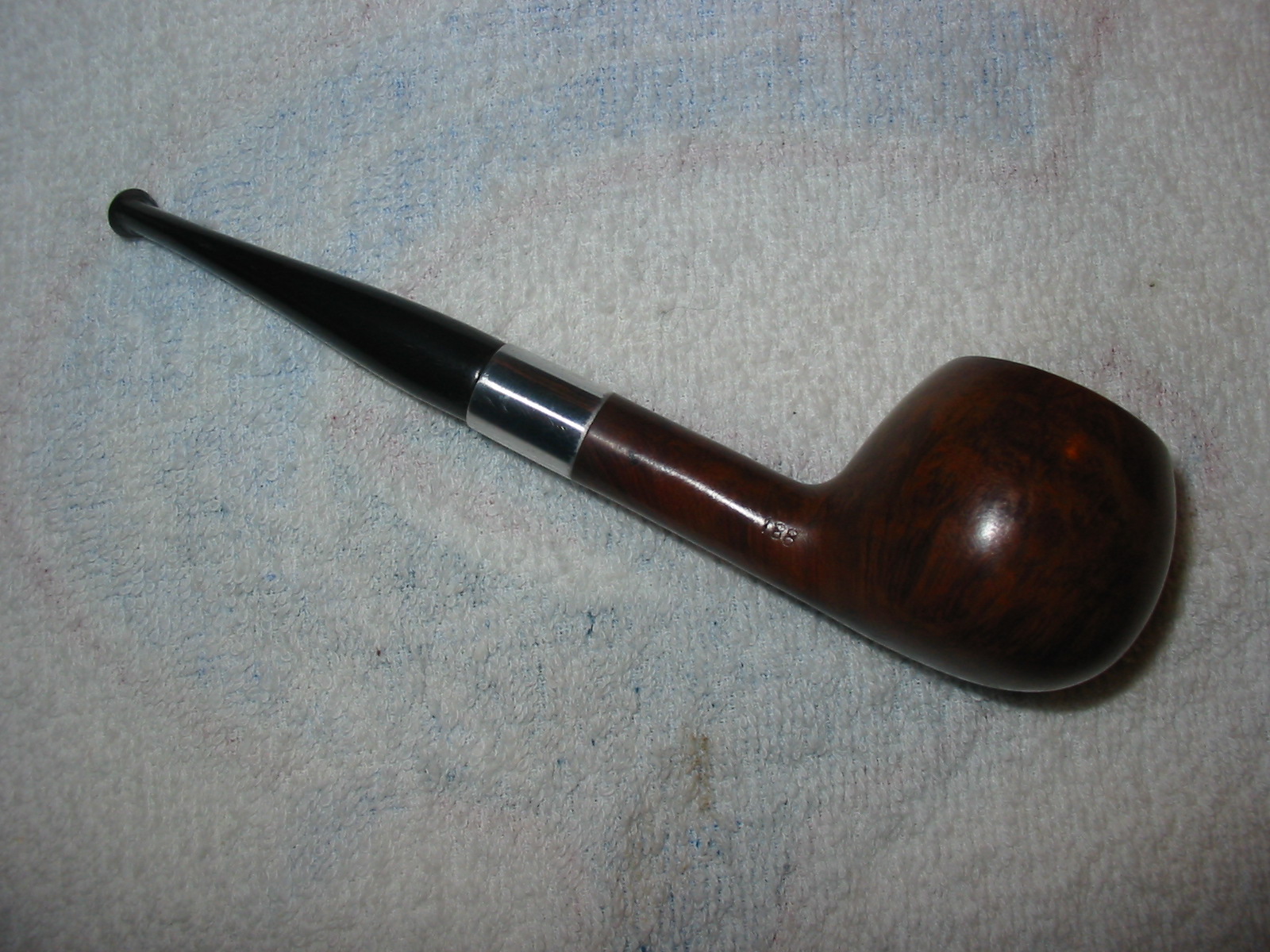
The final series of four photos show the finished pipe. I buffed it with White Diamond and then gave it multiple coats of carnauba wax. I really like the stem and fit against this long shanked “Bulldog” bowl. The pipe glows with an age and patina that calls out to be smoked. This is yet another who will soon fulfill the purpose for which it was made.
IMG_1297

IMG_1298

IMG_1299

IMG_1300

Restemming and Reclaiming an Older, Unsmoked GFB Briar Calabash


Blog by Steve Laug

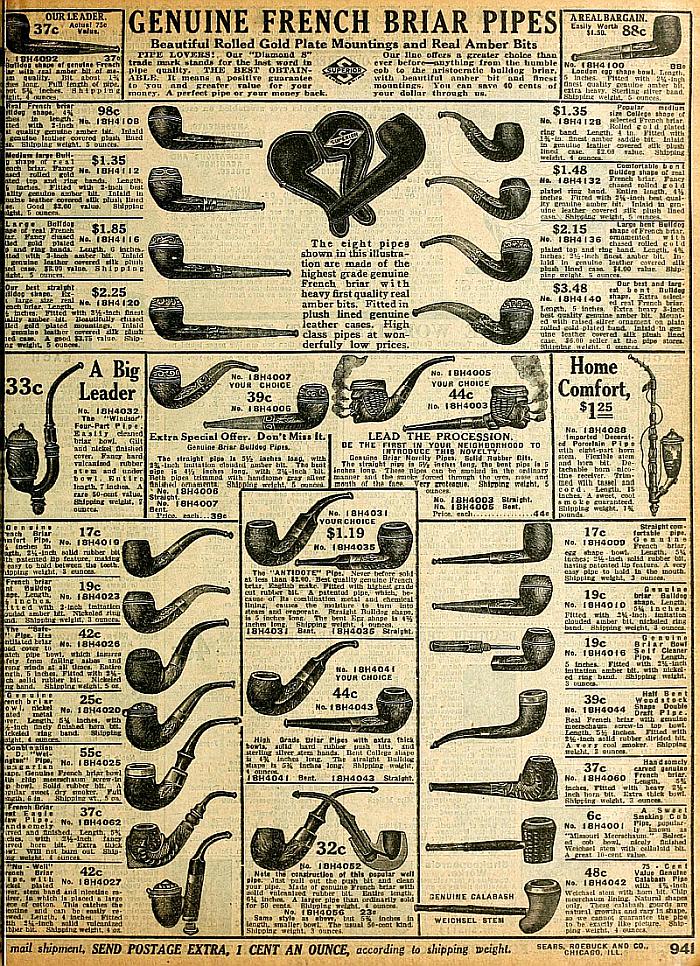
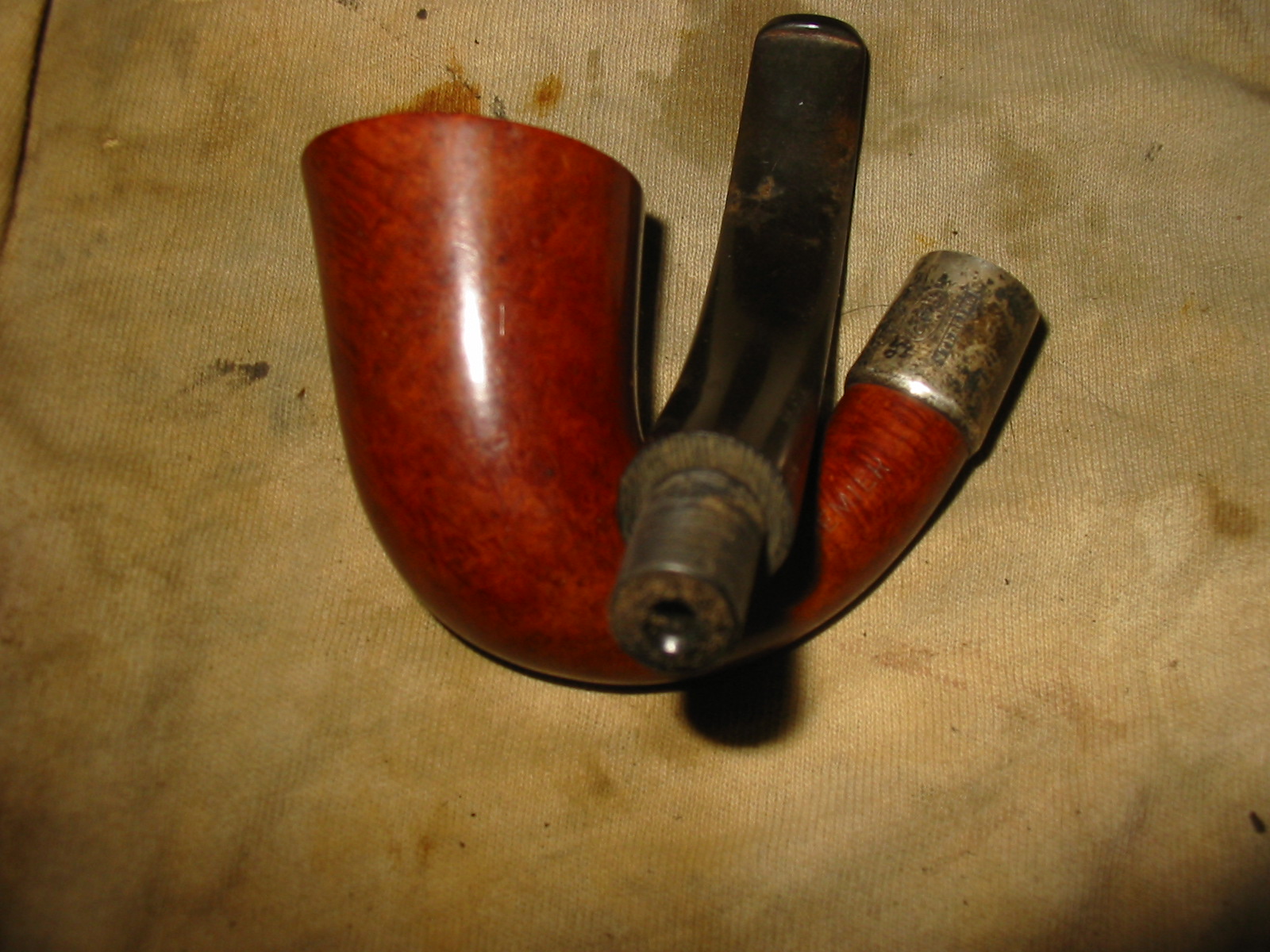
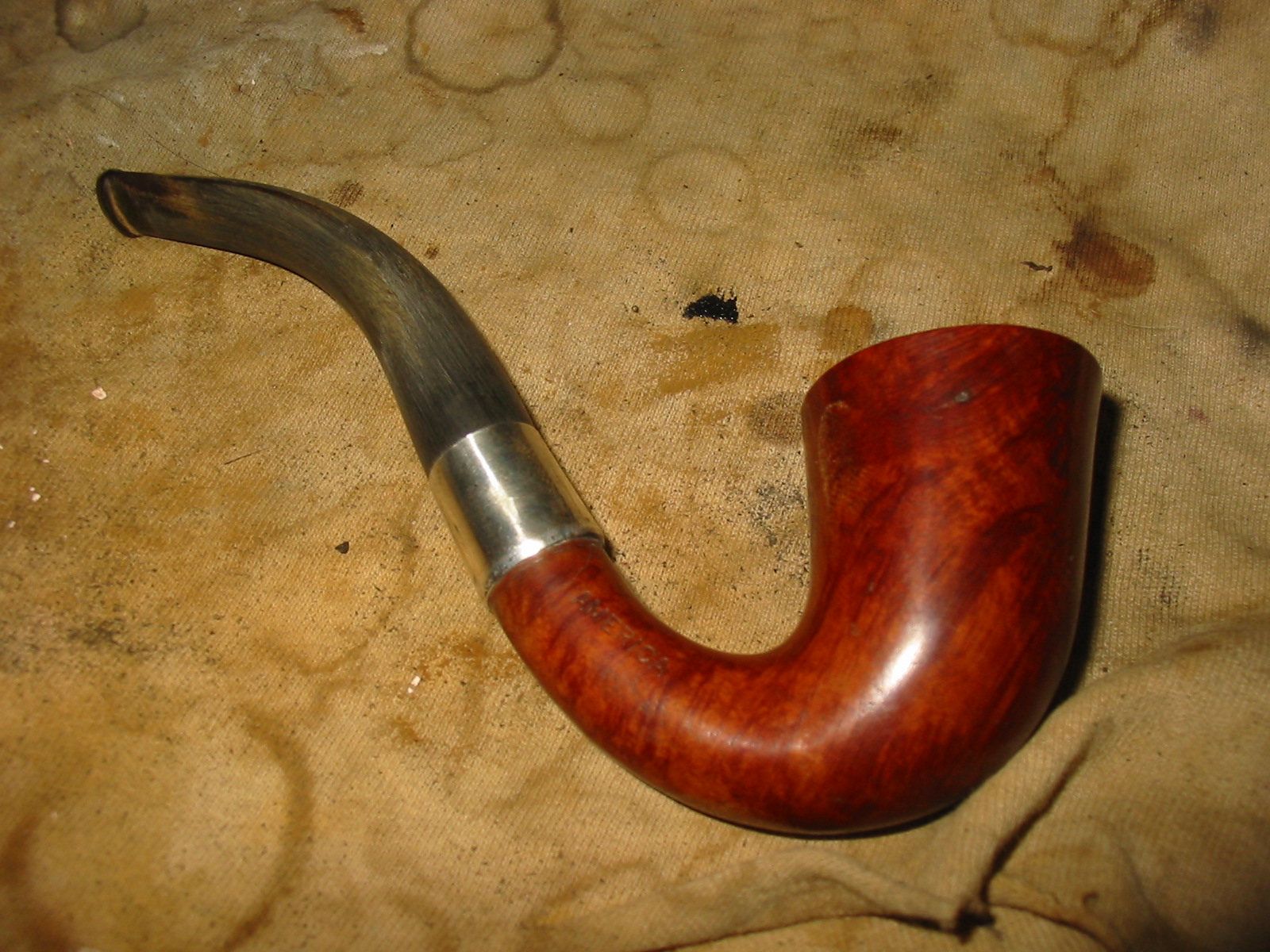
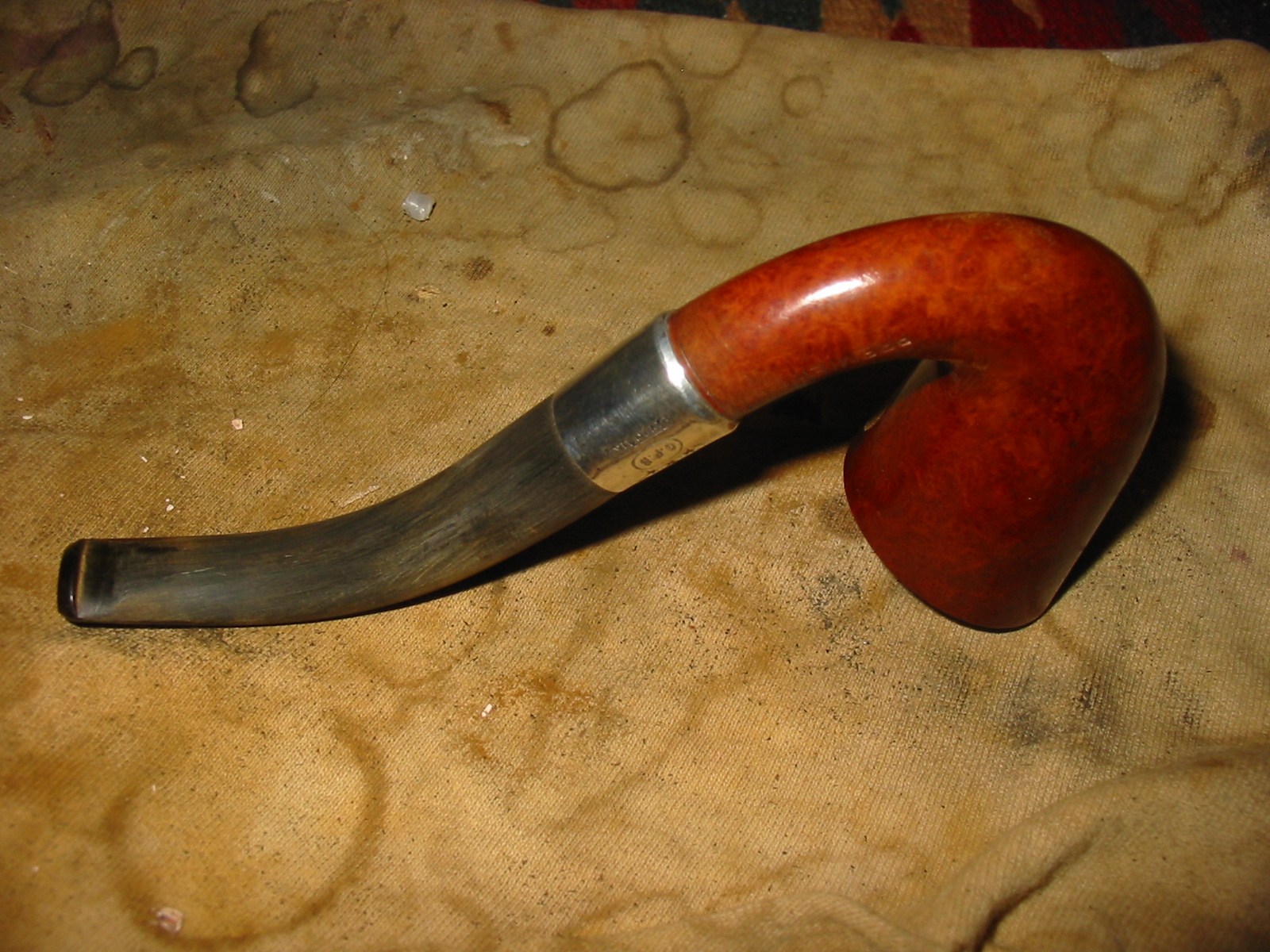
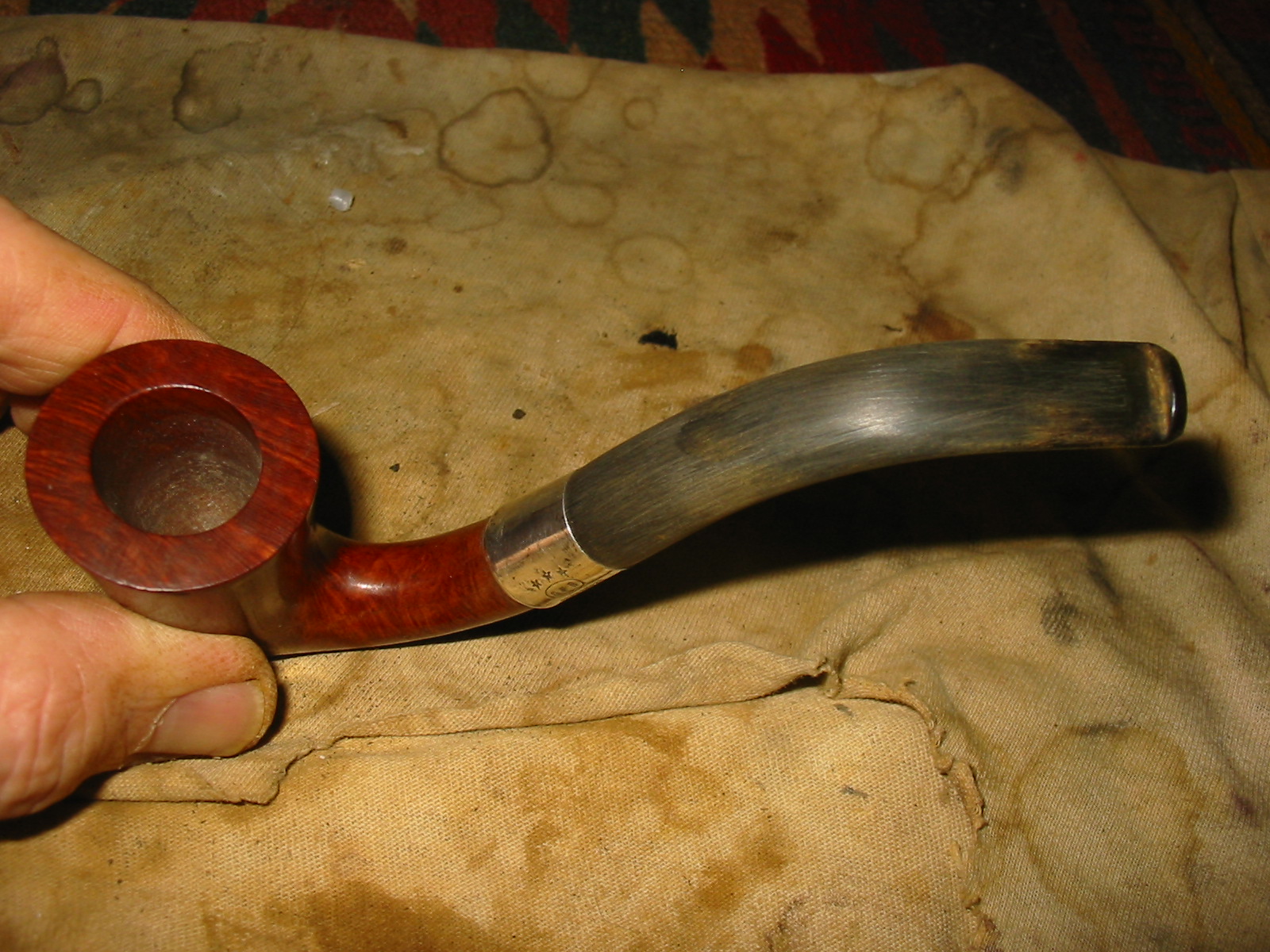
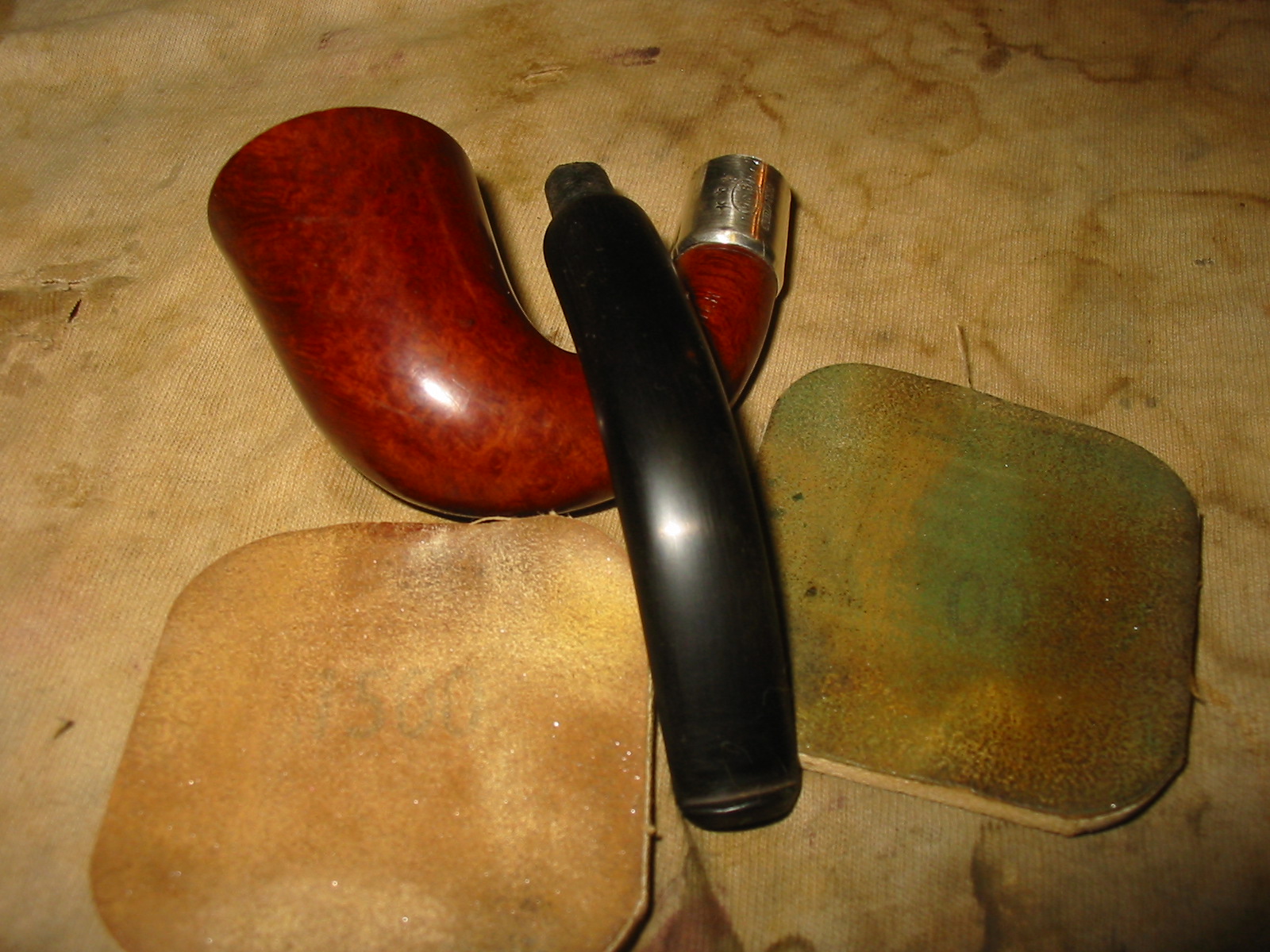
I bought three unsmoked pipe bowls from the same seller on EBay. One of them was a GFB calabash. With the first of this brand I bought a while back I did some digging on the web and found very little information. So this time I did a bit more searching and I was able to get some information on the brand. Many of the links I found through Google took me to others who were looking for information on the brand. I came across one that gave the information that the GFB brand was an older French Trademark and that it came from Saint Claude, France. With that information I did a more focused search for GFB French Briar Pipes and came across a post that said GFB stood for Great French Briar – that seemed a little farfetched to me so I continued to look and finally came across the following advertisement from a Sears Catalogue. It shows a full page of GFB pipes and the header says GENUINE FRENCH BRIAR. That made much more sense to me and the pipes in the catalogue matched the ones that I have in my collection and the ones that I have seen. For me that gives a better picture into the meaning of the brand letters.

Genuine-French-Briar-Pipes-On-Parade

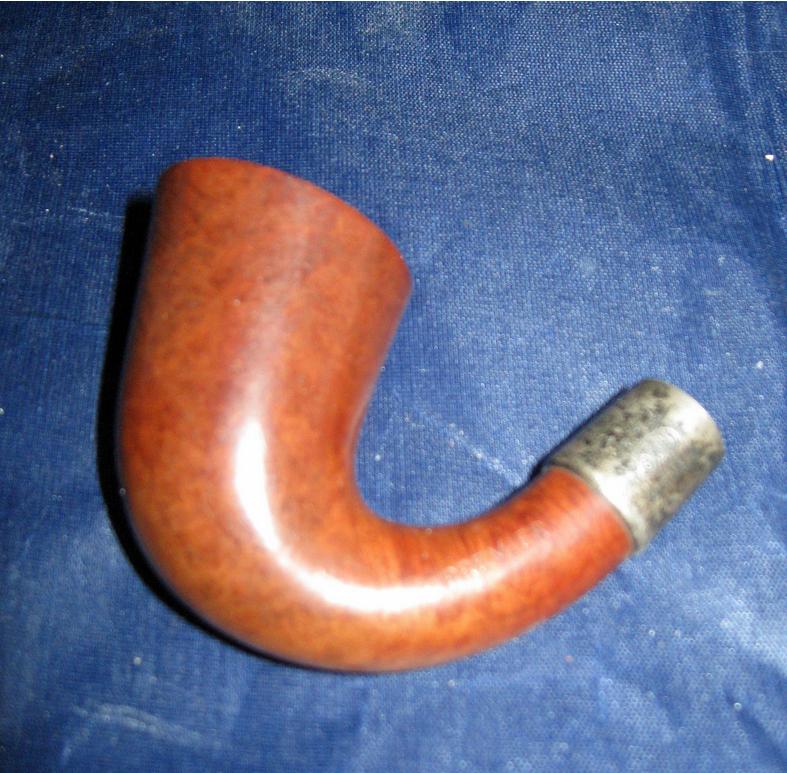
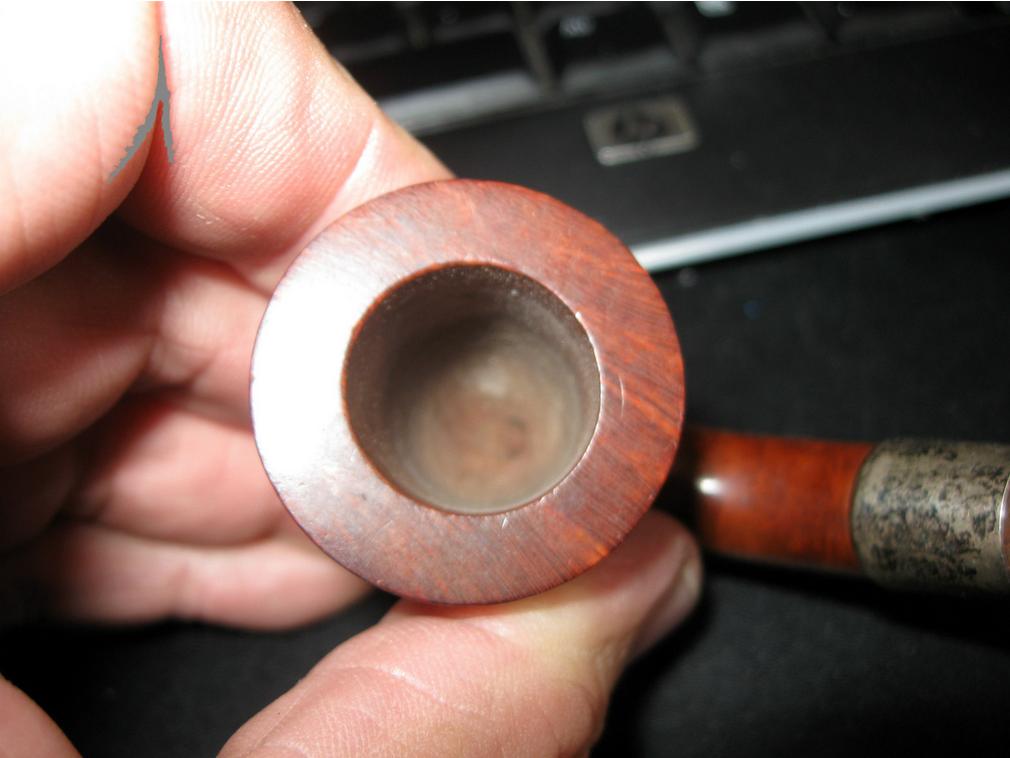
Armed with this new information I went to work on the GFB Calabash pipe bowl that I purchased. The bowl itself was in astonishingly great shape for being over 100 years old. The pipe was unsmoked – new condition. The bowl was dusty but raw briar. The shank was clean and also pristine. This was an unsmoked – new old stock pipe bowl. The silver band was very tarnished and loose. There was no stem to be found. I wrote to the seller and asked what had happened to the stems for this old timer and two others I purchased from them. I did not receive an answer. The first four photos below are the seller’s photos as the pipe appeared on EBay. The first two are out of focus but give an idea of the bowl shape. The last two give close up photos of the stamping and the clean bowl. It was pretty hard to know the size of the pipe from their information. But it looked to be of similar age as an older 1912 BBB Calabash I have so I put in a bid and won.

GFB1

GFB2

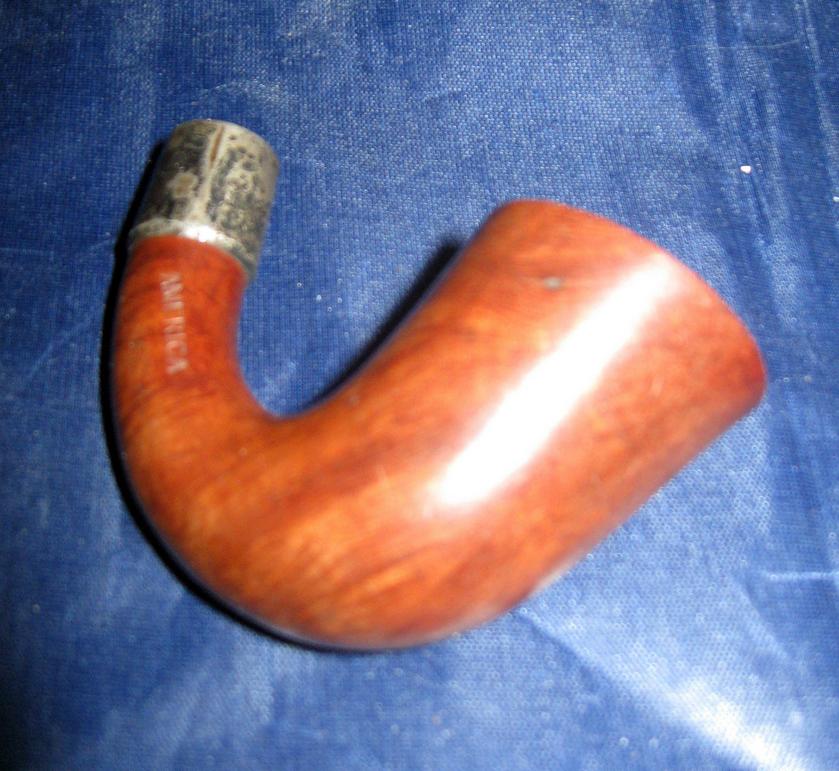
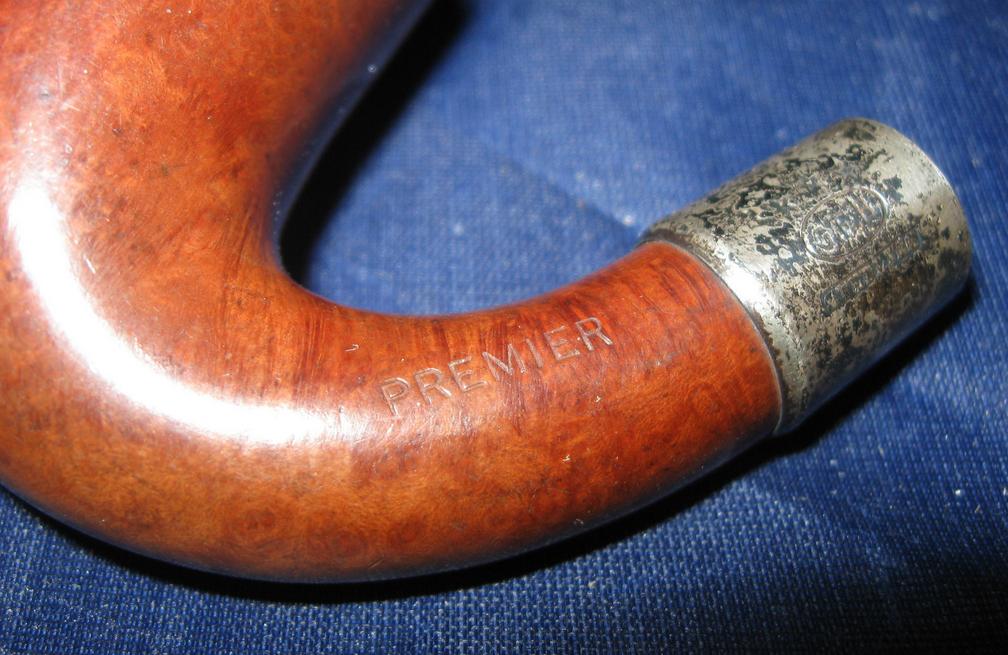
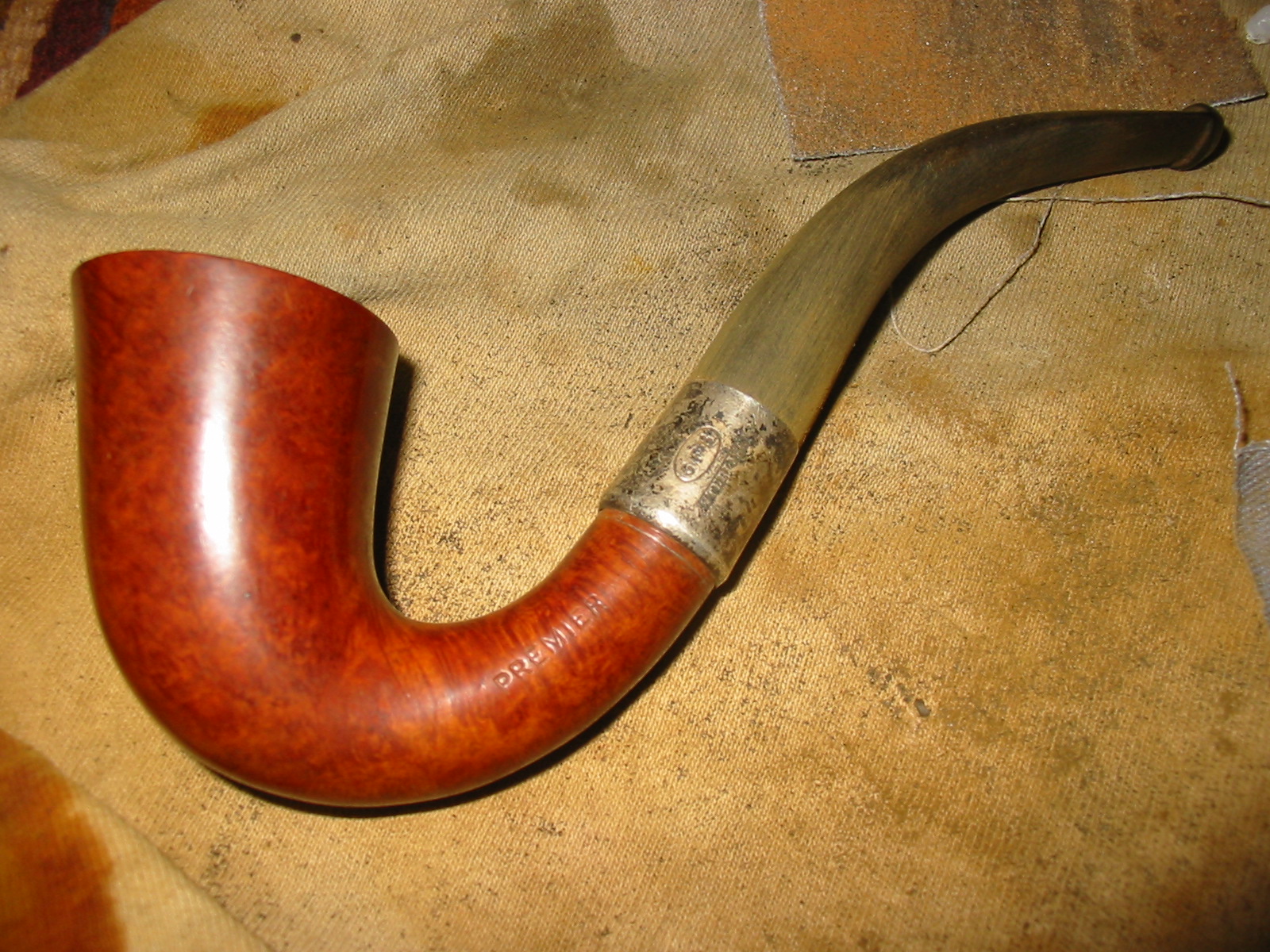
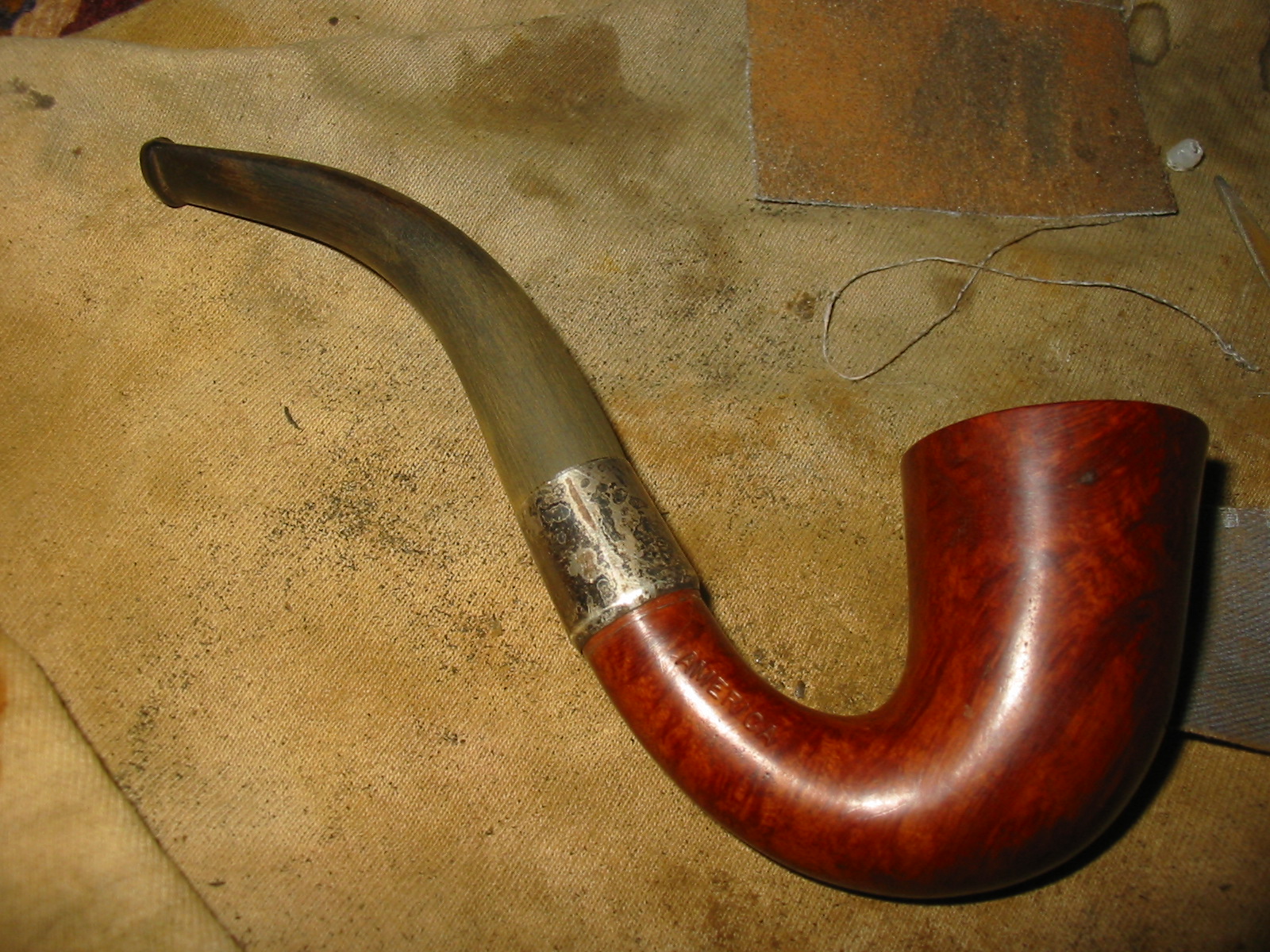
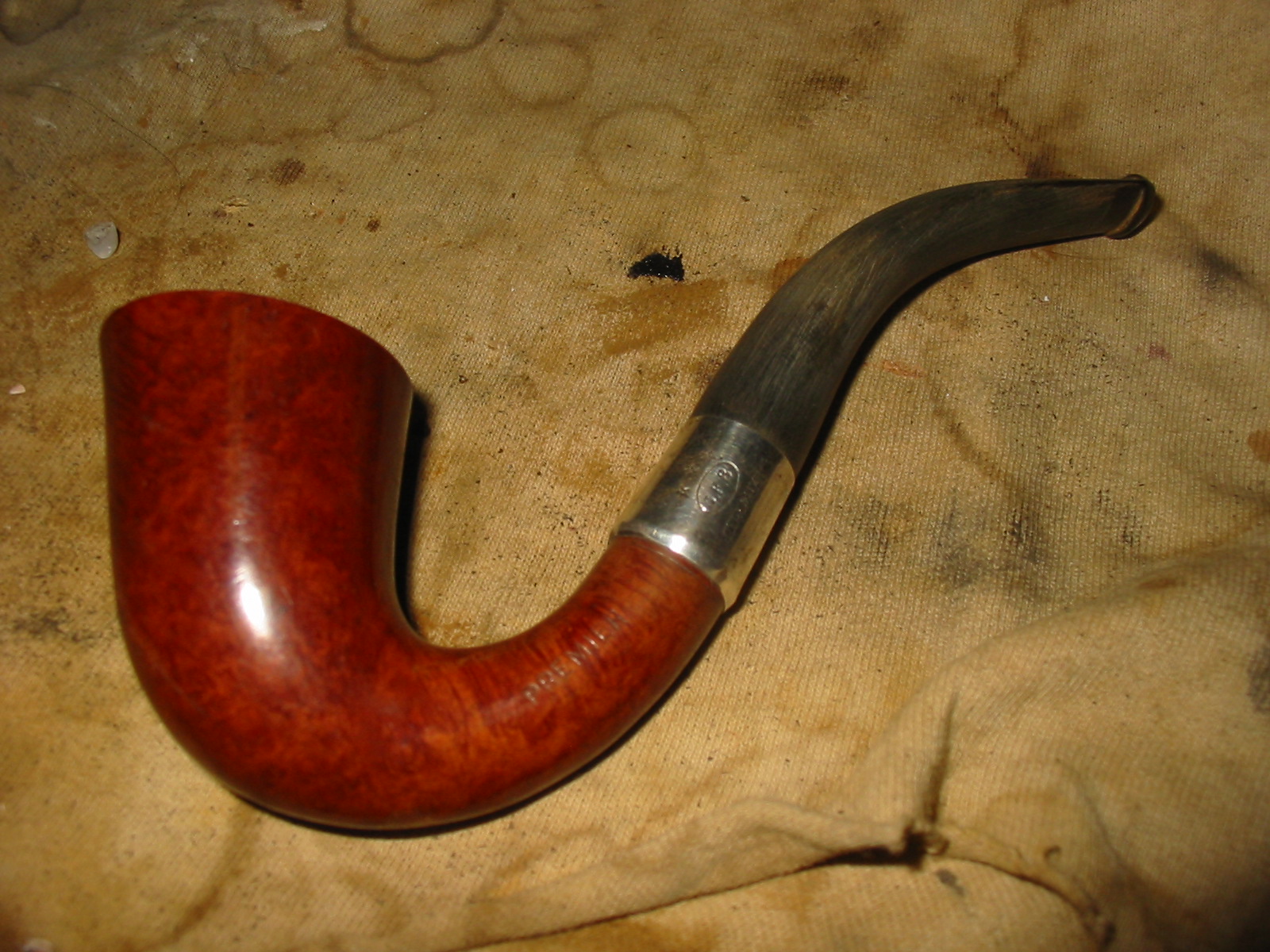
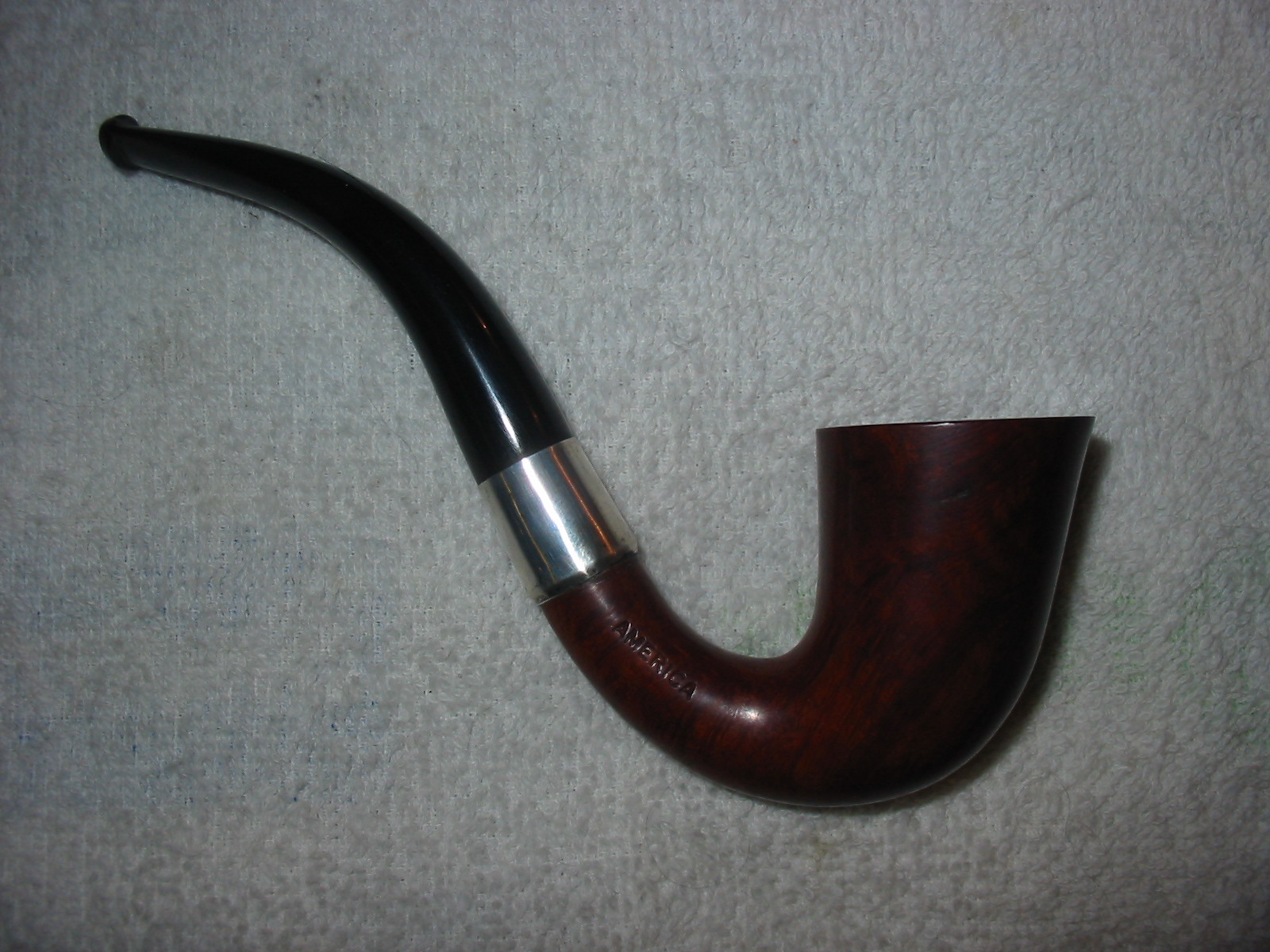
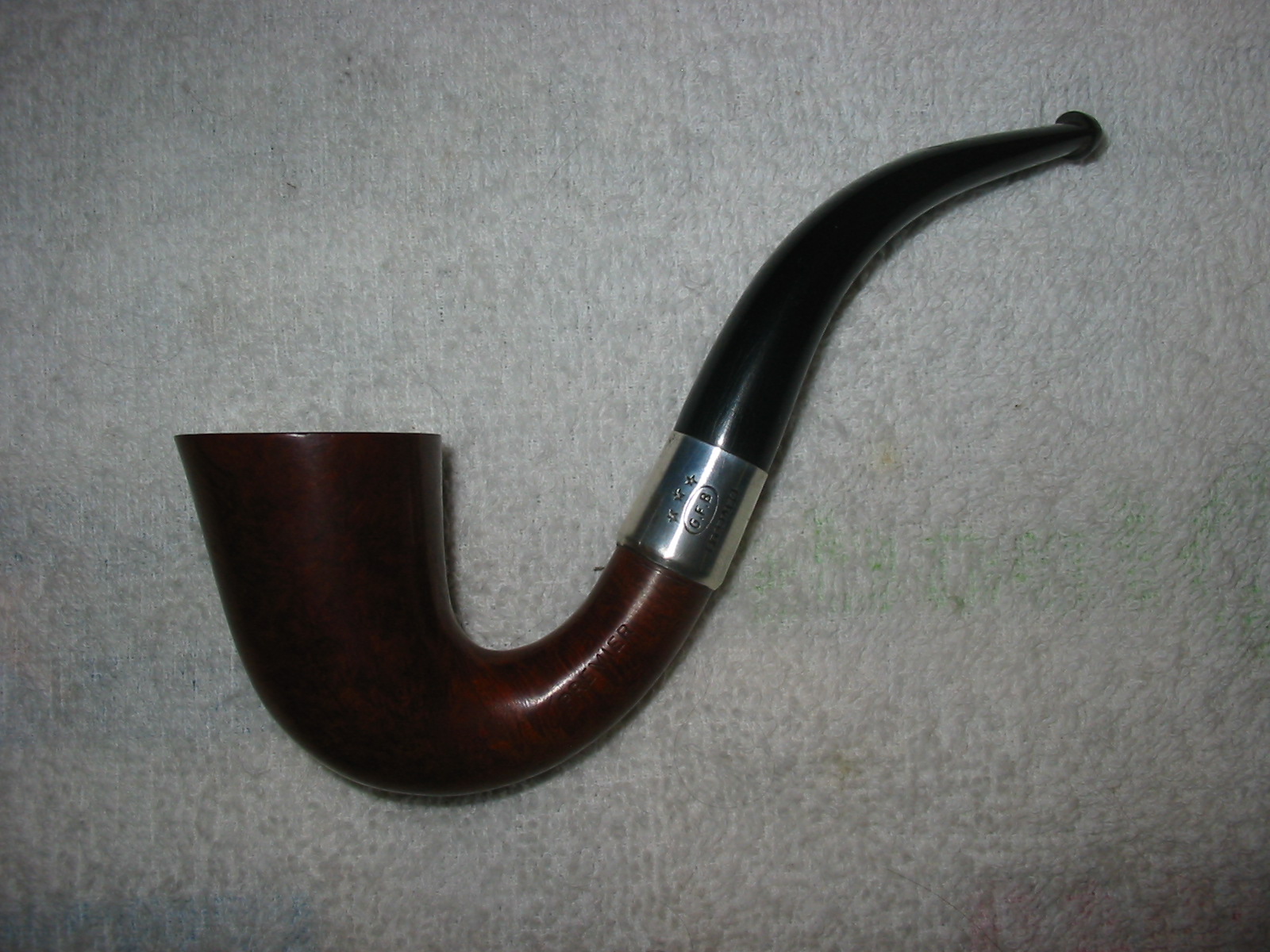
The right side of the shank is stamped America and the left side is stamped Premier. The band has three stars *** over the GFB in an oval and under that is the Sterling stamp. The stamping led me to assume incorrectly that this was an older American made pipe. I was wrong. The stamping America obviously is the name of the pipe.

GFB3

GFB4

I looked through my box of old stems to find one that would be not just a proper fit but of an age that was appropriate to this old pipe. I found one that did not have a tenon, it had either broken or fallen out somewhere along its journey. I have a bag of Delrin threaded tenons that I use regularly for replacing broken tenons. I chose the smallest one as it would fit the mortise with a little bit of work. The stem was oxidized but in good shape with no tooth marks or dents. The button was a slight slot and the stem was quite narrow at the button end. It would look perfect on the pipe once I had the tenon replaced.

IMG_0962

I drilled out the stem so that the threaded tenon would fit into it. I used a tap to thread the stem. The first photo below shows the drilled and tapped stem ready to receive the new tenon. I coated the threads with some black super glue and threaded it into the stem (second photo). The third and fourth photos below shows the tenon screwed into place. The tenon is now repaired. I needed to remove some of the Delrin to reduce the diameter of the tenon to get a good fit on the shank. I used my Pimo Tenon turner to do this. It was a little tricky in that the stem was bent but I proceeded slowly to turn it down until it was close. I finished reducing it by hand until it fit snugly in the mortise.

IMG_0964

IMG_0965

IMG_0966

IMG_0967

Once the stem fit snugly in the shank I needed to reduce the diameter of the stem in order to get a good match with the band on the shank. I sanded it with medium grit emery paper to bring it down to size. The next two photos show the stem in place. At this point the band had not been glued into place. It was still loose, so I removed the stem and used Weldbond white carpenters glue (which is non-toxic) to glue the band in place. I cleaned up the old glue lines on the shank with micromesh sanding pads.

IMG_0972

IMG_0973

The next four photos show the silver band after it had been glued in place and cleaned and polished with some Hagerty Tarnish Preventive Silver Polish. I have used this bottle for years and it works extremely well. I purchased it at a jewelry shop along with a polishing cloth that I used on the band as well. Once the band was polished the hallmarks were very visible. I have described the stamping on the band above. After shining they stood out clearly. I am not able to ascertain a date from the stamping as there are no date stamps. I also polished the bowl with a quick buff of White Diamond on the buffer and then I gave it multiple coats of carnauba wax.

IMG_0975

IMG_0976

IMG_0977

IMG_0978

With the bowl and band finished it was time to work on the stem. I sanded it with 220 and 340 grit sandpaper followed by sanding with a medium grit sanding sponge and then a fine grit sanding sponge. This series of sandpapers and sanding sponges has worked well for me in removing the scratches left by the emery paper as well as the remaining oxidation on the stem. I then sanded the stem with micromesh sanding pads from 1500-12,000 grit to bring out the sheen on the stem and polish it. Between the 4000 and the 6000 grit I polished the stem with Maguiar’s Scratch X2.0 plastic polish. I finished with the last grits of micromesh sanding pads. The next series of six photos show the progressive shine on the stem with the various grits of micromesh.

IMG_0983

IMG_0984

IMG_0985

IMG_0986

IMG_0987

IMG_0988

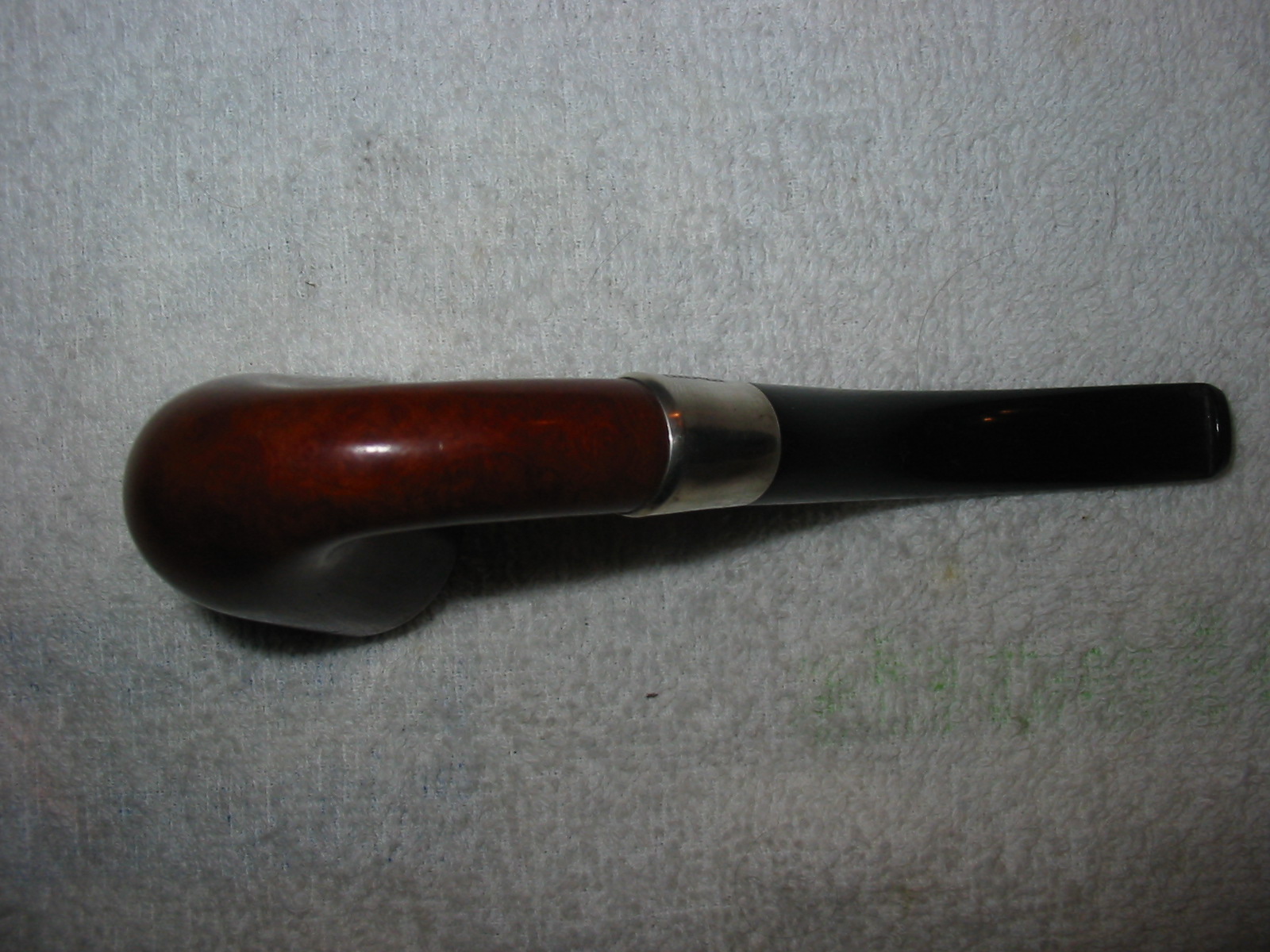
I buffed the stem and bowl with White Diamond and then gave the pipe several coats of carnauba wax. The finished pipe is pictured below in the last series of four photos. It is amazing that this old pipe has existed this long since it was made and has not been smoked. That will change soon!

IMG_0990

IMG_0991

IMG_0992

IMG_0993

Breathing New Life into a Dr. Grabow Riviera


Blog by Steve Laug

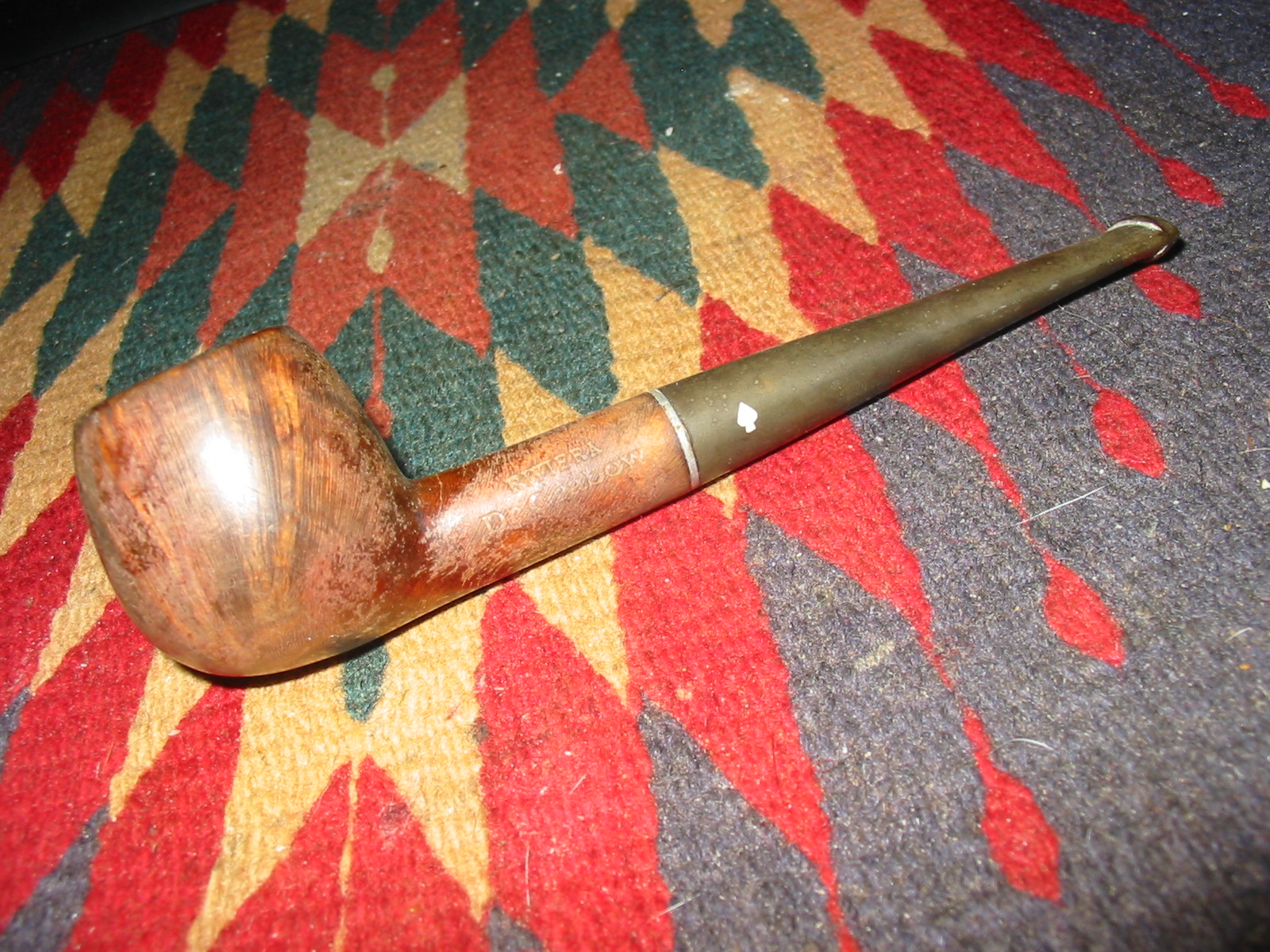
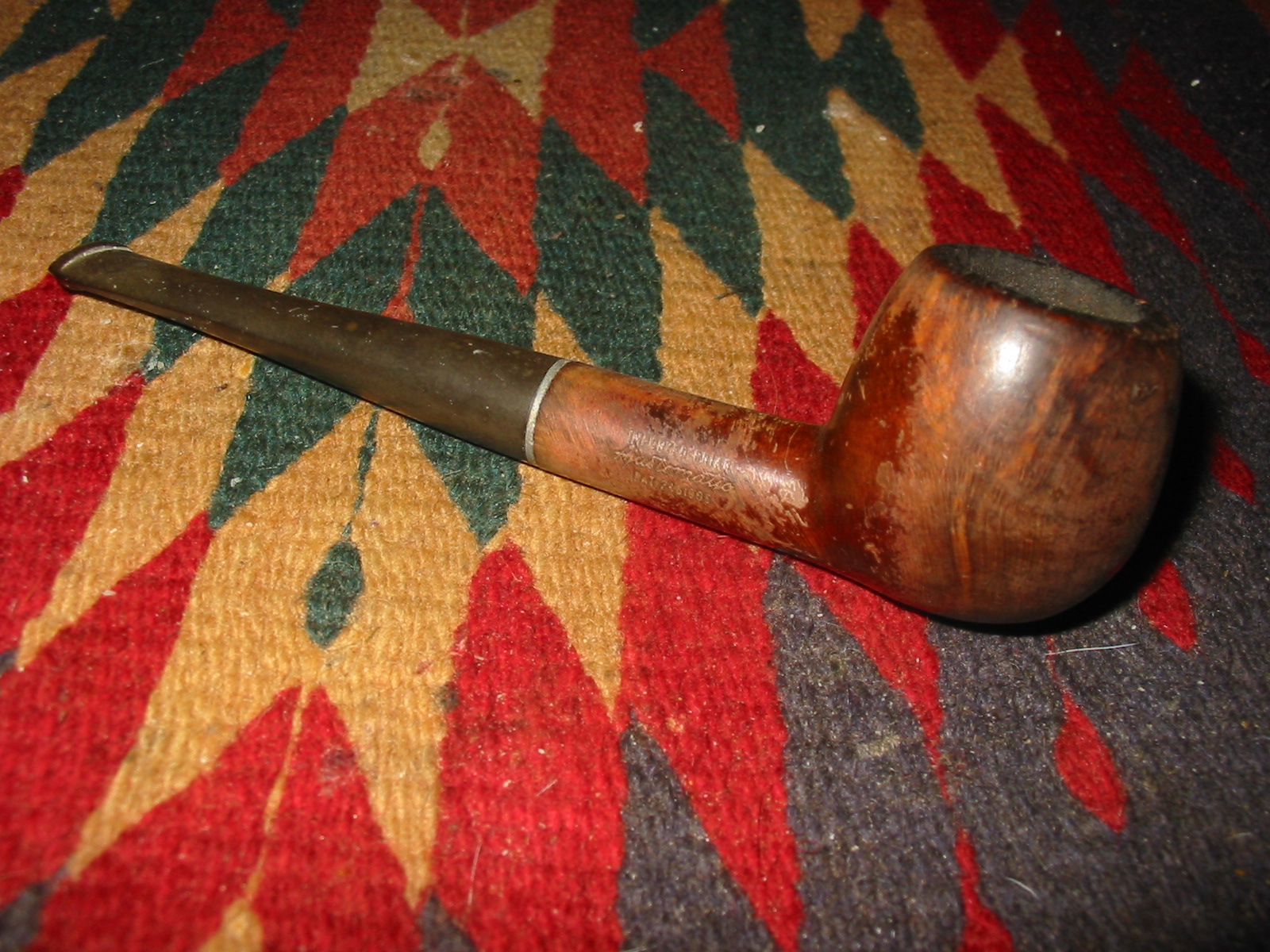
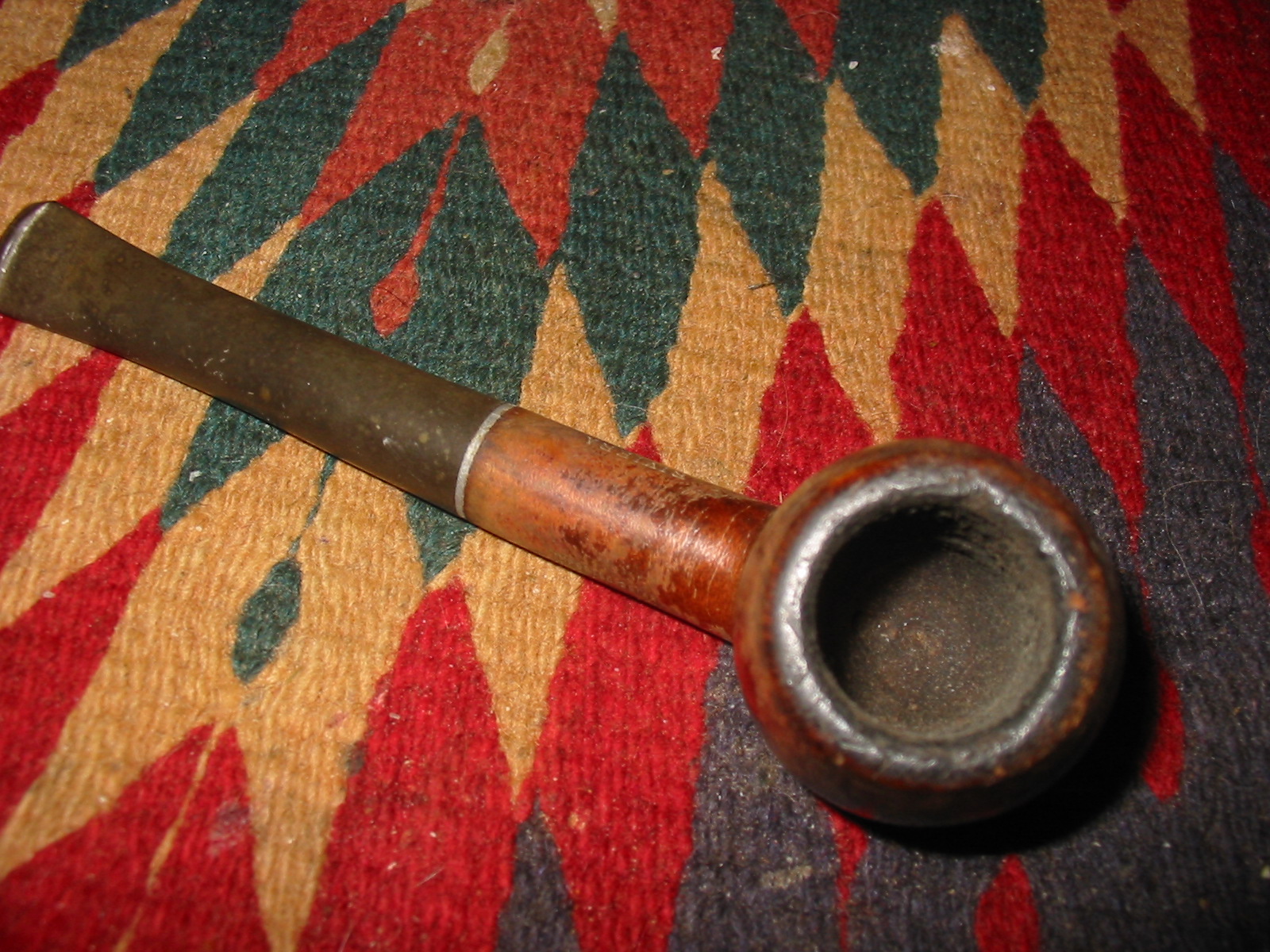
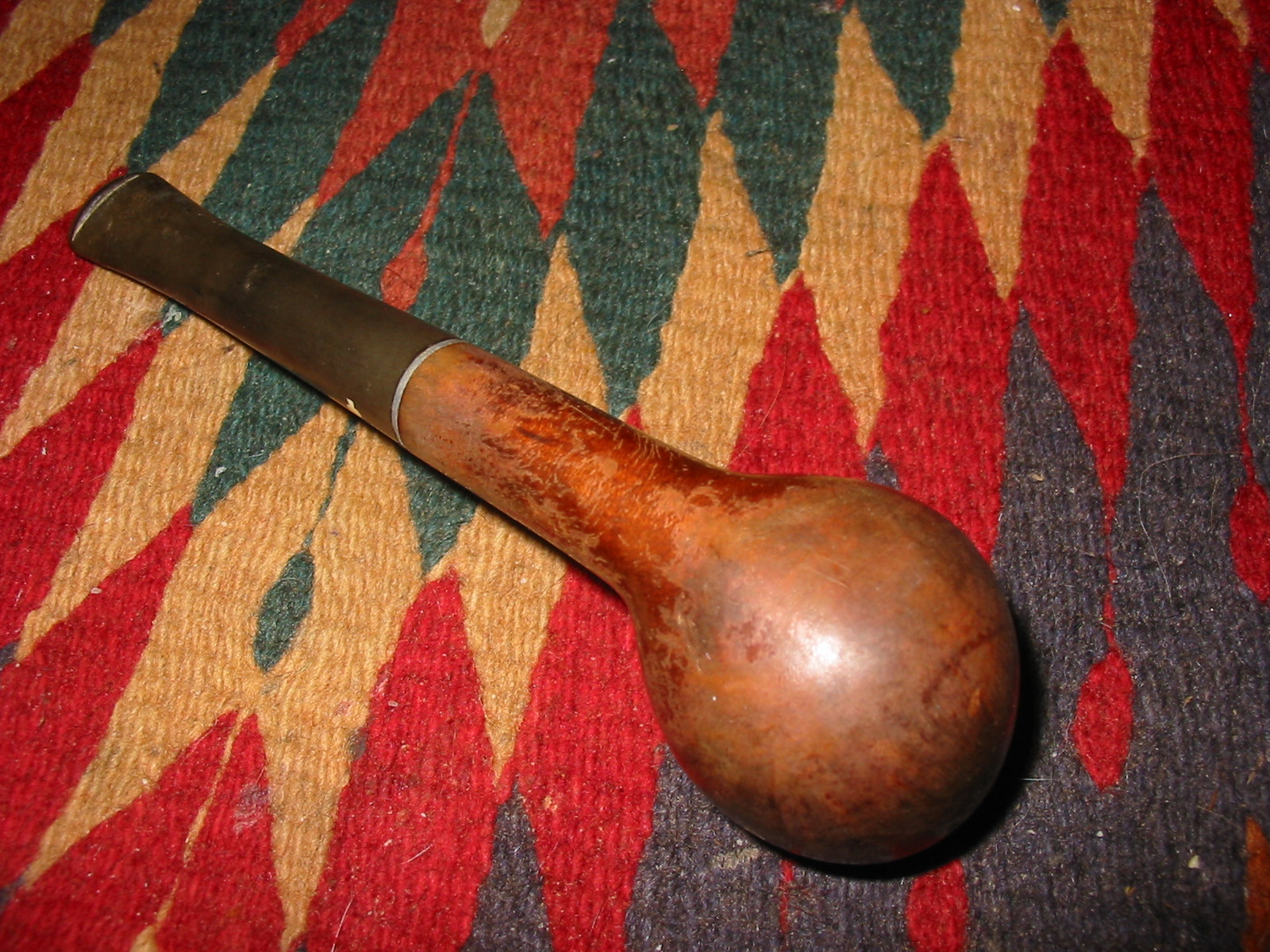
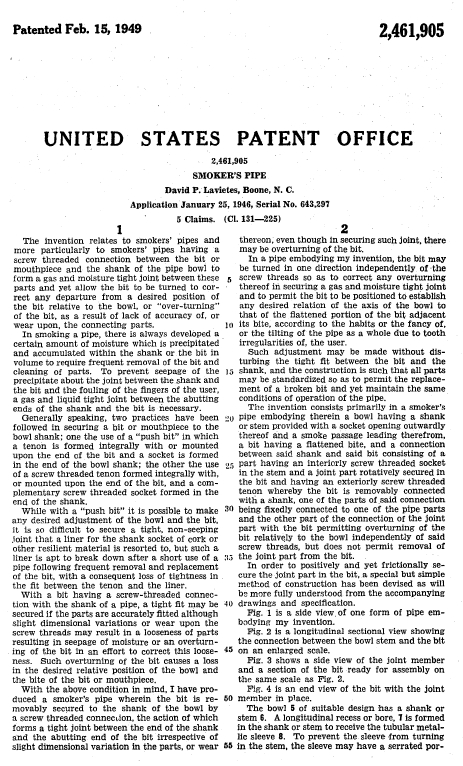
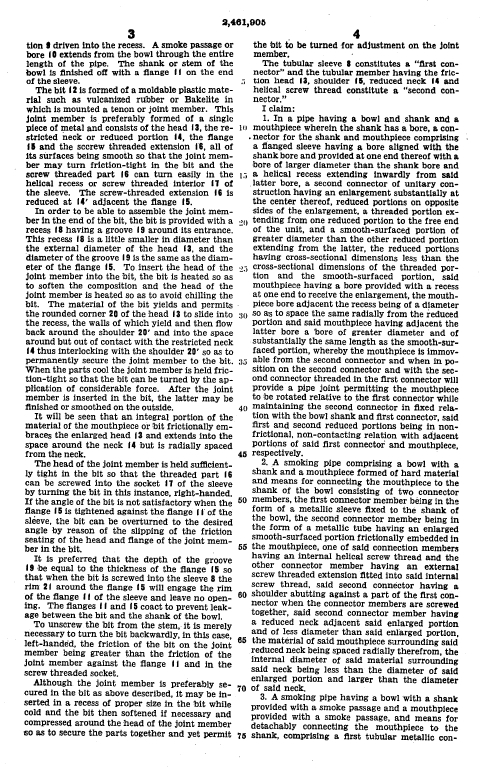
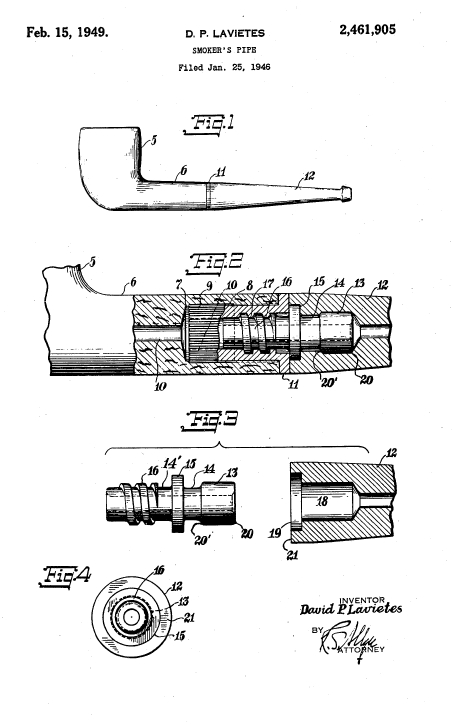
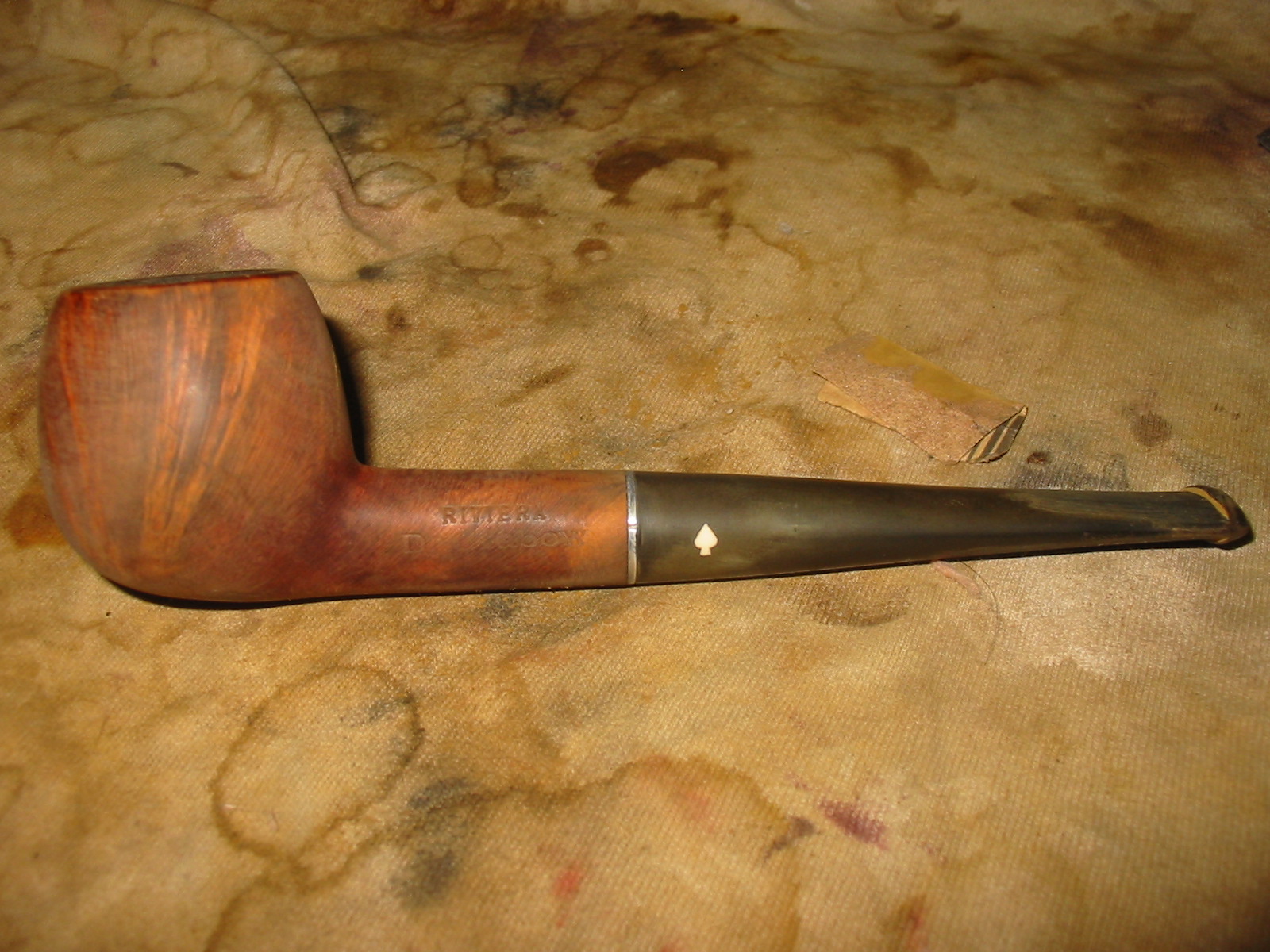
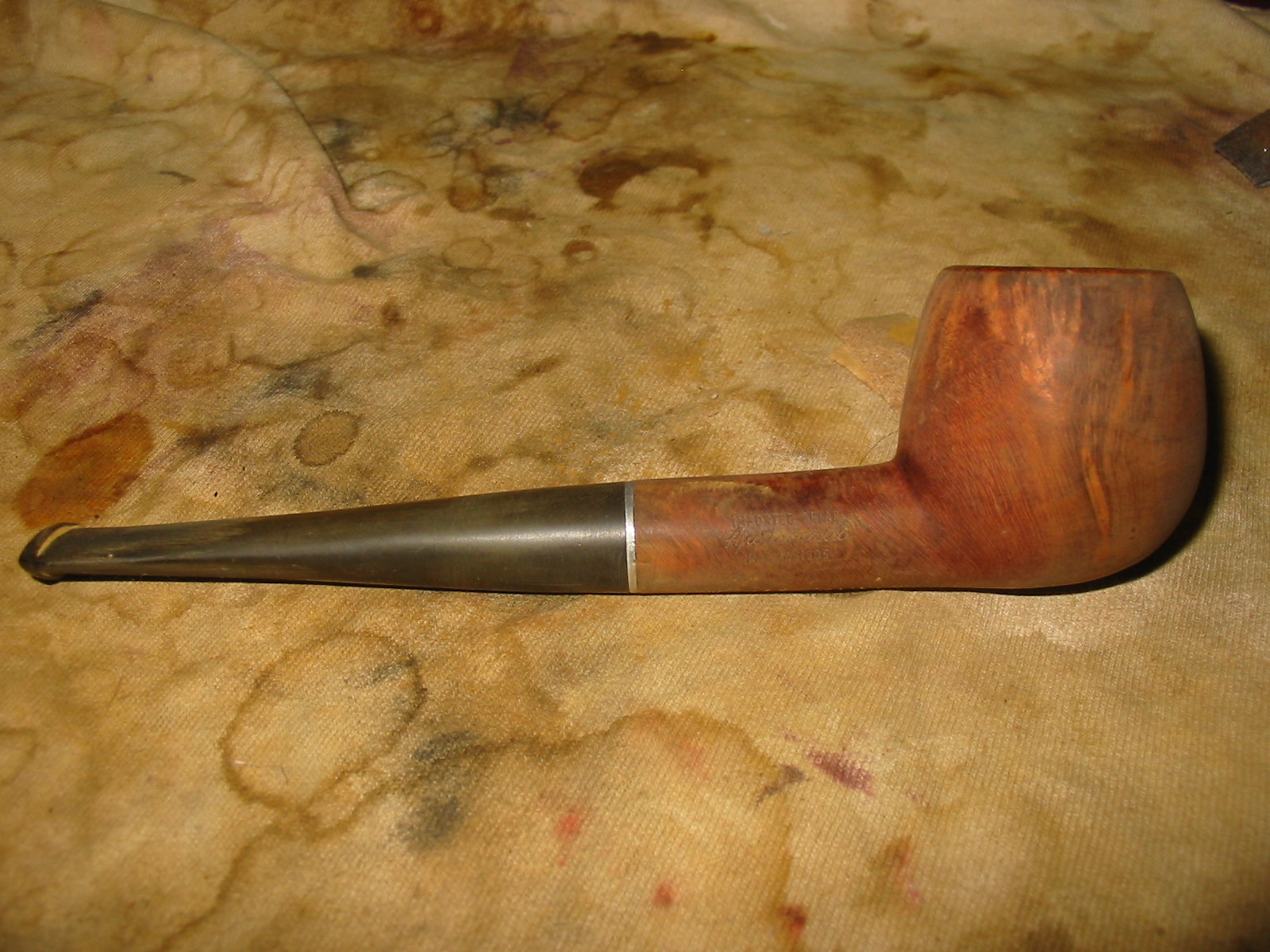
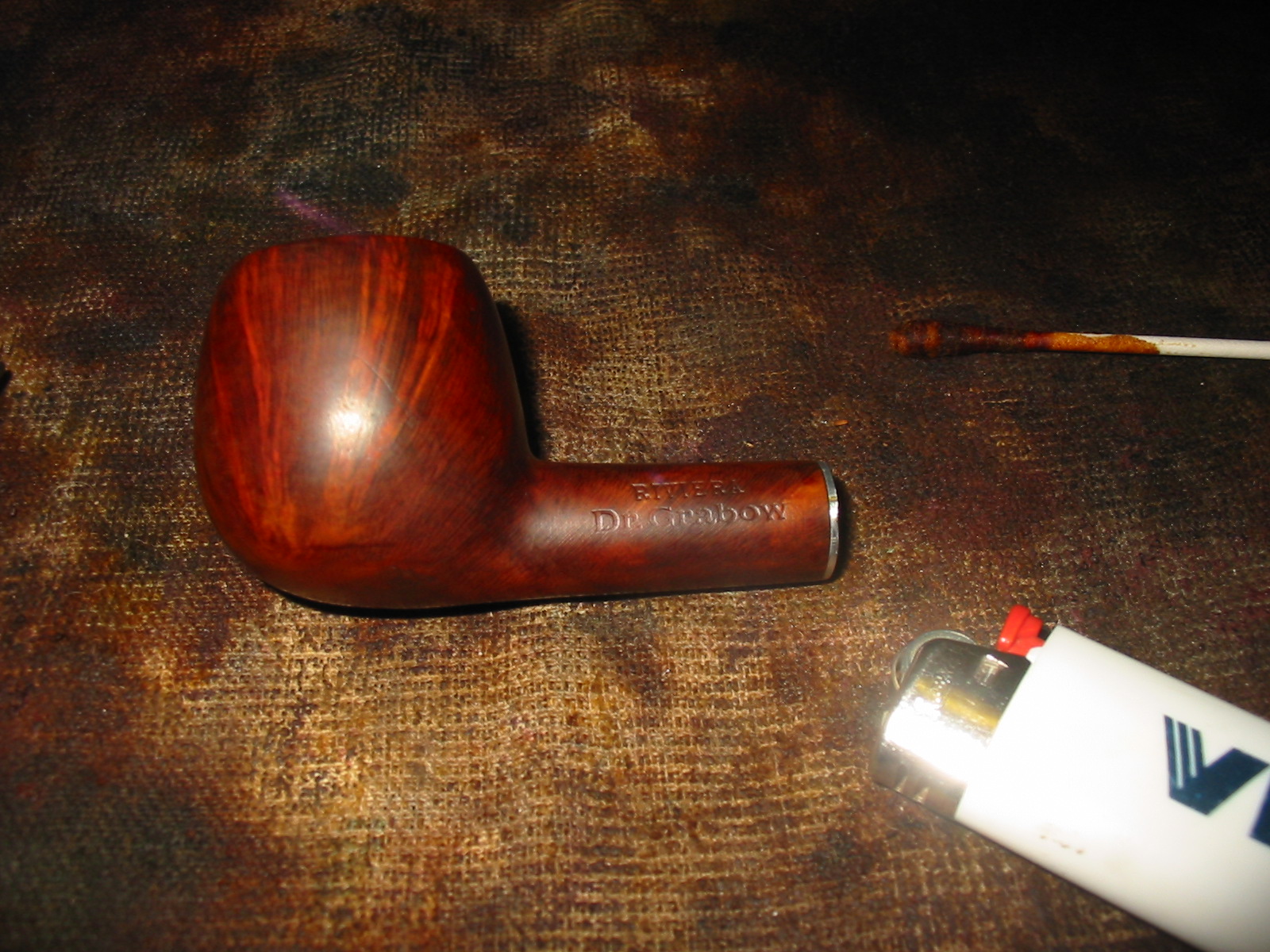
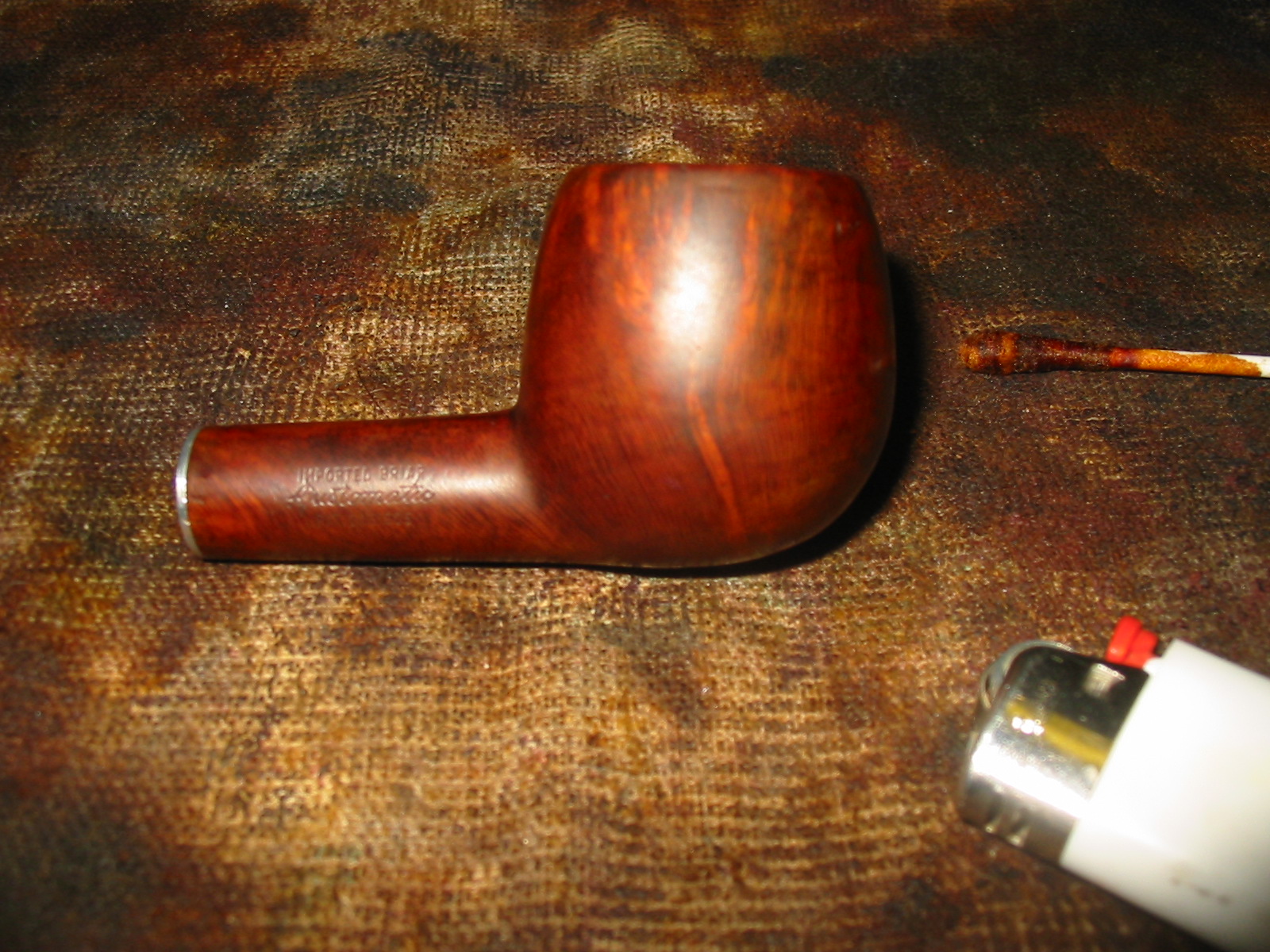
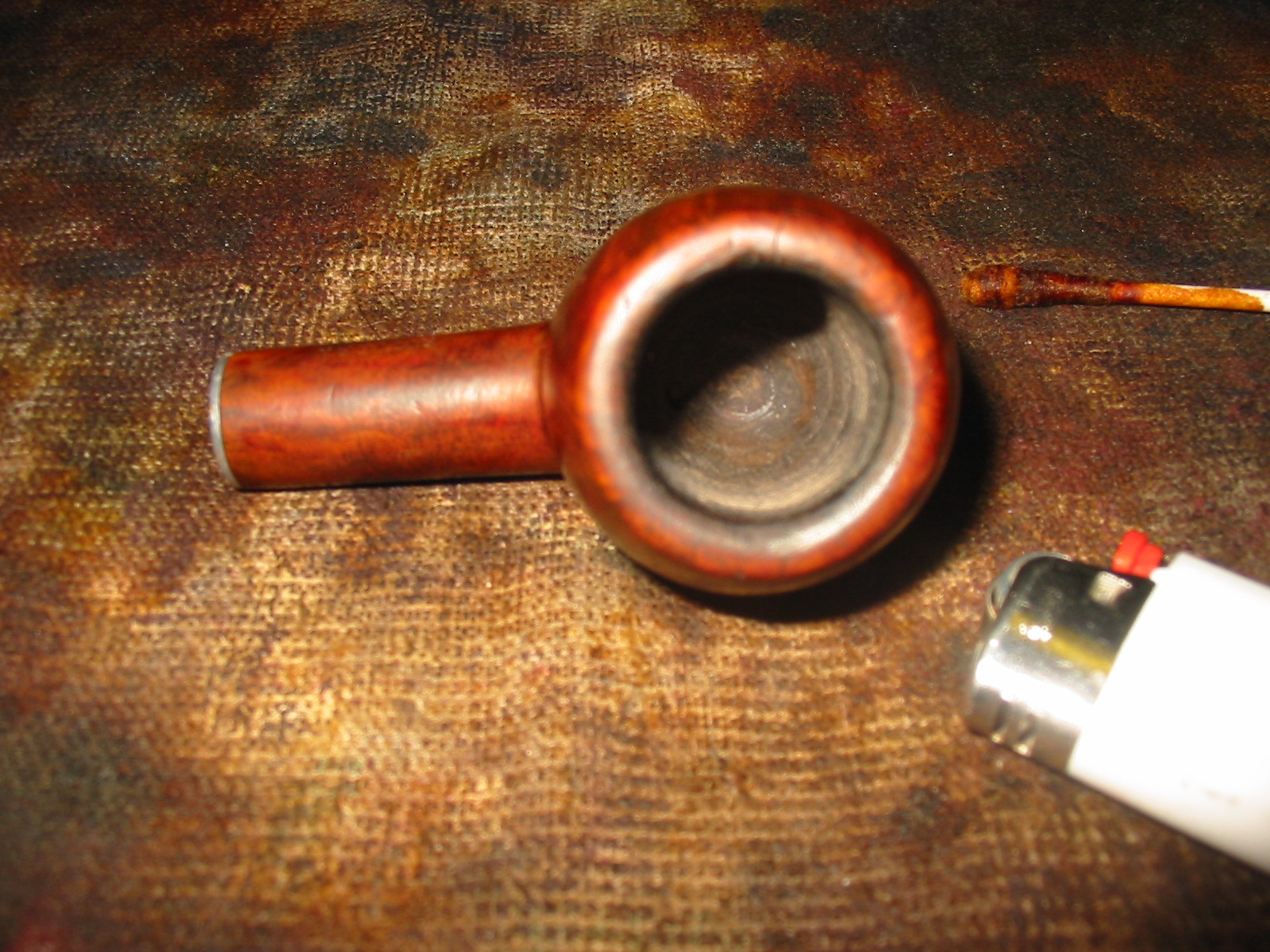
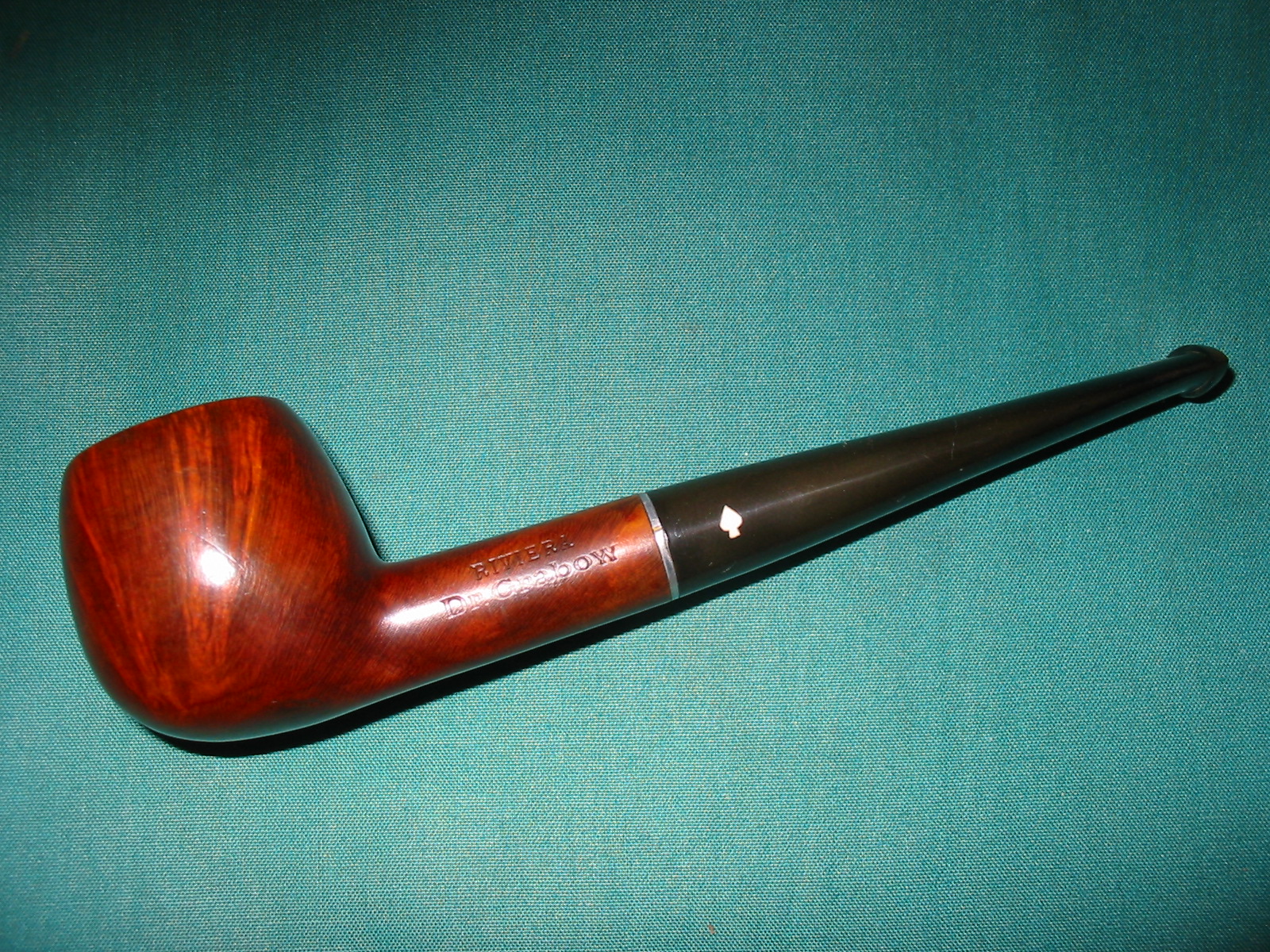
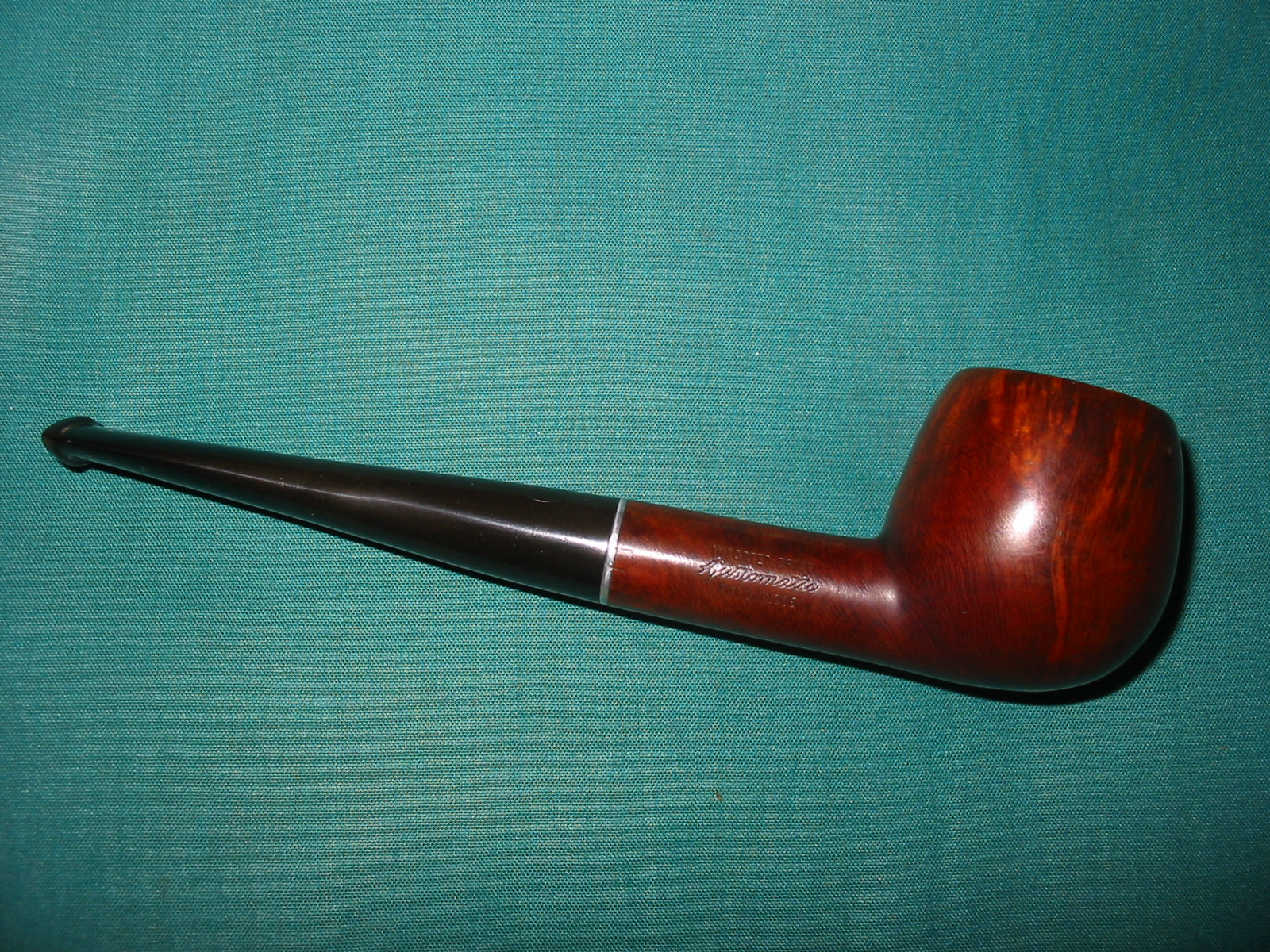
When I am refurbishing pipes I take the same care on older factory made pipes as I do on the more collectible ones. To me this is part of the stewardship of refurbishing. It does not matter what the original price of the pipe was – it is worth redeeming and bringing back to life. The refurbishing of the next pipe is one of those. It is an older Dr. Grabow Riviera. It was given to me by a good friend in Ponoka, Alberta. He gave it to me as a gift when I visited him recently. It is stamped Riviera over Dr. Grabow on the left side of the shank and Imported Briar over Adjustomatic over a patent number – PAT. 2461905 on the right side of the shank. The stinger apparatus in this one is an insert into the metal tenon. It is tube with a scooped portion on top that has a hole in the bottom of the scoop. The air/smoke circulates in the shank and is drawn into the stem by the smoker. The surface area of the apparatus acts as a condenser and filter. The beauty of this design is that it can be removed. The stem was badly oxidized and also had tooth dents on the top and bottom near the button. The finish was shot and the varnish was peeling from the bowl and shank. The rim was darkened and dirty and had a small crack on the top left side. The four photos below show the state of the pipe when I brought it home.

IMG_0846

IMG_0847

IMG_0848

IMG_0849

I love doing research on old patents and with US made pipes it is very simple. The following website is a simple way to find data and diagrams. http://patft.uspto.gov/netahtml/PTO/srchnum.htm In the search parameters you enter the patent number from the pipe and click on the search button. Generally, these older patents have been made into PDF files that can be downloaded. Here is a copy of the information I found there. It is a patent for the Adjustomatic connector. I always find reading through these patent application documents gives me a feel for why the designer came up with invention. This proved true of this application as well.

Grabow Patent1

Grabow Patent2

Grabow Patent3

Grabow Patent4

After reading through the patent information I was ready to restore this old pipe. It appeared to be made somewhere around the time of the Patent as it had the patent number stamped on it. That dated it somewhere around 1949 after the patent was given. I began by reaming the bowl with the PipNet reaming set to clear up the uneven and broken cake. I decided to work on the externals first. I wiped down the bowl and shank with acetone on a cotton makeup pad to remove the finish. There was some very nice grain poking through the mottled finish and very few tiny fills that made it even more attractive to me. The acetone removed the varnish very well and also took away the dirt and filth on the exterior. The first two photos below show the process of wiping down the bowl. The old finish is visible on the cotton pad.

IMG_0850

IMG_0851

Once the finish was removed from the bowl as much as possible with the acetone, I sanded it down with 340 grit sandpaper and a fine grit sanding sponge to further remove the finish. The next series of four photos show the bowl after the acetone wash and the sanding. The grain on this one is very nice. The inner rim would need to have some attention to smooth out the rough edges and the darkening.

IMG_0852

IMG_0853

IMG_0854

IMG_0855

I sanded the metal shank band as it had some deep scratches and gouges in it. I could not remove the damage but I minimized its look. I worked on the tooth marks in the topside and the underside of the stem surface. I heated the stem with a Bic lighter – passing the flame over the tooth marks to lift them to the surface. I then sanded the stem with 220 grit sandpaper to remove the remaining marks that were present (Photos 1 – 4 below). I followed that by sanding with a fine grit sanding sponge to remove the scratches left behind by the 220 grit sandpaper (Photos 5 – 6 below).

IMG_0856

IMG_0857

IMG_0859

IMG_0860

IMG_0861

IMG_0862

I sanded the entire stem with the sanding sponge to remove the oxidation from the vulcanite. I took the pipe apart and cleaned the stinger apparatus with a cotton swab and alcohol. The next two photos show that design of the stinger. It is a two part piece and the extended tube can be removed from the screw in metal tenon. I cleaned the inside of the stem and also the inside of the stinger to remove the buildup of tars and oils inside.

IMG_0863

IMG_0864

I sanded the bowl with 1500 – 12,000 grit micromesh sanding pads, being careful around the stamping on the shank. Once the scratches were removed and the bowl was smooth I restained it with a dark brown aniline stain thinned 2:1 with isopropyl alcohol. Doing this makes the stain less opaque and also several shades lighter. I wanted to highlight the grain not hide it so this was the perfect mix to do that. I applied the stain with a cotton swab, flamed it with a lighter to set the stain and then repeated the process a second time. The next three photos show that process. You will note that I also cleaned up the inner edge of the rim with the sanding process noted above. Most of the roughness is removed. A small crack remains on the top of the left side of the bowl rim.

IMG_0948

IMG_0949

IMG_0950

I set the bowl aside and worked on finishing the stem. I sanded it with 1500 – 12,000 grit micromesh sanding pads until it was smooth and finished. I rubbed down the stem with Obsidian Oil to protect and remove the oxidation. I reattached it to the bowl and buffed the stem and bowl with White Diamond on the buffer. I gave the entirety several coats of carnauba wax to bring out the shine and protect it. The final four photos show the finished pipe – cleaned, restored and ready to smoke. The photos show tinges of brown/oxidation still remaining in the stem under the flash of the camera. To deal with that I polished the stem some more and gave it another coat of Obsidian Oil and let it soak in. Upon finishing I buffed it again with carnauba.

IMG_0951

IMG_0952

IMG_0953

IMG_0954

Crafting a Briar Calabash Sitter


Blog by Steve Laug

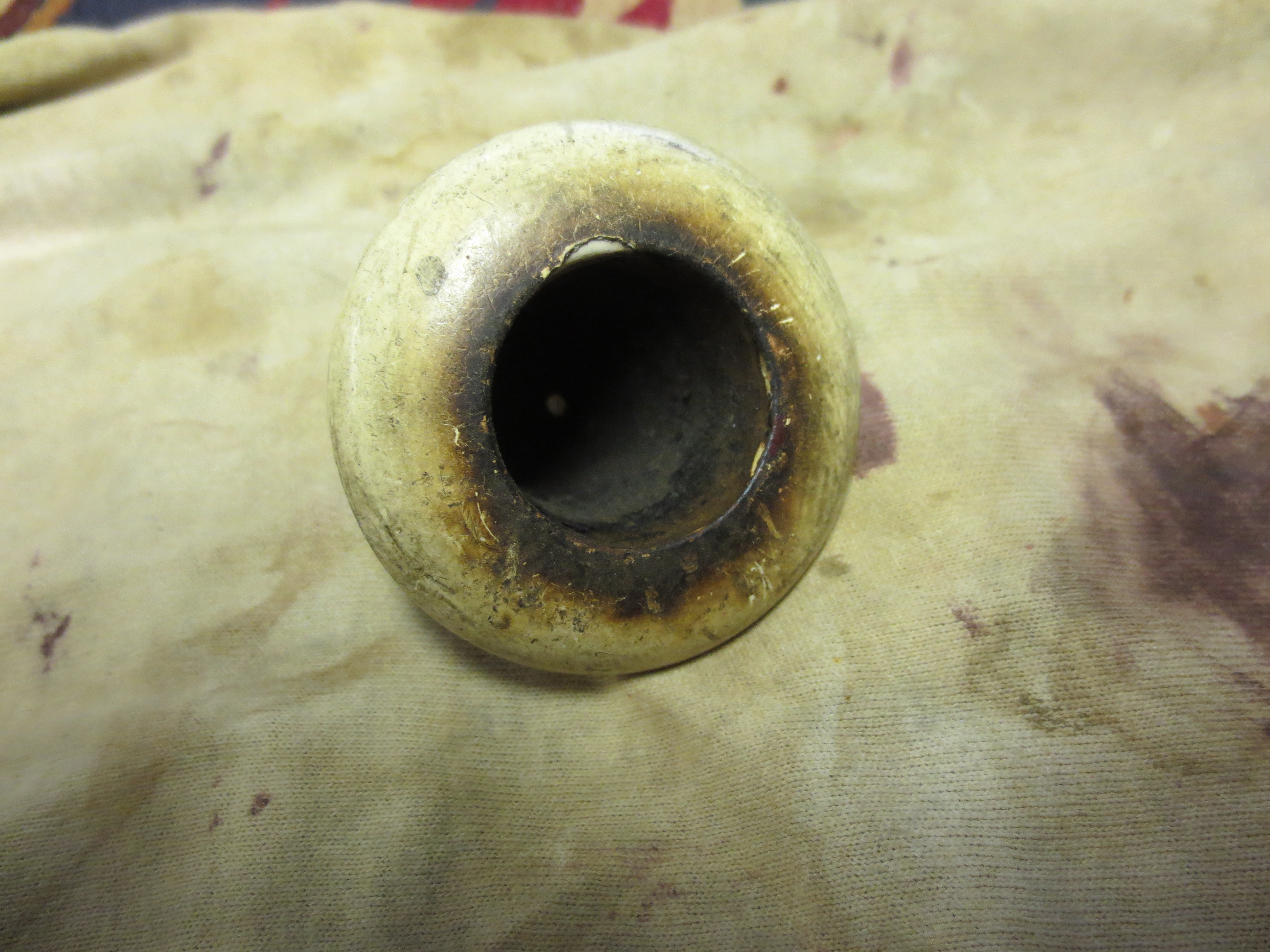
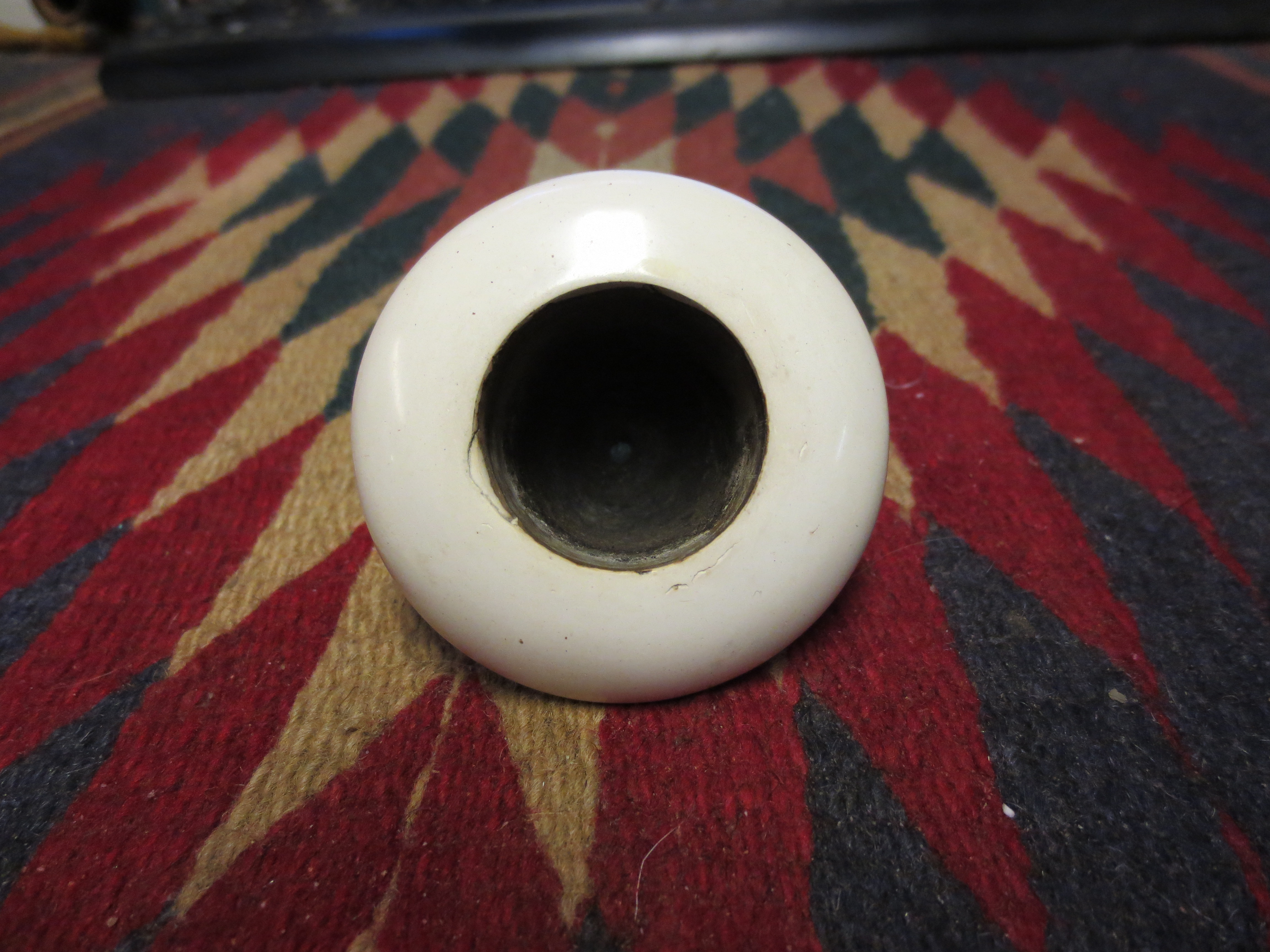
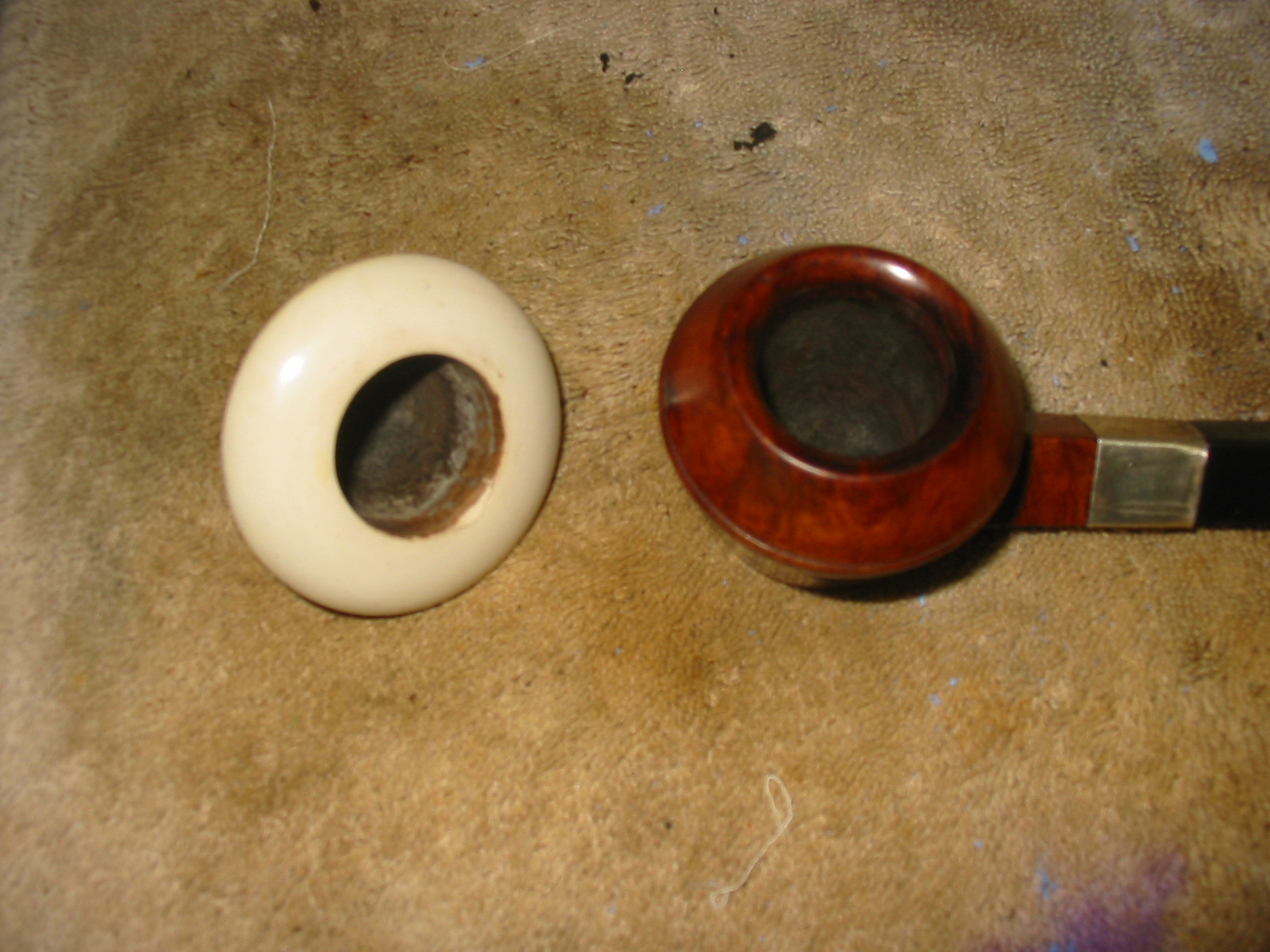
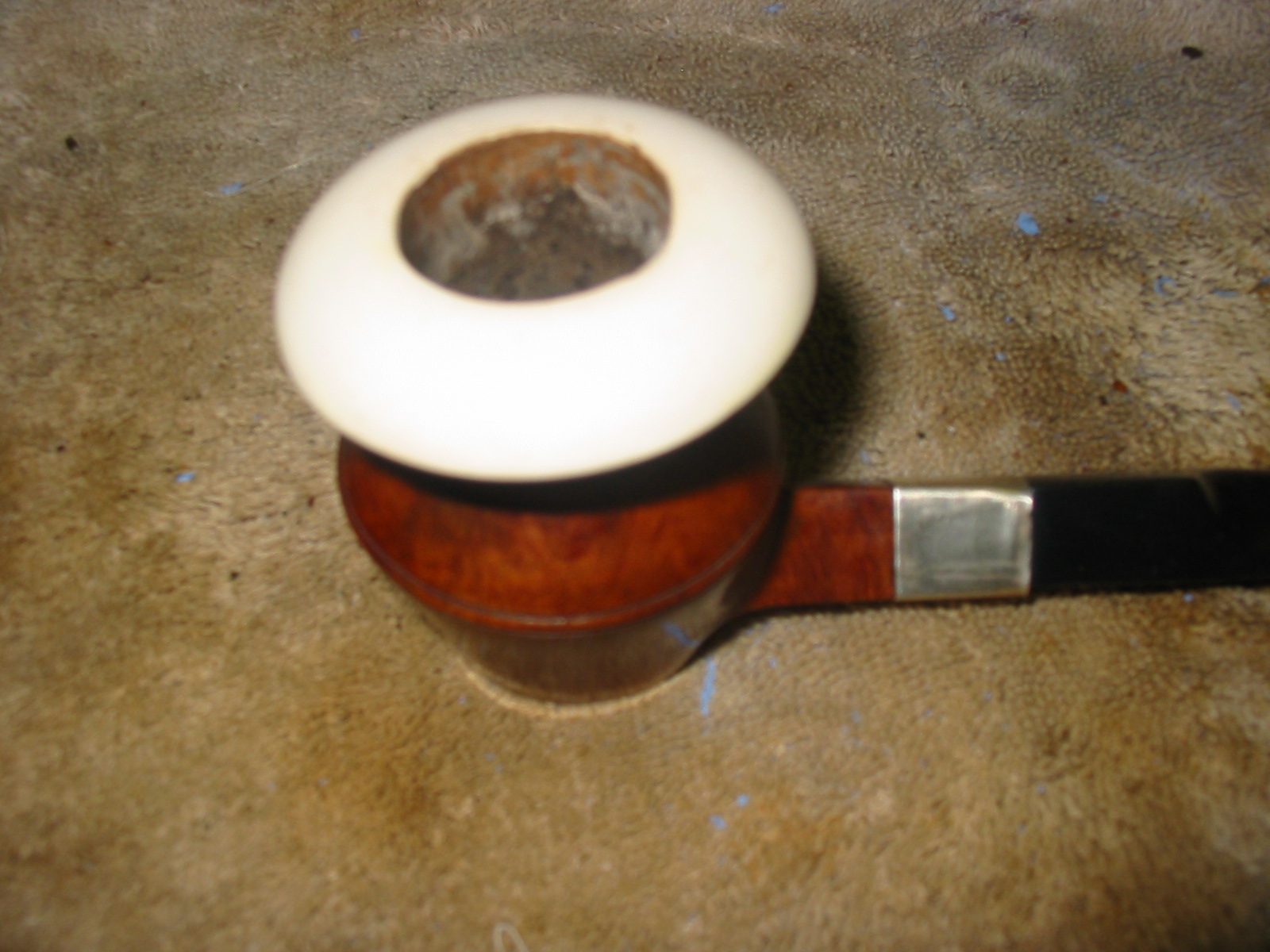
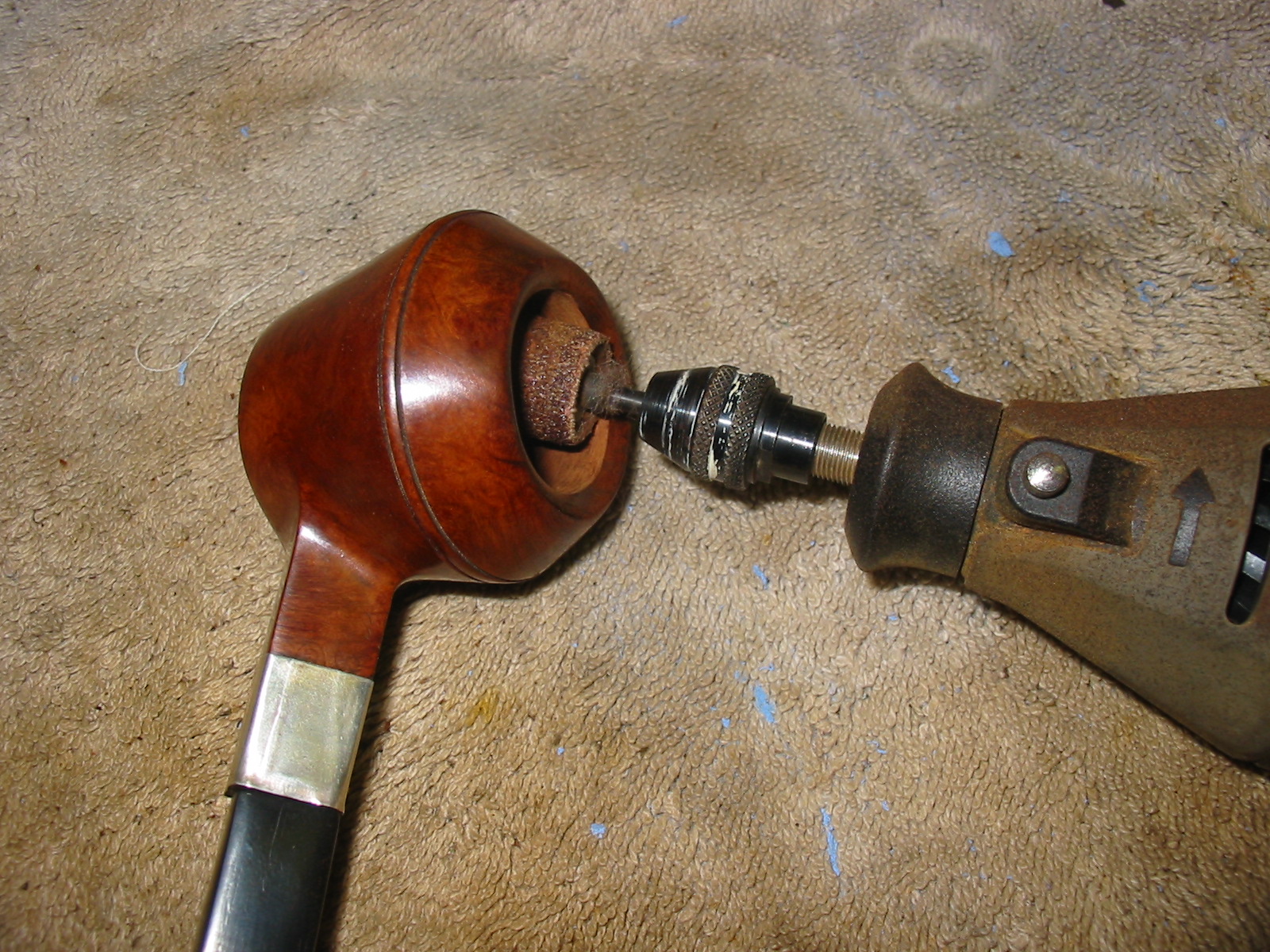
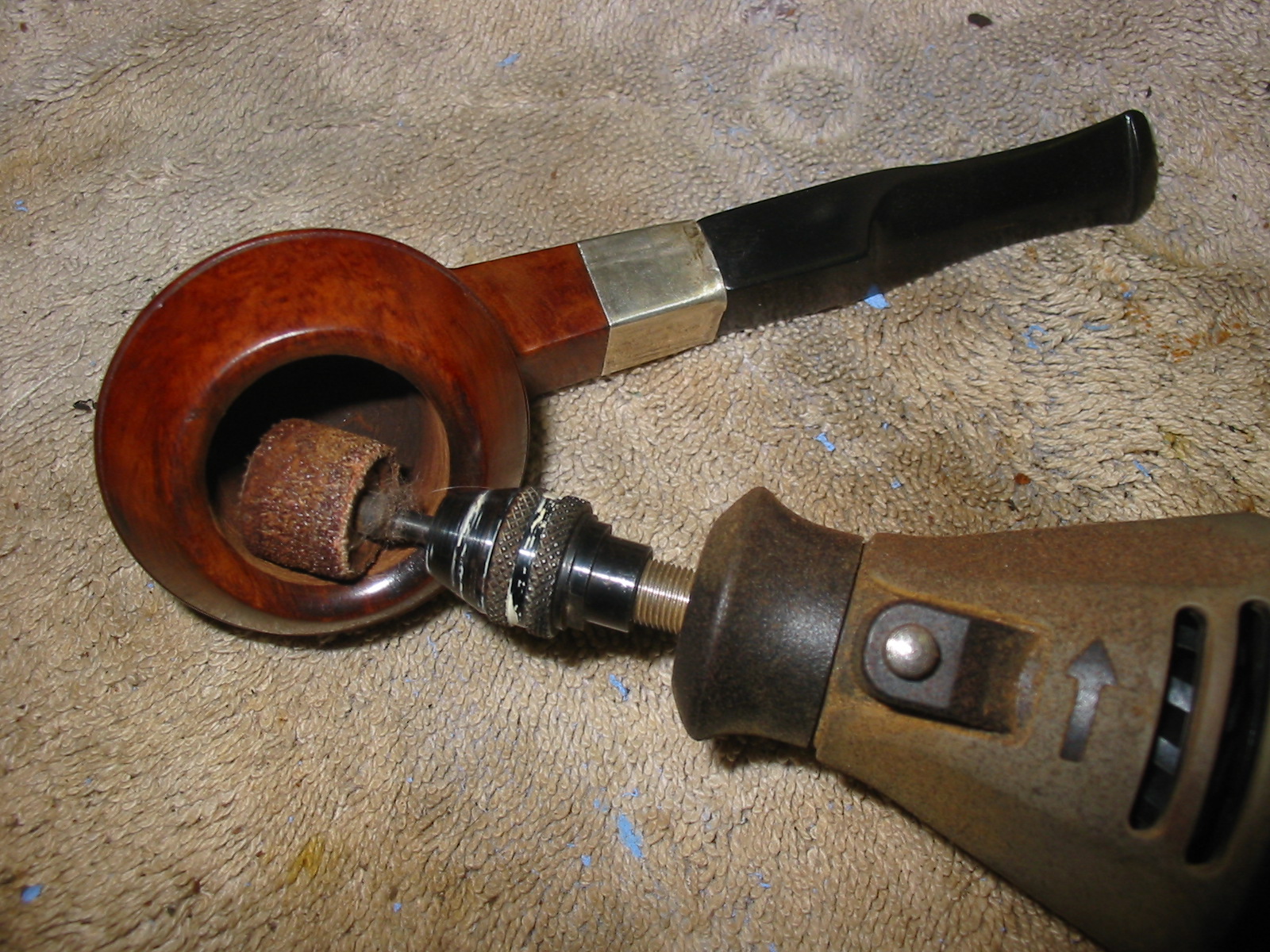
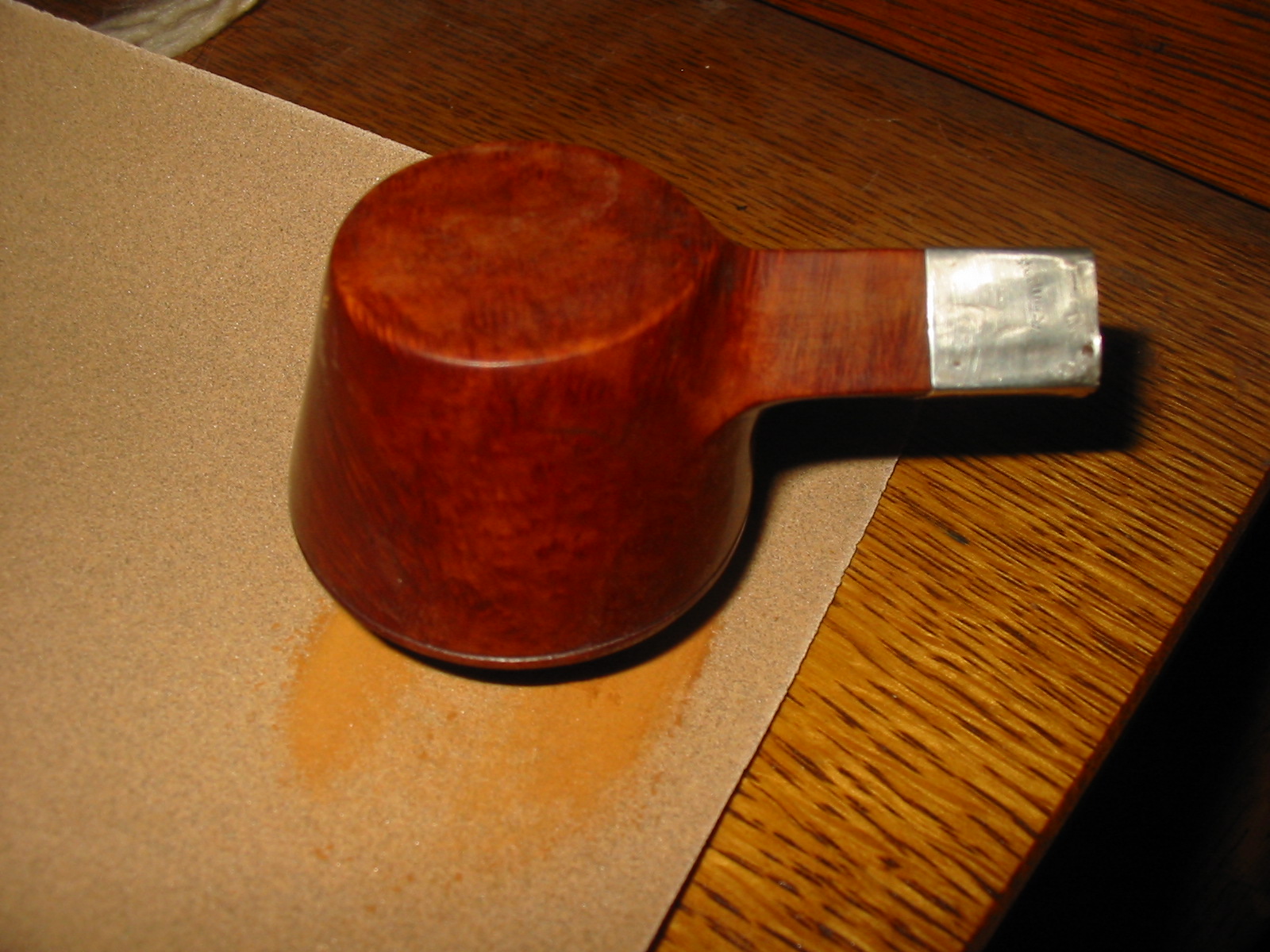
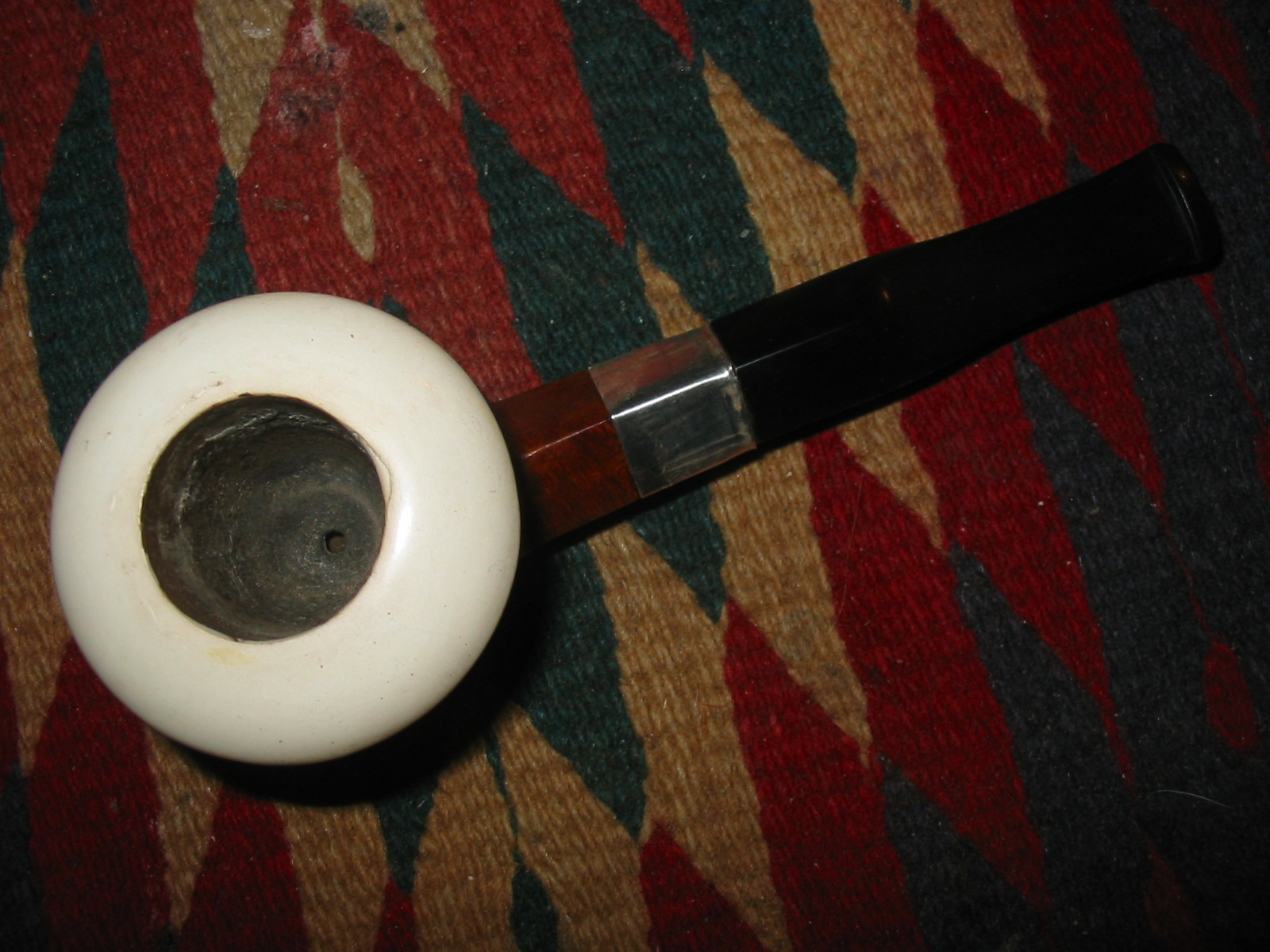
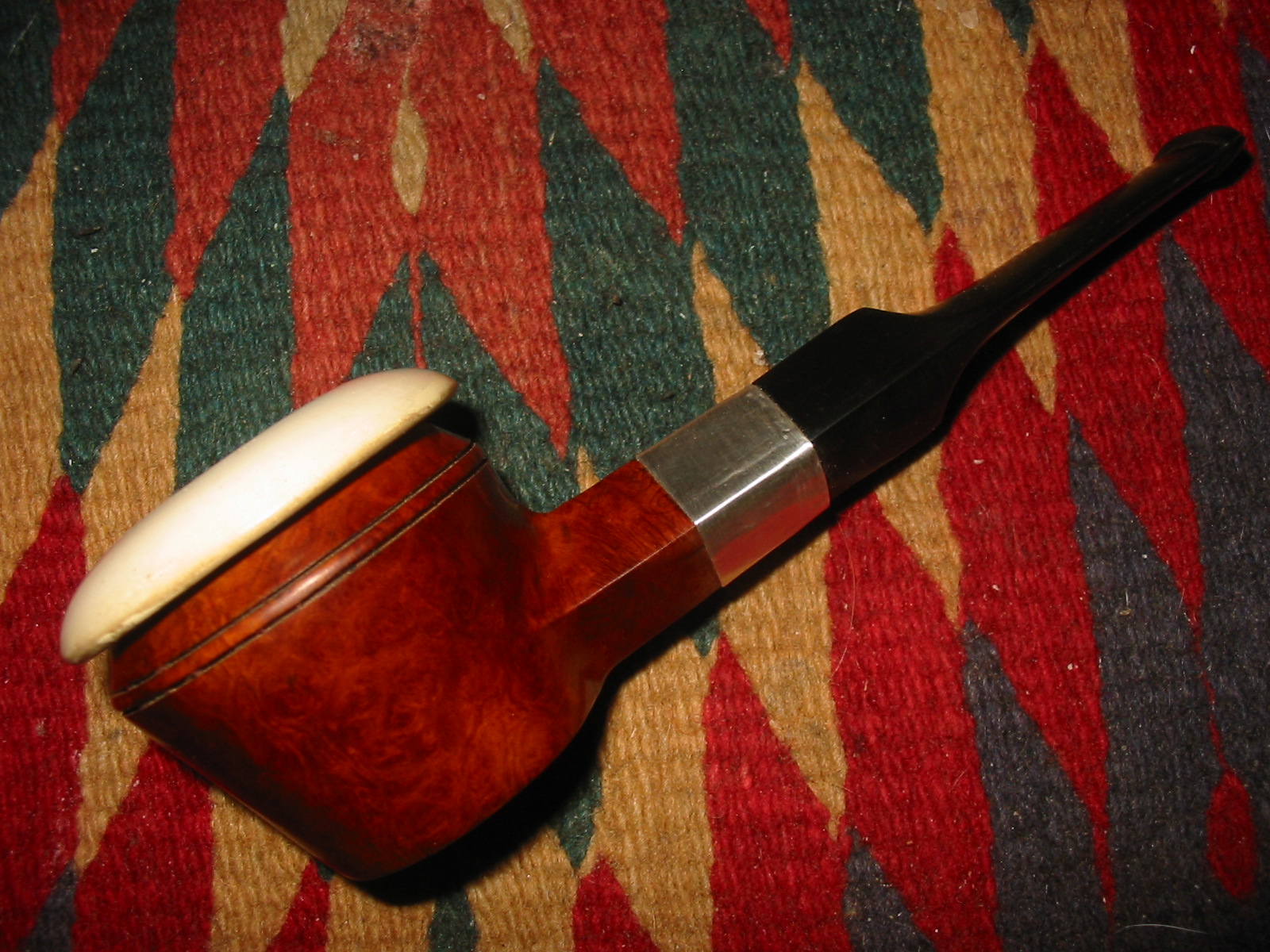
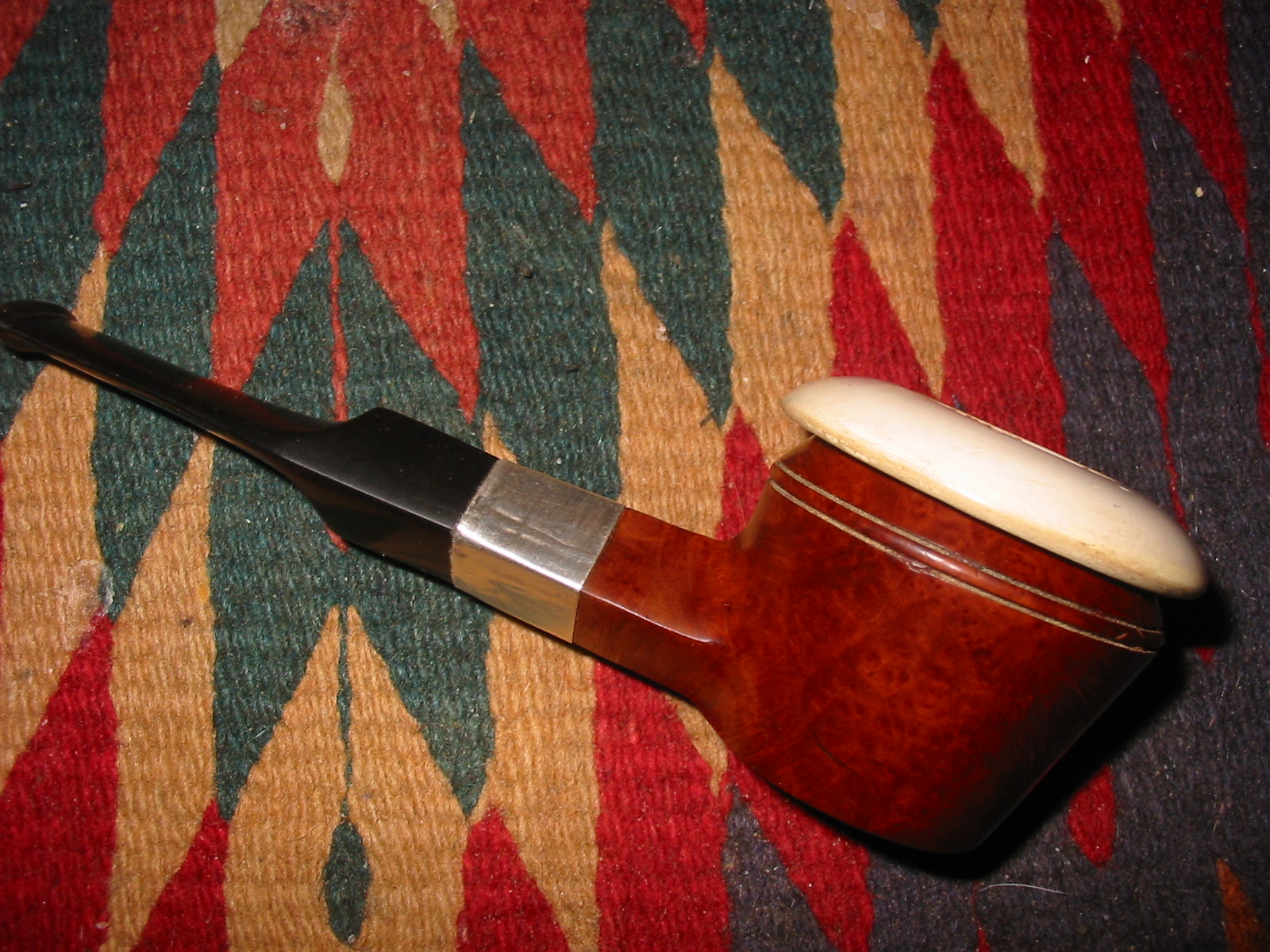
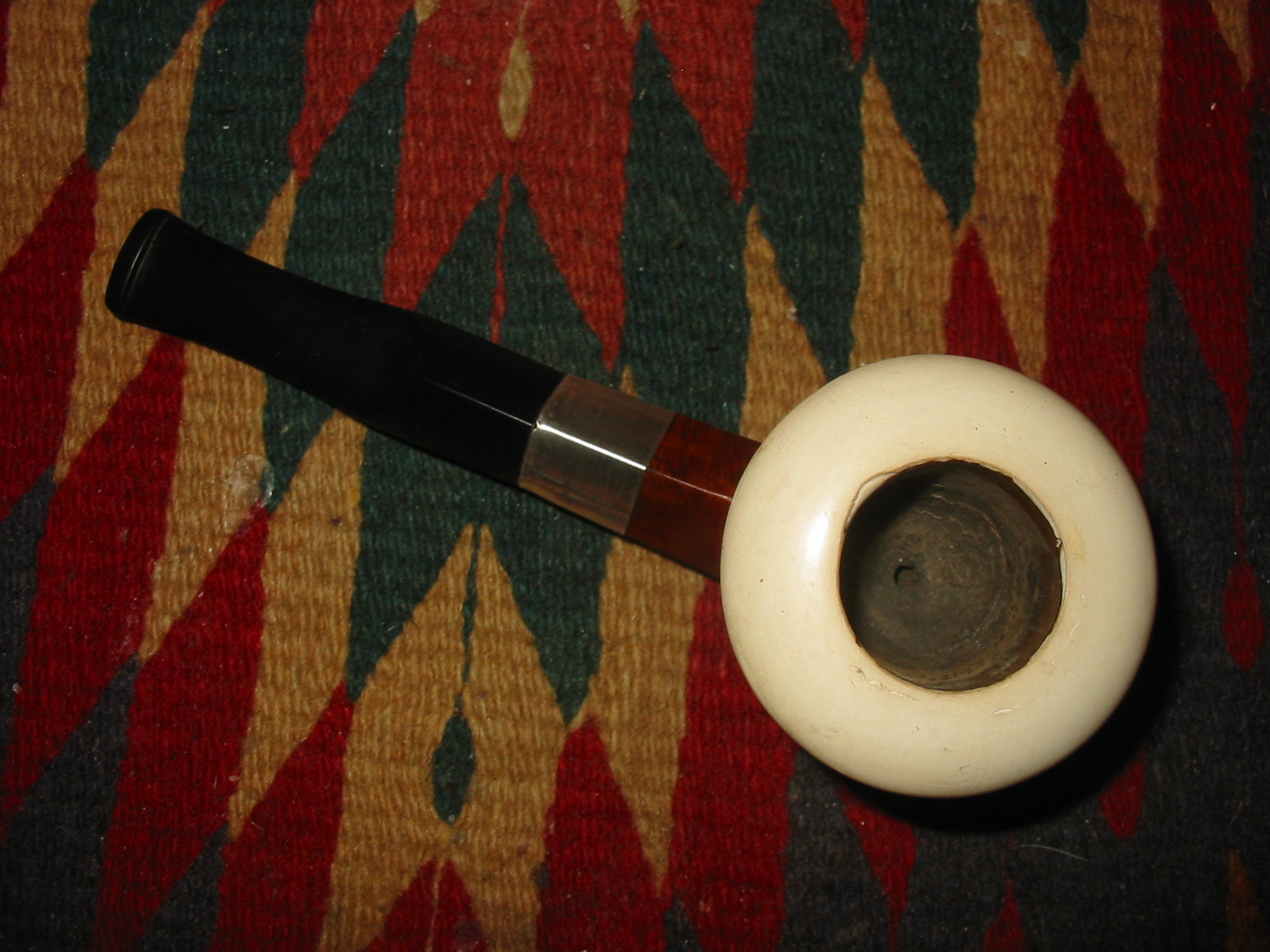
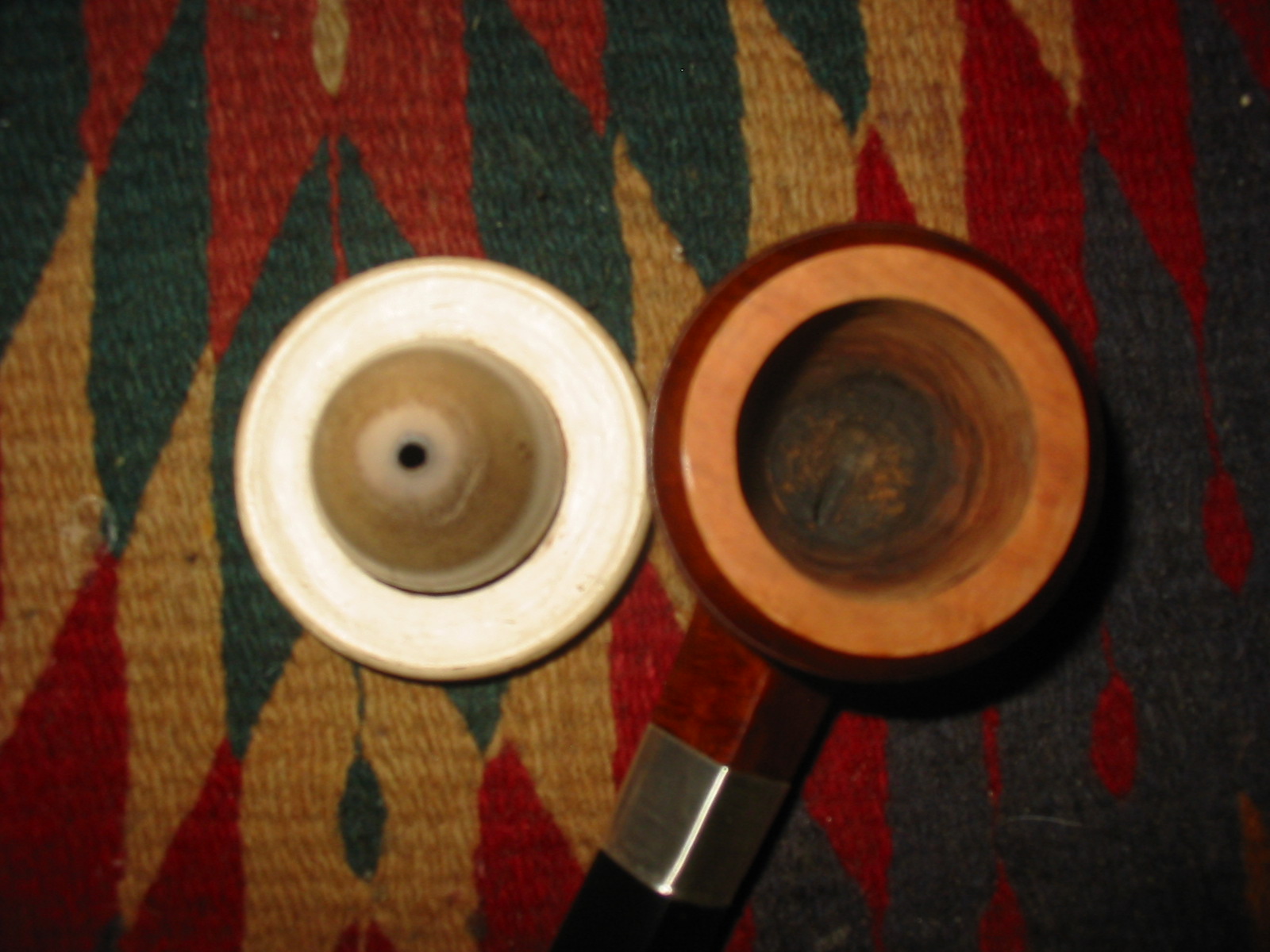
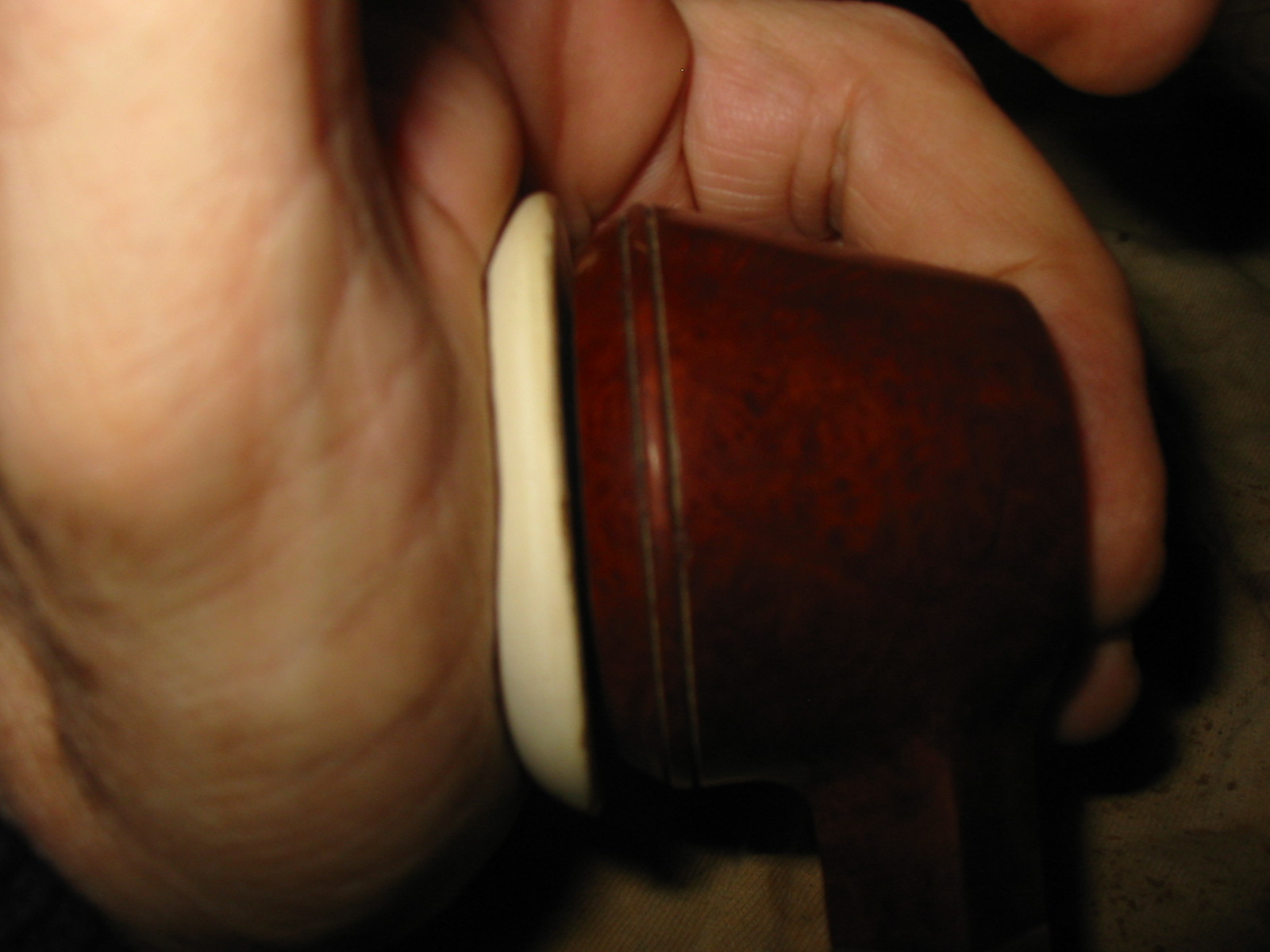
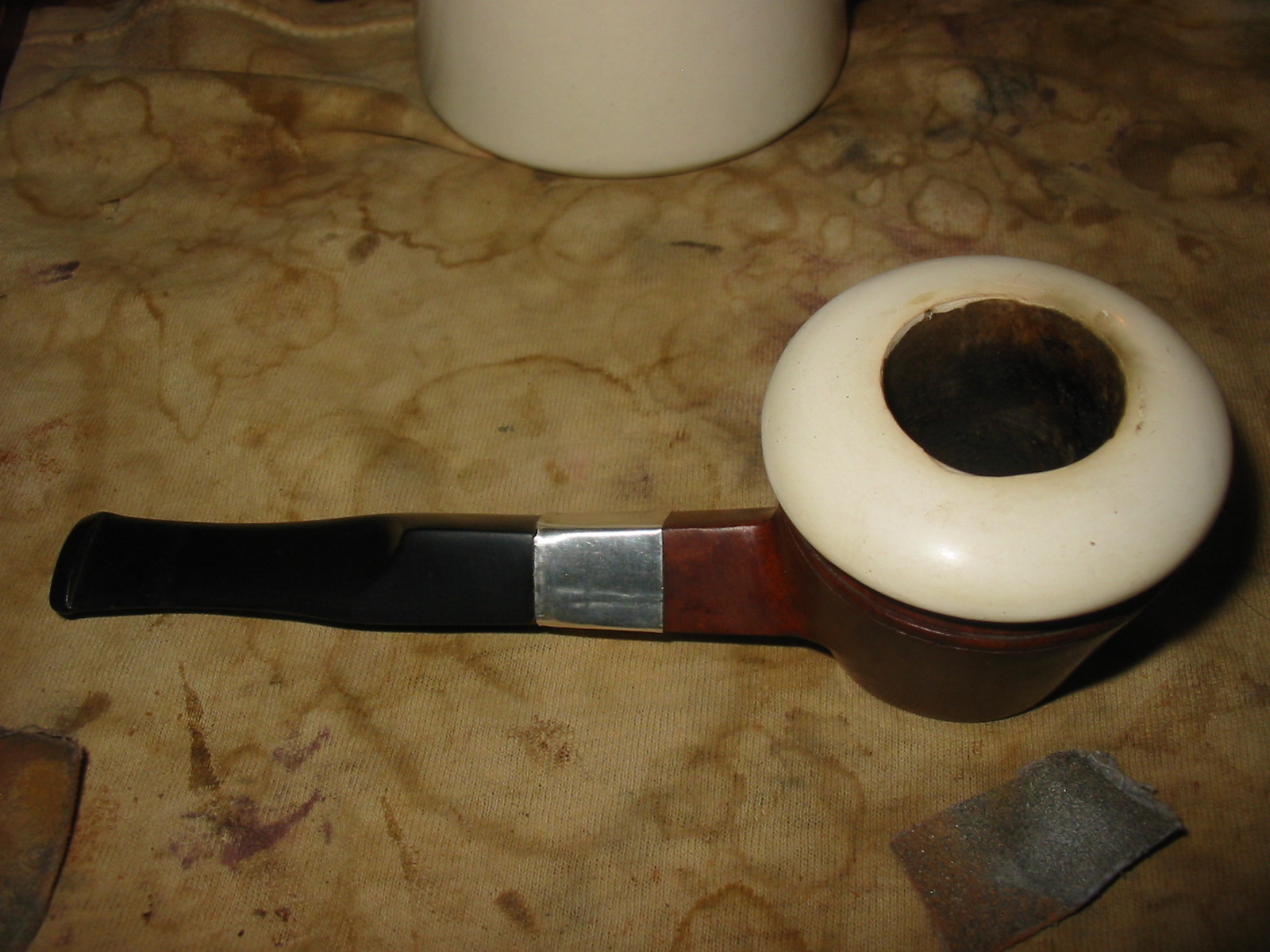
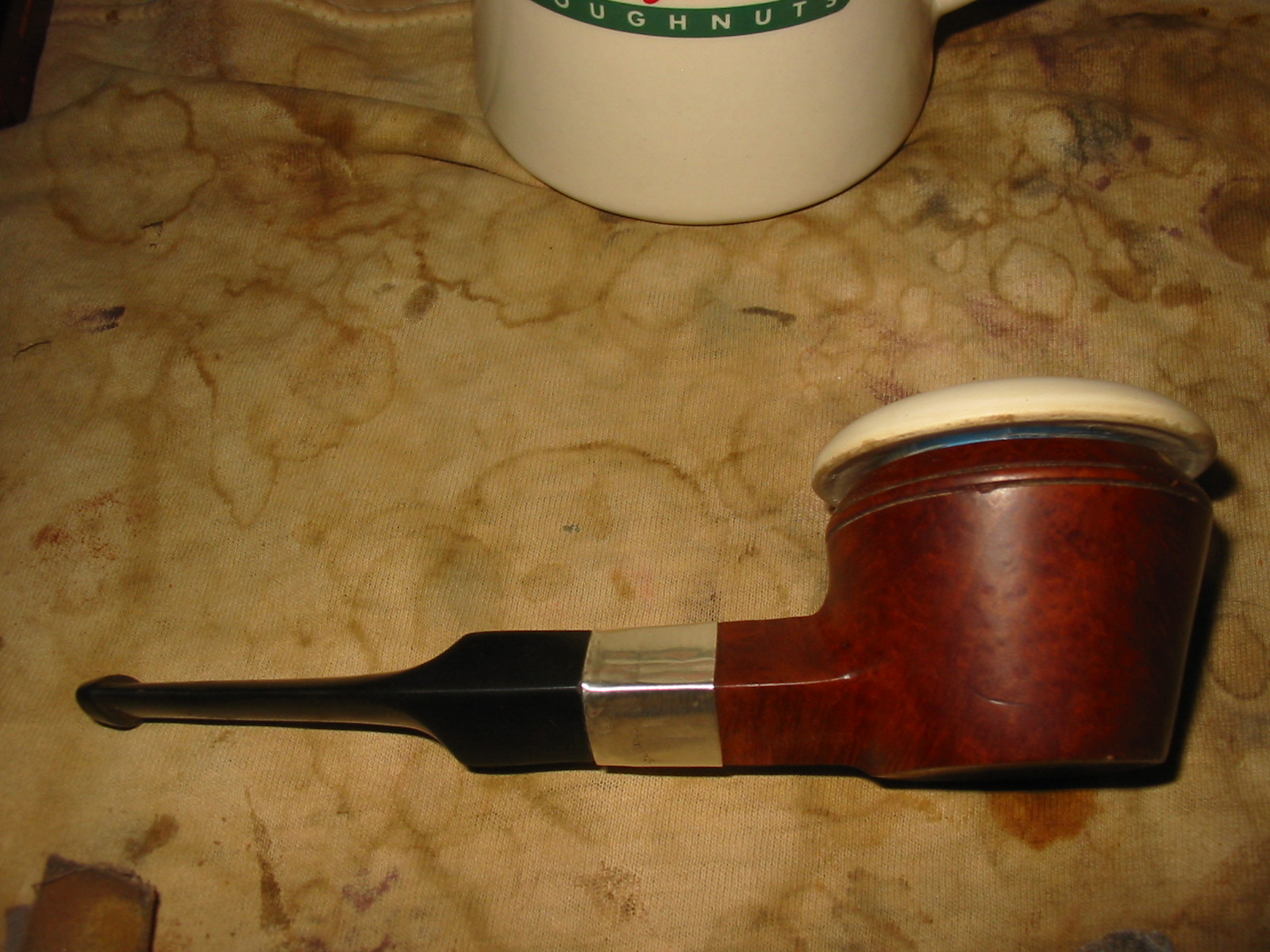
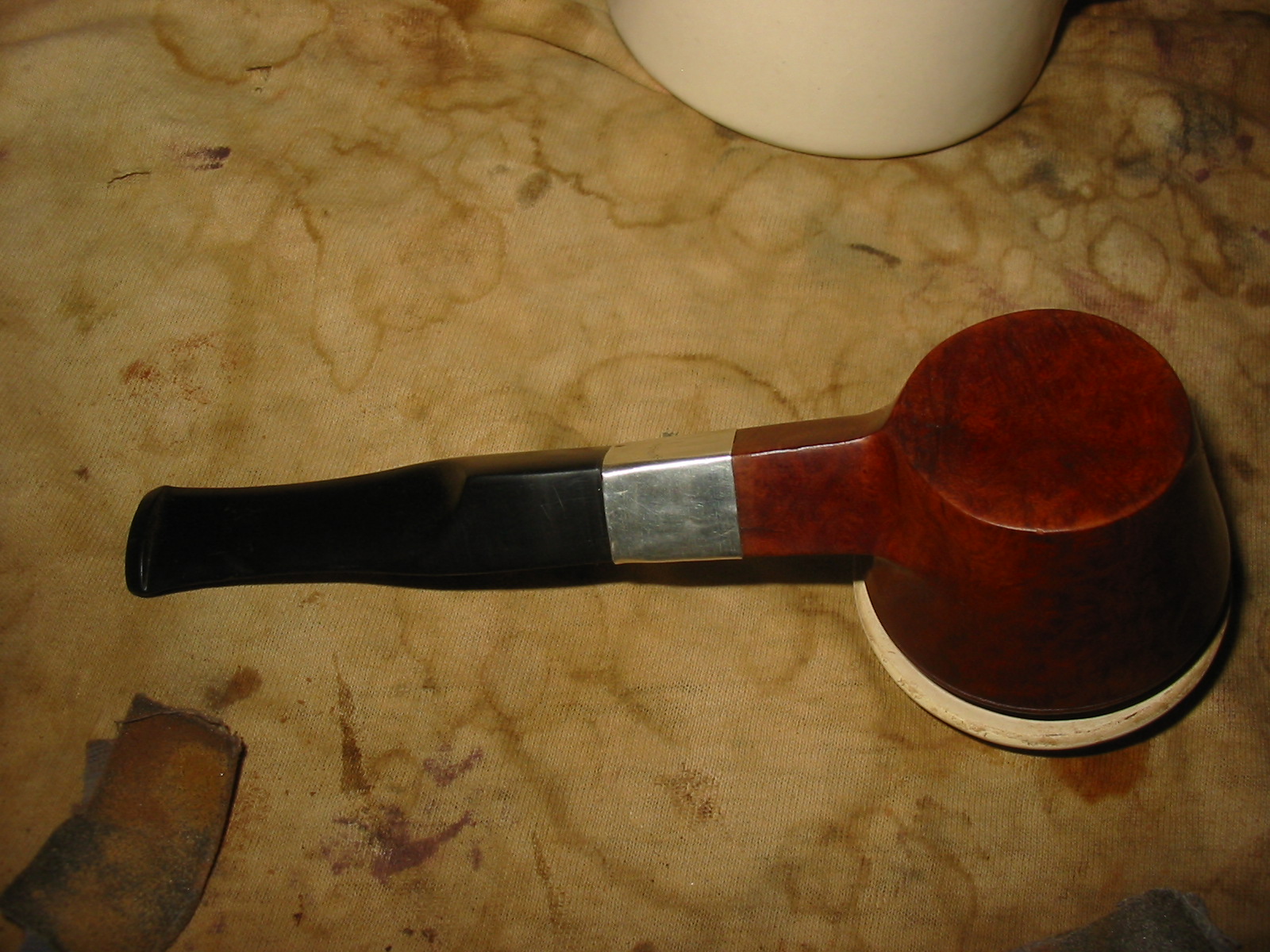
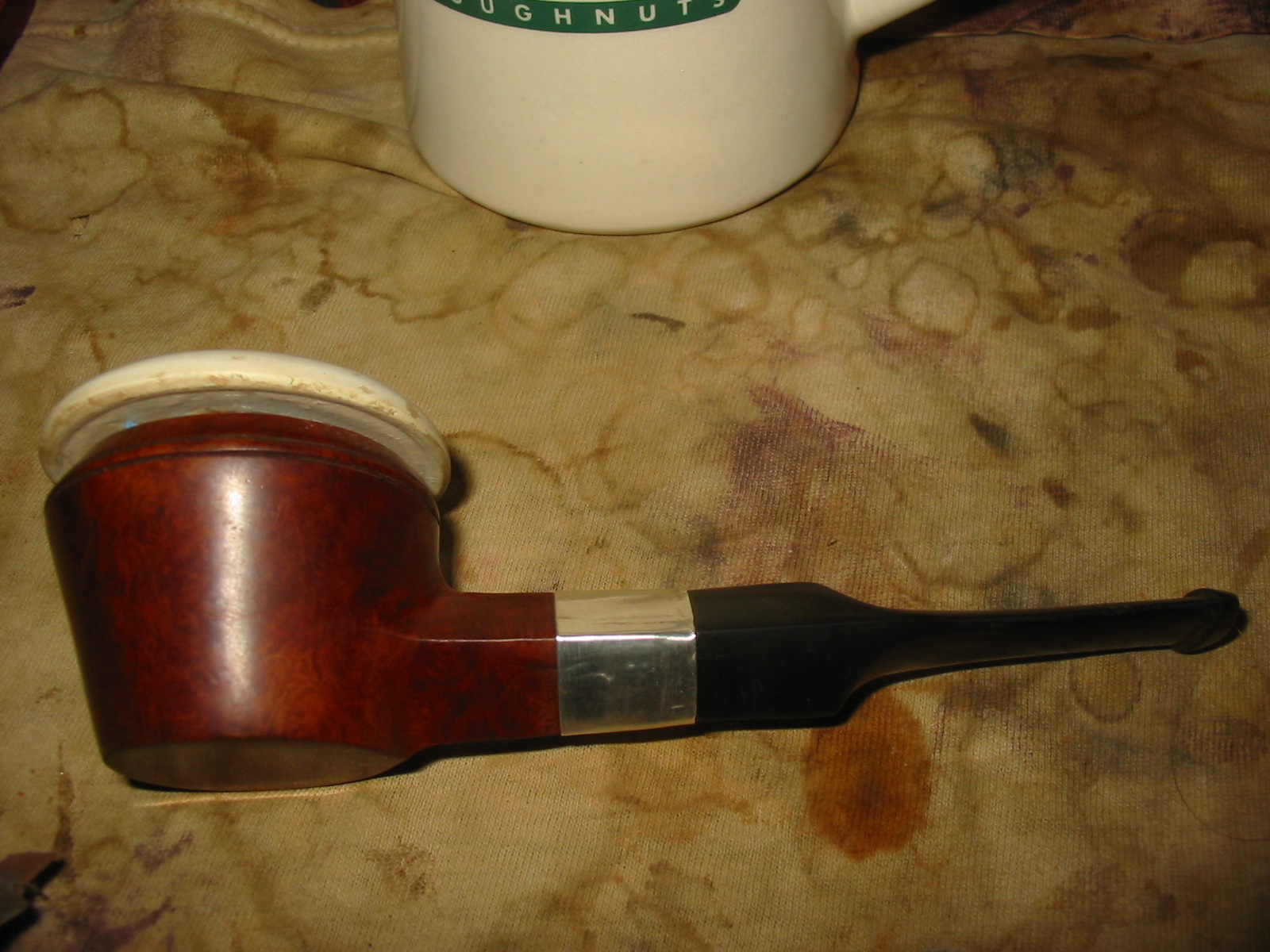
After reading Sid Stavros’ blog, http://pipe-smoke.blogspot.ca/ describing his process of converting older briars into meerschaum calabash pipes I decided on this rainy Saturday it was time for me to work on one. I had an old briar pipe bowl here that was a strangely shaped briar pot shaped sitter with a bit of a Rhodesian like top. It was in rough shape and was stemless so I restemmed it a while back. It has a pretty rough band on it so I am still undecided what to do with that. I also had a meerschaum bowl from an EBay group I picked up. It was without a gourd bowl so I just cleaned up the bowl and decided to set it aside until such a time I knew what I wanted to do with it. So on this rainy Vancouver Saturday afternoon I took the pipe bowl out and the meerschaum bowl out and put them side by side. I did some measurements in terms of the depth of both and the diameter of the inside of the briar and the outside of the meer cup to see if it would even be feasible. The measurements said it would work. So taking a deep breath I got out my Dremel and set up the parts for the “new” re-envisioned pipe.

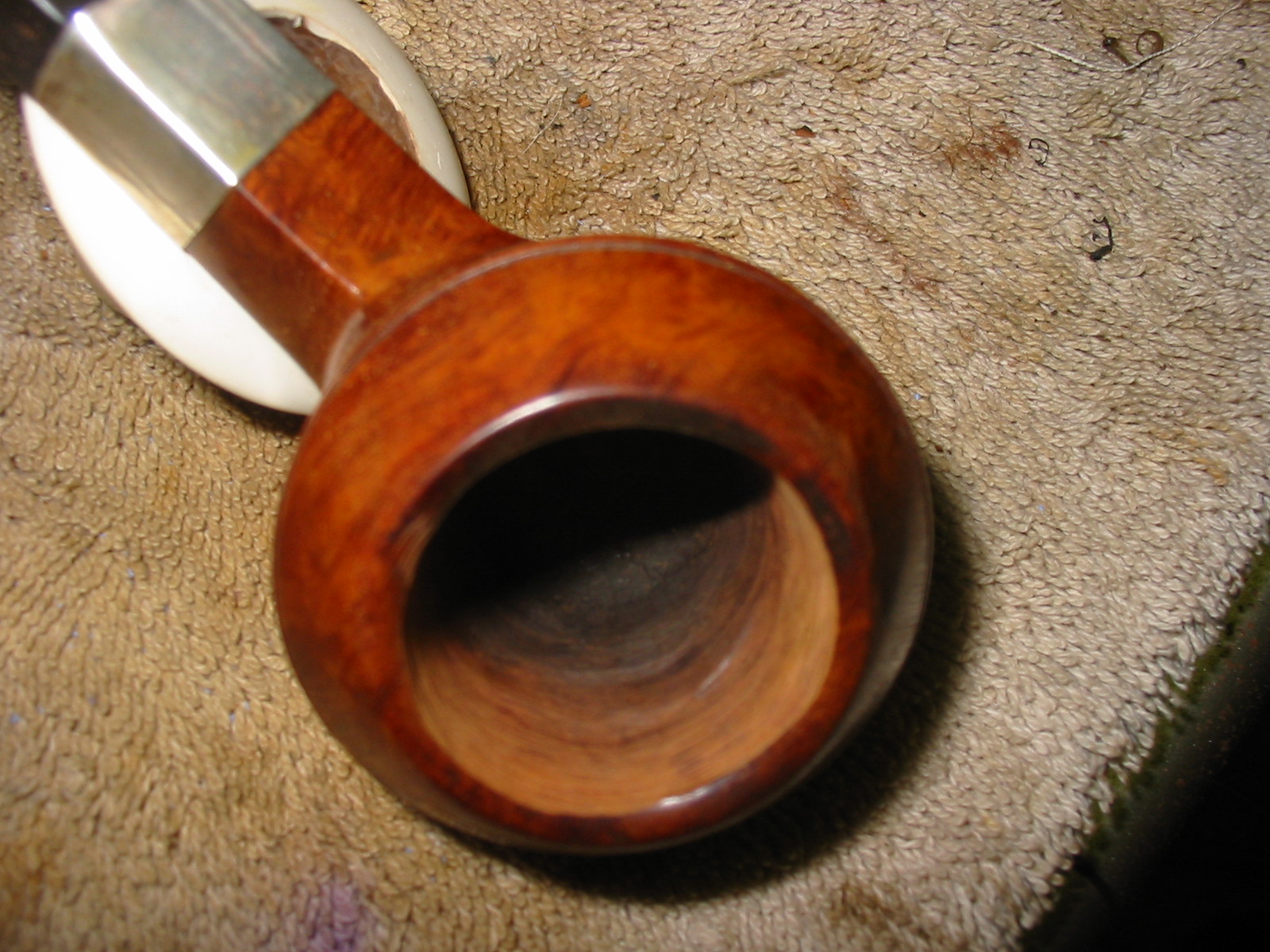
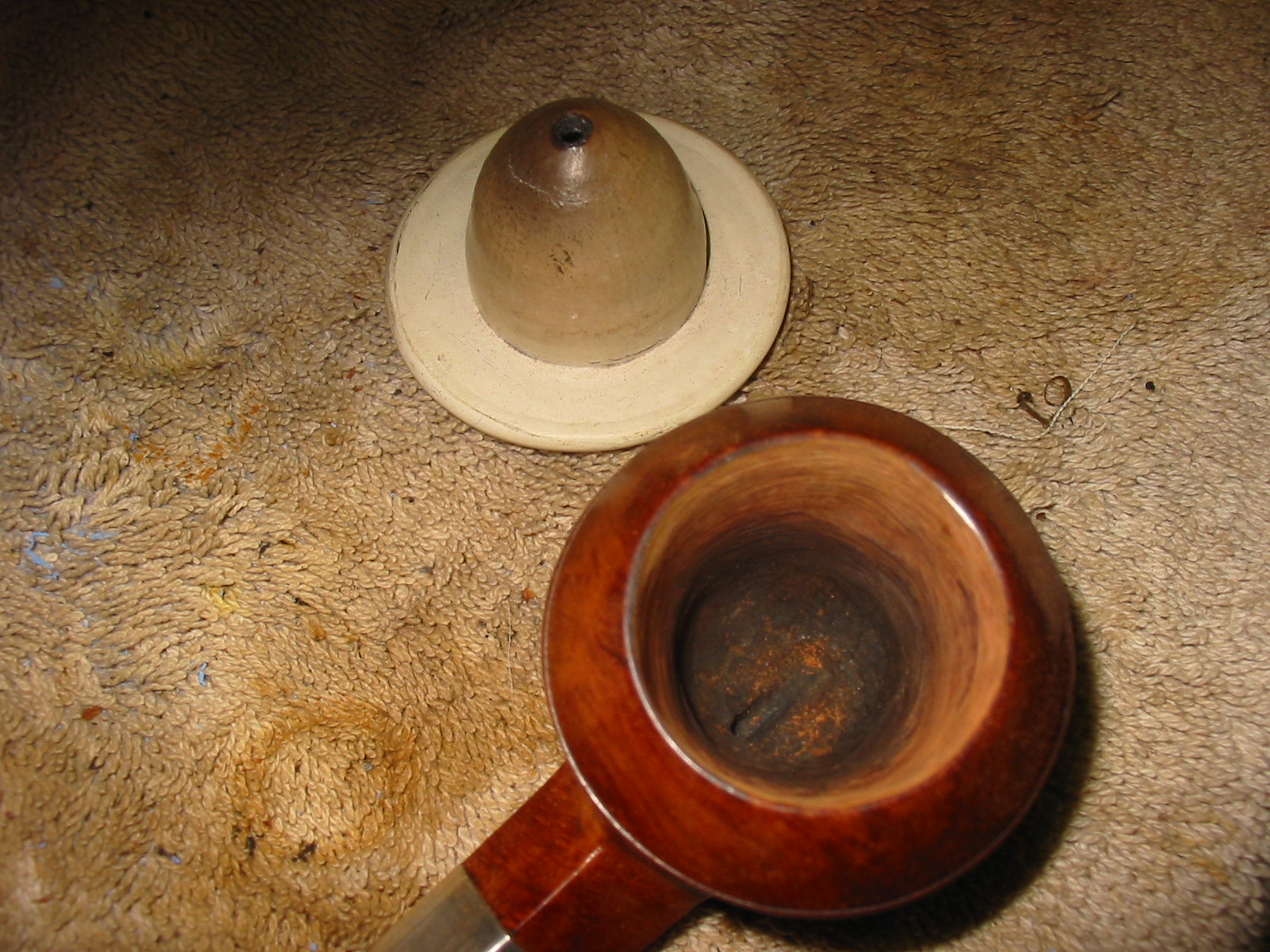
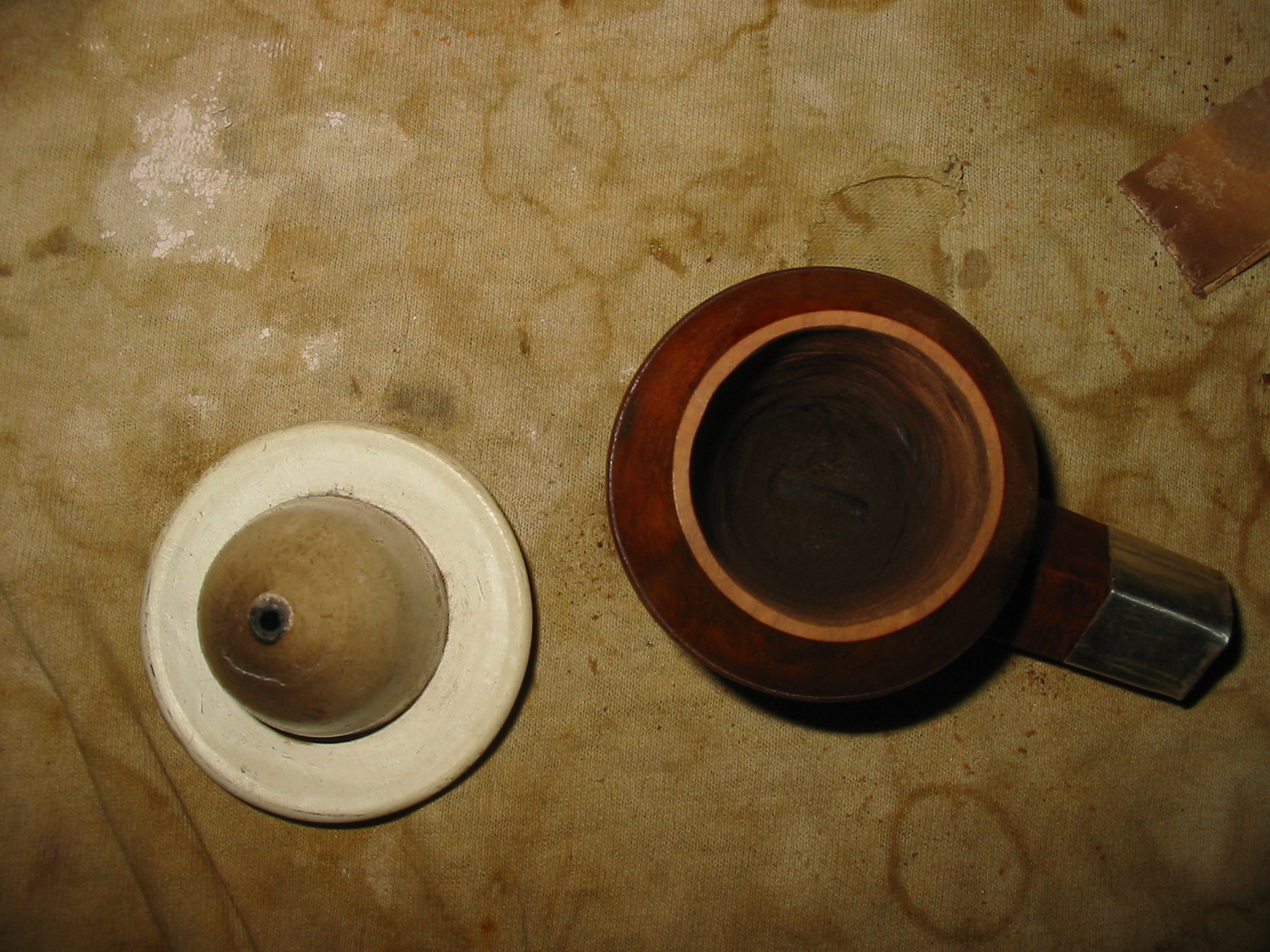
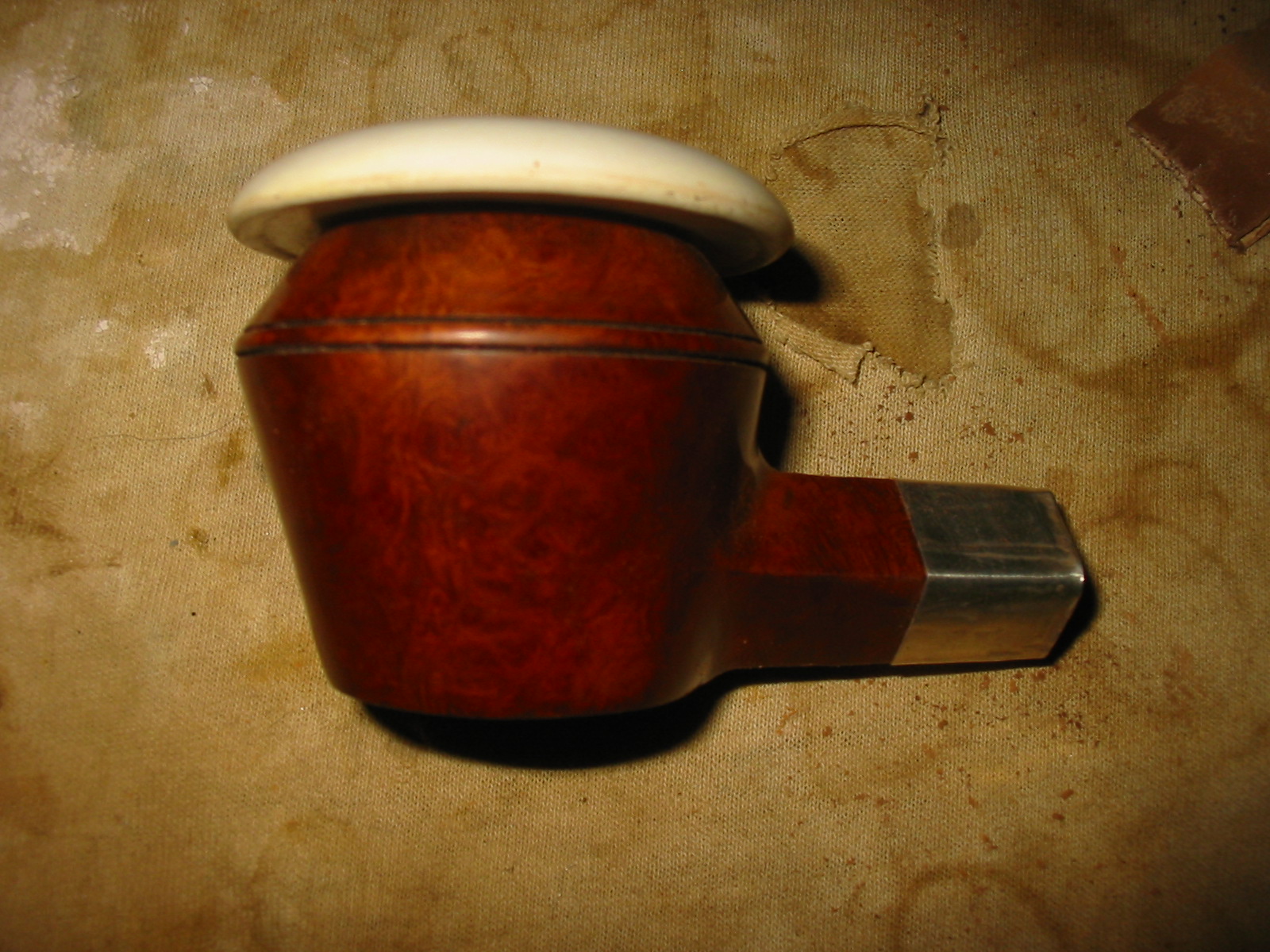
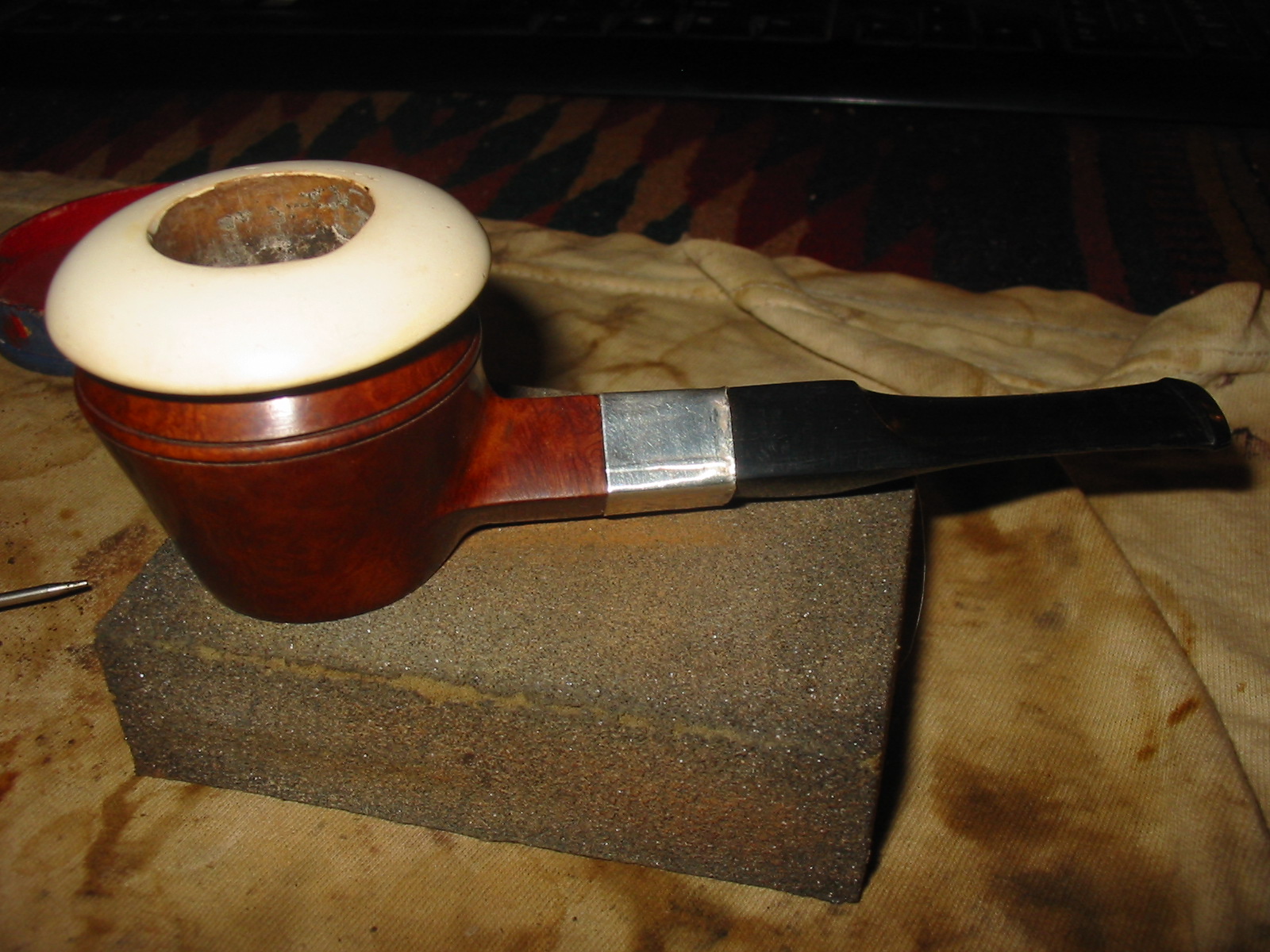
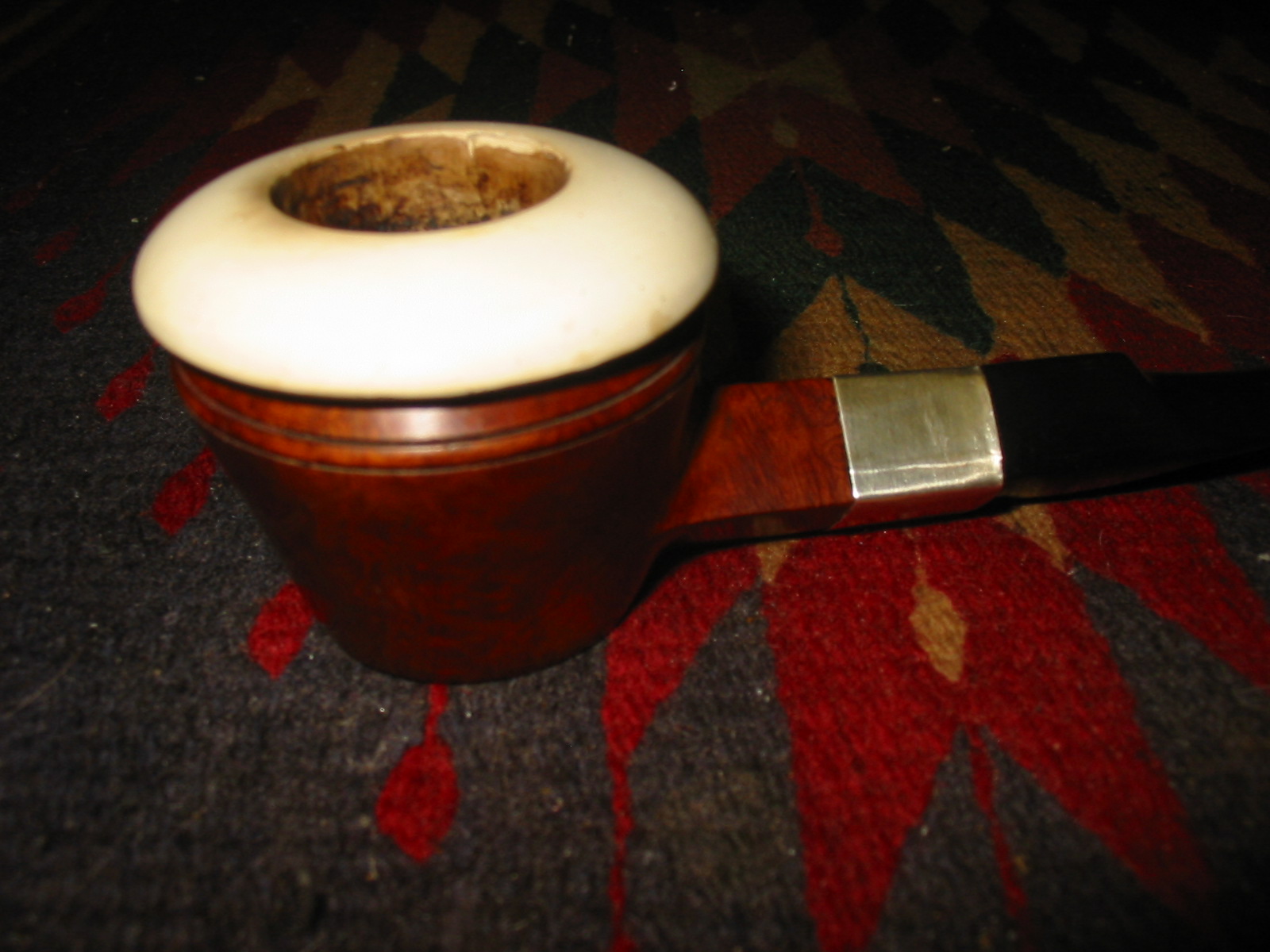
The first two photos show the meerschaum cup when I received it and after I had finished cleaning and polishing it. The third and fourth photos show the briar pipe that I chose to be the calabash for this cup. For the fourth photo I placed the cup on top of the bowl to give an idea of what I was aiming for.

IMG_0501

IMG_0584

IMG_0825

IMG_0826

I used the Dremel with a sanding drum on it to open the bowl of the briar. I had to open the bowl quite a bit in order for the meer cup to fit in the bowl. I also had to top the bowl considerably to allow the bowl to sit properly. I sanded the inside of the bowl until the cup fit snuggly. I also had to reshape the bowl in order for a proper seat for the cup. Once I had the bowl opening fit to size with the Dremel I sanded it with 340 grit sandpaper to smooth out the inside walls of the bowl. I had sanded carefully with the sanding drum to maintain the roundness of the bowl. I did not want the cup to sit to one side or toward the front or back. I wanted it centered in the bowl. This took some careful and slow sanding with the sanding drum.

IMG_0827

IMG_0828

IMG_0829

IMG_0830

I sanded the bottom of the cup to flatten it rather than leave it in a point. This would also buy me some depth in the bowl and allow me to shorten the height of the bowl. I used the sanding drum to remove ¼ inch of the height of the bowl. I proceeded slowly to keep the top as flat as possible. Once I had removed the amount I wanted I topped it on with my normal topping procedure – sandpaper anchored on a flat board. I used the Dremel to remove a bit more of the height and then topped it a second time.

IMG_0831

IMG_0832

IMG_0833

IMG_0834

IMG_0835

IMG_0836

With the topping I also had to open the bowl a bit wider. I used the Dremel to open the bowl and resanded the inside. I measured the height of the cup and the depth of the bowl and determined I could take it down until there was a ¼ inch of briar between the top ring and the rim. I sanded it to meet that measurement with the Dremel and then topped it again to even out the rim surface. I sanded it with a fine grit sanding sponge. The cup fit nicely in the bowl. The angled crown of the Rhodesian style top actually looks good with the flat edge of the bottom of the cup.

IMG_0837

IMG_0838

IMG_0839

I still had room at the bottom of the bowl so I took some more of the briar off of the top of the bowl to bring the flat bottom edge of the meer bowl closer to the rings on the briar. I used the Dremel to remove the briar and then topped it on the board. I also opened the bowl a bit more as each time I remove from the top of the briar I had to open the diameter of the bowl to accommodate the change. The next series of photos show the pipe as it stands at the moment.

IMG_0842

IMG_0843

IMG_0844

IMG_0845

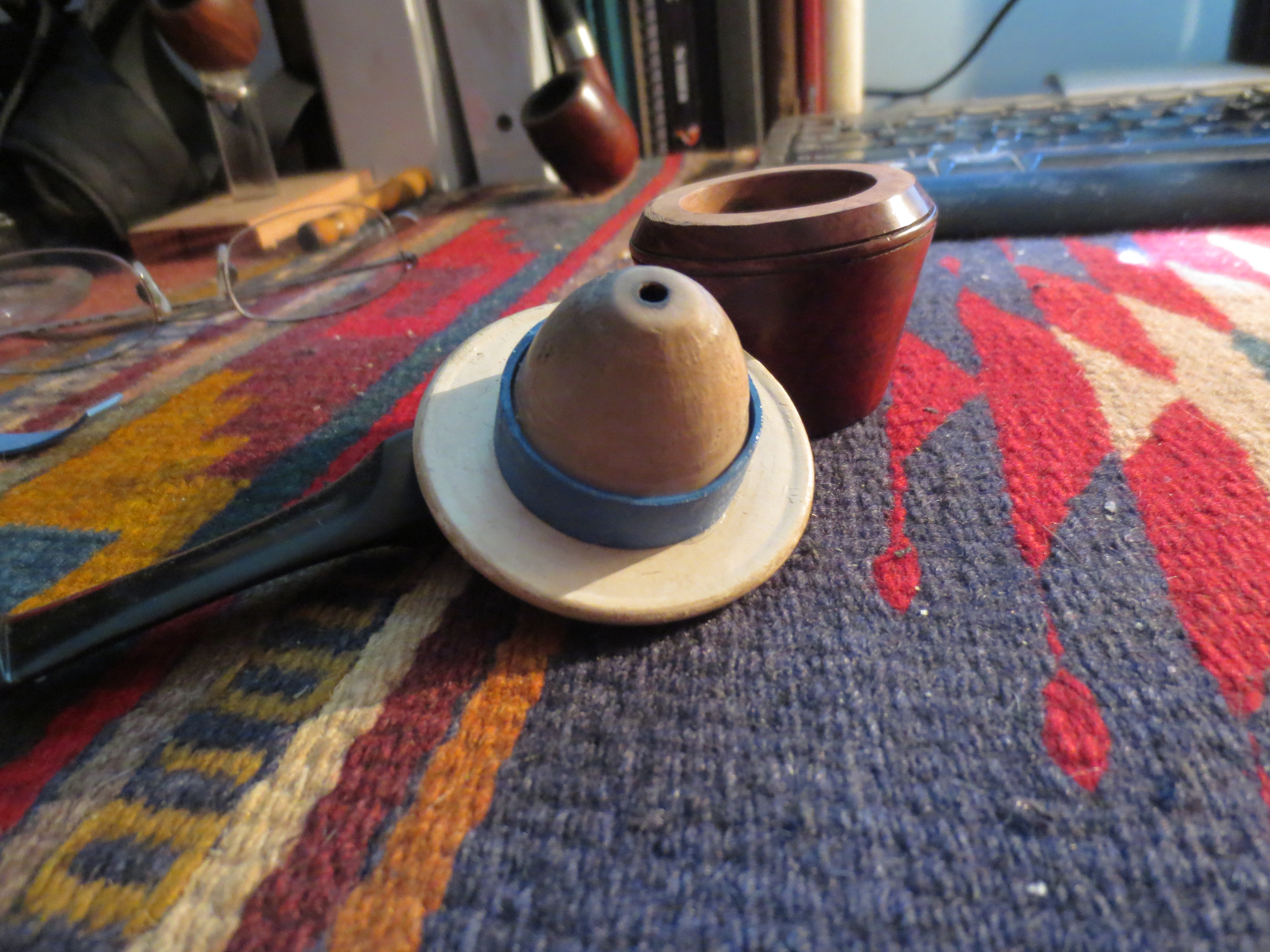
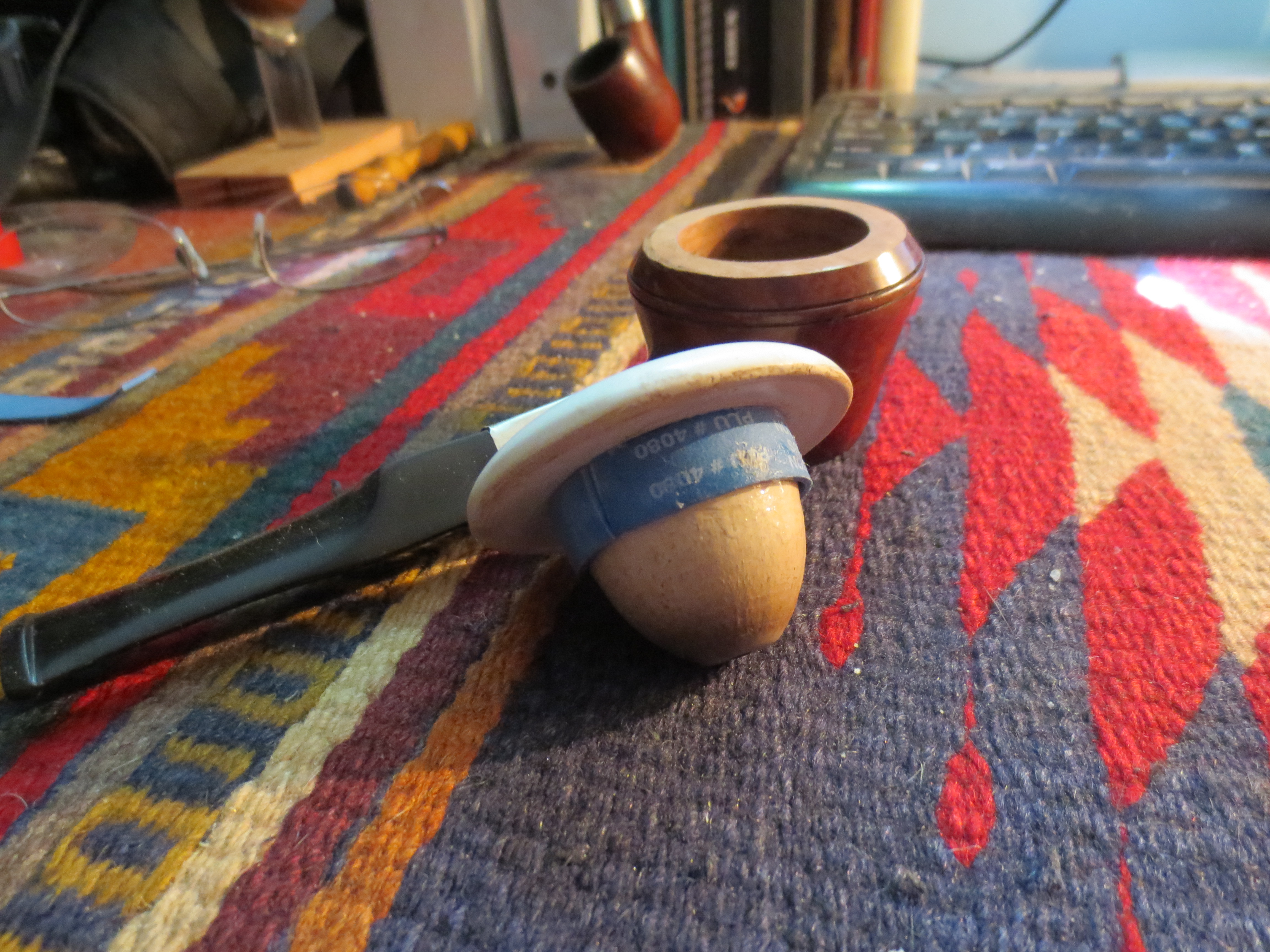
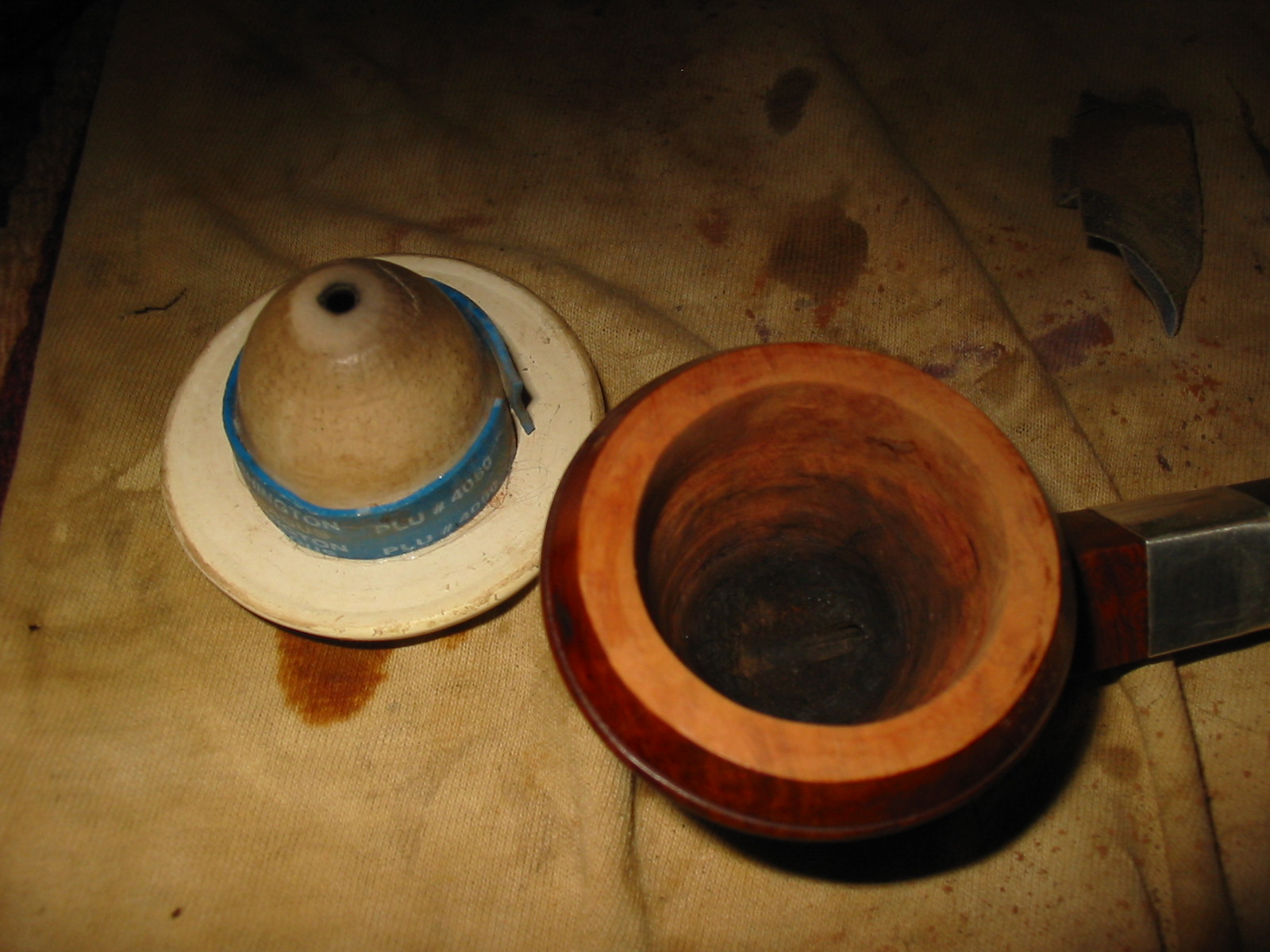
Once the bowl of the briar was clean and smooth I pressed the meerschaum cup into the briar. It was a perfect pressure fit. In talking with Sid via email, he suggested that I add rubber gasket between the meerschaum and the briar to separate the two materials. I removed it from the bowl and cut a rubber gasket from a piece of large/thick rubber band that I bought for the purpose. I glued it to the meerschaum bowl and set it aside to dry.

IMG_1235

IMG_1236

I measured the new diameter of the meerschaum bowl with the gasket and used my Dremel with a sanding drum to sand the briar bowl to match that new diameter. I sanded with the Dremel, checked the fit, sanded some more and check until I had removed enough of the diameter of the briar to make a good snug fit.

IMG_1241

Once the bowl fit well, I took the pipe back to my work table and sanded the inside of the bowl to smooth out the ridges left by the sanding drum. I wiped down the inside of the bowl with Everclear to remove the sanding dust from and make sure the fit of the gasket against the briar was smooth and unimpaired.

IMG_0919

A part of the gasket came loose from the work so I reglued it and once it was dry pressed it into the briar bowl. The next five photos show the fitted meerschaum bowl in place in the briar cup. The pipe is now ready to smoke. The draught is good and open. The newly fit stem works well with the combination. I polished the briar and the meerschaum bowl and loaded a bowl and fired it up. It is a great smoking machine delivering a cool and dry smoke with a clean tobacco taste.

IMG_0920

IMG_0921

IMG_0922

IMG_0923

IMG_0924

Still a little work to do polish the meerschaum bowl but the idea is clear in the photos. I will polish it with micromesh sanding pads and then use beeswax to wax the bowl for enhancing the colouration of the bowl.

ADDENDUM:
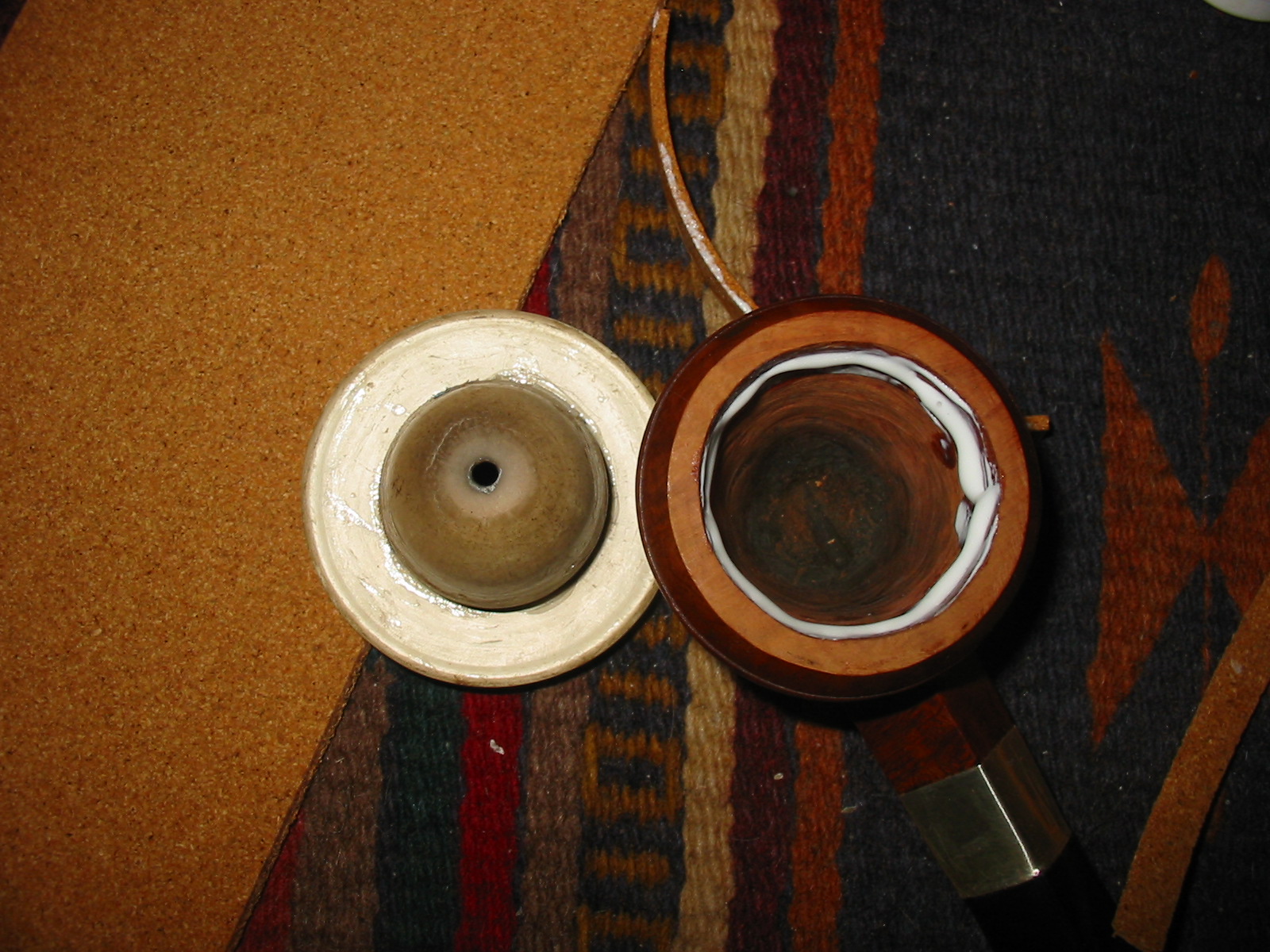
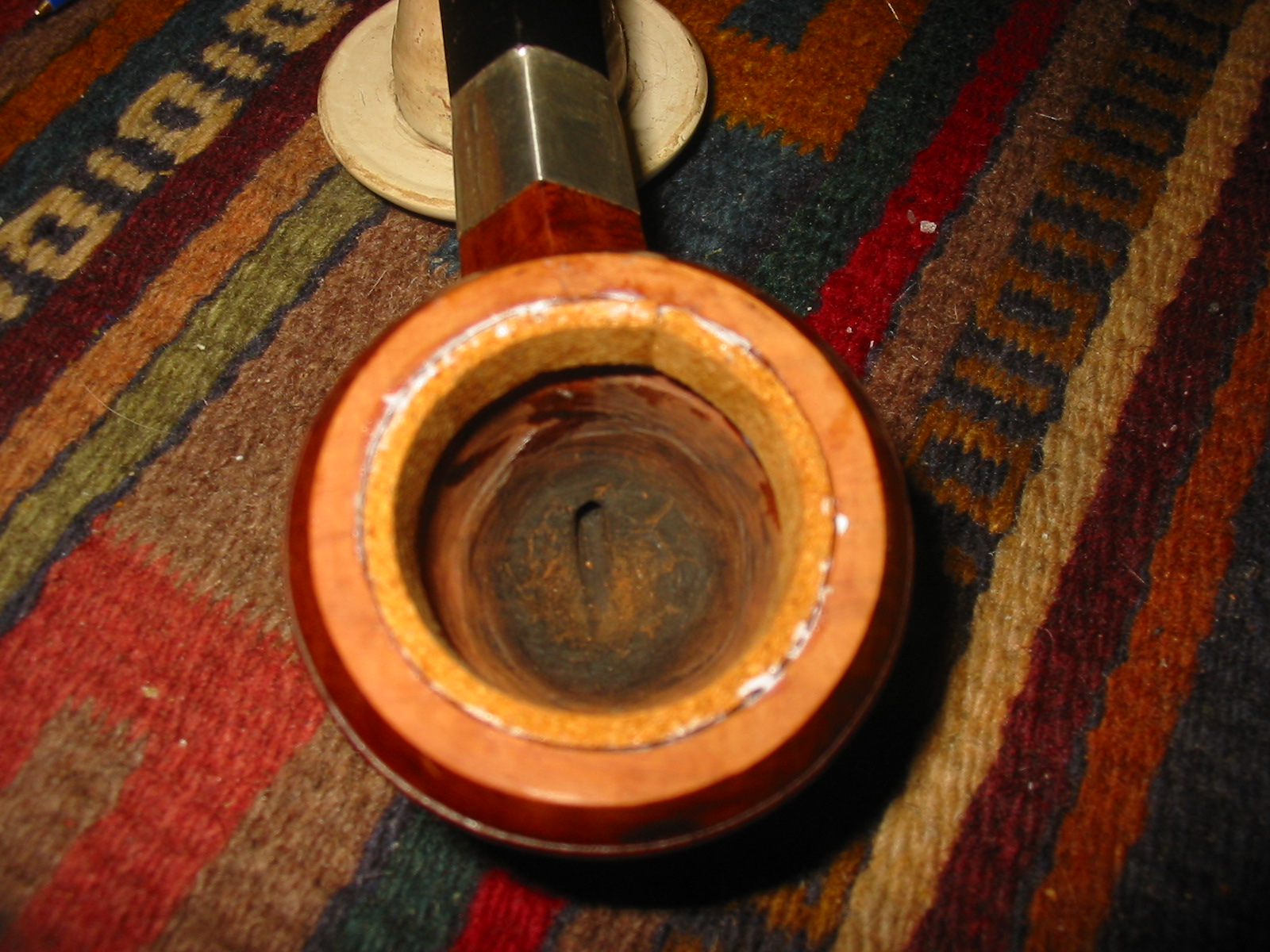
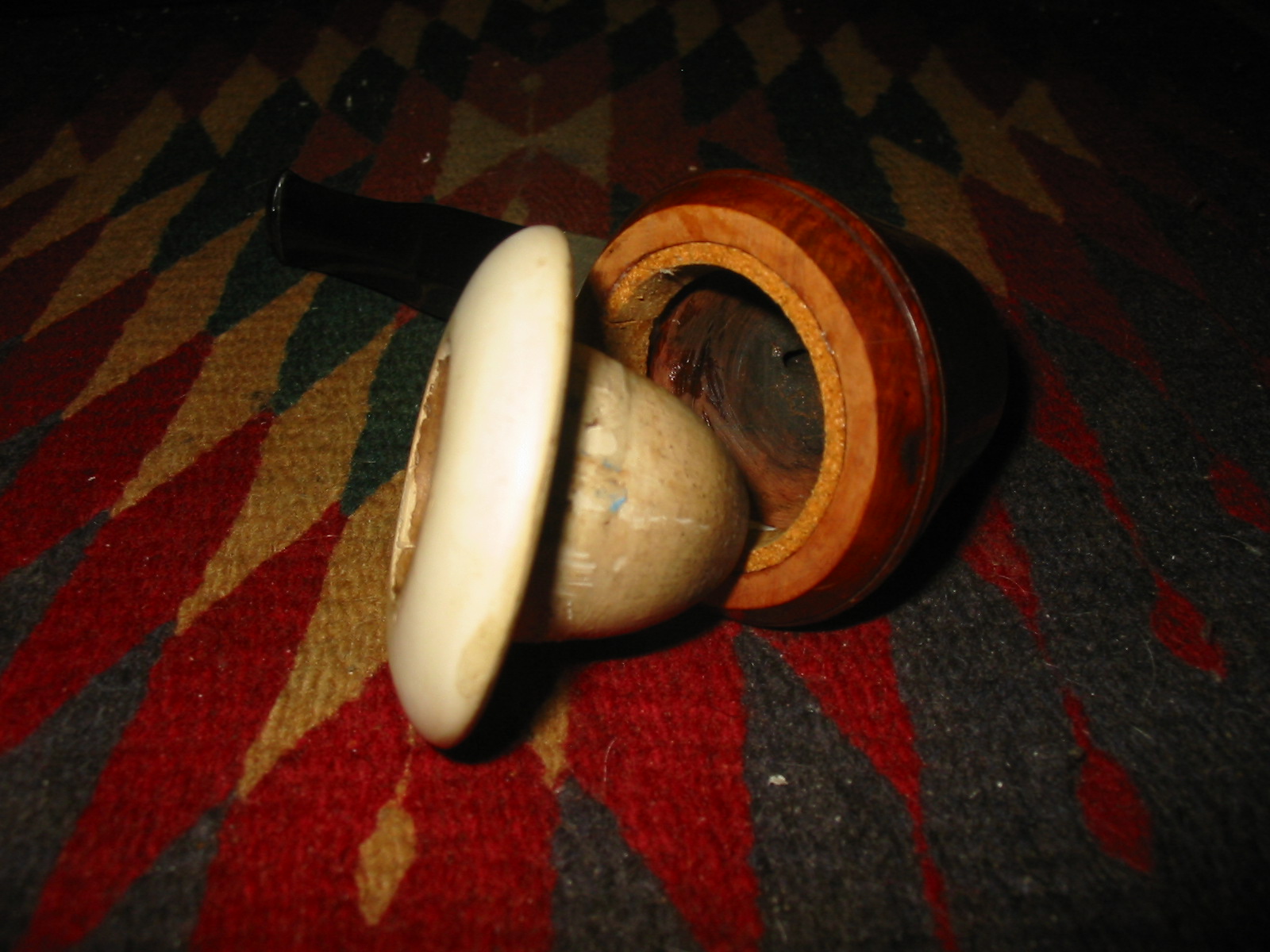
The look of this one still bugged me and I was not happy with the bowl fit. I also did not like the rubber gasket I formed as it did not really give a snug fit. A friend gave me a sheet of thin cork so I cut a piece of cork to use as a gasket. To accommodate the cork and still give the bowl a fit I needed to remove more of the briar in the bowl of the pipe. I used a Dremel with the sanding drum and took the bowl down enough to accommodate the cork and the pressed in meerschaum bowl. I glued the band of cork around the inner edge of the briar bowl and when it had dried I pressed the bowl into place. Here are a few photos of the renovation.

The cork gasket glued into the bowl with carpenters white glue

The cork gasket glued into the bowl with carpenters white glue

The gasket in place with the glue drying

The gasket in place with the glue drying

The gasket it dry and the bowl is ready to press in place

The gasket it dry and the bowl is ready to press in place

The bowl is in place and the pipe is much more fit looking to me!

The bowl is in place and the pipe is much more fit looking to me!

An Amphora Extra Saddle Billiard Reborn


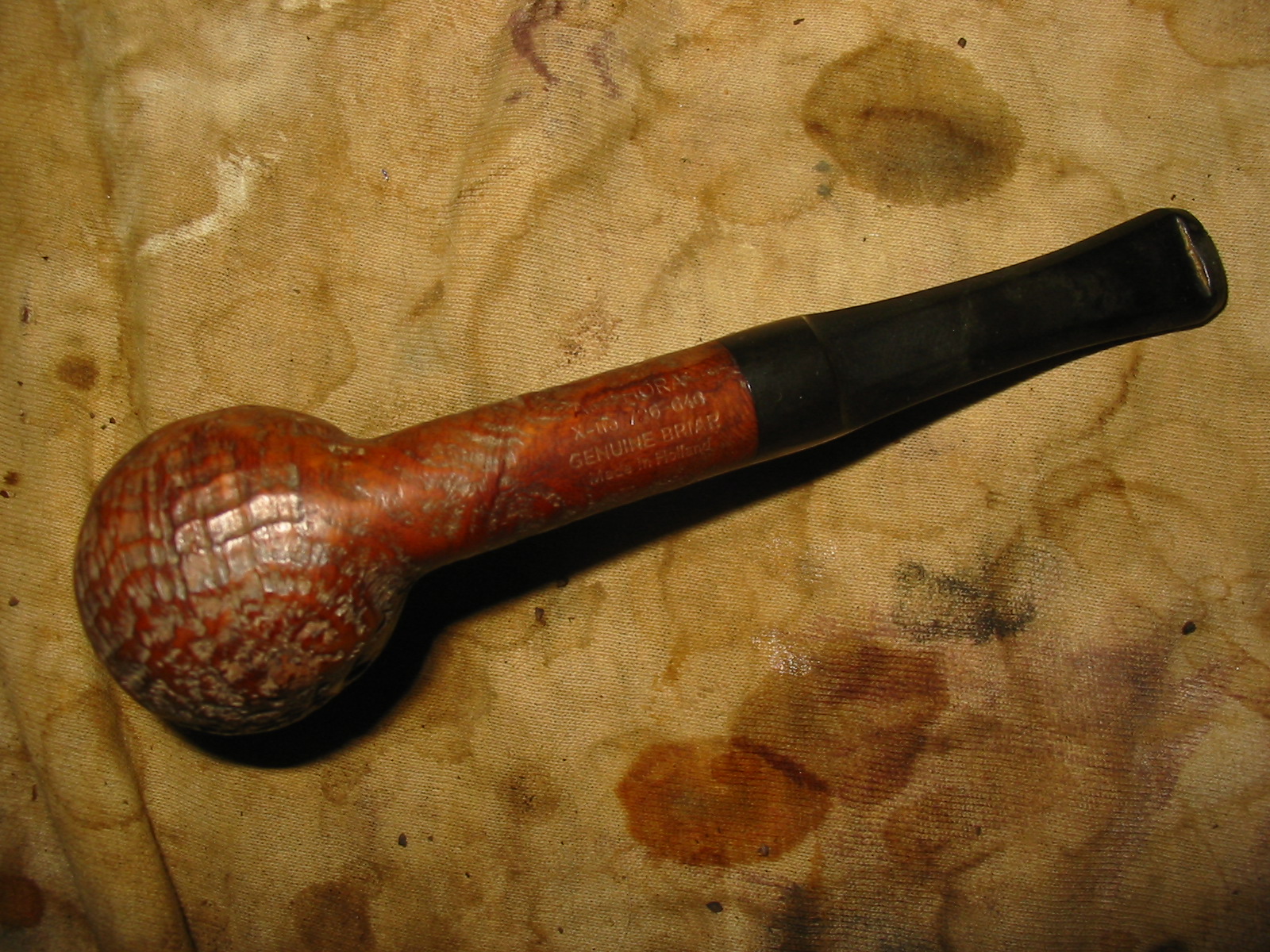
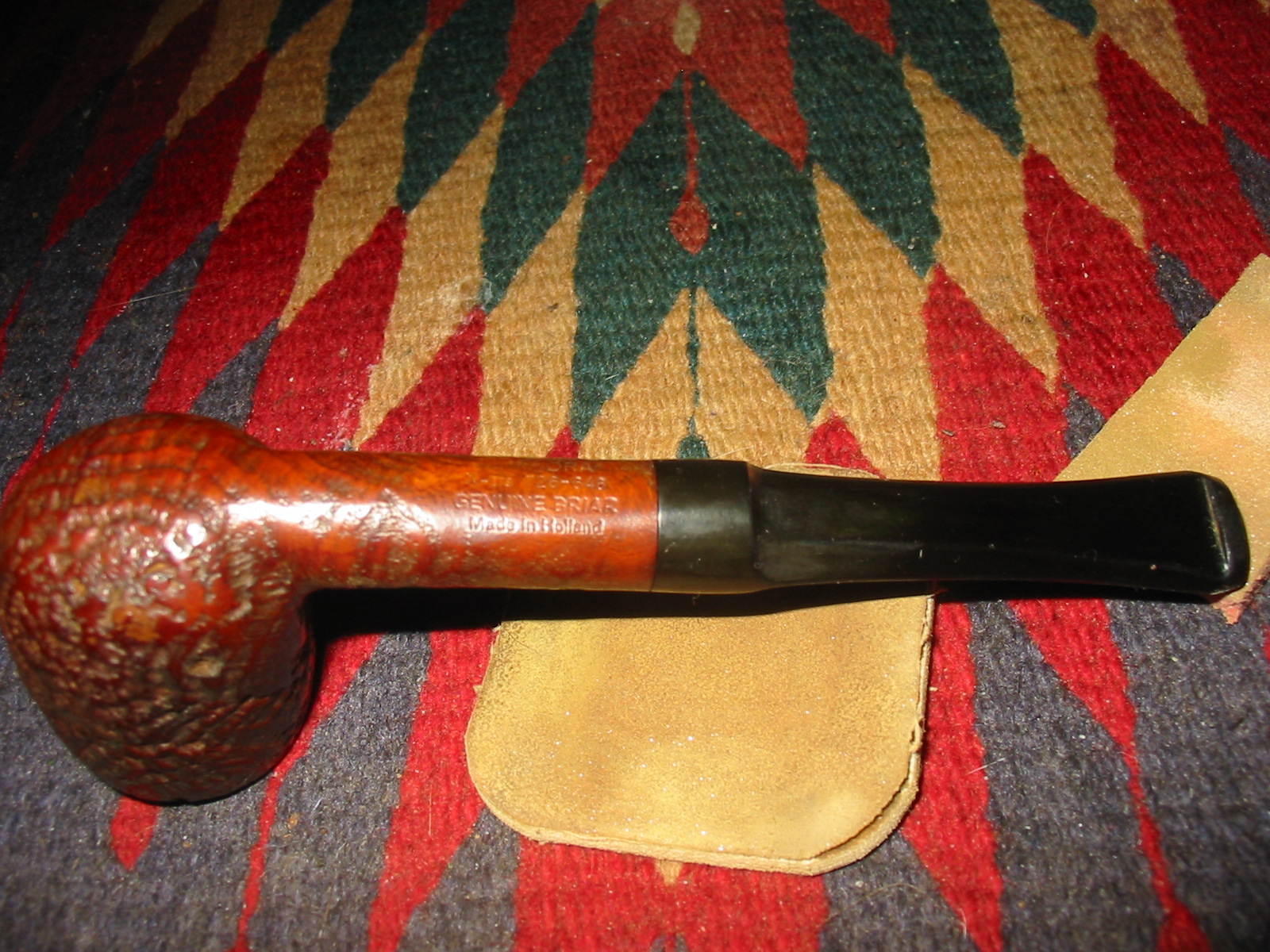
This one is the third of the three I bought at an antique mall in Edmonton, Alberta on a recent trip. It is stamped on the bottom of the shank as follows:
AMPHORA
X-tra 726-649
GENUINE BRIAR
Made in Holland

IMG_0302

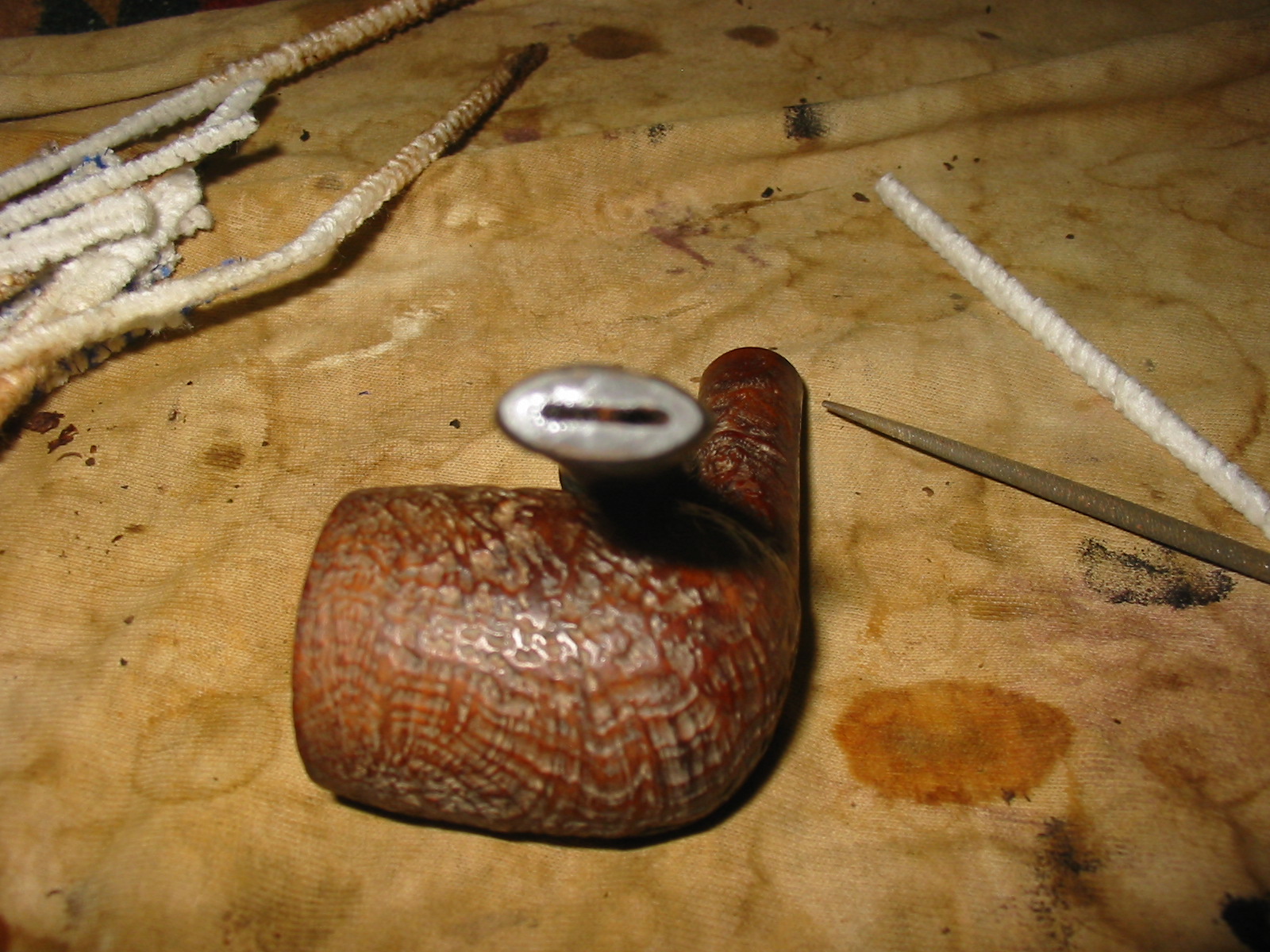
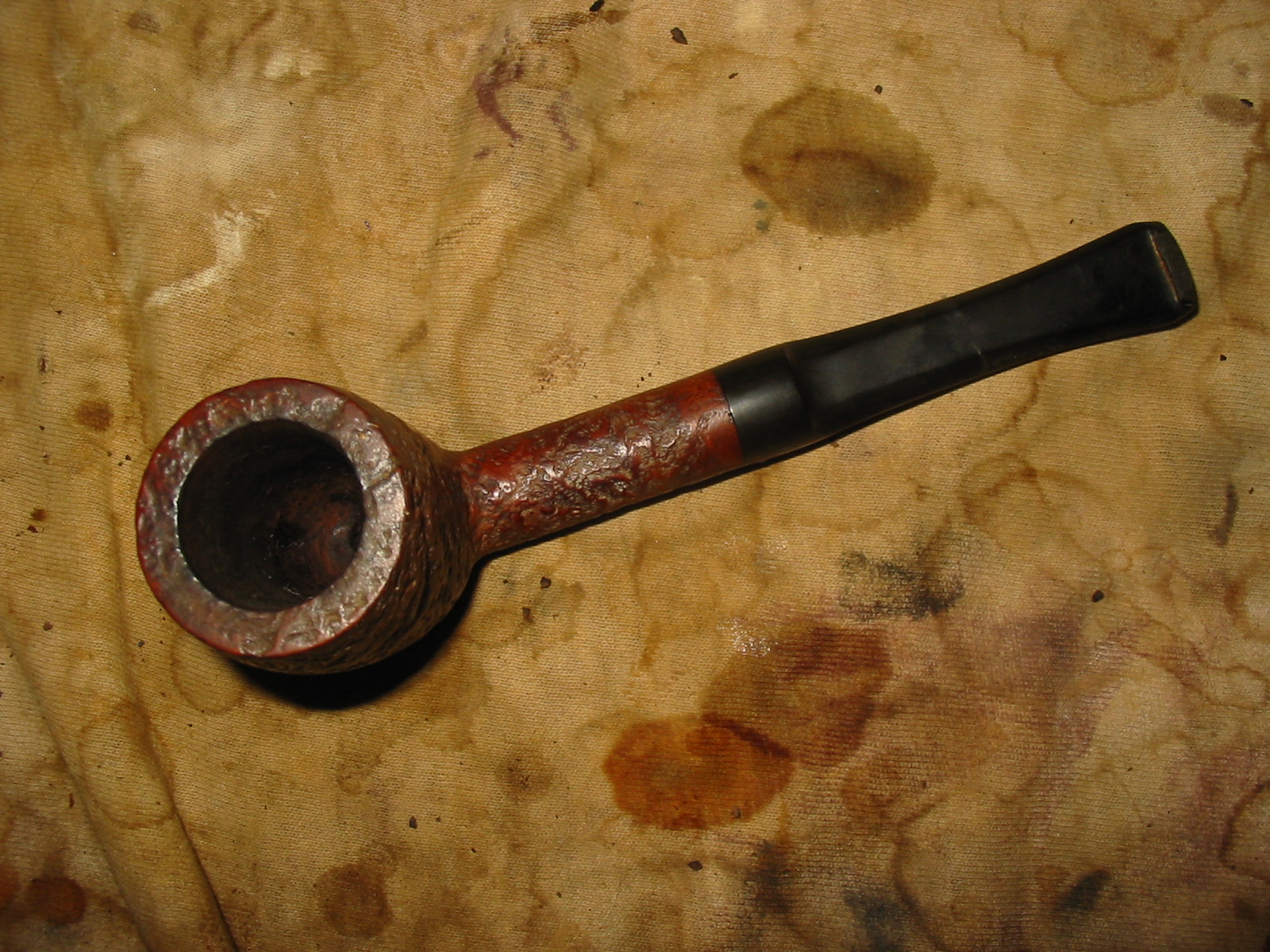
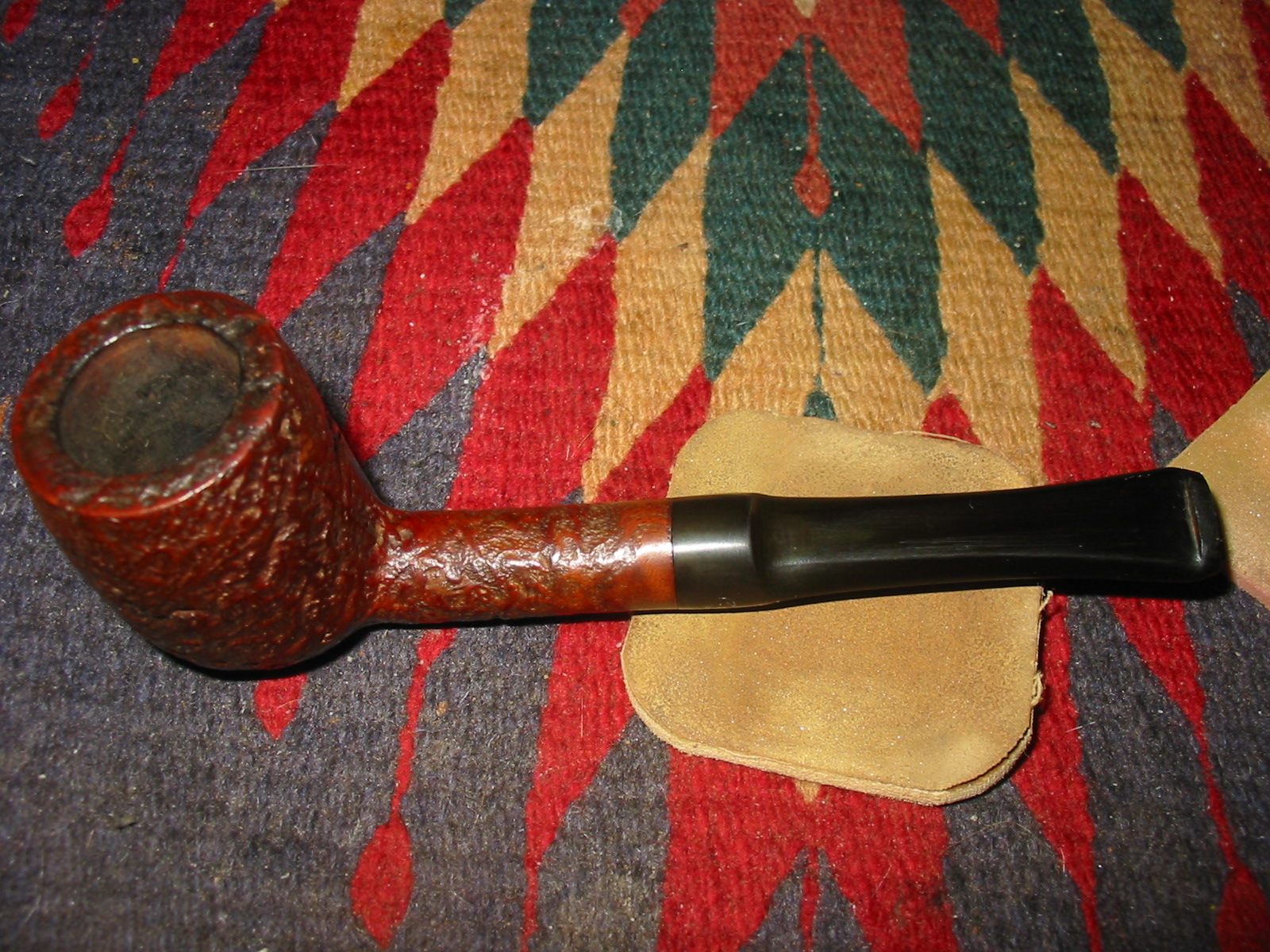
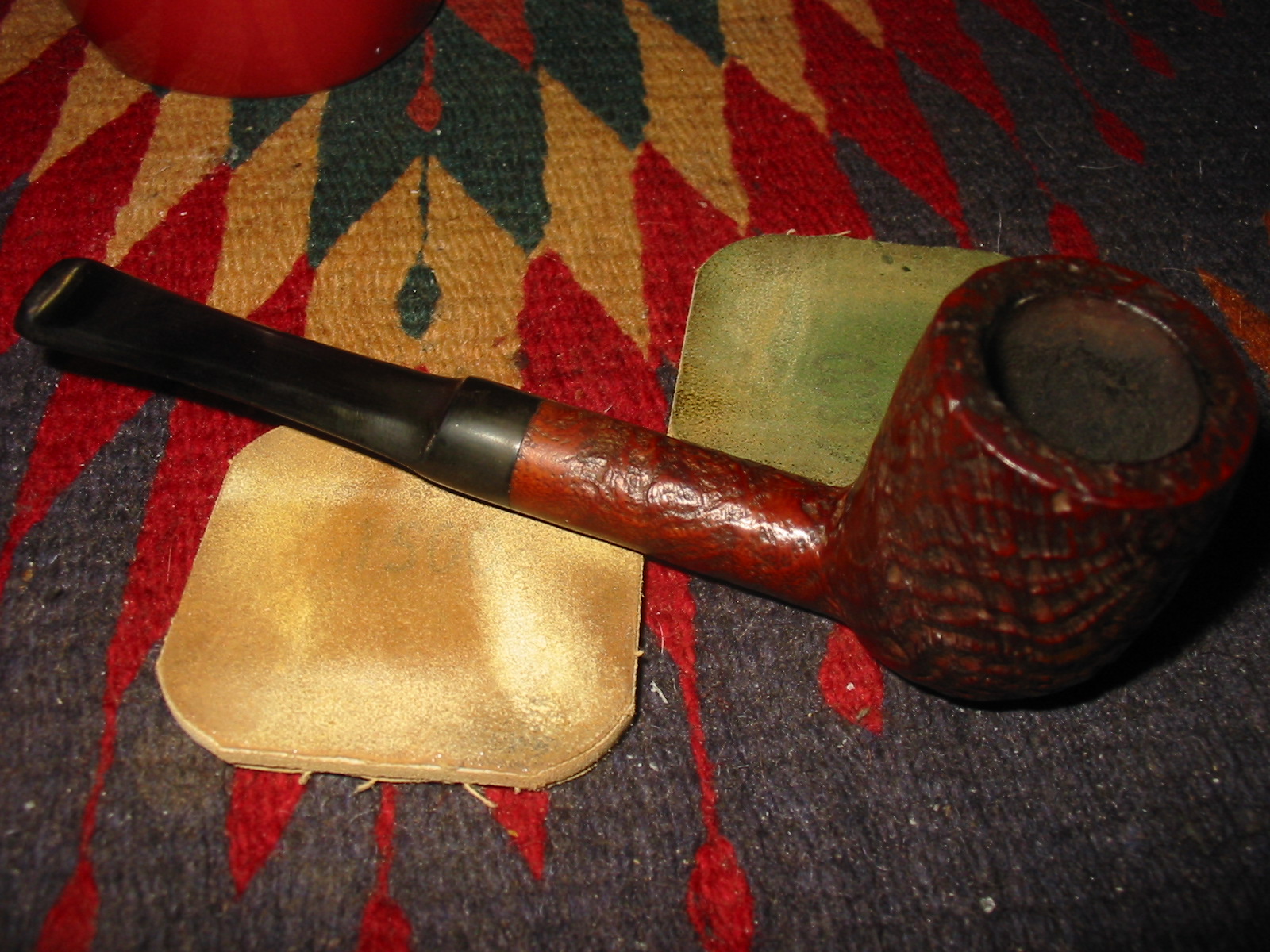
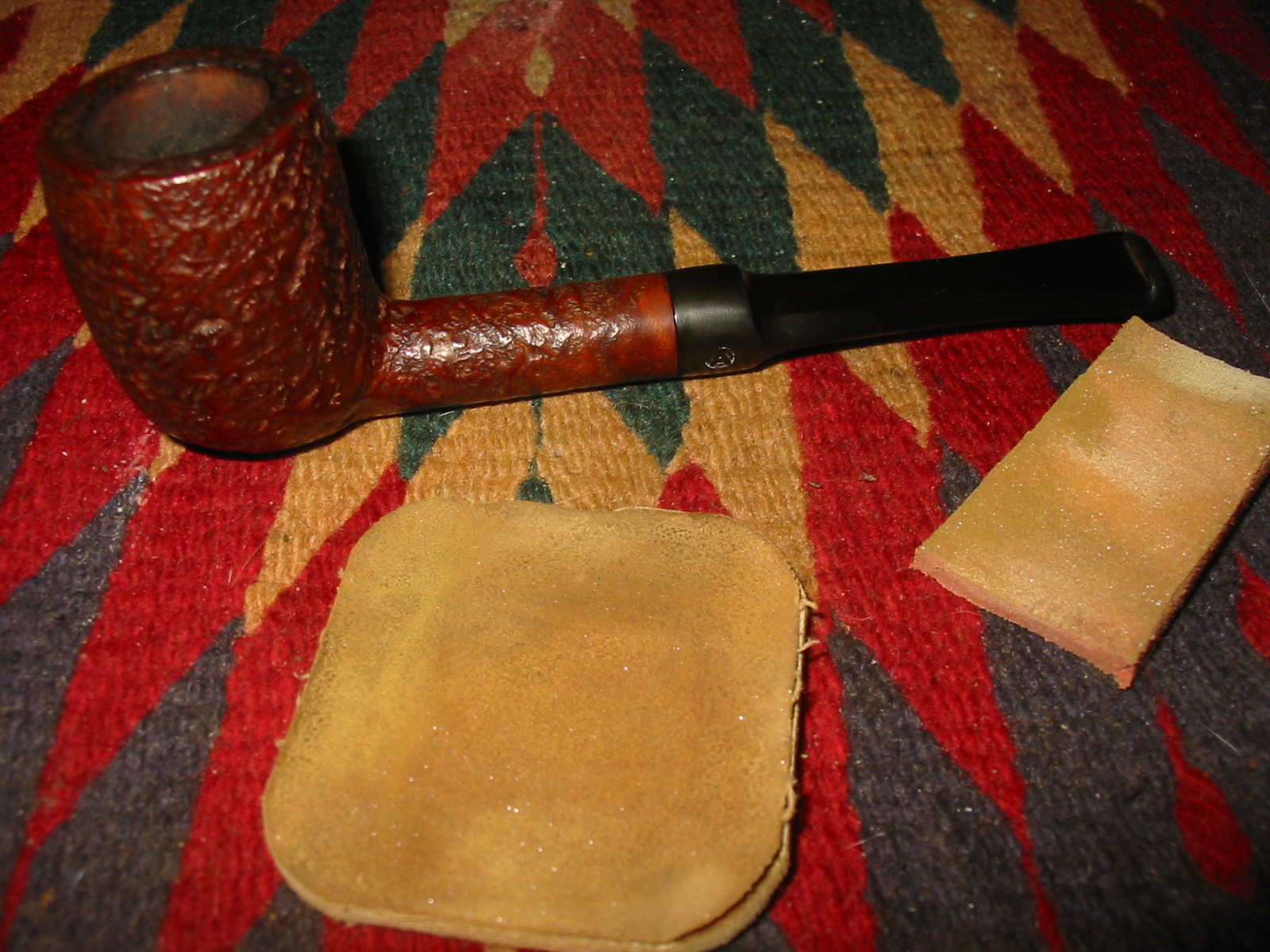
It has a deep craggy blast that attracted me to the pipe in the first place. The briar was dirty and the finish was gone. The remaining stain was very spotty and dirty. The grime of many dirty hands had ground into the blast leaving dark spots all around the bowl and shank. The state of the finish can be seen in the photo below. The bowl was dirty and had a slight cake with dottle still in the bowl. The rim had some darkening from the lighter and there was lava on the surface hiding most of the blast. The beauty was that the bowl did not have any damage from tapping it out or burning on the edges. It would clean up very nicely. The stem was slightly oxidized and had a calcified buildup in several spots. It also had a few faint tooth marks about a ¼ inch back from the button. The button itself had several dents in it as well. The slot in the button was too tight to even take a thin pipe cleaner. The inside of the shank was thick with a tarry buildup and the stem was clogged with buildup as well. I am pretty sure the stem had never been cleaned out as a pipe cleaner would not pass through the slot.

IMG_0305

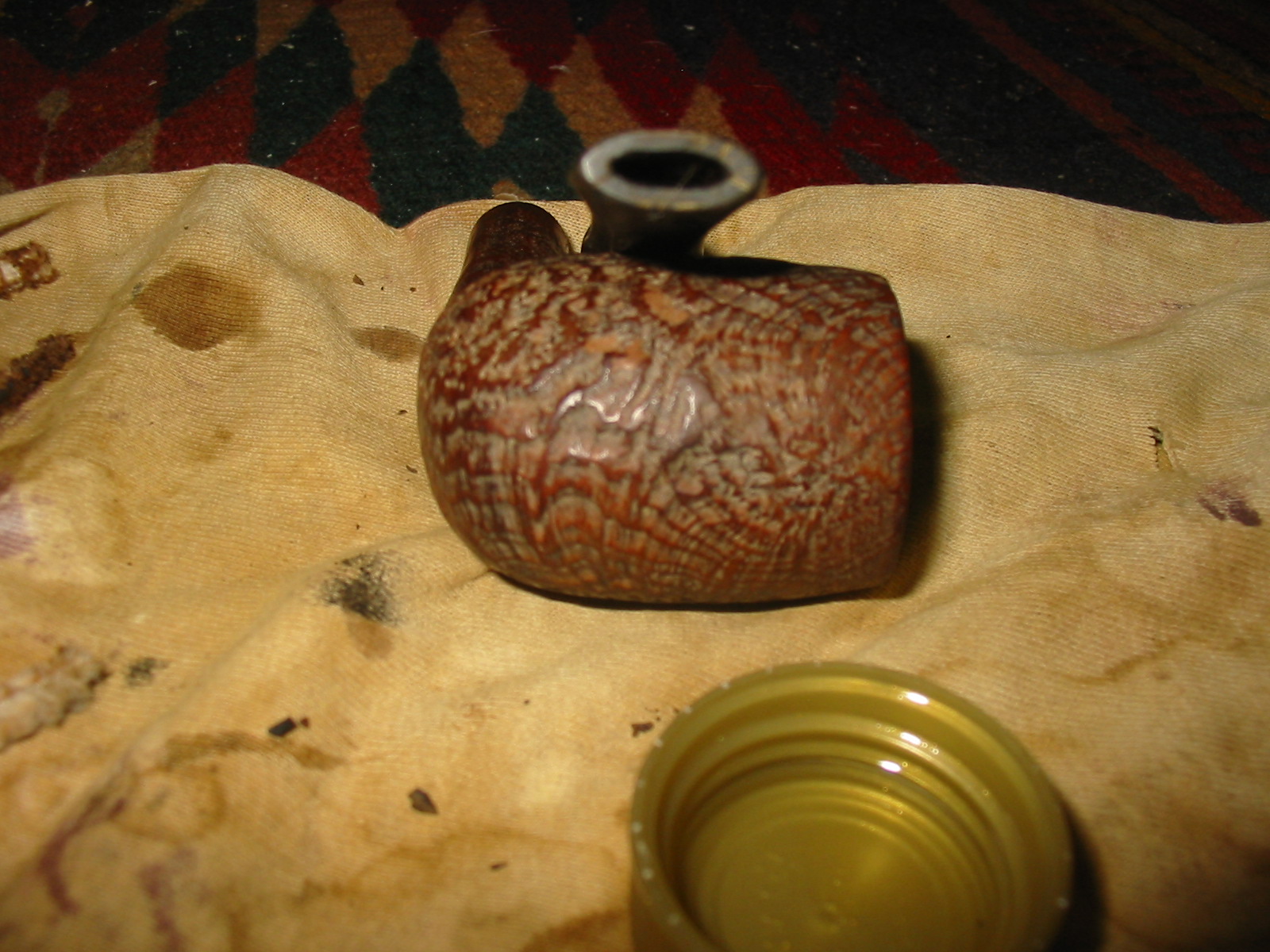
I removed the stem from the bowl and dipped the bowl in an alcohol bath and scrubbed it with a brass tire brush to remove the grit and grime in the blast. I then dropped it into the bath to soak overnight. In the morning I removed it from the bath and gave it another quick scrub with the tire brush. I flamed the alcohol in the bowl to dry it before I cleaned it. This is a simple process of lighting the alcohol on fire with a lighter. It burns blue and burns fast. No harm is done to the briar. I then cleaned the bowl and shank with pipe cleaners to remove as much of the tars and oils as I could before I used the retort to give it a final cleaning.

IMG_0782

IMG_0783

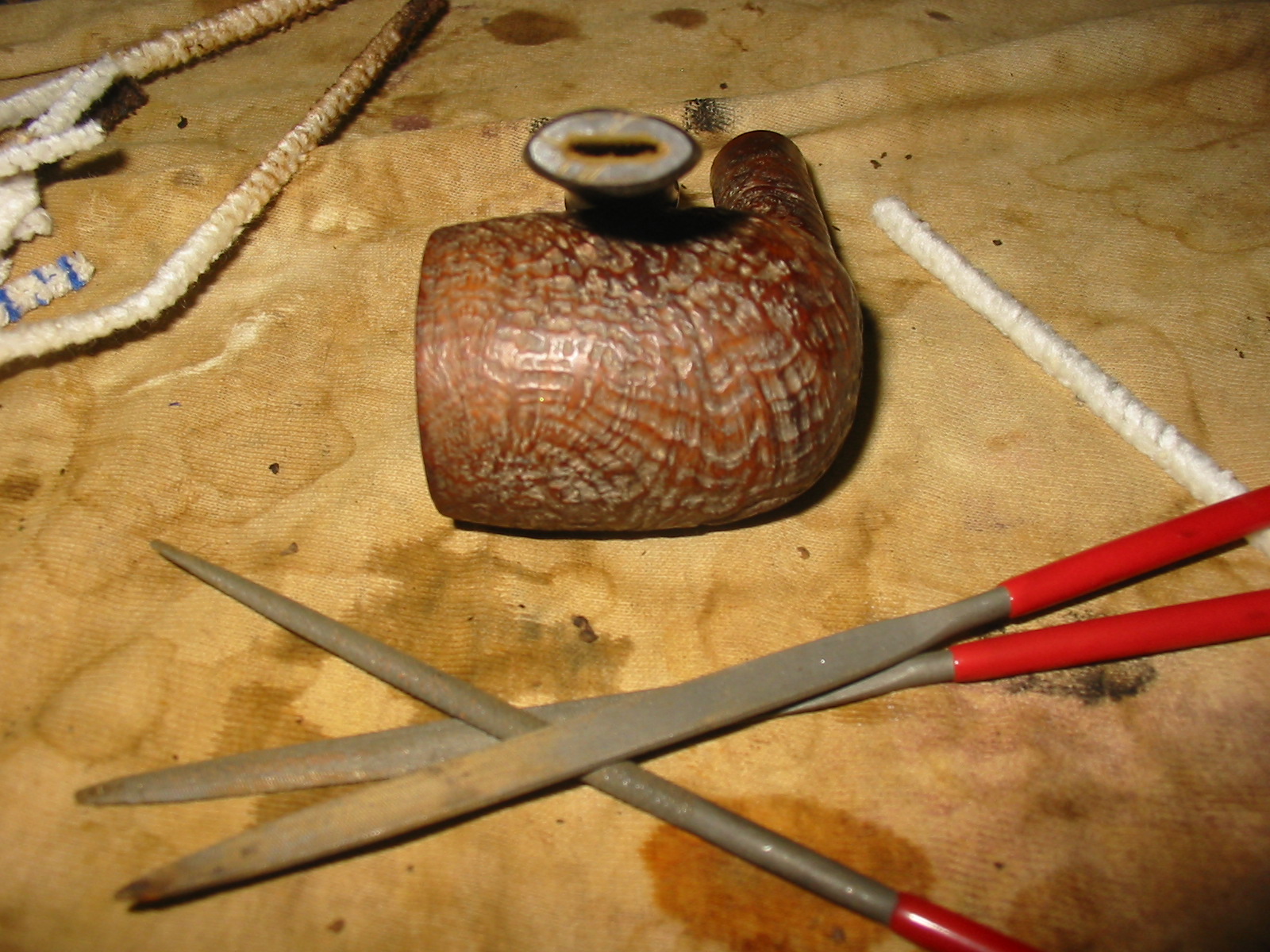
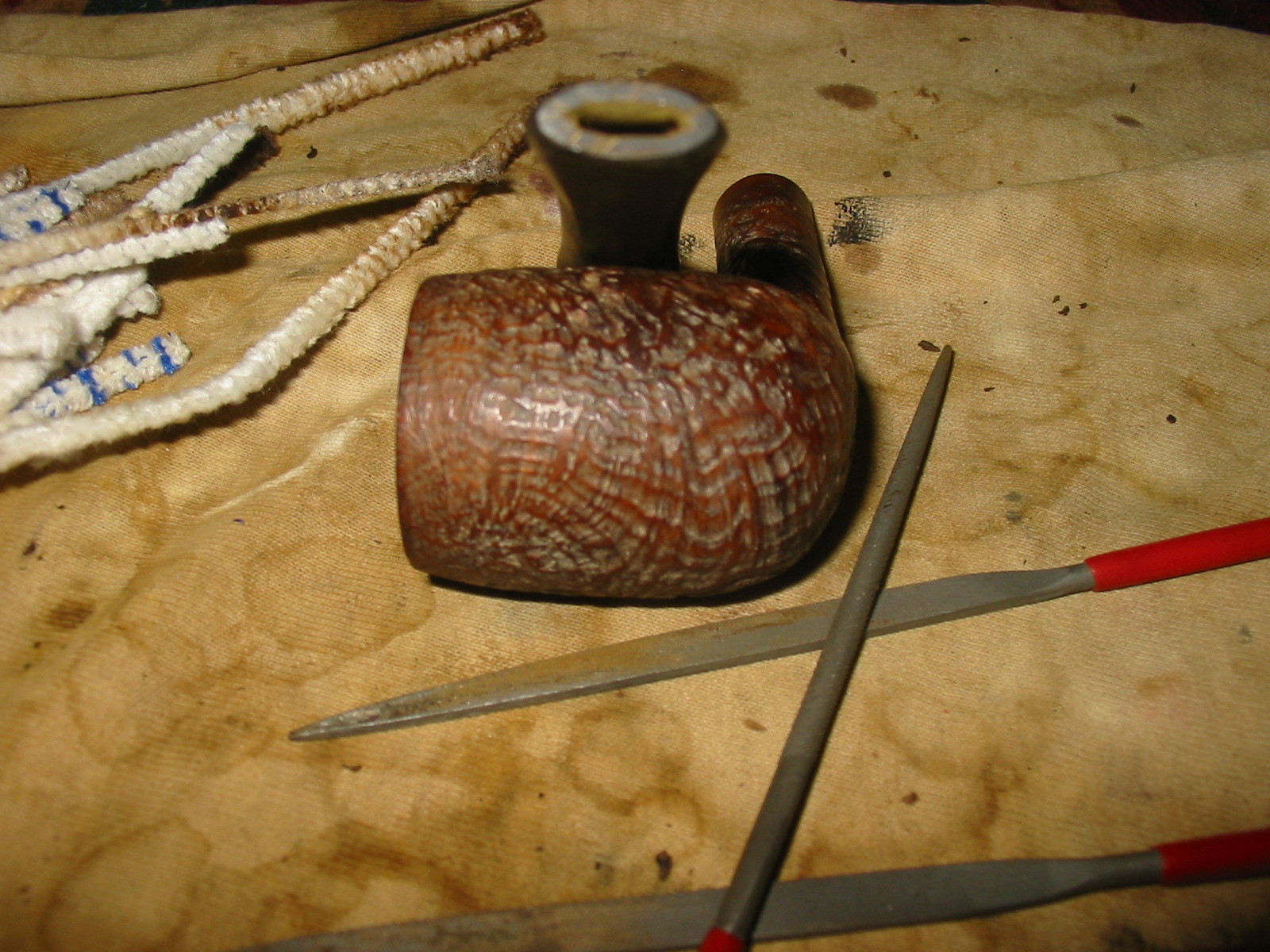
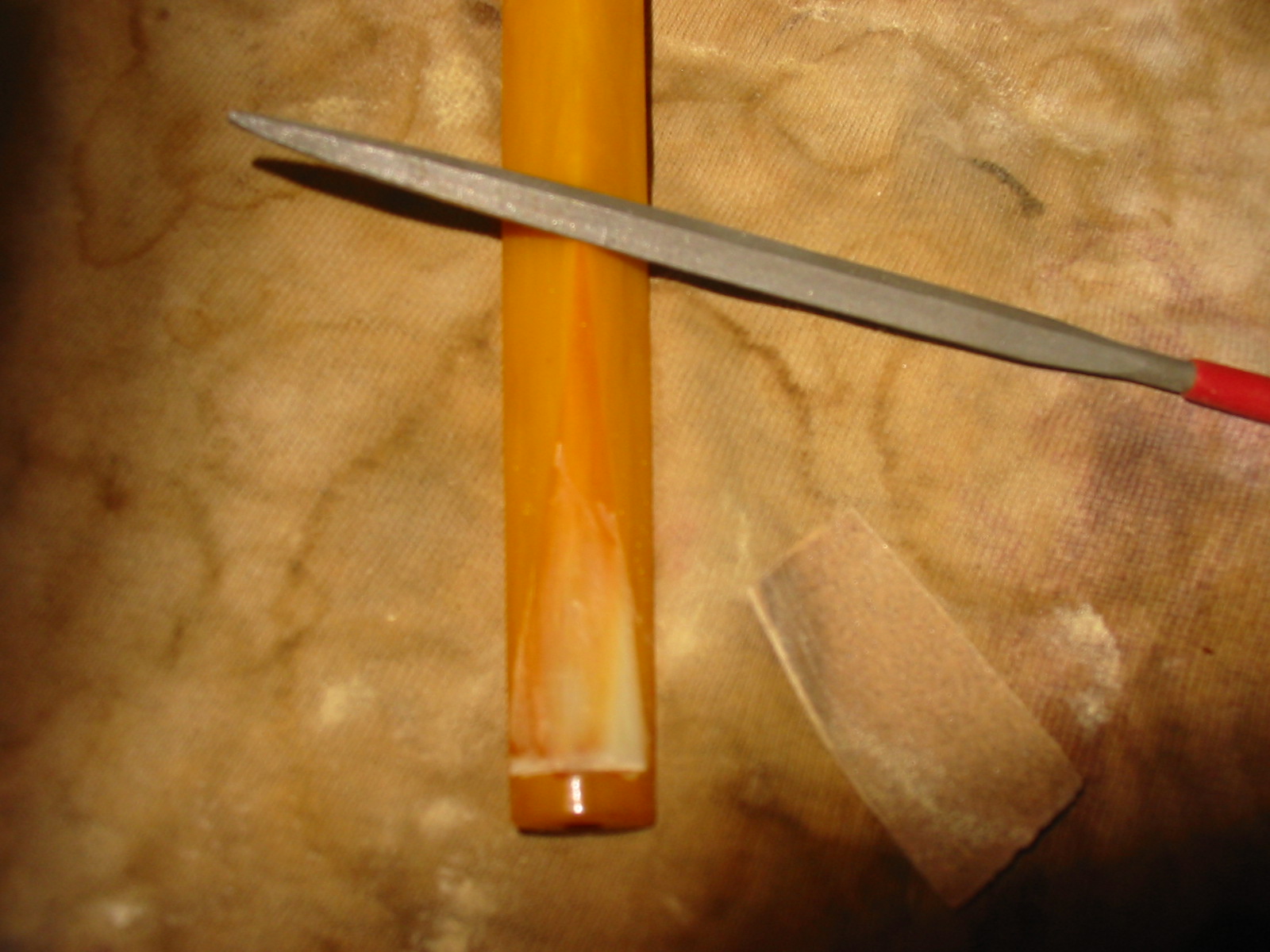
I decided to open up the button with needle files before I used the retort on the pipe. I was unable to run a pipe cleaner through the stem so I wanted to be able to remove some of the grit before I hooked up the retort. I used three different needle files to open the slot. The next four photos show the opening of the slot from start to finish. When I was done a pipe cleaner went through very easily and I was able to remove much of the tars and oils from the stem.

IMG_0791

IMG_0792

IMG_0793

IMG_0794

To finish the reformed slot I used some folded medium grit emery paper and then 340 grit sandpaper to smooth out the new edges and give it a finished look. I also sanded the surface of the button to remove the scratches from the files. Once that was done put the stem back on the pipe and ran a few more pipe cleaners dipped in Everclear through to clean out the airway. The next two photos show the pipe at this stage in the cleanup.

IMG_0784

IMG_0785

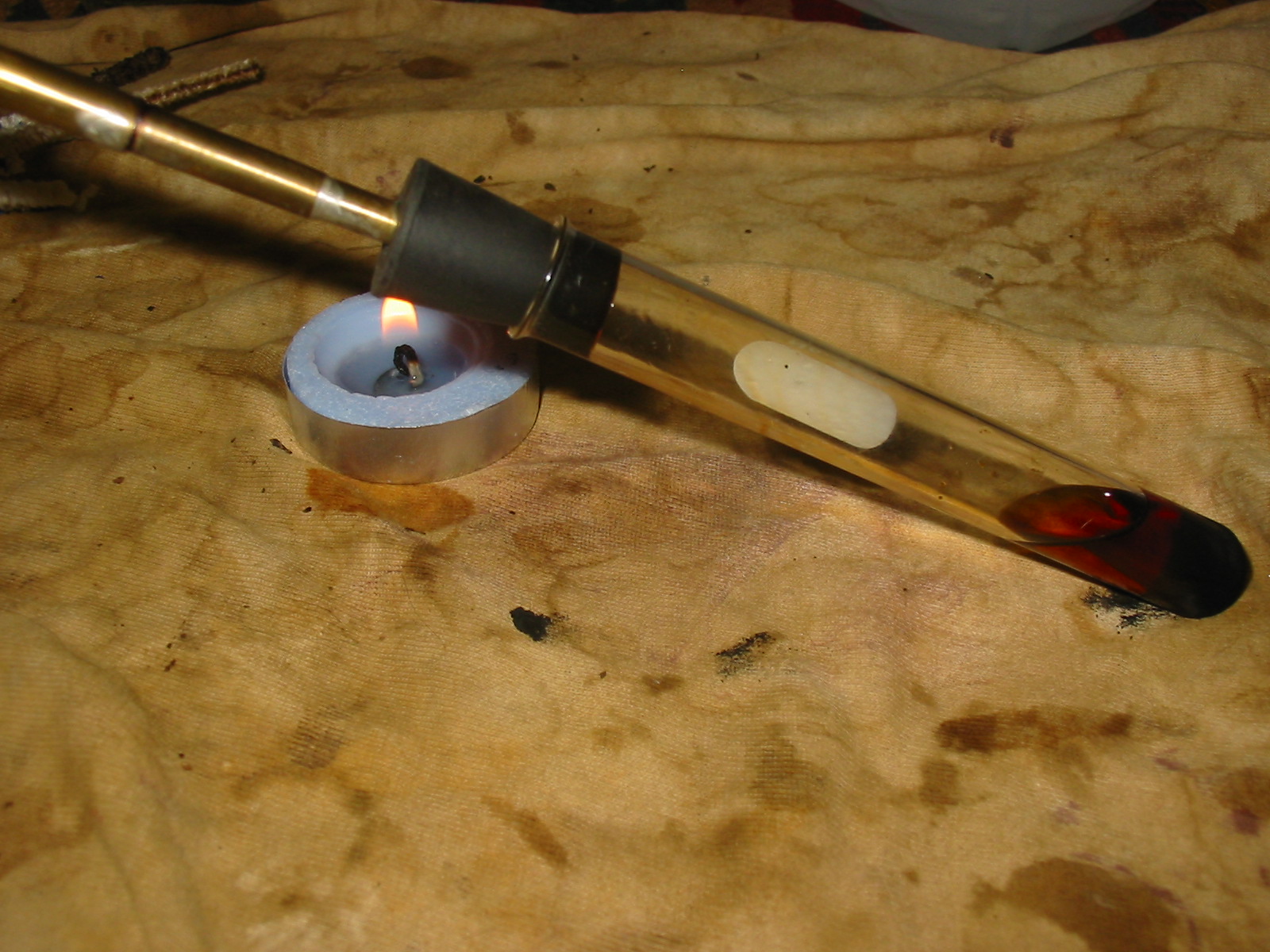
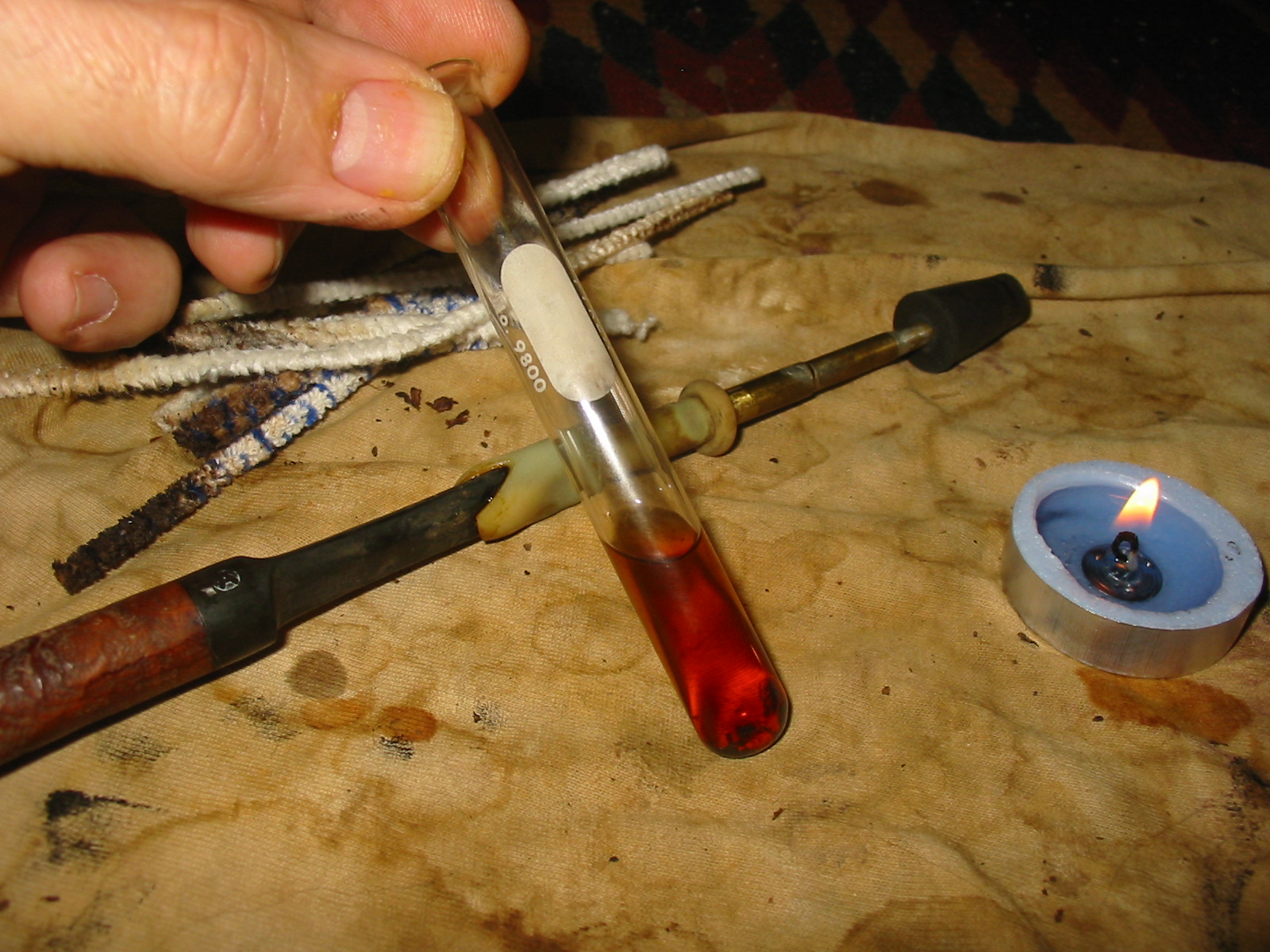
With the slot opened and the interior surface cleaned it was time to set up the retort. I placed a cotton boll in the bowl to keep the boiling alcohol from coming out the top of the bowl. I slid the rubber surgical tubing over the end of the stem and slid it on about ½ an inch. I want a good tight seal at this point because as the alcohol boils it can bubble out the sides of the stem and give a good burn while you are holding the stem. I put about 1 inch of 99% isopropyl in the test tube and put the rubber stopper in place in the mouth of the tube. I lit a small tea light and held the bottom of the test tube over the flame. The alcohol has a low boiling point so it does not take long for it to boil and the gaseous alcohol migrates up the surgical tubing and into the stem, shank and bowl. It is great to feel the shank warm up as the alcohol moves into the shank. I remove it from the flame after several minutes and let it cool off. As the alcohol cools it runs back into the test tube and cools. The next series of three photos show the heating and boiling process.

IMG_0786

IMG_0787

IMG_0788

As it cools the alcohol migrates back into the tube. It is generally a very dark amber colour – like nice amber ale! In the first photo below show the tube removed from the flame and the alcohol beginning to refill the tube. The flame is actually behind the stopper not under it – lest anyone wonder about that. I blew out the candle at this point and continued to let the alcohol cool and drain. I then poured out the dirty alcohol, rinsed the tube with warm water, dried it out and refilled it. I reattached the apparatus and used the retort a second and third time until the alcohol came out as clean as when I started using it.

IMG_0789

IMG_0790

Once the insides were clean I used a soft bristle tooth brush and some isopropyl to scrub down the exterior of the bowl to prepare it for restaining. The next four photos show the scrubbed and prepared bowl.

IMG_0795

IMG_0796

IMG_0797

IMG_0798

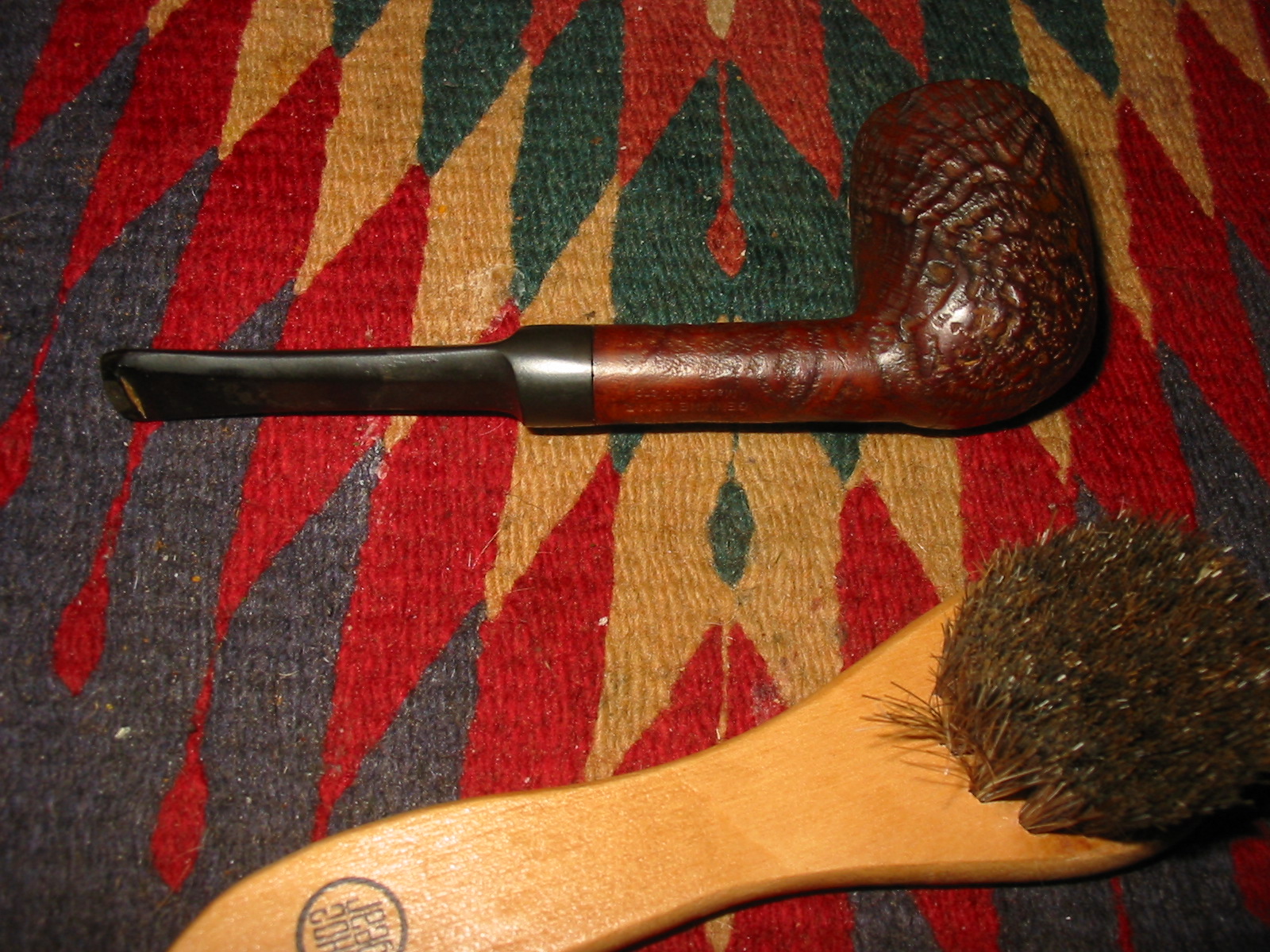
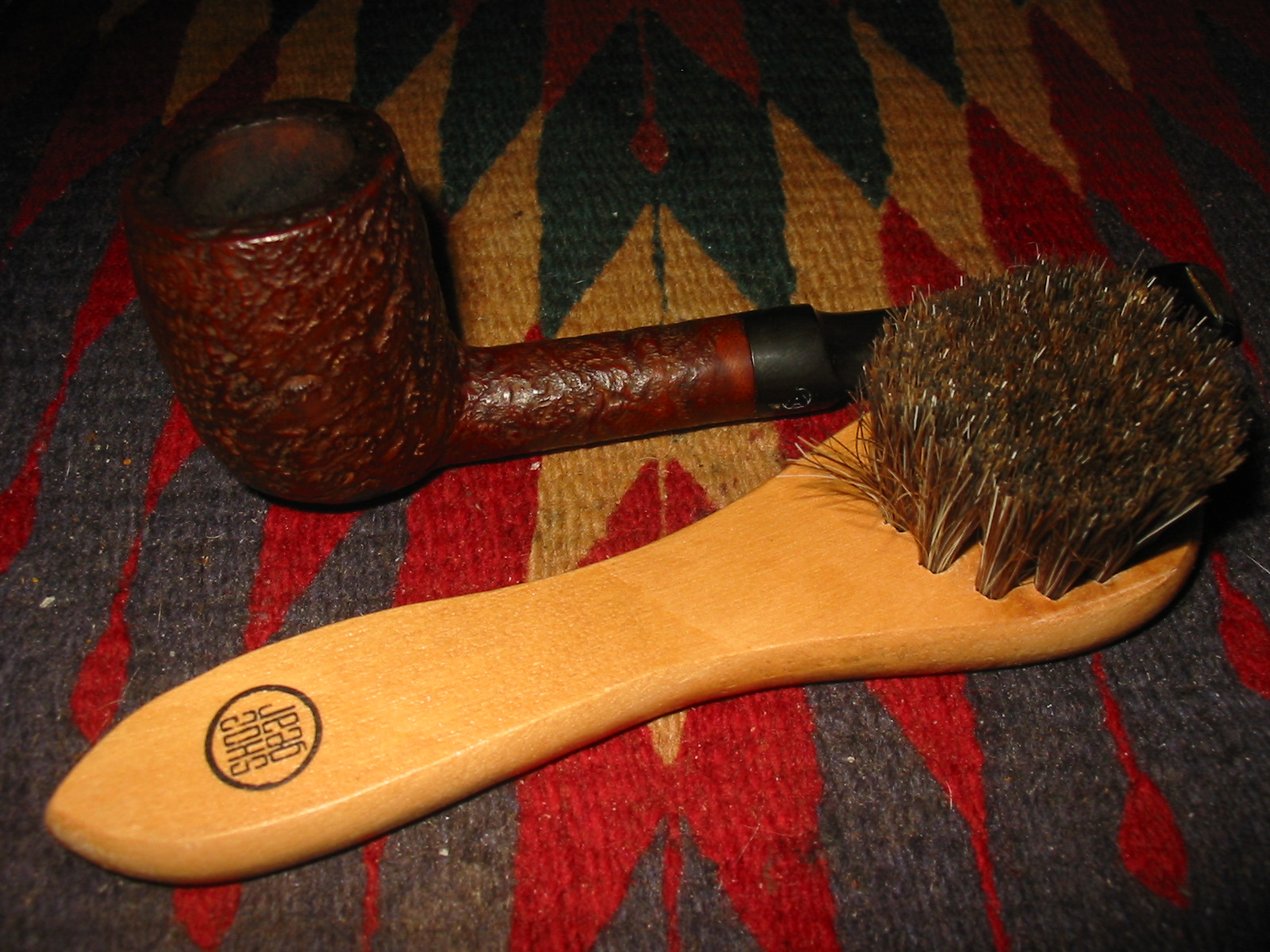
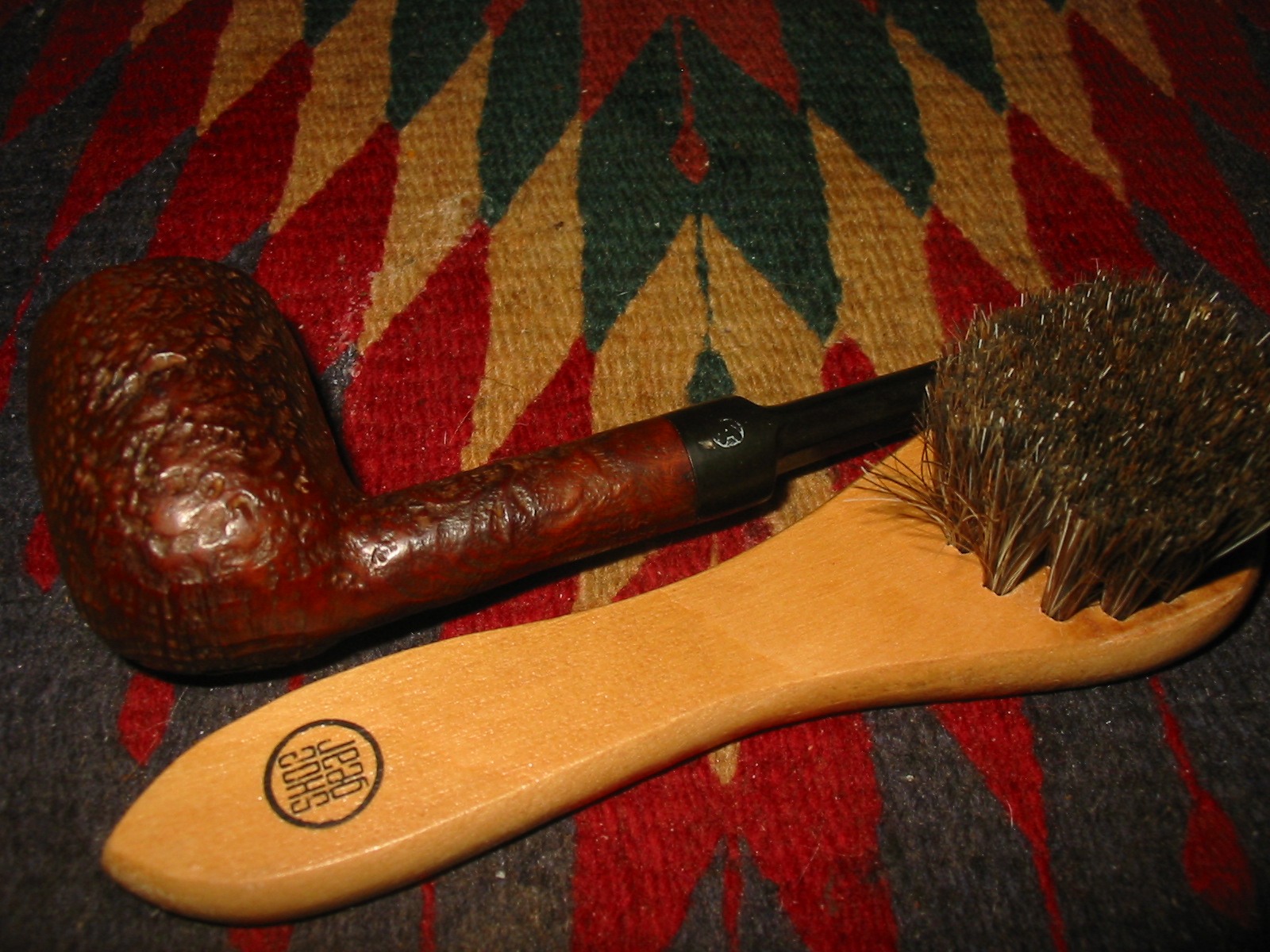
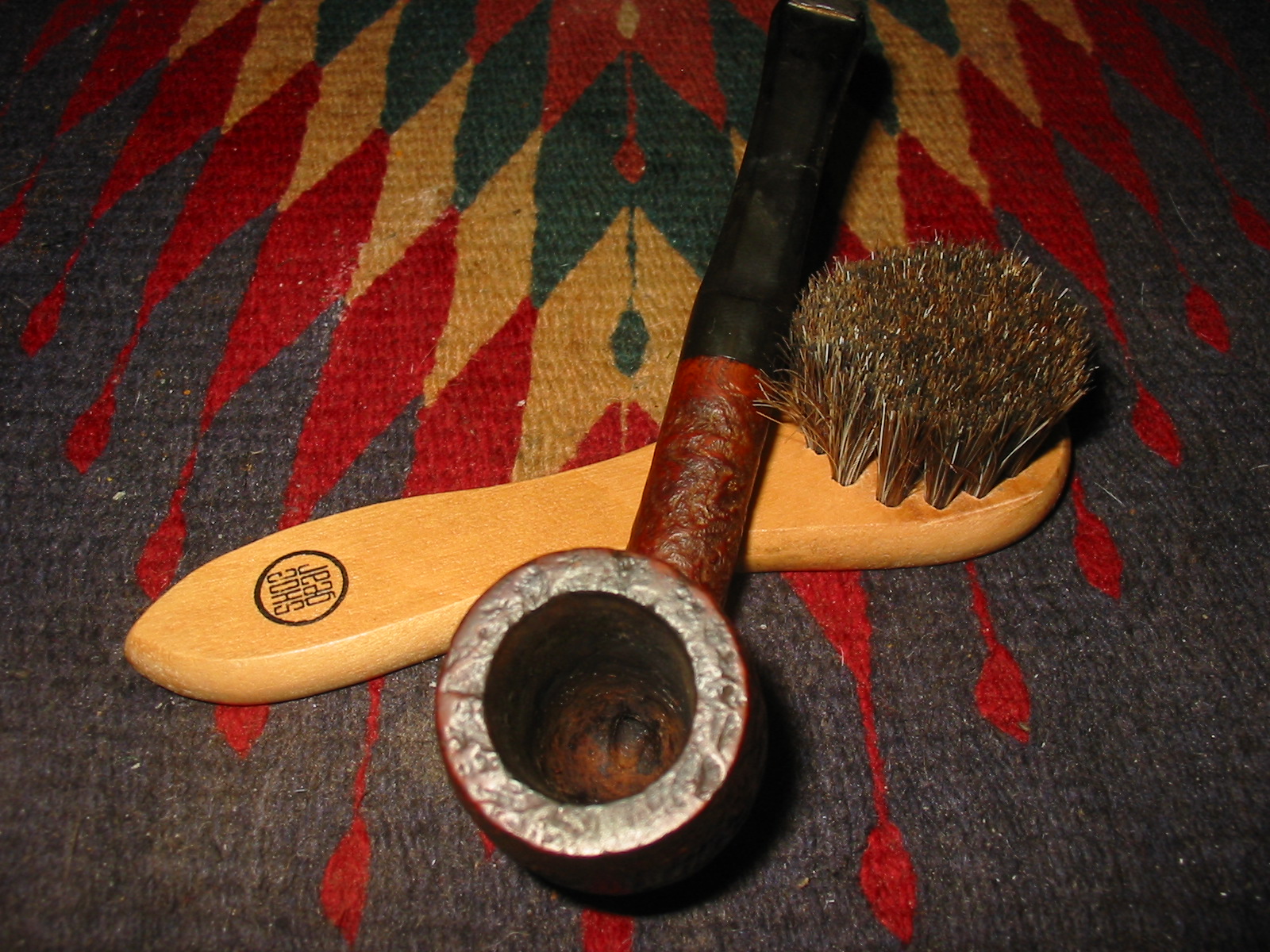
I chose to restain the bowl with a dark brown aniline stain that I thinned 2:1 with isopropyl alcohol. I applied the stain heavily to the pipe with a folded pipe cleaner to make sure I got it into the nooks and crannies of the sandblasted surface. Once it was covered I flamed it with a lighter to set the stain. I gave it a second coat of stain and flamed it a second time. Once it was dry I buffed it with a shoe brush to get a soft shine on it. The next series of four photos show the restained bowl after the buffing with the show brush. I find that the bristles on the shoe brush work really well to buff sand blasted and rusticated pipes. I used to use my buffer and keep a light touch on the wheel because I did not want to soften the ridges of the blast. I have since resorted to using the shoe shine brush instead.

IMG_0799

IMG_0800

IMG_0801

IMG_0802

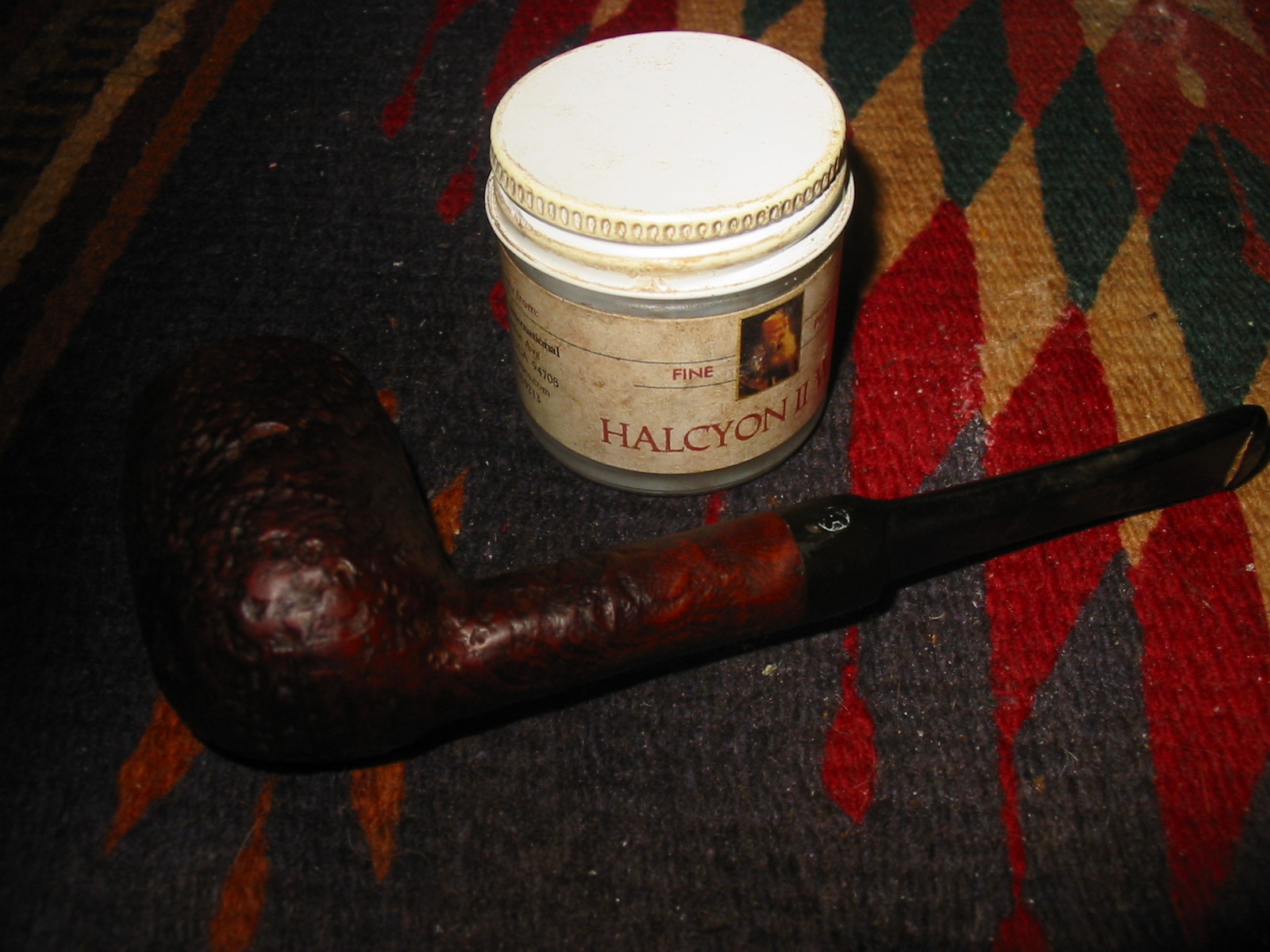
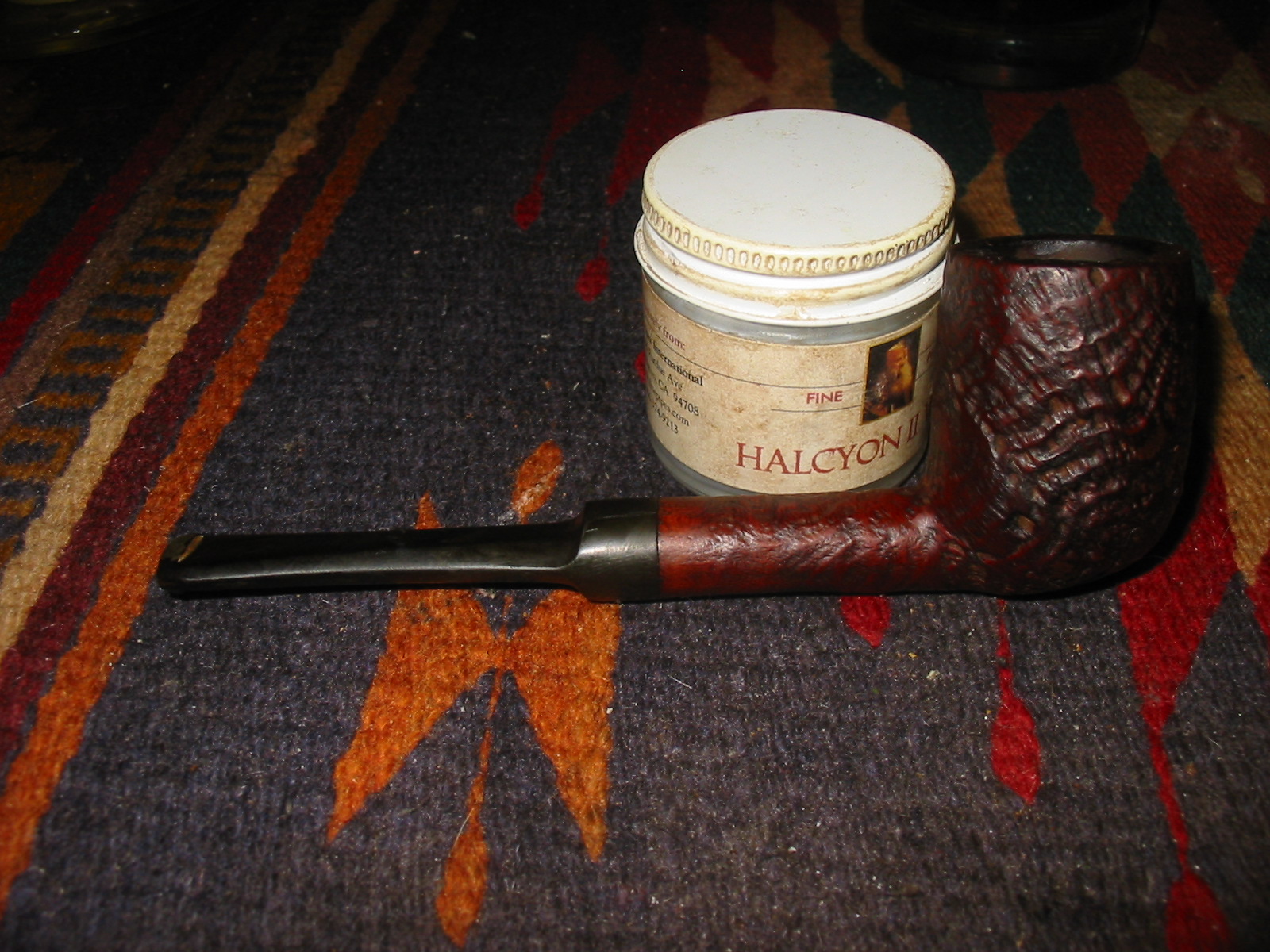
I hand applied some Halcyon II wax to the bowl and shank and buffed it a second time with the shoe brush to give it a shine. The next series of six photos show the bowl and shank during and after the shine with Halcyon II and the shoe brush buffing.

IMG_0803

IMG_0804

IMG_0805

IMG_0806

IMG_0807

IMG_0808

After finishing the bowl it was time to work on the stem. I sanded the blade area where the tooth marks were to cause them to stand out a bit more clearly. I used a fine grit sanding sponge first. I then heated the slight tooth dents with a Bic lighter to lift them. I find that this works very well for light dents in vulcanite. I do not leave the flame in one place but move it quickly across the surface of the dent and it literally lifts with the heat. I then wet sanded the stem with 1500-2400 grit micromesh sanding pads and followed that by dry sanding with 3200 and 3600 grit micromesh pads. The next series of eight photos gives you a look at the progress of the sanding.

IMG_0811

IMG_0816

IMG_0812

IMG_0813

IMG_0809

IMG_0814

IMG_0810

IMG_0815

At this point in the process I wiped down the stem with Obsidian Oil and rubbed it into the vulcanite. I wanted to see where the remaining oxidation was so that I could do some more work on those areas.

IMG_0817

I continued sanding the stem with 4000, 6000, 8000 and 12,000 grit micromesh sanding pads. The next three photos show the progress of the shine on the stem. There was still some deep seated oxidation on the stem. I used a Bic lighter and went over the surface of the stem to burn off the oxidation. I wiped it down with a soft cloth and repeat the process until the stem was a shiny black and the oxidation was gone.

IMG_0818

IMG_0819

IMG_0820

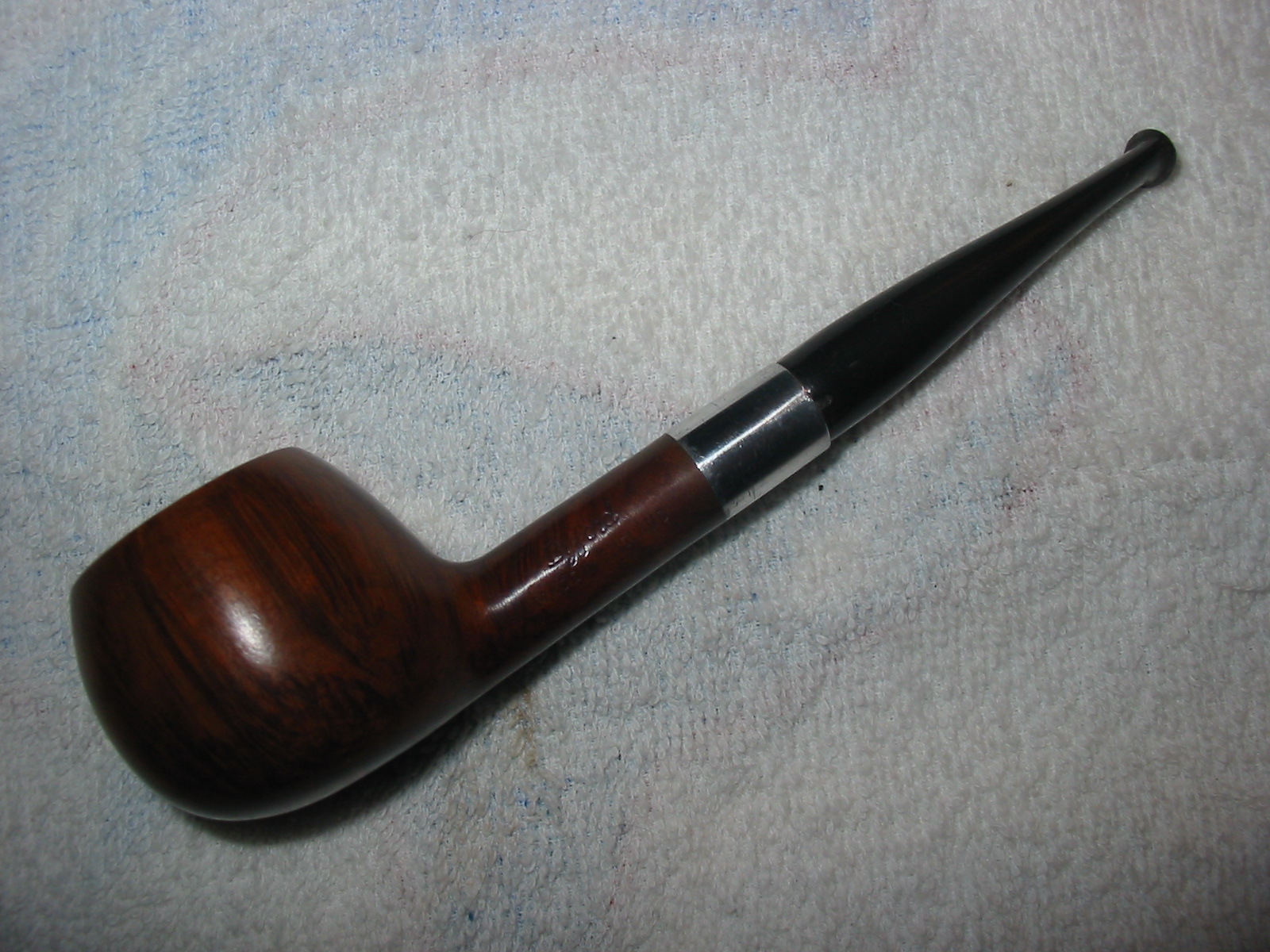
The final series of four photos show the finished pipe. I gave the stem a final rub down with Obsidian Oil and I buffed the stem on my buffing wheel (attached to the bowl) using White Diamond. I did not buff the bowl. I gave the stem several coats of carnauba wax and then buffed it with soft flannel buffs. I also rebuffed the bowl by hand with the shoe brush. The pipe smells fresh and clean. It is ready to smoke.
IMG_0821

IMG_0822

IMG_0823

IMG_0824

Comoy’s The Guildhall London Pipe Liverpool Renewed


Blog by Steve Laug

The Comoy’s pipe pictured below was one of the pipes I picked up at an Antique Mall in Edmonton, Alberta. It was by far in the best condition of the three pipes I purchased that day. It also had the highest price tag – $30 of the three. It is stamped on the left side of the shank The Guildhall over London Pipe and on the right side it is stamped Made in London in a circle over England. The shape is stamped as 30. The grain on it is very nice with a few bald spots on the sides and front on the lower portions of the bowl. The contrast stain that is on these older Comoy’s pipes is extremely well done and it is what always draws me to them. The top of the bowl rim was covered with a little tar. The bowl itself was partially caked and a few tobacco remnants sat in the bottom of the bowl. The stem had tooth chatter and slight oxidation. When I picked it up the stem was on upside down so the three metal lines that were stem logos on these pipes was not visible. I was able to rotate the stem but it was tightly stuck in the shank. I did not want to damage the shank so I left it until I got home.
IMG_0302

IMG_0304
When I returned home from my trip and things settled down I took the pipe to the work table to refurbish it. I decided to take it apart to begin the process of cleaning it. The stem was tight in the shank and I needed to use the freezer technique to loosen it easily. The tenon is often easily snapped if you try to turn it when it is stuck. I put it in the freezer for 15 minutes and then it came out very easily. When I pulled it out of the shank it brought a lot of chunks of tar and oily buildup with it. The cloth on my worktable was littered with the black pieces that fell out of the shank. Once I had it out of the shank there was a stinger contraption that I have found is common in the older Everyman and Guildhall pipes. This one was covered thickly with tar and oil. It was pressure fit into the tenon but was tightly bonded to the vulcanite. I used a pipe cleaner with alcohol to scrub the inside of the stem and to also work around the exterior of the stinger. I scraped at the gunk that held it to the tenon and was able to remove much of the grit with a dental pick. I grabbed it with a piece of cloth and twisted and pulled at the same time. I kept the stem level during this process as I did not want to damage the tenon by pulling up as I tried to remove it. It finally broke free of the tenon and I laid it aside on the table top. I do not put the stinger back into a pipe that I intend to use. I tag the stingers and save them should I decide to sell the pipe in the future.
IMG_0757
I then cleaned out the shank and the stem with pipe cleaners and Everclear. It took a lot of pipe cleaners to remove the oils and tar from the stem and the shank. I cleaned it until they came out only stained but not covered in grime. I intended to use a retort on this pipe so my purpose was only to remove the heavy buildup on the surface in the stem and shank.
IMG_0758

IMG_0759

IMG_0760

IMG_0761
Once I had the interior relatively clean I took out my retort and hooked it up to the pipe. The retort is made up of a test tube and stopper with a permanently inserted brass tube to which a piece of surgical tubing is fitted on the end of the brass tube. The tubing fits over the stem. I put about ¾ of an inch to 1 inch of isopropyl alcohol in the test tube. I stuffed the bowl of the pipe with a cotton boll to stop the alcohol from coming out of the top of the pipe when I heated the alcohol. I lit a candle to heat the alcohol and boil it into the stem and shank. I began with a large candle to do the heating. The next series of seven photos show the first boil of the alcohol through the pipe. I let it boil for several minutes and then removed the test tube from the heat. As it cooled the alcohol was drawn back into the test tube. It was dark amber in colour and smelled strongly of old burned tobacco.
IMG_0762

IMG_0763

IMG_0764

IMG_0765

IMG_1109

IMG_1110

IMG_1111
I removed the tube from the flame, and once it had cooled I emptied the alcohol from the test tube, rinsed and refilled it. This time I chose to use a small tea light to heat the tube. It gave a better angle on the test tube and pipe. I boiled it again and when it cooled let the alcohol return to the tube. The series of five photos below shows the second boil and the amber fluid that filled the tube. I ran the retort a third and fourth time until the alcohol came out clear and then I knew the shank and stem were clean. I continue to boil the alcohol through the pipe until it is clean. The retort leaves a pipe smelling brand new once the alcohol smell has dissipated and the pipe dried out.
IMG_1112

IMG_1113

IMG_1114

IMG_1115

IMG_1116
I removed the retort from the stem and the cotton boll from the bowl of the pipe. Once it was removed I ran pipe cleaners through the shank and stem to remove any of moisture that may have been left behind and the pipe quickly dried out. It was time to clean the top of the rim of the pipe. Early on in the process I had examined it and found that the tars on the top were on the surface and that a good scrub with saliva on a cotton pad would remove the buildup quite easily. The next two photos show the cleaning of the rim with the cotton pads.
IMG_1117

IMG_1118
Once the rim was clean I buffed the pipe with White Diamond and gave the bowl and shank a first coat of carnauba wax. It was then time to work on the stem. I sanded the stem with 340 grit sandpaper to remove the tooth chatter and small dents in the surface of the vulcanite. I then wet sanded the stem with 1500-2400 grit micromesh sanding pads. The next two photos show the stem after the initial sanding with the 340 grit sandpaper.
IMG_1119

IMG_1120
The next two photos are randomly taken after I had sanded with the micromesh sanding pads 3200-12,000 grit. I dry sanded with these grits and the stem developed a shine and a depth to the blackness of the vulcanite. When I had finished sanding the stem I rubbed it down with Obsidian Oil to preserve the finish and then buffed it with White Diamond and finally multiple coats of carnauba wax.
IMG_1121

IMG_1122
The final four photos in this essay show the finished pipe. There is a bit of ghosting around the three bars in the photo that appear to be oxidation. The oxidation is gone. Rather what is happening is a reflection off the metal bars. In natural light the stem is a deep and rich black.
IMG_0778

IMG_0779

IMG_0780

IMG_0781

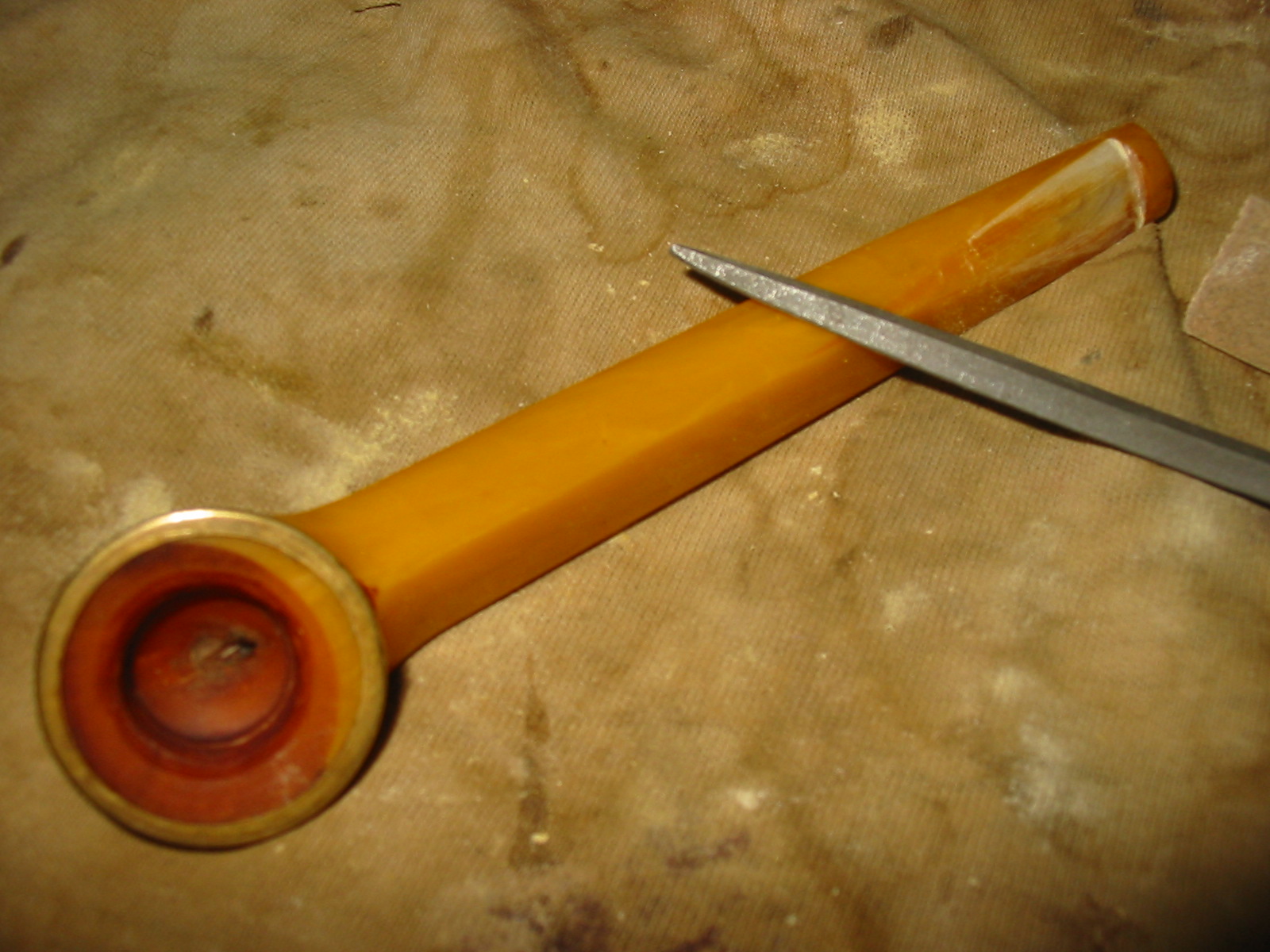
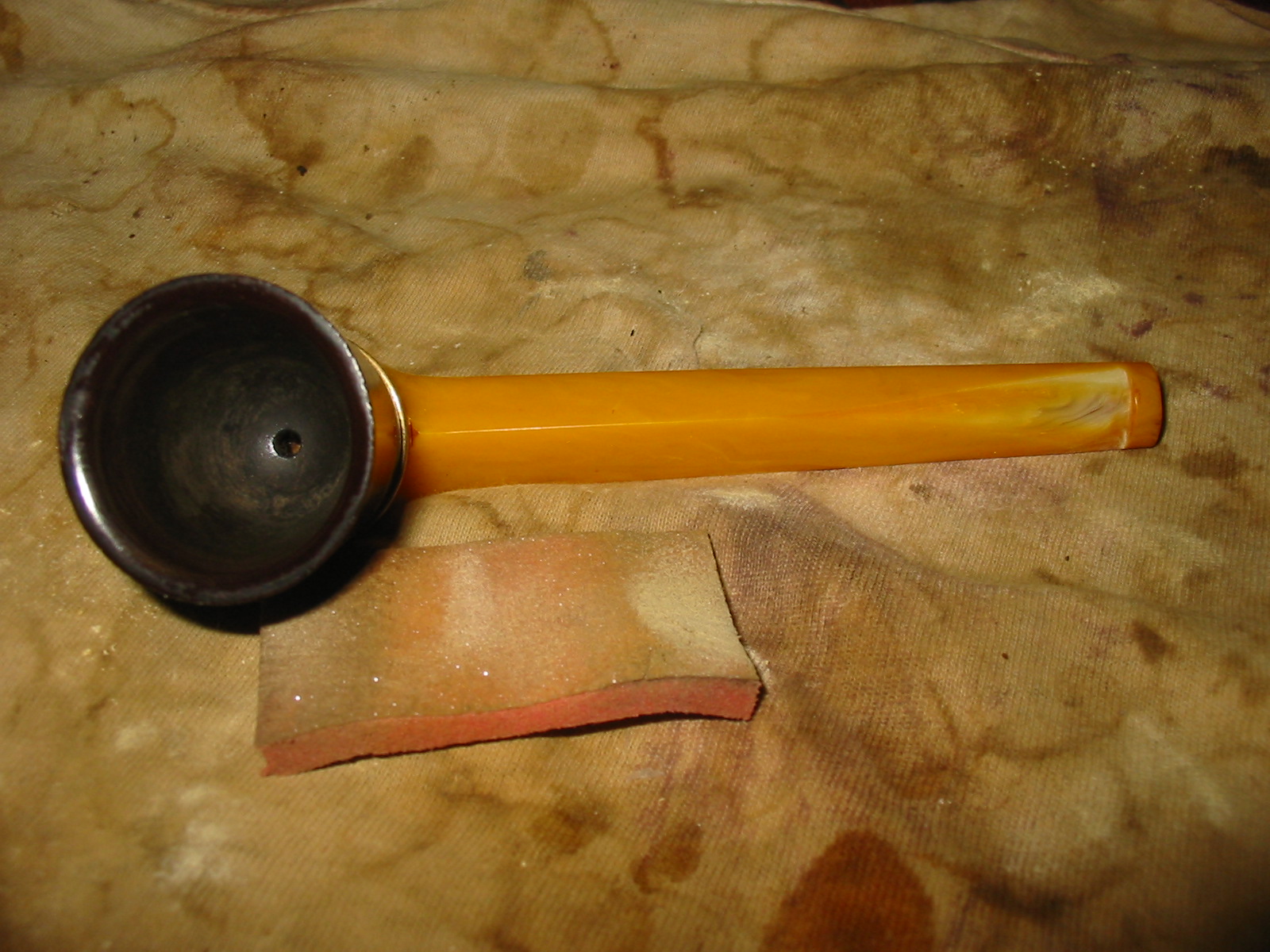
A Piece of Tobacciana History – a Bakelite Bowl on a Bakelite Base


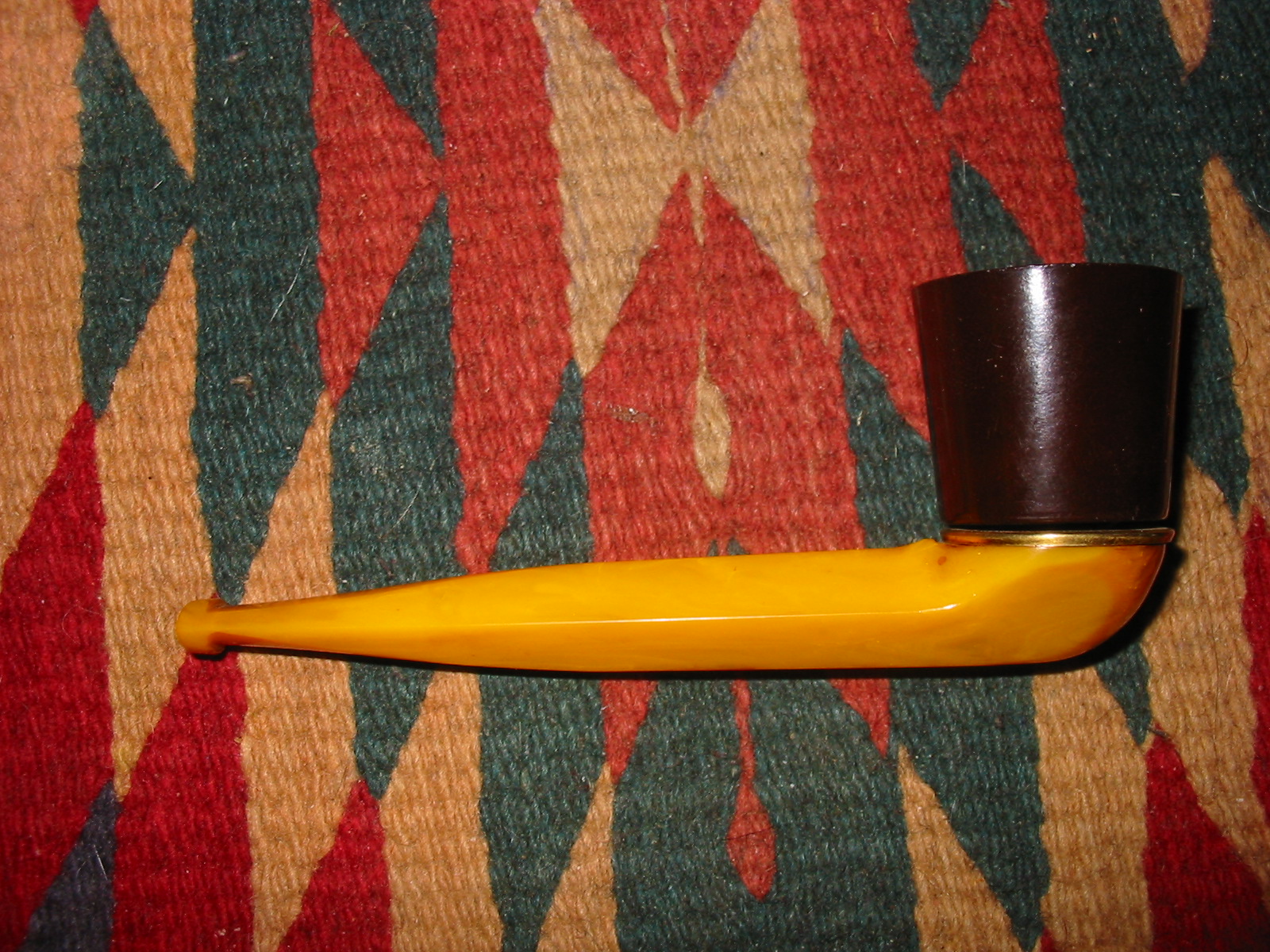
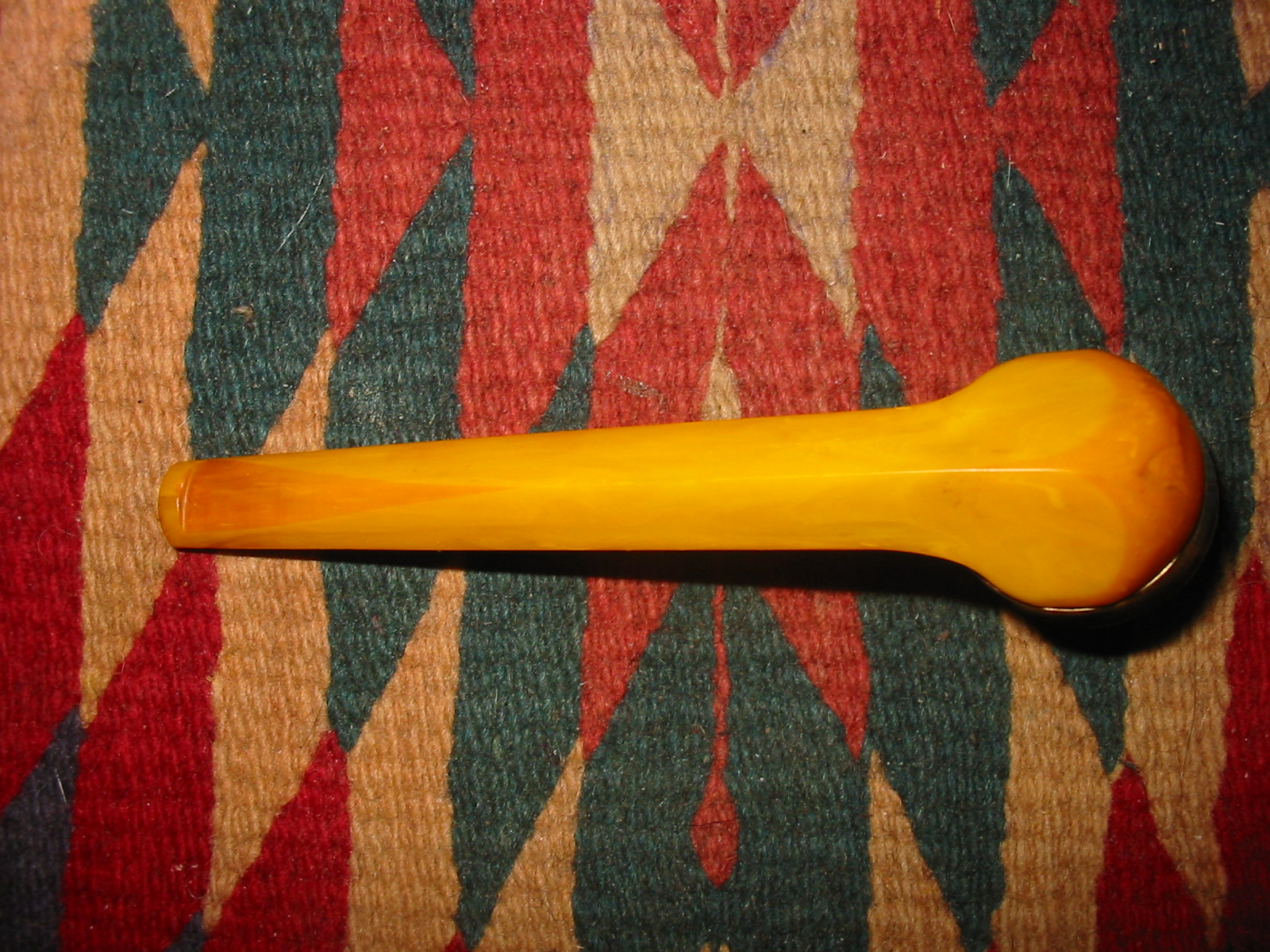
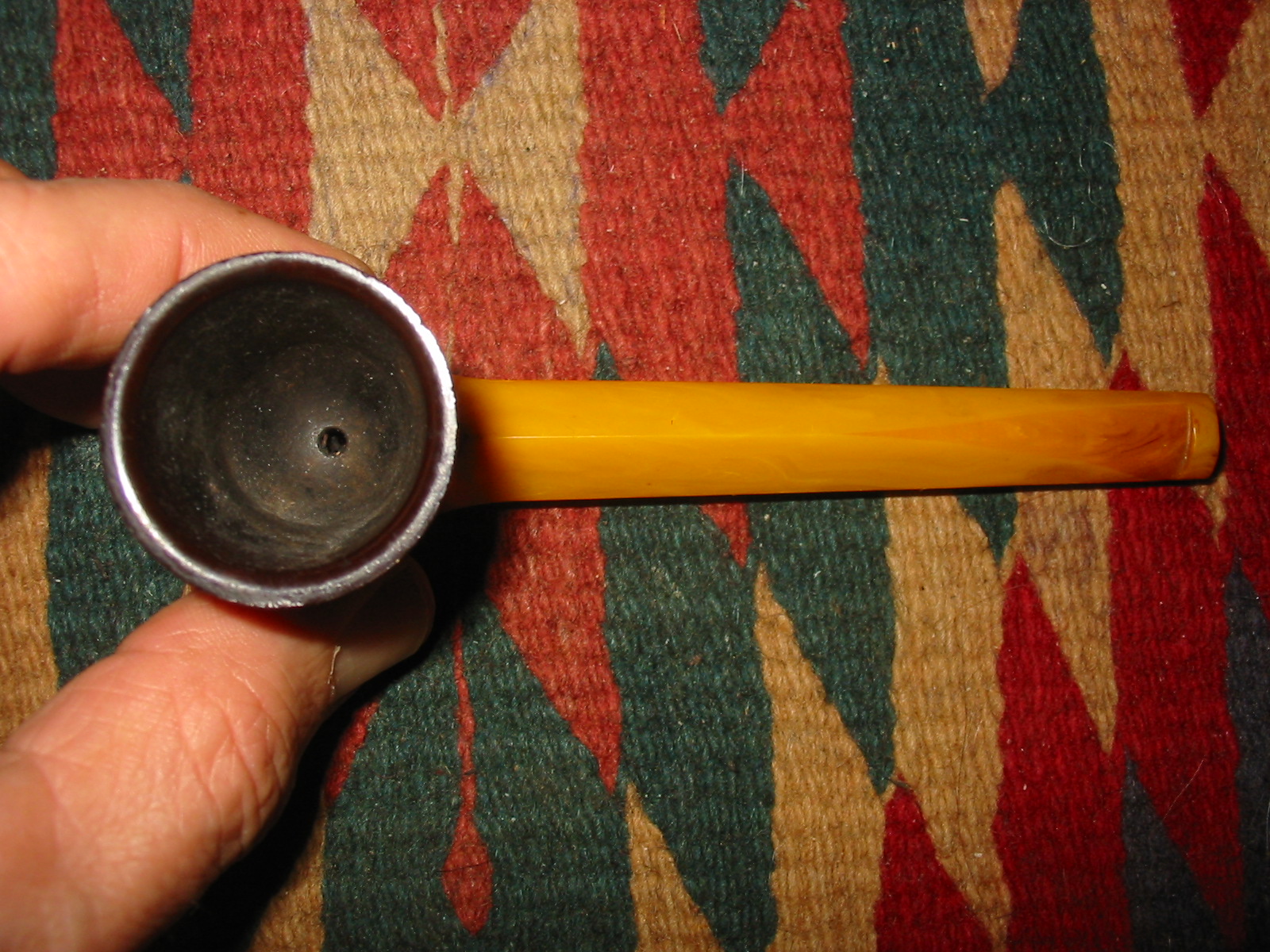
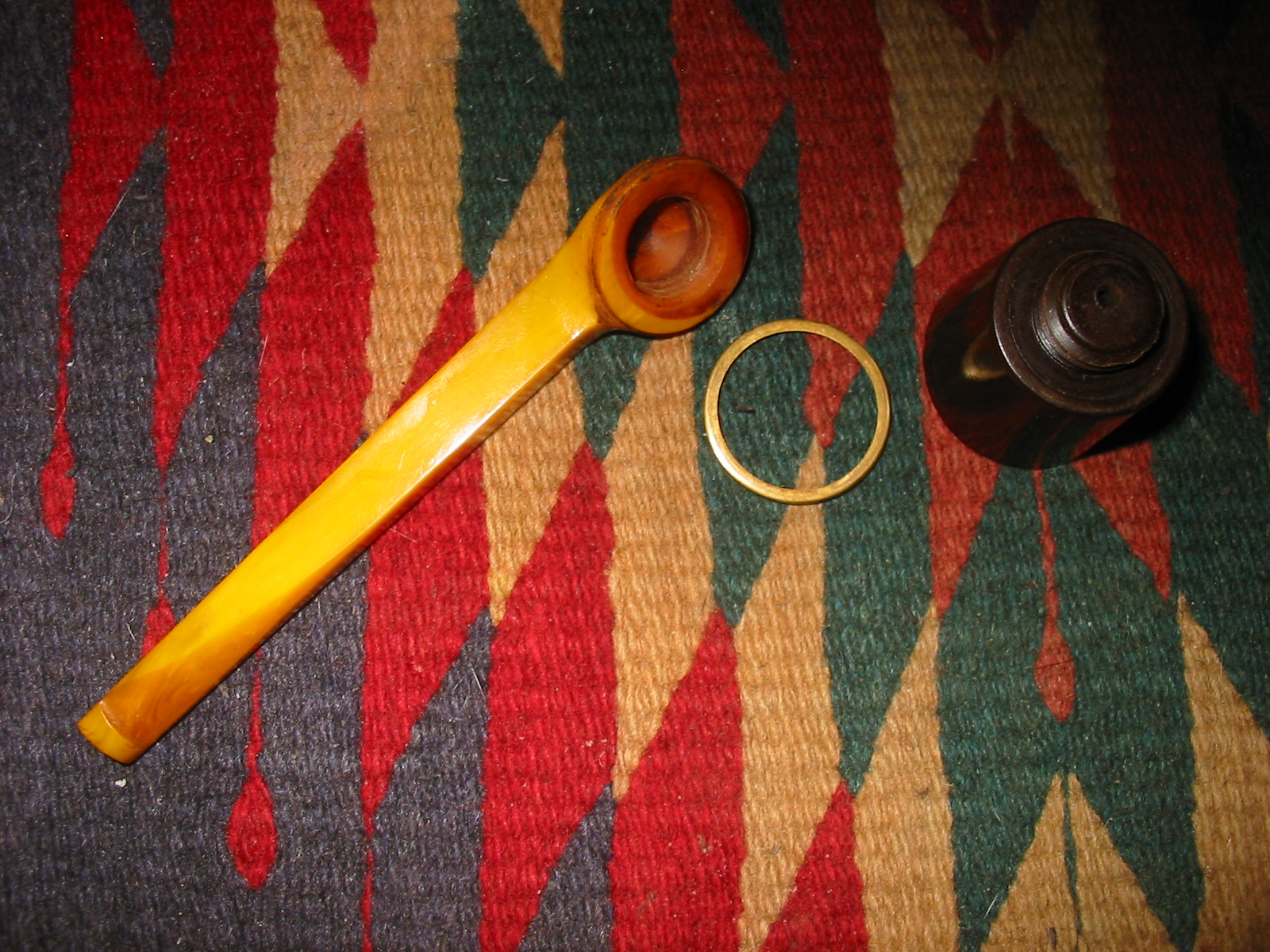
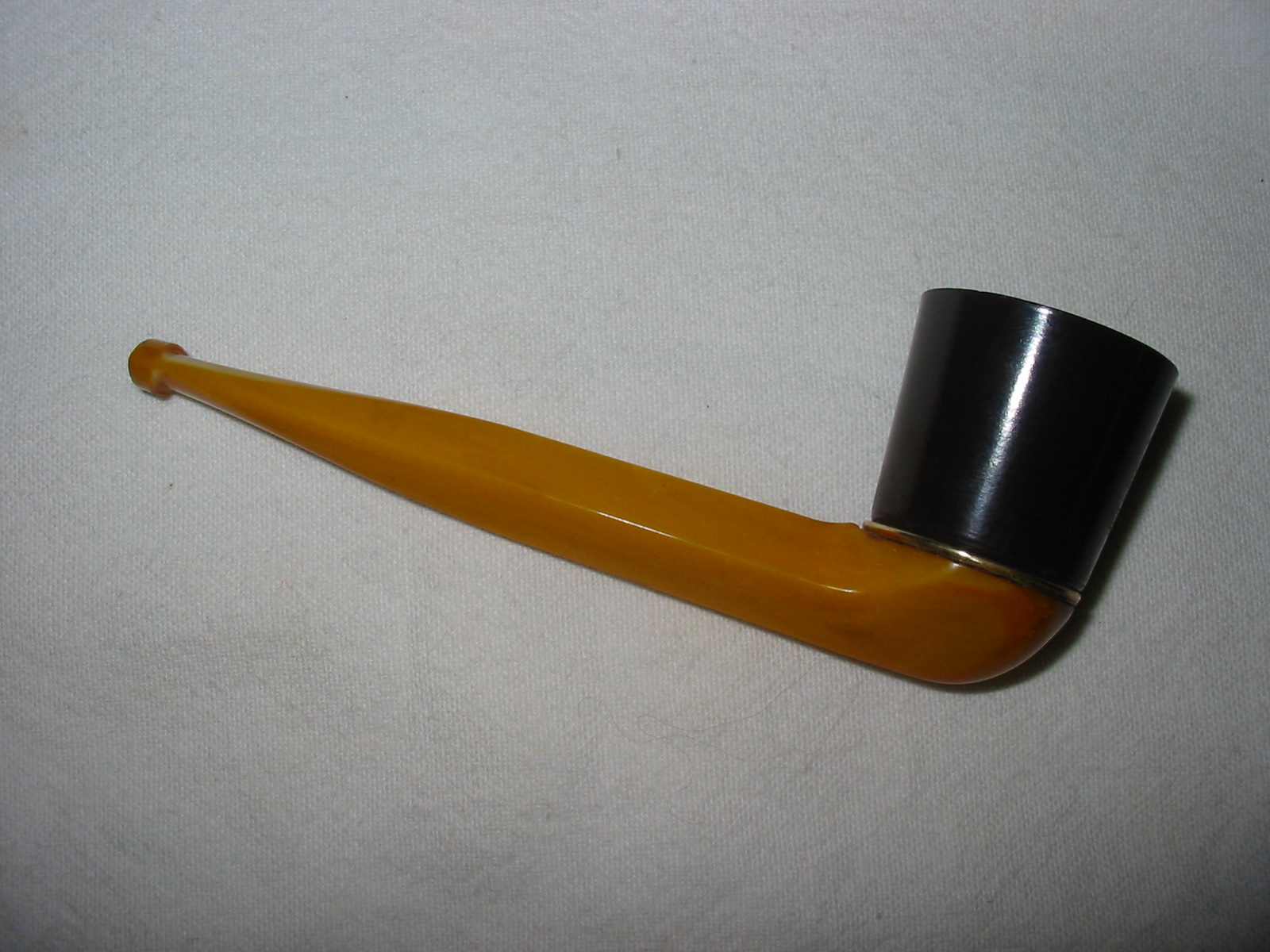
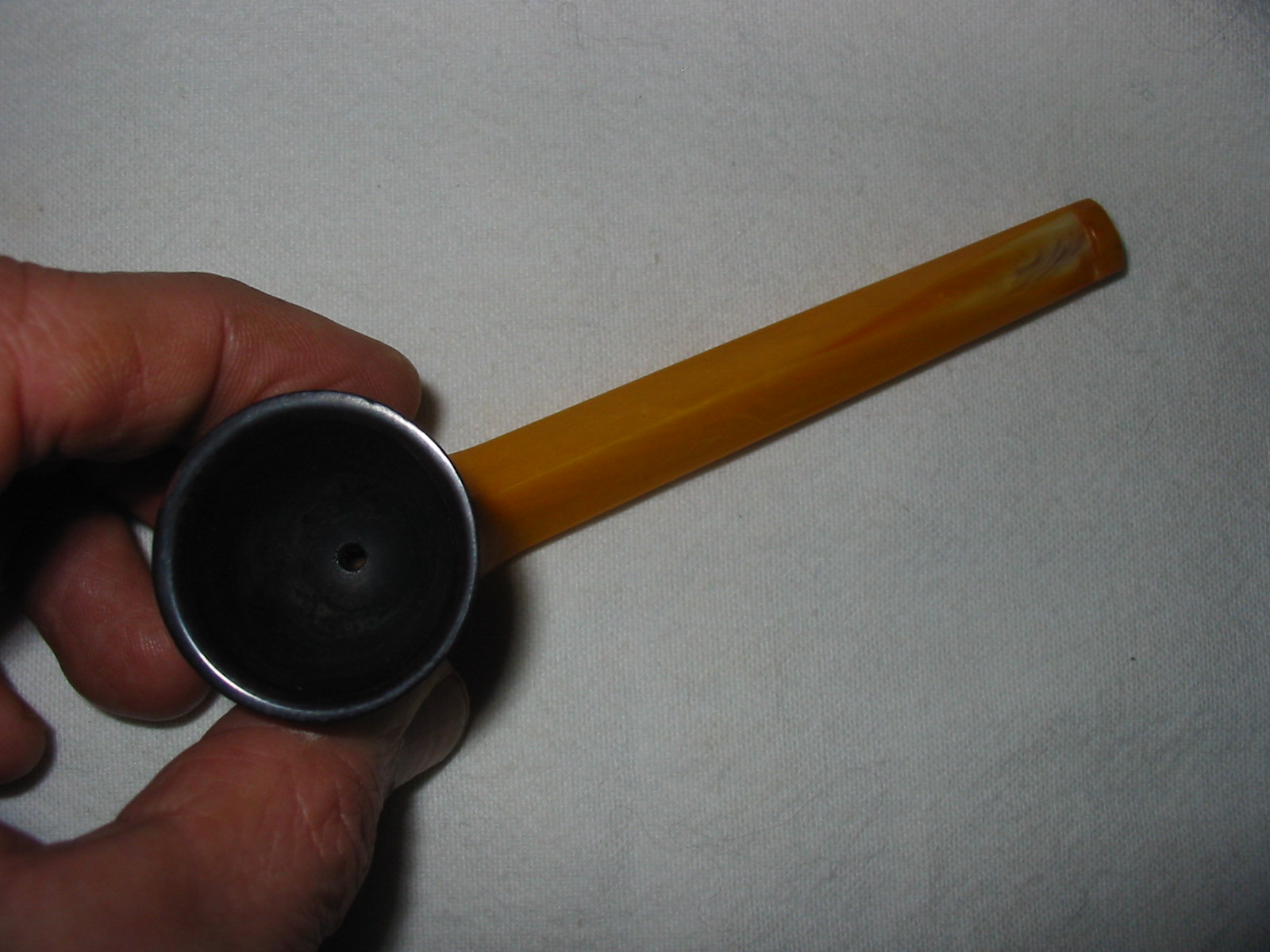
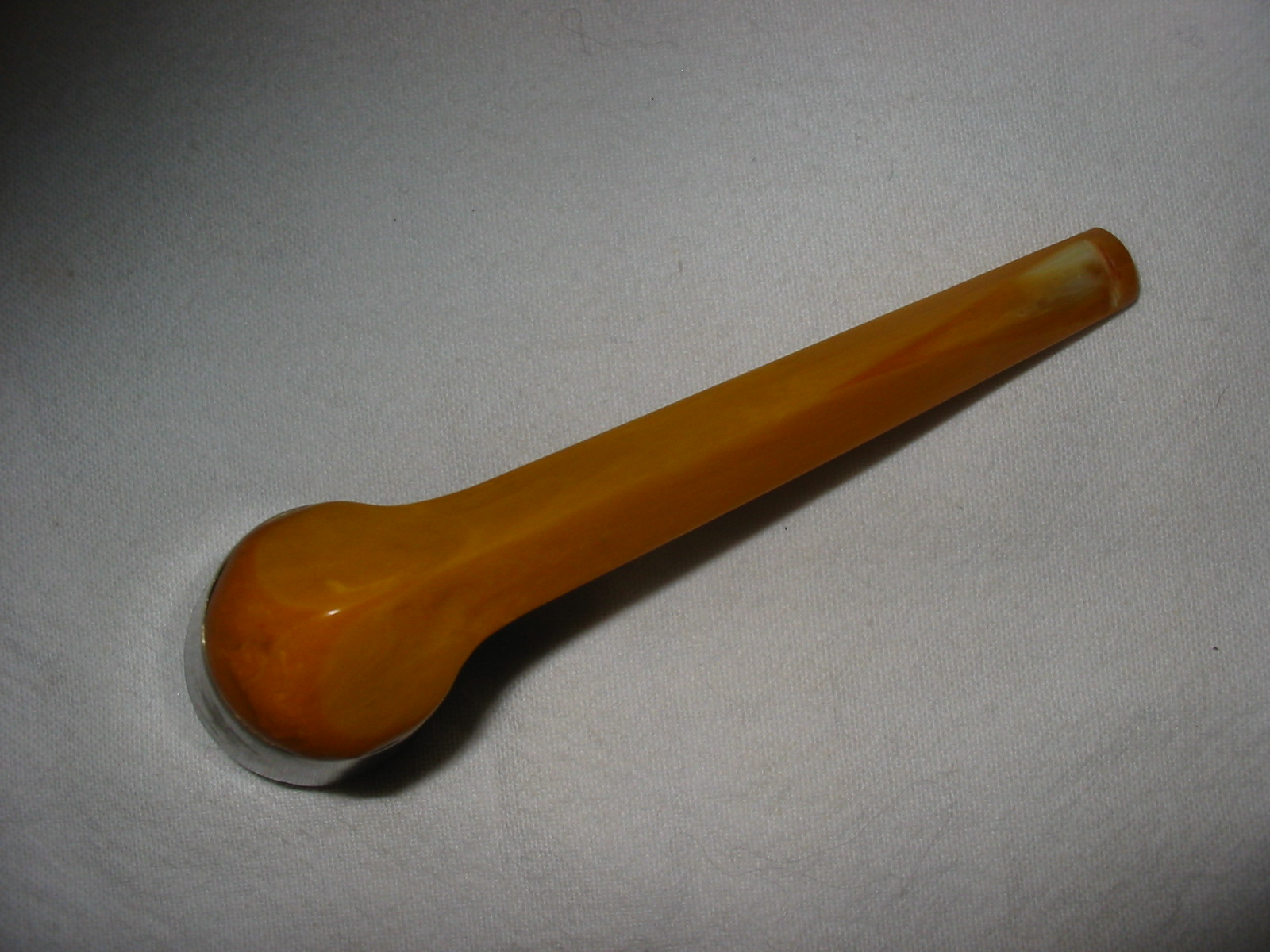
This is a new one to me. I have never seen this combination of parts. I have refurbished quite a few of the screw on bowls on Bakelite bases with either metal or vulcanite stems. I even recently completed a Bakelite base with a Bakelite stem on it. But never have I seen a Bakelite bowl. This one is solid Bakelite with no lining whatsoever. The bowl is like a cup. This one was another Chuck Richards gift. I think he takes delight in these surprises. And a surprise it truly is. There is not a single identifying stamp on the pipe so it is a mystery as to its manufacture. It is very unique. The brass ring between the bowl and base was loose and slide around as the pipe was moved. The bowl was lightly coated with tar. The rim had some dings in it and the base/stem unit was not even at the button. Each side of the angle coming down to the button was off and there were tooth marks in the stem. The inside cup of the base was dirty and the inside of the shank and stem unit was also dirty with tars. The end of the button and orific “o” opening was very clean and unstained which is a bonus. Once I get it cleaned up I intend to load a bowl and see what it is like to smoke. The first series of four photos show the pipe as it was when it arrived to my worktable.
IMG_0727

IMG_0728

IMG_0729

IMG_0730
I took it to the work table this morning and took it apart. I cleaned all the parts of the pipe with Everclear and a soft pipe cleaner. I scrubbed out the cup in the Bakelite base with Everclear on a cotton pad. There was darkening to the Bakelite that I could not remove but the slight build up disappeared. I cleaned up the brass ring and then reglued it to the base. I used a white glue to anchor this to the base. The next series of three photos shows that process.
IMG_0731

IMG_0732

IMG_0733
I sanded out the interior of the bowl with 320 grit sandpaper, wiped it down with Everclear on a cotton pad and then sanded it again with a fine grit sanding sponge. I sanded down the rim of the bowl with the sanding sponge to remove the slight nicks in the edge of the bowl and clean up the rough edges. I followed up with a 1500 grit micromesh sanding pad. The picture below shows the cleaned bowl.
IMG_0736
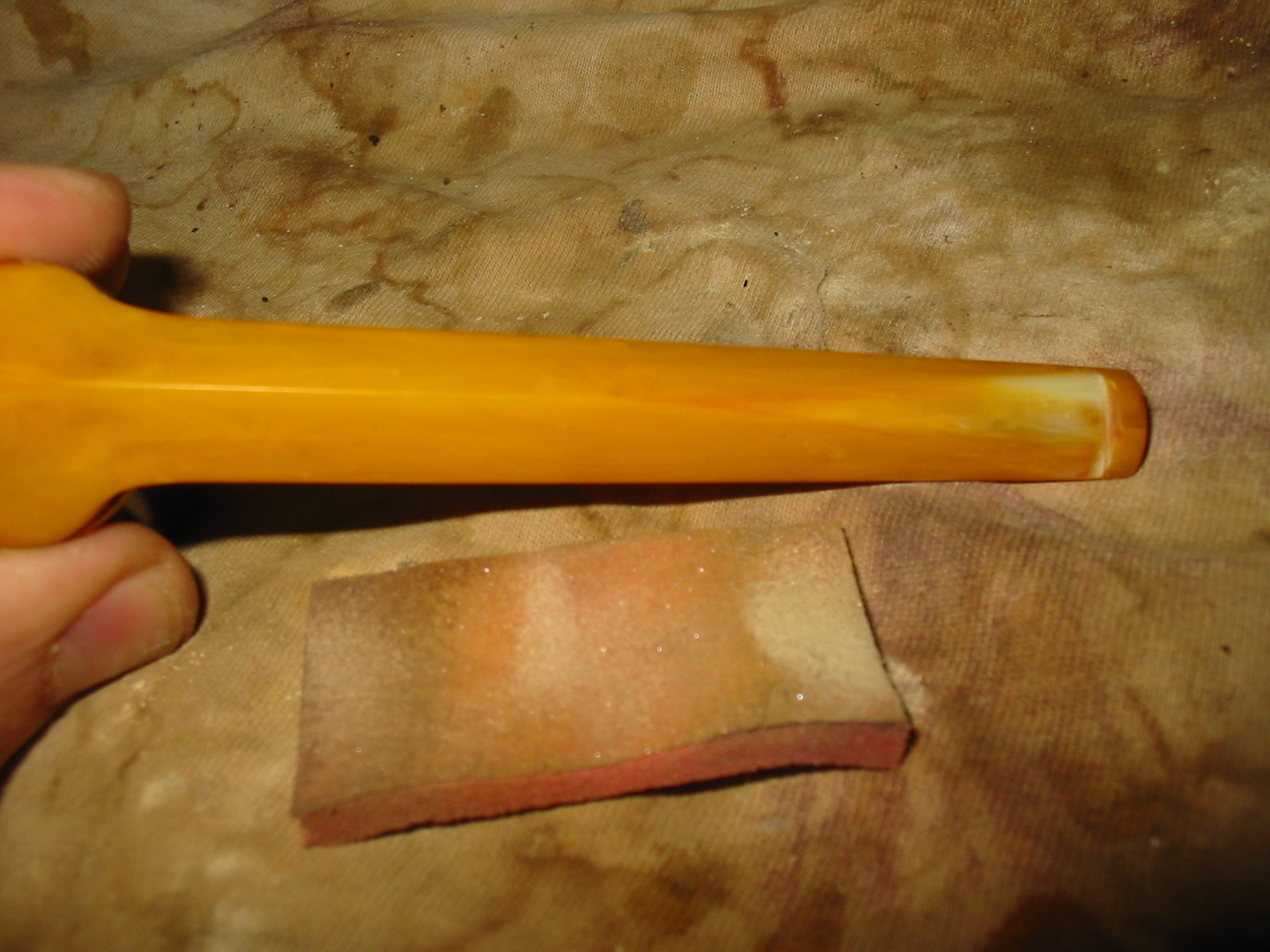
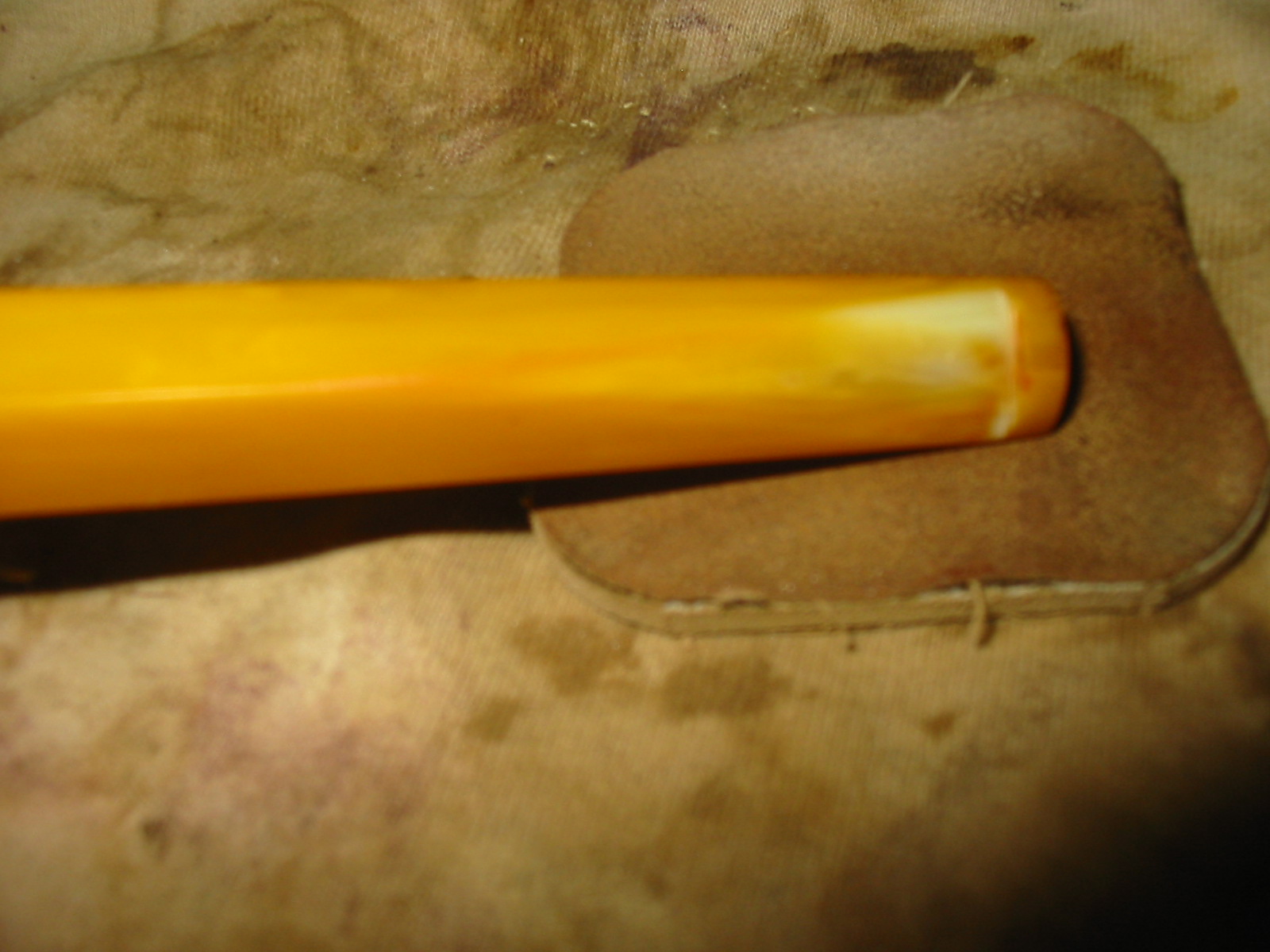
I reshaped the stem and button area with needle files to repair the angles and remove the tooth marks. I sanded the newly shaped area with 240 and 320 grit sandpaper to remove the file scratches. I followed up with micromesh sanding pads 1500-12,000 grit to progressively polish and shine the stem and base. I sanded the entire base with the micromesh sanding pads. There were many small surface scratches in the surface that the micromesh took care of. The next series of eight photos show the reshaping of the button area from the use of the files through the sanding with 1500 grit micromesh sanding pads.
IMG_0734

IMG_0735

IMG_0737

IMG_0738

IMG_0739

IMG_0740

IMG_0741

IMG_0742
The bowl did not seat well on the base. It seemed to sit at a bit of an angle and did not fit into the bottom of the cup. I sanded down the bottom of the bowl insert to remove a small portion of the material to reduce the depth of the threaded portion of the bowl. I also sanded the thread carefully to remove the nicks and chips to the surface. I used micromesh to sand the threads as I wanted to merely clean them up not damage or reduce them. Once this was completed the bowl threaded on more easily and also was seated well on the base. The next series of three photos show the reseating of the bowl.
IMG_0743

IMG_0744

IMG_0745
At this point in the process I sanded the entire pipe with micromesh sanding pads. I used all the grits from 1500-12,000 to polish the Bakelite and give it back its luster. This took quite a bit of time as I was trying to remove all of the minute scratches in the base and on roughness on the outer edges of the bowl. The seven photos below show the progress shine developing through the sanding with the micromesh sanding pads.
IMG_0746

IMG_0747

IMG_0748

IMG_0749

IMG_0750

IMG_0751

IMG_0752
When I had finished with the sanding and the bowl and base had a shine to them I hand buffed it with carnauba wax, applying several coats and buffing it with a soft cotton cloth. My only frustration with the finished pipe is that the area around the button that I changed and sanded is a bit lighter than the yellow/amberlike colour of the rest of the base. It shined up nicely but is lighter. Ah well, it is better than it was and it is certainly more comfortable than when I began. The final series of four photos show the finished pipe. Now it is time to load it and fire it up. The experience is about to begin.
IMG_0753

IMG_0754

IMG_0755

IMG_0756

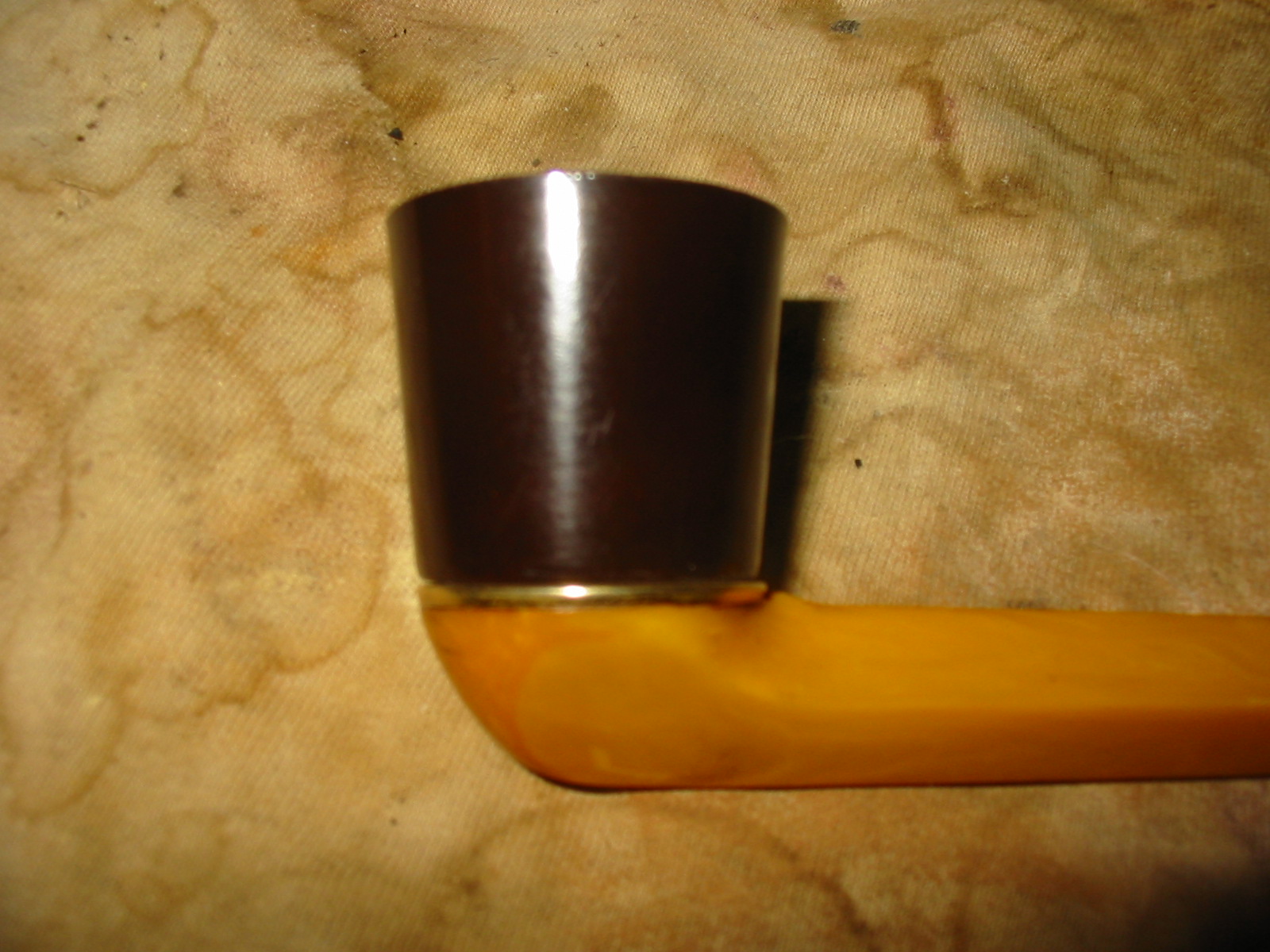
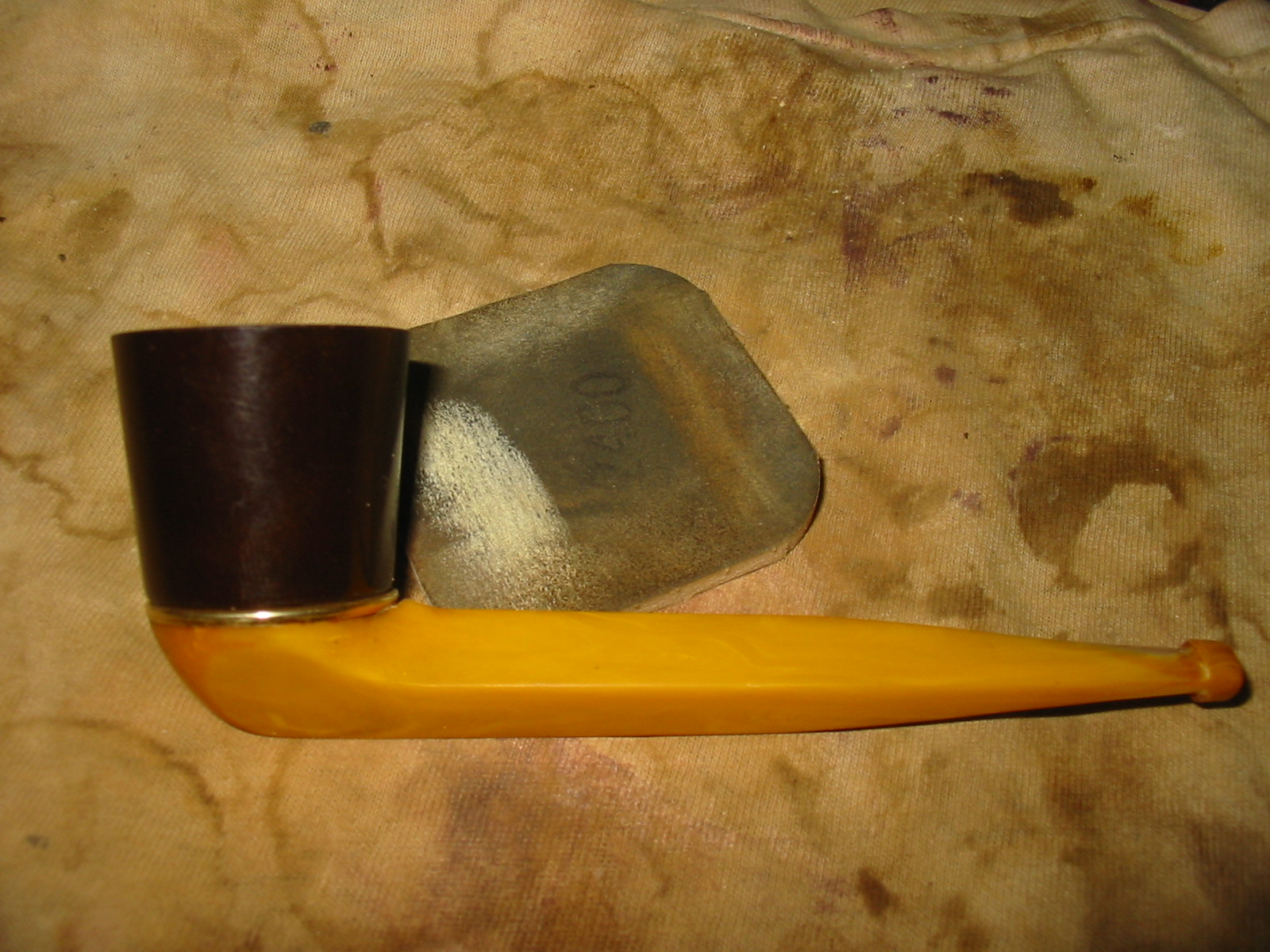
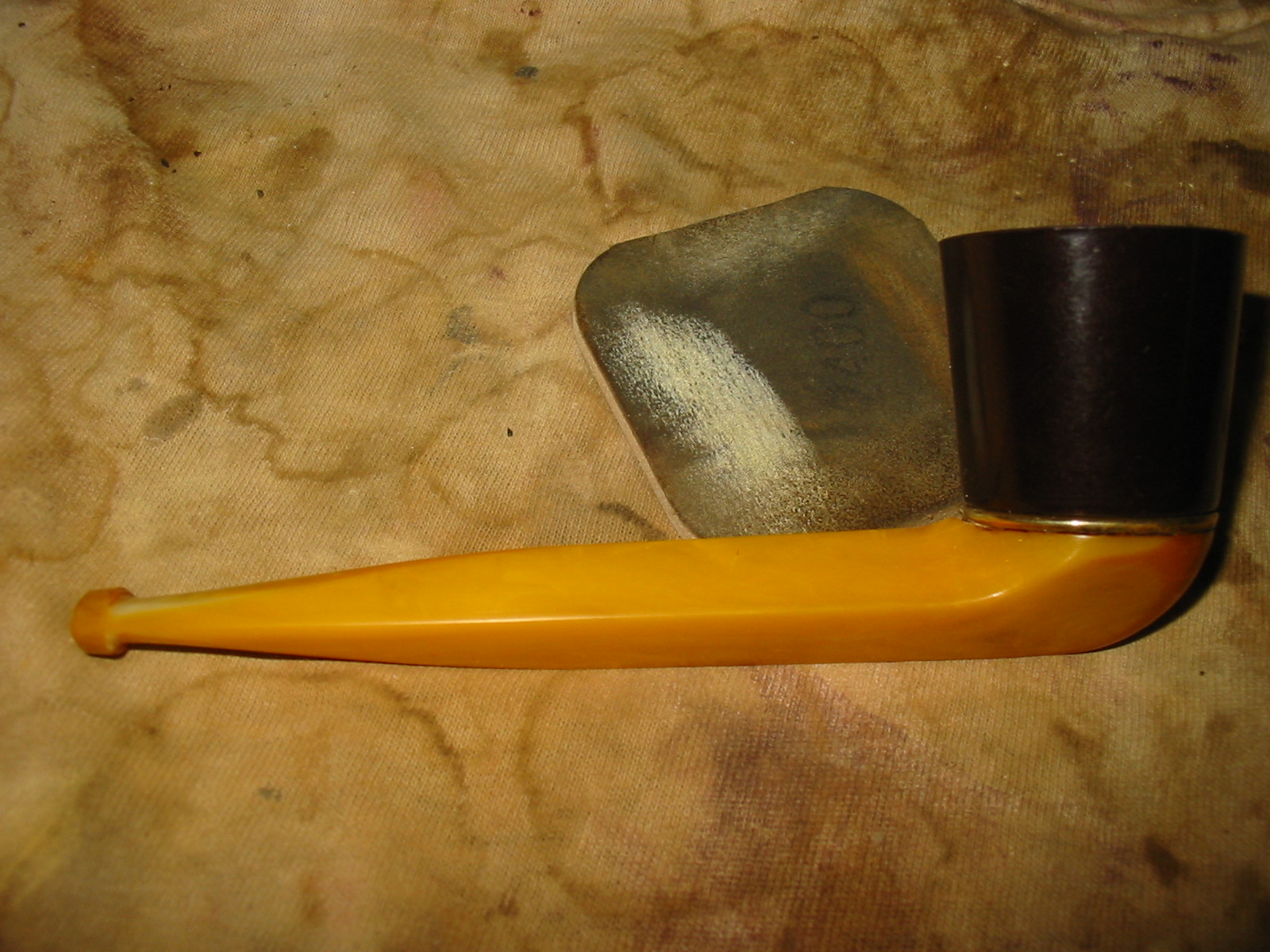
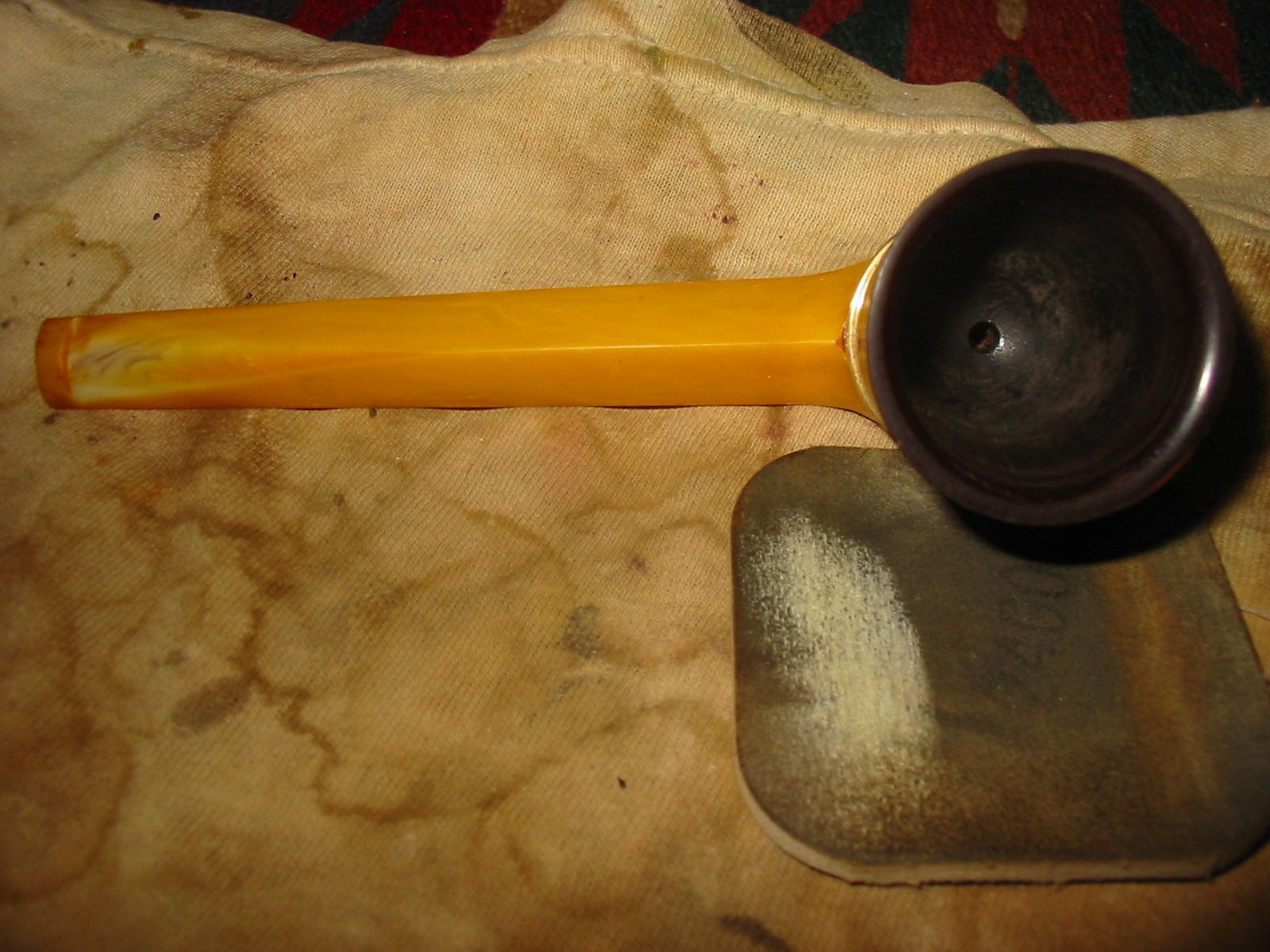
Rebirth of a No Name Bakelite Pipe with Bakelite Stem


This pipe came to me from Chuck Richards (Desertpipe) in a box he sent me. It is the first of three old timers that he sent for me to work with. It is a common interest that we share – this love of the old timers and restoring them to some of their former glory. The first four photos below show the pipe as it was when it arrived to my work table. There is no stamping on the pipe at all. The gold band is stamped 14K Gold Filled. The stem has no logos or stampings. The underside of the bowl and the Bakelite base has no information stamped on it either. It is much like some of the WDC or William Demuth pipes that I have from the same era. The pipe itself was in pretty decent shape. The bowl was very clean. The rim was undamaged and the finish on the bowl was quite nice. The double grooves around the bowl were filled with grit and the surface had a few pits in it. The Bakelite bowl base and shank were in good shape. There seems to have been a metal decorative rim that went around the base between the bowl and base that was missing. The 14K gold filled band was in place but was on backwards so that the stamping of the gold was upside down. The stem was very oxidized and had been filed to give a steeper angle on the taper to the button. The filing had gone too deep and the airway next to the button was exposed. At first examination it appeared that the stem was too hard a material to be vulcanite and the filing marks did not look like they were on vulcanite. My initial guess was that the stem was also Bakelite.
IMG_0649

IMG_0650

IMG_0651

IMG_0652
I removed the bowl from the base and reamed and cleaned it. I reamed it with a PipNet reamer back to a very thin cake. I cleaned out the airway at the bottom of the bowl. I used a dental pick to clean out the dual lines around the bowl top. I cleaned out the reservoir in the bottom of the base with cotton swabs and Everclear. I cleaned out the shank with bristle and fluffy pipe cleaners and Everclear as well. I removed the band from the shank by heating it gently. The glue softened and I was able to remove it and turn it around. I tapped the band with a small furniture hammer to flatten out the edges and squared the edges. I reglued it with wood glue. When this work was done I set the bowl and shank aside and went to work on the stem.
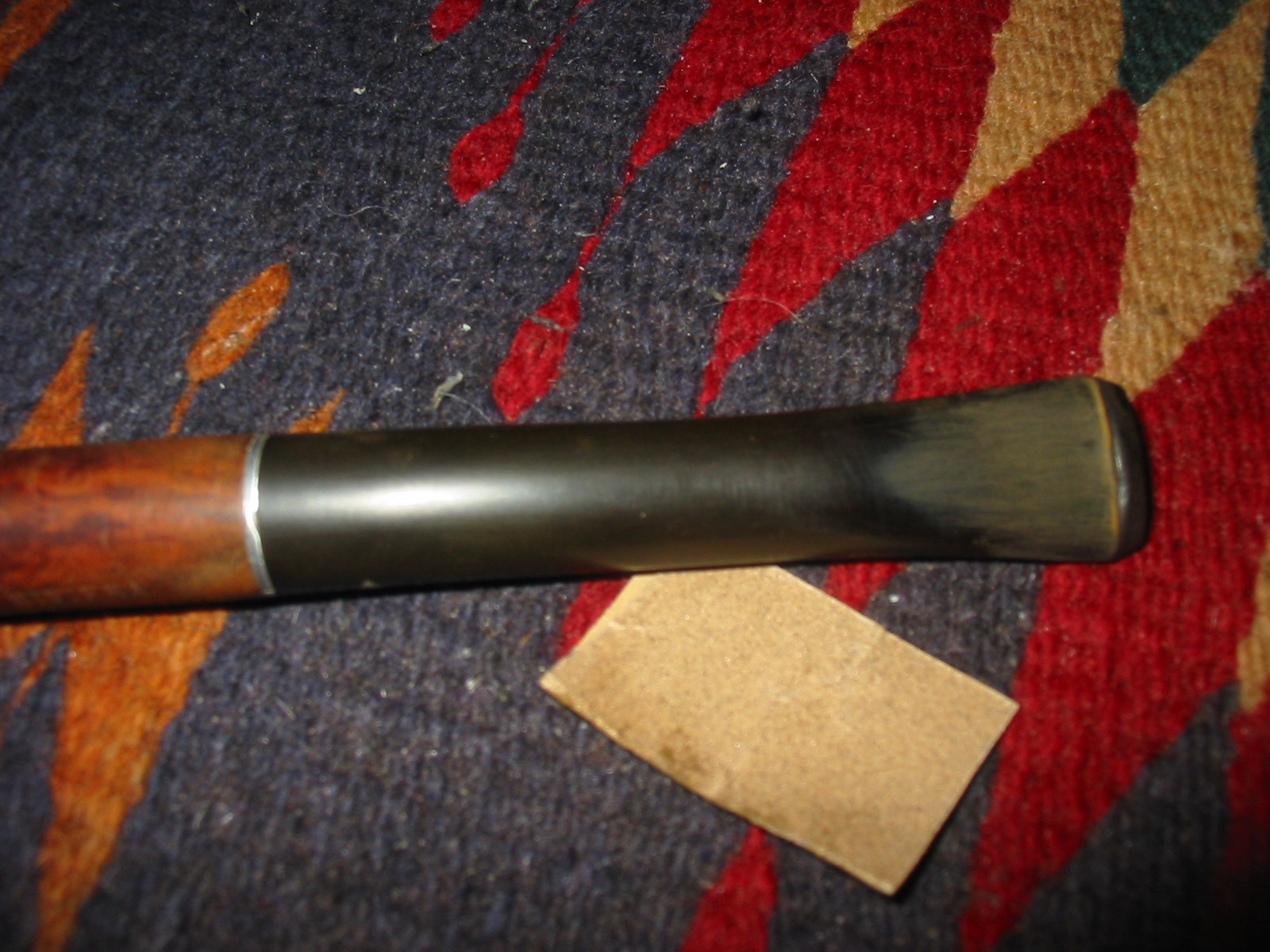
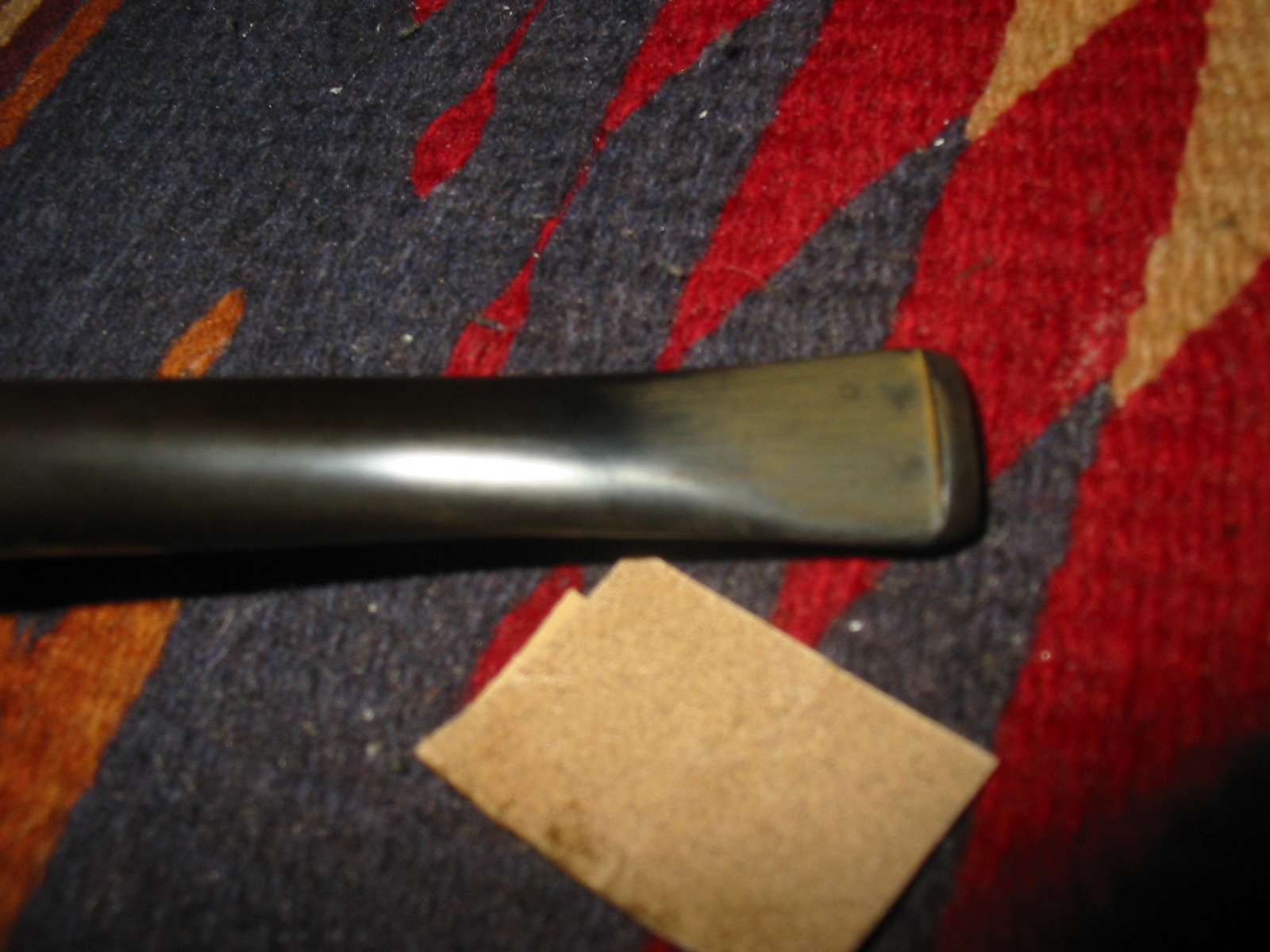
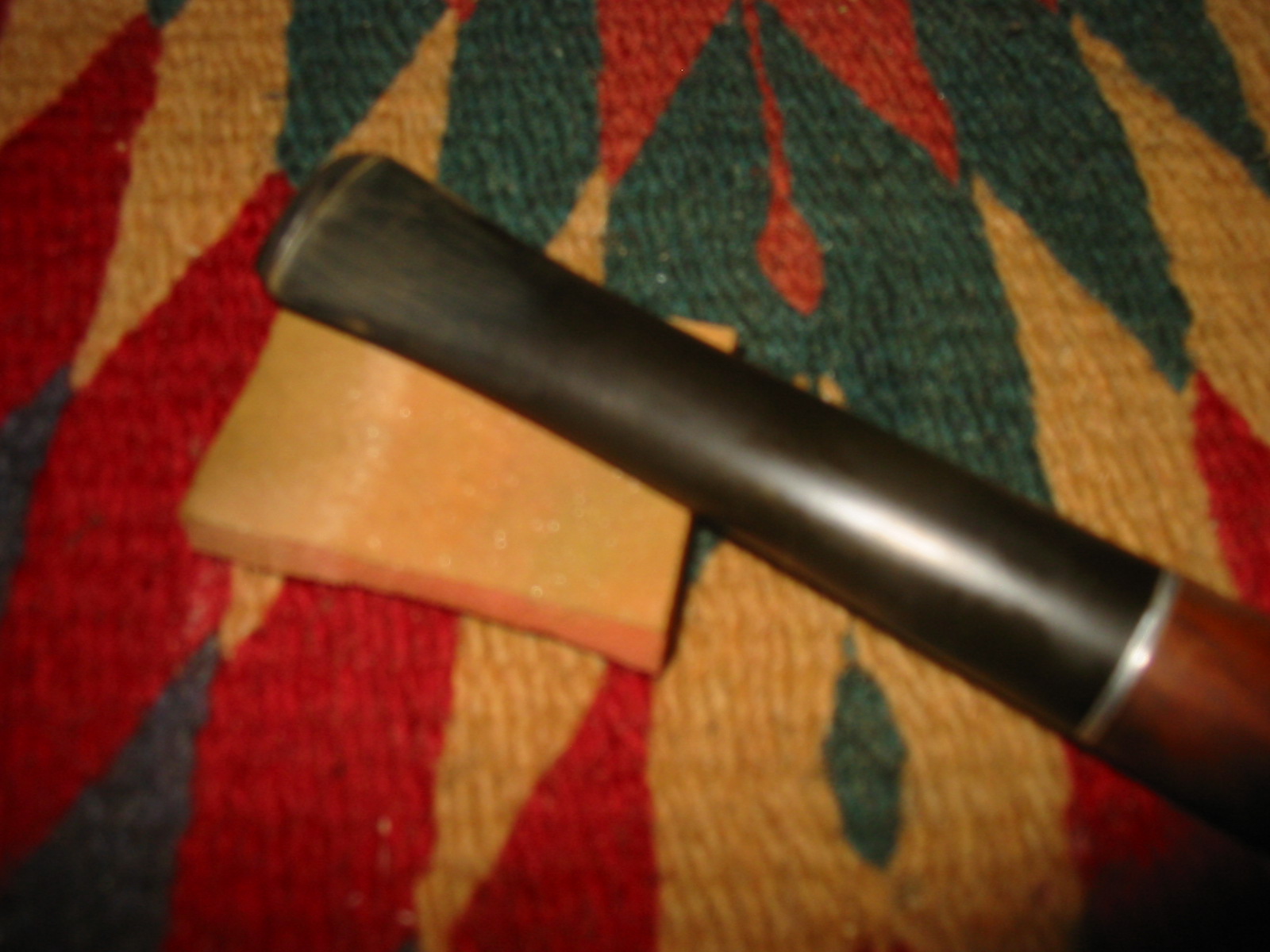
The stem took significant work. Somehow my camera failed (maybe the photographer did) and I was unable to get any good photos of the stem work. I built up the filed area against the button with clear superglue (Photos 1 -2). I layered on lightly, let it dry, relayered it and repeated until the thickness was sufficient enough for the airway to be protected. I also built up the button. It looked to me that a previous repair had been done and a new button had been cut in the stem. I repaired the shape and the thickness of the button. It was an old style bone tenon that was mounted in the shank so I cleaned that up and cleaned the inside the stem. The hole in the button was the old style orific or “o” opening. The rebuilding of the button and stem took the majority of time in working on this old stem. Once it was dry and had cured overnight I worked on the oxidation. I did not want to use anything that could possible harm the Bakelite so I kept the alcohol to a minimum and only on the inside the airway and was careful not let it touch the outside. For the outside I used 240 grit sandpaper to smooth out the newly repaired slope on the stem and to sand out the file marks that remained from the previous repair. I also sanded the corners on the stem to give it a more rounded look in keeping with the era it was made. The 240 grit sandpaper easily removed the oxidation. Photos 3 – 4, though of poor quality, give an idea of how the stem looked after patching with the superglue and sanding with the 240 grit sandpaper. The oxidation was pretty well removed. The button is shaped and the patch on the stem in front of the button is visible. There is still a lot of sanding to do at this point. From the 240 grit I went on to sand with 320 grit and also a fine grit sanding sponge to further blend the patch and to remove the oxidation.
IMG_0647

IMG_0648

IMG_0653

IMG_0660
I put the stem back on the pipe and worked on the fit against the band. When I reversed the band the stem was too large on the right side and extended beyond the width of the band. To repair that I had to take of material at the bottom edge of the top right side and the upper edge of the bottom right side of the diamond to reduce the angle of the diamond on that side. By reducing these two points on the stem I was able to bring the sharp edge to the same width as the shank and band. It balanced the look of the stem. I used the 240 and 320 grit sandpaper for doing this part of the stem work. I continued to use the sanding sponge to blend the patches on the top and bottom of the slope to the button. The next series of eight photos show the progress on the stem. The patch is clearly visible in the photos of the top side. The one on the bottom was not as big and it blended in more easily.
IMG_0662

IMG_0663

IMG_0664

IMG_0665

IMG_0666

IMG_0687

IMG_0688

IMG_0689
After removing the scratches and oxidation with the sandpaper I sanded with the fine grit sanding sponge and then progressed through the various grits of micromesh sanding pads from 1500-12,000 to smooth and polish the stem. As I worked on it my initial conjecture about the material being Bakelite was confirmed. The next four photos are a sample of the work of the micromesh sanding pads on the stem. The pad in the photos is 3600 grit. I also used the micromesh on the bowl and the Bakelite base and shank to remove some of the surface scratches.
IMG_0690

IMG_0691

IMG_0692

IMG_0693
I gave the pipe a very light buff on the buffer with White Diamond. I had learned on previous occasions that the speed of the buffing pad can produce heat that can actually damage the Bakelite and cause fibres from the pad to embed in the stem. A very light touch is necessary if you are going to buff these stems. I wanted to give them a quick light buff to remove any remaining scratches and give it a quick sheen. I buffed the base and bowl at the same time as well. The final series of four photos show the finished pipe. I applied a coating of carnauba wax to the pipe by hand. I buffed it lightly with a soft flannel cloth to bring up a shine and finished buffing with a soft shoe brush. The finished pipe speaks for itself. It is a testimony to the life that resides in these old timers. It is a life that will certainly extend beyond mine! As mentioned above, I share a love for these older pipes with Chuck that seems to extend to their restoration and re-entry into the purposes for which they were made. What do you think Chuck? How does the final pipe look to you?
IMG_0695

IMG_0696

IMG_0697

IMG_0698