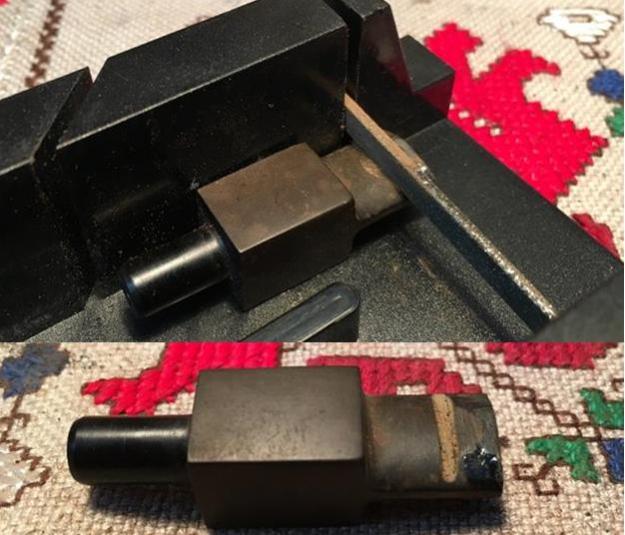
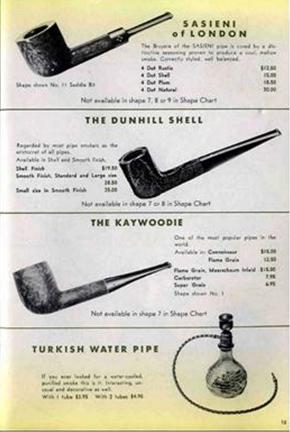
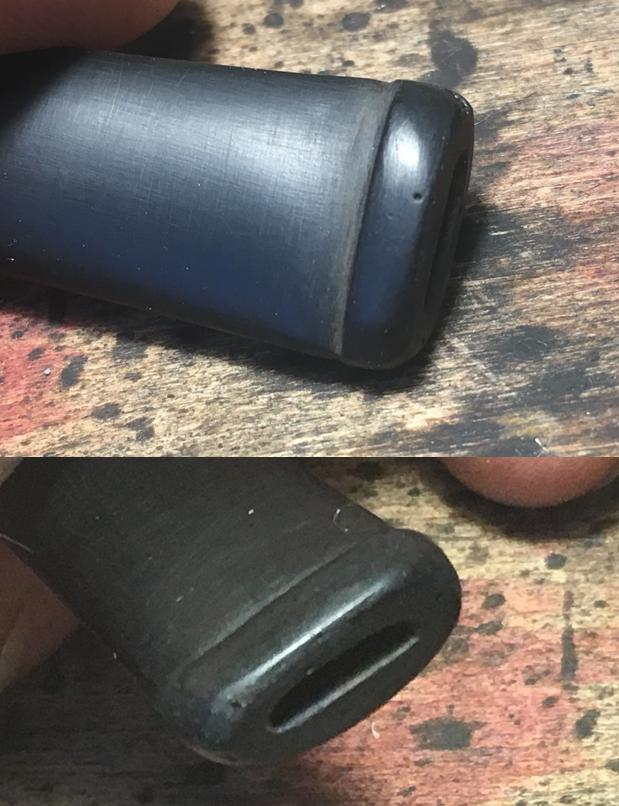
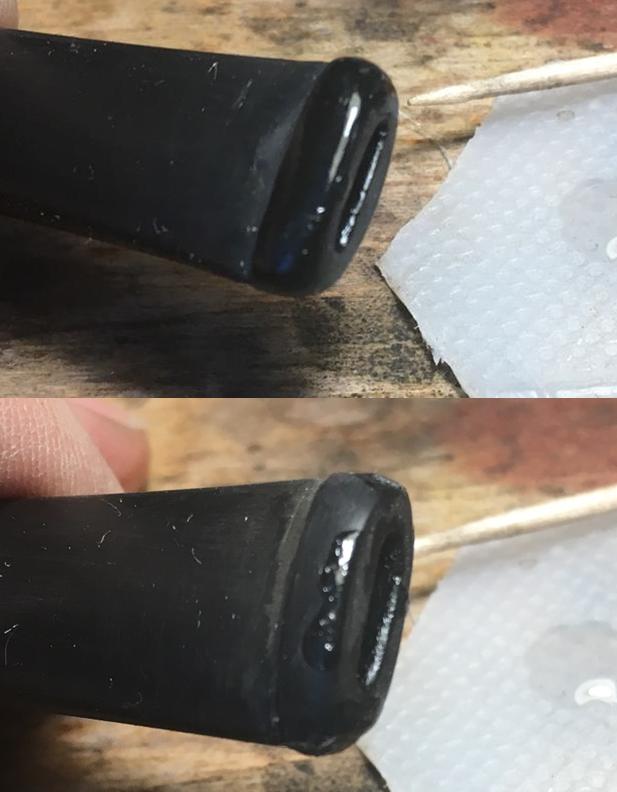
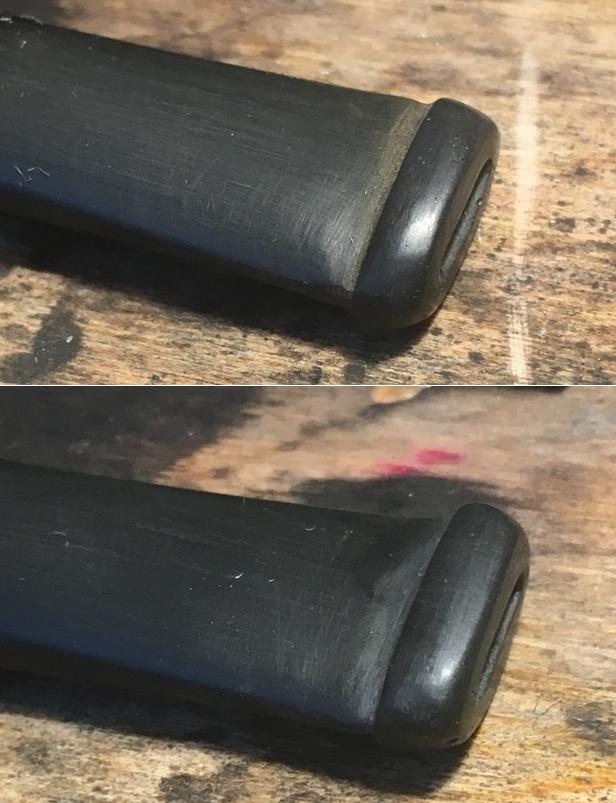
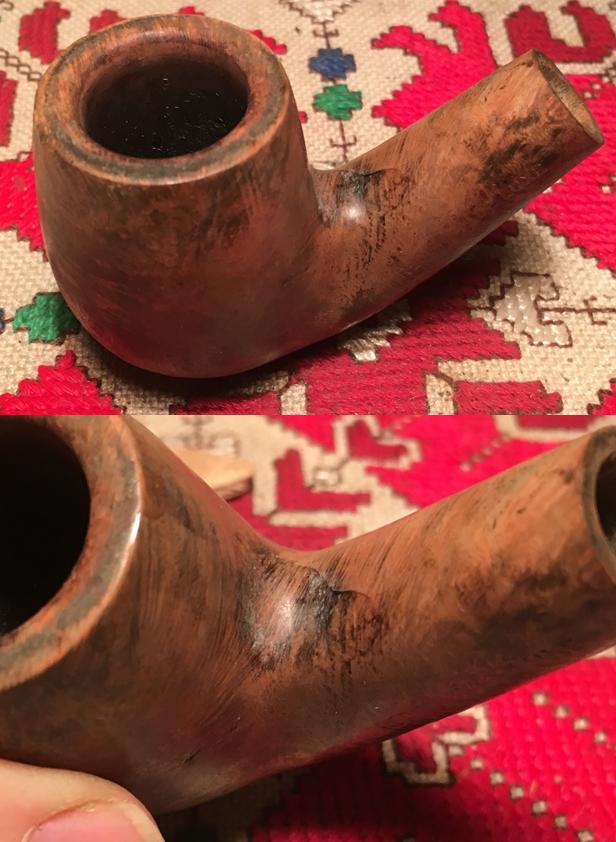
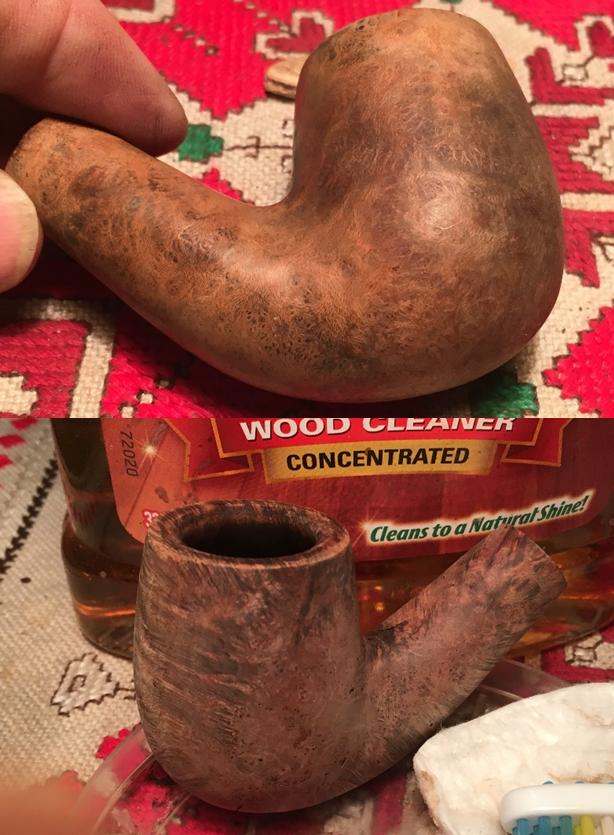
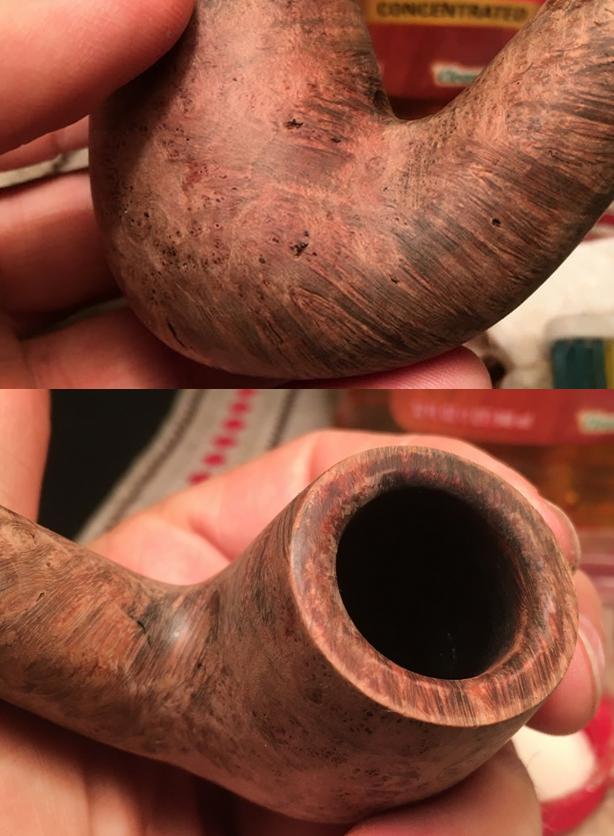
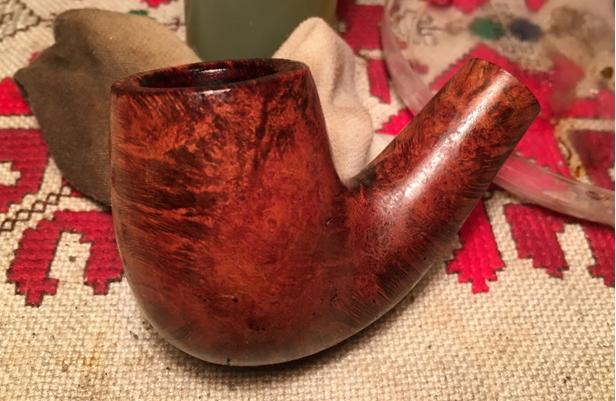
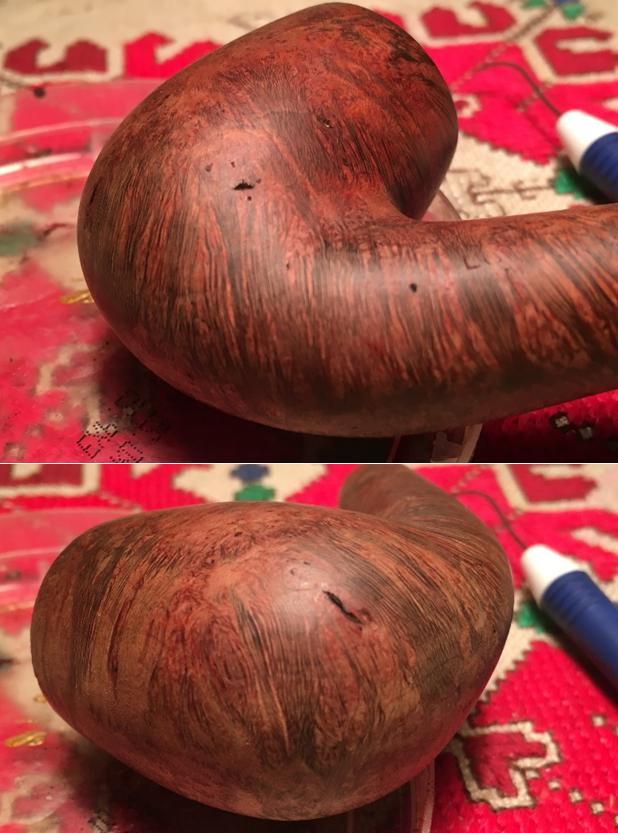
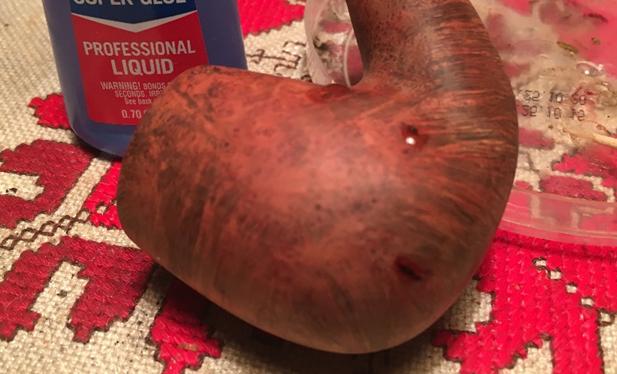
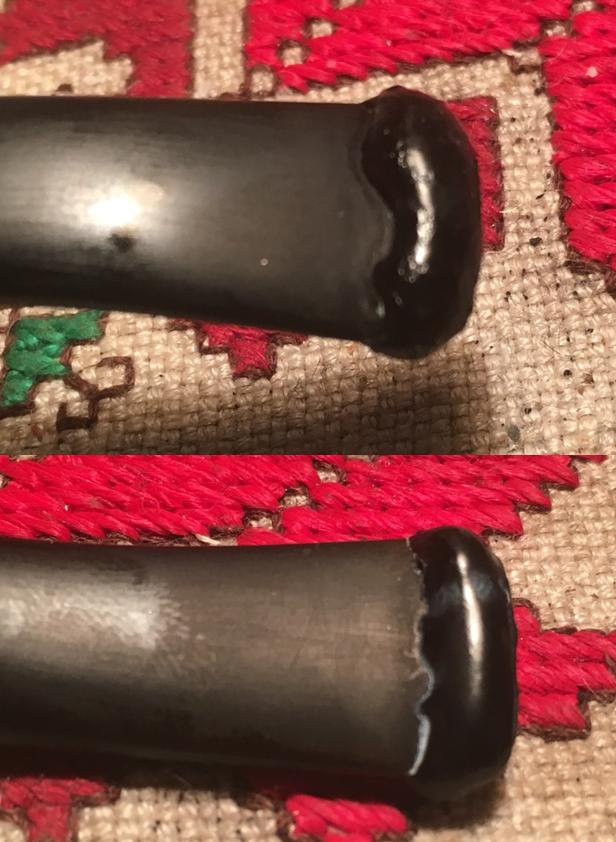
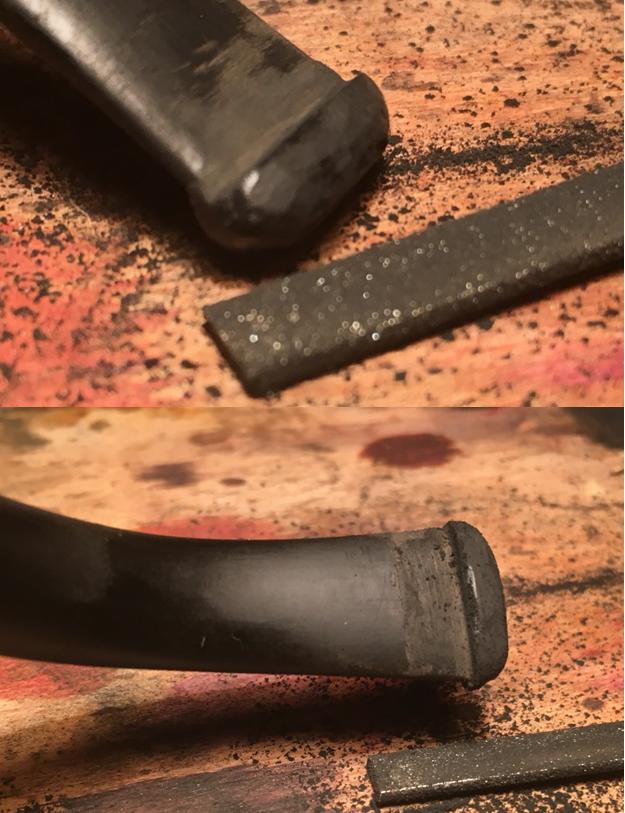
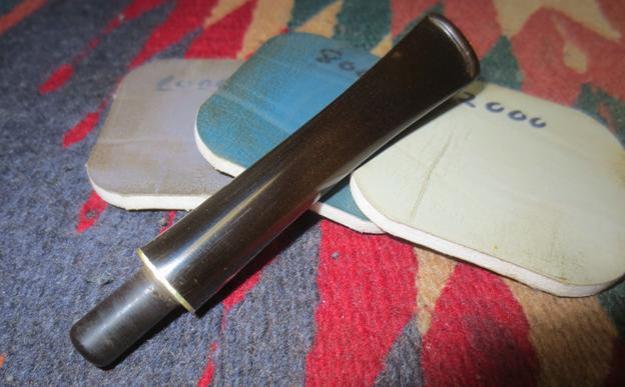
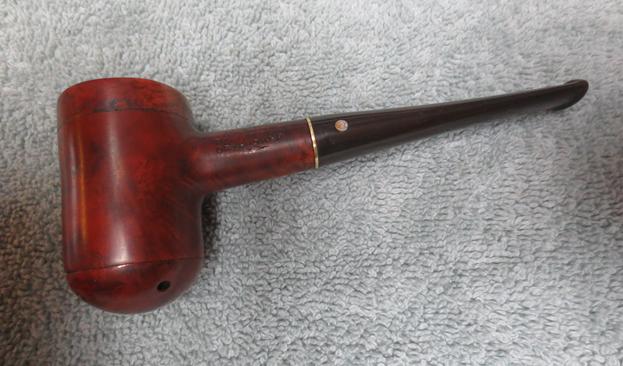
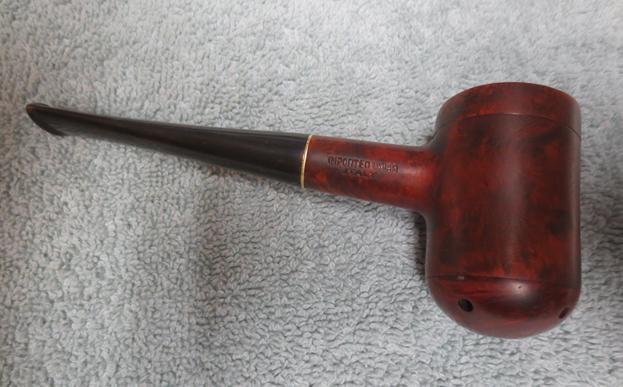
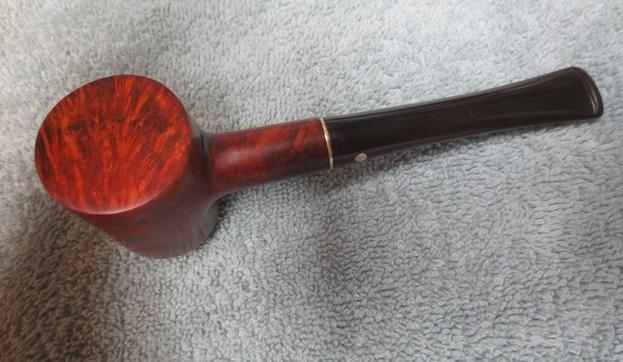
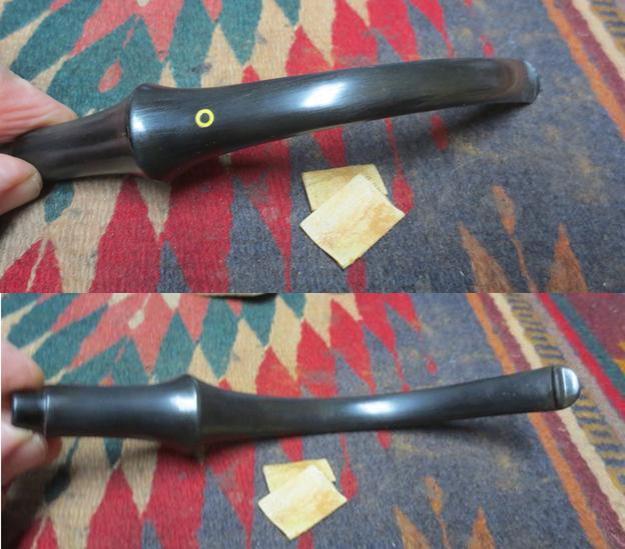
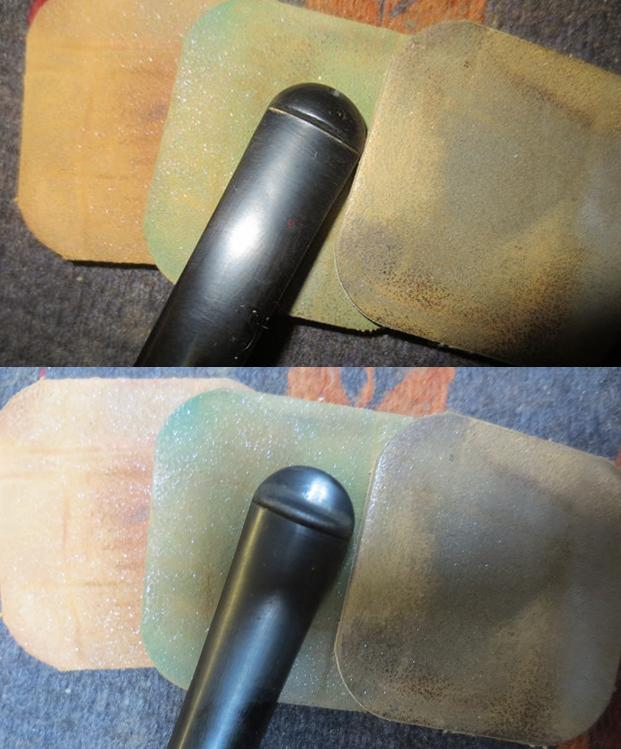
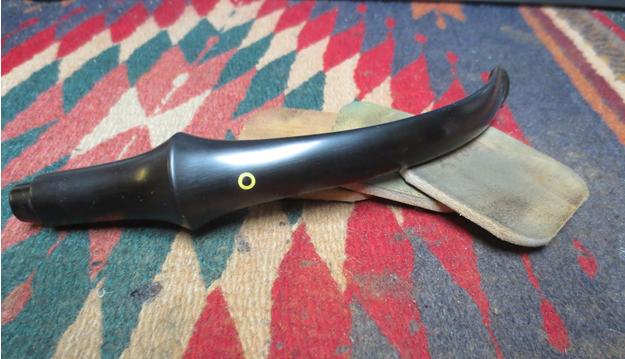
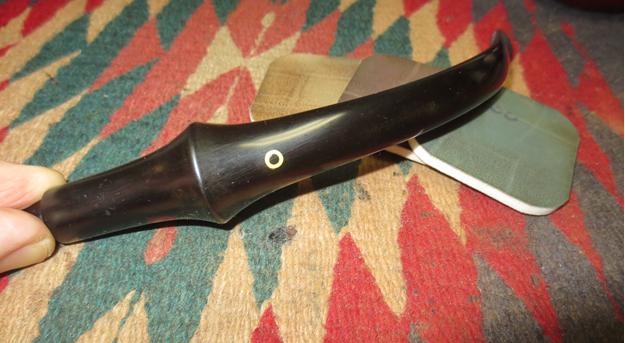
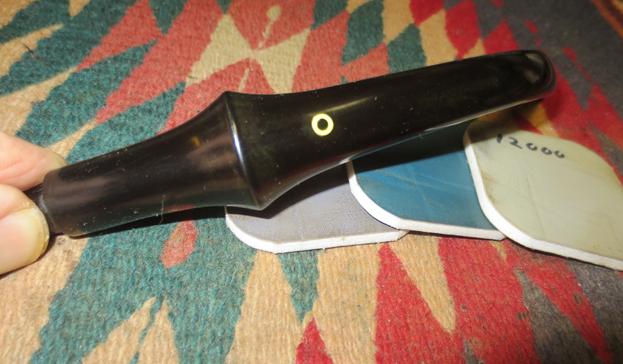
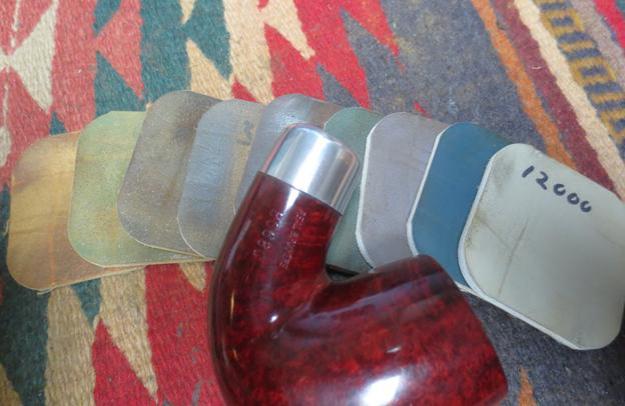
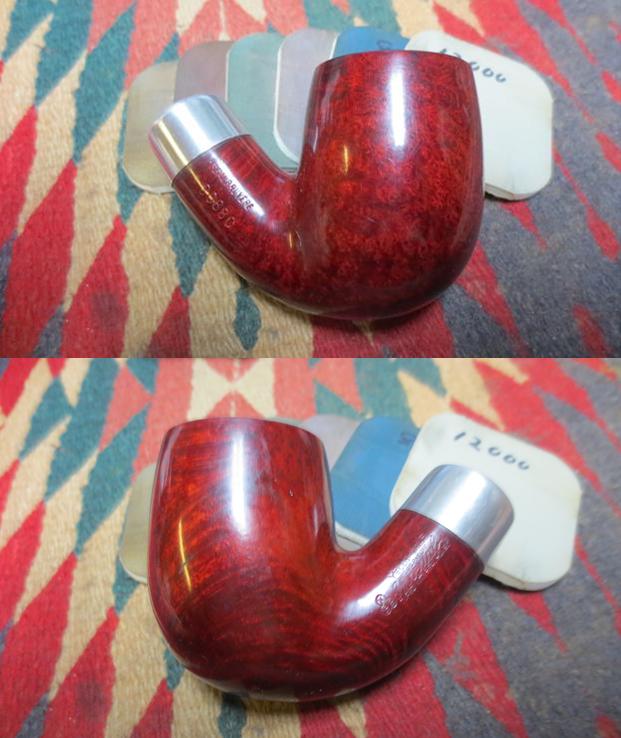
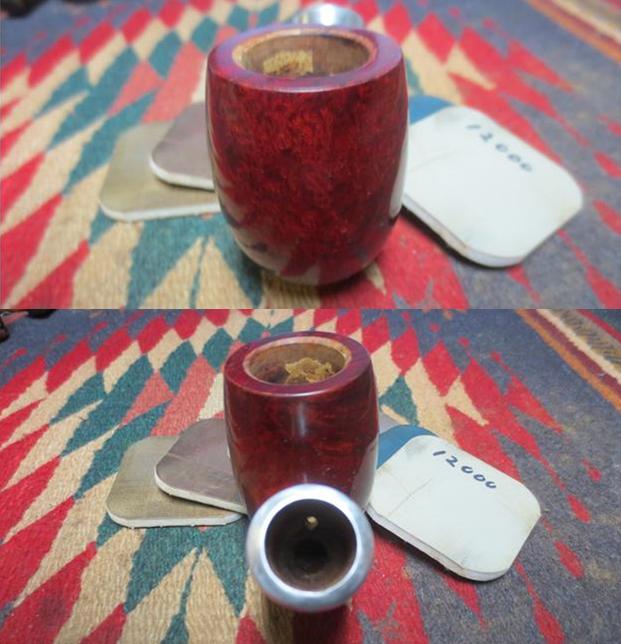
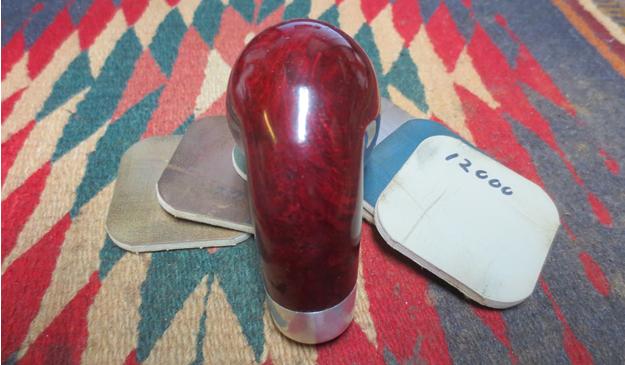
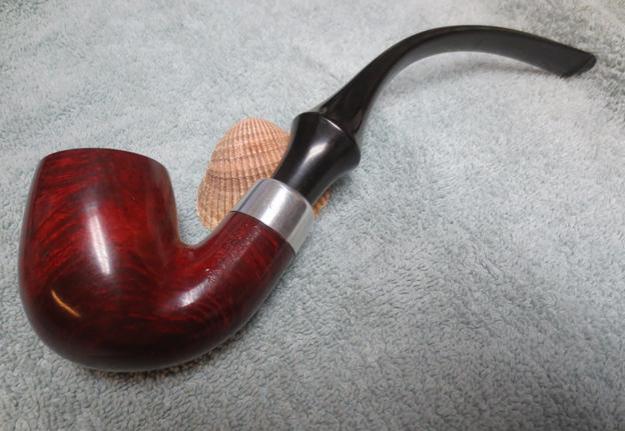
Tag Archives: Stem repairs

Refreshing a Comoy’s Golden Grain 110 Billiard

Blog by Steve Laug

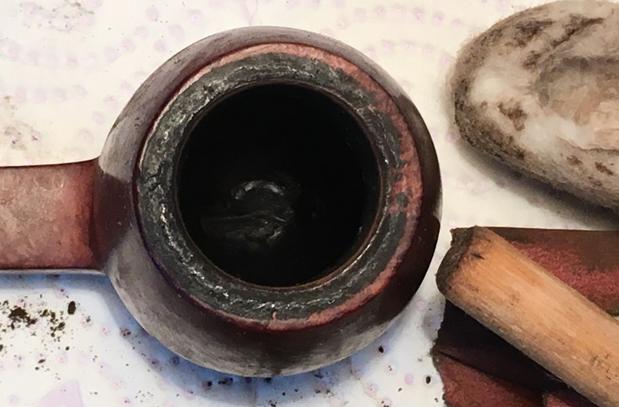
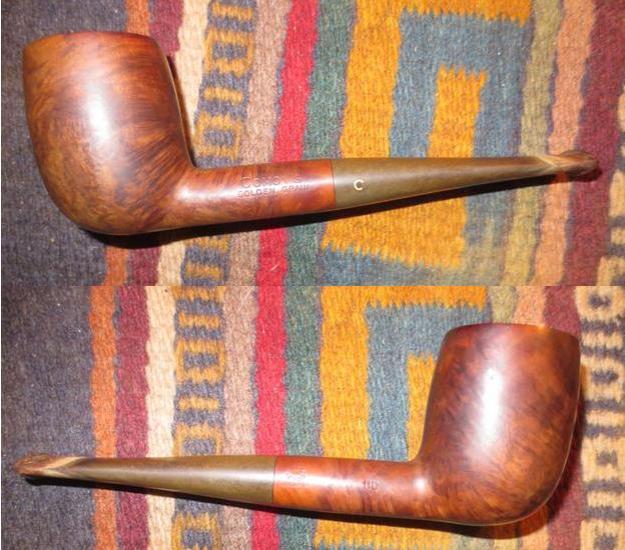
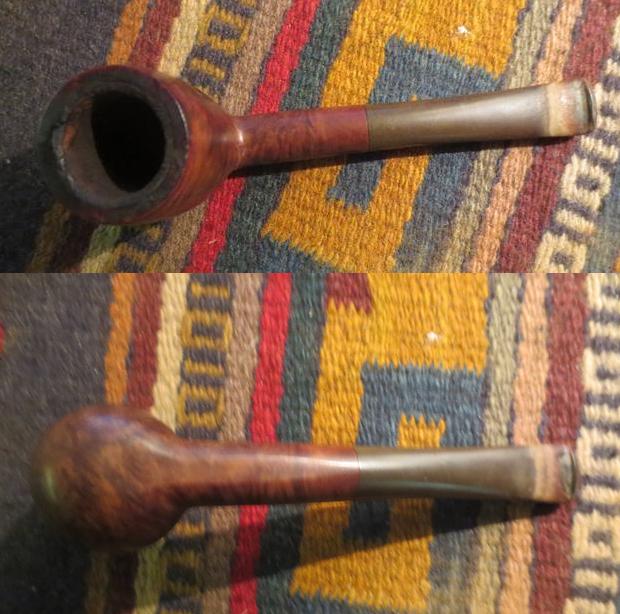
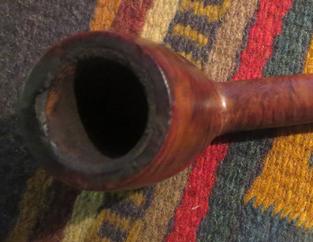
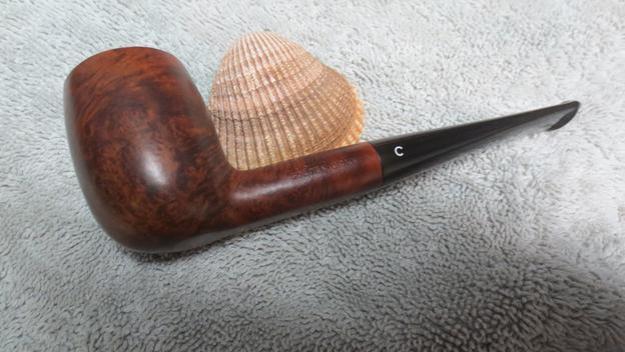
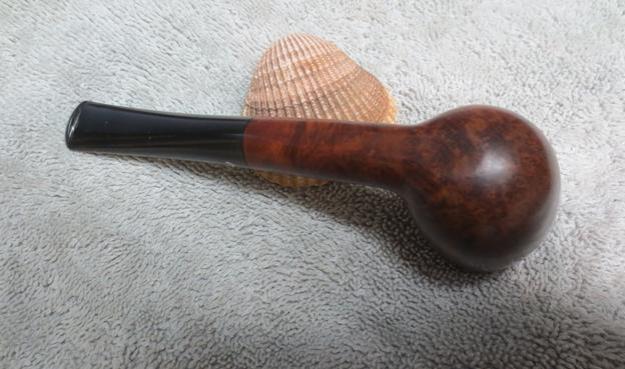
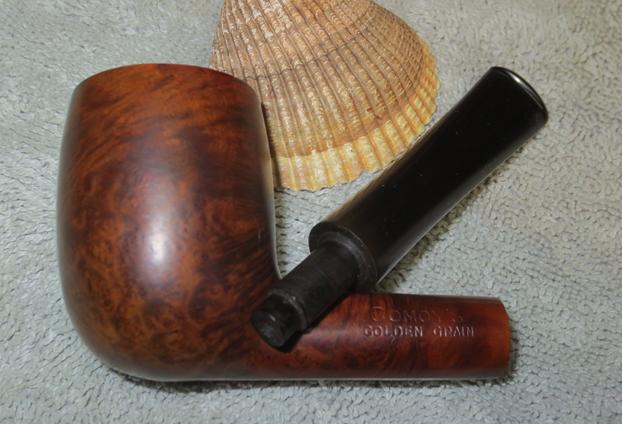
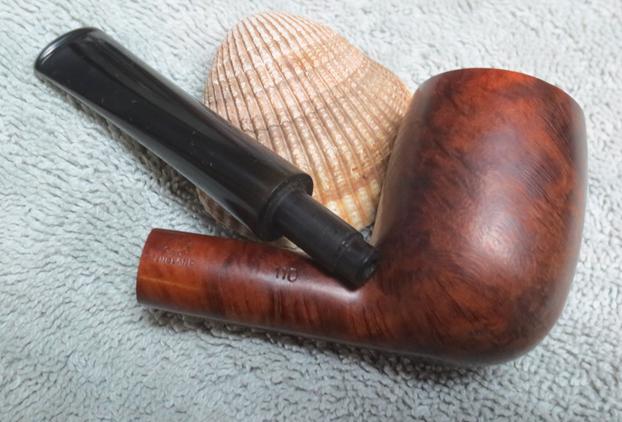
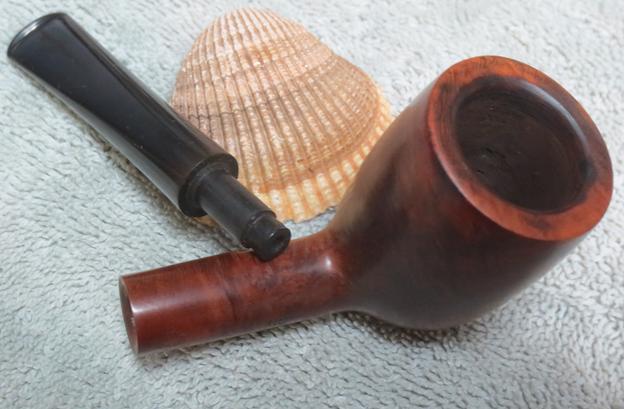
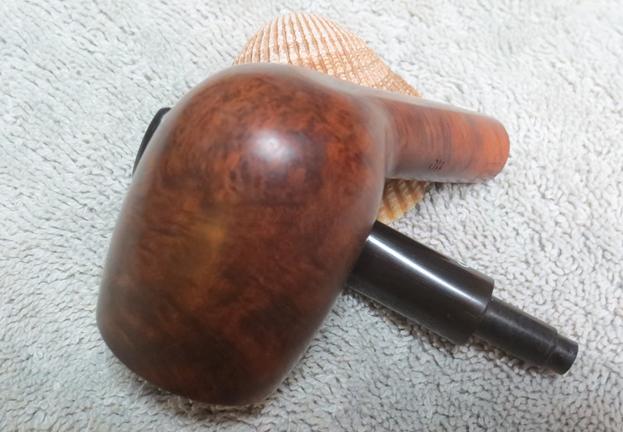
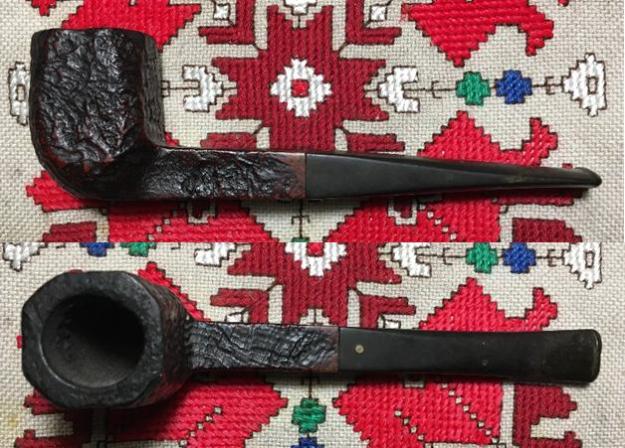
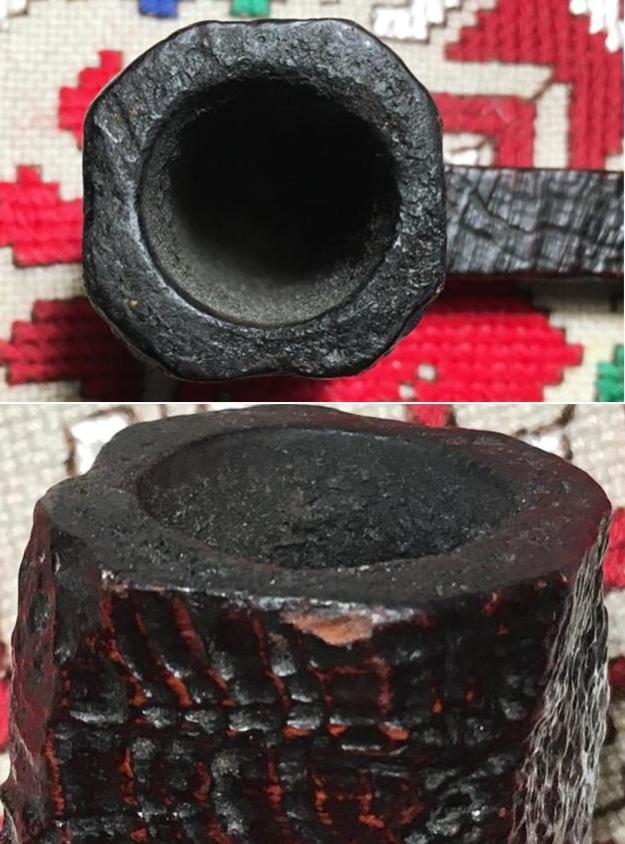
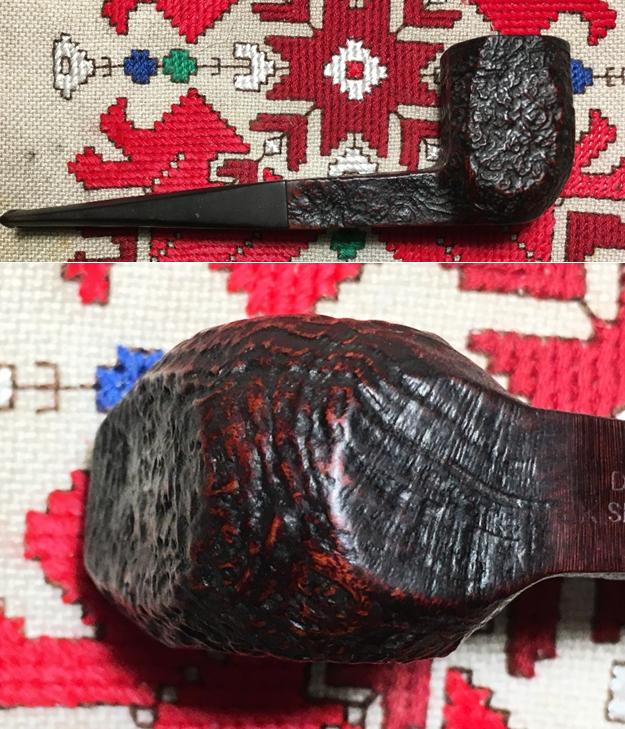
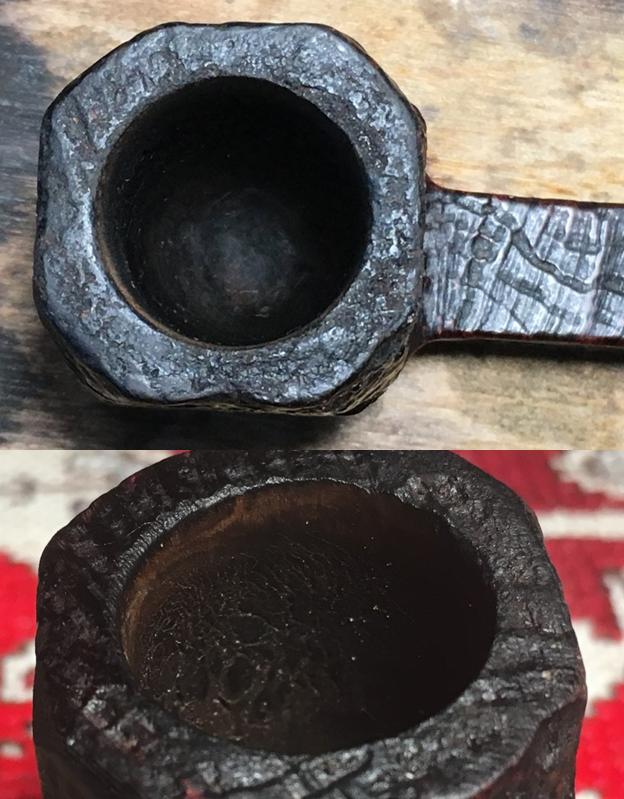
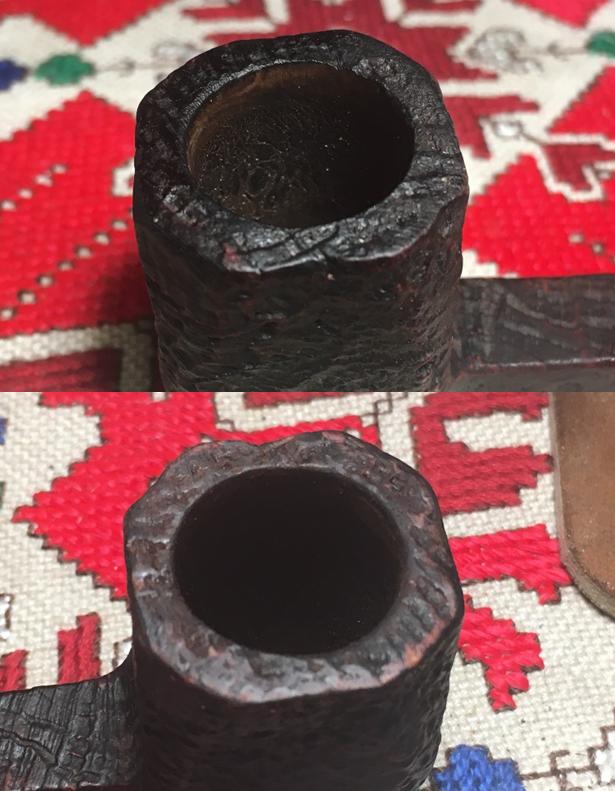
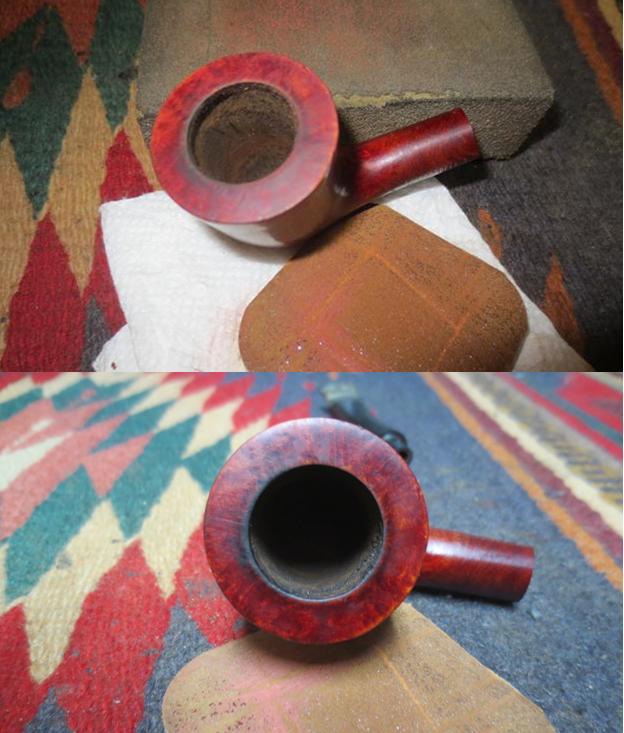
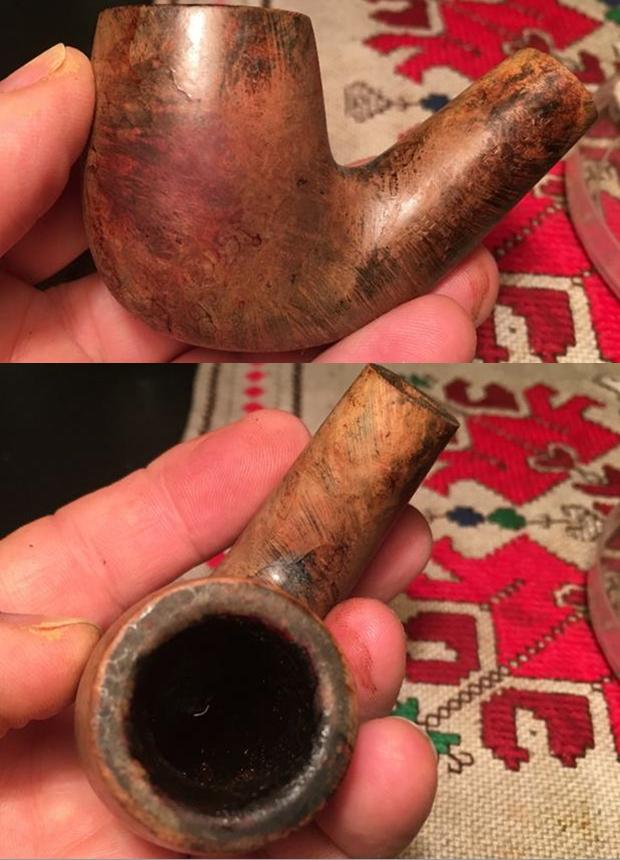
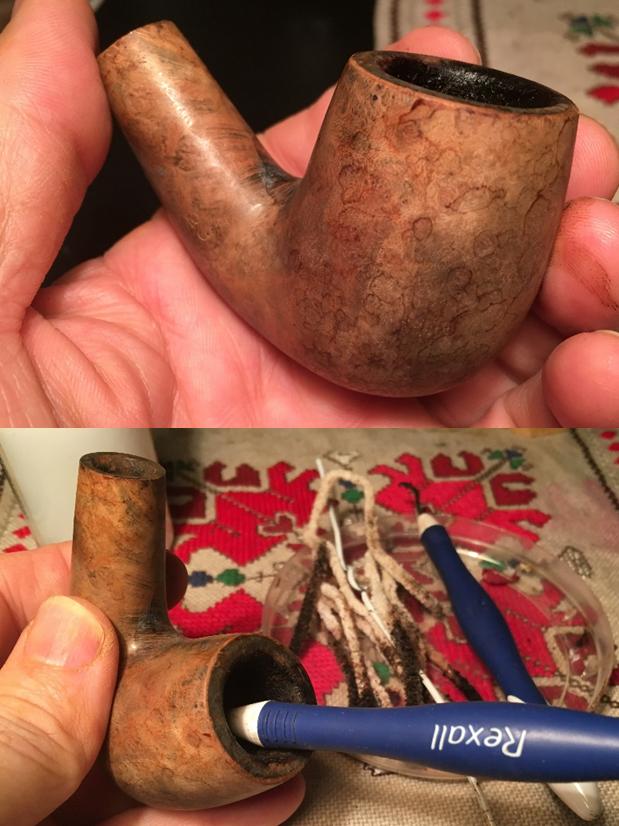
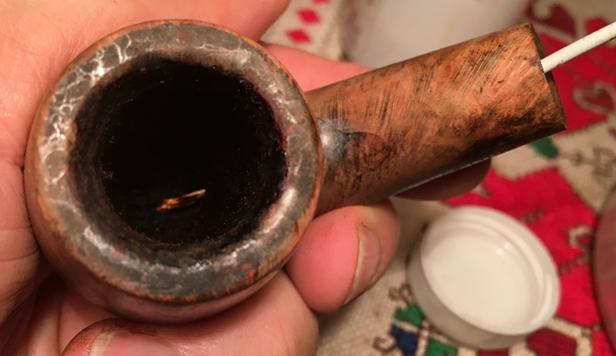
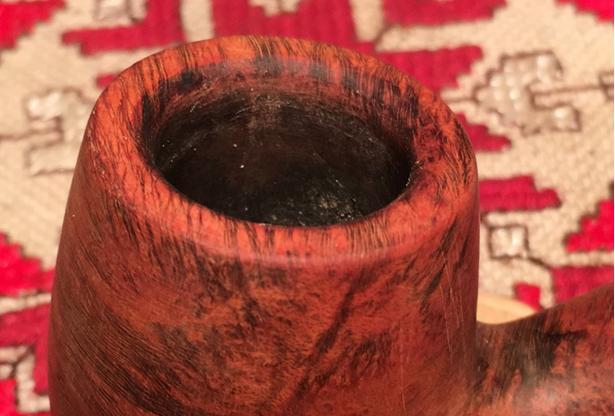
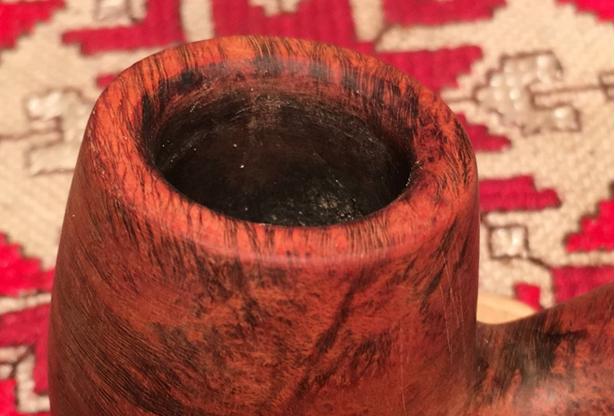
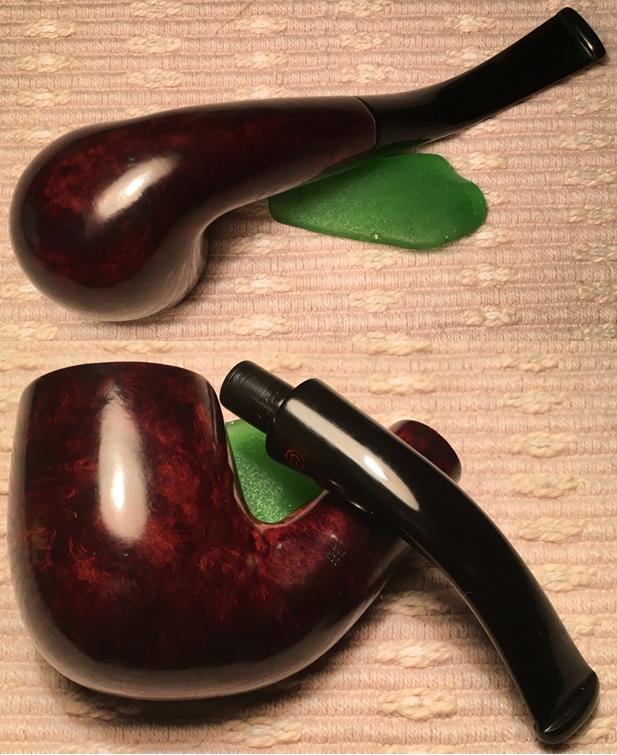
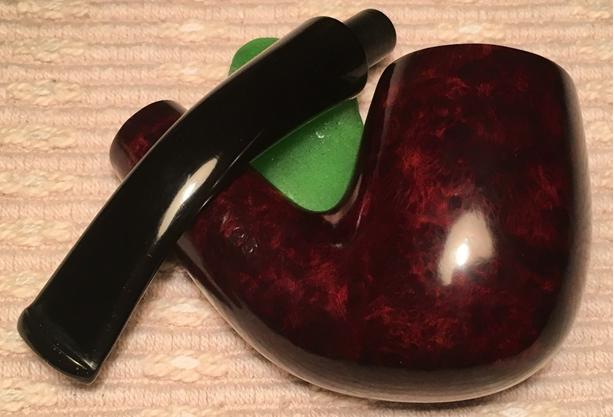
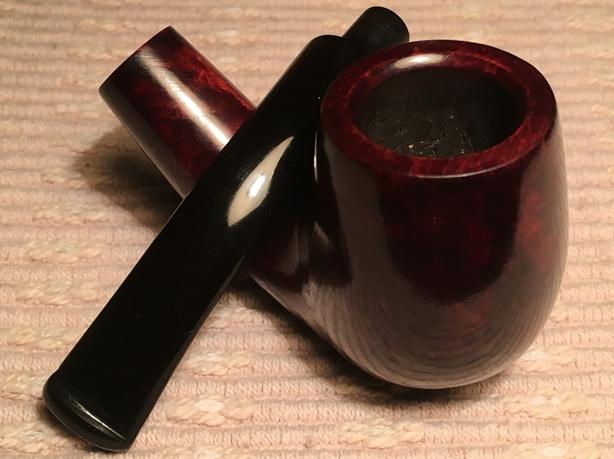
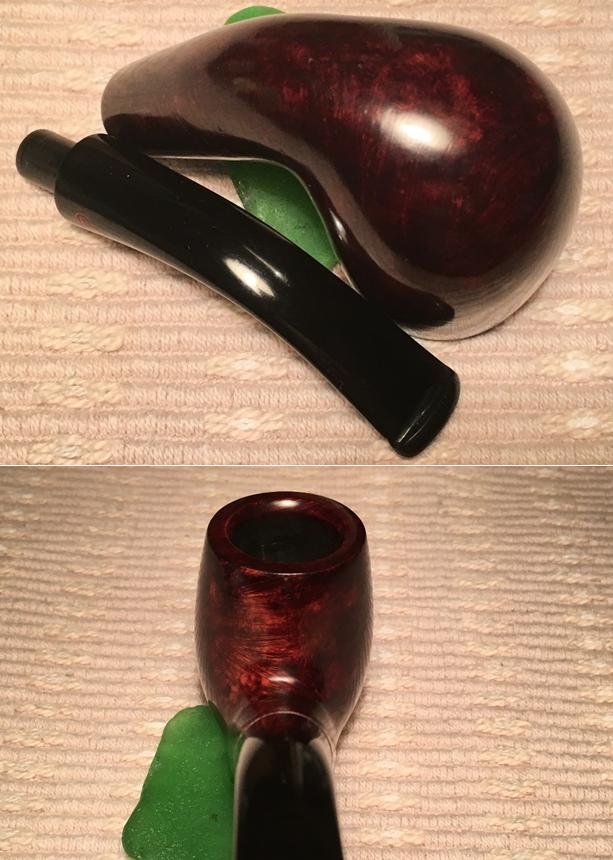
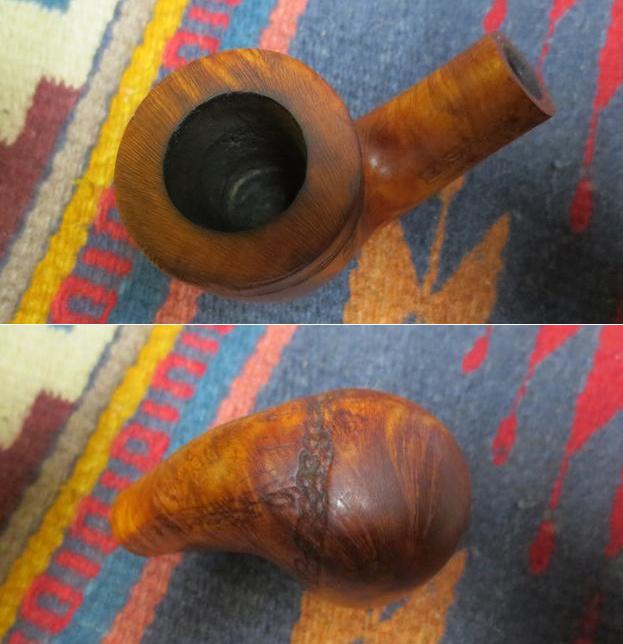
This is yet another from the old pipeman’s collection that came to me from the local pipe shop. It is a beautifully grained Comoy’s Billiard. The stamping on the pipe is very readable and clear. On the left side it reads Comoy’s over Golden Grain with a C on the side of the stem. On the right side of the shank it is stamped with COM (Country of Manufacture) circle Made in London over England and shape number 110. The finish is decent with a medium brown stain with great grain showing through. It is in good enough shape that I hope to not have to refinish it but rather just clean and renew the finish. There is thin cake in the bowl and rim darkening. The stem is oxidized and there is light tooth marks on top and bottom of the stem near the button. There is also some calcification from a Softee bit on the stem and button.gold1 gold2The photo to the left showgold3s the condition of the rim. The inner beveled edge of the rim is cake and dirty. There is a light lava overflow on the rim and some darkening as well. I am hoping that I will be able to scrub this off and also clean up the inner rim bevel in such a way that I can leave the original finish unaltered. It will take some slow and patient work to restore it and not just refinish it.

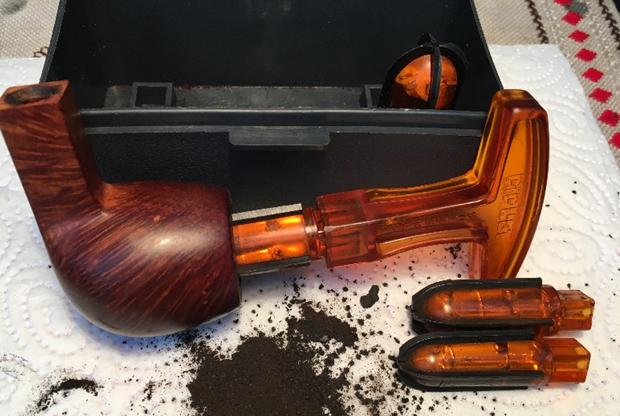
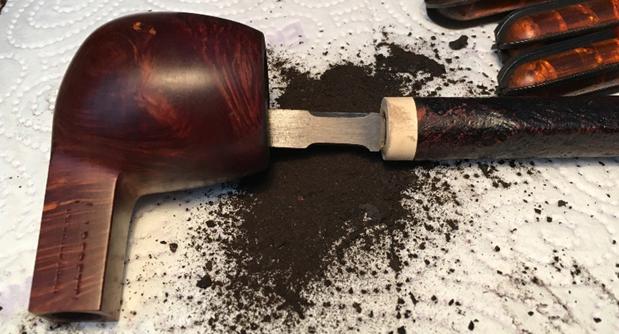
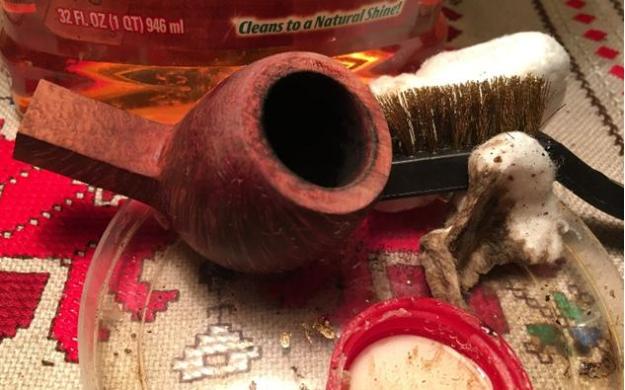
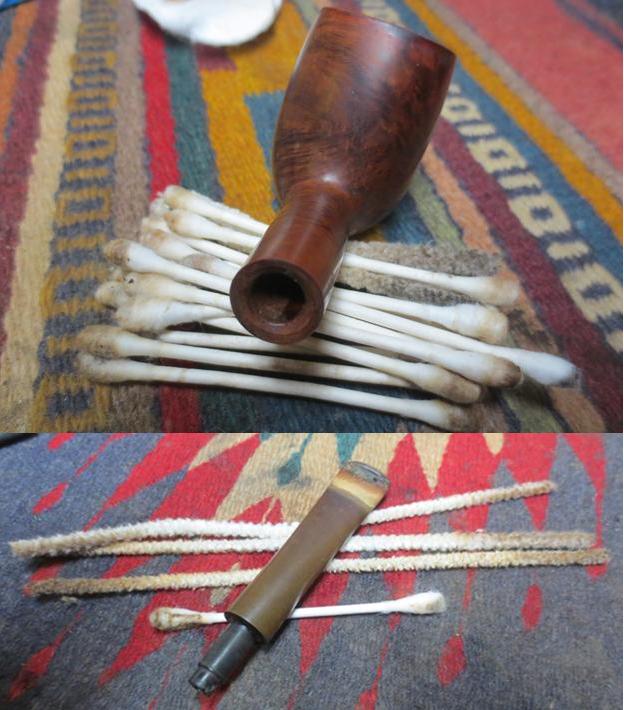
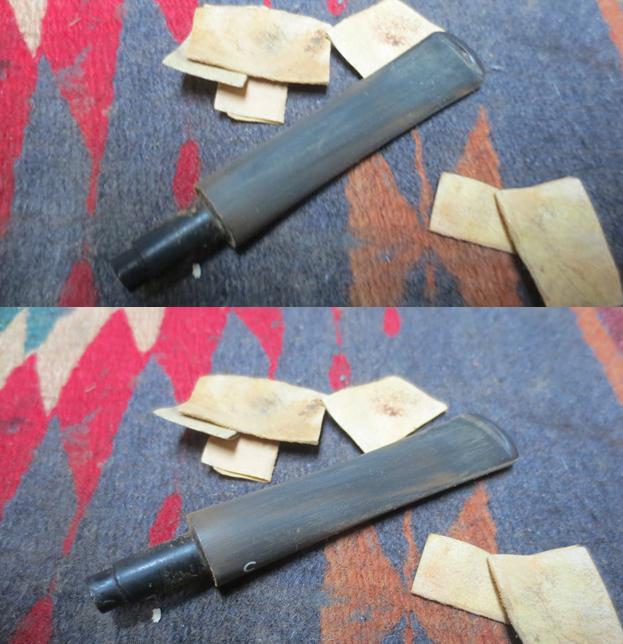
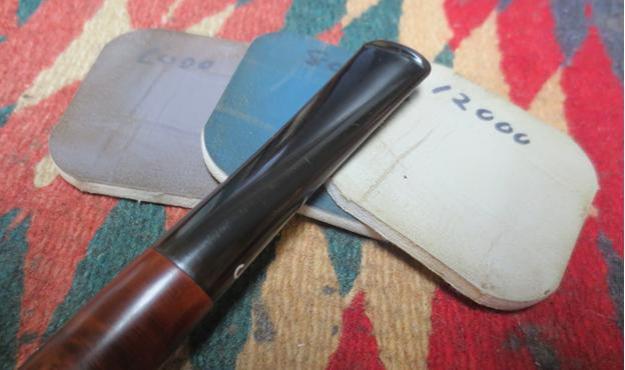
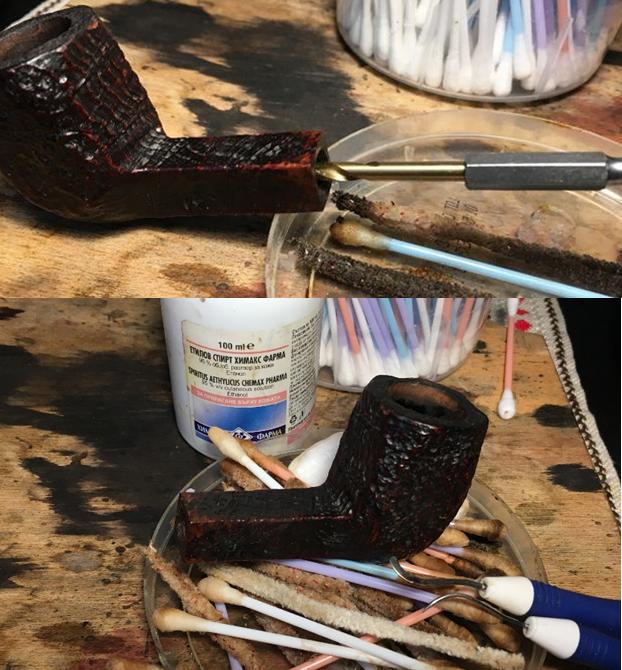
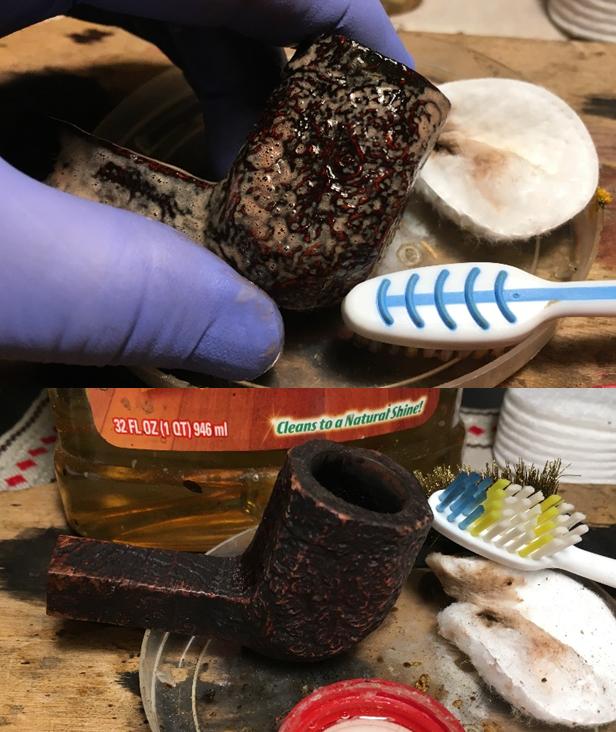
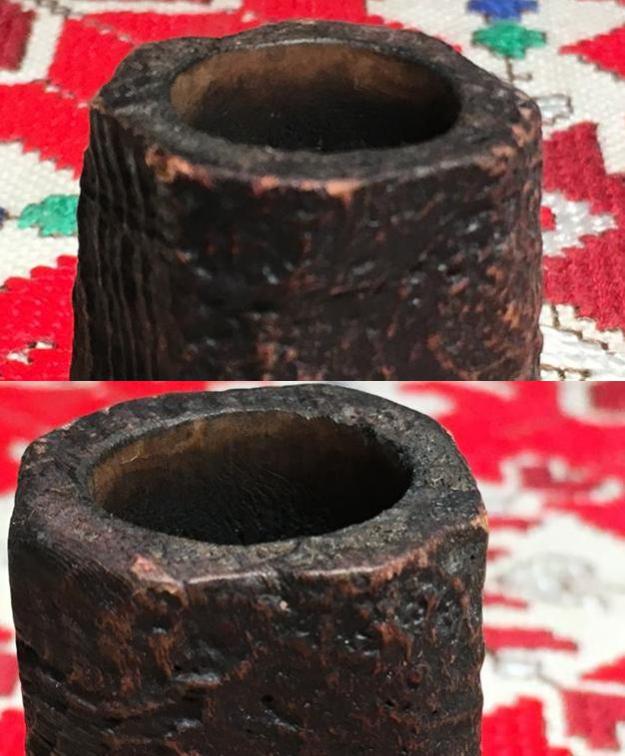
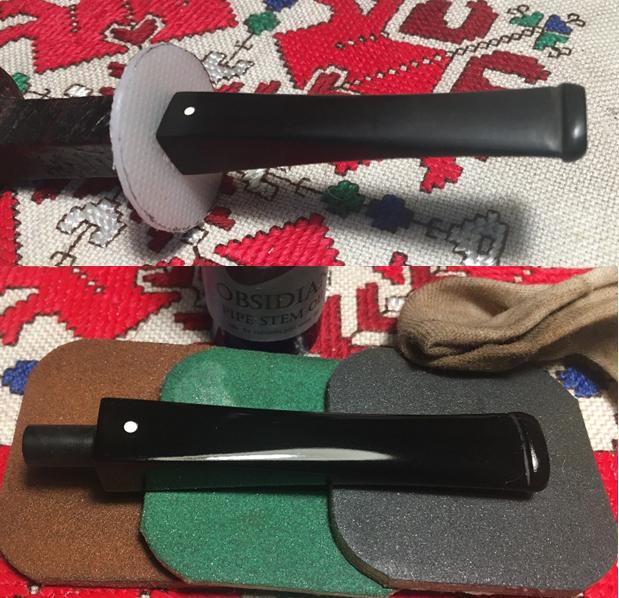
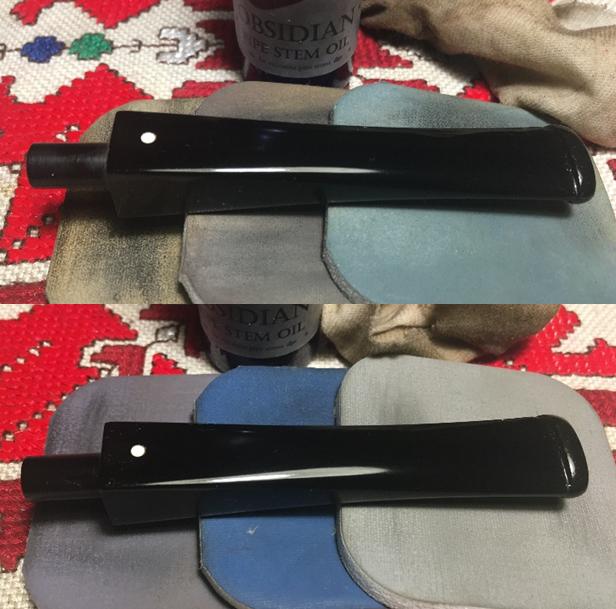
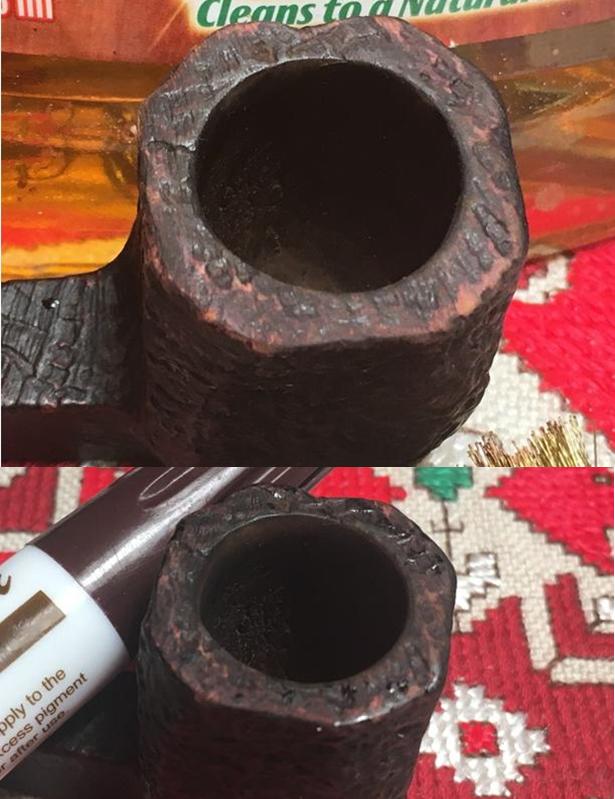
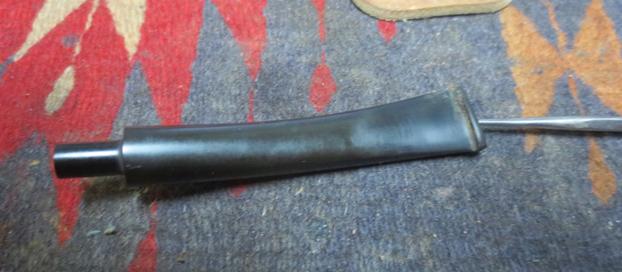
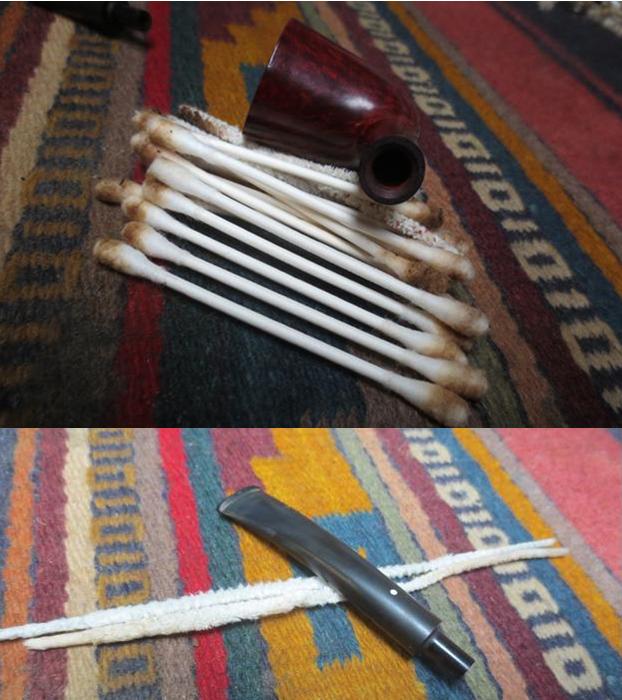
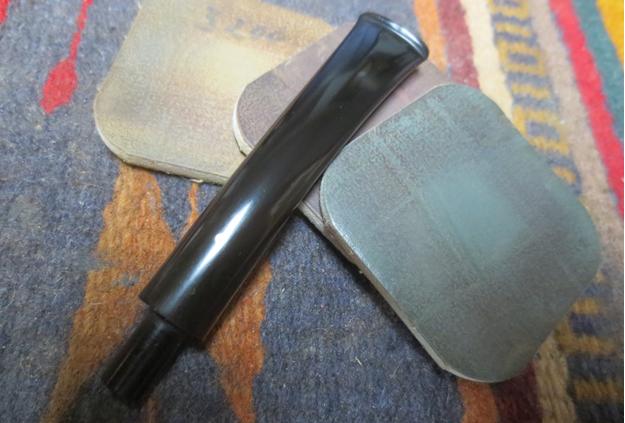
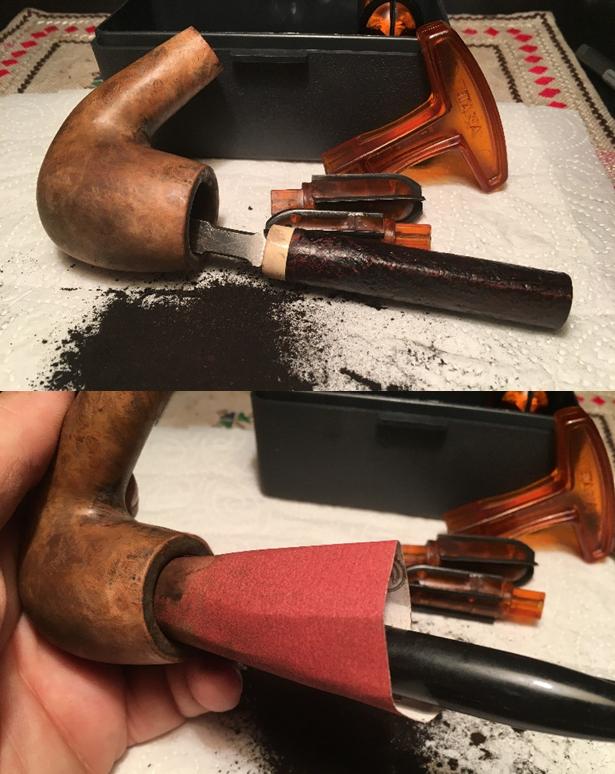
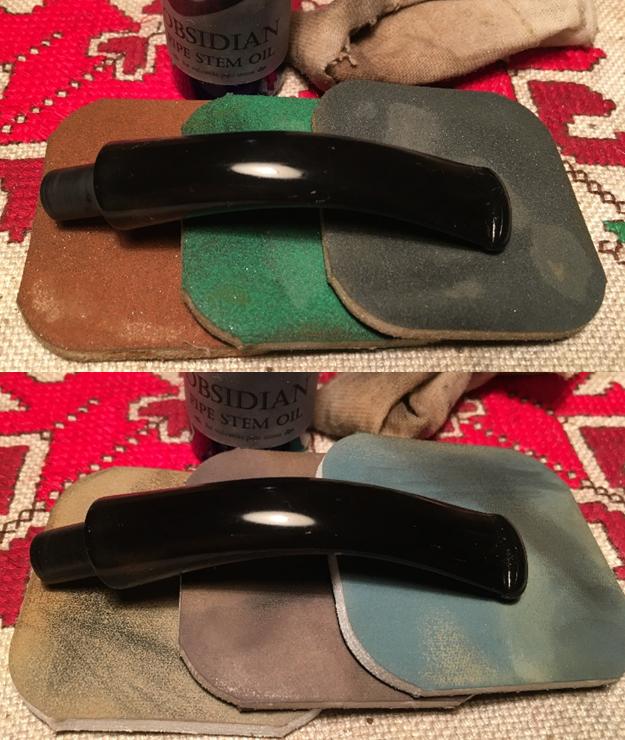
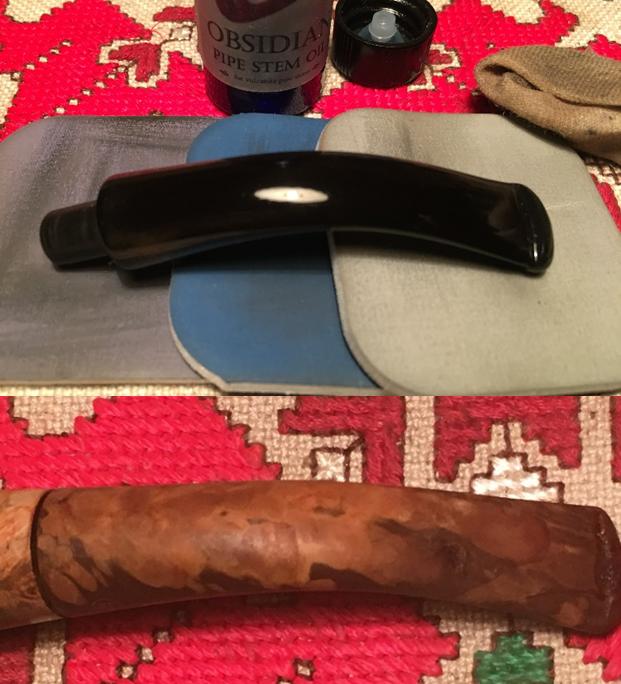
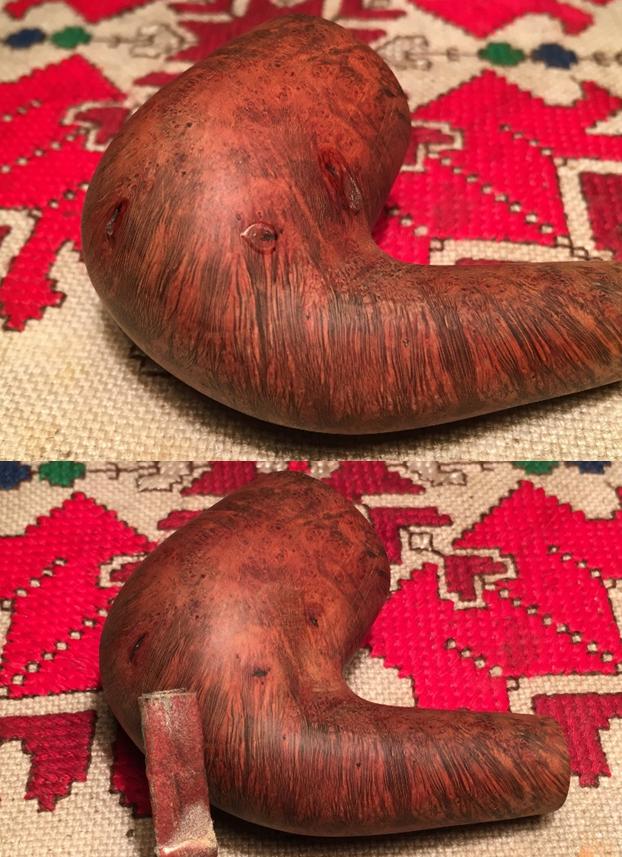
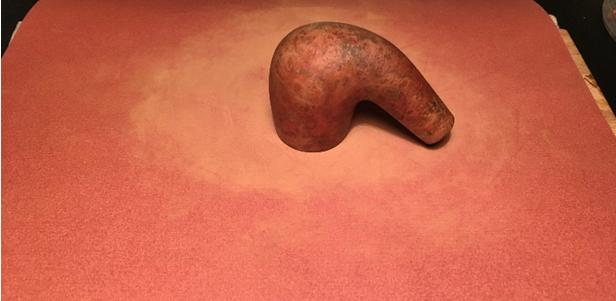
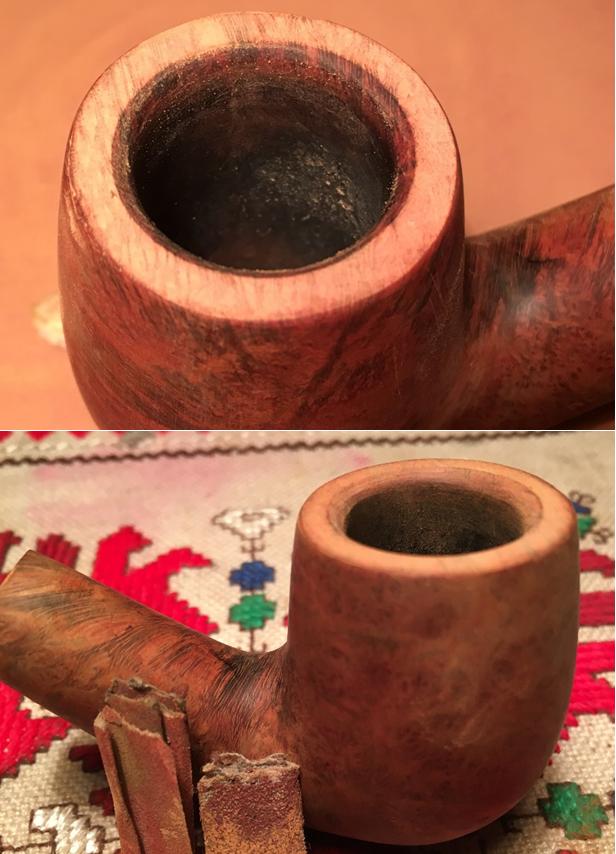
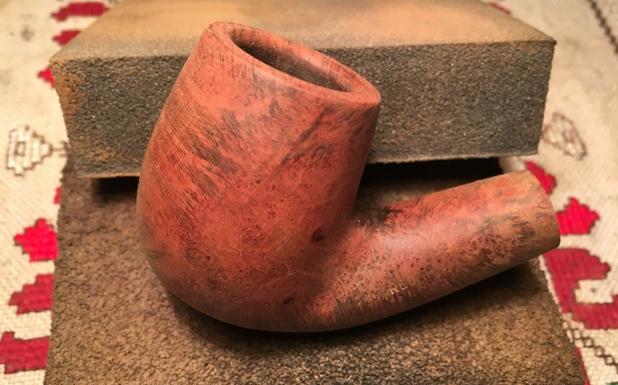
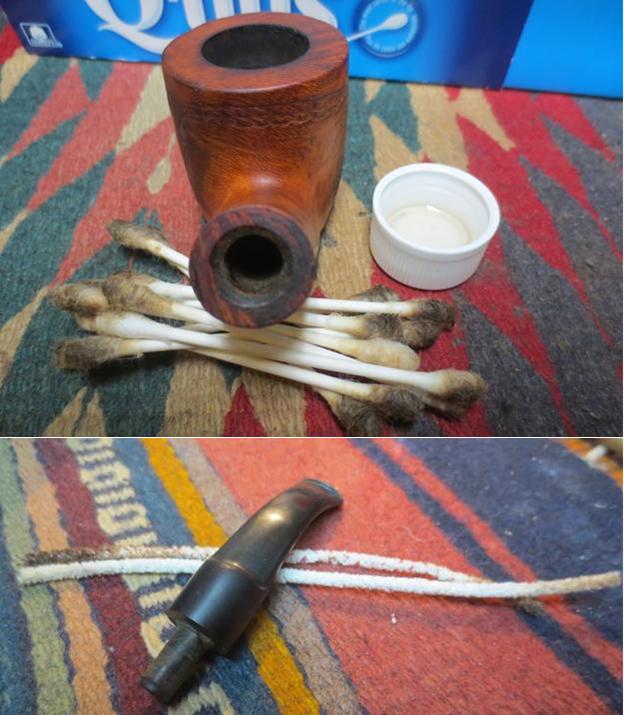
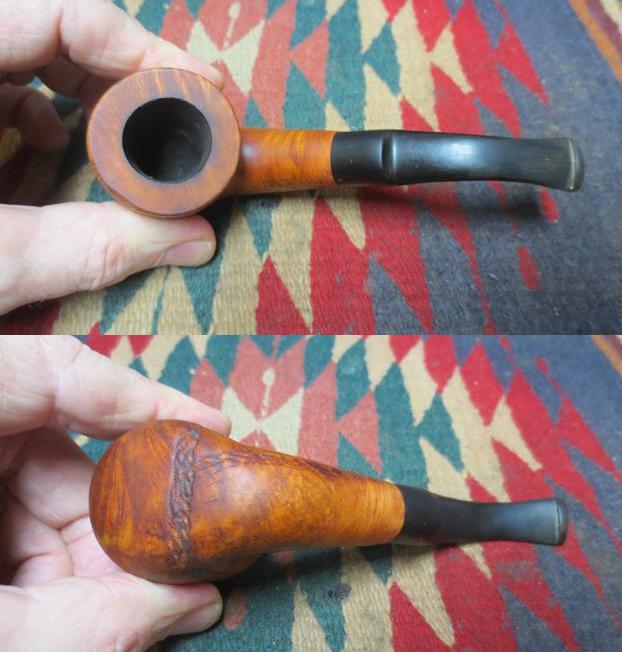
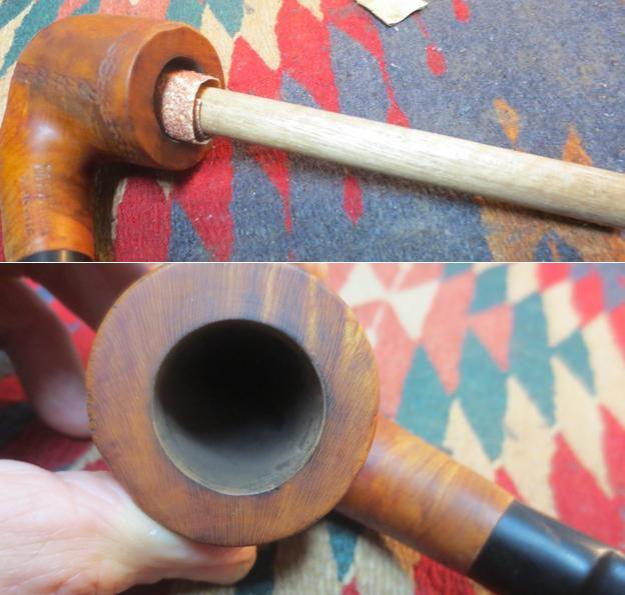
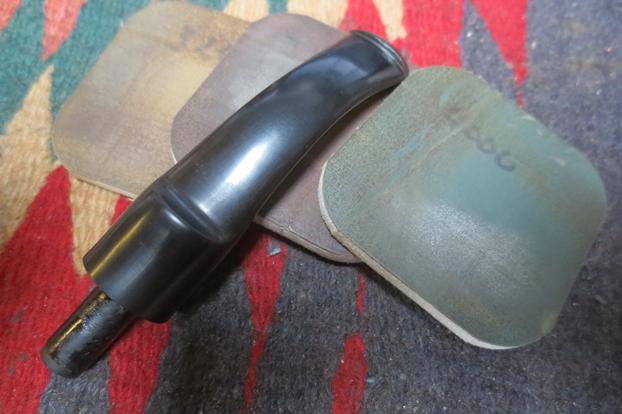
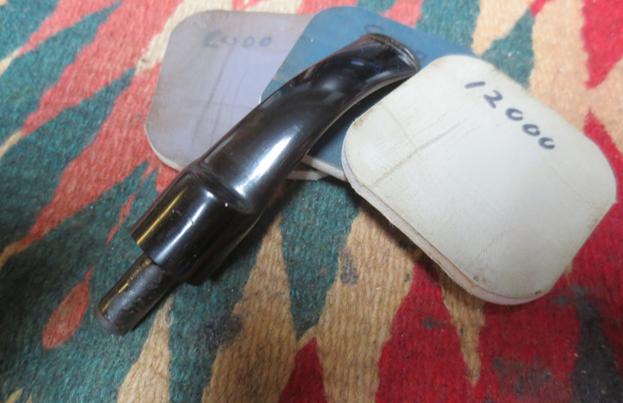
I reamed the bowl back to clean briar using a PipNet pipe reaming tool and a Savinelli Fitsall Reamer. I carefully worked the reamer over the beveled rim to remove the buildup on the edges of the rim.gold4I scraped the rim edge and bevel with a sharp pen knife to remove the carbon buildup that was there and scrubbed the rim and bowl with a small bit of Murphy’s Oil Soap to remove the darkening and grime left behind after the scraping. The photo below shows the rim after this work over. It is looking pretty good at this point.gold5I cleaned out the internals of the mortise and the airway in the shank and the stem with 99% isopropyl alcohol, pipe cleaners and cotton swabs.gold6I “painted” the tooth marks in the stem with the flame of a Bic lighter to raise the vulcanite. I am so thankful for the fact that vulcanite has memory and when heated will return to its original state if the tooth marks have not broken the edges. In this case it worked very well and I was able to minimize them with the flame and finish working on them with 220 grit sandpaper. I sanded the stem and removed the oxidation and the calcification on the button end.gold7I polished the cleaned stems with micromesh sanding pads – wetsanding with 1500-2400 grit pads and dry sanding with 3200-12000 grit pads. I buffed the stem with White Diamond after the 4000 grit pad and then finished with the remaining three pads. I rubbed the stem down with Obsidian Oil after each set of three pads and after the final rubdown set it aside to let the oil dry.gold8 gold9 gold10Once the oil dried I buffed the pipe and stem with Blue Diamond on the buffing wheel and gave it multiple coats of carnauba wax. I buffed it with a clean buffing wheel to raise a shine on the bowl and stem and then hand buffed it with a microfibre cloth to deepen the shine. The finished pipe is shown in the photos below. It is a beautiful grained Comoy’s made pipe that should provide years of good smoking to whoever adds it to their rack next. It will be available for purchase on the rebornpipes store later today if you wish to add it to your collection. Thanks for looking.gold11 gold12 gold13 gold14 gold15 gold16 gold17 gold18 gold19


Another Wedding Trip Pick: A 1961 DUNHILL EK Shell Briar Made in England 1 4S

Blog by Dal Stanton

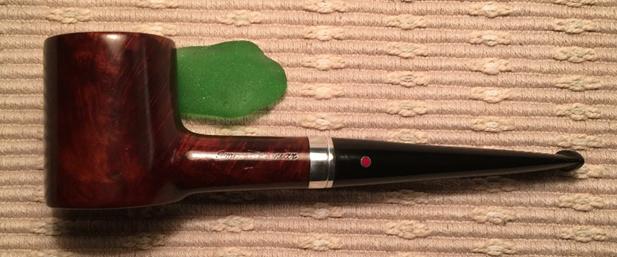
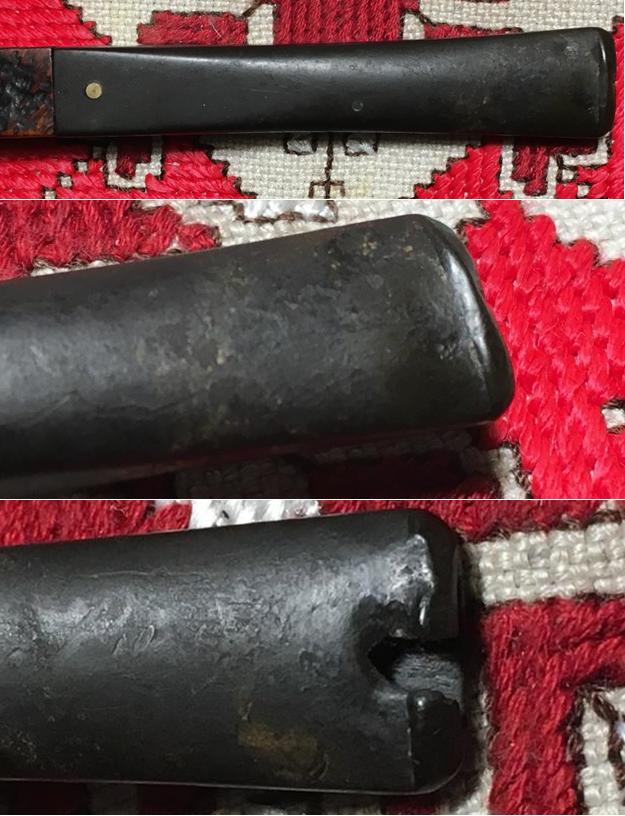
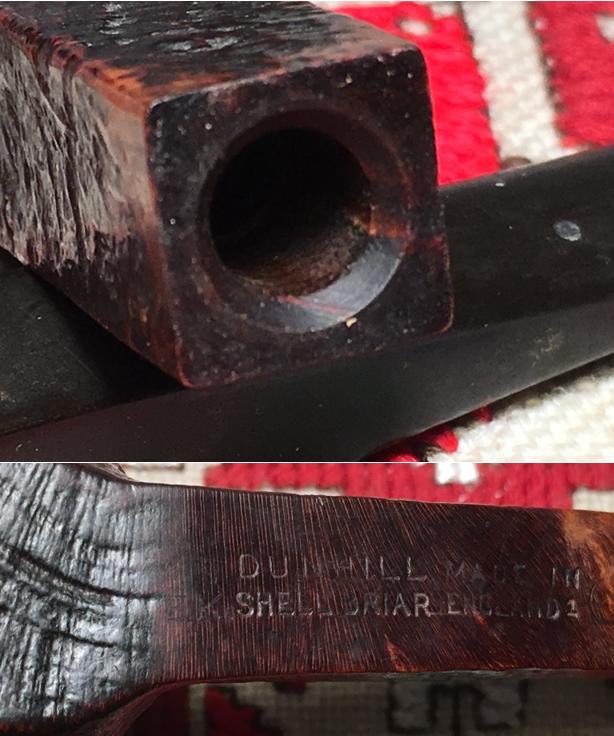
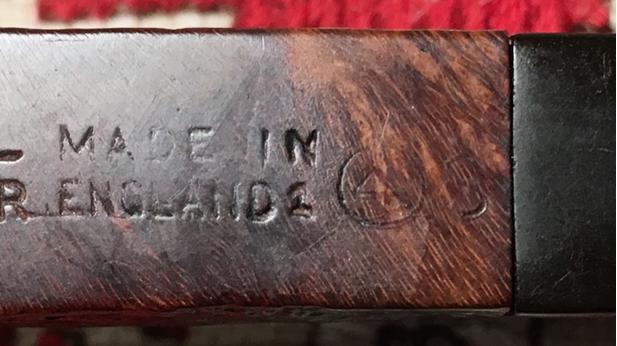
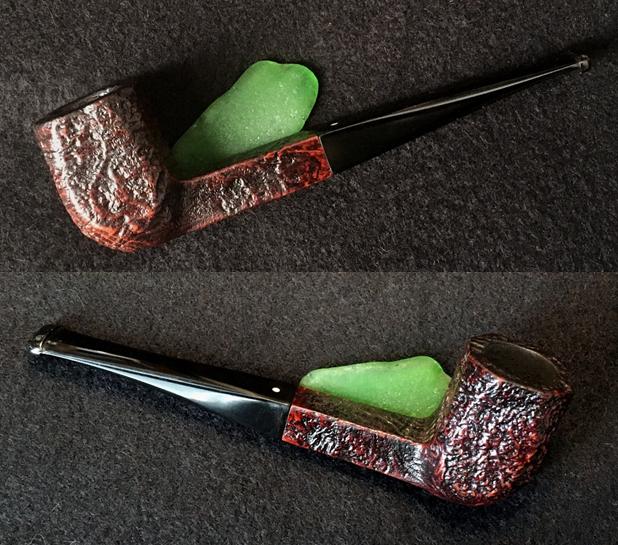
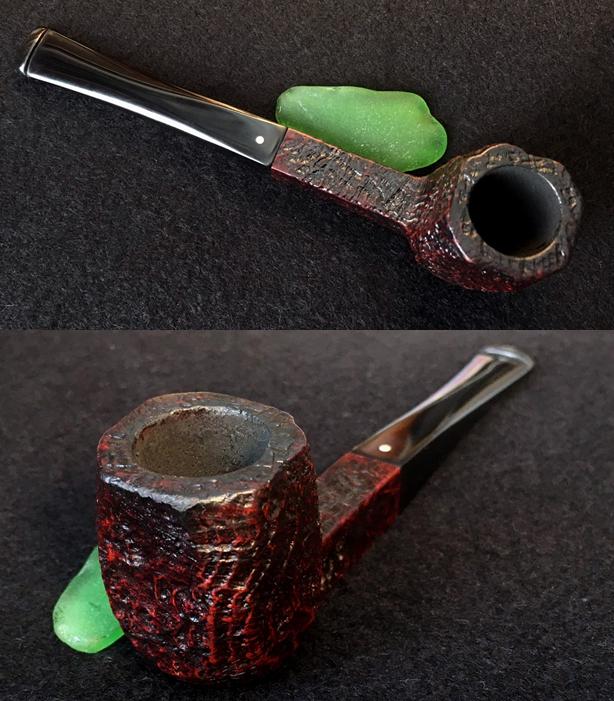
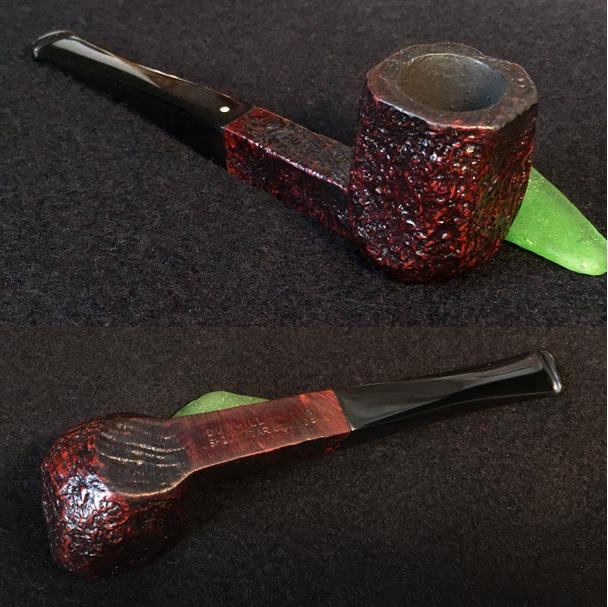
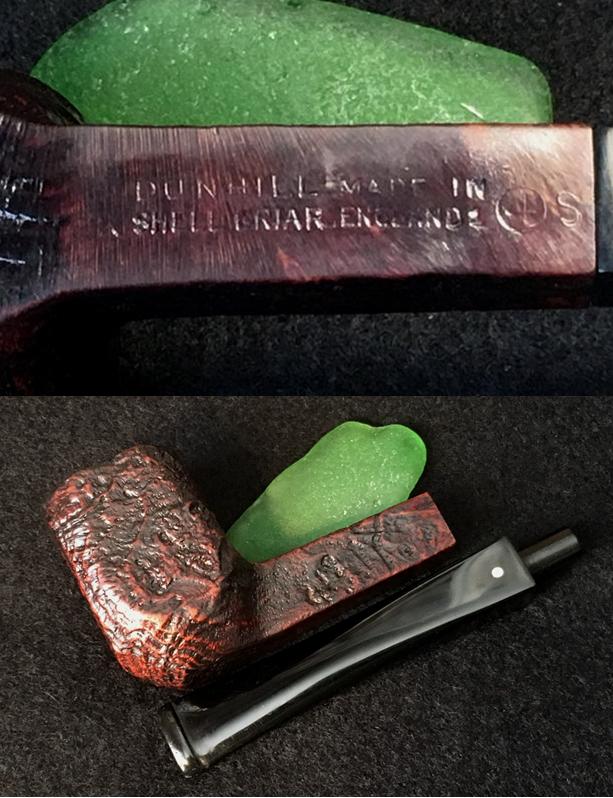
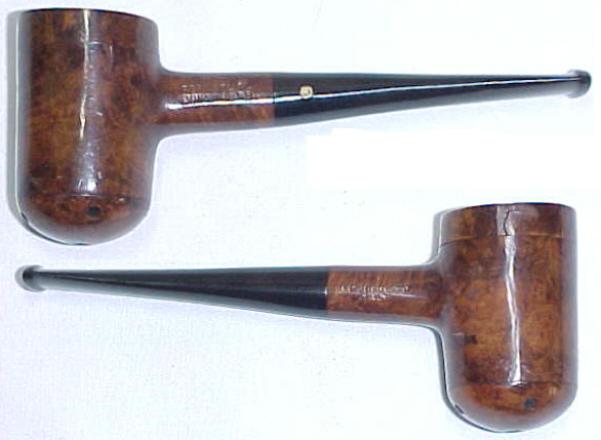
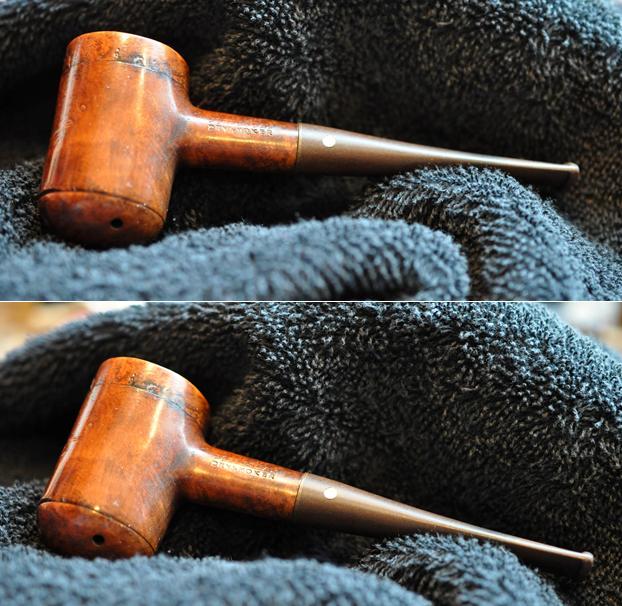
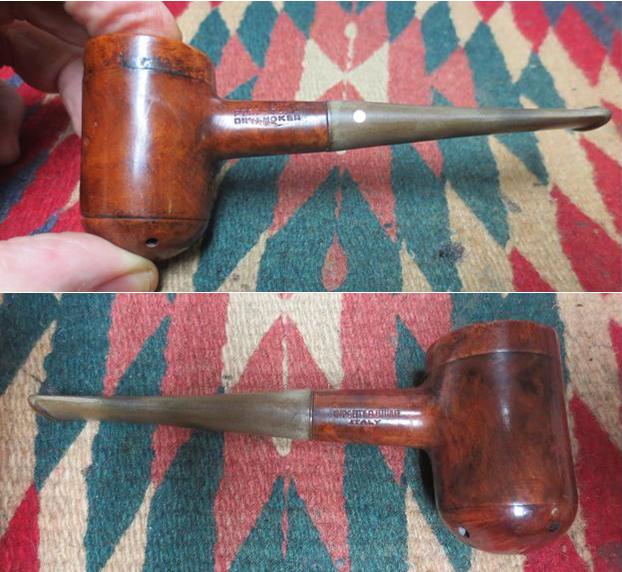
Unbelievably, I found this classic Dunhill EK Shell Briar at Madeline’s Antiques & Uniques during the trip for our daughter’s wedding in the US last November. Madeline’s was one of those picker paradises waiting on the I 24 Exit near Manchester, TN, that thankfully, we did not drive past! I had pleasure restoring and gifting our youngest son on Christmas in Denver, the Aged Imported Briar Poker (Red Dot) pictured below on the bottom (See: Link) and the restored Poker’s picture following. Now, shift two pipes above the Poker in the picture below, and you’ll see the Dunhill EK Shell Briar that now has my attention after rescuing him from my ‘Help Me!’ basket here in Sofia, Bulgaria.dal1 dal2At 5 3/4 inches in length, it is a nicely sized square shanked paneled billiard – a very nicely blasted Dunhill Shell pipe.  The stampings are worn but legible on the lower panel of the squared shank.  On the left quadrant, it reads, “Dunhill” over “EK Shell Briar”.  The right reads, “Made In” over “England 1”. Then, to the extreme right on the shank’s edge is 4 ensconced in a circle followed by S.  On the top panel of the squared, tapered stem is embedded the well-known Dunhill white dot – a mark of excellence since 1915.

In 1915, the famous white spot was introduced for very practical concerns. With straight pipes, customers had trouble knowing which way to insert the handmade vulcanite mouthpieces. So, Alfred Dunhill ordered white spots to be placed on the upper side of the stem. This very practical solution would become a definitive trademark of Dunhill pipes. The “white spot” soon became known as a symbol of quality. (Link to Pipedia’s history for Dunhill)

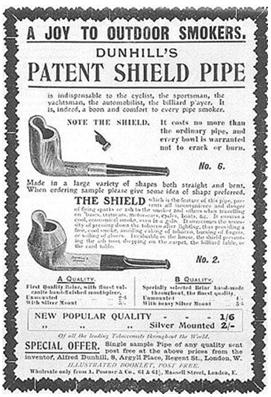
This is my first opportunity to research Dunhill to understand better the heritage of the pipe on my work table.  There is much information about Dunhill on the internet, which is nidal3ce change.  My impressions of the founder, Alfred Dunhill, are that he was a talented and creative businessman, who understood well that a quality product would create a financial boon along with understanding the ‘needs’ of a market.  Per Pipedia, in 1893, he inherited a harness business at only age 21, but was savvy enough to see the approaching reality of the automobile and he leveraged his company to prepare for it. He started, “Dunhill Motorities” to capitalize on this new industry. His first experiment in pipe making was to accessorize for the ‘new’ and sophisticated needs of those now driving cars which were faster than horse and carriage.  To me, this epitomizes Alfred Dunhill’s approach to business and perhaps, to life as well. With wind in the faces of potential customers, he birthed the idea of marketing a pipe with a windshield! We laugh, but this says something about the man who guided his company through the Great Depression when many pipe manufacturers were closing their door.  Dunhill expanded.  The Pipedia synopsis describes the world-wide growth of Dunhill Pipes and their association with quality – the preferred pipe of the rich and famous and the aristocracy.  This ‘market share’ was due in part to Alfred Dunhill’s practice of giving pipes to the English military officers during WW1.  Altruism or good marketing?  During that time the aristocracy of England was awarded military commissions by birth-right.  Dunhill was a smart businessman, there’s little doubt of this.  I also read that it was Alfred Dunhill who kept Winston Churchill well-supplied in cigars.  Another interesting thing I saw as I did my research was threads and discussions arguing why Dunhill pipes are more expensive than most?  Quality or overrating based upon a name?  This Pipe Magazine thread is one example.

The largest part of my curiosity regarding Dunhill is to understand better the creation of the ‘Sand Blast’ finish, or as it’s called in Dunhill Land, Shell.  In my diminutive time rescuing and restoring pipes, I’ve never had clarity in my mind about the differences between blasted and rustified surfaces – and variations therein.  These distinctions are clear to most enthusiasts in pipe collecting and restoration but I’ve been a bit slow on the uptake!  I’m looking at the Dunhill Shell Briar – my first thought had been that it must have something to do with shells on a sea shore….  This small article was especially helpful from the same Pipedia page:

Shell

A deep craggy sandblast with a black stain finish. Dunhill patented the sandblast finish in England in 1917 (Patent No. 1484/17) and the U.S. in 1920 (Patent No. 1,341,418). See The Art of Sandblasting, by R.D. Field, for in depth look at Dunhill’s revolutionary new finish. The deepest and craggiest finishes were from Algerian briar, which is softer and yields more to the blasting. These are found in circa 1920’s, 1940’s, and 1960’s Shells. The pipes were double blasted until the 1960’s, and then the double blast technique resumed in the 1980’s calling it the “Deep Shell” finish. During the 1960’s and 70’s Dunhill could not acquire the Algerian briar. Consequently, the company’s sandblast pipes were much shallower and less distinct. Once again Dunhill showed itself to be innovative, inventing the “double blast” technique to bring about a deeper blast even with harder briar. The black shell sandblast finish uses a stain the was developed for the color, not the taste. They have a more bitter taste, even when well smoked.

Now I have it.  The knowledge that blasting highlights briar grain by removing softer wood through the process has changed how I now look at the surface of a blasted pipe or with Dunhill, a Shell pipe.  ‘Shell’ reportedly came from observations of the earliest experiments with sand blasting briar shapes – they were shriveled and looked like a ‘shell’ – that is, a shadow of their former states.  Even with the limited number of restorations I’ve done to date, it is obvious that I thoroughly love and enjoy working on smooth briars, simply for the challenge and delight of witnessing the beauty of briar grain appear.  Now, I study the Dunhill EK Shell Briar with a new appreciation for a different perspective on the same beautiful grains but revealed via blasting.  So much for my reflections!  Here are pictures of the Dunhill I’ve been reflecting upon!dal4 dal5 dal6 dal7 dal8 dal9Before I begin the restoration work, one last tick on the research list – the nomenclature.  The two pictures above show the markings on the lower shank panel.  I admit, when I first started trying to make sense of the plethora of information on Dunhill dating, it was daunting and a bit confusing, but as I looked at R.D. Fields’ A Dunhill Pipe Dating Guide published in Pipedia, Pipephil’s unbelievable charts, and tooling through all the examples of Dunhill nomenclature exemplified year-by-year, and also Pipephil’s, Dunhill Dating Key – pieces started coming together.  Reborn Pipe’s reposting of Eric Boehm’s Dunhill Shapes Collated was helpful as well.  When I first looked at the pictures above, I had missed the ‘E’ of the EK Shell Briar which is barely legible due to the wear next to the heel of the stummel.  Boehm’s information about ‘EK’ shape was: “Quaint Shape” Hexagonal panel billiard, square shank, angled tapered bit “Stand-up” 1928.  The EK Hexagonal panel is interesting in that a hexagon has 6 sides.  Over the years, this shape may have added more angled variety.  This EK is either squared if you only count the 4 major panels, but it is possible when including the tapered, smaller panels creating the corners, 8 panels are encircling this stummel.  The Pipephil Dunhill Shape Code chart calls the EK a square panel and provides an example of an EK 1958.  The markings are:

EK = Square Panel (shape letters)

4 (in circle) = Bowl Size

S – material: Shell or sand blasted

The dating of this pipe is 1961, based upon the suffix number ‘1’ following ‘England 1’.  Clear? Starting in 1955, Dunhill stopped including the full patent number in the nomenclature.  So, for Dunhills without the patent number, if the number following the ‘England’ is 5-0 (underlined or a subscript) then it would be the year 1950 + X = Year.  So, a Dunhill having ‘England 5’ is from 1955.  With the 1960s the system changed to 1960 being the base starting point with suffix numbers added to ‘England’ that were not underlined or subscripted, but the same size as the D in England.  Are you confused – I was, but it finally became clear.  The dating suffix in the picture above is ‘England 1’ which indicates a dating of 1960 +1 = a 1961 dating!  If I had an ‘England 24’ it would be dated 1984.  I found another EK Shell Briar on this finished eBay listing which was “London 8” – 1968.dal10

Pipe Pages had this example of an Owl Catalogue of 1962 with a picture of the same EK shape in the center but its dating would look like this: “England 2”.  I don’t know if this makes it clearer, but I am thankful for Dunhill dating his pipes!

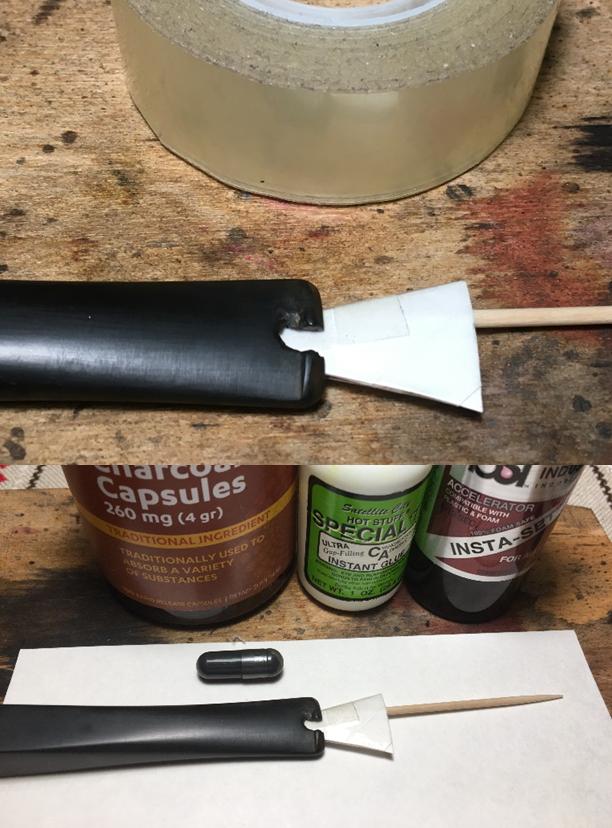
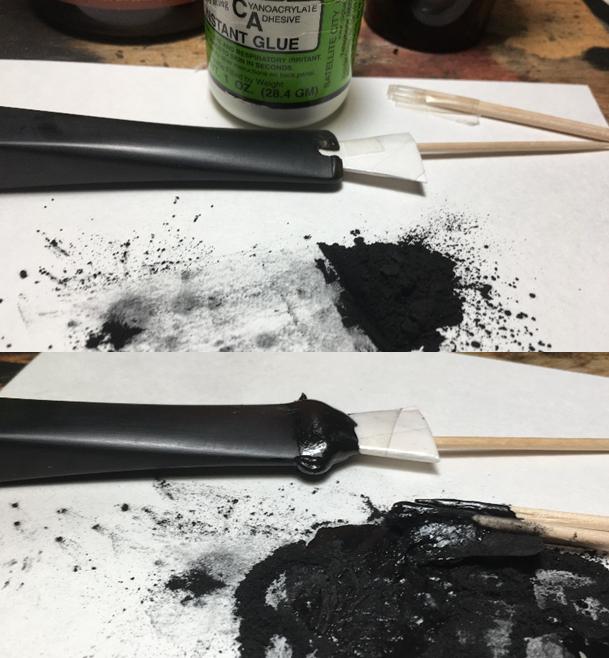
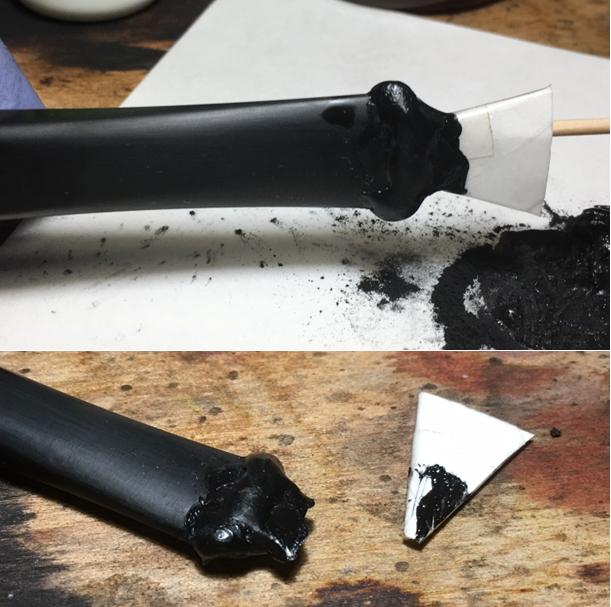
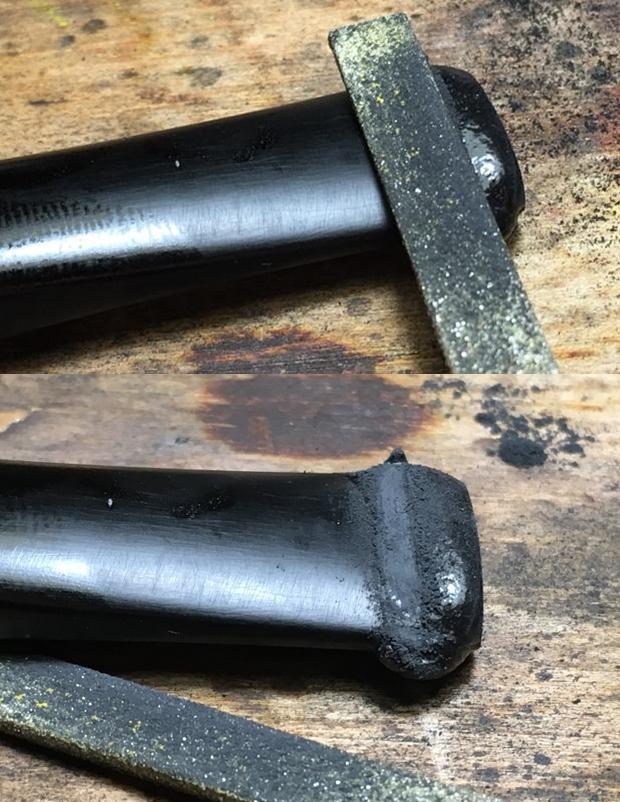
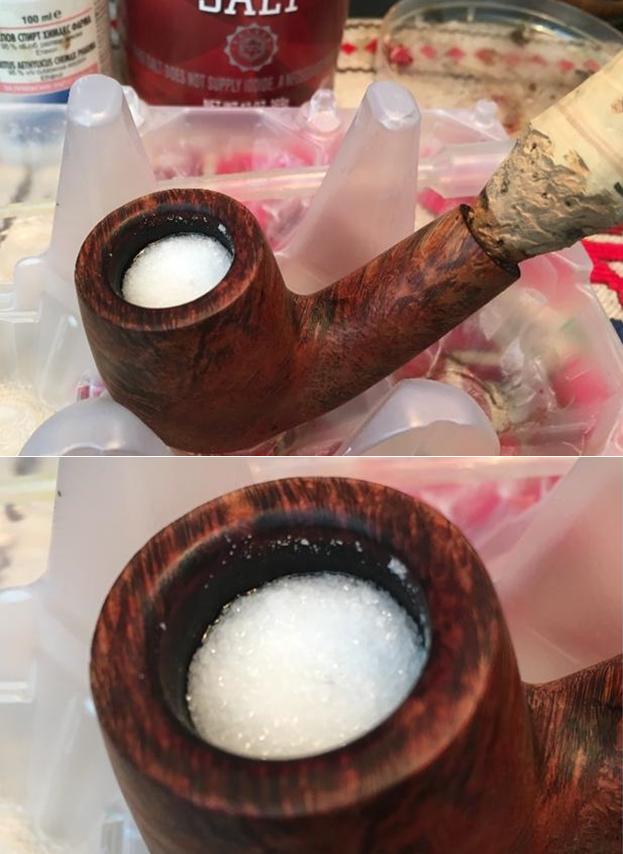
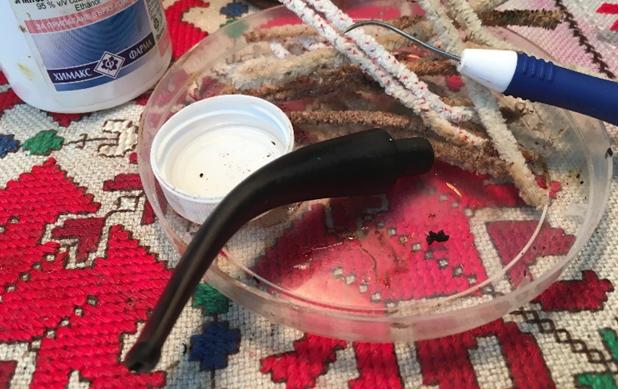
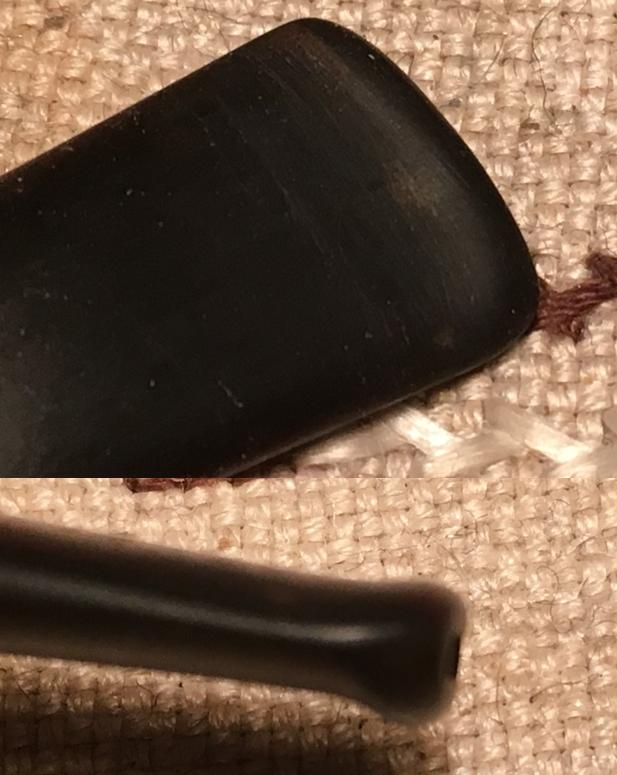
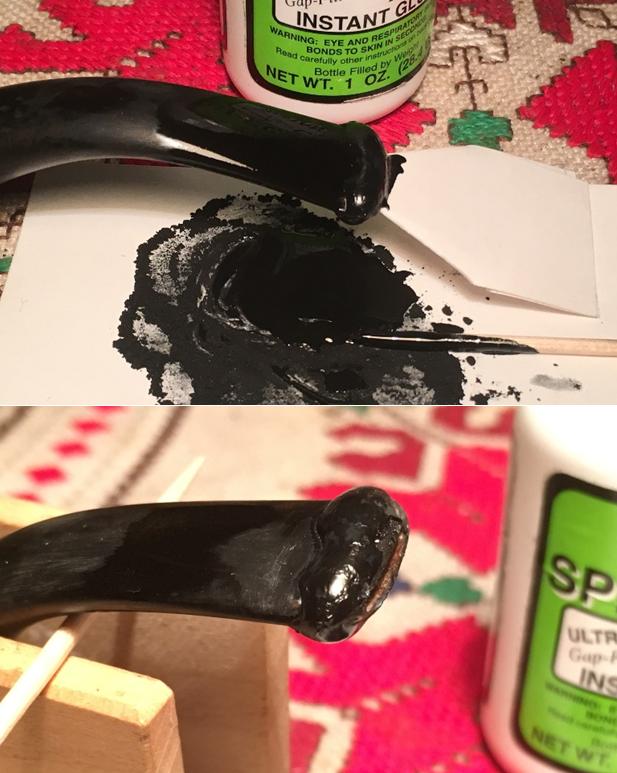
With a new appreciation for Dunhill, and the EK Shell Briar, Made in England 1, 4S, before me, I hope that I can recommission this pipe for another lifetime and to serve another steward!  The stummel generally looks good – it needs to be cleaned thoroughly – the internals and the blasting.  The cake in the chamber needs to be removed to the briar to allow a fresh start and to examine the chamber wall.  The rim is seriously caked with oils and lava flow and the rim has a small chip on the shank-side panel which will need coloring and blending.  The lower shank panel with the Dunhill nomenclature is already worn – I will clean the area but stay clear of any abrasives.  I thought I detected a crack in at the 4 o’clock mark looking at the shank, but with a closer look, thankfully it is grain and not a crack!  The stem is the challenge.  The oxidation is heavy and needs to be removed.  The button has a bite-through on the lower side that breaches the lip.  The button will need rebuilding and the hole patched.  I remove the stem from the shank and put a pipe cleaner through the airway and plop it in an Oxi-Clean bath to start addressing the heavy oxidation.dal11With the stummel, I take the Pipnet Reaming Kit to address the cake build-up in the chamber. I take another picture of the cake to mark the progress.  For easier clean-up, I always put down a double layer of paper towel to catch the exorcised carbon.  I use the two smallest blades of the 4 available to me to ream the chamber.  Starting with the smallest, then the next larger size.  After this, to fine tune the reaming, I use the Savinelli Pipe Knife by scraping the walls further.  Then, wrapping 240 grit paper around a Sharpie Pen, I sand the walls to remove the smallest traces of carbon and to bring the chamber again to briar.  I finish by using a cotton pad wetted with isopropyl 95% and wipe the chamber to remove the carbon dust. After inspection, the chamber walls show no sign of burning through though I do detect heat fissures that are not serious, but need attention in the last stages of the restoration.  The pictures show the reaming process and inspection questions.dal12 dal13 dal14 dal15Before moving to the external cleaning, I tackle the internals – using cotton swabs and pipe cleaners dipped in isopropyl 95% I clean the inside airway.  The resistance is significant so I take a drill bit, the size of the airway, and ream and scrape it – trying to dislodge the gunk and bring it out.  I continue with cotton swabs and pipe for some time – also utilizing sharp and spaded dental probes to reach and scrape into the mortise.  After some time, the pipe cleaners started returning less soiled.  I’m calling the frontal siege completed, but at the close of the day, I will commence the Trojan Horse attack to further clean the internals with a Salt and Alcohol soak.   The pictures show the progress.dal16Now to the externals.  Using undiluted Murphy’s Oil Soap, I scrub the rim and blast surface using cotton pads and a bristled tooth brush to get into the crags and crevices.  I also use a brass wire brush on the rim to loosen the crusting.  The brass wire will not harm the briar. dal17Ridding the rim of the lava crust reveals several nicks and bare briar around the rim panels.  I also note that there are several places along the shank/stem junction that have lightened because of wear.  I use furniture repair markers starting with the lightest hue (Maple) and methodically start touching the rim spots as well as around the shank.  When the ‘scarring’ or lightened areas are still evident, I graduate to the next darker brown hue, then a third stick darker still.  Looking for the blending to occur.  As I go, I have a cotton pad lightly dampened with alcohol to wipe the areas gently to create more blending of the dyed areas along the rim and shank.  The first 3 pictures show the problems (forgot to picture the shank!) and the last 3 after using the dye sticks.dal18 dal19 dal20 dal21With the stummel repairs completed, I give the internals more cleaning and freshening.  I put the stummel in the egg carton and fill the bowl with Kosher Salt and twist a cotton ball and stuff it down the mortise, to help draw out the left-over gunk.  I then fill the bowl slowly with isopropyl 95% until it reaches the level of the salt.  I put it stummel aside and let the salt/alcohol soak to do its thing.dal22With the stummel soaking, I fish the stem out of the Oxi-clean bath.  The bath did a good job causing the olive greenish oxidation to rise to the surface.  Using 600 grit paper, I wet sand the stem taking off the raised oxidation.  I follow this with using 0000 steel wool – removing more oxidation and shining and smoothing the vulcanite stem.  I’m careful to avoid sanding over the shoulders of the stem to round off the squared shank.  The pictures show the progress.dal23I turn now to the internal stem airway using pipe cleaners dipped in isopropyl 95%.  As hoped, the resistance was little and the pipe cleaners were coming through the airway and emerging clean. dal24With clean internals, what remains is to rebuild the button and patch the bite-through hole from the former stewards clinching.  I create a slot insert using an index card cut to fit and then covered with slick scotch tape – the plastic looking kind.  This will keep the charcoal-superglue putty from sticking to the insert.  The insert serves two purposes.  First, it protects the airway from putty dripping down and plugging things which would add significantly to the work load!  It also provides the form underneath the hole to shape the fill.  I open a capsule of activated charcoal on an index card and I mix it with Hot Stuff Special ‘T’ CA glue – after I place a puddle of it next to the charcoal.  Gradually, I pull charcoal into the puddle of CA glue using a toothpick until I reach a viscosity of molasses and then strategically I dollop the putty in to the tooth hole and around the button – more than needed so that during the sanding phase there’s enough material to shape the button adequately.  Just as an experiment, I’m putting the putty on a bit wetter than usual and use an accelerator to cure it more rapidly.  I want to see if the result might be fewer air pockets in the patch material.  The pictures show the progress with the button patch and rebuild.dal25 dal26 dal27After a fruitful day at work, I’m anxious to return to the worktable.  The Kosher Salt and alcohol bath has run the course and as expected, the salt has darkened and the cotton stuffed into the mortise has acted as a ‘wick’ drawing out the oils and tars – thank you Charles Lemon of Dad’s Pipes for the suggestion of using cotton rather than a cork.  It worked well.  After dumping the salt, I wipe the chamber with a paper towel to remove all the residue salt.  I also employ bristle brushes to clean out the mortise to remove all the old used salt.  Then I return to using some cotton swabs and pipe cleaners down the mortise and they came out clean. Job done.  The pictures show the progress.dal28Many of the pipes I’ve been restoring have had significant stem issues – splicing the L J Peretti, and several button rebuilds have come my way.  I like to think I’m getting more practice resulting in better results!  So is the hope.  I take fresh pictures, top and bottom, of the patched area using activated charcoal dust and Special ‘T’ CA glue to mark the progress.  Beginning from the slot-side, I use a sanding drum with the Dremel to remove quickly the large hunk of runover.   Then, using a flat needle file, I work toward bringing the new edge of the button to where the original slot is.  After this is accomplished, I carefully file inside the slot to shape it. Care is given because the lower slot lip in the center, is 100% patch fill from the tooth hole breaching the slot.  The patch material tends to be softer than the vulcanite so the center – lower area of the slot may be soft and give up too much territory as I file.  I gently (and patiently!) use the small circular part of a pointed needle file to shape the inner part of the slot.  It looks good.  Pictures show the progress to establishing the new rough slot.dal29 dal30 dal31Now I establish the upper edge of the shank-side of the button lip.  I do this by eyeballing a logical place to have the lip – maybe giving me a little more lip than needed now – I can always file it down, but can’t file it up! I place a score in the patch bulge with the corner edge of the flat needle then gradually file the score across the button and moving downward toward the original stem surface.  As I file with the flat needle file, I keep the left edge of the file off the stem and lean into the patch area. I don’t want to scar up the stem for no reason!  Pictures show the gradual, patient shaping process with the file.dal32 dal33With the top shape-out completed with the file, I flip the stem and repeat the process on the bottom side.  I follow the button line from the top to the bottom by continuing to score the line around the excess on the stem edges, filing and rounding the button on the left and right.  I use the stem’s lines on the left and right sides, coming from the shank-side to create the line through the left and right side of the button.  At the end, it’s a smooth transition on the sides from the stem’s sides to/though the button’s sides. I picture what I’m attempting to explain in the last picture in this set below.  I’m also careful to uncover gradually the tooth hole patched area in the center bottom.  I expect the patch area to be softer than the vulcanite and I want the patch to blend.  The pictures show the progress on the lower side of the button.dal34 dal35The last two pictures show the completion of the button shaping upper then lower, using 240 grit paper followed by 600 grit paper and 0000 grade steel wool to catch the button repair area with the rest of the stem.  The button rebuild looks great and the hole patch is blending well.dal36 dal37At this point I take a close look at the patch area and I see some air pockets – not many, but some.  That cannot stand for the recommissioning of this 1961 Dunhill.  What comes to your mind when you reflect on 1961?  This is what I see, a ’61 Chevy with this Dunhill along for the ride!  Perhaps I need to acquire one of Alfred Dunhill’s Patent Shield Pipe too!dal38This Dunhill might be a good Birth Year Pipe for someone if I can give it up.  I take regular superglue and make a small puddle and use a toothpick to hole drop glue and paint some areas to fill the air pockets and I follow by spraying the fills with accelerator.  Following this, I sand the fill areas with 600 grit paper and then 0000 grade steel wool.  I declare button repair consummatum est! dal39 dal40 dal41I take the Dremel and finally fabricate a plastic washer to guard against sanding down the shoulders of the stem.  Using the washer with the stummel providing the resistance, I wet sand with micromesh pads 1500 to 2400, then dry sand using the next set of 3200 to 4000, then 6000 to 12000.  I follow each set of three with an application of Obsidian Oil to revitalize the vulcanite.  My, this stem and Dunhill White dot are ready for the ’61 Chevy convertible!dal42 dal43I may have created a problem showing the ’61 Chevy paired with a British-born pipe.  So, I suppose this British made ’61 MGA Roadster would do OK in a pinch 🙂dal44With the micromesh phase completed, I turn again to the stummel.  Previously, I applied dye sticks to lightened wear areas to give a fresher look.  I look at the rim a little closer and it still appears crusty and black – lacking the light reddish speckling present in the rest of the stummel.  I lightly sand the rim with the 1500 micromesh pad and then use my pen knife and gently scrape the top.  I only remove the crust on the sand blasted surface.  After scraping, I return to Murphy’s Oil Soap and with a brass brush, scrub the rim again and rinse with tap water.  I’m seeing a better contrast of hues now in the blast textured surface. I then take the darker hue stain stick and randomly paint portions of the rim to add more contrast and interplay and then lightly dab and wipe with a slightly wetted cotton pad with isopropyl 95% to blend.  I want to keep the original color of the EK Shell Briar and the look of a classic 1961 Dunhill.  The pictures show the progress.dal45 dal46Using a cotton cloth wheel, I apply Blue Diamond compound to the stummel.  I set the Dremel speed to 1, the slowest possible.  With the Dremel’s wheel, as small and concise as it is, I can rotate the stummel and guide the wheel so it’s going with grains – maneuvering in the peaks and valley of the Shell moonscape surface.  I don’t overload the wheel with compound and press with too much force downward, but allow the RPMs of the Dremel and the compound to do the work.  After completing the compound application, I hand-buff the stummel with a flannel cloth to remove the loose compound residue before applying the wax.   With the stem and stummel reunited, I give both several coats of carnauba wax.  I use a separate cotton cloth Dremel wheel dedicated to carnauba, I set the speed at 2, with 5 being the fastest setting.  As I did with the Blue Diamond, I utilize the strategic smallness of the Dremel’s wheel as I maneuver to distribute the carnauba wax without gunking up in the Shell textured surface.  Following the wax, I give the Dunhill a brisk hand-buff with a micromesh cloth.

One last need on the check-list before recommissioning this 56-year-old Dunhill.  After this many years of active service, heat fissures had developed in the chamber. I want to coat the chamber with a mixture that helps protect the briar while at the same time provides a temporary foundation for the cake to develop which will provide the long-term protection of the chamber briar.  I have heard, and repeat here, proper cake depth to be maintained is about the thickness of a US dime.  It would have been easier to do this before polishing the stummel, but I forgot until now.  No problem. dal47In the past, I’ve used a coating mixture of activated charcoal dust and sour cream (here on Reborn Pipes) – which works wonderfully and leaves no taste or smell – it is inert.  Since I don’t see any sour cream in the refrigerator, I decide to use the method that Charles Lemon uses which he described here on Dad’s Pipes using maple syrup and activated charcoal as the main ingredients.  Since we do not have maple syrup in Bulgaria (bummer!), Charles assured me after an emailed question, that honey, plentiful in Bulgaria, would serve well as a substitute.  Charles’ directions are straight forward, which I follow:

  1. Insert a pipe cleaner in the stem of the pipe to keep the airway open.
  2. Wipe maple syrup around the inside surfaces of the bowl. Try for a nice even layer.
  3. Pour activated charcoal powder into the bowl right up to the rim.
  4. Allow the pipe to sit for an hour or more. This gives time for a layer of charcoal powder to be absorbed by the syrup.
  5. Dump out the excess charcoal powder, remove the pipe cleaner from the stem.
  6. Now the hard part. LET THE PIPE SIT FOR 5-7 DAYS. The bowl coating will cure smooth and hard.
  7. After curing, your pipe is ready to go!

These pictures show the progress with the final picture a few hours after clearing the excess charcoal.  I will need to let the pipe sit now for 5 to 7 days for the bowl coating to fully cure, which will not be a problem! dal48 dal49 dal50I’m very pleased with the outcome of the stem/button repair.  There is no perceptible indication that there was a hole that breached the lower button lip.  The Shell Briar cleaned up well and shines with a rich, deep, brown/burgandyish textured shade.  When restoration began, I did not realize how I would grow to appreciate the name, “Dunhill” and the pipes bearing this respected name.  The debate will remain regarding Dunhill’s higher pricing – whether one is paying for only a name or for advanced excellence in a pipe.  I suspect that both are true.  After seeing the beauty of this 1961 Dunhill EK Shell Briar emerge, especially as he responded to the carnauba treatment, coupled with the solid feel of the 4-paneled, square billiard bowl, and the strong bearing of the squared shank transitioning into a squared stem that gracefully tapers to the button –  and, all is crowned with Alfred Dunhill’s happenstance white dot mark of excellence – and I agree, I am looking at a quality pipe.  I’m conflicted whether to keep this Dunhill, my first, or to put him up for adoption???  Oh well…. I sell my restorations with a special purpose.  The profits help the work we do with the Daughters of Bulgaria – women and children sexually exploited and trafficked.  This vintage 1961, Dunhill EK Shell Briar, Made in England 1, is ready to serve a new steward.  If you’re interested in adopting him and helping the Daughters, go to my blog site at The Pipe Steward Store and check it out.  Thanks for joining me!dal51 dal52 dal53 dal54 dal55 dal56


A Simple Cleanup of a 1977 Dunhill Bruyere ¼ Bent Dublin 21143

Blog by Steve Laug

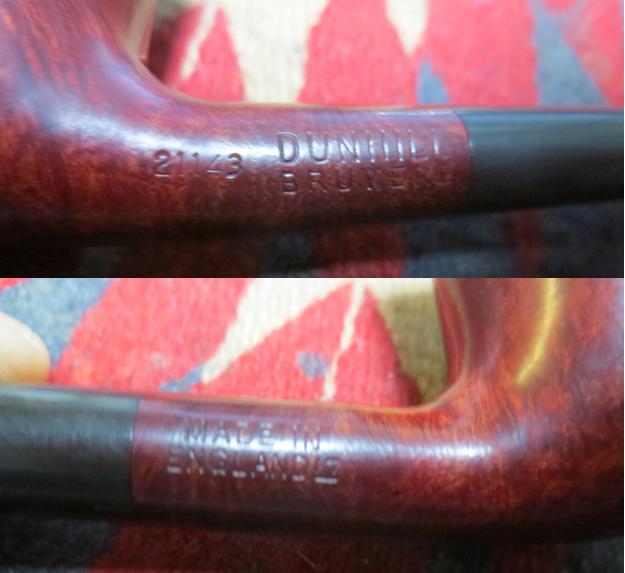
After a month hiatus from pipe refurbishing I am finally getting back into the swing of things. I decided to do some more work on the batch of pipes I picked up from the local tobacco shop. They had come from the estate of an old time pipe man whose widow had given them back to the store to dispose of. The shop owner had given me the task of cleaning up and restoring the lot and putting them up for sale. I had cleaned up four of the old Peterson’s and also an older GBD Marquis before I went away on my work trip. The next pipe that I turned my attention to was a lovely petite Group 2 Dunhill Bruyere ¼ bent Dublin. It is stamped on the left side of the shank with a five digit shape number – 21143 and next to that it reads Dunhill over Bruyere. On the right side of the shank it is stamped Made in England with the number 17 after the D in England which I believe dates the pipe as being made in 1977. The bowl has a cake and there is a lot of overflow of the lava onto the rim top. The finish is in decent shape though dirty. The stem is a fishtail with oxidation and the signs that the previous owner had used a rubber Softee bit. Even so there are still tooth marks on both the top and underside of the stem near the button.dun1 dun2I took some close up photos of the stamping on both sides of the shank. You can see the shape number clearly on the left side. It reads 21143. I have learned that reading the numbers gives a lot of information. From past experience with four digit numbers I know that the first number tells me the size of the bowl – a Group 2. The second number tells me the style of the original stem which in this case is 1 referring to a tapered stem. The third and fourth numbers reference the shape number of the pipe which is number 14 and on the Dunhill charts is a Bent Dublin. The only number I am not clear about it the final digit 3. That will take some more work to see if I can narrow down what it refers to. The rest of the stamping is pretty straightforward on the left and right side of the shank.dun3Since I had not seen the five digit shape stamping before I first turned to Pipephil’s site to see if there was help there. I have used his Dunhill information and found it a great help in deciphering the stamping in the past. However in this case his site did not give any information on the last digit of the five digit stamping. It gave me the information that I already knew – which was the interpretation of the stamping on the pipe. It was made in 1977 and was a Group 2 sized pipe with a taper stem in the 14 Shape which was a bent Dublin. It did not give me the information on the final number in the shape group – the 3. He left that number blank in his interpretation of the stamping on the pipe.

For that I had to do some more searching. I decided to go for a straightforward approach to my problem and typed in the following in the Google search box: “What does the fifth digit in a five digit Dunhill shape stamp mean?” The search engine came up with a conversation online on just this topic. It referenced me to the alt.smokers.pipes site on Google groups. That conversation held the clues I was looking for. I have copied the portion by RC Hamlin in answer to a question from another member regarding the five digit stamping on his pipe. Here is the link: https://groups.google.com/forum/#!topic/alt.smokers.pipes/Fk-8EWxZXCs . I quote the response from RC Hamlin in full.

RC Hamlin, PCCA  20/04/2000 http://www.pipesmoke.com & www.pipeguy.com

John, your pipe is a 1977 Vintage – for modern Dunhill’s, dating them is very easy, just start with 1960 and add the dating digit(s). 1967=7, 1977=17, 1987=27, 1997=37. Do not get hung up on underlines, dots, big/small digits etc. for modern Dunhill’s, just use 1960 as a base and add the dating number to it – simple.

That information confirmed what I already knew and gave a simple formula that I thought would be helpful to others seeking to date a Dunhill pipe. He went on in the following paragraphs to give an answer regarding the five digit shape number.

As far as the 5 digit pipe number (48063) you have a group 4 or “medium” Dunhill. I have a whole briefcase full of Dunhill material from the Dunhill archives, factory, Lane, etc. One of these days I’ll retire and write that online book I’ve been trying to do for years. The most interesting item I have is an actual “stamp” guide from the factory that “signed in” each stamp that Dunhill received from 1922 to 1980 (ish) – a LOT of stamps were used, not always as picture perfect as a written “guide” would have to believe. Very few people outside of Dunhill have seen this stamp guide, some authorized, some have seen my copy and used it without fully studying it, either way….Dunhill’s are not “perfect” in their nomenclature.

The 5 digit shape number was introduced around 1975 to “improve” the original 2 & 3 digit (letters and/or numbers) Dunhill shapes. It worked so well that it was discontinued around 1978 in favor of the current 4 digit shape numbers which are really very simple. The modern shape numbers give the size (1st digit), stem type (2nd digit, 1=taper, 2=saddle) and shape number (last 2 digits). Example: a Billiard is shape #03 so a 4103 would be a group 4, taper bit billiard. Change that to 5203 and you have a group 5, saddle bit billiard. ODA’s use their original 8xx shape numbers and you will see things like HT (hand turned) with no shape number but usually a circled group number (5), etc.

While the information was good and let me know that the pipe was from that time period from 1975-1978 when Dunhill used five digit shape numbers it still does not tell me what the fifth digit meant on the pipe on my worktable. I did a bit more searching and the only thing I turned up was that the fifth digit could have been some kind of stock number from Dunhill. That seems odd, but I am not sure we will ever know what the last digit of the five digit stamps means. Do any of you have a further lead on the meaning? Let us know.

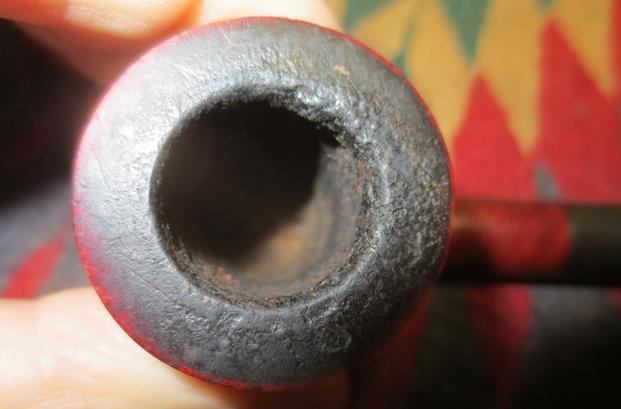
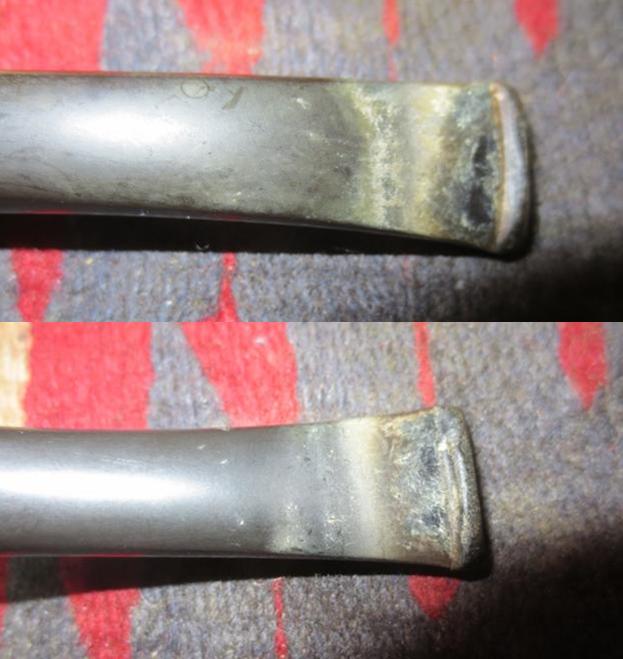
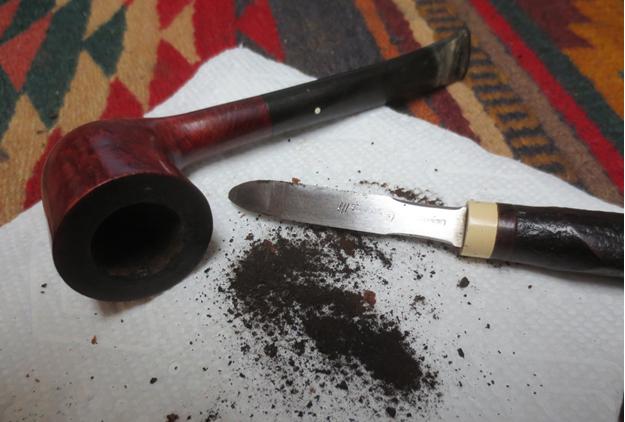
Time to get back to the refurbishing of this 1977 Dunhill Bruyere. I took some close up photos of the rim and the stem to show the condition of the pipe when I started my work on it. You can see the extent of the thick cake on the rim and in the bowl and also the wear and tear to the surface of the stem and the button.dun4 dun5I started the restoration by reaming the bowl. I decided to work on the crumbling cake with the Savinelli Fitsall Reaming Knife and took the cake back to bare wood. I used a small sharp pen knife to carefully scrape the lava off of the rim top. I scrubbed the rim with saliva on cotton pads until I removed all of the hardened cake. I sanded the rim top with a medium and a fine grit sanding sponge to take off the residual tars that remained. I finished by sanding the top of the rim with micromesh sanding pads from 1500-4000 grit.dun6 dun7I cleaned out the slot in the button with a dental pick to remove the clogged buildup on both sides of the slot narrowing the airway considerably. I sanded the stem with 220 grit sandpaper to remove the calcification and to minimize the dents. I heated the dents by “painting” them with the flame of a lighter and was able to raise them. I sanded the repaired dents and blended them in with the sandpaper. I reshaped the top edges of the button on both sides. dun8I scrubbed out the mortise and the airways in the shank and the stem with pipe cleaners, cotton swabs and alcohol until the swabs and cleaners came out white.dun9I polished the stem with micromesh sanding pads – wet sanding with 1500-2400 grit pads and dry sanding with 3200-12000 grit pads. I rubbed the stem down between each set of three pads with Obsidian Oil. I was able to remove all of the scratching and the oxidation on the stem.dun10 dun11 dun12I reconnected the stem and the bowl and buffed the pipe with Blue Diamond on the buffing wheel and then gave the entire pipe multiple coats of carnauba wax. I buffed it with a clean buffing pad to raise a shine and by hand with a microfibre cloth to deepen the shine. The finished pipe is shown in the photos below. It looks far better than when I started cleaning and refurbishing it. It should give the next pipe man who takes on its care a long life of good smokes. Thanks for looking.dun13 dun14 dun15 dun16 dun17 dun18 dun19 dun20 dun21


‘Gramps’ – A Redonian Deluxe London Made 26 Rescued

Blog by Dal Stanton

I know exactly where I was when Charles Lemon, of Dad’s Pipes, posted his blog Family Heirloom Comes in from the Cold on December 22.  I was dutifully, pushing the shopping cart at the Target in Golden, Colorado, while my wife and I were engaged in last-minute Christmas shopping.  Well, my wife was shopping and I was catching up on pipe blog reading with my iPhone 6s.  The story Charles told was of a pipe (without a stem) discovered on a stroll in a pasture, how it arrived there was a mystery, which, after some research looking at old photos, was determined to belong to a great-great uncle.  The restoration was to be a Christmas gift for the great-great nephew, the pipe finder’s step-father….  It was an excellent restoration on Charles’ part, but the story itself, the condition of the pipe, the fact that it was found after how many years – contributed to one of the core reasons I love restoring pipes.  As I read Charles’ heart-warming story, I found myself rooting for the pipe to make it and to again be restored to the lineage of the steward.  While I continued faithfully to keep pace with the shopping cart, dodging frantic shoppers and kids on too much sugar and reading Charles’s post, ‘Gramps’ came to mind.  The first time I saw the pictures of ‘Gramps’ and read the eBay seller’s comments, I determined to place my bid to rescue the old, worn out, tossed aside, pipe.  Why did I immediately name him ‘Gramps’?  Here is what the eBay seller said:

Vary rare REDONIAN Pipe.  Found at the Estate Auction of a 98-year-old man.  (Who said smoking will kill ya?…no way). So the pipe has some ware marks up by the mouth piece, see pictures.  Pipe is marked bowl piece is marked 26 on one side and SARDINIAN de Luxe Made in London on the other.  It is a used pipe.  Ready to be Enjoyed, Gifted or Resold…ENJOY!  

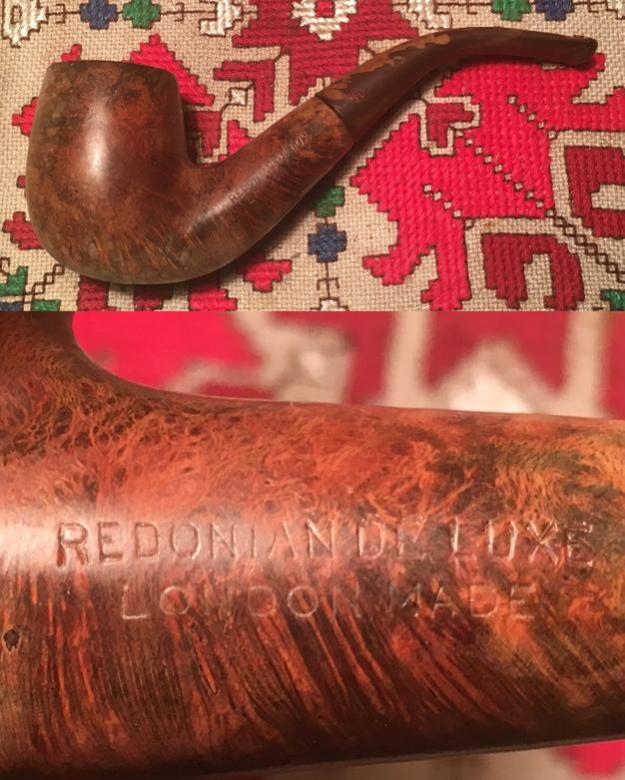
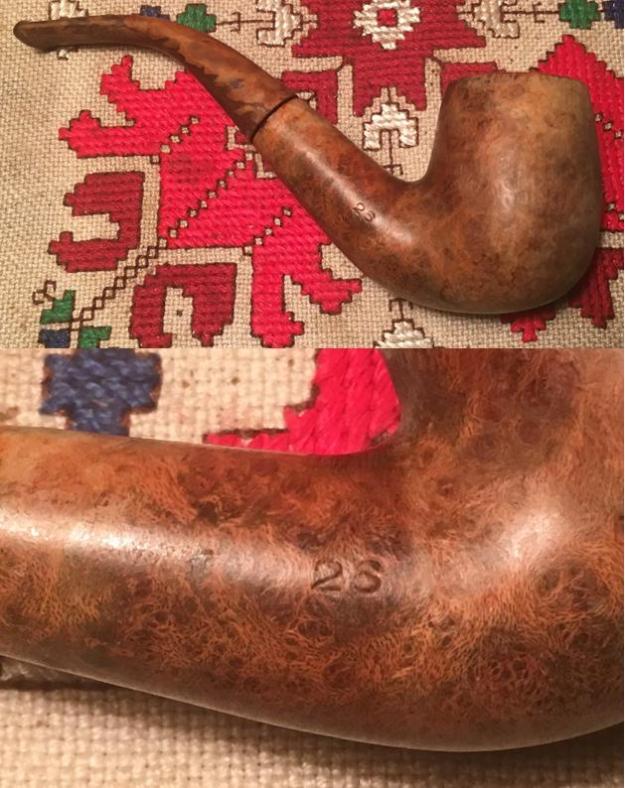
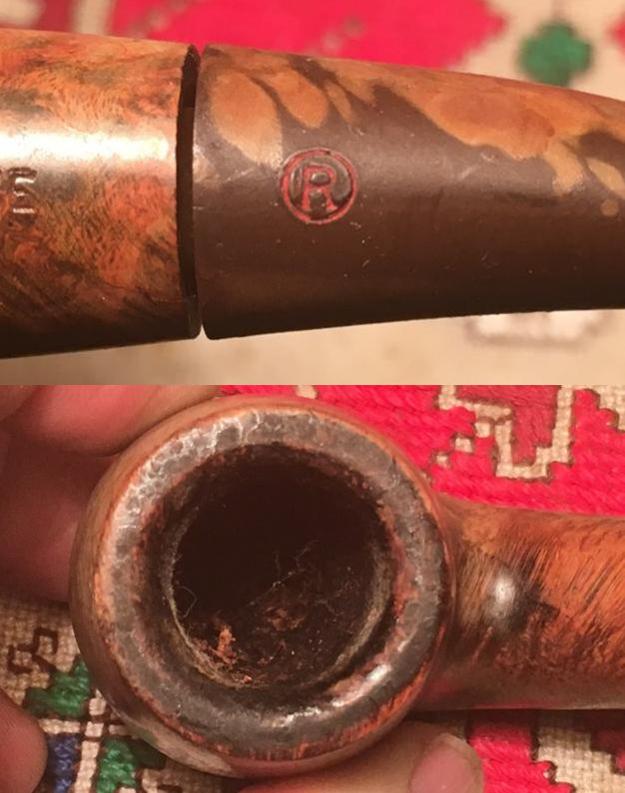
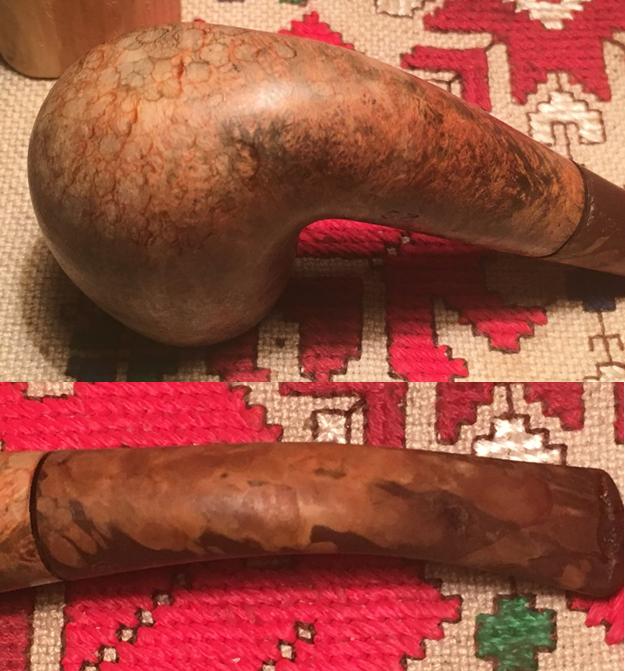
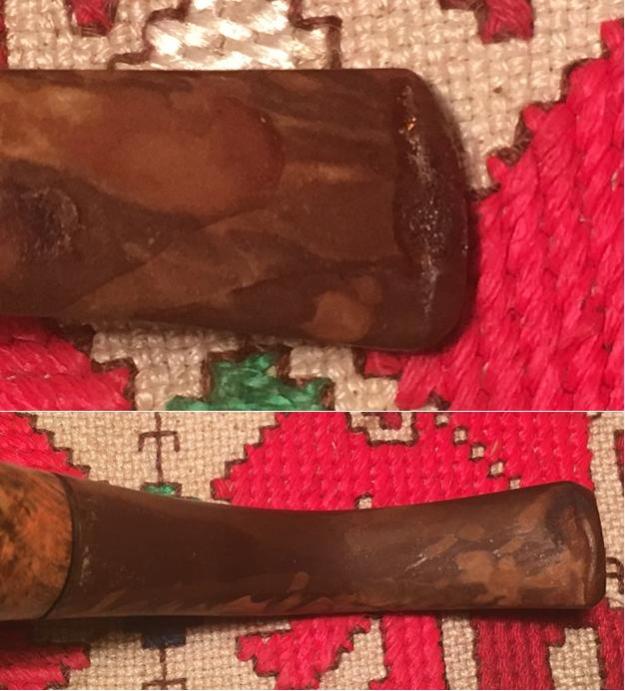
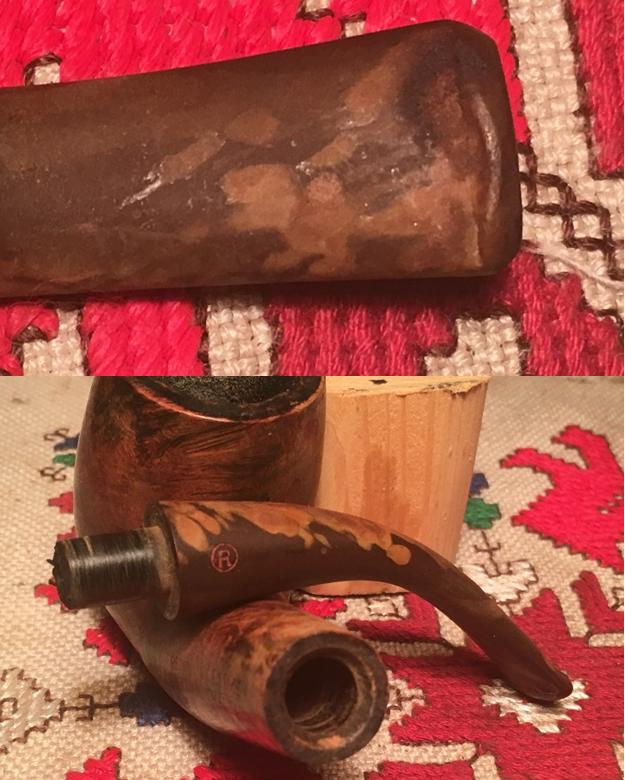
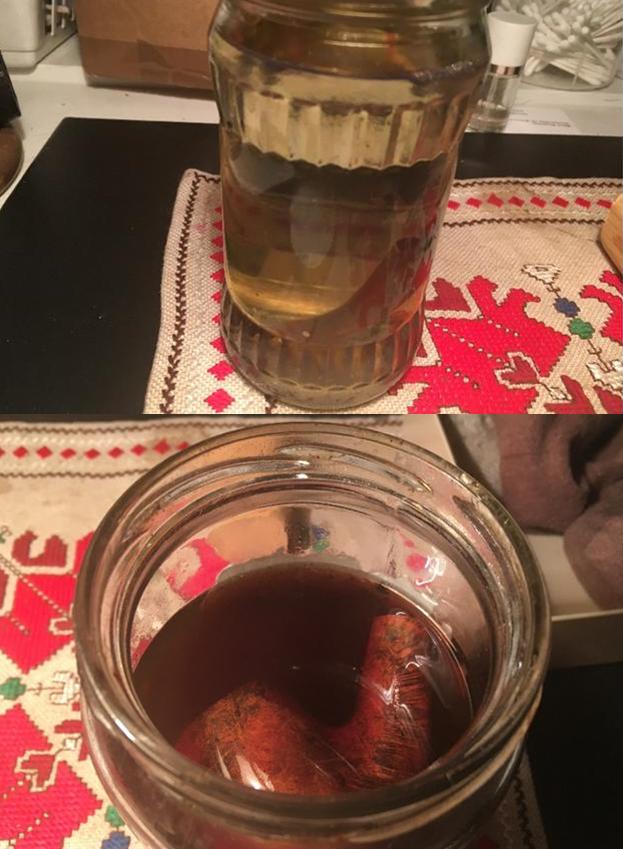
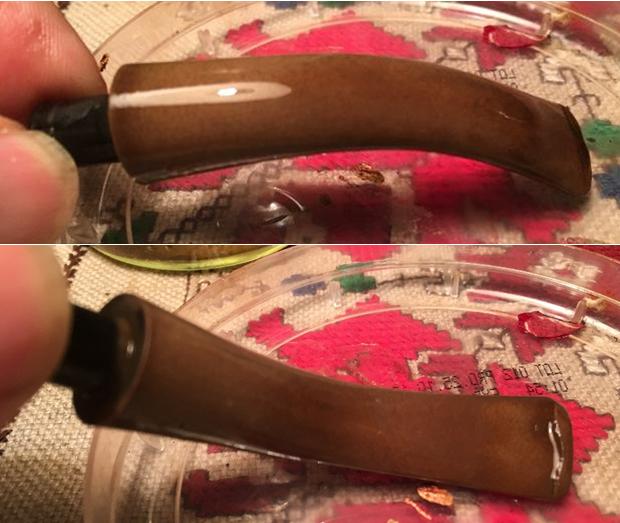
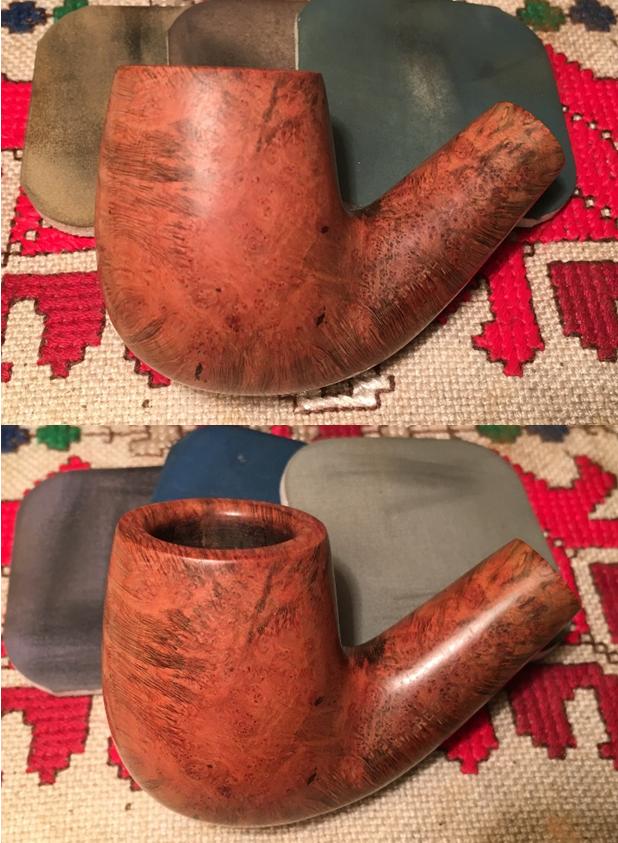
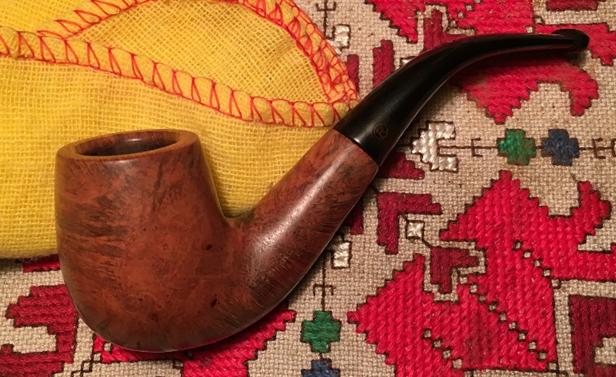
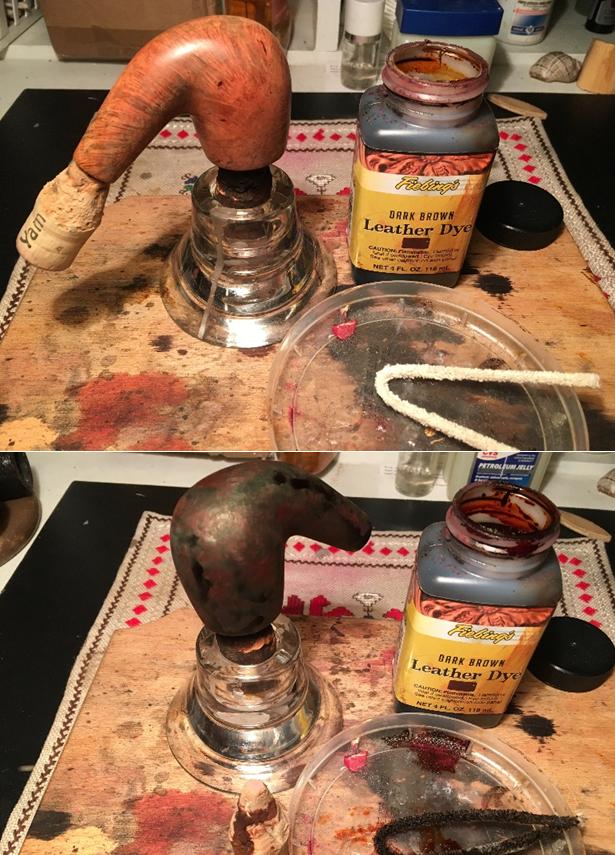
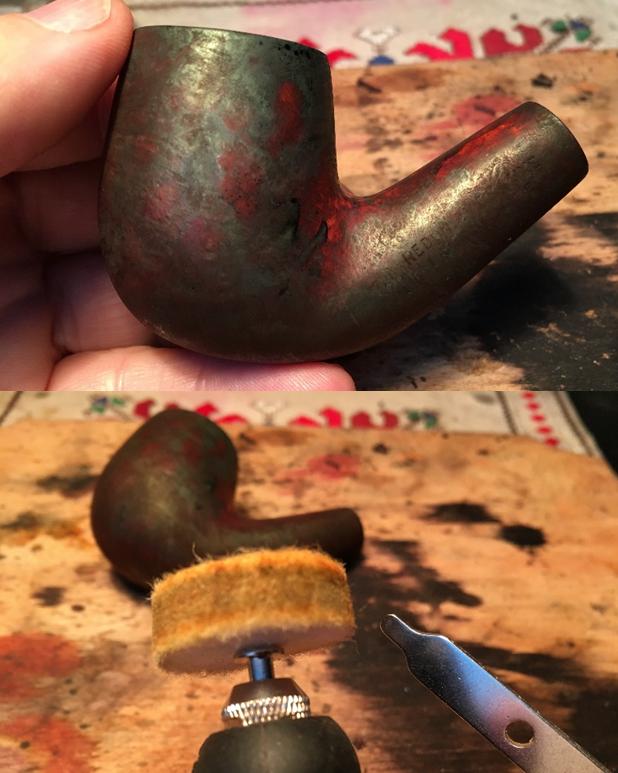
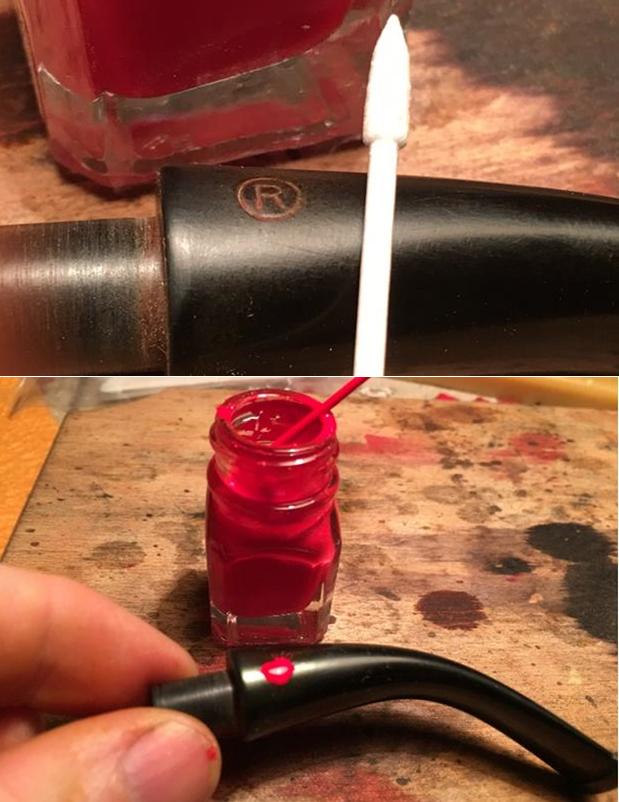
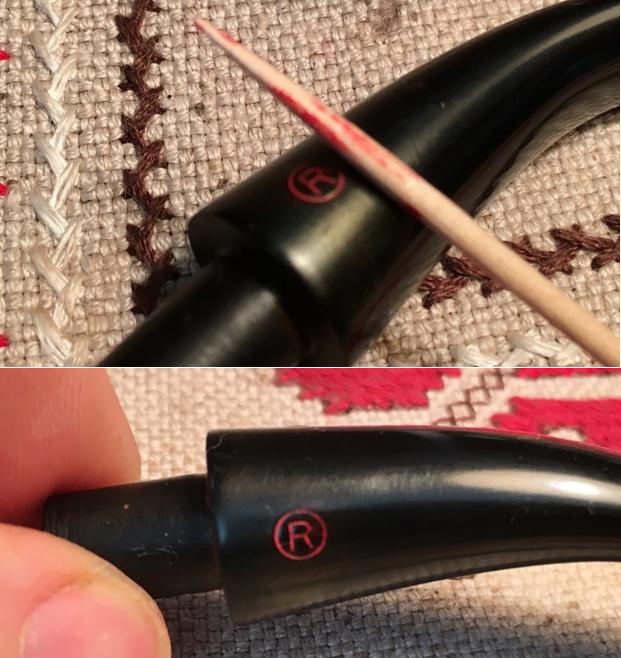
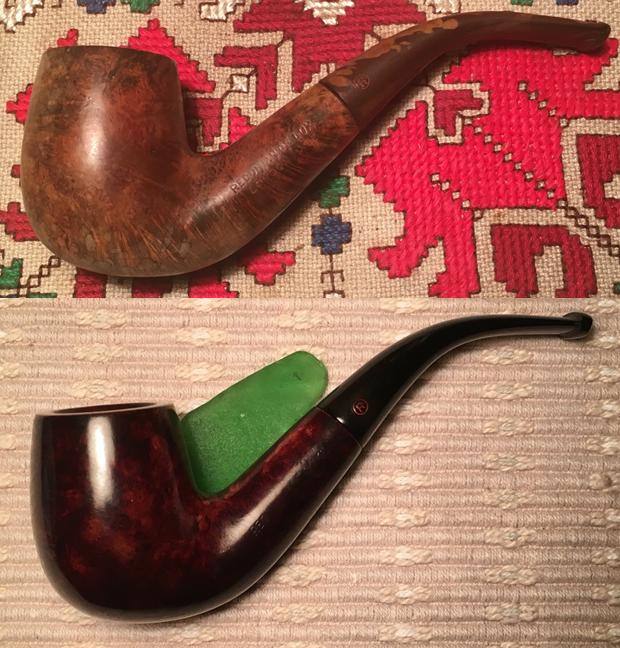
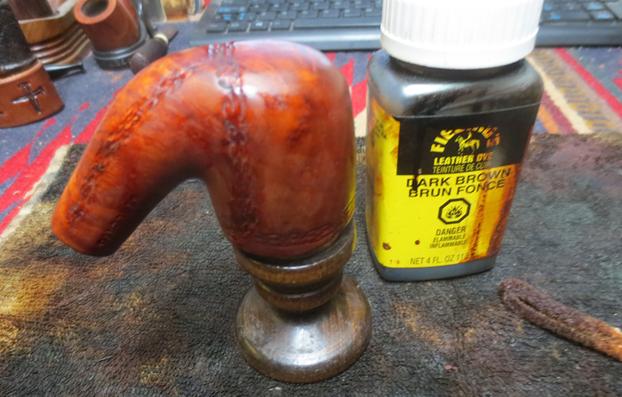
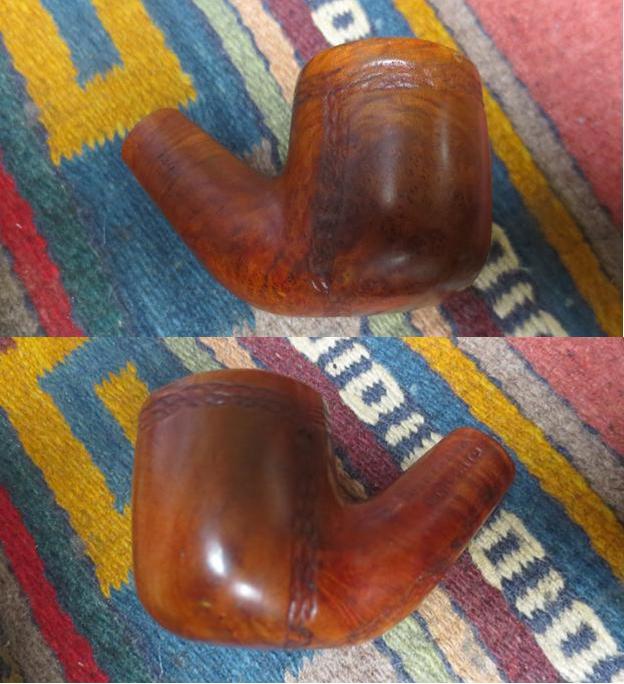
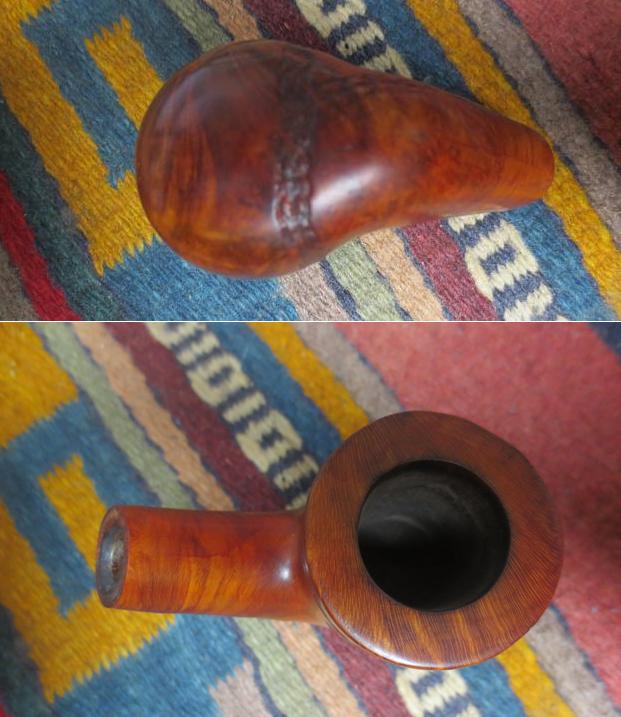
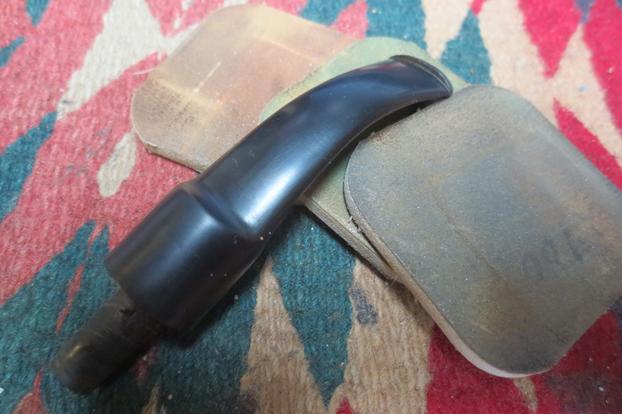
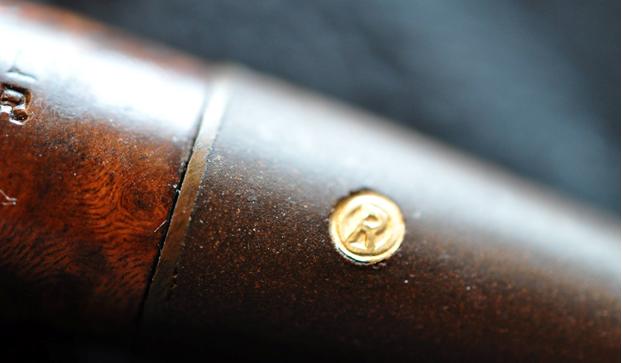
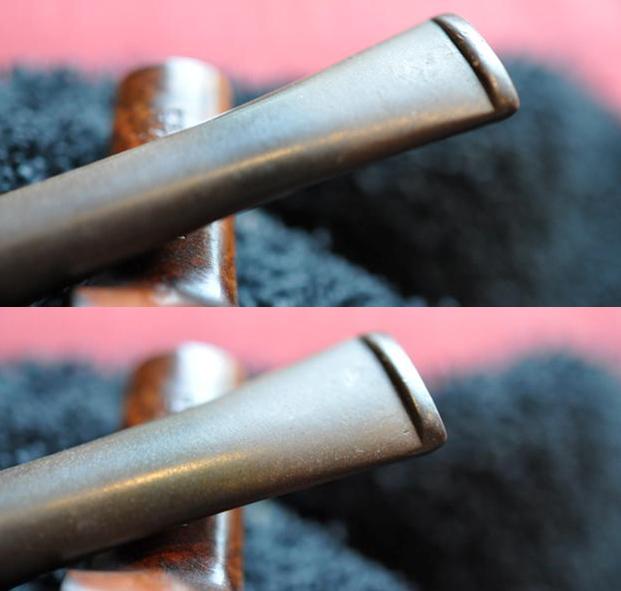
With a smile on my face while looking at Gramps’ pictures, notwithstanding the ‘mild’ exaggeration of the seller’s sales bravado, “Ready to be Enjoyed, Gifted or Resold…ENJOY!”, this is what I saw:red1 red2 red3I have no idea if I can bring Gramps to drink of the Fountain of Youth or not, but I’m now looking at him on my worktable here in Sofia, Bulgaria.  The markings on the left shank are Redonian Deluxe over London Made.  The right side of the shank bears the mark, 26, which I assume is the shape number.  Surprisingly, the stem stamping is legible – a red ‘R’ ensconced in a circle.  A look at Pipedia and I discover that the Redonian was made by the John Redman Ltd./British Empire Pipe Co. in London, the same company that was a possible manufacturer of the L. J. Perretti I restored not long ago – the Perretti Co. is based in Boston and the second oldest Tobacconist in the United States.  According to the Pipedia article, John Redman Co. pipe lines, along with Redonian, include Aristocrat, Buckingham, Buckingham Palace, Canberra, Captain Fortune, Dr John, Golden Square, Richmond (not Sasieni),  and Twin Bore.   I take some additional pictures of ‘Gramps’ for a fresh look.red4 red5 red6 red7 red8 red9Like Charles’ patient, this pipe looks to have been left outside or exposed in a barn or something, as half of it seems to be colored differently – laying on its side for some time.  The stem has the heaviest oxidation I’ve seen to date – perhaps something else is going on – it appears to be leprous!  The surface is so soiled and the cake so thick – there appears to be a spider web in the fire chamber – I really can’t determine the condition of either the stummel or stem, so after taking some pictures from my work table, I plop the stem in Oxi-Clean to start dealing with the stem leprosy and I plop the stummel along with spider web, in an alcohol bath – isopropyl 95% to soften the ages of crud clinging to the stummel – inside and out.red10About 24 hours later, I retrieve the stem from the Oxi-Clean bath and the oxidation was raised to the vulcanite surface as hoped and expected.  I first attack the oxidation by wet standing the stem with 600 grit sanding paper.  I’m very careful to stay clear of the Redonian ‘R’ stamping and work around it.  I sand for quite some time.  After making some progress, I switch to using 0000 steel wool to take off more oxidation and smooth in the process.  Again, I’m steering clear of the ‘R’ stamping.  I wish I would have taken a picture at this point.  The stem is looking much improved except for the circle ‘R’ stamping – still encased in thick oxidation.  I know that taking anything abrasive to the stamping will erode it and for me, this is anathema.  I try another tack – I think I remember reading somewhere about using Mr. Clean Magic Eraser.  I brought it to Bulgaria from the US and hadn’t used it yet.  The sponge that emerges from the box would not be abrasive – I hope.  So, I wet the sponge and start working on the area of the stamping. I start very cautiously and gingerly apply pressure with the sponge Magic Eraser.  When I discover that it is not eating away at the stamping I apply more pressure.  Before long I was working on the area aggressively.  Very gradually, and without perceptible damage to the ‘R’, the oxidation disappeared – or at least, in very large measure.  The last picture in the set below shows the magic brought by the Magic Eraser! I’m pleased with the progress cleaning up a once, leprous stem!red11 red12Satisfied with the progress on the stem, I fish the stummel out of the alcohol bath.  I use several pipe cleaners attempting to open the airway between the mortise and draft hole – unsuccessfully.  I then use about a 6-inch length of hanger wire as a probe and to ream the airway gently.  After a while, I finally push through the ancient muck and reconnect the mortise and bowl.  After this, I put the stummel back in the alcohol bath to soak further after stirring up and opening the internals.red13 red14 red15Out of the bath again, I take Q-tip cotton swabs and pipe cleaners and clean the gunk out of the mortise and draft airway while it is still loosened.  It’s cleaning up well, but I need to ream the bowl to remove the softened cake and the old residues.  I want Gramps to have a new start down to the fresh briar.  I use the Pipnet reaming kit using the two smaller blades of the four available.  The cake comes easily.  I fine tune the reaming more using the Savinelli pipe knife.  I then take 240 grit sanding paper, wrapped around a Sharpie Pen and sand the chamber walls to remove the remaining carbon.  I finish by cleaning the bowl using cotton pads wetted with isopropyl 95%.  The fire chamber looks good – no problems, no burn throughs detected visually. The pictures mark the progress.red16 red17 red18With the bowl reamed and cleaned, I now turn to the stummel externals.  I take another critical look at the stummel surface and lava flow on the rim and take a few pictures to show the condition of the briar before I use Murphy’s Oil Soap.  I want to mark the progress moving from the desperate condition in which the Redonian Deluxe started.  I use undiluted Murphy’s Soap and scrub the rim and stummel surface with cotton pads. I also use a bristled tooth brush to scrub the surface.  After cleaning, I rinse the stummel with warm tap water careful not to allow water into the stummel internals.  The rim cleans nicely and it looks good.  Looking at the briar surface, not surprising I detect several pits which need to be either sanded or filled.  What is emerging from underneath the gunk, grime and grunge is a piece of briar holding much potential to shine with the gradual appearance of some nice-looking grain.  With my work day ending, I decide to apply olive oil to the stummel to hydrate the very dry wood – letting it absorb the oil through the night. The pictures show the progress.red19 red20 red22 red23The next morning, I decide to further clean and purify the stummel using the salt/alcohol soak.  I fill the bowl with Kosher Salt and cover the opening with my palm and shake the stummel to distribute the salt.  I then place the stummel in an egg carton to give stability, and fill the stummel with isopropyl 95% until it surfaces over the salt.  I then cork the mortise and let it sit and do its thing – letting the salt absorb the crud.  I then turn to the stem.  I clean the stem internals using pipe cleaners dipped in alcohol.  Using a sharp dental probe, I dig gunk out of the slot to clean it.  It takes a while to work a pipe cleaner all the way through the stem.  Once I do accomplish this, I use a bristled pipe cleaner with alcohol to run it back and forth several times to clear and clean the airway – hopefully allowing a pipe cleaner easier passage.red24 red25After cleaning the internals of the stem, I now look at the condition of the button area.  The 98-year-old grandpa that owned the Redonian did not leave teeth marks (is that a clue to his dental condition??) but the upper and lower bits are almost flush with the stem surface. This is not good – the button edges are necessary to hang the pipe properly on the teeth so that one does not bite the stem leaving the teeth chatter and dents one must remove when restoring a pipe!  I will use charcoal/superglue putty to build up the button area.  I form a wedge made of index card and fit it into the slot of the stem to keep putty from covering the opening.  I open a capsule of activated charcoal and pour the powder on an index card.  I then put a small puddle of Hot Stuff Special ‘T’ CA glue (extra thick glue) next to the charcoal powder.  With a toothpick, I draw charcoal into the glue, mixing it as I go.  I continue to add charcoal powder until I reach a thickness like molasses.  When I reach this viscosity, I then dollop the putty around the button area – more than is needed to provide excess to sand down to the proper button proportions.  I use an accelerator to set the putty.  I then remove the wedge from the slot and put the stem aside to cure.  The pictures show the process.red26 red27 red28Several hours have passed since the stummel began its salt/alcohol soak.  The salt has darkened some, so I assume it’s done its work!  I dump the used salt from the stummel and thump it on my palm to remove lodged salt crystals.  I take a paper towel and wipe out the bowl.  Using a bristle brush, I clean the mortise to remove any salt lodged in the internals. I want to be sure all the salt is purged.  I then return to using Q-tip cotton swabs, pipe cleaners and isopropyl 95% to complete cleaning the internals.  With 2 Q-tips, the verdict is in – the Kosher Salt and alcohol soak did a great job drawing out the muck and freshening the mortise.  I complete the job by wiping the chamber with a cotton pad with isopropyl 95%.  Done.  The pictures show the result!red29With the stummel now clean, I take a close look at the stummel surface to be reminded of the question areas.  I take a few pictures to show these. The stummel is in surprisingly good condition for what it looked like when I started.  I find some pitting on the surface that I will fill with superglue.  I also detect a rim ‘skin’ on the front end of the stummel.  There are also other nicks around the rim from normal wear and tear. I start preparing the stummel surface by sanding with a medium grade sanding sponge to remove a layer off the finish – to determine where fills are needed.  After using the medium grade sanding sponge, I apply super glue to the 3 places on the stummel I detected earlier to fill the larger pits and a small crevasse and put the stummel aside for the superglue fills to cure.  The pictures show the progress.red30 red31 red32Now to return to the stem’s button rebuild.  The charcoal superglue putty has fully cured and ready for shaping.  I take pictures of the upper and lower bit to mark the progress.red33The technique I’ve developed for button shaping is to start at the end of the stem, using a flat needle file I file to establish the vertical – perpendicular slot area – that it’s flat.  This establishes a base-line for the end of the button and shaping the rest (I forgot to document this in a picture!).  I then start with the upper button area with the flat needle and begin filing from the stummel-side toward the end to establish the straight edge of the button’s ‘lip’.  I gradually file this toward the stem’s end until it appears a good depth for the upper button. I then file top of the bit’s lip to shape in further.  When I’m satisfied with the upper button shaping, I then flip the stem over doing the same with the lower button seeking to match the upper. When the basic filing is completed, I use a pointed needle file to enlarge the slot.  The pictures show the button rebuild process.red34 red35 red36To remove the roughness of the files, I then use 240 then 600 and finally 0000 steel wool to further perfect the shape and to cover the treads left by the files. Which often is the case, air pockets encased in the charcoal/superglue are exposed during the shaping and sanding process. I apply some CA glue to the button surface and paint it with a toothpick to cover the pin-sized air pocket holes and then spray an accelerator on the glue to cure it more rapidly.  After a while, I return with 240, 6000 paper and then 0000 steel wool to remove the excess CA glue on the button and complete the button rebuild.  The pictures show the completion of the button rebuild.red37 red38 red39With stem internals cleaned, and new button completed, I transition to the externals.  Using micromesh sanding pads 1500 to 2400, careful to guard the Redonian ‘R’ stamping, I wet sand the stem and follow the set by applying Obsidian Oil.  I then use micromesh pads 3200 to 4000 and after, pads 6000 to 12000 following each set with an application of Obsidian Oil.  I set Gramps aside to soak in the Obsidian Oil.   All I can do is to say, ‘Oh, my!’  Gramps is responding well to the TLC. The pictures tell the story – I can’t but help to throw in a reminder of how far we’ve come! red40 red41With a reborn stem waiting, I turn to the stummel.  The 3 pit-holes that were filled with superglue are cured.  Using 240 grit paper I sand the excess glue to the surface and blend the patches. red42 red43I take a close-up picture of the rim and inspect the rim more closely.  Along with nicks, I can see that rim lines are not sharp.  There is evidence of a bevel on the inside ring of the rim which is scorched.  I decide to mildly top the stummel and reestablish a crisp bevel. The bevel will also remove the scorching I see.  I use 240 grit paper on a chopping board and rotate the inverted stummel in an even, circular motion to remove old briar.  I stop and check things after every couple of revolutions to make sure I’m staying level.  I only take off enough to leave the former bevel more distinct.  To recut the inner bevel, I use 120 grit paper rolled very tightly to create a hard-sanding surface.  I want the bevel to be straight and uniform.  I follow the 120 using 240 grit also tightly rolled to remove the coarser lines.  The topping and bevel look good.  The bowl is in-round.red43 red44 red45After completing the rim and bevel, I take a medium grade sanding sponge and then a light grade sanding sponge and sand the stummel to blend the superglue fills – careful to work around the Redonian Deluxe London Made markings on the stummel.  Then, using micromesh pads 1500 to 2400 I wet sand the stummel, followed by dry sanding using micromesh pads 3200 to 4000 and then 6000 to 12000.  I never tire seeing the grain emerge during this process.  After I complete the micromesh cycles, I unite stummel and stem to get a look at where we are.  Gramps is looking good. The pictures show the progress – woops, I forgot to take a picture after the first micromesh cycle!red46 red47 red48I’m liking very much the progress of the Redonian Deluxe London Made – aka, Gramps.  I decide to use Fiebing’s Dark Brown Leather Dye with Gramps.  I think the rich depth of the leather dye will create the subtle expression of the straight grain hugging the bottom of the stummel as it expands into horizontal patterns and scattered bird’s eye on top.  I give the surface a quick wipe with a cotton pad to clean and remove any leftover briar dust.  I use my wife’s hair dryer to warm the stummel to expand the wood to help the grain to be more receptive to the dye.  I use a cork in the shank as a handle and I then take a folded over pipe cleaner and apply the dark brown dye over the entire surface.  After this, I fire the wet dye which immediately burns the alcohol and sets the dye in the grain.  In a few minutes, I repeat the process concluding with firing the wet dye.  I put the crusted stummel aside to rest.  I decide to do the same and call it a day.  The pictures show the progress.red49The next day, after a full day’s work, I’m anxious to look at Gramps, and with the Dremel I begin unwrapping the fired dye crust.  After mounting a dedicated felt wheel for applying Tripoli, I set the Dremel’s speed for 1, the slowest possible, and first purge the wheel with the sharp edge of the Dremel’s tightening wrench – to rid it of old compound and to soften the felt wheel.  I apply very little pressure on the briar surface, allowing the RPMs and compound to do the work for me.  To reach the inside of the bent shank elbow with the Tripoli compound, I switch to a smaller, pointed felt wheel to get in the tight angles.  With the Tripoli finished, I rejoin the stem to the stummel and I mount a Blue Diamond dedicated felt wheel and again buff stem and stummel.  When completed, I hand buff the pipe with a cotton cloth to remove the compound dust left over.  The pictures show the progress.red50 red52With the abrasive application of the compounds finished, before I apply carnauba wax to the stummel and stem, I want to dress up Gramps’ stem stamping.  The original appears to have been red so I take red acrylic paint and apply a dab over the Redonian ‘R’ and circle and let it dry thoroughly – overnight.  When dry, I gently rub/scrape off the excess with the flat side of a toothpick which protects the paint in the indentations.  After this, I rub it well with a cotton pad to clean the remainder of the excess – gently leaving a rebranded stem – very nice, a refreshed stem stamping.  The pictures show the results.red53 red54With the Redonian stem stamp completed, I reunite stem and stummel and mount the cotton cloth Dremel wheel and apply several coats of carnauba wax to the pipe. I increase the speed of the Dremel to 2.  I follow the carnauba wax with a vigorous hand-buff using a micromesh cloth to dissipate wax that was not spread evenly and to deepen the gloss of the shine.

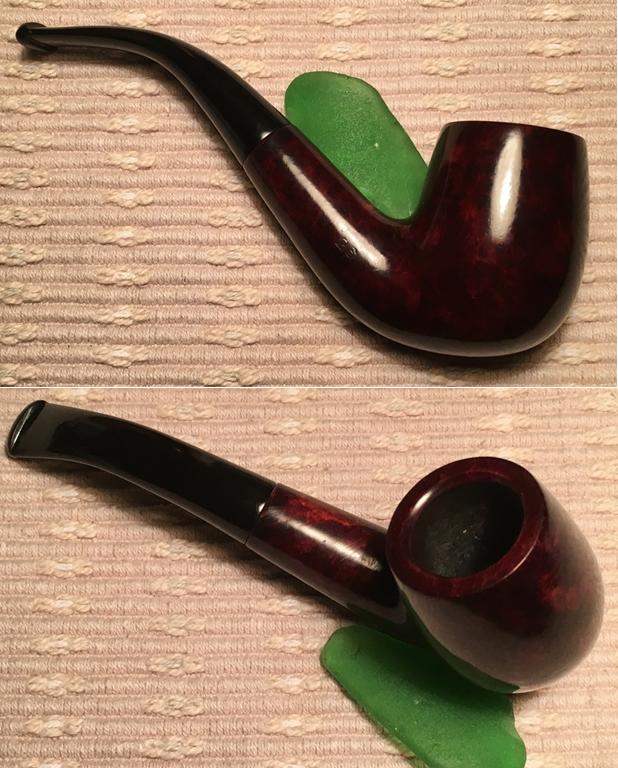
When I think about the 98-year-old steward from whose estate this Redonian Deluxe London Made came, I cannot believe he would have dreamt his pipe would one day start a new lifetime serving another steward.  I gave this old, worn pipe the nickname, ‘Gramps.’  Bear with me one more time to put a picture of ‘Gramps’ in front of the younger man he has now become.  I’m amazed at the transformation and it is why I love this hobby – the pictures speak for themselves.  I sell my restorations with the profits helping the work we do with the Daughters of Bulgaria – those sexually exploited and trafficked.  This Redonian Deluxe London Made is ready to serve a new steward.  If you’re interested in adopting him and helping the Daughters, check out ‘Gramps’ at The Pipe Steward Store.  Thanks for joining me!red55 red56 red57 red58 red59 red60

Renewing and restemming a La Strada Staccato Bent Pot

Blog by Steve Laug

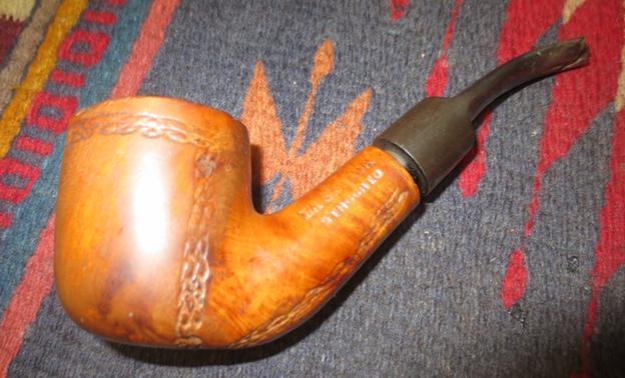
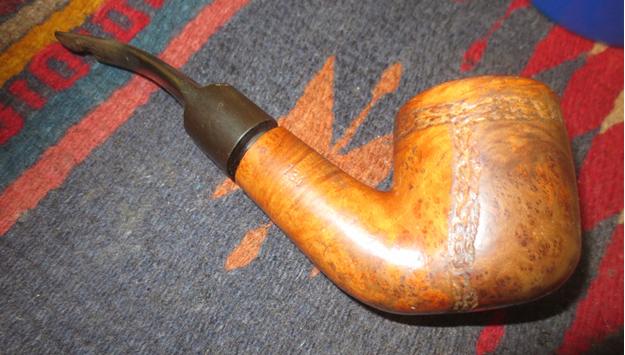
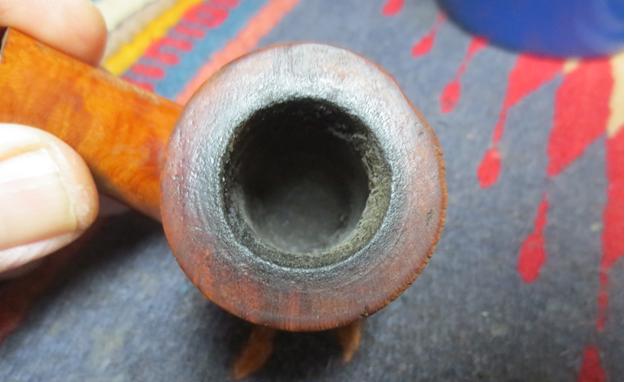
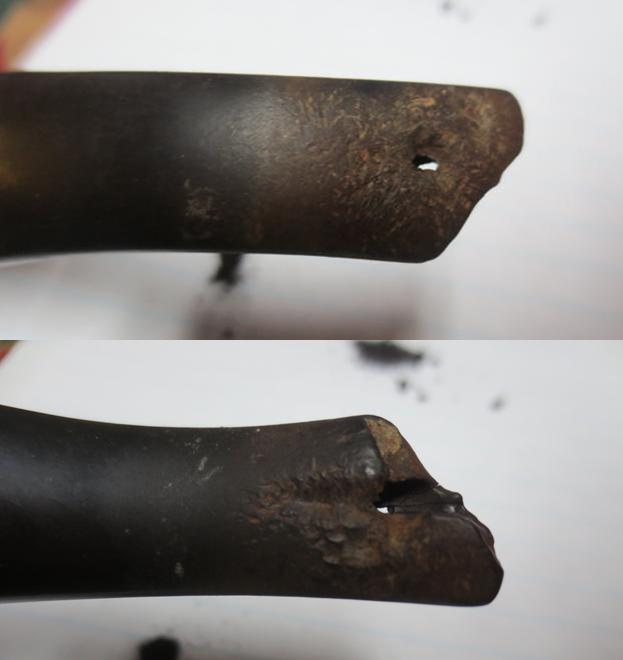
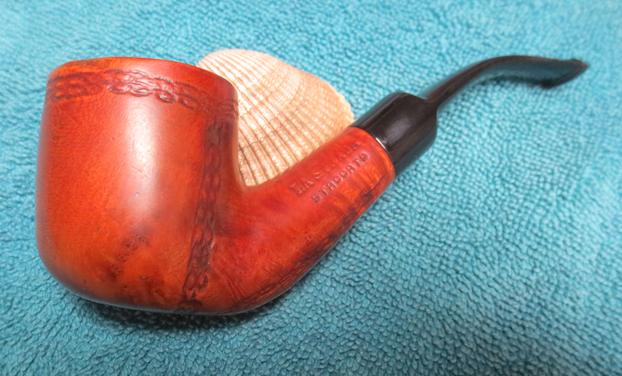
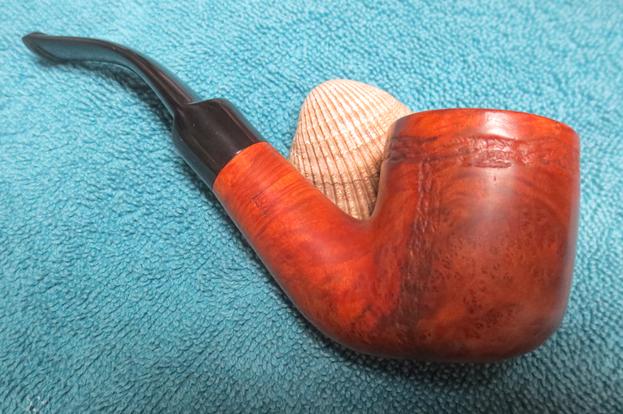
This tired old La Strada came to me for repairs. It was in rough shape. The stem had been gnawed, broken and gnawed again. The finish was shot and covered in oils and grease to the point that it was hard to see the rope rustication around the bowl. The bowl had a thick crumbling cake and smelled heavily or aromatics. The lava from the bowl had flowed over the top of the rim and darkened the finish there. The outer edge of the rim was heavily damaged on the front left side and looked as if the bowl had been dropped. There were dents on the underside of the bowl as well from a similar event. The shank was so dirty that the stem would not fit into the mortise. I was able to get it in but the fit was not tight against the shank. The shank is slightly off round so the stem was slightly different.la1 la2The next photo is out of focus but the road rash on the bowl bottom is visible.la3I took a series of close up photos of the bowl and rim and the stem to show the condition of the pipe when I started. In the first photo you can see the thick crumbly cake and the damage to the rim surface and edges. It was hard to tell if the inner edge of the bowl was damaged and only after reaming would I be able to know for certain. The stem was a write off as the damage was too extensive to repair. The fit against the shank also warranted a new stem.la4 la5I reamed the bowl with a PipNet reamer and went through the various cutting heads. I cleaned up the remaining cake in the bowl bottom with the Savinelli Pipe Knife. I took the cake completely out of the bowl and reamed it back to bare briar.la6I wiped down the surface of the bowl with acetone on cotton pads to remove the finish. It came off with a bit of scrubbing but there were places where it did not come off with the acetone. It would take some sanding to remove the totality of the finish.la7 la8The damage to the bowl top and outer edges required that I top the bowl. I gently topped it on the topping board so as not to remove too much and remove the smooth portion above the rope rustication on the top edge.la9I sanded the bowl and rim top with a medium and a fine grit sanding sponge and took the following photos.la10 la11I cleaned out the internals of the shank and the replacement stem that I fit to the shank with alcohol, pipe cleaners and cotton swabs. It took a lot of scrubbing to get the mortise and the airway clean in the shank. The stem was in decent shape so it did not take too much work on it.la12I took some photos of the pipe at this point to get a feel for the look with the new stem in place.la13 la14I wrapped some sandpaper around a dowel and sanded the walls and bottom of the bowl. There was a ring at the bowl bottom that was grooved and needed to be smoothed out. It did not take a lot of sanding before the inside walls were smooth.la15I restained the bowl with a dark brown aniline stain mixed 50/50 with isopropyl alcohol to approximate the original colour of the pipe and to highlight the grain on the pipe. I flamed the stain and repeated the process until the coverage was even around the bowl and rim.la16I buffed the bowl with White Diamond on the buffing wheel to even out the new finish and give it a bit of a shine. I took photos of the bowl at this point to give a clear picture of the new look.la17 la18Now all that remained was to finish the fit and polishing of the stem. I sanded it with 220 grit sandpaper until it fit the shank well. It took some adjusting of the diameter of the stem to match the slightly out of round shank. In the end it fit well. I polished the stem with micromesh sanding pads – wet sanding it with 1500-2400 grit pads and dry sanding with 3200-12000 grit pads to give it a deep shine.la19 la20 la21I buffed the bowl and stem with Blue Diamond on the buffing wheel to polish the minute scratches on the vulcanite and on the briar. I buffed them both until the stem and briar glowed. I gave the bowl and stem multiple coats of carnauba wax. I buffed the bowl and stem with a clean buffing pad to raise the shine. I hand buffed it with a microfibre cloth to deepen the shine. The finished pipe is shown in the photos below. It is ready to go back to the pipe man who sent it to me for restemming and refurbishing. I think he will enjoy it and it will deliver a life time of good smokes to him. la22 la23 la24 la25 la26 la27 la28 la29 la30

Repairing a broken Peterson stem

Blog by Joe Mansueto

Joe Mansueto sent me this link to a helpful tutorial on how he repairs broken stems. I thought it would be helpful to post it after I just posted Dal Stanton’s stem repair piece on the blog today. Here is the original link to the Dr. Grabow Web Forum if you want to have a look at the original post and the responses there. http://drgrabows.myfreeforum.org/ftopic9615-0-asc-0.php. Here is Joe’s article.

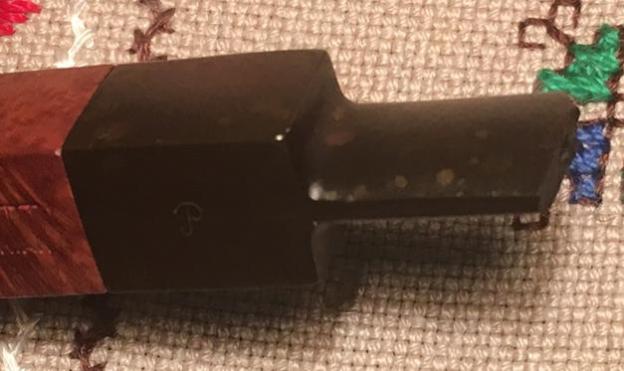
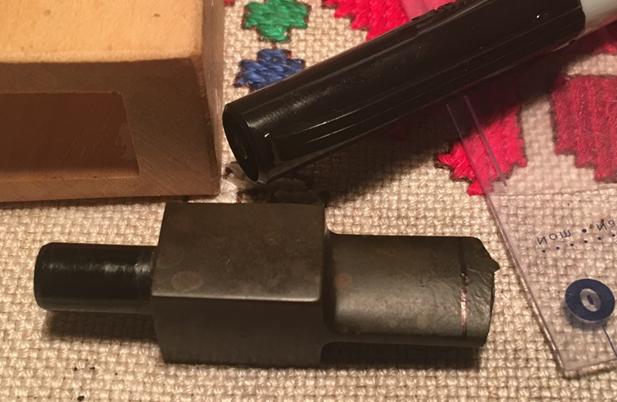
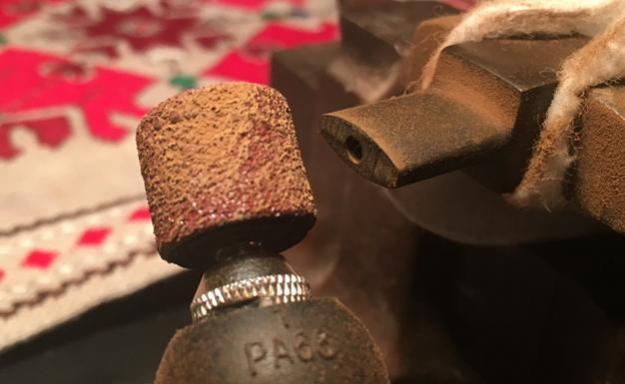
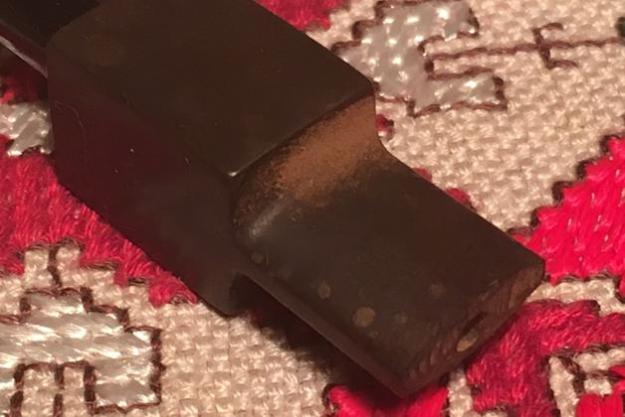
A new friend snapped his Pete stem… glued it… dropped it… lost some pieces… This is what it looked like when it arrived for me to work on.pete1I drilled some small holes into each face to create ‘roots’ for the patch material…pete2Once the repair dried I sanded it until it was smooth. The photo below shows the stem after sanding. It came out smooth.  A bit of a buff is all that’ needed…pete3Back in service… The next photo shows the finished repair. The pipe was ready to go back to its owner for many more years of service.pete4After completing the repair I received a lot of responses and questions about how it was done and if I would make a tutorial for the above repair. The tools/supplies I used (prior to buffing) include 91% isopropyl, a Dremel (with a scribing bit), activated charcoal, and high-quality CA (cyanoacrylate). I say ‘high-quality’ because I get it from a professional wood-turner… and after using his product… the strength and speed of adhesion seems better than anything else I’ve used.

Here is the step by step process:

  1. ‘Rough up’ the faces / areas being joined. I used the scribing tool on a Dremel. This provides a rough surface for the patch material to adhere to.
  2. If you want to use the “roots” process that I’ve used, you simply use a tiny drill bit…or a tiny scribing tool to push some holes into the face…making sure you don’t drill in and back “out” again…lol.

Here is an image showing where I might drill holes. With these ‘roots’…the holes do NOT need to be directly across from the roots being drilled on the face of the other broken piece.  If I were inserting some very thin gauge wire into these roots (which would lend even more strength)…you’d have to make sure these holes lined up perfectly across from each other…and that’s a whole ‘nother tutorial! pete-jpgScrub clean the 2 faces being joined…I used the 91% iso and a toothbrush…and let it dry well.

  1. I used a pipe cleaner as you can see, to keep the 2 faces lined up. Critical to that detail is covering the pipe cleaner in ‘shiny’ scotch / packing tape…because if the patch material gets to the pipe cleaner (and it will), it won’t stick to the shiny tape. The pipe cleaner not only kept these 2 pieces lined up, but also is essentially what “held them together” in place, while the patch dried.
  2. The patch material is made from the CA and activated charcoal. I used medium viscosity CA. The mix is “close to” 50/50 between the 2…the consistency is more like molasses than honey…very thick.
  3. To begin with…I used a sharp ended toothpick to jam the patch down into each root. Then covered both faces…held onto the pipe cleaner at one end…and pushed the broken tip down onto the rest of the stem.  I made sure that they were sitting at the correct angle…then I smeared enough of the patch to be sure it was all filled / covered.
  4. Once hard (I let it sit 30 min), I filed off the excess back down near the surface of the surrounding stem…and had to add a 2nd small patch to a spot where it had caved in just slightly.
  5. Dried again…filed it down with multiple needle files.
  6. Wet sand (360, 500, 800, 1000).
  7. Buffed with Tripoli, followed by white diamond.

It is a bit of work just to save a stem…but it’s been a while, I needed the practice….and I preferred doing this instead of refitting the pipe with an aftermarket stem.

A Christmas Gift in need of a stem splice – L J Peretti Squared Shank Billiard

Blog by Dal Stanton

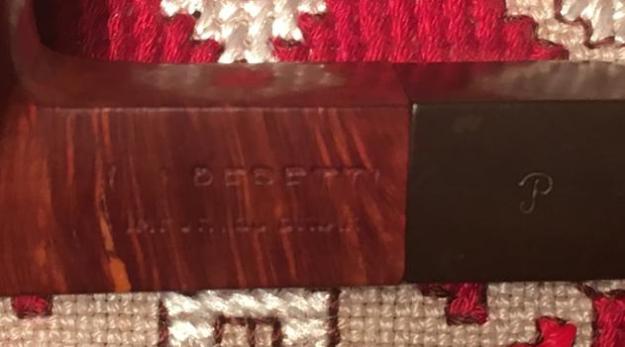
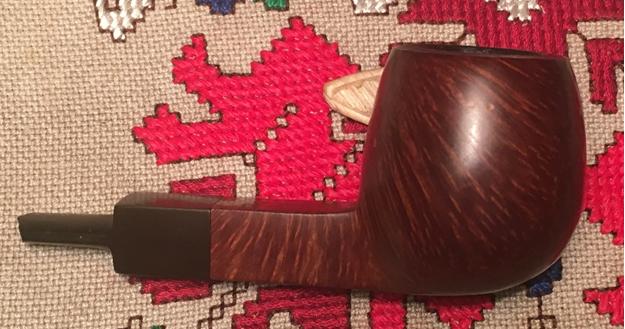
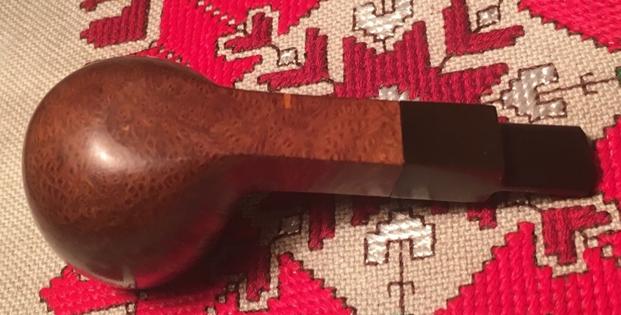
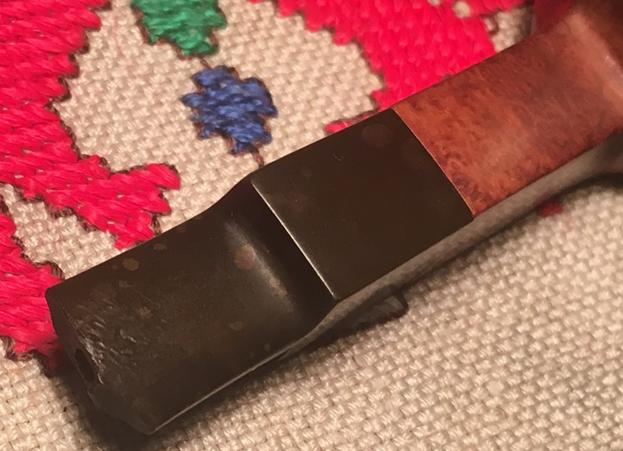
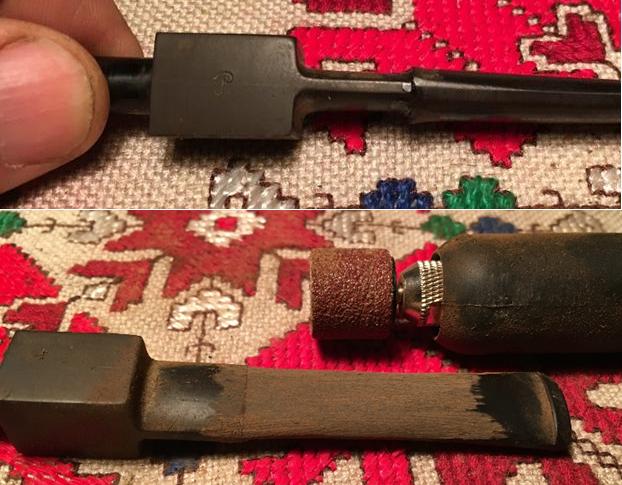
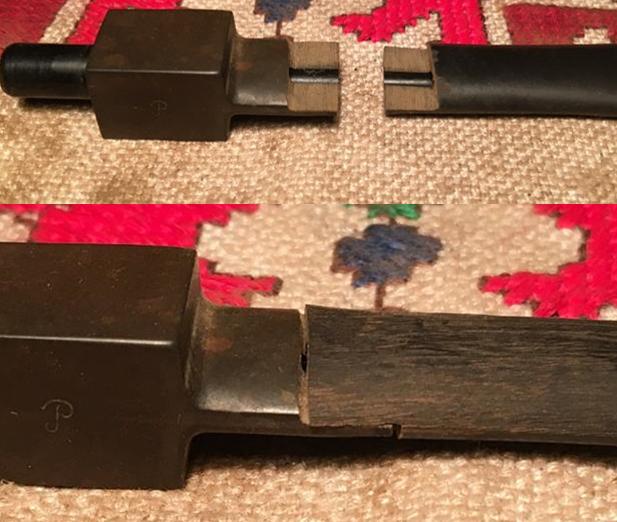
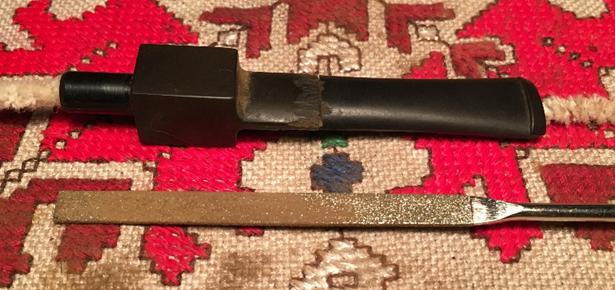
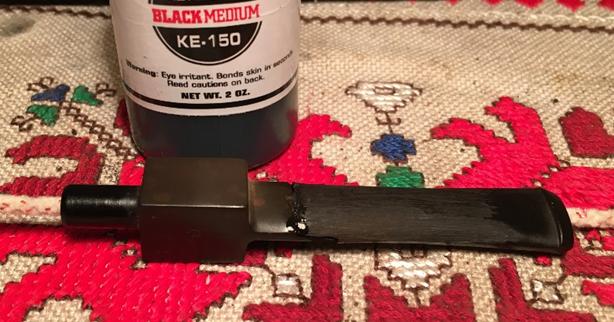
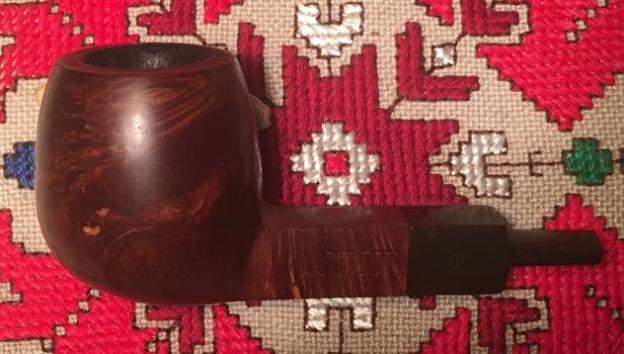
After a wonderful time in the US, sharing Christmas and New Year with our family, and catching up on ‘grandpa time’ with our two grandsons, my wife and I returned to Sofia, Bulgaria, to find as much snow as we left in Denver!  Two memorable ‘piping events’ transpired while in Denver.  First, the inaugural smoke of the restored 1907 McLardy Gourd Calabash (See: Link) which was filled with a tasty bowl of Dark Star recommended by Steve for the special occasion.  It was a wonderful, cool smoke.  The McLardy did admirably. per1The second ‘piping event’ was a pipe-picking expedition several of my family members (guess who this trip was for?) did to Denver’s huge Brass Armadillo Antique Mall!  We had a great time in search but unfortunately, I found no treasures to bring home.  Yet secretly, my youngest son stowed away his Christmas gift for me which I discovered under the tree a few days later!  He got a great deal and I can see why!  He knew I would have fun trying to breathe new life into the L J Peretti now before me on my work table in Sofia.  I am anxious to get back to work on a pipe and this Peretti is a great starting block for 2017!per2 per3 per4 per6 per7 per8With the obvious need to solve the issue of the broken and missing stem piece, I can easily see what attracted my son to this stummel.  The briar swirls stunningly into fire grain and very distinct and tight bird’s eye knots.  There are a few lightened fills that will need attention and the bowl has significant cake and will need to be reamed down to the fresh briar.  The rim shows some thick lava flow and has minor dents.  Unfortunately, the center swatch of the L J Peretti – Imported Briar marking on the squared shank is worn off – over achieving buffing or wear?  The Peretti ‘P’ is visible on the surviving legacy of the original saddle stem.  I’ve grown to appreciate the enduring marks of a pipe’s provenance and for this reason, this surviving piece of this pipes history needs to be protected and restored!  I’ve been thinking for some days – actually, starting with the opened gift (!) about how to splice a new piece of stem to the survivor?  I haven’t done this particular maneuver before, but I’m sure it can be done!
When I began my research on L J Peretti, I was surprised to discover that it is not an Italian pipe as one might expect with such a name!  In fact, I discovered the genesis of a significant story of Americana pipe history with the establishment of the L. J. Peretti Company of Boston in 1870 (Pipedia citing: Pipes, Artisans and Trademarks, by José Manuel Lopes), the second oldest tobacco shop in the US, second only to Iwan Ries & Co. of Chicago established in 1857 (See: Link). per9Going directly to L J Peretti’s website, now president, Stephen L. Willett provides this historical summary of this Boston icon (Link: http://www.ljperetti.com):

In 1870, Libero Joseph Peretti arrived in Boston from Lugano, Switzerland. Filled with an entrepreneurial spirit and a love for fine tobacco, L.J. established the “Peretti Cuban Cigar Co.” in Boston’s historic North End. In the first two decades of business, the company provided a number of contributions to the tobacco industry and began to blend “house cigars”.

1892 marks the establishment of the Peretti Cigar Factory in Park Square, Boston. For over forty years, the company employed fifty rollers who produced some of the finest cigars in New England. Not only did Peretti’s manufacture blended cigars, but they also created Clear Havana Vitolas such as the legendary La Mirendella.

L.J.’s son, Joseph, aka “The Major”, followed his father into the family business. His primary love was pipes and pipe tobacco. Among his notable accomplishments was the creation of the first “English” blend, called British, in the United States; as well as securing the exclusive import rights to Peterson pipes and Sullivan & Powell tobaccos.

After World War II the third generation Peretti’s, Robert, entered the firm. The original store had moved from the North End to the centre of Boston on Massachusetts Avenue and there were additional stores throughout the financial district of Boston. Robert became a tobacco legend in United States and throughout the world. Most of the more than eighty house blends of pipe tobacco were created by Robert Peretti. His reputation as a blender led politicians, actors, celebrities and gentlemen of all callings to seek his tobacco advice.

I enjoyed reading several comments after the interview of Stephen Willett on The Pipes Magazine Radio Show (See: Pipes Magazine Radio Interview) extolling the fact that tobaccos are mixed in house and one could take his pipe to their shop on 2 1/2 Park Square today, and be guided by experienced tobacconists and test several selections before making a decision to purchase.  My son and daughter-in-law, formerly of Boston, also had the opportunity to explore this historic tobacco shop!

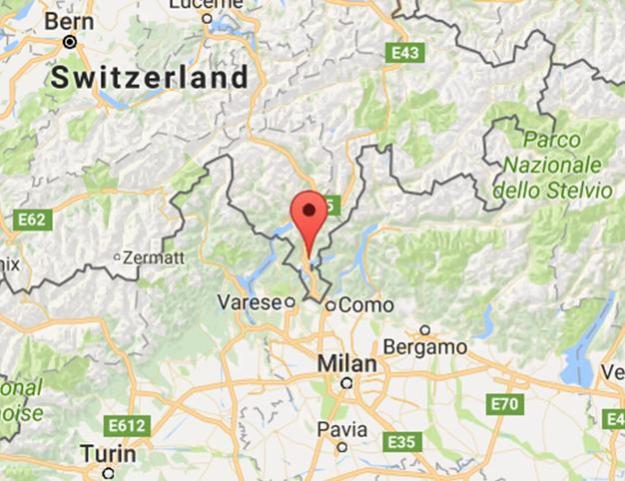
I was still curious about the name, “Peretti”, and its Swiss (not Italian) origins with the patriarch Libero Joseph Peretti’s arrival in the US in 1870 from Lugano, Switzerland.  It did not take long to figure it out when looking at the location of Lugano on a map of Europe thanks to Google Maps.  The Italian influence would be inescapable as Lugano is situated in a slender finger of Swiss land on the southern edge of the Alps with greater topographical access to the Italian planes falling away to its south than to Switzerland proper to the north – through the Alps.  Curiosity satisfied.per10One other question hounds me – the question for each pipe: Where was this particular L J Peretti pipe made?  In Boston?  Per L J Peretti’s website, today pipes with the Peretti stamping are made exclusively by Briar Works in Nashville, TN.  This Peretti, however, predates this association.  Briar Works began operations in 2012.   One possible clue came at the close of Stephen Willett’s interview on the Pipes Magazine Radio Show in April of 2016 referenced above.  Willet was asked about relating a ‘favorite pipe story’.  Willett commented on being in London smoking pipes with a John Redman, who used to make pipes for L. J. Perretti Co.  So, a possible source.  The John Redman Ltd. and British Empire Pipe Co. is cited in Pipephil.eu listing the names produced (Aristocrat, Buckingham, Buckingham Palace, Canberra, Captain Fortune, Dr John, Golden Square, Redonian, Richmond, Smokewell, Twin Bore) but no reference to a L. J. Peretti association.  I sent an email to the L. J. Peretti Tobacconists shop in Boston regarding the provenance of this particular Peretti names-sake before me.  We’ll see if we can learn more.
I was gratified when an email arrived from the L. J. Perretti Co. Tobacconists shop in Boston a few days later.  Here is what I found:

Hello Dal,

We have been sourcing our proprietary pipes from a number of different manufacturers. That said, it is most likely that Arlington Briars made the pipe you have in your possession. Photos would help us identify the pipe further. I will have to look through some of our old content and see what I can find. Hope this helps,

Tom

LJP

Thankful to Tom for his response, I sent on photos.  Per Pipedia,

Arlington Briar Pipes Corporation was founded in 1919 in Brooklyn, New York, and produced the Arlington, Briarlee, Firethorn, Krona and Olde London brands among dozens of others, primarily acting as a subcontractor making pipes to be sold under other brand names. Among others, in the 1950’s, Arlington turned pipes for the famed Wilke Pipe Shop in New York City. The corporation was dissolved by the State of New York as inactive on December 6, 1978. 

With a greater appreciation for the pipe before me and the rich heritage of the L. J. Peretti name and company, I take another long, hard look at the surviving stem piece.  My goal is to splice the stem by cannibalizing another saddle stem.  My original idea was to see if I could find a piece of stainless steel tubing small enough to insert into the airways of both the survivor stem piece and the new cannibalized piece and connect them – providing a firm connection point and reinforcement for the splice.  Before returning to Bulgaria, I went to a specialized store in Denver with hope of finding such a tube.  They were not able to help me and indicated that I could probably find tubing like I wanted in a medical equipment context….  So, with this idea put aside, my goal is a clean bond using only superglue.  I take another picture of the surviving stem piece and the stem candidate. I want to remove the stinger and after it refuses to budge I heat it with a lighter loosening the vulcanite grip.  It joins the other retired stingers in the bottle. Using a straight edge, block and sharpie pen, I draw a line across the original stem.  It will act as a guide as I cut the vulcanite using the Dremel with a cutting blade.  Well, after starting with a cutting blade, I discovered that it was difficult to maintain control over the blade movement.  I switched to the sanding drum and that worked much better. I’ll fine tune the cut after cutting the second stem. The pictures show the progress.per11 per12 per13 per14 per15I want to cut the donor stem very close to the saddle expansion where the stem is thickest.  This hopefully will give me more wiggle room as I fashion the two stems together.  I use the Dremel blade to do a rough cut to remove the shank side of the stem.  I’ll save this piece to fabricate a breather insert later – waste not want not!  Key to this stem splice working is a proper aligning of the airways while working on shaping the external stem appearance.  Hopefully to accomplish this, to keep the airway stationary, I form a temporary insert stabilizer by cutting off the ends of a Q-tip and wrap the center plastic Q-tip tubing with scotch tape.  I do this to enlarge the circumference of the left-over Q-tip to form a tight fit as each end is inserted into the airways of the adjacent stem pieces.  It took me a few test Q-tips to get the size right.  Now I can gradually shape the external stem and keep things lined up.  In the final picture of the set below, you can see the aligning tube. The pictures show my plan materializing.  I have hope that it will work!per16 per17 per18 per19 per20Now to fine-tune the trueness of the cut stem ends.  I start with the survivor by standing it and eye-balling it next to a straight edge – not perfect!  The first picture shows the leaning tower of Pisa!  Working out of our 10th floor flat, I don’t have all the tools available to me to automate procedures so I must improvise.  I have a miter box that might do the trick.  I take a strip of 240 grit sanding paper and use the miter’s perpendicular position to create a sanding mechanism that should produce a flat, true end.  Moving the sanding paper back and forth while I manually pinch it against the triangle seems to do the job.  After patient, easy back-and-forth motion, the end of the survivor stem piece looks good!  A comparison shot to the leaning Tower of Pisa shot shows the progress.per21 per22 per23 per24The new extension also needed some fine-tuning.  Since there is a taper in the stem and therefore it’s uneven, I cannot use the miter box like before.  I use the topping board with 240 grit paper to bring the angle into proper alignment – I discover that it is not an easy slam dunk to get things right.  It takes several spins on the board following each spin by refitting the extension with the original stem and looking for the gaps between the two pieces.  I need the junction to be as true, tight, and flat as possible for a good bond and a straight stem. After several cycles, I have it about as good as its going to get.  The pictures show the process.per25 per28 per27 per26I replace the temporary Q-tip stabilizing insert with a pipe cleaner inserted through both pieces and linking them up.  The pipe cleaner will serve to keep the airway lined up during gluing as well as guard against glue possibly clogging the airway. I use a narrower, less fuzzy bristled pipe cleaner.  After testing I found that a non-bristled pipe cleaner had too much fuzz and inhibited a tight junction between the pieces.  I apply a little petroleum jelly to the section of the pipe cleaner that may meet the superglue.  This will (hopefully!) keep the pipe cleaner from sticking to the glue.  I wipe off excess jelly because I don’t want it interfering with the glue bonding.  I then apply Starbond Black Medium KE-150 glue to the original stem piece, not too thick and spread it over the junction surface with a toothpick.  My main concern is to allow the bond to settle ‘naturally’ around the airway alignment and have the stem straight.  If gaps appear I can add additional glue later as a fill.  Pulling the pipe cleaner from the shank side I draw the pieces together, align and compress for a few minutes.  I set the spliced stem aside allowing the KE-150 glue to cure.  The pictures show the progress.per29 per30 per31Turning now to the stummel, I take another close-up of the rim and chamber before starting.  I use the Pipnet reaming kit and clean out the moderately thick carbon cake formed in the chamber.  I use 3 of the 4 blades available to me to remove the harder than usual cake.  After the Pipnet blades, I fine tune the chamber surface with the Savinelli pipe knife and then, using my finger and a dowel rod, I sand the internal chamber wall with 240 grit paper.  Finally, I wipe the bowl out with a cotton pad dampened with isopropyl 95%.  The chamber wall looks good – no problems there.per32 per33 per34per35Before cleaning the rim and stummel externals, I take Q-tips and pipe cleaners with isopropyl 95% to clean the internals of the stummel.  Following this, I use Murphy’s Oil Soap undiluted with cotton pads and scrub the rim and surface.  The lava build up on the rim proved to be resistant so I added use of the brass brush to the cleaning job.  The inner rim appears to have burn marks on the front and back of the bowl.  I’ll remove this damage by cutting an inner rim bevel later.  The pictures show the cleaning progress.per36 per37After rejoining the curing spliced stem to the stummel to avoid creating shank shoulders, I take a medium grade sanding sponge and sand the entire stummel surface and rim, avoiding the shank panel containing the L J Peretti stamping.  I follow this with the same regimen using a light grade sanding sponge.  With the sanding sponges, I’m removing small pitting and imperfections from the briar surface.  To clean up the rim further, I cut an initial bevel on the inner rim first using a tightly rolled piece of 120 grade paper.  I follow this using 240 grit then 600.  I closely examine the surface and the sponge sanding did the job so that I did not need to use any super glue for fills. I did use the stain marker and darken fills that had lightened.  The pictures show the initial stummel prep.per38 per40 per39 per41I’m anxious to return to the stem repair to begin the ‘sculpting’ process.  I’m sure that the donor stem that I’m using isn’t the best candidate for a match, but it is the only other saddle stem I have that isn’t already claimed by a stummel here in Bulgaria.  Oh my – it reminds me that I just saw lots of 100 stems being auctioned on eBay!  If only….  I take a few pictures of the spliced stem before I begin. To do the sculpting I use my Dremel high-speed rotary tool and mount the drum sanding tool.  With the Dremel speed set on 2 of 5 (1 being the slowest RPMs) I gently and patiently begin removing vulcanite and shape the stem to give it a uniform look.  The pictures show the progress until…per42 per43…You’ve heard me say before, “As they say, it was going so well until it wasn’t.”  The new superglue bond between the two stem parts simply gave way.  I sat back in my chair looking at the divide and contemplated a visit to my favorite adult beverage.  Before starting this project, I researched through the blogs looking for different approaches and techniques to this specific genre of stem repair – splicing.  Steve has a very helpful Reborn essay, What are the options for repairing a damaged stem?  I could not find anything with the specifics I was facing.  Now with the two pieces before me, I decide to shoot an ‘SOS’ to Steve, even though I know he’s somewhere in the world traveling with his work.  I press the send button, turn off the light,  and head to bed!per44Gratefully, Steve’s reply arrived the next morning referencing another Reborn Pipes contributor, Jacek A. Rochacki, from Poland.  Steve’s email described Jacek’s technique of creating a simple interlocking step between the two stem pieces by filing 90 degree angles out of the upper half of one piece and a corresponding 90 degree angle out of the lower half of the other piece.  Essentially creating a juxtaposed and flipped ‘L’ on each stem piece.  The step will provide more area for the glue to bond as well as distribute the stummel’s weight across the stem rather than at one tension point.  The science behind the technique sounds good, now I need to bring the theory into physical reality!  I decide to use the width of a flat needle file to determine the steps’ widths.  Starting with surviving stem, I score a line to provide a guide for the edge of the step (first picture).  After this, I wedge the stem piece in the miter box and invert the flat needle file and use it as a saw to cut a straight vertical incision half-way into the stem.  Pictures 2 and 3 show this in progress.  I use the Dremel to gradually remove the vulcanite and finish the fine-tuning with the needle file.  The pictures show the progress.per45 per46 per47 per48The other stem piece follows the same protocol.  The whole process took quite a bit of time filing, eye-balling, test fitting and filing again.  The junction I have is not a perfect fit.  Dealing with the odd matching stem pieces presents its own challenges.  The key as before, is to align the airway holes to have as much as possible a seamless airflow.  The final picture in the set below shows the pipe cleaner inserted through the pieces and mimics the natural alignment before bonding with superglue.  In this position, to test the freedom of the pipe cleaner to move, I compressed the pieces at the ‘step junction’ and then pulled the pipe cleaner back and forth to assure as much as possible a good alignment.  The pictures tell the story.per49 per50 per51 per52As before, I use a bristled pipe cleaner with less fuzz, apply petroleum jelly to the pipe cleaner to avoid sticking to the glue, and apply Black KE-150 Glue to the step surfaces. I pull the pipe cleaner from the shank-side to draw the stem pieces together to allow a natural placement favoring a clear airway.  Once the steps fully engage, I compress the steps together to form the bond.  While I apply this pressure, I also give a little pull on the pipe cleaner to assure that it is still moving freely and not crimped at the splice junction.  After curing for 24 hours, I inspect the junction lines and apply additional KE-150 glue where needed to seal the joint.per53-copy per54With the stem splice curing, I turn my attention to the stummel.  Staying clear of the L J Peretti nomenclature on the left shank panel, using micromesh pads 1500 to 2400 I wet sand the stummel.  Following this, I dry sand the stummel using micromesh pads 3200 to 4000 then again with pads 6000 to 12000.  The depth of the briar grain looks good.  The pictures show the progress.per55per56per57I like very much the lighter brown, butterscotch tones of the briar.  I decide to apply a very light stain made up of one part Fiebing’s Light Brown Leather Dye to 4 parts isopropyl 95%.  My desire is to blend the fills on the bowl even though I had already applied stain sticks to these areas.  Using a pipe cleaner folded I apply a generous coat of the dye mixture, making sure to cover the entire stummel.  After applying the dye, while still wet I fire the dye with a lit candle.  This sets the hue of the dye well in the grain.  After a few minutes, I repeat the process concluding with firing the wet dye.  The alcohol in the dye burns off quickly and normally this does not burn the wood.  I did scorch the wood of the rim of a restoration not long ago.  I concluded that the problem was the cork that I had inserted in the bowl to manipulate the stummel while staining – the cork itself was saturated with the alcohol and kept ‘firing’ and scorched the thin wood of the rim…. Ever learning!  Now, I hold the stummel by inserting a couple twisted pipe cleaners in the shank acting as a handle.  The picture shows the final state after the second application of stain.per58I set the stummel aside to allow it to ‘rest’ through the night.  The next day, I’m looking at the stummel and the spliced stem.  I decide to jump into the stem work.  Honestly, as I look at the stem, the word that comes to mind is ‘Frankenstem’.  The stem that I cannibalized was not the best match to begin with.  Changing the positioning of the stem pieces to give the ‘step splice technique’ a chance of working, left a spliced stem with a definite limp.  Yet, I’m not finished and I’ve discovered along the way, there is a lot of forgiveness and flexibility in working with vulcanite.  As the old Timex commercial assured, “Takes a lick’n and keeps on tick’n!”  That will be my mindset as I approach the Frankenstem!  I take some pictures to show the challenges.  The first picture, perspective from the top looking down, shows the greatest challenges.  The stem addition is offset revealing the original stem’s protrusion underneath.  There is also more taper in the stem addition than in the original stem.  My approach as I look at the stem will be to try to create a higher (toward the shank) taper on the original stem (on the lower side in the picture).  This hopefully will blend the mismatch.per59I decide to chronicle the approach I take.  I first work on the ‘straight’ side of the stem (lower) by using a rounded needle file to create a ‘dimple’ that would represent the deepest part of the tapered curve.  It was adjacent to the protrusion on the right side (above in the picture below).  After creating the dimple, I then gradually fan out the dimple with 240 grit sanding paper until I achieve a smooth taper joining the saddle with the button.  I’m pleased with the results of phase 1.per60Phase 2 is creating another dimple on the other side – right at the point of the protrusion sticking out from underneath from the original stem step (pictured better above).  Again, after the dimple is formed with the rounded needle file I use 240 grit sanding paper to fan the taper evenly throughout the stem.  While the stem still is off center a bit, the tapering gives the allusion of a straighter stem.  It seems to me the stem is resembling a fishtail style reminiscent of Stanwell pipes.per61Next, I sanded the upper and lower stem with 240 grit paper to smooth and blend the splice repair.  This is helpful because it enables me to see that there are gaps in the seams of the patch.  In the pictures below you can see the vulcanite dust from sanding lodged in the gaps.  I decide to apply a bit of the Black Medium KE-150 glue to fill the gaps.  Before I do, I wash the stem with water and a bit of dish soap.  I apply the KE-150 then spray the joint with an accelerator that I just brought back to Bulgaria from my time in the US for Christmas. per62per63Putting the stem on the sidelines to cure a bit, I’m anxious to ‘unwrap’ the stummel and look at the briar underneath the fired dye crust.  I take the Dremel and mount a felt wheel and using Tripoli compound, I apply the compound using the slowest speed available on the Dremel.  For detailed ‘how tos’ in using a Dremel for this process, see my essay on Dremel Polishing Technique.  After I finish the cycle with the Tripoli compound, I wipe the bowl lightly with a cotton pad and isopropyl 95% to blend the stain.  After the Tripoli, I change to the Blue Diamond compound felt wheel at the same RPMs and apply Blue Diamond.  Then I take a clean cotton cloth and give the stummel a rubdown removing the excess compound residues which is like powder.  The stummel is looking great even before the carnauba wax application, but I decide to delay the wax application and again turn back to the stem.
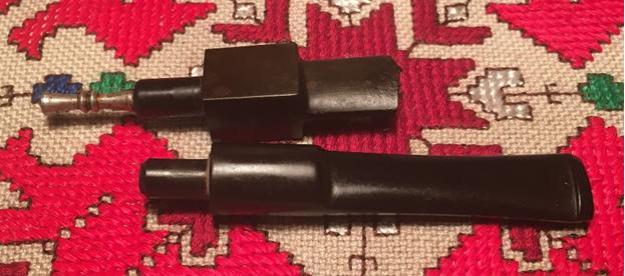
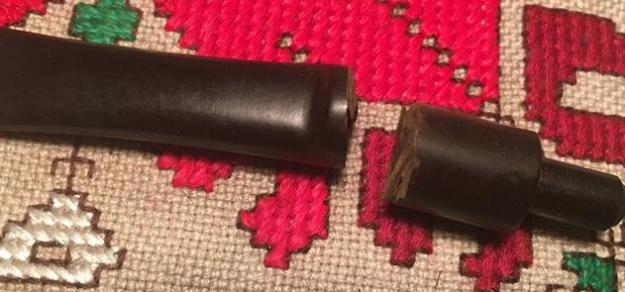
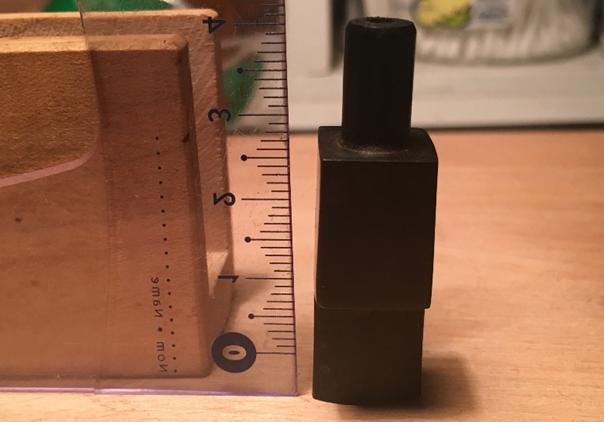
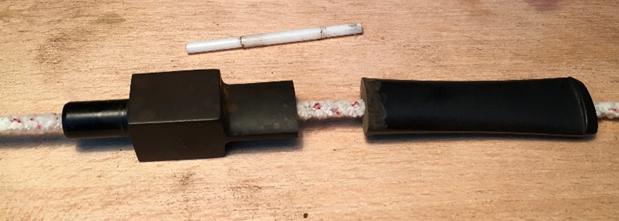
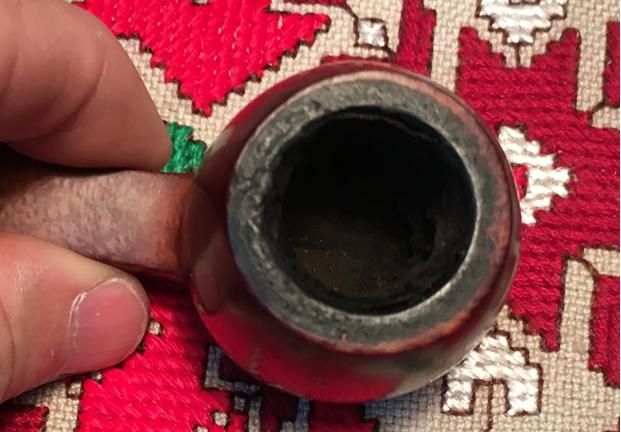
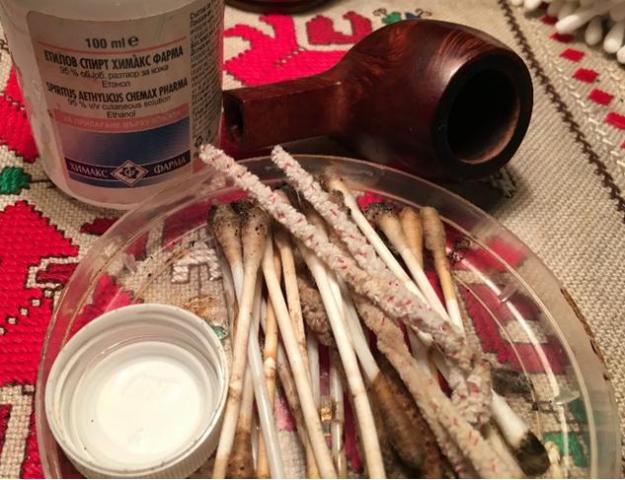
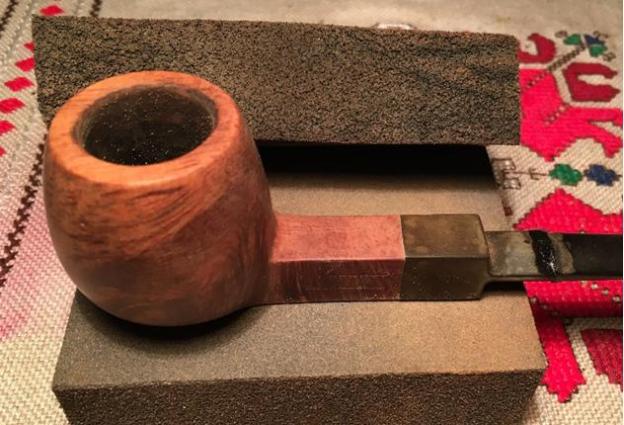
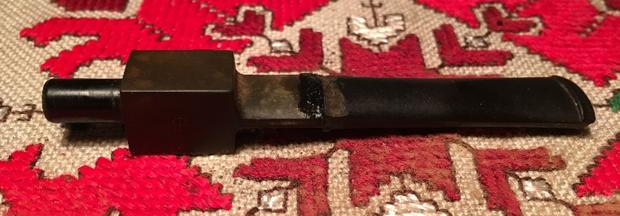
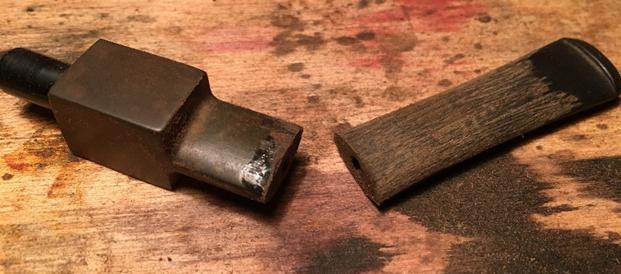
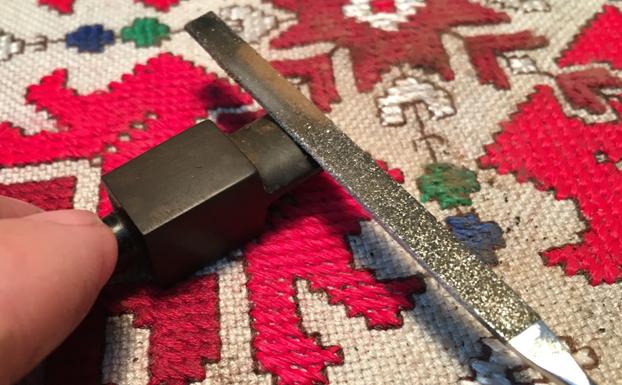
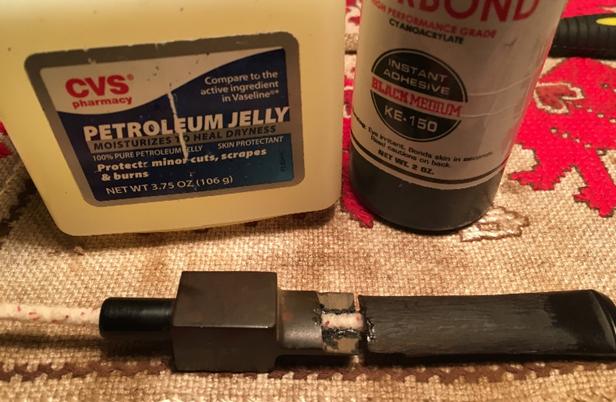
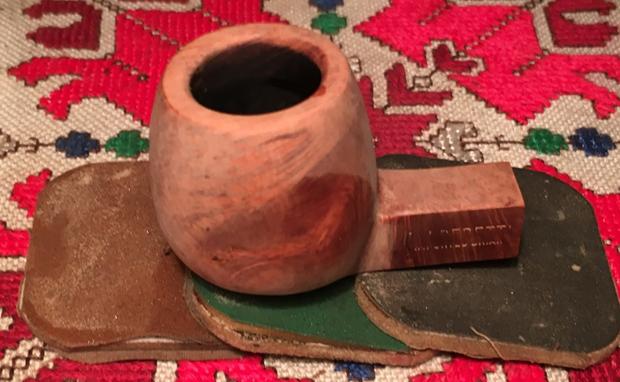
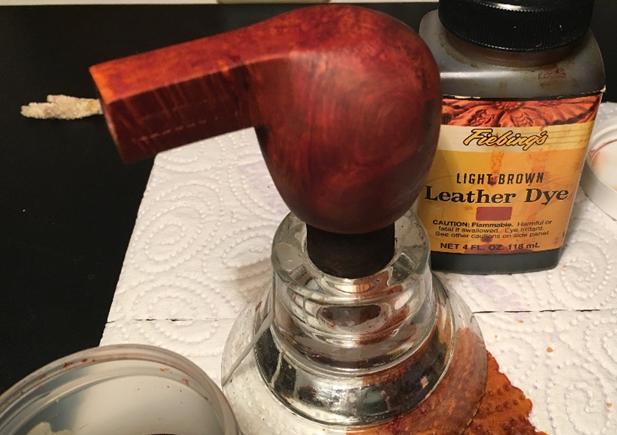
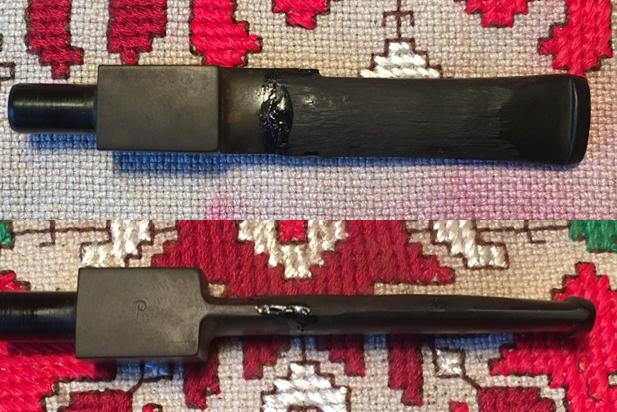
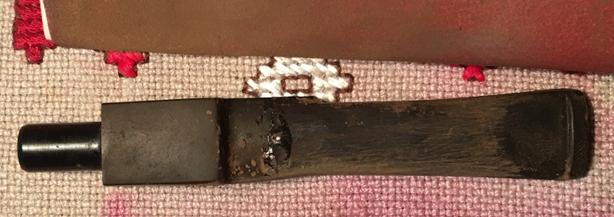
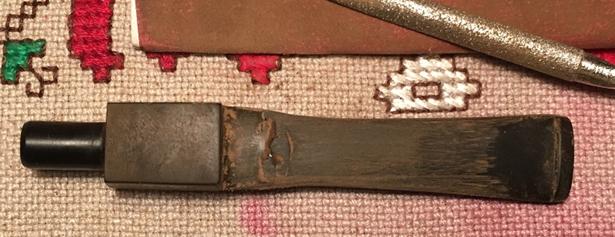
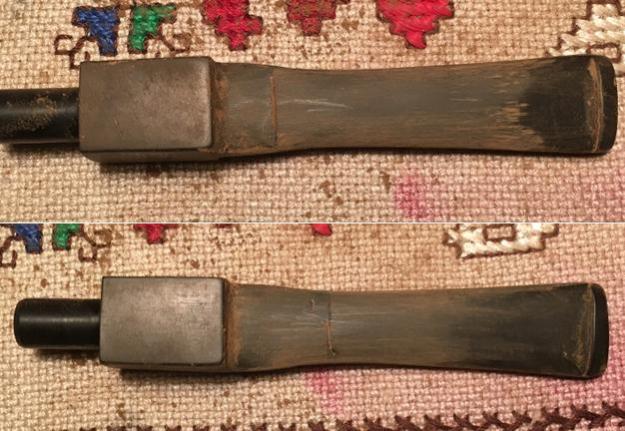
To see the big picture, I unite the spliced stem with the stummel.  I like the proportions.  I was concerned that the stem might end up being too short and the L J Perretti becoming a nose warmer.  This is not the case as the picture shows!per64Accelerator is God’s gift to the impatient!  My first time to use it and it is nice – though I understand the downside of using an accelerator is the potential of a weaker bond, at least as I have read. The Black K-150 glue looks good.  I return to sanding the stem to blend the patch and finish the shaping.  With 240 grit paper, I smooth out the superglue fill and even though I can still see the lines, the touch test is the goal.  I can feel no ridge at the junction seams.  Success!  With all this rigorous sanding, the verdict is in – the step splice technique is holding!  I continue sanding moving down the stem removing the sand marks left by the Dremel drum sanding wheel.  I finally arrive at the button and to lower lip is out of line.  I straighten this with a flat needle file and I freshen the button lines while I’m at it.  I use 240 grit paper again to remove the effects of the needle file use in the button area.  Finished with the 240 grit paper, I use 600 grit paper to smooth the stem more and to reveal nicks or gouges that may have been missed.  The last two pictures below show the finished shaping project.  I’m very pleased with the results – the splice is holding well and the newly shaped stem is passable.  Even though the splice seams are visible, they are smooth to the touch and I’m hopeful that as the stem polishing and waxing is completed, the seams will blend more.  I think Frankenstem has been transformed well.  Before bringing out the micromesh pads on the stem, I drop the newly spliced stem into the Oxi-Clean bath to raise the heavy oxidation left in the original stem piece.  Another day is finished. per65 per66 per67The next morning I fish the soaking stem out of the Oxi-Clean bath.  The oxidation has surfaced, and as expected, especially on the original stem piece.  Initially I use 600 grit paper and wet sand the stem removing the top layer of oxidation.  I use a topping board with 600 grit paper to make quick work of 3 of the 4 panels of the saddle stem block (not sure if there is a special name for this part of the stem).  I am careful to protect the Perretti ‘P’ on the other panel by putting my thumb over it as I sanded around it.  I repeated the process using 0000 steel wool.  As always, the most difficult part to rid of oxidation were the vertical ‘rise panels’ above and below the stem.  I’m satisfied with the progress the pictures show.per68 per69 per71 per72With the new day, I’m in the home-stretch!  With so much focus on the stem repair, I only now recall that I have not cleaned the internals of the now spliced stem.  Using pipe cleaners dipped in isopropyl 95% I work on cleaning the internals. After running 2 pipe cleaners through the airway, for a nice change, I discover that all is clean!per73I turn now to the micromesh cycles with the stem.  Beginning with pads 1500 to 2400 I wet sand the stem and follow the set with an application of Obsidian Oil over the stem.  Next, I dry sand using pads 3200 to 4000 followed by 6000 to 12000, following each set with a fresh application of Obsidian Oil. I’m generally pleased with the technique of this splice, but the fine polishing of the two pieces of vulcanite have revealed that not all vulcanite is the same.  I assume the original survivor piece was of better quality than the donor piece.  The polishing reveals that the original is a darker hue of black and it wasn’t evident only until now.  So, we do the best we can with what we have!  The pictures reveal this with a close look.  The stem still looks good and what I’ve been through with it make it even look better!  The pictures show the progress. per74per75per76Before rejoining stummel and stem to apply carnauba wax, I want to re-establish the Perretti ‘P’ stamping on the stem.  Checking with the L. J. Perretti Co. stampings on Pipephil.eu, most stem marks are set with white lettering.  I want to do the same to emulate how this Perretti most likely was commissioned.  Taking white acrylic paint, I dab a bit over the ‘P’ on the stem.  After an hour or so, after dried, I gently scrape the top layer of paint off with a pointed Q-tip which I picked up in the US at Hobby Lobby.  Pictures show the result.per77 per78 per79Rejoining stem and stummel, I apply several coats of carnauba wax to both.  I use a cotton cloth wheel mounted on the Dremel, increase the speed to a setting of 2 and apply the wax moving the wheel in a circular motion over the surface.  After completing the carnauba wax application, I mount a clean cotton cloth wheel on the Dremel and clean buff the stummel and stem.  Following this, I give the entire pipe a hand buffing with microfiber cloth to bring out the luster and depth of the grain even more.
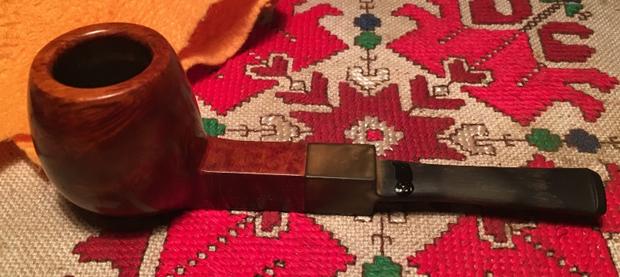
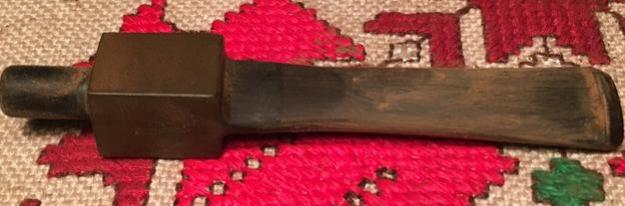
The briar of this L J Perretti is unbelievable – a beautiful display of fire grain and very clear and distinct bird’s eye.  The stem isn’t a perfect rendition mainly because of the unmatched vulcanite creating the splice.  Yet, the ‘step’ technique Jacek provided (via Steve!) is working very well.  The squared shank transitioning into the tapered fishtail-like stem I think is very nice. It works.  I’m thankful to my son for gifting me with this L J Perretti!  I would have enjoyed my inaugural smoke to have been a bowl of a special hand blended mixture from the L. J. Perretti Co. Tobacconists in Boston!  Yet, after taking the presentation pictures following, I settled for a bowl of my favorite Cavendish blend – Lane BCA. Report?  The L J Perretti smoked very well, indeed.  Thanks for joining me!per80 per81 per82 per83 per84 per85 per86 per87 per88
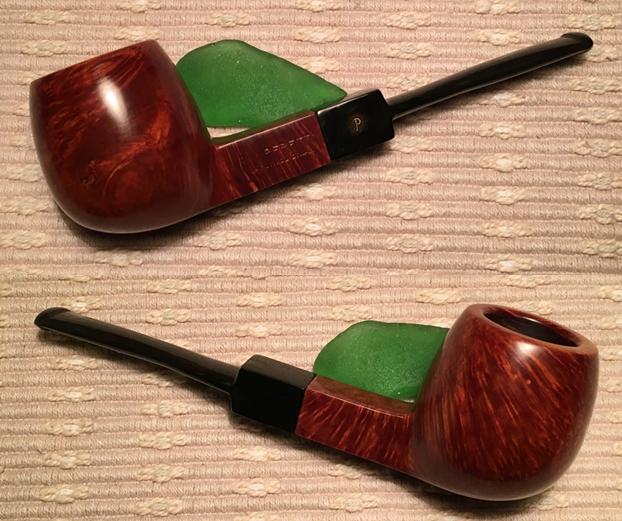
Great Grain – a Triangle Shank Grabow Westbrook Billiard

Blog by Steve Laug

Wikus asked me in a comment on the blog I wrote on the KBB Yello-Bole Churchwarden why I don’t give the pipe a coat of either varnish or shellac after I have refinished them. I wrote a response in which I said I don’t like that finish and want the pipe to be able to breathe. I have found that the varnished bowls get hot when smoked so that is another reason. But probably the biggest reason is that I really like a more matte finish instead of the high gloss that some like. I have to be honest – to me the matte finish that lets the grain pop and hides nothing behind the shine really is my preference. It does not mean I don’t like a shine but rather that I like the shine of a good wax and buff over the other options.

The pipe I worked on next is a prime example of what lies beneath the varnish coat. This one is a unique (at least to me as I have not seen one before) triangular shank billiard made by Dr. Grabow. It is stamped on the left side of the shank WESTBROOK over Dr. Grabow (the bottom edge of the lower stamp is faint as it is very close to the ridge on the angle of the side). It is stamped on the right side Imported Briar (faint stamp) over Adjustomatic in script. Underneath both lines it reads PAT.2461905. My brother picked this one up because the grain and shape caught his attention. He took the following photos before he cleaned it up.grab1 grab1aFrom the above photos you can get a general idea of the shape and condition of the pipe. It is sound and has no cracks or burns on the surface. The finish is pretty well shot – the varnish is crackled and checked looking on the sides of the bowl and shank. The overall look is cloudy and muddied by the varnish going. There is a pretty thick cake in the bowl and it overflows onto the rim top. The bowl however appears to still be in round both on the inner and outer edges as far as can be seen in the slightly out of focus third photo. The stem looks good at this point with light oxidation and some tooth chatter and marks on the topside near the button. The orange Grabow spade logo is in place on the left side of the stem. More will be revealed through his close up photos.
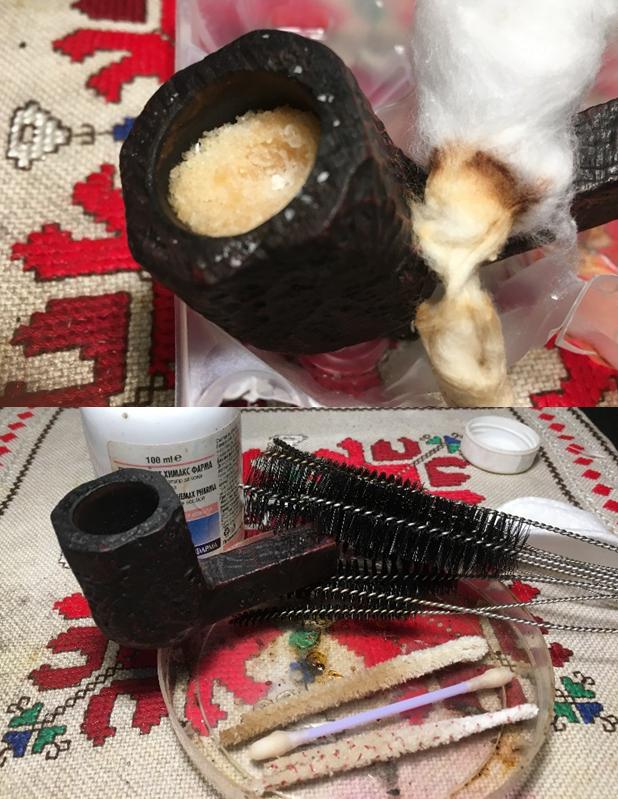
The first photo shows the rim condition up close. My initial observation about the edges need to be modified somewhat. The inner edge looks good but it will be better determined once the thick and uneven cake is removed from the bowl (good news is that this one must have been a good smoker to have developed this kind of cake). The outer edge looks good other than some slight damage to the front right side where there appears to be a chip and some wearing.grab2The next close up photos show the stamping and stem logo. I have recorded the condition and content of the stamping above. I include these for you to see the overall condition of them and the finish on the shank and stem.grab3The last photos he included show the condition of the stem. There is a visible line that covers the separates the first inch of the stem from the rest which looks to me that the stem had a Softee bit on it for most of its life. There is tooth chatter on both sides of the stem and on the top side (second photo below) there are visible tooth marks that need to be dealt with. This is why I think the bit protector came after the initial tooth marks or they would have been far worse. On the underside of the stem there is a small tooth mark that is quite deep. Both sides will need some work to smooth out the damage.grab4I did a US Patent search to see what I could find out about the patent number on the side of the shank. I was able to find out that the patent was filed on Jan. 25, 1946 but was not issues until February 15, 1949. I learned that the inventor of the Adjustomatic system for Grabow was D.P. Lavietes. I know nothing about him but I do know that Dr. Grabow used the mechanism in their pipes. With this information I know that the pipe was made after 1949 because the patent stamp says that the mechanism is patented not patent applied for. I have included the entire patent below for those who may be interested. I enjoy the descriptions, rationale and drawings that the inventor includes in these old patents. They are a pleasure for me to read through them. If you want you can skip over the next four photos and read about the pipe’s restoration.grab5 grab6 grab7 grab8My brother did his usual thorough cleaning of the pipe. He reamed the bowl and cleaned the internals of the shank, mortise and stem with alcohol, cotton swabs and pipe cleaners. He scrubbed the rim and was able to remove all of the tars and oils that had built up there. He cleaned the exterior of the bowl and stem with Murphy’s Oil Soap to remove the grime and build up in those areas. When I received the pipe in Vancouver it was clean. The only thing that he had not been able to do was remove the stinger from the threaded tenon to clean behind it. The next four photos give a clear picture of what the pipe looked like when it arrived.grab9 grab10The close up photo below shows how well the rim and bowl cleaned up. The inner rim was in pretty decent shape other than a little burn on the front edge almost in line with the chip on the outer edge.grab11The stem was in better condition than I expected as in the cleaning process a lot of the chatter seems to have been removed with the calcification.grab12I took photos of the condition of the stinger apparatus because it was looking really good. In the past when I got these they were black and looked awful. They were bad enough that if I did not like stingers before, the general grime and grit would have sealed the deal. This one however was sparkling.grab13I heated the stinger with a Bic lighter and the tars that held in the tenon released it. With the stinger removed I was able to clean out the buildup behind it in the stem. I used pipe cleaners, cotton swabs and alcohol to clean out that area of the stem. I cleaned out any remaining debris in the mortise at the same time.grab14I sanded the tooth marks and the rest of the stem to deal with the oxidation using a folded piece of 220 grit sandpaper. The tooth marks came out of the top side of the stem with no problem. There was still one small almost pin hole tooth mark on the underside that I would need to deal with and repair. I cleaned the surface of the stem with alcohol and filled in the mark with clear super glue. Once it dried I sanded it with 220 grit sandpaper to blend it in with the rest of the stem surface.grab15 grab15aI buffed the stem with Red Tripoli on the buffing wheel and brought it back to the work table to polish it with micromesh sanding pads. I wet sanded it with 1500-2400 grit pads and dry sanded it with 3200-12000 grit pads. After each set of three pads I rubbed it down with Obsidian Oil. After the last pad I gave it a final coat of oil and set it aside to dry.grab15b grab15cAfter polishing with the 1500-2400 grit pads I wiped down the tenon with an alcohol wet cotton pad to remove some of the darkening in the threads. In doing so I got some alcohol on the end of the stem and it brought out a bit more oxidation to the surface. This is one of those frustrations but also a good thing as I was able to then back track and sand the stem again with 1500-4000 grit pads and then buff it with some Blue Diamond on the wheel and I removed the rest of the oxidation. I then went back to polishing the stem with 6000-12000 grit pads to bring the shine to the surface.grab15dWith the stem polishing done I set it aside and turned to the bowl. I examined it and decided that the best way to deal with the crackling varnish coat was to remove it. My choice for removing varnish coats is to scrub the finish with acetone on a cotton pad until it is gone. The first wipes will leave the surface gummy and rough. You have to scrub the surface until it is smooth to touch. The next four photos show the bowl with the crackled finish.grab16 grab17It took four cotton pads and acetone to remove this crackled varnish finish. Underneath the cloudy varnish coat there was some really stunning grain.grab18 grab19Once the finish was gone and I had wiped the pipe with a paper towel with a little bit of olive oil I took photos of the pipe. There was some scratching in the briar that would need to be polished and there were some nicks that would need to be lifted if they did not polish out but the overall appearance of the pipe was stunning.grab20 grab21I worked on the bevel of the inner edge to smooth out and remove the damage on the front side. I used 180 grit and 220 grit sandpaper to bevel the rim a little to accommodate the edge damage. I polished the briar on the rim with 2400 grit micromesh sanding pads to remove the scratching left behind by the beveling. I polished the bowl and rim with 3200-12000 grit micromesh sanding pads to raise a shine in the briar and make the grain stand out.grab22 grab23I put the stem and bowl back together again and buffed the pipe with Blue Diamond on the wheel to further polish it. I gave the bowl and stem multiple coats of carnauba wax to protect it and buffed it with a clean buffing pad to raise the shine. I hand buffed it with a microfibre cloth to deepen the shine. The finished pipe is shown in the photos below. It has come a long way from the worn and tired pipe that came to my brother in Idaho. The depth of the shine, the look of the grain and the flow of the pipe all work together to make this a beautiful Dr. Grabow pipe. It is one of the earliest pipes of the RJ Reynolds era. It was a fun pipe to work on and the results just multiplied as each step I took in the cleaning and polishing process brought more of the beauty of this piece of briar alive. Thanks for looking.grab24 grab25 grab26 grab27 grab28 grab29 grab30 grab31
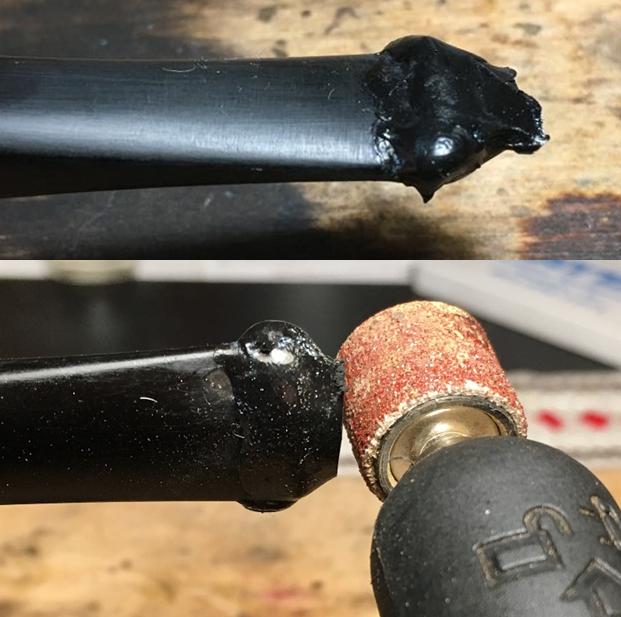
Restoring Another Unique Windy Perpetual Drysmoker

Blog by Steve Laug

Today I have been working on the second Windy Perpetual Dry Smoker that has come across my work table. The first was a gift from Troy who writes here on rebornpipes. I have written the description of the restoration on a previous blog. You can read about the cleanup and restoration on that blog: https://rebornpipes.com/tag/windy-perpetual-drysmoker-pipe/ . In that blog I did some research on the brand, as prior to the first pipe I was gifted I had never heard of or seen one of these pipes. I decided to repeat a portion of that first blog here to give some background on the brand.
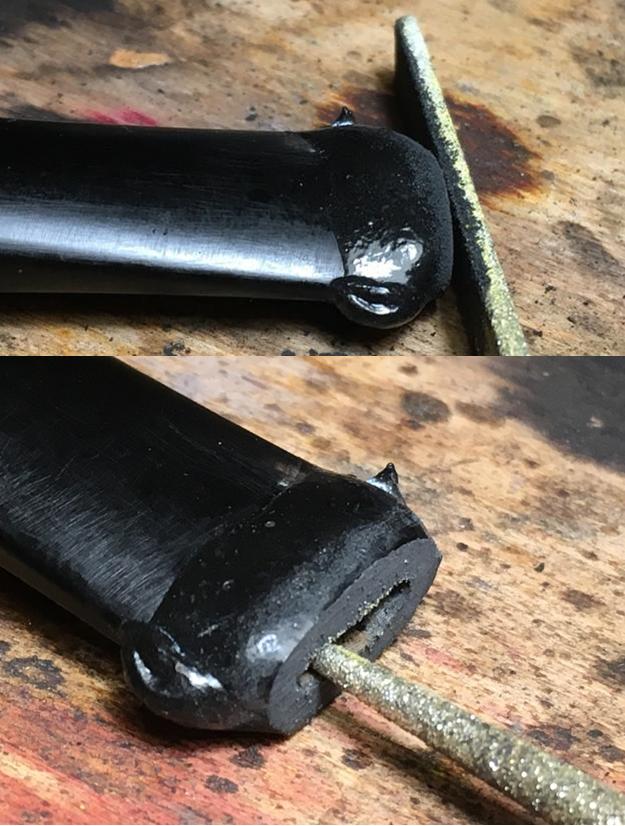
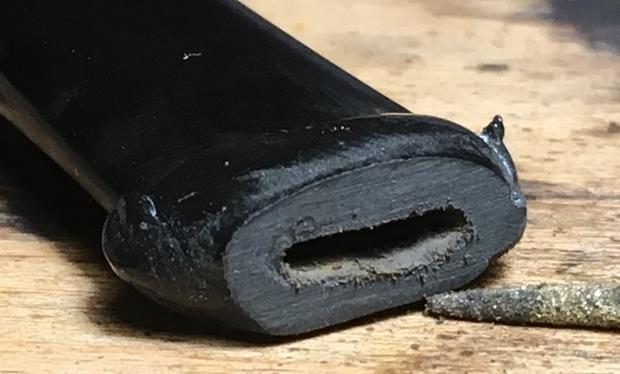
Here is the link to one of my favourite informational sites on metal and unique system style wooden pipes. The link will take you to the article as a whole and some photos that show the pipe quite well: http://www.smokingmetal.co.uk/pipe.php?page=508

“WINDY PERPETUAL DRYSMOKER by Stan Wolcott”

“In my travels I recently came across this intriguing pipe on which very little information appears online by Google search. The left side (?) is stamped “Windy Perpetual Drysmoker” and on the right side (?) “Imported Briar/Italy”. The stem has a small round gold medallion on the left side bearing an “R”. Although several similar pipes are pictured online here in the USA and UK, no explanatory information is included with those images. Floyd Norwood of Tennessee, who restored the pipe for me, also had no idea how the pipe was to be smoked. Tony Pringle of the UK, who has one pictured on his website, believes there may be other pieces which are missing from the four present in the images—flat cap, rounded cap with five vent holes (presumably the wind cap) and the pipe bowl and stem. As can be seen from the images, the flat cap has female threads and screws into the bottom (?) onto male threads on the bowl. The wind cap has male threads and screws into the top (?) of the bowl. I have placed the question marks in parentheses following the terms top, bottom, right and left, since I’m not even sure whether the flat cap is intended to be the bottom. Can someone out there enlighten me and the NASPC readership about this “mystery pipe”, its manufacturer and the proper way of smoking it?”

“The “Perpetual” part of the name seems to come from the ability to actually load more tobacco from the bottom of the pipe whilst still alight and of course the dottle etc. gets burnt as the smoking progresses. Rather ingenious. There are at least two possible for makers from the logo, REGIS and EMPIRE STATE and nothing seems to be known of these either.

Tony Pringle of smokingmetal then includes the following photos of the pipe. There is no doubt that it is the same pipe that I have. There are a few variations between the two but the overall design is the same. He shows photos of the pipe as a whole, taken apart and of the stamping.dry1I have only included the first photos as the pipe I have is virtually identical to this one. Mine also has the gold circle R on the logo on the side of the stem. The only difference is that mine is has a brass spacer on the stem that forms a thin band between the shank and stem. Mine is also in better condition than the one in the photos with no cracks or breaks in the bowl, caps or threads. I believe along with Tony from smokingmetal that the pipe was crafted in the late 1940s. Many things about the briar quality, the rubber that is used in the stem etc. point to manufacture of the pipe occurring during or after the conclusion of World War II.

The stamping on the one above and the one I have is simply WINDY over PERPETUAL over DRYSMOKER in caps on what is the left side of the shank. On the right side of shank it is stamped Imported Briar over Italy. The pipe is meant to be smoked with the perforated, rounded cape pointing downward. That is why the stamping is the way it is. If the pipe is held otherwise the stamping is upside down. If the pipe is inverted it can be set upright on a desk or table on the flat top cap and act as a sitter pipe. The pipe is 5 ¼ inches from the front of the bowl to end of bit. The diameter of the outer bowl is 1 3/8 inches. The chamber diameter is just over 5/8 inch and depth is over 1 ¼ inches with both the top and bottom cap removed. The pipe is lit from the bottom and the wind cap cover is screwed in place. I think that more tobacco can be fed in from the top of the bowl with the flat cap removed thus making the pipe a PERPETUAL DRYSMOKER.

The pipe my brother Jeff picked up is shown in the next photos that he took of it before cleaning it and sending it to me in Vancouver. You can see some darkening in the finish around the flat cap on the bowl and some general wear and tear to the finish as a whole. The bowl has quite a few fills in the shank, the left and right front sides and the crowned perforated bottom cap. The stem was oxidized quite heavily and the diameter of the shank and the diameter of the stem did not match.dry2Jeff took some great photos of the bowl taken apart. Contrary to what Tony and Stan mention in the quote article from the website all the parts are present with the pipe. There are no additional pieces needed to make the pipe functional. The first two photos show the rounded bottom cap and the flat top cap removed from the bowl. You can see the wooden threads on the inside of the bowl in the first photo where the bottom cap screwed into it. The second photo shows the threads on the outside of the bowl where the flat top cap screwed onto it. The completed pipe resembled a salt or pepper shaker to my mind – a unique and interesting smoking device. Both caps were darkened by smoking but appeared to be clean. There was a small crack in the rounded bottom cap but it did no effect the fit in the bowl.dry3He also took some photos with the parts laid out together to give an overall idea of what the pipe looked like.dry4My brother also included some close up photos of the sides of the bowl to show the condition of the finish and what would need to be done to clean it up. He included a photo of the flat top cap to show the remarkable grain underneath the staining and grime.dry5 dry6The next two photos show the stamping on both sides of the shank. The third photo shows the brass circle R logo on the stem and also the brass spacer in between the stem and the shank.dry7 dry8The final two photos Jeff included showed me the condition of the stem. It looked really good other than the oxidation. There was no tooth chatter or tooth marks in the surface. The only issue I would need to address was the mismatched diameter of the shank and the stem.dry9My brother did a really thorough job cleaning up this old pipe. When it arrived in Canada the inside of the bowl and both caps was really clean. He had scraped out the light cake in the bowl and cleaned out the mortise and airway in the stem and shank with alcohol, cotton swabs and pipe cleaners. He cleaned off the exterior of the bowl and was able to remove much of the grime on the surface. The brass space was oxidized but would clean up easily when I worked on the diameter of the stem. I took the next four photos to show the condition I found the pipe in when I unpacked it here in Vancouver.dry10 dry11I took the pipe apart and took photos of the parts of the bowl – the centre core, the rounded bottom cap and the flat top cap. In the photos the core is flat side up in the first one and rounded side up in the second one. The bowl and caps were very clean and you could see raw briar inside all of the parts which led me to think that the pipe had not been smoked often.dry12I took some close up photos of the stem to record its condition as well.dry13The fit of the crowned bottom cap to the edge of the core part of the pipe had some damage to it that did not allow the cap to seat tightly against the edge of the core. I topped it with 220 grit sandpaper on the topping board until the cap fit snugly.dry14I put the cap back in place and wiped the bowl down with acetone on cotton pads to remove the finish. The fills on the bowl were dimpled so they would need to be repaired with briar dust and super glue.dry15 dry16With the finish removed I could better assess the darkened areas around the sides and bottom of the flat cap. I could also see areas that needed to be sanded around the edges of the rounded bottom cap also. I sanded the entire pipe with 220 grit sandpaper to remove the damaged areas and smooth out the transitions between the core and the caps. I also smoothed out the edges of the fills to prepare them for repair later in the process.dry17 dry18With that part finished I needed to rework the shank/stem diameter. The right side of the shank was narrower than the right side of the stem. With the stem removed it was easy to see why. That side of the briar shank was thinner in terms of the thickness of the walls of the shank than the left side. The red circle shows the side that needed to be taken down.dry19I used the Dremel with a sanding drum to take down the excess vulcanite and brass of the spacer.dry20I cleaned out the areas around the fills and removed any of the loose debris around them. I rebuilt the areas around the fills with a mixture of clear super glue and briar dust. I overfilled the repairs to allow for shrinkage. I sanded the repairs smooth to match the surface of the bowl.dry21I sanded the repairs smooth and then polished the areas with micromesh sanding pads. I wet sanded the repaired areas with 1500-2400 grit sanding pads and dry sanded them with 3200-12000 grit pads. I wiped the bowl down with a damp cloth. I stained the bowl and the caps with dark brown aniline stain and flamed it to set it. I repeated the process until the coverage was even.dry22 dry23I buffed the bowl with Blue Diamond polish on the buffing pen. I gave it several coats of carnauba wax and buffed it to a shine.dry24 dry25I sanded the stem with 220 grit sandpaper to smooth out the scratch marks on the vulcanite. I polished it with micromesh sanding pads – wet sanding with 1500-2400 grit pads and dry sanding with 3200-12000 grit pads. I rubbed the stem down with Obsidian Oil after each set of three pads. After the final coat of oil I set it aside to dry.dry26 dry27 dry28I buffed the pipe with Blue Diamond once more and then gave the bowl and stem multiple coats of carnauba wax. I buffed it with a clean buffing pad to polish it and then by hand with a microfibre cloth to deepen the shine. The finished pipe is shown in the photos below. Some of the character marks of the pipe that came to me still show and I am sure could tell a story if they were able to speak. I like the finished look – the marks and all give the pipe a sense of history and time. It is not a bad looking old pipe considering that it has traveled from the 1940s into 2016 and who knows how much longer. Thanks for looking.dry29 dry30 dry31 dry32 dry33 dry34 dry35 dry36

Refreshing Another Giant – a KBB Yello-Bole Imperial 3068C Bent Billiard

Blog by Steve Laug

When I cleaned up a previous KBB Yello-Bole Imperial 3068C for a reader of the blog my brother immediately was struck by the beauty of the old pipe. He decided he would find one for me that matched the one I cleaned up for the reader. If you want to read about the cleanup of that one here is the link: https://rebornpipes.com/2016/11/10/breathing-life-into-a-huge-kbb-yello-bole-3068c-bent-billiard/. The 3068C is a large pipe. It is reminiscent of the WDC Wellington in many ways but to me there is a simple elegance to the lines of the 3068C that are more smooth and beautiful. This is another giant pipe. The dimensions are: length 10 inches, height 2 ¼ inches, outer diameter of the bowl 1 ½ inches, inner bowl diameter 7/8 inches. I took a photo of the pipe in hand to give an idea of the size of this old giant.imp1As opposed to the other 3068C I cleaned up this one was in remarkably good shape. The shiny varnish coat actually was perfect with no peeling or nicks in it. The grain shone through and was a great mixture of birds-eye and cross grain. The Yello-Bole Honey Cured coating still showed on the bevel of the inner rim and in parts of the bowl. The rim surface had some very small dents or scratches in it but they did not seem to break the finish on the bowl. There was a light cake in the bowl. The nickel ferrule was oxidized and lightly scratches but otherwise undamaged. The stem had the classic older Yello-Bole circle on the top of the stem just behind the saddle and was lightly oxidized with minimal tooth chatter on the top and underside of the stem at the button.imp2 imp3My brother took the above photos and the ones that follow to show the overall condition of the pipe. The next two close up photos show the rim top and inner rim bevel. The Yello-Bole Honey Cured coating can be seen on the edge of the bowl and going down into the bowl. You can also see the small dents in the rim and the light grime that had built up on the surface of the rim.imp4The next two photos give a good idea of the grain that shone through on this old pipe. The front and back of the bowl has some amazing birds-eye grain and the sides, rim and bottom show some really nice cross grain.imp5The stamping on the shank was sharp and readable. The left side bore the KBB cloverleaf logo with Yello-Bole over stamping that read Reg.U.S.Pat.Off. Beneath that was the line stamping in script Imperial. Finally underneath all of that was stamped Cured with Real Honey. On the aluminum ferrule cap there was a remnant of the KB&B cloverleaf. It is interesting to me that while all Yello-Bole pipes are stamped with KBB (minus the ampersand &) in a cloverleaf on the shank both this pipe and the previous one had the KB&B cloverleaf on the ferrule. I wonder if the company made one size fits all with the ferrules and used them on both Yello-Boles and KB&B pipes. The right side of the shank is stamped Real Bruyere over the shape number 3068C.imp6The final two photos that my brother included show the tooth marks and chatter on the top and underside of the vulcanite stem at the button. The mild oxidation is also visible in the photos.imp7My brother did the necessary cleaning on the pipe – reaming and cleaning out the mortise and the airway in the stem and shank. I cleaned off the grime on the finish and wiped down the stem. When I received the pipe it looked be in excellent condition and would not take a lot of work to refresh it. I took the next four photos to show what it looked like when it arrived in Vancouver.imp8 imp9I took some close up photos of the rim and the stem to show the condition. The rim was in excellent shape and Jeff was able to clean up the inner bevel on the rim to reveal the Yello-Bole Honey Coating. The stem photos show the oxidation and the small tooth marks and chatter on both sides of the stem near the button.imp10 imp11I sanded the oxidation on the stem with 220 grit sandpaper to remove the brown topcoat that it had and also worked over the tooth chatter and tooth marks on both sides.imp12I used drops of medium viscosity black super glue to fill in the small tooth marks on both sides of the stem. They are shown in the photos below. The small black spots are the super glue repairs to the stem surface. You will note that there were more issues on the underside of the stem than the top side.imp13Once the repairs were dry I sanded them back to the surface of the stem with 220 grit sandpaper.imp14I polished the sanded spots by wet sanding with 1500-2400 grit micromesh sanding pads.imp15I wet sanded the entire stem and continued to sand the repaired areas with 1500-2400 grit micromesh sanding pads. I rubbed the stem down with Obsidian Oil and then dry sanded it with 3200-12000 grit pads. I rubbed it down with oil after each set of three pads and after the final set I gave it a last coat of Obsidian Oil and set it aside to dry.imp16 imp17 imp18The nickel ferrule had a lot of tiny scratches in the surface of the metal. I sanded it with micromesh sanding pads to polish out the scratches and raise a shine in the nickel.imp19I polished the briar with 3200-12000 grit micromesh sanding pads to raise the shine and smooth out the small scratches on the sides and bottom of the bowl as well as the rim.imp20 imp21 imp22I buffed the bowl and stem with Blue Diamond on the buffing wheel to further polish the briar and vulcanite. I gave the stem multiple coats of carnauba wax and buffed the bowl and stem with a clean buffing pad to polish and raise the shine. I hand buffed it with a microfibre cloth to deepen the shine. The finished pipe is shown in the photos below. It turned out to be a very beautiful pipe that needed just a few touches of TLC to bring it to its fullest. It is another large pipe that would make a great reading or house pipe. It is comfortable in hand and the grain is interesting enough to give hours of observation pleasure. Thanks for looking.imp23 imp24 imp25 imp26 imp27 imp28 imp29 imp30