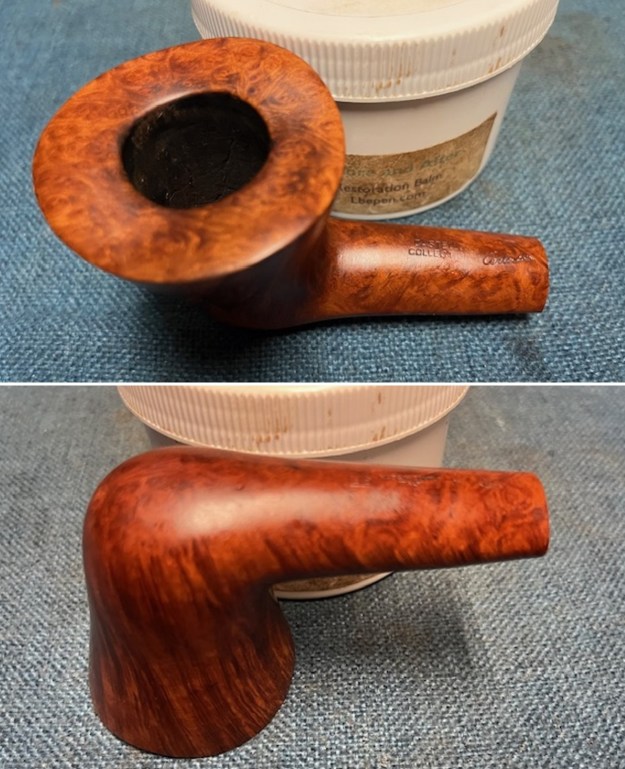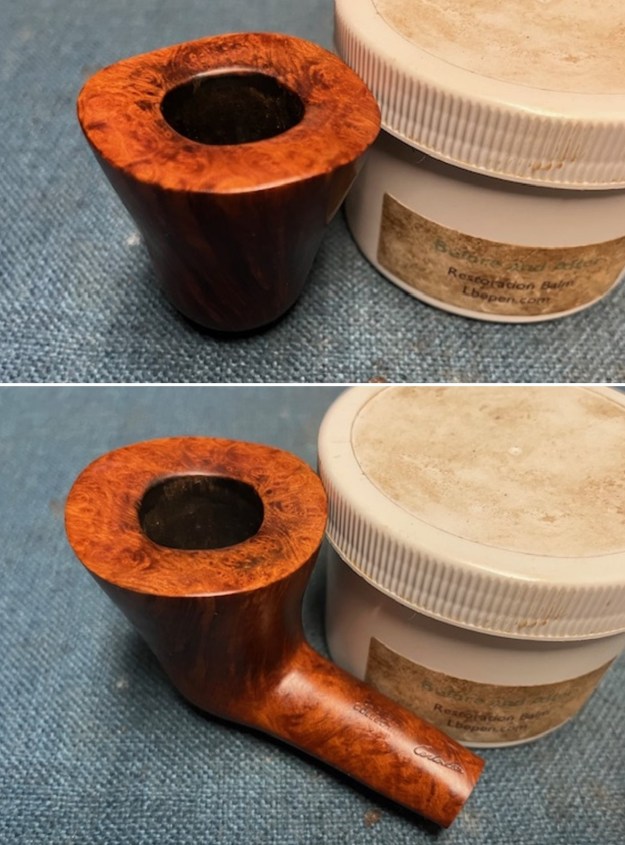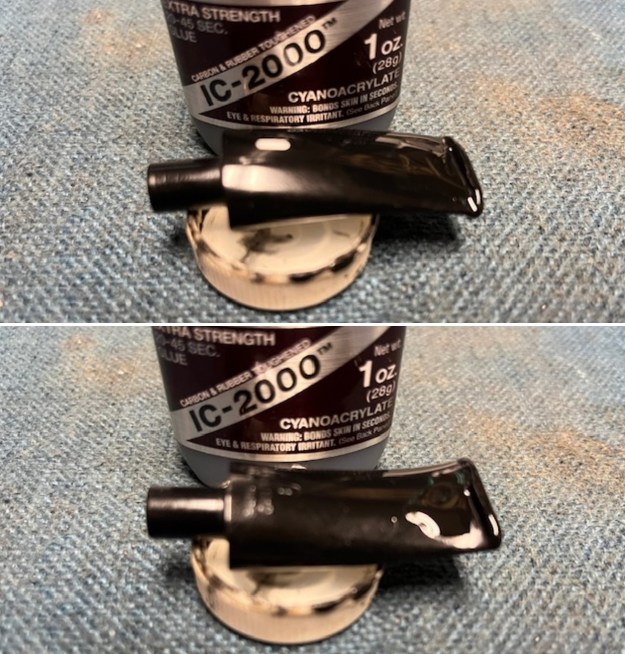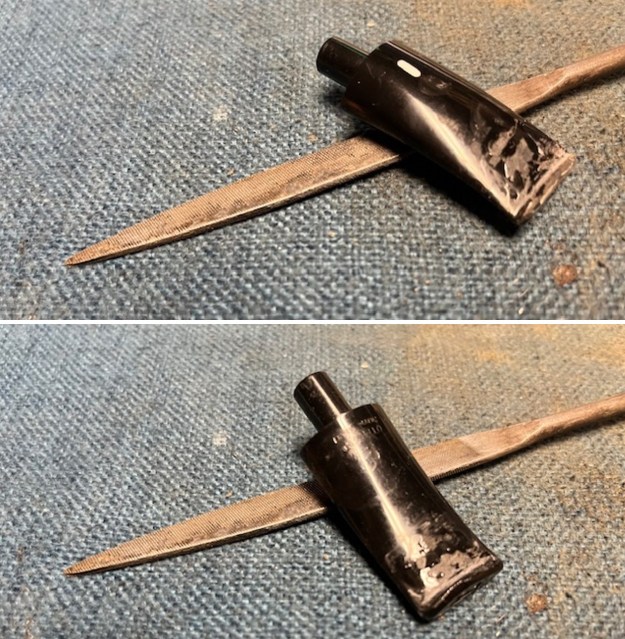
Tag Archives: repairing tooth marks

New Life for an Israel Made Long Canadian


by Steve Laug

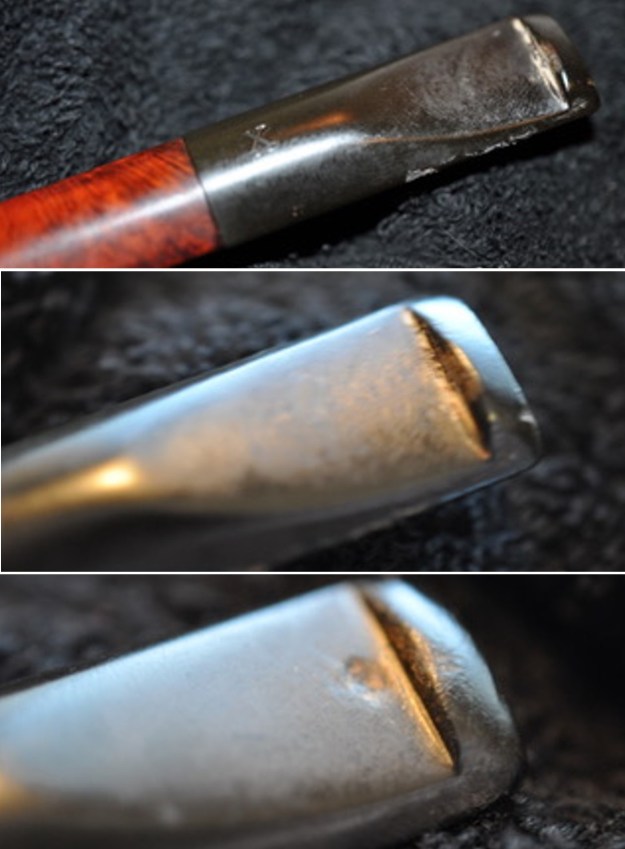
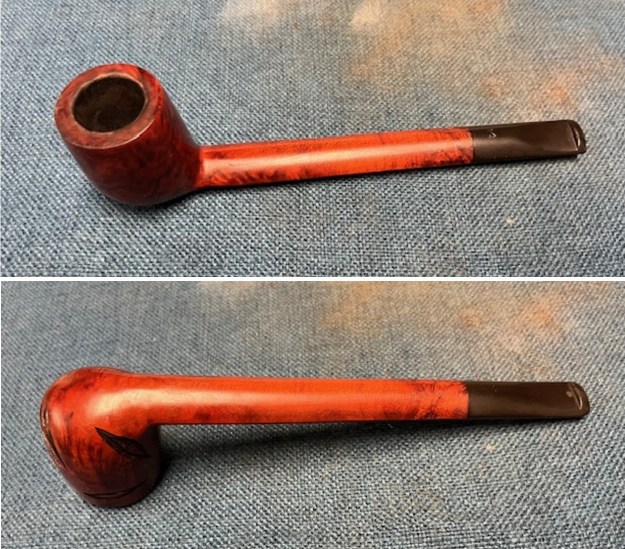
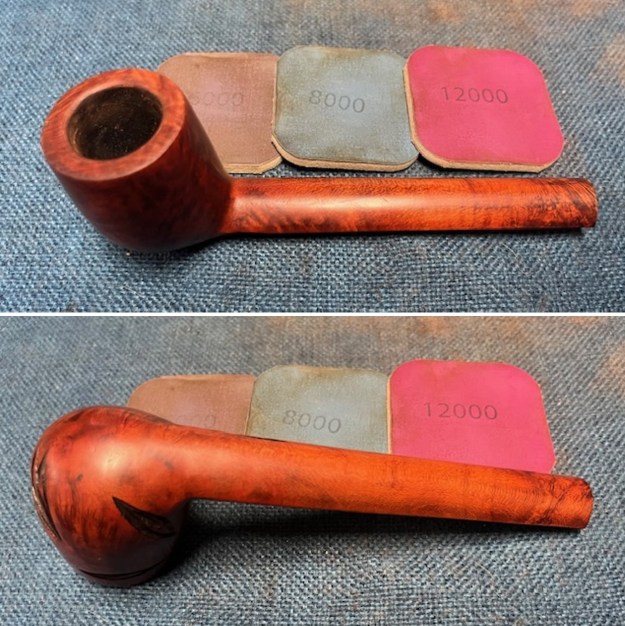
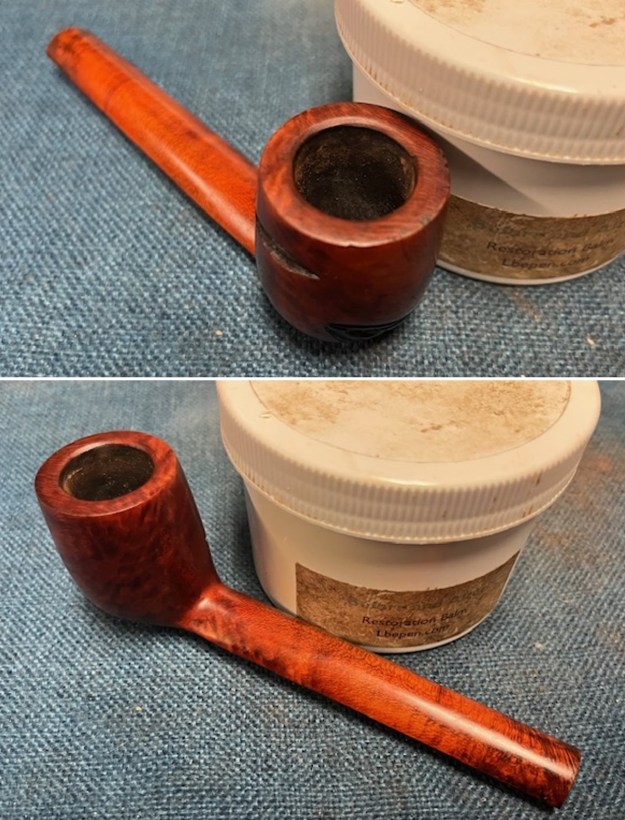
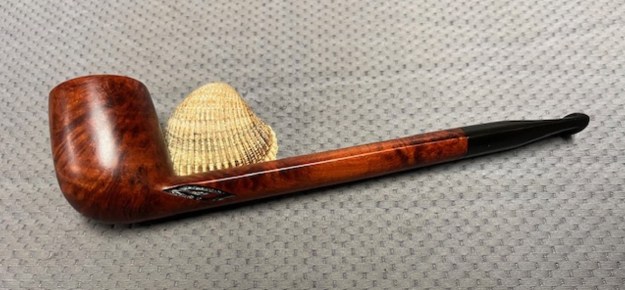
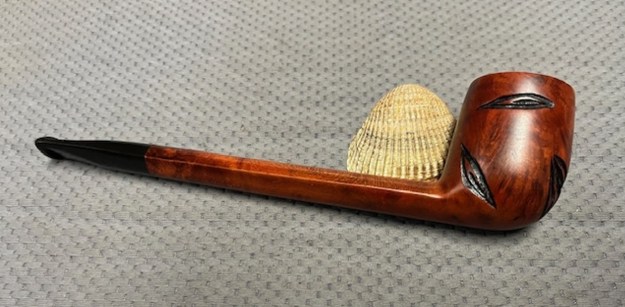
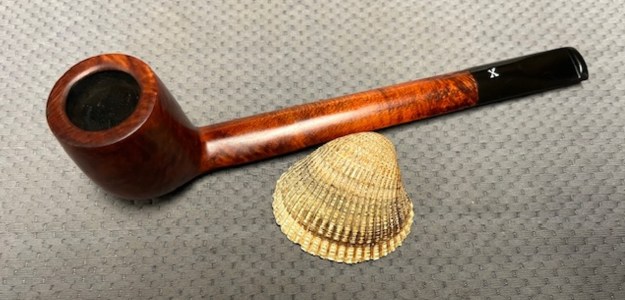
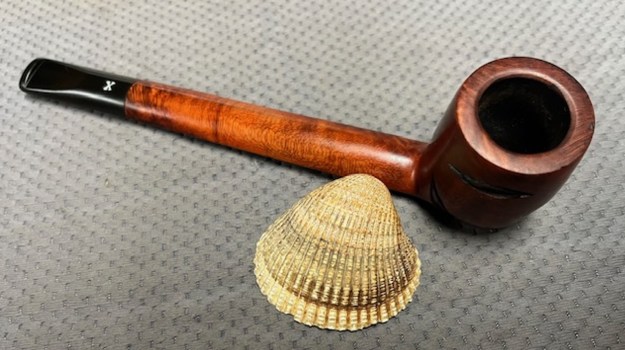
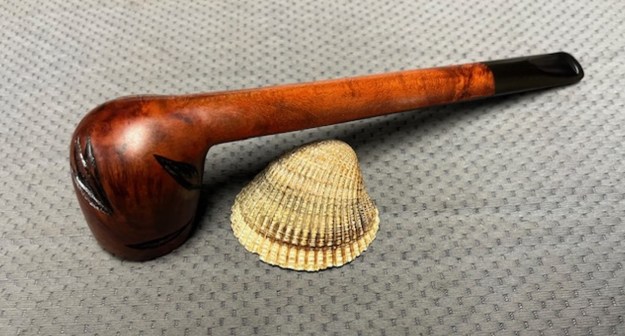
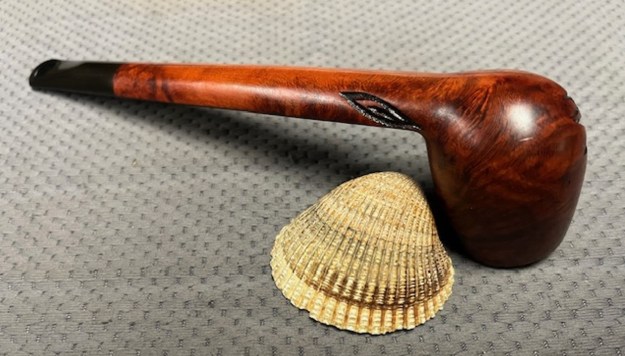
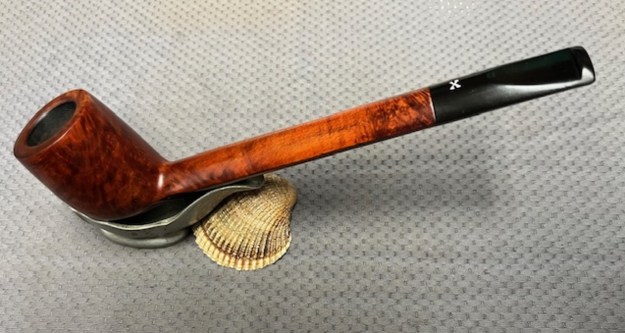
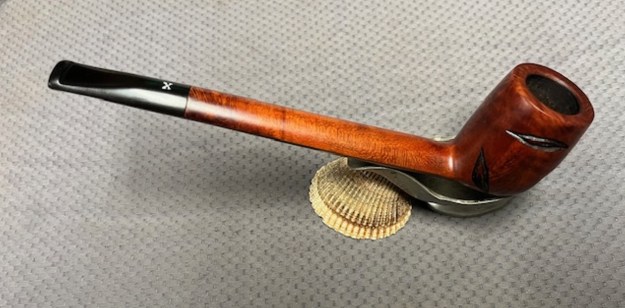
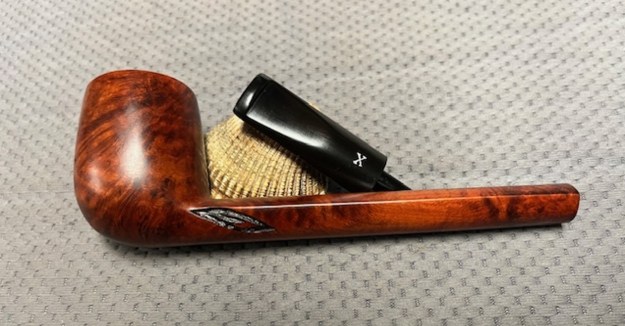
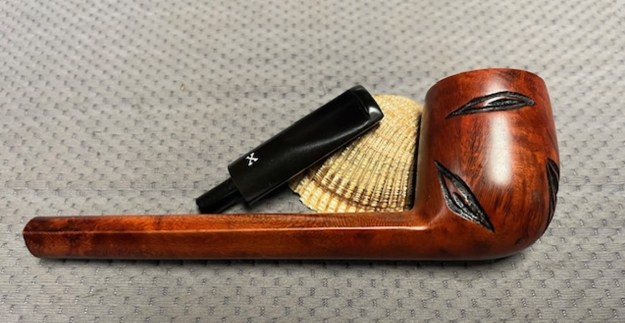
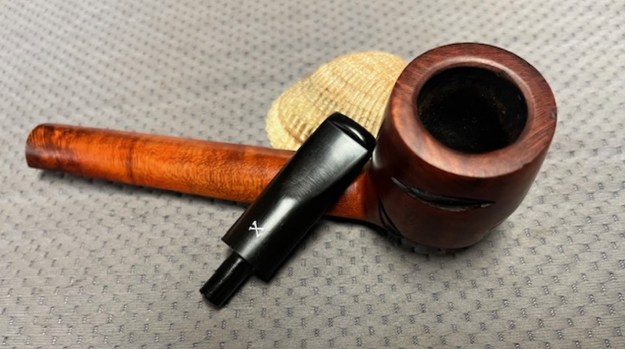
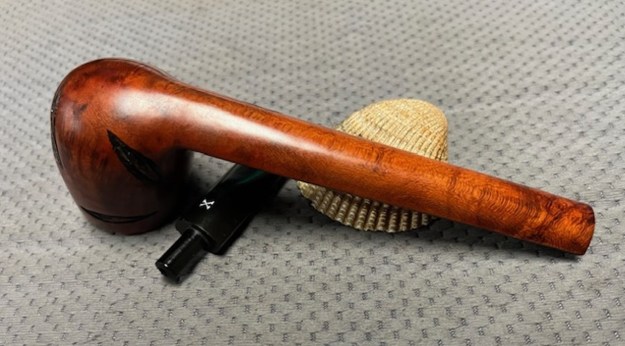
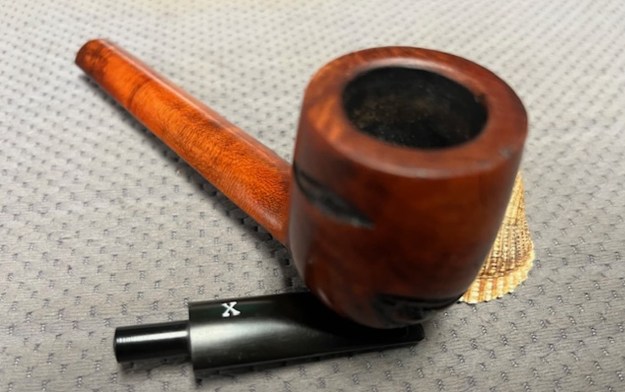
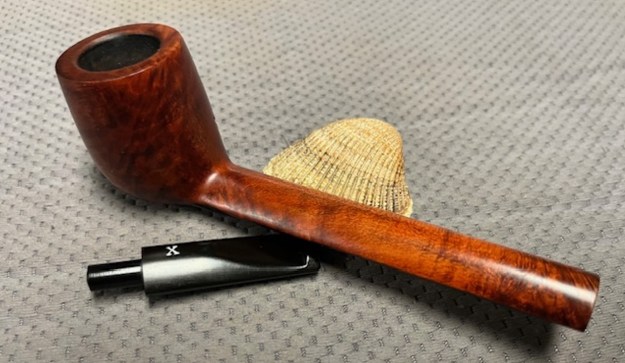
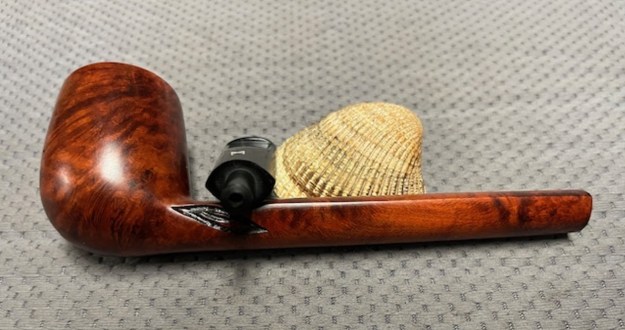
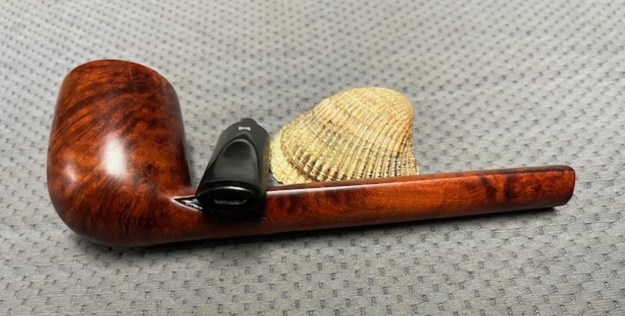
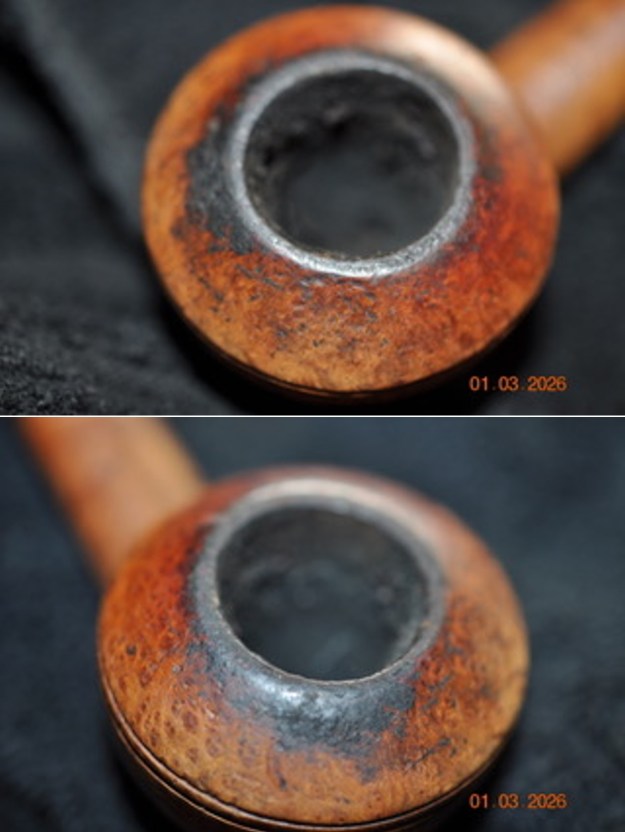
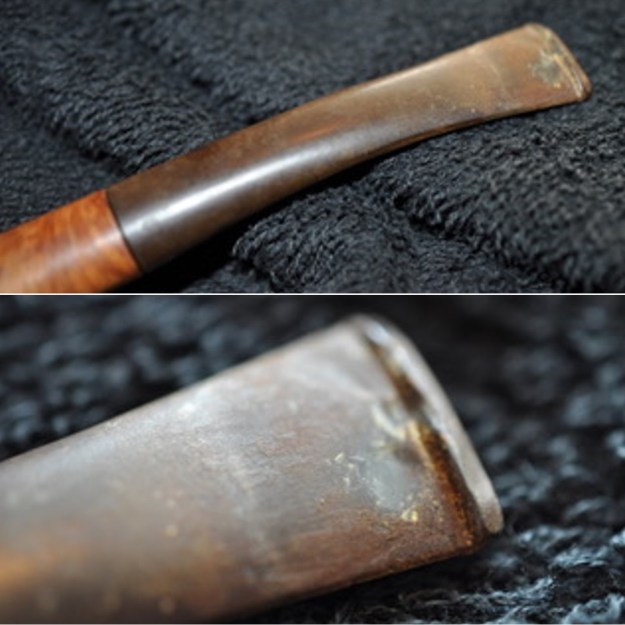
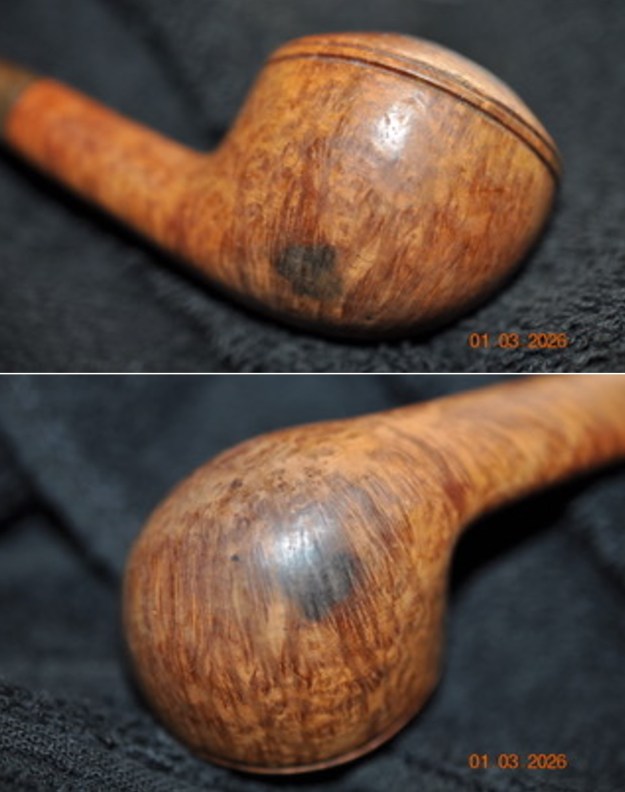
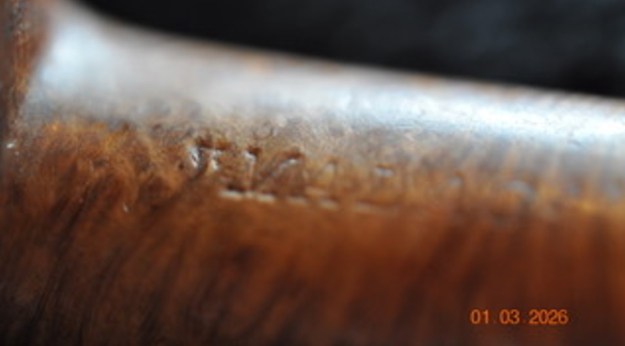
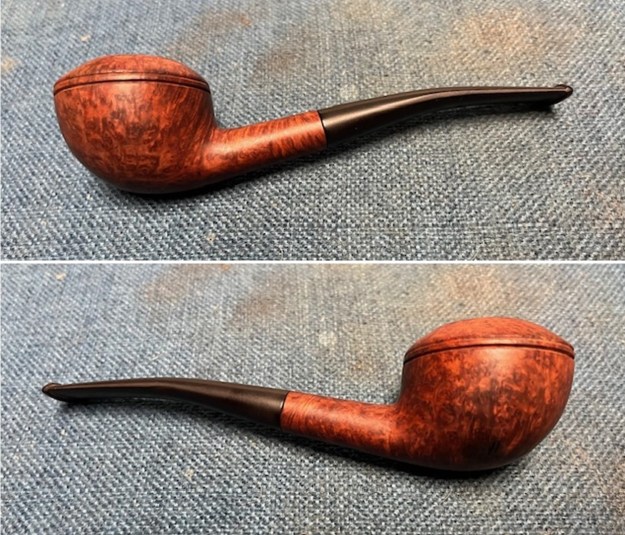
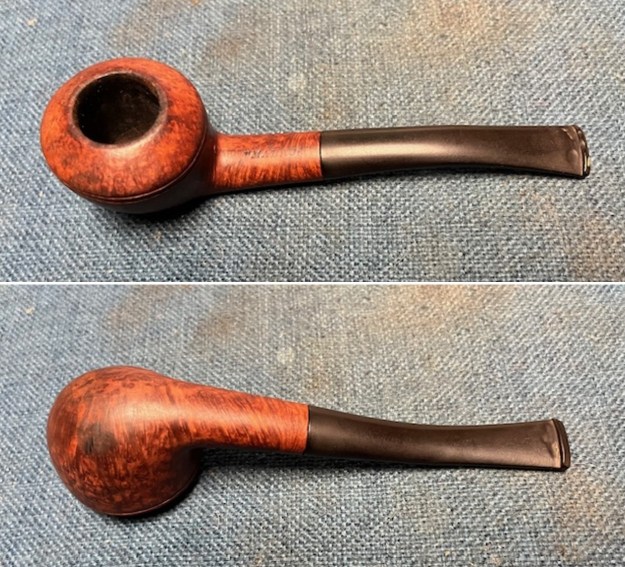
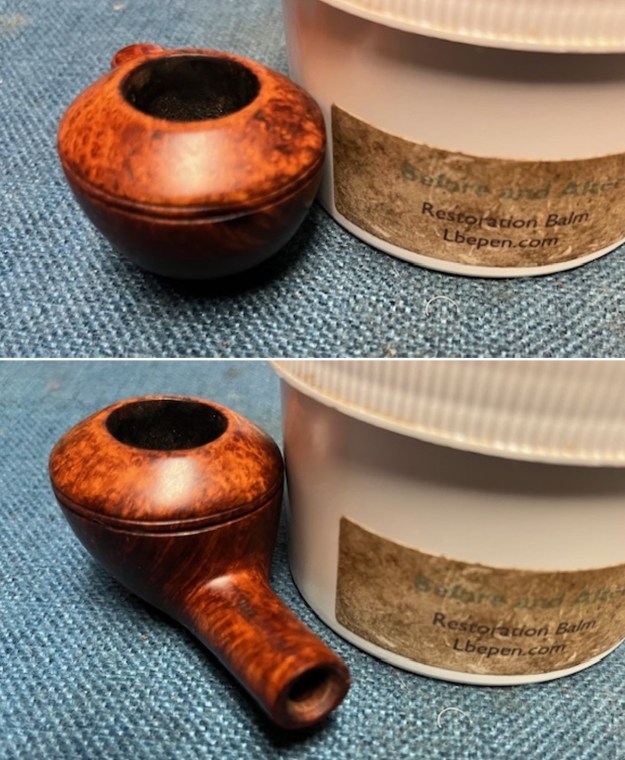
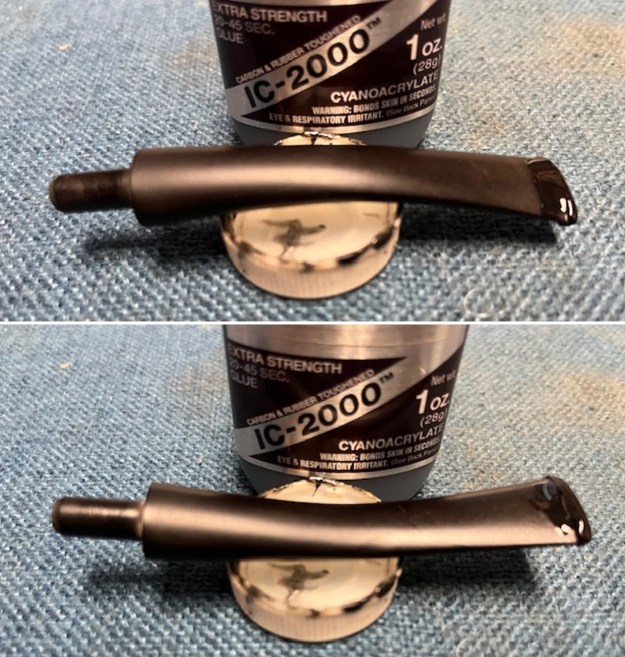
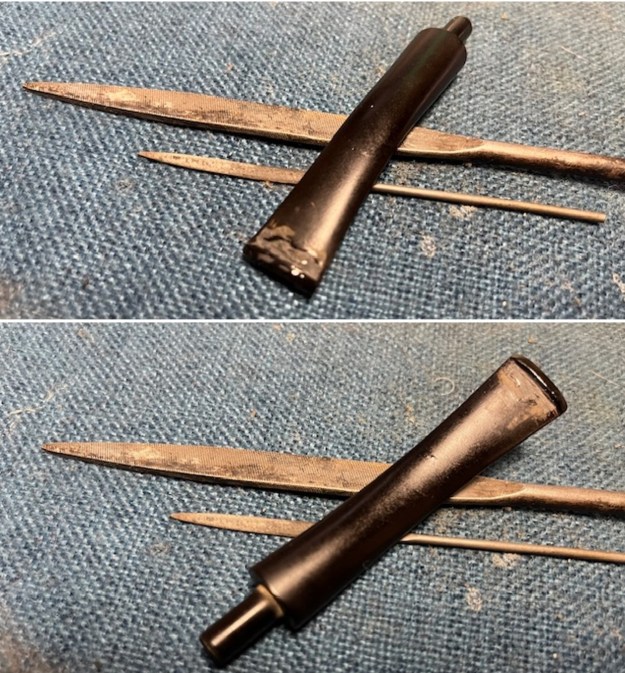
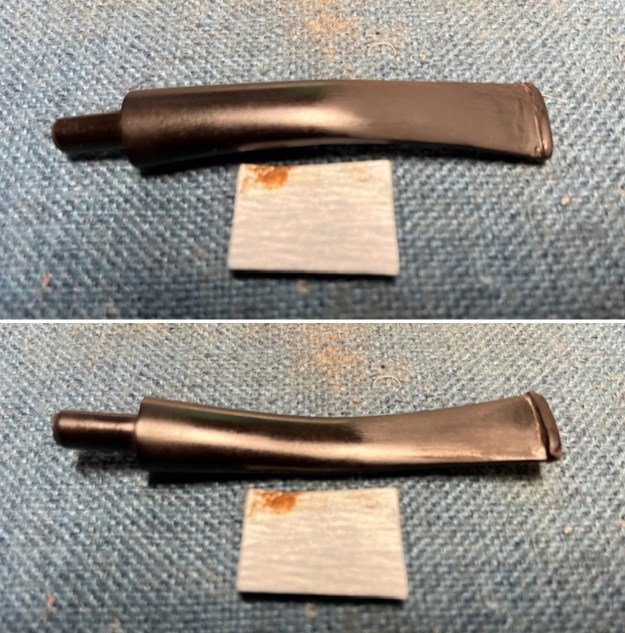
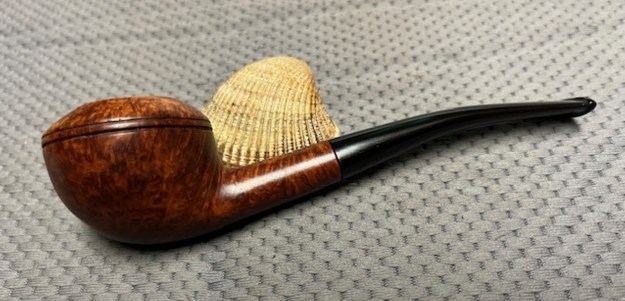
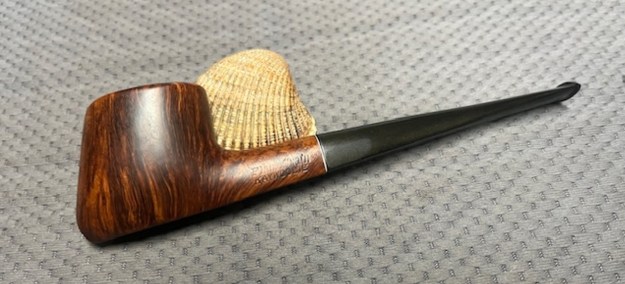
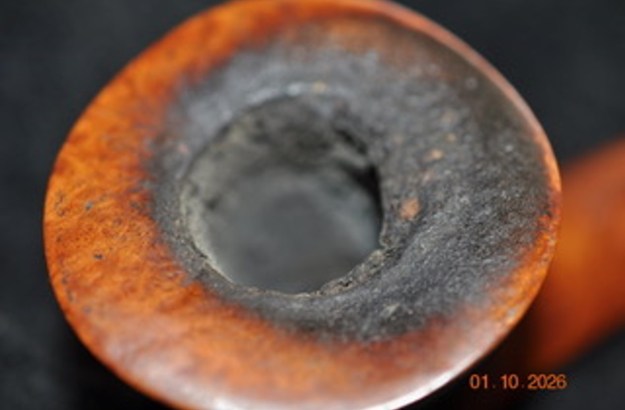
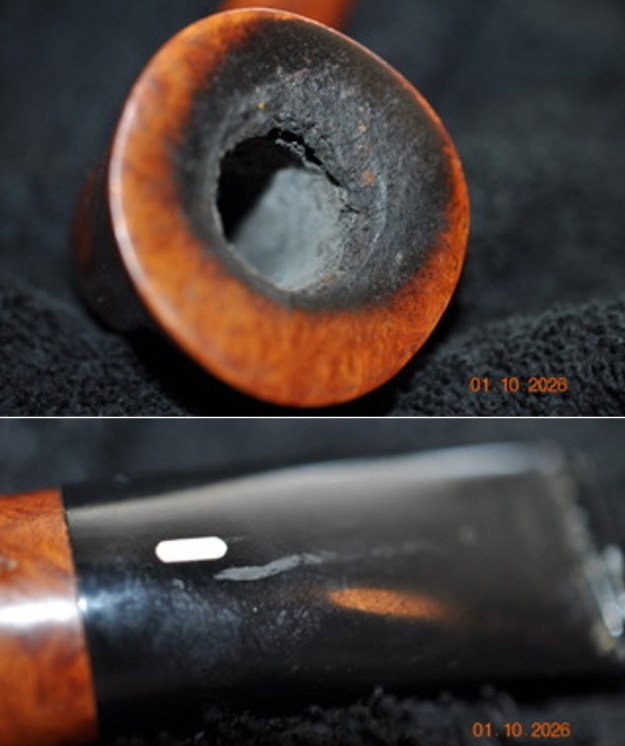
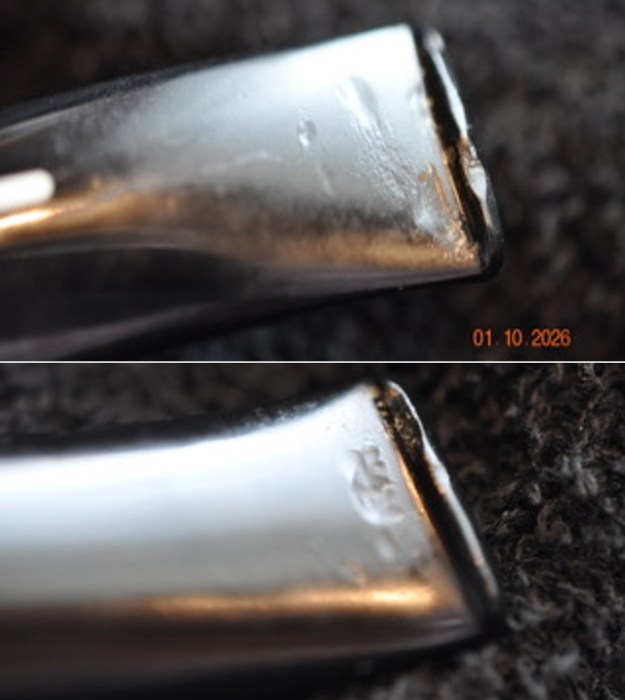
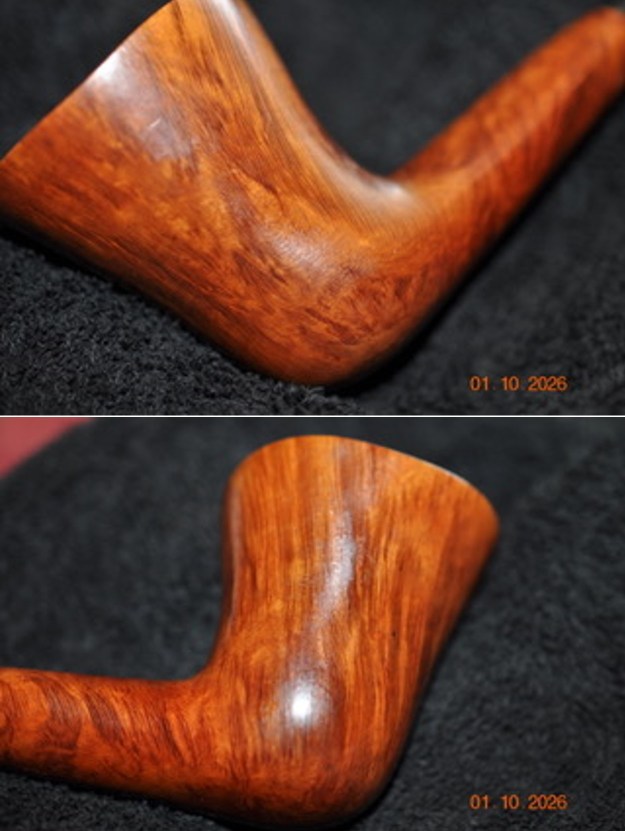
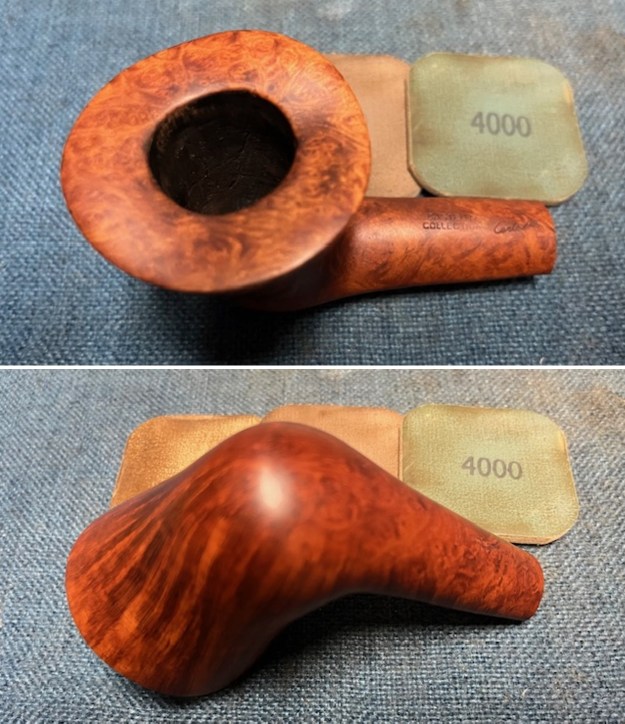
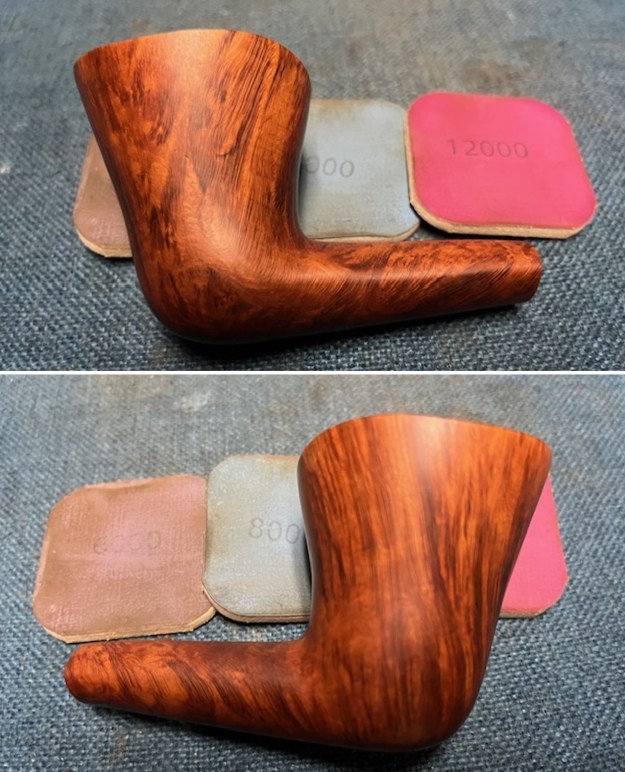
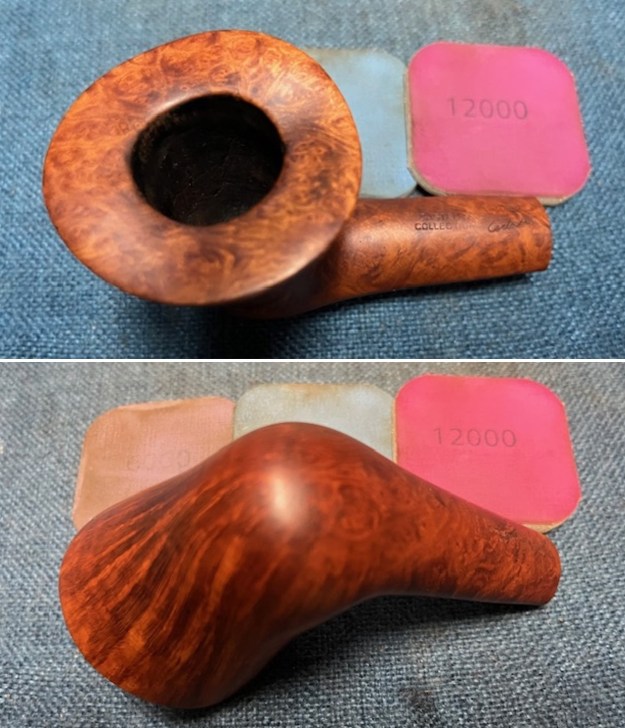
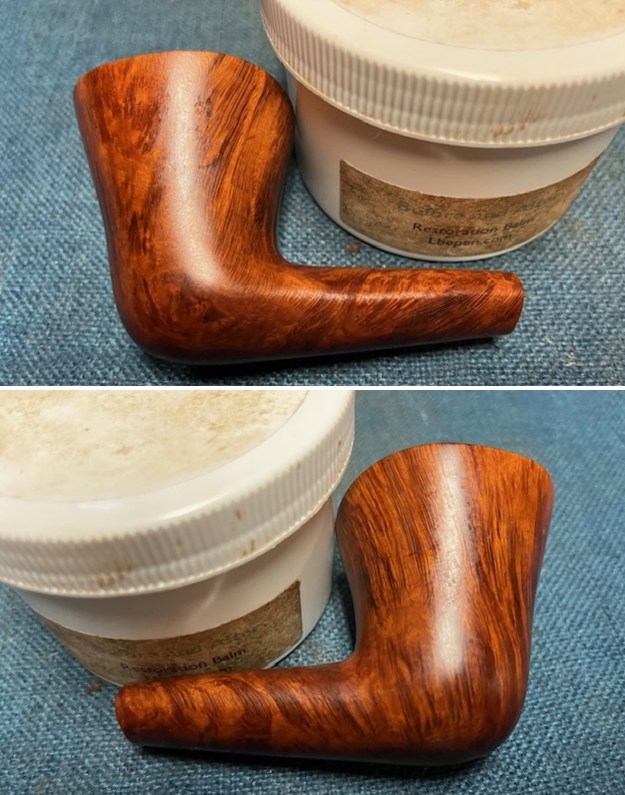
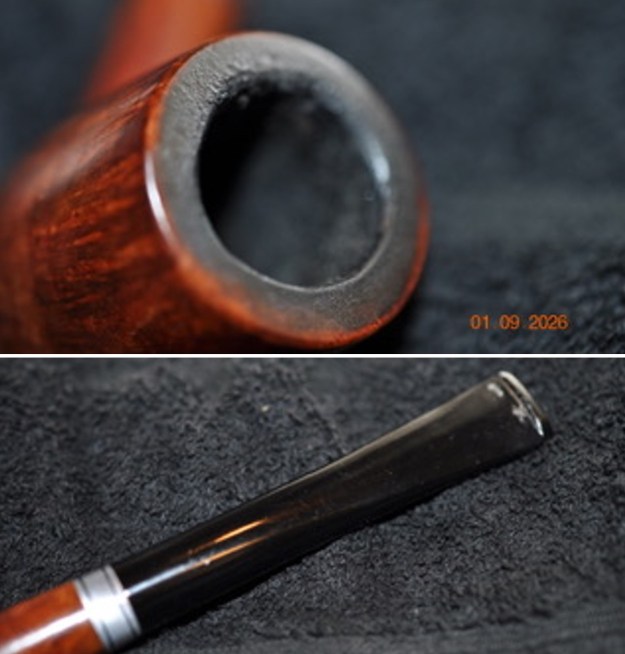
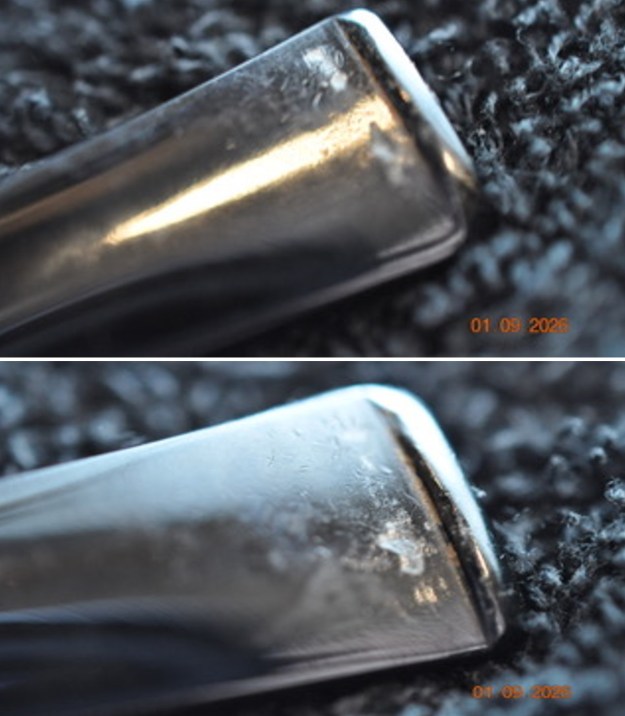
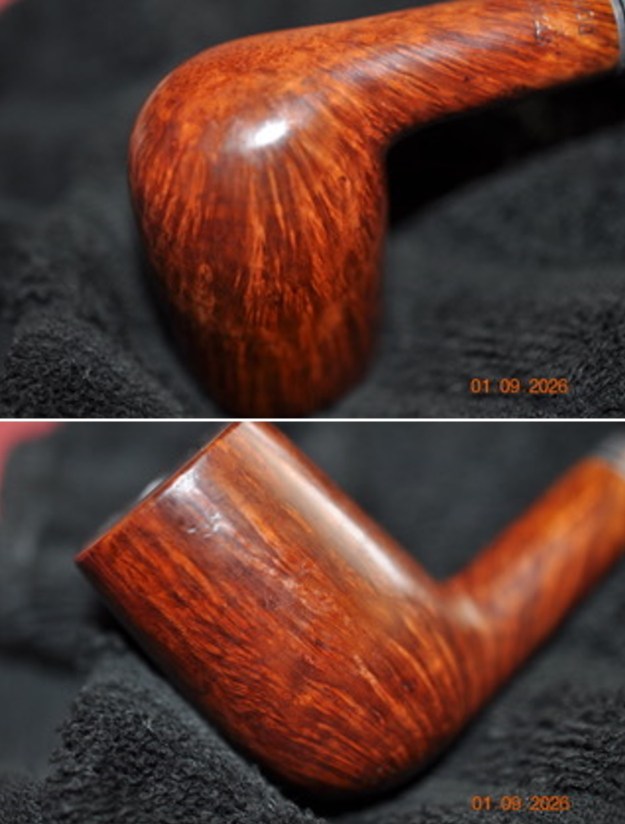
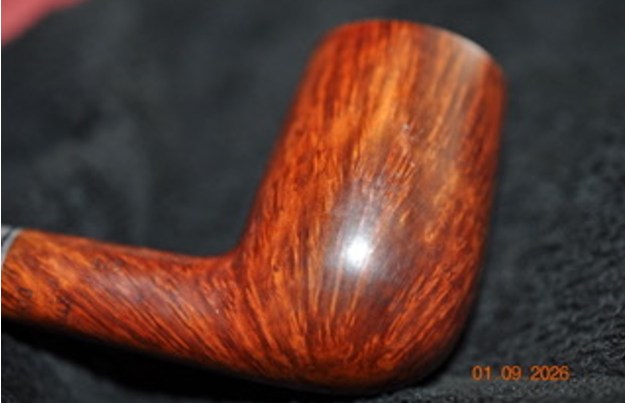
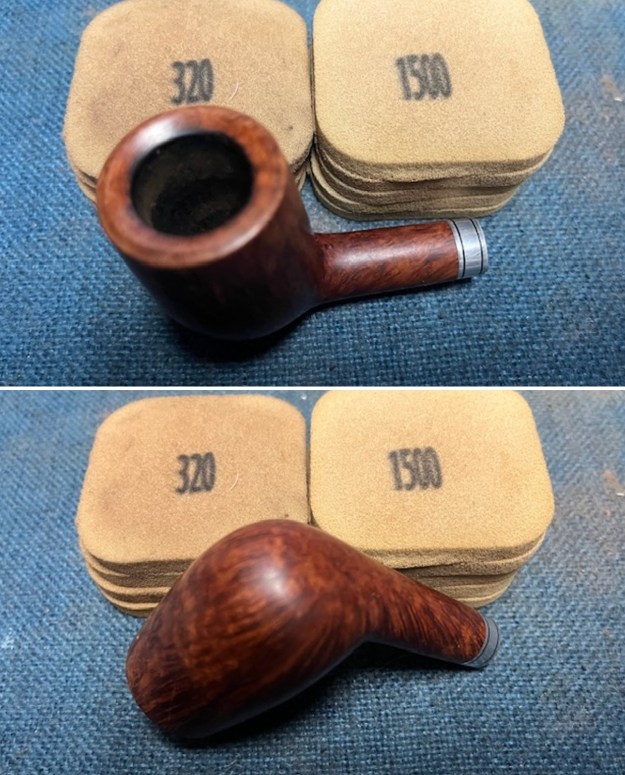
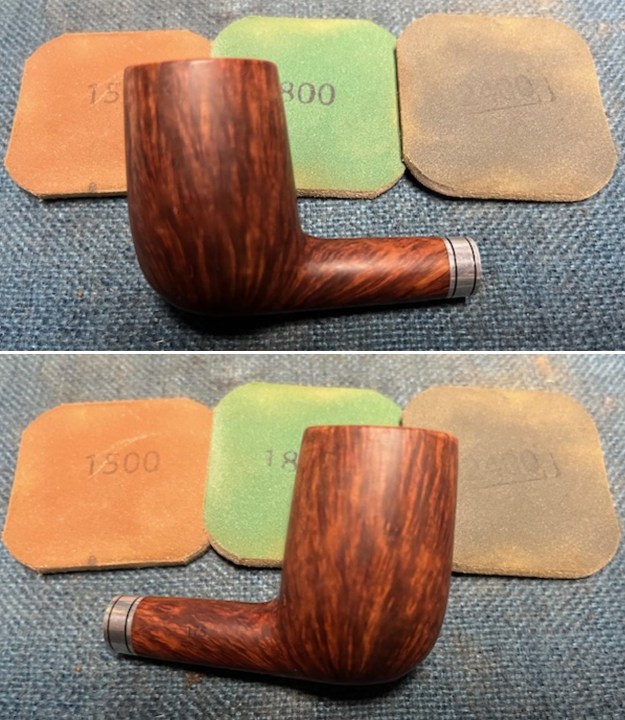
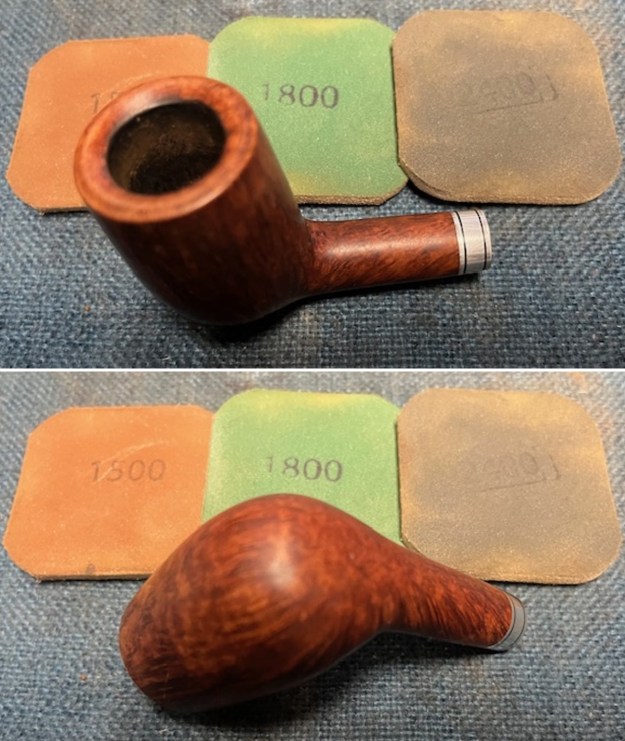
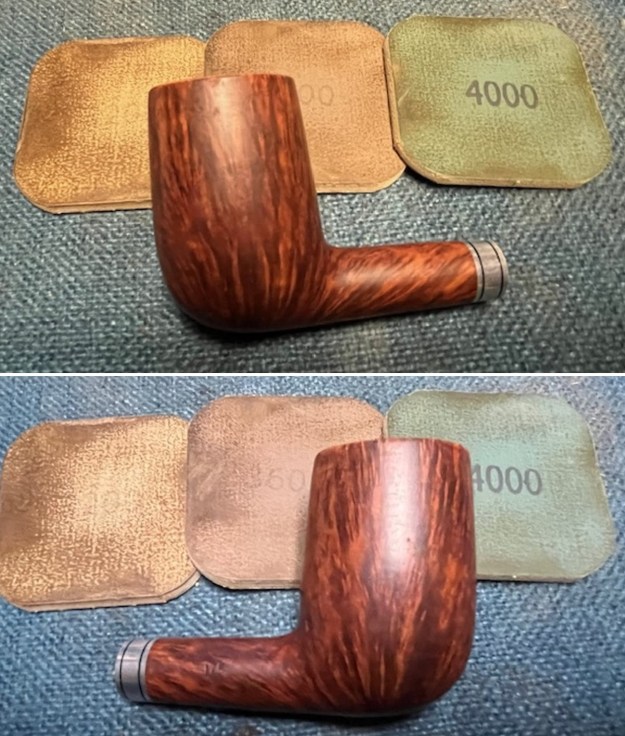
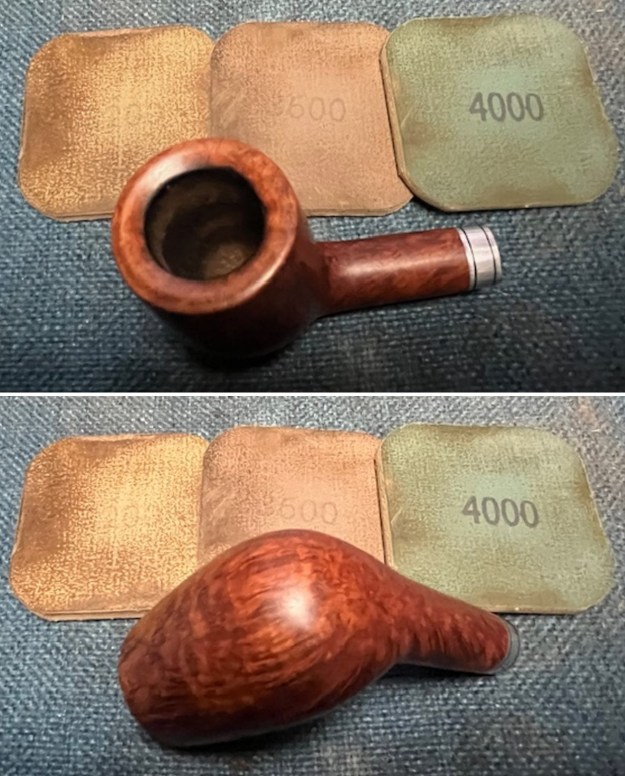
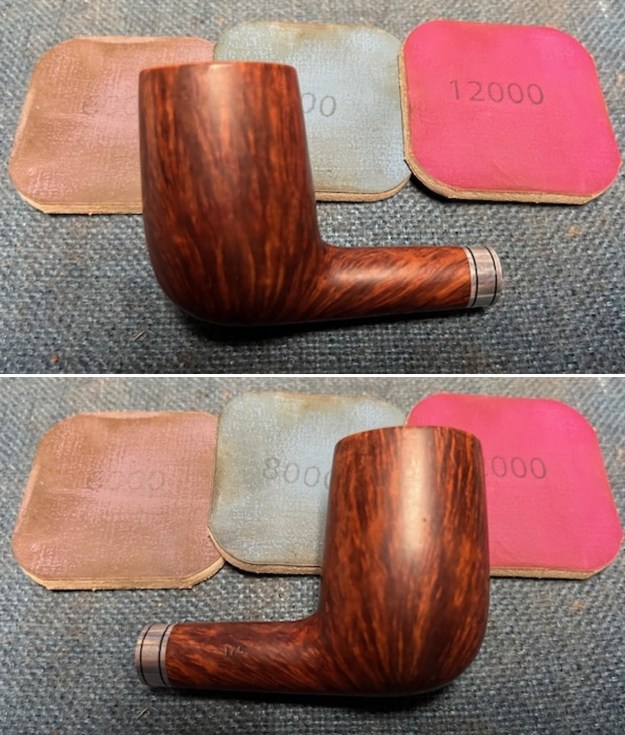
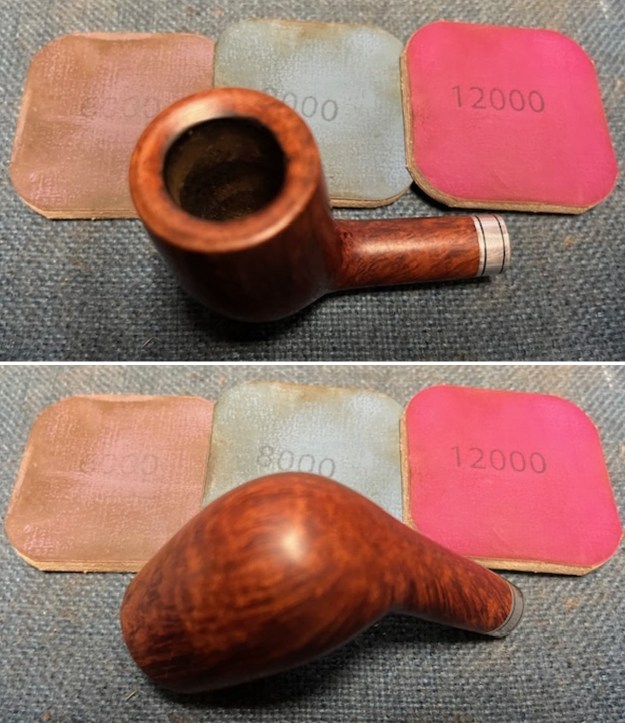
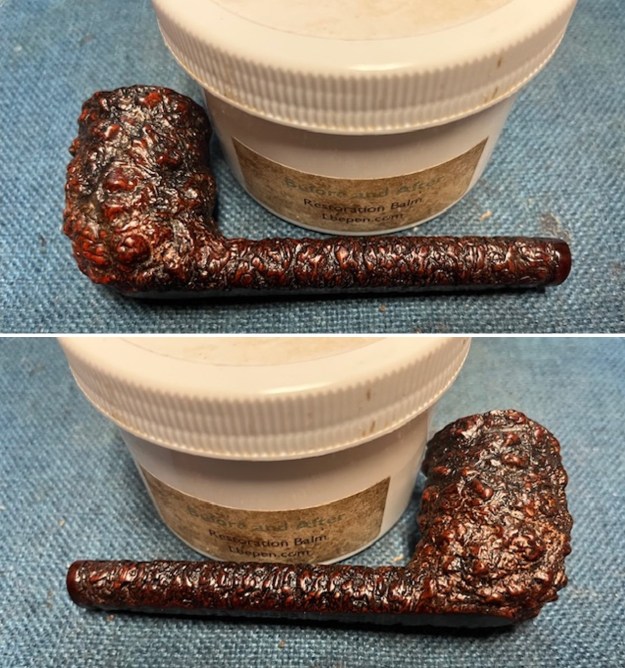
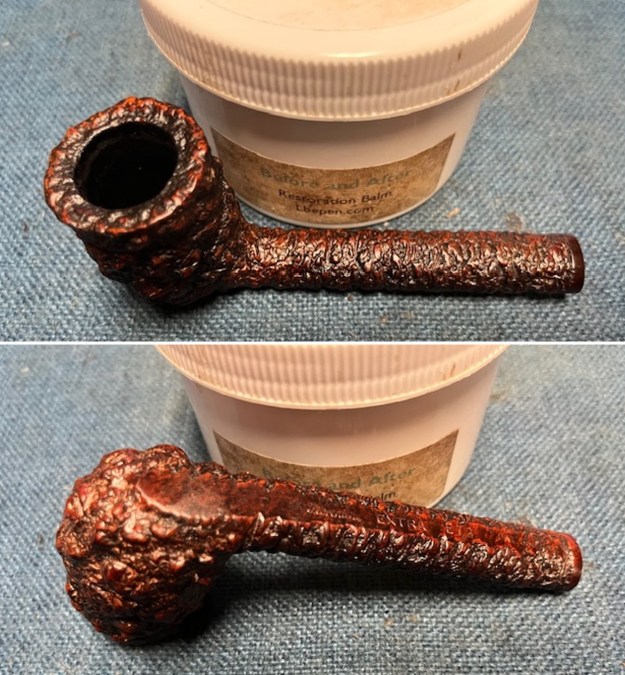
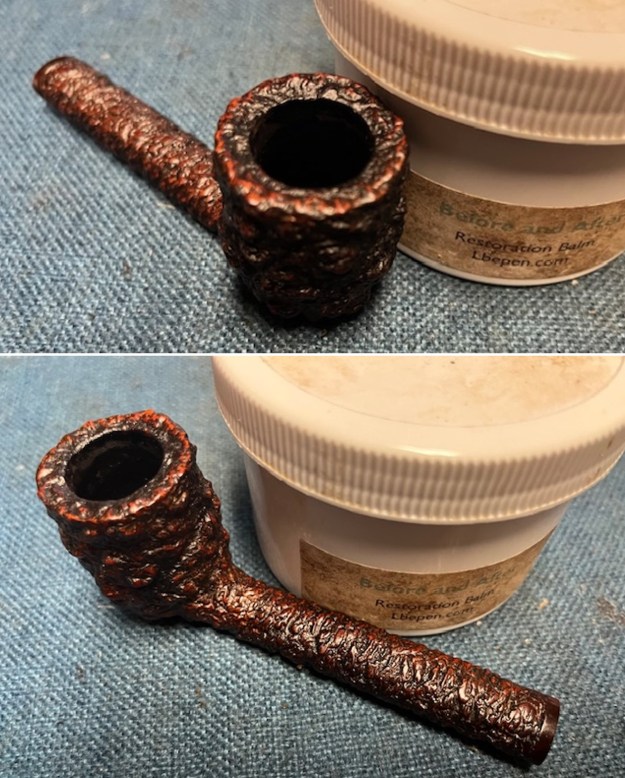
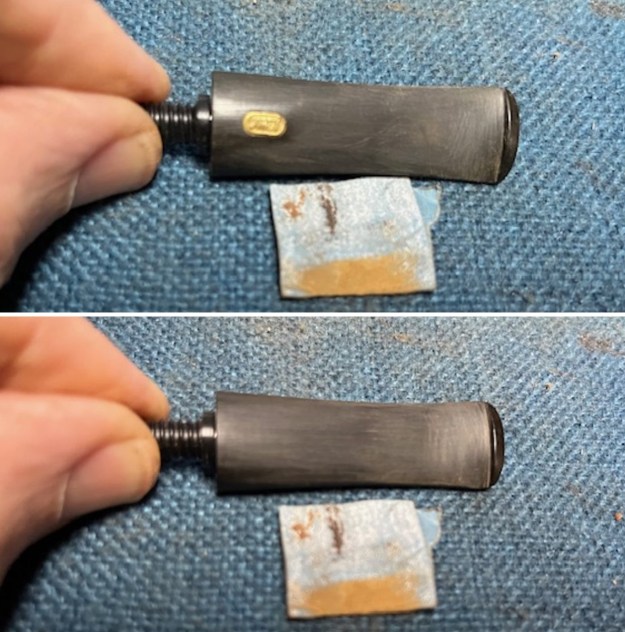
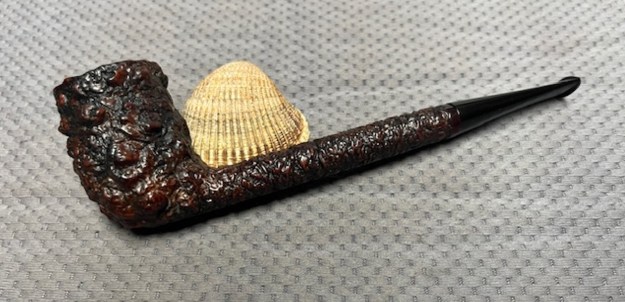
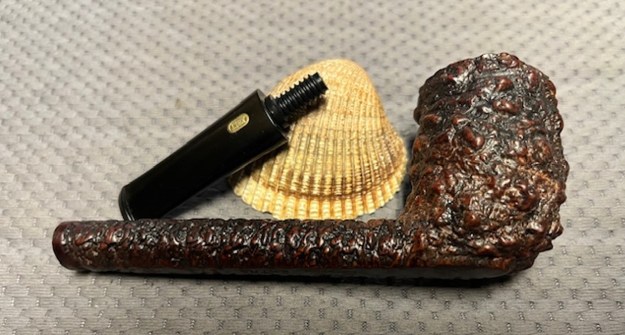
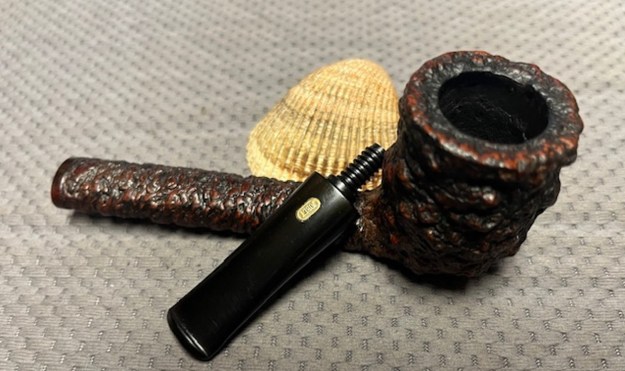
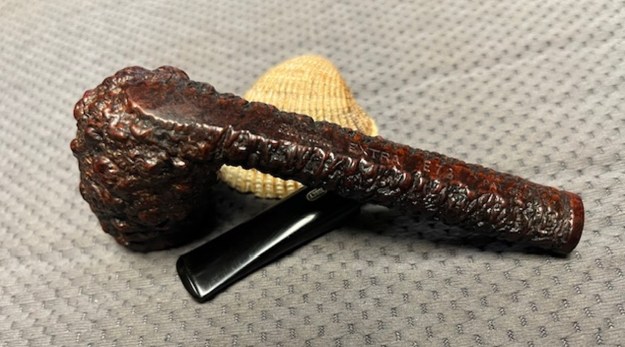
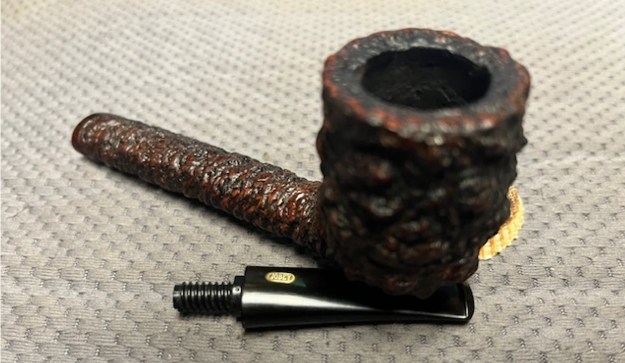
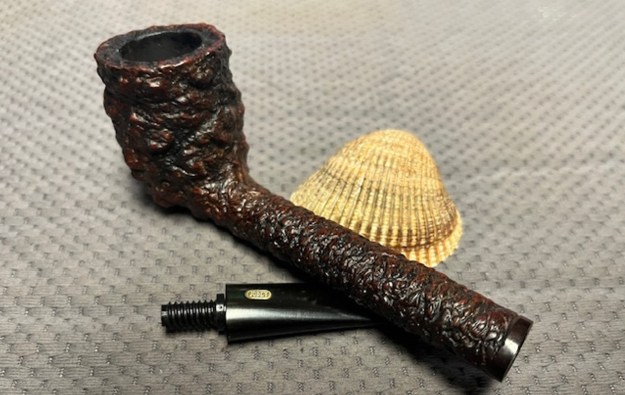
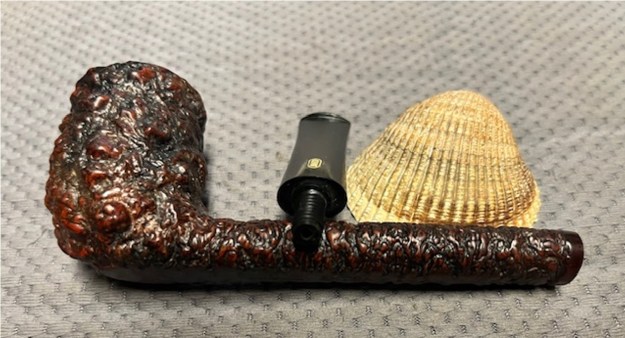
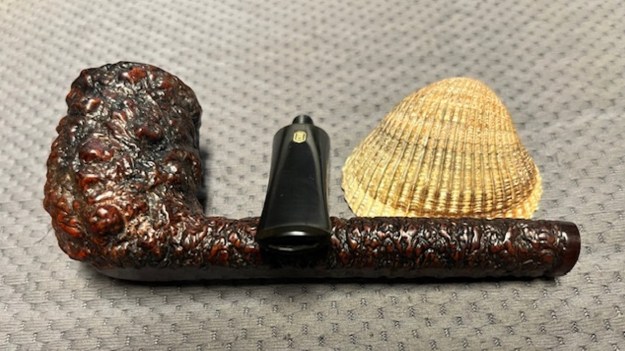
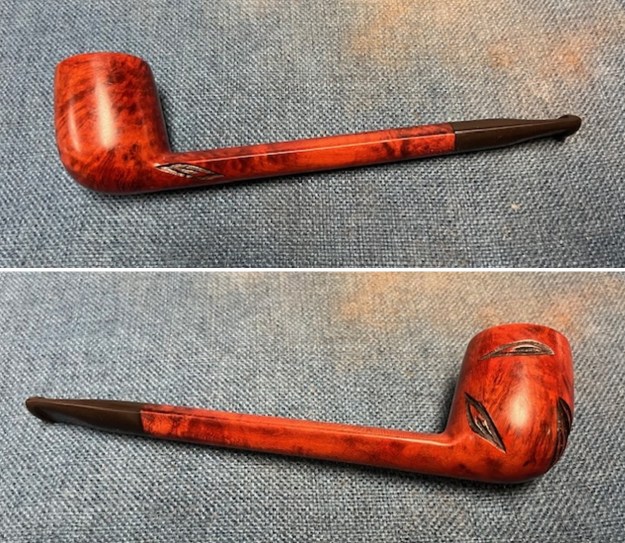
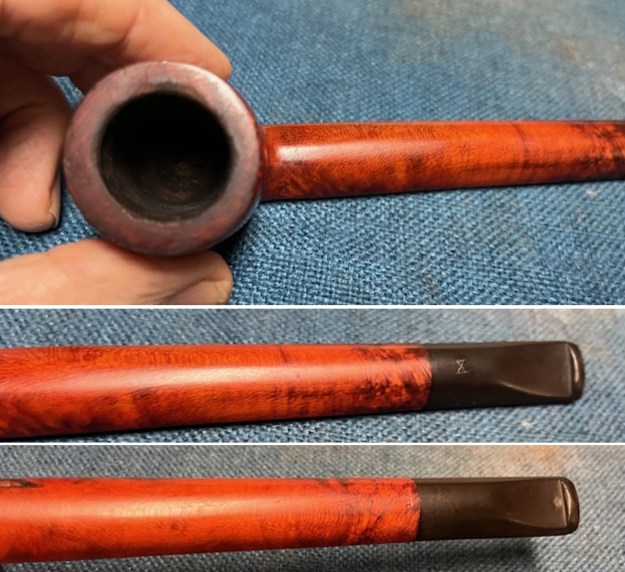
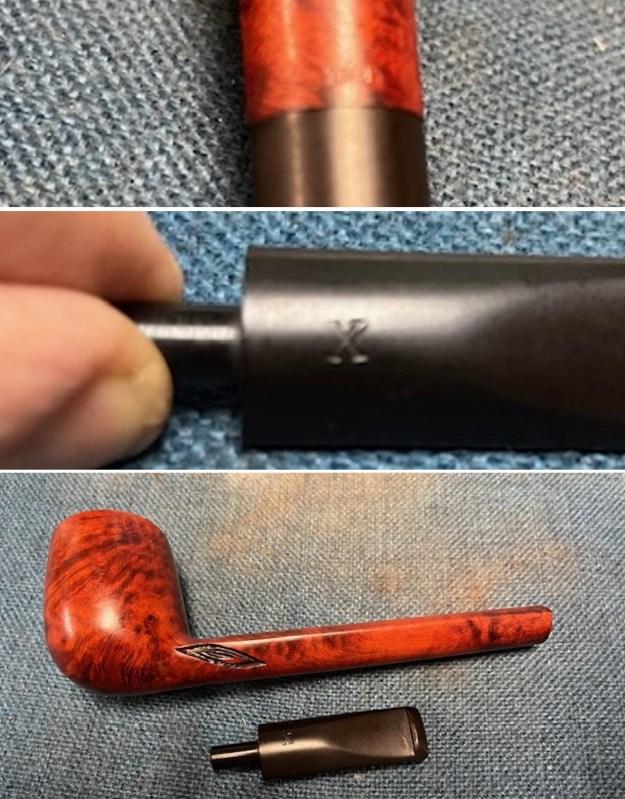
The next pipe on the table is a great looking long Canadian that Jeff picked up on 12/17/2020 from an auction in Cramerton, North Carolina, USA. The finish is smooth around the bowl and shank with some leaves carved into the finish. There is one on the left side of the shank and there are three on the right side with one of them on bottom right and front. The bowl had been coated with a varnish coat that was spotty in places and would need to be removed. It is a great looking pipe. It is stamped on the underside at the shank/stem junction it reads Israel. The finish was dirty and had a lot of grime and grit ground into the rustication and the smooth portions. The rim top and inner edge of the bowl is dirty with a heavy lava flow on the edge and the top. There is a thick cake in the bowl. The taper stem has an X logo on the top. It is lightly oxidized and there were tooth marks and chatter on the surface. Jeff took photos of the pipe before he started his clean up work. It showed a lot of promise.He took close up photos of the bowl and rim top from different angles to show the condition of the bowl and the rim top. You can see the lava on the rim top and on the inner edge of a caked bowl flowing onto the top. He took photos surface of the vulcanite stem which is lightly oxidized and dirty. It has tooth marks on both sides as well as chatter. He took photos of the sides and heel of the bowl to show the rich reddish finish and the carved leaves around the right side and shank. There is great grain peeking through the grime on the shank and the sides of the bowl. Jeff took photos of the stamping on the underside of the shank to capture it. It was clear and readable as noted above. He also took a photo of the X logo on the stem top. I turned to both Pipephil and Pipedia to see if I could find any information on the stamping on the pipe. There was nothing stamped with both Israel on the shank and X on the stem top. I am pretty convinced that the pipe was made by the Shalom Pipe Company in Israel and the makers of Alpha pipes. The shape and the conformation of the pipe remind me of other Shalom pipes. While I will never know the maker for certain I am fairly confident it as noted above. It is a neat looking pipe.
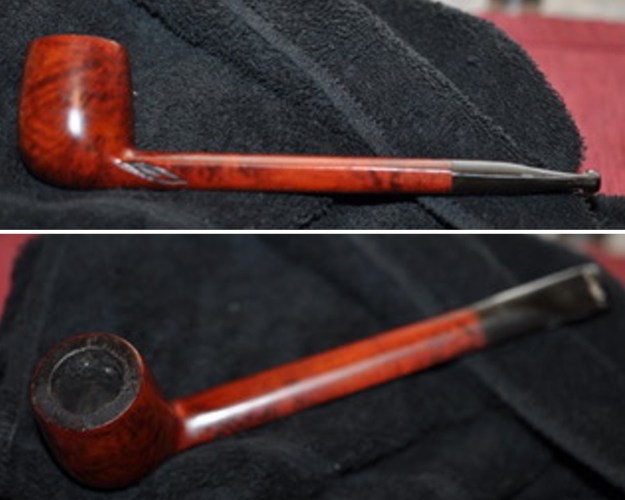
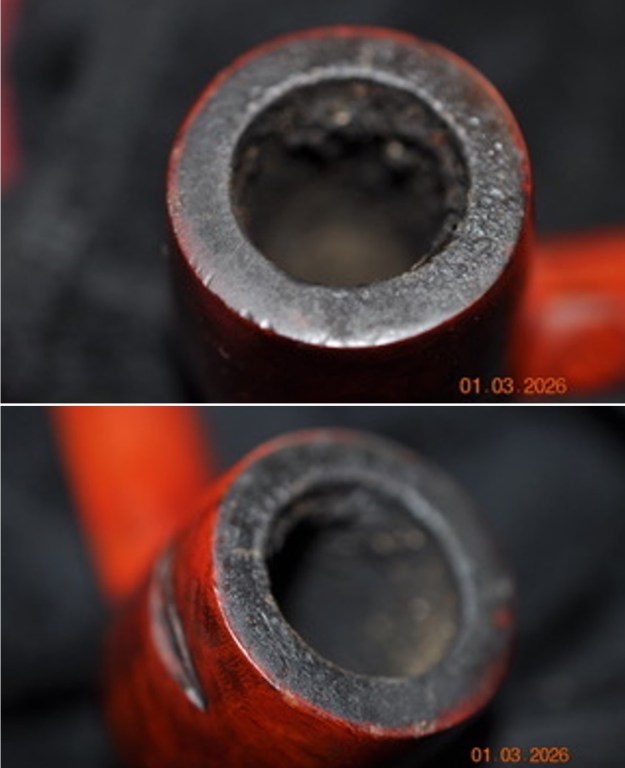
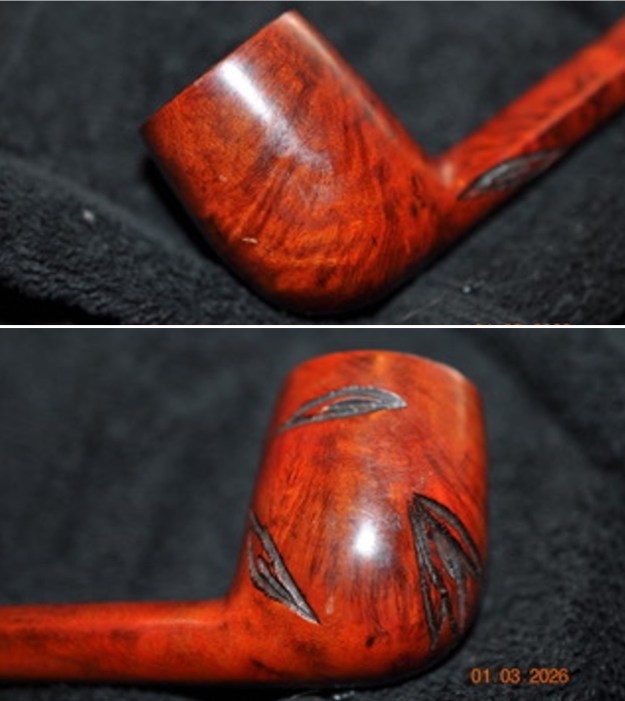
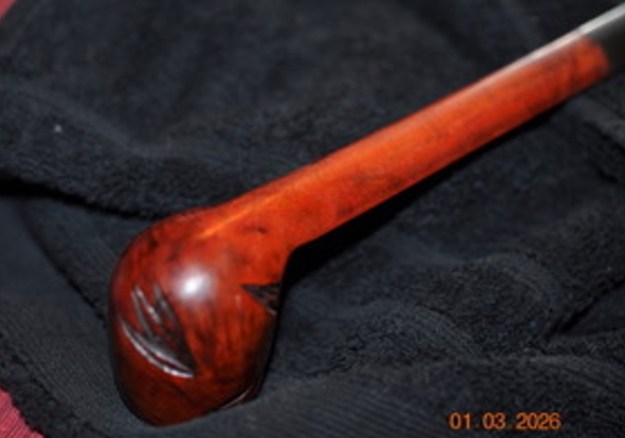
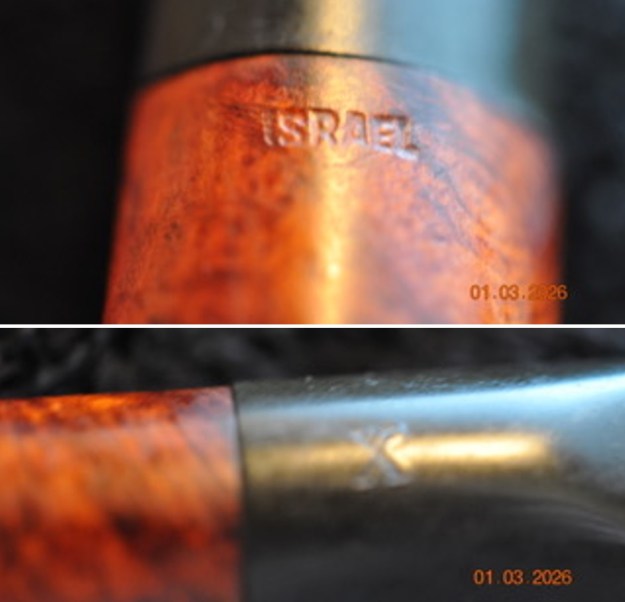
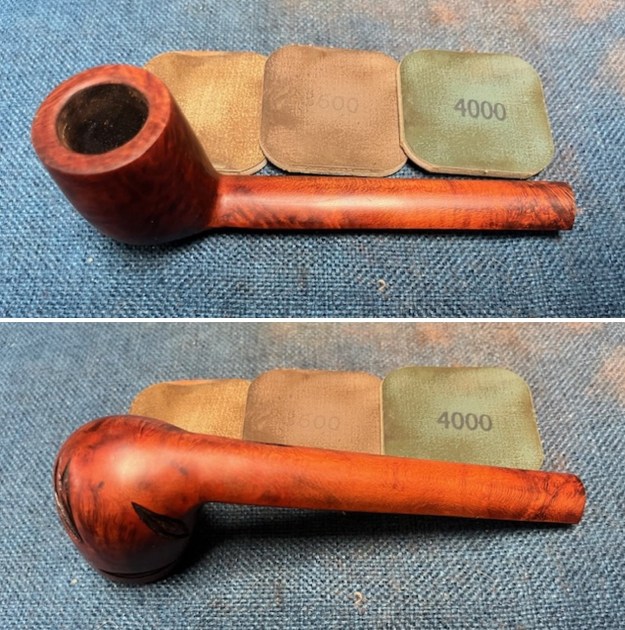
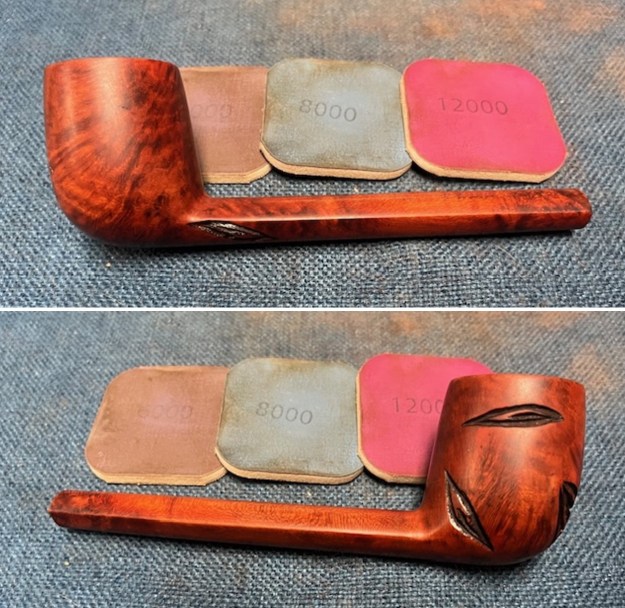
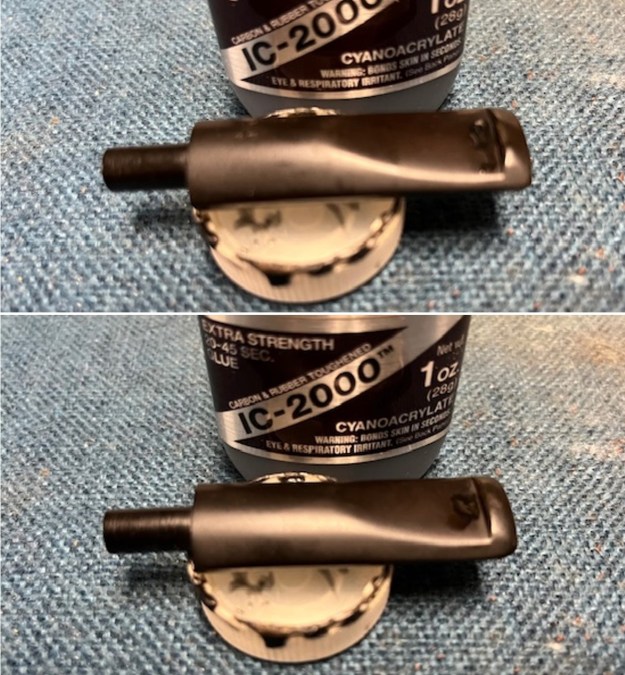
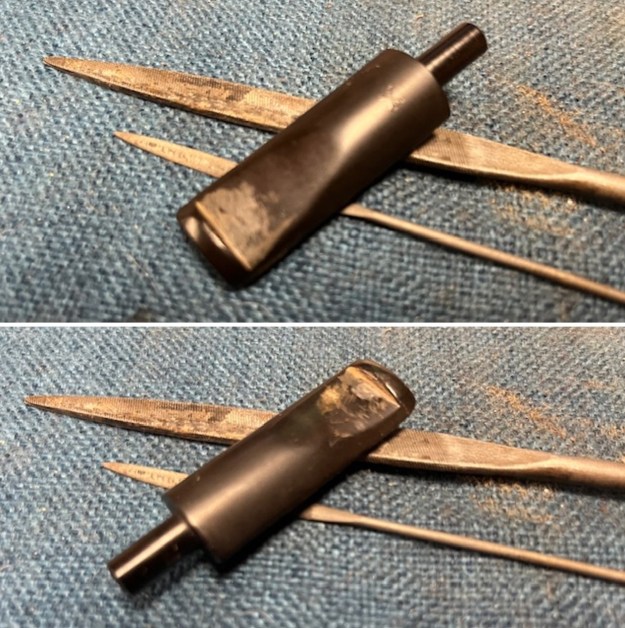
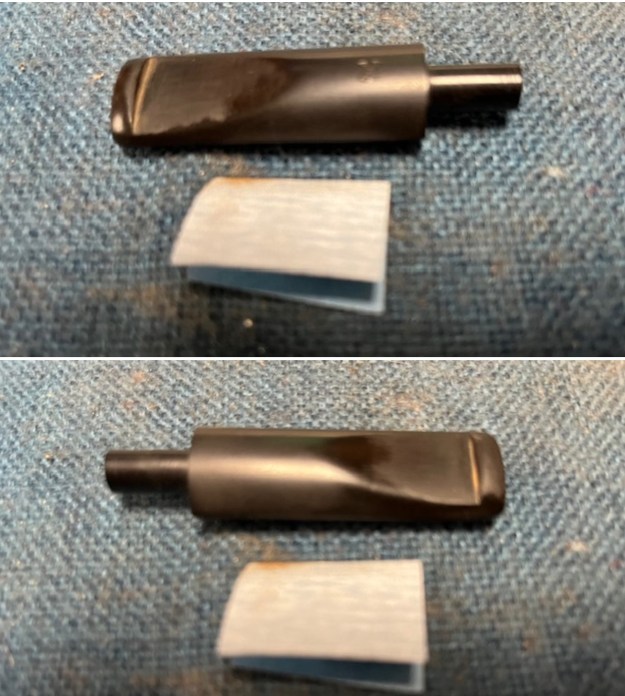
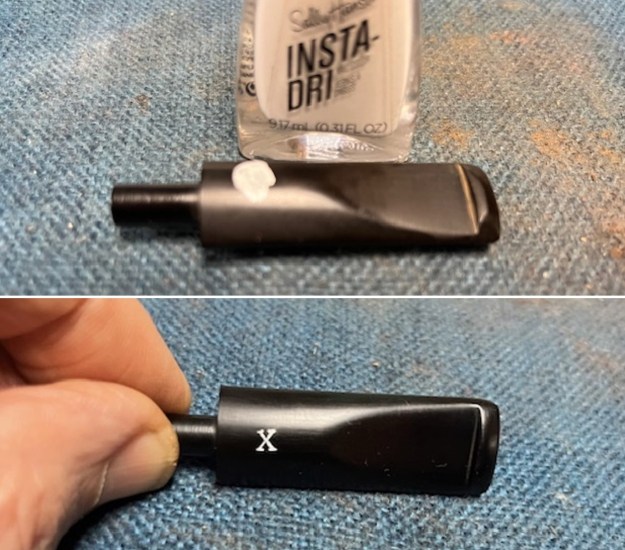
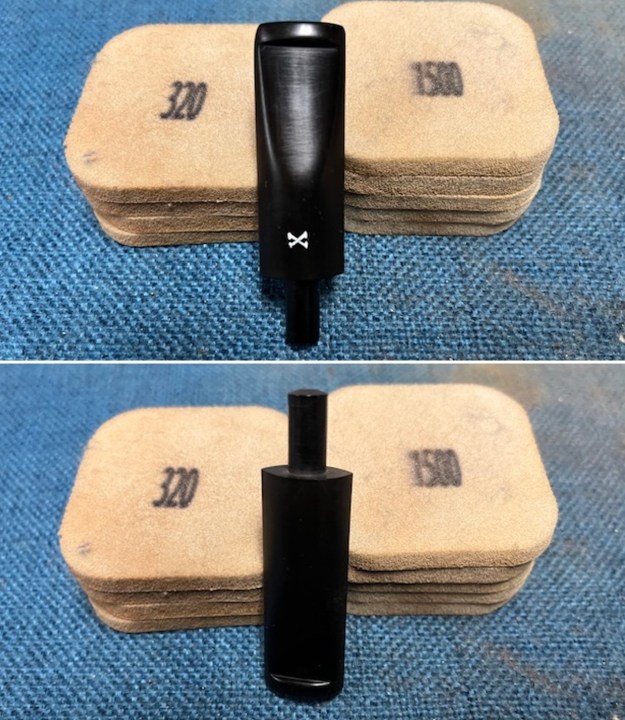
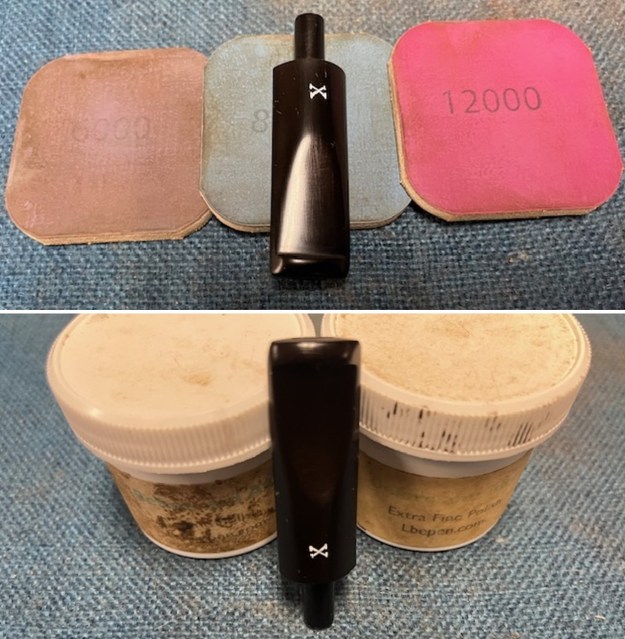
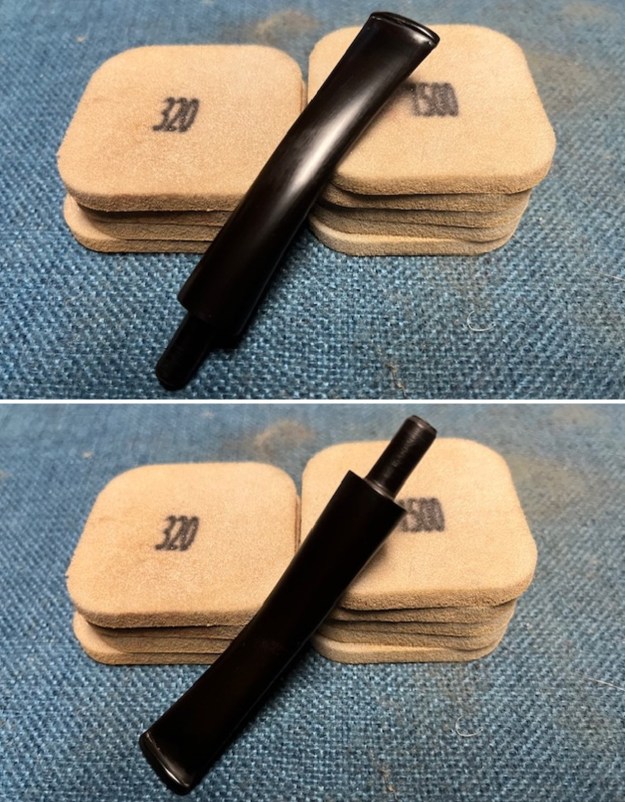
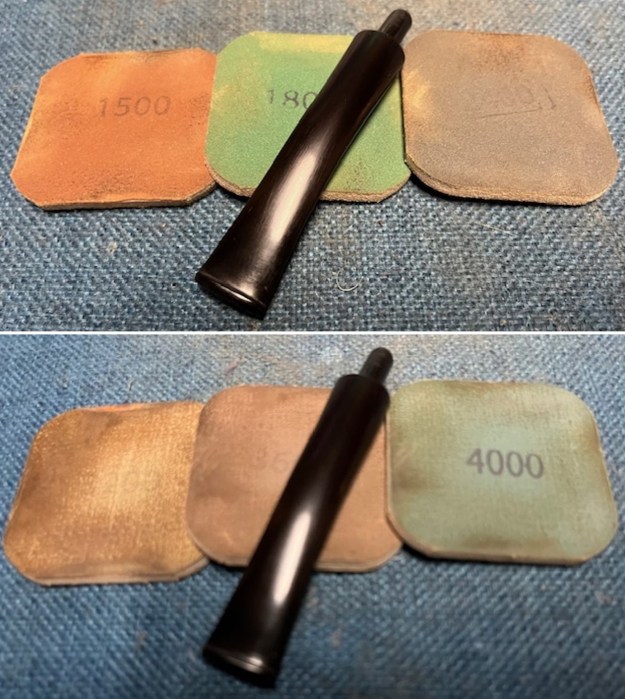
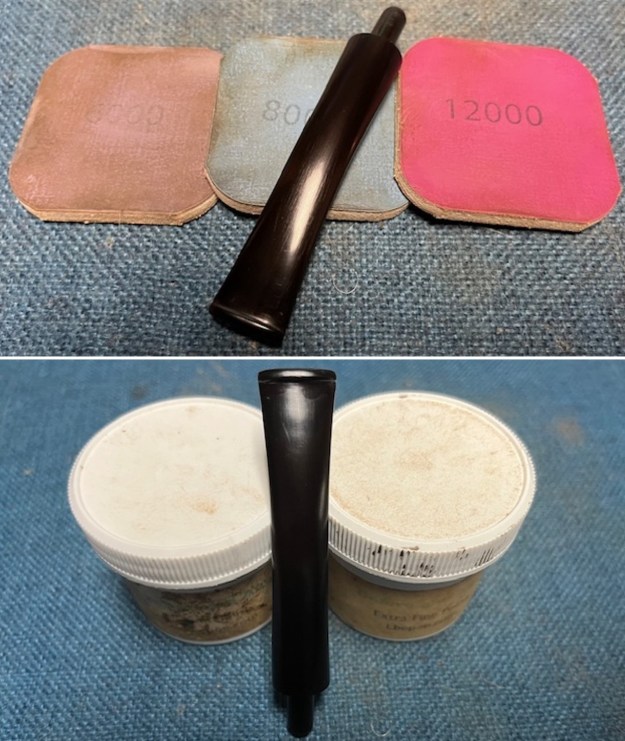
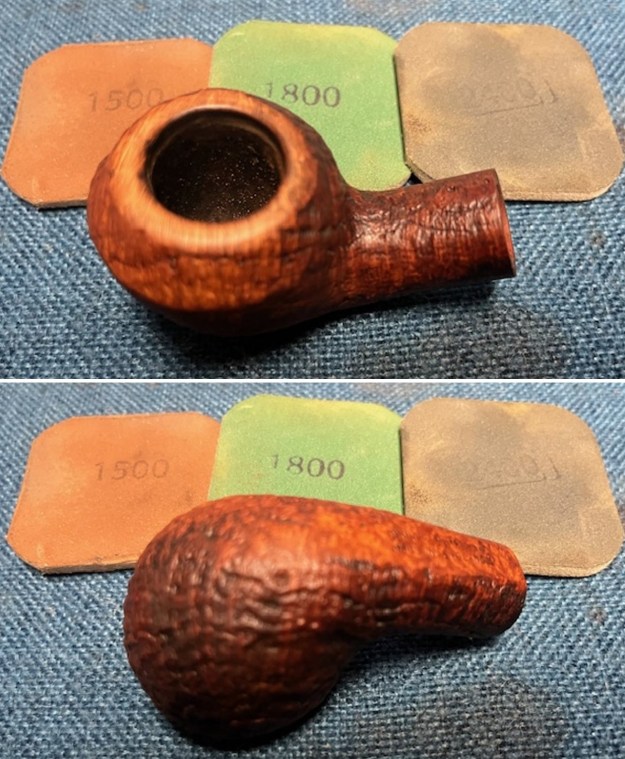
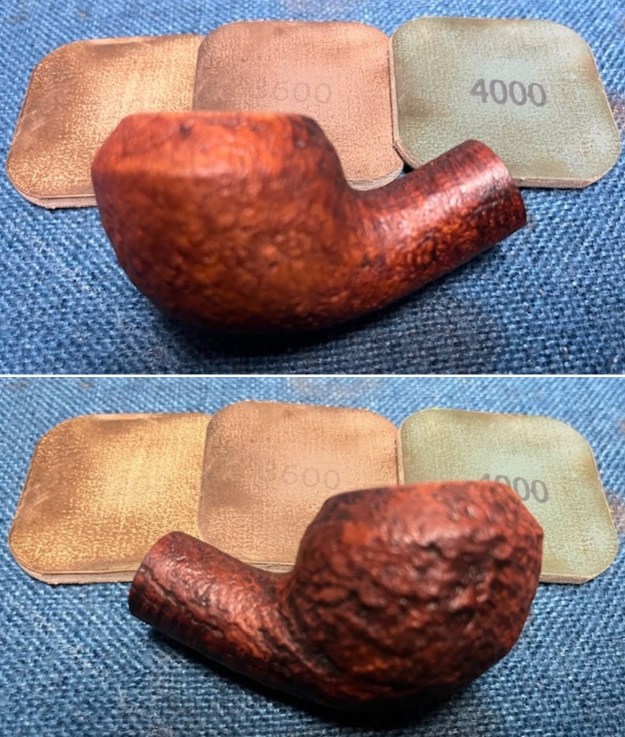
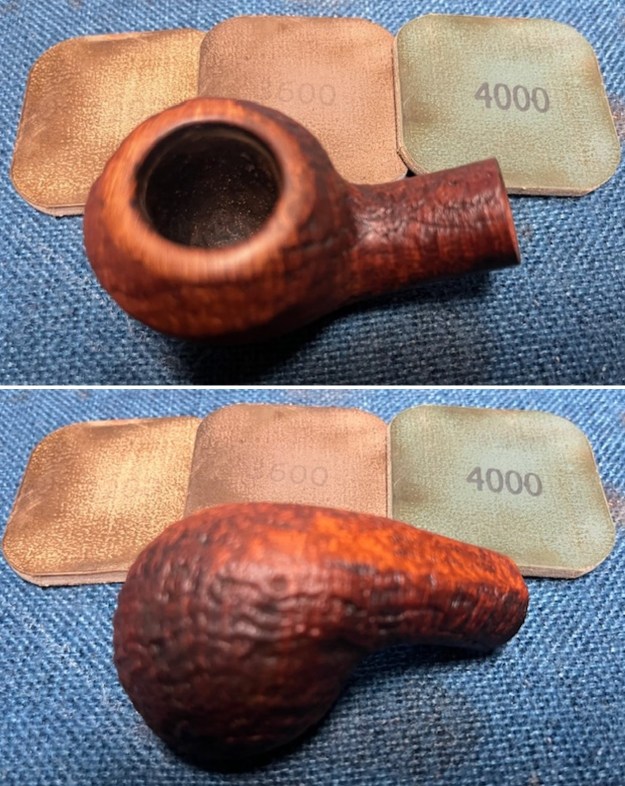
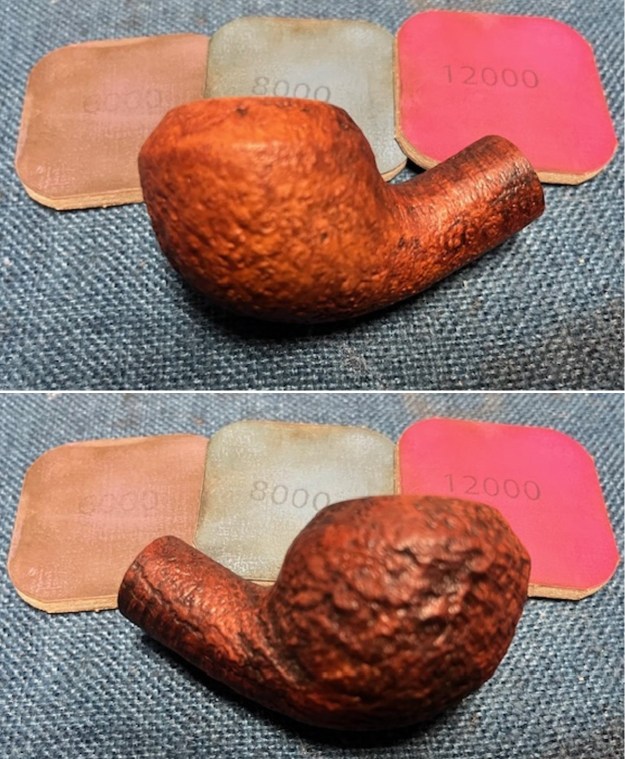
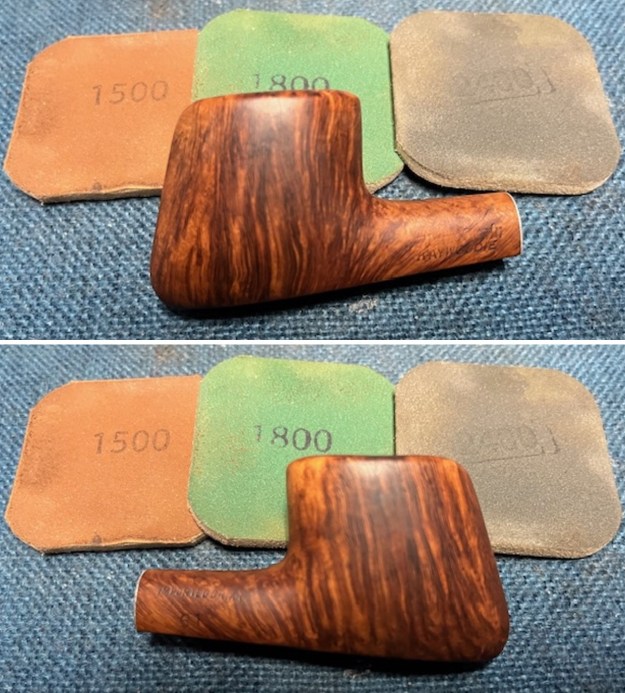
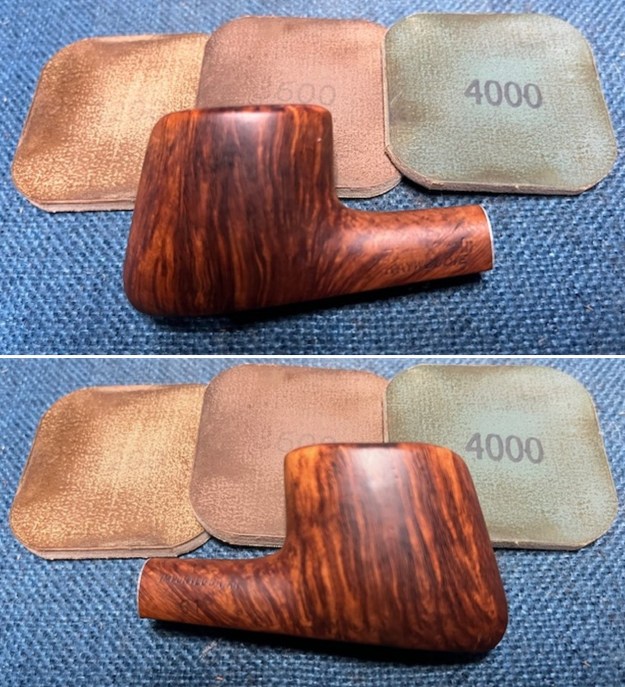
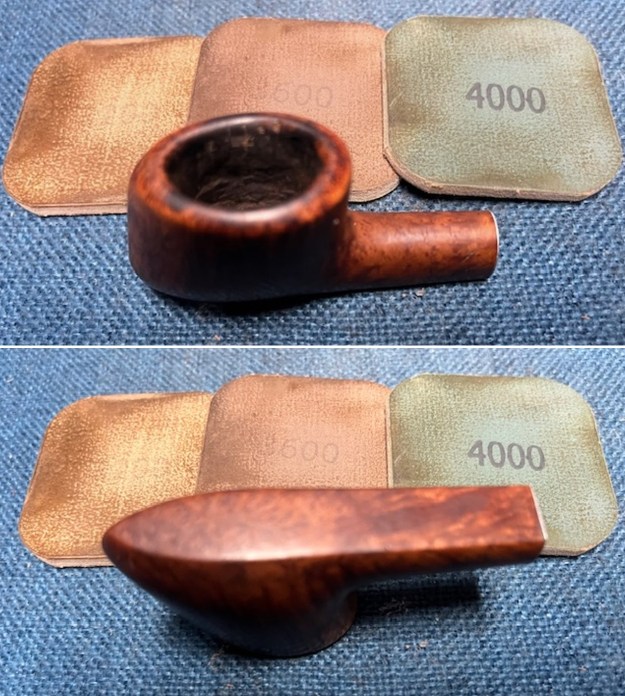
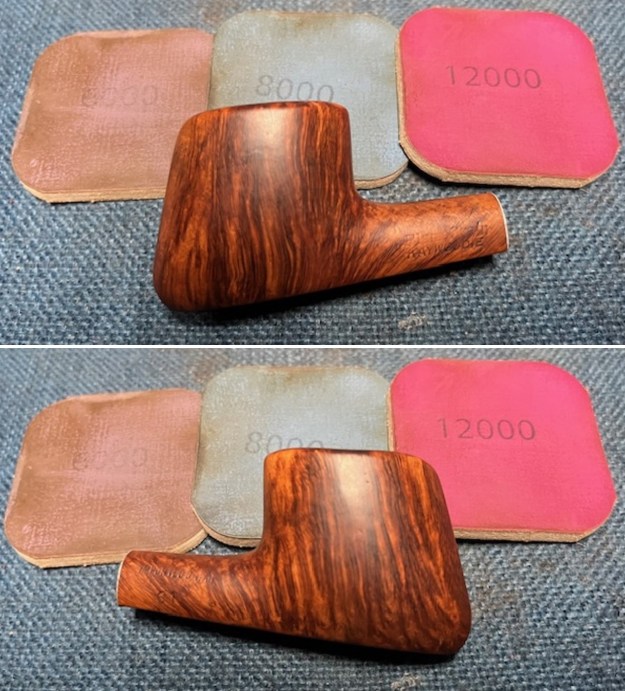
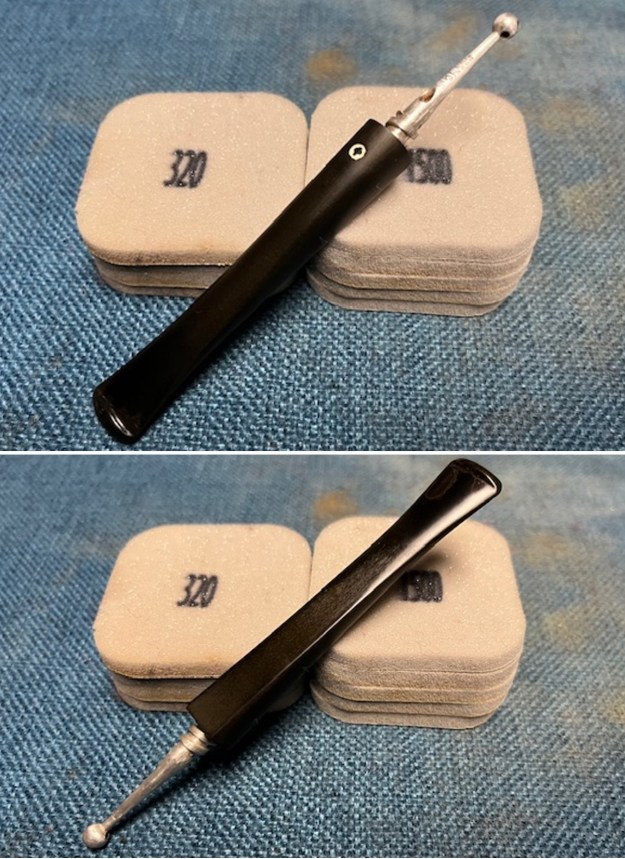
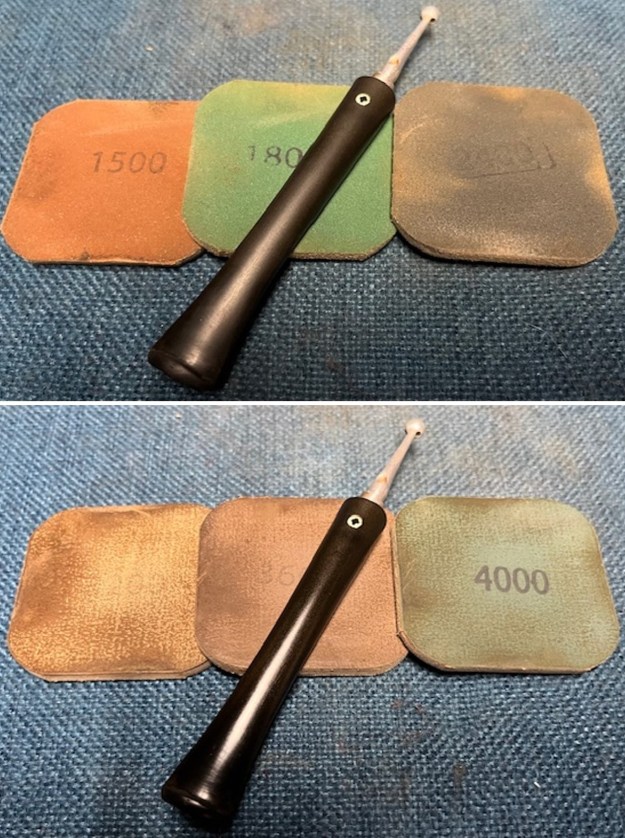
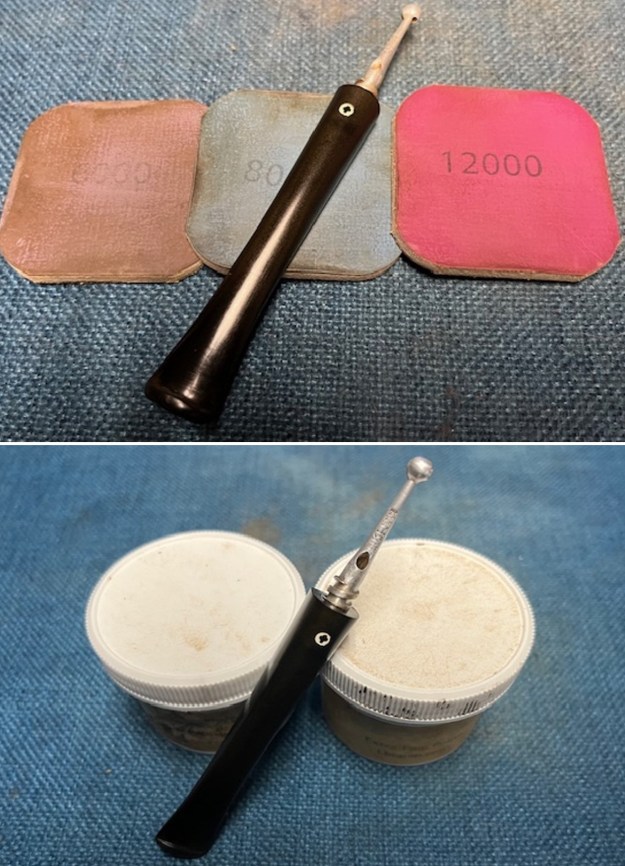
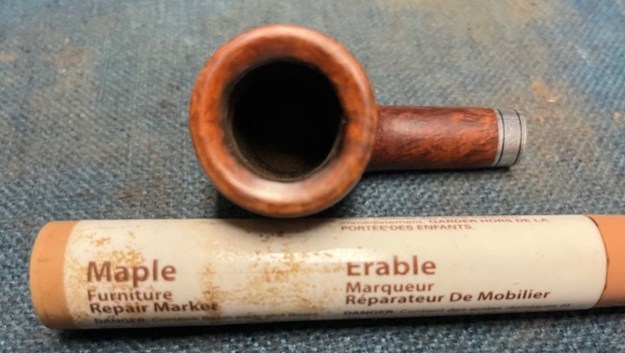
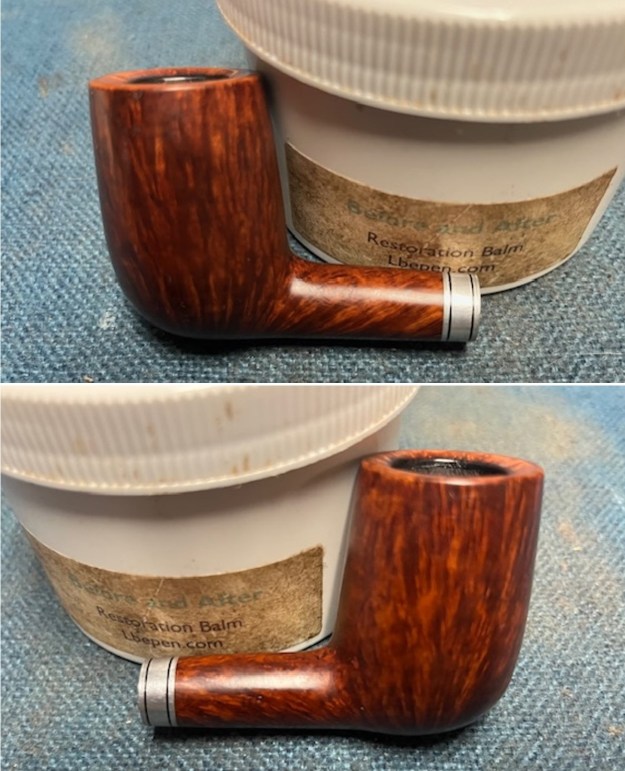
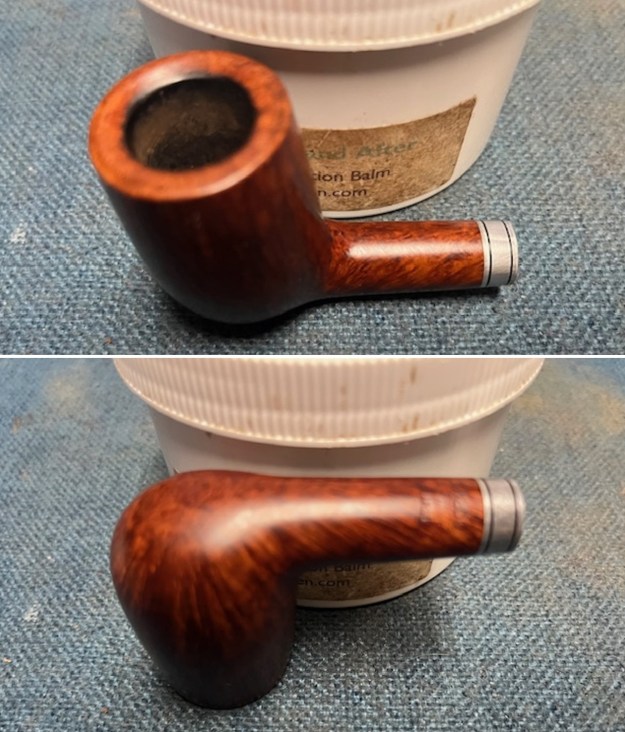
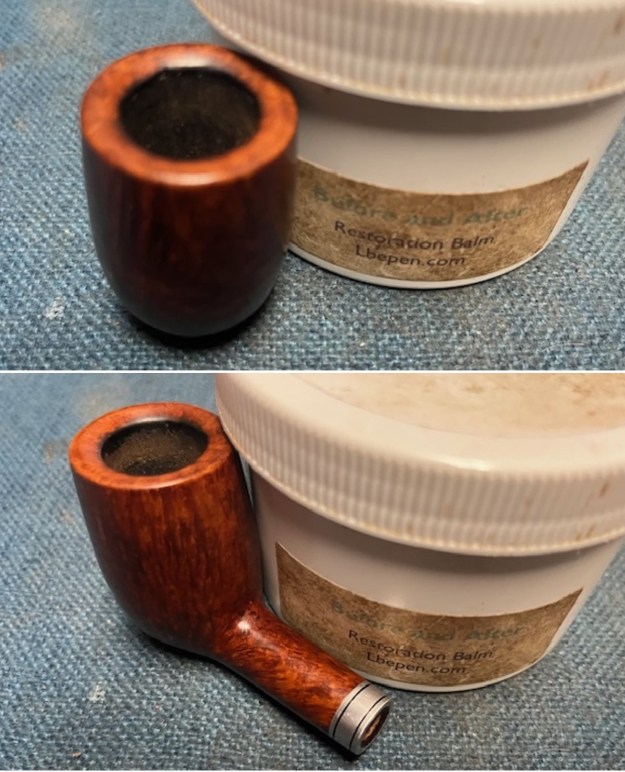
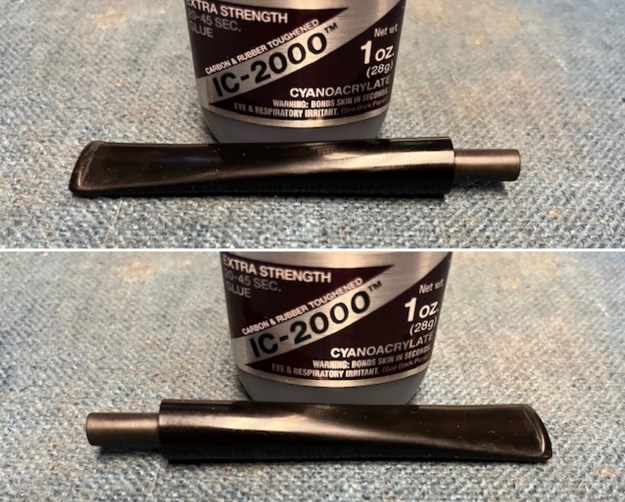
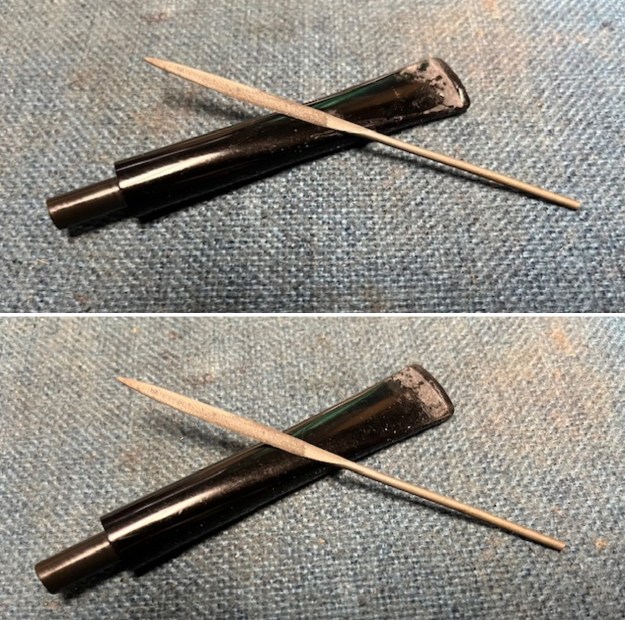
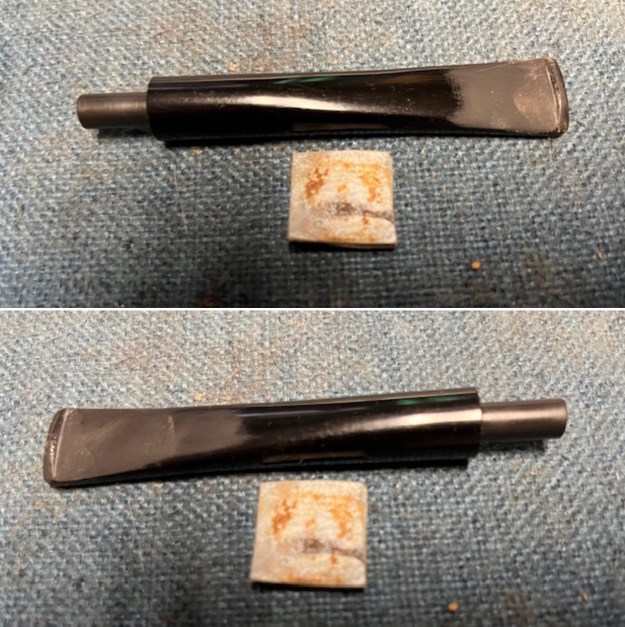
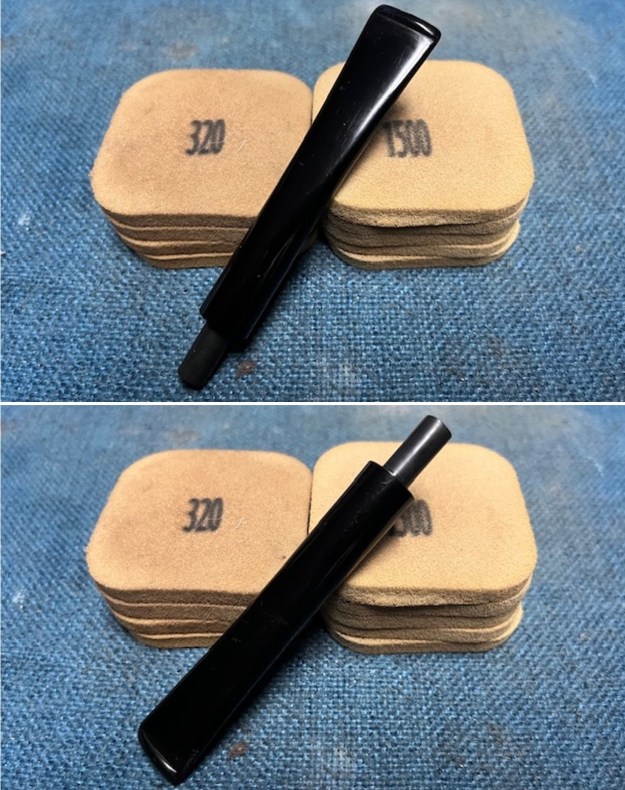
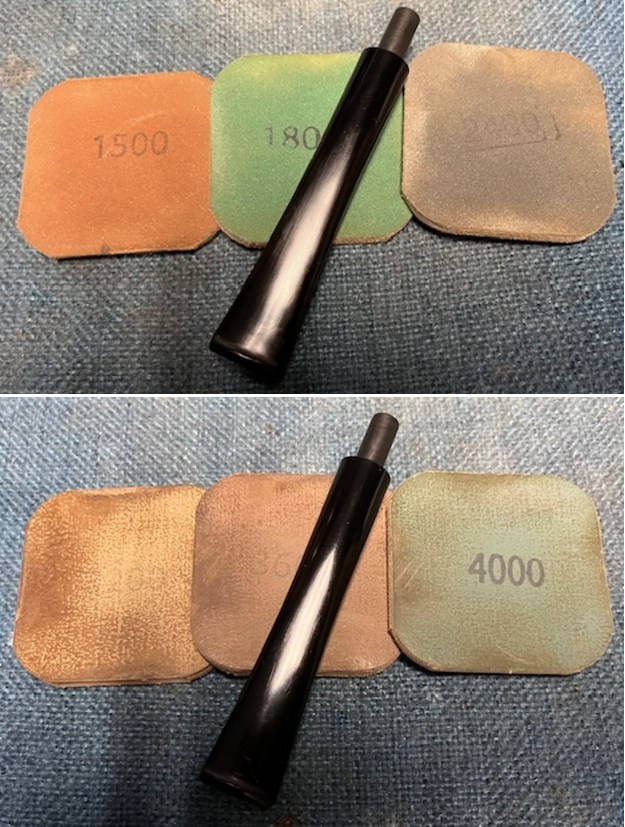
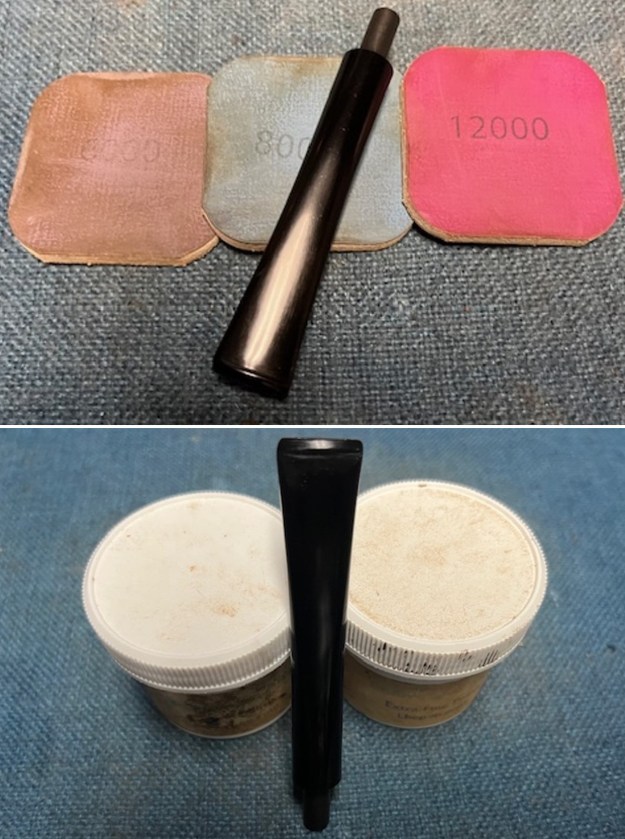
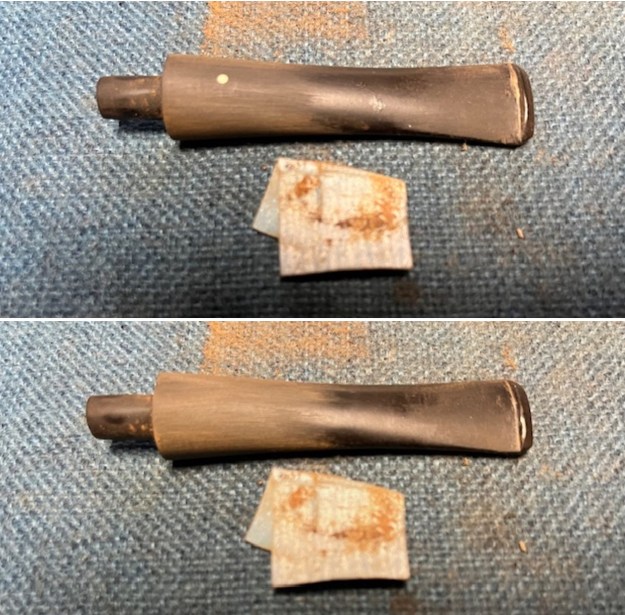
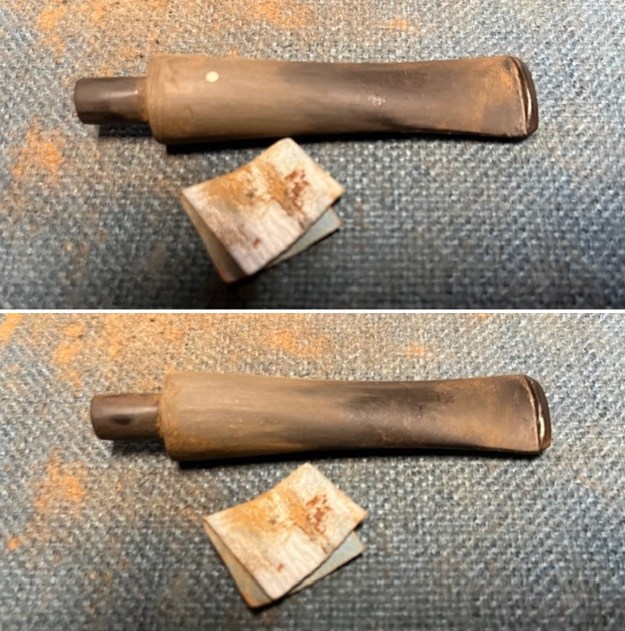
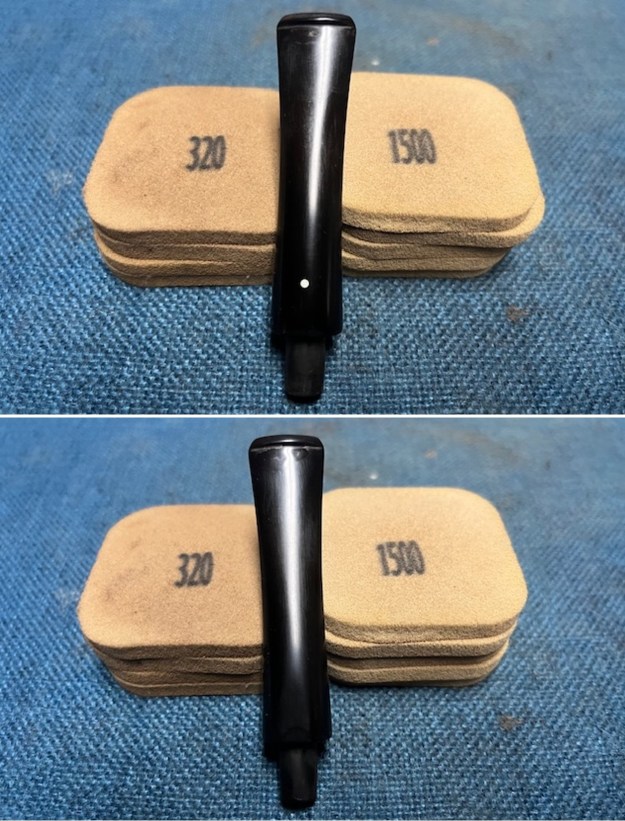
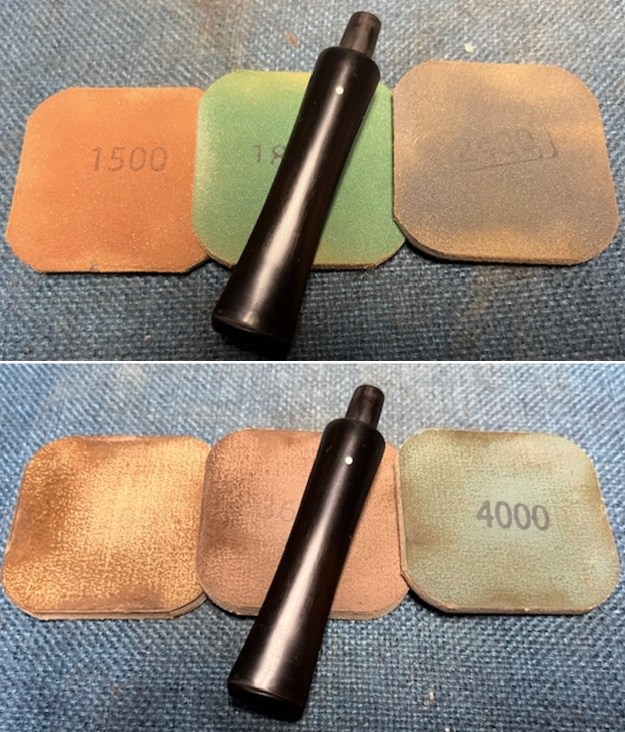
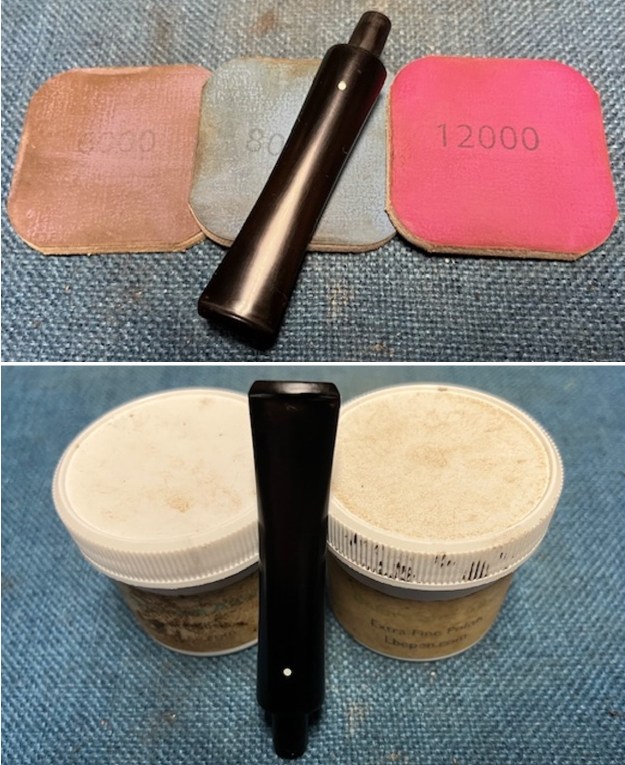
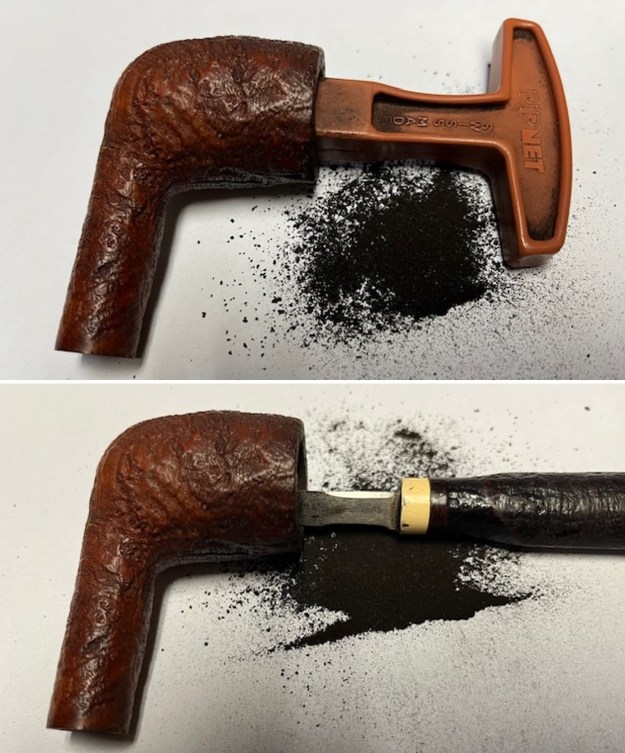
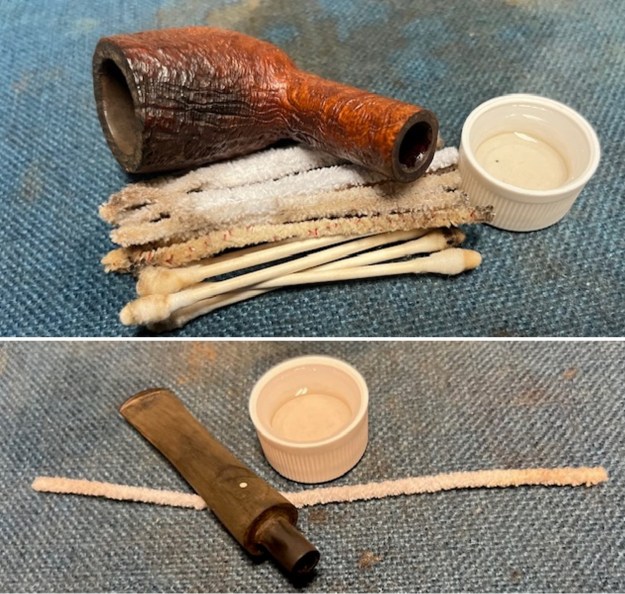
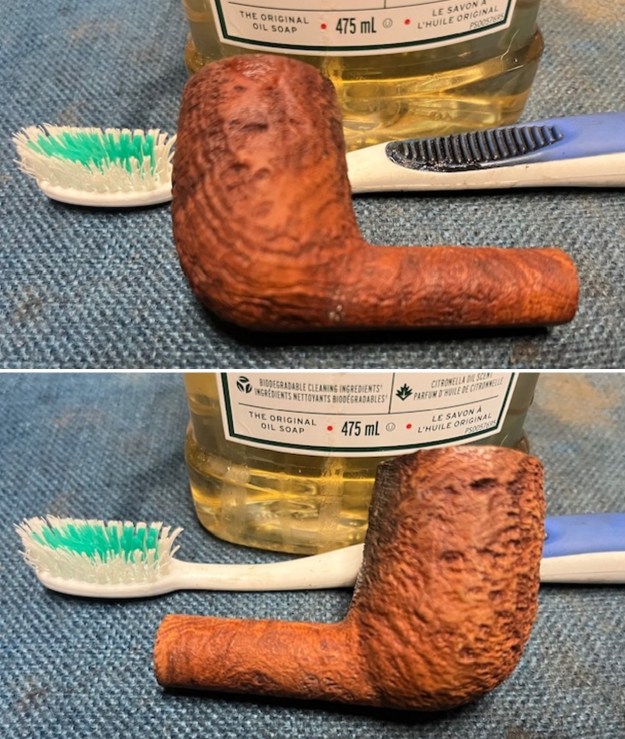
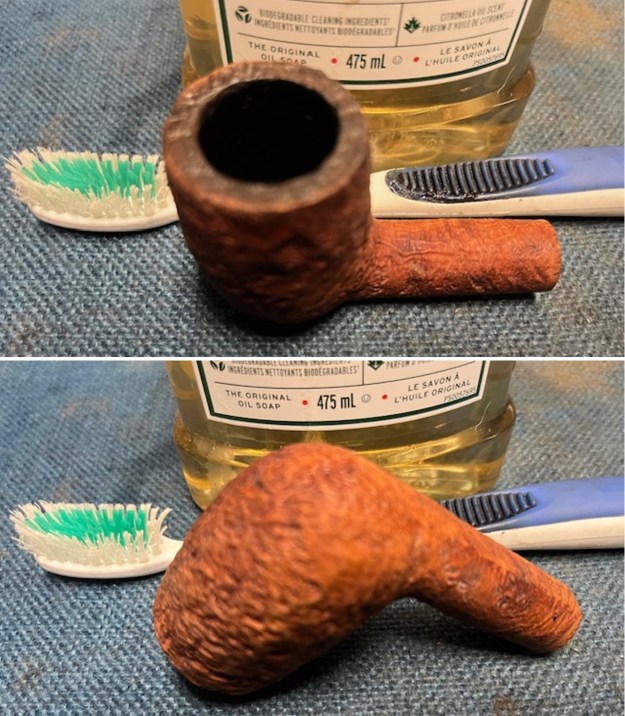
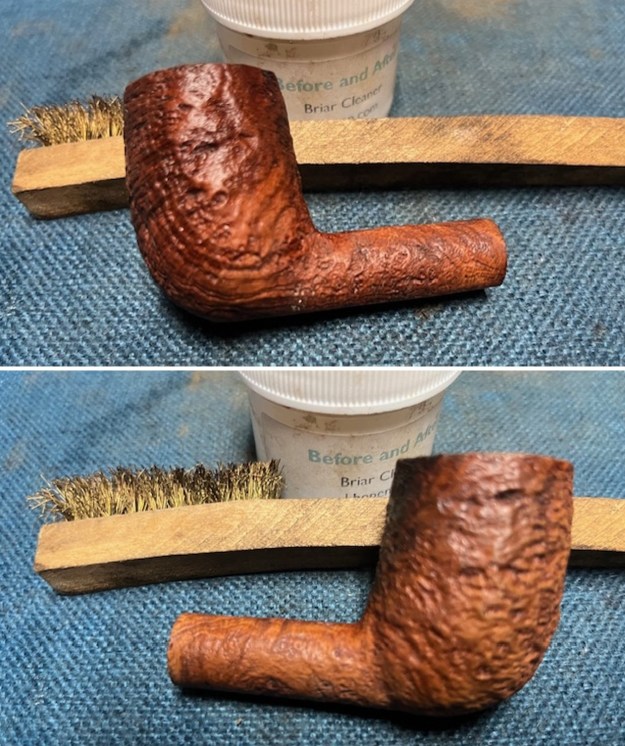
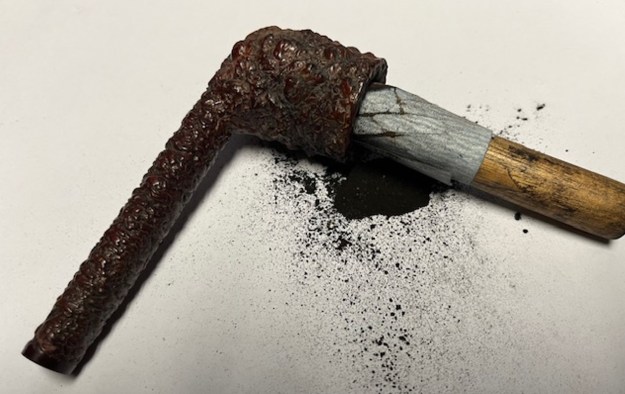
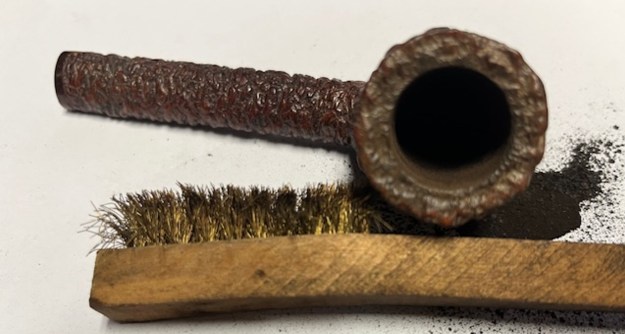
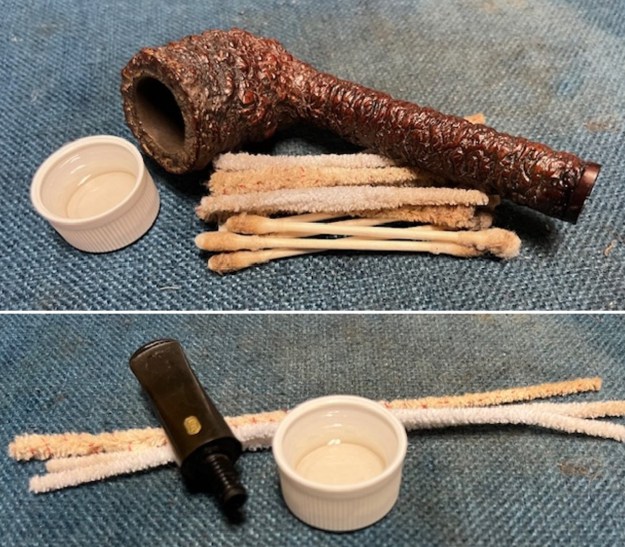
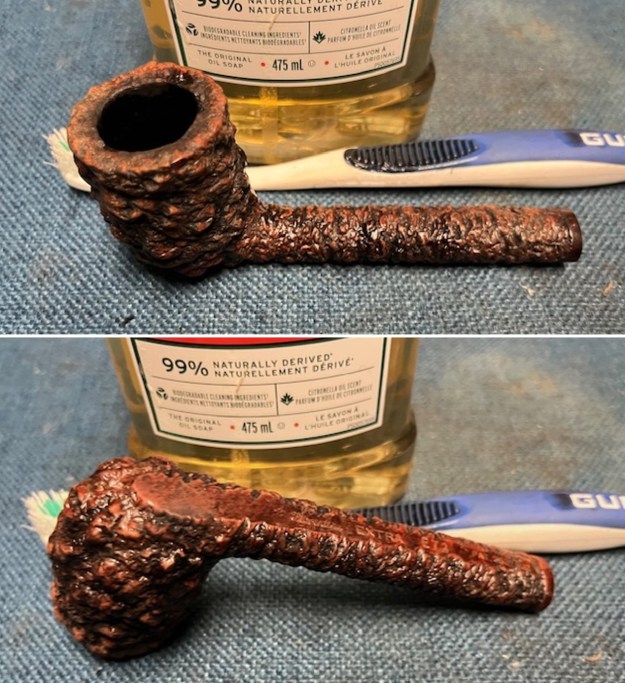
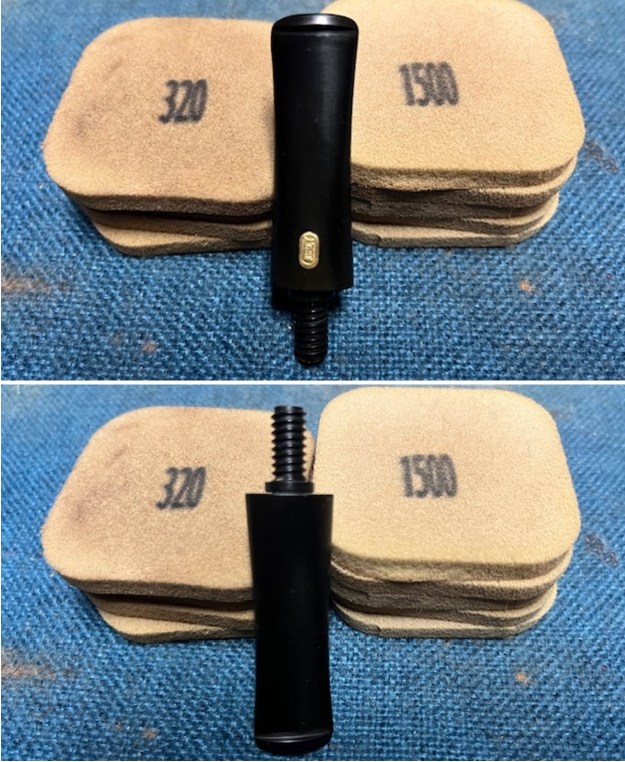
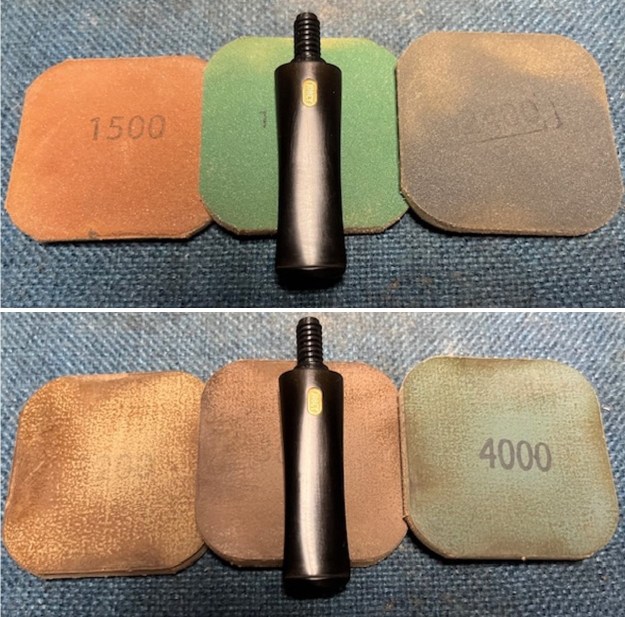
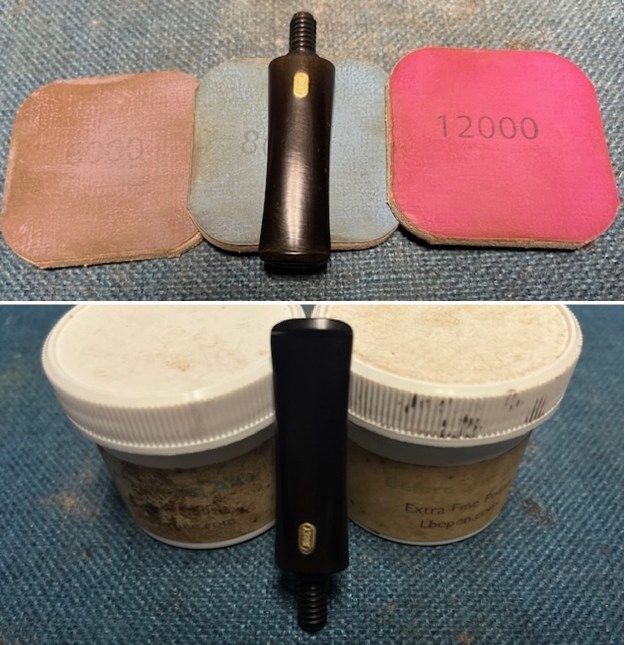
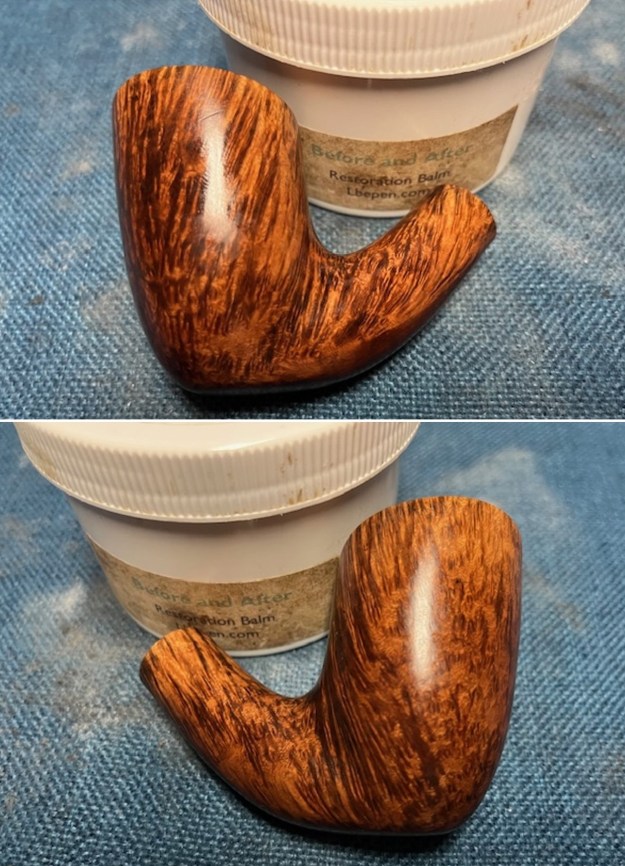
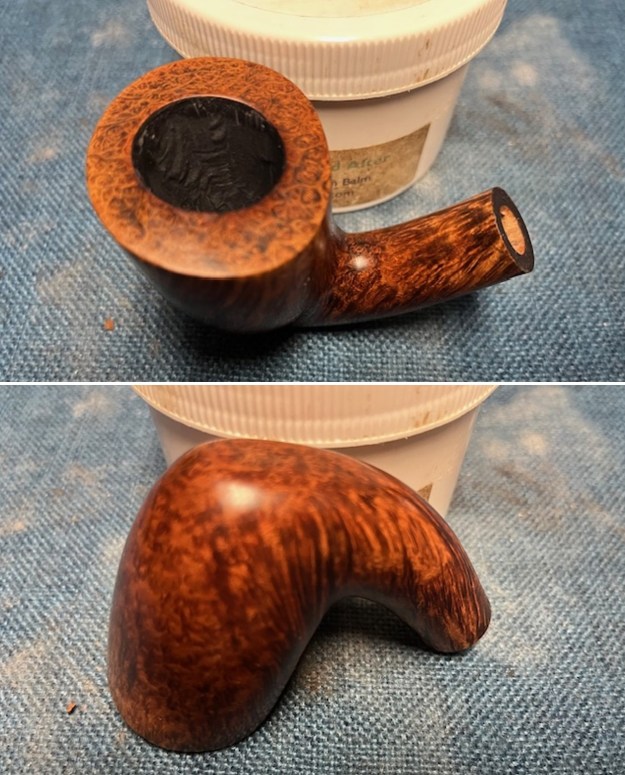
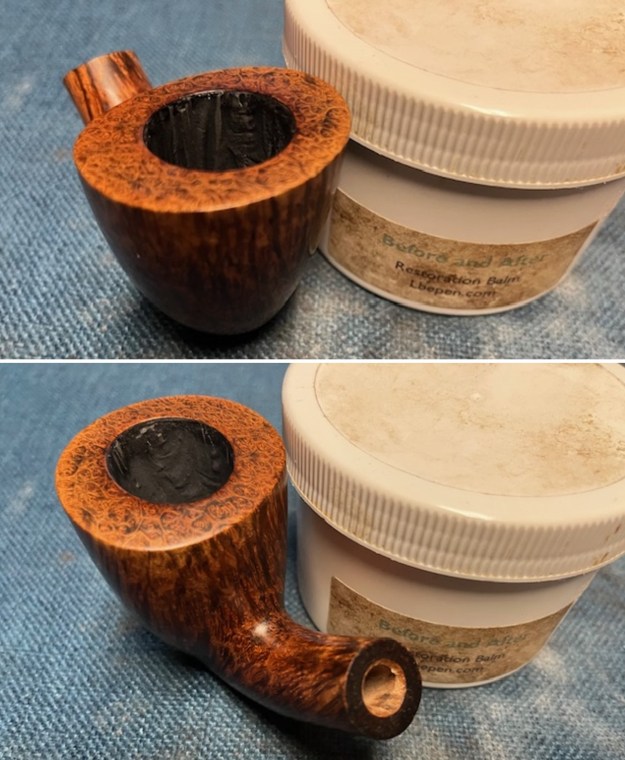
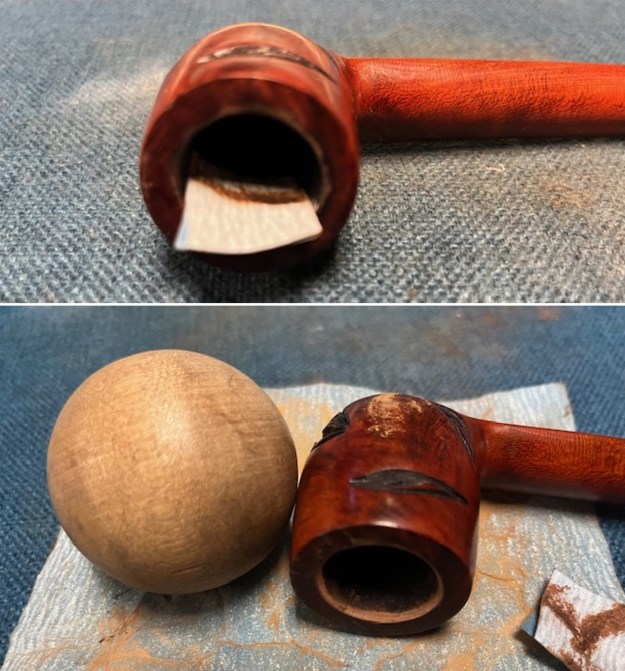
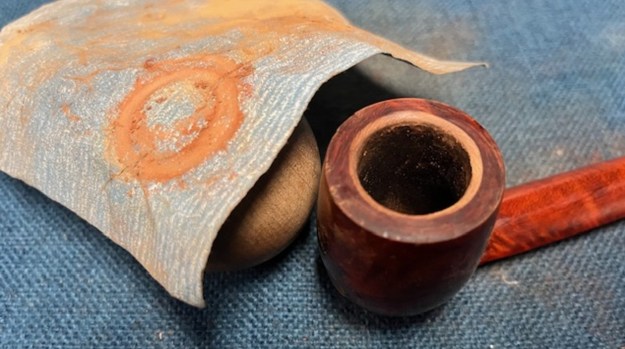
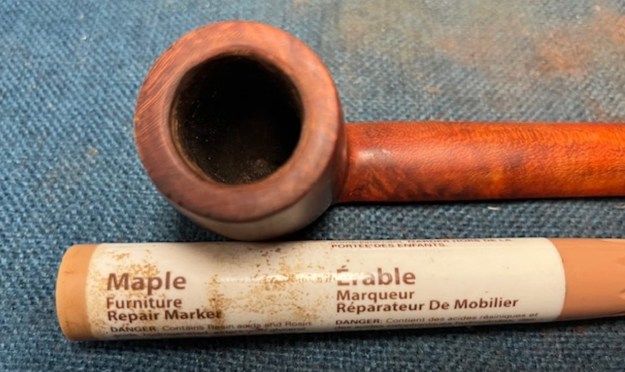
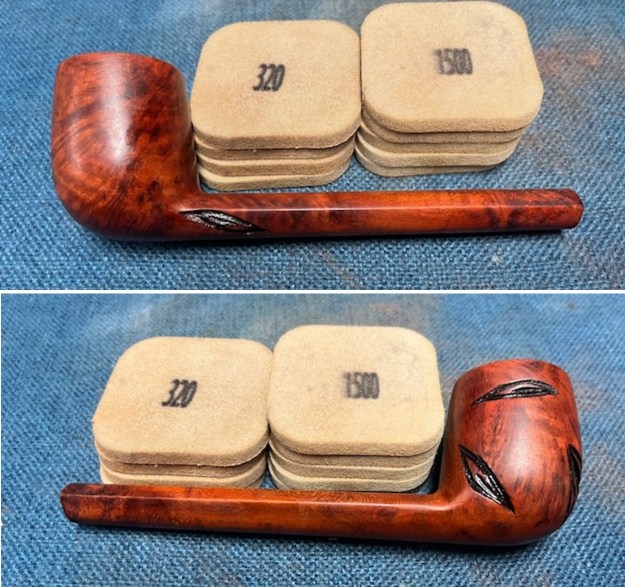
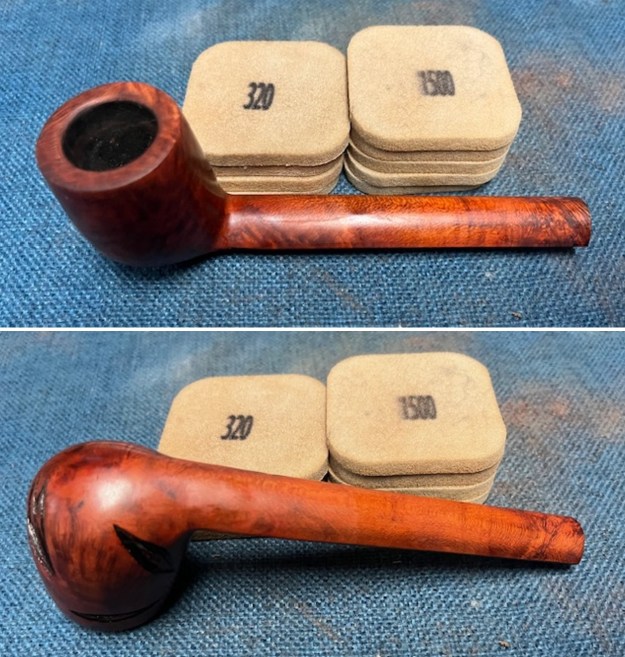
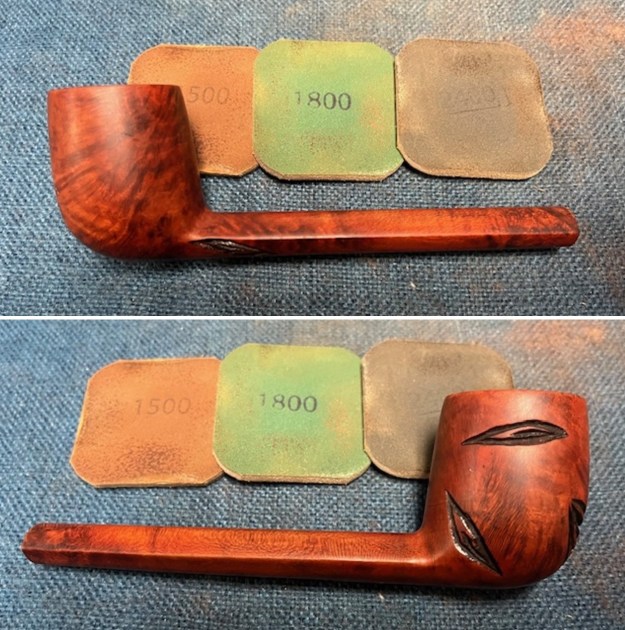
When I received it from Jeff it did not look like the same pipe. It was clean and the finish had life. He reamed it with a PipNet pipe reamer and got rid of the cake. He cleaned up the reaming with a Savinelli Fitsall Pipe Knife so that we could see the walls of the bowl and assess for damage. It was in good condition. He cleaned the internals of the shank and stem with cotton swabs, pipe cleaners and alcohol. He scrubbed the exterior with undiluted Murphy’s Oil Soap and a tooth brush. He rinsed the pipe under warm water. He dried it off with a cloth and then let it air dry. He scrubbed the stem with Soft Scrub and soaked it in Briarville’s Stem Deoxidizer. He rinsed it with warm water and dried it off with a soft cloth. It came out looking very good. The finish on the bowl and the rim top cleaned up nicely. I took pictures of the pipe to show how it looked when I unpacked it.  I took some photos of the rim top and stem to show the condition of them both when the pipe arrived. Overall it looked good. There is some damage and darkening to the inner edge of the bowl. The stem looked good even with the tooth marks on the top and underside ahead of the button.I took a photo of the stamping on the underside of the shank and reads Israel. It is clear and readable and in great condition. The X stamp on the topside of the stem is faded but readable. I removed the stem from the shank and took a photo of the pipe to show the look of the pipe.I cleaned up the inner edge of the bowl with a folded piece of 220 grit sandpaper. To remove the damage on the inner bevelled edge I used a wooden sphere and 220 grit sandpaper. It looked much better. I touched up the stain on the rim top and inner edge of the bowl with a Maple stain pen to match the rest of the briar.I sanded the sides of the rim top and bowl with 320-3500 grit 2×2 inch sanding pads to remove the varnish coat. I wiped it down after each pad with a damp cloth. It really began to have a more natural shine. I polished the bowl and the high points on the plateau with micromesh sanding pads – wet sanding with 1500-12000 grit pads. I wiped the briar down after each pad with a damp cloth. The bowl is starting to look very good. I worked some Before & After Restoration Balm into the surface of the briar with my fingertips and into leaf patterns with a horsehair shoe brush to clean, enliven and protect it. I let the balm sit for a little while and then buffed with a cotton cloth to raise the shine. The photos show the bowl at this point in the restoration process. I set the bowl aside and turned my attention to the stem. I filled in the deep tooth marks on the top and underside of the stem ahead of the button with a rubberized/carbon extra strength Black CA glue. Once it cured I used some small flat files to blend the repairs into the surface of the vulcanite. I sanded it with 220 grit sandpaper to finish blending it into the stem surface. I touched up the X stamp on the topside of the stem with some white acrylic fingernail polish. I let it harden and then scraped off the excess and went over it with a 1000 grit sanding pad. It looked very good at this point.I set the bowl aside and turned my attention to the stem. I sanded the stem with 2 x 2 inch sanding pads – dry sanding with 320-3500 grit pads and wiping it down after each pad with an Obsidian Oil cloth.I polished the stem with micromesh sanding pads – wet sanding with 1500-12000 grit sanding pads. I wiped it down after each sanding pad with some Obsidian Oil. I finished polishing it with Before & After Pipe Stem Polish – both Fine and Extra Fine and buffed it off with a cotton cloth. This beautiful mixed finish Israel Long Shank Canadian with carved leaves, probably made by the Shalom Pipe Company with a slightly bent vulcanite stem has a great look and feel. I polished the stem and the bowl with Blue Diamond polish on the buffing wheel. I gave the bowl and the stem multiple coats of carnauba wax. I buffed the pipe with a clean buffing pad to raise the shine. I hand buffed it with a microfiber cloth to deepen the shine. The pipe polished up pretty nicely. The rich combination of browns and blacks in the smooth and carved leaves took on life with the buffing. The rich colour of the briar works well with the polished vulcanite stem. I like the grain and finished look of this Israel Long Shank Canadian. Have a look at it in the photos below. The shape, finish and flow of the pipe and stem are very well done. The dimensions are Length: 7 ½ inches, Height: 2 inches, Outside diameter of the bowl: 1 ¼ inches, Chamber diameter: ¾ of an inch. The weight of the pipe is 52 grams/ 1.83 ounces. This Israel Long Canadian is a real beauty. Thanks for walking through the restoration with me as I worked over another beautiful pipe. This one will be going on the rebornpipes store in the Pipes from Various Makers Section shortly if you would like to add it to your collection. Thanks for your time.
New Life for a “Malaga” Rhodesian Oval Shank Rhodesian with a Taper Stem


by Steve Laug

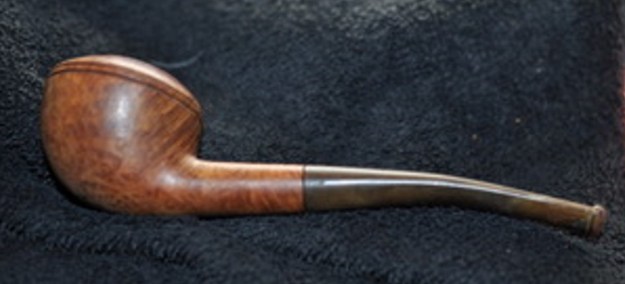
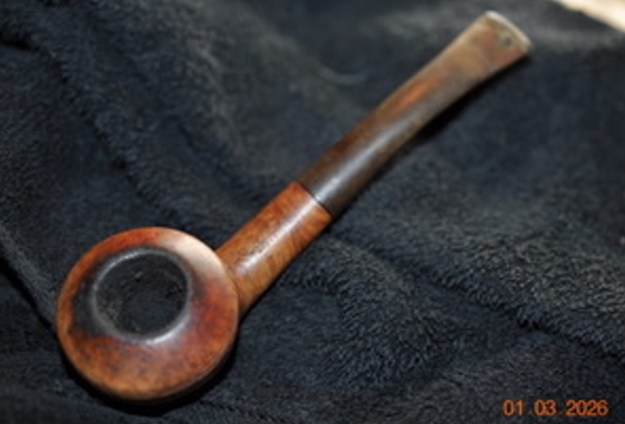
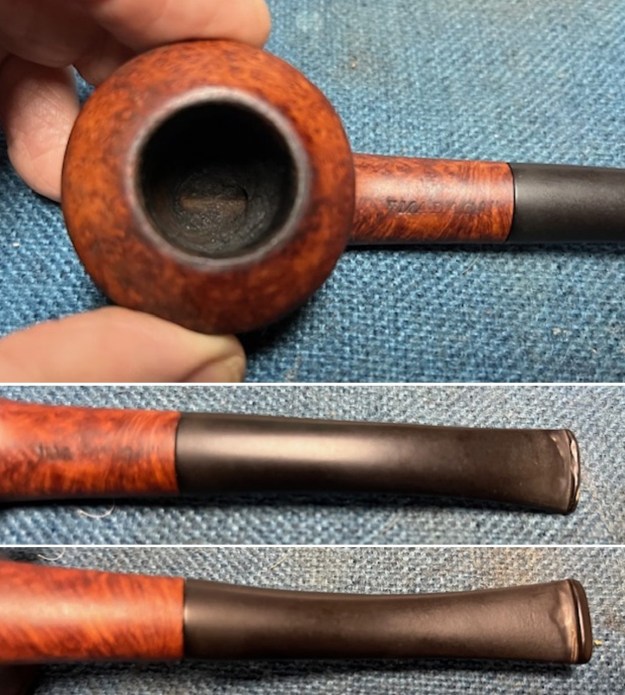
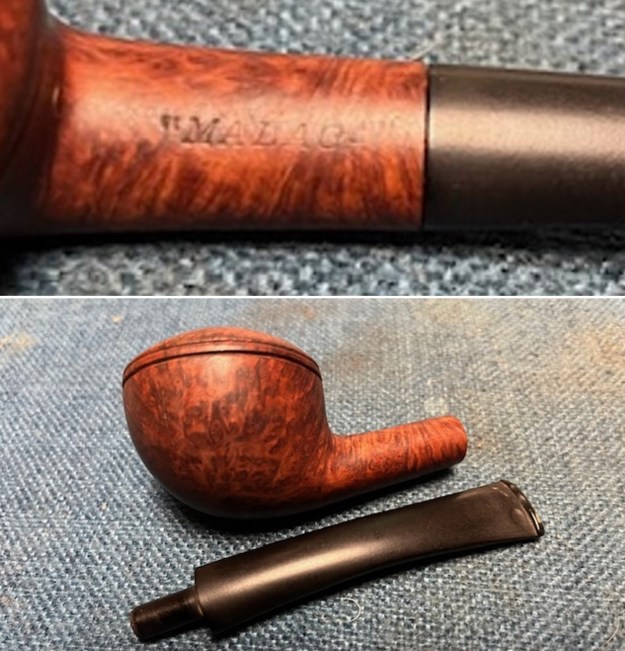
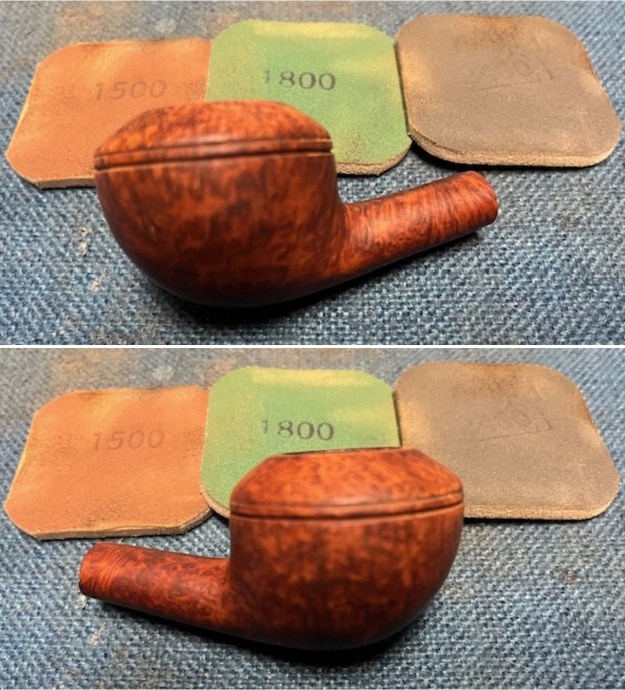
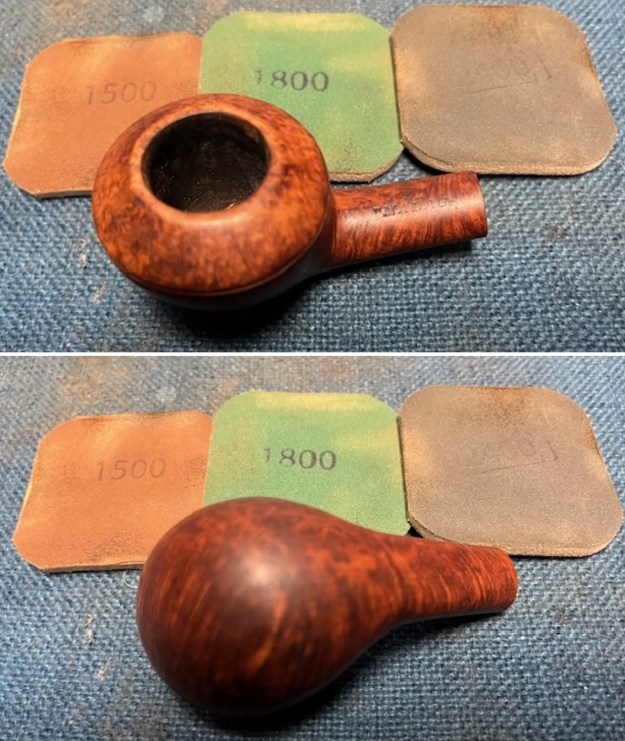
For the next little while I am working on some Malaga Pipes. I have several in queue to work on so I tend to pick them by what catches my eye. The next pipe on the table is an interesting “Malaga” Imported Briar ¼ Bent Rhodesian. Jeff saw it on eBay and purchased it on 09/14/2025 from a seller in Carleton, Michigan, USA. The grain on this pipe is very stunning beneath the oil cured finish. The pipe is stamped on the topside of the shank and reads “Malaga”. It is a nice one in terms of the well-done ¼ Bent Rhodesian. The bowl and shank were in excellent condition. The finish was in good condition though dirty. The bowl had a thick cake that over flowed over the top of the crowned rim in a lava coat. The rim top and inner edge of the bowl appeared to be in good condition under the grime. The taper stem appeared to be either vulcanite or hard rubber and was lightly oxidized and calcified. There were deep tooth marks on the top and the underside ahead of the button. Jeff took photos of the pipe before he started his clean up work. Jeff took photos of the rim and bowl to show the cake and a heavy lava coat on the crowned rim top and edges. The inner edge of the rim showed some darkening and had some cake on it. It was a dirty pipe but still a beauty. The hard rubber stem was lightly oxidized, calcified and had some deep tooth marks and some chatter on the top and underside of the stem. The photos of the sides and heel of the bowl show some stunning and unique grain on the smooth bowl and shank. The oil curing/finish makes the grain really stand out. Jeff took photos of the stamping on the left and right side of the shank and it is clear and readable as noted above. For those of you who are unfamiliar with the brand, I am also including the link to a blog that I wrote that gives some of the history of the Malaga brand and the Malaga Pipe Shop in Royal Oak, Michigan in the USA. Here is the link – https://rebornpipes.com/2013/02/09/george-khoubesser-and-malaga-pipes/. That blog also includes links to a catalogue and the history of the pipemaker George Khoubesser. If you are interested to learn more then I invite you to follow the link to get a feel for the brand and the pipemaker.

I am also am including a link to some printed material on the Malaga brand that came to me from the daughter of George Koch (we purchased George’s pipes from his daughter) to help identify the particular stamping on the pipe. The link takes you to the entire collection of materials that were sent to me. (https://rebornpipes.com/2019/02/27/malaga-pipes-catalogue-of-pipes-and-tobaccos/).

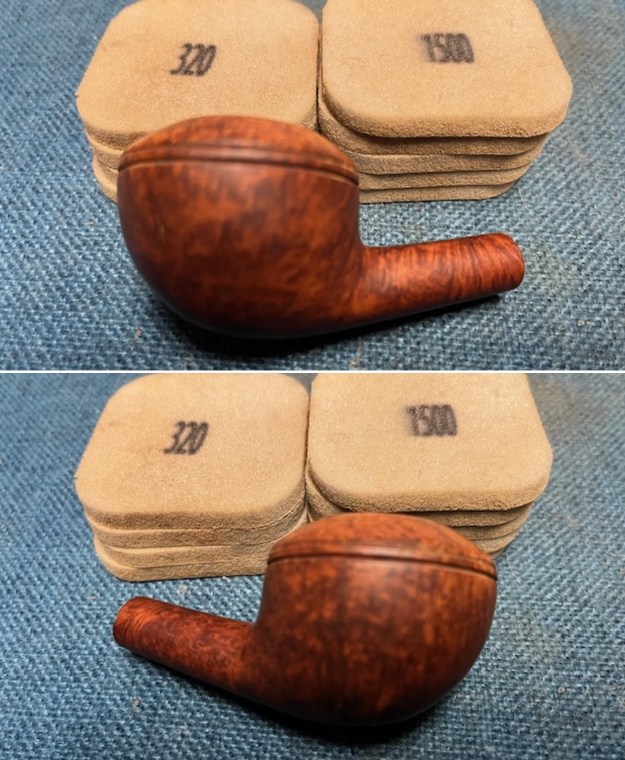
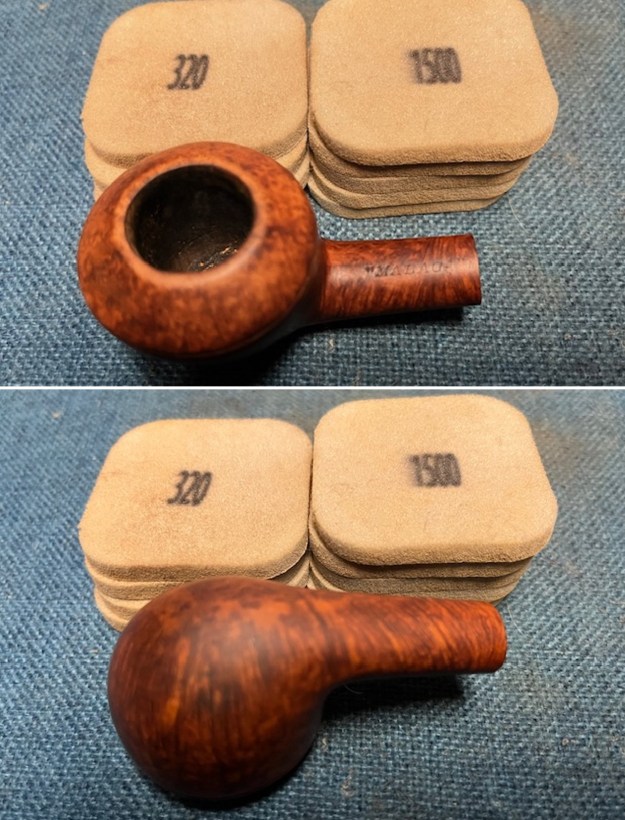
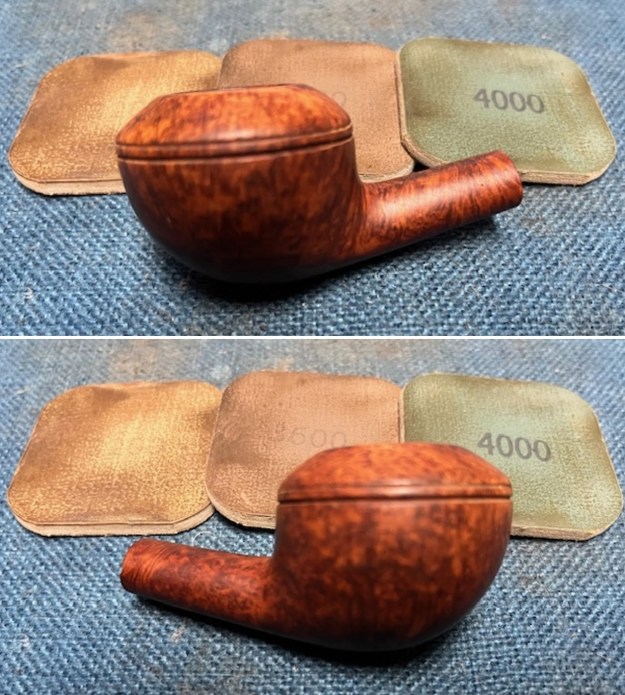
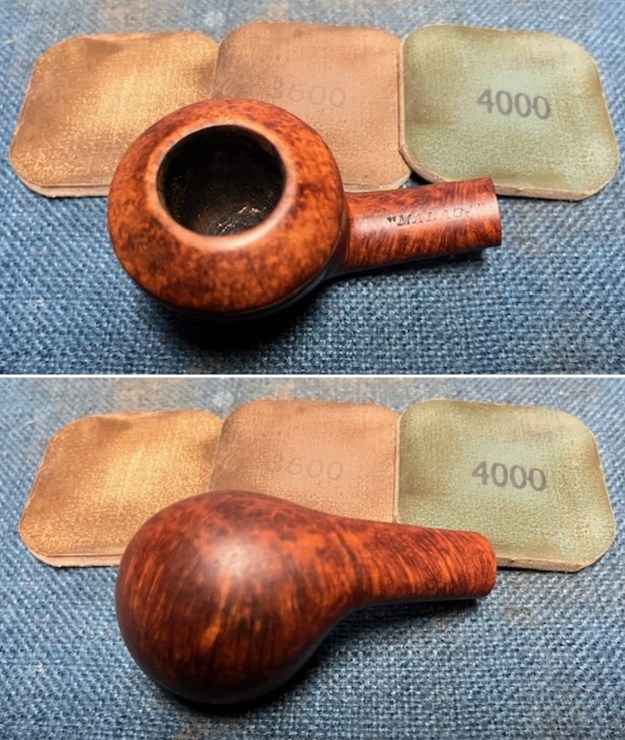
Jeff had cleaned up the pipe using his usual process. He reamed the pipe with a PipNet pipe reamer and removed the rest of it with a Savinelli Fitsall Pipe Knife. He scrubbed the bowl with undiluted Murphy’s Oil Soap with a tooth brush. He rinsed it under running warm water to remove the soap and grime. He cleaned out the inside of the shank and the airway with alcohol, cotton swabs and pipe cleaners. The shank had an inset to take in the tenon and the end of the stem so I would need to fit a stem to sit in the shank. I took photos of the pipe once I received it. I took a photo of the rim top and the stem to show their condition. Jeff was able to clean up the cake and the lava overflow that was shown in the rim and bowl photos above. The rim top was clean as were the inner and outer edges of the bowl. The stem looked better and the tooth marks are very light on both sides.I took a photo of the stamping on the top side of the shank to show that it was clean and faint in spots but still readable as noted above. I removed the stem from the shank and took a photo of the parts to give a sense of what the pipe looks like. It was time to start my work on the pipe. I sanded the scratches and marks on the rim and bowl sides with 320-3500 grit 2×2 inch sanding pads. I wiped it down after each pad with a damp cloth. It really began to shine. I polished the bowl sides and shank with micromesh sanding pads. I dry sanded it with 1500-12000 grit micromesh pads. I wiped it down with a damp cloth after each pad. It really began to look beautiful. I rubbed the bowl and shank down with Before & After Restoration Balm to deep clean the finish on the bowl and shank. The product works to clean, enliven and protect the briar. I worked it in with my fingers to get it into the briar. I worked it into the twin rings around the rim cap with a shoe brush. I let it sit for 10 minutes then I wiped it off and buffed it with a soft cloth. The briar really began to have a rich shine. I took some photos of the bowl at this point to mark the progress in the restoration. It is a beautiful bowl. I set the finished bowl aside and turned my attention to the stem. I filled in the deep tooth marks on the top and the underside of the stem with a black rubberized CA glue. Once it cured I shaped it with small files and then sanded the repairs with 220 grit sandpaper to blend it into the vulcanite. I sanded the stem with 2 x 2 inch sanding pads – dry sanding with 320-3500 grit pads and wiping it down after each pad with an Obsidian Oil cloth.I polished the stem with micromesh sanding pads – dry sanding with 1500-12000 grit pads. I wiped the stem down after each sanding pad with Obsidian Oil. I did a final hand polish of the stem with Before & After Pipe Stem Polish – both Fine and Extra Fine. I gave it a coat of Obsidian Pipe Stem Oil. It works to protect the stem from oxidizing. I set it aside to dry. I put the stem back on the “Malaga” ¼ Bent Rhodesian and took it to the buffer. I buffed the bowl and stem with Blue Diamond to polish the briar and the vulcanite. Blue Diamond does a great job on the smaller scratches that remain in both. I gave the bowl and the stem several coats of carnauba wax and buffed the pipe with a clean buffing pad to raise the shine. I hand buffed it with a microfiber cloth to deepen the shine. I am amazed at how well it turned out. The finished pipe is shown in the photos below. This is a beautiful “Malaga” ¼ Bent Rhodesian and the hard rubber taper stem and smooth finish combine to give the pipe a great look. I honestly have no idea why it is labeled a second as there are no fills or flaws in the briar. The dimensions of the pipe are Length: 5 ¾ inches, Height: 1 ½ inches, Outside diameter of the bowl: 1 ¾ inches, Chamber diameter: ¾ of an inch. The weight of the pipe is 1.34 ounces/38 grams. This is another pipe that I will be putting on the rebornpipes online store in the American Pipe Makers and Pipemaking Companies Section shortly, if you are interested in adding it to your collection. Thanks for walking through the restoration with me on this beauty!

As always, I encourage your questions and comments as you read the blog. Thanks to each of you who are reading this blog. Remember we are not pipe owners; we are pipe men and women who hold our pipes in trust until they pass on into the trust of those who follow us.

Restoring a Dunhill Cumberland 41083 Rhodesian with a Chomped Cumberland stem


by Steve Laug

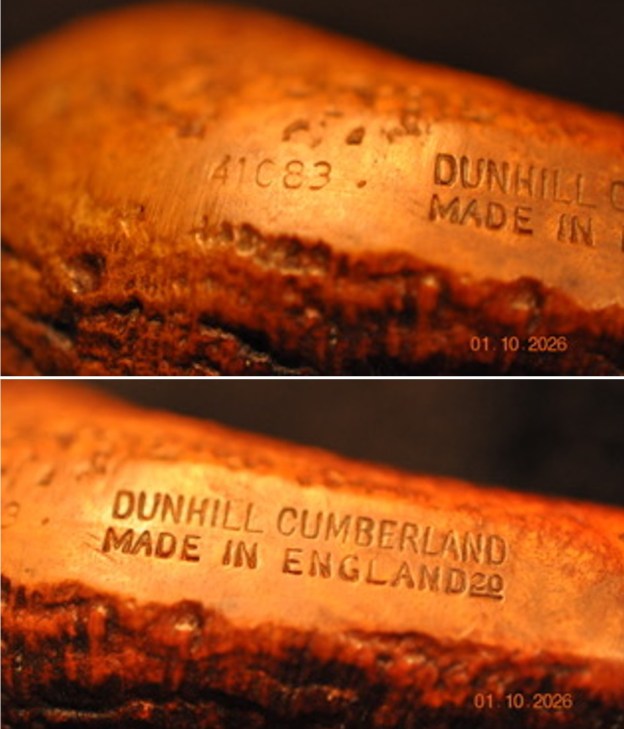
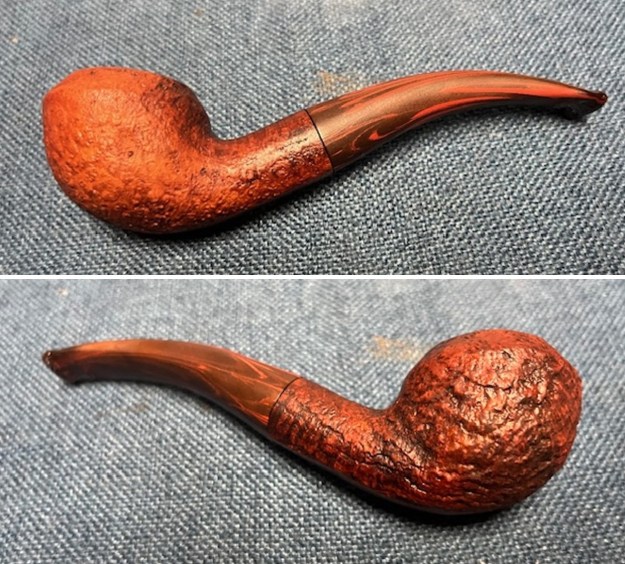
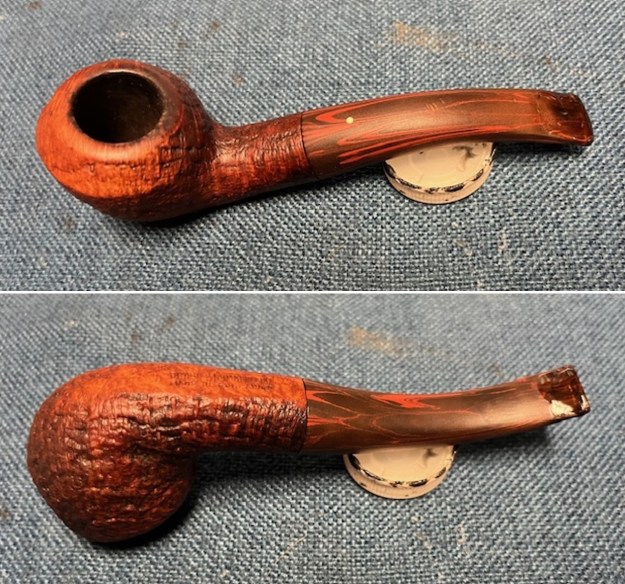
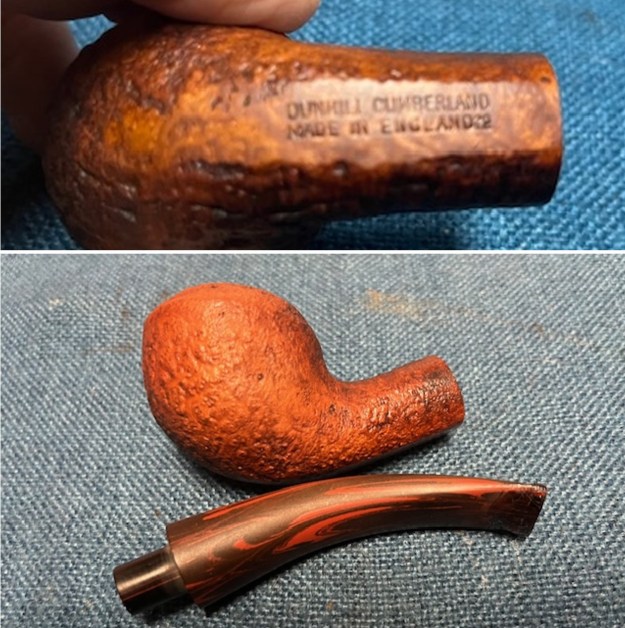
The next pipe on the table is one that we picked up in an estate we purchased from a seller in Durham, North Carolina, USA on 12/27/2025. The Sandblast finish and the Dunhill stamping caught our eye. It is stamped on the underside of the shank and reads 41083 on the heel of the bowl followed by Dunhill Cumberland [over] Made in England20. It has a classic Cumberland sandblast with a smooth rim top that is a stark contrast to Cumberland taper stem. The finish is a light sandblast and there is a lot of debris and dust in the nooks and crannies of the blast. The bowl appears to be moderately caked. The inner edge and the top show a lava overflow and darkening on the backside of the inner edge. The stem is oxidized, calcified and has deep tooth marks and chatter on the top and underside ahead of the button. Like the other pipes in this estate, the stem was chomped and spoke to the fact that it spent a lot time in the owner’s mouth. He loved this pipe and enjoyed it often. The classic white spot is on the left top side of the stem and looks to be in good condition. Jeff took some photos of the pipe to show the general condition of the pipe before he started his clean up. He took some photos of the rim top and bowl from various angles to give me a clear picture of the condition of the rim top and bowl. You can see the lava on the rim top and edges as well as part of the cake in the bowl. He included photos that show the top and underside of the stem. It is as described above. Jeff took some photos of the sides and heel of the bowl to show the condition of the finish on the pipe. The photos showed some great grain through the sandblast around the bowl and shank. It is a great looking piece of briar. He took some photos of the stamping on the underside of the bowl and shank. The stamping was clear and readable as noted above.As is my regular practice, before I started my work on the pipe, I turned to Pipedia’s section on Dunhill Bruyere Pipes to get a refresh the information I know regarding the Dunhill finishes (https://pipedia.org/wiki/Dunhill#Cumberland). I quote:

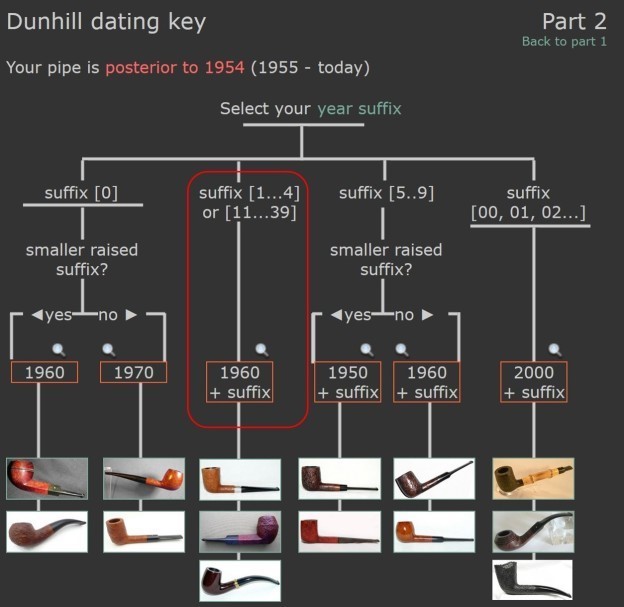
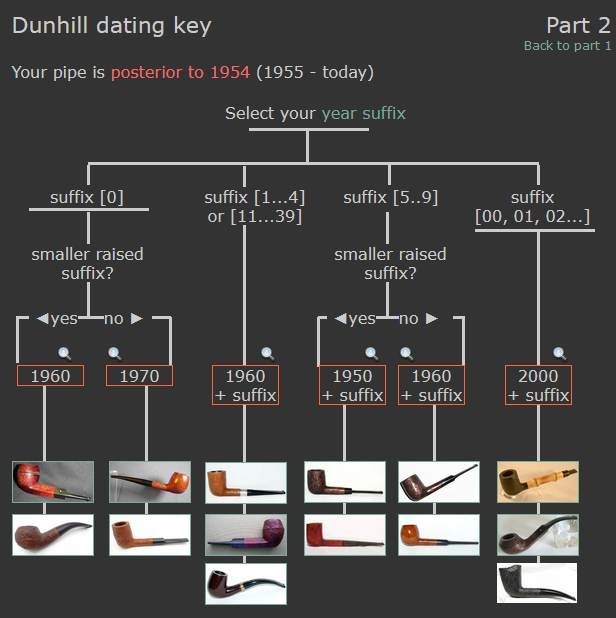
Cumberland Introduced in 1979. Cumberland is another sandblast with a brown stain and a brindle stem (the material is more commonly called ‘Cumberland’ these days, thanks to Dunhill’s influence and the success of the finish over the past quarter-century). Originally, the Cumberland always featured a smooth brown rim, but in the current production the rim is sometimes smooth, sometimes sandblasted. Occasionally, a straight grain blast is finished with a Cumberland stain and a “Shilling Grain,” similar to the “Ring Grain,” resulting in a new variation on the traditional sandblast. The Shilling series is named for the British coin: the sandblast looks like a stack of shillings. Named after the warehouse on Cumberland Road. The old pipes that inspired this finish were found there. I turned to Pipephil’s dating guide to show how I arrived at the date of manufacture for this pipe (http://www.pipephil.eu/logos/en/dunhill/cledat-en1a.html). I am including the chart that is provided there for the dating a pipe. I have drawn a red box around the section. Since the pipe I am working on has a superscript suffix 20 after the D in England it points to the 1960 line on the chart below. To date it just add 1960 +20 for a date of 1980. I have drawn a red box around the pertinent section in the chart.I now knew that I was working on a Cumberland that came out in 1980. The shape of the pipe is called a Ssandblast Bent Rhodesian with a 41083 Shape number on the heel of the bowl/shank.

I turned to Pipephil’s shape list (http://www.pipephil.eu/logos/en/dunhill/shapes.html). At the bottom of the list of shapes (with the 04 being a Billiard) is a key for interpreting the digits in the stamp I have included that below.

Dunhill pipes are stamped with a four digit code.
Digit 1: (from 1 to 6) denotes the size of the pipe (the group).
Digit 2: denotes the style of the mouthpiece (0,1=tapered, 2=saddle)
Digit 3 and 4: denote the generic pipe shape (in yellow in the chart on link above) 

Example: 5102
(5 = size | 1 = tapered stem | 02 = Bent)

When 5 digits occur, the meaning of the 4 first remain the same

The 41083 was thus a Group 4 size, with a taper Cumberland mouthpiece, and in an 83 or Bent Bulldog (Rhodesian) shape.

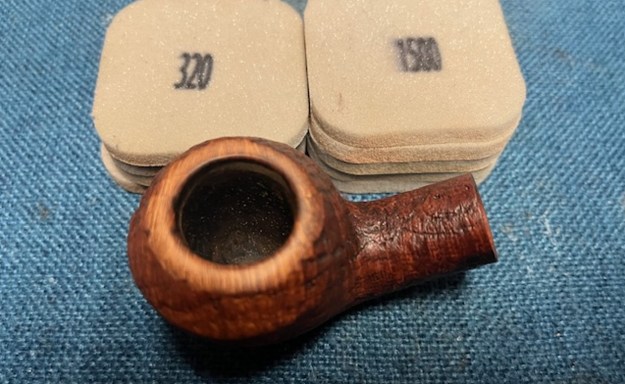
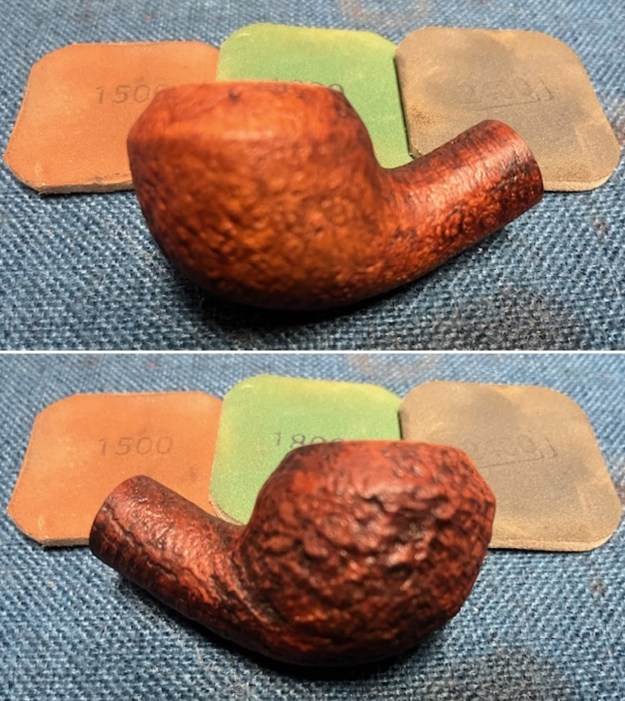
Armed with that information I turned to work on the pipe itself. Jeff had done a great job cleaning up the pipe as usual. He cleaned up the inside of the bowl with a PipNet reamer and a Savinelli Fitsall Pipe Knife. The rim top shows some damage on the top and the inner edge of the bowl. The bowl walls looked very good. He scrubbed the interior of the bowl and shank with pipe cleaners, cotton swabs and alcohol to remove the tars and oils. He scrubbed the exterior of the pipe with Murphy’s Oil Soap and a tooth brush to remove the grime from the finish. He worked on the rim top lava and darkening with the soap and tooth brush. He scrubbed the inside of the stem with alcohol and pipe cleaners. He scrubbed the exterior with Soft Scrub and then soaked it in Briarville’s Pipe Stem Deoxidizer. He washed it off with warm water to remove the deoxidizer. Now the damage to the stem was very clear. Overall, the pipe looked far better. I took photos of the pipe when I received it before I started working on it. I took close up photos of the bowl, rim top and stem to show how clean the pipe was. The bowl was clean and the damage to the rim top and the inner edge is very visible in the photo below. The stem was clean and the light tooth marks and chatter can be seen in the photos. You can also see the light oxidation.I took a photo of the stamping on the underside of the shank. It is very clear and readable and read as noted above. I also removed the stem from the shank and took photos of the pipe to show the look of the parts.I started my work on the pipe by addressing the damage to the rim top. I used 320-3500 grit 2×2 inch sanding pads to smooth out the damage on the rim top and the inner edge. It looked much better once finished.I polished the rim top with 1500-12000 grit micromesh sanding pads and wiped it down with a damp cloth to remove the sanding dust. It took on a rich shine. The exterior of the bowl look better after sanding. I worked some Before & After Restoration Balm into the briar with my finger tips. I let it sit on the bowl for 10 minutes and then buffed it off with a paper towel and soft cloth. The product is a great addition to the restoration work. It enlivens, enriches and protects the briar while giving it a deep glow. It is a product I use on every pipe I restore. I set the bowl aside and turned my attention to the stem. I “painted” the surface of the stem near the button with the flame of a lighter to lift the deep tooth marks. I was able to lift many of them and it looked better. I filled in the remaining marks with on the stem with clear CA glue. Once the repairs cured I flattened them and recut the button on the stem with a small flat file. I sanded the repairs with 220 grit sand paper to further blend them into the surface. I sanded the Cumberland stem with 320-3500 grit sanding pads. The repairs began to disappear into the surface of the Cumberland and the stem began to take on a smooth new look. Progress for sure.It was ready for the next step. I polished it with micromesh sanding pads – dry sanding with 1500-12000 grit pads and wiping the surface down with Obsidian Oil after each sanding pad. It is really shining. I polished it further with Before & After Stem Polish – both Fine and Extra Fine. I gave it another coat of Obsidian Oil to finish this step. I am excited to be on the homestretch and look forward to seeing the 1980 Dunhill Cumberland 41083 Sandblast Bent Rhodesian/Bulldog put back together, polished and waxed. I put the bowl and stem back together and lightly polished the bowl and stem with Blue Diamond to polish them. I gave the bowl and the stem multiple coats of carnauba wax. I buffed the pipe on the wheel with a clean buffing pad to raise the shine. I hand buffed it with a microfiber cloth to deepen the shine. The depths of the grain really pop with the wax and polish. The polished Cumberland stem is a beautiful contrast to the combination of stains on the bowl and shank. This Dunhill Cumberland 41083 Rhodesian was a bit of work to bring back to life. The pipe is light weight, comfortable in the hand and should feel great as it is warmed up when smoking. The finished pipe is shown in the photos below. The dimensions of the pipe are Length: 6 inches, Height: 1 ½ inches, Outside diameter of the bowl: 1 ½ inches, Chamber diameter: ¾ of an inch. The weight of the pipe is 1.55 ounces/45 grams. I will be putting this one on the rebornpipes store in the British Pipemakers Section soon. Let me know if you wish to add it to your collection.

As always, I encourage your questions and comments as you read the blog. Thanks to each of you who are reading this blog. Remember we are not pipe owners; we are pipe men and women who hold our pipes in trust until they pass on into the trust of those who follow us.

Restoring a Kaywoodie Flame Grain Imported Briar 16 President


by Steve Laug

I received an email from a fellow a bit ago about two of his pipes that he wanted me to restore. I have included his email below.

Hey Steve,

It’s been a little while but I’d like to send in the Kaywoodie President for restoration. I also have a Marxman apple that I would like an assessment on–it’s a bit more of a challenge than a standard restoration. Can you let me know if you have an opening and if so, what address to send them to? Thanks!  – Devin

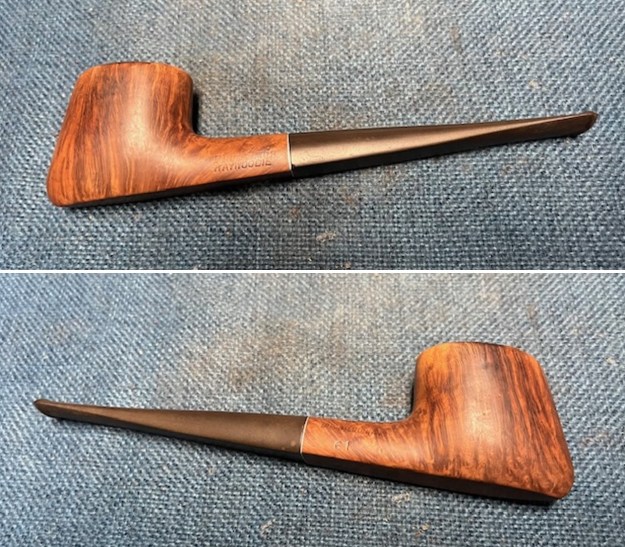
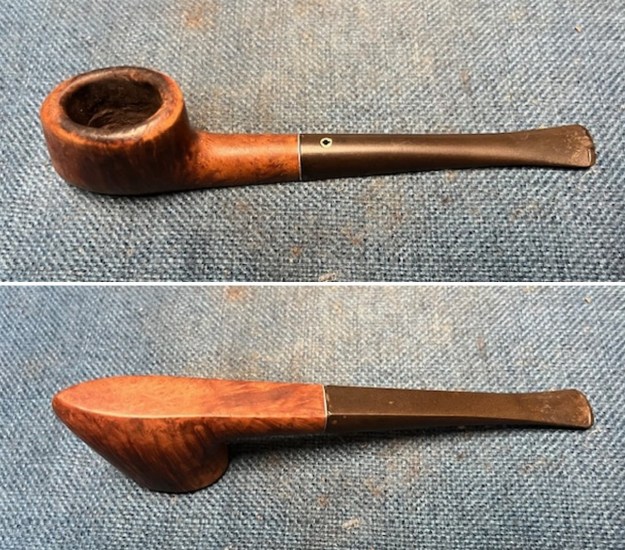
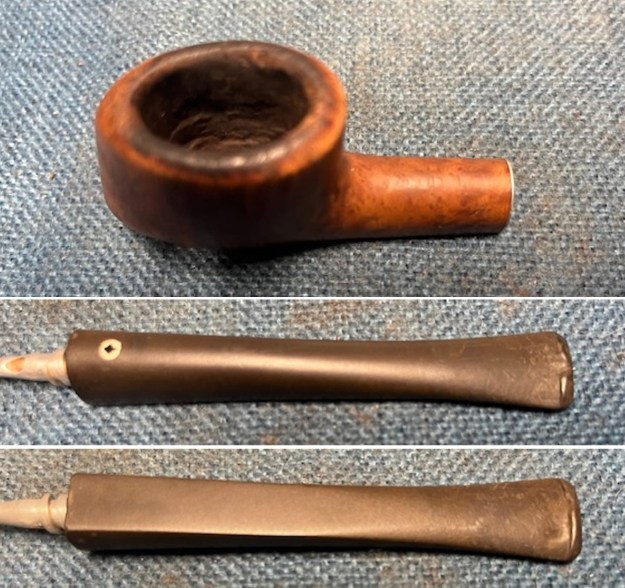
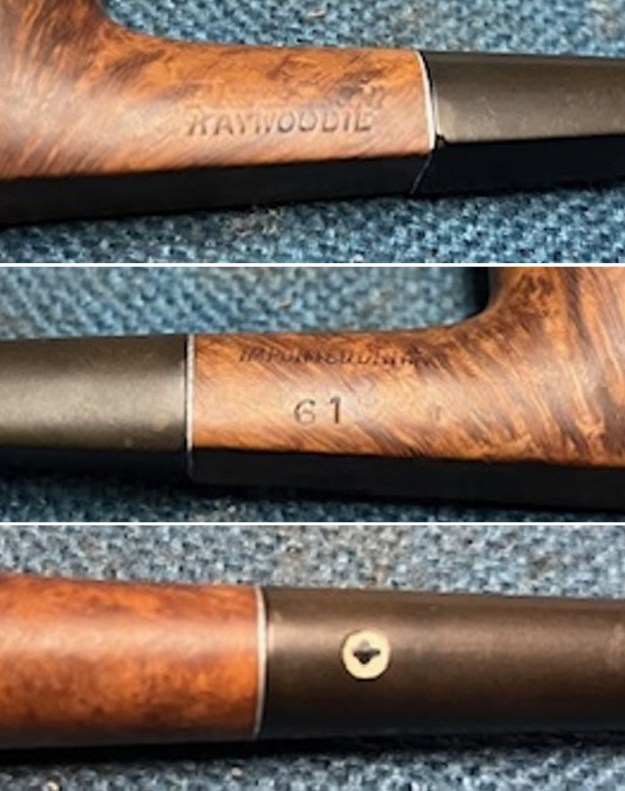
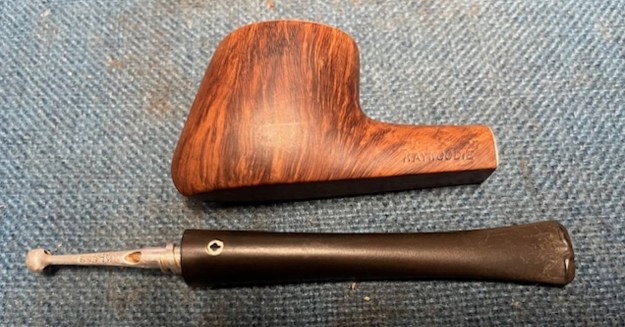
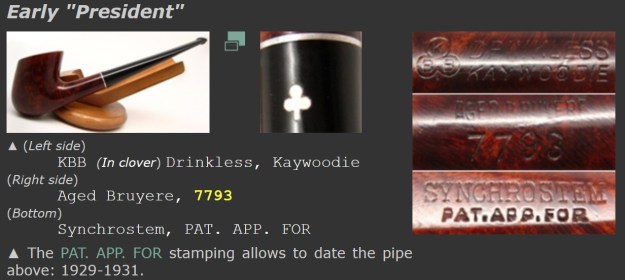
I asked him to send me some photos of the pipes before he shipped them to me. I gave my address and he shipped them to me. Here are the photos of the Marxman pipe that he sent.He included some close-up photos of the bowl and shank to show the condition they were in. The photos show the condition the bowl and rim top. There is no cake in the bowl but the rim top and inner edge show damage from burning and possibly overzealous reaming. The stem has a lot of tooth marks and dents in the top and underside ahead of the button. He also removed the stem from the shank and took a photo to show the condition of the aluminum stinger apparatus. The pipes arrived here last evening. I took the Kaywoodie President to the table to look it over. It was very clean inside and out. The rim top had burn damage on the rim top and inner edge of the bowl. The finish was dirty on the bowl and shank. The pipe was stamped on the left side of the shank read Flame Grain [over] Kaywoodie. On the right side it is stamped Imported Briar [over] the shape number 61. The stamping was clear and quite readable. The stem was oxidized and had tooth damage on the top and underside ahead of the button and on the button edge itself. The vulcanite stem was fat on the bottom side and has the Kaywoodie black clover logo in a white circle on the topside of the stem. I took a photo of the rim top to show the condition. You can see the bowl has been reamed and the burn damage on the rim top and inner edge of the bowl. It needed some work. The stem was oxidized and has some deep tooth marks on the top and underside ahead of the button and on the edges. I took photos of sides of the shank to show the stamping. The stamping is clear and readable. I also took a photo of the logo on the stem top. I removed the stem from the shank and took a photo of the pipe parts to show what I was working with. The stinger apparatus is shown in the photo as well. It is a nicely grained unique.I turned to Pipephil’s site to look at the data that was available on Kaywoodie President pipes and see if there were any pipes like the bowl I had (http://www.pipephil.eu/logos/en/logo-kaywoodie.htmlThe shape called “President” is a Kaywoodie’s distinctive production. It has never been copied. Until late 1930’s pipes were stamped with a 4 digit code (this pipe: 7793).

  • The first 2 numbers (77) designate the style or finish.
  • The last 2 are the shape numbers (93).
  • The numerical code may be reinforced by a letter for variants.

Thus the small “President” pipes are stamped 93S while the larger bear a 93L (see also this Super Grain pipe).

Later Kaywoodie will cancel the 2 first style/finish numbers keeping the 2 last shape numbers and the letter for variants (i.e. Allbriar or Connoisseur).

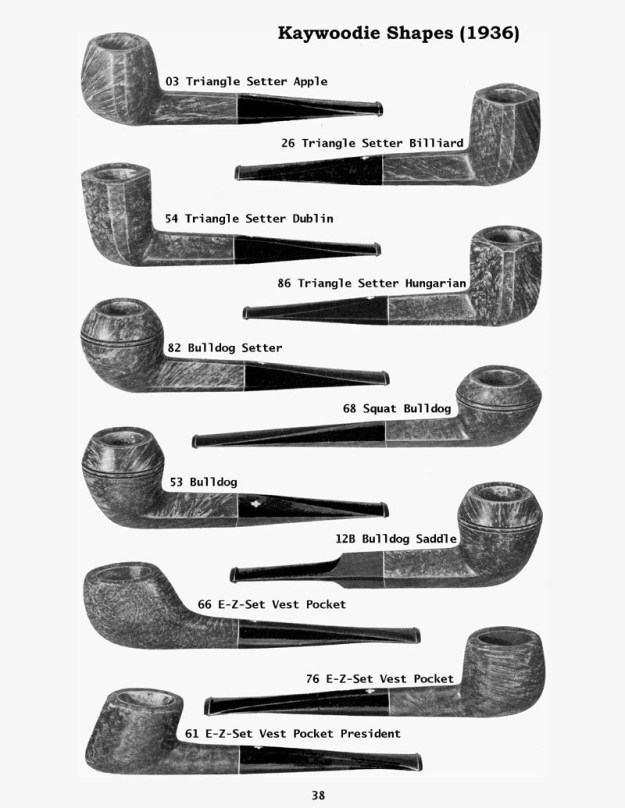
I further worked on the name and shape number of this Kaywoodie. It was stamped on the right side of the shank with the shape number 61. I turned to Pipedia to a specific article on the various shape numbers (https://pipedia.org/wiki/Kaywoodie_Shape_Numbers). I found the following line below. It identifies the shape 61 as follows.

61 EZ set Vest pocket President (streamliner shape) oval bowl 1935-1937, 1952-1960

From that information I knew that the pipe originally had been released in 1935-37 and then released again between 1952-60. The pipe in hand was the later release as the earlier version had a different shape number and often had the patent number. This one had a two digit number and no patent.

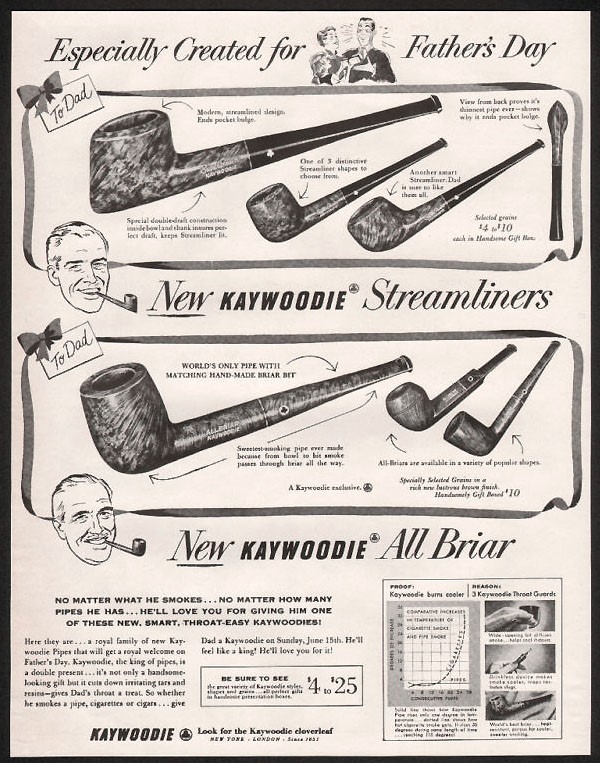
I turned to Pipedia to the article on Kaywoodie pipes (https://pipedia.org/wiki/Kaywoodie) to see if I could find information on the shape and President line. There was a sales flyer on Kaywoodie pipes for Father’s Day. I have included a copy of the flyer below in a section called Streamliners.The article also included a shape chart that was helpful. The last shape in the chart was a Kaywoodie 61 E-Z-Set Vest Pocket President which is the same shape as the one that I am working on.From the above information I knew that I was working on a Kaywoodie President shape 61. It is a great looking unique pipe. It was now time to start working on the pipe.

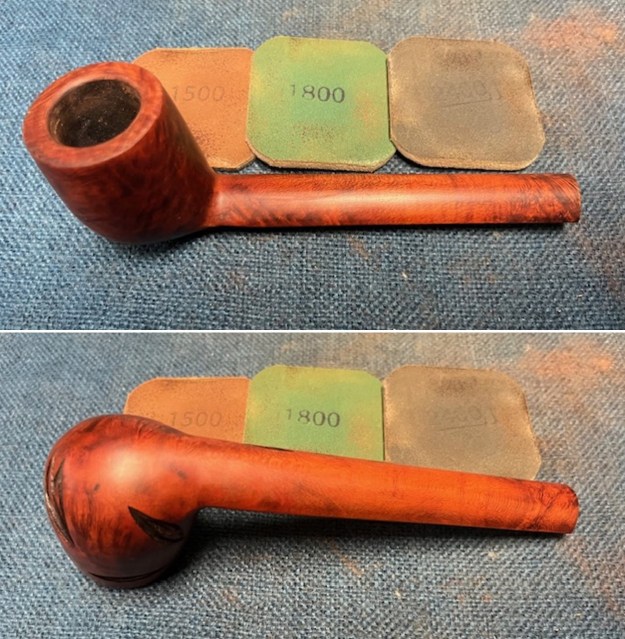
I cleaned out the shank and the airway in the stem with pipe cleaners – bristle and smooth and cotton swabs and alcohol. It was an incredibly dirty shank and airway in the stem. It smelled significantly better once finished.I decided to address the damage on the rim edge and top. I wanted to do so with minimal effect on the shape of the edge and rim. I used a folded piece of 220 grit sandpaper to smooth out the damage on the inner edge of the bowl and to remove the burn damage. It looked much better. I carefully, gently sanded the surface of the bowl and the shank with 320-3500 grit 2×2 inch sanding pads to remove the scratches in the surface of the briar. The bowl and shank began to look very good. I polished the briar with 1500-12000 grit micromesh sanding pads – dry sanding the briar and wiping down the bowl after each sanding pad. It really began to take on a rich shine and the grain stood out beautifully. I rubbed the briar down with Before & After Restoration Balm and worked it into the briar and the repaired areas. The product works to clean, enliven and preserve the briar and give it a rich lustre. The briar came alive and the grain really pops. I set the bowl aside and turned my attention to the stem.  I forgot to take photos but I “painted” the vulcanite stem surface with the flame of a Bic lighter to lift the tooth marks. I was able to lift the majority of them with the heat. I filled in the deeper marks on the surface of the button and the edge of the button with a rubberized CA glue. I flattened the repairs on the stem and recut the edge of the button with a small file. I flattened the repairs with a folded piece of 220 grit sandpaper. It is starting to look very good. I sanded the stem with 320-3500 grit 2×2 inch sanding pads. The shape and look of the stem looked better and better. The remaining oxidation was gone.I polished the stem by dry sanding it with 1500-12000 grit micromesh sanding pads. I wiped the stem down after each sanding pad with an Obsidian Oil Cloth. The stem looked very good. I put the Kaywoodie Flame Grain Imported Briar 61 President back together and buffed it on the buffing wheel with Blue Diamond. It raised a shine on the briar and the stem and gave some depth to the grain. I gave both the bowl and the stem multiple coats of carnauba wax on the wheel and buffed the pipe with a clean buffing pad to raise the shine. I hand buffed it with a microfiber cloth to deepen the shine. The pipe turned out to be a unique beauty in its own way. I really like the grain and the shape of this Kaywoodie Flame Grain 61 President. The dimensions of the pipe are Length: 6 inches, Height: 1 ½ inches, Outer diameter of the bowl: 1 ¼ inches, Chamber diameter: ¾ of an inch. The weight of the pipe is 1.41 ounces/39 grams. It is a uniquely beautiful pipe. It will join the Marxman Apple on its journey back to Devin early in the week ahead. Thanks for walking through the restoration with me.

Restoring a Lovely Castello Collection KK Carlo Sciotti 42 Oval Shank Dublin


by Steve Laug

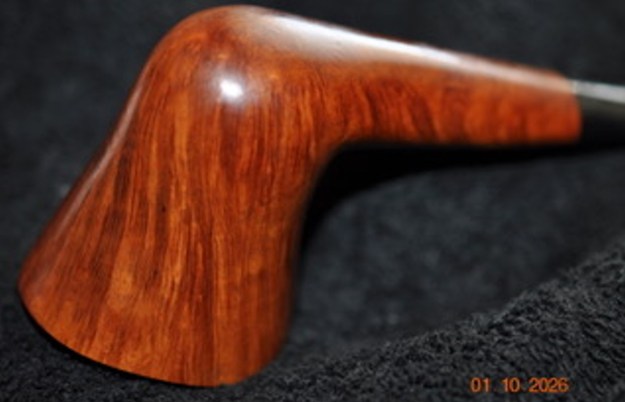
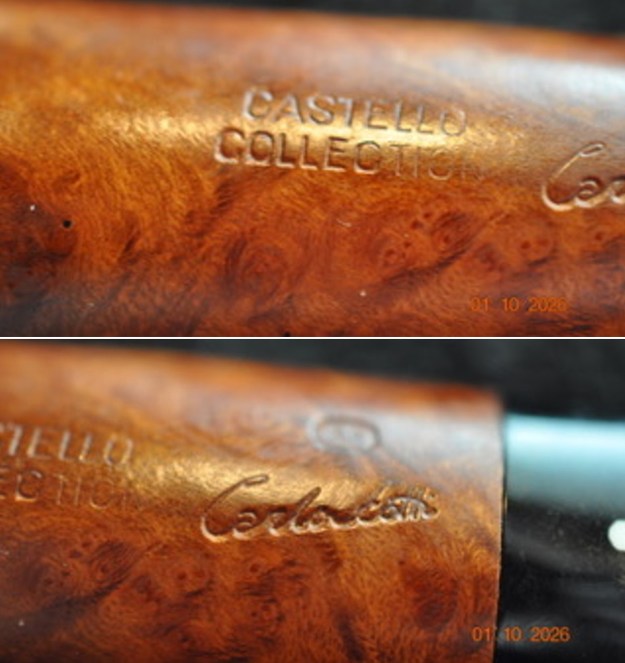
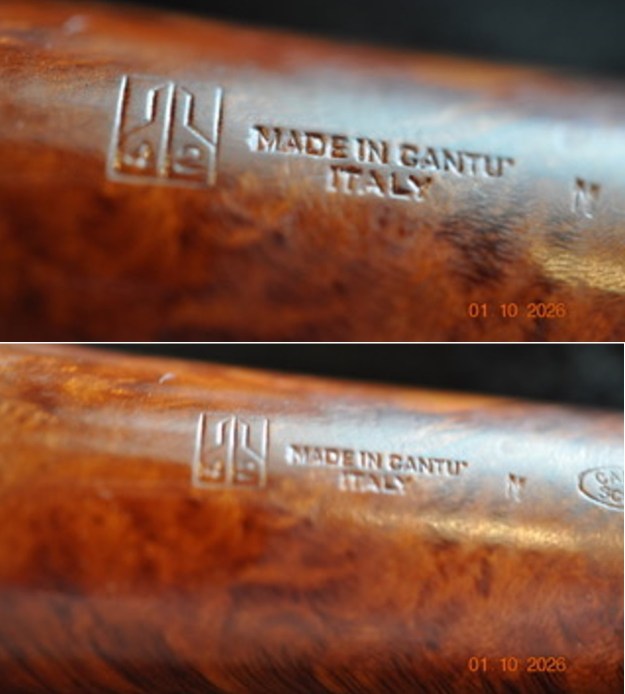
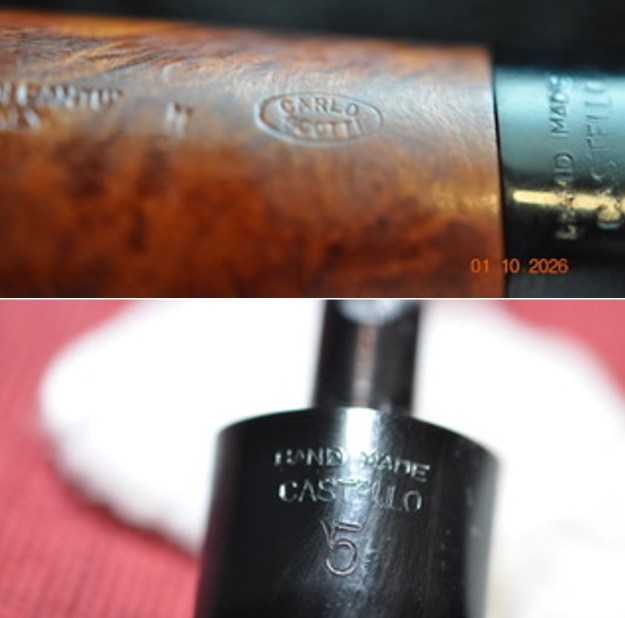
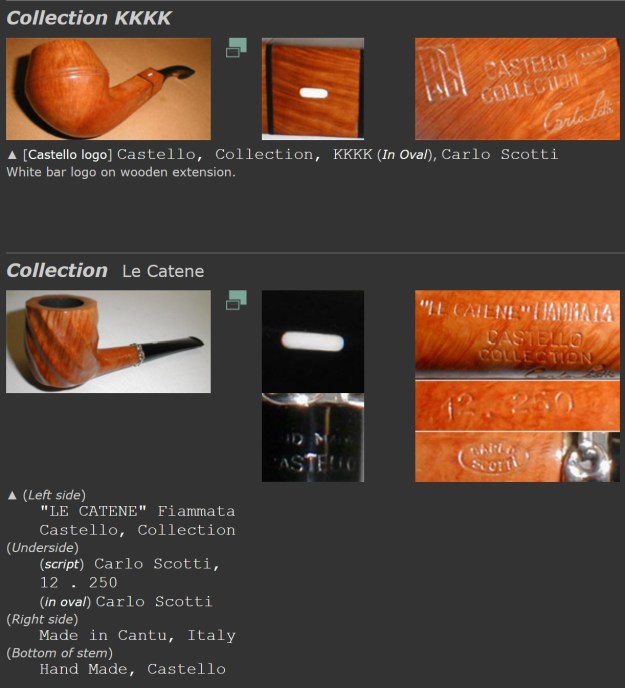
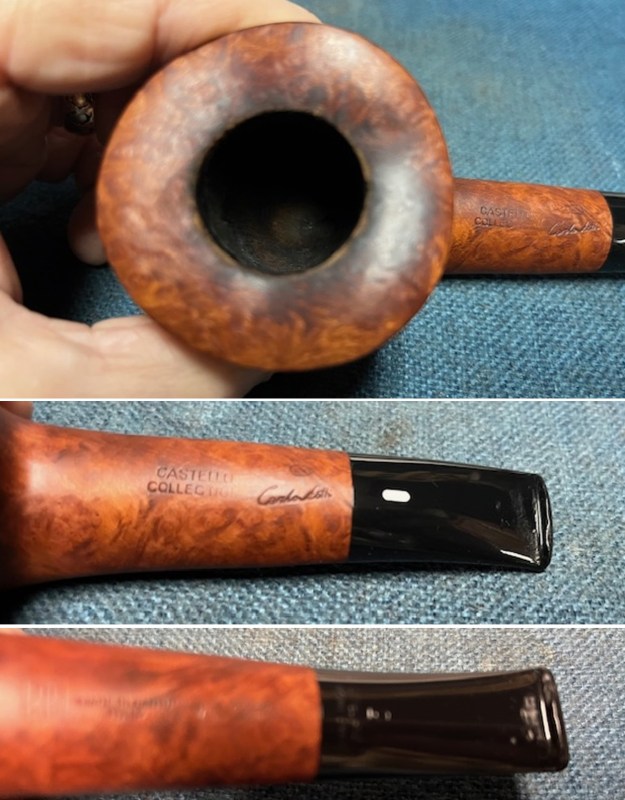
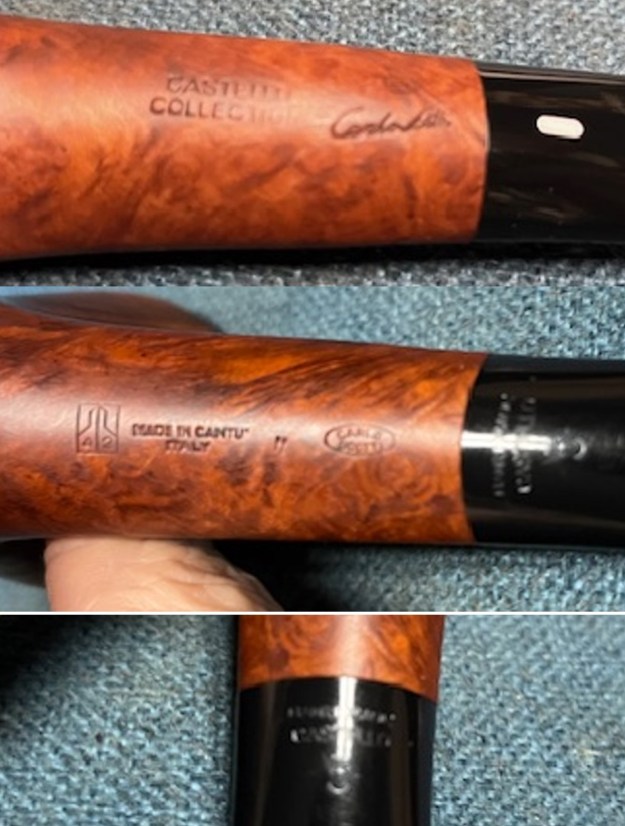
It is a beautiful chilly day in Vancouver without rain so I decided to go to the basement and work on another pipe that was purchased on 12/27/2025 in a lot of pipes that came to us from an estate of a pipeman in Durham, North Carolina, USA. The grain around the bowl and shank of this large Dubin has a mix of birdseye, straight and flame grain. The pipe is stamped on the topside of the shank and reads Castello [over] Collection [to the right] it has KK in an oval [over] the signature of Carlo Scotti. On the underside it is stamped with a Castello castle with the date stamp inside – 42 [followed by] Made in Catnu [over] Italy. To the right of it is stamped with an 11 [followed by] an oval with Carlo [over] Scotti on the inside of the oval. The pipe was dirty when Jeff received it. There was dust and grime ground into the finish. It is finished in the warm stain that highlights some nice grain around the bowl and shank. The bowl was heavily caked and there was some darkening and thick lava on the rim top. The inner edge is not visible under the lava so it may well be protected and undamaged. The acrylic taper stem was dirty with deep tooth marks and chatter on both sides ahead of the button and on the button itself. There was a white bar logo on the top of the stem. On the underside it is stamped Hand Made [over] Castello [over] 5. Jeff took photos of the pipe before he started his clean up work on it. Jeff took photos of the bowl and rim top to show what they looked like before the clean up. You can see the thick cake in the bowl and the darkening and lava on the inner edge and top of the rim. The photos of the sides and heel of the bowl show the grain around the bowl and shank. The stain adds depth finish on the pipe. Even under the grime it is a real beauty. The stamping on the sides of the shank are shown in the photos below. It is clear and readable as noted above. I wanted to get to the details of the Castello Collection so I turned to Pipephil’s site to see what I could learn about the line (http://www.pipephil.eu/logos/en/logo-castello.html). I did a screen capture of the pertinent information on the Collection line. There were several Collection pipe shown – a KKKK and Le Catene but no KK. The rest of the stamping shown in the photo below is identical to those.

I turned to Pipedia (https://pipedia.org/wiki/Castello) to see what I could find out there. I have included some of the pertinent information below. The information helped me understand the dating on the pipe.

Dating: 41 inside the castle emblem = 1988

Only the higher quality pipes are stamped with that date reference (starting from the smooth “Castello” grade). Lower grades as Sea Rock, Old Antiquari or Trade Mark pipes are near impossible to date.

The castle stamping with a number inside the castle was introduced in 1987 (the 40th anniversary of Castello).

Sizes (ascending):

1K to 4K, G (Giant) and GG (Extra large)

Rusticated grading: SEA ROCK, OLD SEA ROCK, NATURAL VIRGIN,

Sandblasted grading: ANTIQUARI, OLD ANTIQUARI

Smooth grading (ascending): TRADEMARK, CASTELLO, COLLECTION

Other stampings: Great Line (Non-standard or freestyle) Fiammata (Straight grain)

Production (2012): ~4000 pipes / year

That helped me date the pipe I was working on that was stamped with a 42 in a Castle. The 41 stamp above meant that the above pipe was made in 1988 and the one I was working on was made a year later in 1989.

I did a bit more work on Google to understand the dating and the meaning of the Collection series. I turned to this blog (https://davismh76.wordpress.com/about/the-castello-pipe/). From there I found the following information. First I have included a section on Dating Today. Secondly a section on Collection. The Dating section confirms the 42=198 Date.

Dating Today. Small k in an oval with castle marking on some lines. In 1987, the 40th anniversary of Castello, a new stamp was introduced on some lines of Castello pipes. This consists of a castle stamping with a number inside the castle. The number signifies a year 40= 1987, 41=1988, 42=1989, and so forth. Lastly, in 2007 (the 60th anniversary), Franco has added “kino” in an oval to place his name on the pipes for the first time. Note. One person (Franco Coppo) grades all Castello pipes. He has viewed and graded the total factory’s production for many years. It is said that the ‘k’ stands for Kino, which is Franco’s nickname.

Collection. [The highest grade all smooth ‘standard’ series]: The Collection series is graded on grain with a 4k piece being the highest graded ‘standard’ Castello available. The collection series is usually used on straight grained briar with a few 2k and 3k pieces available with cross cut/birds eye graining.

From that information I knew that the pipe that I was working on was made in 1989. When I look at the grain and also the way the pipe maker cut the pipe to maximize the lay of the grain on the bowl confirms that it is definitely high on the grade list. It is a 2k pipe which the above says is available with cross cut/birds eye grain. Now it was time to work on the pipe on my end.

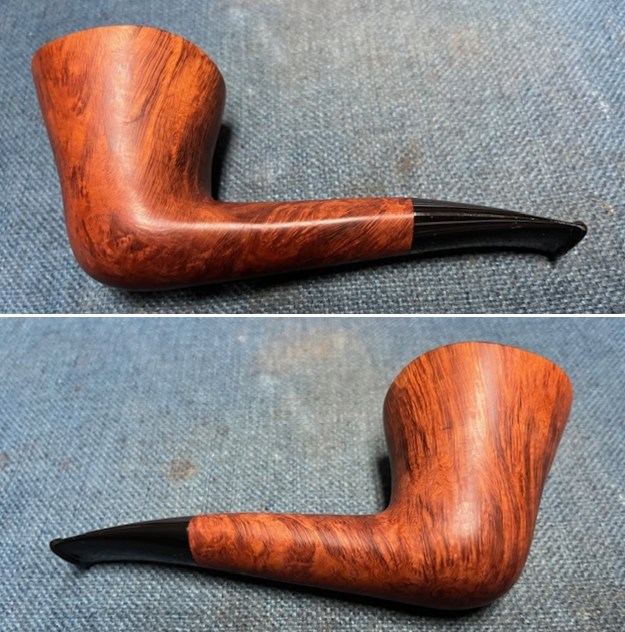
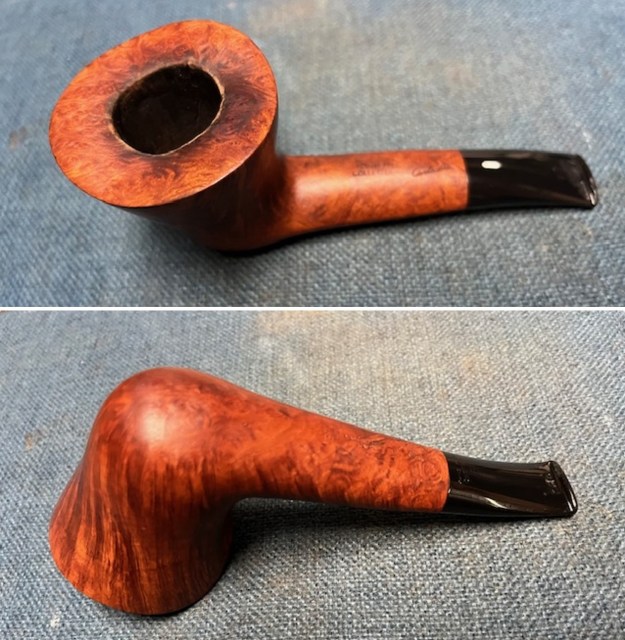
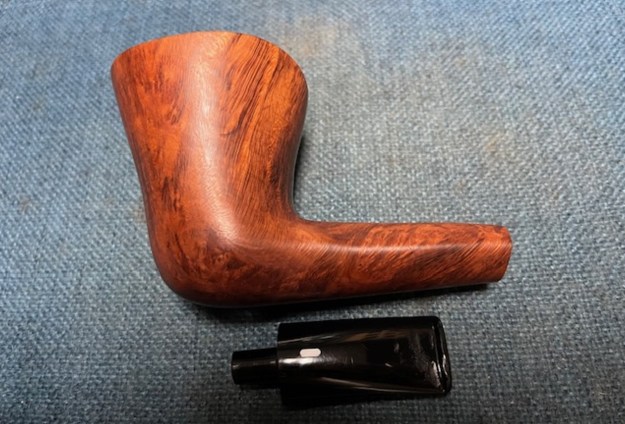
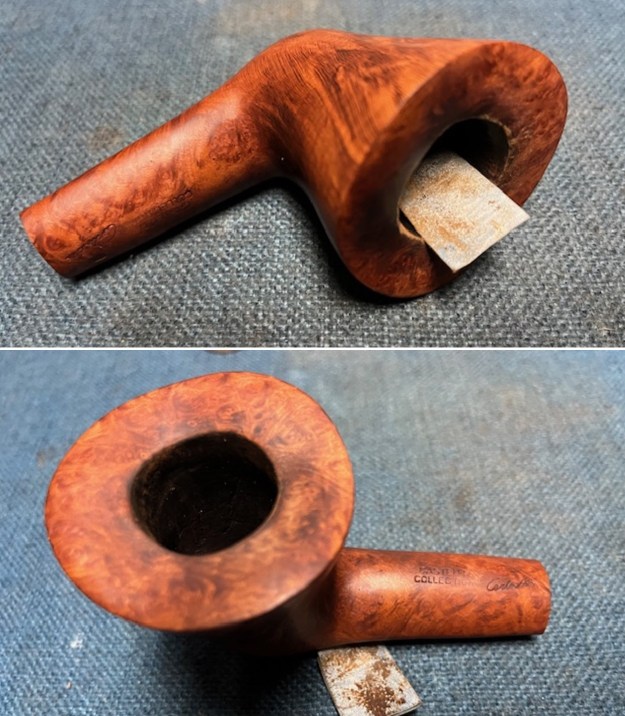
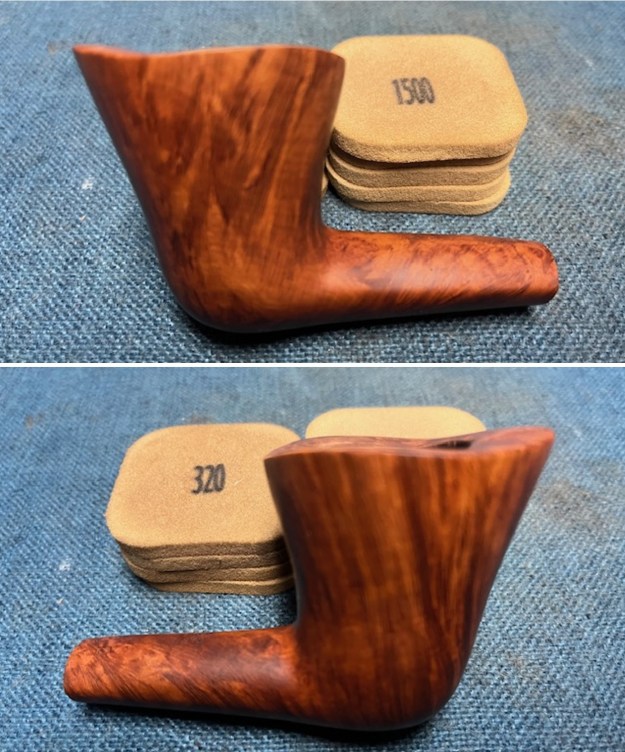
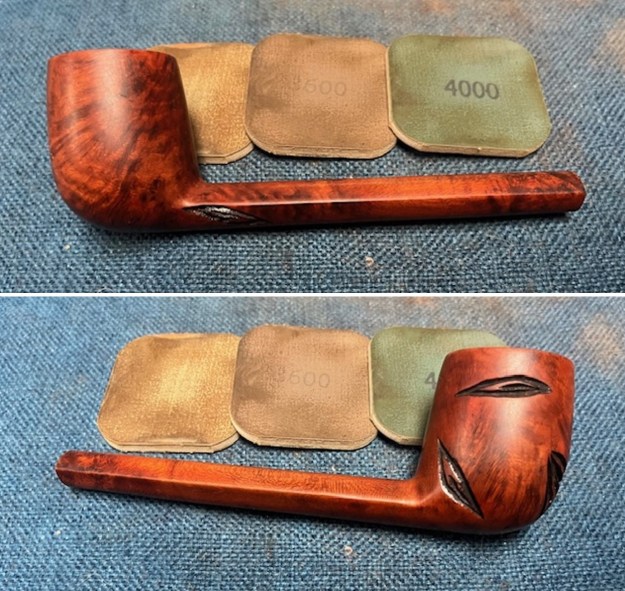
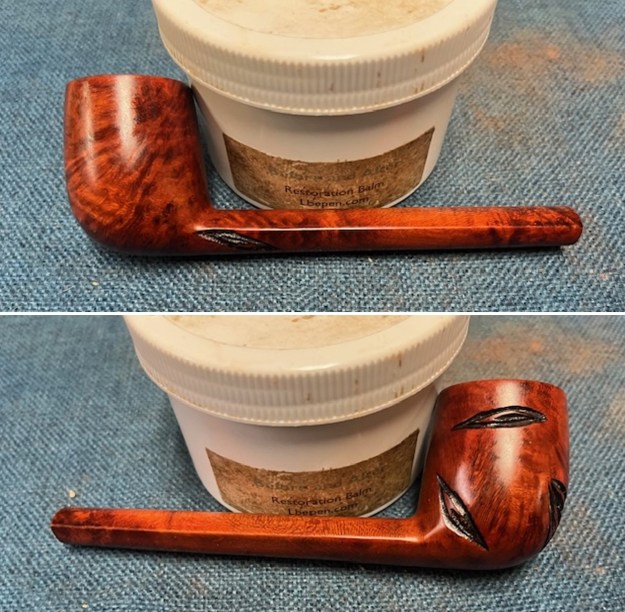
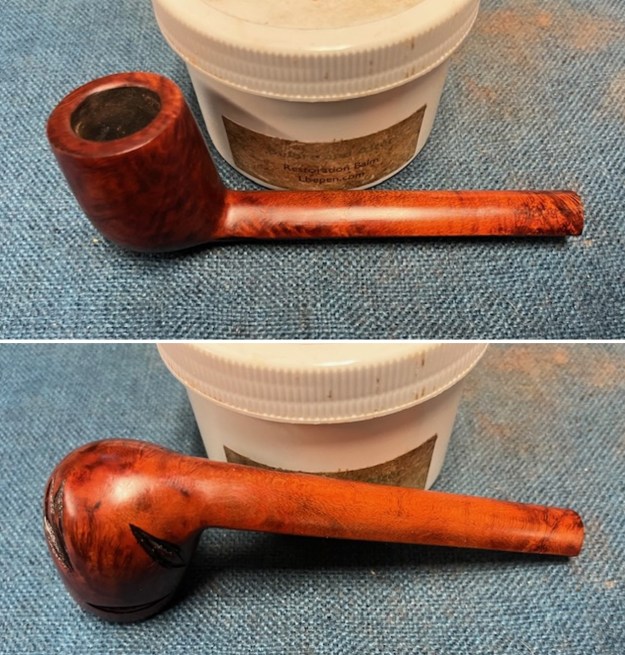
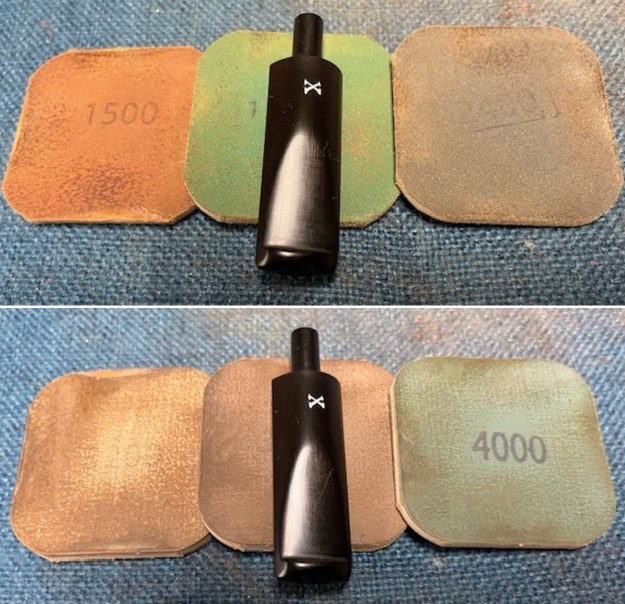
When I received it from Jeff this past week it did not look like the same pipe. It was clean and the finish had life. He reamed it with a PipNet pipe reamer and got rid of the cake. He cleaned up the reaming with a Savinelli Fitsall Pipe Knife so that we could see the walls of the bowl and assess for damage. It was in good condition. He cleaned the internals of the shank and stem with cotton swabs, pipe cleaners and alcohol. He scrubbed the exterior with undiluted Murphy’s Oil Soap and a tooth brush. He rinsed the pipe under warm water. He dried it off with a cloth and then let it air dry. The stem was scrubbed with Soft Scrub and soaked in Briarville’s Stem Deoxidizer. It came out looking very good. The finish on the bowl and the rim top cleaned up nicely. I took pictures of the pipe to show how it looked when I brought it to the table. I took some photos of the rim top and stem to show the condition of them both when the pipe arrived. Overall the briar looked good. The stem had some light tooth chatter and marks ahead of the button and on the button surface on both sides.I took a photo of the stamping on the top and underside of the shank and the underside of the stem. It is readable and in great condition. I removed the stem from the shank and took a photo of the pipe to show the look of the pipe. I worked on the inner edge and the rim top of the bowl with a folded piece 220 grit sandpaper. Once I finished cleaning up the edge and top it looked very good.I sanded the sides of the bowl and the rim top with 320-3500 grit 2×2 inch sanding pads to remove the scratching in the briar and smooth it out. It is a really beautiful piece of briar with some amazing grain around the sides, heel and rim top. I polished the bowl with micromesh sanding pads – dry sanding with 1500-12000 grit pads. I wiped the briar down after each pad with a damp cloth. The bowl is starting to look very good. I worked some Before & After Restoration Balm into the surface of the briar with my fingertips to clean, enliven and protect it. I let the balm sit for a little while and then buffed with a cotton cloth to raise the shine. The photos show the bowl at this point in the restoration process. I set the bowl aside and turned my attention to the stem. I wiped the tooth marks down with isopropyl alcohol and a cotton swab and then filled in the tooth marks with black CA glue. Once the repairs cured I used a small flat needle file to smooth out the repaired areas on both sides of the stem. I sanded them with a folded piece of 220 grit sandpaper to blend them into the surface of the vulcanite. I sanded the stem with 320-3500 grit sanding pads. I wiped it down after each sanding pad with a damp cloth. By the final 3500 grit sanding pad the rim top had a shine.I polished the stem with micromesh sanding pads – wet sanding with 1500-12000 grit sanding pads. I wiped it down after each sanding pad with some Obsidian Oil. I finished polishing it with Before & After Pipe Stem Polish – both Fine and Extra Fine and buffed it off with a cotton cloth. This beautiful Castello Collection KK Carlo Scotti 42 (1989) Oval Shank Dublin with a taper acrylic stem looks amazing after the work on it. The briar is clean and the grain really came alive. The rich brown stains gave the finish a sense of depth with the polishing and waxing. The birds eye almost winked at me. I put the stem back on the bowl and buffed the pipe with Blue Diamond on the buffing wheel using a light touch on the briar. I gave the bowl and the stem multiple coats of carnauba wax on the buffing wheel. I buffed the pipe with a clean buffing pad to raise the shine. I hand buffed the pipe with a microfiber cloth to deepen the shine. The finished Castello Collection KK Carlo Scotti Dublin really is a beauty and feels great in the hand and looks very good. Give the finished pipe a look in the photos below. The dimensions of the pipe are Length: 6 inches, Height: 2 ½ inches, Outside diameter of the bowl: 2 inches, Chamber diameter: 1 inch. The weight of the pipe is 67 grams/2.36 ounces. I will soon be putting this pipe on the rebornpipes store in the Italian Pipemakers Section. It should make a great smoker so if you are interested in it please let me know..
As always, I encourage your questions and comments as you read the blog. Thanks to each of you who are reading this blog. Remember we are not pipe owners; we are pipe men and women who hold our pipes in trust until they pass on into the trust of those who follow us.

Breathing New Life into a Stanwell Dorado 175 Stack


by Steve Laug

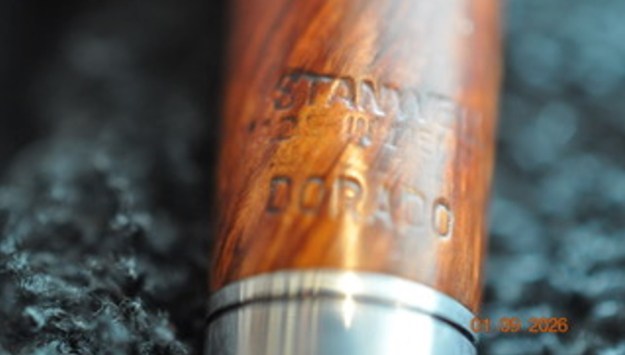
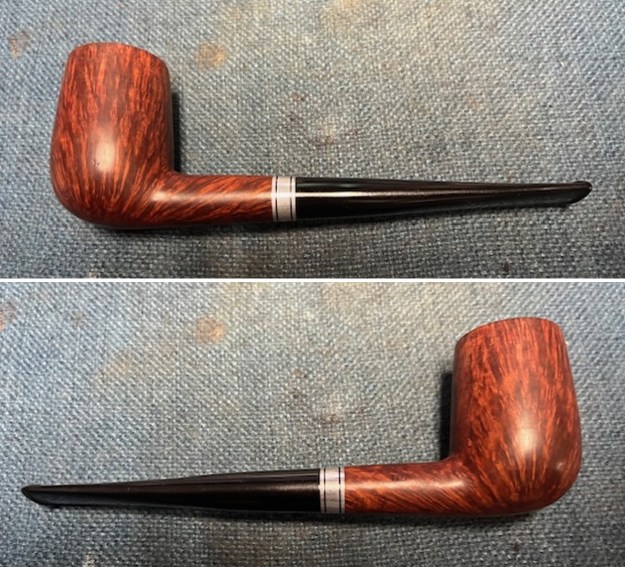
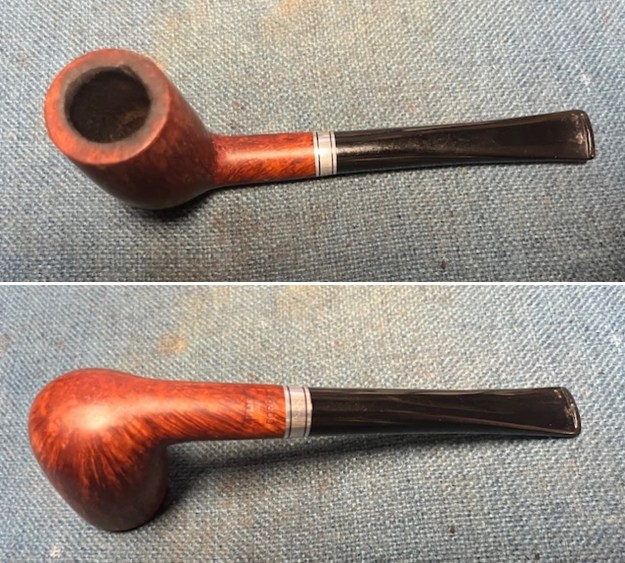
It is a beautiful chilly day in Vancouver without rain so I decided to go to the basement and work on another pipe that was purchased on 02/16/2023 in a lot of pipes that came to us from a seller in Copenhagen, Denmark. It included a group of Danish Made Stanwell pipes that are quite beautiful. The grain around the bowl and shank of this Stack has a mix of birdseye, straight and flame grain. The pipe is stamped on the underside of the shank and reads STANWELL [over] Made in Denmark [over] Dorado. On the right side of the shank it is stamped with the shape number 175. The pipe was dirty when Jeff received it. There was dust and grime ground into the finish. It is finished in the warm stain that highlights some nice grain around the bowl and shank. The bowl was heavily caked and there was some darkening and lava on the rim top. The inner edge shows some damage and darkening around the bowl. There was a ferrule on the end of the shank with two think black lines around the band. The stem is acrylic and is dirty with light tooth marks and chatter on both sides ahead of the button and on the button itself. There is no logo on the sides or top of the taper stem. Jeff took photos of the pipe before he started his clean up work on it. Jeff took photos of the bowl and rim top to show what they looked like before the clean up. You can see the thick cake in the bowl and the darkening and lava on the inner edge and top of the rim. The acrylic stem was in decent condition with tooth marks that are visible in the photos below. The photos of the sides and heel of the bowl show the grain around the bowl and shank. The stain adds depth finish on the pipe. Even under the grime it is a real beauty. The stamping on the sides of the shank are shown in the photos below. It is clear and readable as noted above. I turned to Pipephil’s site to see if I could find any information on the Diplomat line of Stanwell pipes (http://www.pipephil.eu/logos/en/logo-stanwell.html). There was nothing specific on the line but the summary of Stanwell History is quite helpful. I quote it below.

Brand & factory were established in 1942 by Poul Nielsen. The company has been owned since 2000 by Nordisk Tobaks Kompagni A/S.

The factory in Borup crafted all Stanwell pipes from 1965 until 2009. From 2010 on the pipes are crafted by Barontini (Italy) exept for the limited editions.

Production (2007): 115 000 Pipes/year – Denmark

I turned to Pipedia to an article that originally was posted here on rebornpipes and written by my late friend Bas Stevens (https://pipedia.org/wiki/Stanwell_Shape_Numbers_and_Designers). The list did not clarify who designed the shape so that was still a bit of a mystery. Whoever did so, created a beauty. I now knew that the shape 175 was a Tall Billiard or Chimney with tapered stem. There was no other information. Now it was time to work on the pipe.

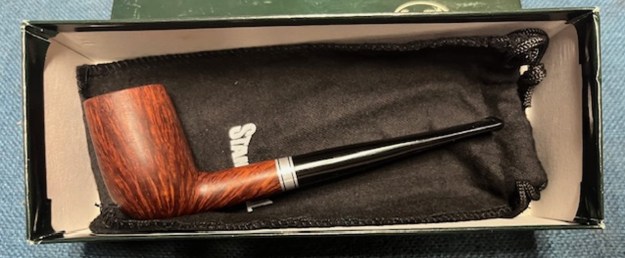
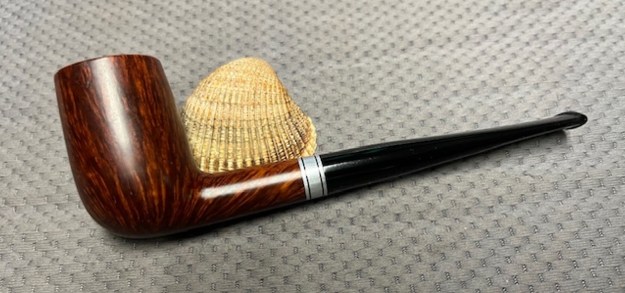
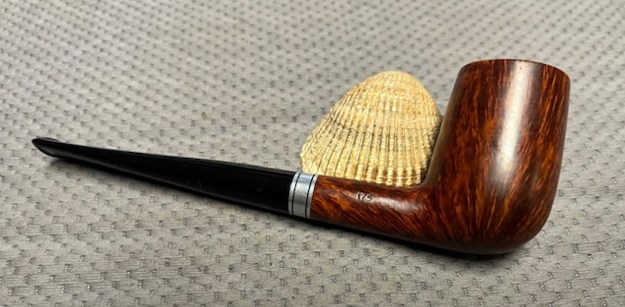
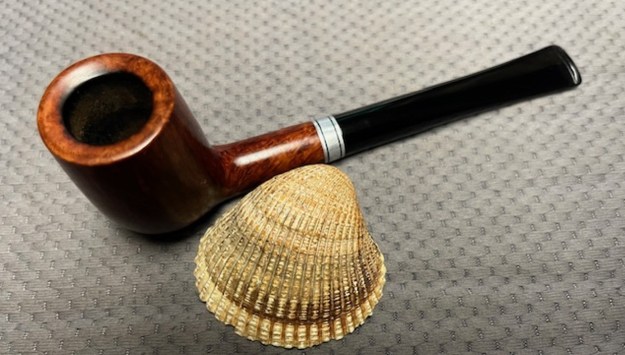
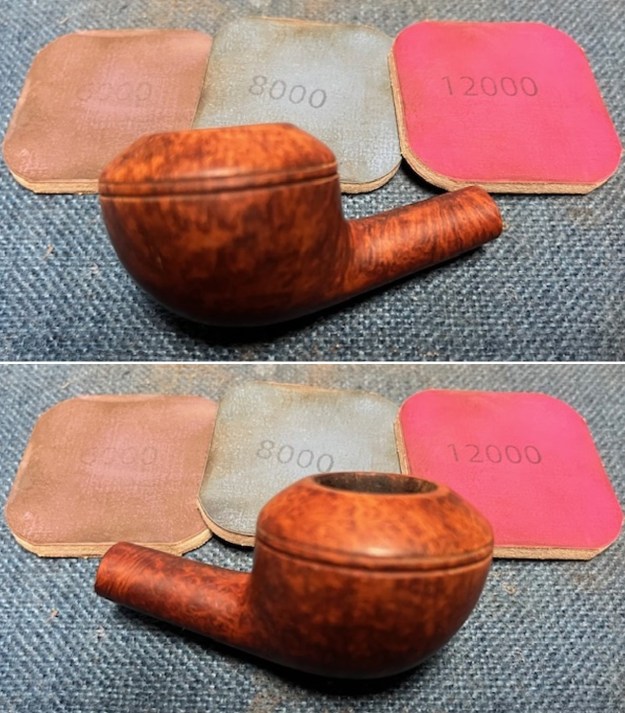
Jeff had cleaned up the pipe with his usual penchant for thoroughness. He reamed the pipe with a PipNet Pipe Reamer and cleaned up the remnants with a Savinelli Fitsall Pipe Knife.  He scrubbed the bowl with undiluted Murphy’s Oil Soap with a tooth brush. He rinsed it under running warm water to remove the soap and grime. He cleaned out the inside of the shank and the airway in the stem with alcohol, cotton swabs and pipe cleaners. He soaked the stem in Before & After Deoxidizer and rinsed it off with warm water. It came in Stanwell Box with Pipe Sock. I removed it from the sock and took photos of the pipe once I received it. I took close up photos of both the rim top and the stem. Jeff had been able to get the grime and lava off of the rim top and it looked pretty incredible. Even the darkening and marks on the rim top on the right side and the back of the bowl are very obvious now that it is clean. The stem looked very clean. The tooth marks and chatter were minimal and should be easy to remove.The stamping on the shank side was readable as noted above. I also took a photo with the stem removed to give an idea of the perspective and design of the pipe.I started my work on the pipe by addressing the damage on the inner edge of the bowl with a piece of 220 grit sandpaper and a sphere to remove the damage. I then used a half sphere to further shape the rim top to bring the edge back into round and it looked much better. Over all the rim top and edges looked much better.I sanded the outside of the bowl and rim with 320-3500 grit sanding pads to remove the scratching and marks on the briar. I wiped the bowl down between pads with a damp cloth to remove the sanding debris. I stained the sanded and polished rim top with a Maple stain pen and it matched the colour of the rest of the pipe. I polished the smooth bowl and rim top with micromesh sanding pads using 1500-12000 grit sanding pads and wiping it down after each sanding pad with a damp cloth to remove the sanding dust and debris. I worked some Before & After Restoration Balm into the finish of the bowl and shank with my fingers. I want the product to go deep into the finish because it works to clean, enliven and protect the briar. Once I was confident that it was deeply worked into the finish I wiped it off and buffed it with a soft cloth to polish it. The pipe really began to have a rich shine. I took some photos of the bowl at this point to mark the progress in the restoration. The grain really stands out on the pipe in the photos below. I set the bowl aside and turned my attention to the acrylic stem. I tried to raise the tooth marks on the acrylic stem. I “painted” the stem surface with the flame of a Bic lighter and was not able to lift any of the marks. I filled in the tooth marks with black CA glue (I forgot to take photos of the repairs once I glued them). Once the repairs cured, I used a small flat file to smooth out the repairs. I then sanded the areas with 220 grit sandpaper to smooth them out and blend them in. I wiped it down with an Obsidian cloth to remove the debris. I sanded the stem with 320-1500 grit sanding pads to further blend the sanding marks into the surface of the acrylic. I wiped the stem down after each sanding pad with an Obsidian cloth to remove the debris from the sanding.I polished the acrylic stem with micromesh sanding pads – wet sanding it with 1500-12000 grit pads. I wiped it down with Obsidian Oil after each sanding pad. I polished it with Before & After Pipe Polish – both the Fine and Extra Fine polishes. I gave it a final coat of oil and set it aside to dry. This Stanwell Made in Denmark Dorado 175 Stack with an acrylic taper stem is a great looking pipe now that it has been restored. The beautiful finish really highlights the straight grain and the polished finish is stunning. I put the stem back on the bowl and carefully buffed the pipe with Blue Diamond on the buffing wheel. I gave the bowl and the stem multiple coats of carnauba wax on the buffing wheel and followed that by buffing the entire pipe with a clean buffing pad. I hand buffed the pipe with a microfiber cloth to deepen the shine. The finished Stanwell Dorado 175 Stack fits nicely in the hand and feels great. Give the finished pipe a look in the photos below. The dimensions of the pipe are Length: 6 inches, Height: 1 ¾ inches, Outside diameter of the bowl: 1 inch, Chamber diameter: ¾ of an inch. The weight of the pipe is 38 grams /1.34 ounces. I will be adding the pipe to the Danish Pipe Makers Section of the rebornpipes store. If you are interested in purchasing this pipe send me a message or an email.
As always, I encourage your questions and comments as you read the blog. Thanks to each of you who are reading this blog. Remember we are not pipe owners; we are pipe men and women who hold our pipes in trust until they pass on into the trust of those who follow us.

Restemming and Breathing Life into a Dunhill Tanshell 59 Billiard


by Steve Laug

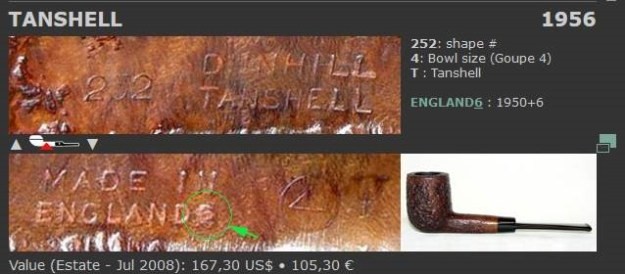
The next pipe on the table is another one that came to us from the seller in Caldwell, Idaho, USA on 07/12/2025. It is a beautiful Dunhill Tanshell Billiard with a straight vulcanite saddle stem. It is in dirty but in good condition as can be seen in the photos below. It is stamped on the underside of the shank and reads 59 on the heel of the bowl followed by Dunhill [over] Tanshell. Following that it is stamped Made in [over] England with the number 8 underlined and in superscript after the D. Below the 8 there is a superscript underlined 9. The stamping is clear and readable. It has rich finish with a blend of brown stains that highlight the depths of the sandblast around the bowl and shank that the shape follows well. The finish was dusty and dirty with grime ground into the finish. The bowl had a moderate cake and there was tobacco debris in the bowl. The rim top had a thick lava on the top and edges. The stem was quite dirty and oxidized. It was the wrong stem for the pipe as it was a Charatan Double Comfort Stem rather than a white spot stem. It will need to be replaced with a Dunhill stem. I took photos of the pipe to show what it looked like before I started working on it.   I took photos of the bowl and rim top to show their condition and of the stem to show the condition of both sides of the stem.The stamping on the underside of the shank is shown in the photo below. It looks very good and is readable. It reads as noted and explained above. I captured the detail in the photos below. I need to fit the bowl with a new stem and will take photos then.One of the first things I like to do is to unpack the stamping and understand each element in it. I turned to Pipephil helpful site (http://pipephil.eu/logos/en/dunhill/tanshell1.html). The stamping is interpreted as follows: The number 59 is the shape number for a Billiard. The Tanshell stamp refers to the finish which is corroborated the T at the end of the stamping. The size of the pipe 4 in a circle is a Group 4. The 8 following the D of England gives the date the pipe. There is also a 9 down and to the right of the 8. The second number is typically stamped to show the date the pipe sold to a retailer.Pipephil also has some helpful dating keys on the site that are basically flow charts that you can walk through to date your pipe (http://pipephil.eu/logos/en/dunhill/cledat-en1.html). I turned to Part 1 of the Dating Key and followed the chart. This pipe has 8 following the D in England. That is followed by 9.

I followed the link following the “Your pipe is posterior to 1954. Narrow down your dating”. That took me to Page 2 of the dating key (http://pipephil.eu/logos/en/dunhill/cledat-en1a.html). The third column (suffix 5…9) led me to the section with an 8 after the D in England that a superscript. It is followed by a superscript 9. There was a directive for dating the pipe spelled out as follows: 1950 + suffix which gives the pipe a date of 1958. The superscript 9 is the date it went to the retailers – 1959.I then turned to Pipedia’s section on Dunhill Root Briar to get a bit of background on the Dunhill finishes (https://pipedia.org/wiki/Dunhill#Root_Briar). I quote:

Tanshell

The first lot was distributed in 1952 (usually made using Sardinian briar). The prototype was called “Root Shell “, produced in 1951. The Tanshell is a light tan sandblast. Sardinian briar was used for this sandblast. There is a distinct contrast in the sandblasts using Sardinian as opposed to Algerian briar. The Sardinian is much denser and much harder. The resulting pattern, when blasted, is far more even and regular both in terms of the surface texture and the finish.

The TanShell was Dunhill’s fourth finish and its first major post-war line addition. Introduced in 1951/1952 the TanShell was a naturally stained sandblasted pipe made exclusively from Sardinian briar through the 1960s. The TanShell apparently was not simply a light stained Shell but rather was also the product of “certain processes [unrevealed] not previously employed.” Initially, it appears that the pipe was to be named the Root Shell and a stamp to that effect was ordered and received by Dunhill in May 1951. Ultimately, however, the name TanShell was settled upon but the stamp for the TanShell name was not received by Dunhill until the beginning of December. Thus while the Tanshell was in production in 1951 it appears that most if not all TanShells made in that year did not enter into retail distribution until 1952 and were given a 1952 date code. Loring, J. C., The Dunhill Briar Pipe, The Patent Years and After (self-published, Chicago, 1998).

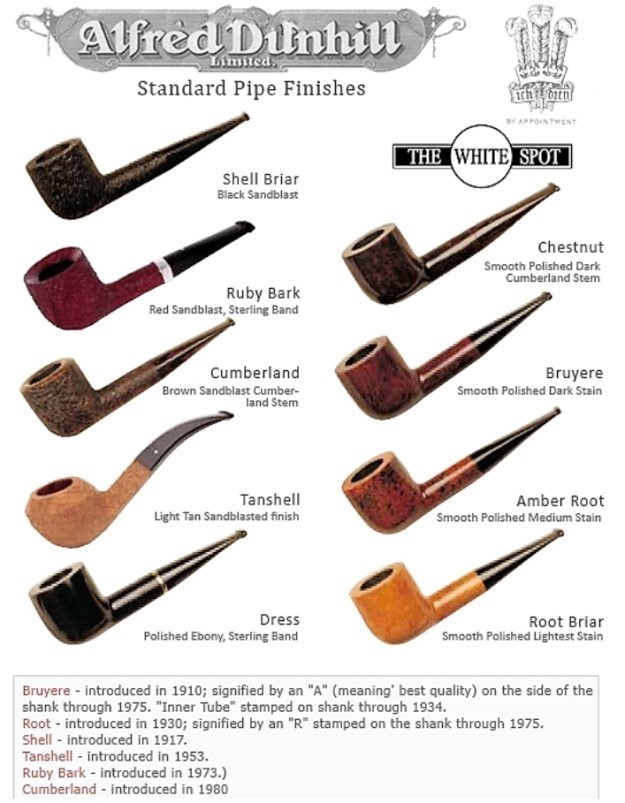
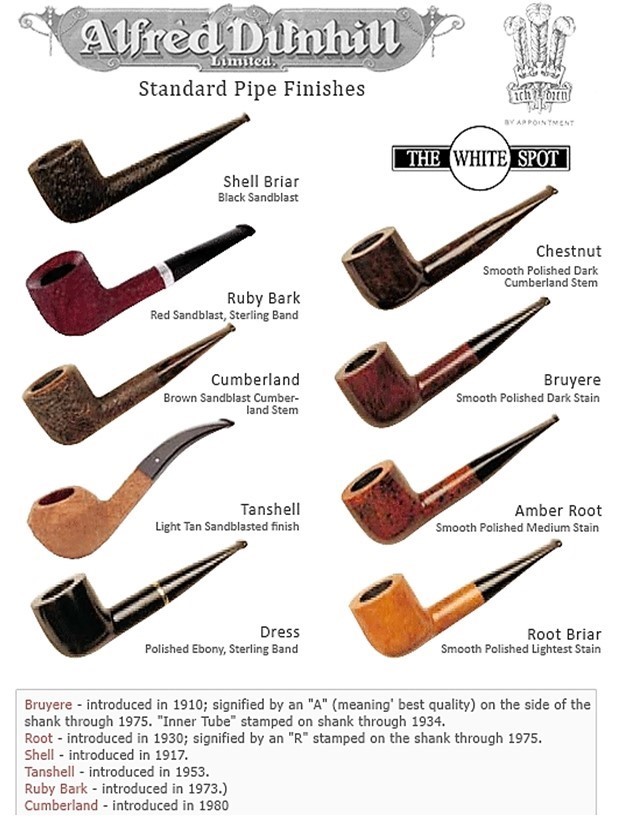
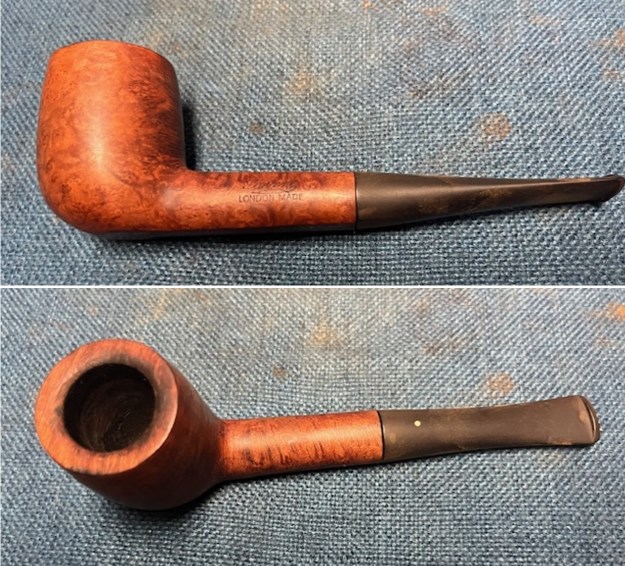
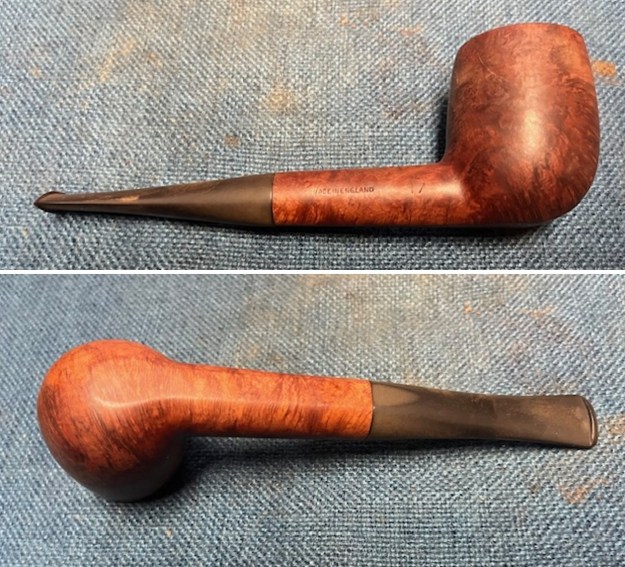
I have also included a chart from the site from Dunhill spelling out the Standard Pipe Finishes and giving short information and a timeline.Before I started working on the bowl I decided to see if I could restem it with an original Dunhill stem. I went through the boxes of pipes Jeff sent me and low and behold there was a Sasieni London Made 17 Billiard and it had a Dunhill White Spot taper stem. It looked like it would fit quite well. I removed the stem and checked it on the Tanshell. The tenon was a little large for the shank. I used a flat file and 220 grit sandpaper to reduce the diameter of the tenon to fit the shank.With that finished I inserted it in the shank and took photos of the fit. The diameter of the stem was very slightly wider than the shank. The flat bottom on the stem matched the flat portion of the shank. There were also some tooth marks on the top and underside of the stem ahead of the button. I filled in the tooth marks with black CA glue and set the stem aside to let the repairs cure on the surface. It took about 20 minutes to harden. Once it hardened I flattened it with a folded piece of 220 grit sandpaper. I was able to blend it into the vulcanite. I also worked on the diameter of the stem to reduce it to match diameter of the shank. I used the Dremel and sanding drum to further reduce the diameter of the stem. I worked it over further with 220 grit sandpaper to smooth out the scratches and blend in the marks to the surface of the vulcanite. I also wanted to really adjust the fit to the shank.I sanded the stem further with 320-3500 grit 2×2 inch sanding pads and wiped it down with a damp cloth after each sanding pad. It started to look very good.I polished the stem with micromesh sanding pads – dry sanding with 1500-12000 grit pads. I wiped the stem down after each sanding pad with Obsidian Oil. I polished it with Before & After Pipe Stem Polish – both Fine and Extra Fine. Once I had finished the polishing I gave it final coat of Obsidian Oil and set it aside to dry. I set the stem aside and turned to work on the bowl. I reamed the bowl with a PipNet reamer using the second and third cutting head. I took the cake back to bare briar. I cleaned up the reaming with a Savinelli Fitsall Pipe Knife and then sanded the bowl walls with a piece of dowel wrapped with 220 grit sandpaper. The bowl looked very good at this point there were no burn marks and only light checking on the walls. I worked over the sandblast rim top with a brass bristle wire brush to clean up the debris in the valleys of the blast. It looked better.I cleaned out the inside of the shank and the airway in the stem with alcohol, cotton swabs and both bristle and regular pipe cleaners. I scrubbed the bowl and shank with a tooth brush and some undiluted Murphy’s Oil Soap. I rinsed it off with warm water to remove the dust and soap from the finish. I dried it off with a soft cloth and it looked much better. I continued scrubbing the bowl and rim top with Before & After Extra Strong Briar Cleaner. I scrubbed it with a brass bristle wire brush to clean out the rim top and the darkening on the backside of the bowl. I rubbed the briar down with Before & After Restoration Balm. I worked it into the rusticated rim top and the smooth briar with my fingertips to work it into the finish. The product works to clean, enliven and preserve the briar. I let it sit for 10 minutes then I buffed it with a cotton cloth to deepen the shine. The briar really comes alive with the balm. I put the stem back on the bowl of this 1958 Dunhill Tanshell 59 Group 4 Billiard with a newly fitted Dunhill Taper Stem has a beautiful, unique Dunhill Sandblast finish that was deep and craggy and crisp. The Tanshell finish highlights a classic Dunhill rugged sandblast around the bowl and shank. The polished black vulcanite taper stem adds to the mix. I put the stem back on the bowl and buffed the pipe with Blue Diamond on the buffing wheel being careful to not buff the stamping. I gave the bowl multiple coats of Conservator’s Wax and the stem multiple coats of carnauba wax on the buffing wheel and followed that by buffing it with a clean buffing pad. I hand buffed the pipe with a microfiber cloth to deepen the shine. The finished lightweight Dunhill Tanshell 59 Billiard is quite nice and feels great in the hand. Give the finished pipe a look in the photos below. The dimensions of the pipe are Length: 5 ½ inches, Height: 1 ¾ inches, Outside diameter of the bowl: 1 ¼ inches, Chamber diameter: ¾ of an inch. The weight of the pipe is 1.09 ounces/32 grams. Thanks for walking through the restoration with me as I worked over another beautiful pipe. I appreciate you taking time to read the writeup.

As always, I encourage your questions and comments as you read the blog. Remember we are not pipe owners; we are pipe men and women who hold our pipes in trust until they pass on into the trust of those who follow us.

Cracking the Mystery of an Alluring Gourd Calabash


by Kenneth Lieblich

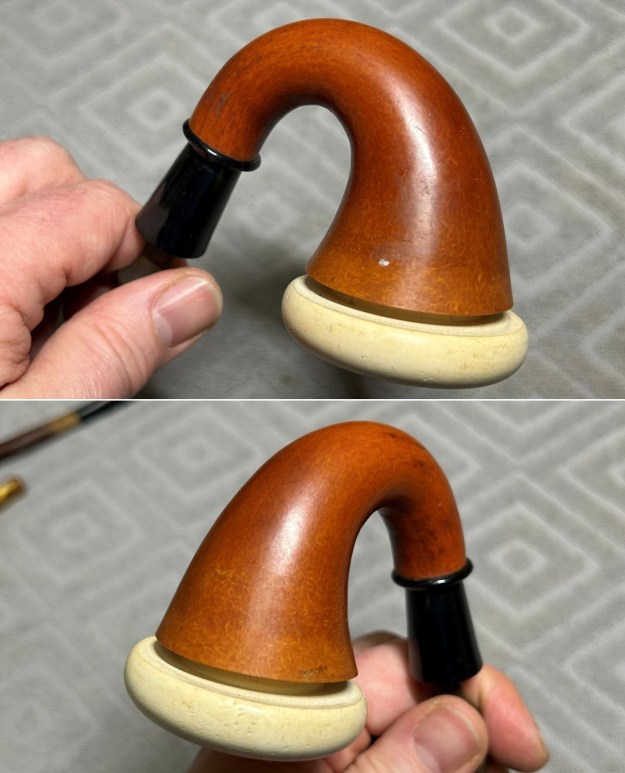
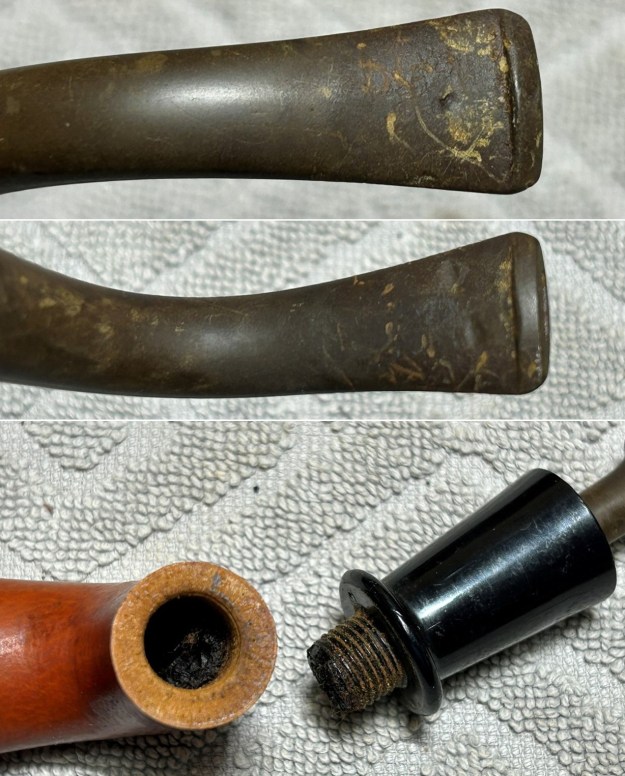
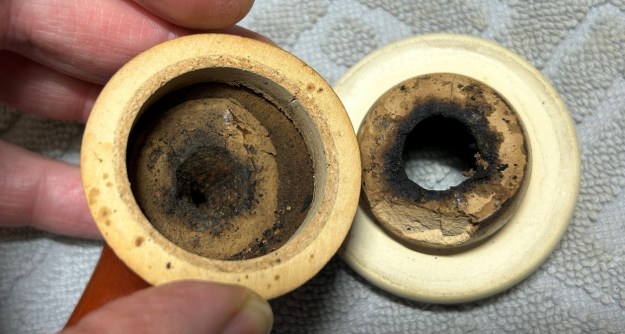
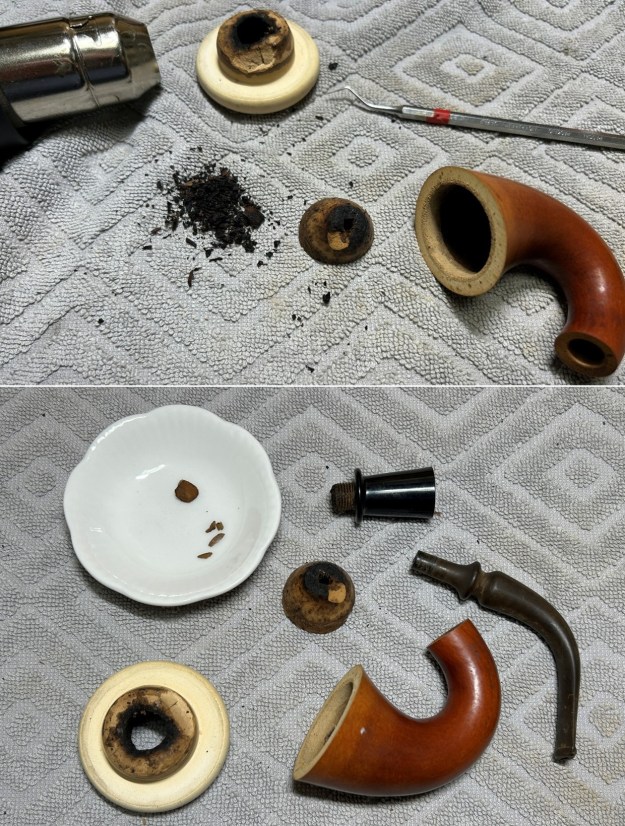
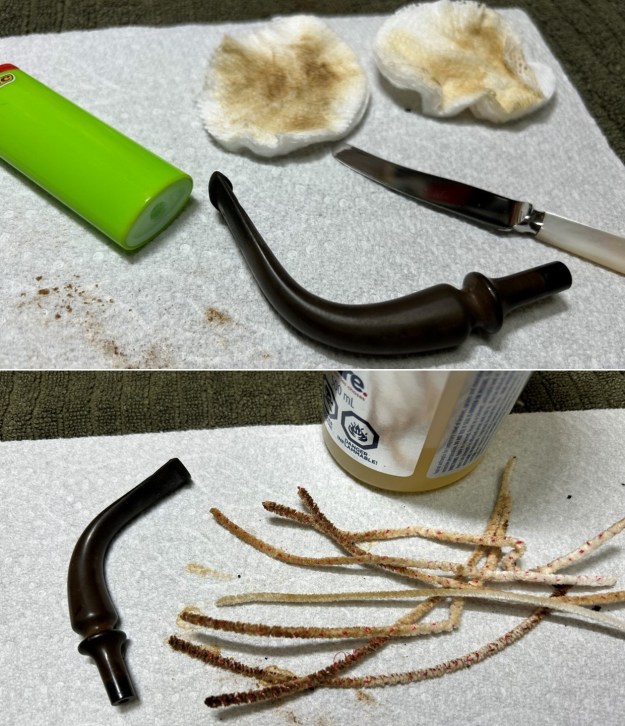
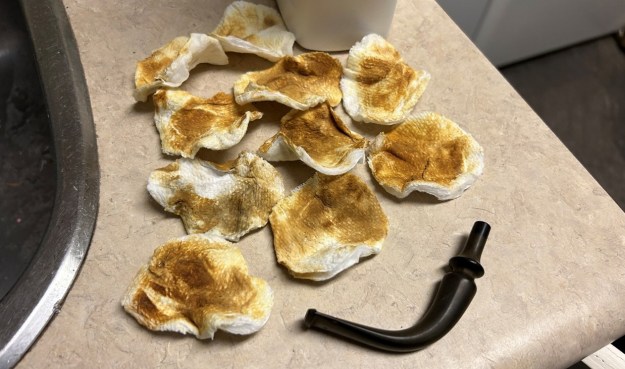
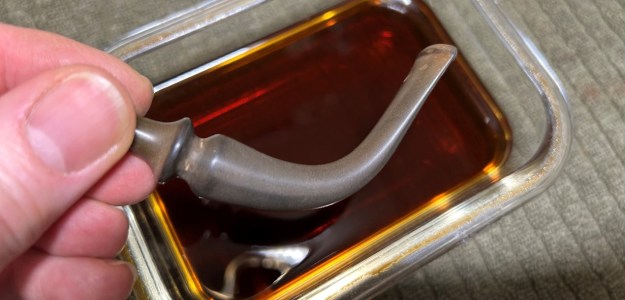
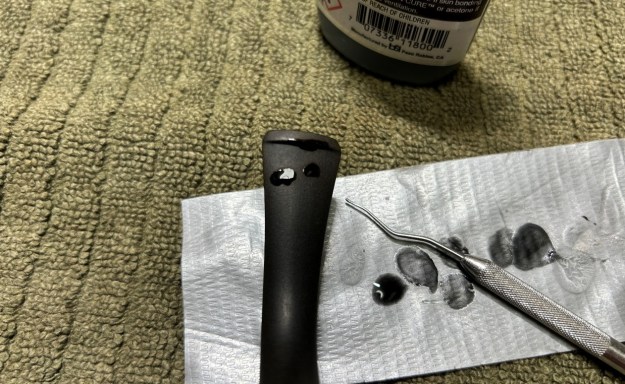
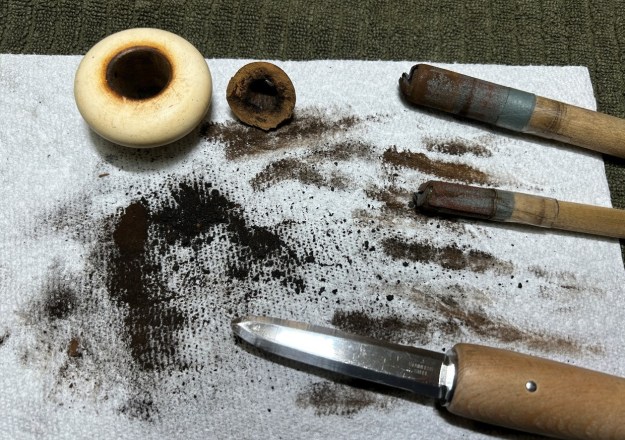
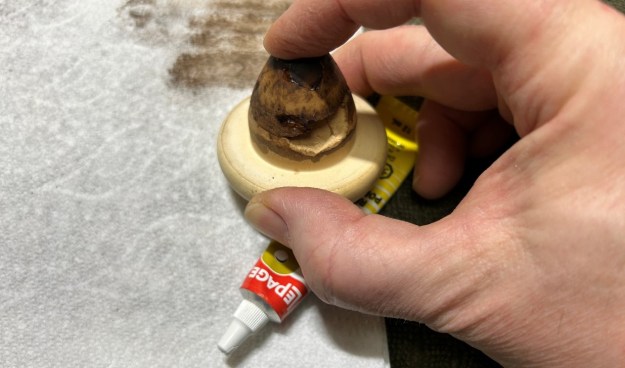
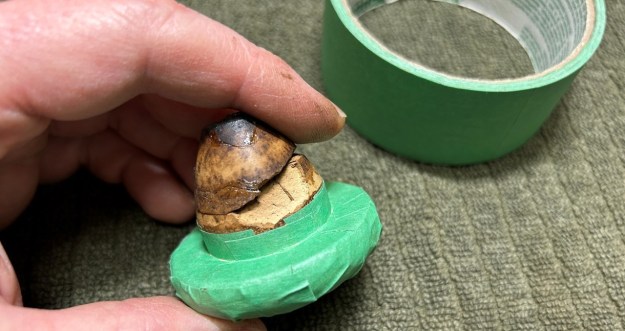
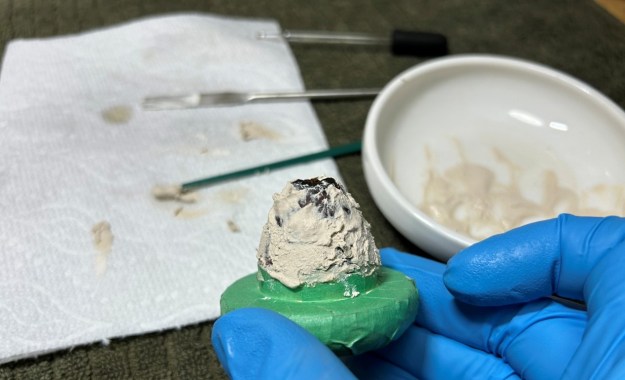
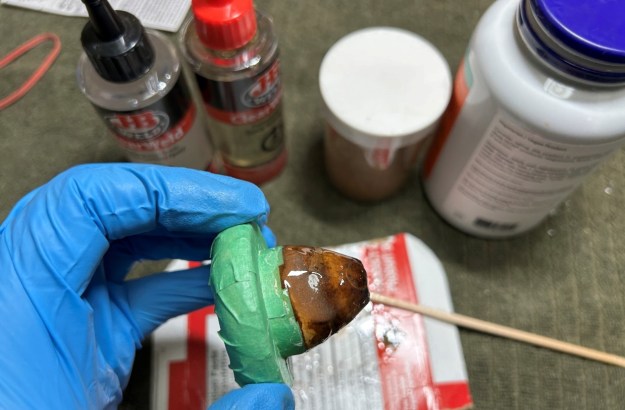
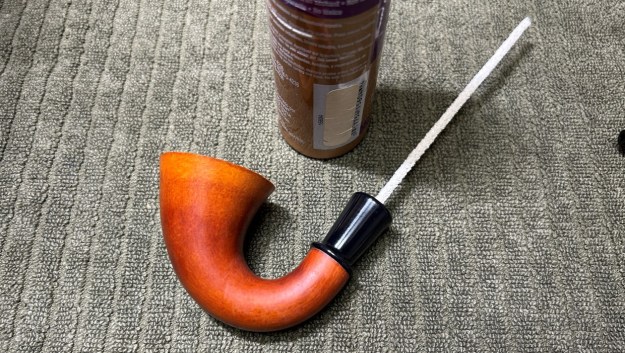
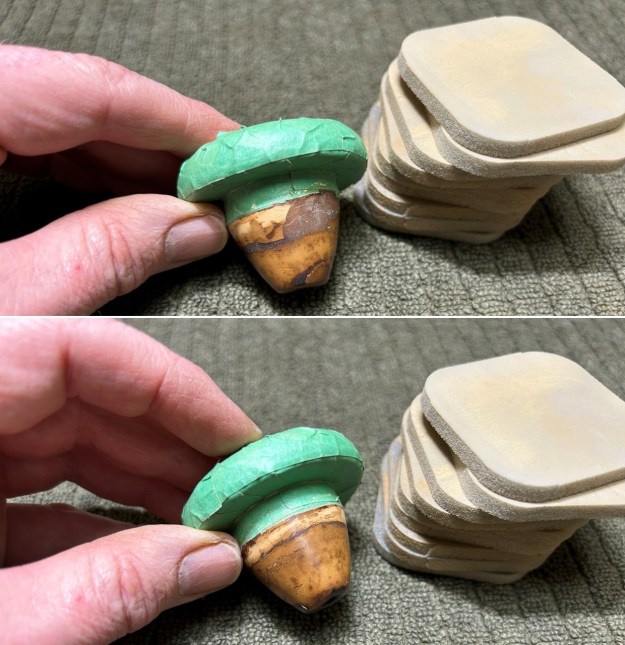
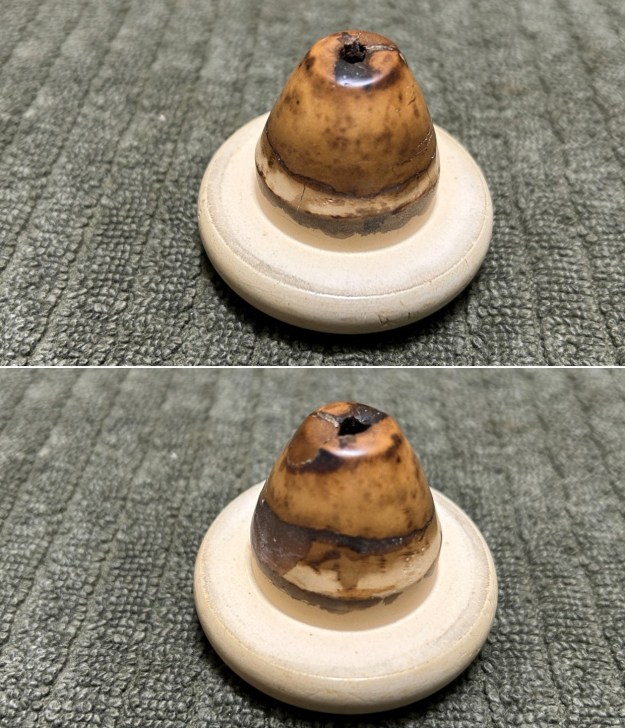
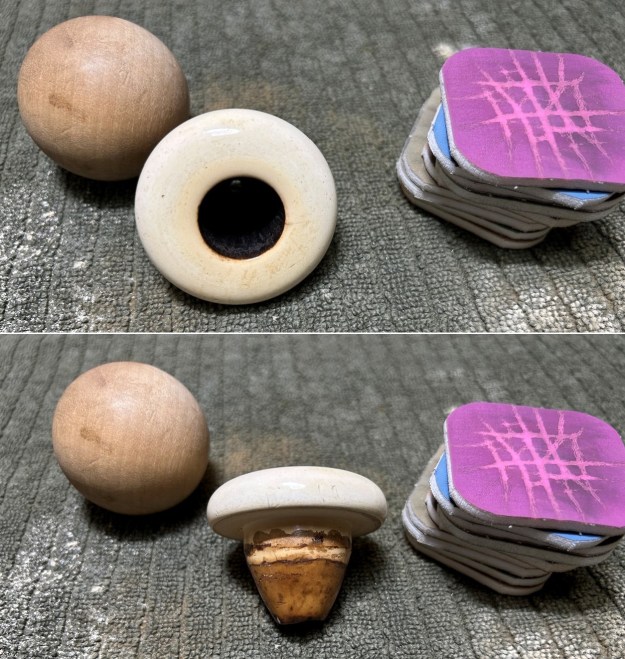
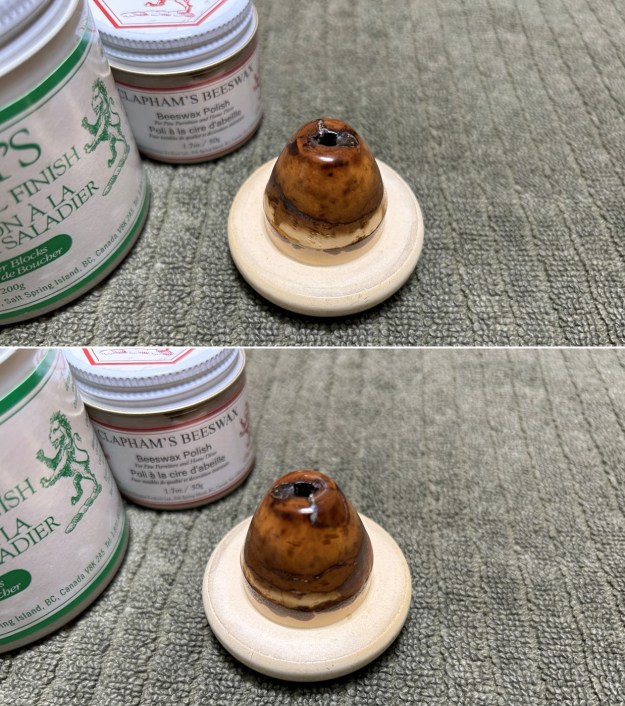
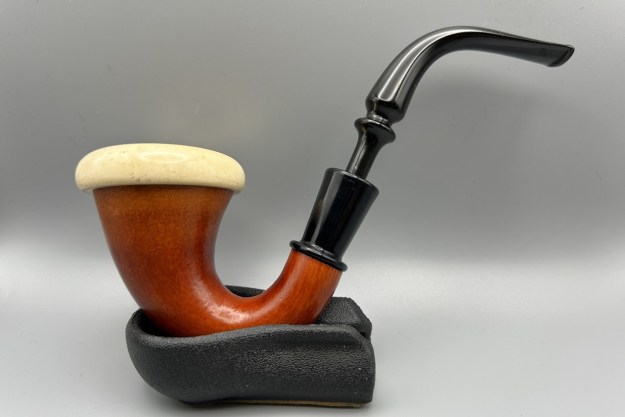
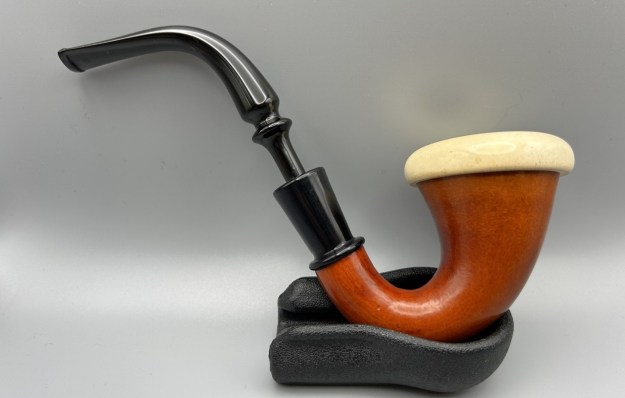
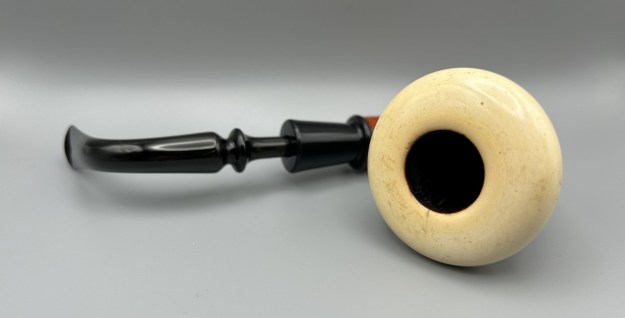
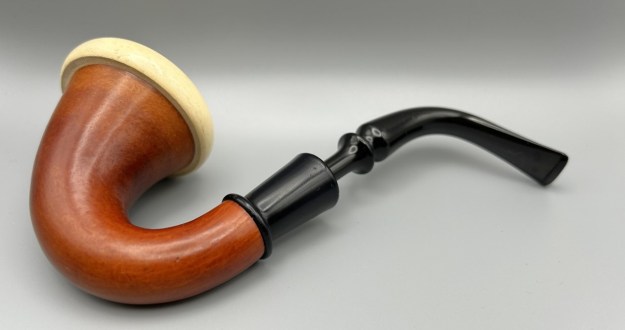
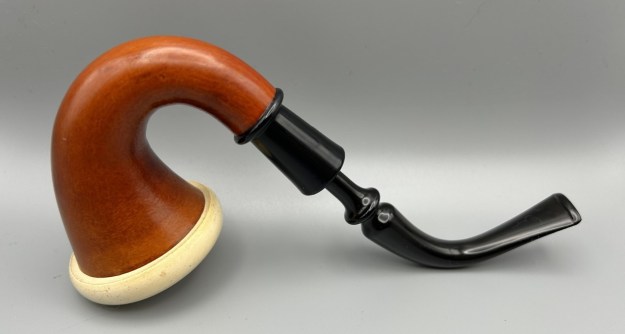
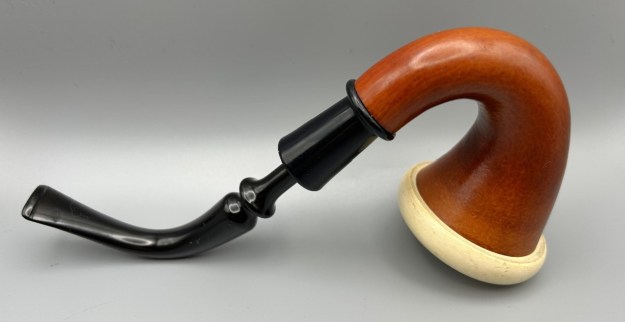
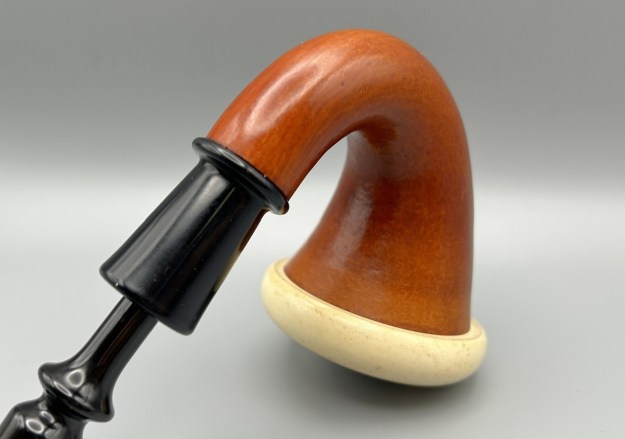
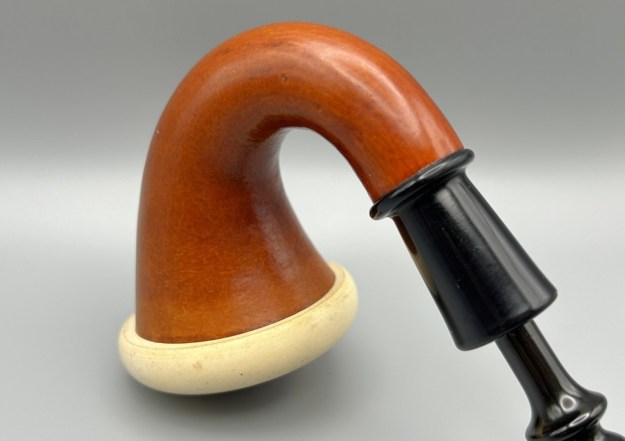
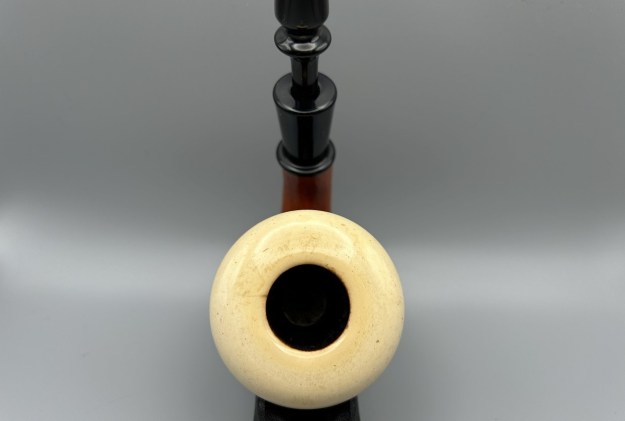
This is a wonderful gourd calabash with a long history, and I hope that one of you will fall in love with it. There is an elegance to the lines of this pipe, with its swan-like curves. It is a classic, and looks (and feels) satisfying in one’s hand. It had been well-loved by its previous owner, and understandably so. This calabash hid a big secret and it was my job to uncover and repair it. Sometimes I bite off more than I can chew and this might be one of those times. Maybe this should have been called Kenneth’s Krazy Kalabash Kure. No markings at all on this pipe, but no matter. Let’s take a closer look at it. The gourd has a deep, rich colour that I really like. The size is really pleasing too. It is more modestly sized than most calabashes – and that’s a positive. I bought this pipe in an auction and, because the auction was away from my home, I didn’t get to inspect the pipe closely beforehand. Boy, was I in for a surprise! The pipe was in dirty but decent condition. The vulcanite stem had quite a bit of wear: lots of tooth marks, oxidation, calcification, etc. The acrylic shank extension was dirty, but otherwise fine. The gourd, similarly, was dirty, but in good shape. BUT, as soon as I removed the meerschaum bowl from the gourd, I saw the problem. At some point in the past, the bowl had cracked in half: northern and southern hemispheres, if you like. That’s a big deal! This was a tough repair, but I am pleased with the results and the pipe is good to go now.As the photo above shows, the bottom part of the bowl was embedded into the gourd. I gave a preliminary and somewhat half-hearted attempt to pry it out with a dental tool. That didn’t work and it’s probably just as well. In attempting to pry it out, I was quite concerned about either cracking the gourd or cracking the bowl further – or both. I ended up heating the gourd and bowl with my heat gun – hoping that ancient tars were holding it in place. And that did the trick: I was able to extract the bottom bowl chunk (plus a few fragments) safely from the gourd without causing further damage to either. You can see the results below.At this point, I figured that I would restore the stem while I thought about what to do with the bowl. I used a disposable lighter and ‘painted’ the stem with its flame. The gentle heat of the flame can cause the dents in the vulcanite of the stem to expand back into shape. In this case, some improvement occurred – but not a lot. The stem’s calcification was quite substantial. I used an old butter knife and gently scraped some of the thicker accretion off. Doing this now helps later in removing the oxidation. I used isopropyl alcohol on a few cotton rounds and wiped down the stem to provide an initial cleaning of filth before moving on to the next steps. The primary cleaning came next. I disinfected the inside of the stem with both pipe cleaners and cotton swabs dipped in lemon-infused 99% isopropyl alcohol. I scrubbed thoroughly to make sure the interior was very clean. The goal of the next step is the removal (or minimization) of oxidation. Going to my sink, I used cream cleanser, cotton rounds, and a toothbrush, and scoured the stem to remove as much surface oxidation as possible. As the photos show, the result was a hideous, ochre-coloured mess – but better off the stem than on it.Once the stem was reasonably clean, I soaked it overnight in some Briarville Stem Oxidation Remover. This solution works to draw oxidation in the stem to the surface of the vulcanite. This is a major aid and an important step in ensuring a clean stem. The following day, I drew out the stem from its bath and scrubbed the lingering fluid with a toothbrush. Due to the severity of the oxidation, I then repeated the scrubbing with the cream cleanser for maximum effect.While the stem was soaking, I also cleaned the acrylic shank extension. I followed the same cleaning procedure as with the stem. It took a while, but I got it clean.As the stem was now clean and dry, I set about fixing the marks and dents in the vulcanite. This was done by filling those divots with black cyanoacrylate adhesive, impregnated with carbon and rubber. I left this to cure and moved on.The penultimate step for the stem is sanding. First, with my set of needle files, I reduced the bulk of the cyanoacrylate repairs. I removed the excess adhesive as near to the surface as possible, without cutting into the vulcanite. Following that, I used all nine of the micromesh sanding pads (1,500 through 12,000 grit) to sand out flaws, even out the vulcanite, and provide gentle polishing of the finished surface. I also applied pipe-stem oil while using the last five micromesh pads. There was a wonderful, deep black shine to the stem when I was done. I did the same with the shank extension. I moved on to the gourd. I cleaned the exterior of the gourd with some pH-neutral detergent and some distilled water, on a few cotton rounds. I cleaned inside of the gourd gently by scraping with my reaming knife, tube brushes, and some other tools. I was pleased with the results. I gave the gourd a thorough going-over with some beeswax polish and let that sit. I buffed it with a microfibre cloth and then, much later, I rubbed some LBE Before & After Restoration Balm into the gourd and let it sit for 30 minutes or so. I then buffed the gourd again with a microfibre cloth. On to the bowl. Meerschaum is too fragile for a proper reamer, so I used 220-grit sandpaper on the end of a wooden dowel to clean out the bowl and it turned out well. One of the frustrations of cleaning meerschaum is that once smoked, the stains never go away – and this pipe was heavily smoked. However, I did what I could and it definitely improved.Now with the stem, shank extension, gourd, and meerschaum cleaning done, it was time to put Humpty Dumpty back together again. Before repairing the separated chunks of the bowl, I needed to secure the two hemispheres together. This was not intended to be the critical attachment point, but just a solid method of marrying the two pieces. I used an adhesive for ceramics and clay – not because meerschaum is ceramic or clay (it isn’t) – but it does mimic certain characteristics of those insofar as it is very porous. This adhesive worked perfectly – it did exactly what I wanted it to. I was also able to attach the small shards of meerschaum that were left over (as seen in photos above).Now to go ‘all in’ on the repair of those missing chunks. I taped off the areas of the bowl that I didn’t want affected by the repair medium. This was a long and challenging repair and went through several failed attempts (which I won’t bore you with). Some failures included plaster of Paris, amalgams involving primarily calcium carbonate, and other ingredients (like leather dye). In the end, I came up with a good solution that maintains the integrity of the bowl shape, gives an incredibly resilient (and hard) repair, is resistant to high temperatures, and is completely inert when cured. After much trial and error, I settled on a particular type of epoxy mixed with a combination of the aforementioned calcium carbonate and briar dust. You might reasonably ask, ‘Why calcium carbonate?’ Good question. It is a material that best acts as a repair medium for meerschaum and I encourage you to read an important article I wrote about the issue here. You may also ask, ‘Why briar dust?’ Also a good question. This provided a slight brownish tint to the epoxy and CaCO3 mixture. Matching the surrounding colour was always going to be an impossibility, but I wanted to do the best I could.
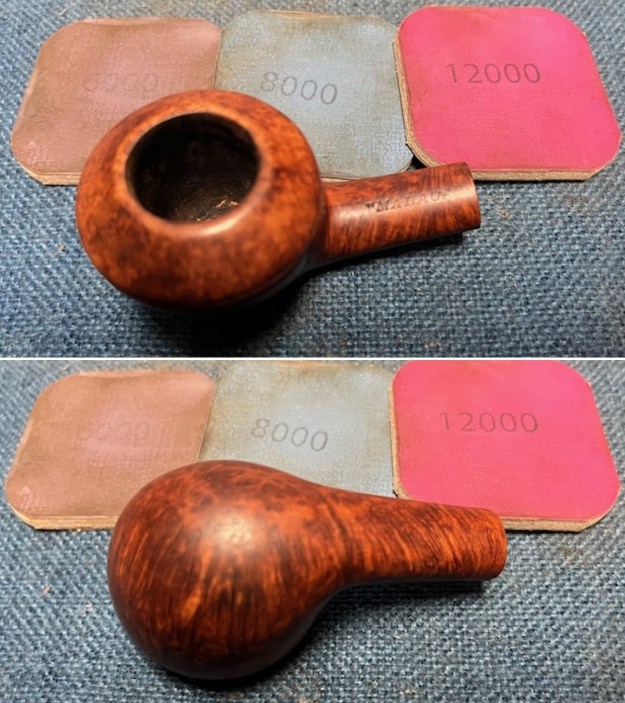
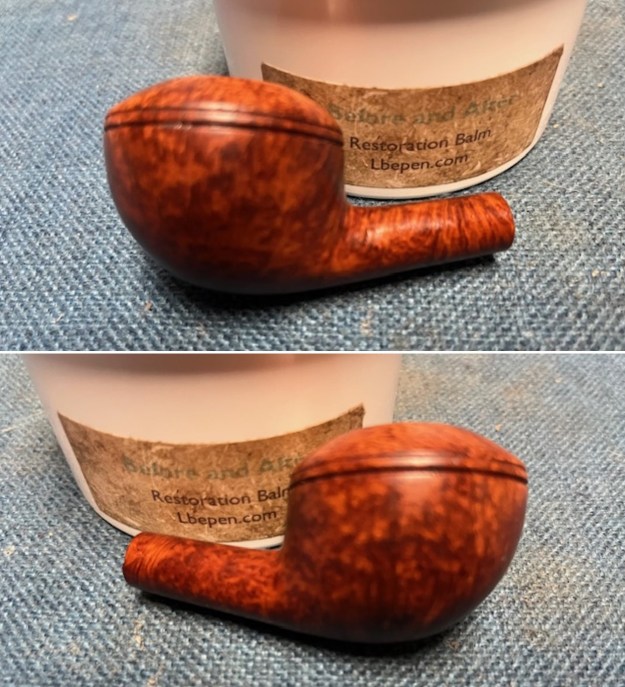
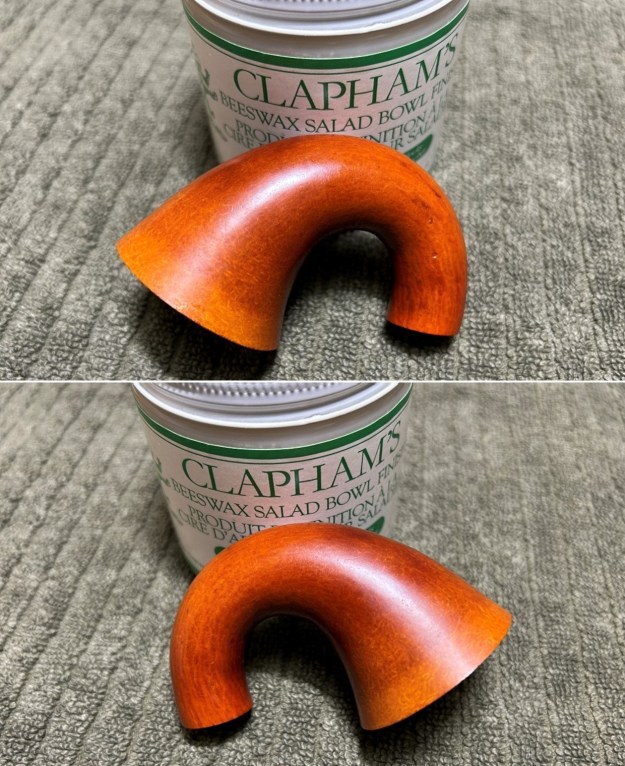
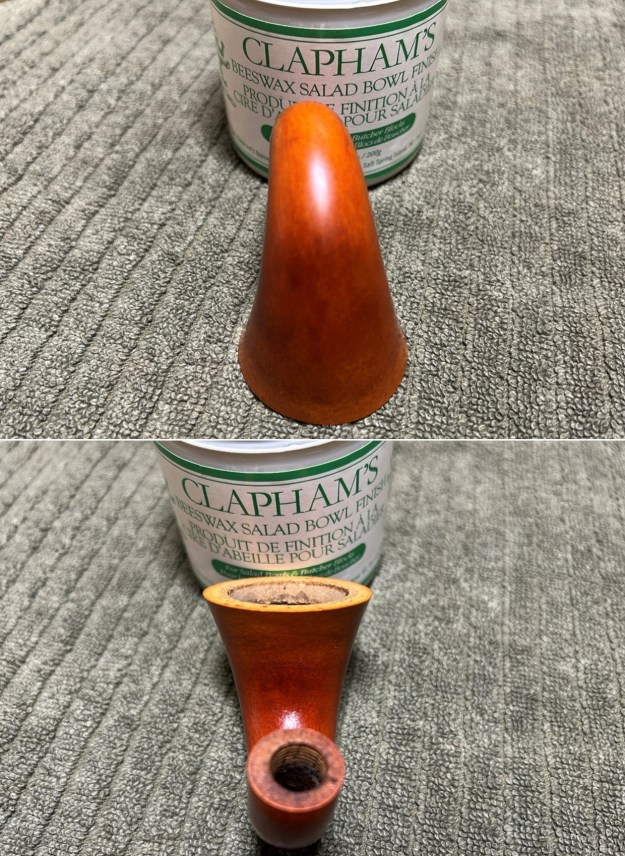
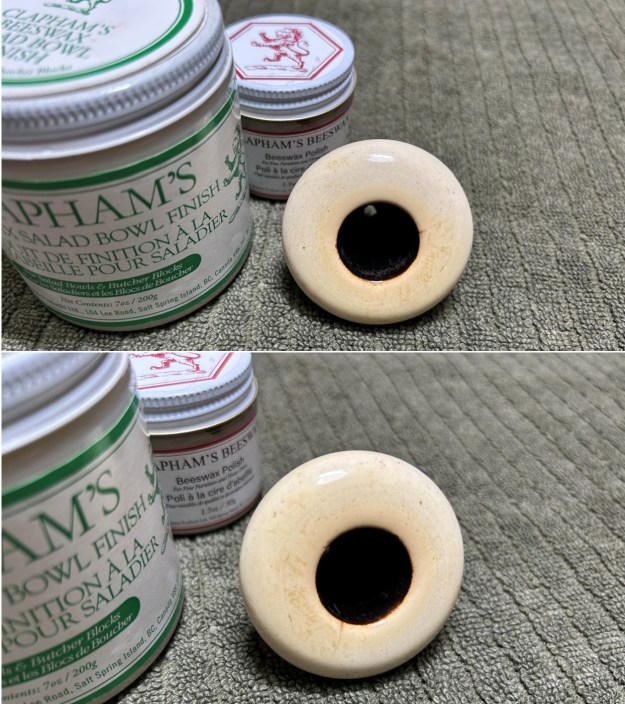
I mixed my concoction and applied it liberally to the affected areas. During this process, the epoxy mix was much less viscous than I had hoped it to be. This was a big problem as it was oozing in ways that I didn’t want it to! However, like the trooper I am, I fiddled and fixed and floundered until I got it just right. It needed a full 24-hour cure and I was only too happy to leave the frustrating thing alone for a while!In the meantime, I glued the shank extension back into place in the gourd. Looks great.On the morrow – no surprise – the bowl was pretty darn ugly, but I can fix ugly. I donned a tight-fitting dust mask and went to work. My goal, of course, was to sand down excess epoxy and bring it to the level of the surrounding meerschaum, while simultaneously not reducing the bulk of the meerschaum. This took a lot of hard and careful work (plus a few touch ups), but we got there in the end. I am satisfied with the results, since the repair was never going to look invisible. The benefit of this pipe is that the repair is hidden from view, below the rim of the gourd. I then sanded down the entire piece of meerschaum with my Micromesh pads. I also rubbed two different beeswax polishes into the meerschaum. Then I let it sit for 20 minutes, buffed it with a microfiber cloth and then repeated the beeswax process. Worked like a charm! Before I went off to the buffer, I gave the meer and the gourd another going over with Clapham’s beeswax rub. This really worked well. I only took the stem to the buffer, as meerschaum and gourds don’t tolerate those high speeds very well!

This gourd calabash was a delightful can of worms right from the start and its beauty only increased through the restoration process. I am pleased to announce that this pipe is for sale! If you are interested in acquiring it for your collection, please have a look in the ‘Calabash’ pipe section of the store here on Steve’s website. You can also email me directly at kenneth@knightsofthepipe.com. The approximate dimensions of the pipe are as follows: length 6½ in. (165 mm); height 4½ in. (115 mm); bowl diameter 2⅛ in. (54 mm); chamber diameter ⅞ in. (21 mm). The weight of the pipe is 2⅜ oz. (68 g). I hope you enjoyed reading the story of this pipe’s restoration as much as I enjoyed restoring it. If you are interested in more of my work, please follow me here on Steve’s website or send me an email. Thank you very much for reading and, as always, I welcome and encourage your comments.

Restoring a Rugged Jobey Florentine EXTRA E72 Canadian


by Steve Laug

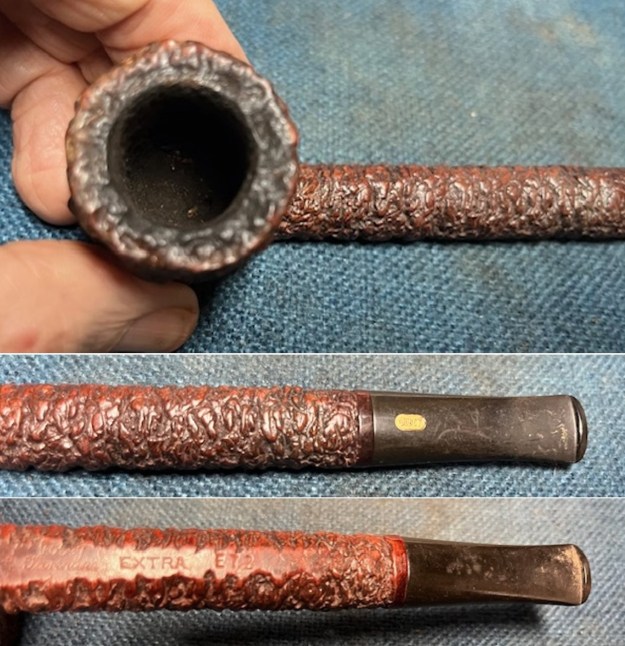
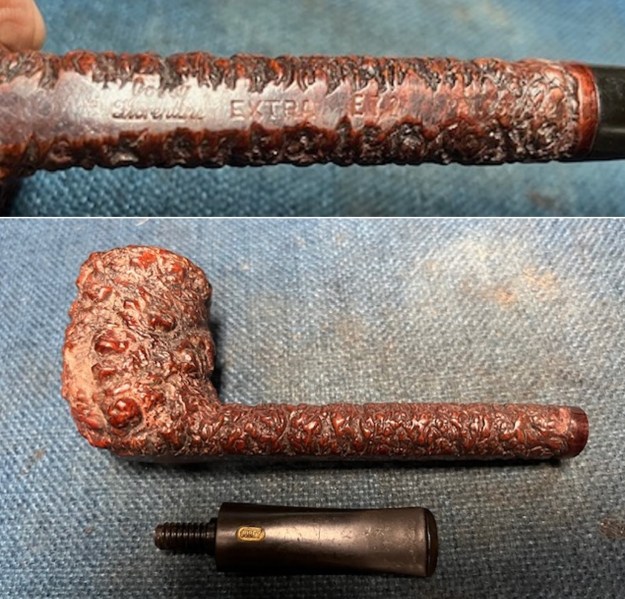
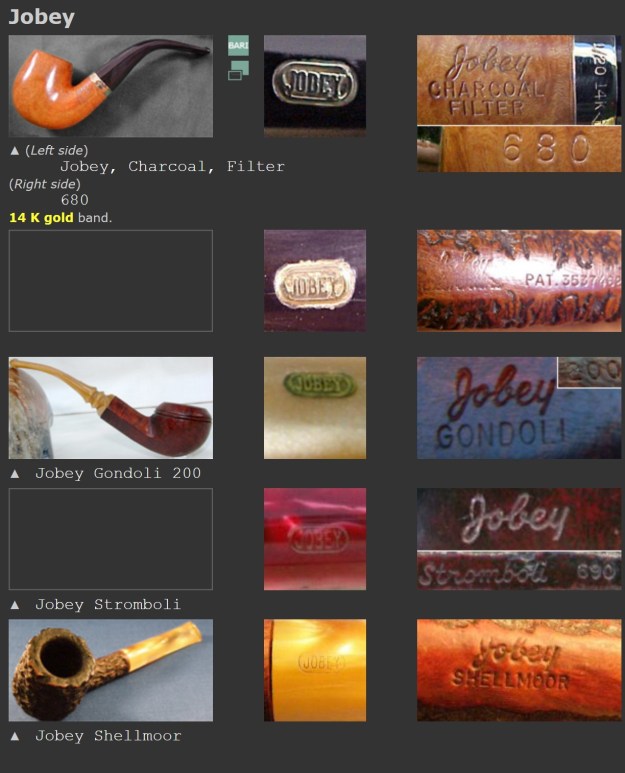
The next pipe on the table is another one that came to us from the seller in Caldwell, Idaho, USA on 07/12/2025. It is a Canadian pipe with a heavily rusticated bowl and shank. It is in dirty but in good condition as can be seen in the photos below. The underside of the shank is stamped Jobey over Florentine in script [followed by] EXTRA next to that [E72] and finally by PAT.3537462. That helps to date this to the time after the patent was filed in 1970.The stamping is clear and readable. It has rugged rusticated finish that is very tactile on both the shank and the bowl. The shape works very well with the rustication. The finish was dusty and dirty with grime deep in the valleys of the rustication but the black and brown stain really highlighted the highs and lows of the finish. The bowl had a moderate cake and there was tobacco debris in the bowl. The rim top had a lava coat on the rusticated top and edges. The stem is lightly oxidized and has tooth marks and dents on the top and underside of the stem. There is a brass Jobey logo on the topside of the stem. I took photos of the pipe to show what it looked like before I started working on it.  I took a closer photo of the rim top and bowl to show the condition of the bowl and rim. You can see the light cake in the bowl and the darkening and lava on the top and inner edge. It was heavier on the sides and back of the rim and top.I took a photos of the stamping on the underside of the shank. It is clear and readable as noted above. I removed the stem and took a photo to show the proportions of the pipe. Before I started my work on the pipe I turned to Pipephil’s site to see if I could find any info on the brand and on a Florentine (http://www.pipephil.eu/logos/en/logo-j3.html). The information on Jobey was helpful but there was no listing on the Florentine line. I have included a screen capture of the information and also included the sidebar information.These pipes are made in St Claude (France) by Butz-Choquin (Berrod-Regad group) since 1987. Before this date some were manufactured in England and Denmark (Jobey Dansk). Jobey’s seconds: Shellmoor

I turned next to Pipedia (https://pipedia.org/wiki/Jobey). To deepen my understanding of the information of the brand. It was helpful in helping to understand the mess of where Jobey pipes were made and who made them. I have included the amount below.

English – American – Danish – French… Sadly, solid information about Jobey is scant

Probably established in England around 1920(?) the brand hiked into the USA later. In the course of time owner, distributor and manufacturer changed repeatedly. As far as is known the following companies have been involved with the brand:

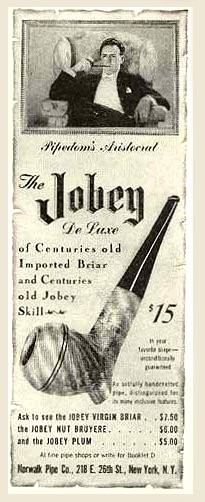
Throughout decades Jobey pipes were mainly sold in the USA, Canada and England but remained almost unknown in continental Europe. The bulk of Jobeys were predominantly made according to classical patterns and mainly in the lower to middle price range. The predominant judgment of the pipe smokers reads: “A well made pipe for the price.” So, there is hardly anything very special or exciting about Jobey pipes although a flyer from ca. 1970 assures: “The briar root Jobey insists upon for its peer of pipes is left untouched to grow, harden and sweeten for 100 years. […] Jobey uses only the heart of this century old briar and only one out of 500 bowls turned measures up to the rigid Jobey specifications.” 99.80% of cull… that makes the layman marveling!

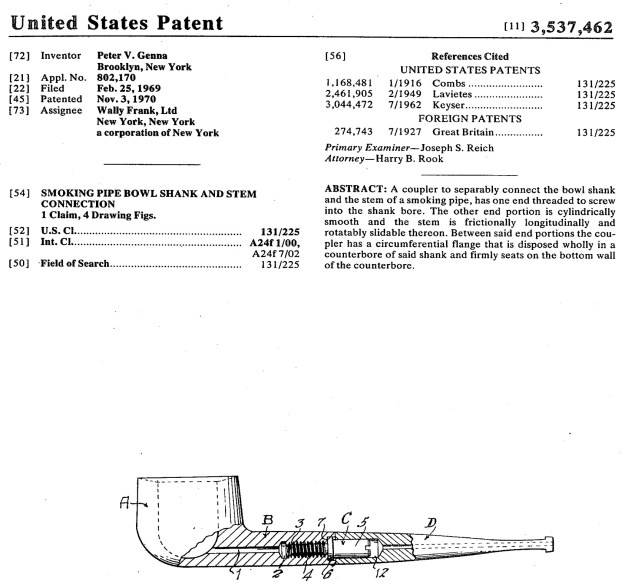
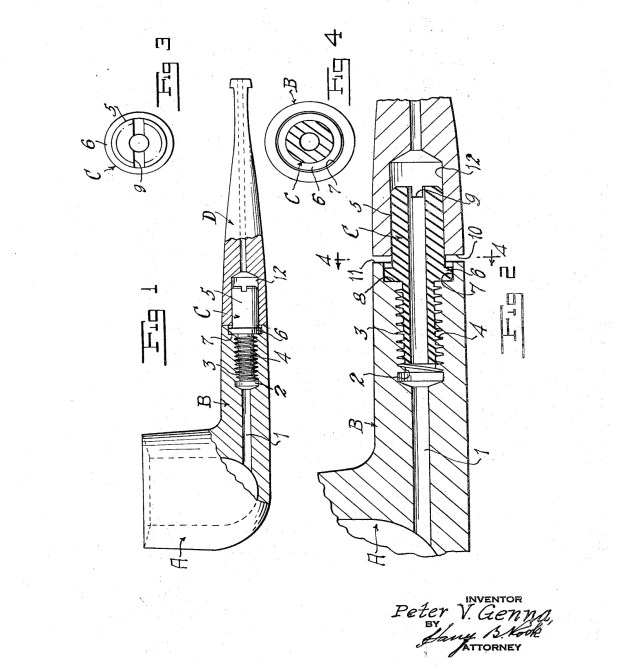
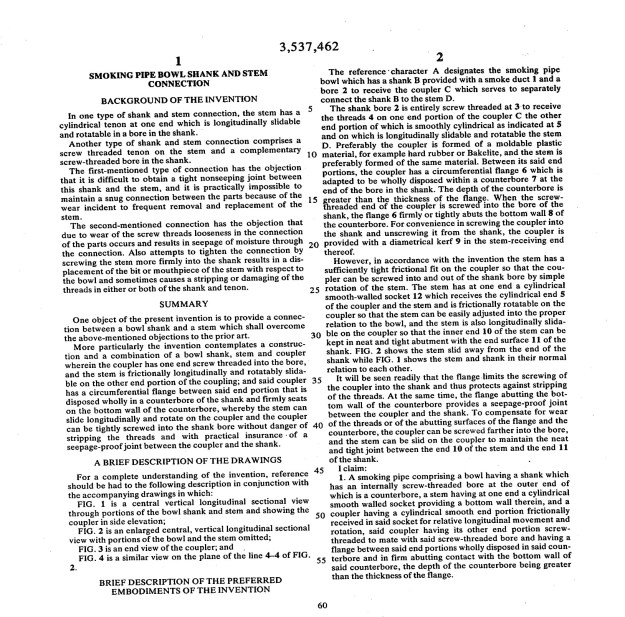
This particular Jobey includes a US Patent number that is for the Jobey Link System tenon that holds the stem to the shank. It is a great read and also tells me that the pipe was made after the Patent was received in 1970. I have included the link for the US Patent site and the information on the particular patent below (https://ppubs.uspto.gov/basic/). I enjoy working on Jobey pipes and it is fun to be able to trace them back to the company that made the pipe – in this case a bit of a mystery though the US Patent makes me think that this one may be a US Made pipe. Since it was made after the 1970 Patent I believe that the pipe was made by Weber Pipe Co. perhaps for the Patent Holder, Wally Frank, Ltd. I turned to work on the pipe itself.

I reamed the bowl with a PipNet pipe reamer using the cutting heads 2 and 3. I finished the reaming with a Savinelli Fitsall Pipe Knife. I sanded the walls of the bowl with 220 grit sandpaper wrapped around a piece of dowel. I worked on the darkening on the rim top with a brass bristle wire brush. I was able to remove the majority of the darkening with this method.I cleaned out the inside of the shank and the airway in the stem with alcohol, cotton swabs and both bristle and regular pipe cleaners.I scrubbed the bowl and shank with a tooth brush and some undiluted Murphy’s Oil Soap. I rinsed it off with warm water to remove the dust and soap from the finish. I dried it off with a soft cloth and it looked much better. I removed the stem and set it aside. I rubbed the briar down with Before & After Restoration Balm. I worked it into the briar with my fingertips to work it into the finish. The product works to clean, enliven and preserve the briar. I let it sit for 10 minutes then I buffed it with a cotton cloth to deepen the shine. The briar really comes alive with the balm. I set the bowl aside and turned my attention to the stem. I sanded the surface of the stem with a folded piece of 220 grit sandpaper to clean up the oxidation and tooth chatter on both sides. I sanded the stem with 320-3500 grit 2×2 inch pads to further adjust the fit of the stem to the shank. I wiped the stem down with an Obsidian Oil cloth after each sanding pad.I polished the vulcanite with micromesh sanding pads – 1500-12000 grit pads. I wiped it down with Obsidian Oil after each sanding pad. I used Before & After Pipe Polish – both Fine and Extra Fine to further polish the stem. I put the Jobey Florentine Extra E72 Canadian back together then polished the stem with Blue Diamond to polish out the remaining small scratches and gave it several coats of carnauba. I polished the bowl and shank with Conservator’s Wax and buffed it with a shoe brush. I buffed the pipe with a clean buffing pad to raise the shine. I hand buffed it with a microfiber cloth to deepen the shine. The pipe polished up pretty nicely. The finished pipe is shown in the photos below. The dimensions are Length: 6 ¾ inches, Height: 1 ¾ inches, Outside diameter of the bowl: 1 ¼ inches, Chamber diameter: ¾ of an inch. The weight of the pipe is 38 grams/1.34 ounces. I will be adding it to the rebornpipes store in the American Pipe Makers Section shortly. If you are interested in adding it to your collection email me at slaug@uniserve.com or send me a message on Facebook. Thanks for walking through the restoration with me as I worked over this rusticated Patented Jobey Florentine Extra E72 Canadian.

The fourth of a foursome of Beautiful pipes sent to me with Potential Burn Out Issues


by Steve Laug

On November 29 I received an email from a fellow regarding a Moretti that came to him from a dear friend. He stated that it had a burnout and that he had someone ream it for him. I have included his first email below.

Steve, I have a Moretti pipe that belonged to a dear friend. It had a burnout and I had the bowl reamed, but I’m afraid to smoke it. Can you offer a suggestion of how the inside of the bowl can be treated against possible future burnout, or can you fit the bowl with either a meerschaum or graphite liner? – Michael

We talked back and forth regarding the pipe and various options for repair. I agreed to work on them and told him to mail it to me. Once he packed it he added another three pipes to the box that he was sure had the same issues. He mailed them to me on December 8 and sent me another email.
You have convinced me that you’re the person who can help restore my pipes! I shipped 4 pipes to you today by USPS, and declared their value at $5 each for a total of $20 as you requested. I’m embarrassed to admit it, but all four have had burnout issues and I’m hoping that you can clean them out and coat the inside of the bowls as you described. If you feel that more effort is needed, please let me know.

On December 28th I received the package from Michael. I opened the box and inside there were four beautiful Italian Made pipes. I have listed them below and included photos of the pipes.

Savinelli Autograph Sandblast Bent Cherrywood
2008 Ardor DR bent Dublin
Mastro Beraldi 2 Bent Dublin
2005 Moretti 1 Bent Rhodesian

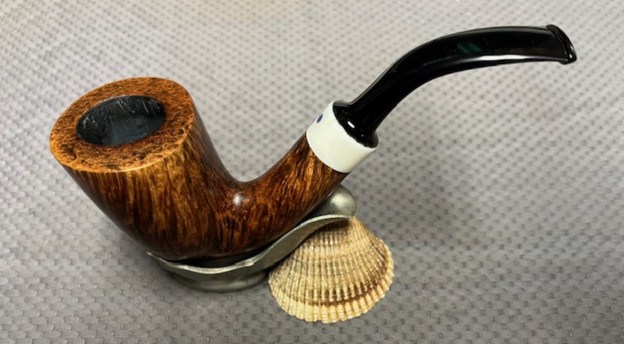
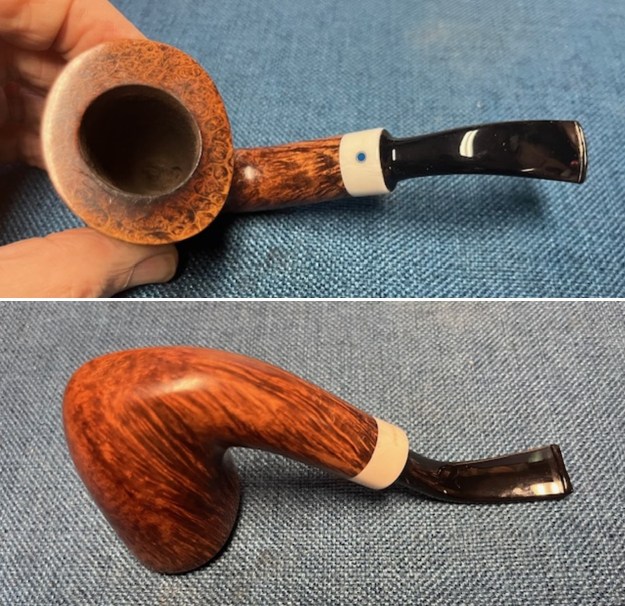
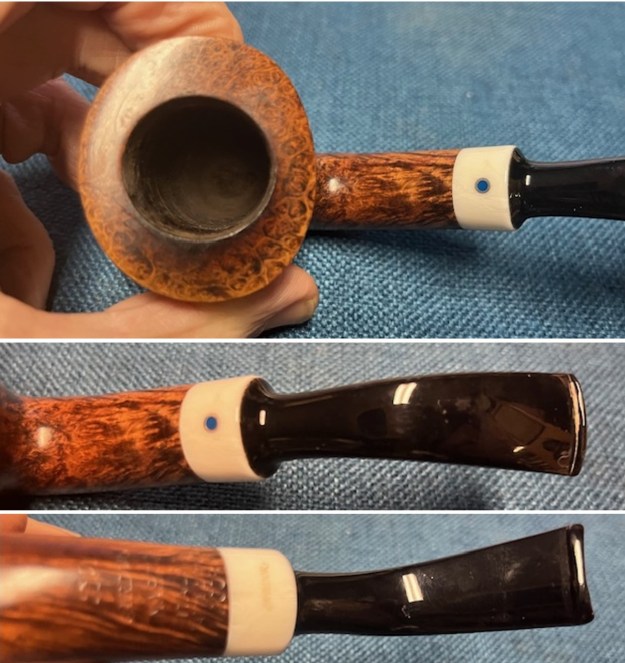
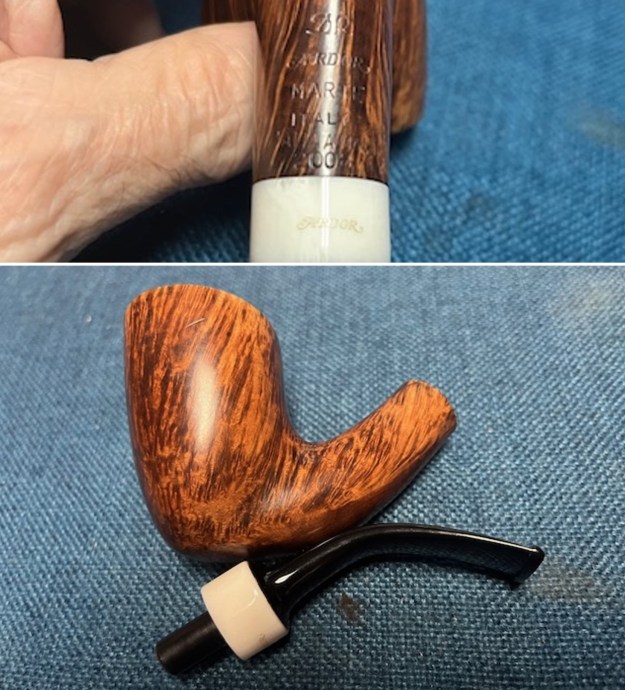
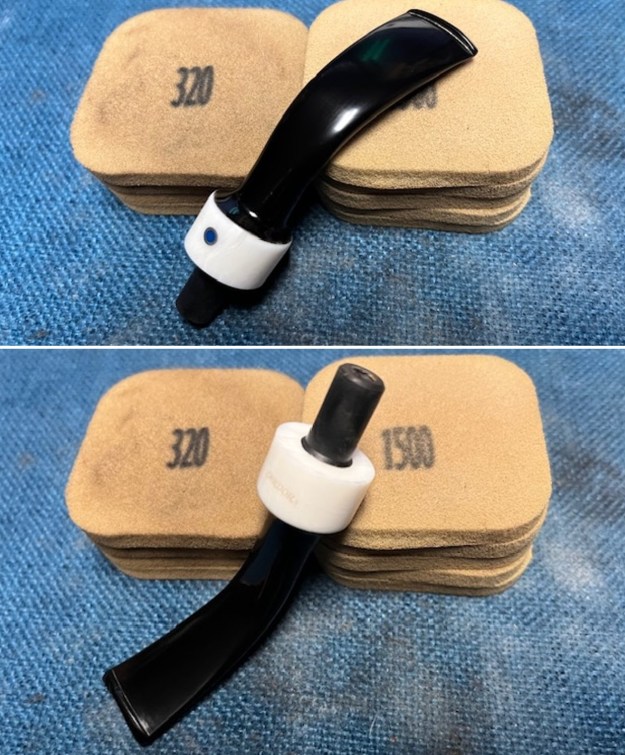
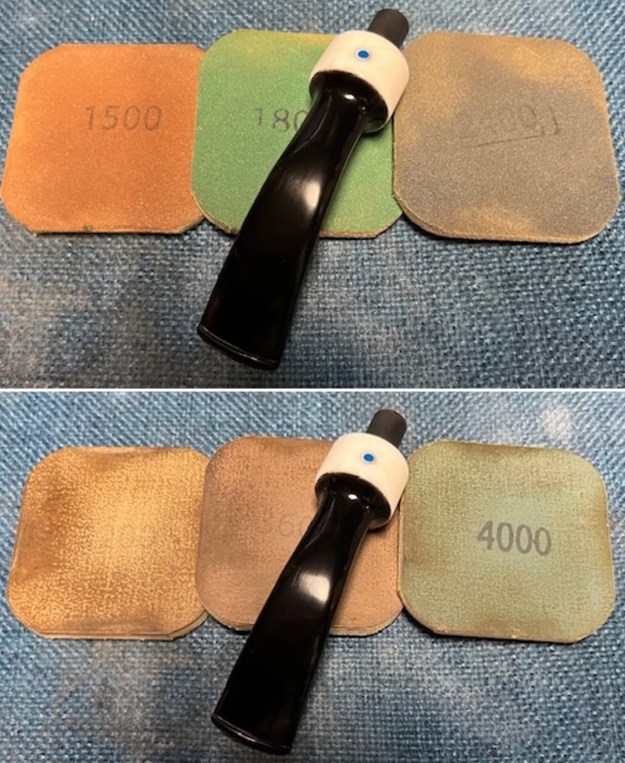
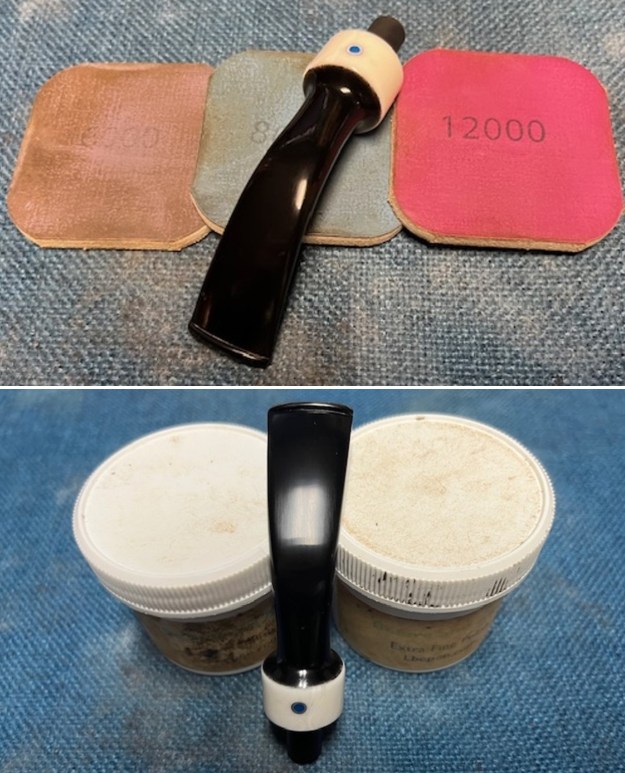
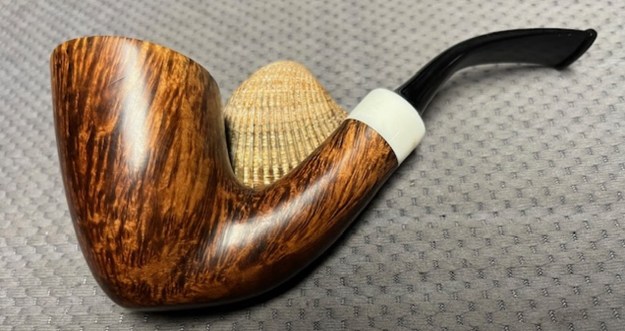
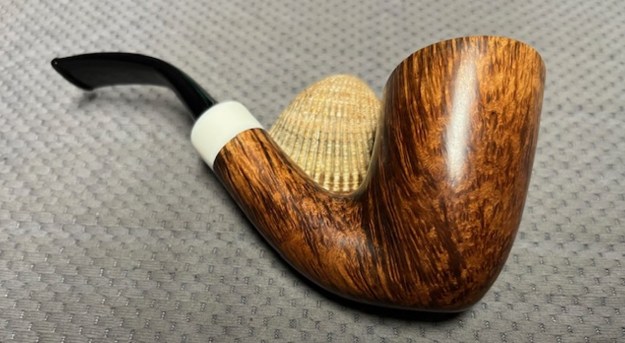
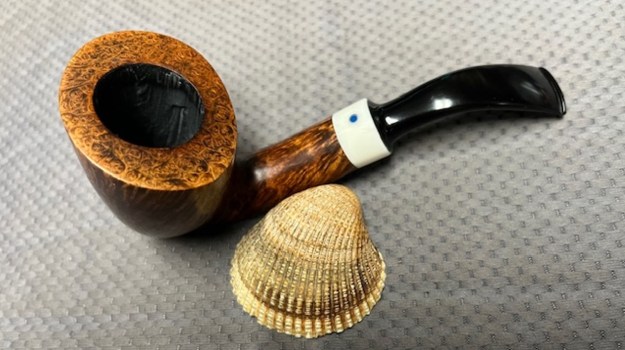
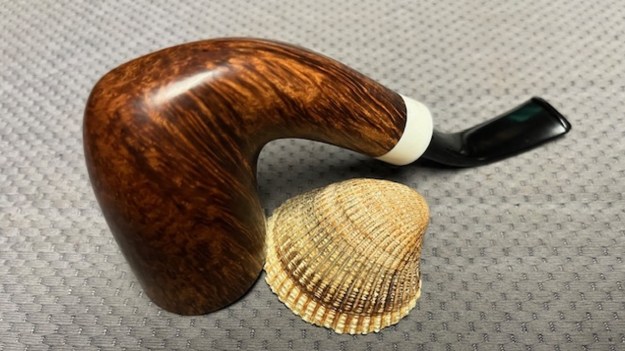
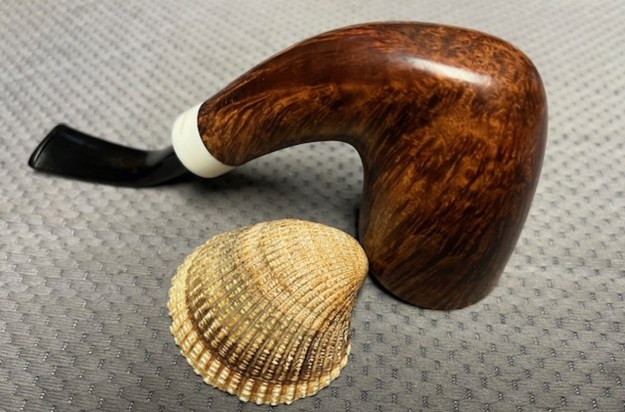
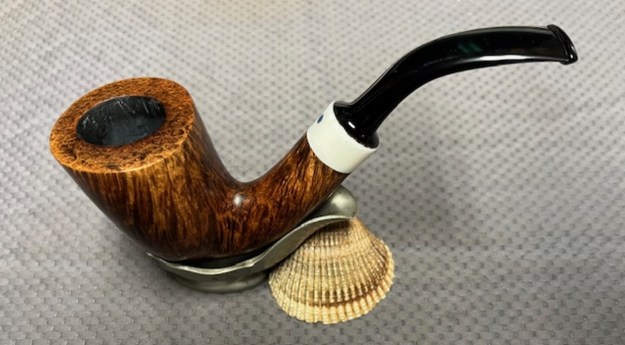
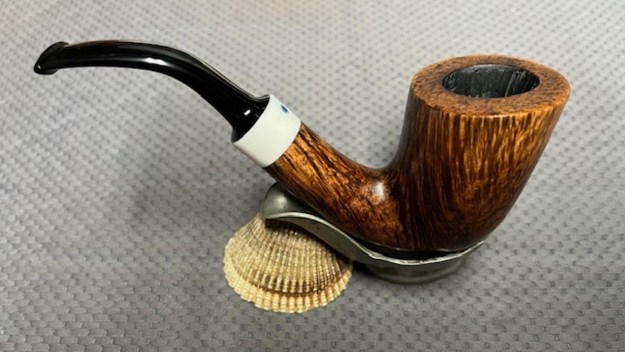
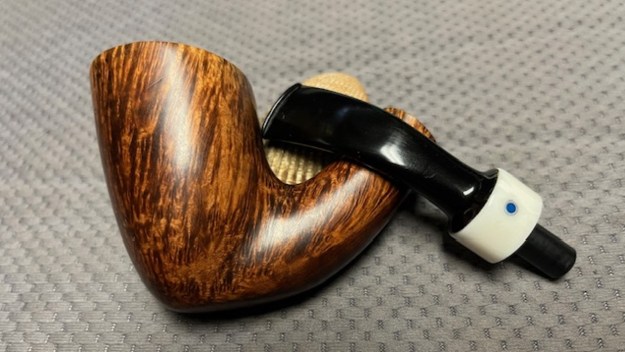
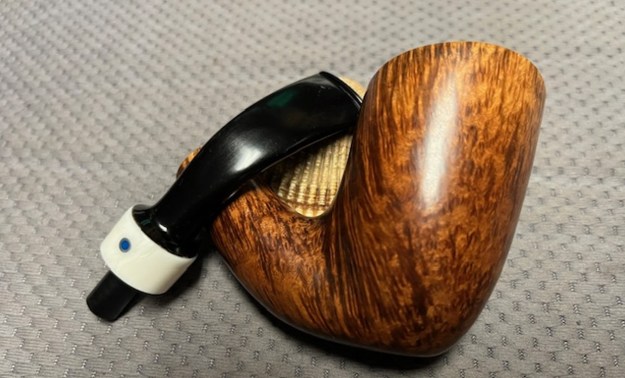
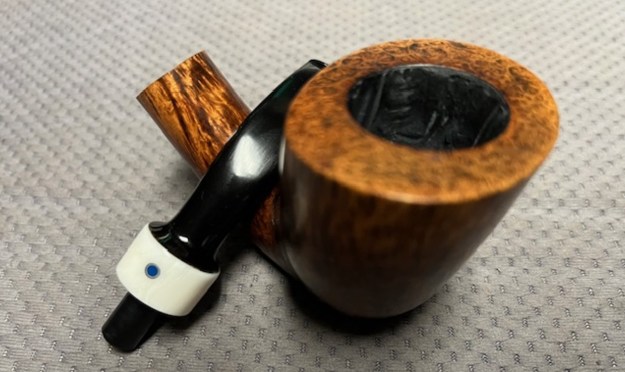
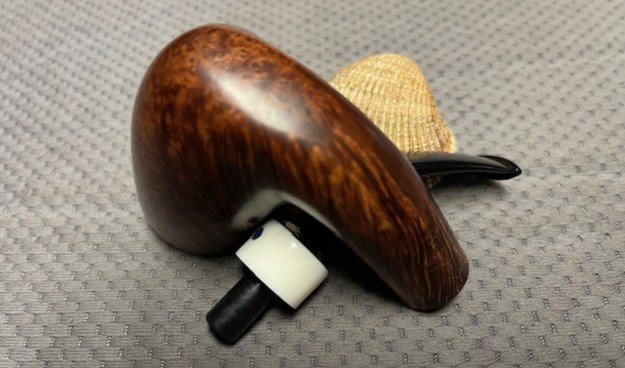
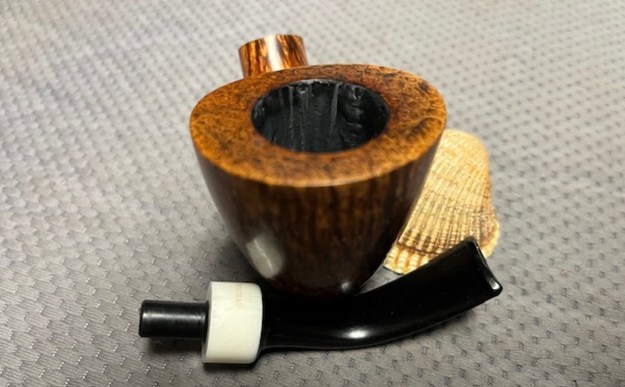
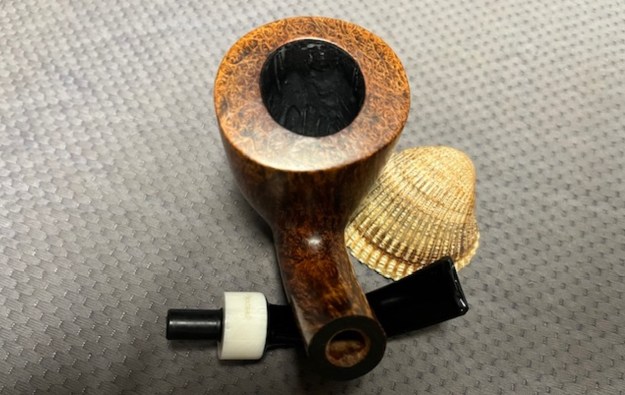
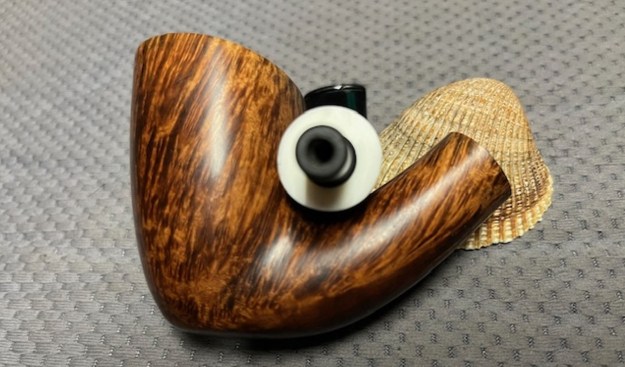
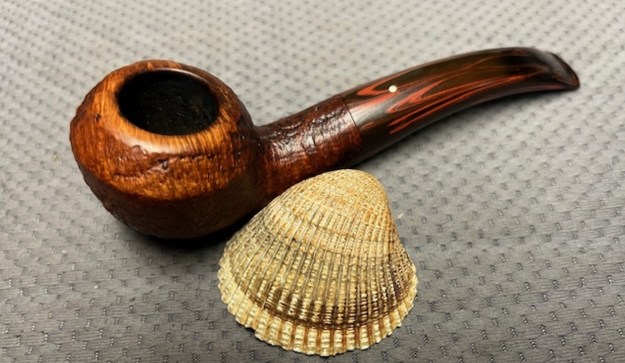
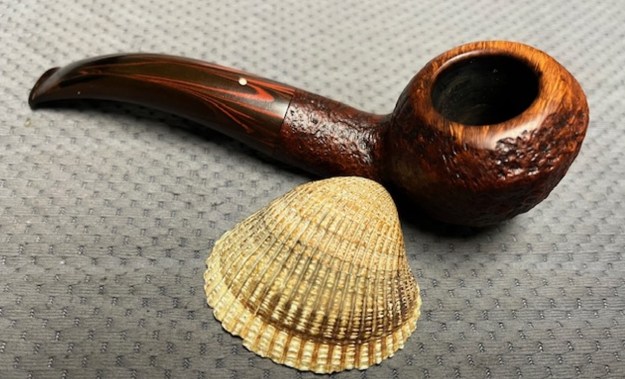
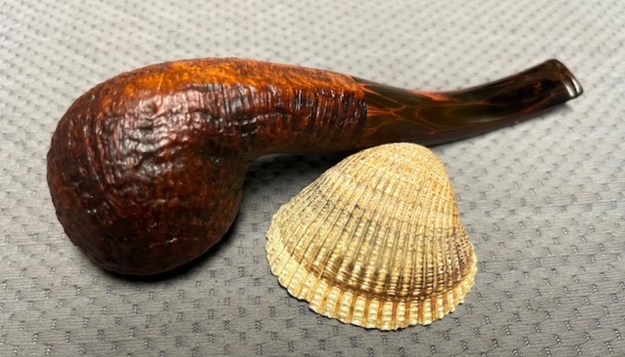
The fourth and final pipe I brought to the table is an Ardor Scoop. Overall it looks very good. It is stamped on underside of the shank and reads DR [over] Ardor [over] Marte [over] Italy [over] Fatta a Mano [over] 2008. The stamping is clear and very readable. The pipe has a mix of black and brown stains on a smooth finish and amazing grain that the shape follows well. The oval rim cap is smooth and there is some darkening around the inner edge of the bowl. The rest of the finish was very clean and the bowl had a light cake on the walls but the rim top was clean other than the edge darkening. I inspected the walls of the bowl and could not find any issues or divots in the walls. I spoke with Michael and he mentioned that it looked like it had some small checking/cracking on the walls of the bowl. Initial inspection reveals that the light cracking in the cake on the bowl walls. The other issue Michael spoke of is that the front wall of the bowl was particularly thin and when smoked was very hot. I would need to examine it further once it had been reamed and cleaned. The acrylic black original taper stem had a white saddle portion on the end of the stem ahead of the tenon. There was a blue dot encircled in a silver circle on the top of the white saddle portion. The stem showed light tooth marks or chatter on both sides. I took photos of the pipe to show what it looked like before I started working on it. I took photos of the bowl and rim top to show the clean finish on the bowl. The photos show a moderate cake in the bowl and a very clean rim top. The stem photos show the condition of the taper stem ahead of the button. I took photos of the stamping on the left and underside of the shank. It is clear and readable as noted above. I removed the stem and took a photo of the pipe to give a sense of the proportions of the pipe.I did a quick review of the history of the brand by turning to Pipedia. The link there led to an article that came from Italian Pipemakers.com. Here is the link – https://pipedia.org/wiki/Ardor. I quote part of the article that gives a quick view of the brands
Ardor Courtesy of italianpipemakers.com

In 1974 Dorelio Rovera, with his father Angelo, established the Ardor Pipe, name which comes from the “AR” (Angelo Rovera) and “DOR” (Dorelio Rovera), changing a medium quality level production into a completely handcrafted product, with a very high level of design and finishing.

[Editor’s Note: Angelo Rovera is the son of Francesco Rovera, who along with his brothers comprised Sociedade Rovera, a pipe company they founded in 1911.]

Dorelio personally chooses the briar which is left seasoning for at least 4 to 5 years before it is worked. It is stocked in particular baskets which leave the wood always visible and airy. The pieces chosen to become a pipe are cut with a circular saw to identify the model. Then each piece is rough hewn by hand with special files, definitely “dangerous” but very efficacious to give the shape to the wood.

Like most artisans, Ardor couples a classical style and a very original style with definite but free and fanciful lines, to offer and meet the largest number of requests, from the simple to the most complex. Ardor is a pipe company which is always looking for innovations, indispensable to collectors, but trying to offer a very high level product in the smoking aspect and performance of the briar, always dried and light for a higher comfort of the smoker.

With Damiano, Dorelio’s son, Ardor introduced the coloured methacrylate (acrylic) stems, really appreciated in the international markets. Damiano has been able to condition the Ardor style with new shapes and with a new mouthpieces style, having a modern point of view. His target is to keep up the interest of new generations, surely more variable in a shorter period.

The Ardor Marte that I have was marked DR which told me it was made by Dorelio Rovera. The stem on this Scoop adds a definite flair to the pipe that is unique.

I turned to work on the pipe itself. I reamed the bowl with a PipNet pipe reamer using the cutting heads 2 and 3. I finished the reaming with a Savinelli Fitsall Pipe Knife. I sanded the walls of the bowl with 220 grit sandpaper wrapped around a piece of dowel. I turned to work on the pipe itself. I reamed the bowl with a PipNet pipe reamer using the cutting heads 2 and 3. I finished the reaming with a Savinelli Fitsall Pipe Knife. I sanded the walls of the bowl with 220 grit sandpaper wrapped around a piece of dowel. I thoroughly cleaned the bowl walls, shank and the airway in the stem. I used cotton swabs, pipe cleaners (both bristle and regular) and Isopropyl alcohol.I used a worn 320-400 grit sanding pad to work on the rim top and inner edge and remove the darkening in those areas before I scrubbed the briar.I scrubbed the bowl and shank with a tooth brush and some undiluted Murphy’s Oil Soap. I rinsed it off with warm water to remove the dust and soap from the finish. I dried it off with a soft cloth and it looked much better. I examined the cleaned walls of the bowl and found some small divots around the sides of the bowl half way down across the sides. I could feel it with my fingers. I wiped the bowl clean with a cotton pad and alcohol to remove any debris on the surface. I mixed a batch of JB Weld to repair the divots around the bowl wall. I pressed it into the damaged areas with a dental spatula. I set the bowl aside for the repair to cure. Once it cured I sanded it smooth with a piece of 220 grit sandpaper wrapped around a piece of dowel to smooth out the repair. I wiped it down with a damp pad to remove the sanding debris. I mixed a bowl coating of sour cream and activated charcoal powder. I inserted a pipe cleaner in the airway entrance to the bowl to keep it open. I applied it to the walls of the pipe with a folded pipe cleaner and repeated it until I had the walls thoroughly covered. I rubbed the briar down with Before & After Restoration Balm. I worked it into the briar with my fingertips to work it into the finish. The product works to clean, enliven and preserve the briar. I let it sit for 10 minutes then I buffed it with a cotton cloth to deepen the shine. The briar really comes alive with the balm. I set the bowl aside and worked on the stem. I sanded the stem with 320-3500 grit 2×2 inch pads. I wiped the stem down with an Obsidian Oil cloth after each sanding pad. I polished the acrylic with micromesh sanding pads – 1500-12000 grit pads. I wiped it down with Obsidian Oil after each sanding pad. I used Before & After Pipe Polish – both Fine and Extra Fine to further polish the stem. I the polished black acrylic taper stem with a white ring and the DR Ardor Marte 2008 Scoop bowl with Blue Diamond to polish out the remaining small scratches and raise the shine. I gave the stem and the bowl several coats of Carnauba Wax then buffed the pipe with a clean buffing pad to raise the shine. I hand buffed it with a microfiber cloth to deepen the shine. The pipe polished up pretty nicely. This turned out to be a beautiful DR Ardor Marte 2008 Scoop and black acrylic stem with white ring. The finished pipe is shown in the photos below. The dimensions are Length: ?? inches, Height: 1 ¾ inches, Outside diameter of the bowl: 1 ½ inches wide x 1 ¾ inches long, Chamber diameter: ¾ of an inch. The weight of the pipe is 2.08 ounces/58 grams. Thanks for walking through the restoration with me as I worked this beautiful Bent Dublin. This one will join the first one I restored both will await my completion of the work on the other two pipes Michael sent me. Thanks for looking.