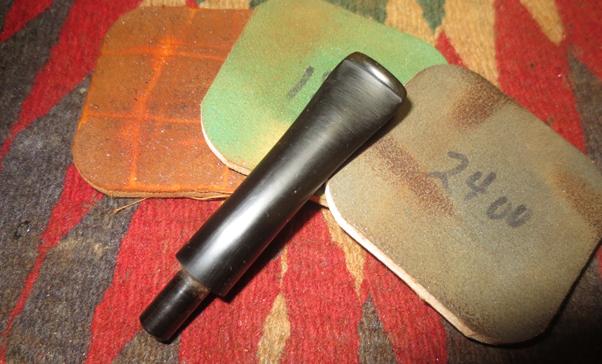
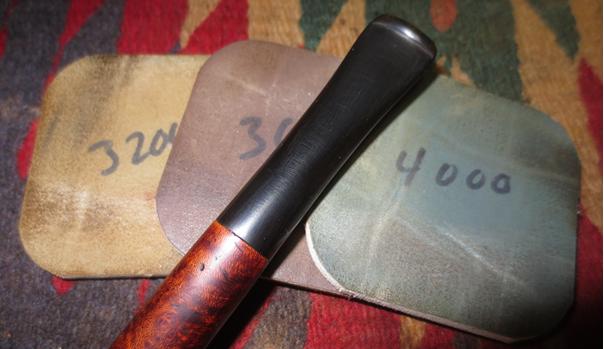
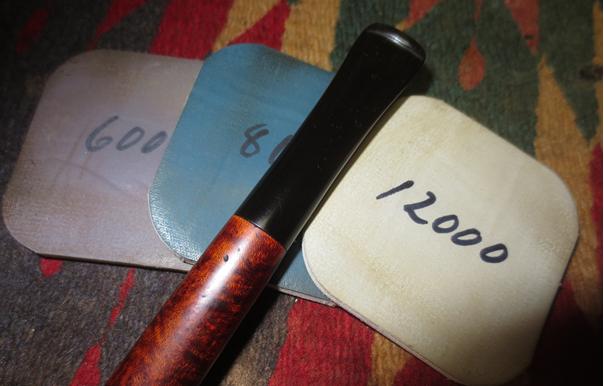
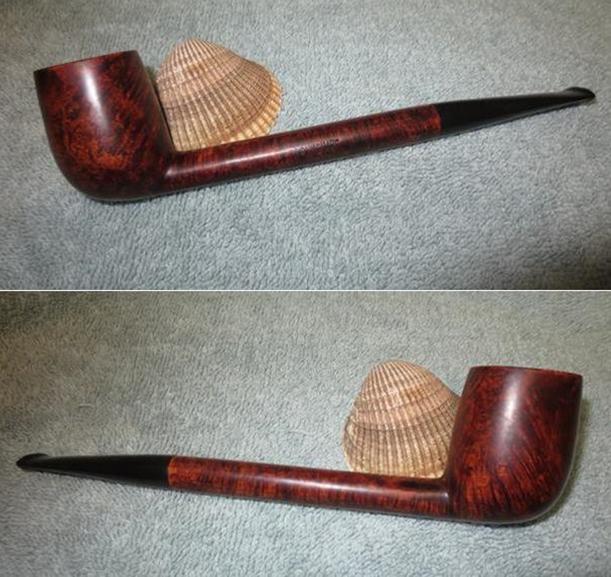
Tag Archives: polishing

Breathing Life into a Comoy’s Spectrum Boxed Bent Billiard


Blog by Steve Laug

My brother picked an interesting Comoy’s pipe. It is from a line of Comoy’s that I was unfamiliar with. I could not find much information in my online searches either. It was a nicely made Comoy’s with a single drilled letter C on the stem side. It came in a black velvet lined presentation box with the Comoy’s of London logo and Pipemakers since 1825 in gold on black felt on the inside of the lid. The well-made box with dovetailed corners is mahogany that is stained with a rich cherry stain. The gold latches and hinges look very good with the red stain of the wood. On the underside the box is stamped Made in England.comoy1 comoy2Once the box was opened and the pipe visible it clear to see it is a beautiful pipe. I am actually surprised that there is not more information on the line available. It is stamped Comoy’s over Spectrum on the left side of the shank and the COM stamp on the right shank is the expected Made in London circle over England. Next to that the shape number 42 is stamped. Looking that up on Comoy’s Shape Charts shows that it is the number for a medium sized ½ bent billiard. This is exactly what I have here. There is also an H stamped on the underside of the shank next to the brass and blue band.comoy3The pipe appears to have some nice grain in the photos that my brother sent to me. The front, underside and back and top of the shank are beautiful cross grain. The sides of the bowl are full of birds-eye grain. The pipe has a brass band that had a wipe enameled strip of royal blue in between two ridges of polished brass. The stem was oxidized in the early photos but the single drilled C stamp is very clean.comoy4 comoy5My brother took some close up photos of the bowl and rim to give me a clear picture of the pipe. It appeared that the bowl had been reamed and well care for. The rim looked very good – a little bit of lava overflow from the bowl but the inner beveled edges and the outer edges of the rim were both very clean. The rim itself was also undamaged. The underside of the bowl and shank showed beautiful cross grain.comoy6The stamping on the pipe was deep and sharp. It had not been over buffed or damaged. It was readable and clean. The finish was dirty and the buildup of grime and grit on the surface of the bowl and band seemed to be the only major issue on the pipe. You can also see the single drilled C logo on the stem in the photo below.comoy7From the next photos you can see the deep oxidation on the stem. What is not visible at this point is if there was any tooth chatter or damage to the stem. That would have to wait until the pipe arrived in Vancouver.comoy8While I was waiting for the pipe to arrive in Vancouver I did some hunting for information on the Spectrum line of Comoy’s pipes on the internet. Sadly I was unable to find much that was definitive. There was a similar pipe for sale on smokingpipes.com that had a brief write up. From that I learned that the pipe dates after 1980 because of the single drilled C. Evidently that was when Comoy’s no longer used the three-part inlaid C on the stem. I wrote to a friend of mine and writer on rebornpipes, Al Jones and asked what he knew about the line. He wrote back that “they are early post-merger, with the single drill C logo. They usually have an adornment of some kind and box. It was the go-go 80’s, right! They’re most likely made with good stock leftover from pre-merger, so she should be a good smoker. As an added bonus, this pipe comes in wooden box complete with matching tamper.”
This confirmed what I had gleaned online so far. I Googled and found a question and short discussion on alt.smokers.pipes community regarding the line and found some more information from friend, Mike Stanley. He wrote: “The only thing I can pass along is what R.C. hacker wrote in his Ultimate Pipe Book. The Spectrum came with a wooden box and matching tamper with the same brass and enameled ring as the pipe. They were, I suppose, “firsts and fairly pricey. I had one I picked up from ebay. It had no tamp or box. It was a fine enough looking pipe. No putty or sand pits. It was too big for my taste. I re sold it. I would guess that they were made up until the late seventies or early eighties. Just a guess though.” (http://alt.smokers.pipes.narkive.com/yA8KASQj/comoy-s-spectrum)

When the pipe arrived in Vancouver and I unpacked it I was amazed at how clean my brother Jeff had gotten the rim and the bowl. The finish was very clean. The enameled band was also clean an undamaged. The oxidation had really come to the surface on the stem. However, all that being said, the briar on the pipe is very stunning. I took some photos of the pipe before I began to work on it to try to capture what it looked like when it arrived.comoy9 comoy10The next picture is a bit out of focus. It will teach me to have a look at the photos before moving on with the cleanup. However, you can see that the rim is spotless. He was able to get all of the darkening and debris off the rim and also ream the bowl clean.comoy11I took photos of the stamping on both sides of the shank. You can see in the first photo the stamping on the left side of the shank. The second shows the COM stamp and shape number on the right side.comoy11aI took photos of the stem to show the oxidation and to try to capture the tooth chatter and tooth marks on both sides of the stem near the button. They are hard to see through the oxidation. The ones on the topside of the stem are not too bad. The ones on the underside are a little deeper. Once I clean off the oxidation a bit I will be able to assess how bad they are.comoy12I sanded the stem with 220 grit sandpaper to break up the oxidation on the surface and also to sand out the tooth chatter and tooth marks on the stem. I was able to remove all of them as they proved to be fairly shallow and superficial.comoy13I polished the stem with micromesh sanding pads – wet sanding with 1500-2400 grit pads and dry sanding with 3200-12000 grit pads. I rubbed the stem down with Obsidian Oil after each set of three pads. After rubbing it down with the final coat of oil I set the stem aside and let it dry.comoy14 comoy15 comoy16I buffed the bowl and stem with Blue Diamond on the buffing wheel. I avoided buffing the enameled band on the shank. I gave the stem and bowl multiple coats of carnauba wax and buffed it with a clean buffing pad to shine it. I hand buffed it with a microfibre cloth to deepen the shine. The finished pipe is shown in the photos that follow. It is a beautiful pipe with stunning grain. The contrast of the black vulcanite, the blue and brass enameled band and the cross grain and birds-eye grain formed a great contrast. It comes with the velvet lined mahogany case with brass clasps and hinges. The only thing lacking was the tamper that originally came with the pipe. Thanks for walking through this restoration with me.comoy17 comoy18 comoy19 comoy20 comoy21 comoy22 comoy23 comoy24 comoy25
A Gold Banded Stanwell Copenhagen Calabash


Blog by Steve Laug

The next pipe on the work table is a striking Stanwell Calabash pipe with sandblasted body and smooth capped rim. The sandblast has exposed some wonderful ring grain around the bowl. The smooth wide rim typical of the calabash shape is wonderful birds-eye grain. The brass collar ring contrasts nicely with the dark stain of the sandblast shank. The gold crown S logo on the left side of the saddle stem combines with the other parts of the pipe to give this one a classic look. My brother Jeff found this Stanwell in an antique shop in Astoria, Oregon. It was on consignment by a widow who was selling her pipe collector husband’s collection. He bought a few of the pipes from her consignment and this is the second one that I have worked on. The first one was also a Stanwell – it was a shape 180 that was designed by Tom Eltang that I wrote about in an earlier blog (https://rebornpipes.com/2016/12/14/a-shape-you-gotta-love-a-stanwell-majestic-180/).cope1The finish on the sandblast portion was in great shape – just dirty with grit and grime. The rim cap however was another story. It had the overflow onto the top of the thick cake that was in the bowl. There was also some darkening of the inner edge of the rim. The brass band and the brass crown S logo on the stem were also dull and lifeless due to tarnishing. The stem was oxidized and had a buildup of calcification on both sides near the button. There were tooth marks and chatter on both sides of the stem and on the button. The slot in the button was nearly closed off with a thick tar.cope2My brother took two close up photos of the rim cap to show the condition of the inside of the bowl and the cap itself. There was a thick coat of tars and oils that is visible flowing over the back side of the cap. There were also several dings and dents in the cape itself though there was some nice birds-eye grain showing through the grime.cope3He also took a photo of the bowl bottom side up. The lovely bell shape of the pipe is visible from this view from the front.cope4The side view of the band and the shank/stem union shows that the connection is tight and clean. There is nothing wrong that a little polishing on the band and some elbow grease to remove the oxidation on the stem won’t take care of. The second photo below shows the stamping on the underside of the shank. It is very sharp and readable. It has the Stanwell stamp over Copenhagen over Calabash in script (it appears to have been double stamped). Beneath that it reads Made in Denmark (it is upside down in orientation to the rest of the stamping).cope5The next photos show the condition of the stem. You can see the tooth marks on the stem itself and the damage marks against the button on both sides. The calcification on the stem may have come for a Softee bit that the original owner had on the stem to protect it from more bite marks.cope6My brother Jeff again did a magnificent job cleaning up the pipe. He was able to get the grim out of the grooves and the majority of the buildup off the rim. He reamed and cleaned the interior of the pipe and stem with alcohol, cotton swabs and pipe cleaners. I took the following photos to show the condition of the pipe when I received. It was on its way to being clean.cope7 cope8I took a close up photo of the rim to show how much of the tars and oils he removed. It is pretty clean. There was some darkening on the inner edge of the rim on the back side that would need to be dealt with.cope9He also removed much of the calcification on the stem and some of the debris on the surface of both sides. The photos also show the tooth marks and chatter that was on the stem.cope10I sanded the stem to remove the rest of the debris and calcification and then wiped the stem down with alcohol on a cotton pad. I cleaned out the tooth marks with cotton swabs and alcohol and then filled them in with black super glue. I set the stem aside to let the repairs dry.cope11I sanded the inner edge of the bowl with 220 grit sandpaper to remove the darkening and then worked over the rim with 1500-1800 micromesh sanding pads to clean up the inner edge and begin polishing the rim cap. You can see the grain on the cap begin to pop and reveal the beautiful birds-eye grain.cope12When the glue had cured I sanded the patches smooth, blending them in with the surface of the stem using 220 grit sandpaper. I sanded the entire stem to work on more of the oxidation that was present on the surface. The photos below tell the story of the repairs and sanding to this point in the process.cope13I polished the bowl rim with 3200-12000 grit micromesh sanding pads and gave the sandblast bowl several coats of Conservator’s Wax. I buffed it with the shoe brush to raise the shine. The photos below show the bowl at this point.cope14 cope15I touched up the stain on the rim with a dark brown stain pen. I buffed it with a microfibre cloth and then polished it with micromesh sanding pads using 1500-12000 grit pads to polish and raise a shine.cope16 cope17I probably should have done this earlier in the process but my brother has been doing such a good job in his cleaning that I honestly forgot. I decided to give the internals of the stem and the mortise and shank a quick cleanup with pipe cleaners, cotton swabs and alcohol.cope18I polished the stem with micromesh sanding pads – wet sanding it with 1500-2400 grit pads and dry sanding it with 3200-15000 grit pads. I rubbed the stem down with Obsidian Oil after each set of three pads. I gave it the last coat of oil and set it aside to dry.cope19 cope20 cope21I polished the pipe and stem with Blue Diamond on the buffing wheel avoiding the sandblast portions of the bowl. I did not want to get the polishing compound in the grooves of the sandblast. It would be hard to get out of the grooves. I gave the sandblast portion several coats of Conservator’s Wax and buffed it with a shoe brush. I gave the stem and rim several coats of carnauba wax and buffed the entire pipe a clean buffing pad to raise the shine. I hand buffed it with a microfiber cloth. The finished pipe is shown in the photos below. It has come a long way from the pipe I started on in the first photos above. It is a classic looking calabash pipe with a great contrast between the smooth briar, the sandblast briar, the gold band and the vulcanite stem. (The brass is so shiny now that it is hard to get the vulcanite not to reflect the brass colour. In person the oxidation is gone and the stem is shiny black.) Thanks for walking through the process with me.cope22 cope23 cope24 cope25 cope26 cope27 cope28 cope29
 

A Shape You Gotta Love – A Stanwell Majestic 180


Blog by Steve Laug

There are certain shapes that Stanwell just nails – they get them absolutely perfect. There is nothing that could be done to make the shape even more stunning than it is. The shape 180 is one of those shapes for me. It is a Dublinesque freehand with a conical bowl, an oval shank and stem that has a short saddle before flowing into the blade. According to a chart by the late Bas Stevens this shape was designed by Tom Eltang (https://rebornpipes.com/tag/shape-numbers-and-designers-of-stanwell-pipes/). It has the appearance of some of the Eltang’s that I have seen. In a write up for a Stanwell 180 sandblast pipe on smokingpipes.com Adam Davidson says this about the shape: “I would bet that this Stanwell shape was designed by Tom Eltang, who has designed quite a few for the company over the years.” So having known Bas Stevens personally I can confirm that it is definitively an Eltang designed pipe. (https://www.smokingpipes.com/pipes/estate/denmark/moreinfo.cfm?product_id=101503)

My brother Jeff found this Stanwell in an antique shop in Astoria, Oregon. It was on consignment by a widow who was selling her pipe collector husband’s collection. He bought a few of the pipes from her consignment and this is the first I have worked on. He took the following photos of the pipe to show what it looked like when he found it. It was truly a mess but looking beneath the grime he had found a gem that only needed some TLC. The grain on this pipe is truly stunning and the lay out of the pipe follows the grain amazingly well.eltang1 eltang2He took some close up photos of the rim and the underside of the bowl to show what it looked like up close. The rim was pretty tarred with overflow from the cake in the bowl. The bowl had a cake but obviously it had been trimmed back somewhere along the way. The pipe smelled strongly of aromatic vanilla tobacco and would take some serious cleaning to bring the briar back to neutral.eltang3The cross grain on the underside of the bowl is quite stunning. It would only stand out more once the pipe was cleaned and polished.eltang4The stamping on the pipe was on the underside of the shank near the stem and was sharp and clear. It reads Stanwell over Made in Denmark over the script of Majestic. Further up the shank toward the bowl it was stamped with the 180 shape number.eltang5The stem was oxidized and had tooth chatter on both sides. It seemed to have some calcification around the button. None of the marks looked to deep so it had some promise. The Crown S Stanwell logo on the topside of the small saddle portion of the stem was in excellent condition.eltang6My brother reamed the bowl and cleaned the internals of the shank and stem with pipe cleaners, cotton swabs and alcohol. He scrubbed the exterior of the pipe and stem with Murphy’s Oil Soap and was able to remove the build up on the rim and also on the stem. The finish was in very good shape under the grime on the bowl. There appeared to be a dark spot on the left side of the bowl. The next four photos show the condition of the pipe when I received it from my brother.eltang7 eltang8He was able remove the build up and calcification on the stem. You can see from the photos below that other than oxidation the stem was very clean.eltang9I worked on the stem with 220 grit sandpaper to remove the oxidation and reshape the button edges. It did not take too much work to get the oxidation that was on the surface of the stem.eltang10I polished the stem with micromesh sanding pads – wet sanding with 1500-2400 grit pads and dry sanding with 3200-12000 grit pads. I rubbed the stem down with Obsidian Oil after each set of three pads. After the third set of pads I gave it another coat of oil and set it aside to dry.eltang11 eltang12 eltang13I used a dental pick to clean out the slot in the end of the button. There was some build up in that area that had hardened. I ran a pipe cleaner through the stem and used cotton swabs and alcohol to clean out the inside of the shank and the airway to the bowl. I polished the exterior of the rim, bowl and shank with micromesh sanding pads using 1500-12000 grit pads.eltang14I buffed the bowl and stem with Blue Diamond on the buffing wheel to polish the vulcanite and the briar. I gave them both several coats of carnauba wax and buffed with a clean buffing pad to raise a shine. I hand buffed the pipe with a microfibre cloth to deepen the shine. The finished pipe is shown in the photos below. You can see from the photos of the left side of the bowl that I was able to remove the darkened spot on upper portion of the bowl. The rich finish and the comfortable shape of the pipe give the Majestic stamping on the shank a well-chosen appellation. Thanks for walking with me through the restoration.eltang16 eltang17 eltang18 eltang19 eltang20 eltang21 eltang22 eltang23

Finishing Touches on an Interesting Bambu Egg


Blog by Steve Laug

This pipe came up for sale on the Gentleman’s Pipe Smoking Society on Facebook. It was being sold by a friend of Dal’s and I liked the shape and the look of it. I honestly was thinking it was a smaller Stanwell like egg even though I knew it was not a Stanwell pipe. The pipe is stamped Bambu on the left side of the shank and on the underside it is stamped Israel which leads me to believe that it was crafted by the Shalom Pipe Factory. There is nothing online that I can find regarding the stamping or the brand but it is similar in stamping to my early Alpha Israel pipes. That is all the information that I can surmise from the pipe itself. I paid for the pipe and had it shipped to my brother instead of to Canada over a month ago and he received it really quickly. I told him to hold onto it and ship it up when he sent another box of pipes to me.

This week it arrived and I expectantly took it out of the box of other pipes. I unwrapped it from the bubble wrap to have a look at it. My brother had sent along a few photos of the pipe to show me what I was in for once it arrived so I was kind of excited to see it up close. In the next two photos he shows the overall look of the pipe. It was really quite nice.bamboo2 bamboo3Whenever I buy an estate pipe, no matter who has done the restoration, I always add my own touches to the restoration to make it mine and to remove the things that will bug me as I use the pipe. I don’t know if you all do that but it is part of my own pathology that I have to go over every estate I get with a fine tooth comb before I even load a bowl and fire it up. This was no exception to my habit. I took the bowl and turned it over in my hands to examine it closely. As usual I noted a few issues that I knew would bug me unless I addressed them. (No criticism of the seller as I am sure many folks would have been absolutely fine with the as it was when I got it.)

  1. The finish on the bowl was spotty. The left side of the bowl appeared to have been stripped of its varnish or shellac coat and there were shiny spots left on the bowl side toward the top edge of the rim. The front, back and right side of the bowl still had the shiny finish coat. I knew I would need to remove the finish and smooth things out. Call me anal but that kind of thing bugs me.
  2. The rim still had some residual lava spots from the bowl that would need to be cleaned off and the darkening of the rim appeared to be on top of the shiny top coat. I was pretty sure that I could remove much of the issue by removing the shiny coat.
  3. The underside and sides of the bowl had some dents and nicks in the finish that needed to be steamed out.
  4. The transition between the briar, the black insert and the bamboo was rough to the touch and there was debris collected in the rough edges of the transition.
  5. There was a red mark in the groove of the bamboo on the top side of the shank. It stood out and it bugged me – kind of like lipstick on the collar of a good shirt.
  6. The bamboo also had a thick seal coat that seemed to have brush marks in the finish and I could feel them with my thumb as I ran it over the bamboo.
  7. The stem had a lot of pits and small tooth chatter that had been polished but was still present on both the top and the bottom sides.
  8. The stamped B logo on the stem was in great shape but I wanted to paint it and make it stand out a bit more on the saddle portion.
  9. The stem also did not sit correctly in the shank leaving a gap on the underside of the joint when it was properly aligned.

My brother included some close up photos of the bowl, the underside, the shank and the stem that highlight some of the issues I raised above.bamboo4 bamboo5 bamboo6The next photos show the stamping on the left side of the shank and on the underside. It reads Bambu as noted above and Israel on the underside.bamboo7In the next two close up photos of the stem you can see the tooth chatter and scratches on the vulcanite stem.bamboo8The final photo shows the B stamp on the side of the saddle portion of the stem. It is in decent shape and would be easily filled in. The fit of the stem against the bamboo was a bit off as well. I would need to adjust this fit.bamboo9In adding my own touches to the restoration of the pipe I decided to work through remedying each of the issues noted above individually. You can be the judge if the finished pipe is better than when I started. The first four photos show the pipe as it appeared when I unwrapped it. You can see the shiny spots on the left side of the bowl near the top and toward the bottom of the bowl. You can also see the dents in the bowl sides.bamboo10 bamboo11The issue raised above in number 1 involved the spotty finish on the bowl. The above photos highlight that issue clearly. The left side of the bowl appeared to have been stripped of its varnish or shellac coat and there were shiny spots left on the bowl side toward the top edge of the rim. The front, back and right side of the bowl still had the shiny finish coat. I scrubbed the finish on the bowl with acetone on cotton pads to remove the shiny topcoat. I was pretty sure it was a varnish or shellac coat and that it had been partially removed somewhere along the way. It did not take too much effort to remove it from the surface of the bowl.

I also addressed issues number 2 and 3 noted above. To take care of the second issue of the rim surface I scrubbed the rim of the bowl with the acetone on the cotton pad and the bits of lava came off along with the shiny coat. The rim was smooth to the touch and some of the darkening also was removed in the process. To take care of the dents and nicks in the finish I steamed them out with a hot knife and wet cloth to raise them. I was able to remove all of the dents and nicks leaving the bowl smooth.bamboo12 bamboo13The next photo is a close up of the rim after the scrubbing with acetone.bamboo14Next I decided to address issue number 9 noted above – the improper alignment of the stem in the shank. When it was correctly aligned in the shank it left a gap on the underside of the joint. It is visible at the bottom of the stem in the photo below.bamboo15I removed the stem from the shank and faced the end of the shank on the topping board using 220 grit sandpaper. You can see from the second photo below where the topping at removed high spots on the end of the shank leaving the center unsanded. This was only the first step in the process of this repair.bamboo16When I put the stem back in the shank it was clear that the angle of the tenon was incorrect in terms of the drilling in the bamboo. I heated the tenon with a Bic lighter to soften the vulcanite of the tenon and then pushed it back into the mortise in the bamboo. Because the tenon was pliable I was able to align the stem edge with the edge of the bamboo to remove the gap in the fit. I held the stem in place while the tenon cooled. Once finished the alignment remained and the gap was gone.bamboo17Once I got the stem alignment corrected I decided to touch up the B stamp on the side of the stem to address issue number 8 noted above. I use some white acrylic paint and applied it with a fine bristle paint brush to fill in the stamping on the stem. Once the paint dried I scraped it off with a soft cloth and sanded it with a 2400 grit micromesh sanding pad.bamboo18To address the issues noted in numbers 4-6 above – all dealing with the bamboo shank extension I worked specifically to deal with the varnish coat on the bamboo. I wiped it down with a cotton pad and acetone to remove the buildup and brush marks on the surface of the bamboo. I cleaned out the “lipstick” that was in the groove in the bamboo using a cotton swab and acetone. There is just one small spot left next to the spacer between the bamboo and the briar. I sanded the transition between the briar, the insert and the bamboo to smooth it out and to also clean up some of the debris that seemed to have collected at that point on the shank. With the removal of the thick varnish the bamboo began to take on its natural patina and the stress marks stood out giving an aged look.bamboo19 bamboo20The final issue, number 7 above, to be addressed was the stem. It had some tooth chatter and marks on the top and underside that needed some attention. They were not too bad but they stood out and bugged me. I sanded the stem with 220 grit sandpaper to remove the tooth chatter and smooth out the tooth marks. I polished the stem with micromesh sanding pads – wet sanding with 1500-2400 grit pads and dry sanding with 3200-12000 grit pads. I rubbed the stem down with Obsidian Oil after each set of three pads. After the final set I gave it a final coat of oil and set it aside to dry.bamboo21 bamboo22 bamboo23I polished the bowl and the bamboo with micromesh sanding pads as well – all grits 1500-12000 to remove any remaining scratches or small nicks in the finish.bamboo24 bamboo25I buffed bowl and stem with Blue Diamond on the buffing wheel to further polish the pipe and then gave the entire pipe several coats of carnauba wax. I buffed it with a clean buffing pad to polish the wax and then hand buffed it with a microfibre cloth to deepen the shine. The finished pipe is shown in the photos below. The rich finish now highlights the beautiful grain on the pipe and the smooth feel in the hand satisfies my desire for that in a pipe. It is now ready to fire up a bowl of some Christmas tobacco and the distractions that irritated me when I received the pipe are taken care off and all the distractions removed. So goes the life of a pipe refurbisher – never finished and rarely satisfied with the end product – I always see more imperfections that need to be addressed. Thanks for humouring me as I took you through this journey I appreciate it!bamboo26 bamboo27 bamboo28 bamboo29 bamboo30 bamboo31 bamboo32 bamboo33

Replacing a Stem on a Stanwell Antique 156 Bulldog


Blog by Steve Laug

The next pipe I brought to my work table is another Stanwell Antique. This one is stamped on the underside of the shank with the words Stanwell over the script Antique and over the top of them both is the number 156 which is the shape number. This one came in the same lot as the two victims of Jaws that I have already written about on the blog – the Estella and the GBD Midnight (https://rebornpipes.com/2016/12/06/jaws-and-an-estella-non-pareil-%c2%bc-bent-9606-stack-by-savinelli/ and https://rebornpipes.com/2016/12/09/another-jaws-victim-a-gbd-midnight-788-oval-shank-apple/). This Stanwell Antique Bulldog had a poorly fit replacement stem – a diamond shaped stem from a classic bulldog shape. The stem had many deep tooth marks on both the top and the underside of the stem. anti1The finish on the bowl was in decent shape though the rim had some tarry buildup and there was a thick cake in the bowl. The first photo shows the mixture of sandblast and smooth on this pipe was a nice contrast. The front of the pipe was smooth and joined the smooth rim. The second photo shows that the front outer edge had nicks and dents in it as did the surface of the rim. The close up photo of the rim shows the condition of the pipe when my brother received it.anti2The Lucite shank extension is amber coloured. The thickness of the extension makes it hard for the light to shine through it. The mortise had been damaged – it is my thought that whoever put the new stem in place redrilled the mortise and damaged the inner edge and the bottom of the mortise. anti3The stamping on the underside of the shank is better than the stamping on the previous Antique I just finished. The shape number is very clear and sharp. The Stanwell logo is lighter on the left side and the Antique stamping is also very clear and sharp.anti4The next photo shows the transition from the smooth front of the bowl to the sandblast on the rest of the bowl. You can see some of the grit in the grooves and crevices of the blast and the grime on the smooth portion.anti5The last photo that my brother sent me shows the bite marks on the diamond stem. They are identical in pattern to the ones on the previous two “Jaws” pipes.anti6My brother cleaned up the pipe with his usual thoroughness. When the pipe arrived in Vancouver the finish was clean and the grooves and crevices clean. The rim was better though it show the damage to the front edge and the dents to the top of the rim. He had reamed and cleaned the mortise and the airway in the replacement stem so the pipe was very clean and ready for me to work on.

I cleaned up the shank extension end and used clear super glue to rebuild the damage portion of the Lucite. I sanded it with 180 grit sandpaper and also with 220 grit sandpaper to smooth out the repairs. I cleaned out the shank with a cotton swab and warm water to remove the debris in the shank. I took photos of the bowl after I cleaned it up and scrubbed it with Murphy’s Oil Soap.anti7 anti8The rim shows some damage to the top and the back edge in the photo below.anti9The stem was an obvious replacement so I put it in my can of stems and looked for a stem that would be a good candidate for a replacement. I had one in a lot of stems that my brother sent me. It was a Danish looking freehand stem that had a long tenon and a step up toward the ring in the middle. I forgot to take a photo of the stem before I worked on it but I had another example of one that was similarly shaped that is shown in the next photo.anti10I sanded the stem with a Dremel and sanding drum to shorten and remove the step down area. I wanted to have a smooth transition from the tenon end to the mid ring. I also wanted to make the slope to the ring more abrupt that it was in the one above. The stem was in pretty rough shape. There was deep tooth mark on the topside of the stem from the damaged button forward. There was also some tooth damage on the underside of the stem in the middle and on one side. The button was also damaged on the underside. There was a missing chunk of vulcanite on the button edge. I filled in the damaged areas with black superglue to build them up. I let the glue dry and once it was dry I sanded it smooth to match the surface of the rest of the stem. I filled in the damaged button and built up the edge on the top and bottom sides. I sanded the button as well once it had cured and reshaped it.anti11I sanded the diameter of the tenon area on the new stem until the fit in the mortise was correct. The stem still looked a little long but I would take care of that shortly. I put it in the mortise and took photos of the pipe with the new stem.anti12 anti13I sanded the stem with 180 grit and 220 grit sandpaper to smooth out the repairs and reshape the stem to match the rest of the stem.anti14I polished the stem with micromesh sanding pads – wet sanding with 1500-2400 grit sanding pads and rubbed it down with Obsidian Oil and dry sanding with 3200-12000 grit sanding pads and rubbing it down with the oil after each set of three pads. After the final set I gave it a final coat of the oil and set the stem aside to dry.anti15 anti16 anti17To remove the damage to the front edge and the top of the rim I topped the bowl with 220 grit sandpaper on the topping board. I sanded it with 1500-6000 grit micromesh sanding pads to sand out the scratches in the rim surface. I restained the rim to match the front of the bowl using a dark brown stain pen. I buffed it lightly with a microfibre cloth.anti18I sanded the smooth portions of the bowl face and the rim with 1500-6000 grit micromesh sanding pads to polish them.anti19 anti20I buffed the rim and smooth part of the bowl and the stem with Blue Diamond polish on the wheel. I gave the stem multiple coats of carnauba wax and gave the bowl several coats of Conservator’s Wax. I buffed the pipe with a clean buffing pad and hand buffed it with a microfibre cloth to deepen the shine. The finished pipe is shown in the photos below. The repairs on the stem show under the bright lights of the flash but in person they are pretty well blended into the surface of the stem. Thanks for walking through the restoration with me.anti21 anti22 anti23 anti24 anti25 anti26 anti27 anti28

Aged Imported Briar Poker with Red Dot


Blog by Dal Stanton

My wife and I were on Interstate 24 nearing Manchester, Tennessee, returning to the Atlanta area after the wedding of our daughter in Nashville.  The billboard beckoned and, of course, I responded by taking the next exit!  Madeline’s Antiques & Uniques had the look of a classic pipe picker’s paradise and I was not disappointed! I’m thankful for my wife’s patience and her eagle eye.  She helped ferret out hidden pipes in need of help and a new home.dal1 dal2 dal3In Palmetto, Georgia, I laid out the haul and recorded the picture above – including the six-pipe pipe stand!  The poker on the lower end is before me now on my work table back in Sofia, Bulgaria.  The left side of the shank has Aged over Imported Briar in a cursive script.  The other remarkable characteristics of this Poker are the red dot on the stem and the screw in tenon with a metal mortise receiver.  Always hopeful of identifying a pipe’s heritage I landed on a thread written in 2013 in Pipesmagazine.com (Link) of someone seeking information about a pipe with the exact nomenclature, dot and screw in stem, just a different shape, an Author shape instead of the Poker before me.  While pedigree is still inconclusive, one helpful comment in the thread summed up well the possibilities:

The “Aged Imported Briar” stamp suggests this is made in the U.S. The screw-in stem is typical of
Kaywoodie and perhaps Jobey which was made for a few years in the U.S. However the design and
shape of this pipe is not Jobey-like. I don’t know Reiss-Premier, but if it is a U.S. outfit, that could
be it. If I understand correctly, the “imported briar” stamp was typical of U.S. pipes at a certain period
when other woods were being used for pipe bowls and there was some misgiving about some of the
woods used. This was a reassurance that the pipe was good quality and safe.

The best guess is the US company, Reiss-Premier, as the source of this Poker because of the dot (See Pipephil.eu) identification.  Reiss-Premier had a factory in Chicago from 1930-1959 and was responsible for the term “Drinkless” which was well known with many Kaywoodie pipes (See Pipedia) which Reiss-Premier also produced.  If the clue about the authenticity verification of briar stated above is accurate, this Poker possibly dates back to WW II days (40s and 50s) when briar supply from Europe was scarce.  Notwithstanding, there is little doubt that this Aged Imported Briar Poker has seen better days and those days are many days ago.  On my work table I take some additional pictures to get a better idea of the challenges with this pipe.dal4 dal5 dal6 dal7 dal9 dal10 dal11The poker is an iconic shape – the name comes from the flat bottomed cylindrical shape of the stummel.  While men dealt hands of poker they could put their pipes on the table without fear of dumping ash on the winnings.  This Poker has heavy cake in the bowl and the rim is in rough shape – I’ll need to remove some valuable briar real estate to reestablish a flat top look, hopefully the Poker won’t turn into a Poker Pot shape in the process!  The stummel heel has some dents and scratches from doing what it was intended to do – sit.  The briar is all but concealed by the old clouded finish – but there is nice looking briar underneath!  I detect a small root branch knot in the grain pattern that will add to the ‘old school’ quaintness of the Poker.  There are signs of wear on the stummel, but I’ll not remove them all – signs of the paths and stewards this Poker has served along the way!  The stem has oxidation and the upper button lip looks like a 9 iron took a divot out of it.  The button will need rebuilding.

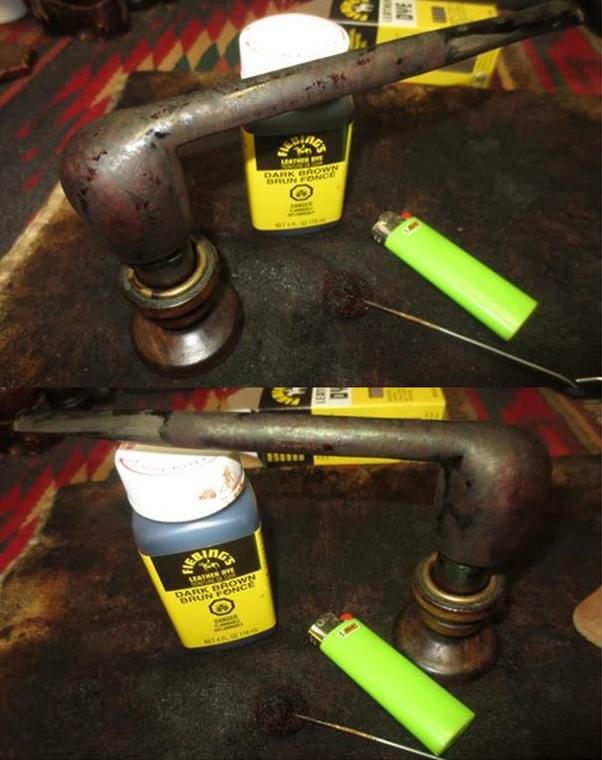
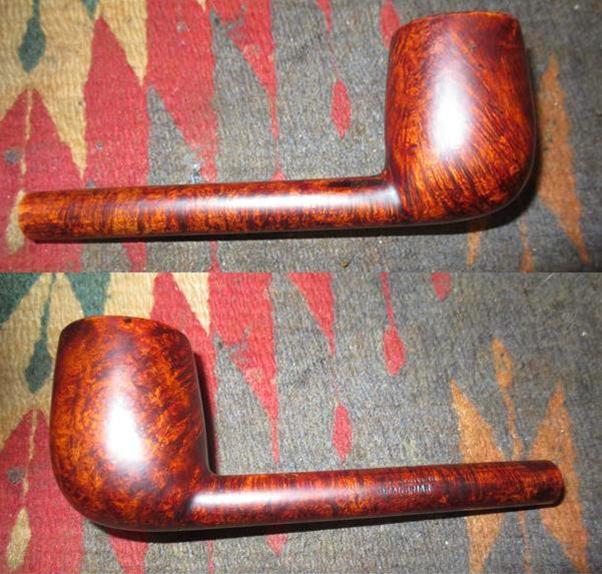
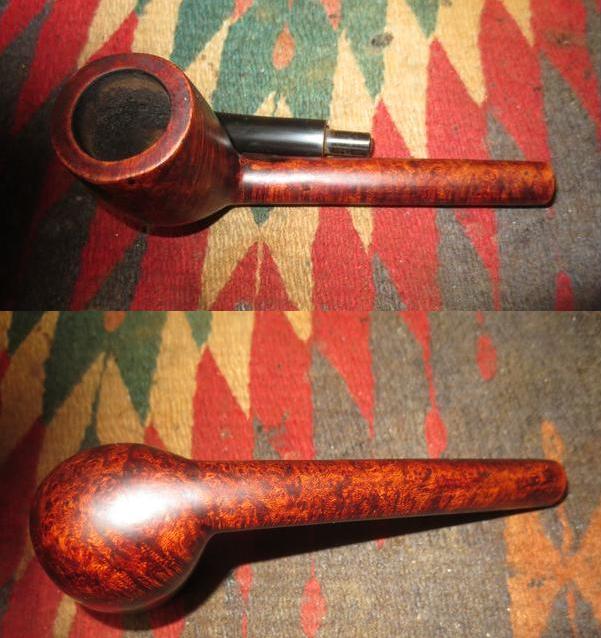
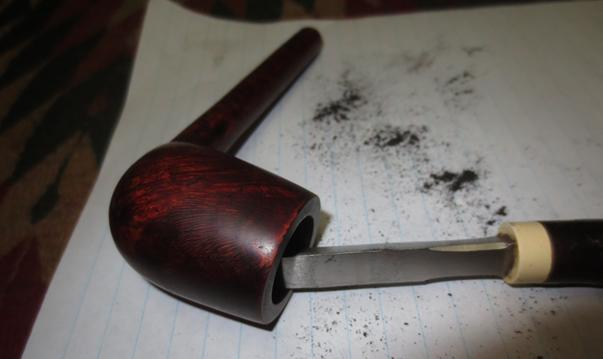
The first order of business is to clean the stummel starting with reaming the bowl and washing down the exterior with Murphy Soap to get a better perspective on the stummel condition.  I also plop the stem into an Oxi-Clean bath to start working on the oxidation.  I’m not sure what effects the bath will have on the red dot so I cover it with Vaseline before the plunge.  I take the Pipnet reaming kit and use 2 smaller of the 4 blades available.  I follow the reaming blades with the Savinelli pipe knife to fine-tune the ream and finish with wrapping 240 grit paper around a dowel rod and sand the chamber.  Using cotton pads and Murphy Oil Soap I scrub the exterior of the stummel and use a brass wire brush to work on the rim which loosens nicely the lava flow without scratching the wood.   The pictures show the progress. dal12 dal13 dal14 dal15I take another close-up of the rim damage from a lateral perspective to illustrate how much briar I will need to take off through topping to achieve a level lid to this Poker.  A bunch!  I take a chopping board covering it with 240 grit paper and carefully rotate the inverted stummel not leaning into the sloping angle of the damaged area.  I don’t want a slanted top!  I check the progress often and ‘free-stand’ the inverted stummel with the help of a right angle I try to keep things perpendicular.  The pictures show the progression of the topping. dal16 dal17 dal18 dal19 dal20When I arrive at a point where almost all damage is eradicated, I stop the topping with 240 grit paper and with 120 grit paper rolled up I shape a bevel on the inside and outside of the rim removing the remainder of rim damage.  After the 120 grit cuts the initial bevel I follow with 240 and 600 grit paper on the inside and outside of the rim.  Finally, I lightly top the stummel again but now with 600 grit paper over the chopping block.  I do this not only to smooth the rim surface, but it also serves to sharpen the circular bevel line around the circumference of the rim – inner and outer.  It gives the rim a very classy, finished look to me.  The pictures show the progress.dal21 dal22 dal23Since the heel of the stummel has scratches and edge damage as well, I repeat the process described above for the heel as well except for using only 600 grit paper to ‘top’ the bottom – not 240.  I only needed to clean and smooth the surface layer not remove real estate.  The bottom bevel utilized 120 then 240 then finally 600 grit sanding papers.  In the last picture of the set below, there remains a small damage spot that I fill with a superglue patch which I will smooth and blend later.  This Poker will be ready for any high-class card table!  The pictures tell the story!dal24 dal25 dal26 dal27 dal28With rim and heel repairs completed, I fish the stem out of the Oxi-Clean bath and it did the job of raising the oxidation out of the vulcanite.  I’ve started inserting a pipe cleaner into the stem before dropping it in the bath making it much easier to fish it out (picture 1 below).  I wet sand the stem with 600 grit sanding paper to take off the mother-load layer of oxidation raised on the stem, then I follow with 0000 steel wool.  After inspecting the stem, I see more oxidation around the button and shank areas – I use 240 grit paper on those more stubborn areas, then again 600, then 0000 steel wool.  In anticipation of doing the button rebuild, I want a clean stem so using pipe cleaners (bristled and non) dipped in isopropyl 95% I clean the stem internals.  It did not take much effort and now to the button repair.  The pictures show the progress.dal29 dal30 dal31I take a close-up of the upper button area to get another look.  It is apparent that the former steward of this Poker had a favorite hold to keep his (or her J) pipe in place while the cards were dealt and considered.  The dent on the button resembles compression damage more than biting or scissor action.  You can see just to the left of the button (up the stem) a bite mark.  My forensic opinion is that the bite is the eye tooth and the compression represents the work of the molar behind – the pipe being clamped on the side to keep the hands free for gathering new cards and tossing those less desirable aside.  I would guess the steward of this Poker was right handed, too – the compression being on the right side leaving most the stem toward the center of the mouth for puffing.  Nope, can’t tell how tall he was!  Yes, I do believe now it was a ‘he’ because a ‘she’ probably wouldn’t mouth-clamp the pipe but put in down on the table and then deal another round J.  Fun and forensics aside, I need to rebuild the upper button area.  First, I attempt to raise the ‘eye tooth’ bite with heat – I ‘paint’ the area with a candle flame.  It seems to have done the trick.  Then, taking 240 grit paper I rough up the button area and then clean the button area with a Q-tip dipped in alcohol.  I mix a batch of charcoal powder and ‘Extra Time Control’ super glue into a toothpaste thick consistency.  I put a mound of charcoal on an index card (so it can be tossed when done) and place a small puddle of super glue next to it and begin to mix – adding more charcoal a bit at a time until I reach the consistency needed to stay in place on the button.  I use a toothpick as a trowel and gradually build and mound over the button that later will be sanded and shaped with a needle file.dal32 dal33 dal34 dal35 dal36 dal37Setting the stem aside to allow the charcoal super glue putty to cure overnight, I turn back to the stummel.  I take medium and light weight sanding sponges and sand the surface, careful to avoid the Aged Imported Briar nomenclature on the shank.  The briar is beginning to emerge and the metal band/mortise is shining up nicely.  I realize that I was anxious to start on the external briar and forgot about the internal muck.  Taking pipe cleaners and Q-tips I clean the internals dipping them in isopropyl 95%.  Time to turn out the lights.dal38 dal39The next day has arrived and I’m anxious to work on the button rebuild that has cured overnight.  I take a picture to mark progress and using a flat needle file I file down the cured charcoal superglue gradually – patience.  The following pictures journal the shaping of the restored upper button that had the most compression damage.  I use the flat needle file to do the button shaping and then follow with 240 grit paper to fine tune and to remove the file marks from the vulcanite.  I’m pleased with the progress.dal40 dal41 dal42 dal43The lower button presented more challenges.  Pictured below I could detect two pockets in the charcoal superglue putty.  To avoid filing off too much of the new button build I elect to apply black superglue and charcoal mix to fill the pockets.  I’ll let these fills cure before sanding and finishing the button repair and then moving on to the stem restoration.dal44 dal45Putting the stem aside, I begin to micromesh the stummel in anticipation of applying a light brown stain.  I begin by wet sanding with micromesh pads 1500 to 2400.  I follow this with dry sanding using 3200 to 4000 then 6000 to 12000 – careful to avoid the Poker’s stampings on the side of the shank.  I enjoy watching the briar grain emerge.  The nickel (I think) band/mortise is shining up very well.  The pictures show the progress. dal46 dal47 dal48Oh my…here I go again.  I intended to apply Fiebing’s Light Brown Leather Dye to the Poker – I just brought it back to Bulgaria from the US and I wanted to give it a try.  The grain of this Poker bowl is very active with a mixture of dark and lighter grains.  I mentioned earlier a knot as well…. I’ll be thinking about this….  I thought and I will apply the light brown Leather Dye as originally planned.  I will see how it looks and I can use a cotton pad with alcohol to lighten the stain as needed.  This is one of the advantages of aniline stains and dyes – these I could not easily find here in Bulgaria.  I’m not sure if the staining will impact the metal band, but I decide to wrap it in masking tape just in case.  I wipe the stummel with a cotton pad and alcohol just to make sure the surface is clear of saw dust from sanding.  I use my air gun to warm the stummel before application of the dye.  I apply the dye with a folded pipe cleaner which I saw Steve do – it is much easier to use compared to a dauber that usually carries more dye than is needed and is messier.  At least this is my experience.  After applying the dye liberally over the entire bowl, I flame it by lighting it with a candle.  The alcohol base in the dye burns off very quickly and does not hurt the wood.  Then, I repeat the application again and flame it.  By doing this I assure that the entire surface has been covered.  I’ll wait until morning to unwrap the ‘package’ and look at the grain.  The picture shows the aftermath.dal49With the stain settling, the stem is ready for the home stretch.  The button super glue patch is cured, so I take 240 grip paper and finish smoothing and shaping the button.  I follow the 240 with 600 grit paper then 0000 steel wool over the entire surface of the stem.  Beginning with micromesh pads 1500 to 2400, I wet sand the stem and follow with an application of Obsidian Oil to the vulcanite.  Then with micromesh pads 3200 to 4000 then 6000 to 12000 I dry sand the stem following each set of 3 pads with an application of Obsidian Oil.  I like the polished vulcanite pop and the red dot stands out nicely.  The pictures show the progress.dal50 dal51 dal52 dal53 dal54Now to unwrap the stummel!  After staining the stummel with Light Brown Leather Dye I take a cotton pad with alcohol on it and wipe down the surface.  This smooths the stain and lightens it slightly.dal55 dal56Reattaching the stem and stummel, with the Dremel felt wheel set at the slowest speed (RPMs) I use Tripoli compound to begin fine tune polishing the surface.  I follow Tripoli with applying Blue Diamond with felt wheel, rotating it methodically over the surface, allowing the high speed of the wheel and the compounds to do the work.  Following the compounds, I wipe/buff the stummel with a cotton cloth to remove the powder residue from the compounds.  Switching to a cotton wheel, and increasing the speed of the Dremel by one number, I apply several coats of carnauba wax to both stummel and stem and finish the restoration of the Aged Imported Briar Poker with a brisk buff with a micromesh cloth.  This old Poker is looking great.  I’m pleased with the button work and the briar makes me smile – it is very active and I enjoy the root knots here and there.  This Poker will again make the card table a more enjoyable experience for some new steward who gives him a home.  Thank you for joining me!dal57 dal58 dal59 dal60 dal61 dal62 dal63 dal64 dal65


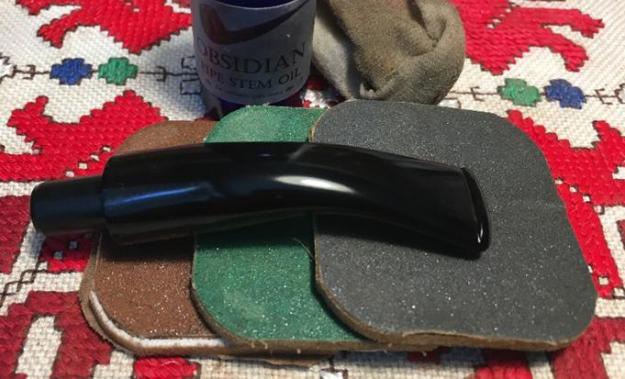
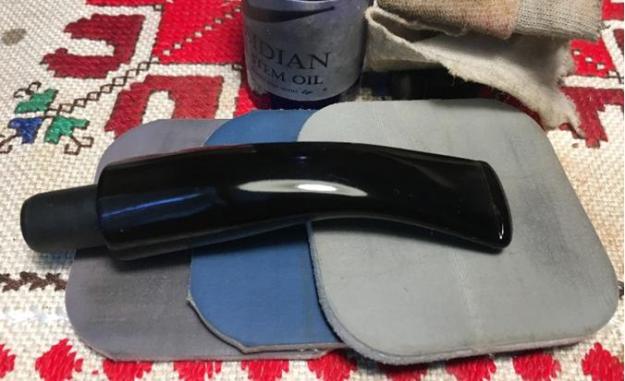
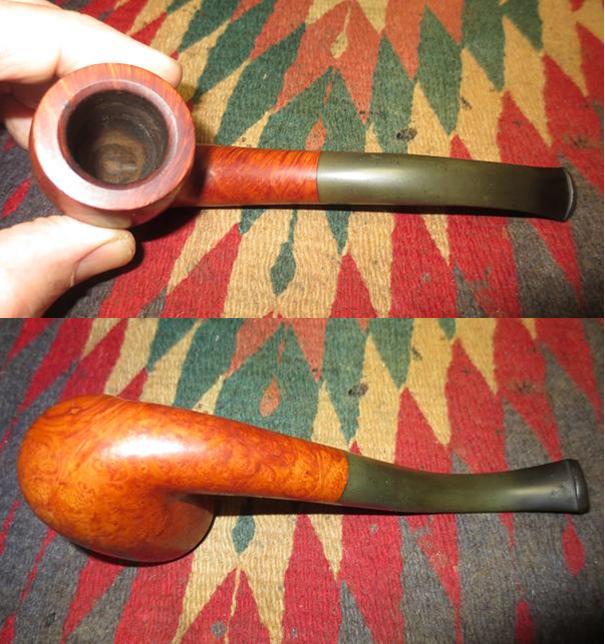
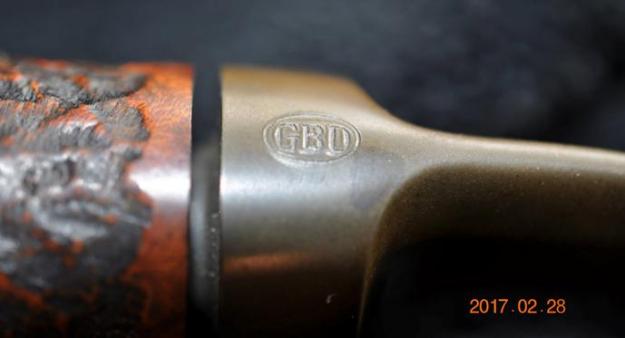
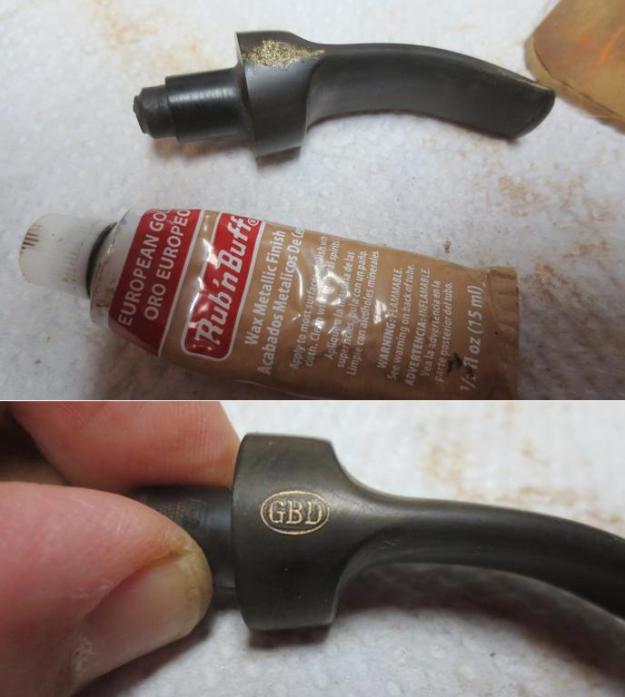
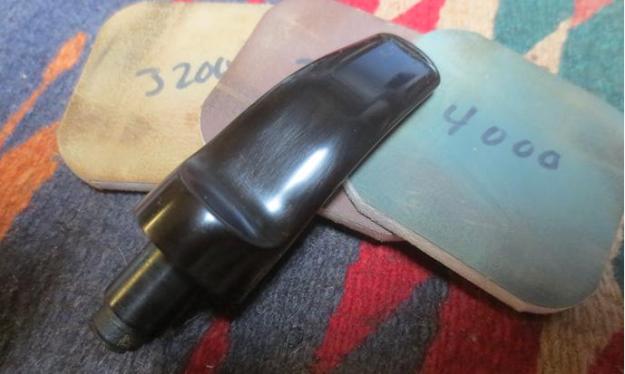
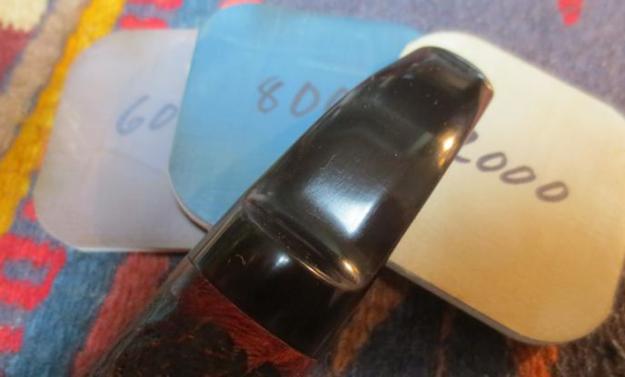
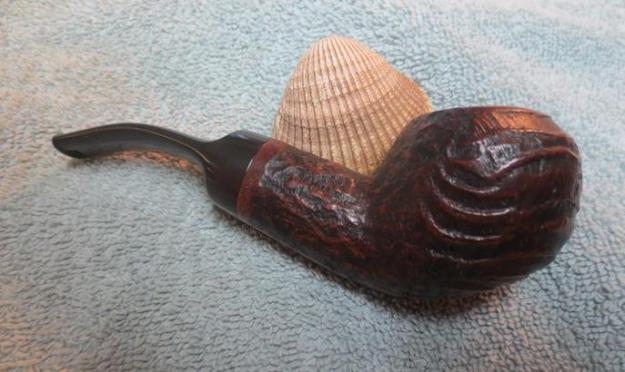
Polishing a Chair Leg/Fancy Stem


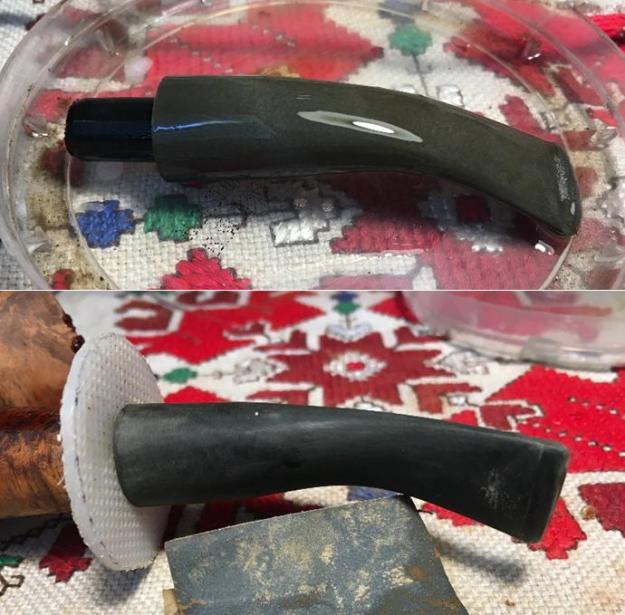
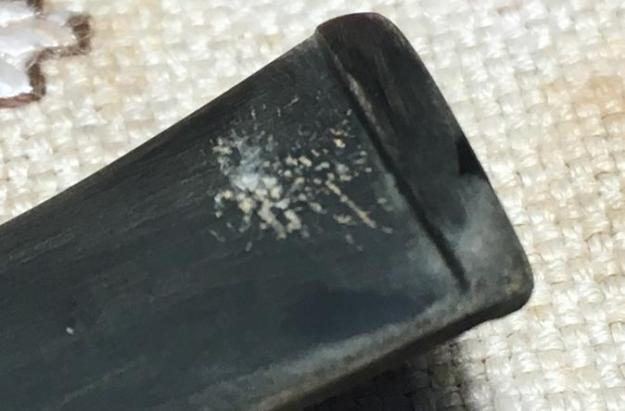
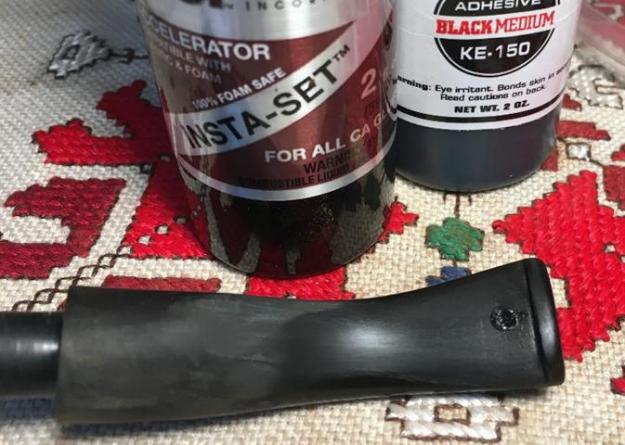
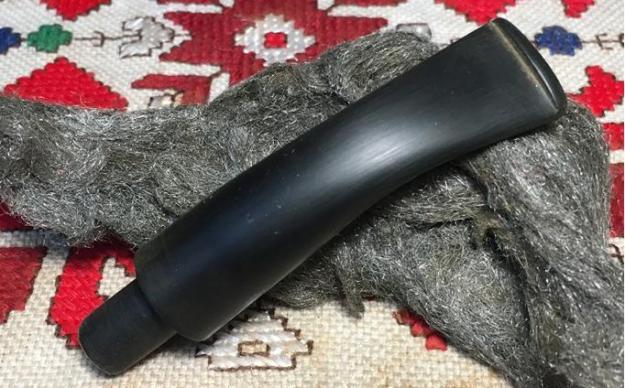
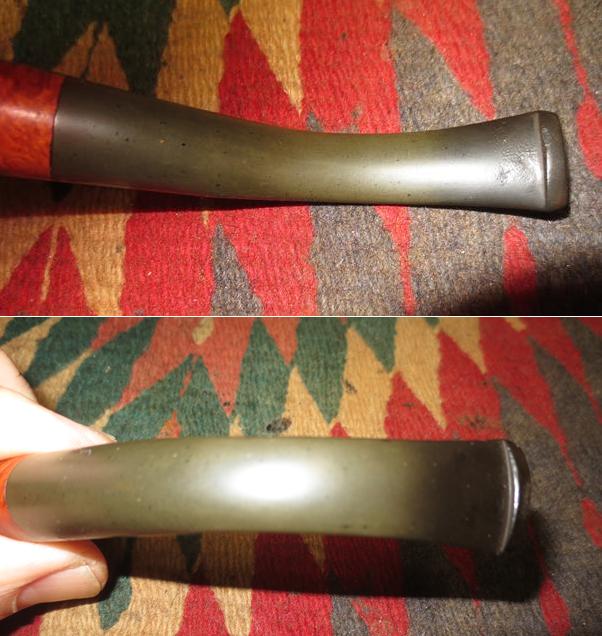
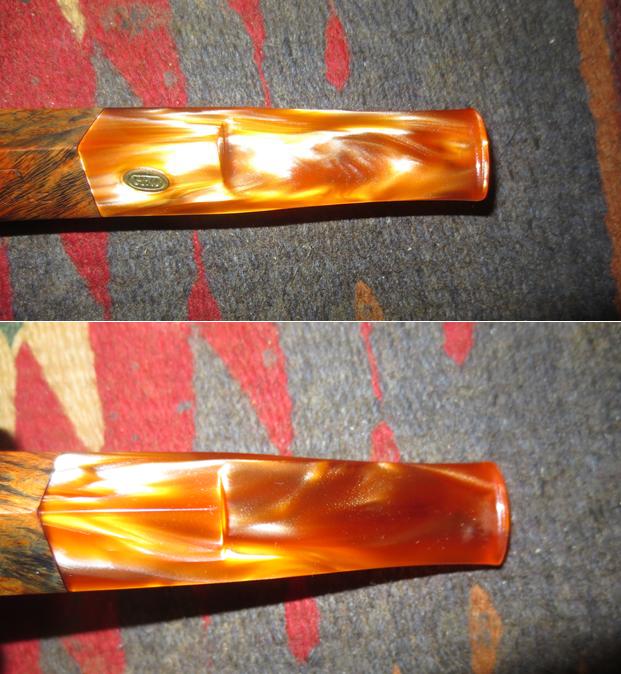
I have a GBD Tapestry that I am restoring, hopefully it will be done in the next day or so. I really like the Tapestry line; this makes my second one in different shapes. They have a fancy “chair leg” stem that while attractive are a pain to polish, especially if they are heavily oxidized, as this one was. 


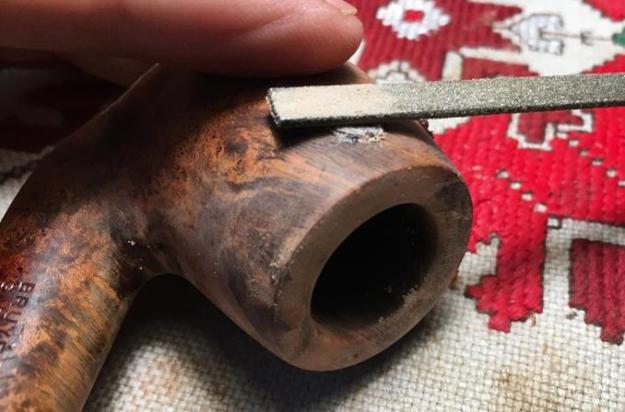
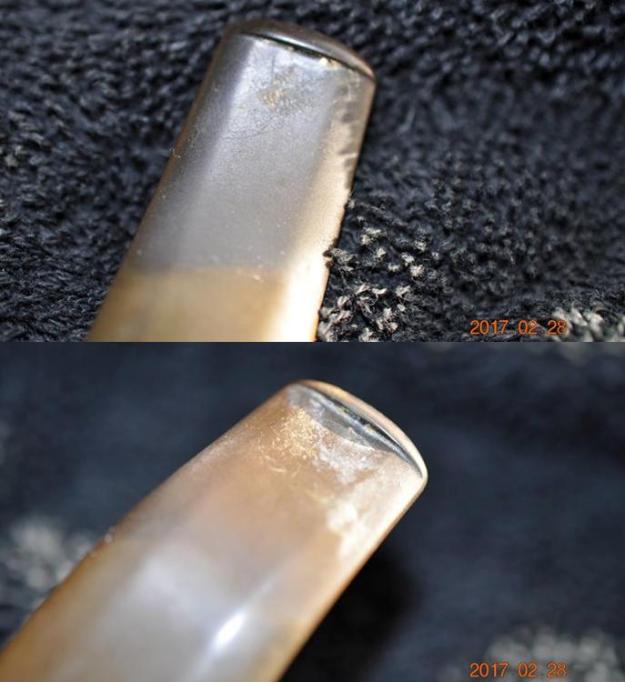
You can see the “problem” areas in the photos. Unfortunately I forgot to take photos before beginning to remove the oxidation and calcification, which were quite thick. 

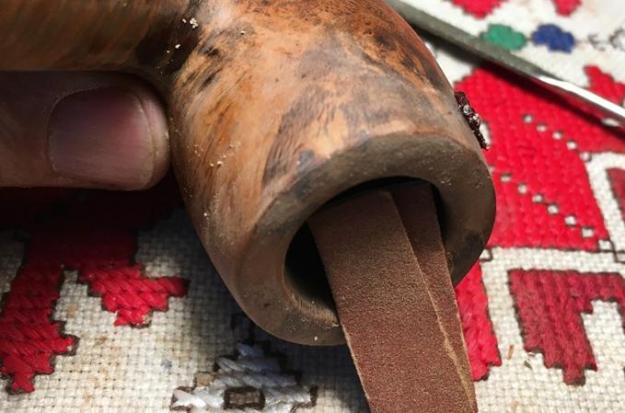
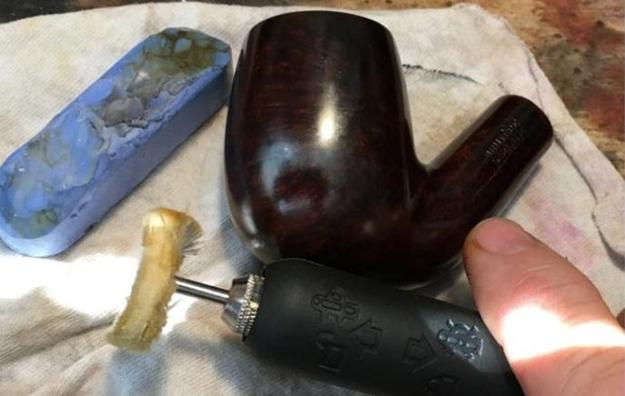
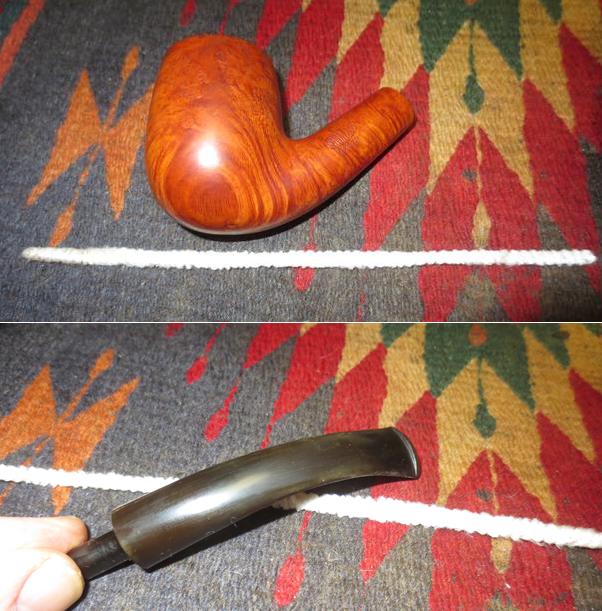
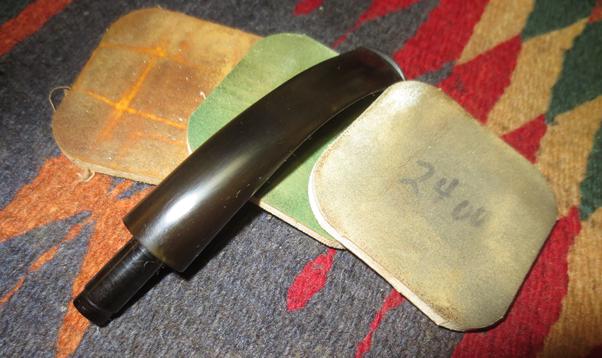
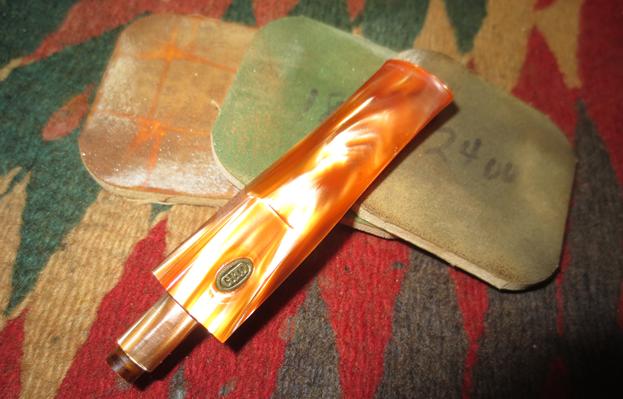
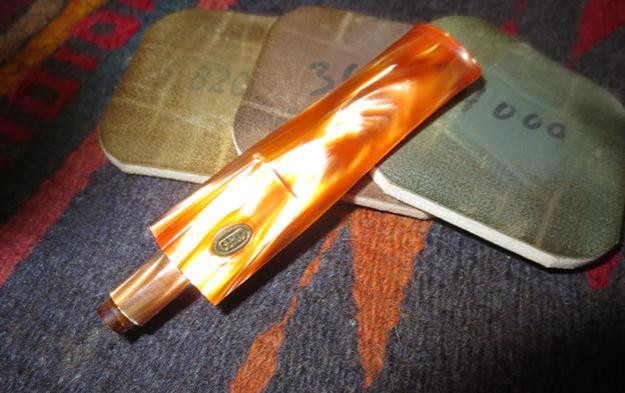
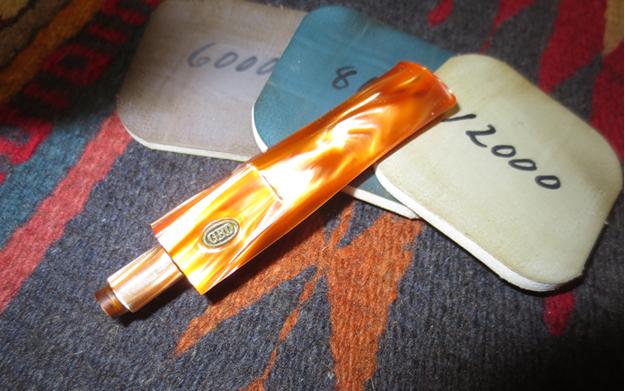
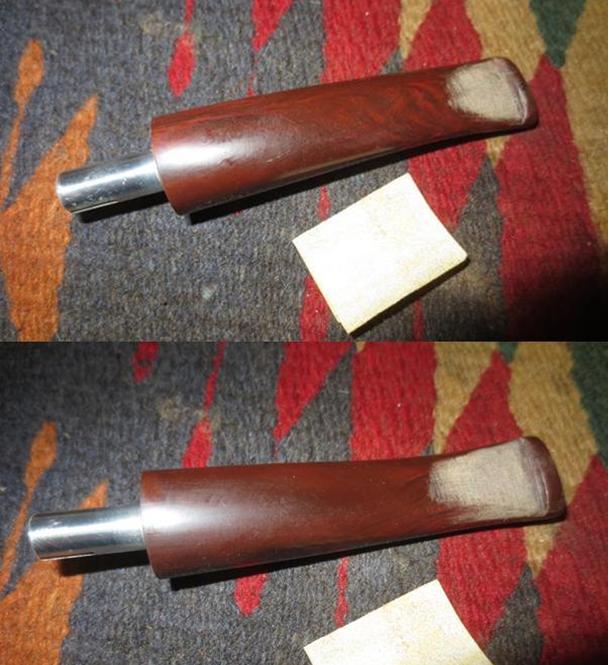
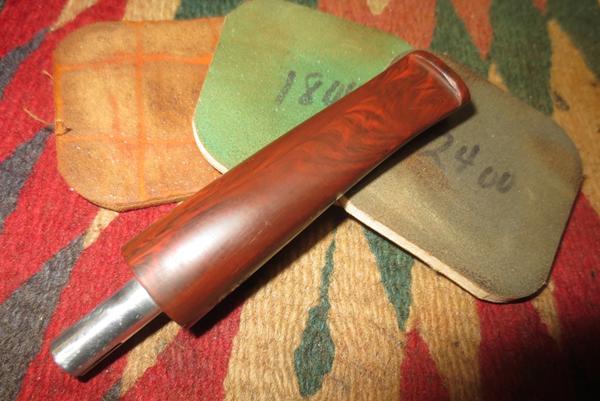
Remembering back to the first one I restored, I thought that sharing the method I use on this type of stem would be helpful to others. It’s not a fast process but it is pretty well foolproof because no machines are used, only “you power” and buffing compound on a piece of thin leather lace. 

I use 3/32″ lace but it also comes in 1/4″. I imagine other materials would work, too. I drag the lace across the bar of compound to load it after putting the stem in a hobby vise. (I use this table top vise with only my hand for holding the vise in place – it has rubbed coated jaws – so I don’t put too much stress on the stem and possibly break it.) I take one end of the lace in each hand and rub it using a “sawing” motion (pull the lace toward me with my right hand, then my left, repeat) in the crevices, reloading the compound as needed, until the oxidation is gone. 

It does require some time and effort but there’s almost no chance of getting the stem out of shape, ruining the graceful lines, or breaking it. 

Calabash No Name from eBay


Blog by Dal Stanton

After celebrating our daughter’s wedding and family reunion in the US and returning to Bulgaria, I was anxious to begin a new restoration.  While in the US, I added a few pipes to the pool when my wife and I stopped at an antique store advertised on an interstate billboard between Nashville and Chattanooga – this story for the future.   I’ve developed a bit of an eBay purchases trove and I found in the ‘Help Me!’ basket what I believe is a Calabash shaped unmarked briar from a seller in New Mexico.  I was drawn by the shape and the lateral movement of grain – a very nice looking piece of briar with great potential.  I wasn’t sure on the shape and checked out Pipedia’s Pipe Shapes Chart (Link) and Calabash seems to be the best fit – please let me know if I missed!  The seller’s pictures provided a descent chronicle of the pipe’s strengths and needs.cal1 cal2 cal3The pictures reveal stummel externals in very good shape except for heavy oil and lava overflow on the rim.  The stem is heavily oxidized and has a tooth hole on the underside of the bit – definitely an eye tooth hanger!  Both upper and lower button areas have teeth bites and significant chatter.  The button lip will also need smoothing and redefinition.  By the looks of this pipe, it was someone’s well-loved and used partner in life.  When I put the Calabash on my worktable I take some additional close-ups to focus on the problem areas and I take a closer look.  In the bowl, I discover what appear to be cracks in the briar in the front and backsides.  At this point, I’m not sure if this is only superficial within the cake or if it presents other problems.  I also take a closer look at the stem hole after inserting a pipe cleaner.cal4 cal5 cal6Before I can make a clear assessment of the bowl and the cracks, I decide first to ream the bowl with the Pipnet reaming kit to reveal the wall’s condition and to clean up the rim.  I also remove the stem and plop it in a bath of Oxy-Clean to begin softening the heavy oxidation in the vulcanite.  I use 3 of the 4 blades available in the Pipnet kit.  The cake was light.  I finish the reaming process using the Savinelli pipe knife and clean the walls by sanding with 240 grit paper pinched with the Savinelli knife.cal7 inspect the cracks in the bowl and decide to shoot a question off and some pics to Steve to get his input.  I then use undiluted Murphy’s Oil Soap and clean the stummel surface with cotton pads. In addition, to remove the thick lava on the rim, I utilize a brass brush which will not scratch the wood.cal8 cal9Putting the stummel aside, I retrieve the stem from the Oxyclean bath and wet sand the raised oxidation with 600 grit paper and follow dry sanding with 0000 steel wool.  In anticipation of working on the patch for the tooth hole I want to clean the internals of the stem.  I use several pipe cleaners dipped in isopropyl 95% and things are cleaning up well.cal10With the stem cleaned up from I move to repair the tooth hole.  This is a first time for me so I fill my mental cup reading several different blogs regarding hole repair and techniques.  One of the necessary ingredients for a repair is activated charcoal powder mixed with superglue to create a putty for the hole patch.  Living in Bulgaria, I was not able locate activated charcoal in powder state but we do have pet stores and we do have aquariums which require charcoal for the filtering system.  The problem is that this charcoal comes in a granulated form.  This problem was solved with a technique and tool going back some millennia with the use of a pestle and mortar.  I pictured a comparison of before and after below.  My only concern is that the charcoal powder I am producing with the pestle and mortar is fine enough to form a smooth blended patch.  We will see.cal11With activated charcoal powder now in hand, I take another close-up of the damaged bit.  To provide a good bond between the patch and vulcanite I score and roughen the area with 240 grit sanding paper, working the paper around the hole and to loosen and remove debris in the hole itself.  I follow that with a Q-tip cleaning dipped in alcohol.  I want the area clean.  I cut a piece of an index card, fold it into a hard point that will fit in the button and wrap the end with tape and then put Vaseline over it to assure that the patch has a solid surface underneath so putty doesn’t leak into the airway and will easily slide out after the patch sets. I pour a small mound of charcoal on an index card then I drip a small puddle of Starbond Black Medium KE-150 glue next to the charcoal.  Using a toothpick, I begin to mix the glue and charcoal a bit at a time so that I can judge the viscosity of the emerging putty – I’m aiming for a honey-like thickness.  When the putty begins to thicken as I add charcoal, I arrive at what I hope is the accurate brew!  Using the toothpick as a trowel, I apply charcoal putty to the hole, tamping each application and making sure I reach the depths of the hole and over-cover the damaged area building a bit of a mound.  After the patch cures, I will remove the excess putty.  I’ll give it a full 48 hours before continuing the work to assure the patch is solid and good for years to come.  After the patch sets a bit, I flip the stem and apply drops of Starbond Black Medium KE-150 to the tooth dents on the upper bit area.  The pictures show the progress.cal12 cal13 cal14With the stem patches curing I return to the stummel.  Steve’s email arrived with his reply to my questions about dealing with the cracks in the inner bowl.  He described his method of applying a paste made from a mixture of cigar ash and water to the cracks and bowl wall.  Yes, I remember previously reading about this in one of his restores!  This will come later after I’m able to collect some cigar ash – Cubans are readily available in Bulgaria.  I want high quality ash!  I take another close-up of the stummel as I re-inspect the surface.  I find one small crevice which I will fill with clear super-glue.  First, using a cotton pad I clean the surface of the stummel with acetone to remove any residual finish.  I then apply a drop of super glue on the small crevice above the shank junction and put the stummel down for the night to let the superglue fill to cure.cal15 cal16The next day, ready to move forward, I strategically sand down the superglue fill with 240 grit paper removing the excess glue bringing the patch down to the briar surface assuring a good blend.cal17When I think of the classic Calabash look, the stummel shape is crowned with a distinct cap.  To enhance this look and to remove some damaged, colored briar around the inner rim, I want to enhance and augment the bevel already present.  Using a coarser 120 grit paper tightly rolled, I cut the fresh bevel then I follow using a rolled-up piece of 240 grit paper to smooth the new bevel.  Pictures show the progress.cal18 cal19Before continuing with the rim repair and the stummel finish, I want to clean the stummel internals with a retort but I’ll need to return to the stem bit repair and do the sanding on the patches first.  The retort’s rubber hose will not expand enough to attach directly to the shank so I need to utilize the stem.  I am anxious to see how my first attempt at a hole repair faired.  Utilizing a flat needle file and 240 grit paper I sand the patch down to the stem surface. The patch is blending well but I detect very small, what I assume are air pockets, emerge during the sanding.  From my reading, I found that this is normal, but these appear to be too small to treat with a bit of superglue. I’ll keep my eye on this during the stem finishing phase.  On the upper bit, I also sand the superglue patches of the tooth dents to the stem surface with 240 grit paper.  With a needle file, I redefine the button lip a bit smoothing out where there were tooth bites.  The pictures show the progress on both the underside and the upperside of the bit – I’m liking what I see.cal19a cal20I don’t want to proceed any further until cleaning the internals of the stummel.  I will use the retort to accomplish this.  With cotton ball in the bowl, alcohol boiling in the test tube I begin the process.  I take a couple of shots of the progressive dirtying of the alcohol.  I forgot to take the final where the used alcohol was almost clear.  After the pipe cools from the retort, I remove the stem and finish the internal cleaning with some Q-tips and pipe cleaners dipped in alcohol 95%.   Internals are clean!cal21 cal22 cal23Turning again to the stem, I begin the micromesh process.  I wet sand with micromesh pads 1500 to 2400. Before applying Obsidian Oil, I want to take a close look at the tooth hole patch on the underside of the bit.  I’m not happy with what I find. With the first set of micromesh sanding pads the pocketing in the patch is more pronounced.  Air pockets?  Or, perhaps my charcoal powder was too coarse?  I’m not satisfied with these results so, even though it is a detour, I want to try to rectify the problem.  I apply a thin coat of CA Instant Glue over the area.  I’m hoping that the glue will fill the pocket and allow a smoother surface to emerge – enhancing the blend with the native vulcanite.  I clean the area with a bit of alcohol on a cotton pad then I apply the CA Glue.  I’m hopeful that this will do the trick.cal24Turning now to the stummel externals, I first use a medium and then a light grade sanding sponge, focusing on the rim to work out pits and roughness left over from the lava clean up.  Following the sanding sponges, I wet sand the stummel using micromesh pads 1500 to 2400, then dry sanding with pads 3200 to 4000 and 6000 to 12000.  As I watched the beauty of the grain emerge, I made the decision not to apply a stain but to keep the natural briar – a rich, thick, swirl of honey.  This no name Calabash is dressing up nicely.cal25 cal26Time to return to the stem and complete the lower bit tooth hole patch and to prepare the stem for the waiting bowl.  I ‘gently’ approach the sanding with 240 grit paper to lightly smooth the re-superglued patch down to the stem surface.  The ‘gentleness’ is due to not wanting to sand deeper than the reapplication, increasing the potential of uncovering new pockets.  I also again apply the flat needle file to define the lower button lip and then remove the file marks with the 240 grit paper.  I follow with 600 grit sanding paper and finally, I finish with 0000 steel wool.  I think the hole patch is improved and now I’ll trust the rest of the finishing and polishing process to blend the patch as much as possible.  In the picture below one can still detect the patch boundaries but the surface is much smoother.cal27With tooth hole charcoal superglue putty patch officially completed, I restart the micromesh sanding process by wet sanding with pads 1500 to 2400 followed by an application of Obsidian Oil to absorb into the vulcanite surface. Then dry sanding with micromesh pads 3200 to 4000 and 6000 to 12000, completing each set with an application of Obsidian Oil.  The pictures show the progress.  The last picture in this set I flip the stem to show the hole repair.  I think it’s ok, and as they say, “It is what it is.”cal28 cal29I have two mini-projects left before I begin the final polishing and waxing processes with the Dremel.  I want to dress up this ‘No Name’ Calabash with a band.  The beauty of this pipe emerged along the way and the classy Calabash shape just cries out, “Band!”  So, band it is.  I think it will look great.  The other project is to fill the cracks in the bowl with ‘Pipe Mud’ per Steve’s email response to my questions earlier in the restoration. I recalled reading about ‘Pipe Mud’ before and it didn’t take long to find it in the vast Rebornpipes.com archives.  Steve’s tutorial was helpful and to the point by point as usual (See: Link), but also of value for newbies to the hobby are the comments following – more links and practices to add to the mix!

Gary, my friend and colleague who lives in Plovdiv, Bulgaria, happily responded to my plea for ‘quality’ cigar ash.  I am now in possession of ash the byproduct of 2 Cubans – the second of which he smoked with me Thanksgiving Day evening as we gathered to celebrate together in Sofia – I smoked my favorite black Cavendish blend, Lane BCA, in the pipe I call, Ole Pot.  I take a couple close-ups to get a look at the cracks in the bowl. I’m not sure the source of these crevices but they appear to be grouped mid-way down the bowl both in the front and back of the bowl wall.  On a hunch, I look at the exterior and I think my hunch is correct.  The grain of the stummel moves horizontally though the bowl.  When I look at the front and back of the external grain patterns, I find birds eye grain pattern – which represent the cut through, perpendicular perspective of the grain.  The sides of the stummel reveal the side of the grain – the horizontal flow.  So, these cracks appear to me to be the grain splitting – it appears like dry split wood.  Not sure ‘why?’ but this is my theory.  The third and fourth pictures below show the external theory:cal30 cal31First, to prepare to make the pipe mud, I take the Cuban ash and crush it with the end of a pipe nail.  With tweezers, I picked out debris and make sure there are no large chunks.  The gray powder in the pictures is the aim.cal32Next, I use a dental probe to dig a bit in the cracks to make sure there is no loose debris.  Then I take a few bent pipe cleaners dipped in isopropyl and clean the bowl wall.  I put the ash in a shot glass and slowly add water with an eyedropper and mix the mud with the pipe nail.  When the consistency of the mud is like paste, I use a bent pipe cleaner to paint the mud on the wall – careful to tamp in to fill the crevices.  I keep an eye on the areas with crevices as the mud dries in the bowl, making sure that it doesn’t shrink, but remains even with the bowl wall – as Steve’s tutorial instructed.  In about a half hour the mud is dry and forms a pretty hard surface.  The pipe mud will form a foundation for a cake to develop which provides a protective layer for the briar.  Until this happens, care is given to not ream or aggressively scrape the bowl wall.   The pictures show the progress.cal33The next project is adding a band to dress up the No Name Calabash – a touch of class.  The shank diameter is 17.5 millimeters in diameter and I fish out a 17.5 band to match the diameter.  Some months ago, I purchased an assortment of bands to have on hand from J. H. Lowe’s online store.   I’ve done one band previous to this, my first restoration which Steve published on rebornpipes (A Newbie Restore of a Dr. Plumb 9456) which went well.  The mantra I remember from Steve’s tutorial on banding (Link) was the need for patience in applying heat and micro-inching the band up the shank – a hot band could tear if forced to quickly. I set up a handy work station on a solid wooden stool that I can straddle.  I fold a towel and place it over a chopping block to provide a firm, but soft foundation to use as I press the stummel inching the heated band up the shank.  My air gun fits nicely on the platform as well.  About 1/10th of the band fit over the end of the shank at the beginning.  I heat the band rotating it, careful not to burn the wood then put it to the toweled surface and press – firmly but only a bit.  Repeating the process several times.  The pictures below show this.  The last in the set shows the progress of the band’s movement up the shank – almost home!cal34 cal35It was going so well, until it wasn’t!  With millimeters left before the band was flush with the shank, a press against the surface caused a portion of the band to crimp (pictured).  This was not part of the plan.  Different possible scenarios fill my mind for next steps to try to back out of the situation and to salvage the banding project.  I’m concerned that the band has torn at one of the crimp points because I can detect a sharp edge to the touch.  Time for an ‘SOS’ message to Steve with the picture below.cal36Steve’s response was helpful – to heat the band as before and with a small flat screw driver, straighten out the crimping and then continue again with the heating and pressing to bring the end of the band flush with the shank.  The following pictures show the salvage operation.  I begin by heating and bringing the bent edge back out using a small flat head screw driver.  As this progressed, I improvised, using the round head of a pipe nail to help reestablish the round of the band by heating and placing the head in the lip of the band and rolling it like a wheel while rotating the stummel.  Once things start regaining normal, I use a needle file gently filing the edge to remove sharp splinters.  I also filed a bit on the external ‘pucker points’ that help reestablish roundness and a smoother surface, but not perfect.cal37 cal38 cal39As I return now to heating and pressing to complete mounting the band on the shank, my concern is the weakened area of the band will simply crimp again with the process.  I decide to heat the band up a bit more than I did before, hopefully to enable the band expansion more economically and to add more towel padding between the band and the hard surface below.  I return to heating and pressing and thankfully, the result is a seated band with a few battle scars along the way!cal40 cal41When I attempt to rejoin the stem and new banded stummel, I find that increased compression on the shank from the new band has created a tighter mortise/tenon fit.  To release some of the tightness of this fit I wrap the tenon with 240 grit paper and rotate it to reduce the size of the tenon but keep it in round.  I rotate and test the new fit several times until I get it right.  I don’t want to take too much off the tenon and have a loose fit.  I get my first look at the reunited stummel and stem and I like what is before me! I take a close-up on the underside of the shank to show the area of the band crimp and repair.  I’m satisfied now with the repair job; I will see if I can improve it through the polishing process.cal42 cal43Now the fun begins!  With stem and stummel united, I begin the polishing phase using Tripoli over stummel and band.  I mount the Tripoli wheel in the Dremel’s hand-held extender and power it up at the lowest setting (RPMs) and after purging the wheel with the tightening tool, I light tap the wheel on the Tripoli bar and apply it to the surface.  With all the compounds, I do not apply too much vertical pressure to the wheel but allow the speed of the Dremel and compound to do the work.  After the Tripoli, I switch to the Blue Diamond wheel and repeat the process above but include the stem as well as stummel and band.  After this, I give the pipe a good rub down to remove powder left over from the compounds.  With the carnauba wheel mounted (after purging) I apply several applications of carnauba wax then change the Dremel to a clean wheel and buff the entire stem and stummel.   I complete the polishing with a brisk buff with a micromesh cloth to bring out the depth of the briar even more.

I learned three new skills to put in my tool box – making and applying Pipe Mud, rescuing a botched band mounting, and repairing a tooth hole using a charcoal super glue putty.  Not bad.  I’m very pleased with this ‘No Name Calabash’.  The honey-colored briar is stunning as it flows through the stummel – the depth of the grain almost appears 3-dimensional.  The band is a nice addition – it dresses it up, like putting on a tux. I trust that this pipe finds a good home.  Thank you for joining me!cal44 cal45 cal46 cal47 cal48 cal49 cal50 cal51


Restemming a Savinelli Capri Root Briar 320 and giving it a new look


Blog by Steve Laug

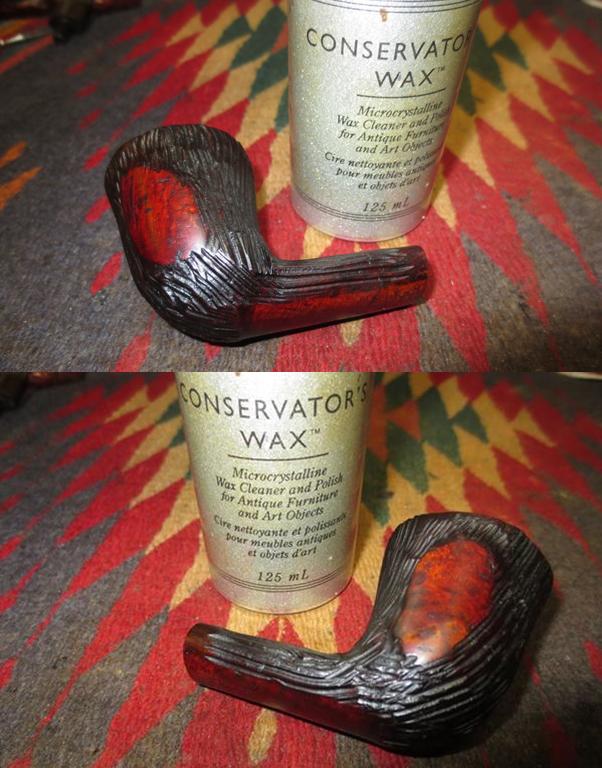
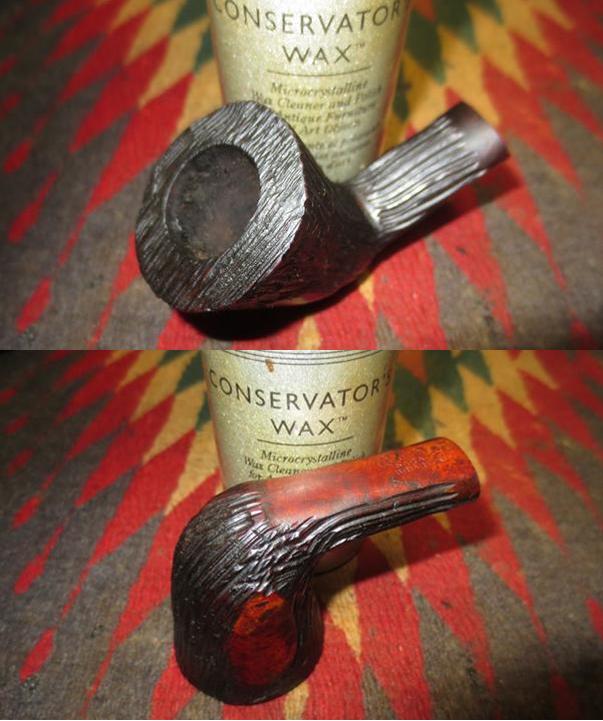
I have always liked the looks of the Savinelli 320 shape. I have one of them here and it is a 320EX so it is quite large. When my brother Jeff sent me photos of one that he was looking at I was interested. He bid on it and won. It is stamped on the underside of the shank on a smooth spot with the words Savinelli Capri over Root Briar. Next to the stamping was the Savinelli shield and to the right of that it reads 320 over Italy. The finish on the bowl looked really good. I really like the Capri rustication and the roughness of the feel in the hand.sav1My brother sent me the photos above as well as these close up photos. The rim was actually in very good shape, surprisingly. The there was a thick rough ca,e in the bowl and some of the lava had overflowed on to the rim top grooves.sav2The underside of the shank was in excellent shape though there were some scratches on the smooth area. The pebble cut rustication was in excellent condition. The contrast stain on the pebble finish other than being dirty was undamaged.sav3The real issue with the pipe lay with the stem. The stem had been gnawed to the point that there was almost an inch or more of the stem missing. It was missing a large portion of the vulcanite on the top and the underside of the stem. It is ironic that the stem logo was the only thing about the stem that was left undamaged.sav4 sav5My brother is getting really good at his cleanup process and this pipe was no exception. I am getting spoiled when I get a pipe that I have to ream and clean. When he sends them they have been reamed, scrubbed with Murphy’s Oil Soap on the exterior and cleaned thoroughly with alcohol, cotton swabs and pipe cleaners on the inside. I took some photos of the pipe to show the condition it was in when it arrived in Vancouver. You can see that the finish is clean and you can see the horrible damage to the stem.sav6 sav7I took a close up photo of the rim and the bowl. He had reamed back the cake to bare briar and also scrubbed the rustication on the rim and removed all of the tars and oils that had filled in portions of it on the back side of the bowl.sav8The original stem was a lost cause at this point. To shorten and reshape a new button I would have had to cut off almost another ½ inch. To my mind that would have made the pipe too short for my liking. I went through my can of stems and found a stem that had potential. The diameter of the stem at the tenon end was slightly larger than the Savinelli stem but it had room for adjustments. It had some file marks on the top and the tenon was a little large in diameter for the shank of the 320 but with a little work it would work. It had some paint on the top of the saddle and was deeply oxidized. There was not any tooth chatter or tooth marks on it. It would certainly work for the 320 but it would change the appearance. Once I had finished the fit I would take some pictures and make a decision.sav9I scraped out the mortise with a dental spatula to remove the hard tarry build up that had accumulated there. Once I had scraped it clean I scoured out the inside of mortise and airways in the shank and the stem with alcohol, pipe cleaners and cotton swabs.sav10I sanded the tenon with a Dremel and a sanding drum to fine tune the fit in the shank. I also adjusted the diameter of the saddle with the Dremel and sanding drum until it was a close fit to the diameter of the shank. I fine-tuned the fit with 220 grit sandpaper until the saddle portion was free of the sanding marks left behind by the Dremel. I sanded the tenon with 220 grit sandpaper to adjust the fit in the mortise. I finished by sanding the remainder of the stem as well to break up the oxidation.sav11Once the fit in the mortise and to the shank was correct I pushed the stem in place and took photos of the new look of the pipe. Part of this was to mark the progress but it was also an opportunity for me to see it from the eye of the camera and assess whether I would keep working on the stem or just wait until I came across another Savinelli tapered stem. As I studied the photos I was pleased with the look. There was something catching about the new slim stem flowing from the saddle. I liked the looks of it.sav12 sav13I sanded the stem with the 220 grit sandpaper until I had removed the oxidation and then rubbed the bowl down with a light coat of olive oil to rejuvenate the briar. I rubbed the stem down with Obsidian Oil and took the next set of pictures. The pipe was beginning to look really good.sav15 sav16I polished the stem with micromesh sanding pads – wet sanding with 1500-2400 grit pads and dry sanding with 3200-12000 grit pads. I rubbed the stem down with Obsidian Oil after each set of three pads. I gave the stem a final coat of Obsidian Oil after the last micromesh pad and set it aside to dry.sav17 sav18 sav19I buffed the stem with Blue Diamond polish on the buffing wheel to polish it further. I gave the stem multiple coats of carnauba wax and gave the bowl several coats of Conservator’s Wax. I buffed the bowl and stem with a clean buffing pad to raise the shine. I finished the pipe by buffing it by hand with a microfibre cloth. The finished pipe is shown in the photos below. It took some work to fit the new stem to the shank but the new look of the saddle stem gives this pipe a fresh appearance to me that works well with the pebble rustication of the Capri Root Briar finish.sav20 sav21 sav22 sav23 sav24 sav25 sav26 sav27


An interesting “The Nuvo” MLC Italian Briar hidden in a WDC Case


Blog by Steve Laug

When we saw this older case and pipe for sale on eBay we were under the assumption that the pipe in the case was an older WDC pipe. The age of the case and the pipe appeared to match in the photos posted by the eBay seller. The case was in decent shape on the left side and the right side had a ripped part missing near the stem end. The covering on the case was leather. The hinge and clasp mechanism were in good condition. The green velvet lining looked worn. The stamp on the inside the top of the case was readable but worn. It read WDC in the triangle and over Genuine Briar. mlc1The finish on the briar was worn looking and the stem looked like it was covered with white calcification over the length of the stem all the way around.mlc2 mlc3The bowl was thickly caked with a thick coat of lava overflowing onto the rim. It was so thick that it was hard to tell if the outer and the inner edges of the rim were in good condition. Underneath it may well have a lot of nicks and the bowl could easily be out of round.mlc4The seller included some close up photos of the stamp on the inside cover of the case. You can see the WDC triangle logo over Genuine Briar. They also included close up photos of the stamping on the left and right sides of the shank. It is very hard to read the lettering in the photos. It looks like the left side is stamped with something over Special Pat. On the right side what is readable is Italian Briar. The rest of the stamping was not readable in the photos.
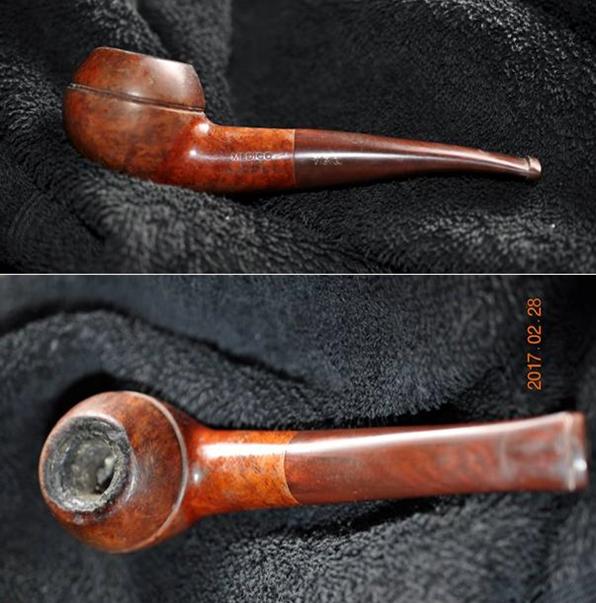
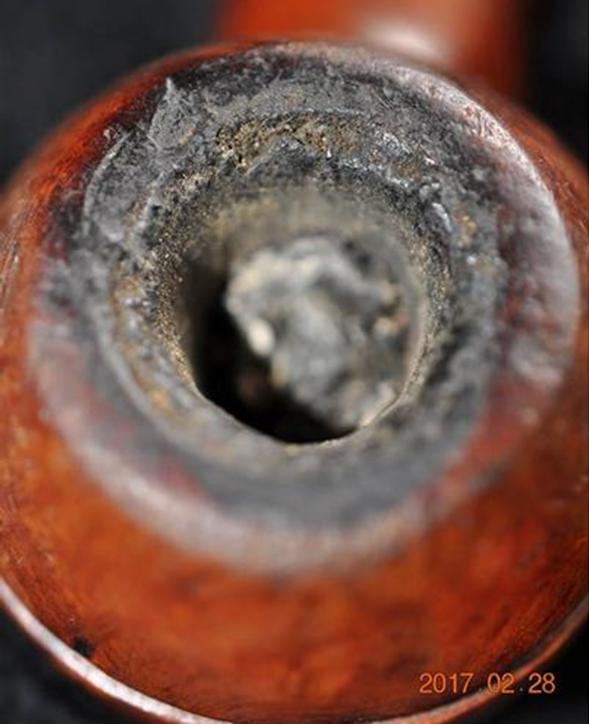
mlc5 mlc6When the pipe arrived in Idaho my brother took photos of the pipe before he cleaned it up. The finish was certainly a mess and there was a lot of grime and build up on the bowl and the shank. There also appeared to be some nice grain peering through the grime.mlc7He took some close up photos of the rim and the front of the pipe. The overflow of lava and the cake in the bowl was very thick. The outer edge of the rim was rounded and showed some damage. The frontal photo shows a dent at the front top of the bowl that goes diagonally across the bowl. I have circled it in red to show the location of the dent.mlc8He also took photos of the stamping for me. On the right side of the shank there appeared to be an oval with the letters stamped MLC in the centre. On the left side it seems to read “The Nuvo” over Special Pat.mlc9The closes up photos of the white substance on the stem surface show the condition of the stem and looks almost crystalline.mlc10I took some photos of the pipe when it arrived in Vancouver and I brought it to the work table to begin the restoration. My brother had done an amazing job cleaning up the dirty finish and the white on the stem. He had reamed the bowl clean of the thick cake. He also removed the thick lava on the rim top.mlc11 mlc12 mlc13I took a close up photo of the bowl and rim to show the condition. My brother had been able to remove all of the cake and the tar. The outer edge of the rim was rounded and had dents. The inner edge was missing chunks and the bowl was out of round. The top of the rim had nicks and dents and was also in rough shape.mlc14The stem looked to be in decent condition. The high quality rubber of the stem was pitted and lightly oxidized. The style of the button added to my idea that I was dealing with an older pipe.mlc15I was able to clearly read the stamping on the pipe once I had it in hand. It read “The Nuvo” over Special Pat. on the left side of the shank. On the right side it was stamped with an MLC in an oval over Italian Briar. I was not familiar with th name on the pipe or the Oval MLC stamp. I looked my copy of “Who Made that Pipe” and found that The Nuvo was made by M. Linkman Company in 1914. The MLC logo in the oval stood for M. Linkman Company.

I looked the brand up on Pipedia (https://pipedia.org/wiki/M._Linkman_%26_Co) and found that M. Linkman Company name was said to stand for Mary Linkman & Company. Mary Linkman was the mother of Louis B. Linkman, originator of the Dr. Grabow pipe. This Chicago company produced both meerschaums and briars. I also looked on the PipePhil Logos and Stampings site (http://www.pipephil.eu/logos/en/logo-l4.html) and found that the M. Linkman and Co. was established by Louis B. Linkman and August Fisher in 1898. The company closed down in the 1950s and the Dr Grabow branch was sold to Henry Leonard and Thomas Inc. There was also a note that early Linkman’s pipes were stamped MLC in an oval.

I now knew that the pipe I had in hand was an early Linkman’s pipe rather than one made by WDC. That meant that the case and the pipe did not match.

I decided to try to clean up the inside edge of the bowl before I topped it. I wanted to remove as much of the damage to the inner rim as I could to better see how much of the rim top I would need to remove with the topping action. I used a rolled piece of 220 grit sandpaper wrapped around my finger to sand the inner edge of the bowl.mlc16When I finished sanding the edge there were still some deep gouges in the edge of the rim at the back and the front of the bowl. The bowl was also out of round and seemed to be thinner on the right side than the rest of the bowl.mlc17I topped the bowl rim on a topping board with 220 grit sandpaper. I worked on it until I had removed all of the damage to the rim top and also removed the damage to the outer edge of the rim and also what was on the inner edge. In the second photo you can see that much of the damage to the inner edge of the rim was removed. I still needed to bevel that edge to smooth out the damage.mlc18I used a folded piece of 220 grit sandpaper to sand the edge of the bowl. I worked it over until I had removed the damaged areas on the front and the back side of the rim edge. I also worked to make the bowl round once again.mlc19I sanded the rim edges and the top of the rim with 1500-4000 grit micromesh sanding pads once i had the bowl in round. I scraped the inside of the mortise with a dental pick to remove the hard chunks of tar that were collected on the inside walls of shank. Once I had removed all of the hardened buildup I scrubbed out the mortise and the airways in the shank and the stem with pipe cleaners, cotton swabs and alcohol until the oils and tars were gone.mlc20I wiped down the exterior of the briar with acetone on a cotton pad to remove all of the residual dirt and grime from the topping and cleaning. I wanted the surface to be clean and oil free in preparation for the new stain coat that I would give it.mlc21 mlc22I thinned some dark brown aniline stain by 50% with isopropyl alcohol (need to put in an order for more stain). I applied it to the bowl with a folded pipe cleaner. I flamed the stain to set it and repeated the process until the coverage on the bowl and shank were an even medium brown colour.mlc23 mlc24I set the bowl aside to let the stain cure and turned my attention to working on the stem. I sanded it with 220 grit sandpaper to remove the light oxidation and smooth out the pitted surface of the stem. I polished it with micromesh sanding pads – wet sanding it with 1500-2400 grit pads and dry sanding it with 3200-12000 grit pads. I rubbed the stem down with Obsidian Oil after each set of three sanding pads. I gave it a final coat of oil after the third set of pads and set it aside to dry.mlc25 mlc26 mlc27I put the stem back on the pipe and buffed it with Blue Diamond on the buffing wheel. I took precaution to not buff the stamping on the shank sides. I gave the bowl and stem multiple coats of carnauba wax to protect it. I buffed it with a clean buffing pad to raise a shine. I hand buffed it with a microfibre cloth to deepen the shine. The finished pipe is shown in the photos below. I am happy with the way it turned out. The look and finish of the pipe turned out very well. Thanks for walking with me through the process.mlc28 mlc29 mlc30 mlc31 mlc32 mlc33 mlc34 mlc35