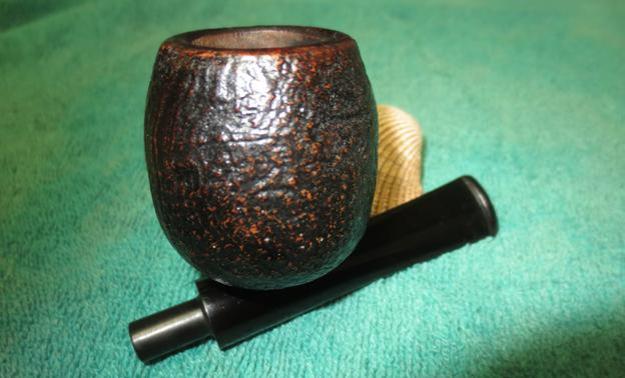
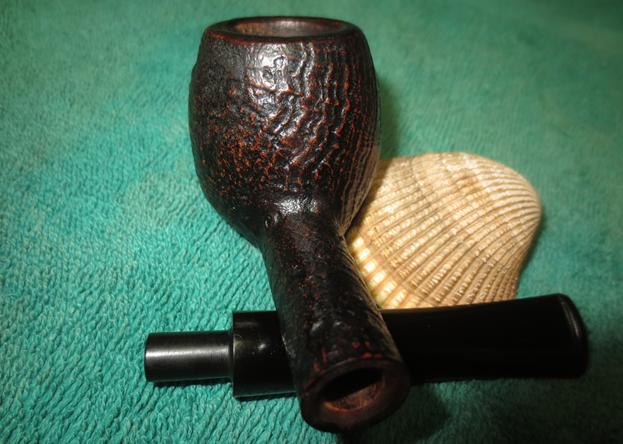
Tag Archives: polishing

Restemming and Reconditioning a Brigham Voyageur 165


Blog by Steve Laug

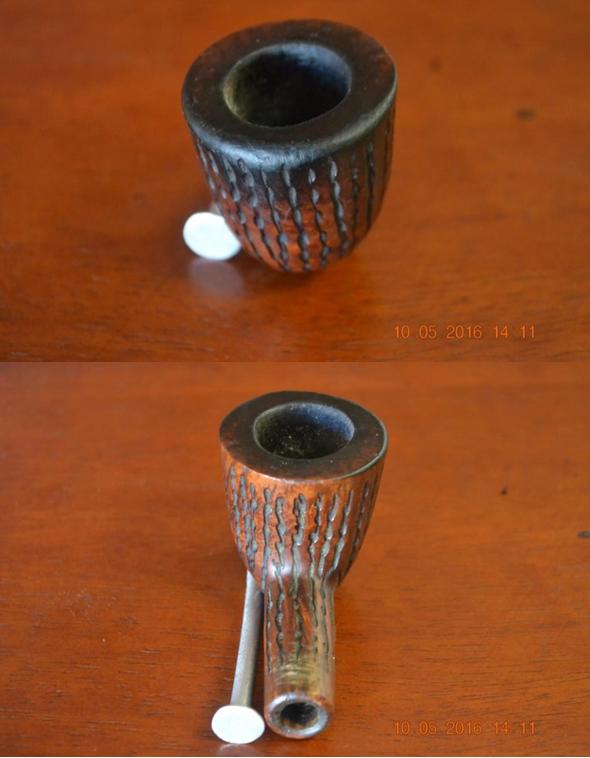
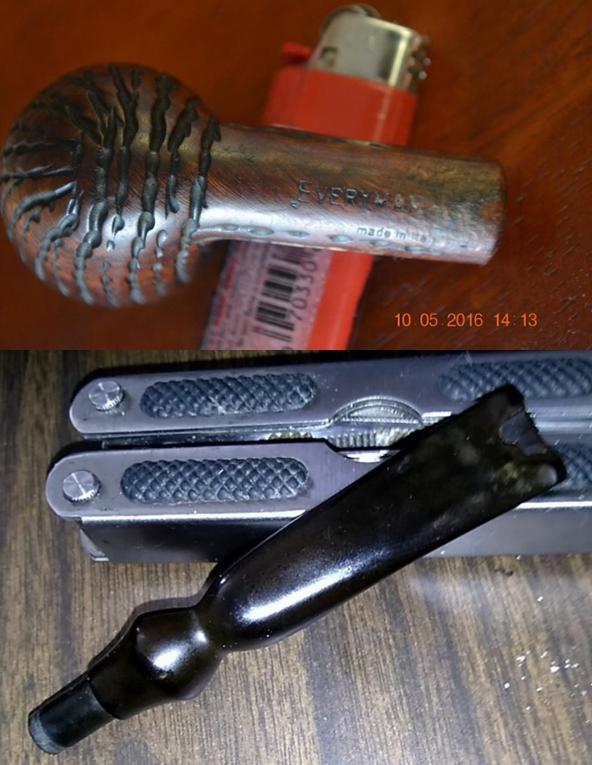
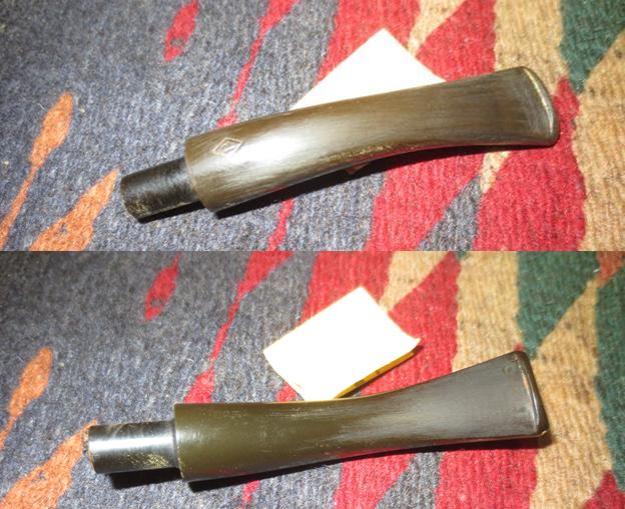
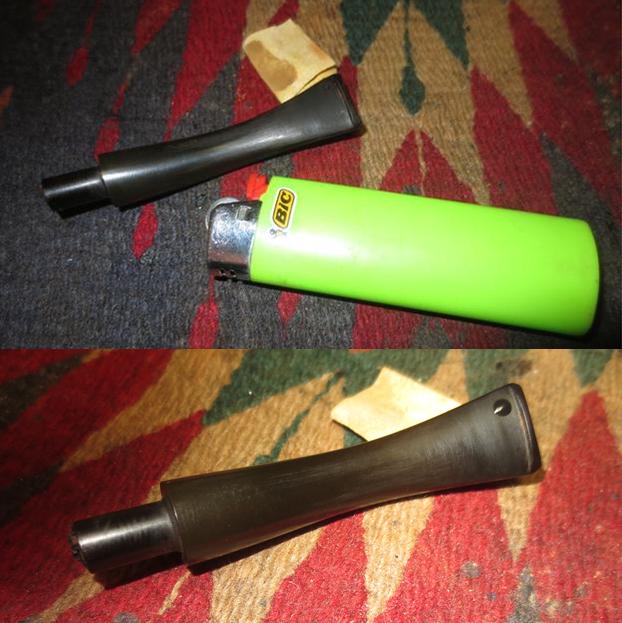
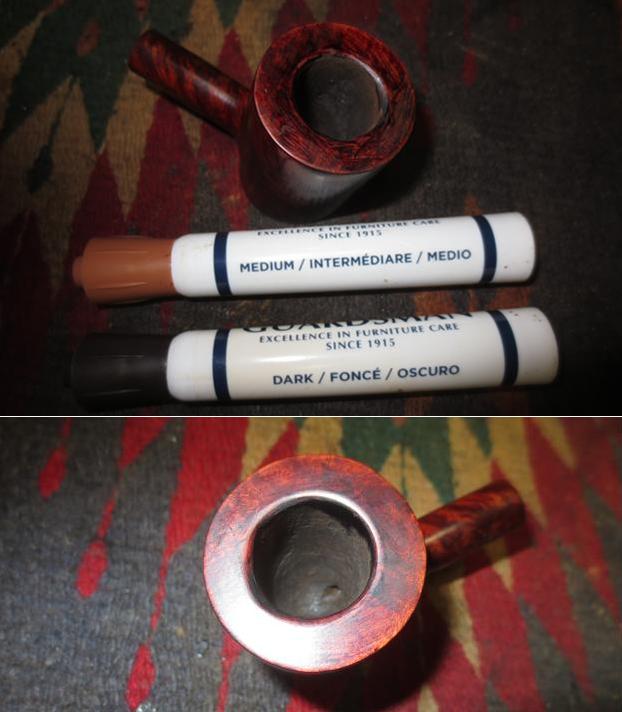
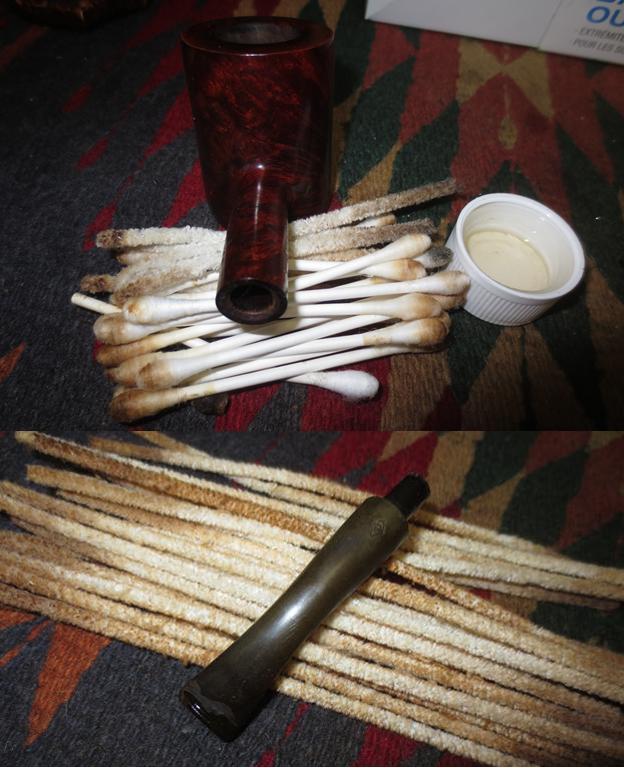
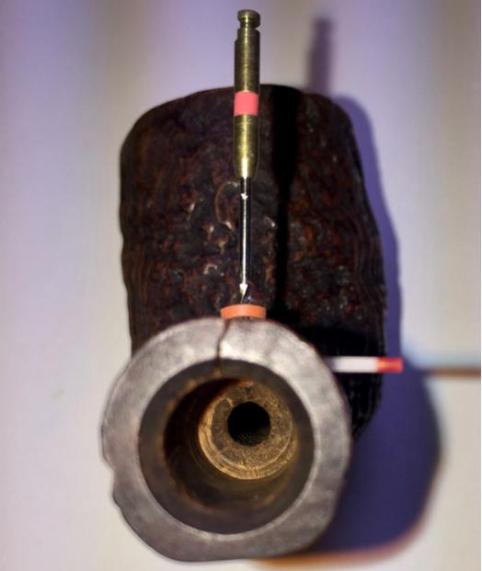
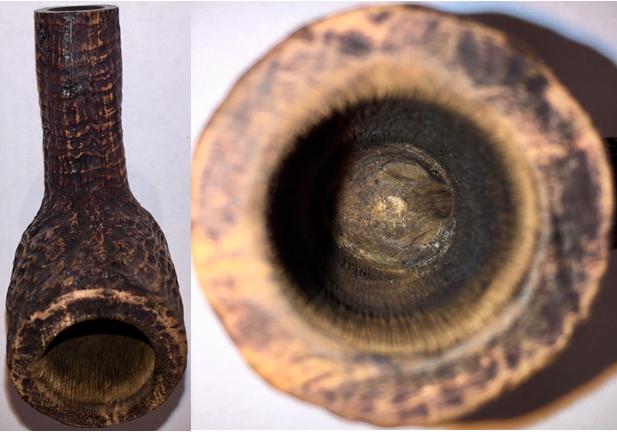
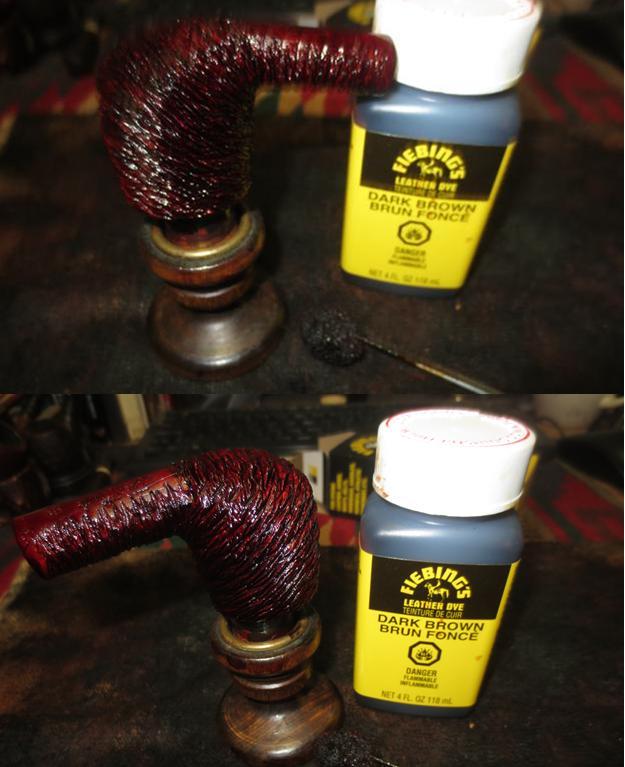
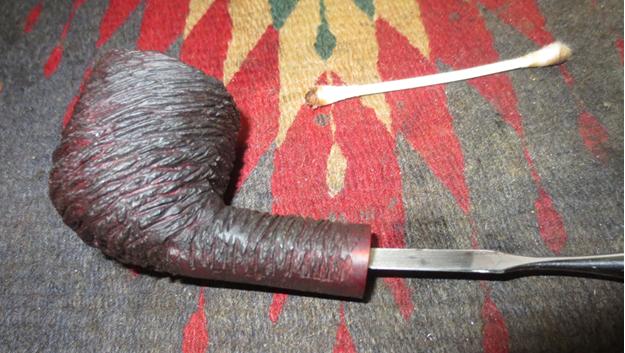
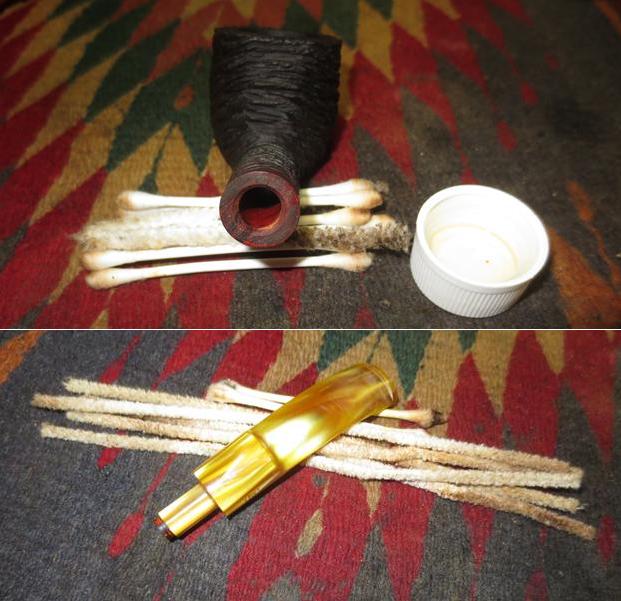
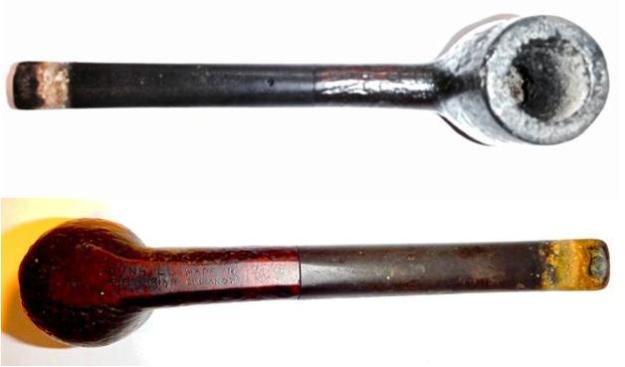
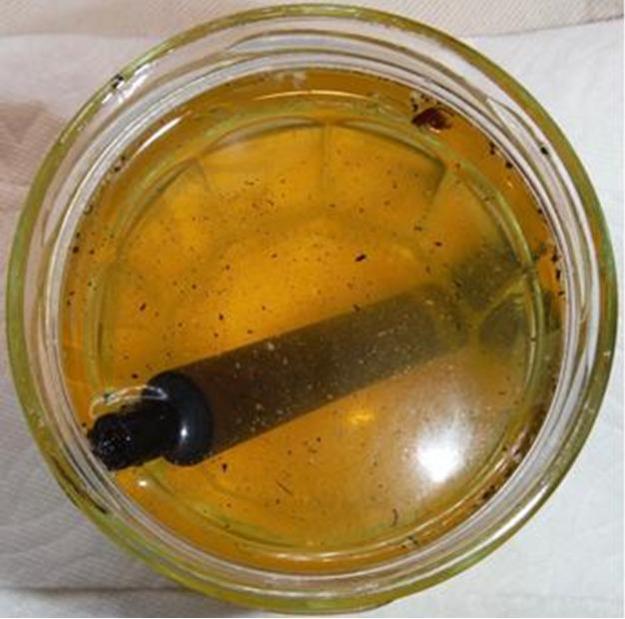
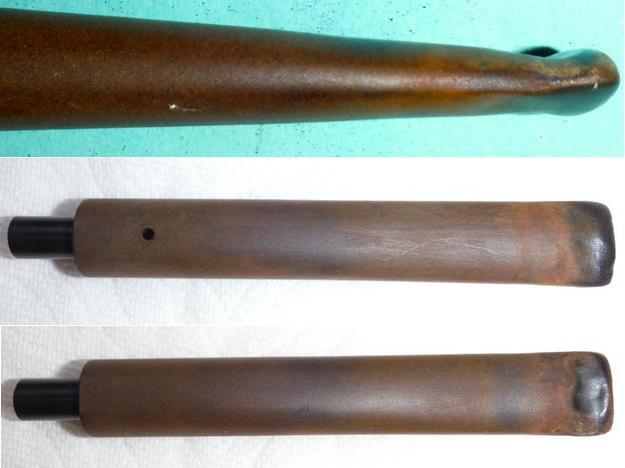
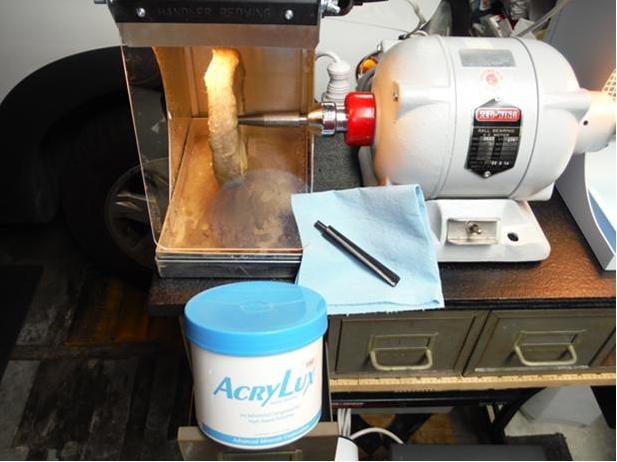
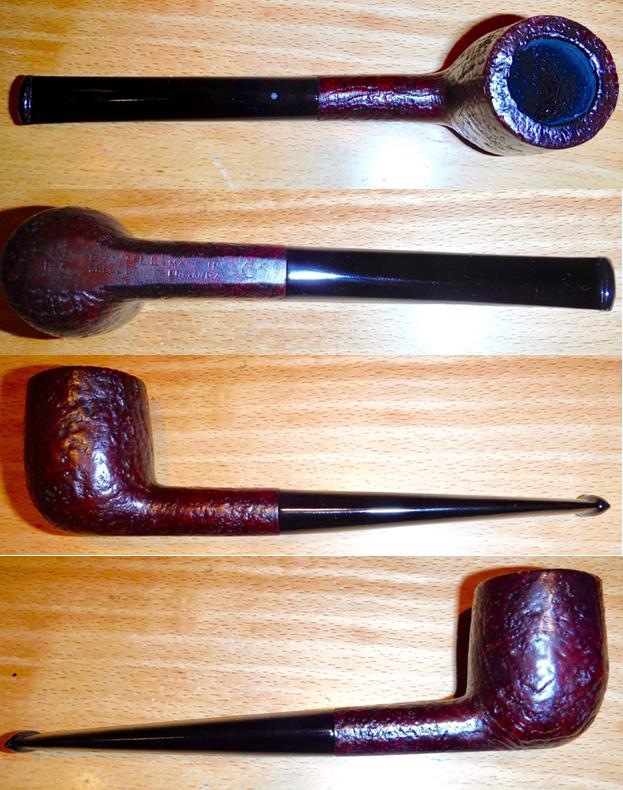
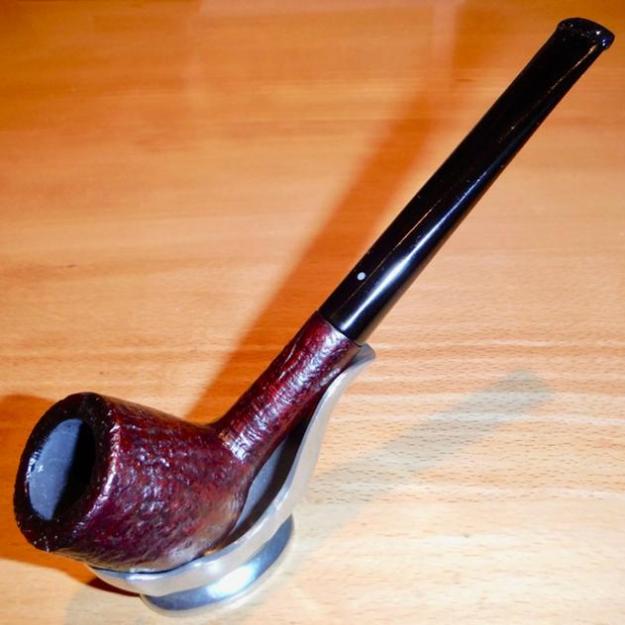
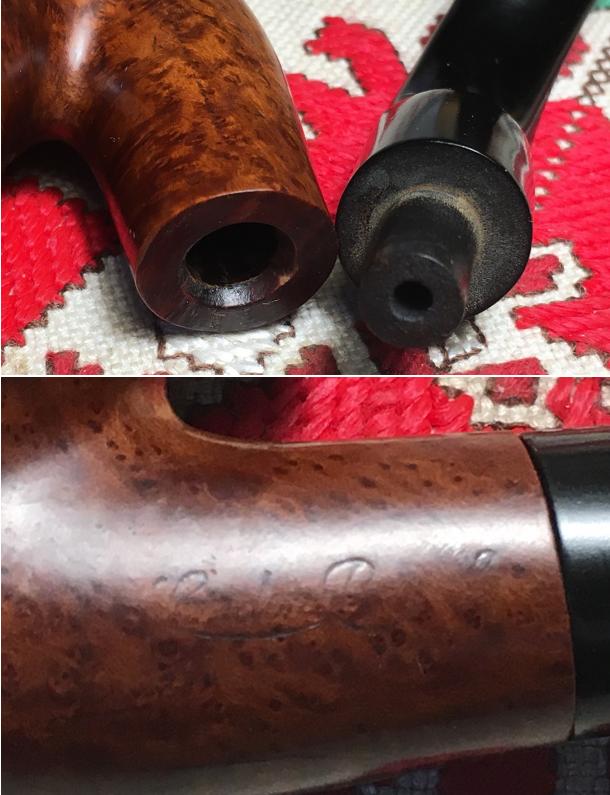
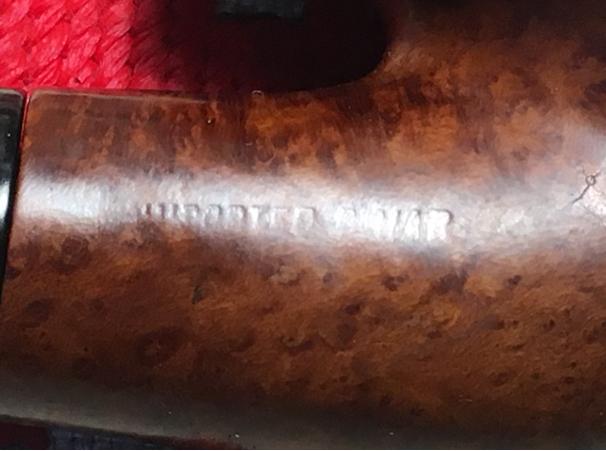
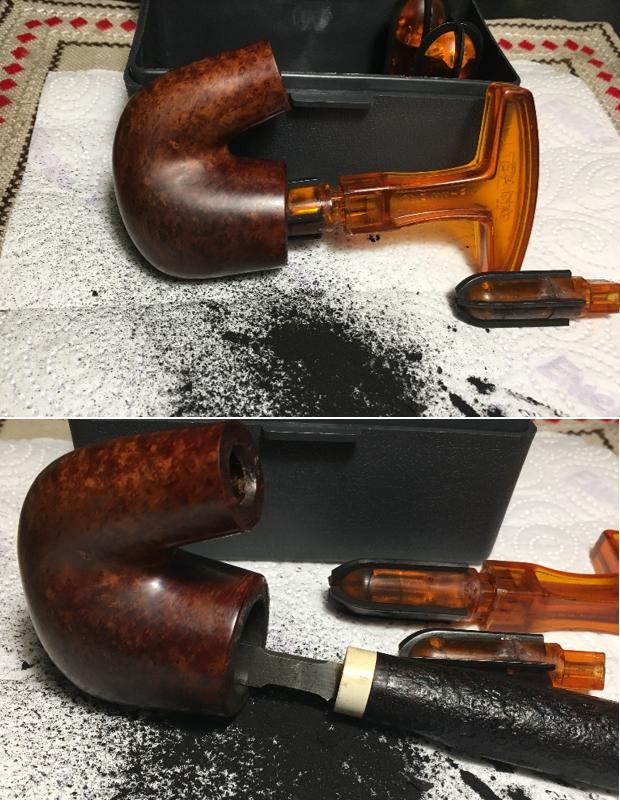
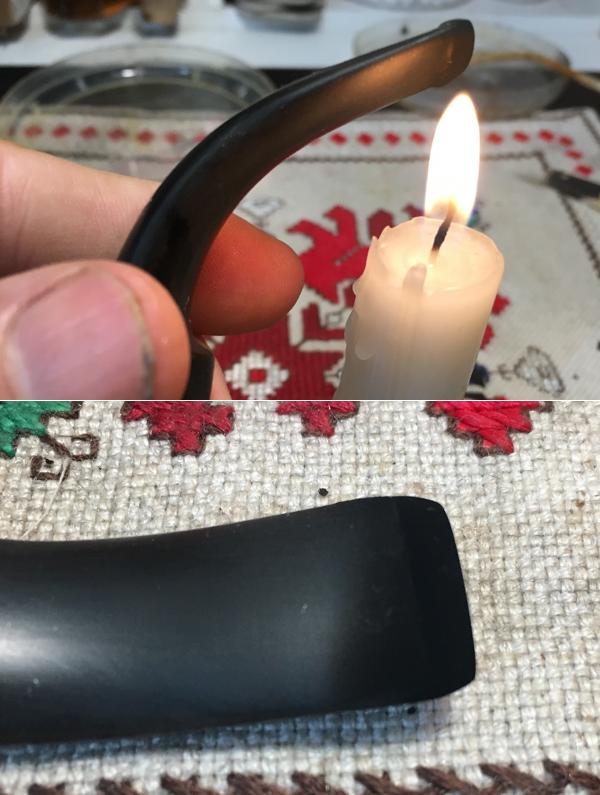
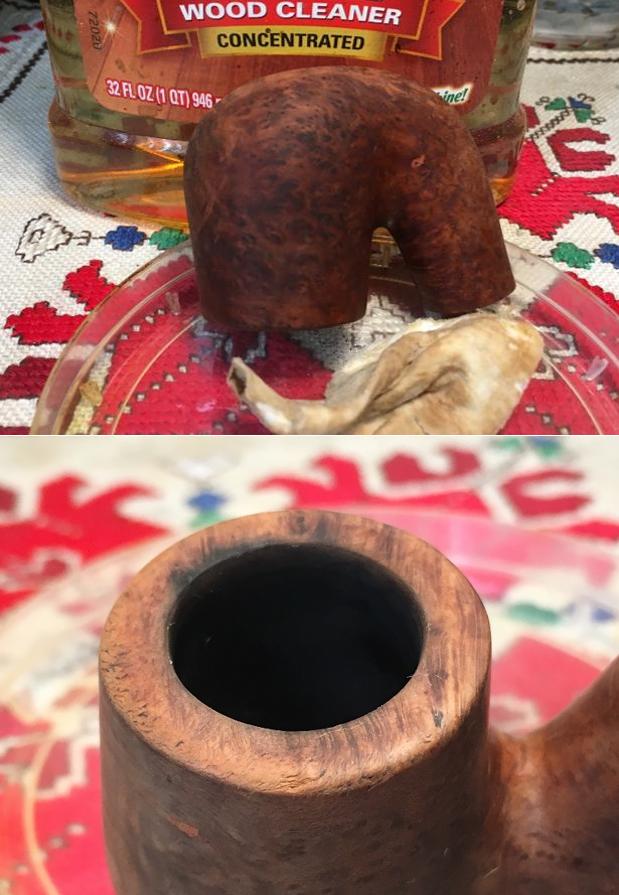
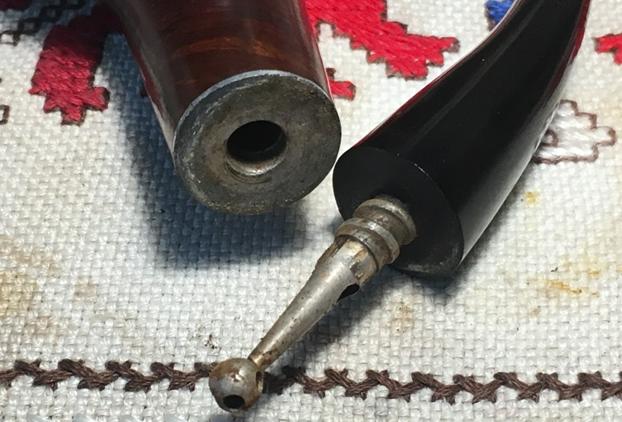
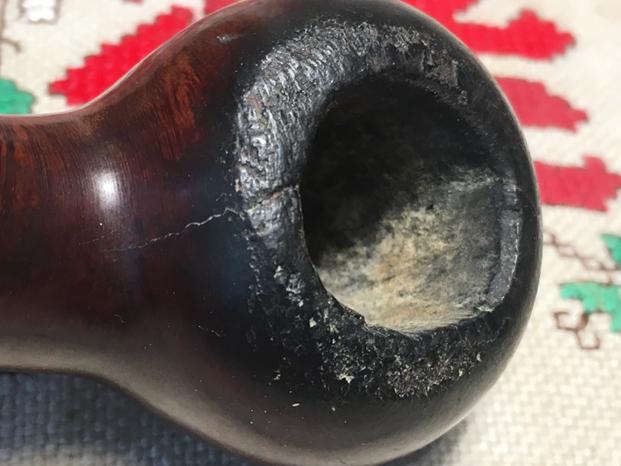
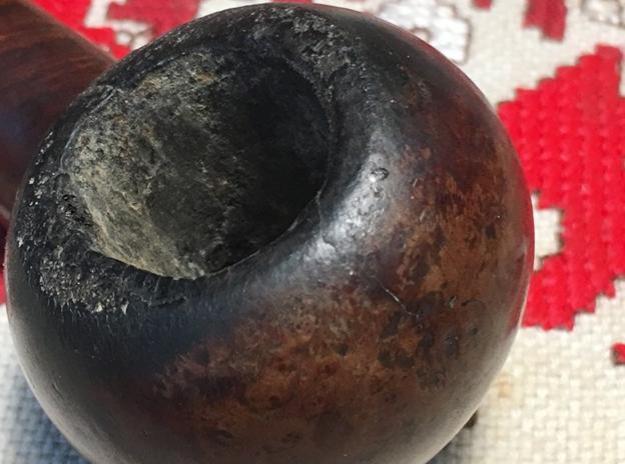
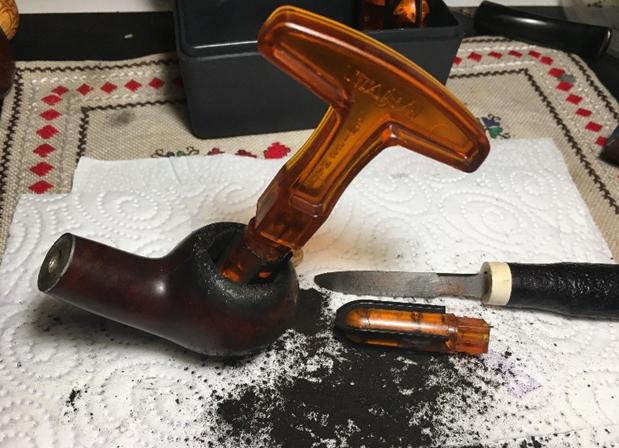
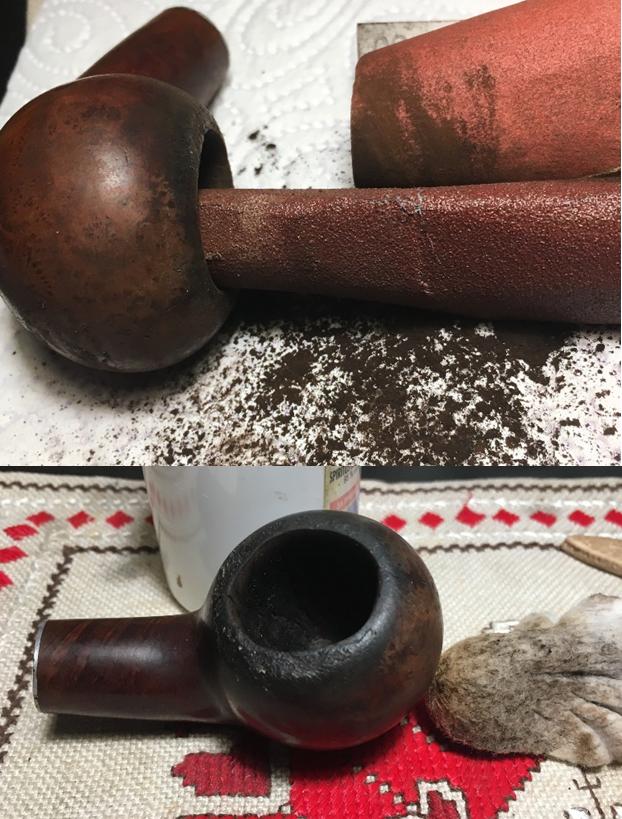
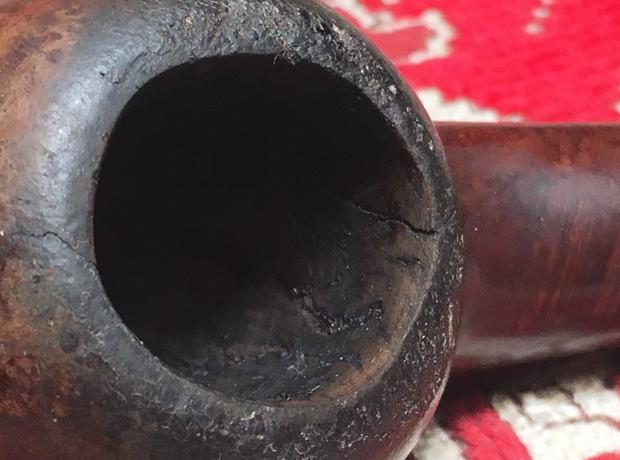
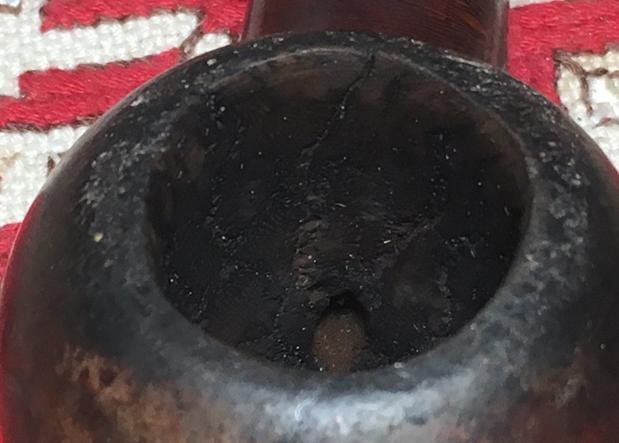
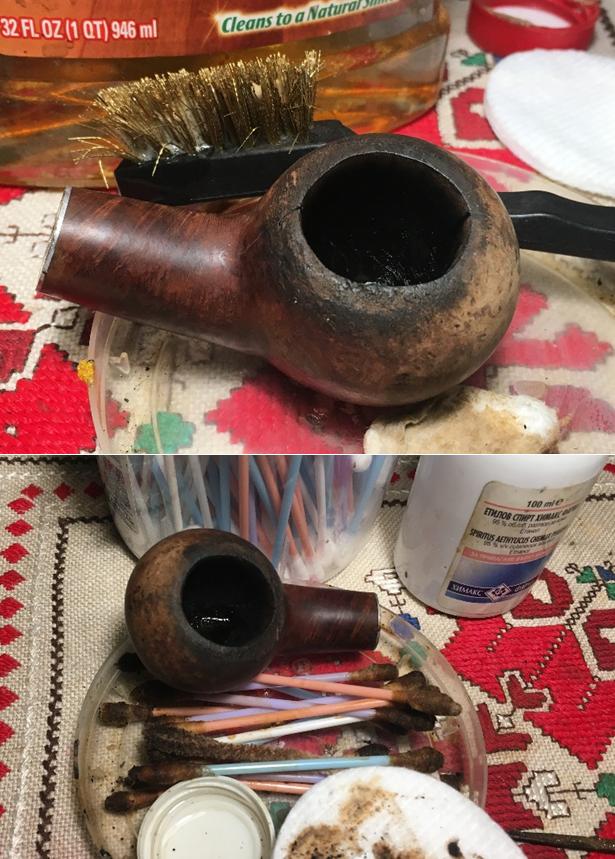
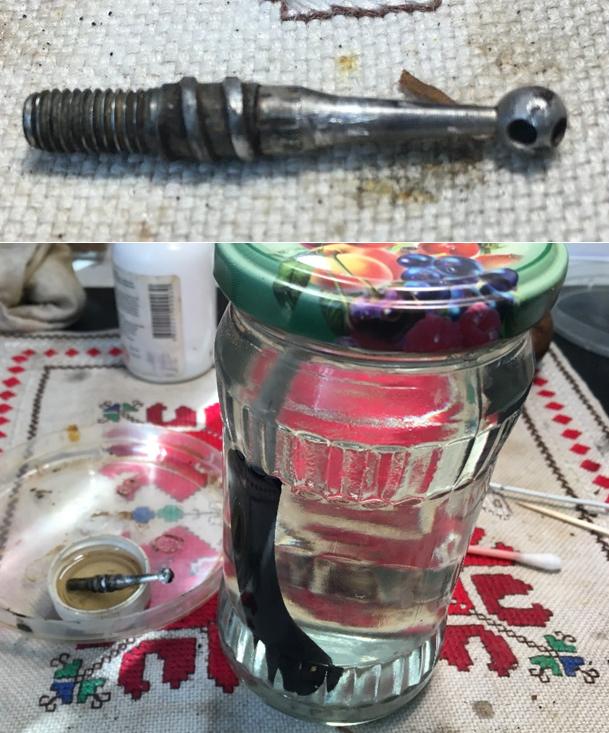
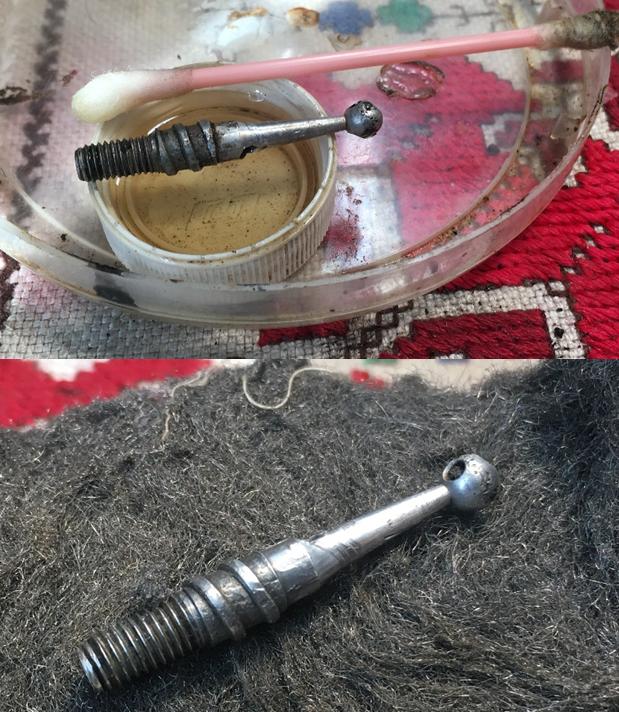
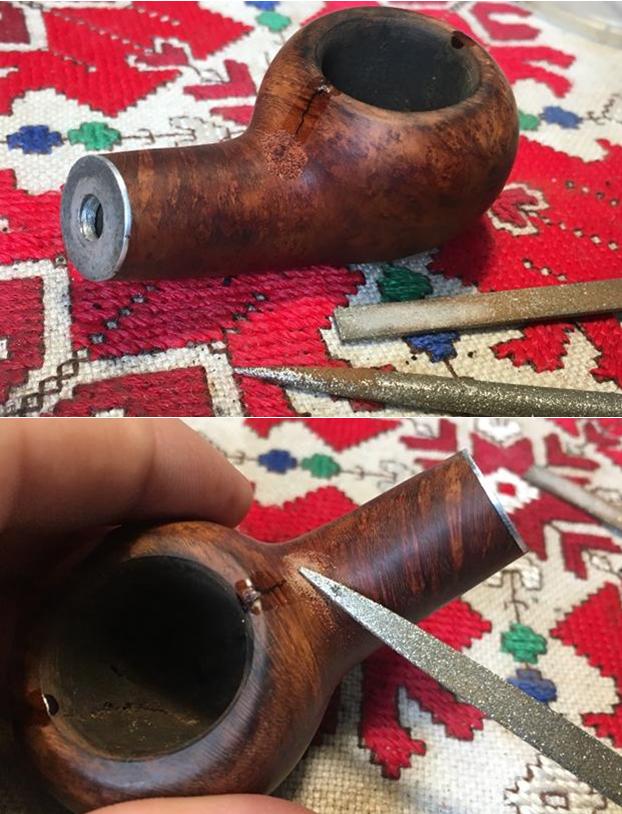
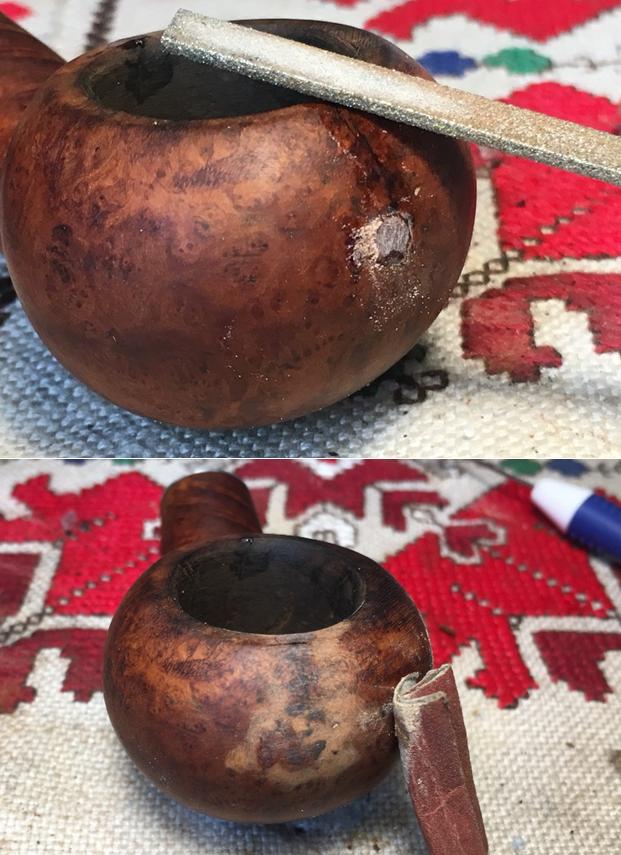
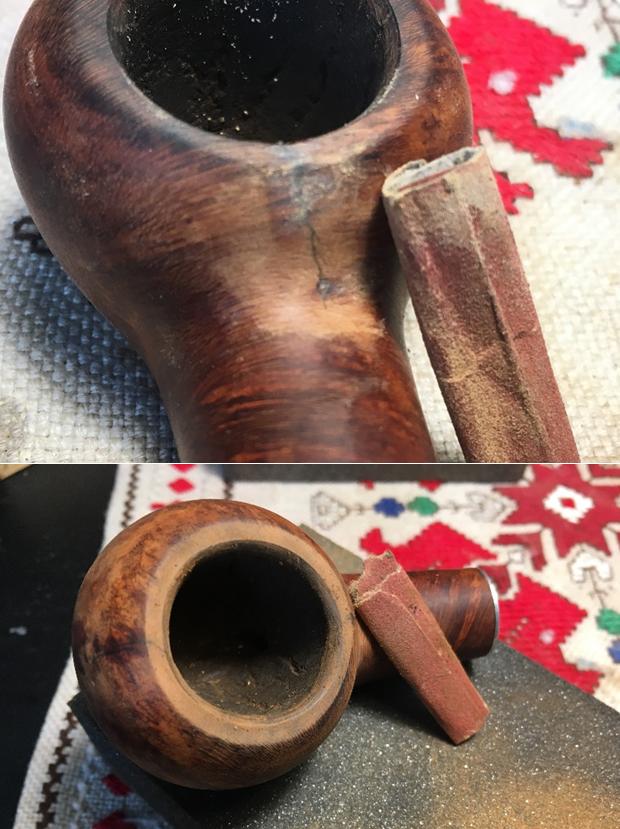
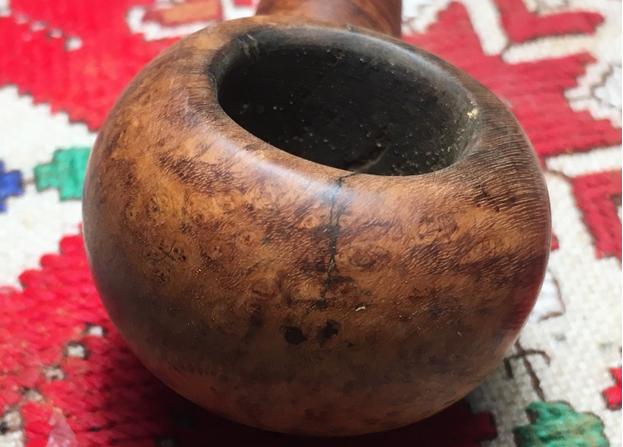
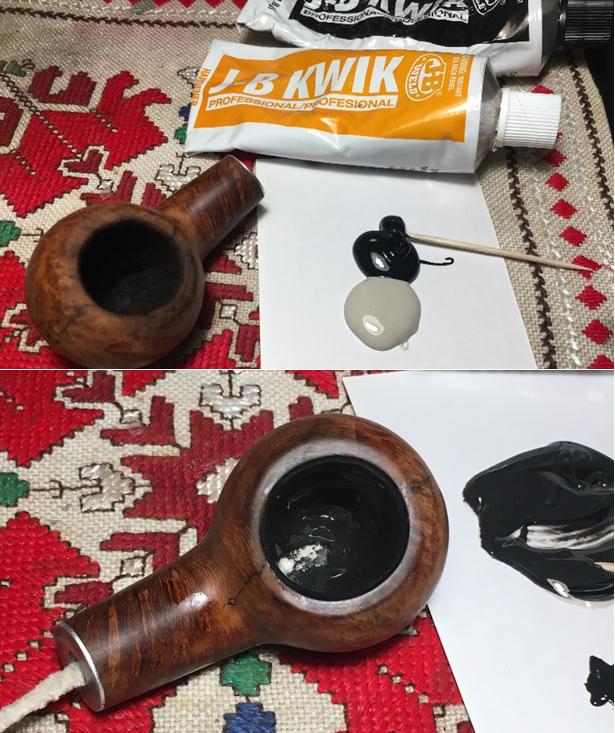
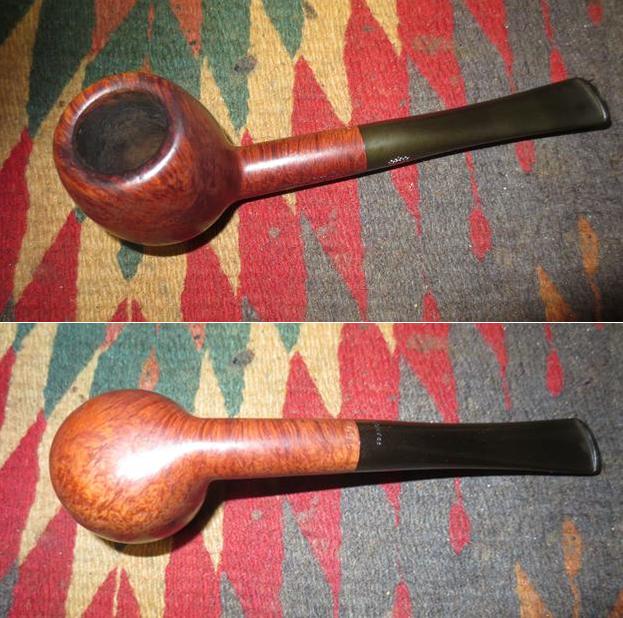
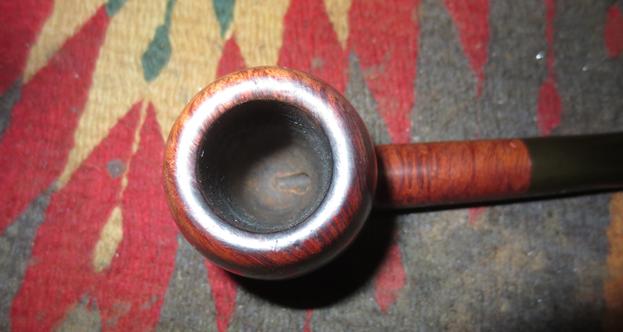
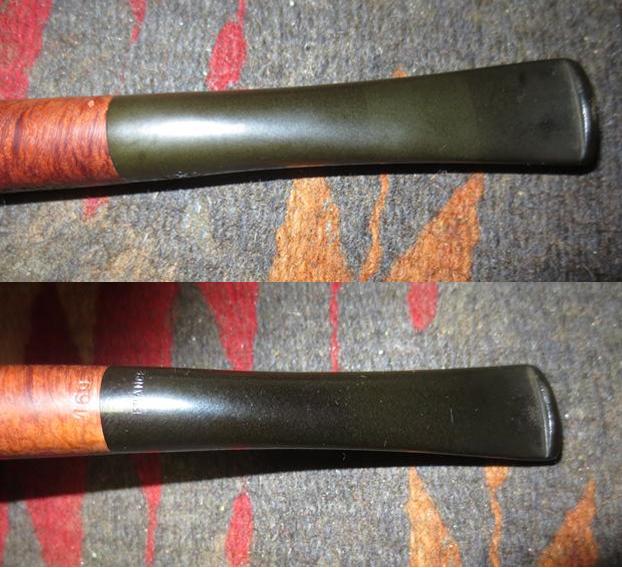
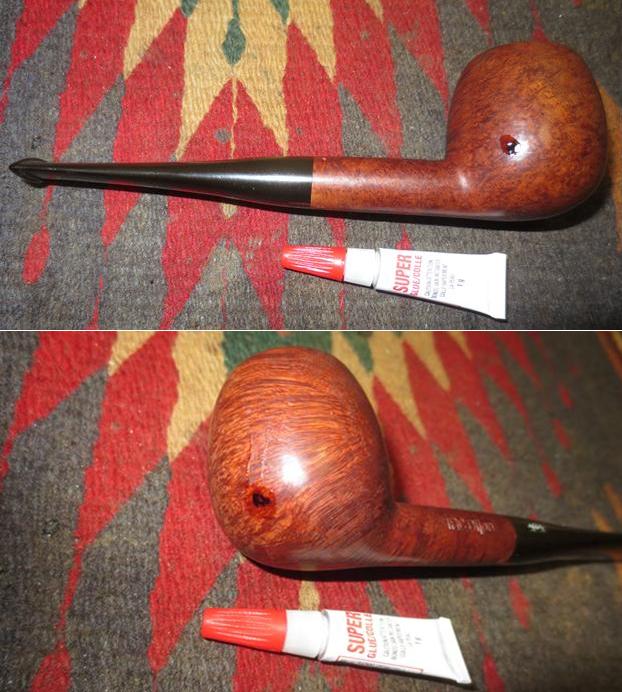
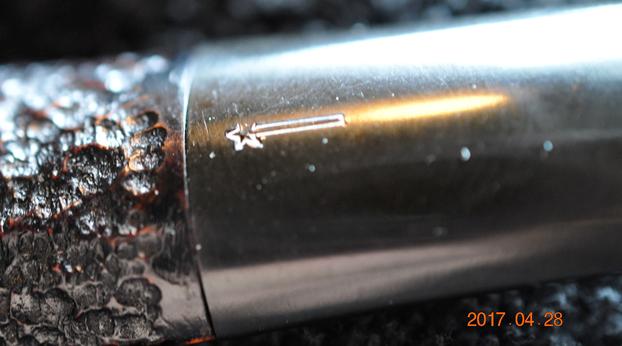
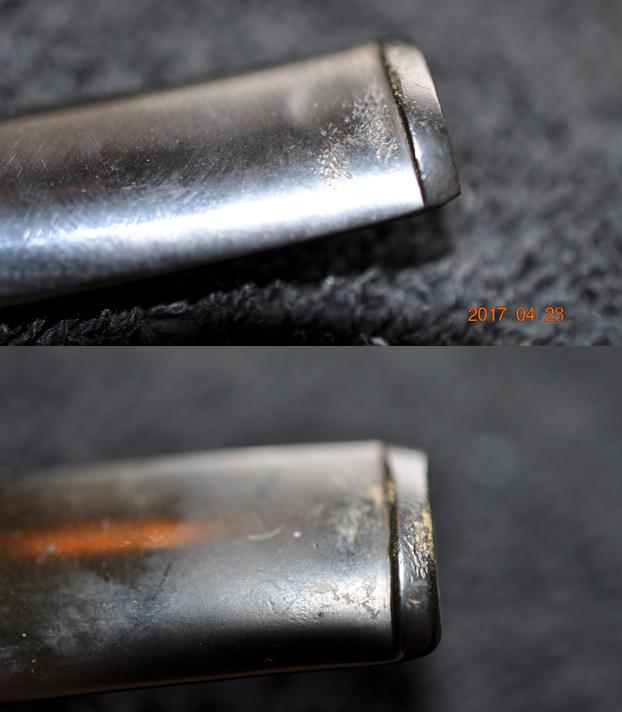
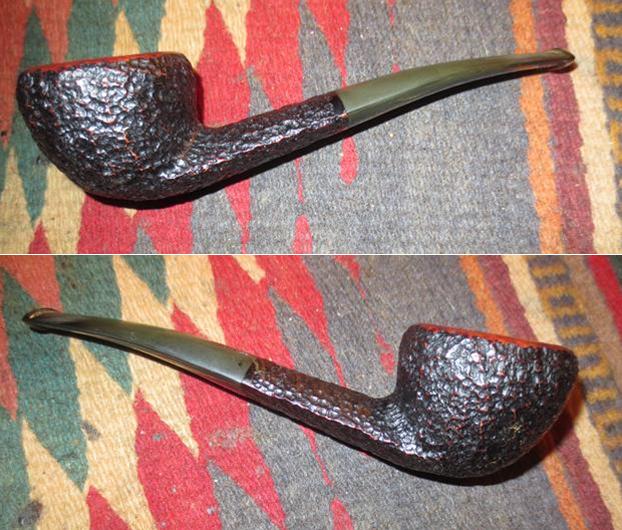
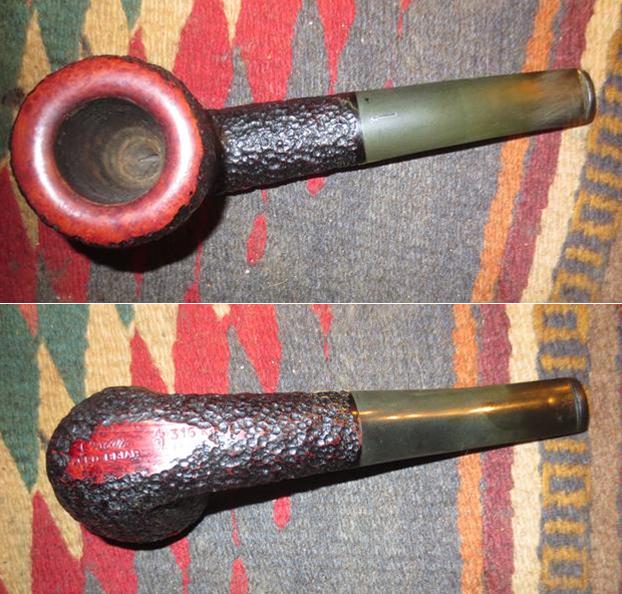
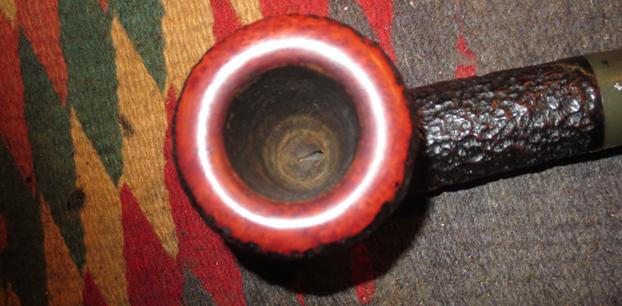
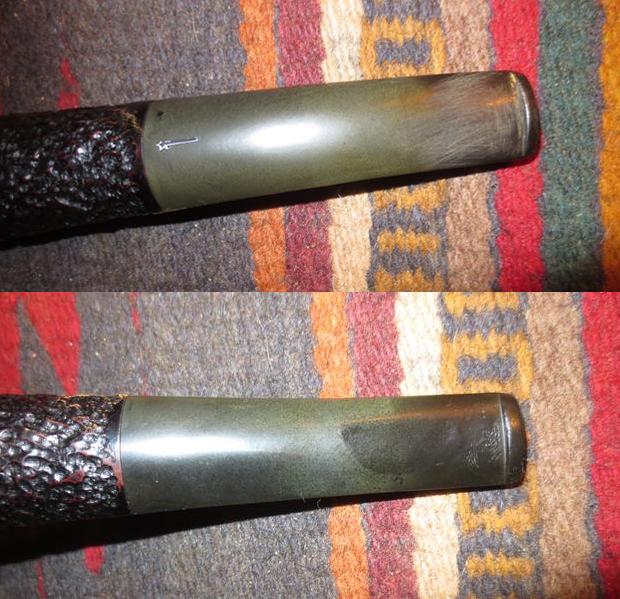
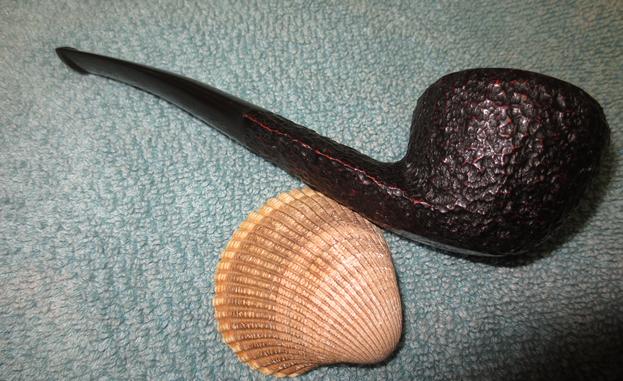
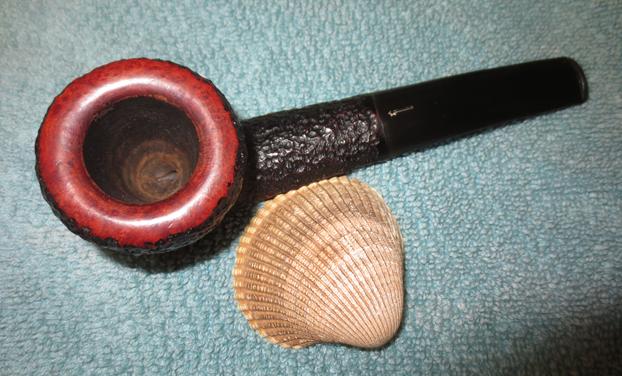
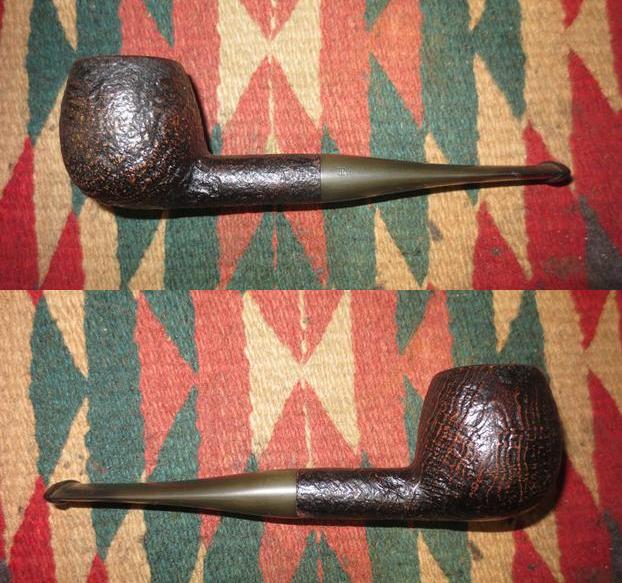
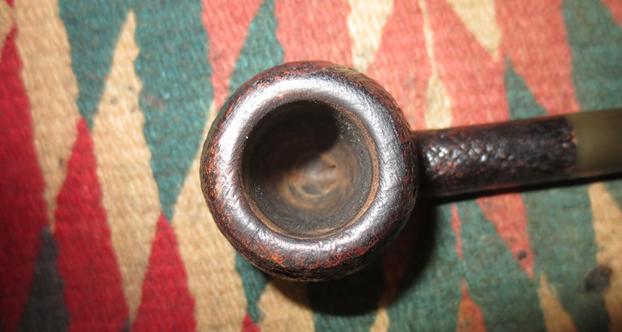
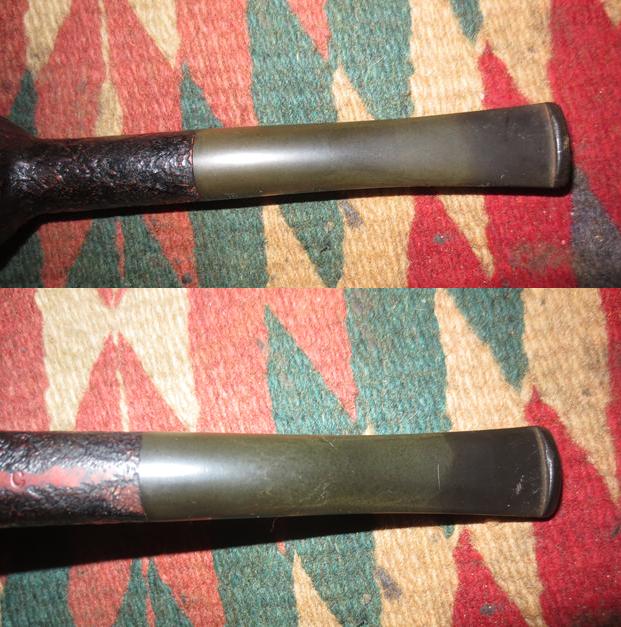
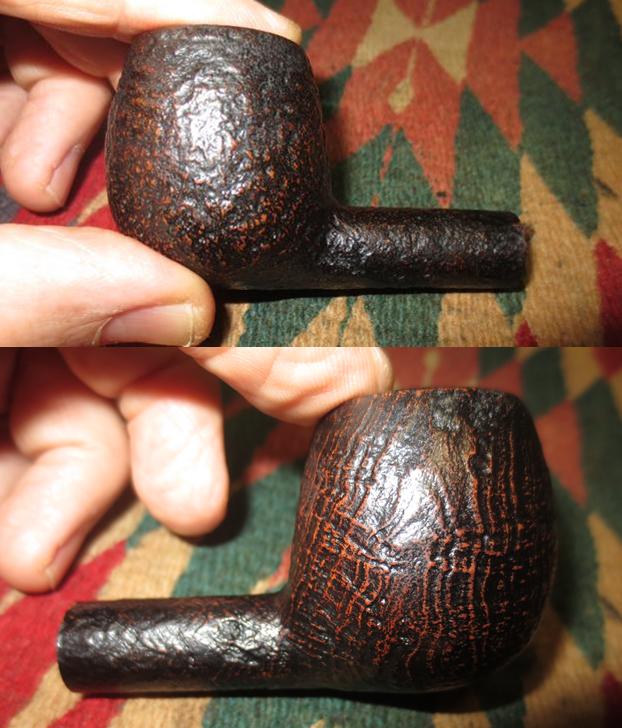
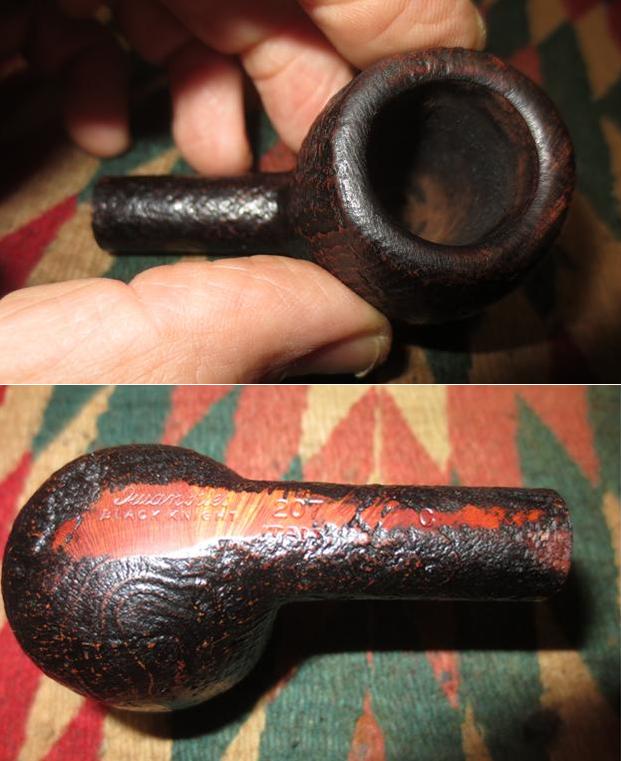
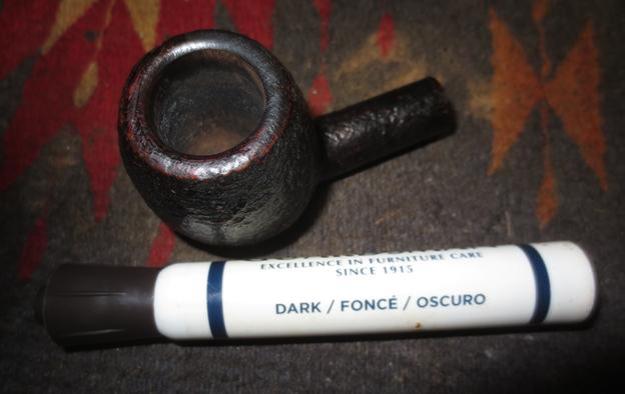
The eighth pipe from the lot of pipes that a pipesmoker dropped by for repair is a Brigham Voyageur. It is stamped on the left side of the shank with the Brigham name over Voyageur which is the model. The shape number is 165. It was rusticated in the classic Brigham style with a smooth rim, ring around the rim and the shank end and a smooth spot on the shank for the stamping. The pipe was dirty with dust and grime in the crevices of the finish on the bowl. The rim had a tarry buildup which had flowed from the cake in the bowl. The internals were very dirty with a lot of tar and grime. The overall condition of the bowl was good under the grime. The following photos show the pipe’s condition before I began to clean and restore it. I took a close up photo of the rim top and the bowl to show the condition of the cake and the overflow on to the rim top. I also took a photo of the stamping on the smooth left side of the shank. The pipe was a two dot Brigham. In talking with the owner he was not interested in preserving the Brigham system. He was only interested in having a pipe that he could fire up and enjoy. I would need to decide how I was going to fix this one but it was going to be another challenge for me.The stem was in rough shape. It had a split on the top side that ran from the edge of the button almost an inch up the stem toward the bowl. On the underside it had deep tooth marks and two cracks that ran through the button into the airway in the slot. The slot was compressed from the bit marks. There was a lot of oxidation on the surface and some calcification. The Brigham nylon tenon told me that the pipe is a newer one rather than those with the aluminum tenon. It was designed to hold the Brigham Hard Maple Filter tube that is specially designed for them. This one was clogged with tars. The end of the nylon tube was splitting and flared. It was ruined. The photos below show the damaged areas on the stem.I put the stem aside for a while and started on the bowl. I reamed the cake with a PipNet reamer and the Savinelli Fitsall pipe knife to scrape the cake back to bare briar. I rolled a piece of 220 grit sandpaper and wrapped it around my index finger to sand the walls of the bowl. The cake was so sticky and crumbling that I wanted a hard, clean surface so that the owner could build a new cake to protect the bowl.I scraped out the shank with a dental spatula to scrape away the hardened tars that were on the walls of the mortise and airway to the bowl. I scrubbed the surface with pipe cleaners, cotton swabs and alcohol until the shank and mortise was clean.To remove the hard buildup on the rim top and some of the damage to the front outer edge of the bowl I lightly topped it on the topping board using 220 grit sandpaper. I used a folded piece of 220 grit sandpaper to clean up the burn marks and damage on the inner edge of the rim. I finished by sanding the rim with a medium and a fine grit sanding sponge and 1500-4000 grit micromesh sanding pads to smooth out the rim and remove the scratches.I scrubbed the externals of the bowl with Murphy’s Oil Soap and a soft bristle tooth brush to clean out the crevices and grooves of the rustication. Once it was clean I wiped the bowl down with alcohol on a cotton pad to remove the dust on the finish to prepare it for a new coat of stain. I stained the bowl with a dark brown aniline stain and flamed it with a lighter. I repeated the process until the coverage on the bowl was even.Once the stain dried I wiped it down with a cotton pad and alcohol to make it more transparent. I wanted the grain to show through on the smooth portions and the ridges of the rustication. I lightly buffed the bowl with Blue Diamond on the buffing wheel. I gave it a light coat of Conservator’s Wax and hand buffed it with a shoe brush and a microfiber cloth. The buffed and restored bowl is shown in the photos that follow. The time between this picture and the next cannot be captured in photos as there were two days of work and time that went into trying various methods of repairing the original stem for the pipe. I cleaned out the split in the stem and roughened the surface with a file. I cleaned out the cracks on the button, the split on the top side and the tooth marks on the underside of the stem. It took a bunch of sanding and picking. I filled in the gaps with black super glue and charcoal powder to strengthen the repairs. I filed them smooth and sanded them to restore the finish. All was going well until I tried to slide a pipe cleaner into the airway. I pushed it through the airway and into the button only to have the repaired button fall off. The cracks gave way and the chunk fell free of the stem. No repairs would ever hold on this stem. It was finished. One day I may cut it off and use the shorter version for a different pipe but it is not worth a repair any longer.

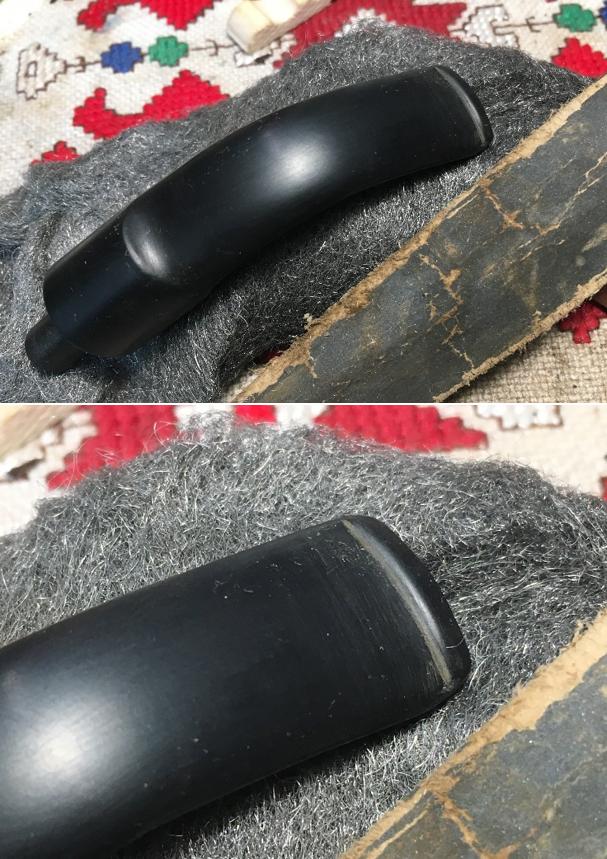
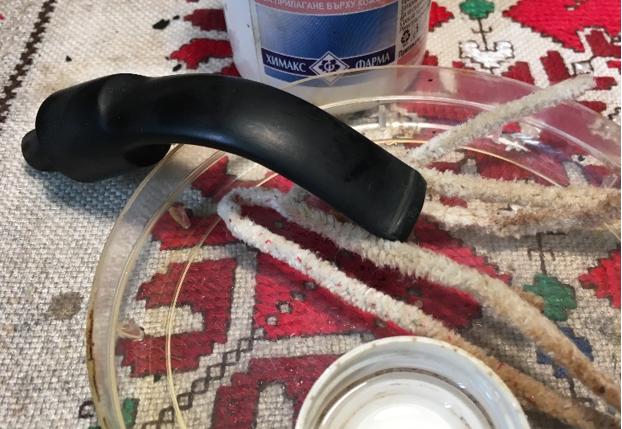
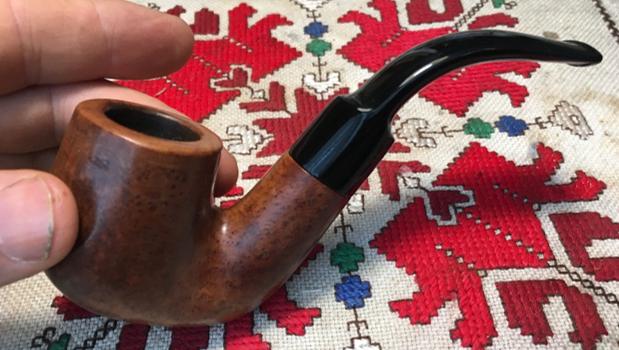
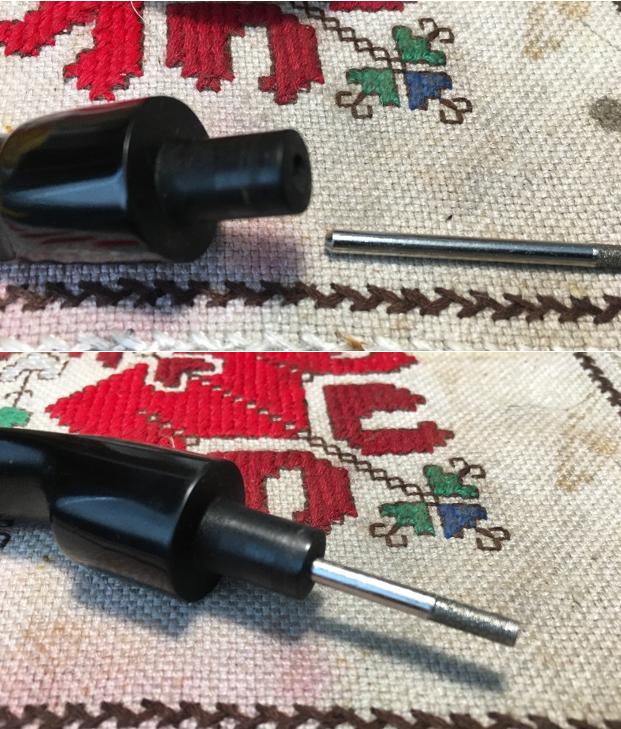
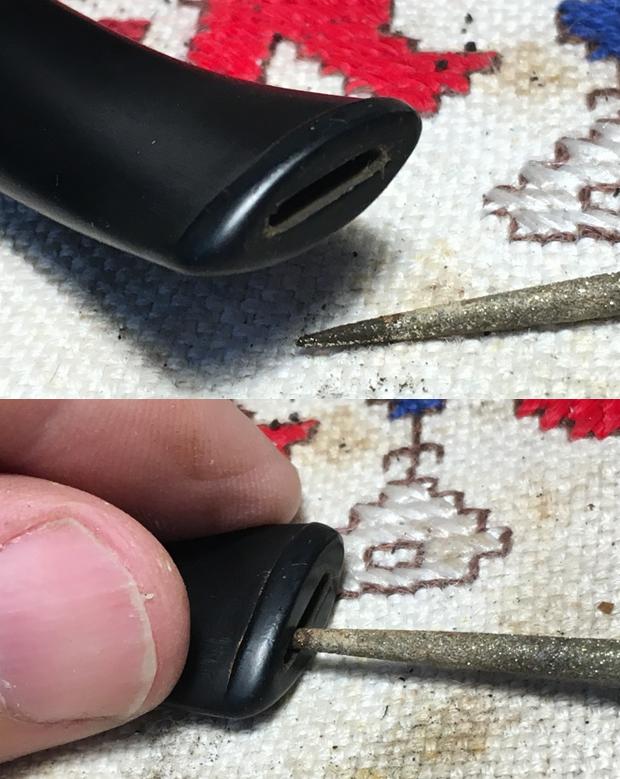
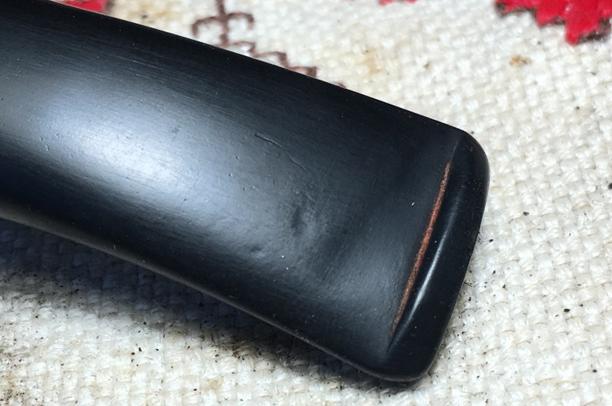
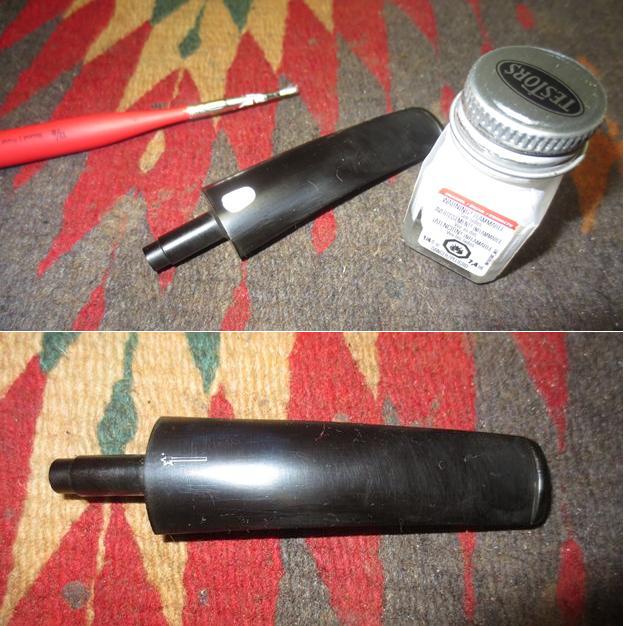
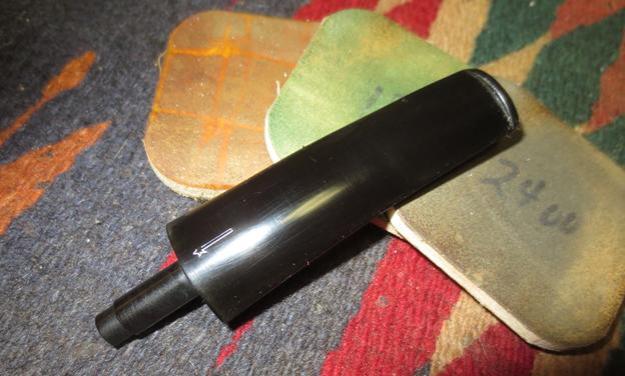
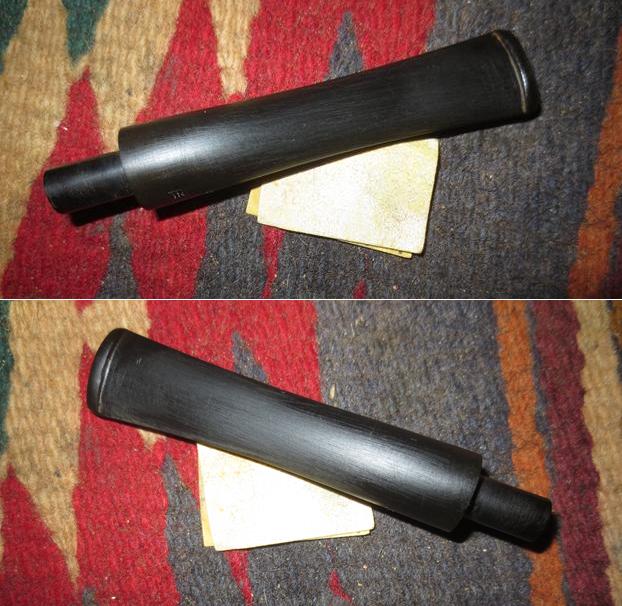
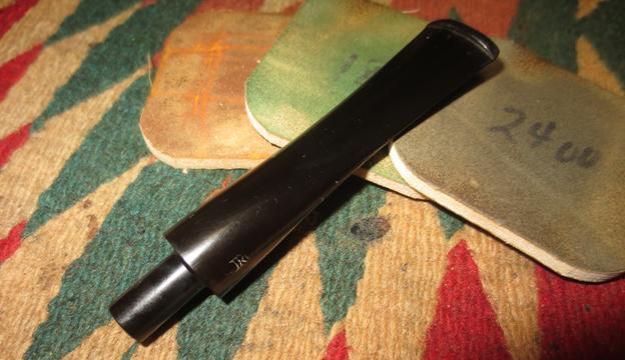
That decision having been made for me I went through my stem can in search of a replacement. I knew the owner was fine with a non-Brigham stem so that was the way I was going to proceed. I found a stem that had the same dimensions as the original stem. It was a straight stem that I would need to clean up and bend the stem to match the original but it would look good on this old pipe.I sanded the stem with 220 grit sandpaper to clean off the oxidation and remove the light tooth chatter and tooth marks on the top and underside of the stem. I turned the tenon down with a Dremel and sanding drum and fine-tuned it with a file to reduce the tenon to fit the shank of the pipe. I heated the stem with a heat gun until I was able to bend it to match the original stem. I polished the stem with micromesh sanding pads. I wet sanded it with 1500-2400 grit pads and dry sanded it with 3200-12000 grit pads. I still had to work on the tenon to remove the file marks but the stem was beginning to shine. I polished the tenon with micromesh sanding pads to remove the majority of the file marks on the vulcanite. I buffed the tenon and then the stem and bowl with Blue Diamond polish on the buffing wheel to remove the final scratches on the stem. I gave the stem and the smooth portions of the briar several coats of carnauba wax on the wheel and then buffed it with a clean buffing pad to raise a shine. I hand buffed the bowl and stem with a microfiber cloth to deepen the shine. I think that the owner will really like the looks of his restored and restemmed Brigham. It looks really good to my eye. Thanks for looking.
Repairing and Restoring a Walnut Folk Art Russian Pipe


Blog by Steve Laug

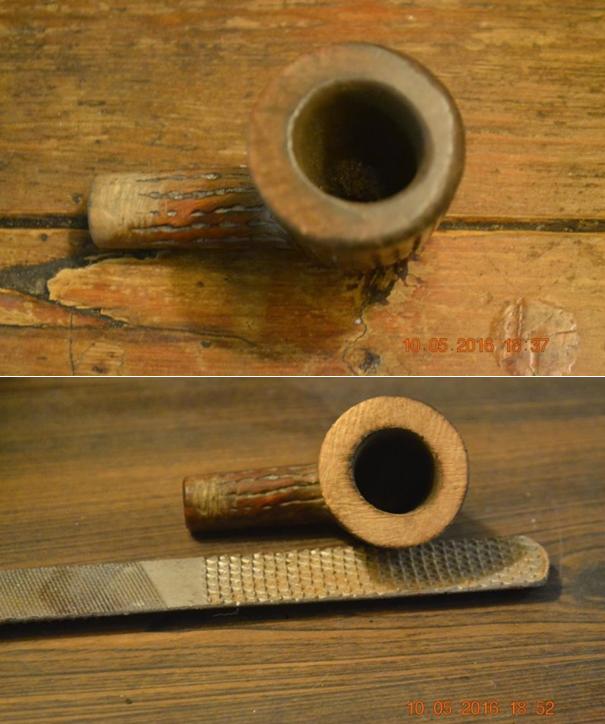
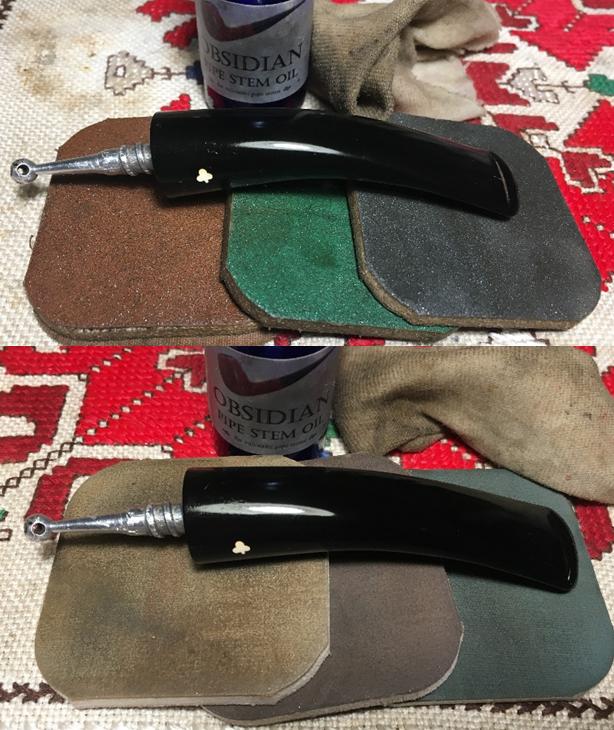
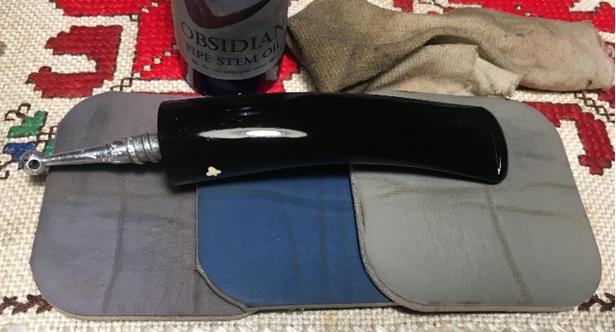
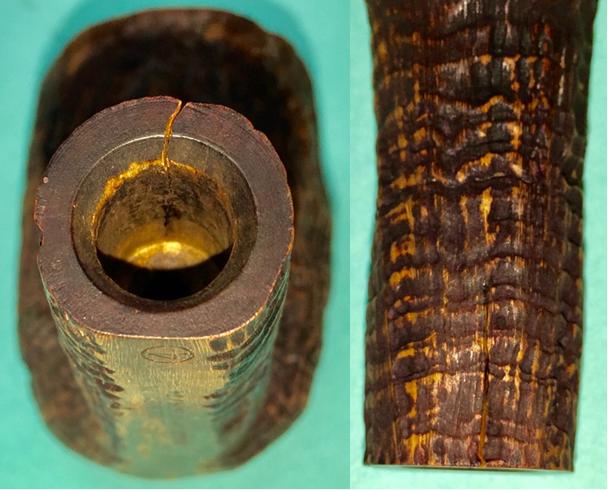
I started cleaning up and repairing this Russian Folk Art Walnut pipe before taking photos of it. It was truly a mess. The shank had been cracked off at an angle behind the copper band and had been repaired by gluing the two pieces together without a lot of care to align the parts. As it was the crack was quite wide open all the way around the shank and had been sealed together with epoxy. I heated it to see if I could take it apart and align the parts and the glue definitely softened. I could rebreak it without further damaging the shank parts so I settled for heating it enough to realign the two parts. I realigned the parts and cooled the shank so the glue hardened. I filled in the deep crevices in the shank with briar dust and clear super glue putty. It hardened and bound the parts together. There was no movement in the shank at all at this point in the process. The photos below show the pipe with the stem in place. The repairs to the shank with the putty mix looked pretty decent in the photos. The rest of the pipe was a mess. The rim was thickly caked with over flow from the thick bowl cake. The finish on the bowl was dirty and sticky. The copper band on the shank was covered with a thick buildup of hardened “gunk” that would not come off with a simple wash. The airway in the shank was dirty and almost closed off. The mortise was also clogged. The tenon on the stem had a rubberized cement buildup around the angles at the stem. The stem itself was horn and had tooth marks on the top and underside near the button. The rounded button had an orific entrance into the stem. It was so plugged that I could not push a pipe cleaner through it. I took some close up photos of the repaired shank to show the flow of the two parts and how the realignment had worked. They also show the super glue/briar dust putty filling the crack that went all the way around the shank. There was some glue from the previous glue job that ran up the shank toward the bowl and actually ran around the copper band edge. The third photo shows the rim and the cake in the bowl. There was damage to the front edge of the bowl from someone knocking it out against a hard surface. I took photos of the stem to show the damage at the button end on both sides. The horn surface was worn and the shine was gone.I sanded the roughness of the repaired area on the shank with 180 grit sandpaper. I wanted to smooth out the surface of the repair so that it matched the shank. I continued to sand it further with 220 grit sandpaper. I smoothed out the repair and the shank began to look like it would have originally. You can see the coating on the copper band. It is like someone painted the surface with a glue coat or with varnish. That coat would need to be removed so that the patina of copper would shine through. The front of the bowl had a brass and copper insert in the wood. It was a mix of thorns and vines that was nailed to the front of the bowl. I reamed the bowl with a PipNet pipe reamer and with a Savinelli Fitsall Pipe Knife until the walls were bare and all of the cake was gone.I topped the bowl on a topping board with 220 grit sandpaper to remove the hard cake and the damage to the front of the bowl. It was a light topping that did not remove much of the rim top but it left it clean, smooth and even.I wiped down the exterior of the bowl with alcohol on cotton pads to remove the finish and the grime that was built up on it. Once it was clean the grain of the walnut shone through the stain on the wood. The next photos show the clean bowl and shank with the repaired area shown clearly in the photos. I used a sharp knife to flare the aluminum insert in the shank. I topped the shank end with the topping board to smooth out the face of the shank. I sanded the bowl, shank and copper band with micromesh sanding pads – wet sanding with 1500-2400 grit pads and dry sanding with 3200-12000 grit pads. The pads removed the material that was built up on the copper band and gave it a shine. I cleaned out the airway in the shank and the mortise with cotton swabs, pipe cleaners and alcohol until the airway was clean.I stained the bowl and shank with a dark brown aniline stain, flamed it and repeated the process until I was happy with the coverage.I took the following photos of the bowl once it had dried. The dark brown was a little dark to my liking so I would have to wipe it down to make it a little more transparent. I wiped the bowl down with alcohol on a cotton pad and then buffed the bowl with Blue Diamond on the buffing wheel. The photos below show the colour of the bowl once I had finished with the buffing. I was really happy with the colour and the coverage of the stain on the repaired area. The stem was fairly clogged with tars and oils. It took a lot of work to clean out the gunk in the stem. Pipe cleaners were really hard to push through the buildup so I picked at it with a piece of wire bent to the angle of the stem. I finally was able to break through so the pipe cleaners and alcohol finally did their job on the stem. I also cleaned off the rubber buildup on the tenon next to the stem with a sharp knife and used the alcohol to scrub that area as well.I polished the horn stem with micromesh sanding pads – wet sanding with 1500-2400 grit pads and dry sanding with 3200-12000 grit pads. I rubbed the stem down with Obsidian Oil after each set of three pads. After the final set of pads I gave it a last coat of the oil and set it aside to dry. I buffed the bowl and stem a final time with Blue Diamond on the buffing wheel and then gave the pipe several coats of carnauba wax. I buffed it with a clean buffing pad to raise a shine and hand buffed it with a microfiber cloth to deepen the shine. The finished pipe is shown in the photos below. It is looking far better than it did when it arrived. I think the owner will be happy about this piece of his own pipe history being brought back to life. It joins the others that are finished of the nine he sent me. Only two more pipes to go and I will be down with this lot. Thanks for looking.


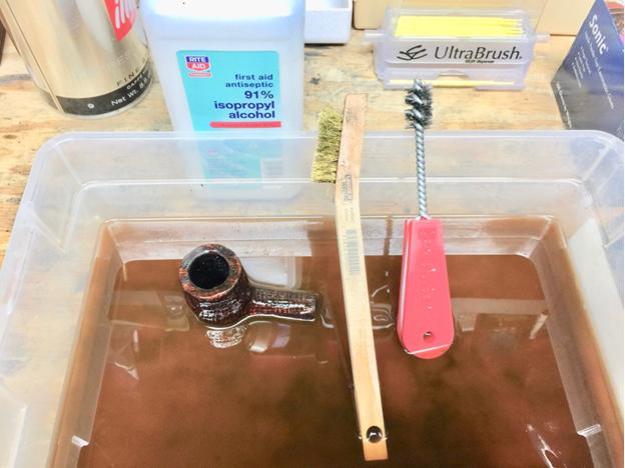
One more hard to clean up – a no name Meerlined Bulldog


Blog by Steve Laug

The fifth pipe from the lot left to me for cleanup by the fellow on holiday was this little no name Bulldog. When he showed it to me, it was later in the evening and in the twilight of my dim living room, I did not notice that it was a meerlined pipe and he neglected to tell me. Once I had the pipe on my worktable and examined it under the light I could see that it was meerlined and that the meerschaum lining extended all the way to the bottom and was thus a cup insert into the briar and not a lining that ended above the airway. Knowing that changed my cleanup routine in that I do not like reaming meerschaum lined bowls because it is too easy to damage the walls and the bottom of the bowl if they are soft or cracked. I use a Savinelli Pipe Knife to carefully scrape the walls clean and wipe it down with a wet paper towel.

The pipe really was a mess in more ways than even the photos show. The finish was a thick varnish/urethane coat that had bubble and cracked on the heel of the bowl. The rim had a thick dark cake of tar that almost hid the proverbial line that separates the meerlining from the briar that holds it. The rings around the bowl were almost filled in with grime and grit. Looking at the bowl in the light I saw more pink/red fills than I have ever seen on a pipe. It seemed like there were fills between every darkened line of grain on the front and left side of the bowl and there were spot fills on the right and backside of the bowl. The inside of the bowl was caked with a thick, sticky tar that made me think that it had never been cleaned. The stem was hard to remove from the shank the goop (technical term here) was so thick and sticky. The metal spacer was attached to the stem not to the shank and it was oxidized and dirty. The surface of the stem was as sticky as the bowl surface and the button end had been chewed to the point that button was almost non-existent and the slot was virtually pinched closed. I have no idea how the owner was able draw smoke from the bowl to his mouth with this pinched and clogged mouthpiece. The pipe was truly a mess and one that would take some time to clean up and restore. Sometimes when I work on a pipe like this one I seriously question whether it is worth restoring. The only thing that keeps me at it is not the worth or condition the pipe is in when I get it, but obviously, it was a favoured pipe and quite possibly a great smoker to the one who wanted it restored. That is what makes it worth it to me – perhaps I can bring it back to some of its former glory and make it smokeable once more.

I took some close up photos of the state of the pipe before I started the restoration process. The first one shows the telltale inner ring on the bowl that signaled a meerlined bowl to me. The build up cake that flowed out of the bowl and over the rim is visible. The only thing you cannot experience is touching the stickiness and smelling the stink of a very dirty pipe. The second photo shows the heel of the pipe with the bubbled finish, missing fills and partial fills that will need attention. The last two photos show the condition of the stem – note the tooth marks and collapsed button visible in both photos. What is amazing is that the stem did not have any bite marks going through into the airway. On the one hand this pipe is a mess, but on the other it provides me with a challenge.The urethane/plastic coat on the bowl was impervious to acetone and alcohol. All it did was remove the dirt and grime but it did not faze the finish – even in the bubbled area on the heel. So much for the easy route of stripping the finish. I would have to resort to a more intrusive approach and sand the bowl. Fortunately, there were no stampings on the shank so I could sand the entire pipe. I sanded the urethane finish off the pipe and used a dental pick and sharp penknife to scrape out the grime in the twin rings around the bowl cap (fortunately the plastic coat did not go into the rings). Once I had broken through the finish I scrubbed the surface of the briar with acetone on cotton pads to remove the stain that was underneath the plastic coat. The red/pink putty fills are evident now that the finish is removed. I scraped the cake out of the bowl with the Savinelli Fitsall Pipe Knife. I took the cake back to the meerschaum lining. The meerschaum was darkened from the tobacco stains and fire but it was solid and undamaged! I am thankful for that little bit of reprieve. I scraped some of the build up from the rim at the same time to see if there was damage underneath.I decided to lightly top the bowl to remove the damage to the briar on the front outer edge of the rim cap and some of the deeper gouges in the rim top. I topped it on the topping board using 220 grit sandpaper. I wanted to have a smooth transition between the briar and the meerschaum insert. The topping achieved that goal.I sanded the exterior of the bowl with 220 grit sandpaper to smooth out the rest of the finish in preparation for repairing the damaged fills on the bottom of the bowl and to assess the other fills to see what needed to be done with them. I wiped the bowl down with alcohol on a cotton pad before I took the following photos. With the externals cleaned up it was time to turn my attention to the internals. I blew air through the end of the shank and found that pipe was clogged with just a trickle of air slipping through the shank. I pushed a metal rod through the airway to the bowl and worked it around to remove the build up that constricted the airway. I used a dental spatula to scrape out the walls of the mortise and the end of the mortise and remove the hardened, sticky mess that had formed along the walls making the stem fit very tight. I scoured out the airway in the shank and the mortise with pipe cleaners, cotton swabs and alcohol until the shank and mortise were clean. At this point the pipe was smelling far better.The stem needed the same treatment. I could not push a pipe cleaner through because of the build up of debris and the pinched button and slot. I used a dental pick to scrape out the metal tenon that had been made for a paper filter. It was so full of thick black tars and oils that it took a while to get that part clean. I worked the pick around in the slot until I was able to open the slot and airway enough to be able to push a pipe cleaner through it. I scrubbed out the tenon and the airway with alcohol, cotton swabs and pipe cleaners until it was clean.I used a file to smooth out the top of the existing button and the area one inch in front of the button on both sides of the stem. Once I had cleaned up with the file I sanded it with 180 grit sandpaper to smooth it further. I wiped it down with an alcohol dampened pad to remove the dust. I filled in the tooth marks in the stem and button with black super glue and set the stem aside to cure.I filled in the damaged fills in the heel of the bowl with clear super glue and set it aside to dry. Once glue had dried on the fills on the heel and cap I sanded the repairs with 220 grit sandpaper and blended them into the surrounding briar surface. I wrapped a piece of 220 grit sandpaper around a dowel and then my finger and sanded out the rough spots on the interior walls of the bowl. I wanted the surface of the bowl to be smooth meerschaum so that I could encourage the owner to not allow the cake to build up in this one but to wipe it down with a paper towel after each smoke.I sanded the bowl with a medium and a fine grit sanding sponge and with 1500-4000 grit micromesh sanding pads. Once it had a shine I stained it with a new bottle of dark brown aniline stain undiluted. I was hoping to get some coverage or blend in on the dark red fills on the bowl. I flamed the stain to set it and repeated the process until the coverage was even.I let the stain dry overnight and once it was dry I took some photos of what Dal calls the crust of the fired stain covering the bowl. You can really see the fills stand out through the stain in these photos. I wiped off the crust coat with alcohol on a cotton pad to get it back to the stain coat so I could examine what I was going to work on. I sanded the bowl with 220 grit sandpaper and remove the dark coat. To me the dark really made the red fill material stand out on the bowl and the fact that there were so many of them it looked like freckles. I sanded it back with the sandpaper which left behind some sanding marks and scratches that would need to be worked on. I polished the sanding marks out by buffing it with red Tripoli and then sanding it with micromesh pads. I wet sanded the bowl with 1500-2400 grit pads (I opened a package of new pads to sand with). I dry sanded with 3200-12000 grit pads. The photos below show the progress. While the fills stand out to me the polishing tends to hide them a bit. The pictures below tell the story. The stem repairs had cured so I sanded the repaired areas with 220 grit sandpaper to smooth them out and blend them with the surface of the stem. I shaped the button with a needle file to make the edges cleaner and sharper. I touched up the repaired areas with a clear super glue and filled in the airholes in the cured super glue. I polished the stem with micromesh sanding pads – wet sanding it with 1500-2400 grit pads and dry sanding it with 3200-12000 grit pads. I rubbed the stem down with Obsidian Oil to enliven the stem surface. I hand buffed it with  a microfibre cloth to raise the shine. I filled in the stamping on the stem with White Acrylic Paint and when it had dried I sanded it off. I buffed the bowl with Blue Diamond polish to raise a shine. I buffed until the scratches were blended in to the surface. I gave the bowl and stem multiple coats of carnauba wax to protect the surface of the briar and stem. I buffed it with a clean buffing pad to raise the shine. I hand buffed it with a microfibre cloth to deepen the shine. I polished the metal decorative band on the stem with a silver polishing cloth.The photos below show the finished pipe. It looks far different from the pipe that I started with. The stain and wax blend the fills into the briar, and though still visible, they look far better than they did before. This is the seventh pipe I have restored and repaired for the gentleman who asked me to refurbish them for him. I look forward to seeing what he thinks when he sees this one.

Another L. J. Peretti of Boston – Square Shanked Rhodesian


Blog by Dal Stanton

When Jon put the L. J. Peretti out on the table I was excited.  I was in Oslo, Norway, where I met up with two colleagues who work in Ukraine – we were there watching a world class biathlon event and we had a great time.  Jon knew that I was restoring pipes for the Daughters of Bulgaria and had a couple pipes that he was no longer smoking.  He picked the Peretti up off eBay some time ago and he passed it on to me to restore for a new steward – a task I was more than willing to take on!  I grew a bit attached to the Boston-based Tobacconist L. J. Peretti Co., when I restored my first Peretti which my son had gifted me for Christmas.  It was a challenge as I salvaged the original Peretti stamp on the surviving squared saddle stem half and added the other half by cannibalizing another stem and accomplishing a stem splice.  For a look at this project look here:  Peretti Square Shanked Billiard.  I brought the ‘new’ L. J. Peretti home to Bulgaria and the first picture below shows the two Perettis – a remarkable resemblance in the sharp squared shanked style.In the interest of full disclosure, when I first saw the ‘new’ Peretti in Oslo, I really wasn’t sure what the shape classification would be.  The first indicator I cued on was the double groove – Bulldog?  Then, the classic Bulldog usually has a diamond shank/stem.  Rhodesian?  The squared shank didn’t fit.  Ok, a Billiard or Apple with a cool grooved ring going with the squared shank, which I think is very attractive.  My questions gave way to an email to Steve for his input and his response came very quickly.  His call is a squared shank Rhodesian.  My response, “Sweet!”  That works for me.  When I did my original research on the Peretti name I discovered the genesis of a significant story of Americana pipe history with the establishment of the L. J. Peretti Company of Boston in 1870, the second oldest tobacco shop in the US, second only to Iwan Ries & Co. of Chicago established in 1857 (See: Link).  It started in 1870, Libero Joseph Peretti arrived in Boston from Lugano, Switzerland, putting in motion the historical axis that exists today in an iconic tobacconist shop that continues to serve patrons by hand-blending tobaccos from around the world to taste.  One can take his empty bowl to the shop in Boston at 2 1/2 Park Square and test different blends under the watchful assistance of L. J. Peretti staff – total ‘old school’ and I like it! With an appreciation for the L. J. Perretti Squared Shank Rhodesian on my work table, I take more pictures to fill in the gaps. The left side of the shank is stamped “STRAIGHT GRAIN” and, interestingly, the right side is “L.J. Peretti”.  As is true of my other Peretti, usually the name is stamped on the left side.  This Peretti’s pedigree is on the right side of the shank.  The squared, tapered stem has the classic “P” stamped and in good shape. The chamber shows significant cake and will need to be cleaned down to the briar.  The rim has some significant damage on the right side and significant lava flow.  I will need to clean bowl and rim to see what might be lurking beneath.  The Rhodesian upper dome has cuts – one noticeably dissects the twin grooves.  There’s a good bit of grime in the grooves and at least one lightened fill on the heel – with the flat heel this Rhodesian is also a sitter – a nice feature for the table!  I also detect some dents on the squared shank corners – this old boy has taken a bit of bruising along the way.  The stem shows no oxidation but the button shows some biting and tooth dents – both upper and lower button lips have clench marks.  ‘Straight Grain’ is stamped on the shank and the grain has some striking features that will be visible once the grime is cleaned and things shined up a bit.

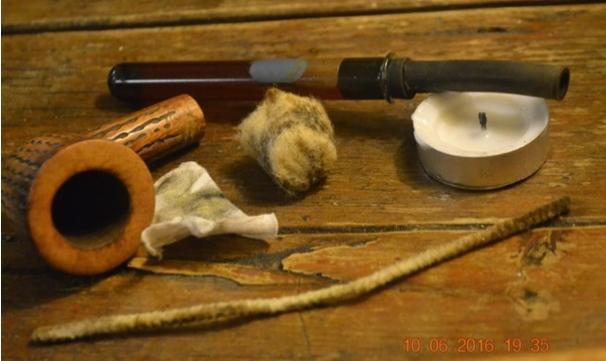
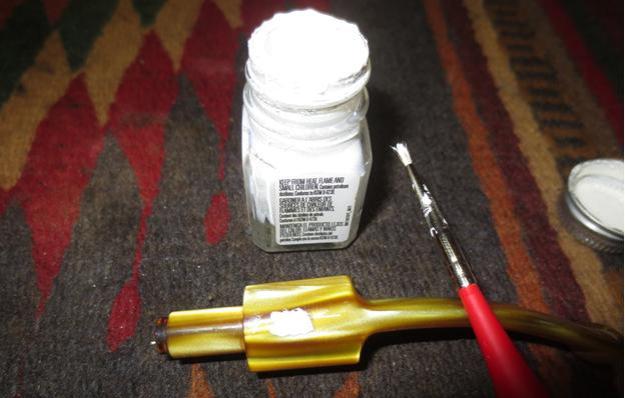
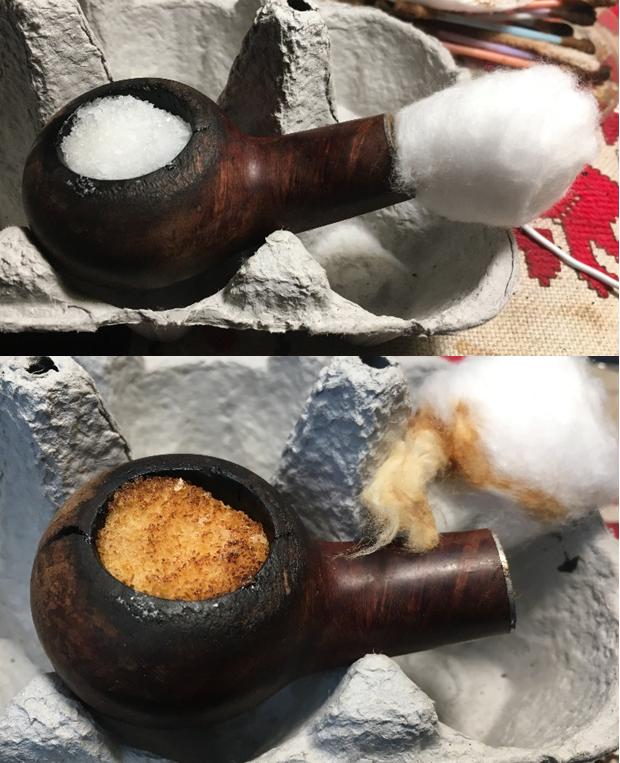
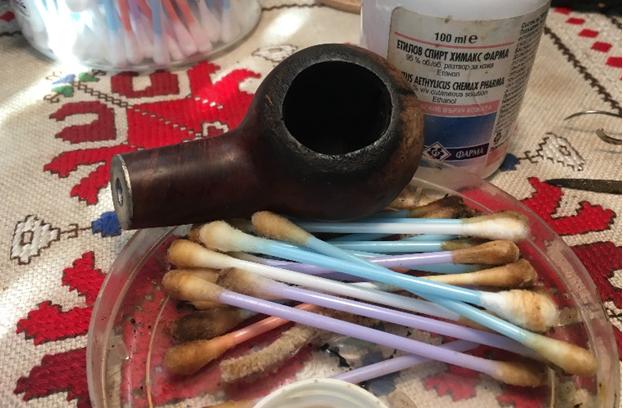
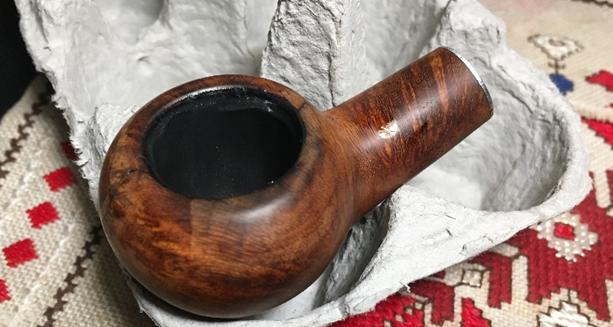
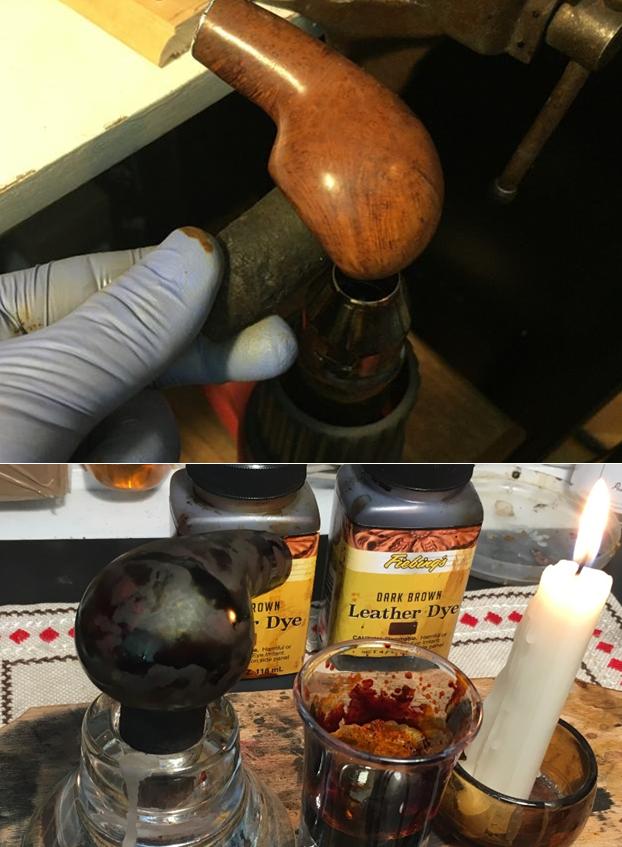
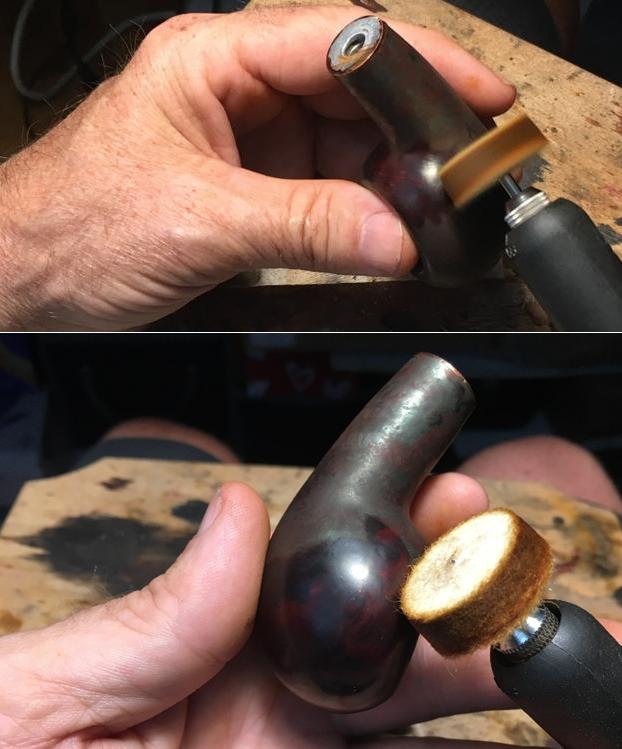
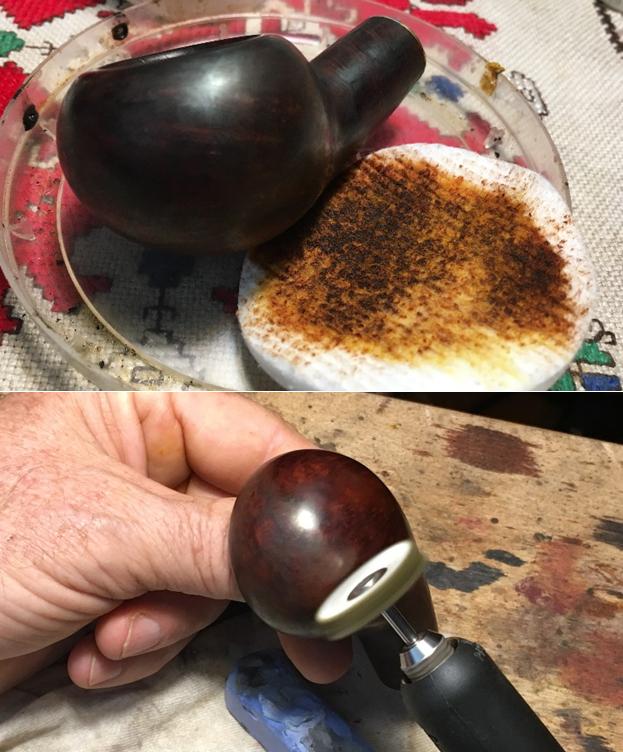
I work on the stummel first.  Taking the Pipnet Reaming Kit I use the two smallest of the four blades available to me and ream the chamber, removing the carbon cake build up to the briar. I then fine tune the ream by using the Savinelli pipe knife which enables me to remove residual cake in more difficult angles.  To clean the chamber further, I take a piece of 240 grit sanding paper and wrap it around a Sharpie Pen and sand the surface of the chamber then clean the left-over carbon dust with cotton pads wetted with isopropyl 95%.  The chamber walls appear to be in good condition.  The pictures show the progress. I now use undiluted Murphy’s Soap with cotton pads, a bristled tooth brush and a brass wired brush to clean the stummel surface, scrub the rim and clean the grime out of the twin grooves.  As I’m cleaning, it becomes evident that the left front of the upper dome is scorched from what appears to be the aftermath of using a lighter flame over the side of the rim to light the tobacco.  I do not use a lighter for this reason – it is difficult to angle the flame without bringing damage to the surface briar.  I use matches and bring the flame directly over the chamber and draw the flame directly to the tobacco.  I’ll need to send Jon a note about this!!!  After scrubbing with all available tools, I rinse the stummel with tap water without introducing water into the internals.  With the rim now clean, the extent of the damage is revealed.  The final picture in the set below, on the lower part of the picture shows this damage. Since my day is ending, I decide to hydrate the stummel surface with a light application of olive oil.  I also decide to use a kosher salt and alcohol soak to work on the internals overnight.  I twist a cotton ball and stuff it down the mortise to act as a wick to draw the oils and tars out.  I then fill the chamber with kosher salt and hold my palm over the top and give it a shake to displace the salt.  Using an eyedropper, I then fill the bowl with isopropyl 95% and leave the stummel in an egg crate for stability and turn off the lights.  The pictures show the progress.The next morning the salt, as expected had discolored somewhat and the cotton served as a wick drawing oils and gunk out of the stummel internals.  I follow with a barrage of pipe cleaners and cotton swabs to finish the cleaning job.  The pictures show the progress.I now face the most daunting part of the restoration of this L. J. Peretti Squared Shank Rhodesian.  I take more pictures for a closer look at the problems.  The burn and scorching damage on the rim and upper dome of the stummel are significant.  The rim at the 11:30 position is cratered severely and it appears that the rim burned and the charred part chipped off after becoming brittle.  From this area, down on the left side to the 7:00 position there is damage but not as severe.  My concern is whether there is healthy briar beneath what I’m seeing or has the wood charred more deeply?  If so, a lot of briar will need to be removed to repair the rim via topping, but this could impact the Rhodesian proportional balance between the upper and lower parts of the bowl – divided by the twin grooves.  This repair reminds me of a rim rebuild I did with a ‘Throw-Away Pipe’ that had little rim left.  With a desire to salvage as much of the rim as possible, I will very lightly top the pipe but only to gain the ‘high ground’ of the rim and then fill the craters and divots in the rim with a briar dust and superglue putty.  I want to ‘build-up’ the rim instead of losing it on the topping board and creating a squat-top, disproportionate Rhodesian.  The pictures show the damage and the challenges. It will be difficult to top the rim evenly with the soft spots created by the charred briar.  With the chopping block covered with 240 grit sanding paper, I very lightly begin to rotate the inverted stummel.  I take pictures to mark the gradual process.  When I arrive at the maximum topping progress, most of the rim has found it’s ‘high ground’ leaving the remainder of the damaged areas more visible.  This allows me to strategically apply patches on the rim.  I notice that there is additional carbon on the inside lip of the chamber so I take out the Peretti Pipe Knife once more and scrape the additional carbon exposed by the topping.  The pictures show the progress of the rim repair. The focus for the briar dust – superglue patch will be the 11:00 area (see above).  The remainder of the damage on the inner rim will be addressed by creating an inner rim bevel.  To prepare the area for the patch I clean it with a cotton swab dipped in isopropyl 95%.  Using Hot Stuff Special ‘T’ CA Instant Glue, I mix it with the briar dust until it reaches a viscosity like molasses.  Using a toothpick as a trowel, I apply the putty excessively over the area with the plan of sanding it down.  I put the stummel aside to allow the patch to cure.  I’ll give it a full 12 hours. The next day, the patch has cured well.  I begin sanding down the excess briar dust patch by using a half-rounded needle file to contour the inner chamber part of the patch.  My goal is to reestablish a round rim by blending the patch with the curvature of the inner rim.  After this I smooth and blend the area further with 240 grit paper.  When satisfied, I turn to the top of the rim using a flat needle file to bring the bump of the patch gently down to the briar rim surface.  The surrounding wood is softer and I avoid collateral filing as much as possible.  I follow to further smooth and blend the whole patch with 240 grit paper.  The pictures show the shaping progress. With the primary patch shaping complete, I want to introduce a bevel to the inner rim lip to remove damage as well as blend the entire rim contour – seeking a round rim.  I believe a bevel always ‘up-classes’ a pipe, too!  I use a coarser 120 grit paper to cut the bevel –  careful to remember the patch area is harder and it is easy to dig in to the surrounding softer briar.  After the 120 grit paper, I smooth and blend further with 240 paper. I complete the rim repair by returning to the topping board with a light topping first with 240 paper followed by 600 grit paper.  This ties things together.  The first picture shows the completed patch shaping to mark the progress of the bevel.  I think things are looking good at this point with the rim repair. Unfortunately, upon closer scrutiny, I discover that my topping inadvertently leaned toward the front of the stummel. This is very evident when comparing the twin grooves to the rim pitch (first picture below).  We do not have a parallel alignment which should be the case.  When I looked back at the pictures above showing the incremental topping process, this is confirmed when the front stummel part of the rim was sanding and the shank side less so.  The result I see is the Rhodesian’s dome lop-sided and that just won’t do.  Even though I’ll give up briar real estate, I take the topping board and hang the stummel over the edge of the 240 paper.  I work only the shank-side of the rim which needs to be lowered and leveled with the front side.  Gradually, I find greater alignment with rim and grooves, though there is still a bit of pitch but not as pronounced. It will work.  I reinstate the bevel and I’m satisfied with the progress.  The pictures show the progress. I put the stummel aside and turn to the stem.  I use 240 grit paper to smooth out the tooth chatter on the upper and lower bit and sand the upper and lower button lips.  By removing the superficial indentations in the vulcanite, I am then able to identify what needs to be filled.  After wiping clean the area, I use Starbond Black Medium KE-150 CA glue to drop fill tooth dents in both the upper and lower button lip as well as the upper bit area.  After application of glue, I spray an accelerator on the cosmetic fills.  I do not use accelerator when the strength of the glue is the issue as the use of an accelerator tends to weaken bonds – from my reading.  I follow with a flat needle file to freshen the button lines and then sanding with 240 grit paper to smooth out the file marks and fills and to blend. I then move to sanding the whole stem.  With some great input from Al Jones in a recent restoration regarding safe-guarding the crisp lines and edges of stems, I mount the stem to the stummel with a plastic disk I fabricated between the two.  This keeps the sanding from creating shoulders over the edge of the vulcanite.  I also wrap the 240, then 600 grit paper around a clothespin half to create a flat sanding surface to guard the sharp edges of the squared shank square and not rounding them.  After completing the sanding, careful to guard the Peretti ‘P’ stem stamp, I buff the stem with 0000 steel wool.  The pictures show the progress.Turning to the internals of the stem, I use pipe cleaners dipped in isopropyl 95% to clean the airway.  I notice that the pipe cleaners have difficulty passing through the slot so I widen it a bit using a rounded needle file against the upper and lower slot opening.  That did the trick.  Pipe cleaners move freely and now, cleanly.  Pictures show the progress.With the stem repairs completed and the internals cleaned, I’m ready to commence the micromesh pad cycle on the LJ Peretti’s squared shank.  Using pads 1500 to 2400 I wet sand the stem.  I follow by dry sanding with pads 3200 to 4000 and then 6000 to 12000.  With each set of 3 pads I apply Obsidian Oil to the stem which revitalizes the vulcanite.  The pictures show the amazing vulcanite ‘pop’ emerging. I put the stem aside to dry.With the stummel showing scorching damage on the upper dome extending downwardly over the grooves, I take another picture for a closer look.  I use a medium grade sanding sponge to address the damaged area.  I need to remove the charcoaled wood and get down to healthy briar beneath the surface.  To aim for uniformity throughout the stummel, I use the sanding sponge on the entire surface, careful to guard the nomenclature on both sides of the shank.  I follow the medium grade sponge with the light grade sanding sponge to finish addressing the charred wood and minor cuts and pits on the stummel surface.  It looks good.  The shank stamping, STRAIGHTGRAIN, is starting to show itself as the grain shows through the once scorched dome area.Taking micromesh pads, I now wet sand the stummel using pads 1500 to 2400.  Following this, I dry sand using pads 3200 to 4000 then 6000 to 12000.  Wow.  I cannot believe the grain making an appearance on this L. J. Peretti Rhodesian.  The pictures show what I watch emerge through each micromesh pad cycle. To get a big picture look at the Peretti, I reunite the stummel and stem.  As with my last Peretti restored, I like the squared shank’s flow from stummel as it tapers out through the stem.  This Rhodesian’s stem tapers whereas my other Peretti Billiard has a squared saddle stem.  Both, very nice variations of the same concept – a classy shank style. Because of the beauty of the grain I’m seeing, I’m tempted to stop at this point, and finish up with carnauba – I like the natural briar that much.  The only issue is that I would like to apply a darker brown shade of dye to better blend the patch and repair of the rim which stands out as is.  The pictures show the story.In preparation for the staining phase, I use a sharp dental probe and run it through the grooves to dislodge any briar dust from the sanding process.  There is a good bit of compressed residue coming loose.  I follow by wiping down the stummel with a cotton pad wetted with isopropyl 95% to clean the surface.  On the stummel heel, I detect one lightened fill.  I darken it with a stain stick to encourage blending.  I also touch up the patch fill on the rim to help blending and masking the patch after dye is applied.  Pictures show the preparation steps. To stain, I use Fiebing’s Dark Brown Leather Dye mixed with isopropyl 95% at 50/50.  I use a large dropper to do the mixing in a shot glass.  With the mixture ready, I heat the stummel using the air gun expanding the briar making a better receptor for the dye.  When heated, I use a doubled-over pipe cleaner to apply the dye to the stummel surface.  I apply the dye liberally seeking to achieve 100% coverage.  When completed, I fire the wet dye which immediately ignites the alcohol in the dye, setting the hue in the grain.  I repeat the above application of dye and flaming after a few minutes.  I put the stummel aside to rest for several hours before removing the fired dye crust.  The pictures show the set-up and the progress.  With the stummel resting, I restore the Peretti’s classic stem ‘P’ with white acrylic paint.  Restoring the stem stamping for me is special, along with guarding the nomenclature – and is why I went through a stem-splice with my first Peretti restore – to save the surviving saddle stem piece with the old, warn ‘P’ stamp.   I apply white acrylic paint to the ‘P’ in a large gob over the area to allow the paint to fully saturate the ‘P’ imprint.  I allow it to dry fully.  Later, when dried (it doesn’t take long), I use the edge of a toothpick and gently scrape the area removing the excess but leaving the paint in the stamp imprint.  Using the side of the toothpick has worked for me as it is a harder surface, yet soft as it’s wood.  The flat area of the toothpick passes over the stamp and does not disturb the paint.  I’m pleased with the results.The next morning, the stummel is waiting to be unwrapped of the flamed crust.  Using the Dremel high speed rotary tool, my tool of choice given the tight quarters of my work table on the 10th floor of a former Communist block apartment building, I mount a felt buffing wheel set at the slowest speed, and use Tripoli compound to apply the gentle abrasion to begin the final buffing stages.  I first purge the wheel of old compound running it against the metal adjustment wrench, then with new compound on the wheel, I apply it to the surface.  I do not use much downward pressure but allow the speed of the wheel’s RPMs and the compound to do the work.  I methodically move over the stummel surface in areas with the sheen of the overhead lamp providing the ‘headlights’ letting me know to spread the compound or apply more to the wheel.  I take a picture to show the felt wheel application of Tripoli compound – I had to stage it because I don’t have enough hands to take a picture and hold stummel and Dremel!  After completing the Tripoli cycle, I lightly wiped the stummel with a cotton pad wetted with isopropyl 95%, not wanting to lighten the hue but to blend certain areas on the heel and shank.  I avoid wiping down the bowl area – it looks good.  Dark enough to mask repairs but on the lighter side to show the striking straight grain definitions.Following the Tripoli compound, I mount a cotton cloth buffing wheel dedicated to Blue Diamond compound.  With the Dremel remaining at its slowest speed I apply the lesser abrasion of Blue Diamond compound to buff the surface preparing it for the carnauba wax application.  I reunite the squared tapered stem to the stummel and apply Blue Diamond compound to both.  I know this borders on eccentricity, but as I was finishing the Blue Diamond cycle, I notice that the rim patch done earlier was showing a ridge around the patch, and not flush with the rim.  A bit late in the game to notice this, but it won’t do.  Very strategically, I roll a piece of 600 sanding paper and address the ridging.  I follow with the full set of 12 micromesh pads folded and strategically addressing the area.  Finally, I apply a dark brown stain stick and lightly wipe a cotton pad wetted with isopropyl 95% to blend the area.  Finally, I run the Blue Diamond wheel over the rim and I’m back to where I started.  The patch is visible, but now without the ridges that draw attention to the repair.  Now, the rim is smooth to the touch.  Much better.  Before and after pictures follow this small detour! With detours behind, I hand buff the stem and stummel with a flannel cloth to remove compound dust from the surface before applying carnauba wax.  I then mount a cotton cloth buffing wheel on the Dremel and increase the speed of the RPMs to 2, a bit faster than the slowest speed, and I apply carnauba wax to both the stummel surface as well as to the mounted stem.  After 3 cycles of applying carnauba wax, I hand buff the pipe with a micromesh cloth to bring out the depth of the grain further.

I appreciate Jon giving me this L. J. Perretti while we were in Oslo.  I’m happy to recommission this very attractive Square Shanked Rhodesian – the grain is exceptional and I like the square shank style of both Peretti’s I’ve restored.  The squared shank, not a common Rhodesian configuration, allows this Rhodesian to function like a ‘table sitter’ as well while one plays their card or board games.  If you are interested in adopting the L. J. Peretti Square Shanked Rhodesian, take a look at my blogsite, The Pipe Steward.  As always, all the profits of the sales from my restorations go to help the Daughters of Bulgaria.  Thanks for joining me!


A Very Tired, Very Dirty Stanwell Bent Volcano with a cracked bowl


Blog by Steve Laug

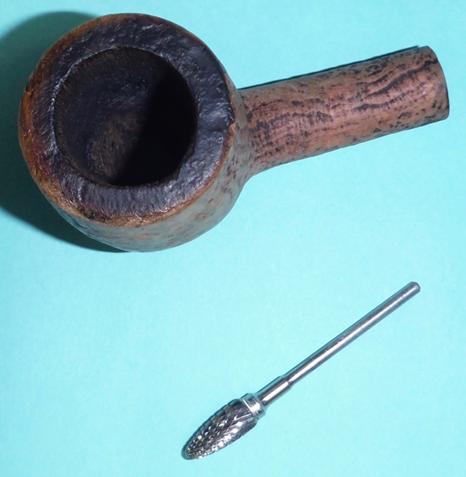
Sometimes when I take in pipes for repair and restoration I am pretty stunned by the condition. This one obviously was an old favourite of the pipesmoker who brought it to me with 8 others in need of some TLC. I sat with him in my living room and went over the repair list of what needed to be done to bring it back to life. It had been restemmed before and the stem was good and heavy so it did not need to be replaced. There were tooth marks near the button on both sides of the stem. It had some deep oxidation that needed attention. Sometime in its life it had been buffed to the point that the stamping was all but gone on the underside of the shank. With a lens I could read Stanwell over Made in Denmark but all but one number of the shape number (1) was buffed away. The finish was sticky to touch from all the waxes and oils on the bowl. The sand blast was pretty worn away and now was shallow. The angled, tapered bowl had a thick cake and it had been reamed into almost an hour-glass shape. The rim top had an overflow of the tars on it and the blast was smooth. There was some damage on the front of the bowl from knocking the pipe out on something hard. There was a small crack on the left side of the bowl from the rim down about a 1/8 of an inch that would need to be repaired. From memory I knew that the bowl was drilled to follow the angle of the exterior of the bowl.When I turned the bowl over the bottom side was covered with cracks. There were four cracks of various sizes that did not go into the interior but rather sat on the surface of heel. They were all different in terms of depth and tended to follow the blast and cut across the ring grain. They were filled with grime and wax. The bottom of the bowl was a real mess.I took a close up photo of the rim to show the damage that had been done to it by reaming it with a knife rather than with a reamer. The cake was sticky and soft and what appeared to be an hourglass shape actually was not it followed the angled bowl walls. I was concerned that the inside of the bowl would also have cracks once the cake was removed. I recommended that we remove entire cake to assess the interior of the bowl. I also took a close up photo of the heel of the bowl to show the cracks.The stem was a replacement that was thick and well made. The fit against the shank was not too bad and there was little gap between the two parts. The stem was oxidized and there was come calcium build up on the first inch on both sides. There were tooth marks and tooth chatter on both sides of the stem near the button.The shank end shows how thick the buildup was inside of the shank. The tars and oils overflow the shank and show up on the end and walls. There were also two small holes drilled to the left and right of the mortise.I reamed the bowl with the PipNet reamer using the largest cutting head. Notice the angle of the cutting head as it shows the angle of the drilling of the bowl. I cleaned up the walls with a Savinelli Fitsall reaming knife.  I sanded the bowl with 180 grit sandpaper wrapped around a piece of dowel. The third photo below shows the bowl after it has been sanded. I scrubbed the exterior of the bowl with acetone on cotton pads to remove the grime and the finish. The grime and oils came off the walls of the bowl and bowl sides and bottom to prepare the bowl for the repairs to the cracks. I drilled each end of all of the cracks with a microdrill bit on a Dremel. There were about 9 holes in the bottom of the bowl and two on the left side at the end of the shank.I put clear super glue into the cracks and pressed it down with a dental pick. I pressed briar dust into the glue and then put more dust in the glue and then more glue on top of the repair to seal it.I used a dental burr on the Dremel to rusticated the repaired areas on the bottom of the bowl and side to match them to the sand blast finish. I knocked off the rough areas of the rustication with 220 grit sandpaper to smooth it into the surrounding finish. The photos show the progress of this process. With the exterior cracks repaired and sealed I turned to work on the internals. The airway in the shank and the mortise was absolutely a mess. I used the drill bit from the KleenReem pipe reamer to clean out the airway into the bowl from the mortise. It was almost closed off with the tars and oils. I turned the bit into the airway until it was smooth. I used a dental spatula to scrape out the inside of the mortise. The scraped tars and oils can be seen in the photos below.There were two small drilled holes in the end of the shank on both sides of the mortise. I filled them in with super glue and briar dust. I cleaned out the inside the mortise and shank with alcohol, pipe cleaners and cotton swabs until they came out clean.The bowl smelled strongly of old tobacco and there were oils in the briar walls. I wanted to remove that smell as much as possible. I stuffed two cotton balls into the bowl, set it in the ice cube tray and used an ear syringe to fill it with alcohol. I left it standing overnight while it pulled the oils out of the briar bowl. In the morning the cotton was stained a yellow brown.I recleaned the mortise and airways after it had soaked using alcohol, cotton swabs and pipe cleaners.I stained the repaired areas on the bowl with a dark brown stain. I used a black Sharpie Pen to fill in some of the grooves in the briar and then restained it. I flamed it with a lighter to set the stain.I buffed the bowl with Blue Diamond on the buffing wheel to raise a shine on the bowl. The photos below show the repaired areas and the blending into the surrounding briar. I set the bowl aside and turned my attention to the stem. I cleaned out the slot with a dental pick and pulled a lot of built up tars from there. I used a sharp knife to bevel the end of the tenon to open the air flow to the slot. I sanded the stem with 220 grit sandpaper to break up the oxidation and to also remove the tooth chatter and some of the tooth marks. Some of them were too deep and they would need to be repaired later. I cleaned out the inside of the stem with alcohol and cotton swabs to remove the buildup in the airway. The slot was very narrow and it was hard to push pipe cleaners through the airway. I decided to open up the slot with needle files to facilitate easier cleaning with pipe cleaners. I did not want to change the shape of the slot, but merely wanted to make it wider and tapered smoothly into the airway. I used both large and small round, oval and flattened oval files to shape the slot. Once I had it large enough for a pipe cleaner to pass through easily I folded a piece of sandpaper and sanded the inside of the slot. I sanded the stem around the button with 220 grit sandpaper and filled in the remaining tooth marks with black super glue. I set the stem aside to dry overnight. In the morning I sanded the stem with more 220 grit sandpaper to smooth out the repairs and blend them into the surface of the stem. I also reshaped the button and smoothed out the repairs I had made there. I wiped the stem down with Obsidian Oil on a cloth to have a better look at where things were at. I noticed a small bubble in the patch on the underside of the stem once I had cleaned it so I put another drop of black superglue on it to fill it in. I polished the stem with micromesh sanding pads – wet sanding with 1500-2400 grit pads and dry sanding with 3200-12000 grit pads. I rubbed the stem down with Obsidian Oil after each set of three pads. After the final set of pads I set the stem aside and let the oil dry. I mixed up a batch of pipe mud – water and cigar ash – and applied it to the inside of the bowl to provide protection to the bare walls while a new cake is formed. When it dried I put the stem on the bowl and buffed it with Blue Diamond polish on the buffing wheel. Blue Diamond is a plastic polish that comes in a block. I load the buffing pad with it and polish the stem and the bowl. I use a light touch on the bowl so that I don’t load up the grooves and crevices with the polish. I gave the stem and bowl multiple coats of carnauba wax and buffed the pipe with a clean buffing pad to raise a shine to the finish. The finished pipe is shown in the photos below. The repairs on the bottom of the bowl blended in very well and those on the stem did also. This is the first of nine pipes that I am repairing for a guy who dropped them off at the house. It is ready for more years of service. Thanks for looking.



Refreshing a Tiny L&Co. Billiard


Blog by Steve Laug

This is the final pipe of the lot of pipes I received from the pipe man in Eastern Canada who picked up an amazing lot an auction. The kind of price he paid makes me envious! This one is an older Loewe and Company graceful and diminutive pipe. It is stamped on the left side of the shank with L&Co. in an oval. On the right side of the shank it is stamped Loewe over England W.

When I received the pipe I took the following photos of it to give you the big picture of this tiny pipe. The stem was in good shape but had the most oxidation of the lot that was sent to me. There were small tooth marks and chatter on the stem near the button on both sides. The finish was dirty but in decent shape. The rim was worn and there were some dents and dings on the top surface. The inner edge of the bowl was slightly out of round. Someone had reamed the pipe back to bare wood but the internals were very dirty. loewe2 loewe3I took a close up photo of the rim to show its condition. The finish was worn on the rim as well as darkened and dented. You can see the damage to the inner edge of the bowl as well.loewe4The next two photos show the oxidation on the stem. It is hard to see the tooth chatter and marks but they are present and will need to be dealt with.loewe5I also took some photos of the stamping. While not perfect you can read the stamps quite well and see the details that I mentioned above.loewe6I reamed the bowl with a Savinelli Fitsall Pipe Knife to clean up the inside of the bowl. The bowl had already been reamed and there were only slight remnants of a cake in the bowl.loewe7With the bowl clean I used a 1500 grit micromesh sanding pad to smooth out the rim and take off the carbon buildup on top. It also worked to take off the scratches in the briar.loewe8I used a folded piece of 220 grit sandpaper to clean up the out of round rim and bevel that were present. It did not take too much sanding and it looked as good as new.loewe9I used a dark brown stain pen to touch up the rim. The colour of the stain was a perfect match to the colour of the stain on the bowl. I stained the bevel and the top of the rim.loewe10I cleaned out the inside of the mortise and the airways in the shank and the stem with alcohol, pipe cleaners and cotton swabs. The pipe was quite dirty in these areas and took a bit of scrubbing to get the grit out of the airways.loewe11I sanded the stem with 220 grit sandpaper to remove the oxidation and the tooth marks and chatter. Several of them were quite deep so I “painted” the tooth marks with the flame of the lighter to lift them to the surface of the stem. They all raised to the surface and a bit of sanding smoothed out the damage.loewe12I polished the stem with micromesh sanding pads – wet sanding with 1500-2400 grit pads and dry sanding with 3200-12000 grit pads. I rubbed the stem down with Obsidian Oil after each set of three pads. I set the stem aside to dry.loewe13 loewe14 loewe15I buffed the pipe and stem with Blue Diamond on the buffing wheel to polish the minute scratches that still remained in the vulcanite and the finish of the briar. I gave the bowl and stem multiple coats of carnauba wax. I buffed the pipe with a clean buffing pad to raise the shine and then hand buffed it with a microfiber cloth to deepen the shine. The finished pipe is shown in the photos below. This evening I packed the pipes and sent them Express Post back to the pipe man in Eastern Canada. I am hoping he enjoys his “new” pipes and adds them to his rotation. Cheers. Thanks for looking.loewe16 loewe17 loewe18 loewe19 loewe20 loewe21 loewe22 loewe23 loewe24


An old Sasieni Sashar London Made 901 Billiard


Blog by Steve Laug

The third pipe I worked on from the pipe man in Eastern Canada who picked up that old lot at an auction is one that is stamped on the left side of shank with the name Sashar over London Made. On the right side of the shank it is stamped with the shape number 901. The rim was worn and whoever cleaned the pipe before I got it removed a lot of the finish. The inner bevel of the rim had a burned area on the right front side. The outer edges of the bowl were worn. The stem was good quality vulcanite and had light oxidation and tome tooth marks on both sides of the stem near the button. The inside of the shank and the stem was very dirty with tars and oils. There was a stinger in the tenon that extended into the bottom of the bowl. There was a light cake in the bowl that would need to be cleaned up as well.sas1 sas2I remembered that the Sashar line was made by Sasieni. I could not remember any other information on the brand. I did a Google search and found that there was a write up on rebornpipes – go figure. I looked and it was a blog that Al Jones wrote on a Sashar pipe that he worked on. Here is the link https://rebornpipes.com/2016/12/19/sasieni-sashar-restoration/.

I did some more searching and found a short writeup on Wesley’s – a pipe shop in South Africa about the pipe brand. It was under a heading there entitled SASIENI. I quote from that site the following: “Joel Sasieni started as an apprentice with Charatan, moved to Dunhill when it opened in 1910, and started his own company in London in 1918 making high grade pipes largely for the US market. They also manufactured pipes under the brand name Sashar (specifically for South Africa) for pipes a little down the line. The company was sold in 1979 and the pipes are now made by a completely different firm.” http://www.wesleys.co.za/refurb04.html

Now I had a bit of information on the brand. It was a Sasieni made pipe manufactured under the Sashar brand name for South Africa. Armed with that information I turned to working on the pipe. I took close up photos of the rim top and inner edge as well as the tooth marks on the stem. In the photo of the bowl you can see the damage on the inner edge of the bowl. The bowl was slightly out of round and there was a burn mark evident mid rim on the right side of the bowl.sas3 sas4In order to clean out the airway in the stem I needed to remove the inner tube from the tenon. I heated it with a lighter until the oils and tars holding it in place warmed up. I wrapped the jaws on a pair of pliers and used it to turn the inner tube out of the tenon. With the tube removed I was able to clean out the airway without impediment.sas5I used a folded piece of 180 grit sandpaper to rework a bevel on the inner edge of the bowl. Once I had the bevel cut I worked on it again with 220 grit sandpaper and 1500 grit micromesh sanding pads. I rolled a piece of 220 grit sandpaper into a tube and wrapped it around a dowel and then my finger to sand the inside of the bowl and clean up the remaining cake on the walls.sas6 sas7I used a dark brown stain pen to restain the top of the rim and the inner and outer edge of the bowl. I spot coloured it with a black Sharpie pen and blended the two together to get the finish to match the rest of the bowl.sas8I used a wet cloth and a butter knife to steam out the dents in the back side of the bowl. I heated the knife in the flame of the burners on my kitchen stove. When hot, I folded a wet towel against the dents in the briar and laid the hot knife on the wet cloth. It generated a fair amount of steam. I repeated the process until the dents were lifted.sas9 sas10I used 99% isopropyl alcohol, cotton swabs and pipe cleaners to clean out the mortise and the airway in the shank and the stem. They were not too dirty so it took very few cleaners to clean it. Once the stem was clean I put the inner tube back in place in the tenon.sas11I sanded the tooth chatter on the stem at the button with 220 grit sandpaper to remove it and the few tooth marks that were also present on both sides of the stem near the button.sas12I polished the stem with micromesh sanding pads – wet sanding with 1500-2400 grit pads and dry sanding with 3200-12000 grit pads. I rubbed the stem down with Obsidian Oil after each set of three pads. After the last set of pads I gave it a final coat of oil and let it sit and dry.sas13 sas14 sas15I buffed the bowl and stem with Blue Diamond on the buffing wheel to polish the briar and the vulcanite. I gave them both multiple coats of carnauba wax and buffed it with a clean buffing pad to raise the shine. I hand buffed it with a microfibre cloth to deepen the shine. The finished pipe is shown in the photos below. It is ready to go back to its owner in Eastern Canada. Thanks for looking.sas16 sas17 sas18 sas19 sas20 sas21 sas22 sas23

Another Wedding Trip Pick: A 1961 DUNHILL EK Shell Briar Made in England 1 4S


Blog by Dal Stanton

Unbelievably, I found this classic Dunhill EK Shell Briar at Madeline’s Antiques & Uniques during the trip for our daughter’s wedding in the US last November. Madeline’s was one of those picker paradises waiting on the I 24 Exit near Manchester, TN, that thankfully, we did not drive past! I had pleasure restoring and gifting our youngest son on Christmas in Denver, the Aged Imported Briar Poker (Red Dot) pictured below on the bottom (See: Link) and the restored Poker’s picture following. Now, shift two pipes above the Poker in the picture below, and you’ll see the Dunhill EK Shell Briar that now has my attention after rescuing him from my ‘Help Me!’ basket here in Sofia, Bulgaria.dal1 dal2At 5 3/4 inches in length, it is a nicely sized square shanked paneled billiard – a very nicely blasted Dunhill Shell pipe.  The stampings are worn but legible on the lower panel of the squared shank.  On the left quadrant, it reads, “Dunhill” over “EK Shell Briar”.  The right reads, “Made In” over “England 1”. Then, to the extreme right on the shank’s edge is 4 ensconced in a circle followed by S.  On the top panel of the squared, tapered stem is embedded the well-known Dunhill white dot – a mark of excellence since 1915.

In 1915, the famous white spot was introduced for very practical concerns. With straight pipes, customers had trouble knowing which way to insert the handmade vulcanite mouthpieces. So, Alfred Dunhill ordered white spots to be placed on the upper side of the stem. This very practical solution would become a definitive trademark of Dunhill pipes. The “white spot” soon became known as a symbol of quality. (Link to Pipedia’s history for Dunhill)

This is my first opportunity to research Dunhill to understand better the heritage of the pipe on my work table.  There is much information about Dunhill on the internet, which is nidal3ce change.  My impressions of the founder, Alfred Dunhill, are that he was a talented and creative businessman, who understood well that a quality product would create a financial boon along with understanding the ‘needs’ of a market.  Per Pipedia, in 1893, he inherited a harness business at only age 21, but was savvy enough to see the approaching reality of the automobile and he leveraged his company to prepare for it. He started, “Dunhill Motorities” to capitalize on this new industry. His first experiment in pipe making was to accessorize for the ‘new’ and sophisticated needs of those now driving cars which were faster than horse and carriage.  To me, this epitomizes Alfred Dunhill’s approach to business and perhaps, to life as well. With wind in the faces of potential customers, he birthed the idea of marketing a pipe with a windshield! We laugh, but this says something about the man who guided his company through the Great Depression when many pipe manufacturers were closing their door.  Dunhill expanded.  The Pipedia synopsis describes the world-wide growth of Dunhill Pipes and their association with quality – the preferred pipe of the rich and famous and the aristocracy.  This ‘market share’ was due in part to Alfred Dunhill’s practice of giving pipes to the English military officers during WW1.  Altruism or good marketing?  During that time the aristocracy of England was awarded military commissions by birth-right.  Dunhill was a smart businessman, there’s little doubt of this.  I also read that it was Alfred Dunhill who kept Winston Churchill well-supplied in cigars.  Another interesting thing I saw as I did my research was threads and discussions arguing why Dunhill pipes are more expensive than most?  Quality or overrating based upon a name?  This Pipe Magazine thread is one example.

The largest part of my curiosity regarding Dunhill is to understand better the creation of the ‘Sand Blast’ finish, or as it’s called in Dunhill Land, Shell.  In my diminutive time rescuing and restoring pipes, I’ve never had clarity in my mind about the differences between blasted and rustified surfaces – and variations therein.  These distinctions are clear to most enthusiasts in pipe collecting and restoration but I’ve been a bit slow on the uptake!  I’m looking at the Dunhill Shell Briar – my first thought had been that it must have something to do with shells on a sea shore….  This small article was especially helpful from the same Pipedia page:

Shell

A deep craggy sandblast with a black stain finish. Dunhill patented the sandblast finish in England in 1917 (Patent No. 1484/17) and the U.S. in 1920 (Patent No. 1,341,418). See The Art of Sandblasting, by R.D. Field, for in depth look at Dunhill’s revolutionary new finish. The deepest and craggiest finishes were from Algerian briar, which is softer and yields more to the blasting. These are found in circa 1920’s, 1940’s, and 1960’s Shells. The pipes were double blasted until the 1960’s, and then the double blast technique resumed in the 1980’s calling it the “Deep Shell” finish. During the 1960’s and 70’s Dunhill could not acquire the Algerian briar. Consequently, the company’s sandblast pipes were much shallower and less distinct. Once again Dunhill showed itself to be innovative, inventing the “double blast” technique to bring about a deeper blast even with harder briar. The black shell sandblast finish uses a stain the was developed for the color, not the taste. They have a more bitter taste, even when well smoked.

Now I have it.  The knowledge that blasting highlights briar grain by removing softer wood through the process has changed how I now look at the surface of a blasted pipe or with Dunhill, a Shell pipe.  ‘Shell’ reportedly came from observations of the earliest experiments with sand blasting briar shapes – they were shriveled and looked like a ‘shell’ – that is, a shadow of their former states.  Even with the limited number of restorations I’ve done to date, it is obvious that I thoroughly love and enjoy working on smooth briars, simply for the challenge and delight of witnessing the beauty of briar grain appear.  Now, I study the Dunhill EK Shell Briar with a new appreciation for a different perspective on the same beautiful grains but revealed via blasting.  So much for my reflections!  Here are pictures of the Dunhill I’ve been reflecting upon!dal4 dal5 dal6 dal7 dal8 dal9Before I begin the restoration work, one last tick on the research list – the nomenclature.  The two pictures above show the markings on the lower shank panel.  I admit, when I first started trying to make sense of the plethora of information on Dunhill dating, it was daunting and a bit confusing, but as I looked at R.D. Fields’ A Dunhill Pipe Dating Guide published in Pipedia, Pipephil’s unbelievable charts, and tooling through all the examples of Dunhill nomenclature exemplified year-by-year, and also Pipephil’s, Dunhill Dating Key – pieces started coming together.  Reborn Pipe’s reposting of Eric Boehm’s Dunhill Shapes Collated was helpful as well.  When I first looked at the pictures above, I had missed the ‘E’ of the EK Shell Briar which is barely legible due to the wear next to the heel of the stummel.  Boehm’s information about ‘EK’ shape was: “Quaint Shape” Hexagonal panel billiard, square shank, angled tapered bit “Stand-up” 1928.  The EK Hexagonal panel is interesting in that a hexagon has 6 sides.  Over the years, this shape may have added more angled variety.  This EK is either squared if you only count the 4 major panels, but it is possible when including the tapered, smaller panels creating the corners, 8 panels are encircling this stummel.  The Pipephil Dunhill Shape Code chart calls the EK a square panel and provides an example of an EK 1958.  The markings are:

EK = Square Panel (shape letters)

4 (in circle) = Bowl Size

S – material: Shell or sand blasted

The dating of this pipe is 1961, based upon the suffix number ‘1’ following ‘England 1’.  Clear? Starting in 1955, Dunhill stopped including the full patent number in the nomenclature.  So, for Dunhills without the patent number, if the number following the ‘England’ is 5-0 (underlined or a subscript) then it would be the year 1950 + X = Year.  So, a Dunhill having ‘England 5’ is from 1955.  With the 1960s the system changed to 1960 being the base starting point with suffix numbers added to ‘England’ that were not underlined or subscripted, but the same size as the D in England.  Are you confused – I was, but it finally became clear.  The dating suffix in the picture above is ‘England 1’ which indicates a dating of 1960 +1 = a 1961 dating!  If I had an ‘England 24’ it would be dated 1984.  I found another EK Shell Briar on this finished eBay listing which was “London 8” – 1968.dal10

Pipe Pages had this example of an Owl Catalogue of 1962 with a picture of the same EK shape in the center but its dating would look like this: “England 2”.  I don’t know if this makes it clearer, but I am thankful for Dunhill dating his pipes!

With a new appreciation for Dunhill, and the EK Shell Briar, Made in England 1, 4S, before me, I hope that I can recommission this pipe for another lifetime and to serve another steward!  The stummel generally looks good – it needs to be cleaned thoroughly – the internals and the blasting.  The cake in the chamber needs to be removed to the briar to allow a fresh start and to examine the chamber wall.  The rim is seriously caked with oils and lava flow and the rim has a small chip on the shank-side panel which will need coloring and blending.  The lower shank panel with the Dunhill nomenclature is already worn – I will clean the area but stay clear of any abrasives.  I thought I detected a crack in at the 4 o’clock mark looking at the shank, but with a closer look, thankfully it is grain and not a crack!  The stem is the challenge.  The oxidation is heavy and needs to be removed.  The button has a bite-through on the lower side that breaches the lip.  The button will need rebuilding and the hole patched.  I remove the stem from the shank and put a pipe cleaner through the airway and plop it in an Oxi-Clean bath to start addressing the heavy oxidation.dal11With the stummel, I take the Pipnet Reaming Kit to address the cake build-up in the chamber. I take another picture of the cake to mark the progress.  For easier clean-up, I always put down a double layer of paper towel to catch the exorcised carbon.  I use the two smallest blades of the 4 available to me to ream the chamber.  Starting with the smallest, then the next larger size.  After this, to fine tune the reaming, I use the Savinelli Pipe Knife by scraping the walls further.  Then, wrapping 240 grit paper around a Sharpie Pen, I sand the walls to remove the smallest traces of carbon and to bring the chamber again to briar.  I finish by using a cotton pad wetted with isopropyl 95% and wipe the chamber to remove the carbon dust. After inspection, the chamber walls show no sign of burning through though I do detect heat fissures that are not serious, but need attention in the last stages of the restoration.  The pictures show the reaming process and inspection questions.dal12 dal13 dal14 dal15Before moving to the external cleaning, I tackle the internals – using cotton swabs and pipe cleaners dipped in isopropyl 95% I clean the inside airway.  The resistance is significant so I take a drill bit, the size of the airway, and ream and scrape it – trying to dislodge the gunk and bring it out.  I continue with cotton swabs and pipe for some time – also utilizing sharp and spaded dental probes to reach and scrape into the mortise.  After some time, the pipe cleaners started returning less soiled.  I’m calling the frontal siege completed, but at the close of the day, I will commence the Trojan Horse attack to further clean the internals with a Salt and Alcohol soak.   The pictures show the progress.dal16Now to the externals.  Using undiluted Murphy’s Oil Soap, I scrub the rim and blast surface using cotton pads and a bristled tooth brush to get into the crags and crevices.  I also use a brass wire brush on the rim to loosen the crusting.  The brass wire will not harm the briar. dal17Ridding the rim of the lava crust reveals several nicks and bare briar around the rim panels.  I also note that there are several places along the shank/stem junction that have lightened because of wear.  I use furniture repair markers starting with the lightest hue (Maple) and methodically start touching the rim spots as well as around the shank.  When the ‘scarring’ or lightened areas are still evident, I graduate to the next darker brown hue, then a third stick darker still.  Looking for the blending to occur.  As I go, I have a cotton pad lightly dampened with alcohol to wipe the areas gently to create more blending of the dyed areas along the rim and shank.  The first 3 pictures show the problems (forgot to picture the shank!) and the last 3 after using the dye sticks.dal18 dal19 dal20 dal21With the stummel repairs completed, I give the internals more cleaning and freshening.  I put the stummel in the egg carton and fill the bowl with Kosher Salt and twist a cotton ball and stuff it down the mortise, to help draw out the left-over gunk.  I then fill the bowl slowly with isopropyl 95% until it reaches the level of the salt.  I put it stummel aside and let the salt/alcohol soak to do its thing.dal22With the stummel soaking, I fish the stem out of the Oxi-clean bath.  The bath did a good job causing the olive greenish oxidation to rise to the surface.  Using 600 grit paper, I wet sand the stem taking off the raised oxidation.  I follow this with using 0000 steel wool – removing more oxidation and shining and smoothing the vulcanite stem.  I’m careful to avoid sanding over the shoulders of the stem to round off the squared shank.  The pictures show the progress.dal23I turn now to the internal stem airway using pipe cleaners dipped in isopropyl 95%.  As hoped, the resistance was little and the pipe cleaners were coming through the airway and emerging clean. dal24With clean internals, what remains is to rebuild the button and patch the bite-through hole from the former stewards clinching.  I create a slot insert using an index card cut to fit and then covered with slick scotch tape – the plastic looking kind.  This will keep the charcoal-superglue putty from sticking to the insert.  The insert serves two purposes.  First, it protects the airway from putty dripping down and plugging things which would add significantly to the work load!  It also provides the form underneath the hole to shape the fill.  I open a capsule of activated charcoal on an index card and I mix it with Hot Stuff Special ‘T’ CA glue – after I place a puddle of it next to the charcoal.  Gradually, I pull charcoal into the puddle of CA glue using a toothpick until I reach a viscosity of molasses and then strategically I dollop the putty in to the tooth hole and around the button – more than needed so that during the sanding phase there’s enough material to shape the button adequately.  Just as an experiment, I’m putting the putty on a bit wetter than usual and use an accelerator to cure it more rapidly.  I want to see if the result might be fewer air pockets in the patch material.  The pictures show the progress with the button patch and rebuild.dal25 dal26 dal27After a fruitful day at work, I’m anxious to return to the worktable.  The Kosher Salt and alcohol bath has run the course and as expected, the salt has darkened and the cotton stuffed into the mortise has acted as a ‘wick’ drawing out the oils and tars – thank you Charles Lemon of Dad’s Pipes for the suggestion of using cotton rather than a cork.  It worked well.  After dumping the salt, I wipe the chamber with a paper towel to remove all the residue salt.  I also employ bristle brushes to clean out the mortise to remove all the old used salt.  Then I return to using some cotton swabs and pipe cleaners down the mortise and they came out clean. Job done.  The pictures show the progress.dal28Many of the pipes I’ve been restoring have had significant stem issues – splicing the L J Peretti, and several button rebuilds have come my way.  I like to think I’m getting more practice resulting in better results!  So is the hope.  I take fresh pictures, top and bottom, of the patched area using activated charcoal dust and Special ‘T’ CA glue to mark the progress.  Beginning from the slot-side, I use a sanding drum with the Dremel to remove quickly the large hunk of runover.   Then, using a flat needle file, I work toward bringing the new edge of the button to where the original slot is.  After this is accomplished, I carefully file inside the slot to shape it. Care is given because the lower slot lip in the center, is 100% patch fill from the tooth hole breaching the slot.  The patch material tends to be softer than the vulcanite so the center – lower area of the slot may be soft and give up too much territory as I file.  I gently (and patiently!) use the small circular part of a pointed needle file to shape the inner part of the slot.  It looks good.  Pictures show the progress to establishing the new rough slot.dal29 dal30 dal31Now I establish the upper edge of the shank-side of the button lip.  I do this by eyeballing a logical place to have the lip – maybe giving me a little more lip than needed now – I can always file it down, but can’t file it up! I place a score in the patch bulge with the corner edge of the flat needle then gradually file the score across the button and moving downward toward the original stem surface.  As I file with the flat needle file, I keep the left edge of the file off the stem and lean into the patch area. I don’t want to scar up the stem for no reason!  Pictures show the gradual, patient shaping process with the file.dal32 dal33With the top shape-out completed with the file, I flip the stem and repeat the process on the bottom side.  I follow the button line from the top to the bottom by continuing to score the line around the excess on the stem edges, filing and rounding the button on the left and right.  I use the stem’s lines on the left and right sides, coming from the shank-side to create the line through the left and right side of the button.  At the end, it’s a smooth transition on the sides from the stem’s sides to/though the button’s sides. I picture what I’m attempting to explain in the last picture in this set below.  I’m also careful to uncover gradually the tooth hole patched area in the center bottom.  I expect the patch area to be softer than the vulcanite and I want the patch to blend.  The pictures show the progress on the lower side of the button.dal34 dal35The last two pictures show the completion of the button shaping upper then lower, using 240 grit paper followed by 600 grit paper and 0000 grade steel wool to catch the button repair area with the rest of the stem.  The button rebuild looks great and the hole patch is blending well.dal36 dal37At this point I take a close look at the patch area and I see some air pockets – not many, but some.  That cannot stand for the recommissioning of this 1961 Dunhill.  What comes to your mind when you reflect on 1961?  This is what I see, a ’61 Chevy with this Dunhill along for the ride!  Perhaps I need to acquire one of Alfred Dunhill’s Patent Shield Pipe too!dal38This Dunhill might be a good Birth Year Pipe for someone if I can give it up.  I take regular superglue and make a small puddle and use a toothpick to hole drop glue and paint some areas to fill the air pockets and I follow by spraying the fills with accelerator.  Following this, I sand the fill areas with 600 grit paper and then 0000 grade steel wool.  I declare button repair consummatum est! dal39 dal40 dal41I take the Dremel and finally fabricate a plastic washer to guard against sanding down the shoulders of the stem.  Using the washer with the stummel providing the resistance, I wet sand with micromesh pads 1500 to 2400, then dry sand using the next set of 3200 to 4000, then 6000 to 12000.  I follow each set of three with an application of Obsidian Oil to revitalize the vulcanite.  My, this stem and Dunhill White dot are ready for the ’61 Chevy convertible!dal42 dal43I may have created a problem showing the ’61 Chevy paired with a British-born pipe.  So, I suppose this British made ’61 MGA Roadster would do OK in a pinch 🙂dal44With the micromesh phase completed, I turn again to the stummel.  Previously, I applied dye sticks to lightened wear areas to give a fresher look.  I look at the rim a little closer and it still appears crusty and black – lacking the light reddish speckling present in the rest of the stummel.  I lightly sand the rim with the 1500 micromesh pad and then use my pen knife and gently scrape the top.  I only remove the crust on the sand blasted surface.  After scraping, I return to Murphy’s Oil Soap and with a brass brush, scrub the rim again and rinse with tap water.  I’m seeing a better contrast of hues now in the blast textured surface. I then take the darker hue stain stick and randomly paint portions of the rim to add more contrast and interplay and then lightly dab and wipe with a slightly wetted cotton pad with isopropyl 95% to blend.  I want to keep the original color of the EK Shell Briar and the look of a classic 1961 Dunhill.  The pictures show the progress.dal45 dal46Using a cotton cloth wheel, I apply Blue Diamond compound to the stummel.  I set the Dremel speed to 1, the slowest possible.  With the Dremel’s wheel, as small and concise as it is, I can rotate the stummel and guide the wheel so it’s going with grains – maneuvering in the peaks and valley of the Shell moonscape surface.  I don’t overload the wheel with compound and press with too much force downward, but allow the RPMs of the Dremel and the compound to do the work.  After completing the compound application, I hand-buff the stummel with a flannel cloth to remove the loose compound residue before applying the wax.   With the stem and stummel reunited, I give both several coats of carnauba wax.  I use a separate cotton cloth Dremel wheel dedicated to carnauba, I set the speed at 2, with 5 being the fastest setting.  As I did with the Blue Diamond, I utilize the strategic smallness of the Dremel’s wheel as I maneuver to distribute the carnauba wax without gunking up in the Shell textured surface.  Following the wax, I give the Dunhill a brisk hand-buff with a micromesh cloth.

One last need on the check-list before recommissioning this 56-year-old Dunhill.  After this many years of active service, heat fissures had developed in the chamber. I want to coat the chamber with a mixture that helps protect the briar while at the same time provides a temporary foundation for the cake to develop which will provide the long-term protection of the chamber briar.  I have heard, and repeat here, proper cake depth to be maintained is about the thickness of a US dime.  It would have been easier to do this before polishing the stummel, but I forgot until now.  No problem. dal47In the past, I’ve used a coating mixture of activated charcoal dust and sour cream (here on Reborn Pipes) – which works wonderfully and leaves no taste or smell – it is inert.  Since I don’t see any sour cream in the refrigerator, I decide to use the method that Charles Lemon uses which he described here on Dad’s Pipes using maple syrup and activated charcoal as the main ingredients.  Since we do not have maple syrup in Bulgaria (bummer!), Charles assured me after an emailed question, that honey, plentiful in Bulgaria, would serve well as a substitute.  Charles’ directions are straight forward, which I follow:

  1. Insert a pipe cleaner in the stem of the pipe to keep the airway open.
  2. Wipe maple syrup around the inside surfaces of the bowl. Try for a nice even layer.
  3. Pour activated charcoal powder into the bowl right up to the rim.
  4. Allow the pipe to sit for an hour or more. This gives time for a layer of charcoal powder to be absorbed by the syrup.
  5. Dump out the excess charcoal powder, remove the pipe cleaner from the stem.
  6. Now the hard part. LET THE PIPE SIT FOR 5-7 DAYS. The bowl coating will cure smooth and hard.
  7. After curing, your pipe is ready to go!

These pictures show the progress with the final picture a few hours after clearing the excess charcoal.  I will need to let the pipe sit now for 5 to 7 days for the bowl coating to fully cure, which will not be a problem! dal48 dal49 dal50I’m very pleased with the outcome of the stem/button repair.  There is no perceptible indication that there was a hole that breached the lower button lip.  The Shell Briar cleaned up well and shines with a rich, deep, brown/burgandyish textured shade.  When restoration began, I did not realize how I would grow to appreciate the name, “Dunhill” and the pipes bearing this respected name.  The debate will remain regarding Dunhill’s higher pricing – whether one is paying for only a name or for advanced excellence in a pipe.  I suspect that both are true.  After seeing the beauty of this 1961 Dunhill EK Shell Briar emerge, especially as he responded to the carnauba treatment, coupled with the solid feel of the 4-paneled, square billiard bowl, and the strong bearing of the squared shank transitioning into a squared stem that gracefully tapers to the button –  and, all is crowned with Alfred Dunhill’s happenstance white dot mark of excellence – and I agree, I am looking at a quality pipe.  I’m conflicted whether to keep this Dunhill, my first, or to put him up for adoption???  Oh well…. I sell my restorations with a special purpose.  The profits help the work we do with the Daughters of Bulgaria – women and children sexually exploited and trafficked.  This vintage 1961, Dunhill EK Shell Briar, Made in England 1, is ready to serve a new steward.  If you’re interested in adopting him and helping the Daughters, go to my blog site at The Pipe Steward Store and check it out.  Thanks for joining me!dal51 dal52 dal53 dal54 dal55 dal56


Renewing and restemming a La Strada Staccato Bent Pot


Blog by Steve Laug

This tired old La Strada came to me for repairs. It was in rough shape. The stem had been gnawed, broken and gnawed again. The finish was shot and covered in oils and grease to the point that it was hard to see the rope rustication around the bowl. The bowl had a thick crumbling cake and smelled heavily or aromatics. The lava from the bowl had flowed over the top of the rim and darkened the finish there. The outer edge of the rim was heavily damaged on the front left side and looked as if the bowl had been dropped. There were dents on the underside of the bowl as well from a similar event. The shank was so dirty that the stem would not fit into the mortise. I was able to get it in but the fit was not tight against the shank. The shank is slightly off round so the stem was slightly different.la1 la2The next photo is out of focus but the road rash on the bowl bottom is visible.la3I took a series of close up photos of the bowl and rim and the stem to show the condition of the pipe when I started. In the first photo you can see the thick crumbly cake and the damage to the rim surface and edges. It was hard to tell if the inner edge of the bowl was damaged and only after reaming would I be able to know for certain. The stem was a write off as the damage was too extensive to repair. The fit against the shank also warranted a new stem.la4 la5I reamed the bowl with a PipNet reamer and went through the various cutting heads. I cleaned up the remaining cake in the bowl bottom with the Savinelli Pipe Knife. I took the cake completely out of the bowl and reamed it back to bare briar.la6I wiped down the surface of the bowl with acetone on cotton pads to remove the finish. It came off with a bit of scrubbing but there were places where it did not come off with the acetone. It would take some sanding to remove the totality of the finish.la7 la8The damage to the bowl top and outer edges required that I top the bowl. I gently topped it on the topping board so as not to remove too much and remove the smooth portion above the rope rustication on the top edge.la9I sanded the bowl and rim top with a medium and a fine grit sanding sponge and took the following photos.la10 la11I cleaned out the internals of the shank and the replacement stem that I fit to the shank with alcohol, pipe cleaners and cotton swabs. It took a lot of scrubbing to get the mortise and the airway clean in the shank. The stem was in decent shape so it did not take too much work on it.la12I took some photos of the pipe at this point to get a feel for the look with the new stem in place.la13 la14I wrapped some sandpaper around a dowel and sanded the walls and bottom of the bowl. There was a ring at the bowl bottom that was grooved and needed to be smoothed out. It did not take a lot of sanding before the inside walls were smooth.la15I restained the bowl with a dark brown aniline stain mixed 50/50 with isopropyl alcohol to approximate the original colour of the pipe and to highlight the grain on the pipe. I flamed the stain and repeated the process until the coverage was even around the bowl and rim.la16I buffed the bowl with White Diamond on the buffing wheel to even out the new finish and give it a bit of a shine. I took photos of the bowl at this point to give a clear picture of the new look.la17 la18Now all that remained was to finish the fit and polishing of the stem. I sanded it with 220 grit sandpaper until it fit the shank well. It took some adjusting of the diameter of the stem to match the slightly out of round shank. In the end it fit well. I polished the stem with micromesh sanding pads – wet sanding it with 1500-2400 grit pads and dry sanding with 3200-12000 grit pads to give it a deep shine.la19 la20 la21I buffed the bowl and stem with Blue Diamond on the buffing wheel to polish the minute scratches on the vulcanite and on the briar. I buffed them both until the stem and briar glowed. I gave the bowl and stem multiple coats of carnauba wax. I buffed the bowl and stem with a clean buffing pad to raise the shine. I hand buffed it with a microfibre cloth to deepen the shine. The finished pipe is shown in the photos below. It is ready to go back to the pipe man who sent it to me for restemming and refurbishing. I think he will enjoy it and it will deliver a life time of good smokes to him. la22 la23 la24 la25 la26 la27 la28 la29 la30

Another Hole in the Wall find! Stanwell Silver Mount 85


Blog by Dal Stanton

I first laid my eyes on the Danish made, Stanwell Silver Mount a couple of weeks ago, not really knowing what I was seeing.  I was giving a tour to a new team member who had just arrived in Bulgaria.  As part of orientation I take ‘newbies’ on a tour of the center of Sofia – I sprinkle in a bit of history, architecture, politics, religion and culture as we stroll through the streets and boulevards.  The tour was also the perfect opportunity to showcase a ‘typical’ Bulgarian antique shop – I’m always looking for a way to drop by the ‘Hole in the Wall’ where I’ve landed several great pipes in past visits.  As my guest surveyed the shelves of stuff stacked on stuff, I went directly to THE basket, stuffed up into one area among the artifacts, where I started plucking through the newer offerings of pipes added since my last visit – since before Christmas.  I did spy a very nice unmarked Brandy shape with a hearty stummel.  When the shop owner diverted my attention, conspiratorially confiding that there was something he wanted me to see – my curiosity heightened.  He pulled the Stanwell out from a closed cabinet which always is an indicator of a treasure of greater value.  I left the Hole in the Wall with the pipe on my mind but not in my pocket. A week later, I returned to the Hole in the Wall with two other people as part of another tour.  This time, however, I wanted to see the Stanwell again – hoping it was still there.  It was.  This time I took pictures and dickered a bit, but again, left without a pipe.  I wanted to do some research on this Stanwell and send a note off to Steve to get his feedback, including some of the pictures I took at the Hole in the Wall.dress1dress2 dress3

His response was to the point: “That line of Stannies is a pricey one.  Nice find.”  Added to this was confirmation that the asking price was indeed very reasonable! That sealed the deal for me and with resolve (after receiving my wife’s blessings) I returned to the Hole in the Wall the next day and negotiated a favorable deal. Sweetening the transaction of the Stanwell was bundling the Brandy Unmarked I saw in the basket.  I’m a good customer and he agreed to a “good customer” price.  He was happy and I walked out of the Hole in the Wall this time with two nice pipes – but the Stanwell was the find pipe pickers place their hopes!

With my newest Hole in the Wall find now in front of me, I take more pictures for evaluation.  On the lower side of the shank is stamped Stanwell over Made in Denmark over Silver over Mount. Unfortunately, through wear or over-aggressive buffing, the ‘S’ of Stanwell and the “Ma” in Made in Denmark are very thin.  There is a shape number on the right side of the shank stamped 85 – I’ll need to research this to see if I can place this pipe with the plethora of information about Stanwell pipes on the internet.  Both the shank’s ferrule and the military or spigot mounted stem’s band, have 925 stamped – the world-wide authentication of sterling silver (.925).  What I did not see in the poor lighting of the Hole in the Wall, was that the mortise ferrule also had Stanwell stamped in the sterling.  The silver inlaid crowned “S” stem cartouche is in good shape.  The acrylic stem has many scuffs and nicks and tooth chatter near the button.  The rim and bowl surfaces also are nicked and dented a good bit.  As a matter of personal taste, I am not too partial to the black finish that hides the briar grain.  These pictures fill in the gaps.dress4 dress5 dress6 dress7 dress8 dress9 dress10My first time dealing with a Stanwell pipe was with a second – a Danske Club Vario, a very nice pipe also landed at the Hole in the Wall.  Pipedia’s article describes the beginning of the well-known Danish pipe making company, Stanwell:

At the end of the war, briar became available again, so Nielsen began importing his own briar and started making briar pipes to compete with the English manufacturers. It must be remembered that in 1948, England was the single great center for pipe making. Therefore, Nielsen changed the name of his pipes to “Stanwell”, which sounded much more like a proper English name than “Nielsen”. He also created the horse-drawn carriage logo for its English connotations. He later changed his own last name from Nielsen to Stanwell, a testament to his devotion to the pipes he made. Stanwell’s relationships with Danish pipe makers goes back to Sixten Ivarsson, who is considered the originator of modern Danish pipe making. Ivarsson was commissioned to design Stanwell shapes. In 1969, the factory was moved to a town called Borup, just outside of Copenhagen to be closer to Ivarsson.
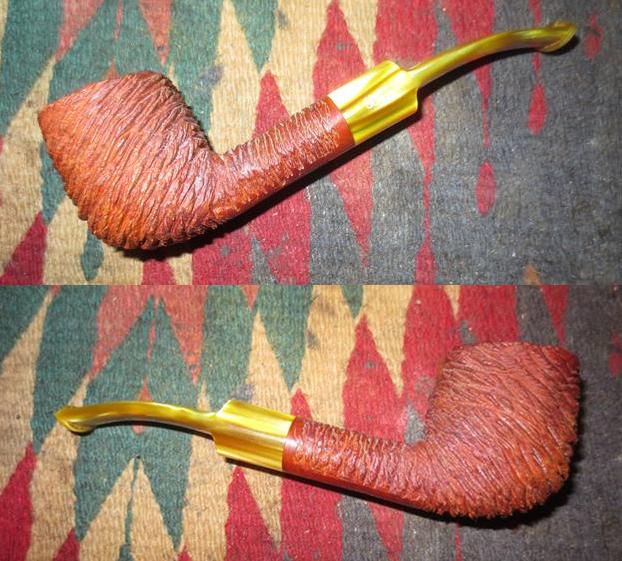
To establish the date of this Stanwell Silver Mount style, thanks to Bas Stevens’ extensive compilation of Stanwell pipe shapes posted on Rebornpipes, the shape number 85 is listed as a bent billiard which was discontinued in 2006 (changed to shape number 246).  I also found the Silver Mount style featured in two Stanwell catalogs listed in Pipedia’s collection.  One ‘Brochure by the Lorup Group’ displayed samplings of the Silver Mount style but I could not establish the date of the brochure.  The other was a Russian catalog of Stanwell offerings including Silver Mounts dated 2001.  This pipe could predate 2001 but the latest possible dating would be 2006 when the shape number was discontinued.  Since Stanwell closed the doors of their manufacturing operations in Denmark and moved it to Italy in 2009 (link above), this confirms the Danish origin of the pipe.  The Silver Mount style is unique, not only because it provides two large sterling silver adornments to the classic bent billiard shape – a shank ferrule and stem band insert, but it creatively immolates a military or spigot stem mount.  I found two different comments on SmokingPipes.com about Stanwell’s Silver Mount line.  The first highlighted Stanwell’s Silver Mount shape 85:

If you like the look of a military or spigot mount but prefer a more conventional tenon/mortise arrangement, this Stanwell offers both — along with an elegant, graceful silhouette and plenty of chamber to boot.

Of the stem style itself, there was this comment, that even though not a true military mount, since it has a tenon instead of a tapered fit, it nonetheless is one of the best faux-military mounts this observer had seen.  The sense I have of the pipe’s design is that it is an interesting mixture of higher class elegance with the ample showcase of sterling silver, but with the military/spigot stem style a ruggedness is also introduced.  My challenge now is to help this Stanwell, a ‘knight in shining armor’, regain its former glory!  The sterling silver ferule mounted on the shank is easily removed.  This will help the ease of the stummel’s cleanup.  The chamber in this billiard is large with a depth measurement of 1 3/4 inches and width of 7/8 inches – a good long smoker able to pack a bowl of one’s favorite blend.  The chamber is lightly caked but I want to clean it down to fresh briar.  I do this with my Savinelli pipe knife working over a paper towel for easy disposal of the carbon.  The reaming did not take long. Then I take a rolled piece of 240 grit sanding paper wrapped around both my index finger and then a Sharpie pen and sand the chamber wall.  I finish the bowl cleaning by using a cotton pad wetted with isopropyl 95% and wash the chamber.  The fire chamber looks good – I see no problems.  The pictures show the progress.dress11 dress12 dress13With isopropyl 95% on the work table, I turn directly to cleaning the stummel internals.  Using pipe cleaners, Q-tips dipped in alcohol, I work cleaning the mortise.  Using the flat edge of a dental spade, I scrape the sides of the mortise walls cleaning the tars and gunk.  The Q-tips and pipe cleaners are doing the job.  Later, I will also give the stummel a Kosher salt and alcohol soak to freshen the internals even more.  On a roll, I take the acrylic stem and clean the internals with pipe cleaners and Q-tips in the 9mm tenon area with alcohol.  There was little resistance.  With a cotton pad wetted with isopropyl, I also give the stem’s and mortise’s sterling silver an initial cleaning and polishing.  The progress is shown.dress14 dress15With internals finished, I take another look at the stummel and take a few close-ups looking closely at the surface and rim.  As I said earlier, personally, I’m not a fan of the solid black finish.  My standing ovations are roused by gazing upon natural briar grains!  In my research looking into the Silver Mount line of Stanwell in catalogs, I came across a similar Stanwell line called the, ‘Silhouette Pipe’, featuring several different shapes with the same black finish.dress16 dress17 dress18 dress19My plan is to remove the black finish and repair the stummel and rim surfaces, then apply a darker stain that is essentially black, but allowing the grain to be seen.  This will maintain the sleek, dark look of the bent billiard and continue to set it off in sharp contrast to the sterling silver ferrule and band along with the classic silver crowned ‘S’ Stanwell inlaid silver cartouche. With this plan before me, I use acetone to remove the finish.  Not knowing how tough the finish will stand, I start with a cotton pad wetted with acetone and see how the work progresses.  The cotton pads wetted with acetone are not making much progress so I add the gentle abrasion of 0000 steel wool.  I am careful to avoid the nomenclature on the lower part of the shank as well as the shape number.  With these areas, I only use cotton pads and a bristled tooth brush, acetone and a lot of elbow grease.  I do not want to erode the stampings!  As the black finish gradually gives way, I’m amazed that Stanwell covered such a beautiful piece of briar!  The straight grains travel vertically up the bowl from the heel of the stummel which holds a nest of bird’s eye grain – the whole effect is like a camp fire flowing upward from the fire pit. dress20 dress21 dress22With the black finish removed, I’m able to see some small pin hole pitting exposed on the surface.  To address this, I use a medium grade sanding sponge followed by a light grade sanding sponge to remove most of the pitting as well as nicks that remained on the rim.  The pictures show the progress.dress23 dress24With the initial stummel prep complete, I decide to use the Kosher Salt and alcohol soak to clean the internal airway and mortise more fully.  Using Kosher salt (versus iodized which can leave an after-taste) I fill the bowl and then after corking the shank opening, I hold my palm over the bowl and give the stummel a shake.  This displaces the salt a bit into the mortise. I then pour isopropyl 95% into the bowl until it fills just over the level of the salt.  I put the stummel in an egg crate for stability and put it aside for 4 to 5 hours to let the salt and alcohol draw out the tars and oils residing in the briar.  The pictures show this process.dress25With the stummel is ‘cooking’ with the salt/alcohol soak, I turn my attention to the stem.  The question and concern that comes to mind is the care in cleaning the stem while protecting the sterling silver band that is attached to the stem?  Will sanding the stem damage the band if the sanding runs over the edge?  Unlike the sterling silver shank ferrule that came off easily, the stem band is not going anywhere.  Just to get an idea how well the silver will clean up before I start on the stem clean up, I take the shank ferrule and apply Weiman Silver Cream to it. As the directions describe, using the sponge in the container, applying the compound, rubbing then rinsing off with tap water.  Wow! It works well.  The pictures show the result!dress26I move forward with caution with the acrylic stem by protecting both the crowned ‘S’ stem mark and the sterling silver band.   I do this by holding my thumb over the areas to keep the sanding instruments at bay.  After taking a few ‘before’ pictures to mark progress, I begin addressing the rough scratches in the acrylic with 240 grit paper to do the heavy lifting.  I also work out the teeth chatter in the bit area – upper and lower.  Following the 240 grit paper, I use 600 grit paper and then 0000 steel wool, taking a picture at each step to mark the progress.  Following the steel wool, I run the stem through the complete 1500 to 12000 micromesh pad treatment, taking a picture at the customary sets of 3.  In the final set, I also apply Weiman Silver Cream to the sterling silver band to spruce it up.  I discovered along the way, that the finer grade micromesh pads were not a problem for either the band or Stanwell stem mark – they shine up quite nicely!  I’m pleased with the progress.dress27 dress28 dress29 dress30With stem completed, I again look to the stummel which is benefiting from a Kosher Salt and alcohol soak.  The salt has darkened somewhat indicating the success of the process.  I dump out the old salt, thumping it on my palm to rid the stummel of the expended salt.  I use a paper towel to clean the bowl and I also utilize bristle brushes and pipe cleaners dipped in isopropyl 95% to further clean the airway and mortise.   dress31 dress32Time to address the finish of the stummel.  I use an Italian stain which is called Wenge’ – it appears to have a black base.  After I heat the stummel with my wife’s hair dryer, I liberally apply the stain to the stummel with a folded over pipe cleaner.  I fire the dye and the alcohol immediately burns off.  After a few minutes, I repeat the process and fire the stain.  Then, within a few minutes, I use a cotton pad and wipe the stummel with isopropyl 95% to blend the stain in the wood.  After wiping the stummel down with alcohol, I decide to switch and use a black water based dye and mix it 50 to 50 with isopropyl 95%.  I apply the mixture to the stummel with a folded over pipe cleaner and fire the stummel again.  With this mixture, it did not ‘fire’ the way an aniline dye will but it did evaporate as I passed it over a lit candle.  This helped to set the dye in the grain.  I set the stummel aside to rest.  The pictures show the progression.dress33 dress34Well, in the interest of full disclosure, what is not pictured are the several iterations of applying ‘black’ stain to this stummel.  When I first ‘unwrapped’ the stummel from the fired crust, buffing with my Dremel using Tripoli and then Blue Diamond compounds with a cotton cloth wheel, I was not satisfied with the hue of black I saw emerge.  I wanted the finish to be a translucent black, allowing grain to show through, but in black spectrum hues.  What I was seeing was the brown of the grain emerging giving more of a dark chocolate brown look.  I repeated the staining several times, changing up the black dye content and alcohol, flaming and then wiping the stummel with a cotton pad wetted in isopropyl 95% to blend the stain with the briar and each time repeated buffing with Blue Diamond with the Dremel cotton cloth wheel.  I finally started seeing emerge a stummel that correlated with the image in my mind – a black stummel, in keeping with the original Stanwell intent, but with subtle grains showing through.  Satisfied finally with the result, I move on and apply several coats of carnauba wax to the stummel and to the acrylic stem with the Dremel’s cotton cloth wheel set to speed 2 (one notch up from the slowest speed).  I also attach the sterling shank ferrule with a bit of super glue to keep it in place and finish with a rigorous hand-buffing of stummel, sterling, and stem with a micromesh cloth.
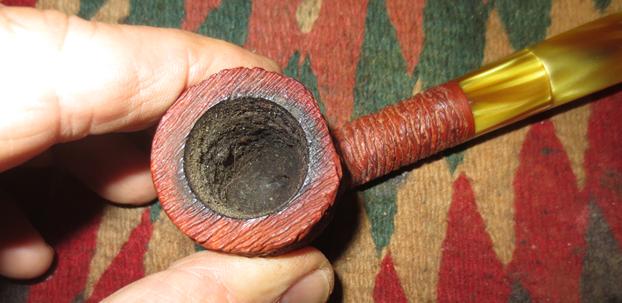
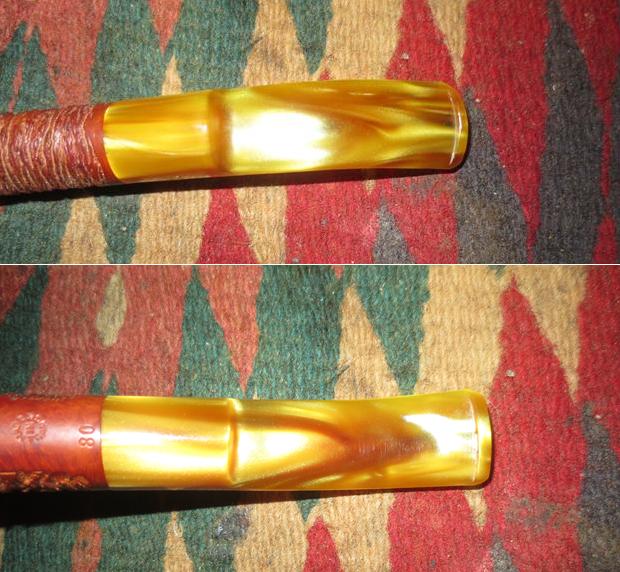
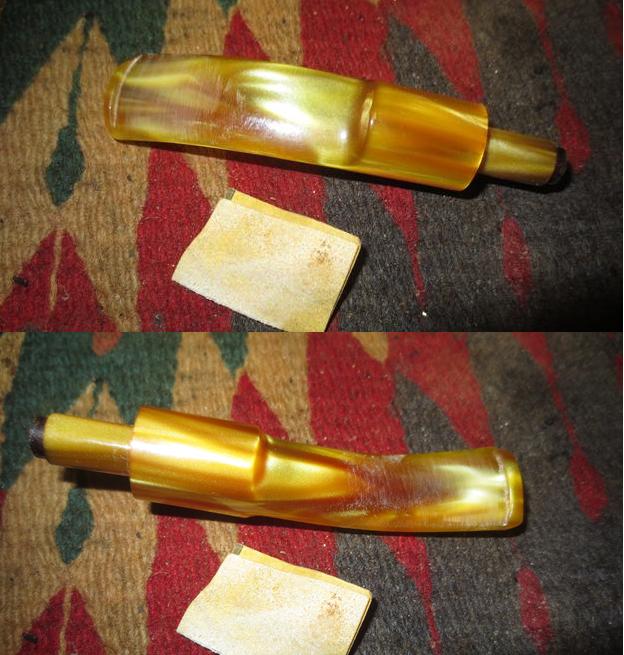
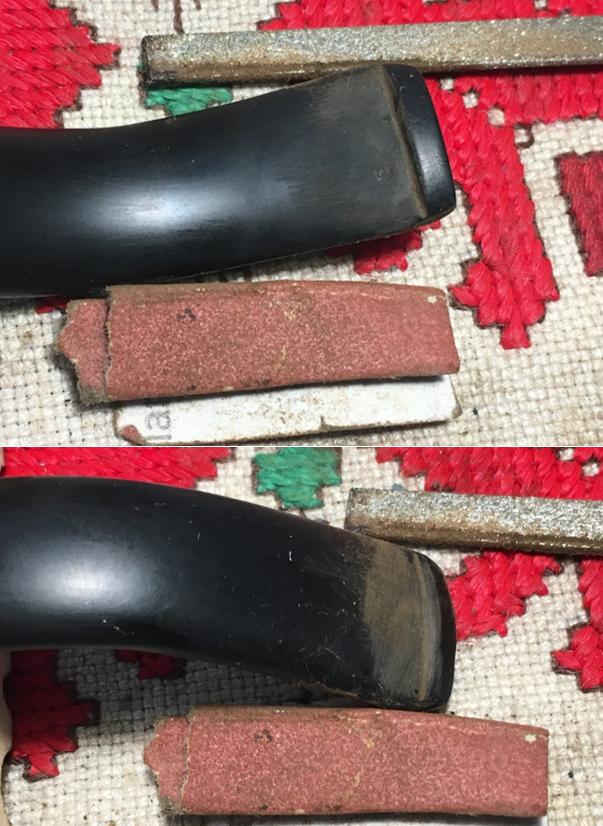
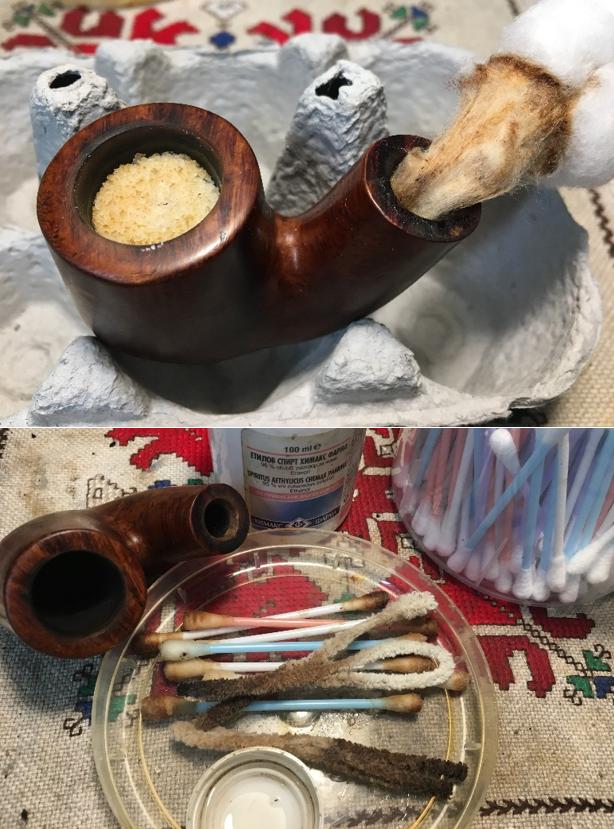
It is true, personal tastes are subjective, but my sense is that I’ve improved this dressy Stanwell Silver Mount bent billiard by transforming the solid black to a translucent finish allowing the natural grains to show through.  This presentation of grain pattern is subtle and I believe it is in keeping with this special line of Stanwell pipes, the Silver Mount.  You’ll notice at the end of the presentation pictures below, I’ve included two pictures taken on a dark surface which enables the grain to be seen more clearly.  Stanwell’s retired shape number 85 is a larger bent billiard with a pleasing feel in the palm. The faux military stem mount brings a rugged look to the pipe but the twin sterling silver adornments, uniting the shank and acrylic stem, places this Stanwell a touch of class.  This Stanwell Silver Mount bent billiard is ready to serve a new steward.  If you’re interested in this pipe, check out the store at my new site, The Pipe Steward. The profits of all pipe sales go to the Daughters of Bulgaria, an organization my wife and I work with helping women and children who have been sexually exploited and trafficked.  Thanks for joining me!dress35 dress36 dress37 dress38 dress39 dress40 dress41 dress42 dress43 dress44