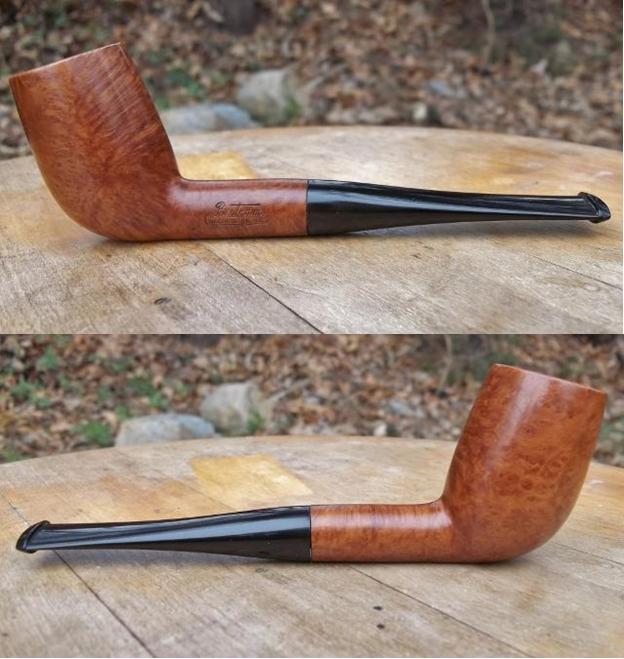
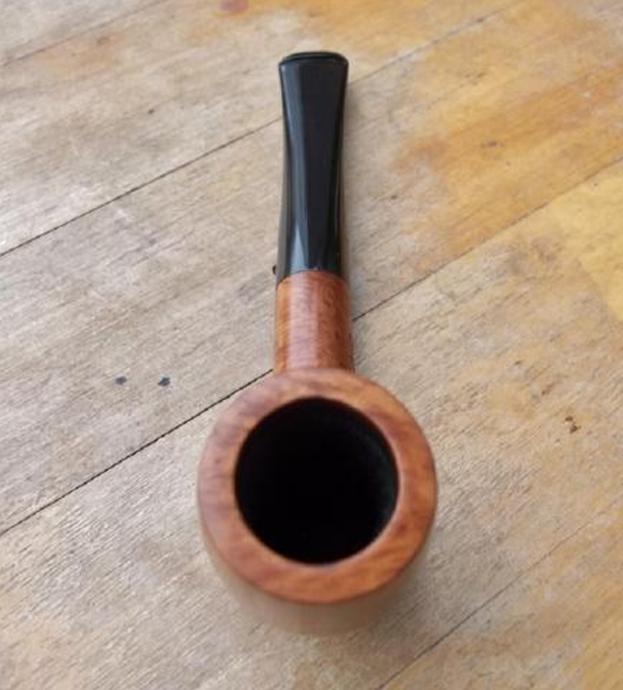
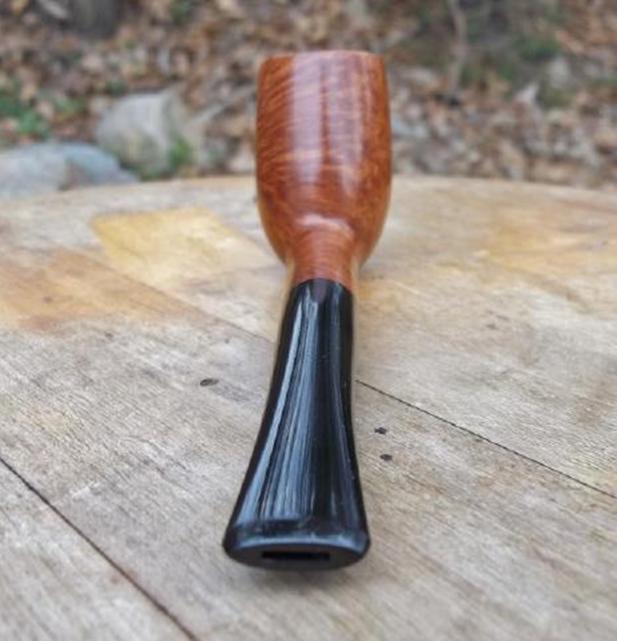
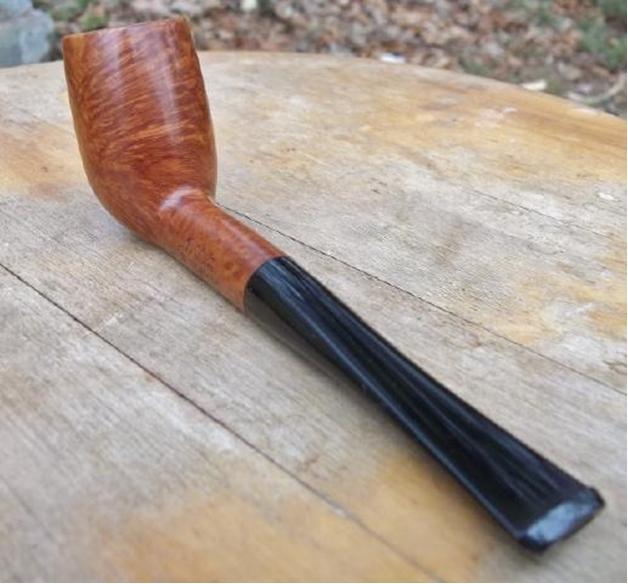
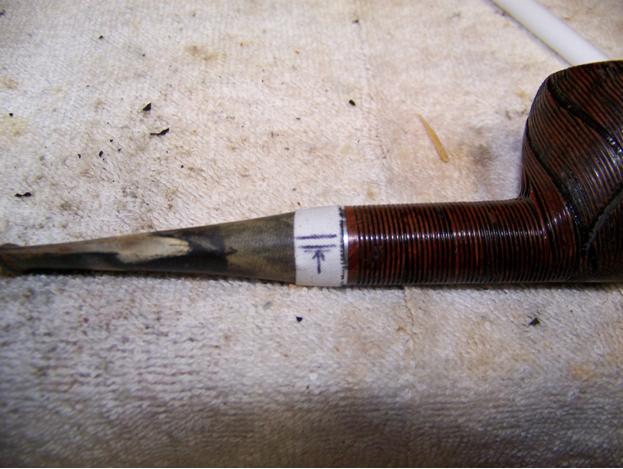
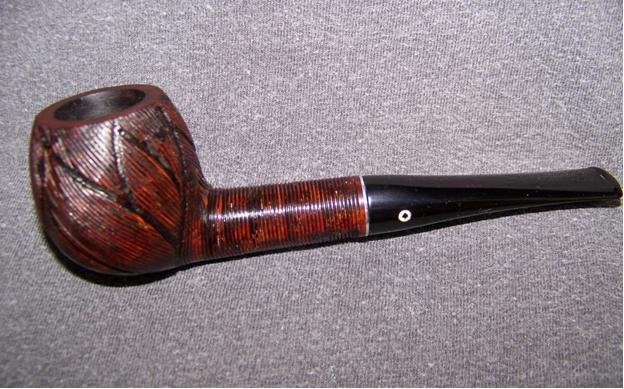
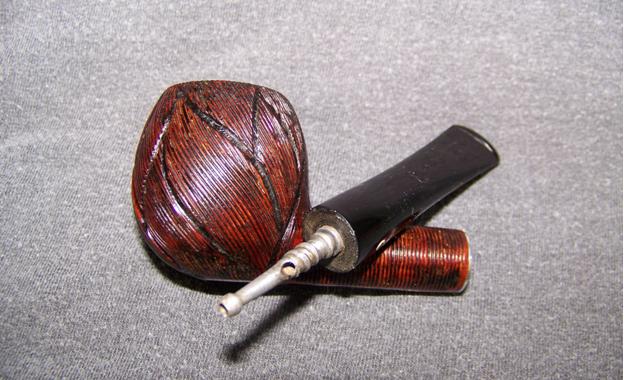
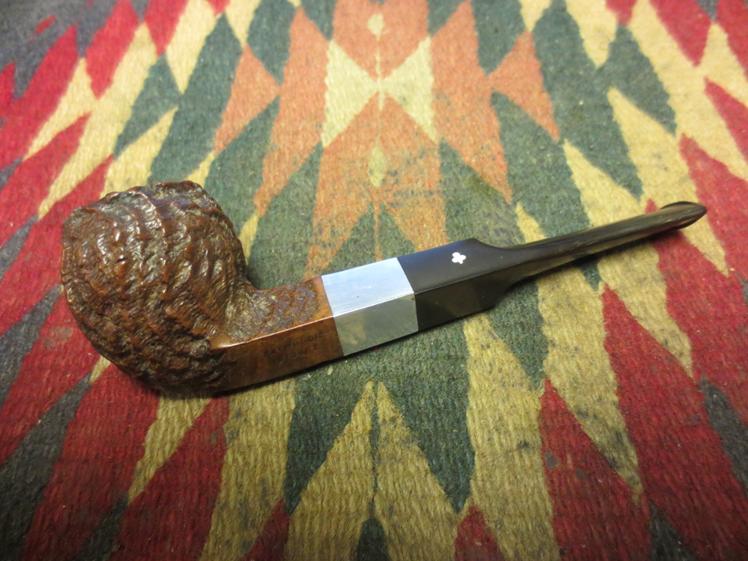
Tag Archives: pipe refurbishing

Rejuvenating a Caminetto Business Long Shank Stack


Blog by Steve Laug

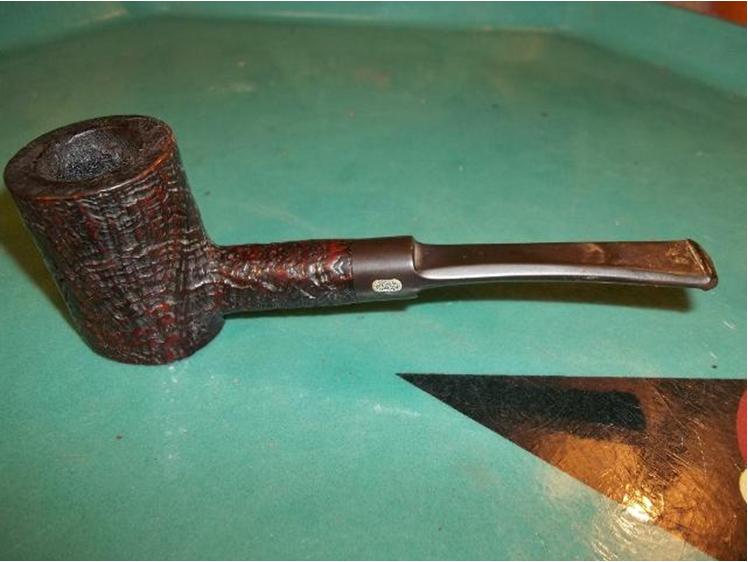
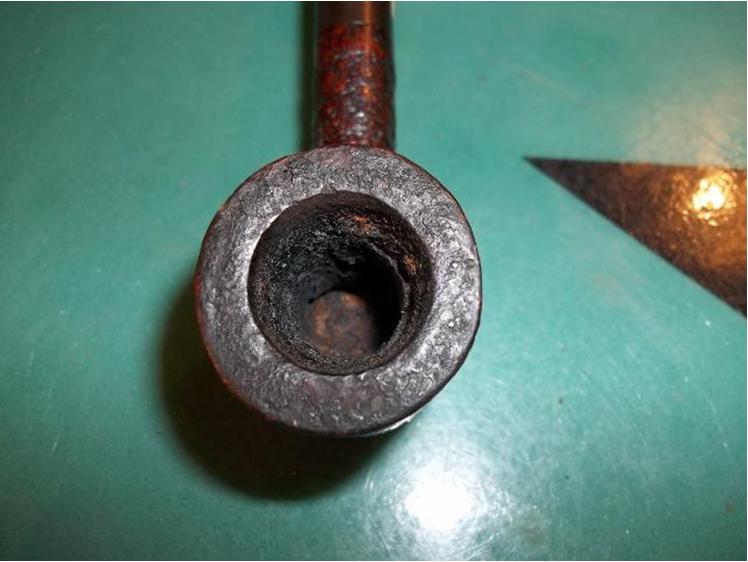
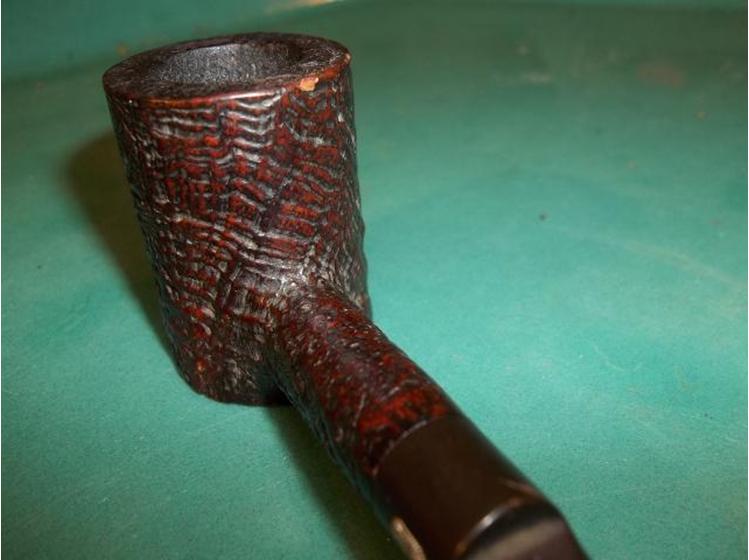
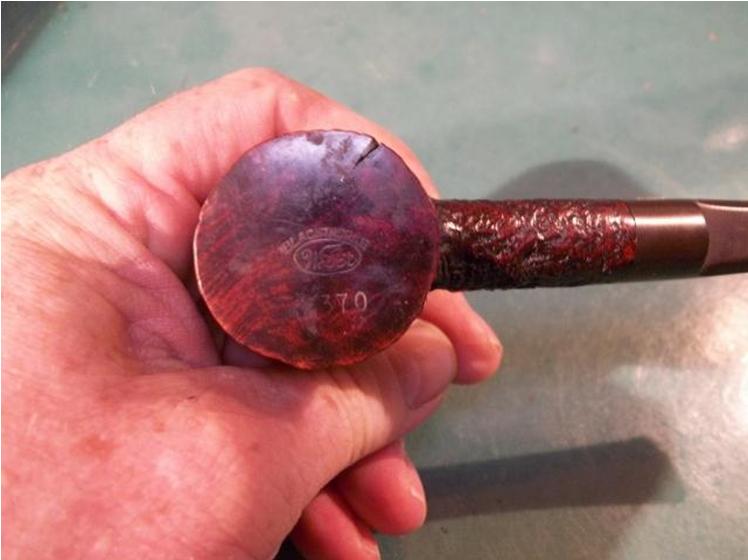
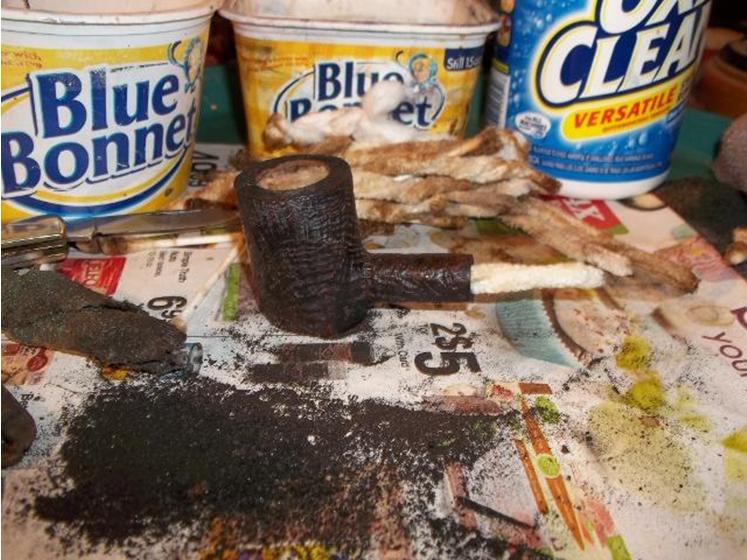
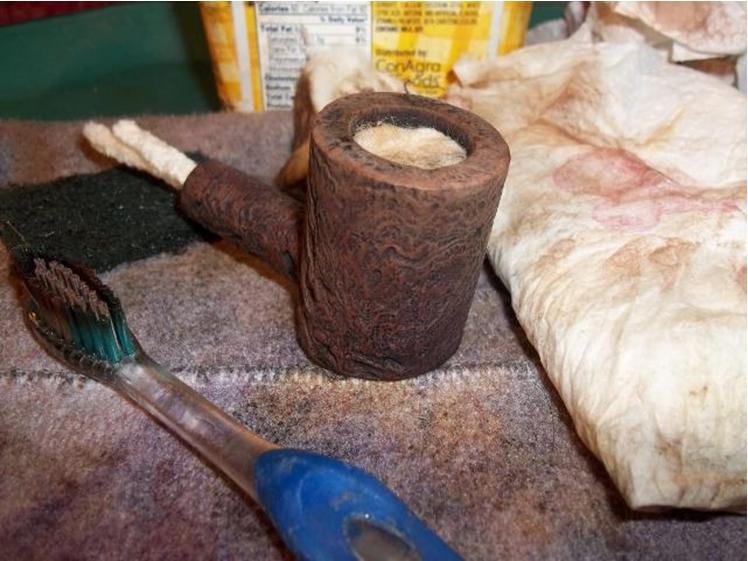
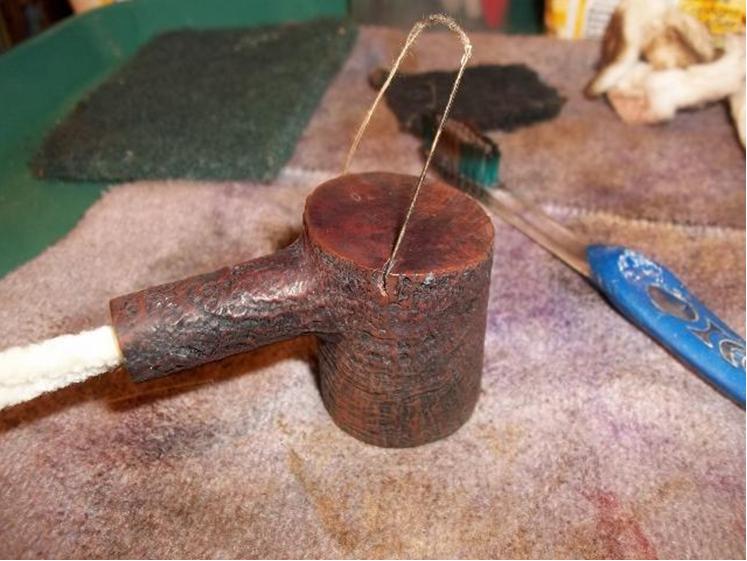
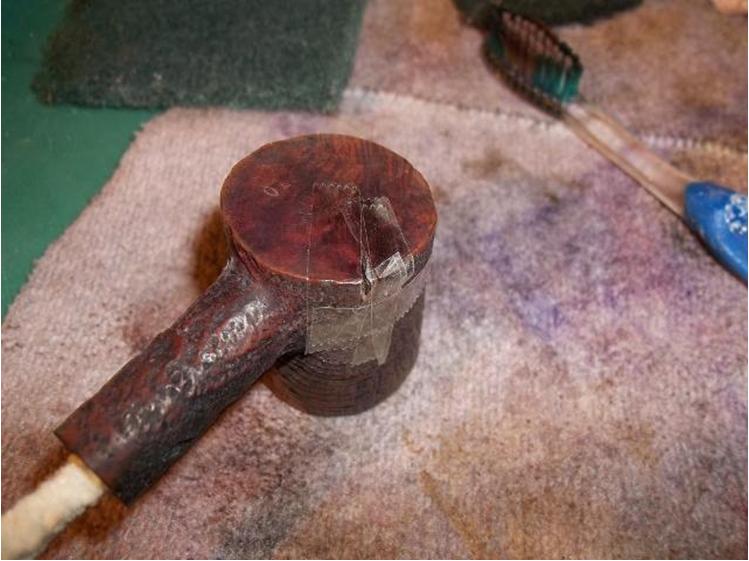
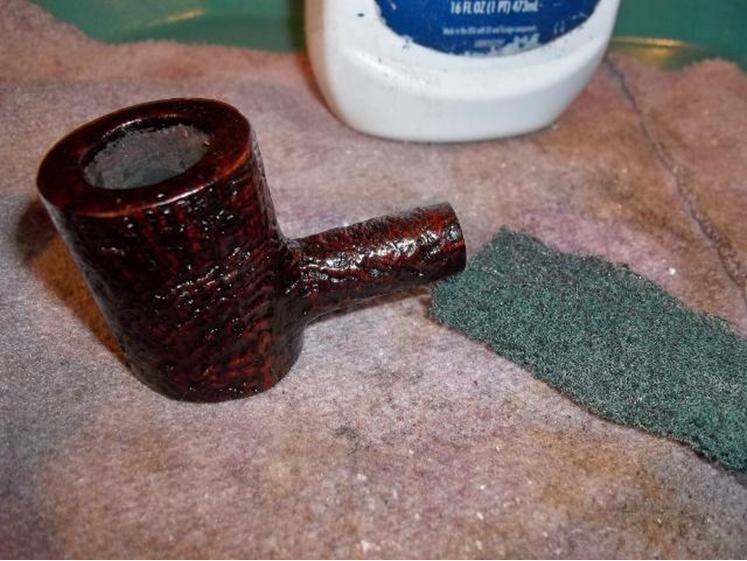
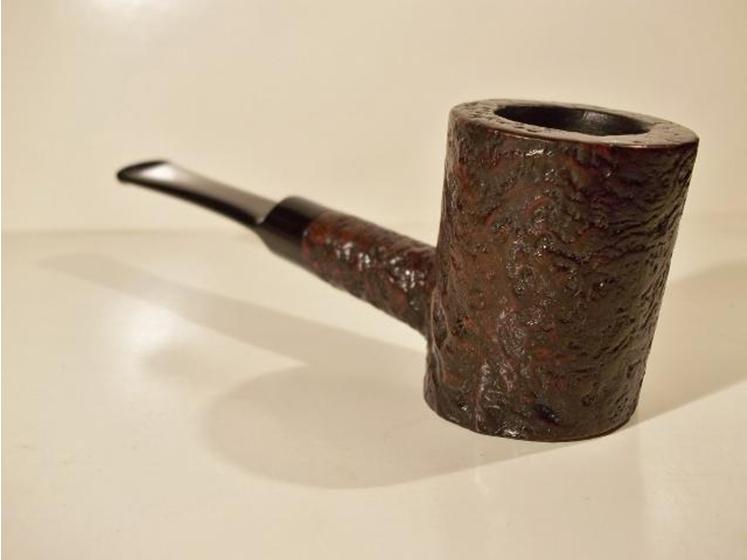
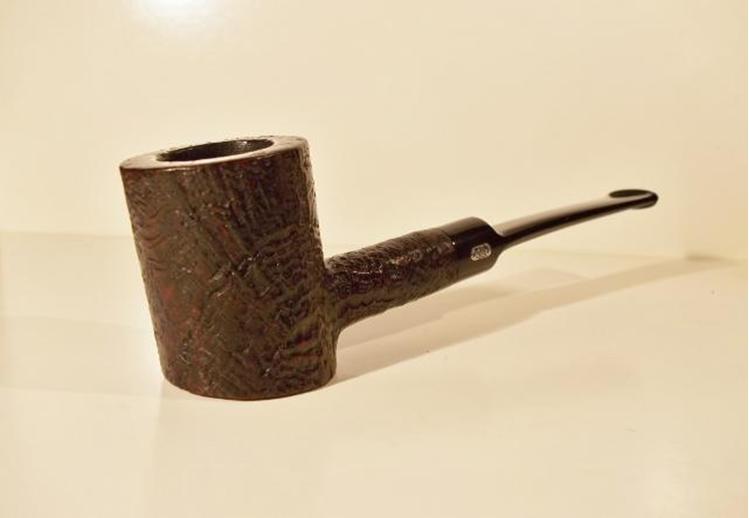
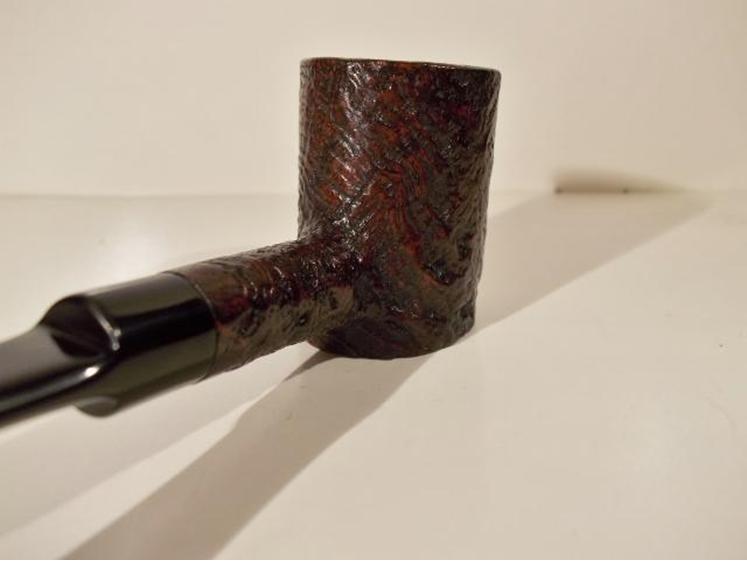
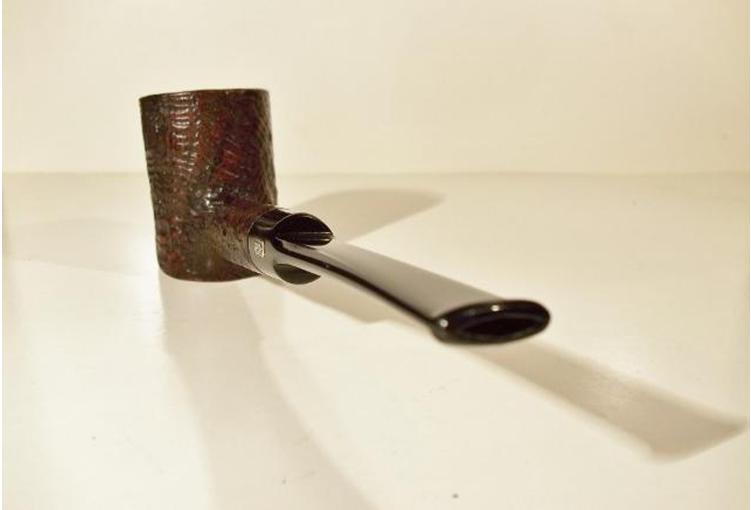
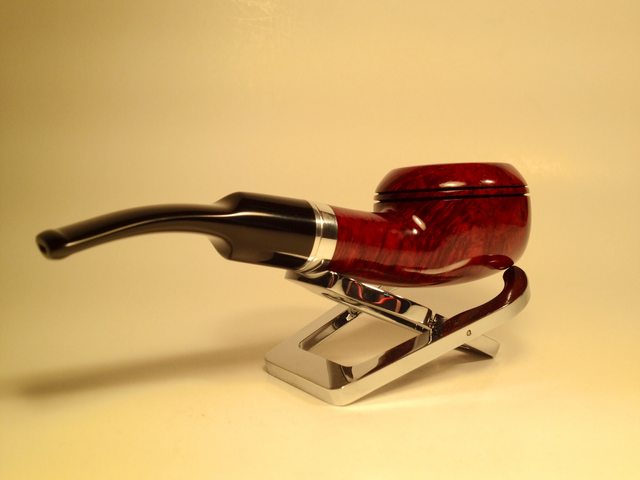
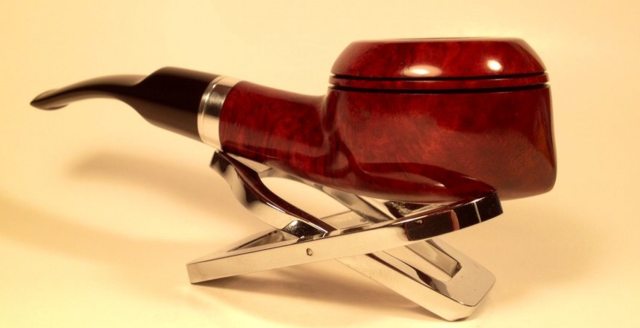
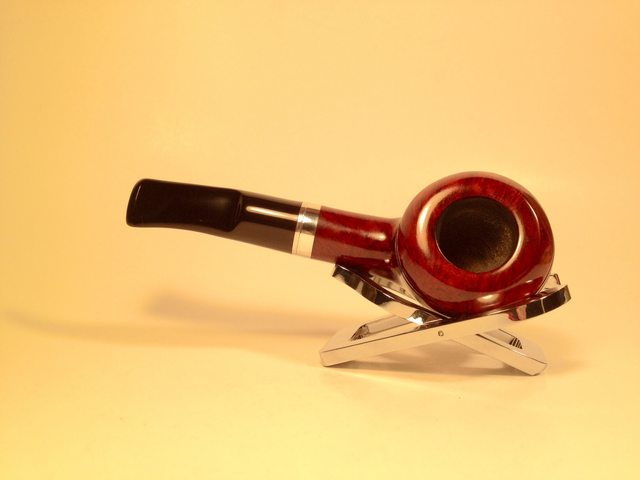
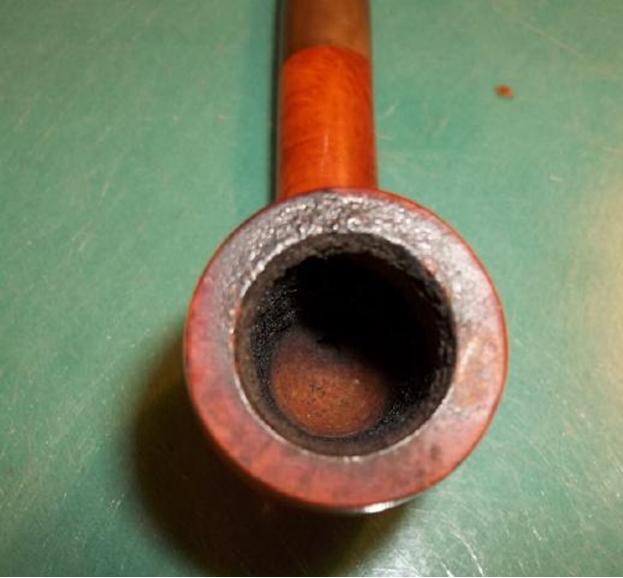
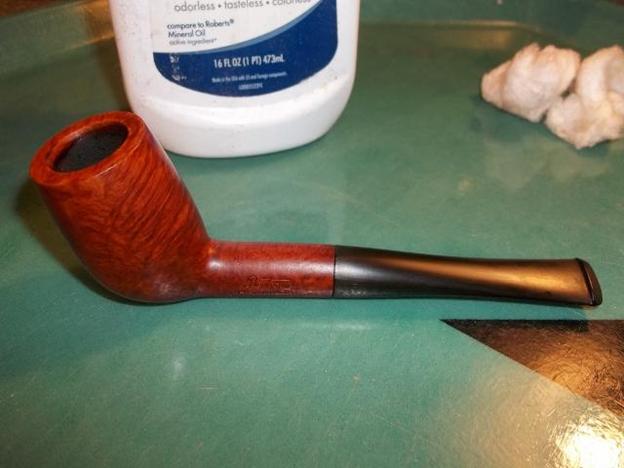
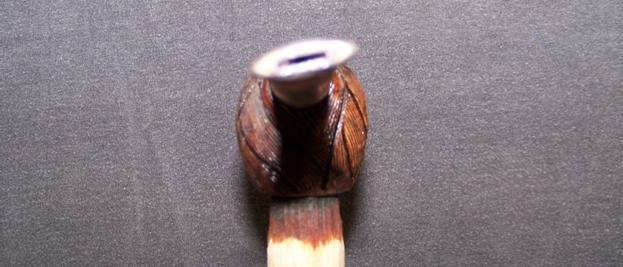
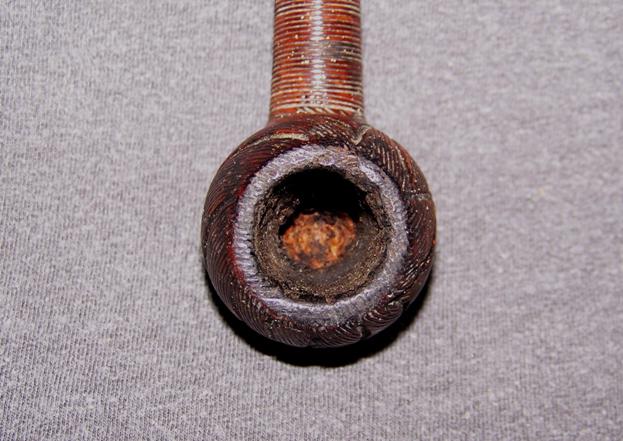
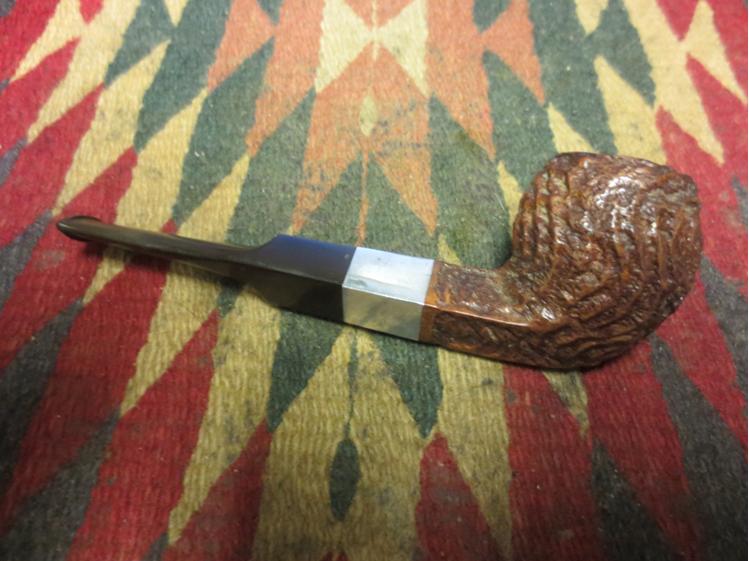
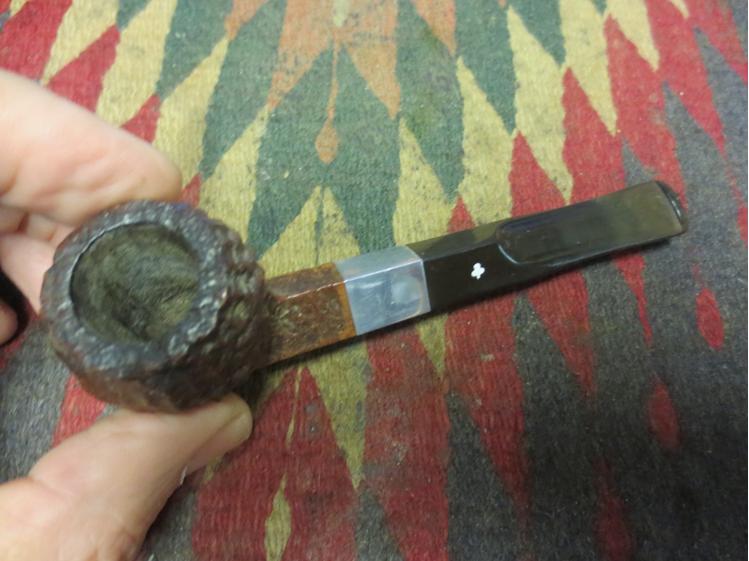
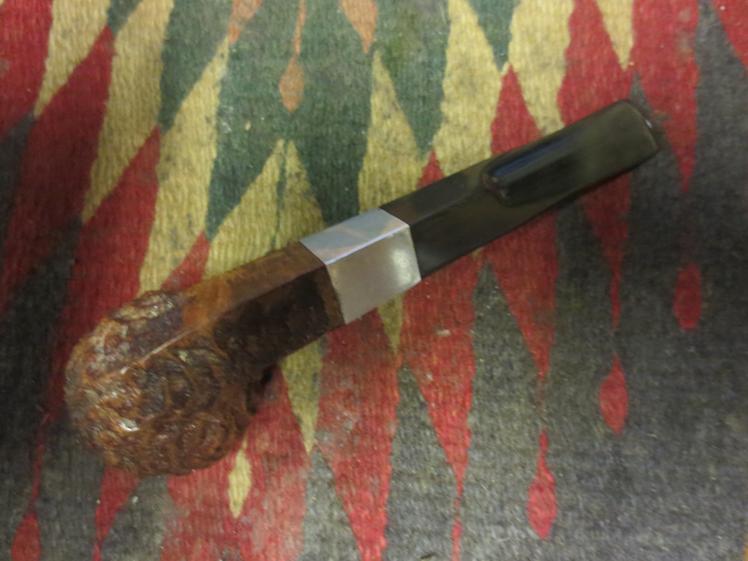
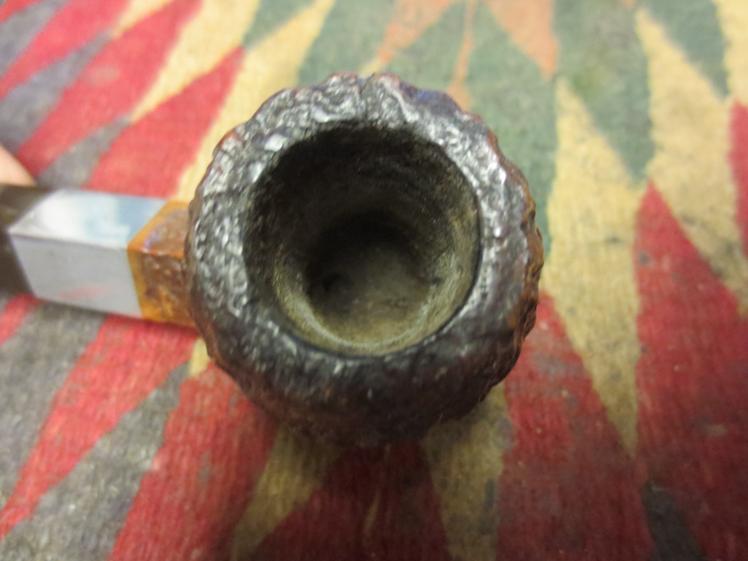
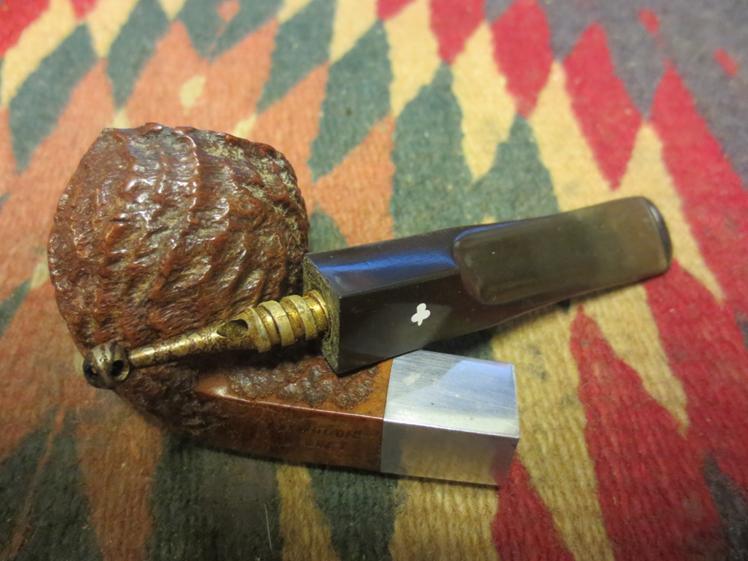
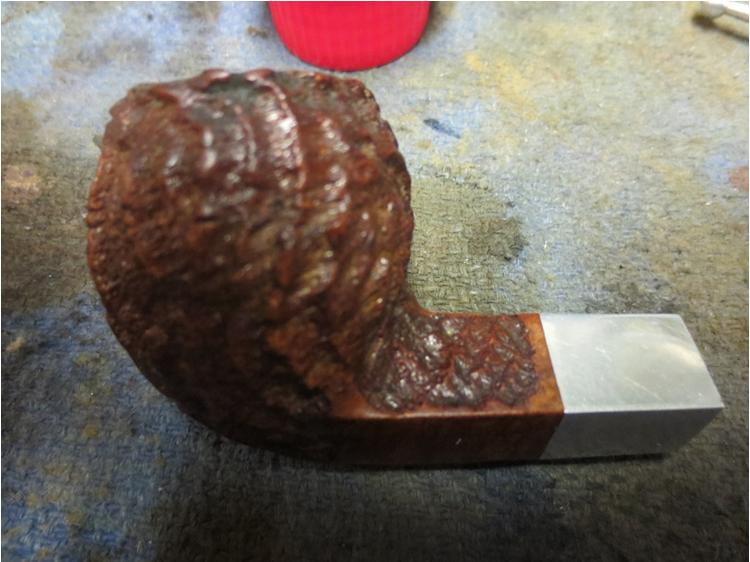
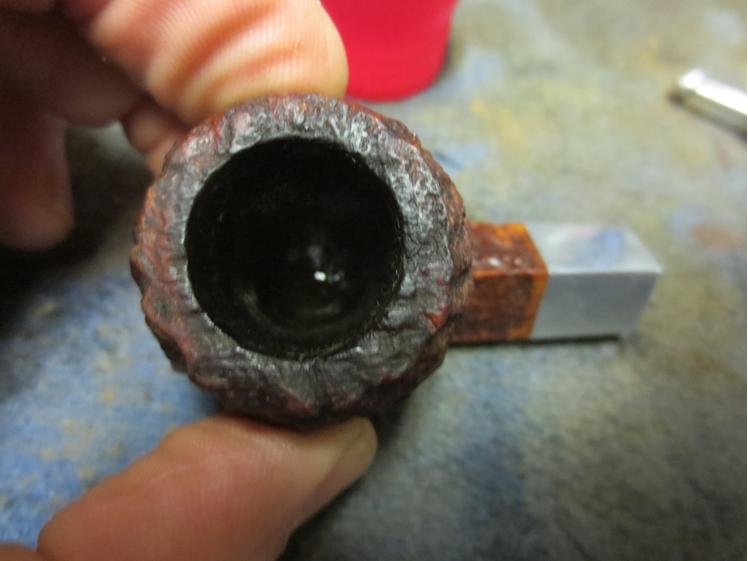
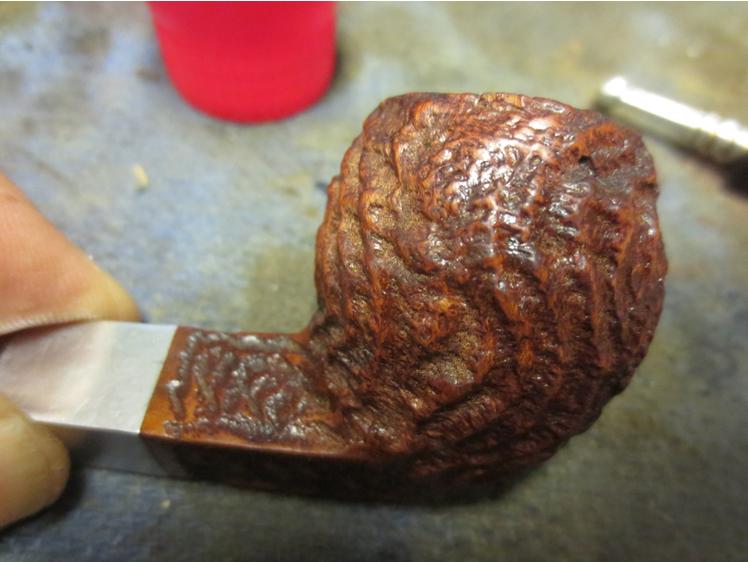
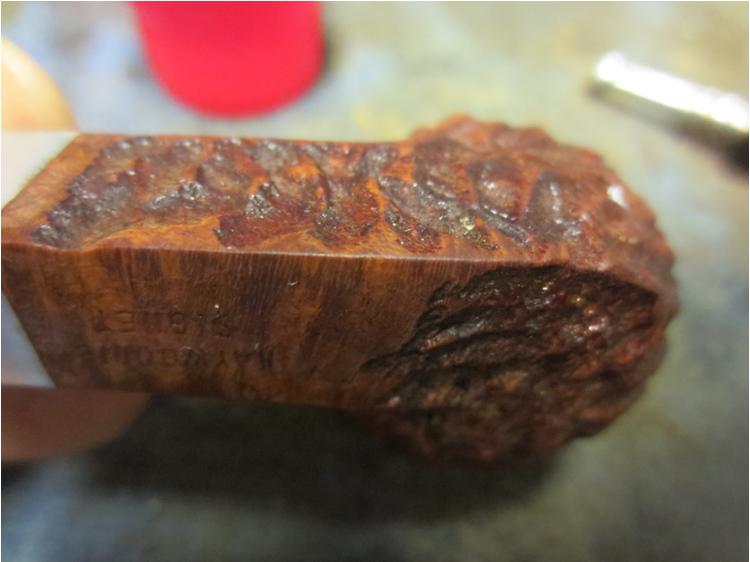
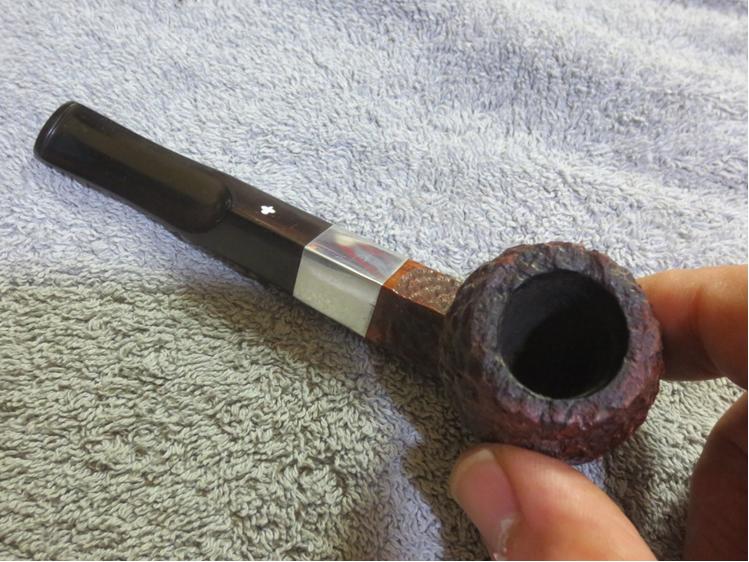
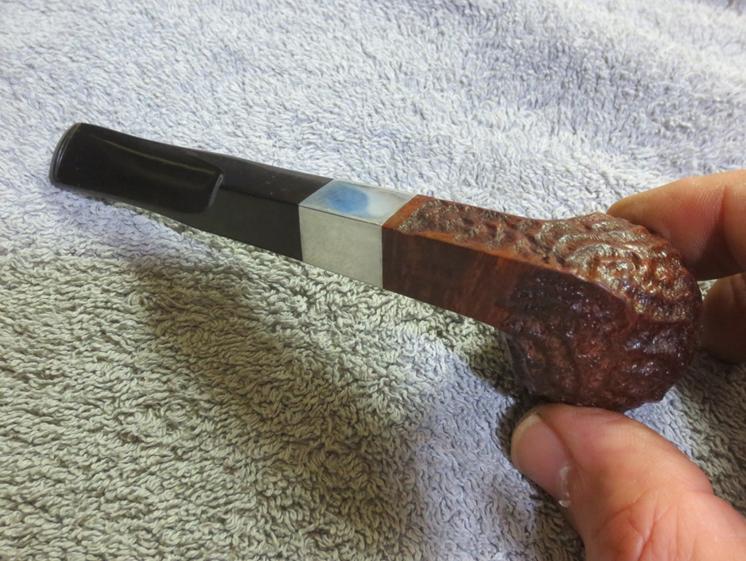
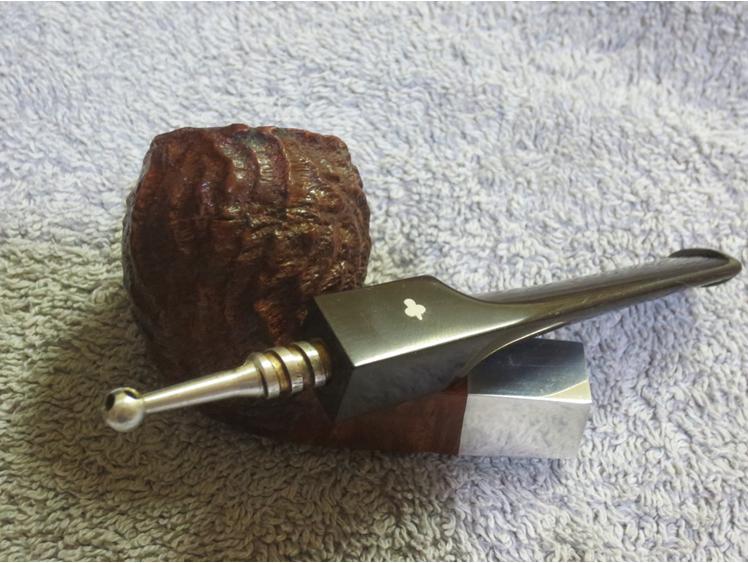
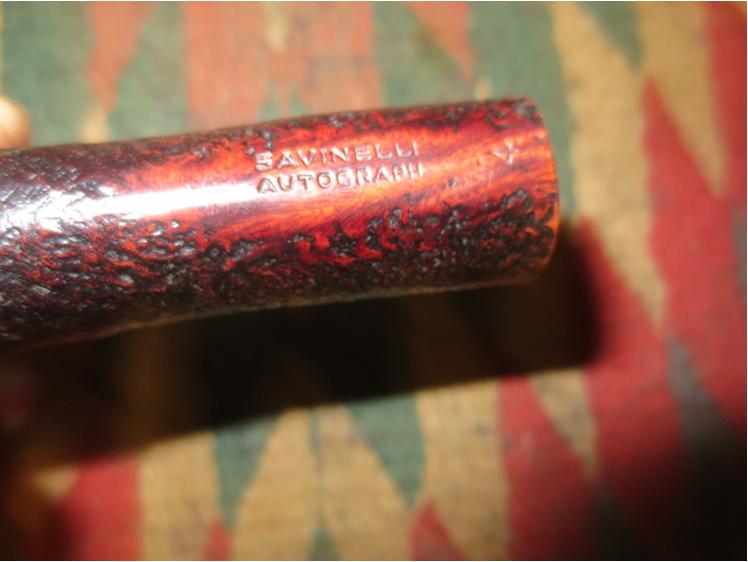
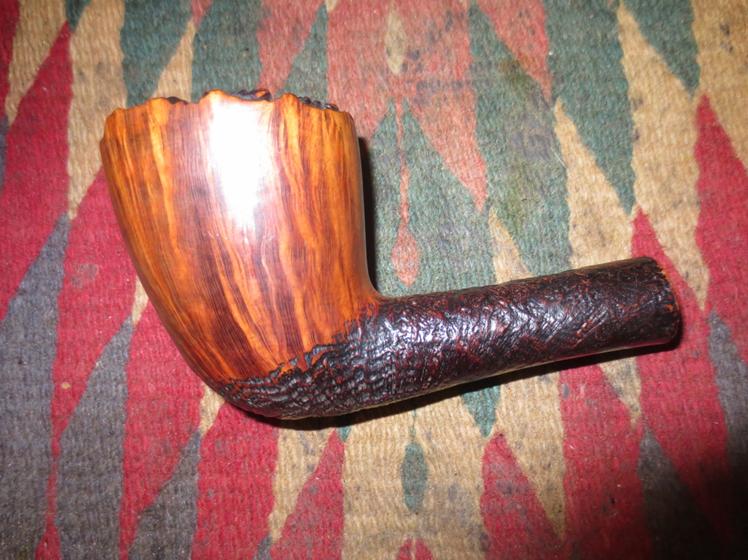
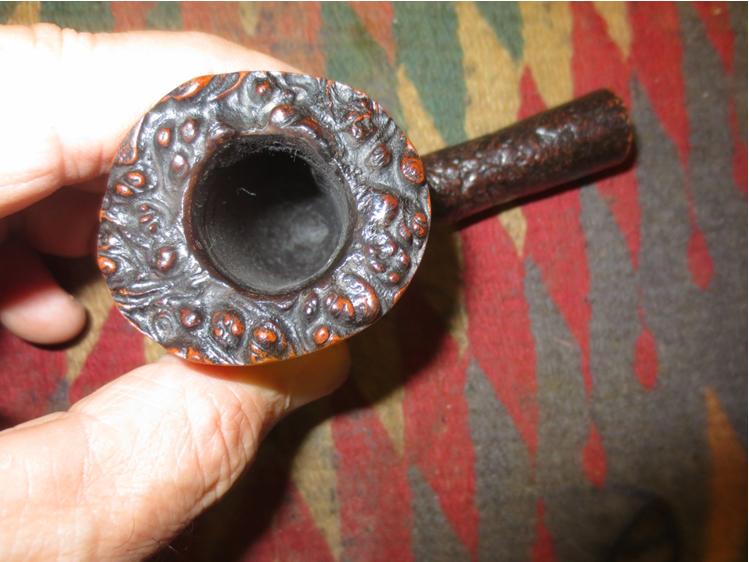
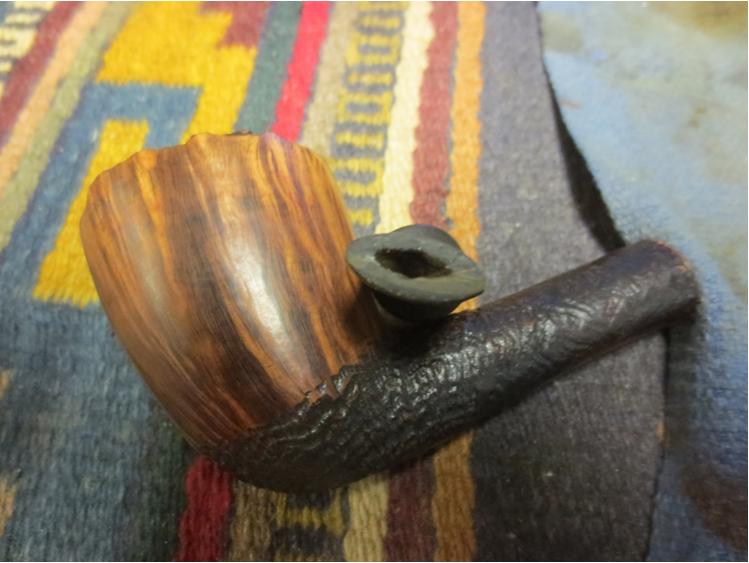
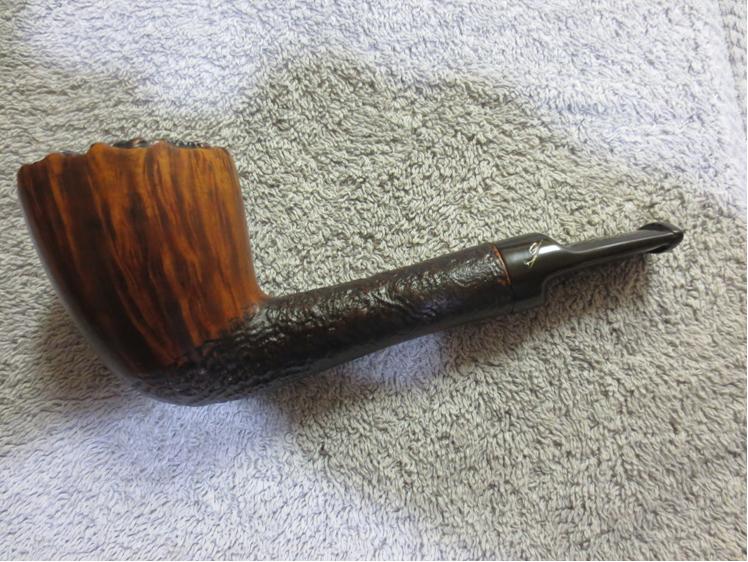
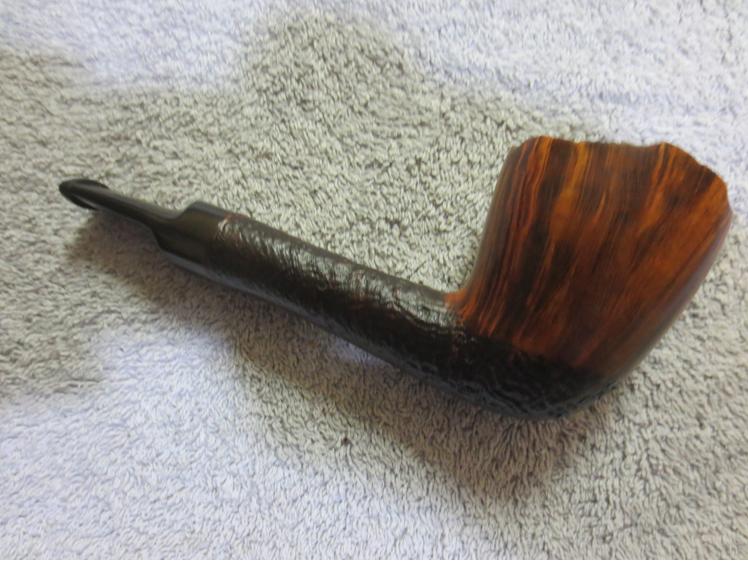
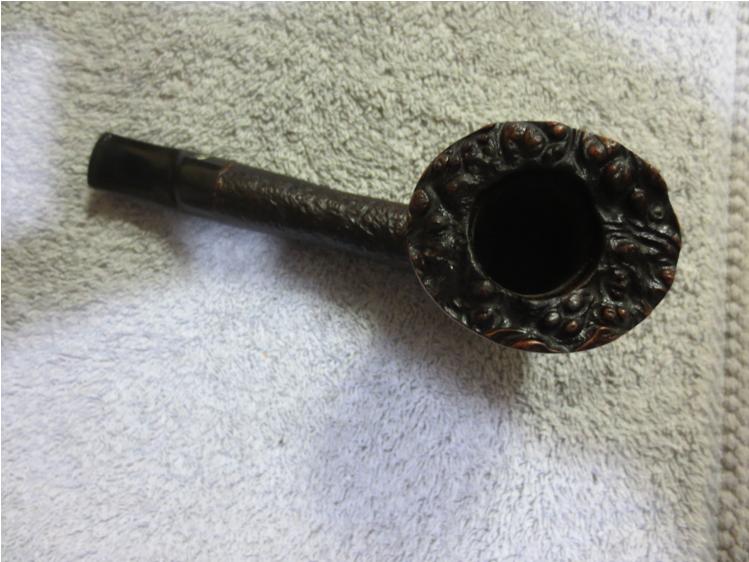
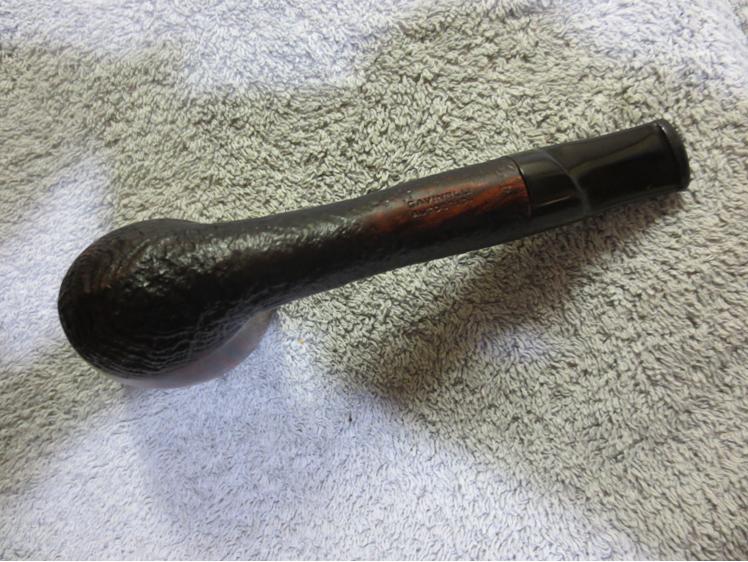
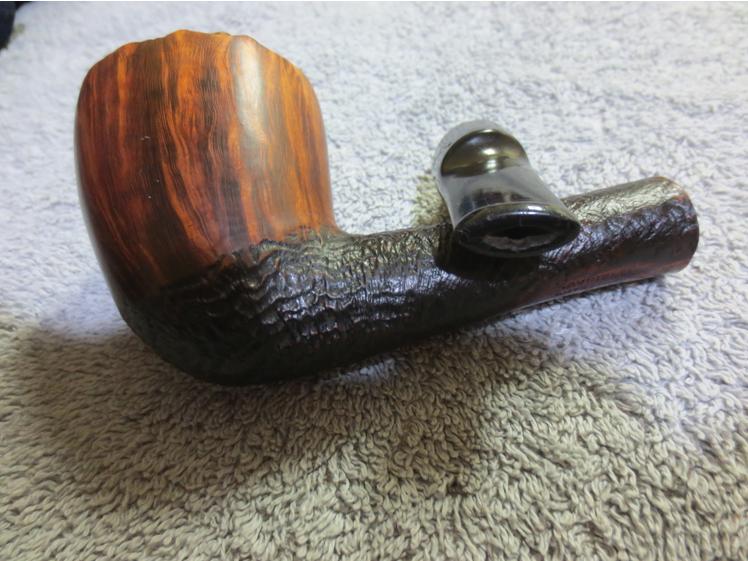
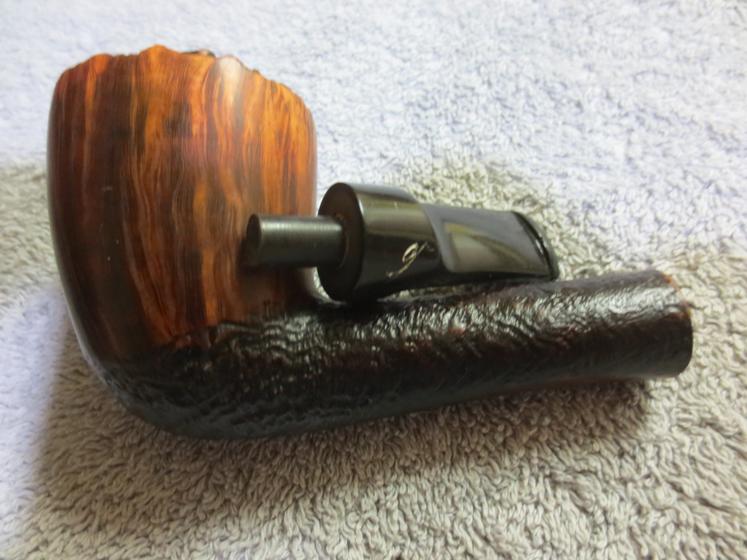
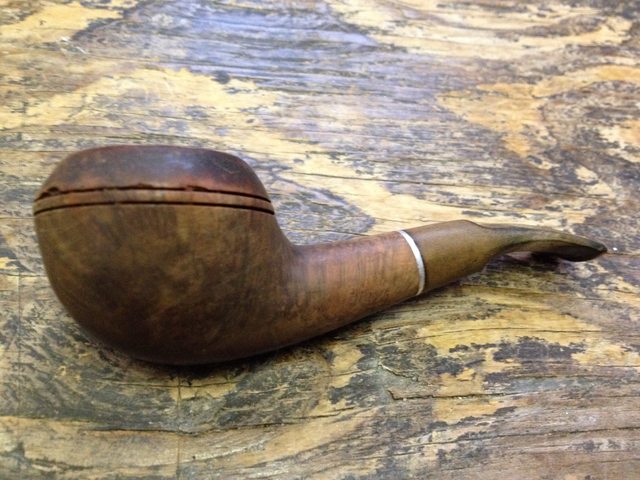
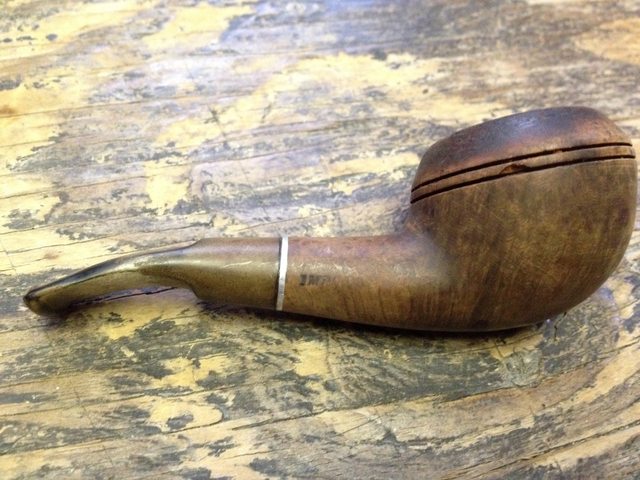
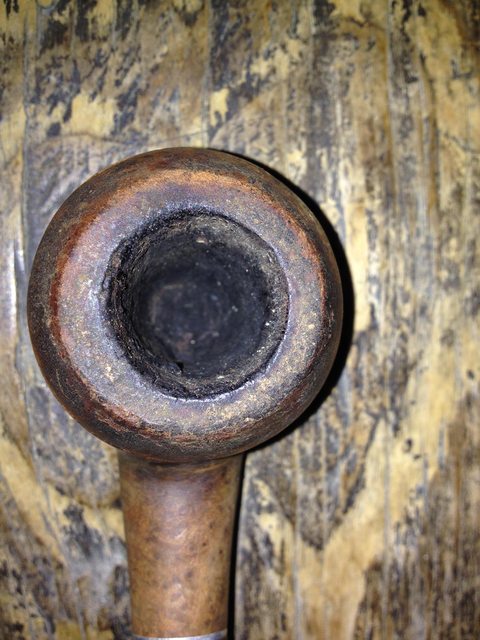
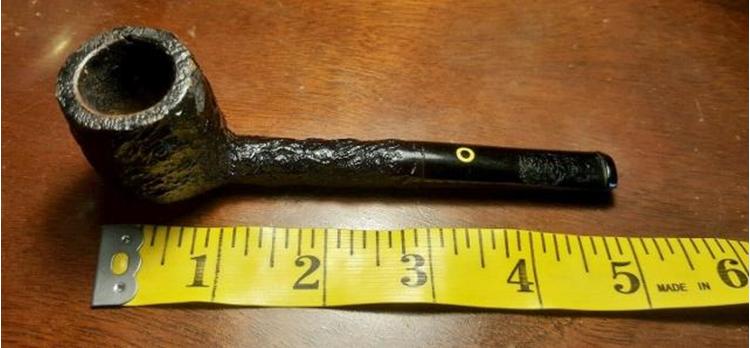
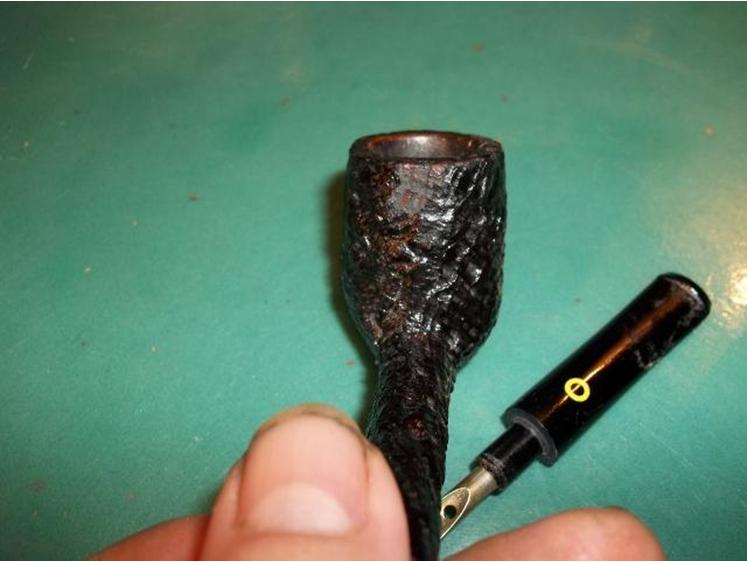
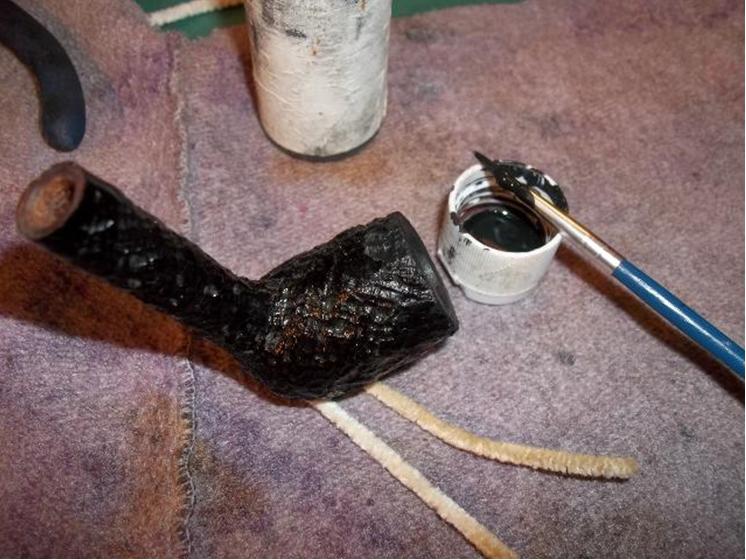
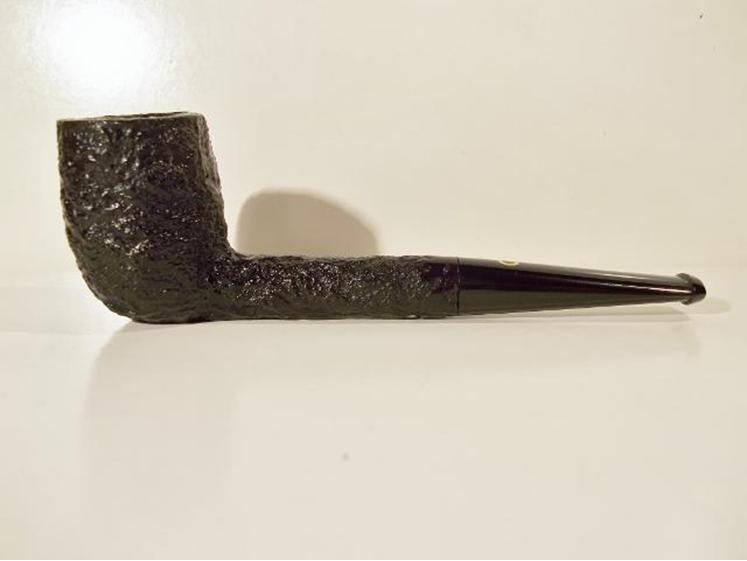
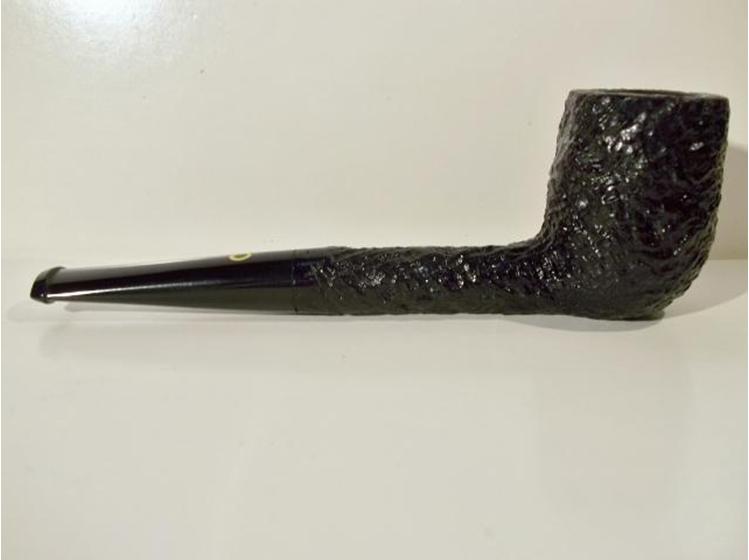
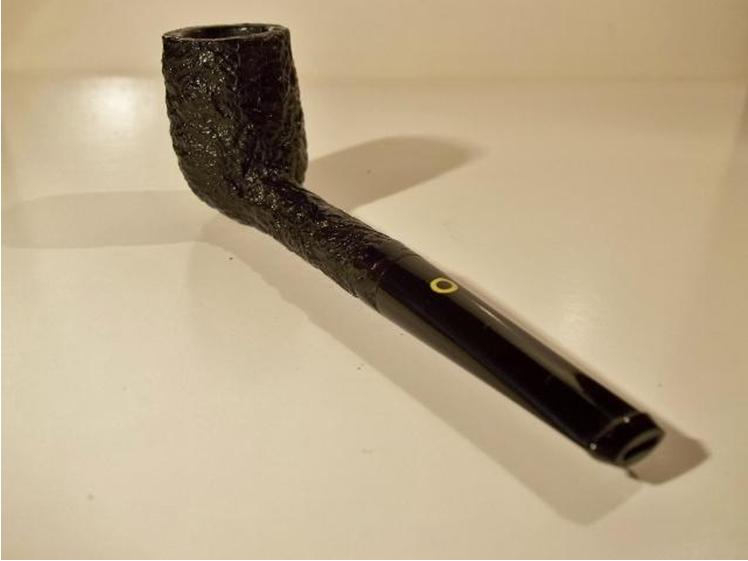
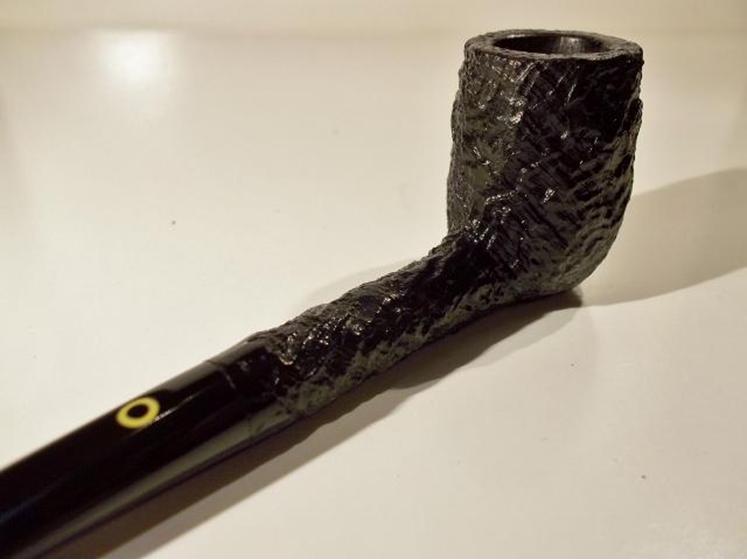
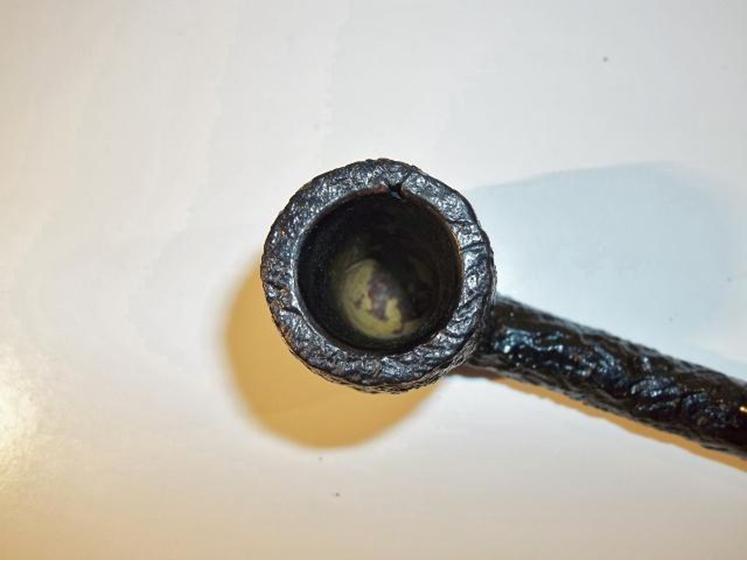
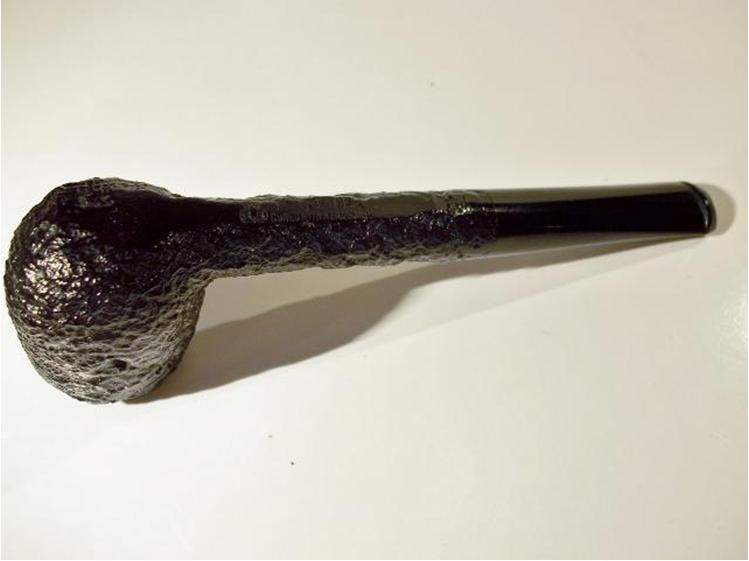
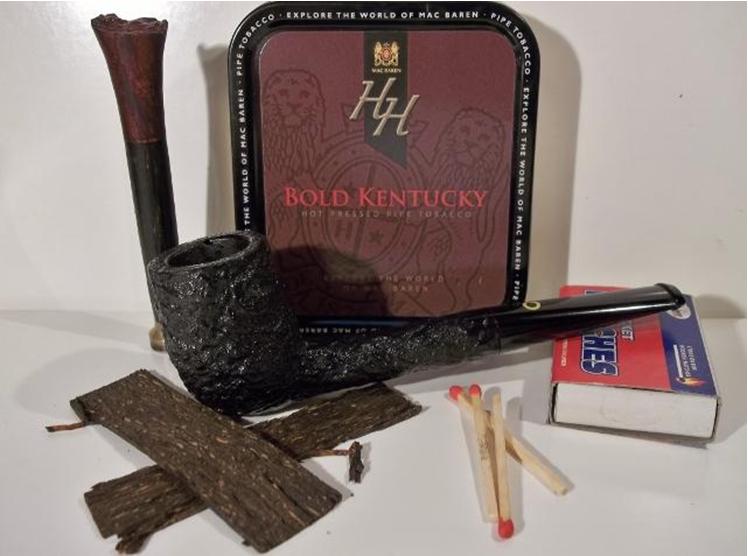
I just finished working on a long shank Caminetto Stack. It is stamped on the left side of the shank Caminetto Business. On the right side of the shank it is stamped Ascorti over Radice over Cucciago over Cantu Italy. Next to it is a shield. The finish is a rustication that looks very much like the older Castello Sea Rock finish. The bowl needed a thorough reaming to clean out the remnants of the old cake. The internals of the shank will also need a thorough cleaning. The pipe has a strong English smelling ghost that would need to be exorcised by a retort treatment. If that did not kill it then it would need to be given a cotton ball and alcohol treatment to further remove the ghost. The inner and out rim edges look really good. There is a build up tars and oils in the rustication on the top of the rim that will need to be scrubbed out. The deep rustication is also harbouring a lot of dust in the crevices that will also need to be scrubbed as well. Cam1

Cam2

Cam3

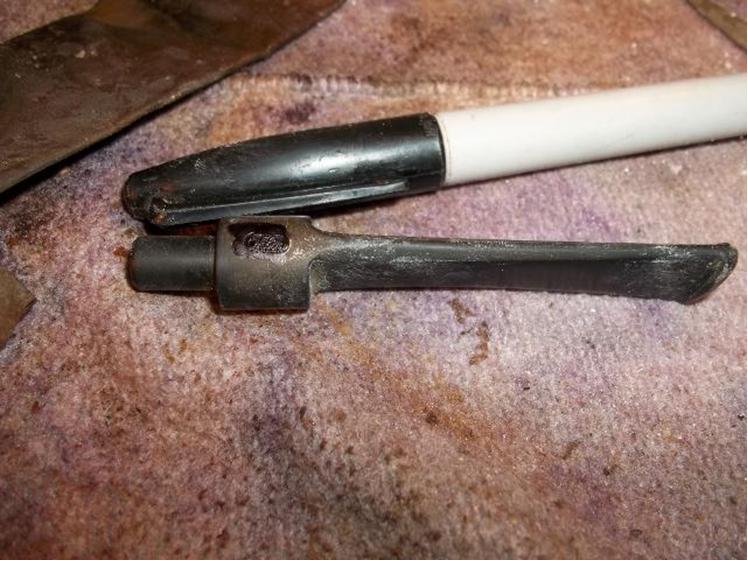
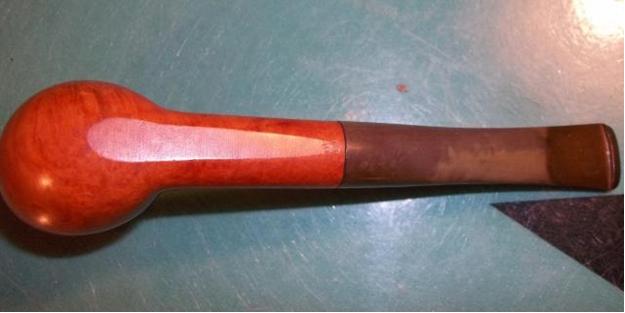
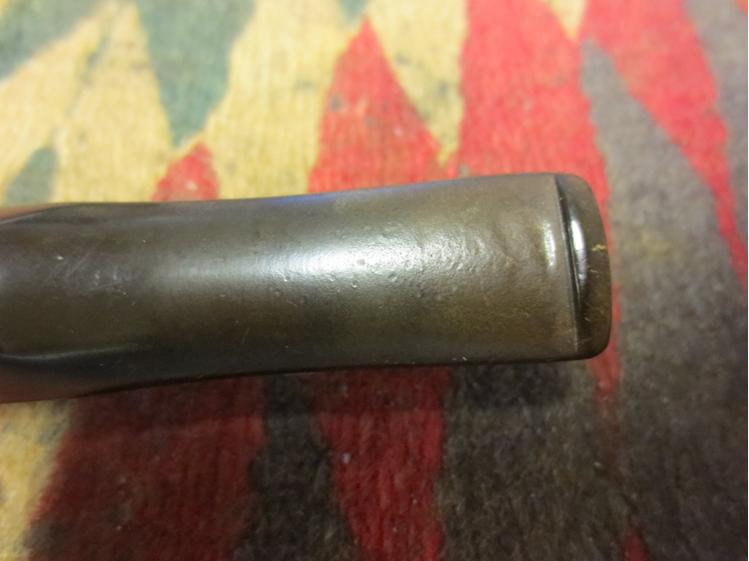
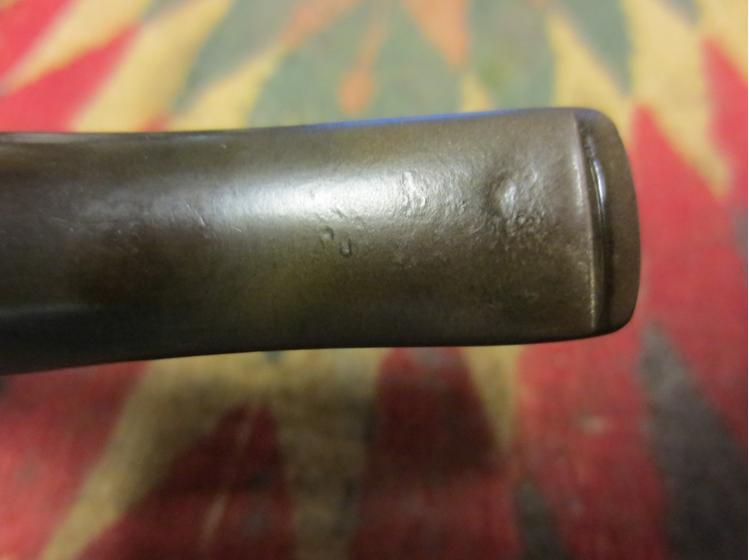
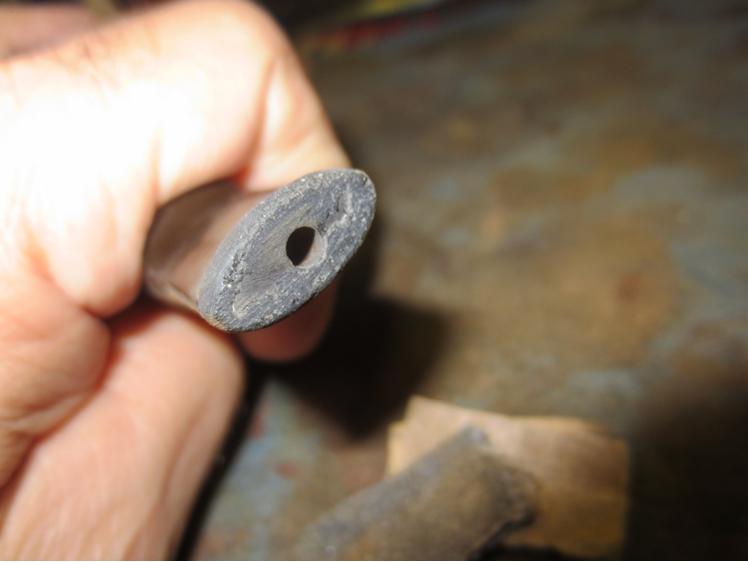
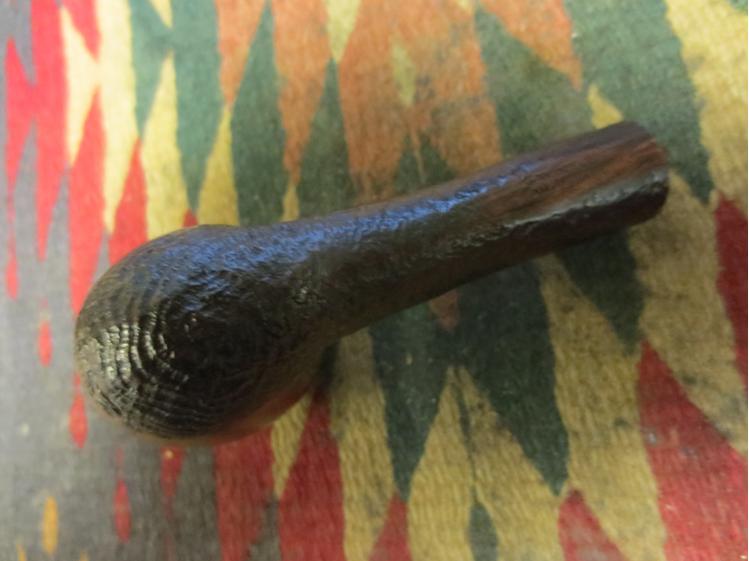
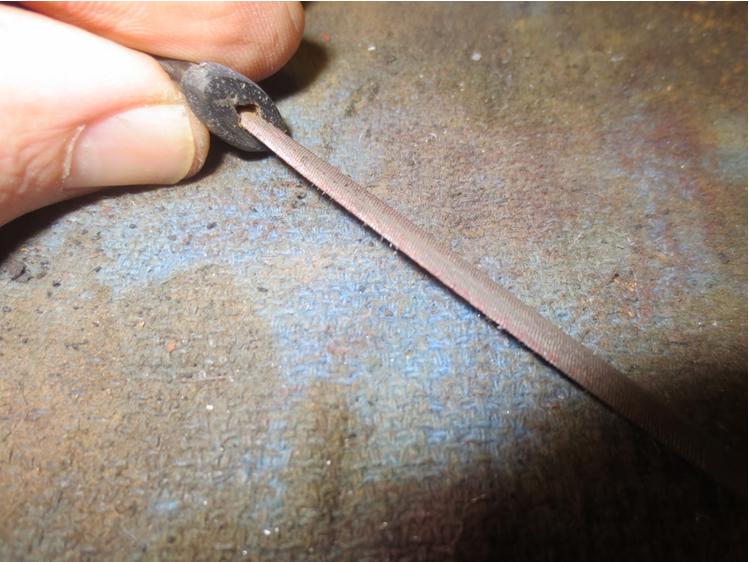
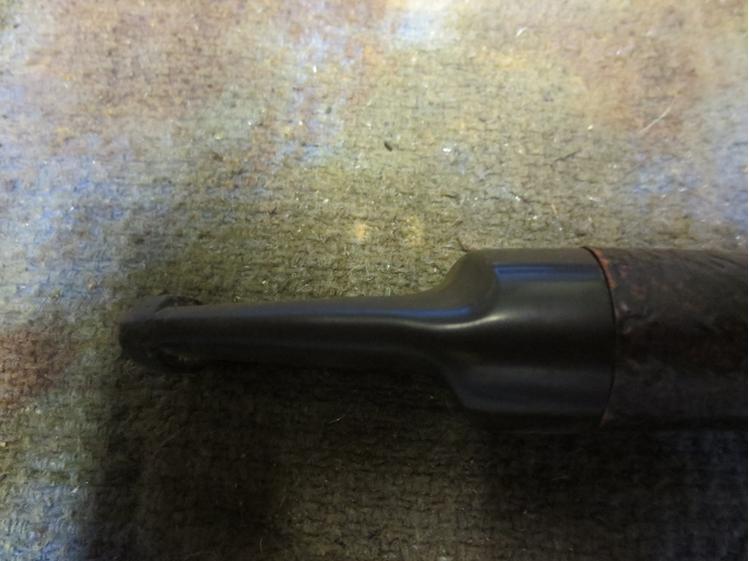
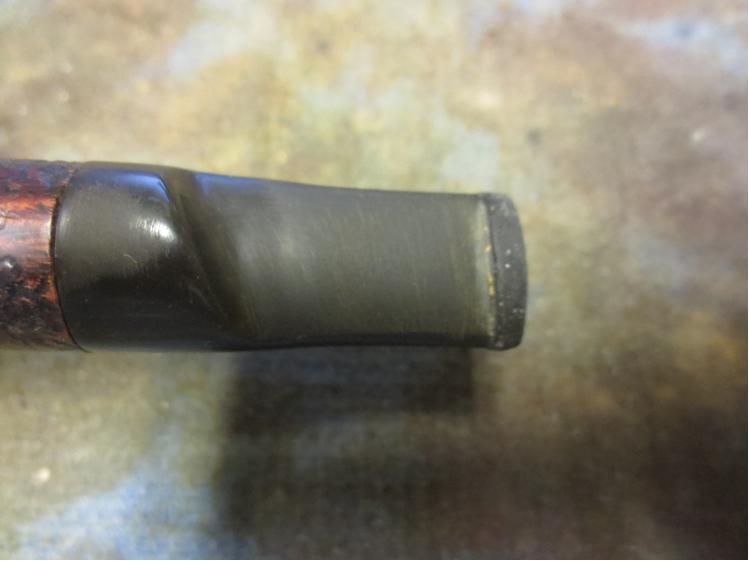
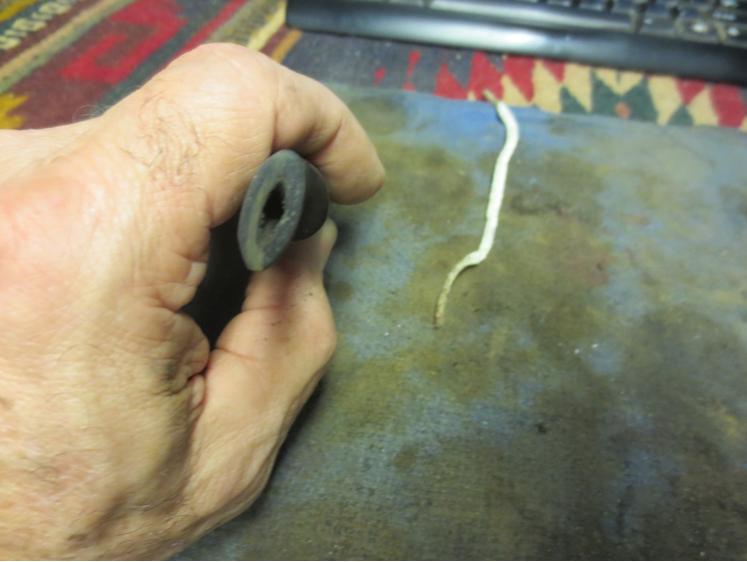
Cam4 The stem needs some work. It is loose in the shank and I will need to see what the fit is like once the shank is cleaned. There is a deep tooth mark on the underside of the stem next to the button. It is not quite broken through the surface of the stem but it is deep. There are also marks on the topside of the stem in the same place though nowhere near as deep. The stem was almost clogged and will need to be cleared. The slot is tight and hard to get a pipe cleaner through easily. It will need to be opened to make cleaning the pipe a simpler procedure. Between the semi-clogged stem and the tight slot the draw is constricted. Once the repairs are made to the stem it will need to be polished.Cam5

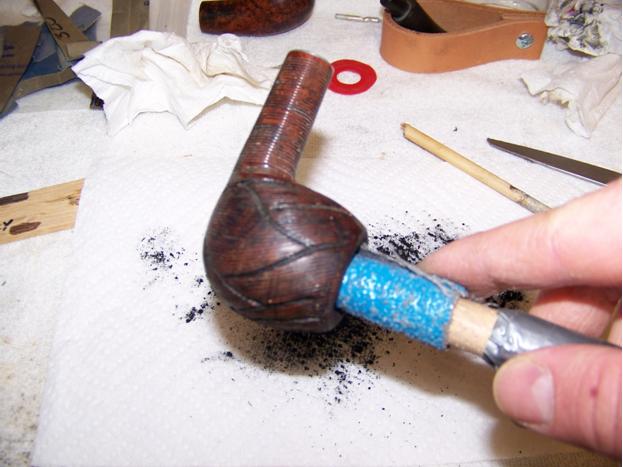
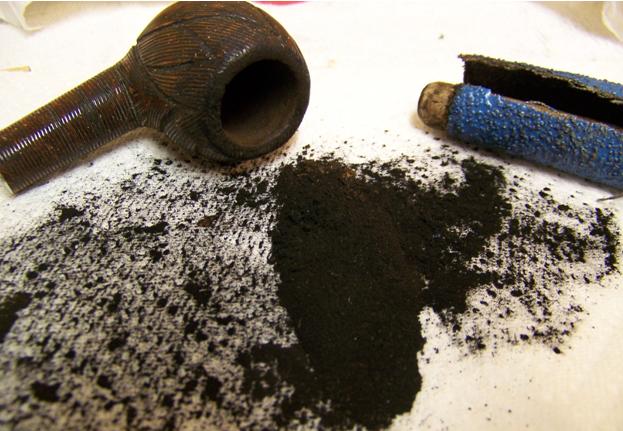
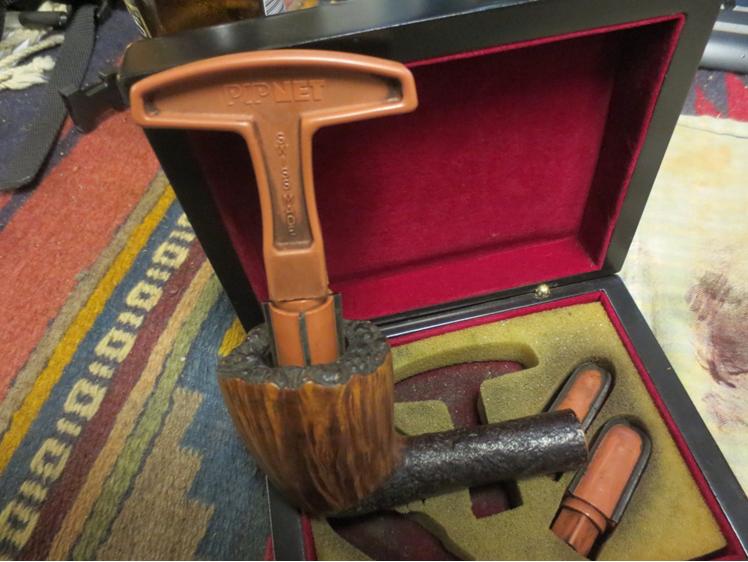
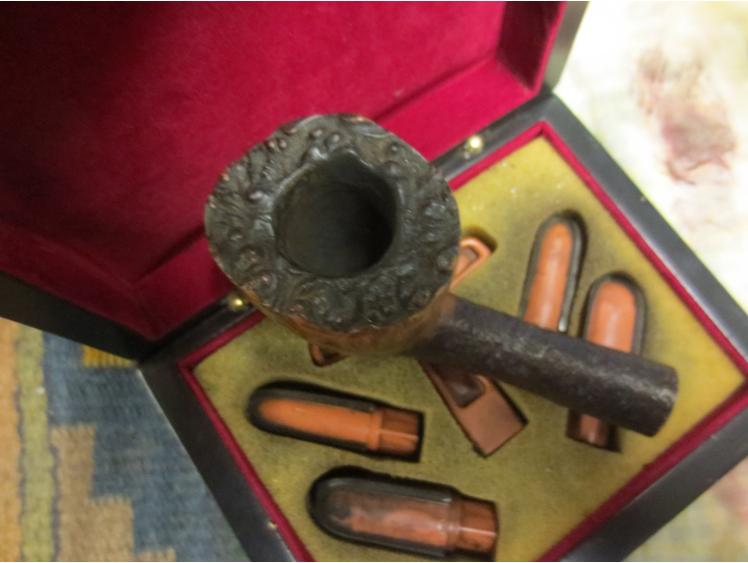
Cam6 I took a close-up photo of the rim for you to see clearly the build up on the rim. There were tars and oils deep in the grooves of the rustication on the surface of the rim. There was also a thin cake on the walls of the bowl that would need to be removed to address the heavy Latakia smell that was in the pipe.Cam7 I reamed the bowl with a PipNet reamer using the smallest cutting head and working up to the third head that was the same diameter as the bowl. I then scraped the inside lightly with a sharp pen knife.Cam8
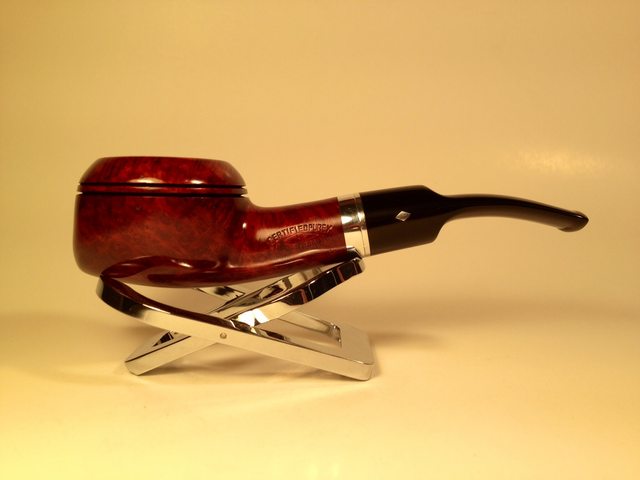
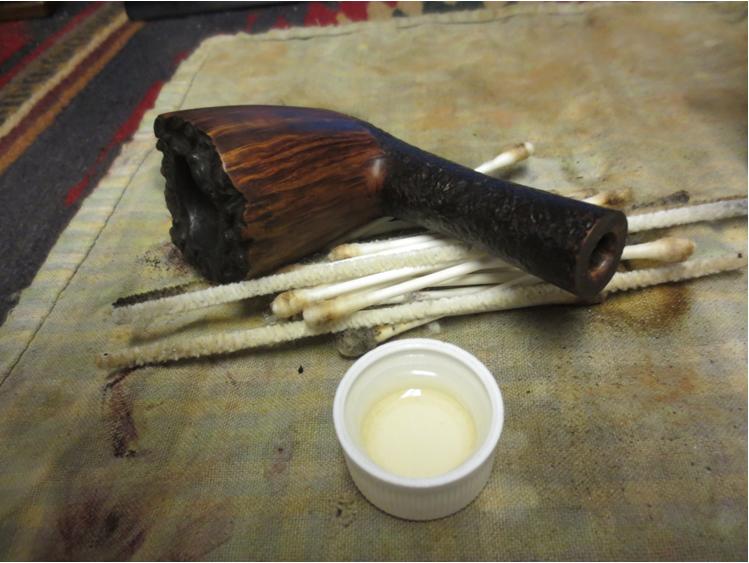
Cam9 I scrubbed the inside of the shank with pipe cleaners and cotton swabs and isopropyl 99% alcohol before setting up a retort to boil alcohol through the inside of the pipe. I stuffed a cotton ball in the top of the bowl and then fit the rubber end of the test tube stopper over the stem. I place the bowl in a pipe rest and held the test tube over a candle. As the alcohol heated and boiled in the test tube it circulated into the bowl and when removed from the flame the alcohol would carry the tars and oils back to the test tube. I continued to boil the alcohol and remove it from the flame until the alcohol turned amber from the inside of the pipe.Cam10

Cam11

Cam12

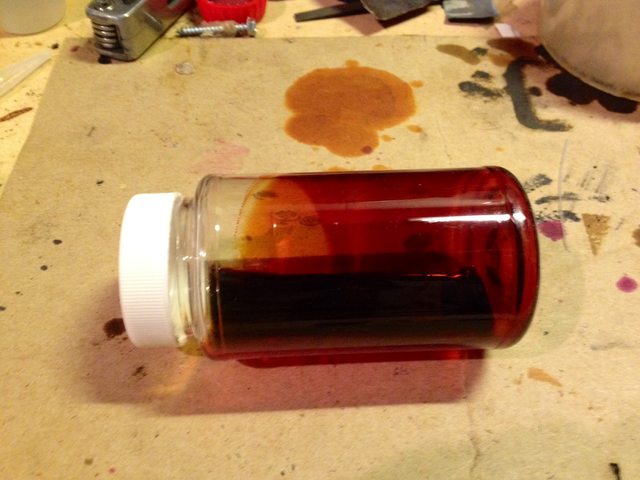
Cam13 I changed the alcohol and boiled it through the pipe again. This second time the alcohol came out clean. I kept it boiling through for about 15 minutes and then removed it from the flame. The photo below shows the relatively clean alcohol after this retort.Cam14 Once I had removed the retort I cleaned out the bowl and the shank with isopropyl alcohol on cotton swabs and pipe cleaners. This time they came out relatively clean.Cam15 The problem was that the pipe still smelled strongly of Latakia. The ghost was stubborn and persistent. I decided to use a cotton ball and alcohol soak to see if I could draw out some more of the oils and smell. I stuff two cotton balls into the bowl and plugged the shank. I used an ear syringe to fill the bowl with alcohol and tipped it back and forth to run the alcohol through the shank. I unplugged the shank and set the bowl in an old ice cube tray over night to draw out the oils. The next three photos were taken over a 12 hour period and show what happened with the soak.Cam16

Cam17

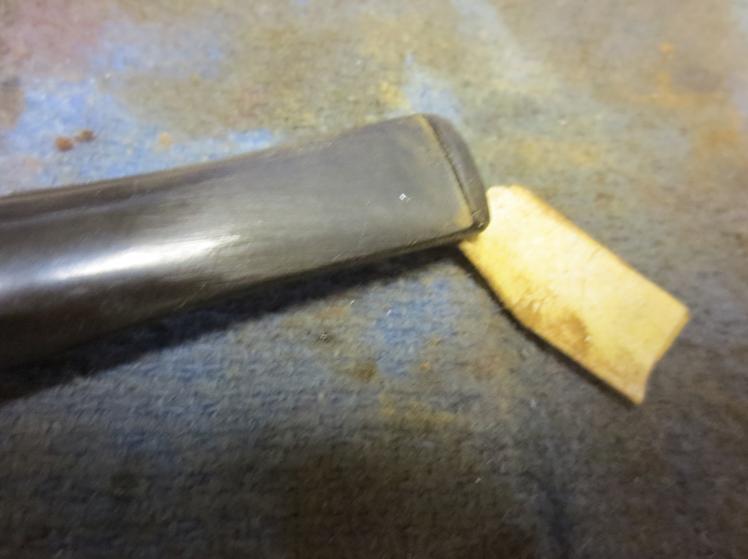
Cam18 When I removed the cotton balls and let the pipe dry out the ghost still persisted. I cleaned out the bowl and shank again, then put some white vinegar and cotton in the bowl and shank and let it sit for 3 hours. I cleaned out the shank and the ghost still remained. I was beating it but it was still present. I then filled the bowl with Kosher rock salt and then used an ear syringe to fill it with alcohol. I set it aside in the ice cube tray to let the salt do its magic.Cam19
Cam20

Cam21 Once I removed the salt and alcohol and cleaned out the shank and bowl a final time the ghost is pretty well exorcised. There is a faint tobacco smell but the overpowering smell is gone.

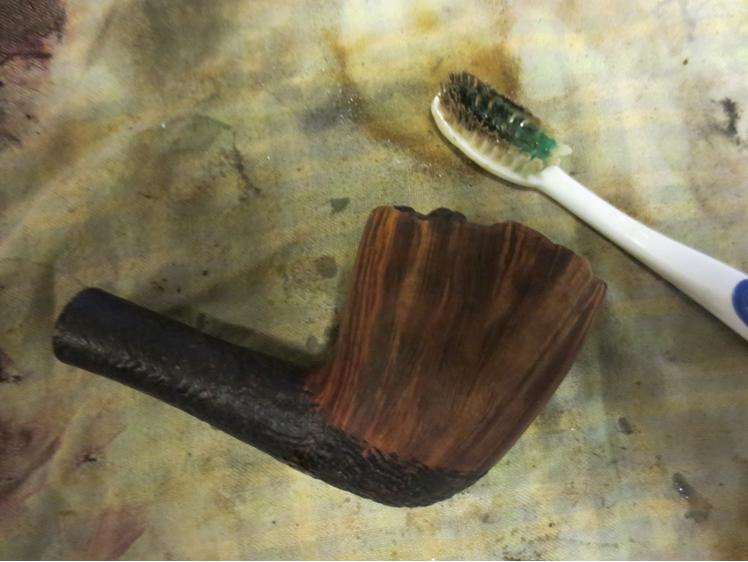
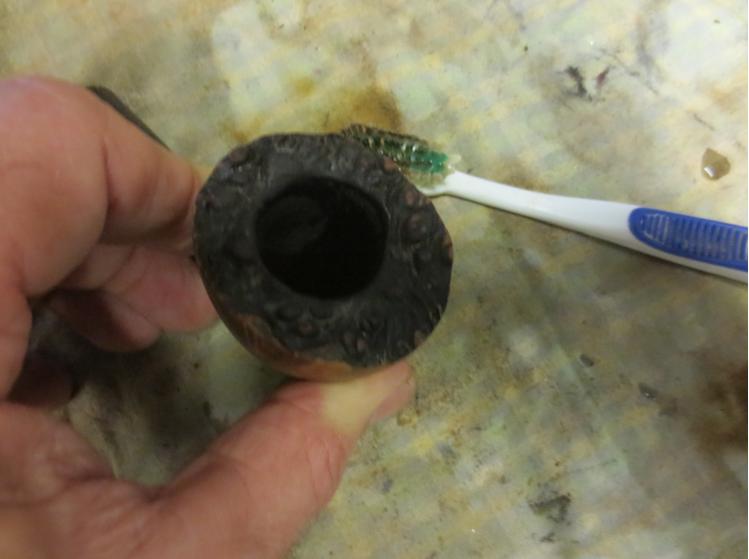
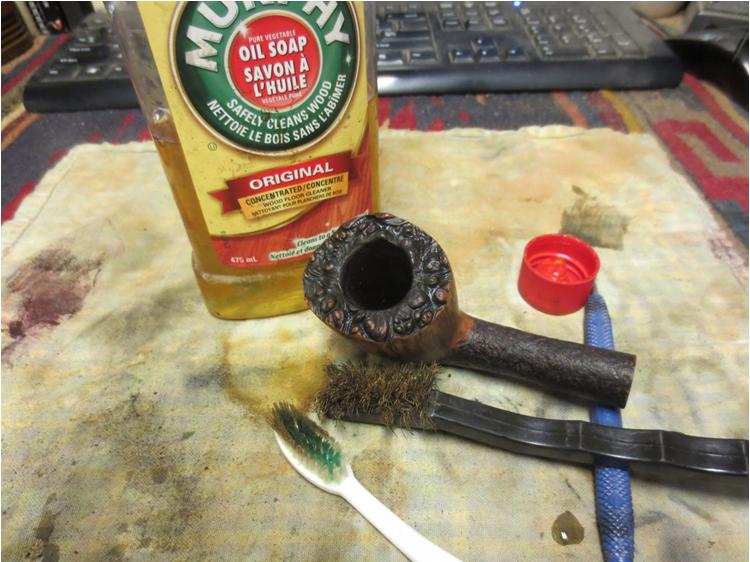
I scrubbed the top of the rim with a brass bristle tire brush and then rescrubbed it with a tooth brush and Murphy’s Oil Soap. I scrubbed it hard enough to remove the dust and grime from the crevices of the rusticated finish.Cam22

Cam23 I rinsed the bowl under running water to remove the soap from the finish, being careful to not get any water in the bowl. I dried it off with a cotton cloth. The photos below show the cleaned bowl. The finish was dull and had lightened slightly.Cam24

Cam25

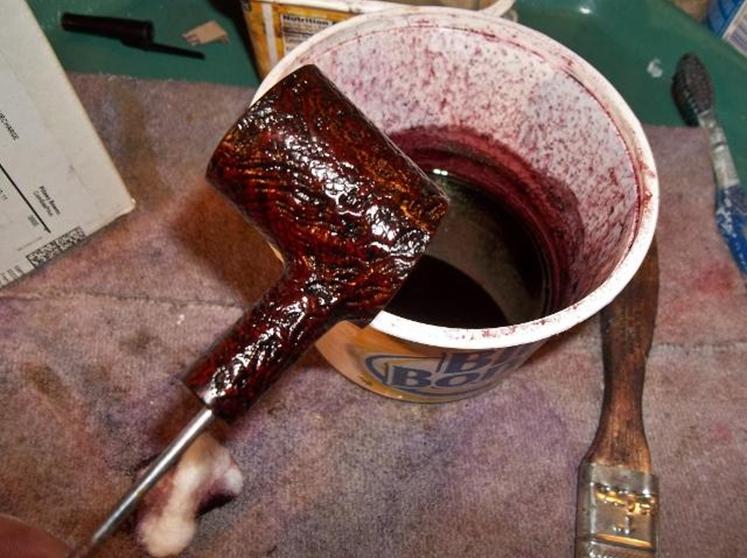
Cam26 I used a wash of brown aniline stain mixed 4 parts alcohol and one part stain to restain the bowl and shank. The next four photos show the pipe after it had been restained and buffed with Blue Diamond. I buffed it with a light touch and then rebuffed it with a shoe brush.Cam27

Cam28

Cam29

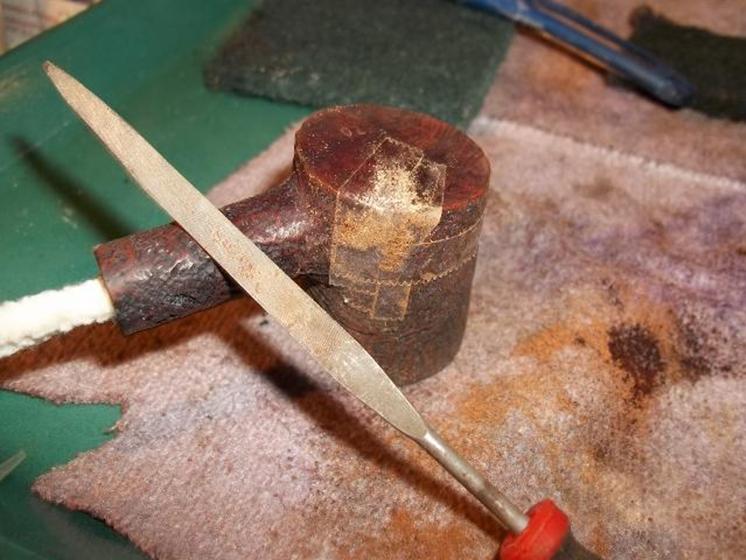
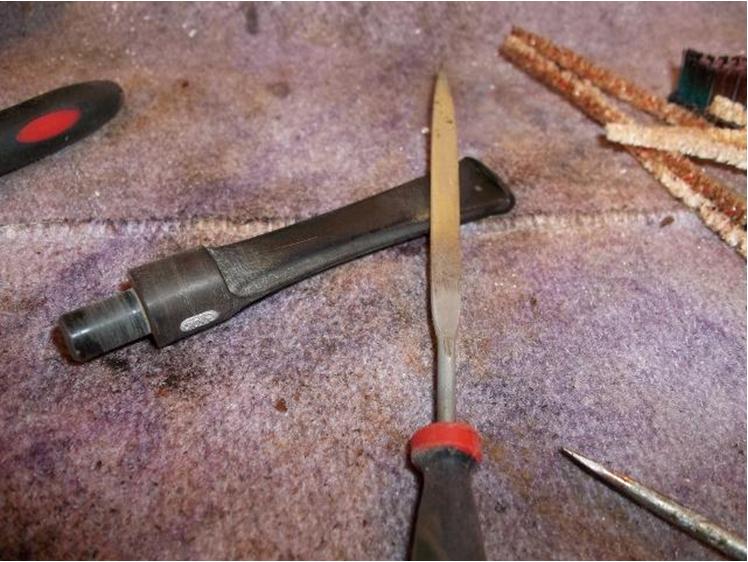
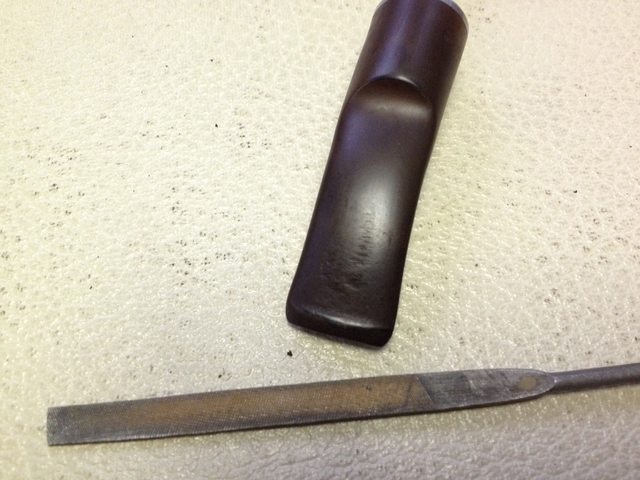
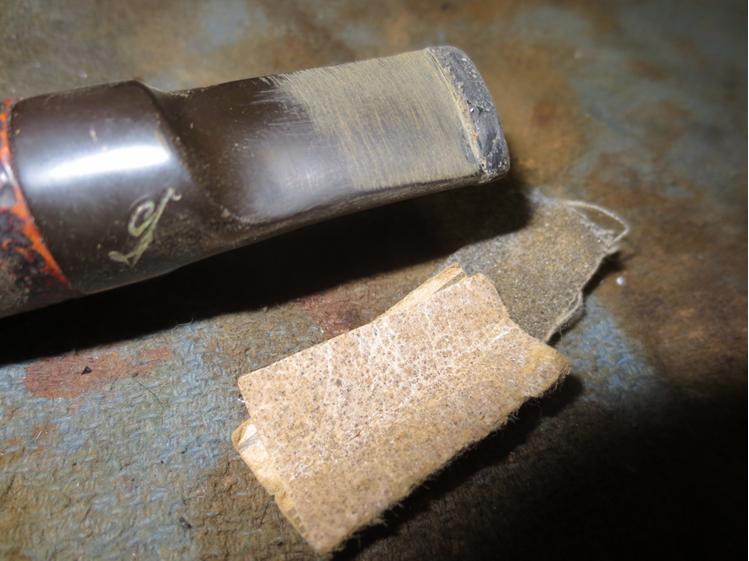
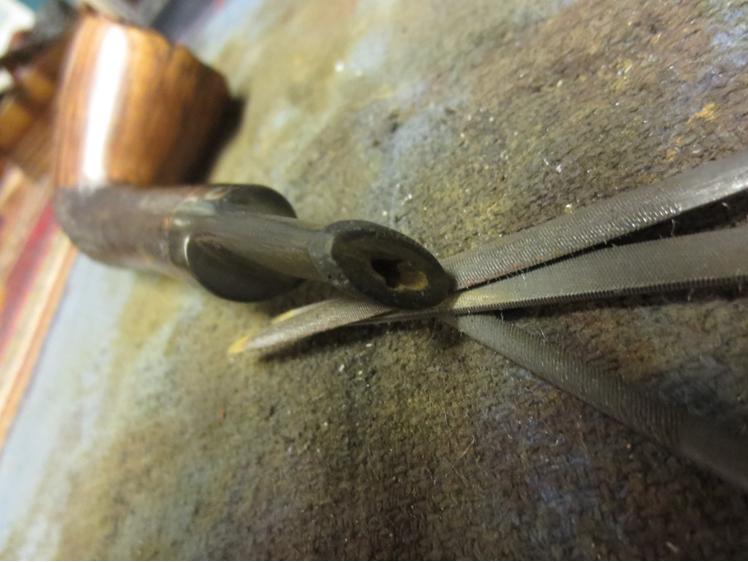
Cam30 With the bowl finished it was time to work on the stem. I decided to start with the narrow slot and airway on the end of the stem. I used three different needle files to open it up. I started with a flat file to widen the gap on the top and the bottom edge of the slot. I needed it open enough that I could use a flat oval file to smooth out the slot and open both the top, bottom and sides of the slot. I finished with a round file to taper the edges of the slot at an angle to the airway in the stem. While this was done to a slight degree I increased the angle and also opened up the end of the airway. I used the round file to also enter from the tenon end of the stem and smooth out what appeared to be rough transitions from the airway to the slot. I finished by sanding the inside of the slot with a folded piece of 220 grit sandpaper and then finishing with a bristle pipe cleaner and a little scrubbing powder.Cam31

Cam32

Cam33

Cam34 I still needed to clean up the end of the stem when I worked on the stem surface itself but the basic shape was finished and the slot was wide enough to easily handle a pipe cleaner. I sanded the stem with 220 grit sandpaper and also with a medium and fine grit sanding sponge to remove the tooth chatter on the top side of the stem and to clean up around the deep tooth mark on the surface of the stem. I picked out the debris from the tooth mark and then filled it with black super glue. I set the stem aside overnight to let the glue repair cure.Cam35

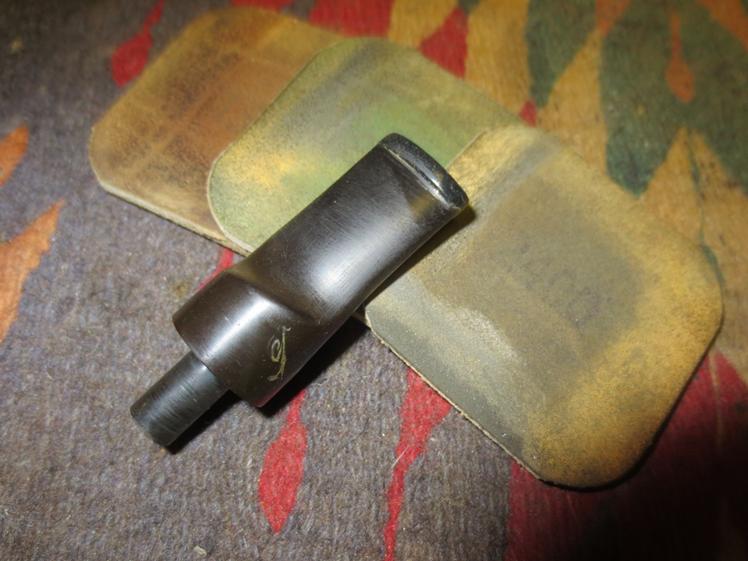
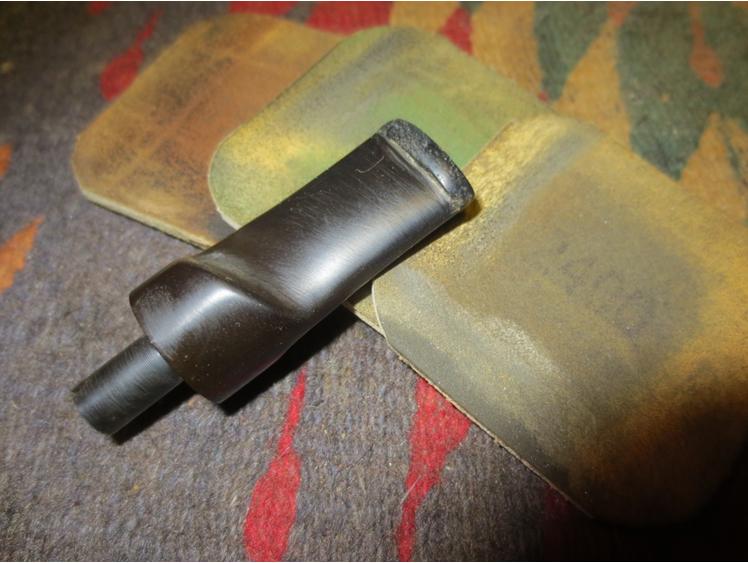
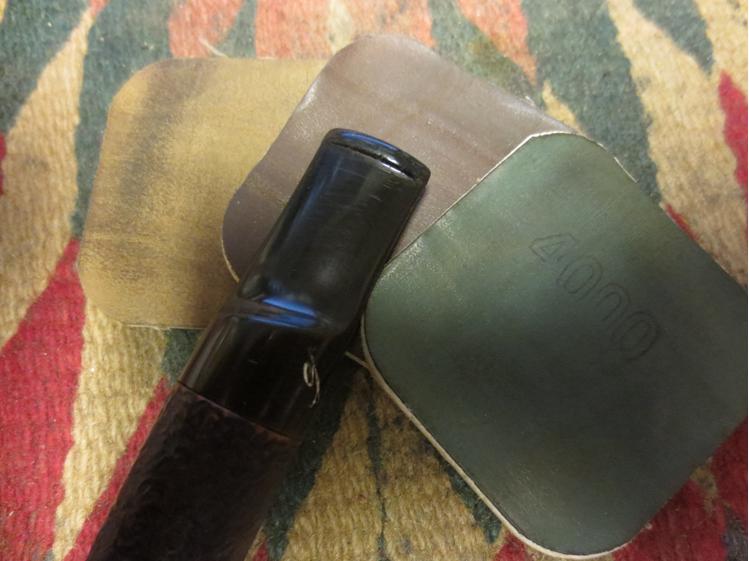
Cam36 The next morning I sanded the repaired area with 220 grit sandpaper and then the sanding sponges to remove the excess patch and to blend it into the surface of the stem.Cam37 Once the repair was smoothed out it was time to sand the stem with micromesh sanding pads. I wet sanded with 1500-2400 grit pads and rubbed it down with Obsidian Oil. Once it had dried I gave it a quick buff with White Diamond.Cam38 The tooth chatter was gone on the top of the stem and the repair on the underside blended in quite well. At this stage in the sanding it still showed but would begin to disappear into the stem with further sanding with micromesh. I dry sanded the stem with 3200-4000 grit pads and then rubbed it down again with Obsidian Oil. The first photo below shows the topside of the stem. The tooth chatter is gone. The second shows the underside of the stem. The tooth mark is repaired and the repair no longer shows. The next three grits of micromesh will make the patch disappear in the shine of the stem.Cam39

Cam40 I dry sanded with 6000-12,000 grit pads and then gave it a final buff with Blue Diamond. I rubbed in a final coat of Obsidian Oil and let it dry.Cam41

Cam42 The next two photos show the finished stem. The repair is blended into the vulcanite and it is polished and clean.Cam43

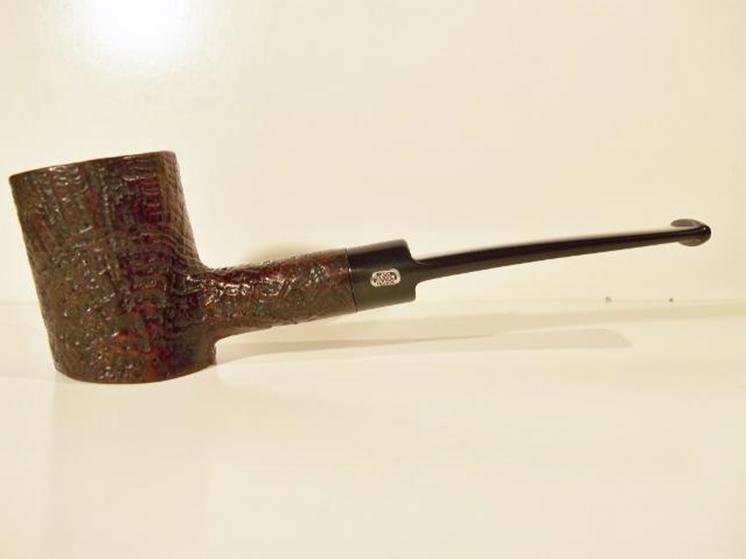
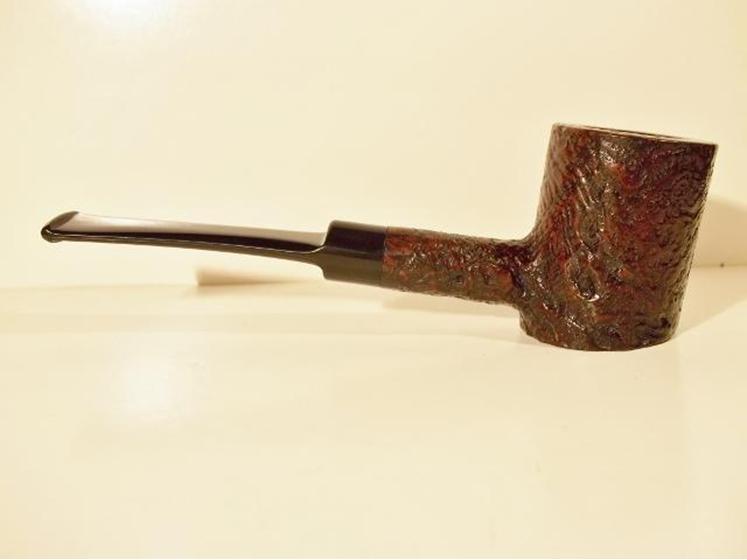
Cam44 I gave the pipe a light buff with Blue Diamond Plastic polish and then gave the stem several coats of carnauba wax. I lightly buffed the bowl with carnauba and then buffed the entire pipe with a clean flannel buff to raise the shine. Here is the finished pipe. Thanks for looking.Cam45

Cam46

Cam47

Cam48

Cam49

Restoring an Ed Burak Connoisseur Tall Stack


Blog by Steve Laug

The next pipe that came to my worktable was the shapely stack pictured below. It is stamped Connoisseur over N.Y.C. on the left side of the shank and then below that E. Burak in script. The majority of the stamping is very sharp. The N.Y.C. is a bit faint. There is no other stamping on the pipe or shank. The briar was natural and unstained. It had darkened slightly with age. The finish was dirty and there were a few dents and dings in the briar. The stem was badly oxidized and had several small tooth marks on the surface. It was over bent and the way it hung in the mouth would dump the ash in your lap. The rim had a tarry buildup on the back top surface. The inner and outer edges of the rim were in perfect shape. There were some small sandpits in the briar on the left side of the bowl and on the underside of the shank. The inside of the shank was dirty and black with tars and oils. The bowl inside was thickly caked with a crumbly soft cake that was flaking away in some parts of the bowl. The shank itself was interesting to me in that it looked perfectly round. Once the stem was removed the drilling of the mortise was centered but low on the shank. The drilling was perfectly aligned but the airway seemed constricted. My guess was that there were tars and oils clogging the airway in the shank and the over bent stem made the draught constricted.Con1

Con2

Con3

Con4 Over the years I have had several Connoisseur pipes but none of them were stamped like this one. I wondered about the stamping. It was my guess that it somehow helped with dating the pipe to a particular time in Ed Burak’s pipe making career but I did not know for sure. I decided that before working on this particular pipe I would do a little research on the brand and the maker on Google. I always check Pipedia to see what they might have on a maker. In this case I was not disappointed. There as a great article on the site. The link to that is: http://pipedia.org/wiki/Burak.

On that site I found not only some history on Ed Burak and the brand but also a photo of a pipe that was the same shape as the one I was working on. I was fortunate to find it because it confirmed my earlier assessment that the stem was over bent. With the photo and a second one that I found on another site I would be able to correct the bend on the stem and open the airflow from the bowl to the button.

I also found some great information on the site regarding Ed Burak. I quote from that article below. If you should wish to read it in its entirety click on the link noted above. The article is entitled, The Art of Edward F. Burak, Dean of American Pipe Designers.
Con5“Ed Burak is the dean of American pipe designers whose work has had a worldwide influence on the thinking and the work of contemporary pipe makers.”

“…he met and subsequently began working with Meerschaum master Paul Fisher, with whom he stayed 5 years. During that time he produced a small number of Meerschaum pipes, a few of which are still extant in collections. He also worked for Wally Frank as a pipe designer. In 1968 he bought the Connoisseur Pipe Shop, where he was able to concentrate on his own designs. Burak’s pipes have been carved by a number of well-regarded pipe makers, among them Joe Corteggione and Tony Passante. Several of his freehands are in the Museum of Modern Art in New York and have been part of a traveling exhibit of the American Craft Museum.”

“Burak’s work is best known as pipe design as fine art. He admires pays tribute to the classic English designs of the old Barlings and Comoy’s and offers a line of “Classics” which begin with these traditional values yet reflect his own interpretations.”

“Because these pipes are different, so carefully crafted, they not only please the eye, but educate it. Most pipe makers will start with an idea and work the wood toward that goal, but will change their original design to accommodate the briar. Burak does not allow the medium to modify the intent. Minor surface flaws are left on the pipes. No staining is permitted; all Connoisseurs have a natural finish, with only carnauba was added.”

“As a significant footnote, the reader should note that Ed Burak’s pipes are NOT made by Paul Perri, nor Weber, nor Jobey, as erroneously stated in Lopes’s book “Pipes: Artisans and Trademarks.” Burak prefers not to disclose the name of his current pipe carver.”

I also learned on Pipephil’s website, http://www.pipephil.eu/logos/en/about-en.html that the stamping did indeed give some information that helped in identifying the period that a particular pipe was made. There I found that one may generally separate Connoisseur pipes date of manufacture into three periods.

From late 1960’s until 1974: no stampings
From 1974 until 1981: CONNOISSEUR over N.Y.C.
From 1981 on: CONNOISSEUR over N.Y.C. and Ed Burak’s signature

The pipe I was working on was stamped like the photo below. It had the Connoisseur over N.Y.C. stamp and Ed Burak’s signature. That dated the pipe to the time period from 1981 to the time that the Connoisseur Pipe Shop in Manhattan closed in 2009 on Ed’s retirement. Included with the photo of the stamp was a picture of a tall stack pipe that looked identical to the one that I was working on. Using the photo above and this photo gave me a clear picture of what the bend of the stem was like originally.Con6 I took a photo below of the stamping on the left side of the pipe that I am working on for comparison with the one above. You can see that they have the same stamping.Con7 On the Puff.com Pipe Forums I found a thread on Connoisseur pipes that confirmed how the pipes were finished when they were originally made. http://www.puff.com/forums/vb/general-pipe-forum/299824-ed-burak-pipes-man.html. There in the latter part of a post by a member identified as Mr. Rogers was the information that I was seeking confirmation about.

“His premium pipes were like nothing I had seen before. He finished all of his pieces with only wax, no stain. He incorporated blemishes into his designs and made no attempt to hide these flaws with fillers. I frequented the CPS (Connoisseur Pipe Shop) as a high school, college, then grad school student, never really having the funds to purchase his premium pieces. As luck would have it, once I became established in my work/field, the CPS was long gone…”

Now that I had a pretty good idea of when the pipe was made and what the stamping meant, it was time to go to work cleaning up this beauty. I took a close-up photo of the bowl to show the state of the uneven broken cake that was formed on the walls of the bowl. The cake had a fuzzy appearance that bothered me. So before I cut into it with the reamer I examined it with my lens to see if it was mold. I was glad to see that it was merely dust particles. I was able to blow them out before with a blast of air before I reamed back the cake. You can also see the flaw on the back side of the rim centered between the inner and outer edge of the rim.Con8 I reamed the bowl with a PipNet reamer. I started with the smallest cutting head and worked up to a cutting head the same diameter as the original bowl. The bowl was U-shaped but narrowed slightly half way down the bowl so I had to use the second cutting head to clean out the bottom half of the bowl and smoothed out the transition between the two cutting heads with a sharp pen knife. I took the cake completely back to the bare wood so that a good, clean, solid cake could be formed.Con9

Con10

Con11 I scrubbed the exterior of the natural briar with alcohol on cotton pads. It removed the grime, oils and ground in dirt from the finish and left the briar clean.Con12 I dropped the stem in a bath of Oxyclean. Almost as soon as it hit the water and I shook it the mixture turned amber coloured as the Oxy worked on the oxidation. I set the bath aside to let the stem soak and turned my attention to cleaning up the bowl.Con13 Before I could repair the flaw on the rim I needed to clean it up. I lightly topped the bowl on the topping board using 220 grit sandpaper. Once I had topped it lightly I washed it down with alcohol on a cotton pad to remove the sanding dust and blew out the dust in the bowl.Con14 I picked out the dust and grime in the flaw and used a drop of clear super glue and some briar dust from the topping of the bowl to fill in the flaw. Once it was hardened I sanded it with 220 grit sandpaper on the topping board and then with a medium and a fine grit sanding block to smooth out the scratches and polish the rim.Con15 The photo below shows the repair to the rim as well as the oils and tars on the cotton swabs and pipes cleaners that I used to clean out of the mortise and airway. I also wiped down the inside of the bowl with alcohol on cotton swabs to remove the dust and any remnants of the old cake.Con16 With the bowl cleaned and repaired I took the stem out of the Oxy bath. It had been soaking for about 2 hours and the oxidation was softened and brought to the surface enough that when I scrubbed stem to dry it off I was able to remove much of it.Con17

Con18

Con19 I put the stem in the shank and used a heat gun to heat the vulcanite and reduce the angle of the bend in the stem.Con21 I took it back to the work table and took the next four photos of the new angle of the stem to see how it looked from the comfortable distance of the computer screen. I took it back and heated it again to bend it slightly more. The angle was close but I would need to adjustments to get to what I wanted for the bend in the stem.Con22

Con23 While this photo was taken to show the stem it also gives a good picture of the repair to the rim on the pipe. It blended in very well and looks far better than the original crevice.Con24

Con25 I sanded the stem lightly with 220 grit sandpaper paying special attention to the tooth marks and tooth chatter near the button on both the top and bottom of the stem. Once I had removed the marks and chatter I sanded it with a medium and a fine grit sanding sponge to remove the scratches.Con26

Con27

Con28

Con29 The next four close-up photos show what the stem looked like at this point in the process of removing the oxidation and scratches.Con30

Con31

Con32

Con33 To highlight the beautiful mixed grain on this piece of briar I rubbed it down with a light coat of olive oil and let it soak into the briar.Con34

Con35

Con36

Con37 I sanded the stem with micromesh sanding pads – wet sanding with 1500-2400 grit pads. Once I finished with the 2400 grit pad I buffed it with White Diamond and then rubbed it down with Obsidian Oil.Con38 I dry sanded with 3200-4000 grit micromesh pads and again rubbed it down with Obsidian Oil. Once it dried I lightly buffed it again with White Diamond to give it a deeper polish. Then I continued sanding it with 6000-12,000 grit micromesh sanding pads.Con39

Con40 I gave it a final coat of the oil and took the pipe to the buffer and buffed it with Blue Diamond Plastic Polish.Con41

Con42

Con43

Con44 I buffed the whole pipe with Blue Diamond and gave it multiple coats of carnauba wax to protect the finish and the stem. I finished buffing it with a clean, soft flannel buff and no buffing compounds to raise the shine on the finish and the stem. The finished pipe is shown below. Thanks for looking.Con45

Con46

Con47

Con48

Restoring a Sydney P. Ram Oom Paul


Blog by Steve Laug

I just finished refurbishing a beautiful Oom Paul that is stamped left side of the shank Sydney P. Ram in script. On the right side it is stamped Imported Briar over 3172/VD. When it arrived to my work table it had a few issues that needed to be addressed. The rim was damaged on the right front outer edge from what looked like being knocked against something. The inner edge on the front had a burned area from a lighter. The briar was unstained, natural but looked dry, lifeless and dirty. The bowl was barely smoked the top 2/3s of the bowl was darkened and had some particles of tobacco stuck to the bowl sides. The bottom 1/3 of the bowl was still raw briar. The airway was quite large at the bottom of the bowl but was well drilled and centered on the back side of the bowl at the bottom. The stem would not sit all the way in the mortise and was very tight. The mortise was far dirtier than the bowl. It had a buildup of tars and oils that had prevented the tenon from seating properly in the mortise. The stem itself was not only oxidized but had stains that ran the length of the underside. The airway was plugged. The slot in the button was plugged and was very narrow so that getting even a paper clip into the slot took a lot of effort.F1

F2

F3

F4 I took the stem off the pipe and used an unfolded paperclip to open up the clogged airway. It took some work but I was able to open it back up. The slot in the button was so small that a normal pipe cleaner was hard to push through. Once it was done the clog came out and was pipe cleaner detritus and tars.F5

F6 I put the stem in an Oxyclean bath to soak while I worked on the bowl.F7 The damage to the outer rim of the bowl needed to be addressed. I was able to stem the flat surface and lift some dents but the outer edge dents were actually cuts and they did not move. I decided to top the bowl lightly to remove the damage to the edges – both the outer right front and the inner front burned area. I set up a topping board with 220 grit sandpaper and took down the top until the damage was minimized. I then sanded the outer edge with a medium grit sanding block to dull the sharp edge slightly. I worked on the inner rim with a folded piece of 220 grit sandpaper to bevel the edge slightly and minimize the damage from the burned area.F8

F9

F10

F11

F12

F13 With the rim top cleaned and repaired I worked on the inner edge of the rim with a folded piece of sandpaper. I beveled the inner rim edge inward to compensate for the burned area on the front of the bowl. Then I washed down the bowl with alcohol on cotton pads to remove the wax and the grime on the briar. I scrubbed the inside of the bowl with cotton swabs and alcohol to clean up the debris in the bowl and the dust from sanding. I cleaned out the shank and mortise with pipe cleaners, cotton swabs and alcohol until the cotton swabs came out clean and the mortise was clean to sight. I followed up that by sanding the rim with a medium and fine grit sanding sponge and then with 1500-12,000 grit micromesh to polish it. The beauty of working with natural briar finishes is that when a bowl is topped it is not hard to match and blend into the finish of the bowl.F14

F15 I steamed the front, bottom and sides of the bowl where there were many small dents and nicks. I heated a table knife over the gas flame on our stove, folded a wet cloth and placed it over the dents and then touched the hot blade of the knife to the wet cloth. This created steam with which I was able to lift many of the dents and nicks. While most of them were gone there were others that remained that were reduced noticeably.F16

F17

F18 When I finished the steaming of the dents I rubbed down the bowl with a light coat of olive oil to give life to the briar. I buffed it on the wheel with Blue Diamond polish and gave it several coats of carnauba wax to protect and finish it. Once the stem was completed I would buff it again and then apply more wax to the pipe.F19

F20

F21

F22

F23 While the stem was soaking I set the finished bowl aside and did a bit of research on the Ram brand. It was one which I had read about on the forums and had seen on eBay but not a brand I knew anything about. I googled the name and found quite a bit of information on the different pipe forums and on Pipedia.http://pipedia.org/wiki/Ram%27s_Horn.Here is a summary of what I found.

“Sydney P. Ram was a pipe maker in the 1930’s and reported to have retired in 1942. Ram’s shop was at 59 West Monroe in Chicago’s Loop. His pipes were normally simply stamped Sydney P. Ram in script. He was also the author of a book on pipe smoking in 1941 called How to get more fun out of smoking; a guide and handbook for better smoking and is sometimes available on Amazon, having been reprinted in 2011.”

I contacted Ken Prevo who was mentioned later in the Pipedia article as we have corresponded on the various pipe forums that we both frequent. I asked his permission to post a copy of the 16 page catalog from the shop era that was referenced in the article. He graciously responded that I could post it here on rebornpipes in high resolution. I have done so here: https://rebornpipes.com/2015/05/22/are-you-getting-the-most-out-of-your-smoking-a-pipe-catalogue-from-the-sydney-p-ram-pipe-shop/

Ken welcomes those interested in viewing or downloading a copy of the catalogue to do so from his Dropbox at this link: https://www.dropbox.com/sh/dao82dnm8tw3y0i/XIdMElvkbk.

Ken reported that recently, in 2013, New Old Stock has shown up with the pipes being sold from California, which may have been where Ram relocated the shop after the war, or it could have been retained inventory on closing the Chicago store and retiring.

The catalog states that all pipes are either Algerian or Corsican Briar. The pipes being sold are light but color to deep brown very rapidly. Ken has not seen similar treatment. The catalog shows pipe prices ranging from $1.75 to $7.50. (Factory workers in the era made around $40/wk at the time). They are stamped either straight grain or imported briar. The catalog also indicates the shop did its own blending and had onsite repair.

I took the stem out of the Oxyclean bath and rubbed it dry with a coarse cotton cloth. I sanded the stem with 220 grit sandpaper to remove the oxidation that was still left and the residue that was hardened in spots on the underside of the stem.F24

F25

F26

F27 I worked on opening the slot in the button. I used a combination of needle files to open the slot. I began with a flat blade file to widen the slot on the top and bottom. This is tedious work but it pays off dividends in the end. Once I had that area more open I worked on the sides of the slot with a flat oval file to create a Y shape in the slot. I then used a fat oval and a round needle file to open the slot further and round out the ends of the slot. When the filing was completed I folded a piece of sandpaper and worked on sanding the inside of the slot smooth and removing all of the file marks.F28

F29

F30

F31

F32

F33 When I finished opening the slot I sanded the stem with a medium and a fine grit sanding sponge to reduce the scratches on the vulcanite.F34

F35

F36

F37 By this time with the slot opened and the oxidation pretty well cleaned up it was ready to be polished with micromesh sanding pads. I wet sanded the stem with 1500-2400 grit pads and rubbed the stem down with Obsidian Oil.F38

F39 I buffed the stem with red Tripoli to further remove the scratches left behind by the sandpaper. I took it back to the worktable and put it in the shank and took some photos.F40

F41

F42

F43 I removed it from the shank and dry sanded it with 3200-4000 grit micromesh and rubbed it down again with Obsidian Oil before finishing with 6000-12,000 grit pads to bring the final shine out on the vulcanite.F44

F45 I buffed the stem with White Diamond and then with Blue Diamond Plastic polish on the buffing wheel.F46

F47

F48

F49 I took it back to the worktable and rubbed it down with some Briar Wipe before taking it back to the buffer for some carnauba wax. I buffed with several coats of carnauba and finished by buffing it with a clean, soft flannel buff. The dry buff raises the shine on the bowl. The finished pipe is shown in the photos below.F50

F51

F52

F53

F54 Thanks for looking. Be sure to check out the link above to the Sydney Ram Catalogue that I posted on rebornpipes.

Doing an interior shank repair and restemming a KBB Yello Bole Lovat


Blog by Troy Wilburn

I got this pipe from a member of Dr. Grabows Collector Forum, John McP. He hails from across the pond in Scotland. He had contacted me about a old KBB Yello Bole pipe that he had picked up that did not have a stem and wanted to know a little about it and what kind of stem it originally had. He also informed me it had an old repair of a cracked shank.

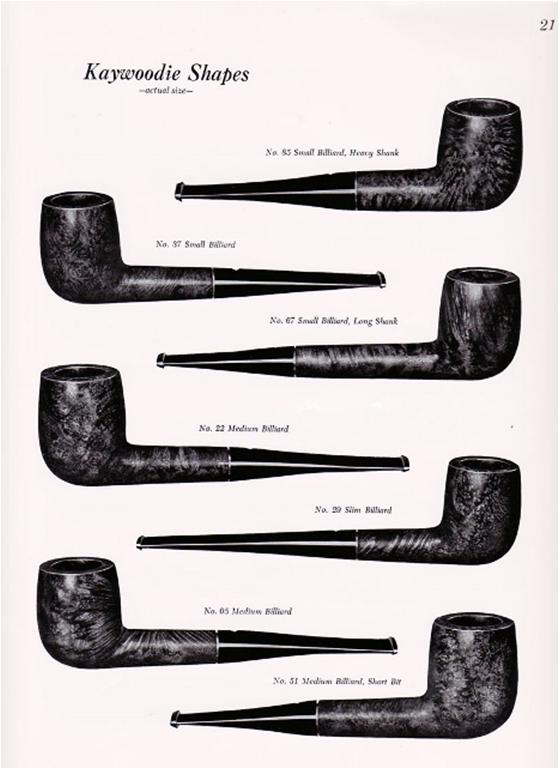
It is stamped 2079 and had the “Honey Cured Briar” under the KBB Yello Bole, which made it a pre 1936 model. I then checked my Kaywoodie charts. It’s a large bowl, long shank Lovat saddle bit. Even though the KW shape charts call it a Canadian I don’t think so because of its round shank. I’ll never consider a round shank as a Canadian.K1 I informed him that it was a nice pipe and should be a good smoker once cleaned up and a replacement stem found. Unfortunately for John the old repair was not a good one and it had made the shank weak. When John tried to fit some stems to it, a piece broke out of the shank. He asked me if I wanted it free of charge as he did not want to tackle repairing the pipe.

The pipe as John showed me before he sent it.K2 I agreed that I would see what I could do with it. Well after over a month in the mail it finally arrived and I got a good look at it and found a donor saddle bit from another Yello Bole.K3

K4 The bowl had some black scorch marks from smoking hot.K5 I was going to get this pipe blasted after repairs to help hide them and cover some dark burn marks on the bowl. After much thought I decided to restore it close as factory as I could. The possible history of this pipe was just too good to alter it. In the short time of my possession of this pipe it had already been half way around the globe. That’s just a fraction of the long life that this pipe has had over it’s at least 80-year-old life. Maybe it was taken over by an allied soldier and left behind as a gift of friendship? Maybe it was carried by an OSS agent behind German lines during the war? Maybe not but its fun to think of the possibilities.

So all the sand pits and small fills were left as is and not covered or filled. After all it’s a Yello Bole if it did not have these imperfections it would have been a Kaywoodie. The old war horse has some scars from repairs and wear. The stamping’s are quite worn but it’s a pipe someone had thought enough of to repair it once before. Hopefully it has many more years left in it.

I decided to do an inner band like Steve did on a YB I sent him for repair. I found an old metal tenon from a Grabow filter stem I had.K6 I filed out the inner shank and broken shank piece to clean up and to give the glue something to grab too.K7 After grinding the metal tenon to fit inside the shank. I cleaned up the shank and broken piece with some 91% alcohol and marked the best way it fit with a black sharpie so I know where to place it when glued.K8 I mixed up some two part epoxy and then set the inner band in the shank.K9 After it set up I got ready for the broken piece and cleaned off the Sharpie from the metal band to ensure a good bond. I put two part epoxy on the metal band then super glue on the briar edges and set the broken piece. Then I applied briar dust before the glue set. I had to work fast so no pics during this process, only before and after.K10

K11

K12 I then sanded the repairs; the old repair had a bad high spot and took some filing.K13 I had to build up the bottom from making the old repair flush again. It was a bit lower than the stem.K14 I then filed the stem to match the shank.K15 After cleaning out the shank and bowl I noticed that all the old YB coating was gone from wear or scraped out over time. I decided to remove all the cake and address this later.K16 I then stripped off the old finish with warm water and Oxy Clean bath. I did some light scrubbing with a toothbrush and a Scotch Brite pad used on the stubborn spots. I then wet sanded repairs and bowl with various grits of wet dry paper from 600 – 2500.K17 After this I wiped the pipe several times with household bleach to lighten the dark spots and repairs so it would be harder to spot with the dye.K18 After bleach bath the pipe is ready for dye.K19 I then mixed up some dye close to original stain but slightly darker to help cover the repairs and black marks. I applied three coats.K20 Pipe dry and ready for some base wax.K21 After applying three coats of wax to lock in the dye I mixed up some homemade Yello Bole bowl coating.K22 I applied the bowl coating and found a Yello Bole paper cover from a NOS pipe I have. The cover is from an Imperial but I thought it would look nice for the pictures.K23

K24 After several more coats of wax the pipe is done. First off the repairs are not perfect and I wish I could have gotten a tighter fit with the stem. This was my first inner banding so I didn’t get the band quite as square as I should have making the stem fitting a bit difficult .The more I tried to get a tight fit the more gap I would get on one side, so I settled for a uniform gap. I’ll know better next time and should get a better fit. Here are some pics of the finished repairs.

As Steve pointed out to me on the Dr. Grabow Collectors Forum, if you flare the tube it will make it fit more squarely. I think showing your mistakes is as important as showing your successes for the next person trying to do a similar repair. So if you are doing an inner band repair soon I suggest you flare the end before you set it with epoxy.K25

K26

K27

K28 I did manage to save what little of the stamping’s were left.K29

K30 Pictures of whole completed pipe K31

K32

K33

K34

K35

K36

K37

K38

K39

K40

K41 Even though this was a tough and time consuming refurbish it was quite fun and wish to thank John for sending me this old soldier to be used and enjoyed again.

Repairing a Broken Shank Acorn Shaped Pipe and giving it a New Look


Blog by Steve Laug

I have had this broken Acorn shaped bowl in my box of parts for a long time now. I remember breaking it. There were several fills around the shank at that point. The stem was absolutely stuck in the shank and no matter what I did I could not get it out. Heat, cold, alcohol bath or any other means would not work. Finally after I had dunked it in boiling water hoping to loosen things I twisted on the stem and the shank snapped. Then I could see the problem. The stem had an aluminum tenon that had basically begun to disintegrated and had bonded to the shank. It had a long aluminum stinger that extended virtually to the air hole. It was a mess. I clean up the shank and the bowl to remove all of the corroded aluminum and scraped it clean. I was undecided whether to fix it or just part it out so I put it in the box and left it there.

Yesterday I decided to take it out and have a look at it. I put the two parts back together and saw that the fit was actually quite clean. There were just two small places where the briar actually had chipped. I had a polished aluminum tenon that I had extracted from a broken stem and saved for just such a repair. I sanded it and used a file to score the surface of the metal tube so that the glue would have something to grab hold on in the shank. I mixed a batch of two part epoxy and a painted it on the tube with the mixing stick. I liberally coated the tube with epoxy and let it sit until it got a little tacky and then inserted it in the shank end of the break. I inserted the stem in the mortise end so that I did not set the tube too deeply in the shank. Once I had it positioned I let it cure for 30 minutes until the epoxy set and the tube was solidly in place in the shank.Broke1 I put epoxy on both sides of the exposed briar and then on the other end of the extended tube. I carefully pressed the two parts together and worked to make sure that I had them aligned correctly. The excess epoxy squeezed out and bulged around the enter repair. I used a dental pick and scraped away the excess leaving a smooth top coat of epoxy in the cracked area.Broke2

Broke3

Broke4 The top surface of the rim was quite damaged and the bowl was out of round. I topped the bowl on a topping board to remove the damage and burn marks that were present on the surface. I sanded it with a sanding block to remove the scratches and smooth out the finish.Broke5

Broke6 I sanded the epoxy on the shank back until it was smooth with 220 grit sandpaper. In the photo below you can still see the slight bulge of epoxy that needed to be removed but since I was planning on rusticating the bowl and shank I did not spend a lot of time sanding that out.Broke7

Broke8

Broke9 I sanded it a little bit smoother and then used the rustication tool that Chris Chopin made for me to do a deep rustication on the bowl and shank. As I rusticated it I then used the brass bristle wire brush to knock off the loose briar chips. (I collected the briar chips as I plan on using them as Joe suggested in fill repairs to see if I can get them to stay light). I left the rim smooth and would later top it lightly to smooth it out.Broke10

Broke11

Broke12

Broke13

Broke14

Broke15

Broke16 When I finished the bowl I wrapped a piece of cello-tape around the end of the shank to make a smooth area that I would later install a band on. The shank end was not straight so I would need to clean it up a bit and then band it to get a clean fit of the stem in the shank.Broke17

Broke18

Broke19

Broke20

Broke21 Once I finished rusticating the shank I removed the tape to show the smooth shank end.Broke22

Broke23

Broke24

Broke25 I slid the band on the shank slightly and then heated it with a lighter until the metal expanded enough to press the band into place. I left about 1/8 of an inch extended to allow for the stem to fit properly in the shank and sit inside the band. I sanded the stem with 220 grit sandpaper until the diameter was a close fit in the band. I slid it in place and took the pictures below to show the look of the pipe at this point. I knew that there was a lot more sanding to do to get a snug fit in the band but I wanted to see a picture to look at the fit a bit removed from the pipe I held in my hands. I purposely chose a longer stem to give it a subtle elegance and length bordering on a mini-churchwarden pipe.Broke26

Broke27

Broke28

Broke29 I lightly topped the bowl some more to take care of the burn marks on the right side of the rim top. Then I took a set of close-up photos of the bowl with the band to look at the rustication and figure out where I needed to do some touch up work on it. The shank was where I was the most concerned. I wanted it to match as much as possible with the bowl rustication. I could see that overall it looked good but that the left side of the shank would need some adjusting before it was finished.Broke30

Broke31

Broke32

Broke33 I touched up the rustication on the left side of the shank and then wire brushed the entire bowl and shank with the brass bristle brush to knock of loose particles.Broke34

Broke35

Broke36

Broke37 I brushed of the dust with a shoe brush and then took out some black aniline stain to give the rustication and undercoat of black. I applied the stain with the dauber and then flamed it with the lighter to set the stain in the bottom of the rustication.Broke38

Broke39

Broke40

Broke41 I sanded the stem with a medium and a fine grit sanding pad and put it back in the shank to get a feel for the appearance of the pipe after staining.Broke42

Broke43

Broke44

Broke45 I took the stem back out and worked on it with the micromesh sanding pads. I wet sanded with 1500-2400 grit pads and dry sanded with 3200-12,000 grit pads. I rubbed the stem down with Obsidian Oil between each of the three grits.Broke46

Broke47 Between the 4000 and the 6000 grit pads I buffed it with White Diamond on the wheel and then finished with the higher grit micromesh pads.Broke48 I buffed the stem with Blue Diamond and gave it a coat of carnauba wax. The next two photos show the polished stem in place on the pipe.Broke49

Broke50 I sanded the surface of the rustication to knock off some of the high points and smooth it out slightly using a sanding block. The sanding made the rustication a bit more pebble like in appearance and once I had finished the sanding I gave the bowl a coat of oxblood aniline stain as a top coat. It added some red highlights to the rustication – particularly on the high spots. I then buffed the stem with Blue Diamond on the wheel and gave the stem multiple coats of carnauba wax. I polished the band with silver polish and hand buffed it with a soft jeweler’s cloth. The finished pipe is shown below. It has a delicate look that gives it an air of elegance and class. I am looking forward to firing it up and enjoying a bowl soon.Broke51

Broke52

Broke53

Broke54 Thanks for looking.

Restemming and Restoring a Weber Deep Grain Lovat


Blog by Steve Laug

I have been doing a bit of reading on the Dr. Grabow Collectors Forum and have been learning a lot from the folks there. On one of the threads on refurbishing Scot wrote and asked about restemming an older Weber Deep Grain Lovat. He had it sitting and did not feel confident about doing the stem work on it. I offered to restem it for him for the postage. When the pipe arrived I took it to the work table and took the following photos. The bowl had some really nice grain on it. The finish was rough with a lot of scratches, dents and nicks. Next to the band the finish was work off on the right side. There were some deep gouges and a scratch across the surface on the right side of the bowl. The rim was in rough shape. The outer edges were beat up pretty badly with gouges and chunks missing from the edge. The inner edge was clean and undamaged. The top of the rim was very rough. There were nicks and dents and it was almost crowned looking – though uneven. The bowl was badly caked forming a thick ring about mid bowl. Below that the cake was almost non-existent and above that it was flaking off in sheets. The stem was worn out with a large bite taken out of the top side near the button and the underside it was cracked. It was ruined.Weber1

Weber2

Weber3

Weber4 I took the next two close-up photos to show the rim damage and the odd cake in the bowl and also the damage to the stem.Weber5

Weber6 When Scott first sent it I was under the impression that he merely wanted me to make a new stem for it. After I saw it I wrote him and asked if he wanted me to clean it up and restore it for him. While I waited for his response I worked on the new stem. I had a stem that was the same length and had a tenon that was not only the right length but also almost the right diameter. I sanded the tenon down lightly and fit the stem to the shank. It was perfect in diameter on the bottom side of the band but was a little large on the top and left side of the saddle.Weber7

Weber8

Weber9

Weber10

Weber11

Weber12

Weber13 I put a plastic washer between the shank and the stem so that I could sand it to the edge without rounding the shoulders of the stem. I sanded it with 220 grit sandpaper to shape it and fit it to the band diameter. I also sanded off the oxidation that was on the surface of the stem and some of the wavy lines that were present on the flat surface of the blade.Weber14

Weber15

Weber16

Weber17 removed the washer and carefully sanded around the shank/band junction to clean up that edge.Weber18

Weber19

Weber20

Weber21 I sanded the stem with a medium and a fine grit sanding sponge to remove the scratches that were present on the stem from the sandpaper.Weber22

Weber23

Weber24 Once I had removed the majority of them I sanded the stem with micromesh sanding pads – wet sanding with 1500-2400 grit pads and dry sanding with 3200-12,000 grit pads. I rubbed the stem down with Obsidian Oil between each set of three pads.Weber25

Weber26

Weber27 There were still some scratches present on the stem that would go once I had buffed it with Blue Diamond but just before I took it to the buffer I heard back from Scott. He said he would be glad to have me give the pipe a work over. Given that go ahead I set aside the stem and turned to work on the bowl. Once I had the bowl finished I would buff the entire pipe.

I reamed it with a PipNet reamer starting with the smallest cutting head and then finishing with the second smallest head. With that I took the crumbling, flaking uneven cake back to bare wood. I figured that Scott could start over and build an even hard cake of his own choosing.Weber28

Weber29 I took a few photos of the bowl to record the damage and scratches to the finish. I wanted to not only get a good look at them but I also wanted to document them. The right side of the bowl had a large series of scratches and grooves from what looked like dropping the pipe on concrete. There were also scratches on the shank and outer edge of the rim. In fact the rim edge was very rough. The left side of the bowl also had some scratches that were pretty deep. The top view of the rim shows the missing chunks of briar around the edge of the bowl and the uneven crown that came from tapping the bowl out against a hard surface. The underside of the shank had a rough spot next to the band and quite a bit of scratching.Weber30

Weber31

Weber32

Weber33I washed down the bowl with acetone on cotton pads to remove the remnants of the finish before I worked on the scratches and dents in the bowl and shank.Weber34 topped the bowl on a topping board to remove the damaged surface and outer edge of the rim.Weber35 Once I had the bowl topped and the rim smooth and flat again I decided to repair the missing chunks of briar on the outer edge and the deep cuts on the right side of the bowl. I sanded the edge and scratches with a sanding sponge to clean up the jagged edges. I wiped the areas down with alcohol. I then filled the cuts and the missing chunks with superglue and packed in briar dust to fill them. I generally overfill them and then sand them back until they are smooth and blend into the surface area around them.Weber36

Weber37 I sanded the fills with a folded piece of 220 grit sandpaper and then with sanding sponges until I had blended the area in with the surrounding surface of the bowl.Weber38 I took the next two profile photos of the pipe to show the clean look of the bowl rim. Notice on the second photo the repair to the cuts on the right side of the bowl toward the lower ¼.Weber39

Weber40 The next photo shows the newly topped and repaired rim from the top.Weber41 I sanded the bowl surface with a medium and a fine grit sanding sponge being careful around the stamping so as not to damage it. Once it was smooth and the scratches minimized I rubbed down the bowl with a light coat of olive oil. The olive oil gives some life to the grain and highlights the areas that I still needed to sand. The next four photos show the pipe after it had been rubbed down with a soft cloth after the olive oil.Weber42

Weber43

Weber44

Weber45 I took another close up of the rim to show the repairs and how the olive oil brought out the colour of the rim so that it matched the rest of the pipe.Weber46 I then took the pipe to the buffing wheel and buffed it with Blue Diamond Plastic Polish. I worked the stem over with the polish and then buffed the briar as well. Afterwards I gave the bowl and stem several coats of carnauba wax and buffed it with a clean, flannel pad to raise the shine of the wax. The finished pipe is shown below. Tomorrow I will get it packed up and sent back to Scott. It should serve him well for a good many years to come. Thanks for letting me work on this old pipe. It was a pleasure.Weber47

Weber48

Weber49

Weber50

Weber51

Weber52

A KB&B Capitol


Blog by Andrew Selking

As a collector of old KB&B pipes, I have searched for a KB&B Capitol for a very long time. First of all they just have a unique look, kind of like an upside down poker, but what really interests me is the craftsmanship required to make a threaded briar insert. There is very little information available about these pipes, about the best I could find is that it was made between 1919 and 1924.
When I received the pipe it had some cake built up in the bowl and tar stains on the rim and the stem was unmolested. The biggest issue was that the insert was firmly stuck. In fact a previous owner tried pliers to get it out, based on the gouges along the top. I tried the usual method of freezing it, but to no avail. I wrote Steve for any ideas and he suggested doing a retort. That didn’t work either. I finally ended up soaking the bowl in alcohol for 24 hours, freezing it, then heating it with my heat gun. With the help of a rubber kitchen gripper, it finally broke loose.
In these first pictures you can really see the tar build up on the inside of the pipe.KBB1

KBB2

KBB3 I soaked the stem in Oxyclean. The stem was marked “Hard Rubber” and exhibited no oxidation after soaking. It was pretty filthy though. I used a pipe cleaner soaked in the Oxyclean solution to remove as much gunk as possible, this was the first pass.KBB4 Next I turned my attention to removing the serious tar build up in the inner bowl. I found my dental pick was the perfect tool for this task.KBB5 The bottom of the inner bowl had a biscuit of tar.KBB6

KBB7 I used an alcohol soaked cotton ball to loosen the tar in the threads.KBB8 Since this pipe has two bowls, I did a retort with just the outer bowl followed by a retort with the inner bowl inserted.KBB9 I love the old stems.KBB10 I did a retort on the stem. It was nasty, but the boiling alcohol did the trick.KBB11

KBB12

KBB13 The design of this pipe makes it extremely easy to clean, although I doubt that ever happened prior to my getting ahold of it.KBB14 A couple of q-tips and a pipe cleaner and the shank was clean.KBB15 Next I tackled the stem. I used 400 grit wet/dry with water followed by 1500-2400 grit micro mesh pads with water. You will notice the small washer, I use that to make sure that I don’t round off the edges of the stem.KBB16 You may have noticed in a previous picture that there was a piece missing at the top of the inner bowl. I spread a small amount of CA glue into the hole with a push pin followed by briar dust and accelerator.KBB17 I also noticed a small fill residing under the band, so I picked out the old fill and replaced it with briar dust and CA glue.KBB18 The exterior of the bowl was caked with tars and grime, so I used acetone and 0000 steel wool to clean it up.KBB19 That was only minimally effective, so I ended up sanding the whole thing. I used 400 grit to get the worst off, followed by a progression of micro mesh pads, 1500-12,000 grit. While working on the bowl, I also polished the stem with 3200-12,000 grit micro mesh pads. One of the things Steve talks about is using Obsidian Oil after each third set of pads. Since I don’t have Obsidian Oil, I used a very small amount of mineral oil with the 3200 grit pad. It really cut down on the dust and seemed to help the rest of the pads polish more effectively. Here is the pipe ready for stain and polishing.KBB20 I don’t know if the stamping on the stem was originally filled in white, but I thought it might look nice. I used my correction pen to fill in the letters.KBB21 I removed the excess correction fluid with my rotary tool and some white diamond. I then polished the stem with carnauba wax.KBB22 I stained the pipe with a medium brown stain and polished it on the buffer with white diamond and carnauba wax. Here is the final result.KBB23

KBB24

KBB25

KBB26

KBB28

Cleaning up a Dr. Grabow Royal Duke Bent Billiard


Blog by Steve Laug

One of my pipe finds last weekend was a Dr. Grabow Royal Duke Bent Billiard. It was in pretty decent shape. The rim had a little buildup and darkening but no damage. The bowl itself was lightly smoked but was half full of unsmoked tobacco. The stem had some scratches and small marks on the surface of the top and bottom. There were no tooth marks though and that was a bonus. The aluminum cap on the stem was oxidized. There was a Medico filter in the aluminum shank that was almost black. The finish was in good shape. There were some scratches and small dents in the briar on the bottom of the bowl. Overall the pipe was in pretty decent shape and needed a thorough cleaning. It was an easy refurbish.Grabow1

Grabow2 Because it was an easy cleanup I decided to see if I could gather any information on the history of the Royal Duke. I posted on the Dr. Grabow Collectors Forum and put pictures of the pipe there to see if I could get some help on the brand. I got some great responses and information from the folks there. The first of them came from Ted D. who was a past CEO of Dr. Grabow in Sparta. Here is what he wrote:

“Royal Duke was the first paper filter pipe made by Grabow. The name and construction were bought from Continental Briar Pipe Co. in the early 50’s. Continental made the “Royal Duke of Dundee” and “Duke of Dundee”. Royal has been made continuously since then, and is still made. It went through several minor changes through the years. With a “before” picture I might get within a 10 year period… maybe closer. Td” Grabow3 Spadefan on the same forum also posted this for me: The Grabow Timeline post:

http://drgrabows.myfreeforum.org/viewtopic.php?t=4834&start=0 shows Royal Duke starting somewhere in the broad timeframe of 1955 – 1964. Royal Duke continues in production today. Here are a few quotes from forum member DRBridges, one of the forum’s “founding fathers” and “Old Timer” TED that place the blue spades on early production Duke series filter pipes until abt. 1993/4. Here are the money quotes:

“HL&T began replacing the older Dr. Grabow model names after 1955 with new models. These included the “Ajustomatic” ELDORADO, REGAL, SAVOY, STARFIRE, VISCOUNT, and the “Duke Filter” DUKE, GRAND DUKE, and ROYAL DUKE. The early “Ajustomatic” pipes displayed a white spade emblem. The early “Duke Filter” pipes diplayed a blue spade. The early push stem [without filter] pipes displayed a yellow spade. Additional models were introduced during the 1960s and 70s, and all later Dr. Grabow pipes displayed a white spade emblem.” DRBridges

“Through the 1950s, 60s, 70s, and 80s, DG filter pipes used blue spades, except for the ajusto Dukes. They all went white in the early 1990s. Mortise and tenon DG pipes used yellow spades. Ajustomatics were white.” DRBridges

“We were still using the colors in 1991. I guess they changed about 93/94.” ted

So it looks like blue spades were used exclusively on Duke lines of filter pipes from their introduction sometime 1955-1964 through 1993/4. Anyone have more info on blue spades?Grabow4I posted photos of the pipe as Ted requested and then received another answer from him that helped date the pipe. He wrote: “I think it’s the old Spruance Southern lacquer. That and a vulcanite bit will put it at 1975 +- 5.. td”

Knowing that information gave me some helpful information on the pipe I had. I liked the idea that it came from the era in which I finished my high school and entered university. It came from the same era as my first pipe purchased in the early 1970’s. The photos below show the state of the rim and the half filled bowl of tobacco.Grabow5 The pipe has some absolutely beautiful grain that swirls around the bowl.Grabow6

Grabow7 I scraped the tobacco out of the bowl, threw away the paper filter and then cleaned out the shank and stem with pipe cleaners, cotton swabs and isopropyl alcohol.Grabow8 Because the bowl had an intact coat of lacquer that was not damaged I scrubbed the rim with saliva and cotton pads. I was able to remove all of the buildup on the surface and some of the darkening.Grabow9

Grabow10 I sanded the stem with micromesh sanding pads to remove the scratches and damage to the surface. I wet sanded with 1500-2400 micromesh until the majority of the marks were removed. I dry sanded with 3200-12,000 grit pads to further polish the vulcanite.Grabow11

Grabow12

Grabow13 I gave the stem several coats of Obsidian Oil and then buffed it with Blue Diamond on the buffing wheel. I gave it several coats of carnauba wax and buffed it with a clean soft pad to raise the shine on the stem. I lightly buffed the bowl so as not to damage the lacquer. The finished pipe is shown in the photos below.Grabow14

Grabow15

Grabow16

Grabow17

Grabow18

Grabow19 I want to give a shout out to the Dr. Grabow Collectors Forum. They are great folks and always ready to help. If you have not checked them out head on over and have a look at their site. http://drgrabows.myfreeforum.org/index.php Thank you folks for your help on this one and on others that I have worked on. It is greatly appreciated.

Finding a Heart for an Aristocob Aluminum (Rhodesian?)


Guest Blog by Robert M. Boughton
Member, North American Society of Pipe Collectors
http://www.naspc.org
http://www.roadrunnerpipes.com
http://about.me/boughtonrobert
Photos © the Author

The Wizard of Oz: “As for you, my galvanized friend, you want a heart. You don’t know how lucky you are not to have one. Hearts will never be practical until they can be made unbreakable.”
The Tin Woodsman: “But I still want one.”

― From “The Wizard of Oz” (movie, 1939)

INTRODUCTION
As a movie and trivia buff, not necessarily together, one of my favorite questions that comes up now and then in conversation and on quiz shows is “When was the Golden Age of Hollywood?” I like it because of the slippery term Golden Age, which implies years forming a great period of time with specific world-changing events and personages, as in the Bronze Age or the Age of Enlightenment. It’s also a trick question, the expected (but incorrect if often accepted) answer being 1939. Granted, in that one year, some of the great movies in Hollywood history were made, including “The Wizard of Oz,” “Gone with the Wind,” “Stagecoach,” “Mr. Smith Goes to Washington” and “Wuthering Heights”. But the true and more agreed upon answer would be 1930-1959, which encompassed “All Quiet on the Western Front” to “Anatomy of a Murder”.

All of this is my way of approaching a term I often refer to but did not coin, the Golden Age of Pipe Smoking. In my mind, although the exact timeline is sometimes said to have begun as long ago as the mid-1800s, this period was from the 1930s into the ’70s, when pipes were ubiquitous and respected all over the world, as reflected in motion pictures, TV and society in general. Below are a few famous Hollywood pipe men: Fred Astaire, John and Lionel Barrymore, Harry Belafonte and Fred MacMurray.Cob1 My own dad and almost all of his friends enjoyed and in many cases had collections of the magic briar social lubricant. The subject of this blog, a brand of pipe named with perhaps tongue-in-cheek humor, is one of the quirkiest, most unusual examples conceived during this wonderful age that I believe is experiencing a renascence: the Aristocob, invented by Joseph W. Zarikta for the Al Cobb Corporation and granted U.S. Patent №. 3,292,639 on December 20, 1966.Cob2 The Al Cobb Corp. became Al-Cob Corp. in Grand Haven, Michigan, and still later Aristocob Inc. in Caledonia, Michigan before being taken over by the Missouri Meerschaum Company in Washington, Missouri. Missouri Meerschaum made the corncob inserts from the early 1970s until 1983, and since then replacements have not been manufactured, but with dedicated searching some will, on occasion, show up when they are found and offered online. Even though I could not locate any for this restoration, I know they still pop up because of several sold-out listings I found on eBay. However, by most accounts the original inserts, or even self-styled replacements, are high maintenance contraptions that quickly become wet, mushy and, in short, nasty to use. Still, our esteemed host, Steve, emailed me the following message: “I love those old aristocobs. They are sweet looking retro experiments.” Indeed they are. I even found several sites where this pipe is given the high description of “art deco.”

Nevertheless, I believe I have found a more suitable and permanent solution to the problem, even if it does detract from the good, old timey flavor of the maker’s intent: briar inserts made to fit the Aristocob. [See http://www.owlpipes.com/#!new-collection/c1jn5.%5D For this restoration I ordered one, and considering I bought the beat-up old pipe itself for $2 at a yard sale, the $25 cost of the briar insert should be worth it. As timing allowed, the insert arrived on Friday but was too big for my home mailbox, where the package was sent due to a mix-up with PayPal, instead of the Post Office Box I use most often. And the Postman being too lazy to walk to my door (or just afraid to do so in my neighborhood), I picked it up at the Post Office Saturday.

This restoration, therefore, takes place in real-time, as I write this.

RESTORATION

SATURDAYCob3

Cob4

Cob5

Cob6

Cob7

Cob8

Cob9

Cob10

Cob11 Before venturing to my neighborhood Postal Station, which is the local training site and therefore deplorable, I decide to do a preliminary clean-up of the metal. The oxidation on the bowl, in particular in the threads and deep grooves, comes off with ease using a pair of small, thin, cotton gun cleaning patches soaked in Everclear. I am able to use the same patches to clean the threaded lid inside and out. The identical process on the chamber removes most of the old tobacco juice and minimal oxidation except for the brown grime near the opening of the air hole. For that I dip a bristly cleaner in the alcohol and run it through the wide open, tubular shank and into the bottom of the chamber. The shank needs a second swabbing.Cob12

Cob13 The pipe cleaner dipped in freshener that I run through the air hole of the bit comes out clear, but it doesn’t hurt to try. The outside of the bit, with almost no scratches, buffs up nicely using micromesh. I place the filter, in this case a Medico because it fits and I have a few – and with this pipe, a filter really will be necessary – into the stem.Cob14

Cob15 And so the time to face the ordeal of the long, slow line at the Post Office comes. An hour later I am home again with my new briar insert and a surprise: a small key chain fashioned with a little chunk of lightweight, pale briar, both of them in a nice bag with a drawstring.Cob16

Cob17 Now, something about the nakedness of the insert, being briar instead of the traditional corncob, just doesn’t sit right with me. Even when I test the fit by dropping it in the chamber and screwing on the lid, while indeed the briar is the correct size, the raw part of the rim that shows, beneath the top of the aluminum lid when I screw it on, is wrong. I ask myself (not out loud, but in my head – I’m not crazy, even if at times I ramble and digress), “Would I ever, even on the most rushed or easygoing project, conceivably consider leaving any rim unpolished?”

“Hell, no,” is my immediate response, though still silent. And so the next stage begins with what is intended to be just a quick sanding, micro-meshing and waxing of the rim. In point of fact, I try only the progression of micromesh, but that reveals the need for sanding, which I accomplish with 400-grit paper before re-doing the micromesh.Cob18

Cob19 SUNDAY
But of course, once I start down that road – as simple as settling for the polished rim of the insert with its newly exposed even grain would be, given that it is the only part that will show through the lid – I simply cannot bring myself to leave the sides completely unfinished. Still, I approach this task with nowhere near the detail I would give a regular briar bowl. A fast sanding with 320-grit paper followed by 400, then micro-meshing, satisfies me, and it shows in the photos below. I consider doing the bottom of the insert, with a small hole drilled to allow moisture to pass in this most bizarre system pipe, but good sense does get the better of me, when my mind comes around to the reality of the resulting damage to anything sitting for long in the potential quagmire that the lucky buyer of this fine pipe might create even without the genuine, disposable corncob inserts.Cob20

Cob21 Now, as midnight approaches, the second day of sporadic work on the Aristocob reaches its end and extends into another, as seems to be the nature of my life so often these hectic days. I need to run to the nearest Walmart anyway, to buy more distilled water, distilled white vinegar and baking soda to continue with the final few steps of this experimental restoration.

MONDAY

Having secured the necessary ingredients for the culmination of an exciting and hopefully successful restoration, the next stage is to soak the aluminum for ten minutes or so in enough of the pure vinegar to cover all of the metal. As I have never before had occasion to work with aluminum in this sort of project, I have not tried the unusual method of cleaning any part of a pipe, and must trust a fellow pipe club member who actually makes his living engaging daily in this process to remove dirt and other substances from industrial parts made of the same material, and at the same time brighten it. I do, at least, confirm online that the procedure is an established and excellent means of accomplishing the goal.Cob22 While the aluminum soaks, I enjoy a brief respite from my toils, with a pipe-full of some of the last of my C&D Pirate Kake in a newly-acquired Castello Old Antiquari KKKK Sandblasted Bulldog. There is no doubt this is a bulldog compared to the dubious designation of Rhodesian that, with clear reservations, I suggest for the Aristocob by way of calling the art deco thing anything other than that.

Alright, then; the aluminum Rhodesian has soaked for 12 minutes now in white vinegar, and I am one step closer to seeing if the well-intentioned advice of my fellow piper has any merit to it. First giving the metal pieces a basic rinse with tap water, I replace them in the plastic container for a thorough dousing in a concoction of the same with an unspecified and therefore liberal amount of baking soda stirred in to rid the aluminum of any residual acidic vinegar.

After a long day involving far more than this restoration, which details I will spare the reader and try to make myself forget, I suspect the Old Antiquari is up for another ten-minute smoke, and I know I am.

Ten more minutes fly by, and the water and baking soda have done as much as they can to ensure the complete removal of vinegar. I rinse the metal again and dry the lid, bowl, shank and chamber with a cotton rag. I decide to use another cleaner to dry the inside of the shank and chamber air hole, only to discover that the combination of the vinegar and the following water-baking soda soaks has dredged up much more vintage grime. Both ends of the one dry cleaner, then a second dipped in Everclear and a third dry cleaner clear out the remaining mess, and I re-wipe the chamber with a rag.

The pipe is as ready as I can make it for reassembly. I drop the polished briar insert in place, screw on the lid and slide the bit with its new Medico filter into the shank, and give the whole thing a rubbing with the cotton rag.Cob23

Cob24

Cob25

Cob26

Cob27

Cob28 CONCLUSION
Although not as shimmering as it once looked new in its package with a couple of spare corncob inserts, the vintage Aristocob Rhodesian, like the Tin Woodsman in Oz, has a new briar heart that matches the second part of “my galvanized friend[’s]” name. And this new transplant will last much longer than the original.