Category Archives: Pipe Refurbishing Essays

Essays and pictorial essays on the art of refurbishing

New Life for a 1973 Dunhill Red Bark 142 Dublin with a Taper Stem


by Steve Laug

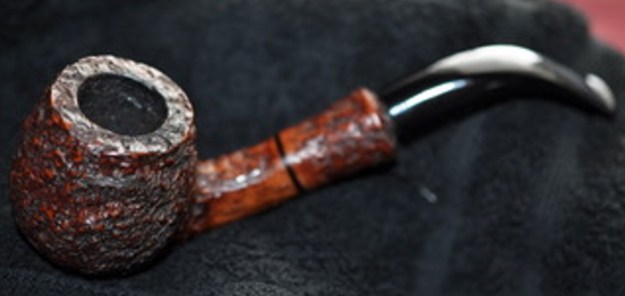
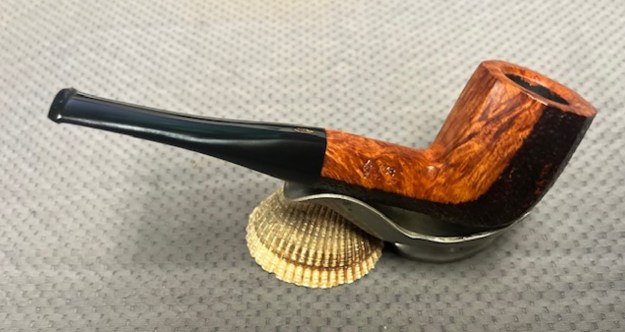
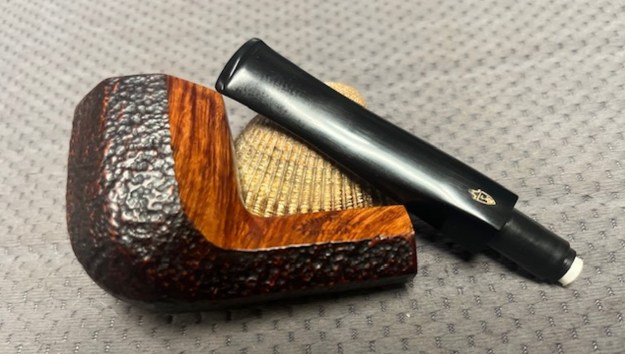
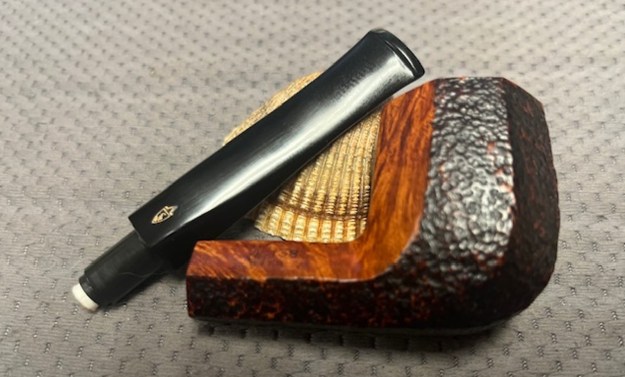
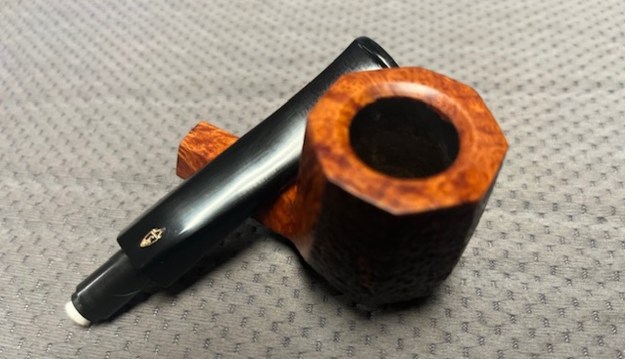
The next pipe on the table is another one that came to us from the seller in Caldwell, Idaho, USA on 07/12/2025. It is a Dunhill Red Bark Dublin with a vulcanite taper stem. It is in dirty but in good condition as can be seen in the photos below. It is stamped on the underside of the shank and reads 142 [over] F/T [followed by] Dunhill [over] Red Bark. That is followed by Made in [over] England13. That is followed by a stamping Circle 4R/B. The stamping is clear and readable. The pipe has rich Red Bark Sandblast Finish with a blend of red/oxblood stains on a richly grained sandblast finish that the shape follows well. The finish was dusty and dirty with grime ground into the finish. It was also spotty and possibly faded. The bowl had a moderate cake and there was tobacco debris in the bowl. The rim top had a thick lava coat on the top and edges. The original white spot taper stem is dirty and oxidized with light tooth marks and chatter on both sides. I took photos of the pipe to show what it looked like before I started working on it. I took photos of the bowl and rim top to show the thickness of the cake and the lava coat on the rim top. There was some tobacco debris in the bottom of the bowl. The stem photos show the condition of the taper stem ahead of the button.The stamping on the sides of the shank are faint but readable as noted above. I took a photo of the pipe with the stem removed to give a sense of the proportions of the pipe. It is a real beauty. One of the first things I like to do is to unpack the stamping and understand each element in it. I turned to Pipephil’s helpful site (http://pipephil.eu/logos/en/dunhill/shell-briar1.html). The stamping is interpreted as follows: The 142 is the shape of the pipe which is a Dublin. The F/T designates a Fishtail stem. The Dunhill Red Bark is a red stained sandblast finish. Following the Made In England13 gives the year that the pipe was made.  The circle 4R/B is the stamp for a Group 4 in a Red Bark finish.

From the above information I could see that I was working on a Red Bark Dublin shaped pipe.

From there I wanted to pin down the date stamp 1. I have included Page 2 of the Dunhill Dating Key (http://www.pipephil.eu/logos/en/dunhill/cledat-en1a.html). Following that it takes me to the box with 1960+suffix. That tells me that the pipe is a 1973 pipe.I wanted to know more about the Red Bark finish and when it was introduced by Dunhill. I turned to a listing on Pipedia that gave me the information I was looking for (https://pipedia.org/wiki/Dunhill).

Red Bark:

Red Bark: Introduced in 1972, the Redbark was a sandblasted finish characterized by a reddish stain and is arguably the most famous of Dunhill’s discontinued lines. Initially, the stain was a medium red, but a few years after its introduction, it was changed to a significantly brighter, almost pinkish hue. This new colour proved unpopular, causing sales to plummet. In response, the company reverted to the original, darker red stain in 1976. The Redbark finish was officially discontinued in 1987.[122][123]

Now I knew that I was working on a Dunhill Red Bark 142 F/T Dublin with a Taper Stem that was made in 1973 and was only made until 1987 before it was discontinued.

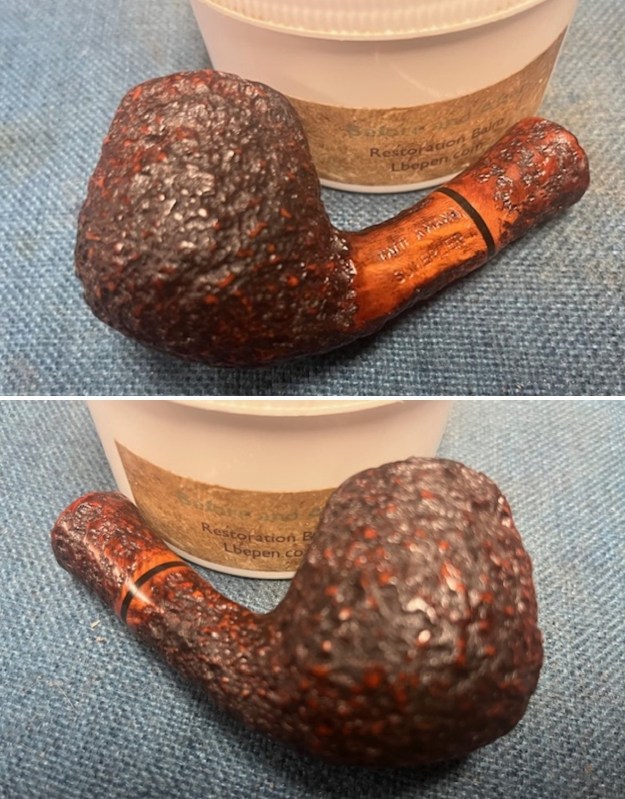
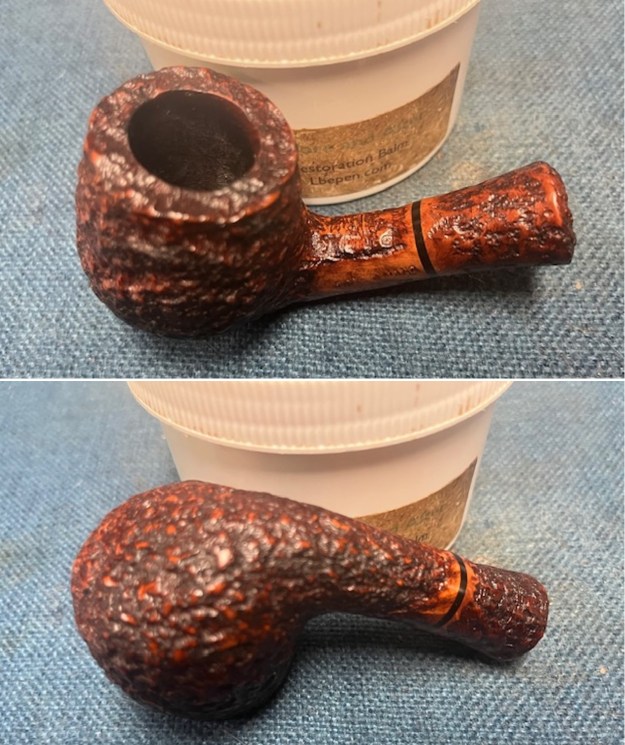
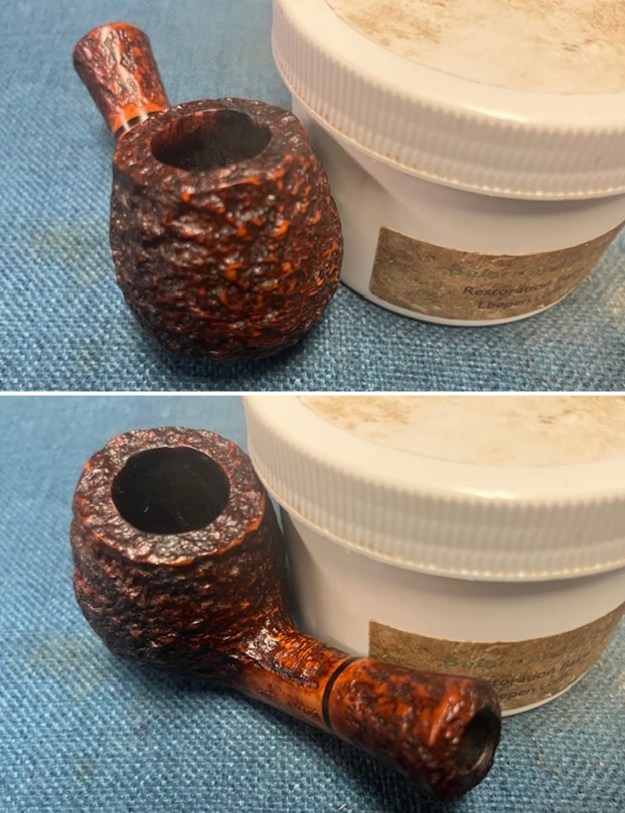
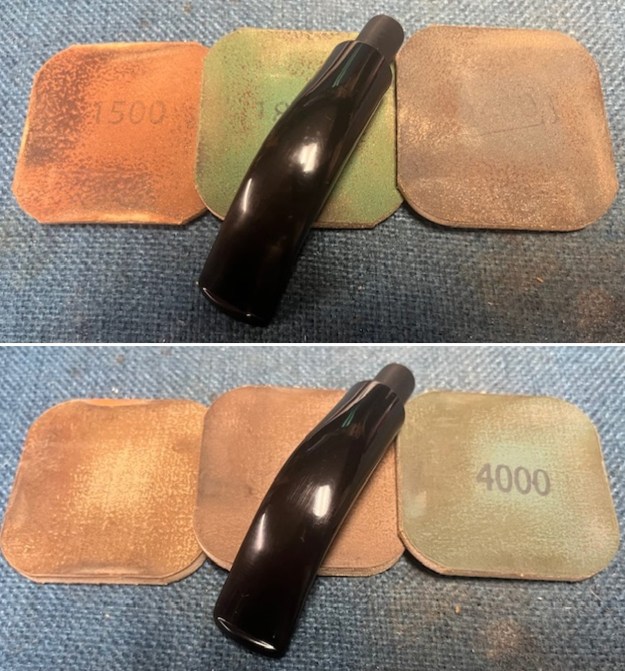
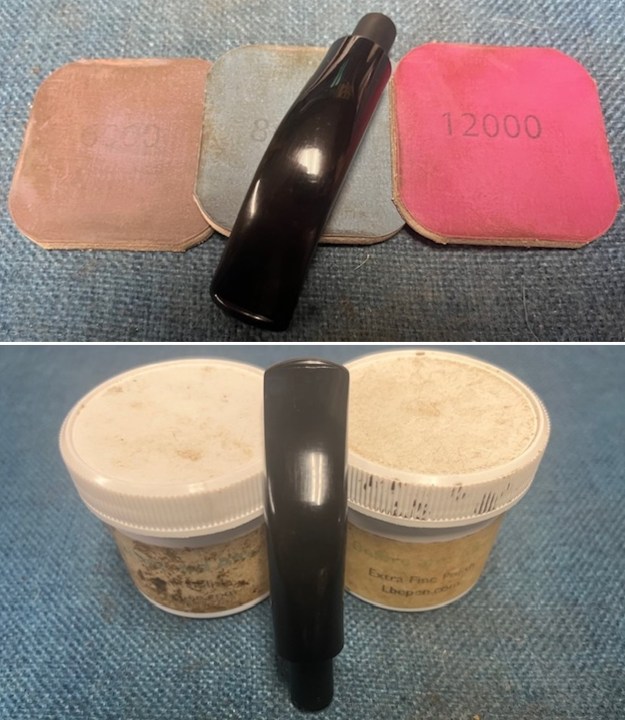
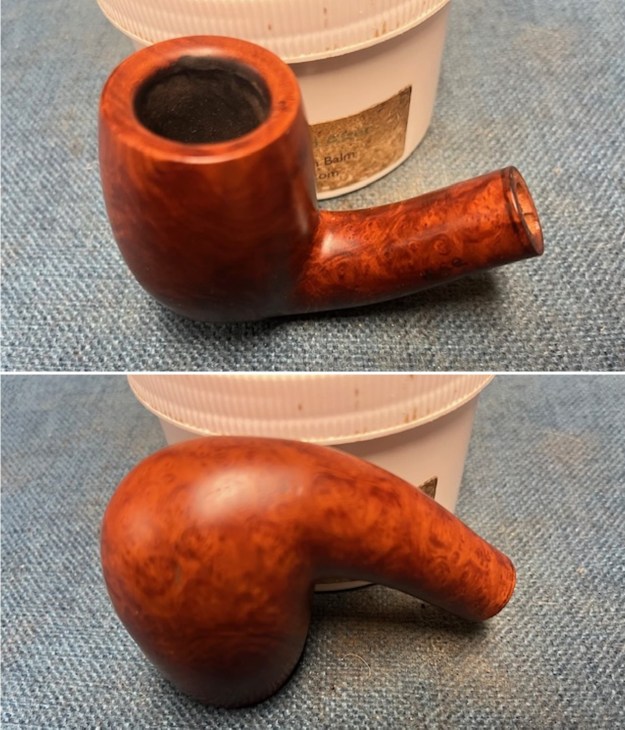
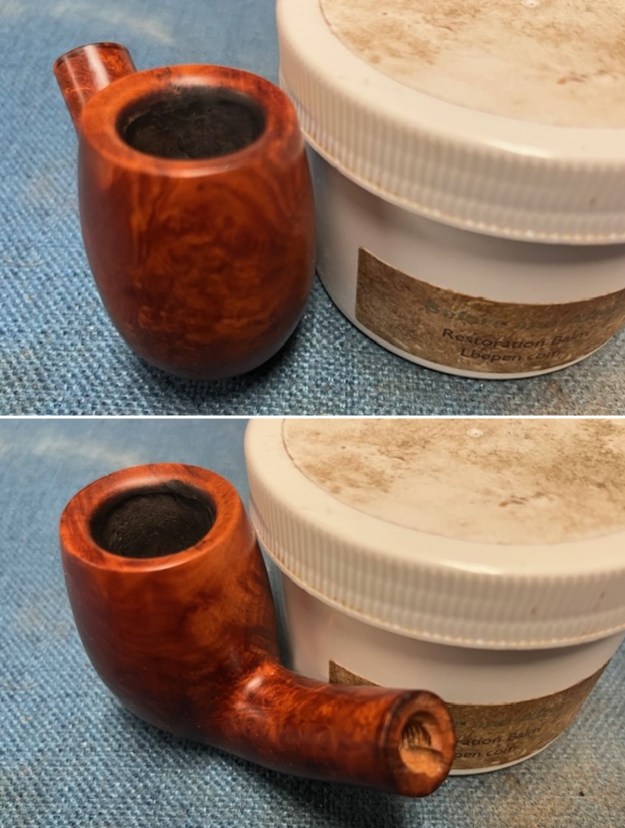
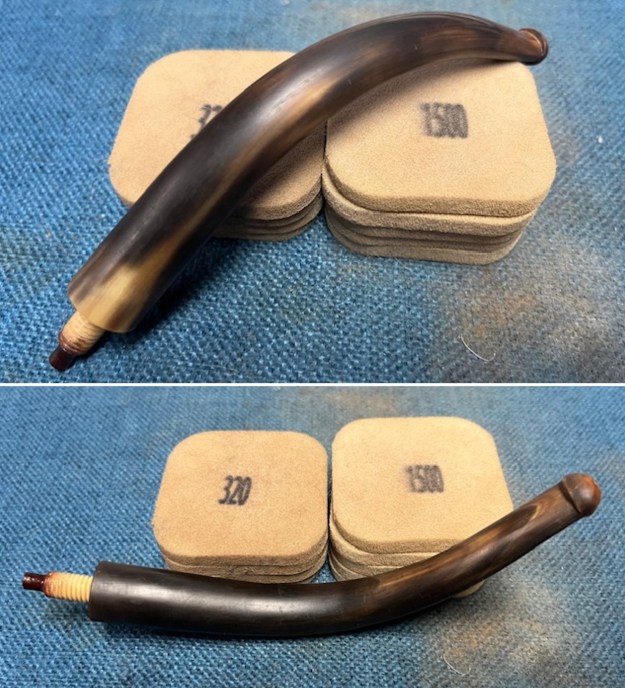
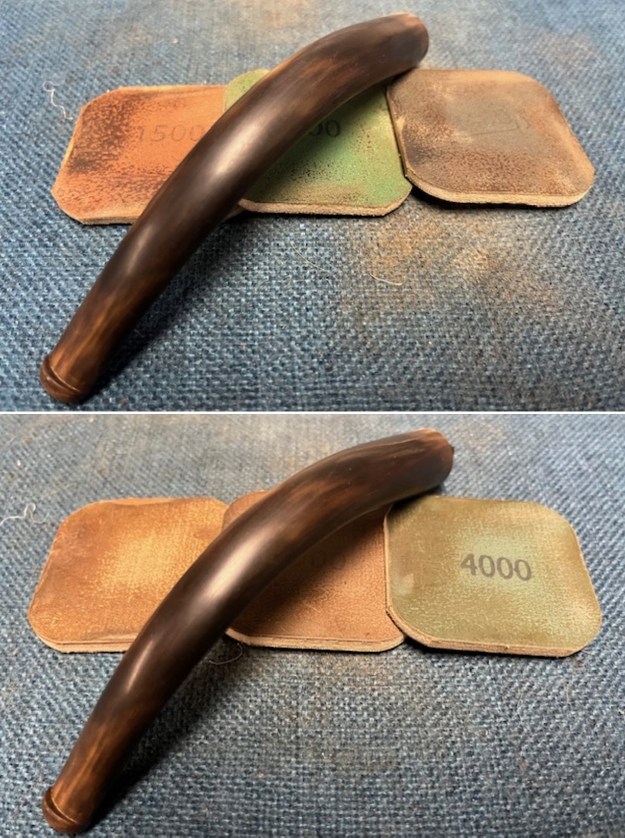
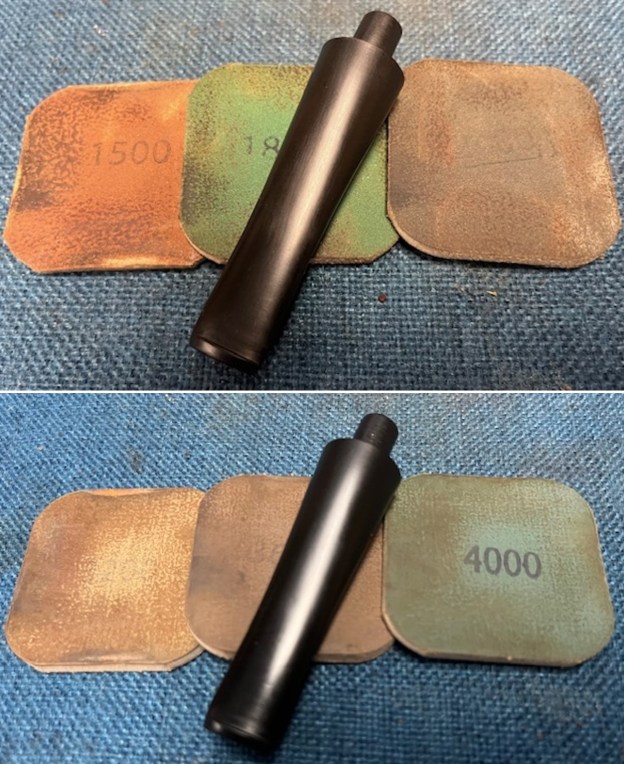
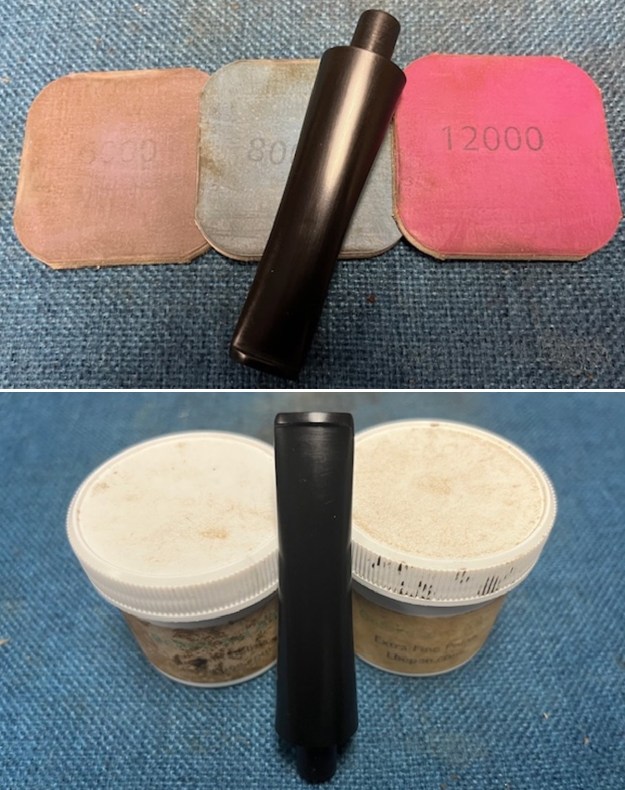
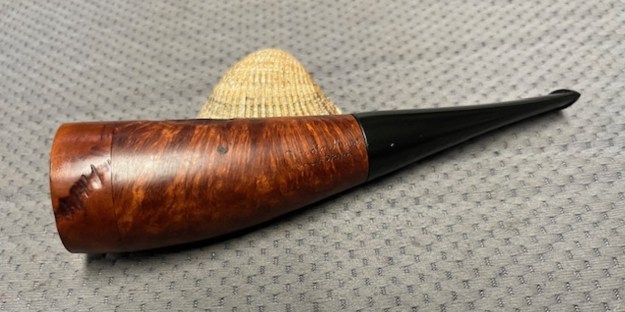
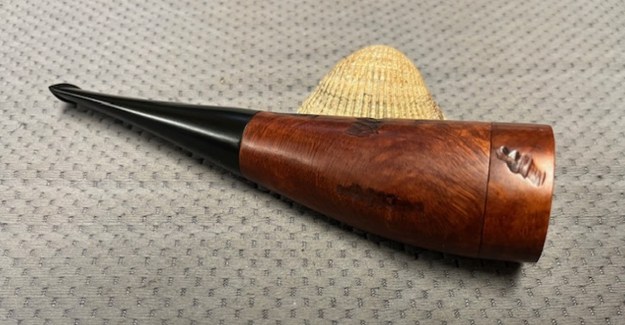
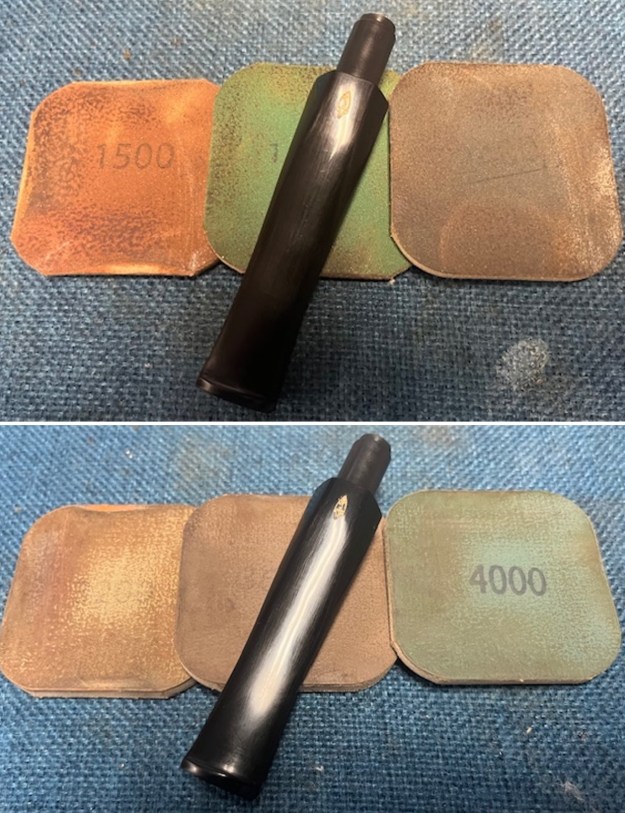
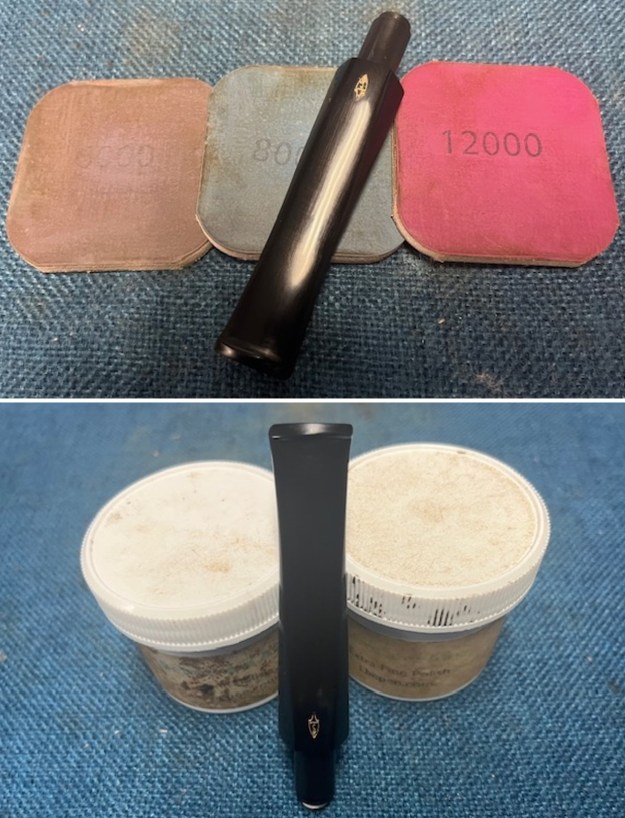
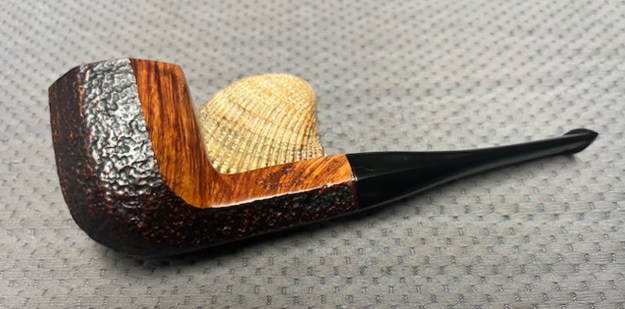
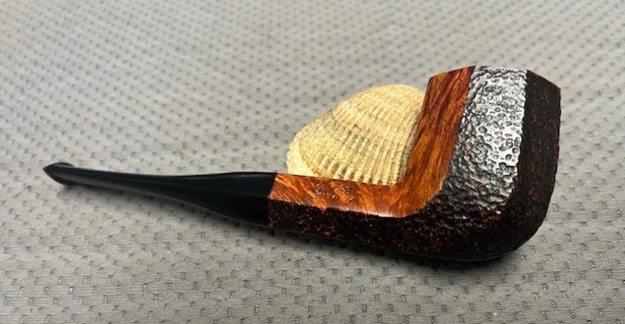
I turned to work on the pipe itself. I reamed the bowl with a PipNet pipe reamer using the cutting heads 2 and 3. I finished the reaming with a Savinelli Fitsall Pipe Knife. I sanded the walls of the bowl with 220 grit sandpaper wrapped around a piece of dowel. I cleaned out the inside of the shank and the airway in the stem with alcohol, cotton swabs and both bristle and regular pipe cleaners. I scrubbed the bowl and shank with a tooth brush and some undiluted Murphy’s Oil Soap. I rinsed it off with warm water to remove the dust and soap from the finish. I dried it off with a soft cloth and it looked much better. I worked on the darkening on the rim top with a brass bristle wire brush and some Before & After Briar Cleaner. I worked it into the grooves on rim top sandblast and let it sit for 5 minutes. I repeated the process four times and when finished I wiped it off. I was able to remove the majority of the darkening with this method. I rubbed the briar down with Before & After Restoration Balm. I worked it into the briar with my fingertips to work it into the finish. The product works to clean, enliven and preserve the briar. I let it sit for 10 minutes then I buffed it with a cotton cloth to deepen the shine. The briar really comes alive with the balm. I set the bowl aside and worked on the stem. I sanded the surface of the stem with a folded piece of 220 grit sandpaper to remove the oxidation and clean up the tooth marks and chatter on both sides of the stem ahead of the button. I sanded the stem with 320-3500 grit 2×2 inch pads. I wiped the stem down with an Obsidian Oil cloth after each sanding pad.I polished the vulcanite with micromesh sanding pads – 1500-12000 grit pads. I wiped it down with Obsidian Oil after each sanding pad. I used Before & After Pipe Polish – both Fine and Extra Fine to further polish the stem. I the polished vulcanite taper stem and the 1973 Dunhill Red Bark 142 F/T Dublin bowl with Blue Diamond to polish out the remaining small scratches and raise the shine. I gave the bowl and the stem several coats of carnauba wax then buffed the pipe with a clean buffing pad to raise the shine. I hand buffed it with a microfiber cloth to deepen the shine. The pipe polished up pretty nicely. This turned out to be a beautiful Dunhill Red Bark 142 F/T Dublin with a Taper Stem. The finished pipe is shown in the photos below. The dimensions are Length: 5 ¾ inches, Height: 1 ¾ inches, Outside diameter of the bowl: 1 3/8 inches, Chamber diameter: ¾ of an inch. The weight of the pipe is 1.20 ounces/34 grams. Thanks for walking through the restoration with me as I worked this beautiful little Dunhill Red Bark. I will be adding it to the rebornpipes store in the British Pipe Makers Section if you would like to add it to your collection. Thanks for looking.

New Life for a 1959 Dunhill Root Briar 83 F/T EX Zulu with a Taper Stem


by Steve Laug

The next pipe on the table is another one that came to us from the seller in Caldwell, Idaho, USA on 07/12/2025. It is a Dunhill Root Briar Small Zulu with a vulcanite taper stem. It is in dirty but in good condition as can be seen in the photos below. It is stamped verically on the left side of the shank and reads EX next to the bowl followed by 83 F/T [followed by] Dunhill [over] Root Briar. On the right side it is stamped Made in England9. That is followed by a stamping Circle 3R. The stamping is clear and readable. The pipe has rich Root Briar Finish with a blend of brown stains on a richly grained smooth finish that the shape follows well. The finish was dusty and lightly dirty with grime ground into the finish. The bowl had a moderate cake and there was tobacco debris in the bowl. The rim top had a thick lava coat on the rim top and edges. The original white spot taper stem is dirty and oxidized with light tooth marks and chatter on both sides. I took photos of the pipe to show what it looked like before I started working on it. I took photos of the bowl and rim top to show the thickness of the cake and the lava coat on the rim top. There was some tobacco debris in the bottom of the bowl. The stem photos show the condition of the taper stem ahead of the button.The stamping on the sides of the shank are faint but readable as noted above. I took a photo of the pipe with the stem removed to give a sense of the proportions of the pipe. It is a real beauty. One of the first things I like to do is to unpack the stamping and understand each element in it. I turned to Pipephil’s helpful site (http://pipephil.eu/logos/en/dunhill/shell-briar1.html). The stamping is interpreted as follows: The 83 is the shape of the pipe which is a Zulu. The F/T designates a Fishtail stem. The Dunhill Root Briar is the finish. Following the Made In England9 gives the year that the pipe was made.  The circle 3R is the stamp for a Group 3 in a Root Briar finish.

That still left a mystery for me – what does the EX mean on the left side stamped vertically against bowl shank junction. I turned to John C. Loring’s, The Dunhill Briar Pipe book. On page 47 I found what I was looking for. I quote:

“EX”. A randomly placed “EX” occasionally found on either the reverse shank side of smooth finished pipes or on the bottom of Shell shanks signifies that the pipe was given in exchange pursuant to Dunhill’s one year guarantee. On might speculate that this stamping began with the formal commencement of the guarantee policy in 1921 but Dunhill had informally exchanged pipes for some time preceding, probably since inception, and it is well possible that the EX stamping around during that earlier period.

From the above information I could see that I was working on a Root Briar 83F/T Zulu shaped pipe. The EX gives another exciting bit of information that the pipe was given to the owner as a replacement or exchange for a broken pipe still under guarantee.

From there I wanted to pin down the date stamp 1. I have included Page 2 of the Dunhill Dating Key (http://www.pipephil.eu/logos/en/dunhill/cledat-en1a.html). Following that it takes me to the box with 1950+suffix. That tells me that the pipe is a 1959 pipe.    I wanted to know more about the Root Briar finish and when it was introduced by Dunhill. I turned to a listing on Pipedia that gave me the information I was looking for (https://pipedia.org/wiki/Dunhill).

Root Briar

Dunhill introduced its third major pipe finish, the Root Briar, in 1931. The new line was developed specifically to showcase briar with a particularly beautiful and pronounced grain. To this end, it was made exclusively from Corsican mountain briar, a wood characteristically prized for its fine grain, a practice that continued into the 1960s.

The pipe was finished with a light, natural stain to allow the beauty of the wood to show through. A particularly distinctive feature of the early Root Briar was its unique mouthpiece — a marble-grained, brown vulcanite bit — that became known to collectors as the ‘bowling ball’ bit. This style, however, was discontinued with the onset of the Second World War.

Because the Root Briar finish requires a perfectly clean bowl with exceptional graining, it has always been one of Dunhill’s rarer and more expensive lines, typically available only at the company’s own stores or through its principal dealers. Its nomenclature was identical to that of the Bruyère, except for the use of an ‘R’ stamp instead of an ‘A’. Straight-grained versions were graded on various scales over the years, evolving into the modern ‘DR’ one-to-six-star system.[122][123]

Now I knew that I was working on a Dunhill Root Briar 83 F/T Zulu with a Taper Stem that was made in 1959 and was given to the original owner as an Exchange or replacement pipe for one unrepairable but still under Dunhill Guarantee.

I turned to work on the pipe itself. I reamed the bowl with a PipNet pipe reamer using the cutting heads 2 and 3. I finished the reaming with a Savinelli Fitsall Pipe Knife. I sanded the walls of the bowl with 220 grit sandpaper wrapped around a piece of dowel. I cleaned out the inside of the shank and the airway in the stem with alcohol, cotton swabs and both bristle and regular pipe cleaners.I scrubbed the bowl and shank with a tooth brush and some undiluted Murphy’s Oil Soap. I rinsed it off with warm water to remove the dust and soap from the finish. I dried it off with a soft cloth and it looked much better. I worked on the darkening on the rim top with a folded piece of 220 grit sandpaper to remove the darkened areas on the top and inner edge of the bowl.I sanded the exterior of the bowl with 320-3500 grit 2×2 inch sanding pads to remove the scratching in the finish. I wiped the bowl down with a damp cloth after each sanding pad. It really began to look much better. I polished the briar with 1500-12000 grit micromesh sanding pads to develop the shine. It began to look very good. It had a rich shine in the finish. I rubbed the briar down with Before & After Restoration Balm. I worked it into the briar with my fingertips to work it into the finish. The product works to clean, enliven and preserve the briar. I let it sit for 10 minutes then I buffed it with a cotton cloth to deepen the shine. The briar really comes alive with the balm. I set the bowl aside and worked on the stem. I sanded the surface of the stem with a folded piece of 220 grit sandpaper to remove the oxidation and clean up the tooth marks and chatter on both sides of the stem ahead of the button. I sanded the stem with 320-3500 grit 2×2 inch pads. I wiped the stem down with an Obsidian Oil cloth after each sanding pad.I polished the vulcanite with micromesh sanding pads – 1500-12000 grit pads. I wiped it down with Obsidian Oil after each sanding pad. I used Before & After Pipe Polish – both Fine and Extra Fine to further polish the stem. I the polished vulcanite taper stem and the 1959 Dunhill Root Briar 83 F/T Zulu EX bowl with Blue Diamond to polish out the remaining small scratches and raise the shine. I gave the bowl and the stem several coats of carnauba wax then buffed the pipe with a clean buffing pad to raise the shine. I hand buffed it with a microfiber cloth to deepen the shine. The pipe polished up pretty nicely. This turned out to be a beautiful Dunhill Root 83 F/T Zulu with a Taper Stem. The finished pipe is shown in the photos below. The dimensions are Length: 5 ½ inches, Height: 1 ¾ inches, Outside diameter of the bowl: 1 ¼ inches, Chamber diameter: ¾ of an inch. The weight of the pipe is 1.06 ounces/30 grams. Thanks for walking through the restoration with me as I worked this beautiful little Dunhill Root Briar. I will be adding it to the rebornpipes store in the British Pipe Makers Section if you would like to add it to your collection. Thanks for looking.

New Life for a 1961 Dunhill Root Briar OXS F/T Diamond Shank Bulldog with a Saddle Stem


by Steve Laug

The next pipe on the table is another one that came to us from the seller in Caldwell, Idaho, USA on 07/12/2025. It is a Dunhill Root Briar Small Straight Bulldog with a vulcanite saddle stem. It is in dirty but in good condition as can be seen in the photos below. It is stamped on the left side of the shank and reads OXS F/T [followed by] Dunhill [over] Root Briar. On the right side it is stamped Made in England1. That is followed by a stamping Circle 4R. The stamping is clear and readable. The pipe has rich Root Briar Finish with a blend of brown stains on a richly grained smooth finish that the shape follows well. The finish was dusty and lightly dirty with grime ground into the finish. The bowl had a moderate cake and there was tobacco debris in the bowl. The rim top had a thick lava coat on the rim top and edges. The original white spot saddle stem is dirty and oxidized with light tooth marks and chatter on both sides. I took photos of the pipe to show what it looked like before I started working on it. I took photos of the bowl and rim top to show the thickness of the cake and the lava coat on the rim top. There was some tobacco debris in the bottom of the bowl. The stem photos show the condition of the saddle stem ahead of the button.The stamping on the sides of the shank are clear and readable as noted above. I took a photo of the pipe with the stem removed to give a sense of the proportions of the pipe. It is a real beauty. One of the first things I like to do is to unpack the stamping and understand each element in it. I turned to Pipephil’s helpful site (http://pipephil.eu/logos/en/dunhill/shell-briar1.html). The stamping is interpreted as follows: The OX is the shape of the pipe which I assume is a Bulldog. The S following the OX I think points to a small Bulldog or straight Bulldog. The Dunhill Root Briar is the finish. Following the Made In England1 gives the year that the pipe was made.  The circle 4R is the stamp for a Group 4 in a Root Briar finish.

I turned to Pipedia’s shape charts on Dunhills (https://pipedia.org/wiki/Dunhill_Shape_Chart). I have included the shape charts from the site. The first is the chart as a whole and the second is a larger version of the right column. From the above information I could see that I was working on a Saddle Bulldog shaped pipe. The chart shows that the OX is the stamping for Saddle Bulldog. The OXS is a small or saddle stem Bulldog.

From there I wanted to pin down the date stamp 1. I have included Page 2 of the Dunhill Dating Key (http://www.pipephil.eu/logos/en/dunhill/cledat-en1a.html). Following that it takes me to the box with 1960+suffix. That tells me that the pipe is a 1961 pipe.    I wanted to know more about the Root Briar finish and when it was introduced by Dunhill. I turned to a listing on Pipedia that gave me the information I was looking for (https://pipedia.org/wiki/Dunhill).

Root Briar

Dunhill introduced its third major pipe finish, the Root Briar, in 1931. The new line was developed specifically to showcase briar with a particularly beautiful and pronounced grain. To this end, it was made exclusively from Corsican mountain briar, a wood characteristically prized for its fine grain, a practice that continued into the 1960s.

The pipe was finished with a light, natural stain to allow the beauty of the wood to show through. A particularly distinctive feature of the early Root Briar was its unique mouthpiece — a marble-grained, brown vulcanite bit — that became known to collectors as the ‘bowling ball’ bit. This style, however, was discontinued with the onset of the Second World War.

Because the Root Briar finish requires a perfectly clean bowl with exceptional graining, it has always been one of Dunhill’s rarer and more expensive lines, typically available only at the company’s own stores or through its principal dealers. Its nomenclature was identical to that of the Bruyère, except for the use of an ‘R’ stamp instead of an ‘A’. Straight-grained versions were graded on various scales over the years, evolving into the modern ‘DR’ one-to-six-star system.[122][123]

Now I knew that I was working on a Dunhill Root Briar OXS Small Saddle Stem Dog with a Saddle Stem that was made in 1961.

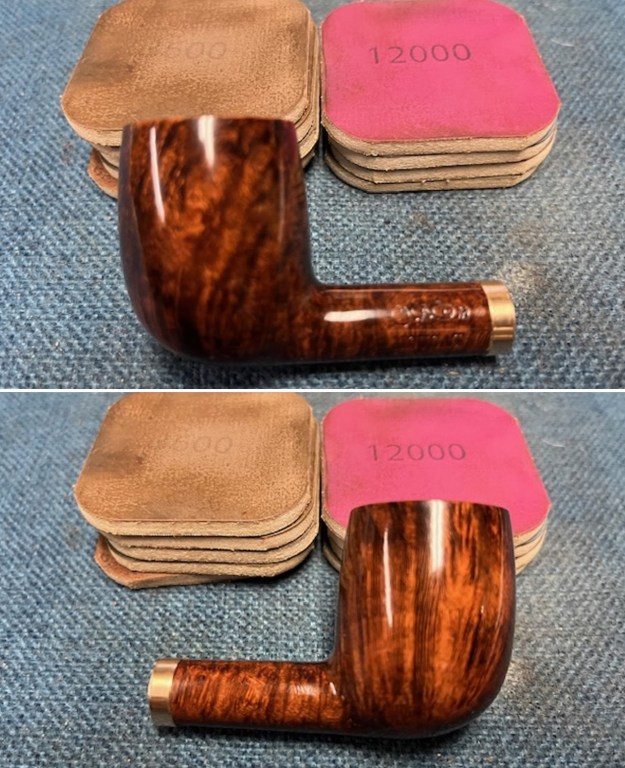
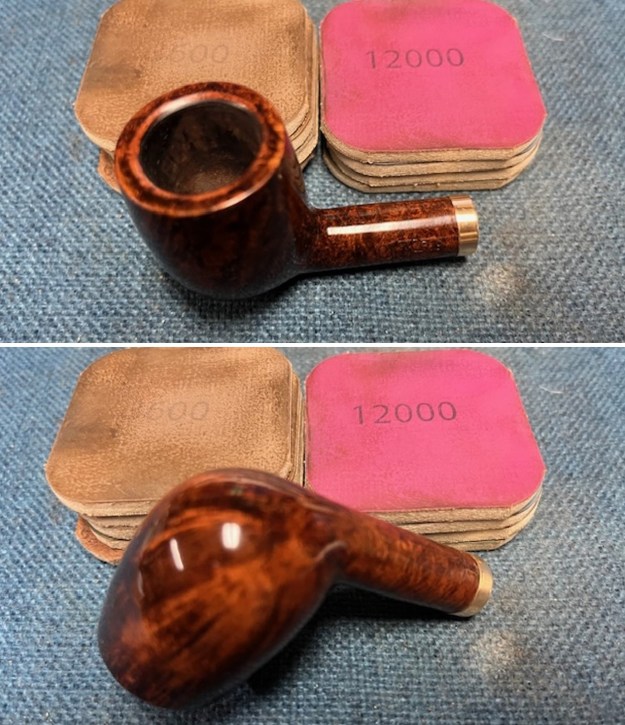
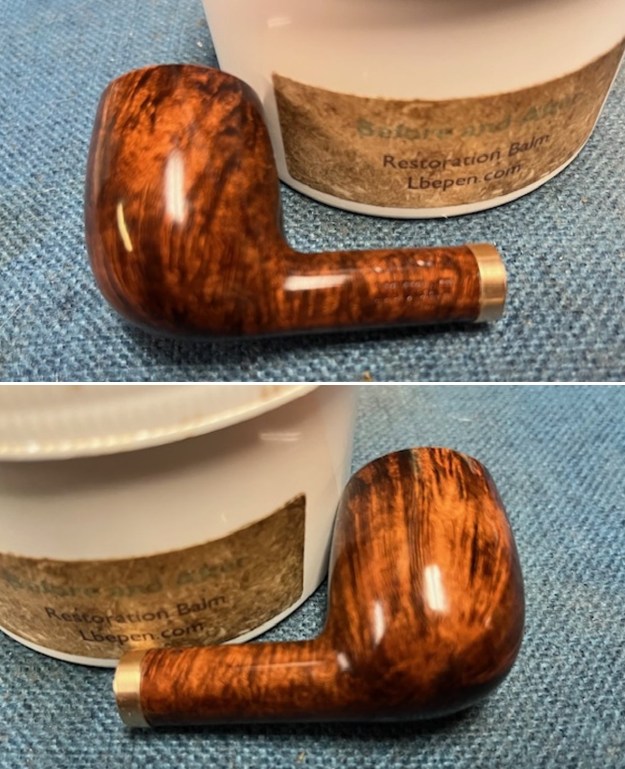
I turned to work on the pipe itself. I reamed the bowl with a PipNet pipe reamer using the cutting heads 2 and 3. I finished the reaming with a Savinelli Fitsall Pipe Knife. I sanded the walls of the bowl with 220 grit sandpaper wrapped around a piece of dowel. I cleaned out the inside of the shank and the airway in the stem with alcohol, cotton swabs and both bristle and regular pipe cleaners. I scrubbed the bowl and shank with a tooth brush and some undiluted Murphy’s Oil Soap. I rinsed it off with warm water to remove the dust and soap from the finish. I dried it off with a soft cloth and it looked much better. I worked on the darkening on the rim top with a folded piece of 220 grit sandpaper to remove the darkened areas on the top and inner edge of the bowl.I sanded the exterior of the bowl with 320-3500 grit 2×2 inch sanding pads to remove the scratching in the finish. I wiped the bowl down with a damp cloth after each sanding pad. It really began to look much better. I polished the briar with 1500-12000 grit micromesh sanding pads to develop the shine. It began to look very good. It had a rich shine in the finish. I rubbed the briar down with Before & After Restoration Balm. I worked it into the briar with my fingertips to work it into the finish. The product works to clean, enliven and preserve the briar. I let it sit for 10 minutes then I buffed it with a cotton cloth to deepen the shine. The briar really comes alive with the balm. I set the bowl aside and worked on the stem. I sanded the surface of the stem with a folded piece of 220 grit sandpaper to remove the oxidation and clean up the tooth marks and chatter on both sides of the stem ahead of the button. I filled in the tooth marks on both sides of the stem with black CA glue. Once the repairs cured I flattened them with small flat files. I sanded them with 220 grit sandpaper to smooth them out and blend them into the surface. I sanded the stem with 320-3500 grit 2×2 inch pads. I wiped the stem down with an Obsidian Oil cloth after each sanding pad.I polished the vulcanite with micromesh sanding pads – 1500-12000 grit pads. I wiped it down with Obsidian Oil after each sanding pad. I used Before & After Pipe Polish – both Fine and Extra Fine to further polish the stem. I the polished vulcanite saddle stem and the 1961 Dunhill Root Briar OXS Saddle Stem Bulldog bowl with Blue Diamond to polish out the remaining small scratches and raise the shine. I gave the bowl and the stem several coats of carnauba wax then buffed the pipe with a clean buffing pad to raise the shine. I hand buffed it with a microfiber cloth to deepen the shine. The pipe polished up pretty nicely. This turned out to be a beautiful Dunhill Root OXS Bulldog with a Saddle Stem. The finished pipe is shown in the photos below. The dimensions are Length: 5 ½ inches, Height: 1 ¾ inches, Outside diameter of the bowl: 1 ¼ inches, Chamber diameter: ¾ of an inch. The weight of the pipe is 1.41 ounces/40 grams. Thanks for walking through the restoration with me as I worked this beautiful little Dunhill Root Briar. I will be adding it to the rebornpipes store in the British Pipe Makers Section if you would like to add it to your collection. Thanks for looking.

What a Beautiful Lane Era Charatans Make Supreme 42X Large Billiard


by Steve Laug

The next pipe on the table is another one that came to us from the seller in Caldwell, Idaho, USA on 07/12/2025. It is a Large Charatan’s Billiard with a vulcanite saddle stem. It is in dirty but good condition as can be seen in the photos below. It is stamped on the left side of the shank and has a cursive L in a circle near the bowl/shank junction [followed by] Charatan’s Make [over] London, England [over] Supreme [followed by] the shape number 42X. There is no stamping on the right side of the shank. The pipe has rich finish with a blend of brown stains on a richly grained smooth finish that the shape follows well. The finish was dusty, scratched and dirty with grime ground into the finish. The bowl had a moderate cake, cobwebs and tobacco debris in the bowl. The rim top had a lava coat on the rim top and inner edge. There was some scratching on the smooth rim top. The original saddle stem with the Charatan’s “CP” logo on the left side is dirty and oxidized with light tooth marks and chatter on both sides. I took photos of the pipe to show what it looked like before I started working on it. I took photos of the bowl and rim top to show the thickness of the cake and the lava coat on the rim top. There was some tobacco debris in the bottom of the bowl. The stem photos show the condition of the saddle stem ahead of the button.The stamping on the sides of the shank are clear and readable as noted above. I took a photo of the pipe with the stem removed to give a sense of the proportions of the pipe. Under the grime it is a real beauty.An added part of pipe restoration for me is to try to gather as much background on a brand and maker as I can find. With Charatan that is an enjoyable web to untangle. There is a lot of information and it can lead to understanding what era a pipe was made in. To try to figure out the era of the Charatan’s pipe I was working on I turned to the Pipephil website, Logos and Stampings (http://www.pipephil.eu/logos/en/logo-charatan.html). There is some really helpful information on each of the lines of Charatan’s Make pipes that entered the market. There was not a Supreme on the site. The site did give a short history of the brand. I have included a portion of the site on the Special which is stamped similarly. I also quote the portion that is most pertinent.The brand was founded in 1863 by Frederik Charatan. When his father retired in 1910, Reuben Charatan took over the family business. All the pipes were handmade until 1973. The brand name has been overtaken by Dunhill in 1978 and sold in 1988 to James B. Russell Inc. (NJ, USA). During the period 1988-2002 Charatans were crafted by Butz Choquin in St Claude (France). Dunhill re-purchased Charatan brand name in 2002 and Colin Fromm (Invicta Briars, Castleford) followed up on freehand production.

Next, I turned to Pipedia to see if I could find more information on the brand and a link to a smooth saddle stem Billiard marked Charatan’s Make Special (https://pipedia.org/wiki/Charatan) but once again in the general article it was not listed. It did give a little more historical information. I quote the pertinent parts that give information on this particular pipe. In 1950 Herman G. Lane, striving to expand his business in Great Britain, made contacts with the Charatan family. Apparently, Lane got a certain influence soon, but it was not until 1955 that Lane Ltd. became the sole distributor for Charatan’s in the United States superseding Wally Frank. This can be documented in a “biography” written for Herman G. Lane titled “Leaves from a Tobaccoman’s Log”.

Thanks to Herman G. Lane’s dedicated labor Charatan became hugely popular in the States. As reported by Ken Barnes in an interview with Rick Newcombe, Reuben Charatan passed away in 1962, and his widow sold the firm to Herman Lane 1 or 2 years after his death.[1] In the early 1960s Charatan pipes were the first to overstep the $100 Dollar line in US pipe sales. In 1978 Lane’s heirs sold the Charatan company to Dunhill. The Prescot Street factory was closed in March 1982. Thereafter the fame and quality of the make declined.

The pre-Lane period (prior to 1955) and the Lane era pipes (1955 to until sometime between 1979 – 1984) are of primary interest the collector. The Lane era is often quoted as beginning about 1950.

Charatan records are almost non-existent before Lane due to a factory fire, making it difficult to date pre-Lane pipes. Charatan used 4 basic grades prior to 1950: Supreme, Selected, Executive, and Belvedere. After 1950 Herman Lane’s influence began, and the grades started to expand. In 1955 Lane took over sole distributorship of Charatan in the US. In 1957 he introduced the Supreme S. Most of his other introductions were from the 1960s and early 1970s.

From this I am fairly certain I am dealing with a Lane pipe made after 1955. There is also a circle L script mark that is a Lane stamping on the pipe which also supports this.

I continued digging further into the dating of the pipe, but what I had found above was a good start for me. If some of you would like to try your hand at dating it more accurately as to the time period it came out you might want to check out the article on Pipedia on Dating Charatans (https://pipedia.org/wiki/Dating_of_Charatans).

I also reread the article on Pipedia by the Italian fellow who contributed some really helpful information on the brand (https://pipedia.org/wiki/Charatan_-_Milan_2014). I quote the section on the Second period: Reuben Charatan 1910 – c. 1962. I have highlighted a portion of the section on the shank in red to point out some more helpful dating information.

– In 1962 Herman Lane took over the business from the Charatan family, although he had already influenced production from the 1950s.

– The pipes were mostly larger than the previous ones and corresponded in size to Dunhill group 5. These are slightly less rare, but still difficult to find.

– Stem: Usually in ebonite, saddle shaped or tapered, bearing a fine “CP” stamp, underbore system (see below) used when necessary.

– Shank: The shape code is stamped on it together with the nomenclature “CHARATAN’S MAKE LONDON ENGLAND” arranged in two lines. From 1955 onward on the models marketed for the USA there is also a serif and circled capital “L” (but not all models bear this) which resembles the pound sterling symbol. The “L” is for Lane, the importer.

From 1958, Lane changed the nomenclature for models marketed for the US to clarify the message: “MADE BY HAND”.  In this period the underbore was introduced. Its manufacturing period ranged between 1920 and c.1930. This model was equipped with a duralumin plunger trap fitted in the stem, which served to clean the residue more easily. This particular model bore a special stamp on the stem, and also had its own catalogue…

QUALITY GRADES…The stem did not only display the stamps mentioned above. Another stamp that can help dating is the one referring to the quality of the pipe. Until Herman Lane arrived on the scene there were four quality grades. Starting with the lowest: Belvedere, Executive, Selected, and Supreme. Lane went on to add higher grades from time to time: Supreme S, Supreme S100, S150, S200, S250, S300, Coronation, Royal Achievement, Crown Achievement, and Summa Cum Laude; these last three are extremely rare and almost impossible to find. He also invented other, different grades, even changing the previous pipe classification standards. We will not go into detail here, but it means that if we find an S100 or Coronation the pipe was manufactured following Herman Lane’s acquisition. In particular, the FH mark, or Freehand pipe was commissioned to the famous Danish craftsman, Preben Holm.

Nomenclature – The Lane Trademark serif and circled L indicates the pipe is from the “Lane Era” (approx. 1955 to 1979 -1984?), however it appears that both the English factory or Lane themselves sometimes, or perhaps even often forget to stamp the L on a pipe. The Charatan factory was known for inconsistencies, especially in stampings. Therefore, although an L on the pipe definitely defines it as a Lane Era pipe, the lack of it could simply mean the pipe missed receiving the stamp from the factory. The lack of the trademark could also mean the pipe was destined for the European market.

Charatan pipes were not well distributed prior to the Lane Era, so very few pre-Lane pipes exist today. Herman Lane greatly grew the brand in the U.S., which caused corresponding growth in Europe.

Generally, when the pipe is stamped with the BLOCK letters “MADE BY HAND” it means the pipe was probably made between 1958 and 1965”

Generally, block letters “MADE BY HAND” and some of the other nomenclature in script (i.e. City of London or Extra Large next to the MADE BY HAND) means the pipe was made sometime between 1965 and the mid 1970s. The total script nomenclature “Made by Hand in City of London” evolved over this period of time, so many pipes had variants, such as Made By Hand in block letters and City of London in script, or some other variation of the terms or stampings.

It is believed the FH was used on Charatan pipes between 1957 and 1967-68. Three different sizes were used. The Charatan Logo (CP) on the pipe bit was changed over the year

Now I knew I was working on Lane pipe which actually means it was between 1955 and 1988 as shown by the stamping.

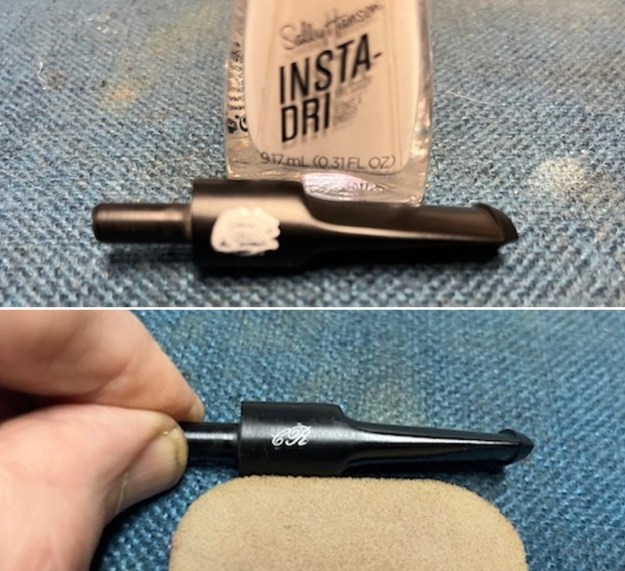
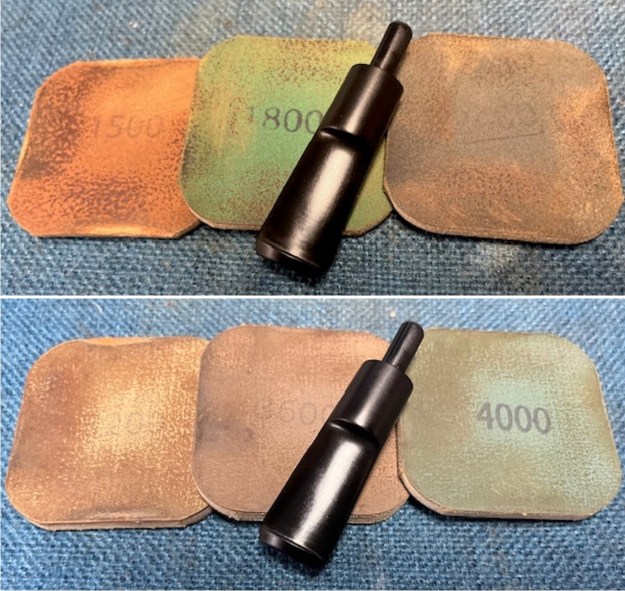
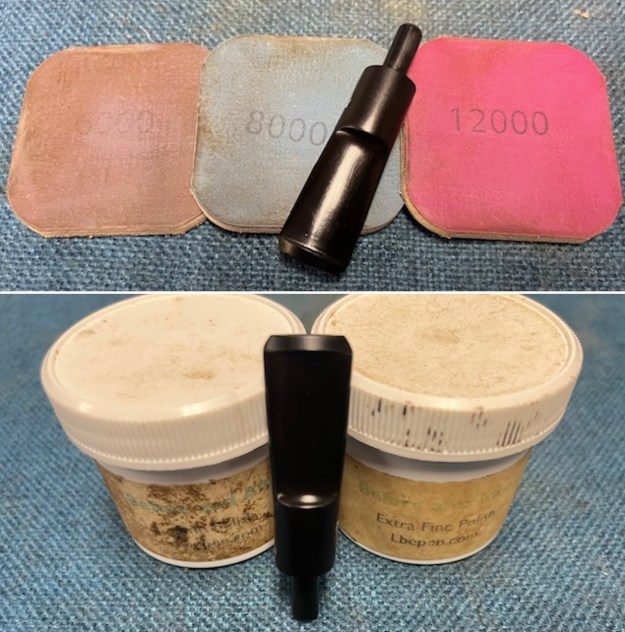
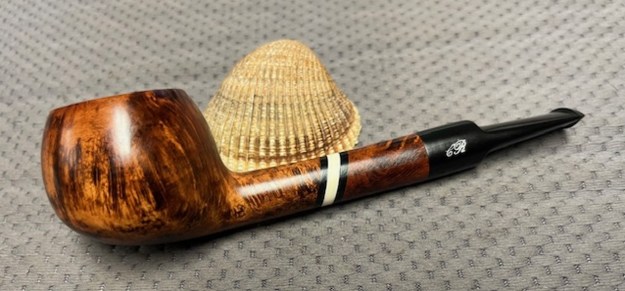
Armed with that information I turned to work on the pipe itself. I reamed the bowl with a PipNet pipe reamer using the cutting heads 2 and 3. I finished the reaming with a Savinelli Fitsall Pipe Knife. I sanded the walls of the bowl with 220 grit sandpaper wrapped around a piece of dowel. I cleaned out the inside of the shank and the airway in the stem with alcohol, cotton swabs and both bristle and regular pipe cleaners.I scrubbed the bowl and shank with a tooth brush and some undiluted Murphy’s Oil Soap. I rinsed it off with warm water to remove the dust and soap from the finish. I dried it off with a soft cloth and it looked much better. I sanded the exterior of the bowl with 320-3500 grit 2×2 inch sanding pads to remove the scratching in the finish. I wiped the bowl down with a damp cloth after each sanding pad. It really began to look much better. I polished the briar with 1500-12000 grit micromesh sanding pads to develop the shine. It began to look very good. It had a rich shine in the finish. I rubbed the briar down with Before & After Restoration Balm. I worked it into the briar with my fingertips to work it into the finish. The product works to clean, enliven and preserve the briar. I let it sit for 10 minutes then I buffed it with a cotton cloth to deepen the shine. The briar really comes alive with the balm. I set the bowl aside and worked on the stem. I scrubbed the stem down with Soft Scrub cleanser to attack the oxidation and clean up the surface of the stem.I sanded the stem with 220 grit sandpaper and broke up the oxidation a bit. The stamping was faint so I wanted to protect it and fill it in at the same time. I used some white acrylic nail polish to fill in the stamping on the saddle. Once it cured I sanded the stem surface with a worn 320 grit sanding pad to remove the excess acrylic. Once finished the CP stamp was faint but still readable.I put the stem in Briarville Stem Deoxidizer and let it sit for 30 minutes. I removed it from the wash and dried it off with a paper towel. It looks much better.I sanded the stem with 320-3500 grit 2×2 inch pads. I wiped the stem down with an Obsidian Oil cloth after each sanding pad.I polished the vulcanite with micromesh sanding pads – 1500-12000 grit pads. I wiped it down with Obsidian Oil after each sanding pad. I used Before & After Pipe Polish – both Fine and Extra Fine to further polish the stem. It was great to finish this Charatan’s Make Supreme 42X Saddle Stem Billiard. I put the pipe back together and buffed it with Blue Diamond on the buffing wheel. I gave the bowl multiple coats of carnauba wax. I buffed the pipe with a clean buffing pad to raise the shine. I hand buffed the pipe with a microfiber cloth to deepen the shine. It is fun to see what the polished bowl looks like with deep sandblast all around it. Added to that the polished black, vulcanite, saddle stem was beautiful. This Charatan’s Make Supreme 42X Saddle Stem Billiard is great looking and the pipe feels great in my hand. It is light and well balanced. Have a look at it with the photos below. The dimensions are Length: 6 inches, Height: 2 inches, Outside diameter of the bowl: 1 ½ inches, Chamber diameter: 7/8 of an inch. The weight of the pipe is 67 grams/2.36 ounces. It is a beautiful pipe and one that will soon be on the rebornpipes store in the British Pipe Makers Section. If you want to add it to your collection let me know. Thanks for walking through the restoration with me as I worked over this pipe.

As always, I encourage your questions and comments as you read the blog. Thanks to each of you who are reading this blog. Remember we are not pipe owners; we are pipe men and women who hold our pipes in trust until they pass on into the trust of those who follow us.

Cleaning up a Willmer Straight Grain AA Saddle Stem Dublin


by Steve Laug

The next pipe on the table is another one that came to us from the seller in Caldwell, Idaho, USA on 07/12/2025. It is a Willmer Straight Grain Dublin with a vulcanite saddle stem. It is in dirty but good condition as can be seen in the photos below. It is stamped on the left side of the shank and reads Willmer [over] Straight Grain [over] AA. On the right side it is stamped Made in England. The stamping is clear and readable. The pipe has rich finish with a blend of brown stains on a richly grained smooth finish that the shape follows well. The finish was dusty and lightly dirty with grime ground into the finish. The bowl had a moderate cake and there was tobacco debris in the bowl. The rim top had a thick lava coat on the rim top and edges. There could be some damage on the inner edge of the bowl. The original saddle stem with the Willmer, “W” logo on the left side is dirty and oxidized with light tooth marks and chatter on both sides. I took photos of the pipe to show what it looked like before I started working on it. I took photos of the bowl and rim top to show the thickness of the cake and the lava coat on the rim top. There was some tobacco debris in the bottom of the bowl. The stem photos show the condition of the saddle stem ahead of the button.The stamping on the sides of the shank are clear and readable as noted above. I took a photo of the pipe with the stem removed to give a sense of the proportions of the pipe. Under the grime it is a real beauty.I turned to Pipephil to get a quick review of the Willmer Company as it had been a long time since I had worked on one (http://www.pipephil.eu/logos/en/logo-w3.html). I quote the side bar from the site below.

Willmer is a brand of H. Willmer & Son Ltd. The factory closed down about 2006-07 after more then 60 years activity and two generations of makers. Gradings until the 1980s (ascending): BA, A, AA, and AAA. After this date Willmer introduced the AAAA and AAAA PRESENTATION as top grades. The pipe I was working on has an AA stamping on it which if the pipe came from pre-1980s was the close to the top of the line. If it was later, the pipe was also close to the top of the line.

I turned to Pipedia to get more information on the brand (https://pipedia.org/wiki/Willmer). The first paragraph dispelled of the belief that Willmer had been a carver for Charatan in his own words. I quote a portion of the article to give a sense of the history of the brand.

Willmer was founded in London. According to the website, which doesn’t exist anymore because the Willmer factory has been closed in 2006/07, the firm was in business “for more than 60 years” by 2003. Willmer was homed then in Southend-on-Sea, Essex, so not far from the Cadogan plant.

When Willmer first started, they definitely strived to compete with brands in the high-end market. Due to the excellent quality of the pipes Willmer was frequently asked to produce private label pipes for England’s best renowned pipe retailers. So many pipes are not easily recognized as Willmers for stamped under the name of the respective shop. Willmer’s own pipes were stamped “Willmer – Made in England” and showed a sweeping “W” in white or gold on top or left side of the stem. The earlier grading had AAA as top grade followed by AA, A, AB etc.

Sometime in the 1980’s, Willmer went through some major changes. The move to Essex was already mentioned above. They continued making highly respectable freehands – often copying some of the stunning Charatan shapes of days gone by. The grading was altered. What used to be an AAA now became the additional name “Presentation” and was stamped with AAAA. Funny enough, the forth A was often larger than the three before. The other grades were changed accordingly.

Now I knew that I was working on a Willmer Straight Grain AA Saddle Stem Dublin.

I turned to work on the pipe itself. I reamed the bowl with a PipNet pipe reamer using the cutting heads 2 and 3. I finished the reaming with a Savinelli Fitsall Pipe Knife. I sanded the walls of the bowl with 220 grit sandpaper wrapped around a piece of dowel. I cleaned out the inside of the shank and the airway in the stem with alcohol, cotton swabs and both bristle and regular pipe cleaners.I scrubbed the bowl and shank with a tooth brush and some undiluted Murphy’s Oil Soap. I rinsed it off with warm water to remove the dust and soap from the finish. I dried it off with a soft cloth and it looked much better. I used a folded piece of 220 grit sandpaper to smooth out the inner edge of the rim. I smoothed out the nicks in the edge and brought the bowl back to round. I sanded out the remnants of lava on the rim top.I sanded the exterior of the bowl with 320-3500 grit 2×2 inch sanding pads to remove the scratching in the finish. I wiped the bowl down with a damp cloth after each sanding pad. It really began to look much better. I polished the briar with 1500-12000 grit micromesh sanding pads to develop the shine. It began to look very good. It had a rich shine in the finish. I rubbed the briar down with Before & After Restoration Balm. I worked it into the briar with my fingertips to work it into the finish. The product works to clean, enliven and preserve the briar. I let it sit for 10 minutes then I buffed it with a cotton cloth to deepen the shine. The briar really comes alive with the balm. I set the bowl aside and worked on the stem. I scrubbed the stem down with Soft Scrub cleanser to attack the oxidation and clean up the surface of the stem.I sanded the stem with 320-3500 grit 2×2 inch pads. I wiped the stem down with an Obsidian Oil cloth after each sanding pad.I polished the vulcanite with micromesh sanding pads – 1500-12000 grit pads. I wiped it down with Obsidian Oil after each sanding pad. I used Before & After Pipe Polish – both Fine and Extra Fine to further polish the stem. This is a unique pipe and it is the second Willmer Straight Grain Saddle Stem Dublin I have worked. It is a beauty. I put the bowl and stem back together again and buffed the bowl and the stem with Blue Diamond on the buffing wheel. I gave the bowl and the stem several coats of carnauba wax. I carefully buffed the entire pipe with a clean buffing pad to raise the shine. I finished buffing with a microfiber cloth to deepen the shine. The finished pipe looks very good. The grain is quite beautiful a mix of straight and flame around the bowl sides and birdseye on the rim top and heel. The pipe feels great in the hand. It has an interesting shape that fits well in either the right or left hand. The finished Willmer Straight Grain AA Dublin is shown in the photos below. The dimensions of the pipe are Length: 6 inches, Height: 1 ¾ inches, Outside diameter of the bowl: 1 ½ inches, Chamber diameter: ¾ of an inch. The weight of the pipe is 1.20 ounces/35grams. This great looking Briar turned out very well. It should be a great pipe. It will be going on the rebornpipes store in the British Pipe Makers Section shortly if you are interested in adding it to your collection. Thanks for reading this blog and my reflections on the pipe while I worked on it.

New Life for a 1975 Dunhill Root Briar 131 Diamond Shank Billiard with a Taper Stem


by Steve Laug

The next pipe on the table is another one that came to us from the seller in Caldwell, Idaho, USA on 07/12/2025. It is a Dunhill Root Briar Diamond Shank Billiard with a vulcanite diamond taper stem. It is in dirty but in good condition as can be seen in the photos below. It is stamped on the left side of the shank and reads 131 [followed by] Dunhill [over] Root Briar. On the right side it is stamped Made in England15. The stamping is clear and readable. The pipe has rich Root Briar Finish with a blend of brown stains on a richly grained smooth finish that the shape follows well. The finish was dusty and lightly dirty with grime ground into the finish. The bowl had a moderate cake and there was tobacco debris in the bowl. The rim top had a thick lava coat on the rim top and edges. The original white spot saddle stem is dirty and oxidized with light tooth marks and chatter on both sides. I took photos of the pipe to show what it looked like before I started working on it. I took photos of the bowl and rim top to show the thickness of the cake and the lava coat on the rim top. There was some tobacco debris in the bottom of the bowl. The stem photos show the condition of the saddle stem ahead of the button.The stamping on the sides of the shank are clear and readable as noted above. I took a photo of the pipe with the stem removed to give a sense of the proportions of the pipe. It is a real beauty. One of the first things I like to do is to unpack the stamping and understand each element in it. I turned to Pipephil’s helpful site (http://pipephil.eu/logos/en/dunhill/shell-briar1.html). The stamping is interpreted as follows: The 131 is the shape of the pipe which is a Diamond Shank Billiard. The Dunhill Root Briar is the finish. Following the Made In England15, the 15 gives the year that the pipe was made. Following the date stamp it reads 4 in a circle R. That tells us that the pipe is Group size pipe with the R signifying that it is a Root Briar.

From there I wanted to pin down the date stamp 15. I have included Page 2 of the Dunhill Dating Key (http://www.pipephil.eu/logos/en/dunhill/cledat-en1a.html). Following that it takes me to the box with 1960+suffix. That tells me that the pipe is a 1975 pipe.    I wanted to know more about the Root Briar finish and when it was introduced by Dunhill. I turned to a listing on Pipedia that gave me the information I was looking for (https://pipedia.org/wiki/Dunhill).

Root Briar

 Dunhill introduced its third major pipe finish, the Root Briar, in 1931. The new line was developed specifically to showcase briar with a particularly beautiful and pronounced grain. To this end, it was made exclusively from Corsican mountain briar, a wood characteristically prized for its fine grain, a practice that continued into the 1960s.

The pipe was finished with a light, natural stain to allow the beauty of the wood to show through. A particularly distinctive feature of the early Root Briar was its unique mouthpiece — a marble-grained, brown vulcanite bit — that became known to collectors as the ‘bowling ball’ bit. This style, however, was discontinued with the onset of the Second World War.

Because the Root Briar finish requires a perfectly clean bowl with exceptional graining, it has always been one of Dunhill’s rarer and more expensive lines, typically available only at the company’s own stores or through its principal dealers. Its nomenclature was identical to that of the Bruyère, except for the use of an ‘R’ stamp instead of an ‘A’. Straight-grained versions were graded on various scales over the years, evolving into the modern ‘DR’ one-to-six-star system.[122][123]

Now I knew that I was working on a Dunhill Root Briar 131 Diamond Shank Billiard with a Taper Stem that was made in 1975.

I turned to work on the pipe itself. I reamed the bowl with a PipNet pipe reamer using the cutting heads 2 and 3. I finished the reaming with a Savinelli Fitsall Pipe Knife. I sanded the walls of the bowl with 220 grit sandpaper wrapped around a piece of dowel. I used a worn 400 grit sanding pad to remove the lava on the rim top. It cleaned up quite well. A good scrub will further bring the grain to the surface.I cleaned out the inside of the shank and the airway in the stem with alcohol, cotton swabs and both bristle and regular pipe cleaners. I scrubbed the bowl and shank with a tooth brush and some undiluted Murphy’s Oil Soap. I rinsed it off with warm water to remove the dust and soap from the finish. I dried it off with a soft cloth and it looked much better. I sanded the exterior of the bowl with 320-3500 grit 2×2 inch sanding pads to remove the scratching in the finish. I wiped the bowl down with a damp cloth after each sanding pad. It really began to look much better. I polished the briar with 1500-12000 grit micromesh sanding pads to develop the shine. It began to look very good. It had a rich shine in the finish. I rubbed the briar down with Before & After Restoration Balm. I worked it into the briar with my fingertips to work it into the finish. The product works to clean, enliven and preserve the briar. I let it sit for 10 minutes then I buffed it with a cotton cloth to deepen the shine. The briar really comes alive with the balm. I set the bowl aside and worked on the stem. I sanded the stem with 320-3500 grit 2×2 inch pads. I wiped the stem down with an Obsidian Oil cloth after each sanding pad.I polished the vulcanite with micromesh sanding pads – 1500-12000 grit pads. I wiped it down with Obsidian Oil after each sanding pad. I used Before & After Pipe Polish – both Fine and Extra Fine to further polish the stem. I the polished vulcanite taper stem and the 1975 Dunhill Root Briar 131 Diamond Shank Billiard bowl with Blue Diamond to polish out the remaining small scratches and raise the shine. I gave the bowl and the stem several coats of carnauba wax then buffed the pipe with a clean buffing pad to raise the shine. I hand buffed it with a microfiber cloth to deepen the shine. The pipe polished up pretty nicely. This turned out to be a beautiful Dunhill Root Briar 131 Diamond Shank Billiard with a Taper Stem. The finished pipe is shown in the photos below. The dimensions are Length: 5 inches, Height: 2 inches, Outside diameter of the bowl: 1 ¼ inches, Chamber diameter: ¾ of an inch. The weight of the pipe is 1.27 ounces/35 grams. Thanks for walking through the restoration with me as I worked this beautiful little Dunhill Root Briar. I will be adding it to the rebornpipes store in the British Pipe Makers Section if you would like to add it to your collection. Thanks for looking.

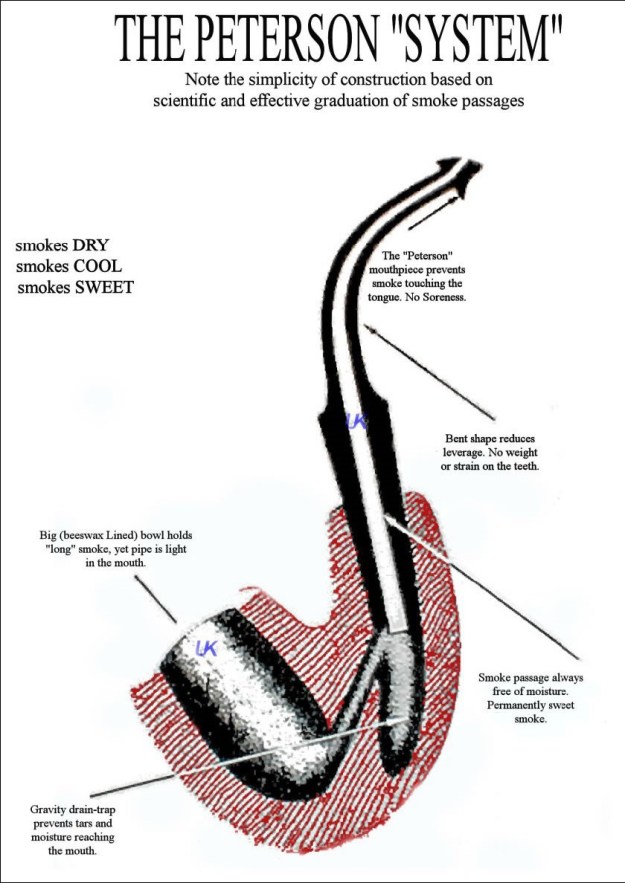
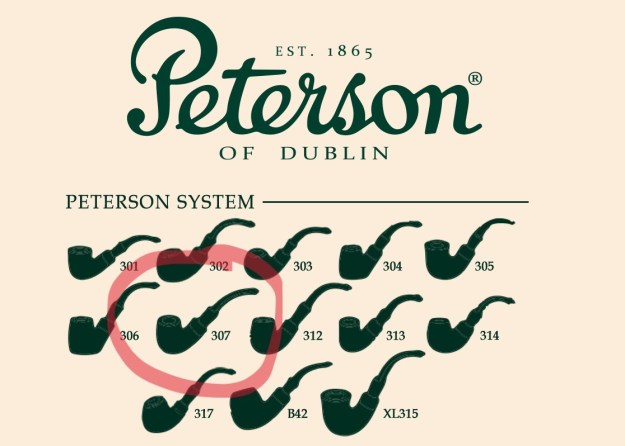
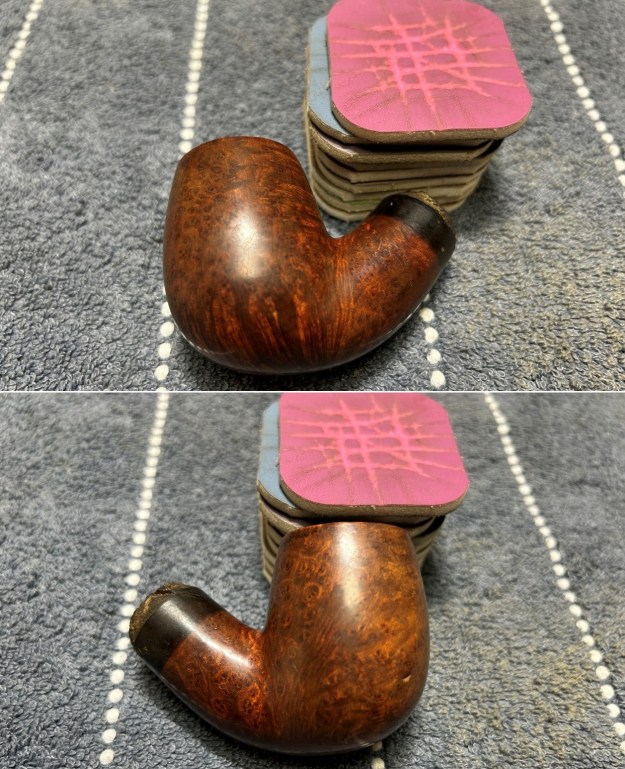
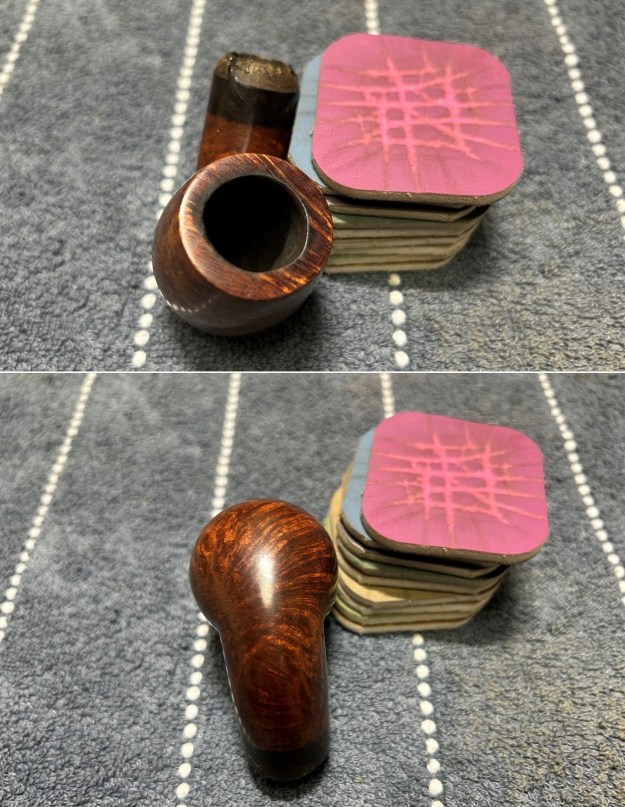
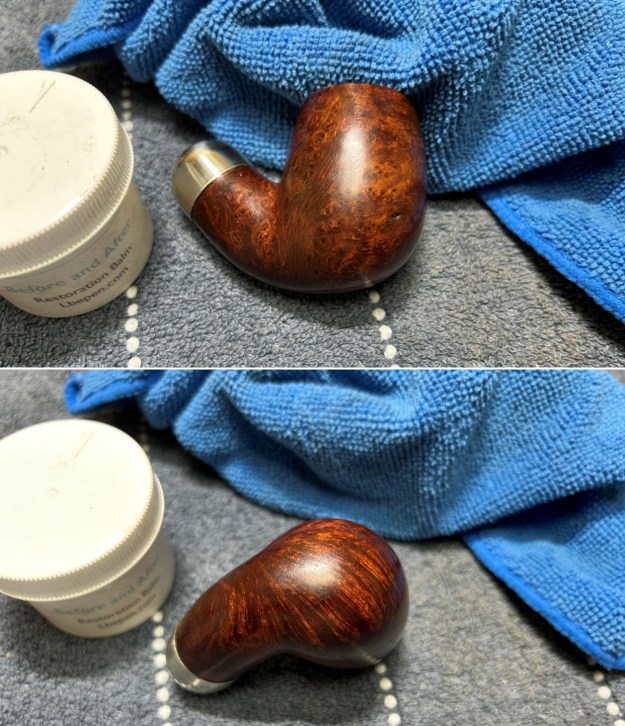
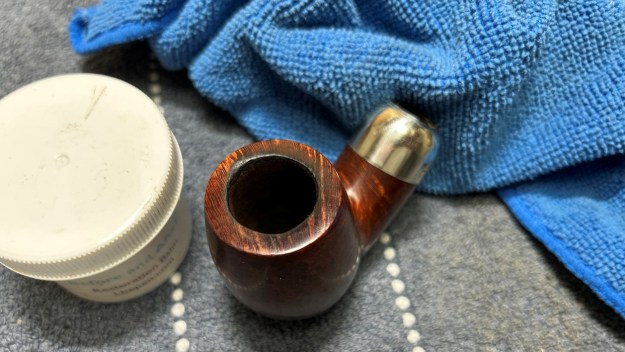
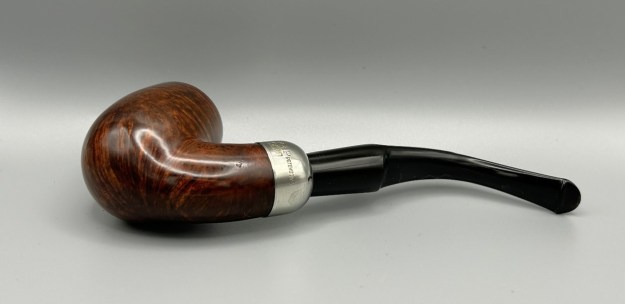
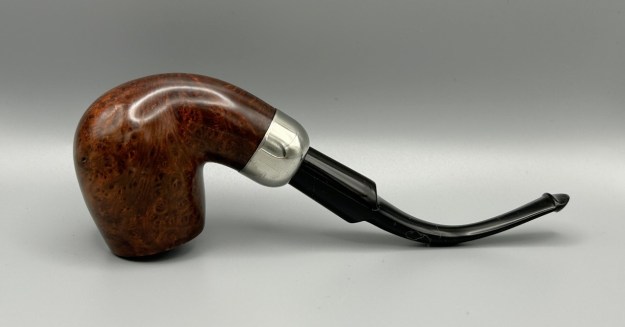
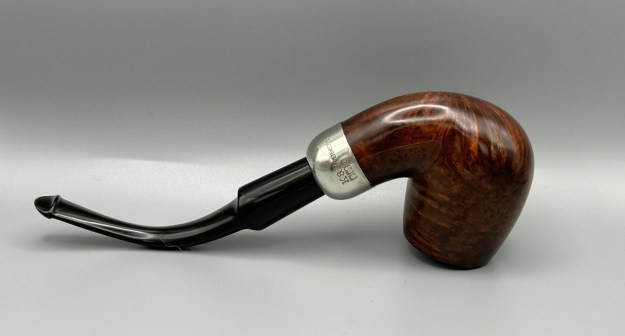
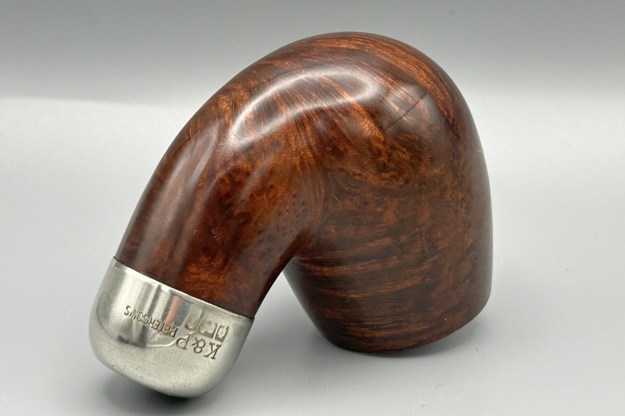
New Life for a Hard Life Peterson System 301


by Kenneth Lieblich

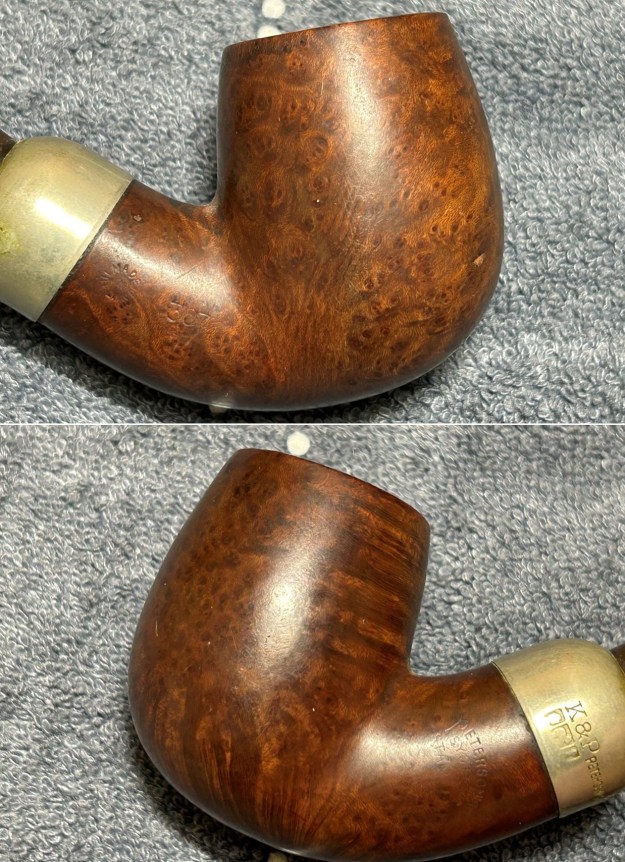
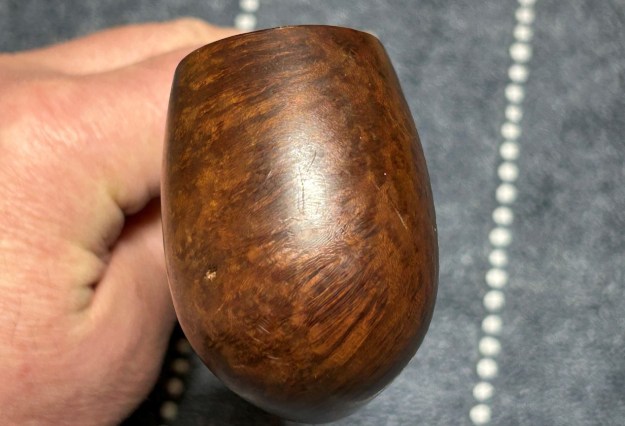
Perhaps this pipe has seen better days in its past, but I think its best days are still ahead. It’s a handsome, rugged Peterson 301 System Standard rusticated bent pot with a P-lip. This pipe came from an old gentleman, now deceased, who lived on Vancouver Island. I have no idea what he did with this pipe, but boy-oh-boy, it is pretty rough. No problem – it’s my job to sort things out. The only markings to be found on this pipe are the 301 found on the underside of the stummel and the K&P [over] Peterson on the nickel ferrule.Mark Irwin of Peterson Pipe Notes has written a few good articles about the 301s on his blog and I recommend reading one here and another one here. Of course, Steve has also written restoration blogs about the 301, including this one and it contained an important tidbit of information that I quote here:

I learned previously that the shape 301 was not introduced until 1975. Considering the Republic stamp, this one would likely date between 1975 and 2000.

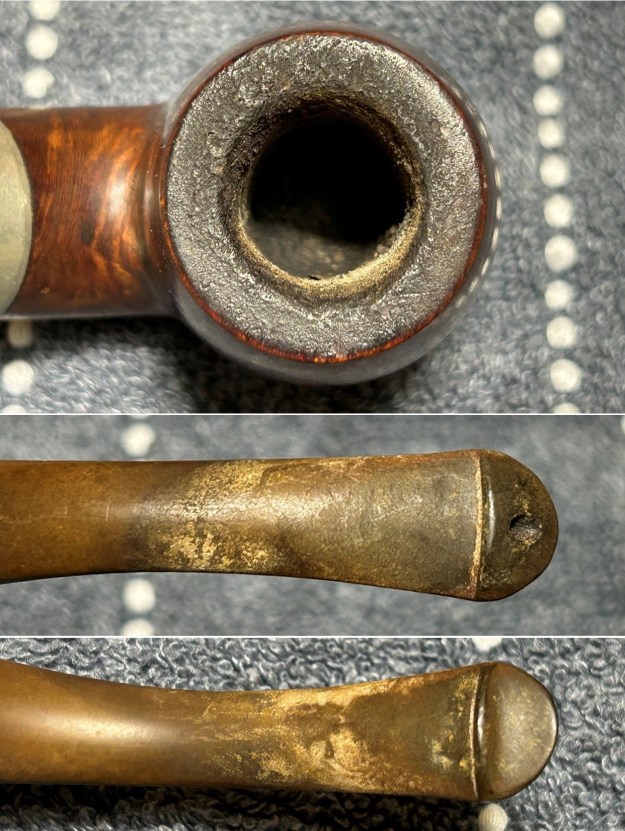
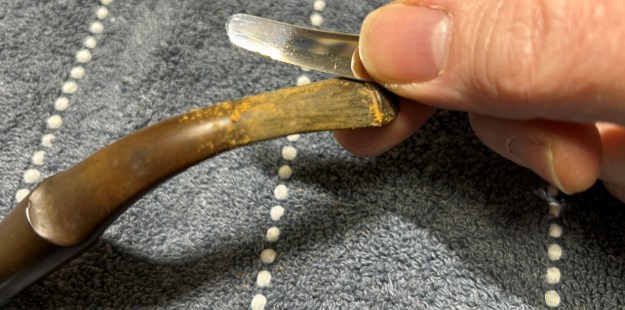
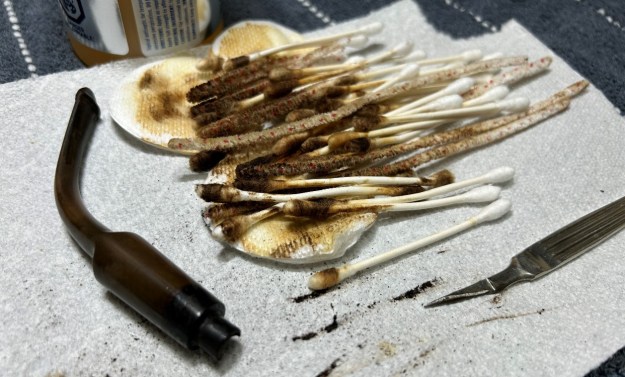
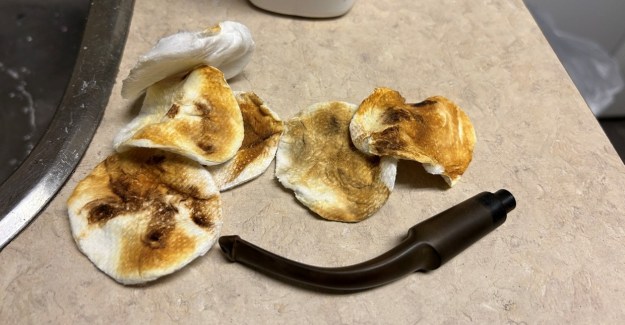
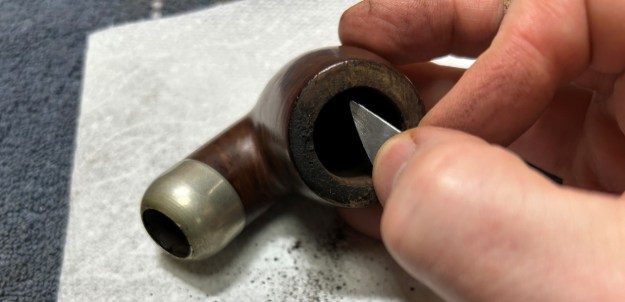
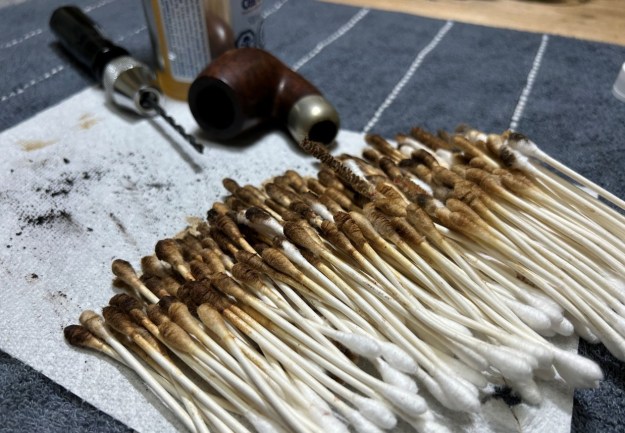
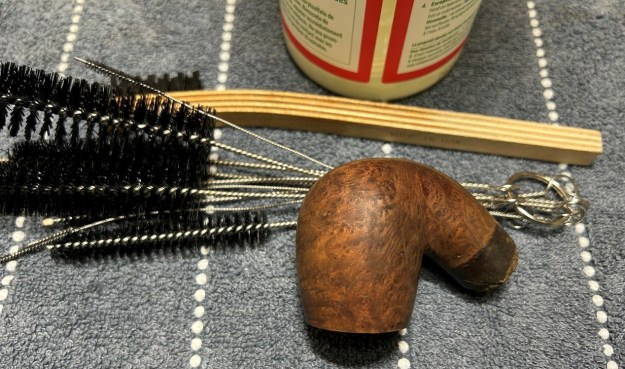
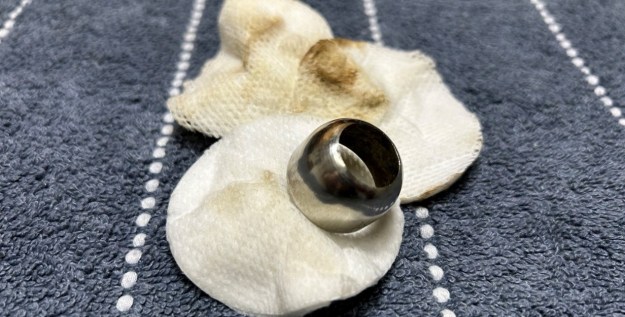
This was significant because, due to the markings being almost entirely worn on this pipe, there was nothing on the wood other than the number 301 – and I couldn’t tell an age from that. Charles Lemon from Dad’s Pipes also has a post about a 301, which he describes as coming from the “1970’s era”. Now, what’s interesting about Steve and Charles’ pipes is that the patch of briar which shows the marks is quite different from mine. Below are Steve’s, Charles’, and my pipes, respectively. The first two are sort of freeform oval-ish shapes. Third (mine) is a rectangle and I wonder if that indicates a different era. I don’t know, but if any of you reading this do, please let me know! This pipe is filthy beyond description – but must have been smoked frequently and with great affection. The stem has dirt everywhere, severe toothmarks aplenty, and calcification as I have seldom seen. Meanwhile, the stummel looks as though dirt has been ground into the grooves of the rustication. The rim is coated in lava and the bowl is clogged with cake. The old fellow must have really loved his pipe. I began by cleaning some of the calcification on the outside of the stem. I took a blade (an old butter knife, actually) and began gently scraping at all that build-up. Obviously, I took it easy, as I did not want to damage the stem’s vulcanite any further. The butter knife worked quite well and I got a good amount loose. I followed that up with some oil soap on some cotton rounds to try and scrub the rest away.I broke out the isopropyl alcohol and pipe cleaners, and got to work on the inside of the stem. Predictably, it was unbelievably dirty and I went through a good number of pipe cleaners in order to clean it up.As I mentioned, there were quite a few dents in the stem. Some were obviously tooth marks, but other dents looked like blunt force trauma! Time to break out the BIC lighter to see if it could raise some of them. Quite frankly, it did not do much – this repair was going to require some considerable sanding etc. Before that, however, the stem went for an overnight soak in the deoxidizer. The following day, the oxidation had migrated to the surface and would be fairly straightforward to remove. I scrubbed vigorously with some cream cleanser to remove the leftover oxidation.Once clean, I set about repairing the dents. Before I moved on to the Micromesh pads, I built up the dent damage on the stem with black cyanoacrylate adhesive and let it fully cure. I sanded the lumps down with my needle files and my grey pads, to make the stem look sort of normal. I then used all nine Micromesh pads (1,500 through 12,000 grit) to bring out the lovely black lustre on the stem. I also used Obsidian Pipe Stem Oil in between each of the last five pads. On to the stummel – this is where the lion’s share of the work was. The insides (both bowl and shank) were overwhelmed with cake and tar and anything else you’d care to mention. The bowl really needed to be reamed, so I used a reamer to scrape off as much built-up cake as possible. Generally, I prefer to sand the chamber down to bare briar. When restoring, it is important to ensure that there is no damage to the briar under the cake. There are a few situations when I might leave some cake in the bowl, but not today. There were definitely some craze lines in the interior walls of the briar. I’ll come back to that later.Just like the bowl, the shank was absolutely disgusting. It had never been cleaned – or, not for many decades. I started cleaning the inside with isopropyl alcohol, cotton swabs, and pipe cleaners. This took a while. The inside was very dirty and required an extraordinary number of cotton swabs and pipe cleaners. Eventually some cleanliness came to it.I decided to de-ghost the pipe. I thrust cotton balls into the bowl and the shank and saturated them with 99% isopropyl alcohol. I let the stummel sit overnight. This caused even more oils, tars and smells to leach out into the cotton. The bowl was nice and clean after this.I scrubbed the stummel with some pH-neutral soap and a toothbrush. This made things much better, but it’s a case of two steps forward and one step back: sure, it’s clean, but a bit of colour has faded. No problem – I can bring that back with wood balm.On to the ferrule – which was bashed and discoloured from years of mistreatment. Somewhat to my surprise, the ferrule came off very easily and required no special effort. I began by cleaning the metal with some cleanser on cotton rounds. This was quite good at removing the unsightly bits. I used my finer MicroMesh pads to eliminate some of the minor scratches on the metal. It also gave a nice shine which clearly hadn’t been seen for decades. I used a jewelry cloth to give the final polish to the nickel. This ferrule will always retain some small dents etc. from its hard life, but it looks much improved.I now wanted to address the heat crazes inside the bowl. I prepared some heat-resistant epoxy and filled the cracks and gouges, ensuring that the epoxy was thinly and evenly spread throughout the bowl. Of course, I did plug the draught hole with a folded pipe cleaner (coated in petroleum jelly) to make sure none of the epoxy made its way up there. Once done, a good 24 hours was needed to ensure that the epoxy was properly cured. The next day, I roughened up the epoxy’s surface with 220-grit sandpaper for the next step. I thinly coated the inside of the bowl with a mixture of my wife’s homemade yogurt and activated charcoal. Once hardened, this provided a good, faintly rough surface for a new cake to build. I rubbed some LBE Before & After Restoration Balm into the briar and let it sit for 30 minutes or so. The balm moisturizes the wood and gives a beautiful depth to the briar. I then buffed the stummel with a microfibre cloth. It was at this point that something funny happened. The P-lip stem, which fit when this project began, no longer fit! All of the filth and goo was holding it in place. Now that the yuckiness was gone, I realized that the stem was actually not right – it had been replaced at some point in the past. Annoyingly, it was clearly not the right size. Fortunately, Steve had another Peterson factory stem (a fishtail, this time) and donated it to make this pipe look wonderful again. Unfortunately, I don’t have photos of the old stem looking loose, but the new stem is a Peterson original and looks so good in place.
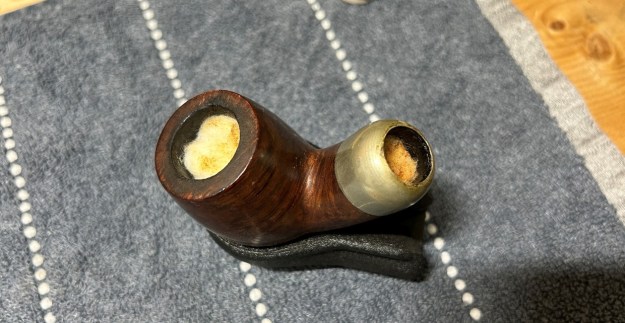
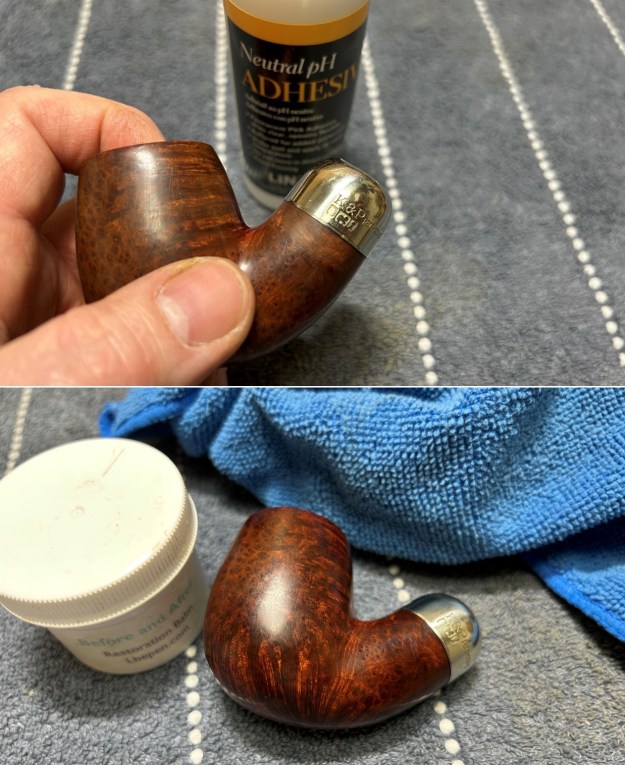
At long last, I was off to my bench buffer to put the final touches on this pipe. Several coats of conservator’s wax created a beautiful, glossy seal on the pipe and moved closer to closure for this long and involved repair. At this point, I glued the ferrule back in place.All done! This handsome Peterson System Standard 301 rusticated bent pot looks fantastic again and is ready to be enjoyed by its next owner. I am pleased to announce that this pipe is for sale! If you are interested in acquiring it for your collection, please have a look in the ‘Irish’ section of the store here on Steve’s website. You can also email me directly at kenneth@knightsofthepipe.com. The approximate dimensions of the pipe are as follows: length 5⅓ in. (136 mm); height 1⅞ in. (46 mm); bowl diameter 1½ in. (37 mm); chamber diameter ⅞ in. (22 mm). The weight of the pipe is 1½ oz. (46 g). I hope you enjoyed reading the story of this pipe’s restoration as much as I enjoyed restoring it. If you are interested in more of my work, please follow me here on Steve’s website or send me an email. Thank you very much for reading and, as always, I welcome and encourage your comments.
Breathing New Life into Dunhill Shell 6R F/T Pot


by Steve Laug

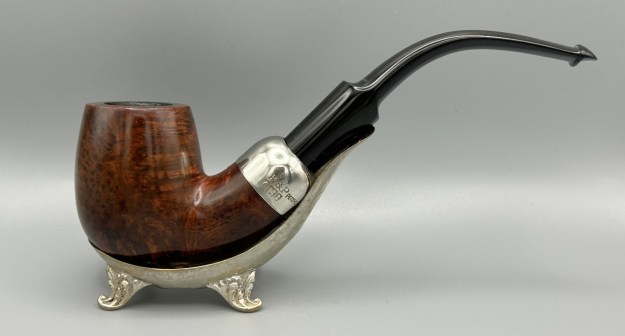
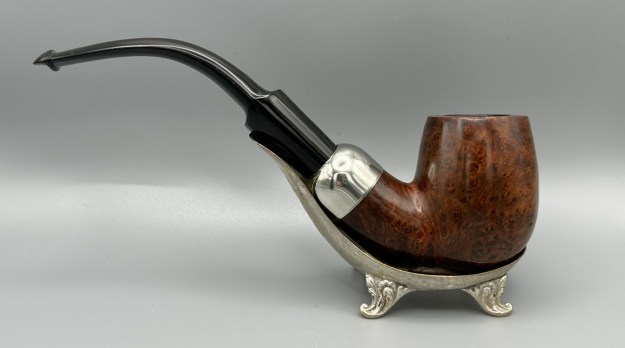
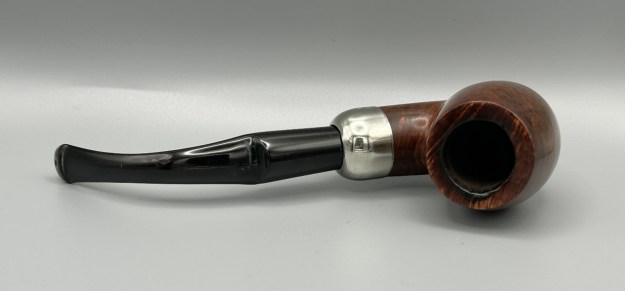
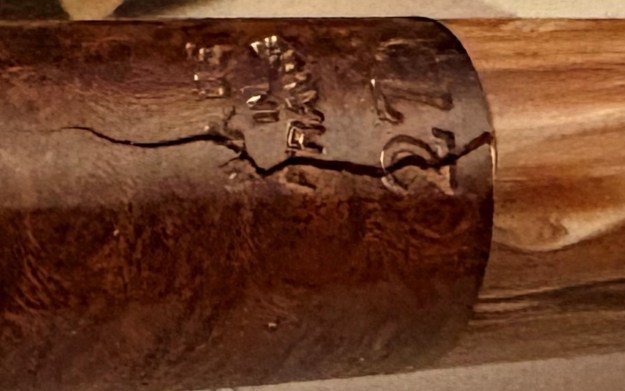
The next pipe on the table came to us from a seller in Cleveland, Ohio, USA on 04/26/2022. It is a Dunhill Shell Pot with a saddle stem that looks quite good. Overall it looks very good. It is stamped on a smooth panel on the underside of the shank. On the heel of the bowl it is stamped with the shape number 6R F/T followed by Dunhill Shell [over] Made in England11 [followed by] Circle 4S. The stamping is faint in spots but still readable. The pipe has a mix of black, cordovan and brown stains on a Shell sandblast finish and some amazing grain that the shape follows well. The finish was dusty and dirty with grime ground into the nooks and crannies of the rugged sandblast. The bowl had a moderate cake and there was lava in the sandblasted rim top and edges. The original stem is on the pipe is oxidized and has some tooth chatter and marks on both sides ahead of the button. I took photos of the pipe to show what it looked like before I started working on it. I took photos of the bowl and rim top to show the thickness of the cake and the lava coat on the rim top. There was some tobacco debris in the bottom of the bowl. The stem photos show the condition of the taper stem ahead of the button. I took a photo of the stamping on the underside of the shank. It is clear and readable as noted above. I removed the stem and took a photo of the pipe to give a sense of the proportions of the pipe.One of the first things I like to do is to unpack the stamping and understand each element in it. I turned to Pipephil’s helpful site (http://pipephil.eu/logos/en/dunhill/shell-briar1.html). The stamping is interpreted as follows: The R6 is the shape number for a Pot. The F/T gives the shape of the stem as a Fishtail but on this pipe it is a saddle stem. The Dunhill Shell is the finish. Following the Made In England11 gives the year that the pipe was made. The circle 4 S is the stamp for a Group 4 in a Shell finish.
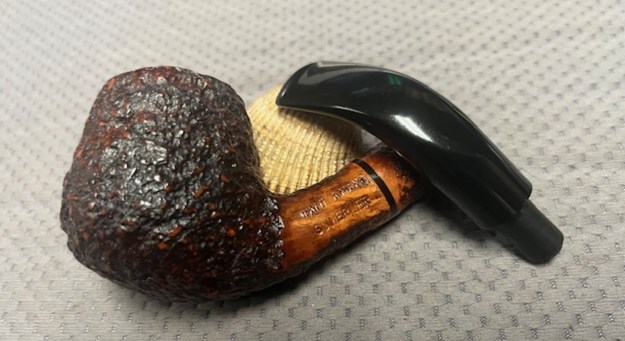
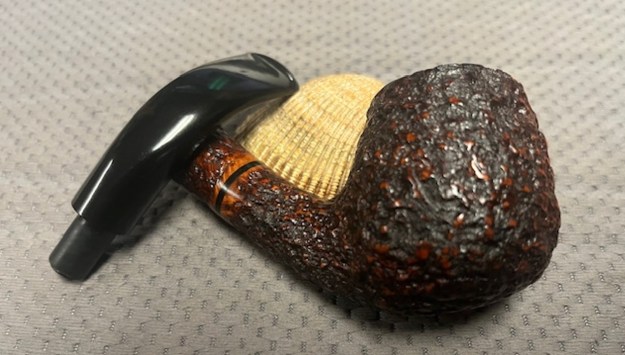
From there I wanted to pin down the date stamp 11. I have included Page 2 of the Dunhill Dating Key (http://www.pipephil.eu/logos/en/dunhill/cledat-en1a.html). Following that it takes me to the box with 1960+suffix. That tells me that the pipe is a 1971 pipe.   I wanted to know more about the Shell finish and when it was introduced by Dunhill and how that fit the Patent stamp on the bowl. I turned to a listing on Pipedia that gave me the information I was looking for (https://pipedia.org/wiki/Dunhill).

Shell

The Shell is a deep, craggy sandblast finish with a black stain, traditionally applied to soft, beautifully grained Algerian briar. While perhaps not the first-ever use of sandblasting on pipes, the technique perfected by Dunhill is considered one of the brand’s most significant contributions to the art of pipe making. The development is documented in English patent No. 119708/17; preliminary work began on October 13, 1917, and the patent was granted a year later, just weeks before the end of the First World War.

The origin of the finish is famously recounted as an “Accidental Discovery” in early Dunhill catalogues. The story tells of Algerian briar blocks being inadvertently left near a furnace, causing the softer wood to shrink and the harder grain to stand out in a textured relief. The reality, as detailed in the patent application, was a deliberate process of steeping the briar in oil for weeks, followed by a heat treatment. Only then was the sandblast applied to cut away the softer wood, resulting in a durable, lightweight, and cool-smoking pipe.
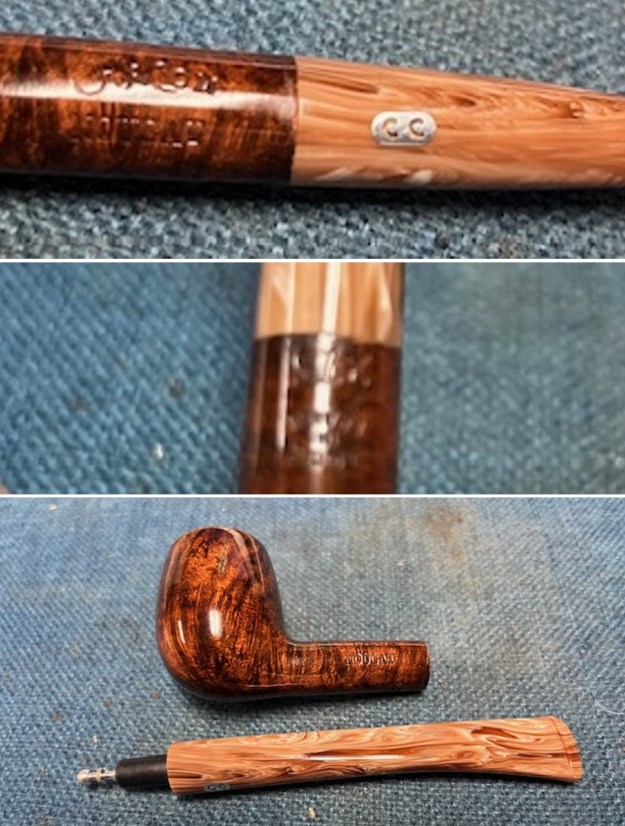
In 1986, Dunhill introduced a premium version of the Shell finish called the ‘Ring Grain’. These pipes feature a particularly deep blast reminiscent of the classic style of the 1930s to mid-1960s, applied to briar with a superior grain pattern. The ‘Ring Grain’ name was later changed to ‘Shilling’ in 1995. Regarded by many enthusiasts as among the finest modern Dunhills, these pipes are produced in limited quantities and are exceptionally rare.[122][123]

Now I knew that I was working on a Dunhill Shell 6R F/T Pot with a Saddle stem that was made in 1971.

I turned to work on the pipe itself. I reamed the bowl with a PipNet pipe reamer using the cutting heads 2 and 3. I finished the reaming with a Savinelli Fitsall Pipe Knife. I sanded the walls of the bowl with 220 grit sandpaper wrapped around a piece of dowel. I used a brass bristle brush to clean up the sandblast on the rim top. I was able to remove the debris built up in the grooves of the sandblast. I cleaned out the inside of the shank and the airway in the stem with alcohol, cotton swabs and both bristle and regular pipe cleaners. I scrubbed the bowl and shank with a tooth brush and some undiluted Murphy’s Oil Soap. I also worked it over with a brass bristle brush and the soap. I rinsed it off with warm water to remove the dust and soap from the finish. I dried it off with a soft cloth and it looked much better. I rubbed the briar down with Before & After Restoration Balm. I worked it into the briar with my fingertips and a horsehair shoe brush to work it into the nooks and crannies of the sandblast finish. The product works to clean, enliven and preserve the briar. I let it sit for 10 minutes then I buffed it with a cotton cloth to deepen the shine. The briar really comes alive with the balm. I set the bowl aside and turned my attention to the stem. I sanded the stem with 220 grit sandpaper to remove the oxidation and the tooth chatter and marks on the surface. I scrubbed the surface with Soft Scrub Cleanser and took off the oxidation that had been loosened by the sanding. It looked much better.I sanded the stem and tenon surface with 320-3500 grit 2×2 inch pads. I wiped the stem down with an Obsidian Oil cloth after each sanding pad.I polished the vulcanite with micromesh sanding pads – 1500-12000 grit pads. I wiped it down with Obsidian Oil after each sanding pad. I used Before & After Pipe Polish – both Fine and Extra Fine to further polish the stem. I the polished vulcanite saddle stem and the 1971 Dunhill Shell 6R F/T bowl with Blue Diamond to polish out the remaining small scratches and raise the shine. I gave the stem several coats of carnauba wax and the bowl several coats of Conservator’s Wax then buffed the pipe with a clean buffing pad to raise the shine. I hand buffed it with a microfiber cloth to deepen the shine. The pipe polished up pretty nicely. This turned out to be a beautiful Dunhill Shell 6R F/T Saddle Stem Pot. The finished pipe is shown in the photos below. The dimensions are Length: 5 ½ inches, Height: 1 ½ inches, Outside diameter of the bowl: 1 ½ inches, Chamber diameter: 7/8 of an inch. The weight of the pipe is 1.38 ounces/39 grams. Thanks for walking through the restoration with me as I worked this beautiful little Dunhill sandblast. This one is reserved for a friend as it is his birth year pipe. Thanks for looking.

Restoring a Traded BBB 1986 Christmas Special Make Lovat


by Steve Laug

The next pipe on the work table is one that I took in on a trade from a fellow who purchased some other pipes. It is a smooth Lovat with some significant damage to the rim top and also the stem. It is stamped on the left side of the shank and read Christmas [followed by] BBB in a Diamond [followed by] 1986 [over] Special Make. On the right side it is stamped London England. The pipe is shaped to highlight the grain around the bowl. The finish is quite clean with just a bit of grime and oil in bowl sides. The inwardly bevelled rim top is worn and has burn damage on the front top and inner edge of the bowl. The inner edge and the top and outer edge showed a lot of darkening. The bowl had been reamed quite recently and the shank and stem were clean. There is the BBB in a diamond logo on the topside of stem. The stem is quite clean but it is covered with heavy tooth damage on the top and underside ahead of the button. The stem was otherwise polished and did no show oxidation. I took photos of the rim top and the stem surfaces to give a sense of the condition of the pipe. You can see the burn damage on the front rim edge and darkening all the way around the rim edges both inner and outer. The bowl was very clean and there was no cake in the bowl. The stem photos show the deep tooth marks and the chatter on both sides ahead of the button.I took photos of the stamping on the sides of the shank, both the left and the right sides. It reads as noted above. There is also a brass inlaid BBB diamond logo on the top of the stem. I removed the stem and took a photo to give a sense of the proportions of the pipe.I started my work on this pipe by addressing the damage to the stem first. I wiped off the stem surface with a cotton pad and alcohol. I filled in the deep tooth marks on the surface on both sides with black CA glue. I set it aside to cure. Once the repairs had hardened I flattened them with a small file to begin blending them into the surface. I sanded the stem with 320-3500 grit 2×2 inch pads. I wiped the stem down with an Obsidian Oil cloth after each sanding pad.I polished the vulcanite with micromesh sanding pads – 1500-12000 grit pads. I wiped it down with Obsidian Oil after each sanding pad. I used Before & After Pipe Polish – both Fine and Extra Fine to further polish the stem. I used a piece of 220 grit sandpaper and a wooden sphere to clean up the bevel on the rim top. The front portion was burned and damaged so the sanding cleaned up the damage and gave it a new bevel. It looked better once restored.I worked on the finish on the bowl and the rim top removing scratches in the sides of the bowl with 320-3500 grit sanding pads. I wiped the briar down with a damp cloth after each pad. It is beginning to look very good.I polished the smooth briar rim top with micromesh sanding pads – dry sanding it with 1500-12000 grit sanding pads. I wiped the bowl surface down with a damp cloth to remove the sanding dust. Once I finished the exterior of the briar looked much better and had taken on a shine. I gave the rim top a touch up with a Maple Stain Pen. It looked much better. I rubbed the bowl down with Before & After Restoration Balm. I worked it into the surface of the briar with my fingertips to clean, enliven and protect it. I let the balm sit for 15 minutes and then buffed with a cotton cloth to raise the shine. Mark Hoover’s Balm is a product that I have come to appreciate and one I use on every pipe I have been working on. As usual at this point in the restoration process I am excited to be on the homestretch. I look forward to the final look when it is put back together, polished and waxed. I put the BBB 1986 Christmas Special Lovat back together. I polished the bowl and stem with Blue Diamond to polish out the scratches in the briar and the vulcanite. I gave the bowl and the stem multiple coats of carnauba wax. I buffed the pipe with a clean buffing pad to raise the shine. I hand buffed it with a microfiber cloth to deepen the shine. The pipe polished up pretty nicely. The grain really pops with the wax and polish. The shiny black vulcanite stem is a beautiful contrast to the reddish, browns of the bowl. This BBB 1986 Christmas Special Lovat was a great pipe to spruce up. It is a very comfortable pipe to hold in the hand. The finished pipe is shown in the photos below. The dimensions of the pipe are Length: 5 inches, Height: 1 ¾ inches, Outside diameter of the bowl: 1 ¼ inches, Chamber diameter: ¾ of an inch. The weight of the pipe is 29 grams/1.02 ounces. This pipe will be going on the British Pipe Makers Section of the rebornpipes store if you are interested in adding it to your collection. Thanks for reading this blog and my reflections on the pipe while I worked on it. This is an interesting estate to bring back to life.

New Life for a 1976 Dunhill Root Briar 412 Bent Billiard with a Taper Stem


by Steve Laug

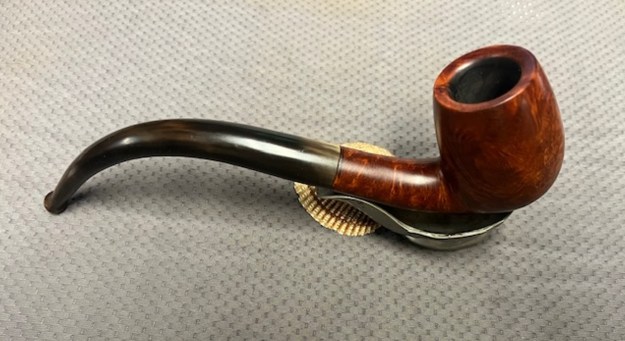
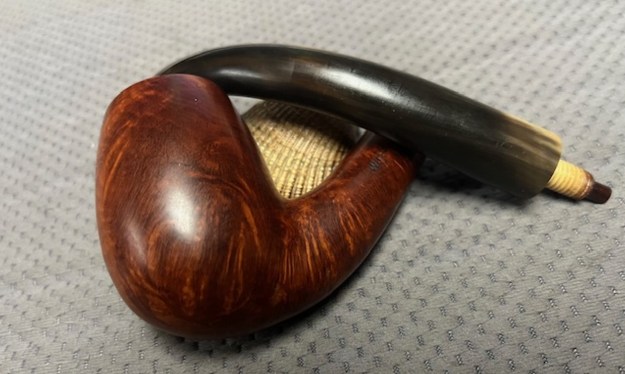
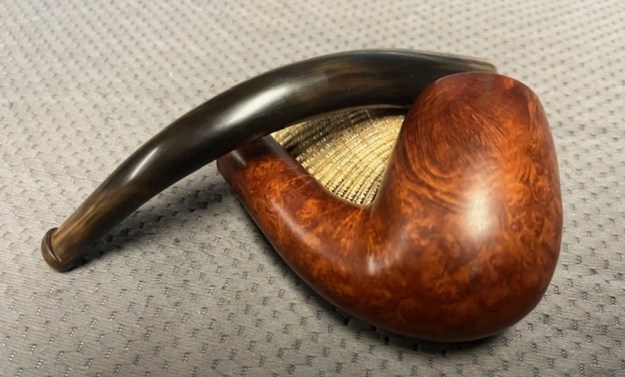
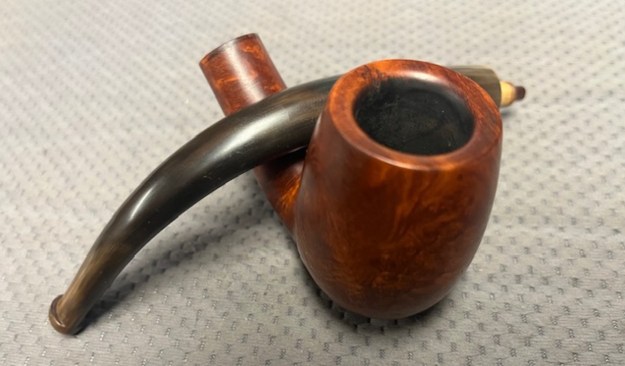
The next pipe on the table is another one that came to us from the seller in Caldwell, Idaho, USA on 07/12/2025. It is a Dunhill Root Briar Bent Billiard with a vulcanite taper stem. It is in dirty but in good condition as can be seen in the photos below. It is stamped on the left side of the shank and reads 412 [followed by] Dunhill [over] Root Briar. On the right side it is stamped Made in England16. The stamping is clear and readable. The pipe has rich Root Briar Finish with a blend of brown stains on a richly grained smooth finish that the shape follows well. The finish was dusty and lightly dirty with grime ground into the finish. The bowl had a moderate cake and there was tobacco debris in the bowl. The rim top had a thick lava coat on the rim top and edges. The original white spot saddle stem is dirty and oxidized with light tooth marks and chatter on both sides. I took photos of the pipe to show what it looked like before I started working on it. I took photos of the bowl and rim top to show the thickness of the cake and the lava coat on the rim top. There was some tobacco debris in the bottom of the bowl. The stem photos show the condition of the saddle stem ahead of the button.The stamping on the sides of the shank are clear and readable as noted above. I took a photo of the pipe with the stem removed to give a sense of the proportions of the pipe. It is a real beauty.One of the first things I like to do is to unpack the stamping and understand each element in it. I turned to Pipephil’s helpful site (http://pipephil.eu/logos/en/dunhill/shell-briar1.html). The stamping is interpreted as follows: The 412 is the shape of the pipe which is a Bent Billiard. The Dunhill Root Briar is the finish. Following the Made In England16, the 16 gives the year that the pipe was made.

From there I wanted to pin down the date stamp 16. I have included Page 2 of the Dunhill Dating Key (http://www.pipephil.eu/logos/en/dunhill/cledat-en1a.html). Following that it takes me to the box with 1960+suffix. That tells me that the pipe is a 1976 pipe.I wanted to know more about the Root Briar finish and when it was introduced by Dunhill. I turned to a listing on Pipedia that gave me the information I was looking for (https://pipedia.org/wiki/Dunhill).

Root Briar

Dunhill introduced its third major pipe finish, the Root Briar, in 1931. The new line was developed specifically to showcase briar with a particularly beautiful and pronounced grain. To this end, it was made exclusively from Corsican mountain briar, a wood characteristically prized for its fine grain, a practice that continued into the 1960s.

The pipe was finished with a light, natural stain to allow the beauty of the wood to show through. A particularly distinctive feature of the early Root Briar was its unique mouthpiece — a marble-grained, brown vulcanite bit — that became known to collectors as the ‘bowling ball’ bit. This style, however, was discontinued with the onset of the Second World War.

Because the Root Briar finish requires a perfectly clean bowl with exceptional graining, it has always been one of Dunhill’s rarer and more expensive lines, typically available only at the company’s own stores or through its principal dealers. Its nomenclature was identical to that of the Bruyère, except for the use of an ‘R’ stamp instead of an ‘A’. Straight-grained versions were graded on various scales over the years, evolving into the modern ‘DR’ one-to-six-star system.[122][123]

Now I knew that I was working on a Dunhill Root Briar 412 Bent Billiard with a Taper Stem that was made in 1976.

I turned to work on the pipe itself. I reamed the bowl with a PipNet pipe reamer using the cutting heads 2 and 3. I finished the reaming with a Savinelli Fitsall Pipe Knife. I sanded the walls of the bowl with 220 grit sandpaper wrapped around a piece of dowel. I cleaned out the inside of the shank and the airway in the stem with alcohol, cotton swabs and both bristle and regular pipe cleaners.I scrubbed the bowl and shank with a tooth brush and some undiluted Murphy’s Oil Soap. I rinsed it off with warm water to remove the dust and soap from the finish. I dried it off with a soft cloth and it looked much better. I sanded the exterior of the bowl with 320-3500 grit 2×2 inch sanding pads to remove the scratching in the finish. I wiped the bowl down with a damp cloth after each sanding pad. It really began to look much better. I polished the briar with 1500-12000 grit micromesh sanding pads to develop the shine. It began to look very good. It had a rich shine in the finish. I rubbed the briar down with Before & After Restoration Balm. I worked it into the briar with my fingertips to work it into the finish. The product works to clean, enliven and preserve the briar. I let it sit for 10 minutes then I buffed it with a cotton cloth to deepen the shine. The briar really comes alive with the balm. I set the bowl aside and worked on the stem. I sanded it with a folded piece of 220 grit sandpaper to blend in the tooth marks and chatter as well as remove the oxidation and spots on the surface of the stem. I sanded the stem with 320-3500 grit 2×2 inch pads. I wiped the stem down with an Obsidian Oil cloth after each sanding pad.I polished the vulcanite with micromesh sanding pads – 1500-12000 grit pads. I wiped it down with Obsidian Oil after each sanding pad. I used Before & After Pipe Polish – both Fine and Extra Fine to further polish the stem. I polished the vulcanite taper stem and the 1976 Dunhill Root Briar 412 bowl with Blue Diamond to polish out the remaining small scratches and raise the shine. I gave the stem several coats of carnauba wax and the bowl several coats of Conservator’s Wax then buffed the pipe with a clean buffing pad to raise the shine. I hand buffed it with a microfiber cloth to deepen the shine. The pipe polished up pretty nicely. This turned out to be a beautiful Dunhill Root Briar 412 Bent Taper Stem Billiard. The finished pipe is shown in the photos below. The dimensions are Length: 5 ½ inches, Height: 1 ¾ inches, Outside diameter of the bowl: 1 ¼ inches, Chamber diameter: ¾ of an inch. The weight of the pipe is 1.45 ounces/42 grams. Thanks for walking through the restoration with me as I worked this beautiful little Dunhill Root Briar. I will be adding it to the rebornpipes store in the British Pipe Makers Section if you would like to add it to your collection. Thanks for looking.