Tag Archives: waxing

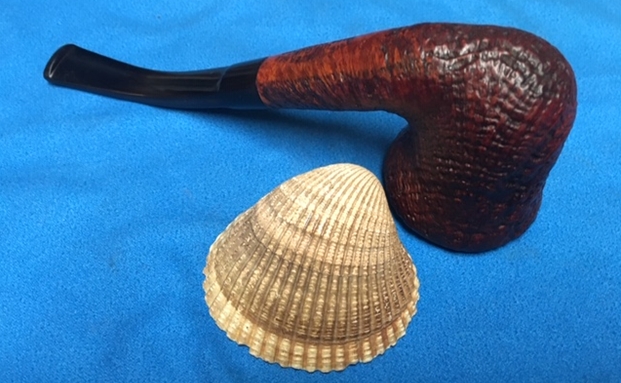
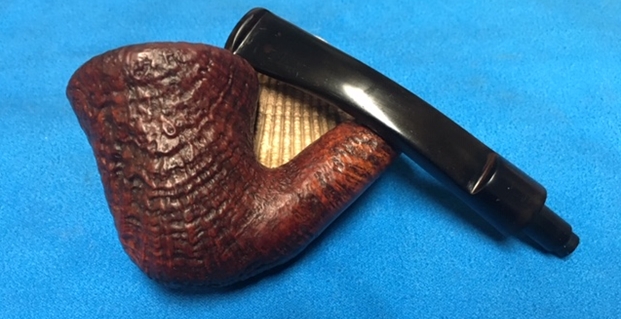
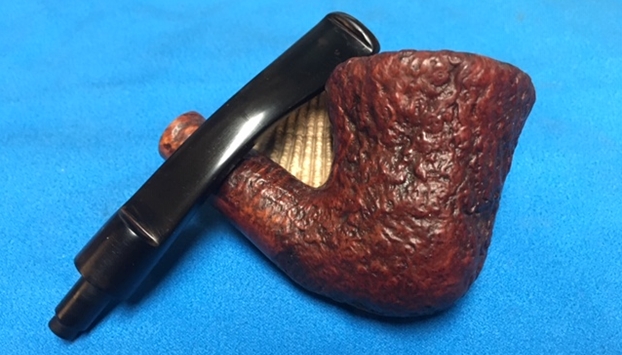
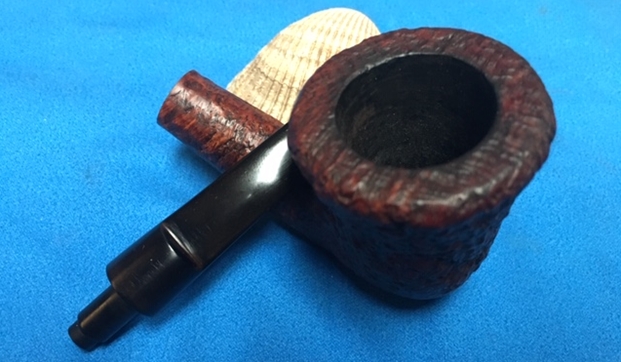
An Easy Sprucing up of a 1949 Dunhill Shell # 52 F/T


Blog by Paresh Deshpande

Believe you me friends, this is FUN!! Being able to work on different pipes, be able to choose your project, choose a brand you wish to work on, is an exhilarating experience for me. Prior to the Mumbai Bonanza striking me, I was restricted mostly to working on my inherited collection of pipes, each complete with its stem challenges and similar stummel condition and was getting slightly monotonous to say the least.

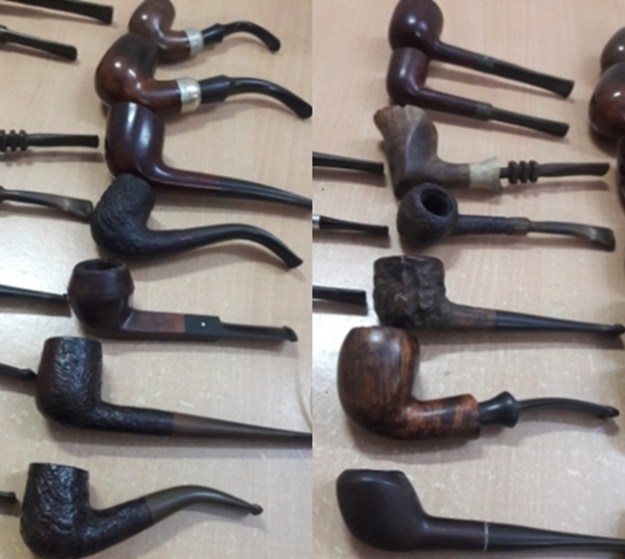
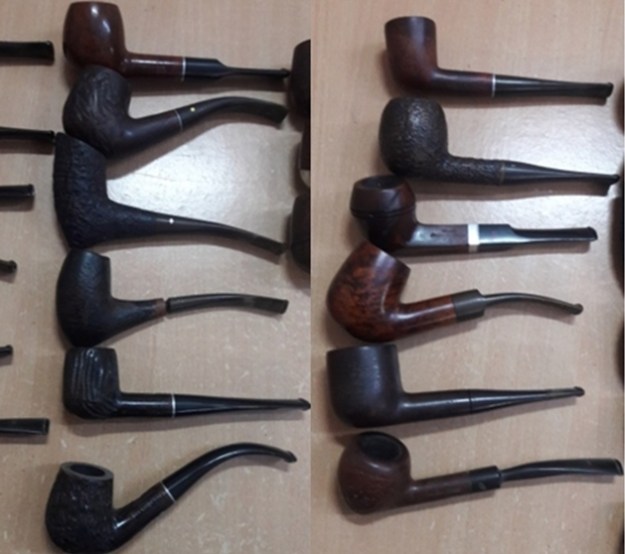
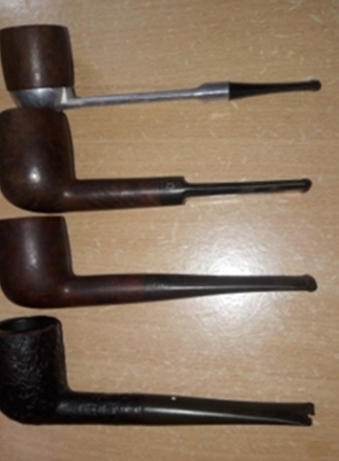
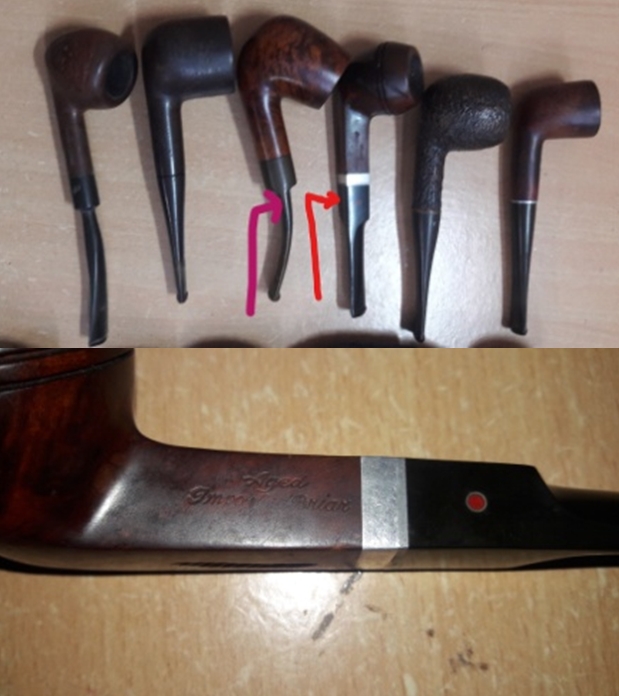
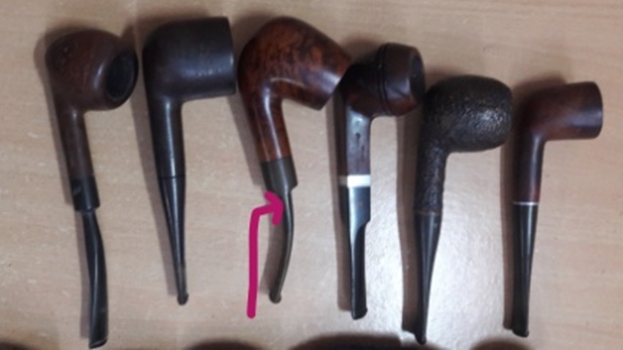
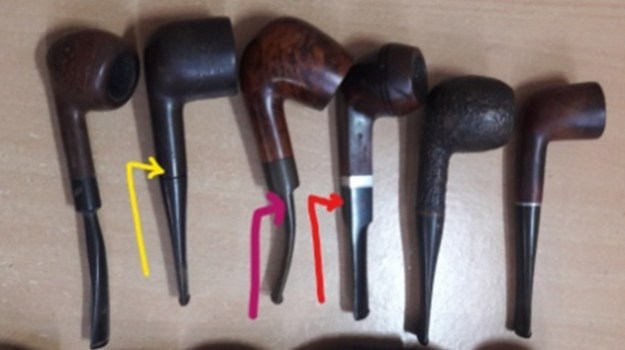
I was fortunate enough to have heeded the advice of my dear friend and mentor, Mr. Steve, and struck a deal with a trash collector from Mumbai. He did not know what he was selling and I did not know what I was buying as we reside in different cities!! The argument that Mr. Steve presented was that if not anything, I shall at least have some spares and this was logical. I struck a deal and here are pictures of the pipes that I received in this lot.  This lot contains some very nice collectible pipes, a few well known brand pipes and some mediocre pipe brands. Overall, with seven Dunhills, a Preben Holm #1, a couple of Made in England Pete System pipes, Charatan’s, Custom-Bilt, Stanwell and other assorted pipes, I would say that I had hit a huge jack pot!!! Hence, I like to call this find as “Mumbai Bonanza”.

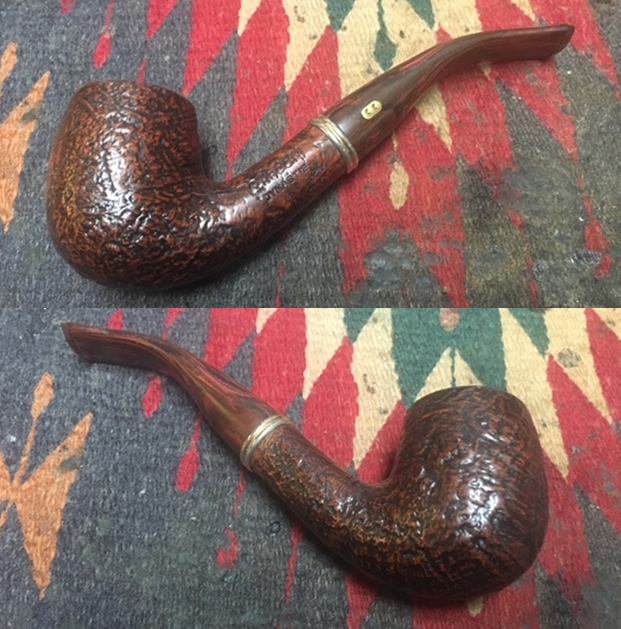
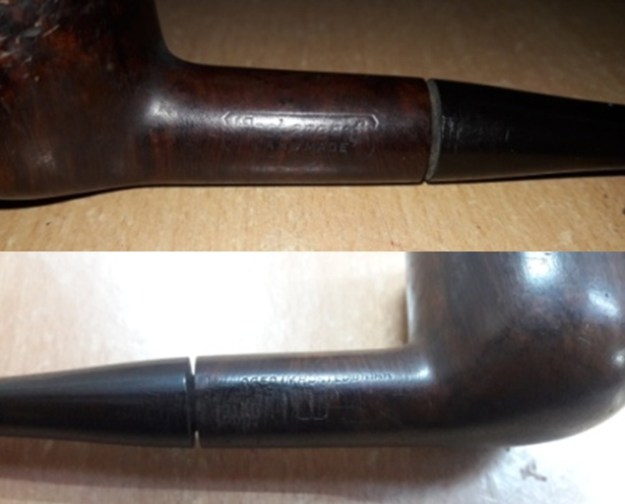
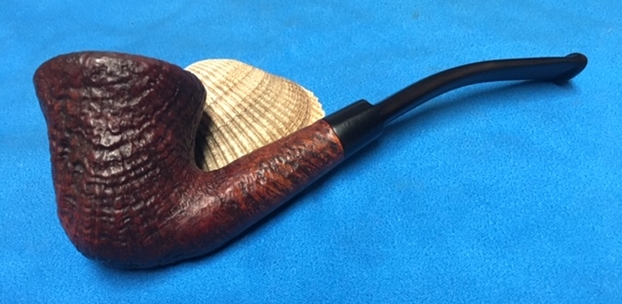
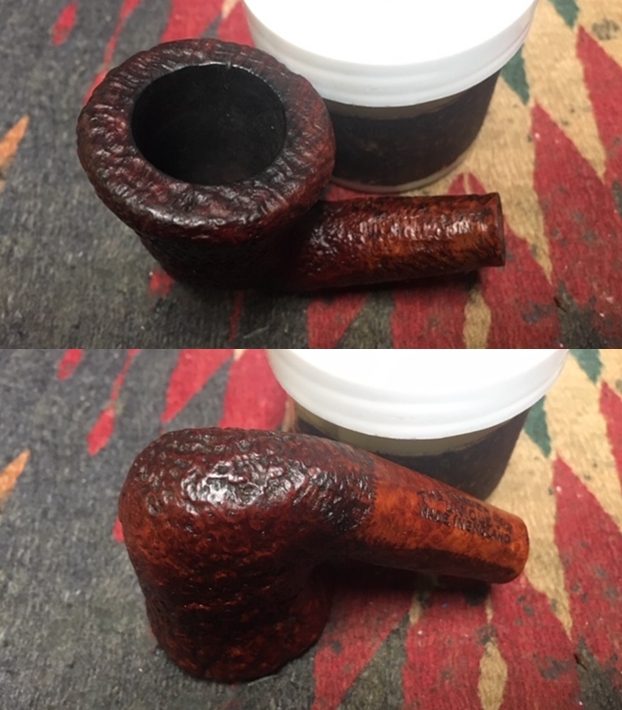
The pipe that I decided to work on from this find is a smallish full bent Dunhill Shell billiard, and is marked in pastel blue circle in the picture below (the ones circled in red and yellow are completed projects). This is a beautiful deeply sandblasted billiard with a lovely tactile feel in the hand. The play of dark red brown hues on the sandblast makes for a visual treat. It is stamped on a smooth surface on the foot and the underside of the shank with the shape number 52 followed by F/T followed by DUNHILL Shell Made in England 9 (9 is underlined) 0 all in a straight line over PATENT No 417574/34 followed by an encircled 3 at the shank end. This stamping indicates that this pipe is a fishtailed group 3 sized shell and dates this pipe to being manufactured in 1949 and sold in 1950.  The Trademark Dunhill White Dot adorns the top of the vulcanite stem. The stampings are deep, crisp and clear.With this information, I move ahead with the restoration of this beautiful sandblasted Dunhill bent billiard.

INITIAL VISUAL INSPECTION
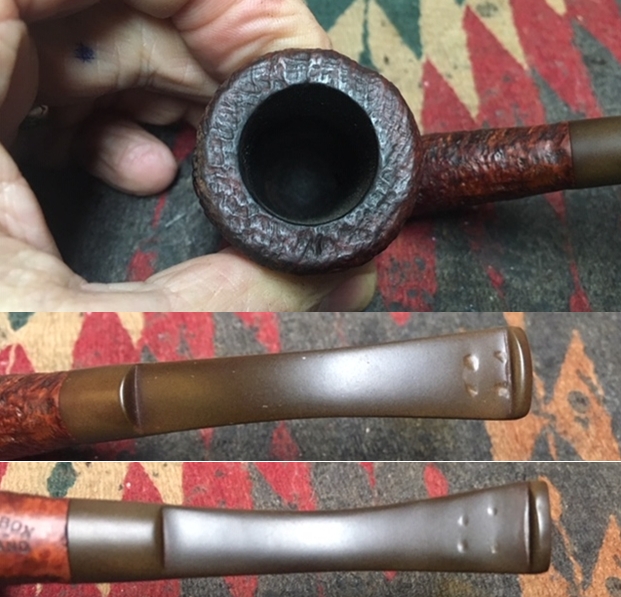
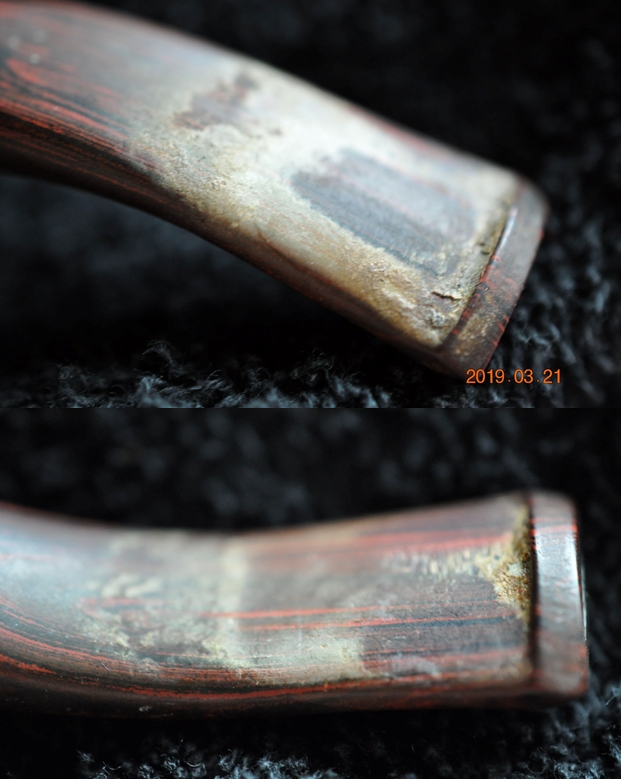
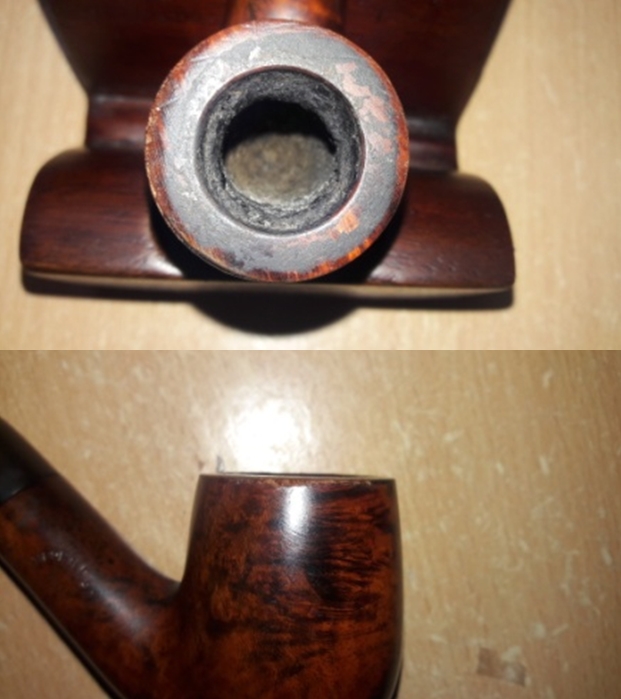
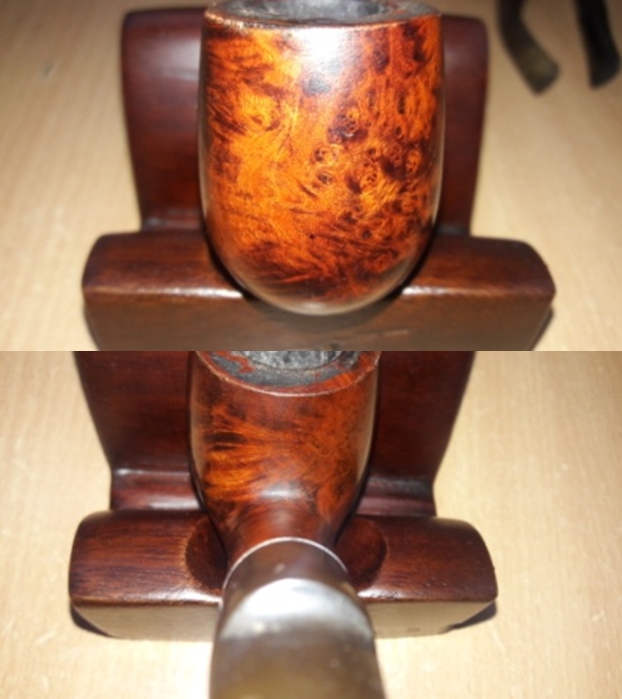
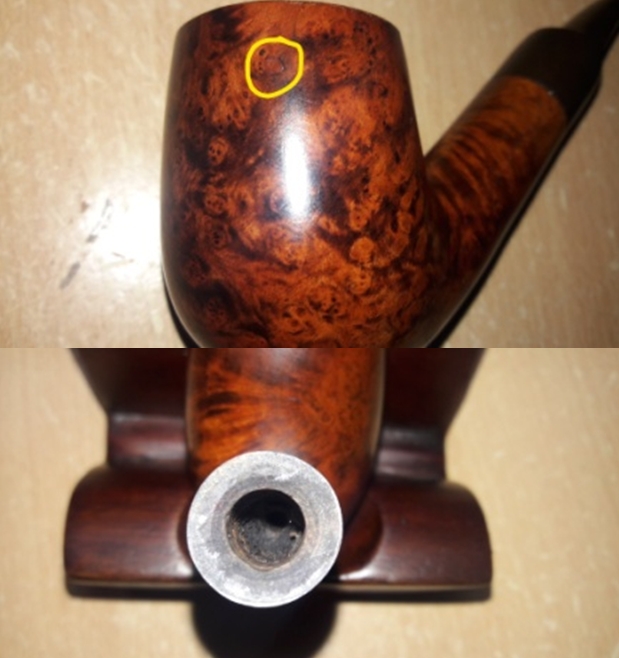
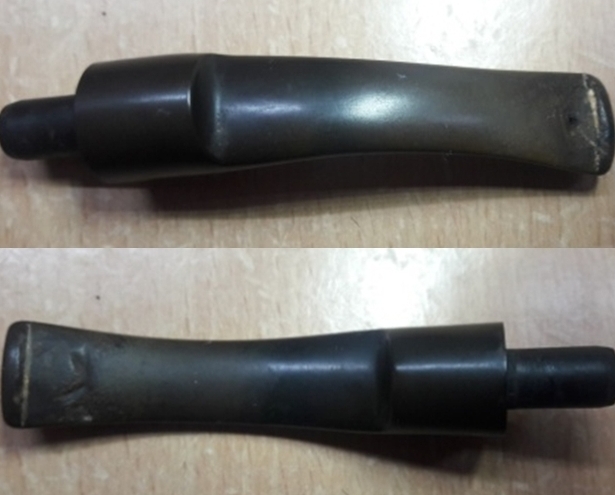
The chamber has a thick layer of even and smooth cake which indicates that the pipe has been well used but also well cared for by its previous Steward. From what I can see, the chamber walls appear to be without any damage. The chamber is odorless. There is an overflow of lava on the blasted rim top surface. The inner and outer rim edges appear to be in pristine condition. The mortise is clean and so is the shank airway. The stummel boasts of some beautiful deep sandblast pattern all around. It is dirty with grime and oils filling in much of the craggy finish. The briar, in this condition also, looks amazing. I can’t wait to see after I have worked on it. The round shank of the bent billiard flows into a bent tapered stem which has a flare, like a fish tail, at the button end and hence the stamp F/T. The vulcanite stem shows significant damage to the button end with deep bite marks on both upper and lower surface of the stem. The lip is also severely damaged and will have to be reshaped. In this project, repairs to the damaged stem will be a major challenge, however if compared to previous stem repairs, this should be a cake walk.

THE PROCESS
Since the stem has significant damage, and from my experience of stem repairs, this will be time consuming and laborious part and hence I start this project by tackling the stem first

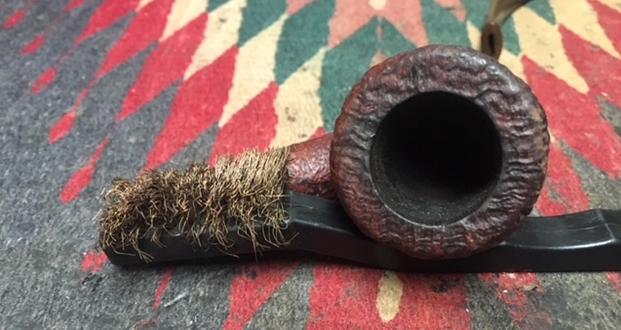
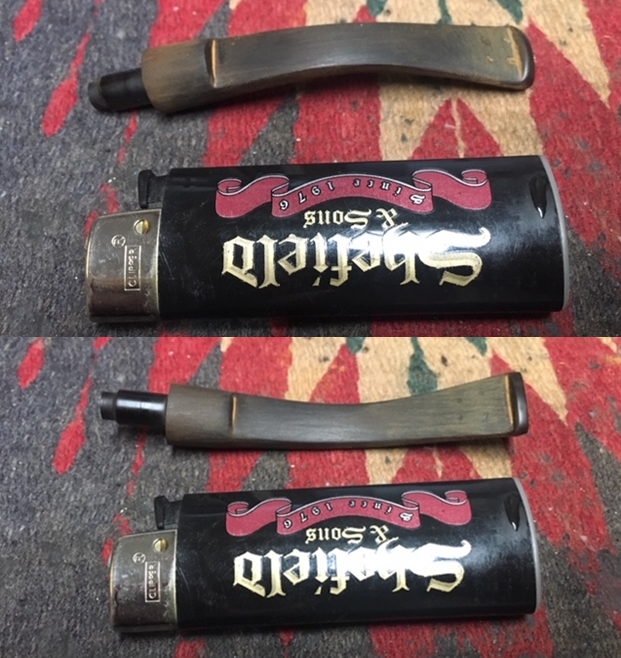
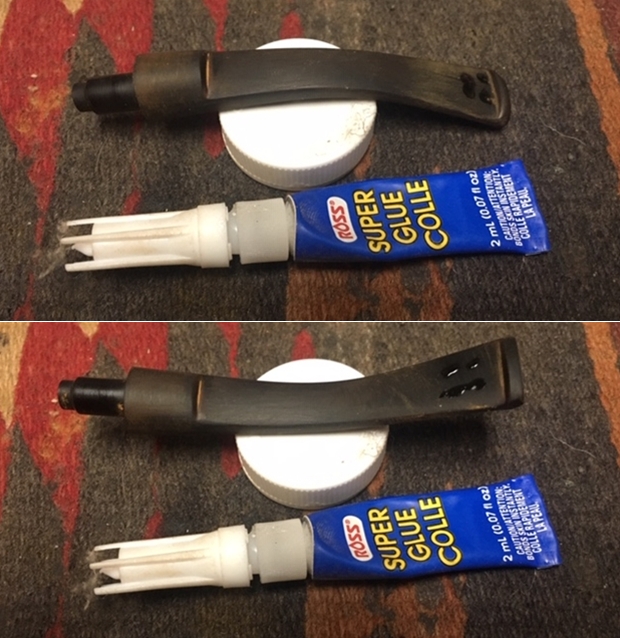
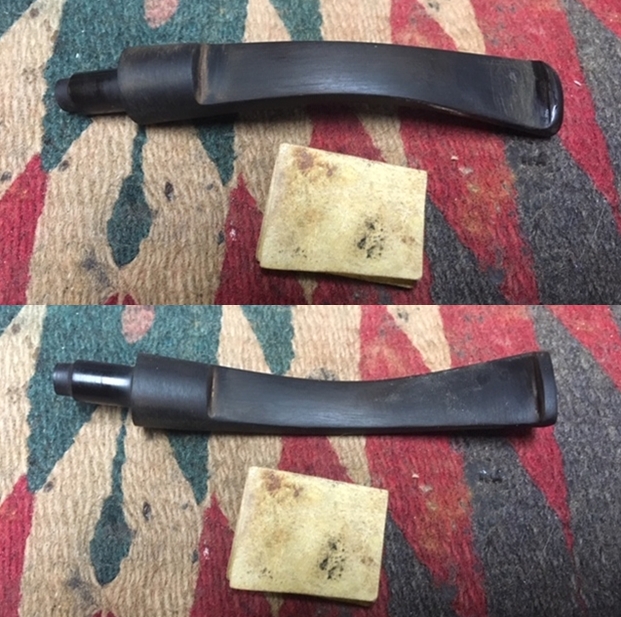
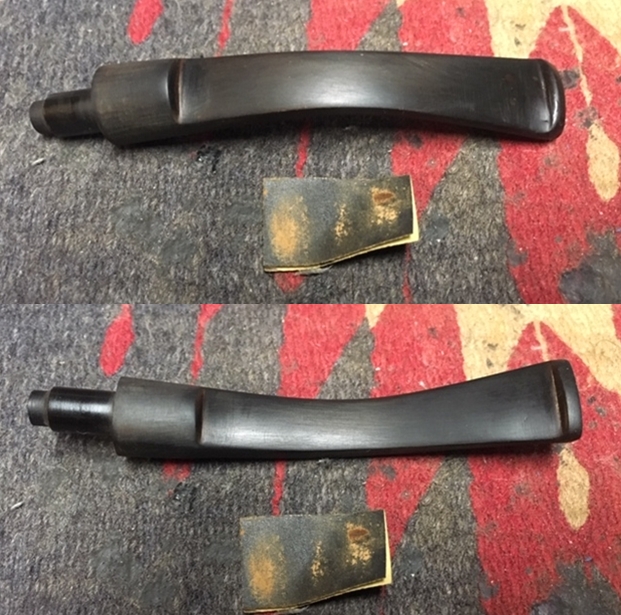
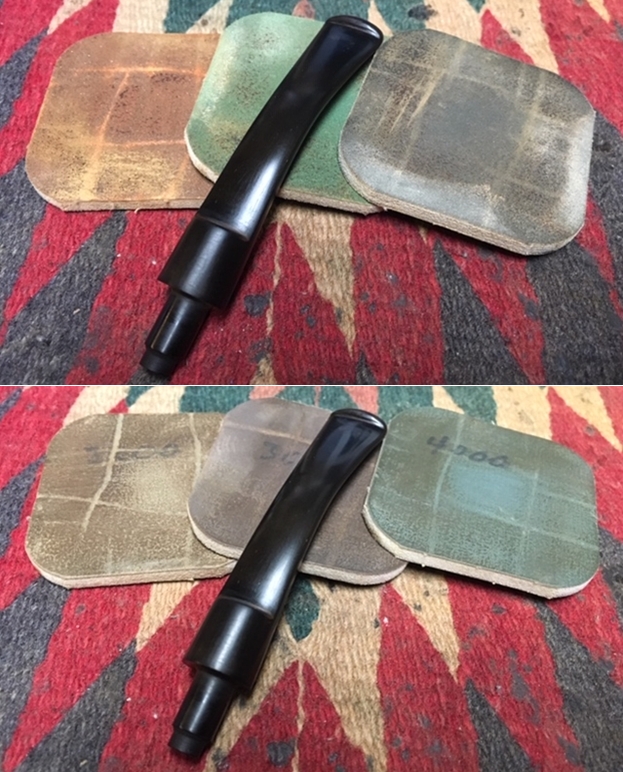
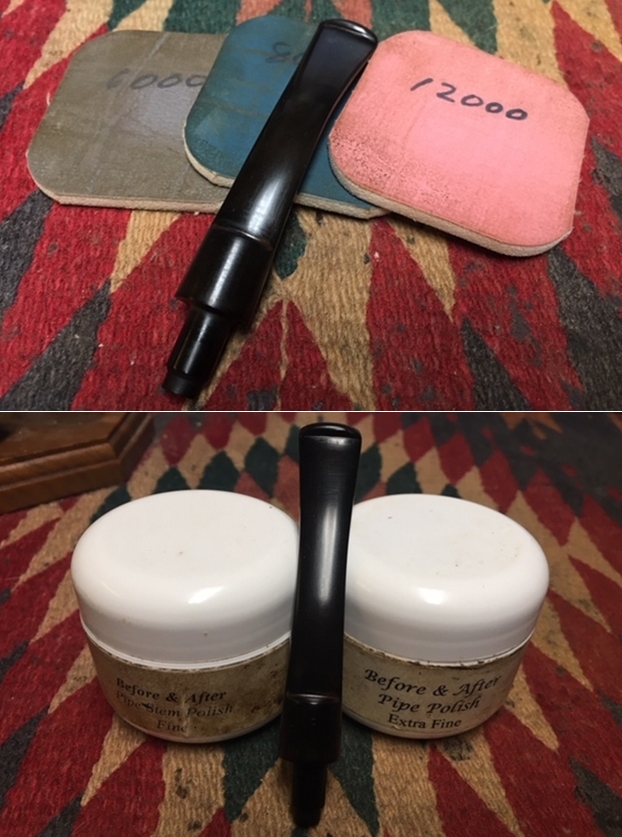
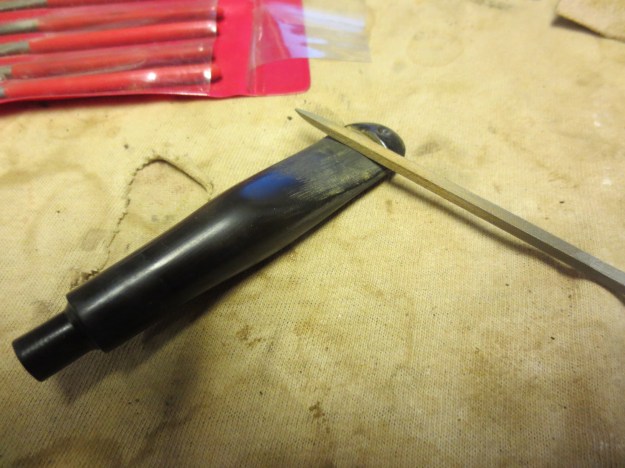
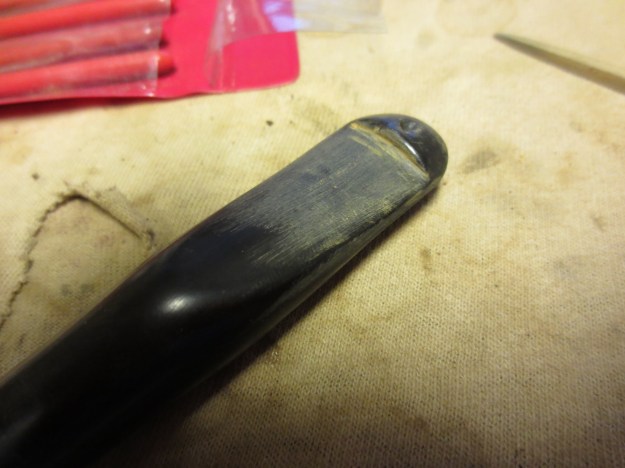
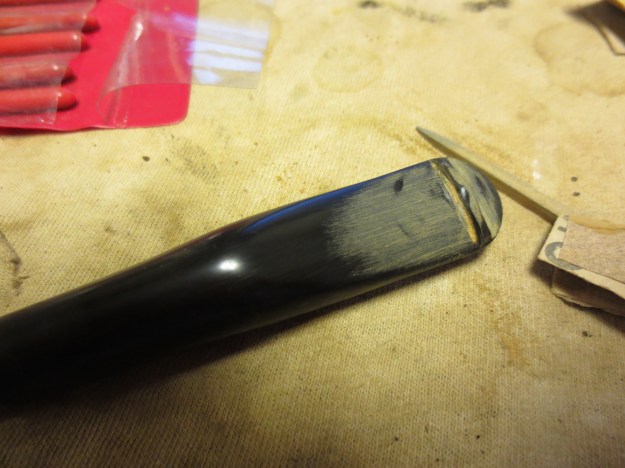
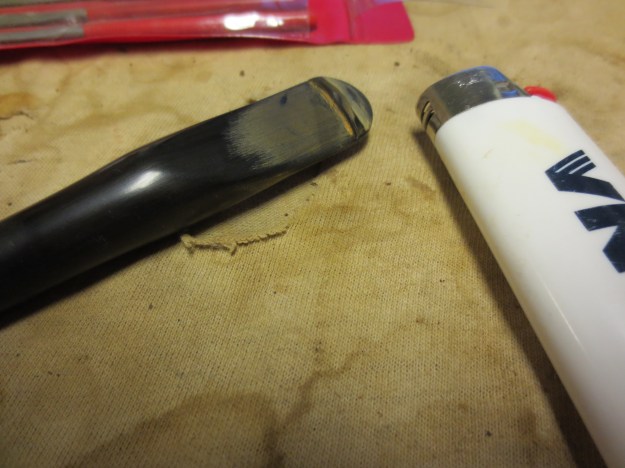
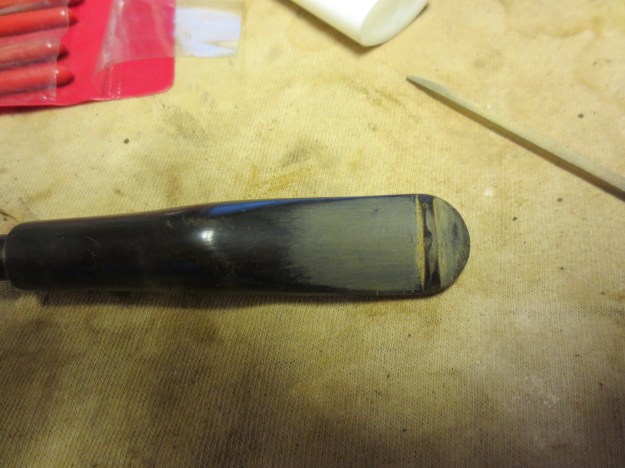
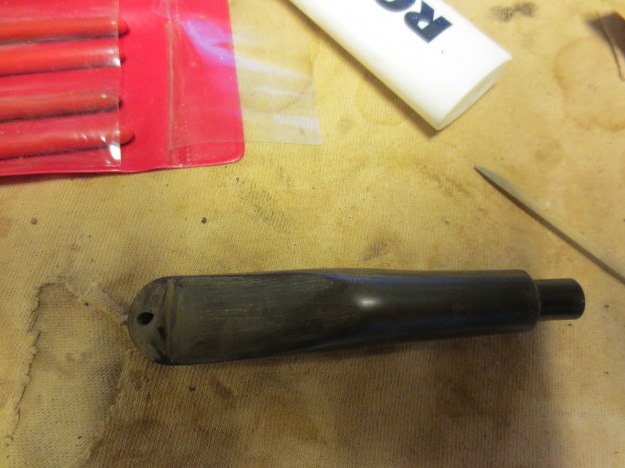
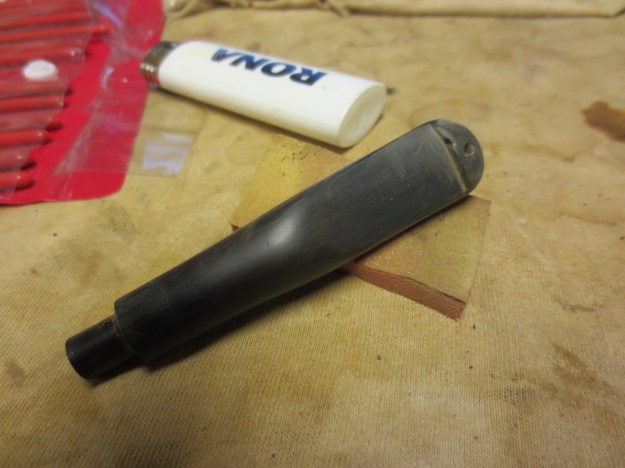
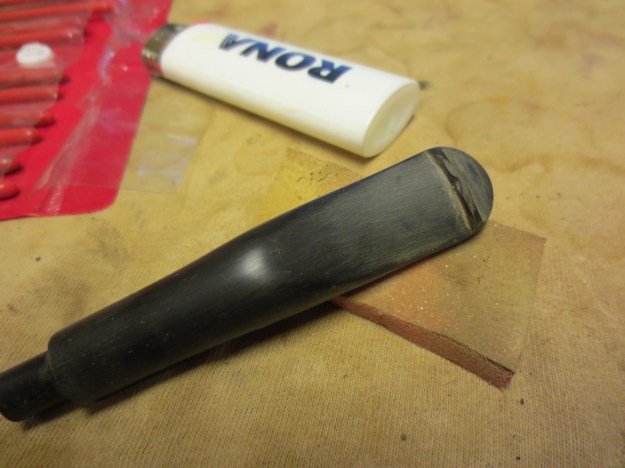
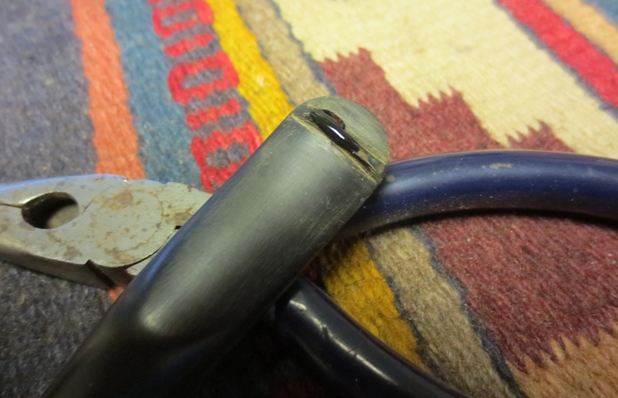
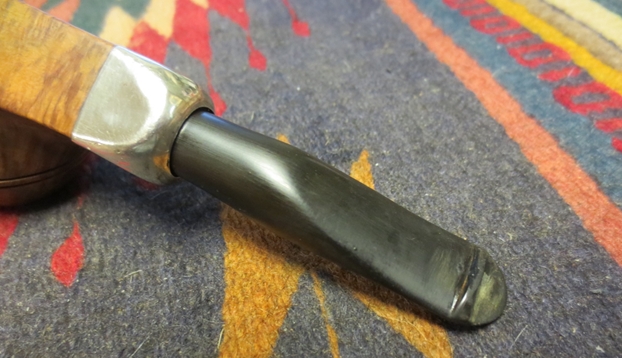
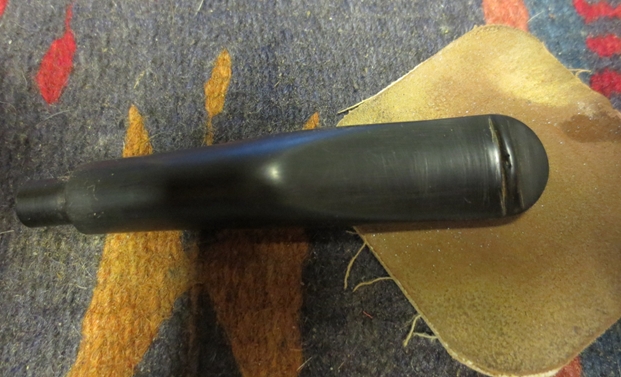
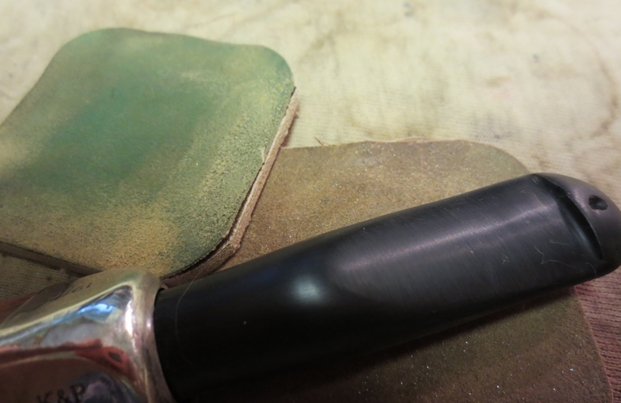
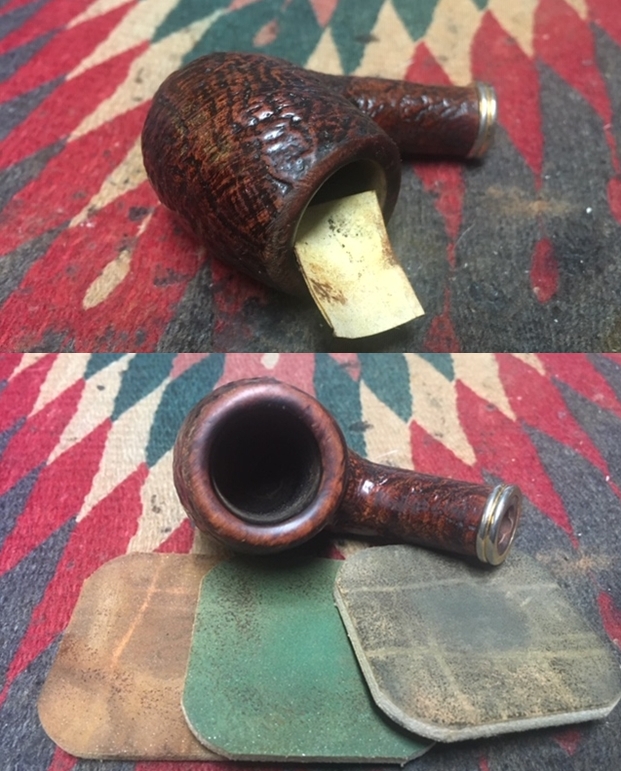
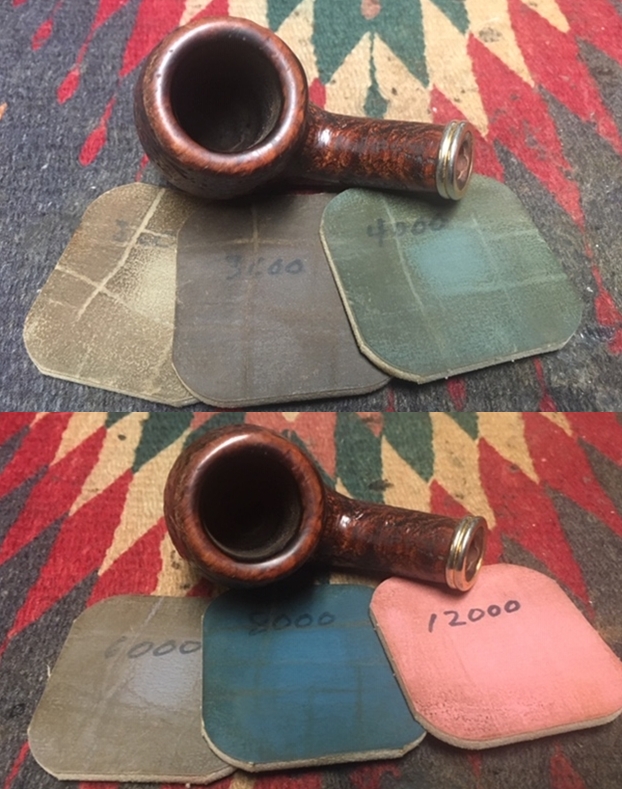
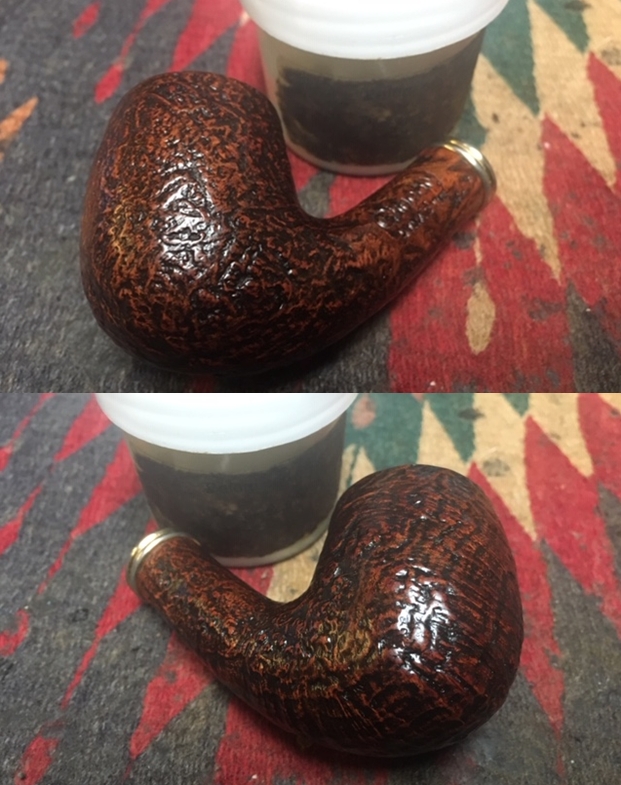
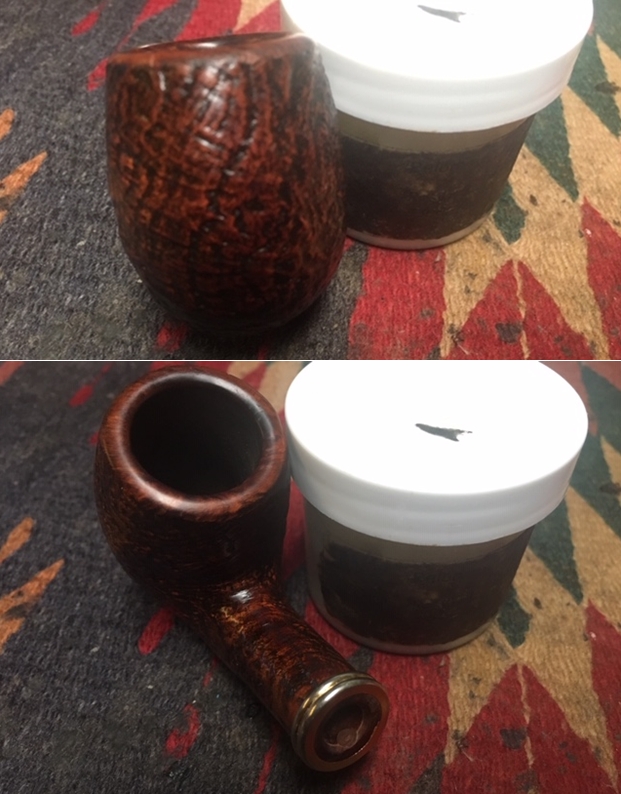
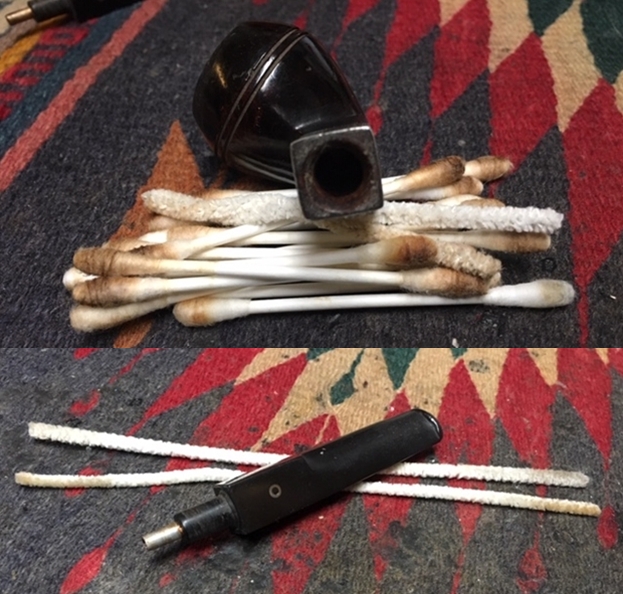
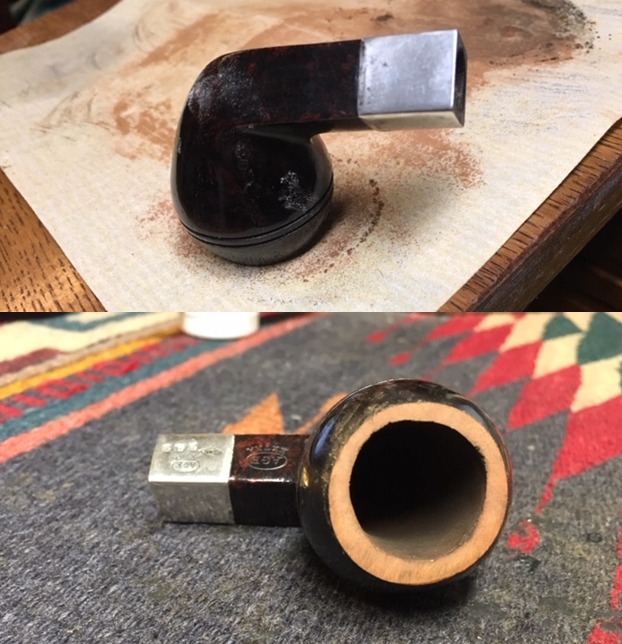
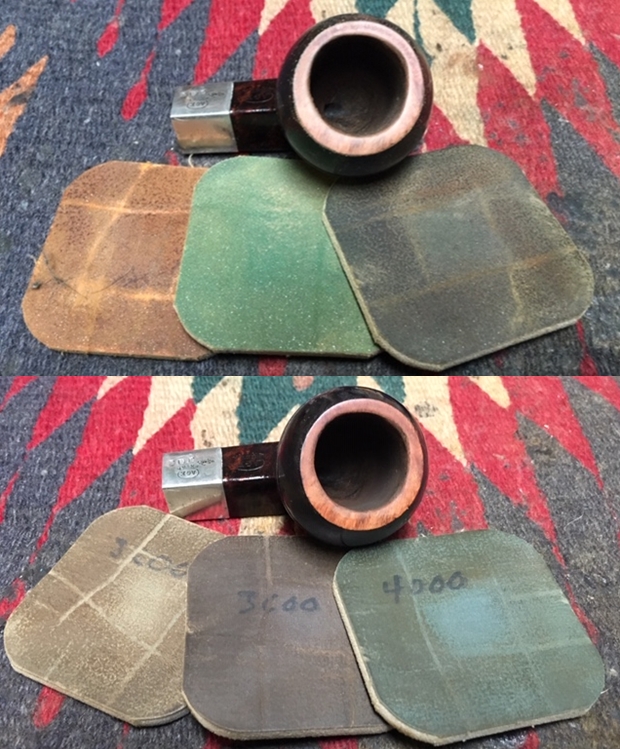
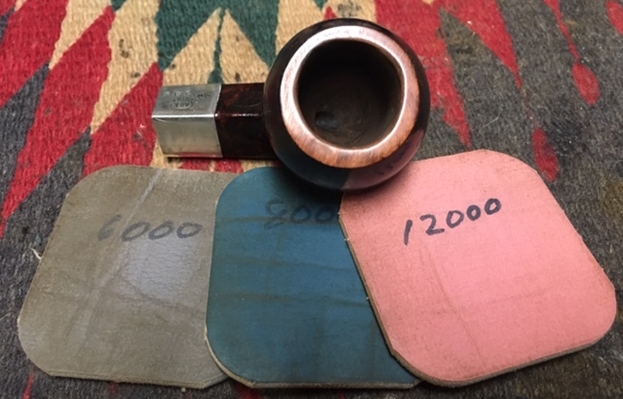
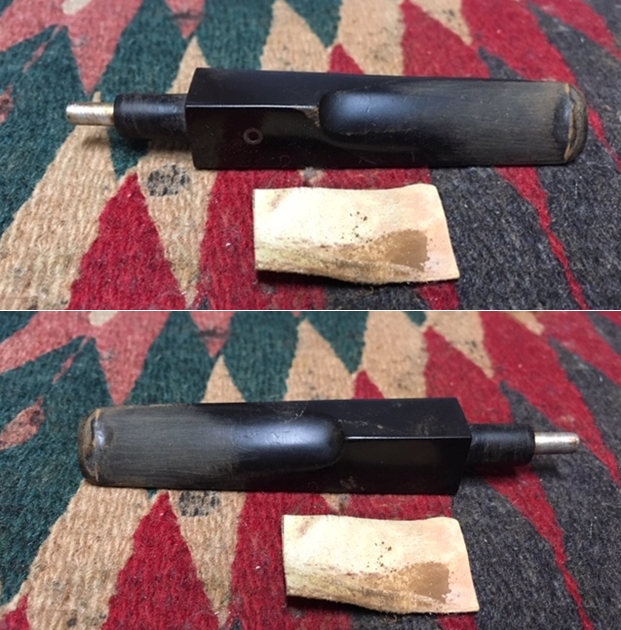
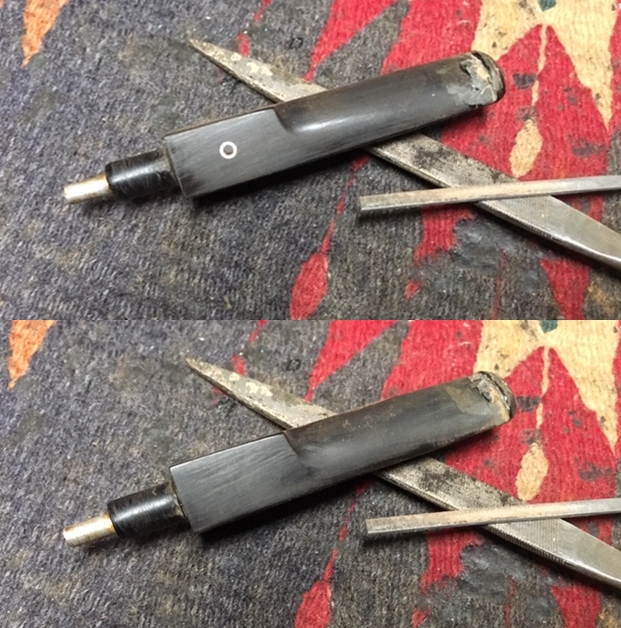
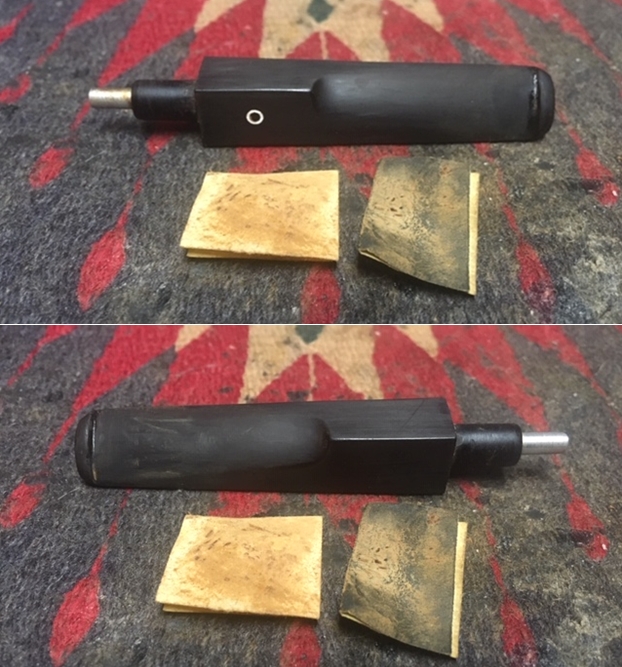
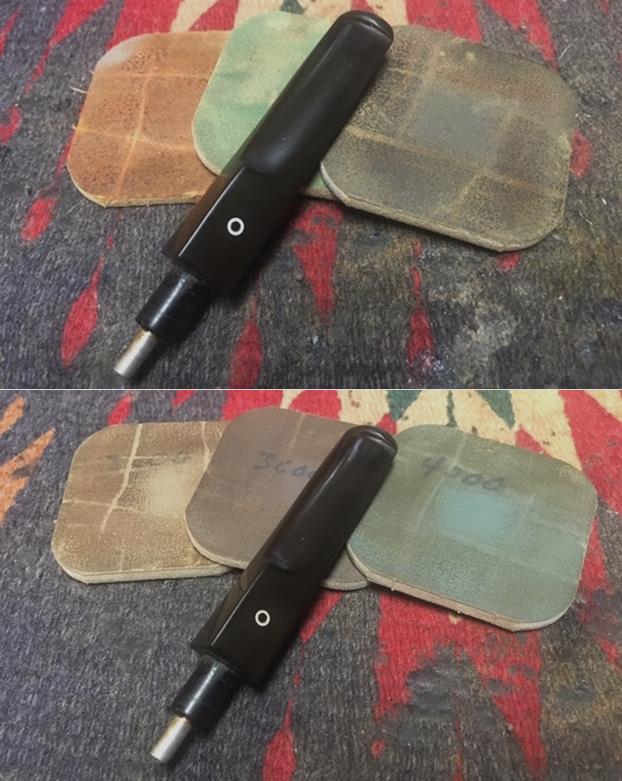
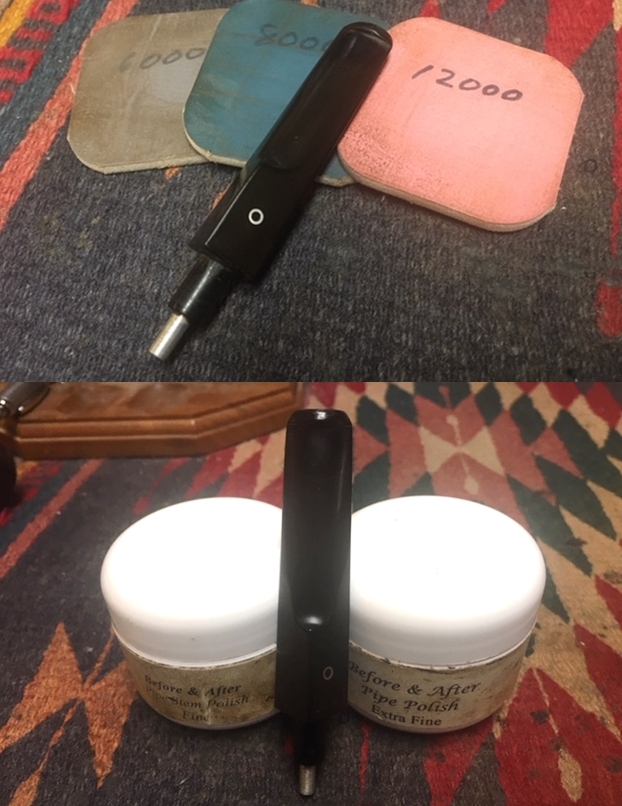
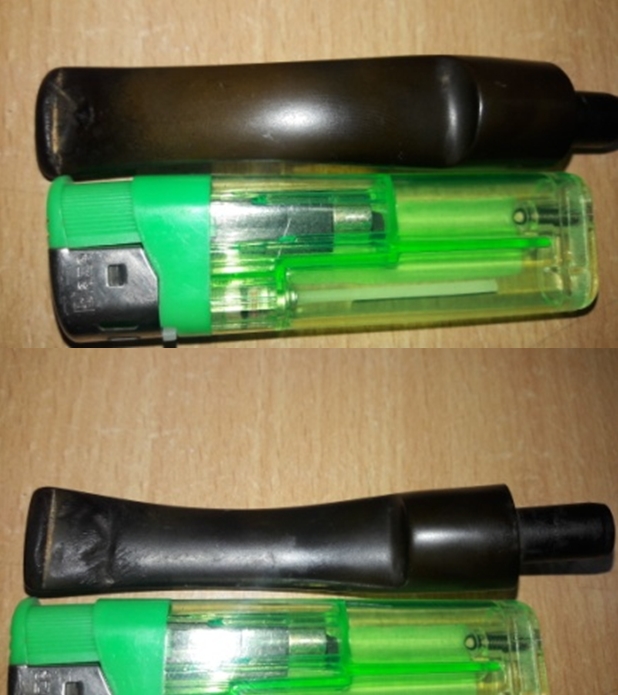
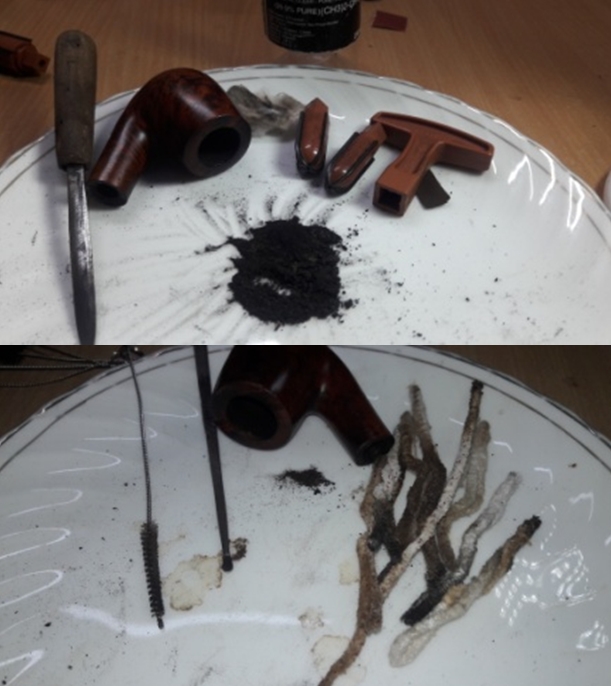
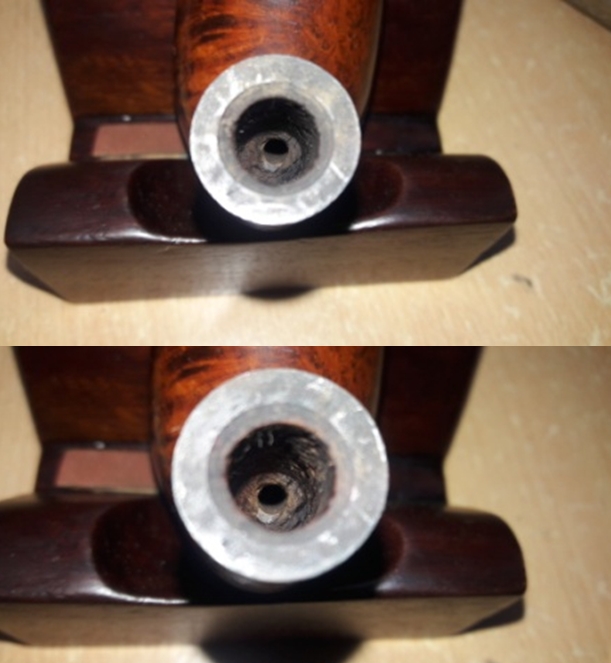
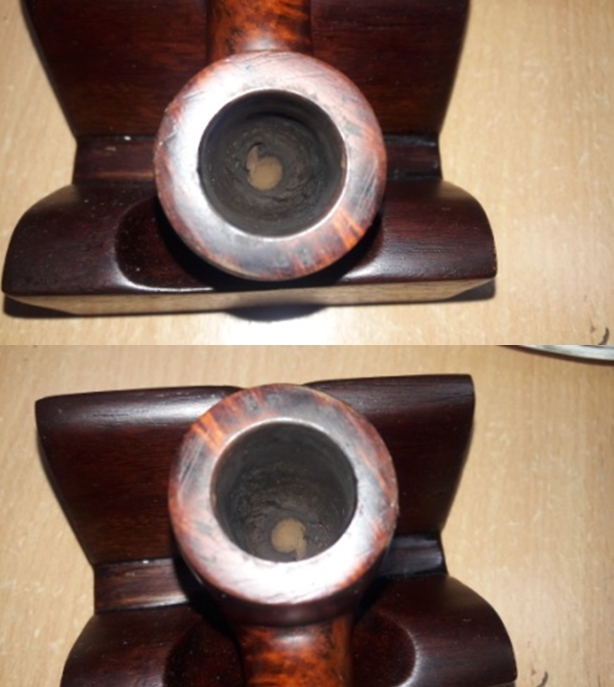
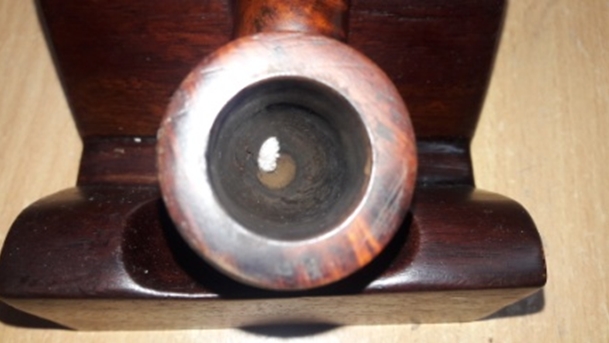
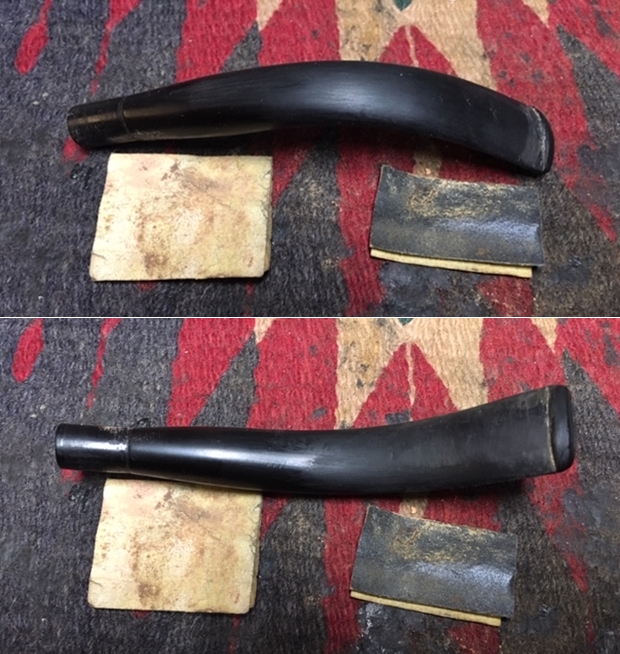
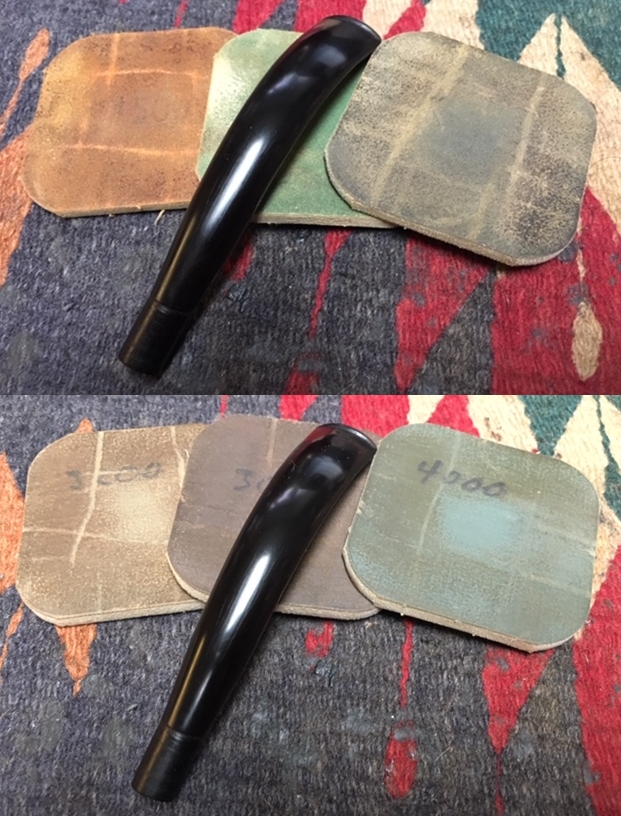
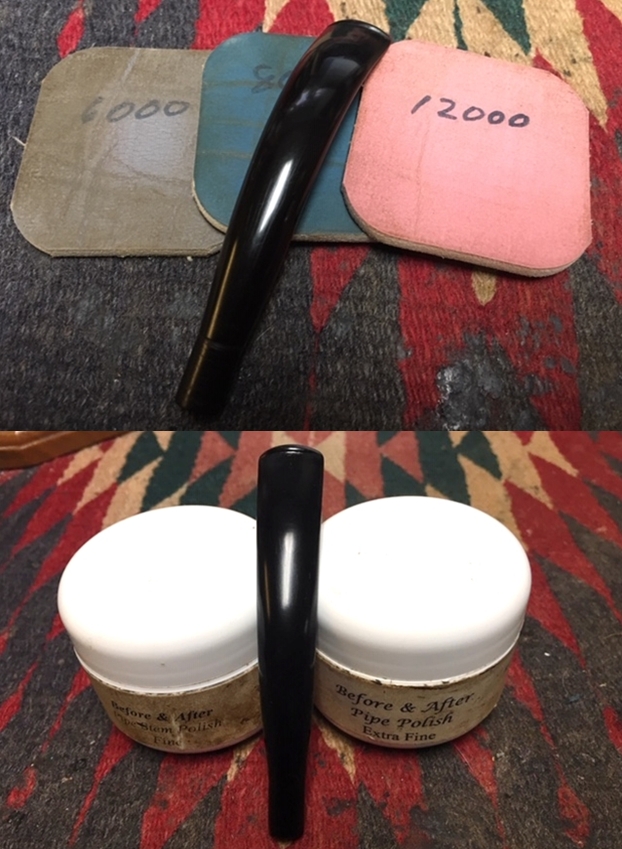
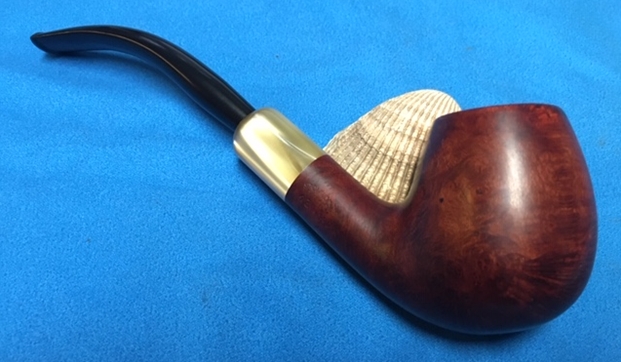
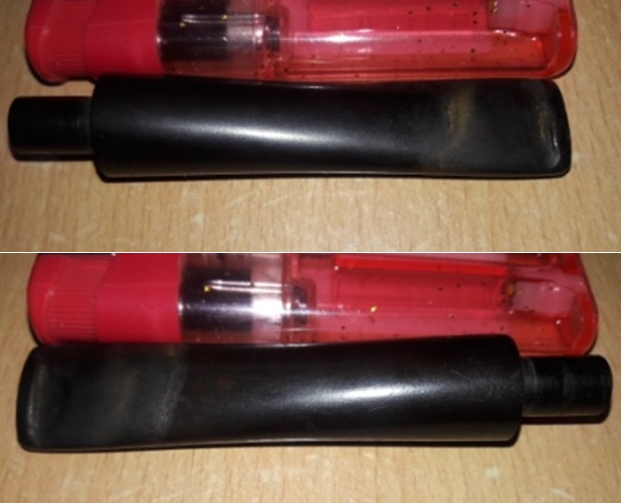
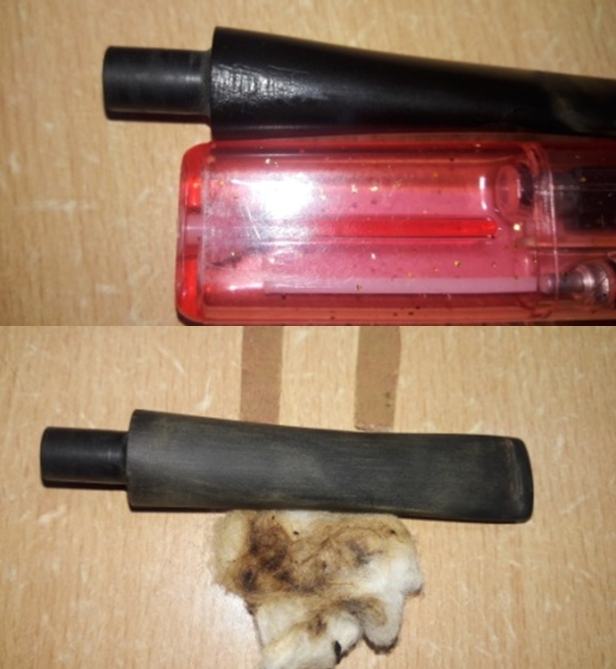
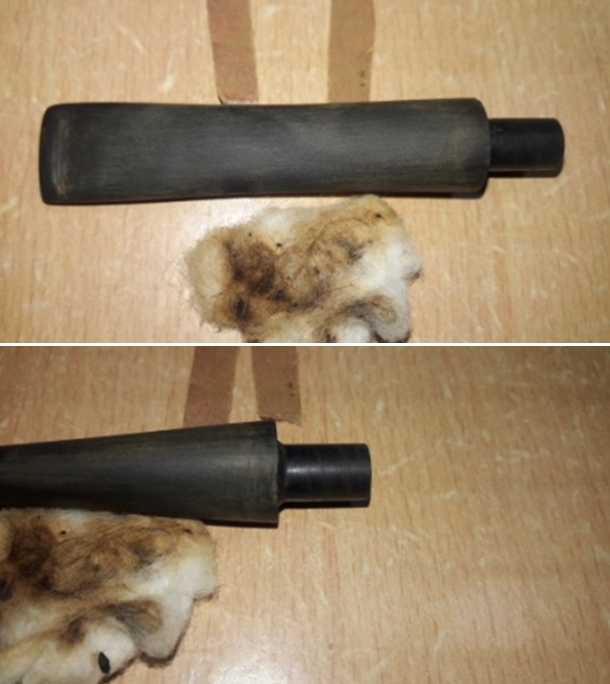
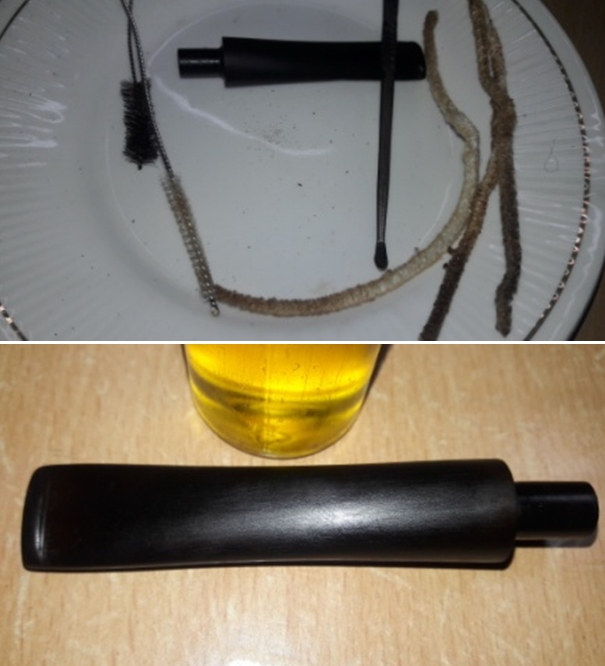
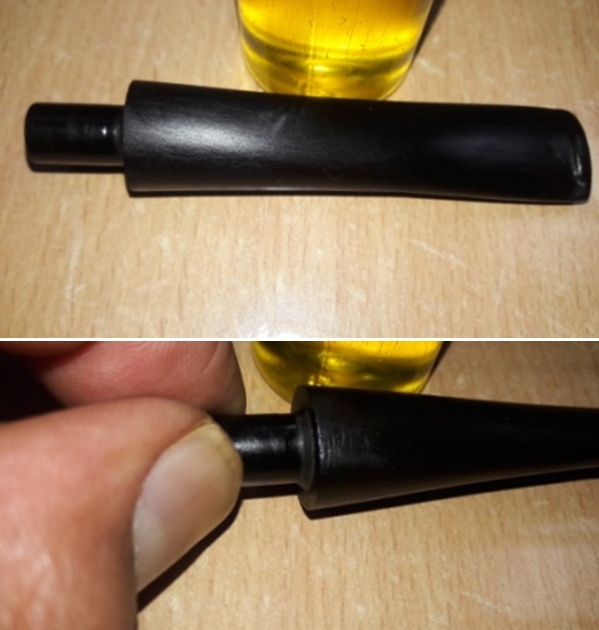
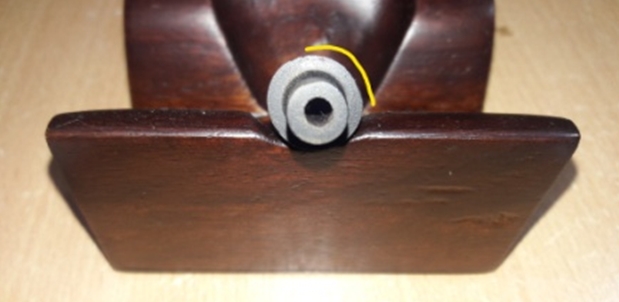
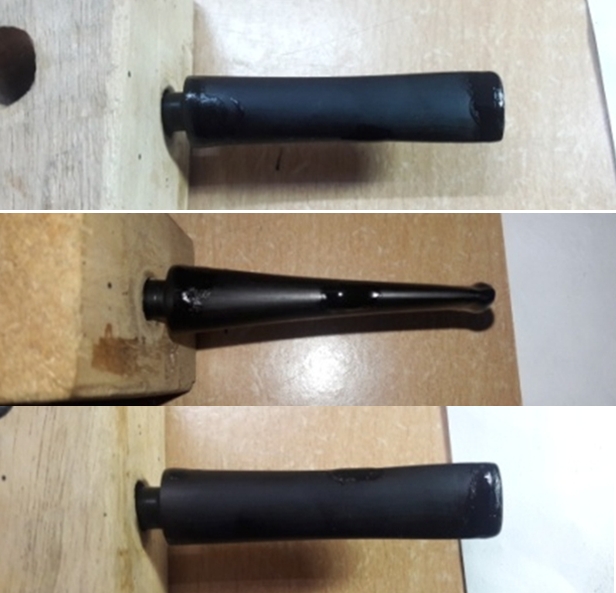
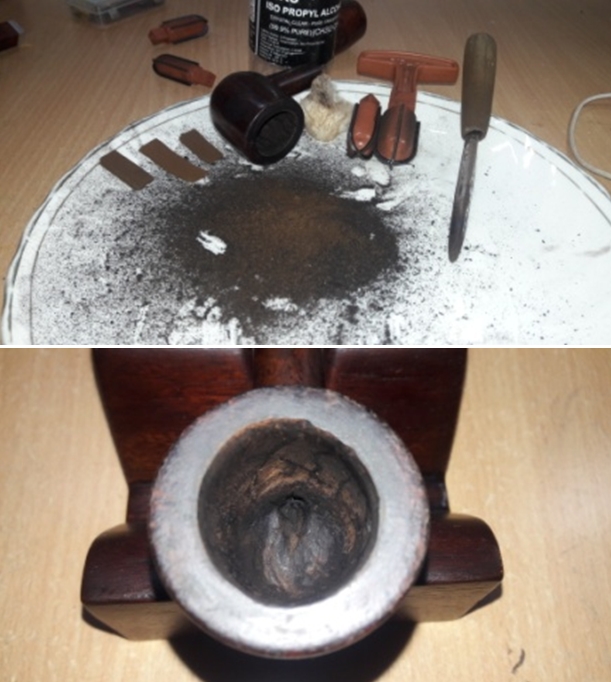
Now that I was clear about the path to be followed, I first flame both the surfaces of the stem with a Bic lighter. The heat from the flame raises the vulcanite to the surface and takes care of the tooth chatter that was seen earlier. I sand the stem with a folded piece of 220 grit sand paper to get rid of the oxidation, have a clear idea of the areas which require fill and its extent while providing a smooth surface for the intended fill. I cleaned out the internals of the stem with hard bristled and regular pipe cleaners dipped in isopropyl alcohol. Once I was satisfied with the internal cleaning, I wiped the stem surface, particularly the damaged button end, with a cotton pad and alcohol to remove any traces of dirt and grime.To begin the stem repairs, I prepared a mix of CA superglue and activated charcoal and generously applied it over the damaged surface and set it aside for curing over night. Before moving ahead, I would like to mention here that I had applied this mix to achieve sufficient thickness which would help during the filing and sanding while shaping the button and achieving the correct stem profile.While the stem repair was set aside to cure, I moved ahead to deal with the stummel repairs. I start the reaming with a size 1 head of the PipNet reamer and progress to size 2 head. I further clean the chamber with a folded piece of 180 grits sand paper to sand out the remaining traces of cake and expose the walls of the chamber to ascertain that there are no cracks/ heat fissures. Using my fabricated knife, I gently scrapped away the lava overflow. I wiped the chamber with a cotton pad dipped in isopropyl alcohol to remove the carbon dust left behind by all the reaming and sanding process. This also eliminated all traces of old smells from previous usage. The walls of the chamber were solid with no damage. Continuing with the cleaning regime, using a soft brass wired brush I gently scraped away the thick lava coat in the blast of the rim. With a hard bristled tooth brush and dipped in undiluted Murphy’s oil soap, I very deliberately scrubbed the sandblast finish on the stummel and the rim top. The stummel and rim top was dried using paper napkins and soft cotton cloth and set it aside to dry out naturally. The stummel looks fresh and clean. Next, I rub a small quantity of “Before and After Restoration Balm” in to the briar with my finger tips and let it rest for a few minutes. The balm almost immediately works its magic and the briar now has a nice vibrant appearance with the beautiful contrasting hues colors that are unique to this sandblast pipe, on full display. I further buff it with a horse hair shoe brush. After I had applied the balm, the rim top surface appeared too darkened and unclean. I was not happy with the way the rim top looked at this stage and decided to further clean it. I scrapped the rim top surface with a brass wired brush with a bit more pressure than I normally apply. The rim surface appeared clean as can be seen in the picture below. I reapplied the balm, hoping that the surface would look clean with the sandblast patterns showing themselves proudly. But alas!! The rim top surface appeared as before, blackened and unclean. I was at my wits end when after repeated cleaning with the brass brush with increasing pressure each time, the rim top surface appeared as before, dark and unclean. Mind you readers, being a sandblasted surface, topping really was not an option that I desired to adopt. I let the rim top surface be, satisfied that it was clean and sans any old lava overflow. In my exuberance to appreciate the beautiful and rugged patterns on the stummel caused by sandblasting, I missed out on cleaning the mortise and the shank airway. This is what exactly I addressed at this stage. Using bristled and regular pipe cleaners dipped in isopropyl alcohol, I first moistened the oils, tars and gunk in the mortise. Thereafter, with my fabricated spatula, I scrapped out all the tars and oils from the mortise. As I progressed with my cleaning, eventually the pipe cleaners started coming out clean indicating that the shank internals are clean.I set the stummel aside and turned my attention to the stem repair. The fill had cured nicely and I moved ahead and began the process of filing and shaping the button end with a flat head needle file. For a better blending, I further sand the entire stem with 220 followed by 400, 600 and 800 grit sand paper. This helps to reduce the sanding marks left behind by the more abrasive 220 grit paper. To bring a deep shine to the vulcanite stem, I went through the complete set of micromesh pads, wet sanding with 1500 to 2400 grit pads and dry sanding with 3200 to 12000 grit pads. I wiped the stem with alcohol after each pad and rubbed it down with Extra Virgin Olive oil to rehydrate the vulcanite. The repairs have blended in very well and the stem now looks shiny black and beautiful. The internals of the stem was once again cleaned out using alcohol and pipe cleaners to clear the airway of all the debris resulting due to the sanding. The finished stem is shown below. To finish, I re-attach the stem with the stummel. I mounted a cotton cloth buffing wheel to my local machine which is similar to the Dremel.  I set the speed at about half of the full power and applied White compound to the entire pipe. I wiped/ buffed the pipe with a soft cotton cloth to clear it of any leftover compound dust. I then mounted another cotton cloth wheel on to the polishing machine and applied several coats of carnauba wax. I finished the restoration by giving the entire pipe a rigorous hand buffing using a microfiber cloth to raise the shine further.The completed pipe looks lovely, fresh and vibrant. The deeply sandblasted surface proudly displays the contrasting dark brown hues which was the hallmark of Dunhill Shell pipes with a nice tactile feel in the hand. It surely is one of the best looking sandblasted pipes and will find a place of pride in my humble collection. As and when I load this pipe with my favorite tobacco (I love my English blends…) and sip my scotch, I wish this dude could tell me all about its past life!! Ah, this would be bliss…cheers!

Rebirthing a “Malaga” Large Chubby Billiard


Blog by Steve Laug

The next pipe in the queue is from the batch of pipes I am cleaning up for Alex – this one is a “Malaga” large, chubby Billiard with some heft and some beautiful grain around the oil cured bowl and shank. The entire pipe has some beautiful birdseye grain around the bowl and cross grain on the front and back of the bowl. The pipe has not been stained but sports the usual Malaga oil cured look. The carver did a great job utilizing the block of briar to maximize the grain. The pipe is stamped on the left side of the shank. It reads “MALAGA”. On the right side of the shank it is stamped with an upside down Imported Briar. The tapered stem is vulcanite and has no marking or stamping. This is another nice looking piece much like many of the pipes Alex is picking up. There was cake in the bowl and some darkening on the rim top. The exterior of the briar was dusty with grime and sticky spots on the shank and bowl. The stem is oxidized and there were light tooth marks on both sides of the stem at the button edge and some wear on the button edge itself. The entire pipe reeked of the licorice odor that remains when a pipe has been used to smoke Half and Half tobacco. This one is pungent with the odor. The photos below tell the story and give a glimpse of the pipe before clean up. I took a photo of the bowl and rim to capture the condition of the pipe before I started my cleanup work. Other than the darkening at the back side of the rim top the rim was in good condition. The was a light cake in the bowl. The inner edge has some nicks but not to bad. The outer edge of the bowl appeared to be in excellent condition. The biggest issue was the heavy stench of aromatic tobacco. In this case the smell of Half and Half as noted above. The stem was in decent condition. There was some oxidation and wear on the button surfaces on both sides of the stem. There were light tooth marks and chatter on both sides of the stem but otherwise it was not too bad.I also took a photo of both the left and right side of the shank to show the stamping on them. The stamping is readable in the photos below.For those of you who are unfamiliar with the brand, I am also including the link to a blog that I wrote that gives some of the history of the Malaga brand and the Malaga Pipe Shop in Royal Oak, Michigan in the USA. Here is the link – https://rebornpipes.com/tag/malaga-pipes/. That blog also includes links to a catalogue and the history of the pipemaker George Khoubesser. If you are interested to learn more then I invite you to follow the link to get a feel for the brand and the pipemaker.

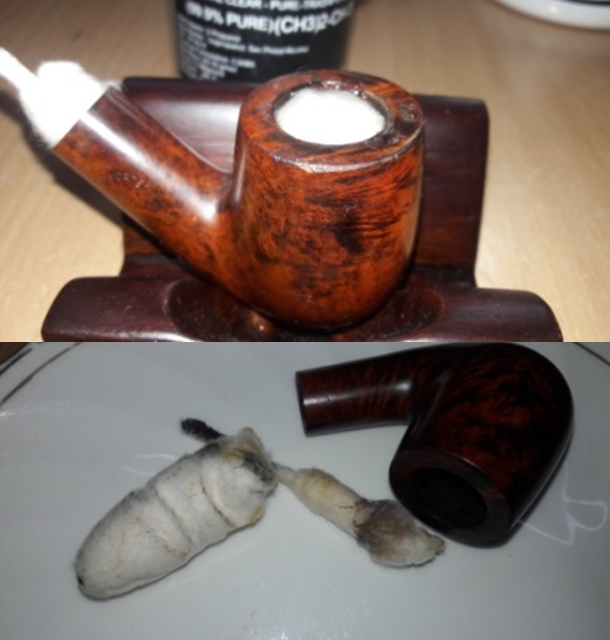
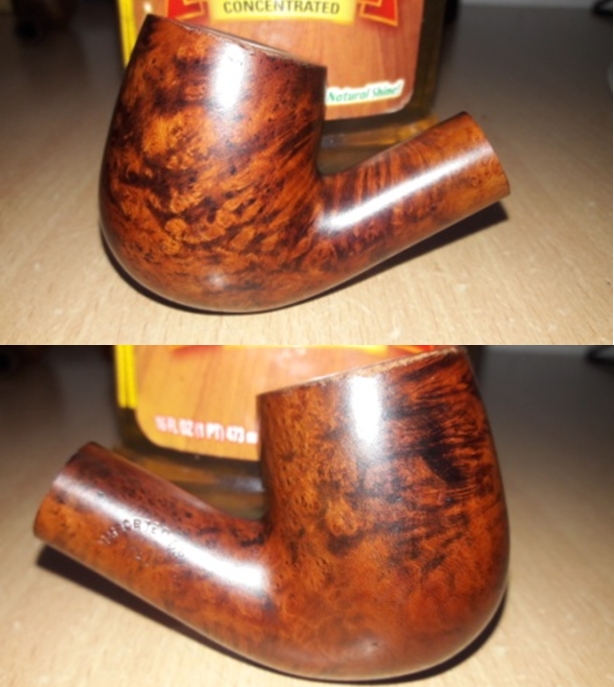
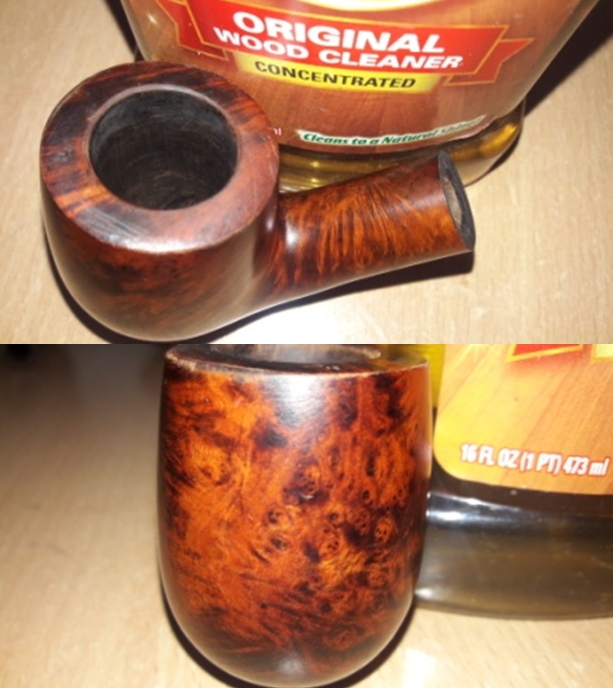
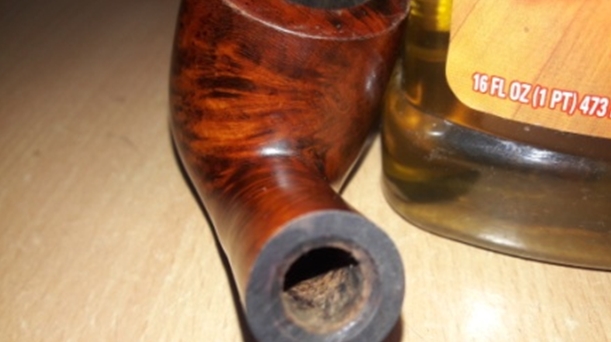
I started the restoration by reaming the bowl with a PipNet pipe reamer followed by a Savinelli Fitsall pipe knife to remove the remnants of the cake on the walls in the heel. I sanded the inside of the walls with a dowel wrapped with 220 grit sandpaper. I worked on the slight damage to the inner edge of the rim by sanding it with a folded piece of 220 grit sandpaper. I was able to remove the damage and the burned areas.I scraped the mortise with a dental spatula to remove the hardened tars and oils on the walls. I then scrubbed out the mortise and the airway in the shank and the stem with alcohol, cotton swabs and pipe cleaners. I used a lot of pipe cleaners and cotton swabs but I was not beating the stink in the bowl. I knew that I would need to do something a bit more intrusive if I was going to beat it. It was getting late and I was ready to call it a day. I stuffed the bowl with cotton balls and put a folded pipe cleaner in the shank to wick out the tars and oils in the shank. I used an ear syringe to fill the bowl with isopropyl alcohol. It would sit overnight and I would see what came out of the briar. It would also tell me where the issue was.In the morning when I got up I took a photo of the bowl. The cotton balls and alcohol had definitely pulled some oils out of the bowl but not too much. The interesting thing to me was the amount of oils and tars that the pipe cleaner had wicked out of the shank and mortise. This meant a lot more cleaning for me. I took out the cotton balls and pipe cleaner and had a look. I scrubbed the shank and mortise once more with pipe cleaners, cotton swabs and alcohol until it was clean. Finally I had beaten the stench radiating from the shank of the pipe.Once I finished cleaning out the inside of the pipe, I scrubbed the bowl with a tooth brush and undiluted Murphy’s Oil Soap. I rinsed the bowl under running water to wash off the soap and the grime that the tooth brush had loosened. At this point in the process of restoration I decided to top the bowl to remove the damage to the rim top and the darkening. I topped it on a topping board with 220 grit sandpaper until the rim top was smooth and the darkening was reduced.I polished the outside of the bowl with micromesh sanding pads – wet sanding with 1500-2400 grit pads and dry sanding with 3200-12000 grit pads. I wiped the bowl down after each pad to remove the sanding debris. I worked on the darkened area on the rear right side of the outer edge of the rim. I was able to remove much of the damage with the sanding. The photos tell the story. I worked some Before & After Restoration Balm into the surface of the briar with my fingertips to clean, enliven and protect it. I let the balm sit for a little while and then buffed with a cotton cloth to raise the shine.The following photos show the bowl at this point in the restoration process. The bowl and the rim top look very good with rich grain patterns. With the bowl finished I set it aside and turned my attention to the stem. I sanded the stem surface with 220 grit sandpaper to remove the oxidation and smooth out the tooth marks on the surface of the button. I am happy with the stem surface once that was done. I started the polishing of the surface with 400 grit wet dry sandpaper. I polished the stem with micromesh sanding pads – wet sanding it with 1500-2400 grit pads and dry sanding it with 3200-12000 grit pads. I wiped the stem down with a damp cloth after each pad. I further polished it with Before & After Pipe Polish – both Fine and Extra Fine. I wiped it down with a coat of Obsidian Oil and set it aside to dry. With both parts of the pipe finished, I polished the bowl and the stem with Blue Diamond polish on the buffing wheel. I gave the bowl and the stem multiple coats of carnauba wax. I buffed the pipe with a clean buffing pad to raise the shine. I hand buffed it with a microfiber cloth to deepen the shine. The pipe polished up pretty nicely. The oil cured finish and the grain came alive with the buffing. The rich finish on the briar works well with the polished black vulcanite stem. The finished pipe is a chubby billiard that is a nice handful. Have a look at it with the photos below. The dimensions are Length: 6 inches, Height: 2 inches, Outside diameter of the bowl: 1 3/8 inches, Chamber diameter: 7/8 of an inch. This one will be going back to Alex to add to his rack of Malaga pipes that are in his collection. Thanks for walking through the restoration with me on another of Alex’s Malaga collection.

Restoring #4 of Jennifer’s Dad’s Pipes – A GBD International Brandy


Blog by Steve Laug

Once again time to get back to Jennifer’s Dad’s pipes. The next pipe on the worktable is from the estate of George Rex Leghorn. You may not have read this so I will retell the story. I received an email from Jennifer who is a little older than my 64+ years about whether I would be interested in her Dad’s pipes. My brother Jeff and I have been picking up a few estates here and there, so I was interested. Here is the catch – she did not want to sell them to me but to give them to me to clean up, restore and resell. The only requirement she had was that we give a portion of the sales of the pipes to a charity serving women and children. We talked about the organization I work for that deals with trafficking and sexual exploitation of women and their children and she decided that would be a great way to carry on the charitable aspect of her Dad’s character. With some great conversation back and forth she sent the pipes to Jeff and he started the cleanup process on them. Once he had finished cleaning them all he sent them to me to do my work on them.

The fourth pipe I chose to work on from the lot was an interesting Brandy shaped GBD International with a carved and black stained rim top. It had some beautiful mixed grain on the bowl sides and shank. It had a rich reddish brown stain but it was dirty and hard to see the colour well. The stem was badly oxidized with tooth marks and chatter on the top and underside near the button. The button was in excellent condition. There was a thick cake in the bowl and it had overflowed with lava was dirty and tired looking. It had been sitting in boxes for a lot of years and it was time to move ahead with the restoration. Jennifer took photos of the pipes she was sending. I have included two she included from this pipe.When the box arrived from Jennifer, Jeff opened it and took photos of each pipe before he started his cleanup work on them. This petite looking GBD International with a Plateau rim top appeared to be in good condition underneath the grime and oxidation on the bowl and stem. The finish looked intact under the grime. The bowl had a thick cake that had hardened with time. The lava overflow on the rim filled in the carving that was a hallmark of the International line but it could very well have protected the rim from damage. We won’t know what is under it until Jeff had cleaned it off. The stem was worn looking with a lot of deep oxidation and scratches in the vulcanite on both surfaces. There was some tooth chatter and bite marks on both sides at the button. The stem did not have the GBD brass medallion on the top of the saddle nor did have the later stamped and painted logo. Jeff took photos of the bowl and rim top to show the cake in the bowl and the lava build up on the edges of the bowl. It was thick and hard but hopefully it had protected the rim and edges from damage. The third photo shows the lava flowing down the outside of the bowl leaving a thick dark ring around the outside of the bowl. Jeff took photos of the stamping on the underside of the shank. The stamping was still readable even though it was faint. On the topside of the shank it read GBD in an oval (GBD Logo) over International over London Made. On the underside London, England over the shape number 1970. The shank was very dirty as you can see in the photos. The GBD International Line came out in the 1970’s (not to be confused with the shape number stamped on the underside of the shank. I looked up the line on Pipedia to get a good description (https://pipedia.org/wiki/GBD_Model_Information). I quote from there:
International — France, unknown if also made in England: medium brown smooth, carved top rim, rim stained black. -TH: Matt take off finish “with just a hint of surface waxing” -catalog (1976).

Jeff took photos of the top and underside of the stem showing the scratching, oxidation and light tooth damage to the stem surface and slight wear to the edge and top of the button.I am once again including the tribute that Jennifer consented to her Dad for the blog. She also sent some photos and an article that her Dad wrote for Jeff and me to be able to get a feel for him. I have included those below. Note in each of them that he is holding a pipe in his left hand. I asked her to also send me an email with a brief tribute to her Dad. Here is her tribute from an email to me.

Steve, I want to thank you again for accepting my dad’s pipes.  They were so much a part of my dad’s life that I could not simply discard them. But as his daughter, I was not about to take up smoking them either. *laughing* I think my dad would like knowing that they will bring pleasure to others.  I know that I do.

I’m not sure what to say about his pipes. I always remember Daddy smoking pipes and cigars.
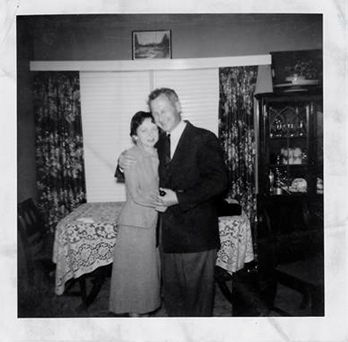
First a bit about my dad. Though my father, George Rex Leghorn, was American (growing up in Alaska), he managed to join the Canadian Army at the beginning of WWII, but in doing so lost his American citizenship.  He was fortunate to meet a Canadian recruiting officer who told him the alphabet began with “A” and ended with “Zed” not “Zee”, and also told him to say that he was born in a specific town that had all its records destroyed in a fire.  When the US joined the war my dad, and thousands of other Americans who had made the same choice*(see the link below for the article), were given the opportunity to transfer to the US military, and regain their citizenship.

After WWII, my dad, earned his degree at the University of California Berkeley and became a metallurgist. There is even a bit about him on the internet.

He loved taking the family out for a drive, and he smoked his cigars on those trips. (As a child, those were troubling times for my stomach.)

I most remember my father relaxing in his favorite chair with a science fiction book in one hand and a pipe in the other… Sir Walter Raleigh being his favorite tobacco… and the pipes themselves remind me of him in that contented way.  If I interrupted his repose, he’d look up, with a smile on his face, to answer me.

It seemed he smoked his Briarwood pipes the most, though he had others.  At the time, it was only the Briarwood I knew by name because of its distinctive rough shaped bowl.  And it was the Anderson Free Hand Burl Briar, made in Israel, which I chose for his birthday one year, because I thought he might like that particular texture in his hand.

At least two of his pipes, he inherited from his son-in-law, Joe Marino, a retired medical laboratory researcher (my sister Lesley’s late husband)… the long stemmed Jarl (made in Denmark), and the large, white-bowled, Sherlock Holmes style pipe.  I believe Joe had others that went to my dad, but Lesley was only sure about those two.

The Buescher, corncob pipe my older sister Lesley bought for Daddy while on one of her travels around the States.
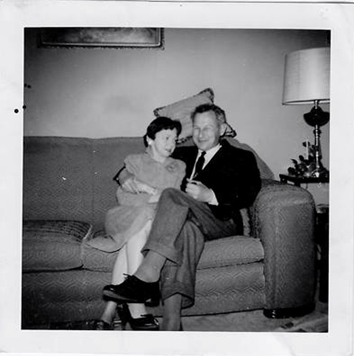
A note on the spelling of my sister’s name…

My dad met my mother, Regina, during WWII and they married in Omagh, Ireland.  My mother was English and in the military herself.  The English spelling of Lesley is feminine, and Leslie masculine, in the UK… just the opposite of here in the United States.  I guess my mom won out when it came to the spelling of the name.

I’ll send you photos of my dad soon, along with his WWII experience story.

Jennifer

*https://www.thestar.com/news/world/2013/10/22/the_americans_who_died_for_canada_in_wwii.html

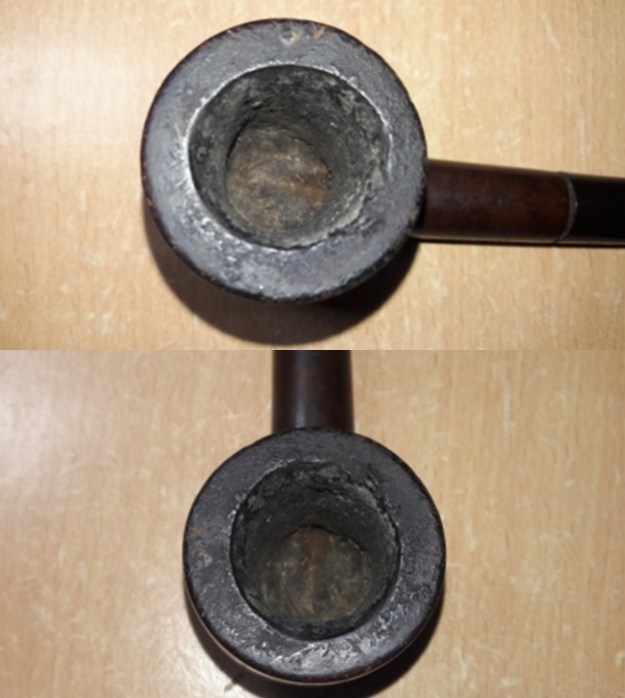
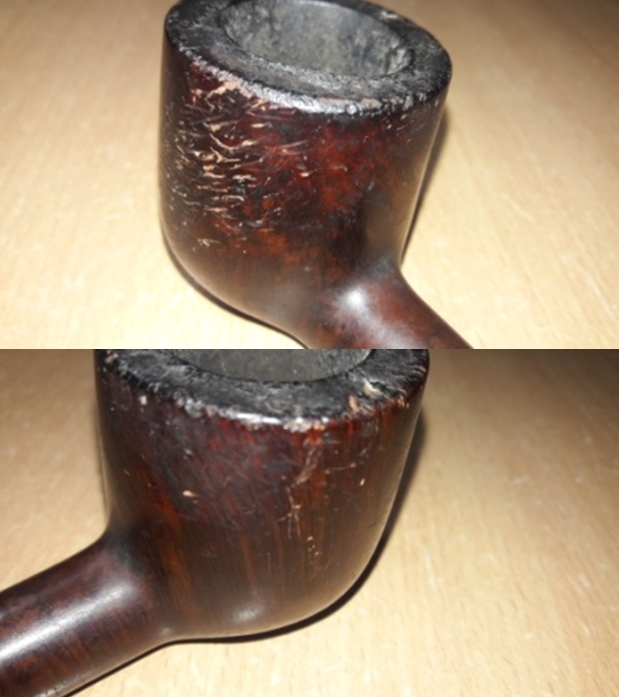
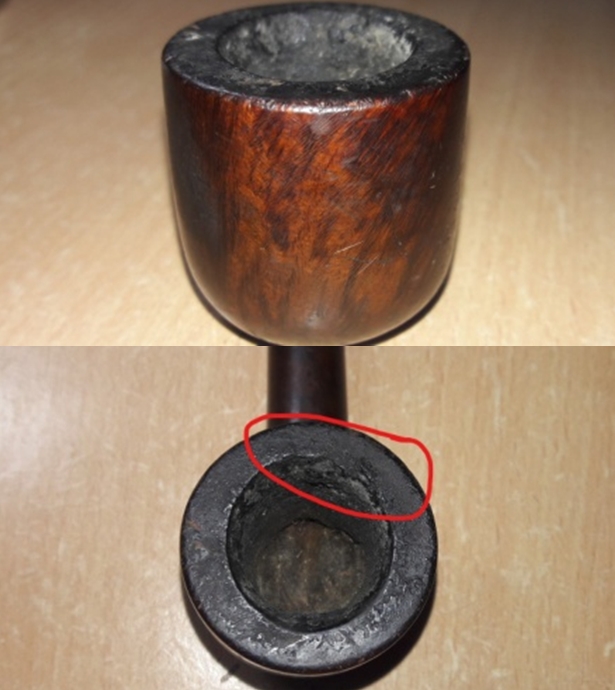
Once again Jeff cleaned the pipe with his usual penchant for thoroughness that I really appreciate. This one was a real mess and I did not know what to expect when I unwrapped it from his box. He reamed it with a PipNet pipe reamer and cleaned up the reaming with a Savinelli Fitsall Pipe Knife. He scrubbed out the internals with alcohol, pipe cleaners and cotton swabs until the pipe was clean. He scrubbed the exterior of the bowl with Murphy’s Oil Soap and a tooth brush to remove the grime and grit on the briar and the lava on the rim top. The finish looks very good with mixed grain around the bowl and shank. There was still some darkening on the right side of the outer edge of the rim toward the back of the bowl (I have circled the spot in red in the second photo below). He soaked the stem in Before & After Deoxidizer to remove the oxidation on the rubber. When the pipe arrived here in Vancouver for the second stop of its restoration tour it looked very good. I took photos before I started my part of the work. I took some close up photos of the carved blackened rim top and stem surface. I wanted to show what an amazing job Jeff did in the cleanup of the rim top. It looked almost flawless. I also took close up photos of the stem to show the light tooth marks and chatter in front of the button on both sides.I also took photos of the stamping on the pipe on both the top and underside of the shank. It read as noted above.I polished the outside of the bowl with micromesh sanding pads – wet sanding with 1500-2400 grit pads and dry sanding with 3200-12000 grit pads. I wiped the bowl down after each pad to remove the sanding debris. I worked on the darkened area on the rear right side of the outer edge of the rim. I was able to remove much of the damage with the sanding. The photos tell the story. I worked some Before & After Restoration Balm into the briar of the bowl and the carved rim top with my fingertips to clean, enliven and protect it. I worked it deep into the carved finish with a horsehair shoe brush. I find that the balm really makes the briar come alive again. The contrasts in the layers of stain really made the grain stand out. I let the balm sit for a little while and then buffed with a cotton cloth to raise the shine. The pipe really looks good at this point. I am very happy with the results. I sanded the stem with 220 grit sandpaper to blend the tooth marks and chatter in and to remove some of the oxidation. I followed that by sanding with 400 grit sandpaper to start the polishing process.I shaped the button and polished the stem with micromesh sanding pads – wet sanding it with 1500-2400 grit pads and dry sanding it with 3200-12000 grit pads. I wiped the stem down with Obsidian Oil after each pad and set it aside to dry. I put the stem back on the bowl and polished the bowl and stem with Blue Diamond polish on the buffing wheel. I gave the bowl and the stem multiple coats of carnauba wax. I buffed the pipe with a clean buffing pad to raise the shine. I hand buffed it with a microfiber cloth to deepen the shine. The multi coloured stained finish on this briar is quite beautiful and the shine on it makes the variations of colour really pop. The pipe polished up really well. The wax and the contrasting stain on the bowl made the grain just pop on the briar. The polished black vulcanite seemed to truly come alive with the buffing. The petite pipe feels great in my hand and when it warms with smoking I think it will be about perfect. It must have been a fine smoking pipe judging from the condition it was when we received it from Jennifer. There should be a lot of life left in this old timer. Have a look at it with the photos below. The dimensions are Length: 5 inches, Height: 1 1/2 inches, Outside diameter of the bowl: 1 1/4 inches, Chamber diameter: ¾ of an inch. This is one that will go on the rebornpipes online store shortly. If you want to carry on the pipe trust of George Leghorn let me know. Thank you Jennifer for trusting us with his pipes. Thanks to each of you who are reading this blog. Remember we are not pipe owners, we are pipemen and women who hold our pipes in trust until they pass on into the trust of the next pipeman or woman.
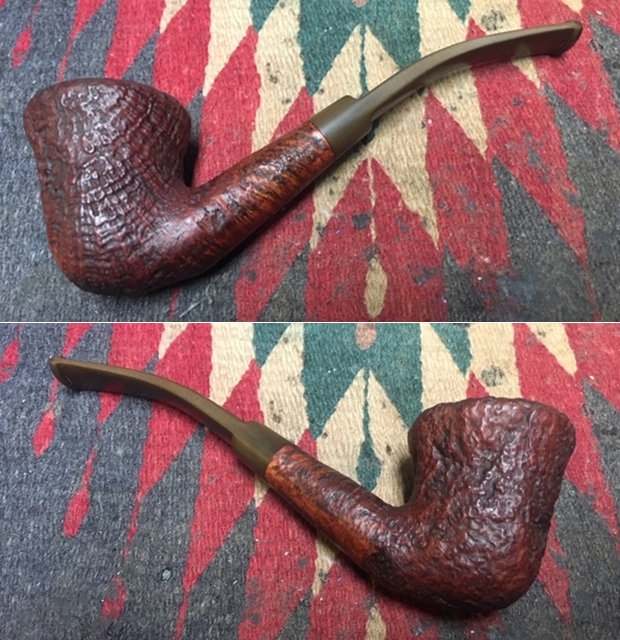
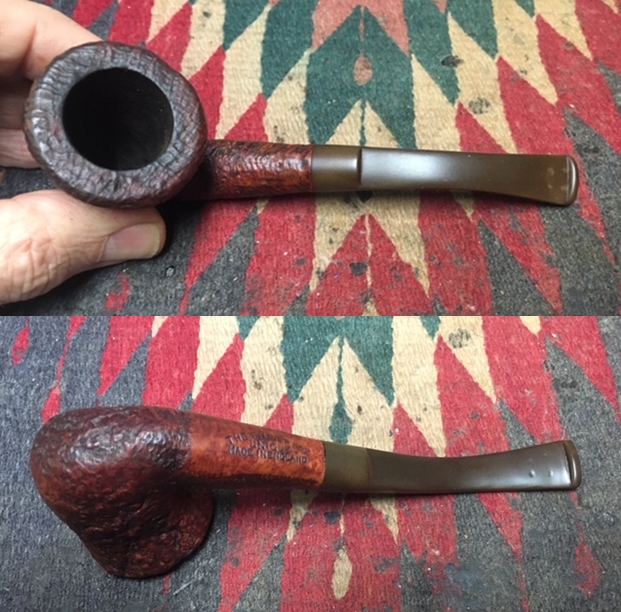
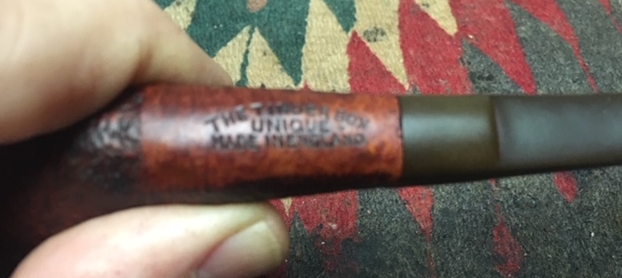
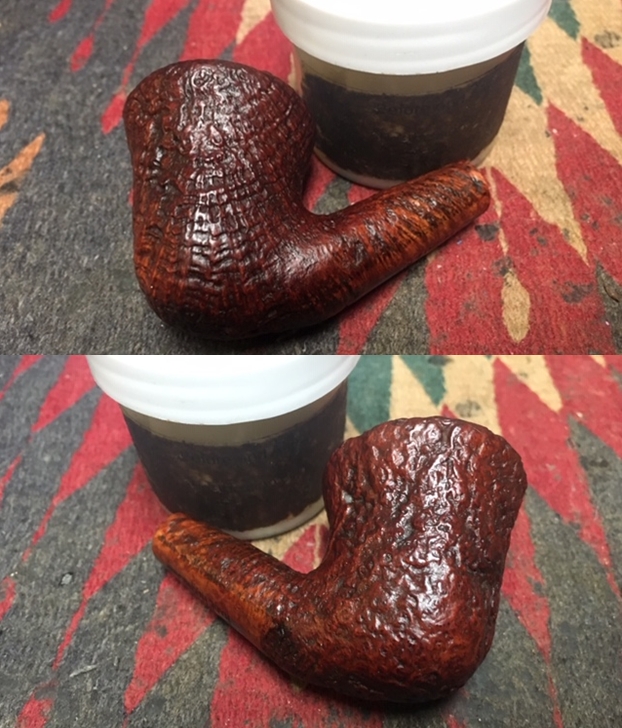


The #3 pipe from a collection of Bertrams and others – a CBP Hudson Bay Canadian


Blog by Steve Laug

Once in a while I get emails through the blog about pipes that someone wants to sell. These can be estates or they can be a collection that an older pipeman has decided to get rid of by passing it on to someone who can work on them and see that they get into the hands of another pipe smoker. In this case I received an email from a fellow who wanted to sell me a collection of Bertram pipes. We met over FaceTime and he showed the pipe collection to both Jeff and me. We discussed their condition and arrived at a price for the pipes. The majority of the pipes in the collection were Bertrams but there were also some other brands that were known to me. We struck a deal on the lot and he shipped them to Jeff. Jeff took some photos of the collection when it arrived in Idaho. He unwrapped each pipe and filled the three boxes that they were mailed in, and then took a photo to show the size of the collection we had purchased. To be honest it was a bit overwhelming to see all of the collection in boxes. We were looking at a lot of work to bring these back to life.Jeff chose a group of pipes from the collection and began his work on them He sent me a box with some of the pipes he had cleaned up. This time I thought I would change it up and I chose a long shank C.B.P. Hudson Bay Canadian from the lot to be the third pipe I would work on. The C.B.P. brand was a new one on me. It would be fun to figure out the maker. But first, my initial assessment of the pipe. The smooth finish was dirty but the grain shone through showing me that this was a beautiful pipe. It had a long shank and short stem. There was very little cake in the bowl and the rim top looked almost pristine. The stem was oxidized and had some pitting on both sides. The photos below tell the story and give a glimpse of this interesting pipe. Jeff took a close up photo of the bowl and rim to capture the condition of the pipe before he started his cleanup work. The rim top looked really good. There were some small nicks on the outer edge but other than that it was very clean. The bowl had a very thin cake and was quite clean.He also took photos of the sides of the bowl and shank to show the interesting grain on the bowl and the heel. The finish is very dirty and it looks like there are a few fills in the briar but this is another interesting pipe. Jeff took a photo to capture the stamping on the top and underside of the shank. The photo shows stamping on the top side which read C.B.P. over Hudson Bay. The stamping on the underside read Algerian Briar. All the stamping on the pipe is clear and readable.The next two photos show the stem surface. They show the pitting and oxidation on the surface of both sides of the stem. There are also some nicks on the outer edge of the button. The third photo below shows the stinger that is in the tenon once the stem is removed from the shank. Now it was time to try to unravel the mystery of the stamping on the shank of this pipe. The stamping Algerian Briar was clear but did not tell me who the maker of the pipe was. The clue that I had to work with was the stamping on the top of the shank – C.B.P. Hudson Bay. With that I had two options to check out – would there be a listing anywhere for the C.B.P. brand or would there be anything under Hudson Bay. I turned first to look for anything about the C.B.P. brand. I looked on WMTP (Who Made That Pipe) and there was nothing. I looked on Pipedia and there was nothing. I looked on the PipePhil site and there was nothing. I looked at the same sites for the Hudson Bay stamp. The results were the same. I stopped and paused for a moment and thought about the initials. What brand did I know that fit the C.B.P. logo? There was only one that I could remember – short memory or short list? Your call. That brand was C.B. Perkins. I turned again to PipePhil and Pipedia and I found some help.

First on the PipePhil site (http://www.pipephil.eu/logos/en/logo-c1.html) I found a connection. I have included a screen capture to show what I saw.Not counting the CBP in an oval logo on the stem what caught my eye was the C.B.P. Heritage stamp on the shank. Now I had the connection I was looking for – C.B.P. was linked to C.B. Perkins. Now I needed to have a look at Pipedia and see what I could find out about the brand.

I checked first in the Pipemaker list by country that is on the site and could not find the brand. I then did a quick search on Pipedian and found this link: https://pipedia.org/wiki/C.B._Perkins. I quote from that site in full.

The first C.B. Perkins store opened in Boston in the early 1900’s. Perkins quickly became the leading retail tobacconist in New England, a position it held for over 75 years. In 1986 Perkins management sold their Pennsylvania and New Jersey stores to DES Tobacco Corporation.

DES is a wholly owned subsidiary of the S. Frieder and Sons Company. S. Frieder and Sons had been a cigar manufacturer since 1920. In 1978 S. Frieder sold its manufacturing business to United States Tobacco so it could focus all its assets and energy on the retail tobacco business under the name of DES Tobacco. Thus, the merger of C.B. Perkins and DES represented four generations of tobacco experience.

There were also some photos of the shop and business card courtesy of Doug Valitchka. I am including those here as well.Now I knew that I was dealing with a Tobacco Pipe Shop pipe from C.B. Perkins. However they did not make pipes but tended to have pipes made for them by English pipe maker such as Comoys, GBD and others. So that is where the hunt ends. There are no COM stamps on the pipe and no shape numbers to help nail down a maker. The shape reminds me a lot of both of those makers. But at least I know what the C.B.P. stamp means. Now it is time to work on this pipe.

Jeff reamed the bowl with a PipNet pipe reamer and followed up with a Savinelli Fitsall pipe knife to remove the cake. He scrubbed out the mortise and the airway in the shank and the stem with alcohol, cotton swabs and pipe cleaners. He scrubbed the exterior of the bowl, rim, shank and stem with a tooth brush and Murphy’s Oil Soap to remove the grime on the finish of the bowl. He rinsed it under running water. He dried it off with a soft cloth. He soaked the stem in Before & After Deoxidizer to remove the oxidation. I took photos of the pipe before I started my work on it. I took a close up photo of the rim top to show the scratching and nicks on the top. Other than those issues it was in great condition. Both the inner edge and the outer edge of the rim look really good. The stem photos show the pitted surface of the vulcanite and some nicks in the button edge on both sides. There were no tooth marks or chatter on this stem.I also took a photo of the stamping on the top and underside of the shank showing how the stamping was laid out.I polished the rim top and the rest of the briar with micromesh sanding pads – wetsanding it with 1500-2400 grit pads and dry sanding it with 3200-12000 grit pads. I wiped the bowl down with a damp cloth after each pad to remove the sanding debris. After the final sanding pad I hand buffed it with a cotton cloth to raise a shine. I worked some Before & After Restoration Balm into finish of the briar with my fingertips to clean, enliven and protect it. I let the balm sit for a little while and then buffed with a cotton cloth to raise the shine. Once again I am surprised by how the Balm really makes the grain stand out. The pipe really looks good at this point and the grain stands out beautifully. I am very happy with the results. I set the bowl aside and turned my attention to the stem. I used a folded piece of 240 grit sandpaper to smooth out the pitting on the surface of the stem. I started polishing the stem with a folded piece of 400 grit sandpaper. I wiped the stem down with Obsidian Oil and took the following photos.I polished the stem with micromesh sanding pads – wetsanding it with 1500-2400 grit pads and dry sanding it with 3200-12000 grit pads. I wiped the stem down with Obsidian Oil after each pad. I polished it with Before & After Pipe Polish – both Fine and Extra Fine and gave it a final coat of Obsidian Oil and set it aside to dry. I put the stem and bowl back together and buffed the pipe with Blue Diamond on the buffing wheel. I polished the briar and the vulcanite stem until there was a rich shine. The polished briar came alive with buffing and the straight, swirled and flame grain just popped with polishing. The black vulcanite stem developed a rich glow. The finished pipe is a long shank Canadian shaped pipe that really is a comfortable handful of briar. Have a look at it with the photos below. The dimensions are Length: 7 inches, Height: 1 7/8 inches, Outside diameter of the bowl: 1 3/8 inches, Chamber diameter: ¾ of an inch. This is another pipe that I will be putting this one on the rebornpipes store sometime in the days ahead. If you are looking for a long shank Canadian from a historic Pipe Shop – C.B. Perkins this might just be what you are looking for. Let me know if you are interested. Thanks for walking through the restoration of this with me it was a pleasure to work on.

Pipe #2 from a collection of Bertrams – a Bertram 1/4 Bent Author 60


Blog by Steve Laug

Once in a while I get emails through the blog about pipes that someone wants to sell. These can be estates or they can be a collection that an older pipeman has decided to get rid of by passing it on to someone who can work on them and see that they get into the hands of another pipe smoker. In this case I received an email from a fellow who wanted to sell me a collection of Bertram pipes. We met over FaceTime and he showed the pipe collection to both Jeff and me. We discussed their condition and arrived at a price for the pipes. The majority of the pipes in the collection were Bertrams but there were also some other brands that were known to me. We struck a deal on the lot and he shipped them to Jeff. Jeff took some photos of the collection when it arrived in Idaho. He unwrapped each pipe and filled the three boxes that they were mailed in, and then took a photo to show the size of the collection we had purchased. To be honest it was a bit overwhelming to see all of the collection in boxes. We were looking at a lot of work to bring these back to life.Jeff chose a group of pipes from the collection and began his work on them He sent me a box with some of the pipes he had cleaned up. I chose another one of the Bertrams from the lot to be the second pipe I would work on. The smooth finish was dirty but the grain shone through showing me that this was a beautiful pipe. It had a thick shank and a ¼ bent tapered stem. There was a cake in the bowl and some lava overflowing on to the rim top. The rim top also had dents and dings and a slight burn mark on the front inner edge. The stem showed some wear on the button edge and tooth marks and chatter in the top and underside. The photos below tell the story and give a glimpse of this interesting pipe. Jeff took 2 close up photos of the bowl and rim to capture the condition of the pipe before he started his cleanup work. The rim top had some thick lava overflow and made it hard to know what the inner edge looked like under the grime and lava.He also took a photo of the right and underside of the bowl and shank to show the interesting grain on the bowl and the heel. The finish is very dirty but this is another interesting pipe.Jeff took a photo to capture the stamping on the left side of the shank. The photo shows stamping which read Bertram over Strate Grain. The stamping on this pipe is clear and readable. The second photo shows the double stamped number 60 showing the quality of the pipe. The next two photos show the stem surface. They show the tooth marks and chatter on both sides near the button. There are also some nicks on the outer edge of the button. The stem is lightly oxidized and scratched.If you don’t know much about them I recommend doing a little research on them. I include a link to the write up on Pipedia (http://pipedia.org/wiki/Bertram). Bertram pipes were based out of Washington DC. They were popular among famous politicians and celebrities of the time. They made many products for them from FDR’s cigarette holders to Joseph Stalin’s favorite pipe. They were considered some of the best America had to offer till they finally closed their doors in the 70s. They graded their pipes by 10s, the higher the grade the better. Above 60s are uncommon and 80-90s are quite rare. I’ve never heard of or seen a 100 grade. I have several blogs that I have written on rebornpipes that give some history and background to Bertram pipes. (https://rebornpipes.com/2015/06/16/an-easy-restoration-of-a-bertram-grade-60-217-poker/).

I have included the following link to give a bit of historical information on the pipe company. It is a well written article that gives a glimpse of the heart of the company. http://www.streetsofwashington.com/2012/01/bertrams-pipe-shop-on-14th-street.html#

I am also including this photo of the shop in Washington D.C. and a post card of the shop.

From this information I have learned that the shape and grade Bertram I have in front of me now was made before the closure of the shop in the 70s. I also learned that it was a grade 60 thus it was on the higher end of the spectrum just above mid-grade. Jeff reamed the bowl with a PipNet pipe reamer and followed up with a Savinelli Fitsall pipe knife to remove the cake. He scrubbed out the mortise and the airway in the shank and the stem with alcohol, cotton swabs and pipe cleaners. He scrubbed the exterior of the bowl, rim, shank and stem with a tooth brush and Murphy’s Oil Soap to remove the oils and tars on the rim and the grime on the finish of the bowl. He rinsed it under running water. He dried it off with a soft cloth. He was able to remove the lava build up on the rim top and you could see the great condition of the bowl top and edges of the rim. He soaked the stem in Before & After Deoxidizer to remove the oxidation. I took photos of the pipe before I started my work on it. I took a close up photo of the rim top to show the nicks and dents in the top as well as the burned area toward the front of the bowl on the inner rim. Other than those issues it was in great condition. Otherwise both the inner edge and the outer edge of the rim look really good. The stem photos show the light tooth marks and the damage to the button surface on both sides. The surface of the stem is also pitted. The tooth marks are the same as those on the first Bertram I worked on.I also took a photo of the stamping on the right side of the shank showing how the stamping was laid out.I cleaned up the rim top and the inner edge of the rim to address the nicks and the burn damage to the front inner edge. I used a folded piece of 220 grit sandpaper to smooth out the damage on the rim top and to deal with the burn damage.I polished the rim top and the rest of the briar with micromesh sanding pads – wetsanding it with 1500-2400 grit pads and dry sanding it with 3200-12000 grit pads. I wiped the bowl down with a damp cloth after each pad to remove the sanding debris. After the final sanding pad I hand buffed it with a cotton cloth to raise a shine. I worked some Before & After Restoration Balm into finish of the briar with my fingertips to clean, enliven and protect it. I let the balm sit for a little while and then buffed with a cotton cloth to raise the shine. The pipe really looks good at this point and the grain stands out beautifully. I am very happy with the results. I set the bowl aside and turned my attention to the stem. I used a folded piece of 240 grit sandpaper to blend the tooth marks and chatter into the surface of the stem. I sanded out the scratch marks and started polishing the stem with a folded piece of 400 grit sandpaper. I wiped the stem down with Obsidian Oil and took the following photos.I polished the stem with micromesh sanding pads – wetsanding it with 1500-2400 grit pads and dry sanding it with 3200-12000 grit pads. I wiped the stem down with Obsidian Oil after each pad. I polished it with Before & After Pipe Polish – both Fine and Extra Fine and gave it a final coat of Obsidian Oil and set it aside to dry. I put the stem and bowl back together and buffed the pipe with Blue Diamond on the buffing wheel. I polished the briar and the vulcanite stem until there was a rich shine. The polished briar came alive with buffing and the straight, swirled and birdseye grain just popped with polishing. The black vulcanite stem developed a rich glow. The finished pipe is a thick shanked ¼ bent author shaped pipe that really is a comfortable handful of briar. Have a look at it with the photos below. The dimensions are Length: 5 1/2 inches, Height: 1 1/2 inches, Outside diameter of the bowl: 1 1/4 inches, Chamber diameter: ¾ of an inch. I will be putting this one on the rebornpipes store sometime in the days ahead. If you are looking for a Bertram of a unique shape then this ¼ bent author might be what you are looking for. Let me know if you are interested. Thanks for walking through the restoration of this with me it was a pleasure to work on.

The first from a collection of Bertrams – a Bertram ¾ Bent Billiard 60


Blog by Steve Laug

Once in a while I get emails through the blog about pipes that someone wants to sell. These can be estates or they can be a collection that an older pipeman has decided to get rid of by passing it on to someone who can work on them and see that they get into the hands of another pipe smoker. In this case I received an email from a fellow who wanted to sell me a collection of Bertram pipes. We met over FaceTime and he showed the pipe collection to both Jeff and me. We discussed their condition and arrived at a price for the pipes. The majority of the pipes in the collection were Bertrams but there were also some other brands that were known to me. We struck a deal on the lot and he shipped them to Jeff. Jeff took some photos of the collection when it arrived in Idaho. He unwrapped each pipe and filled the three boxes that they were mailed in, and then took a photo to show the size of the collection we had purchased. To be honest it was a bit overwhelming to see all of the collection in boxes. We were looking at a lot of work to bring these back to life.Jeff chose a group of pipes from the collection and began his work on them He sent me a box with some of the pipes he had cleaned up. I chose one of the Bertrams from the lot to be the first pipe I would work on. The smooth finish was dirty but the grain shone through showing me that this was a beautiful pipe. It had a thick shank and a bent tapered stem. There was a cake in the bowl and some lava overflowing on to the rim top. The stem showed some wear on the button edge and tooth marks and chatter in the top and underside. The photos below tell the story and give a glimpse of this interesting pipe. Jeff took 2 close up photos of the bowl and rim to capture the condition of the pipe before he started his cleanup work. The rim top had some thick lava overflow and made it hard to know what the inner edge looked like under the grime and lava. He also took photos of the right and left side of the bowl and shank to show the interesting grain on the bowl and the heel. The finish is very dirty but this is another interesting pipe.Jeff took a photo to capture the stamping on the left side of the shank. The photo shows stamping which read Bertram over Washington, DC. The stamping on this pipe is clear and readable. The second photo shows the double stamped number 60 showing the quality of the pipe. The next two photos show the stem surface. They show the tooth marks and chatter on both sides near the button. There are also some nicks on the outer edge of the button. The stem is lightly oxidized and scratched.If you don’t know much about them I recommend doing a little research on them. I include a link to the write up on Pipedia (http://pipedia.org/wiki/Bertram). Bertram pipes were based out of Washington DC. They were popular among famous politicians and celebrities of the time. They made many products for them from FDR’s cigarette holders to Joseph Stalin’s favorite pipe. They were considered some of the best America had to offer till they finally closed their doors in the 70s. They graded their pipes by 10s, the higher the grade the better. Above 60s are uncommon and 80-90s are quite rare. I’ve never heard of or seen a 100 grade. I have several blogs that I have written on rebornpipes that give some history and background to Bertram pipes. (https://rebornpipes.com/2015/06/16/an-easy-restoration-of-a-bertram-grade-60-217-poker/).

I have included the following link to give a bit of historical information on the pipe company. It is a well written article that gives a glimpse of the heart of the company. http://www.streetsofwashington.com/2012/01/bertrams-pipe-shop-on-14th-street.html#

I am also including this photo of the shop in Washington D.C. and a post card of the shop.

From this information I have learned that the shape and grade Bertram I have in front of me now was made before the closure of the shop in the 70s. I also learned that it was a grade 60 thus it was on the higher end of the spectrum just above mid-grade. Jeff reamed the bowl with a PipNet pipe reamer and followed up with a Savinelli Fitsall pipe knife to remove the cake. He scrubbed out the mortise and the airway in the shank and the stem with alcohol, cotton swabs and pipe cleaners. He scrubbed the exterior of the bowl, rim, shank and stem with a tooth brush and Murphy’s Oil Soap to remove the oils and tars on the rim and the grime on the finish of the bowl. He rinsed it under running water. He dried it off with a soft cloth. He was able to remove the lava build up on the rim top and you could see the great condition of the bowl top and edges of the rim. He soaked the stem in Before & After Deoxidizer to remove the oxidation. I took photos of the pipe before I started my work on it. I took a close up photo of the rim top to show its condition. It was in great condition with a little burn damage to the front inner edge of the rim. Otherwise both the inner edge and the outer edge of the rim look really good. The stem photos show the light tooth marks and the damage to the button surface on both sides.I cleaned up the inner edge of the rim to address the burn damage to the front inner edge. I used a folded piece of 220 grit sandpaper to smooth out the damage and to bring the bowl back into round.I polished the briar with micromesh sanding pads – wetsanding it with 1500-2400 grit pads and dry sanding it with 3200-12000 grit pads. I wiped the bowl down with a damp cloth after each pad to remove the sanding debris. After the final sanding pad I hand buffed it with a cotton cloth to raise a shine. I worked some Before & After Restoration Balm into finish of the briar with my fingertips to clean, enliven and protect it. I let the balm sit for a little while and then buffed with a cotton cloth to raise the shine. The pipe really looks good at this point and the grain stands out beautifully. I am very happy with the results. I set the bowl aside and turned my attention to the stem. There was a deep nick on the top of the stem near the shank end. I filled it with clear super glue and set it aside to dry. Once it had cured I used a folded piece of 240 grit sandpaper to blend the repair, the tooth marks and chatter into the surface of the stem. Once the surface was smooth I sanded out the scratch marks and started the polishing of the stem with a folded piece of 400 grit sandpaper. I wiped the stem down with a damp cloth and took the following photos. I polished the stem with micromesh sanding pads – wetsanding it with 1500-2400 grit pads and dry sanding it with 3200-12000 grit pads. I wiped the stem down with Obsidian Oil after each pad. I polished it with Before & After Pipe Polish – both Fine and Extra Fine and gave it a final coat and set it aside to dry. I put the stem and bowl back together and buffed the pipe with Blue Diamond on the buffing wheel. I polished the briar and the minute scratches still in the vulcanite of the stem until there was a rich shine. The polished briar came alive with buffing and the straight, swirled and birdseye grain just popped with polishing. The black vulcanite stem had a rich glow. The finished pipe is a thick shank bent billiard that really is a comfortable handful of briar. Have a look at it with the photos below. The dimensions are Length: 5 1/2 inches, Height: 2 inches, Outside diameter of the bowl: 1 3/8 inches, Chamber diameter: ¾ of an inch. I will be putting this one on the rebornpipes store sometime in the days ahead. If you are looking for a chunky billiard with a bent tapered stem this one might be for you. Let me know if you are interested. Thanks for walking through the restoration of this with me it was a pleasure to work on.


Breathing Life into a 1962 Dunhill Shell Briar 591 F/T Oom Paul


Blog by Steve Laug

One of the benefits of the rebornpipes blog is that more and more there are individuals contacting Jeff and me with either single or multiple pipes for sale. The current pipe on the table came to us in that fashion. The pipe was being sold on an auction and a friend referred him to Jeff. He contacted Jeff about the pipe he had and sent along some photos. He had a price in mind that worked for us and soon the beautiful Dunhill Shell Briar Oom Paul on the left was on its way to Jeff. I have included the photos of the pipe that he sent us to look at. They a pretty clear picture of the condition of the pipe.

The pipe was more dusty than dirty, but the finish was in excellent condition. The Shell Briar sandblast finish was rugged, craggy and quite beautiful. The rim top was clean with no damage to the inner or outer edge of the bowl. The bowl had a light cake but was not thick and there was no lava overflow on the rim top. The stem was quite worn with tooth marks and chatter on the top and underside ahead of the button. There was some light oxidation and some calcification on the surface for the first inch of the stem.

The pipe was stamped on the underside of the shank. It read 591 F/T followed by Dunhill over Shell Briar. Next to that it was stamped Made in England with a 2 following the D in England. Finally the pipe was stamped with a Circle 4 S next to the stem/shank junction. The second photo below was included by the seller. It appeared in the photo that the stamping was not strong. We would have to see once it was in hand. What I could see was that the 591 F/T stamp was not visible but the seller said it was there. That stamp identified the pipe as an Oom Paul shape with a saddle stem. The F/T refers to a Fish Tail stem. The finish is noted by the Shell Briar and S stamp on the shank. The number 2 next to the D in England dates the pipe to 1962. The Circle 4 identifies the pipe as a Group 4 sized pipe.Jeff took some photos of the pipe when he received it from the Michigan auction seller. He wanted to record the general condition of the pipe before he started his cleanup work. This pipe was a beauty and other than the dust and debris of years it was in very good condition. There was a thin cake in the bowl but no lava overflowing onto the rim top. The inner and outer edges of the bowl were in excellent condition. The sandblast finish was in great condition other than the dust as noted. The vulcanite stem was oxidized and has some calcification at the button. There were tooth marks and chatter on both sides of the stem at the button edge and some wear on the button edge itself. The photos below tell the story of this beautiful pipe. Jeff took a close up photo of the bowl and rim to capture the condition of the pipe before he started his cleanup work. The close up photo of the rim top had some lava overflow in the grooves of the sandblast. There is also a general accumulation of dust and debris in the sandblast finish on the rest of the bowl and shank.He also took photo of both sides of the bowl and shank to show the condition of the sandblast pattern on the bowl and the heel. The finish is very dirty but I like the looks of the finish on this interesting pipe.Jeff took photos of the stamping on the underside of the shank to give a clear picture of what it read. The photos show the stamping as noted above. The stamping on this pipe is clear and readable. The final photo of the threesome shows the white spot on the top of the saddle stem. The next two photos show the stem surface. They show the oxidation, calcification, tooth marks and chatter on both sides near the button. The stem also has some damage to the top and underside of the button.  Jeff reamed the bowl with a PipNet pipe reamer and followed up with a Savinelli Fitsall pipe knife to remove the cake. He scrubbed out the mortise and the airway in the shank and the stem with alcohol, cotton swabs and pipe cleaners. He scrubbed the exterior of the bowl, rim, shank and stem with a tooth brush and Murphy’s Oil Soap to remove the oils and tars on the rim and the grime on the finish of the bowl. He rinsed it under running water. He dried it off with a soft cloth. He was able to remove the lava build up on the rim top and you could see the great condition of the bowl top and edges of the rim. He soaked the stem in Before & After Deoxidizer to remove the oxidation. I took photos of the pipe before I started my work on it. I took a close up photo of the rim top to show its condition. It was in great condition with no damage to either the inner or outer edge of the rim. The stem photos show the light chatter and tooth marks on both sides.The bowl was in very good condition after Jeff had cleaned it up and did not require a lot of work on my part to complete the restoration. I worked some Before & After Restoration Balm into finish of the sandblast briar with my fingertips to clean, enliven and protect it. I let the balm sit for a little while and then buffed with a cotton cloth to raise the shine. The pipe really looks good at this point. I am very happy with the results. With the bowl finished I set it aside and turned my attention to the stem. I used a folded piece of 240 grit sandpaper to blend the tooth marks and chatter into the surface of the stem. Once the surface was smooth I sanded out the scratch marks and started the polishing of the stem with a folded piece of 400 grit sandpaper. I wiped the stem down with a damp cloth and took the following photos.I polished the stem with micromesh sanding pads – wetsanding it with 1500-2400 grit pads and dry sanding it with 3200-12000 grit pads. I wiped the stem down with Obsidian Oil after each pad. I polished it further with Before & After Pipe Stem Polish – both Fine and Extra Fine. Once I finished with that I gave it a final coat and set it aside to dry. This Dunhill Shell Briar Oom Paul came alive with polishing and waxing. I buffed both the bowl and stem with Blue Diamond polish on the buffing wheel. I buffed the bowl much more lightly than I buffed the stem. The polished black vulcanite stem looked very good with the Shell Briar finish. I gave the bowl multiple coats of Conservator’s Wax and the stem multiple coats of carnauba wax. I buffed the bowl and stem with a clean buffing wheel to raise a shine. I hand buffed it with a cotton cloth to deepen the shine. The finished pipe is a beautiful looking Oom Paul that looks amazing and feels great in the hand. This tall bowled pipe should be a cool smoking pipe. Have a look at it with the photos below. The dimensions are Length: 5 ½ inches, Height: 2 1/4 inches, Outside diameter of the bowl: 1 1/4 inches, Chamber diameter: ¾ of an inch. I will be putting this one on the rebornpipes store sometime in the days ahead. It may well be the kind of Dunhill Shell Briar that you have been looking for. Let me know if you are interested. Thanks for walking through the restoration of this with me it was a pleasure to work on.
 

Sprucing up another WDC: A Cased Bakelite & Briar Dublin


Blog by Paresh Deshpande

There a quite a few WDCs that I have inherited from my old man and the one on my table now is “WDC BAKELITE” in its original case. I loved the deep red color of the Bakelite shank and the fiery transparent red of the stem. Thus, no surprise here that I chose to work on this WDC Bakelite Dublin shaped pipe!!

This is the third WDC from my grandfather’s collection, WDC Bakelite in an impressive Dublin shape. The dark brown briar bowl, Bakelite base and translucent Bakelite stem looks attractive. The gold filigree at the shank end adds a classy bling, breaking the red monotony of the stem and shank.  I dare say that this pipe does not boast of only beautiful bird’s eye or cross or straight grains but nevertheless distinct swirls of grains can be seen which are eye-catching to say the least!!  The shank and stem is devoid of any stamping, however, the only stamping to identify this pipe to be a WDC is seen on the top lid of the leather covered case. The case is internally lined with a soft silky felt cloth in light green color and bears the trademark inverted equilateral triangle in red with letters “WDC” over “BAKELITE” in gold. Gold ribbons flow from either sides of the triangle and bears the words “FRENCH” on the left ribbon and “BRIAR” on the right. The quality of the case, its felt lining and the stamping simply shouts QUALITY!! I searched pipedia.com for more information on this pipe and attempt at estimating the vintage of this pipe. Though I could not find any information about this pipe in particular or a connection between WDC and Bakelite material, here is what I have found on pipedia.org about the brand:

William Demuth. (Wilhelm C. Demuth, 1835-1911), a native of Germany, entered the United States at the age of 16 as a penniless immigrant. After a series of odd jobs he found work as a clerk in the import business of a tobacco tradesman in New York City. In 1862 William established his own company. The William Demuth Company specialized in pipes, smoker’s requisites, cigar-store figures, canes and other carved objects.

The Demuth Company is probably well known for the famous trademark, WDC in an inverted equilateral triangle. William commissioned the figurative meerschaum Presidential series, 29 precision-carved likenesses of John Adams, the second president of the United States (1797-1801) to Herbert Hoover, the 30th president (1929-1933), and “Columbus Landing in America,” a 32-inch-long centennial meerschaum masterpiece that took two years to complete and was exhibited at the World’s Columbian Exposition in Chicago in 1893.

The Presidential series was the result of Demuth’s friendship with President James A. Garfield, a connoisseur of meerschaum pipes. Demuth presented two pipes to Garfield at his inauguration in 1881, one in his likeness, the other in the likeness of the President’s wife. Later, Demuth arranged for another figurative matching the others to be added to the collection as each new president acceded to the White House, terminating with President Hoover.

In early 1937, the City of New York notified S.M. Frank & Co. of their intent to take by eminent domain, part of the land on which the companies pipe factory was located. This was being done to widen two of the adjacent streets. As a result of this, Frank entered into negotiations to purchase the Wm. Demuth Co.’s pipe factory in the Richmond Hill section of Queens. It was agreed upon that Demuth would become a subsidiary of S.M. Frank and all pipe production of the two companies would be moved to DeMuth factory. New Corporate offices were located at 133 Fifth Avenue, NYC.

Demuth pipes continued to be made at the Richmond Hill plant till December 31. 1972. Then the Wm. Demuth Company met its official end as a subsidiary company by liquidation.

I came across an interesting catalog on the same page on pipedia.org which shows the exact same pipe that I am now working on. It is the same pipe as the first pipe on the left in second row. A close scrutiny of the picture confirms the following:

(a) Bakelite material was being newly introduced by WDC as WDC Bakelite line. This can be inferred from the Note on the flyer “BAKELITE IS A NEW PATENT COMPOSITION……….NOT BURN”.

(b) The pipe before me is model number 24718 and was at the time their second most expensive of all the pipes advertised in the flyer, retailing at $8!!

(c) The catalog was published by “John V Farwell Company, Chicago”. John V. Farwell & Co. was a department store in Chicago, Illinois, United States. The store’s history traces back to 1836, when the Wadsworth brothers came to Chicago to sell goods. John V. Farwell & Co. was the most successful store in the city until the 1871 Great Chicago Fire. The store continued to operate after the fire, but faced stiff competition from former partners Marshall Field and Levi Leiter. It was purchased by Carson, Pirie & Co. in 1926. (https://en.wikipedia.org/wiki/John_V._Farwell_%26_Co.) I visited rebornpipes.com and came across an interesting article on materials used in pipe making (https://rebornpipes.com/2014/08/09/hard-rubber-and-other-early-plastic-used-in-pipes-ronald-j-de-haan/)

It is here that I found the following information on “BAKELITE”:

These qualities made Bakelite the most successful synthetic material in the first half of the 20th century. From 1928 it was also produced as molded resin. Both the pressed and the molded forms were suitable for the pipe making industry. Pipes were made from Bakelite and molded phenol-resin. Complete pipes of Bakelite are very rare because of its lack of heat resistance. Phenol-resin however was frequently used for pipe mouthpieces and cigarette holders because it imitated amber.

From the above gleaned information, it is safe to conclude that the pipe now on my worktable is of 1920s and early 1930 vintage and at that point in time was WDC’s new offering retailing at $ 8!!

INITIAL VISUAL INSPECTION
The leather covered case in which the pipe was safely ensconced for many years has borne the maximum brunt of uncared for storage. The leather has weathered while being exposed to the extreme climate and has cracked at a number of places. However, the hinges and the lock mechanisms are intact and function smoothly. I shall just be giving a nice wipe with a moist cloth and applying a neutral shoe polish coat which is rich in wax content. The lining within has stained near the bowl/ Bakelite base joint and near the rim top. This needs to be cleaned up. Age definitely shows on the stummel surface!! The briar is dull and lifeless and has taken on a layer of aged patina, through which one can make out the beautiful grain patterns all around. There is a heavy overflow of lava all over the entire stummel surface. The bowl is covered in oils, tars and grime accumulated over the years of storage and is sticky to the touch. To be honest, the stummel is filthy to say the least. A thorough cleaning of the stummel followed by polish should accentuate the beautiful mixed grain pattern seen on the stummel through all the dirt. The Bakelite base of the stummel is dirty and sticky. Few scratches are also seen on close observation. The bowl (‘Real Walnut Bowl’ as specified in the flyer above!!) screws-in directly on to the Bakelite base. There is no brass or any metal separator between the bowl and the base, which is surprising. The threads on the bowl and the Bakelite base are covered in oils, tars and gunk. The bowl has one small hole at the heel through which the smoke passes in to the shank. The heel of the Bakelite base shows traces of old oils and tars. This will need a thorough cleaning.There is heavy buildup of cake with a thick layer in the chamber. The condition of the inner walls of the chamber can be ascertained only after the cake has been removed completely and taken down to bare briar. The bowl however, feels robust and solid to the touch from the outside. The rim top has a thick layer of overflowing lava. The condition of the smooth rounded inner and outer edge and rim top can be commented upon once the overflow of lava is removed and the chamber is reamed. The shank end of the pipe is clean. These issues should be a breeze to address, unless some hidden gremlins present themselves!!The diamond Bakelite stem has a rounded orifice which also points to its vintage. It is a rich reddish color that is translucent and the light really plays through. I cannot wait to see the stem clean up. Deep tooth indentations and minor tooth chatter is seen on the upper and lower surface. The pointed corner edge of the lip on the left is broken and will either have to be reconstructed or filed away to a straight profile. The lip edges have also been chewed off and greatly deformed. The screw-in tenon appears to be a Delrin tenon (or is it bone?) and is covered with dried oils and tars. The fit of the stem in to the mortise is very loose and the alignment is overturned. This will be a first for me as I have corrected metal threaded stingers, but never a Delrin or bone. The mortise does show signs of accumulated dried oils, tars and remnants of ash, greatly restricting the air flow. As I was dismantling the pipe, the gold filigree band also separated from the diamond squared Bakelite shank.The overall condition of the pipe, with the thick build-up of cake in the chamber, clogged mortises, overflowing of lava covering the entire stummel and the deep bite marks to the stem makes me believe that this would have been one of my grandfather’s favorite pipes.

THE PROCESS
As is always the case, I prefer to start my restoration with part that has the most significant damage. In this case it was the stem. I first cleaned out the internals of the airway with pipe cleaners dipped in alcohol. This was followed by cleaning the surface and the deep tooth marks with cotton pads dipped in alcohol. This helps to remove all the dirt, oils and grime from the surface before proceeding with fills. Since the tooth indentations are deep, I shall resort to the layering technique for the fills. Having cleaned the bite marks and the stem surface, I fill these with clear superglue and set it aside to dry. The fills had shrunk once the glue had cured, exposing the damage. I gave a second layer of superglue fill and set it aside to cure. I had decided to address the issue of broken corner of the lip edge by reconstructing it afresh using superglue (God, why can’t I simply straighten the edges which would have been way simpler than reconstructing the concave shaped lip edges!!). I went about this task by placing a big drop of superglue and holding the stem such that a droplet was formed at the broken edge. Once this was done, it was all about twisting, turning and blowing so that the droplet does not fall to the ground while remaining at the broken edge. After the droplet has hardened, I repeated the process till I had more than enough well cured and hardened large edge which then could be filed and shaped as required.While the stem fills were curing, I addressed the thick cake in the chamber. I started by reaming the chamber with size 2 and followed it up with size 3 and 4 head of PipNet reamer. I used a 220 grit sand paper, pinched between my thumb and forefinger, to sand the inner walls of the chamber of the pipe. Once I had reached the bare briar, I wiped the chamber with a cotton pad dipped in isopropyl alcohol. This removed all the residual carbon dust from the chamber. The walls of the chamber are nice and solid with no signs of heat fissures or cracks. I scrapped out the overflowing lava from the rim top with my fabricated knife. The inner and outer rim edges are pristine and that was a big relief.I cleaned the threads and the heel of the Bakelite base with cotton and alcohol. This was followed by cleaning the mortise and air way of the pipe using hard bristled and regular pipe cleaners, q-tips dipped in alcohol. The mortise and the draught hole were given a final clean with shank brushes dipped in alcohol. I dried the mortise with a rolled paper napkin. The shank internals and the draught hole are now nice and clean with an open and full draw.Using a hard bristled tooth brush dipped in undiluted Murphy’s oil soap and brass wire brush, I scrubbed the stummel, cleaning the surface thoroughly. I was very deliberate on the surface areas which were covered in overflowed lava over which dirt and grime had accumulated over the years. I rinsed the stummel under tap water, taking care that water does not enter the mortise or the chamber. I dried the stummel using cotton cloth and paper napkins. On close inspection, I observed a couple of minor dents and ding on the front portion of the stummel. These would need to be addressed. I also cleaned and removed the entire accumulated and now moistened gunk from the threads and base if the bowl with my fabricated dental spatula and the brass wired brush. The stummel is now clean and devoid of any grime and dirt. It is really surprising that the rim top, round edges and the stummel is in such pristine condition after so many years of storage and without a single fill. Speaks volumes about the quality of this line of pipes from WDC!! To further clean and highlight the grains, I sand the stummel with a folded piece of 220 grit sand paper followed by 600 grit sand paper. For a deeper shine and to remove the scratches left behind by the coarse grit papers, I followed it up by sanding with the micromesh pads, wet sanding with 1500 to 2400 grit pads and dry sanding with 3200 to 12000 grit pads. I wiped the stummel after each wet pad with a moist cloth to remove the resulting dust. I rub a small quantity of “Before and After Restoration Balm” in to briar and let it rest for a few minutes. The balm almost immediately works its magic and the briar now has a nice vibrant appearance. I further buff it with a horse hair shoe brush. The pipe now looks lovely with beautiful grains showing off their beauty in all glory!! While the bowl was absorbing the balm, I worked the Bakelite base. I cleaned the surface with a cotton pad dipped in acetone and with horror I realized that I could see some swirls like marks on the shank. This got me worried and I immediately conferred with Mr. Steve, my mentor. He informed me that the Bakelite needs to be cleaned only with soap water!! Ah, well, what’s done is done. He suggested that I use the balm and see if it helps and it did but not to the full extent. I bashed on regardless, going through the complete micromesh pad cycle. It was then that I realized that the so called spots were from within and not external! Whew, what a relief. The Bakelite base looks absolutely stunning with a deep red color. With the bowl and Bakelite base now nice and clean and attractive, I worked the stem of the WDC.  Just to let the readers know, that all the while that I was working the bowl and base, I was simultaneously adding layers of superglue to the tooth indentations and chatter and the broken corner edge of the lip. Once I was satisfied with the thickness of the fill (I prefer over filling which can be evened out during sanding), I began by sanding the fills with a flat heat needle to achieve a rough match with the surrounding stem surface. I sharpened the lip edges using a needle file and sand the entire stem with 220 followed by 400, 800 and 1000 grit sand paper to perfectly blend the filled surface with the rest of the stem surface. This helps to reduce the sanding marks left behind by the more abrasive 220 grit paper. By mere sanding itself, the minor tooth marks seen on stem surfaces were completely addressed. I was especially careful while shaping the broken corner edge of the lip. Finally, after long hours at the table, I was able to achieve a satisfactory reconstruction of the lip along with the proper concave around the orifice. To bring a deep shine to the Bakelite stem, I went through the complete set of micromesh pads, wet sanding with 1500 to 2400 grit pads and dry sanding with 3200 to 12000 grit pads. The only part begging for attention was also the most attractive and costly item on this pipe; the gold filigree band!! This band was easily detached from the shank end and this made the cleaning job very easy. I use Colgate tooth powder to clean all the silver and gold bands and embellishments on pipes, a trick I learned from Abha, my wife. Some readers may find it surprising, but believe you me gentlemen, please at least give a try to see if it suits you. The band cleaned up nicely. I carefully applied a very small quantity of superglue along the shank end edges and stuck the band firmly over the shank end.Before moving on to polishing and buffing, the only issue that remained to be addressed was that of the overturned tenon. I discussed with Mr. Steve who suggested that I should try using clear nail polish coat over the threaded tenon and once the nail polish had completely dried, I should try the fit. I did just that and, viola!! The fit and alignment of the stem and shank was perfect!!

To finish, I re-assembled the entire pipe. I mount a cotton cloth buffing wheel on to my local machine which is similar to a Dremel.  I set the speed at about half of the full power and polished the entire pipe with White Diamond compound. I wiped/ buffed the pipe with a soft cotton cloth to clear it of any leftover compound dust. I then mounted another cotton cloth wheel on to the polishing machine and applied several coats of carnauba wax over the bowl, Bakelite base and the Bakelite stem. I finished the restoration by giving the pipe a rigorous hand buffing using a microfiber cloth to raise the shine further. The completed pipe, with the dark brown hues of the grains on the bowl contrasting with the shining deep red Bakelite base and the translucent Bakelite stem, looks lovely, fresh and vibrant; the photographs speak for themselves. The leather covered case was cleaned and polished with wax rich neutral shoe polish. If only the pipe could tell some of my grand Old man’s stories and recount incidents witnessed while being smoked.…………… Cheers!! I am grateful to all the readers for their valuable time spent in reading this write up and joining me on this part of the journey in to the world of pipe restoration while I attempt to preserve a heritage and past memories which eternally shall remain a part of me. 

Life for a Jobey Old Ivory Sandblast Bent Billiard


Blog by Steve Laug

I have just a few more pipes to finish from the Michigan lot – 5 to be precise, so I decided to work on another interesting pipe from that lot – an interesting bent egg with a diamond shank and a sandblast finish that is stamped Jobey Old Ivory. My first thought was that the pipe was actually a painted white bowl and I honestly have ignored it since it arrived here. I really dislike working on painted pipes as they seem almost impossible to bring back to life fully. They are not my favourite finish when there are so many rich briar finished pipes that grab my attention. I put off working on it as long as possible but finally after months of passing it by I took it out of the restoration box tonight. I looked it over carefully. It did not feel like a meerschaum in terms of weight. The inside of the bowl looked like briar but inside of the shank was fresh white. I have never seen a sandblast finish on a meerschaum pipe so I was not sure what it was. This is another totally unique pipe and different from any of the other pipes in the collection. The stem has a Jobey Link tenon system and screws into the shank and is pressure fit in the end of the stem. It is vulcanite with a Jobey metal oval on the left side of the saddle stem. It has some light tooth damage and chatter around the button area on both sides. It turns out that this unique sandblast pipe is another nice looking piece much like the rest of those in this 21 pipe Michigan pipe lot. The Jobey Old Ivory that I am working on now is on the bottom of the rack. It is the first pipe on the left and I circled it in red to make it easy to identify. Jeff took some photos of the pipe when he received them to show the general condition of the pipe before he started his cleanup work. Like the rest of the pipes from the Michigan collection this pipe was dirty and well used. There was a thick cake in the bowl and lava overflowing onto the rim top. It was hard to know if the edges of the bowl were damaged or not because of the cake in the bowl and the lava. The sandblast finish is an interesting touch and was very dirty. The look of the yellowed, white finish was utterly unique and did not help me identify the material. The vulcanite stem is lightly oxidized and has some calcification at the button. There are tooth marks and chatter on both sides of the stem at the button edge and some wear on the button edge itself. The photos below tell the story and give a glimpse of this interesting anomalous pipe.Jeff took a close up photo of the bowl and rim to capture the condition of the pipe before he started his cleanup work. The rim top had some thick lava overflow and some darkening. The thick lava on the rim top made it hard to know what the inner and outer edges of the bowl looked like. There is also a general accumulation of dust and debris in the sandblast finish on the rest of the bowl and shank.He also took photo of the left and underside of the bowl and shank to show the interesting sandblast pattern on the bowl and the heel. The finish is very dirty but this is another interesting pipe.Jeff took a photo to capture the stamping on the right underside of the diamond shank. The photo shows stamping as noted above. The stamping on this pipe is clear and readable. The second photo shows the Jobey brass inlay in the top left side of the saddle stem.The next two photos show the stem surface. They show the tooth marks and chatter on both sides near the button. The stem is lightly oxidized and scratched.The next two photos show the stem surface. They show the tooth marks and chatter on both sides near the button. The stem is lightly oxidized and scratched.Before proceeding with my part of the restoration of this one I decided I needed a more definitive answer about the material that the pipe was made of so I Googled the Jobey Old Ivory line online to see what I could find out. I looked on Pipedia and got a lot of history but nothing on the brand. I checked out the other site that I turn to for information, pipephil. The site did not include any information on this particular line from Jobey either. I finally found a link to an Old Ivory for sale on Smoking Pipes.com and found a little bit of information. Here is the link: (https://www.smokingpipes.com/pipes/estate/misc/moreinfo.cfm?product_id=244606). I quote from the description of the unsmoked pipe that they are selling:

Though simple and classical of shaping, this straight Billiard from Jobey does wear a distinctive style of finish: a craggy sandblast over a whitewashed stain, making for quite the unique look overall.

Other than that there was nothing else that I cold find regarding this pipe. So at least I knew I was working on a briar pipe that been sandblasted over a whitewashed stain. The yellowing came for the years of being smoked and gives it a sense of being old ivory. Overall it is a great looking pipe with a very unique finish that should continue to age and develop a patina through the rest of its life.

Jeff reamed the bowl with a PipNet pipe reamer and followed up with a Savinelli Fitsall pipe knife to remove the cake. He scrubbed out the mortise and the airway in the shank and the stem with alcohol, cotton swabs and pipe cleaners. He scrubbed the exterior of the bowl, rim, shank and stem with a tooth brush and Murphy’s Oil Soap to remove the oils and tars on the rim and the grime on the finish of the bowl. He rinsed it under running water. He dried it off with a soft cloth. He was able to remove the lava build up on the rim top and you could see the great condition of the bowl top and edges of the rim. He soaked the stem in Before & After Deoxidizer to remove the oxidation. I took photos of the pipe before I started my work on it. I took a close up photo of the rim top to show the condition of the pipe. It was in great condition and looked whiter than the rest of the bowl. The inner edge and the outer edge of the rim look really good. The stem photos show the tooth marks and the damage to the button surface on both sides.The bowl was in very good condition after Jeff had cleaned it up and did not require a lot of work on my part to complete the restoration. I worked some Before & After Restoration Balm into finish of the sandblast, white washed briar with my fingertips to clean, enliven and protect it. I let the balm sit for a little while and then buffed with a cotton cloth to raise the shine. The pipe really looks good at this point. I am very happy with the results. With the bowl finished I set it aside and turned my attention to the stem. I used a folded piece of 240 grit sandpaper to blend the tooth marks and chatter into the surface of the stem. Once the surface was smooth I sanded out the scratch marks and started the polishing of the stem with a folded piece of 400 grit sandpaper. I wiped the stem down with a damp cloth and took the following photos. I polished the stem with micromesh sanding pads – wetsanding it with 1500-2400 grit pads and dry sanding it with 3200-12000 grit pads. I wiped the stem down with Obsidian Oil after each pad and gave it a final coat and set it aside to dry.I put the stem back on the bowl and polished the bowl and stem with Blue Diamond polish on the buffing wheel. I gave the bowl and the stem multiple coats of carnauba wax. I buffed the pipe with a clean buffing pad to raise the shine. I hand buffed it with a microfiber cloth to deepen the shine. The pipe polished up pretty nicely. The variegated yellows and golds in the grain of the white washed sandblast finish looks really good on this bent egg pipe. It makes the bowl a very interesting looking and feeling pipe. The polished black vulcanite seemed to truly come alive with the buffing. The finished pipe is a beautiful looking bent egg that feels great in the hand. Have a look at it with the photos below. The dimensions are Length: 5 inches, Height: 1 7/8 inches, Outside diameter of the bowl: 1 1/4 inches, Chamber diameter: ¾ of an inch. I will be putting this one on the rebornpipes store sometime in the days ahead. It may well be the kind of unique looking bent egg that you have been looking for. Let me know if you are interested. Thanks for walking through the restoration of this with me it was a pleasure to work on.
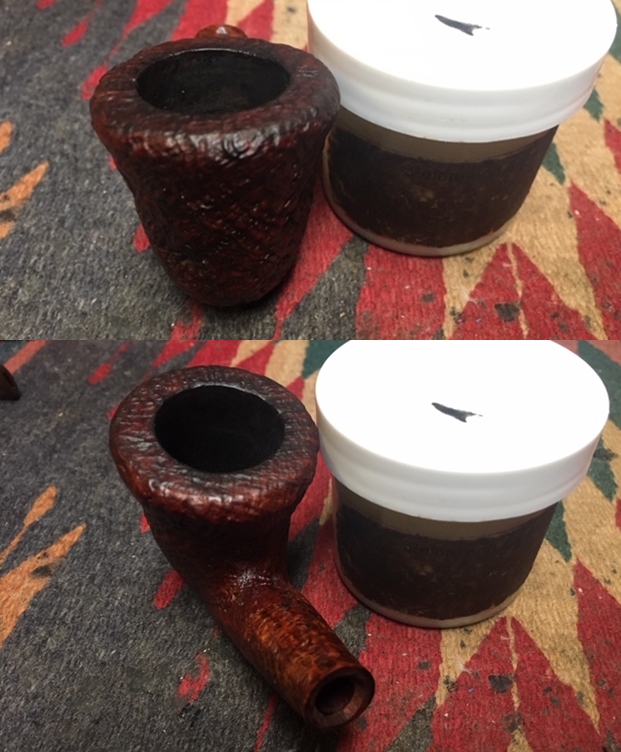
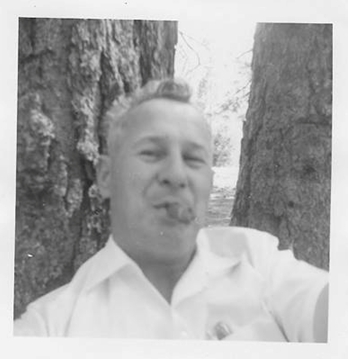
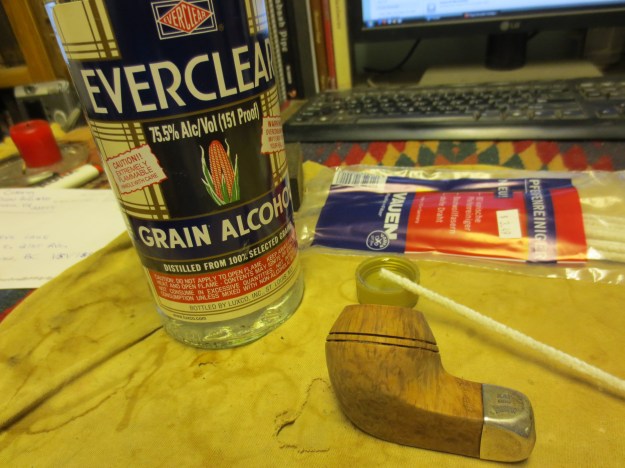
Refurbishing a Battered Dunhill Bruyere #32041


Blog by Paresh Deshpande

I had just finished restoring three pipes from my inheritance; a WDC Stratford, The Doodler and a Barling # 2639. Save for the WDC, these were easy projects and it helped that Abha, my wife, had done all the initial cleaning. I finished these pipes in real quick time.
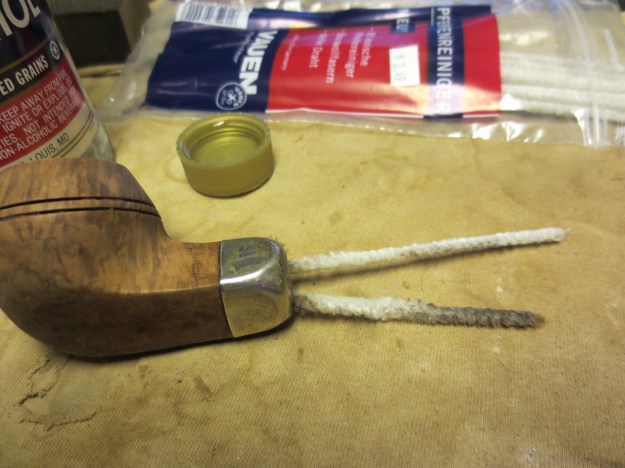
Now I turned my attention once again to the pipes from my “Mumbai Bonanza”. I have restored three pipes; two Dunhill and a Stefano Exclusive from this lot of 30 and each one has been, well, to put it mildly a royal pain where you wouldn’t like it!!  How did I land up with this lot makes for an interesting read and about one which I have written in the restoration of the Stefano Exclusive (https://rebornpipes.com/2019/03/11/mumbai-bonanza-stefano-exclusive-restorationa-month-long-project/).

Here are pictures of the pipes that I received in this lot. This lot contains some very nice collectible pipes, a few well known brand pipes and some mediocre pipe brands. Overall, with seven Dunhills, a Preben Holm #1, a couple of “Made in England” Pete System pipes, Charatan’s and other assorted pipes, I would say that I had hit a huge jack pot!!! Hence, I like to call this find as “Mumbai Bonanza”.

The pipe that I decided to work on is from this find and is marked in a red circle in the picture below. It’s the third Dunhill from this lot, a Bruyere in a classic bulldog shape. The stummel surface boasts of some beautiful densely packed cross grain on the stummel, cap and also the shank top, bottom and side surfaces. It is stamped with “# 32041” towards the bowl and followed by “DUNHILL” over “BRUYERE” on the left side of the shank while the right side bears the COM stamp “MADE IN” over “ENGLAND” followed by underlined numeral “18”. Dunhill White Dot adorns the top of the vulcanite stem. The stampings on either side is deep, crisp and clear.The dating of this pipe is very straight forward and dates to 1978 (1960+18). Deciphering the shape code, “32041” is equally straight forward with the first digit 3 identifying this pipe as being Group size 3, second numeral, 2, identifies the style of mouthpiece as being a saddle stem and the digits 04 indicates Bulldog shape. With this information, I proceed ahead with the restoration of this handsome pipe.

INITIAL VISUAL INSPECTION
The chamber is clean with a thin layer of cake which indicates that the pipe has been kept clean by its previous Steward; however, the reaming has been done unevenly. From what I can see, the chamber walls appear to be without any damage. The chamber is odorless. It is the rim top, including the outer and inner rim edge that shows significant damage on the left side in 11 o’clock and 7 o’clock directions. This must have been caused due to hammering of the edge against a hard surface to remove dottle!! There is not even a millimeter of surface on the rim top surface which does not show signs of severe damage. All in all, it appears like this pipe’s rim top was used by the previous Steward as a hammer while giving vent to his/ her anger, and if this is true by any stretch of imagination, HE/ SHE SHOULD ENROLL FOR ANGER MANAGEMENT TREATMENT!! Darkening of the outer rim edge is also seen all along the left half of the rim top, most significantly in 11 o’clock and 7 o’clock directions. I just hope that it does not go deep in to the briar!!  Being a Dunhill, any issue of fills is never to be expected and hold true for this pipe too. However, there are a number of scratches and dents that can be seen on the stummel surface. These dents and ding are probably caused due to uncared for storage by the previous Steward and further contributed to by the trash collector who had sold the pipes to me. The stummel is covered in dirt and grime. The briar looks lifeless and dull which is nothing serious to address.I am very pleased with the condition of the stem. The diamond saddle type vulcanite stem shows minor damage to the button end and the lip edges. Light scratches can be seen extending upwards from the button end towards the saddle. The quality of vulcanite is good. These issues should be an easy fix. The mortise is clogged and will have to be cleaned. In this project, repairs to the damaged outer edge and rim top surface will be a major challenge. While restoring the Dunhill Bruyere # 51671 (https://rebornpipes.com/2019/03/13/reconstructing-a-broken-stem-on-dunhill-bruyere-51671/), I had faced difficulties in blending the repairs to the outer rim edges and these could be seen even after I had stained the stummel. Similar set of difficulties are envisaged on this pipe too!!!! I have learned my lesson and will follow the advice and suggestion received from readers of rebornpipes.com.

THE PROCESS
Since the stummel has significant damage, I start this project by tackling the stummel repairs first. I reamed the chamber with size 2 head of a PipNet reamer. The cake was thicker at the bottom and using my fabricated knife, I scraped out all the remaining cake. I further used one folded piece of 180 grit sand paper to sand out the last traces of remaining cake and expose the walls of the chamber to ascertain that there are no cracks/ heat fissures. I wiped the chamber with a cotton pad dipped in isopropyl alcohol to remove the carbon dust left behind by all the reaming and sanding process. The walls of the chamber were solid with just very fine superficial web of lines seen on one side. This was followed by cleaning the mortise by scraping away at the dried gunk with my fabricated spatula and followed it up with further cleaning using cue tips, pipe cleaners and shank brush dipped in isopropyl alcohol. With the thin sharp edge of my fabricated spatula, I cleaned in between the edges of the cap ring separating the cap from the rest of the stummel. Continuing with the cleaning regime, using a hard bristled tooth brush dipped in undiluted Murphy’s oil soap, I very deliberately scrubbed the surface of the stummel and the rim top. The original reddish dye was also washed away to some extent. The dirt and grime on the stummel surface was so stubborn that I had to resort to using a scotch-brite pad to get rid of it. While scrubbing the stummel, I paid special attention to areas where significant darkening was seen just below the rim outer edge. Thankfully, the burn marks were superficial and cleaned out nicely. However, a dark spot was revealed just below the cap ring and is marked in a red circle. The damages to the outer rim edge, uneven inner rim edge and stummel dents and dings are now clearly visible in the above pictures after the cleaning. I had a close, hard look at the darkened spot seen and marked in red. The briar on and around the spot was hard and solid with no deep heat fissures on the corresponding inner surface of the chamber. This ruled out the possibility of a burn out!!!! Phew, what a relief this was!!!! This external darkening, most probably, appears to have been caused when the pipe was placed in an ash tray alongside a smoldering cigarette butt, just a hypothesis!!! This will be addressed (hopefully!) when I sand the stummel surface to get rid of all the scratches and dents.

With the stummel now dried out, I got around to address the rim top and outer rim damage. The extent of the dip or trough caused due to banging the rim edge against a hard surface was deep and would necessitate heavy topping off of the rim surface, and I for one, absolutely wish to avoid any loss of briar!!!!! So, I decided to try out something different. I planned on first filling up the deep troughs on the rim edge using briar dust and superglue to roughly match the rim surface and some more and then topping it to achieve a smooth surface. Theoretically, this sounded logical.

I resorted to the layering method again; first I layered superglue over the damaged surfaces on the front and back outer rim edges, followed by sprinkling of briar dust, another layer of superglue followed by a final layer of briar dust. This final layer of briar dust reduces the probability of air pockets. In the last picture, you can see that the layering has been done to the level of the rim surface so that it sits evenly on a flat surface without showing any gaps. I set the stummel aside to cure. While the stummel fill was being set aside to cure, I tackled the stem repairs by first flaming the surface with a Bic lighter flame to raise the bite marks to the surface. This was followed by sanding the stem surface with a folded piece of 220 grit sand paper. This step has a twofold purpose; firstly, it helps to roughly blend the raised bite marks with the rest of the stem surface and brings to fore the spots which require filling and secondly, it helps to rid the oxidation from the stem surface which helps subsequently in better finish after polishing. I cleaned out the surface with a cotton pad dipped in alcohol to remove all the dirt and grime. Once the surface was clean, the lip edges and the bite marks were filled with a superglue and activated charcoal mix and set aside to cure overnight. The fill repair to the outer rim edges had cured by this time and with a flat head needle file, I roughly sand the fills to match the surrounding surface. Using a folded piece of a 220 grit sand paper, I further blended the outer filled edges with the rest of the edge and created a slight bevel to mask the uneven inner rim edges. The rim top surface was topped on a piece of 220 grit sand paper to further blend and even out the rim top, checking frequently the progress being made. Personally, I prefer to avoid topping as I do not appreciate loosing even one mm of briar estate, but in this instance, I was left with no recourse but to top the rim. I lightly top it on 600 grit sand paper to reduce the sanding marks left behind by the 220. However, a few air pockets revealed themselves (marked in red-orange circle) at this stage which necessitated reapplication of briar dust and super glue. Sorry, missed out taking pictures of this stage!! While the second fill to the rim outer edge was curing, I turned my attention to work on the cured stem fills. Using a flat head needle file, I roughly matched the fills with the rest of the stem surface. For a better blending, I further sanded the entire stem with 220 followed by 400, 600 and 800 grit sand paper. This helps to reduce the sanding marks left behind by the more abrasive 220 grit paper. To bring a deep shine to the vulcanite stem, I went through the complete set of micromesh pads, wet sanding with 1500 to 2400 grit pads and dry sanding with 3200 to 12000 grit pads. I wiped the stem with alcohol after each pad and rubbed it down with Extra Virgin Olive oil to rehydrate the vulcanite. The repairs have blended in very well and the stem now looks a shiny black and beautiful. The internals of the stem was cleaned out using alcohol and pipe cleaners. The finished stem is shown below. The next evening, the repairs to the edge had completely cured and I move ahead by filing and rough shaping with a flat head needle file. I further fine tune the blending by sanding it down with 220, 320, 600 and 800 grit sand papers. Here is how the repaired area appears at this stage. I am very pleased with the way this repair progressed. I sand the entire stummel using 220, 400, 600 and 800 grit sand papers. The little dents and dings that remained on the stummel and outer rim edge were also evened out under this sanding process. This was followed by polishing with micromesh pads. I wet sand the stummel with 1500 to 2400 grit pads and follow it up by dry sanding with 3200 to 12000 grit pads. I wiped the surface with a moist cotton cloth after every wet pad to check the progress. The repaired rim edge appears, in picture, as though it is patchy with air pockets. However, that is not the case. The fill is smooth and solid and should get masked after I have stained it. I rub a small quantity of “Before and After Restoration Balm” in to the briar with my finger tips and let it rest for a few minutes. The balm almost immediately works its magic and the briar now has a nice vibrant appearance. I further buff it with a horse hair shoe brush. I had hoped that the balm would work its magic on the filled area and help in blending it a bit, and that did happen!! I am very pleased with the way these repairs have turned out. And now on to staining and polishing… After Mr. Steve had uploaded my write up on the Dunhill Bruyere Horn shaped pipe (https://rebornpipes.com/2019/03/13/reconstructing-a-broken-stem-on-dunhill-bruyere-51671/), the feedback and responses were very educative and I had decided to incorporate these suggestions while working this project. Mr. Roland Borchers brought out that the original color of Bruyere was achieved by first staining with Dark Brown stain followed by Cherry red stain. Mr. Steve also concurred and then there was no turning back!! I stained the stummel in DB stain first. I use the powder variety of stain and mix it with 99% isopropyl alcohol. I heated the stummel surface with a heat gun and applied the stain with a folded pipe cleaner. As I paint the stummel with stain over sections at a time, I burn the dye using a Bic lighter that combusts the alcohol in the aniline dye and sets the dye pigmentation in the wood.  After fully saturating the stummel and covering the whole surface, including the rim top, I set the stummel aside to rest for several hours. By next evening, the stain had set nicely. I mount a cotton cloth buffing wheel (because I do not have felt cloth buffing wheels!!) on the Dremel and set the speed at about 40% of full RPM and apply white compound to the stummel. This does help in revealing the grains gradually. This time around, the repaired area had blended very nicely in to the rest of the stummel surface. Here is another lesson that I have learned; it is advisable to use white compound after staining and not red Tripoli as I used to, for the reason that the red Tripoli compound is more abrasive and does not make sense to use after polishing by 12000 grit micromesh pad!! I followed this polish by re-staining the stummel with Cherry red stain. I set it aside to let the briar pores absorb the stain pigments. To finish, I re-attach the stem with the stummel. I mounted a cotton cloth buffing wheel to my local machine which is similar to a Dremel, set the speed at about half of the full power and applied White Diamond compound to the entire pipe. I wiped/ buffed the pipe with a soft cotton cloth to clear it of any leftover compound dust. I then mounted another cotton cloth wheel on to the polishing machine and applied several coats of carnauba wax. I finished the restoration by giving the entire pipe a rigorous hand buffing using a microfiber cloth to raise the shine further. The completed pipe looks lovely, fresh and vibrant; the photographs in this case, do not do justice to the appearance of this beautiful pipe. I cannot thank enough my friends and gentlemen who painstakingly identified my mistakes and suggested remedial measures after reading the write up for helping me to hone my skills while gaining experience.