Tag Archives: vulcanite

New Life for a BBB Own Make Thorneycroft 130 Prince


Blog by Steve Laug

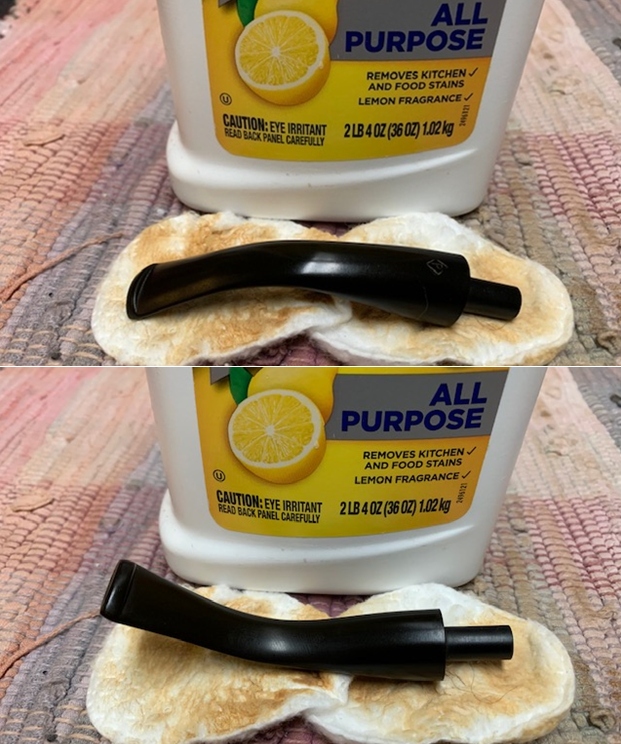
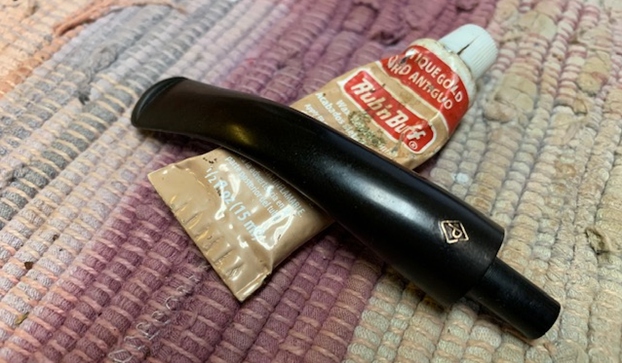
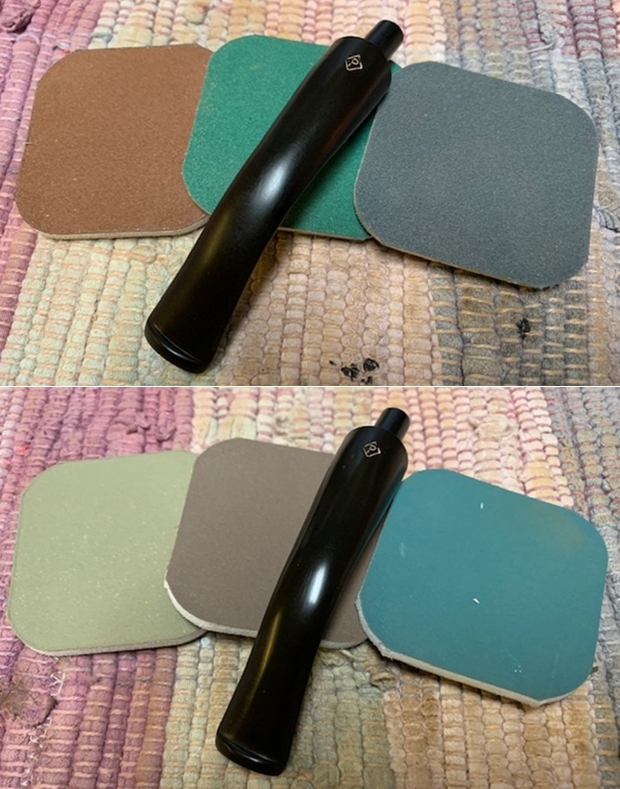
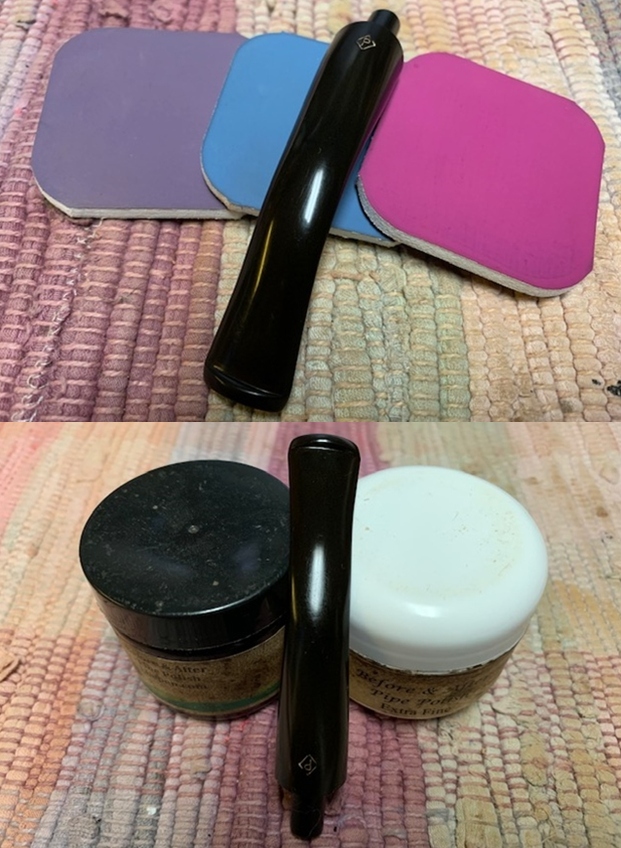
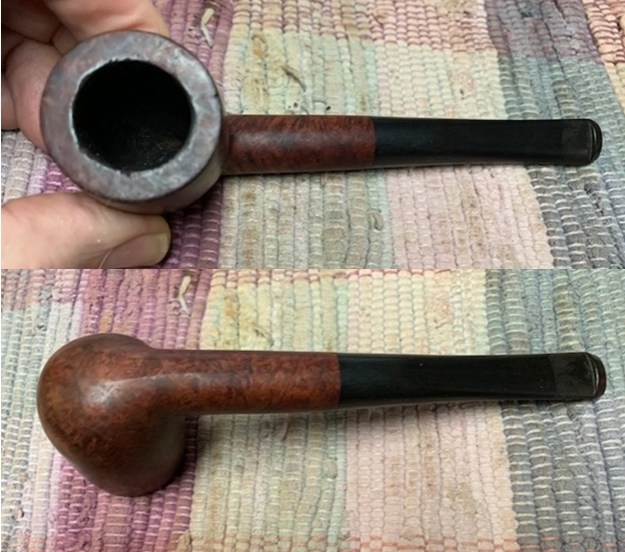
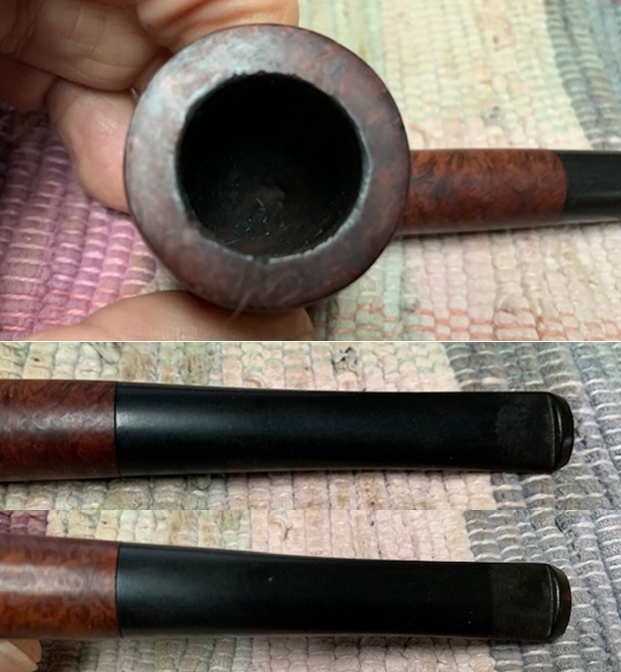
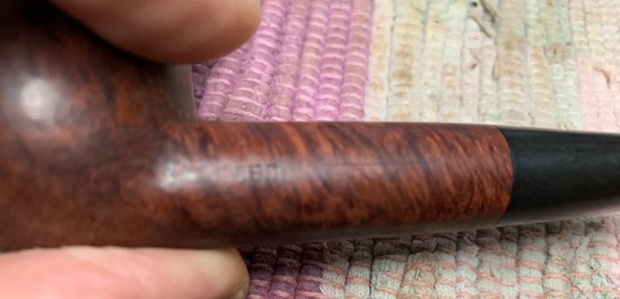
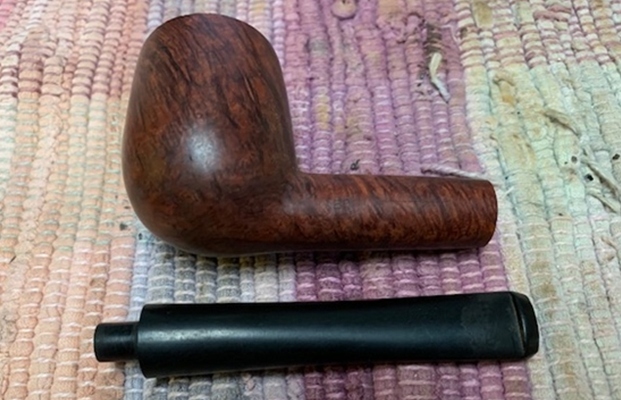
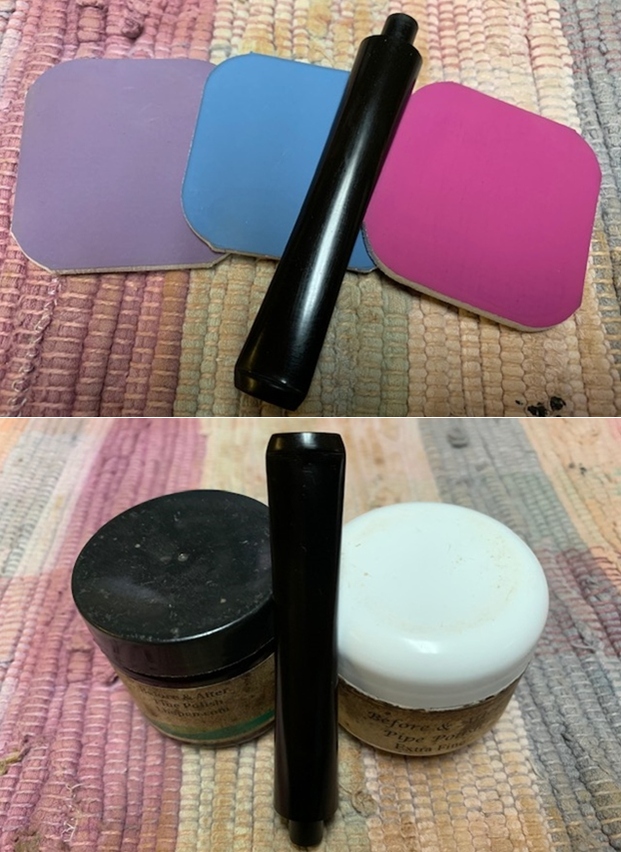
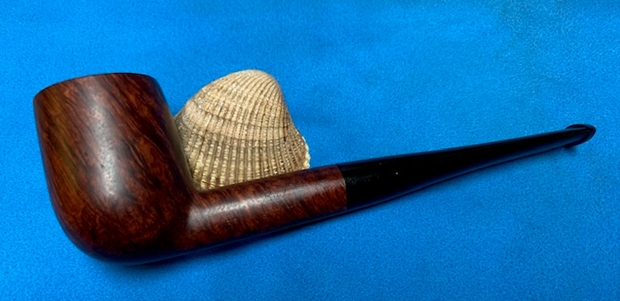
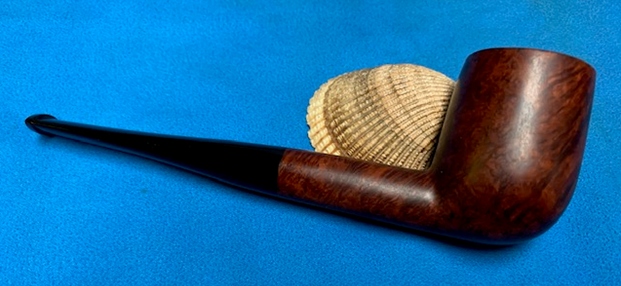
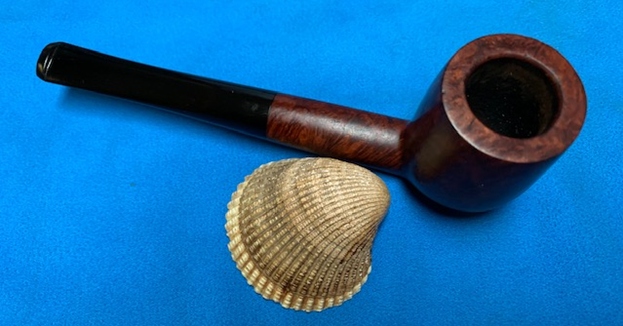
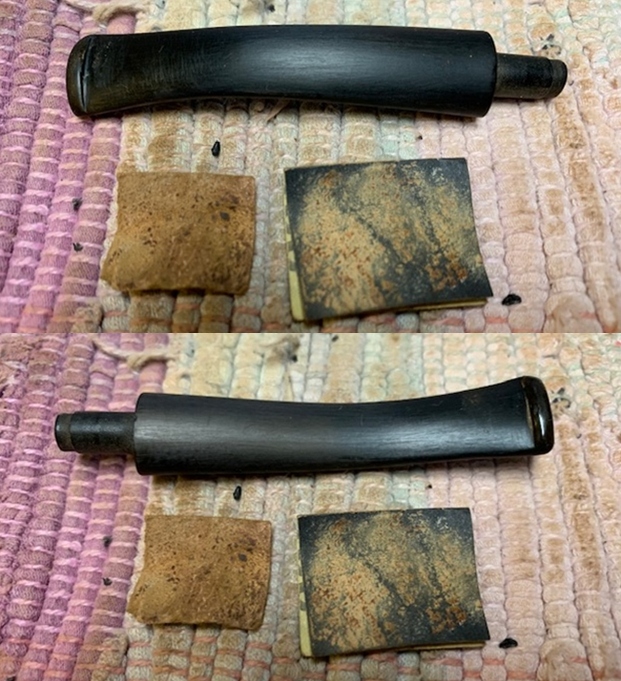
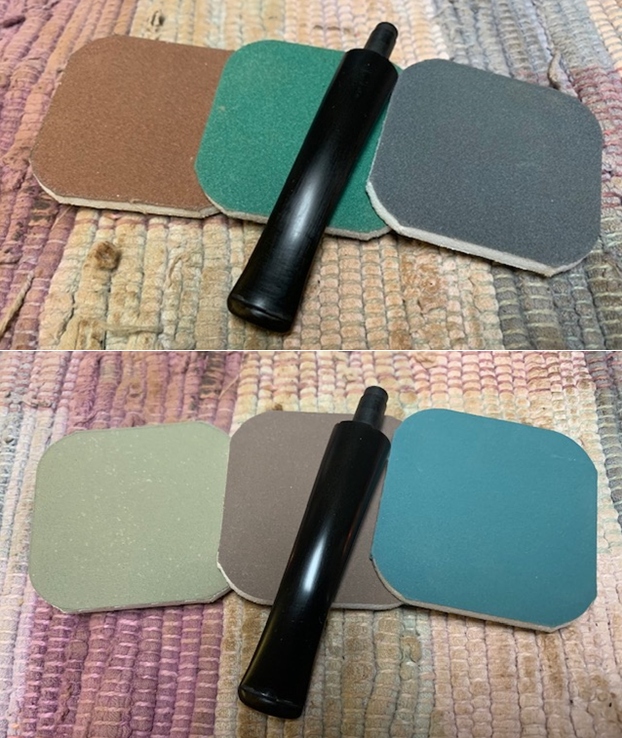
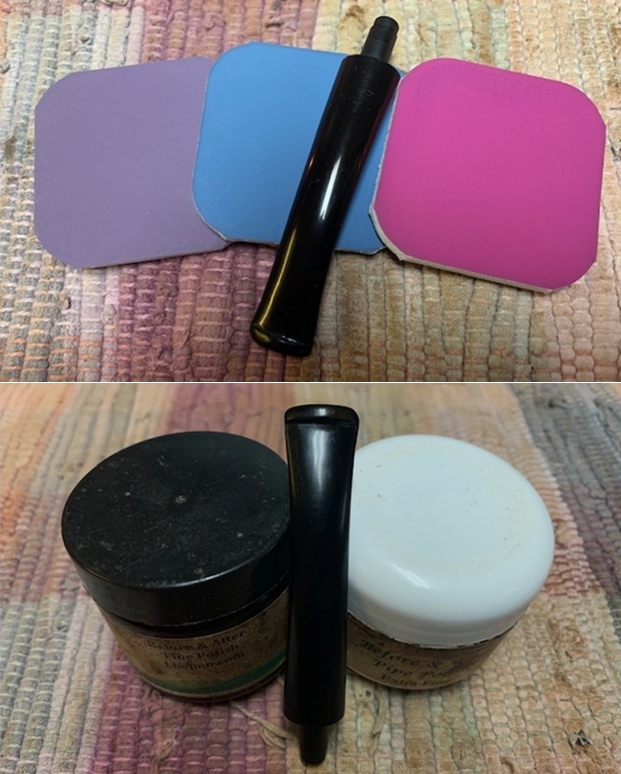
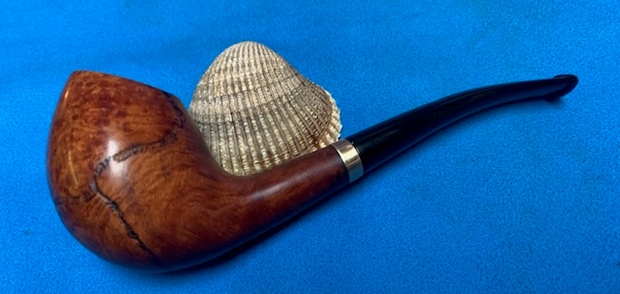
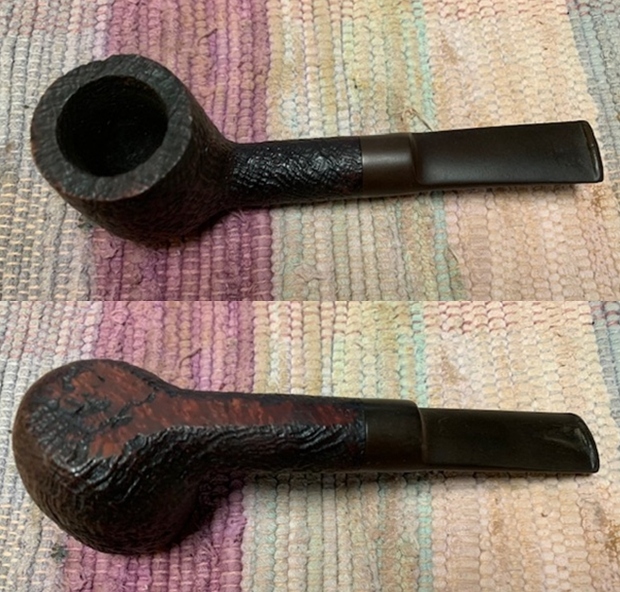
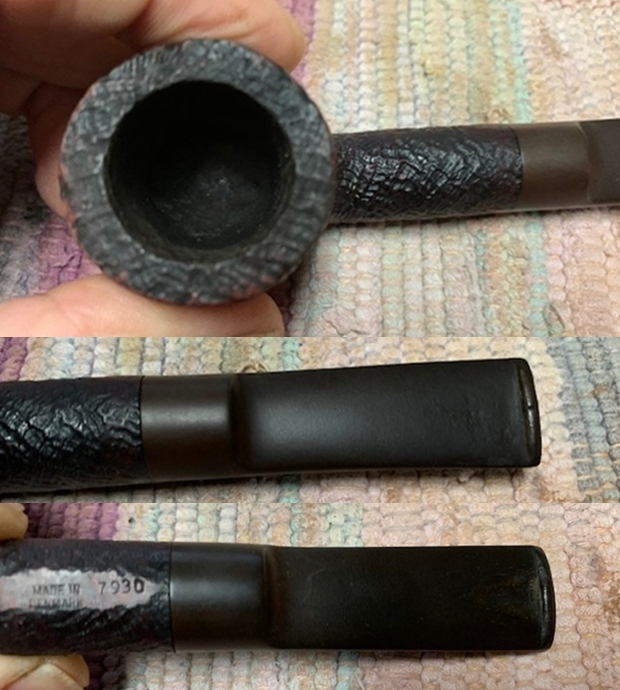
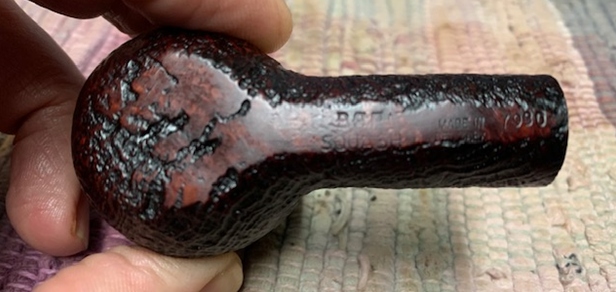
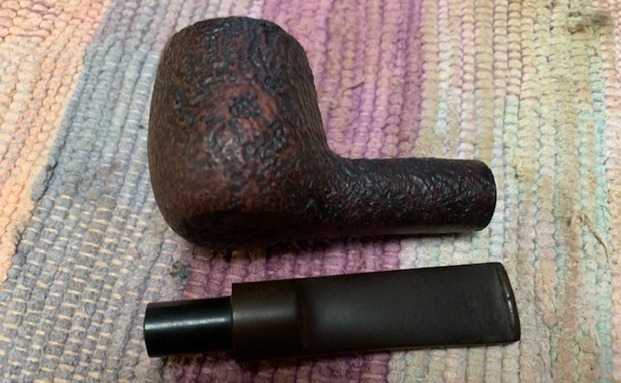
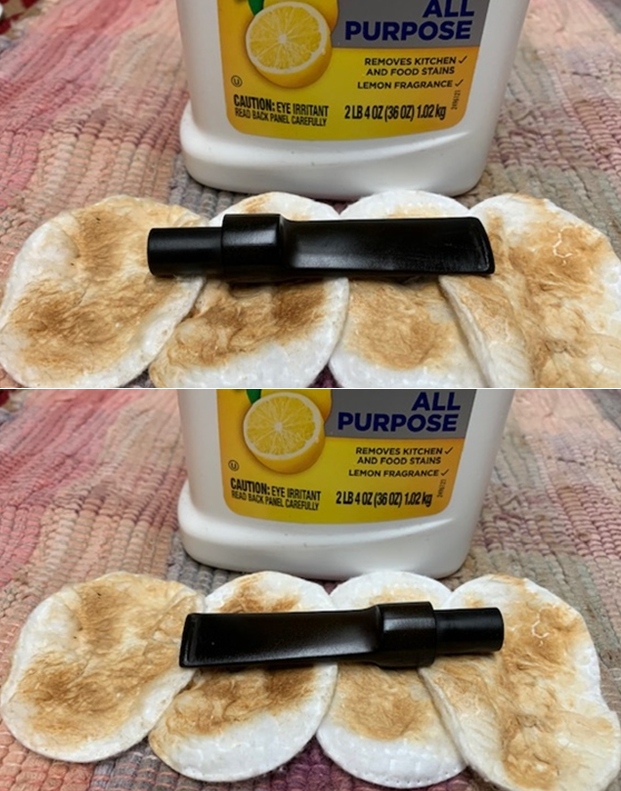
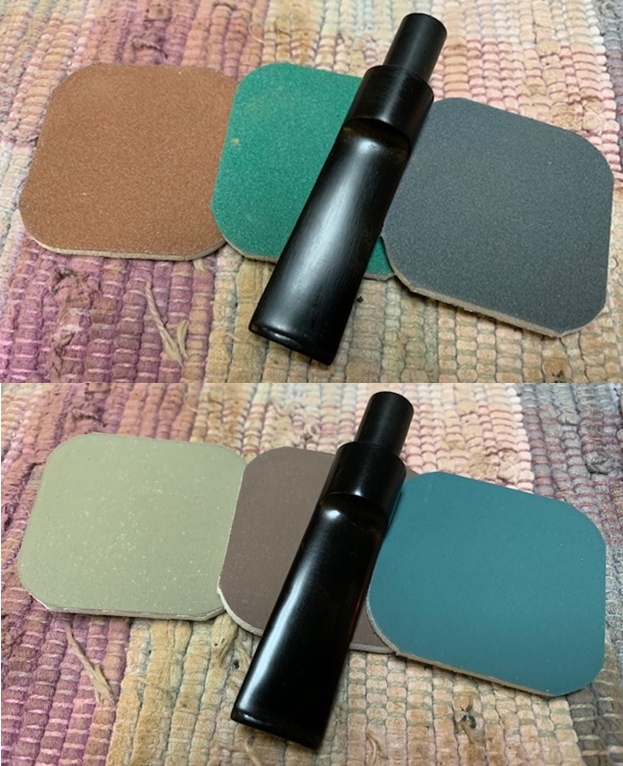
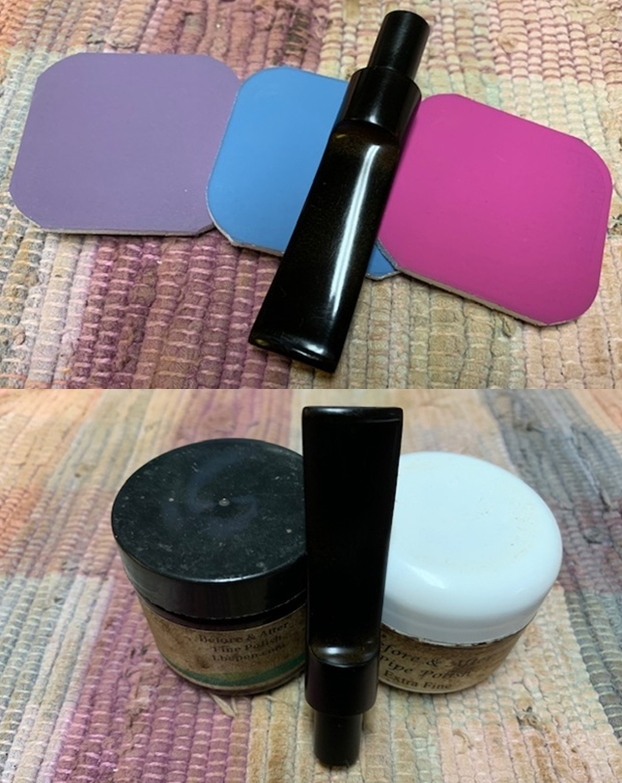
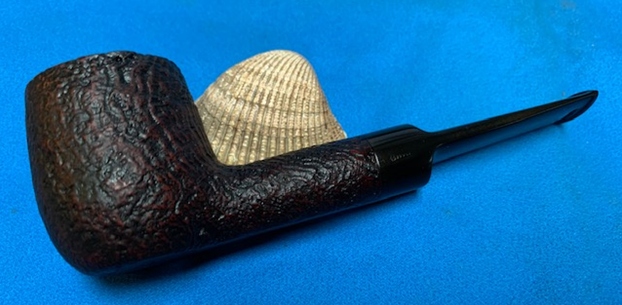
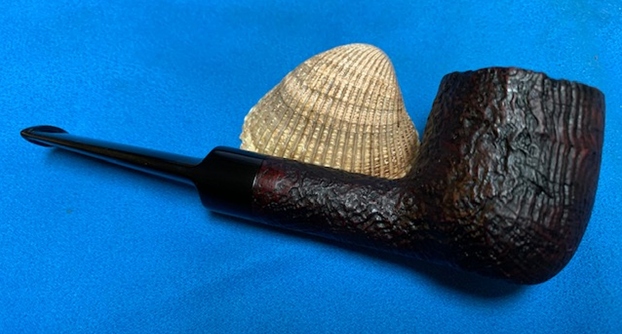
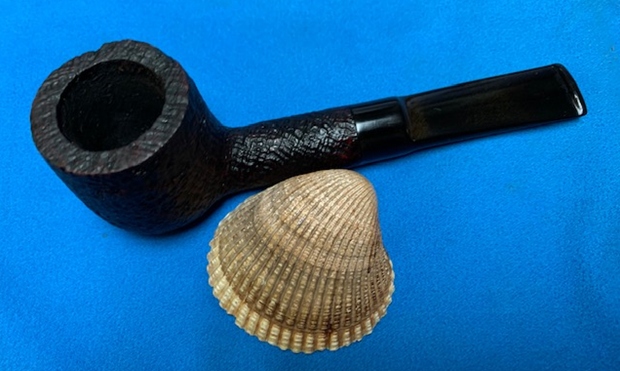
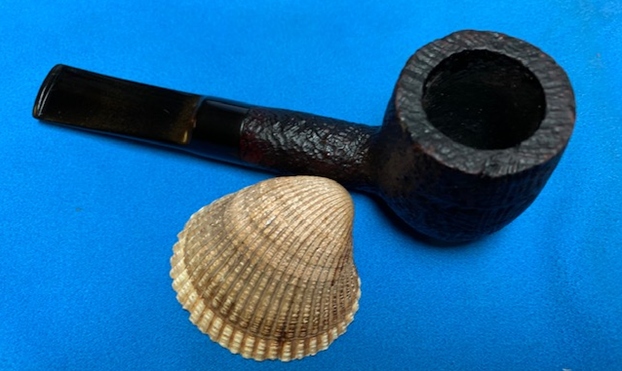
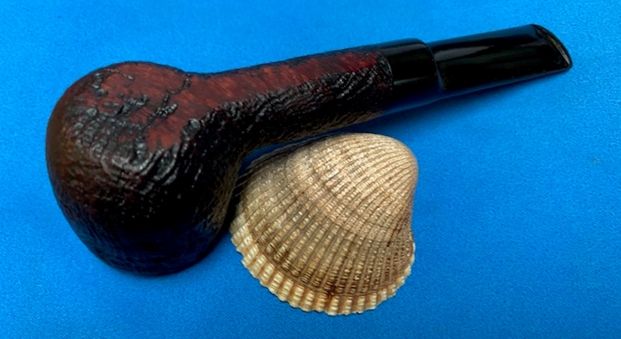
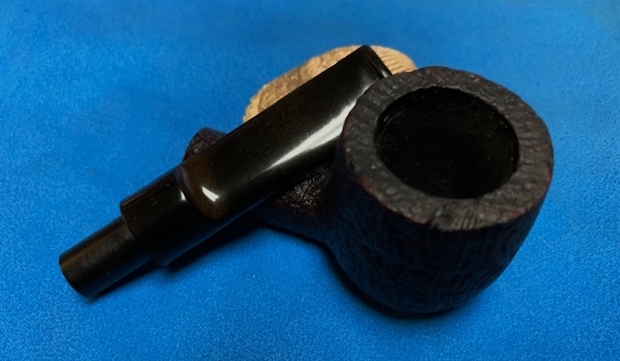
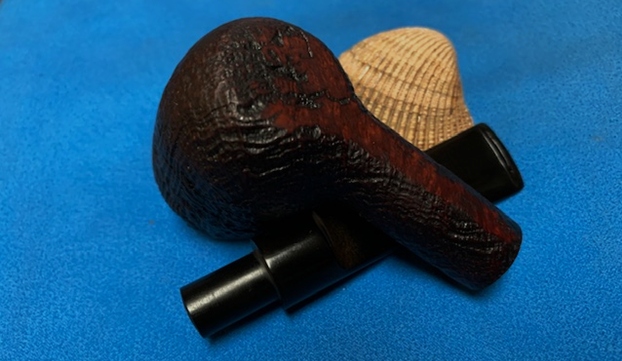
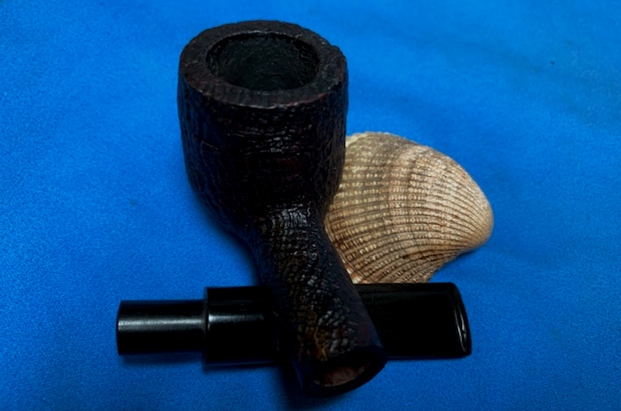
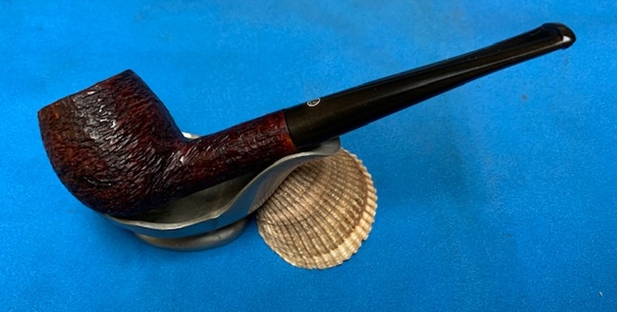
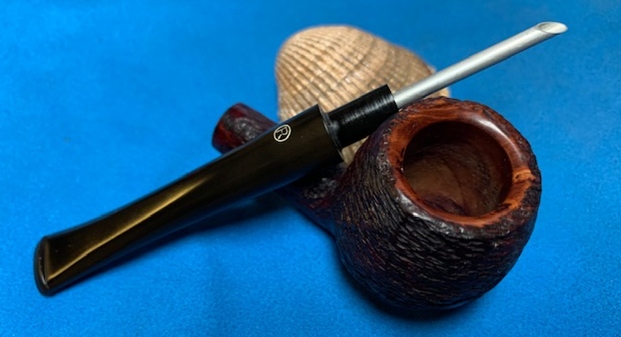
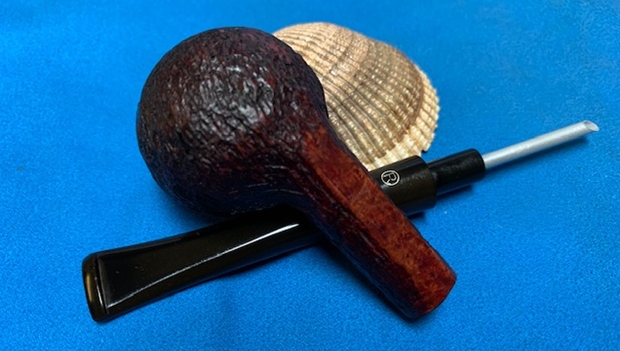
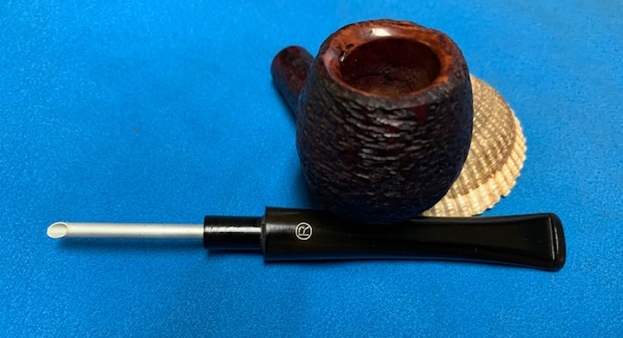
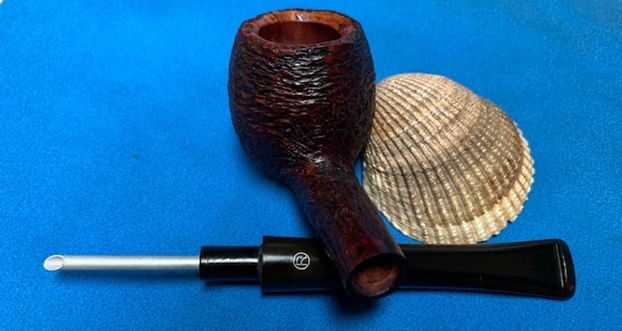
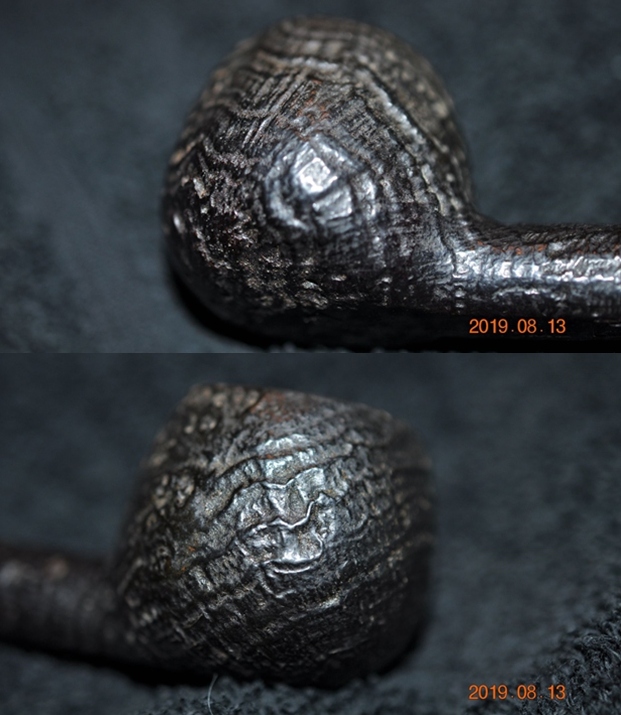
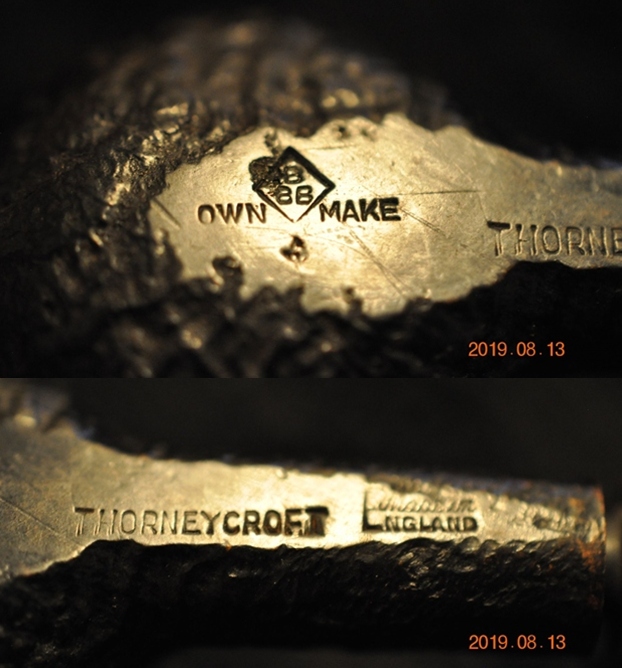
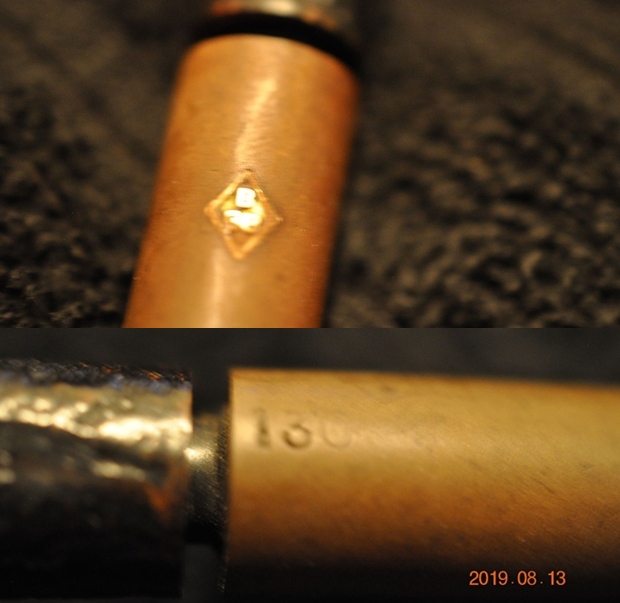
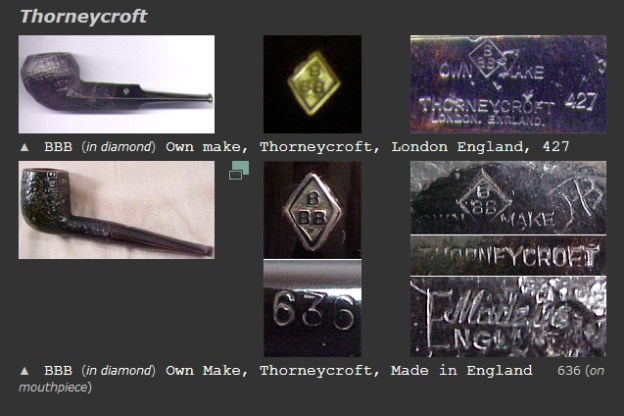
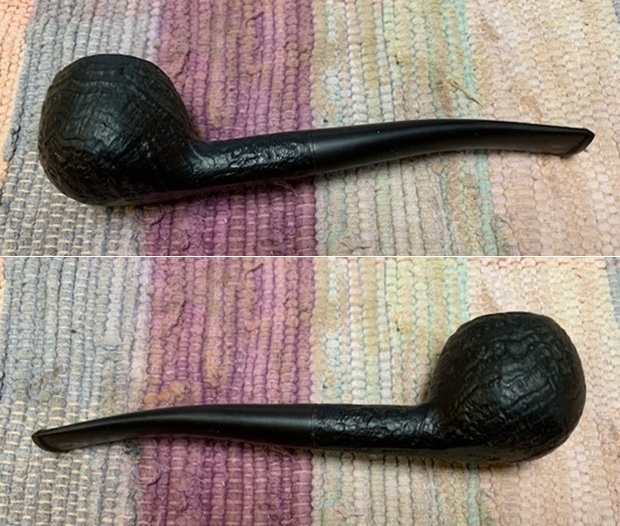
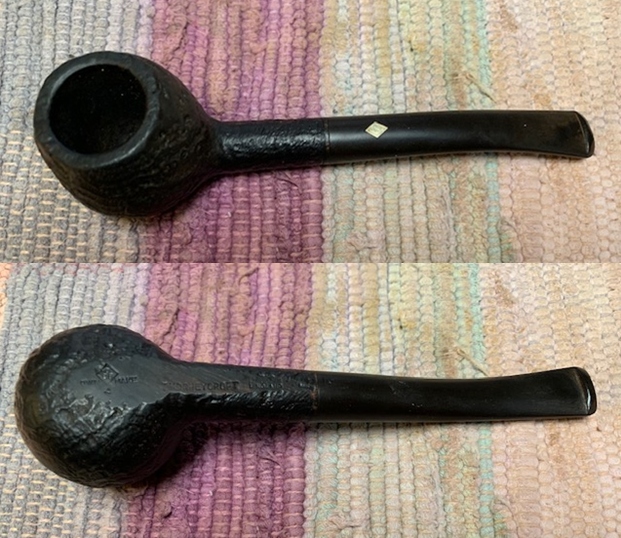
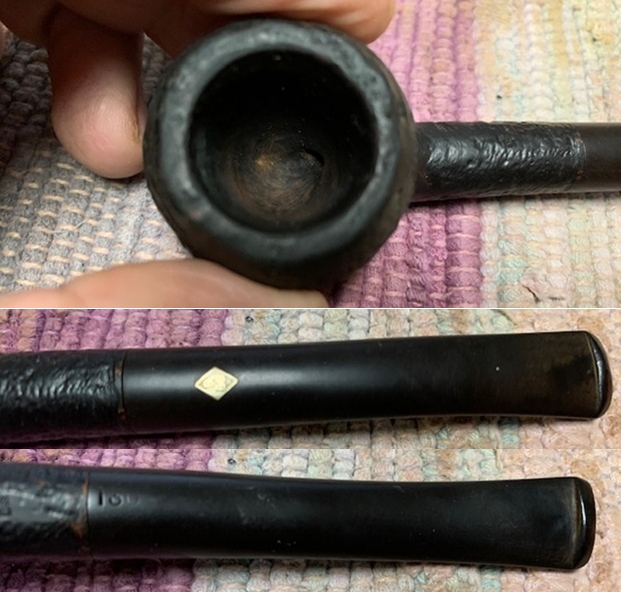
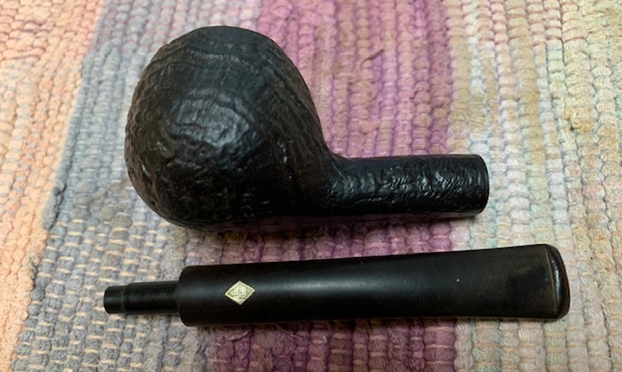
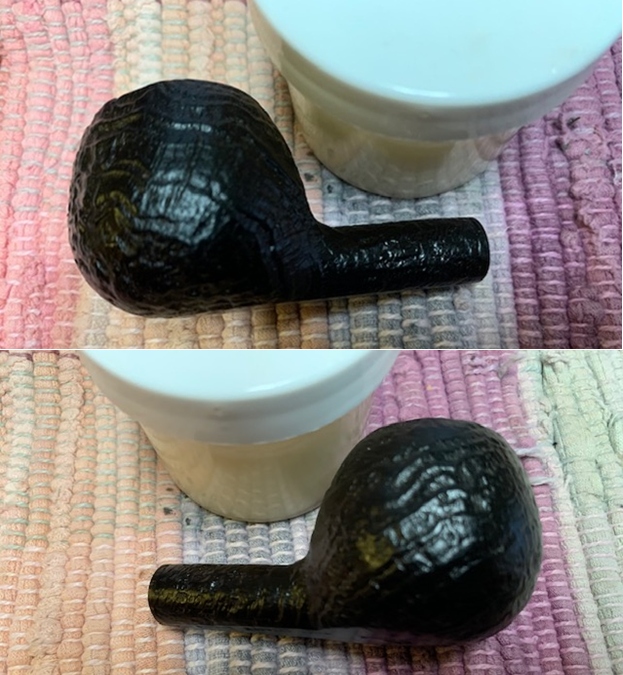
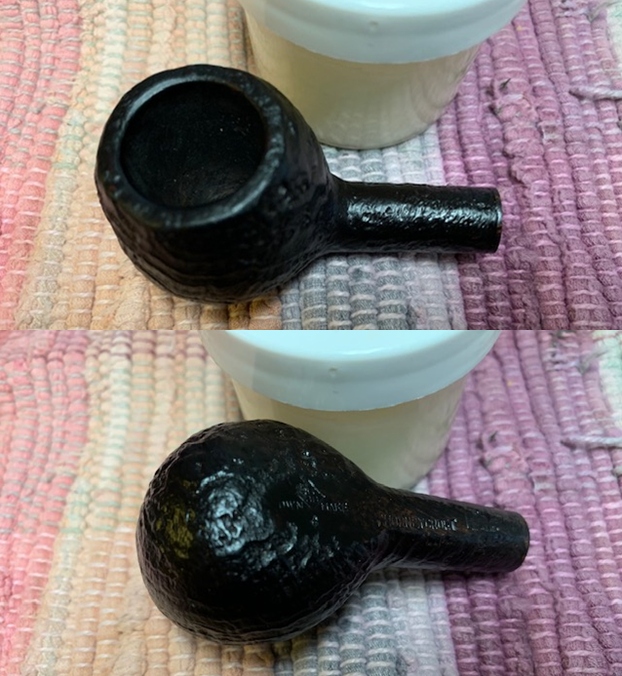
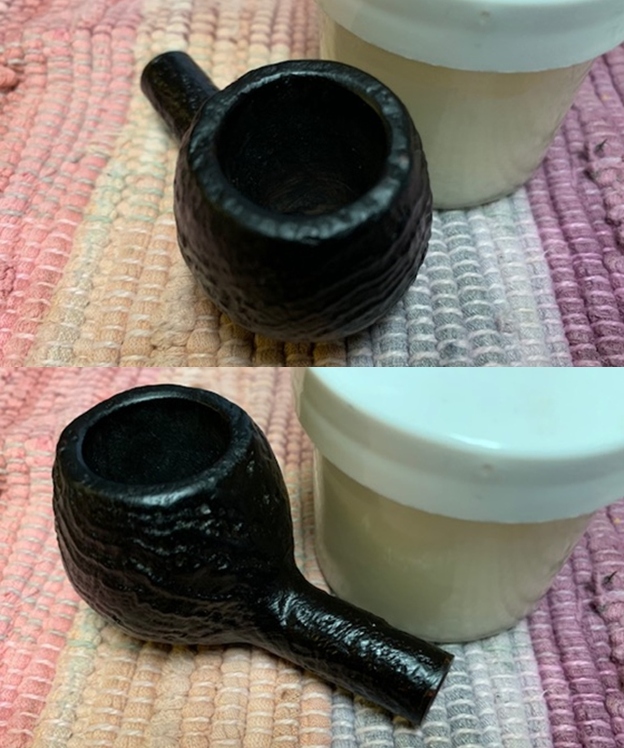
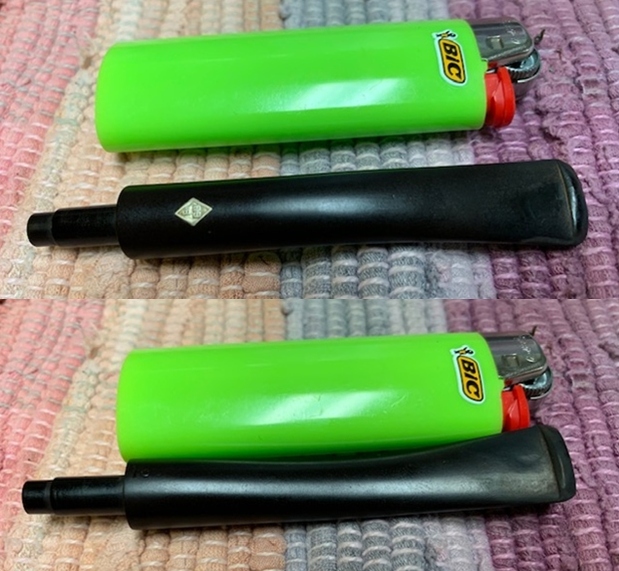
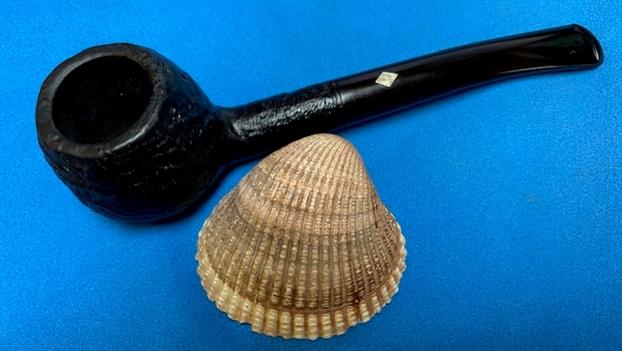
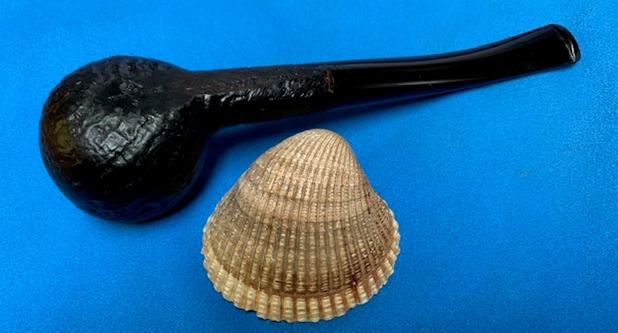
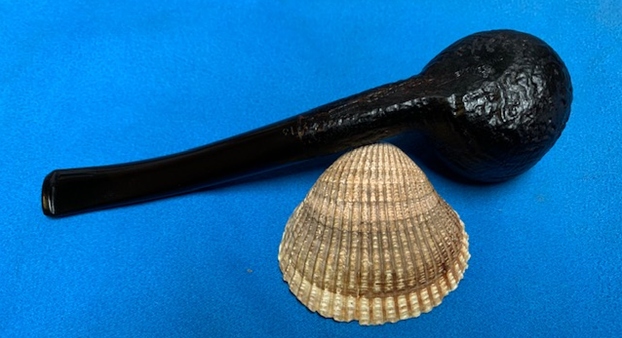
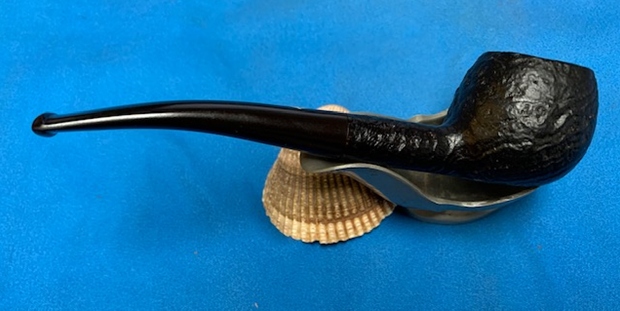
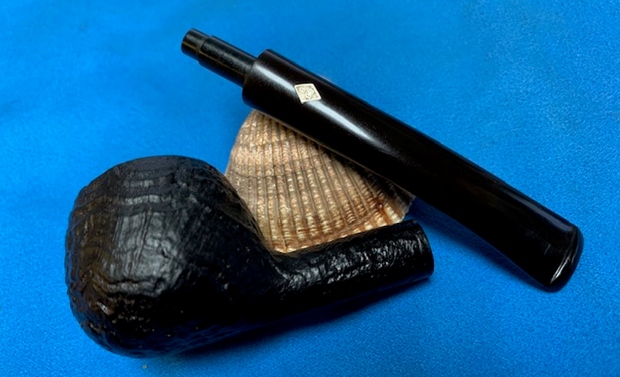
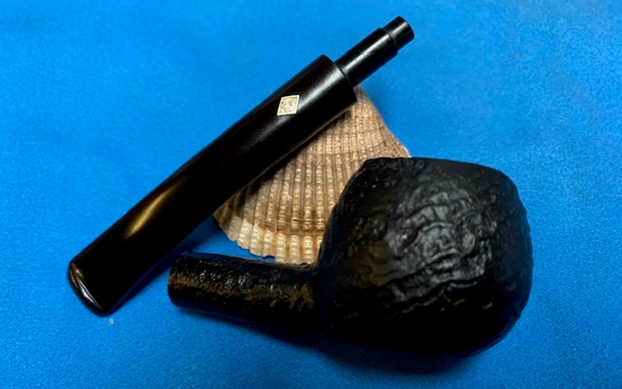
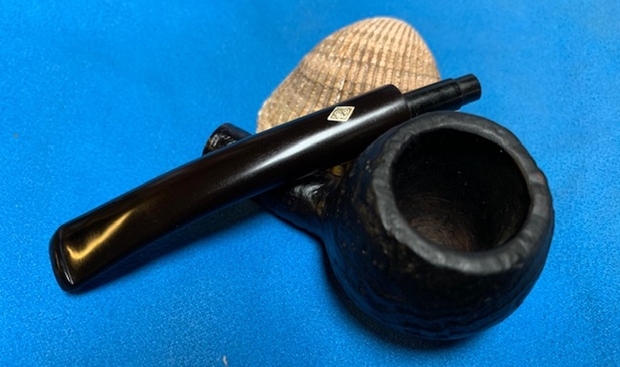
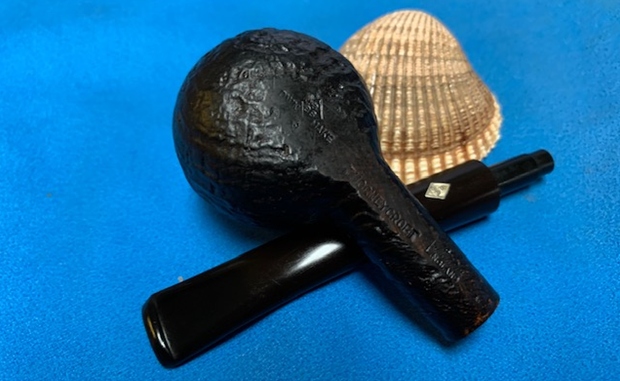
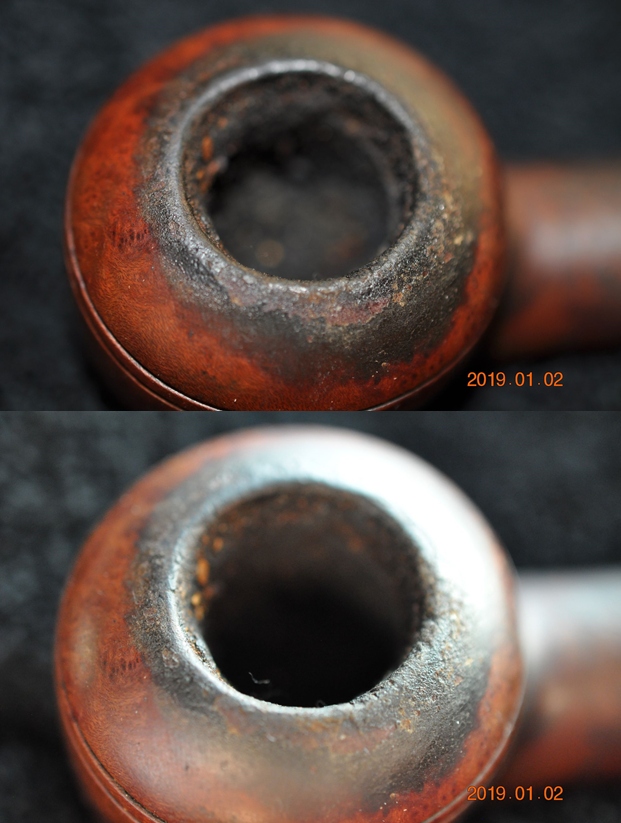
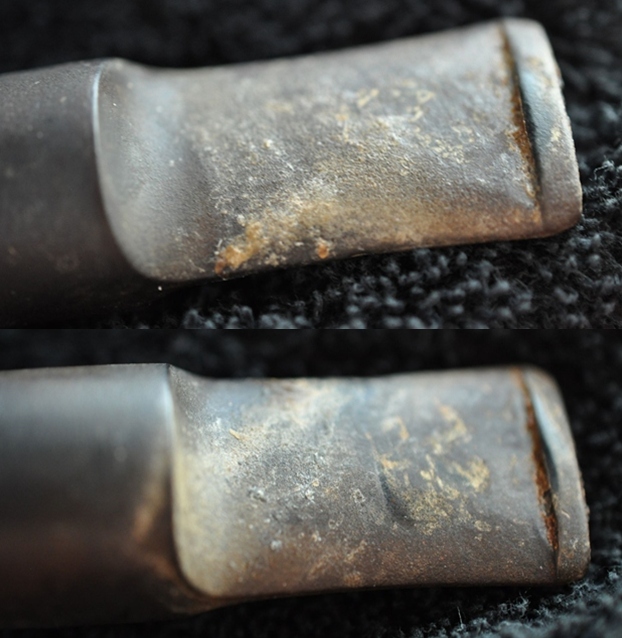
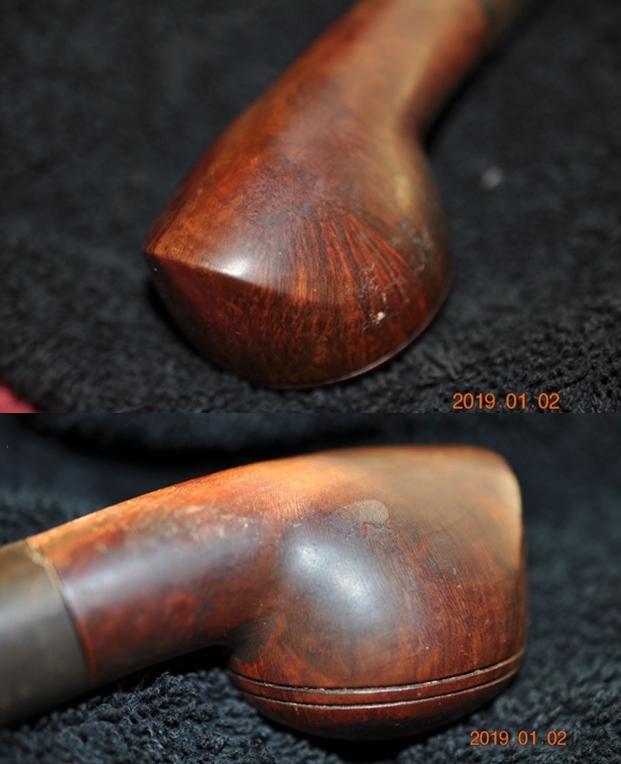
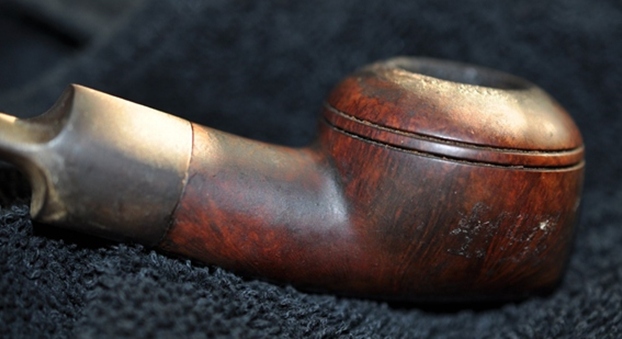
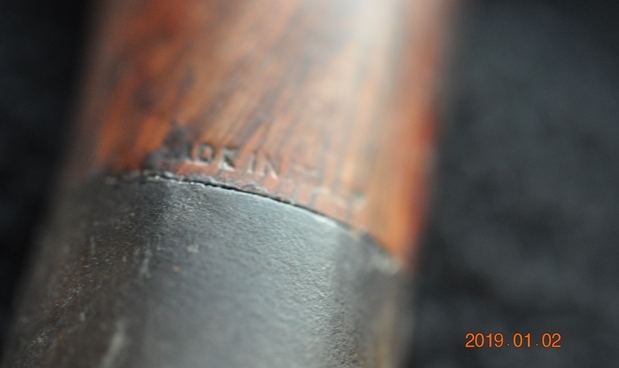
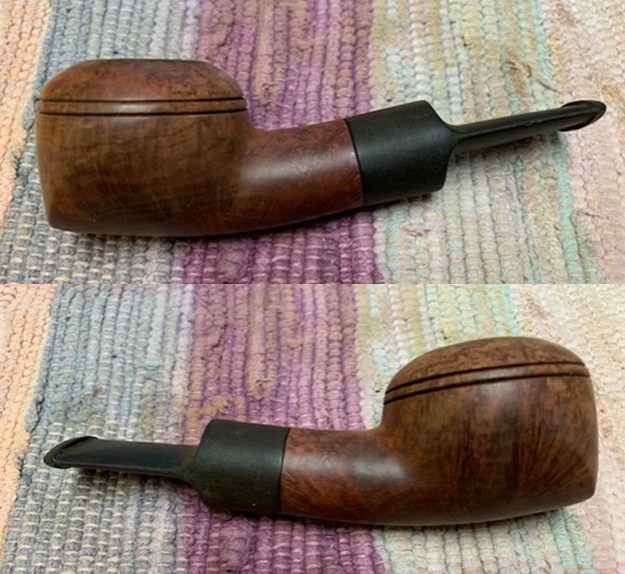
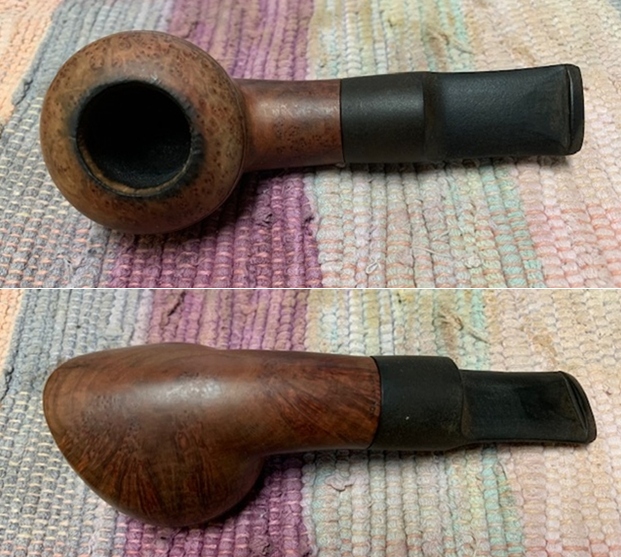
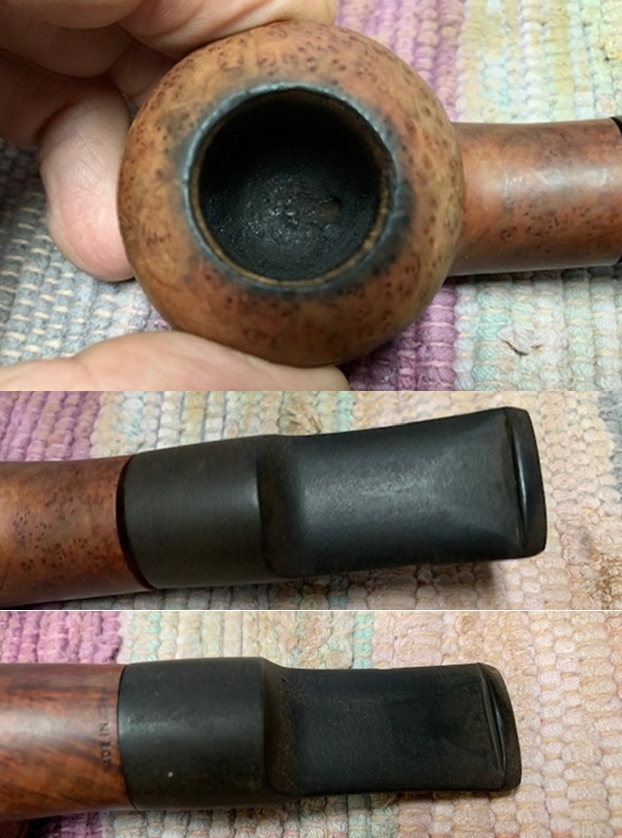
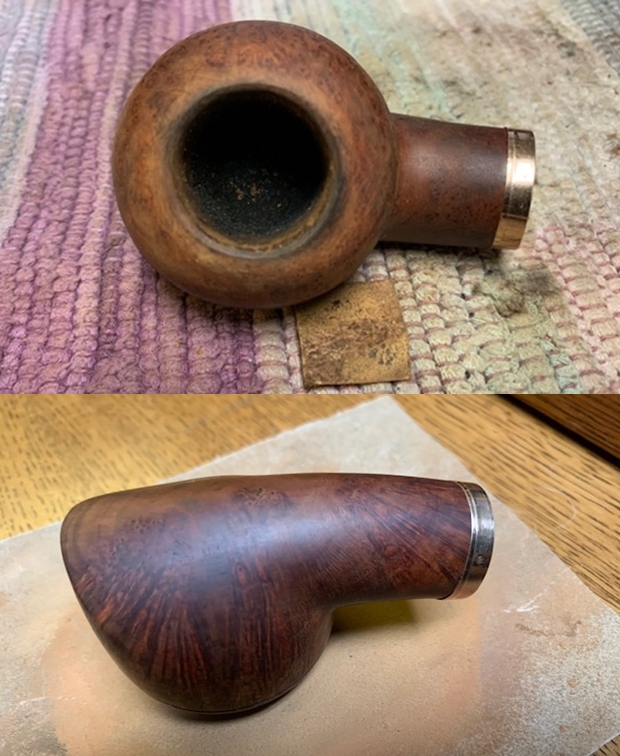
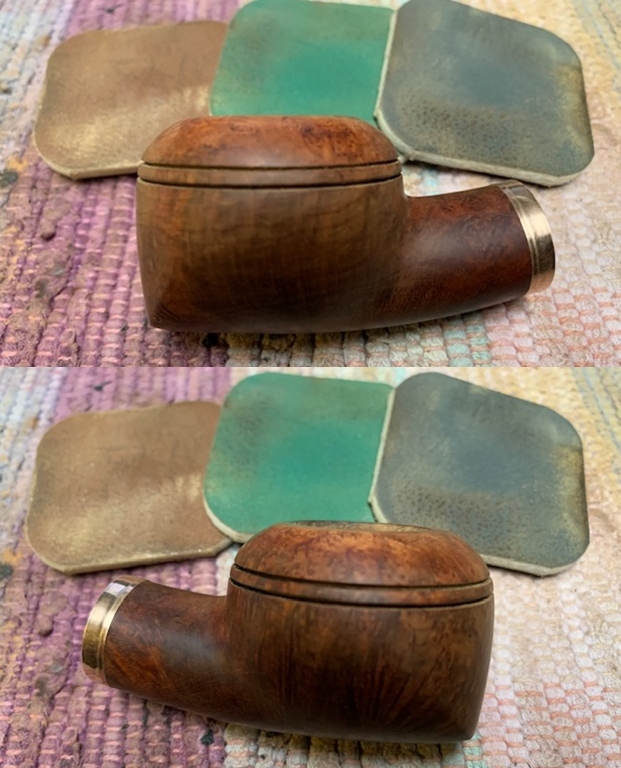
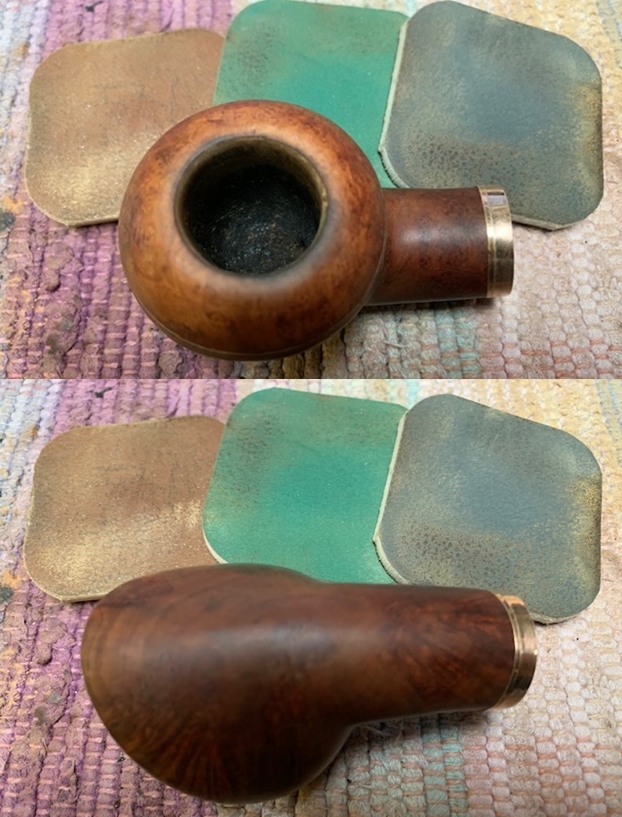
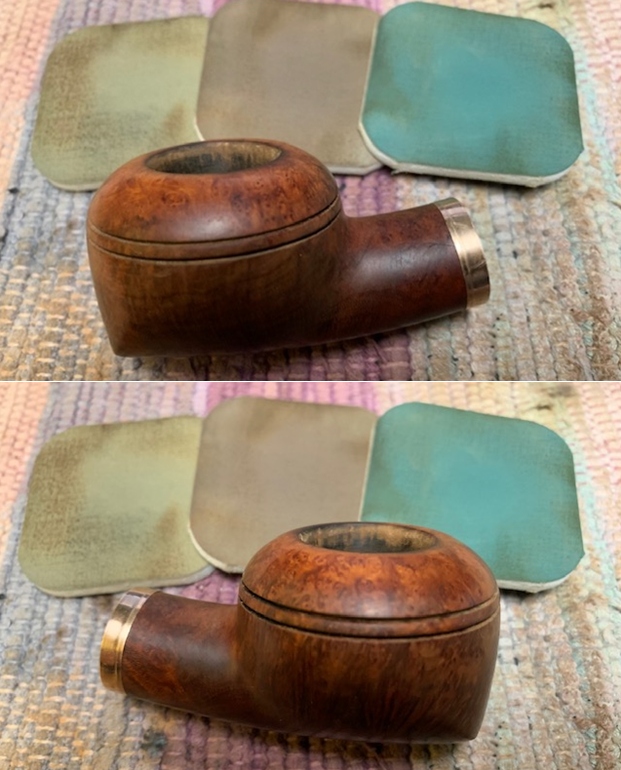
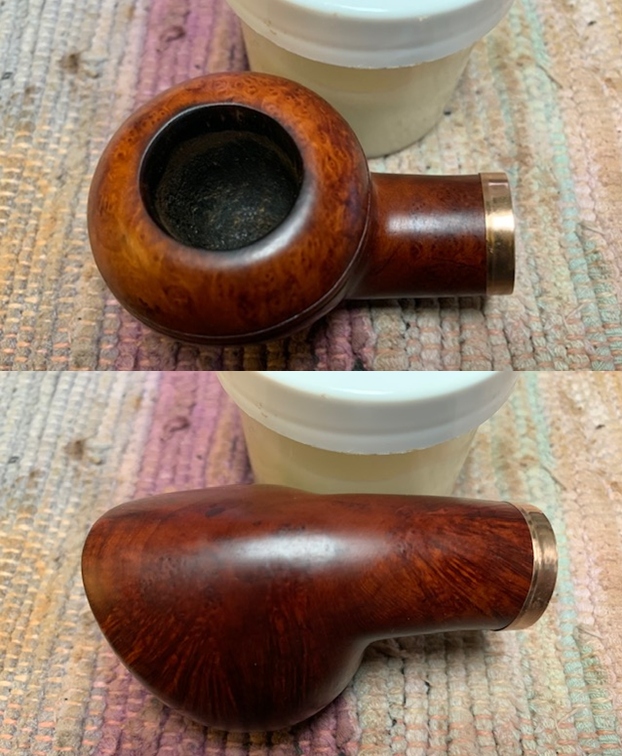
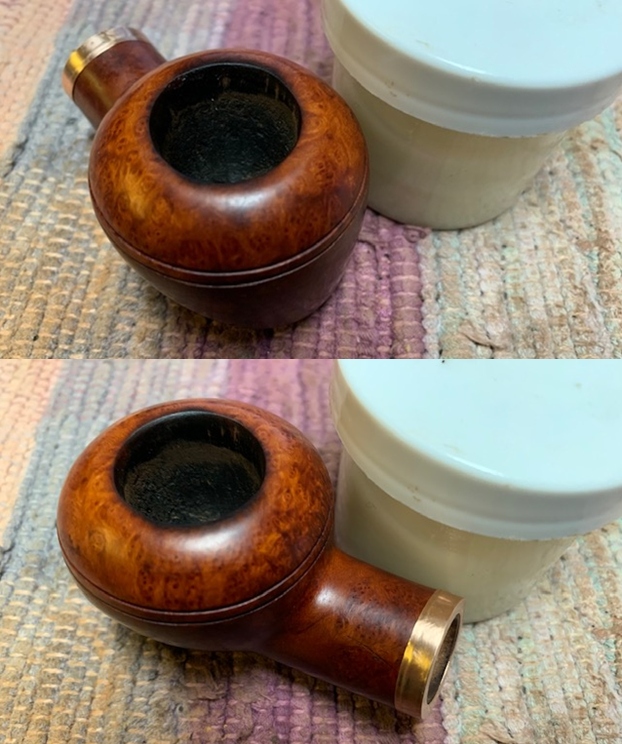
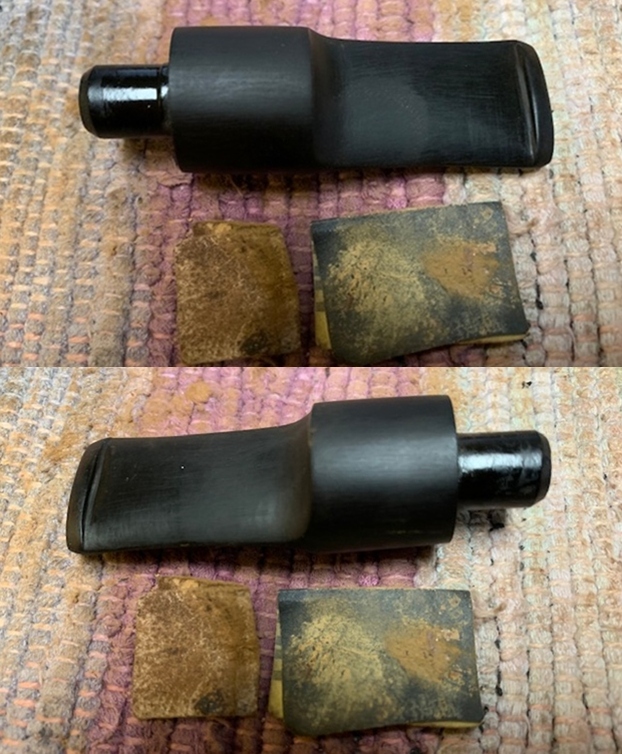
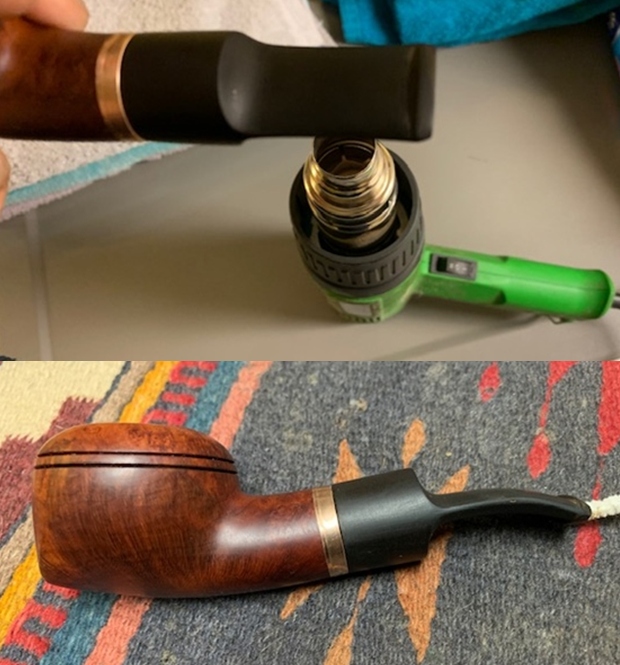
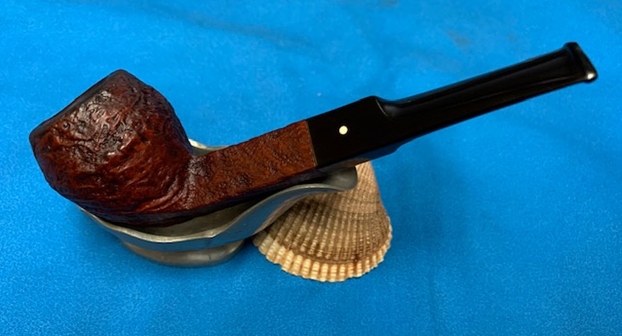
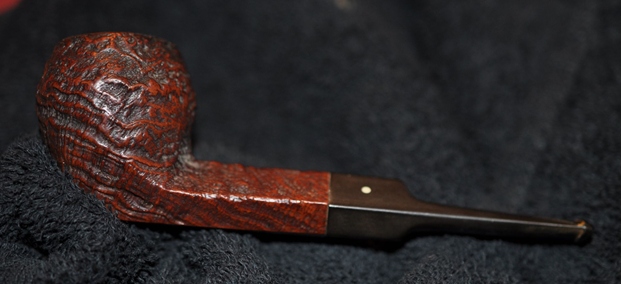
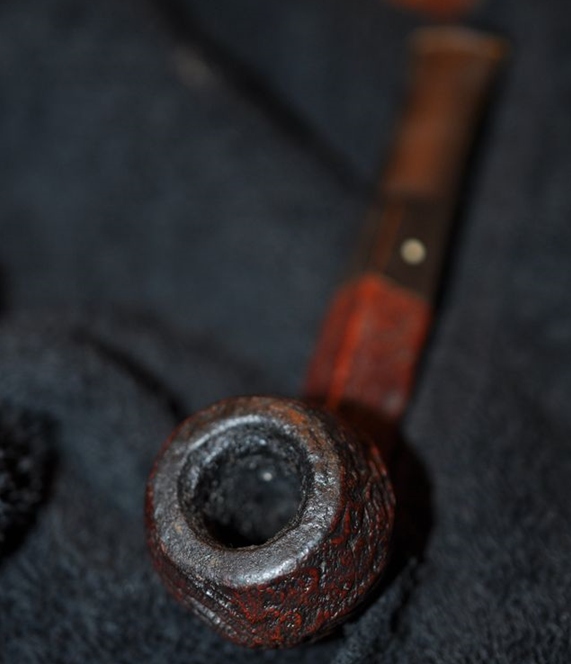
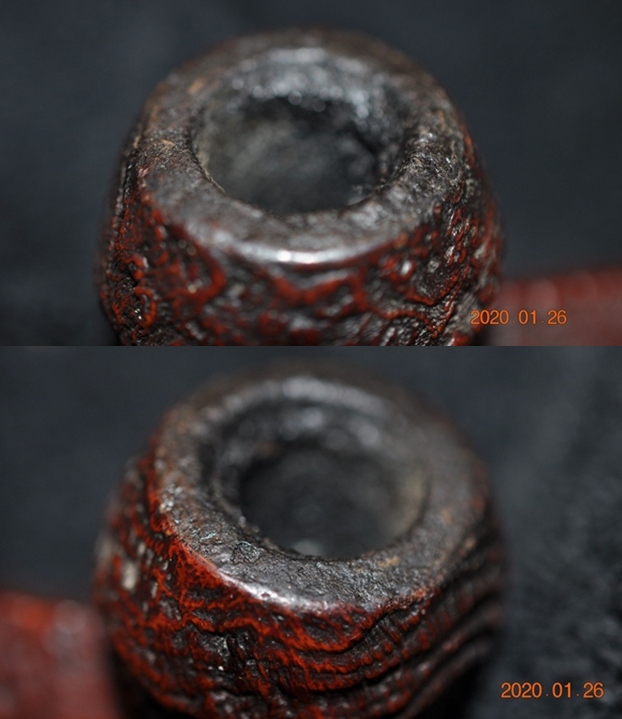
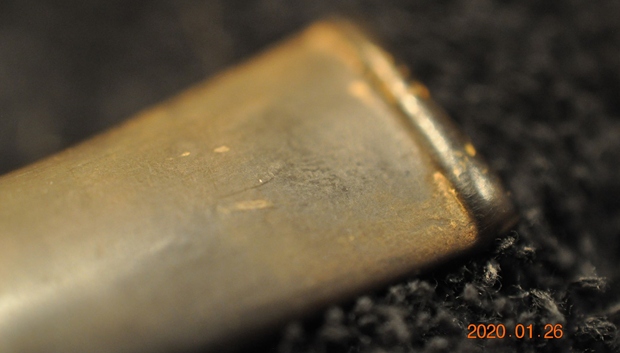
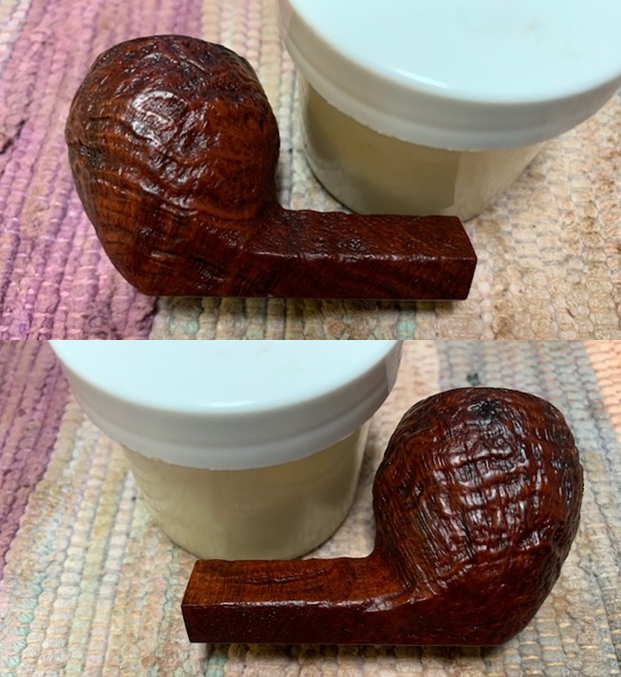
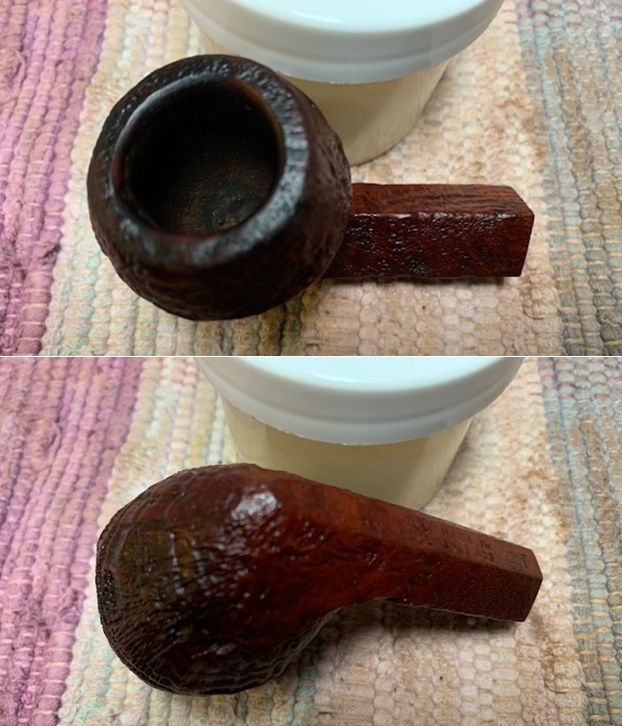
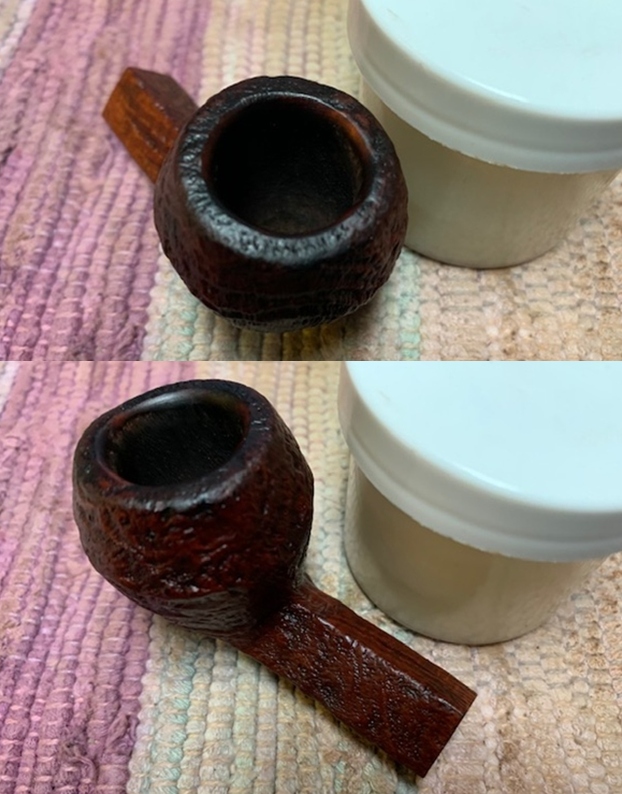
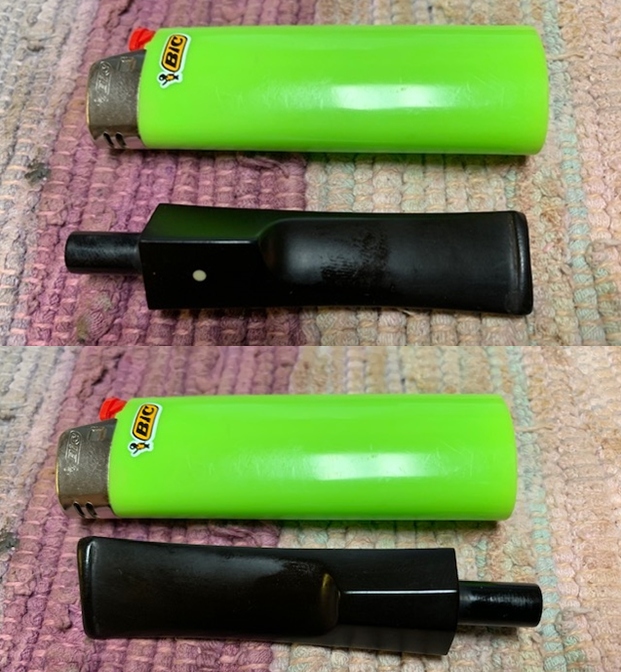
The next pipe on the work table came to us from a fellow from Scottsdale, Arizona, USA. It has been sitting here for just over 2 years. Jeff took photos more than a year ago. Now I am finally getting a chance to work on it. The pipe is a classic Prince-shaped sandblasted pipe. The pipe was an absolute mess which probably accounted for how we ended up purchasing it for a fair price. On the underside of the heel and shank it is stamped with the BBB Diamond Logo [over] Own Make. To the right side of that it is stamped Thorneycroft followed by Made in England with a large E framing that part of the stamp. The stain is a mix of blacks and browns that makes the sandblast stand out even with the grime. The finish was very dirty with dust and debris in the grooves of the blast. There was a thick cake in the bowl and a thick overflow of lava onto the rim top and edges. It was hard to know at this point the condition of the rim edges. The shank was so dirty that the stem did not seat properly against the shank end. The stem was oxidized, calcified and there were deep tooth marks and chatter on both sides just ahead of the button and on the button surface itself. The stem had the brass BBB Diamond inlaid into the topside of the taper. Jeff took photos of the pipe before he started working on it. I include those below. Jeff took photos of the bowl and rim top to show the cake in the bowl and the condition of both. It was thick and hard cake with an unbelievably thick lava overflow on the rim top and edges. Hopefully it had protected the rim and edges from damage. He took photos of the top and underside of the stem showing the scratching, oxidation and tooth marks on the stem surface and button. The tooth marks are quite deep on both sides of the stem.     Jeff took a photo of the sides and heel of the bowl to show the condition of the finish – the grime and grit all over the sides and bottom of the bowl. The finish so dirty it is hard to see the grain but it is present nonetheless.  Jeff took photos of the stamping on the top and right side of the shank. It is very clear and readable as noted above.   The stem had the BBB Brass logo on the top side. One the underside it is stamped with the number 130 which is the shape number.I did a search on Pipephil’s site (http://www.pipephil.eu/logos/en/logo-bbb.html) and looked for the specific Thorneycroft line. The second pipe in the list is stamped the same way as the one that I am working on and the stamping on the stem is the same. The Made in England stamp is identical to the second one.This pipe was a bit of a mess like many of the pipes we work on. I was curious to see what it would look like when I unpacked it. I was surprised at how good it looked. Jeff reamed it with a PipNet pipe reamer and cleaned up the reaming with a Savinelli Fitsall Pipe Knife. He scrubbed out the internals of the shank and stem with alcohol, pipe cleaners and cotton swabs until the pipe was clean. He scrubbed the exterior of the bowl with Murphy’s Oil Soap and a tooth brush to remove the grime and grit on the briar and the lava on the rim top. The finish on the bowl looked really good when I got it. The rim top looked very good. The inner edge showed no damage and outer edges looked good. He soaked the stem in Before & After Deoxidizer bath to remove the oxidation. The stem looked better other than the tooth marks and chatter in the surface. When the pipe arrived here in Vancouver for the second stop of its restoration tour it looked much better than when he found it. I took photos of the pipe before I started my work on it.  I took photos of the condition of the rim top and stem before I started working. The rim top looks better than before and the damage is very obvious to the rim top and the inner edge. The bowl is spotless. The stem has some deep tooth marks on both sides and the button itself.   I took a photo of the stamping on the underside of the shank. It is clear and readable as noted above.  I took the bowl and stem apart and took a photo of the pipe to show the look of the pipe. I worked some Before & After Restoration Balm into the finish of the bowl, rim top and shank with my fingertips and a horsehair shoe brush to clean, enliven and protect it. I find that the balm really makes the briar come alive again. The contrasts in the layers of stain and the separate finishes really made the grain stand out. I let the balm sit for 15 minutes and then buffed with a cotton cloth to raise the shine. The bowl really looks good at this point. I set it aside and worked on the stem.    I set aside the bowl and turned my attention to the stem. I “painted” the surface of the stem with the flame of a Bic lighter to lift them as much as possible. I filled in the remaining tooth dents and marks with Black Super Glue and set it aside for the repairs to cure. Once they cured I flattened them with a file. I cleaned up the repaired areas with 220 sandpaper to blend the repairs into the surface of the stem. I started polishing it with 400 grit wet dry sandpaper. I polished the stem with micromesh sanding pads – wet sanding it with 1500-12000 grit pads. I polished it further with Before & After Pipe Stem Polish – both fine and extra fine.    Once again I am the part of the restoration that I always look forward to – the moment when all the pieces are put back together. I put the pipe back together and lightly buffed the bowl with Blue Diamond. I buffed the stem with a heavier touch with Blue Diamond on the buffing wheel. I gave the bowl and the stem multiple coats of carnauba wax. I buffed the pipe with a clean buffing pad to raise the shine. I hand buffed it with a microfiber cloth to deepen the shine. It is fun to see what the polished bowl looks like with the smooth finish and the black vulcanite stem. This richly stained BBB Own Make Thorneycroft 130 Prince must have been a fine smoking pipe judging from the condition it was when we received it. Have a look at it in the photos below. The dimensions are Length: 5 ½ inches, Height: 1 ½ inches, Outside diameter of the bowl: 1 ¼ inches, Chamber diameter: ¾ of an inch. The weight of the pipe is 31grams/1.09oz. This is one that will go on the British Pipemakers section of the rebornpipes online store shortly. Thanks to each of you who are reading this blog. Remember we are not pipe owners; we are pipemen and women who hold our pipes in trust until they pass on into the trust of the next generation.
Breathing Life into an Italian Made Smooth Finish Bullmoose


Blog by Steve Laug

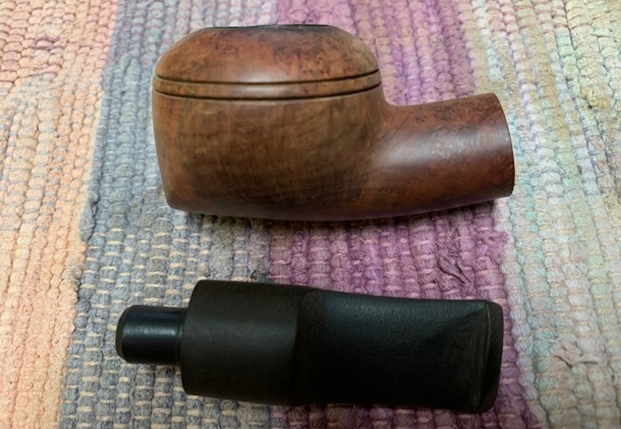
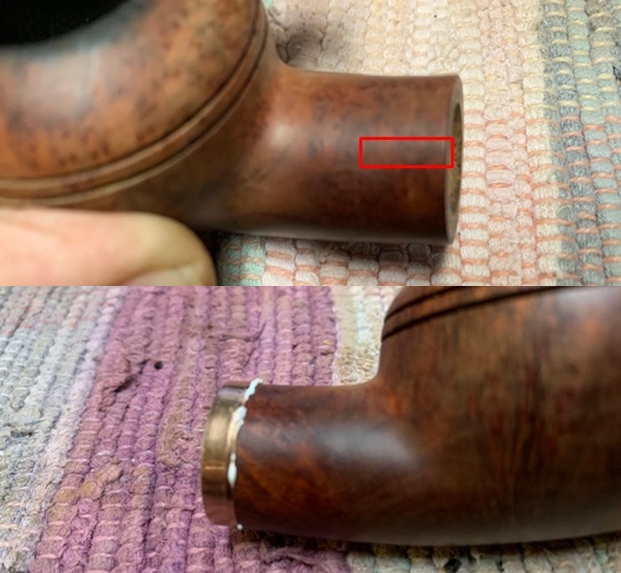
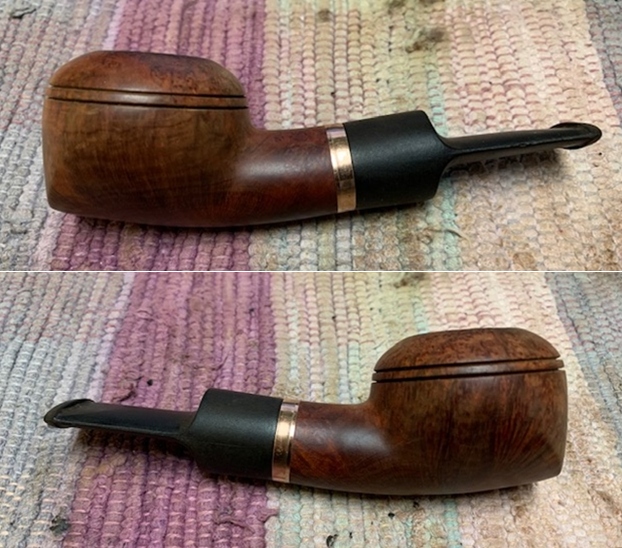
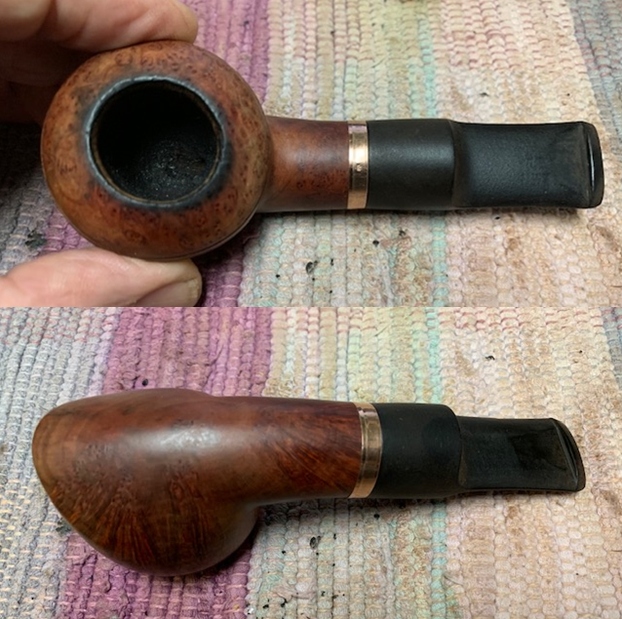
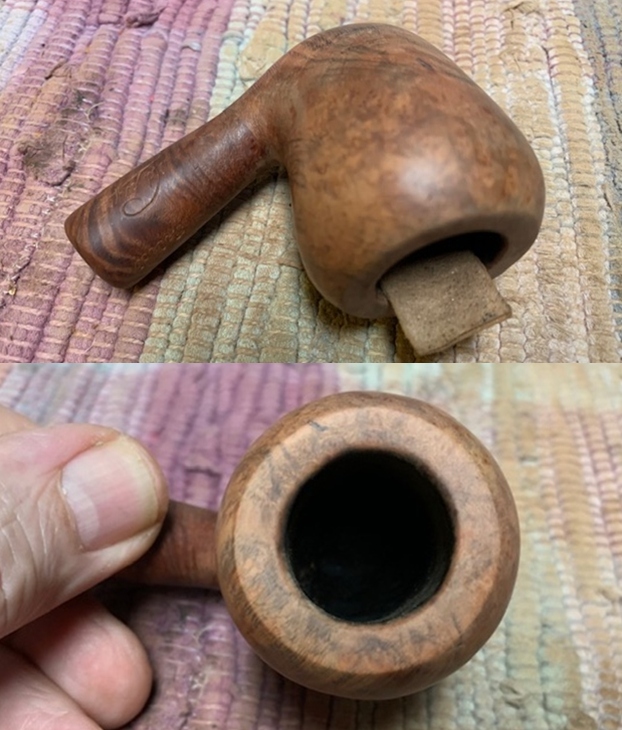
The next pipe on the table came to us from a group of pipes that Jeff picked up in an online auction in Brookfield, Wisconsin, USA. It is a chunky Bullmoose with a saddle stem. The stamping is clear and readable on the shank/stem junction and reads Made in Italy. The filthy oils and grimes are ground into the finish of the bowl. The thick grime makes the grain almost invisible but from what I can see there is some amazing grain that the Bullmoose shape follows well. There was a thick cake in the bowl and a heavy overflow of lava on the rim top. The vulcanite saddle stem was oxidized, calcified and had light tooth marks and chatter ahead of the button.  Jeff took photos of the pipe to show what it looked like before he started working on it. He took photos of the bowl and rim top to show the thickness of the cake and the lava overflow. The photos of the stem show the light oxidation and tooth marks and chatter on the surface on both sides.    The photos of the sides and heel of the bowl show the grain around the pipe. It is a beauty under the grime and dust.     The stamping on the underside of the shank is shown in the photo below. It is very readable. It reads as noted and explained above.   I turned to work on the pipe itself. Jeff had carried out his usual thorough cleanup of the pipe. He had reamed it with a PipNet reamer to remove the cake and cleaned the reaming up with a Savinelli Fitsall Pipe Knife. He scrubbed the internals of the bowl and stem with alcohol, cotton swabs and pipe cleaners. He scrubbed the externals with undiluted Murphy’s Oil Soap and rinsed the bowl off with running water. He soaked the stem in Before & After Deoxidizer and once it had soaked rinsed it off with warm water to remove the residual solution. He dried it off and rubbed it down to remove any oxidation that was still on the stem. The pipe looked very clean when I received it.  I took a photo of the rim top to show the condition. You can see the damage on the inner edge on the left front. It is roughened and chipped and out of round. The saddle stem came out looking quite good. There are light tooth marks and chatter on both sides near the button. You can also see the only stamping on the pipe in the third photo below at the shank/stem junction it reads Made in Italy. I removed the stem from the shank and took a photo of the pipe parts to show what I was working with. It is a nice looking pipe.I decided to start the restoration on this one by dealing with a crack in the shank. I have drawn a box around it in the photo below. It goes from the shank end into the shank about ½ of an inch. It is a hairline crack. I painted the shank end with some all-purpose glue and pressed a thin brass band on the shank end. I wiped the shank end down afterward with a damp cloth to remove the glue that squeezed out.I wiped down the shank with a damp cloth and dried it off. I put the stem on the shank and took photos of the pipe as it looked with the new bling.    I removed the stem from the shank and worked on the damage to the rim top. I worked the inner edge over with a folded piece of 220 grit sandpaper to give the rim edge a slight bevel. I then topped the bowl on a 220 grit sandpaper topping board. I smoothed out the top with some more 220 grit sandpaper.    I polished the briar with micromesh sanding pads. I dry sanded the bowl with 1500-12000 grit pads and wiped the bowl down with a damp cloth after each pad. The briar really took on a shine by the final pads.  With the repair completed I rubbed the briar down with Before & After Restoration Balm. I worked it into the briar with my fingertips and a horsehair shoe brush to work it into the twin lines around the bullcap. The product works to clean, enliven and preserve the briar. I let it sit for 15 minutes while I worked on the stem. After the time passed I buffed it with a cotton cloth to deepen the shine. The briar really comes alive with the balm.      I set the bowl aside and turned my attention to the stem. The stem was rough and pitted so I sanded it smooth with a folded piece of 220 grit sandpaper. I started polishing the stem with 400 grit wet dry sandpaper.    Before polishing the stem further I decided to give a slight bend to match the flow of the curve in the pipe. I heated it with a heat gun until it was pliable (I put a pipe cleaner in the airway to make sure it did not collapse).  I bent the stem the angle I wanted and set it by cooling it with running water while holding the shape. I took a photo of the new look of the stem.   I polished the vulcanite by wet sanding with micromesh sanding pads – 1500-12000 grit pads. I wiped it down with Obsidian Oil after each sanding pad. I used Before & After Pipe Polish – both Fine and Extra Fine to further polish the stem.     This Italian Made Smooth Finish Bullmoose is a beautiful pipe with a smooth finish. It is a bit of a mystery in that there is no other stamping on the pipe. It is a great looking pipe that came out looking very good. The finish on the pipe is in excellent condition. The rich medium brown stain on the bowl works well to highlight the grain. The brass band is a nice touch of bling that separates the briar from the stem. The polished black vulcanite saddle stem adds to the mix. With the dust gone from the finish and the bowl it was a beauty and is eye-catching. I put the stem back on the bowl and buffed the pipe with Blue Diamond on the buffing wheel being careful to not buff the stamping. I gave the bowl and the stem multiple coats of carnauba wax on the buffing wheel and followed that by buffing it with a clean buffing pad. I hand buffed the pipe with a microfiber cloth to deepen the shine. The finished Italian Made Bullmoose is quite nice and feels great in the hand. Give the finished pipe a look in the photos below. I can only tell you that like the other pipes I am working that it is much prettier in person than the photos capture. The dimensions of the pipe are Length: 5 inches, Height: 1 ½ inches, Outside diameter of the bowl: 1 ¾ inches, Chamber diameter: ¾ of an inch. The weight of the pipe is 58 grams/2.05oz. Thanks for walking through the restoration with me as I worked over another beautiful pipe. Remember we are not pipe owners; we are pipemen and women who hold our pipes in trust until they pass on into the trust of the next generation.
Breathing Life into a 1955 Dunhill Tanshell 48 F/T Group 4 Bulldog


Blog by Steve Laug

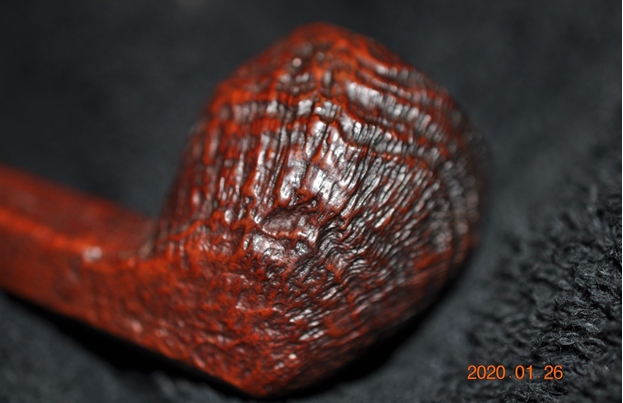
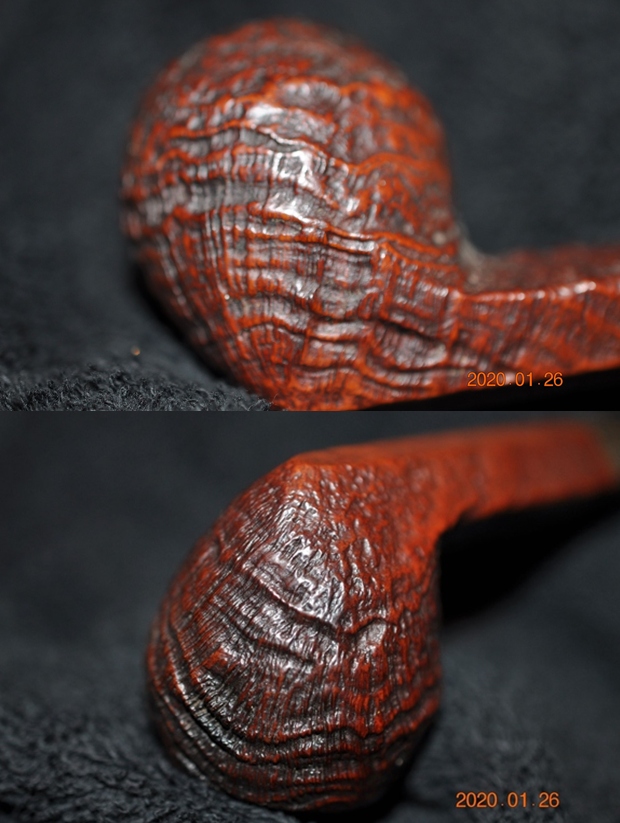
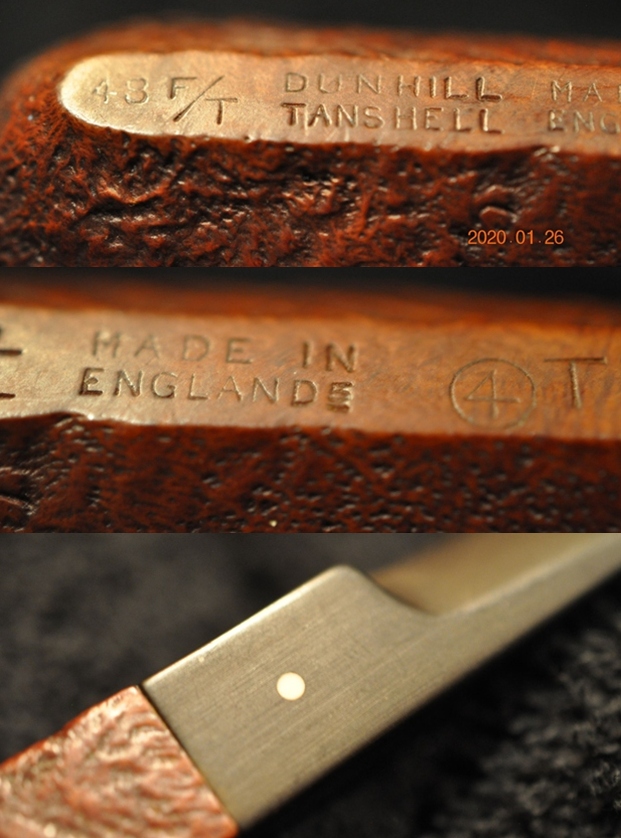
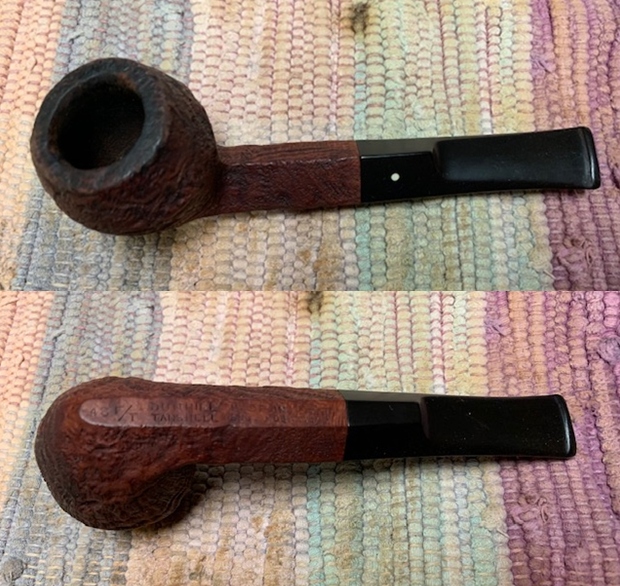
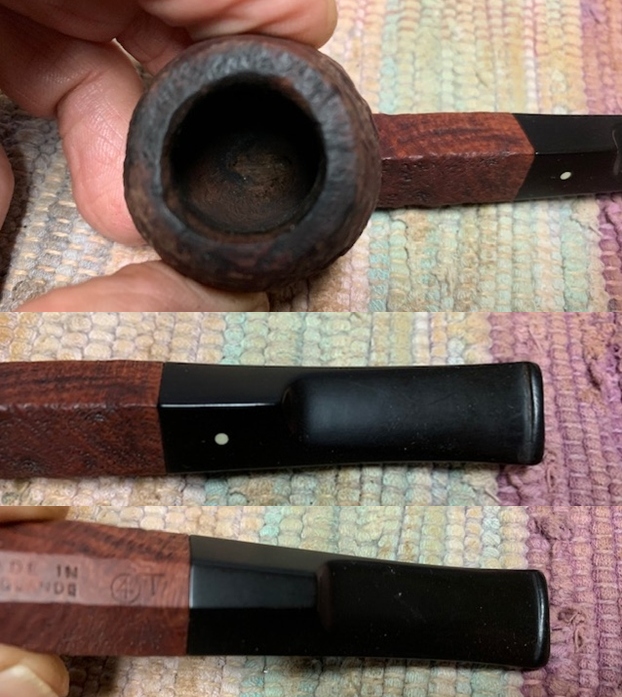
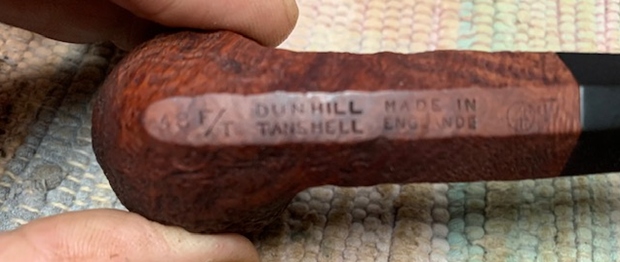
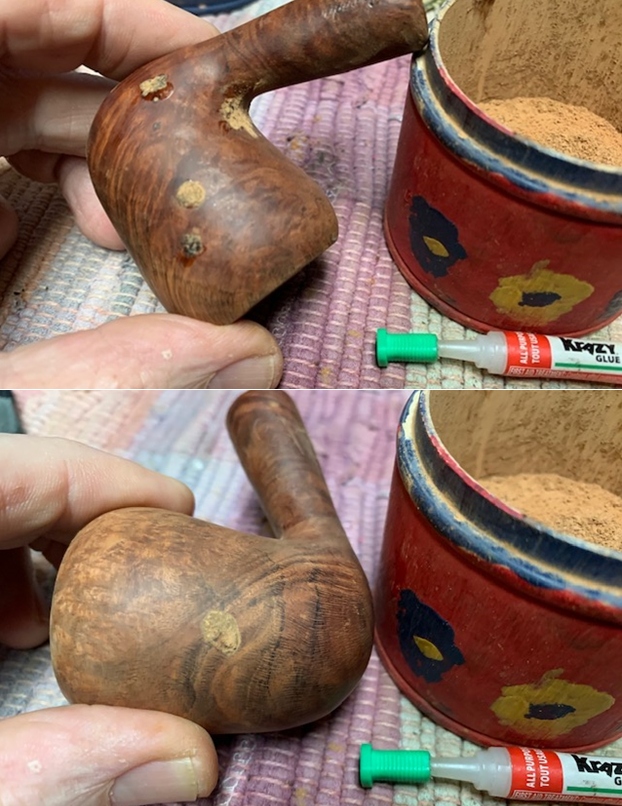
The next pipe on the table came to us from a group of pipes that Jeff picked up on one of his pipe hunts along the Oregon Coast, USA. It is a Dunhill TanShell Briar Bulldog that is in great condition. It is stamped on a smooth panel on the underside of the shank. On the heel of the bowl it is stamped with the shape number 48F/T followed by Dunhill [over] Tanshell Briar followed by Made in England 5. That is followed by 4 in a circle followed by T for Tanshell. Interpreting that stamp it is as follows: The 48 is the shape for a straight saddle stem Bulldog and the F/T is the designation for the button shape – a Fish Tail stem. The Dunhill Tanshell is the finish which is corroborated the T at the end of the stamping. The 5 following the D of England gives the date the pipe was made and identifies it as 1955. The stamping is clear and readable. The age of the pipe and the oils in the sandblast finish has given the pipe a rich medium brown finish. There is also some amazing grain that the shape follows well. The finish was dirty with dust around the nooks and crannies of the sandblast. There was a thick cake in the bowl and a heavy overflow of lava on the rim top. The vulcanite saddle stem was oxidized and had light tooth marks and chatter ahead of the button.  Jeff took photos of the pipe to show what it looked like before he started working on it. He took photos of the bowl and rim top to show the thickness of the cake and the lava overflow. The photos of the stem show the light oxidation and tooth marks and chatter on the surface on both sides.  The photos of the sides and heel of the bowl show the deep sandblast grain on the pipe. It is a beauty under the grime and dust.    The stamping on the underside of the shank is shown in the photo below. It looks very good and readable. It reads as noted and explained above. The third photo shows the white spot on the stem.   I turned to Pipedia’s section on Dunhill Tanshell Pipes to get a bit of background on the Duhill finishes (https://pipedia.org/wiki/Dunhill#Root_Briar). I quote:

Tanshell

The first lot was distributed in 1952 (usually made using Sardinian briar). The prototype was called “Root Shell “, produced in 1951. The Tanshell is a light tan sandblast. Sardinian briar was used for this sandblast. There is a distinct contrast in the sandblasts using Sardinian as opposed to Algerian briar. The Sardinian is much denser and much harder. The resulting pattern, when blasted, is far more even and regular both in terms of the surface texture and the finish.

The TanShell was Dunhill’s fourth finish and its first major post-war line addition. Introduced in 1951/1952 the TanShell was a naturally stained sandblasted pipe made exclusively from Sardinian briar through the 1960s. The TanShell apparently was not simply a light stained Shell but rather was also the product of “certain processes [unrevealed] not previously employed.” Initially, it appears that the pipe was to be named the Root Shell and a stamp to that effect was ordered and received by Dunhill in May 1951. Ultimately, however, the name TanShell was settled upon but the stamp for the TanShell name was not received by Dunhill until the beginning of December. Thus while the Tanshell was in production in 1951 it appears that most if not all TanShells made in that year did not enter into retail distribution until 1952 and were given a 1952 date code. Loring, J. C., The Dunhill Briar Pipe, The Patent Years and After (self-published, Chicago, 1998).

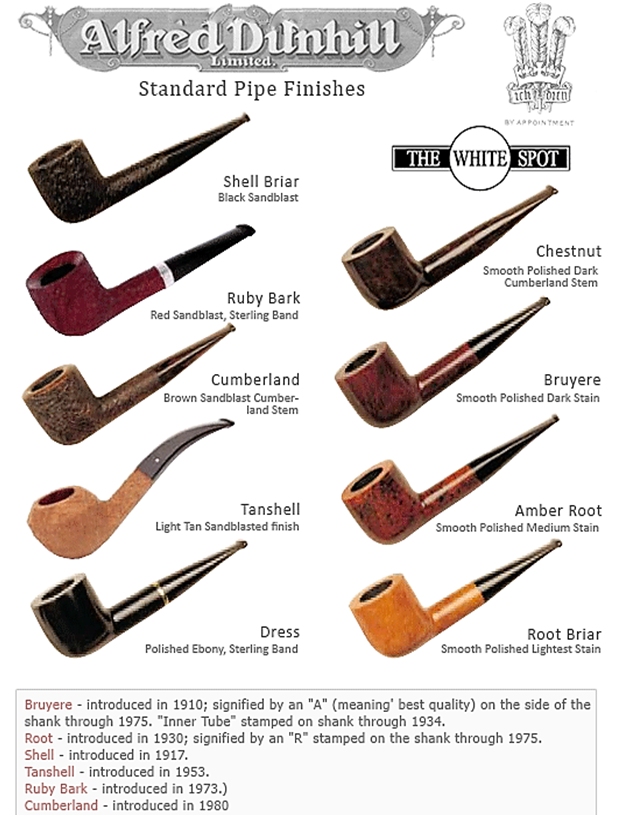
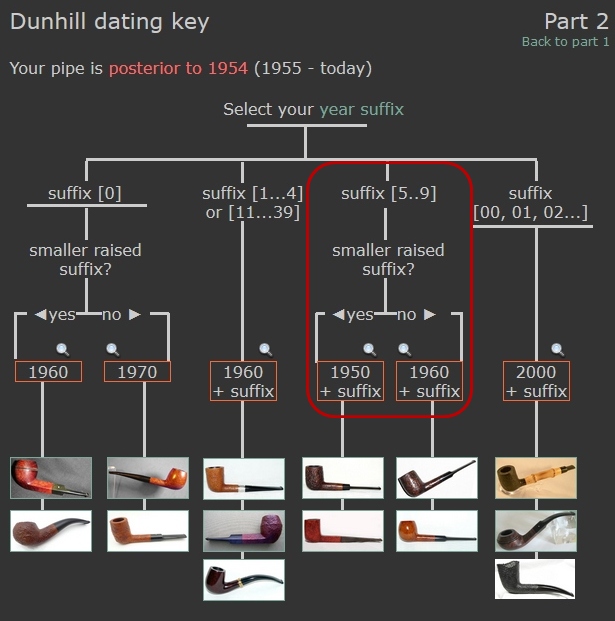
I have also included a chart from the site from Dunhill spelling out the Standard Pipe Finishes and giving short information and a timeline.I turned to Pipephil’s dating guide to show how I arrived at the date of manufacture for this pipe (http://www.pipephil.eu/logos/en/dunhill/cledat-en1a.html). I am including the chart that is provided there for the dating a pipe. I have drawn a red box around the section. Since the pipe I am working on has a smaller raise 5 it points to the 1950+ suffix line on the chart below.I turned to work on the pipe itself. Jeff had carried out his usual thorough cleanup of the pipe. He had reamed it with a PipNet reamer to remove the cake and cleaned the reaming up with a Savinelli Fitsall Pipe Knife. He scrubbed the internals of the bowl and stem with alcohol, cotton swabs and pipe cleaners. He scrubbed the externals with undiluted Murphy’s Oil Soap and rinsed the bowl off with running water. He soaked the stem in Before & After Deoxidizer and once it had soaked rinsed it off with warm water to remove the residual solution. He dried it off and rubbed it down to remove any oxidation that was still on the stem. The pipe looked very clean when I received it.  I took a photo of the rim top to show the condition. You can see the damage on the inner edge on the left front. It is roughened and chipped and out of round. The saddle stem came out looking quite good. There are light tooth marks and chatter on both sides near the button.   I took a photo of the underside of the shank to show the stamping. It is clear and readable with some faint spots. I removed the stem from the shank and took a photo of the pipe parts to show what I was working with. It is a nice looking pipe.I decided to start the restoration on this one by working on the damage to the inner edge of the rim. I used a folded piece of 220 grit sandpaper to give the inner edge of the rim a slight bevel to bring it back into round.  While the finished rim edge is not perfect it is far better. I used a brass bristle tire brush to clean up the darkening on the rim top and clean up the sandblast portion.    With the repair completed I rubbed the briar down with Before & After Restoration Balm. I worked it into the briar with my fingertips and a horsehair shoe brush to work it into the nooks and crannies of the sandblast finish. The product works to clean, enliven and preserve the briar. I let it sit for 15 minutes while I worked on the stem. After the time passed I buffed it with a cotton cloth to deepen the shine. The briar really comes alive with the balm.   I set the bowl aside and turned my attention to the stem. I “painted” the tooth marks on the stem to lift them up. I was able to lift them to the point that I would be able to polish out those that remained with micromesh pads.    I polished the vulcanite with micromesh sanding pads – 1500-12000 grit pads. I wiped it down with Obsidian Oil after each sanding pad. I used Before & After Pipe Polish – both Fine and Extra Fine to further polish the stem.   This Dunhill 48F/T Tanshell Bulldog is a beautiful sandblast with the unique Sandblast finish made in 1955. It is a great looking pipe that came out looking very good. The Tanshell finish has a great rugged sandblast that Dunhill specialized in making. The finish on the pipe is in excellent condition. The oils off the smoker’s hands and the tan stain on the bowl works well to highlight the grain. The polished black vulcanite saddle stem adds to the mix. With the dust gone from the finish and the bowl it was a beauty and is eye-catching. I put the stem back on the bowl and buffed the pipe with Blue Diamond on the buffing wheel being careful to not buff the stamping. I gave the bowl multiple coats of Conservator’s Wax and the stem multiple coats of carnauba wax on the buffing wheel and followed that by buffing it with a clean buffing pad. I hand buffed the pipe with a microfiber cloth to deepen the shine. The finished 48 F/T Tanshell Briar Bulldog is quite nice and feels great in the hand. Give the finished pipe a look in the photos below. I can only tell you that like the other pipes I am working that it is much prettier in person than the photos capture. The dimensions of the pipe are Length: 5 inches, Height: 1 ¾ inches, Outside diameter of the bowl: 1 ¼ inches, Chamber diameter: ¾ of an inch. The weight of the pipe is 29grams/1.02oz. Thanks for walking through the restoration with me as I worked over another beautiful pipe. Remember we are not pipe owners; we are pipemen and women who hold our pipes in trust until they pass on into the trust of the next generation.

Fresh Life for a Butz-Choquin Camargue Bent Rhodesian Sitter


Blog by Steve Laug

The next pipe on the work table came to us from a fellow in Taylor, Michigan, USA.  The pipe is classic looking Butz-Choquin that has a marbleized acrylic shank extension.  The pipe is stamped on the sides of the shank. On the left side of the shank it reads Butz-Choquin [over] Camargue and on the right side it reads St. Claude [arched over] France [over] the shape number 1021. The stain is a mix of browns that contrasts well with the marble like shank extension. The finish was very dirty with grime ground into the finish making it hard to see beyond that to the grain underneath. There was a thick cake in the bowl and it had overflowed with lava onto the rim top and edges. It was hard to know at this point the condition of the rim edges. The stem in the photos came from a different pipe that Jeff and I purchased from the same seller. It was a Caminetto pipe stem with the mustache on the top of the saddle. The Caminetto had the stem from this pipe so they would need to be switched. The original stem had no stamping or identifying marks on it. Jeff took photos of the pipe before he started working on it. I include those below. Jeff took photos of the bowl and rim top to show the cake in the bowl and the condition of both. It was thick and hard cake but hopefully it had protected the rim and edges from damage. He took photos of the top and underside of the stem showing the condition of both sides.    Jeff took a photo of the sides and heel of the bowl to show the condition of the finish. It has thick grime on the surface and ground into the finish.  There were also a few visible fills around bowl. Jeff took photos of the stamping on the shank sides to capture it. It is very clear and readable.  Dal Stanton had written a blog on his restoration of a Carmargue pipe for rebornpipes in the past (https://rebornpipes.com/2019/12/04/rejuvenating-a-fancy-french-butz-choquin-camargue-1683-prince/) I turned to that now for a quick review of the history of the line. I quote:

I’ve worked on several Butz Choquin pipes which is based in the French pipe center of St. Claude.  Here is a brief overview of the BC history from http://www.pipephil.eu/logos/en/logo-butzchoquin.html

The origin of the brand reaches back to 1858 when Jean-Baptiste Choquin in collaboration with his son-in-law Gustave Butz created their first pipe in Metz (France). Since 1951 Butz-Choquin Site officiel Butz Choquin, pipes de Saint-Claude Jura. BC pipe de bruyere luxe is a brand of the Berrod-Regad group (Saint-Claude, France).

Jean Paul Berrod managed the company from 1969 to 2002 when he retired and sold the corporate to Mr Fabien Gichon. Denis Blanc, already owner of EWA, took over the S.A. Berrod-Regad in 2006.

The BC line, ‘Camargue’ is not an old line as a simple search on the internet turns up several examples of classic pipe shapes with the ‘Camargue’ stamp, but unique to each is the acrylic shank extension and the military mounted stem.  This example is a Dublin shape from https://www.smokingpipes.com/pipes/estate/france/moreinfo.cfm?product_id=189826Dal had also done some research on the name Camargue that I have included below. For me this kind of information adds colour to the restoration that I am working on.

The name of the line, ‘Camargue,’ I discovered is a treasured nature reserve on the southern coast of France between Montpellier and Marseille – two beautiful venues which I’ve had the opportunity to visit. A Wiki article was very helpful in describing the area that this BC line is commemorating (https://en.wikipedia.org/wiki/Camargue).

With an area of over 930 km2 (360 sq mi), the Camargue is western Europe’s largest river delta. It is a vast plain comprising large brine lagoons or étangs, cut off from the sea by sandbars and encircled by reed-covered marshes. These are in turn surrounded by a large cultivated area.

Approximately a third of the Camargue is either lakes or marshland. The central area around the shoreline of the Étang de Vaccarès has been protected as a regional park since 1927, in recognition of its great importance as a haven for wild birds. In 2008, it was incorporated into the larger Parc naturel régional de Camargue.

The Camargue is home to more than 400 species of birds and has been identified as an Important Bird Area (IBA) by BirdLife International.[8] Its brine ponds provide one of the few European habitats for the greater flamingo. The marshes are also a prime habitat for many species of insects, notably (and notoriously) some of the most ferocious mosquitos to be found anywhere in France. Camargue horses (Camarguais) roam the extensive marshlands, along with Camargue cattle (see below).

The native flora of the Camargue have adapted to the saline conditions. Sea lavender and glasswort flourish, along with tamarisks and reeds…This pipe was a real mess like many of the pipes we work on. I was curious to see what it would look like when I unpacked it. I was surprised at how good it looked. Jeff reamed it with a PipNet pipe reamer and cleaned up the reaming with a Savinelli Fitsall Pipe Knife. He scrubbed out the internals of the shank and stem with alcohol, pipe cleaners and cotton swabs until the pipe was clean. He scrubbed the exterior of the bowl with Murphy’s Oil Soap and a tooth brush to remove the grime and grit on the briar and the lava on the rim top. The finish on the bowl looked really good when I got it. The rim top looked much better and the inner and outer edges were looking good. He soaked the stem in Before & After Deoxidizer bath to remove the oxidation. I swapped the stems between the Caminetto and the BC to get the correct stems with the pipes. This stem looked very good. There was no tooth chatter or damage on either side. When the pipe arrived here in Vancouver for the second stop of its restoration tour it looked very good. I took photos of the pipe before I started my work on it.  I took photos of the condition of the rim top and stem before I started working. The rim top looks better than before and other than some slight darkening there is no other damage. The bowl is spotless. The newly found stem is in great condition and should polish well.    I took photos of the stamping on the sides of the shank. It is clear and readable as noted above. The shank extension was loose so I removed it and the stem and took the following photo to give a sense of the pipe as a whole.  I decided to start my work on this pipe by regluing the shank extension to the end of the shank. I cleaned out the shank with alcohol on a cotton swab, then coated the tenon on the shank extension with all-purpose glue and then turned it into the shank. I aligned the angles and wiped off the excess glue and set it aside to cure. I worked over the beveled rim edge and top with 220 grit sandpaper to remove the darkening on the rear and right front of the bowl.   I polished the briar with micromesh sanding pads. I dry sanded the bowl with 1500-12000 grit pads and wiped the bowl down with a damp cloth after each pad. The briar really took on a shine by the final pads.    I worked some Before & After Restoration Balm into the finish of the bowl and the rim top and shank with my fingertips to clean, enliven and protect it. I find that the balm really makes the briar come alive again. The contrasts in the layers of stain and the separate finishes really made the grain stand out. I let the balm sit for 10-15 minutes and then buffed with a cotton cloth to raise the shine. The bowl really looks good at this point. I set it aside and worked on the stem.   I set aside the bowl and turned my attention to the stem. I polished the stem with micromesh sanding pads – wet sanding it with 1500-12000 grit pads. I polished it further with Before & After Pipe Stem Polish – both fine and extra fine.    Once again I am the part of the restoration that I always look forward to – the moment when all the pieces are put back together. I put the pipe back together and lightly buffed the bowl with Blue Diamond. I buffed the stem with a heavier touch with Blue Diamond on the buffing wheel. I gave the bowl and the stem multiple coats of carnauba wax. I buffed the pipe with a clean buffing pad to raise the shine. I hand buffed it with a microfiber cloth to deepen the shine. It is fun to see what the polished bowl looks like with the combination of rustication and smooth finishes. The black vulcanite stem stands out as a shiny black contrast to the colours of the bowl. This medium brown stained Butz-Choquin Camargue Bent Rhodesian Sitter must have been a fine smoking pipe judging from the condition it was when we received it. Have a look at it in the photos below. The dimensions are Length: 5 ½ inches, Height: 1 ½ inches, Outside diameter of the bowl: 1 ¾ inches, Chamber diameter: ¾ inch. The weight of the pipe is 42grams/1.48oz.  This is one that will go on the French Pipemakers section of the rebornpipes online store shortly. Thanks to each of you who are reading this blog. Remember we are not pipe owners; we are pipemen and women who hold our pipes in trust until they pass on into the trust of the next generation.

Fresh Life for a Comoy’s Marble Arch 78 Apple with a Military Bit


Blog by Steve Laug

The next pipe on the work table came to us from an online auction from St. Albans, West Virginia, USA.  The pipe is classic looking Comoy’s Apple that has a marbleized acrylic shank extension.  The pipe is stamped on the left side of the shank and reads Comoy’s [over] Marble Arch. On the right side of the shank it has the Comoy’s COM stamp Made in London in a circle over England followed by the shape number 78. The stain is a mix of browns and blacks that contrasts well with the marble like shank extension. The finish was very dirty with grime ground into the finish making it hard to see beyond that to the grain underneath. There was a thick cake in the bowl and it had overflowed with lava onto the rim top and edges. It was hard to know at this point the condition of the rim edges. The stem was oxidized and calcified and looked to be stuck in the shank extension. There were not many tooth marks or chatter but there was a large chip of vulcanite out of the button on the underside. The stem had the inlaid three part C logo on the left side. Jeff took photos of the pipe before he started working on it. I include those below. Jeff took photos of the bowl and rim top to show the cake in the bowl and the condition of both. It was thick and hard cake but hopefully it had protected the rim and edges from damage. He took photos of the top and underside of the stem showing the condition of both sides. The underside has a large chip missing out of the button end.     Jeff took a photo of the sides and heel of the bowl to show the condition of the finish. It has thick grime on the surface and ground into the finish.  Jeff took photos of the stamping on the shank sides to capture it. It is very clear and readable.  The next photos show the fit of the stem in the shank extension and the tars and gunk that locked in place. The stem has the older 3 part C inset on the left side.  When Jeff turned the stem to remove it from the shank the shank extension came off instead. The glue on the tenon that held it in place had dried and the extension was loose.This pipe was a real mess like many of the pipes we work on. I was curious to see what it would look like when I unpacked it. I was surprised at how good it looked. Jeff reamed it with a PipNet pipe reamer and cleaned up the reaming with a Savinelli Fitsall Pipe Knife. He scrubbed out the internals of the shank and stem with alcohol, pipe cleaners and cotton swabs until the pipe was clean. He scrubbed the exterior of the bowl with Murphy’s Oil Soap and a tooth brush to remove the grime and grit on the briar and the lava on the rim top. The finish on the bowl looked really good when I got it. The rim top looked much better and the inner and outer edges were looking good. He soaked the stem in Before & After Deoxidizer bath to remove the oxidation. The stem looked better other than some light oxidation and the tooth marks and chatter in the surface. The chipped button on the underside of the stem was clean but very visible. When the pipe arrived here in Vancouver for the second stop of its restoration tour it looked very good. I took photos of the pipe before I started my work on it.  I took photos of the condition of the rim top and stem before I started working. The rim top looks better than before and other than some slight darkening there is no other damage. The bowl is spotless. The stem is lightly oxidized and has some major damage on the underside at the button. I took photos of the stamping on the sides of the shank. It is clear and readable as noted above. At this point I tried to remove the stem from the shank extension and was surprised with the shank extension came off and the stem was not moveable. I tried to twist it and it was stuck solid in the extension.I decided to start my work on this pipe by separating the shank extension and the stem. I put it in the freezer overnight and it had no effect. It was still stuck. I used a folded pipe cleaner to drizzle acetone down the joint of the extension and the stem. I continued that process for the better part of a day. Finally last evening I was able to wiggle the stem free from the extension. Both were incredibly dirty at the junction. It was going to take a bit of work to get a clean fit.  I cleaned out the shank and then coated the tenon on the shank extension with all-purpose glue and then turned it into the shank. I wiped off the excess glue and set it aside to cure. Once the glue cured I cleaned out the inside of the shank extension with alcohol and cotton swabs and pipe cleaners. It was smooth and clean.I polished the briar with micromesh sanding pads. I dry sanded the bowl with 1500-12000 grit pads and wiped the bowl down with a damp cloth after each pad. The briar really took on a shine by the final pads.    I worked some Before & After Restoration Balm into the finish of the bowl and the rim top and shank with my fingertips to clean, enliven and protect it. I find that the balm really makes the briar come alive again. The contrasts in the layers of stain and the separate finishes really made the grain stand out. I let the balm sit for 10-15 minutes and then buffed with a cotton cloth to raise the shine. The bowl really looks good at this point. I set it aside and worked on the stem.    I set aside the bowl and turned my attention to the stem. It was time to work on the broken off part of the button. I put a piece of clear packing tape on a piece of cardboard. I opened two capsules of charcoal powder and mixed it with some Locktite 380 Black CA glue. I mixed them together with a dental pick and a spatula.  I coated a folded cleaner with Vaseline and inserted it in the button. I filled in the damaged area with the mixture of charcoal powder and super glue.

Once the repair cured I flattened it with a rasp and a small file. I cleaned up the repaired areas with 220 sandpaper to blend the repairs into the surface of the stem. I started polishing it with 400 grit wet dry sandpaper.  I sanded the repaired area and the rest of the stem with 220 grit sandpaper and reshaped the button edges.  I started polishing the stem with 400 grit wet dry sandpaper.  I polished the stem with micromesh sanding pads – wet sanding it with 1500-12000 grit pads. I polished it further with Before & After Pipe Stem Polish – both fine and extra fine.   Once again I am the part of the restoration that I always look forward to – the moment when all the pieces are put back together. I put the pipe back together and lightly buffed the bowl with Blue Diamond. I buffed the stem with a heavier touch with Blue Diamond on the buffing wheel. I gave the bowl and the stem multiple coats of carnauba wax. I buffed the pipe with a clean buffing pad to raise the shine. I hand buffed it with a microfiber cloth to deepen the shine. It is fun to see what the polished bowl looks like with the combination of rustication and smooth finishes. The black vulcanite stem stands out as a shiny black contrast to the colours of the bowl. This dark stained Comoy’s Marble Arch 78 Apple must have been a fine smoking pipe judging from the condition it was when we received it. Have a look at it in the photos below. The dimensions are Length: 5 ½ inches, Height: 1 ¾ inches, Outside diameter of the bowl: 1 ¼ inches, Chamber diameter: ¾ inch. The weight of the pipe is 38grams/1.34oz.  This is one that will go on the British Pipemakers section of the rebornpipes online store shortly. Thanks to each of you who are reading this blog. Remember we are not pipe owners; we are pipemen and women who hold our pipes in trust until they pass on into the trust of the next generation.


Breathing Life into an Italian Made Octagonal “Setter” Real Briar Don


Blog by Steve Laug

The next pipe on the table was purchased from an online auction from Barbourville, Kentucky, USA. It was an interesting looking golden brown octagonal sitter in a shape that I call a Don. The stem is inserted in the small ferrule on the backside of the bowl. The smooth finish on the bowl was very dirty and worn. There were fills but all was covered by a thick coat of shiny varnish. The pipe was filthy but otherwise in surprisingly good condition. The bowl had a thick cake that overflowed as lava on the beveled inner edge of the rim top. The outer edge of the rim was in good condition. The pipe is stamped on the heel of the bowl and reads “Setter” [over] Real Briar [over] Italy. The stamping is clear and readable on the pipe. The stem was oxidized and there were light tooth marks and chatter on the stem near the button on both sides. There was no logo or brand mark on the stem. Jeff took photos of the pipe before he worked on it. Jeff took a close up photo of the bowl and rim to capture the condition of the pipe before he started the cleanup work. The bowl had a thick cake and lava overflowed on the beveled inner edge of the bowl. The stem is oxidized, calcified and dirty and there is tooth chatter and marks on both sides of the stem ahead of the button.     Jeff took a photo of the pipe with the stem removed looking at the back of the of the bowl to give a sense of the shape of the pipe. The stamping on the heel of the bowl read as noted above. The photo shows that it is very readable.    I looked in all my usual places for information on the “Setter” brand and came up with nothing. I turned to Who Made that Pipe and found two listings that gave some interesting possibilities for me. It could have been made for Hudson’s Universal Pipes or from KB&B/Kaywoodie. It could easily have been made by either company from Italian briar. I suppose I will never know for sure.Jeff had cleaned up the pipe with his usual penchant for thoroughness. He reamed the pipe with a PipNet pipe reamer and removed the rest of it with a Savinelli Fitsall Pipe Knife.  He scrubbed the bowl with undiluted Murphy’s Oil Soap with a tooth brush. He rinsed it under running warm water to remove the soap and grime. He cleaned out the inside of the shank and the airway in the stem with alcohol, cotton swabs and pipe cleaners. He soaked the vulcanite stem in Before & After Deoxidizer and rinsed it off with warm water. When the pipe arrived and I unpacked it the stem was broken off at the end. I took photos of the pipe once I received it.     The rim top and edges cleaned up really well. The stem surface looked very good with some light oxidation and tooth marks and chatter on the top side and the underside near the button. The stamping on the heel of the bowl is clear and readable. It reads as noted above.     I removed the stem and took a photo of the pipe to give a sense of the whole.  I started my work on the pipe by removing the thick varnish coat that made the pipe look like it was not real briar. I wiped it down with acetone on a cotton pad and was able to remove a lot of the varnish. On one side of the octagon there was a fill that had some chips in it. I filled in those areas with clear CA glue. Once the repair cured I sanded the entire bowl with a folded piece of 220 grit sandpaper to smooth out the repair and to remove the last of the varnish. I started the polishing with 400 wet dry sandpaper to deal with scratches left behind. I polished the briar with micromesh sanding pads – wet sanding with 1500-12000 grit pads and wiping the briar down with a damp cloth after each pad. The briar began to take on a rich glow. I rubbed the briar down with Before & After Restoration Balm. I worked it into the briar with my fingertips into the briar. The product works to clean, enliven and preserve the briar. I let it sit for 10-15 minutes while I worked on the stem. After the time passed I buffed it with a cotton cloth to deepen the shine.    In the morning I headed back to the basement to work on the stem. My eldest daughter is visiting and her little MinPin/Chihuahua Frankie came down with me. He has been hanging out with me keeping me company. He seems to know there is a hole in our hearts and he is stepping in to fill it! We set up a bed and his food and water near the desk where Spencer used to sleep and he loves snoozing there. This morning he came downstairs with me and stood by my chair. He made it clear that he wanted up. He jumped on my lap and then onto the desk top and sat down on my left to “supervise” what I was doing. He was content to just sit and watch me. Every so often he would give me a smooch to let know he was watching. I captured this photo with the camera on the computer… the Spencer’s supervisor role has been handed to the next generation… at least when he is visiting.Once he was settled I turned my attention to the stem. I scrubbed the oxidation with Soft Scrub cleanser and was able to remove the majority of it. The rest would polish and buff out.     I polished the stem with micromesh sanding pads – 1500-12000 grit pads. I wiped it down with Obsidian Oil after each sanding pad. I used Before & After Pipe Polish – both Fine and Extra Fine to further polish the stem.    This little octagonal “Setter” Real Briar Don Pipe turned out to be a great looking pipe. The smooth finish and brown stain around the eight bowl sides make the grain just pop. The finish on the pipe looks great without the thick varnish coat and the brown stains work well to highlight the grain around the bowl. The polished thin military style vulcanite taper stem adds a nice contrast when inserted in the nickel ferrule. The pipe is really quite eye-catching. I put the stem back on the bowl and buffed the pipe with Blue Diamond on the buffing wheel, carefully avoiding the stamping on the heel of the bowl. I gave the bowl and the stem multiple coats of carnauba wax on the buffing wheel and followed that by buffing it with a clean buffing pad. I hand buffed the pipe with a microfiber cloth to deepen the shine. The finished “Setter” is quite nice and feels great in the hand. Give the finished pipe a look in the photos below. I can only tell you that like the other pipes I am working that it is much prettier in person than the photos capture. The dimensions of the pipe are Length: 6 ½ inches, Height: 1 ¾ inches, Outside diameter of the bowl: 1 ¼ inches, Chamber diameter: 5/8 of an inch. The weight of the pipe was 22g/.81oz. Thanks for walking through the restoration with me as I worked over another interesting pipe. This “Setter” Don will be added to the Italian Pipe Makers section of the rebornpipes store soon. If you want to add it to your collection send me an email or a message! Thanks for your time.

A Farewell to my Work Buddy Spencer – A Comoy’s Extraordinaire 804 Rusticated Bent Billiard


Blog by Steve Laug

The pipe on the work table now came to us from one of Jeff’s pipe hunts on the Oregon Coast back in 2018. It turns out that it is the last pipe that I will have worked on with my Supervising Buddy Spencer, my Black and Tan Cocker Spaniel. While I was working on the rim top this morning he slipped over the rainbow bridge curled at my feet in his usual place. I will miss his presence and his wet nose nudging me for a treat…

This is a big pipe at 9 ½ inches long and 2 ½ inches tall. It is stamped on the heel of the bowl and reads Comoy’s [over] Extraordinaire followed by the shape number 804. It is a handful that is for sure. The deeply rusticated finish has a beauty of its own. It is a dirty pipe with a lot of dust and debris deep in the rusticated grooves of the rustication. The rim top is covered in a coat of lava overflowing from the thick cake in the bowl. When you realize how big the bowl is and then see that the cake fills in over half of the bowl you can see how thick it is. The cake is rock hard and will be a bear to ream out. It is hard to know the condition of the inner edge but the front outer edge has some damage from being knocked hard on something to remove the dottle from the bowl. The stem is probably a replacement and does not have an inset C on the side or topside. It is an old one in that it has the same feel as the Solid Rubber stems. It is oxidized, calcified and has deep tooth marks on the underside near the button and chatter on the top side. It will be an interesting looking pipe once it is cleaned up. Jeff took these photos before he started his cleanup work.The next photo Jeff took gives a clear picture of the thickness of the cake and the lava on the rim top. It is one well-loved pipe and the previous pipeman must have smoked it all the time. It is a good sign that it is a great smoker. He also took photos of the stem to show the oxidation and the toot marks on the surface. The top side is in better condition than the underside.  He took photos of the sides and heel of the pipe to show the overall condition of the finish on the bowl. It is a deep swirling rustication. The next photo shows the stamping on the heel of the bowl. It reads as noted above. The stamping is readable but the Extraordinaire and shape number 804 are faint.I turned to Pipephil (http://www.pipephil.eu/logos/en/logo-comoy.html) to look up the Extraordinaire line. I did a screen capture of the second on the line and have included it below. The sidebar on the left of the picture below reads: The “Extraordinaire” designation was given to either oversized pipes or to unusual pipes. This pipe fits both designations – it is large and it is unusual.I turned to Pipedia’s section on Comoy’s (https://pipedia.org/wiki/Comoy%27s). It gives a great history of the brand and toward the bottom of the page it had the picture below. It shows a contrast between the Extraordinaire 804 and a Group 4 sized Dunhill 120 for comparison. The caption below the photo says that this pipe is a 1930’s Comoy’s pipe.

1930’s Comoy’s 804 Extraordinaire shown with a 1965 Group 4 sized Dunhill 120 (which is the equivalent of a Group 5 size today) for size comparison – Courtesy of Mike Ahmadi.

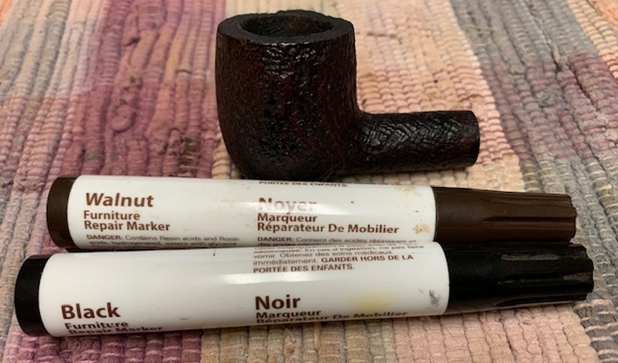
Jeff had cleaned up the pipe with his usual penchant for thoroughness. He reamed the pipe with a PipNet Pipe Reamer and cleaned up the remnants with a Savinelli Fitsall Pipe Knife.  He scrubbed the bowl with undiluted Murphy’s Oil Soap with a tooth brush. He rinsed it under running warm water to remove the soap and grime. He cleaned out the inside of the shank and the airway in the stem with alcohol, cotton swabs and pipe cleaners. He soaked the stem in Before & After Deoxidizer and rinsed it off with warm water. I took photos of the pipe once I received it. The rim top had some slight darkening on the back of the bowl and some damage to the inner edge on the back. The outer edge is rough on the front and the right side from knocking the pipe against something hard. It is hard to know if the rim top was rusticated or smooth from the damage on it. The back rim top looks like it may have been rusticated. The stem surface had deep tooth marks and chatter on both sides near the button.   I took a photo of the stamping on the heel of the bowl. It reads as noted above. I removed the stem and took a photo of the pipe to give a sense of the whole. The stem is tapered. I started my work on the pipe by cleaning up the inner edge and the rim top with 220 grit sandpaper. I was able to minimize the damage.  I topped the bowl on a topping board with 220 grit sandpaper to remove the damage to the rim top and outer edges of  the bowl. I used some clear super glue and briar dust to rebuild the front outer edge and the right side edge and then retopped the bowl. With the top and rim edge cleaned up I used my Dremel and the burrs shown in the photo below to rusticate the rim and try to approximate what was visible in the photos above. I finished the rustication with the wire brush on the Dremel as well. When I had it way I wanted I stained it with three stain pens mixed together to give the stain depth – Black, Walnut and Maple. The second photo below shows the rim top. What do you think? I rubbed the bowl and shank down with Before & After Restoration Balm. I worked it into the surface of the rim top, bowl sides and shank with my fingertips and a horsehair shoe brush to clean, enliven and protect the briar. I let the balm sit for 15 minutes and then buffed with a cotton cloth to raise the shine.     I set the bowl aside and turned to work on the stem. I filled in the deep tooth marks on the top and underside with black super glue and set the stem aside to let the repairs cure. Once the repair cured I used a rasp and a small file to flatten the repairs and recut the button edge on both sides. I sanded the stem smooth with a folded piece of 220 grit sandpaper to further blend them into the surrounding vulcanite. I started polishing with 400 grit wet dray sand paper. It was in very good condition so I polished the vulcanite stem with micromesh sanding pads – 1500-12000 grit pads. I wiped it down with a damp cloth after each sanding pad. I used Before & After Pipe Polish – both Fine and Extra Fine to further polish the stem. This restoration is for you Spencer, my fellow curmudgeon and friend… I already miss you greatly and find myself looking over where you used to lay and reaching for a treat and a rub behind your ears… The pipe is a big one with a big personality just like yours buddy. It is a Comoy’s Extraordinaire 804 Bent Billiard with a vulcanite taper stem. It is a great looking pipe now that it has been restored. I put the stem back on the bowl and lightly buffed the pipe with Blue Diamond on the buffing wheel. I gave the bowl multiple coats of Conservator’s Wax and the stem multiple coats of carnauba wax on the buffing wheel and followed that by buffing the entire pipe with a clean buffing pad. I hand buffed the pipe with a microfiber cloth to deepen the shine. The finished Comoy’s Extraordinaire is a real handful and feels great. Give the finished pipe a look in the photos below. The dimensions of the pipe are Length: 9 ½ inches, Height: 2 ½ inches, Outside diameter of the bowl: 1 ½ inches, Chamber diameter: ¾ of an inch. The weight of this pipe is 43g/1.52oz. This is one is a keeper and will go in my rack in memory of my old boy… Thanks for reading this blog and my reflections on the pipe while I worked on it.

Beautification for an American Made Bertram Washington DC Grade 30 Bent Bulldog


Blog by Steve Laug

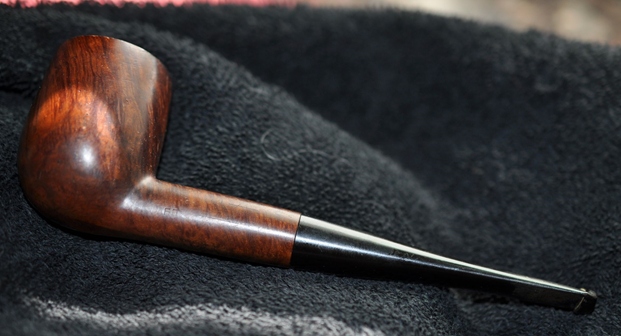
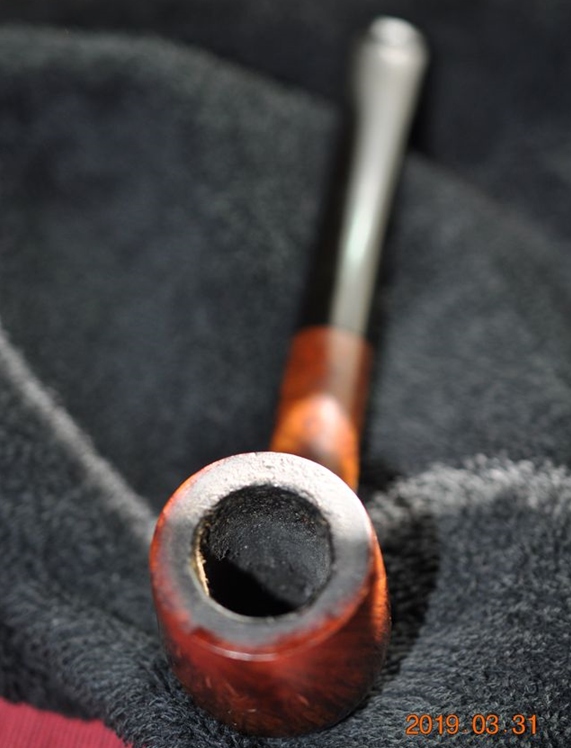
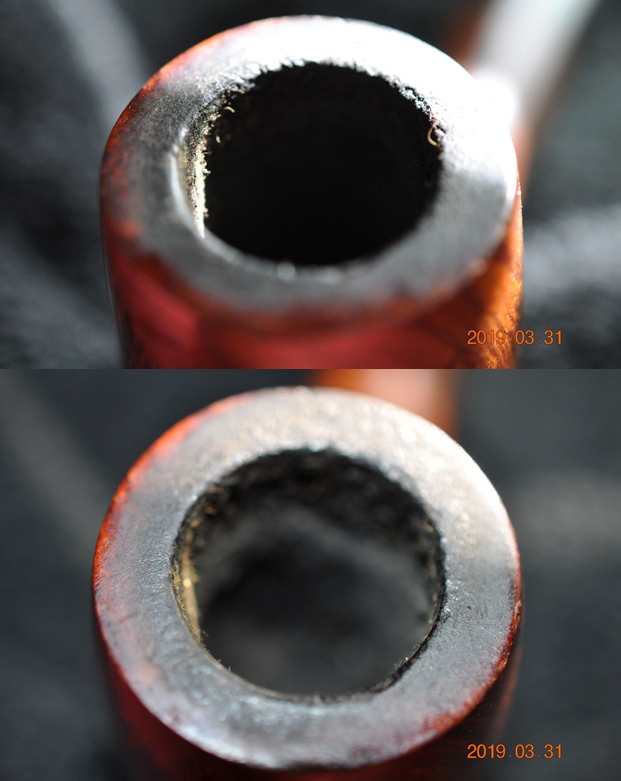
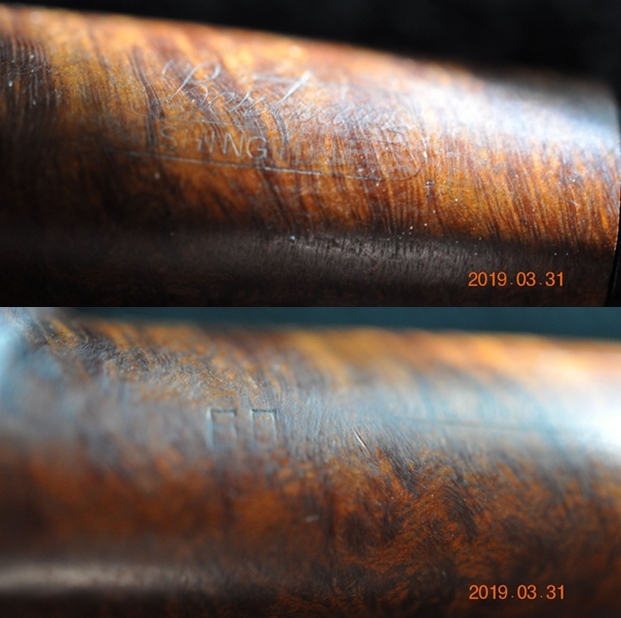
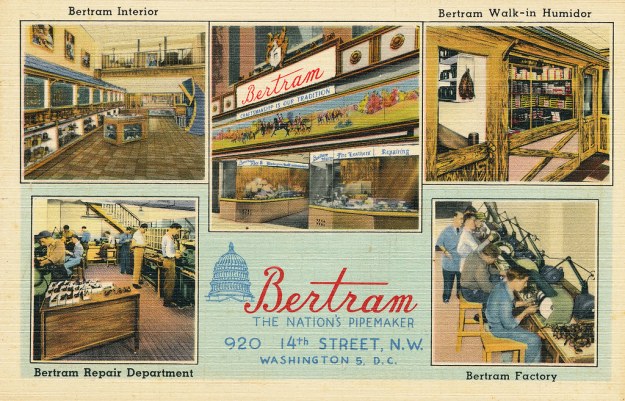
The next pipe on the work table came to me from one of our estate purchases. Between us we pick up quite a few pipes for restoration. I try to work them into the restoration queue so that I can keep them moving. We picked up over 120+ Bertram pipes from an estate that a fellow on the east coast of the US was selling. This next one is from that estate – a beautifully grained Bertram Bent Bulldog Grade 30 with a saddle vulcanite stem. The pipe is stamped on the top left side of the diamond shank and reads 30. Next to that it is stamped on the top of the left side of the diamond shank it is stamped Bertrams [over] a faintly stamped Washington D.C. centered on the shank. The finish had a lot of grime ground into the smooth finish on the bowl and some darkening around the sides of the bowl. There are also some nicks on the backside of the bowl toward the back top. The bowl was caked with an overflowing lava coat on the top of the rim, heavier toward the back of the bowl. The edges looked okay other than some potential burn damage on the back inner edge. The stem was lightly oxidized, dirty and had light tooth chatter and marks on the top and underside near the button. There were not markings or a logo on the taper stem. Like the rest of the Bertrams in this lot the pipe had promise but it was very dirty. Jeff took photos of the pipe before he started his cleanup work.     He took photos of the rim top and bowl to give a clear picture of the thickness of the cake and the lava on the rim top. The lava was thicker toward the back of the rim and there were remnants of tobacco on the walls of the thickly caked bowl. He also took photos of the top and underside of the stem to show the chatter and deep tooth marks. Otherwise the stem is quite clean. Jeff took photos of the sides and heel of the bowl to give a picture of what the briar around the pipe looked like. There is some stunning grain under the grime. There were also two notable fills – one on the back edge of the rim cap and one where the shank joins the bowl. He took a photo of the stamping on the shank. It reads as noted above and is clear and readable. The grade number is on the top of the left side near the bowl and reads 30. As I have worked on Bertrams I have written on the brand and have included the following information. If you have read it in past blogs, you can skip over it. If you have not, I have included the link to Bertram history and information. I would recommend that if you don’t know much about them take some time to read the background. I include a link to the write up on Pipedia (http://pipedia.org/wiki/Bertram). Bertram pipes were based out of Washington DC. They were popular among famous politicians and celebrities of the time. They made many products for them from FDR’s cigarette holders to Joseph Stalin’s favorite pipe. They were considered some of the best America had to offer till they finally closed their doors in the 70s. Bertram graded their pipes by 10s and sometimes with a 5 added (15, 25, 55 etc.), the higher the grade the better. Above 60s are uncommon and 80-90s are quite rare. I have worked on one 120 Grade billiard. I have several blogs that I have written on rebornpipes that give some history and background to Bertram pipes. (https://rebornpipes.com/2015/06/16/an-easy-restoration-of-a-bertram-grade-60-217-poker/). I have included the following link to give a bit of historical information on the pipe company. It is a well written article that gives a glimpse of the heart of the company. http://www.streetsofwashington.com/2012/01/bertrams-pipe-shop-on-14th-street.html#

From this information I learned that all of these Bertrams were made before the closure of the shop in the 1970s. This Bertram Bent Bulldog has a nice mix of grain around the bowl. This pipe has a 30 Grade stamp on it which I am sure explains the quality of the briar. But like many of these Bertrams the Grading system is a mystery to me.

Jeff had cleaned up the pipe with his usual penchant for thoroughness. He reamed the pipe with a PipNet Pipe Reamer and cleaned up the remnants with a Savinelli Fitsall Pipe Knife.  He scrubbed the bowl with undiluted Murphy’s Oil Soap with a tooth brush. He rinsed it under running warm water to remove the soap and grime. He cleaned out the inside of the shank and the airway in the stem with alcohol, cotton swabs and pipe cleaners. He soaked the stem in Before & After Deoxidizer and rinsed it off with warm water. I took photos of the pipe once I received it.    The rim top had some slight darkening on the back of the bowl and some damage to the inner edge on the back. The inner edge of the rim is out of round from the damage. The stem surface had deep tooth marks and chatter on both sides near the button.     I took a photo of the stamping on the shank. The shape number 30 is followed by the brand stamp Bertram Washington DC is on the top of the left side mid shank.I removed the stem and took a photo of the pipe to give a sense of the whole. The stem is tapered. I started my work on the pipe by cleaning up the inner edge and the rim top with 220 grit sandpaper. I was able to minimize the damage.  I used a Cherry Stain Pen to touch up the sanded areas and blend them into the bowl. I am still experimenting on the best time to stain. In this case I did it before polishing with micromesh to see how that would work. I polished the bowl and the rim top, sides and shank with micromesh sanding pads – wet sanding with 1500-12000 grit pads and wiping it down after each pad with a cloth.    I rubbed the bowl and shank down with Before & After Restoration Balm. I worked it into the surface of the bowl sides and shank with my fingertips to clean, enliven and protect the briar. I let the balm sit for a little while and then buffed with a cotton cloth to raise the shine.   I set the bowl aside and turned to work on the stem. Of all the Bertram stems I have worked on from this lot this pipe had the deepest tooth marks. I painted the surface with a lighter flame to lift them and made very little progress. I filled them in with black super glue and set the stem aside to let the repairs cure. Once the repair cured I sanded them smooth with a folded piece of 220 grit sandpaper to blend them into the surrounding vulcanite. I started polishing with 400 grit wet dray sand paper. It was in very good condition so I polished the vulcanite stem with micromesh sanding pads – 1500-12000 grit pads. I wiped it down with a damp cloth after each sanding pad. I used Before & After Pipe Polish – both Fine and Extra Fine to further polish the stem.   This Bertram Washington DC Grade 30 Bent Bulldog with a vulcanite saddle stem is a great looking pipe now that it has been restored. I put the stem back on the bowl and carefully buffed the pipe with Blue Diamond on the buffing wheel using a light touch on the briar. I gave the bowl and the stem multiple coats of carnauba wax on the buffing wheel and followed that by buffing the entire pipe with a clean buffing pad. I hand buffed the pipe with a microfiber cloth to deepen the shine. The finished Bertram 30 Bulldog fits nicely in the hand and feels great. Give the finished pipe a look in the photos below. The dimensions of the pipe are Length: 5 ½ inches, Height: 1 ½ inches, Outside diameter of the bowl: 1 ½ inches, Chamber diameter: ¾ of an inch. The weight of this pipe is 43g/1.52oz. If you are interested in adding this pipe to your collection send me a message or an email. Thanks for reading this blog and my reflections on the pipe while I worked on it. There are many more to come!
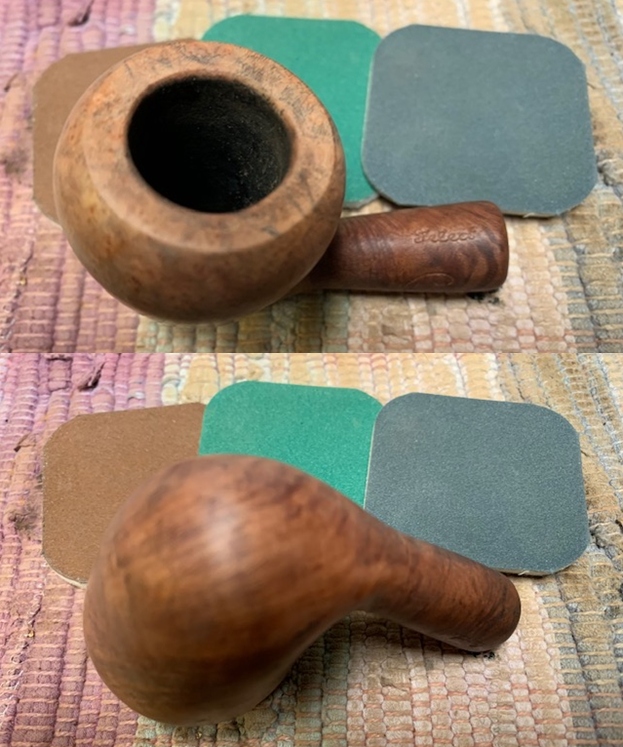
Beautification of another American Made Bertram Washington DC Grade 60 Squat Bulldog


Blog by Steve Laug

The next pipe on the work table came to me from one of our estate purchases. Between us we pick up quite a few pipes for restoration. I try to work them into the restoration queue so that I can keep them moving. We picked up over 120+ Bertram pipes from an estate that a fellow on the east coast of the US was selling. This next one is from that estate – a beautifully grained Bertram Squat Bulldog Grade 60 with a tapered vulcanite stem. The pipe is stamped on the lower left side of the diamond shank and reads 60. On the top of the left side of the diamond shank it is stamped Bertrams [over] a faintly stamped Washington D.C. centered on the shank. The finish had a lot of grime ground into the smooth finish on the bowl and some darkening around the sides of the bowl. There are also some nicks on the backside of the bowl toward the back top. The bowl was caked with an overflowing lava coat on the top of the rim, heavier toward the back of the bowl. The edges looked okay other than some potential burn damage on the back inner edge. The stem was lightly oxidized, dirty and had light tooth chatter and marks on the top and underside near the button. There were not markings or a logo on the taper stem. Like the rest of the Bertrams in this lot the pipe had promise but it was very dirty. Jeff took photos of the pipe before he started his cleanup work.          He took photos of the rim top and bowl to give a clear picture of the thickness of the cake and the lava on the rim top. The lava was thicker toward the back of the rim and there were remnants of tobacco on the walls of the thickly caked bowl. He also took photos of the top and underside of the stem to show the chatter and tooth marks. Otherwise the stem is quite clean. Jeff took photos of the sides and heel of the bowl to give a picture of what the briar around the pipe looked like. There is some stunning grain under the grime. There were also two notable fills – one on the shank end right side top and bottom.He took photos of the stamping on the shank. It reads as noted above and is clear and readable. The grade note is on the underside of the left and read 60. As I have worked on Bertrams I have written on the brand and have included the following information. If you have read it in past blogs, you can skip over it. If you have not, I have included the link to Bertram history and information. I would recommend that if you don’t know much about them take some time to read the background. I include a link to the write up on Pipedia (http://pipedia.org/wiki/Bertram). Bertram pipes were based out of Washington DC. They were popular among famous politicians and celebrities of the time. They made many products for them from FDR’s cigarette holders to Joseph Stalin’s favorite pipe. They were considered some of the best America had to offer till they finally closed their doors in the 70s. Bertram graded their pipes by 10s and sometimes with a 5 added (15, 25, 55 etc.), the higher the grade the better. Above 60s are uncommon and 80-90s are quite rare. I have worked on one 120 Grade billiard. I have several blogs that I have written on rebornpipes that give some history and background to Bertram pipes. (https://rebornpipes.com/2015/06/16/an-easy-restoration-of-a-bertram-grade-60-217-poker/). I have included the following link to give a bit of historical information on the pipe company. It is a well written article that gives a glimpse of the heart of the company. http://www.streetsofwashington.com/2012/01/bertrams-pipe-shop-on-14th-street.html#

From this information I learned that all of these Bertrams were made before the closure of the shop in the 1970s. This Bertram Squat Bulldog has a stunning a mix of grain around the bowl. This pipe has a 60 Grade stamp on it which I am sure explains the quality of the briar. But like many of these Bertrams the Grading system is a mystery to me.

Jeff had cleaned up the pipe with his usual penchant for thoroughness. He reamed the pipe with a PipNet Pipe Reamer and cleaned up the remnants with a Savinelli Fitsall Pipe Knife.  He scrubbed the bowl with undiluted Murphy’s Oil Soap with a tooth brush. He rinsed it under running warm water to remove the soap and grime. He cleaned out the inside of the shank and the airway in the stem with alcohol, cotton swabs and pipe cleaners. He soaked the stem in Before & After Deoxidizer and rinsed it off with warm water. I took photos of the pipe once I received it.   The rim top had some slight darkening on the back of the bowl but otherwise looked very good. The inner edge of the rim looked very good with no damage. The stem surface looked very good with a few small tooth marks and chatter on both sides near the button.   I took a photo of the stamping on the shank. Bertram (Washington DC is stamped faintly) is toward the top of the left side mid shank. On the underside of the shank is stamped the Grade 60 number.     I removed the stem and took a photo of the pipe to give a sense of the whole. The stem is tapered. I started my work on the pipe by cleaning up the inner edge and the rim top with 220 grit sandpaper. I was able to remove the damage.   I polished the bowl and the rim top, sides and shank with micromesh sanding pads – wet sanding with 1500-12000 grit pads and wiping it down after each pad with a cloth.  I rubbed the bowl and shank down with Before & After Restoration Balm. I worked it into the surface of the bowl sides and shank with my fingertips to clean, enliven and protect the briar. I let the balm sit for a little while and then buffed with a cotton cloth to raise the shine.   I set the bowl aside and turned to work on the stem. It was in very good condition so I polished the vulcanite stem with micromesh sanding pads – 1500-12000 grit pads. I wiped it down with a damp cloth after each sanding pad. I used Before & After Pipe Polish – both Fine and Extra Fine to further polish the stem.  This Bertram Washington DC Grade 60 Squat Bulldog with a vulcanite taper stem is a great looking pipe now that it has been restored. I put the stem back on the bowl and carefully buffed the pipe with Blue Diamond on the buffing wheel using a light touch on the briar. I gave the bowl and the stem multiple coats of carnauba wax on the buffing wheel and followed that by buffing the entire pipe with a clean buffing pad. I hand buffed the pipe with a microfiber cloth to deepen the shine. The finished Bertram 60 Bulldog fits nicely in the hand and feels great. Give the finished pipe a look in the photos below. The dimensions of the pipe are Length: 5 ¾ inches, Height: 1 ½ inches, Outside diameter of the bowl: 1 ½ inches, Chamber diameter: ¾ of an inch. The weight of this pipe is 40g/1.41oz. If you are interested in adding this pipe to your collection send me a message or an email. Thanks for reading this blog and my reflections on the pipe while I worked on it. There are many more to come!
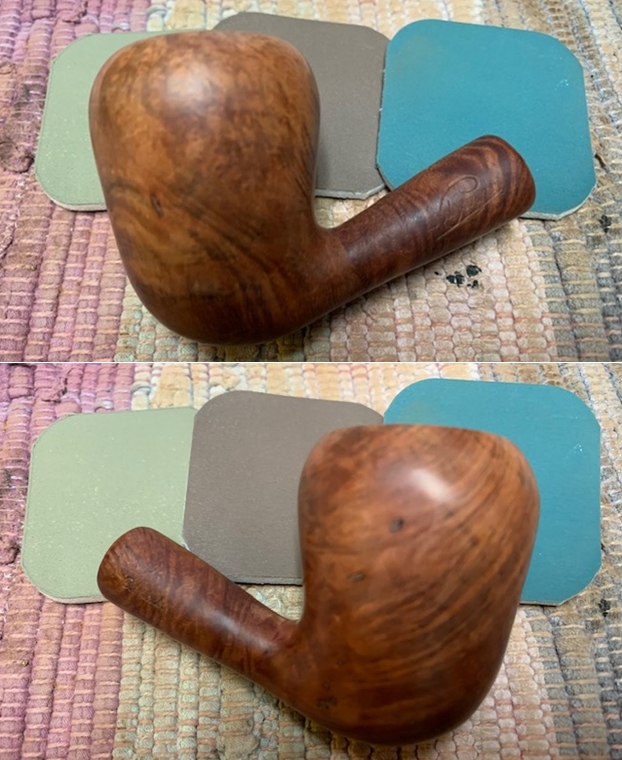
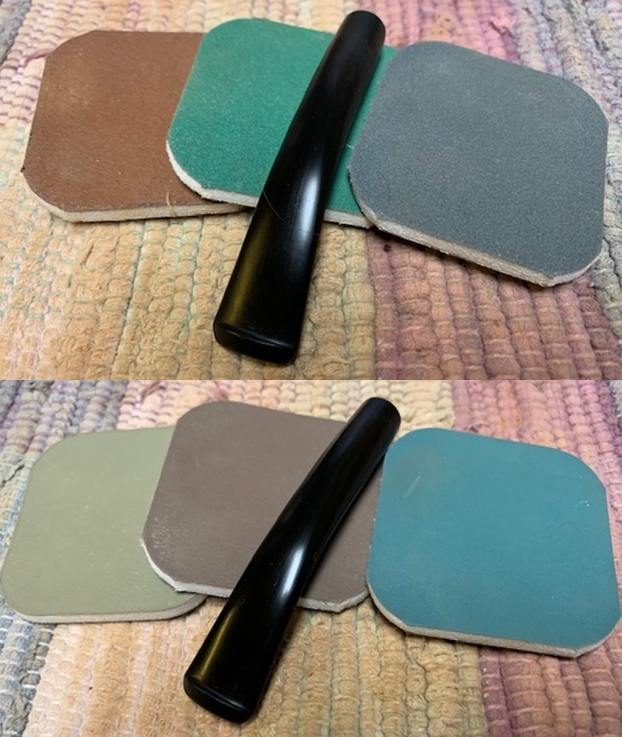
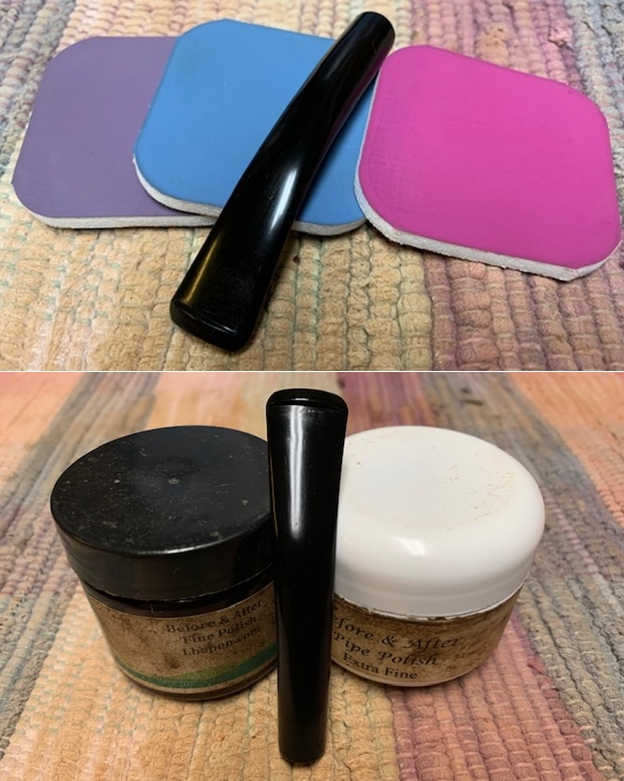
Refurbishing A C1977 Barling # 5264, T.V.F Square Shanked Pot


Blog by Paresh

The next pipe that I decided to work on is a classic Pot shaped pipe with a square shank that boasts of beautiful mix of straight and smattering of Bird’s eye grain all around the stummel surface. The flat bottom of the stummel, which also bears the stampings, makes it a perfect sitter. This pipe is stamped on the flat bottomed shank surface as “Barling” in script over “5264” over “LONDON ENGLAND” in block capital letters. The flat right side of the square shank is stamped “T.V.F”. The stampings are all crisp and deep. A sterling silver ferrule at the shank end breaks the monotony of the darkened stummel and the black of the vulcanite stem. The ferrule is stamped as “STERLING” over “SILVER” over “E.B” over “W.B” over the three hallmarks in a cartouche. There is a lion, a leopard head, and the lower case letter “c”. The leopard head identifies the city of the Assaying to be London, England. The lion is the mark for 0.925 Sterling Silver and the letter “c” is the date stamp. The trademark Barling cross adorns the top surface of the saddle of the vulcanite stem. The size, shape and feel of the pipe are solid to the touch. Barling’s pipe brand has been well researched and chronicled on pipedia.org and by Steve when he worked on many of Barling’s pipes over decades and thus, shall not waste time in repeating the information that is available. I too have carefully read and researched this brand as I do have many pipes that I have inherited and date this pipe as being a Corporate Era pipe. I have based my conclusions based on the following facts that I have read on pipedia.org (https://pipedia.org/wiki/Barling)
Early Corporate Era Nomenclature

A script Barling logo replaces the block “Barling’s Make” logo. Makes sense, no Barlings are making pipes.

The pipes retain the 4 digit model number introduced in mid 1962, but they also introduce a size 1, which means that there are 4 digit numbers beginning with a 1. The model number is placed right below the Barling logo.

The words LONDON ENGLAND are stamped below the model number. The “MADE IN ENGLAND.” Stamp is discontinued.
Ye Olde Wood and TVF have both been discontinued. They will return in the mid 1960’s.

The Corporate Era pipes all bear a script “Barling” logo with no apostrophe and no “s”. Since these pipes share the same markings as others manufactured as late as 1970 and beyond, it is difficult to distinguish which are made from Family Era materials and which are not. One clue is the absence of a TVF stamp. Initially, the TVF stamp was dropped, but it was back in use as early as 1965, if not earlier.

The hallmarked sterling silver band and cap helps in the dating with great accuracy and the first site that I visit is www.silvercollection.it

I browsed through the alphabetical listing of maker’s mark for E.B over W.B without frame and narrowed it down to as being Edwin Barling and William Barling. Here is the link to the information http://www.silvercollection.it/englishsilvermarksXE2.html

I captured a screen shot of the information that was available and have reproduced it below. Next I followed the link to the dating guide of the London Assay Office to date this pipe. I have included a hallmark chart for dating the pipe. I put a red rectangle around the letter for 1977. It is the same style of “c” and the cartouche that holds the letter stamp, matches the photo as well.http://www.silvercollection.it/englishsilverhallmarks.html

Thus, it is with certainty that I can now say that this pipe is from the Corporate Era with 1977 hallmarked year. Though not from the family era, the pipe still has the classic shape, draw and feels nice in the hand that Barling’s pipes are so famous for.

Initial Visual Inspection
This pipe has a decent medium bowl size with chamber depth of about 1 7/8 inches and thick walls. The stummel boasts of some beautiful straight and mixed grains all around. The stummel is covered in dirt and grime of the overflowed lava and dirt accumulated over the years of heavy smoking and uncared for attention to cleaning and maintenance. There is a decent layer of cake in the chamber with lava overflow over rim top and a chip and charring to the inner rim edges. The stem is heavily oxidized with very minor tooth chatter in the bite zone on either surface. The pipe’s appearance, as it sits on my work table, does present an encouraging picture. Detailed Inspection Of The Pipe And Observations
The bowl has a wide rim with thick chamber walls and has a chamber depth of about 1 7/8 inches. The draught hole is at the bottom and center of the chamber and this construction should make this pipe a great smoke. The chamber has an even layer of hard cake. The rim top surface is covered with thick lava overflow and through this layer of lava a few dings can be seen over the rim top surface. The inner rim edge appears dark and I suspect charred inner rim edge in 12 o’clock, 10 o’clock and 6 o’clock directions (encircled in yellow). The outer edge too has a few minor dings, but is otherwise in pristine condition. The condition of the inner walls of the chamber can be commented upon after the cake has been taken down to the bare briar. The stummel appears solid to the touch all around and hence I do not foresee any serious damage to the walls in the form of burnout/ deep heat fissures/ lines or pits. The dark inner rim edges, in 12, 10 and 3 o’ clock directions, may be charred further than anticipated and the same will be confirmed after the surface has been thoroughly cleaned. I need to resort to topping the rim top in order to address the damage to the rim top surface. The faint ghost smells should reduce once the cake from the chamber is removed and the shank has been cleaned.The smooth stummel has a classic Pot shape with a chamber that is evenly broad right down to the bottom/ foot of the stummel. The square shank has a sterling silver ferrule at the end. The surface is covered in dust, lava overflow and grime through which one can make out the beautiful (predominantly) thin straight grains. There are a few minor fills in the briar surface; one at the heel and couple others in the left panel of the square shank (all encircled in yellow). The briar is looking lifeless and bone dry. For a pipe that has been so heavily smoked, there are surprisingly no dents and ding over the stummel surface. The mortise shows accumulation of dried oils, tars and gunk. Once the stummel has been thoroughly cleaned, any other damage or flaws (which I think there will be none) will come to the fore. I shall check the fills for softness once the stummel surface has been cleaned and refresh these fills if required. Thorough cleaning and rising of the stummel under warm water will highlight the grain patterns. Micromesh polishing will help in imparting a nice shine to the briar. The high quality vulcanite square saddle stem is so heavily oxidized that it appears brownish green in color! Minor tooth chatter can be seen in the bite zone with calcification at base of the buttons. The horizontal slot end is clogged with dried gunk. The trademark crossed Barling stem logo is sufficiently deep and needs to be highlighted. Overall, given the vintage of the pipe and the fact that it has been well smoked, the stem is in a pretty decent shape and with a little elbow grease, it should polish up pretty well. The Process
I started the restoration of this pipe by first addressing the stem issues. It has been my experiences that stem repairs and polishing almost always takes the maximum time in the complete restoration. I first clean out the stem internals using hard bristled and regular pipe cleaners dipped in isopropyl alcohol. With a sharp dental tool, I pry out the entire gunk from the horizontal slot. To save on the pipe cleaners, I clean the stem internals with a thin shank brush and dish washing soap and finally rinsing it with warm water. Next, I addressed the deeper oxidation by sanding the entire stem with a folded piece of 180 followed by 220 grit sand papers. Once the oxidation was completely removed, I wiped the surface clean with Murphy’s oil soap on a cotton swab. I rubbed a little Extra Virgin Olive oil to hydrate the stem and kept it aside. I used a tightly folded piece of 180 grit sand paper to shape and re-define the button edge on either surface. The stem at this point in restoration is shown below. Thereafter began the arduous and time consuming process of sanding the stem with 320, 400, 600 and finally 800 grit sandpapers. I wet sand the entire stem with a piece of 1000 grit sand paper. I rubbed a generous quantity of EVO deep in to the vulcanite and set the stem aside for the oil to be absorbed in to the surface. All through the stem refurbishing process, I was particularly careful about preserving the stem logo of crossed Barling. This made the entire process a bit too tedious but it is always worth the effort as the vintage value and originality of the pipe is preserved. To bring a deep shine to the vulcanite stem, I polished the stem by wet sanding with 1500 to 12000 grit micromesh pads. I wiped the stem with moist cloth after each pad. I rubbed a little quantity of “Before and After Fine/ Extra Fine” stem polish. This product developed by Mark Hoover helps to remove minor scratches from the stem surface while further eliminating what little oxidation that remained on the stem surface. I rubbed it down with Extra Virgin Olive oil to rejuvenate the vulcanite. The finished stem is shown below. I am pretty pleased with this appearance of the stem.With the stem refurbishing completed, I worked on the stummel by scraping the chamber with my fabricated knife to remove the carbon deposits from the walls. I also scraped out the lava overflow from the rim top surface. Once the cake was reamed back to the bare briar, I used a 150 grit sand paper followed by 220 grit sand paper to remove all the traces of remaining cake and also to smooth out the inner walls of the chamber surface. Finally, to remove the residual carbon dust, I wiped the chamber with a cotton pad wetted with 99.9% pure isopropyl alcohol. The inner rim edge was charred in 6 o’clock, 10 o’clock and 12 o’clock direction which have been encircled in yellow. I scrapped off the charred briar from these areas and now the chamber is out of round. The chamber walls are solid and in pristine condition with no heat lines/ fissures. I shall give the inner rim edge a slight bevel to get the bowl back to a perfect round and mask the damage. The ghost smells are considerably reduced and should be eliminated once the shank and mortise internals are cleaned. The rim top surface is still considerably darkened and would need to be thoroughly cleaned to know the exact damage to the surface. I followed up the reaming of the chamber with cleaning the mortise using cue tips, pipe cleaners and shank brush dipped in isopropyl alcohol. I scraped the walls of the mortise with dental tool to remove the dried oils and tars. The ghost smells are now greatly reduced and should be eliminated completely when the shank internals are cleaned with shank brush and dish washing soap. With the bowl internals clean, I move to clean the exterior of the stummel. I used a hard bristled tooth brush and Murphy’s Oil soap to scrub the stummel and rim top. I washed the stummel under running warm water with anti oil dish washing detergent till the stummel surface was clean. I simultaneously cleaned the shank internals with the detergent and hard bristled shank brush and dried it using paper towels and soft cotton cloth. I set the stummel aside to dry out naturally. As anticipated, this thorough cleaning of the shank eliminated the strong ghost smells from the chamber and now the pipe smells clean and fresh. The stummel surface has cleaned up nicely and the beautiful grain patterns are now on full display. The rim top surface has darkened and is uneven. I shall have to resort to topping to address these damages. There are two fills which appear to have softened and would need to be refreshed. I continued with the stummel repairs and addressed the issue of refreshing the two fills; one at the heel another on the left side panel of the square shank. With a sharp dental tool, I gouged out the fill in the left side panel of the shank and one at the heel of the stummel. Using the layering method, I filled these gouges with a mix of briar dust and CA superglue till the mound of the mix was slightly above the rest of the stummel surface. This helps in a better blending of the fill with the rest of the stummel surface while sanding and reduces the scratches caused by the use of a needle file as you have a correct perspective of the sanding that is required. I set the stummel aside for the fills to cure. Once the fills had hardened (which was almost immediately), using a flat head needle file I sand the fill till I had achieved a rough match with the surrounding stummel surface. I sand the fills with a piece of 220 grit sand paper to further blend the fills with the rest of the stummel surface.Next, I addressed the darkened and uneven rim top surface.I topped the rim top over a piece of 220 grit sand paper till I had a smooth even surface and the darkened surface was greatly reduced. The damage to the inner rim edge in 6 o’clock, 10 o’clock and  3 o’clock direction were also addressed to a great extent. I am very happy with the appearance of the rim top and rim edges at this stage of restoration. The charred surfaces will be addressed by creating a nice bevel over the inner rim edge. With a folded piece of 220 grit sand paper pinched between my thumb and forefinger, I carefully gave a bevel to the inner rim edge and addressed the issue of charred inner rim edge. The rim top surface and the edges look very neat at this stage with the bowl in a nice round shape. Next, I sand the entire stummel with a piece of 220 grit sand paper to address the minor scratches and dings that would otherwise show after micromesh polishing cycle. This also helped in fine blending of the fills with the rest of the stummel surface. I am very pleased with the progress made thus far.  I followed it by wet sanding the stummel with 1500 to 12000 grit micromesh pads, wiping frequently with a moist cloth to check the progress. I also polished the sterling silver ferrule at the shank end with the micromesh pads to a nice shine. Next, I rubbed a small quantity of “Before and After Restoration Balm” deep in to the briar with my finger tips and let it rest for a few minutes. The balm almost immediately works its magic and the briar now has a nice vibrant appearance with the beautiful grain patterns displayed in their complete splendor. I further buffed it with a horse hair brush and gave a vigorous buff with a microfiber cloth to deepen the shine. The dark browns of the fine straight grains spread across the stummel makes for a visual treat. It really is a nice piece of briar.   The only cosmetic, yet important aspect that remained was to refresh the stem logo. I applied a coat of white correction ink over the logo and once dried, I gently wiped it with a cloth. The logo is now clearly visible.I mount a cotton cloth buffing wheel on to my hand held rotary tool and polished the stummel and stem with Blue Diamond compound. This compound helps to remove the minor scratch marks that remain from the sanding and polishing. Next, I mount another cotton buffing wheel that I have earmarked for carnauba wax and applied several coats of the wax. I finished the restoration by giving the entire pipe a rigorous hand buffing using a microfiber cloth to raise the shine further. The finished pipe looks amazingly beautiful and coupled with the size, heft and the hand feel, makes it quite a desirable pipe. P.S. This was a project that I was looking forward to work on and research since the stampings on the stummel and that on the sterling silver ferrule, prima facie, appeared to be at a variance with each other. The stampings on the stummel pointed to corporate era made pipe whereas the E.B over W.B stamping on the sterling silver ferrule made me believe (incorrectly though) this pipe to be a Family era made. However, at the end of my research, all the stampings matched up perfectly. This pipe should make an interesting addition to collection of Barling’s pipe.

I wish to thank each one for sparing their valuable time to read through this write up and each one is my prayers. Stay home…stay safe!!