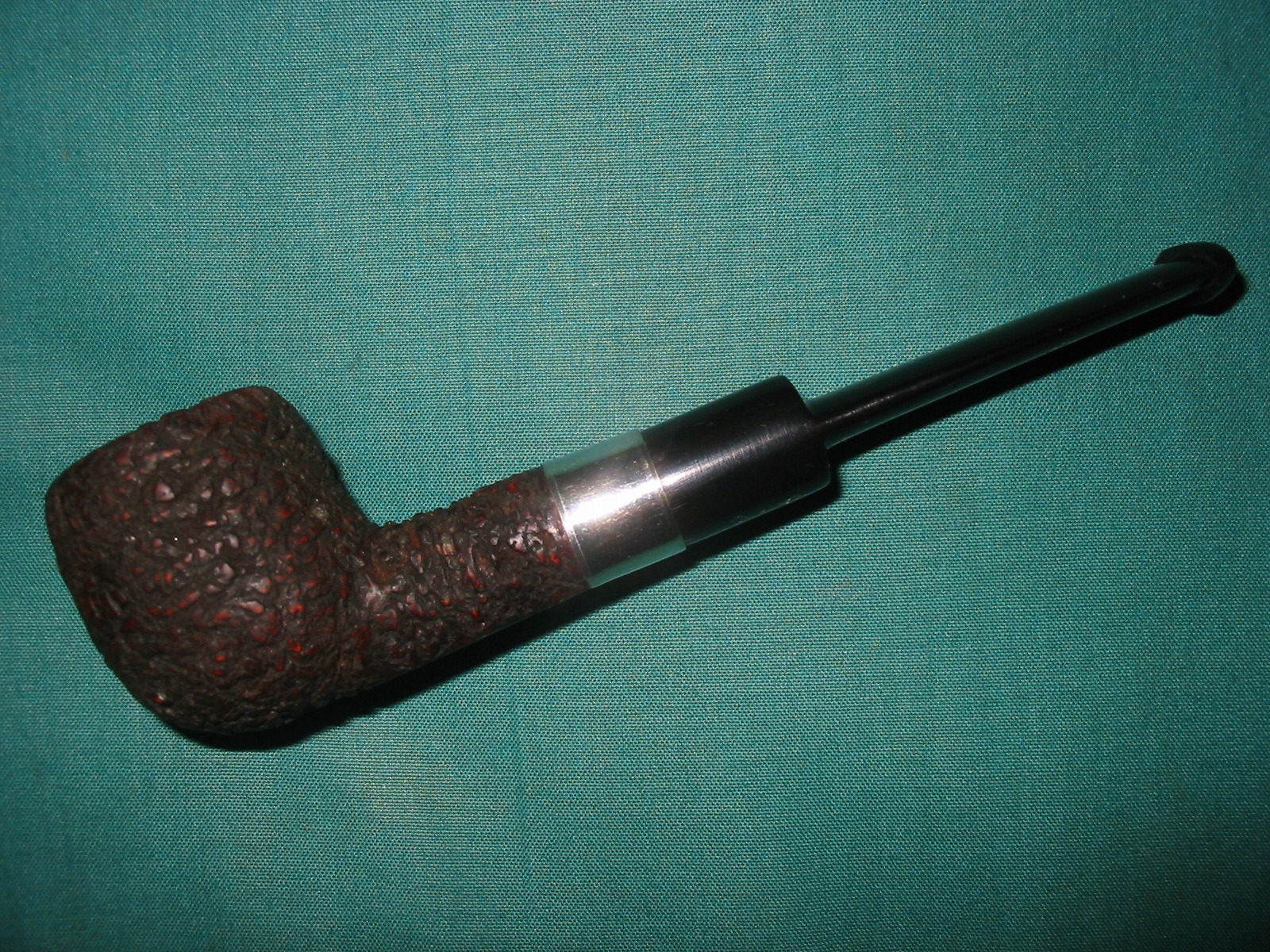
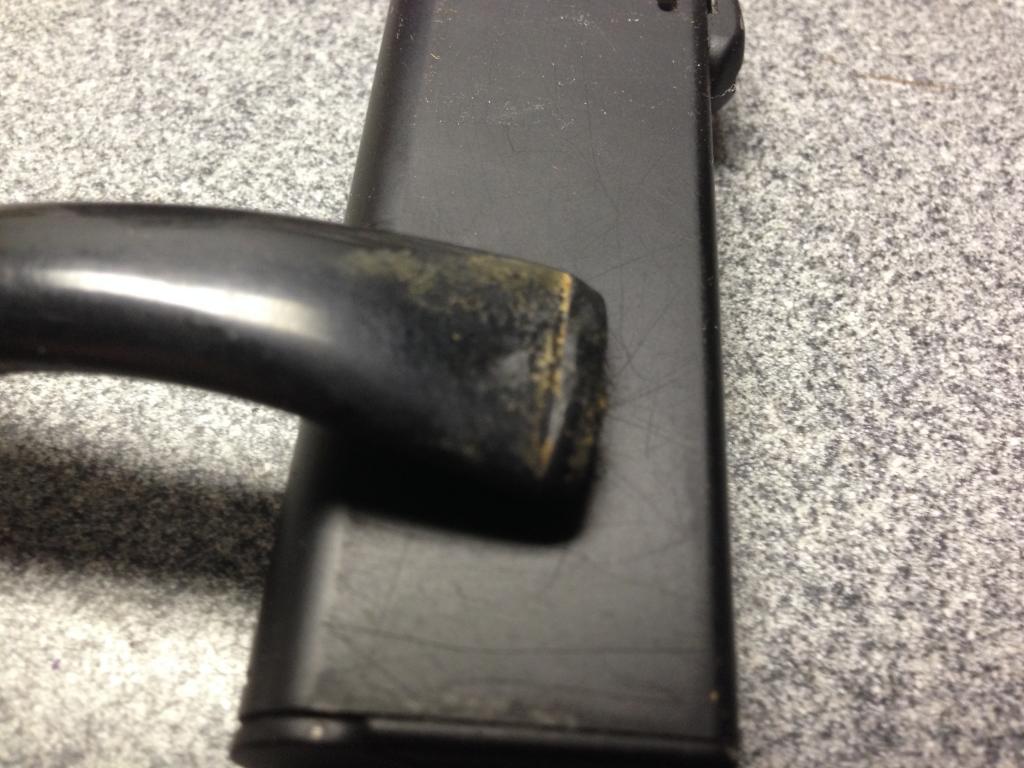
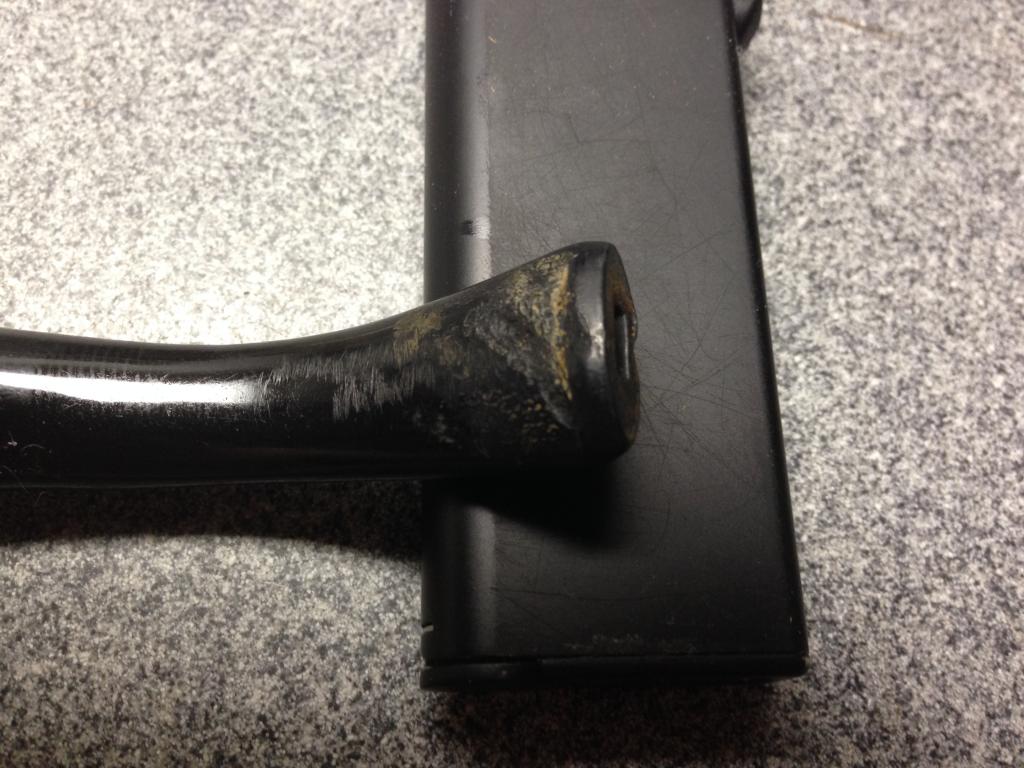
Tag Archives: Stem repairs

Replacing a tenon in a stem with a minimum of tools


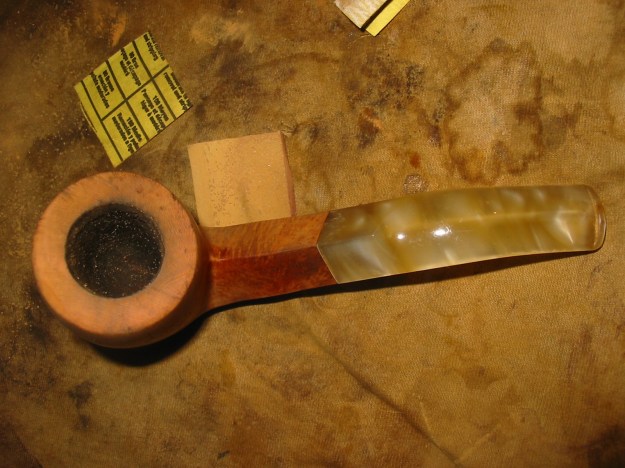
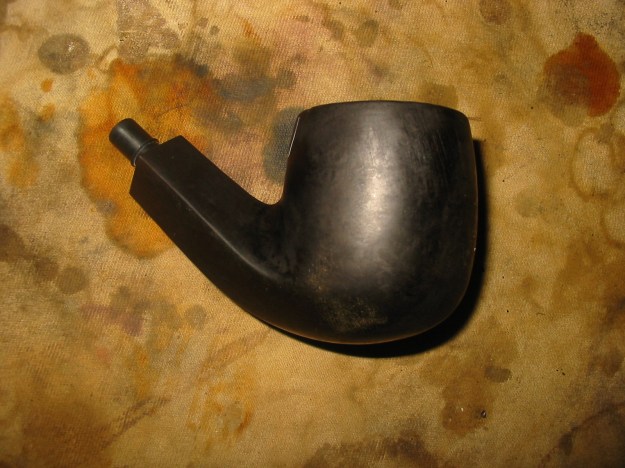
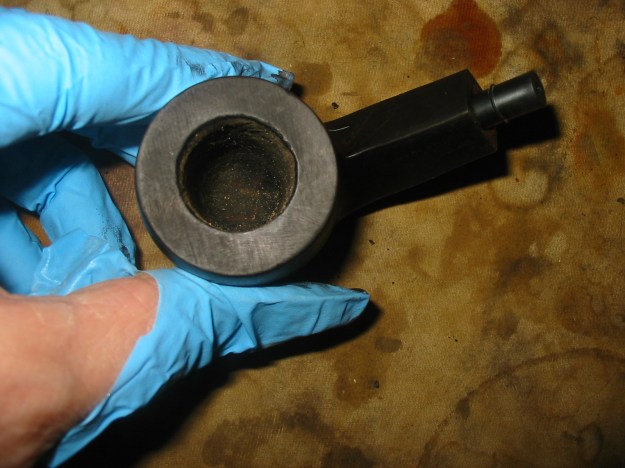
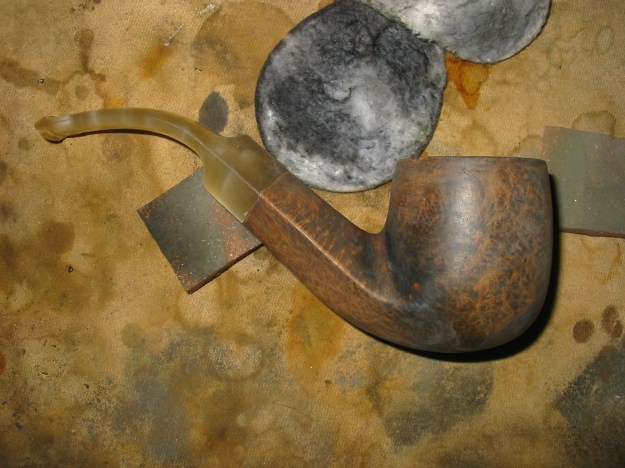
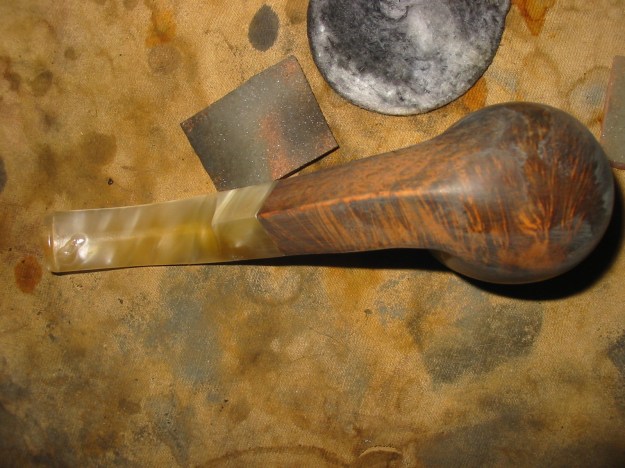
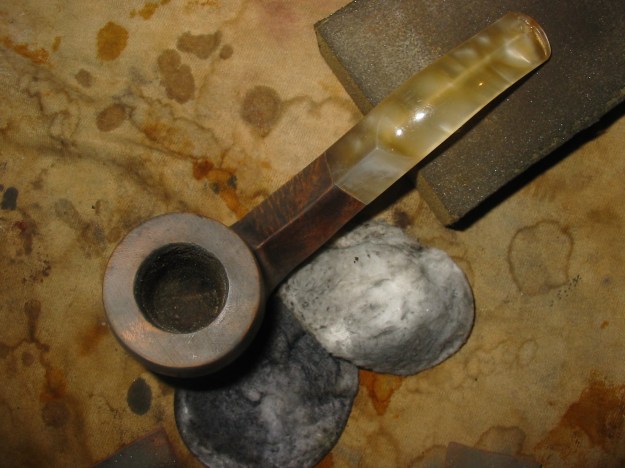
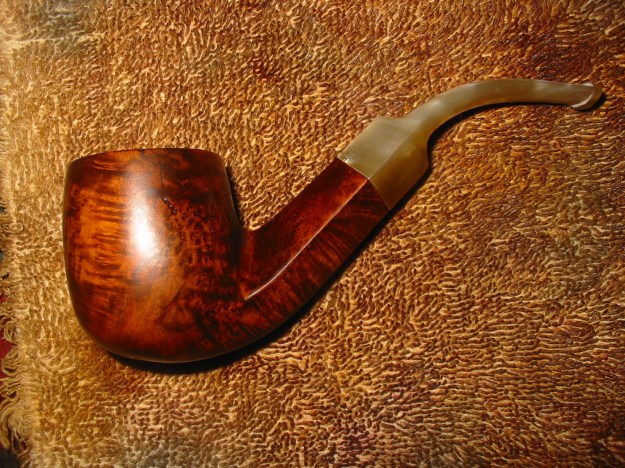
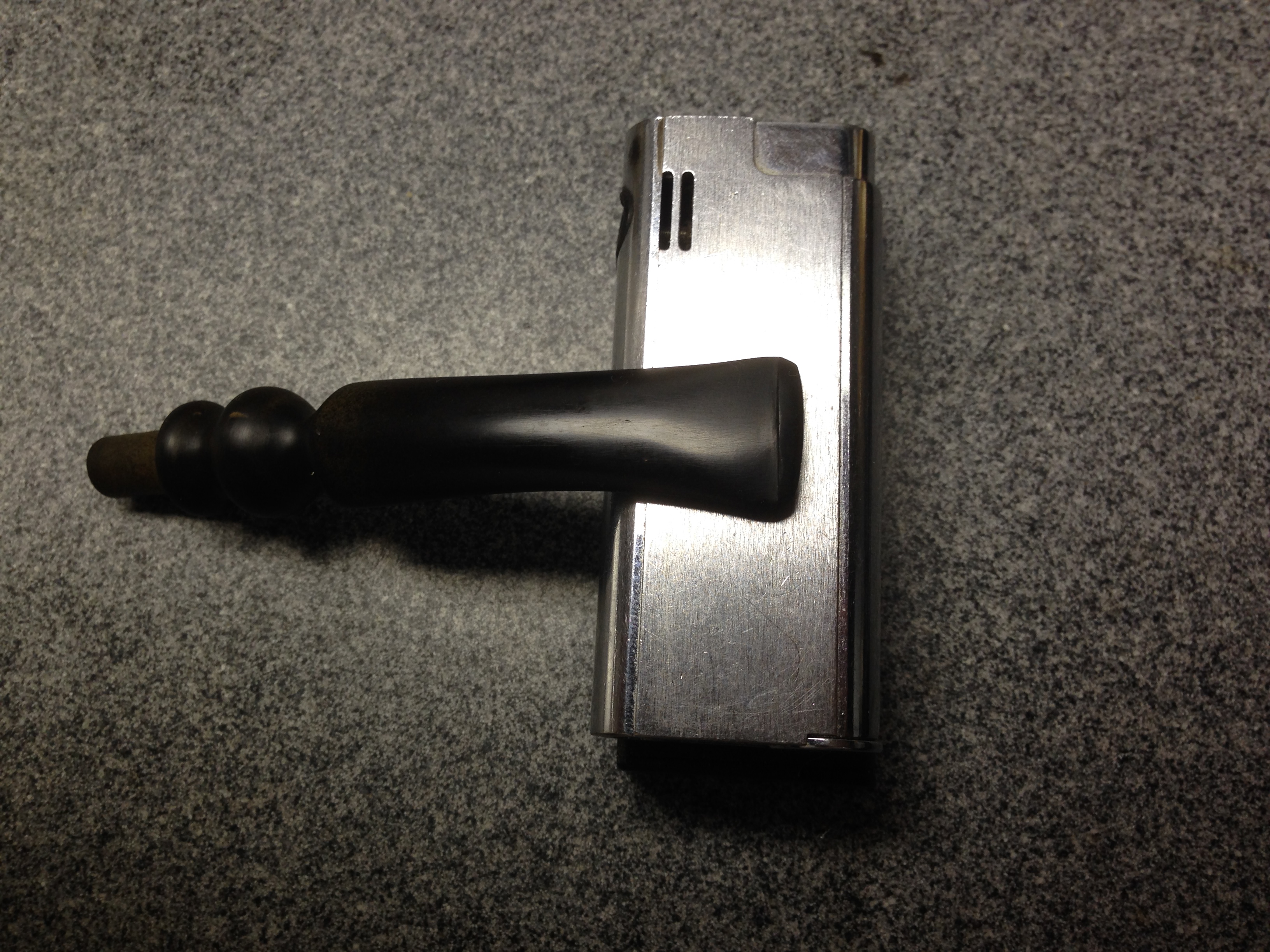
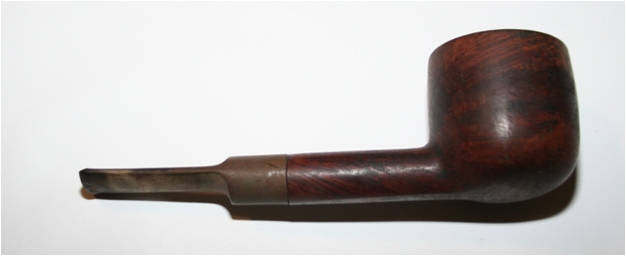
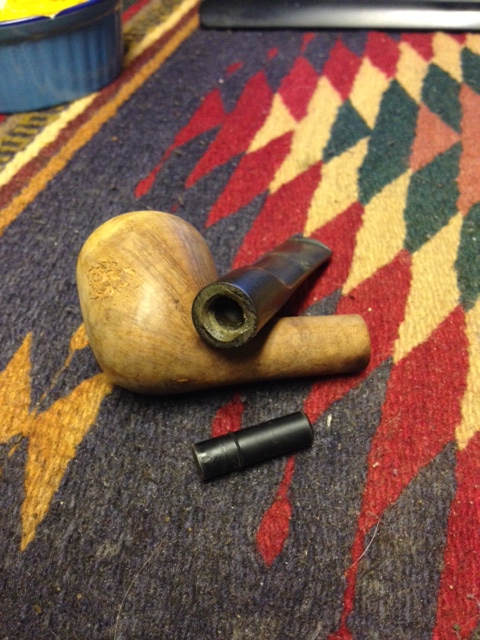
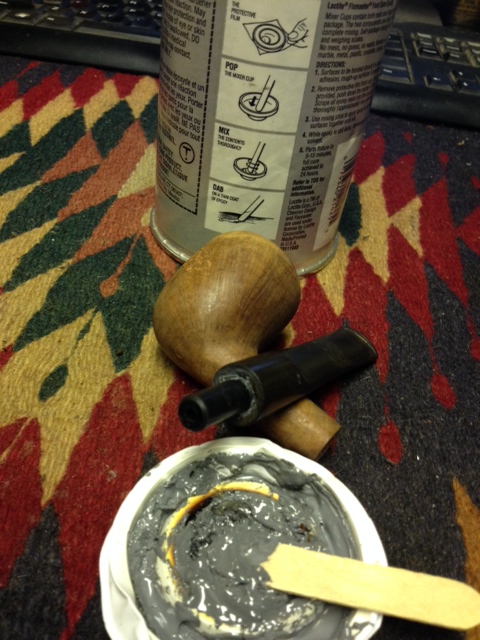
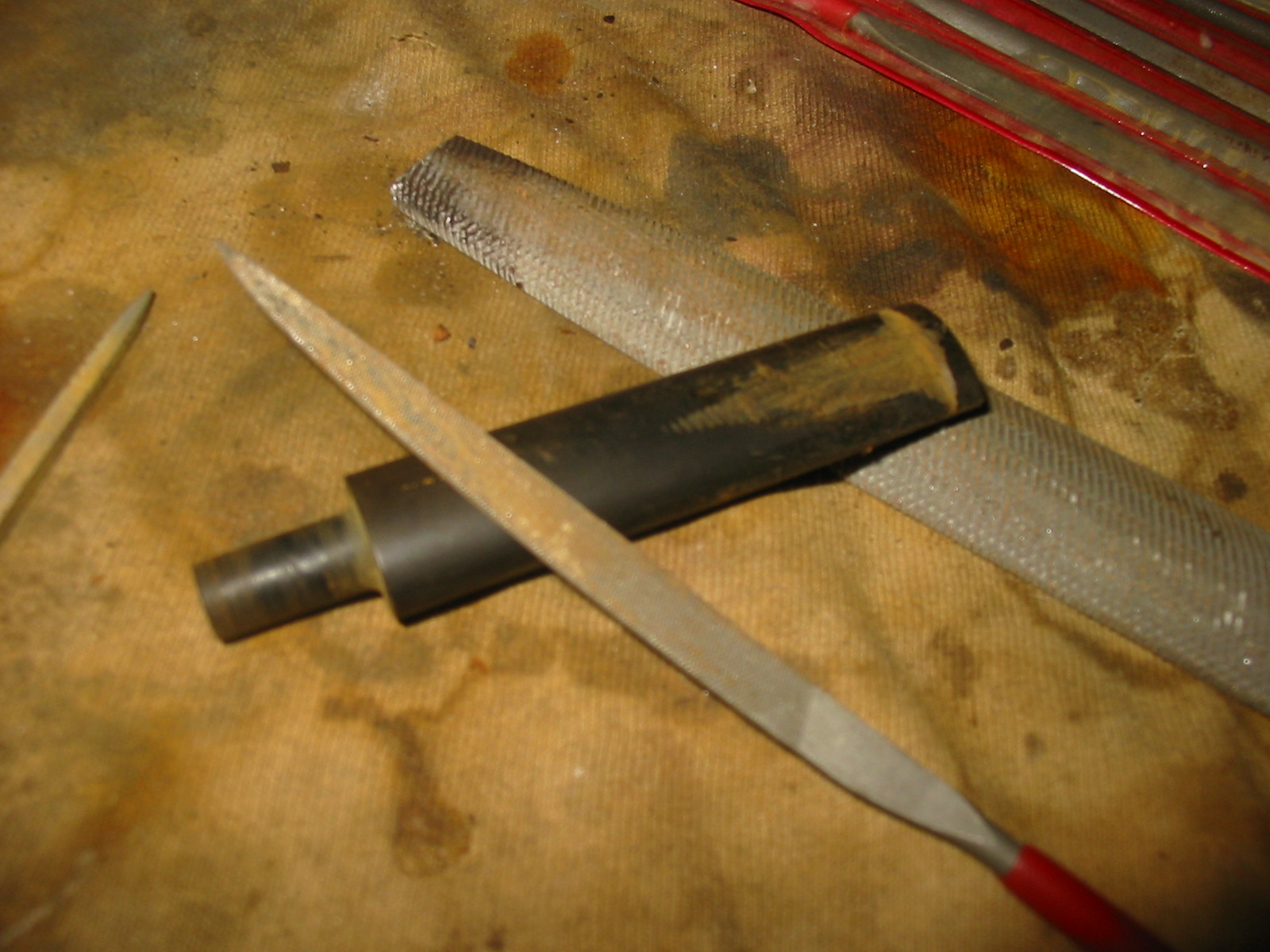
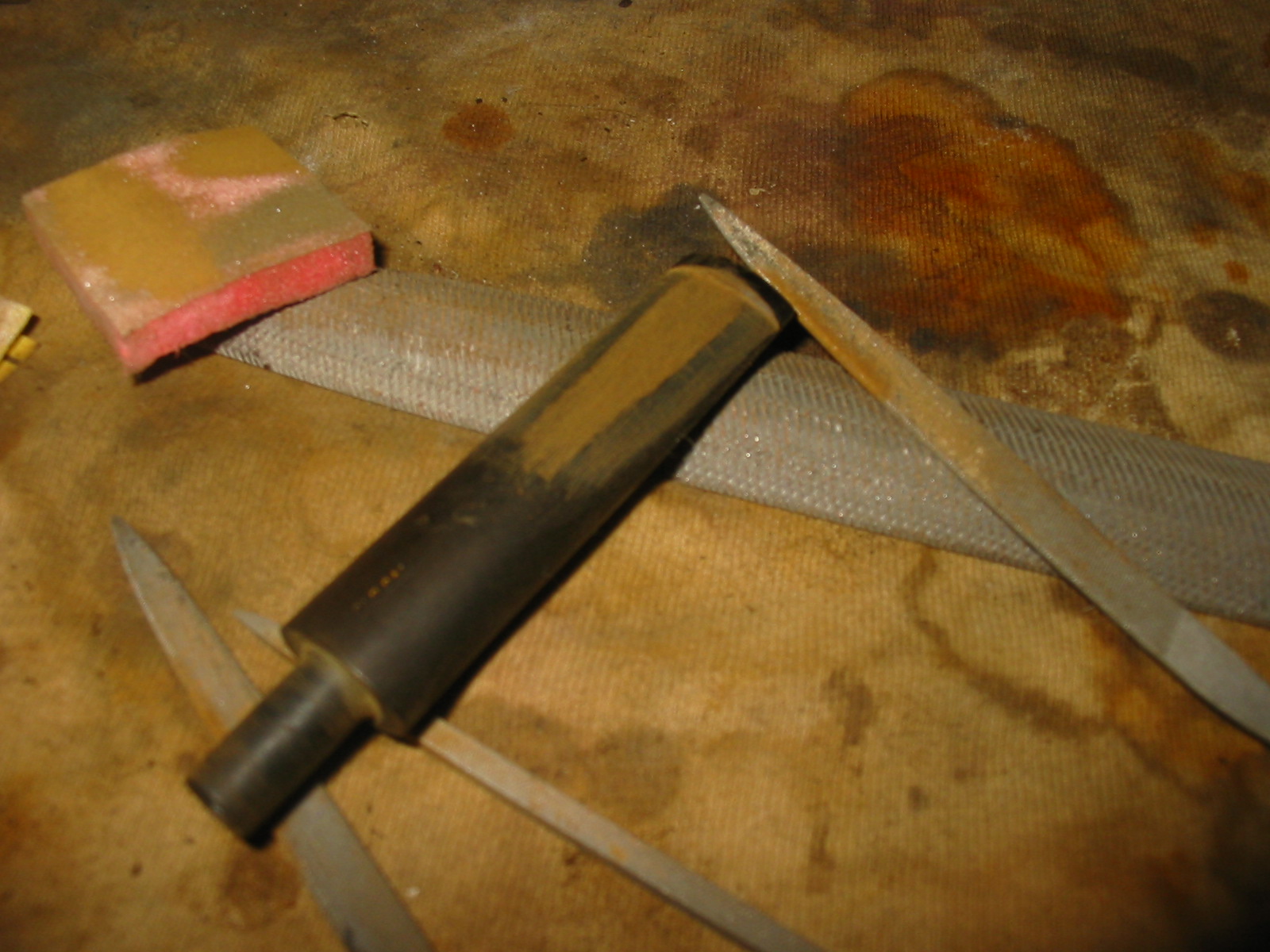
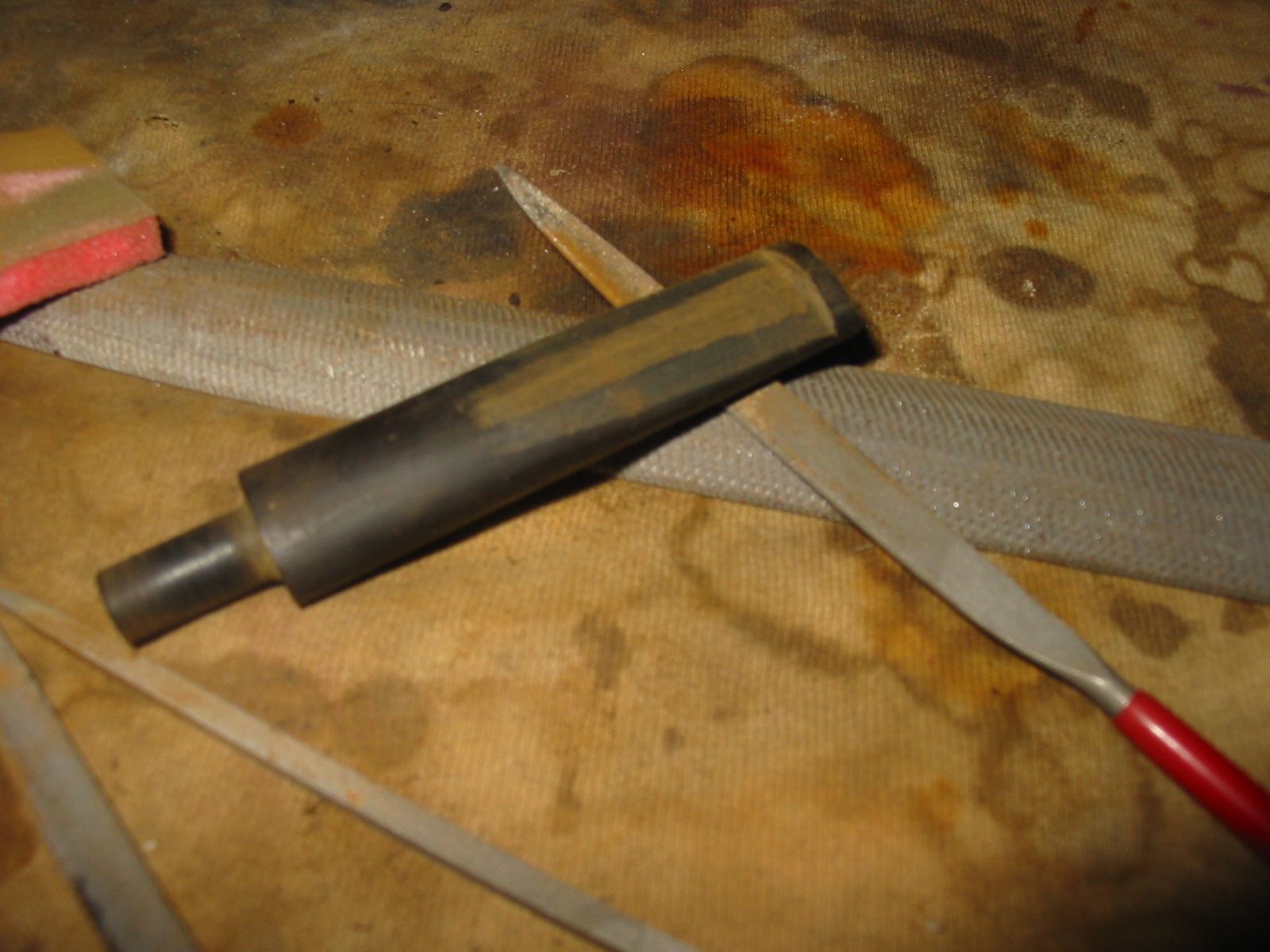
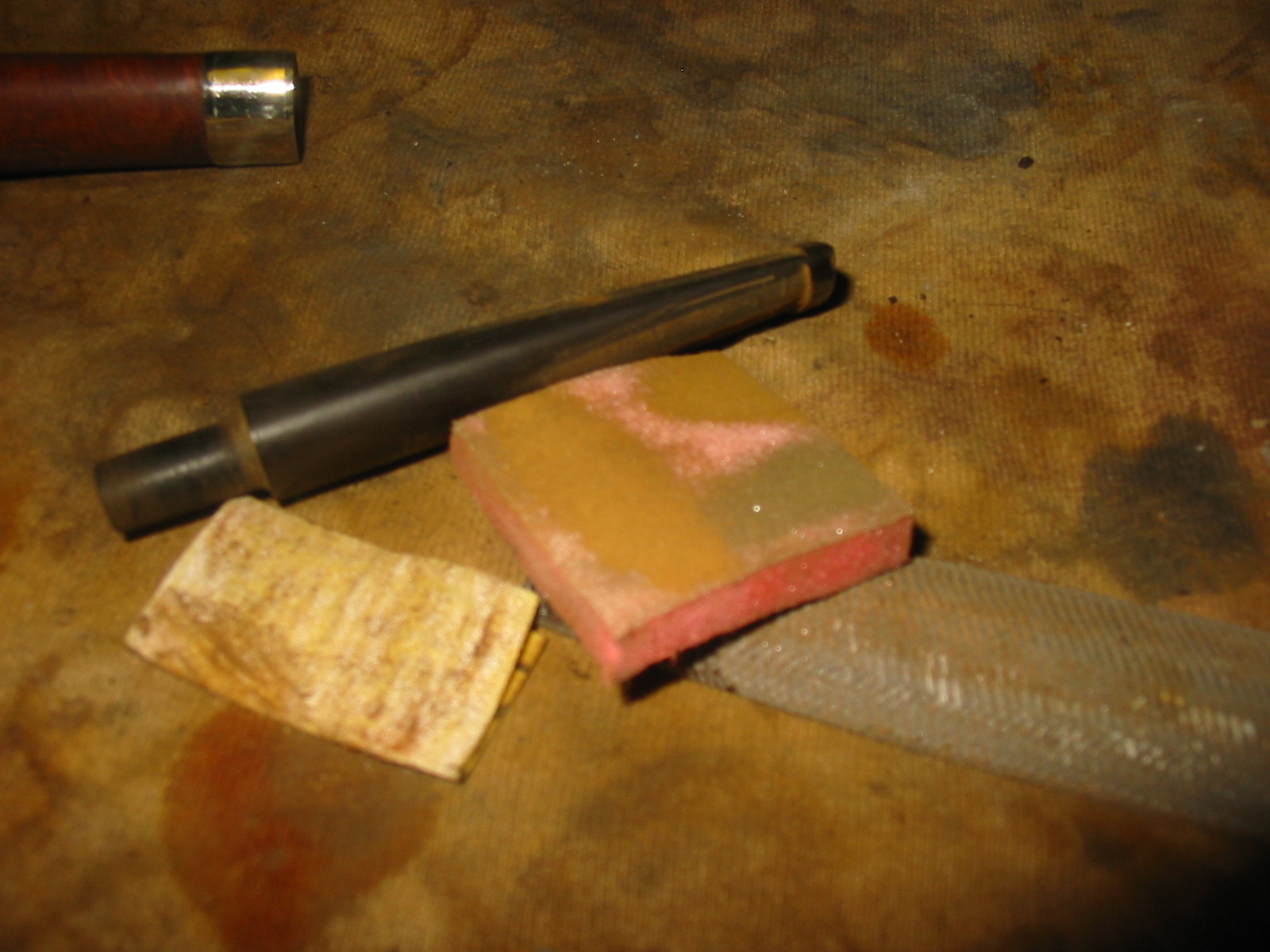
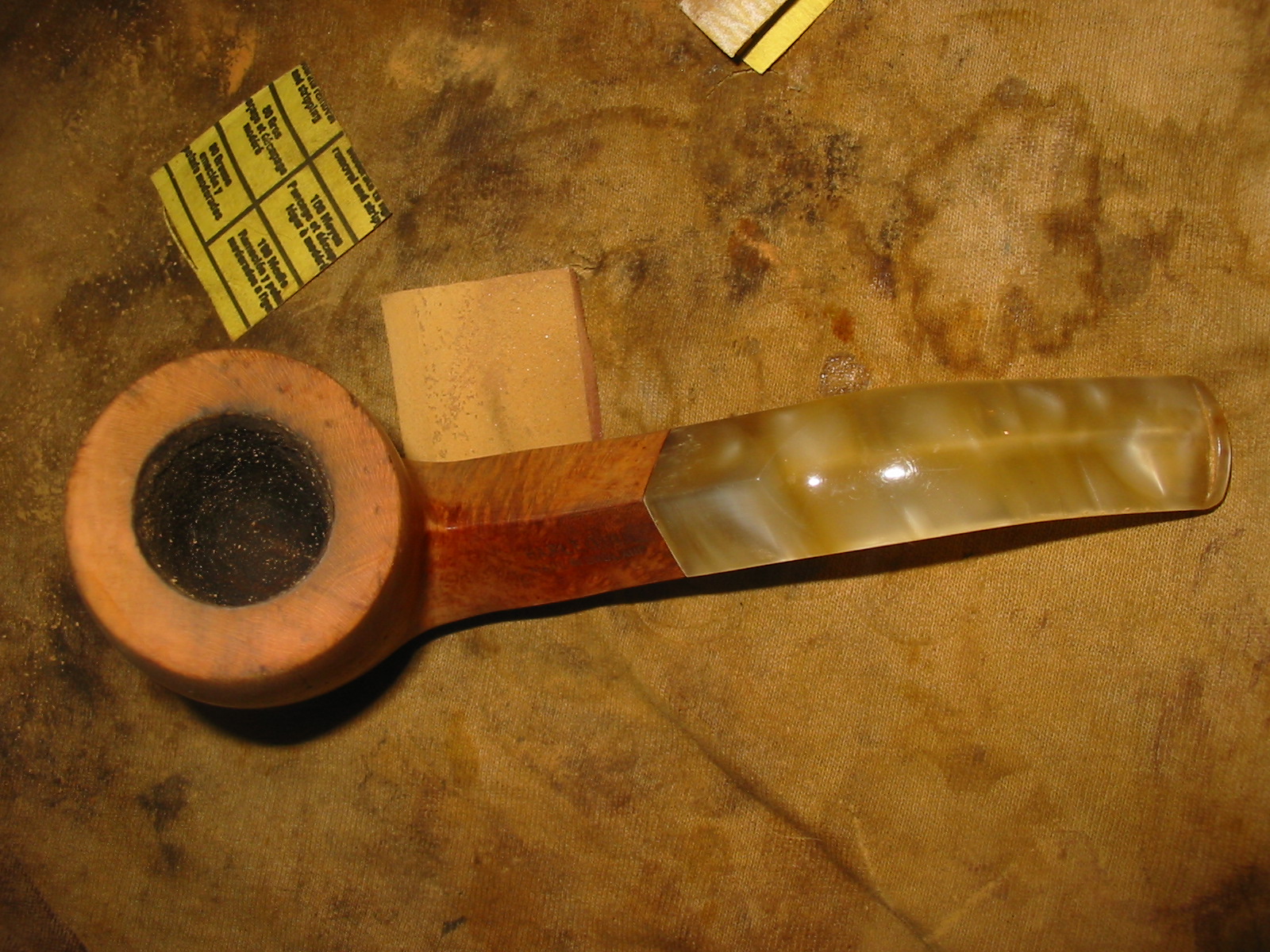
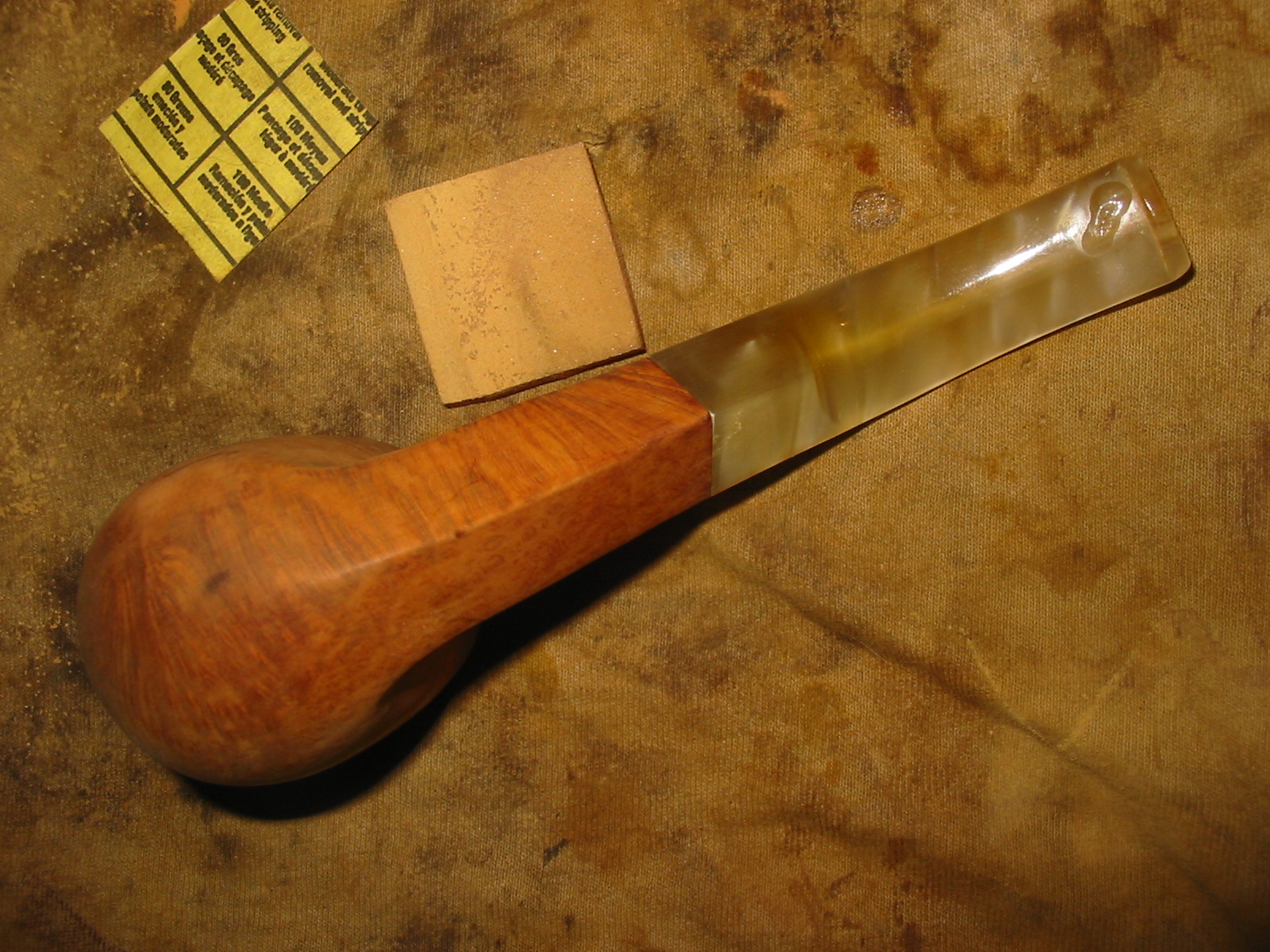
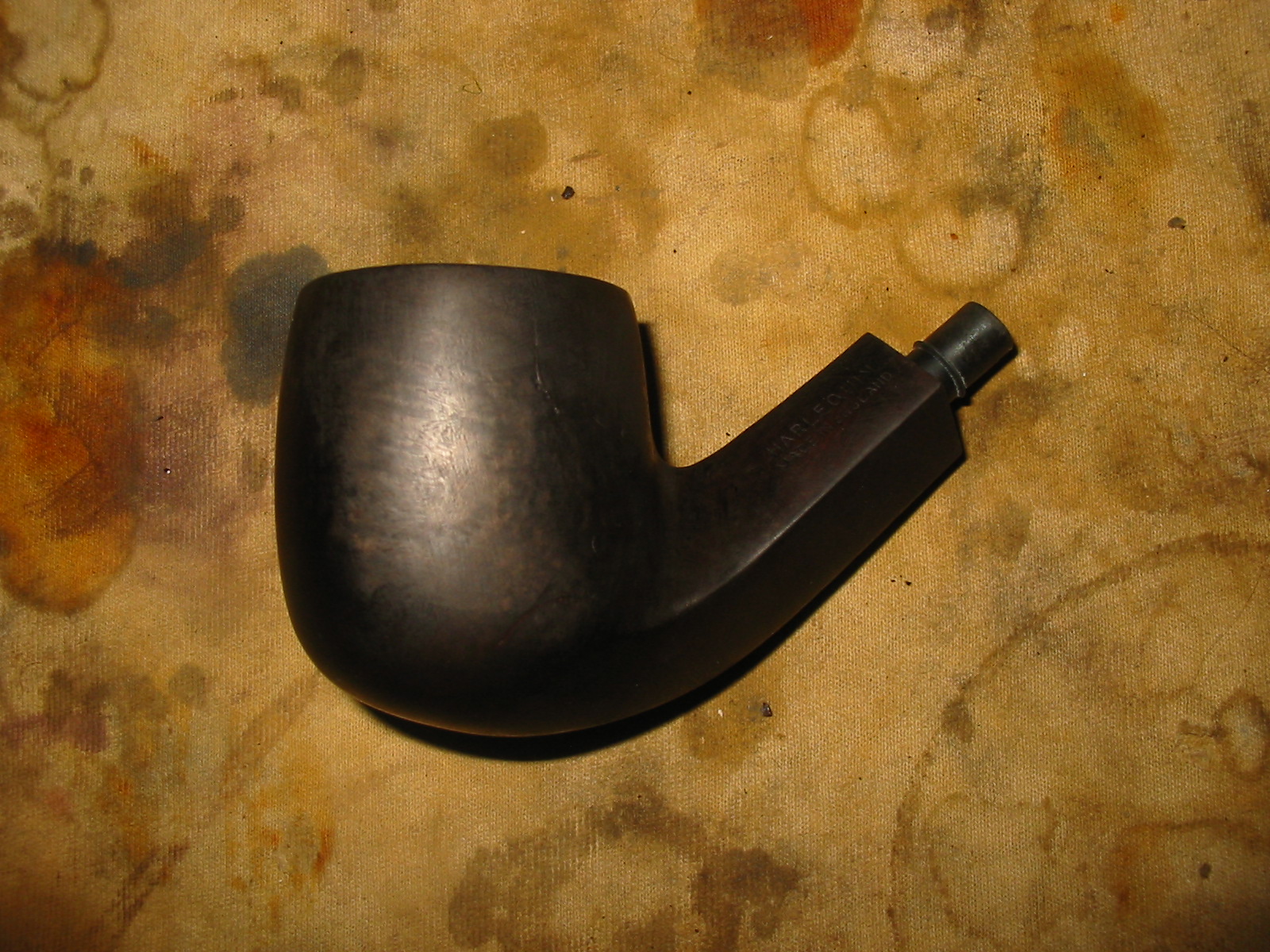
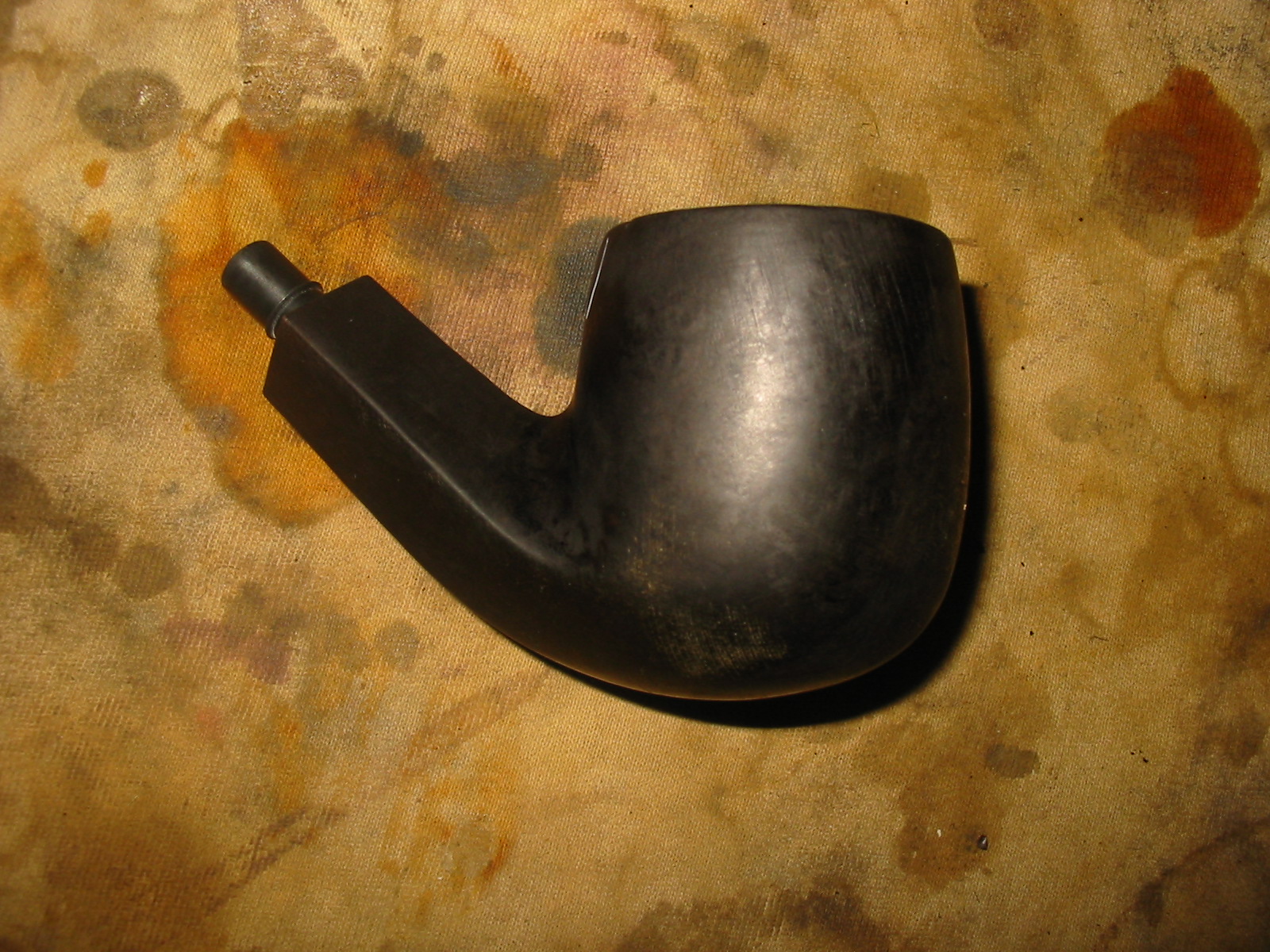
Last evening I was looking at the lone pipe bowl in my refurbishing box and decided I wanted to do something with it. I wasn’t sure if I would refinish it or rusticate it with the new tool Chris sent me. Either way though, it needed a new stem. I went through my can of stems and found that I did not have any that would fit the shank without a lot of work. I did have one with a broken tenon that was the right diameter for this pipe. I looked at it for a while and then found a Delrin tenon that I had on the work table. The tenon was the right size for the shank! The stem was the right diameter for the shank. Now all I had to do was wed the two of them and I would have my new stem.

I have drilled out broken stems in the past and inserted a new tenon. I have used a tap and then screwed in a threaded tenon that I purchased from Pipe Makers Emporium. Either way it was work that I did by hand. By hand means that I do not have a drill press, I do not have a vise to hold the stem. I have my two hands and a cordless drill. This takes steady and slow work to keep all the angles straight and get things properly aligned. It is one of those processes that will either work really well or not at all. There is no in between. You cannot redrill a crooked hole to straighten it out without making it too large to fit the piece. So really the fact of the matter is that it all comes down to whether I can drill the stem out straight!

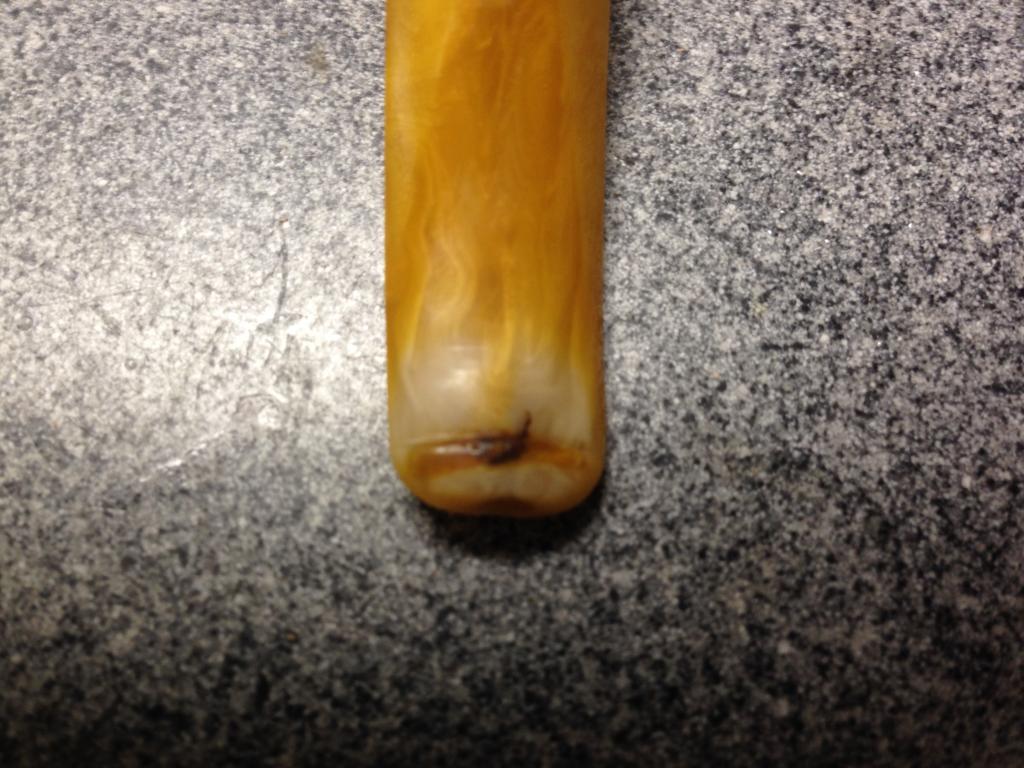
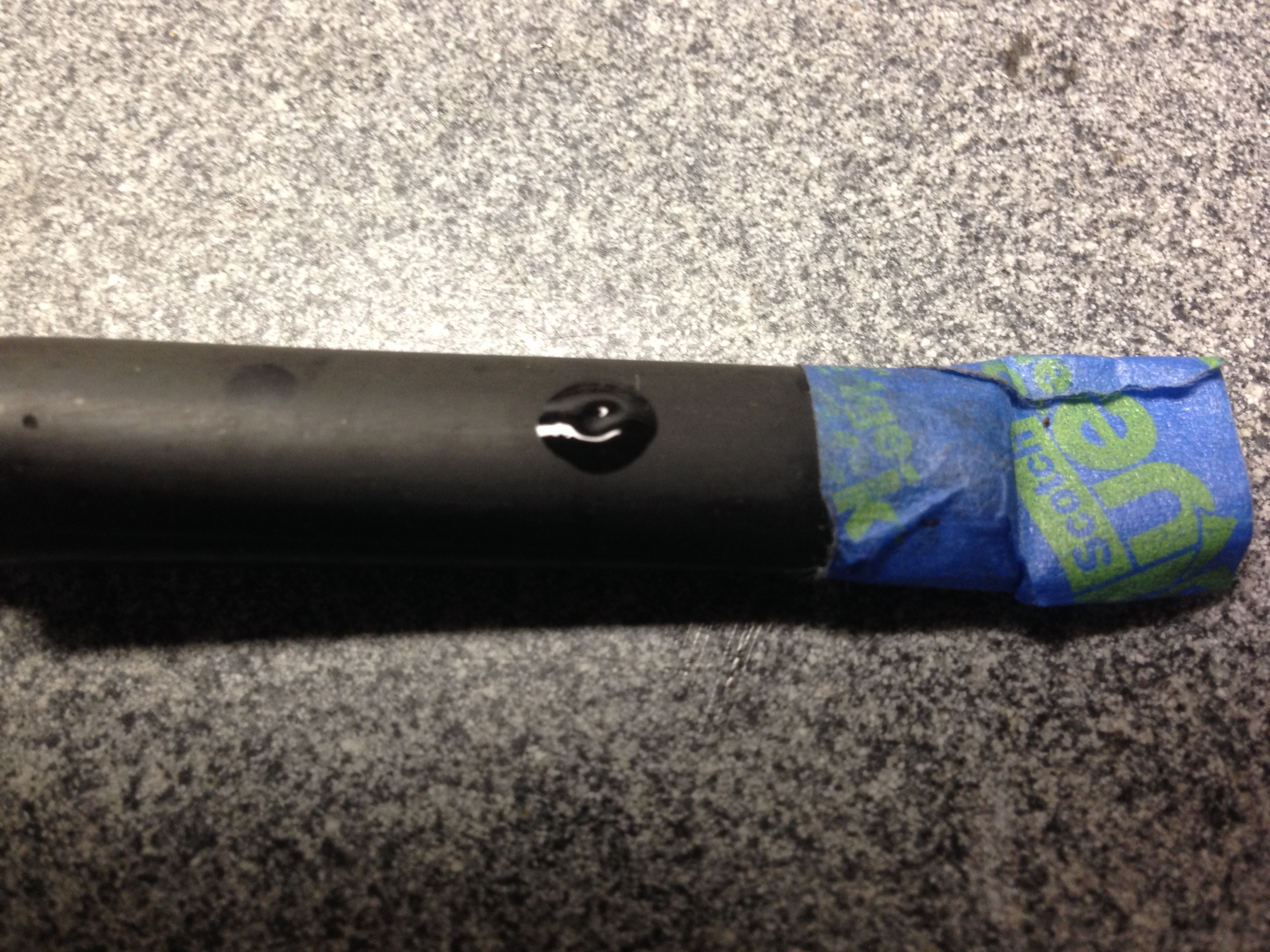
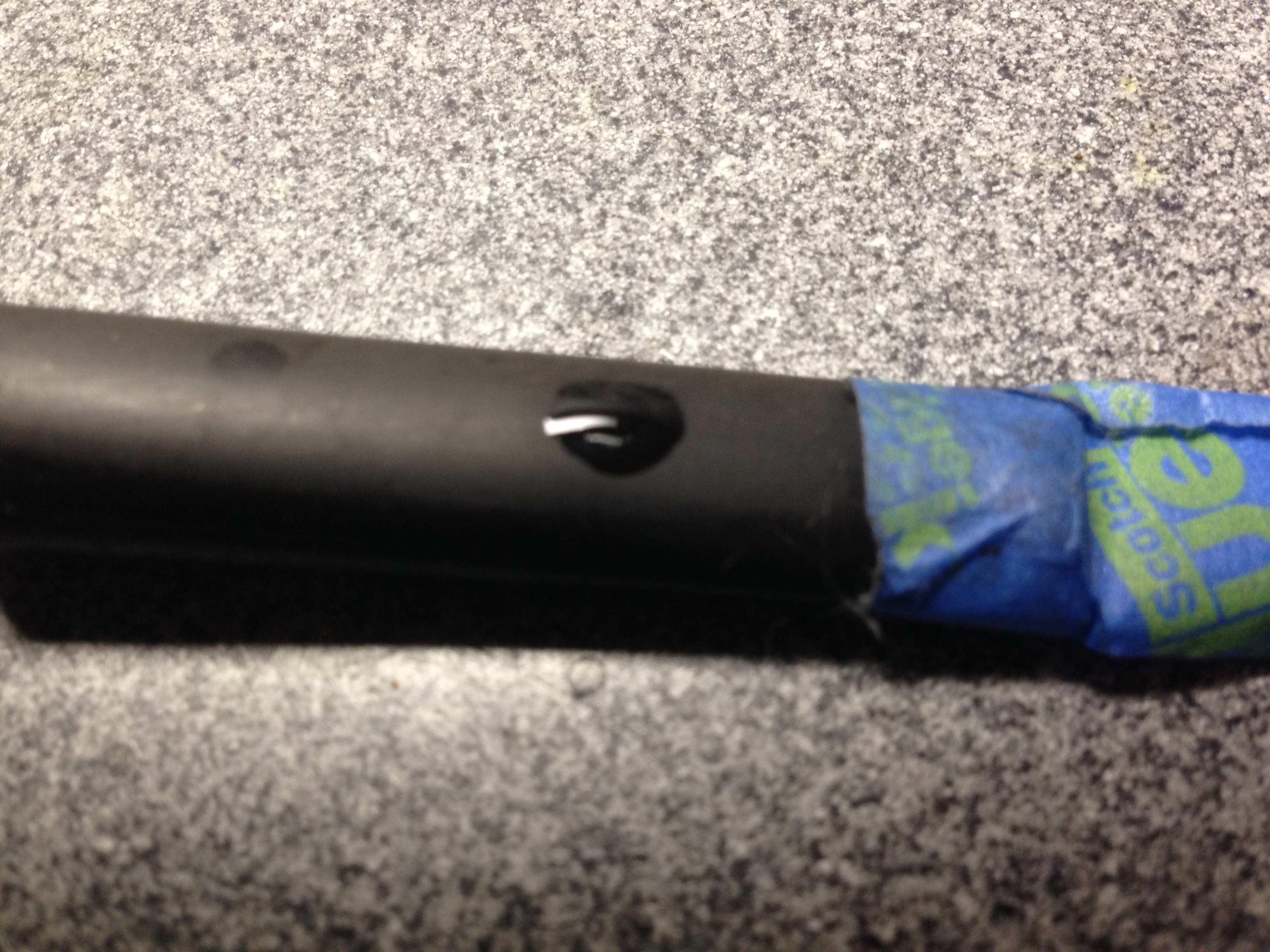
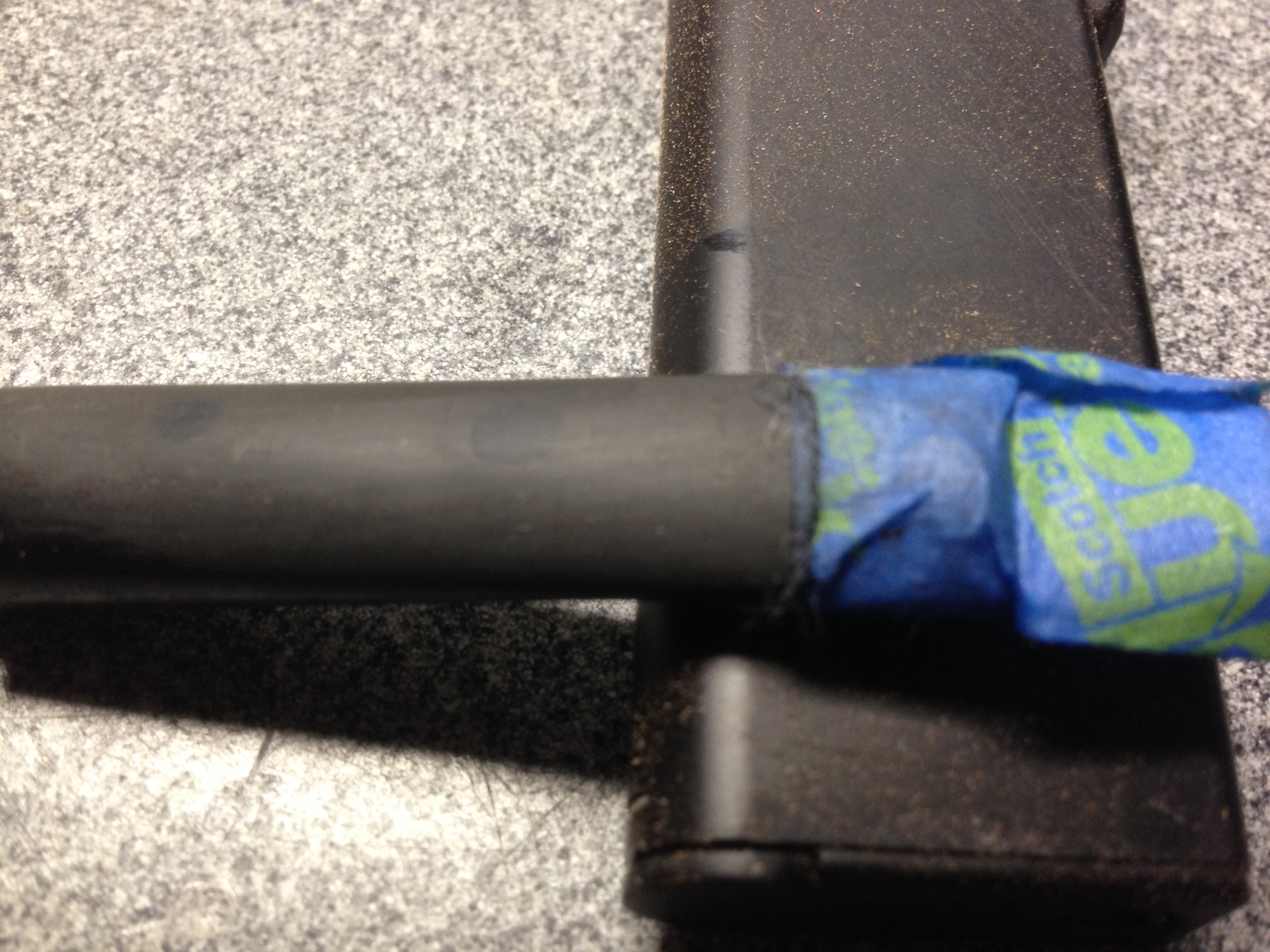
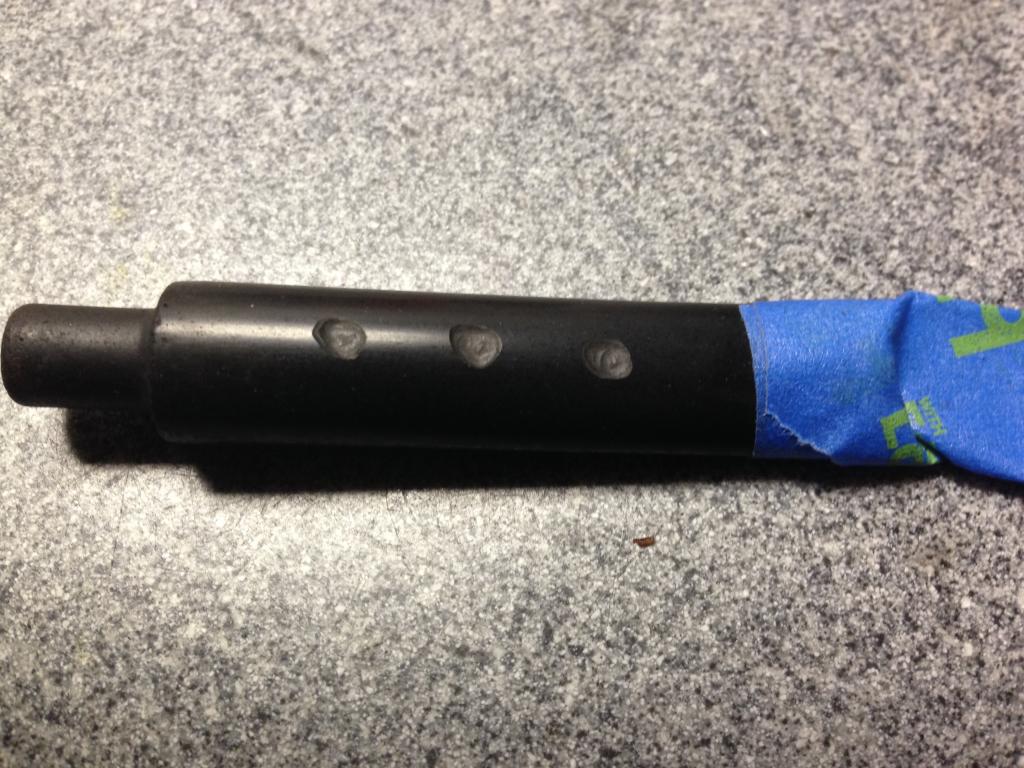
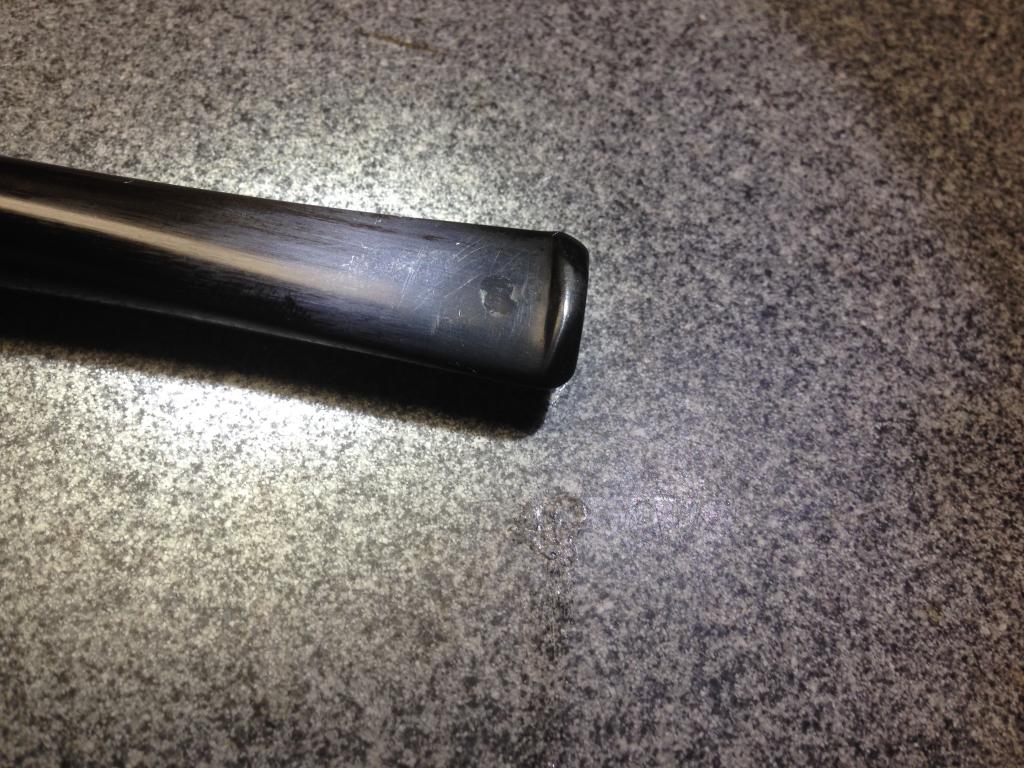
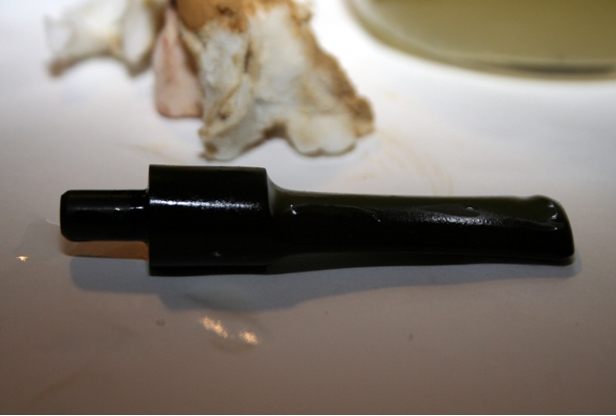
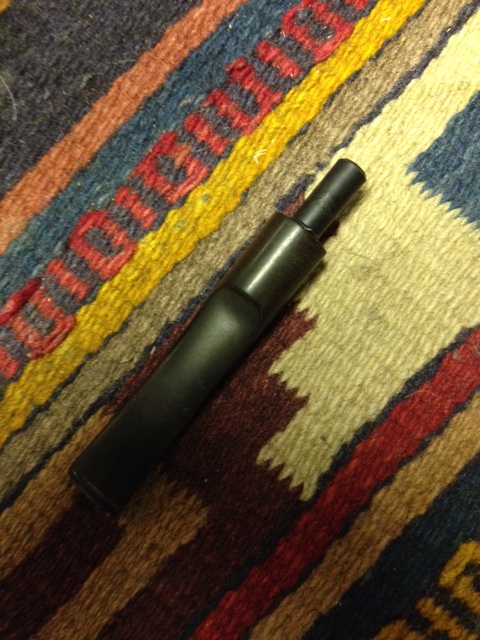
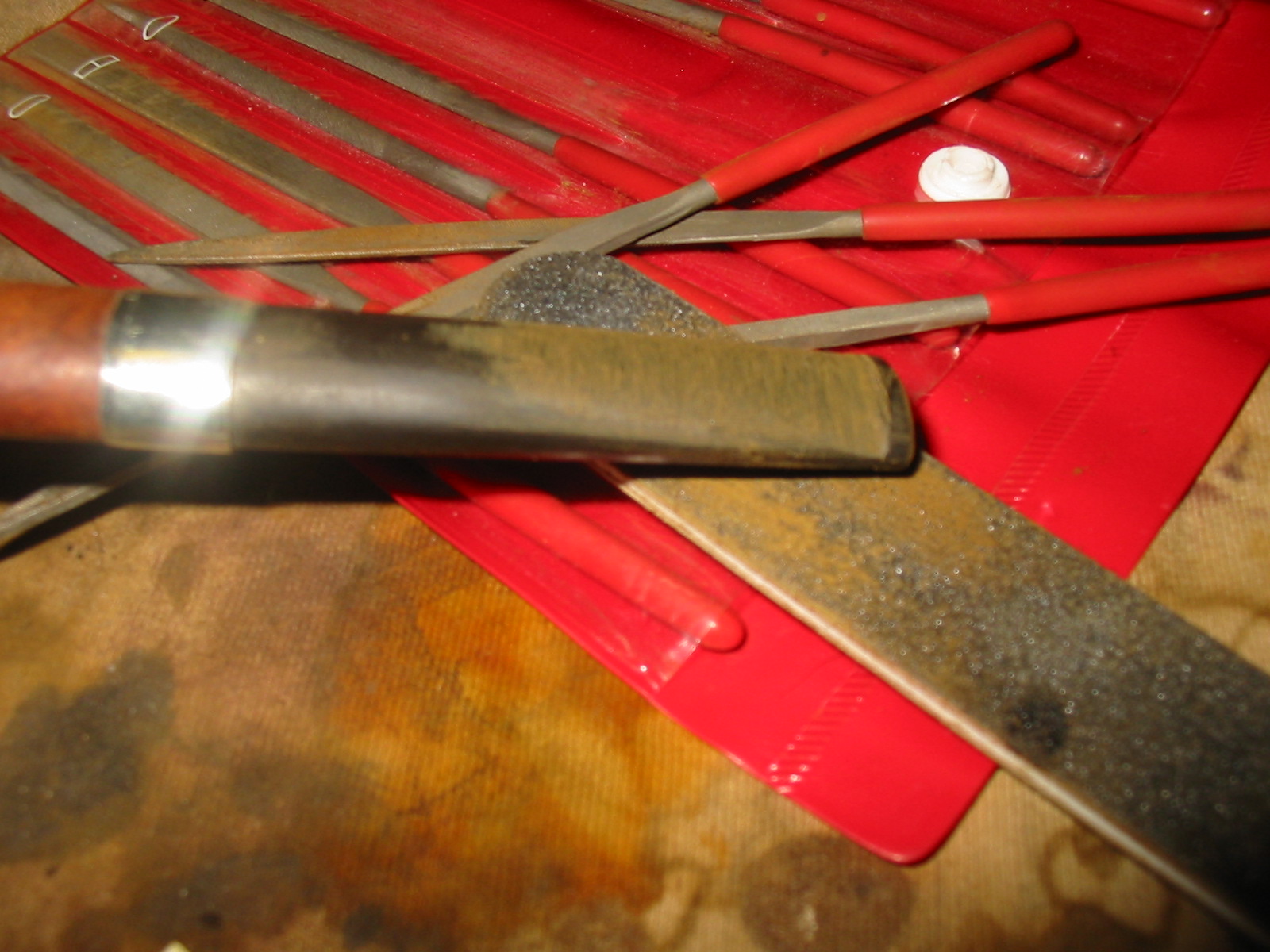
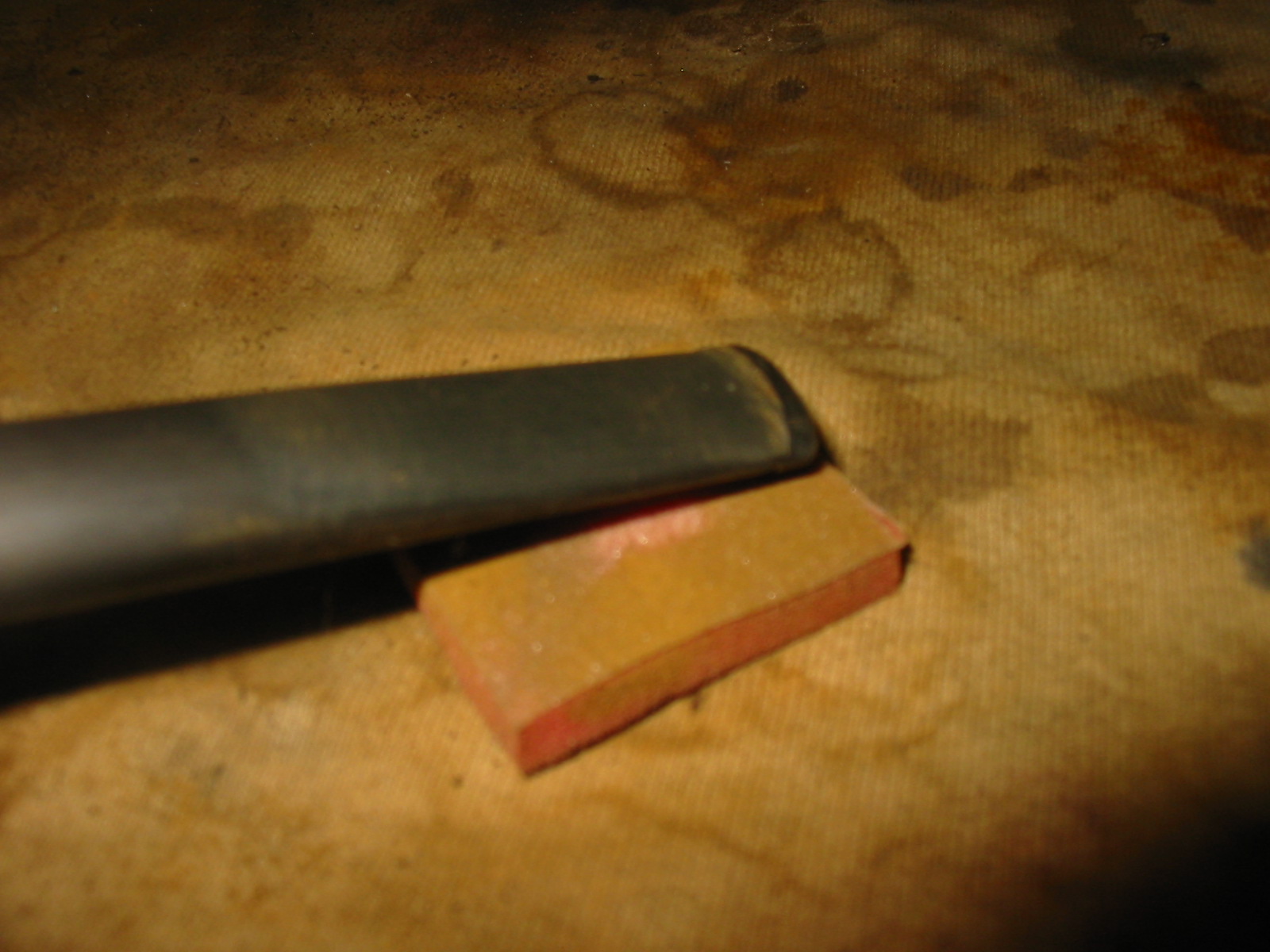
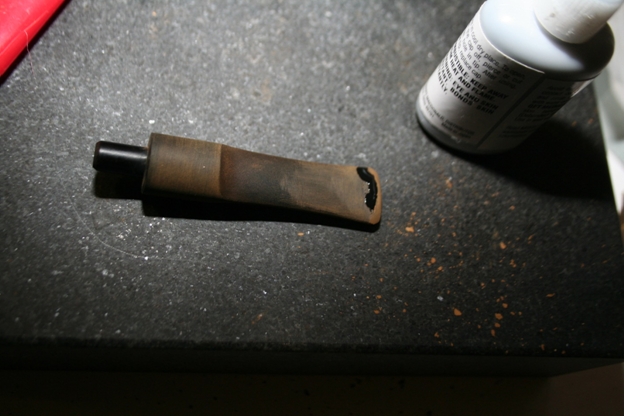
To begin the process I needed to square up the end of the stem and remove the broken pieces of the tenon that still remained. The end needed to be flat and even for the drilling. I sanded down the end of the stem flush using a sanding board (like the one used when topping a bowl). In the photo below you can see that the end of the stem has a divot out of it due to the breakage. I did not worry too much about that as the drilling would take most of that area out of the equation. I only worked on flattening out the rest of the stem. When finished I pressed it against the end of the shank to see if it was a flush fit or if there were any high spots. The fit was perfect. Now it was ready for drilling.
tenon1
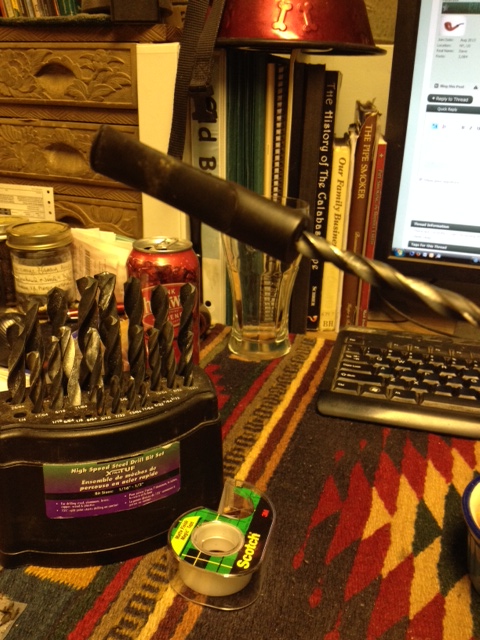
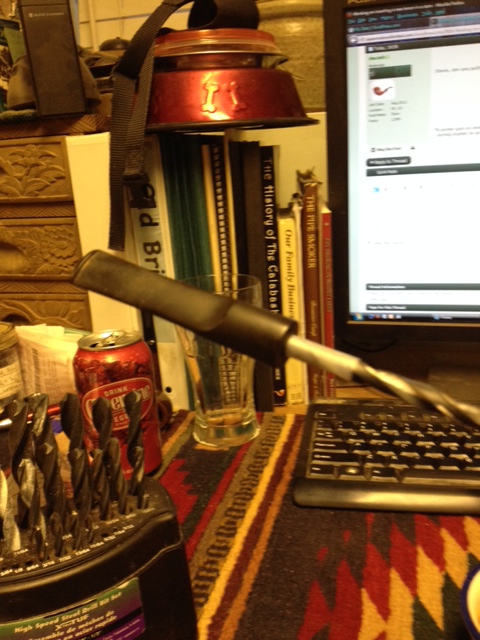
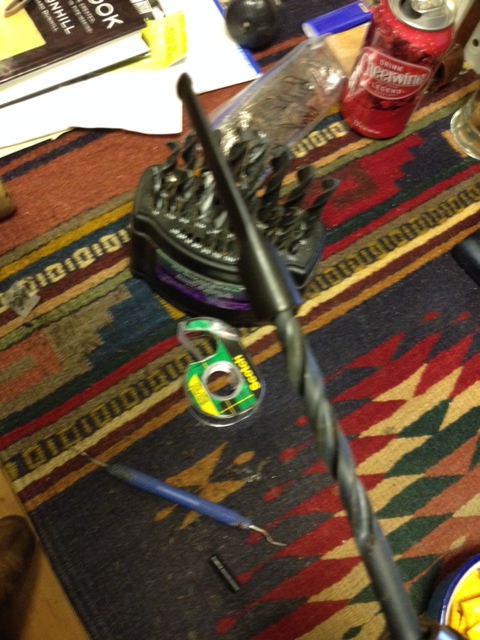
I took out my cordless drill and found that the battery was dead. I put the battery on the charger and sat thinking for a bit about how to best drill out the stem. I measured the diameter of the new tenon and found that it was 15/16 inches. To make sure I did not crack the stem or break it in the process I would drill it out in stages. I would mark the depth on each drill bit I used with a piece of tape so that I would not over drill or under drill the depth of the hole. I used the tenon as the measure for this. The tenon I had came with a slight lip on it so I would need to countersink the end of the stem once the hole was drilled in order to accommodate the lip.

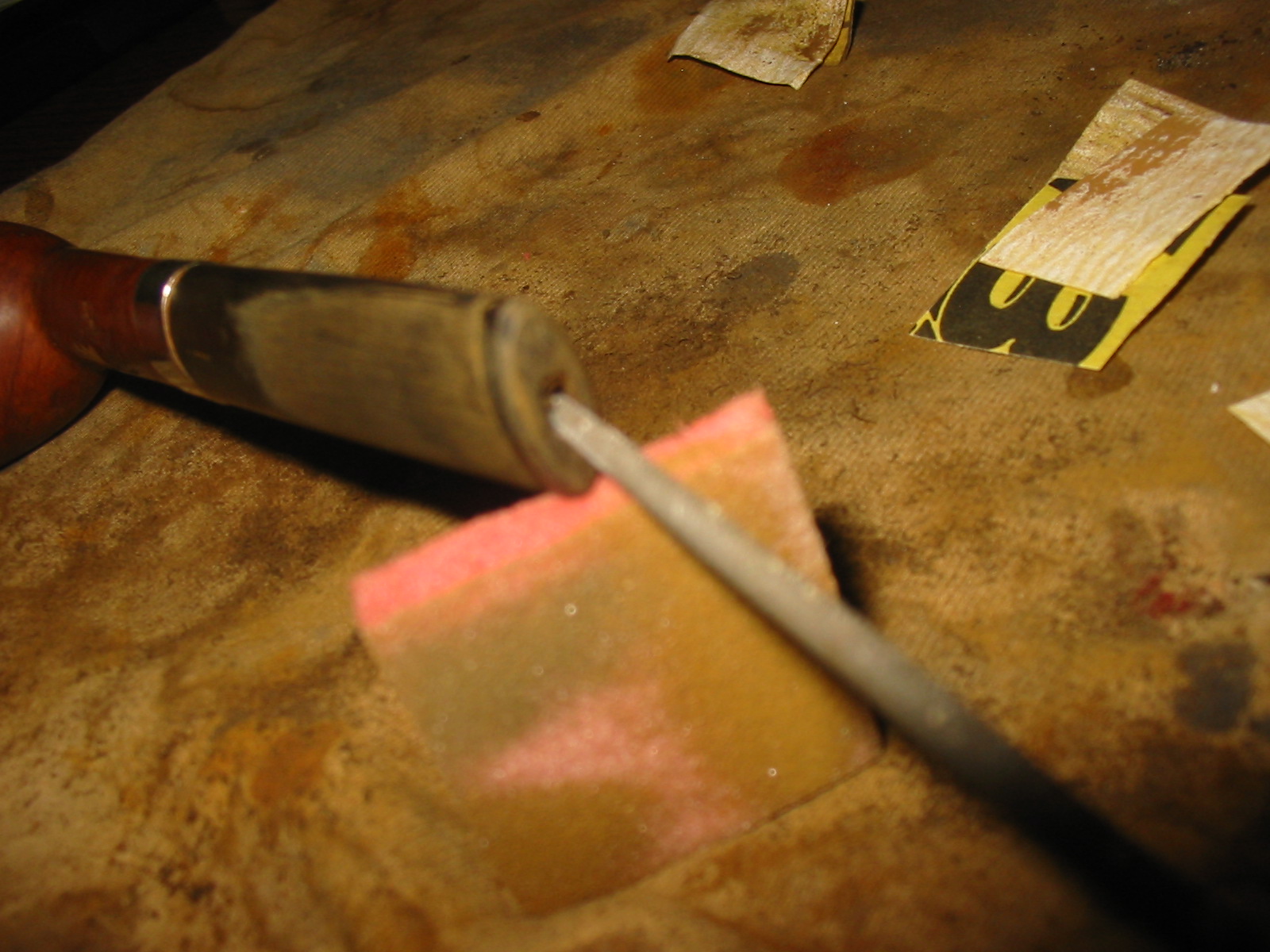
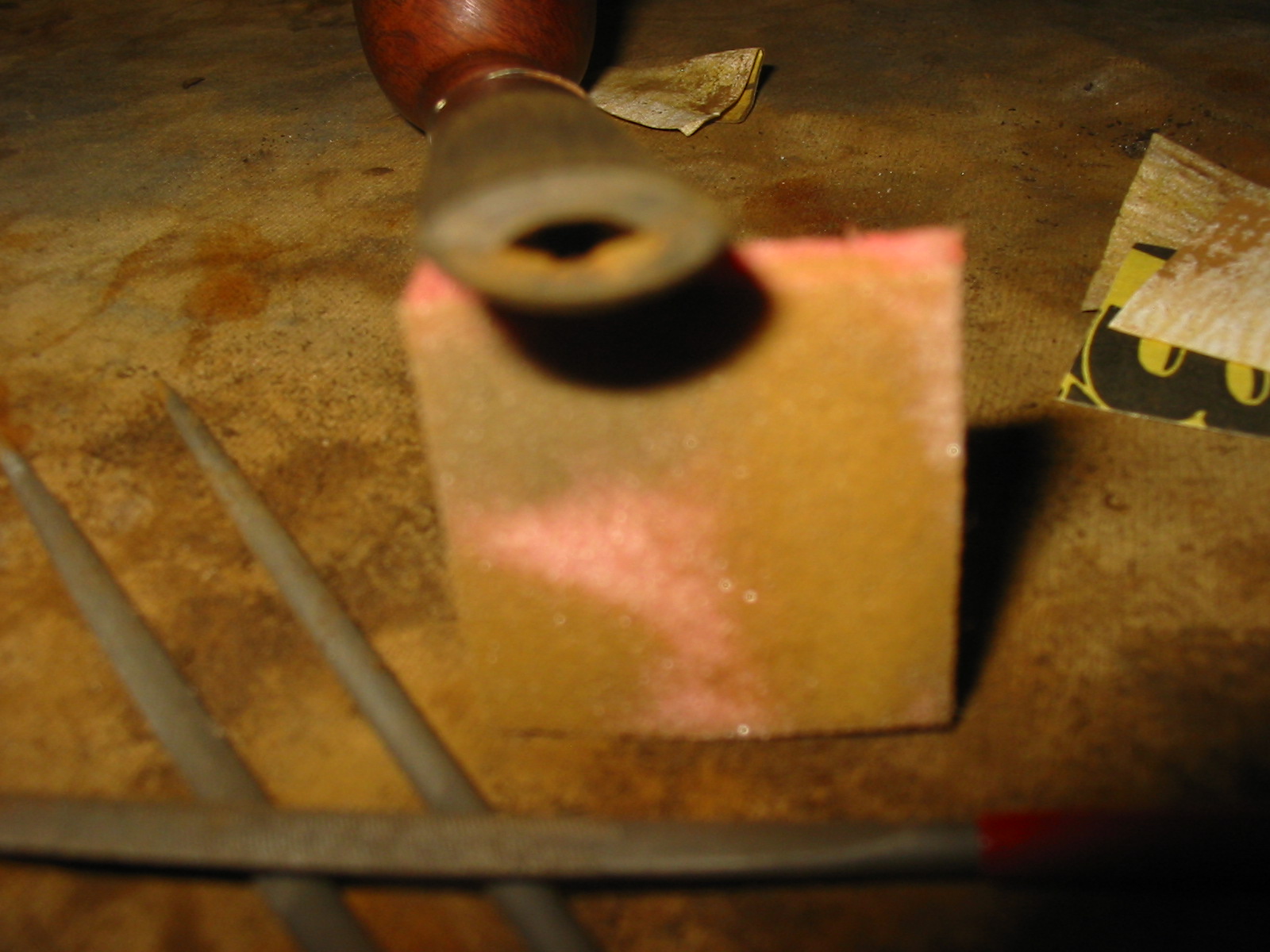
I decided to try something different this time and not wait for the battery to charge. I stood the drill on my desk, inserted the drill bit and hand turned the stem onto the drill bit. I started with the 11/64 inch bit which was slightly larger than the airway in the stem. I turned the stem onto the stationary bit to the depth that I had marked on the drill bit. I lined up the stem and the angles making sure the line was straight and the hole stayed centered throughout the process. I worked my way through 7 bit sizes up to the 17/64 inch bit. Each time I turned the stem onto the bit in increments and cleaned out the hole with a dental pick. I continued to turn it on and off the bit until the drilling was smooth before moving onto the next sized bit.
tenon2

tenon3

tenon4

tenon5

tenon6
I found that when I got to the larger sized bits from 19/64, 5/16, 21/64 inches it was hard to turn them on by hand. I could get them started but they quickly bound up on the bit and I could not turn them further. I turned them back and forth but it was not working well. I put the battery back on the drill and drilled the stem using a very slow speed. It worked well. When I had finished drilling it with the 5/16 inch bit the tenon pressure fit very nicely in the hole. There was not enough room for epoxy to be applied and still fit in the hole, so I drilled it with the 21/64 bit to give it the amount of room for the epoxy. To countersink the end of the stem I used a slightly larger drill bit and then a sharp knife to bevel the inner edge to accept the ridge on the tenon.
tenon8

tenon7

tenon9
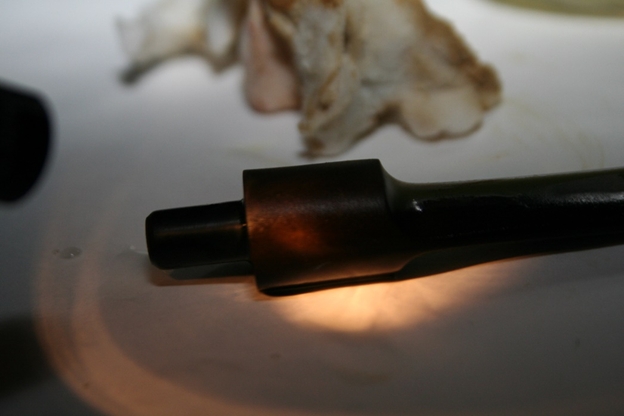
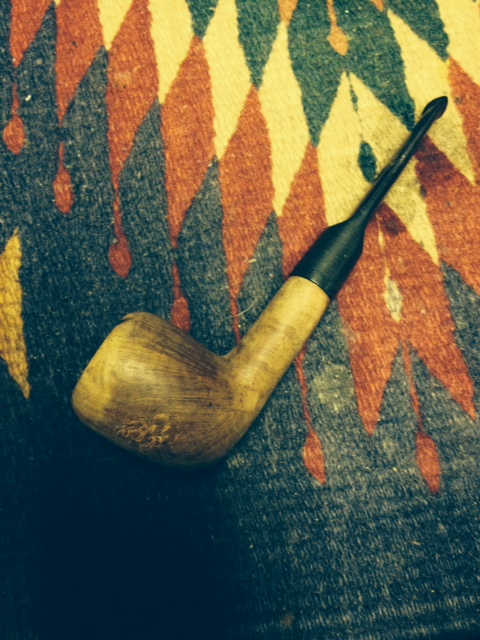
In the morning the tenon was firmly in place and dry. I cleaned the face with a dental pick and removed the excess epoxy from the stem. I pushed the stem into the shank of the pipe to see the fit. This was the final test. Did things align properly? Did I get the angle square and straight? Would there be a gap in the stem and shank joint? In case you are wondering I have had all of those issues in the past and had to do a lot of adjustments to get a clean fit. But this time things worked well. The fit was perfect and the alignment was absolutely correct. The pipe now had a new stem and it was time to make a decision on what to do with the finish of the bowl. That will be another story however. The photo below shows the fit of the stem and the shank. I am very pleased with the fit.
tenon12
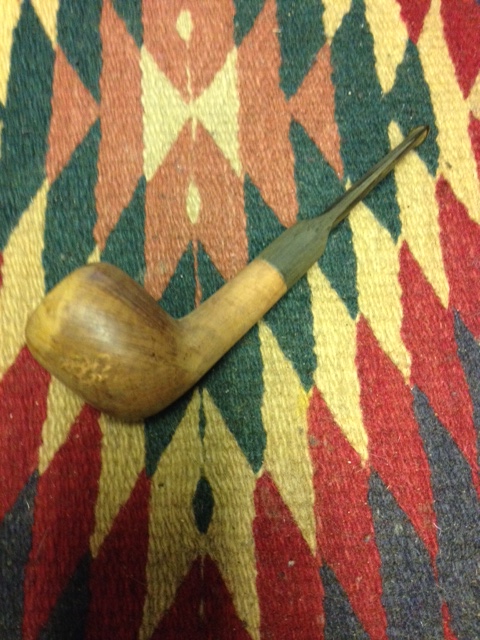
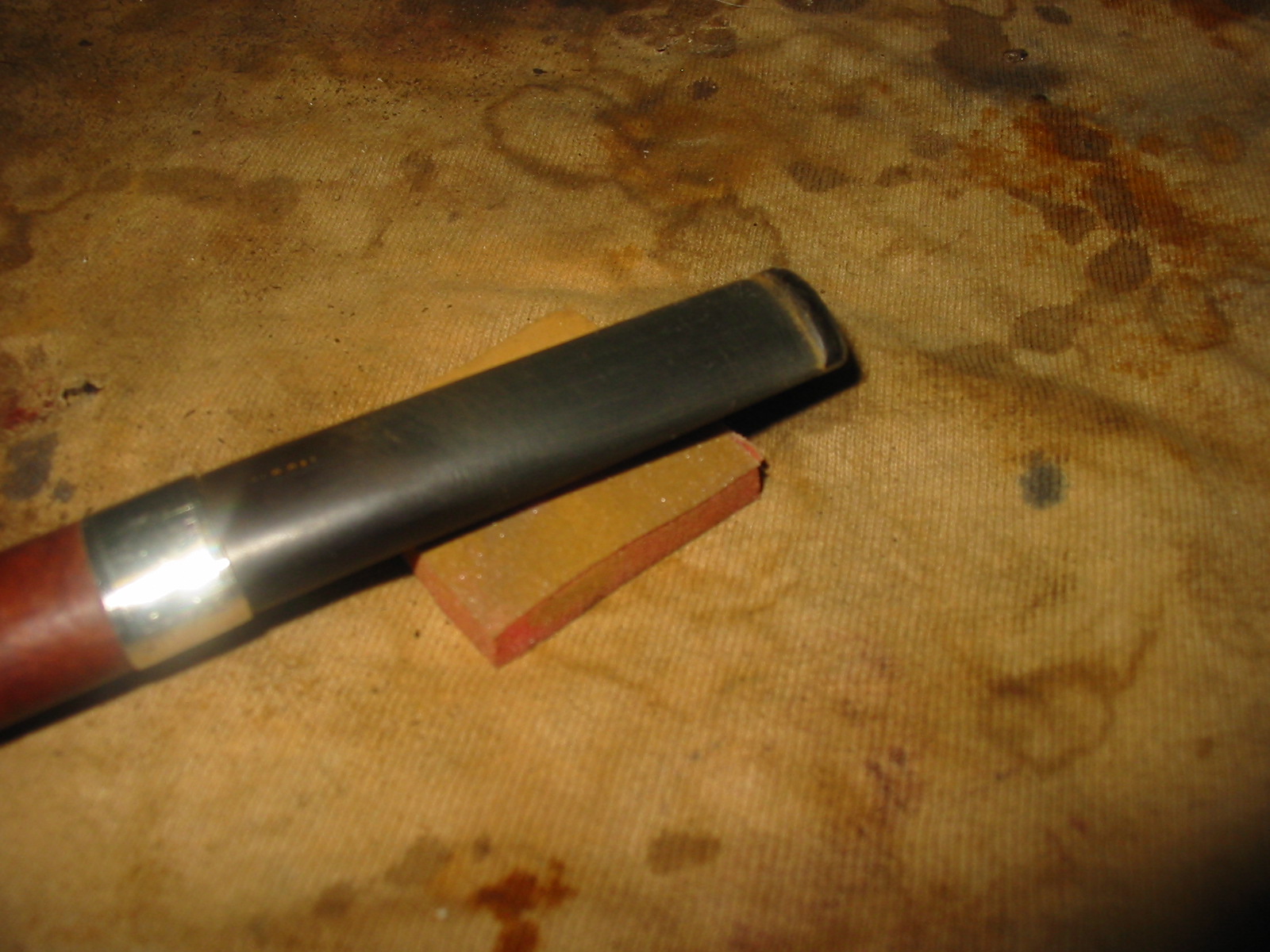
I sanded the stem and the shank to get a smooth transition between the stem and shank. I wanted the fit to be seamless so it took some sanding with 220 grit sandpaper followed by a sanding sponge to fine tune the fit. Here is the pipe as it stands now. Later today I will rework the bowl and finish the entire stem. But for the purpose of this post the tenon replacement and fit of the stem to the shank is complete.
tenon13

Refurbishing a Piece of History – A Marshall Field Co. Supreme – English Made


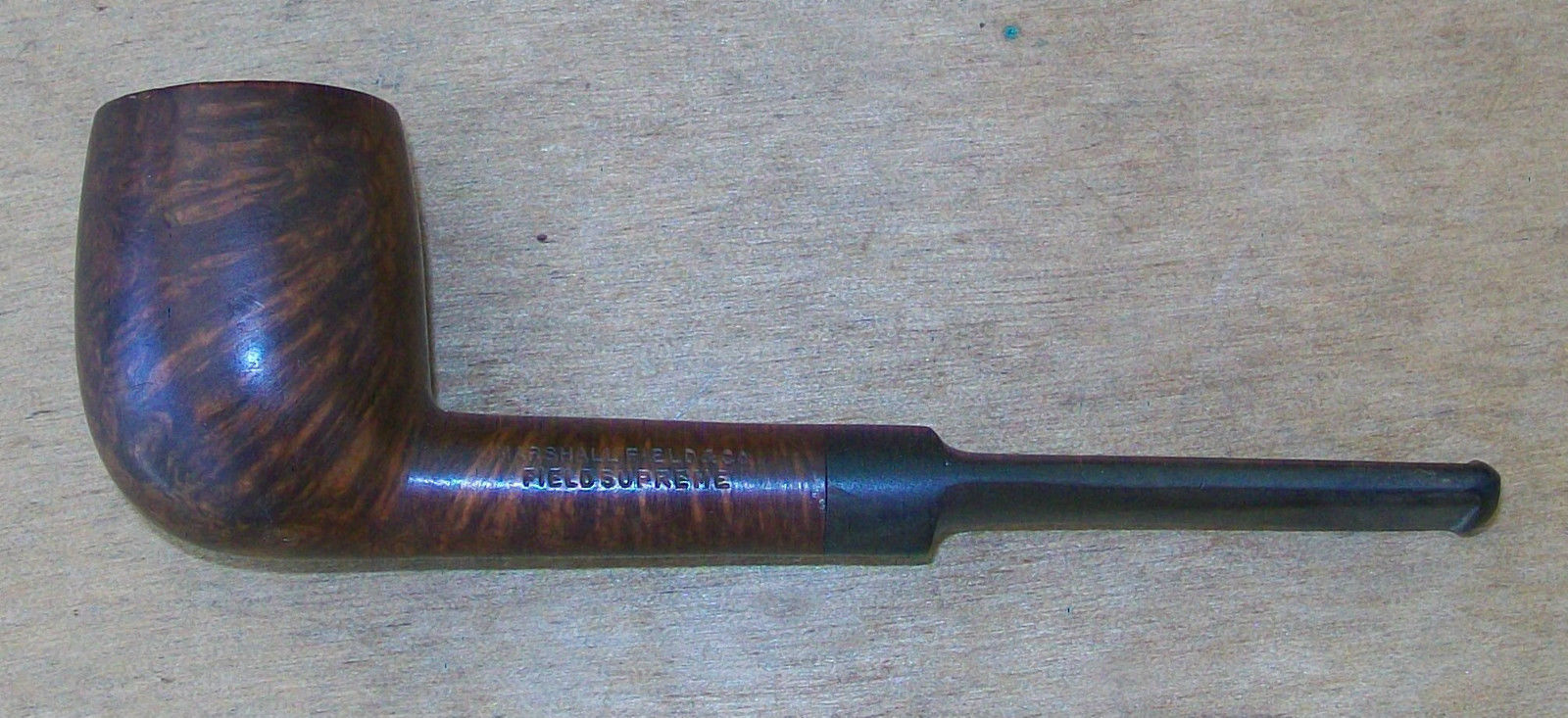
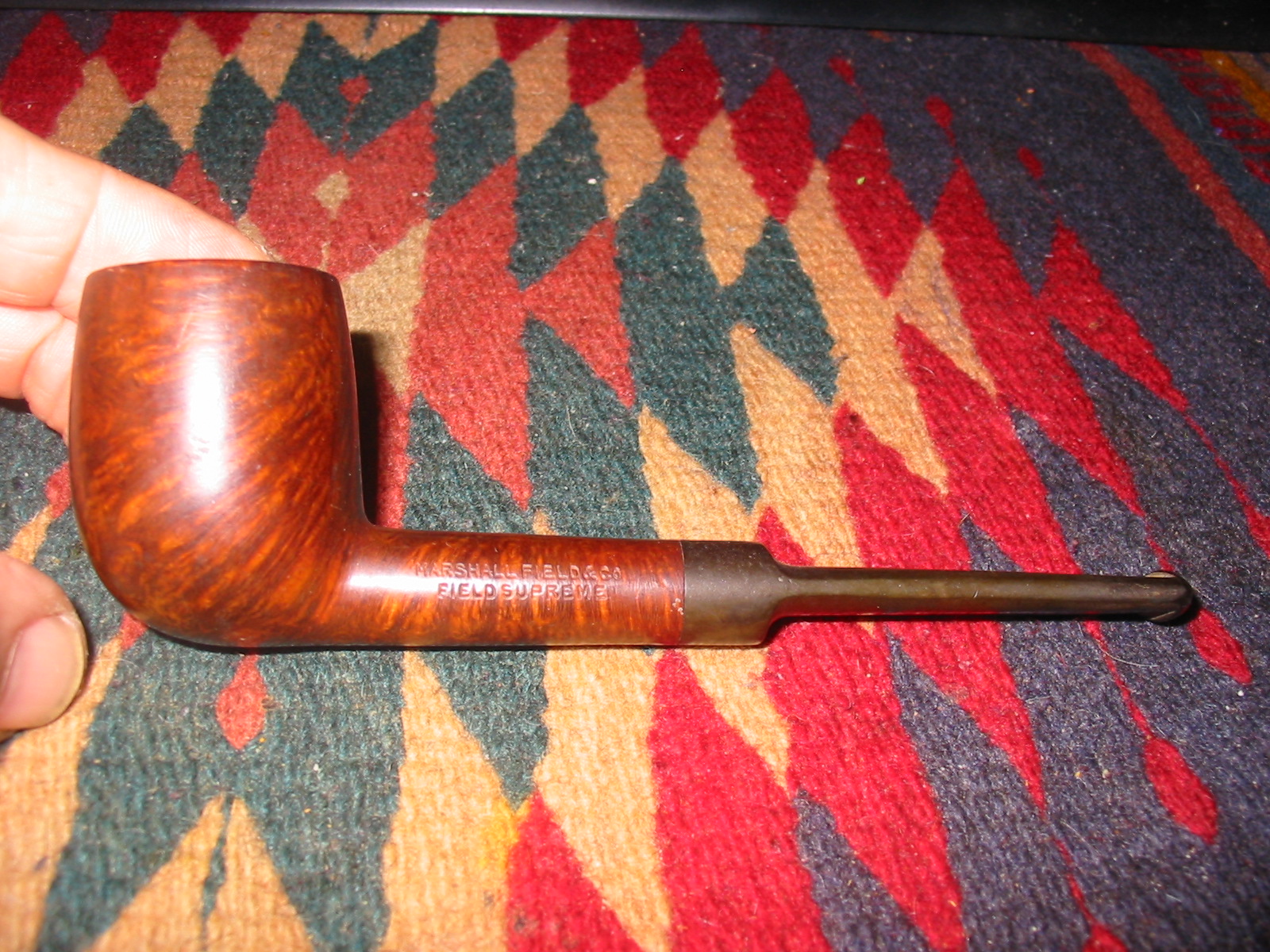
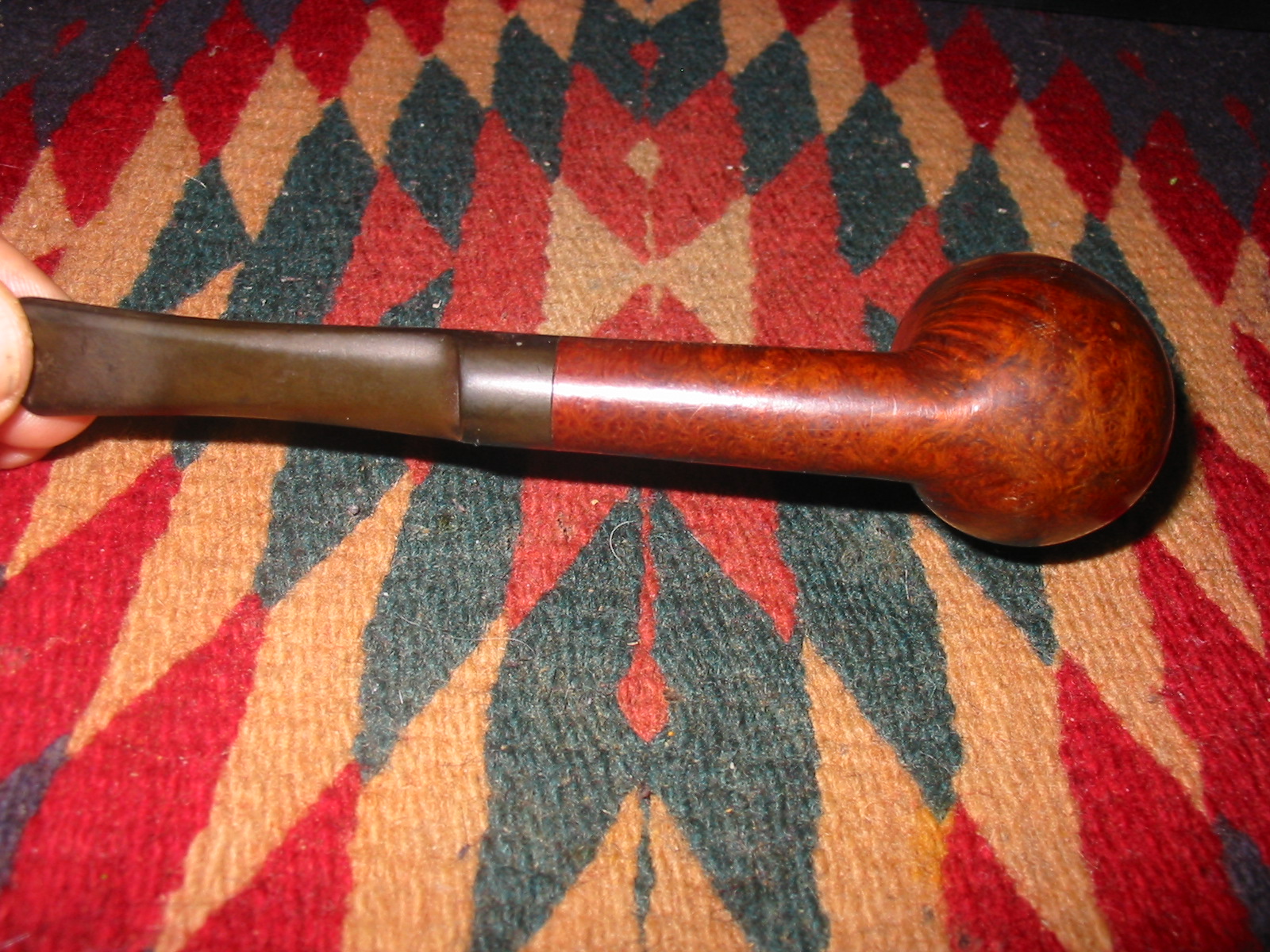
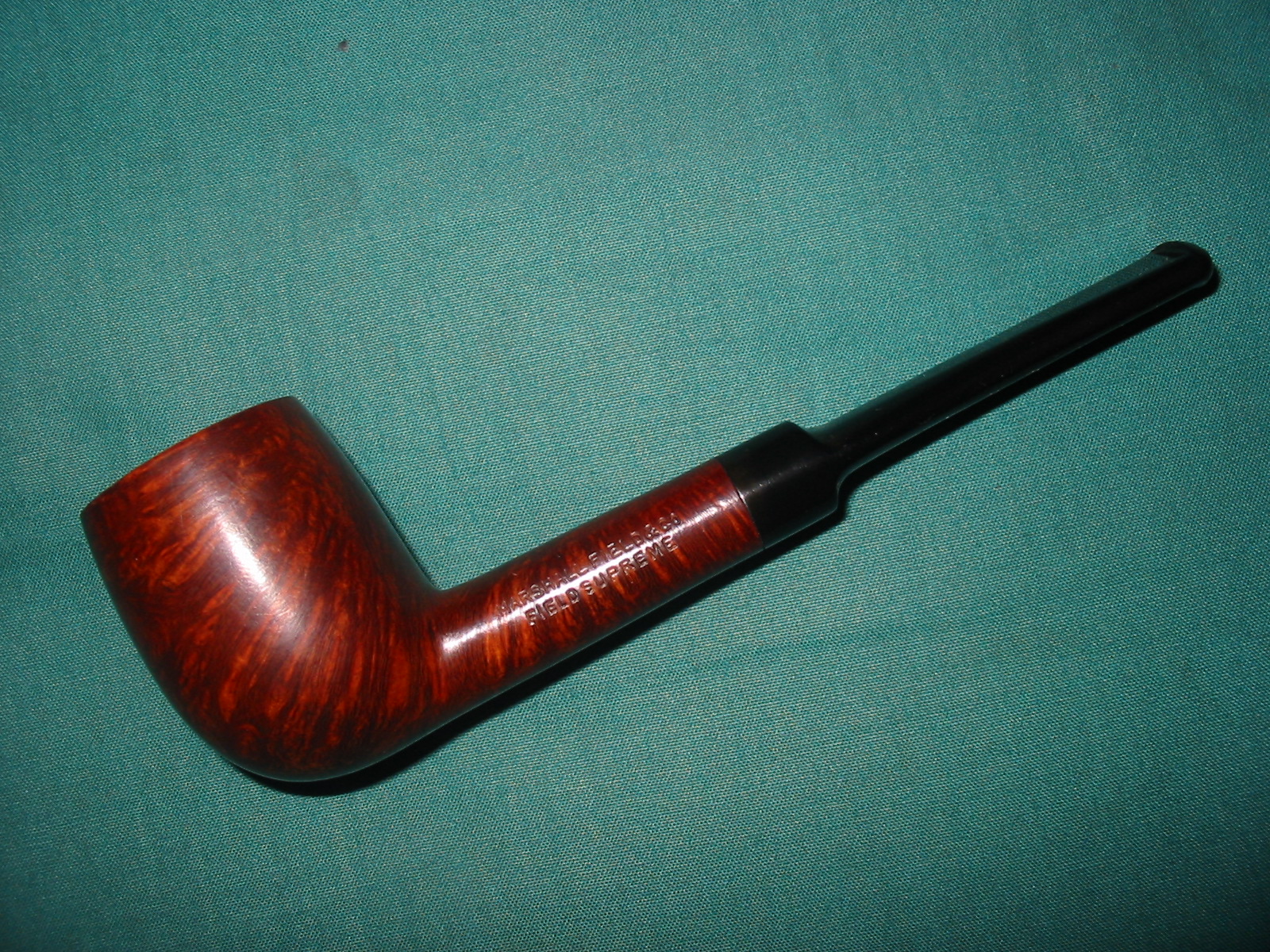
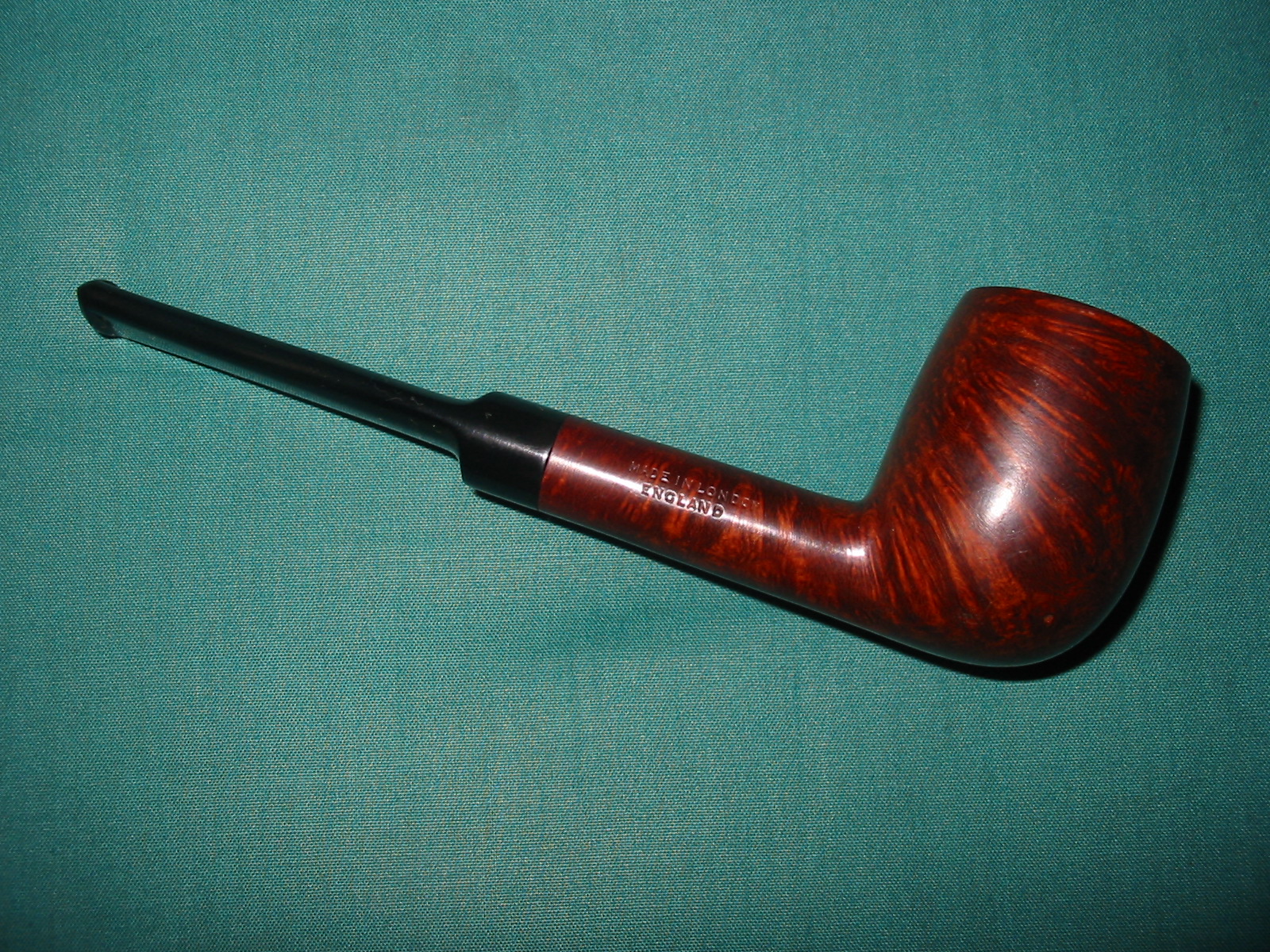
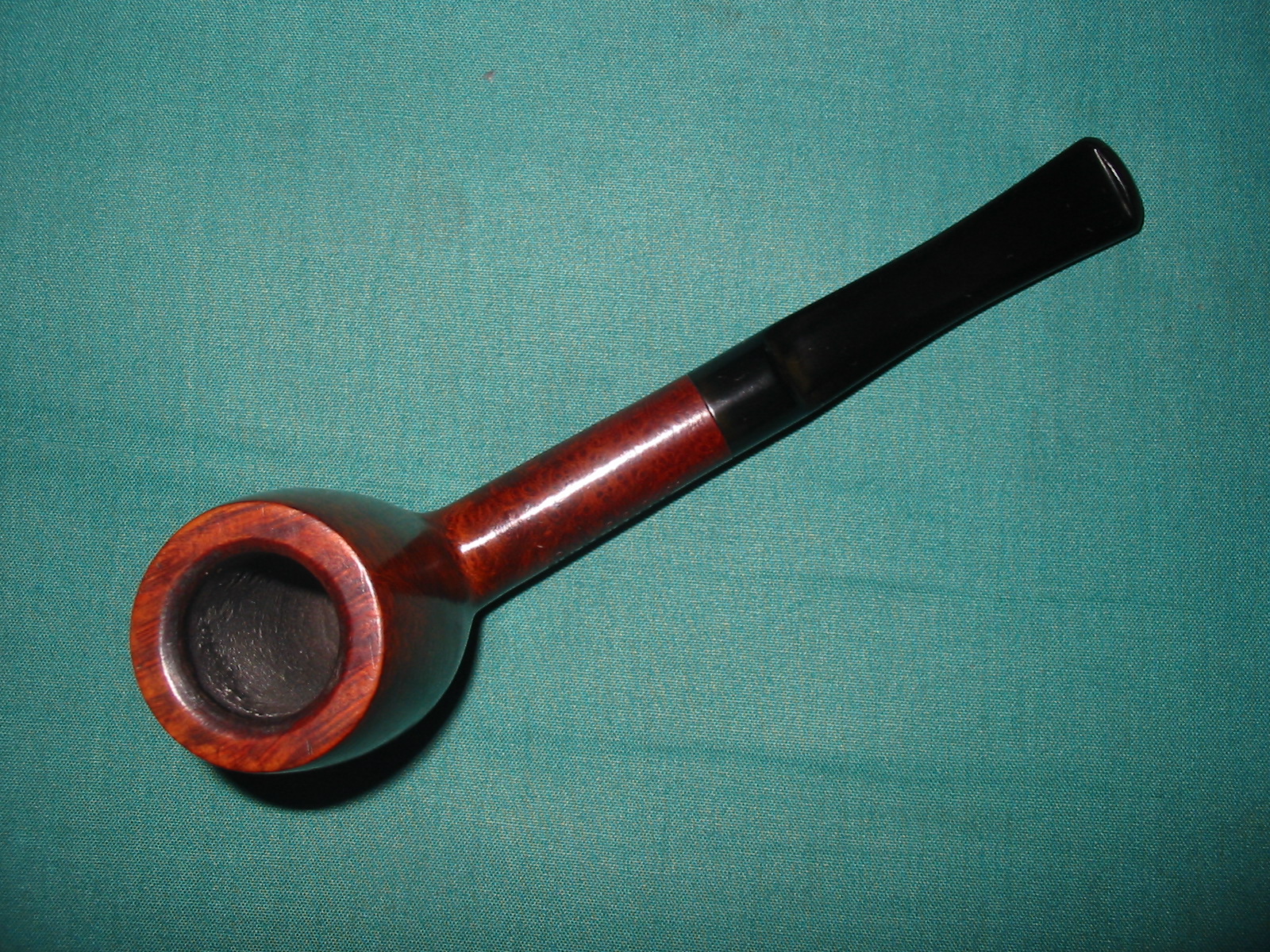
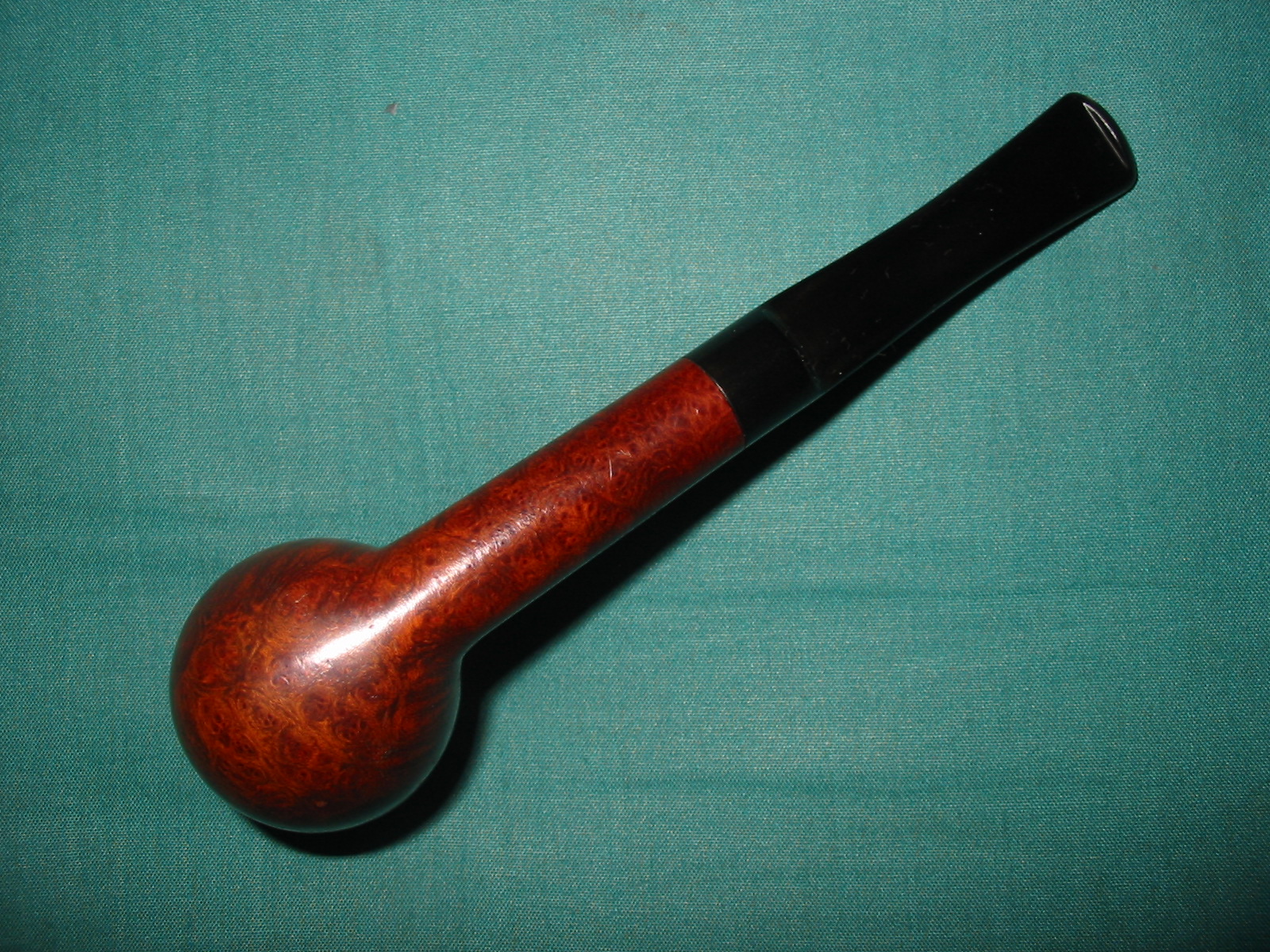
The grain on this one really caught my attention before I even noticed the name on the pipe. It has some amazing grain on the bowl and shank. The sides of the bowl and shank some stunning cross grain that has been highlighted with a contrast stain to make it stand out. The front and back has some quality birdseye grain. The carver did a great job laying out the shape of the pipe to highlight the grain, though I suppose it may merely be a fluke as blocks were turned and cut in the factory. After admiring the grain I turned to look at the stamping on the pipe. It looked like and English made pipe and my mind thought immediately of Comoys both by the shape and the contrast stain on it.
MF1

MF2

MF5
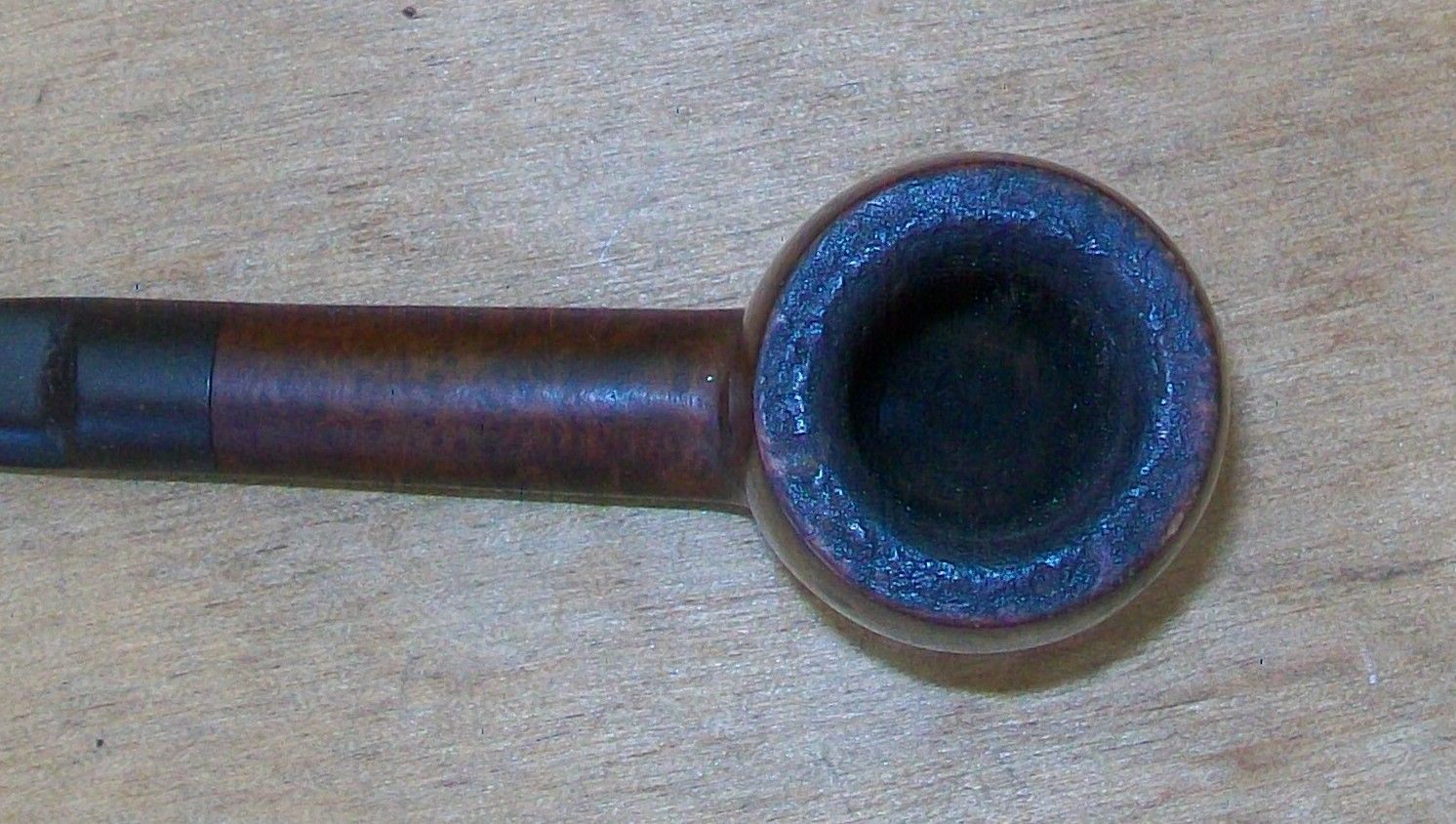
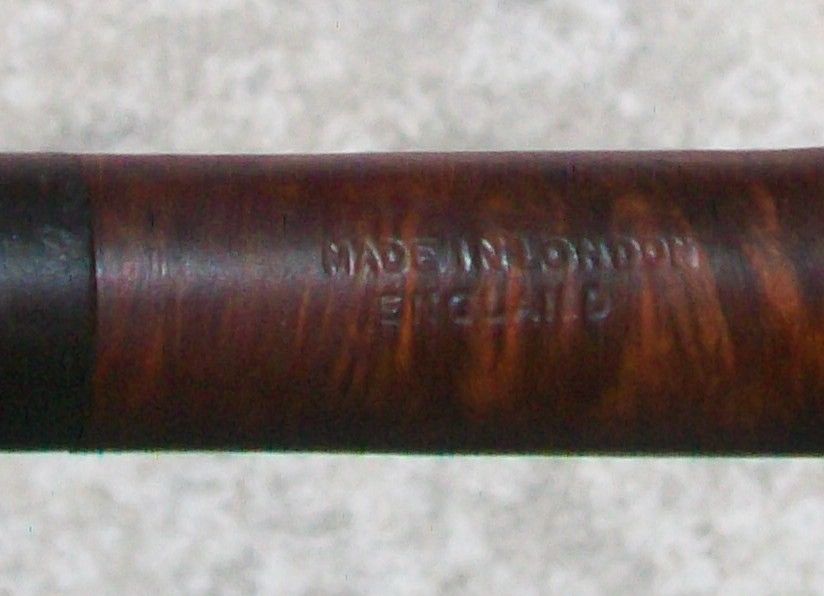
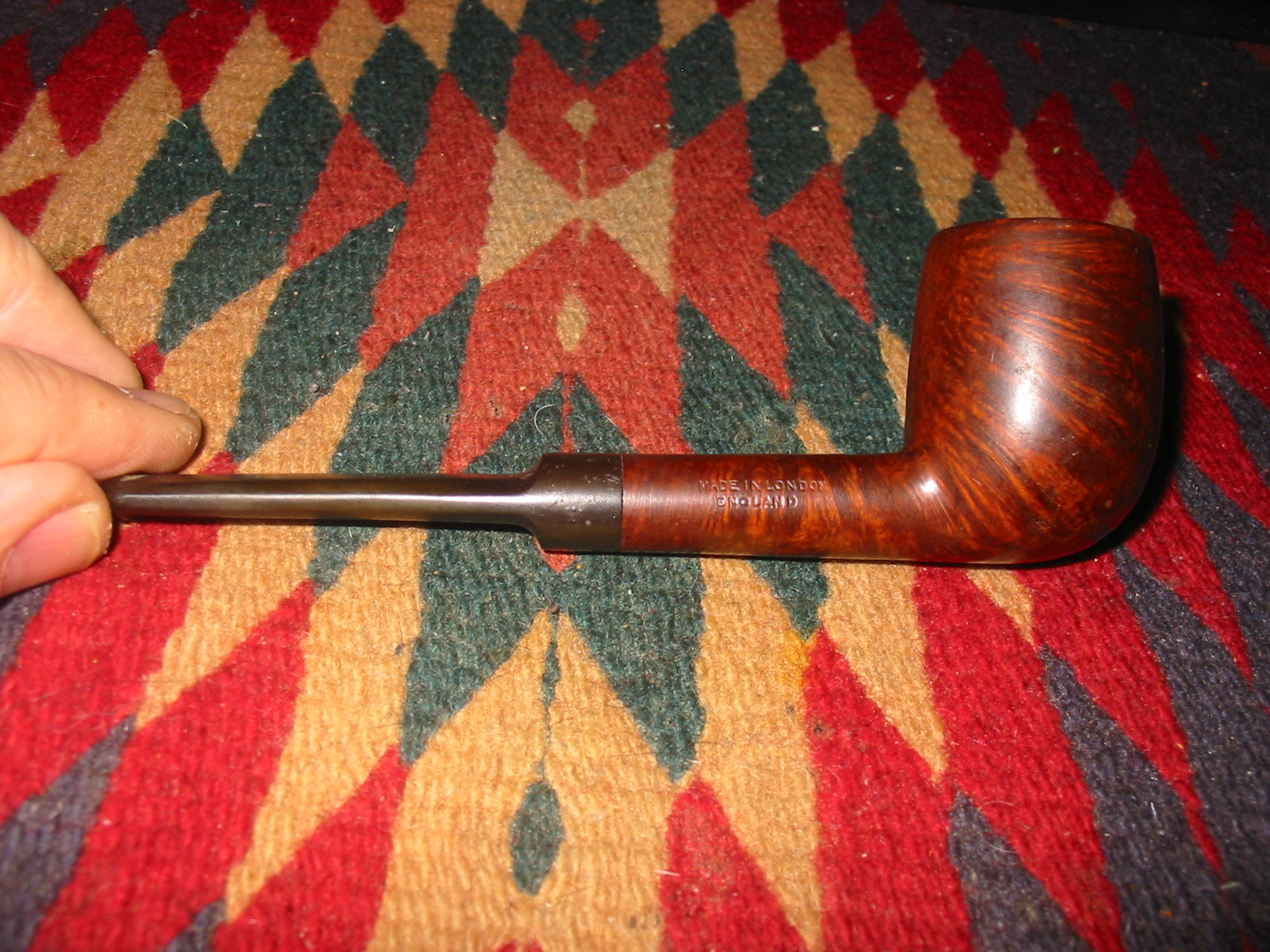
The pipe is stamped Marshall Field & Co. over Field Supreme on the left side of the shank and on the right side it is stamped Made in London England. There is no shape number stamped on the pipe. Since I paid $16 and change + $8 to ship it to Canada, I think I did well on it! The pictures below were included by the EBay seller and caught my eye.
MF3

MF4
Once I won the bid on EBay, I posted a question on Smokers Forums and Pipe Smokers Unlimited, two online pipe forums that I frequent, to see if anyone knew who made the pipe. I had hunches about who I thought were possible makers. But I wanted to see what others thought. I got several responses that confirmed my thinking.

Bill, a reader of the blog and an online friend sent this reply: “Not saying this will help but go to this page and click where it is highlighted”click here” and you can go through the Comoy’s pages and see the shapes. http://search.getitnext.com/beta/mar…arshall+fields Edit: My link didn’t work. It’s funny I clicked on it the first time and there was a write up about a guy who wrote an article about a Made in London Marshall Field pipe. He wrote to the Marshall Field Co. historian and was sent a link to a Comoy’s catalogue with shapes that were very similar. Now when I go back in my search history to click the link it won’t come up.”

Several others commented that Who Made that Pipe should a French Company name Marshal that made pipes. However, this was one made for the department store so I am pretty certain that the French company was not the manufacturer.

Dave, another reader of the blog and an online friend also replied: “I’m going to tack away from Comoy’s and go in a different direction. Here is my thinking, most of the off label pipes I’ve seen by Comoy’s still have the Comoy’s style COM stamp, be they pre-war or post war, and also retain a shape number in the very distinctive Comoy’s font. I’m going to focus on the word Supreme.

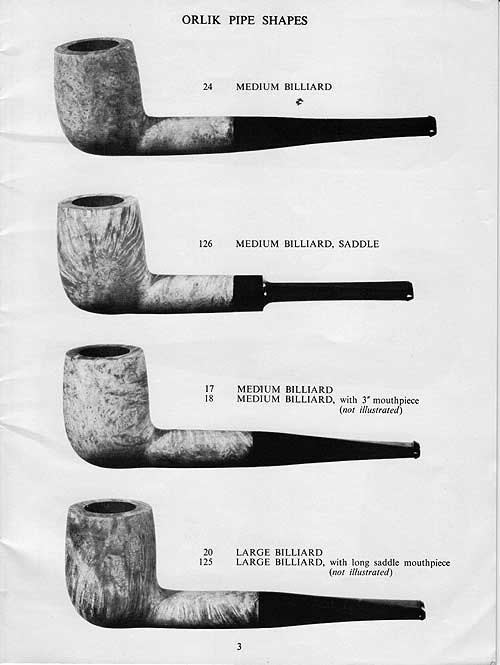
Charatan’s, no, Orlik, maybe. Here is a catalog image of the Medium Billiard, Saddle. The “Medium” works out to a grp 3 size pipe. Also the sans serif type font is the type Orlik used. Is this definite, of course not, it’s what makes trying to figure out English pipes a challenge!”
orlmedbill
In searching the web for information I came across an interesting post by the late Mike Leverette who wrote on the Grabow Forum in response to a post on L.L. Bean pipes as follows: “… By the way, all of the big chains carried pipes at one point in time, such as Sears, Marshall Fields, M. Ward, etc. Did any of these carry pipes made by the different Grabow owners? …The only Marshall Fields I have was made by Comoy and takes a paper filter.”

Either Comoy’s or Orlik. That was the overarching thought of others as they looked at this pipe. It also concurred with my thinking. If I put the Comoy’s shape chart up on the screen and compare it to the pipe it could well be a Comoy’s and when I look at the chart Dave shows it could well be an Orlik. Dave’s comments about stamping are interesting to me as I think about the maker. The typeface used in the stamp is certainly very similar to that used by Orlik while the Comoy’s stamping is a typical Serif font. Some of the pipes I have found on EBay have shape numbers that fall in the range of shape numbers for Orlik pipes. None of them fall in the Comoy’s shape numbers that I can find. A definitive answer may be a long time coming but for now I am leaning toward Orlik as the maker of these pipes.

While I may not be 100% certain of the English maker of the pipe it is indeed a Marshall Field pipe. These were sold by the Chicago based department store and chain at least through the 60’s if not longer. Field’s was a huge department store chain that in its Chicago location had reading, writing and rest lounges, restaurants, men’s departments and a broad range of the features of the good life. I still remember my mother taking me there when I was little.
Noname
The pipes seemed to have been graded in a variety of ranges or lines. I am still trying to hunt down information on the various lines of pipes that they sold. I have found several pipes on EBay that bear different line stampings. All have the same style stamping and all have the MADE IN LONDON ENGLAND stamping. I have included the list below to show what I have found so far. I have arranged them in what appears to be in the order from highest to lowest grade as I can determine. I have also found two leather covered pipes that were stamped Marshall Field Smoke Shop and appear to have been made by Ropp. They were identical to the Ropp leather clad pipes that have seen.

1. SUPREME (I have seen both a billiard and a pot with this stamping. Both have a smooth finish and exhibit beautiful straight, flame or cross grain.)
2. SPECIAL GRAIN (The first one I saw on EBay and was a bent billiard shaped pipe, stamped 85. The second on EBay was a straight apple shaped pipe. Gary, an online friend responded on Smokers Forum and posted a picture of a bent billiard that was stamped Special Grain. All were smooth finishes but did not have the same density and grain consistency as the Supreme.)
3. FIELD DELUXE (This was also seen on EBay and was a Zulu or yachtsman shaped pipe, stamped 87. The Marshal Field stamping was in a script which was different than any of the other pipes that I found. The grain was a mixed pattern.)
4. FIELD GRAIN (These were seen on EBay was as well. The first was a smooth billiard with a saddle stem (bearing the shield logo) and stamped with the #6. The second was a sand blast billiard version. On the smooth one the grain was mixed and on the blast it was a deep craggy blast.)
5. STORE FOR MEN 3 GROUP 2 (There was one of these on EBay for sale as well. It was a smooth finish, square shank pot. The grain was mixed and clean.)

All of the smooth pipes were decent briar with no visible fills or sand pits. All the English made pipes that I have seen online were well made and all had the same style of saddle stem. The French made ones all had taper stems and were leather clad.

I will continue to hunt down these pipes to build a picture of the various lines. Any information you may have will be greatly appreciated.

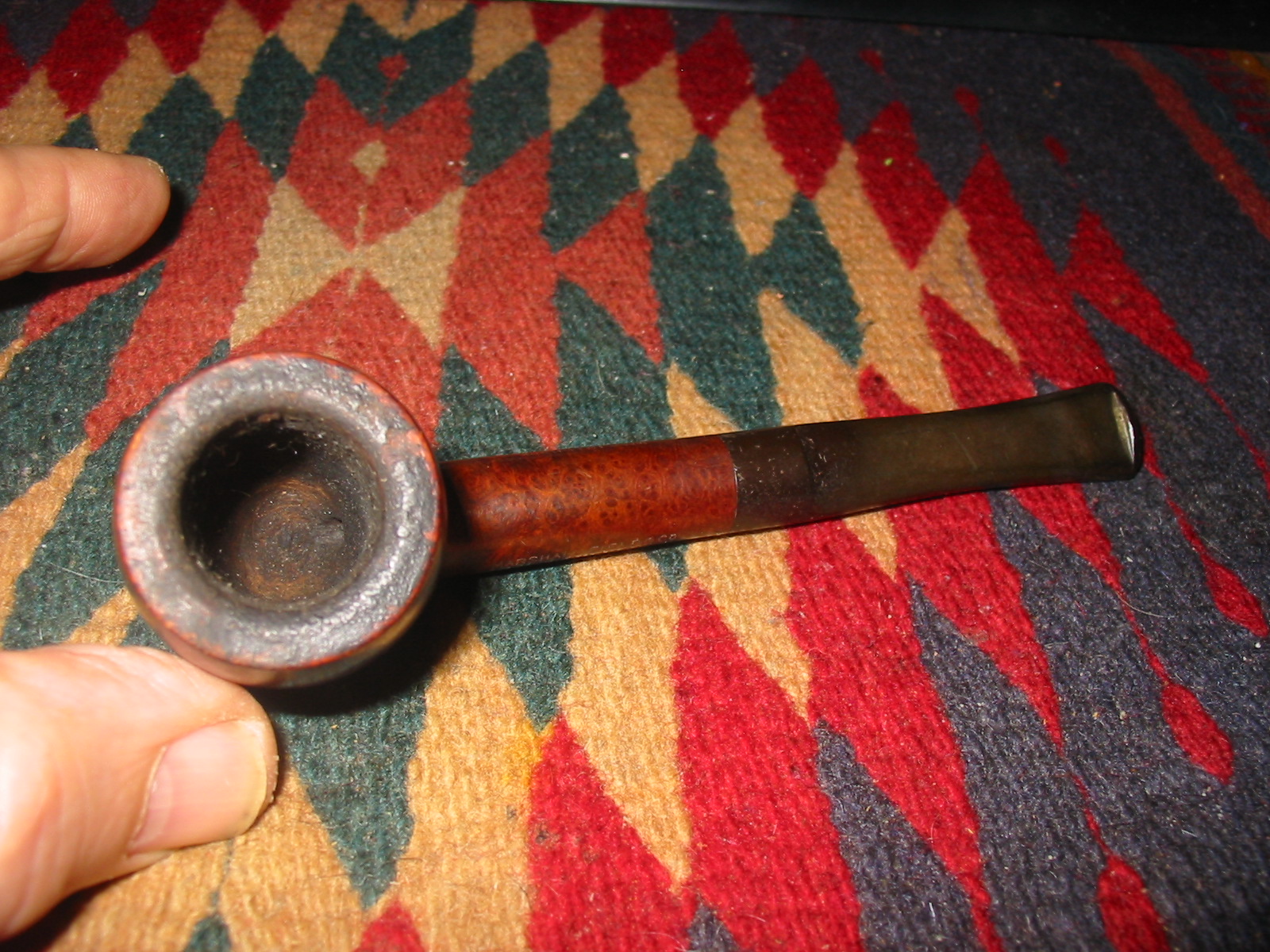
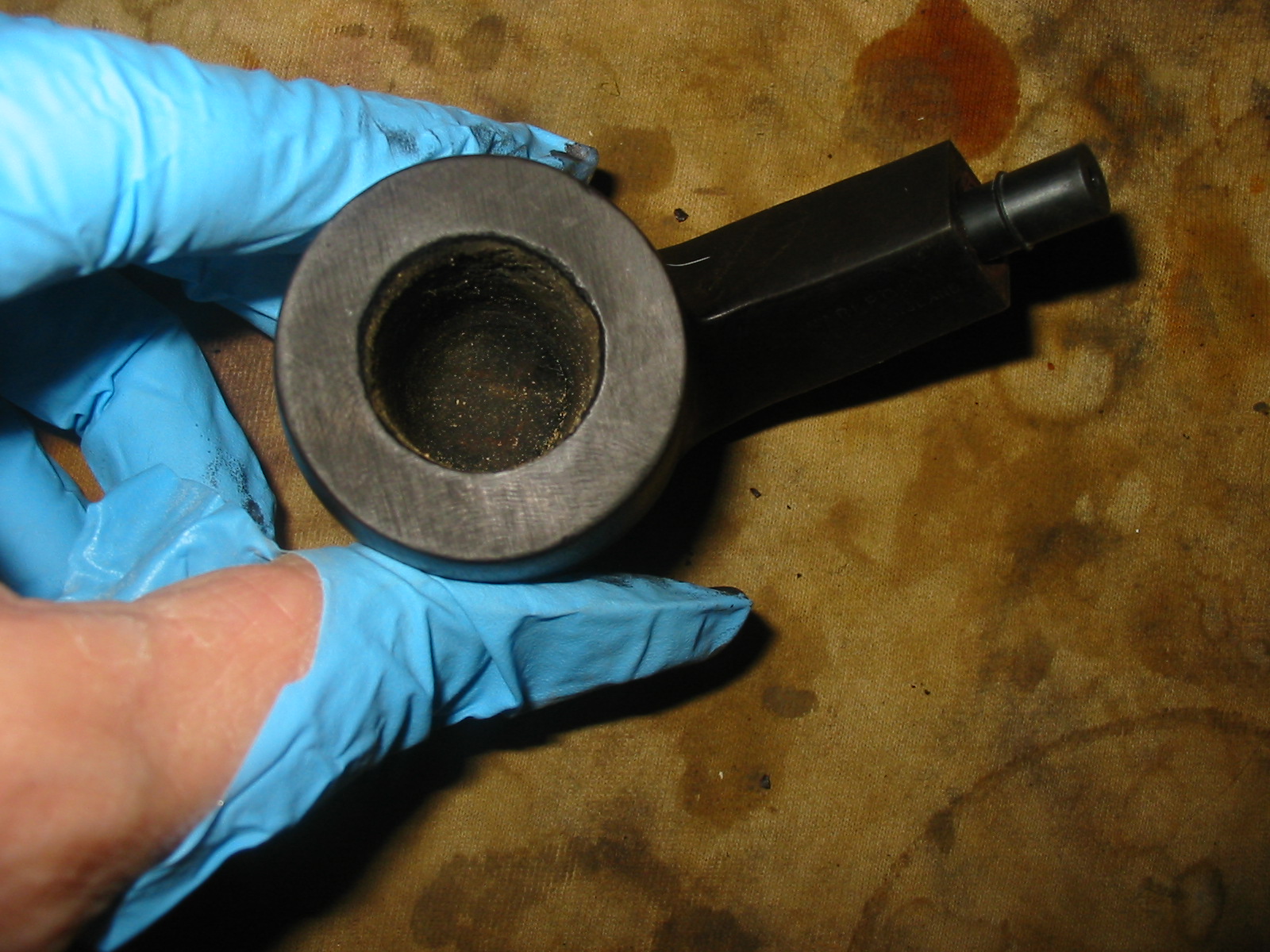
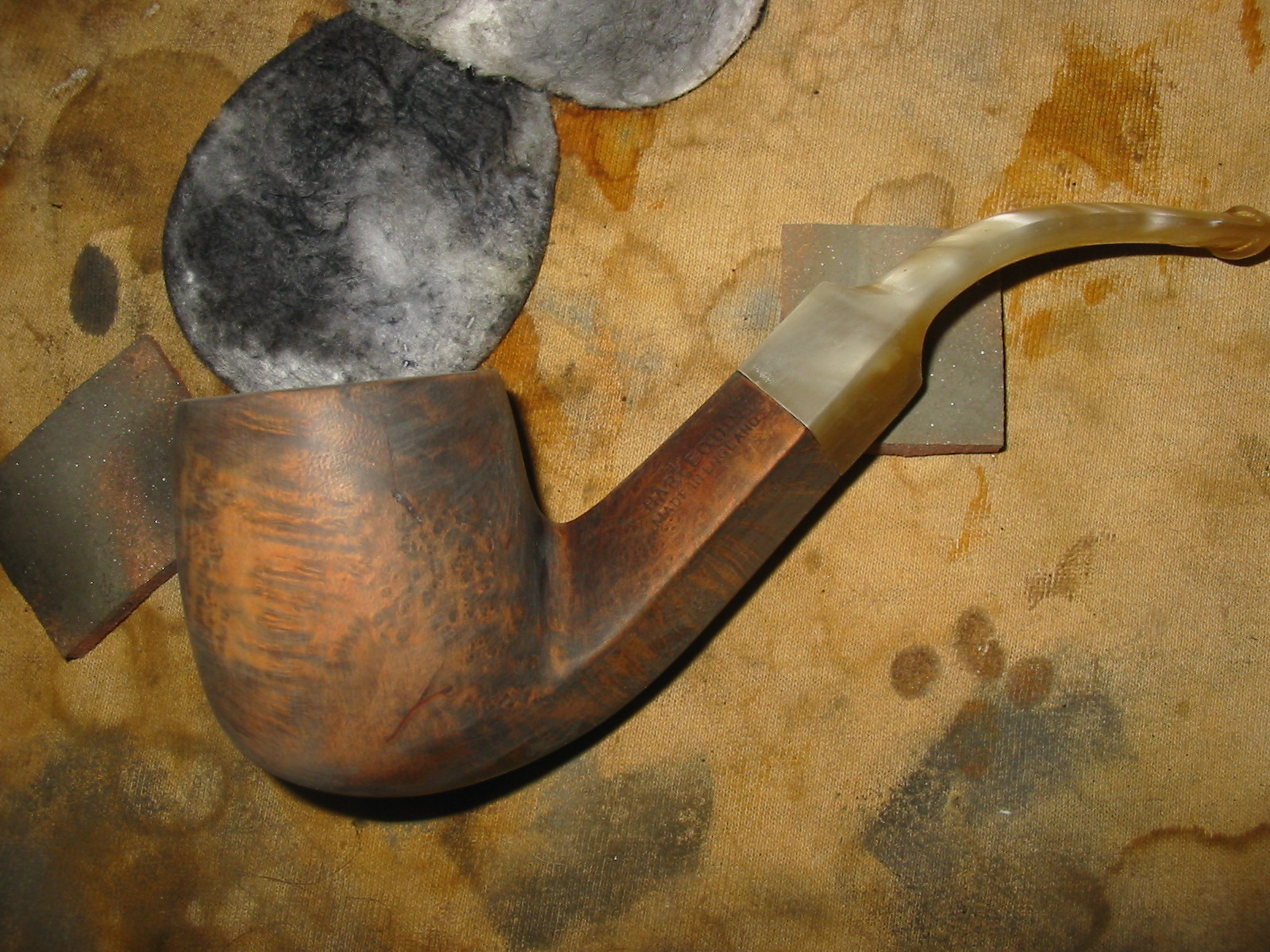
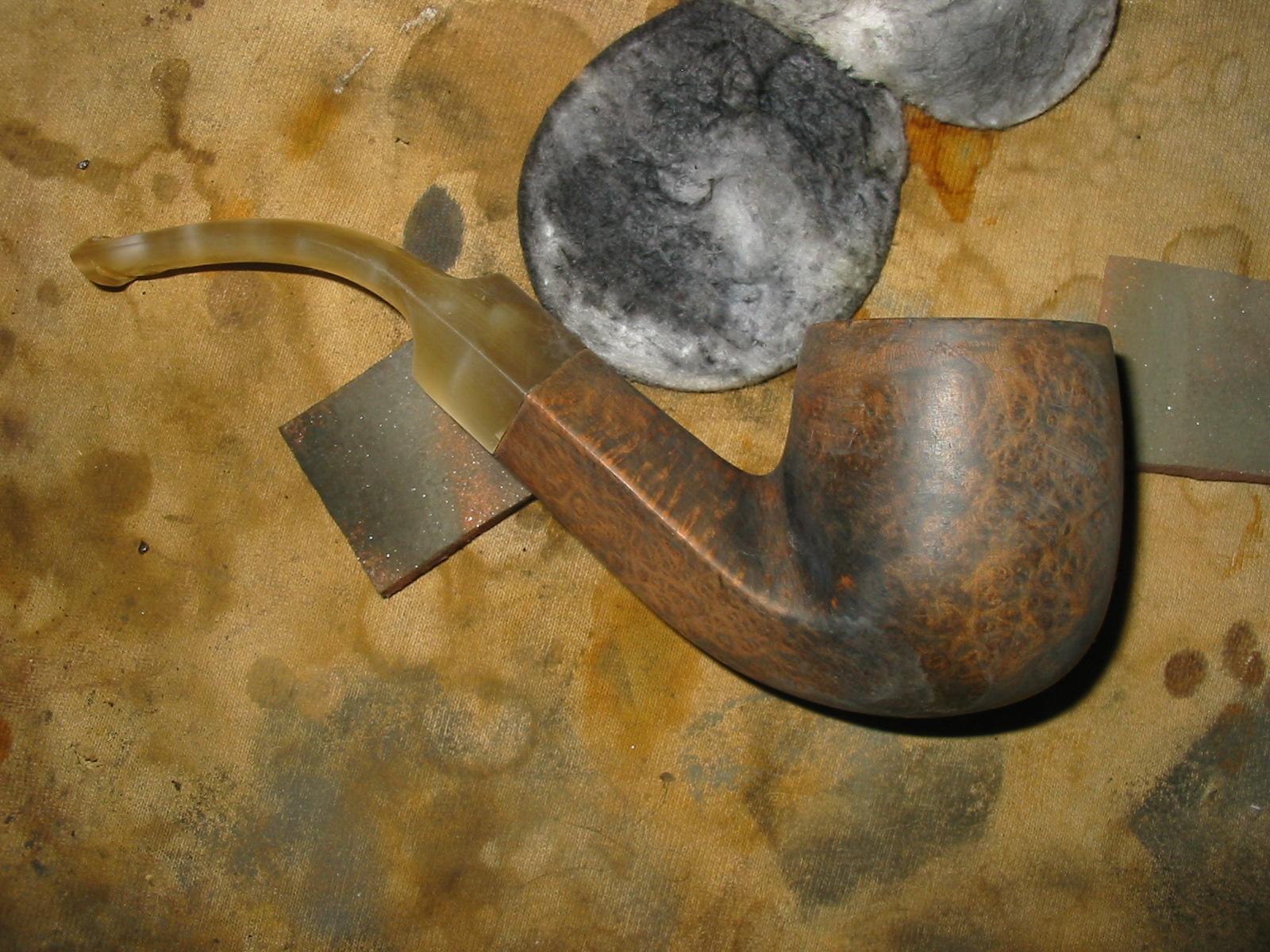
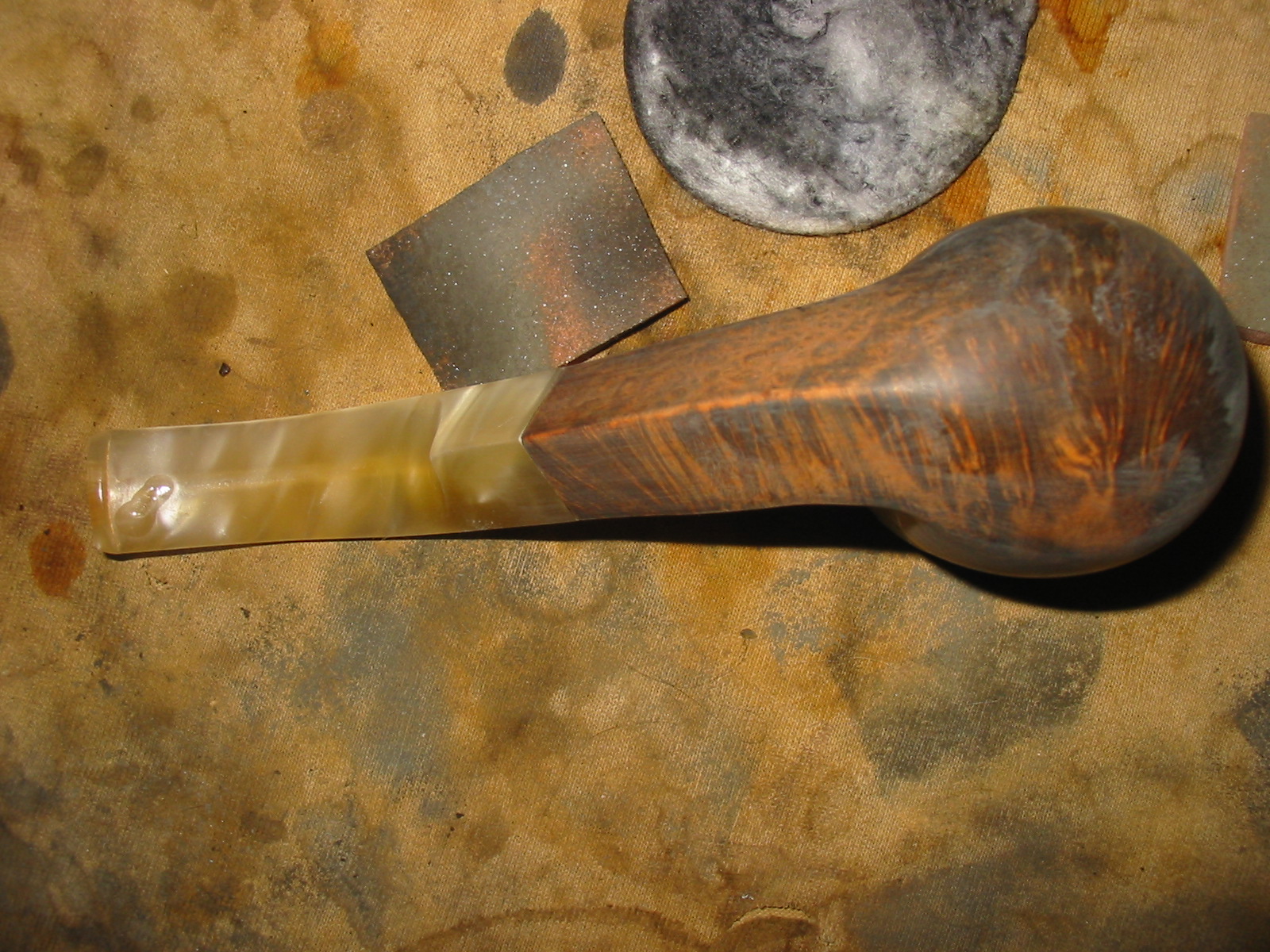
I took the billiard that I purchased to my work table this morning. Before I worked on it I examined it for what needed to be addressed. The bowl had an uneven cake on the inside and did not extend to the bottom of the bowl. The bottom was still clean briar and it went up the sides about ¼ inches. The rim was clean but had a tarry buildup. The inner bevel on the rim was undamaged and showed no sign of over reaming or damage. The finish on the outside of the bowl was clean and undamaged. There were no dings or dents in the surface of the briar. There was an oily buildup on the surface of the pipe. The stamping was crisp and distinct. There were two slight marks on the left and the right side of the shank next to the stem. The stem itself was clean but oxidized. There was tooth chatter on the top and bottom of the stem next to the button. The inside of the stem and the shank were very clean.
IMG_6796

IMG_6797

IMG_6798

IMG_6799
I reamed the bowl with a PipNet reamer and took it back to bare briar. I wanted to remove the buildup on the upper portion of the bowl and provide a clean surface to rebuild the cake. I scrubbed the rim of the bowl with spit on a soft cotton pad to remove the tarry buildup. I also had to wipe it down with alcohol until the tars were gone and the rim and bevel were clean.
IMG_6800

IMG_6801

IMG_6802
I sanded the stem with a medium and fine grit sanding sponge to remove the tooth marks and chatter and to remove the oxidation on the surface. I followed that up with my usual habit of sanding with micromesh sanding pads. I wet sanded with 1500-2400 grit sanding pads and then dry sanded with 3200-12,000 grit pads. I polished the stem with Meguiar’sScratch X2.0 polish and then buffed with Tripoli and White Diamond. I rubbed the stem down with Obsidian Oil and when dry gave it a final buff with White Diamond.
IMG_6803

IMG_6804

IMG_6805
I gave the pipe and stem multiple coats of carnauba wax and then buffed it with a soft flannel buffing pad. The pipe is finished and ready to break in. The grain stands out because of the contrast finish on the pipe and the stem is like glass with the buffing and polishing. To me it looks like it must have the day its previous owner purchased it at Marshall Field’s. If only I had the box and the pamphlets that must have come with it when it was new, it would be an even more amazing pipe.
IMG_6806

IMG_6807

IMG_6808

IMG_6809

Refurbishing another Old Pal – this time a Long Oval Shank Billiard


Blog by Steve Laug

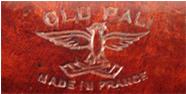
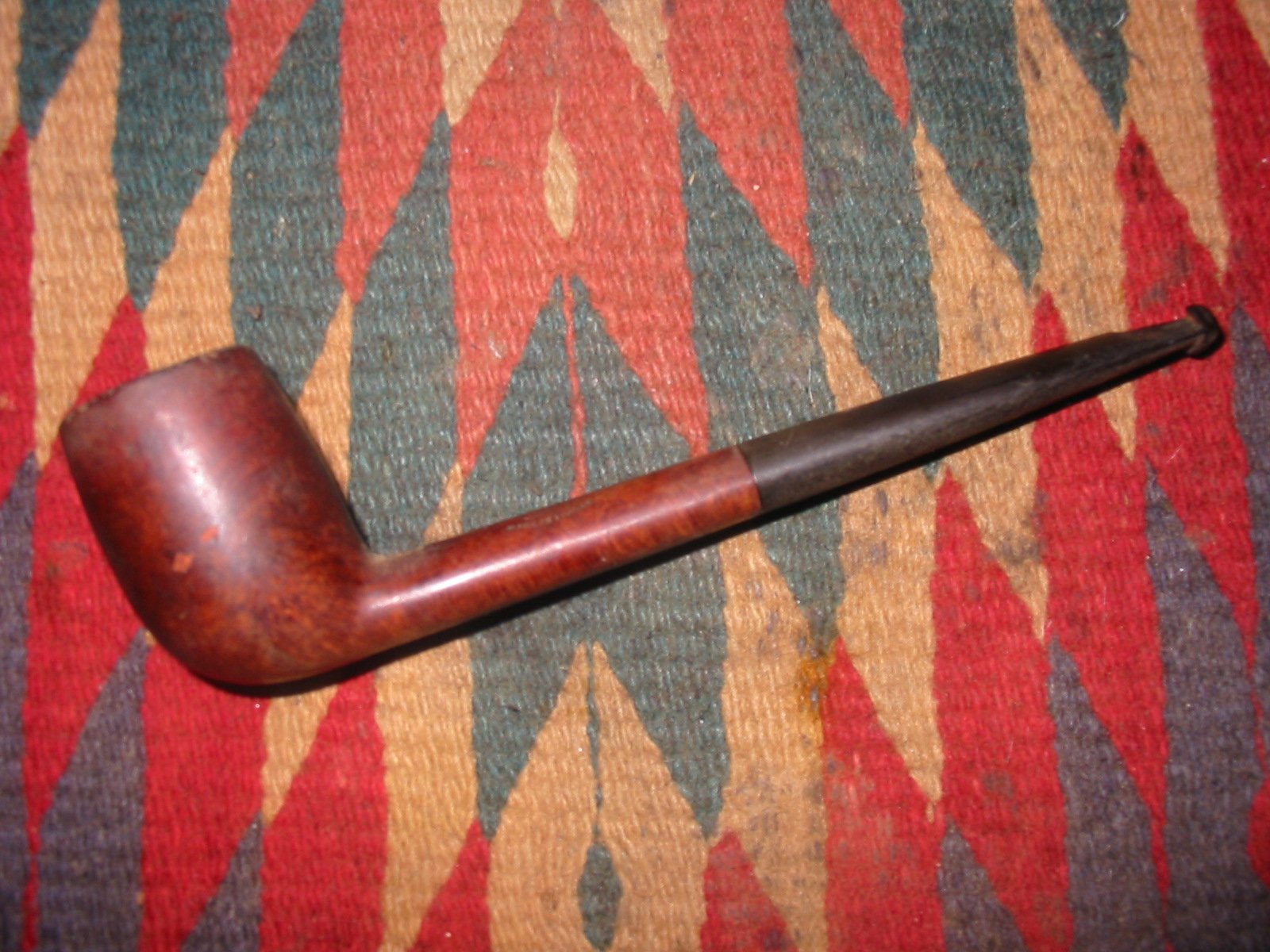
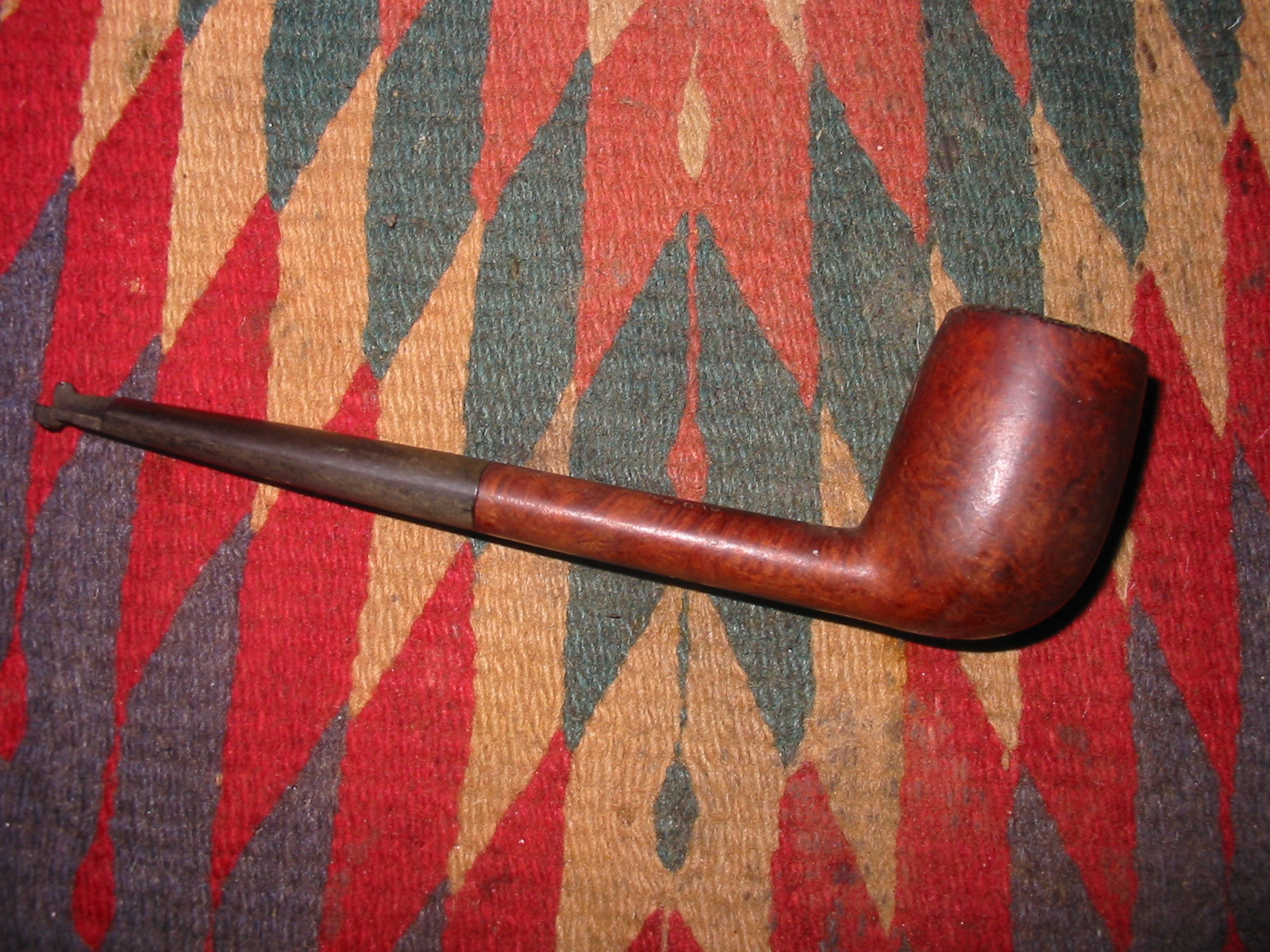
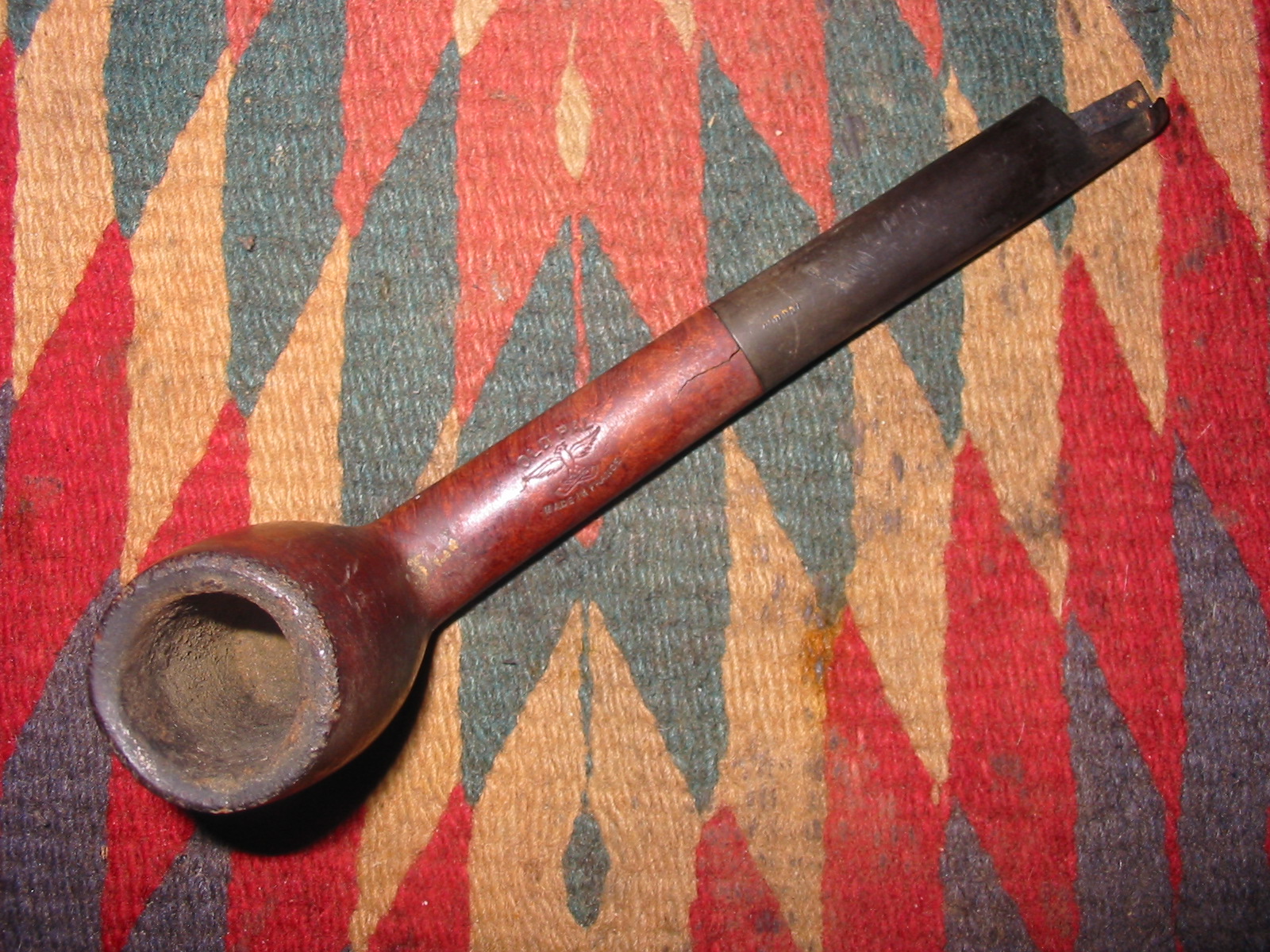
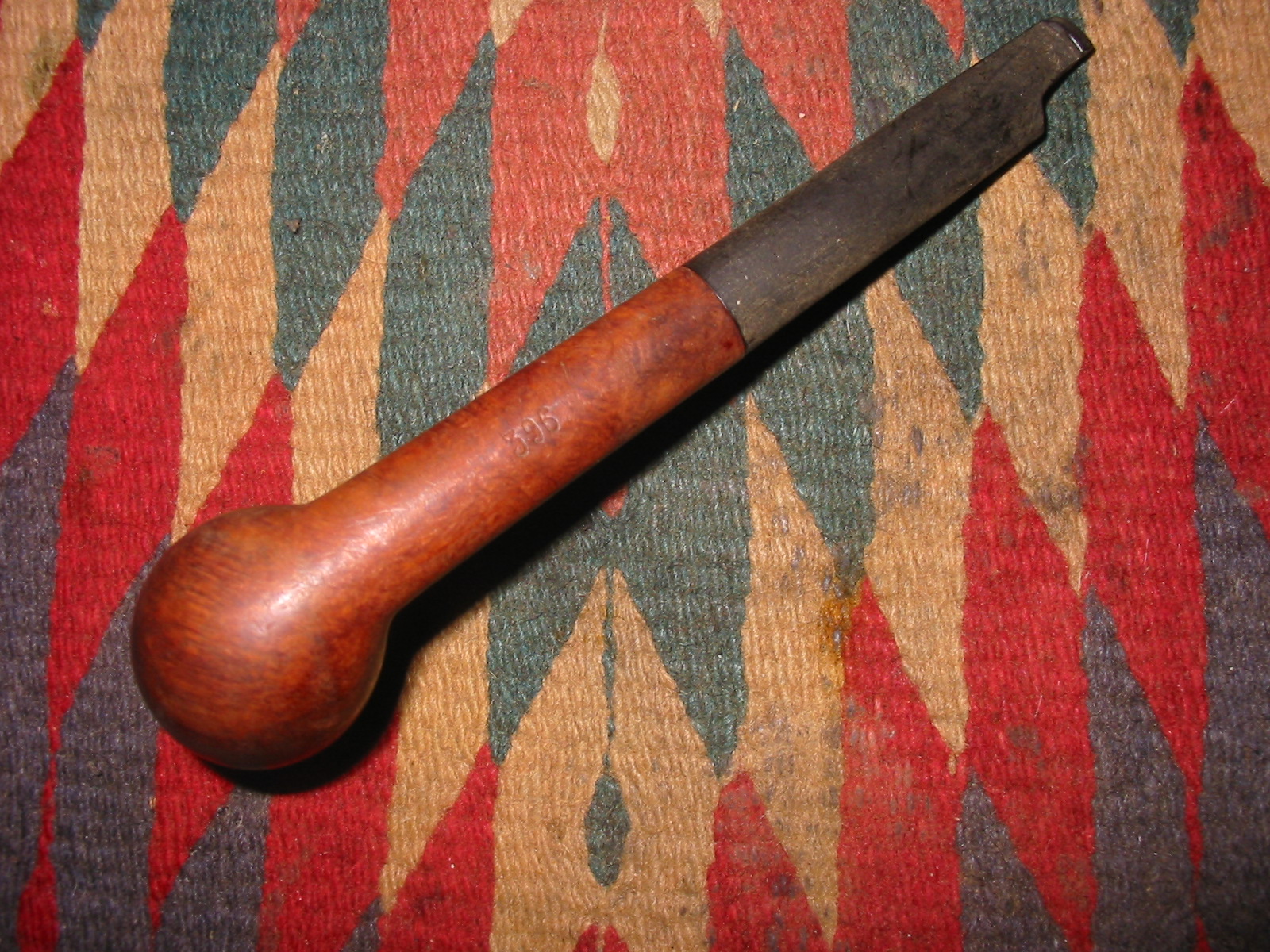
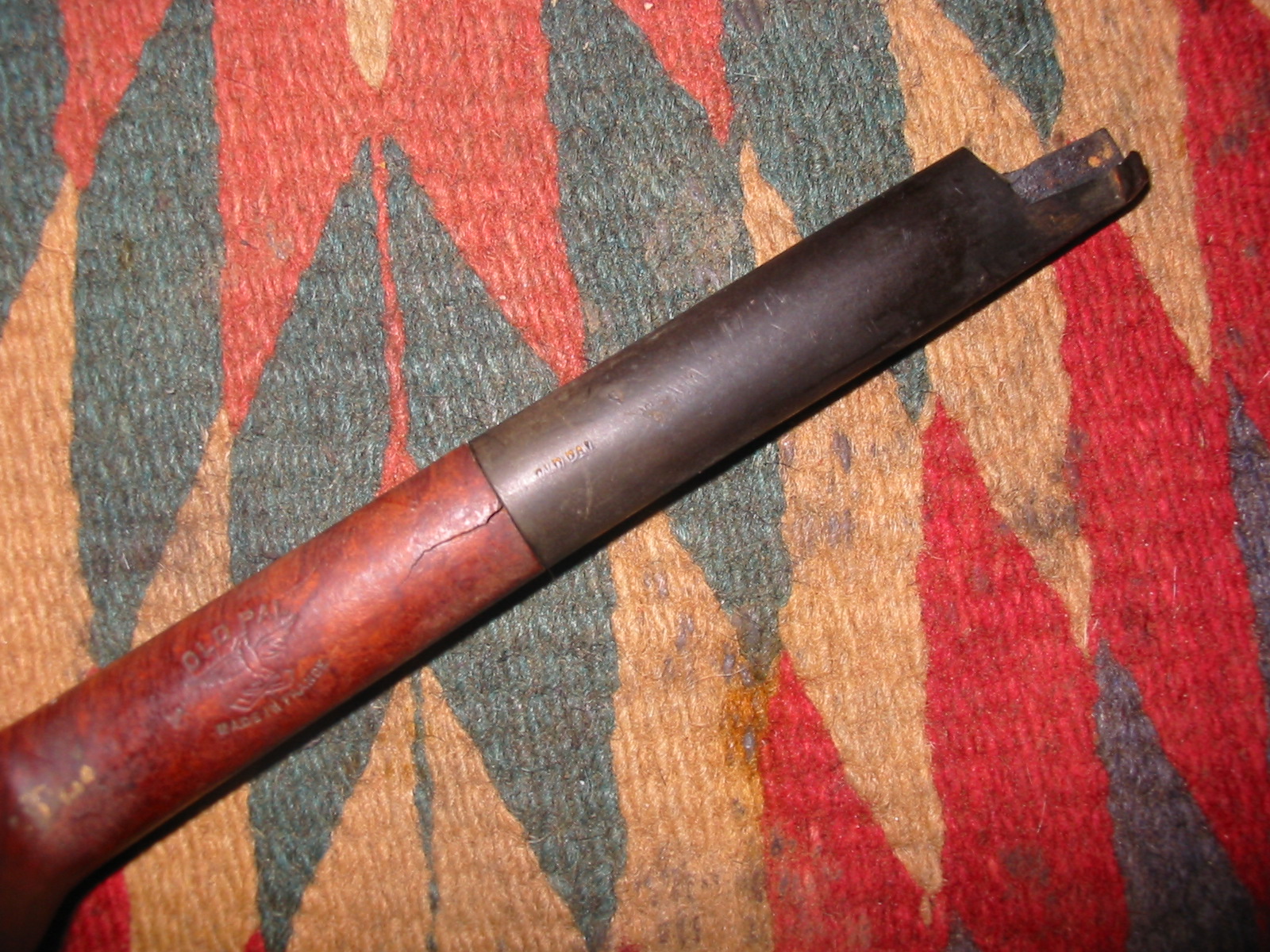
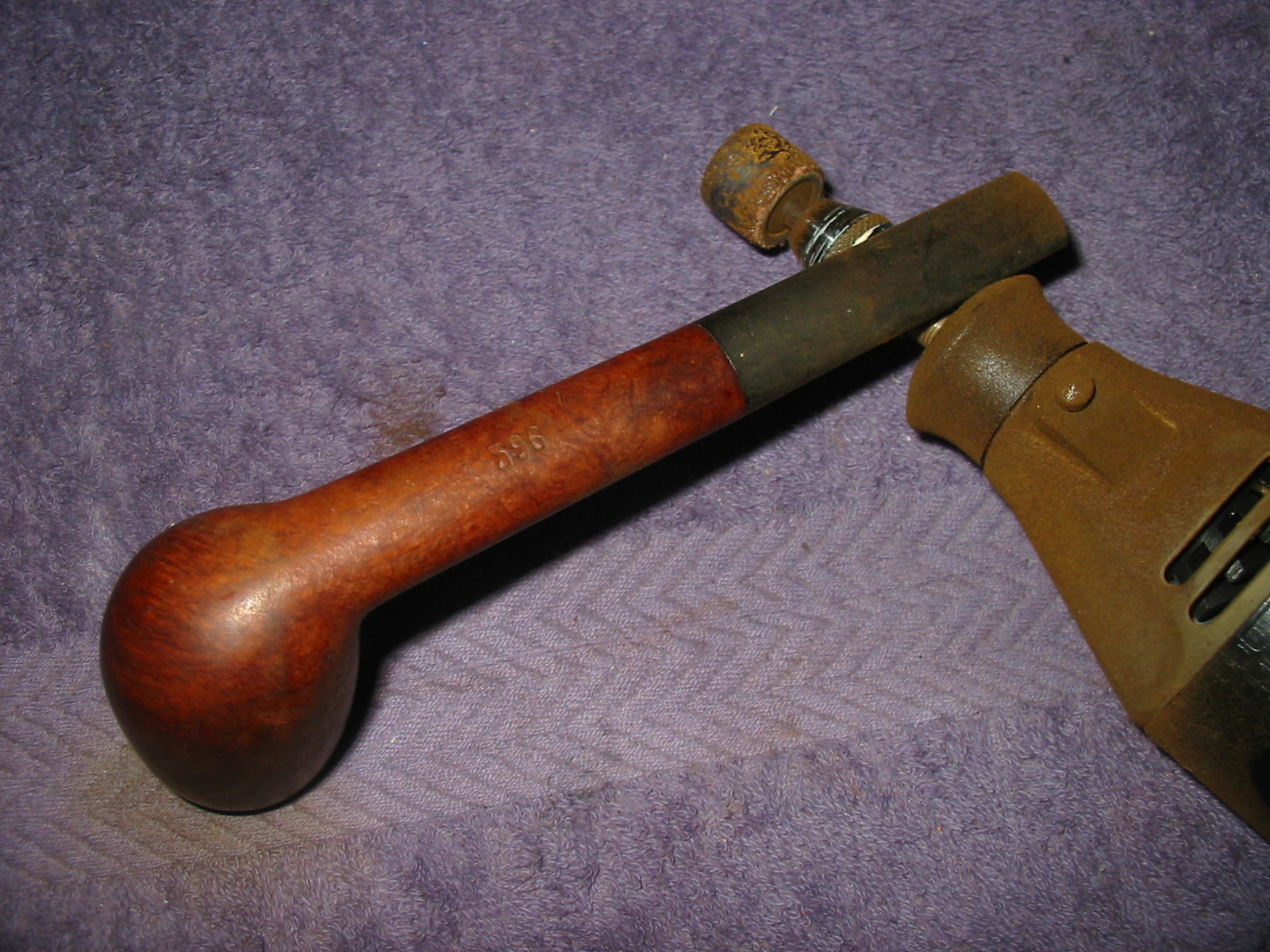
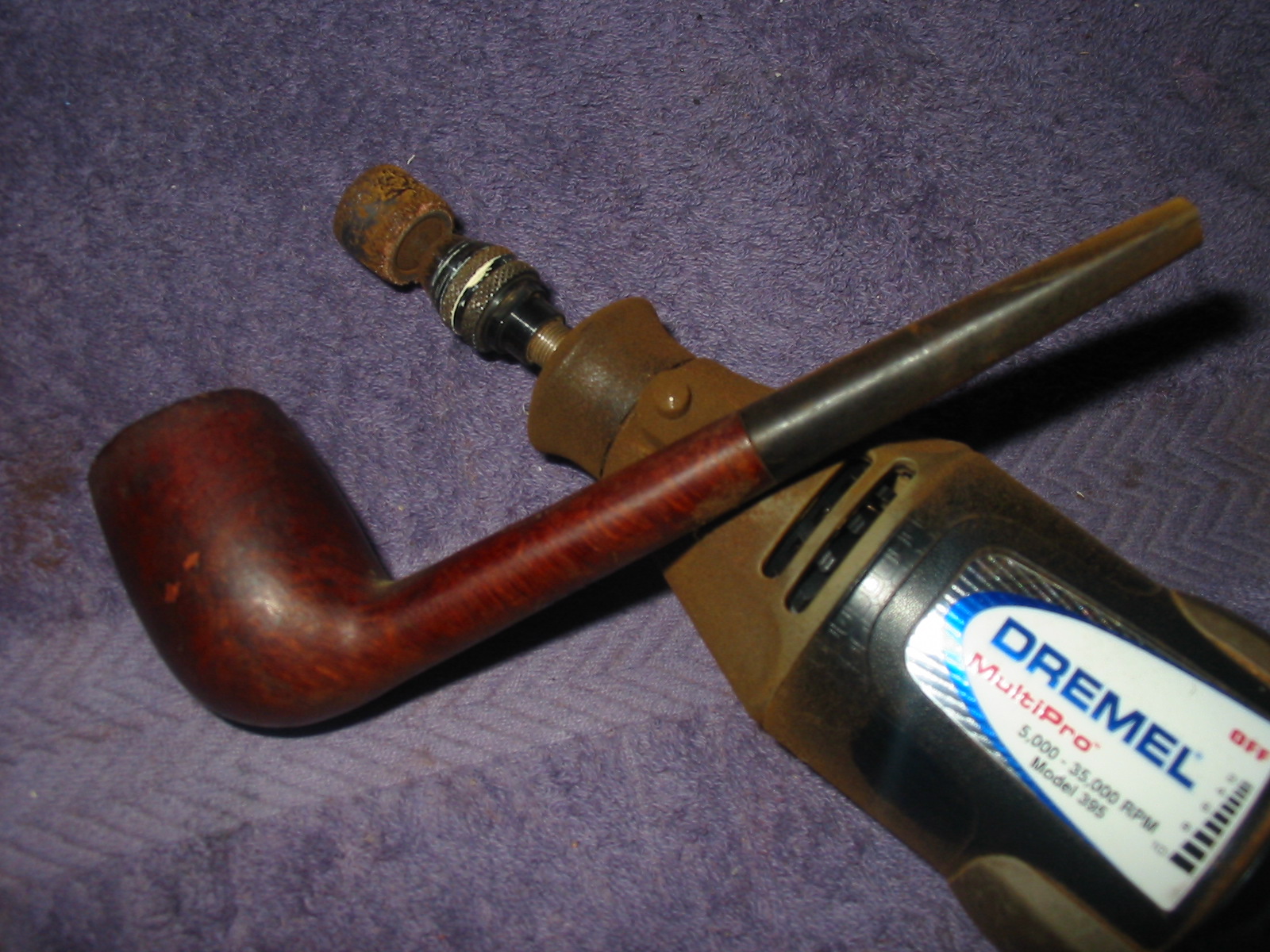
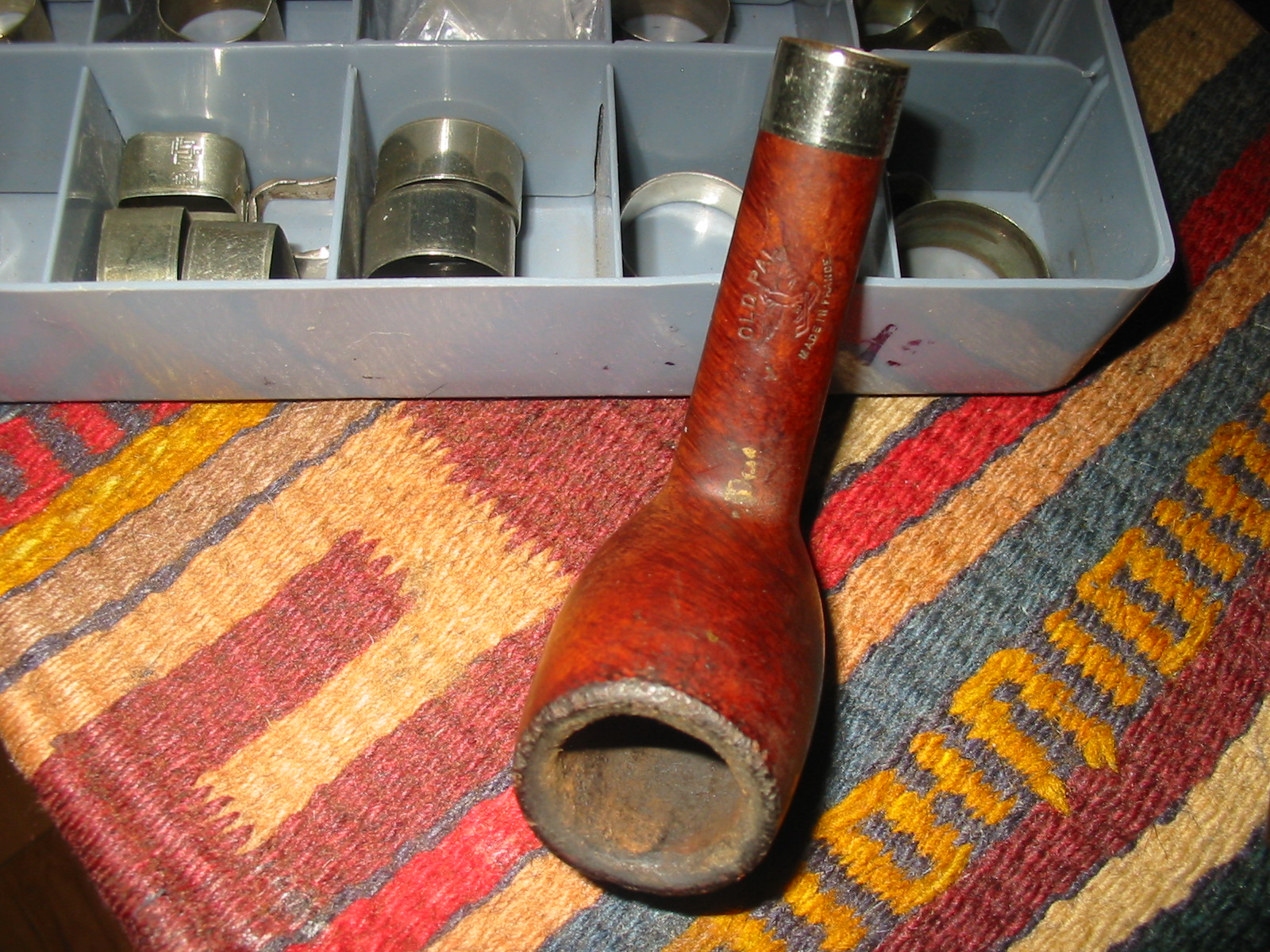
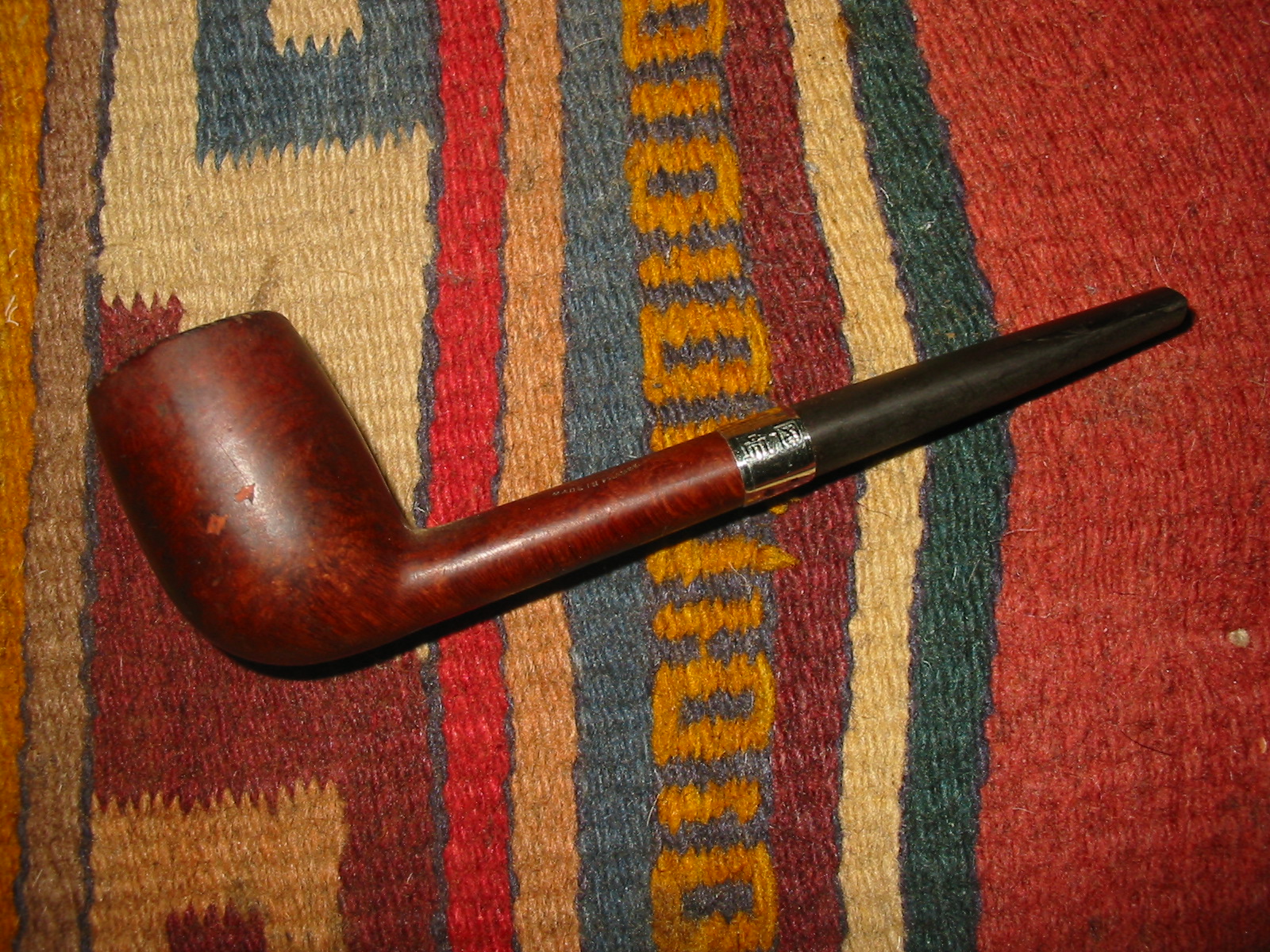
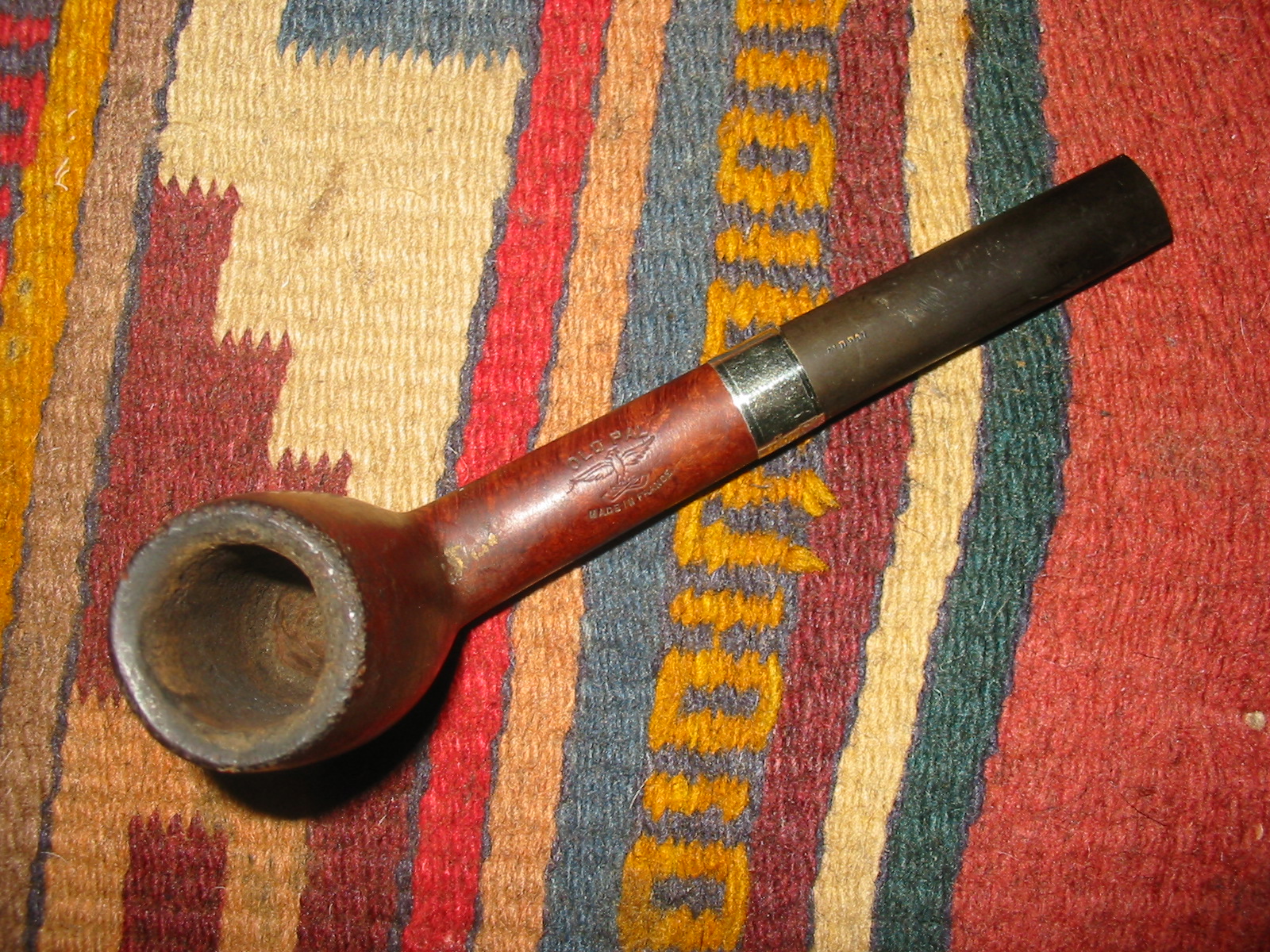
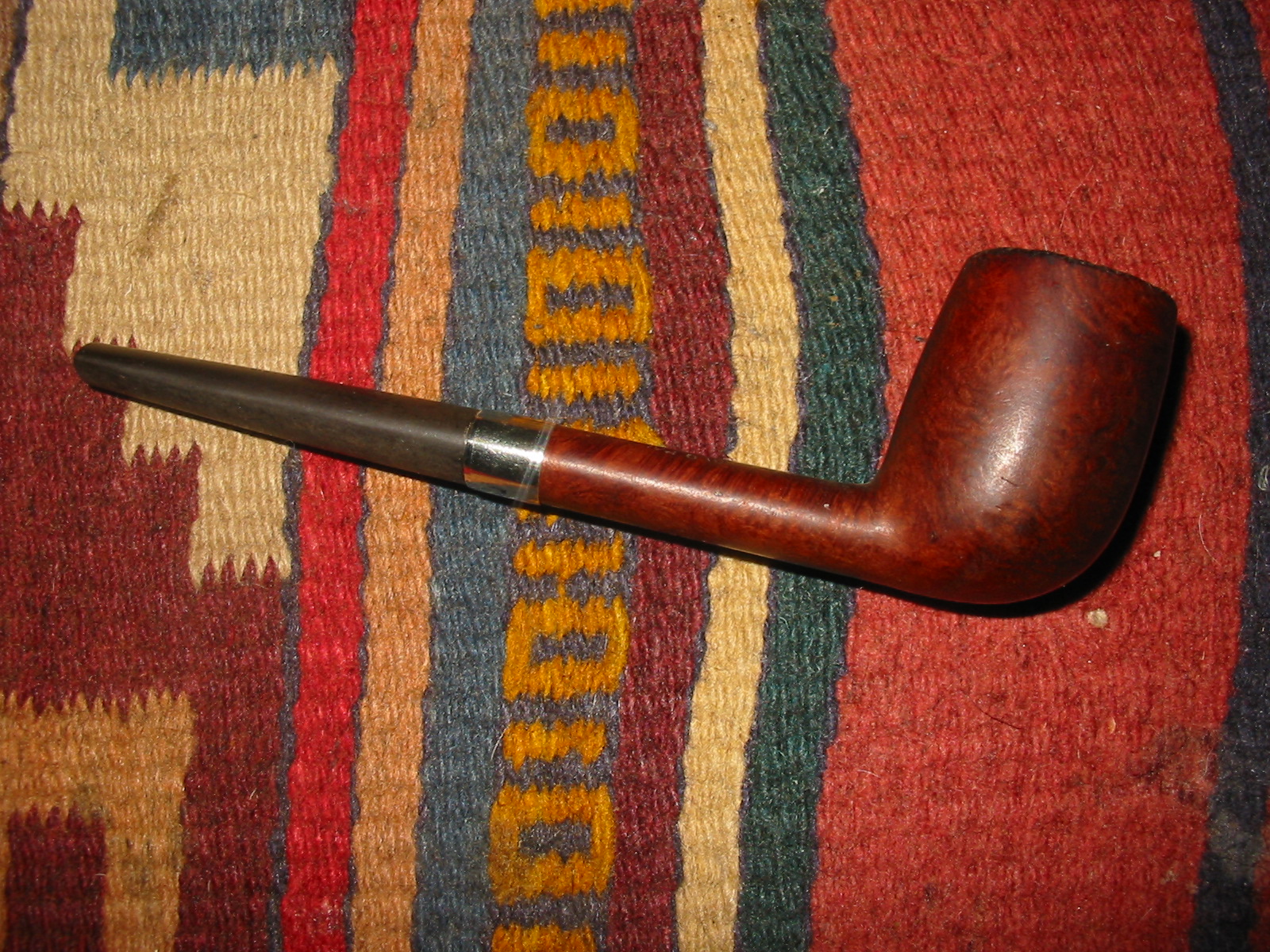
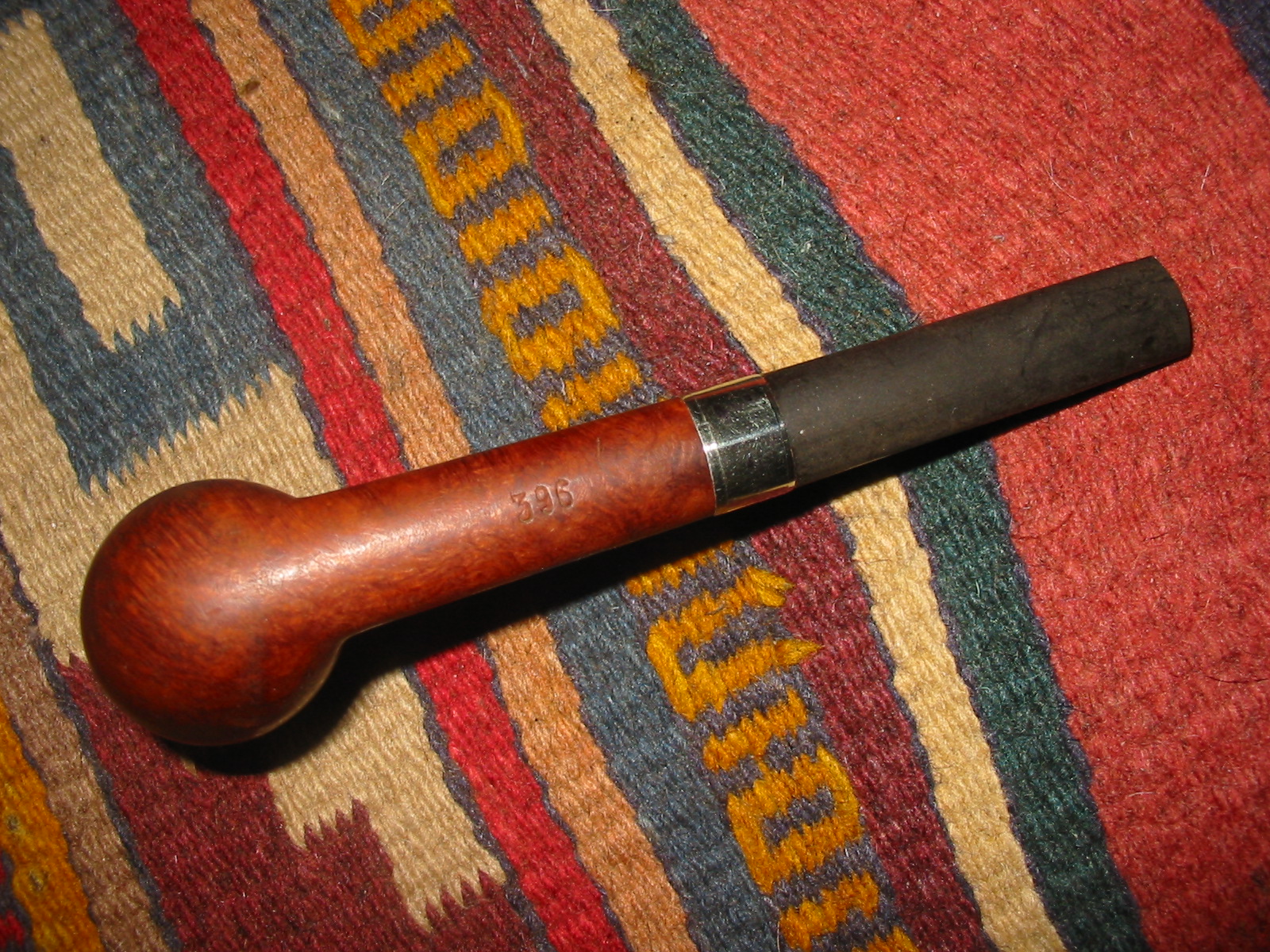
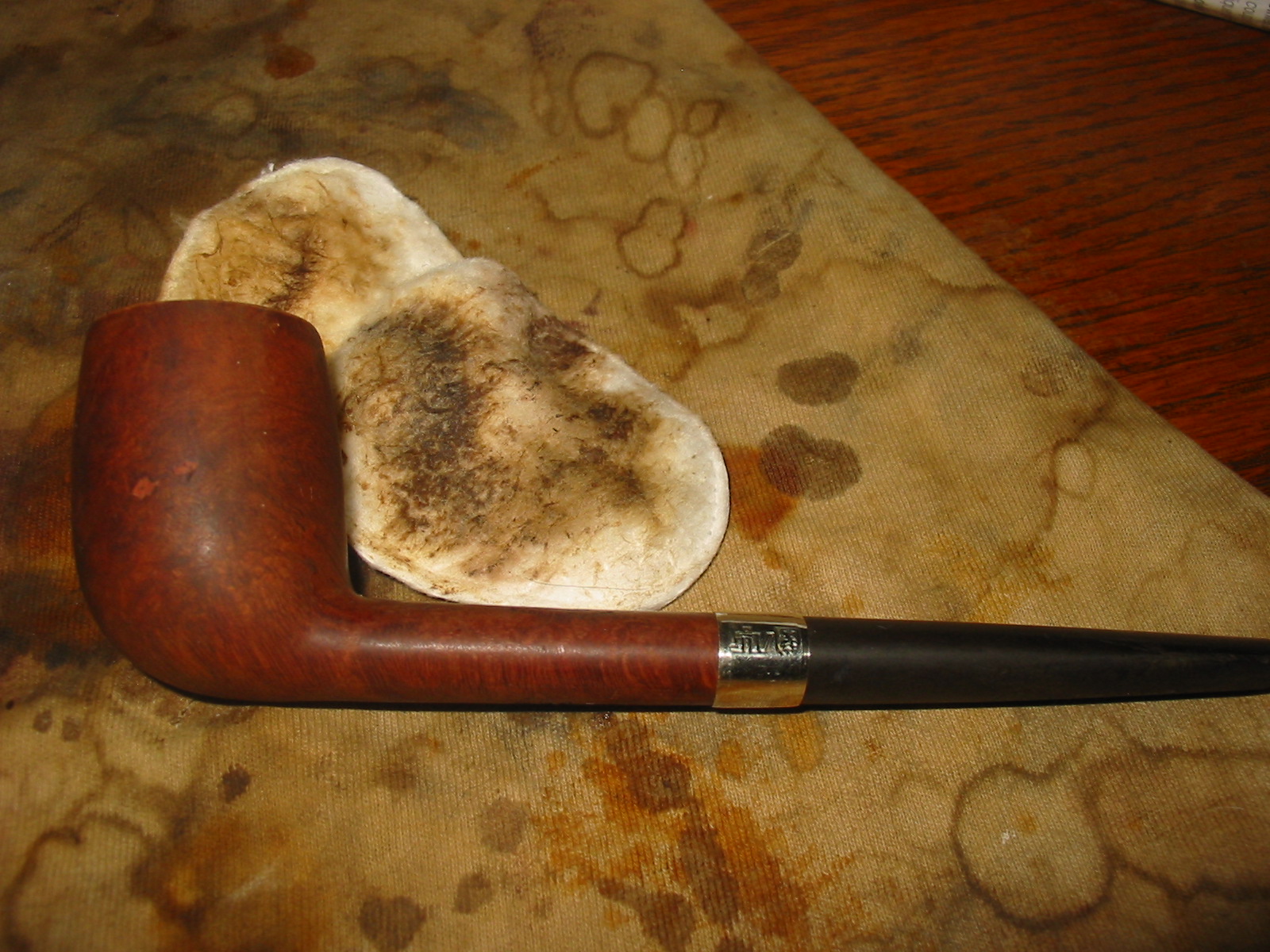
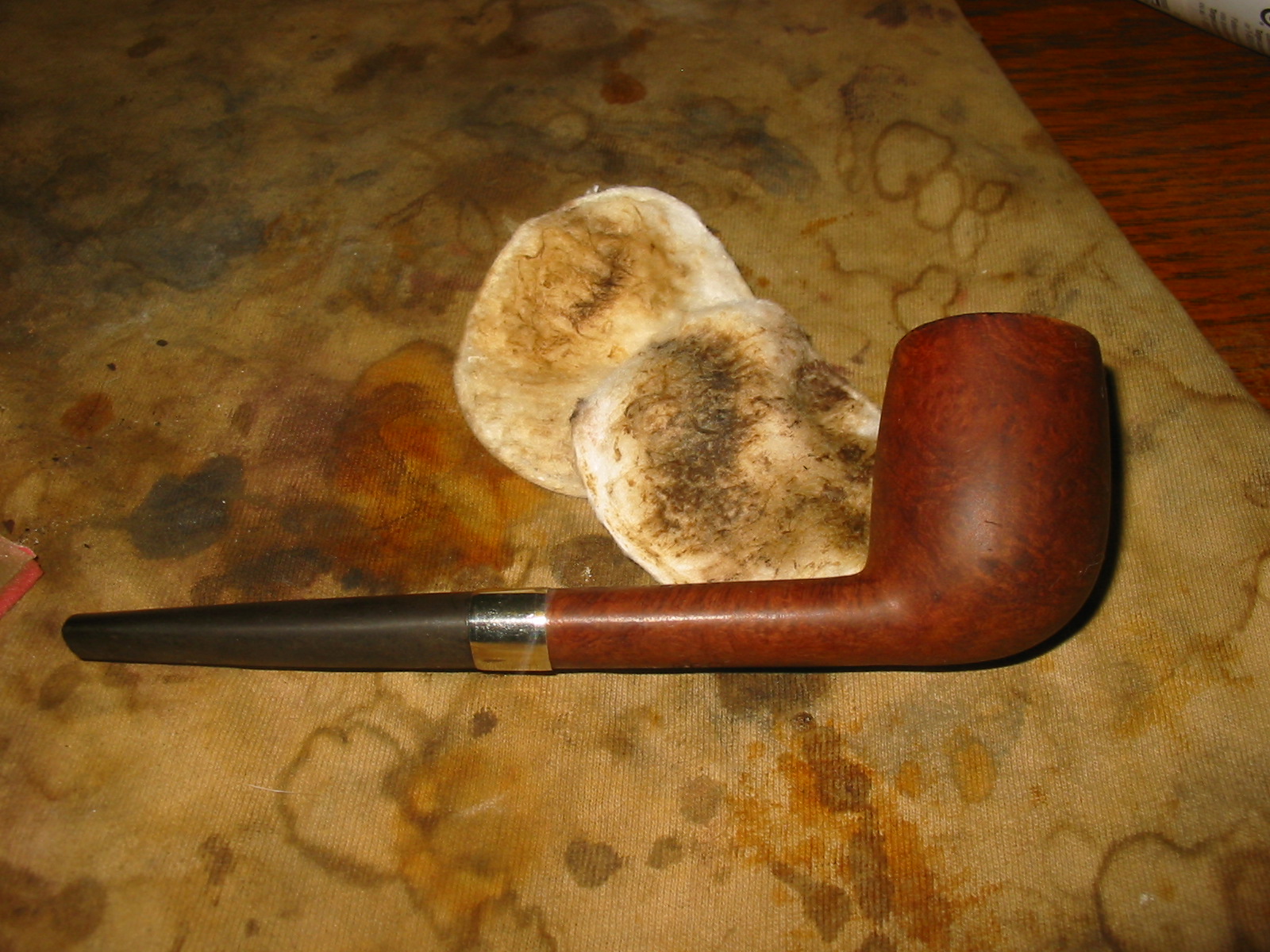
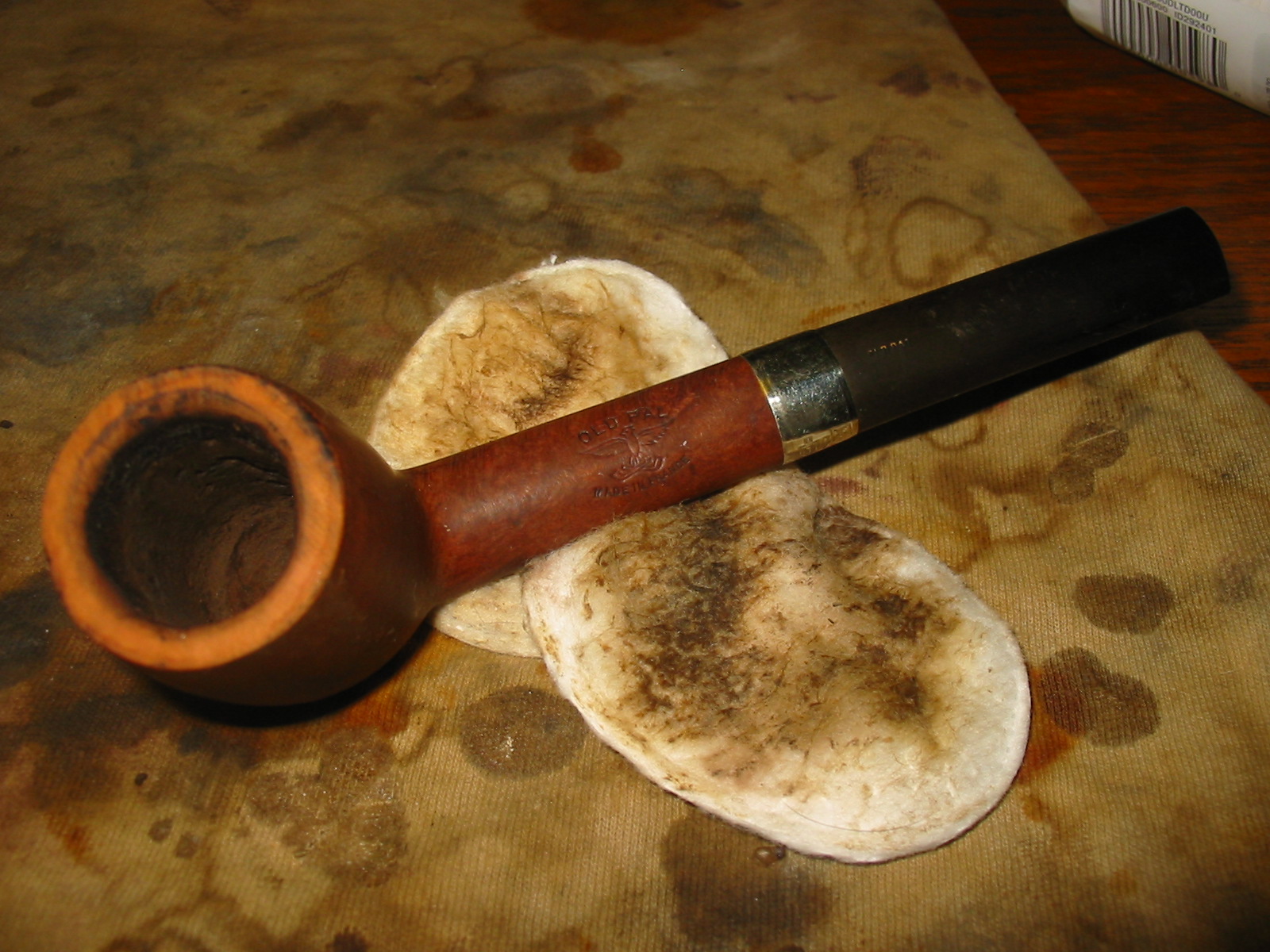
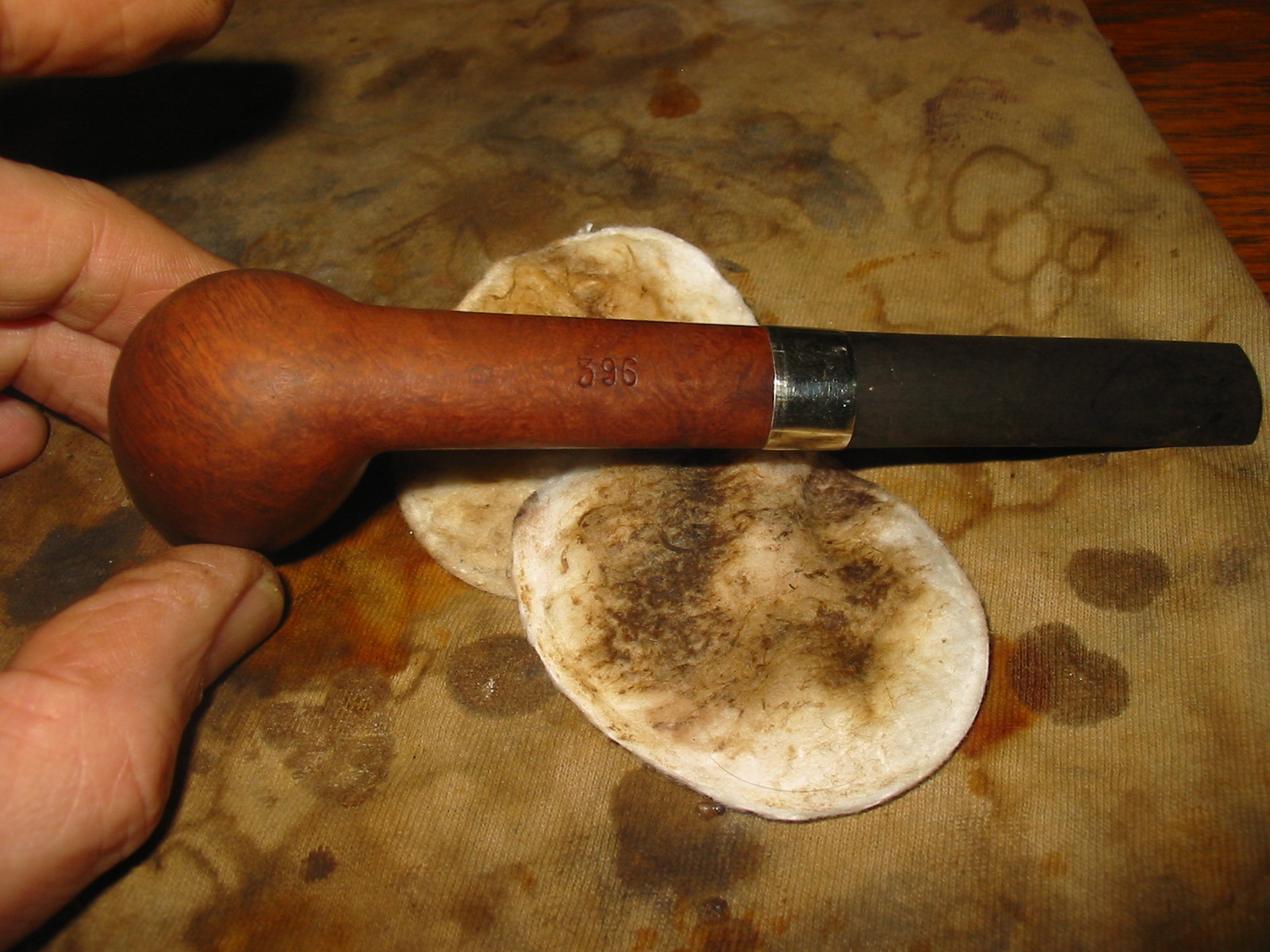
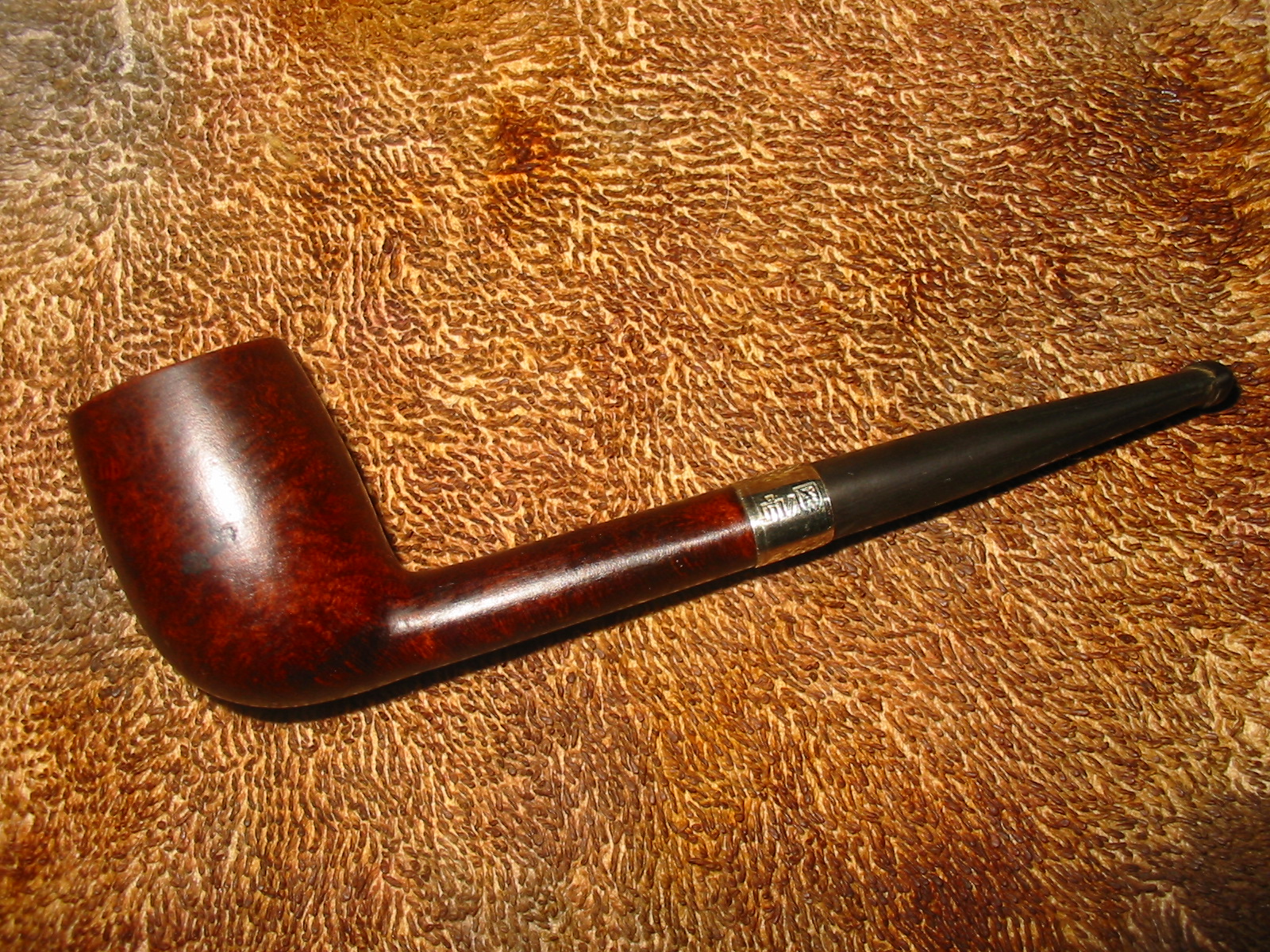
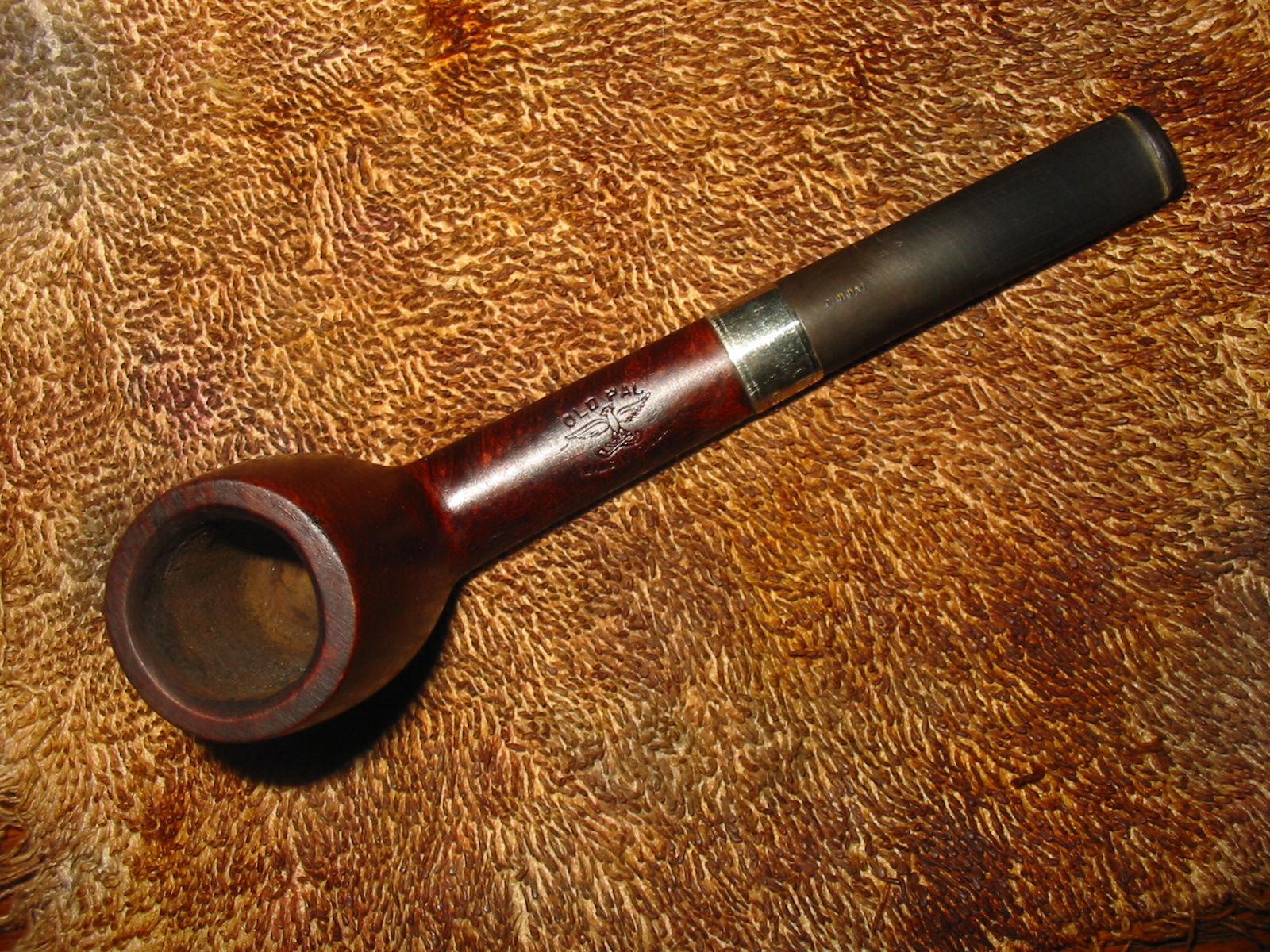
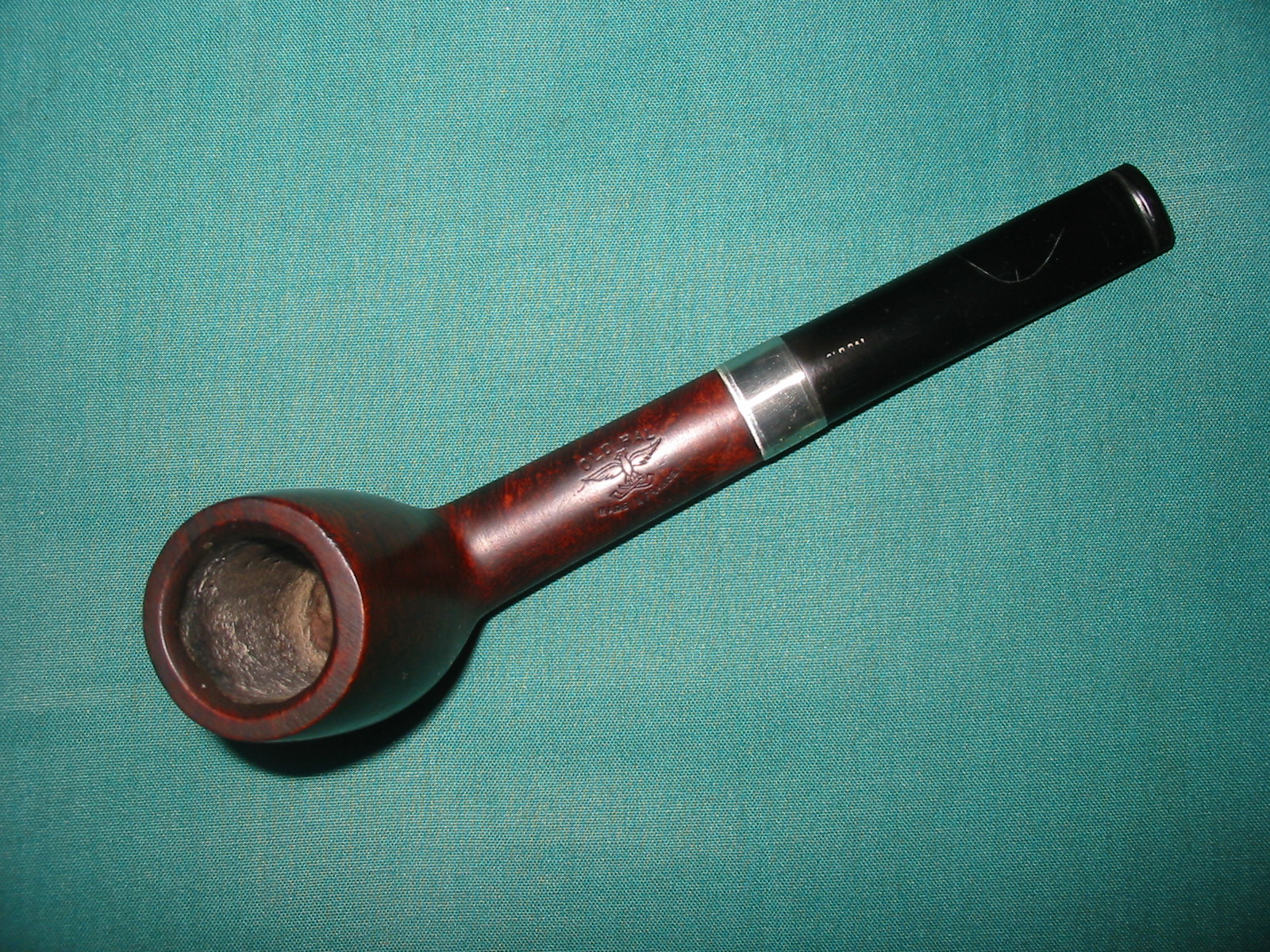
I just finished cleaning up another of the old pipes I picked up in my antique mall grab bag. It is a dainty pipe with an oval shank. When it came out of the grab bag it had a cracked shank and did not have a stem in the shank so I assumed it was a Canadian. When I went over the stems in the bag I found that one of them was stamped Old Pal. It fit the shank well and the look was quite unique. The stem was broken at the button with a large chunk on one side missing. The overall length is 5 ¾ inches and the weight is negligible. It is stamped on top of the shank in arc – Old Pal, over an Eagle with spread wings and then underneath Made in France.

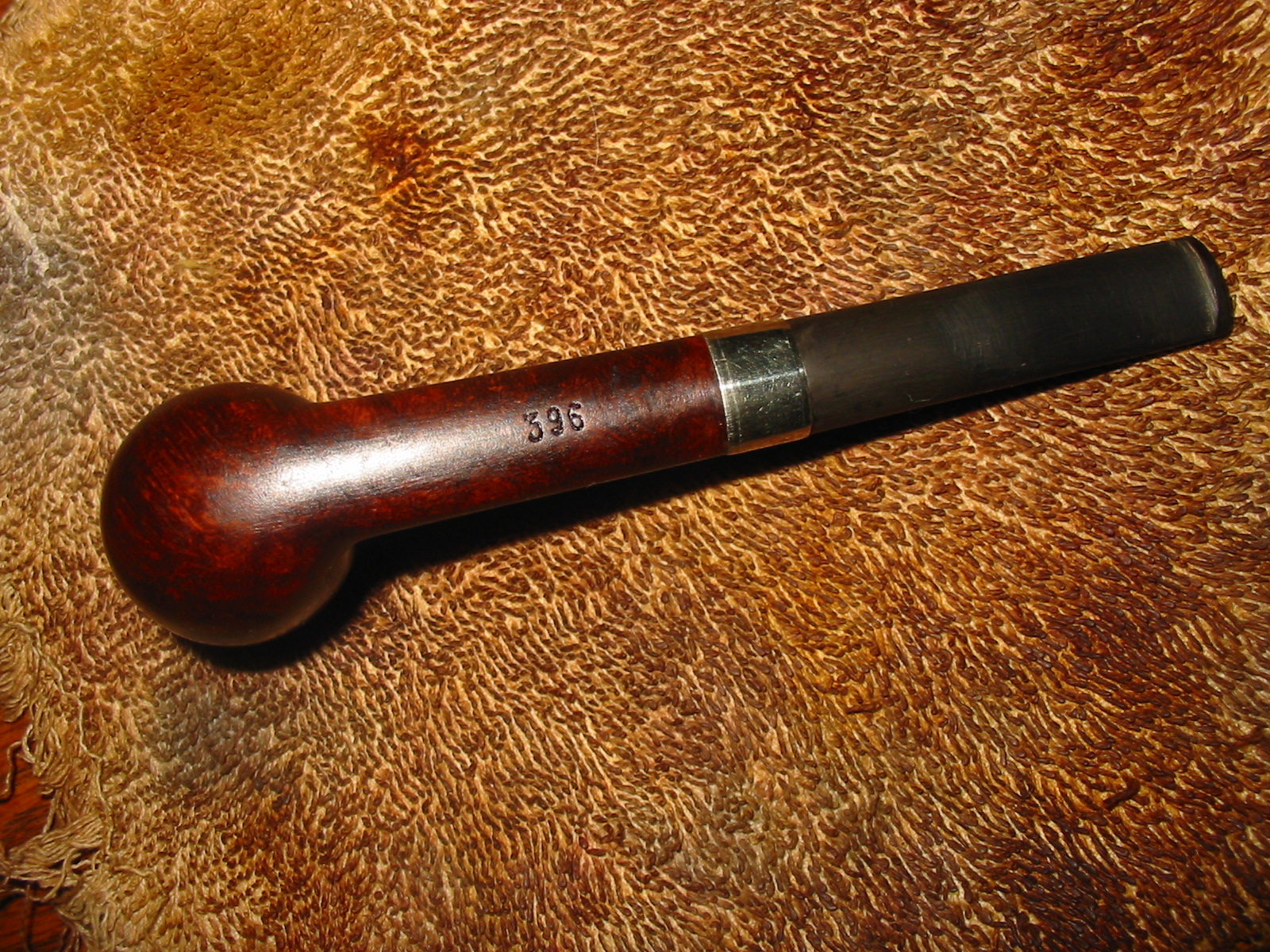
opOn the underside of the shank it is stamped 396 which I assume is the shape number. The shape number appears to be a GBD number but it is not included in the list on the Perdua shape number website. The stamping is faint but still readable. I wrote about the history of the brand in a previous post (https://rebornpipes.wordpress.com/2014/04/19/restemming-and-refurbishing-a-planter-opera-pipe/) But will summarize it again here for those who may not go back and read it.

“Who Made That Pipe” states that there were two French makers for Old Pal. The first of those is Marechal Ruchon and Cie. (Incidentally it is the company that owned the GBD brand). The second maker listed is Rubinovich & Haskell Ltd. The bird emblem is probably the key, but I can find no reference to it. My own thinking is that the brand was made by Marechal Ruchon & Cie. I was able to dig up this brief summary of the MR&C brand. Ganeval, Bondier and Donninger began making pipes in 1850 and rapidly gained prominence in briar pipe making. Of the three, Bondier survived the others by 30 years, but new partners took their places. The name of the company changed to Bondier Ulrich & Cie, then Bine Marechal & Cie and finally to A Marechal, Ruchon & Cie. August Marechal and Ferdinand Ruchon saw the firm into the 20th century, their names being used for the company for well over 50 years.

Prior to 1899, Marechal, Ruchon & Co. became A. Oppenhiemer’s sole agent for cigarette papers but still remained in the pipe making business. Then in 1902, Marechal, Ruchon & Co., owners of GBD and referred to as French pipe makers, merged with A. Oppenhiemer. In the 1915 London Directory of briar pipe makers one will find: “”Marechal, Ruchon & Co. – 38 Finsbury Sq. E.C.; London works, 15 & 16 Featherstone St. E.C. and Oppenhiemer, A. & Co. – 38 Finsbury Sq. E.C. listed separately.

As before with that background information remembered I worked on this old pipe to clean it up and restore it. When I picked it up the bowl was badly caked. The rim was dirty and the outer edge had been knocked about pretty hard to remove the dottle of the past. The inner bevel was tarred but still in pretty good shape. The right side of the pipe had no fills or real damage. It was a nice birdseye under the grime. The left side had two fills of pink putty in the midst of some very nice grain. The grain on the rest of the bowl was a mix of cross grain and swirling grain. The finish was worn with some paint marks on the top of the shank. The stem was oxidized and had been broken with a large chunk missing at the button on the right side. The shank was cracked but the joint with the stem was smooth and tight. The tenon fit snug in the mortise with no gap in the junction. The shank and airway were dirty and tarry.
IMG_6262

IMG_6263

IMG_6265

IMG_6266
I have included the photo below as it clearly shows the crack in the shank, the broken stem and the stamping on the shank of the pipe.
IMG_6267
I debated whether to cut off the stem or to just restem the pipe with a Canadian stem. I looked at it with a small stem and then with this stem and decided to cut off the stem. I used a Dremel and a sanding drum to remove the broken part of the stem and even out the line of the end of the stem.
IMG_6268

IMG_6269

IMG_6270
I took it back to the work table and reamed the bowl with a PipNet reamer. I reamed the cake back to bare briar so that I could work on the damage to the inner edge of the rim.
IMG_6271
I took out my box of assorted nickel bands and found one that was the correct diameter and squeezed it until it was an oval. I dripped super glue into the open crack and pressed it together to dry. Then I heated the band with a heat gun and pressed it on to the cracked shank.
IMG_6272

IMG_6273
I used a folded piece of sandpaper to sand the tenon slightly so that it fit snugly in the shank. The fit of the stem to the band and shank looked good so that part of the job was finished.
IMG_6274

IMG_6275

IMG_6276

IMG_6277
I set up the topping board and the 220 grit sandpaper and topped the bowl to remove the damaged rim. I used a folded piece of sandpaper to bevel the inner edge of the rim inward like it had been originally.
IMG_6278

IMG_6279

IMG_6280
I wiped the bowl down with acetone to remove the finish and the spots of white paint that were on the top of the shank. I repeated the wash until the finish was clean and then wiped it down again with isopropyl alcohol.
IMG_6281

IMG_6282

IMG_6283

IMG_6284
With work on the bowl at a good stopping point I decided to do some work on the stem. I had to cut a new button and taper the stem toward the new button. There would have to be shaping done as well opening the slot on the end of the stem. I used a rasp to cut the edge on the lip of the button and to sand down the taper of the stem. I used a series of needle files to further shape the button and the taper.
IMG_6285

IMG_6286

IMG_6287

IMG_6288
I cleaned up the taper and the button with a sanding board that I picked up at a beauty supply house. It makes the edge clean and works well to even the taper on the stem.
IMG_6289

IMG_6290
The hole in the end of the new button was elongated and oval but needed to be opened more and made into a “Y” shaped slot whose inner edges tapered toward the airway and the slot shaped like an eye – open enough to take a pipe cleaner without any difficulty. I used three different needle files to open the slot. The first was a round file, followed by an oval file and ending with a flat oval that worked well to cut the edges of the slot.
IMG_6291

IMG_6292

IMG_6293
I sanded the stem with a medium and a fine grit sanding sponge to smooth out the surface on the stem and also to bevel the edge of the button toward the slot.
IMG_6294

IMG_6295
With the interesting grain pattern and the fills on the side of the bowl I decided to use a dark brown aniline stain. I applied it with a dauber and then flamed it. I applied it and flamed it a second time to make sure the coverage was even.
IMG_6297
When the stain was dry I wiped down the bowl and shank with isopropyl alcohol on cotton pads to remove the top coats of the stain and make it more transparent.
IMG_6299
I sanded the bowl with a fine grit sanding sponge and then wiped it again with the alcohol to clean off the dust. I gave it a second coat of a medium walnut stain as a top coat.
IMG_6300
I buffed the top coat of stain with White Diamond and then brought it back to the work table and took the following pictures. The angles on the stem are looking good. The shape of the button and the taper of the stem worked well with the pipe.
IMG_6301

IMG_6302

IMG_6303

IMG_6304
I sanded the stem with medium and fine grit sanding pads and then applied some liquid white out to the stamping on the stem to try to make it stand out more clearly. I sanded the stem with my usual array of micromesh sanding pads – wet sanding with 1500-2400 and dry sanding with 3200-12000 grit pads.
IMG_6306

IMG_6307

IMG_6308
I rubbed the stem down with Obsidian Oil and when it was dry buffed the stem and bowl with White Diamond and gave it multiple coats of carnauba wax to protect and preserve it. I finished by buffing it with a soft, flannel buff. The finished pipe is shown in the photos below. The newly shaped stem came out fairly well. I like the overall look of the finish and the band on the pipe. It is ready to join the other Old Pal in the rack.
IMG_6310

IMG_6311

IMG_6313

IMG_6314

Restoring an old Harlequin Pipe and Trying to Unravel the Mystery of its Origin


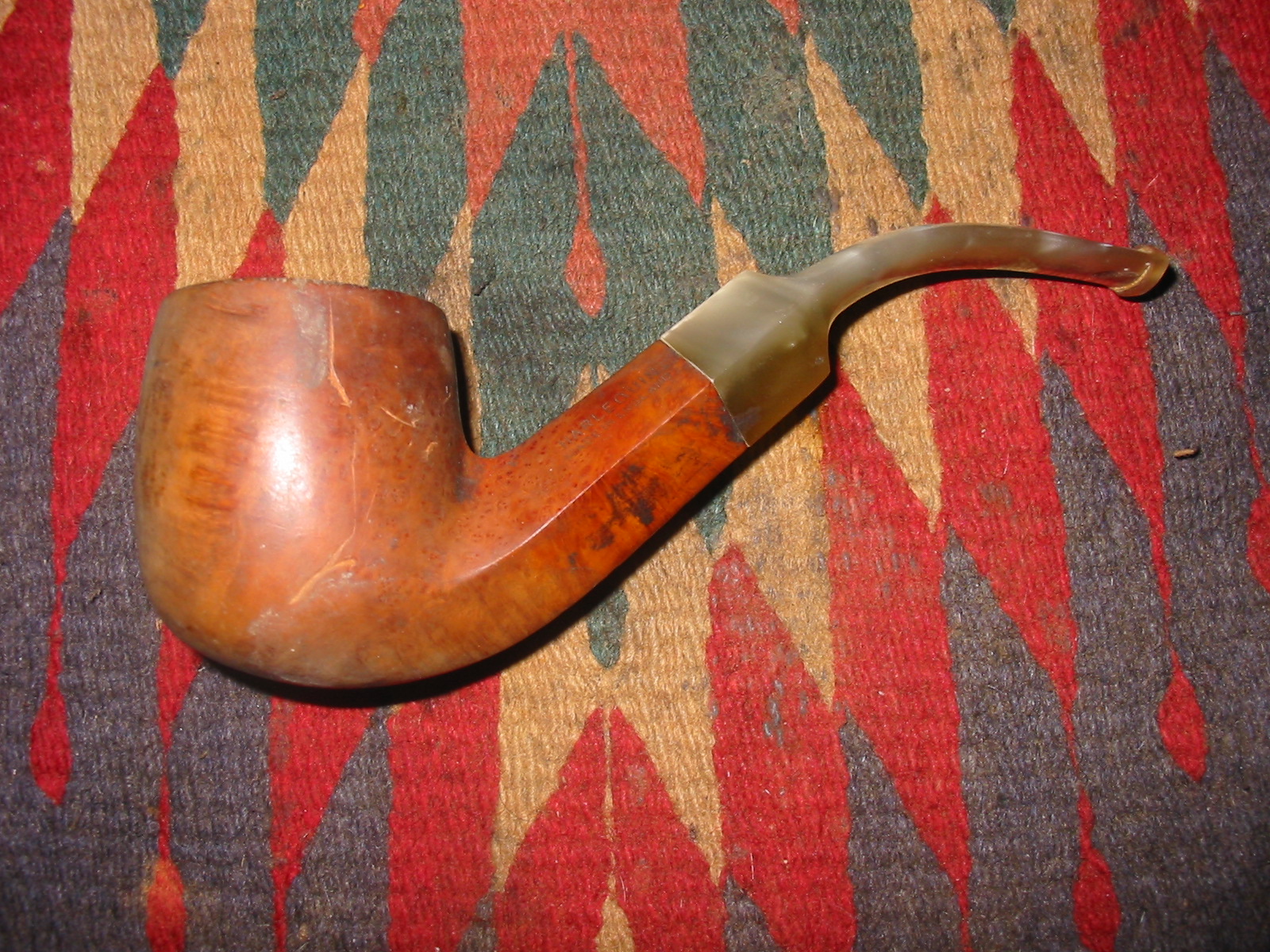
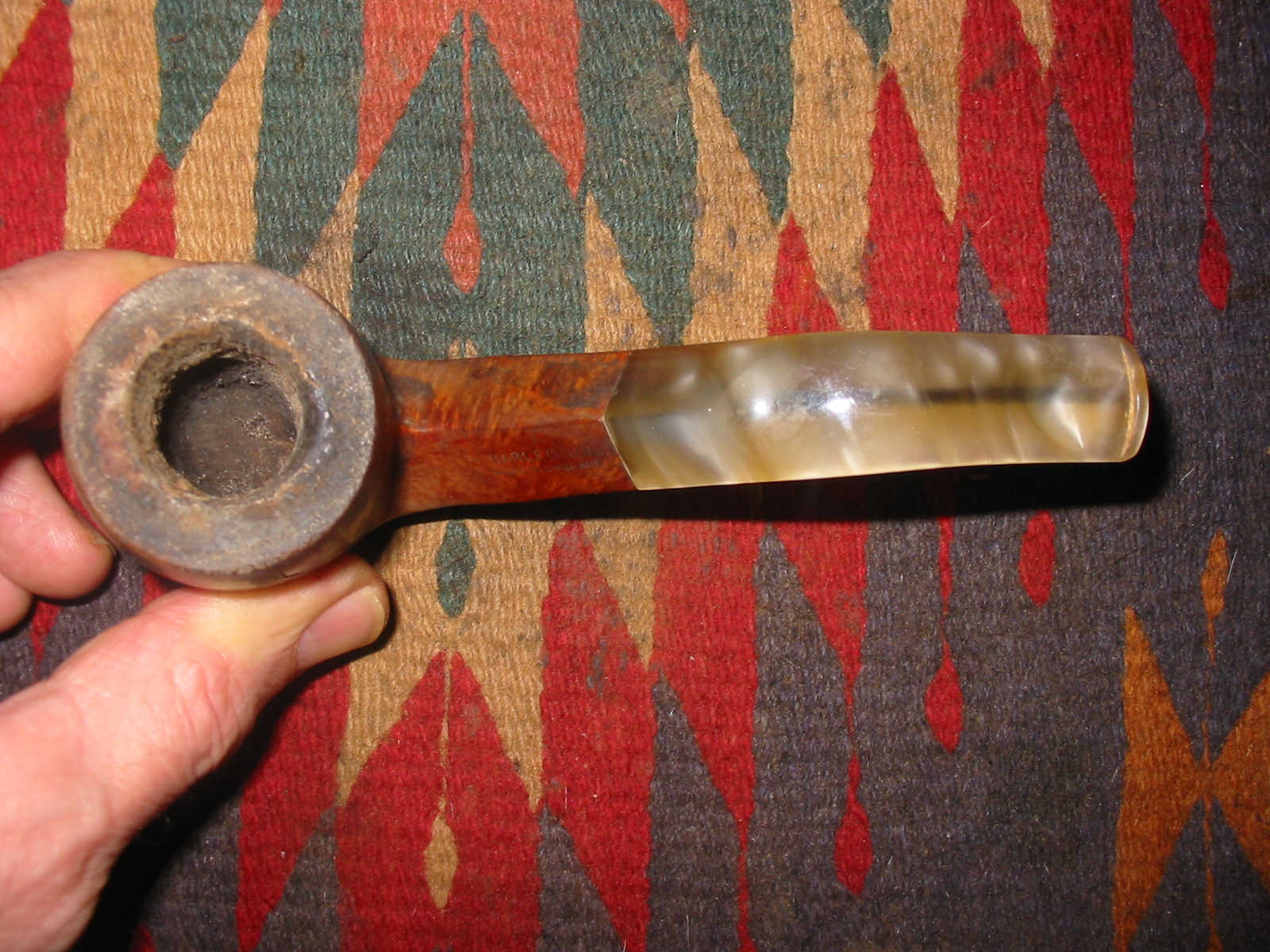
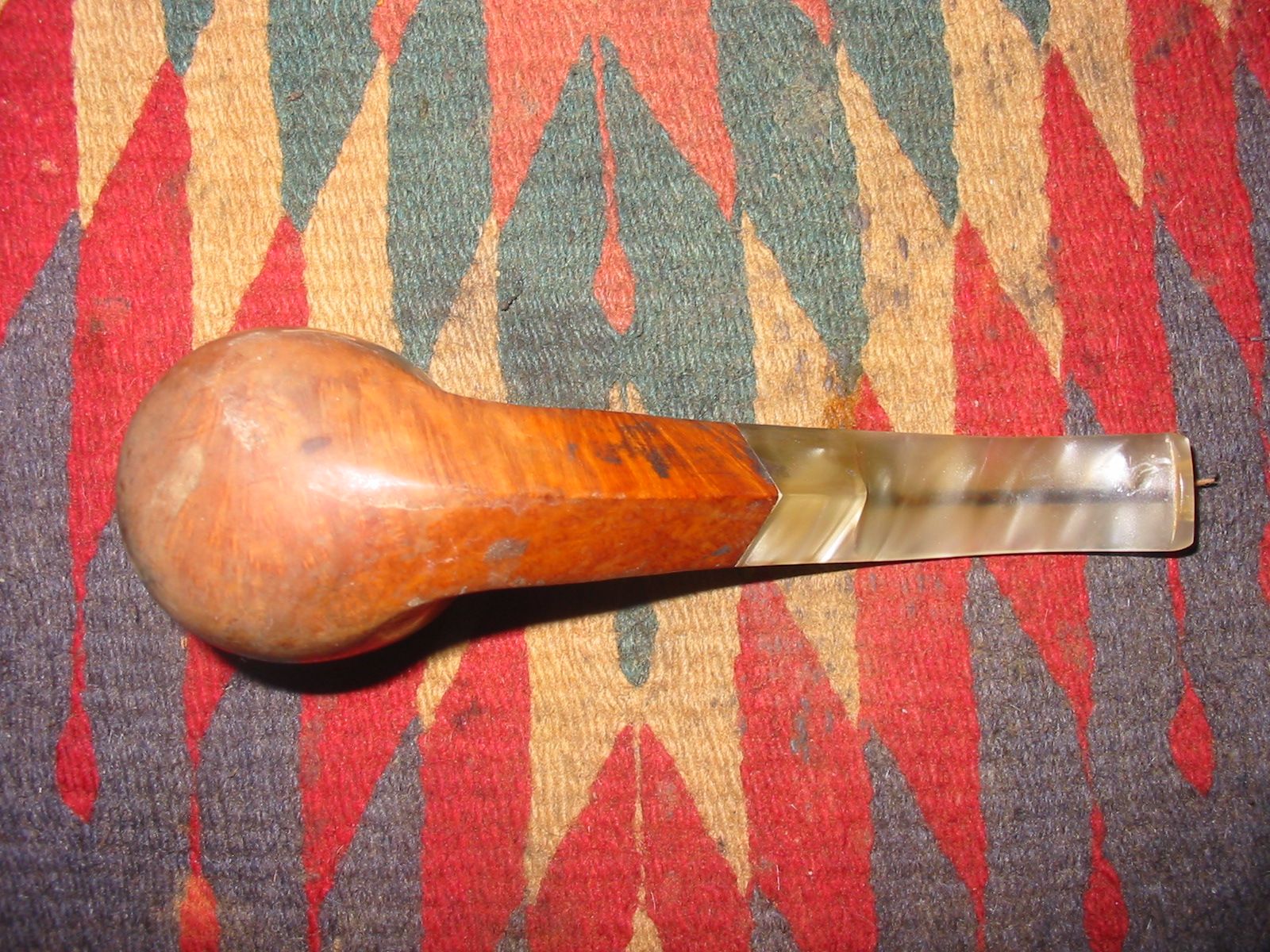
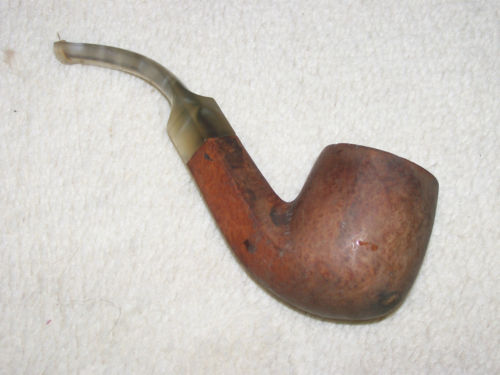
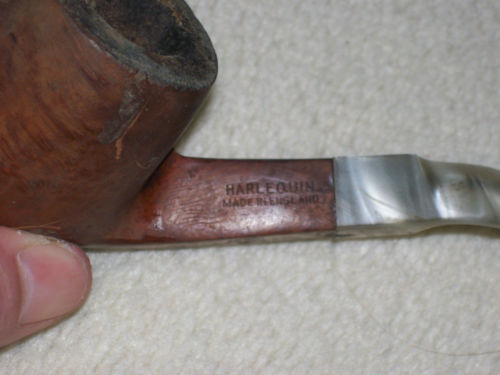
When I saw this old pipe on eBay something about it caught my eye. I could see that it was structurally sound. There were no cracks or significant problems with the bowl or shank. The rim was dirty and the bowl very caked but there did not appear to be any damage to the surface of the rim. The outer edge had been tapped out a few times and showed some minor denting around the bowl. There were some gouges/scratches on the left side of the bowl. It looked as if a sharp instrument had scored the briar. There were some dark stains on the briar that easily could have been burn marks but did not appear to be so from the photos. These stains were on the underside of the shank near the junction of the shank and stem on the left side, on the lower right side of the right side and on the lower left side of the front of the bowl. It looked like stains in the grain rather than burns in the photos so I took a chance on it. The stem looked like it was grey/silver Lucite in the photos and that also intrigued me. The tobacco juices had stained the airway dark. Other than that the stem appeared to be undamaged and would be a pretty easy clean up.
Harlequin1

Harlequin2

Harlequin3
The stamping on the shank was the mystery to me. I had never heard of Harlequin pipes and this one was clearly stamped Harlequin in block letters over Made in England. I wanted to see what I could find out about the brand so I went to my usual sources of information. I checked in “Who made that Pipe” by Wilczak and Colwell and “Pipes Artisans and Trademarks by Lopes to see if either of them identified the maker. Both books had nothing listed for the brand. I went on the British Trademark site and read through many of the listings for Harlequin and found that the name was used by many companies for things from wallpaper to graphics design. There were lines of greeting cards, children’s toys and clothing all bearing that name. I found nothing listed that hinted that the pipes were a registered name. I posted on several online forums that I frequent to see if anyone had any ideas. Several folks on the forums recalled that Gallaher’s Tobacco Limited in Ireland had made a tobacco for years called Harlequin. I did some research to see if they had made pipes.
Harlequin4
As I dug through various sites on the hunt for information I received some responses on the forums. One person responded that several English tobacco brands also sold pipes – St. Bruno for one did that. Another respondent on Smokers Forums, Chris (flatticus) posted a couple of links to Gallaher’s that confirmed that they had not only made tobacco products but had made pipes or had them made. He included this information:

Ok, so Gallaher’s made at least some pipes into the early 70’s. And according to this link: http://books.google.com/books?id=LAO…20pipe&f=false

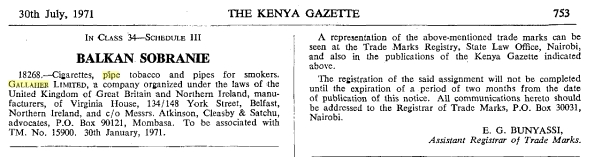
They made a Balkan Sobranie pipe. Or at least intended to enough to register the trademark, and along with the trademark for the tobacco itself. Certainly adds a bit of credence to the idea of a tobacco and pipe sharing the same brand name and stamp.

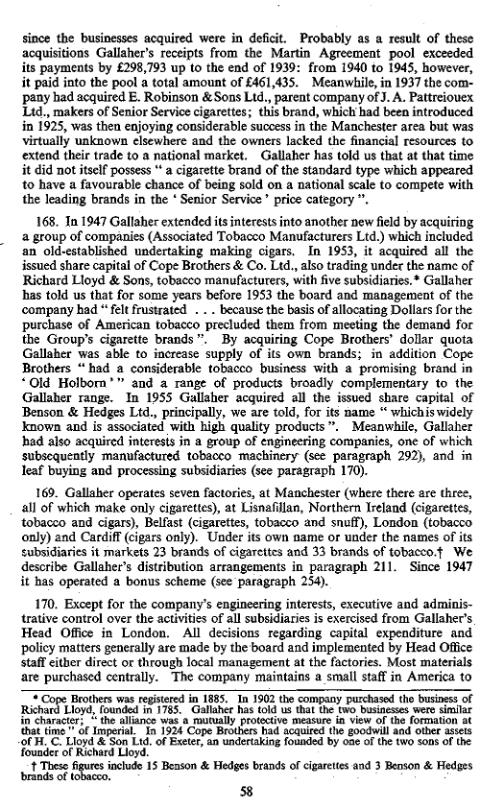
I have included the information cited above from the link to Google books – the Kenya Gazette and have posted it below. In correspondence from E.G. Bunyassi, Assistant Registrar of Trade Marks he clearly states under the heading of Balkan Sobranie that Gallaher’s Limited, a company organized under the laws of the UK of Great Britain and Northern Ireland had made cigarettes, pipe tobacco and pipes.
Gallaher pipes
I asked on the forum whether anyone knew whether the company made pipes. Chris (flatticus) responded again with the following information:

Interesting question, I don’t honestly know, but Gallaher’s used that trademark for like 70 years, and they were a big, big company. Actually from Northern Ireland, and had the biggest tobacco factory in the world in 1896 in Belfast, didn’t completely disappear until they were bought out by Japan Tobacco in 2007, but before that had a distribution conglomerate with RJ Reynolds for their cigarettes and were pretty gigantic. But they didn’t let the Harlequin mark until at least after 1963, when they last registered it. If I had to guess, they probably let it die after 1969 when American Brands, who I think owns Lucky Strike and similar brands, bought them out. They let the mark expire in 1980, but I see no record of anyone else buying it, and apparently it’s still available.

So, blindly guessing, I’d be surprised if anyone had the guts to use the same mark in a same or similar industry other than Gallaher’s. At least not in Ireland or the Commonwealth. But, that said, I can’t find a record or advertisement suggesting they ever made a pipe. However, I did find this thread, containing a quote from Gallaher himself talking about making pipes as a possible future avenue to address the “aging” nature of pipe smokers. http://christianpipesmokers.net/modu…wtopic&t=24081

Perhaps this was part of the “pipe renaissance” project he was talking about, made to get new pipe smokers interested. I checked harlequin ads, there a few vintage ones out there in images, but none of them referenced a pipe, just the tobacco. But the idea of a free pipe with tobacco, or at least a cheap or, as he put it, “disposable” pipe does seem to fit nicely with his intention there. Any way you slice it, though, it’s a nice bit of mystery to ponder. One of my favorite things about estate pipes, hands down.

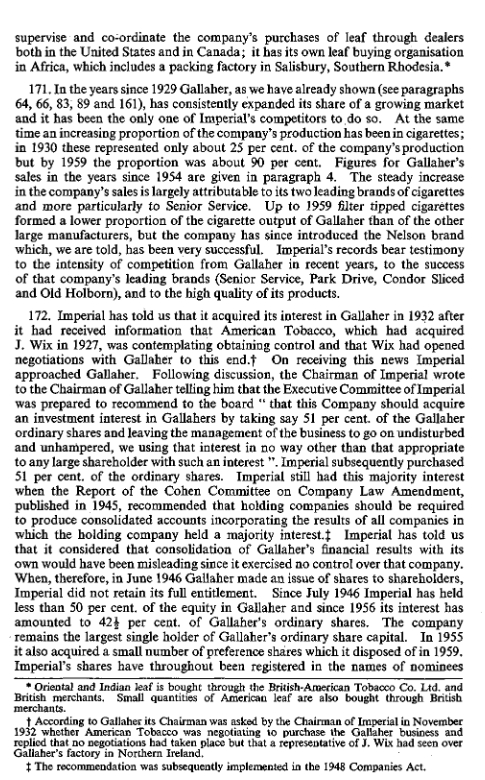
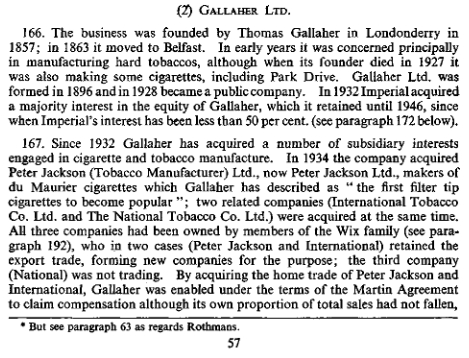
In another link there was information on the Gallaher Company. I copied that information and have posted it below. It makes an interesting read in terms of history of this old brand. I have one chunk of Gallaher’s Irish Roll Cake here that is a good strong smoke. I also have some of their other tobaccos in my cellar but sadly it is no more. I think the likelihood is that the Harlequin pipe was made by them and matched the Harlequin Tobacco blend they sold.
Galahers1

Gallahers2

Gallahers3

Gallahers4
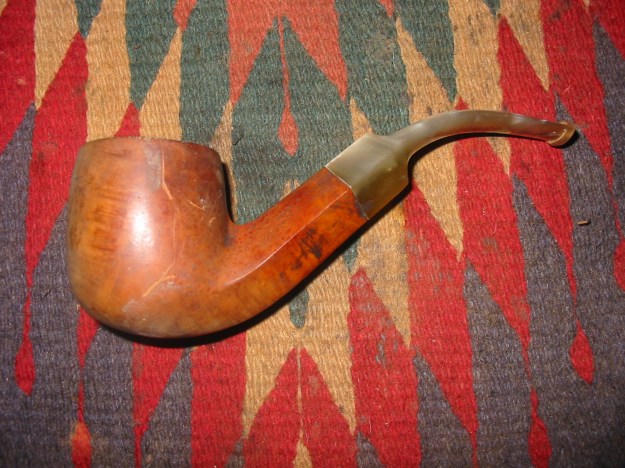
Once the pipe arrived I unpacked it and took it to the work table to begin the clean up. I was surprised that the stem was not grey but in real life almost a light green with heavy black tars in the airway. There were also some tooth marks on the top and bottom of the stem that would need to be repaired. The fit of the stem to the shank was snug and smooth. The bowl was badly caked and the rim covered with thick tar. The bowl had some deep gouges that had appeared in the photos on eBay but they were not as deep as I expected. The grain was far better than I expected. Underneath the dark marks, which appear to be ink stains rather than burn marks was some beautiful cross grain and birdseye as well as mixed grain. It would look beautiful when it was cleaned up and refinished. There were several spots on the briar that had large sticky spots of a glue-like substance.
IMG_6195

IMG_6196

IMG_6197

IMG_6198
I reamed the bowl with a PipNet reamer to remove the cake. It was surprisingly soft and crumbly. I took it back to a very thin cake to form the base for a new cake.
IMG_6199
I set up a topping board with 220 grit sandpaper to clean off the build up on the rim. It was hard and no matter how hard I scrubbed it, it would not come off. The outer edges of the rim were also damaged from knocking out the bowl after smoking. The light topping would smooth out the edge damage and minimize the effect without changing the look of the bowl.
IMG_6200

IMG_6203
I scrubbed the exterior of the bowl down with acetone on cotton pads to remove the ink and sticky build up on the finish. I also decided to remove the finish so I scrubbed it until the majority of the finish was gone.
IMG_6204

IMG_6205

IMG_6206

IMG_6207
I cleaned the stem with cotton swabs and pipe cleaners and isopropyl alcohol. I was able to scrub out the airway and the slot in the button removing the stains. I also scrubbed the end of the tenon to clean out the staining there. I scrubbed the mortise with alcohol and cotton swabs as well until they came out clean. The internals were cleaned and smelled fresh rather than smelling like old aromatic tobacco.

Once it was clean, I tried to steam out the gouges in the bowl but they would not lift. I could have sanded them out but that would have changed the profile of the bowl so I opted on repairing them with super glue and briar dust.
IMG_6212
I sanded the repairs with 220 grit sandpaper and then followed that by sanding with medium and fine grit sanding sponges to blend the surface of the fill with the rest of the surrounding bowl. After sanding the fills I sanded the entire bowl with the medium and fine grit sanding sponge to remove the rest of the finish on the bowl. I carefully worked around the stamping so as not to damage it.
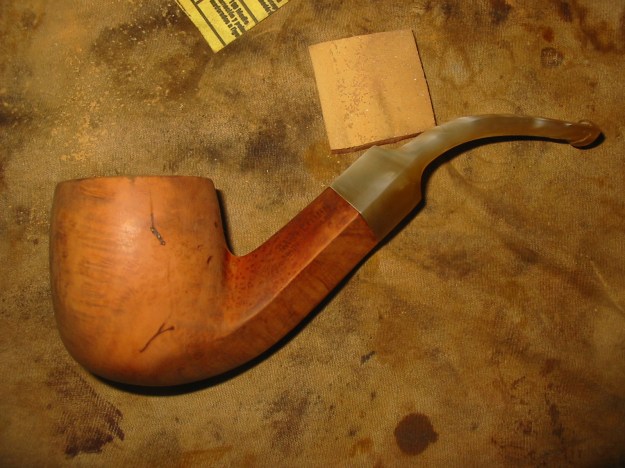
IMG_6213

IMG_6214

IMG_6215
I used clear superglue to repair the deep tooth marks on the top and bottom sides of the stem near the button. The bottom repair can be seen in the photo below. I later sanded it with 220 grit sandpaper and the sanding sponges to blend it into the stem surface.
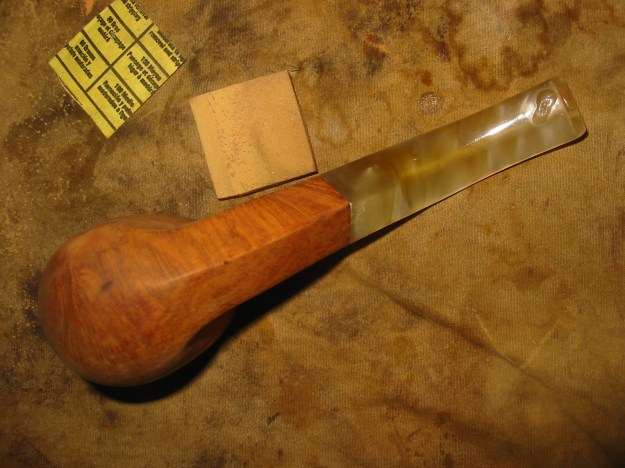
IMG_6216
I decided to use the contrast stain process I have been working on to highlight the grain on this beautiful pipe. I gave it an under coat of black aniline stain. I used a Delrin tenon for a handle in the shank to be able to turn the bowl while I was staining. I applied the stain, flamed it, applied it and flamed it again until the coverage was even.
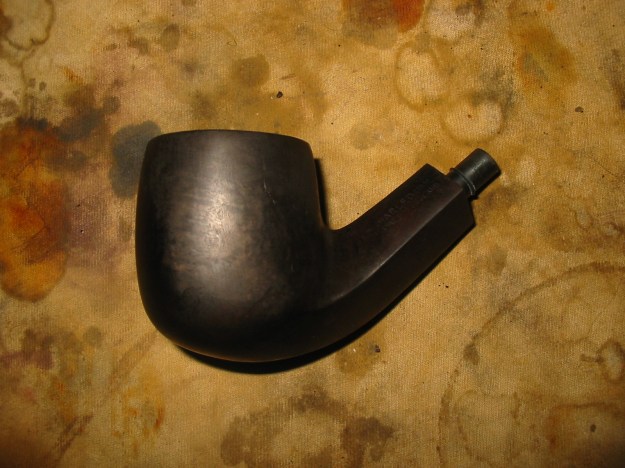
IMG_6217

IMG_6218

IMG_6219

IMG_6220
When the stain had dried I sanded it with a medium grit sanding sponge to remove the surface stain while leaving the grain highlighted with the black. I wiped it down repeatedly with isopropyl alcohol on cotton pads to check and see what the grain was looking like after sanding. This process took far longer than the staining and initial preparation. I sanded and washed, sanded and washed the bowl and shank until the grain stood out against the briar.
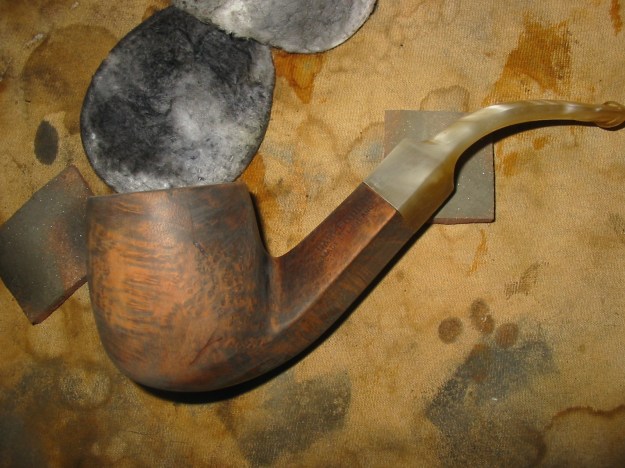
IMG_6221

IMG_6222

IMG_6223

IMG_6224
I sanded the bowl with micromesh sanding pads – wet sanding with 1500-2400 grit to further remove the black stain that was stubbornly sticking in the angles of the bowl and shank. I then gave the bowl a top coat of oxblood stain. My thinking was that the contrast between the black in the grain and the red in the other portions of the briar would make the grain stand out.
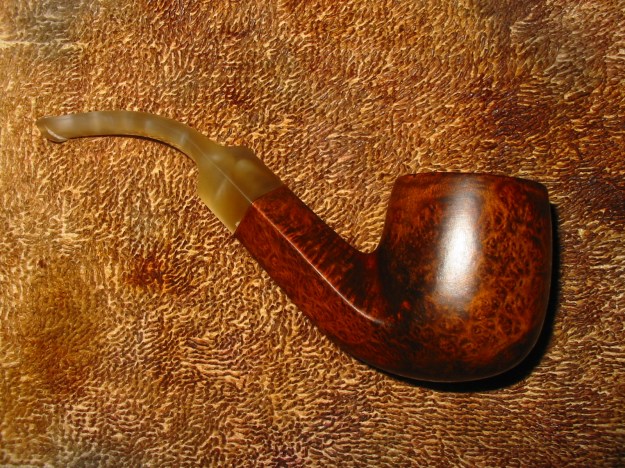
IMG_6225

IMG_6226

IMG_6227

IMG_6228
When the oxblood stain dried I dry sanded the bowl with micromesh sanding pads to remove some more of the dark stain and make the grain stand out even more. I rubbed the bowl down with olive oil and used it as a medium for the sanding. It worked well to remove the darker areas of the bowl near the shank and along the top edge and rim.
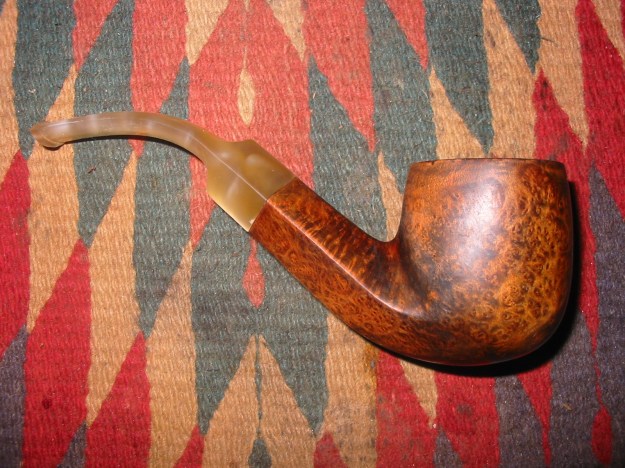
IMG_6229

IMG_6230

IMG_6232
After sanding I took the pipe to the buffer and buffed the bowl and stem with White Diamond to polish the briar and the Lucite stem. I had previously sanded the stem repairs with the sanding sponges to remove the bump of the glue and blend it into the surface. I followed that with sanding the stem with all grits of micromesh from 1500-12000. I wiped the stem down with Obsidian Oil and then gave the bowl and stem multiple coats of carnauba wax to protect and polish it. I finished by buffing the pipe with a clean soft flannel buffing pad. The finished pipe is shown in the photos below. It is cleaned, stained and ready to smoke. I am really pleased with the finished look of the pipe. The yellow mother of pearl looking stem works well with the contrast stain on the bowl.
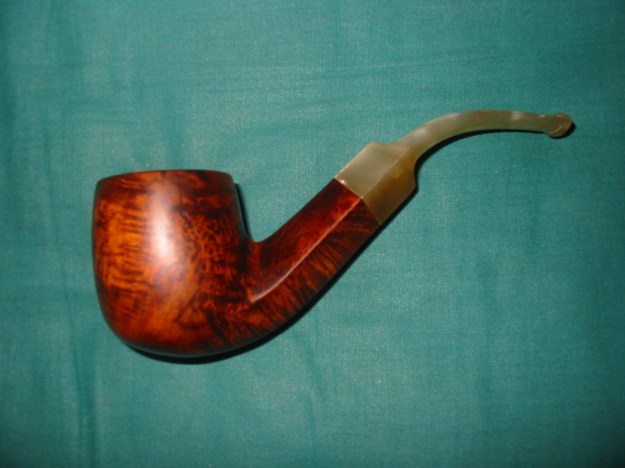
IMG_6234

IMG_6235

IMG_6236

IMG_6237

IMG_6238

An Earl of Essex Apple Reborn


This Earl of Essex pipe bowl was in bad shape. I had received the bowl without a stem so I would need to restem it if I was going to refurbish it. The bowl rim was angled down toward the front and was worn and rough. It appeared to be thinner in the front than the back of the bowl and had burn marks and rough patches on the front. The finish was shot and the aluminum insert in the shank was oxidized. The bowl had an uneven cake and was crumbling. There were several red spots on the surface of the rustication. What interested me in this old bowl was the rustication. The top of the bowl had almost a wax drip look to it with rustication between the drips of “wax”. The drip pattern is smooth briar as was the rim at one time. The end of the shank and the high spots on the shank were also smooth.
IMG_5827

IMG_5828

IMG_5829

IMG_5830
The aluminum inset mortise took a screw in tenon and I did not have any metal screw in tenon stems. I would have to drill it out to fit a new stem. I decided to try my hand at opening up the mortise with a drill. I started with a drill bit slightly larger than the mortise and then moved up with bigger drill bits until the mortise was smooth and open enough to take a new push stem.
IMG_5831

IMG_5832
I started to top the bowl but stopped mid stream and reamed the bowl with a PipNet reamer to clean out the cake. I wanted the bowl clean so that as I topped it I would be able to see how deep the damage to the bowl went.
IMG_5833
Once reamed, I took it back to the topping board and sandpaper. I used 220 grit sandpaper and twisted the bowl top into the sandpaper in a clockwise pattern. With the bowl topped and the shank opened the bowl was ready to clean up.
IMG_5834

IMG_5835

IMG_5836
I wiped down the bowl with acetone on cotton pads to remove the finish from the bowl and clean up the grime that was built up in the grooves of the rustication. There was a bright red pigment in the grooves on two sides of the bowl. I scraped at it with a dental pick to clean it up. At first I thought it might be putty but as I scraped it, it came off like a red pigment. I am not sure what the red material was. I wiped it down after scraping it.
IMG_5837

IMG_5838

IMG_5839
I decided to stain the bowl with a contrast to set off the rusticated portion from the smooth portion of the bowl. I used a cotton swab and black aniline stain to stain the rusticated portions of the bowl. I wanted the black to highlight the areas between the smooth drip portions of the bowl. I stained and flamed it and repeated the process until it was a good even colour around the bowl. I sanded the smooth areas of the bowl with a medium and a fine grit sanding block and sponge to remove scratches and clean them up for the next coat of stain that would be used on the smooth areas.
IMG_5840

IMG_5841

IMG_5842

IMG_5843
I had several stems in my stem can that would fit the shank of the drilled out mortise. I tried a BBB stem first. It fit very well in the shank. The look was exactly what I wanted but I did not want to waste a BBB stem with the logo intact on an experiment.
IMG_5844

IMG_5845
So I used the second stem I had from the can. It was a saddle stem with a bite through on the top of the stem. I decided to cut it back and then reshape the button until it was a new stem.
IMG_5849
I cut it back with a Dremel and a sanding drum until it was smooth, solid and straight across.
IMG_5850

IMG_5851
Before working on cutting the new button in the stem I stained the top portion of the bowl with a light walnut stain on the smooth parts of the bowl. I buffed the bowl with White Diamond to give it a shine.
IMG_5852

IMG_5853

IMG_5854

IMG_5855
I worked on the button with needle files cutting in the straight line of the inner edge of the button and then smoothed out the button itself with the files. I carved away the surface of the stem tapering it from the saddle to the button. Once it was cut with the files I sanded the new taper with 220 grit sandpaper and then with a medium and fine grit sanding sponge to remove the scratches on the vulcanite.
IMG_5856

IMG_5857

IMG_5858

IMG_5859

IMG_5860
I sanded the stem with my usual array of micromesh sanding pads. I wet sanded the stem with 1500-2400 grit pads and dry sanded with 3200-12,000 grit pads. I rubbed down the stem with Obsidian Oil and buffed it with White Diamond.
IMG_5861

IMG_5862

IMG_5863
I buffed the bowl lightly with White Diamond and buffed the stem with it as well. I gave it multiple coats of carnauba wax and buffed it with a soft flannel buff to give it a shine. The finished pipe is shown in the photos below. The bowl top is clean and new, the finish is redone and the wax drip look is highlighted with the stains. The new stem and the newly cut button fit the pipe well. The experiment of drilling out the aluminum shank insert to take a push stem was a success. The metal polished well and looks like a shank band. Overall the final product is nice looking pipe that will make a good addition to someone’s rack in the future.
IMG_5865

IMG_5866

IMG_5867

IMG_5868

Restoring a Second Lumberman Deluxe Canadian by Comoys


Blog by Steve Laug

Andrew had a second LUMBERMAN DELUXE that he mentioned to me in a previous email when he sent me the other Lumberman to restem. He graciously gave the second one to me. In the photo below it is the one with the stem. It is slightly larger than the first one and also slightly longer as can be seen from the photo. It is stamped LUMBERMAN over DELUXE on top of the shank and on the underside there is no Made and London circle stamp. It is only stamped 309S. The pipe was in very good shape. There were no cracks in the long shank. There was one small sand pit in the top near the stamping. The bowl was slightly caked and the rim had some carbon buildup and many tiny pin pricks in the surface of the rim. The finish was dirty and had several sticky spots on the sides of the bowl. It was a gummy spot that seemed like the residue left behind by a price sticker. The stem was larger in diameter that the shank. It extended beyond the edge of the shank on both sides of the stem and also slightly on the bottom edge. The top edge fit well. There were also two tooth marks – one on top and on matching on the bottom of the stem near the button.
lumbermans

Before seeing these two pipes I had not heard of the Lumberman brand so Andrew had sent along some information that he had found on the web regarding the brand. He had gleaned the information from a Mr. Can EBay listing. In the previous blog post on the first LUMBERMAN I included Andrew’s information. I am also including it now as a quick reminder of the provenance of the brand. That posting read as follows:

“This Collectible Briar pipe is unique, extremely rare Comoy’s 309XL – a classic Canadian Shape. It has the arched Comoy’s nomenclature stamped over Deluxe (just as it appeared in the early 1930’s) both of which were stamped over Lumberman. For anyone already familiar with the stamping of Comoy Canadians that is enough to recognize that this is a rare and collectible Comoy.”

“During its history, Comoy’s has had three distinct sets of nomenclature, though they became somewhat blended in later years. The earliest Comoy nomenclature either had no Comoy stamping or a scripted, signature like forward leaning Comoy’s beneath which were featured names instead of shape numbers. Few of those names (Like Leman, Naval, Adelaide, and so on) are recognized even by the most ardent collectors. Then after World War I when Comoy began introducing what is sometimes called their Old Nomenclature (featuring the Prima, as the Top of the line with other lines like the Old Bruyere, Grand Slam, Lions Head, Lumberman, Lumberman Special and so forth) and arched Comoy’s stamping was used. In the 1930’s the Prima gave way to the Deluxe as the top of the line Comoy. Then just before World War II newer nomenclature started to appear (like Blue Riband, Specimen Straight Grain, and so on) and the Deluxe was replaced by the Royal Comoy. That New Nomenclature expanded dramatically after the War and blended with the modern nomenclature today.”

“The use of the arched Comoy’s ended with World War II and was replaced after the War with a straight line Comoy’s (along with the now famous country of origin stamping of a circular “Made In London” over a straight line “England”.”

“Prior to World War II with manufacturing facilities in both France and England, Comoy had pipes made in both locations. Most were easily identifiable by their country of origin stamping. There were several versions of Comoy’s Lumberman made in France and/or England. (They might have been the dame pipe but with different nomenclature.) “The Lumberman” and “The Lumberman Special were made in both factories. But none had the arched Comoy’s stamping.”

“After WWII Comoy’s reintroduced the Deluxe, discontinued the arched Comoy’s and continued various versions of the Lumberman. Perhaps Comoy’s best graded Lumberman was stamped Lumberman Deluxe – but it had no Comoy stamping. Lumberman was always stamped over Deluxe.”

“Normally Comoy offered to Canadian sizes designated by shape numbers 296 and 309. The difference was in the length of the Canadians. The 309 shape was Comoy’s longest Canadian and the 296 was shorter. However, the extra long Canadians were upgraded with the additional stamping of XL and the very longest were sometimes stamped XXL. Either upgrade was rare.” – The above was taken from correspondence Andrew included when he sent the pipe to me.

The previous blog post can be found at this link: https://rebornpipes.wordpress.com/2014/01/29/repairing-and-restoring-a-lumberman-deluxe-canadian-by-comoys/

The difference between this pipe and the previous one was that the stamping on the underside of the pipe lacked the Comoy’s circle Made in London stamp and also bore the shape designation of 309 but instead of X or XL it is stamped “S”. It is larger than the previous LUMBERMAN but the stamping appears to be a bit of an anomaly.

The next series of photos show the pipe as it appeared when I received it from Andrew. There was slight oxidation on the stem and the stem was larger as noted above.
IMG_5199

IMG_5200

IMG_5201

IMG_5202

I took several close-up photos to show the fit of the stem and how the sides and the bottom edge of the stem was larger than the diameter of the shank.
IMG_5203

IMG_5204

I refit the stem and sanded the sides of the stem until it matched the shank. I also sanded the shank lightly in order to make a smooth transition between the two. I used 220 grit sandpaper to take off the excess vulcanite and bring the stem in line with the shank. At the same time I sanded the tooth marks on the top and bottom of the stem at the button and was able to remove them.
IMG_5206

IMG_5207

IMG_5210

IMG_5212

I sanded the stem and shank with a medium and a fine grit sanding sponge and then a fine grit sanding block. The refit stem is shown in the next series of four photos.
IMG_5205

IMG_5208

IMG_5209

IMG_5211

I wiped the bowl and shank down with acetone and clean the stem and shank with isopropyl alcohol and pipe cleaners. I reamed the bowl with a PipNet reamer to take the slight cake back to the wood and even the buildup on the walls. It seemed to have a slight ridge of cake mid-bowl and I wanted the walls clean so that I could build up my own cake.
IMG_5213

IMG_5214

IMG_5215

IMG_5216

I sanded the stem down with medium and fine grit sanding sponges and then used my usual array of micromesh sanding pads. I wet sanded with the 1500-2400 grit pads and dry sanded with the 3200-12,000 grit pads.
IMG_5220

IMG_5221

IMG_5222

I rubbed the bowl down with a light coat of olive oil and the stem down with Obsidian Oil. Once it had been absorbed in both places I took the pipe to the buffer and buffed it with White Diamond on the wheel. I gave bowl and stem multiple coats of carnauba wax and then buffed the pipe with a clean flannel buff to give it a finish shine. The finished pipe is shown in the photos below. The fit of the stem matches the lines of the pipe and the oiled finish gives the pipe a look that is fresh and new. It is ready for its new maiden voyage.
IMG_5223

IMG_5224

IMG_5225

IMG_5226

ADDENDUM – I am copying this from the responses below so that it gets more readership.

Here is the info from the link Jacek supplied. Very helpful additional information. Thanks Jacek.
As many realize, Comoy is one of the oldest London Pipemakers with production started in France in 1825. Francois Comoy started making smoking pipes with his brothers in St. Claude, France in 1825. His son, Louis, took over the company and in 1848 helped guide it into the era of power-driven machines beginning what Comoy called a “Century of Progress.” His son, Henri, followed in the footsteps of his father and grandfather and moved Comoy’s to Clerkenwell in the City of London in 1879, and thus began “Comoy’s of London.” And his son, Louis, was the last family member to run the company.

During its’ history, Comoy’s has had three distinct sets of nomenclature, though they became somewhat blended in later years. The earliest Comoy Nomenclature either had no ”Comoy” stamping or a scripted, signature-like (forward leaning) “Comoy’s” beneath which were featured names instead of shape numbers. Few of those names (like the “Leman”, “Naval”, “Adelaide” and so on) are recognized even by the most ardent Comoy collectors. Then after World War I when Comoy began introducing what is sometimes called their “Old Nomenclature” (featuring the “Prima” as “Top-of-the-Line” with other lines like the “Old Bruyere,” “Grand Slam,” “Lions Head,” “LUMBERMAN,” “LUMBERMAN SPECIAL,” and so forth) an ARCHED “COMOY’S” stamping was used. In the 1930s the Prima gave way to the “DE LUXE” as the “Top-of-the-Line” Comoy. Then, just before World War II newer nomenclature started to appear (like “Blue Riband,” “Specimen Straight Grain,” and so on) and the “DE LUXE” was replaced by the “Royal Comoy”. That “New Nomenclature” expanded dramatically after the War and blended with the modern nomenclature of today.

The use of the ARCHED “COMOY’S” ended with World War II and was replaced after the War with a straight line “Comoy’s” (along with the now famous Country of Origin stamping of a circular “Made in London” over a straight line “England”).

Prior to World War II with manufacturing facilities in both France and England, Comoy had pipes made in both locations. Most were easily identifiable by their Country of Origin stamping. There were several versions of Comoy’s “LUMBERMAN” made in France and/or England. (They might have been the same Pipe but with different nomenclature.) “THE LUMBERMAN,” and “THE LUMBERMAN SPECIAL” were made in both factories. But NONE had the ARCHED “COMOY’S” stamping!

After World War II, Comoy reintroduced the “DE LUXE,” discontinued the ARCHED “COMOY’S” and continued various versions of the “LUMBERMAN”! Perhaps Comoy’s” best” graded “LUMBERMAN” was stamped “LUMBERMAN DE LUXE” – – – but it had no “Comoy” stamping. ”LUMBERMAN” was always stamped over “DE LUXE”!!!

Now look at the stamping on this Comoy Canadian – – – the ARCHED “COMOY’S” is stamped OVER “DE LUXE” (just as it would have been on a “Top-of-the-Line” Comoy’s De Luxe” in the early 1930s! In addition, that stamping is OVER “LUMBERMAN”!!! This Canadian is the only one I have ever seen with such stamping(s)!!!

Comoy offered truly elegant Canadians that were always perfectly shaped, light weight and fitted with “wafer thin” mouthpieces that are easy to hold in the mouth. Of course, they came in different lengths and finishes.

Normally, Comoy offered two Canadian sizes designated by Shape Numbers 296 and 309. The difference in the length of the Canadians. The “309” Shape was Comoy’s LONGEST CANADIAN, and the “296” was shorter. However, EXTRA LONG Canadians were ”upgraded” with the additional stamping of “XL” (creating a “309 XL”) and the very longest were sometimes stamped “XXL”!!! Either upgrade was rare, and this exceptional Canadian is stamped “309 XL”!!!

So looking at the title of this description one would expect to see a long, sleek Canadian of special length. It is not! It is a mere 6 3/8” LONG which is barely longer than average for most pipe makers!

The grain is not exceptional nor is the size (although the Bowl is a large Dunhill Group 4/5 Size which is larger than most “average” Canadians). But the Pipe has a HAND RUSTICATED RING around the Rim as well as a small HAND RUSTICATED “ARROWHEAD” or “TRIANGLE” on the bottom of the Shank! Both are unusual for any Comoy and ensure that this Canadian is UNIQUE (if only because no two rustications are identical).

Combining these features, you are looking at an EXCEPTIONALLY RARE, UNIQUE COMOY “LUMBERMAN”!!!

We cannot be certain of a date for this Comoy. It is an ARCHED “COMOY’S” over “DE LUXE” which dates it from the early 1930s. It is also a “LUMBERMAN” with a COMOY’s 3-PIECE “C” LOGO in the Mouthpiece dating it to the post-World War II timeframe; and it has the newer Country of Origin stamping which did not exist before World War II. So it would seem that this Comoy Lumberman/Canadian most likelydates from the late 1940’s which would seem to be the most reasonable time for such a Pipe to appear.

As the pictures reflect, this Canadian remains in PRISTINE CONDITION! The STRONG NOMENCLATURE confirms that! There are NO chips, dents or scratches to detract from the exterior finish. NO varnish, lacquer or shellac has been used to improve the appearance of the Pipe for the pictures (and temporarily fill scratches and toothmarks). And, NO coating has been applied to the inside of the Bowl to hide cracks, heat fissures or even burnouts. The Pipe shines as it did when it left the factory in London over 60 Years Ago!!!

This Canadian measures 6 3/8″ LONG with a Bowl 2″ TALL!!! The nomenclature is crisp and clear: “COMOY’S [arched and over] DE LUXE, LUMBERMAN, MADE IN LONDON [in a circle and over] ENGLAND, 309 XL”. The Famous Comoy’s 3-Piece White “C” Logo is inlaid in the Bit. So what you are viewing is an EXCEPTIONALLY RARE, and COLLECTIBLE COMOY CANADIAN!!! The fact that it is in PRISTINE CONDITION with particularly STRONG NOMENCLATURE makes it worthy of consideration by those desirous of accumulating a special Comoy collection!

Some remarks on dealing with damaged stems of smoking pipes by Jacek A. Rochacki


Blog by Jacek A. Rochacki

This is Jacek’s second article on pipe repairs. I appreciate the slant that Jacek brings to the work of pipe refurbishing. His art restoration background lends itself to some beautiful solutions to the challenges that face the pipe refurbisher that are far different from those that have been used by myself and others as we deal with the work we do. I am very appreciative of Jacek’s willingness to share his methodology with us here on rebornpipes. Thank you Jacek for taking the time to write-up these pieces and sending them to us. They are a significant contribution to our work and love of all things pipe.

We all have known many different ways in which the stems/mouthpieces of our pipes are damaged. Let me indicate some of them: – broken mouthpiece – sometime in the middle, often in the “lip”/”button”area – tooth dent – this is often at the lip/button area and it does not look so nice – different holes/losses, mostly in the lip/button area, often such holes are”bitten up” by willing smoker. – broken tenon (sometime it is stuck/jammed in the shank) Let me begin from few words on materials. In general we deal mostly with vulcanite/ebonite and transparent Perspex (some models of GBD). But those are not the only materials. There are some similar materials like Ashtonite invented by late William “Bill” Ashton Taylor and used in his Ashton pipes; it is a little harder than typical vulcanite/ebonite. In older pipes we often see mouthpieces in yellow color looking like and named “Amber”; these are seldom made of original amber, more often of yellow glass-like material and are hard and break easily. (There are also yellow stems of softer materials like vulcanite/ebonite, and I would proceed with them as I usually proceed with black or Cumberland vulcanite/ebonite). Their tenons are often made of different, more appropriate material for their function, possibly bone, and sometimes such tenons are of screw in type. In some briar pipes tenons are made of metal – aluminum. And I know cases when owner wanted such metal tenons to be removed and changed for tenons made of vulcanite, modern Teflon etc. in belief that these materials will “cooperate” better with briar wood. I mention this not as advice as it is “intrusion” into originality of the pipe but as some kind of curiosity. As a matter of fact I note that even in case of vulcanite mouthpieces there was/is tendency to remove original tenons and fit tenons of Teflon or other modern material. Here is list (partial to be sure) of some of the different kinds of vulcanite/ebonite materials that have been used for mouthpieces:

Ace – American Hard Rubber Co., USA
Super-Ace – American Hard Rubber Co., USA
Amcosite – Siemens Bros. & Co., UK
Bulwark – Redfern’s Rubber Works, UK
Cohardite – Connecticut Hard Rubber Co., USA
Dexonite – Dexine Ltd., UK
Endurance American Hard Rubber Co., USA
Gallia-Rubber – French ebonite
Keramot – Siemens Bros. & Co., UK
Level Chuck – American Hard Rubber Co., USA
Luzerne – Luzerne Rubber, USA
Mercury – American Hard Rubber Co., USA
Navy – American Hard Rubber Co., USA
Onazote – Expanded Rubber Co., UK
Permcol – British Hard Rubber Co., UK
Resiston – American Hard Rubber Co., USA
Rub-Erok – Richardson Co., USA
Rub-Tex – Richardson Co., USA
Solid Rubber – used by some English makers in 1914-1918 years

I have seen these names/markings on stems/mouthpieces of old pipes. Sometimes it is of help in dating and attributing a pipe that is so marked. Remember that vulcanization of natural rubber with sulfur was invented by Charles Goodyear in USA in 1839 and was patented in 1843; in the same year Thomas Hancock patented it in Great Britain. Here is have good source on vulcanite
http://www.seattlepipeclub.org/content.aspx?page_id=22&club_id=969877&module_id=16894

In the’30’s vulcanite of different mixed colors became popular in making pens and is similar to what we see in some mouthpieces of pipes named “Cumberland”.

As vulcanite consists of vulcanized natural rubber, it may be of help to mention that oil (like in old days was used in oil lamps) and/or turpentine may serve as solvents, helpful with restoration if needed be.

I said all this in order to point out the importance of recognizing the material that our mouthpieces are made of in order to find best matching material for making eventual repairs to missing elements etc. The practical solution seems to be making one’s own “stock” of repair materials – simplest would be to collect broken, unrepairable mouthpieces. But there other ways: I found vulcanite rods that were used in schools for experimenting with electricity to be good material for fixing damaged mouthpieces. In the field of transparent materials I have been using old fashioned artificial plastic glass (sometime named Plexiglas) that was used in aviation some half of century ago. It is also important to choose right type of glue.

Beside the matters of tenons, I would briefly divide our work into two categories:
– joining together broken elements
– filling in holes or broken areas.
Of course, in practice these categories will “mix up” together.

In the case of a repairing a stem or mouthpiece that broken in half, the solution is quite simple. What is to be done is to use a strengthening/enforcing invisible element that will serve as sort of “hard core” – constructional element. The simplest way would be to use thin tube of internal diameter corresponding with diameter of the air channel of our mouthpiece. “Walls” of such tube, if it is tube of metal, may be of 0.3 – 0.4 mm in thickness. In order for it be fitted properly, we have to drill a kind of “nest”/mortise/”channel” for it, drilling the air channel with drill bit of proper diameter making this “nest”/mortise as long as required by length of our tube. The choice of such tube is important as not only air but also condensate will be in contact with the tube, so I would avoid brass, copper etc. The best IMO would be a tube of pure silver or high percentage silver alloy, or some aluminum like that which was used by Dunhill for his Inner Tubes, just of larger diameter. Silver tubes may be available in goldsmith’s supply places.

After making proper strengthening/enforcing tube and making sure that all parts fit well, I use simple glue of cyanoacrylic type – kind of “super glue”.

A more advanced way would be to make the strengthening/enforcing/ element – a drilled tube/cylinder from vulcanite/ebonite. It is possible to make it without using a lathe, just the laborious and precise use of files. The starting material could be the broken tenon from unrepairable mouthpiece from our “stock” of materials. The “nests”/mortises in parts to be glued should be of larger/proper diameter, because it is practically impossible to hand make the vulcanite mini tube with walls of 0.3 or similar thickness, so the outer diameter of our vulcanite tube will be larger than in case of metal tube. We make “nests”/mortises/”channels” of required diameter using drill bits of proper diameter. If we are not sure about precision of our fingers necessary for hand making short tube of vulcanite, we may make just a small cylinder of vulcanite of desired size which would make/allow parts to be glued to fit perfectly, and after gluing all parts together, drill the air channel from the tenon side with a long drill bit of right diameter corresponding to diameter of the air channel and in delicate, secure direction-wise way, drill the inserted cylinder through the air channel so the air/draft channel will be “operational” again.

Summary: use the enforcing/strengthening elements and we may be surprised how many unrepairable looking elements may be repaired and then serve really well.

Now for filling in holes or broken areas.

The relatively simple thing seems to be filling in tooth dents. I begin by cleaning the surface of the dent with some sharp tool – scraper or blade of size of small pocket knife, better with rounded tip, such as those found on pipe knives. This is to remove oxidation from the surface that is to be filled. After “cleaning” the surface I take a needle, scraper or similar sharp tool with sharp pointed tip and “score”/”draw” delicate lines/”mini-groves” on the cleaned surface. This is the old trick used in enameling for better adhesion of filling material (extender) that will be “put” on the prepared surface. This material is simple and known us vulcanite dust – the result of filing a properly chosen piece of vulcanite, sometimes it is result of filing the stem that is to be repaired, sometimes we may use another piece of vulcanite from our “stock” if we are sure that it will fit well. Then I mix this dust with cyanoacrylic glue making my “filling material/paste” – kind of putty, and I apply it on scored dent. After some time – rather longer then shorter – say – good couple of hours depending on thickness of the filling, I use a file and sandpaper and finally polish on the patched stem – this is known as the finishing procedures.

After all this please, be prepared for unpleasant surprise at the first glance. The filled up area may be of different color than the color of the stem. Please do not worry! It is not without reason that I have mentioned before that oil (like in old days was used in oil lamps) and/or turpentine may serve as solvents that are helpful with restoration… so a drop of oil or turpentine applied on the repaired area and “distributed”/”smeared” all over will turn the surface of the glued parts to match the rest of the stem. When the surface dries, I would return to delicate polishing and be prepared for repeating such finishing operation as many times as necessary. At very end I would apply a wee drop of olive or proper mineral oil and smear it all over with soft cotton textile; this is old method of conservation of surfaces of objects made of vulcanite/ebonite – “hard rubber”.
Jacek1

This was an easy case. What about situations when the lip or end of the stem/mouthpiece is partly broken, “eaten up”, has holes, or part is missing? Please, take a look at illustrations published by our host at the beginning of his text “Cutting and shaping a new button on a severely damaged stem”
https://rebornpipes.wordpress.com/2014/02/25/cutting-and-shaping-a-new-button/

Instead of cutting/removing the damaged part and carving the lip/button of what is left, I would proceed in different way. Keeping in mind my wish of keeping original dimension, proportions, form, I would try to reconstruct damaged stem/mouthpiece as following:

By using sharp cutting tools – engravers/burins, scrapers or in case of better equipped “workshop corner” – cutters, like those used by jewelers for stone settings, or even a sharp pocket knife, a frame saw and needle files I would work on the damaged area making it a proper shape a piece of the same material carved that I will later shape/carve to fit what is missing. The words “making it of proper shape”, may be a subject for another longer text. But as sort of inspiration may be the different ways dentists use to “elaborate” holes in teeth so that the filling will be kept securely in place. In a stem the situation is easier as we have good binding glues and are binding together the same kind of materials – vulcanite/ebonite to vulcanite/ebonite.

When the newly carved material is fixed into the missing area with glue, I work with files and drill bits to achieve desired missing shape. Then I proceed with finishing techniques. Let us look at the pictures:
Jacek2

Jacek3

Jacek4

In case of stems/mouthpieces made of transparent material I have been proceeding as described above, just choosing proper equally transparent material for making missing parts. After polishing the seams are invisible. I would use fast cyanoacrylic glue of kind that creates transparent seams.

In Steve’s article one commenter mentioned a missing lip on his Peterson P-Lip pipe. Again: in glue we trust: just proceed as described above and if the work is done properly, it should be impossible to distinguish reconstructed lip from the rest of the stem by the naked eye. In general, if the whole lip is missing, I would glue in a large piece of matching material and would shape it by files etc. The air channel can be easily drilled (easily as we are dealing with comparatively soft materials) with drill bits of proper diameter.

I would deal with problem with missing or broken tenon in ways described above, depending on particular situation. Sometimes I use the reinforcing “inner tube” glued in place as described above. Other times I drill the “nest”/mortise of a diameter corresponding with diameter of new tenon to let it fit tight and correct/straight then glued in place. The old and best known method of removing broken tenon from the shank is:
– use of strong alcohol to dissolve eventual dried condensate and/or residues that “glued” the broken part in the mortise.
– take a self-tapping screw often used in construction, by woodworkers etc. and screw it into the air channel of broken jammed part in the mortise.
– keeping the head of this screw firmly in place carefully use pliers to twist it out while at the same time pulling on the broken part. If it does not come out it often means that it is still “glued” in place by dried condensate, tars, etc., so go back to the strong alcohol and please, repeat over a couple of hours or even days.

In conclusion I would like to present some simple hand tools that I find useful in working with pipe restoration. I would like also to say, that for cutting vulcanite/ebonite I use the typical jeweler’s frame saw with proper blades, similar to this shown here together with workbench pin and set of blades.
Jacek5

Jacek6

Jacek7

Jacek8

Jacek9

Jacek10

Jacek11

Cutting and shaping a new button on a severely damaged stem


Blog by Steve Laug

I have actually come to enjoy the process of cutting a new button on a stem. It has taken a lot of practice but I can honestly say that I am getting better at it. I still have more to learn; as I am sure will always be the case. But the method I use now can be fine-tuned and personalized by others who choose to use it. That is why I thought that for this article I would walk you through the steps I take when cutting and shaping a new button.

1. A stem that is unrepairable and has sufficient meat to it that if I remove the first ¼ inch or less still has material above and below the airway in the end of the stem. This is a candidate for reshaping and reforming a button. I often take a picture of the remaining button and angles before I trim it back.
Stem1

Stemb

IMG_3458

Hole in stem

2. I cut off the damaged end of the stem using a Dremel with a sanding drum. I know others use various other tools for cutting it off – saws, carving tools, knives, Exacto knives and a variety of others. The idea here is to remove the damaged material just far enough back on the stem to leave a solid base to recarve the button. At this point the goal is to cut off the material and leave a straight line at the end.
Stem4

stem5

Stemc

Stemd

IMG_3842

IMG_3844

IMG_3843

3. Once I have the straight edge I often trim the corners and round them slightly. My goal is to match the original button as much as possible.

4. I use a sharp, straight rasp or a needle file to cut the sharp edge of the button being careful to align the top and the bottom sides of the stem. At this point I am merely marking the button area. The key here is not to make the button to broad but to aim for the original width from the end of the stem to the edge of the button.
Stem6

Stemf

Stemg

IMG_3847

5. I use the same needle file to carve back the stem angle from about half way up to reduce the angle to the button and give more depth to the button. This involves using the file like a draw knife and working it from mid stem to the edge that you cut with the file.
Stem7

Stem8

Stemh

Stemi

IMG_3848

6. I generally start with the top of the stem and then work the underside to match the angles of the top. You have to be careful not to draw too deeply with the file as you work it. The end product of the cutting is a gentle taper that when sanded out looks natural. This process also give shape to the button.
Stemk

7. When I have the taper trimmed and even I work it over with a folded piece of 220 grit sandpaper to remove the file marks. I continue to work and shape the stem. I try to crown the flat blade of the stem slightly by sanding the edges to give the stem a thin profile. This also gives shape to the button.
Stem9

Steml

8. I use the sandpaper to also shape the button in a flattened oval or eye shape. If there is room above and below the airway I also gently slope the button toward the end. I am always using the stems and buttons that I have that like as models for the final look of these reshaped buttons.
Stem10

Stemm

Stemn

9. I use three different needle files to open up the slot on the end of the button. I first use a round file to open the airway and start to cut the funnel in it. When I am done with this first file the airway is beginning to look oval. I then use a slightly oval needle file to further shape the funnel and widen it toward the outer edges of the button. The third file is a flattened oval that gives me the ability to open the edges of the slot and the funnel so that finished airway has a flattened oval or eye shaped look to it. In general I work so that the slot has a shape similar to the shape of the button.
Steme

Stemp

Stemq

10. I sand the inside of the newly cut airway/funnel with folded sandpaper until it is smooth. I have also used emery boards that I found in the cosmetics department of local drug stores. They are commonly used on fingernails but work well for the inside of the slot.

11. I fine tune the slope of the taper with medium and fine grit sanding sponges to make sure that the slope top and bottom matches. I also work on the sharp angle of the inside edge of the button to give it distinction from the slope of the stem.
Stem13

IMG_3857

12. I sand the stem with micromesh sanding pads from 1500-12,000 grit to polish and bring back the deep shine. I use these on the end of the button and on the edges of the airway to make sure that the slot is smooth.
Stem12

IMG_3861

IMG_3864

IMG_3866

13. I buff the newly cut button and stem with White Diamond and then give it multiple coats of carnauba wax to protect and preserve it.

14. At this point the stem repair is complete and the new button looks like it was designed for the pipe it graces. (In the first photo below the Perspex stem is pictured next to another identical stem in vulcanite. Compare the two buttons.)
redo-on-perspex-stem-012

Stemr

IMG_3871

IMG_3870

IMG_3869

IMG_3868

Reworking a La Strada Staccato 213 Billiard


The last of the bowls that came to me as a gift from Andrew was a La Strada Billiard bowl. It was stamped La Strada over Staccato on the left side of the shank and shape 213 on the right side. It needed a stem and it had a few minor issues that needed to be addressed. The finish was an interesting rope rustication pattern that went around the bowl like a lasso and the finish under the rope pattern was leatherlike in terms of colour and look. Over the top of the finish was a plastic clear coat that added a perma shine to the bowl. The rim was in very rough shape and had been hammered on to hard surface in tapping out the dottle. The build up on the rim covered the damaged roughness of the surface. The bowl was badly caked on only one side of the bowl. The shank was clean and looked undamaged. There was no stem with the bowl and the shank was very clean.
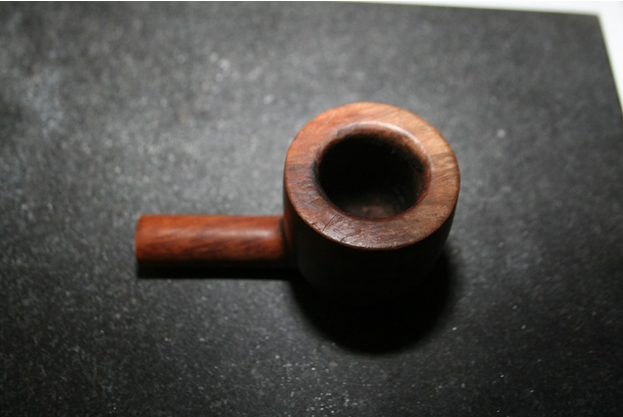
IMG_5072

IMG_5073

IMG_5074

IMG_5075

The La Strada was once again a brand with which I was unfamiliar. I had some vague memory of seeing them sold through Tinderbox but was not sure about that memory. I did a bit of research and found that indeed they had been sold there. They were Italian Made. Here is a page from a Tinderbox catalogue showing the brand. The catalog describes the pipe as “a gracefully conservative style that has today’s favoured matte finish, enhance by the unexpected touch of random routing.” The price was a princely $8.95-$10.00.
5tbox12

4tbox26

I sorted through my stems and found one that fit very nicely in the shank. When I inserted it there were two cracks revealed, one on top and one on the bottom of the shank. I honestly don’t know if they were present or if the happened when I put the stem in place. It was not a tight fit so I am unsure. It honestly did not matter as banding it would not be a problem. I found a silver band I had in my kit that was a good fit and pressed it into place on the shank. I heated the band with a heat gun and then pressure fit it onto the shank.
IMG_5077

IMG_5078

IMG_5079

IMG_5080

I reamed the bowl with a PipNet reamer (this seems to be more and more my reamer of choice in refurbishing).
IMG_5082

I set up my topping board and then topped the bowl with 220 grit sandpaper. I removed enough of the surface of the rim to take away the damage to the top and the front of the bowl. There were also some burn marks on the left side of the rim that I was able to sand out the majority of damage.
IMG_5083

IMG_5084

IMG_5085

I wiped down the bowl with acetone to try to break up the plastic/shiny finish that was on the bowl and was not able to remove it. The thick coat had bubbles that were thick around the rope rustication areas on the left side of the bowl. I finally put the bowl into an alcohol bath and let it soak overnight to try to break up the finish.
IMG_5086

IMG_5087

IMG_5088

IMG_5089

I took the bowl out of the alcohol bath and sanded it with a medium grit and a fine grit sanding sponge and was able to break through the finish and finally remove it. I wiped the bowl down again with acetone on cotton pads and the bowl was clean. I stained it with a dark brown aniline stain mixed 2:1 with isopropyl alcohol and applied and flamed it until the coverage matched the rim to the rest of the bowl. I buffed the bowl with White Diamond on the buffing wheel and brought it back to the work table and set it aside to work on the stem.
IMG_5090

IMG_5091

IMG_5092

IMG_5094

I sanded the tooth marks on the stem with 220 grit sandpaper and then a medium grit sanding sponge until they were no longer visible. I then used micromesh sanding pads to finish the stem. I wet sanded with 1500-2400 grit pads and dry sanded with 3200-12,000 grit pads. I rubbed down the stem with Obsidian Oil and when dry buffed it with White Diamond.
IMG_5095

IMG_5096

IMG_5097

I polished the silver band with silver polish and micromesh sanding pads and then buffed the pipe and stem with White Diamond. I gave the pipe multiple coats of carnauba wax and buffed it to a shine with a soft flannel buffing pad. The finished pipe is shown in the photos below. It is ready for its initial and should make someone a good pipe in the long run.
IMG_5098

IMG_5099

IMG_5100

IMG_5101

A Kaywoodie Reworked, with a Little Mystery!


Blog by Greg Wolford

This year has not been a banner one, so far, for me personally. The harsh weather, an accident, and a failure of one of my orthotics has had me mostly sidelined since the first of the year. My workshop is downstairs, in the garage, and it isn’t exactly the warmest, most comfortable place to work in the temperatures we’ve had, not to mention the difficulty of actually getting myself up and down the stairs … but I digress … so I’ve been able to do very little work on either of my hobbies so far in 2014.

Last week my wife had a little pity on me and allowed me to bring a few necessary tools and supplies up to the kitchen so I could work on a few old pipes; leather work is out of the question until the temperature and my body cooperate. I think she knew I was getting a bit restless, not being able to get into any of my projects. When I said she “allowed” it, she corrected me with “I didn’t say you could do that” but she didn’t send it all back down to the shop either, so I take that as permission I told her! LOL

Now, I must admit that my photographs, when I remember to take them (that’s a preview hint that I haven’t remembered as often as I should have), aren’t as good as I would like but I don’t have as good a set-up as I normally do. So, I ask you to bear with me on the quality and quantity of them.

Sometime back I acquired an older Kaywoodie model 33. It is an apple shape with a rounded bowl-top. The pipe was in pretty good condition other than the front edge was damaged from being knocked-out and the bottom of the stem had been bitten off. because of the stem damage I put off working on this pipe for months; I wanted to save the stem but didn’t have the black super glue yet, which I planned on using, to do the job. Here are a couple of photos (all I could find) of it before I started working on it.

Kaywoodie Apple (10) Kaywoodie Apple (11) Kaywoodie Apple (13)

Unfortunately all I can find are some photos that I used it as a “prop” in and one of the underside of the stem. You can see the pipe itself wasn’t too bad but the stem was another story.

Initially I tried to patch the chip with black super glue; I tried this three times: the first attempt the pipe cleaner I was using as a plug absorbed all the glue and the other two times, using different materials for the plug, the patch failed. It turned out that the chip was just too large for me to patch well so I decided to cut it off and file a new button since there seemed to be plenty of room to work with on this stem.

I used a hacksaw on a small frame to remove just behind the bite through. When I looked at the air hole I noticed two things, neither good: first I had closed off the airway accidentally with the glue and second the air hole wasn’t drilled center. I fixed the glue-plug problem quickly by drilling out the hardened glue with a pin vice and then picking out the small fragments that were left. One problem down – now onto forming a new button and slot.

I used various needle files to shape the new button, being timid about not getting it too thin. I recently bought a new set of Kobalt needle files, a big upgrade from my old ones, and found that this (only my second or third time making a whole new button and transition) went much smoother and faster than in the past. I also used the files and a bit of sandpaper to open and funnel the slot, again I was a bit timid in not going too thin; I have done that once and suffered a cracked bit afterward. This is a fair representation of what I ended up with:

Kaywoodie Apple (8)

Once I had the stem to my satisfaction I turned to the stummel.

I had at some time past already reamed the bowl lightly, it had very little cake, and cleaned the shank and stem. I now began by cleaning the stummel with acetone wetted cotton pads to remove the old finish and dirt. After the acetone I moved on to some alcohol wetted pads to lighten up the grime on the bowl top. When it was sufficiently clean I decided to use some 400 grit sandpaper to lightly smooth the edge damage. I didn’t know it at the time – because I failed to look first, a fault I have all too often – but the rim was supposed to be rounded. Luckily I liked the general look of the rounded top and thought it might be the way it was supposed to be so I wanted to keep it rather than topping the entire bowl. I personally like, in general, the less sharp lines on a bowl top so this was an easy choice – one that turned out to be a good one as well.
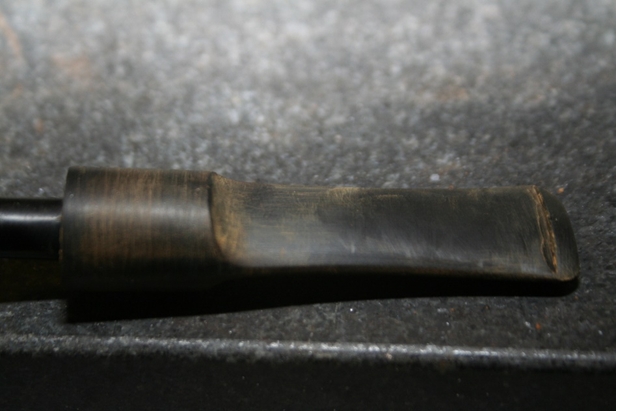
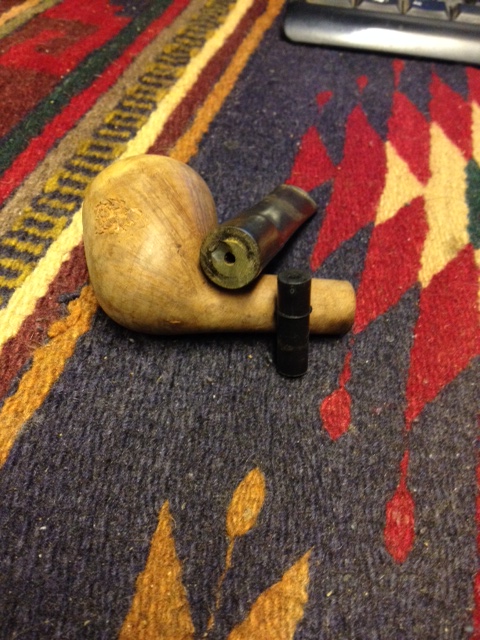
Once I had reduced the damage to the rim and front, keeping the shape as close to original/symmetrical as I could, I moved to micro mesh pads to sand and polish the bowl top. After getting through the first two grades I thought the entire pipe would look nice just polished with the micro mesh. At this point I reassembled the pipe and began to look for nomenclature to avoid during my polishing; this is when I discovered my “mystery”.
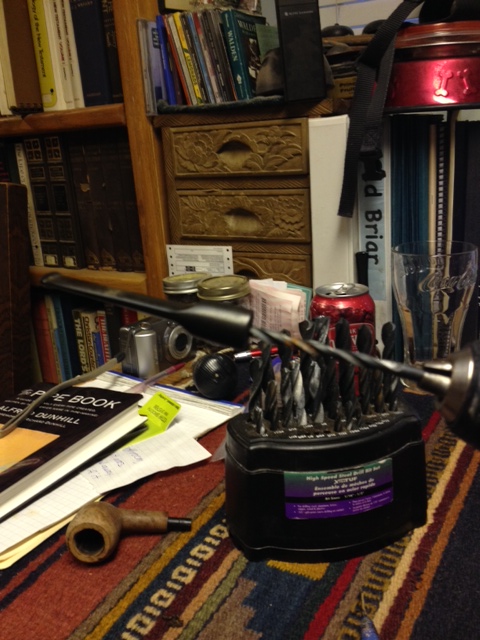
On the bottom of the stem, a origianl Kaywoodie, three-hole stinger with white clover logo, I saw something I had never seen before: there was stamping on the vulcanite “D-2”. This immediately intrigued me; I knew I would have to find out more about that … but lets’ wait a paragraph or two on that.

Kaywoodie Apple (9)

I polished the entire pipe with all of the micro mesh grits in order from 1500 – 12000, avoiding all of the stamping, including on the stem. I wet sanded the stem (only) through 4000, then polished the stem with plastic polish, before finishing the entire pipe through 12000 grit. I then applied Halcyon II wax to the entire pipe and hand buffed it. I was really pretty pleased with the results, considering I didn’t have access to my buffer and this was, more or less, my first experience with the Halcyon wax.

Kaywoodie Apple (2) Kaywoodie Apple (3) Kaywoodie Apple (5)Kaywoodie Apple (4)Kaywoodie Apple (6) Kaywoodie Apple (7) 

I missed some file marks on the stem, and the “bits” near the bit; I figure when I can properly buff the pipe I will get those taken care of, as well as put a better shine on it with some carnauba wax. But until then I am enjoying this old gal just as she is!

The stem still has oxidation near that stamping, which I began to research after I finished the work on the pipe. None of the other Kaywoodies I have, or have ever had, have any stamping on their stems like this one does. I scoured the ‘net and asked as many folks as I could think of to no avail … well, almost none. I am a member of the Kaywoodie Pipes Group on Facebook and one of the members there is Bill Fuerbach is as well. He saw my question that I posted about the stamping in that group and replied as follows:

Hey guys. I’ve seen this also on some older Kaywoodie stems. unfortunately at this time I don’t know what the significance is. :(:(

So unfortunately there is not yet an answer to what the stamping means or its significance is – and the mystery remains …  If by chance anyone what reads this knows the answer I would really appreciate it is you would leave a comment with the answers!

Edit

I received an email from Chris at PipePages about this question. He said in his personal opinion, and that it is only a guess, that it could be a factory replacement stem and the number was a style/guide for the repairman to know which stem to use. Although it is only a shot-in-the-dark type of guess, it seems like a plausible answer to me.