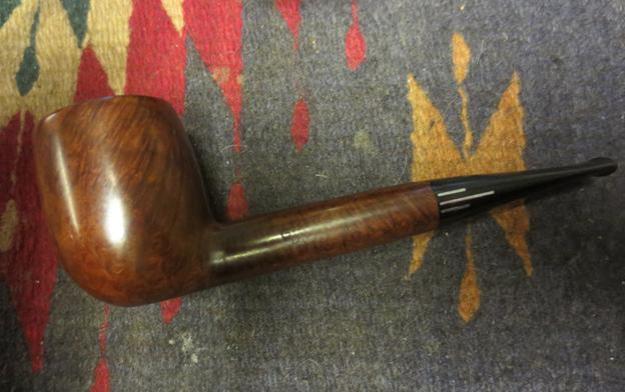
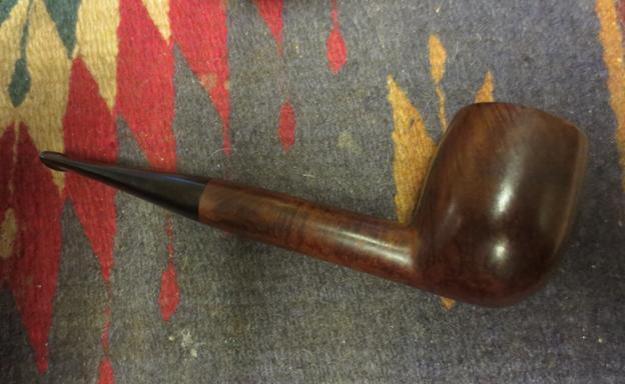
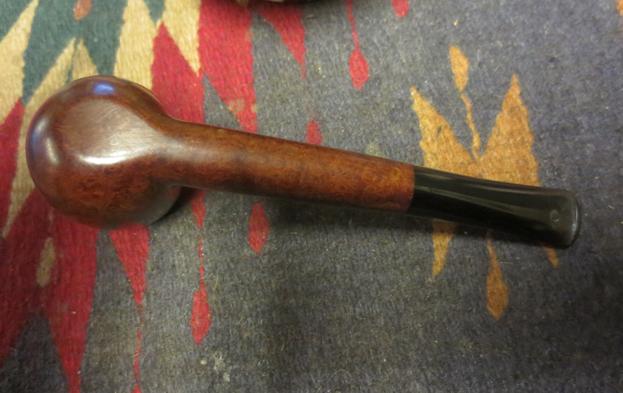
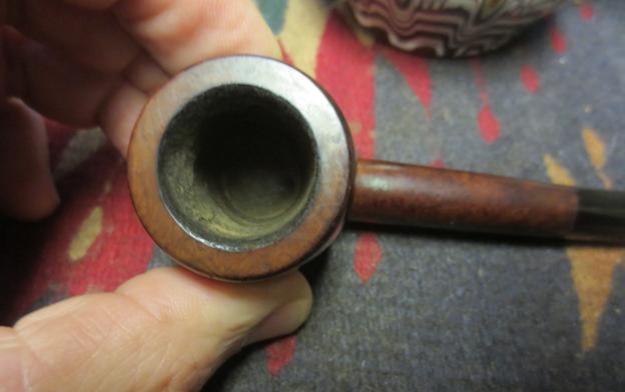
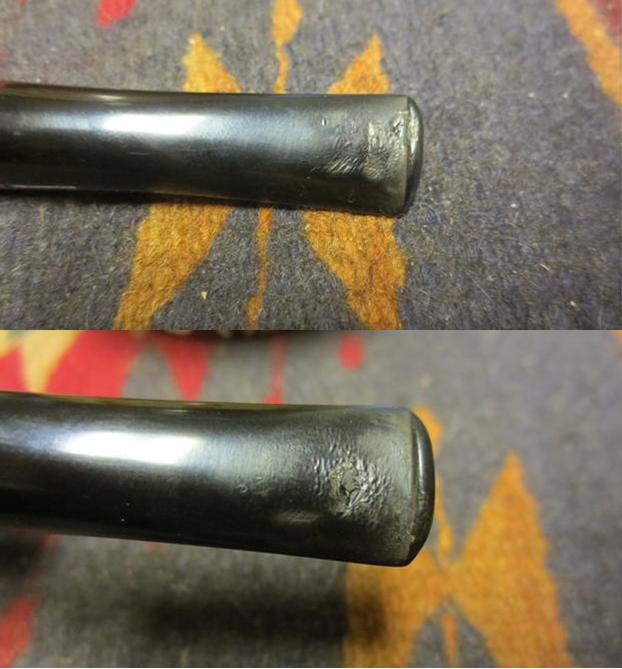
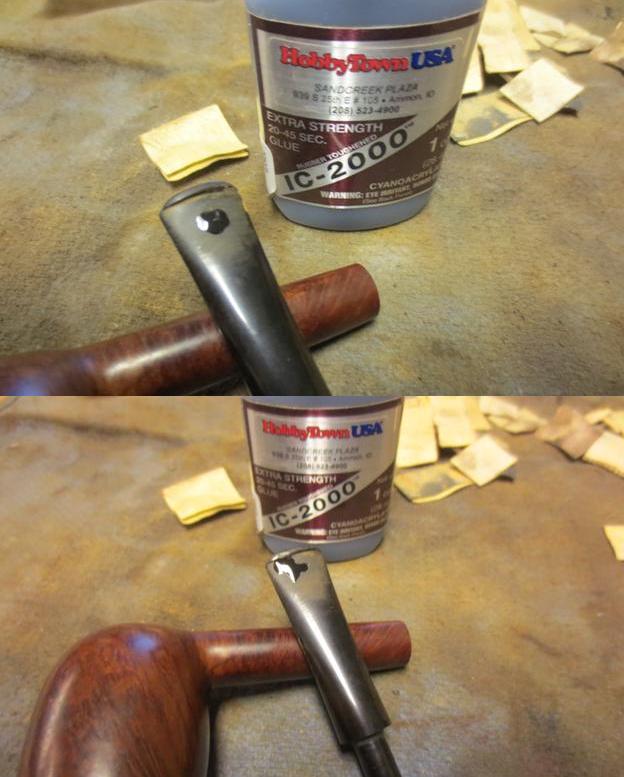
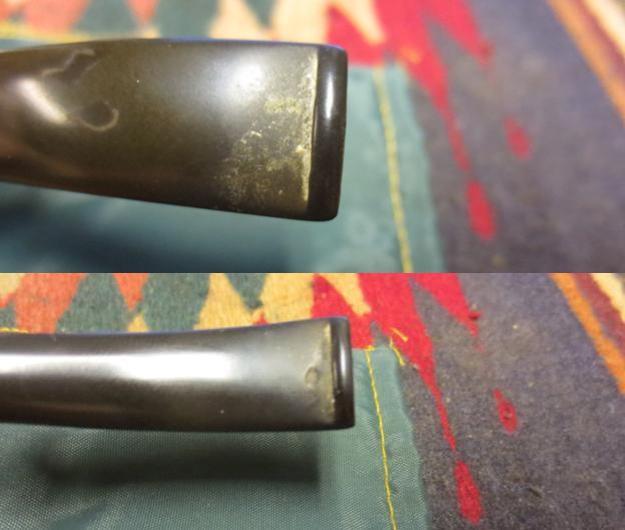
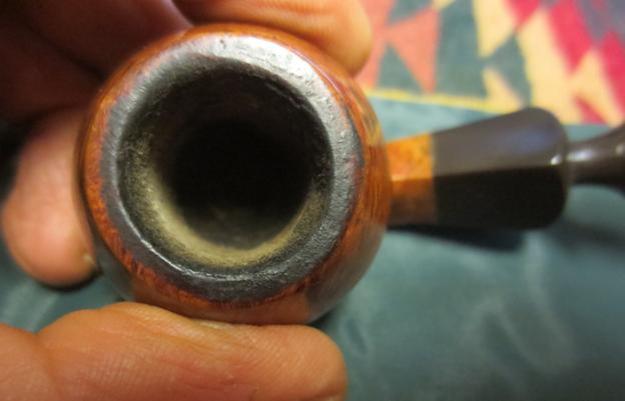
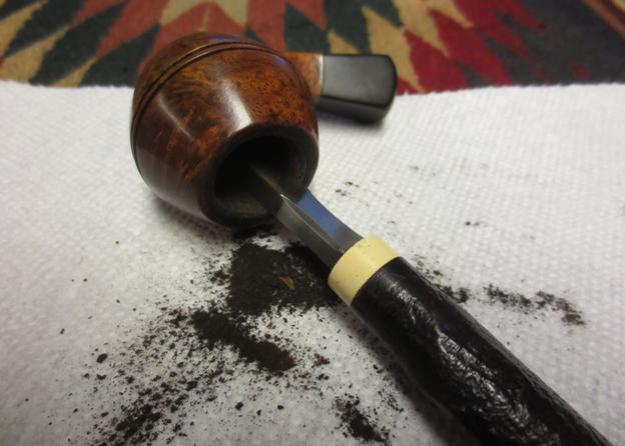
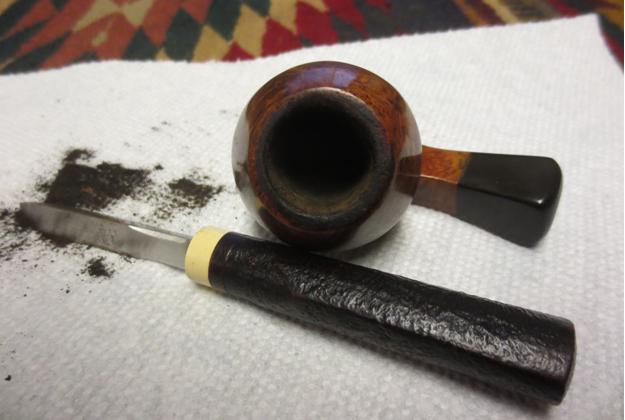
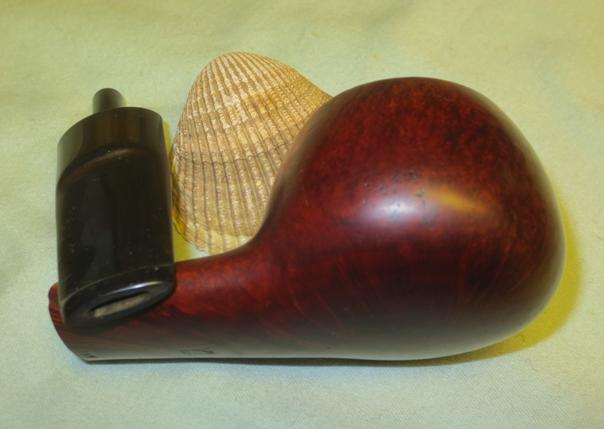
Tag Archives: Stem repairs

Restoring a Kirsten Generation 1 Medium Straight Pipe

Blog by Steve Laug

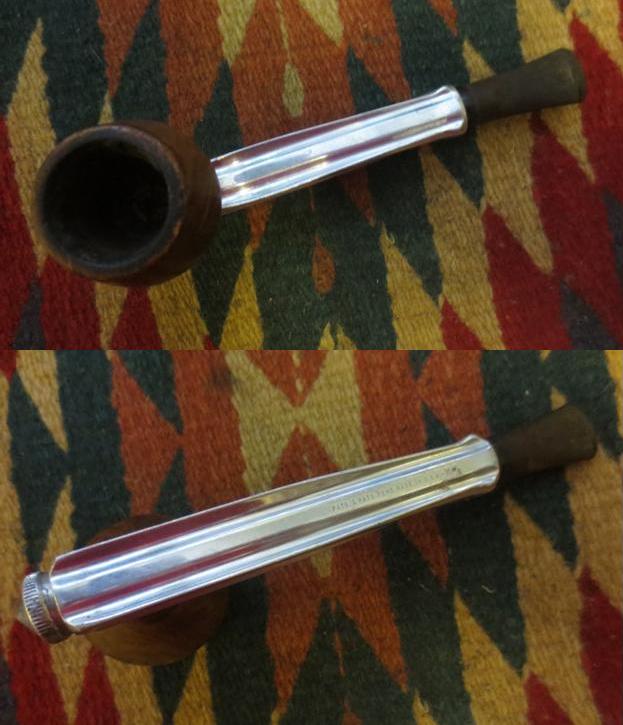
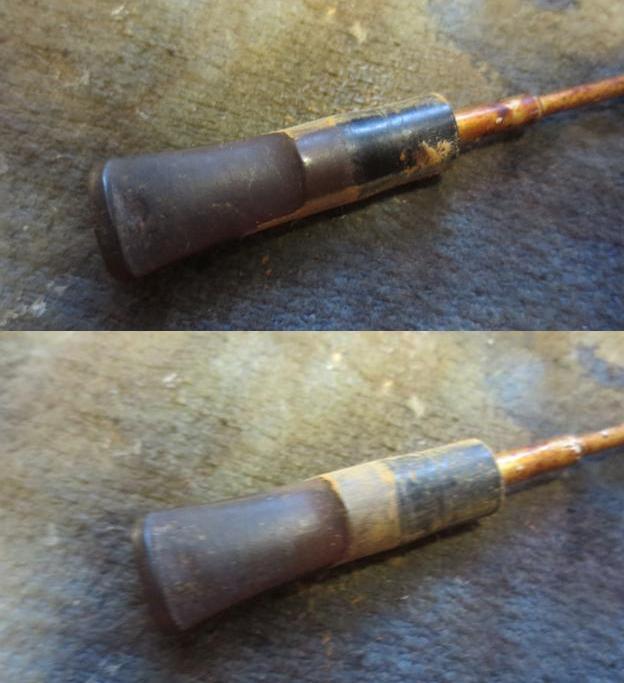
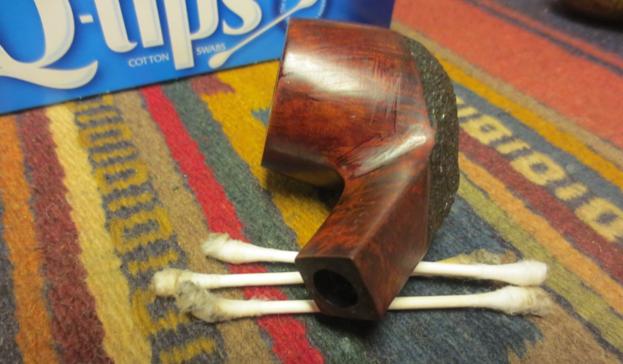
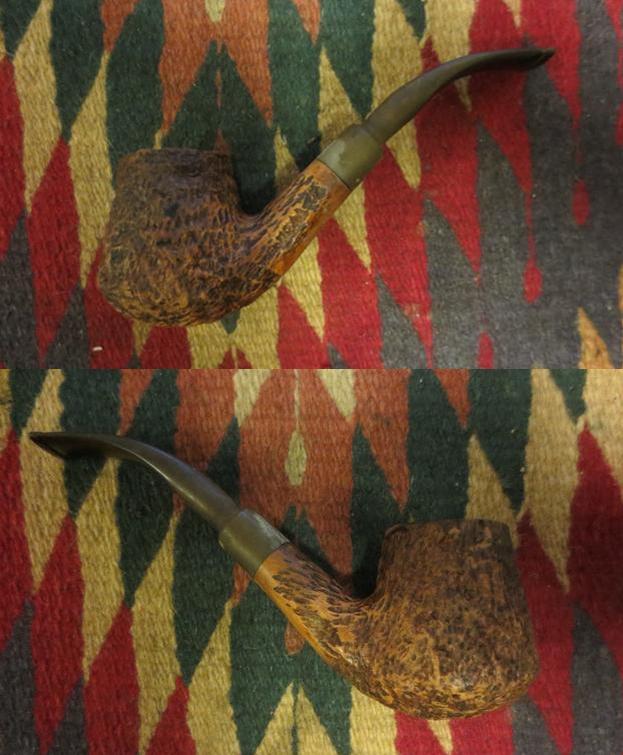
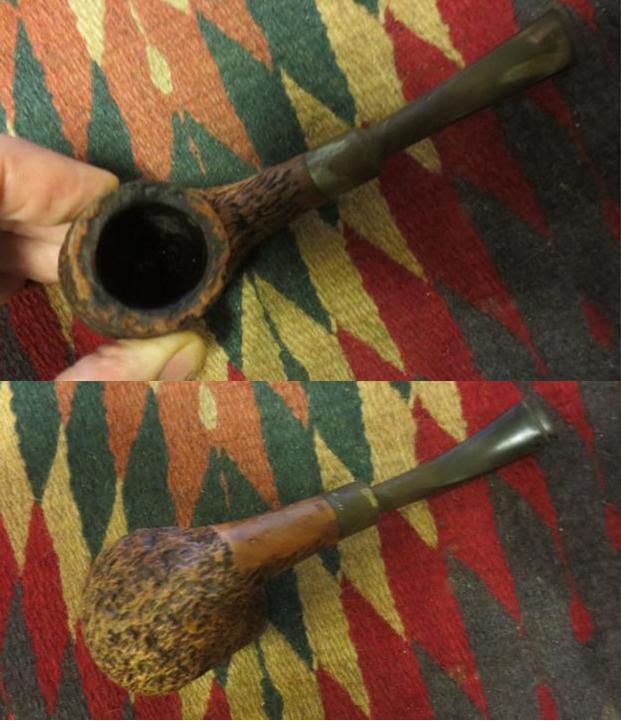
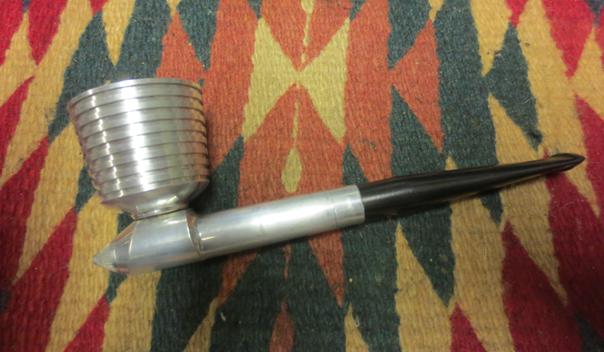
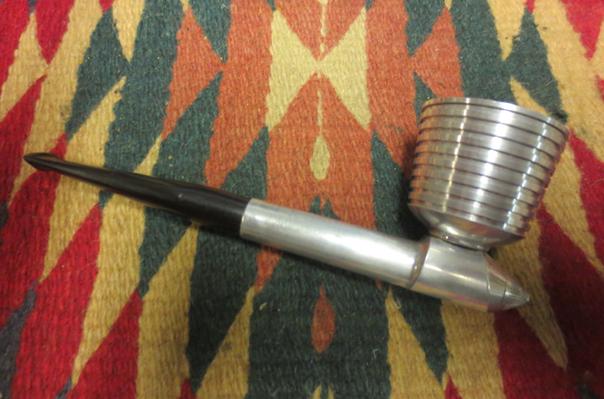
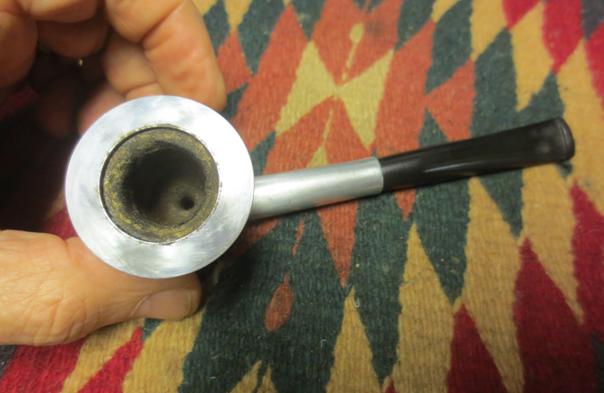
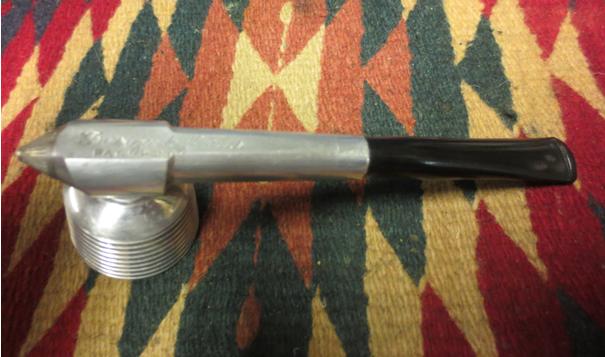
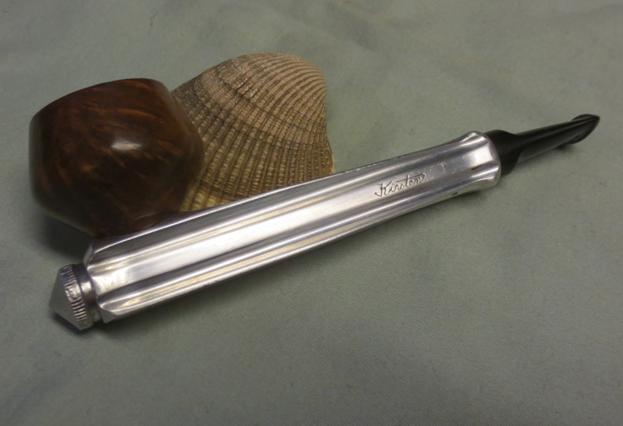
My brother continues to look for Kirsten estate pipes. He picked up this Kirsten because it looked like an old-timer. When I received it I could see that he was right about it being an older one. All the signs were there. The bowl was threaded directly on the barrel of the pipe and bottom cap that is on new models was not present. When the stem was removed there were no O rings on the end of the insert. The valve cap was stuck in the end of the shank and it could not be turned. The rim had a lava overflow on it and there was a heavy cake in the bowl. The screw mount in the bottom of the bowl was caked over to the point that it was stuck in the bowl. The metal barrel was oxidized and pitted. It had no shine left but looked like a well-worn pipe. The stem was oxidized and a dirty brown colour. There were tooth marks next to the button on the top and the bottom sides of the stem. The rod that ran through the barrel was dirty and coated with tars and oils that had hardened.K1 K2The left side of the barrel is stamped Kirsten in script. The underside is stamped Pats. & Pats.  Pend. USA M. The stamping along with the absence of O rings, the bowl screwed directly on top of the barrel pointed to a Generation 1 Kirsten which dated it between the years 1936-1958. In a previous blog I spelled out the features of each generation of Kirsten pipes that were released. https://rebornpipes.com/2012/11/03/kirsten-generation-1-1-5-2-3/ I quote the following from there: The wooden bowl on this generation connects directly to the metal barrel and there is no metal cup spacer. It is a pretty flush fit that goes flat against the barrel. On the underside of the metal barrel it is stamped with one or more of the following “Pat. Appl. For” (1936-38) and “Pats. & Pats. Pending” (1938-1958) over “Made in USA” – S” (or applicable size – S, M, L). There are no O-rings on the bit or metal shank insert. The M stamp on the pipe identifies it as a Medium sized pipe.

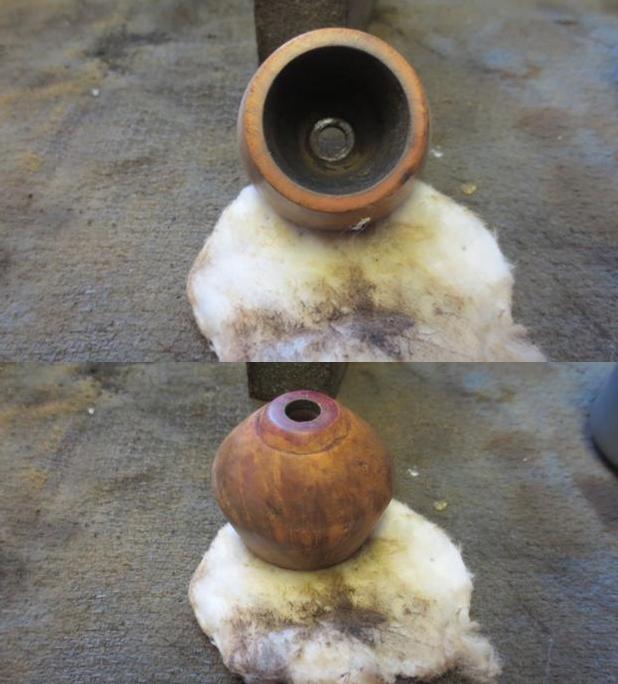
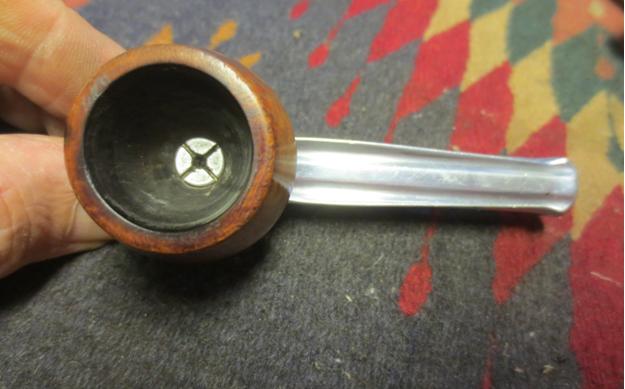
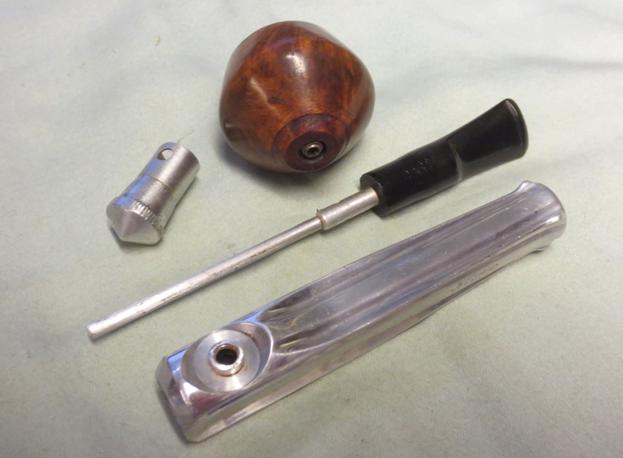
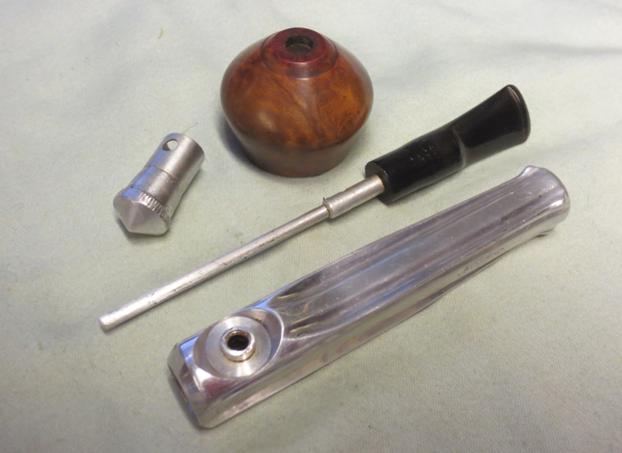
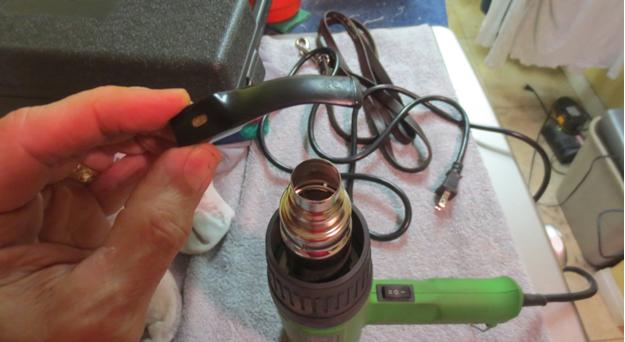
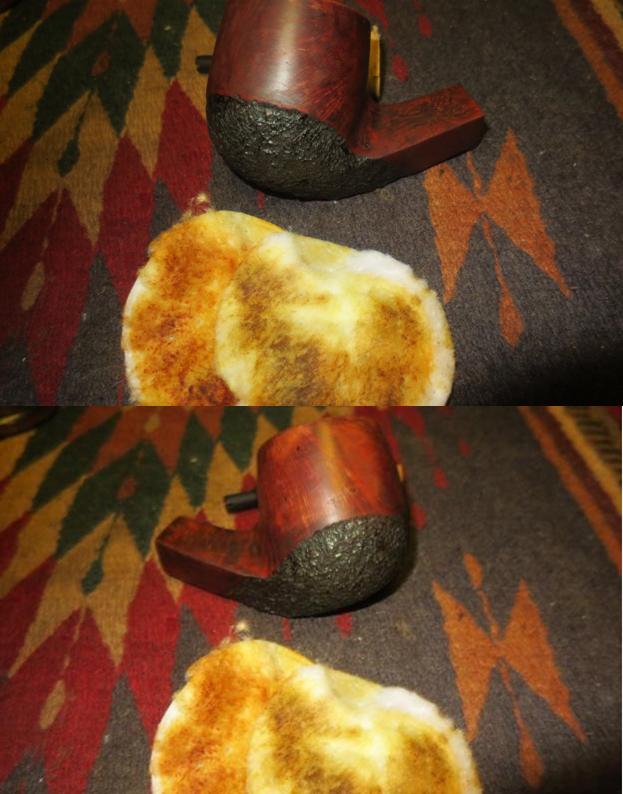
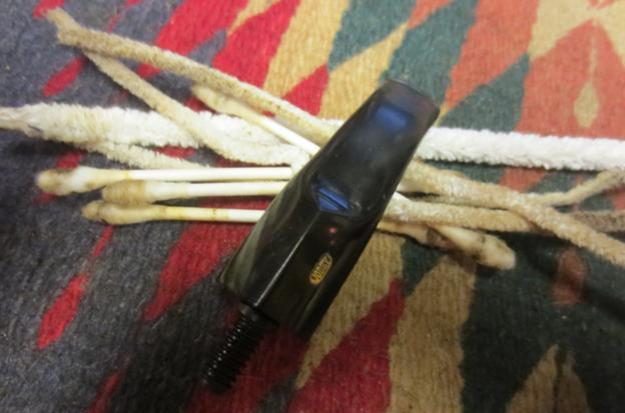
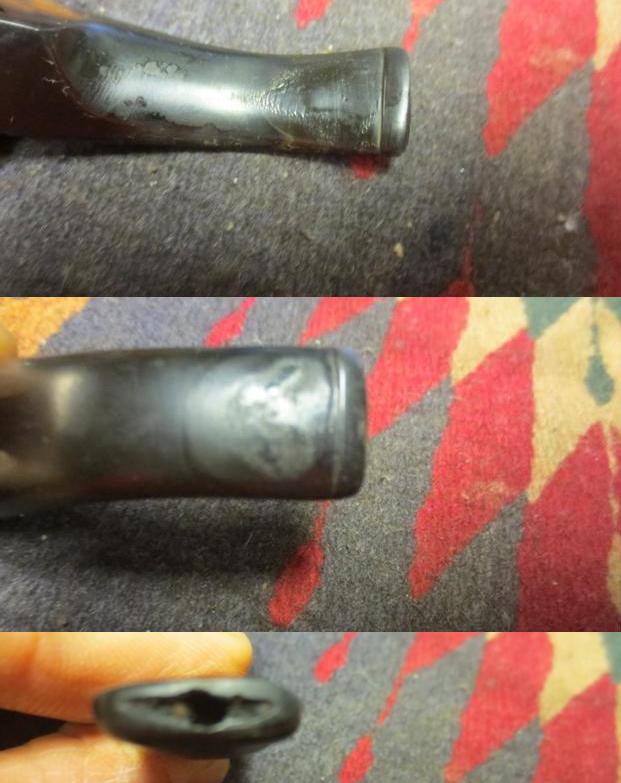
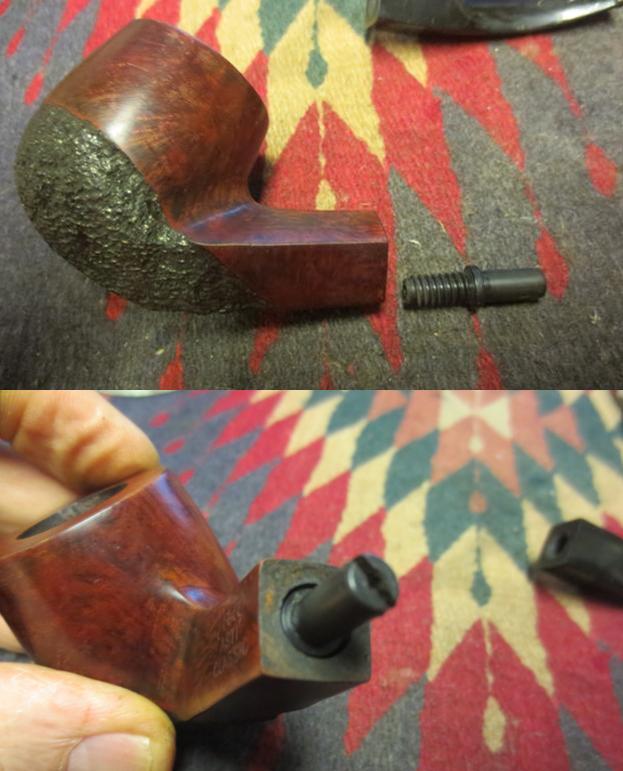
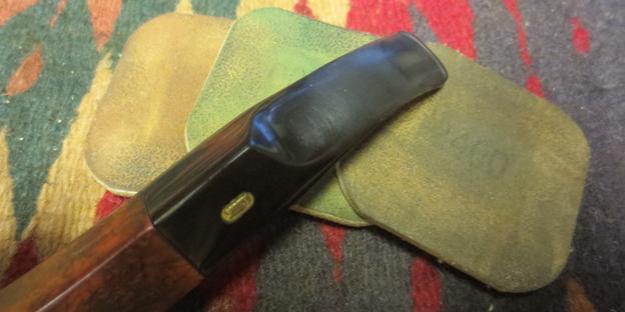
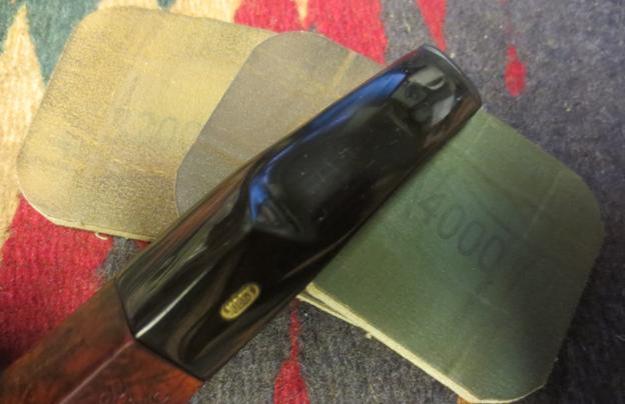
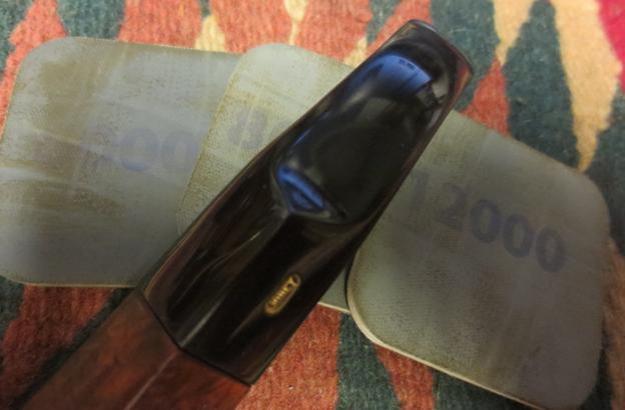
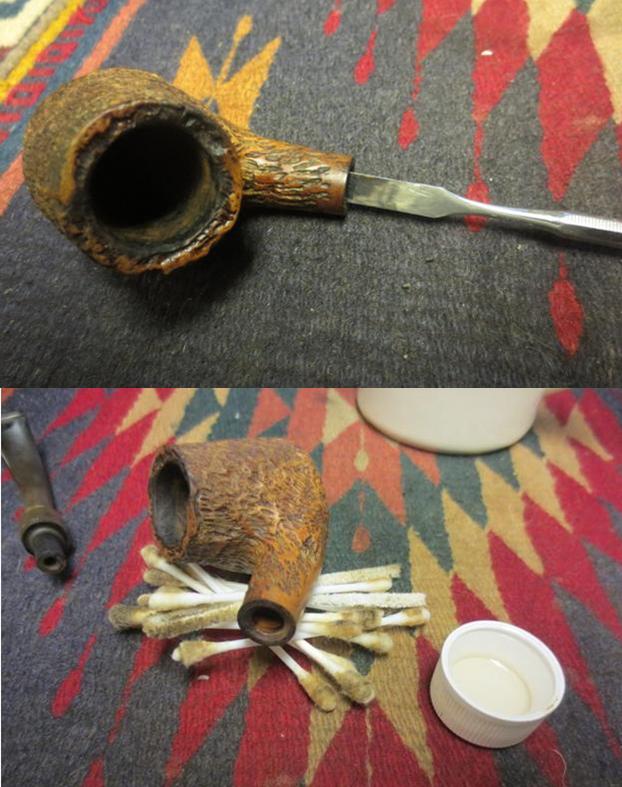
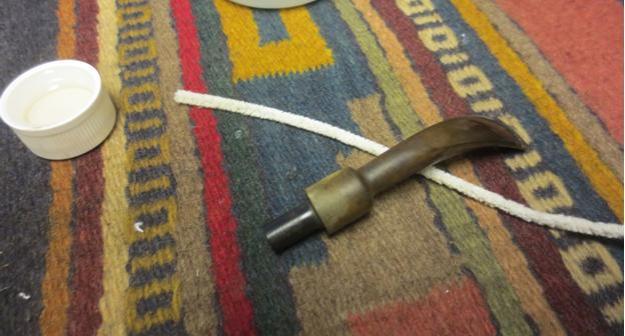
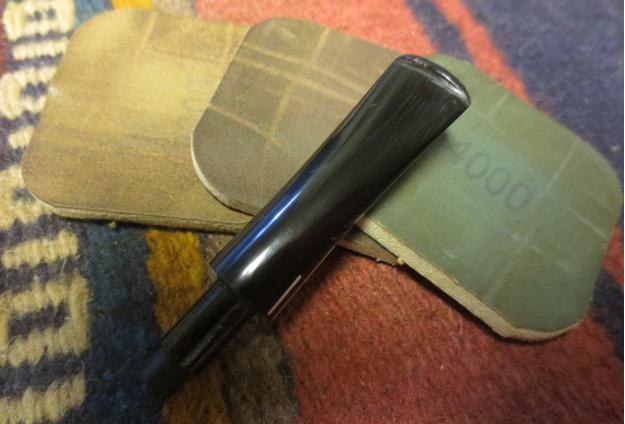
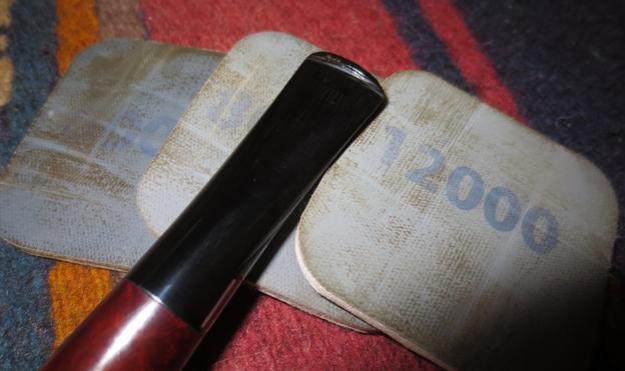
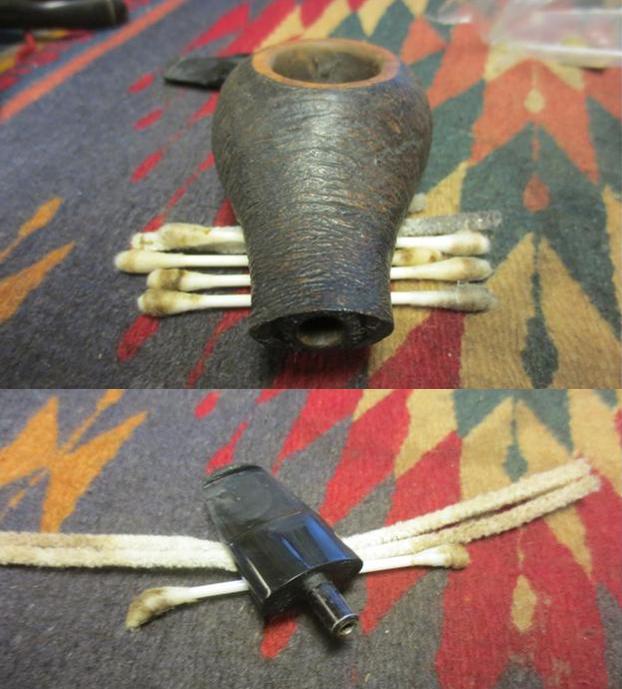
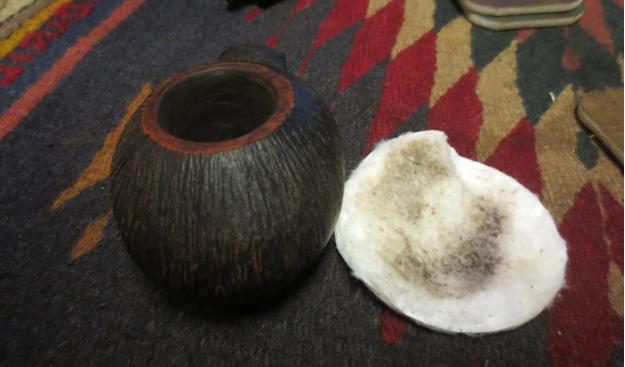
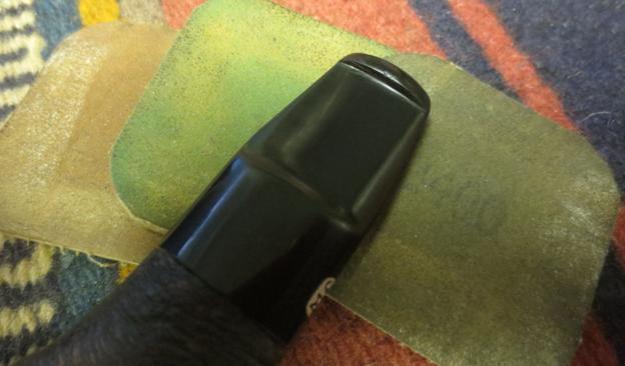
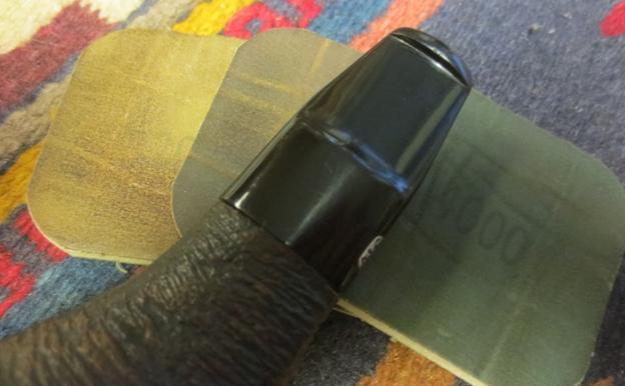
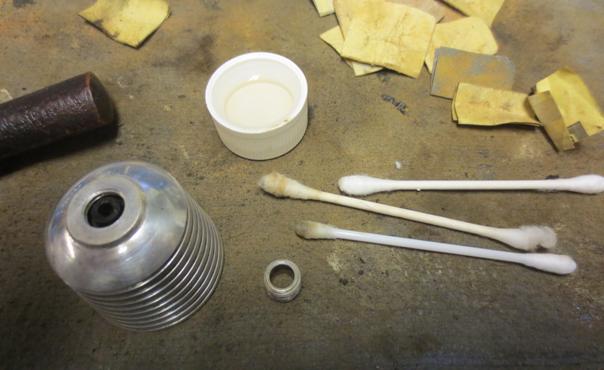
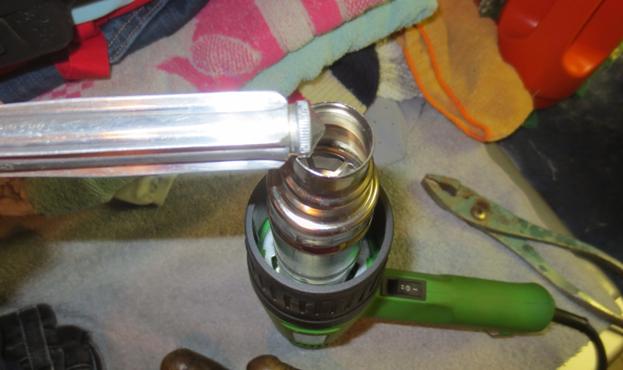
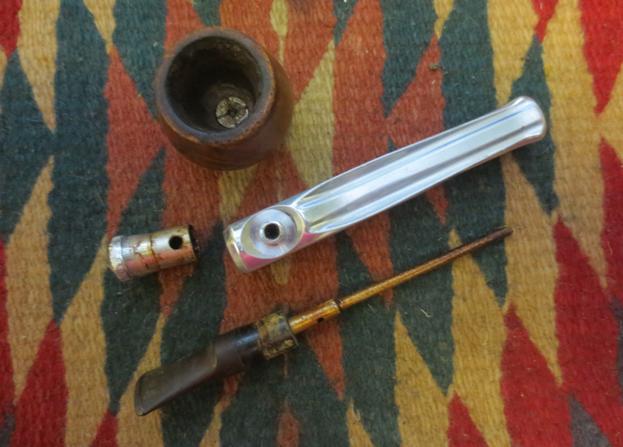
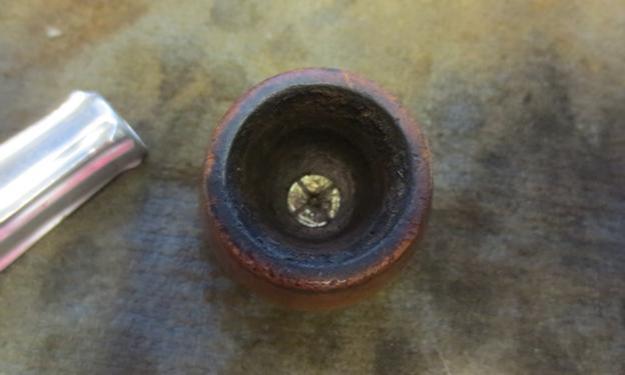
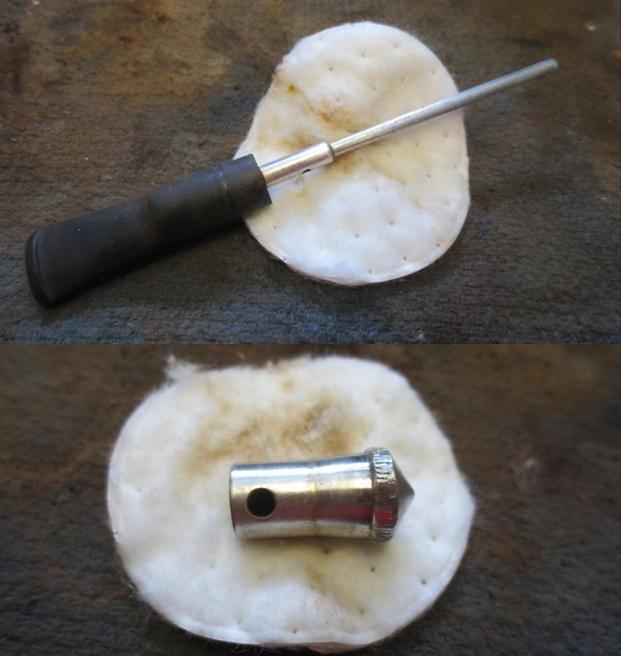
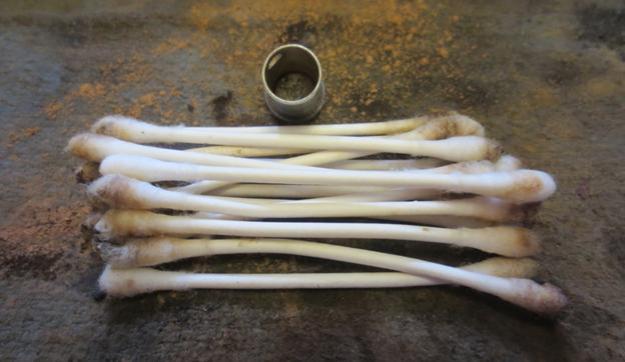
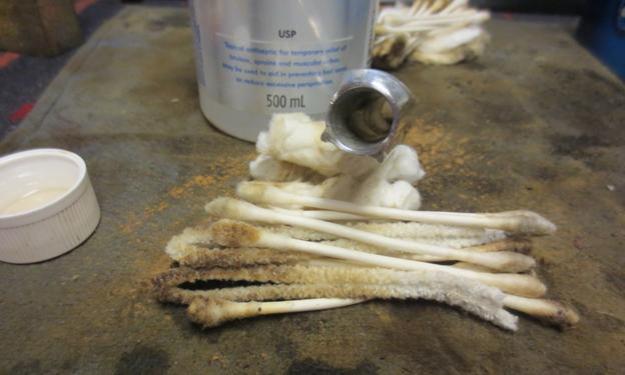
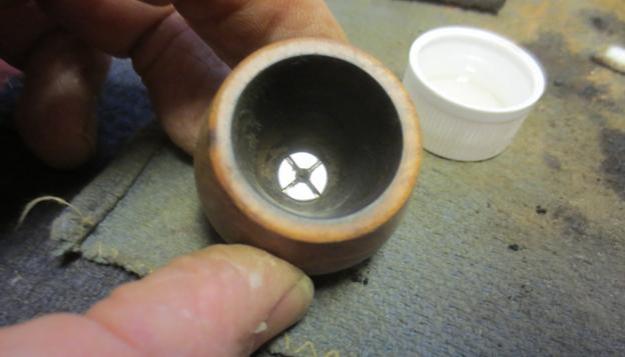
So I armed with that information I knew that the pipe I had, came from the time period of 1936-1958 and the lack of O rings on the mouthpiece and I assumed on the valve once I was able to remove confirmed that. I was ready to get to work on the pipe. I heated the valve insert with a heat gun to loosen the tars that held the cap in place. It did not take too long and I was able to insert a screw driver in the barrel and tap on the valve.K3The next photo shows the pipe taken apart. The condition of all of the parts is clear – dirty but functional. The knurled edges on the valve were damaged by previous attempts by someone else to remove the valve with pliers. In the photo above there are pliers present but I did not use them on the end cap.K4The screw in the bottom of the bowl was held in place by the cake in the bowl. The photo also shows the condition of the bowl and the rim. The other close-up photos show the stem and the tooth marks on both sides near the button.K5 K6I sanded the stem with 180 and 220 grit sandpaper to remove the oxidation and the tooth marks. I was able to blend the tooth damage into the flow of the stem because fortunately they were not deep.K7I lightly topped the bowl on the topping board to remove the damage to the rim and the build-up.K8I reamed the bowl with the Savinelli Pipe Knife and took the cake back to bare briar. I sanded the inside of the bowl with a piece of sandpaper to clean out the remaining cake.K9I scrubbed the exterior of the bowl with cotton pads and acetone to remove the grime and the remaining finish.K10 K11I scrubbed the rod on the stem unit with acetone to remove the tars and oils. I did the same with the exterior of the valve.K12I cleaned out the tarry build-up in the valve/end cap with cotton swabs and alcohol.K13I cleaned out the barrel with cotton swabs and rolled cotton pads and alcohol pushed through the opening with a screw driver. I also pushed a rolled piece of 0000 steel wool through the barrel to polish the inside. I used pipe cleaners to clean out the threads in the opening on the top of the barrel.K14I cleaned up the screw and the airway through the screw with a dental pick, pipe cleaners and alcohol. I cleaned the threads on the screw with cotton swabs and alcohol.K15I polished the aluminum barrel with Meguiar’s Scratch X2.0 and cotton swabs.K16I restained the bowl with a dark brown stain pen. K17I put the bowl on the barrel buffed them with Blue Diamond on the wheel to polish the stain and even out the coat on the bowl as well as polish the aluminum. The next photos show the bowl and barrel at this point in the process.K18 K19I cleaned out the airway in the stem with pipe cleaners and alcohol and then worked on the stem with micromesh sanding pads. I wet sanded with 1500-2400 grit pads and gave it a coat of Obsidian Oil. I dry sanded with 3200-4000 grit pads and gave it another coat of oil. I finished sanding with 6000-12000 grit pads and gave it a final coat of Obsidian Oil. I set the stem aside to dry.K20 K21 K22I gave the pipe and stem multiple coats of carnauba wax and buffed the barrel, bowl and stem with a clean buffing pad to raise the shine. I hand buffed it with a microfibre cloth to add depth to the shine. The photos below show the finished pipe. This one will also go on the store soon. If you are interested in it let me know. Thanks for looking.K23 K24 K25 K26 K27 K28 K29
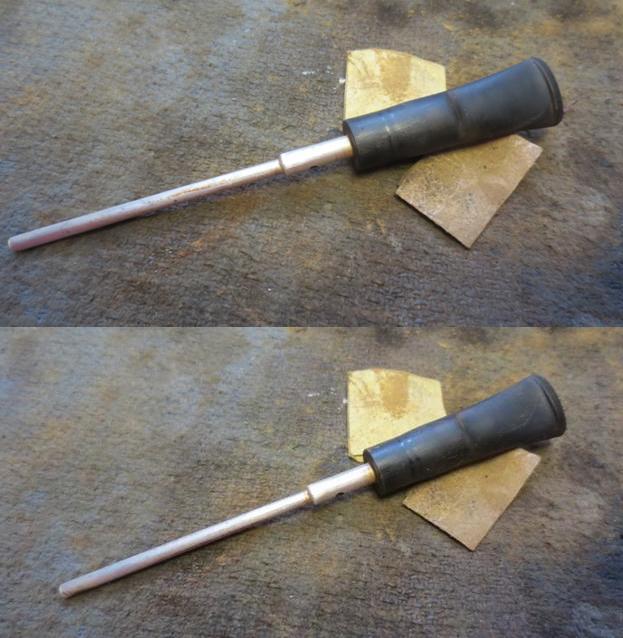
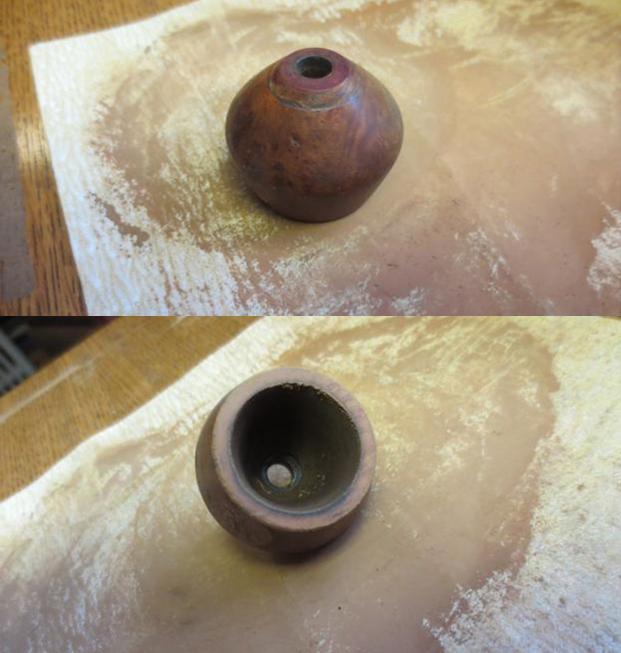
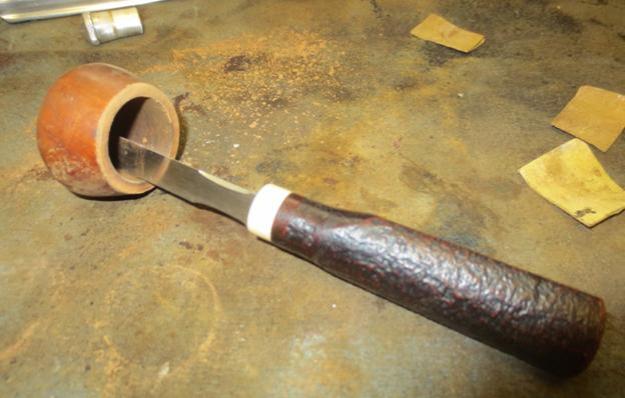
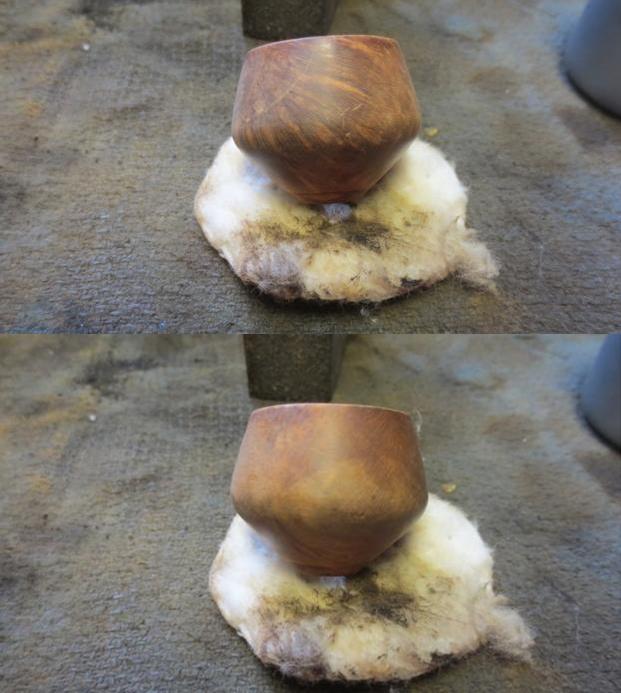
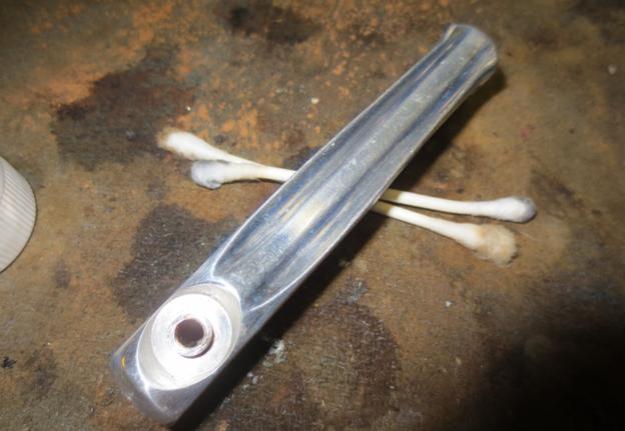
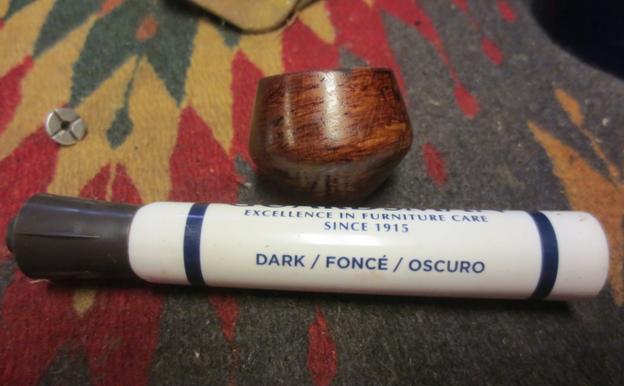
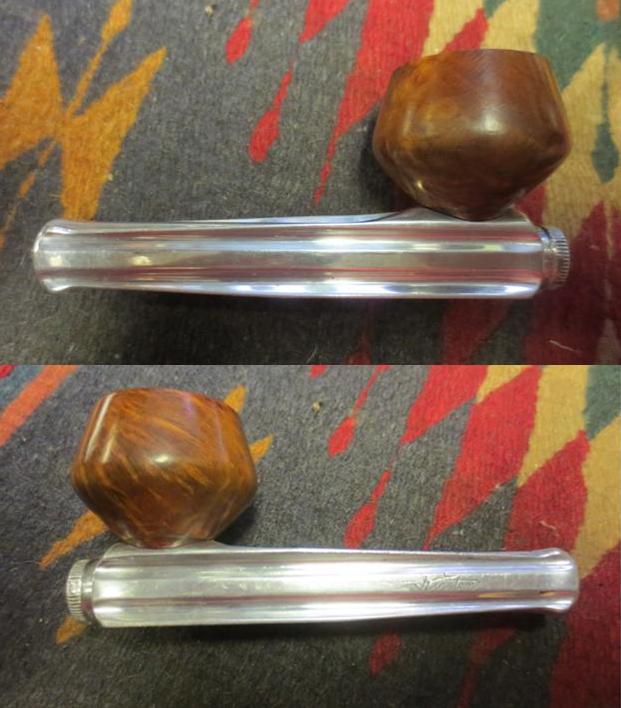
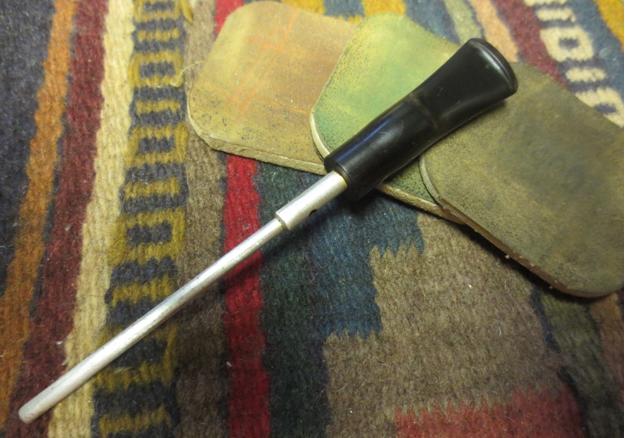
 

I thought this one would be easy – boy was I wrong

Blog by Steve Laug

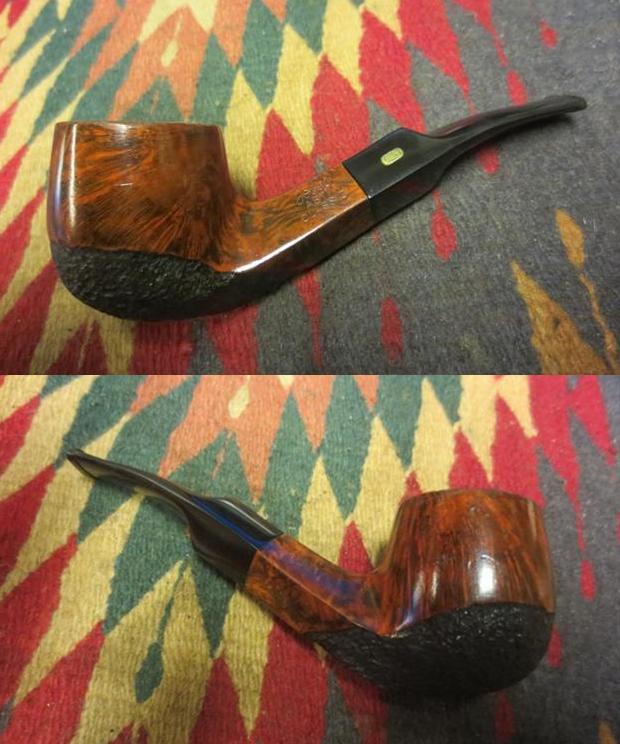
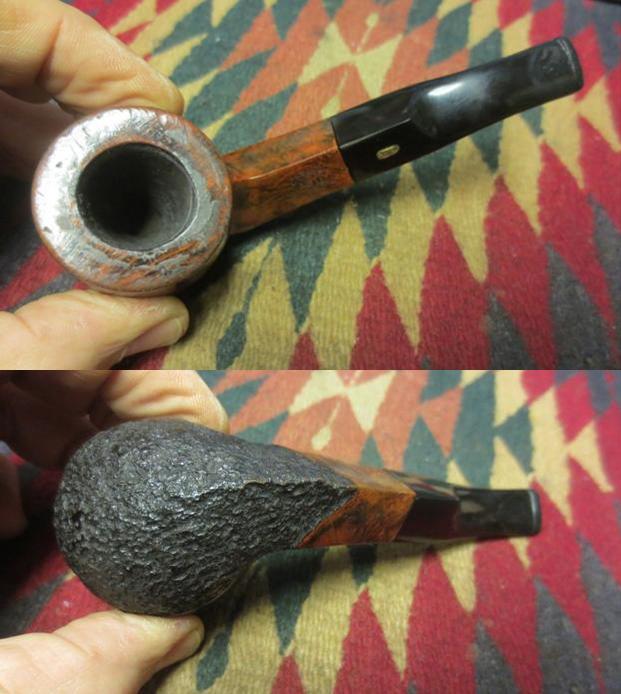
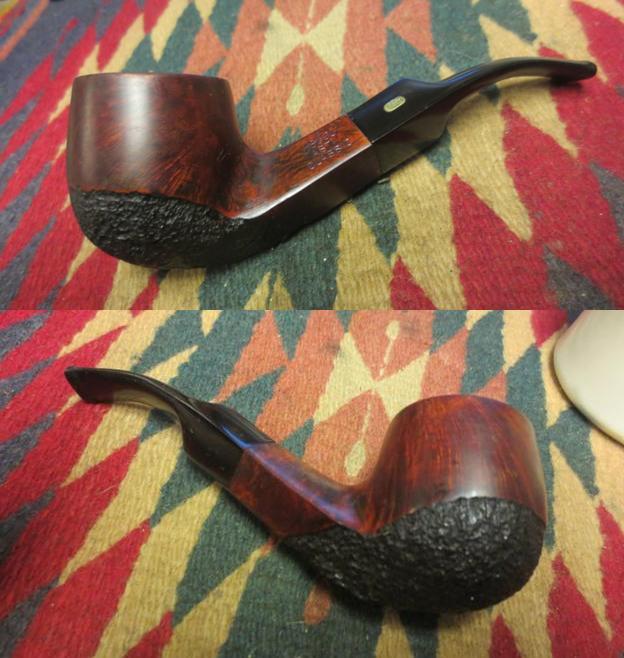
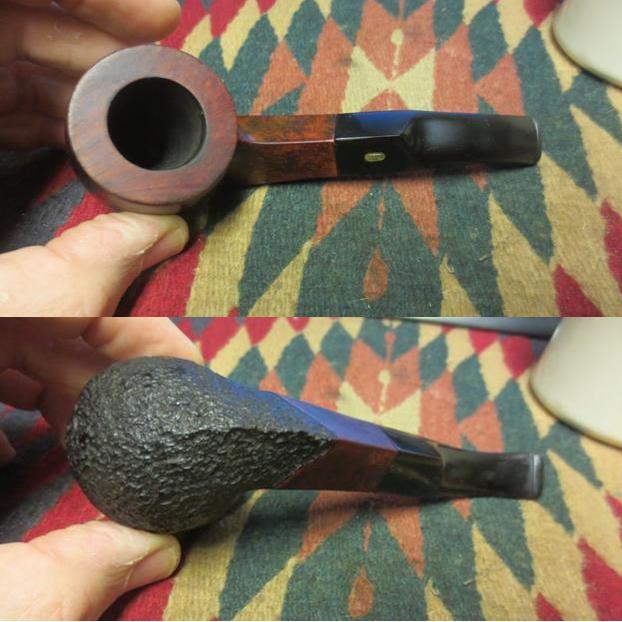
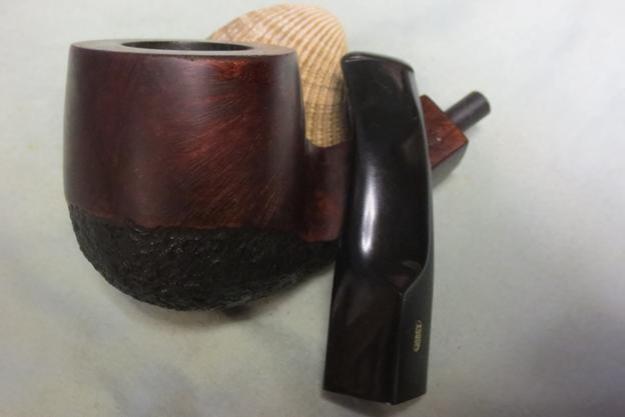
I wanted a bit of a breather so I went through my box of pipes for repair and picked this multi-finish Jobey Asti Classic Bent Billiard to clean up. The stamping on the left side reads Jobey Asti Classic and on the right side France and the shape number 470. At first glance it looked like it would be a simple restore and clean. The bowl looked decent in the box and the stem was okay as well. When I got back to the table and did a closer examination I was surprised by what I saw. The bowl rim was in bad shape with the outer edge knocked and damaged. There were dent and score marks in the top of the rim. The lava had flown over the top and it looked as if someone had thrown a coat of Urethane on top of the bowl, grime and all. I looked at the exterior and found that even the grooves in the rusticated bottom of the bowl were thickly coated with the plastic stuff. The stem looked good at first but as I examined it I found that it had been cut off and the button recut and a slot fashioned that was not clean or even. The surface of the stem on the top and bottom next to the button was heavily built up with what appeared to be black epoxy and it was bubbled and full of pin prick like holes. It also was not bent correctly to the shape of the bowl. Truly it would need a lot more work than originally thought. (As an aside don’t use Urethane on bowls it is a bear to clean off and if you have to at least clean them before you dip them in that awful plastic stuff.)Asti1 Asti2I took the pipe apart and unscrewed the Jobey Link from the bowl and took a picture of the parts. I wanted to see how dirty the internals were and if the Link would come out easily. For those of you who don’t know the Link system one of the nice perks is that the end of the tenon that sits in the stem are slotted so you can insert a slot or blade screwdriver to loosen and remove the Link. It is a great piece of forethought on the part of the designer.Asti3Because of the coat of Urethane over the lava I needed to top the bowl to remove the grime and also to clean up the outer edges of the bowl. I topped it with 220 grit sandpaper on my topping board.Asti4I sanded the finish on the smooth portion of the bowl with a medium grit sanding block and then wiped the bowl down with acetone to try to break the plastic finish. I was partially successful in removing it but more work would need to be done.Asti5I reamed the bowl with the PipNet reamer and also with the Savinelli Pipe Knife to remove the remnants of cake that still were deep in the bowl. I reamed it back to bare briar so that the new owner could build a cake of their own choosing. You can also see the top and outer edge of the rim in these photos that show it after the topping of the bowl.Asti6In the next photo you can see the film of the plastic stuff still on the bowl with the scratches from the sanding block visible. I decided to let it soak in the alcohol bath for a day and a half to see if the finish would break down some more now that it had been broken through with the sanding blocks.Asti7When I took it out of the bath the finish was pretty smooth. The plastic stuff was gone. I sanded the bowl and shank with micromesh sanding pads to remove some of the scratching and was careful around the stamping on the sides of the shank. I washed the bowl down with some acetone on cotton pads and then stained it with a dark brown aniline stain. I flamed it and repeated the process to make sure I got and even coverage.Asti8While the bowl dried I turned to work on the stem. I heated it with the heat gun to soften the Lucite enough that I could bend it to the proper angle. It did not take too much to get the angle correct but the heat caused the epoxy patch to bubble. The perk of that was that the airhole pin prick marks disappeared.Asti9I wiped the bowl down with alcohol on cotton pads to remove some of the dark stain and bring the grain to the forefront.Asti10I cleaned out the interior of the stem with cotton swabs, pipe cleaners and alcohol. I cleaned out the area where the Jobey Link sat in the stem and the airway to ensure good fit and draw.Asti11Now it was time to work on repairing the stem repairs! The next photos show what the patches looked like when I started. They stood out clearly and the heat of the gun made them raise and bubble. To me they looked like overkill in terms of a repair. It was almost if the person who did the patch was trying to build up the thickness of the stem at the button to give it strength. It would take some work to make it blend in. I sanded the surface of the stem with 220 grit sandpaper to smooth things out and try to match the stem surface. Of course I forgot to take photos of the process but the ones shown below with the micromesh sanding pads will show the change. The third photo below shows the slot in the button. I worked on it with needle files to clean it up and shape it and again forgot to take photos of the process.Asti12I rubbed the bowl down with some Conservator’s Wax so that when I cleaned out the shank and Jobey Link System with would not damage the finish that I had done. (I know I should have done this before staining but this one irritated me and I forgot to do so.) I cleaned the link and then put a little Vaseline on the threads and turned it into the mortise. I adjusted it with the screwdriver to set it into the shank.Asti13 Asti14I buffed the bowl lightly with Blue Diamond on the wheel and gave it a light coat of olive oil. I took the following photos to show what the pipe looked like at this point in the process. You can also see the state of the stem in these photos. Overall the pipe is looking pretty good at this point. It is far better than I expected when I started. The contrast of the dark stain on the rustication and the lighter stain on the smooth briar makes this pipe look quite “classic” matching its name.Asti15 Asti16I wet sanded the stem with 1500-2400 grit micromesh sanding pads and dry sanded with 3200-4000 grit pads. I finished sanding with 6000-12000 grit pads. Asti17 Asti18 Asti19I buffed the bowl and stem with Blue Diamond. I avoided the rusticated portion so as not to get polishing compound in the crevices and pits of bottom half of the bowl. I waxed the bowl and the stem with multiple coats of carnauba. The finished pipe is shown in the photos below. The grain is quite beautiful and the contrast between the smooth and the rusticated portions gives a unique look to the pipe. Thanks for looking.Asti20 Asti21 Asti22 Asti23 Asti24 Asti25 Asti26 Asti27

An Interesting Churchill’s Volcano Brought to Life

Blog by Steve Laug

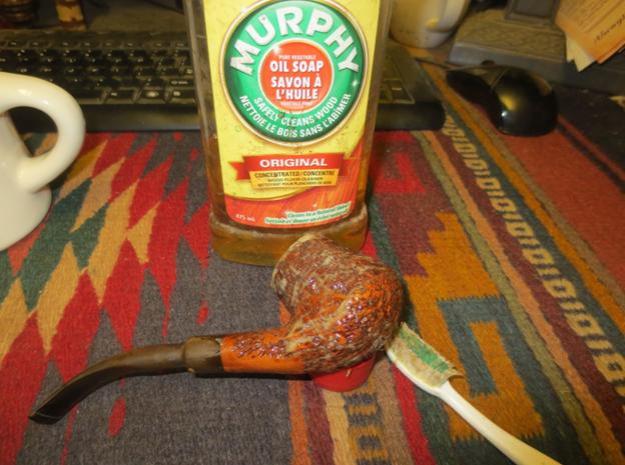
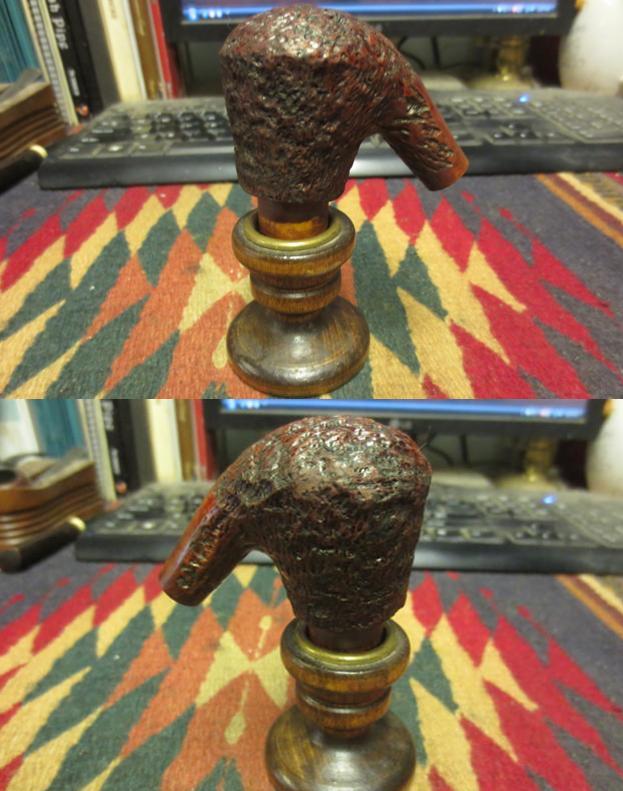
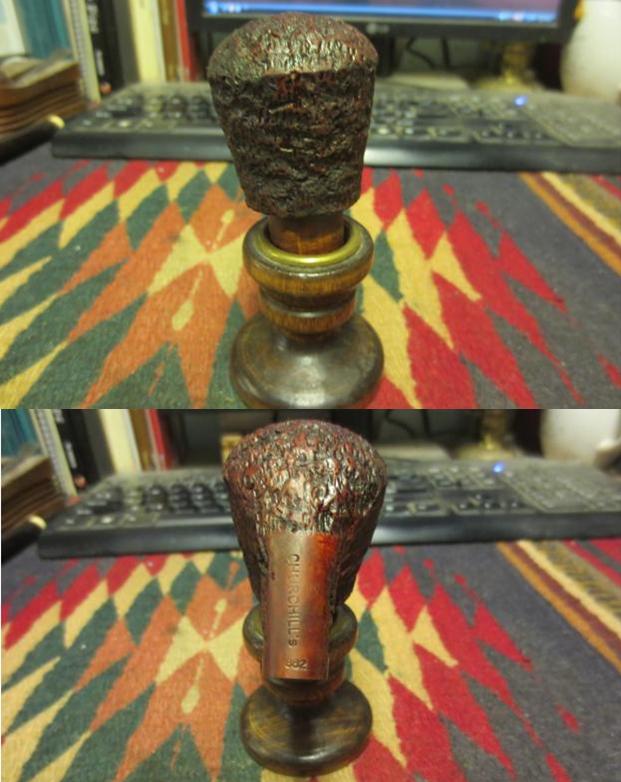
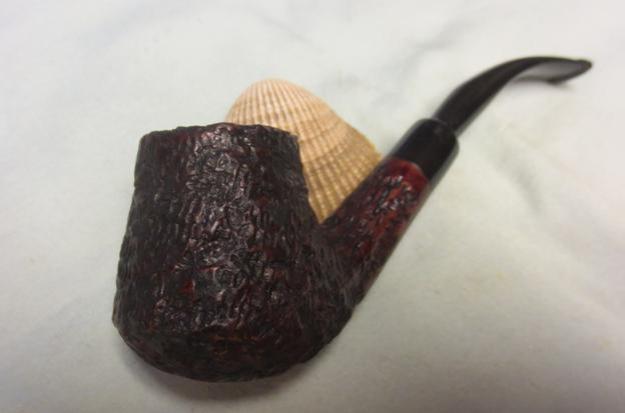
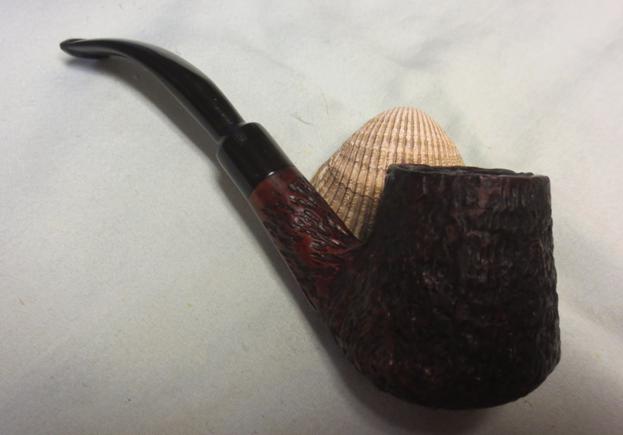
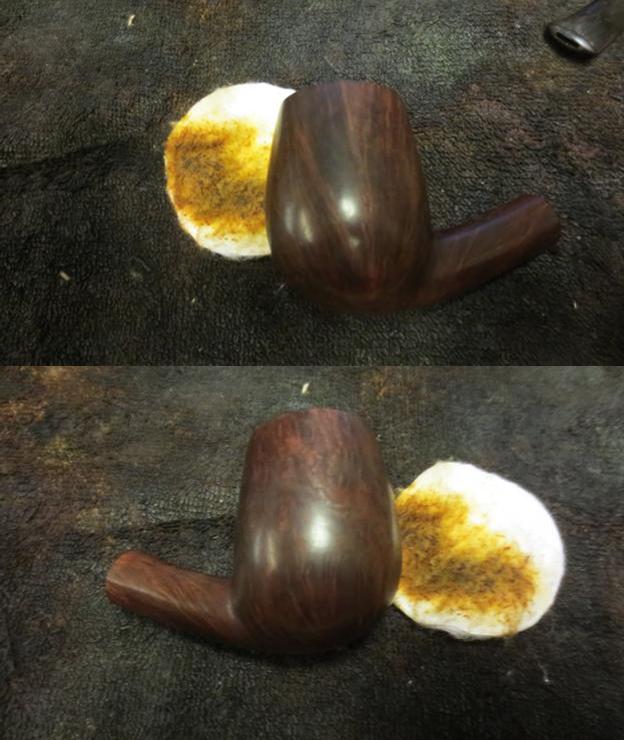
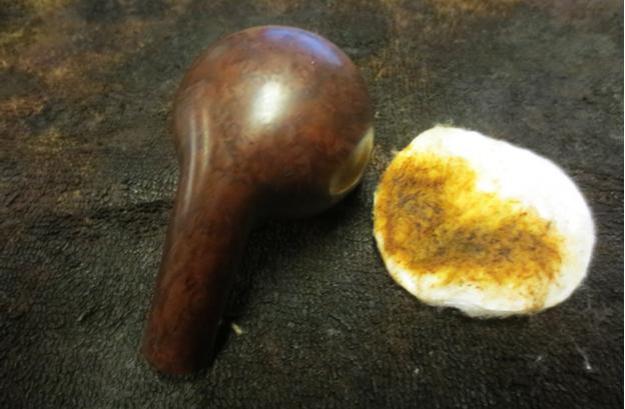
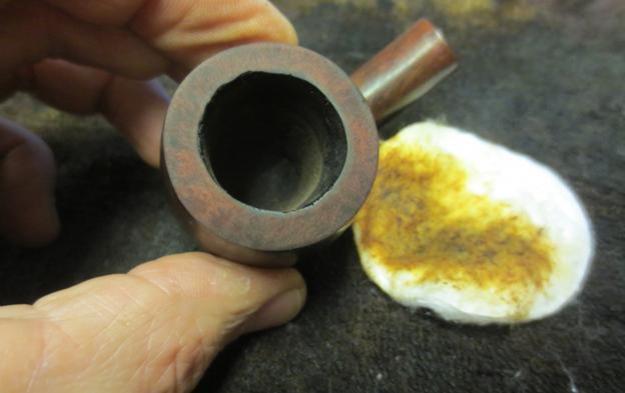
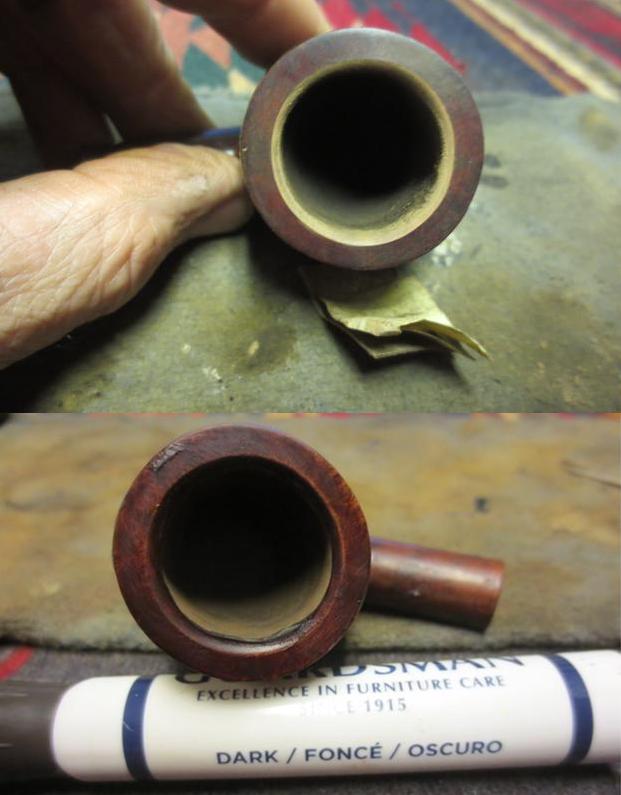
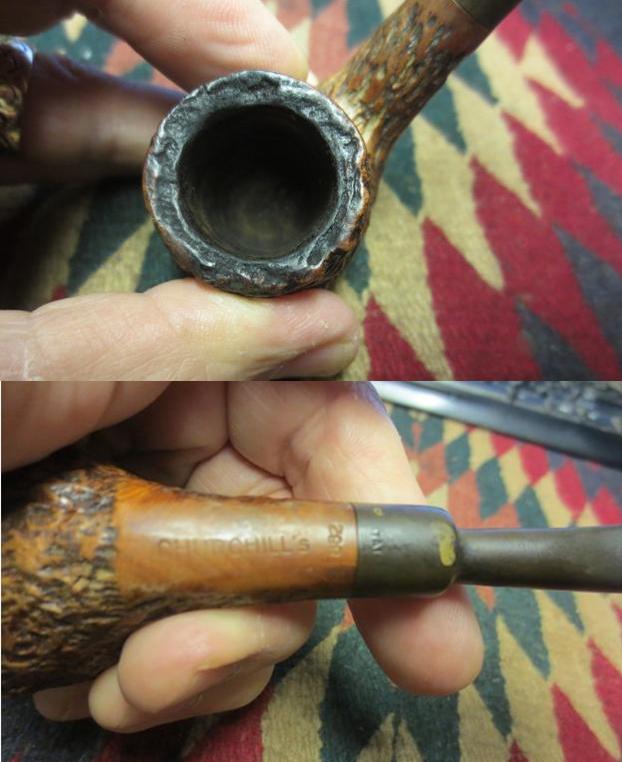
The next out of the box of pipes from my brother is the one below. It is stamped Churchill’s on the smooth underside of the shank. The shape number 882 is along the shank stem junction on the underside. I have refurbished several Churchill’s pipes from their pipe shop in Norwich. I wrote a bit about that shop when I did a refurbish on a Churchill’s Bent Pot. The link to that article is as follows: https://rebornpipes.com/2013/09/08/churchills-bent-pot/. This pipe had a rustication that is very similar to those I have seen on Lorenzo pipes. The stem on this pipe is stamped Italy on the underside. The finish was tired and dirty but the rustication was in good shape. The rim was solid with no damage to the inner or outer edge but it was thick with tars. The bowl was reamed while I was visiting in Idaho. The stem was in good shape at first glance. It was oxidized but there were no tooth marks. As I examined it I found that the stem had been cut off and a new button was cut into the surface. The slot was also reshaped. The button itself was very thin as the stem was also thin at this point.Church1 Church2I took a close up photo of the rim and the stamping on the underside of the bowl. The rim is dirty but the rustication is in good shape with no burn marks or damage. The stamping is also very clear.Church3I scrubbed the rim with a brass bristle wire brush to remove the tars and oils that had built up there. Once it was loosened I scrubbed it with a tooth brush and Murphy’s Oil Soap to clean off the grime in the finish. I rinsed the bowl with warm running water to remove the grime and soap.Church4 Church5The next photos show the cleaned finish on the pipe.Church6 Church7I used the dental spatula to scrape out the inside of the shank and break the tars and oil build-up away from the walls of the shank and mortise. I cleaned out the mortise and airway in the shank and stem with pipe cleaners, cotton swabs and alcohol.Church8 Church9I sanded the stem with 220 grit sandpaper to remove the oxidation. I built up the button with black super glue to add thickness and enable a grip on the button.Church10 Church11I used a file to shape the button and recut the sharp edge against the stem surface. I sanded it with 180 grit sandpaper to smooth out the areas in front of the button on the top and the bottom sides.Church12 Church13I continued to shape the stem surface and the button with 220 grit sandpaper and also used the needle files to open up the slot in the button and reshape that.Church14I sanded the stem with 220 grit sandpaper to clean off the oxidation. I wet sanded the stem with 1500-2400 grit micromesh sanding pads. I rubbed it down with Obsidian Oil. I dry sanded the stem with 3200-4000 grit sanding pads and gave it another coat of oil. I finished sanding the stem with 6000-12000 grit pads and gave it a final coat of Obsidian Oil. I let the stem dry.Church15 Church16 Church17I stained the bowl with a dark brown aniline stain and flamed it. I repeated the process until the coverage was good. I hand buffed the bowl with a shoe brush. I gave it a light coat of olive oil and hand buffed it again. I rubbed the surface down with some Conservator’s Wax and then hand buffed it with the shoe brush for a final shine.Church19 Church20I buffed the pipe lightly with Blue Diamond polish on the wheel and then gave the stem multiple coats of carnauba wax. I buffed the pipe with a clean buffing pad and then hand buffed it with a microfibre cloth. The finished pipe is shown in the photos below. The rustication has depth and textures both visually and tactilely. It feels great in the hand. The shape of the bowl and the faux military stem give the pipe a classic look with a flair that is almost Danish looking. I like the finished look of this one. Thanks for looking.Church21 Church22 Church23 Church24 Church25 Church26
Restoring a Comoy’s The Guildhall Twin Bore Long Shank

Blog by Steve Laug

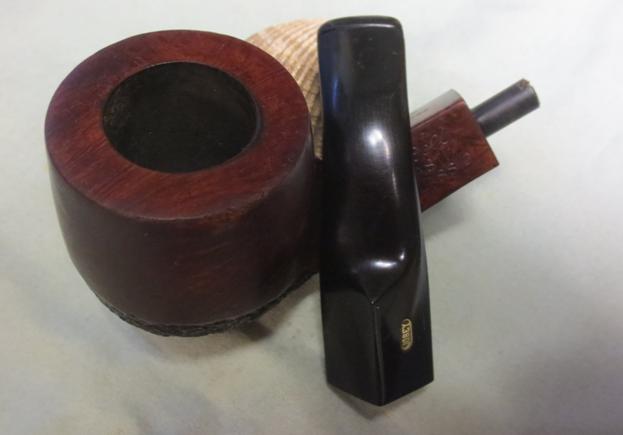
The next pipe I brought to my table to work on was stamped on the left side of the shank The Guildhall over London Made and on the right side Twin Bore over Made in England. The stamping was readable with a light and a magnifier but it was faint. It was a nicely shaped long shank billiard or some would call it a Lumberman. I have worked on many Comoy’s The Guildhall pipes but never have seen one stamped like this. The stem indeed is a twin bore. It was in decent shape but it did not bear testimony to the point of the twin bore “bite proof” stem. It had a lot of tooth marks and chatter on the top and the bottom side of the stem. The tooth marks were quite deep but did not enter the airway in the stem. So I guess in that way the stem was “bite through proof”. The finish was quite nice. The pipe was in good shape with just some grime on the surface of the briar. The rim had been topped and restained sometime in its history as the stain is quite a bit lighter than the rest of the pipe. The outer and inner edges of the rim were darker than the surface of the rim. The bowl had been reamed but the cake was left uneven on the walls of the bowl.Guild1 Guild2 Guild3 Guild4I took a close-up photo of the rim to show the previous topping and the darkening of the inner and out edges. You can see that it had been touched up and the rim edges not cleaned up. I also took some close-up photos of the damage to the stem in terms of tooth marks and chatter.Guild5 Guild6I sanded the top and bottom sides of the stem to remove the tooth chatter on the surface and to clean up the area around the deeper tooth marks. I wiped the areas down with alcohol and then used black super glue to fill in the deep marks.Guild7While the stem repairs were drying I reamed the bowl with the Savinelli Pipe Knife. I took the cake back to bare briar.Guild8I used a folded piece of 220 grit sandpaper to clean up the bevel on the inner edge of the bowl. I worked slowly to make sure that the bevel maintained the roundness of the bowl. Once I had it finished I stained the rim and inner edge with a medium brown stain pen to match the colour with the rest of the pipe.Guild9I used a dental spatula to scrape out the inside of the mortise as there was a ridge of tar and oil part way down the shank. I scraped out the grime and then scrubbed the inside of the mortise and the airway in the shank with pipe cleaners, cotton swabs and alcohol until it was clean.Guild10By the time I worked on the twin bore stem the repairs were dry. I lightly sanded them and then cleaned out the twin bore airways.Guild11I sanded the repairs on the stem with 220 grit sandpaper until the surface of the repairs was blended into the surface of the stem.Guild12I wet sanded the stem with 1500-2400 grit micromesh sanding pads. I rubbed down the stem with Obsidian Oil. I dry sanded it with 3200-4000 grit pads and gave it another coat of oil. I sanded it with the last set of three micromesh sanding pads – 6000-12000 grit pads. I gave it a final coat of Obsidian Oil and set it aside to dry.Guild13 Guild14 Guild15I buffed the pipe with Blue Diamond and worked over the scratches that still showed up on the top surface of the stem. It did not take much to remove them and get a deep shine on the stem. I buffed the bowl as well, being careful around the stampings on the shank of the pipe. I gave the bowl and stem multiple coats of carnauba wax and buffed it with a clean buffing pad to raise the shine on the briar and vulcanite. The finished pipe is shown in the photos below. It shines and has depth to the finish. The stamping is faint but is my only example of a Twin Bore Comoy’s The Guildhall Pipe. It is a beauty in my opinion. Thanks for looking.Guild16 Guild17 Guild18 Guild19 Guild20 Guild21 Guild22


My brother has an eye for unusual pipes – A Mastercraft Sea Slug

Blog by Steve Laug

When I visited my brother a few months ago one of the pipes that he had picked up for me to restore is one that I probably would never have picked up myself. In fact to me it was ugly and there was nothing redeeming about it. It looked like a giant sea slug to me and even the striations looked like the wrinkles in the slug’s body as it crawled. But I have to say that my opinion changed as I worked on this old pipe. I know that Mastercraft actually made few pipes but had the pipes jobbed by other pipe companies globally. This one was made in Italy and has all the marks of a Lorenzo pipe to me. I doubt I will ever know for sure but that is my take on it. As you look at the photos you may have your own take on it and that is totally fine – just take the time to post what you think in the comments at the end of the post.

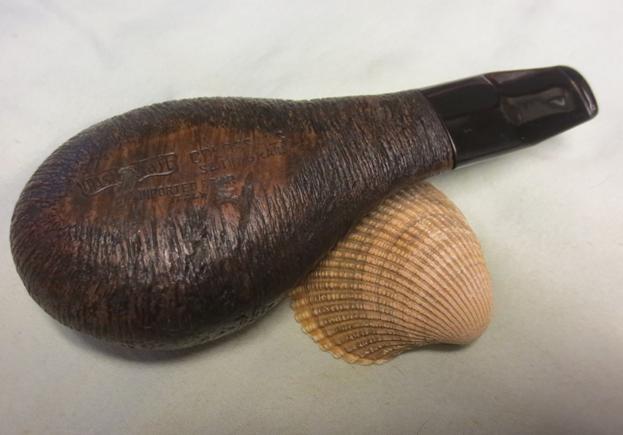
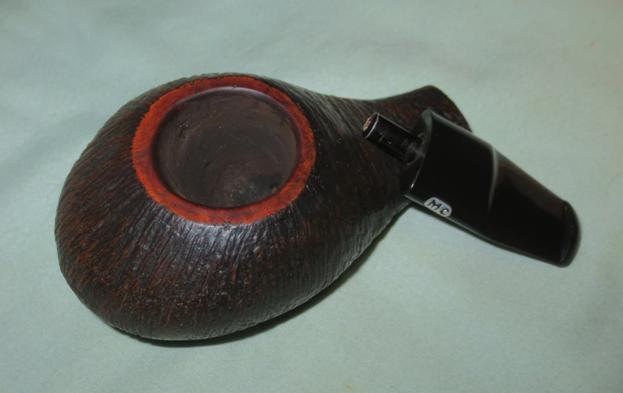
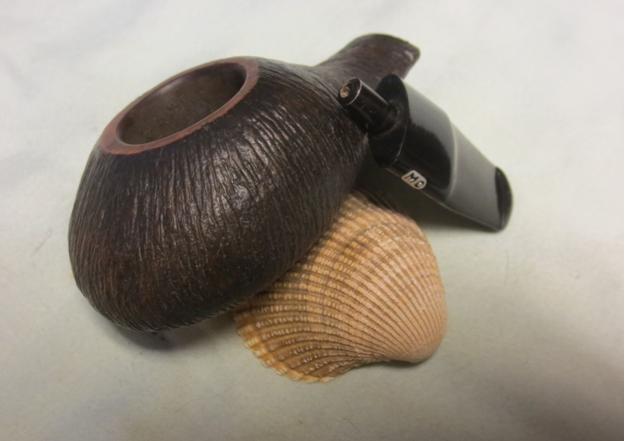
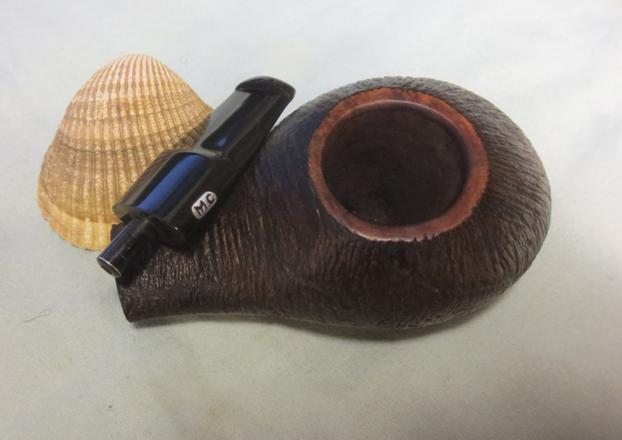
This old pipe was pretty rough when it came to my work table. The rim was battered and the reaming that had been done did not account for the angled bowl. There gouges of briar missing on the rim edge that extended into the bowl. The cake was soft but generous. The finish was tired and worn but underneath the grime the wire striations on the briar had something about them that drew me to them. The pipe is stamped on a semi-smooth portion of the bottom of the bowl/shank (on this pipe I am not sure where each of those terms ends). It reads Mastercraft in the classic shield of the logo. Next to that is stamped COLOSSALS or COLOSSAL S with the S slightly bigger perhaps referring to the Satin Grain. Under that is it stamped Imported Briar and Italy. There are some deep gouges in the briar on that smooth portion that obviously were there when the pipe was stamped as the stamping goes through them but does not show up in the deeper areas. The stem is Lucite and it was covered with tooth chatter on the top and the bottom sides near the button as well as some deep tooth marks on both sides and on the button surface. The slot in the airway was clogged and dirty. (The first picture below is a little out of focus but it gives and idea of the shape of the pipe.)Master1 Master2I cleaned up the reaming angles with the Savinelli Pipe Knife and was able to get the bowl clean and smooth back to briar.Master3I decided to try to bevel the rim to remove the gouges on the right top side. I worked on it for quite a while before I gave up on that and topped the bowl. In the photo below the largest gouge is the light brown portion of the rim on the top of the photo toward the back of the bowl.Master4I took some photos of the stem to show the damage that needed to be worked on to recondition and rework it to bring it back to new. The first photo is the top of the stem and the second the underside.Master5I was able to sand out the tooth marks on the top side of the stem with 220 grit sandpaper and also reshape the button a bit. I did the same on the underside but there was one deep tooth mark that I would need to fill.Master6Giving up on trying to reshape the rim or repair it I topped the bowl on my topping board and took of the damaged area on the right side of the rim and the back of the left side as well. The gouges were just not something I wanted to try to fill in. I also decided that I would flatten the rim and give the inner edge a slight bevel. I would stain the rim to match the smooth portion on the underside of the pipe.Master7I used the Dremel and sanding drum to bring the bowl back into round and then lightly beveled the inner rim edge with the sanding drum (first picture below). I cleaned up the Dremel work with a folded piece of 180 grit sandpaper followed by 220 grit (second picture).Master8I cleaned the mortise and airways in the bowl and the stem with pipe cleaners, cotton swabs and alcohol (I have always used 99% isopropyl).Master9I restained the rim with a dark brown stain pen and blended in some black from a Sharpie pen. I wiped down the exterior of the bowl with alcohol on a cotton pad to remove the grime and to blend the rim colour with the bowl.Master10I built up the tooth mark on the underside of the stem and the deep marks on the button surface with black super glue. Once it dried I sanded the repairs with 220 grit sandpaper to blend them into the surface and sharpened the button edge with a needle file. I sanded the stem with 400-600 grit wet dry sandpaper to remove the scratches. I wet sanded it with 1500-3600 grit micromesh sanding pads and dry sanded it with 4000-12000 grit pads. I buffed it quickly with Blue Diamond and gave the stem a light coat of carnauba wax.Master11 Master12 Master13I gave the bowl several coats of Conservator’s Wax and buffed it with a shoe brush and a microfibre cloth to give it a shine. I gave the stem several more coats of carnauba wax. I lightly buffed the pipe with a clean buffing pad and then again with the microfibre cloth. The finished pipe is shown in the photos below. What started out as an oddball pipe to me somehow in the process of restoration took on a beauty of its own. I like the smooth rim and the contrast it gives with the wire finish on the bowl and shank. Together they work for me. I know in the box of pipes I have sitting to refurbish that Jeff has sent me some others that cause a raised eyebrow but I have to say he has an eye for seeing beauty where I would walk by it and leave the pipe to molder away.Master14 Master15 Master16 Master17 Master18 Master19 Master20 Master21

Restoring a Stanwell Handmade Danish Bulldog

Blog by Steve Laug

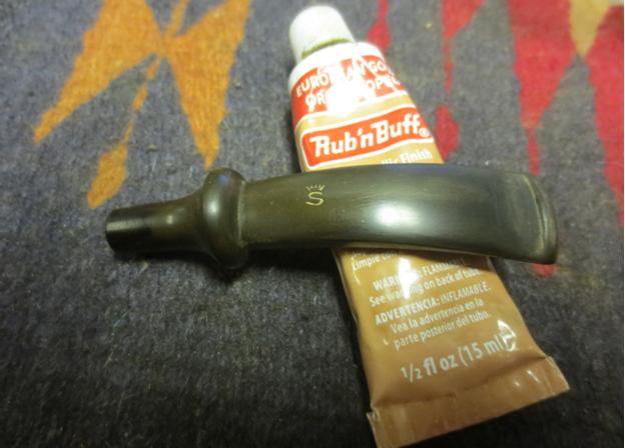
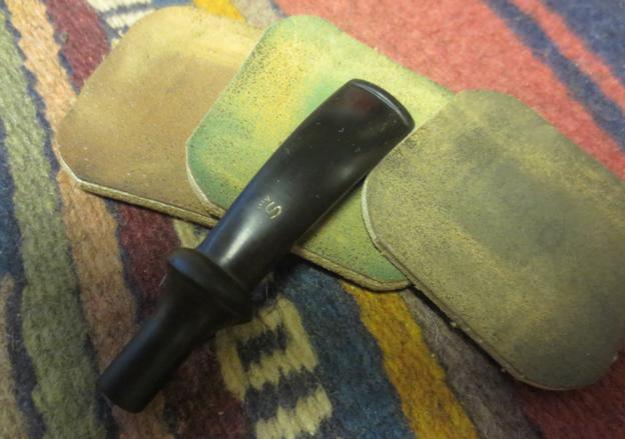
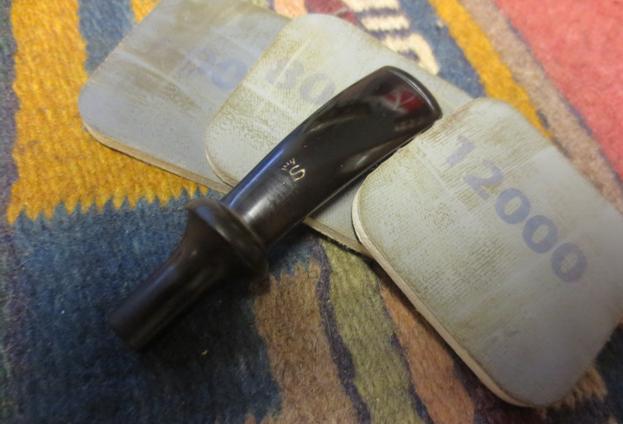
The second pipe I picked up from Charles Lemon of Dadspipes was a nice little Stanwell Bulldog that captured my attention. It is another one that I have added to my own collection. I loved the shape of it when I saw it in the photos that Charles sent me of the estate pipes he had purchased recently. It came in the mail through our ‘ultra quick’ Canada Post Express Mail on Friday. I cleaned up the W.O. Larsen and already wrote about that on the blog. This one looked amazing and came in its own Stanwell pipe pouch. It was stamped on the left underside of the diamond shank with the number 33 and next to that Stanwell Regd. No. 969-48 over Handmade in Denmark.Bull1When I removed the packing material and took the pipe out of the bag it was indeed a beauty. The colour was lighter than what was shown in the original photo that I had of the pipe. That does not matter too much to me as the lighter colour allows the grain to show through. This pipe has some amazing birdseye grain on the bowl sides. The diamond shank culminating in a vulcanite shank extension looks stunning.Bull2 Bull3The finish was quite clean on the pipe and it still had a shine. The vulcanite shank extension was lightly oxidized. The shank stamping was very clear and sharp. The double rings on the bowl were in perfect condition. The finish on the bowl and shank was in excellent condition. The rim was another story. It had some tar and oil (lava) build-up that flowed over from the cake in the bowl. The cake, though uneven, was hard. The rim also had a burned area on the middle of the rim top on the right side. It impacted the condition of the bowl and the roundness of the inner rim edge. The stem was oxidized and the stamping of the Crown S was worn and the gold stamping was gone. There was tooth chatter on the topside of the stem and tooth marks on the underside.Bull4 Bull5I took some close-up photos of the stem to show the tooth chatter and tooth mark on the underside near the button.Bull6I took a close-up photo of the rim to show the condition of the rim with the burned area (top left toward the front of the bowl) and the thickness of the cake.Bull7I reamed the cake back to bare briar with the Savinelli Pipe Knife. The carbon cake came out nicely and left the bowl quite clean. This reaming also gave me a clear picture of the condition of the burned area on the rim.Bull8 Bull9The next series of photos tell the story. I reamed the bowl and then topped it. I took a photo after I had topped it lightly to show the extent of the burn mark on the right side of the rim. I finished topping the bowl using 220 grit sandpaper on the topping board.Bull10 Bull11 Bull12I sanded the rim with a medium and fine grit sanding block to smooth out the scratches. I used the light brown stain pen to touch up the rim surface. The inside rim edge needed some more work but I wanted to see what the rim looked like at this point.Bull13I sanded the inner edge of the rim with a folded piece of sandpaper – beginning with 180 grit and then progressing to 220 grit sandpaper and then on to 1500-3200 grit micromesh sanding pads. I beveled the edge slightly to remove the rim damage and darkening. The second photo below shows the finished rim after sanding.Bull14 Bull15I touched up the inner bevel with a light brown stain pen. I wet sanded the vulcanite shank extension with 1500-2400 grit micromesh sanding pads and gave it a coat of Obsidian Oil. I dry sanded it with 3200-12000 grit pads and gave it a coat of micromesh between the 4000 and the 6000 grit pads. I gave it a final coat of Obsidian Oil and set it aside to dry.Bull16 Bull17I cleaned out the inside of the mortise and the airways in the shank and the stem with alcohol, cotton swabs and pipe cleaners until they came out clean.Bull18I scrubbed the stem with Meguiar’s Scratch X2.0 to begin removing the oxidation on the surface.Bull19Most of the oxidation came off so I used some Antique Gold Rub n’ Buff to highlight the Stanwell Crown S on the stem top.Bull20I wet sanded the stem with 1500-2400 grit micromesh pads and gave the stem a coat of Obsidian Oil. I dry sanded it with 3200-4000 grit pads (I forgot to take the photo) and gave it another coat of oil. I finished sanding it with 6000-12000 grit pads and gave it a final coat of Obsidian Oil. I set it aside to dry.Bull21 Bull22I buffed the stem and bowl with Blue Diamond carefully working over the stem and the shank extension to polish the vulcanite. I gave the bowl and stem multiple coats of carnauba wax to protect and preserve it. I buffed it with a clean buffing pad to raise the shine. I hand buffed it with a microfibre cloth to add depth to the shine. The finished pipe is shown in the photos below. I am looking forward to giving it an inaugural smoke soon. I really like the finished look of the pipe. The slightly beveled rim took care of the burn so that it can no longer be seen. The smooth finish shows off the birdseye grain and the swirls of cross grain. It is a beautiful pipe and I am glad to have it grace my pipe rack. Thanks for looking.Bull23 Bull24 Bull25 Bull26 Bull27 Bull28 Bull29

Restoring a W.O. Larsen 11 Handmade Bent Brandy

Blog by Steve Laug

Charles Lemon of Dadspipes blog picked up a batch of pipes that included a lot of Danish made ones from an estate not long ago. He has been writing about their restoration on his blog. He sent me some photos of the pipes and offered to sell some to me. I chose two of them. The first one was the Larsen that is pictured below. The description of the pipe said that it was stamped on the underside of the shank 11 over W.O. LARSEN over Handmade over Made in Denmark. On the topside of the shank next to the stem/shank junction it was stamped SUPER. The stem had a broken tenon and it was stuck in the shank. Charles had mentioned that he thought it looked like it had been glued in so it would take a bit of work. When I saw the grain on it I decided that it would be a fun piece to work on for my own rack. It has some stunning flame grain on all around the bowl sides and birdseye grain on the rim and the bottom of the bowl and shank.Larsen1I looked up some background on W.O. Larsen and found a great summary on this site. It was helpful and brief so I quote it in full below: https://www.finepipes.com/pipes/danish/w-o-larsen?sort=20a&page=1&zenid=debcdee8f415c1977fb5c359652d6aeb W.O. Larsen was one of the most famous tobacco shops in Copenhagen, with a beautiful store located on Copenhagen’s famous “Walking Street.” During the flowering of the Danish pipe in the ’60’s, they first began retailing pipes by such carvers as Sixten Ivarsson, Sven Knudsen, Poul Rasmussen, and Brakner. Urged on by his store manager Sven Bang, the owner, Ole Larsen, decided to begin making pipes in the basement of the shop. He first hired Sven Knudsen as the pipe maker, who soon passed the job to his protégé Hans “Former” Nielsen. Larsen’s fortunes rose along with the rest of the Danish pipe business and Former was soon managing a group of carvers in the old Larsen cigar factory. Among these were Teddy Knudsen, Tonni Nielsen, Jess Chonowitch, Peter Hedegaard and others, who were responsible for the Select and Straight Grain series before they branched out on their own. After Former left to start Bentley pipes in Switzerland, his duties were taken over by Soren Refbjerg Rasmussen, while the straight grains were made by Teddy’s student Benni Jorgenson. As Ole’s health began to fail, the reins were taken over by his son Nils. Nils became convinced that the way for Larsen to prosper was by entering the low-end market, and acquired the Georg Jensen pipe factory to make an array of less expensive pipes. This turned out to be a fatal error, and Larsen was recently sold to Stanwell, who continue to produce so-called “Larsen” pipes in their huge factory. Thus ended an important part of Danish pipe history.

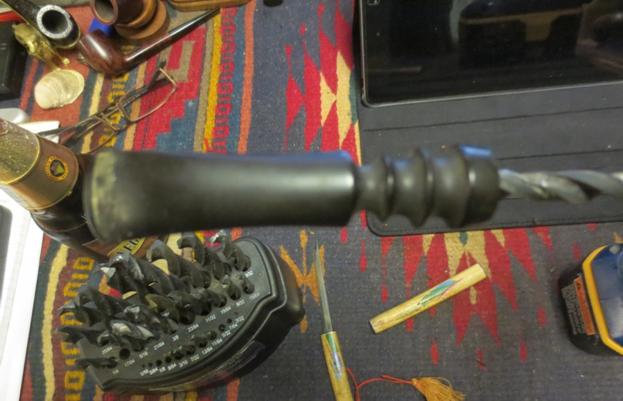
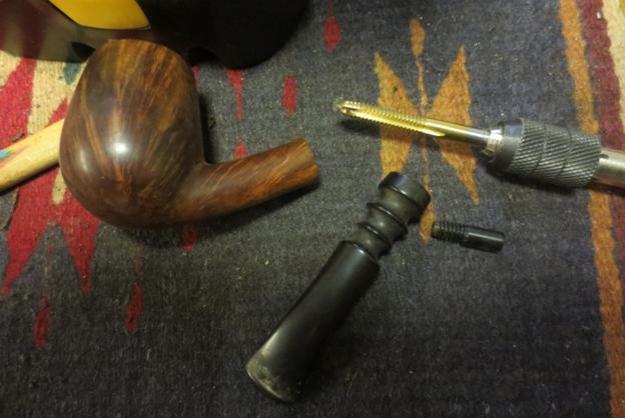
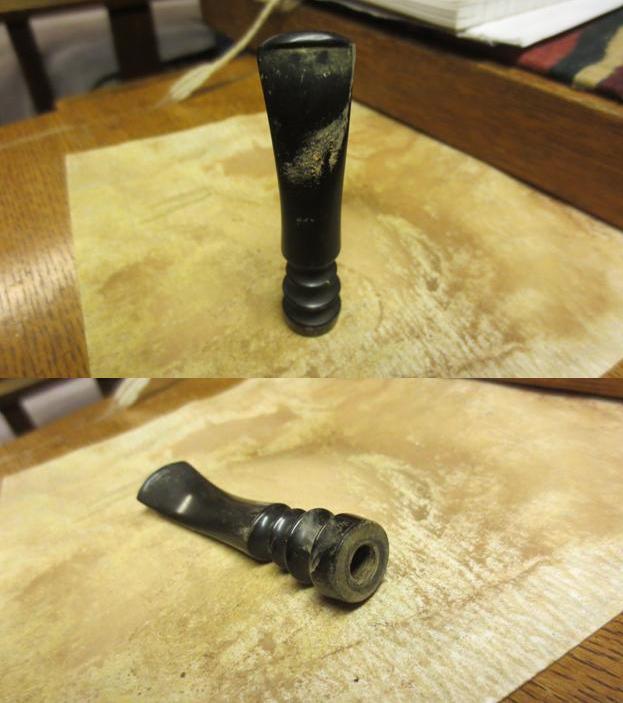
I was looking forward to seeing it firsthand so I paid Charles and he shipped it on Friday. Wonder of wonders, Canada Post delivered it on Monday. I came home from work to find the awaited box on the table. I opened it and found the Larsen in a bag with the label printed on the outside enumerating it’s stamping. I took it out of the bag and immediately took it to the work table. The photos below show the pipe as it looked when it arrived. It was much lighter in colour than the photo had led me to believe.Larsen2The bowl was dirty and there were some dents and marks in the briar. The rim had a thick coating of tars and the back edge of the rim was worn down from knocking the pipe out to empty it. There was an uneven cake in the bowl. The tenon was stuck in the shank and there were dried bits of glue on the end of the shank and around the end of the stem where someone had glued the stem onto the end of the shank. Fortunately the stem did not stick to the briar but the tenon certainly did. The stem was clean of bite or tooth marks and was lightly oxidized.Larsen3 Larsen4 Larsen5I took a photo of the end of the shank to show the glue spots on the briar and around the broken tenon.Larsen6When I had looked at the initial photo I was uncertain that the stem was original as it looked to be bigger in diameter than the shank. I lined up the broken tenon in the shank with the rough end on the stem and took some photos to see if it actually fit the pipe.Larsen7I decided to try pulling the tenon with my normal screw and it did not budge. It began to shatter and break apart.Larsen8Thus I knew that I would have to resort to drilling out the broken tenon. I set up my cordless drill and put a drill bit slightly larger than the airway in the chuck. I slowly drilled out the tenon, increasing the size of the drill bit until it was the just slightly smaller than the mortise. The last bit I used broke the tenon piece free from the shank and the mortise was clear.Larsen9While I had the drill out I also drilled out the broken tenon in the stem in preparation for the replacement tenon I would use.Larsen10Once the airway was drilled out on the stem I used a tap to thread the newly drilled airway to accommodate the threaded replacement Delrin tenon.Larsen11I used the topping board and 220 grit sandpaper to clean off the glue residue on the end of the stem before I put the new tenon in place. I want a clean, flat surface to work with against the shank when I was finished.Larsen12I used some clear super glue on the new tenon and twisted it into the stem. I put it in the shank to check the alignment several times before putting a few more drops of super glue around the tenon stem union.Larsen13Once the glue dried I put the stem in place in the pipe and took some photos to evaluate the fit.Larsen14 Larsen15With the tenon repair completed it was time to address the bowl. I took some close up photos of the bowl/rim and the stamping on the shank.Larsen16I reamed the bowl with a PipNet reamer using the third cutting head and took the cake back to bare briar. I cleaned up the reaming with a Savinelli Pipe Knife.Larsen17 Larsen18I sanded the inside of the bowl with a tube of sandpaper. This smoothed out the walls of the bowl and began to clean up the damage on the inner edge of the rim.Larsen19The rim damage on the back side needed to be dealt with so I topped the bowl to remove the damaged area.Larsen20I scrubbed the briar with acetone on cotton pads to remove the wax, grime and oils in the wood. The grain is really beautiful in the photos below.Larsen21 Larsen22I scrubbed out the mortise and airway in the shank and stem with alcohol, cotton swabs and pipe cleaners until they came out clean.Larsen23I mixed three of the stain pens together to get the correct brown on the rim. Once it was blended and sanded I stained the bowl with a dark brown aniline stain and flamed it. I repeated the process until the coverage was even on the bowl.Larsen24 Larsen25 Larsen26I wiped down the bowl with alcohol on cotton pads to make it more transparent and make the grain show through. It still needed more work but it was definitely getting there.Larsen27 Larsen28The inner edge of the rim needed more work to remove the damage but the colour was correct.Larsen29I used a folded piece of 180 grit sandpaper to bevel the inner rim of the bowl to remove the damaged areas. I followed up by sanding it with a piece of 220 grit sandpaper and continued to sand the inner edge. I sanded the inner edge and rim with 1800-2400 grit micromesh sanding pads.  I restained the inner bevel with a dark brown stain pen to match the finish on the bowl.Larsen30With the bowl finished I wet sanded the stem with 1500-2400 grit micromesh sanding pads. I rubbed it down with Obsidian Oil and dry sanded it with 3200-4000 grit pads. I gave it another coat of oil and sanded it with 6000-12000 grit pads. I gave it a final coat of Obsidian Oil and let it dry.Larsen31 Larsen32 Larsen33I buffed the pipe with Blue Diamond on the buffing wheel and then gave the bowl and stem multiple coats of carnauba wax. By now you are all probably very familiar with my process. I buffed it with a clean buffing pad to raise a shine and then hand buffed it with a microfibre cloth to add depth. The finished pipe is shown in the photos below. It is one I plan on hanging onto for my own rack and I am happy with how it turned out. Thanks for looking.Larsen34 Larsen35 Larsen36 Larsen37 Larsen38 Larsen39 Larsen40 Larsen41

Breathing New Life into a Design by Curtis Metal Pipe

Blog by Steve Laug

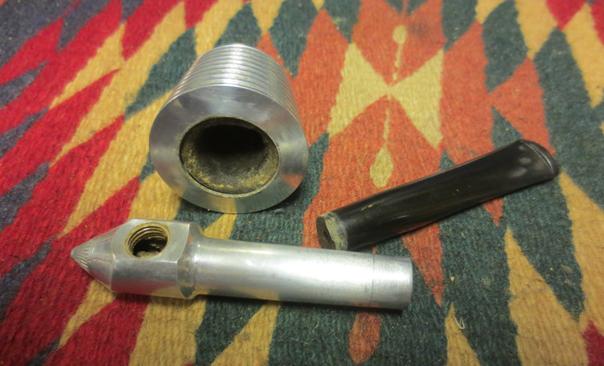
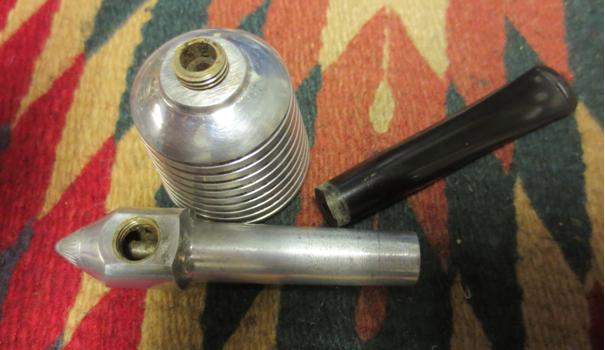
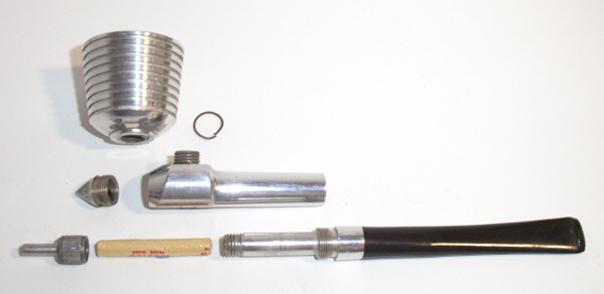
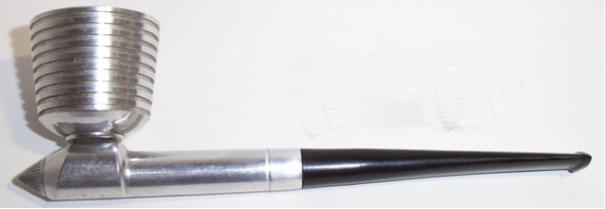
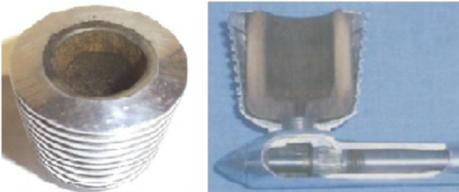
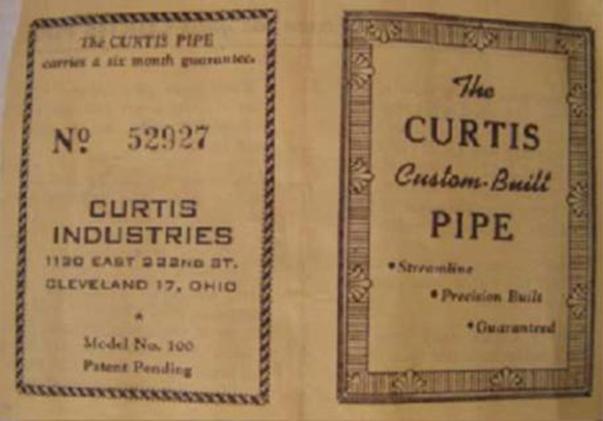
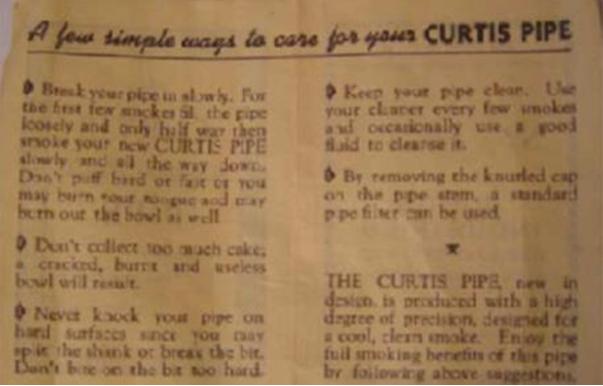
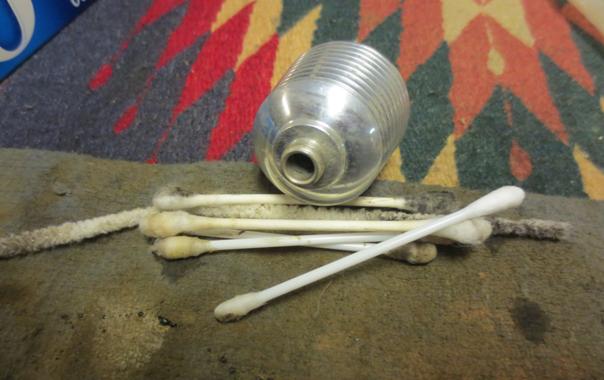
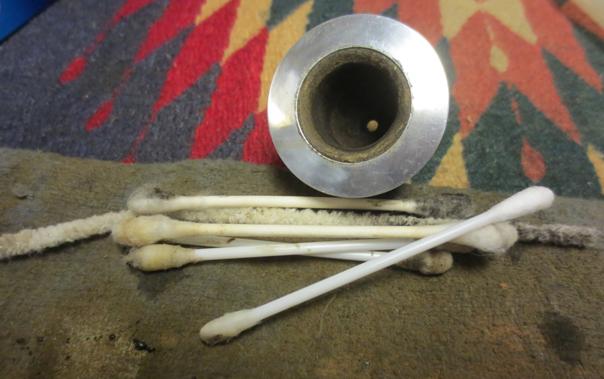
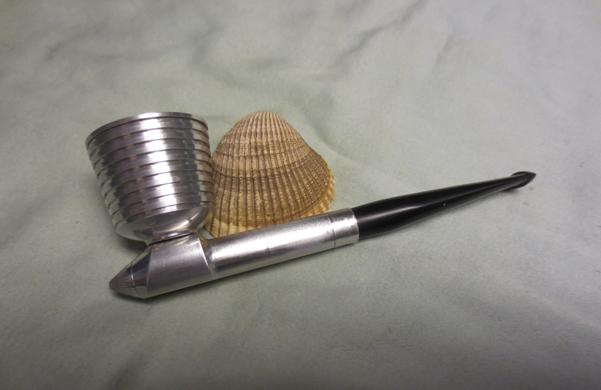
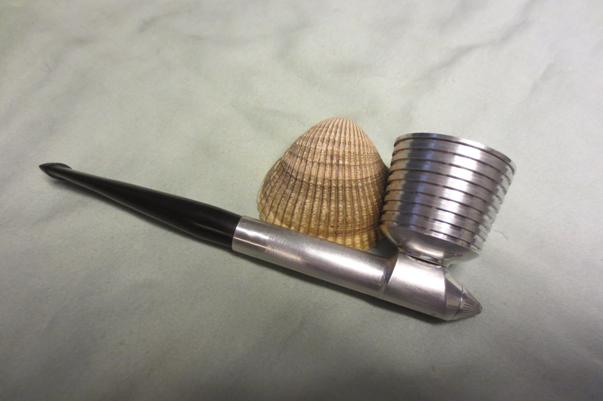
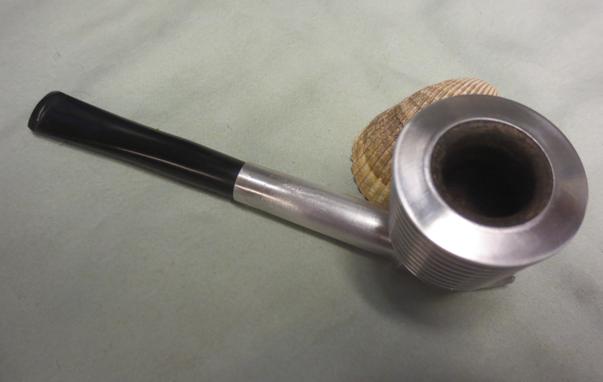
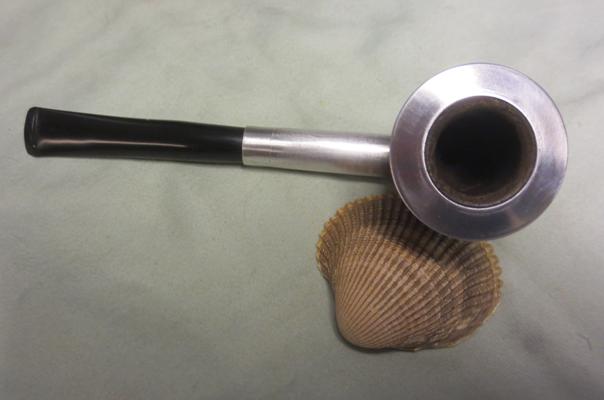
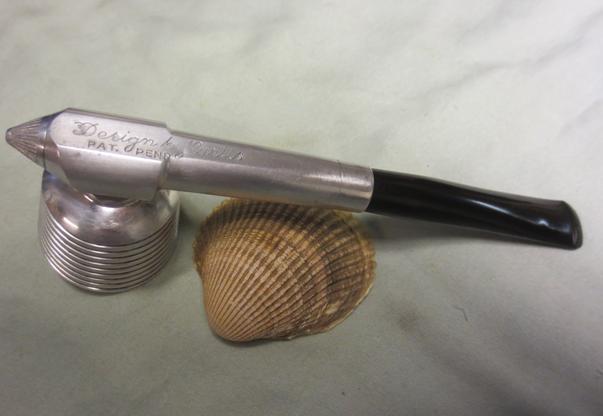
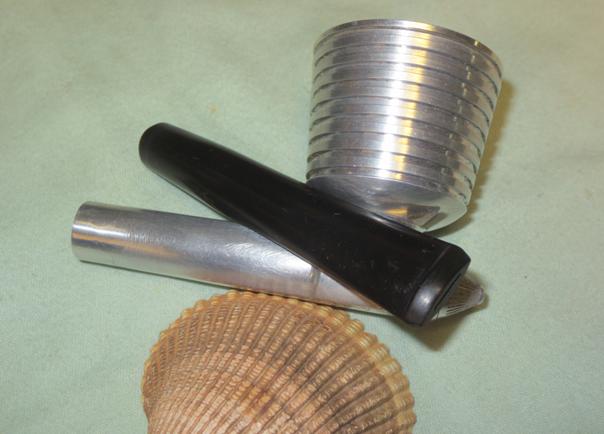
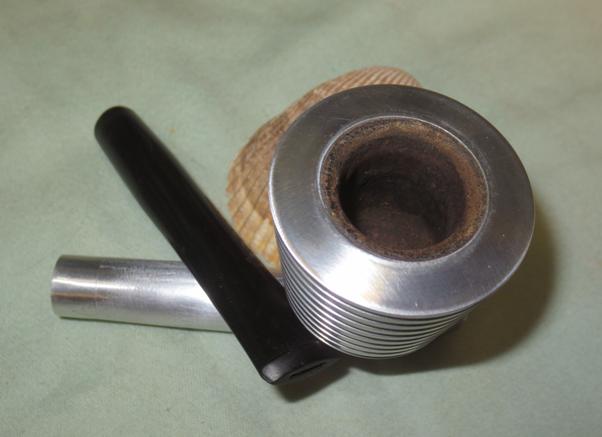
This smoking metal pipe is really Art Deco looking. It has a metal finned bowl with a pressure fit top cap holding in a briar bowl. There is a threaded connector between the bowl and the metal shank base. The connector threads into both the bowl and the shank. The shank has a pointed end cap that is frozen in place. The bowl was caked and worn. The stem had bite marks on both the top and the bottom sides near the button. The stem is a military mount that sits in a stepped down interior of the metal shank. There is a tube at the end of the airway in the shank that seems to have holes in it as the air flows through when blown into the end. The exterior of the pipe is oxidized and dull. The bottom of the shank is stamped Design by Curtis over Pat. Pend. It is a brand about which I know nothing.Curtis1 Curtis2 Curtis3 Curtis4I took some close-up photos of the bowl and the stamping on the shank to give a better idea of what the pipe looked like when I started.Curtis5 Curtis6I took the pipe apart to have a look at the pieces individually and see what I could learn from the way it fit together. I was unable to take the end cap off the shank and I was not willing to damage the cone shaped piece to work it free.Curtis7 Curtis8 Curtis9I wanted to learn more about the pipe so I did a bit of digging on the Smoking Metal Pipes Site and found this information and pictures (http://www.smokingmetal.co.uk/pipe.php?page=52 ). The site showed a picture of another version of the pipe. It may be newer than the one that I had in hand. It was marked as a Curtis Custom-Built Pipe Model 100. It was manufactured by Curtis Industries of 1120 East 222nd Street, Cleveland, Ohio. They were first seen around 1946. The pipe that was pictured was different in several ways. The stem was different in that it had a filter insert and a threaded tenon. My version did not have a filter system and also did not have the stinger end cap that held the filter in place. The pictures that follow come from that site. I have cropped and rearranged them to better suit the order of my blog. The brochure also comes from that site.Curtis9a Curtis9bFrom the Smoking Metal Site it appears that the patent was applied for 25 December 1945. It had the patent number #D143257 and the inventor is named as Howard Abrams from University Heights, Ohio. The site also showed a cut away photo of the bowl and cup.Curtis10It also includes a copy of the brochure that was included with the pipe. The cover of the brochure reads The Curtis Custom-Built Pipe and three descriptors – Streamlined, Precision Built, Guaranteed. The back reads The Curtis Pipe carries a six month guarantee. The rest reads No. 52927 over Curtis Industries 1120 East 222nd St. Cleveland, Ohio over Model 100 Patent Pending.Curtis11Inside it reads A few simple ways to care for your Curtis Pipe. I typed out the contents below the picture.Curtis121. Break your pipe in slowly. For the first few smokes fill the pipe loosely and only half way then smoke the new Curtis Pipe slowly and all the way down. Don’t puff hard or fast or you may burn your tongue and may burn out the bowl as well.
2. Don’t collect too much cake, a cracked, burnt and useless bowl will result.

3. Never knock your pipe on hard surfaces since you may split the shank or break the bit. Don’t bite on the bit too hard.

4. Keep your pipe clean. Use your cleaner every few smokes and occasionally use a good fluid to cleanse it.

5. By removing the knurled cap on the pipe stem, a standard pipe filter can be used.

The Curtis Pipe, new in design is produced with a high degree of precision, designed for a cool, clean smoke. Enjoy the full smoking benefits of the pipe by following above suggestions.

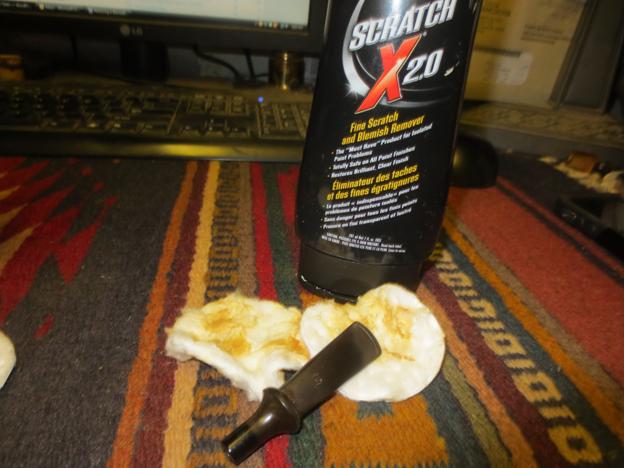
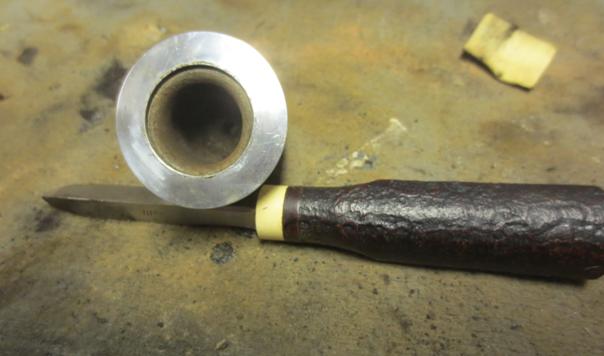
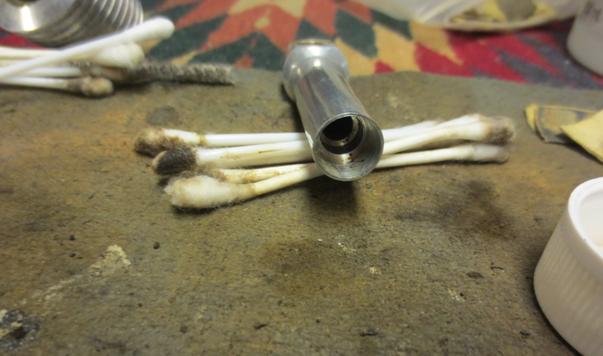
Armed with this information I took the pipe apart and began to clean and restore it. I reamed the bowl with the Savinelli Pipe Knife to remove the cake and clean up the briar rim of the bowl insert.Curtis13 Curtis14I unscrewed the bowl and the threaded connector from the bottom of the bowl. I cleaned out the connector and the airway in the bowl with alcohol, pipe cleaners and cotton swabs.Curtis15 Curtis16I scrubbed the rim and the interior of the bowl with cotton swabs and alcohol to clean out the remaining debris in the bowl and on the rim.Curtis17I scrubbed out the mortise and airway with alcohol, pipe cleaners and cotton swabs to remove the tars and residue.Curtis18 Curtis19I heated the end cap and still could not remove it so I cleaned out the inside of the airway from the top of the shank with pipe cleaners, cotton swabs and alcohol. It was a bit of a pain to work around the tube in the shank below but I was able to remove the grime and build up in that place.Curtis20I set the shank aside and worked on the stem. I cleaned it out with alcohol. There were two deep tooth marks on top and the underside of the stem. Curtis21 Curtis22I wiped the stem surface down and filled in the dents with black super glue. I sprayed the glue with the accelerator and then sanded the repairs down with 220 grit sandpaper and a medium grit sanding stick until they matched the surface of the stem.Curtis23 Curtis24 Curtis25I wet sanded the stem with 1500-2400 grit micromesh sanding pads and rubbed it down with Obsidian Oil. I dry sanded with 3200-4000 grit pads and gave it another coat of oil. I finished sanding it with 6000-12000 grit pads and gave it a final coat of oil. I let the oil dry.Curtis26 Curtis27 Curtis28I dry sanded the aluminum barrel shank and the rim of the bowl with 4000-12000 grit micromesh pads. I buffed the stem with Blue Diamond and then buffed it with a clean flannel buffing pad. The finished pipe is shown in the photos below. It is a beautiful example of the Curtis pipe and the finished pipe is a great addition to my metal collection. Thanks for looking.Curtis29 Curtis30 Curtis31 Curtis32 Curtis33 Curtis34 Curtis35 Curtis36

ADDENDUM

I received and email from one of the blog’s readers, Doug with some photos of the break down of the bowl system. It looks like the rim top is indeed pressure fit. Thanks for providing these photos Doug. They certainly add to our understanding of the way the bowl was designed. thumbnail_20160709_144214-1_resized[1] thumbnail_20160709_144222-1_resized[1] thumbnail_20160709_144234-1_resized[1] thumbnail_20160709_144253-1_resized[1] thumbnail_20160709_144305-1_resized[1]


Dunhill White Dot Repair

Lance Leslie

I received an email from Lance this afternoon with a blog submission. In his email he states that he thought that this would make a good blog for the site. He has been restoring pipes for a few years and has learned some valuable tips on rebornpipes. He sent along a restoration he completed that had a repair tip he had not seen addressed on the blog. While I have inserted dots on Dr. Plumb pipes and an odd variety of others I have not dedicated a blog to this repair so I agreed that it would be good to have his process spelled out here.  Welcome to rebornpipes as a contributor Lance. It is good to have you here. Hopefully this will be the first of many contributions that you bring to the site. — Steve

I have been restoring pipe for a few years now and have learned some valuable tips from rebornpipes. I have a restoration to share and unless I have missed it, I have not seen this issue addressed on this blog. The issue being, adding the infamous white dot to new replacement stem. Or…in my case, a blank replacement stem.

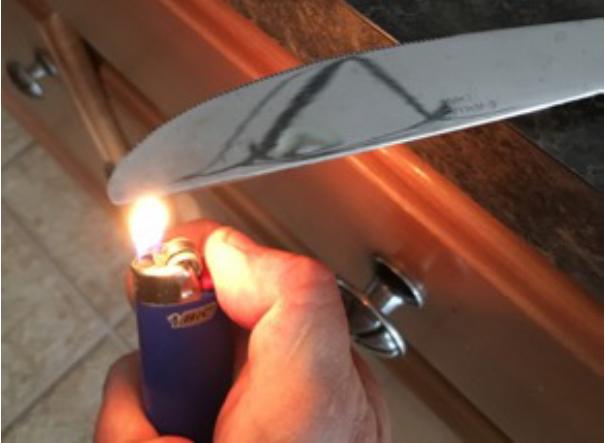
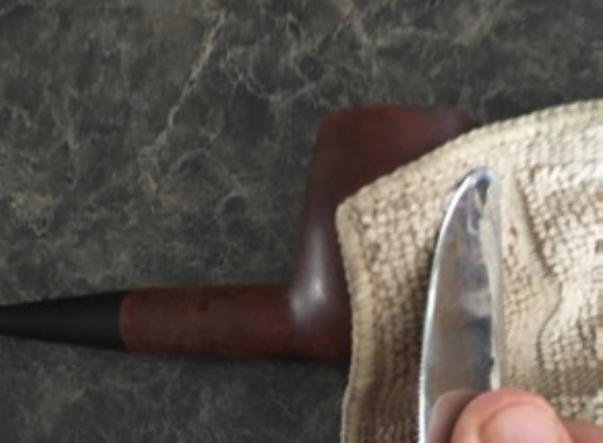
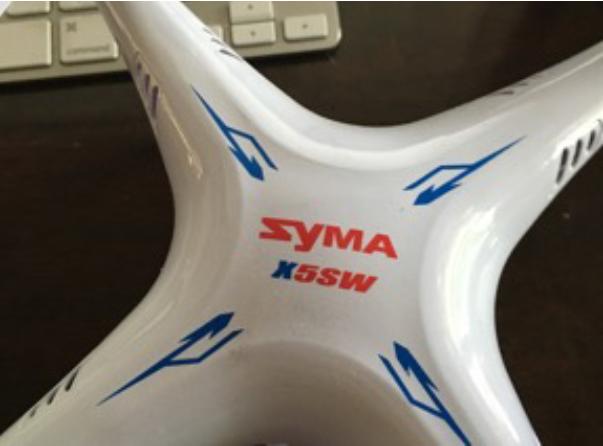
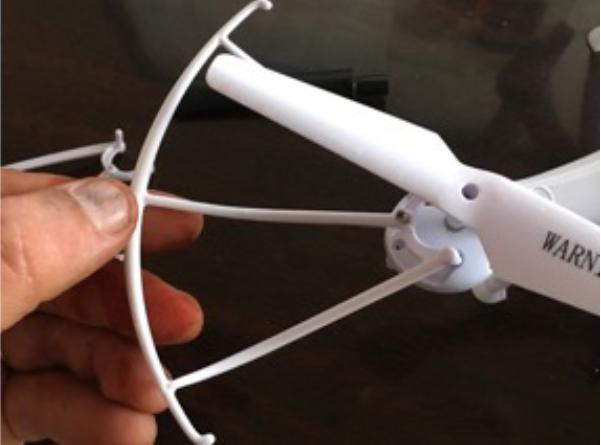
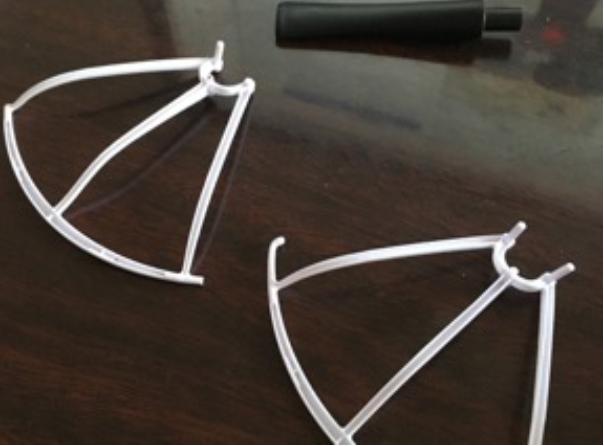
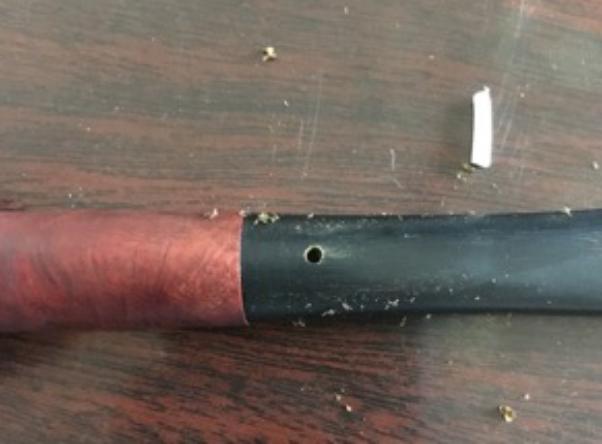
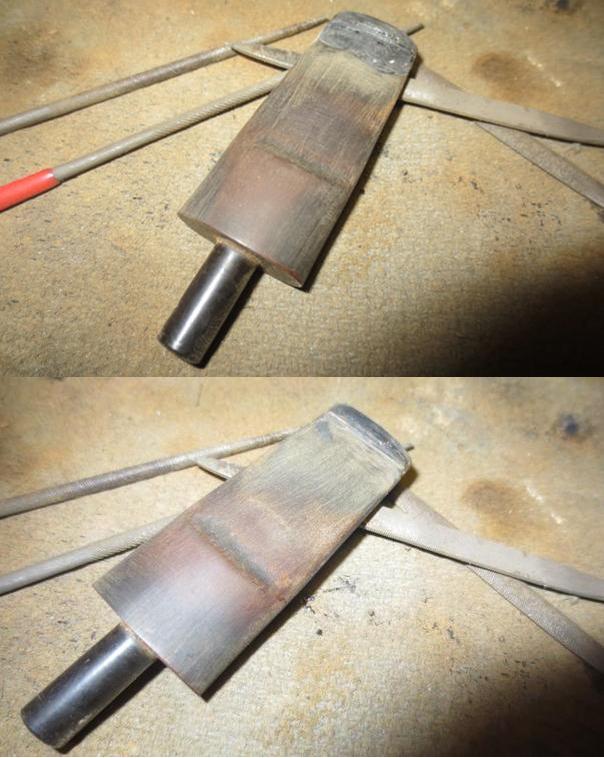
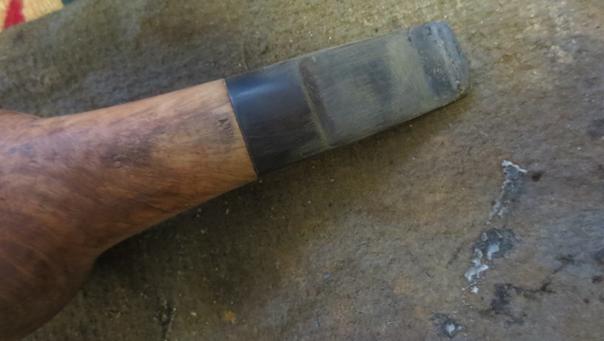
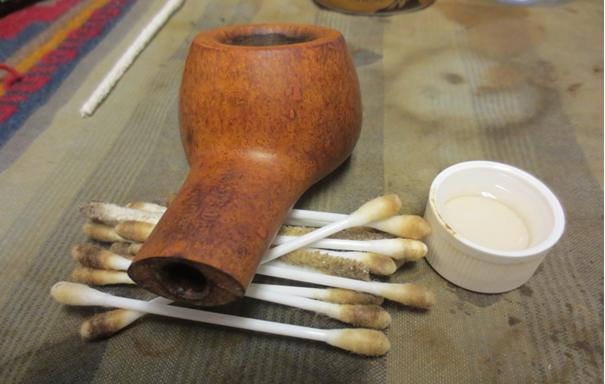
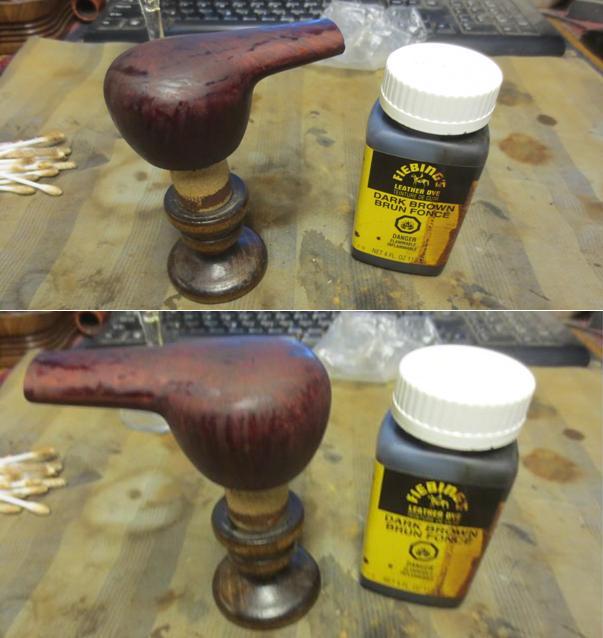
I recently won this Dunhill on eBay and noticed that the White Dot was missing. After asking all the right questions to be sure I WAS bidding on a Dunhill, I made my offer and won. The owner did not know much about pipes so he did not know if it was a replacement stem. I have seen the white dot covered by soot only to be revealed during the cleaning, but this was not the case. This was listed as a 1982 Dunhill Bruyere but it turned out to be a 1977. Here is the pipe as it looked when it arrived.Dun1The rim was covered with lava and the bowl was thick with cake. There were some dings in the bowl that would need to be addressed. The stem had some dents and would need a White Dot added. What is a Dunhill without the White Dot? The stem was also heavily oxidized.Dun2 Dun3 Dun4I placed the stem in an Oxyclean bath and let the stummel soak in an alcohol bath to loosen the lava. After I removed the lava I saw significant damage to the rim of the piped and the rim was scorched in two places. This could only be fixed by topping the bowl. Rats!Dun5 Dun6I removed the stem for the Oxyclean bath and polished it with Meguiar’s scratch X 2.0. I didn’t want to go too far with the stem because I would be adding the dot later.Dun7 Dun8I then took the bowl and my sanding bit and topped the bowl. As you can see, it is now clean and sharp. The scorching was also gone. Thank goodness it was not too deep.Dun9 Dun10Next I wanted to address the dents in the sides of the bowl. Thanks to rebornpipes I knew a simple way to do this. And yes, my wife is missing a dish towel. With said dish towel wet, I heated a kitchen knife with a lighter. I pressed the knife against the dish towel and steamed the dent right out. Works every time.Dun11 Dun12 Dun13Now I needed to stain the top of the bowl. I mixed up some leather dye to match color of the bowl and gave the top several coats until it matched.Dun14Now the fun part!! It was time to add the White Dot to the stem. I had recently acquired a quad copter (Syma X5SW) and remembered the propeller protectors that came with the copter.
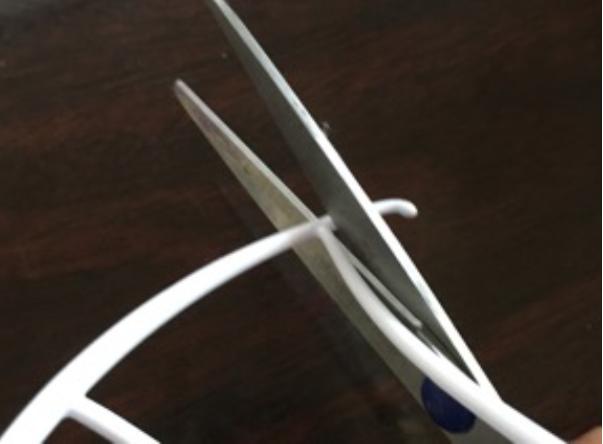
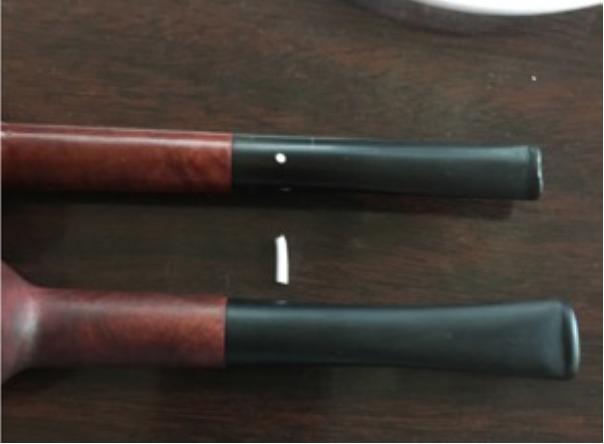
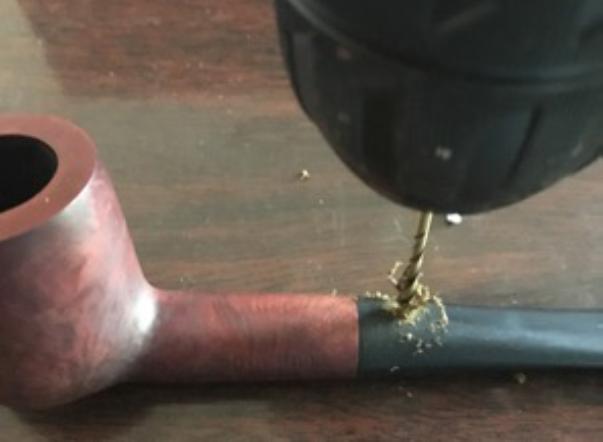
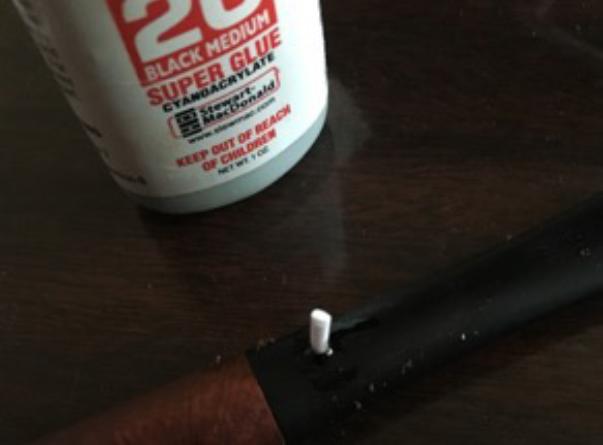
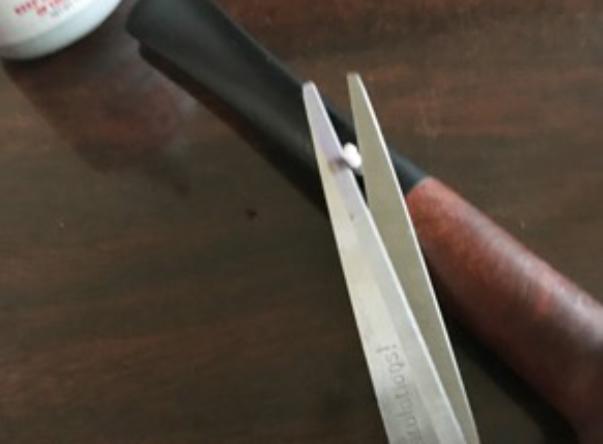
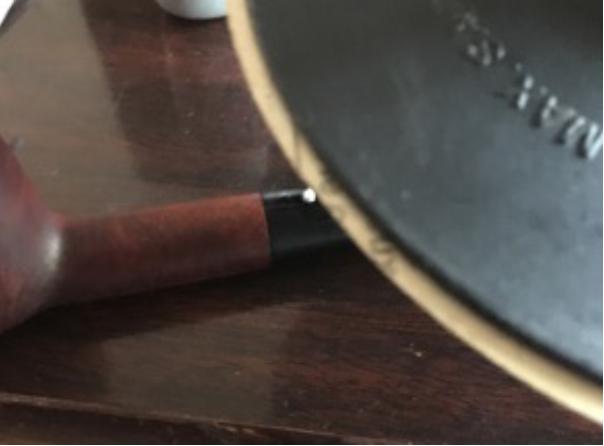
These are added for beginners to help protect the blades while you learn to fly. I no longer needed these so I checked the size and knew it would be a perfect match. BTW, you can order these blade protectors off of Amazon. Just type in replacement parts for Syma X5SW. They are cheap! See photos below…Dun15 Dun16 Dun17The ends of the blade protectors would do nicely. They are even conical shaped!!! I clipped off one end and sat it to the side. I then took some old stems and did a practice run before trying it on the Dunhill. It worked like a charm. I did not take pictures of my practice run, sorry.Dun18 Dun19I then went to my drill bits and chose the correct size. I lined up another Dunhill beside this one to get the proper distance for the White Dot on the stem. After I found the distance and center, I carefully drilled about 3 mm down. (Start your drill out slow if you use a hand-held drill. I would suggest a drill press if you have one.)Dun20 Dun21 Dun22I added some black super glue to the hole and placed the little white rod into the hole. Then using a rubber hammer, I hammered it into the hole.Dun23Then I clipped the plug as close as I could using scissors, and sanded down the rest with my sanding bit.Dun24 Dun25 Dun26The rest of the plug was sanded down with 220 sandpaper.Dun27Then it was a trip through the micro-mesh sanding/polishing pads. The pipe was married to its stem once again and polished with carnauba wax. Here is the finished pipe.Dun28 Dun29 Dun30 Dun31 Dun32

This one was just plain ugly it was such a mess

Blog by Steve Laug

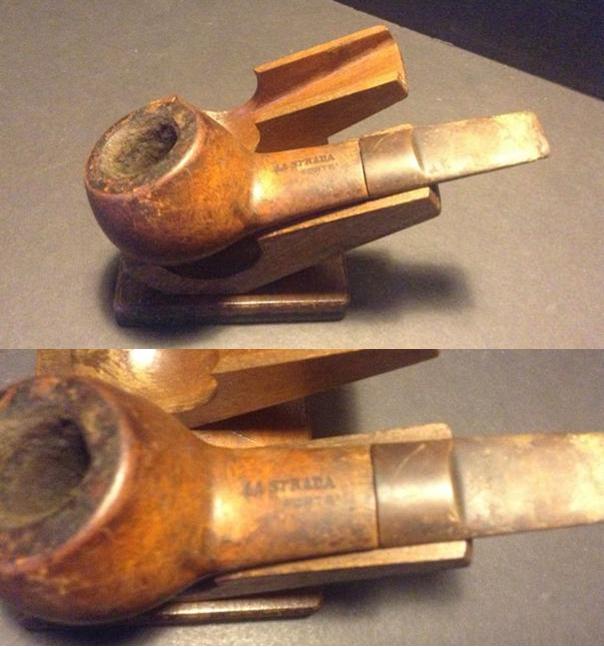
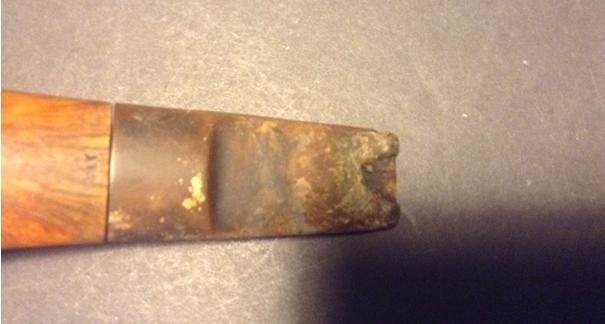
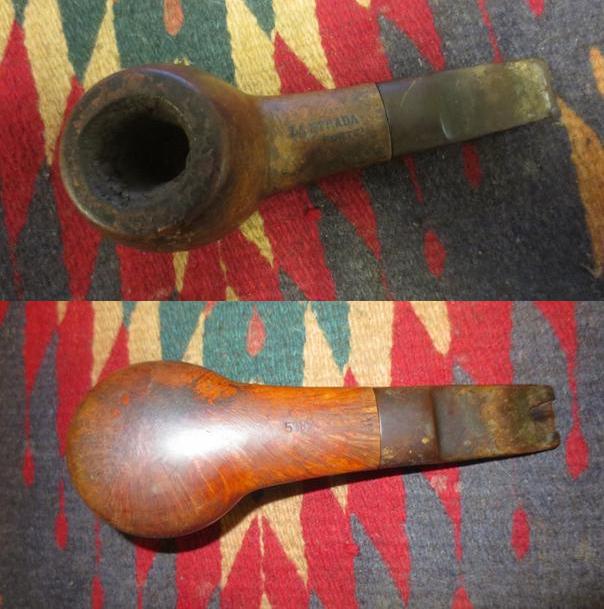
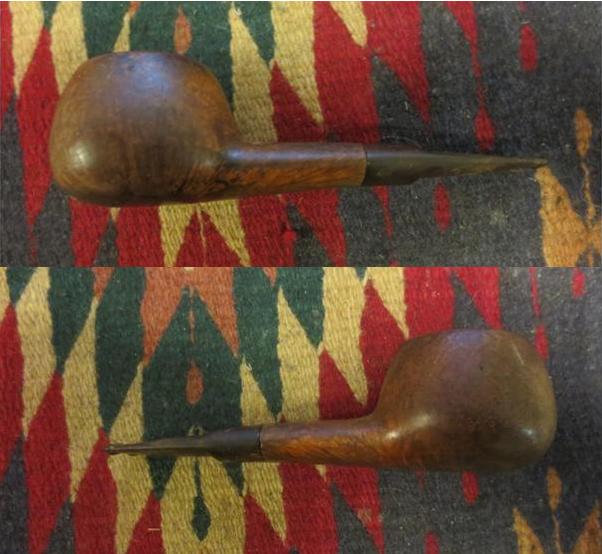
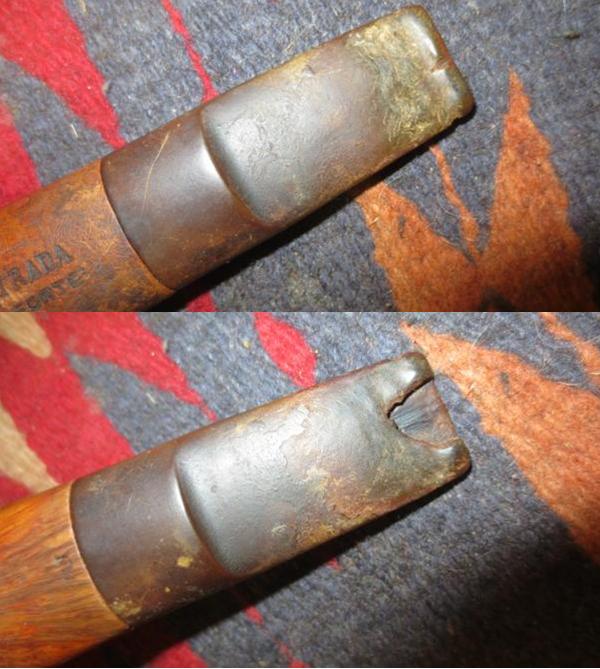
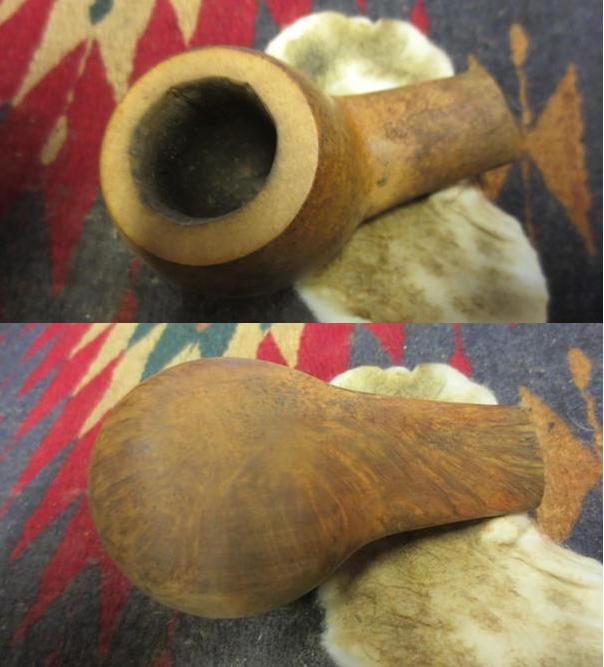
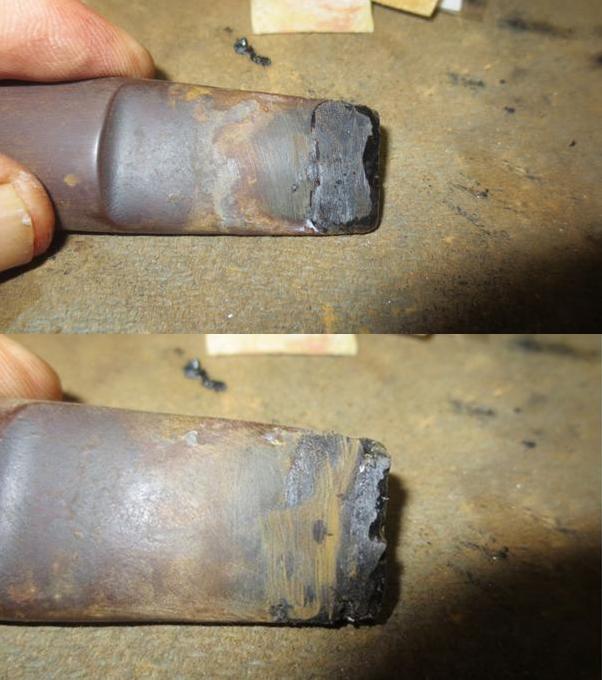
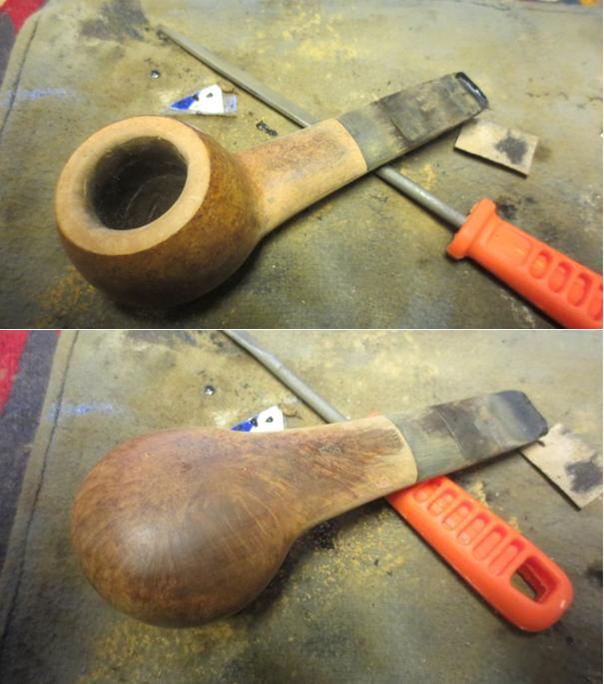
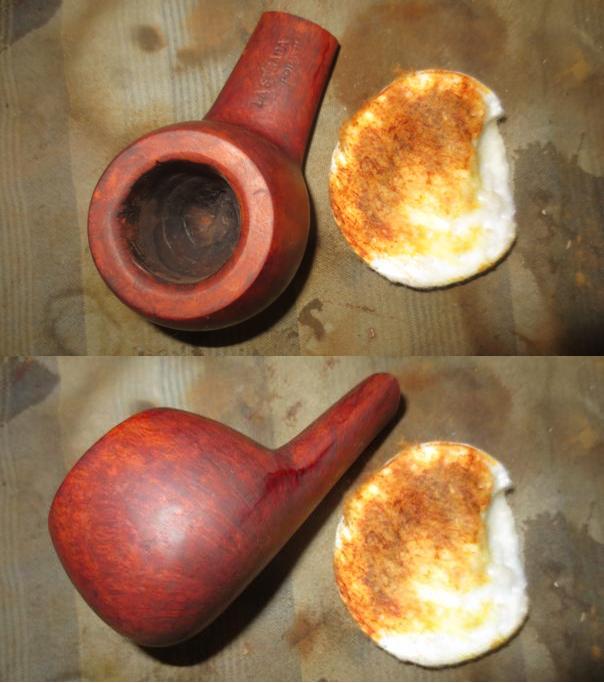
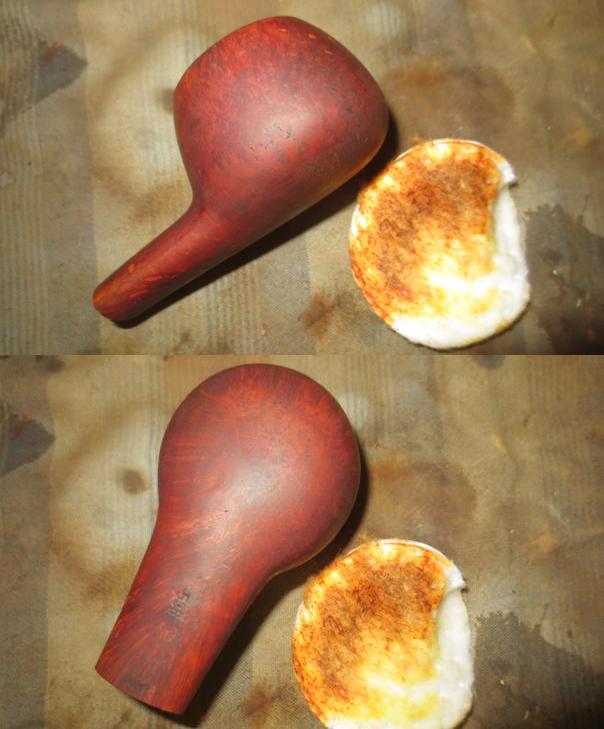
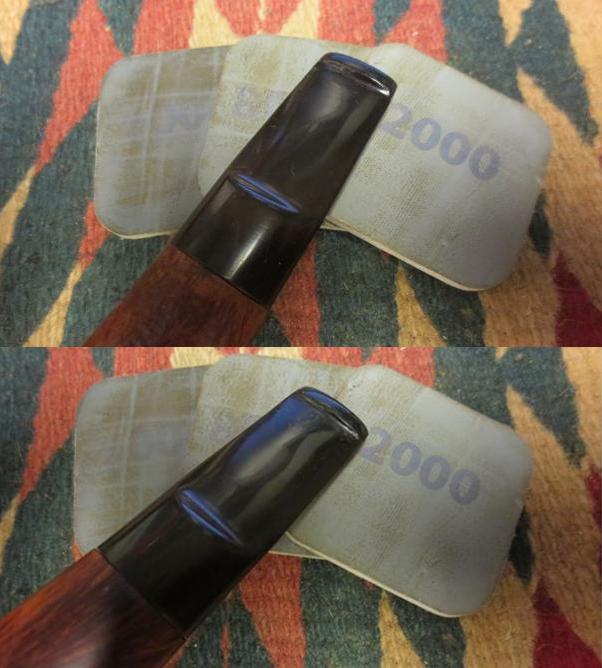
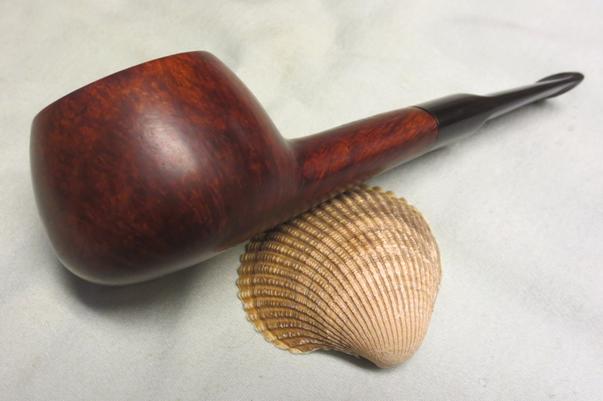
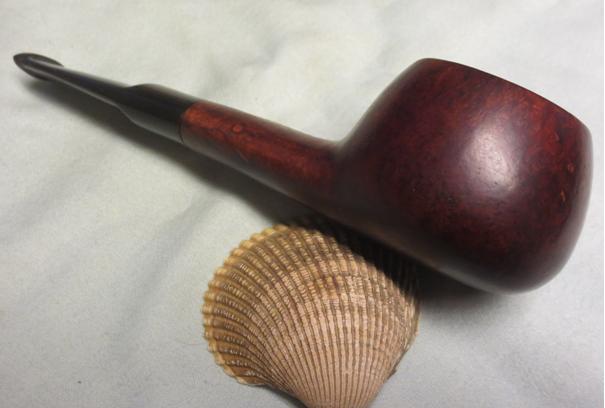
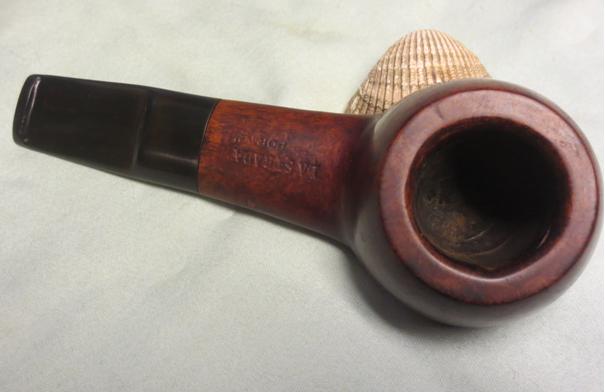
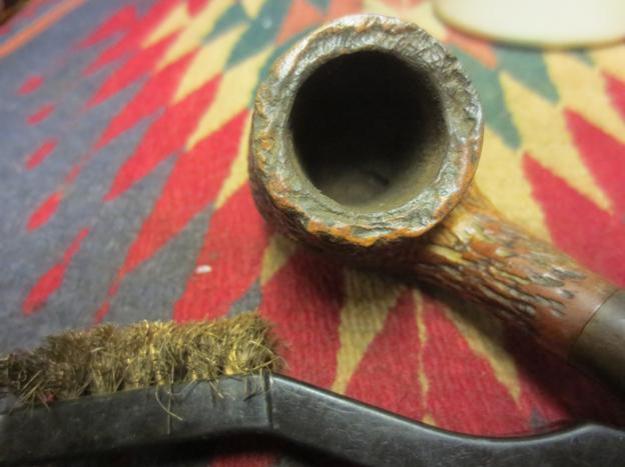
When my brother sent me the link for this one and I scrolled through the pictures the seller included, I almost said to pass on it. It was such a mess that the ugliness made me not want to even deal with this one. But there was something challenging about the pipe and through the gunk it looked like it might have some interesting grain. I know in the early days of my estate buying on EBay I did not pay attention to the measurements on the pipe. I figured it would be a moderately sized Banker or Author with an oval shank. I also ignored the brand stamping on the pipe. It read La Strada Forte on the top of the shank which also should have been a bit of a giveaway. Even the photos below that the seller included of the pipe in a rest should have been a clue. But I missed the clue because I was blown away by the sheer disaster of the pipe. As you look at it below try to catalogue the issues that you see.La1 La2 La3 La4Let me tell you what, no matter how much I prepared myself by cataloging the issues I saw in the pictures they in no way captured the reality of the mess this pipe was in. It was actually quite unbelievable. First off, I should have read the measurements. This pipe was huge. The length was average really, at 5 ½ inches long. The width of the shank was a bit bigger at 1 1/8 inches wide. The diameter of the bowl exterior was 2 1/8 inches. The chamber appeared to be an inch in diameter but the cake in it reduced it to about ¾ inch. The cake was thick and it was hard. It overflowed onto the top of the bowl and part way down the sides. The inner edge of the rim looked like someone had hacked at it with a knife so underneath the thick cake I could see the chop marks of the knife in the edges of the bowl. The finish was more than shot – it was gone and in its place was thick oily grime ground into the briar. The stamping was black with the oils. It was thick enough that the grime was flaking off on the bottom of the bowl. The stamping was readable and said LA STRADA over FORTE on the top side. On the underside was the shape number 538 and next to the shank stem junction was stamped Italy. The stem was not only oxidized but really worn. The top edge of the button was almost flattened and there were tooth marks in the top of the stem. The underside was another story – there was a chunk of vulcanite missing and the button was gone. The airway was collapsed and the inside surface was gouged with file marks. This poor pipe was looking pretty desperate and I thought about cannibalizing it for briar and parts.La5Then I looked at the briar through the grime. The bottom of the bowl had some really nice grain – a few fills popping through – but still really nice. The sides of the bowl also had some promise under the grime. And, I liked the shape of the pipe even though it was a war club. Maybe…just maybe…La6I took a close-up photo of the top of the bowl and the cake inside. I still shake my head when I see the state of the bowl and the damage to the inner rim. It was really in bad shape. Just look at the hack job that had been done to that inner edge.La7I also took a couple of close-up photos of the stem to show the extent of damage that had been done to it as well. It was in very rough shape.La8I reamed the bowl with a PipNet reamer starting with the smallest cutting head to clean up the walls of the bowl slowly. I worked through all four reaming heads ending with the largest one. I used the Savinelli Pipe Knife to do some clean up to the edges and try to smooth out some of the rim damage. La9Between the largest PipNet cutting head and the pipe knife I was able to do a lot of redeeming work on the inner edge of the rim.La10I topped the bowl on the topping board to remove the damaged finish and to reduce the damage to the inner edge of the rim.La11I scrubbed the surface of the briar with acetone on cotton pads to remove the dirt and grime in the grain as well as the oils. It was amazing how much grit came off the bowl. La12 La13Once the surface was clean I worked on the inner rim. I used a folded piece of 220 grit sandpaper to bevel the edge inward and clean up the cuts and nicks in the edge. I did not take a picture at this point but you will see the cleaned up rim in the pictures that follow the work on the stem.
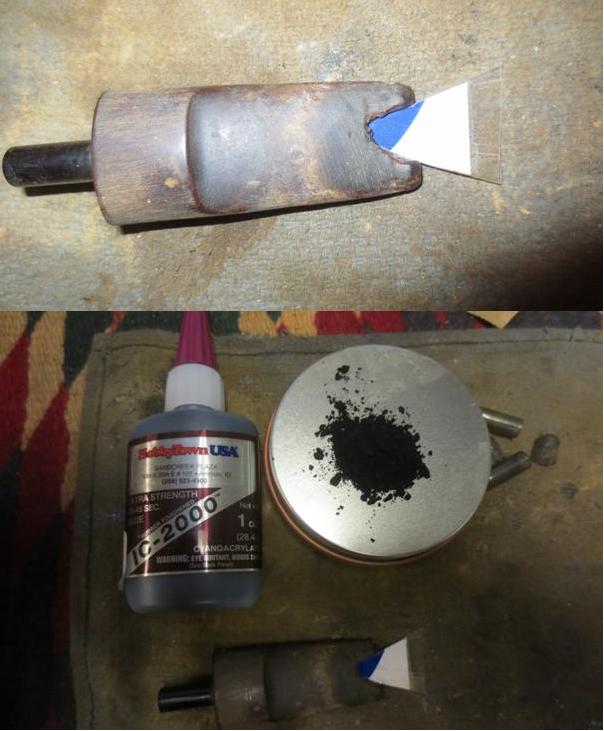
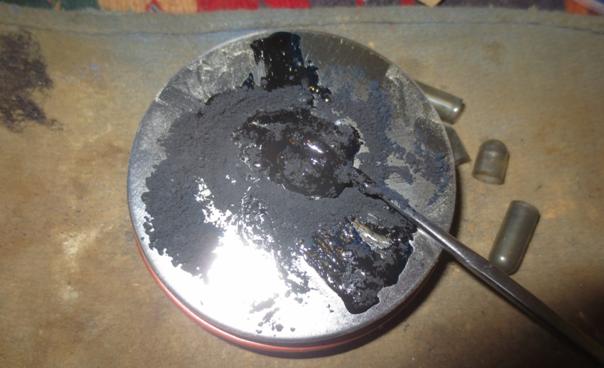
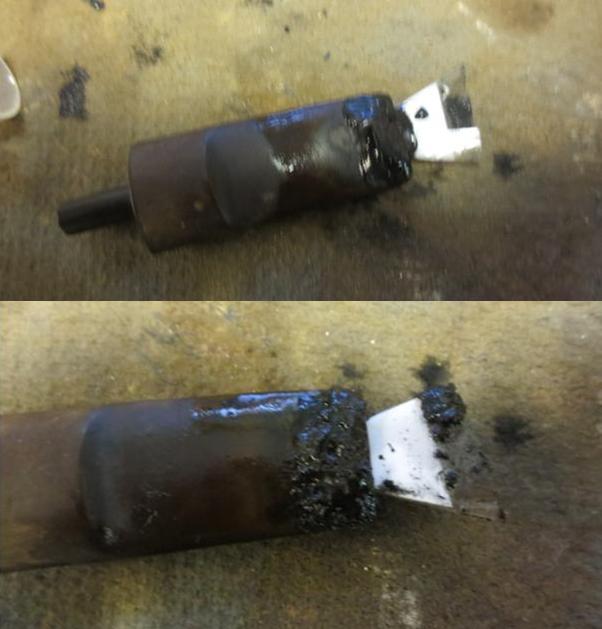
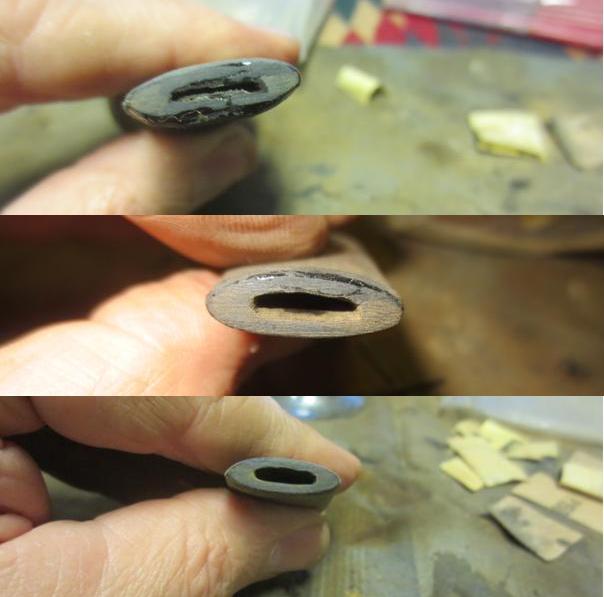
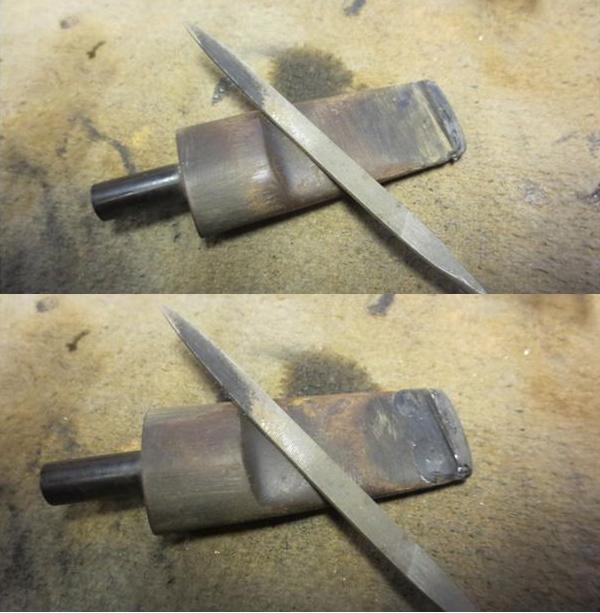
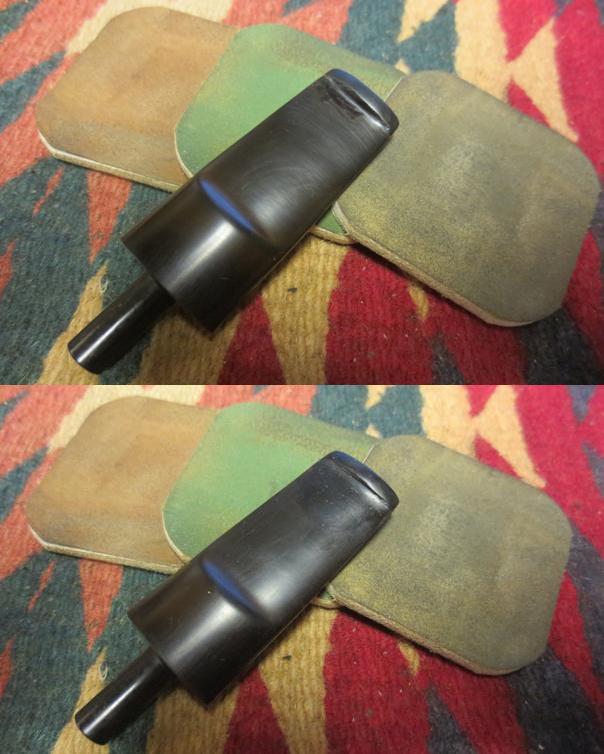
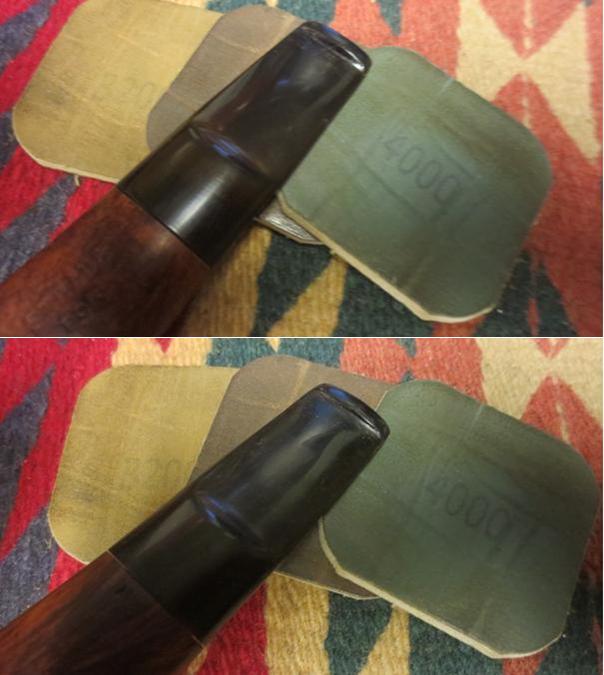
I set the bowl aside to work on the stem. To take care of the damaged stem I made a wedge out of cardboard and covered it with clear strapping tape so that the super glue mixture I was going to use would not stick to it. I wanted it thick enough to leave an airway/slot in the stem. I mixed up a paste of charcoal powder and black super glue. The glue has a slow drying time so I was able to mix a thick paste with the combination.La14 La15I used a dental pick and spatula to put the mixture in place on the top and the bottom of the stem and build up the area that would become the button on the top side and the repair and button on the underside. I also built up a slope on the stem underside to give me a bit more thickness over the airway. At this point I sprayed the repair with an accelerator to harden the surface of the glue. I set it aside to let the glue repair cure/harden.La16Once the repair had hardened I used the sanding drum on the Dremel to smooth out the repair. I would still need to sand it by hand but the Dremel took a lot of the heavy spots out of the mix and also allowed me to rough shape the button.La17The next photos show the repairs after a lot of filing and sanding. The shape is very clear and distinct. The repair is rock solid. You can also see the inner rim bevel on the rim of the bowl in the first photo.La18The slot was really tight in the button. It was partially closed off and need to be reopened. I used different shaped needle files to open the slot and to reshape it. I also reshaped the button with the needle files. The three photos below show the development of the slot and the button.La19I reshaped the button edges with needle files and reshaped the taper of the stem from the saddle to the button. I sanded it with 220 grit sandpaper to blend it into the surface of the vulcanite stem. The photos show the progression in the shaping. There is still a lot of sanding to do to finish the shaping and polishing of the stem but I set it aside and worked on the bowl for a while.La20 La21 La22I cleaned out the inside of the mortise and the airway in the shank with pipe cleaners, cotton swabs and alcohol. It took a lot of scrubbing to clean out the airway and mortise.La23I heated the briar with a blow dryer and then stained it with a dark brown aniline stain mixed 50% with isopropyl. I used a black Sharpie to darken the fills on the bowl and shank then applied the stain with a cotton swab and flamed it with a lighter to set it in the grain.La24I wiped the bowl down with alcohol cotton pads to blend the stain and to make it more transparent. The photos below show the bowl after the wipe down. The scrubbed bowl looks quite a bit lighter but once it is waxed it will darken again.La25 La26I wet sanded the stem with 1500-2400 micromesh sanding pads and rubbed the stem down with Obsidian Oil. I dry sanded it with 3200-4000 grit pads and gave it another coat of oil. I finished sanding it with 6000-12000 grit pads and gave it a final coat of oil and let it dry. (The photos below show both sides of the stem with each set of micromesh pads.)La27 La28 La29I buffed the pipe with Blue Diamond on the wheel and then gave it multiple coats of carnauba wax. I buffed it with a clean buffing pad to polish the wax. I buffed it by hand with a microfibre cloth to add depth to the shine. I am pleased with the overall look of the pipe and considering what it was like when I first looked at it the improvement is vast. The stem repair is quite extensive. It has cured and is hard now and I am curious as to how it will hold up over time. The pipe looks good and should have a long life ahead of it. Thanks for looking.La30 La31 La32 La33 La34 La35 La36 La37