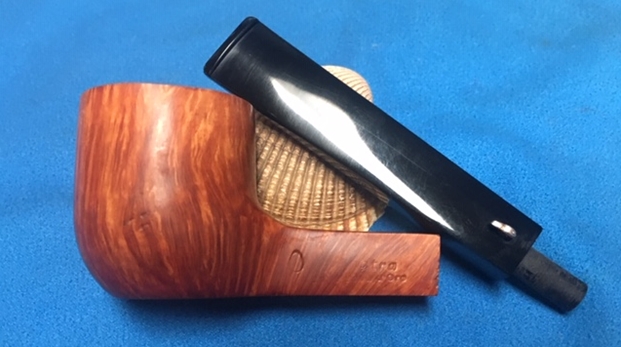
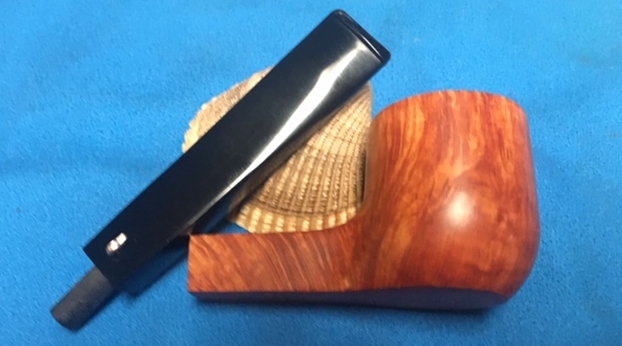
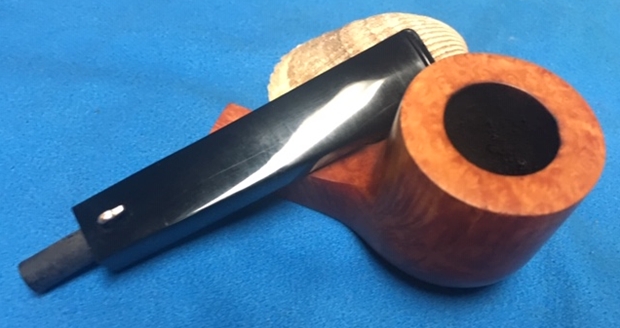
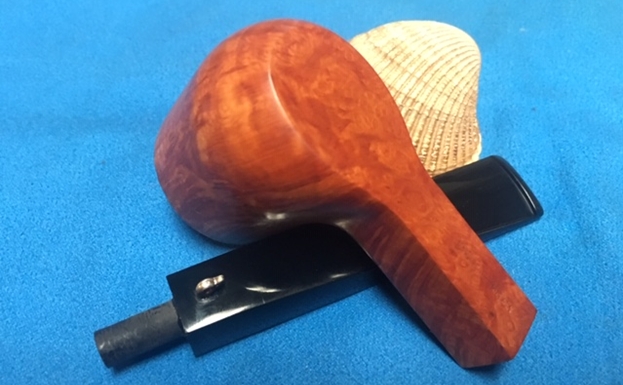
Tag Archives: Stem repairs

Refurbishing a Tired Preben Holm #1 from the Mumbai Bonanza Lot

Blog by Paresh Deshpande

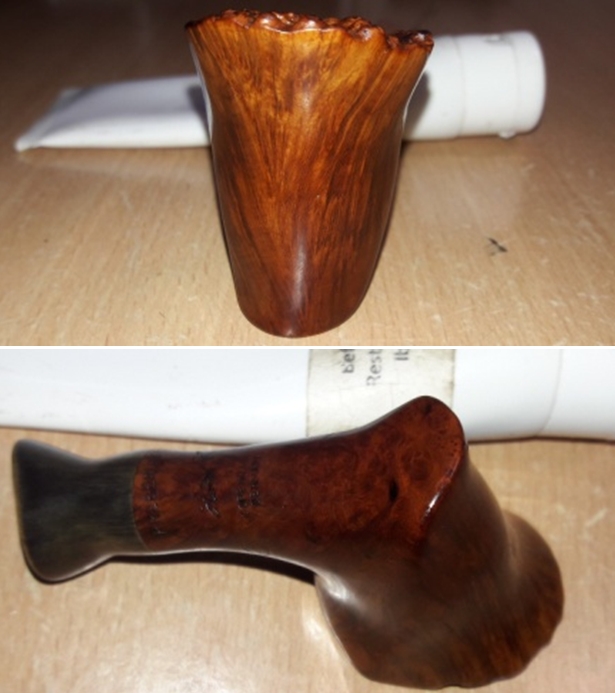
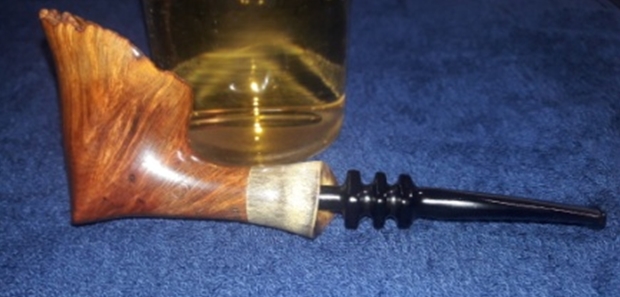
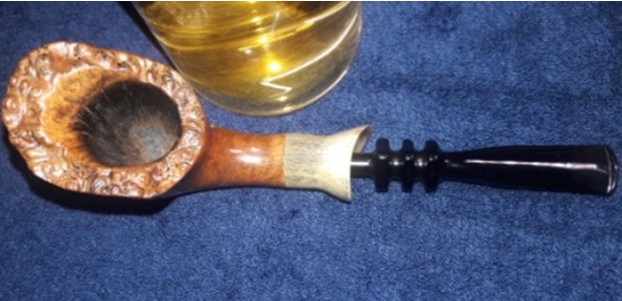
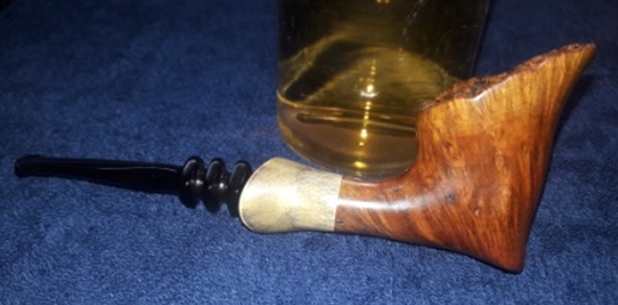
I am a big fan of Free Hand pipes!!! I love the way these pipes fit in to the hand and the creativity of the carver can be really appreciated in these pipes. And a freehand pipe made by the renowned Danish pipe carver, Preben Holm, is my dream come true. To be very honest to you all, the PH estate pipes that are available nowadays on eBay are very expensive and well nigh out of my reach. So when Abha, my wife, sent me pictures of the Mumbai Bonanza lot, I was immediately attracted to one free hand pipe that screamed PREBEN HOLM and when she confirmed that it was indeed one, I knew I was lucky. I say lucky because of the circumstances in which I made a purchase of this lot of 30 pipes and thereafter, the pipes that I received in this lot. I have given a gist of this purchase in the paragraph below. Well, the PREBEN HOLM is finally on my work table now!

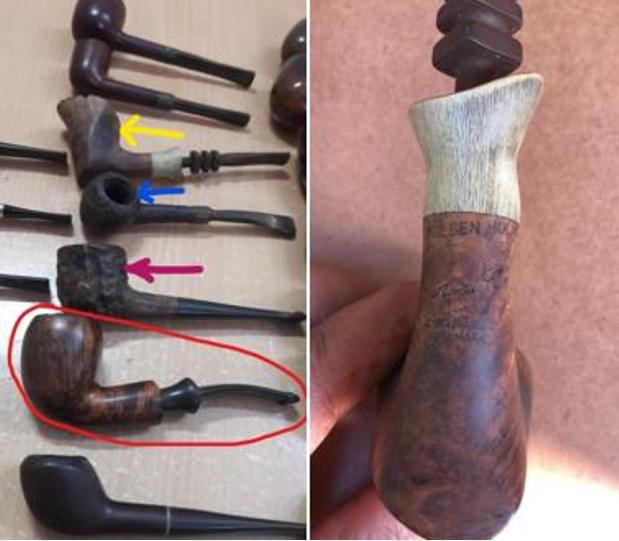
I was fortunate enough to have heeded the advice of my dear friend and mentor, Steve, and struck a deal with a junk collector from Mumbai. He did not know what he was selling and I did not know what I was buying as we reside in different cities!! The argument that Mr. Steve presented was that if not anything, I shall at least have some spares and this was logical. I struck a deal and here are pictures of the pipes that I received in this lot. This lot contains some very nice collectible pipes, a few well known brands and some mediocre brands. Overall, with seven Dunhill pipes, a Preben Holm #1 FH, a couple of “Made in England” Pete System pipes, a couple of  Charatan’s Belvedere, Custom-Bilt, Stanwell and other assorted pipes, I would say that I had struck a decent haul!!! This is indeed my “Mumbai Bonanza”.
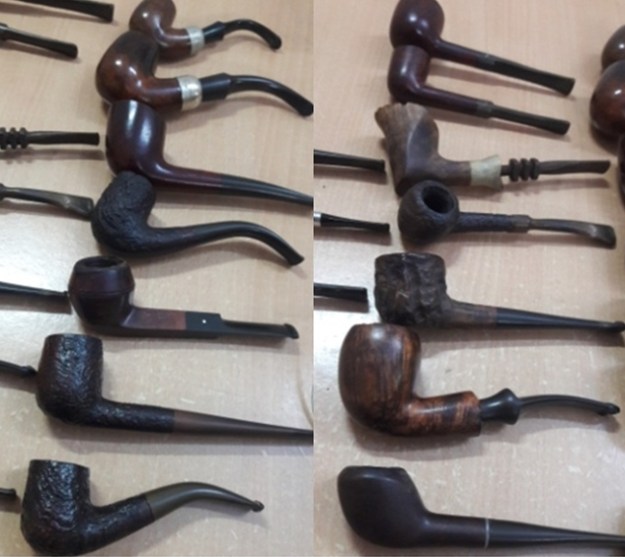
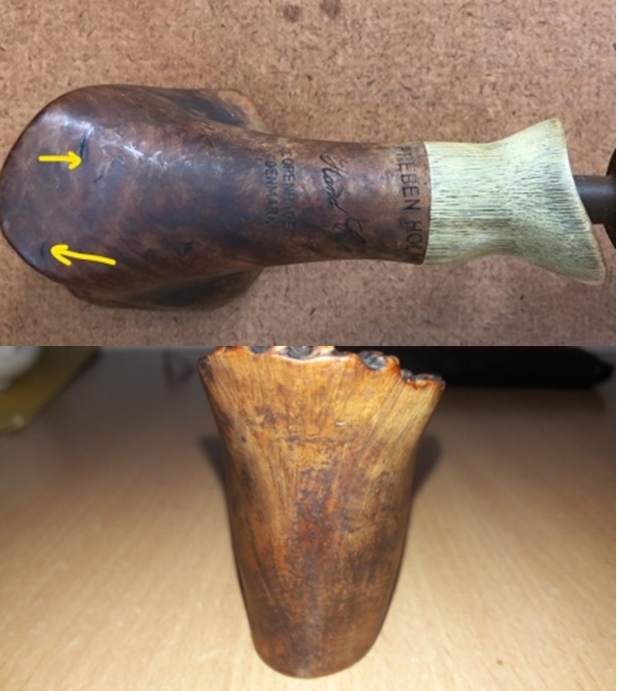
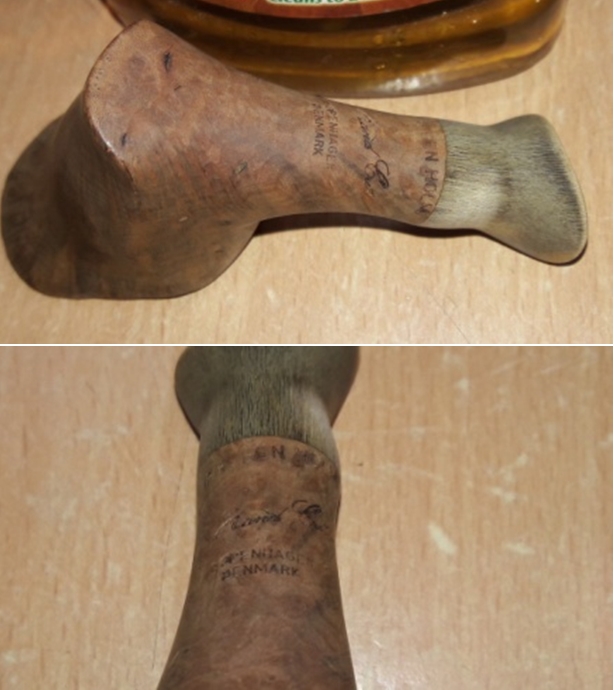
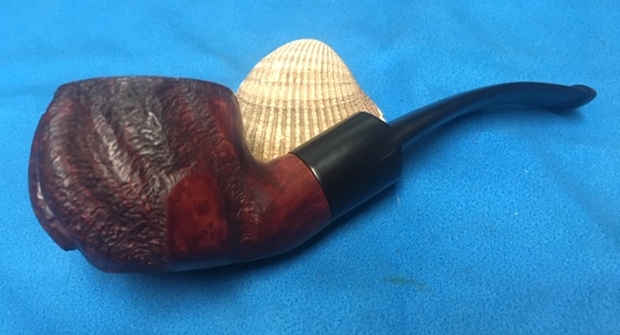
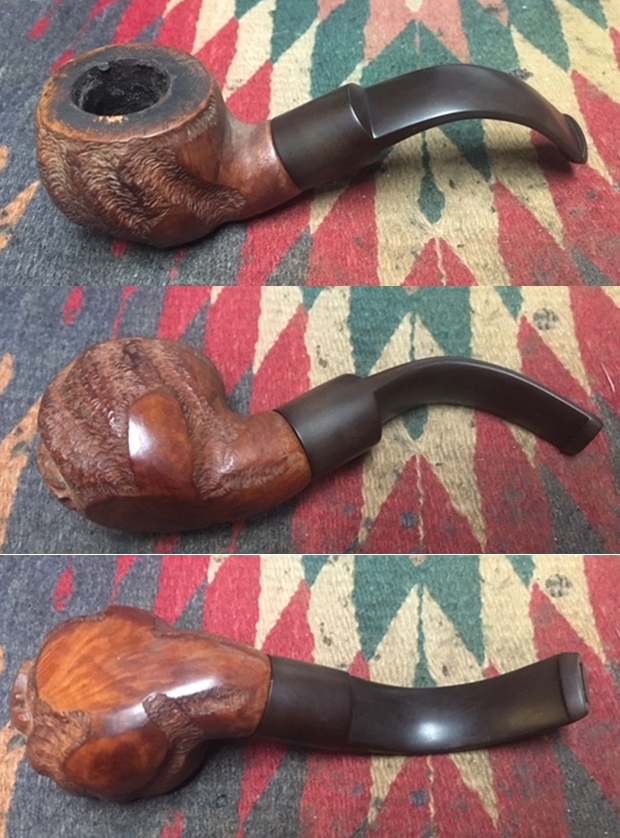
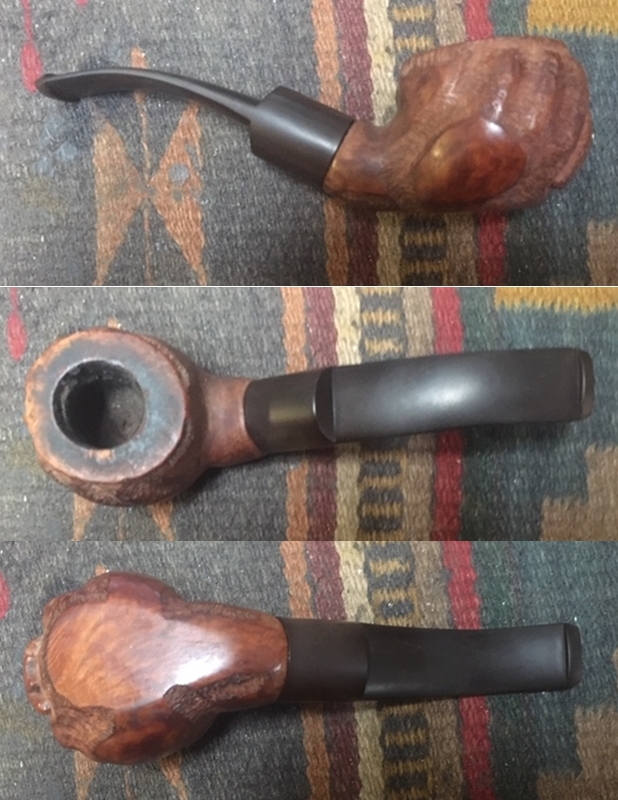
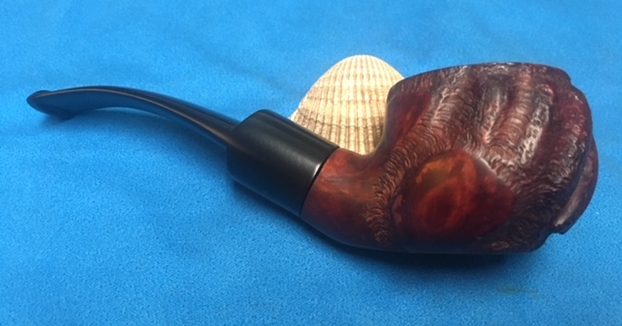
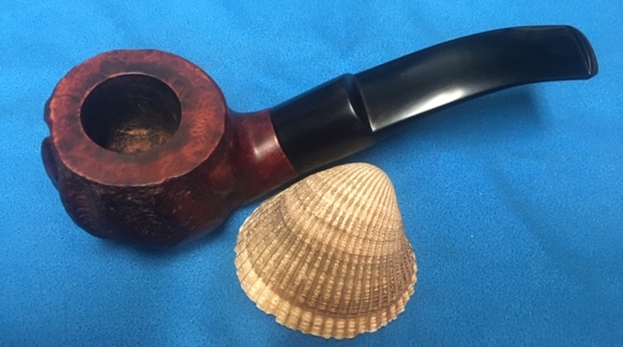
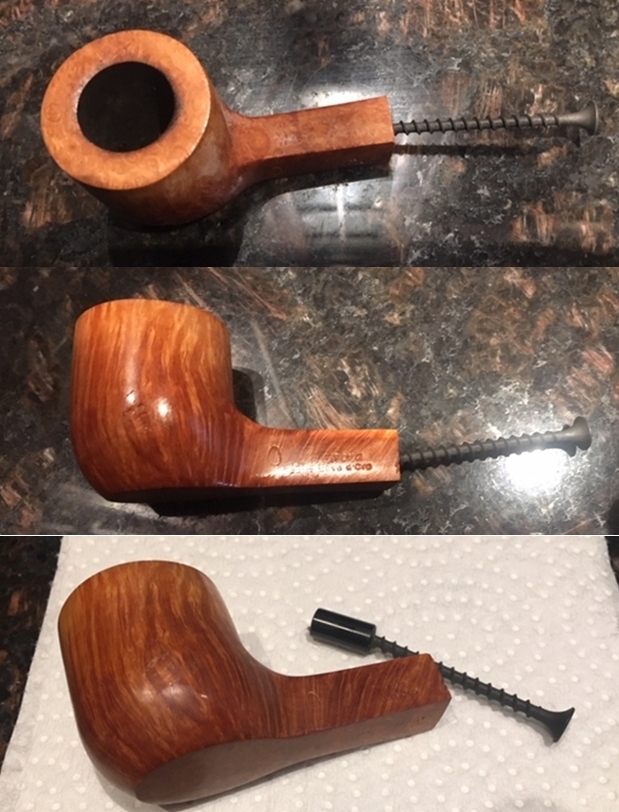
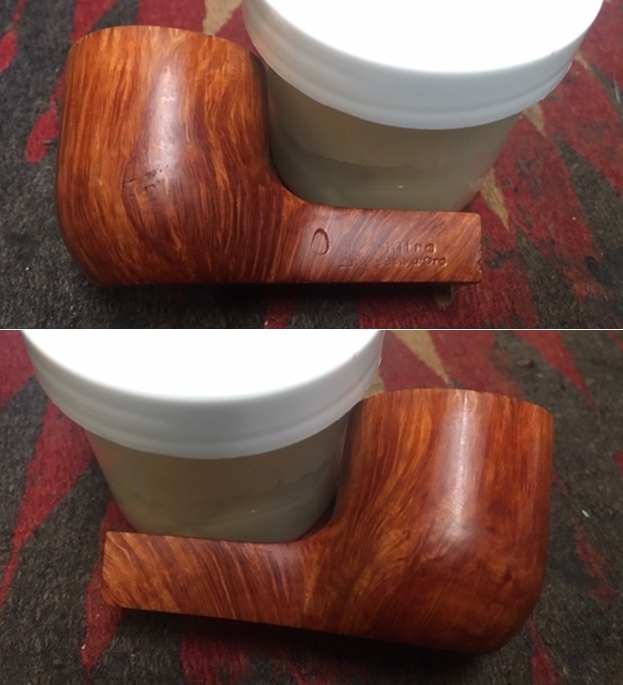
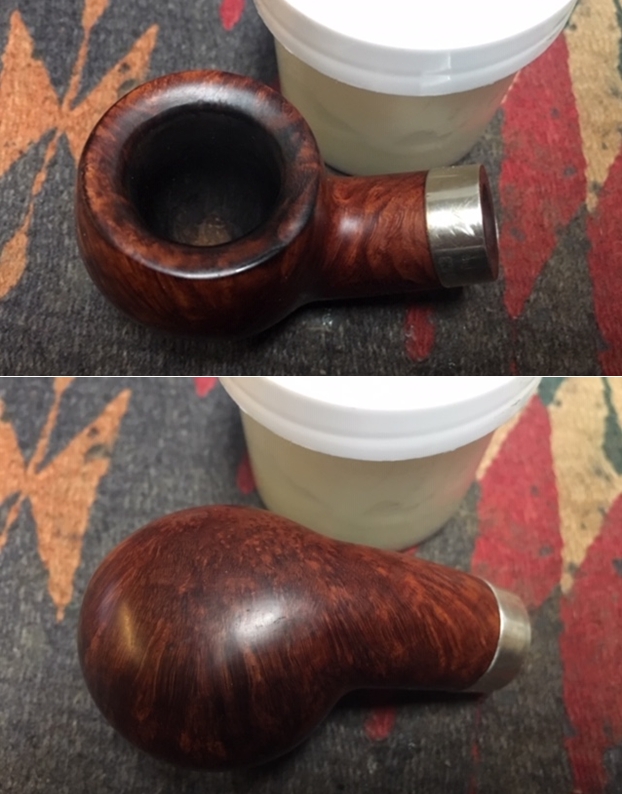
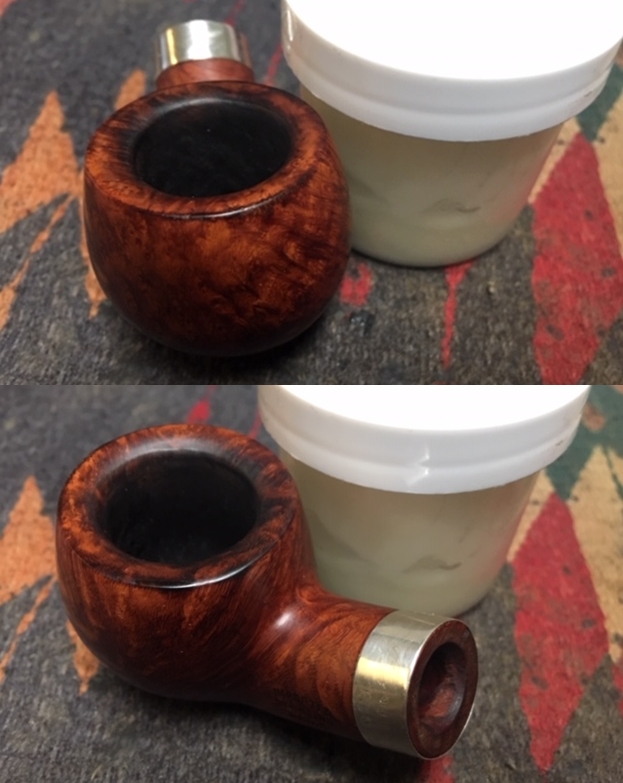
This 14th pipe that I decided to work on from this find, is a smallish Free Hand pipe with a bone shank extension and is indicated in yellow colored arrow in the picture below. It is stamped on the bottom of the shank towards the shank end as “PREBEN HOLM” in block capital letters over “HAND CUT” in a fancy script over “COPENHAGEN” over “DENMARK” again in block capital letters. The left side of the shank is stamped with an encircled numeral “1”. All the stampings are crisp and easily readable. The stem is devoid of any logo.To research this brand and line/ model in specific, I referred to pipedia.org in an attempt to date this pipe and understand the significance of the numeral # 1, if it was a shape code or grading code. However, there is nothing on this numbering system, except on Preben Holm “Private Collection” where the grading system starts with 101, 202 up to 808 in ascending order. And this is definitely not from “Private Collection” line!! I even visited rebornpipes.com in the hope that I would be able to unravel the mystery shrouding this pipe, but to no avail.

But nonetheless this is a PREBEN HOLM and is staying with me. Any reader who has any information or knowledge about this pipe is earnestly requested to share it with us on rebornpipes!

INITIAL VISUAL INSPECTION
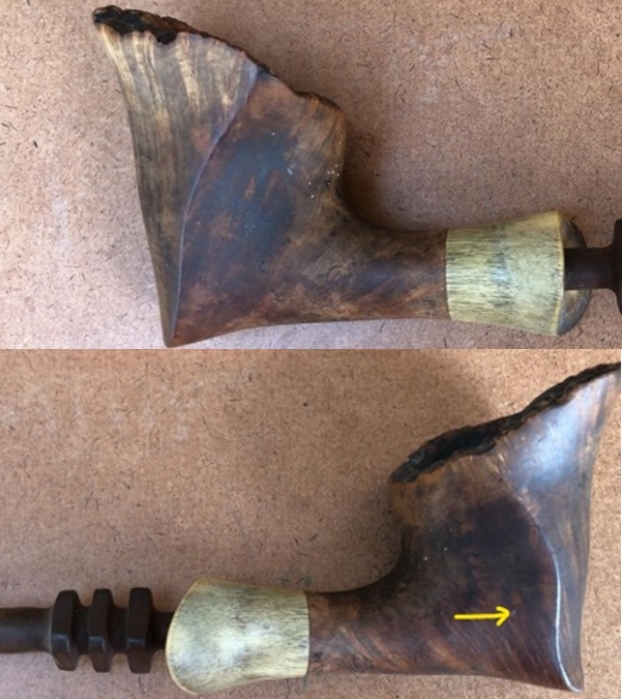
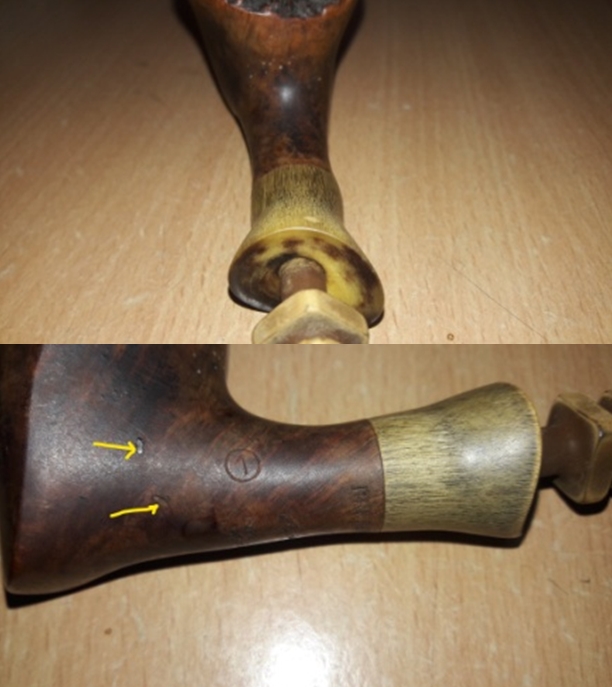
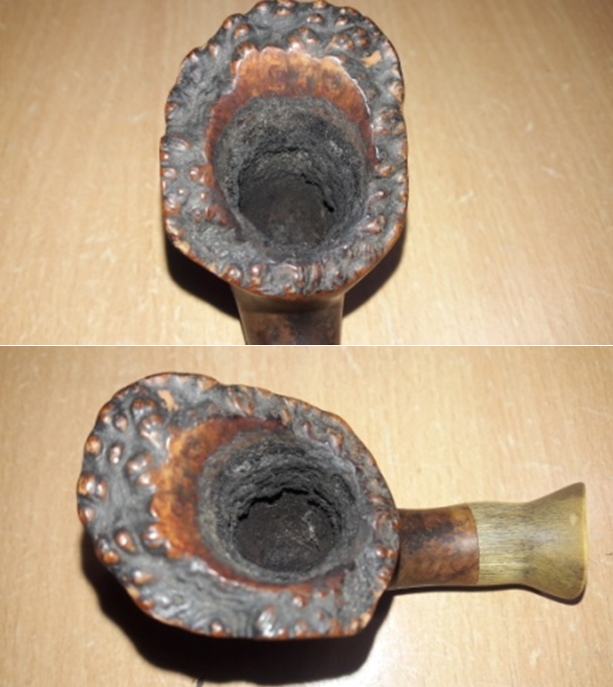
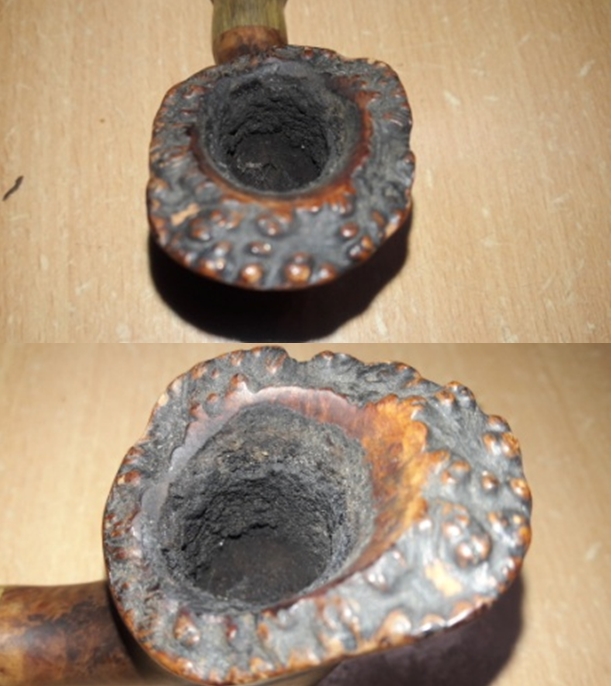
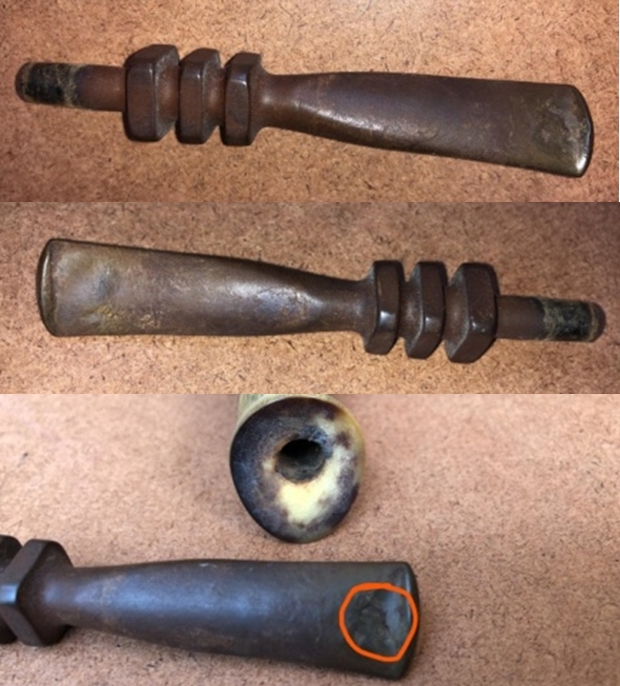
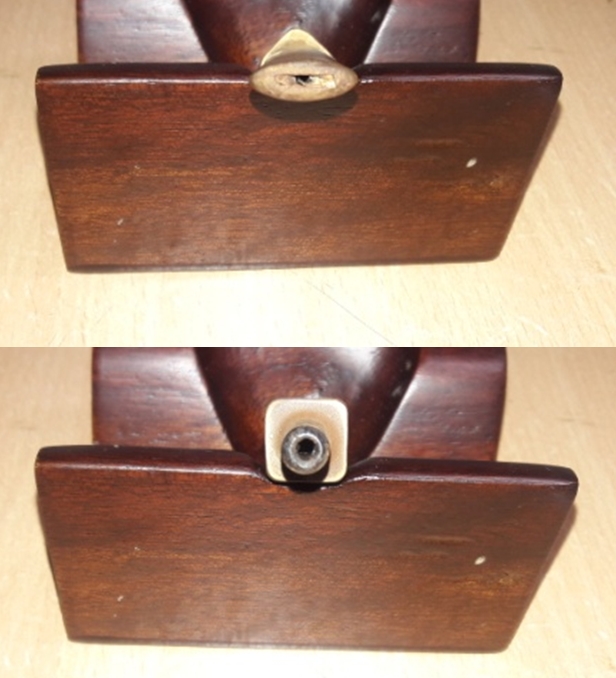
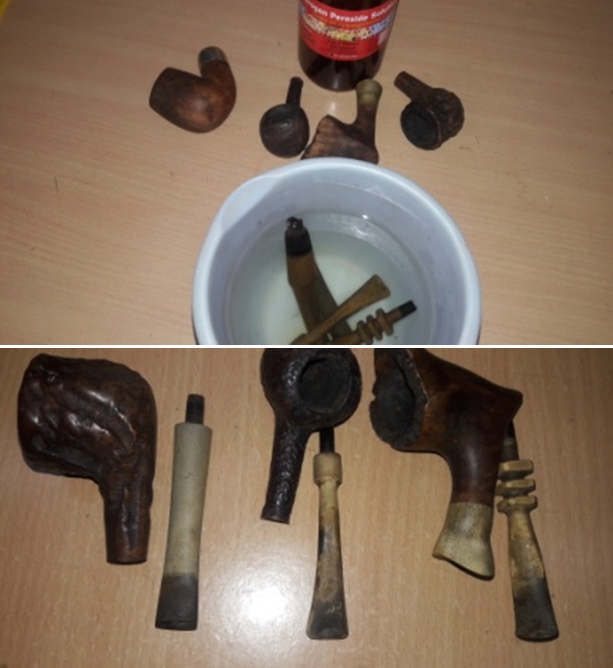
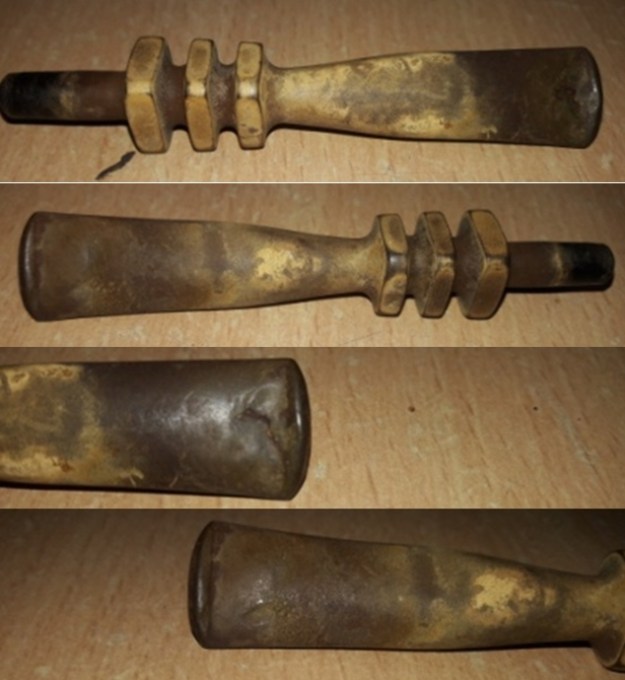
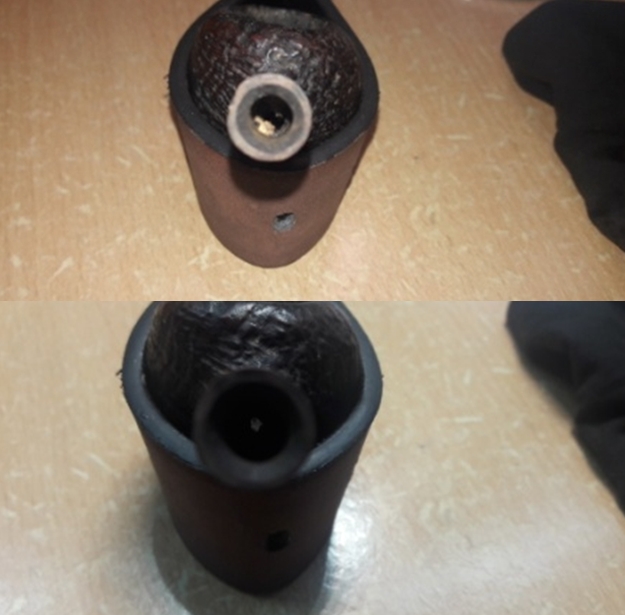
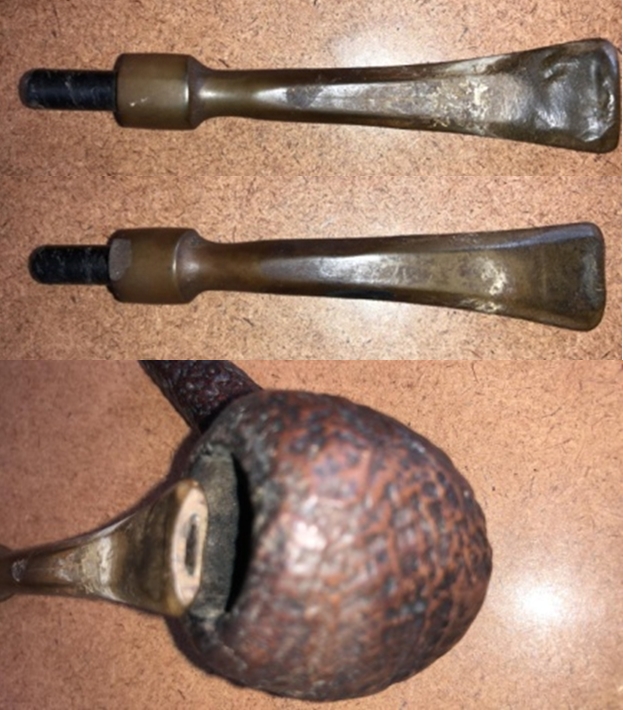
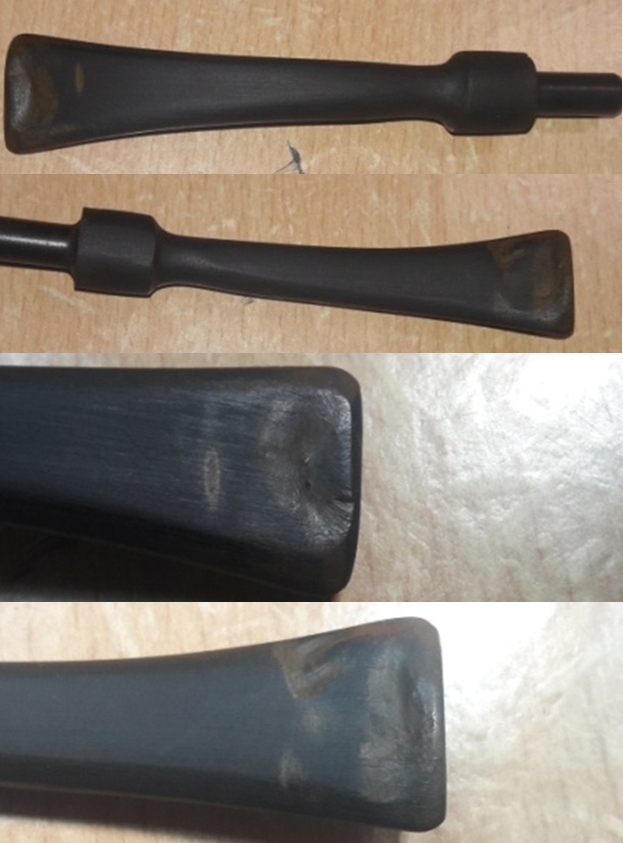
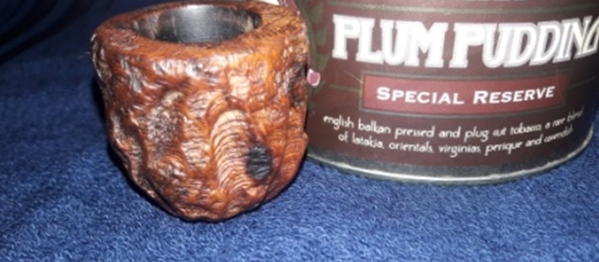
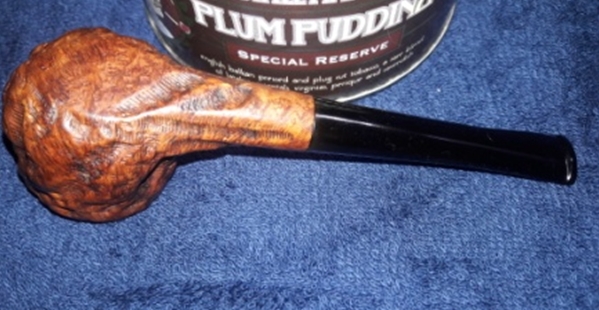
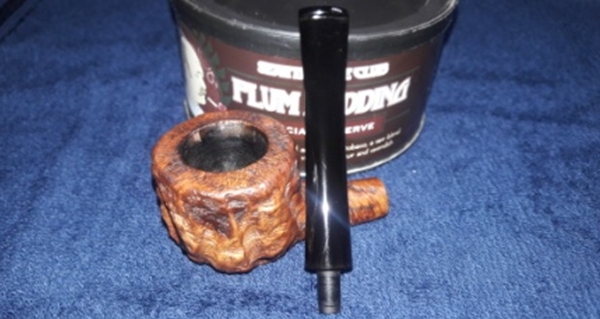
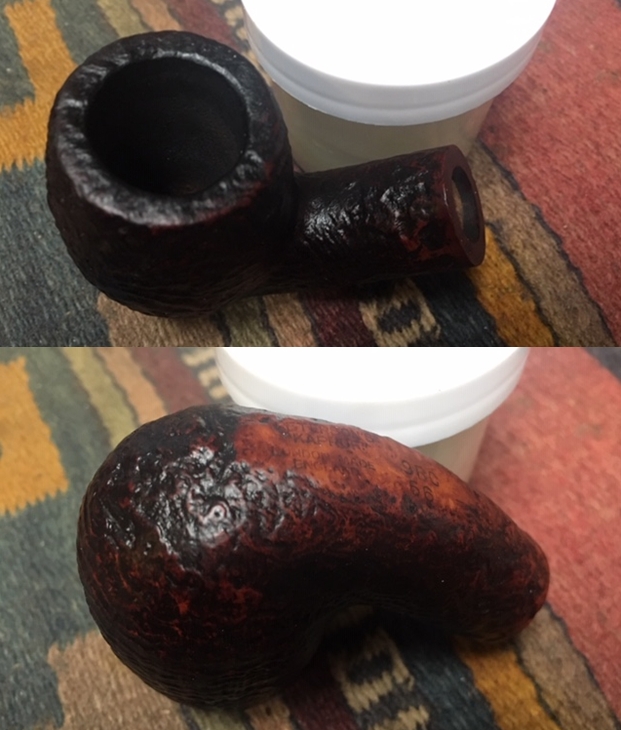
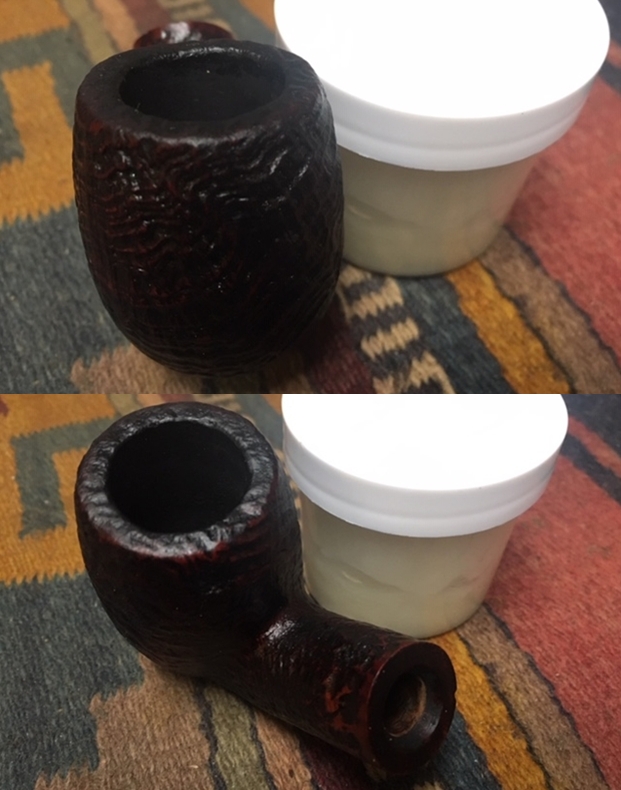
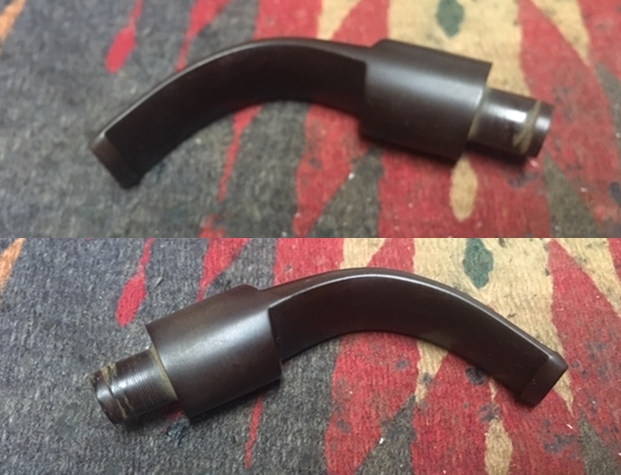
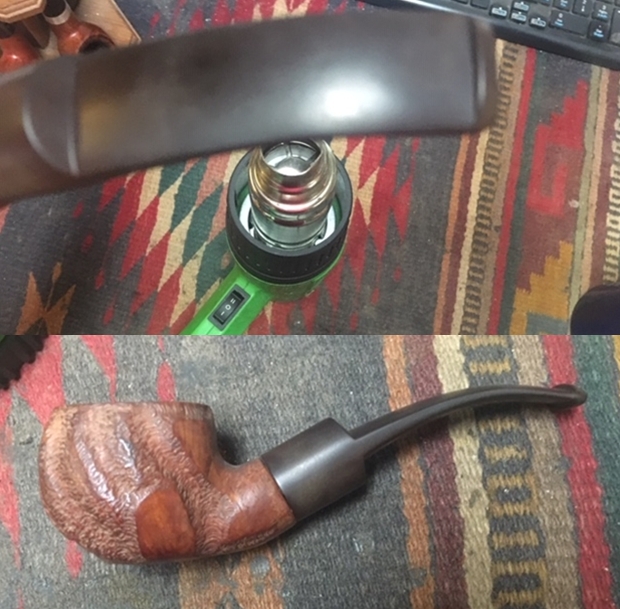
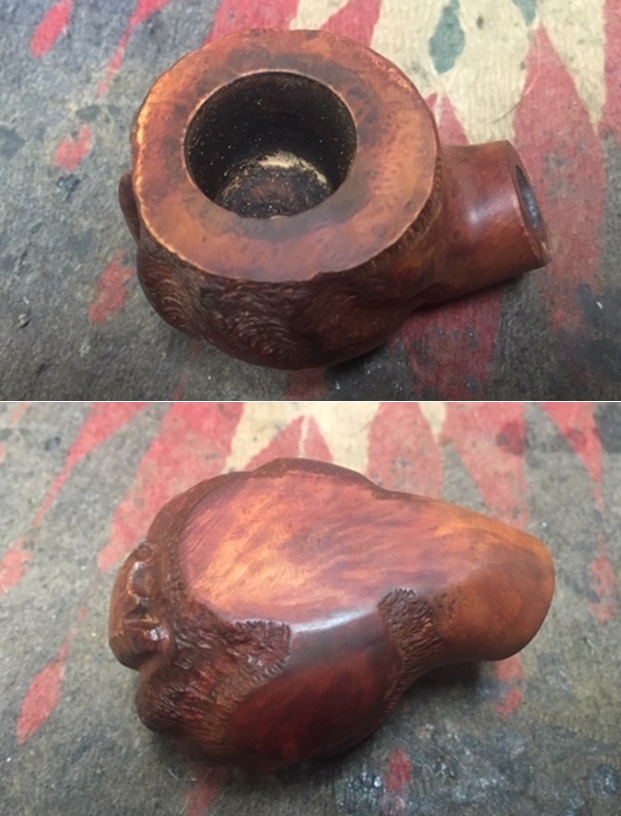
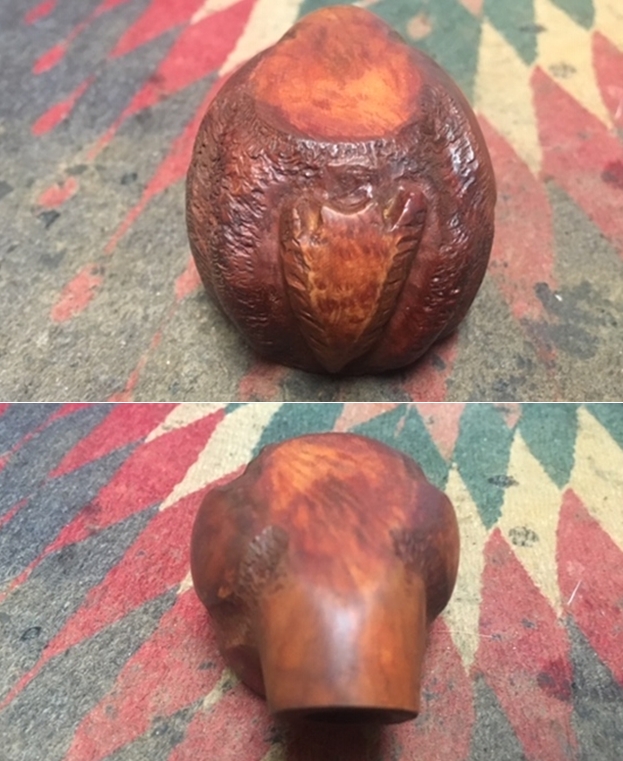
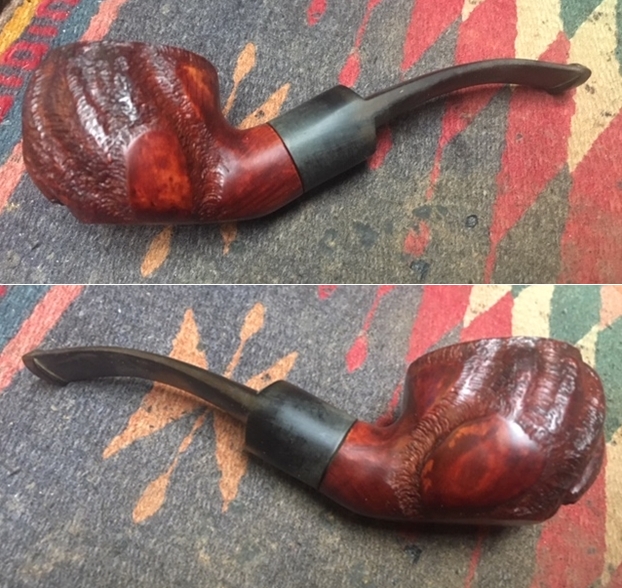
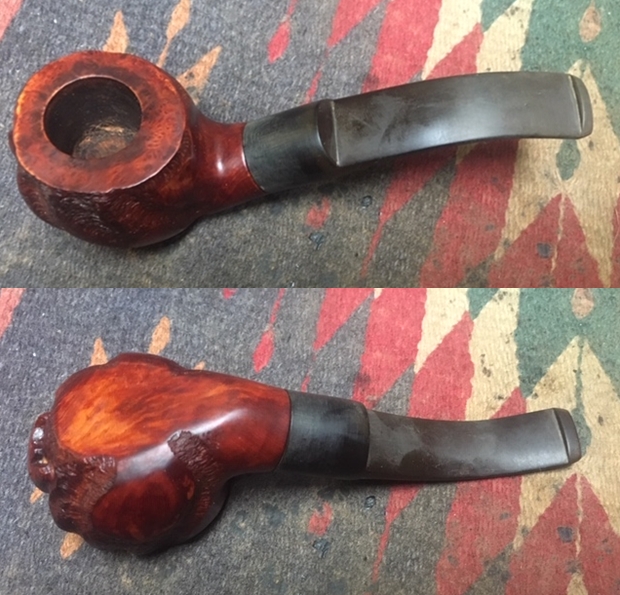
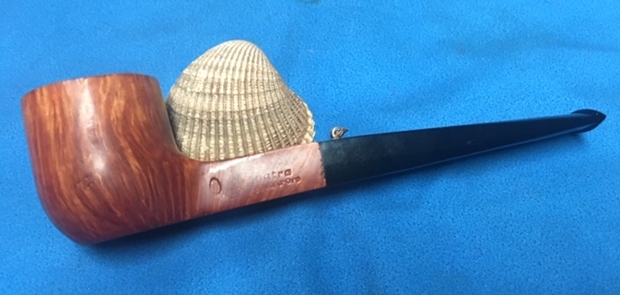
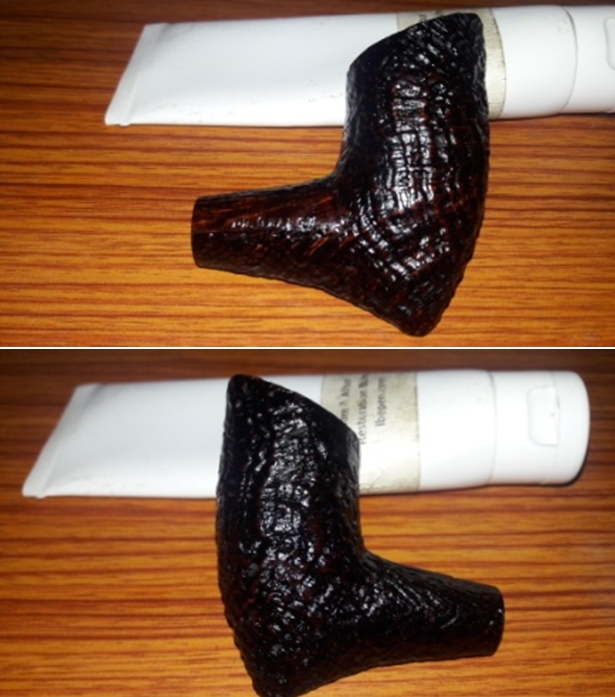
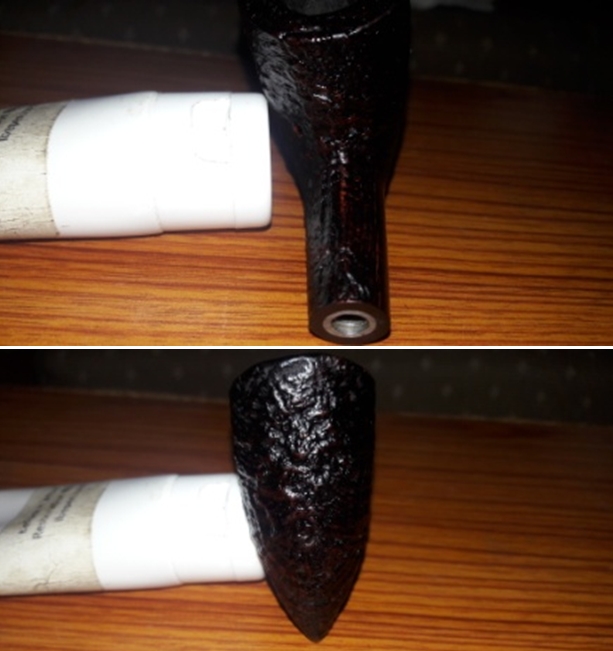
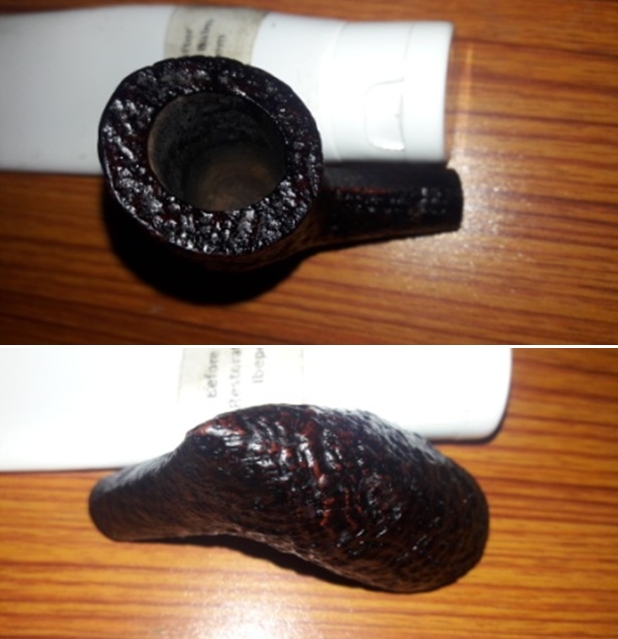
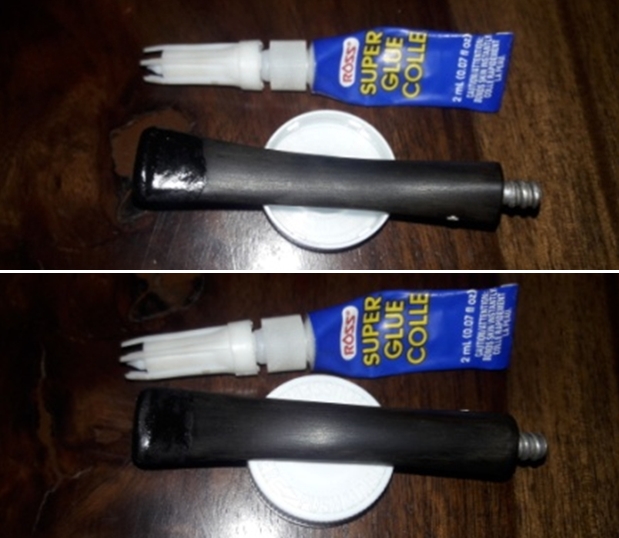
The smooth stummel has some beautiful straight grains on the front, back and sides of the stummel. On either side of the stummel, is an elegantly contoured elevation which makes for a nice and comfortable hold with the thumb and the middle finger while smoking. The front of the stummel rises above the back making for a downward sloping rim top surface. The upper portion of the rim top flares out in a typical PH design and adds a distinct feature to the appearance of the pipe. The stummel surface is covered in dirt and grime giving the stummel a dull and lackluster appearance. There are a one/ two likely fills, noticeably on either side near the shank and stummel junction and another couple near the foot. These will be clear when the stummel is cleaned of all the grime. A thick layer of cake can be seen in the chamber. The backwards sloping plateau rim top surface has nice knobby raised portions and the portion of crevices formed, is covered in thick overflow of lava, dirt, dust and grime. The condition of the inner walls of the chamber and rim top surface will be known once the cake has been taken down to bare briar and the rim top crud has been scraped off completely. The inner rim condition appears to be in good condition with no burn/ charred surfaces. Only once the stummel has been thoroughly cleaned that I can be sure of my initial appreciation. In spite of the thick cake, the chamber odor is, surprisingly, not strong and should be addressed once the cake has been taken down to the bare briar and the shank internals have been thoroughly cleaned. The draught hole is dead center at the bottom of the chamber and should be a great smoker. The shank end is adorned with a horn shank end extension which is pinched in the middle and then flares outwards matching in profile with the rim top. The shank extension is dry and has darkened nicely due to absorption of all the oils over the years of smoking. This will add a nice classy touch to the overall appearance of the pipe once cleaned and hydrated. The shank extension end and mortise are blocked with accumulated dried gunk, adversely affecting the airflow. The fancy vulcanite stem is heavily oxidized and has calcification deposits towards the button end. There are deep tooth marks on the lower and upper stem surface in the bite zone and appears that the previous owner has literally chomped on the bite zone of the stem. The lower stem surface is cracked near the button edge and is circled in red. The button edges also have bite marks, in fact, they are badly worn out. The tenon and horizontal slot shows accumulated oils and tars. The oxidation in the space between the three squares, in descending size from the tenon end to slot end, is going to be a bear to get rid of but once nice and shiny will elevate the appearance of the overall pipe manifold times. Along with the stems of other pipes in line for restoration, I immersed the stem of this Preben Holm in a mix of one part Hydrogen Peroxide 20% with one part hot water after I ran a couple of pipe cleaners dipped in alcohol through the stem air way. A couple of hours later, the stem oxidation on all these stems were raised to the surface. The pictures below show the stem after it was removed from this bath. The appearance is definitely not for the fainthearted, to say the least!!After I had fished out the stem from the Hydrogen Peroxide bath, I scrubbed it with Magiclean sponge and followed it up with a wipe of cotton swab and alcohol. I further scrubbed the stem surface with 0000 grade steel wool. The loosened and superficial layer of oxidation was easily removed and revealed the condition of the stem.. There are deep bite marks in both the upper and lower bite zone. The bite marks are deep enough to cause significant thinning of the surface and complete disfigurement of the button edges. The deeper oxidation that was pulled to the surface would require more abrasive techniques.

THE PROCESS
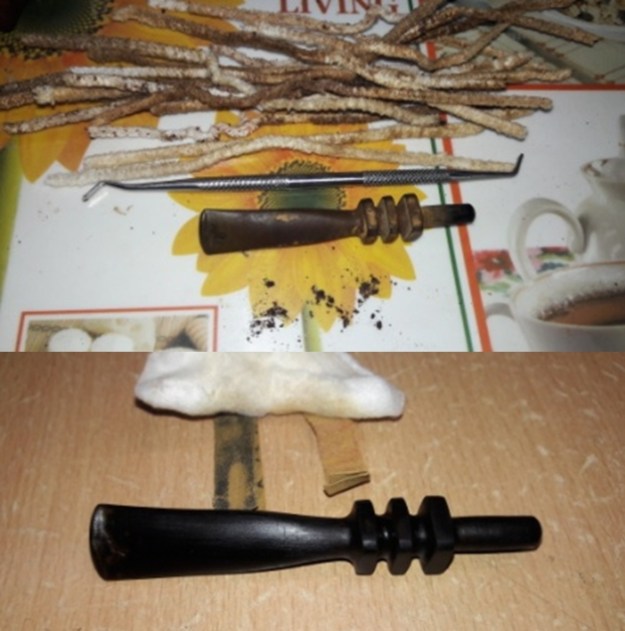
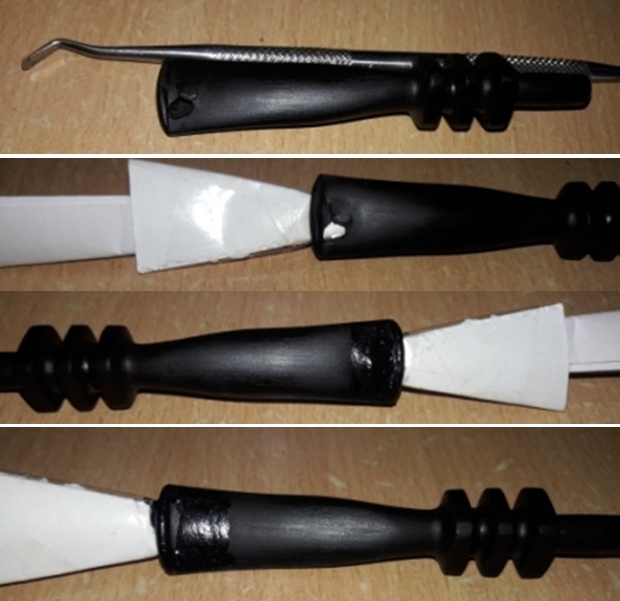
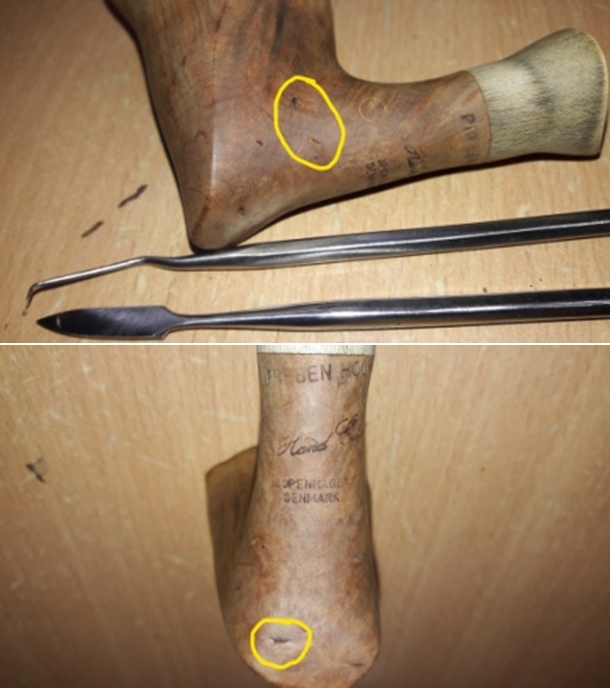
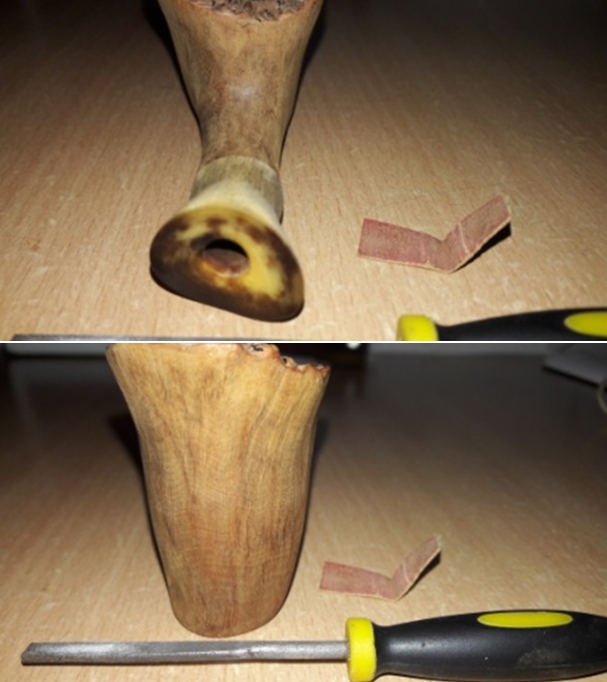
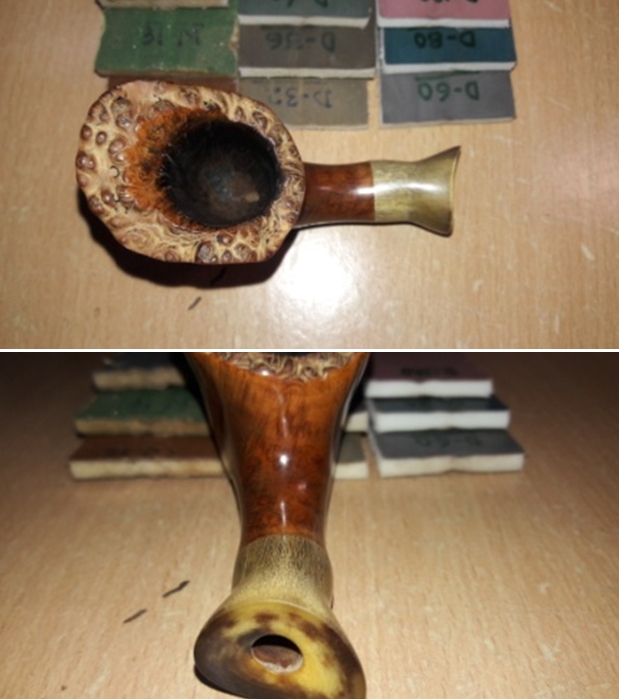
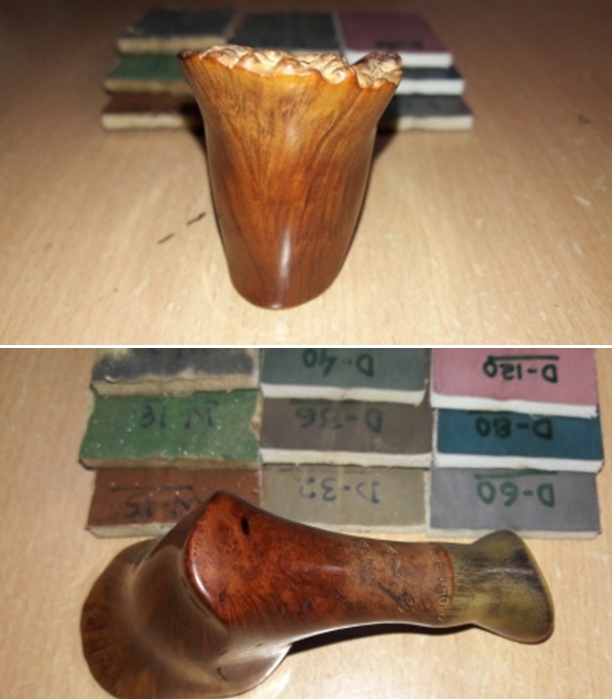
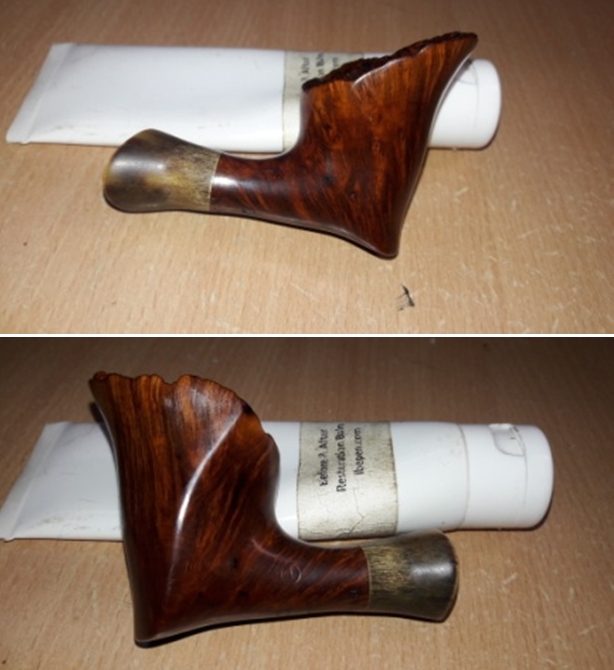
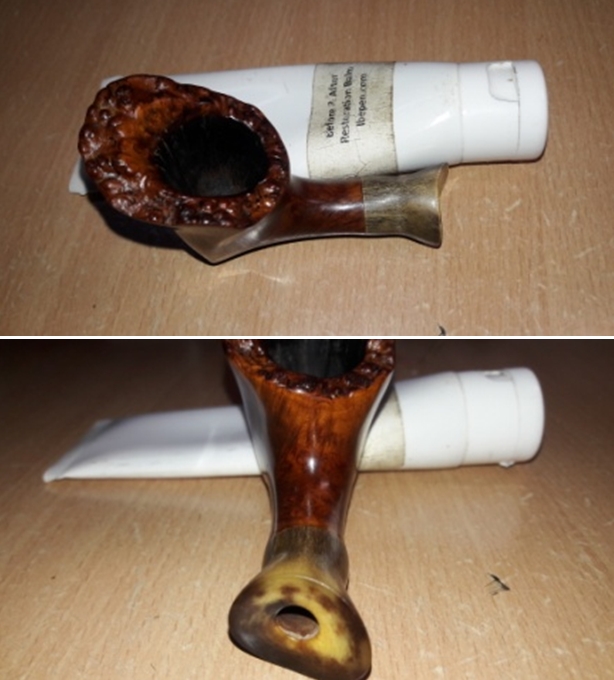
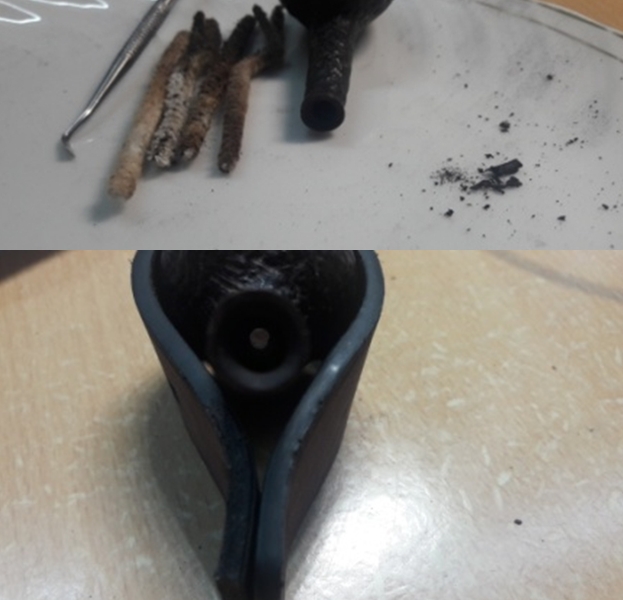
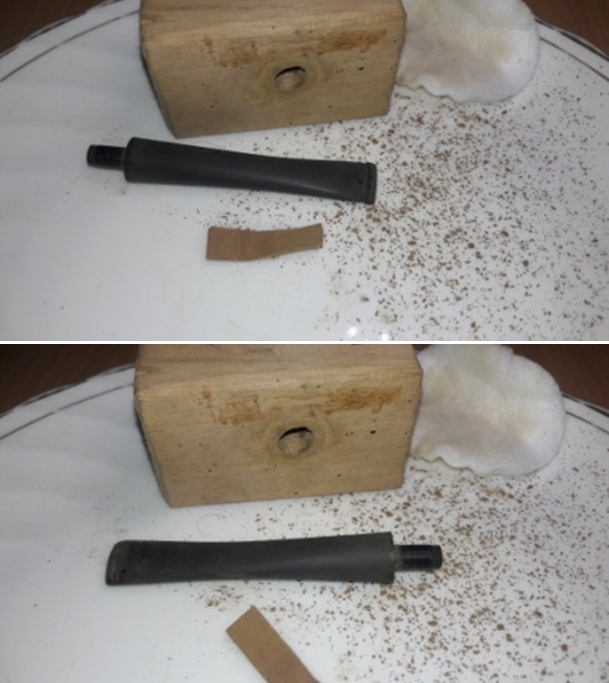
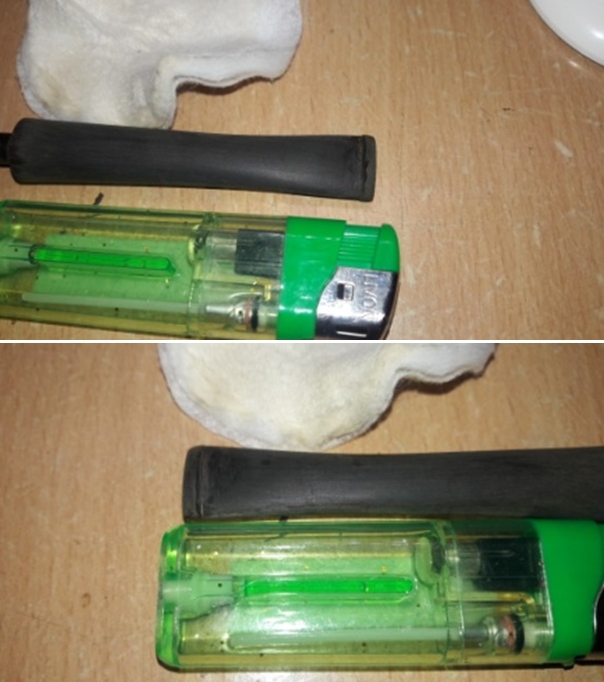
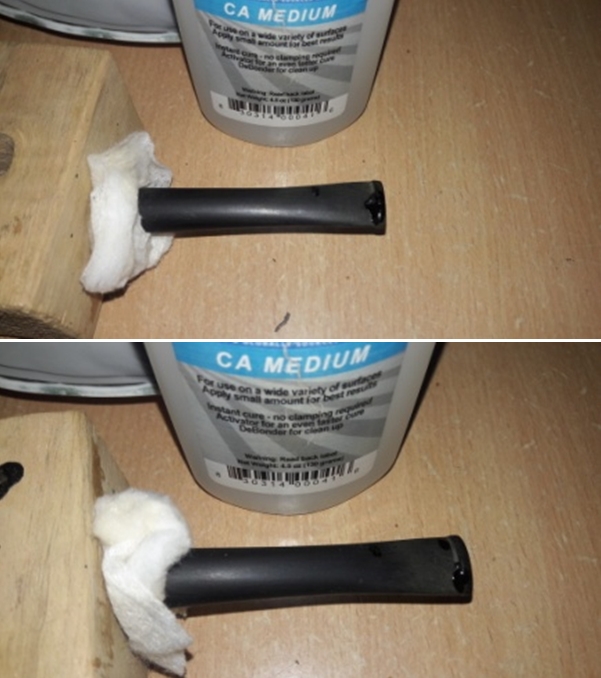
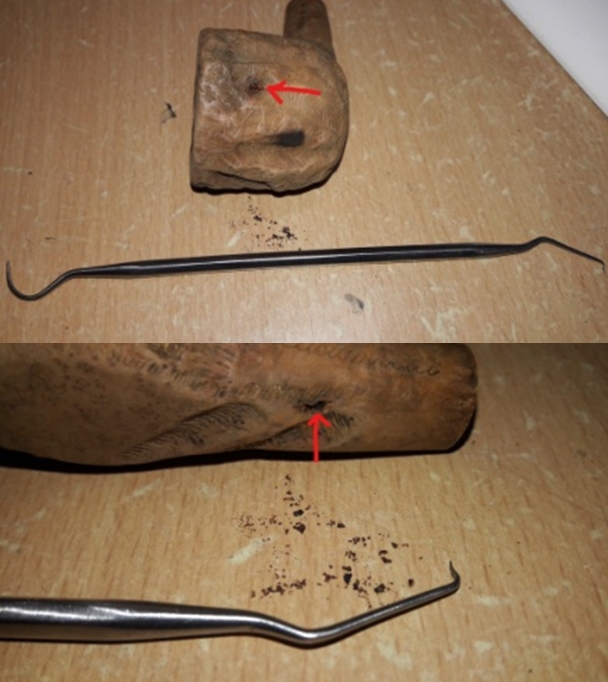
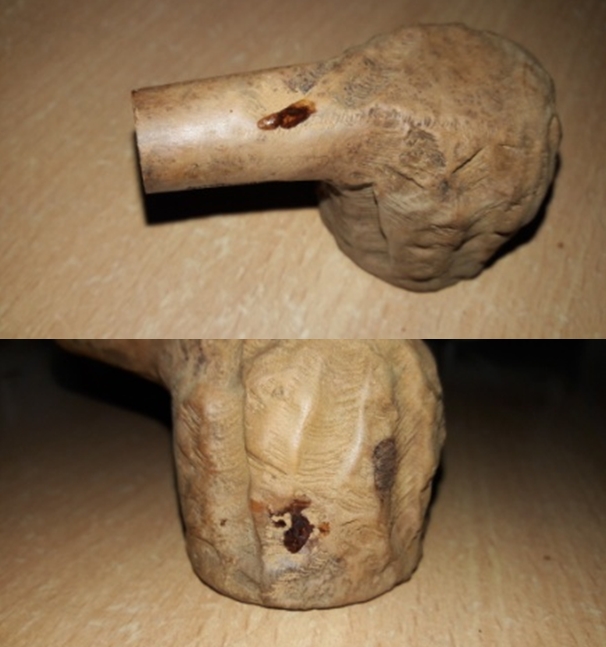
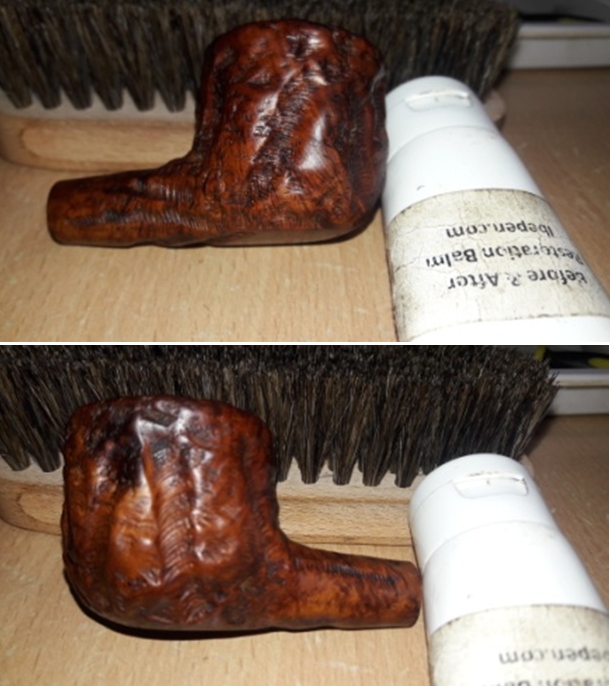
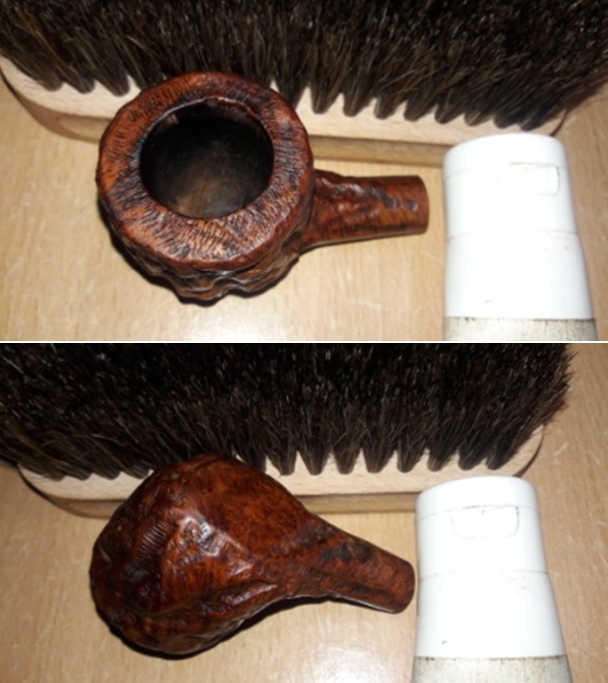
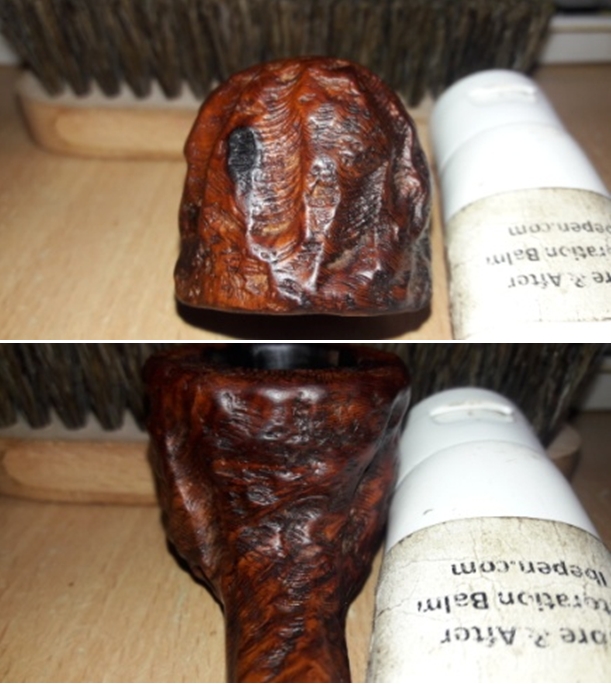
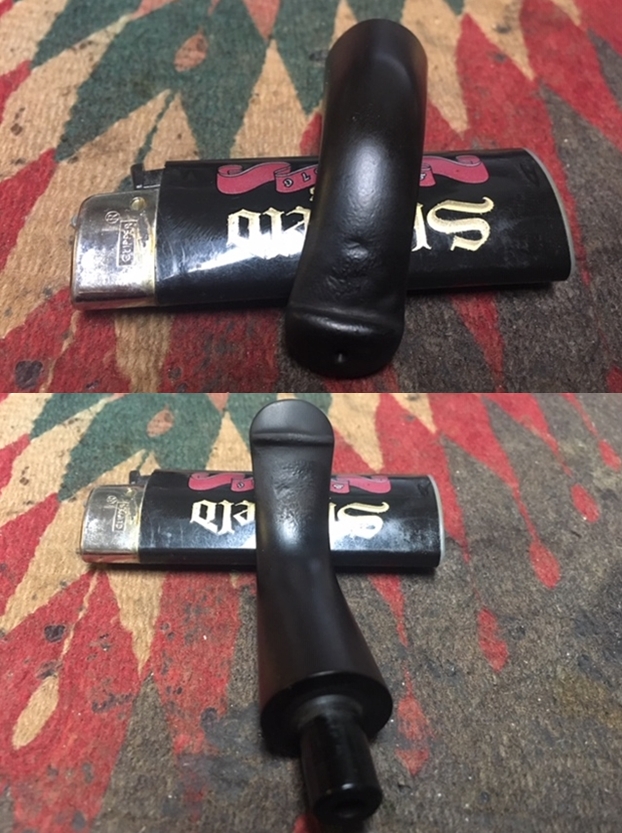
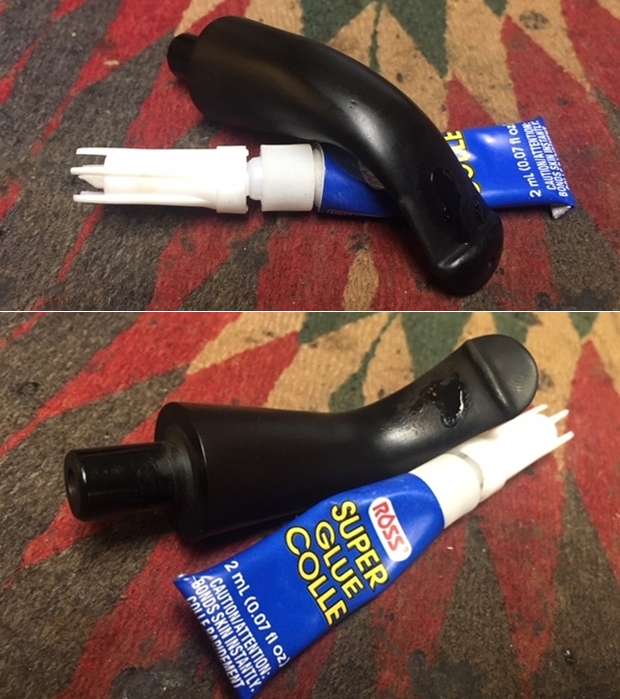
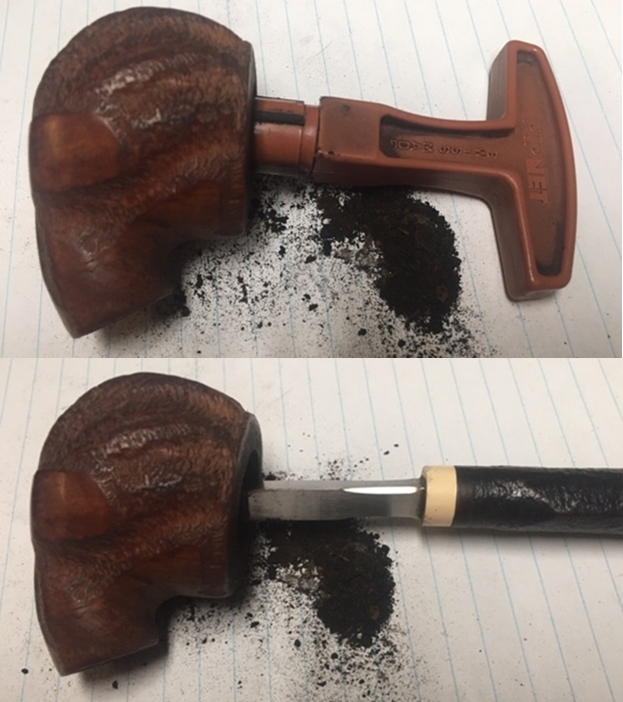
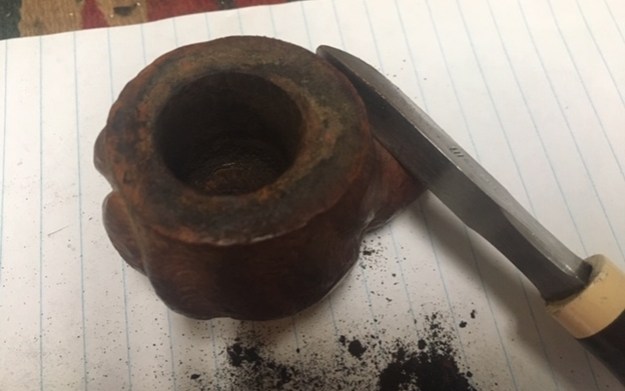
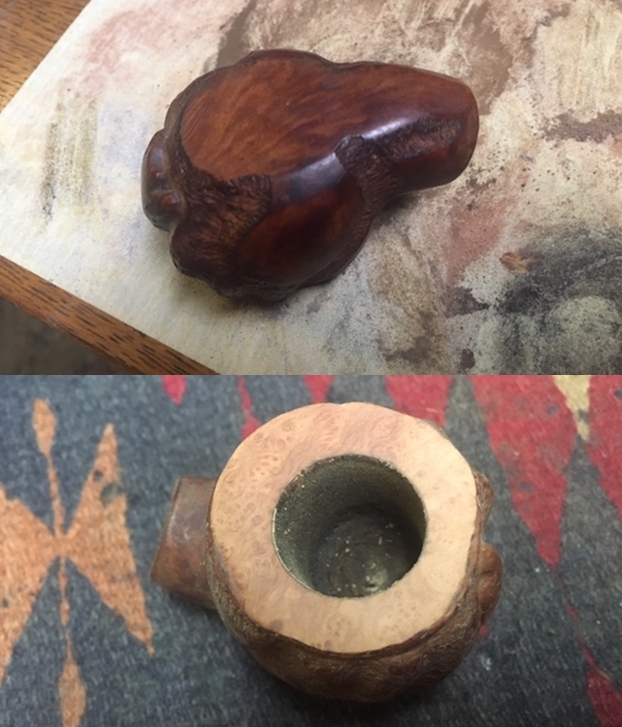
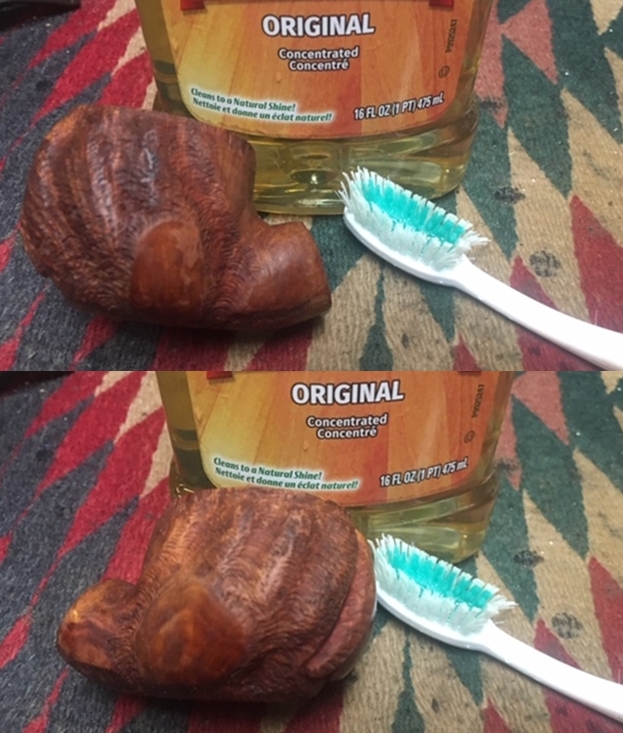
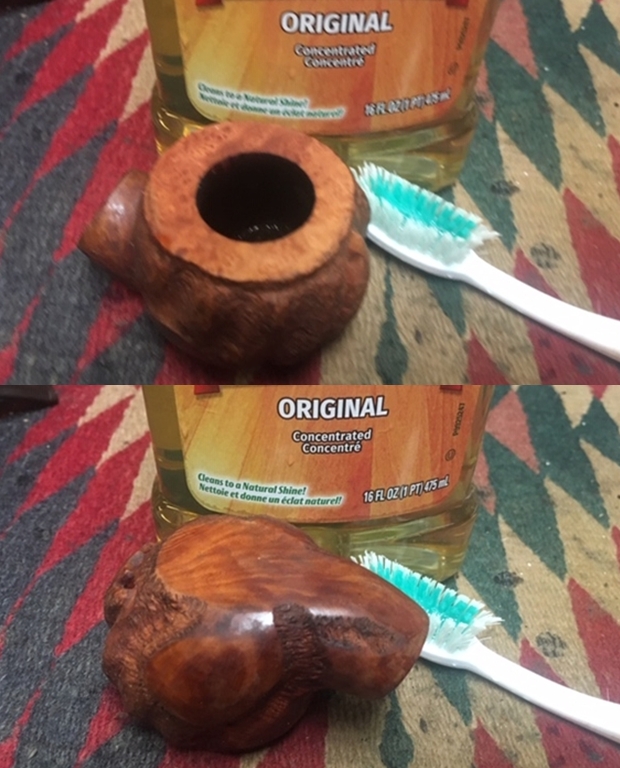
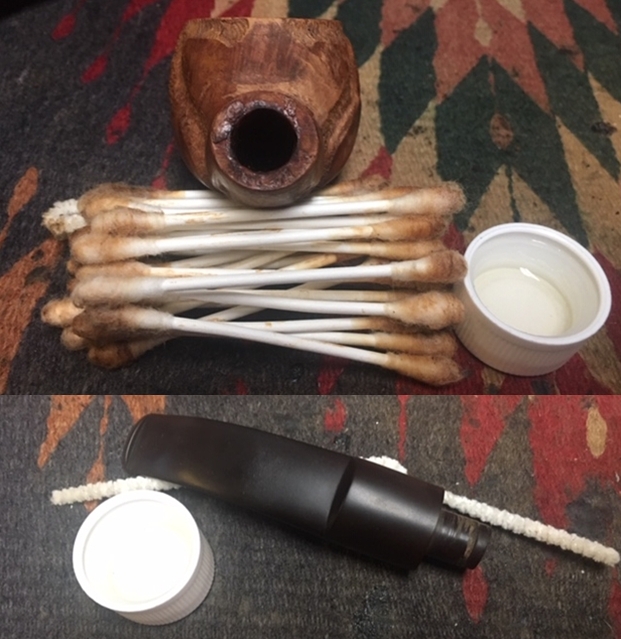
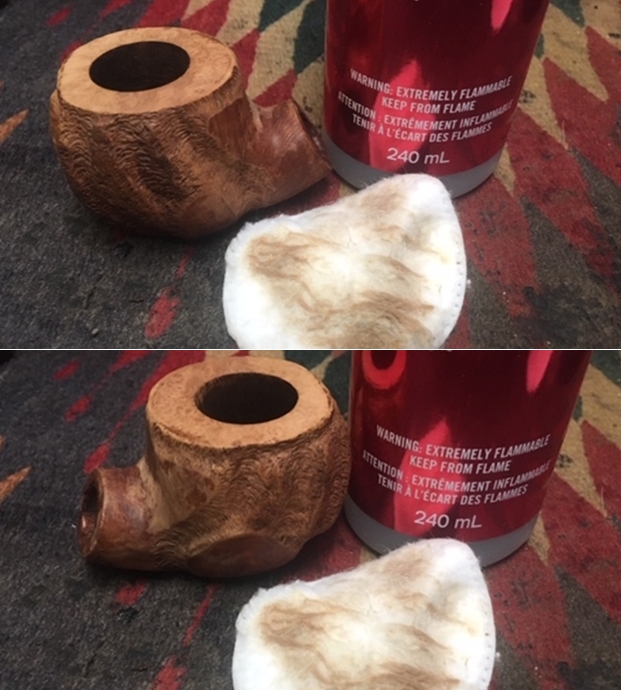
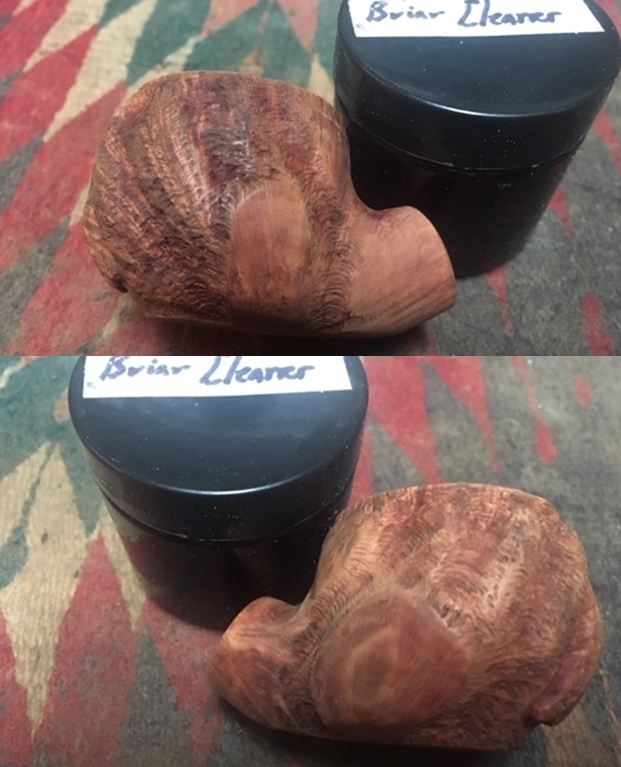
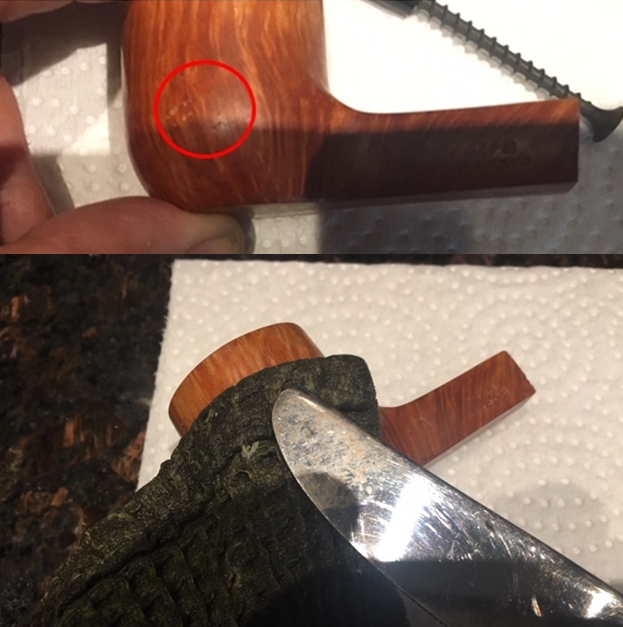
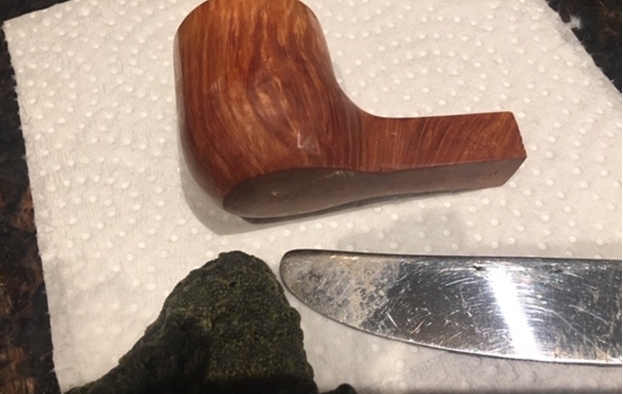
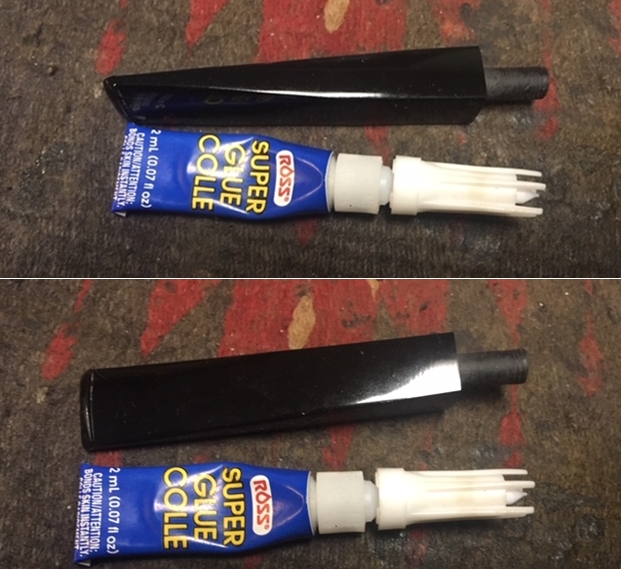
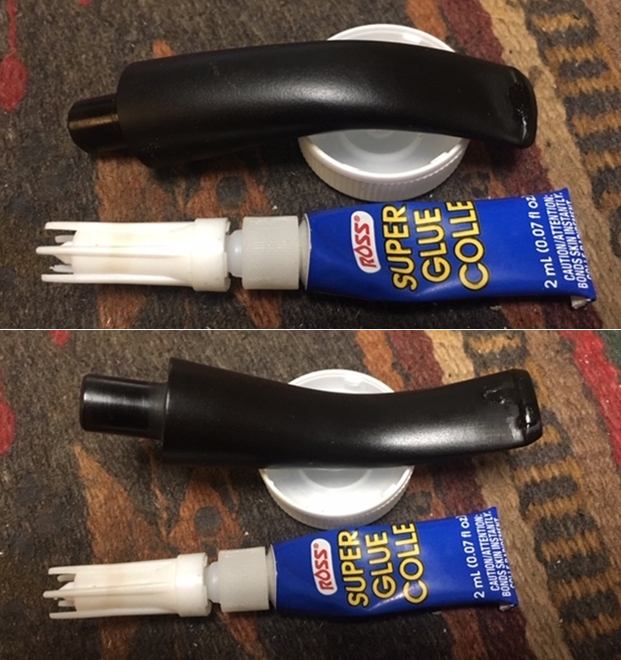
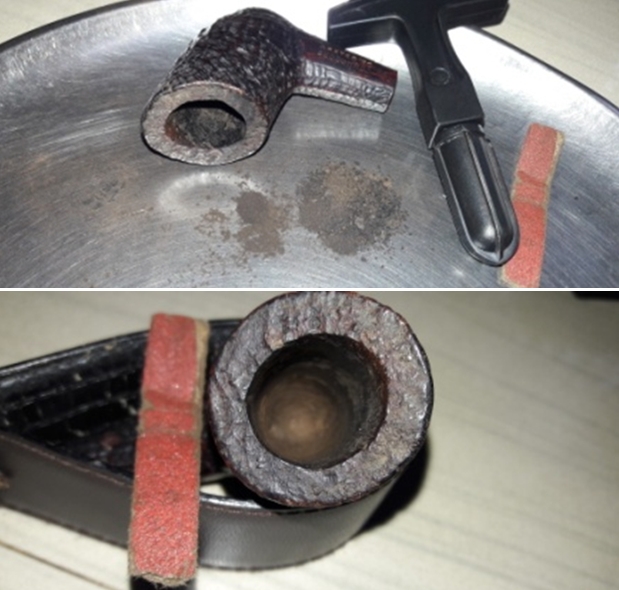
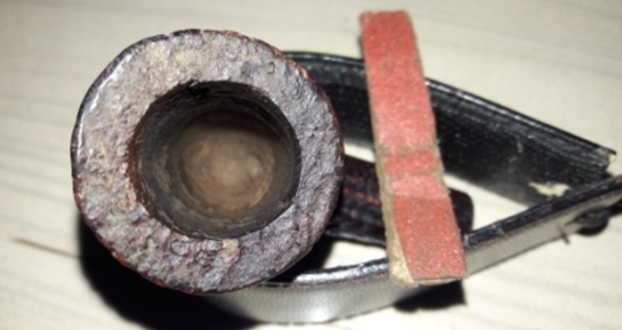
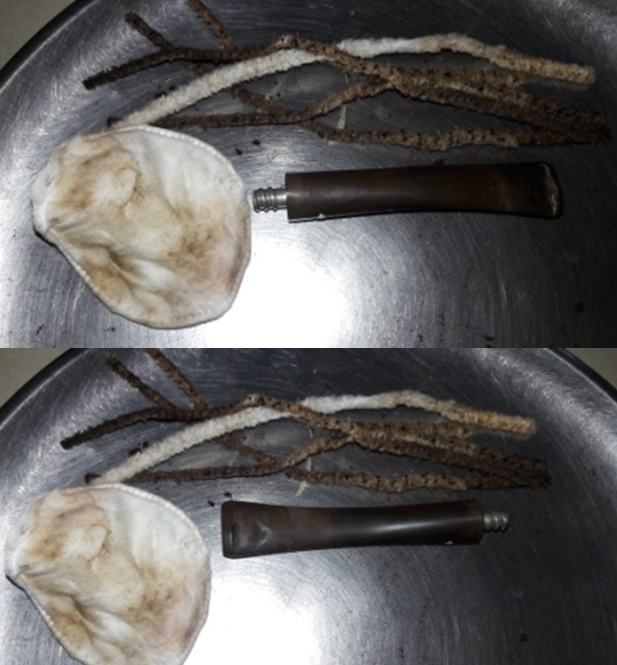
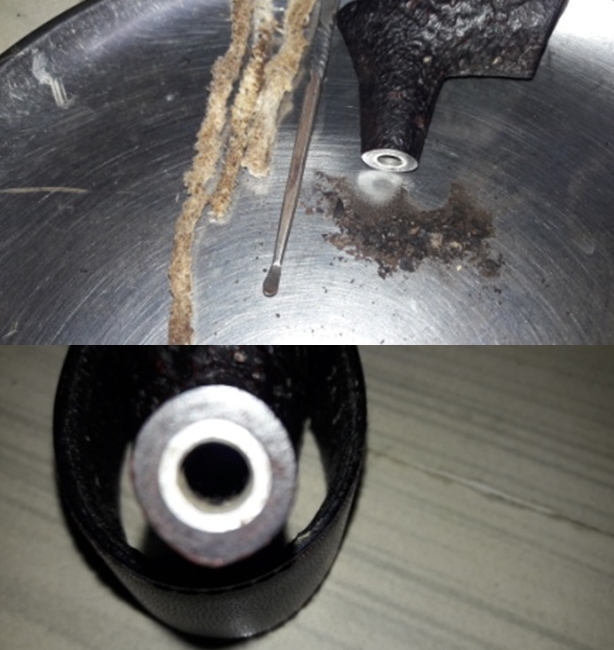
I started the restoration with the stem repairs as this would take the maximum of my time to clean, repair and spruce up the stem. I cleaned the internals of the stem using hard and normal bristled pipe cleaners and isopropyl alcohol. The heap of pipe cleaners tells the sordid tale of the stem condition. With a pointed dental tool, I scraped out the entire dried gunk from the slot. I addressed the deeper oxidation by sanding the entire stem with a folded piece of 150 and followed by 220 grit sand paper. Once the oxidation was completely removed, I wiped the surface clean with a cotton swab and alcohol and rubbed a little Extra Virigin Olive oil to hydrate the stem. I flamed the damaged button edge and the nicks and dents with the flame of a lighter. This helps the vulcanite to rise to the surface as it has an inherent property to regain its original shape when heated. At this stage, I could clearly make out the extent of damage to the lower surface and the extent of the crack in the bite zone. This was further accentuated due to heating with the flame of a lighter. The upper surface too has a couple of deep tooth marks. Just for the information of statistically oriented reader, to get the stem to this stage it took better part of the afternoon and well past mid night!! Continuing with the stem repair, with a dental spatula, I probed the area around crack from inside the slot end with the aim of dislodging only the thin and loosened stem surface. Once the thin and loose stem surface was removed, I was certain that the rest of the stem surface around the crack was solid. I inserted a triangulated index card covered in transparent tape in to the slot. The tape prevents the mix of superglue and charcoal from sticking to the index card. I mixed superglue and activated charcoal powder and generously applied it over the bite zone on either side, including over the button and set it aside to cure.While the stem fill was set aside to cure, I started with cleaning of the stummel as I was keen to know the condition of the walls of the chamber. With size 1 head followed by head size 2 of a PipNet pipe reamer, I took the cake down to bare briar. Using a folded piece of 180 grit sand paper, I sand out the last traces of cake and expose the walls of the chamber. I wiped the chamber with a cotton pad dipped in isopropyl alcohol to remove the carbon dust left behind by all the reaming and sanding process. Once the chamber walls were cleaned out, I was pleased to note a pristine chamber with no signs of heat fissures/lines/pits. Next, I cleaned out the internals of the shank and mortise. Using my dental tool, I scraped out all the dried oils, tars and gunk that had accumulated in the shank airway and mortise. The amount of crud that was scrapped out and the condition of the pipe cleaners that were used leaves no surprise why air flow through it was restricted. I finished the cleaning by running a few pipe cleaners dipped in isopropyl alcohol. I also wiped the shank with cotton buds and alcohol. With this cleaning, all old smells in the pipe are history. The pipe now smells clean and fresh.With the internals of the stummel now clean, I cleaned the external surface using a hard bristled toothbrush and Murphy’s Oil Soap. I diligently scrubbed the rim top surface to remove the entire dust, dirt and lava overflow that was embedded in the crevices of the plateau rim top surface. With a soft bristled brass wired brush, I removed the overflowing lava from the rim top surface and cleaned the internals of the shank with a shank brush and dish washing soap to remove what little crud remained in the shank. I rinsed it under running tap water and wiped the stummel dry with an absorbent soft cotton cloth. Once I had wiped the stummel dry with paper towels and soft cotton cloth, I saw a couple of small and superficial fills on the left side of the bowl, near the bowl and shank joint and one at the foot of the stummel. These fills are marked in yellow circle. Very carefully and painstakingly, I completely removed the old fill with a pointed dental pick. I cleaned the fill of all the debris of old fill material, wiped it with alcohol and refreshed the fill with a drop of clear CA superglue in each fill and set it aside to cure overnight. By next day, the fill was nice, hard and well set. With a folded piece of 220 grit sand paper, I worked the fill till I had achieved a nice blend with the rest of the stummel surface. It turned out much better than I had anticipated. I further sand the entire stummel surface with the same grit sand paper to address the minor scratches and further smooth the stummel surface in preparation for a polish by micromesh pads. The plateau rim top surface still did show areas where the overflow of lava was still embedded in the crevices. With a dental pick, I diligently scraped each and every spot to remove the deposit of lava. I am now pleased with the cleaning of the rim top surface.I subjected the stummel, including the bone shank extension, to a complete cycle of micromesh polish, wet sanding with 1500 to 12000 grit pads. I wiped the stummel with a moist cloth after every grit pad to remove the sanding dust left behind by the pads. This also helps in monitoring the progress being made and ensures early corrective action. I am happy with the progress being made till now. Next, I rub a small quantity of “Before and After Restoration Balm” in to the briar, the bone shank extension and the plateau rim top surface with my finger tips and work it deep in to the surface and let it rest for a few minutes. The balm almost immediately works its magic and the briar now has a nice vibrant appearance with the beautiful straight grain patterns on full display. The contrast of the dark browns of the grain with the light hues of the rest of the stummel adds an interesting dimension to the appearance of the stummel. I further buffed it with a horse hair brush to further deepen the shine. I was slightly perturbed by the dark coloration taken on by the bone shank extension and shared pictures of the same with my mentor, Steve, who reassured me that this phenomenon is normal and should be good when the balm has been completely absorbed and polished subsequently. With this assurance, I move ahead with the stem repairs.

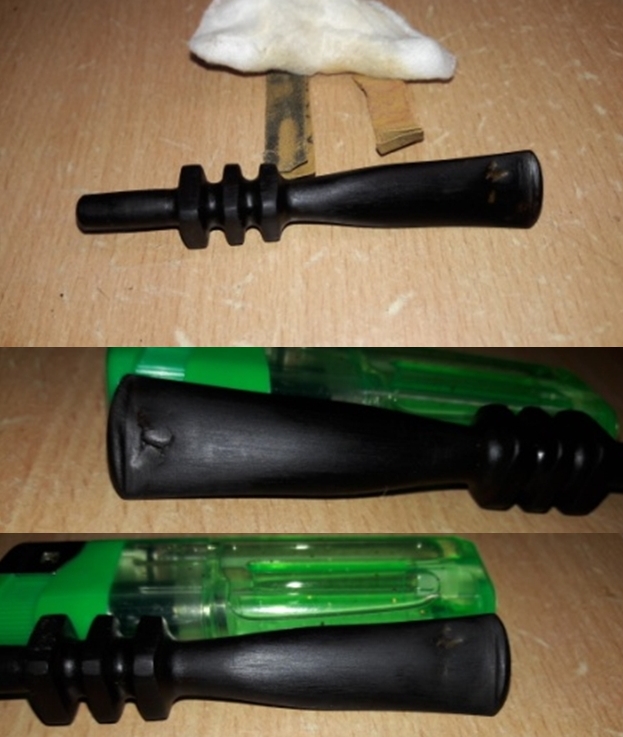
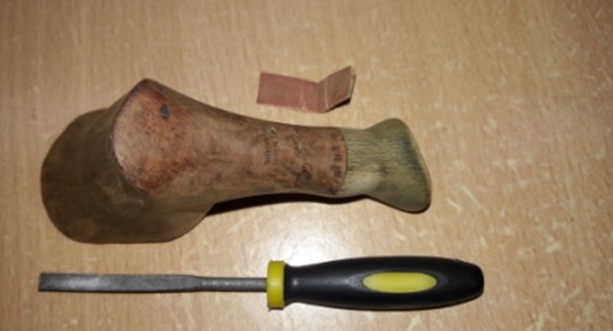
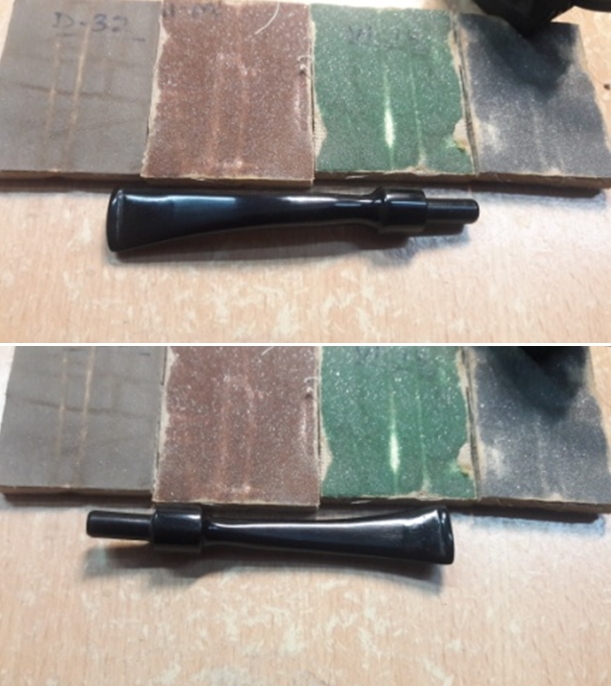
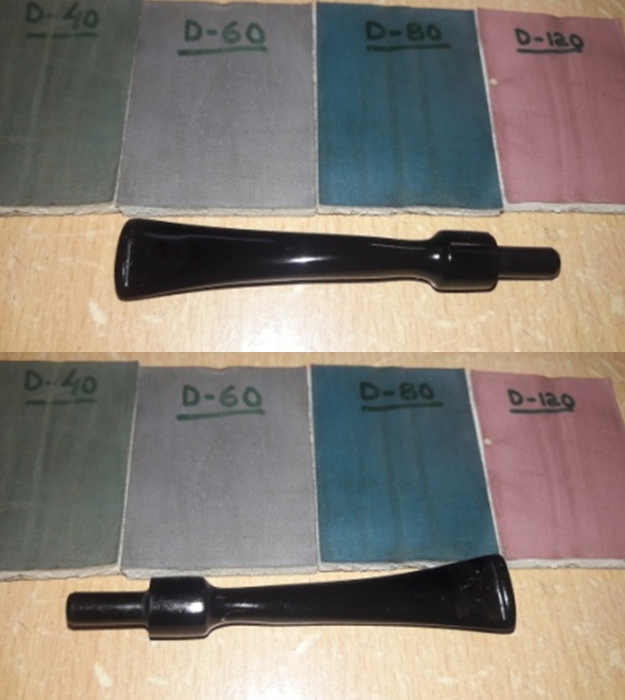
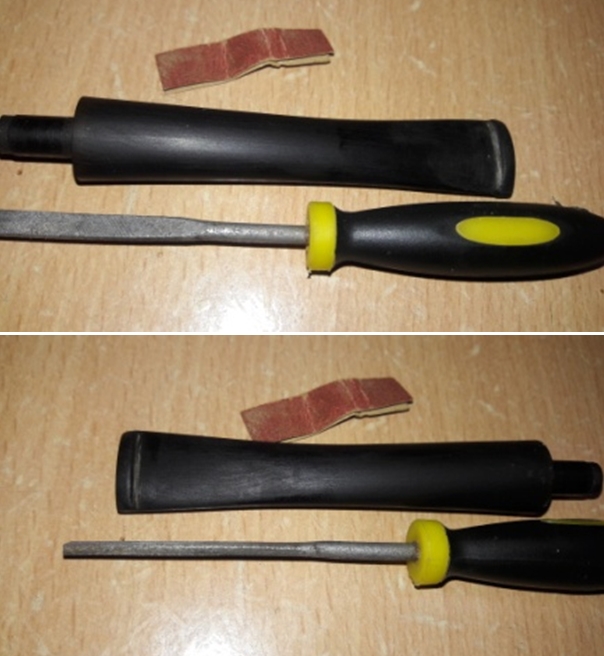
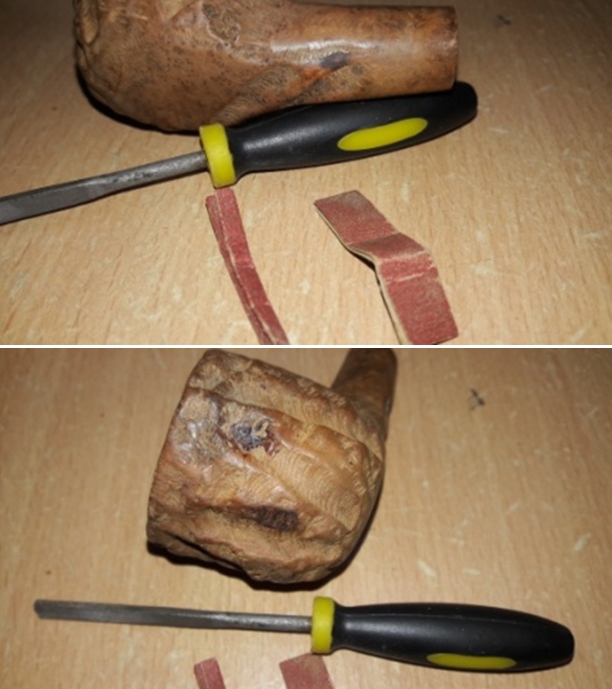
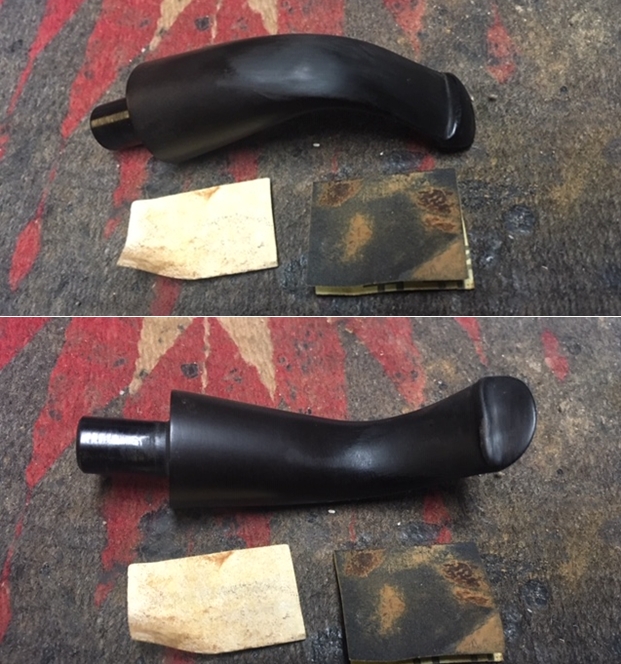
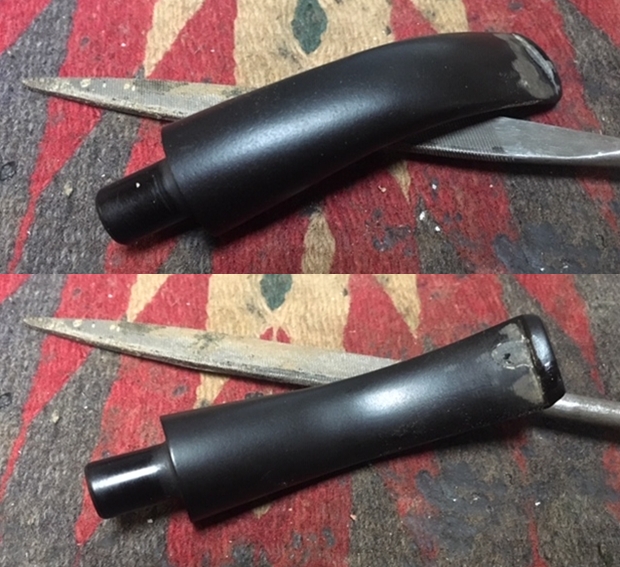
Using a flat head needle file, I reshaped the button and roughly matched the fills with the rest of the stem surface. I sanded the fills with a folded piece of 180 grit sand paper and followed it up by further sanding the stem with 320, 600 and 800 grit sand papers to achieve a perfect blending of the fills with the stem surface and a crisp button edge on either side of the stem. In my exuberance to cross the finish line, I completely missed out on taking pictures of this stage in restoration. My sincere apologies for this miss….

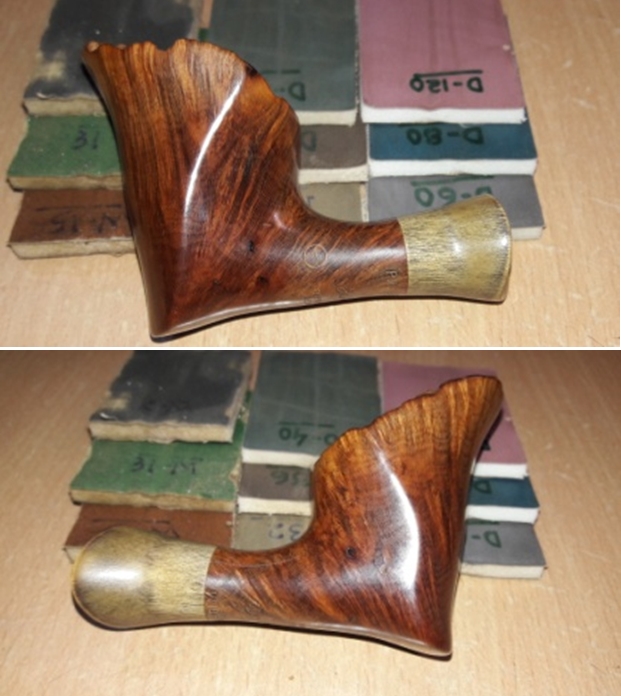
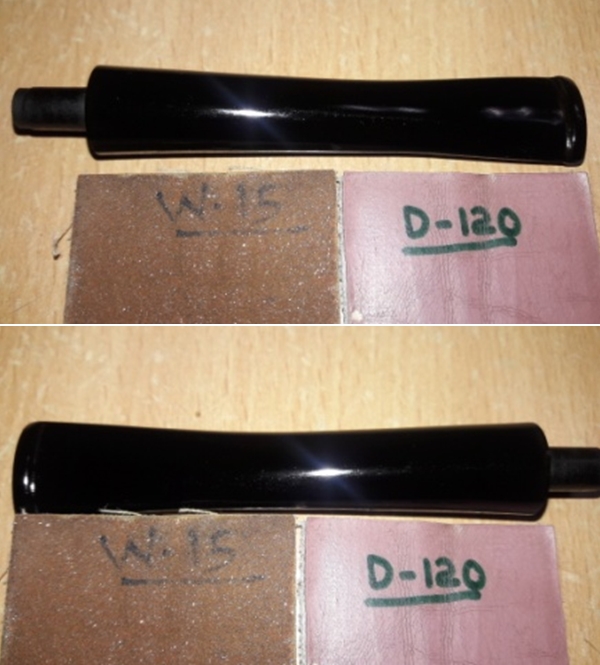
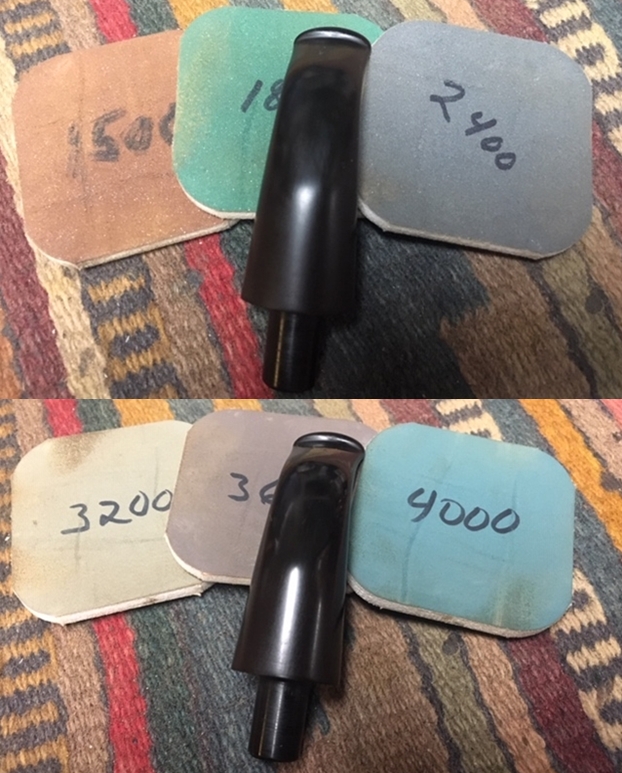
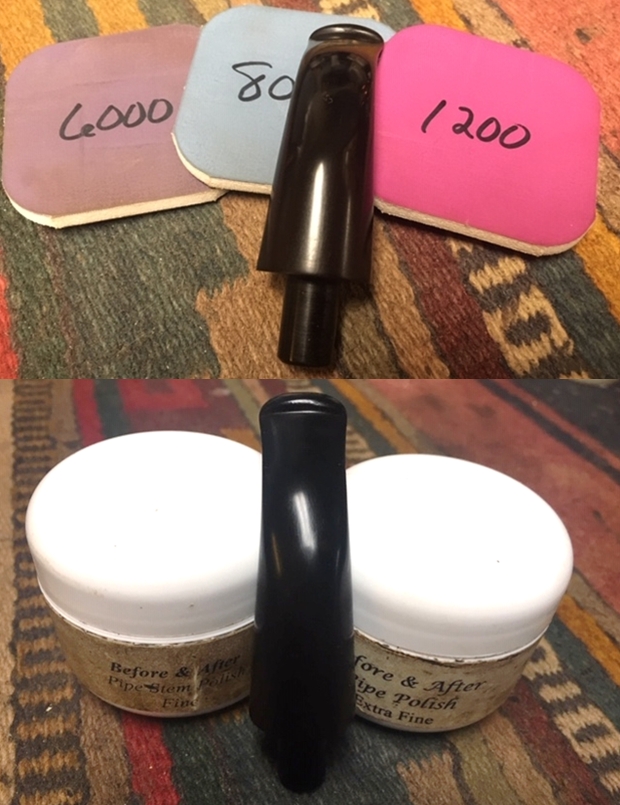
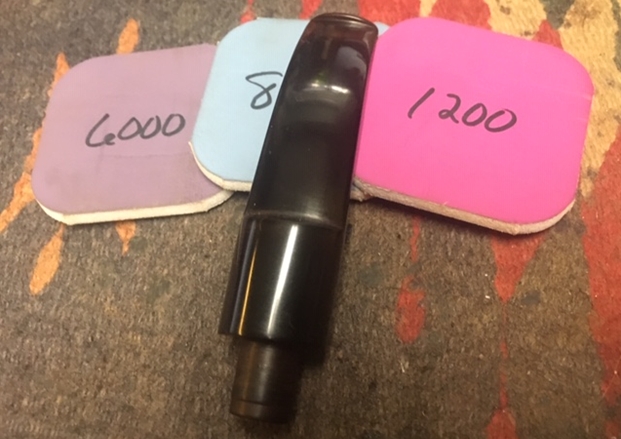
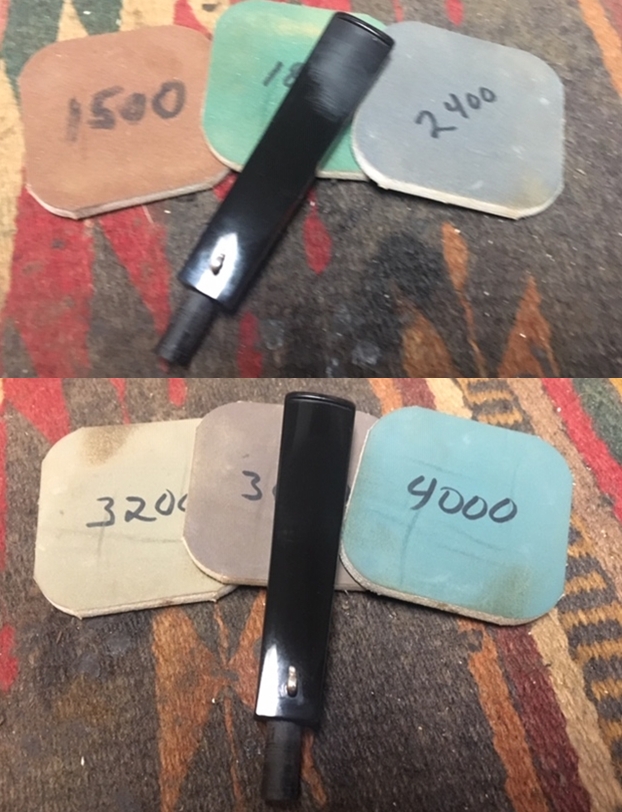
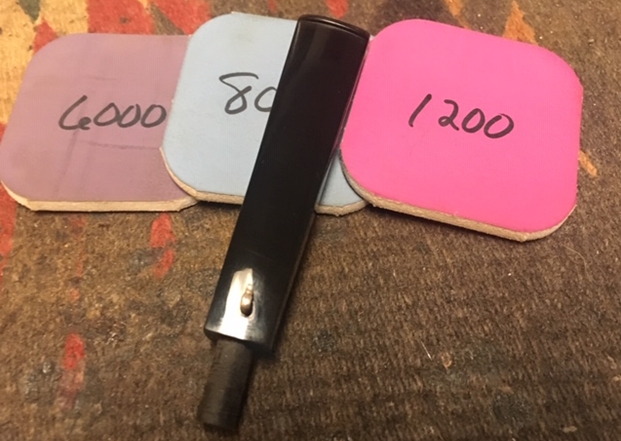
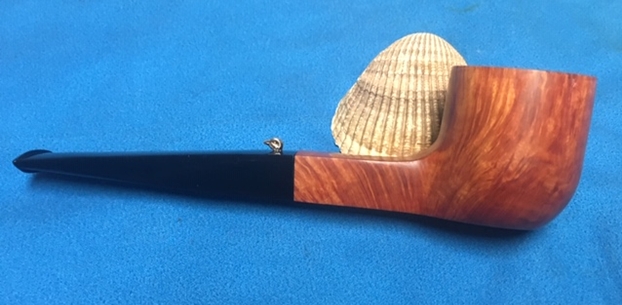
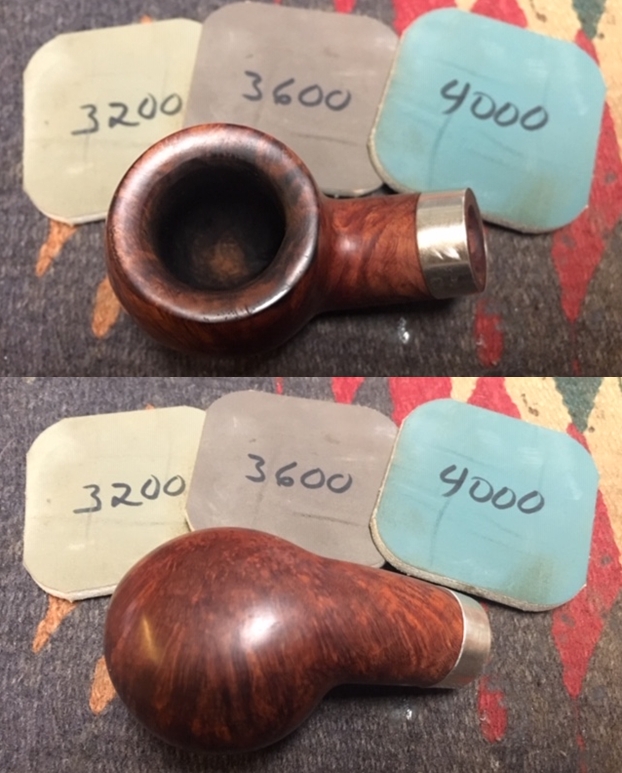
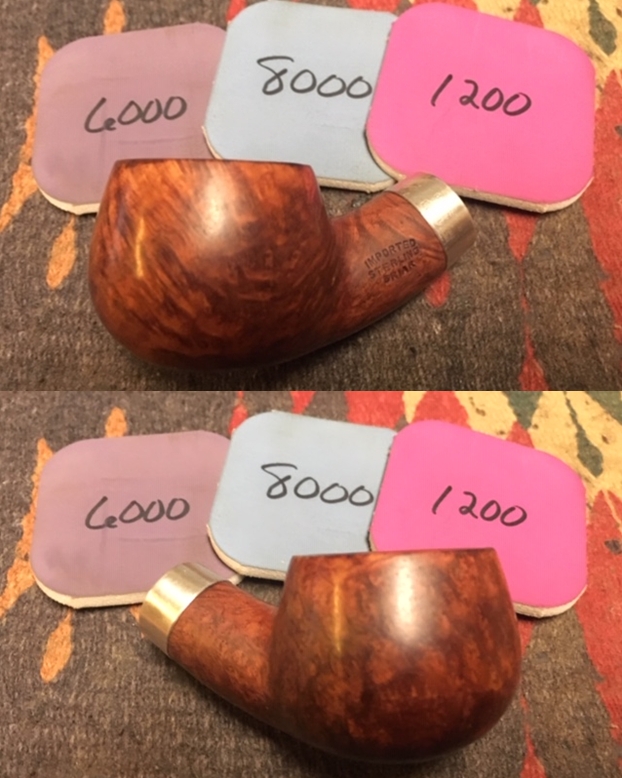
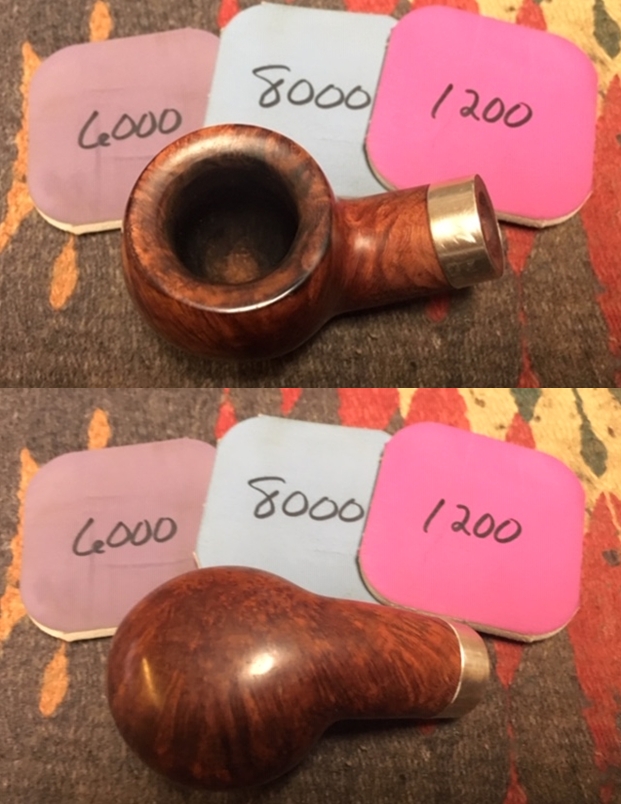
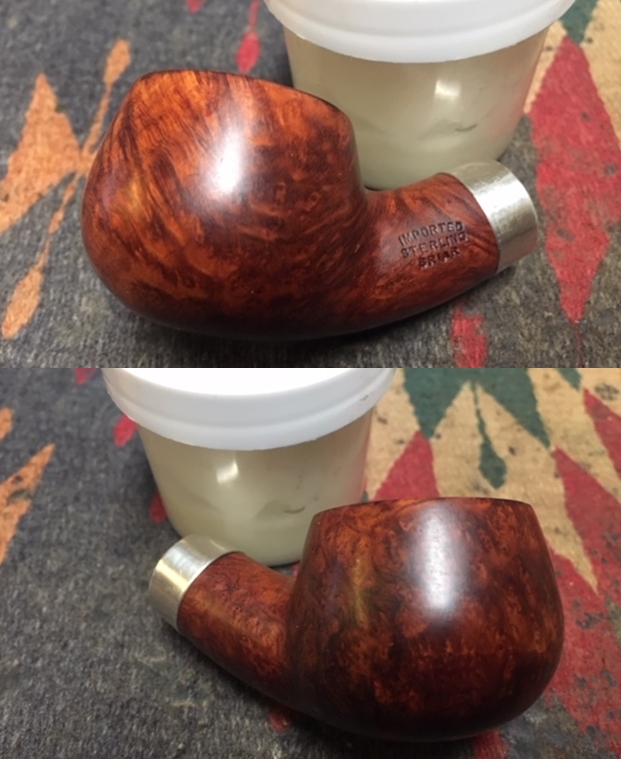
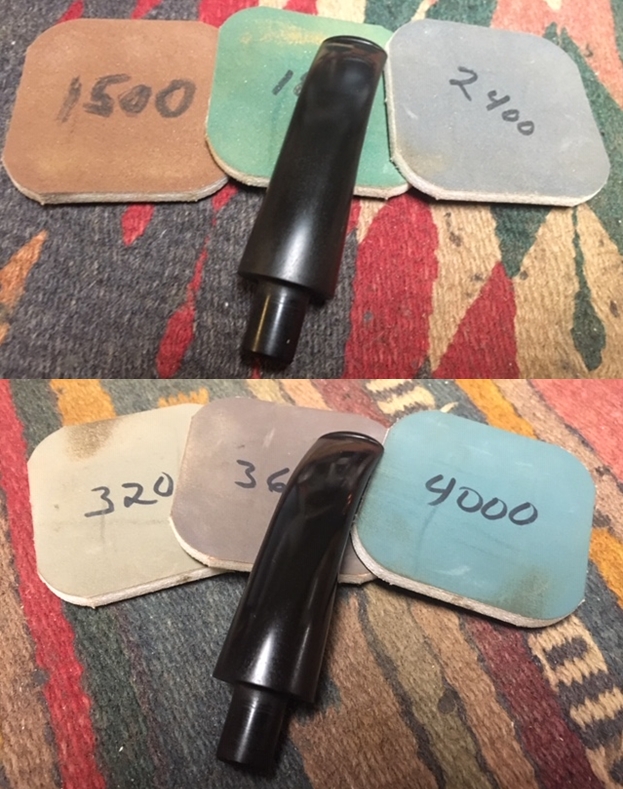
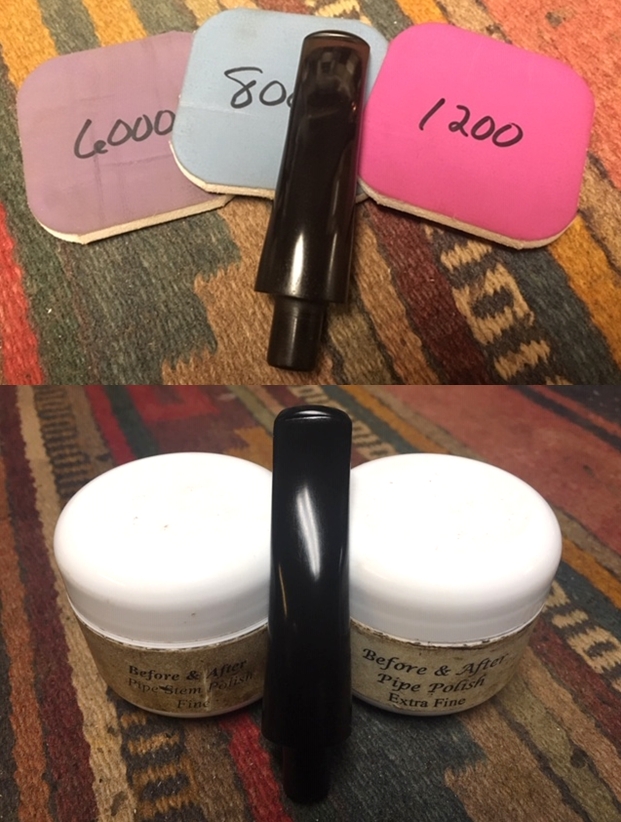
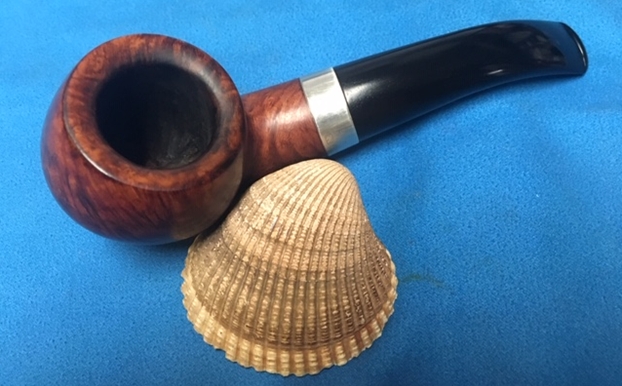
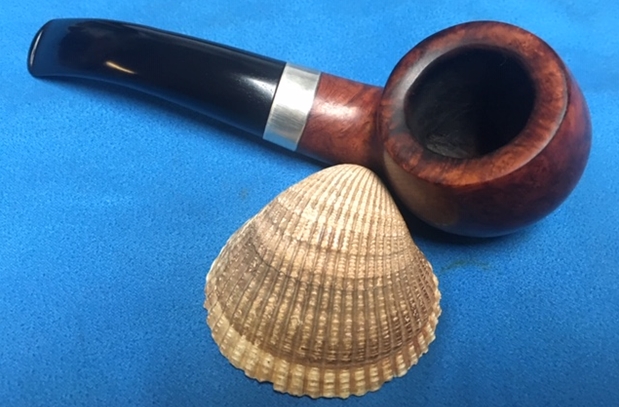
Using the micromesh pads, I completed the polishing cycle by wet sanding the surface with 1500 to 3200 girt pads. I had read that White diamond polish is between 3600 and 4000 grit of micromesh pads and best used between these two. I decided to give this a try to see if there is any difference in the final stem finish. I mount a fresh cotton buffing wheel on to my hand held rotary tool and apply white diamond polish and buffed the stem. I wiped the stem with microfiber cloth and go through the remaining pads, dry sanding with 4000 to 12000 grit pads. The stem looks great with the fills nicely matched with the rest of the surface. I rub a little quantity of Extra Virgin Olive oil in to the stem surface and set it aside to be absorbed by the vulcanite.To complete the restoration, I mount a cotton cloth buffing wheel on to my hand held rotary tool and applied several coats of carnauba wax. I finished the restoration by giving the entire pipe a rigorous hand buffing using a microfiber cloth to raise the shine further and remove any residual wax from in between the plateaus of the rim top surface. The finished pipe looks amazingly beautiful and is now ready for its long second innings with me. I only wish it could share with me its life story of the past years while I enjoy smoking my favorite Virginia blend in it or maybe an English blend!! P.S. I earnestly would like to request all the readers to help me with the grading and dating this pipe. The only thing that is confirmed is that this is definitely not one of the high grade pipes from Preben Holm what with the fills that were seen on the stummel, but nevertheless, it’s a PH!!!!

There is only one more pending write ups which I shall be tackling before I undertake to restore a pipe which my dear friend and mentor, Steve, had sent me about a year back with the intention of providing me an opportunity to test my own skills. I wish to thank each one for sparing their valuable time to read through this write up and sharing this journey with me.

Restoring an Interesting Acorn # 7472 from Stanwell

Blog by Paresh Deshpande

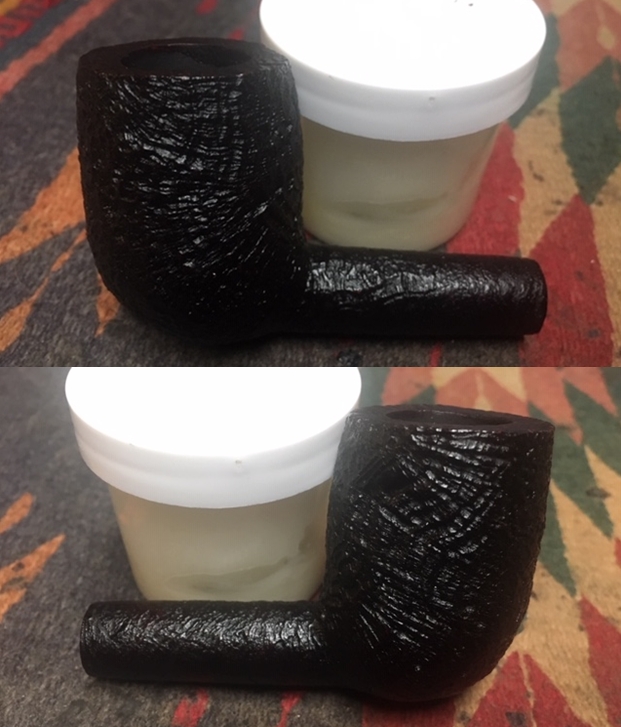
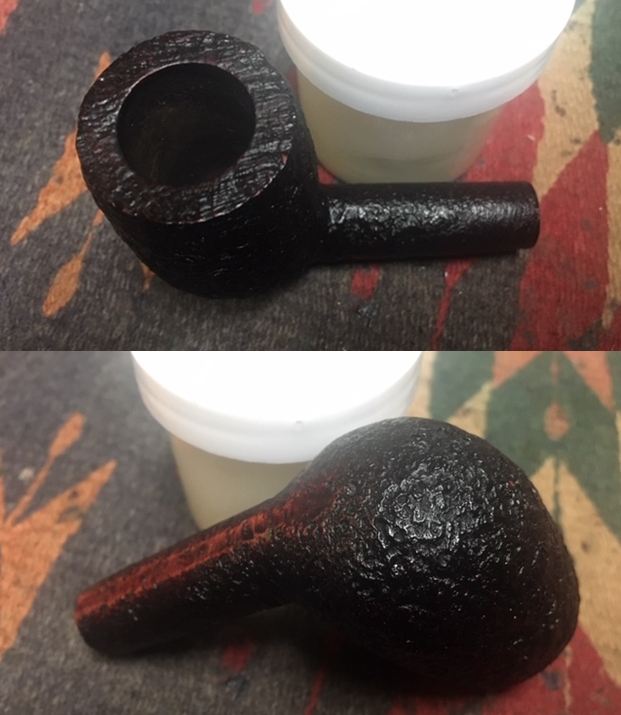
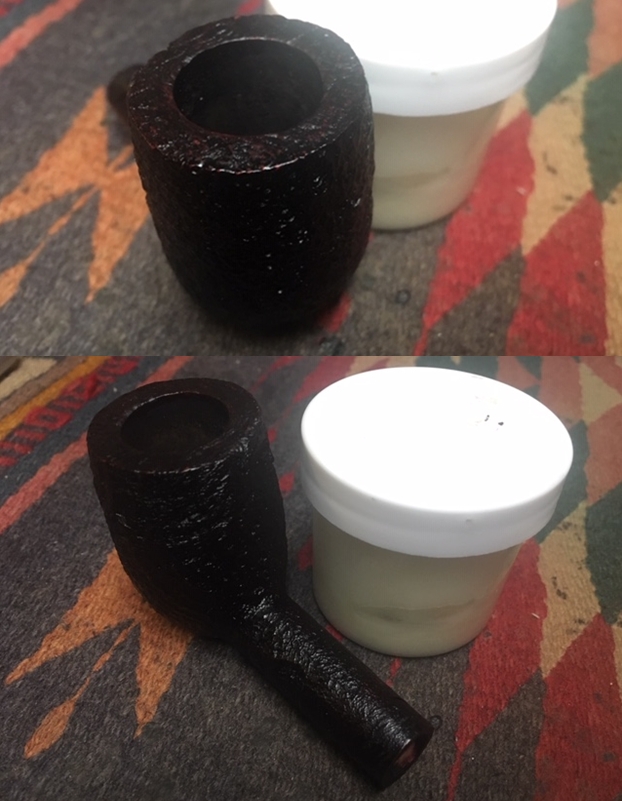
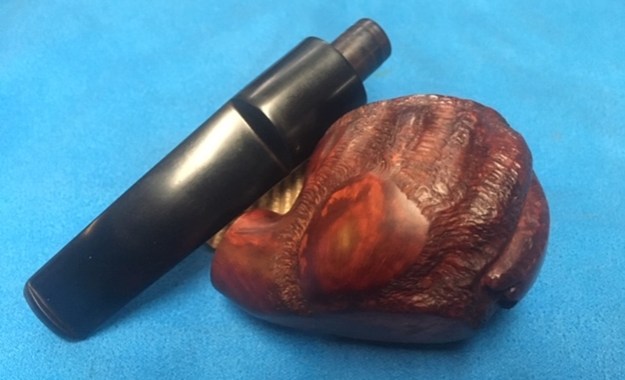
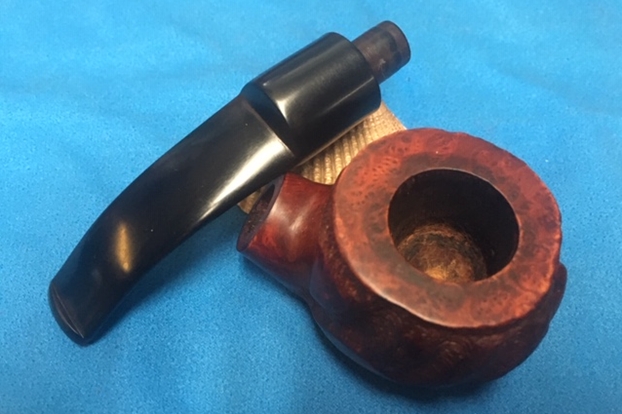
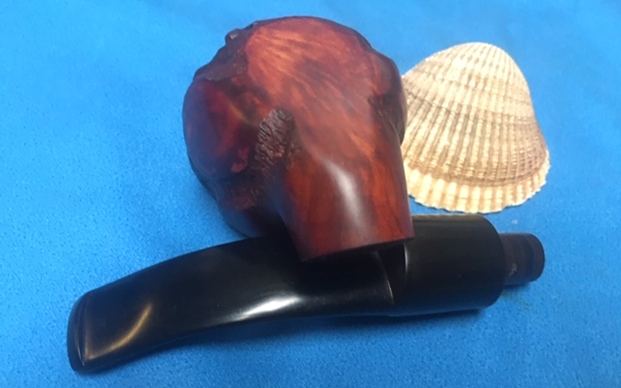
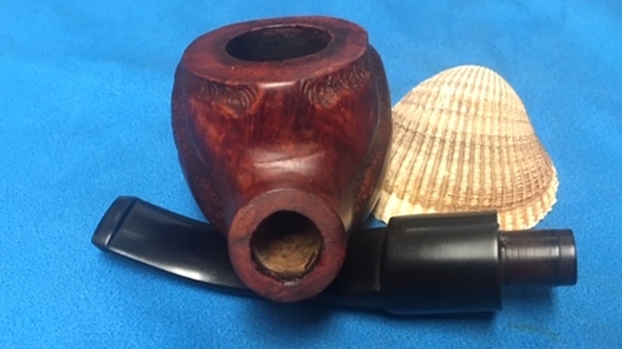
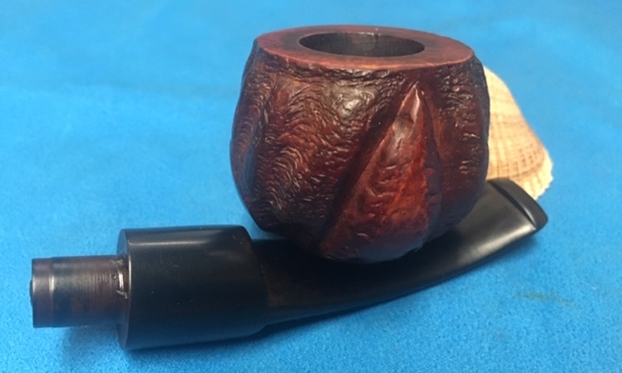
One of the pipes in my Mumbai Bonanza lot which intrigued me no end was a small Acorn shaped pipe from the Danish pipe maker, Stanwell. I prefer large pipes and so this pipe was always being relegated to the next-in-line project status. Finally I decided to break the shackles of resistance and brought it to my work table as the next project. It’s a Stanwell pipe with shape code # 7472.

I was fortunate enough to have heeded the advice of my dear friend and mentor, Steve, and struck a deal with a junk collector from Mumbai. He did not know what he was selling and I did not know what I was buying as we reside in different cities!! The argument that Mr. Steve presented was that if not anything, I shall at least have some spares and this was logical. I struck a deal and here are pictures of the pipes that I received in this lot. This lot contains some very nice collectible pipes, a few well known brands and some mediocre brands. Overall, with seven Dunhill pipes, a Preben Holm #1 FH, a couple of “Made in England” Pete System pipes, a couple of  Charatan’s Belvedere, Custom-Bilt, Stanwell and other assorted pipes, I would say that I had struck a decent haul!!! This is indeed my “Mumbai Bonanza”.

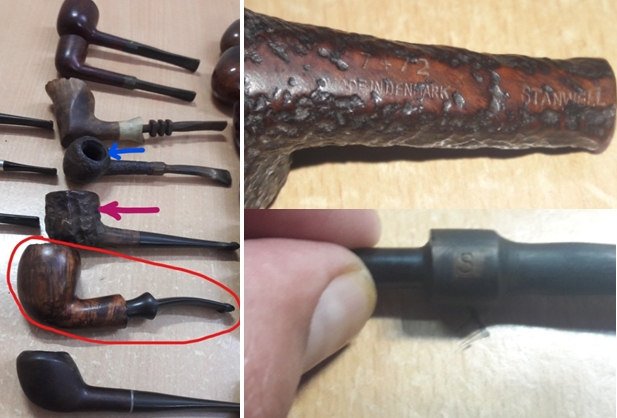
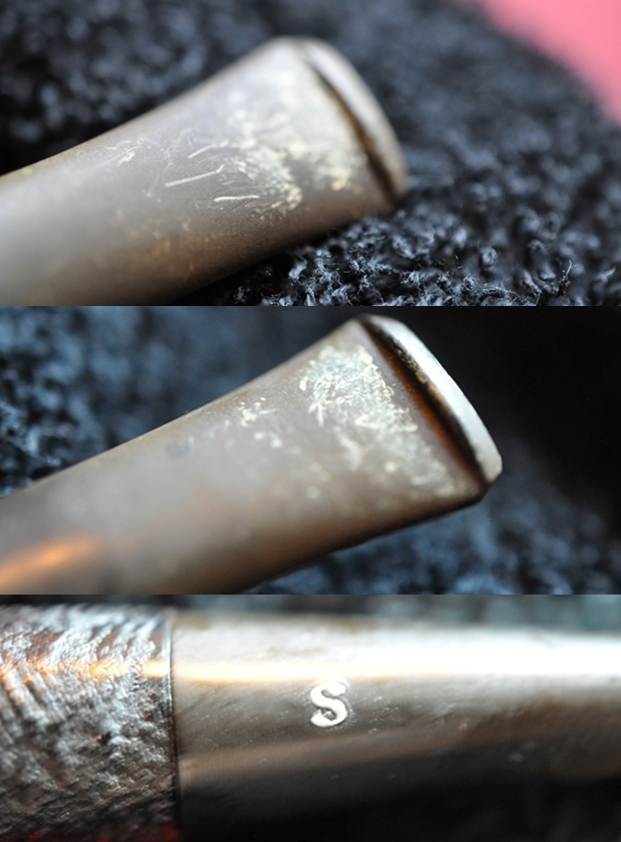
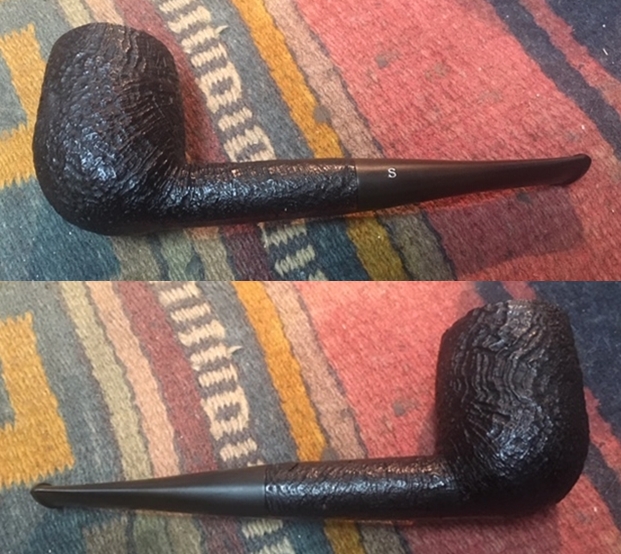
This, then, is the 13th pipe that I decided to work on from this find and is an Acorn shaped pipe indicated in blue colored arrow in the picture below. It is stamped on the bottom middle half of the smooth surface of the shank as “# 7472” over “MADE IN DENMARK”. Towards the shank end, it is stamped as “STANWELL” in its trademark inverted arch in block capital letters. The stem bears a plain “S” logo on the left side of the stem.Now coming to the research of this brand and line/ model in specific, I referred to pipedia.org and as expected there is an extensive research on this pipe and even has a separate page on Stanwell Shape numbers and Designers, a study compiled by Stanwell collector and an undisputed authority on these pipes, Basil Stevens. However, there is nothing on this particular shape and number, in fact, this shape and number does not find any mention. I even visited rebornpipes.com in the hope that I would be able to unravel the mystery shrouding this pipe, but to no avail.

The only input I received was from Steve was that this is most likely a Sixten Ivarsson carved pipe, but nothing to date and confirm. Any reader who has any information or knowledge about this pipe is earnestly requested to share it with us on rebornpipes!

INITIAL VISUAL INSPECTION
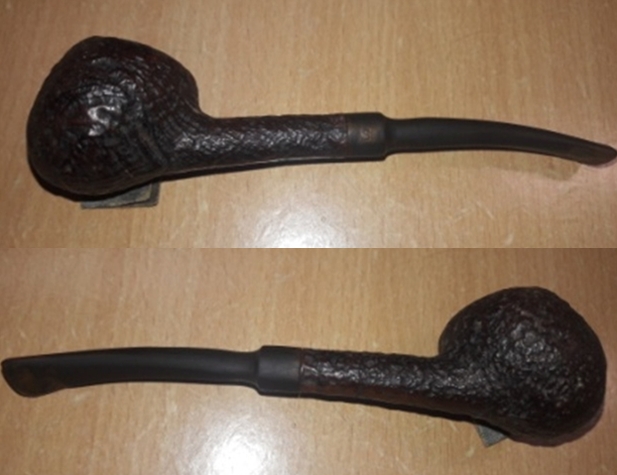
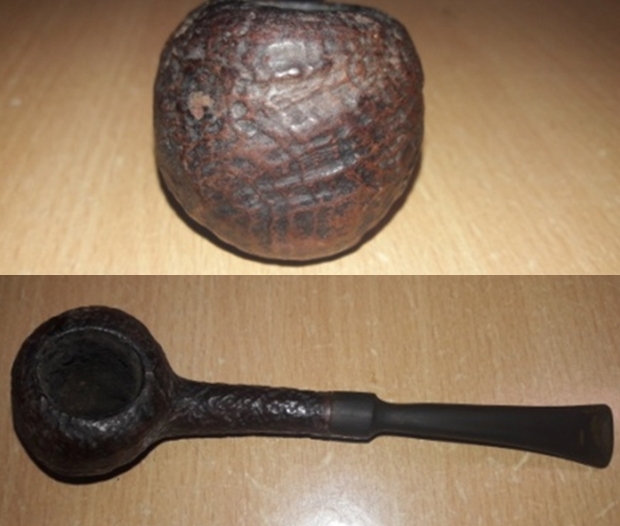
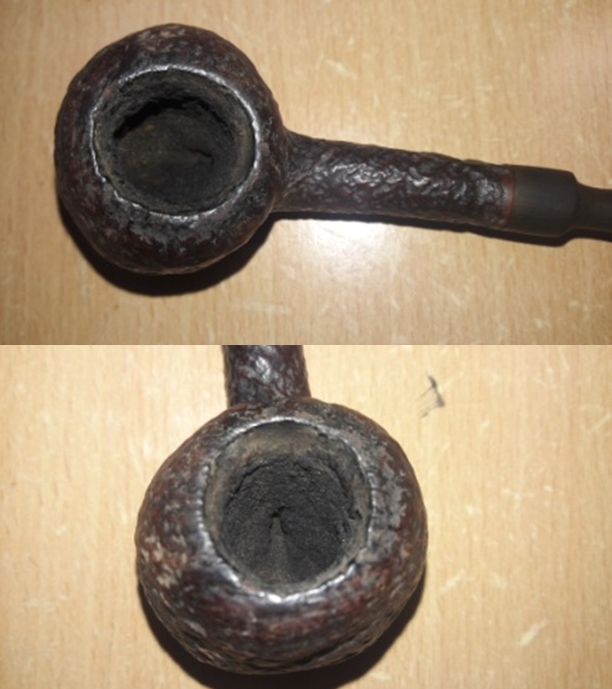
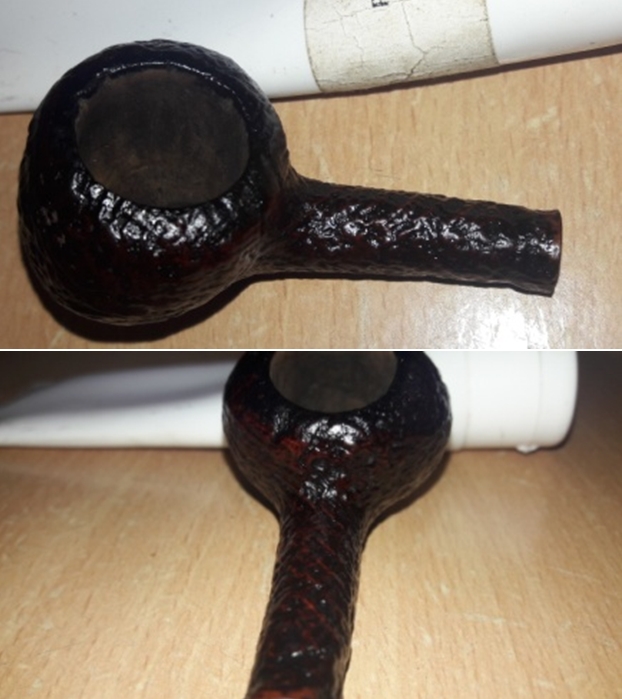
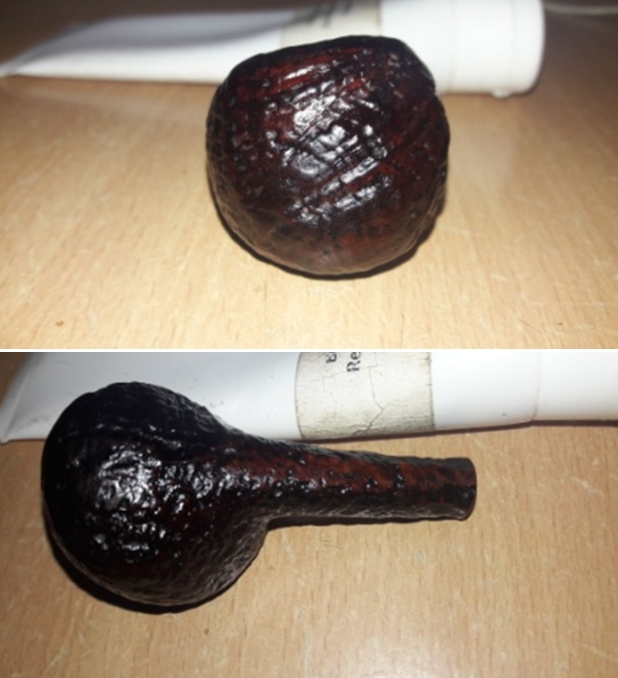
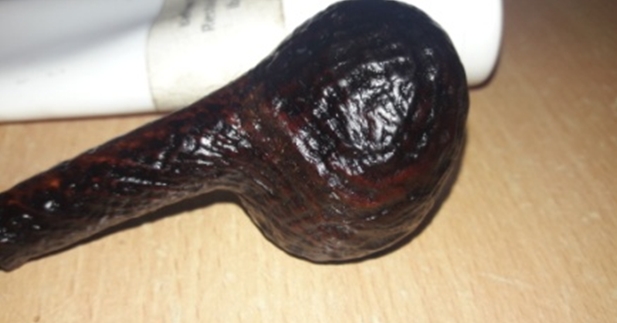
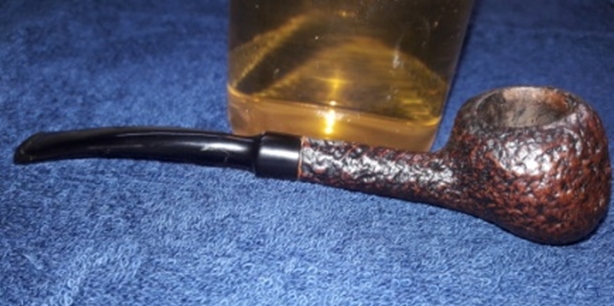
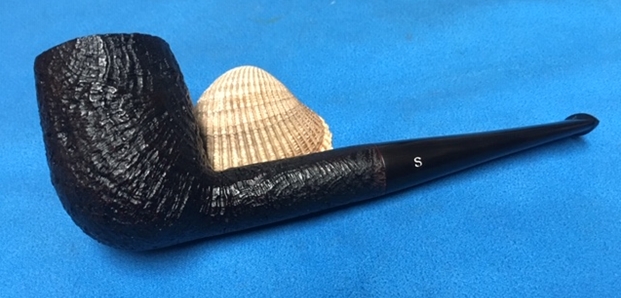
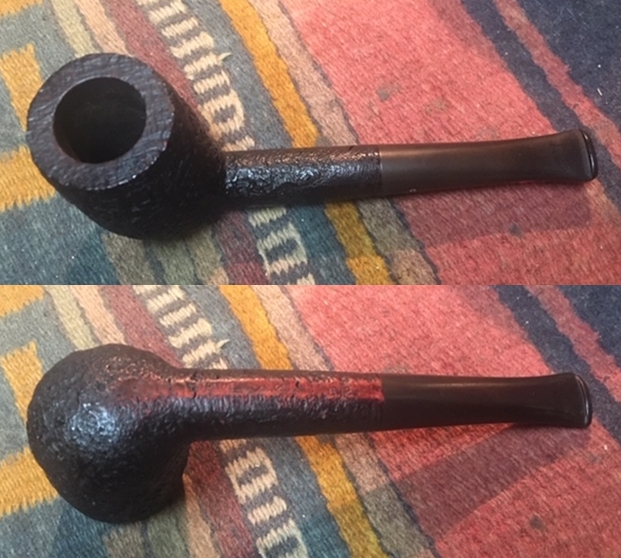
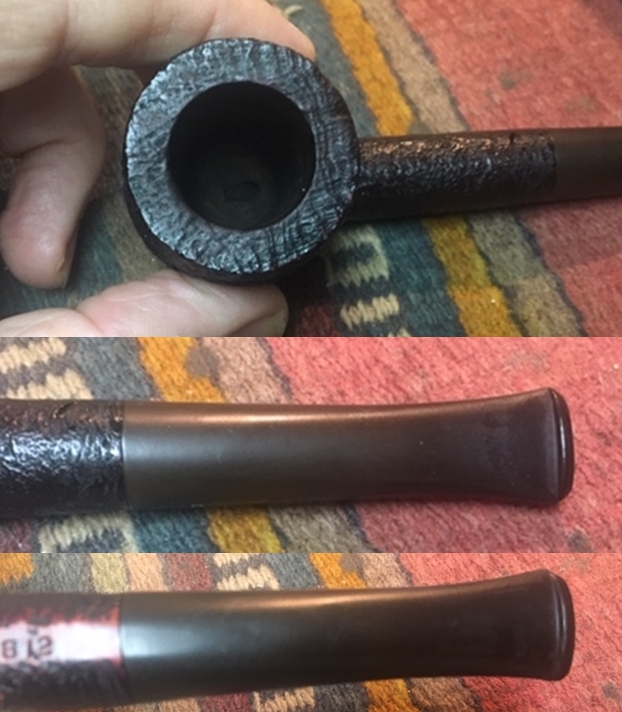
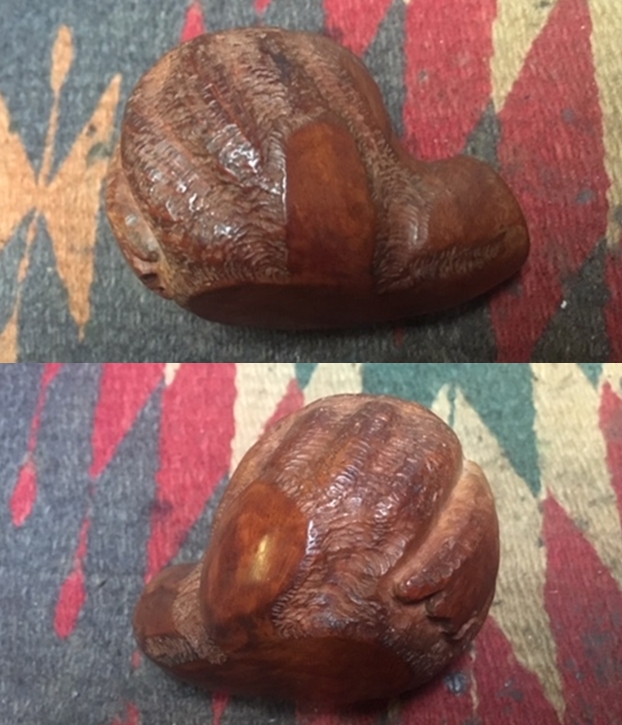
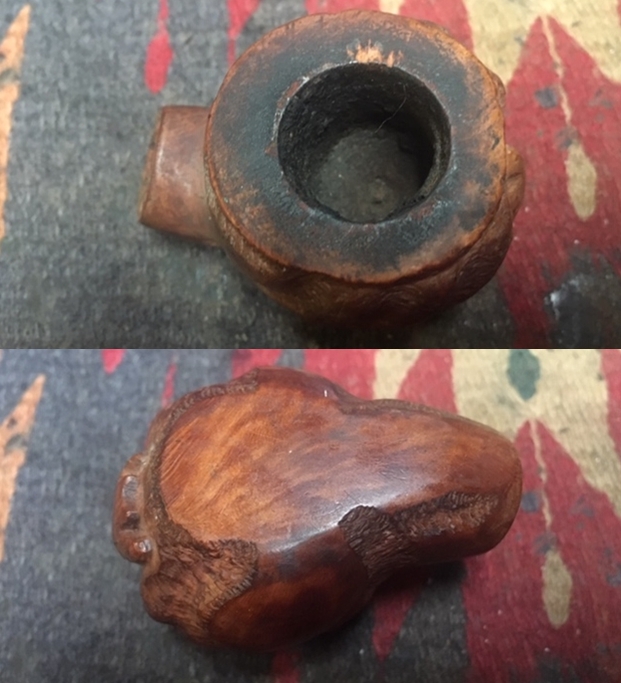
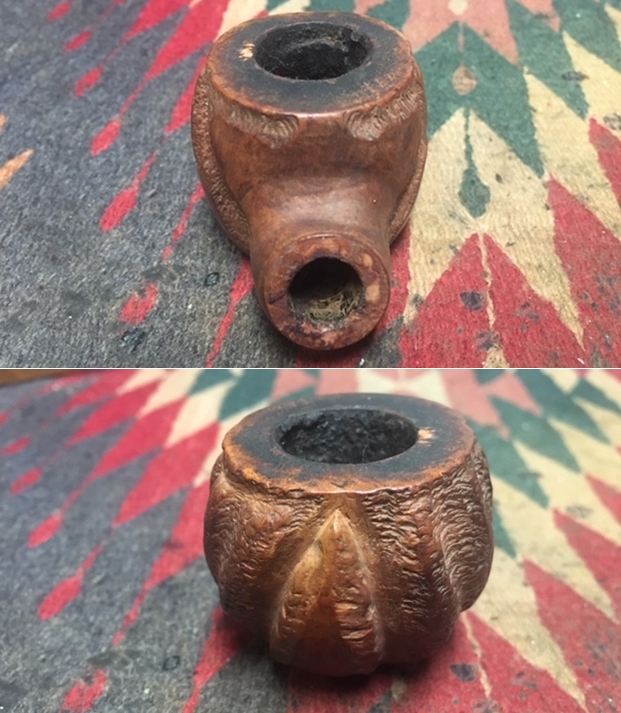
The stummel has beautiful sandblast patterns on the uniquely shaped stummel with a short neck and a nice flow to the shape profile of the pipe. The sandblasted stummel is covered in dirt and grime of yesteryear. This should clean up nicely. The stummel surface is solid with no damage to the external surface. The dark browns of the raised sandblast contrast beautifully with the black stain of rest of the stummel. A thick layer of cake can be seen in the chamber. The sandblasted thin and inward curving rim top surface is covered in thick overflow of lava, dirt, dust and grime. The condition of the inner walls of the chamber and rim top surface will be known once the cake has been taken down to bare briar and the rim top crud has been scraped off completely. The inner rim condition appears to be in good condition with no burn/ charred surfaces. Even the outer rim edge appears to be in a decent condition. Only once the stummel has been thoroughly cleaned that I can be sure of my initial appreciation. In spite of the thick cake, the chamber odor is, surprisingly, not strong and should be addressed once the cake has been taken down to the bare briar and the shank internals have been thoroughly cleaned. The draught hole is dead center at the bottom of the chamber and should be a great smoker. The shank end and the mortise are blocked with dried gunk, adversely affecting the airflow.The delicate vulcanite saddle stem is heavily oxidized and has calcification deposits towards the button end. There are deep tooth marks on the lower and upper stem surface and appears that the previous owner has literally chomped on the bite zone of the stem. The button edges also have bite marks, in fact, they are badly worn out. The horizontal slot shows accumulated oils and tars.Along with the stems of other pipes in line for restoration, I immersed the stem of this Stanwell #7472 in a mix of one part Hydrogen Peroxide 20% with one part hot water after I ran a couple of pipe cleaners dipped in alcohol through the stem air way. A couple of hours later, the stem oxidation on all these stems were raised to the surface. After I had fished out the stem from the Hydrogen Peroxide bath, I scrubbed it with Magiclean sponge and followed it up with a wipe of cotton swab and alcohol. I further scrubbed the stem surface with 0000 grade steel wool. The loosened and superficial layer of oxidation was easily removed and revealed the condition of the stem. It was not as horrifying as I had imagined it to be during the initial inspection. There are deep bite marks in both the upper and lower bite zone. The bite marks are deep enough to cause significant thinning of the surface and complete disfigurement of the button edges. The deeper oxidation that was pulled to the surface would require more abrasive techniques.THE PROCESS
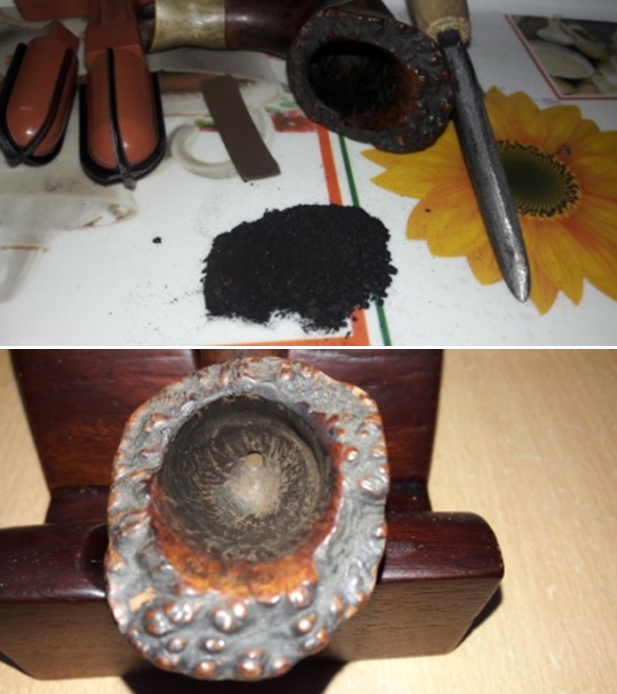
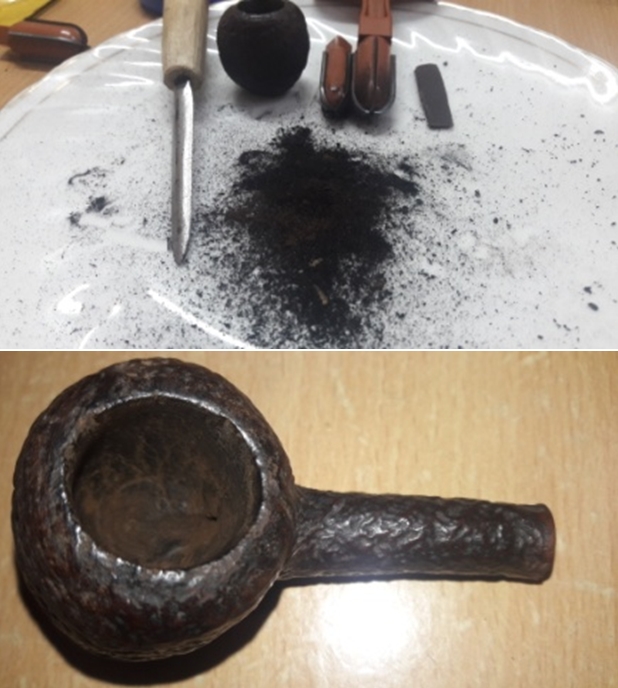
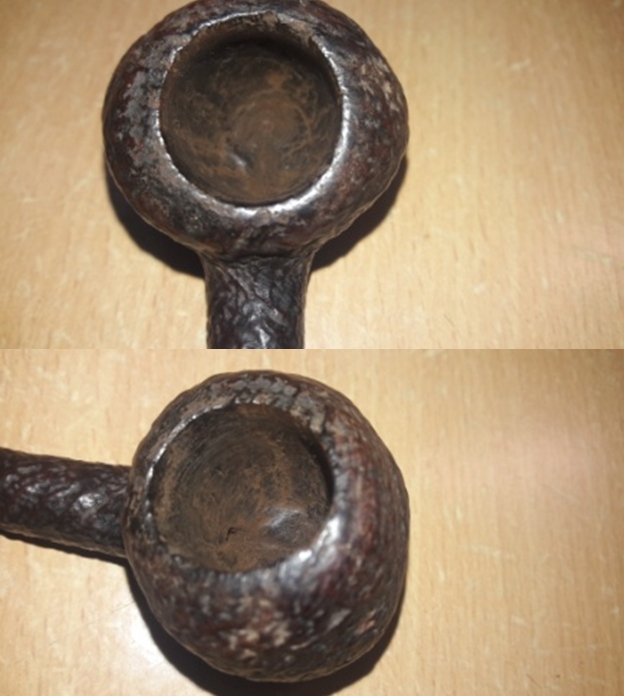
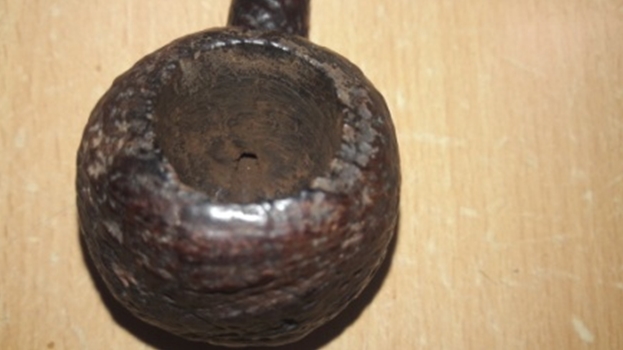
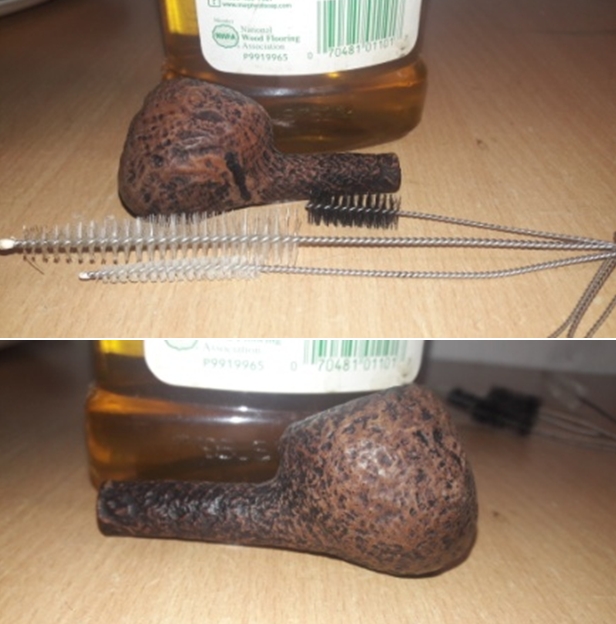
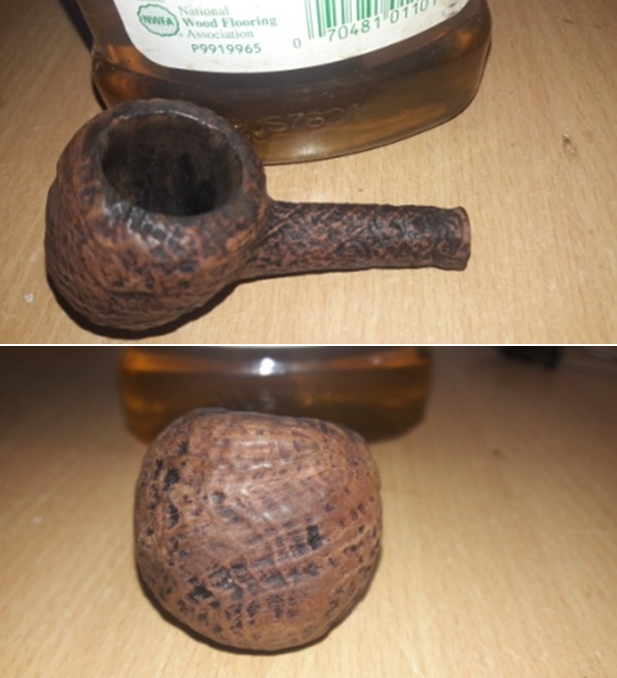
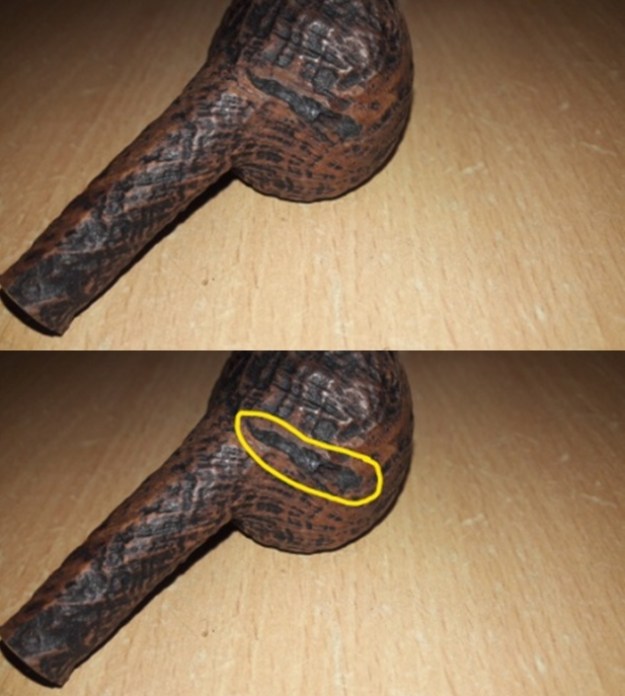
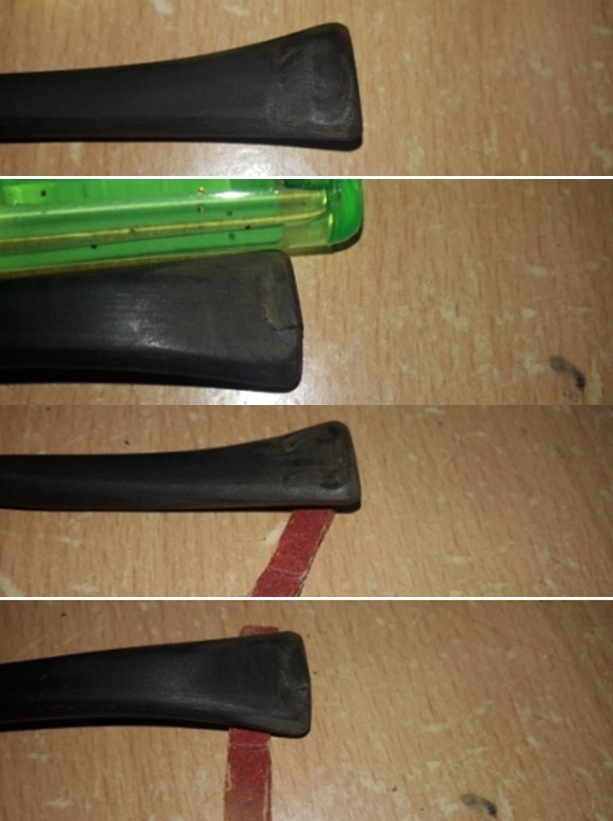
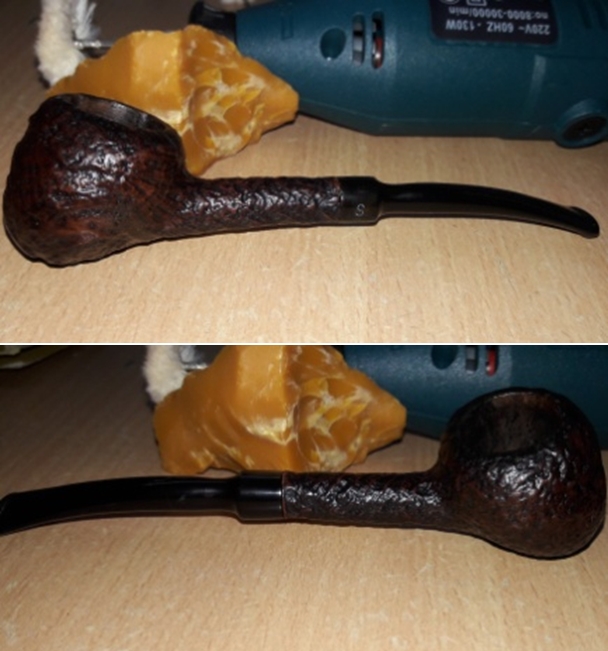
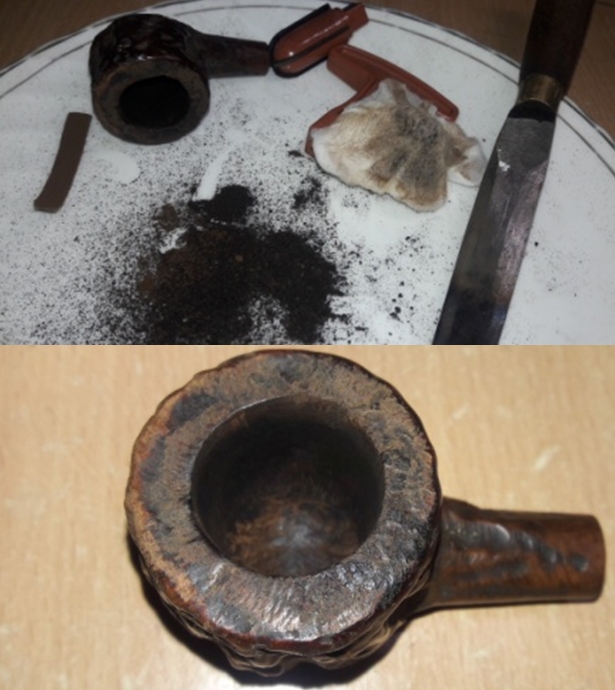
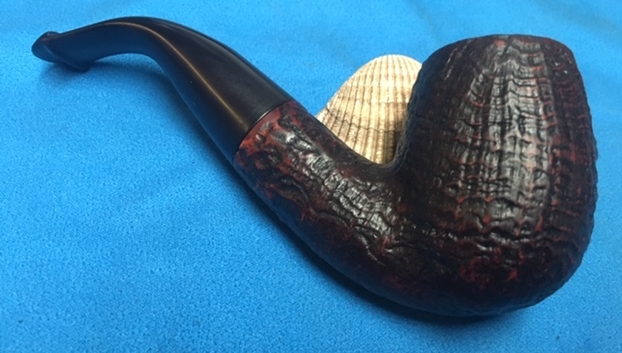
I started with cleaning of the stummel as I was keen to know the condition of the walls of the chamber. With size 1 head followed by head size 2 of a PipNet pipe reamer, I took the cake down to bare briar. Using a folded piece of 180 grit sand paper, I sand out the last traces of cake and expose the walls of the chamber. I wiped the chamber with a cotton pad dipped in isopropyl alcohol to remove the carbon dust left behind by all the reaming and sanding process. Once the chamber walls were cleaned out, I saw very minor and superficial beginnings of heat fissures/ pits all along the chamber walls. I shall address this issue by a simple bowl coat. I used my smaller of the two fabricated knife to gently scrap away at the overflow over the rim top surface while being careful not to damage the sandblast on the rim top. I was pleased to find the inner and outer edge of the rim intact and without any burn or char marks. Next, I cleaned out the internals of the shank and mortise. Using my dental tool, I scraped out all the dried oils, tars and gunk that had accumulated in the shank airway and mortise. The amount of crud that was scrapped out and the condition of the pipe cleaners that were used leaves no surprise why air flow through it was restricted. I finished the cleaning by running a few pipe cleaners dipped in isopropyl alcohol. I also wiped the shank with cotton buds and alcohol. With this cleaning, all old smells in the pipe are history. The pipe now smells clean and fresh.With the internals of the stummel now clean, I cleaned the external surface using a hard bristled toothbrush and Murphy’s Oil Soap. I diligently scrubbed the stummel to remove all the dust and dirt that was embedded in the crevices of the sandblast. With a soft bristled brass wired brush, I removed the overflowing lava from the rim top surface and cleaned the internals of the shank with a shank brush and dish washing soap to remove what little crud remained in the shank. I rinsed it under running tap water and wiped the stummel dry with an absorbent soft cotton cloth. Once I had wiped the stummel dry with paper towels and soft cotton cloth, I thought I saw a fill on the left side of the bowl, near the bowl and shank joint. It was perfectly matched and blended with the sandblast on the stummel and stained in dark as seen on other surfaces of the stummel. It is marked in yellow circle. My fears were confirmed when I probed it with a dental pick. Very carefully and painstakingly, I completely removed the old fill with a pointed dental pick. I cleaned the fill of all the debris of old fill material, wiped it with alcohol and refreshed the fill with a mix of clear CA superglue and briar dust and set it aside to cure overnight.By next day, the fill was hard and well set. With a folded piece of 220 grit sand paper, I worked the fill till I had achieved a nice blend with the shape and contours of the stummel. It turned out much better than I had anticipated. With a soft wire brass brush, I again cleaned out all the debris that lodged itself in the sandblast surface as a result of all the sanding and use of briar dust.Next, I rub a small quantity of “Before and After Restoration Balm” in to the briar with my finger tips, work it deep in to the sandblasts and let it rest for a few minutes. The balm almost immediately works its magic and the briar now has a nice vibrant appearance with the beautiful sandblast patterns on full display. The contrast of the dark browns of the raised sandblast with the dark black of the rest of the stummel adds an interesting dimension to the appearance of the stummel. I further buffed it with a horse hair brush. The last picture is of the side that had the refreshed fill and even the most discerning reader will be hard pressed to accurately pin point the fill. With the stummel nearly completed, I turned my attention to the stem repairs. I masked the stem logo “S” with a whitener pen to protect it during the sanding process. I cleaned the internals of the stem using hard and normal bristled pipe cleaners and isopropyl alcohol. With a pointed dental tool, I scraped out the entire dried gunk from the slot. I addressed the deeper oxidation by sanding the entire stem with a folded piece of 220 grit sand paper. Once the oxidation was completely removed, I wiped the surface clean with a cotton swab and alcohol. I flamed the damaged button edge and the nicks and dents with the flame of a lighter. This helps the vulcanite to rise to the surface as it has an inherent property to regain its original shape when heated. At this stage, I noticed that the bite zone on the upper stem surface has a crack which extends over to the button. This was further accentuated due to heating with the flame of a lighter. Continuing with the stem repair, I inserted a triangulated index card covered in transparent tape in to the slot. The tape prevents the mix of superglue and charcoal from sticking to the index card. I mixed superglue and activated charcoal powder and generously applied it over the bite zone, including over the button and set it aside to cure. Once the mix had cured, I removed the index card from the slot.Using a flat head needle file, I reshaped the button and roughly matched the fills with the rest of the stem surface. However, things rarely happen as you want them to happen and in this case, a few air pockets were revealed. With a permanent black marker I darkened the air pockets and spot filled them with clear superglue. Once the superglue had cured (I had set it aside overnight), I sanded the fills with a folded piece of 180 grit sand paper. I followed it up by further sanding the stem with 320, 600 and 800 grit sand papers to achieve a perfect blending of the fills with the stem surface and a crisp button edge on either side of the stem.Using the micromesh pads, I completed the polishing cycle by wet sanding the surface with 1500 to 3200 girt pads. I had read that White diamond polish is between 3600 and 4000 grit of micromesh pads and best used between these two. I decided to give this a try to see if there is any difference in the final stem finish. I mount a fresh cotton buffing wheel on to my hand held rotary tool and apply white diamond polish and buffed the stem. I wiped the stem with microfiber cloth and go through the remaining pads, dry sanding with 4000 to 12000 grit pads. The stem looks great with the fills nicely matched with the rest of the surface. I rub a little quantity of Extra Virgin Olive oil in to the stem surface and set it aside to be absorbed by the vulcanite. To complete the restoration, I mount a cotton cloth buffing wheel on to my hand held rotary tool and applied several coats of carnauba wax. I finished the restoration by giving the entire pipe a rigorous hand buffing using a microfiber cloth to raise the shine further and remove any residual wax from in between the sandblasts.The finished pipe looks amazingly beautiful and is now ready for its long second innings with me. I only wish it could share with me its life story of the past years while I enjoy smoking my favorite Virginia blend in it or maybe an English blend!! P.S. There was only one more issue that needed to be addressed and one that could not be ignored, being a functional issue. After I had reamed and sanded the chamber walls, I had observed very minor and superficial beginnings of heat fissures/ pits all along the chamber walls. I addressed this by mixing activated charcoal and plain yogurt to a thicker consistency, just enough that I would spread easily and applied it evenly all along the chamber walls after inserting a folded pipe cleaner through the draught hole to keep it open. Once dry and set, this will not only protect the walls but also aid in faster build up of cake.There are two more pending write ups which I shall be tackling before I undertake to restore a pipe which my dear friend and mentor, Steve, had sent me about a year back with the intention of providing me an opportunity to test my own skills. I wish to thank each one for sparing their valuable time to read through and once again request you for any inputs or advice on dating and designer of this pipe.

Restoring a Custom-Bilt Small Pot from my ‘Mumbai Bonanza’

Blog by Paresh Deshpande

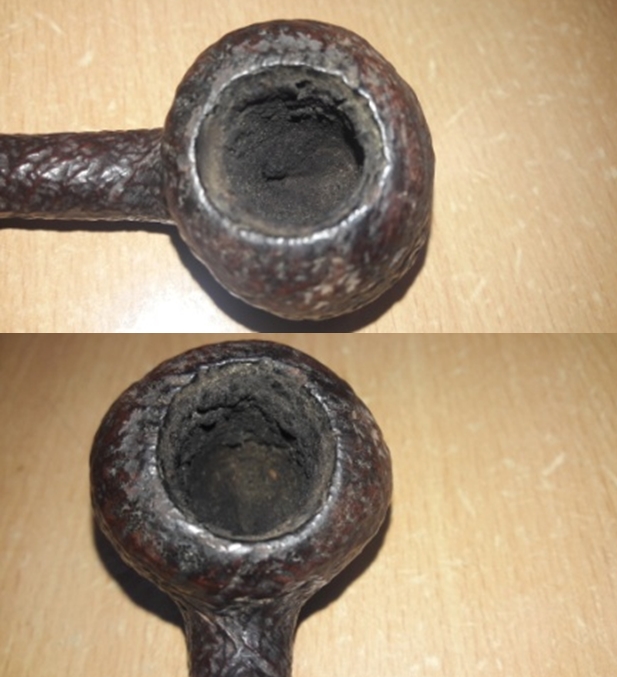
It seems that my grandfather loved Custom-Bilt pipes!! I say this with certain amount of conviction as there are quite a few of them in his collection that I have inherited. All the Custom-Bilts in his collection have, apart from the trademark rustications developed and mastered by Tracy Mincer, large size (more like humongous, I say!). Thus, when Abha, my wife sent me pictures of the Mumbai Bonanza lot, I instantly recognized a Custom-Bilt. I confirmed from Abha on Face time that the stamp was spelt with a hyphen between Custom and Bilt confirming the vintage. I was surprised to say the least, not at the fact of finding a Custom-Bilt in the lot (which incidentally contains many collectible pipes), but surprised at the size which stared back at me!! It was small, but small when compared to the size of the other Custom-Bilts that I have inherited. This is the pipe that is now on my work table, my first restoration work after rejoining my work place.

For those readers who have missed out on my previous work, I was fortunate enough to have heeded the advice of my dear friend and mentor, Steve, and struck a deal for 30 pipes with a junk collector from Mumbai. He did not know what he was selling and I did not know what I was buying as we reside in different cities!! The argument that Mr. Steve presented was that if not anything, I shall at least have some spares and this was logical. I struck a deal and here are pictures of the pipes that I received in this lot. This lot contains some very nice collectible pipes, a few well known brands and some mediocre brands. Overall, with seven Dunhill pipes, a Preben Holm #1 FH, a couple of “Made in England” Pete System pipes, a couple of  Charatan’s Belvedere, Custom-Bilt, Stanwell and other assorted pipes, I would say that I had struck a decent haul!! This is indeed my “Mumbai Bonanza”.
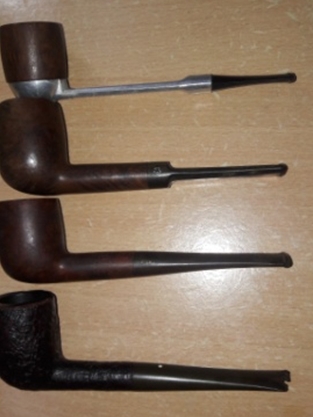
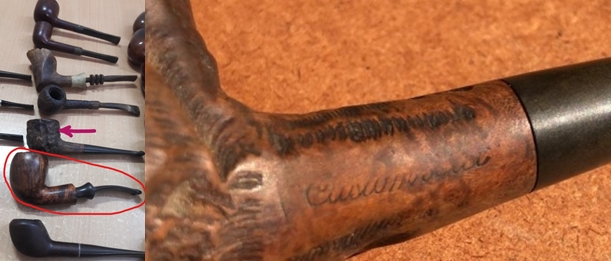
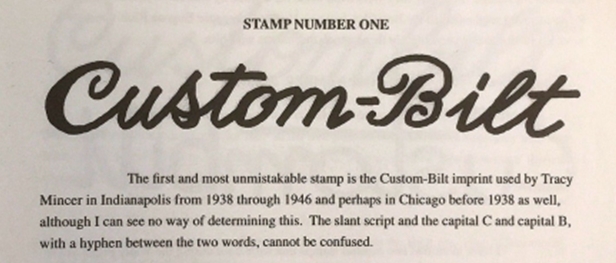
The 12th pipe that I decided to work on from this find Custom-Bilt small pot shaped pipe and is indicated in magenta colored arrow in the picture below. It is stamped on the left side of the shank as “Custom-Bilt” in sentence form with a hyphen between Custom and Bilt. The pipe or stem is devoid of any other stamping.Now coming to the research of this brand and line/ model in specific, I referred to pipedia.org and as expected there is an extensive research on this pipe. I searched the internet for information in order to date this pipe. Pipedia has a lot of information about this pipe and just typing in Custom-Bilt in the search bar of the site will reveal the required information. There is an interesting review given by Richard Esserman on a book written by William E. Unger, Jr., PhD, which deals with the study of Custom-Bilt pipes. The author authoritatively states, after a lot of research and study that the stamp as seen on this particular pipe dates it from between 1938 – 1946!With the dating of this pipe confirmed, I move on to the next step of carrying out initial inspection of the pipe as it appears. This not only provides me with an opportunity to closely look at the pipe (more like ogle at it!) and identify the issues that need to be addressed but also plan on the sequence and processes that would be required in restoring the pipe.

INITIAL VISUAL INSPECTION
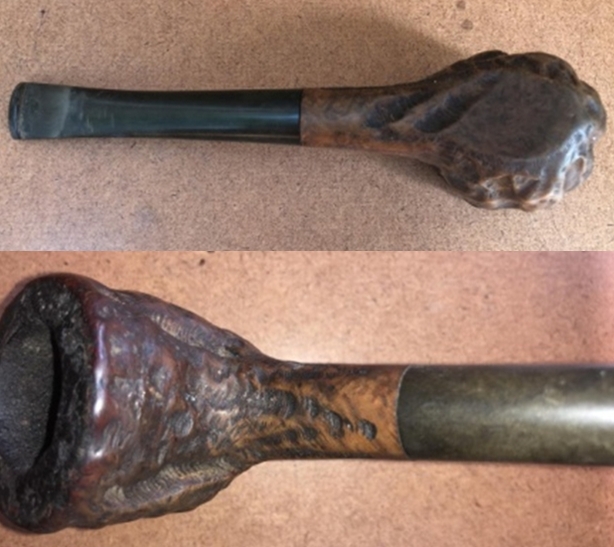
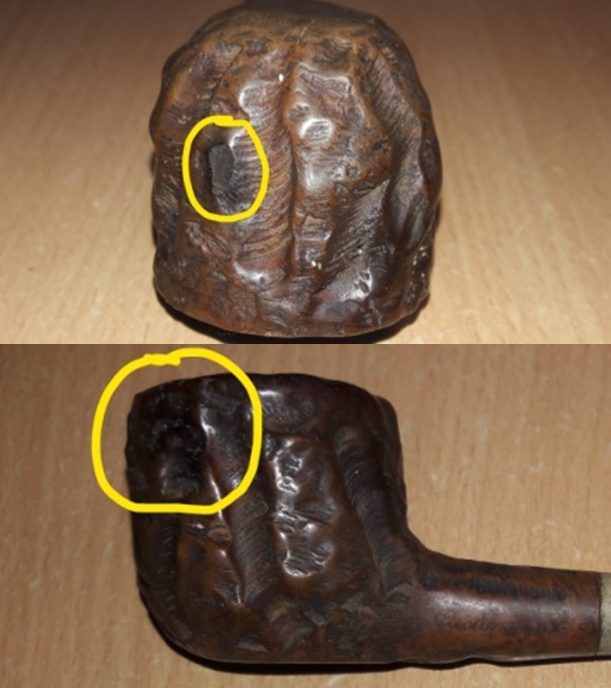
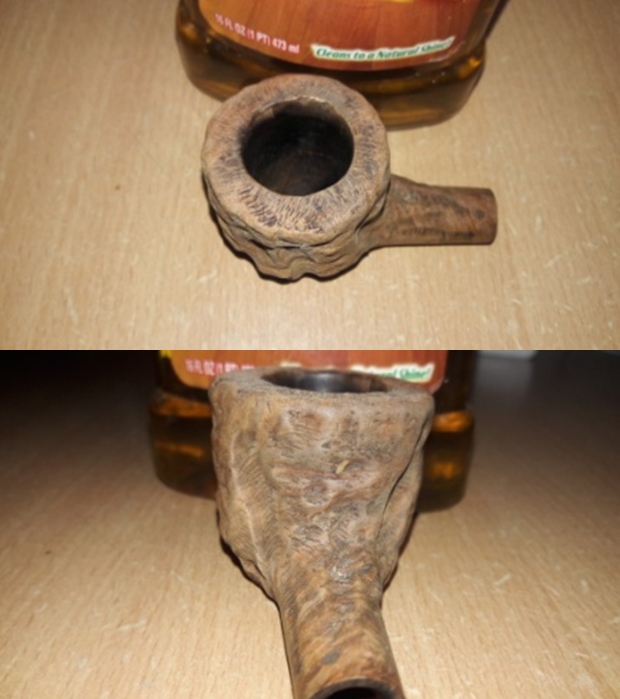
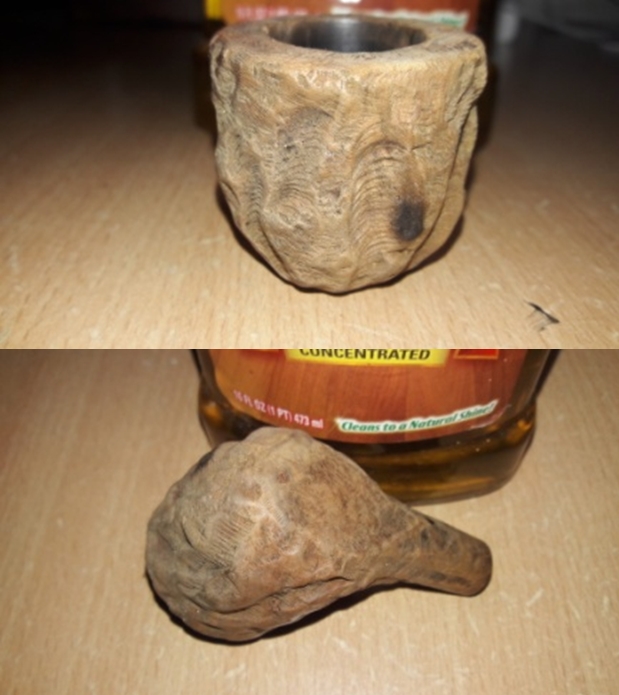
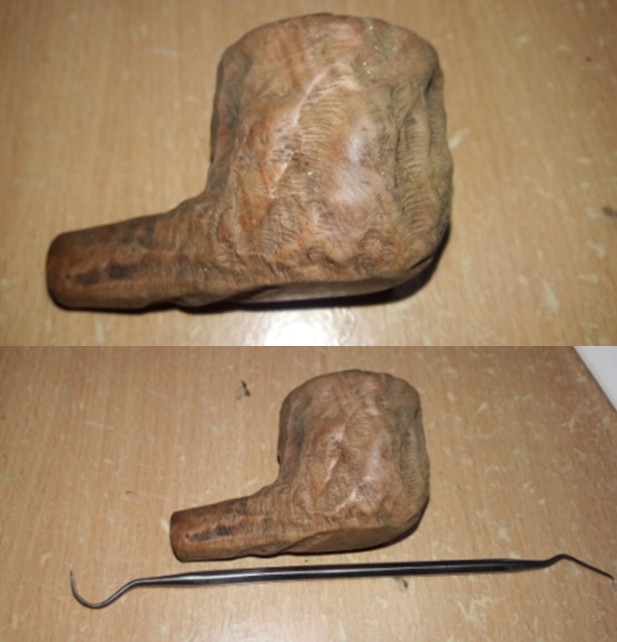
The pipe has deep and large vertical rustications along the entire length of the shank and height of the bowl. Within these large vertical rustications are very thin, closely stacked horizontal lines which give this pipe its unique appearance and are its trademark!!! The deep large rustication on the stummel is covered in dirt, oils, tars and grime of 70 plus years of its existence. At this stage, the briar looks filthy, dry and lifeless, but this should clean up nicely. However, there are two issues which may prove to be a challenge to address. On the front left side of the bowl, there is a dark burn mark, probably scorched by a burning cigarette lying in the same ashtray (marked in a yellow circle). The second issue is also towards the left side of the stummel, but at the back. There is significant darkening in that area as compared to the rest of the stummel, and is marked in a yellow circle. The exact nature of this darkening will be known once the stummel surface has been cleaned. A thick layer of cake can be seen in the chamber. The rim top is covered with the same thin, closely stacked lines as seen between the large vertical rustications and is covered in thick overflow of lava, dirt, dust and grime. The condition of the inner walls of the chamber and rim top surface will be known once the cake has been taken down to bare briar and the rim top crud has been scraped off completely. With the inner rim, I suspect burn/ charred surface at the back in 6 ‘O’ clock direction and is encircled in red. The extent and severity of the damage, if present, can be ascertained once the cake has been removed and the rim top is cleaned. The outer rim edge appears to be in a decent condition. Only once the stummel has been thoroughly cleaned that I can be sure of my initial appreciation. In spite of the thick cake, the chamber odor is, surprisingly, not strong and should be addressed once the cake has been taken down to the bare briar. The mortise is blocked with dried gunk, adversely affecting the airflow. A thorough clean up with alcohol and pipe cleaners should address this issue.The vulcanite stem is heavily oxidized and has calcification marks for about an inch over the bite zone, probably a result of using a rubber bit. The stem surface on either side is peppered with nicks and dents along the entire surface. There is one deep bite mark on the button edge on the upper surface. The tenon is covered in dried oils and tars and ash. The air way in the stem will need to be cleaned for a free and smooth draw.THE PROCESS
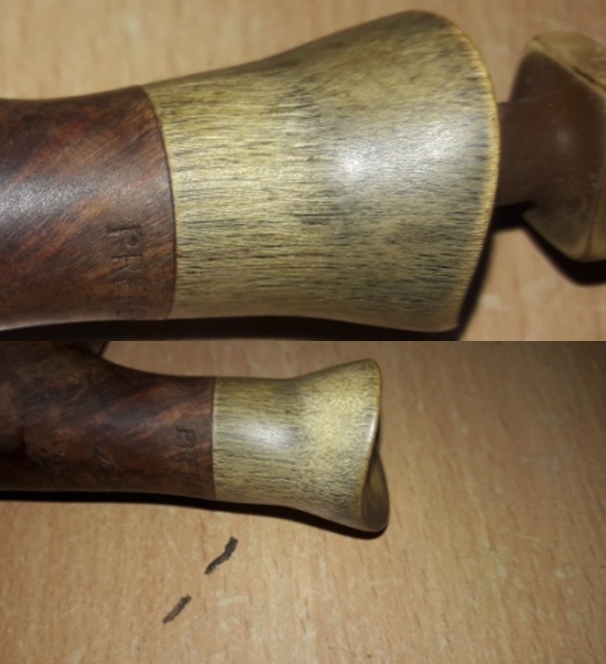
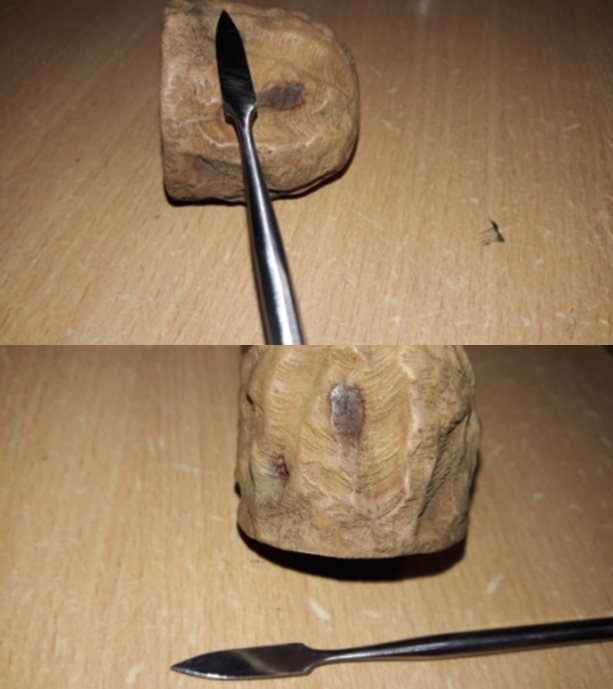
Along with the stems of other pipes in line for restoration, I immersed the stem of this Custom-Bilt in a mix of one part Hydrogen Peroxide 20% with one part hot water after I ran a couple of pipe cleaners dipped in alcohol through the stem air way. A couple of hours later, the stem oxidation on all these stems were raised to the surface. After I had fished out the stem from the Hydrogen Peroxide bath, I scrubbed it with Magiclean sponge and followed it up with a wipe of cotton swab and alcohol. The loosened and superficial layer of oxidation was easily removed and revealed not one but two tooth marks on the upper button edge and the nicks and dents on the surface are now more apparent. However, the deeper oxidation that was pulled to the surface would require more abrasive techniques.Staying with the stem, I cleaned the internals of the stem using hard and normal bristled pipe cleaners and isopropyl alcohol. I addressed the deeper oxidation by sanding the entire stem with a folded piece of 220 grit sand paper. Once the oxidation was completely removed, I wiped the surface clean with a cotton swab and alcohol. I flamed the damaged button edge and the nicks and dents with the flame of a lighter. This helps the vulcanite to rise to the surface as it has an inherent property to regain its original shape when heated. I spot filled the damaged spots with clear CA superglue and set it aside to cure overnight. Thereafter, I started with cleaning of the stummel as I was keen to know the condition of the walls of the chamber. With size 3 head of a PipNet pipe reamer, I took the cake down to bare briar. Using a folded piece of 180 grit sand paper, I sand out the last traces of cake and expose the walls of the chamber to ascertain that there are no cracks/ heat fissures. I wiped the chamber with a cotton pad dipped in isopropyl alcohol to remove the carbon dust left behind by all the reaming and sanding process. I was happy to note that the walls of the chamber are in pristine condition without any heat fissures or pits. I used my smaller of the two fabricated knife to gently scrap away at the overflow over the rim top surface while being careful not to damage the thin wired rustications on the rim top. I was pleased to find the inner and outer edge of the rim intact and without any burn or char marks which I had feared to be lurking under the heavy overflow of lava. Next, I cleaned out the internals of the shank and mortise. Using my dental tool, I scraped out all the dried oils, tars and gunk that had accumulated in the shank airway and mortise. The mortise was so clogged with the old accumulations of gunk that I had to use the drill piece which comes in the Kleen Reem pipe reamer!! The amount of crud that was scrapped out and the condition of the pipe cleaners that were used leaves no surprise why air flow through it was restricted. I finished the cleaning by running a few pipe cleaners dipped in isopropyl alcohol. I also wiped the shank with cotton buds and alcohol. With this cleaning, all old smells in the pipe are history. The pipe now smells clean and fresh.With the internals of the stummel now clean, I cleaned the external surface using a hard bristled toothbrush and Murphy’s Oil Soap. I diligently scrubbed the crevices formed by the sandblast to remove all the dust and dirt that was embedded in the large vertical rustications and thin wire rustications between them. With a soft bristled brass wired brush, I removed the overflowing lava from the rim top surface and cleaned the internals of the shank with a shank brush and dish washing soap to remove what little crud remained in the shank. I rinsed it under running tap water and wiped the stummel dry with an absorbent soft cotton cloth. However, I was not very satisfied with the way the rim top surface had cleaned up. There were visible traces of the lava overflow embedded in the rustication giving it a dirty and unclean appearance. I vigorously cleaned the rim top surface again with the brass brush, following the direction of the thin rustications till the overflow of lava was greatly reduced. What little grime that remained was carefully scraped out with a sharp dental pick. Another scrub with a toothbrush dipped in oil soap and I was very pleased with the way the stummel had cleaned up. The stummel looks absolutely gorgeous. At this point in restoration, I observed tiny specs of white. They appeared to be paint flakes but I am not sure. Very carefully and painstakingly, I removed each spot with the pointed dental pick.The other thing which highlighted itself was the burn mark and darkened surface at the front and slightly at the back of the stummel respectively. I cleaned the burned spot of all the charred briar with the sharp end of the dental spatula until I reached solid briar surface. The spot has lightened considerably. Next, with a pointed dental pick, I tried to pick in to the remaining darkened surface and was surprised to find that the area had been filled and that the old putty now came away easily (shown by a red arrow). Having discovered one fill, I closely checked the entire stummel surface for any other fills. Sure enough, there was a small fill at the shank end, just below the stamping (red arrow mark). I cleaned out the loose fills with a dental pick. I refreshed these fills with a mix of briar dust and superglue and set it aside to cure.While the stummel fills were set aside to cure, I worked the stem fills which had by now cured sufficiently. Using a flat head needle file, I reshaped the button and roughly matched the fills with the rest of the stem surface. I followed it up by further sanding the stem with 320, 600 and 800 grit sand papers to achieve a perfect blending of the fills with the stem surface and a crisp button edge on either side of the stem. Using the micromesh pads, I complete the polishing cycle by wet sanding the surface with 1500 to 12000 girt pads. The stem looks great with the fills nicely matched with the rest of the surface. I rub a little quantity of Extra Virgin Olive oil in to the stem surface and set it aside to be absorbed by the vulcanite. Once I was finished with the stem repairs, I turned back to the stummel fills which had cured. With the edge of a flat head needle file, I roughly matched the fill with the rustications on the stummel. Thereafter, using a tightly folded piece of 150 grit sand paper, I worked the fills to a perfect match with the rest of the rustications. I used a sharp dental tool and tried to roughly carve out the thin wire like rustications in to the fills, though without resounding success. But it turned out quite okay to my eyes.Next, I rub a small quantity of “Before and After Restoration Balm” in to the briar with my finger tips, work it deep in to the sandblasts and let it rest for a few minutes. The balm almost immediately works its magic and the briar now has a nice vibrant appearance with the beautiful sandblast patterns on full display. I further buff it with a horse hair brush. To complete the restoration, I mount a cotton cloth buffing wheel on to my hand held rotary tool and applied several coats of carnauba wax. I finished the restoration by giving the entire pipe a rigorous hand buffing using a microfiber cloth to raise the shine further. The finished pipe looks amazingly beautiful and is now ready for its long second innings with me. I only wish it could share with me its life story of the past 70 plus years while I enjoy smoking my favorite Virginia blend in it!! P.S. I was not very pleased with the appearance of the front of the stummel, what with the ugly burn mark now all the more visible. I discussed with my mentor, Steve, and he suggested that a little oxalic acid diluted with water when applied over the burn mark should significantly reduce the black mark. This will be applied in practical once I am back on leave to my home town. I shall post an update on the end result of this process.

There are three more pending write ups which I shall be tackling before I undertake any new restoration. I am eagerly waiting to start my next project, which I wish to assure readers, is going to be an interesting one. It’s a pipe which my dear friend and mentor, Steve, had sent me about a year back with the intention of providing me an opportunity to test my own skills. I wish to thank each one for sparing their valuable time to read through and any inputs or advise is always welcome.


Back to Bob Kerr’s Estate – Changing Up and Working on a Danish Made Stanwell de Luxe 812 Billiard Regd. No. 969-48

Blog by Steve Laug

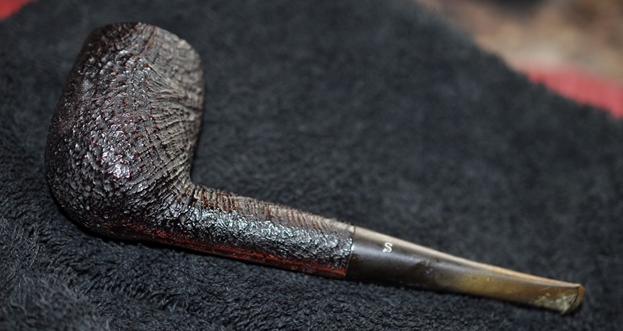
I am changing up my work on Bob Kerr’s estate a bit by taking on this Stanwell de Luxe 812 sandblast billiard. This is the first of his Stanwell pipes that I am working on. I am cleaning them for the family and moving them out into the hands of pipemen and women who will carry on the trust that began with Bob and in some pipes was carried on by Bob. In the collection there were 19 Peterson’s pipes along with a bevy of Dunhills, some Comoy’s and Barlings as well as a lot of other pipes – a total of 125 pipes along with a box of parts. This is the largest estate that I have had the opportunity to work on. I put together a spread sheet of the pipes and stampings to create an invoice. I was taking on what would take me a fair amount of time to clean up. I could not pass up the opportunity to work on these pipes though. They were just too tempting. This beautiful Stanwell is a great break. It is a shape that is interesting and unique. It will go on the rebornpipes store.

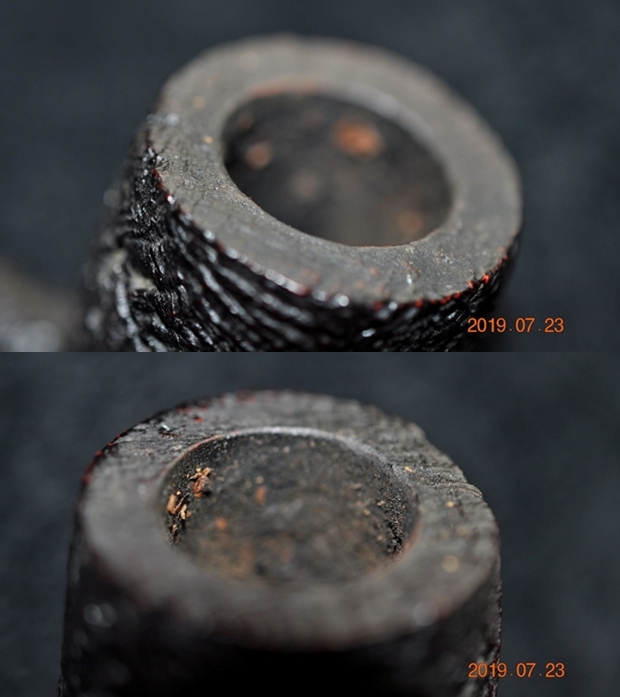
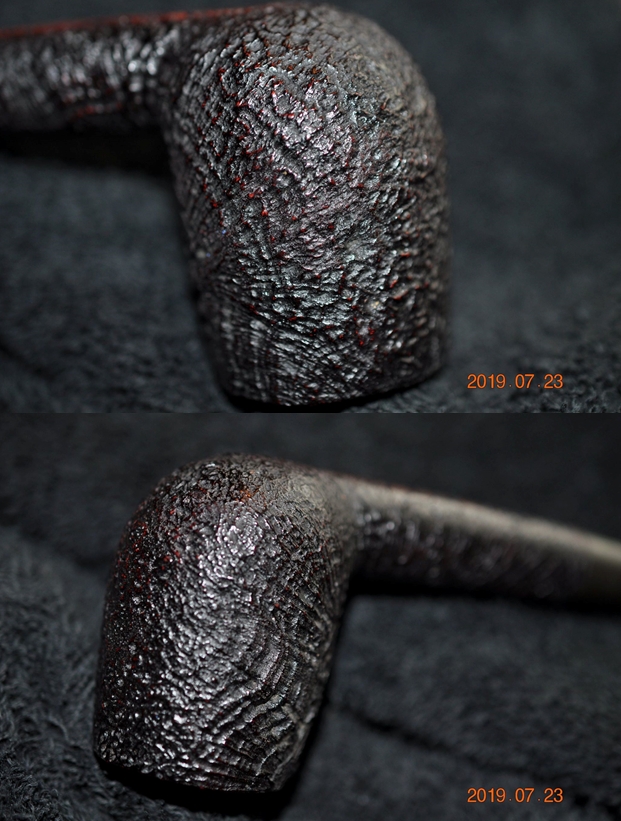
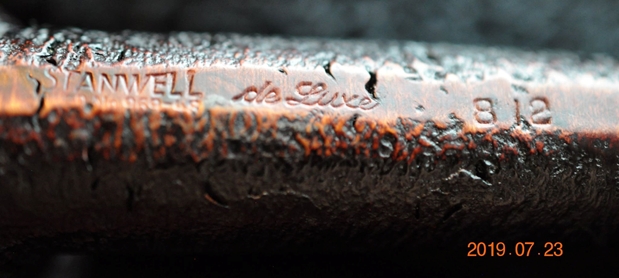
I really like the sandblasts that the Danish Stanwell Company did. This one also has a rugged, swirling sandblast finish with lots of nooks and crannies in the briar. It is a beauty! The pipe is stamped Stanwell over Regd. No. 969-48. That is followed by the line which is de Luxe and the shape number 812. The valleys and ridges of the sandblasted grain showing through the grime and dirt are a mixture that leaves a rich texture. It had a rich dark and medium contrasting brown stain that does not look too bad. There was a thick cake in the bowl with remnants of tobacco stuck on the walls. There was a fair lava overflow filling in the blast on the rim. The edges of the rim and top are dirty but look pretty pristine under the grime. It was a beautiful pipe that was dirty and tired looking. The stem was oxidized and calcified toward the end. Again, surprisingly did not have the tooth marks that I have come to expect from Bob’s pipes. Jeff took photos of the pipe before he started his cleanup work on it.   Jeff took photos of the bowl and rim top to show the cake in the bowl and the lava build up on the edges of the bowl. It was thick and hard but hopefully it had protected the rim and edges from damage. The edges look pretty good.Jeff took photos of the sides and heel of the bowl to show the condition of the finish. You can see the beautiful swirls of the sandblast. There is a lot of dust and grime filling in the valleys. Jeff took photos of the stamping on the smooth panel on the underside of the bowl and shank. The stamping was readable as you can see from the photos. It read Stanwell Regd. No. 969-48. That is followed by de Luxe and the shape number 812. Jeff took photos of the top and underside of the stem showing the tooth chatter, scratching and oxidation on the stem surface and wear on the edges of the button. The “S” on the stem was in very good condition. Interestingly it did not have the crown over the “S”. I turned first to Pipephil’s site to get a quick idea of when this pipe was made by reference to the Regd. No. on the underside of the shank (http://www.pipephil.eu/logos/en/logo-stanwell.html). I quote what I found there. Logo without crown. The “Regd. No.” stamping discontinued in late 1960s to very early 1970s.

I also turned to Pipedia’s article on Stanwell but it did not add any further information. It is a great read in terms of the history of the brand (https://pipedia.org/wiki/Stanwell).

Talking with Chris van Hilst on Facebook Tobacco Pipe Restorers Group he helped me understand that the crown was introduced mid- to late 50’s. Before that they didn’t have a stem logo.

With that information in hand I knew what I was dealing with in terms of the stamping and the age of this pipe. I knew from the information from Pipephil that the Regd. No. stamping was discontinued in the late 60s to very early in the 70s. I learned from Chris that the crown was added late in the 1950s so this one is most probably an early 1950s pipe. Most of Bob’s pipes were purchased between the 50s and late 60s so my guess is that this pipe fits that time frame. Now it was time to work on the pipe.

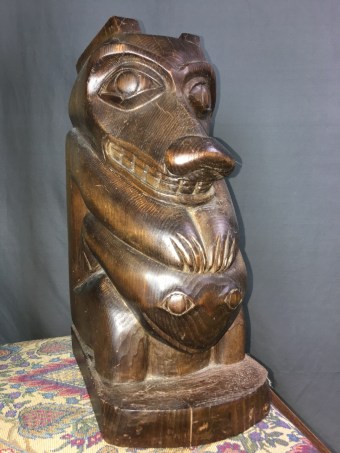
With over 125 pipes to clean from Bob’s estate I took a batch of them to the states with me on a recent visit and left them with Jeff so he could help me out. Jeff cleaned the pipe with his usual penchant for thoroughness that I really appreciate. This one was a real mess and I did not know what to expect when I unwrapped it from his box. He reamed it with a PipNet pipe reamer and cleaned up the reaming with a Savinelli Fitsall Pipe Knife. He scrubbed out the internals with alcohol, pipe cleaners and cotton swabs until the pipe was clean. He scrubbed the exterior of the bowl with Murphy’s Oil Soap and a tooth brush to remove the grime and grit on the briar and the lava on the rim top. The finish looks very good with good looking grain around the bowl and shank. Jeff soaked the stem in Before & After Deoxidizer to remove the oxidation on the rubber. When the pipe arrived here in Vancouver for the second stop of its restoration tour it looked very good. I took photos before I started my part of the work. I took some close up photos of the rim top and also of the stem surface. I wanted to show what an amazing job Jeff did in the cleanup of the rim top. The rim top looks very good. The sandblast finish is very nice. The bowl looked very good. I also took close up photos of the stem to show the lack of tooth marks and the remaining oxidation on the stem surface.Since this is another pipe Bob’s estate I am sure that some of you have read at least some of the other restoration work that has been done on the previous pipes. You have also read what I have included about Bob Kerr, the pipeman who held these pipes in trust before I came to work on them (see photo to the left). Also, if you have followed the blog for long you will already know that I like to include background information on the pipeman whose pipes I am restoring. For me, when I am working on an estate I really like to have a sense of the person who held the pipes in trust before I worked on them. It gives me another dimension of the restoration work. I asked Brian if he or his wife would like to write a brief biographical tribute to her father, Bob. His daughter worked on it and I received the following short write up on him and some pictures to go along with the words including one of Bob’s carvings. Once again I thank you Brian and tell your wife thank you as well.

I am delighted to pass on these beloved pipes of my father’s. I hope each user gets many hours of contemplative pleasure as he did. I remember the aroma of tobacco in the rec room, as he put up his feet on his lazy boy. He’d be first at the paper then, no one could touch it before him. Maybe there would be a movie on with an actor smoking a pipe. He would have very definite opinions on whether the performer was a ‘real’ smoker or not, a distinction which I could never see but it would be very clear to him. He worked by day as a sales manager of a paper products company, a job he hated. What he longed for was the life of an artist, so on the weekends and sometimes mid-week evenings he would journey to his workshop and come out with wood sculptures, all of which he declared as crap but every one of them treasured by my sister and myself. Enjoy the pipes, and maybe a little of his creative spirit will enter you!

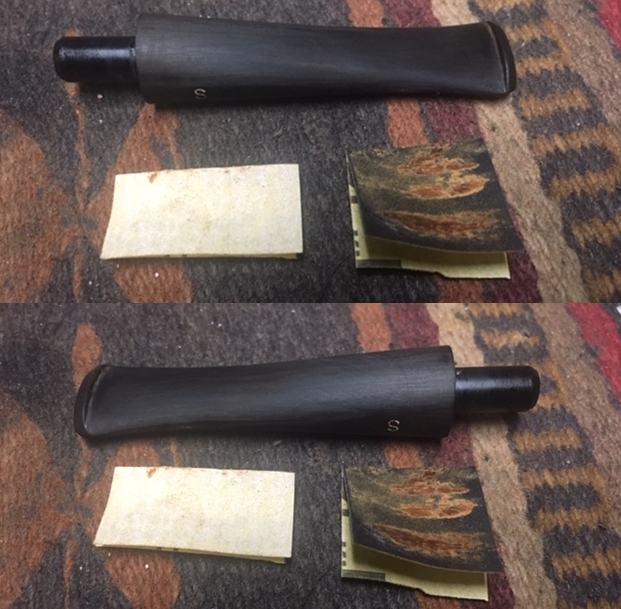
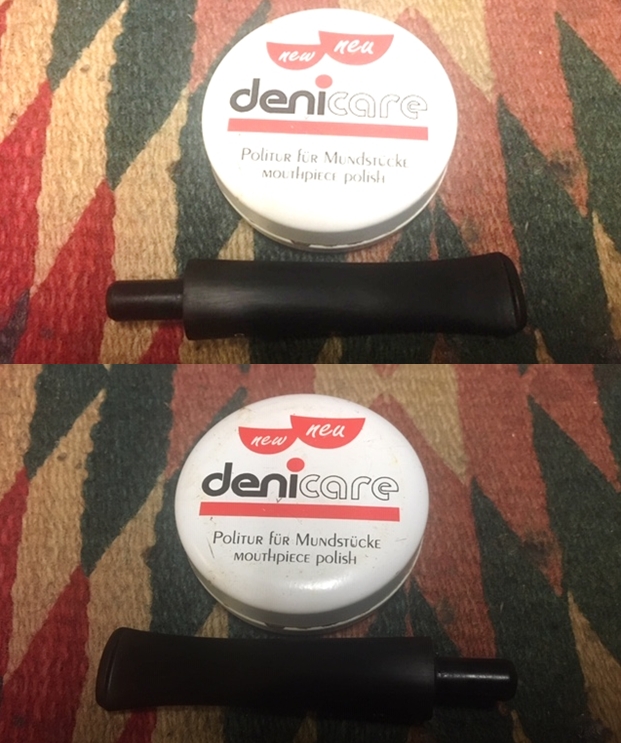
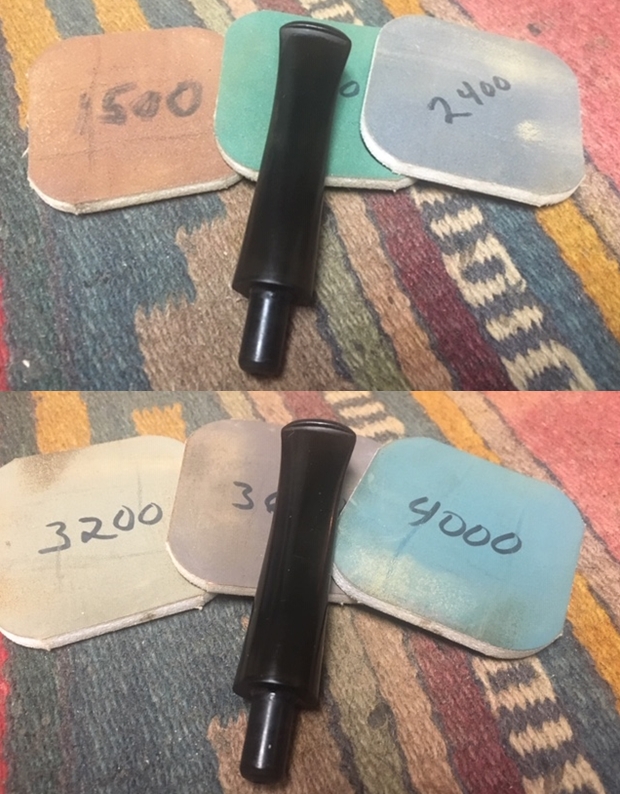
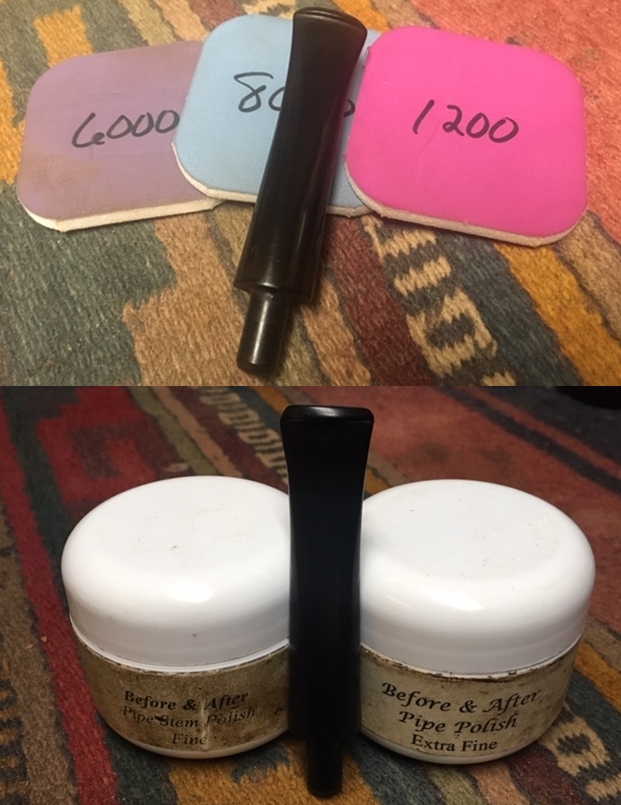
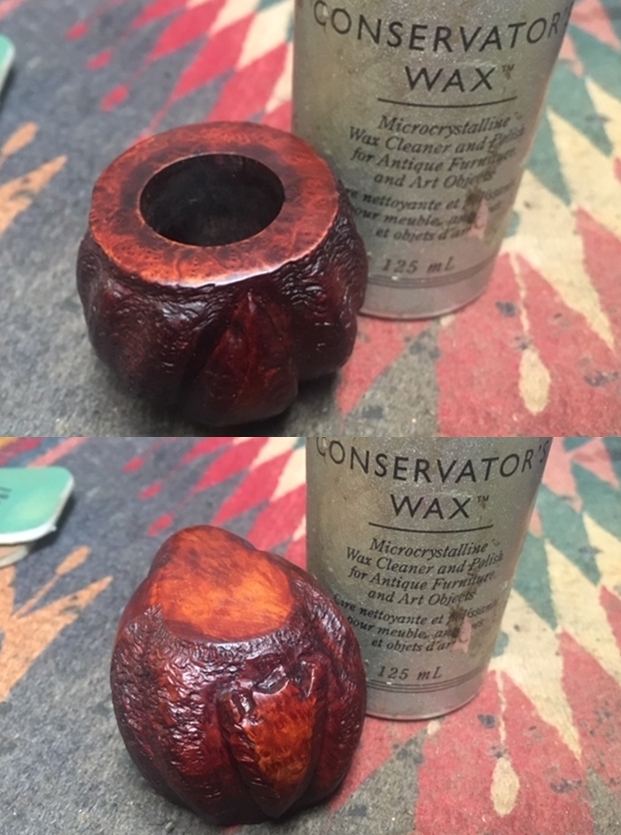
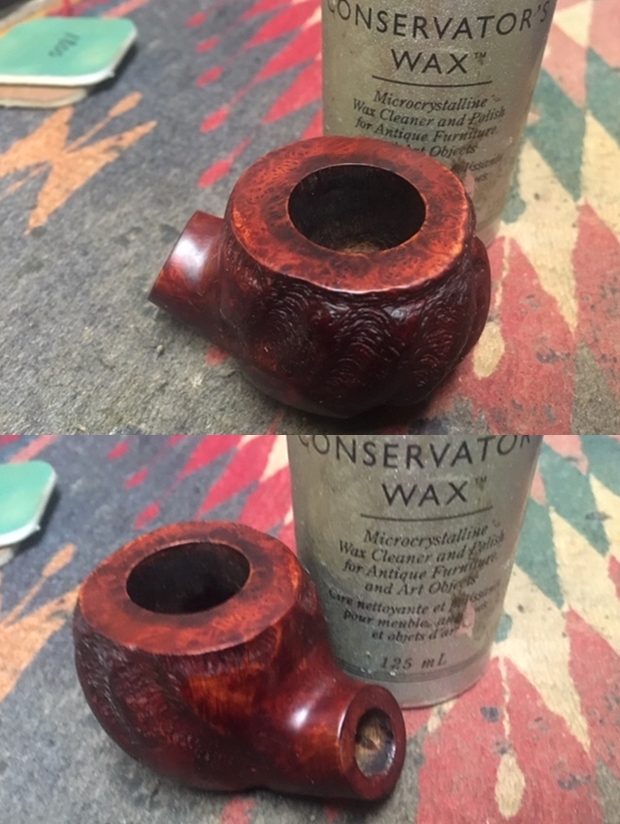
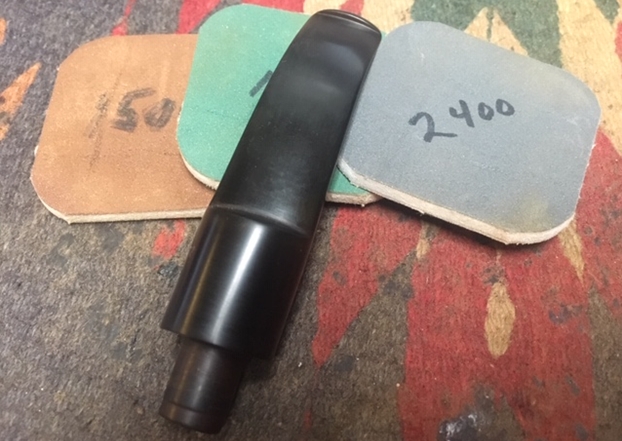
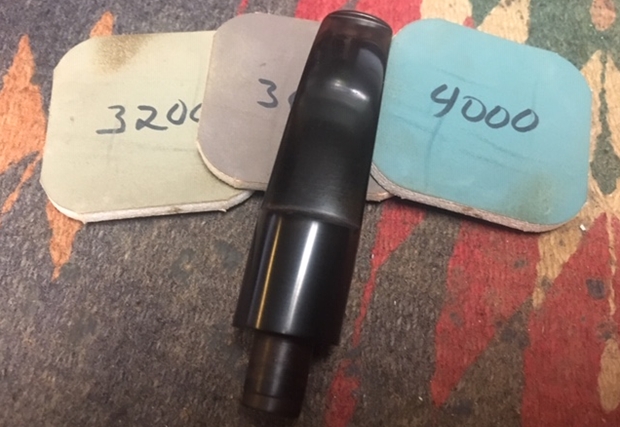
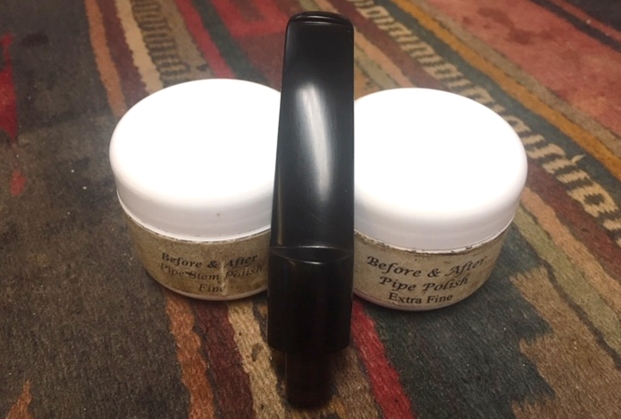
Now on to the rest of the restoration on this Stanwell de Luxe 812 Billiard. Since Jeff had done such an amazing clean up job on the bowl it was very easy for me. I only had to rub the bowl down with Before & After Restoration Balm. I worked it into the surface of the briar with my fingertips and a horsehair shoe brush to clean, enliven and protect it. I let the balm sit for a little while and then buffed with a cotton cloth and shoe brush to raise the shine. Mark Hoover’s Balm is a product that I have come to appreciate and one I use on every pipe I have been working on. I set the bowl aside and turned my attention to the stem. I sanded the stem with 220 grit sandpaper to break up the oxidation. I started the polishing with 400 grit wet dry sandpaper to remove the scratching. It is starting to look good. I rubbed the stem down with Denicare Mouthpiece Polish. I have a few tins of this laying around so I am trying to use them up. It does a pretty good job polishing the stem. I polished the stem with micromesh sanding pads – wet sanding with 1500-12000 grit pads. I wiped the stem down after each sanding pad with Obsidian Oil. I polished it with Before & After Pipe Stem Polish – both Fine and Extra Fine. Once I had finished the polishing I gave it final coat of oil and set it aside to dry. I am excited to be on the homestretch with this pipe and I look forward to the final look when it is put back together, polished and waxed. I put the bowl and stem back together. I polished the bowl and stem with Blue Diamond to polish out the scratches in the briar and the vulcanite. I gave the bowl multiple coats of Conservator’s Wax and the stem multiple coats of carnauba wax. I buffed the pipe with a clean buffing pad to raise the shine. I hand buffed it with a microfiber cloth to deepen the shine. The pipe polished up pretty nicely. The valleys and ridges of the sandblast looked good with the polished black vulcanite. This Stanwell de Luxe 812 billiard was another fun pipe to work on thanks to Jeff’s cleanup work. It really has that classic Stanwell sandblast finish that catches the eye. The combination of various brown stains really makes the pipe look attractive. It is a comfortable pipe to hold in the hand. The finished pipe is shown in the photos below. The dimensions of the pipe are Length: 5 ¾ inches, Height: 2 inches, Outside diameter of the bowl: 1 ½ inches, Chamber diameter: ¾ of an inch. If you are interested in carrying on Bob’s legacy with this pipe send me a message or an email. I have a lot more to work on of various brands. Perhaps one of those will catch your attention. Thanks for reading this blog and my reflections on the pipe while I worked on it. This is an interesting estate to bring back to life.

Back to Bob Kerr’s Estate – Linking Peterson’s “Kapruf” 9BC with the 56 shape number

Blog by Steve Laug

With this Peterson’s “Kapruf” 9BC I am turning again to work on a few more pipes from Bob Kerr’s estate. This is the first of the Peterson’s that I am working on. I am cleaning them for the family and moving them out into the hands of pipemen and women who will carry on the trust that began with Bob and in some pipes was carried on by Bob. In the collection there were 19 Peterson’s pipes along with a bevy of Dunhills, some Comoy’s and Barlings as well as a lot of other pipes – a total of 125 pipes along with a box of parts. This is the largest estate that I have had the opportunity to work on. I put together a spread sheet of the pipes and stamping to create an invoice. I was taking on what would take me a fair amount of time to clean up. I could not pass up the opportunity to work on these pipes though. They were just too tempting. I decided to take a break from working on his Dunhills to work on a few of the other pipes. The first of them is a really nice Peterson. It is a shape that is one of my favourites so this one will probably stay with me.

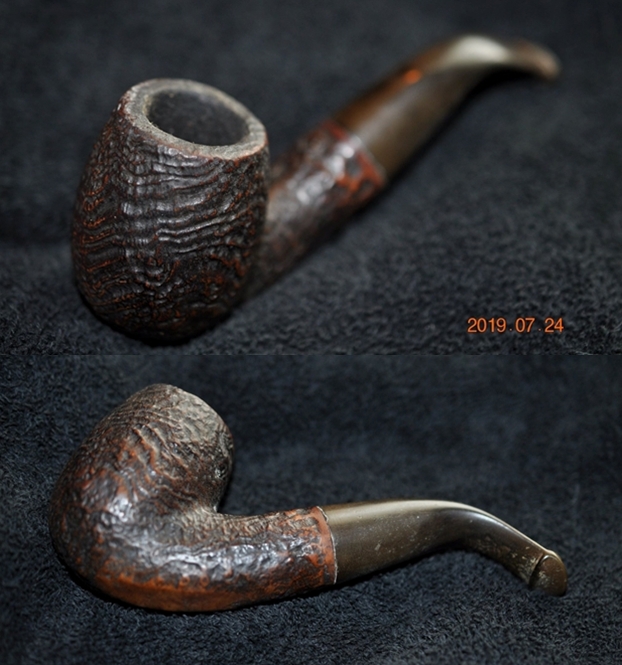
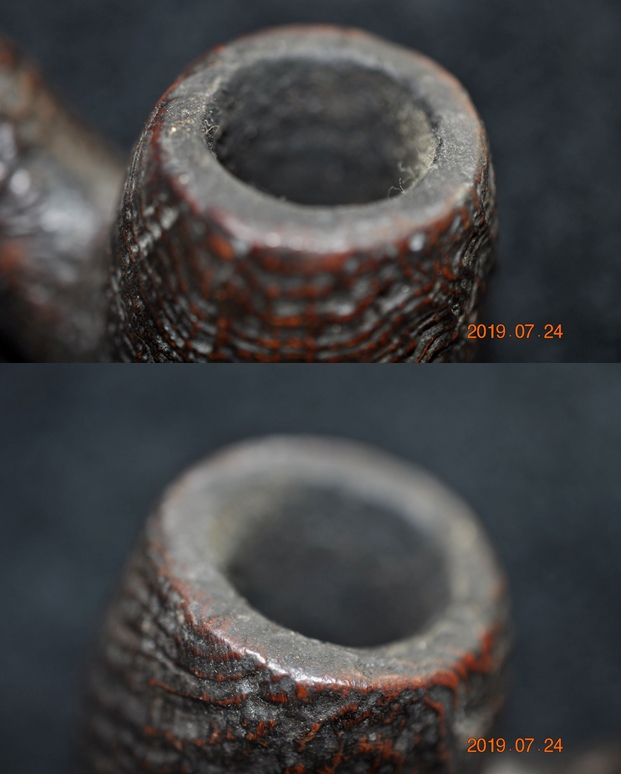
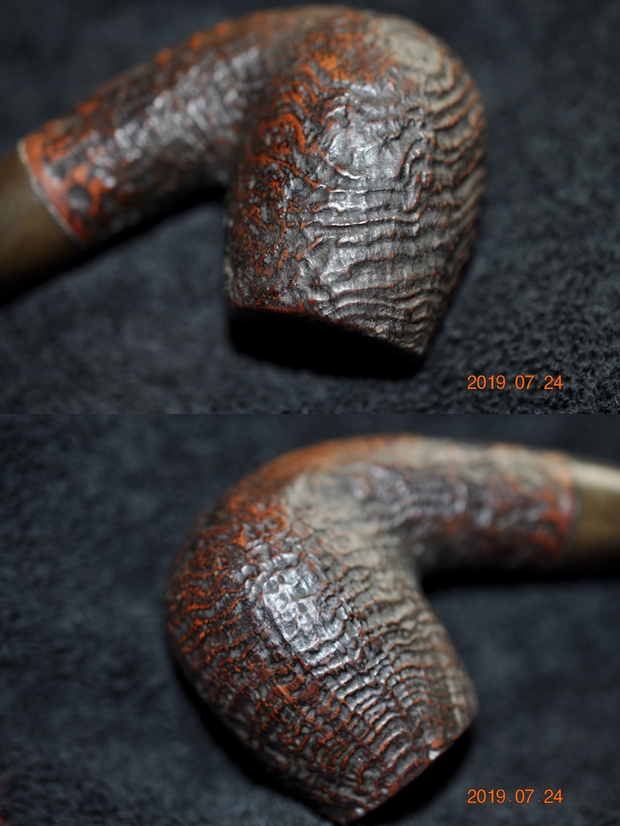
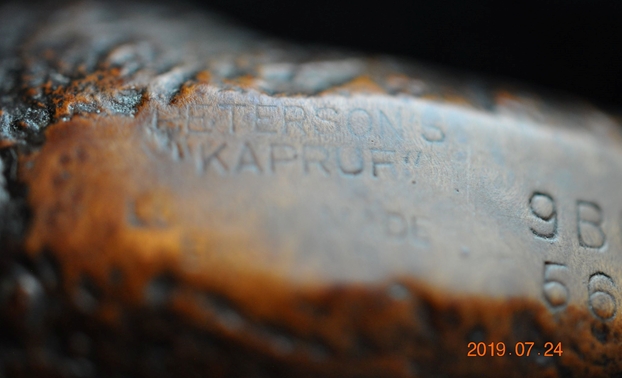
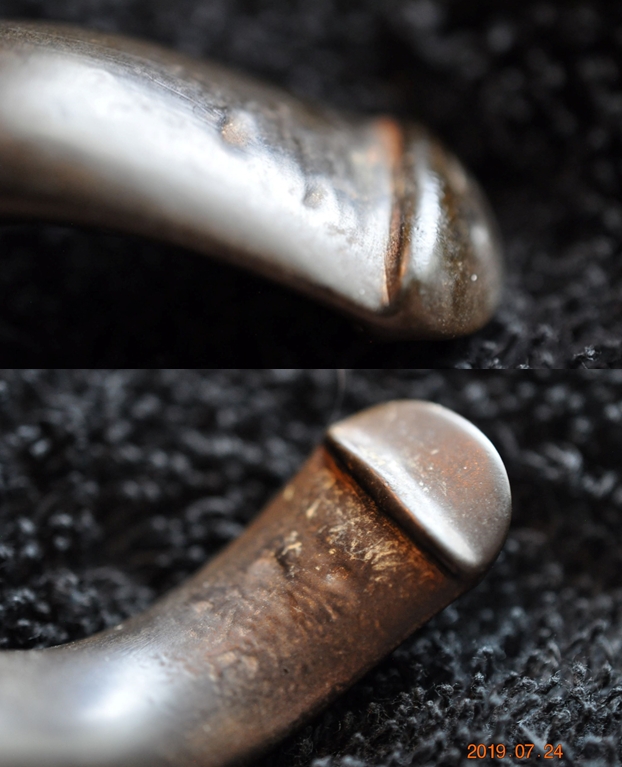
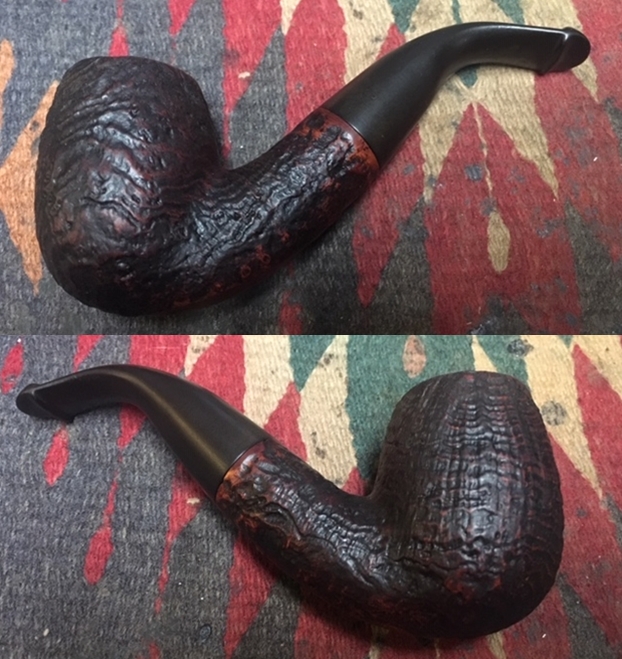
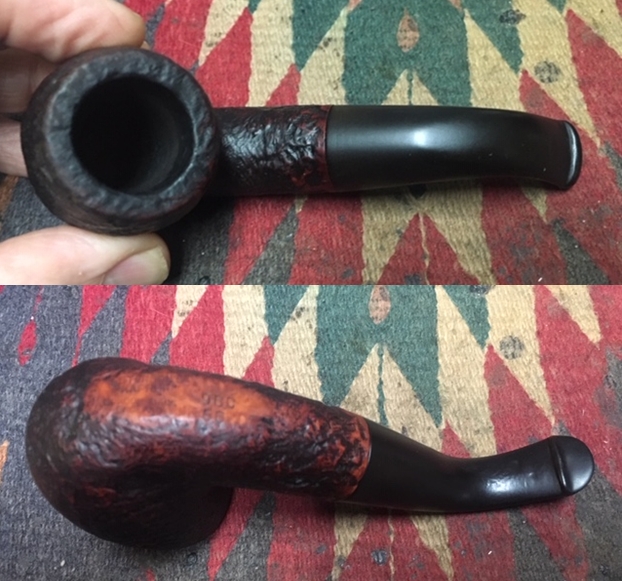
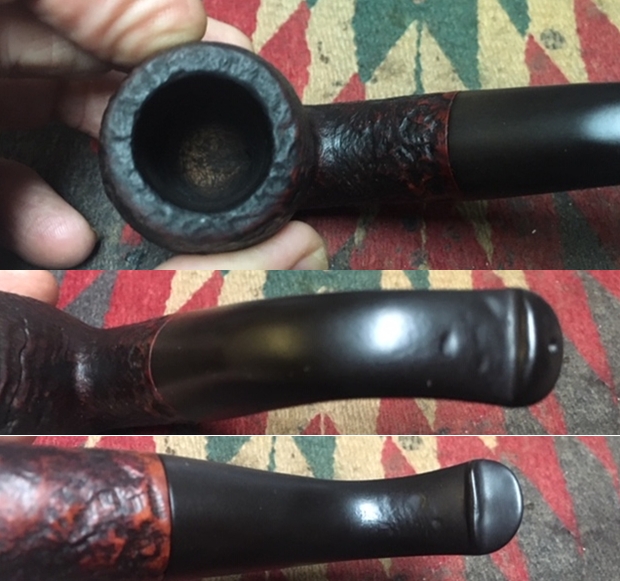
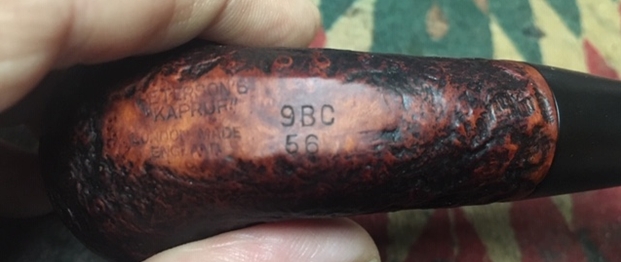
I love these older Peterson’s 9BC shapes and find that the sandblast versions really are a favourite of mine. This one has a rugged sandblast finish with lots of nooks and crannies in the briar. It is a beauty! The pipe is stamped Peterson’s “Kapruf” over London Made England. That is followed by the shape number 9BC over 56. The valleys and ridges of the sandblasted grain showing through the grime and dirt are a mixture that leaves a rich texture. It had a rich reddish brown stain that does not look too bad. There was a thick cake in the bowl and lava overflow filling in the blast on the rim. The edges of the rim and top are dirty but look pretty pristine under the grime. It was a beautiful pipe that was dirty and tired looking. The stem was lightly oxidized with the typical tooth marks and chatter on both sides that I have come to expect from Bob’s pipes. He obviously loved the Peterson’s as much as he did his Dunhills. The P-lip button had some light damage to the top surface. Jeff took photos of the pipe before he started his cleanup work on it.Jeff took photos of the bowl and rim top to show the cake in the bowl and the lava build up on the edges of the bowl. It was thick and hard but hopefully it had protected the rim and edges from damage. The edges look pretty good. Jeff took photos of the sides and heel of the bowl to show the condition of the finish. You can see the beautiful undulations of the sandblast. There is a lot of dust and grime filling in the valleys. Jeff took photos of the stamping on the smooth panel on the underside of the bowl and shank. The stamping was readable as you can see from the photos. The London Made over England stamp is faint but readable under a light. The pipe also bears the same 9BC over 56 stamp that Al Jones (upshallfan) noted on the on his previous blog and had called a mystery pipe (https://rebornpipes.com/2019/07/25/peterson-shape-56-mystery/).Jeff took photos of the top and underside of the stem showing the deep tooth marks and scratching, oxidation on the stem surface and wear on the edges of the button. The “P” logo on the stem is long gone but the robust p-lip button is in very good condition.Al Jones had written a couple of blogs on the Peterson’s Kapruf 9BC so I turned to rebornpipes to refresh my memory through Al’s blogs (https://rebornpipes.com/2015/06/03/peterson-9bc-kapruf-pre-59/). I quote from there and also include some of the catalogue pages from the blog.

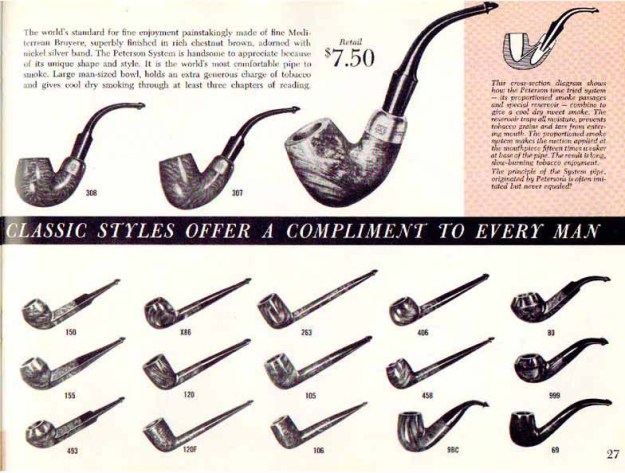
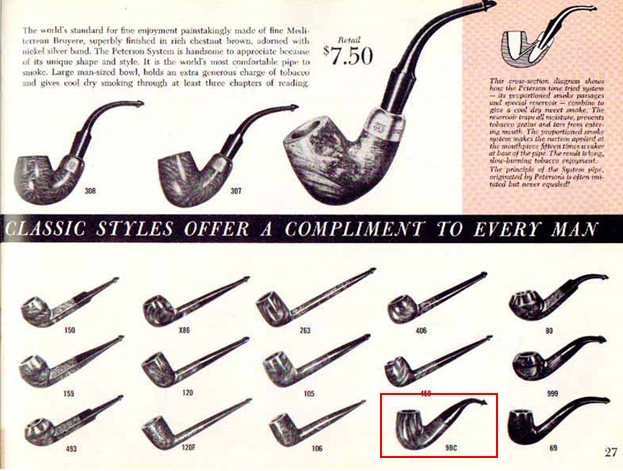
I didn’t know much about the Kapruf line. It is described in a 1960’s catalog as: “A fine sandblast finish distinguishes this range of light natural grained pipes with their distinctive red colouring. Very popular with sportsmen.”

The second page shows the 9BC shape.  I have boxed the shape in with a red box for quick reference. Al had also written a blog about another “Kapruf” 9BC he had picked up that was not stamped with the 9BC stamp but with a shape number 56. Interestingly the one I am working on is stamped with both numbers. I quote from a pertinent section of that blog on the shape number (https://rebornpipes.com/2019/07/25/peterson-shape-56-mystery/).

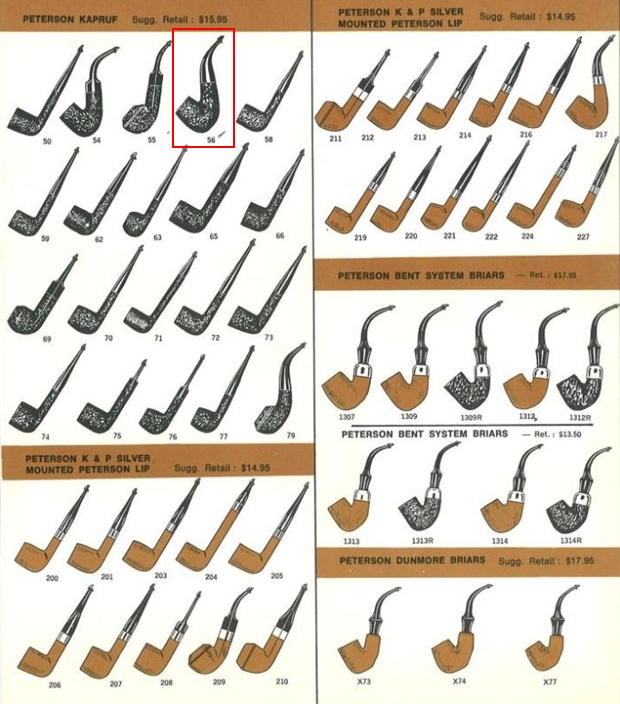
Well, the Shape 56 mystery is now resolved…Well, further sleuthing from the world’s foremost Peterson authority yielded an answer – which came directly from a blog entry here on rebornpipes, by our very own Steven Laug. In 2015, Steve posted a catalog from Canadian importer, Genin, Trudeau & Co. which shows their unique numbering system. I even comment that the Shape 56 looks like a 9BC! So, all the while, the answer was hiding on this blog! Below is that brochure page showing the Shape 56. Steve comments that the postal code used in the address dates the brochure to between 1962 and 1969. I guess not many Canadians appreciated the shape, so they are pretty uncommon. Thanks to Mark Irwin for his superior memory and to Steve for making this type of ephemera available, you never know when it will come in handy.

I have included both the link to the document for you to check out and a page from it that shows the 9BC/56 connection Al noted above (https://rebornpipes.com/2016/09/13/petersons-pipes-brochure-from-genin-trudeau-co-montreal-quebec/). I have put a red box around the shape number to make identifying it simpler. Be sure to check out the document as it is very informative.I turned to an article on Pipedia by a good friend, the late Mike Leverette entitled A Peterson Dating Guide (https://pipedia.org/wiki/A_Peterson_Dating_Guide;_A_Rule_of_Thumb). While the one I have in hand is slightly different in terms of stamping it is an English made Peterson that bears the stamp London Made England. I quote from the section by Mike on the English pipes.

English made Peterson pipes actually spans between the pre-Republic and Republic eras. In 1895, Peterson opened a shop in London England that lasted until the late 1950s or early 1960s. So the English Era, for a simplified date, will be from 1895 through 1959. The stamps Peterson used in London and that we have seen are:

  • Made in England – block format
  • Made in England – circle format
  • Made in London
  • Made in London England
  • Simply, London England.
  • Great Britain

I went to the full article on Peterson pipes after this to try to pin things down a bit more clearly (https://pipedia.org/wiki/Peterson). I believe the pipe is from the Republic Era – 1950 – 1989. I quote the pertinent section of that article below:

1969/70 – The ‘Made in England’ stamp was discontinued with the closing down of the London based factory. Although Peterson has always prided itself in being an Irish made pipe, Peterson had also maintained a pipe factory in London since 1899.

English made Peterson pipes actually spanned the period between the pre Republic and Republic eras.

In 1899, Peterson opened the first in a series of several successive shops in London, England, that lasted until the late 1960’s/70s.

1899 – 53, New Broad St. E.C.

1910 – 7, Hills Pl., Oxford St. W.

1915 – 21, Mortimer St. W.

Finally moving to 74/77 White Lion Street until 1970.

So the English Era, for a simplified date, will be from 1899 through to around 1970. The stamps Peterson used in London are:

    • Made in England block format
    • Made in England circle format
    • Made in London
    • Made in London England
    • Simply, London England
    • London Made over England block format
    • Great Britain

With that information in hand I knew what I was dealing with in terms of the stamping and the age of this pipe. I knew from the information from both Mike’s Pipedia article and the longer article that the pipe was made during the Republic Era prior to the closer of the London based factory. My thinking is that it came from the final factory location on 74/77 White Lion Street which closed down in 1970. That fits the time frame of many of the pipes from Bob Kerr’s estate.  I also knew that the pipe was brought into Canada by the Canadian importer, Genin, Trudeau & Co. in Montreal, Quebec. Noting above that the catalogue postal code puts it in the late 60s early 70s which also fits the story. Now it was time to work on the pipe.

With over 125 pipes to clean from Bob’s estate I took a batch of them to the states with me on a recent visit and left them with Jeff so he could help me out. Jeff cleaned the pipe with his usual penchant for thoroughness that I really appreciate. This one was a real mess and I did not know what to expect when I unwrapped it from his box. He reamed it with a PipNet pipe reamer and cleaned up the reaming with a Savinelli Fitsall Pipe Knife. He scrubbed out the internals with alcohol, pipe cleaners and cotton swabs until the pipe was clean. He scrubbed the exterior of the bowl with Murphy’s Oil Soap and a tooth brush to remove the grime and grit on the briar and the lava on the rim top. The finish looks very good with good looking grain around the bowl and shank. Jeff soaked the stem in Before & After Deoxidizer to remove the oxidation on the rubber. When the pipe arrived here in Vancouver for the second stop of its restoration tour it looked very good. I took photos before I started my part of the work. I took some close up photos of the rim top and also of the stem surface. I wanted to show what an amazing job Jeff did in the cleanup of the rim top. The rim top looks very good. The sandblast finish is very nice. The bowl looked very good. I also took close up photos of the stem to show the deep tooth marks on the top and underside. The “P” logo on the stem was long gone though I could see a faint ghost of it on the left side. I took a photo of the stamping and was able to capture all of it. Even the illusive London Made over England portion shows up. Since this is another pipe Bob’s estate I am sure that some of you have read at least some of the other restoration work that has been done on the previous pipes. You have also read what I have included about Bob Kerr, the pipeman who held these pipes in trust before I came to work on them (see photo to the left). Also, if you have followed the blog for long you will already know that I like to include background information on the pipeman whose pipes I am restoring. For me, when I am working on an estate I really like to have a sense of the person who held the pipes in trust before I worked on them. It gives me another dimension of the restoration work. I asked Brian if he or his wife would like to write a brief biographical tribute to her father, Bob. His daughter worked on it and I received the following short write up on him and some pictures to go along with the words including one of Bob’s carvings. Once again I thank you Brian and tell your wife thank you as well.

I am delighted to pass on these beloved pipes of my father’s. I hope each user gets many hours of contemplative pleasure as he did. I remember the aroma of tobacco in the rec room, as he put up his feet on his lazy boy. He’d be first at the paper then, no one could touch it before him. Maybe there would be a movie on with an actor smoking a pipe. He would have very definite opinions on whether the performer was a ‘real’ smoker or not, a distinction which I could never see but it would be very clear to him. He worked by day as a sales manager of a paper products company, a job he hated. What he longed for was the life of an artist, so on the weekends and sometimes mid-week evenings he would journey to his workshop and come out with wood sculptures, all of which he declared as crap but every one of them treasured by my sister and myself. Enjoy the pipes, and maybe a little of his creative spirit will enter you!

Now on to the rest of the restoration on this pipe that links the two shape numbers that Al referred to – the 9BC and the 56. Since Jeff had done such an amazing clean up job on the bowl it was very easy for me. I only had to rub the bowl down with Before & After Restoration Balm. I worked it into the surface of the briar with my fingertips and a horsehair shoe brush to clean, enliven and protect it. I let the balm sit for a little while and then buffed with a cotton cloth and shoe brush to raise the shine. Mark Hoover’s Balm is a product that I have come to appreciate and one I use on every pipe I have been working on. I set the bowl aside and turned my attention to the tooth marks in the stem. I painted the surface of the stem with the flame of a Bic style lighter. Since vulcanite has “memory” heat will lift much of the tooth damage. The photos show the marks that remain after the heat treatment.To repair these deeper tooth marks, I filled them in with clear super glue and set the stem aside to dry. Once the glue cured it would be a matter of blending the repairs into the surface of the stem with sandpaper.Once the repairs had hardened I also sanded them to blend them into the surrounding vulcanite with a folded piece of 220 grit sandpaper. I followed the 220 grit sandpaper with 400 grit wet dry sandpaper to minimize the scratching. The two papers combined do a great job in blending the repairs. I wiped the stem down with Obsidian Oil and set it aside to dry.  I polished out the scratches with micromesh sanding pads – wet sanding with 1500-12000 grit pads. I wiped the stem down after each sanding pad with Obsidian Oil. I polished it with Before & After Pipe Stem Polish – both Fine and Extra Fine. Once I had finished the polishing I gave it final coat of oil and set it aside to dry. I am on the homestretch with this pipe and I really look forward to the final look when it is put back together and polished and waxed. I put the bowl and stem back together. I polished the bowl and stem with Blue Diamond to polish out the scratches in the briar and the vulcanite. I gave the bowl multiple coats of Conservator’s Wax and the stem multiple coats of carnauba wax. I buffed the pipe with a clean buffing pad to raise the shine. I hand buffed it with a microfiber cloth to deepen the shine. The pipe polished up pretty nicely. The valleys and ridges of the sandblast looked good with the polished black vulcanite. This 1969/70 Peterson’s “Kapruf” 9BC/56 Bent billiard was a fun pipe to work on thanks to Jeff’s cleanup work. It really has that classic Peterson look in a sandblast “Kapruf” finish that catches the eye. The combination of various brown stains really makes the pipe look attractive. It is a comfortable pipe to hold in the hand and I think that as it heats with smoking that over time the finish will darken and look even better. The finished pipe is shown in the photos below. The dimensions of the pipe are Length: 5 ½ inches, Height: 2 inches, Outside diameter of the bowl: 1 3/8 inches, Chamber diameter: ¾ of an inch. This one is staying with me as I carry on Bob’s legacy each time I fire up a bowl. I have a lot more to work on include 18 more Petersons. Perhaps one of those will catch your attention. Thanks for reading this blog and my reflections on the pipe while I worked on it. This is an interesting estate to bring back to life.

Breathing Fresh Life into an Inherited Ben Wade “The Gem” from the Year 1900!

Blog by Paresh Deshpande

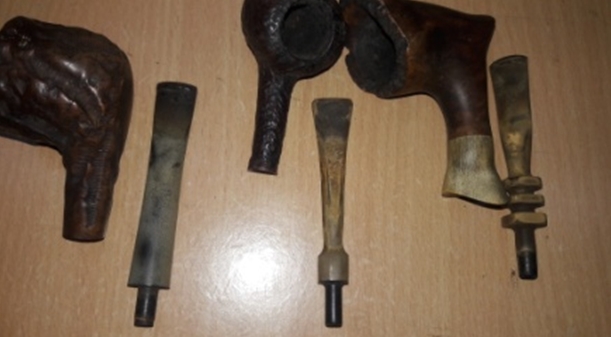
It’s been a while since I have worked on any of my grandfather’s pipe collection that I have inherited after his demise a few years ago. Amongst the collection, this small quaint Ben Wade was beckoning me for a long time. It is now that I decided to work on it. I had one Ben Wade without a stem, that Steve had taken back to Canada from his visit to India to fashion a stem from his bag of spares. This prompted me to fish out this Ben Wade and work towards its restoration.

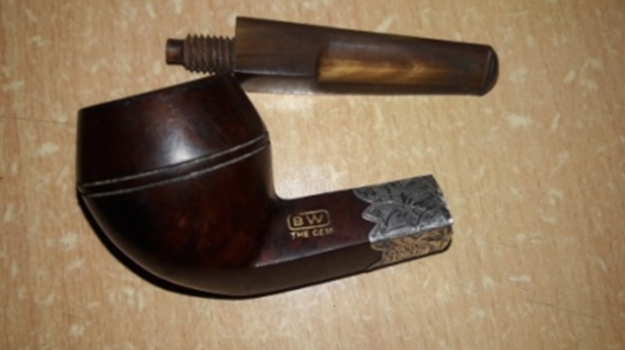
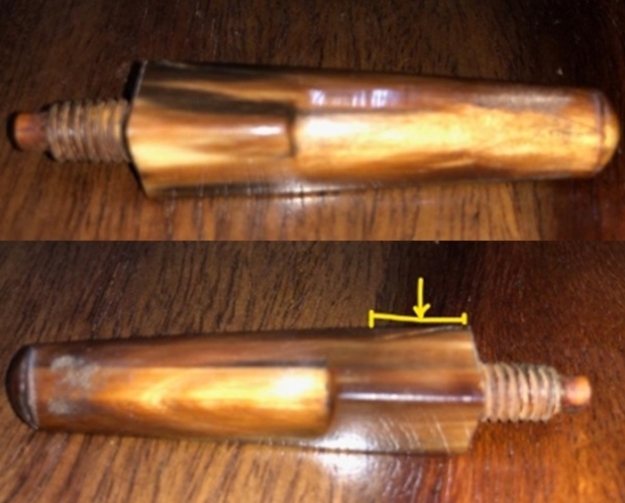
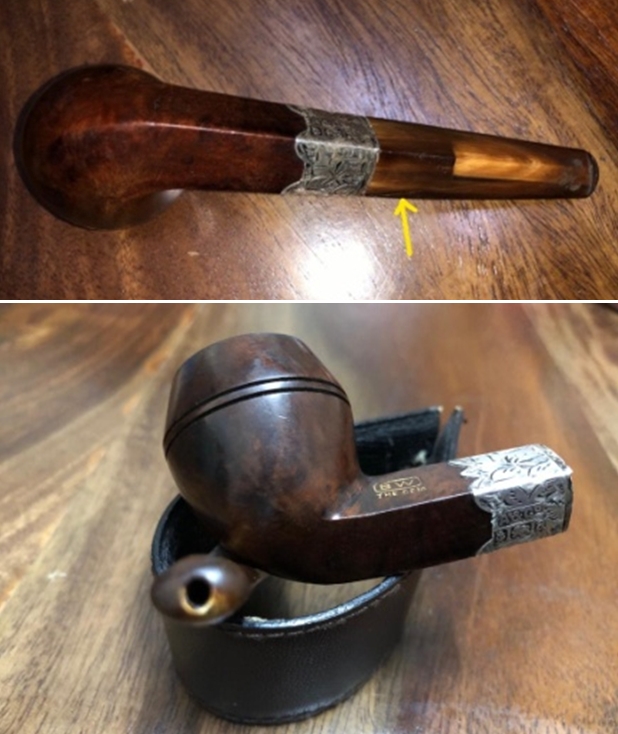
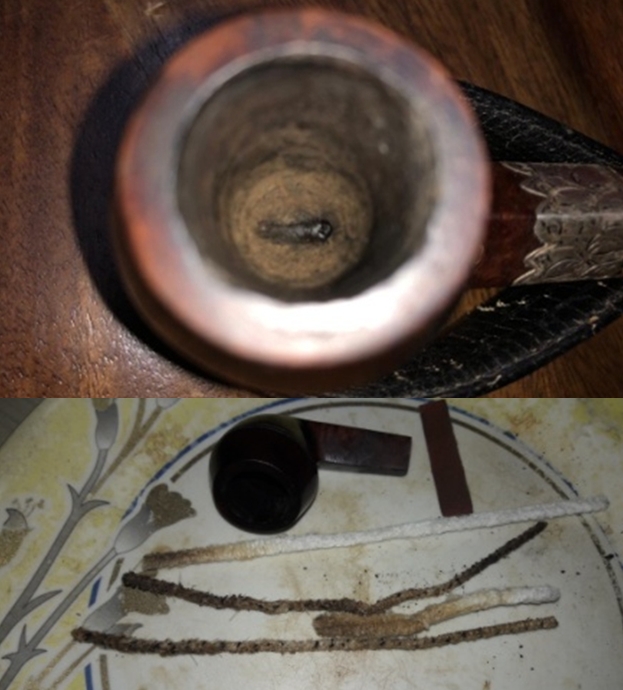
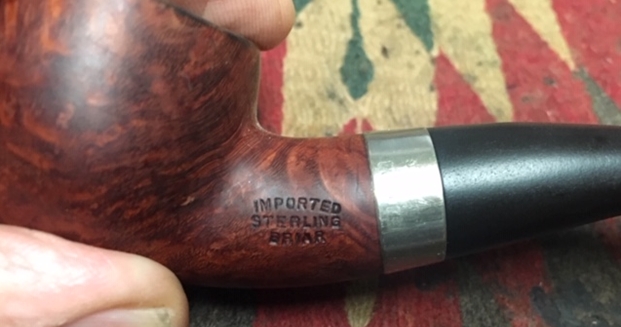
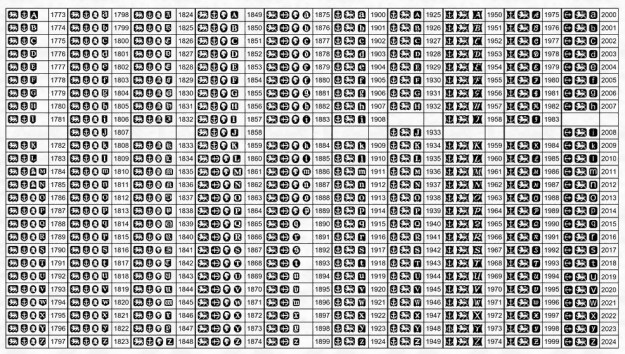
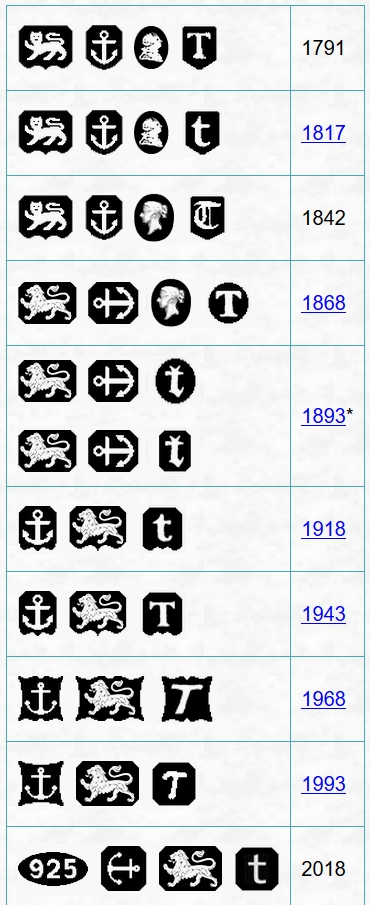
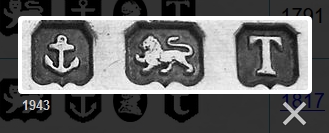
This small sized straight Bulldog is typically classic British shape, with a diamond shank and a horn stem with a threaded bone tenon. The shank end is decorated with a sterling silver ferrule with embossed leaves, which is loose and came off easily. On this ferrule are the stamp details which will help in determining the vintage of this pipe. The silver shank ferrule is stamped as “A & Co” over a series of three hallmarks running from the left near the bowl end to the end of the shank on the right.The first hallmark is an “Anchor” in a shield shaped cartouche and identifies the city of Birmingham in England where the silver was crafted. The second hallmark is a passant Lion in a cartouche which signifies that the band is silver and that it was crafted by a British silversmith. The third hallmark is a square cartouche with the small letter “a” in the box which is a date letter that will give the year of the making of the pipe. Steve had recommended a site which he frequents while dating silver hallmarked pipes. Here is the link which helped me identify the city mark as Birmingham and further following the link on Birmingham date letter chart on the same page brought me to a separate page with all the letters along with the period in which they were stamped. I found the letter which matched to the one seen on the pipe in my hand and I can now say with authority that this silver ferrule is from the year of manufacture1900!! Unfortunately, the site did not allow me to copy/ edit and reproduce the relevant charts for including in this write up.

https://www.925-1000.com/british_marks.html

The next stamp which I researched was the “A & Co” stamp over the three hallmarks. I conferred with The-Beard-of-Knowledge on all things pipe, Steve and he suggested that I visit http://www.silvercollection.it and sure enough I got the information that I was looking for. I reproduce the relevant information from the site and also the link for those who may need to refer when researching their pipes.

http://www.silvercollection.it/englishsilvermarksXA.html

A business which is supposed to have been established in 1781 at Mitcham, Surrey, by William Asprey (died 1827).

CHRONOLOGY:
Francis Kennedy, c. 1804-c. 1841
Kennedy & Asprey, c. 1841-1843
Charles Asprey, 1843-c.1872
purchased the business of Charles Edwards, c.1857
Charles Asprey & Son, c.1872-c.1879
Charles Asprey & Sons, c.1879-c.1888
acquired Leuchars & Sons
C.& G.E. Asprey, c.1888-c.1900
Asprey (& Co), c.1900-1909
acquired Houghton & Gunn, 1906
acquired William Payne & Co, 1908
Asprey & Co Ltd, 1909- 1998
Asprey & Garrard, 1998-2002
Asprey & Co Ltd, 2002

The relevant stamping is highlighted in blue. The period/ vintage of the ferrule now perfectly matches and confirmed that it is from the year 1900.

With the year of make of the ferrule established as 1900, I wanted to confirm if this matched with the year of manufacture of the pipe itself. This is essential since the makers did stock up on such silver ferrule before they even made pipes for them. The stampings on the pipe itself should provide some clues to the link with the vintage of the pipe. The pipe is stamped as “B W” in a rectangle over “THE GEM”, all in golden block capital letters. There are no other markings on this pipe, not even COM stamp.I searched pipedia.org for information on this brand and further confirmation on dating this pipe. There are some interesting details on this brand and makes for an interesting read. I have reproduced some snippets of the information from pipedia.org which are relevant to dating this Ben Wade.

The company was founded by Benjamin Wade in 1860 in Leeds, Yorkshire, where it was located for over a century. Ben Wade started as a pipe trader, but yet in the 1860’s he established a workshop to produce briar pipes. The pipes were made in very many standard shapes – always extensively classic and “very British”. Many models tended to be of smaller dimensions. Ben Wade offered a very high standard of craftsmanship and quality without any fills. Thus the pipes were considered to be high grade and a major competitor to other famous English brands.

In the second World War the factory was destroyed by German air raids on Leeds. But the Ben Wade family decided to re-build it immediately after the war and pipe production was re-started soon and successfully linked to the fame from the pre-war years.

Before the second war Ben Wade clustered their offerings into three price points: “Ben Wade” included the higher end pipes (eg the Larnix, Super Grain, Selected Grain, etc), “BW” included the mid-level pipes (eg Statesman, Natural Grain, County, etc), and “BWL” were the least expensive (eg Hurlingham, Adelphi, Tense Grain). Champion was in the last group, and in the 1930s at least retailed for 2/6.

Even though the owner family decided to leave pipe business and sell off the firm. The family went into negotiations with Herman G. Lane, president of Lane Ltd. in New York at about the same time as the Charatan family. Lane Ltd. bought both firms in 1962.

From the above it is confirmed that the Ben Wade that I have inherited is from the family era and from the era before the second war, placing it before 1939. Now, I had read somewhere that it was common for pipe makers not stamp the pipe with the COM stamp in early 1900s and this was confirmed by Steve. Thus, to sum up all the information researched to date this particular piece, it is safe to conclude that this pipe is likely to have been made in the year 1900!! My inheritance indeed has some very nice and very old pipes.

INITIAL VISUAL INSPECTION
In the month of January this year, I had restored a Loewe Kenton from my inherited pipes that was nicely reamed with no overflowing lava over the rim top (https://rebornpipes.com/2019/01/17/restoring-a-classic-british-billiard-loewe-co-pipe/) and now this is the second pipe which is without a layer of cake in the chamber. However, the rim top surface is darkened and covered with lava overflow. I searched through the remaining large carton of inherited pipe for another pipe which is sans cake, but did not find any. Coming back to the pipe on my work table, the rim inner edge is mighty uneven, most probably a result of using a knife blade and shows signs of darkening due to charring. However, the outer edge is without any damage. The walls of the chamber are in excellent condition with no signs of heat fissures/ lines, but slightly uneven. A little magical touch from Pavni, my daughter who specializes in making the chamber smooth should address this issue. The stummel surface has developed a nice patina over 119 years of its existence and I have no intentions of destroying it during the restoration. Therefore, the few dents and dings that are visible shall stay and be a part of the pipes history through the years. Maybe, micromesh polishing will address a few of these dents and scratches. I wouldn’t say that this pipe has beautiful grains all round because it does not!! But yes, there is a smattering of some straight grains in the cap of the stummel and few on the shank while rest of the stummel has just some swirls of grains here and there. Even though the stummel is covered in dust, dirt and grime from years of uncared for storage, through it all the pipe still has a feel of quality maybe because of the shape or the proportions, I am not able to pin point exact reasons, but the pipe shouts vintage and quality!! The double ring separating the cap from the rest of the stummel is filled with dirt and dust, but is intact with no chipping or unevenness, which is surprising. At this stage of my initial inspection, in order to see the condition of the shank end and mortise, I tried to separate the bone stem from the shank end. The stem would not budge. I had no desire of applying more force for the fear of breaking the bone tenon inside the mortise and this would have really complicated the restoration for me as well as the originality of the pipe would have been compromised. I wanted neither and so in went the entire pipe in to freezer for a chill. A few hours later, I took the pipe out from the freezer and slightly heated the shank end. Once satisfied, I gingerly turned the stem with success. A little coaxing and finally the stem and shank were separated. Whew! What a relief. However, when I tried to reattach the two, there was a slight gap between the stem and the shank end and indicated with red arrows. I am sure that with the cleaning of the shank/ mortise of the entire gunk, the fit should improve. After the stem was separated from the shank end, the sterling silver ferrule too fell out easily. I will have to fix it with superglue. A closer examination of the mortise confirmed that it is clogged with accumulation of oils, tars and gunk of yesteryear. The threads too are covered in the gunk and most probably the cause of the incorrect seating of the stem in the mortise.The horn stem itself appears dull and lifeless and has tooth chatter on both the surfaces of the stem. The slot is perfectly round and correct for the time period of the pipe and shows accumulation of dried tars and dirt. The button edges, however, are sharp and sans any damage with a little dirt embedded at the bottom of the edges. I could make out one crack emanating from the right bottom edge of the diamond saddle and extending to more than half the length of the saddle panel. This crack is shown by a yellow arrow. The dark and light hues taken on by the stem over the years should polish out nicely and will add an additional touch of class to this classy pipe. THE PROCESS
Pavni, my youngest daughter loves to help me in pipe restoration in her free time and her forte is getting the walls of the chamber as smooth as a baby’s bottom. With a folded piece of 220 grit sand paper she completely evened out the wall surface. Once she was through with her sanding regime, I cleaned out the internals of the shank and the mortise with a few hard and regular pipe cleaners dipped in isopropyl alcohol. I also cleaned out the threads in the shank end with cotton buds and alcohol. With a sharp knife, I gently scraped away the lava overflow from the rim top surface. I followed it up by cleaning the external surface of the stummel with hard bristled tooth brush and Murphy’s oil soap. I rinsed it under running tap water and dried it with paper towels and a soft cotton cloth. I diligently scrubbed the rim top surface with a scotch-brite pad and Murphy’s oil soap to remove the remaining lava overflow. With this step on this particular project, I achieved two results; firstly, the gold lettered stamping on the shank was consigned to past tense and secondly, a couple of fills were revealed (marked in yellow arrows) at the front of the bowl and in the bottom left panel of the diamond shank. Thankfully, there is no charring over the inner and outer edge or the rim surface. I removed the old and loosened fills from the front of the bowl and one on the shank that was closer to the bowl. The old fill at the shank end; I let it be as it would be covered with superglue while attaching the silver ferrule. Next, I decided to address the issue of darkened rim top surface and uneven inner edge by topping the rim on a piece of 220 grit sand paper. The progress being made was frequently checked as I had no desire to lose any briar estate than absolutely necessary. Once satisfied with the result, I wiped the rim top surface with a moist cloth. The darkened rim top has been addressed completely, however, the inner rim edge is still uneven (though greatly reduced) with slight charred edges. I address these issues by simply running a piece of 220 grit sand paper along the inner rim edge without creating a bevel, but a nice rounded even surface.Next issue to be addressed was the fills. As mentioned above, I had cleaned out the old and loose fills using my sharp dental tool. I filled these with a mix of superglue and briar dust using the layering technique. Using a toothpick, I first spot fill superglue in to the surface of the intended fill and press briar dust over it. I repeat this process, if need be, till the fill is slightly above the rest of the surface. Once all the fills are covered, I set the stummel aside to cure. Once the fills are sufficiently hardened, which is quite rapid, I sand it with a flat head needle file to achieve a rough match with the rest of the stummel surface. I follow it up by sanding with a piece of 220, 600 and 800 grit sand papers to a perfect match. Discerning readers must have noted that I did not sand the entire stummel surface. This was because, as I had decided earlier that I would maintain the aged patina that the briar had taken on over the 119 years.At this stage, I decided that I would tackle the stem repairs as addressing the crack observed on the diamond saddle would require curing time and while the stem repair is curing, I could get back to the stummel, saving on time. I began by first cleaning the bone tenon and the stem surface with a cotton swab and alcohol to remove all the dirt and gunk from the surface. I was contemplating whether or not to drill a counter hole to prevent the crack from progressing further and after weighing the cons, I decided not to do so. The probability of the stem chipping or the crack developing further was reason enough for me to avoid this drilling. I filled this crack with plain superglue and set it aside to cure. The CA superglue would seep and spread inside and stabilize the crack. During his visit, while discussing various aspects of pipe restorations, Steve had made a passing comment that in his experience the best way to preserve the patina on a briar if you need to sand it is to dry sand the stummel with 1500 to 12000 grit micromesh pads. I followed his advice and went ahead and dry sanded the entire stummel surface with 1500 to 12000 grit micromesh pads. The results are amazing. The stummel has now a deep and rich dark brown coloration and this will further deepen once I go through the polishing and wax application regimen. Most of the readers would have noticed that the double ring separating the cap from the rest of the stummel shows accumulation of briar dust and grime. Also the fills are darker than the rest of the stummel surface. I have noticed it too and will clean the rings at the end as the polish and wax would also be accumulating in these gaps subsequently. The issue of the fills was addressed by staining the fills and surrounding surface with a dark brown stain pen. I set the stummel aside overnight for the stain to set. The blend is near perfect and should blend further after application of balm and carnauba wax polish.The superglue applied over the crack was by now well cured and had seeped in to the crack as well. I sand the entire stem and the fill in particular, with a worn piece of 220 grit sand paper. This helped to address the tooth chatter seen in the bite zone as well as blend the fill with the rest of the stem surface. I followed it up with dry sanding the stem with 1500 to 12000 grit micromesh pads. I wiped the stem with a moist cloth after every three pads to remove the resulting bone dust. To finish, I applied a liberal coat of Extra Virgin Olive oil and set it aside to be absorbed by the porous bone. I am very pleased with the way the contrasting dark browns and lighter grains in the bone are now highlighted. Once polished further, this will further add a touch of class to an already chic looking Bulldog!! I applied petroleum jelly over the bone tenon and tried the fit of it in to the mortise after temporarily attaching the silver ferrule over the shank end. The alignment and seating of the two was spot on. I separated all the parts again and continued further. While the stem was being hydrated with olive oil, I went back to work the stummel. The stain had set well by this time. I applied a little “Before and After Restoration” balm with my fingers and rubbed it deep in to the stummel surface. This balm rejuvenates the briar and the transformation in the appearance of the stummel is almost immediate. The fills are now so well blended in to the briar that it is difficult to spot them. The only part that needs TLC is the sterling silver ferrule. I polish the ferrule with a very soft powder specifically available locally, and widely used by jewelers, for polishing of silver. I align the ferrule stampings with the stummel stamping on the shank and fix it over the shank with a little superglue. The contrast that this shiny ferrule provides against the dark brown of the stummel looks fantastic.Next, I ran a thin and sharp knife through the double cap ring and cleaned it. To finish, I re-attach the stem with the stummel and mount a cotton cloth buffing wheel on to my rotary tool. I set the speed at about half of the full power and applied several coats of carnauba wax over the stummel and the stem of the pipe. I finished the restoration by giving the pipe a rigorous hand buff using a microfiber cloth to deepen the shine further. The completed pipe, with dark brown hues of the stummel contrasting with silver ferrule and the shiny dark browns and lighter grains in the bone stem makes for a visual treat. The pipe looks lovely, fresh and vibrant; the photographs speak for themselves. Thank you for your valuable time. P.S. This was the last pipe that I had restored during my leave from my work. The following write ups are now on pipes that I have already restored after returning to my work place. I shall sorely miss the help that Pavni, my 10 year youngest daughter and Abha, wifey dear, extend in my work. There are about 40 odd pipes that I have carried with me and which have been cleaned by Abha. So the next couple of months are going to be interesting. Keep following rebornpipes.com for some nice, unique and interesting pipes from here in India in the near future.

Oh, missed out on one aspect!! I tried to repaint the shank stamp with a gold glitter pen towards the end, but it would just not stay. Any suggestion would definitely help me mark this oldie as well as for future.


Giving a Second Chance to a Throw Away Bowl

Blog by Steve Laug

This morning I was looking through my boxes of pipes to restore to find what I wanted to do next. I went through several options and finally settled on a bowl that I brought back from Idaho. It was a Custombilt style bowl that we were ready to pitch in the trash because it was in rough condition. Someone had cut off the shank with a saw – a real hack job that left the shank end rough and the surface not flat. The bowl had a thick cake in it and an overflow of lava on the rim top. The inside and outside edges were dirty but it was unclear if there was damage. There was no stamping on the shank or underside. The finish was shot and there was a lot of dirt and grime in the grooves of the finish. There was also some shiny coat on the smooth portions of the bowl that made wonder if it had been varnished at some time in its life. It was an unbelievable mess. But it was enough of a challenge that I wanted to take it on. Here are some photos of the bowl when I started. I went through my cans of stems and found one that fit the mortise. I would need to work on the face of the shank itself to make it round again but it showed a lot of promise. The stem was lightly oxidized and the bend was too much but otherwise I liked the look of the saddle stem.I put the stem on the bowl and took a few photos of the pipe. To me it showed a lot of promise. It would take a bit of work to get the fit just right but the pipe had a lot of potential.I heated the stem with a heat gun to straighten out the bend. Once the vulcanite had become flexible I took the majority of the bend out so that the angle of the stem matched the angle of the top of the bowl. I took photos of it at this point in the process. I am happy with the progress. I set the stem aside and turned my attention to the bowl. I reamed it back to bare briar with a PipNet pipe reaming set. Once the bowl was smooth I cleaned up the reaming on the walls and scraped the rim top with a Savinelli Fitsall Pipe Knife. I topped the bowl on a topping board with 220 grit sandpaper to remove the damage and smooth out the surface of the rim. There was a lot of damage to the rim top and the topping took care of the damage to the rim top. I scrubbed the bowl with Murphy’s Oil Soap and a tooth brush under running water. I rinsed off the grime and took the following photos of the bowl. I cleaned out the internals on the mortise and the airway in the shank and the stem with 99% isopropyl alcohol, cotton swabs and pipe cleaners. I worked until the shank and mortise was clean and smelled new.There were still some shiny spots on the shank and smooth portions of the bowl. I wiped them down with acetone on a cotton pad. I used the Dremel and sanding drum and 220 grit sandpaper to reshape the shank. I rounded it to match the diameter of the stem and also faced the shank end on the topping board. I was moving through this restoration while I was talking with my brother and totally forgot to take photos of this part of the process. I smoothed out the sanded and reshaped shank and stem with micromesh sanding pads – wetsanding with 1500-6000 grit pads. I sanded the top of the bowl at the same time to smooth out the scratches.

Once I had finished shaping the shank I decided to continue my ongoing experiment with the Briar Cleaner on this pipe. I scrubbed it with the product from Mark Hoover of Before & After Products. He says that the briar cleaner has the capacity of absorbing grime and dirt from the surface of briar. I rubbed the bowl down with it to see how it would work in this setting. (Just a note: In speaking to Mark he noted that the product is completely safe to use. The main product is even FDA approved edible.) I rubbed it onto the bowl and rim top with my finger tips and worked it into the remaining sanding grit on the bowl. I let it sit on the pipe for about 5 minutes before I rinsed it under warm running water to remove the residue. I hand dried it with a microfiber cloth. I was pleasantly surprised by how clean the surface on the bowl looked when I was finished. The various surfaces of the carved briar just begged for a variety of stains to give the pipe some real dimensionality. I heated the briar and gave it the first coat of stain – a Tan Fiebings. This tan has some red tints in the dried and fired coat. I applied the stain with a dauber and then flamed it with a Bic lighter to set it in the grain. I repeated the process until the coverage was what I wanted. I buffed the bowl with a clean microfiber cloth and gave the bowl a light shine. All of this was preliminary for the next stain coat. I put the stem on the bowl and buffed the pipe with Blue Diamond on the buffing wheel. The buffing really brought the reds to the surface of the briar. It helped me to make the next decision regarding the contrast stain. I touched up the rim top with a Mahogany stain pen to smooth out the finish. I then stain the entire bowl with the contrast stain coat using Watco’s Danish Oil with a Cherry stain. I rubbed it on with a soft cloth and let it sit for a while before buffing it off with a soft cloth. I gave the bowl several coats of Conservator’s Wax and buffed it with a horsehair shoe brush. I also buffed it with a microfiber cloth to deepen the shine. I set the bowl aside and turned my attention to polishing the stem. I worked it over with micromesh sanding pads – wet sanding with 1500-2400 grit pads. I buffed it on the buffing wheel with Red Tripoli to further remove the oxidation on the surface. I reworked it with micromesh sanding pads. I wet sanded it with 1500-12000 grit pads. I wiped the stem down after each pad with Obsidian Oil. I finished polishing it with Before & After Pipe Stem Polish – both Fine and Extra Fine. I gave it a final coat of Obsidian Oil and set it apart. With both parts of the pipe finished I put the pipe back together again and I polished the bowl and the stem with Blue Diamond polish on the buffing wheel. I gave the bowl multiple coats of Conservator’s Wax and the stem multiple coats of carnauba wax. I buffed the pipe with a clean buffing pad to raise the shine. I hand buffed it with a microfiber cloth to deepen the shine. The pipe polished up pretty nicely. The rich finish and the interesting grain on this briar came alive with the buffing. The finish on the briar works well with the polished black vulcanite stem. The finished pipe looks almost like it came out of the factory like this. It is a well-proportioned, nicely grained shape that I would call Bent Apple. Have a look at it with the photos below. The dimensions are Length: 5 ¾ inches, Height: 1 ½ inches, Outside diameter of the bowl: 1 ½ inches, Chamber diameter: ¾ of an inch. This throw away, cut off bowl met a stem from another place and the pipe that came out is a beauty. The condition of the bowl showed that it was a great smoker so this new edition should also be one! I am not sure who made the bowl originally but from the looks of the finish it could very well be a Custombilt. I am not sure I will ever know with certainty but it has the look. Thanks for walking through the restoration with me.

Replacing a Broken Tenon in a L’Anatra Square Shank Pot

Blog by Steve Laug

I received a phone call referral from another customer of City Cigar. I was at work so I gave him a quick call and once again after playing some phone tag we connected. I had Friday off so he stopped by with his pipe. It was a beautiful L’Anatra Smooth Pot shaped pipe with amazing grain all around the bowl. The pipe was in parts – he held the stem in one hand and the bowl in the other. He had dropped it and it had flown across the floor in his parking garage. There was a bit of road rash on the left side of the bowl and the tenon had snapped off in the shank. He had smoked maybe one or two bowls in the pipe before it broke so he was pretty heartbroken. I could see why he was shaken as it was a very beautiful pipe. There was still unsmoked tobacco in the bowl. The pipe was stamped on the left side of the shank with an egg at the bowl shank junction. That was followed by “L’Anatra (over) dalle Uova d’Oro”. On the underside of the shank it was stamped Hand Made in Italy. There was some darkening on the back top side of the rim. The Lucite stem was in excellent condition with just a little tooth chatter on both sides near the button. There was a golden duck head on the top of the stem that would make things interesting. I needed to pull the broken tenon from the shank and drill out the stem and add a new tenon. It was a small pipe so the tenon would take work to get the right diameter. I took a few photos of the pipe in pieces to show what I was dealing with. I tried to pull out the tenon in my usual way – a screw in the airway and wiggling it but it was stuck and would not come out. I put it in the freezer for about 20 minutes and when I took it out I screwed the screw into the airway in the broken tenon and wiggled it free of the shank (a side benefit of the freezer was that as the bowl warmed up I was able to wipe the blackening away from the rim top and it looked new).I took a photo of the bowl side to show the “road rash” on the left side down low. I have circled the damaged area in red to make it easily identifiable. I decided to steam it out. I heated a butter knife over the gas stove and put a wet cloth on the marks and applied the hot knife to the cloth. The steam that was generated helped to raise the dents in the briar. I was not able to take all of them out of the briar but a few were left behind. I really have come to appreciate Mark Hoover’s Before & After Restoration Balm for its restorative properties with dry briar. I use it on virtually every pipe that I work on. I worked it into finish of the briar with my fingertips to clean, enliven and protect it as I usually do at this point in the process. I let the balm sit for a little while and then buffed with a cotton cloth to raise the shine. The Restoration Balm really makes the grain stands out beautifully. I went through my box of tenons and found one that would fit once I had reduced the diameter. The photo below shows the original tenon while the upper one shows it after I have shaped and reduced it. I used the PIMO tenon cutting tool to reduce the tenon as far as I could with the adjustments available. I finished the reduction with a Dremel and sanding drum. It took work to get it the right diameter. I also cut the length to match the depth of the mortise and to make sure I had enough length to glue into the drilled stem. (I of course was on a roll and forgot to take photos of the process of shaping the tenon.)I drilled out the end of stem as well. This was a touchier job as there was the Duck head on the topside of the stem. I would need to be careful of the diameter of the drill bit so that I would not damage the pin that held the duck in place. I started with a drill bit a little larger than the air way. I went through 5 other bit until the diameter was big enough for the newly shaped tenon end.I took a photo of the drilled airway and the tenon before I glued it in place. I put super glue on the tenon and swabbed it around the entire end. I pressed it in place in the stem. I took photos of the newly installed tenon. There was quite a bit of tooth chatter on the top and underside ahead of the button. Though in talking to the client I did not mention cleaning up the stem to me it is just part of the process. I polished the stem with micromesh sanding pads – wetsanding it with 1500-12000 grit pads. I wiped the stem down with Obsidian Oil after each pad and gave it a final coat and the 12000 grit pad and set it aside to dry. I put the newly repaired stem and bowl back together and buffed the pipe with Blue Diamond on the buffing wheel. I polished the briar and the stem until there was a rich shine. This Italian Hand Made “L’Anatra (over) dalle Uova d’Oro” has a classic Italian shape and a rich finish that highlights the amazing grain on a proportionally well carved pipe. Once I buffed the pipe the grain just popped. The black Lucite stem had a rich glow. The finished pipe is actually quite stunning. It is a beautifully grained pipe that fits well in the hand and sits right in the mouth. Have a look at it with the photos below. The dimensions are Length: 5 ¾ inches, Height: 1 ½ inches, Outside diameter of the bowl: 1 3/8 inches, Chamber diameter: ¾ of an inch. I will be giving the owner a call to let him know it is ready for pickup. Thanks for walking through the repair on the stem with me as it was a pleasure to work on.

New Life for a Mystery Pipe – an Imported Sterling Briar Author

Blog by Steve Laug

The next pipe in the queue is a ¼ Bent Author that Jeff picked up from an auction he follows in Michigan. It is a great looking pipe with some beautiful grain – swirls of birdseye, straight and flame grain around the bowl and shank. The carver did a great job utilizing the block of briar to maximize the grain. The pipe is stamped on the left side of the shank. It reads Sterling with Imported arched over the Sterling name and Briar arched underneath. The pipe was filthy with a thick cake in the bowl and overflowing lava on the back of the beveled rim top. There was some burn damage and darkening on the back inner edge of the rim but it was hard to know how badly damaged it was until it was cleaned up. There were some nicks in the outer edge of the bowl as well. Even though it was dirty there was some nice grain peeking out from under the grime. The exterior of the briar was dirty and dull looking – lifeless after sitting unused for years. The bent tapered stem is vulcanite and has no marking or stamping. It is good quality vulcanite but is pitted all over both sides. There are some tooth marks and chatter on both sides near the button. There was a tarnished Sterling Silver band on the shank with the following Hallmarks – a rampant lion (.925 silver stamp), an anchor (the Birmingham assay office) and an upper case letter “T” which will give me some idea of the date on at least the band. The photos below tell the story and give a glimpse of the pipe before clean up. I took photos of the bowl and rim to capture the condition of the pipe before Jeff did his cleanup work. There was significant darkening on the rim top and a cake in the bowl flowing over as lava on the back top edge. The inner edge showed some burn damage to the back side and rim top. The outer edges of the bowl had some nicking from the pipe being knocked out against something hard.Jeff took some photos of the side and underside of the bowl to show some of the issues with the old finish. It was more scratched than nicked but it was very worn looking on the underside of the bowl. You can also see the tarnish on the silver band in the photos.He took a photo of the stamping on the left side of the shank. It reads as noted above. The stamping is well done and readable. The photo of the silver band shows the hallmarks as noted above.The stem had some oxidation but was good quality vulcanite. There was some wear on the button edges and some tooth marks and chatter on both sides near the stem. The surface was also pitted and worn looking.I remembered working on a similar brand but was not sure how the Imported Briar stamped (which is usually used on USA made pipes) with the Hallmarks identifying the Sterling Silver band as Birmingham made and bearing a “T” date stamp. The conflicting information had several possible resolutions. One was that the pipe could be an American made pipe and the band added as bling later in its life time. Another would be that the pipe was made in England for export into the USA and the band was original. At this point I was not sure what to think about the situation. More work was necessary to see if I could gain some insight.

I turned first to the Pipephil website (http://www.pipephil.eu/logos/en/logo-s12.html). There was some information on a brand that was stamped Sterling Hall that was made by Briarcraft in New York City. The stamping was very different from the one in my hands. The stamping on Pipephil was Germanic script and had the Shield B logo of Briarcraft. The one that had in hand had neither one of those. The Aged Imported Briar stamp was also longer and different from the arched Imported Briar in block letters around the uppercase block STERLING. So at this point I was not sure there was a link to Sterling Hall. I have included a screen capture of the stamping for you to compare with the one above on this pipe.I turned to my other go to site for information – Pipedia. I looked in the British makers list for Sterling pipes but there was nothing listed. I turned to the same in the USA makers list and again it was not listed. I decided to have a look at the listing for Briarcraft and see if I could possibly find some pertinent information (https://pipedia.org/wiki/Briarcraft). I quote:

Richard Kliethermes Sr. was the founder of Briarcraft. First located on Pipetown Hill Rd, Spring Valley, NY., it moved later to 66 Central Ave., Spring Valley, NY. After the death of RK Sr., business was run by Richard Kliethermes Jr. († 1943) and was quite prosperous between 1920 and 1940. The company closed in 1950.

Briarcraft Pipe Company was very prosperous between 1920 and 1940 and usually feature a diamond shield logo. They also produced a line of seconds under the following names: Airo, Arcadian, Briarmeer, Smokemaster, Cavalcade, Hallmark, Sterling Hall, and Wimbledon. They closed their doors in 1950.

Briarcraft was started by Richard Kliethermes Sr. and located on Pipetown Hill Rd, Spring Valley, NY. It received its power from a dam on Hyenga Lake, later it moved to 66 Central Ave., Spring Valley, NY. At first it was housed in a 2 story frame building and later a 2 story stone building was added. Upon the death of RK Sr., business was run by Richard Jr, between 1920 and 1940 it was second in size to Frank Medico pipes. All the briar root was imported from Africa, with the start of WWII, imports stopped and a briar like root was imported from S. Carolina. Richard Kliethermes Jr. was the inventor of a pipe known as Smokemaster, which used a doubled up pipe cleaner in the bit to absorb tobacco juice. With the decline in business during WWII and the following 5 years it closed its doors 1950.

I have highlighted in red text the name Sterling Hall. There is no other help with the brand and there was nothing to link it to the Sterling I was working on. The other interesting thing of note in the above information is that the pipes were usually stamped with a Diamond Shield logo. The word “usually” could apply to this one not having a stamped logo.

I also checked in my copy of Who Made that Pipe (WMTP) by Herb Wilczak and Tom Cowell, copyright 1997. There I found a bit more help. There were several listings for the Sterling pipe and also variations on the name. I did a screen capture of the section showing the brands.In the above chart you can see that Arlington Briars in the US and Comoy’s, Delacour Bros and Orlik made them in England. You can also see that Kapp & Peterson made them in Ireland and Stanwell also had a Sterling brand made in Denmark. There was also a Sterling Band brand listed under Wally Frank in the US. It was pretty easy to say that the pipe in hand was not a Stanwell or Peterson made pipe so that left others that interested me.

I turned to the section on Arlington Briars to see if there were any ties there to help me get a better picture (https://pipedia.org/wiki/Arlington). I quote a part of that article and highlight the section that may give some insight. Again there is nothing certain in the article tying the brand to this company.

According to José Manuel Lopes, “North American brand that belonged to Arlington Briar Pipes Corp., Brooklyn, New York, founded in 1919. In the 1940s, Ludwig Rosenberger gave the company new life, and it continued until the 70s. His son, Mel Rosenberger, has recently launched the DiMonte brand. Jack Uhle was also linked to Arlington.” Arlington, as far as known, mainly operated as a sub-contractor for other brands. The Jobey pipes are said to be made by Arlington at an unknown point of time. Arlington’s own pipes are seldom seen.

I checked out the article on Pipedia on Delacour Bros. to see if there was a tie. But it did not have enough information to be truly helpful (https://pipedia.org/wiki/Delacour_Brothers).

I also checked the section on the Comoy’s and the Orlik article that pertained to seconds lines and there was no tie to the Sterling in either of them.

I then turned to the last noted make from the above WMTP chart – Wally Frank. I thought maybe that was a possibility as they had many companies make pipes for them. Here is the link on Pipedia (https://pipedia.org/wiki/Wally_Frank). I quote a portion of the article here for my purposes and have highlighted the portion that is interesting to this discussion:

Their numerous private-label pipes were made by many makers, including Charatan, Sasieni, Weber, and many others. Wally Frank, Ltd. also owned the Pioneer brand of meerschaum pipes, made from both Turkish and African meerschaum. In addition to importing pipes, he had many pipes made in his own name and also employed pipemakers like Peter Stokkebye, Svend Bang, and Ed Burak (who later became the owner of Connoisseur). As a result, each Wally Frank pipe must be individually evaluated on its own merit.

I have run into a dead end on the research of this pipe. I do not know where else to turn with looking for the brand. What I do know is that the most that can be said about this pipe is that it is certainly a USA Import Pipe. How it came to have a British Hallmarked Silver band on the shank is shrouded in mystery and I will probably never figure out the connection. Perhaps one of you readers can shed some light on the brand. If so let us know. Onto working on the pipe itself!

Jeff did his usual thorough cleaning of the pipe. He reamed the bowl with a PipNet Pipe reamer to take the cake back to bare briar. He cleaned up the reaming with the Savinell Fitsall Pipe Knife. He scrubbed the exterior of the pipe with undiluted Murphy’s Oil Soap and a tooth brush. He rinsed the bowl off with warm tap water to remove the grime. He scrubbed out the mortise and the airway in the shank and stem with pipe cleaners, cotton swabs and isopropyl alcohol until they were clean. He soaked the stem in Before & After Deoxidizer and when it had done its magic, rinsed it off the exterior and in the airway with warm water. He dried it and buffed it with a soft clot to remove the oxidation. I took the following photos of the pipe before I did my part in the restoration. I took a photo of the bowl and rim top to show its condition after Jeff had scrubbed it. You can see the darkening and the damage on the back inner edge of the bowl. You can also see the nicking on the outer edge of the bowl. The stem looked very good other than the few tooth marks on the surface of both sides ahead of the button. There was also some damage to the sharp edge of the button that would need to be dealt with. The silver band looked good.I took a close up photo of the stamping on the shank. The reflection of the flash makes it hard to capture the stamping on the band but it has the following Hallmarks – a rampant lion (.925 silver stamp), an anchor (the Birmingham assay office) and an upper case letter “T” which will give me some idea of the date on at least the band.I decided to figure out the potential date on at least the silver band. I found another helpful website on British silver hallmarks that covered hallmarks dating from 1743 to 2024 (https://www.silvermakersmarks.co.uk/Dates/Birmingham.html).I know that the graphic is small but check the link. When you are on the site you can click on the date letter you are looking for and it will give you every listing on the chart with that letter. I clicked on the “T” link which I have included below and it took me to a listing of the T dates (https://www.silvermakersmarks.co.uk/Dates/Birmingham/Date%20Letters%20T.html).

The date that corresponded to the hallmarks on the band were those listed for 1943. When I clicked on the date I was taken to a larger view of the stamp. I have included that here as well.

So at least I could be certain that the band for the pipe was Sterling Silver that bore the Birmingham hallmark Anchor and the date stamp of a capital T which identified it as having been stamped in 1943.

The trouble was I could not link it to the manufacturer of the briar… ah well. There always remains a bit of mystery in these restorations.

I decided to address the issues with the rim edges of the bowl first. I filled in the deep nicks and gouges on the outer edges of the bowl with clear super glue. Once the repairs had cured I sanded them smooth with a folded piece of 220 grit sandpaper. I also worked on the inner edge of the rim to remove the damage to the back side of the bowl. Once I beveled the inner edge of the rim to bring it back to round, I decided to continue my ongoing experiment with a new product from Mark Hoover of Before & After Products. This one is a product he labels briar cleaner and it has the capacity of absorbing grime and dirt from the surface of briar. I rubbed the bowl down with some of his Briar Cleaner to see how it would work in this setting. In speaking to Mark he noted that the product is completely safe to use. The main product is even FDA approved edible. I rubbed it onto the bowl and rim top with my finger tips and worked it into the grime and grit on the bowl. I let it sit on the pipe for about 5 minutes before I rubbed it off with a microfibre cloth. I rinsed it under warm running water to remove the residue. I was pleasantly surprised by how clean the surface on the bowl looked when I was finished. I polished the bowl and rim with micromesh sanding pads – wet sanding with 1500-12000 grit pads. I wiped the bowl down after each pad to remove the sanding debris. My goal was to further remove the darkening on the both the rim top and the outer edges of the bowl. I worked some Before & After Restoration Balm into the surface of the briar with my fingertips to clean, enliven and protect it. I let the balm sit for a little while and then buffed with a cotton cloth to raise the shine. Mark Hoover’s Balm is a product that I have come to appreciate and one I use on every pipe I have been working on. While there is still a bit of darkening on the rim it is still quite a stunning pipe. Have a look at the bowl now. With the bowl finished I set it aside and turned my attention to the stem. I wiped the surface down with some Obsidian Oil and dried it off. I filled in the deep tooth marks on both sides and repaired the edge of the button with clear super glue.Once the repairs had hardened I used a needle file to redefine the sharp edge of the button and to flatten the repaired areas. I sanded the stem with 220 grit sandpaper to smooth out the surface of the repairs and blend them into the stem. I started the polishing of the surface with 400 grit wet dry sandpaper. I polished the stem with micromesh sanding pads – wet sanding it with 1500-12000 grit pads. I wiped the stem down with a damp cloth after each pad. I further polished it with Before & After Pipe Polish – both Fine and Extra Fine. I wiped it down with a coat of Obsidian Oil and set it aside to dry. With both parts of the pipe finished I put the pipe back together again and I polished the bowl and the stem with Blue Diamond polish on the buffing wheel. I gave the bowl and the stem multiple coats of carnauba wax. I buffed the pipe with a clean buffing pad to raise the shine. I hand buffed it with a microfiber cloth to deepen the shine. The pipe polished up pretty nicely. The rich finish and the interesting grain on this briar came alive with the buffing. The finish on the briar works well with the polished black vulcanite stem. The finished pipe is a well-proportioned, nicely grained shape that I would call an Author. Have a look at it with the photos below. The dimensions are Length: 5 ½ inches, Height: 1 ½ inches, Outside diameter of the bowl: 1 ½ inches, Chamber diameter: 7/8 of an inch. This beautiful mystery pipe is bound to be a great smoker. Was it made in England or the USA? Were the band English and the pipe American? I am not sure we will ever know for certain. But it was an interesting mystery to research and restore. Thanks for walking through the restoration with me.


Restoring a Dr. Grabow “Commodore” #39

Blog by Paresh Deshpande

After we bid our farewells to my Guru and Mentor, Steve Laug and his brother, Jeff, (Dal had left a couple of days earlier) I felt a void. All of a sudden there was nothing to look forward to, no pipe talks, no planned activities, nobody to share a smoke with and above all, their mere presence was being missed by Abha, my wife and both daughters, not to mention me too! It was my youngest daughter, Pavni, who suggested that we restore a pipe!! What a suggestion that was! Our spirits immediately soared and I pulled out my “MUMBAI BONANZA” pipe box to select one pipe.

The one that caught our collective attention was a pick axe shaped pipe that we had come to associate with Kriswill as I have inherited a few. However, this had a “Spade” stamped on its stem in white. It was a Dr. Grabow.

For those readers who have missed out on my previous work, I was fortunate enough to have heeded the advice of my dear friend and mentor, Steve, and struck a deal with a junk collector from Mumbai. He did not know what he was selling and I did not know what I was buying as we reside in different cities!! The argument that Mr. Steve presented was that if not anything, I shall at least have some spares and this was logical. I struck a deal and here are pictures of the pipes that I received in this lot.     This lot contains some very nice collectible pipes, a few well known brands and some mediocre brands. Overall, with seven Dunhill pipes, a Preben Holm #1 FH, a couple of “Made in England” Pete System pipes, a couple of  Charatan’s Belvedere, Custom-Bilt, Stanwell and other assorted pipes, I would say that I had struck a decent haul!!! This is indeed my “Mumbai Bonanza”.

The eleventh pipe that we decided to work on from this find is a pickaxe shaped pipe and is indicated in red colored arrow in the picture below. It is stamped on the right side of the shank as “COMMODORE” in block letter over “DR. GRABOW” again in block letter. The shape code “# 39” is also stamped on the right side towards the shank end and away in the middle of the two lines. The left side of the shank is devoid of any stamping, which is slightly unusual as most of carvers and makers prefer to stamp their pipes on the left. The stem bears the famous “Ace of Spades” logo in white, embedded on the left side of the stem. Now coming to the research of this brand and line/ model in specific, I referred to pipedia.org and as expected there is an extensive research on this pipe and even has a separate page on the dating of Dr. Grabow pipes, starting from the Linkman era to later pipe lines and numbers which makes for an interesting read and is highly recommended. This research has been done by Russell McKay, and is from his website DrGrabow-pipe-info.com. Here is the link to the page on pipedia.org:

https://pipedia.org/wiki/Dr._Grabow_Models_(Series,Line)_Names_Through_the_Years

I found what I was looking for in the list of most “newer” Dr. Grabow pipe names and is reproduced below;

COMMODORE (c1964) — First appears in a magazine ad for $7.95 as early as 1964. Like the Sculptura, later models were sandblasted in a “big” blast circa 1967-69 (See “Sculptura” for details.)

From the above information, it is evident that the pipe currently on my work table is from the period 1967-69, even though the line was first introduced in 1964 since the stummel is beautifully sandblasted. With this input on the vintage of this pipe, I move ahead with the restoration of this 50 plus years old pipe!

INITIAL VISUAL INSPECTION
I usually start my initial visual inspection by going over the chamber first. However, in this particular pipe, I was so drawn by the beautiful sandblast on the stummel that I decided to change the order and start with the stummel.

The stummel boasts one of the most beautiful sandblast patterns with the front of the bowl having circular blasted pattern and from the outer most part of this blast ring, the sandblast that radiates from the front of the stummel and moving around to the sides and back of the stummel with the cross grains and the straight grains forming an intricate crisscross patterns. It is a visual treat to say the least and difficult to explain in mere words! The following two pictures of the cleaned stummel will give the readers an idea of the sandblast patterns on the stummel.The sandblasted stummel is covered in dirt and grime of 50 plus years of its existence. This should clean up nicely. The stummel surface is solid with no damage to the external surface. The dark browns of the raised sandblast contrast beautifully with the black stain of rest of the stummel. A thick layer of cake can be seen in the chamber. The sandblasted rim top surface is covered in thick overflow of lava, dirt, dust and grime. The condition of the inner walls of the chamber and rim top surface will be known once the cake has been taken down to bare briar and the rim top crud has been scraped off completely (thankfully readers cannot see or hear me muttering silent prayers!!). The inner rim condition appears to be in good condition with no burn/ charred surfaces. Even the outer rim edge appears to be in a decent condition. Only once the stummel has been thoroughly cleaned that I can be sure of my initial appreciation. In spite of the thick cake, the chamber odor is, surprisingly, not strong and should be addressed once the cake has been taken down to the bare briar. The shank end has a metal band around the center and this metal band extends inside the shank with threads, over which the threaded stem stinger is seated in to the mortise. Thankfully, the band and threads are all intact. The mortise is blocked with dried gunk, adversely affecting the airflow. The metal band is dull and dirty in appearance.The stem is an “Adjustomatic” type (a patent for stem to shank threading system, later Patent #2461905 which was filed on 25th January 1946 by David P. Lavietes). This patent allows the stem to be turned in the shank for a perfect alignment without having to detach the two. The stem is attached to the shank by a threaded “tool” stinger (again patented by the brand way back in 1924 and upgraded over the years) and the stem can be turned over this stinger for alignment of the shank and stem. Unfortunately, the previous owner had this stinger cut ahead of the threaded portion so that the attachment of the stem to the shank is not affected at all. The vulcanite stem is heavily oxidized and has calcification deposits towards the button end. There are a few deep tooth marks on the lower and upper stem surface. The button edges also have bite marks. The stinger opening and the horizontal slot shows accumulated oils and tars. The threaded portion of what remains of the stinger is covered in dried dust, dirt and grime. The alignment of the stem and shank skewed with the stem being overturned to the right.THE PROCESS
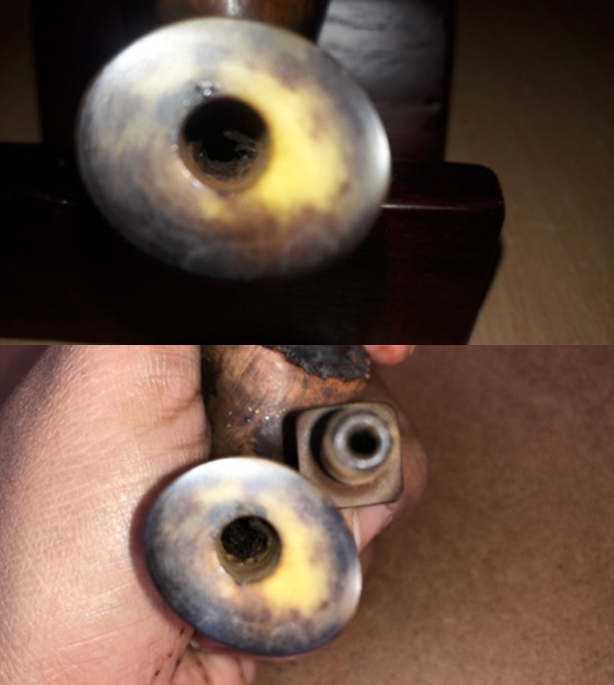
I started the restoration with cleaning of the stummel as I was keen to know the condition of the walls of the chamber. With size 1 head of a Castleford pipe reamer, I took the cake down to bare briar. Using a folded piece of 180 grit sand paper, I sand out the last traces of cake and expose the walls of the chamber to ascertain that there are no cracks/ heat fissures. I wiped the chamber with a cotton pad dipped in isopropyl alcohol to remove the carbon dust left behind by all the reaming and sanding process. I was happy to note that the walls of the chamber are in pristine condition without any heat fissures or pits. The inner and outer edge of the rim are intact and without any burn or char marks. Next I decided to address the stem. I cleaned the internals of the stem using hard and normal bristled pipe cleaners and isopropyl alcohol. The stem airway and the open ended stinger were filthy as can be made out from the number of pipe cleaners that were used up in the cleaning process. I cleaned the complete stem with a cotton swab and alcohol to remove the calcification from the button end and thereafter flamed the stem surface with the flame of a lighter to raise the tooth indentation to the surface. I scrubbed and cleaned the portion of the stinger that remained. I liberally applied petroleum jelly to the stinger to protect it and dropped the stem in to the “Before and After Deoxidizer” solution which Jeff had lugged all the way from Idaho, USA for me. This solution, which has been developed by Mark Hoover, has reduced my time in working on removing stem oxidation by ¼ and should form a part of the list of ‘must have’ items for restoring a pipe.While the stem was soaking in the “Before and After Deoxidizer” solution, I cleaned out the internals of the shank and mortise. Using my fabricated tool, I scraped out all the dried oils, tars and gunk that had accumulated in the shank airway and mortise. The amount of crud that was scrapped out leaves no surprise why air flow through it was restricted. I finished the cleaning by running a few pipe cleaners dipped in isopropyl alcohol. I also wiped the metal band and the threads with cotton buds and alcohol. With this cleaning, all old smells in the pipe are history. The pipe now smells clean and fresh.With the internals of the stummel now clean, I cleaned the external surface using a hard bristled toothbrush and Murphy’s Oil Soap. I diligently scrubbed the crevices formed by the sandblast to remove all the dust and dirt that was embedded in between. With a soft bristled brass wired brush, I gently removed the overflowing lava from the rim top surface and rinsed it under running tap water. I wiped the stummel dry with an absorbent soft cotton cloth. I am very pleased with the way the stummel has cleaned up. The sandblast looks absolutely gorgeous. Next, I rub a small quantity of “Before and After Restoration Balm” in to the briar with my finger tips, work it deep in to the sandblasts and let it rest for a few minutes. The balm almost immediately works its magic and the briar now has a nice vibrant appearance with the beautiful sandblast patterns on full display. I further buff it with a horse hair shoe brush. With this, I keep the stummel aside and turn my attention to the stem repairs. While I was working on the stummel, Abha, my wife had in the meanwhile fished out the stem from the ‘Before and After Deoxidizer’ solution after a soak of about 6 hours. She rinsed it under running tap water to remove all the sticky solution that remained on the surface. She also let the water run through the stem airway and blew through it to dislodge the solution that remained inside and followed it up with a thorough cleaning with Mr. Magiclean sponge and 0000 grade steel wool. She finished her part in cleaning of the stem with a vigorous rubbing with a microfiber cloth. This removed nearly all of the oxidation from the stem surface, however, the deep tooth indentations at the button edge and in the bite zone still needed to be addressed. And as is her habit, she did not take any pictures of this process.
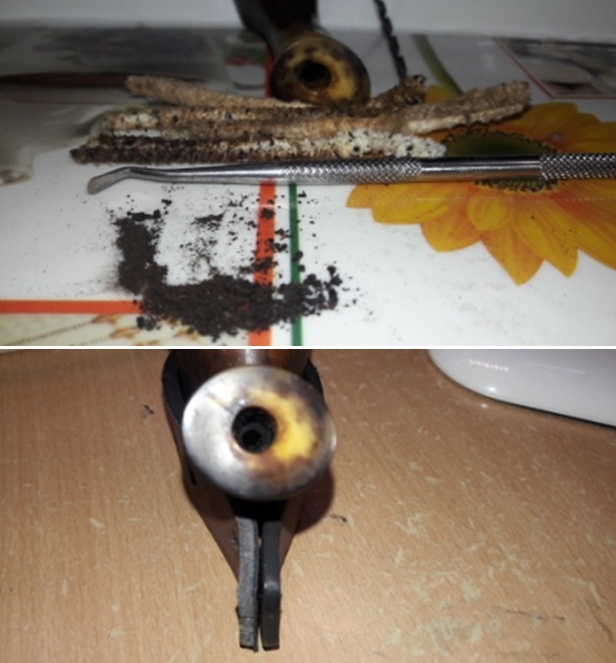
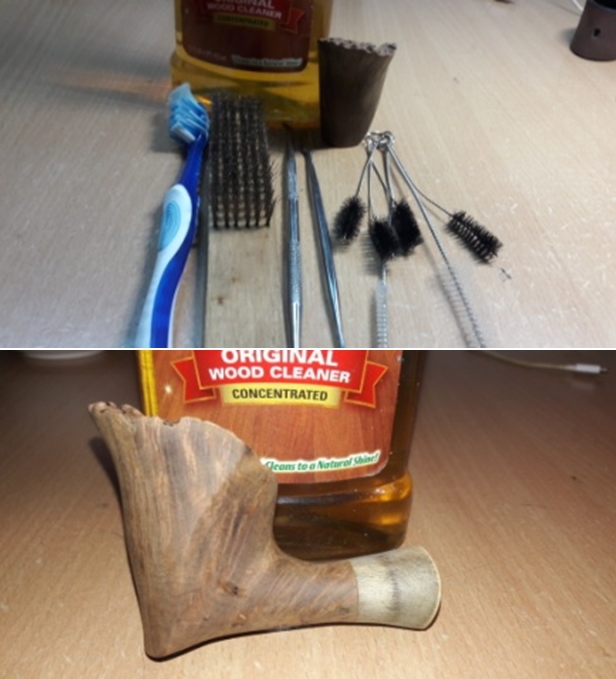
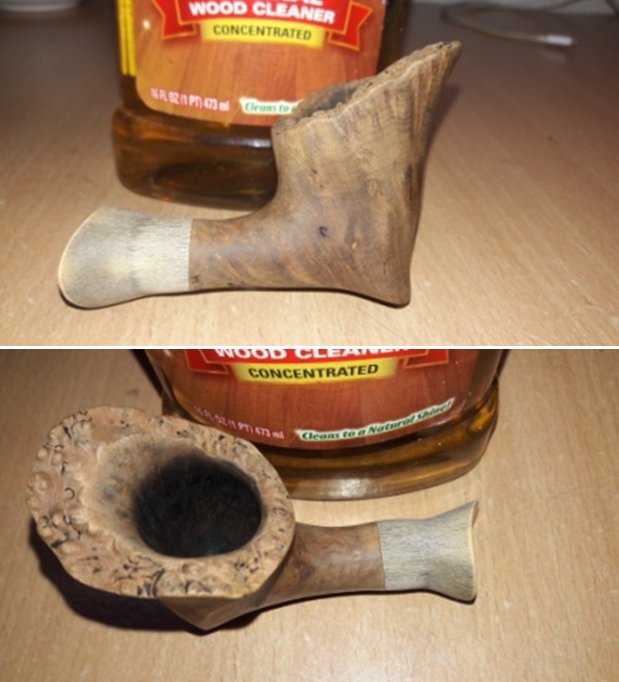
I began my part of stem repairs by sanding the stem with a folded piece of 220 grit sand paper. This helps in getting rid of what little oxidation remained while providing a smooth surface for the intended fills to reconstruct the damaged bite zone on both surfaces and also the button edges. I wiped the stem surface, particularly the damaged areas, with a cotton pad and alcohol to remove any traces of dirt and grime. I prepared a mix of CA superglue and activated charcoal and carefully applied it over the damaged bite zone on both surfaces, and button edges and set it aside for curing over night. I had applied this mix in sufficient thickness which would help during the filing and sanding to match the fills with the stem surface and shaping the button. Once the fills had cured sufficiently, using a flat head needle file, I reshaped the button and roughly matched the fills with the rest of the stem surface. I followed it up by further sanding the stem with 320, 600 and 800 grit sand papers to achieve a perfect blending of the fills with the stem surface and a crisp button edge on either side of the stem. Using the micromesh pads, I complete the polishing cycle by wet sanding the surface with 1500 to 12000 girt pads. The stem looks great with the fills nicely matched with the rest of the surface. I rub a little quantity of Extra Virgin Olive oil in to the stem surface and set it aside to be absorbed by the vulcanite. The only issue that remains unaddressed at this stage is the issue of overturned stem. Being an adjustomatic stem, I fixed the stem in to the shank and tried to turn the stem to match the shank applying just adequate pressure. However, the stem would not budge. Not wanting to create further complications like broken stinger or wearing down of the threads, I unscrewed the stem from the shank. With the flame of a lighter, I heated the aluminum stinger to a point where the stem was just about able to rotate on the stinger. I reattached the stem to the shank while the stinger was still warm, and turned it till the alignment was perfect as I desired and set it aside to cool down. Actually the reasoning behind heating the stinger is that the gunk which accumulates on the stinger and further percolates inside is loosened, thus freeing the stem.

To complete the restoration, I mounted a cotton cloth buffing wheel on to my hand held rotary tool.  I set the speed at about half of the full power and applied White Diamond compound to the entire pipe. I wiped/ buffed the pipe with a soft cotton cloth to clear it of any leftover compound dust. With a cotton buffing wheel earmarked for Red Tripoli, which has a finer grit than White compound, I buffed the stem to a fine glossy finish. I then mounted another cotton cloth wheel on to the polishing machine and applied several coats of carnauba wax. I finished the restoration by giving the entire pipe a rigorous hand buffing using a microfiber cloth to raise the shine further. The finished pipe looks amazingly beautiful and is now ready for its long second innings with me. I only wish it could share with me its life story of the past 50 plus years while I enjoy smoking my favorite Virginia blend in it!! P.S. I have to admit to the readers of this blog that I had completed this project in the month of May 2019 but I kept procrastinating on the write up. To be honest, I find doing the write up on any project more tedious and difficult than working on the project itself and Steve will bear with me on this fact. And the fact that English is not my first language further makes it all the more challenging. There are nine more pending write ups which I shall be tackling before I undertake any new restoration, God!! I don’t want to scare myself!! I wish to thank each one for sparing their valuable time to read through and any inputs or advice is always welcome.