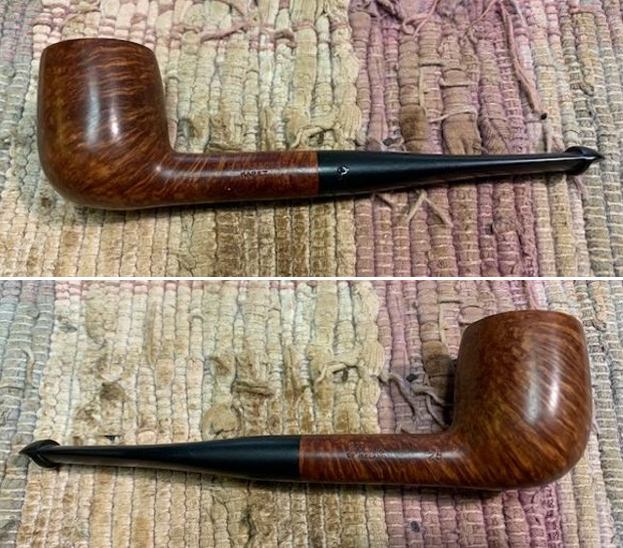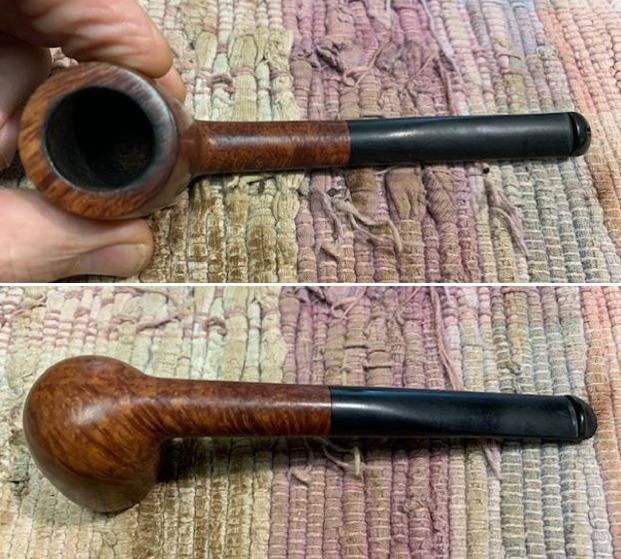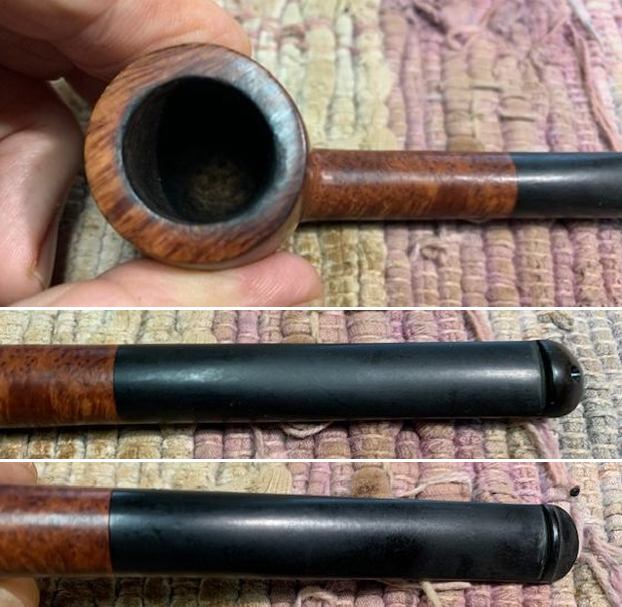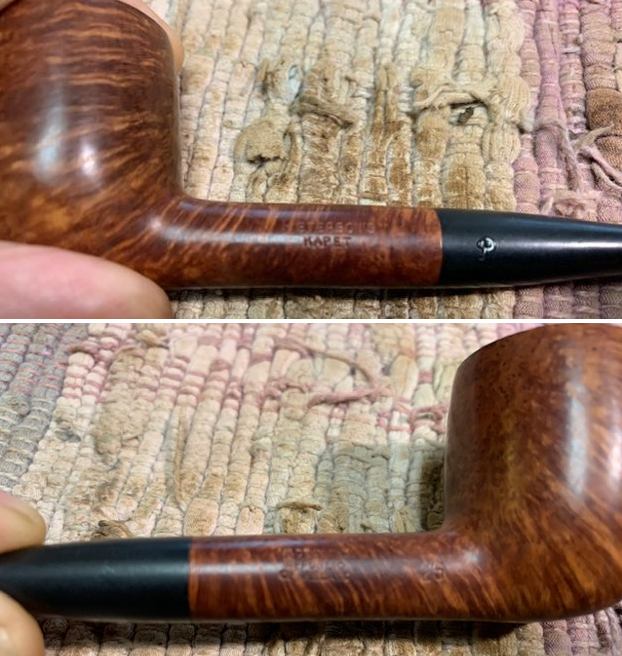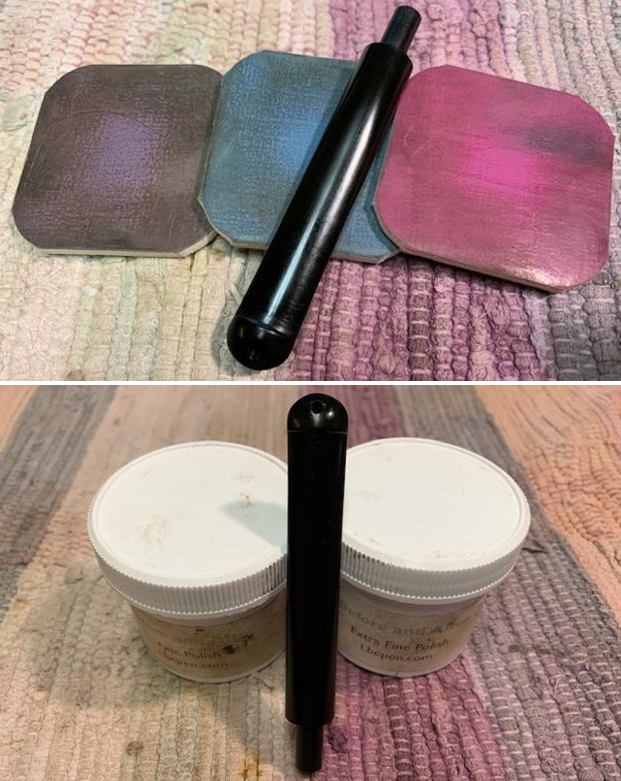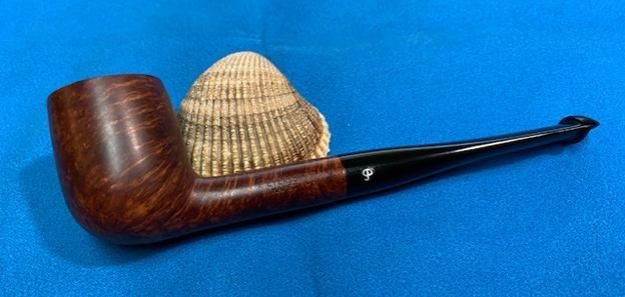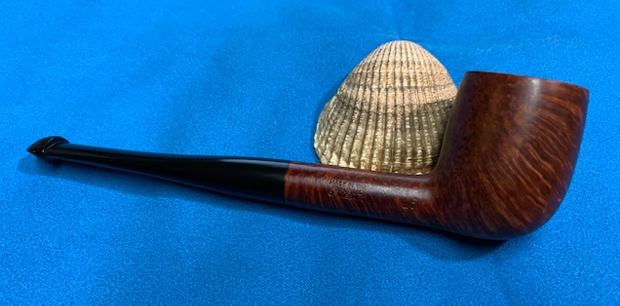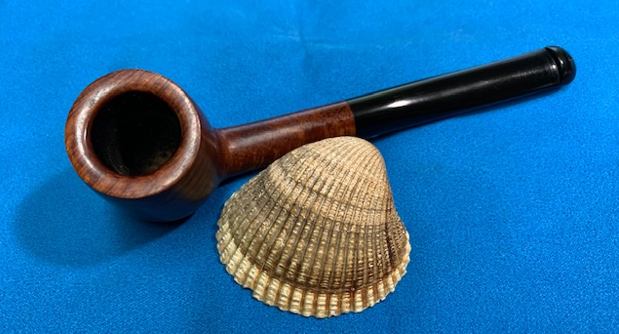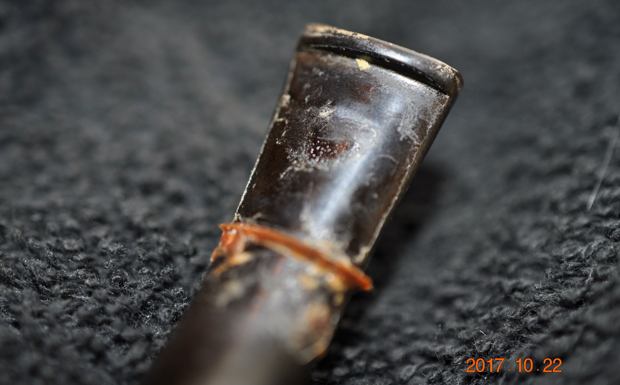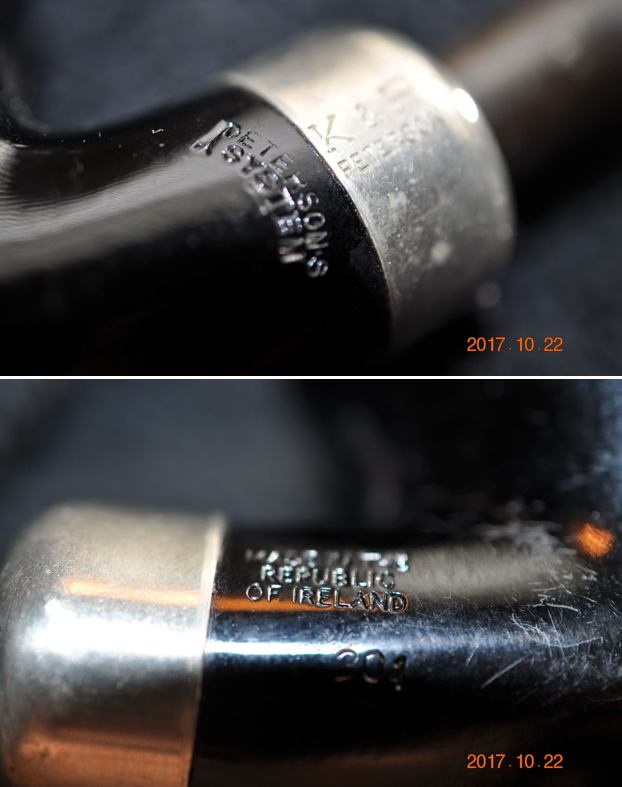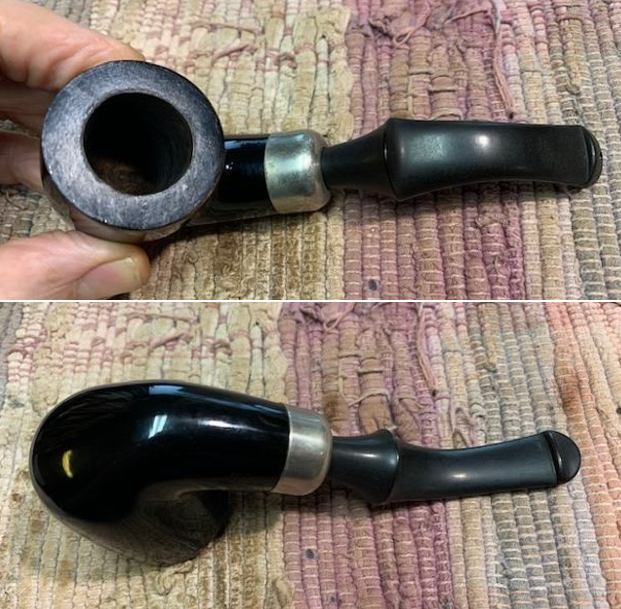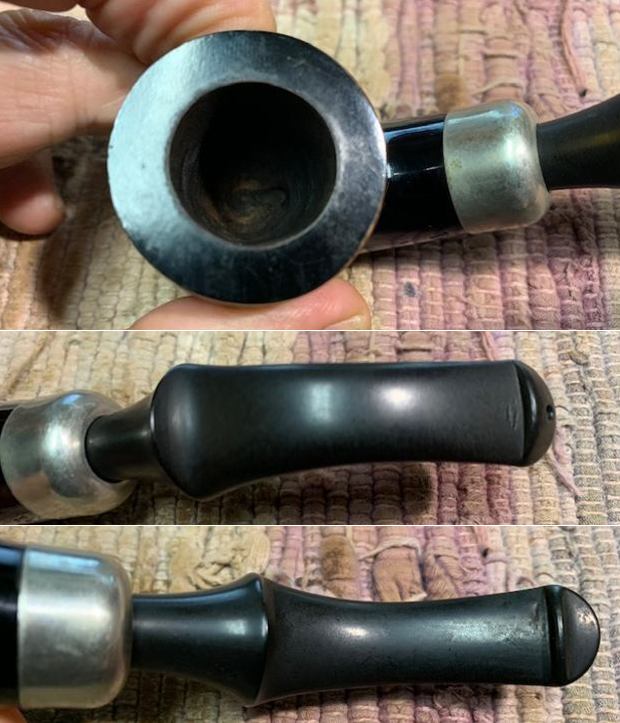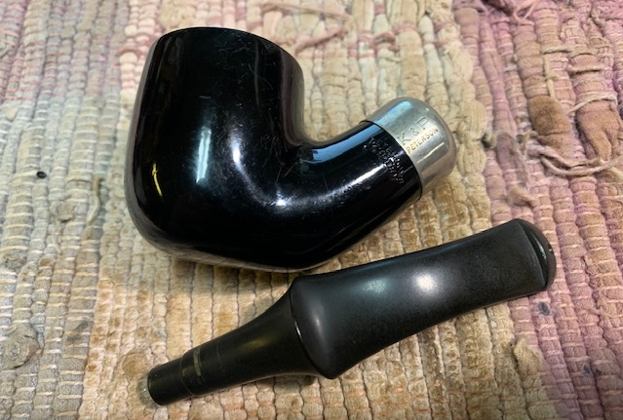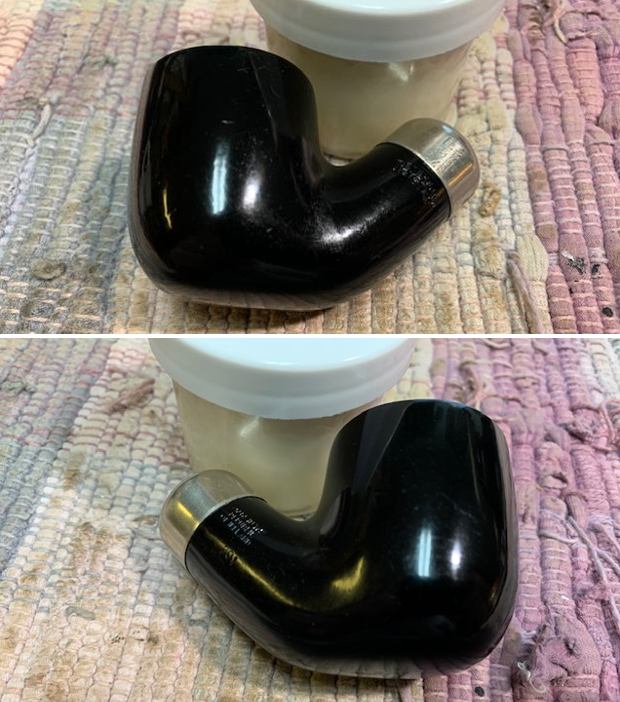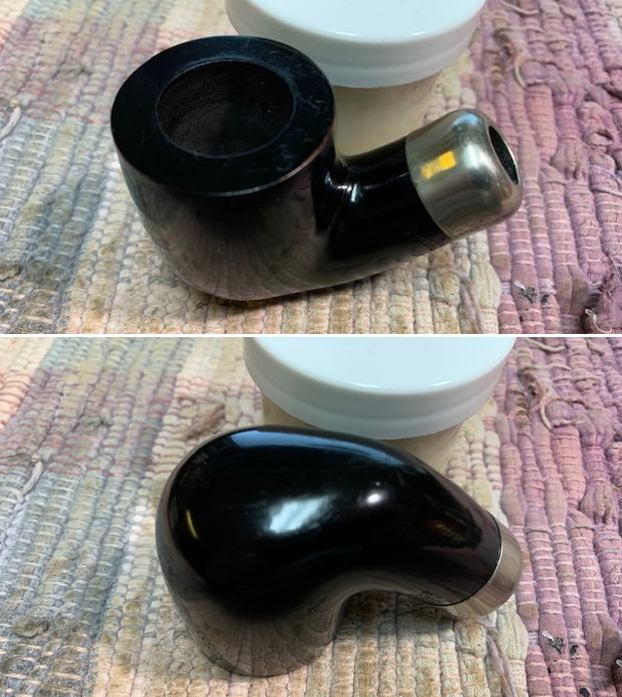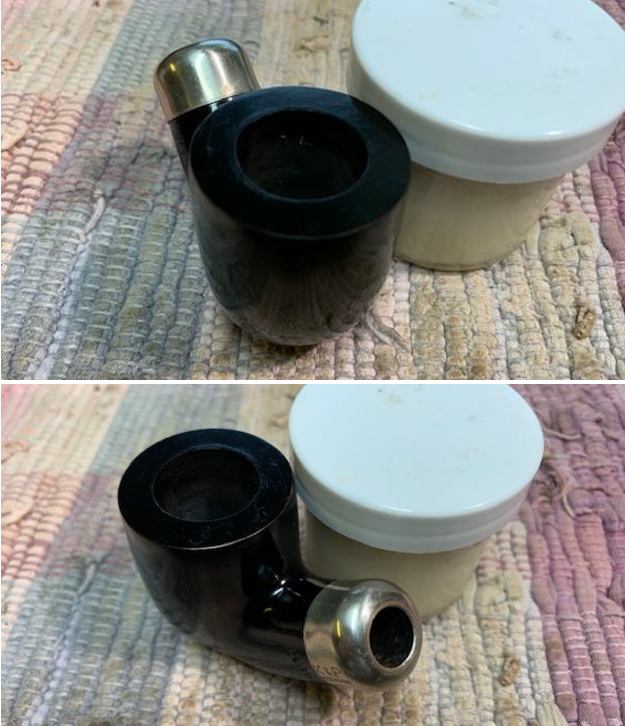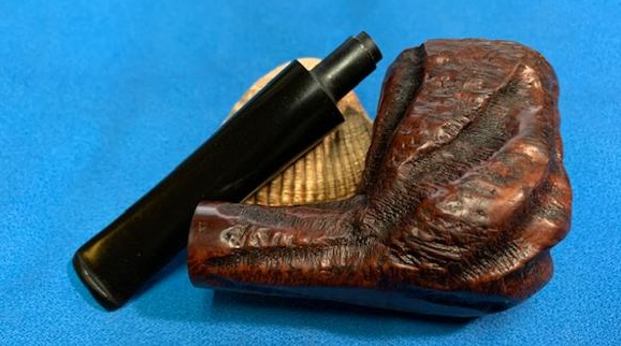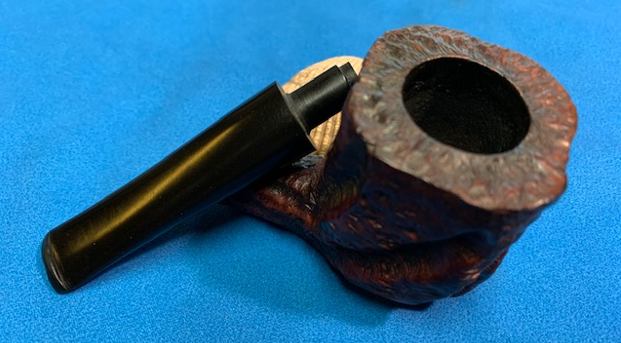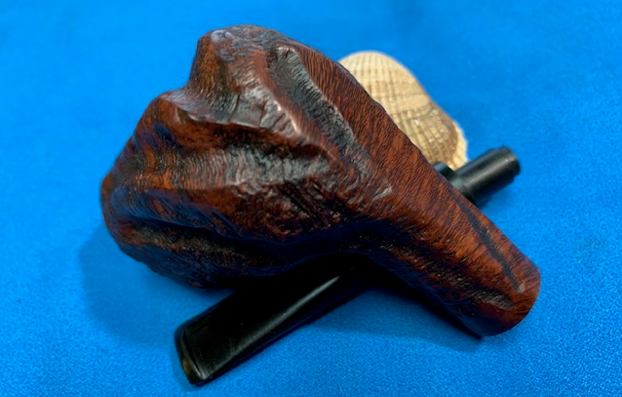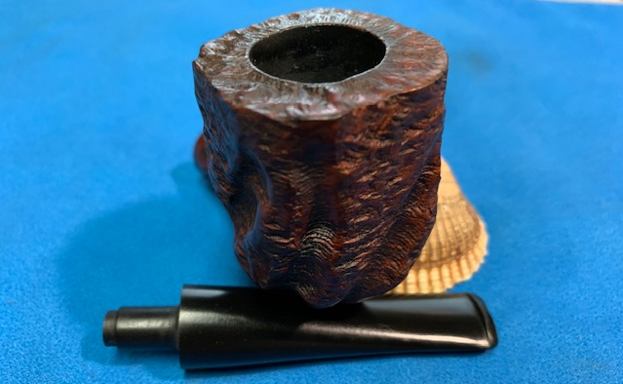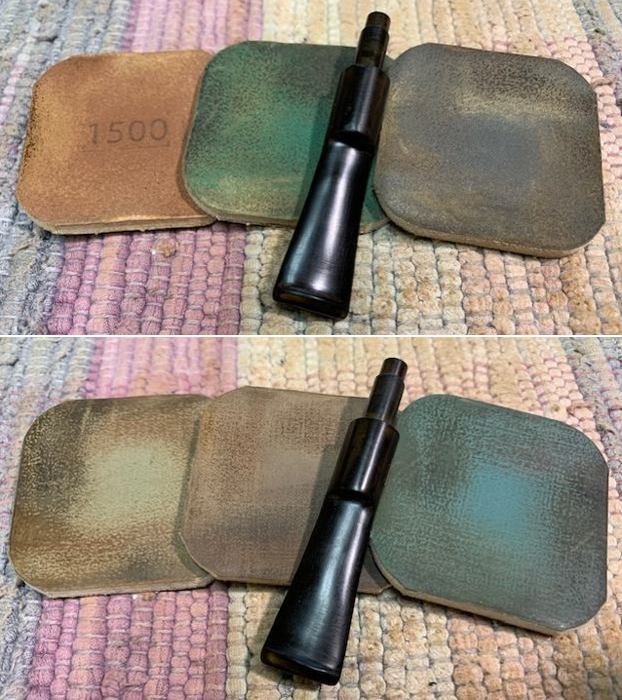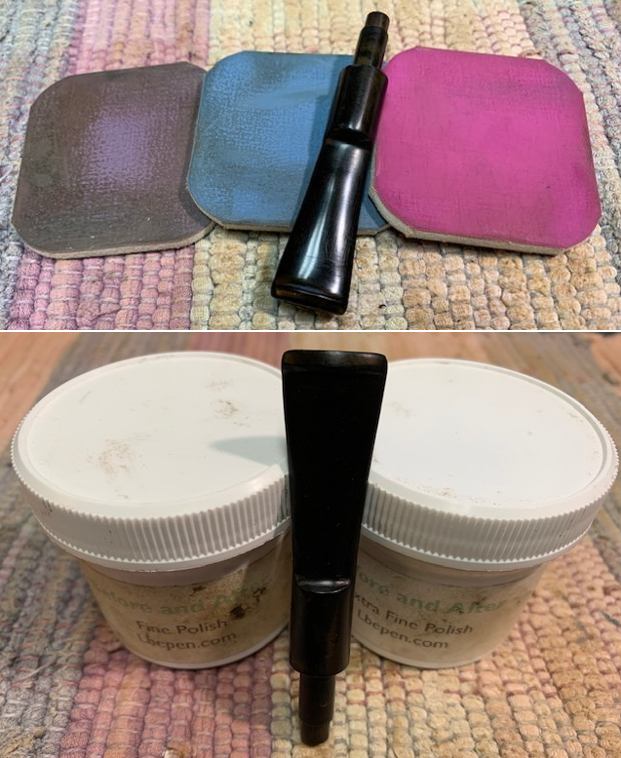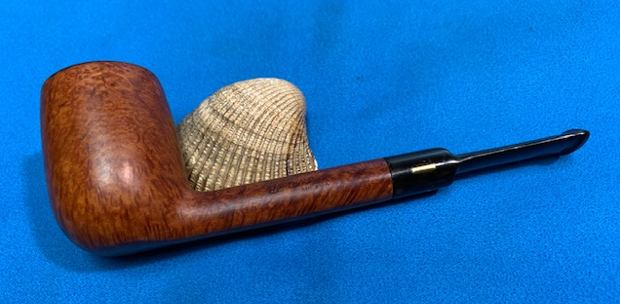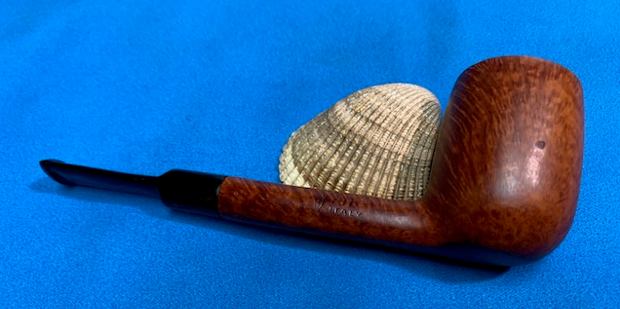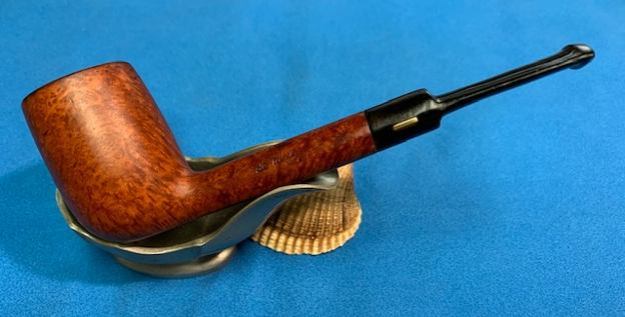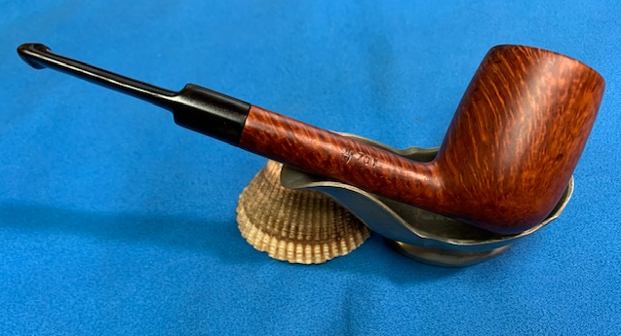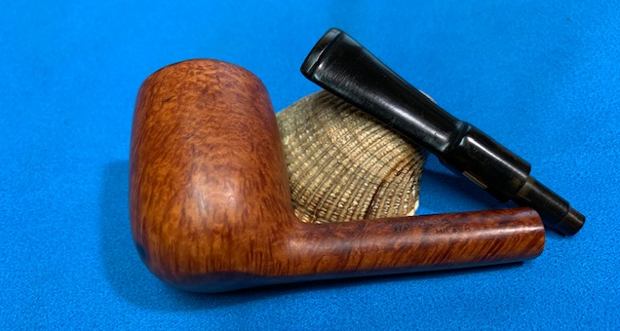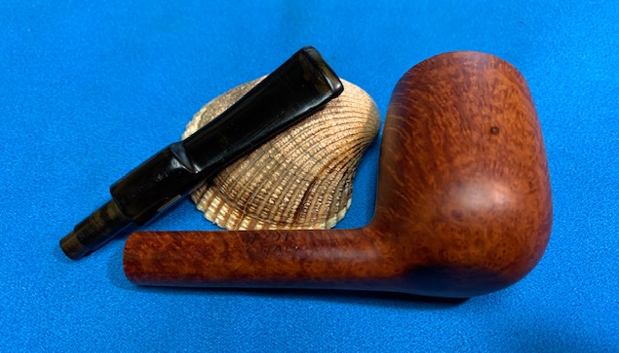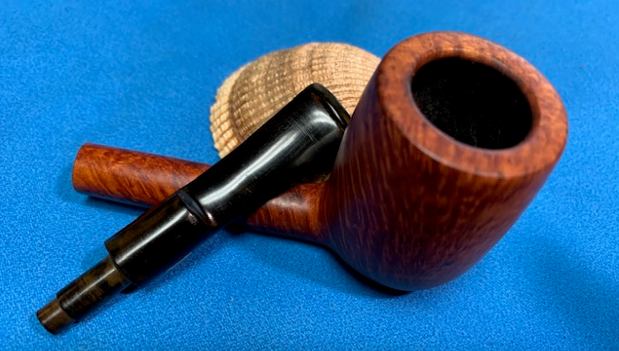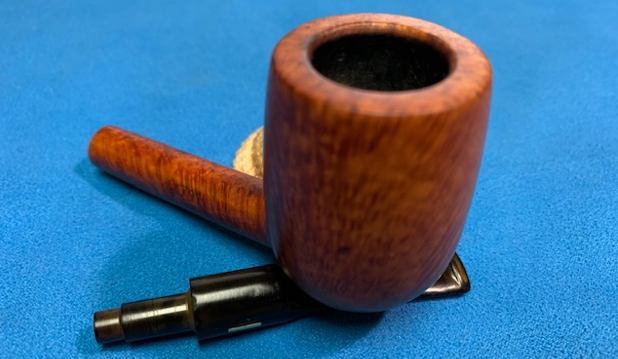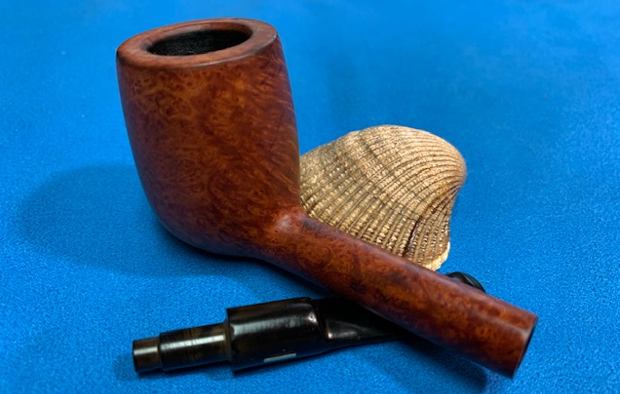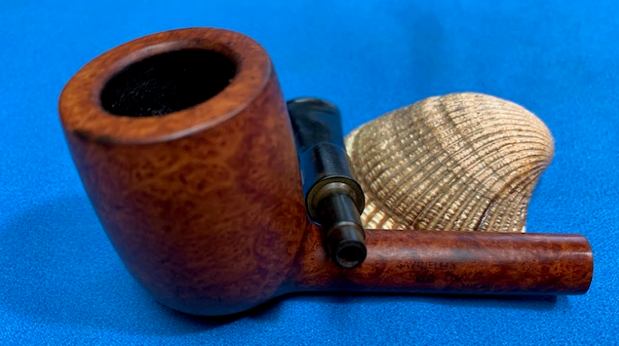
Tag Archives: repairing tooth marks

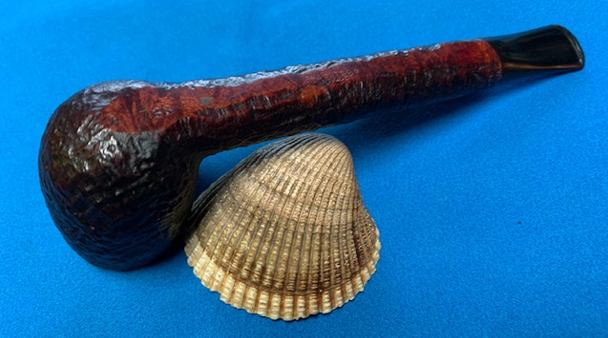
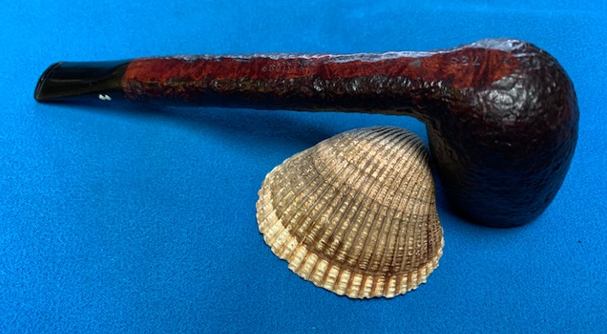
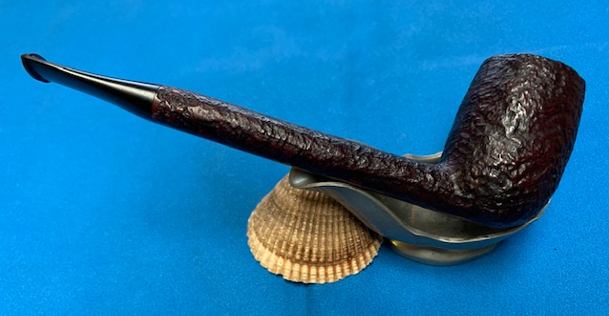
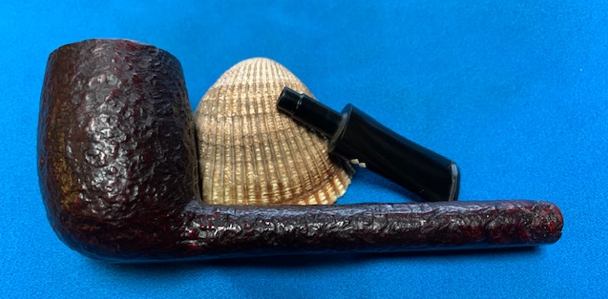
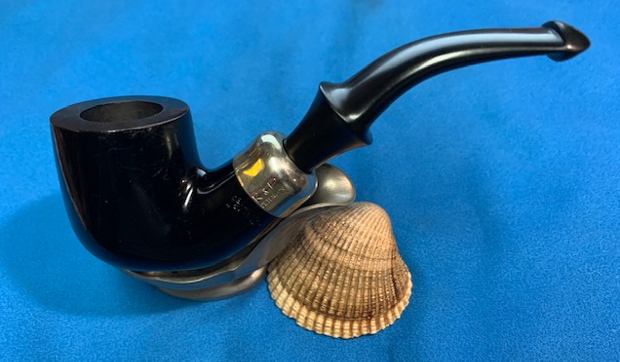
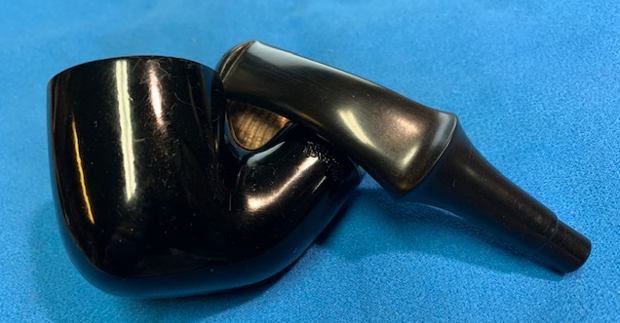
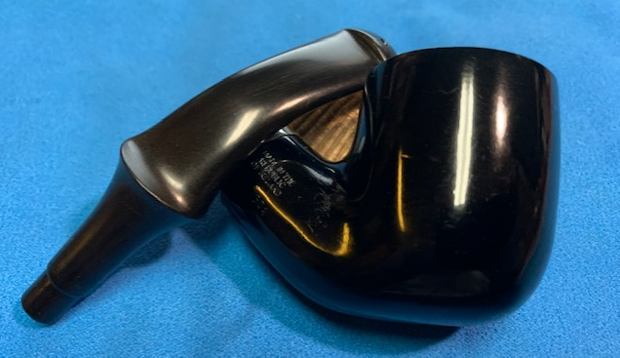
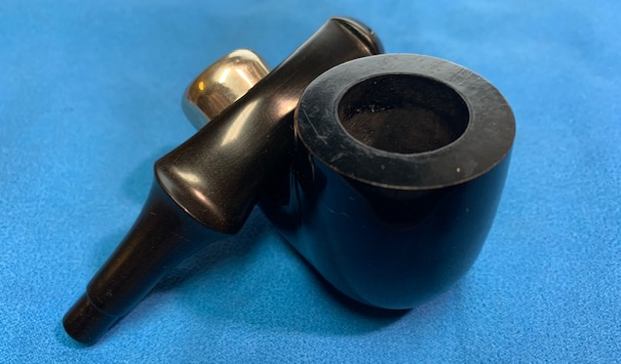
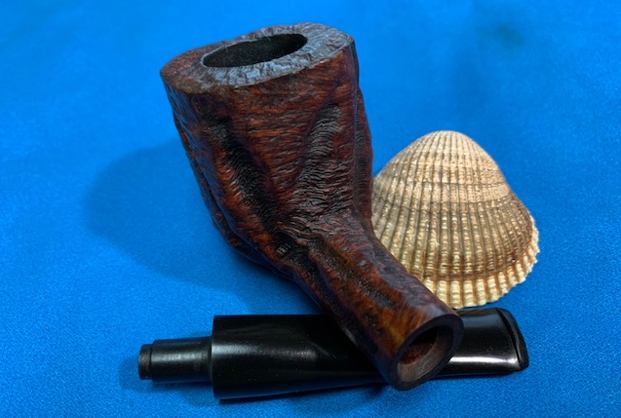
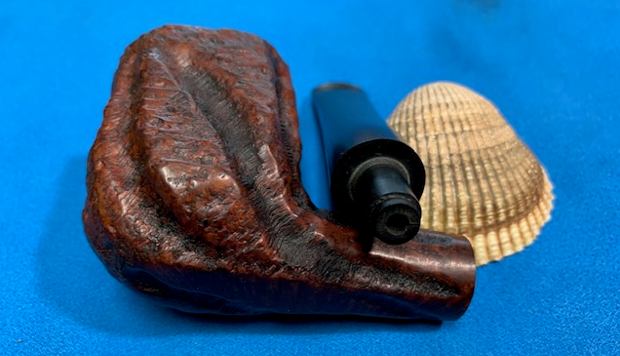
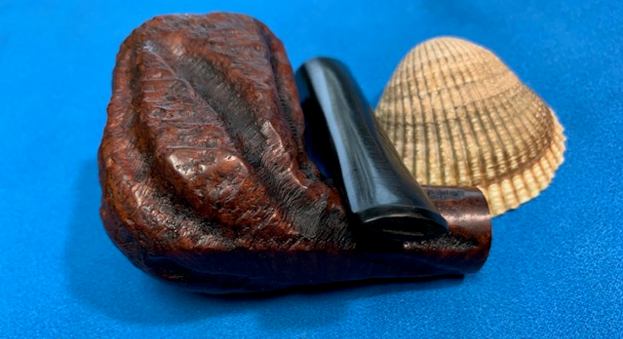
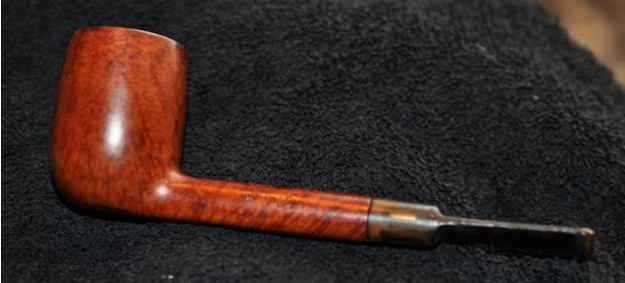
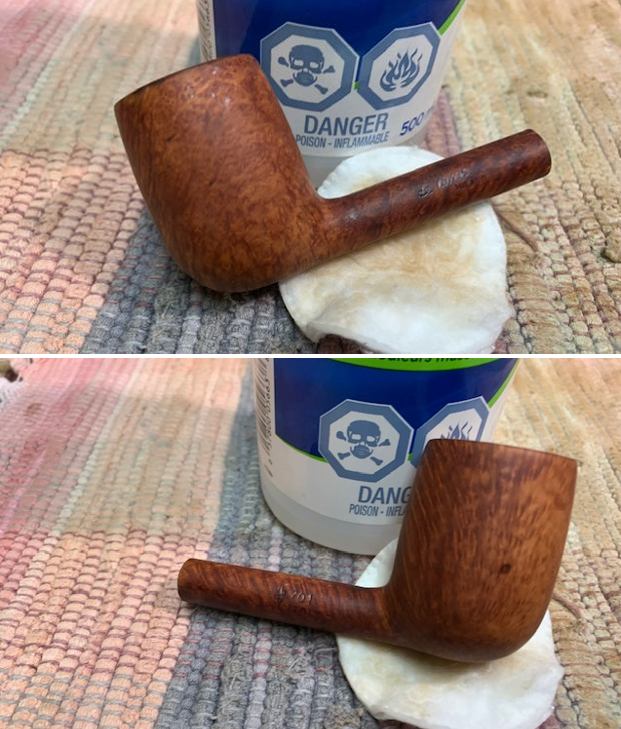
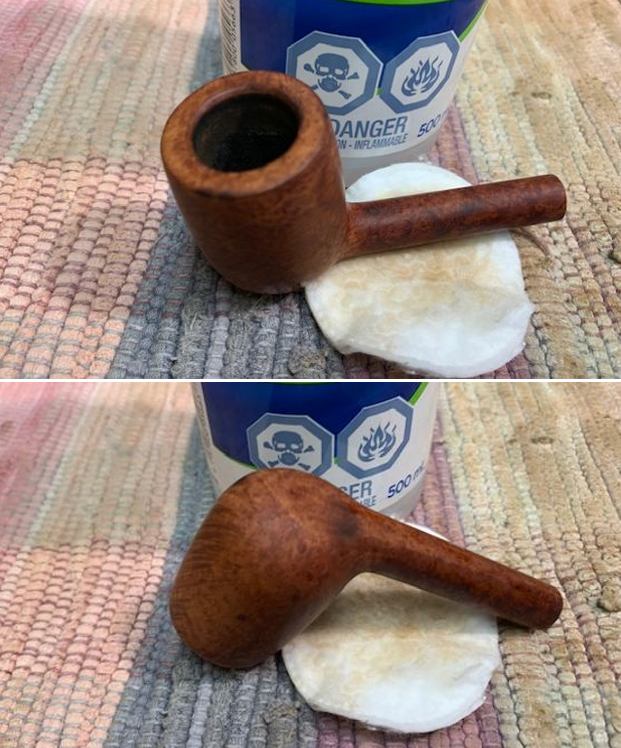
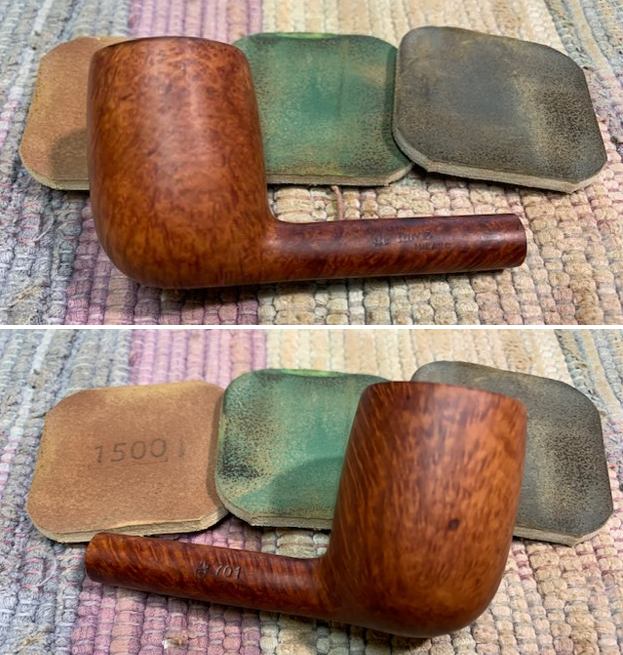
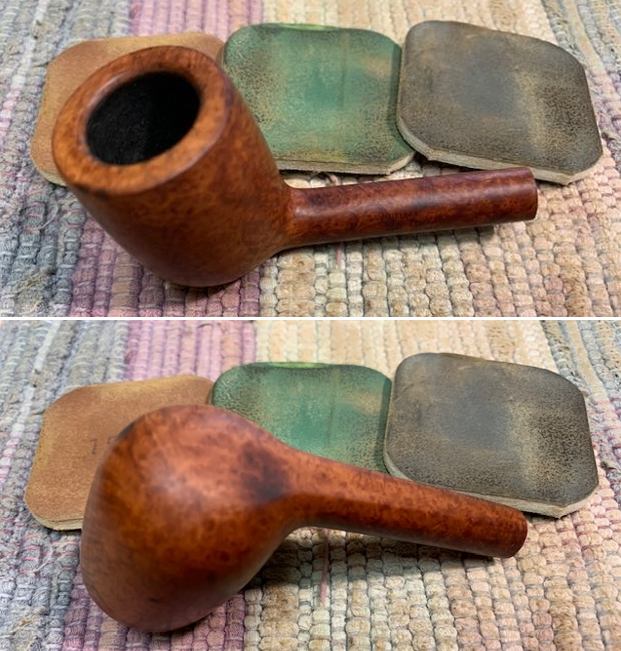
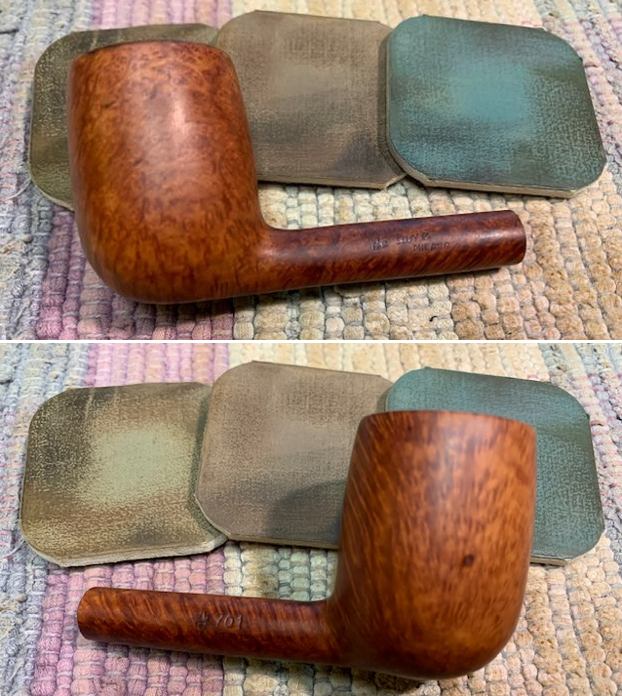
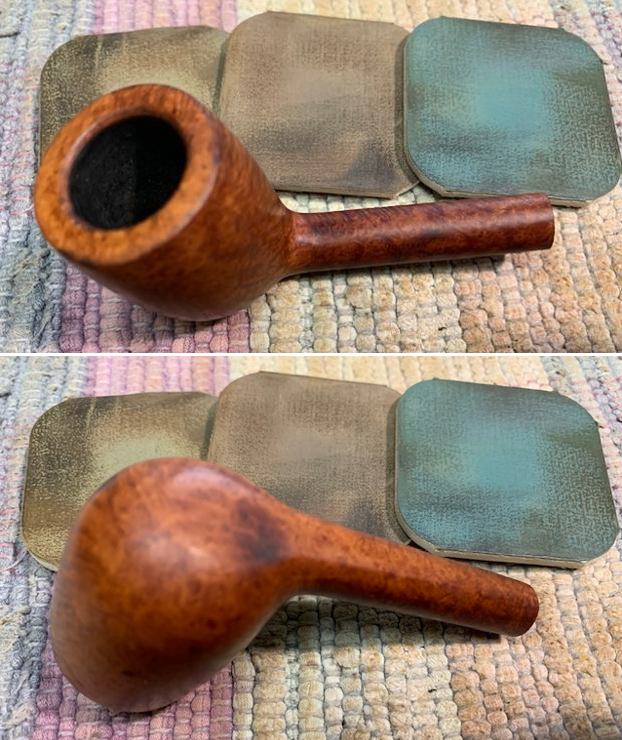
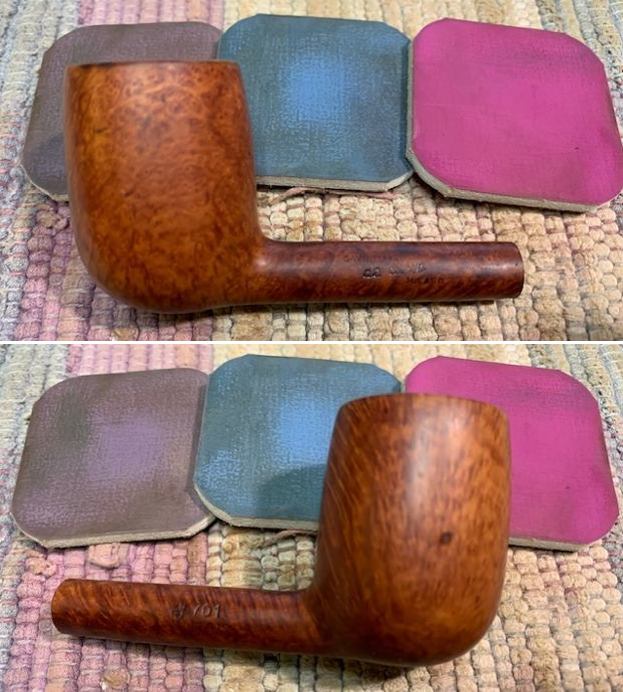
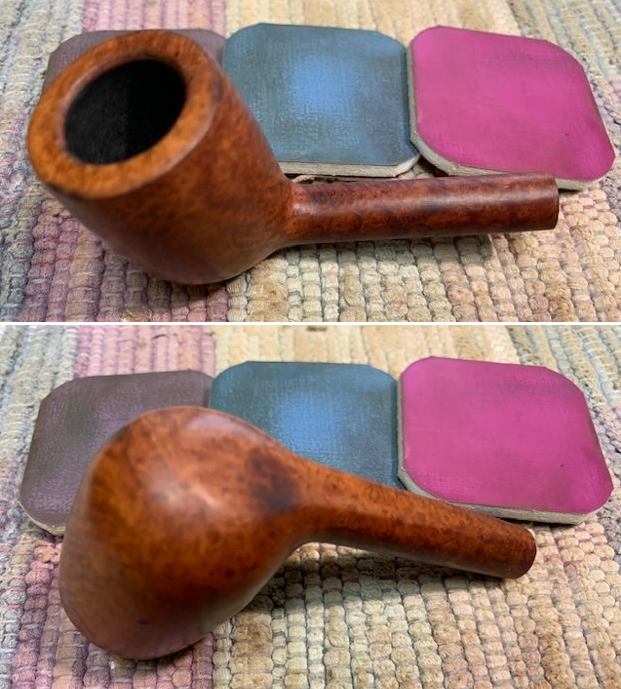
Breathing Life into a Custom-Bilt Panel Billiard


Blog by Steve Laug

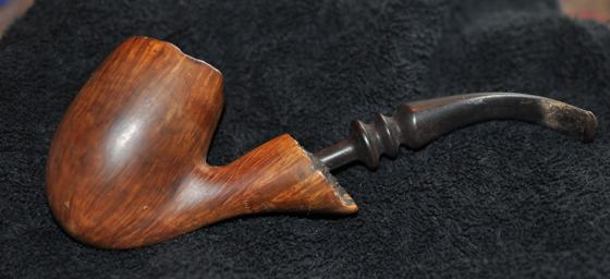
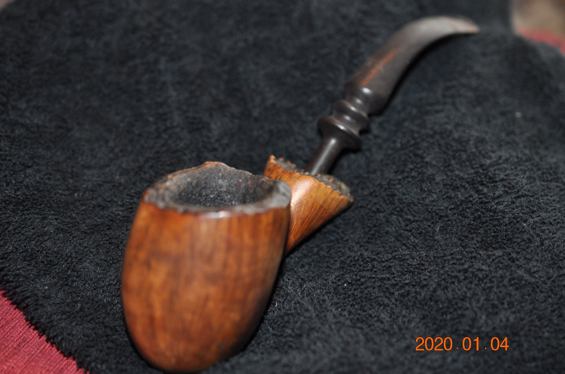
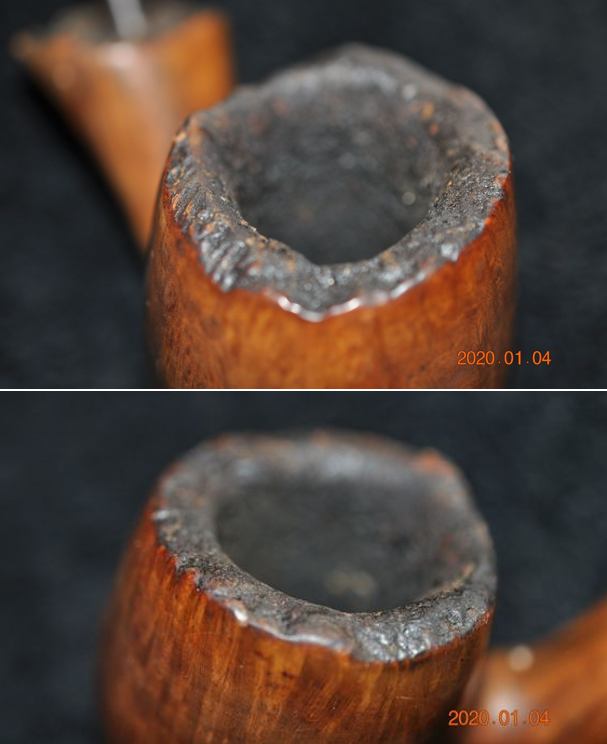
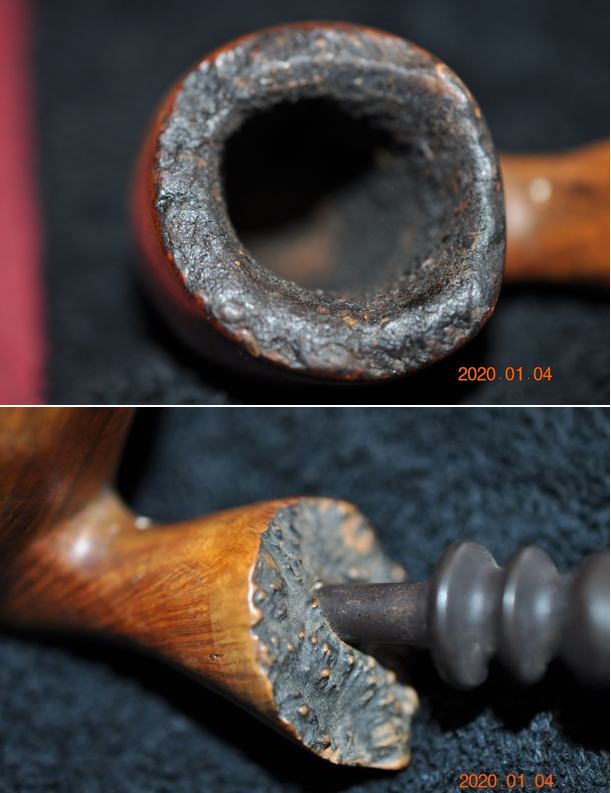
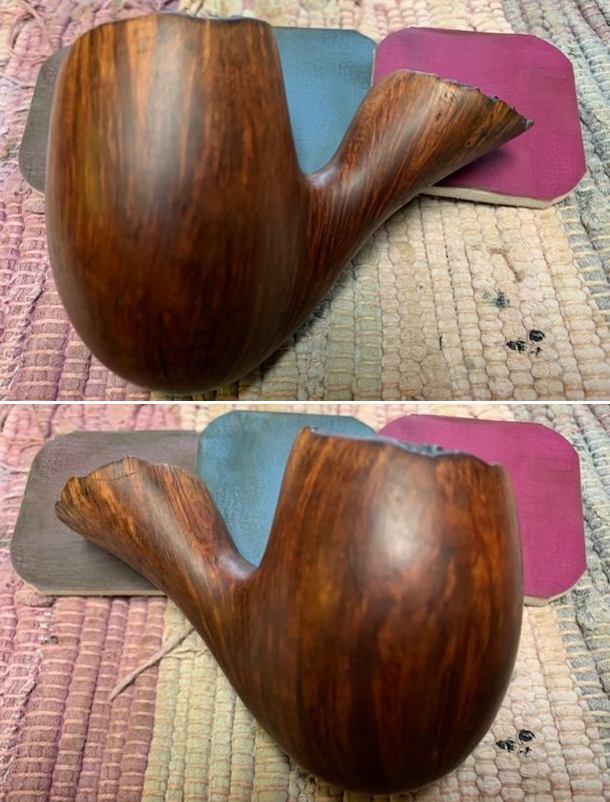
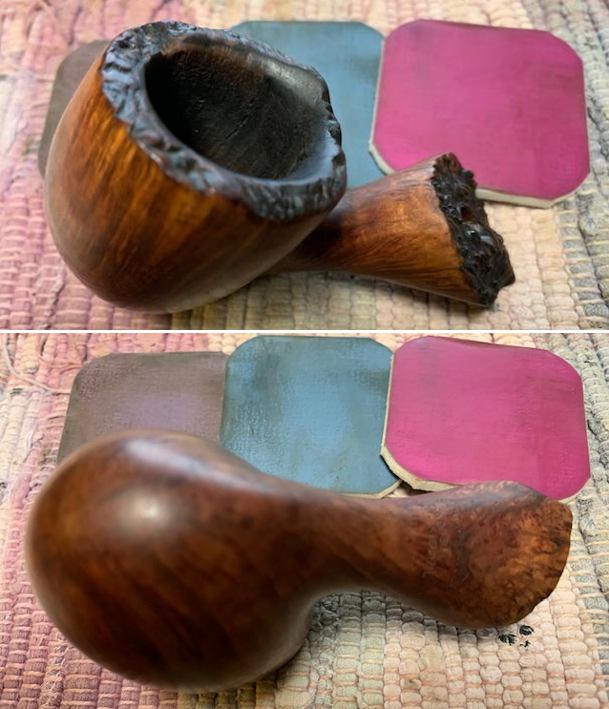
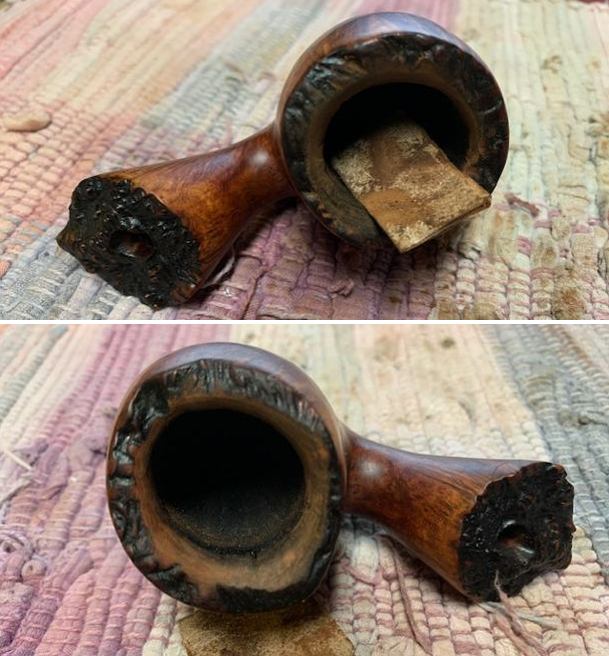
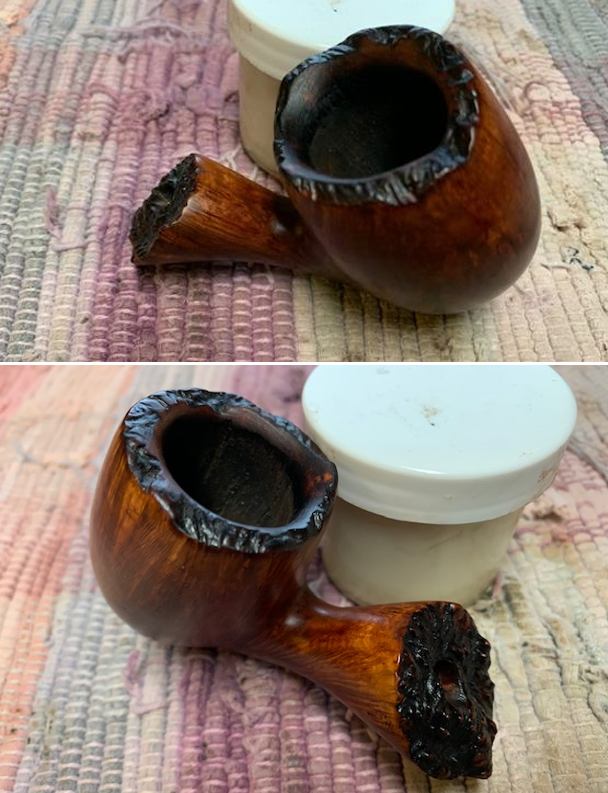
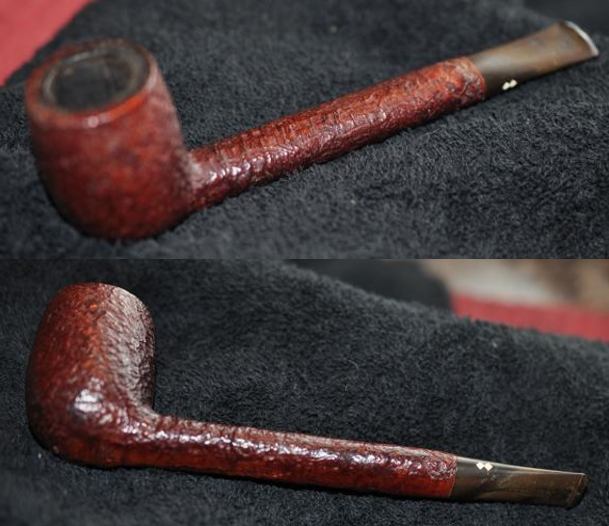
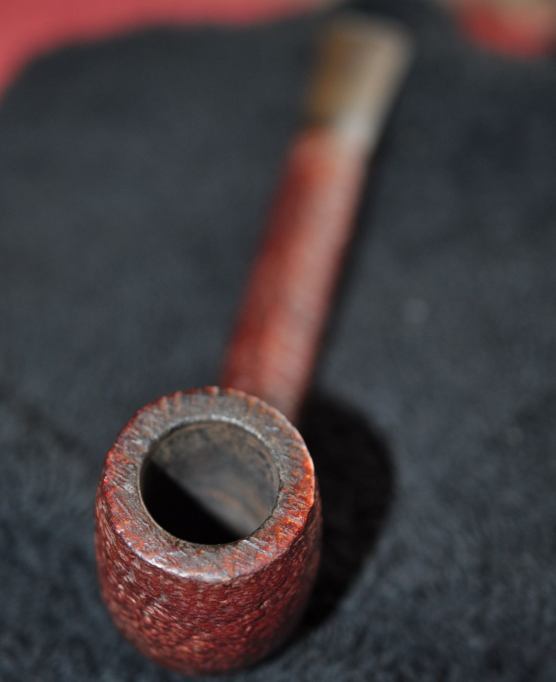
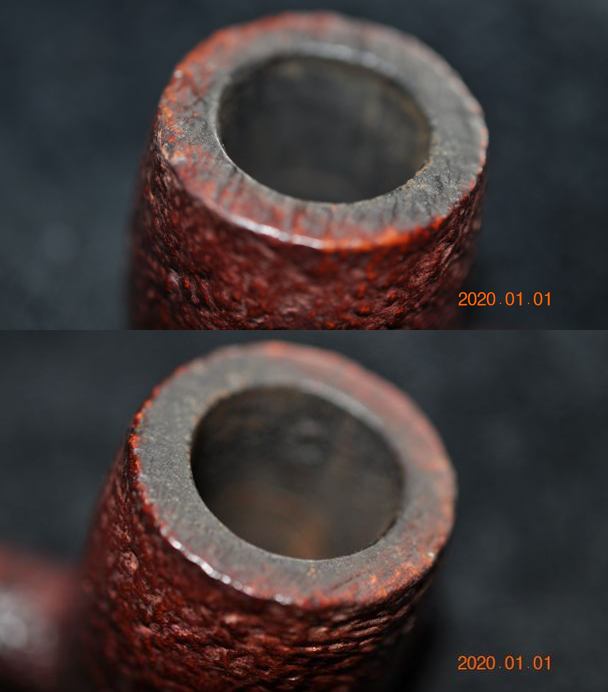
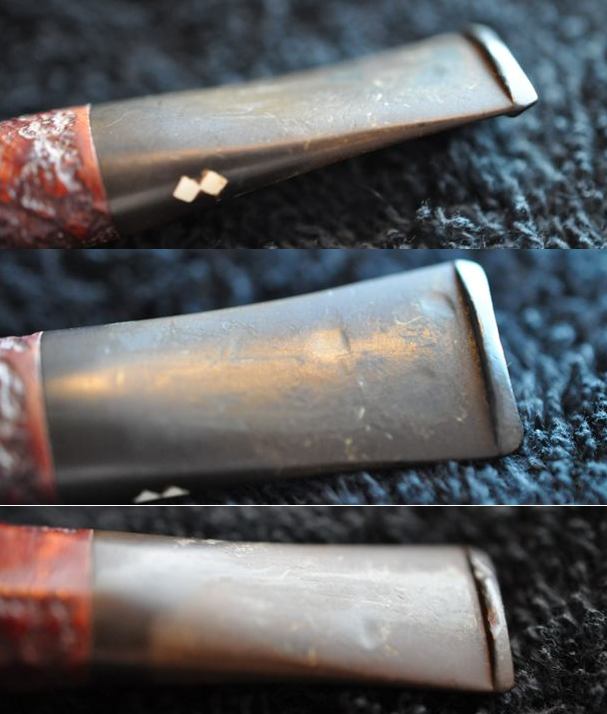
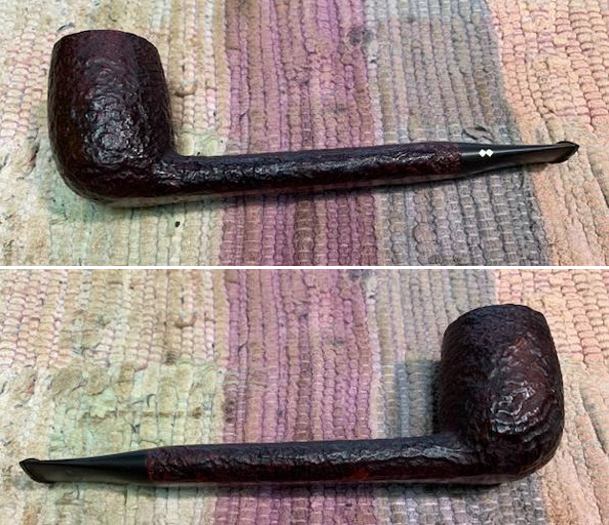
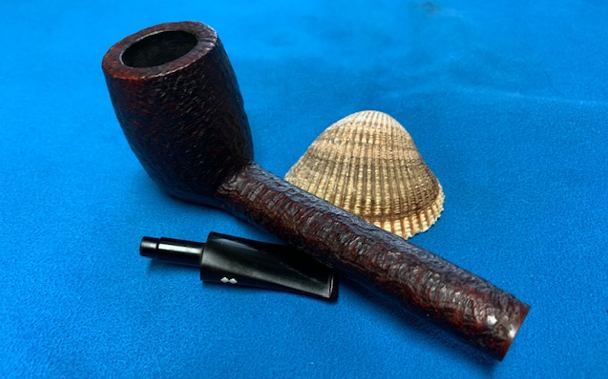
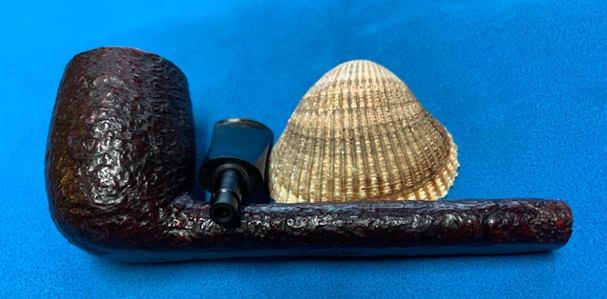
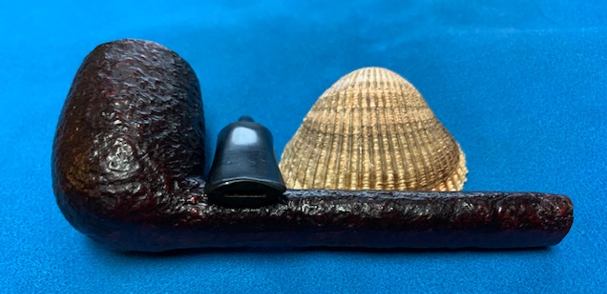
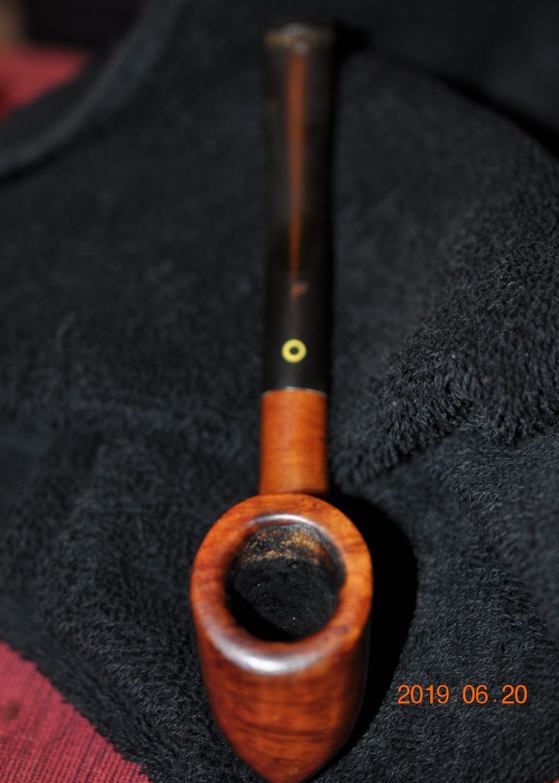
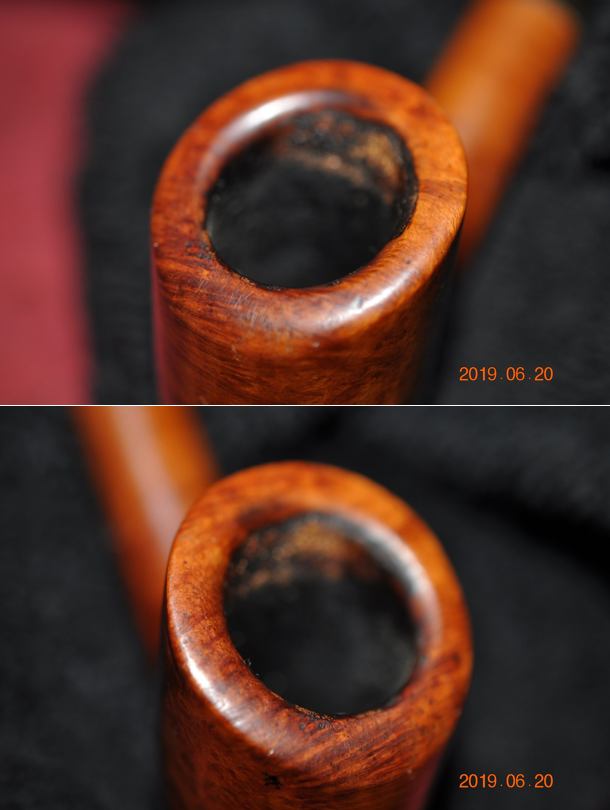
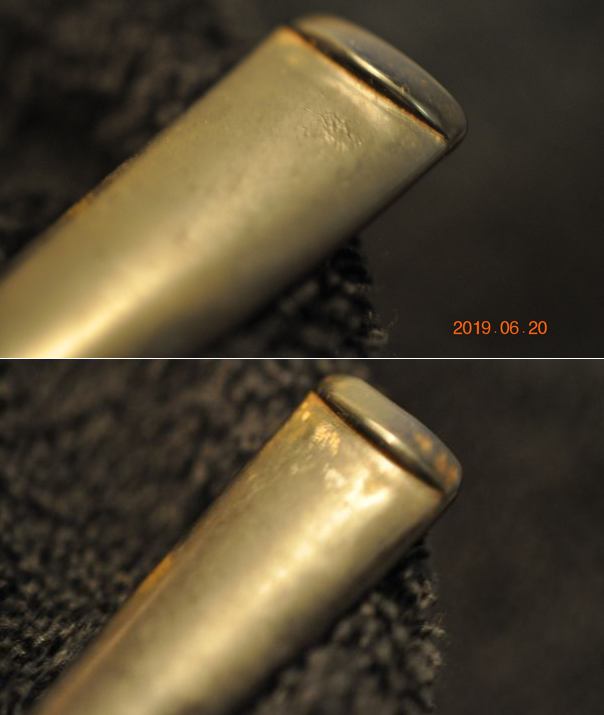
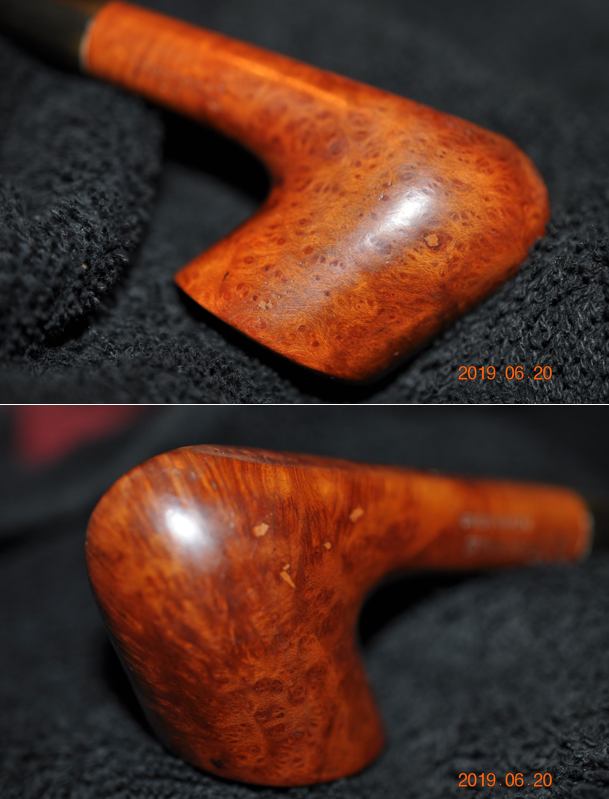
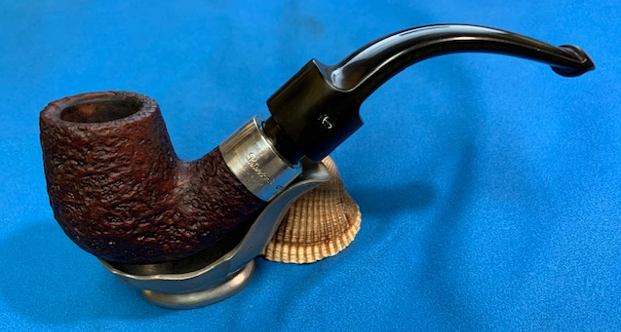
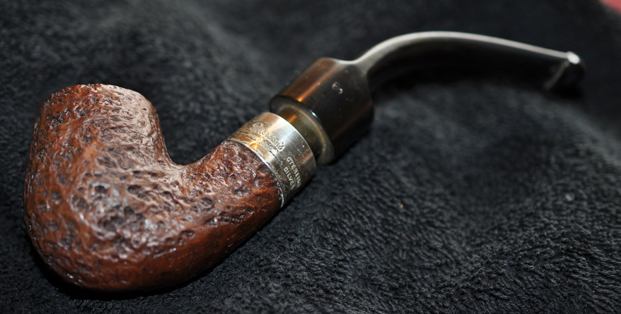
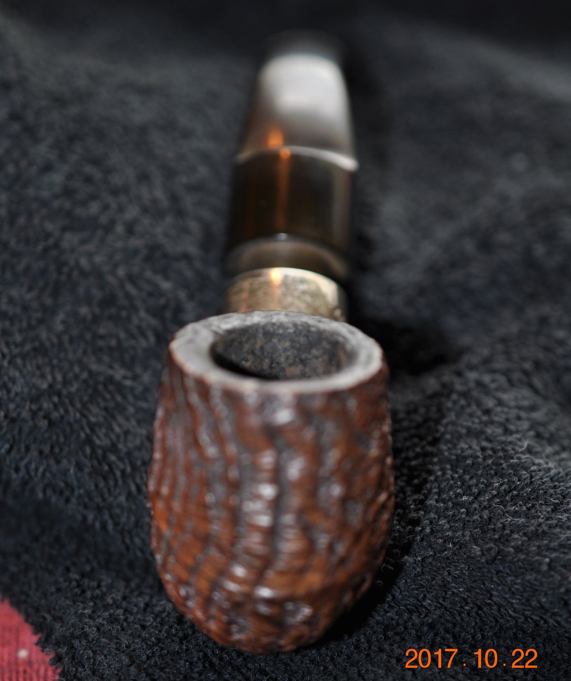
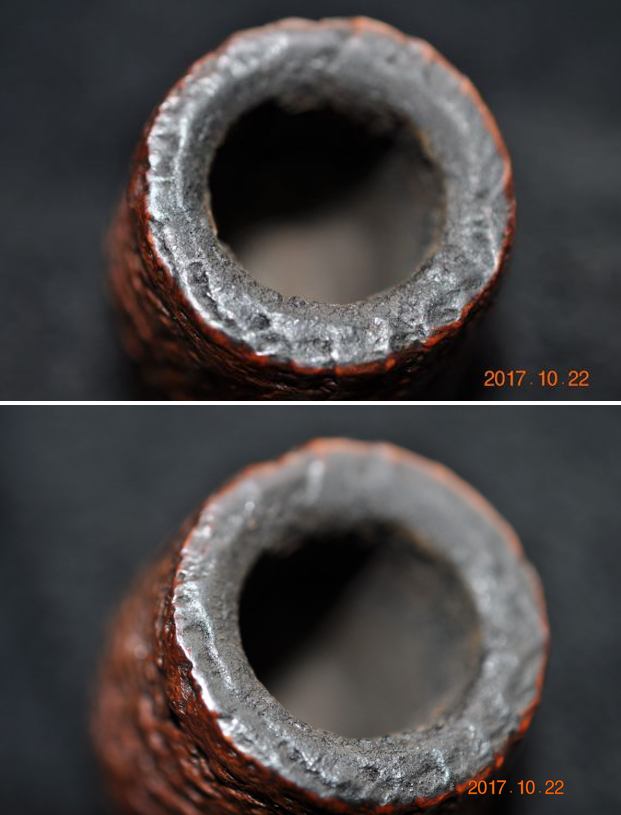
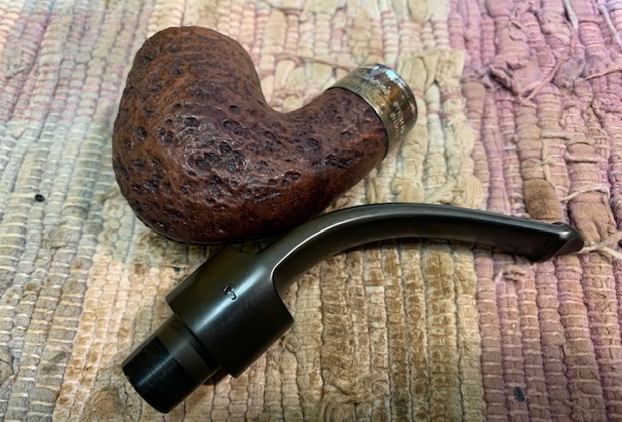
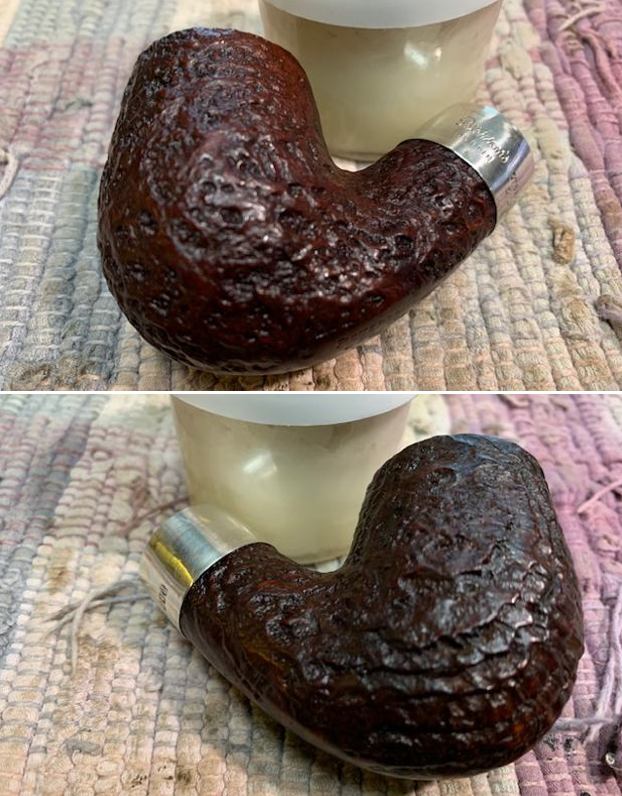
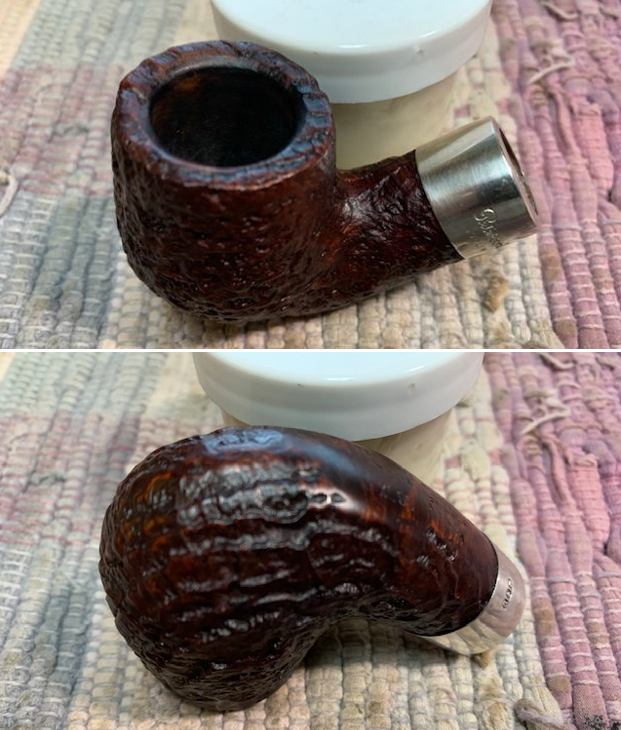
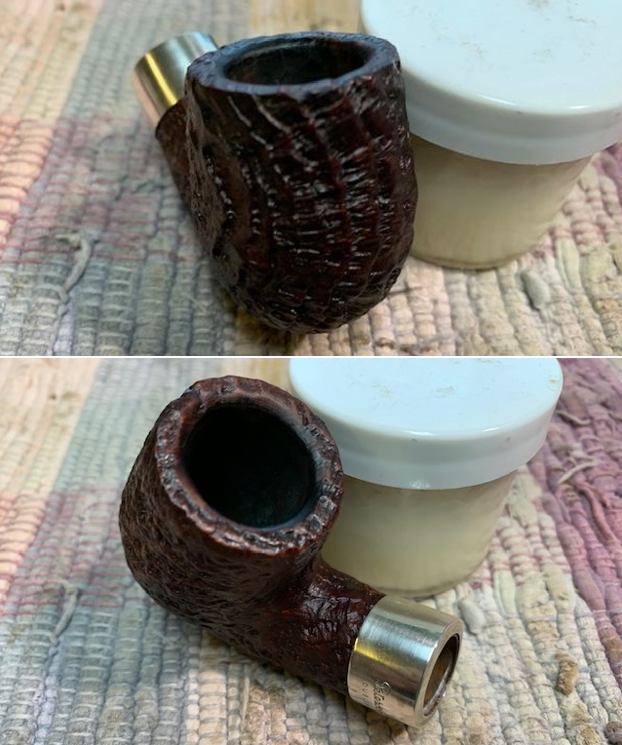
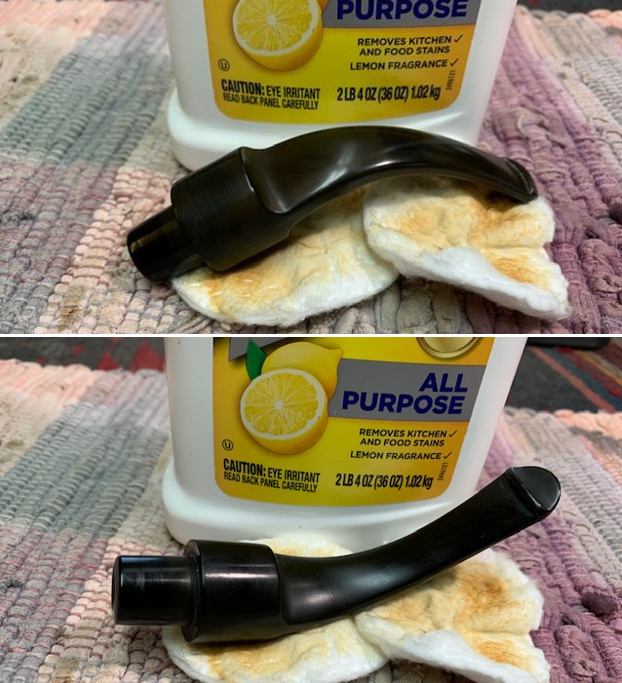
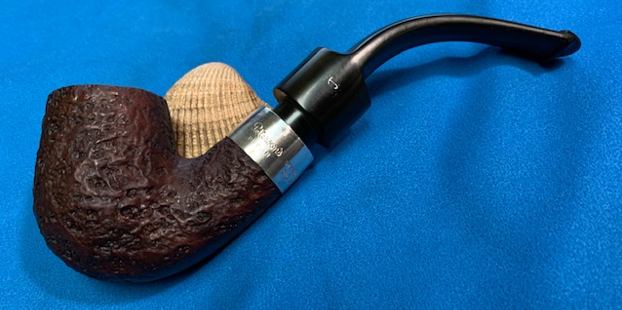
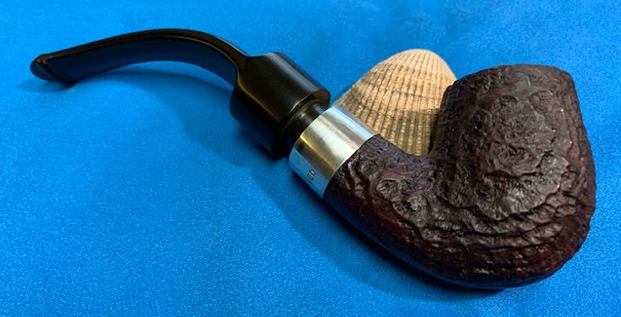
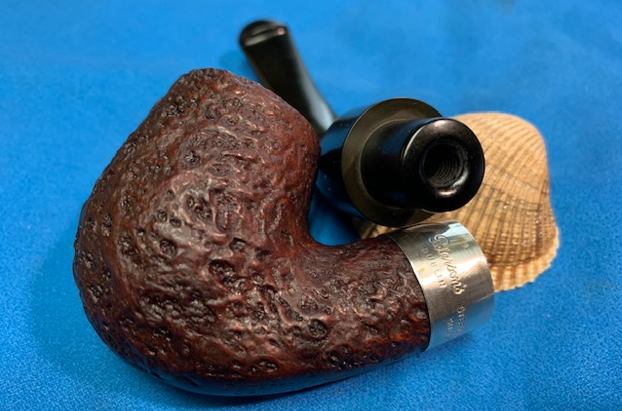
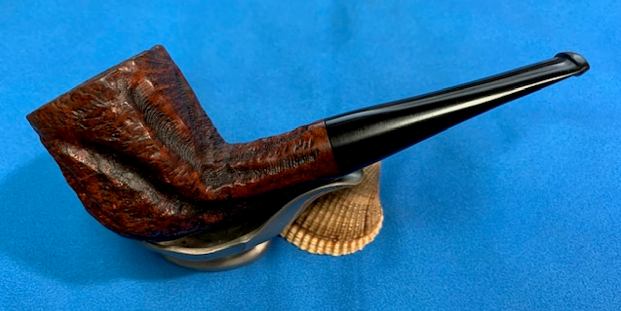
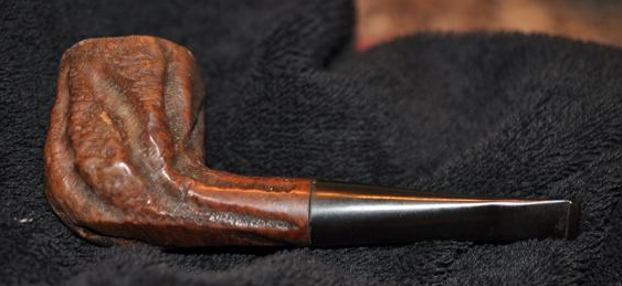
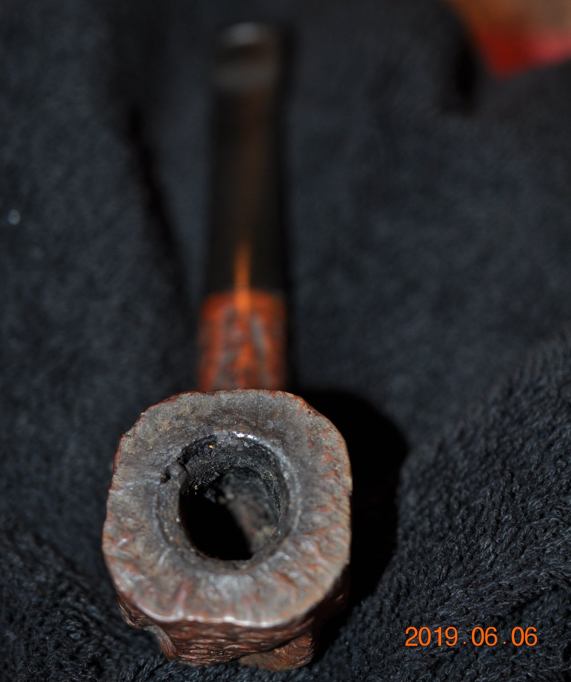
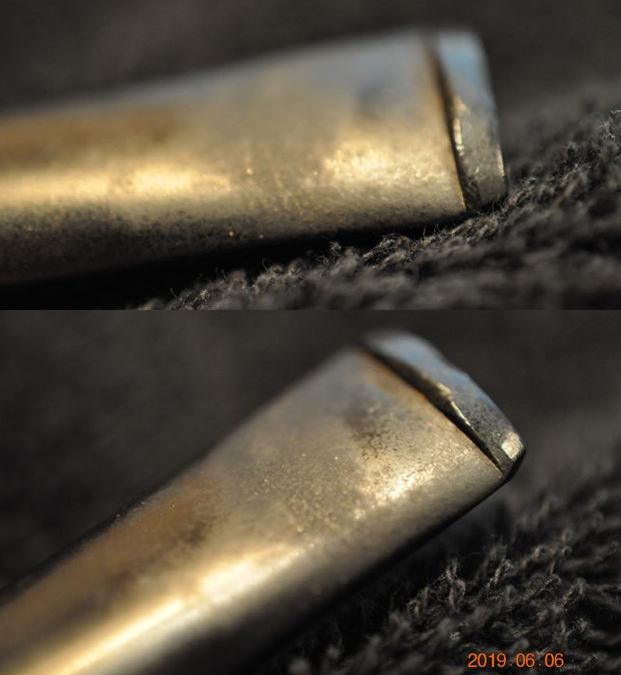
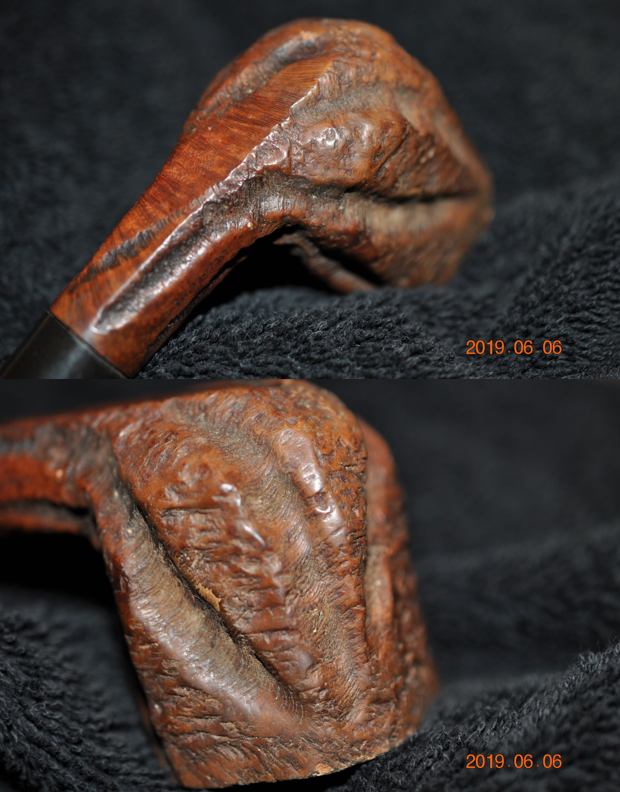
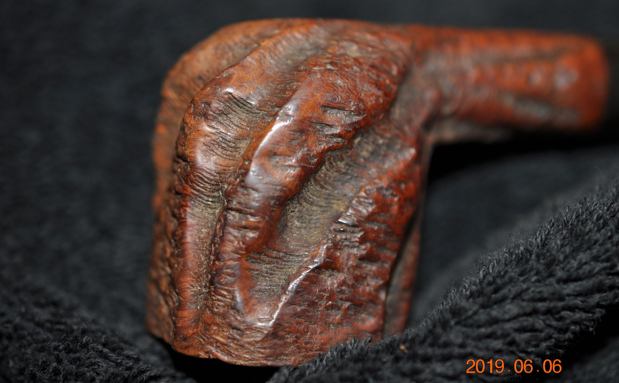
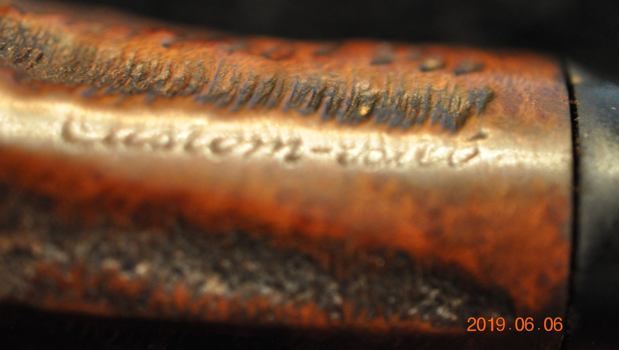
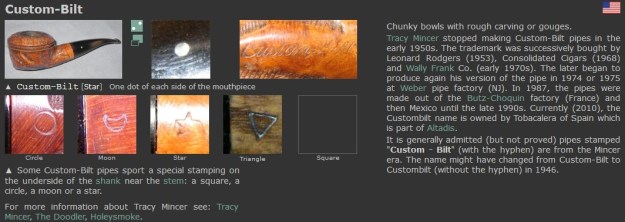
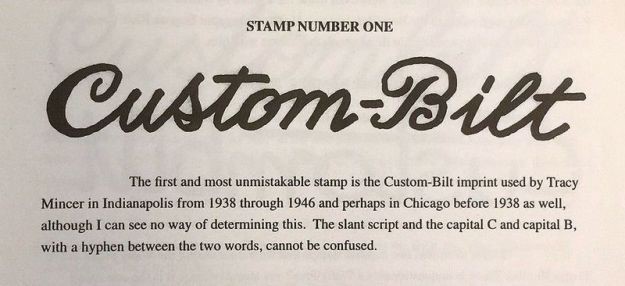
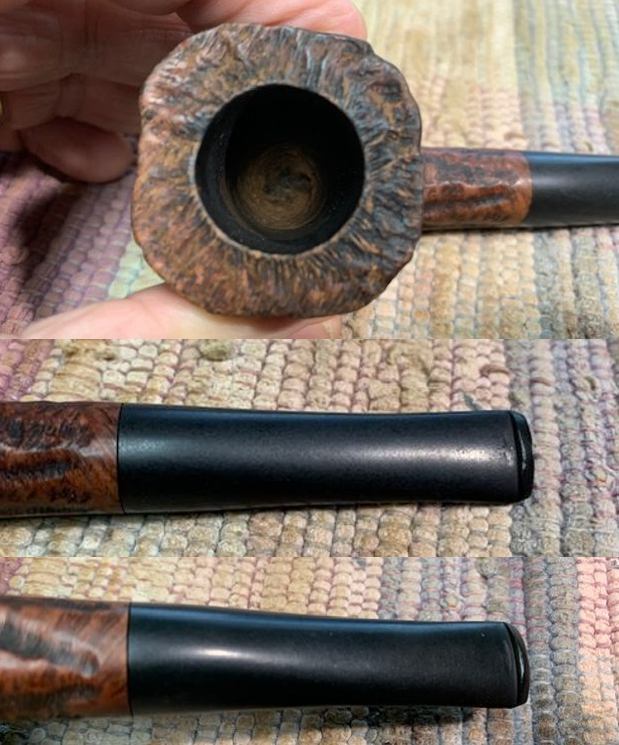
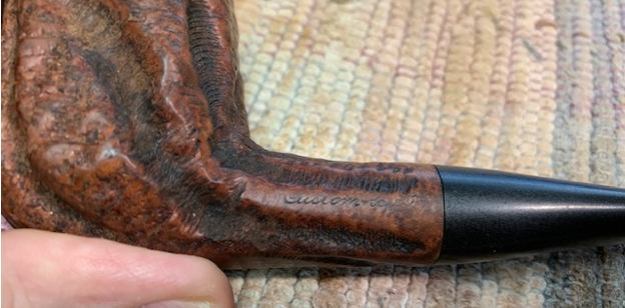
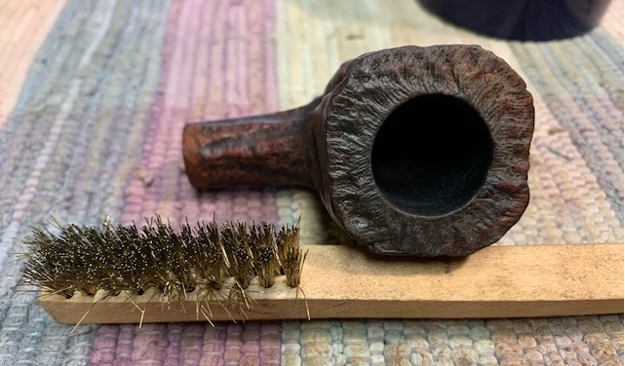
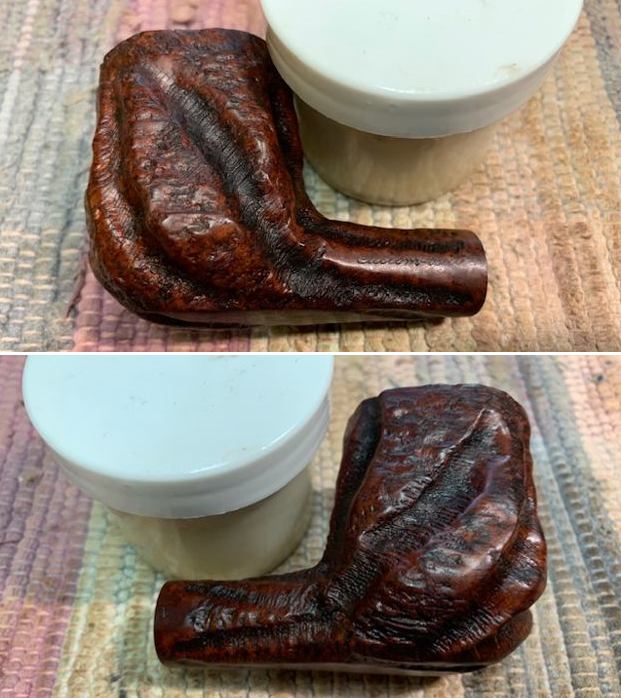
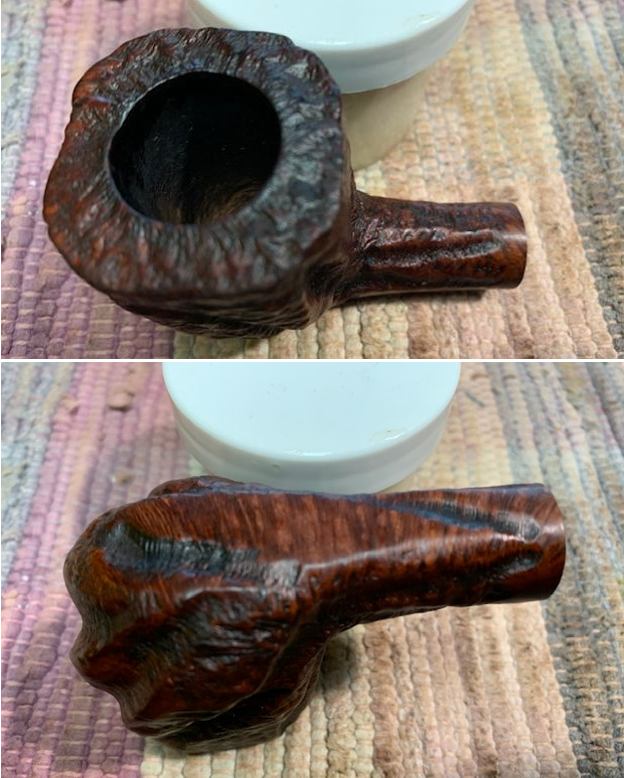
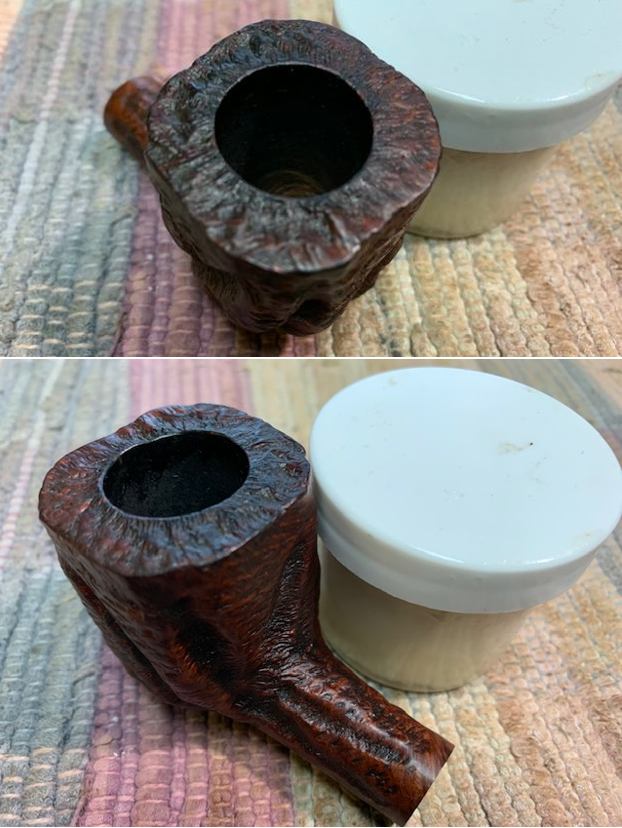
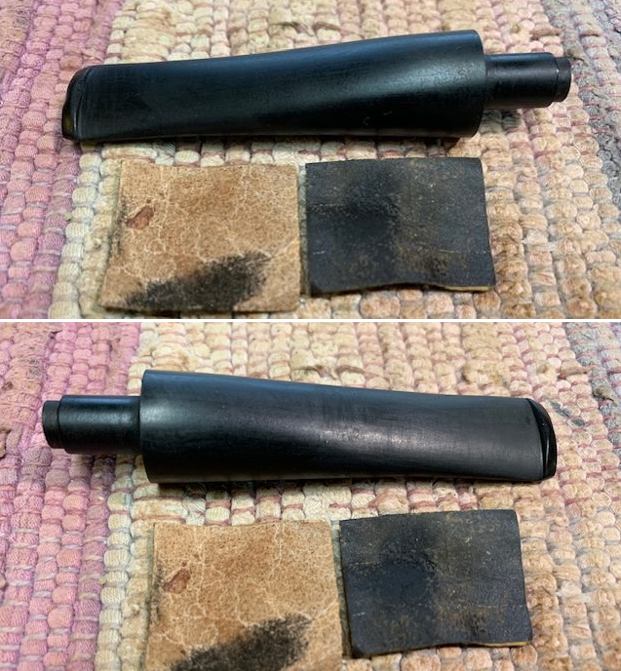
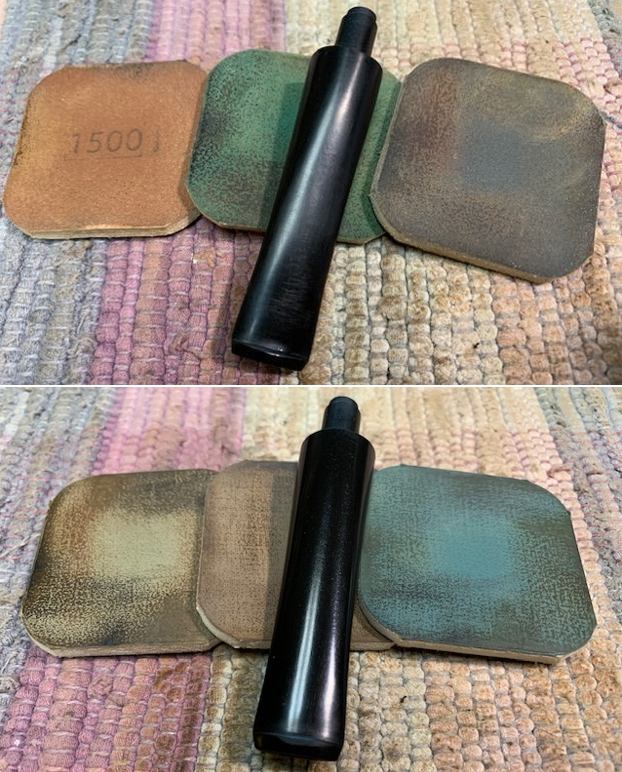
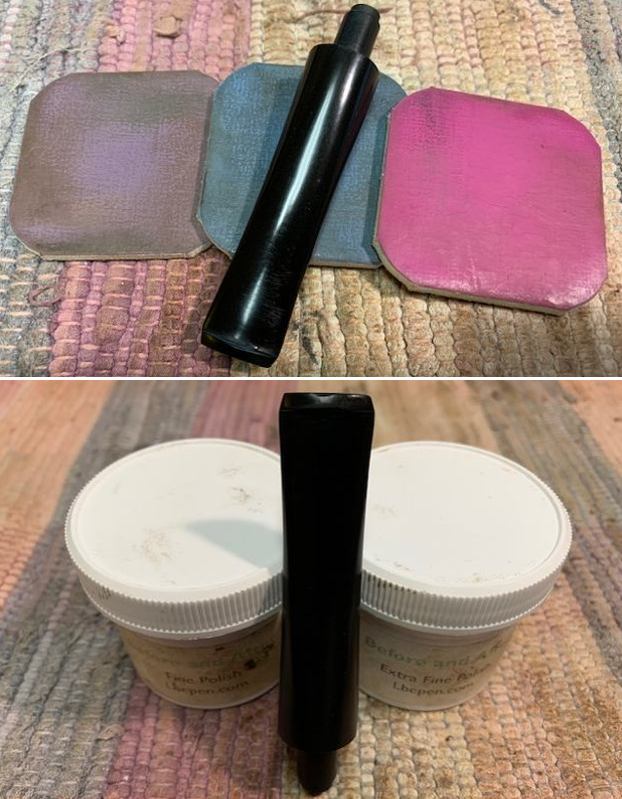
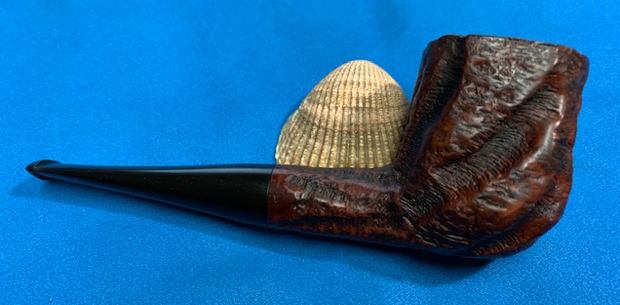
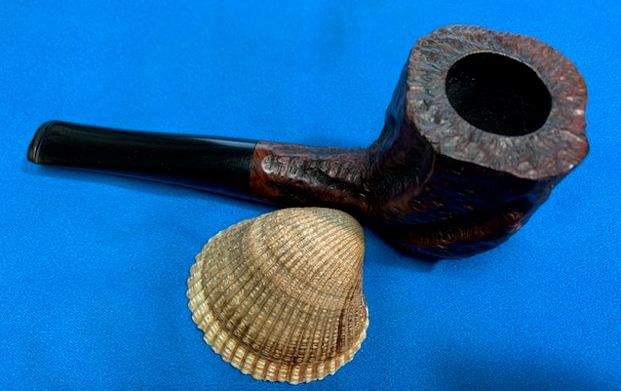
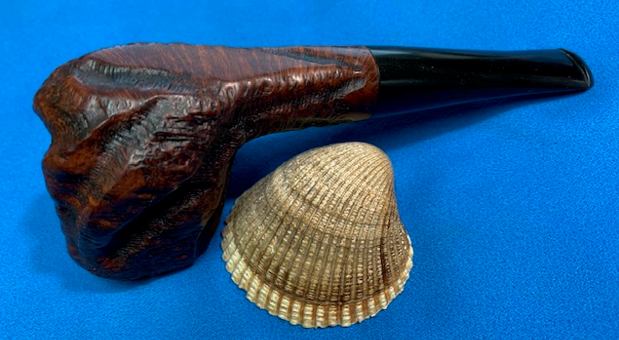
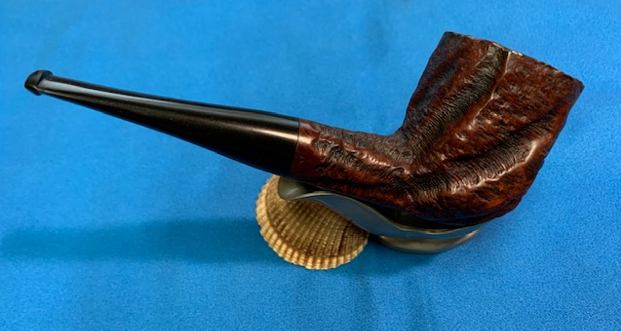
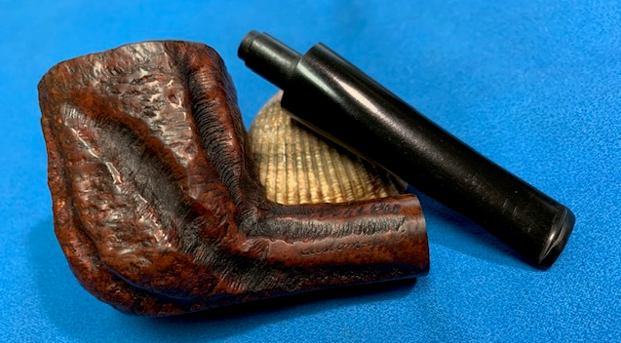
The next pipe on the work table came to us on 06/01/19 from an auction in New Castle, Indiana, USA. The pipe is a classic Custom-Bilt piece – a rusticated Panel Billiard shaped pipe with some nice grain around the bowl. The pipe is stamped on the left side of the shank and reads Custom-Bilt. Next to the stem on the underside is a triangle that appears on many of the Custom-Bilt pipes. There was a lot of grime ground into the smooth and rusticated portions of the finish on the briar. The bowl was heavily caked with an overflow of lava on the rusticated top and inner edge of the rim. The inside edges looked to be in good condition. The stem was dirty and lightly oxidized. It had tooth chatter and marks on the top and underside near the button and on the button edge. There were not markings or a logo on the taper stem. It had promise but it was very dirty. Jeff took some photos of the pipe before he started his cleanup work. He took photos of the rim top and bowl to give a clear picture of the thickness of the cake and tobacco debris as well as the lava on the rim top rustication. He also took photos of the top and underside of the stem to show the light oxidation and the chatter and tooth marks. Jeff took photos of the sides and heel of the bowl to give a picture of what the briar looked like. The rustication pattern around the bowl is instantly recognizable as done by Custom-Bilt. It is hard to see that the front, back, right and left side are flat which is what I call a panel. The stamping on the left side of the shank is clear and readable and read as noted above. I turned to Pipephil (http://www.pipephil.eu/logos/en/logo-c8.html) to get a quick view of the brand once again. I knew that I was working with one of the older pipes and probably made by Tracy Mincer himself. He stopped making the Custom-Bilt pipes in the early 1950s. The screen capture I included below shows a brief history of the brand. I turned to Pipedia (https://pipedia.org/wiki/File:CustomBilt_Stamp1.jpg) for a quick read. The majority of the information there was two book reviews of the Custom-Bilt Story by Bill Unger.

The one line I culled was the following: “Tracy Mincer started the original Custom-Bilt pipes it appears in 1934”.

I did a screen capture of the stamping that matched the stamping on the pipe that I am working on. What I learned from that is that the stamp was used by Tracy Mincer in Indianapolis in the US from 1938-1946 and possibly in Chicago before 1938 as well. There were also some metal bits in the vulcanite and the Imported Briar stamp which made think WW2 or shortly after. So now I had a possible date for this pipe. It was an old timer and it was well worth working on.

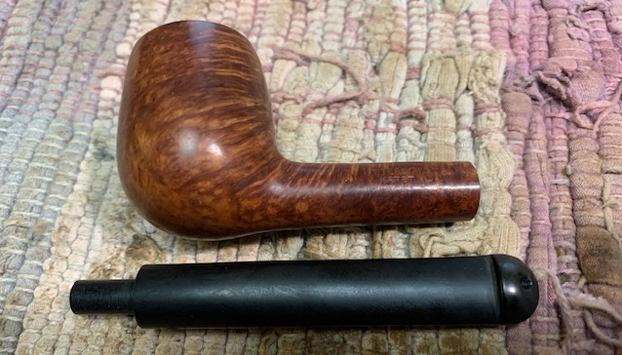
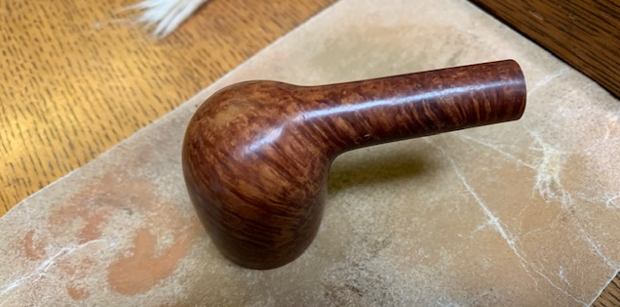
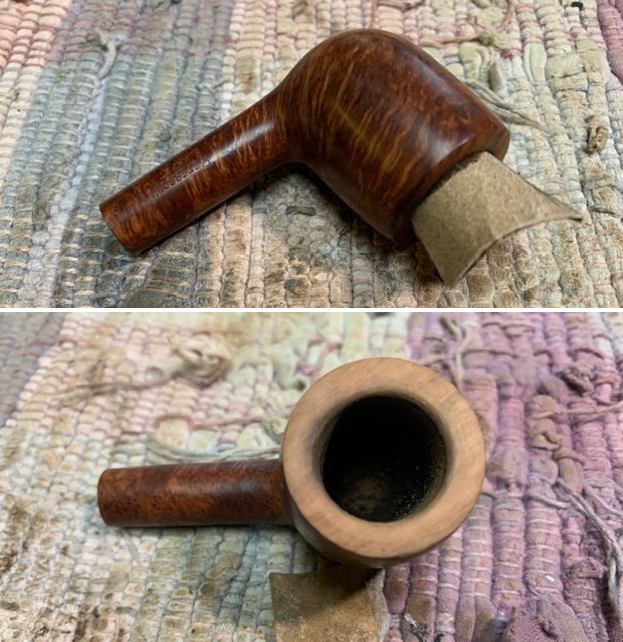
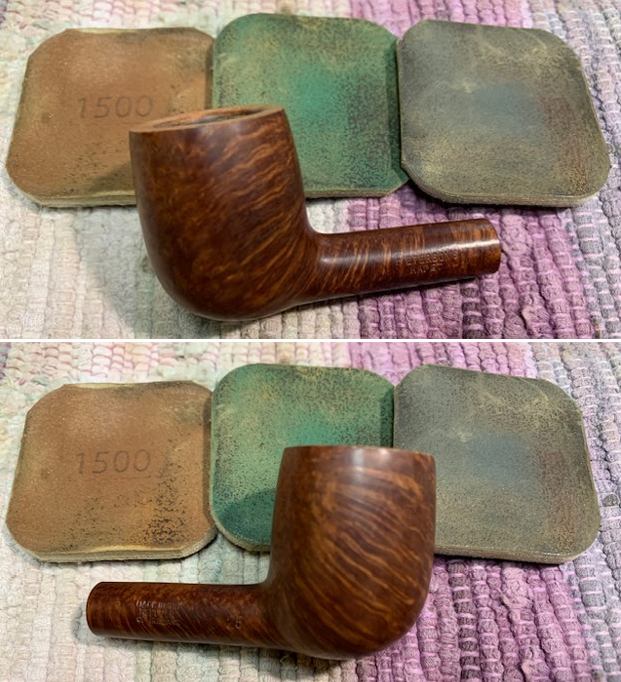
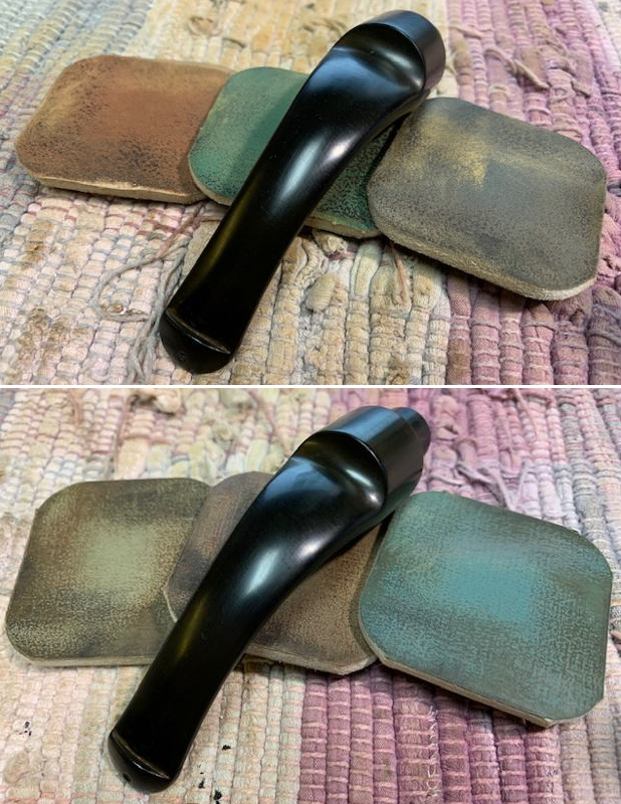
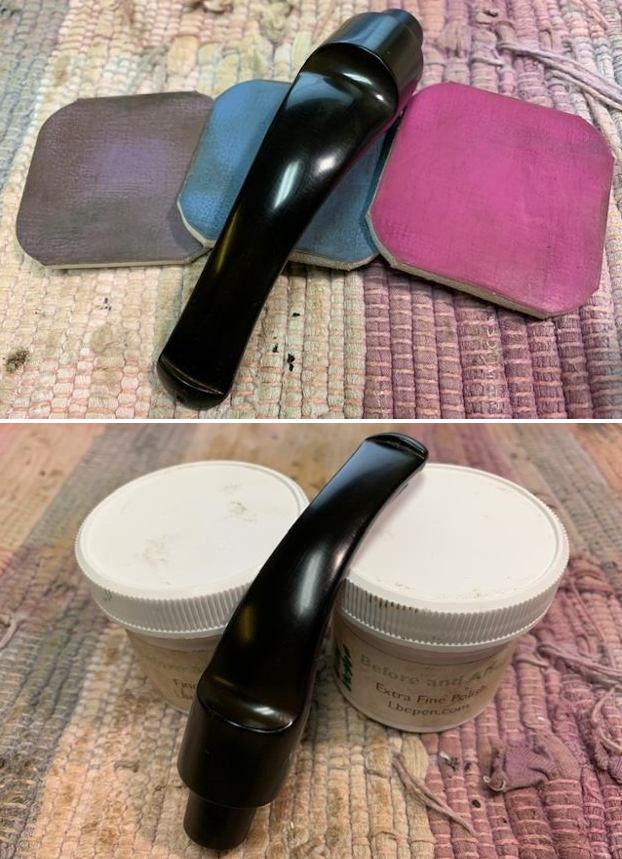
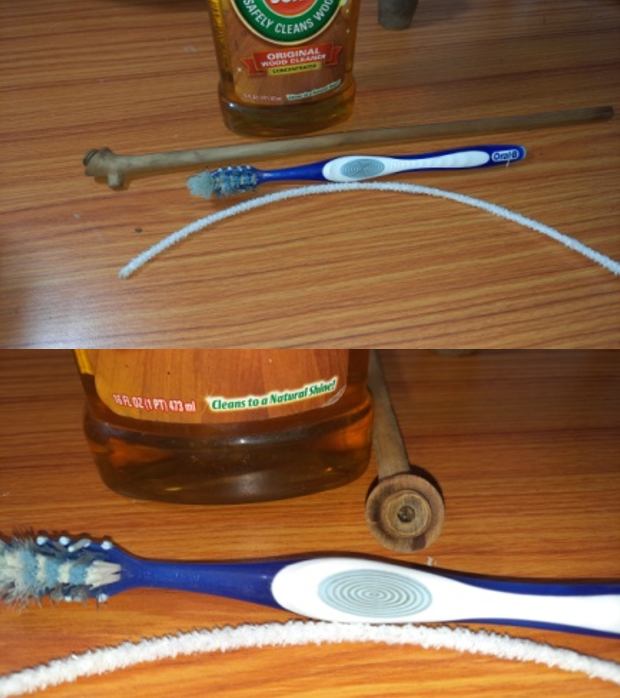
Armed with that information I turned to work on the pipe itself.  Jeff had cleaned up the pipe with his usual penchant for thoroughness. He reamed the pipe with a PipNet pipe reamer and removed the rest of it with a Savinelli Fitsall Pipe Knife.  He scrubbed the bowl with undiluted Murphy’s Oil Soap with a tooth brush. He rinsed it under running warm water to remove the soap and grime. He cleaned out the inside of the shank and the airway in the stem with alcohol, cotton swabs and pipe cleaners. He soaked the stem in Before & After Deoxidizer and rinsed it off with warm water. I took photos of the pipe before I started my part of the restoration work. The rim top cleaned up really well. The rim top and outer edge of the bowl look very good. The stem surface looked very good with a few small tooth marks and chatter on both sides near the button. There was a deep tooth mark on the topside of the button. The stamping on left side of the shank is clear and readable. It is stamped as noted above.I removed the stem and took a photo of the pipe to give a sense of the whole. The tapered stem is very nice.I cleaned up the darkening on the back side of the rim top and the grooves in the rustication with a brass bristle wire brush. I was able to clean it up nicely and it looked very good.   The bowl was in excellent condition so started by rubbing the bowl and shank down with Before & After Restoration Balm. I worked it into the surface of the bowl sides and shank with my fingertips and a horsehair shoe brush to clean, enliven and protect the briar. I let the balm sit for about 10-15 minutes and buffed with a cotton cloth to raise the shine. The grain came alive. I set the bowl aside and turned to work on the stem. I sanded out the tooth chatter and light tooth marks with 220 grit sandpaper to blend them into the surface of the vulcanite. I started polishing it with 400 grit wet dry sandpaper.  I polished the vulcanite stem with micromesh sanding pads – 1500-12000 grit pads. I wiped it down with Obsidian Oil after each sanding pad. I used Before & After Pipe Polish – both Fine and Extra Fine to further polish the stem. This Custom-Bilt Panel Billiard is a great looking pipe now that it has been restored. The style of rustication that is used around the bowl is quite beautiful and works well with both the shape and the polished vulcanite taper stem. I put the stem back on the bowl and carefully buffed the pipe with Blue Diamond on the buffing wheel using a light touch on the briar. I gave the bowl multiple coats of Conservator’s Wax and the stem multiple coats of carnauba wax on the buffing wheel and followed that by buffing the entire pipe with a clean buffing pad. I hand buffed the pipe with a microfiber cloth to deepen the shine. The finished Custom-Bilt is another pipe that fits nicely in the hand and feels great. Give the finished pipe a look in the photos below. The dimensions of the pipe are Length: 5 ½ inches, Height: 2 inches, Outside diameter of the bowl: 1 ½ inches x 1 ½ inches, Chamber diameter: ¾ of an inch. The weight of the pipe is 61g/2.15oz  I will be putting it on the rebornpipes store shortly. If you are interested in adding this pipe to your collection send me a message or an email. Thanks for reading this blog and my reflections on the pipe while I worked on it. There are many more to come!
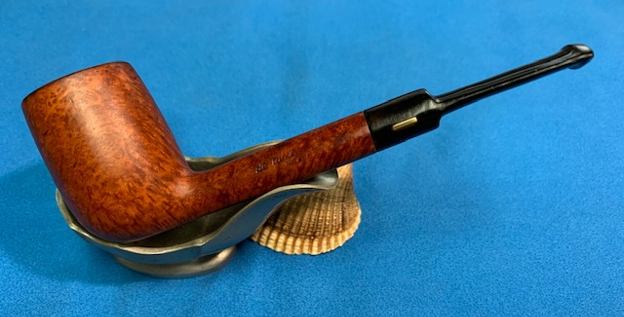
Refurbishing a Petite Savinelli de Luxe Milano 701 Lovat


Blog by Steve Laug

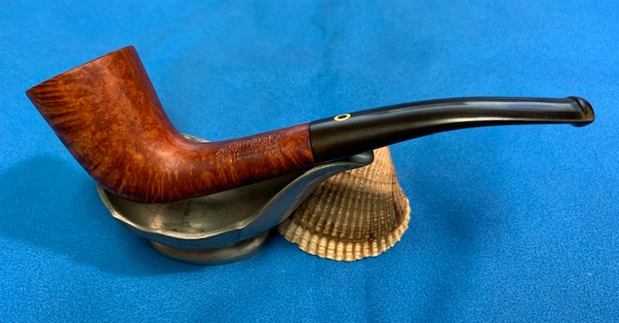
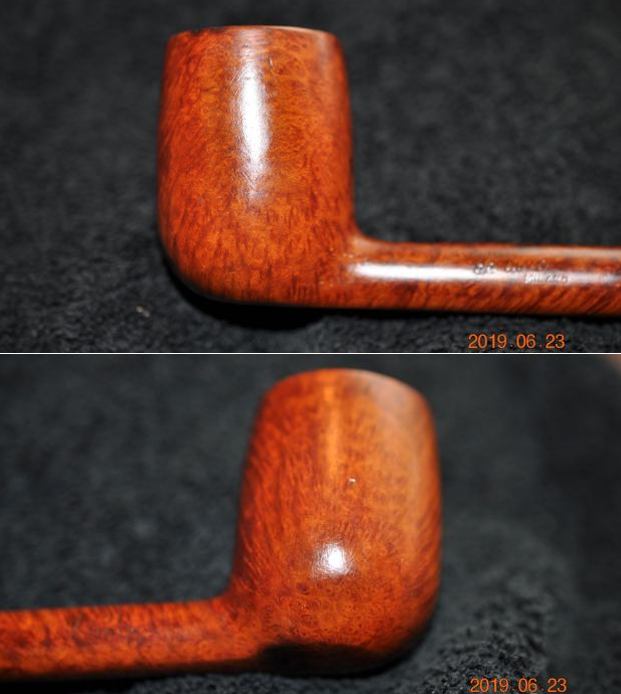
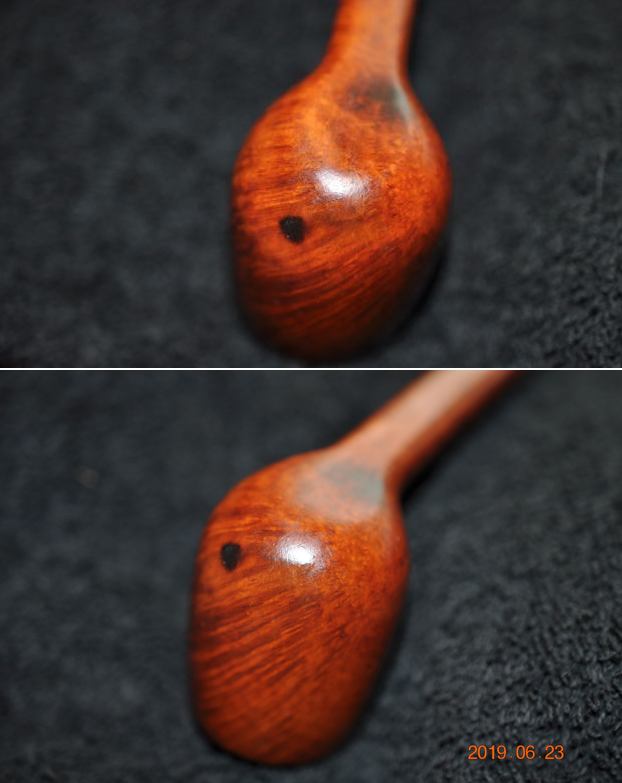
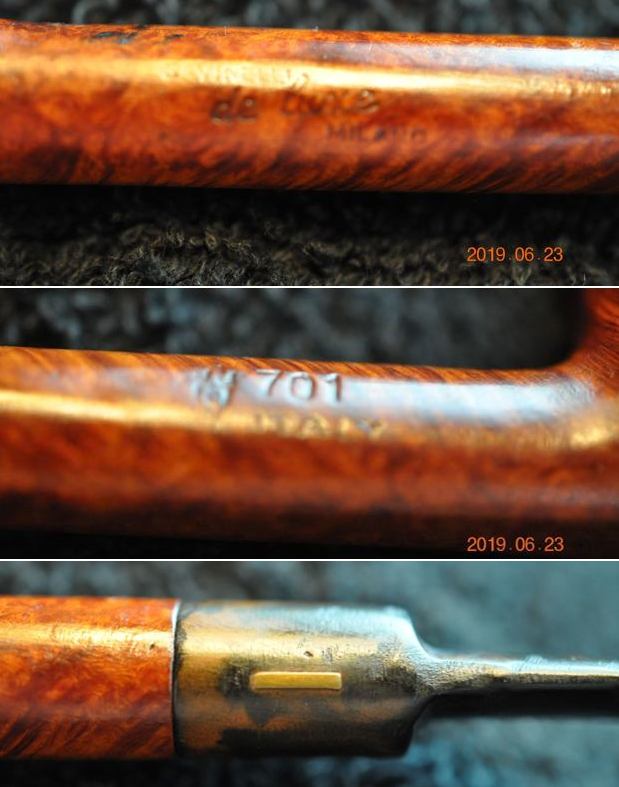
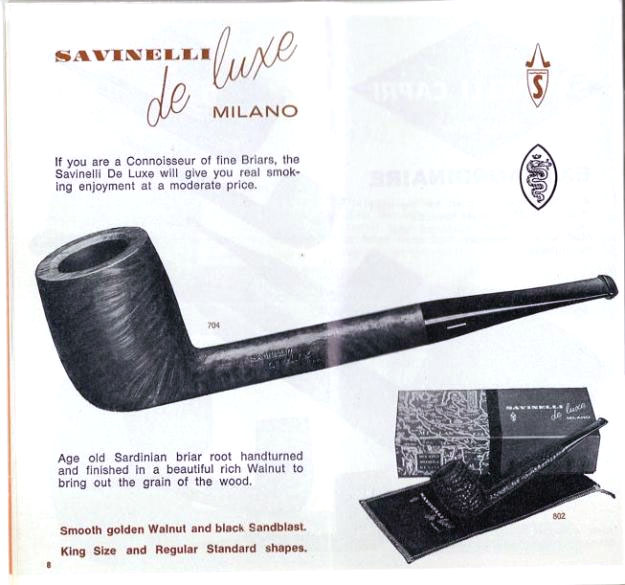
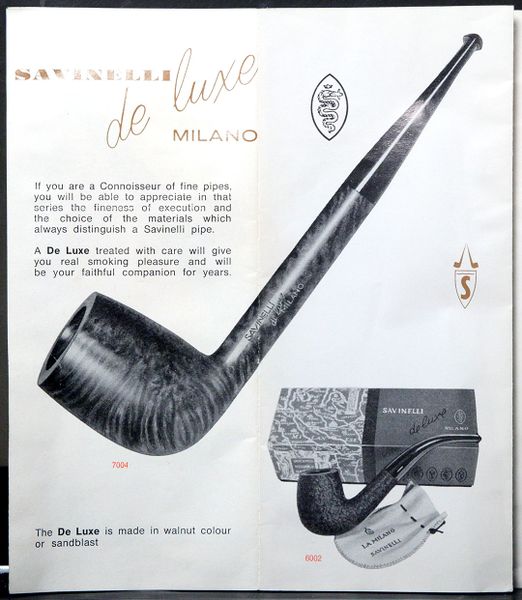
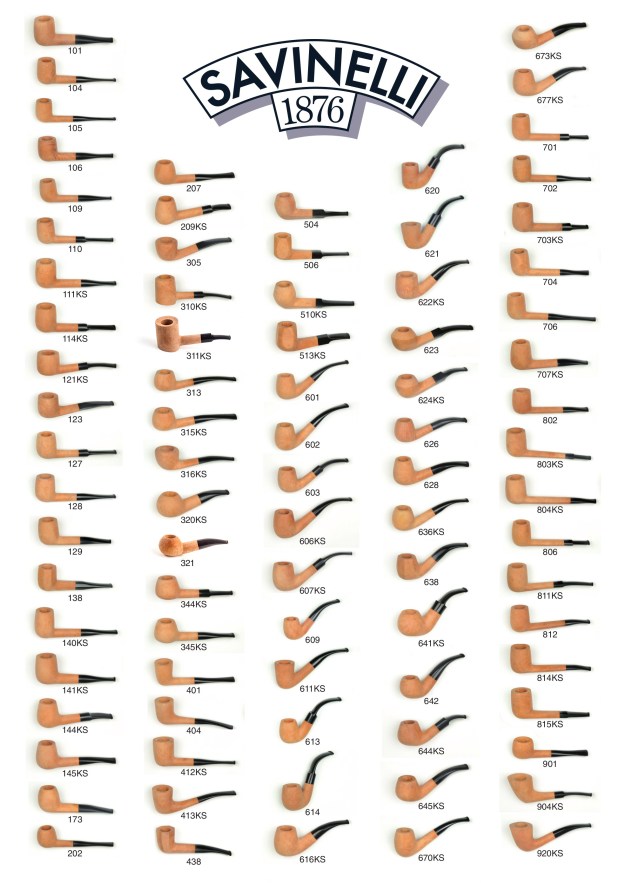
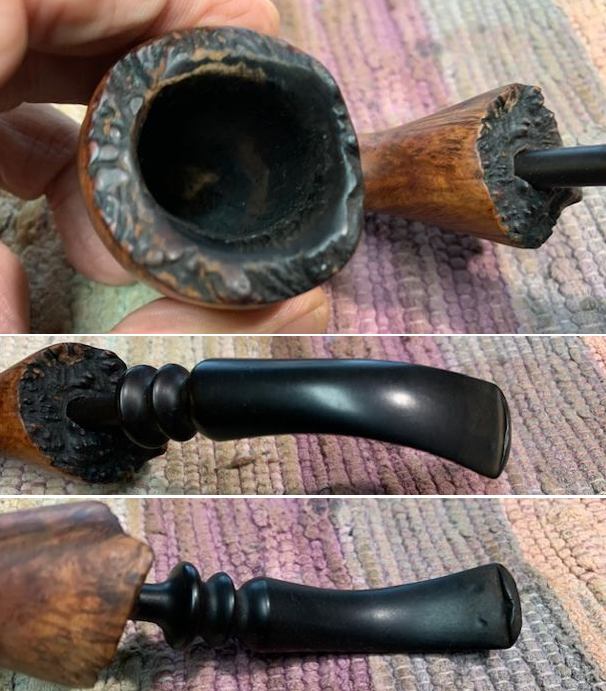
The next pipe I have chosen to work on was purchased from an online auction on 03/21/19 in Wilkes Barre, Pennsylvania, USA. The shape and design caught my eye as I was going through the pipes in the queue. The shape is what I would call a Lovat but it has a thin pencil shank and saddle stem that makes it delicate looking. It is stamped on the left side of the shank and reads Savinelli [over] de Luxe [over] Milano. On the right side it is stamped with the Savenilli Shield S logo followed by the shape number 701 [over] Italy. The finish is very dirty with dust and grime. There were nicks around and scratches around the sides. There were two burn marks – one on the front of the heel of the bowl and one on back of the heel going onto the shank. They appeared to be burns from an ashtray. They were dark but not charred. The bowl had been reamed and was quite clean. The inner and out edge of the bowl had some dark spots on them. The rim top was quite clean. The stem is oxidized, calcified and has light tooth chatter and marks on both sides near the button. The surface of the button looks very good on both sides. Jeff took photos of the pipe before he started his cleanup work. The conditions noted above are evident in the photos. Jeff took close up photos of the rim top from various angles to show the general condition of the bowl and rim. The first photo shows the clean bowl and light cake and the clean rim top. The edges look good. There appears to be a little darkening on the inner edge and a few burn marks on the outer edge on the left side. The stem has light oxidation and quite a few dents and tooth marks on both sides. Jeff took photos of the sides and heel of the bowl to give an idea of the beauty of the grain and the condition of the bowl.   The pipe is stamped on both sides of the shank and reads as noted above. The stem has a single brass bar inlaid in the left side of the saddle.  I turned to Pipedia to have a look as I knew there were some advertising flyers on the de luxe Milano (https://pipedia.org/wiki/Savinelli). I love the older Ads descriptions of the pipes. Give a careful read of the descriptions on these pipes as once I read them I want one! The pipe I am working on is described by the ads as a smooth Golden Walnut. The site also has a shape chart of the lines of Savinelli. The pipe I am working on is a 701 and the one pictured in the chart below is exactly like this one.Armed with that information I turned my attention to the pipe itself. Jeff had cleaned the pipe with his usual thoroughness that I really appreciate. He had reamed it with a PipNet pipe reamer and cleaned up the reaming with a Savinelli Fitsall Pipe Knife. He scrubbed out the internals with alcohol, pipe cleaners and cotton swabs until the pipe was clean. He scrubbed the exterior of the bowl with Murphy’s Oil Soap and a tooth brush to remove the grime and grit on the briar. The finish looks very good with good looking grain around the bowl and shank. The burn marks were present but not deep. Jeff soaked the stem in Before & After Deoxidizer to remove the oxidation on the rubber. When the pipe arrived here in Vancouver for the second stop of its restoration tour it looked very good. I took photos before I started my part of the work. I took some close up photos of the rim top and also of the stem surface. The bowl and the rim top look good. The inner edge of the rim was rough and there were some nicks in the edge. I also took close up photos of the stem to show how clean the stem was. Once it was cleaned up there were no tooth marks or chatter on either side of the stem.    I took photos of the stamping on the shank. It is very readable but faint in some spots on the sides. I took the stem off the shank and took a photo of the look of the pipe. It is really a great looking pipe that really follows the briar. I decided to start my work on the pipe by addressing the burn marks on the bowl heel and bottom and the inner and outer edge of the bowl. I sanded the burned areas with 220 grit sandpaper to try to minimize them and smooth them out. Though still present they look better.  I worked on the inner edge of the rim and the spots on the outer edge with 220 grit sandpaper.I filled in the deep nick/goudge in the right side of the bowl with clear super glue. I sanded it smooth and blended it into the surrounding briar with 220 grit sandpaper and smoothed it with 400 grit sandpaper.  I wiped the bowl down with 99% Isopropyl Alcohol and a cotton pad to remove the remnants of varnish and top coat on the bowl. I dry sanded the briar with micromesh sanding pads – 1500-12000 grit sanding pads. I wiped the bowl surface down with a damp cloth after each sanding pad to remove the sanding dust. Once I finished the exterior of the briar was clean and the grain really stood out.  I rubbed the bowl down with Before & After Restoration Balm. I worked it into the surface of the briar with my fingertips to clean, enliven and protect it. I let the balm sit for 10 minutes then buffed the pipe with a cotton cloth to raise the shine. Mark Hoover’s Balm is a product that I have come to appreciate and one I use on every pipe I have been working on.   I set the bowl aside and turned my attention to the stem. I “painted” the surface of the vulcanite with the flame of a Bic lighter to lift the tooth marks. I was able to lift many of them. I filled in the remaining marks with clear super glue. Once it cured I sanded it smooth with 220 grit sandpaper and started polishing it with 400 grit sandpaper. I polished the stem with micromesh sanding pads – wet sanding with 1500-12000 grit pads. I wiped the stem down after each sanding pad with Obsidian Oil. I polished it with Before & After Pipe Stem Polish – both Fine and Extra Fine. Once I had finished the polishing I gave it final coat of oil and set it aside to dry.    I am excited to be on the homestretch with beautiful petite Savinelli de luxe Milano 701 Lovat. This is the part I look forward to when it all comes back together, polished and waxed. I put the bowl and stem back together. I polished the bowl and stem with Blue Diamond to polish out the scratches in the briar and the vulcanite. I gave the bowl and the stem multiple coats of carnauba wax. I buffed the pipe with a clean buffing pad to raise the shine. I hand buffed it with a microfiber cloth to deepen the shine. The pipe polished up pretty nicely. The beautifully grained finish looks really good with the interesting grain patterns standing out on the shape. The grain and the polished black vulcanite went really well together. This de luxe Milano Lovat was another fun pipe to work on even with the burn marks. Pipedia describes the classically shaped Savinelli pipes as having an English look that catches the eye. That certainly is true of this one. It is a comfortable pipe to hold in the hand. Even with the burn marks the pipe is still a beauty. The finished pipe is shown in the photos below. The dimensions of the pipe are Length: 5 ½ inches, Height: 1 ¾ inches, Outside diameter of the bowl: 1 1/8 inches, Chamber diameter: ¾ of an inch. The weight of the pipe is 31 grams/ 1.09 ounces. If you are interested in adding this pipe to your rack it will be on the rebornpipes store in the Italian Pipe Makers Section soon. Thanks for reading this blog and my reflections on the pipe while I worked on it.

Resurrecting And Re-Stemming A Vintage Churchwarden Cutty With Reed Shank


Blog by Paresh Deshpande

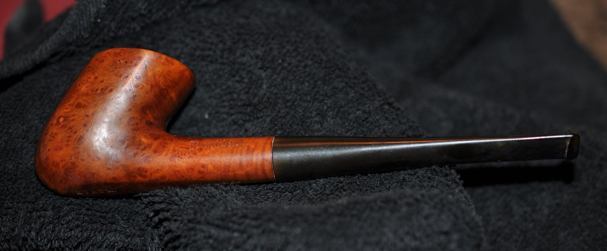
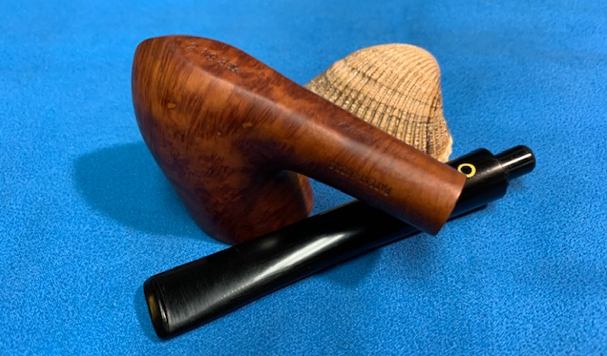
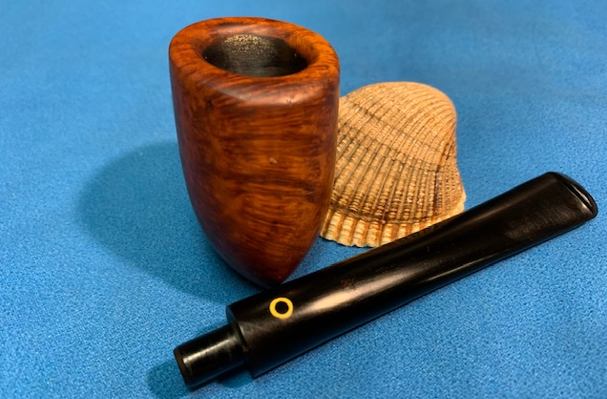
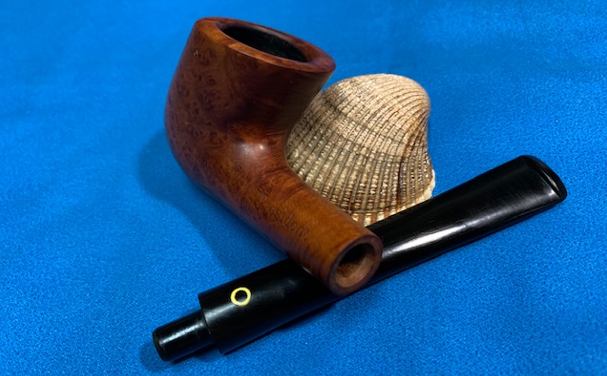
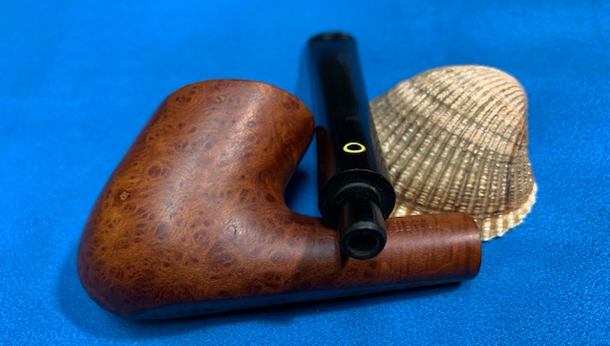
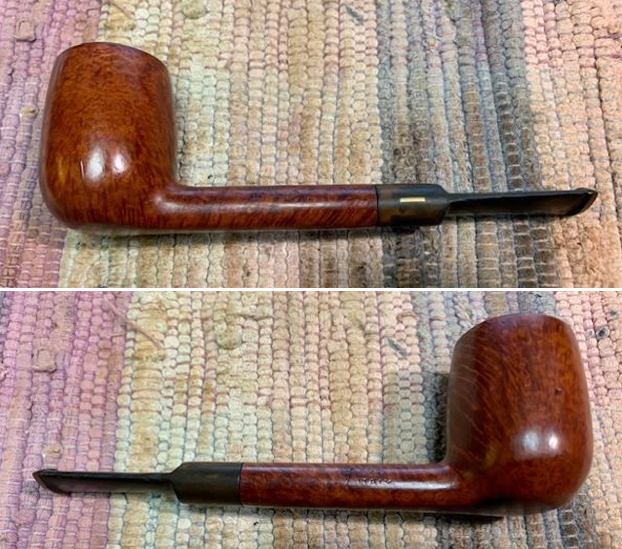
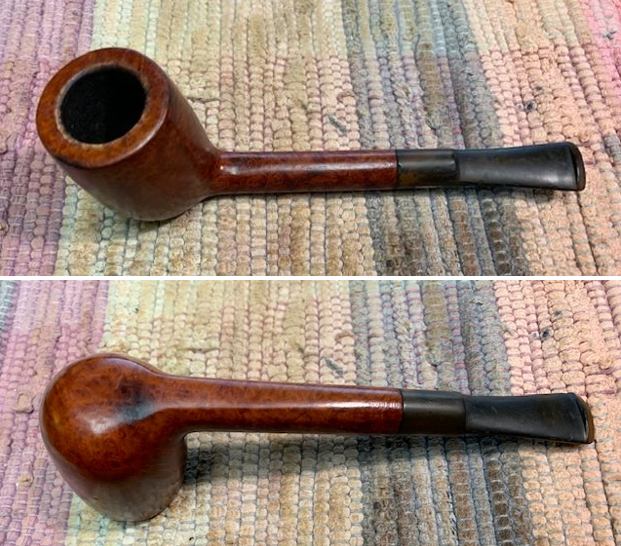
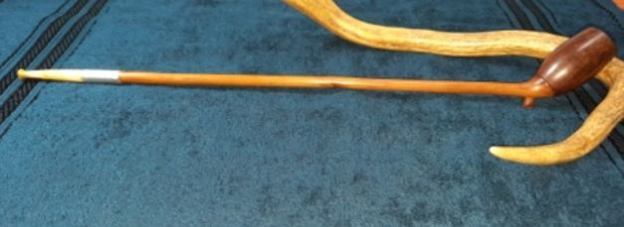
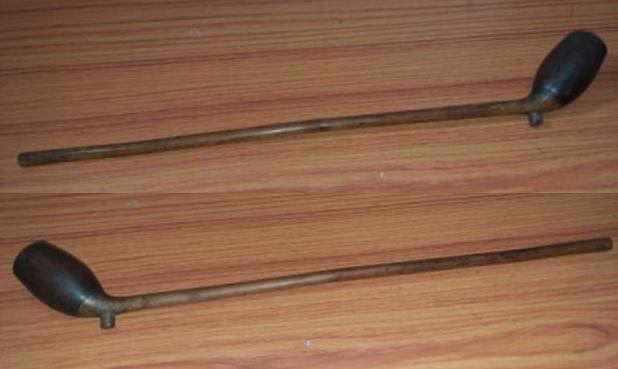
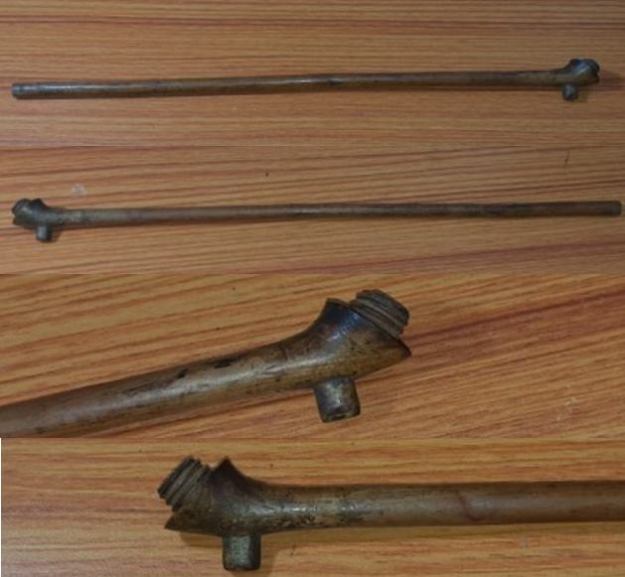
The next pipe that I selected to work on is an old, rustic no name Cutty shaped pipe with a long thin Reed shank that ended in a round orifice when I saw it for the first time. Closer examination confirmed that the round orifice was threaded implying that the stem was MIA. This pipe came to us in 2019 while Abha was in Pune and I was away at my place of work, as a part of estate sale by a French gentleman on Etsy which I am yet to chronicle. There are some really good, interesting and collectible pipes in this lot that I am looking forward to work on in coming days.

This no name Cutty shaped pipe has a steep forward cant to the stummel. This forward rake appears more pronounced as the stummel itself tapers upwards towards the rim. The stummel is as delicately and beautifully shaped as a Tulip. Here are a few pictures of the pipe as it sits on my worktable.  The complete lack of stampings of any kind on the pipe means that the provenance of the pipe cannot be ascertained with documented evidence. However, given the shape, construction, condition and the materials used in making this pipe makes me believe that this was a locally made pipe from the early 20th century. I may be wrong in my appreciation (primarily dictated by inert desire/wish for this pipe to be an old timer!) as I am vastly inexperienced as compared to many of the esteemed readers of rebornpipes and would be glad to learn more about such pipes from them.

Having placed my request, I now move on to the initial visual inspection.

Initial Visual Inspection
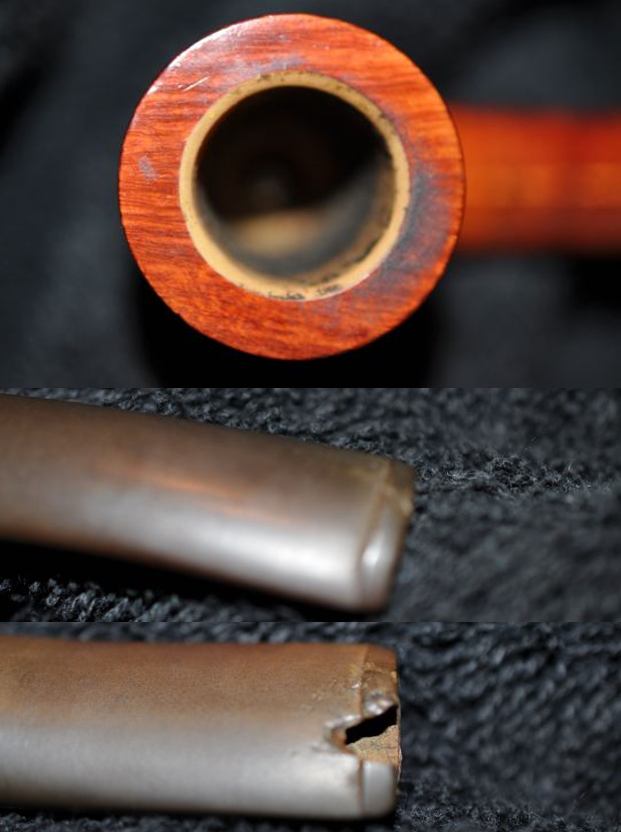
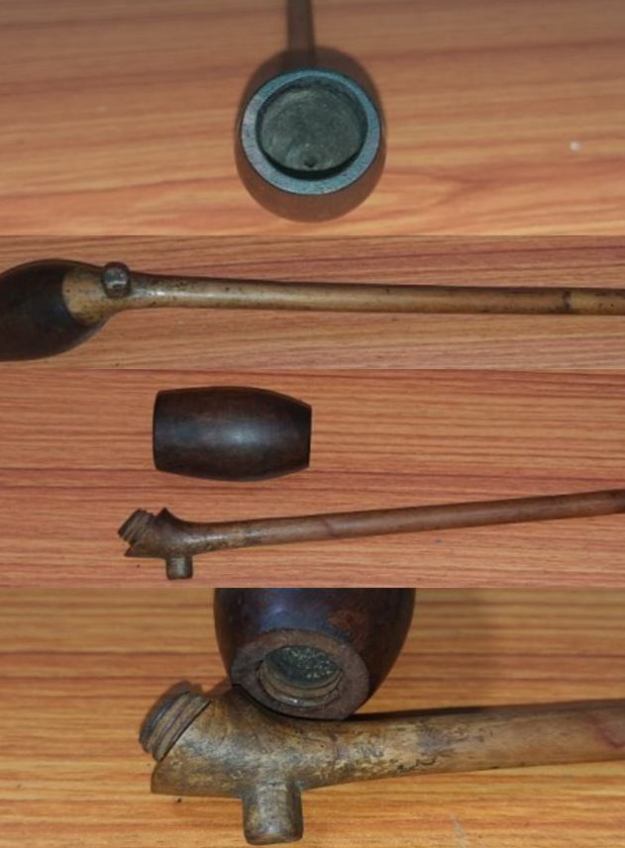
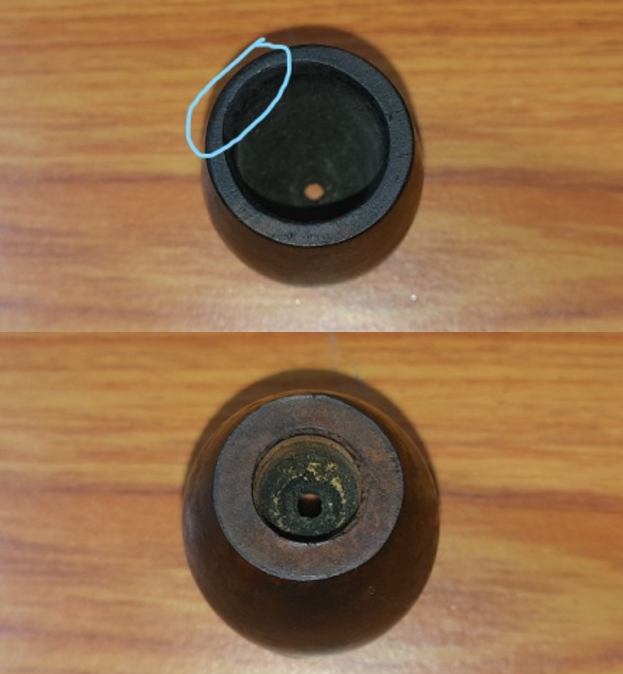
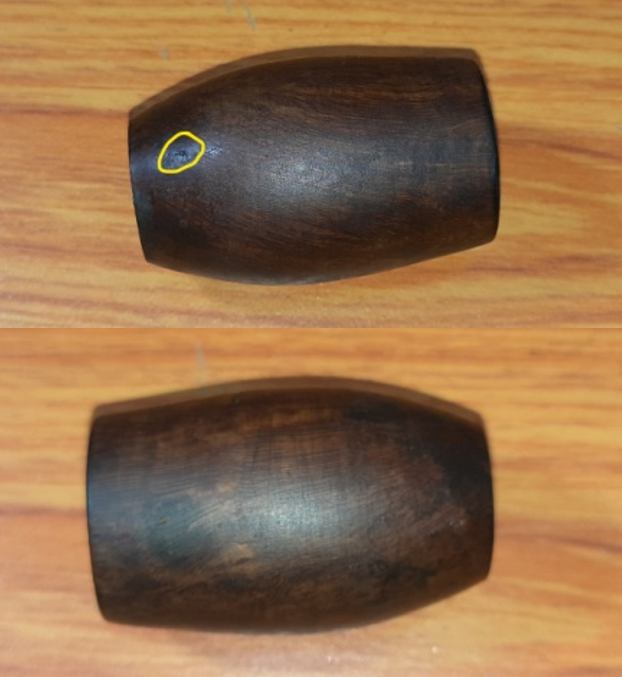
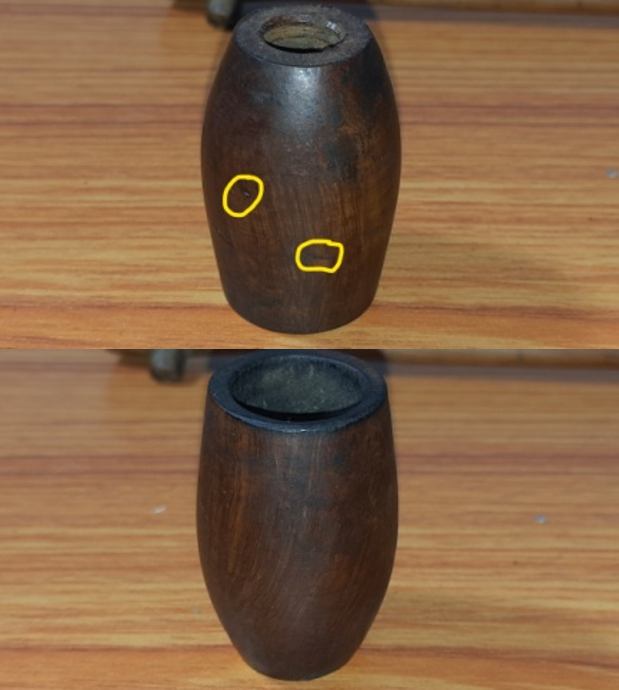
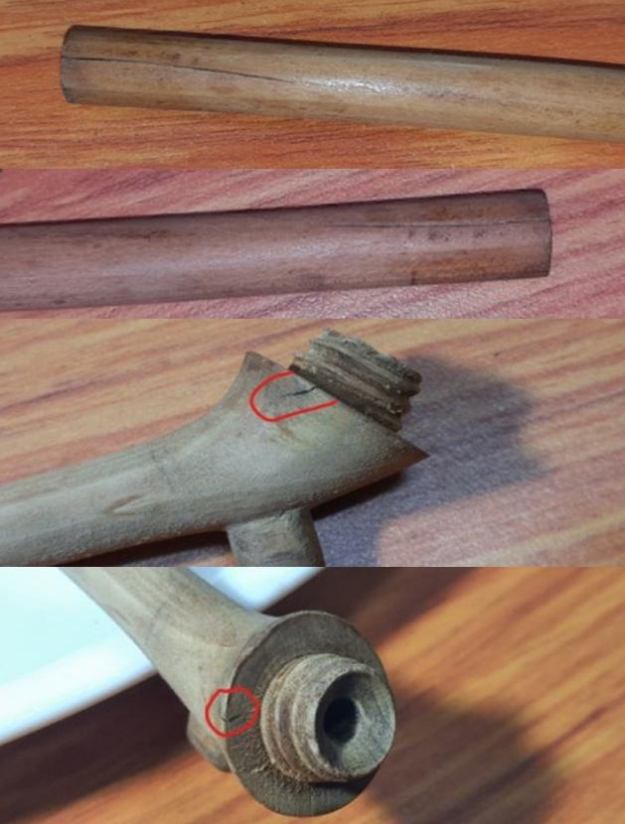
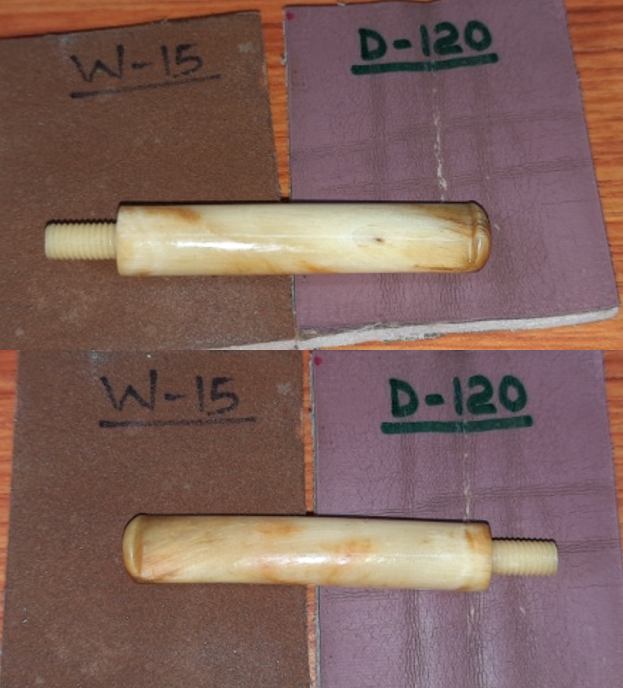
As noted at the start of this write up, this pipe came with a threaded reed shank end that is now missing the stem that would have come with a threaded tenon to seat in to the shank. Given the retro and vintage look of the pipe, I think the stem would have been a bone/ horn or Amber with a bone tenon. So the first step in this restoration would have to be selecting a suitable bone stem with threaded tenon. The shank end face shows two cracks on opposite sides of the shank (encircled in yellow) which would need to be addressed. The stummel end of the reed is upturned, flared and hollowed with threads to seat the stummel and at the bottom of which is the short foot. The threaded surface is covered in dried oils and gunk causing the draught hole to clog. This would have to be cleaned and opened. The entire length of the shank is covered in dirt and grime giving it a dull and dirty appearance. The chamber has a decent layer of cake that is even from top to the bottom of the bowl. The rim top is covered in overflow of lava and hides any dents or chips on the smooth surface. The rim is significantly dark and thin on one side and is encircled in pastel blue. This makes the chamber out of round and gives a lopsided appearance to the top view of the stummel. The bottom of the stummel is threaded and seats atop the threaded reed shank. The threaded area shows heavy accumulation of oils, ash and gunk all around and even within the threads. Cleaning this area would ensure a flush and snug seating of the bowl over the shank.The briar has taken on a nice dark brown patina over a long period of time and prolonged use which when polished and cleaned, should contrast beautifully with the light hues of the long reed shank. There are a few dents and fills (marked in yellow circle) over the entire stummel surface that is visible through the dirt and grime that covers the surface. Truth be told, the stummel does not boast of complete flamboyant straight or bird’s eye or flame grains over the surface, but a mixed pattern of swirls and flame grains that is attractive enough to hold your attention. Preserving the deep brown aged patina will be the primary concern in this bowl refurbishing. The Process
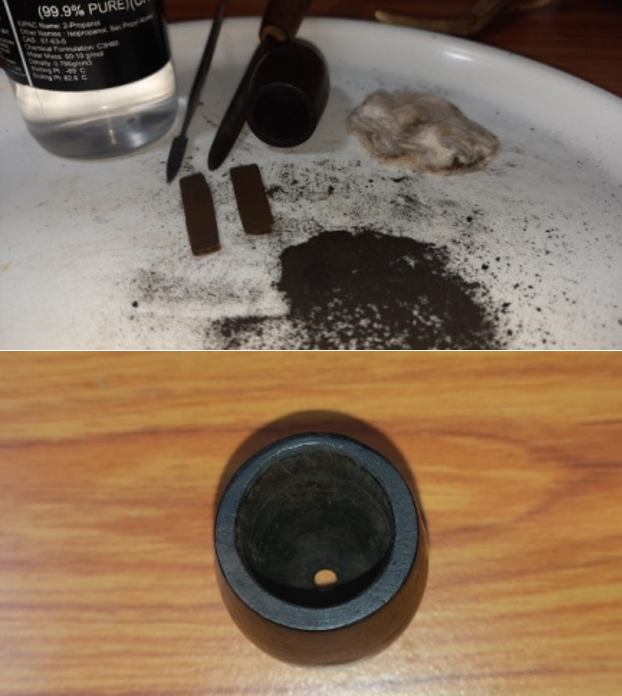
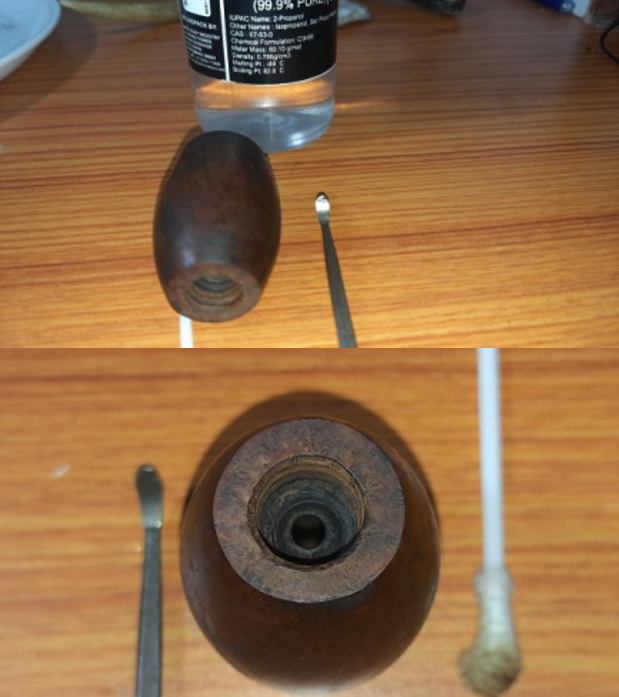
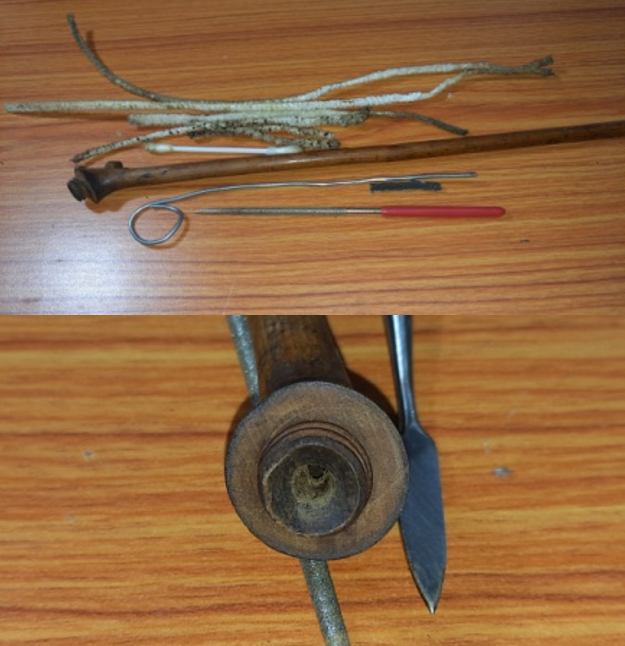
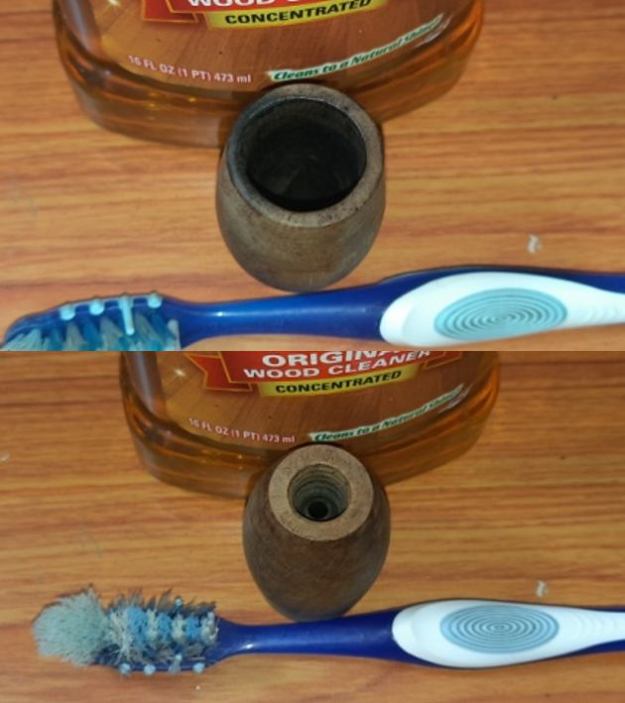
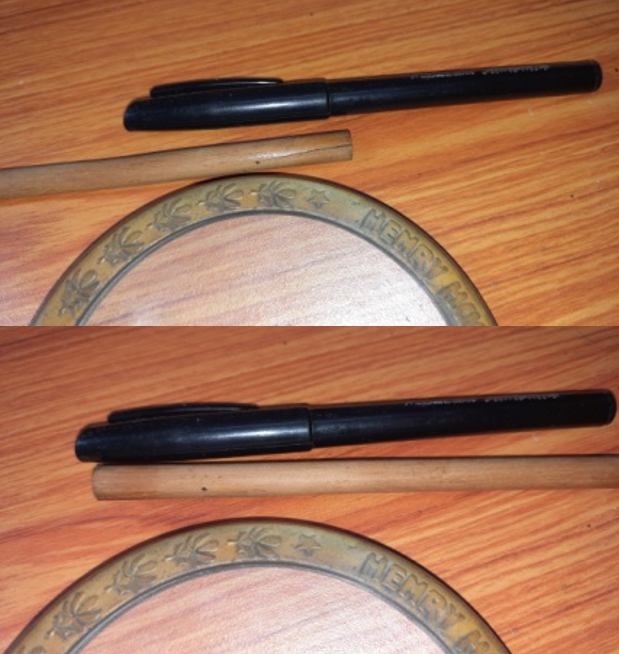
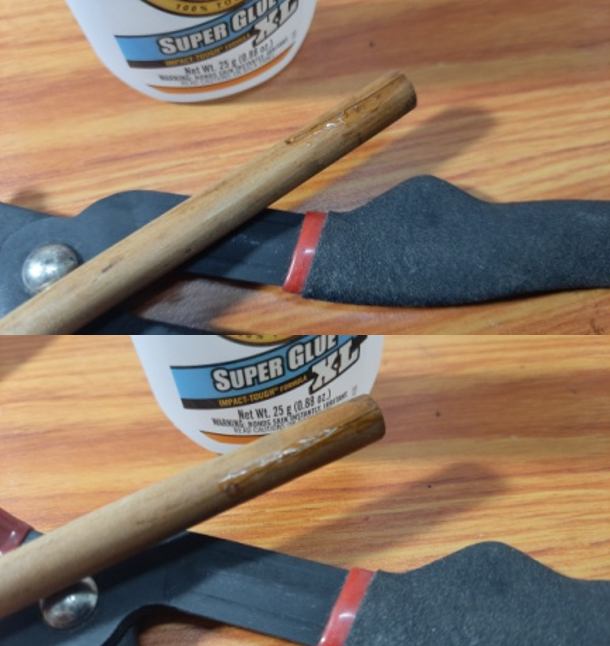
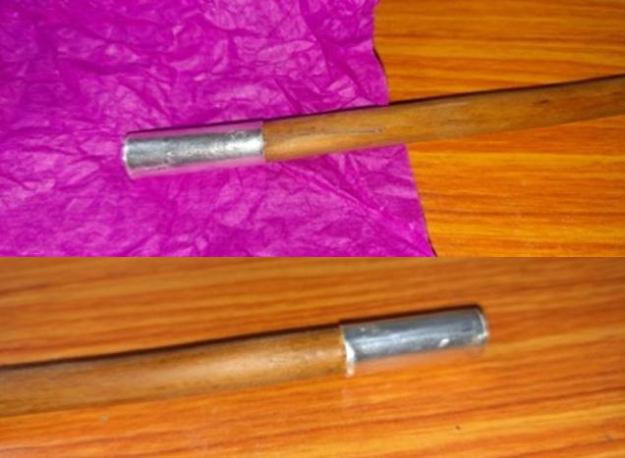
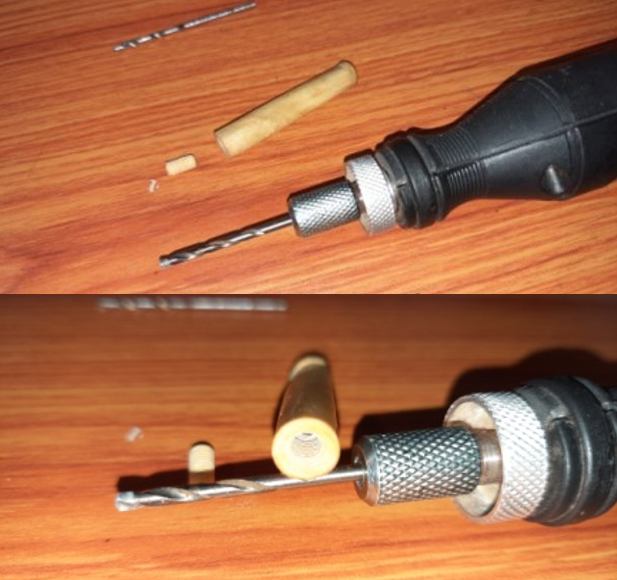
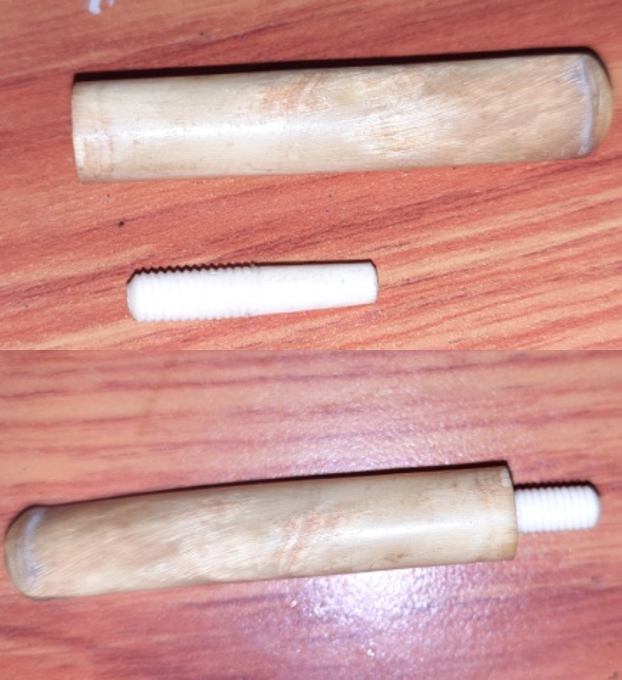
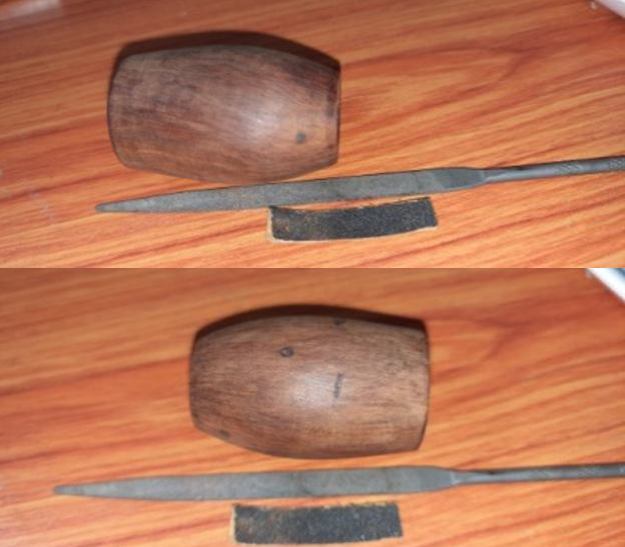
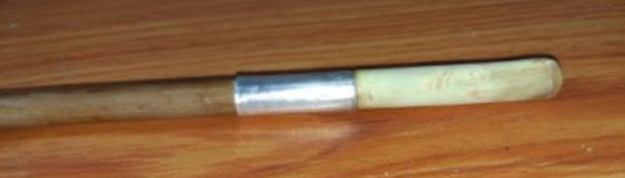
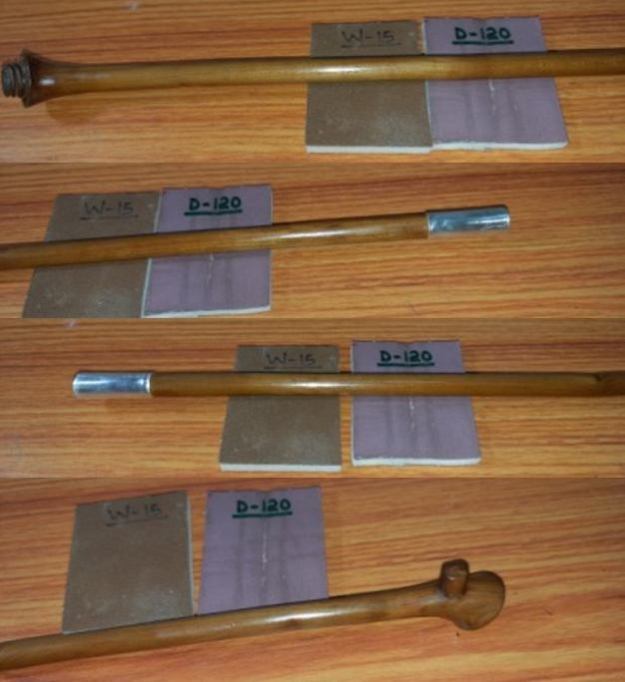
I started the restoration of this pipe with the removal of the carbon cake from the walls of the chamber. Using my fabricated knife, I carefully removed the cake from the chamber to expose the chamber walls. It was heartening to note that there are no heat related issues in the surface of the walls. I smoothed out the surface by sanding the walls with a folded piece of 220 grit sand paper. To remove the last traces of residual carbon dust, I wiped the chamber with a cotton swab wetted with 99.9% pure alcohol. I further cleaned the draught hole at the bottom center of the bowl with a pointed dental tool. The hardened cake had greatly reduced the diameter of the draught hole and ran a pipe cleaner dipped in alcohol to clean it further.Next, I cleaned the threaded bottom of the stummel that seats atop the long reed shank with a dental tool. I scraped out the entire dried gunk that had accumulated in the hollow space as well as from in between the threads. I further cleaned the bottom of the stummel with q-tips and alcohol.With the preliminary cleaning of the internals of the stummel completed, I turned to cleaning the internals of the long reed shank. With my fabricated pointed tool and round needle file, the dried oils and tars that had formed a block at the neck of the shank and stummel junction was removed and cleaned. I scraped out all the dried debris from the surface of the shank end with a sharp dental tool. I ran a few long pipe cleaners dipped in alcohol through the airway of the stem till the pipe cleaners emerged white.I cleaned the exteriors of the stummel and the reed shank with Murphy’s Oil soap and a tooth brush. I ensured that all the tars and grime was cleaned from both the surfaces. This cleaning has revealed the exact extent of damage to the rim top surface. The area where the rim has thinned out also shows signs of charring which would need to be addressed. I dried the shank surface with a soft paper towel and ran a fluffy pipe cleaner through the shank airway to dry it out. Now that the stem surface is rid of the dirt and grime, the cracks at the shank end are clearly discernible and so is the surprise revelation of a crack at the base of the threaded portion of the shank (encircled in red).I marked the end points of the shank end cracks and that at the stummel end with marker pen under magnifying glass. I shall drill counter holes at the marked end of each of the crack to prevent the further spread of these cracks. I used a 1 mm drill bit mounted on my hand held rotary tool to drill the counter holes… …and filled these and the cracks with clear CA superglue. I set the reed shank aside for the superglue to cure. The external cleaning had not only exposed an additional crack at the stummel end of the shank, it had also exposed all the fills and dings over the stummel surface. With a thin sharp knife, I gouged out all the old fills from the surface and cleaned the area with isopropyl alcohol in preparation of filling these gouged out surfaces with a mix of briar dust and CA superglue. I use the layering method to fill these pits in the briar. After all the fills were repaired, I set the stummel aside for the fills to harden and cure completely.The shank repairs had cured by the following noon when I got back from work. Using a flat needle file, I evened out the fills to roughly match the rest of the shank surface. I fine tuned the match by sanding the fills with a folded piece of 320 grit sand paper. Did I mention having customized a sterling silver band for providing additional support against the crack’s lateral expansion? I guess not. Here in India, our local Silversmiths are very skilled in turning jewelry and at repairs right in front of their customers at very affordable rates. Steve and Jeff are witnesses to such craftsmanship when they had visited us in India. Long and short of the story is that I got a 1.5 inch long silver band customized for this shank and fixed it over the shank end with superglue. That crack isn’t going any further now.Now that the cracks have been repaired and stabilized, the next goal was to find the right stem to go with the overall profile of the pipe. I selected a couple of suitable bone stems from my stash of spares and asked for Abha’s opinion. She selected a horn stem that was perfectly matched in size and shape with the shank. However, the stem came with its own set of challenges. First, the tenon was broken with half of it sticking inside the stem and secondly, the top section of the stem surface was partially sliced (encircled in blue), but remained firmly attached. Notwithstanding these issues, the stem matched the profile of the pipe to the T and looks amazing. The first issue with the stem that I dealt with was removal of the broken half of the tenon. I mounted a drill bit slightly larger than the tenon opening on to my hand held rotary tool and carefully drilled it inside the tenon. Once the drill bit had a firm grip on the tenon, I turned the motor counter clockwise and dislodged the tenon remnants from the stem revealing a threaded stem end.I would need to identify a threaded bone tenon that would match the shank and stem threads for a perfectly aligned seating. I rummaged through my spare parts box and came up with a bone tenon that was threaded at one end and smooth conical shaped at the other end. The seating of the smooth side of the tenon into the stem was perfect and so was the threaded end into the shank end snug and aligned. The Pipe Gods are especially favoring me it seems. A perfectly matching, period correct horn stem and a perfectly matching bone tenon are nothing short of a miracle.Before fixing the tenon, I cleaned out the stem internals using anti-oil dish washing soap and thin shank brushes. I scrubbed the external surface with soap and Scotch Brite pad. Using paper towels and pipe cleaners, I dried the stem externals and airway respectively. I inserted a petroleum jelly (Vaseline) coated tapered pipe cleaner through the tenon and stem airway and out through the round orifice opening at the slot end. This serves two purposes, firstly, perfect alignment of the tenon and stem airway is ensured and secondly, the petroleum jelly prevents the superglue from seeping into the airway and clogging it shut once the glue has dried. I roughed out the smooth surface of the tenon with a needle file to provide better bonding surface and applied superglue over the smooth surface of the tenon and over the threads in the stem and inserted the tenon into the stem. I wiped the excess glue from the surface and held the two together for the glue to harden a bit and then set it aside for the superglue to harden completely. While the stem was set aside for the glue to cure, I sanded the stummel fills with a flat needle file. To further even out the filled areas and address the minor dents and dings over the stummel surface, I sanded it with a worn out piece of 220 grit sand paper till smooth.Next I addressed the issue of the charred and out of round chamber. I began with topping the rim over a 220 grit sand paper, frequently checking for the progress being made. I stopped once the charred surface was reduced to an acceptable- to- me level and the thickness of the rim top was close to even all round. To get the chamber back to round, I created a bevel over the inner and outer edge with a folded piece of 180 grit sand paper. I am pretty pleased with the progress being made thus far.While I had been working on the stummel, the tenon fix to the stem had set solid. I checked the seating of the tenon in to the shank end and it was snug and perfectly aligned.There was this issue of sliced top surface on the stem which I addressed next. I applied clear CA superglue over and under the sliced surface and set the stem aside to cure. I sprayed an accelerator over the superglue to hasten the process of curing. Once the stem repairs were set, with a needle file, I sanded the fill to achieve a rough match with the stem surface. I further fine tuned the match by sanding the entire stem surface with a folded piece of 220 grit sandpaper. I applied a little EVO (Extra Virgin Olive Oil) to the reed shank and stem and set it aside to be absorbed into the surface. While the shank and stem were set aside to absorb the EVO, I dry sanded and polished the stummel surface with 1500 to 12000 grit micromesh pads. Dry sanding with micromesh pads helps to preserve the patina of the old briar and is a trick I use when restoring all my vintage pipes. I rubbed a small quantity of “Before and After Restoration” balm which moisturizes and enlivens the briar. I let the stummel absorb the balm for 15- 20 minutes and then gave the stummel a rigorous hand buff with a micromesh cloth. The transformation in the appearance of the stummel is phenomenal and immediate. With the stummel now refurbished and rejuvenated, I turned my attention back to the shank and horn stem. I polished the shank and stem by wet sanding using 1500 to 12000 grit micromesh pads. I rubbed a little “Before and After” balm in to the reed shank and a little EVO in to the stem. All that remained was a polish with Blue Diamond compound and final wax coating using Carnauba Wax. I mounted a cotton buffing wheel earmarked for Blue Diamond compound on to my hand held rotary tool and applied a coat of the compound over the stummel surface to polish out the minor scratches. With a cotton buffing wheel that I use for carnauba wax, I applied a coat of carnauba wax to the stummel and stem and continued to work on it till the complete coat of wax had been polished out. I mounted a clean cotton cloth buffing wheel and gave the entire pipe a once over buff. I finished the restoration by giving the entire pipe a rigorous hand buffing using a microfiber cloth to deepen the shine further. The finished pipe is shown below. This pipe shall find its way to my collection based purely on its delicate stunning looks and uniqueness of the shape. P.S. The Pipe God was definitely smiling down upon me as I worked this pipe. Rarely does it happen that the replacement stem is a perfect size match and the new tenon is period correct and fits in the shank like a glove.

The most difficult part of this restoration for me was…can you guess? Please let me know your guess in the comments below and a big thank you for your valuable time in reading the write up.

Praying for you and yours… Be safe and stay safe.

Saving a Parker


Blog by Kenneth Lieblich

Next on the chopping block is a beautiful sandblasted pipe by Parker of London. I purchased a group of pipes from a fellow in the Eastern US. It was definitely a mixed bag of very good and very bad. Some pipes were destroyed beyond repair, some pipes were filthy but repairable, some stems were missing their stummels, and some stummels were missing their stems. However, there were a handful that were in decent condition when I found them and they just needed a helping hand – this Parker was one of those. Apologies in advance for the paucity of photographs. I guess I just got carried away with the work! Parker of London has an interesting history. Our friends over at Pipedia have provided this information:

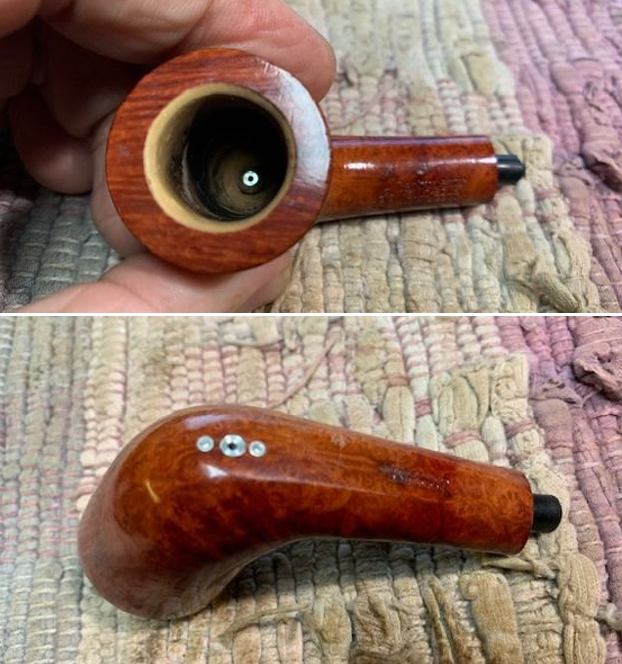
In 1922 the Parker Pipe Co Limited was formed by Alfred Dunhill to finish and market what Dunhill called its “failings” or what has come to be called by collectors as seconds. Previous to that time, Dunhill marketed its own “failings”, often designated by a large “X” over the typical Dunhill stamping or “Damaged Price” with the reduced price actually stamped on the pipe. While the timing and exact nature of the early relationship remains a bit of mystery, Parker was destined to eventually merge with Hardcastle when in 1935 Dunhill opened a new pipe factory next door to Hardcastle, and purchased 49% of the company shares in 1936. In 1946, the remaining shares of Hardcastle were obtained, but it was not until 1967 when Parker-Hardcastle Limited was formed. It is evident through the Dunhill factory stamp logs that Parker and Dunhill were closely linked at the factory level through the 1950s, yet it was much more than a few minor flaws that distinguished the two brands. After the war, and especially after the mid 1950s the differences between Parker and Dunhill became even more evident, and with the merger of Parker with Hardcastle Pipe Ltd, in 1967 the Parker pipe must be considered as an independent product. There is no record of Parker ever being marketed by Dunhill either in its retail catalog or stores. Parker was a successful pipe in the US market during the 1930s up through the 1950s, at which point it faded from view in the US, while continuing to be popular in the UK. Pipedia goes on to say that the old Parkers had a patent number and dating code, but these were gone by 1957. I do not know the specific age of this pipe, but since it is missing both a patent number and dating code, it is safe to say that it was made after 1957. This sandblasted Parker has the following markings on the stummel: Parker of London [over] Bark 576. The stem has the letter P inside a diamond on the topside and it also has the word France on the underside. Furthermore, the following photo, showing one of Parker’s brochures, indicates that the model number 576 is a bent Dublin.Fortunately, this Parker was in pretty good shape when it came to me and that certainly made my job easier. There were a few small discolourations to the stummel and the overall colour was dull, but nothing too serious. The stem had a few nicks and dents, but I was not concerned. Really, this pipe just needed a day at the salon in order to look its best.

The stem was first on my list. I took a BIC lighter and ‘painted’ the stem with its flame in order to lift the marks. This was only modestly successful in raising the dents. Then, I cleaned out the insides of the stem with pipe cleaners and isopropyl alcohol. It was a bit dirty, but not too bad and I only went through a few pipe cleaners in order to clean it up.I then scrubbed then stem vigorously with SoftScrub to clean it up nicely. Before I moved on to the Micromesh pads, I built up the small dents on the stem with cyanoacrylate adhesive and let them fully cure. I then sanded it down with 220-, 400-, and 600-grit sandpapers to meld the repair seamlessly into the stem. This ensures that it keeps its shape and looks like it should. I then used all nine Micromesh pads (1,500 through 12,000 grit) to bring out the lovely black lustre on the stem. I also used Obsidian Pipe Stem Oil in between each pad scrubbing.

On to the stummel, and the usual cleaning procedures were in order for this pipe. I used both the PipNet Reamer to remove the built-up cake and followed that with 220-grit sandpaper to remove as much as I could. I wanted to take the bowl down to bare briar to ensure there were no hidden flaws in the walls of the bowl. Fortunately, there were none. I then proceeded to clean out the insides of the shank with Q-tips, pipe cleaners, and isopropyl alcohol. There wasn’t too much nastiness inside this stummel – it only took a handful of pipe cleaners etc. to sort that out. I followed that up by cleaning the insides with some dish soap and tube brushes. I then moved on to cleaning the outside of the stummel with Murphy’s Oil Soap, a toothbrush, and some cotton pads. That removed any remaining dirt. Fortunately, there was no notable damage to the stummel, so I didn’t have to address that. However, I did do some touch ups to the black stain with my furniture pens. Since the pipe had a sandblast finish, I obviously did not use the Micromesh pads to sand everything. Instead, a light application of Before & After Restoration Balm brought out the best in the stummel’s grain.

Then it was off for a trip to the buffer. A dose of White Diamond and a few coats of Halcyon II wax were just what this pipe needed. The lovely shine gave the wood a deep black look.

In the end, what a beauty this pipe is! It is back to its old glory and ready to be enjoyed again by the next owner. I am pleased to announce that this pipe is for sale! If you are interested in acquiring it for your collection, please have a look in the ‘British’ pipe section of the store here on Steve’s website. You can also email me directly at kenneth@knightsofthepipe.com. The approximate dimensions of the pipe are as follows: length 145 mm/ 5 ¾ inches; height 50 mm/ 2 inches; bowl diameter 38 mm/ 1 ½ inches; chamber diameter 21 mm/ .80 inches. The mass of the pipe is 47 grams/ 1.65 ounces. I hope you enjoyed reading the story of this pipe’s restoration as much I as I did restoring it. If you are interested in more of my work, please follow me here on Steve’s website or send me an email. Thank you very much for reading and, as always, I welcome and encourage your comments.

Restemming & Restoring a Comoy’s Christmas 1987 Shape 42 Bent Billiard


Blog by Steve Laug

This morning I went through my box of stummels (bowls) again and picked out a Bent Billiard bowl that had some promise. I went through my can of stems and found a taper stem that needed some work but was a good fit. The pipe I chose to work on is an interesting Comoy’s Bent Billiard with a mixture grain around the sides. The rim top was had some darkening and some roughness on the front outer edge of the bowl. The inner edge of the bowl looked good. The interior of the bowl was clean without chips, cracks or checking on the walls. The finish was dirty and tired but still quite redeemable. The stamping on the pipe was clear and readable. On the left side it read COMOY’s [over] Christmas [over] 1987. On the right side it had the normal circular Comoy’s COM stamp Made in London in a circle [over] England below that was the shape number 42. I took some photos of the bowl before I started to work on it. I took a photo of the stamping on the left and right sides of the shank. It reads as noted above and is clear and readable.I went through some of stems and found a taper vulcanite stem that had been used previously. It had some calcification and oxidation on the surface and had tooth marks on both sides near the button.The tenon would need to be shortened slightly but I put it on the shank and took some photos of what it looked like at this point.I started my work on the bowl by dealing with the damage to the rim top and outer edge of the bowl. I lightly topped the rim on a topping board with 220 grit sandpaper. I worked over the inner beveled edge of the rim with a folded piece of sandpaper to remove some of the darkening. It was definitely an improvement. I polished the rim top and the bowl with micromesh sanding pads – dry sanding with 1500-12000 grit pads. I wiped the bowl down with a damp cloth between each pad. The bowl began to take on a shine as I went through the various pads. I stained the top of the bowl with a Cherry stain pen to blend in better with the rest of the bowl colour. It will definitely blend well once the pipe is buffed and polished.I rubbed the bowl and shank down with Before & After Restoration Balm. I worked it into the surface of the bowl sides and shank with my fingertips to clean, enliven and protect the briar. I let the balm sit for 10 minutes and then buffed with a cotton cloth to raise the shine. The grain really came alive. It looks better than when I began. With the bowl finished it was time to focus on the stem. I took out the stem and worked on the fit in the tenon. I shortened the length with a Dremel and sanding drum and it fit very well. I used a heat gun to soften the vulcanite enough to give it the proper bend.While I was bending the stem I also heated the bite marks in the stem. I was able to lift many of the tooth mark. I filled in the remaining tooth marks on the button surface and just ahead of it on the underside with clear super glue and set the stems aside to let the repairs cure.    Once the repairs cured I smoothed them out with a small file and started blending them into the surface of the stem. I sanded the repairs with 220 grit sandpaper to further blend it into the stem surface. I started polishing it with 400 grit wet dry sandpaper. I don’t know if this ever happens to you but I was so busy fitting and shaping the stem that I forgot to clean out the inside!! I paused now to do that. I scrubbed out the airway with 99% isopropyl alcohol and pipe cleaners. It was really dirty! Not any more.I polished the stem with micromesh sanding pads – dry sanding with 1500-12000 grit pads. I wiped the stem down after each pad with a cloth and Obsidian Oil. I finished the polishing with Before & After Pipe Stem Polish – both Fine and Extra Fine. I gave it a final coat of Obsidian Oil. I put the pipe back together – the bowl with its new stem. This restemmed and restored Comoy’s Christmas 1987 Shape 42 Bent Billiard is a real beauty and I think that the chosen stem works well with it. The grain on the bowl came alive with the buffing. I used Blue Diamond on the buffing wheel on both the bowl and stem. I gave both multiple coats of carnauba wax on the wheel then buffed it with a clean buffing pad to raise the shine. I hand buffed it with a microfibre cloth to deepen the shine. The Comoy’s Bent Billiard feels great in the hand. It is lightweight and the contrast in the browns of the briar, the Silver band and the polished vulcanite stem with the popping grain on the mixed brown stained bowl is quite amazing. The dimensions of the pipe are Length: 5 inches, Height: 1 ¾ inches, Outer diameter of the bowl: 1 1/8 inches, Chamber diameter: ¾ of an inch. The weight of the pipe is 1.41 ounces/40 grams. It really is a beauty. I will be putting it on the rebornpipes store in the  British Pipe Makers section shortly if you are interested in adding it to your collection. Thanks for walking through the restemming and the restoration with me. Cheers.  

Restoring a Lovely Barling 5959 Regency Oom Paul


Blog by Steve Laug

The next pipe I chose to work on an interesting looking Oom Paul shaped briar pipe that Jeff picked up from an online auction on 11/08/18 in Romney, West Virginia, USA. It was an interesting Oom Paul that has some great grain around the bowl and shank. It is stamped on the left side of the shank and reads Barling [over] 5959 [over] London England. On the right side it is stamped Regency in script [over] EXEL [over] T.V.F. So it is a Barling pipe. I will need to do a bit of work on the stamping to identify when it was made. The stem is a vulcanite saddle stem that had a rotting and cracking rubber Softee Bit on the end. The briar was very dirty and the front of the bowl had been knocked against a hard surface and was damaged and rough. There was a thick cake in the bowl and an over flow of lava covered the rim top. The stem was oxidized, calcified and the rubber Softee bit was worn. Jeff took some photos of the pipe before he started his clean up work on it. He took some photos of the bowl, rim top and edges to show the condition of the pipe before he started. There appeared to be some damage on the inner edge at the back of the bowl. The outer edge at the front was a real mess. He took photos of the stem with the Softee Bit in place and with it removed. It really is a mess with oxidation, calcification and tooth marks and chatter on both sides of the stem.He took photos of the stamping on the shank sides. It is clear and readable as is noted above.He took a photo of the side and heel of the bowl to show the grain that was on this particular piece of briar. It was a beauty.I checked the usual sources for information on the Barling Regency and did not come up with much. I am pretty certain it is a Post Transition Era pipe from the late 1960s to 1970s. I cannot narrow it down much further than that so I know that it is a new pipe (still over 50years old at least). Now it was time to move on to the pipe itself.

Jeff had cleaned up the pipe in his usual manner. He had reamed it with a PipNet pipe reamer and followed that up with a Savinelli Fitsall Pipe Knife afterward. He took the cake back to bare briar and the bowl looked very good. He scrubbed the internals with alcohol, pipe cleaners and cotton swabs to remove the oils and tars. He scrubbed the externals with Murphy’s Oil Soap and a tooth brush to remove the grime from the briar. He scrubbed the stem with Soft Scrub and then soaked it in a bath of Before & After Pipe Stem Deoxidizer. He rinsed it off with warm water and dried it with a coarse cloth to remove the remaining oxidation. The tooth marks are visible in the photos of the stem surfaces below. The pipe looked very good once it arrived here in Vancouver. I took photos of the pipe before I started my work. I took a photo of the rim top and bowl to show the condition of the briar. You can see the damage on the outer edge of the bowl on the front side. The top surface is scratched and marred. The inner edge of the bowl shows some burn damage on the back of the bowl. The stem looked good but the tooth marks are very visible.The next photos show the stamping on both sides of the shank. It is clear and readable though faint. The grain is also quite stunning.I took a photo of the pipe with the stem removed to give a sense of the proportion of the bowl and the stem.I decided to start by dealing with damage to the inner and outer edge of the bowl and clean up the rim top. I began with the inner edge and used a folded piece of 220 grit sandpaper to smooth out the damage there and begin a slight bevel on the edge. I topped the bowl to clean up the top and to deal with the damage on the front outer edge. I took photos of the refreshed rim top and edges. It looked much better. I polished the rim top and the bowl with micromesh sanding pads – dry sanding with 1500-12000 grit pads. I wiped the bowl down with a damp cloth between each pad. The bowl began to take on a shine as I went through the various pads. I stained the top of the bowl with a Maple stain pen to blend in better with the rest of the bowl colour. It will definitely blend well once the pipe is buffed and polished.I rubbed the bowl and shank down with Before & After Restoration Balm. I worked it into the surface of the bowl sides and shank with my fingertips to clean, enliven and protect the briar. I let the balm sit for 10 minutes and then buffed with a cotton cloth to raise the shine. If you look you can see the many small fills in the briar but they actually blend in surprisingly well. I set the bowl aside and turned my attention to the stem. I “painted” the surface of the stem on both sides with the flame of a lighter. I was able to lift many of the tooth mark. I filled in the remaining tooth marks on the button surface and just ahead of it on the underside with clear super glue and set the stems aside to let the repairs cure.    Once they cured I smoothed out the repairs with a small file and started blending them into the surface of the stem (I forgot to take photos of that part of the process). I sanded the repairs with 220 grit sandpaper to further blend it into the stem surface. I started polishing it with 400 grit wet dry sandpaper. I polished the vulcanite stem with micromesh sanding pads – 1500-12000 grit pads. I wiped it down with a damp cloth after each sanding pad. This Barling Regency 5959 Oom Paul with a vulcanite saddle stem is a great looking pipe now that it has been restored. The rich browns and blacks of the contrasting stains came alive with the polishing and waxing. I put the stem back on the bowl and carefully buffed the pipe with Blue Diamond on the buffing wheel using a light touch on the briar. I gave the bowl and the stem multiple coats of carnauba wax on the buffing wheel and followed that by buffing the entire pipe with a clean buffing pad. I hand buffed the pipe with a microfiber cloth to deepen the shine. The finished Barling Regency Oom Paul is a beauty and fits nicely in the hand and looks very good. Give the finished pipe a look in the photos below. The dimensions of the pipe are Length: 4 inches, Height: 2 ¼ inches, Outside diameter of the bowl: 1 ½ inches, Chamber diameter: 7/8 of an inch. The weight of the pipe is 64 grams/2.26 ounces. I will be putting this Barling on the British Pipe Makers section of the rebornpipes store shortly if you want to add it to your collection. Thanks for reading this blog and my reflections on the pipe while I worked on it. There are many more to come!

Restoring a Comoy’s Grand Slam Pipe 233 Straight Bulldog


Blog by Steve Laug

I decided to dig deep in the boxes of pipes I have here to work on. I chose a Comoy’s Grand Slam Pipe Straight Bulldog. It is a beautifully grained Comoy’s Bulldog that was purchased from a Portland Oregon estate sale on 08/16/17. It really is a pipe of Pipe Smoking History. The stamping is the significant marker that points this out for me. It is stamped on the left side of the shank and reads COMOY’S [over] Grand Slam [over] Pipe. On the right side it has the shape number 233 next to the bowl/shank junction and that is followed by a Comoy’s COM stamp that reads Made in London in a circle [over] England. On the underside there was a *7 stamped at the stem/shank junction. There was a lot of grime ground into the smooth finish on the bowl and some darkening around the rim cap and top. The bowl was heavily caked with an overflow of thick lava on the top of the rim and on the inner bevel of the bowl. It was hard to know what the rim top and inner edge of the bowl looked like under the grime. The stem was oxidized, calcified and there were tooth marks and chatter on both sides ahead of the button. There was a three part inlaid C on the left of the taper stem. The pipe had promise but it was very dirty. Jeff took photos of the pipe before he started his cleanup work. He took photos of the rim top and bowl to give a clear picture of the thickness of the cake and the overflow of lava on the rim top and down the side. It is hard to know if there is damage to the inner edge of the bowl because of the lava coat. He also took photos of the top and underside of the stem to show the condition of the stem. He took photos of the stamping on both sides and underside of the shank. They read as noted above. You can also see the 3 part C logo on the left side of the taper stem.   I looked on Pipephil’s site for information on the Comoy’s Grand Slam Pipe and found the following information I have included a screen capture (http://www.pipephil.eu/logos/en/logo-comoy.html). It has the three part C which dated it to 1946 and following. The stamping on the second pipe in the capture is the same as the one I am working on. The *7 is the size of the washer on the end of the stinger. (The pipe in hand is missing the stinger apparatus.)I turned to the article on Pipedia about dating Comoy’s pipes but the style of the stamping (https://pipedia.org/index.php?title=Comoy%27s_Dating_Guide#1917_to_the_end_of_the_1930.27s_.28at_least_1938.29). I have include the section in the screen capture below that date this pipe to the 1950s.

Now the Comoy’s stamp can be found in three variants in the 1950s

  1. A simple block-letter style without serifs but with the C larger than the other letters and the apostrophe before the “S”.
  2. A return to the slightly more fancy block letters with serifs and the apostrophe. (It seems that some grades carried different stamps, or at least that the stamping changed in different years for some grades.)
  3. A simple block-letter style without serifs and without the apostrophe and with the “C” the same size as the rest of the letters. This stamp was probably not used very long.
  4. A simple block-letter style without serifs but with the apostrophe before the “S” and with the “C” the same size as the rest of the letters.

Made in London England

Appears in two versions. This is again stamped in a circle with “MADE” at the top, “IN” in the middle, and “LONDON” at the bottom, with “ENGLAND” in a straight line beneath. It can be assumed that this stamp was first used in the export drive in the early 1950s. On a Bulldog Sandblast from the early 50s the Comoy name no. 2 above was used together with “MADE IN LONDON” over “ENGLAND”. There are no known examples of pre-WW II Comoy’s stamped in this way. The second version is the same as above but in a “rugby ball ” shape. This shape is verified on Comoy´s “Extraordinaire” pipes.

Inlaid “C”

C” was first inlaid in the side of the mouthpiece around 1919. This was a complex inlay needing three drillings. First, a round white inlay was inserted, then the centre of the white was drilled out, and a smaller round black inlay was inserted. Finally, another drilling was made to remove the open part of the “C,” and an even smaller black inlay was inserted. This inlaid “C,” known as the “three-piece C,” was continued until the Cadogan era in the 1980s. However, the “C” in the 1920s and early 30s is much thinner and more delicate than the one post-WW II.

That article gave me some helpful information regarding the pipe that I was working on. I knew that the stamping and logos identified the pipe as having been made in following WW2 and from what I can see from the above information it is a 1950s era pipe.

Jeff had done his usual thorough clean up of the bowl and stem. He reamed the bowl with a PipNet pipe reamer to remove the remaining cake back to briar. He followed up with a Savinelli Fitsall pipe knife to remove the remnants of cake. He scrubbed out the mortise and the airway in the shank and the stem with alcohol, cotton swabs and pipe cleaners. He scrubbed the exterior of the bowl, rim, shank and stem with a tooth brush and Murphy’s Oil Soap to remove the oils and tars on the rim and the grime on the finish of the bowl. He rinsed it under running water and dried it off with a soft cloth. The pipe was remarkably clean considering where it began! The rim top looked much better. There was still some darkening on the top and inner bevel as well as some down the cap on the bowl. It was definitely an improvement but more would need to be done. The stem looked better as well but the tooth marks are very visible in the photos below. I took photos of the stamping on the shank sides. They read as noted above.  I removed the stem from the shank and took a photo of the pipe to give a sense of the proportions of the pipe. It is a beauty.Now it was time to start working on the pipe. I decided to work on the rim top and edges to try to remove the darkening that was present. I used a folded piece of 220 grit sandpaper to smooth out the top and edges and try to lighten them. I am pretty pleased with the way it turned out.  I polished the bowl and the rim top, sides and shank with micromesh sanding pads – dry sanding with 1500-12000 grit pads and wiping it down after each pad with a damp cloth. I carefully avoided the stamping on the shank so as not to damage it.    I rubbed the bowl and shank down with Before & After Restoration Balm. I worked it into the surface of the bowl sides and shank with my fingertips to clean, enliven and protect the briar. I let the balm sit for 10 minutes and then buffed with a cotton cloth to raise the shine.    I set the bowl aside and turned my attention to the stem. I “painted” the surface of the stem on both sides with the flame of a lighter. I was able to lift many of the tooth marks. I filled in the remaining tooth marks on the button surface and just ahead of it on the underside with clear super glue and set the stems aside to let the repairs cure.    I smoothed out the repairs with a needle file and started blending them into the surface of the stem. I sanded the remaining repairs with 220 grit sandpaper to further blend it into the stem surface. I started polishing it with 400 grit wet dry sandpaper.   I polished the vulcanite stem with micromesh sanding pads – 1500-12000 grit pads. I wiped it down with a damp cloth after each sanding pad. This 50s era Comoy’s Grand Slam Pipe 233 Straight Bulldog with a vulcanite taper stem is a great looking pipe now that it has been restored. I did a lot of work on the bowl and the stem. The rich browns and blacks of the contrasting stains came alive with the polishing and waxing. I put the stem back on the bowl and carefully buffed the pipe with Blue Diamond on the buffing wheel using a light touch on the briar. I gave the bowl and the stem multiple coats of carnauba wax on the buffing wheel and followed that by buffing the entire pipe with a clean buffing pad. I hand buffed the pipe with a microfiber cloth to deepen the shine. The finished Comoy’s Grand Slam Bulldog is a beauty and fits nicely in the hand and looks very good. Give the finished pipe a look in the photos below. The dimensions of the pipe are Length: 5 ½ inches, Height: 1 ¾ inches, Outside diameter of the bowl: 1 ¼ inches, Chamber diameter: ¾ of an inch. The weight of the pipe is 38 grams/1.34 ounces. I will be putting this older Comoy’s Bulldog on the rebornpipes store shortly if you want to add it to your collection. Thanks for reading this blog and my reflections on the pipe while I worked on it. There are many more to come!
Reuniting an older Ropp Panel 062 Rhodesian with its original stem


Blog by Steve Laug

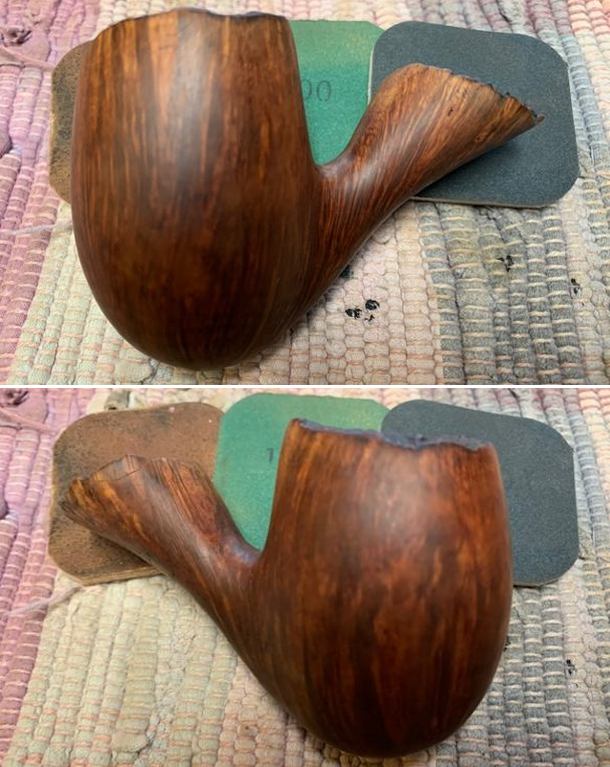
I looked through my box of bowls and came across this older Ropp Panel Rhodesian that caught my eye. The shape was really nicely done – a Rhodesian with a thick shank. The bowl was a paneled hexagon. The rim cap was smooth and the bowl top was smooth. The inner edge was nicked like it had been reamed with a knife. The outer edge of the bowl was in good shape. The rim top had some scratches. There were some dents on the bowl but the finish looked good. It appeared to have been cleaned up by Jeff somewhere along the way. The bowl had been reamed and scrubbed. The shank was clean and was lined with a metal shank tube. On the left side of the shank it was stamped ROPP in an oval. On the right it was stamped 062. I took some photos of the stamping on the sides of the shank and they read as noted above. They were clear and readable. I also took a photo of the shank end to show the metal tube that lines the mortise.I went through my can of stems and found a stem that I thought would probably work with the bowl. It had a metal tenon and a metal tube. There were some deep tooth marks on the top and underside near the button. In the third photo below you can see a stamping on the left side of the stem. Under a light with a lens I believe it reads ROPP. I am pretty certain that I have reunited the bowl with its original stem. I took some photos of the bowl and stem together to get a sense of how the pipe looked.I put the stem on the bowl and the fit in the shank was really good. The thickness of the shank and the stem match perfectly. Everything about it looked right. The stem is hard rubber and has an orific hole in the button end.  I decided to start my clean up of the pipe by address the damage on the rim top and inner edge. I used a folded piece of 220 grit sandpaper to smooth out the edge and to polish out the scratches in the rim top. It worked quite well and I was happy with the results.I wiped the bowl down with alcohol to remove the shiny spots of the previous varnish coat on the bowl. It came off very well and the grain began to stand out nicely! I polished the briar with micromesh sanding pads – dry sanding with 1500-12000 grit pads. I wiped the bowl down after each sanding pad to remove the debris. I rubbed the bowl and shank down with Before & After Restoration Balm. I worked it into the surface of the bowl sides and shank with my fingertips to clean, enliven and protect the briar. I let the balm sit for 10 minutes then buffed with a cotton cloth to raise the shine. The grain really came alive. It looks better than when I began. I set the bowl aside and turned my attention to the stem. I “painted” the stem surface with the flame of a Bic lighter to try to lift them. I was able to raise them quite a bit. I filled in the remaining marks and the nicks in the hard rubber stem surface with clear super glue. I used a small file to flatten out the repairs on the top and underside of the stem at the button. I also flattened out the repairs round the rest of the stem. I sanded it with 220 grit sandpaper to smooth it out. I started polishing it with 400 grit wet dry sandpaper. I tried to touch up the ROPP stamp on the left side of the stem. I rubbed it into the stamp with a tooth pick and rubbed it off with a soft cloth. Much of the stamping was not deep enough to hold the Antique Gold Rub’n Buff. The amount of gold in the stamp was not too much but it is still slightly readable.I polished the stem with micromesh sanding pads – 1500-12000 grit pads. I wiped it down with Obsidian Oil after each sanding pad. I used Before & After Pipe Polish – both Fine and Extra Fine to further polish the stem. I gave it a final coat of Obsidian Oil and set it aside to dry. This older style Ropp Panel 062 Rhodesian is a great looking pipe now that it has been restored and reunited with its stem. The finish around the bowl is quite beautiful and highlights the grain and works well with the polished taper stem. I put the stem back on the bowl and carefully buffed the pipe with Blue Diamond on the buffing wheel using a light touch on the briar. I gave the bowl and the stem multiple coats of carnauba wax on the buffing wheel and followed that by buffing the entire pipe with a clean buffing pad. I hand buffed the pipe with a microfiber cloth to deepen the shine. The finished Ropp Panel Rhodesian fits nicely in the hand and feels great. Give the finished pipe a look in the photos below. The dimensions of the pipe are Length: 5 inches, Height: 1 ¾ inches, Outside diameter of the bowl: 1 ½ inches, Chamber diameter: ¾ of an inch. The weight of the pipe is 1.94 oz./55 gr. I will probably be putting it on the rebornpipes store shortly. If you are interested in adding this pipe to your collection send me a message or an email. Thanks for reading this blog and my reflections on the pipe while I worked on it.

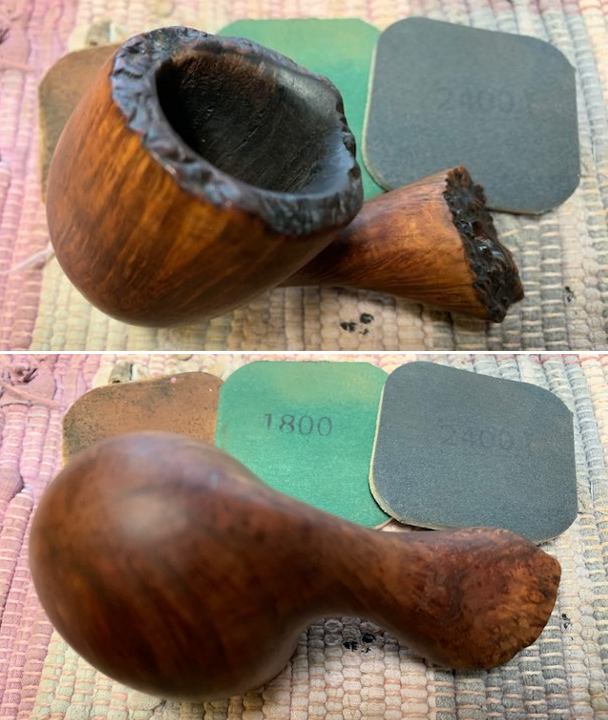
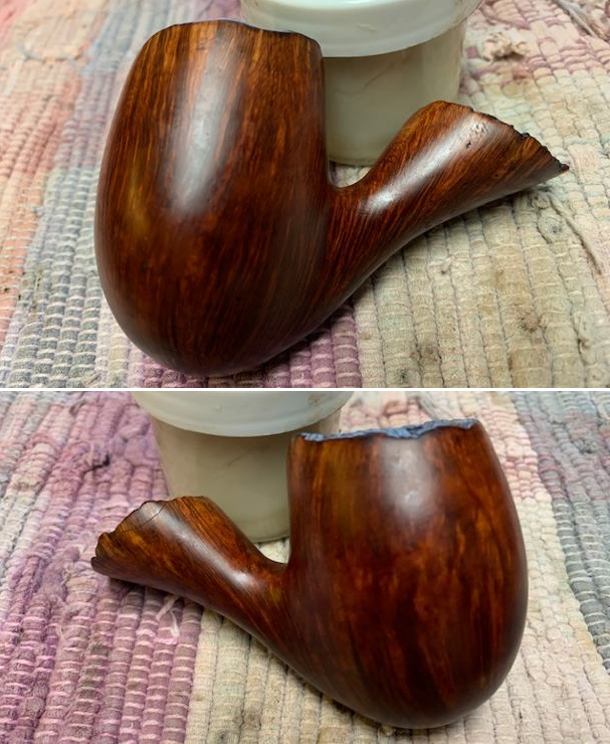
Restemming a Drummond Imported Briar Squashed Tomato


 Blog by Steve Laug

The next pipe on the work table is bowl that needed to be restemmed. It has a finish that is reminiscent of Custom-Bilt fame but this one is not one of those. It is a squashed tomato shaped bowl with a smooth rim top and rusticated bowl bottom and shank. The pipe is stamped on the left side of the shank and reads Drummond in script [over] Imported Briar. There was some darkening on the shank end where there had been a band that covered the edge of the final d in Drummond. The band was gone. The bowl had been cleaned with the thoroughness that usually is a sign that Jeff has worked on it. It had been reamed and cleaned. The inside of the bowl and shank looked and smelled clean. The inside edges looked to be in good condition. The briar was dry and lifeless looking and it was without a stem. I took some photos of the bowl before I worked on the new stem for it. It is a very interesting looking old pipe. I took a photo of the stamping on the left side of the shank. It reads as noted above and faint but very readable. I went through my can of stems and found an interesting hard rubber stem with an inset tenon that would fit the shank with a little bit of work. It was a little larger in diameter than the shank so I would need to reduce that. There were some interesting marks on the top and underside ahead of the button that looked like it had been repaired somewhere along the way. It was pretty clean otherwise. I also found a thin brass band that would fit nicely on the shank end and replace the one that had been there previously. I could find nothing listed on either Pipedia or Pipephil’s site on the Drummond Brand. I did a quick search of the name and came across quite a few photos of tins of tobacco and pouches of tobacco made by Liggett & Myers. It is labeled as Antique Pipe Chewing Tobacco Tin that is called The Genuine Drummond Natural Leaf Thick. Have a look at the photos I have included below (https://www.worthpoint.com/worthopedia/antique-pipe-chewing-tobacco-tin-253303793).

Antique Pipe Chewing Tobacco Tin Genuine Drummond Natural Leaf Liggett & MyersI am pretty certain that the pipe was a Tobacco Company Coupon pipe possibly that was earned by tobacco coupons. I cannot prove that but that appears to be what is happening with this mystery brand. Now on to working on the pipe.

Now to work on the pipe itself. I pressed the band in place on the shank and put the stem on the shank to get a feel for the look. I took some photos to show the general look. You can see that the stem is slightly larger in diameter than the shank and will need to be reduced. Even so I really like the slight bend in the stem and the look of the pipe as it stands with the stem.  I started my work on the bowl and permanently pressed the brass band on the shank end against my desk top. It was a tight fit and though it is only cosmetic gave the shank a nice touch of bling. I polished the smooth portions of the briar with micromesh sanding pads – dry sanding with 1500-12000 grit pads and wiping it down after each pad with a damp cloth. I used the final three grits on the rusticated portion as well. It really began to take on a rich shine. I rubbed the bowl and shank down with Before & After Restoration Balm. I worked it into the surface of the bowl sides and shank with my fingertips and a horsehair shoe brush to clean, enliven and protect the briar. I let the balm sit for 10 minutes then buffed with a cotton cloth to raise the shine. The grain and the rustication patterns came alive. It looks better than when I began. I set the bowl aside and turned to work on the stem. The fit of the tenon in the shank was loose so I heated an ice pick and inserted it in the tenon to expand the diameter slightly. It did not take much and the fit was perfect! The next photos are slightly out of order. Before I pressed the band in place on the shank I used the Dremel and sanding drum to take down the diameter of the stem to get a clean fit on the shank. I removed as much of the excess as possible with the sanding drum and would finish the fit with sand paper afterwards. I sanded the stem with 220 grit sandpaper to smooth out the fit to the shank and band as well as smooth out the repairs near the button that stood out on the stem in the photos above. I started the polishing of the stem with 400 grit wet dry sandpaper.  I polished the stem with micromesh sanding pads – 1500-12000 grit pads. I wiped it down with Obsidian Oil after each sanding pad. I used Before & After Pipe Polish – both Fine and Extra Fine to further polish the stem. I gave it a final coat of Obsidian Oil and set it aside to dry.  This Drummond Imported Briar Squashed Tomato is a great looking pipe now that it has been restored and restemmed. The mix of rusticated and smooth finishes around the bowl is quite beautiful and highlights the grain and works well with the polished taper stem. The stem looks very good but the repaired areas ahead of the button on each side are solid but visible. I put the stem back on the bowl and carefully buffed the pipe with Blue Diamond on the buffing wheel using a light touch on the briar. I gave the bowl and the stem multiple coats of carnauba wax on the buffing wheel and followed that by buffing the entire pipe with a clean buffing pad. I hand buffed the pipe with a microfiber cloth to deepen the shine. The finished Drummond Squashed Tomato fits nicely in the hand and feels great. Give the finished pipe a look in the photos below. The dimensions of the pipe are Length: 6 ½ inches, Height: 1 ¼ inches, Outside diameter of the bowl: 2 inches, Chamber diameter: 1 of an inch. The weight of the pipe is 1.66 oz./47 gr. I will be putting it on the rebornpipes store shortly. If you are interested in adding this pipe to your collection send me a message or an email. Thanks for reading this blog and my reflections on the pipe while I worked on it.
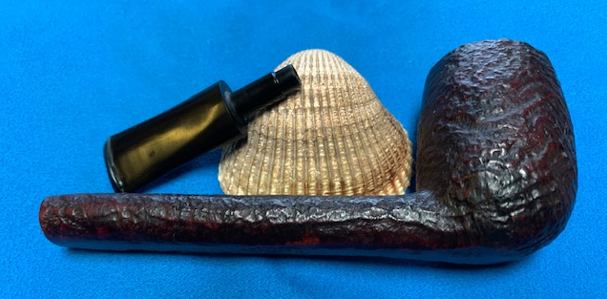
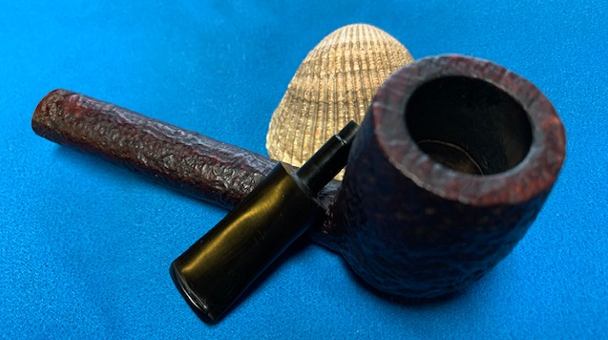
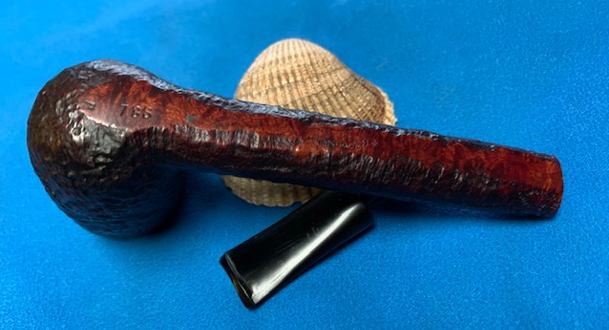
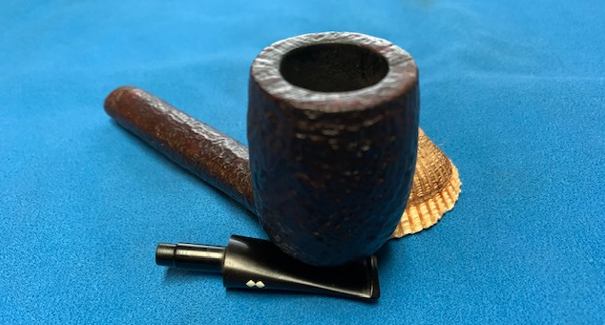
Renewing a tired older 1945 Dunhill Shell 111/1 Billiard


Blog by Steve Laug

This is another of those pipes that has been laying around here for a very long time. It was in a small bag with a very dirty and calcified stem that I had assumed belonged to it. It was loose in the shank but the length and the diameter was correct. The bowl was very clean and had all the marks of having been cleaned up by Jeff. However, the stem really throws me as it has not been cleaned, sanitized or anything. It is a general mess. It reminds me a lot of some of the older estate Dunhill pipes that I have restored over the years. It really makes me wonder if somewhere along the way either Jeff or I threw in the Dunhill stem because it fit! I am pretty certain it is not the correct one but it will work. I don’t know if I will ever truly know where and when we received it. The stem was in very rough shape. The calcification on the stem surface was thick and hard. I had to use a knife to scrape the heavy thickness off. I forgot to take photos of the stem before I scraped it but the next photos give a fair idea of what I was dealing with. There was a bite through on the underside of the stem next to the button and some deep tooth marks on both sides. The tenon had a thick shiny coat that would need to be sanded down and smoothed out.I took a photo of the stamping on the shank underside. The stamping on the pipe is 111/1 (smaller text) on the heel of the bowl with an upside down 125 above it and toward the shank. That is followed by Dunhill Shell [over] Patent No. 41754/34. Following the Dunhill Shell stamp is Made in England on one line with a superscript underlined 5. From what I can find I would date it to 1945. I spell out my process in the text that follows.I turned first to Pipephil’s site because it has a great set of charts for dating Dunhill pipes that is kind of a flow chart. I find it incredibly helpful. I turned first to the section on Dunhill pipes to see if I could find similar stamping on the pipes he shows. I have included the following photos below (http://pipephil.eu/logos/en/dunhill/patent3.html#a1). The stamping is very similar on the first one from 1943 while the patent number on the second one (1950) is the same as mine. I turned then to the dating flow chart on the site (http://pipephil.eu/logos/en/dunhill/cledat-en1b.html). I have included Page 2 of the dating key below. I have circled the pertinent section in red in the photo below.Armed with that information I knew I was working on a 1945 Dunhill Shell 111 Billiard. I was uncertain about the stem being the original but it fit well and with some repairs it would serve to make the bowl smokable. Now it was time to work on the pipe itself.

Since the bowl was very clean I decided to rub it down with some Before & After Restoration Balm. I worked it into the sandblast finish with my fingertips and a horse hair shoe brush to get it into the crevices. I let the product sit for 10 minutes before buffing it off with a soft cloth. The product works to clean, enliven and protect briar and I have found that it certainly does a great job of that on the pipes I work on. I set the bowl aside and turned my attention to the stem. I scraped off the rest of the calcification on the stem with a pen knife and lightly sanded it to clean it up. I “painted” the stem surface with the flame of a Bic lighter to lift the tooth marks and the area around the bite through on the underside. There was still work to do but it was getting there. Notice the tenon still needs attention as there is some build up on it as well. I cleaned off the surface of the stem with alcohol and a cotton swab and then greased a folded pipe cleaner with Vaseline in preparation for the stem repair. I slide a greased pipe cleaner into the slot below the bite through and fill it in with black super glue. I built up the damage on the topside of the stem at the same time. I spread the glue with a dental pick to make sure the bite through was well covered. I sprayed the repair with an accelerator to harden the repair more quickly. Once it had hardened to touch I removed the pipe cleaner. Once the repair had cured overnight I used a small file to reshape the button edges on both sides and flatten the stem surface. The repair worked very well. I sanded the repaired areas with a folded piece of 220 grit sandpaper and started the polishing process with 400 grit wet dry sandpaper. I also worked on the tenon to smooth out the previous work that had been done. It is looking better.At this point I decided to put the stem on the bowl and take some photos of it to get a sense of what the pipe looked like. I have included those below. There was still a lot of work to do on the stem. But the general shape and condition were looking much better. I spent quite a bit of time working on the shape of the stem with a 1500 grit micromesh sanding pad to smooth out the transition between the shank and the stem. I also worked on the button edge and the part of the stem just ahead of the button (some call it the bite zone, but honestly that name pains me given the number of chewed up stems I have worked on). I continued to polish the stem with the rest of the micromesh pads (2400-12000 grit pads). I rubbed the stem down after each pad with Obsidian Oil. I polished the stem with Before & After Pipe Stem polish – both Fine and Extra Fine. I gave it a final coat of Obsidian Oil and let it dry. Though the stem I have with the pipe is probably not the correct one for this 1945 Dunhill Shell 111 Billiard it will work and make the pipe usuable. It is far from perfect as far as stems go but it will work while I am on the lookout for the correct one. The stem cleaned up well and the finished pipe looks very good. The rugged looking sandblast and the polished black vulcanite stem work very well together to give the pipe a slender profile that is quite pleasing. The sandblast finish on the bowl came alive with the buffing. I used Blue Diamond on the buffing wheel on both the bowl and stem. I gave the bowl multiple coats of Conservator’s Wax and the stem multiple coats of carnauba wax on the wheel then buffed the pipe with a clean buffing pad to raise the shine. I hand buffed it with a microfibre cloth to deepen the shine. The Dunhill Shell 111 Billiard feels great in the hand. It is lightweight and the contrast in the stains on the briar and the polished vulcanite stem with the rugged sandblast bowl is quite amazing. The dimensions of the pipe are Length: 6 inches, Height: 1 ½ inches, Outer diameter of the bowl: 1 1/8 inches, Chamber diameter: ¾ of an inch. The weight of the pipe is 1.06 ounces/30 grams. It really is a beauty. Thanks for walking through the restoration with me. If any of you happen to have a Dunhill narrow stem or fishtail that you would be willing to part with let me know! Thanks!