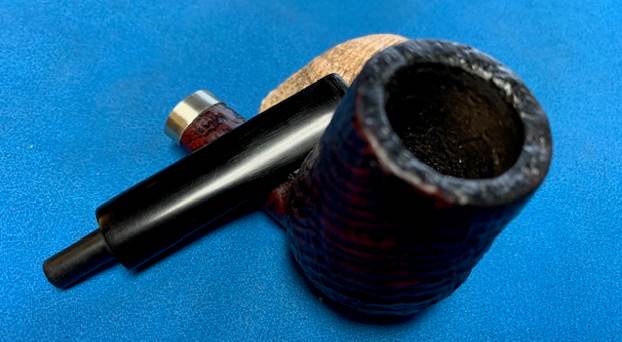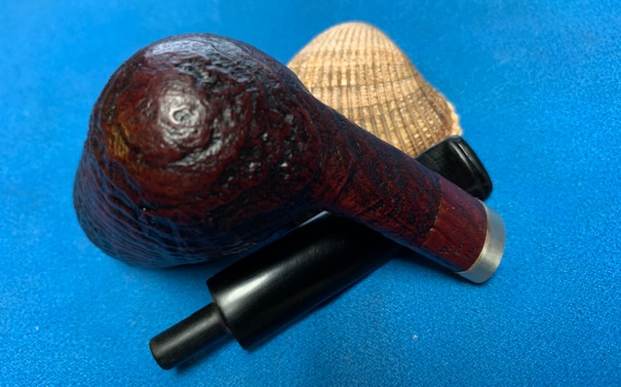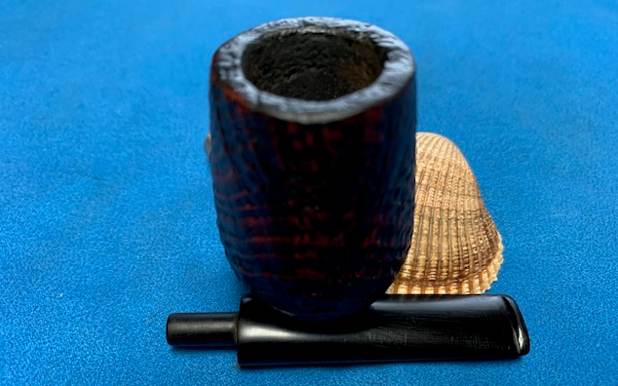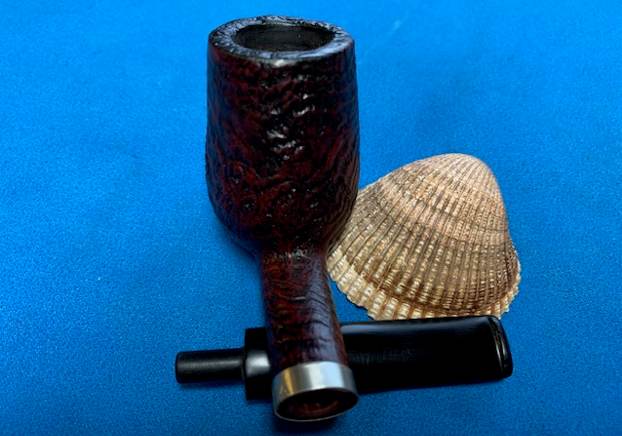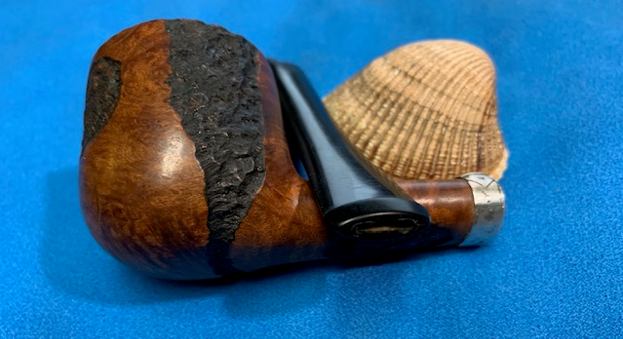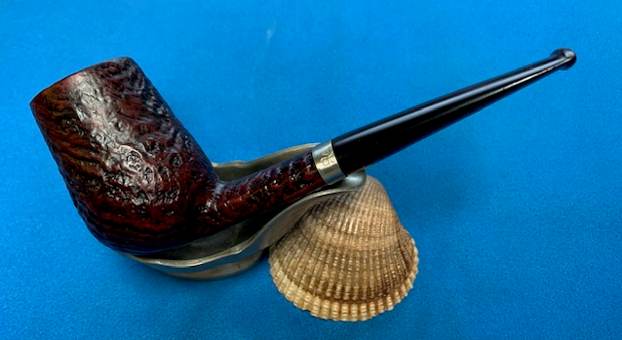

Tag Archives: repairing a cracked shank

Refreshing a Handmade in Denmark W.O. Larsen Sandblast Brandy


By Steve Laug

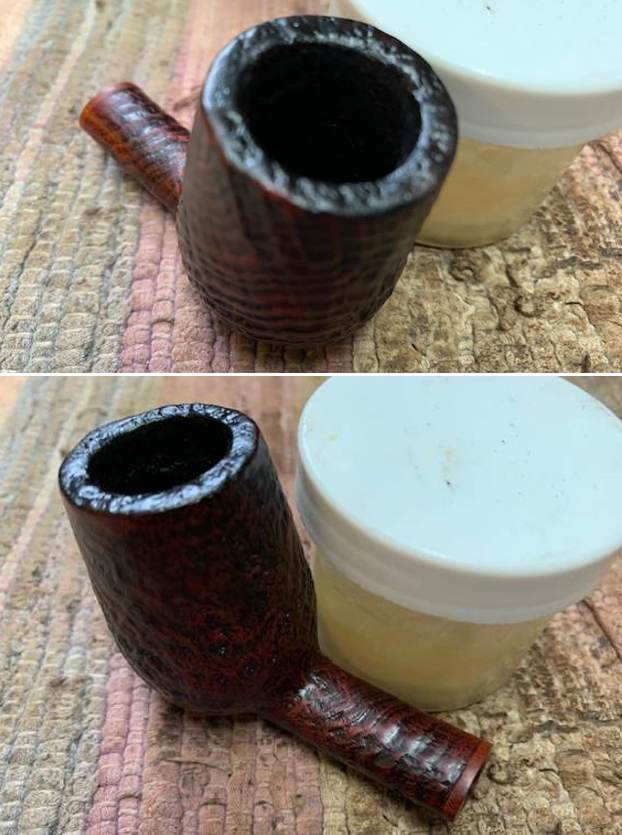
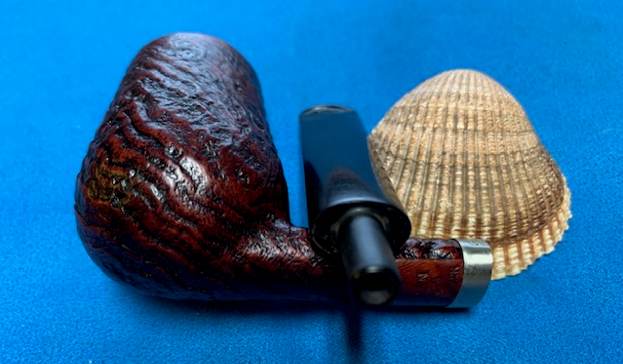
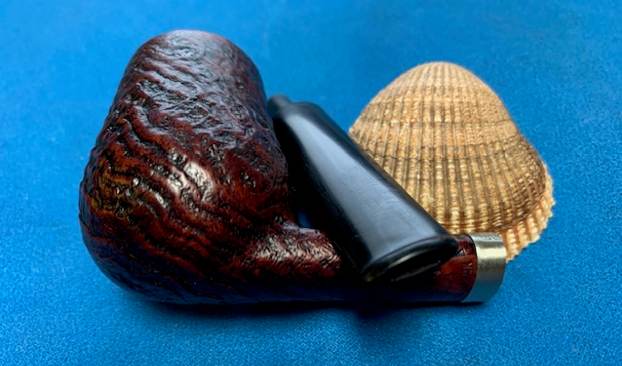
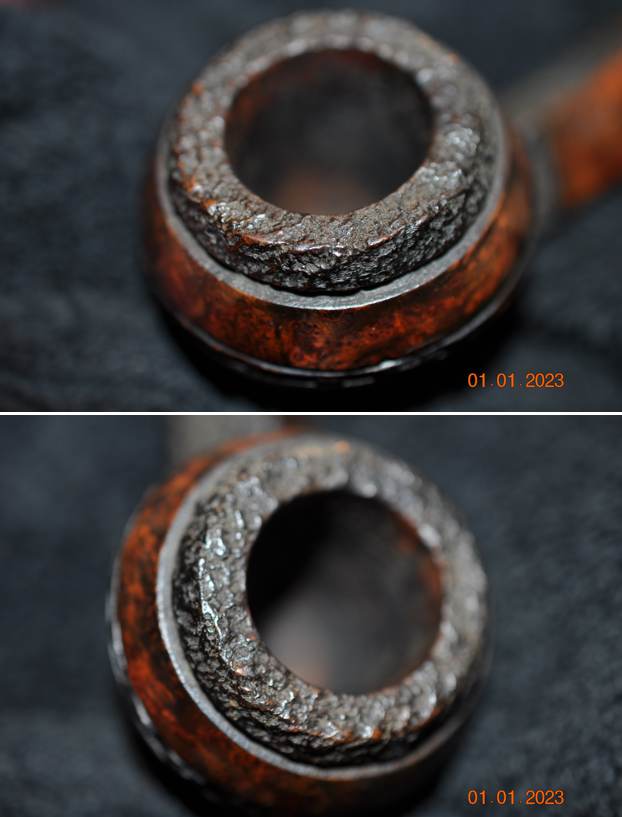
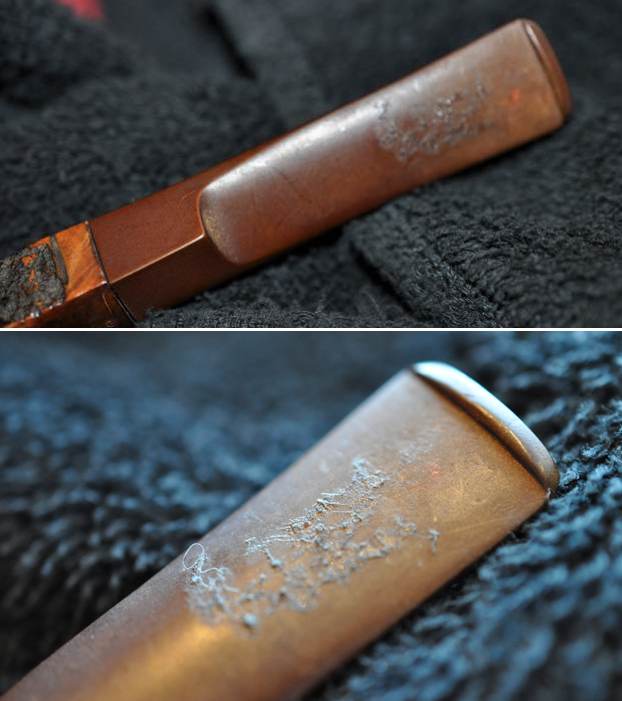
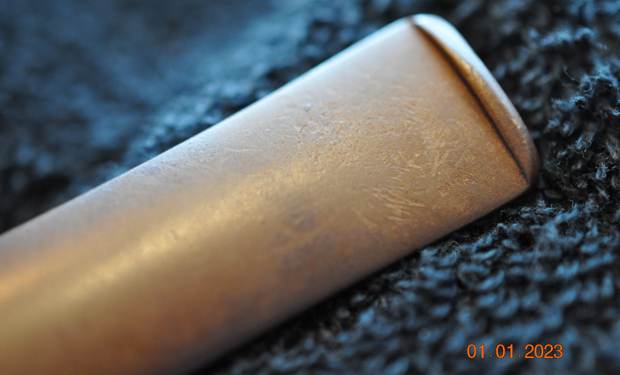
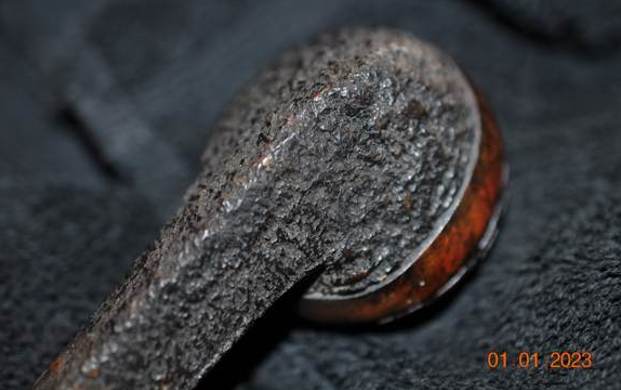
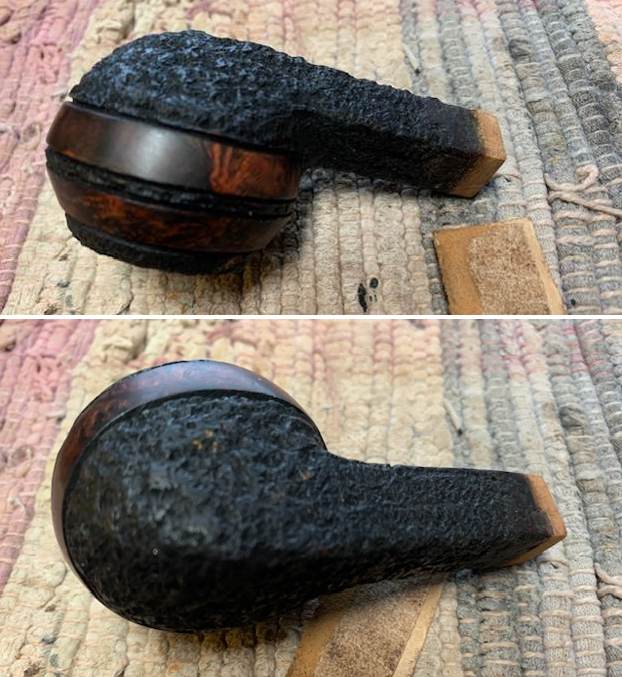
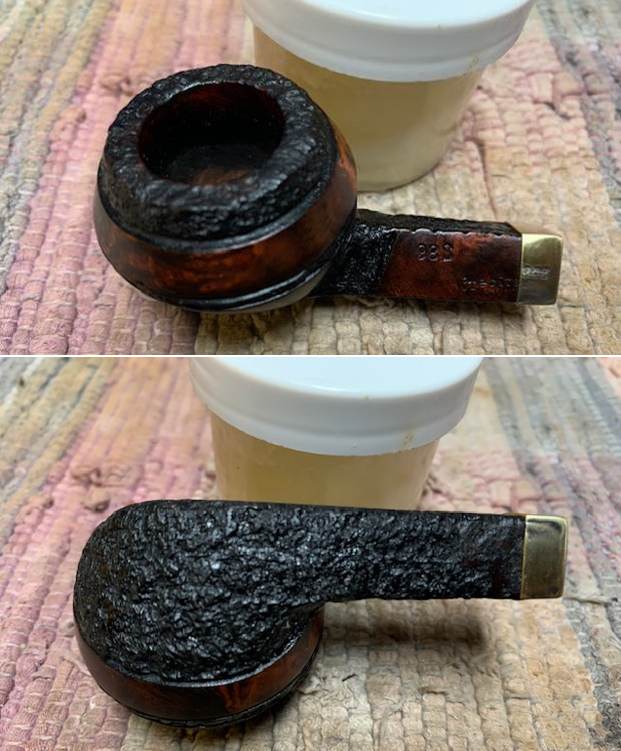
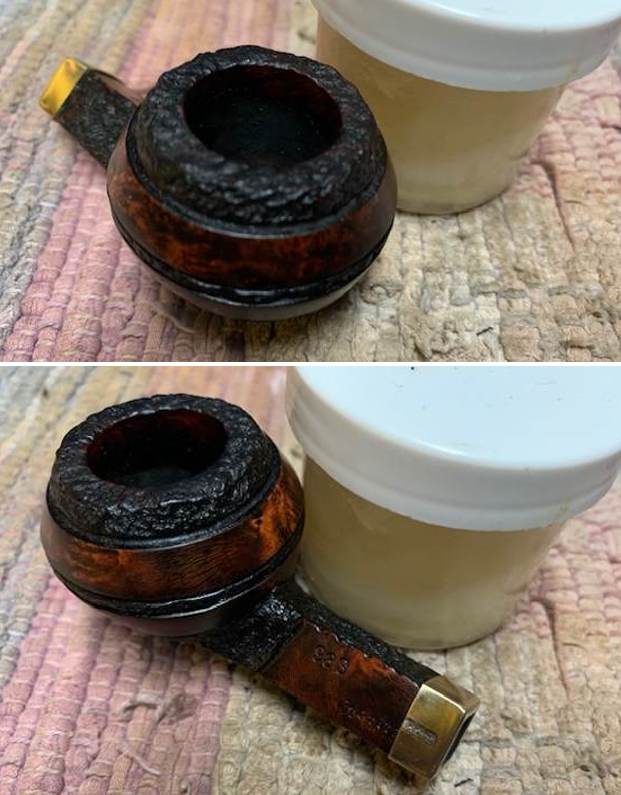
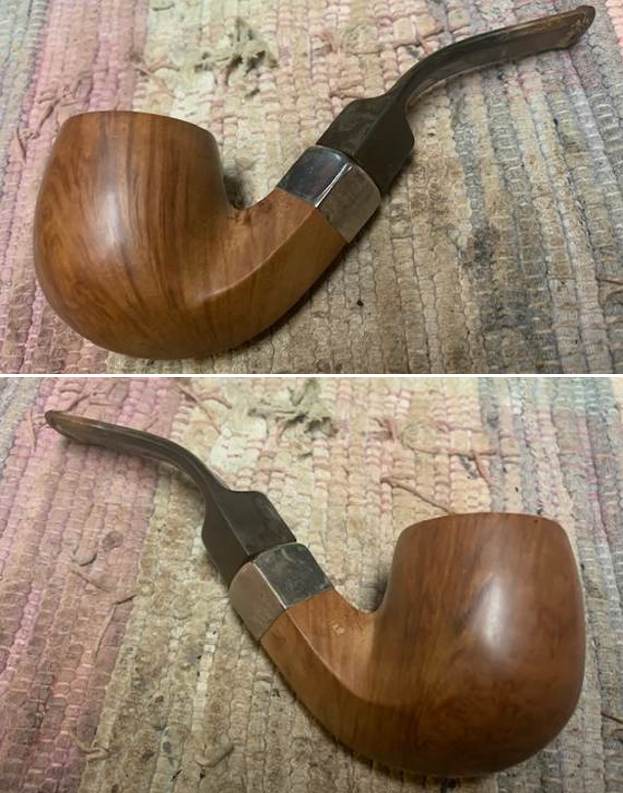
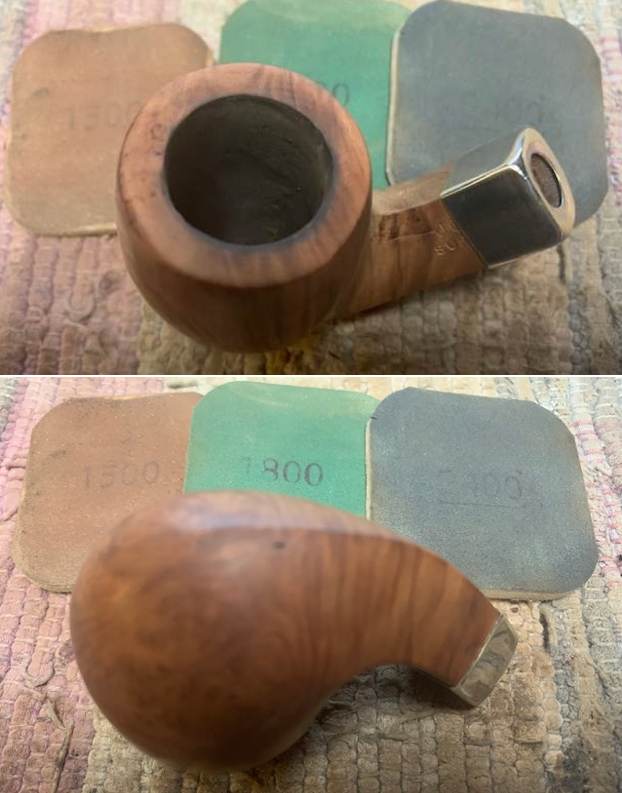
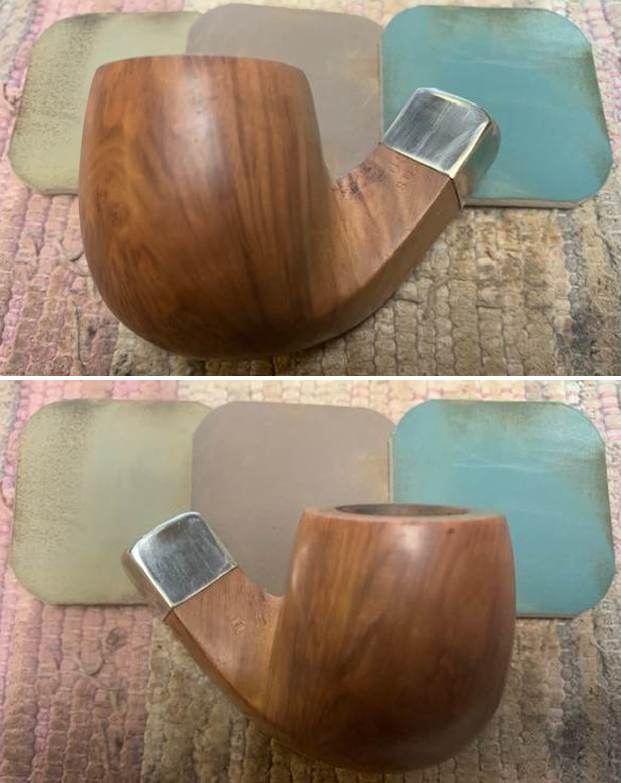
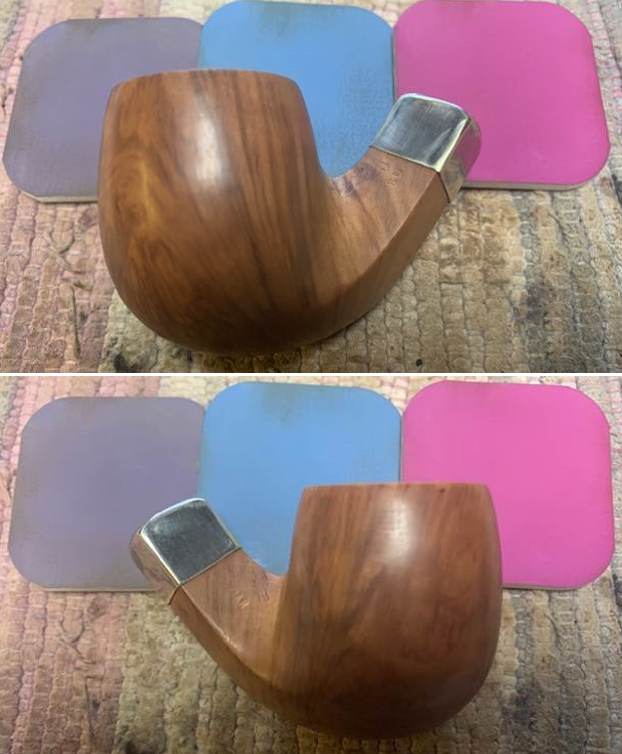
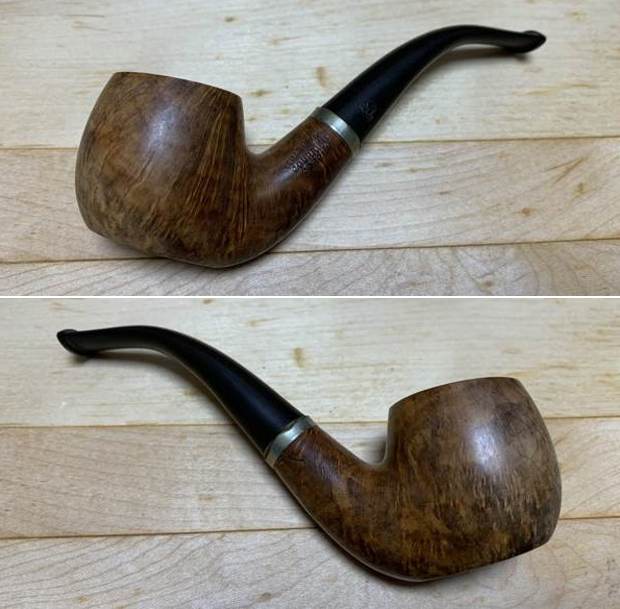
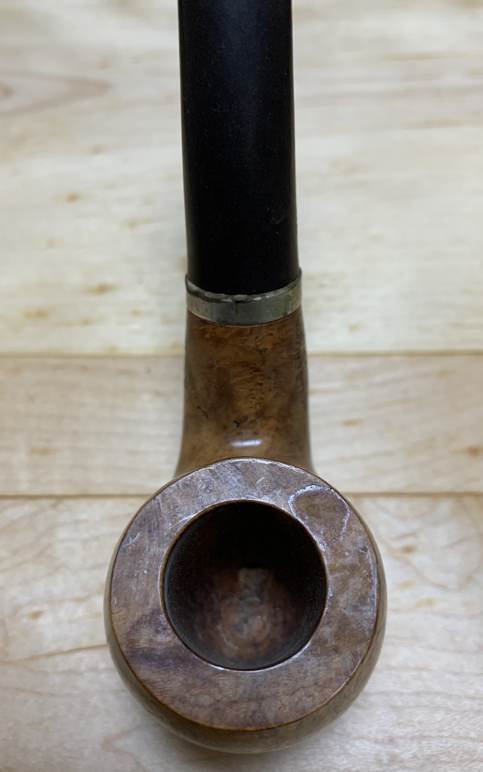
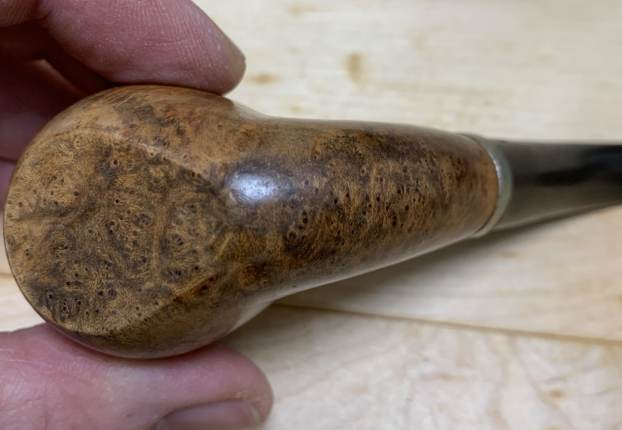
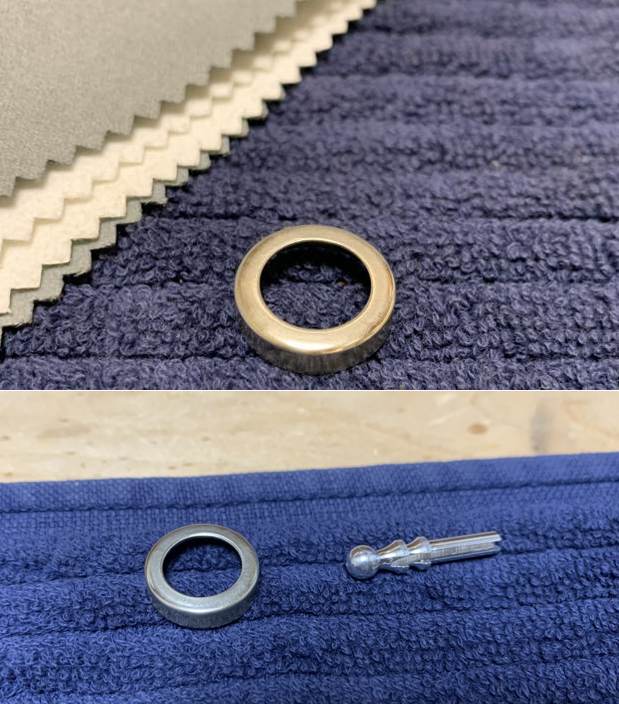
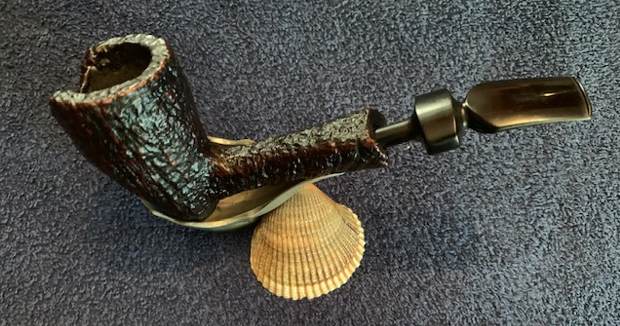
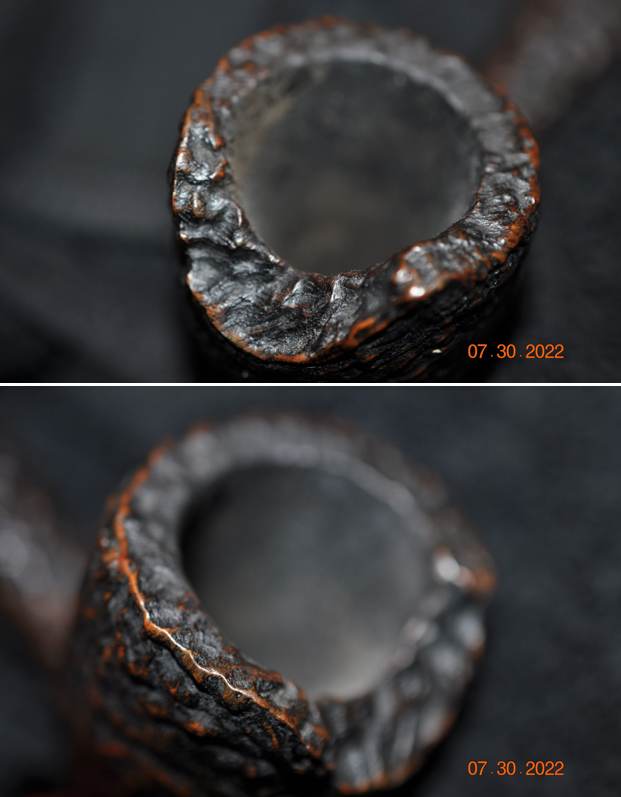
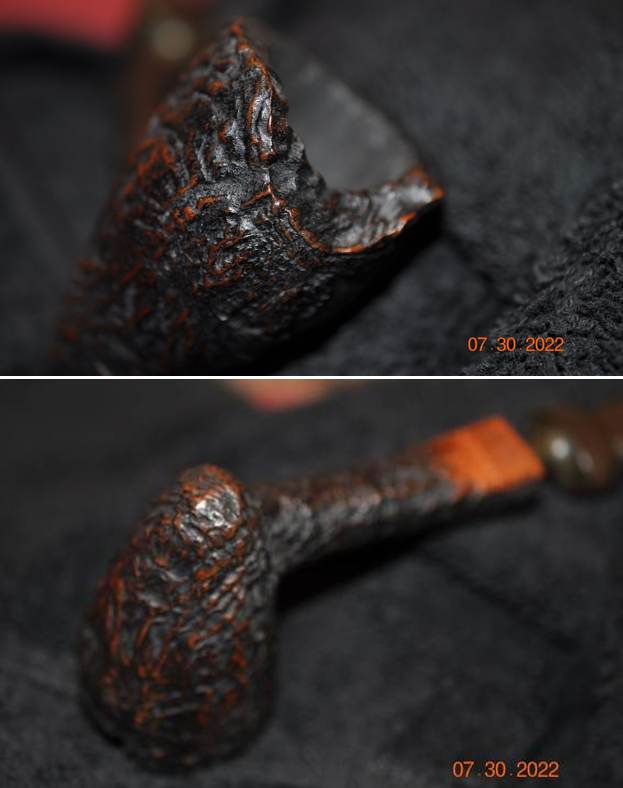
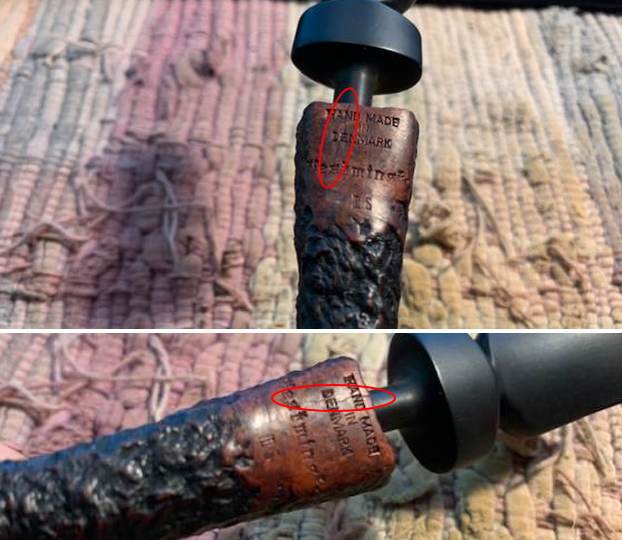
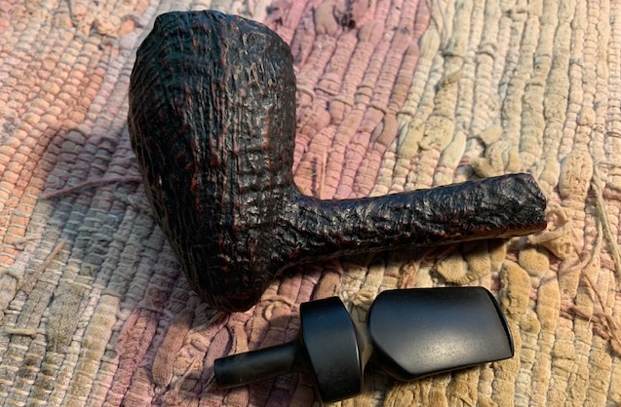
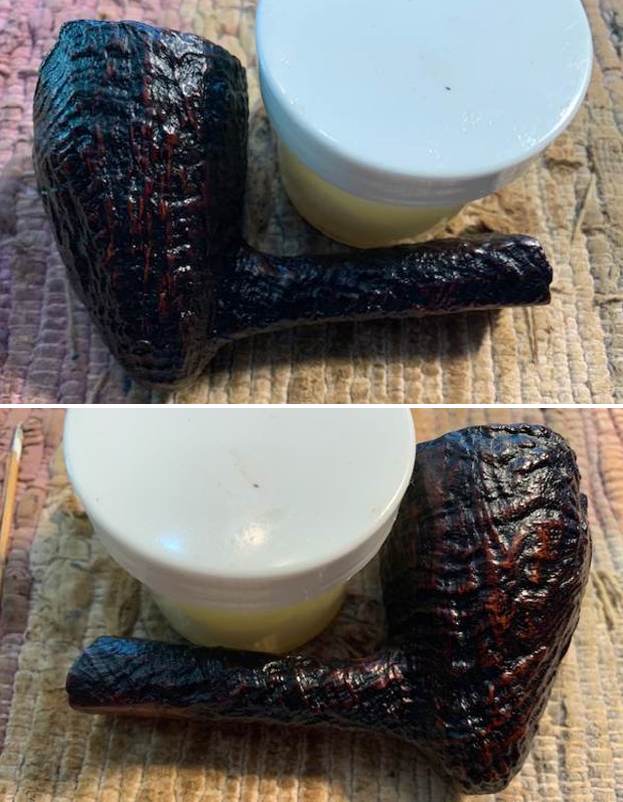
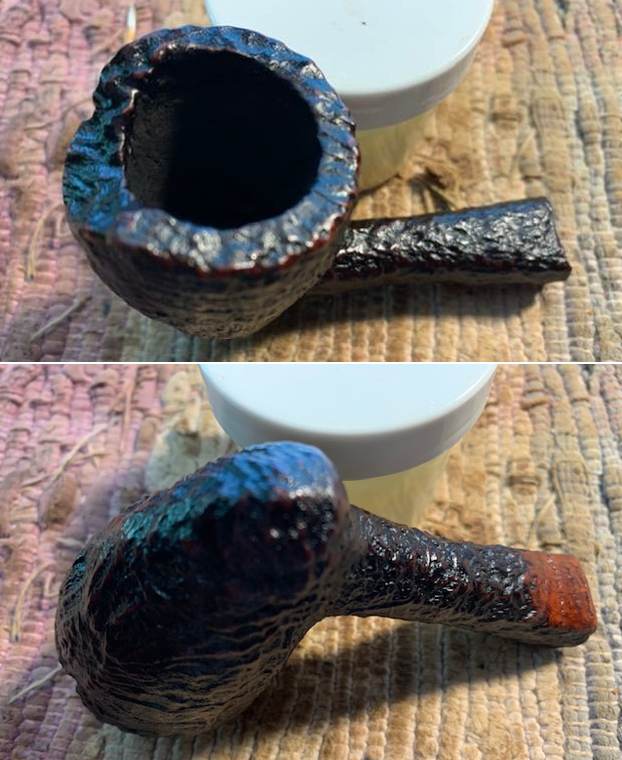
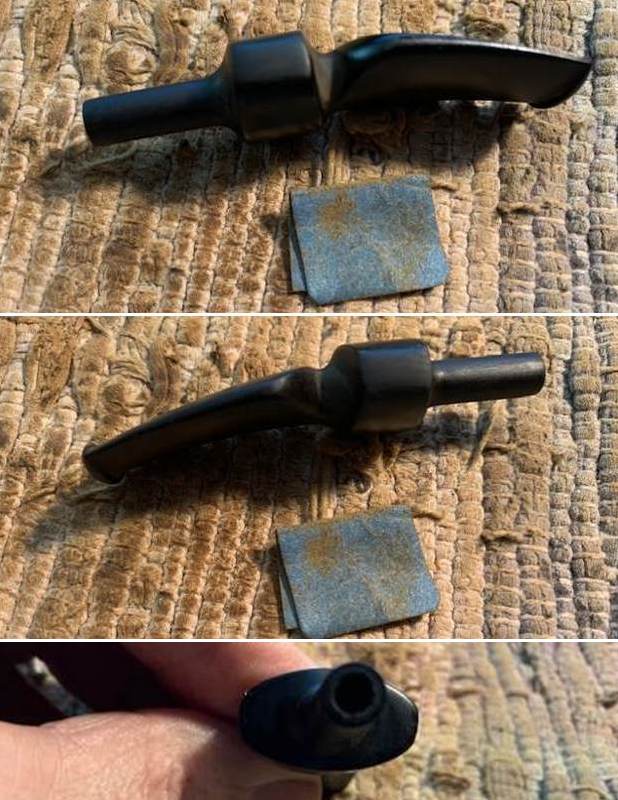
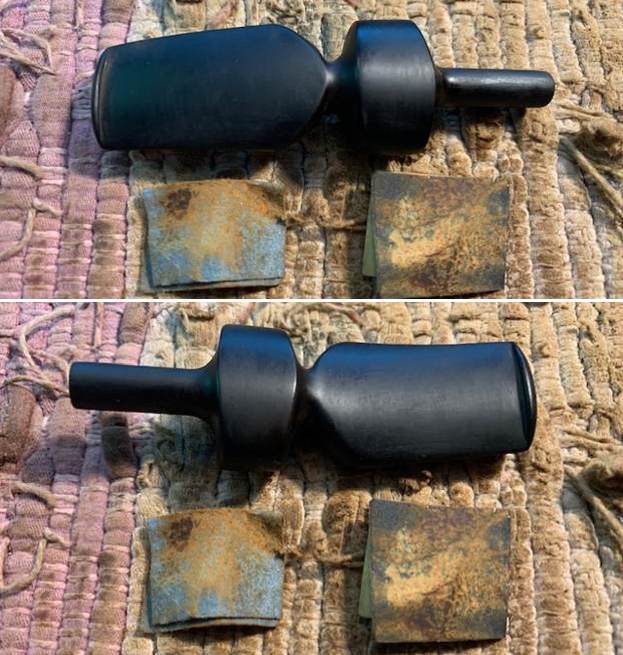
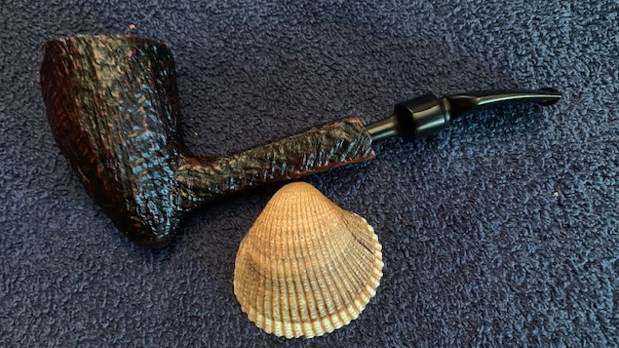
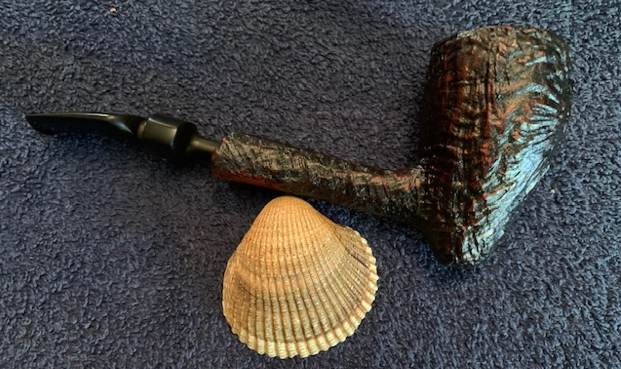
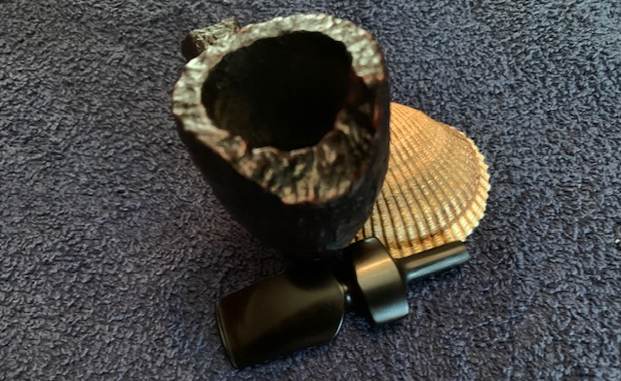
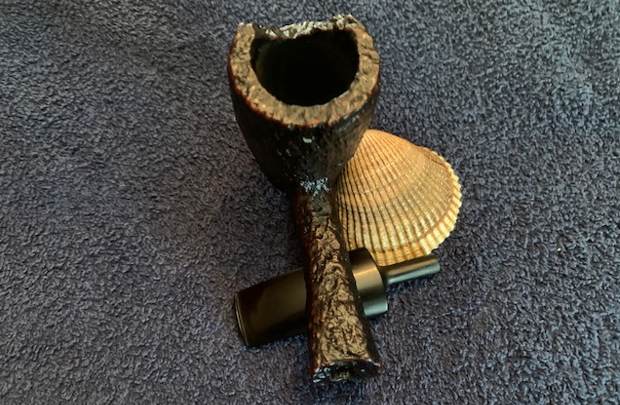
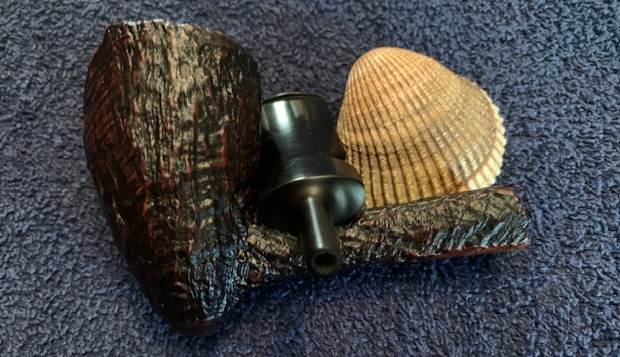
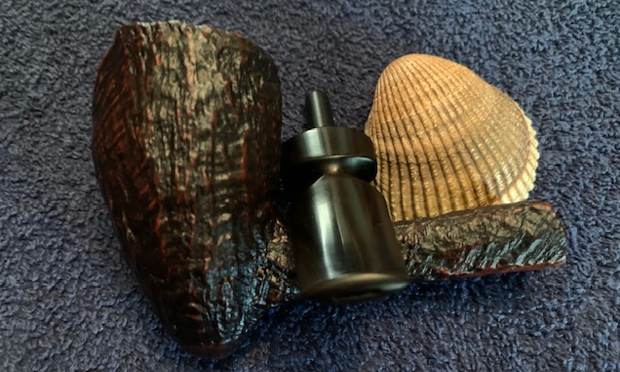
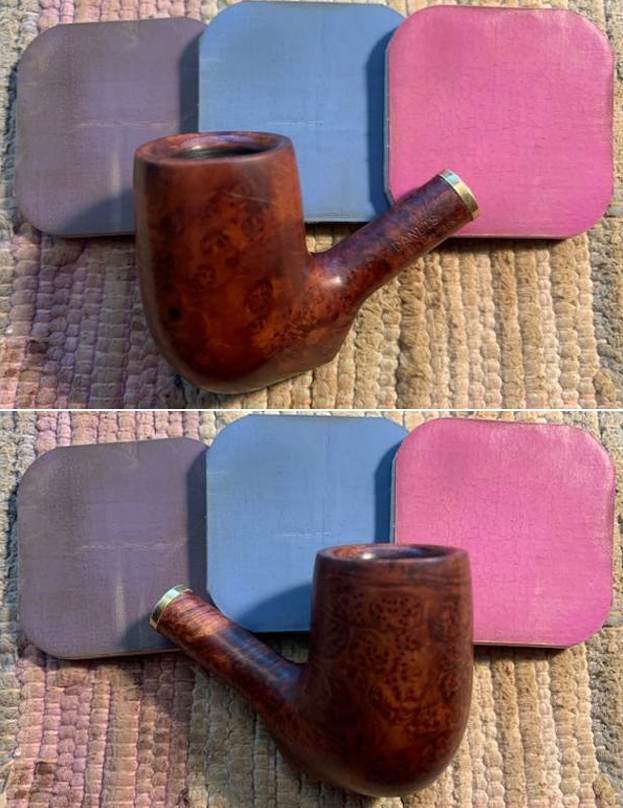
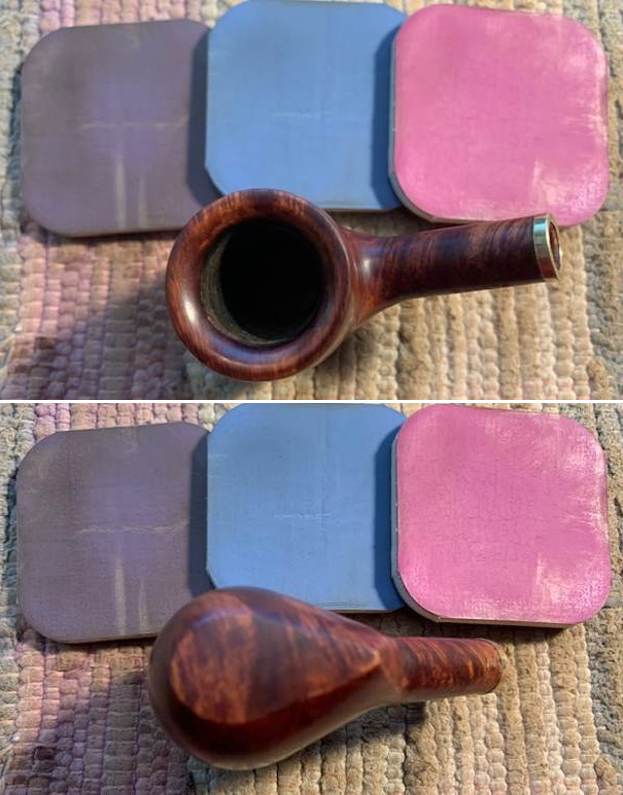
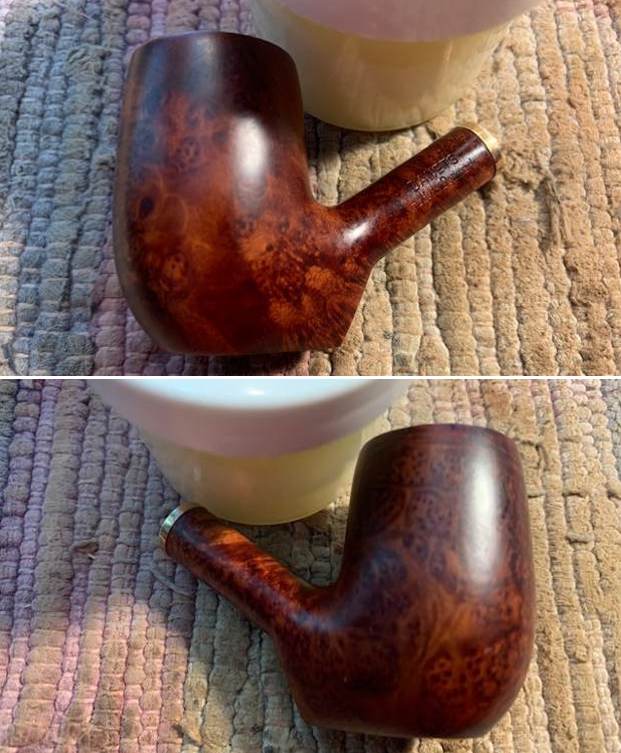
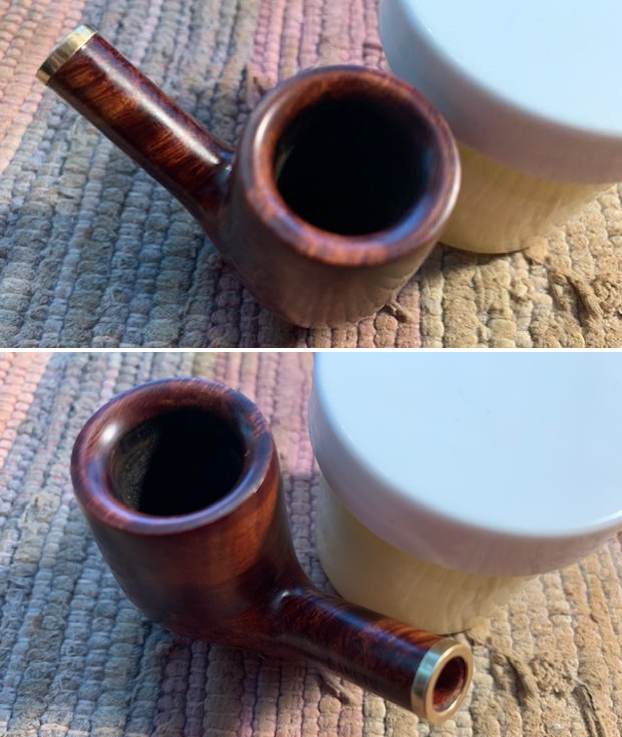
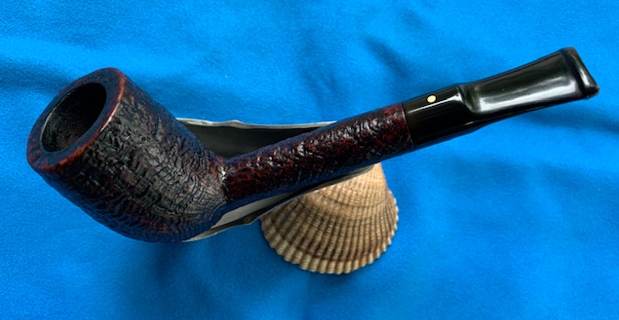
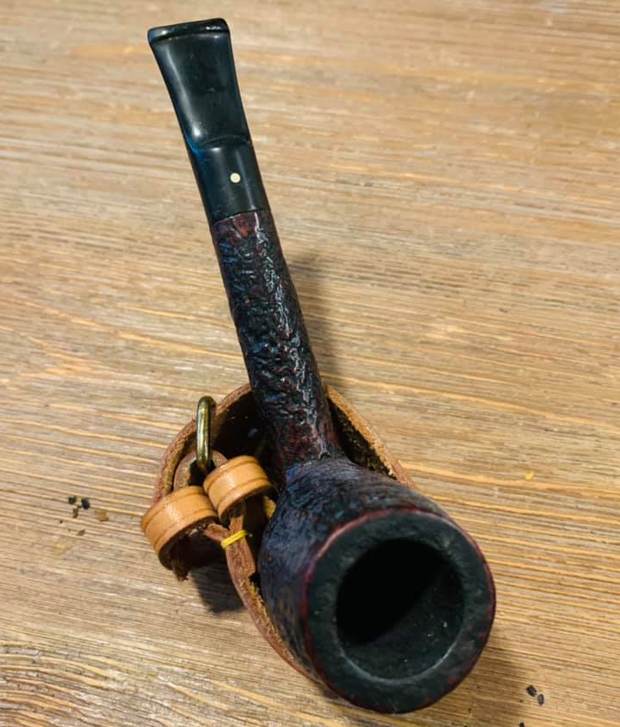
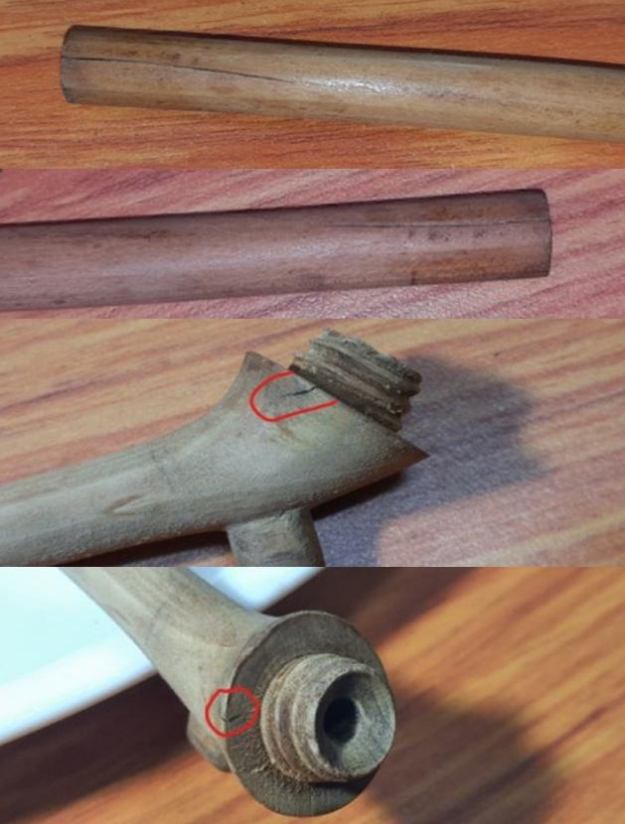
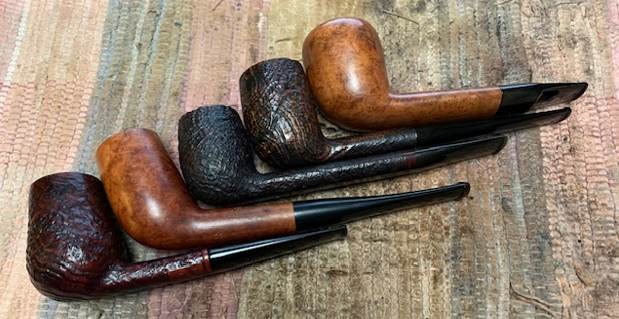
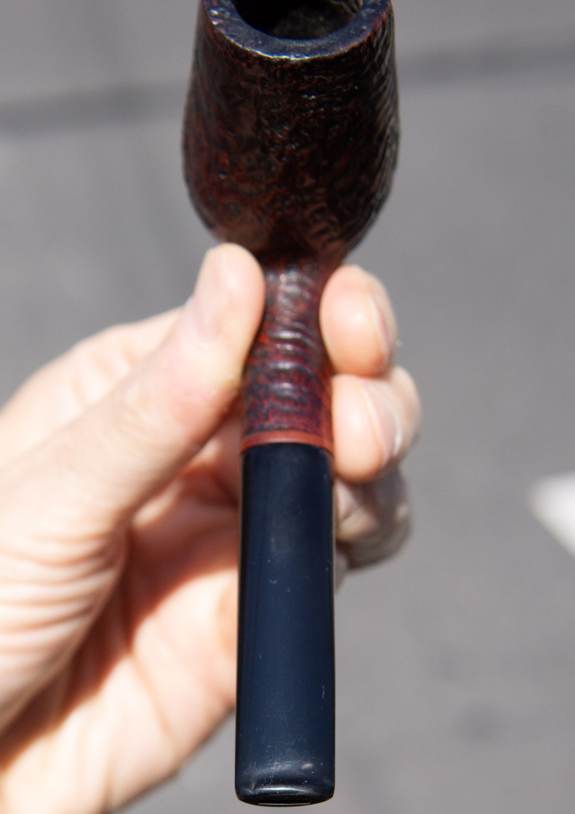
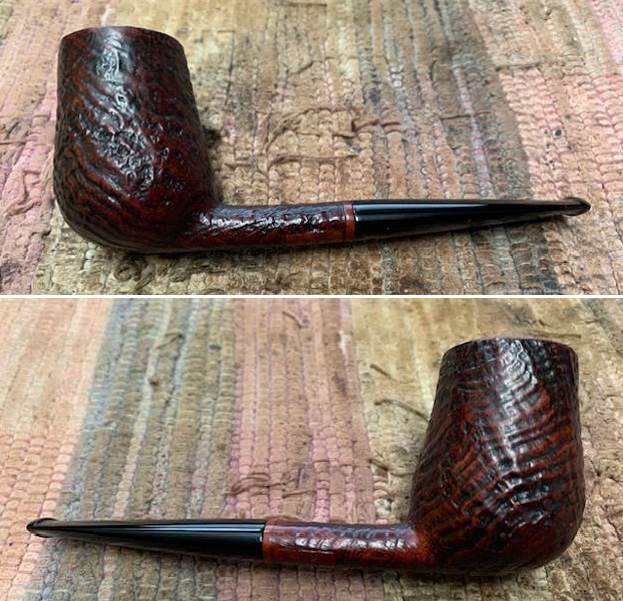
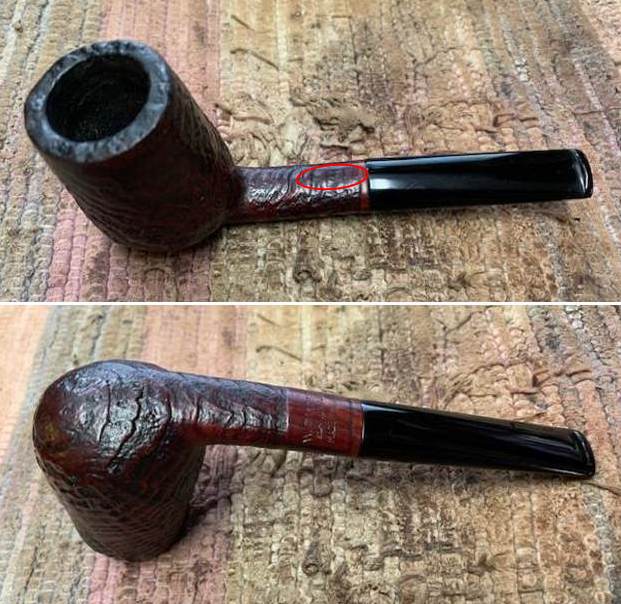
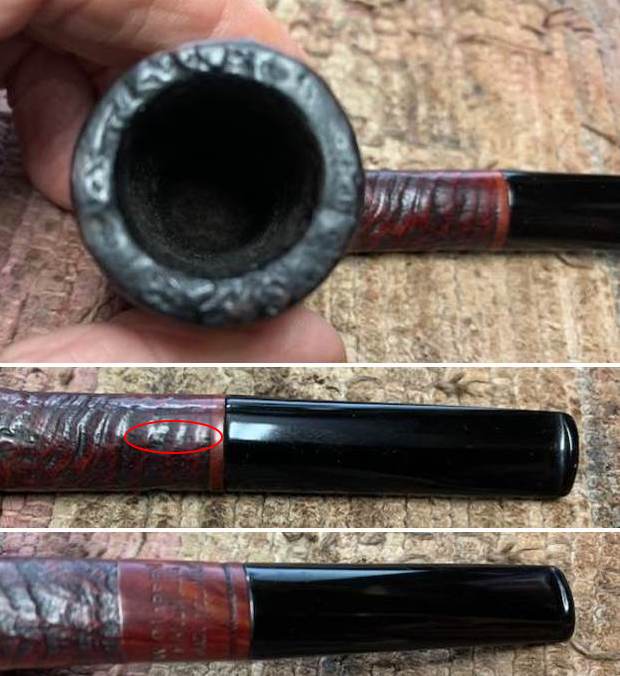
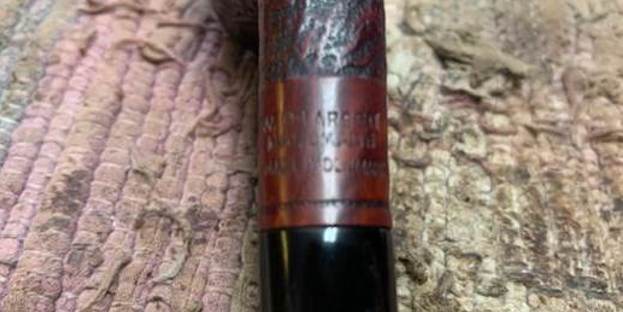
Not long ago I worked a trade with a fellow for these five pipes in exchange for one that I had here. He sent me photos of the pipes and the deal was struck. The pipes he sent are as follows from bottom to top. There is a W.O. Larsen sandblast oval shank Brandy with a hairline crack in the shank and with tooth marks on the button on both sides, a Bertram Cutty that I had traded with him earlier, a Kriswill sandblast Canadian with a cracked shank, a Viby pencil shank Billiard and a Stanwell Royal Briar wide oval shank Dublinesque Canadian with burn damage on the rim edges and top around the bowl and deep tooth marks on the stem.The first of these I chose to work on today is the Hand Made W.O. Larsen Sandblast Brandy at the bottom of the photo above. It is a classic Larsen Brandy shape with a beautiful, deep and tactile sandblast around the bowl and the shank. The rim top were in good condition and the blast had some darkening but no lava in the blast. The bowl has a light cake in the bowl and smells of good Virginia tobacco. The inner edge of the rim is in good condition. The blast is quite clean with no grime and little dust ground into the surface of the finish. The stamping on the underside of the shank reads W.O. Larsen [over] Handmade [over] Made in Denmark. The stain is a mix of dark and medium browns and goes well with the oval vulcanite stem. Once it is cleaned up and polished the blast will highlight the grain around the bowl and shank. The stem is in good condition with some tooth marks on it. The button area and the surface just ahead is damaged. There are bite marks on the button surface on both sides. The button edge has been flattened and worn with tooth marks on the underside. I am including two of the photos that were sent to me for viewing. The first shows the right side of pipe and the second shows the marks on the stem surface that I spoke of above. I took photos of the pipe before I did my clean up work on it to show its condition. The photos confirm what I noted above regarding the condition of the bowl and the stem. It a nice looking pipe that will look better with a bit of work on the stem, the cracked shank and bowl. I have circled a short crack in the top of the shank with red in the top photo below. It is hairline and fine but it is very present.I took close up photos so that I could have a clearer picture of the condition of the bowl, rim edges and top. The rim top photos confirm my assessment above and show that while there is some darkening. However, I missed the tars and lava build up on the sandblast rim top. The cake in the bowl is quite moderate and was very smooth. You can also see the condition of the outer and the inner edge. They appear to be in great condition. This is what I look for when assessing a pipe. There is no visible burn damage at this point. The bowl is still round and other than being in a used condition it is in great shape. The small crack in the shank is circled in red below. The issues with the stem are visible in the photos on both sides ahead of the button and on the button itself.I took a photo of the stamping on the underside of the shank. It is clear and readable as noted above.I took the stem off the bowl and took a photo of the pipe to give a sense of proportion of the pipe. You can also see shape of the pipe and some interesting grain in the blast on the briar.I have worked on quite a few W.O. Larsen pipes that are well made Danish takes on classic shapes. Several of them have been Brandy shaped pipes. This sandblast Canadian has a bowl that is almost a Brandy shape. Here is a link to the blog describing the background and history of the brand (https://rebornpipes.com/2021/10/25/restoring-a-sandblast-canadian-hand-made-designed-by-w-o-larsen-super-tan-65/). I quote from that blog in information that follows.
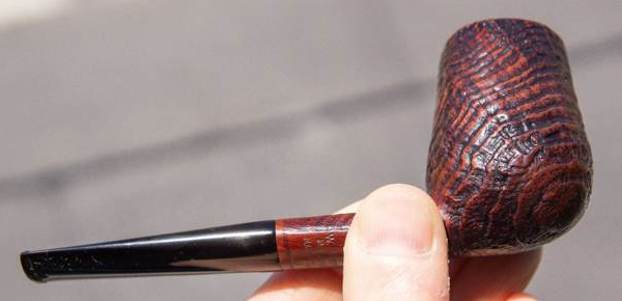
I turned to Pipephil (http://www.pipephil.eu/logos/en/logo-l2.html) to get a quick view of the brand once again. I did a screen capture of the site’s information and have included that below. The pipe I am working on is a W.O. Larsen as it is stamped similarly to the ones in the photos. I quote from the sidebar below:
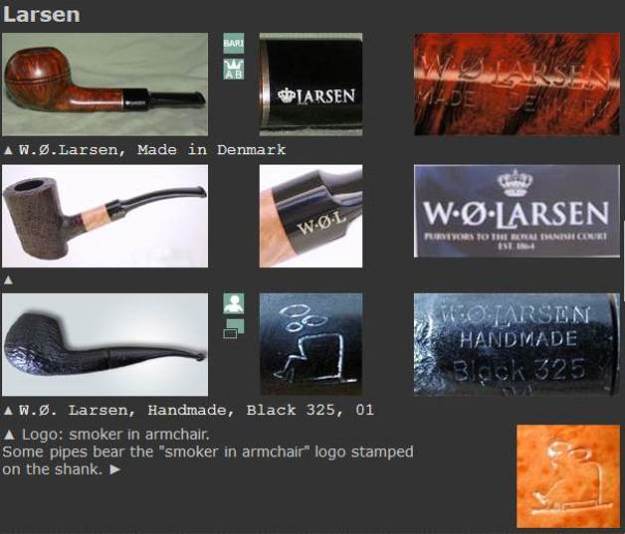
In the 1960s Ole Larsen, owner of the Copenhagen tobacco store, retails pipes carved by Sixten Ivarsson, Poul Rasmussen, Sven Knudsen or Peter Brakner. Faced with the success and urged by Sven Bang (store manager), Sven Knudsen and Former (Hans Nielsen) are successively hired to carve pipes in the basement of the shop at the beginning and in the old Larsen cigar factory afterwards. Carver like Teddy Knudsen, Tonni Nielsen, Jess Chonowitch, Peter Hedegaard work a while in this context. When Nils, son of Ole Larsen, succeeds his father he acquires the Georg Jensen pipe factory to focus on less expensive pipes. This turns out to be an error ending with the sale of W.O. Larsen trademark to Stanwell. The famous tobacco shop at Strøget, Amagertorv 9 closed down for good on Dec 31, 2004. Do not confuse W.O. Larsen with: Jorgen Larsen

I turned to Pipedia (https://pipedia.org/wiki/W.%C3%98._Larsen) for a quick read. The site is worth reading the history of the shop and the brand and its influence on Danish pipe carving. I quote a portion of the article below:

The workshop of W.Ø.Larsen

W.Ø.Larsen is Denmark’s oldest and probably most famous pipes and tobacco store, placed in the center of Copenhagen on the main pedestrian street, Stroget. If you visit Copenhagen and do a “pipe crawl” this store is a must. In the beginning of the 1960’s the store began to sell Danish hand-made pipes, especially those of Poul Rasmussen. This went very well and Poul Rasmussen could not keep up with the demand. W.Ø.Larsen, with their dynamic business manager Svend Bang (who later started his own pipe business), decided to establish their own workshop in rooms next to the store.

The first manager of the pipe workshop was Sven Knudsen, but he soon left to make pipes under his own name. The next manager was Hans Nielsen, also known as “Former” (named after the late British actor George Formby, whom he was said to resemble. Coincidentally, in Danish, “Former” means “shapes”). Under the management of Former the workshop grew and W.Ø.Larsen pipes became a prominent name abroad. Among the prominent pipemakers educated here were Else Larsen (Denmark’s first female pipemaker),Poul Ilsted, Ph. Vigen, Teddy Knudsen, Tonni Nielsen, and Peter Hedegaard.

Typical for the W.Ø.Larsen School were semi-classic shapes, meaning classic shapes, but with slight differences, often bring a little more full or round. The pipes often had lower center of gravity. A typical billard would have a bowl shaped more like a pear and the connection between the bowl and the shank would be clearly distinguished. Yellow and orange were colors more widely used for the finishes.

What I learned from the research is that the pipe is a W.O. Larsen pipe made by one of the famous carvers who worked in the shop. It is a beautiful pipe in both shape and finish.

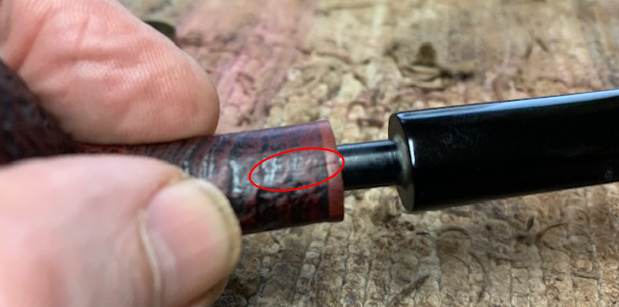
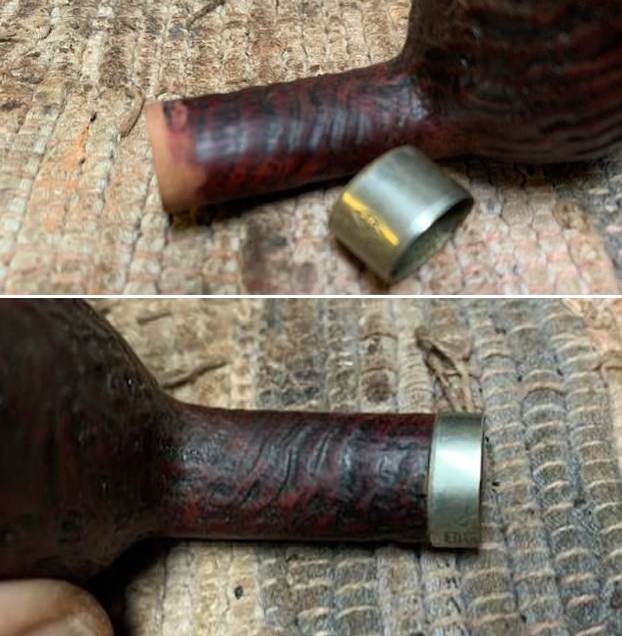
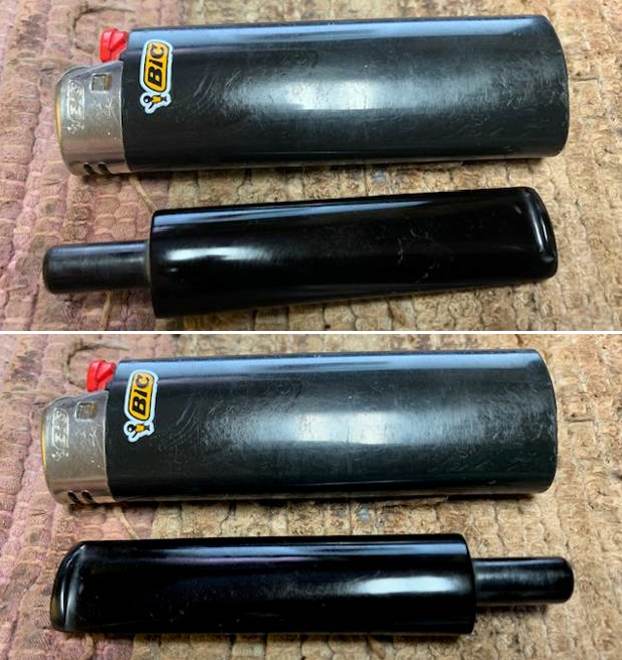
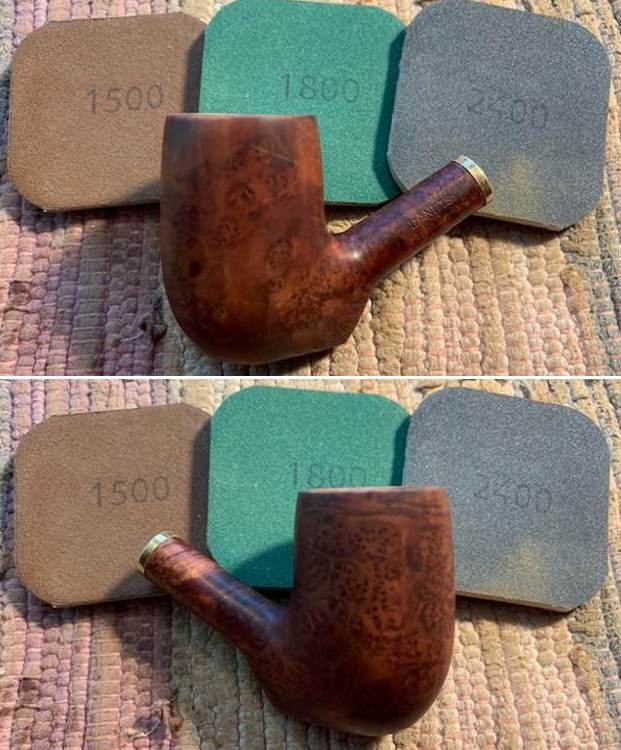
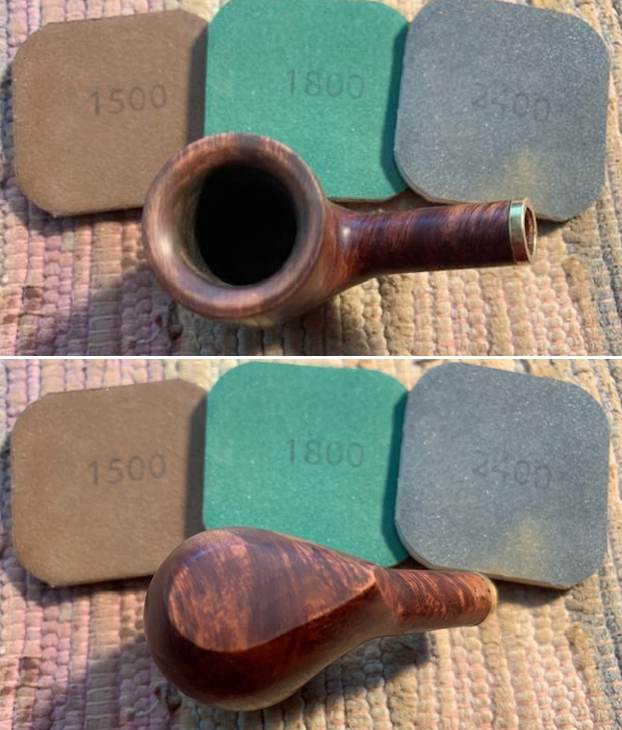
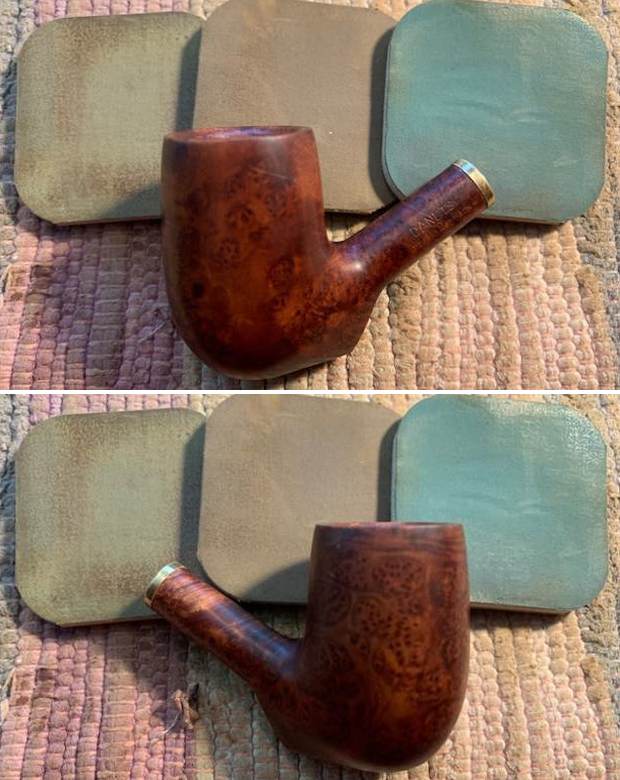
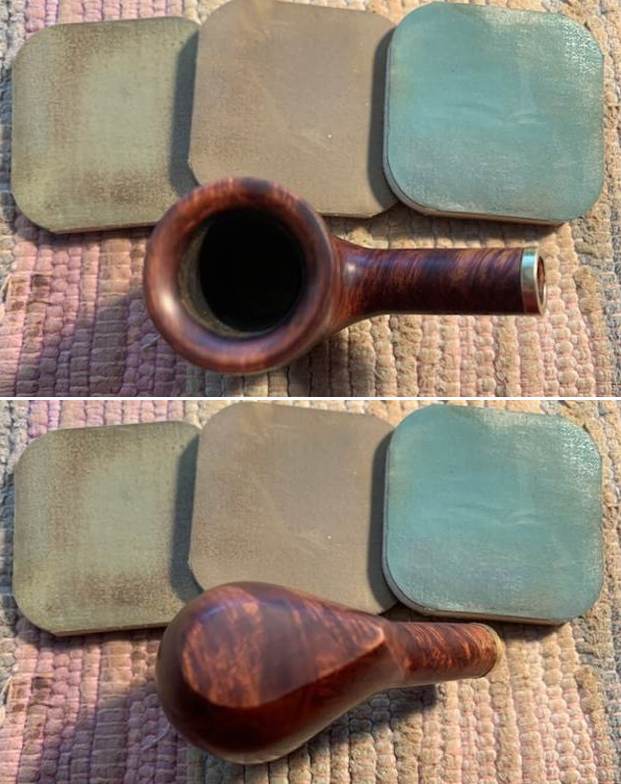
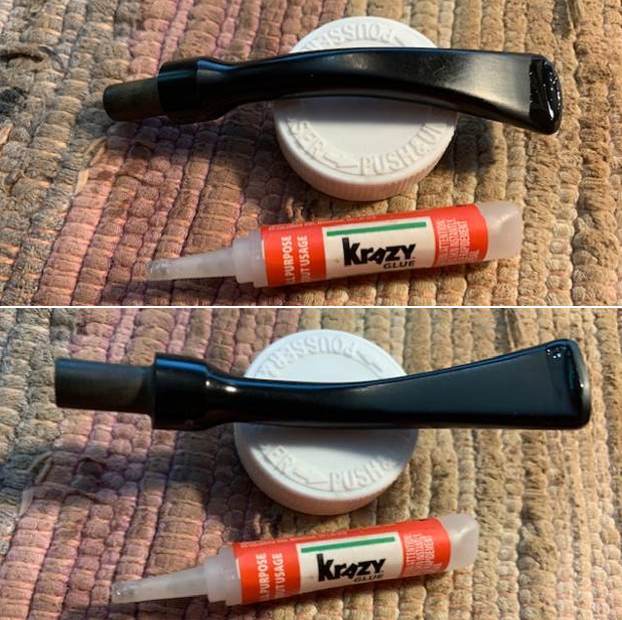
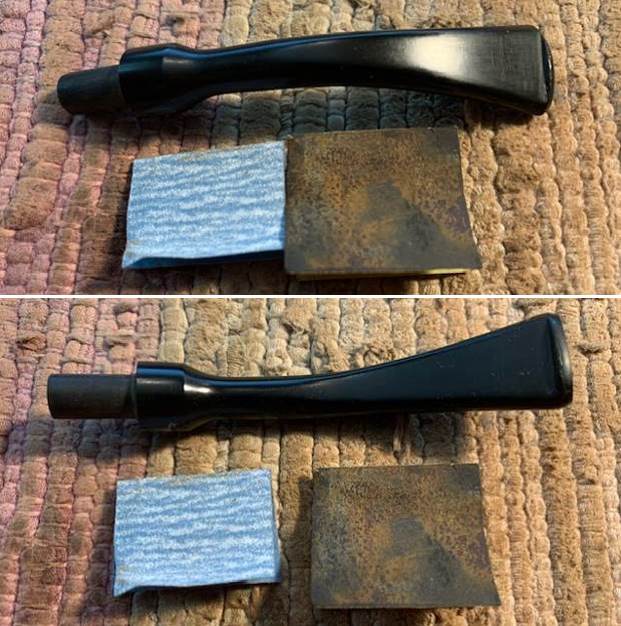
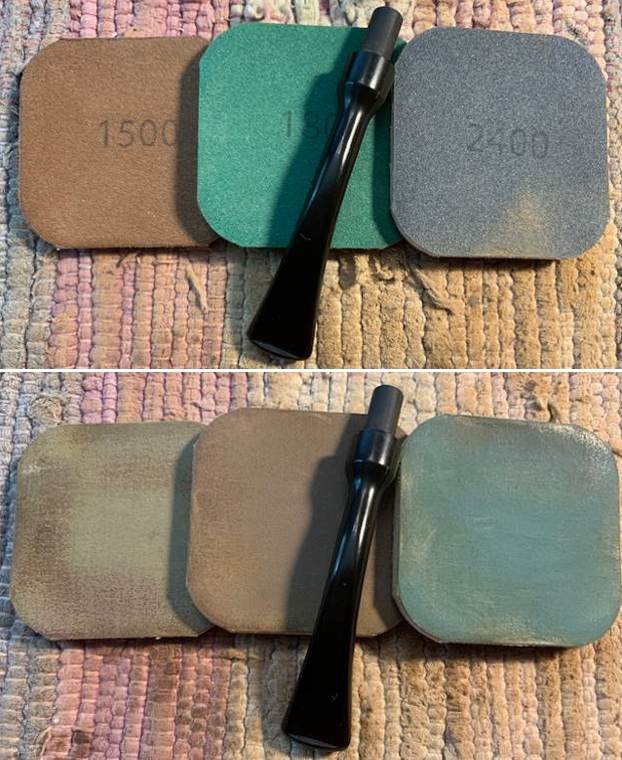
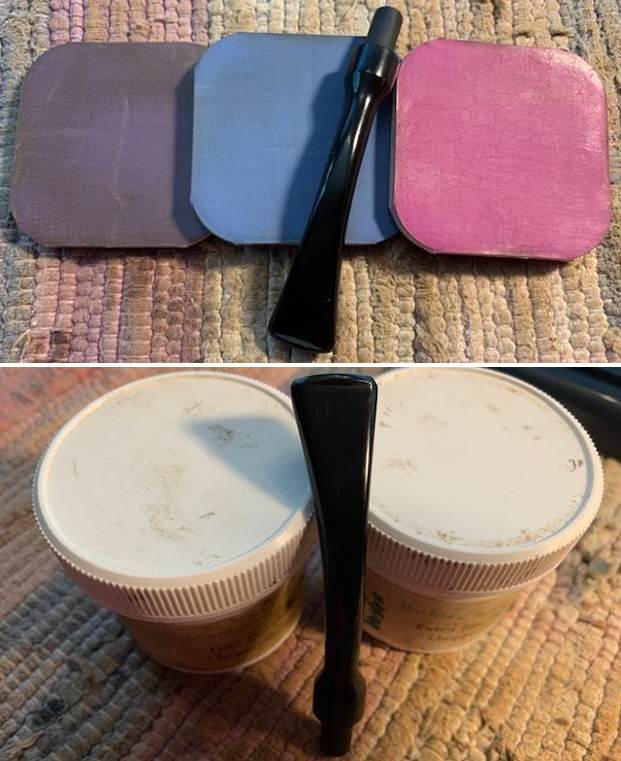
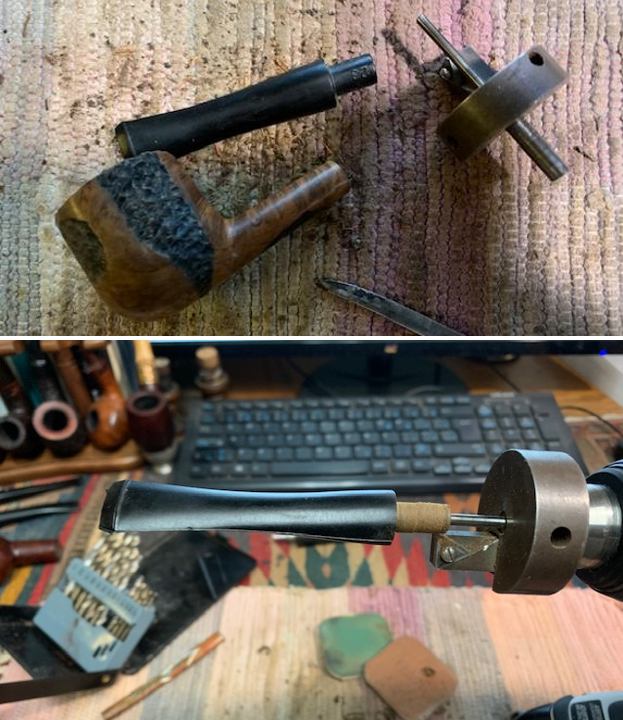
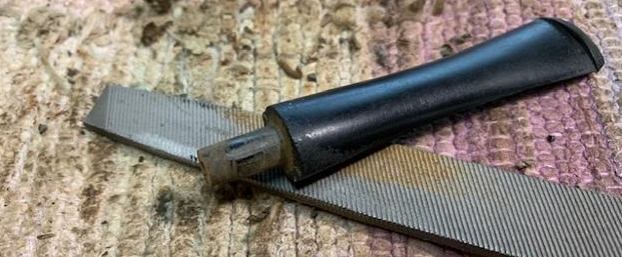
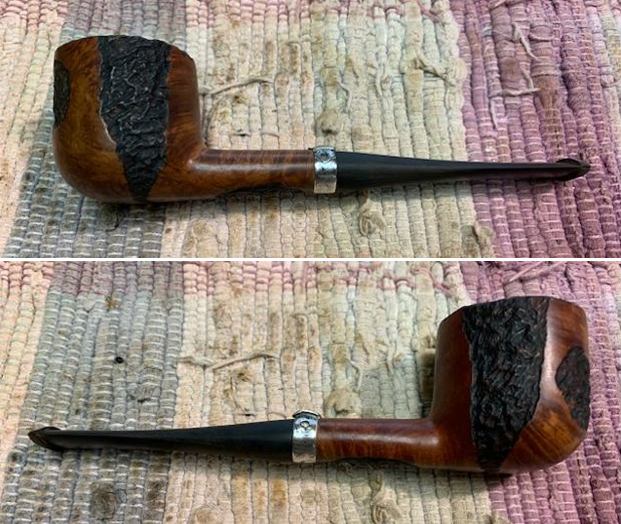
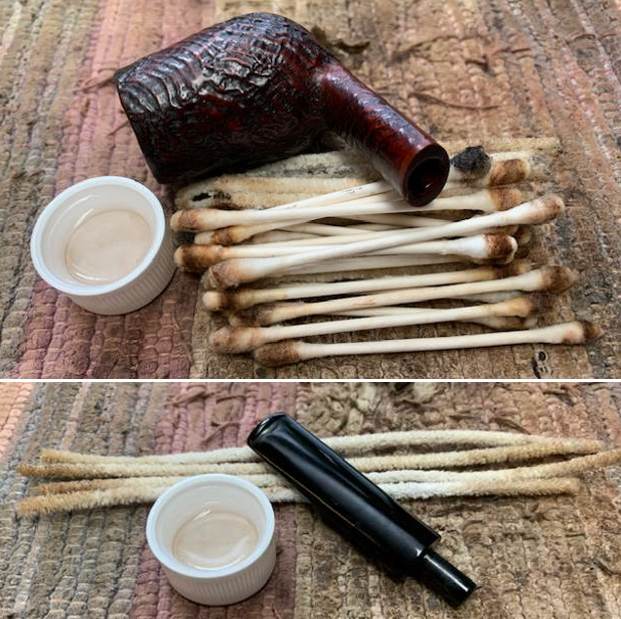
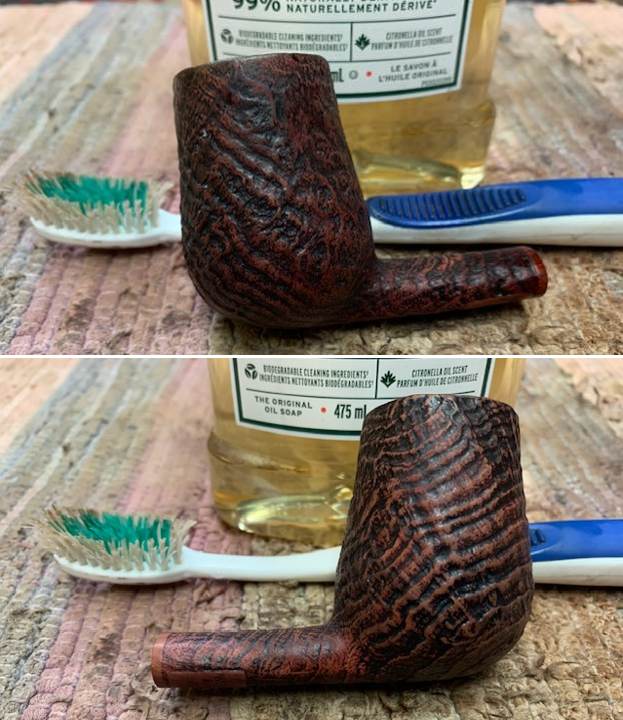
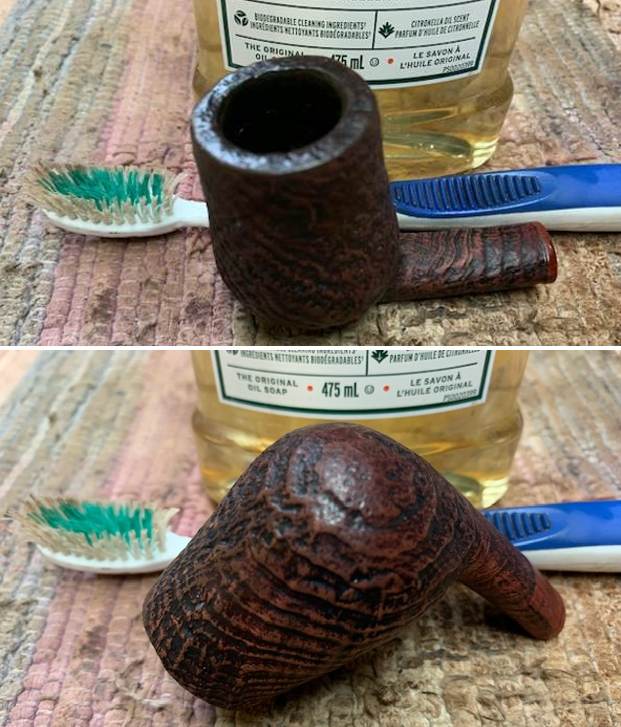
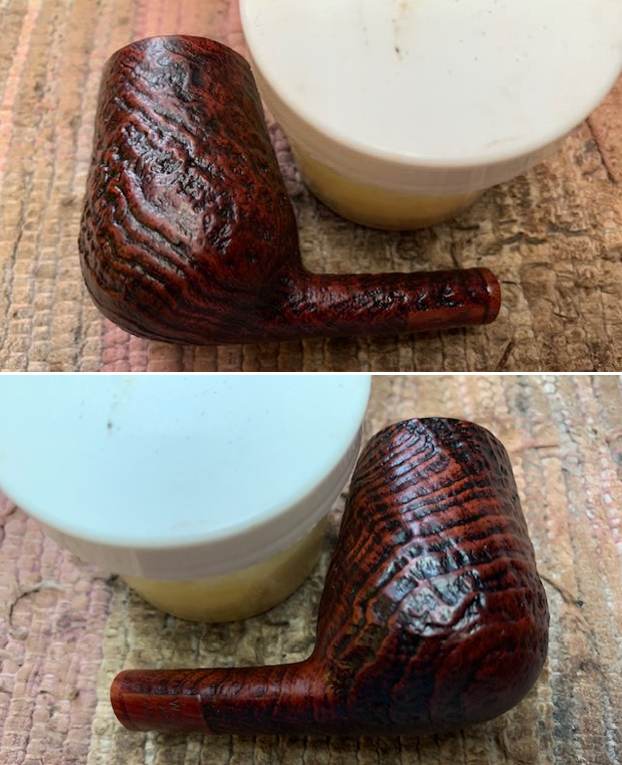
Now it was time to work on the pipe itself. I started my work on this one by reaming the bowl with a Savinelli Fitsall Pipe Knife. I followed that up by sanding the bowl walls with 220 grit sandpaper wrapped around a piece of dowel.I scrubbed the rim top with a brass bristle wire brush to knock of the lava and tars in the blast on the rim top. Once it was scoured with the brass it looked significantly better.I cleaned the internals of the shank and the stem with 99% isopropyl alcohol, cotton swabs and pipe cleaners. I scrubbed it until the shank was clean and the smell was much cleaner smelling.I scrubbed the external surface of the sandblast briar with a tooth brush and undiluted Murphy’s Oil Soap. I scrubbed it until the finish was clean and then rinsed it off with warm running water to rinse off the soap and the grime from the finish. I dried it off with a soft cloth and took photos of the pipe. I applied some Before & After Restoration Balm to the briar. It is a paste/balm that is rubbed into the surface of the briar – both smooth and rusticated finishes. The product works to deep clean the nooks and crannies of finish, enliven and protect the briar. I worked it into the briar with my finger tips and a horse hair shoe brush. I let it sit for 10 minutes to do its work. I wiped it off with a soft cloth then buffed it with a cotton cloth. The briar really began to have a deep shine in the briar and the grain shone through. The photos I took of the bowl at this point mark the progress in the restoration. It is a gorgeous pipe.     I decided to repair the cracked shank next. The first photo shows the crack. I inserted the tenon partially in the shank to make the crack visible and took a photo. I have circled it in red so that it is clear. I cleaned up the crack and pushed a pinhole with an awl into the end of the crack to stop it. I pressed some CA glue into the crack held it together until the glue cured. I reduced the diameter of the shank end with a folded piece of 220 grit sandpaper. I found a nickel band and used a Dremel and sanding drum to remove the excess nickel on the band until the end was flush against the shank end. I cleaned up the sharp edge with a folded piece of 220 grit sandpaper. I heated it with a lighter and pressed it in place against a hard wood surface. I took photos of the band before I fit it and after it was on the shank end. It looks very good at this point. I set the bowl aside and turned my attention to the issues with the vulcanite stem. I “painted” the surface of the stem with the flame of a Bic Lighter to lift the tooth marks in the stem surface on both sides as well as the button edges where the marks were deepest. I was able to lift the marks significantly and filled in the remaining marks with clear CA glue. I set the stem aside to allow the repairs to cure. Once the repairs cured, I used a small file to reshape the button edge and flatten them. I sanded them smooth with 220 grit sandpaper and started the polishing with 600 grit wet dry sandpaper. The stem surface and button looked much better. I continued polishing the stem with micromesh sanding pads – 1500-12000 grit sanding pads and water to wet sand the stem. I wiped it down after each sanding pad with Obsidian Oil on a cotton rag after each sanding pads. But I find it does two things – first it gives some protection to the stem from oxidation and second it give the sanding pads bite in the polishing process.   After finishing with the micromesh pads I rub the stem down with Before & After Fine and Extra Fine stem polish as it seems to really remove the fine scratches in the vulcanite. I rub the Fine Polish on the stem and wipe it off with a paper towel and then repeat the process with the Extra Fine polish. I finish the polishing of the stem down with a final coat of Obsidian Oil and set the stem aside to let the oil absorb. This process gives the stem a shine and also a bit of protection.  The final steps in my process involve using the buffer. I put the W.O. Larsen Handmade Brandy back together and lightly buffed the bowl and stem with Blue Diamond to polish the blast without filling in the grooves in the finish. I polished the vulcanite stem at the same time to polish out the scratches. I gave the bowl multiple coats of Conservator’s Wax and the stem multiple coats of carnauba wax. I have found that I can get a deeper shine if I follow up the wax buff with a buff with a clean buffing pad. It works to raise the shine and then I hand buff with a microfiber cloth to deepen the shine. It is always fun for me to see what the polished bowl looks like with the polished stem. It really is a nice pipe. The finish around the bowl sides and shank looks great with the rich combination of brown stains. The W.O. Larsen Sandblast Brandy feels great in my hand. It is a well balanced pipe. Have a look at it with the photos below. The dimensions are Length: 5 ½ inches, Height:  2 inches, Outside diameter of the bowl: 1 ¼ inch, Chamber diameter: ¾ of an inch. The weight of the pipe is 1.41 ounces/40 grams. It is a beautiful pipe that functions as a sitter due to the wide heel on the bowl. I will soon be adding to the rebornpipes store in the Danish Pipemakers section. If you would like to add it to your collection let me know. It should be a great smoking pipe. As always I encourage your questions and comments as you read the blog. Thanks to each of you who are reading this blog. Remember we are not pipe owners; we are pipe men and women who hold our pipes in trust until they pass on into the trust of those who follow us.
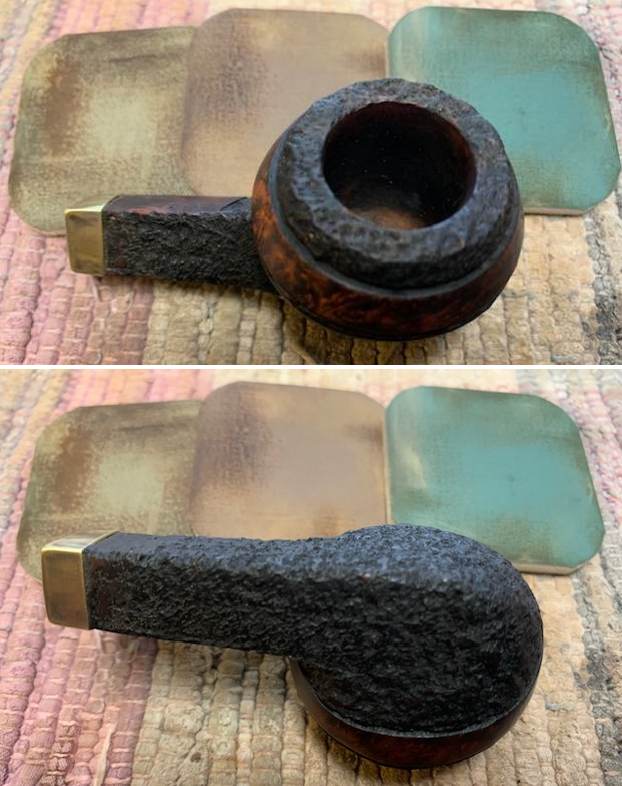
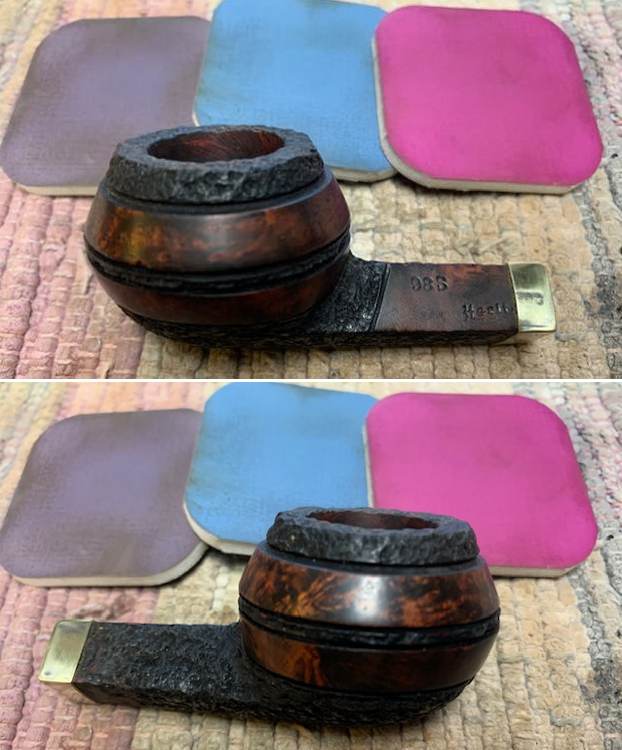
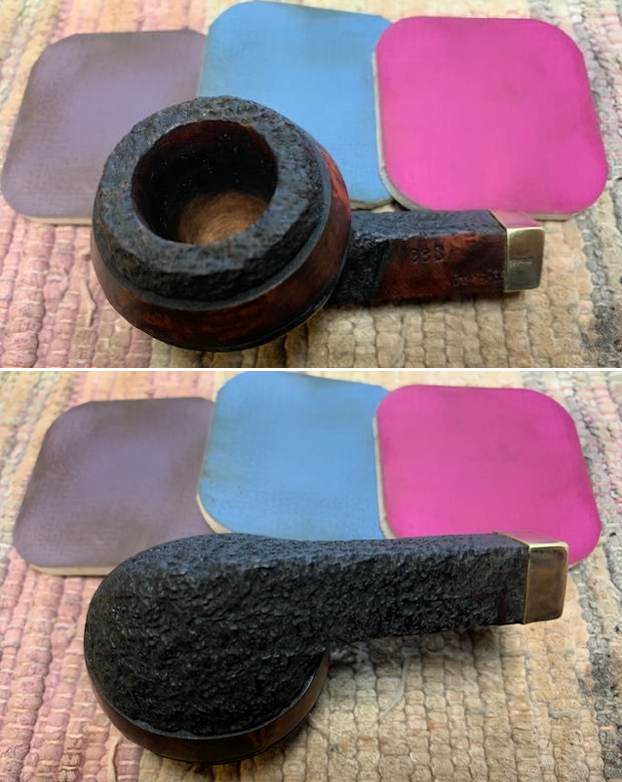
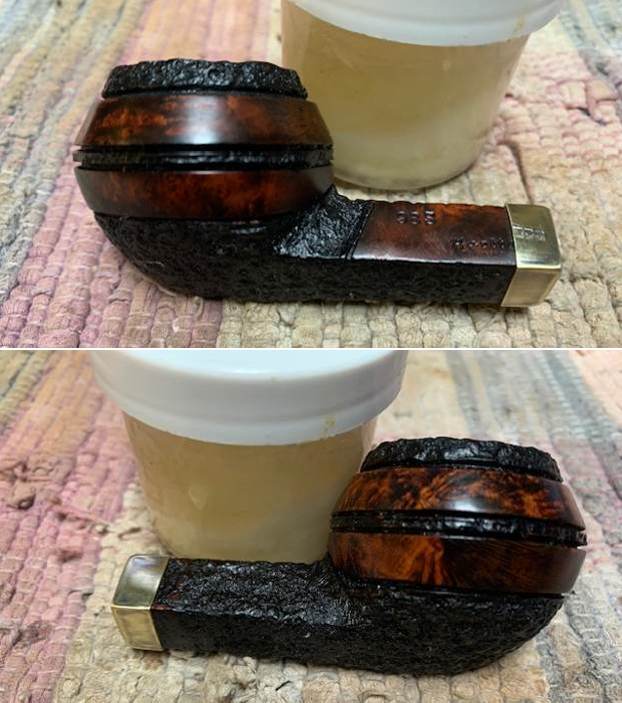
Repairing a Cracked Shank and Restoring a Heritage Embassy 98S Bulldog


Blog by Steve Laug

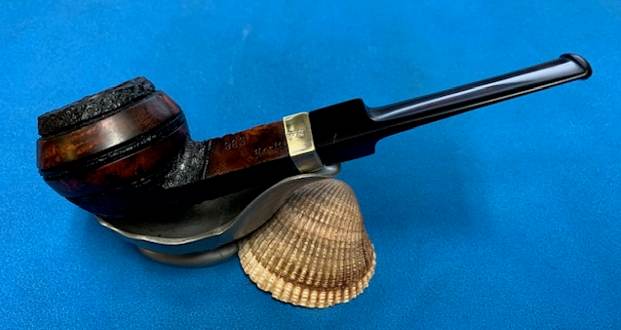
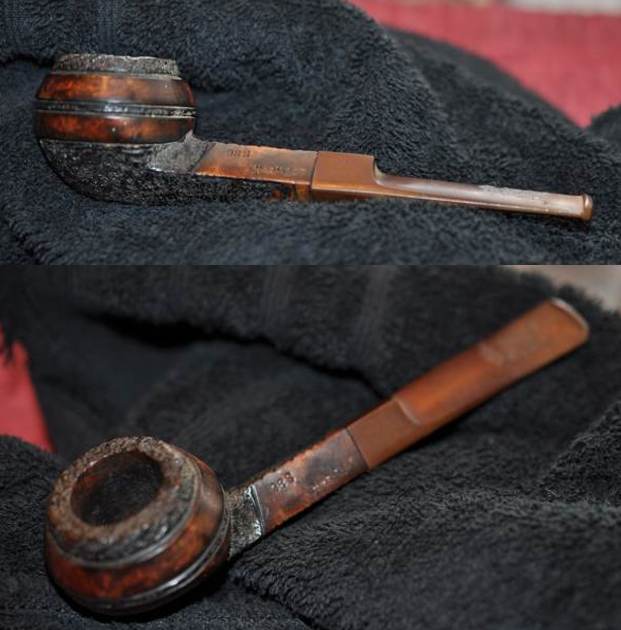
Once again I want to take you through my process of working on each pipe that we purchase. Jeff has set up a spread sheet to track where the pipe came from, the date of purchase and what we paid for it so that we know what we have invested in the pipe before we even work on it. This takes a lot of the guess work out of the process. This particular pipe was purchased on 02/20/2020 from a seller in St. Leonard, Maryland, USA. I also want you to understand why we take the photos we do. If you have followed for a while then you will see the familiar pattern of the photos we include both in the before and midstream process of working on a pipe. It is not accidental or chance as the photos have been taken to help me make an assessment of the pipe Jeff sees before he starts his clean up work. We do this to record the condition that the pipe was in when received it and to assess what kind of work will need to be done on. When I look at these photos this is what I see.

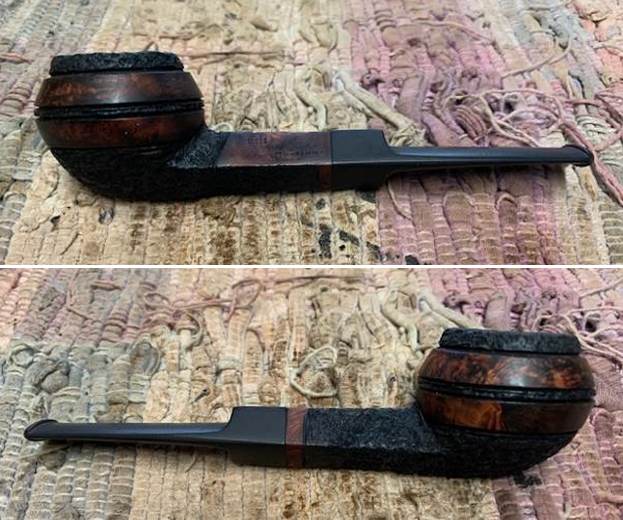
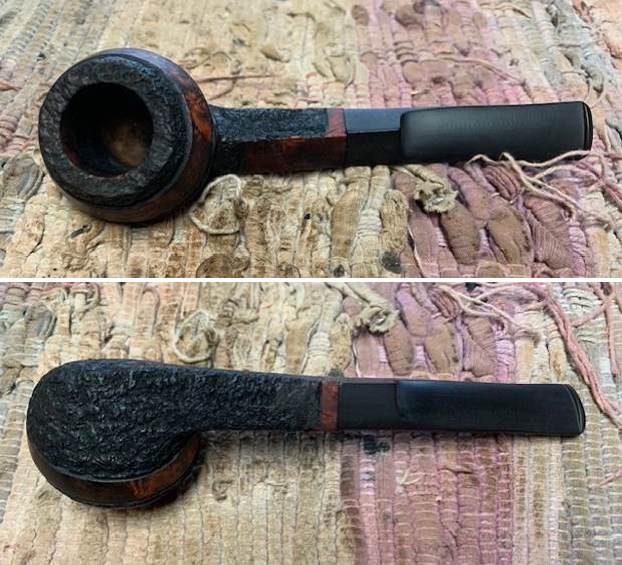
  1. The first thing I see is an interesting squat Bulldog with a mixed finish of rusticated and smooth bands and a vulcanite saddle stem. It is well proportioned and well made.
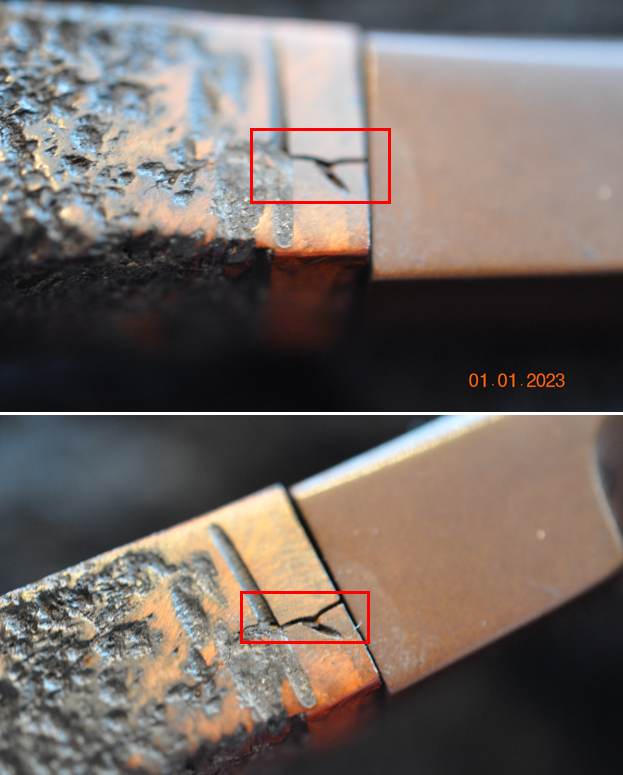
  2. The finish is dirty and there is grime and grit ground into the rustication on the sides of the bowl and shank. The two smooth bands on the bowl are also dirty. It is dusty and dull looking but under the grime the pipe looks good. There is a crack on the left side of the underside of the diamond shank from the end in about ¼ inch. It is branched from the end and comes together at the rusticated band around the shank.
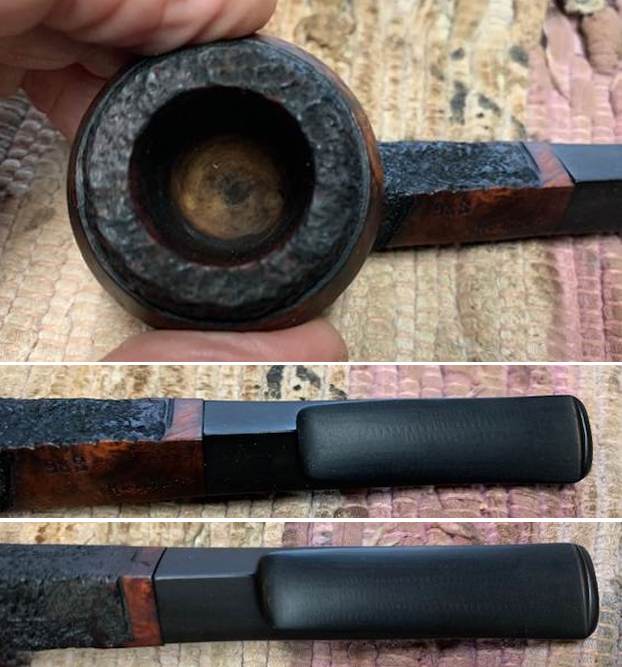
  3. The rusticated rim top has some lava and debris filling in the rusticated grooves and ridges around surface and the edges. It is dirty looking but cleaning will reveal a real beauty.
  4. The bowl has a thin cake and appears to have been reamed recently before it came to us. The inner and outer edges look good and there does not appear to be any obvious burn damage to the smooth rim top or bowl edges. The bowl does not appear to having any checking and the bottom 1/3 of the bowl is raw briar.
  5. The vulcanite stem is in good condition – dirty, oxidized and has light tooth chatter and marks on both sides ahead of button. I am pretty certain it is a replacement stem as it is not like original Heritage pipe stems I have worked on.

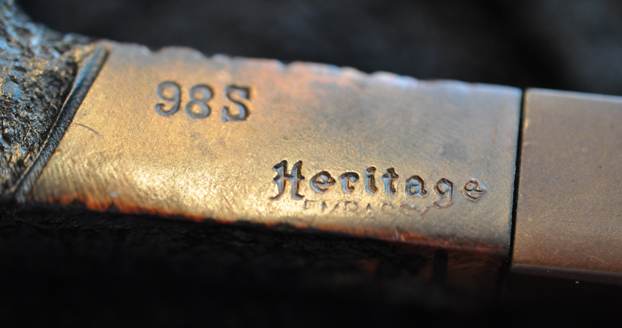
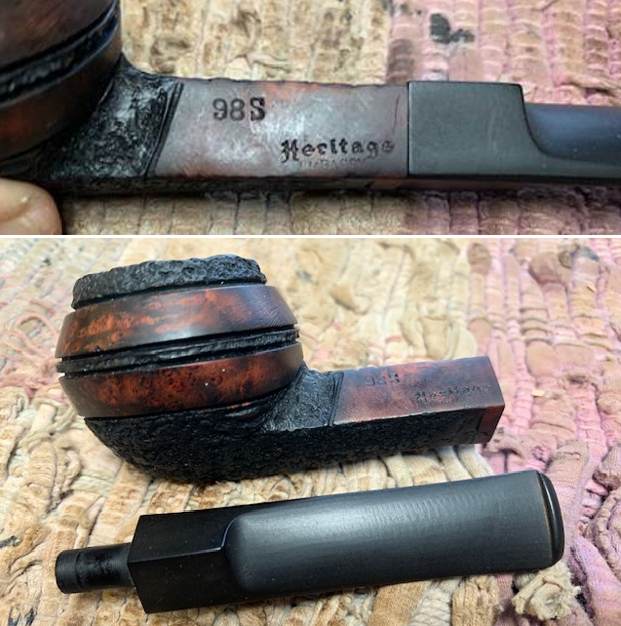
Overall my impressions of this pipe is that it is a beauty that once cleaned up will be another one that will look pretty amazing. Heritage pipes have shapes and a style of rustication that are readily identifiable when you see them so I knew what the pipe was even before looking at it in person. The photos below confirm the assessment above. Jeff took close up photos so that I could have a clearer picture of the condition of the bowl, rim edges and top. The rim top photos confirm my assessment above. The cake in the bowl is quite thin and looks like it had been recently reamed. The rim top has some lava, grime and debris in the rustication filling in some of the grooves. You can also see the condition of the outer and the inner edge. They appear to be in great condition. This is what I look for when assessing a pipe. There is no visible burn damage at this point. The bowl is still round and other than being in a used condition it is in great shape. The photos of the vulcanite stem surface from various angles confirm my assessment of its condition. You can see the dirty grime and oxidation on the stem in the first photo below. There is light chatter and tooth marks. The stem is quite dirty but otherwise in good condition. The fit of the stem to the shank is off a bit due to the crack in the left underside. The rustication on this pipe is quite beautiful. Instead of telling you what I see in the next photos of the sides of the bowl and the heel I want to hear from you. Tell me what you see? What does the finish look like to you? Are there any visible problems or issues that stand out to you? Are the cracks or scratches in the valleys of the rustication or the high spots? Are there visible flaws or fissures in the briar? How random does the deep rustication look? Is there a pattern to it? Any visible issues on the heel of the bowl? These questions should help you to see what I am looking for when I see these photos. He took a photo of the stamping on the top left side of the diamond shank. It is stamped with the shape number 98S [over] Heritage [over] Embassy (faintly stamped but readable). What stands out for you in the photos of the stamping? What do you look for in the stamping? It is dirty but what do you see underneath the grime on the surface of the briar? Jeff took photos of the crack in the left underside of the shank. It is branched and ends at the carved groove in the shank separating the smooth from the rusticated. It appears to go forward to the rustication but lessens in effect and depth in the finish. It will need to be repaired and banded.I have worked on quite a few Heritage pipe that are classic lines – Heritage Antique, Heritage Heirloom and others. I reread an earlier blog I had written on a Heritage restoration that I did (https://rebornpipes.com/2015/01/14/refreshing-an-older-heritage-antique-13-dublin-pipe/) It referred me to a blog that was written on rebornpipes by Andrew Selking. I quote from the blog above with reference to Andrew’s work.

The Heritage brand was one I had no familiarity with until Andrew wrote up this blog for us https://rebornpipes.com/2014/12/23/refurbishing-a-heritage-heirloom/ He gave background, history, line information and the classic brochure from the company. I want to give a brief summary of what he found in the next two short paragraphs to set the stage for the one that I found once he highlighted the brand for me.

Heritage pipes were Kaywoodie’s answer to Dunhill. According to one of their brochures, Heritage pipes were made from “briar burls seasoned and cured for up to 8 months,” with only “one briar bowl in over 300 selected to bear the Heritage name.” “Heritage stems are custom fitted with the finest hand finished Para Rubber stems. Mouthpieces are wafer thin and concave.”

The Heritage line began in the early 1960’s, with the trademark issued in 1964. The line was started at the request of Stephen Ogdon, (who worked for Kaywoodie in 1962). Mr. Ogdon had previous experience working for Dunhill, either running the New York store or working for Dunhill North America. Mr. Ogden was made President of Heritage Pipes, Inc., Kaywoodie Tobacco Co.,Inc. and Kaywoodie Products Inc. as well as a Vice President of S.M. Frank & Co. Heritage Pipes were produced from 1964 until 1970 (Source Kaywoodie.myfreeforum.org).

I scanned the brochure that Andrew provided and found this regarding the Antique Line: The Heritage Antique line is characterized by “Rustic Grain stands out in rugged relief.” “This pipe is so bold-looking, yet so light and smooth-smoking. A special sandblasting process exposes a greater surface area on the bowl, giving a cooler, more satisfying smoke.

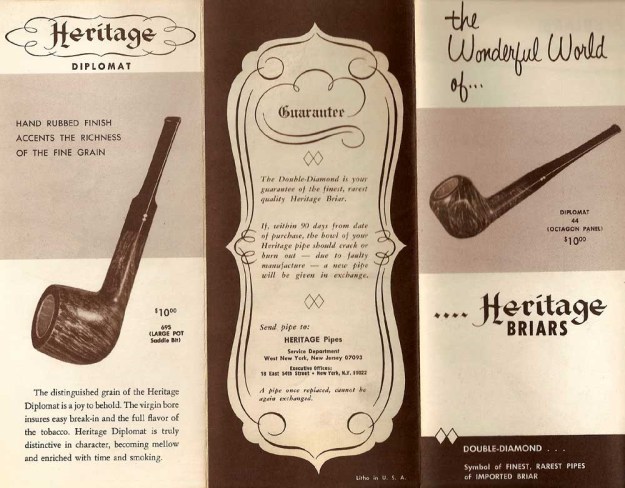
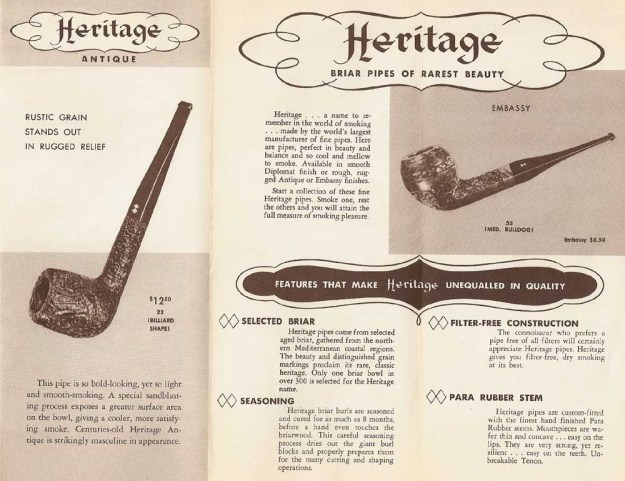
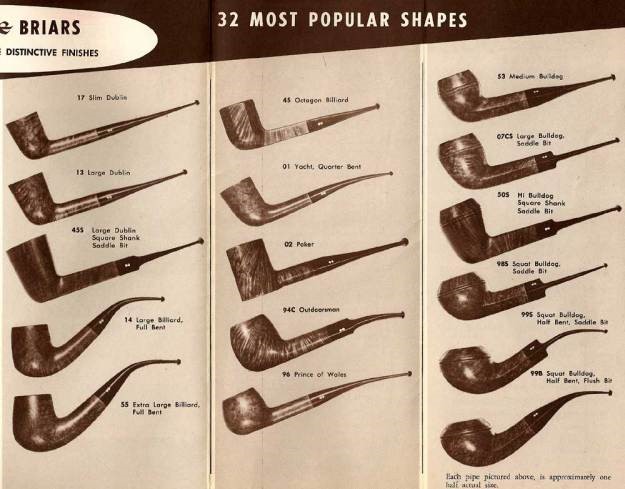
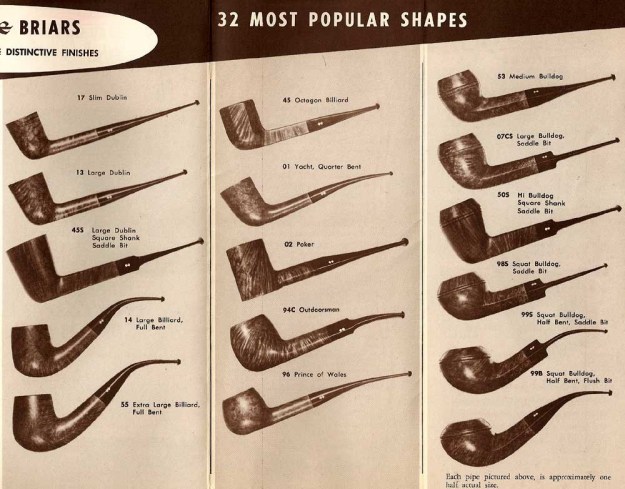
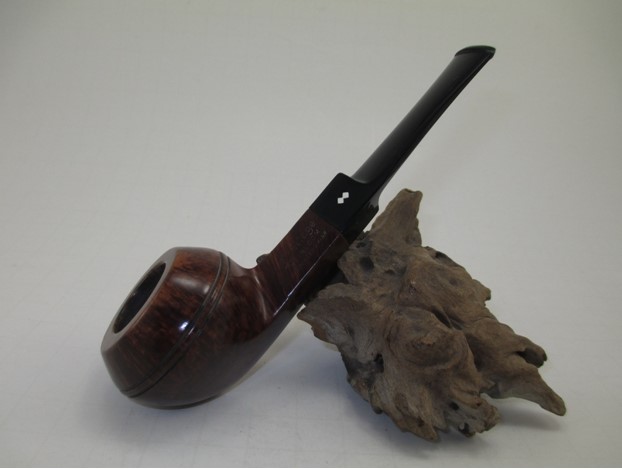
I have also included the brochure below. On the second page below there is a panel that reference the Heritage Embassy pipe with a rusticated finish and the twin smooth rings around the bowl. The fourth page of the brochure below shows the 98S in the third column on the right. Andrew had written a blog on Heritage Heirloom 98S straight Bulldog previously. It is the same shape as the one I am working on now and has the original stem which confirms that this is a replacement (https://rebornpipes.com/2015/04/21/restoring-a-heritage-heirloom-98s-bulldog/). I have included a picture from the blog below for your consideration on the stem shape of the original.Now I had more information to work with. The Heritage Embassy in my hands that probably came out between 1964 and 1970.

I am sure many of you will shake your head and ask maybe even out loud, “Why is he including this again?” However, please remember that the point of these blogs is not to wow your with the work or make you shake your heads but I want you to know the details of the work we do so you can do your own. Back in 2020 Jeff wrote a blog about his cleaning process. I am including a link to that now so you can see what I mean about his process. Do not skip it! Give it a read (https://rebornpipes.com/2020/01/20/got-a-filthy-estate-pipe-that-you-need-to-clean/). Here is the introduction to that blog and it is very true even to this day.

Several have asked about Jeff’s cleaning regimen as I generally summarize it in the blogs that I post rather than give a detailed procedure. I have had the question asked enough that I asked Jeff to put together this blog so that you can get a clear picture of the process he uses. Like everything else in our hobby, people have different methods they swear by. Some may question the method and that is fine. But it works very well for us and has for many years. Some of his steps may surprise you but I know that when I get the pipes from him for my part of the restoration they are impeccably clean and sanitized. I have come to appreciate the thoroughness of the process he has developed because I really like working on clean pipe!

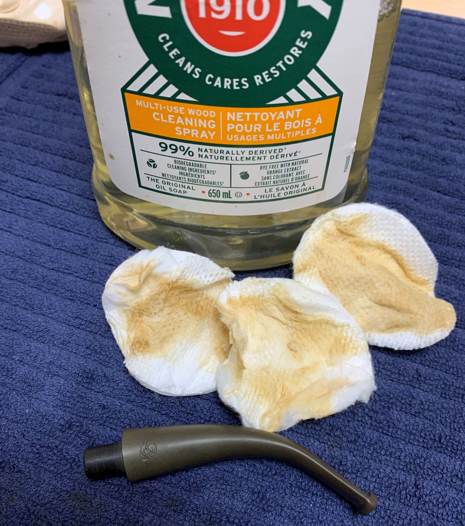
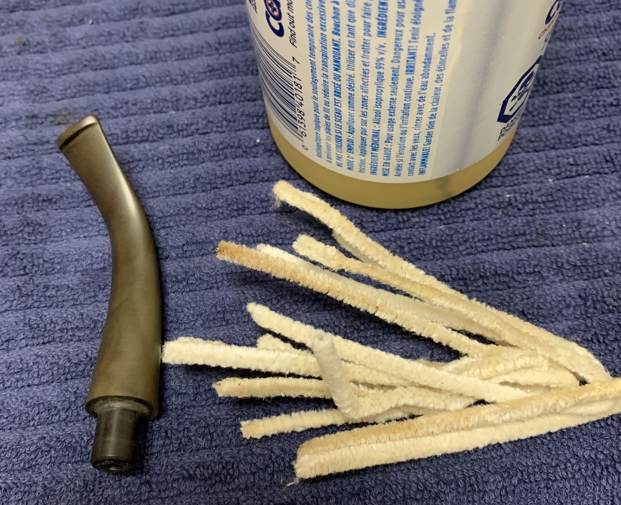
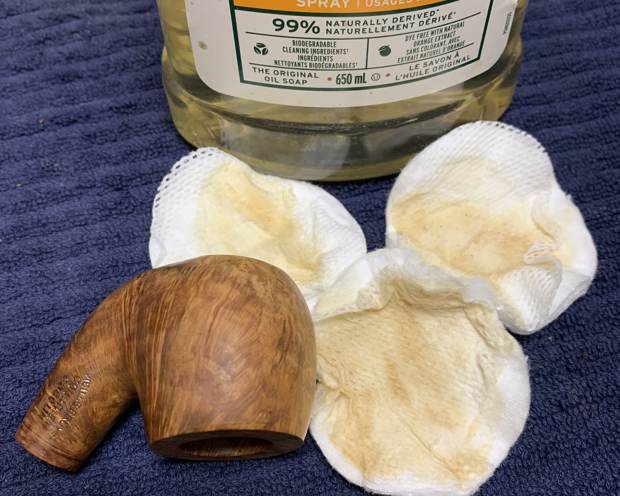
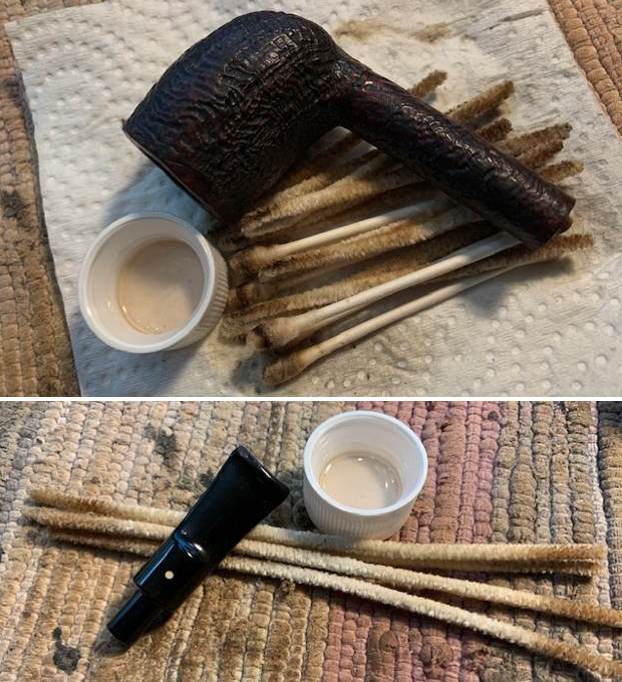
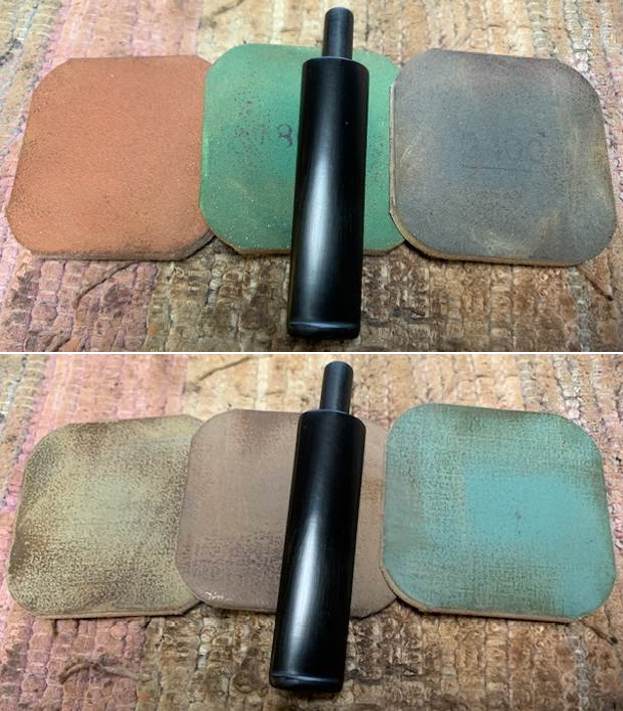
For the benefit of some of you who may be unfamiliar with some of the products he uses I have included photos of three of the items that Jeff mentions in his list. This will make it easier for recognition. These three are definitely North American Products so you will need to find suitable replacements or order these directly on Amazon. The makeup pads are fairly universal as we were able to pick some up in India when we were with Paresh and his family.

In the blog itself he breaks his process down into two parts – cleaning the stem and cleaning the bowl. Each one has a large number of steps that he methodically does every time. I know because I have watched him do the work and I have seen the pipes after his work on them. He followed this process step by step and when the pipe got to me it was spotlessly clean and ready for my work. The inside of the stem, shank and bowl were clean and to me that is an amazing gift as it means that my work on this end is with a clean pipe! I cannot tell you how much difference that makes for my work.

When the pipe arrives here in Vancouver I have a clean pipe and I go over it keeping in mind my assessment shared in the opening paragraph above. Now that I have it in hand I am looking for confirmation of what I saw in the photos as well as any significant structural changes in the bowl and finish as I go over it.

  1. The first thing I see is an interesting squat Bulldog with a mixed finish of rusticated and smooth bands and a vulcanite saddle stem. It is well proportioned and well made.
  2. The finish is clean and the grime and grit have been removed from the finish on the bowl. The rustication and the smooth finish both have come alive around the bowl sides. The crack in the diamond shank on the left underside was clean and visible.
  3. The lava, grime and dust on the rim top has been removed and it looks to be in good condition on the top and edges of the bowl.
  4. The walls of the bowl are clean and I do not see any checking or burn damage. The inner edge of the bowl looks good. The outer edges look good and there does not appear to be any obvious burn damage there.
  5. The vulcanite stem is clean and has very light tooth chatter and marks on both sides. The stem is definitely a replacement.

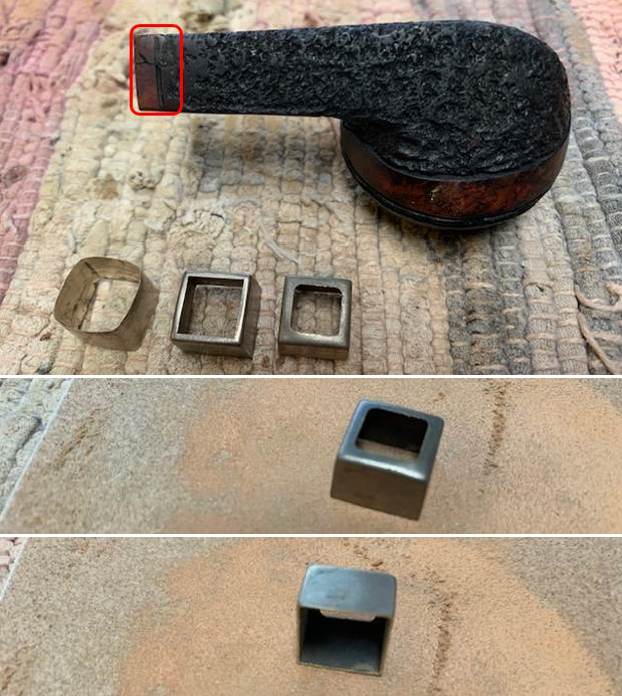
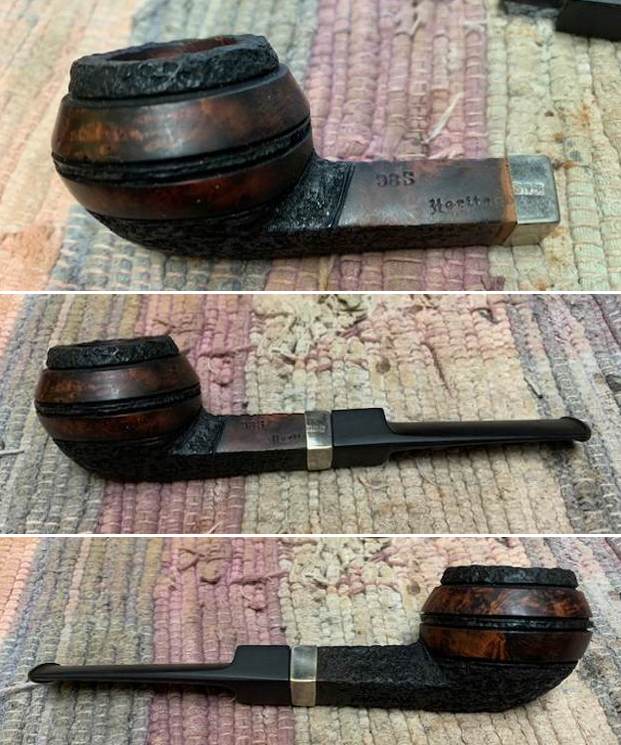
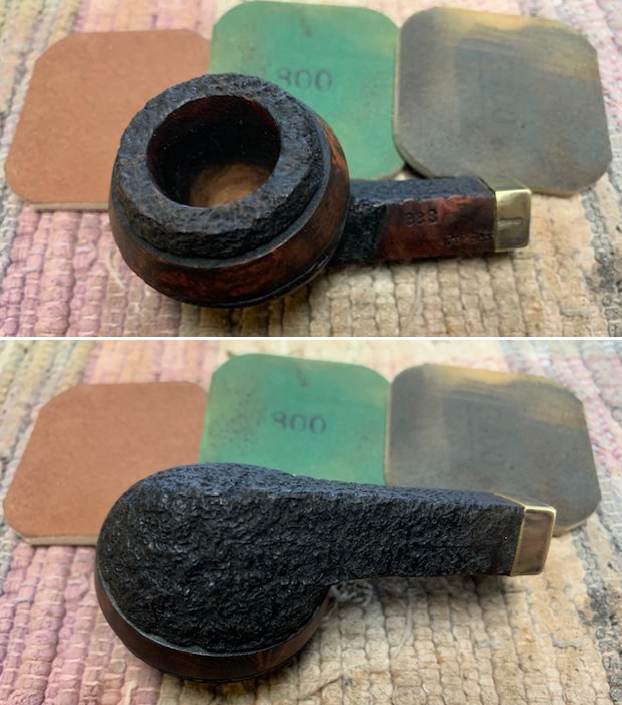
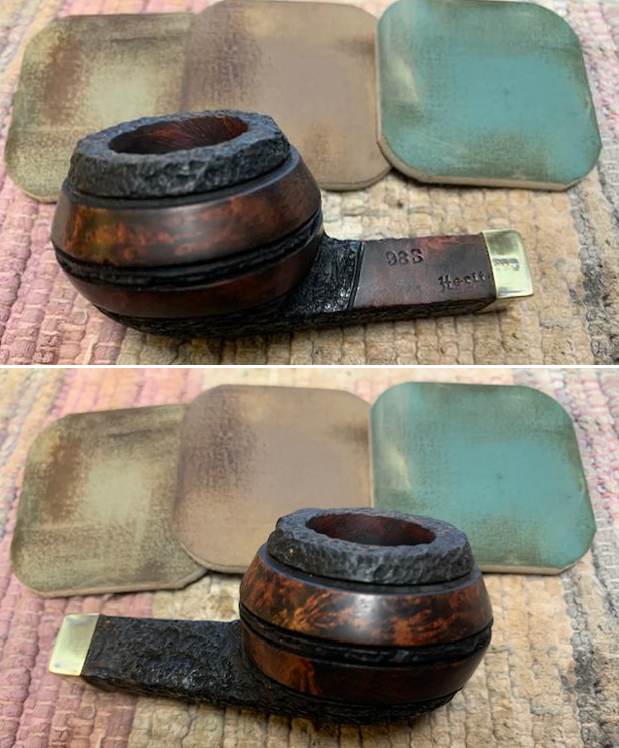
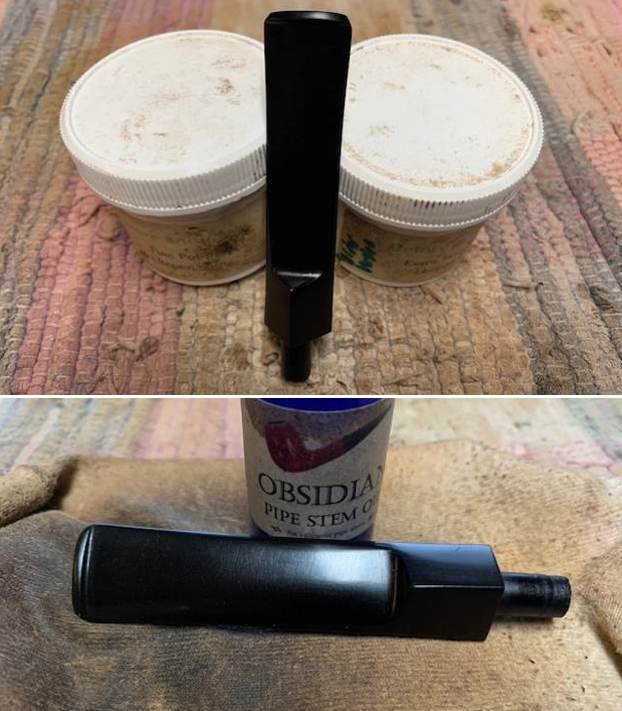
Hopefully the steps above show you both what I look for when I go over the pipe when I bring it to the work table and also what I see when I look at the pipe in my hands. They also clearly spell out a restoration plan in short form. My work is clear and addressing it will be the next steps. I took photos of the whole pipe to give you a picture of what I see when I have it on the table. This is important to me in that it also shows that there was no damage done during the clean up work or the transit of the pipe from Idaho to here in Vancouver.  I carefully went over the bowl and rim top to get a sense of what is happening there. In this case once the rim top and edges were cleaned, they looked very good. There was no damage on the edges or the top of the rim. The rim edge and top are clean and should polish up well. I also go over the stem carefully. The crack in the shank was present and visible. The stem had some faint tooth marks chatter on the surface of the stem on both sides. I took photos of the rim top and stem sides to show as best as I can what I see when I look at them. I always check to make sure that the clean up work did not damage the stamping on the shank in any way. It is in excellent condition and is very clear and readable (all except the Embassy stamping which is faint but readable). The Heritage rustication is quite unique and tight. To me it different and I like the feel of it.. I love just looking at the beauty of the lay of the pipe and the proportion of the hand made pipes. I like to remove the stem from the shank to get a sense of what was in the mind of the pipe maker when he crafted the pipe. The photo shows its beauty in flow and shape. I started my work on the pipe by dealing with the crack in the left underside of the shank. It is visible in the photo below. I have three different bands that would fit the shank. The first one on the left was too deep and covered all of the stamping. It was also not quite square. The second band had an end cap and was rather loose on the shank. The third one was a good fit and was tight on the shank. I would need to reduce the depth of the band and sand the shank end in order to make a snug fit on the shank. Used a topping board to reduce the depth of the band. I was able to remove half of the depth. I used a folded piece of 180 grit sandpaper to sand the smooth band on the shank end. I took enough of the briar off that the band sat on the end. I heated the band with a lighter and pressed it onto the shank end. It bound the cracks together and the shank was solid. I put the stem on the shank and took photos of the finished repair.  I polished the smooth briar on the two rings around the bowl and the surface of the nickel band with micromesh sanding pads. I choose to dry sand the briar rather than wet sand it. Again it is a matter of personal preference. I prefer to use the pads dry and find they work very well on the briar. I sand with each pad (9 in total) and group them by threes for ease of reference. I wipe the bowl down after each pad with a damp cloth to remove the sanding debris and check the briar. I love seeing the developing shine on the briar as I move through the pads which is why I include so many photos of this step.    I applied some Before & After Restoration Balm to the briar. It is a paste/balm that is rubbed into the surface of the briar – both smooth and rusticated finishes. The product works to deep clean the nooks and crannies of finish, enliven and protect the briar. I worked it into the briar with my finger tips and a horse hair shoe brush. I let it sit for 10 minutes to do its work. I wiped it off with a soft cloth then buffed it with a cotton cloth. The briar really began to have a deep shine in the briar and the grain shone through. The photos I took of the bowl at this point mark the progress in the restoration. It is a gorgeous pipe.   I set the bowl aside and turn to work on the stem. I polished the stem with micromesh sanding pads – 1500-12000 grit sanding pads and water to wet sand the stem. I wiped it down after each sanding pad with Obsidian Oil on a cotton rag after each sanding pads. But I find it does two things – first it gives some protection to the stem from oxidation and second it give the sanding pads bite in the polishing process. After finishing with the micromesh pads I rub the stem down with Before & After Fine and Extra Fine stem polish as it seems to really remove the fine scratches in the vulcanite. I rub the Fine Polish on the stem and wipe it off with a paper towel and then repeat the process with the Extra Fine polish. I finish the polishing of the stem down with a final coat of Obsidian Oil and set the stem aside to let the oil absorb. This process gives the stem a shine and also a bit of protection. The final steps in my process involve using the buffer. I don’t buff a rusticated pipe with Blue Diamond as it can build up in the deep grooves of the finish. I used it on the stem and find that it works very well to polish out the light scratches in the vulcanite. I moved on to buffing the pipe – I gave the bowl multiple coats of Conservator’s Wax and the stem multiple coats of carnauba wax. I have found that I can get a deeper shine if I follow up the wax buff with a clean buffing pad. It works to raise the shine and then I hand buff with a microfiber cloth to deepen the shine. It is always fun for me to see what the polished bowl looks like with the polished vulcanite stem. It really is a nice little pipe. The rusticated finish around the bowl sides and shank looks great with the rich black and dark brown stains. The Heritage Embassy 98S Straight Bulldog feels great in my hand. It is light and well balanced. Have a look at it with the photos below. The dimensions are Length: 6 inches, Height: 1 ½ inches, Outside diameter of the bowl: 1 ½ inch, Chamber diameter: ¾ of an inch. The weight of the pipe is 1.27 ounces/36 grams. It is a beautiful pocket sized pipe that I will soon be adding to the rebornpipes store in the American Pipemakers section. If you would like to add it to your collection let me know. It should be a great smoking pipe.
Hopefully the style of writing of this blog is helpful to you in some way. In it I wanted to show both what I am looking for and how I move forward in addressing what I see when work on a pipe. Let me know if it is helpful to you. It is probably the most straightforward detailed description of my work process that I have written. As always I encourage your questions and comments as you read the blog. Thanks to each of you who are reading this blog. Remember we are not pipe owners; we are pipe men and women who hold our pipes in trust until they pass on into the trust of those who follow us.

Repairing a Cracked Shank and Banding a Jost’s Supreme Diamond Shank Bent Billiard


Blog by Steve Laug

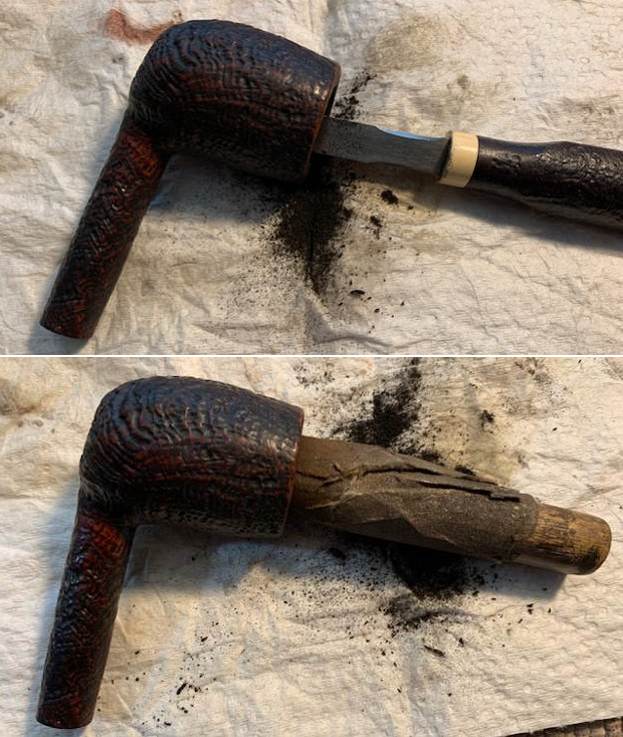
The next pipe on the table is another that the Vancouver pipe man dropped off for me to work on for him. It was stamped Jost’s Supreme and had a natural finish around the bowl. It is a bent diamond shank Billiard with some interesting grain. It needed restoration on the bowl which was heavily caked and the shank had the remnants of a paper wrap that had been used to hold the stem in place due to the crack in the shank. It also needed a repair to the crack on a pipe that I had originally worked on back in 2016. When I originally had worked on it the pipe had a thick cake and was well used. Here is the link to that restoration that I did back when I first picked it up (https://rebornpipes.com/2016/11/11/restoring-the-fourth-classic-find-a-josts-supreme-diamond-shank-bent-billiard/).The stem had tooth marks, tooth chatter and a lot of oxidation and calcification on the stem. Here are some photos of the pipe when he picked it up in 2016 to give a bit for context for my work. When I took the pipe out of the bag to work on this morning this is what I saw. The finish on the briar looked very good. It was dirty and the natural finish looked dried out. There was a crack on the lower right side of the diamond shank. The stem was very loose in the shank and the tenon appeared to have been wrapped in paper to tighten it. The bowl had a very thick cake and the airway in the shank was dirty. I would need to be cleaned up before I worked on the shank repair and the fit of the stem in the shank. The stem was oxidized, calcified and had tooth marks and chatter on both sides ahead of the button. I took photos of the rim top and the thick cake in the bowl to show how it looked. The rim top had some darkening around the inner edge of the bowl. It will clean up pretty well. The photos of the stem show the condition of the stem. You can see the tooth marks and chatter under the calcification on the stem surface.I took a photo of the stamping on both sides of the shank. It is clear and readable as noted above. I took the stem off the shank and photographed the look of the pipe as a whole. It is a nice looking Diamond Shank Bent Billiard. I went back and reread the previous restoration blog that I written on the restoration the previous time I had worked on the pipe. I also was very interested to read the back story and history on the brand. I quote from the blog below.

In earlier blogs I have written about restoring another Jost’s pipe that I found. When I restored that pipe it was a brand I had heard of but was unfamiliar with. I researched the web to find some information about the brand. Here is a link to the blog I wrote on the Jost’s Olde English Deluxe: https://rebornpipes.com/2016/09/03/josts-olde-english-de-luxesupreme-overstamped-j214-bent-billiard/. I am quoting several of the paragraphs that summarize what I learned about the brand.

I looked up Jost’s pipes on the Pipephil site and found a pipe that had the same stamping on the left side of the shank as the one I was working on. The right side had slightly different stamping in that it had the classic COM stamp circle where the one I had was two lines Made in over England. It also had a picture of the circle J stamp on the stem. There was a note there the tobacco shop proprietor was Mrs. Henry A. Jost. Her resident carver was Harvey Raspberry.”

I also found a blog that is called ClassicPipeShop that even had a catalogue of the pipes made by the Jost’s Shop or were imported by them for their store. I quote that blog once more as it places the new pipe that I am working on now.

“I did some more hunting online and I found a blog that did a great write up on Jost’s Pipe Shop and gave some definitive information on the brand and grades of the pipes. Here is the link if you wish to read a well written history of the brand and also some interesting details about shop blends of tobacco. http://classicpipeshop.blogspot.ca/2015/03/josts-pipe-shop-201-north-6th-street-st.html

 “I have included the section of the blog on the pipes. It covers a lot of information regarding the source of the pipes and the levels/grades of pipes. Remember that the one I am working on is a De Luxe/Supreme. I quote:”

“Jost’s Pipes are closely tied to Comoy’s. Many of Jost’s pipes have the standard Comoy’s shape number and the “Made in England” in a circle. If the Jost’s pipe doesn’t have the “Made in England” it is probably made by Harvey Raspberry.”

“If the pipe has a shape number that is preceded by a “J” that is a Comoy’s product without question.  Typically these will have the words “Made in London England” on the reverse side of the shank from where the Jost stamp is made.  There are always exceptions to the rule but 95% of the time, this is accurate.”

“Many different levels of pipes were offered by Jost’s Pipe Shop.  From a 1950s catalog I have the following available:”

Jost Old English De Luxe: $85.00

These were typically of the highest… Grain is stunning and the briar is flawless.  These are the grade you should look out for as they are great smokers.

*Jost Old English Supreme: (no pricing available)

The majority of the Old English version pipes you see are marked Supreme.  These are stained in a darker color and are presumably from the same Algerian aged Briar as the De Luxe brothers.  These are also of the highest quality available. *(The current pipe I am working on is stamped Jost’s Supreme on the left side of the shank with no shape number and no Made in London England stamp.  If I read the information correctly it was one that was made by Harvey Raspberry, who was the shop pipe maker.)

Jost Virgin Briar Supreme: $35.00

Don’t see too many marked as Virgin Briar Supreme but you will often find “Supreme” Jost pipes on the second hand market (see above).  Excellent quality briar and displays the lighter toned finish of the De Luxe above.  Grain is not as flashy or desirable as the De Luxe model.

Jost Thames Briars: $25.00

I’ve seen these offered as blasted / rusticated pipes and look quite nice.  Most of the smooth finish Thames pipes are riddled with fills.  Good smokers but not much to look at (smooth).

Jost Sandblast Briars: $25.00

These are a great value.  The shop made sand-blasted pipes are usually quite large and snapped up very quickly by collectors.  The Comoy’s versions (with J shape #s) are of excellent quality and typically rather small compared to the shop-made variety.

Dukes Briars: $15.00

These come up very rarely.  The two I’ve seen in recent years are rather small in size.  Smooth finish with light / honey stain color.  Not sure what the story is behind these.

Now I knew the background on the pipe. I knew that the Supreme pipe was one of the higher end Jost’s in the Old English line. It was time to work on the pipe!

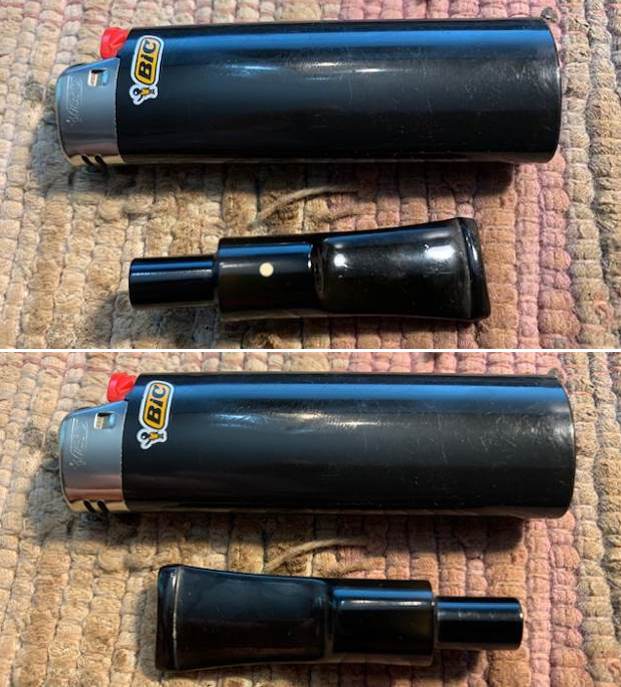
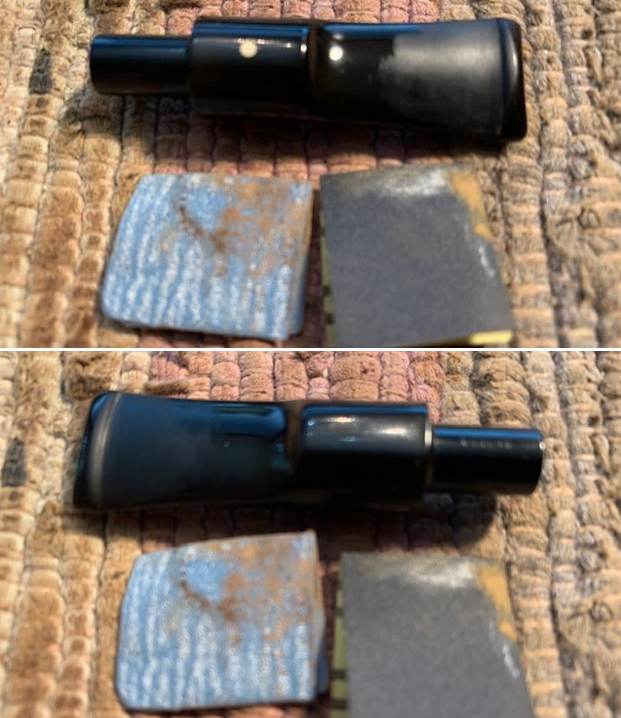
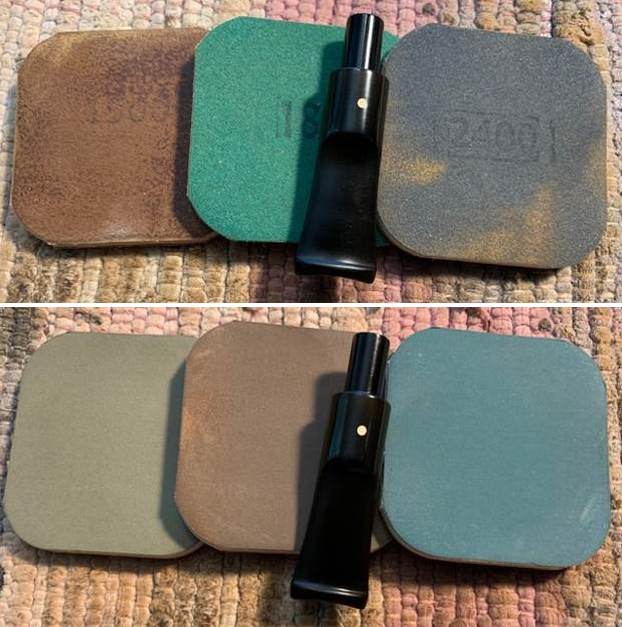
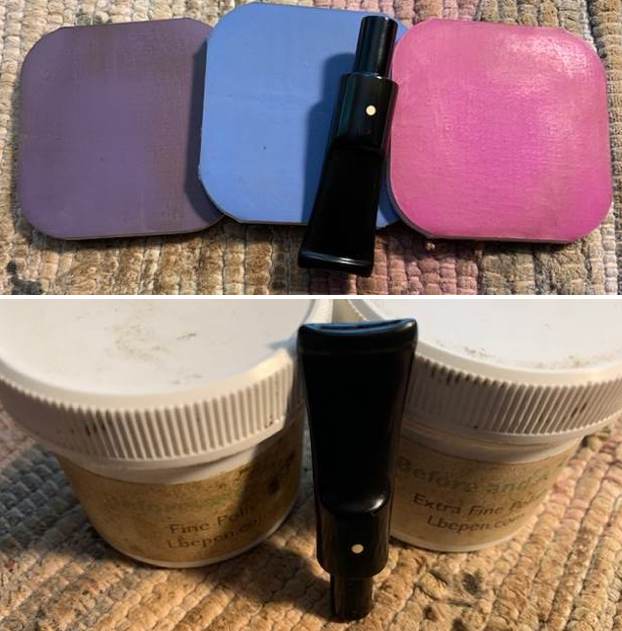
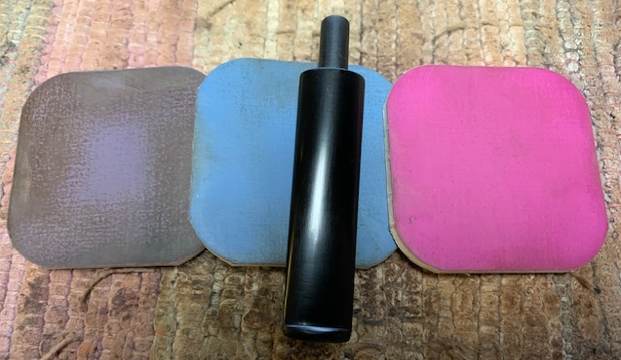
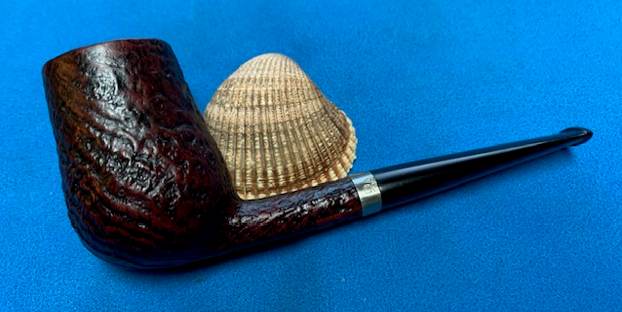
I decided clean up the pipe before I repaired the cracked shank. I reamed the bowl back to bare briar with a Pipenet Pipe Reamer using the third cutting head. I cleaned up the reaming with a Savinelli Fitsall Pipe Knife. I finished the bowl clean up with 220 grit sandpaper wrapped around a piece of dowel. The walls were smooth and there was no sign of burning or checking. It looked very good.   I cleaned out the internals with 99% isopropyl alcohol, pipe cleaners and cotton swabs. I worked over the shank and the airway in the stem. It took some work but once finished it was clean and smelled fresh. With the internals clean it was time to work on the cracked shank. I drilled a small pinhole at the end of the crack on the right underside of the shank. I do this to stop the crack from further spreading. I fill in the pinhole with clear CA glue and built up the surface of the crack at the same time. I squeezed the crack together and held it until the glue set. I spread the glue with a dental spatula and pressed into the shank crack. Once the repair cured I sanded it smooth with 220 grit sandpaper. I went through my bands and found a shank band/ferrule in nickel that was a snug fit on the shank. It was crowned and slightly dome so that would need to be flattened. I put the band a piece of dowel and used a ball peen hammer to flatten the top of the dome for a better fit with the stem.I heated the band with a lighter and pressed it onto the shank end. The fit of the ferrule to the shank was tight and it pulled the crack together even more than my clamping. It covered much of the stamping but the crack was quite long and I wanted some strong coverage. I put the stem on the shank and took photos of the new look of the pipe. I sanded the damage on the rim top and edges with 220 grit sandpaper. I was able to remove the majority of it with the sanding. There was some remaining darkening on the back inner edge of the bowl. I polished the bowl rim top with micromesh sanding pads – dry sanding with 1500-12000 grit pads. I wiped the briar down with a damp cloth after each sanding pad. It took on a real shine by the time I finished with the last sanding pad. I worked some Before & After Restoration Balm into the smooth rim and the sandblast finish on the bowl and shank. I worked it into the surface of the briar with my fingertips to clean, enliven and protect the wood. I used a horse hair shoe brush to work it into the crevices and keep from building up in the valleys and crevices of the finish. Once the bowl was covered with the balm I let it sit for about 15 minutes and buffed it off with a soft cotton cloth and the shoe brush. I polished it with a microfiber cloth. I took photos of the pipe at this point in the process to show what the bowl looked like at this point. I used a topping board with 220 grit sandpaper to try and flatten the remaining crown on the shank band/ferrule.Now it was time to address the part of the restoration I leave until last. I set the bowl aside and turned my attention to the stem. I filled in the deep grooves in the tenon to build it up and make it even. Once the repair cured I sanded it smooth to make it round and even once more. Once finished it looked better and the fit in the shank was very good. I wanted to adjust the bent in the stem as it had straightened a bit over time. I heated the blade with the flame of a Bic lighter. Once the vulcanite had softened I bent it to the correct angle and set the bend with cool water. It looks much better. I took the newly bent stem off the shank and worked on the stem surface to deal with the tooth marks and chatter. I used a folded piece of 220 grit sandpaper to remove the oxidation and calcification off the surface of the stem. I build up the damage to the top of the button edge with black CA rubberized glue. Once it had cured I recut the button edge and flattened the repairs. I smoothed out the repairs with 220 grit sandpaper and started polishing the stem with 600 grit wet dry sand paper. I use micromesh sanding pads and water to wet sand the stem with 1500-12000 grit sanding pads. I wiped it down after each sanding pad with Obsidian Oil on a cotton rag after each sanding pad as I find it does two things – first it protects the vulcanite and second it give the sanding pads bite in the polishing process. After finishing with the micromesh pads I rub the stem down with Before & After Fine and Extra Fine stem polish as it seems to really remove the fine scratches in the vulcanite. I rub the Fine Polish on the stem and wipe it off with a paper towel and then repeat the process with the Extra Fine Polish. I finished the polishing of the stem down with a final coat of Obsidian Oil and set the stem aside to let the oil absorb. This process gives the stem a shine and also a bit of protection from oxidizing quickly. The final steps in my process involve using the buffer. I first buff the stem and the briar with Blue Diamond on the buffing wheel. Blue Diamond is a plastic polish but I find that it works very well to polish out the light scratches in the vulcanite and the briar. I work the pipe over on the wheel with my finger or thumb in the bowl to keep it from becoming airborne. It works well and I am able to carefully move forward with the buffing. The briar and stem just shone!   I finished with the Blue Diamond and moved on to buffing with carnauba wax. Once I have a good shine in the briar and vulcanite I always give the bowl and the stem multiple coats of carnauba wax. I have found that I can get a deeper shine if I following up the wax buff with a clean buffing pad. It works to raise the shine and then I follow that up with a hand buff with a microfiber cloth to deepen the shine. It is always fun for me to see what the polished bowl looks like with the polished vulcanite stem. It really is a beautiful pipe. The smooth finish around the shows the grain shining through the buffed natural finish of this Jost’s Supreme Diamond Shank Bent Billiard. The finished pipe feels great in my hand. It is light and well balanced. Have a look at it with the photos below. The dimensions are Length: 5 ½ inches, Height: 2 inches, Outside diameter of the bowl: 1 ½ inches, Chamber diameter: 7/8 of an inch. The weight of the pipe is 1.62 ounces/46 grams. It is a beautiful pipe and the third of the five pipes for repair that I have ahead of me. Once I am finished with the lot he will get them back to enjoy once more. As always I encourage your questions and comments as you read the blog. Thanks to each of you who are reading this blog. Remember we are not pipe owners; we are pipemen and women who hold our pipes in trust until they pass on into the trust of those who follow us.
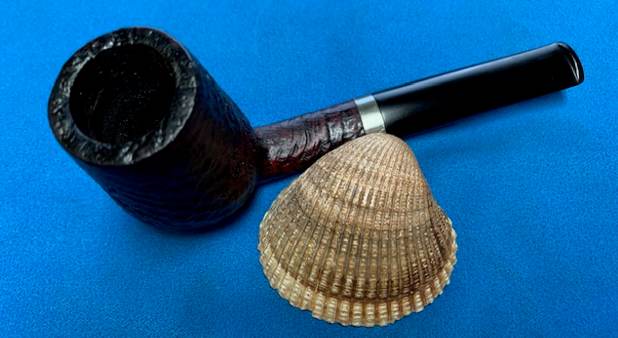
Rebirthing a Stanwell 1985 POY Sandblast Dublin with a smooth Rim Top


Blog by Steve Laug

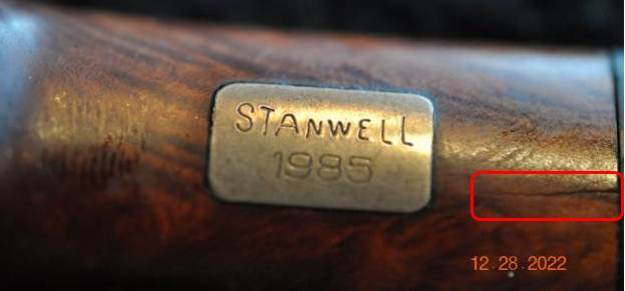
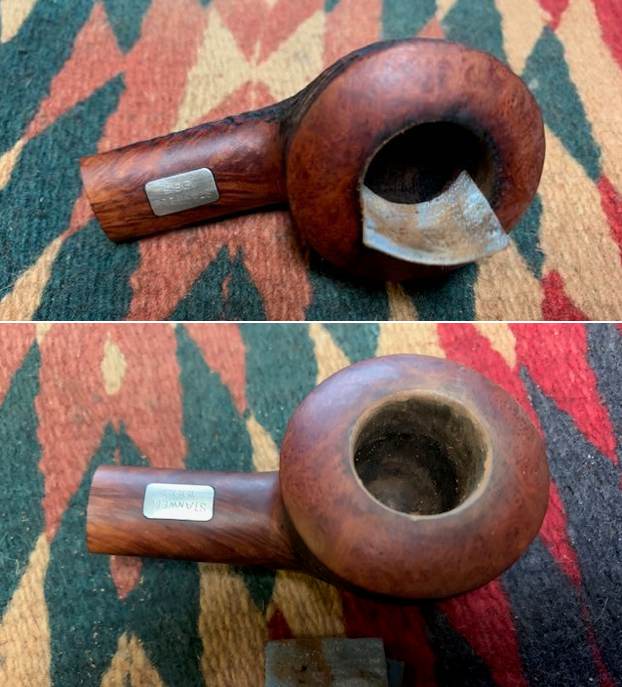
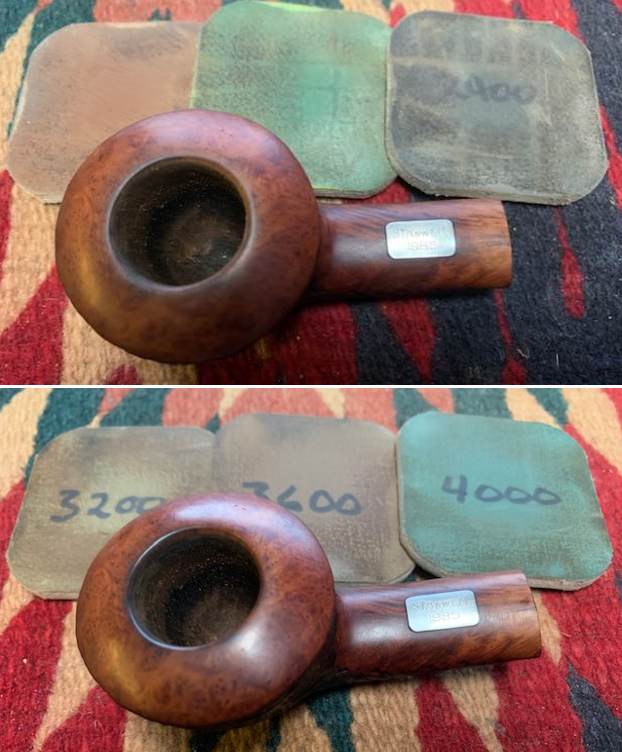
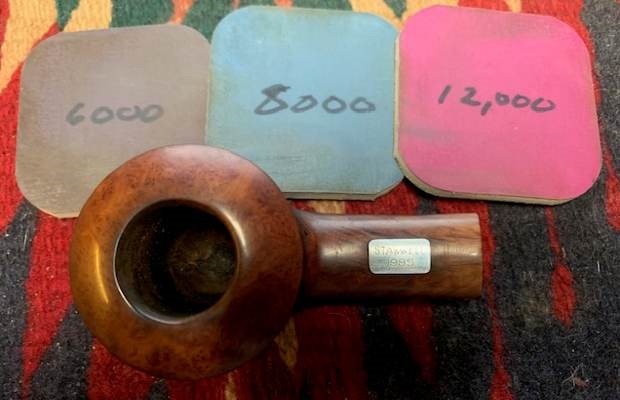
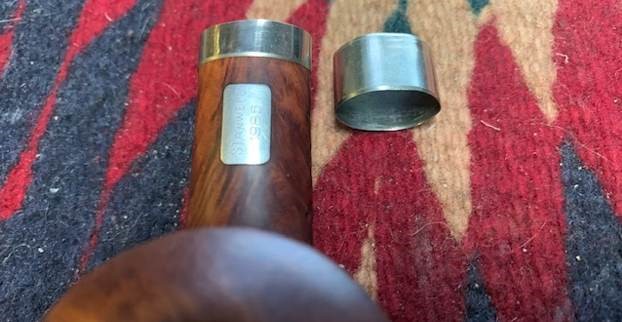
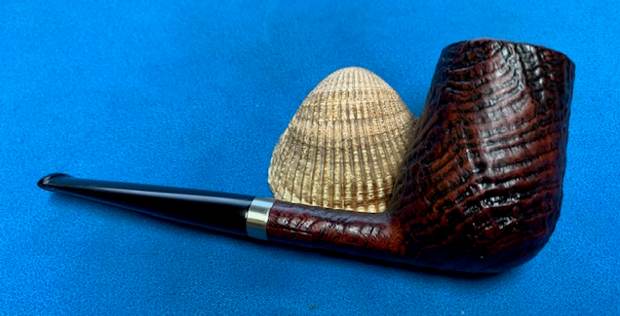
The next pipe I am working on was purchased on 12/13/2022 as part of a group of pipes from a fellow in Copenhagen, Denmark. This was another horribly tired and dirty pipe with a lot of wear and tear and obviously it had been someone’s favourite smoker. The pipe has an identifying silver plate on the topside of the shank that reads Stanwell [over] 1985. There was no other stamping on the shank and the silver plate confirmed for me that it was a Stanwell Pipe of the Year. The dirty sandblast finish on this was worn and tired looking. There were tars and oils ground into the surface of the briar. The shank had a hairline crack on the left side of the top that would need to be dealt with. The sandblast showed some nice grain around the bowl and shank and though it was a little dirty it was a nice looking pipe. The bowl had a thick cake that flowed over the top of the lightly crowned rim in a thick coat of a lava and showed potential damage on the top and the inner edge. The stem was a black vulcanite saddle stem with a silver Crown S on the topside of the saddle. It had some deep and wide tooth marks and chatter on both sides ahead of the button. There was also some oxidation and calcification on both sides of the stem. Jeff took photos of the pipe before he started his clean up work.  He took photos of the rim and bowl to show the heavy cake and thick lava coat covering the rim top. It really was filthy and a mess. He also took photos of the stem surfaces to show its overall condition when it arrived. The photos of the sides and heel of the bowls show beautiful grain around the bowl and shank sides. The sandblast is nicely done and highlights the grain. The brown stain on the briar adds depth finish on the pipe and makes the grain really stand out. It shows some promise. He also took a photo of the stamped silver plate on the left underside of the shanks. It reads as noted above. I have also boxed the hairline crack on the top of the shank in red in the photo below.Jeff cleaned up the pipe for me. He reamed the bowl with a PipNet pipe reamer and cleaned it up with a Savinelli Fitsall Pipe Knife. He scrubbed the exterior with Murphy’s Oil Soap and a tooth brush to clean off the grime off the finish and the heavy overflow of lava on the rim top. The cleaning had removed the thick coat on the rim top. He cleaned up the internals of the shank, mortise and stem with pipe cleaners, cotton swabs and alcohol to remove all of the oils and tars in the pipe. He soaked the stem in Before & After Deoxidizer and was able to remove much of the oxidation, calcification. When it arrived here in Vancouver it was a clean pipe and I knew what I had to work with. I took photos of it before I started my part of the restoration. I took a photo of the rim top and the stem to show their condition once it arrived in Canada. Jeff was able to clean up the incredibly thick cake and the lava overflow that was shown in the rim and bowl photos above. The rim top showed damage on the surface and the inner edge of the bowl. He was also able to get rid of the grime and grit in the surface of the briar around the sandblast. The second photo of the three below shows the crack in the shank (once again boxed in red). The stem looked better, though there were deep tooth marks and chatter on both sides near the button.I took a photo of the stamping on the silver plate on the topside of the shank to show that it was readable and undamaged by the cleanup work.I removed the stem from the shank and took a photo of the parts to give a sense of what the pipe looks like.I started my work on the inner edge and rim top with a folded piece of 220 grit sandpaper. I was able to remove that damage on the rim top and bring the inner edge back into round. It looked much better. I repaired the hairline crack in the shank with a dab of clear CA glue. I clamped the shank together to let the repair cure. Once it had cured I sanded it smooth with 220 grit sandpaper to blend in the repair. It looked much better. To stabilize it further I will need to put a thin band on the shank end so that with the addition and removal of the stem does not rebreak the crack.I started polishing the rim top and smooth portions of the briar (including the repaired hairline crack) with micromesh sanding pads. I wet sanded it with 1500-12000 grit pads. I wiped the bowl down after each pad with a damp cloth. The bowl began to take on a rich shine and grain was beginning to stand out. I rubbed the bowl and shank down with Before & After Restoration Balm to deep clean the finish on the bowl and shank. The product works to clean, enliven and protect the briar. I worked it in with my fingers to get it into the briar. I used a horsehair shoe brush to work it into the sand blast areas. I let it sit for 10 minutes then I wiped it off and buffed it with a soft cloth. The briar really began to have a rich shine. I took some photos of the bowl at this point to mark the progress in the restoration. It is a beautiful bowl. To stabilize the crack further and stop it from reoccurring each time the stem was removed I banded it. I had a band that would work on the shank but it needed to be reduced by half to get the depth more aesthetically pleasing to my eye. I used a coarse 180 grit sanding pad and worked the band against it until I have removed approximately half of the width. I heated it with a lighter and pressed it on the shank. The fit was perfect and to me it looked very good. I polished the band with a jeweler’s cloth to protect and give it a shine. I gave it another coat of Restoration Balm and buffed it off with a clean cloth. I set the bowl aside and worked on the stem. I filled in the deep tooth marks with clear CA glue. I flattened the repairs with a small file. And sanded the smooth with 220 grit. I started polishing the whole stem with 600 grit sandpaper until the sanding marks were gone. I polished the stem with micromesh sanding pads – dry sanding with 1500-12000 grit pads. I wiped the stem down after each pad with a damp cloth to remove the sanding dust. I gave it a further polish with Before & After Stem Polish – both Fine and Extra Fine. I finished by wiping the stem down with a final coat of Obsidian Oil and set it aside to dry. I put the stem back on the Stanwell Pipe of the Year 1985 Dublin pipe and took the pipe to the buffer. I buffed the bowl and stem with Blue Diamond to polish the briar and the vulcanite stem. Blue Diamond does a great job on the smaller scratches that remain in both. I gave the bowl and the stem several coats of carnauba wax and buffed the pipe with a clean buffing pad to raise the shine. I hand buffed it with a microfiber cloth to deepen the shine. The finished pipe is shown in the photos below. This is a beautiful Stanwell POY 1985 – the vulcanite saddle stem and crowned rim top and sandblast finish combine to give the pipe a great look. The polished black, vulcanite stem looks really good with the rich browns standing out in the sandblast. The dimensions of the pipe are Length: 5 inches, Height: 1 ½ inches, Outside diameter of the bowl: 1 ¾ inches, Chamber diameter: ¾ of an inch. The weight of the pipe is 1.38 ounces/39 grams. This pipe has already been spoken for as an Anniversary present. It will soon be going to the fellow who ordered it. Thanks for walking through the restoration with me on this beauty!
Paint It Black!


Blog by Kenneth Lieblich

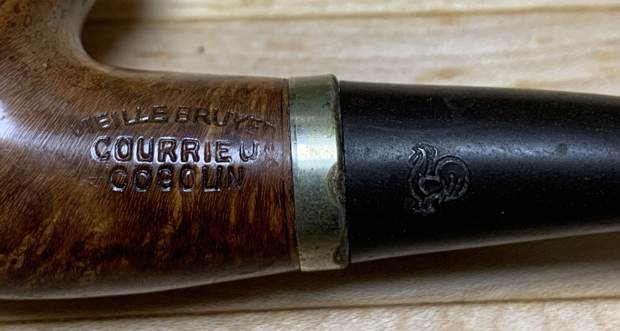
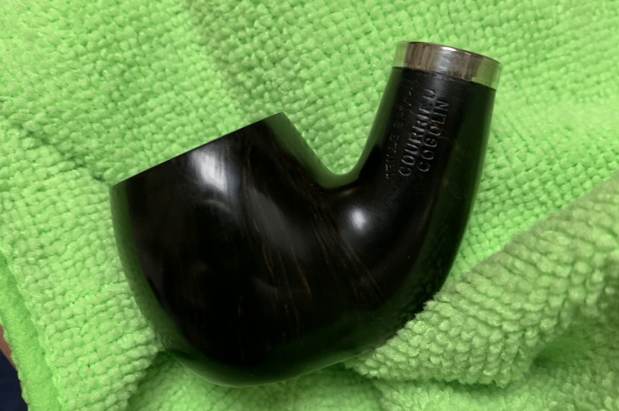
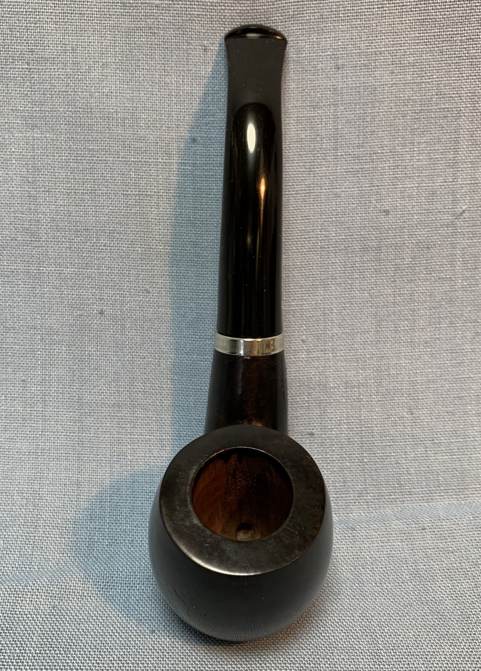
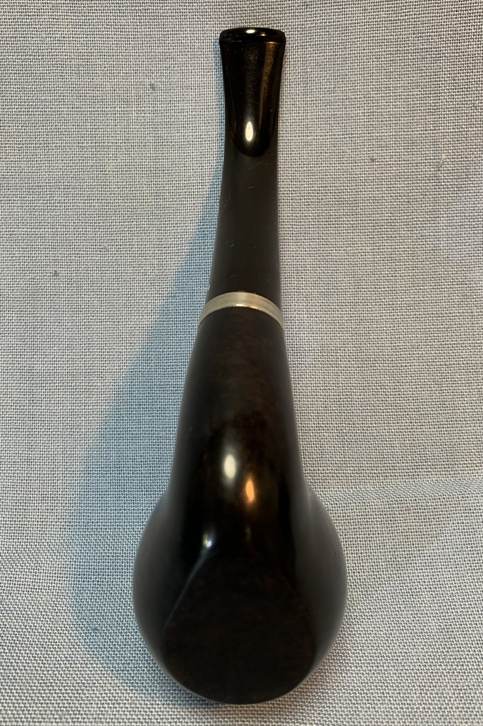
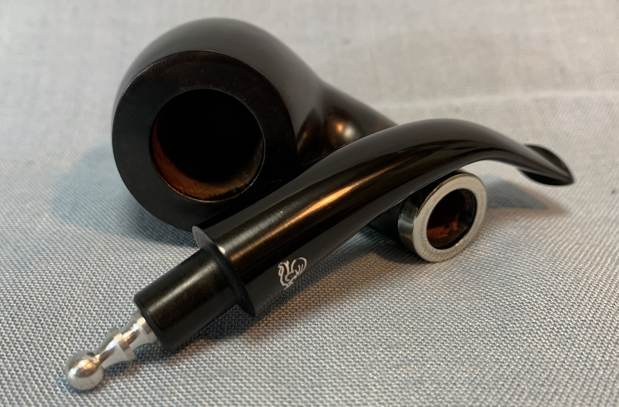
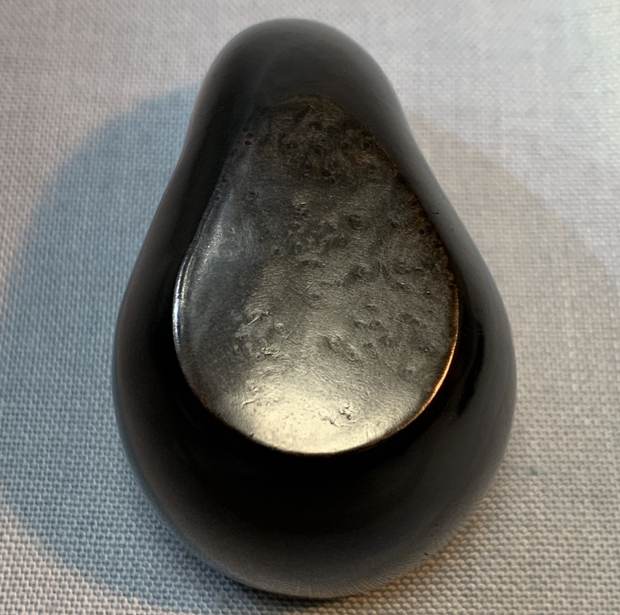
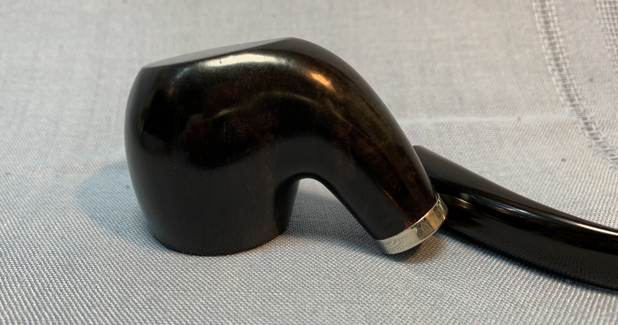
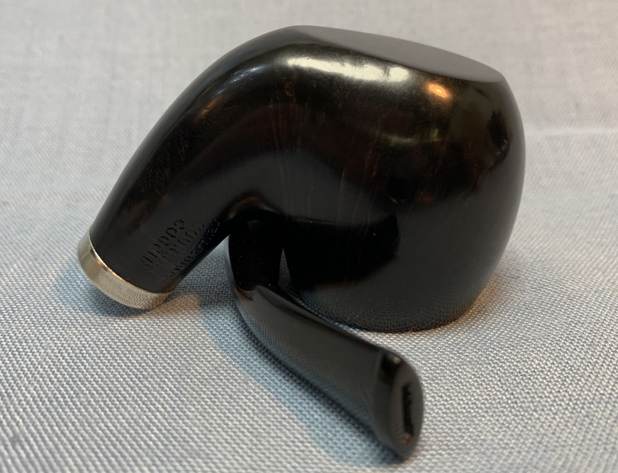
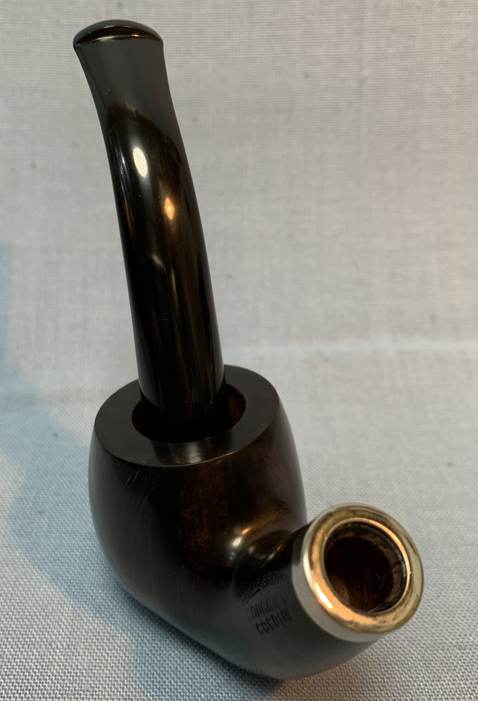
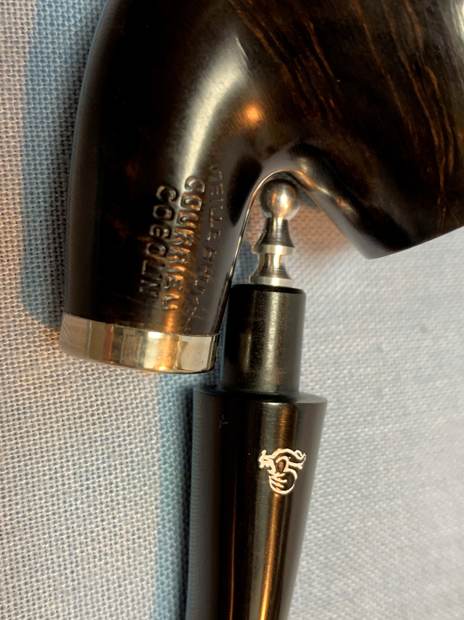
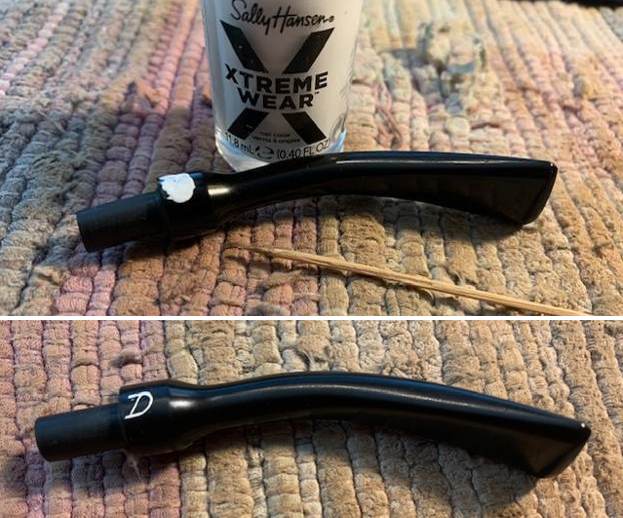
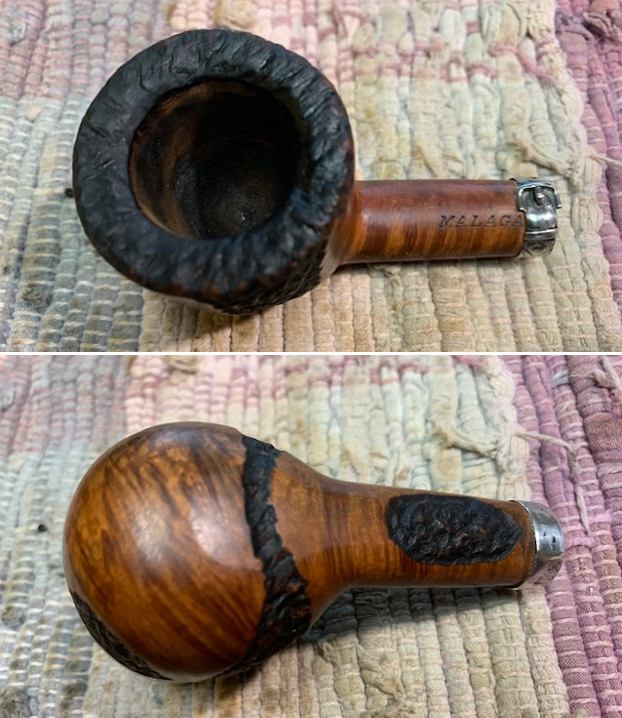
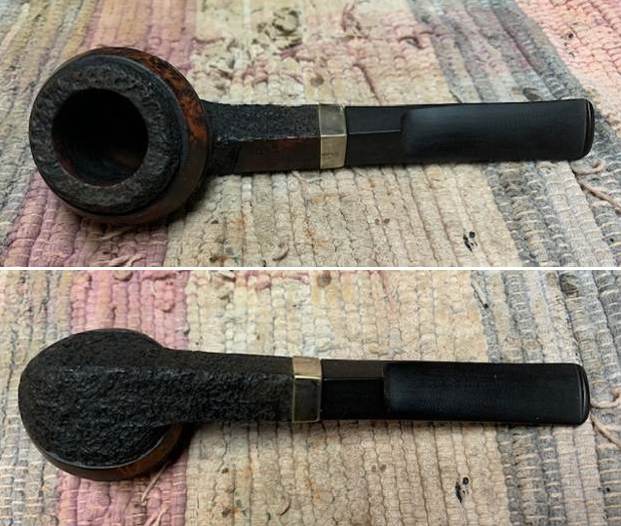
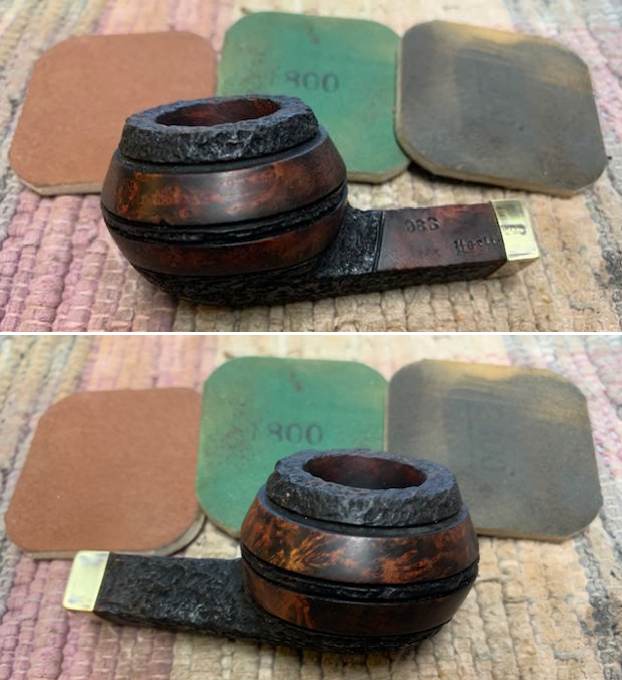
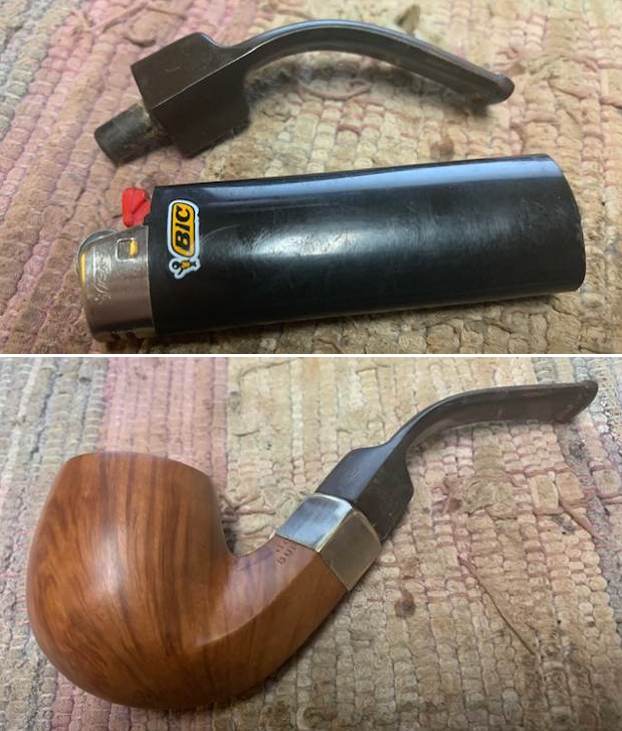
Next on the chopping block is a very pretty, unsmoked bent apple sitter from the French company, Courrieu, based in the Provençal town of Cogolin. A customer of mine wanted an attractive yet inexpensive pipe – he decided on this one, as it was both unsmoked but flawed, and therefore inexpensive. The markings were as follows: on the left side of the shank were the words Vieille Bruyere [over] Courrieu [over] Cogolin. The right side had no markings, but the left side of the stem had the image of a Gallic rooster – a national symbol of France and, subordinately, traditionally associated with Courrieu.Pipephil gave me a brief overview of the Courrieu brand:Ulysse Courrieu started carving pipes in Cogolin in 1802. Courrieu certainly is the oldest French briar pipe factory. The family corporate is managed (2009) by René Salvestrini who married a Courrieu daughter.

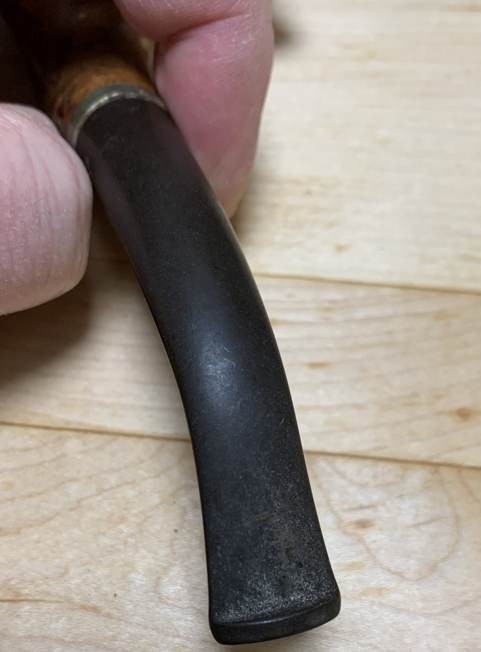
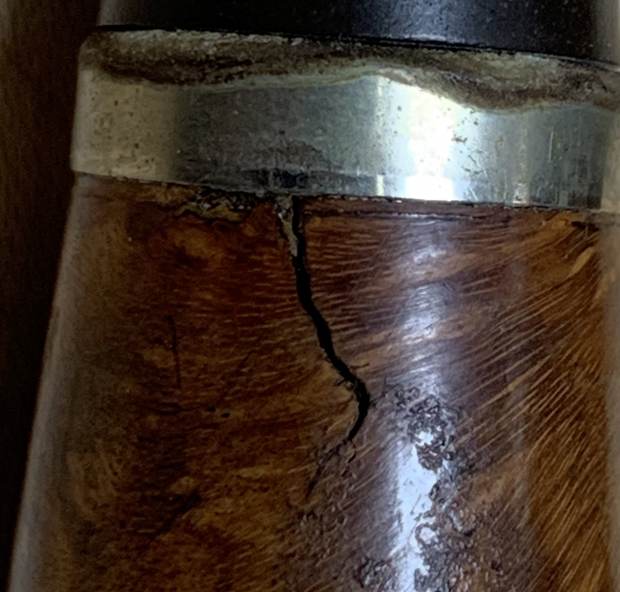
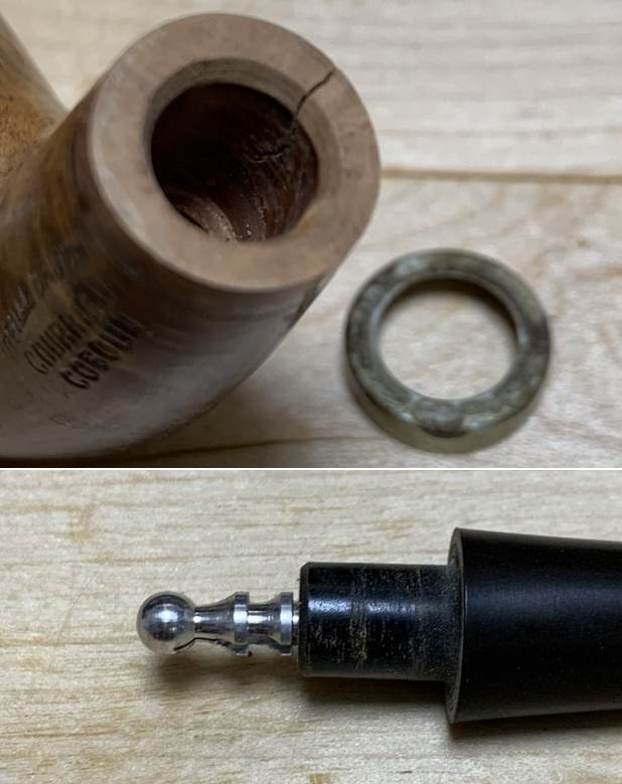
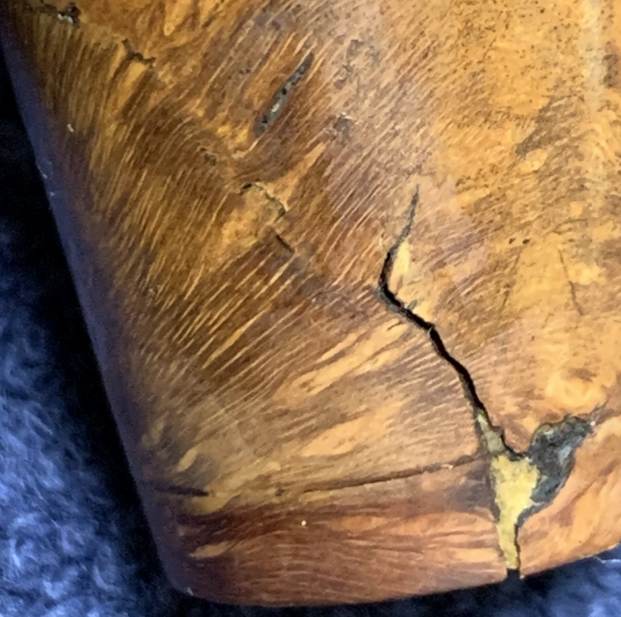
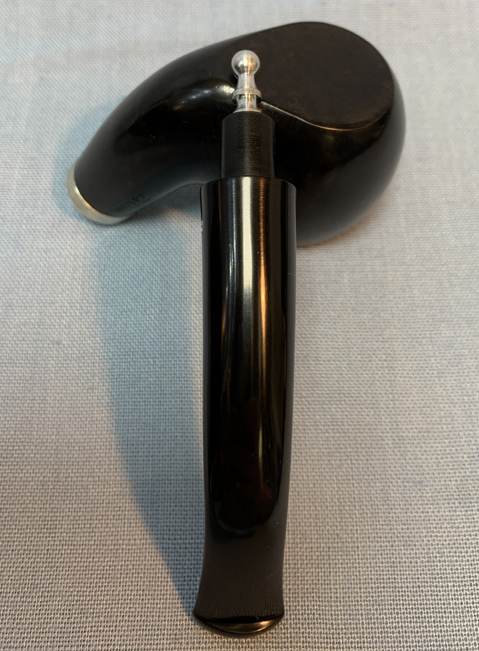
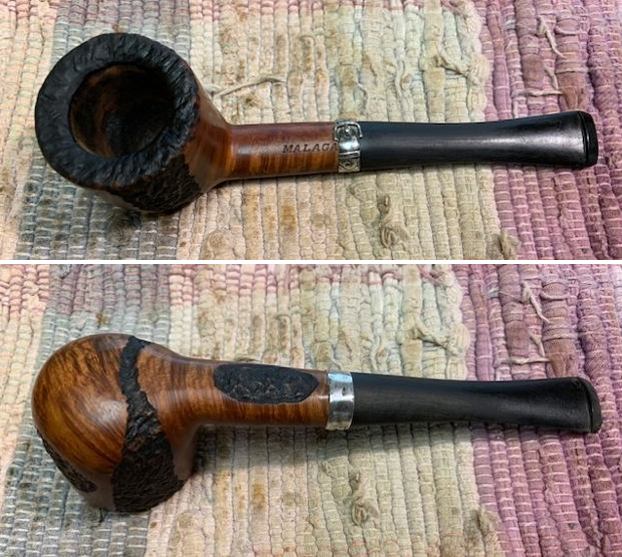
This pipe had some fine briar wood and looked like a well-made pipe. However, despite being unsmoked, this pipe still had some issues. The stem was clearly unused but had acquired some minor oxidation over time. The band around the shank was heavily tarnished; so much so that I was unsure if it was tarnished, or actually damaged, and if I would need a new band.There were also some minor abrasions and staining. Most notable, however, was a substantial crack in the shank, as shown in the photographs. The crack extended through the wood into the mortise and would require some careful work to repair successfully. On a pleasant note, the stinger was in immaculate condition. Other than buffing it with a microfiber cloth, it needed nothing else. One of my customer’s stipulations was to stain the pipe black. No problem as far as I was concerned. However, many people don’t quite understand what they will get when they request a black pipe. They often think that the pipe will end up as some sort of shiny lacquered item, but that’s not the way it works with me. I won’t use lacquer on pipes and I need to make it beautiful in other ways. Fortunately, my friend was aware of this and I endeavoured to make it as attractive as possible.

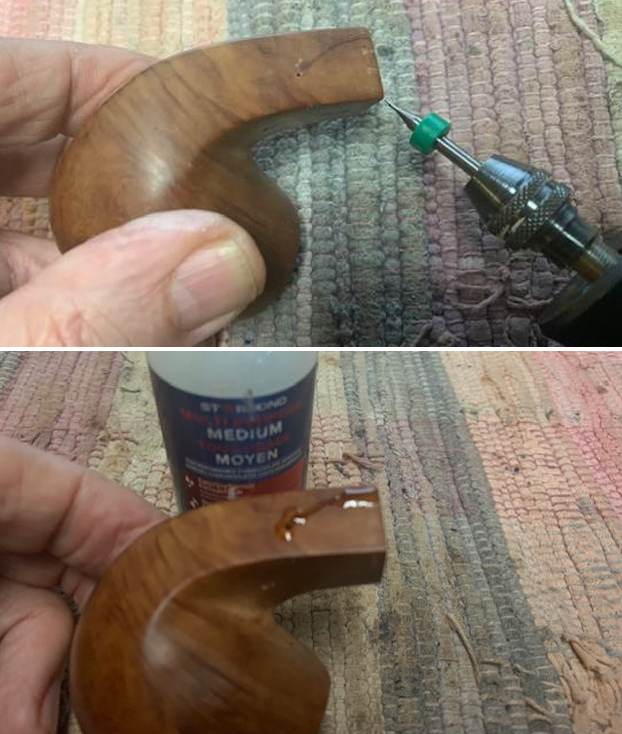
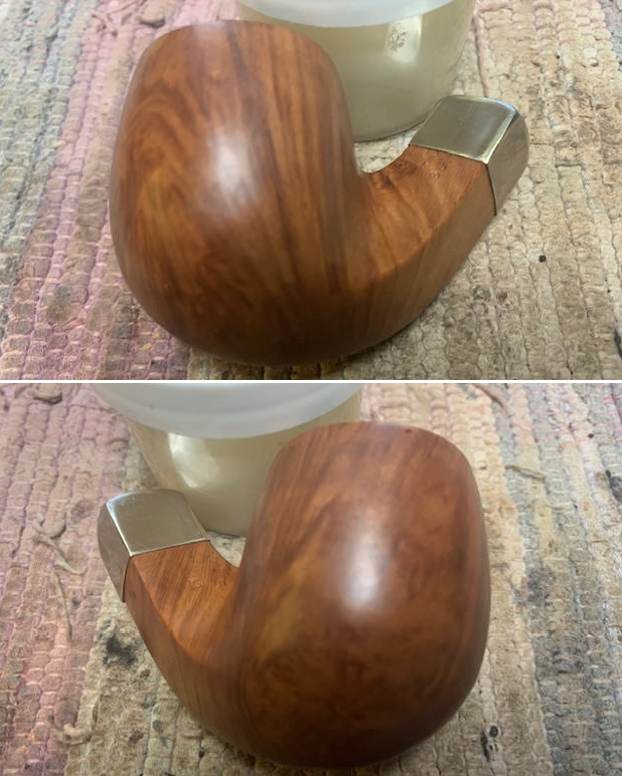
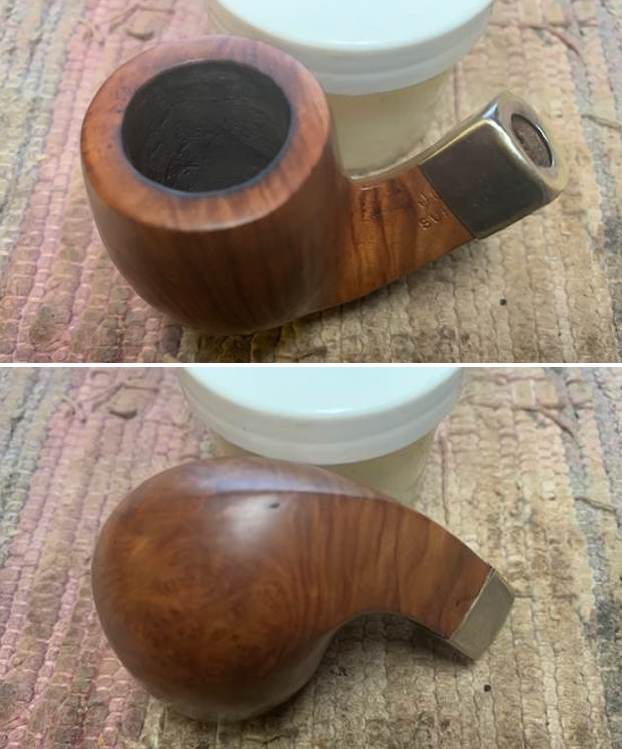
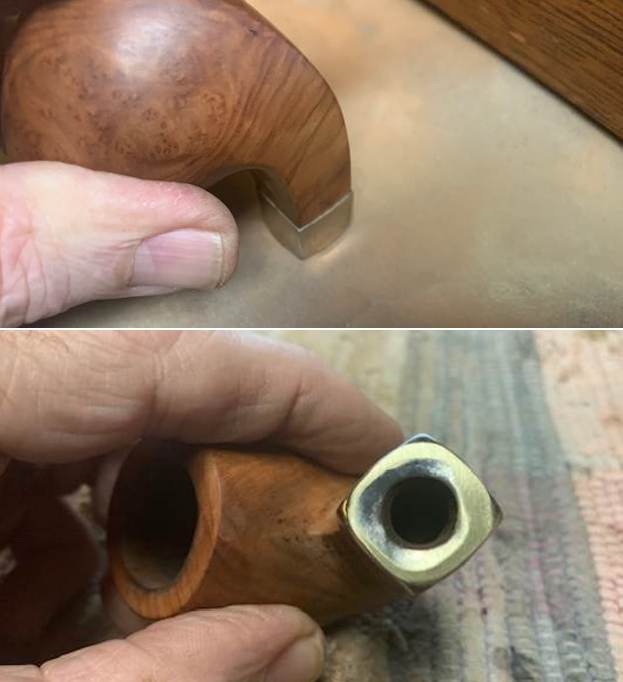
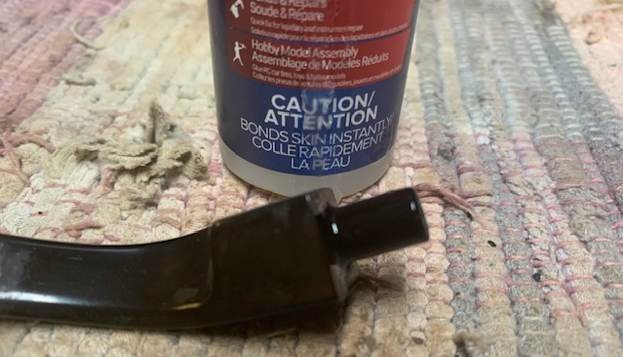
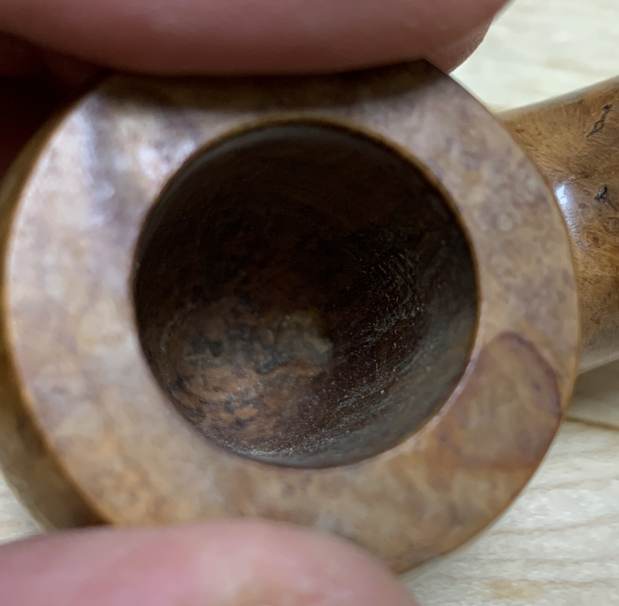
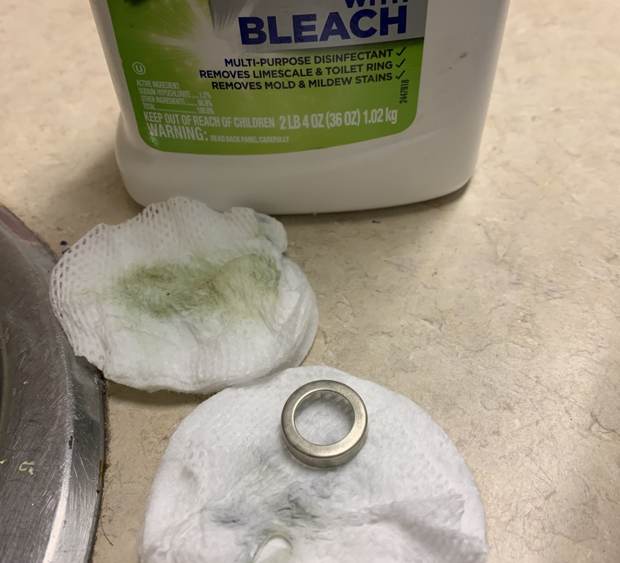
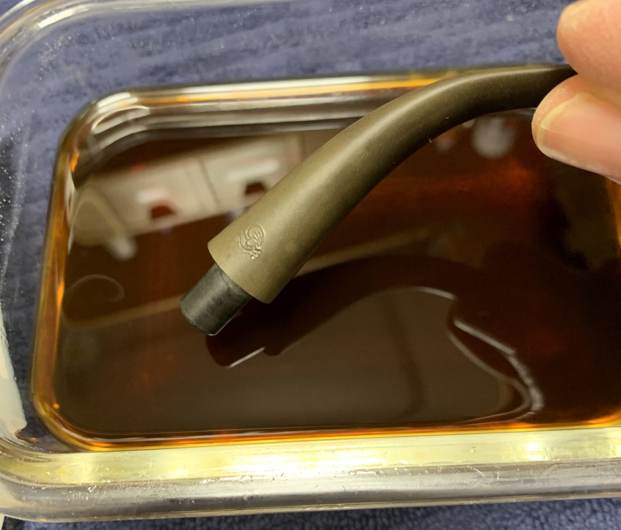
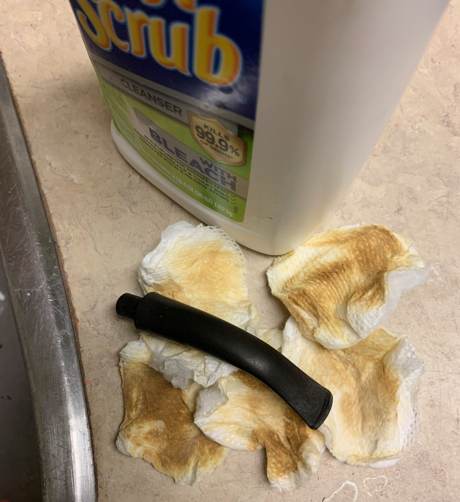
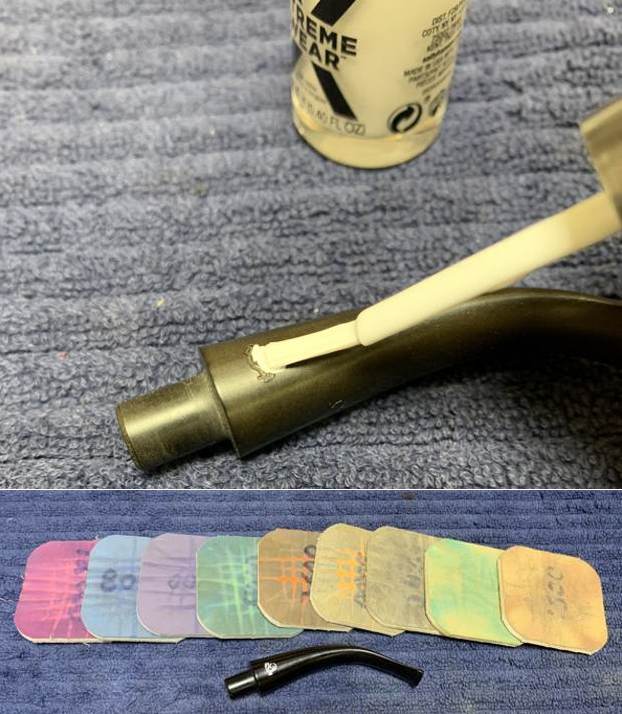
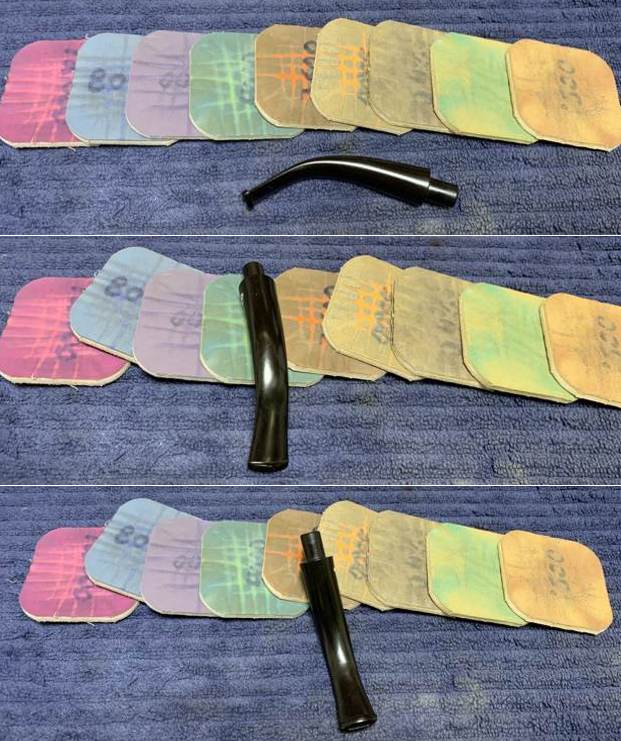
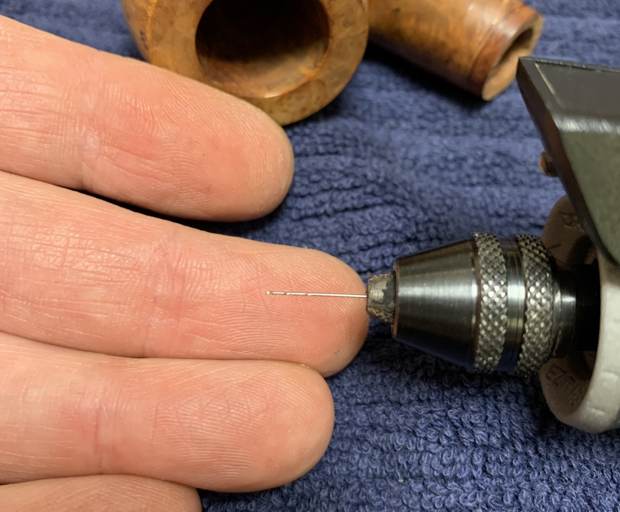
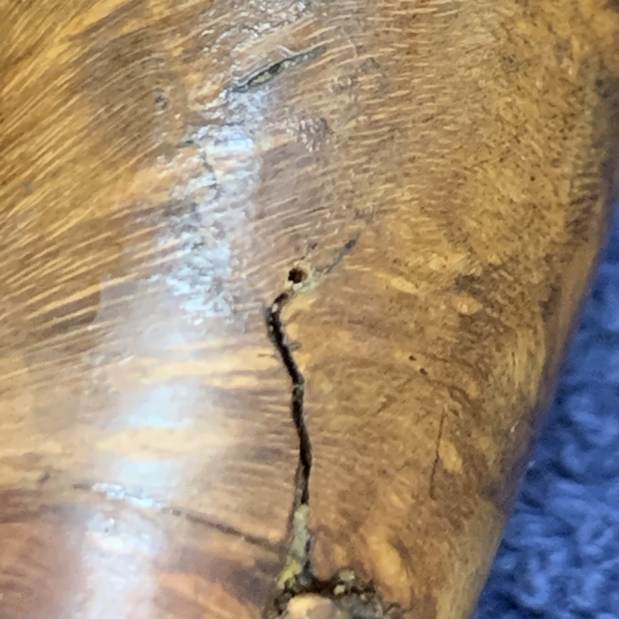
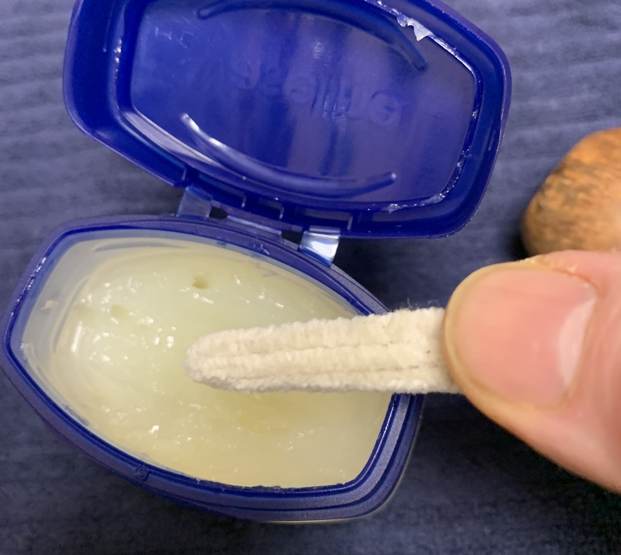
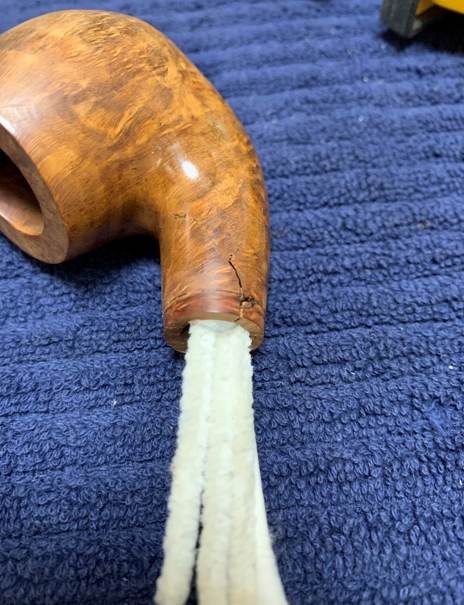
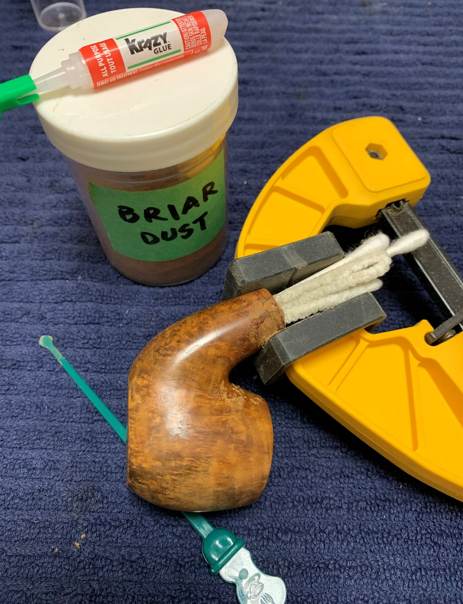
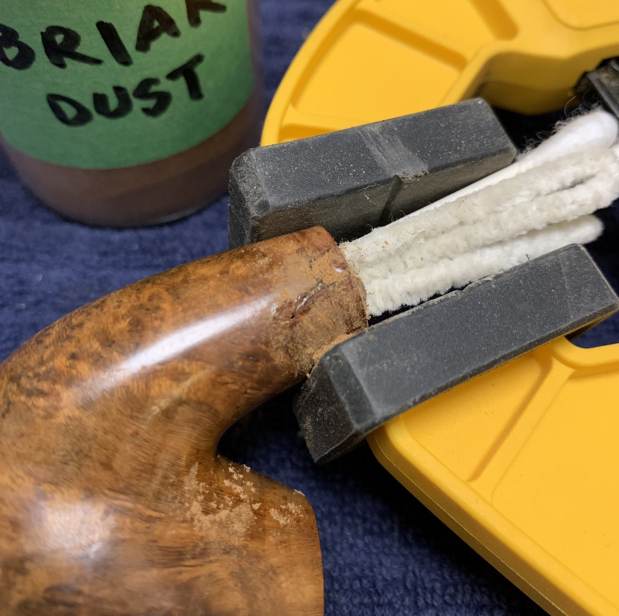
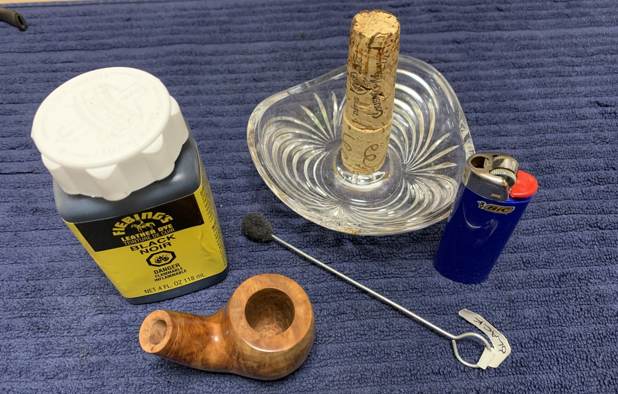
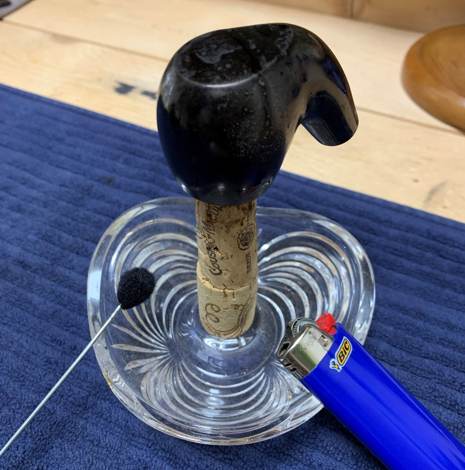
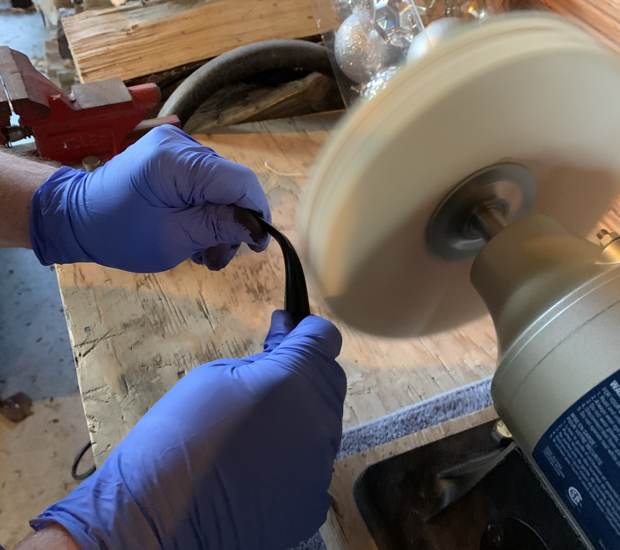
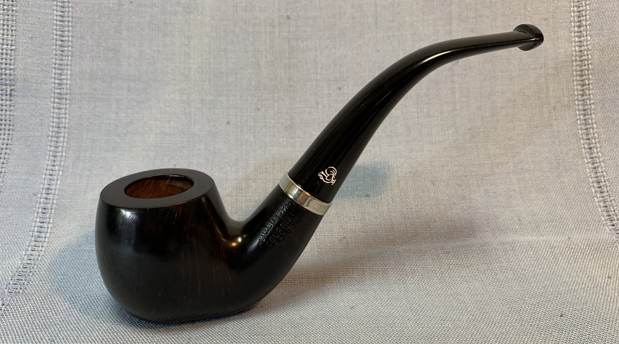
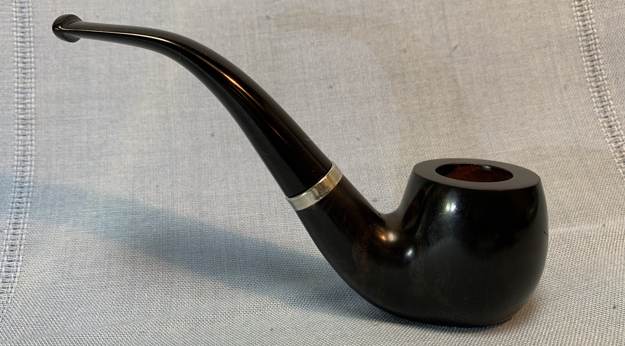
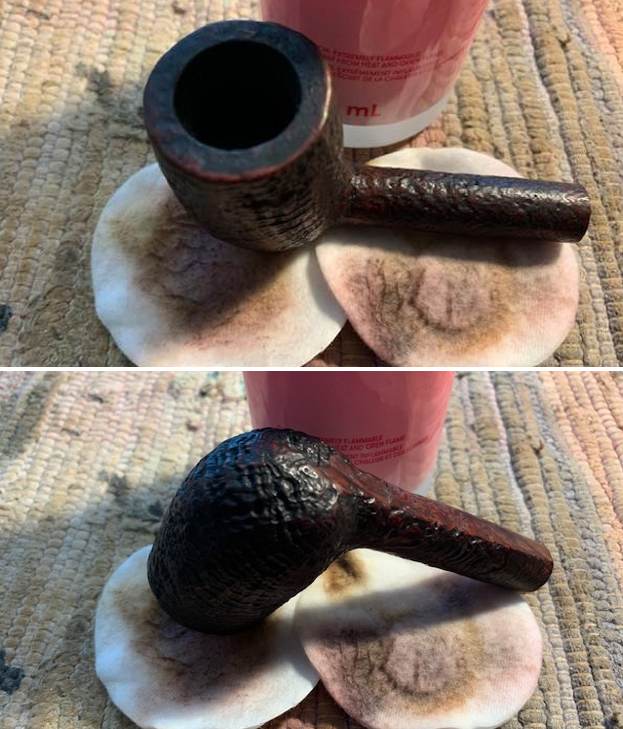
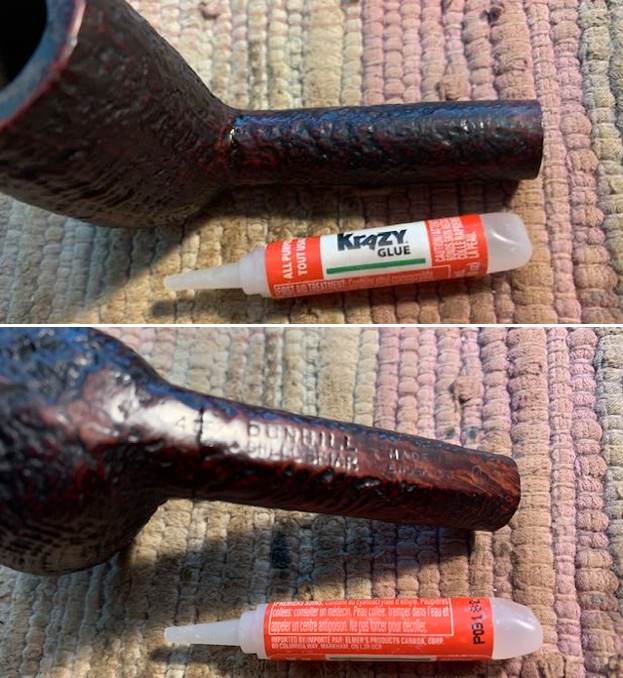
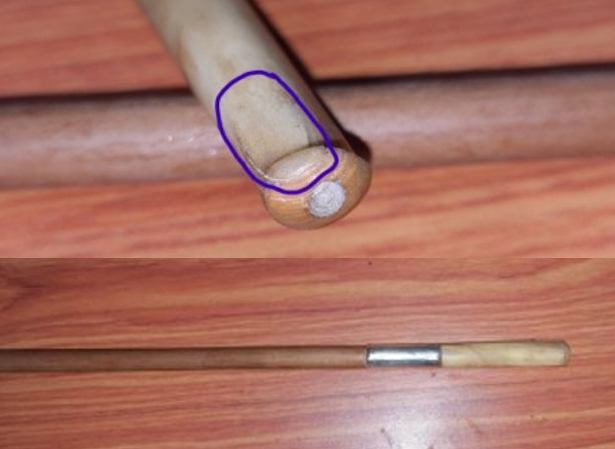
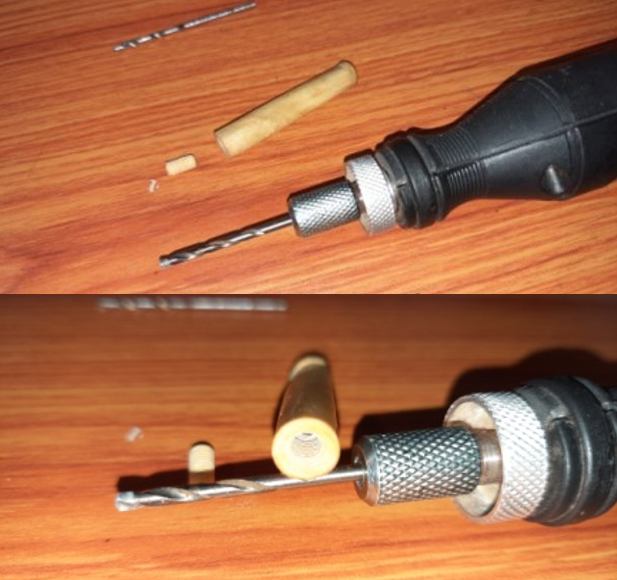
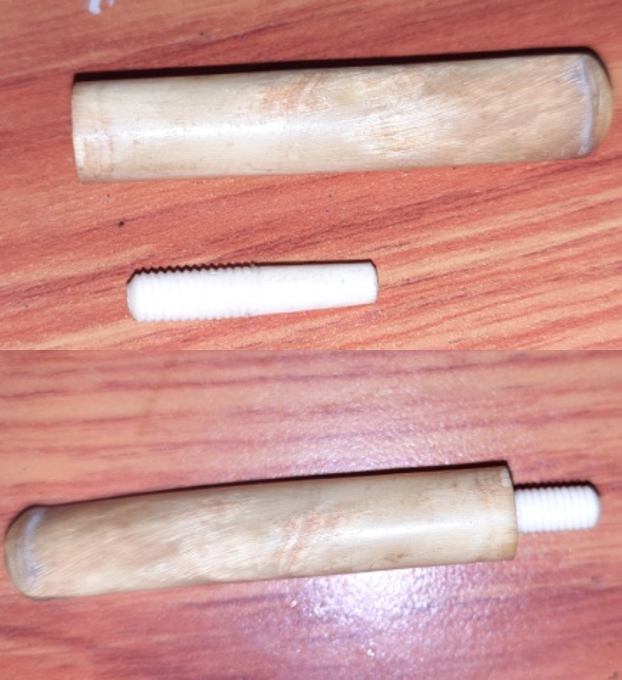
Now to work! As you saw, the band was pretty awful, so I brought out some SoftScrub on a cotton round and duly scrubbed away, taking care not to bend the soft metal. I was delighted at how well that turned out, as I had feared that the band was damaged beyond repair. Once clean, I buffed it with a jewelry polishing cloth and it looked like new. Hurray! Even though the stem had never been smoked, I ran a few pipe cleaners through it to ensure maximum cleanliness. There was some latent dust, but it was easily dealt with. I used some cotton rounds and Murphy’s Oil Soap to remove the top layer of oxidation. Then the stem went for an overnight bath in the Pipe Stem Oxidation Remover. The following day, I cleaned all of the de-oxidizing mess off with alcohol, pipe cleaners, et cetera. The oxidation had migrated to the surface and would be straightforward to remove. I scrubbed with SoftScrub on some cotton pads to remove the leftover oxidation. After this, I used some white nail polish and carefully painted the embossed Gallic rooster on the stem. I painted the area carefully and let it set for a few minutes. I then used all nine Micromesh pads (1,500 through 12,000 grit) to bring out the lovely black lustre on the stem. I also used Obsidian Pipe Stem Oil in between each pad scrubbing. Then I set the stem aside and moved on to the stummel. The next order of business was to scrub the outside of the stummel with some cotton rounds and Murphy’s Oil Soap. Despite being unsmoked, the stummel was reasonably dirty from sitting abandoned for decades.Then it came time to address the crack in the shank. To ensure that any crack repair is successful, I need to make sure that the crack won’t elongate. I took a micro-drill bit and drilled a hole through the wall of the shank into the mortise, at the very end of the crack. By doing this, I prevent the crack from growing any further. Look how tiny the drill bit is! You can also see the drilled hole at the end of the crack. I also removed the old yellow adhesive you can see below. I needed to apply cyanoacrylate adhesive to the crack to seal and repair it. First, however, I stuffed the mortise area with some folded pipe cleaners, coated with petroleum jelly. This would prevent the adhesive from dripping inside the shank and creating further problems. After that, I carefully applied a bead of adhesive to the tiny hole and the length of the crack. Finally, I clamped it shut and let it sit overnight to cure. This was a great success – obviously, the crack would always be there, but I was really pleased with how the repair looked. I then sanded the adhesive down, as well as the stummel. Just like the stem, I used all nine Micromesh pads (1,500 through 12,000 grit). Having completed that, it was time for the staining. First, I brought out my heat gun and spent a couple of minutes thoroughly heating the wood, so it would be as receptive as possible to the stain. I needed the black to penetrate well into the wood, to give the best results. I applied Fiebing’s Black Leather Dye with a cotton dauber. I flamed it with my Bic lighter, let it set, then coated it again with dye, flamed it again, and let that set too. I decided to let the pipe sit overnight. Upon the morrow, I stained and flamed the pipe another two times, always making sure I warmed the pipe with my heat gun first. This dye is alcohol-based, so I used isopropyl alcohol to wipe down the pipe and remove excess stain. I am very happy with the results. Then it was off for a trip to the buffer. A dose of White Diamond and a few coats of carnauba wax were just what this pipe needed. I think the black came out very well on this pipe. I know that the new owner will enjoy smoking it for many years to come. I hope you enjoyed reading the story of this pipe as much I as I did restoring it. The approximate dimensions of the pipe are as follows: length 4½ in. (114 mm); height 3½ in. (89 mm); bowl diameter 1¼ in. (32 mm); chamber diameter ⅝ in. (16 mm). The weight of the pipe is 1½ oz. (43 g). If you are interested in more of my work, please follow me here on Steve’s website or email me directly at kenneth@knightsofthepipe.com. Thank you very much for reading and, as always, I welcome and encourage your comments.

A Strangely Beautiful Preben Holm Hand Made in Denmark Westminster IIS with a cracked shank


Blog by Steve Laug

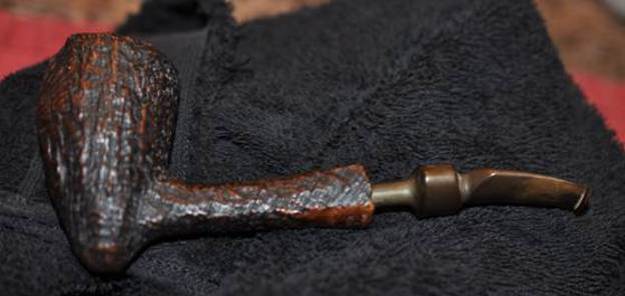
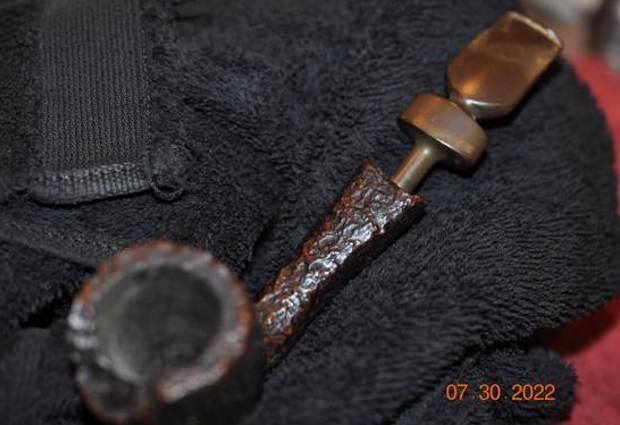
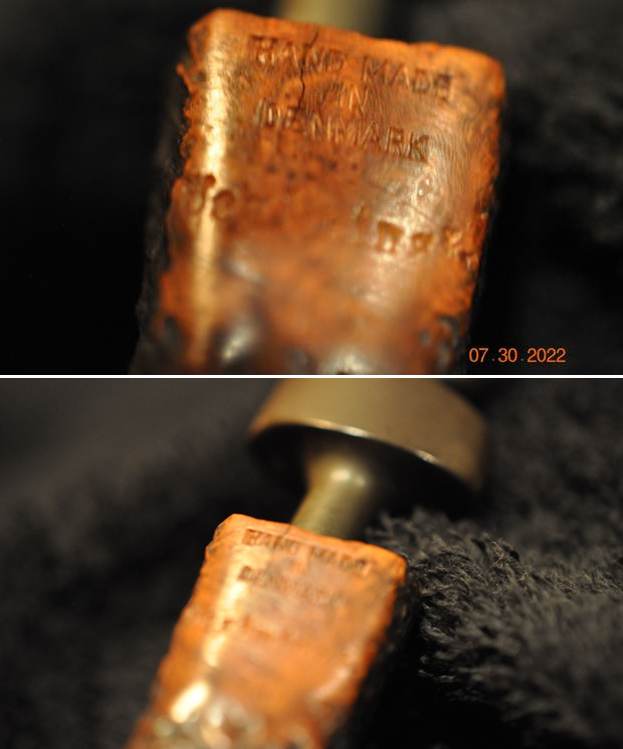
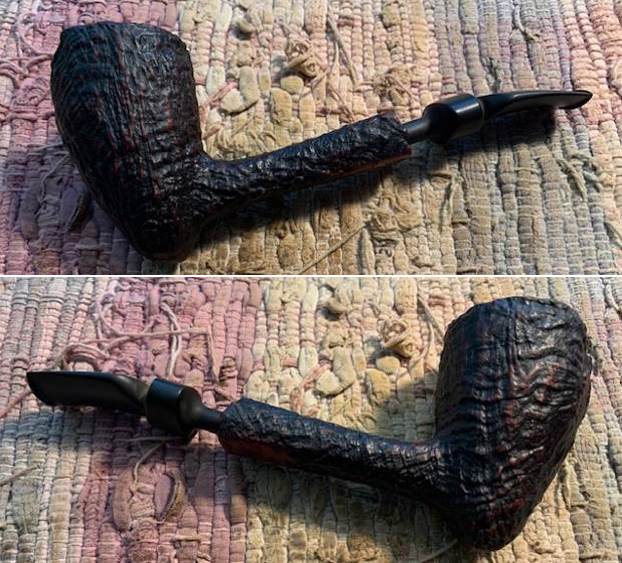
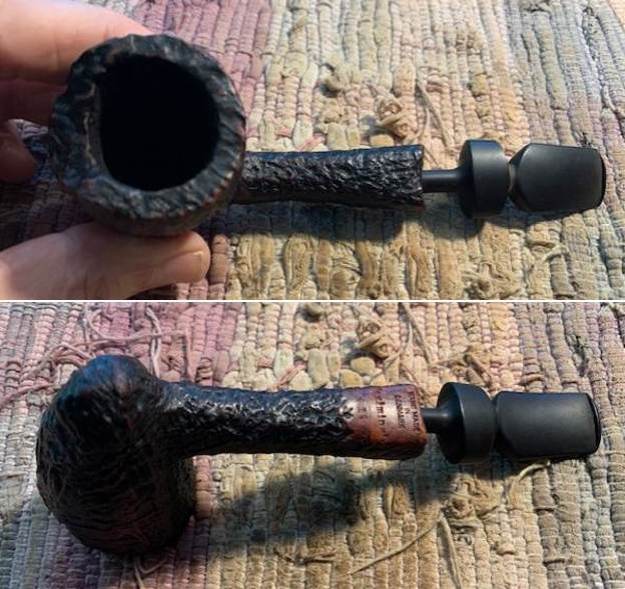
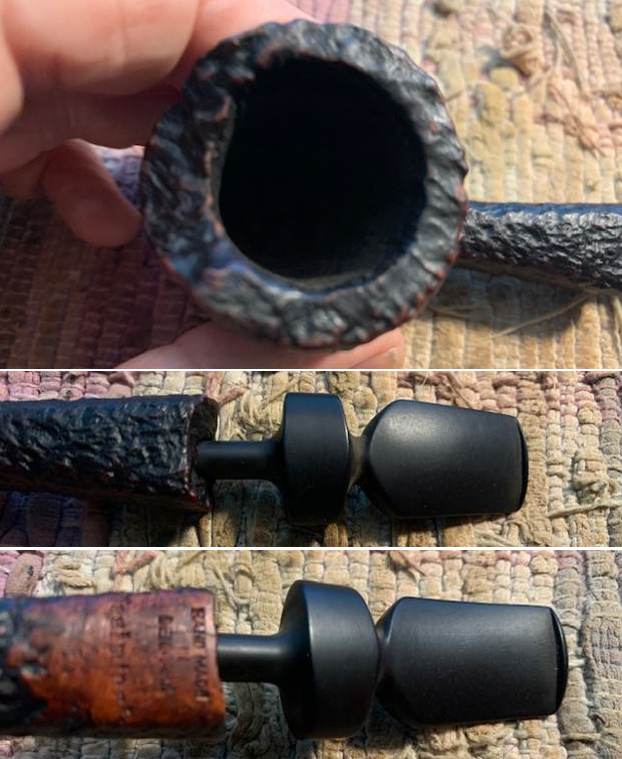
There is something about this strangely beautiful sandblast long shank Freehand says that is it another Preben Holm pipe. The unique shape that really chases the grain to give a sense of vertical and horizontal grain of the sandblast says Holm to me. The style of the stem is a bit of an oddity to me but it is the same width as the shank so it probably is original. This pipe was purchased on 06/13/22 from an estate in Fort Myers, Florida, USA. It is stamped Hand Made [over] In [over] Denmark [over] Westminster [over] IIS. The shape of the bowl with the angles of the carving are unique and the depth of the sandblast give a sense of fluidity to the pipe. The finish is stained with dark colours – black and brown that make it have a depth to its finish. It was filthy and the plateau rim and shank end was the same. The dust and debris is quite heavy around the sides of the bowl. The plateau rim top has a heavy lava overflow on the top and edges coming from a thick cake in the bowl. There is also a crack in the underside of the shank end that extends straight through the stamping. The oddly shaped turned vulcanite stem was heavily oxidized and calcified with light tooth marks and chatter on both sides ahead of the button. When I first saw it I was not even sure if it was the right stem but it is growing on me. Jeff took photos of the pipe before he started working on it. It really is a beauty. He took close up photos of the uniquely shaped bowl and rim top from different angles to show the condition of the bowl and the plateau rim top. You can see the thick cake in the bowl with the flakes of tobacco stuck to the walls. You can also see the overflow of lava on the rim top and on the inner edge of the bowl. He took photos surface of the vulcanite stem to show the oxidation, calcification and tooth chatter and marks on both sides ahead of the button. He took photos of the sides and heel of the bowl to show a deep and rugged sandblast that really makes the mix of grain stand out through the grime on the shank and the sides of the bowl. The geometric angles of the bowl shape are really quite stunning and interesting.  Jeff took photos of the stamping on the underside of the shank to capture it. It was clear and readable as noted above. You can also see the crack in the underside of the shank that goes through the N in Hand Made and E in Denmark in the stamp.  I turned to Pipedia to see what I could find out about the IIS brand (https://pipedia.org/wiki/IIS). The article there was shrouded in mystery and gave several options on the maker. I quote:

Pipes marked with IIS and sometimes IS are reported to be made by Karl Erik, and can be found on many private label pipes, such as the one below, marked “John Crouch” for the Scottish Merchant & Tobacconist out of Alexandria Virginia. Others have reported pipes marked IIS, or perhaps the IS in particular, were seconds made by Preben Holm.

I googled for further information and found a pair of IIS pipes on etsy that were sold with notes by the maker (https://www.etsy.com/listing/504709353/ii-s-hand-made-in-denmark-tobacco-pipes). I found it interesting and quote part of it as follows:

There are some mixed ideas about the II S trademark. Spoke to a few about it and than searched the web. Could have been made by Karl Erik while employed by Preben Holm, or sold in US only pipes or could have been made by Preben Holm. In any case they are a very unique pair. Nice works of art. Here is some info that was shared with me and I will include to help solve any mysteries.

KE’s old grading used numbers ascending from 4 to 1. The entirely hand made one of a kind pieces were stamped “Ekstravagant”. Quite simple.

But then there are the II S stamped pipes! (And furthermore seen so far II SM, I S, I M and I B.) Three fairy tales, often told:

  • II S stands for the initials of a pipe maker who worked for Preben Holm before he changed to KE. (Karl Erik)
  • II S pipes are a second brand of KE. Nonsense comparing the quality of II S and normal KE pipes!
  • II S was used when there was no space for stampings otherwise.

I believe that the pipe was made by Preben Holm during the height of his work on pipes. I wonder if it is possible that they were made in the period before he changed from stamping them with his name and to Ben Wade due to issues with his importer in the US. I am not sure but I think that works well in terms of the data.

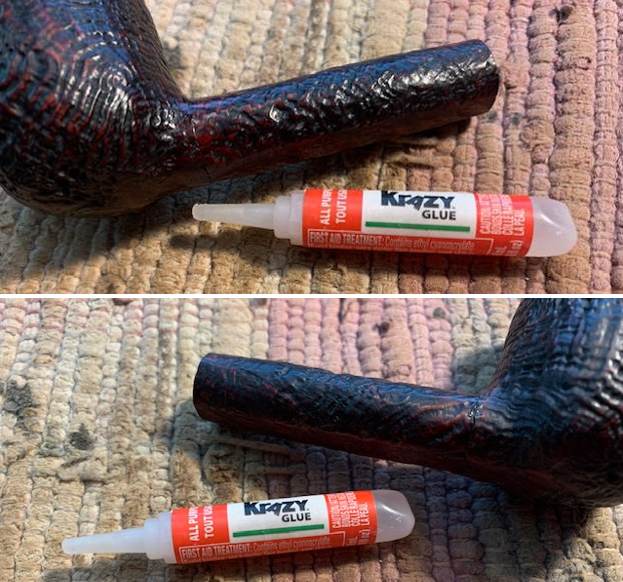
When I received it from Jeff this past week it did not look like the same pipe. It was clean and the finish had life. He reamed it with a PipNet pipe reamer and got rid of the cake. He cleaned up the reaming with a Savinelli Fitsall Pipe Knife so that we could see the walls of the bowl and assess for damage. It was in good condition. He cleaned the internals of the shank and stem with cotton swabs, pipe cleaners and alcohol. He scrubbed the exterior with undiluted Murphy’s Oil Soap and a tooth brush. He rinsed the pipe under warm water. He dried it off with a cloth and then let it air dry. He removed the Softee Bit and then scrubbed the stem with Soft Scrub and soaked it in Briarville’s Stem Deoxidizer. He rinsed it with warm water and dried it off with a soft cloth. It came out looking very good. The finish on the bowl and the rim top cleaned up nicely. I took pictures of the pipe to show how it looked when I unpacked it. I took some photos of the rim top and stem to show the condition of them both when the pipe arrived. Overall it looked good. The oxidation on the stem had come off very well and the tooth marks and scratches in the finish were visible. I took a photo of the stamping on the underside of the shank. It was clear and readable as noted above. I have drawn a red circle around the crack in the shank to help identify it.I removed the stem from the shank and took a photo of the appearance of the parts. You can see how large the pipe is in the photos.I started my work on this pipe by dealing with the crack in the underside of the shank. It is a tough one in terms of placement and not being able to band it as I normally would. I opened the crack slightly and spread some thin, clear CA glue into the crack in the shank and squeezed the crack together until the glue hardened. I carefully sanded off the repair with 220 grit sandpaper and then polished it with 3200-3600 grit micromesh to blend it in. It looked very good. I reduced the diameter of the tenon to relieve any pressure that it might put on the mortise when inserted. I know that a solid repair would have been the insertion of a tube in the shank – brass/stainless or Delrin. In the future that may need to be done but for now the repair I did actually looks very good and the reduction of the tenon a slight bit reduces the pressure it puts on the shank. Time will tell for sure.

Once the repair cured I worked some Before & After Restoration Balm into the surface of the briar. To get it into the nooks and crannies I used a shoe brush and worked it deeply into the grooves. The balm works to clean, enliven and preserve the briar. I let it sit for 10 minutes then buffed it off with a soft cloth. It is a beautiful pipe.   The rugged finish on the bowl looks amazing. It is a beautiful pipe. I set the bowl aside and turned my attention to the stem. I decided to square out the rounded edges of the stem sides on the saddle with 220 grit sandpaper. I flattened them out to match the flat sides on the shank. I think it actually worked very well. I sanded out the tooth marks and chatter on the stem surfaces with 220 grit sandpaper and they blended in quite well. I started the polishing of the stem with 400 grit wet dry sandpaper. I wiped it down with some Obsidian Oil and the stem was looking quite good.I polished the stem with micromesh sanding pads – dry sanding with 1500-12000 grit pads. I wiped the stem down after each pad with some Obsidian Oil. I finished hand polishing it with Before & After Pipe Stem Polish – Fine and Extra Fine. I rubbed it down with another coat of Obsidian Oil and let it dry. The stem really was beginning to look very good.   This is a beautiful Hand Made in Denmark Westminster IIS by Preben Holm with a unique oval shaped black vulcanite stem. I flattened out the curved edges of the oval stem to match the flat sides of the shank. It has a great look and feel. The shape fits well in the hand with the curve of the bowl and shank junction a perfect fit for the thumb around the bowl when held. I polished stem with Blue Diamond polish on the buffing wheel. I gave the sandblast bowl and plateau on the rim top and shank end multiple coats of Conservator’s Wax. I gave the stem multiple coats of carnauba wax. I buffed the pipe with a clean buffing pad to raise the shine. I hand buffed it with a microfiber cloth to deepen the shine. The pipe polished up pretty nicely. The rich combination of black and brown stains gave the sandblast and plateau depth. The pipe took on life with the buffing. The rich colour of the briar works well with the polished vulcanite stem. Have a look at it with the photos below. The shape, finish and flow of the pipe and stem are very well done. The dimensions are Length: 6 ½ inches, Height: 2 ¾ inches, Outside diameter of the bowl: 1 ½ inches, Chamber diameter: 1 inch. The weight of the pipe is 53 grams/ 1.87 ounces. This Danish Freehand is a real beauty. Thanks for walking through the restoration with me as I worked over another beautiful pipe. This one will be staying here for awhile so I can assess the effectiveness of the shank repair. Thanks for your time.

Finally Getting Around to Finishing up this Danet’s 904 Sitter


Blog by Steve Laug

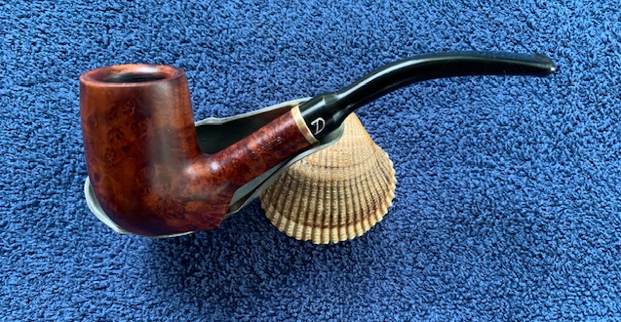
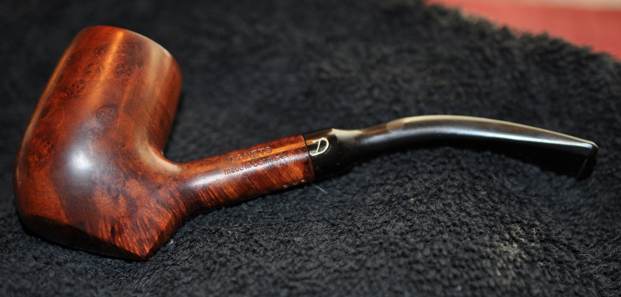
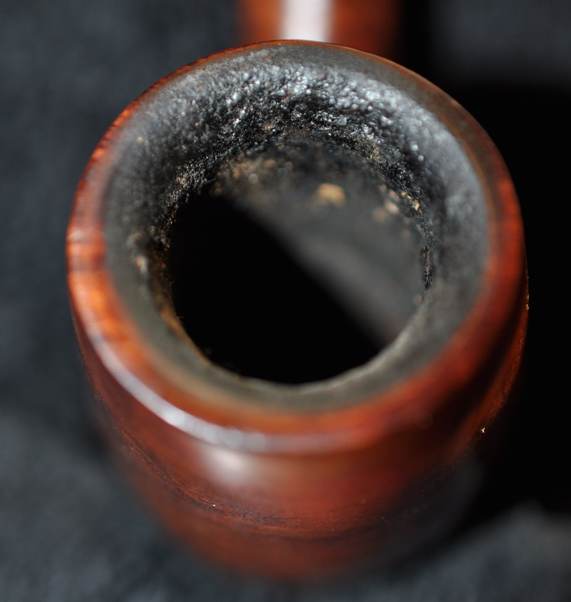
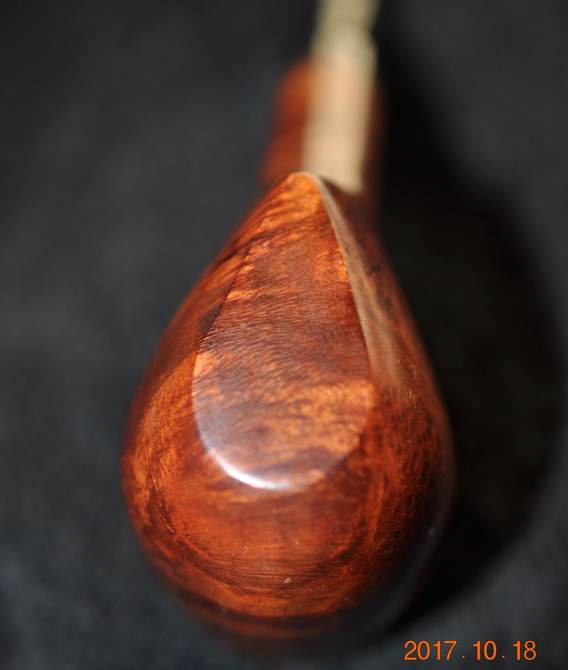
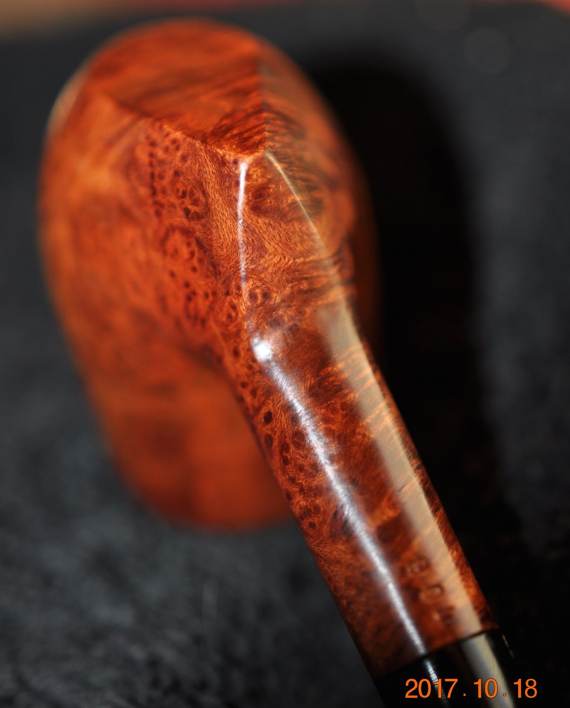
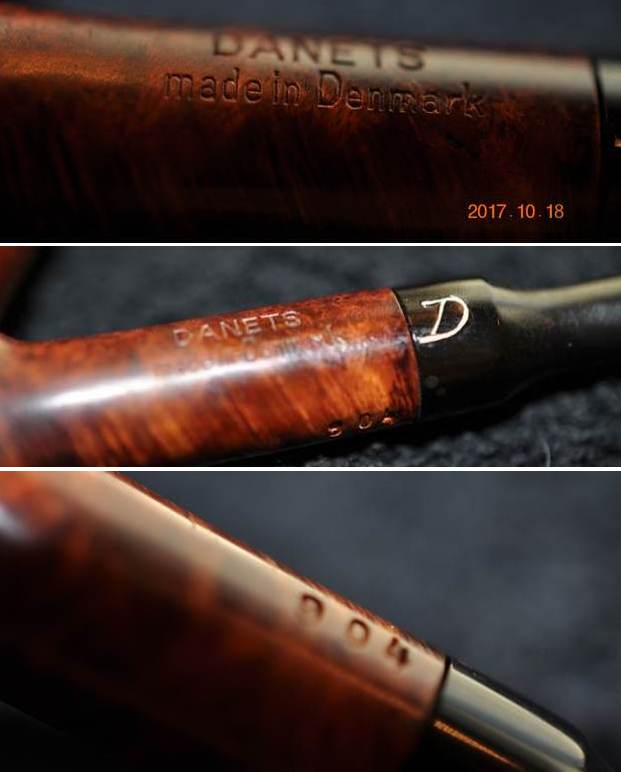
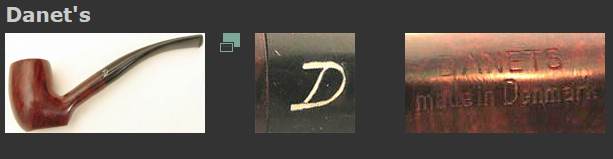
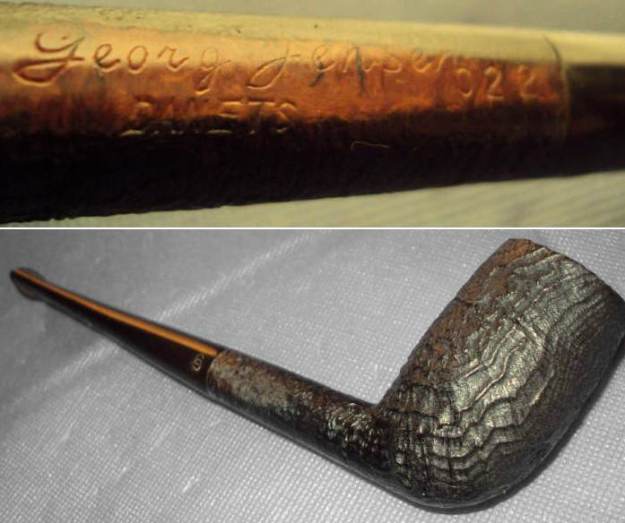
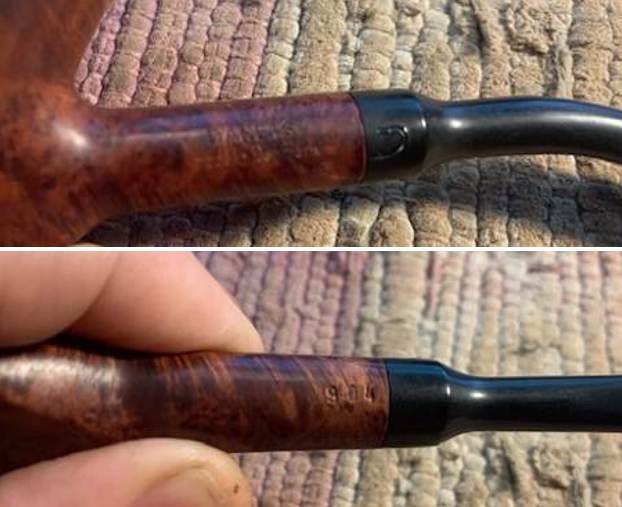
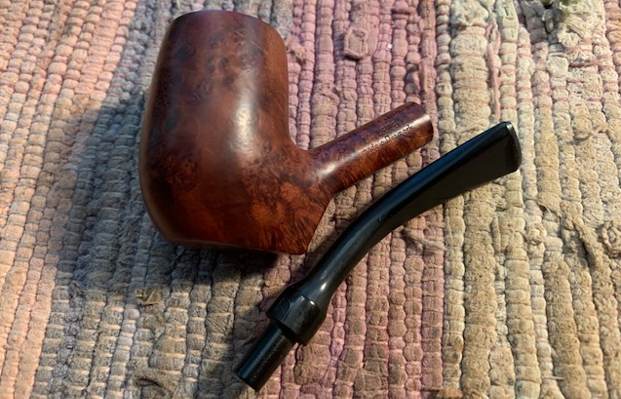
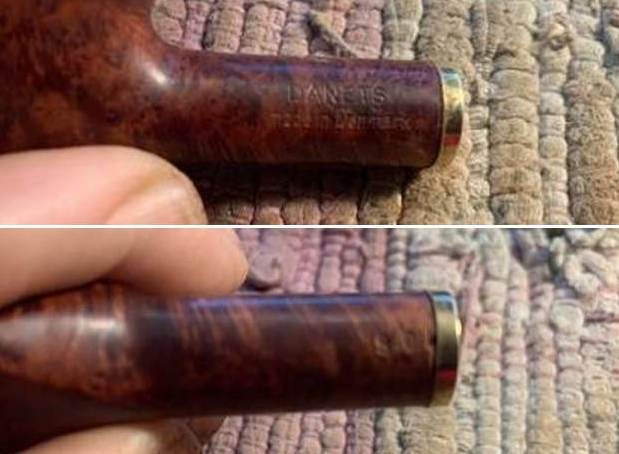
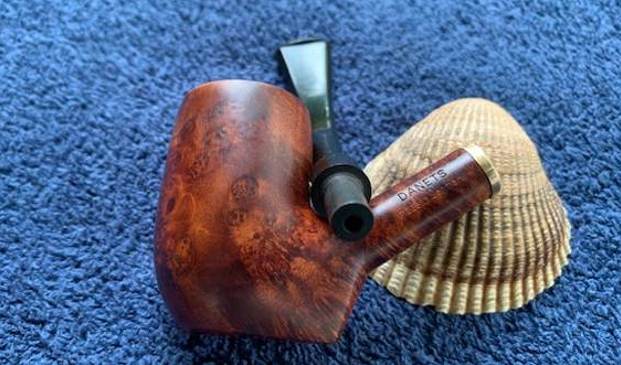
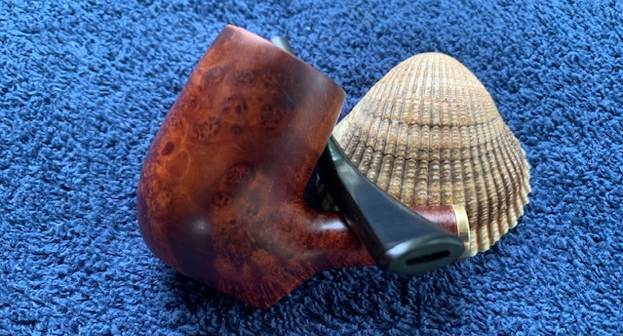
It seems I am finally getting some time to work on the backlog of pipes we have here. We have a large collection of pipes we have picked up over time and cleaned up and set aside to work on. This interesting piece was purchased from an antique store on 10/14/2017 in Pocatello, Idaho, USA and I am finally getting around to it. The pipe is Danish take on a bent Billiard with an extended flat heel that makes the pipe a sitter. It is stamped on the left side of the shank and reads Danets [over] made in Denmark. On the underside near the stem it has the shape number 904 stamped. The briar was dirty with grime ground into the finish. The bowl had a thick cake with an overflow of lava on the beveled rim top. The fancy saddle stem was lightly oxidized and had tooth marks and chatter on both sides ahead of and on the button surface. There was a cursive D on the left side of the saddle stem. There was also a crack in the shank on the left side that ran about ½ inch up the shank. He took photos of the bowl and rim top to show the condition of both. The bowl has a thick cake that overflows with lava onto the beveled inner edge of the rim. It is hard to know what the rim top and edges look like under the cake and lava. He took photos of the stem as well to show the tooth marks and chatter on the top and underside ahead of the button and on the button surface as well. He took photos of the grain on the heel of the bowl and the shank. The grain was quite nice and followed the flow of the pipe. I took photos of the stamping on the sides of the shank. The stamping was clear and readable on the shank sides. The D stamp on the stem side was also deep and readable. I looked up information on the brand before I started my work on it. I turned first to Pipephil’s site to get a quick overview (http://pipephil.eu/logos/en/logo-d2.html). I included a screen capture of the pipe pictured there. Interestingly, it is the same shape as the one that I am working on. The difference is the taper stem on the one in the photo. I also have included information in the sidebar below the picture. The information connects the Danets to Georg Jensen. I quote:Brand imported from Denmark to USA by BRANDT IMPORT. Sometimes stamped DANETS. Probably a label from Georg Jensen as the photo below would attest these stampings.

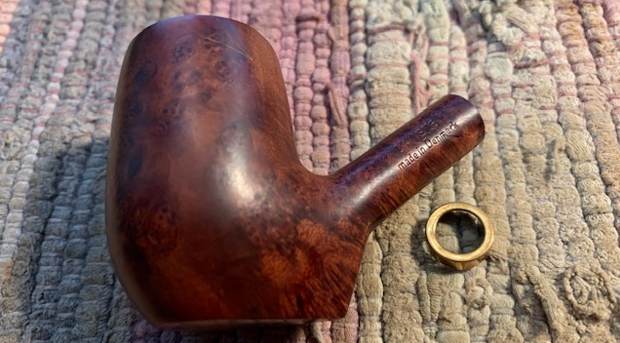
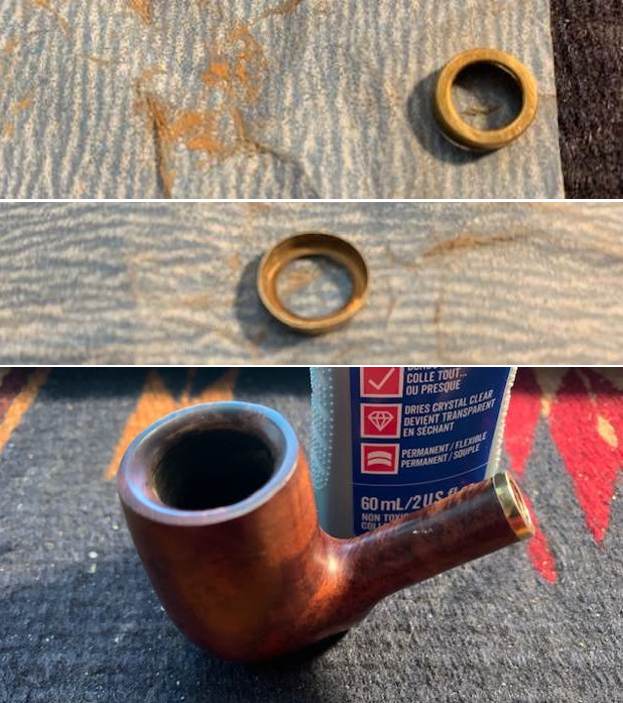
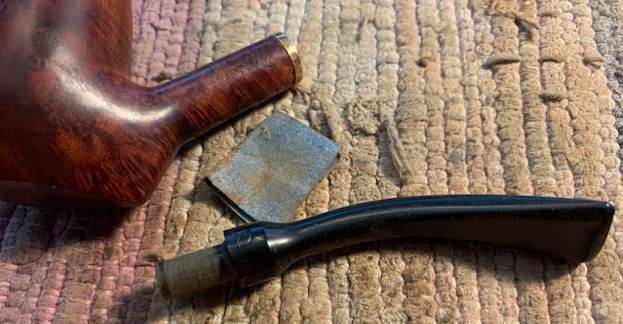
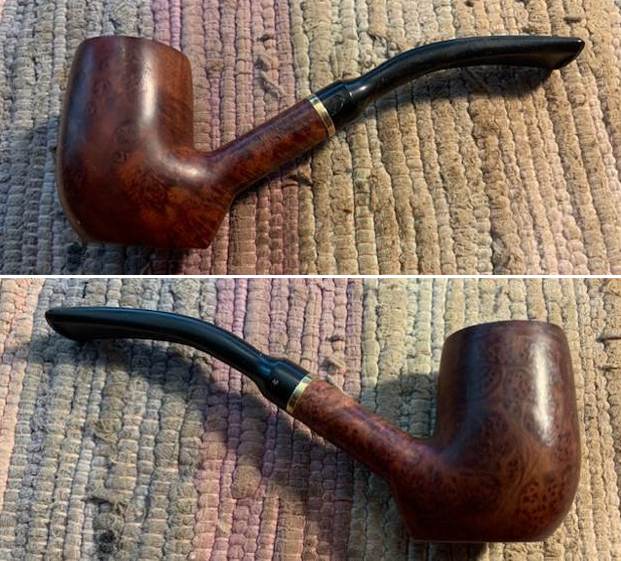
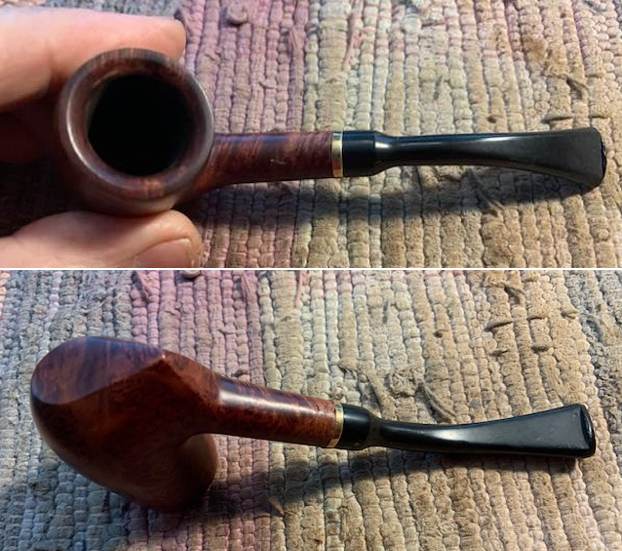
I followed one of the links in the side bar to the photo below. The link with Georg Jensen and Danets is clearly shown in the photo. With that information, I turned to work on the pipe itself. Jeff had thoroughly cleaned up the pipe. He reamed the pipe with a PipNet Pipe Reamer and cleaned up the remnants with a Savinelli Fitsall Pipe Knife. He scrubbed the bowl with undiluted Murphy’s Oil Soap with a tooth brush. He rinsed it under running warm water to remove the soap and grime. The inner edge of the rim and top cleaned up very well. He cleaned out the inside of the shank and the airway in the stem with alcohol, cotton swabs and pipe cleaners. He scrubbed the exterior of the stem with Soft Scrub to remove as much of the oxidation as possible. He soaked it in Before & After Pipe Stem Deoxidizer and rinsed it with warm water. The vulcanite stem was clean and had light tooth marks and chatter on both sides ahead of the button. There was a Danets D logo stamped on the left side of the stem. I took photos of the pipe before I started my work on it. It was an amazing looking pipe. I took photos of the rim top and bowl as well as the stem to give a sense of the condition of both. The rim top and edges looked very good. The stem cleaned up well and the tooth marks on the top and underside ahead of the button were very light.      I took photos of the stamping on the sides of the shank. They are readable as noted above. The D on the stem side lost all colour but it is deep and readable.    I took the stem out of the shank and took a photo of the overall look of the pipe. It is a unique looking pipe with the oddly shaped flat bottom on the bowl.I started my work on the pipe by addressing the hairline crack in the left side of the shank. I found a brass band that was a perfect fit on the shank. The depth of the band was too much and when on the shank covered the edges of the stamping on the shape number on the underside.I used a piece of 220 grit sandpaper to sand the underside of the band and reduce the depth. I took half of the depth off and checked the fit regularly to make sure it was thin enough to not cover the stamping on the underside of the shank. Once I had the depth correct I used a tooth pick to put white glue on the cracked shank and inside of the band and pressed it into place on the shank.   I took photos of the freshly fitted band. The glue had cured and you can see the stamping is not affected by the placement of the band.    With the band binding together the crack the tenon was too big for the mortise. I sanded the tenon with 220 grit sandpaper to reduce the diameter of the tenon so that it fit the mortise. I put the stem in the shank and took photos of the new look of the pipe. I polished the briar with micromesh sanding pads – dry sanding it with 1500-12000 grit pads. I wiped the briar down with a damp cloth to remove the sanding dust. The briar really took on a rich shine with the polishing.  I rubbed the bowl down with some Before & After Restoration Balm. I worked it into the briar with my finger tips to clean, revive and preserve the wood. It really brings the grain alive once again. I let it sit for 15 minutes then buffed it off with a soft cloth. The grain really pops at this point in the process.   I set the bowl aside and turned my attention to the stem. I filled in the small tooth marks (almost pin prick marks) next to the button on each side of the stem with clear super glue. Once it cured I sanded them smooth with 220 grit sandpaper and started the polishing with 400 grit wet dry sandpaper.     I polished the stem with micromesh sanding pads – 1500-12000 grit pads. I wiped the stem down after each pad with a cloth impregnated with Obsidian Oil. I finished the polishing with some Before & After Pipe Stem Polish – both Fine and Extra Fine. The stem looked very good.  I touched up the white stamp on the “D” on the left side of the stem with white acrylic fingernail polish. I worked it into the depth of the stamp with a tooth pick. Once it dried, I scraped off the excess material and polished the stem.    As always I am excited to finish a pipe that I am working on. I put the Georg Jensen Made Danet 904 Sitter back together and buffed it with Blue Diamond on the buffing wheel. I gave the bowl and the stem multiple coats of carnauba wax. I buffed the pipe with a clean buffing pad and hand buffed it to raise the shine. It is fun to see what the polished bowl looks like with the grain popping around the bowl and shank. The thin brass repair band adds a touch of bling to the pipe. The polished vulcanite saddle stem brought the combination to a beautiful close. It is light and well balanced. Have a look at it with the photos below. The dimensions are Length: 5 inches, Height: 1 ¾ inches, Outside diameter of the bowl: 1 inch, Chamber diameter: ¾ of an inch. The weight of the pipe is 27 grams/.99 ounces. It is a beautiful pipe and one that will be on the rebornpipes store in the Danish Pipe Makers section. If you are interested in adding it to your collection let me know. Thanks for walking through the restoration with me as I worked over this pipe. Thanks to each of you who are reading this blog. I want to keep reminding us of the fact that we are not pipe owners; we are pipemen and women who hold our pipes in trust until they pass on into the trust of the next trustee.

Restoring a Previously Repaired Cracked Shank on a Dunhill Shell Briar 40 Lovat


Blog by Steve Laug

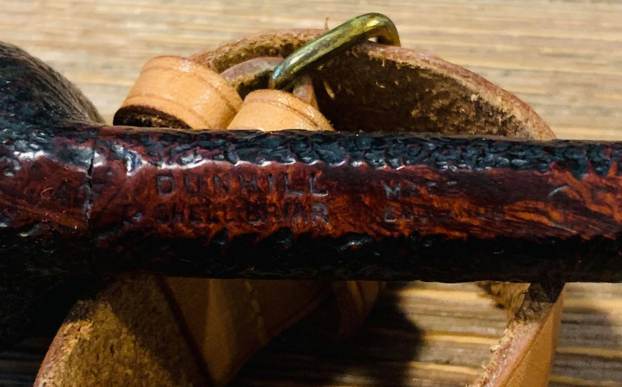
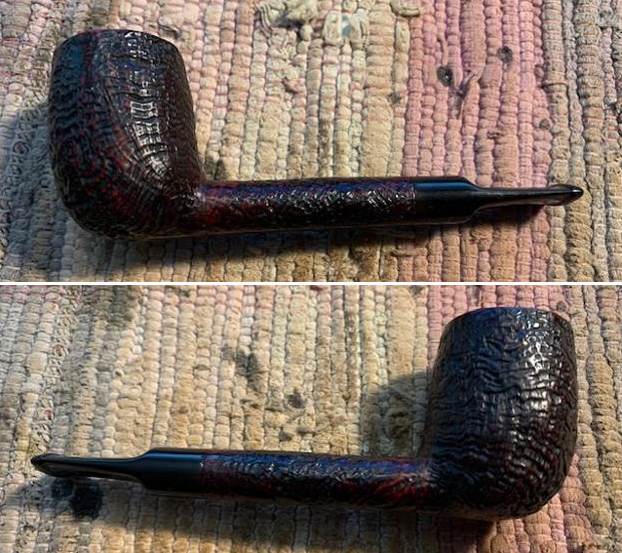
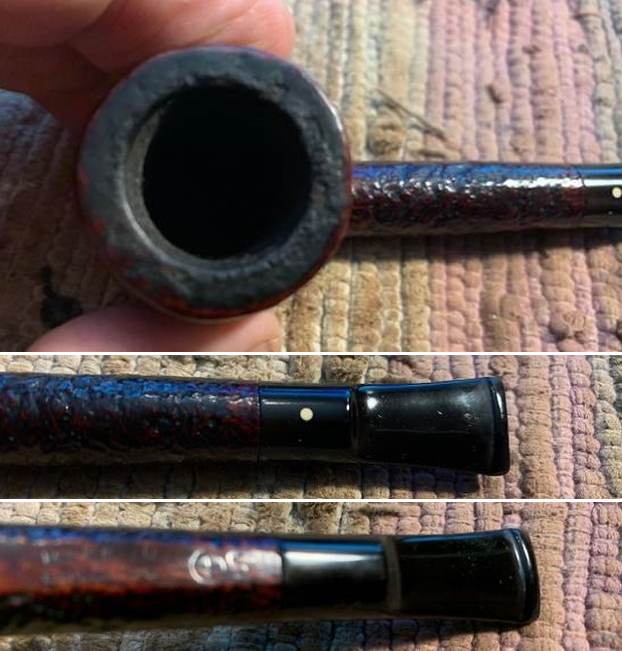
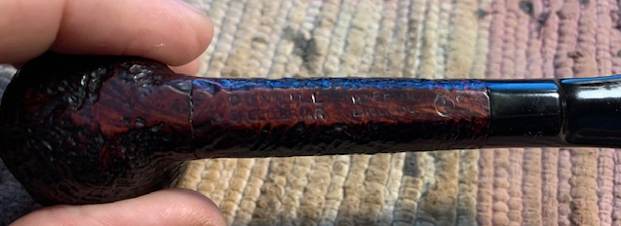
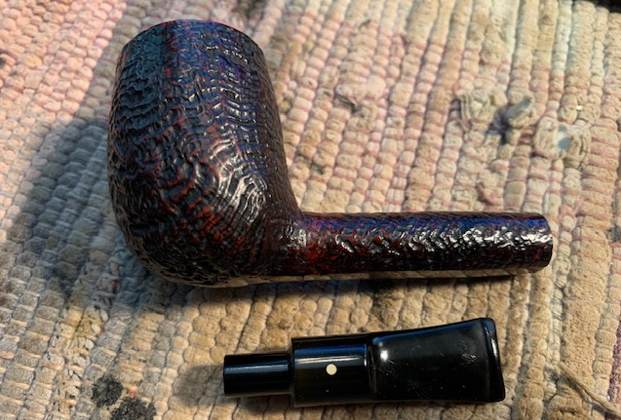
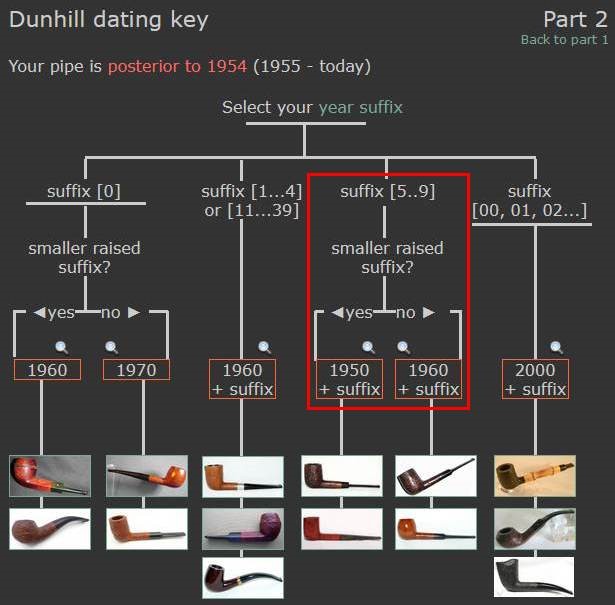
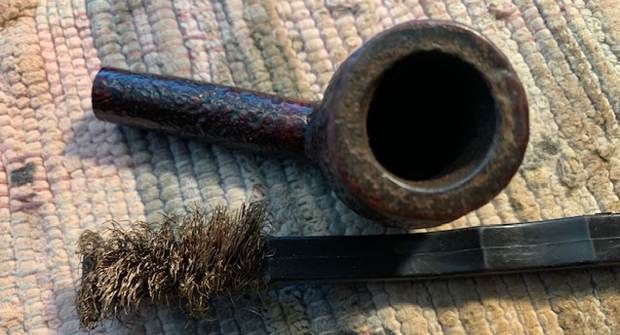
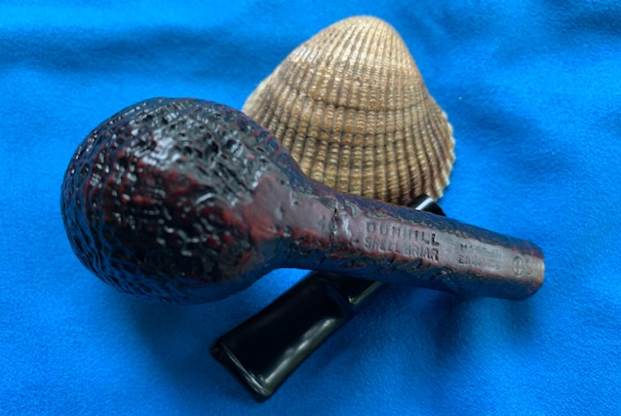
The next pipe on the table is a Dunhill Group 4S Shell Briar Lovat that caught my eye. It has a two digit the shape number that I will define below. I purchased this pipe from a fellow on Facebook. He said that the shank had been snapped at the bowl and had been well repaired. There was a tube in the shank that joined the two parts. He sent me two photos of the pipe to show the overall look and also the repaired cracked shank. I was interested in adding this shape to my own collection so I was anxious to see it and work on it. This Dunhill Lovat is stamped on the heel of the bowl and underside of the shank. On the heel it reads 40 followed by Dunhill over Shell Briar. Next to that it is stamped Made in England6. A circle 4 followed by S is stamped on the right side next to the bowl/shank junction. The numbers and stamping tell me that the pipe is a Shell Briar (S) and the size is a Group 4. The 2 digit shape number makes it an older pipe. The date stamp 6 follows the “D” of England in the Made in England stamp. The finish was very shiny like it had a shellac coat on it and it seemed to be even over the lava on the rim top. The sandblast was deep and rugged looking. The bowl had a moderate cake in the bowl and lava overflowing onto the sandblast rim top. There was some shellac over the grime. The inner and outer edges of the bowl looked good and the bowl was in round. The shank repair is solid and fairly tight against the bowl. It looks good but with a lens there are gaps in the repair to the crack. The stem was quite clean but had tooth marks and chatter on both sides ahead of the button. The button itself appeared to be in good condition. I took photos of the pipe before I started my work on it. I took photos of the bowl and rim top to show the condition. You can see the cake in the bowl and the lava on the rim top and edges. The lava is thick and seems to have protected the edges and top. The stem was clean but has tooth marks and chatter on both sides ahead of the button.I took a photo of the stamping on the underside of the shank. It is clear and readable as noted above. You can also see the repaired crack near the heel of the bowl.I removed the stem from the shank and took a photo of the parts to show the overall look of the pipe. The sandblast is very deep and rugged. Now it was time to begin to work on the stamping on the pipe. Because I had just finished working on a few Shell Briar in the past I used the information that I had dug up on that one. I quote below.

Pipedia had some great information on the Root Briar finish and dates and how the finish was made (https://pipedia.org/wiki/Dunhill#Bruyere). The first quote below give the short version of the finish. I quote from both below.

Shell – A deep craggy sandblast with a black stain finish (usually made using Algerian briar) – the color of the stain used has varied over the years. Although there is some doubt as to them being the first to sandblast pipes, Dunhill’s Shell pipes, and the sandblasting techniques developed to create them are considered one of Dunhill’s greatest and most lasting contributions to the art of pipe making.

The documented history of Dunhill’s inception of the Shell is largely limited to patent applications — there are no catalog pages or advertisements promoting blasted pipes at the time. The preliminary work on the English patent (No. 1484/17) was submitted on October 13, 1917. The patent submission was completed half a year later, on April 12, 1918, followed by the granting of the English patent on October 14, 1918. This was less than a month before the end of The Great War on November 11th.

In 1986 Dunhill released a line of premium Shell finish pipes – “RING GRAIN”. These are high-quality straight grain pipes which are sandblasted. Initially only Ring Grain, but now in two different finishes. In 1995 the “Shilling” was introduced with Cumberland finish – it is an extremely rare series. These pipes exhibit a deeper blast characteristic of that of the 1930’s – mid-1960’s (and the limited ‘deep blast’ pipes of the early 1980s) and show a fine graining pattern. These are considered the best new Dunhills by many enthusiasts today and are very rare. The finish is sometimes described as tasting like vanilla at first, with the taste becoming more normal or good as the pipe breaks in.

With that information clear for me I wanted to identify the shape number and try to pin that down (https://pipedia.org/wiki/Dunhill_Shape_Chart). I turned to the section on the older 2 digit Shape Numbers and read it. I quote it below.

Early Days – 2 digits/letters – The original skus/model numbers from the 1920’s until the early 1970’s stood for very specific shapes and bowls. For example, the codes 31, 34, 59, 111, 113, 117, 196, LB, LBS… were all different types of Billiard shaped pipes and there were about 50(!), such codes for the Billiard shape alone. On top of those are a large variety of other shapes.

With the information on the 2 digit stamp not making clear enough the meaning of the number I turned to another link on Pipedia (https://pipedia.org/wiki/Dunhill_Shapes_List) to a shape list that Eric Boehm put together for Dunhills.

I knew that the pipe shape number locked in a time period between 1920-1970 – a large time span that I needed to narrow down more clearly. I turned to another link on Pipedia (https://pipedia.org/wiki/Dunhill_Shapes_List) to a shape list that Eric Boehm put together for Dunhills. I copied the four 2 digit numbers on Lovats from the list. The shape 40 was in the list.

Lovats:

37 Lovat, short, thick, saddle 1928 11

38 Lovat, long shank, saddle bit 3 4¾” 1928, 50, 60, 69 11

40 Lovat, long shank, saddle bit 4 5″ 1928, 1950, 1969 11

481 Lovat, long shank, saddle bit 1 5″ 1950, 1969 11

I turned next to dating the pipe. There is a 6 following the D in ENGLAND on the underside of the shank. The 6 is the same size as the D in England. I turned to the dating chart on Pipephil to pin down the date on this pipe (http://pipephil.eu/logos/en/dunhill/cledat-en1a.html). I did a screen capture of Part 2 of the Dunhill Dating Key and included it below. I drew a red box around the section dating this pipe.Since the suffix is not raised but is the same size as the D in England I turned to the section with the information highlighted by the red box above. I knew then that the date of the pipe would be 1960 + 6 (suffix) = 1966.

Armed with that information I turned to work on the pipe itself. I started by working on the rim top of the bowl. I used a brass bristle wire brush to knock off the debris and clean out the crevices of the sandblast. It took a bit of work to loosen all the debris and remove the shellac that was covering it. I wanted to remove the shellac coat from the sandblast finish and thus also remove the debris that had been shellacked over on the rim top. I wiped it down with acetone on cotton pads to remove the finish from the surface of the pipe. The bowl looked better and the rim top also was much better. With the externals cleaned up and the lava and the shellac removed it looked much better. I needed to clean out the inside as well. I reamed the pipe with a Savinelli Fitsall Pipe Knife and scraped the cake back to bare briar. I sanded the walls smooth with 220 grit sandpaper wrapped around a piece of dowel. The inside of the bowl looked very good.I cleaned out the internals of the shank, mortise and airway in the stem with isopropyl alcohol (99%) and cotton swabs and pipe cleaners. It was a dirty pipe. With a bit of work it smell sweeter and was noticeably cleaner.I filled in some of the hollow spots in the previous repair with clear super glue. I was aiming to have it more even and filled in with the glue. Once the touch ups to the repair had cured I restained it with a Walnut stain pen to match the surrounding briar.The bowl looked very good at this point so I rubbed it down with Before & After Restoration Balm. I worked it into the surface of the bowl and shank with my fingertips and a horse hair shoe brush to clean, enliven and protect the briar. I let the balm sit for about 10-15 minutes and buffed with a cotton cloth to raise the shine. I set the bowl aside and turned my attention to the stem. I “painted” the surface of the vulcanite stem with the flame of the lighter. I was able to lift all of the tooth marks and chatter on both sides of the stem. I sanded the surface of the stem with 220 grit sandpaper. I started polishing the stem with 400 grit wet dry sandpaper to start the polishing. I polished the vulcanite stem with micromesh sanding pads – dry sanding with 1500-12000 grit pads. I wiped it down with Obsidian Oil after each sanding pad. I used Before & After Pipe Polish – both Fine and Extra Fine to further polish the stem and gave it a final coat of Obsidian Oil to finish it. This Beautiful 1966 Rugged Sandblast Dunhill Shell Briar 40 Lovat is a great looking pipe with the little extra TLC I put in once I received it. The rich Shell Briar Sandblast finish that highlights the swirls of the grain and works well with the polished vulcanite stem. I put the stem back on the bowl and carefully buffed the pipe with Blue Diamond on the buffing wheel using a light touch on the briar. I gave the bowl multiple coats of Conservator’s Wax and the stem multiple coats of carnauba wax on the buffing wheel and followed that by buffing the entire pipe with a clean buffing pad. I hand buffed the pipe with a microfiber cloth to deepen the shine. The finished Dunhill Shell Briar 40 Lovat is a Group 4 size pipe that will be a great smoker. Give the finished pipe a look in the photos below. The dimensions of the pipe are Length: 5 inches, Height: 1 ¾ inches, Outside diameter of the bowl: 1 ¼ inches, Chamber diameter: ¾ of an inch. The weight of the pipe is 33 grams/1.16 ounces. I am going to enjoy smoking this one I added to my own collection. I take a moment to remind myself and each of us that we are trustees of pipes that will outlive us and the lives of many other pipe men and women who carry on the trust of their care and use. Thanks for reading this blog and my reflections on the pipe while I worked on it.

Resurrecting And Re-Stemming A Vintage Churchwarden Cutty With Reed Shank


Blog by Paresh Deshpande

The next pipe that I selected to work on is an old, rustic no name Cutty shaped pipe with a long thin Reed shank that ended in a round orifice when I saw it for the first time. Closer examination confirmed that the round orifice was threaded implying that the stem was MIA. This pipe came to us in 2019 while Abha was in Pune and I was away at my place of work, as a part of estate sale by a French gentleman on Etsy which I am yet to chronicle. There are some really good, interesting and collectible pipes in this lot that I am looking forward to work on in coming days.

This no name Cutty shaped pipe has a steep forward cant to the stummel. This forward rake appears more pronounced as the stummel itself tapers upwards towards the rim. The stummel is as delicately and beautifully shaped as a Tulip. Here are a few pictures of the pipe as it sits on my worktable.  The complete lack of stampings of any kind on the pipe means that the provenance of the pipe cannot be ascertained with documented evidence. However, given the shape, construction, condition and the materials used in making this pipe makes me believe that this was a locally made pipe from the early 20th century. I may be wrong in my appreciation (primarily dictated by inert desire/wish for this pipe to be an old timer!) as I am vastly inexperienced as compared to many of the esteemed readers of rebornpipes and would be glad to learn more about such pipes from them.

Having placed my request, I now move on to the initial visual inspection.

Initial Visual Inspection
As noted at the start of this write up, this pipe came with a threaded reed shank end that is now missing the stem that would have come with a threaded tenon to seat in to the shank. Given the retro and vintage look of the pipe, I think the stem would have been a bone/ horn or Amber with a bone tenon. So the first step in this restoration would have to be selecting a suitable bone stem with threaded tenon. The shank end face shows two cracks on opposite sides of the shank (encircled in yellow) which would need to be addressed. The stummel end of the reed is upturned, flared and hollowed with threads to seat the stummel and at the bottom of which is the short foot. The threaded surface is covered in dried oils and gunk causing the draught hole to clog. This would have to be cleaned and opened. The entire length of the shank is covered in dirt and grime giving it a dull and dirty appearance. The chamber has a decent layer of cake that is even from top to the bottom of the bowl. The rim top is covered in overflow of lava and hides any dents or chips on the smooth surface. The rim is significantly dark and thin on one side and is encircled in pastel blue. This makes the chamber out of round and gives a lopsided appearance to the top view of the stummel. The bottom of the stummel is threaded and seats atop the threaded reed shank. The threaded area shows heavy accumulation of oils, ash and gunk all around and even within the threads. Cleaning this area would ensure a flush and snug seating of the bowl over the shank.The briar has taken on a nice dark brown patina over a long period of time and prolonged use which when polished and cleaned, should contrast beautifully with the light hues of the long reed shank. There are a few dents and fills (marked in yellow circle) over the entire stummel surface that is visible through the dirt and grime that covers the surface. Truth be told, the stummel does not boast of complete flamboyant straight or bird’s eye or flame grains over the surface, but a mixed pattern of swirls and flame grains that is attractive enough to hold your attention. Preserving the deep brown aged patina will be the primary concern in this bowl refurbishing. The Process
I started the restoration of this pipe with the removal of the carbon cake from the walls of the chamber. Using my fabricated knife, I carefully removed the cake from the chamber to expose the chamber walls. It was heartening to note that there are no heat related issues in the surface of the walls. I smoothed out the surface by sanding the walls with a folded piece of 220 grit sand paper. To remove the last traces of residual carbon dust, I wiped the chamber with a cotton swab wetted with 99.9% pure alcohol. I further cleaned the draught hole at the bottom center of the bowl with a pointed dental tool. The hardened cake had greatly reduced the diameter of the draught hole and ran a pipe cleaner dipped in alcohol to clean it further.Next, I cleaned the threaded bottom of the stummel that seats atop the long reed shank with a dental tool. I scraped out the entire dried gunk that had accumulated in the hollow space as well as from in between the threads. I further cleaned the bottom of the stummel with q-tips and alcohol.With the preliminary cleaning of the internals of the stummel completed, I turned to cleaning the internals of the long reed shank. With my fabricated pointed tool and round needle file, the dried oils and tars that had formed a block at the neck of the shank and stummel junction was removed and cleaned. I scraped out all the dried debris from the surface of the shank end with a sharp dental tool. I ran a few long pipe cleaners dipped in alcohol through the airway of the stem till the pipe cleaners emerged white.I cleaned the exteriors of the stummel and the reed shank with Murphy’s Oil soap and a tooth brush. I ensured that all the tars and grime was cleaned from both the surfaces. This cleaning has revealed the exact extent of damage to the rim top surface. The area where the rim has thinned out also shows signs of charring which would need to be addressed. I dried the shank surface with a soft paper towel and ran a fluffy pipe cleaner through the shank airway to dry it out. Now that the stem surface is rid of the dirt and grime, the cracks at the shank end are clearly discernible and so is the surprise revelation of a crack at the base of the threaded portion of the shank (encircled in red).I marked the end points of the shank end cracks and that at the stummel end with marker pen under magnifying glass. I shall drill counter holes at the marked end of each of the crack to prevent the further spread of these cracks. I used a 1 mm drill bit mounted on my hand held rotary tool to drill the counter holes… …and filled these and the cracks with clear CA superglue. I set the reed shank aside for the superglue to cure. The external cleaning had not only exposed an additional crack at the stummel end of the shank, it had also exposed all the fills and dings over the stummel surface. With a thin sharp knife, I gouged out all the old fills from the surface and cleaned the area with isopropyl alcohol in preparation of filling these gouged out surfaces with a mix of briar dust and CA superglue. I use the layering method to fill these pits in the briar. After all the fills were repaired, I set the stummel aside for the fills to harden and cure completely.The shank repairs had cured by the following noon when I got back from work. Using a flat needle file, I evened out the fills to roughly match the rest of the shank surface. I fine tuned the match by sanding the fills with a folded piece of 320 grit sand paper. Did I mention having customized a sterling silver band for providing additional support against the crack’s lateral expansion? I guess not. Here in India, our local Silversmiths are very skilled in turning jewelry and at repairs right in front of their customers at very affordable rates. Steve and Jeff are witnesses to such craftsmanship when they had visited us in India. Long and short of the story is that I got a 1.5 inch long silver band customized for this shank and fixed it over the shank end with superglue. That crack isn’t going any further now.Now that the cracks have been repaired and stabilized, the next goal was to find the right stem to go with the overall profile of the pipe. I selected a couple of suitable bone stems from my stash of spares and asked for Abha’s opinion. She selected a horn stem that was perfectly matched in size and shape with the shank. However, the stem came with its own set of challenges. First, the tenon was broken with half of it sticking inside the stem and secondly, the top section of the stem surface was partially sliced (encircled in blue), but remained firmly attached. Notwithstanding these issues, the stem matched the profile of the pipe to the T and looks amazing. The first issue with the stem that I dealt with was removal of the broken half of the tenon. I mounted a drill bit slightly larger than the tenon opening on to my hand held rotary tool and carefully drilled it inside the tenon. Once the drill bit had a firm grip on the tenon, I turned the motor counter clockwise and dislodged the tenon remnants from the stem revealing a threaded stem end.I would need to identify a threaded bone tenon that would match the shank and stem threads for a perfectly aligned seating. I rummaged through my spare parts box and came up with a bone tenon that was threaded at one end and smooth conical shaped at the other end. The seating of the smooth side of the tenon into the stem was perfect and so was the threaded end into the shank end snug and aligned. The Pipe Gods are especially favoring me it seems. A perfectly matching, period correct horn stem and a perfectly matching bone tenon are nothing short of a miracle.Before fixing the tenon, I cleaned out the stem internals using anti-oil dish washing soap and thin shank brushes. I scrubbed the external surface with soap and Scotch Brite pad. Using paper towels and pipe cleaners, I dried the stem externals and airway respectively. I inserted a petroleum jelly (Vaseline) coated tapered pipe cleaner through the tenon and stem airway and out through the round orifice opening at the slot end. This serves two purposes, firstly, perfect alignment of the tenon and stem airway is ensured and secondly, the petroleum jelly prevents the superglue from seeping into the airway and clogging it shut once the glue has dried. I roughed out the smooth surface of the tenon with a needle file to provide better bonding surface and applied superglue over the smooth surface of the tenon and over the threads in the stem and inserted the tenon into the stem. I wiped the excess glue from the surface and held the two together for the glue to harden a bit and then set it aside for the superglue to harden completely. While the stem was set aside for the glue to cure, I sanded the stummel fills with a flat needle file. To further even out the filled areas and address the minor dents and dings over the stummel surface, I sanded it with a worn out piece of 220 grit sand paper till smooth.Next I addressed the issue of the charred and out of round chamber. I began with topping the rim over a 220 grit sand paper, frequently checking for the progress being made. I stopped once the charred surface was reduced to an acceptable- to- me level and the thickness of the rim top was close to even all round. To get the chamber back to round, I created a bevel over the inner and outer edge with a folded piece of 180 grit sand paper. I am pretty pleased with the progress being made thus far.While I had been working on the stummel, the tenon fix to the stem had set solid. I checked the seating of the tenon in to the shank end and it was snug and perfectly aligned.There was this issue of sliced top surface on the stem which I addressed next. I applied clear CA superglue over and under the sliced surface and set the stem aside to cure. I sprayed an accelerator over the superglue to hasten the process of curing. Once the stem repairs were set, with a needle file, I sanded the fill to achieve a rough match with the stem surface. I further fine tuned the match by sanding the entire stem surface with a folded piece of 220 grit sandpaper. I applied a little EVO (Extra Virgin Olive Oil) to the reed shank and stem and set it aside to be absorbed into the surface. While the shank and stem were set aside to absorb the EVO, I dry sanded and polished the stummel surface with 1500 to 12000 grit micromesh pads. Dry sanding with micromesh pads helps to preserve the patina of the old briar and is a trick I use when restoring all my vintage pipes. I rubbed a small quantity of “Before and After Restoration” balm which moisturizes and enlivens the briar. I let the stummel absorb the balm for 15- 20 minutes and then gave the stummel a rigorous hand buff with a micromesh cloth. The transformation in the appearance of the stummel is phenomenal and immediate. With the stummel now refurbished and rejuvenated, I turned my attention back to the shank and horn stem. I polished the shank and stem by wet sanding using 1500 to 12000 grit micromesh pads. I rubbed a little “Before and After” balm in to the reed shank and a little EVO in to the stem. All that remained was a polish with Blue Diamond compound and final wax coating using Carnauba Wax. I mounted a cotton buffing wheel earmarked for Blue Diamond compound on to my hand held rotary tool and applied a coat of the compound over the stummel surface to polish out the minor scratches. With a cotton buffing wheel that I use for carnauba wax, I applied a coat of carnauba wax to the stummel and stem and continued to work on it till the complete coat of wax had been polished out. I mounted a clean cotton cloth buffing wheel and gave the entire pipe a once over buff. I finished the restoration by giving the entire pipe a rigorous hand buffing using a microfiber cloth to deepen the shine further. The finished pipe is shown below. This pipe shall find its way to my collection based purely on its delicate stunning looks and uniqueness of the shape. P.S. The Pipe God was definitely smiling down upon me as I worked this pipe. Rarely does it happen that the replacement stem is a perfect size match and the new tenon is period correct and fits in the shank like a glove.

The most difficult part of this restoration for me was…can you guess? Please let me know your guess in the comments below and a big thank you for your valuable time in reading the write up.

Praying for you and yours… Be safe and stay safe.

Restemming & Restoring a Malaga Mixed Finish Pot  


Blog by Steve Laug

This morning I went through my box of stummels (bowls) here and picked out a Pot shaped bowl that had some promise to me. I went through my can of stems and found an oval shaped stem with the casting marks on the sides and button end. The pipe I chose to work on is an interesting Malaga Pot with a mixture of rusticated portions and smooth portions on the bowl and shank sides. I have worked on a lot of Malaga pipes in the past so I am not a stranger to the brand. I have included the link below to a bit of history on the brand that I compiled.

The bowl looked very good. The grain around the sides was quite nice and a mix of flame and birdseye grain. The rim top was rusticated as were some patches on the front, the sides and the bottom of the shank. The inner edge of the bowl showed some wear. There was a hairline crack on the underside of the shank that extended about ¼ inch up the shank. The interior of the bowl was clean and there were not any chips, cracks or checking on the walls. Examining the mortise there was a snapped off tenon in the shank. It was crumbling and would need to be pulled. The finish was washed out and bit and tired but still quite redeemable. The stamping on the pipe was clear and readable. On the topside it read MALAGA and no other stamping was on the shank. I took some photos of the bowl before I started to work on it. I took a photo of the stamping on the topside of the shank. It reads as noted above and is clear and readable. I went through some of stems and found an oval vulcanite stem blank. It was the right diameter and once I turned the tenon it would fit the shank. It has casting marks on the sides and on the button end. I also found a unique sterling silver band that fit the shank. It was shaped like a belt and buckle and would look very good.I have worked on quite a few Malaga pipes and blogged their restorations, so rather than repeat previous blogs, I am including the link to one that gives some of the history of the Malaga brand and the Malaga Pipe Shop in Royal Oak, Michigan in the USA from a catalogue. It gives a sense of the brand and the history in their own words. Follow the link to get a feel for the brand and the pipemaker – https://rebornpipes.com/2013/02/09/george-khoubesser-and-malaga-pipes/.

With that information in hand I turned to work on the bowl. There was a broken off tenon in the shank. I tried to pull it with a screw and then moved on to drill it out. I started with a bit a little larger than the tenon in the airway and worked my way up to the size of the shank. When I removed the bit the pieces of tenon fell out on the table top. With the mortise clean I was ready to move on to the next part of the clean up.I cleaned up the rustication on the rim top with a brass bristle wire brush to remove the debris in the rustication. It cleaned up well. I used a Black Sharpie Pen to restain the rustication on the rim top and the sides of the bowl. I rubbed the bowl and shank down with Before & After Restoration Balm. I worked it into the surface of the bowl sides and shank with my fingertips and a horsehair shoe brush to clean, enliven and protect the briar. I let the balm sit for 10 minutes then buffed with a cotton cloth to raise the shine. The grain really came alive. It looks better than when I began. The crack on the underside of the shank was a mere hairline what was not long or wide so it would be an easy repair with a bit of glue and a band. I painted the shank end with some all-purpose white glue. I spread it with a dental spatula and pressed the band in place on the shank.I polished the Sterling Silver belt band with some silver polish and a jeweler’s cloth. I was able to remove the tarnish and the band looked very good. I took pictures of the banded shank to show the look of it. Notice that the belt buckle is on the top and the A of the Malaga is perfectly framed on the right side by the buckle. With the bowl finished it was time to focus on the stem. I took out the stem and the Pimo tenon turning tool and set up the tool in my cordless drill. I put the guiding pin in the airway on the stem and adjusted the cutting head. I held the stem in place and carefully turned the tool on the tenon. I used a flat file to smooth out the tenon to fit in the shank. I put the stem in shank for a sense of the look of the pipe. The stem fit well and it looked like it belonged. I sanded the castings off the edges of the stem and the button with 220 grit sandpaper before I took the photo.I removed the stem and worked on it next. I smoothed out remnants of the castings and the scratches in the surface of the vulcanite with 220 grit sandpaper. I started polishing the stem with 400 grit wet dry sandpaper.I polished the stem with micromesh sanding pads – dry sanding with 1500-12000 grit pads. I wiped the stem down after each pad with a cloth and Obsidian Oil. I finished the polishing with Before & After Pipe Stem Polish – both Fine and Extra Fine. I gave it a final coat of Obsidian Oil. I put the pipe back together – the bowl with its new stem. This restored Malaga Oil Cured Pot with rusticated panels is a real beauty and I think the Sterling Silver Belt band and the chosen stem works well with it. The grain on the bowl came alive with the buffing. I used Blue Diamond on the buffing wheel on both the bowl and stem. I gave both multiple coats of carnauba wax on the wheel then buffed it with a clean buffing pad to raise the shine. I hand buffed it with a microfibre cloth to deepen the shine. The Malaga Pot feels great in the hand. It is lightweight and the contrast in the browns of the briar, the Silver band and the polished vulcanite stem with the popping grain on the mixed brown stained bowl is quite amazing. The dimensions of the pipe are Length: 6 inches, Height: 1 ¾ inches, Outer diameter of the bowl: 1 ½ inches, Chamber diameter: 1 inch. The weight of the pipe is 1.59 ounces/45 grams. It really is a beauty. I will be putting it on the rebornpipes store in the American (US) Pipe Makers section shortly if you are interested in adding it to your collection. Thanks for walking through the restemming and the restoration with me. Cheers.