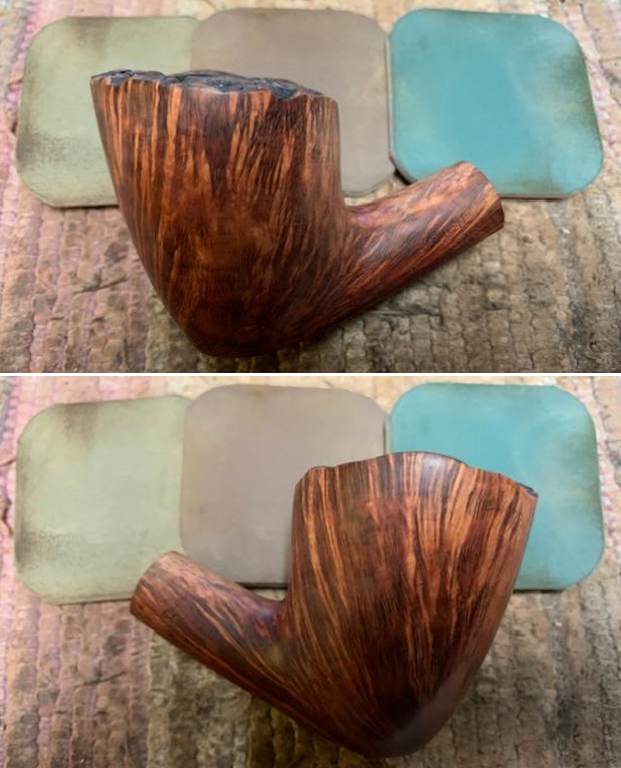
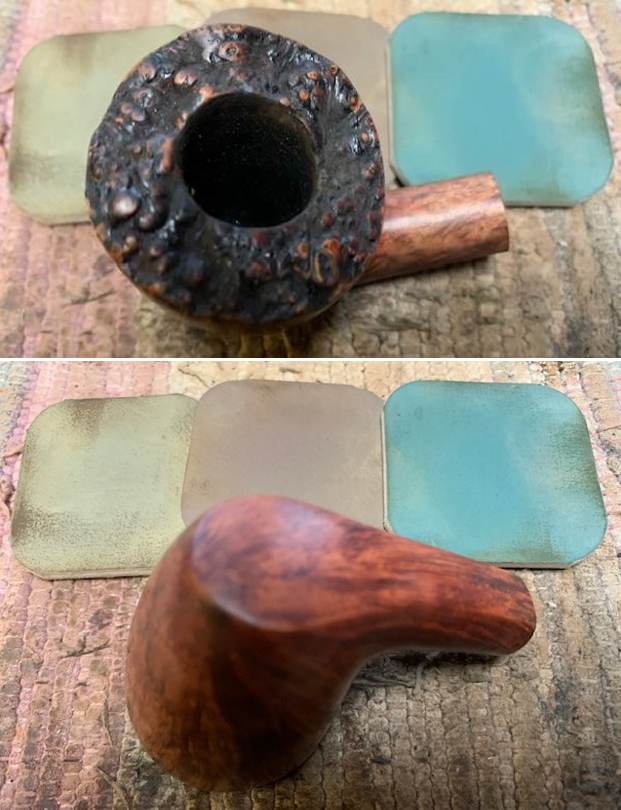
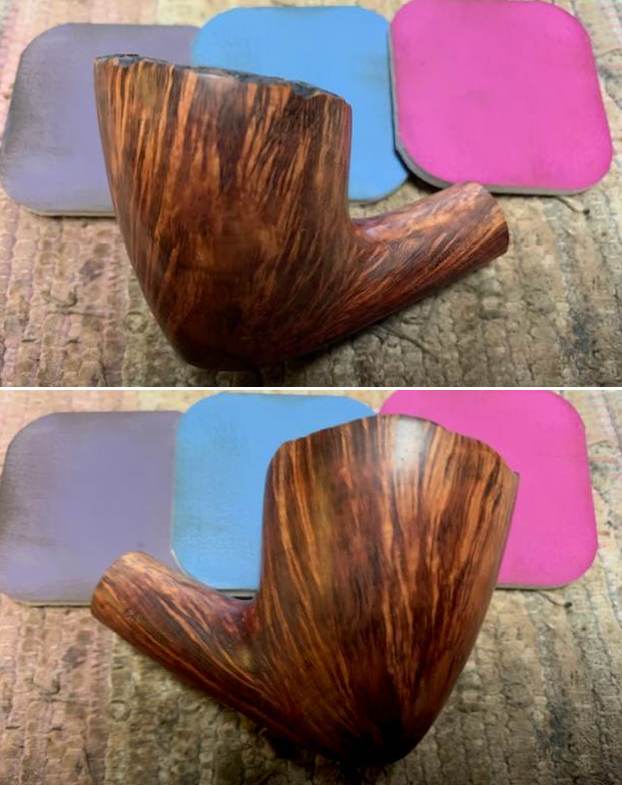
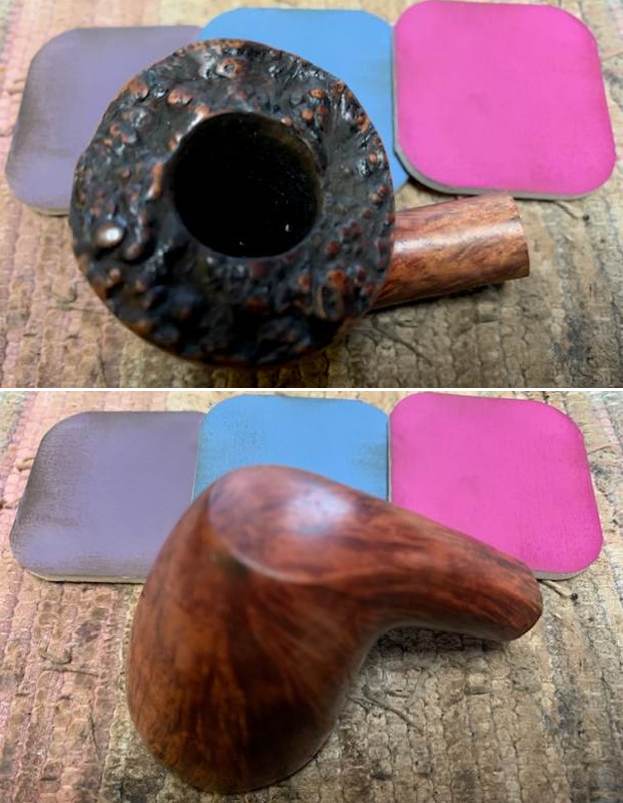
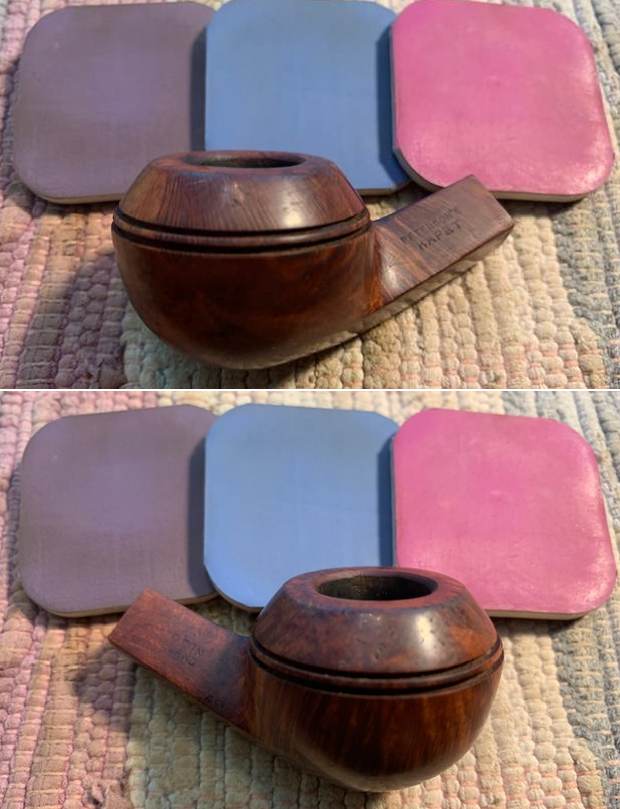
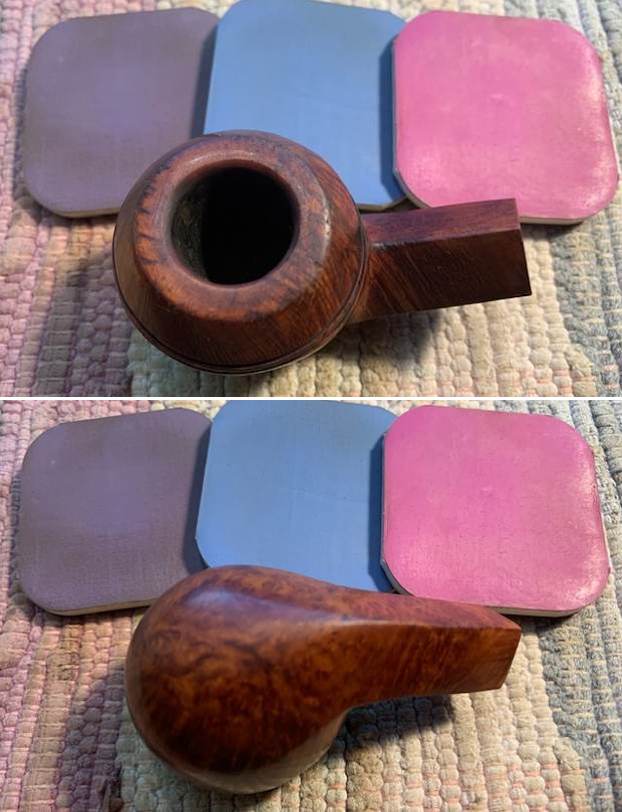
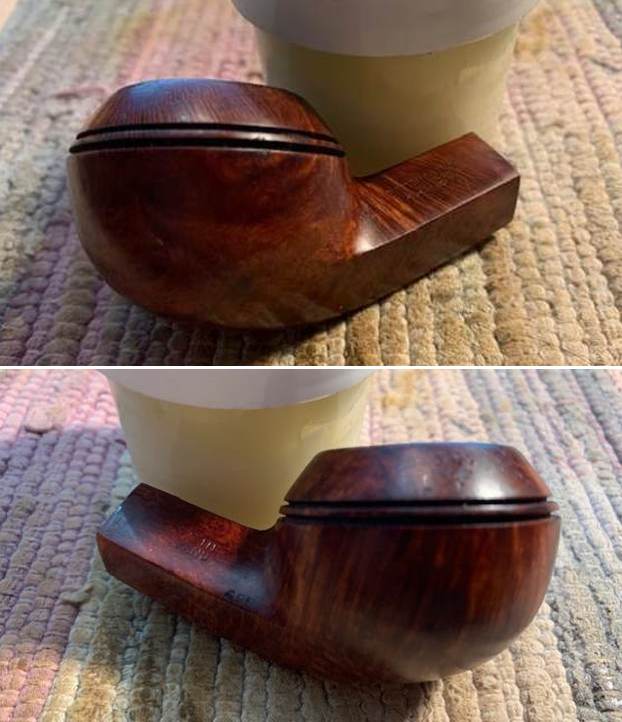
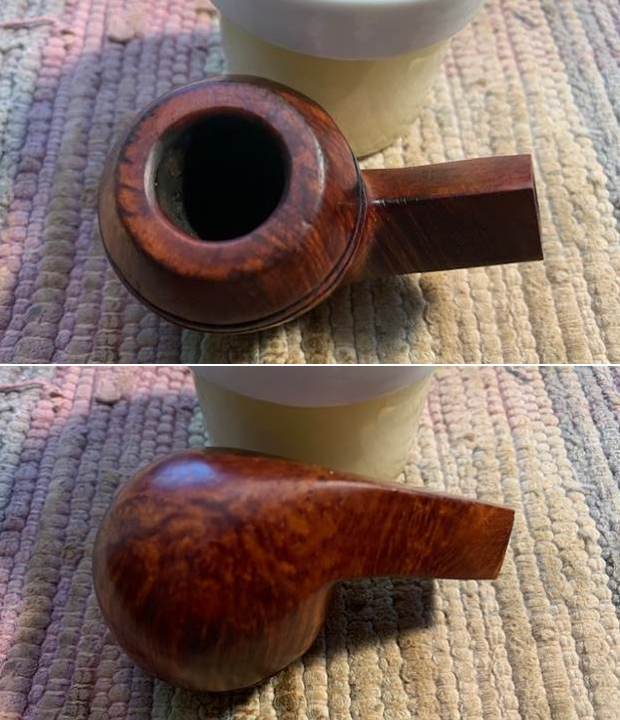
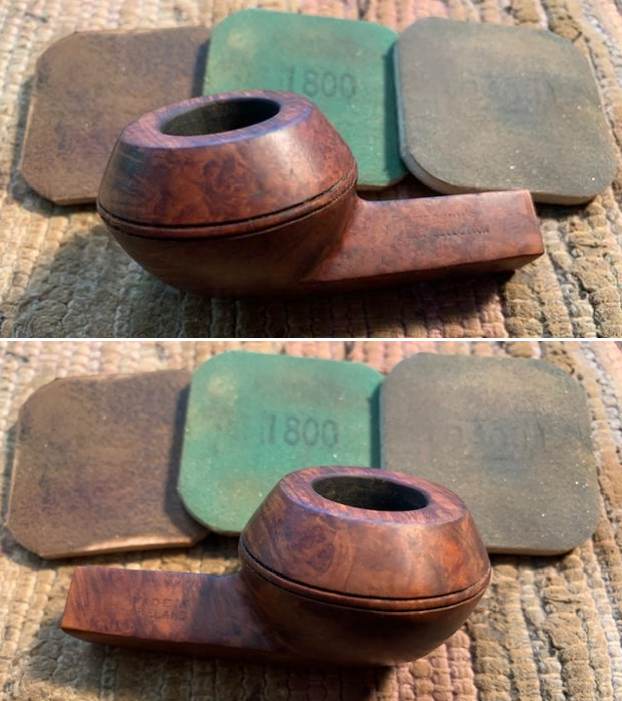
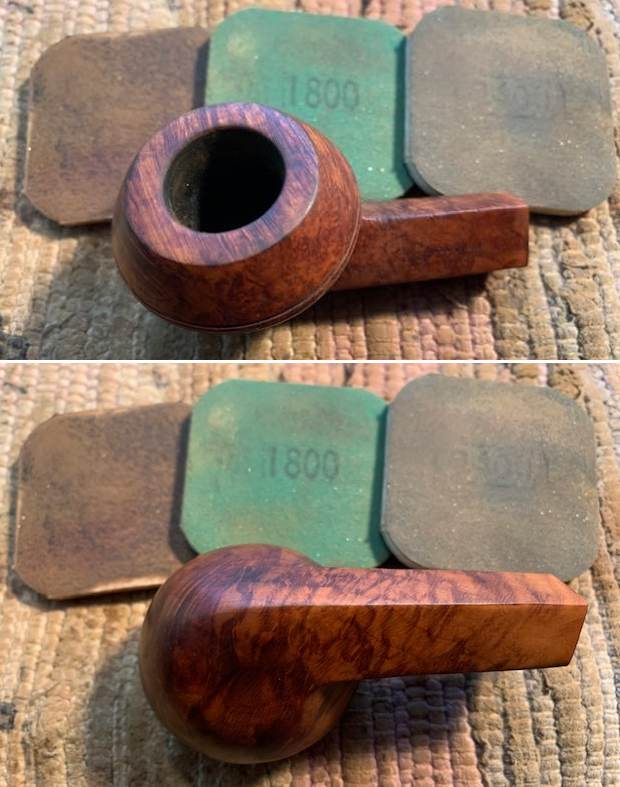
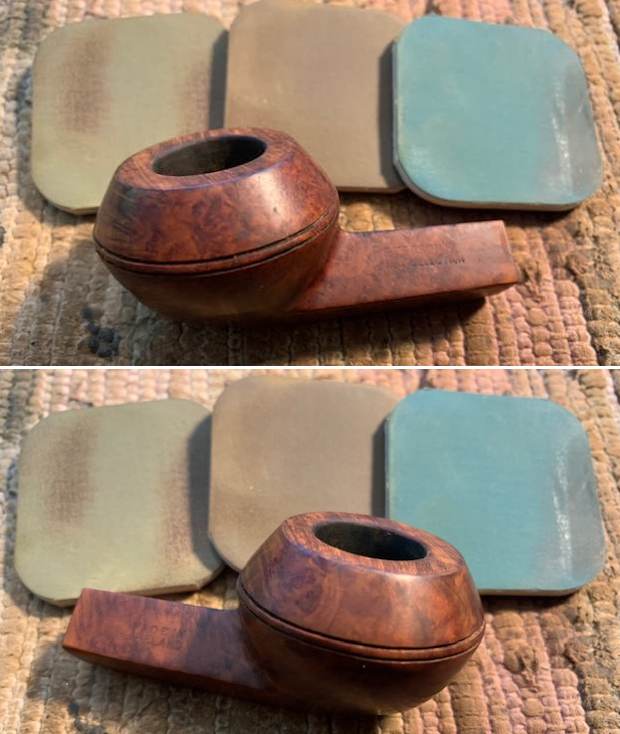
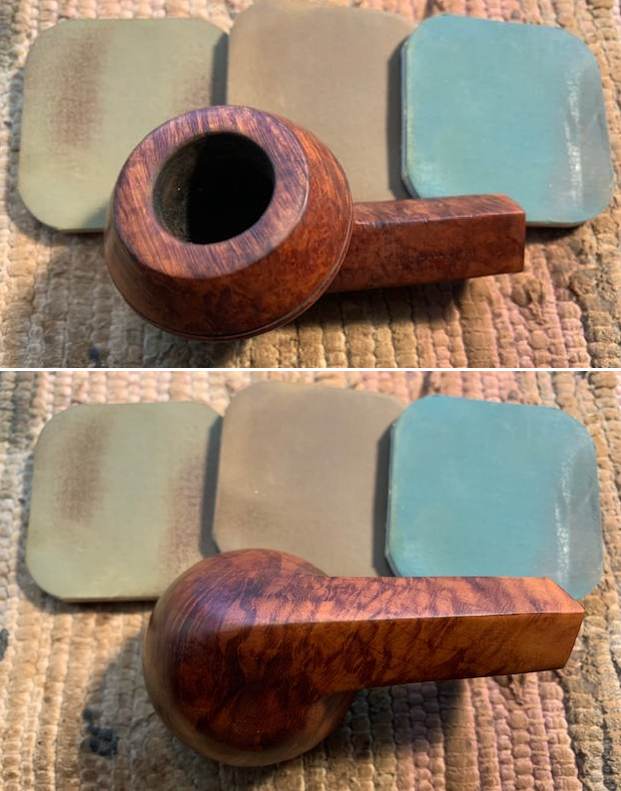
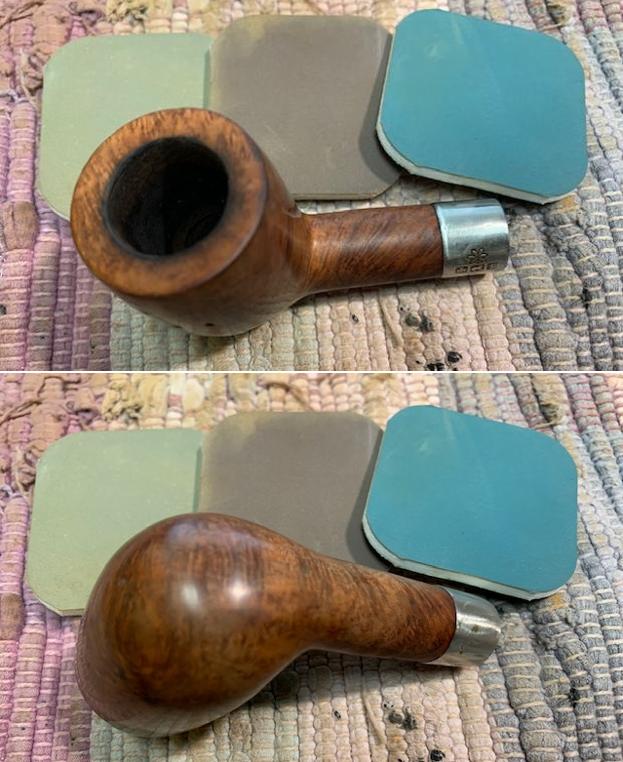
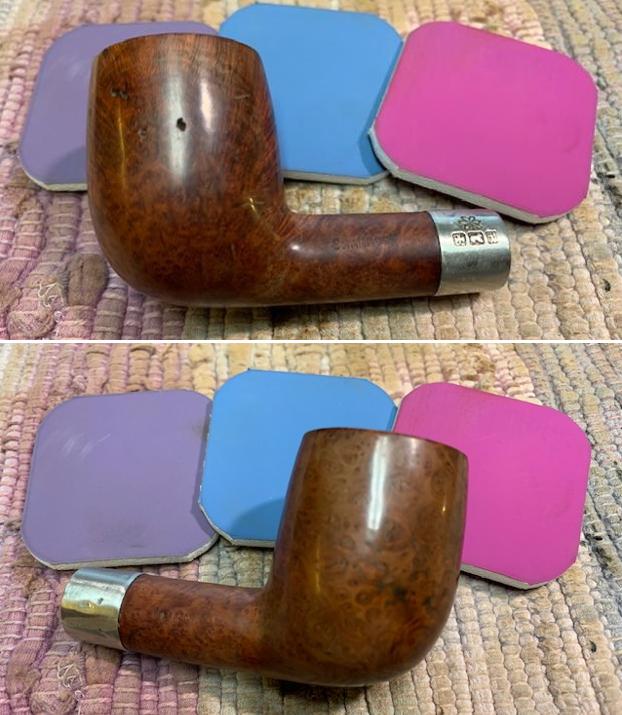
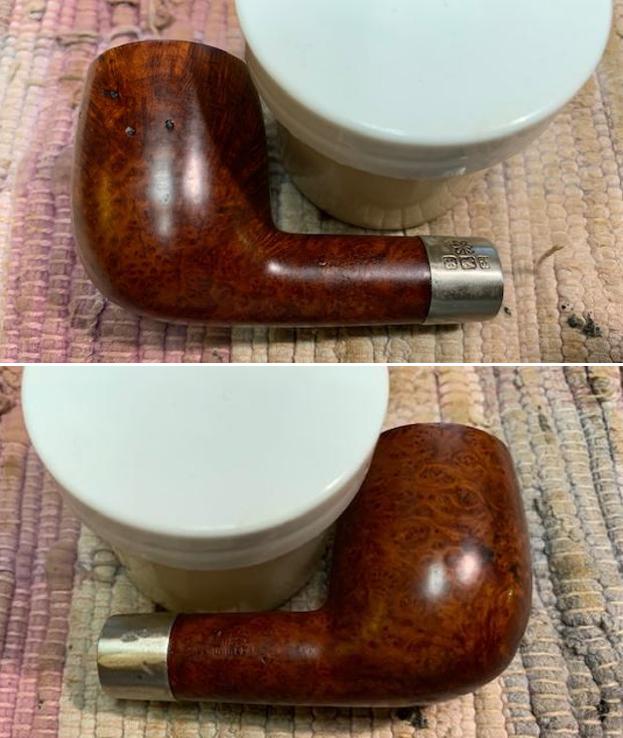
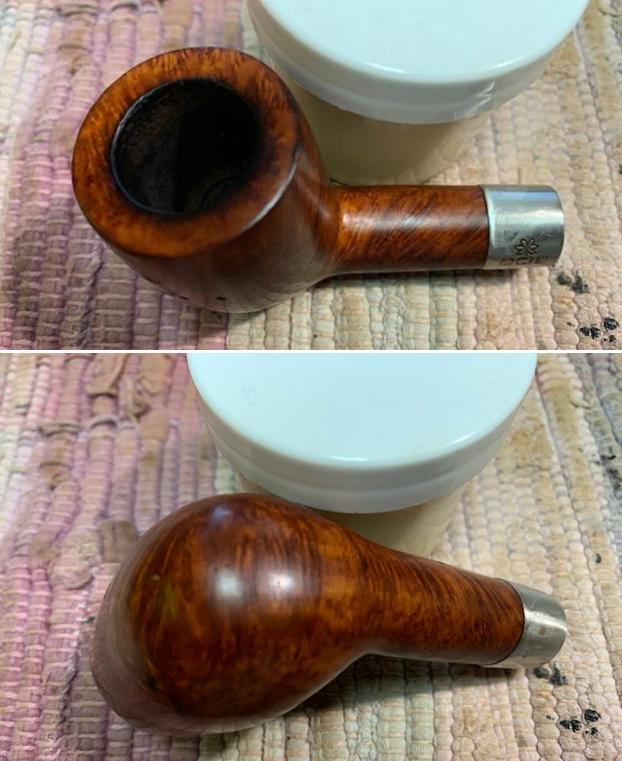
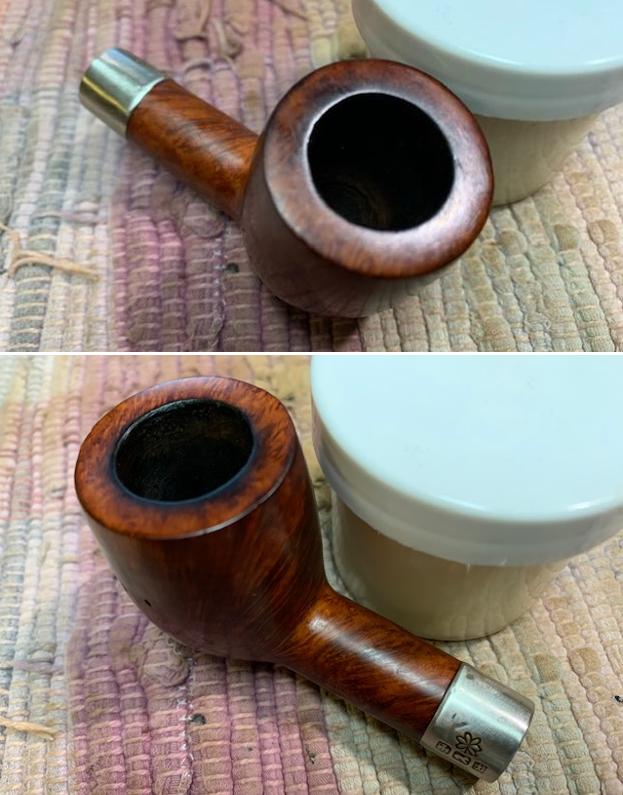
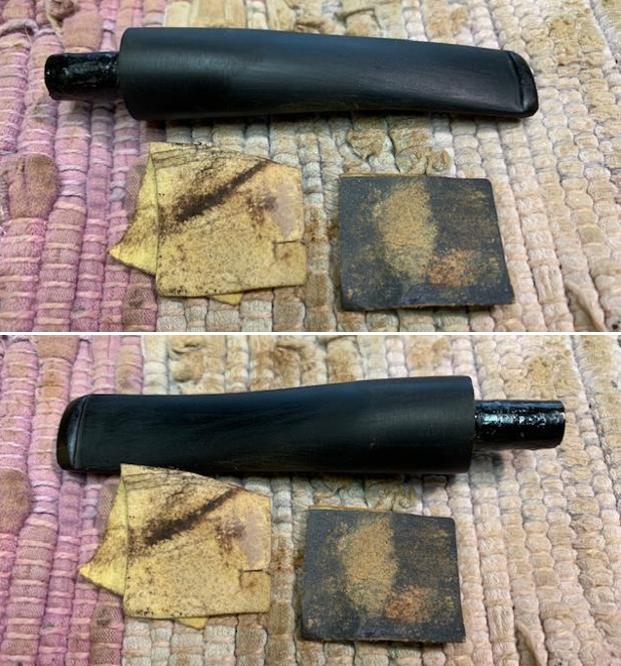
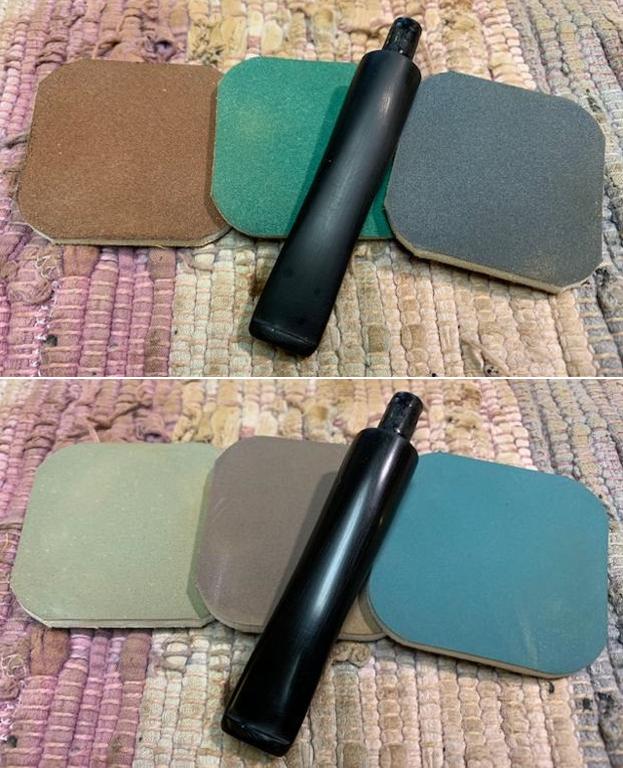
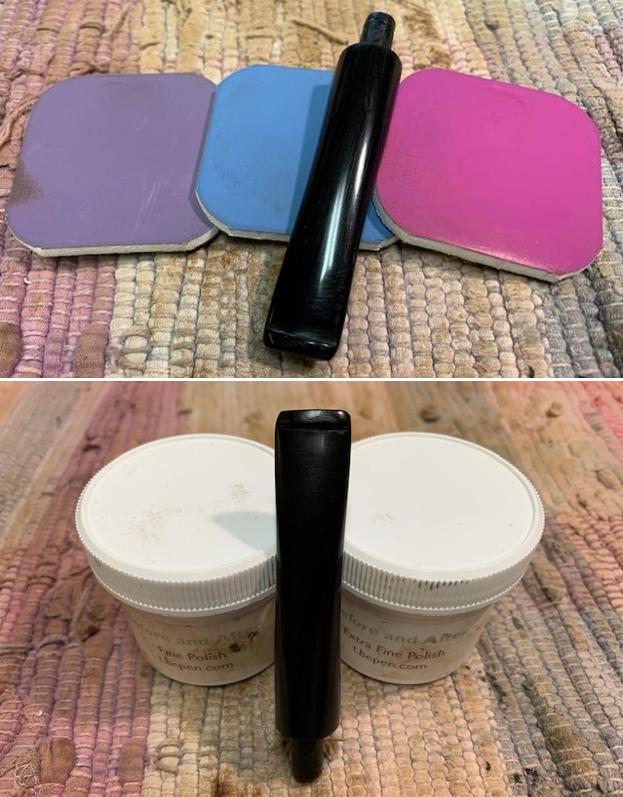
Tag Archives: fitting a new stem

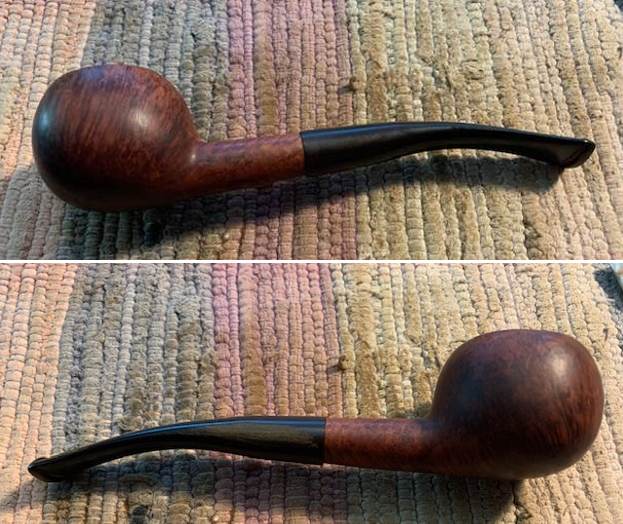
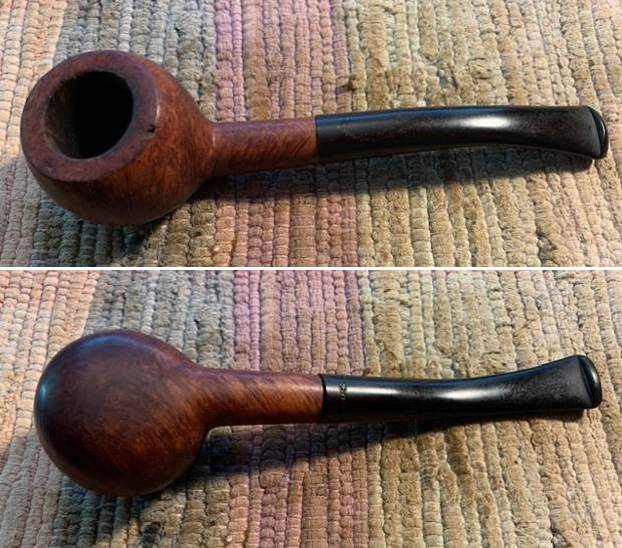
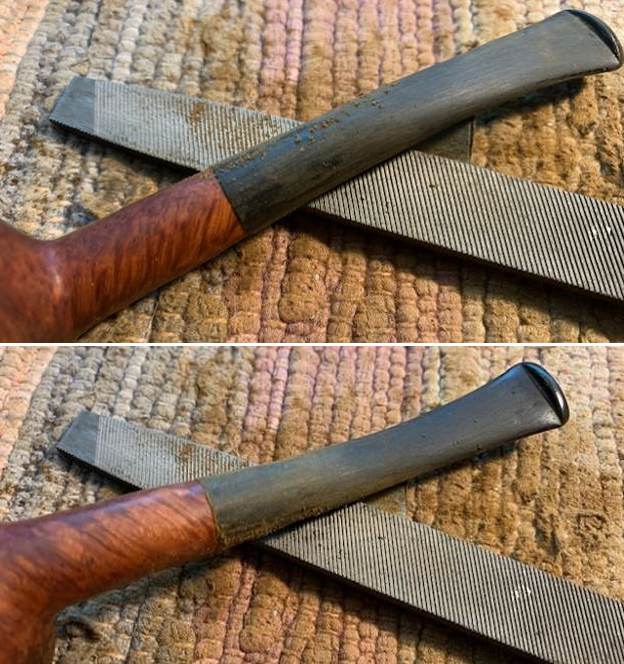
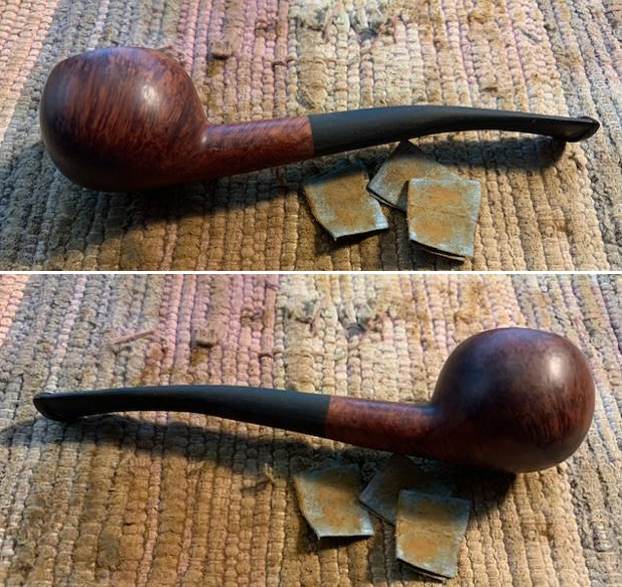
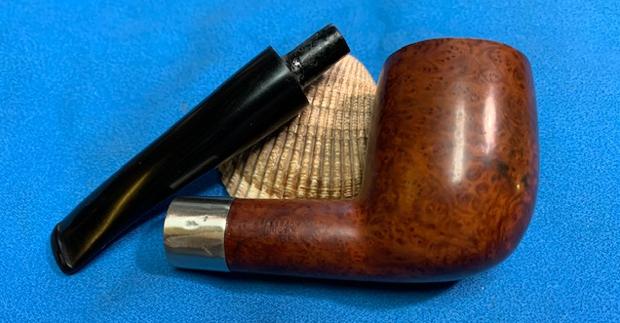
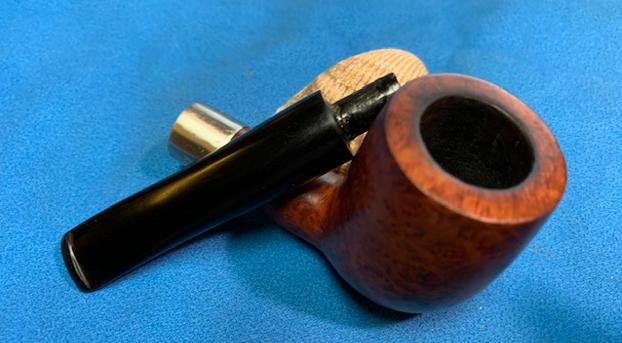
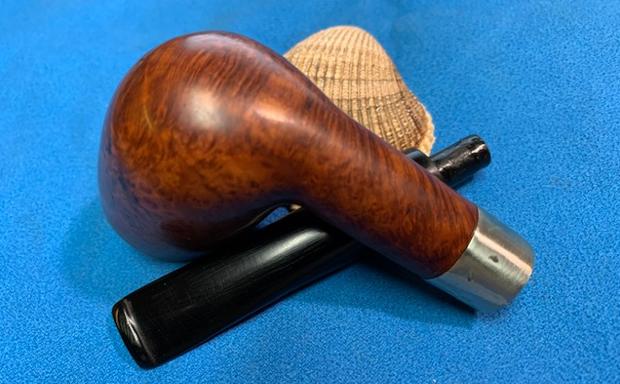
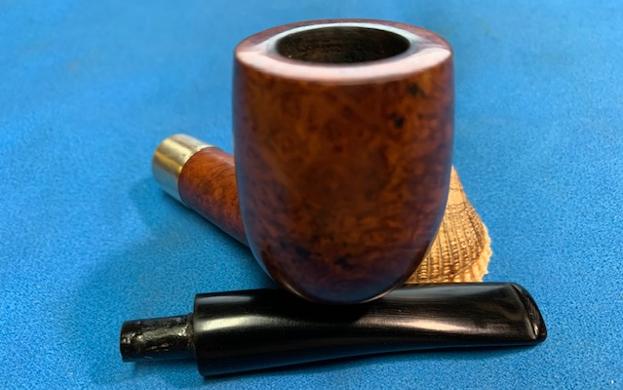
Restemming a Lightly Smoked Ropp De Luxe 804 Cherrywood


Blog by Steve Laug

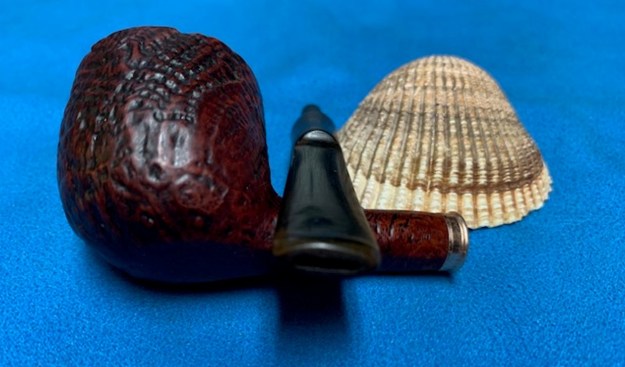
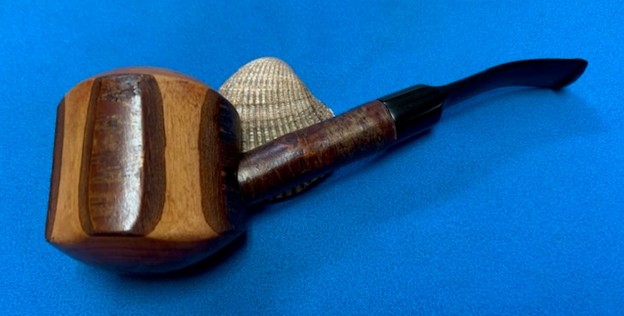
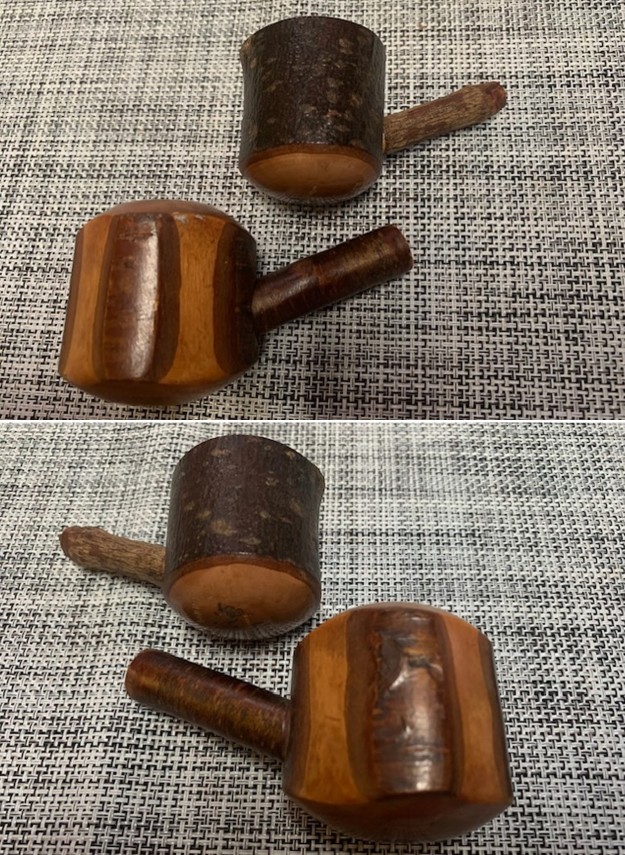
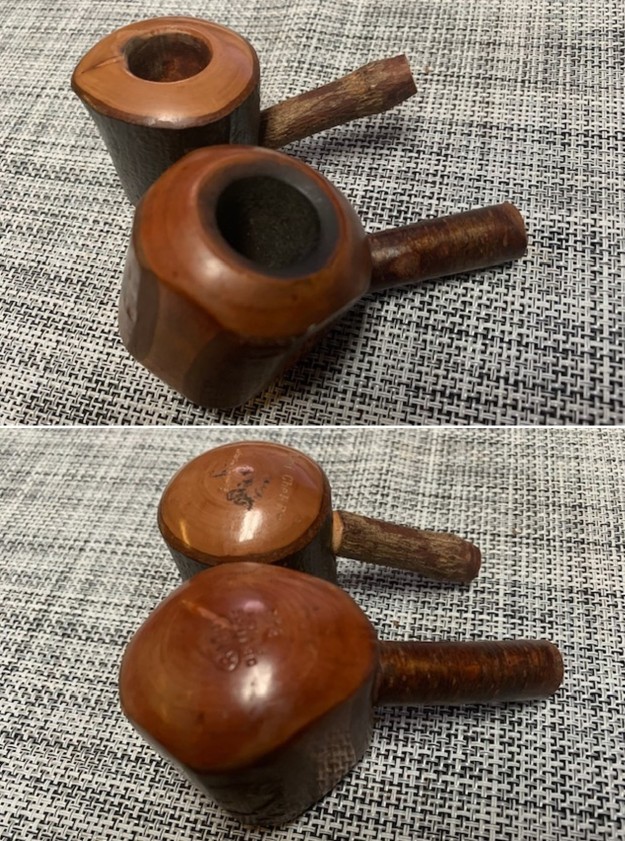
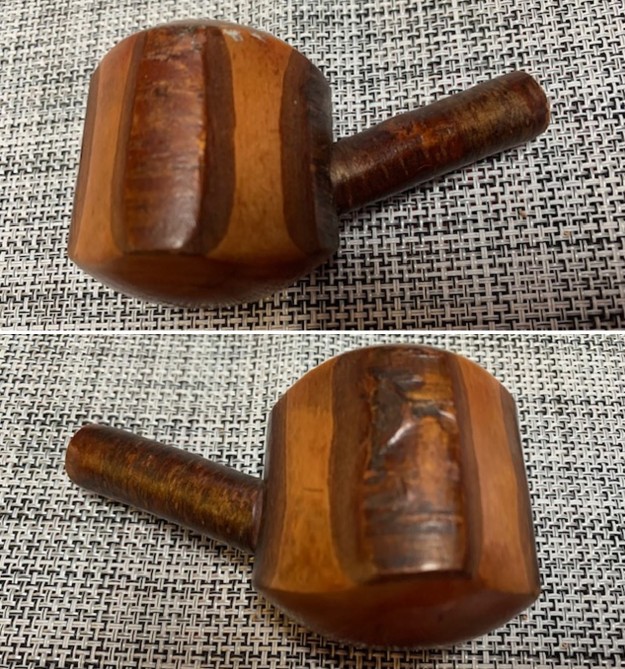
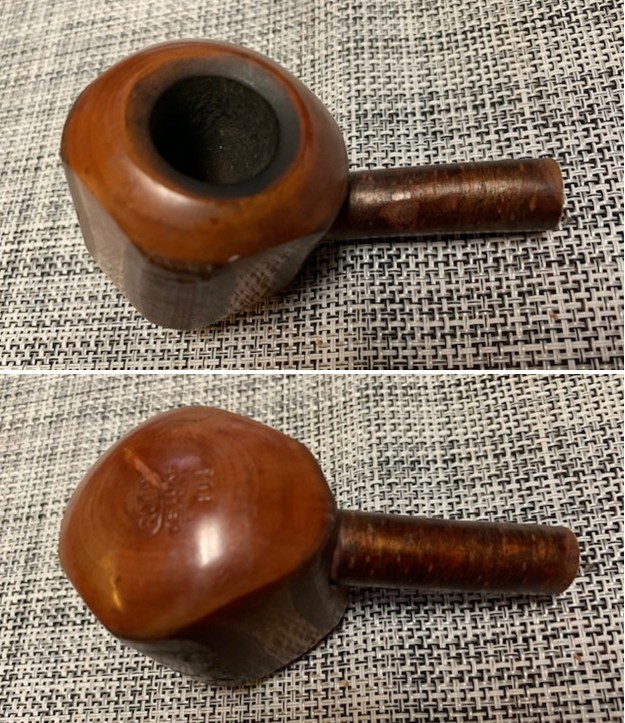
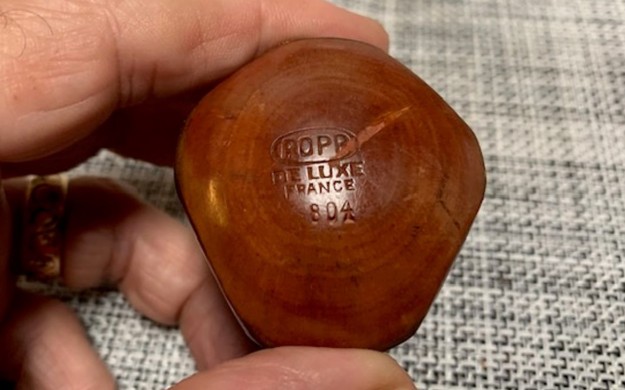
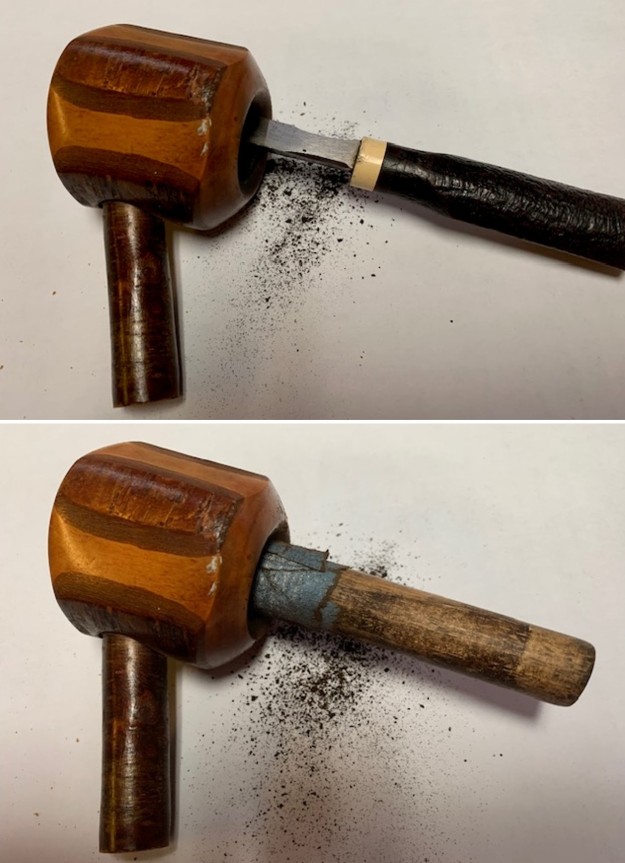
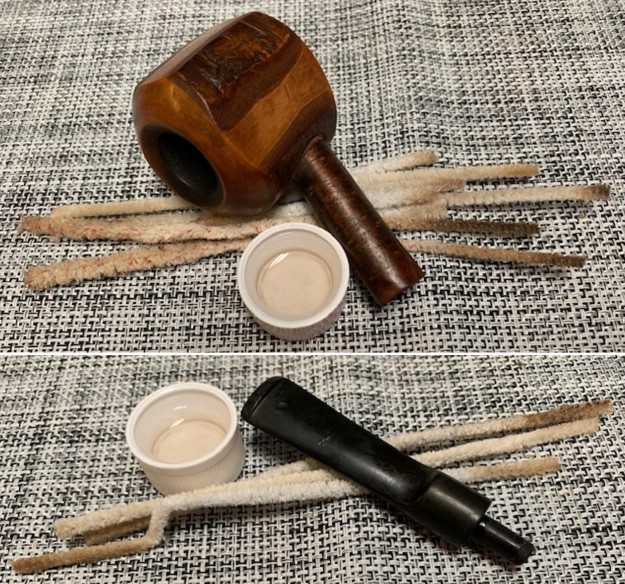
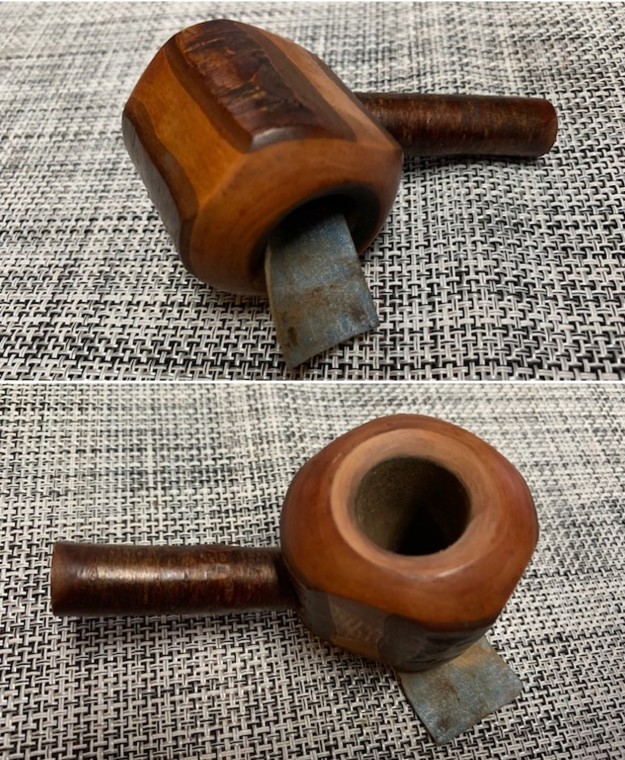
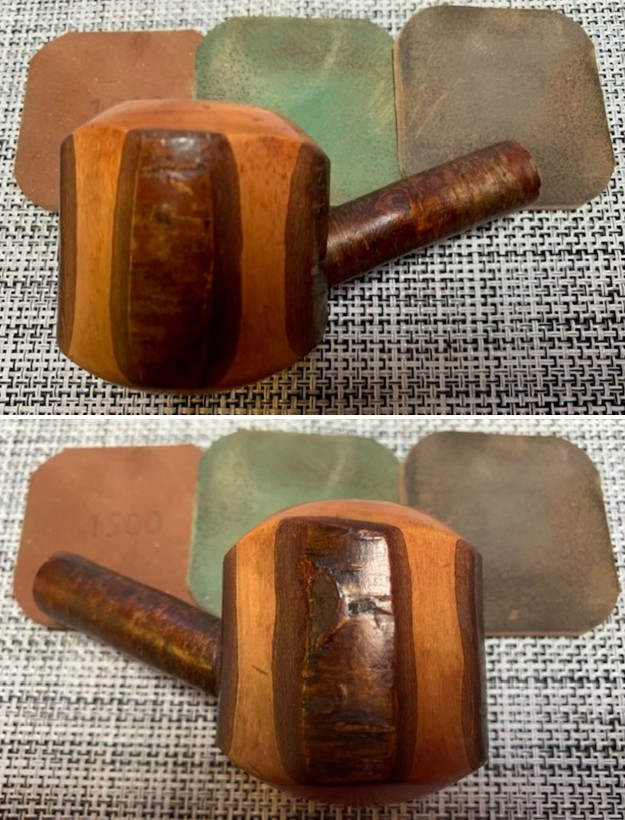
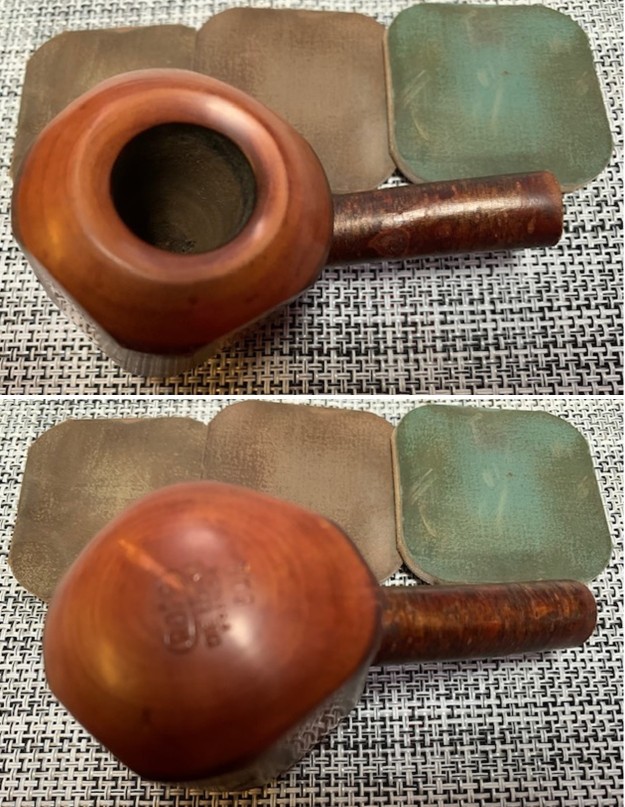
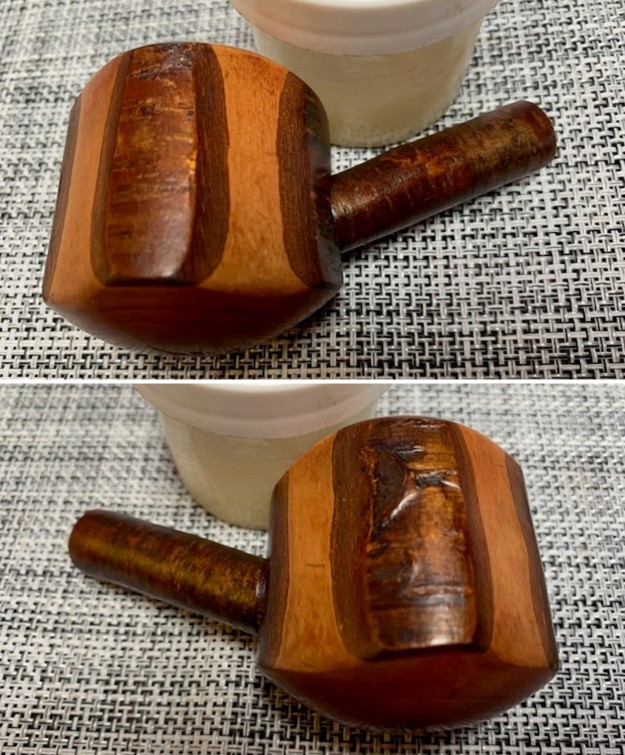
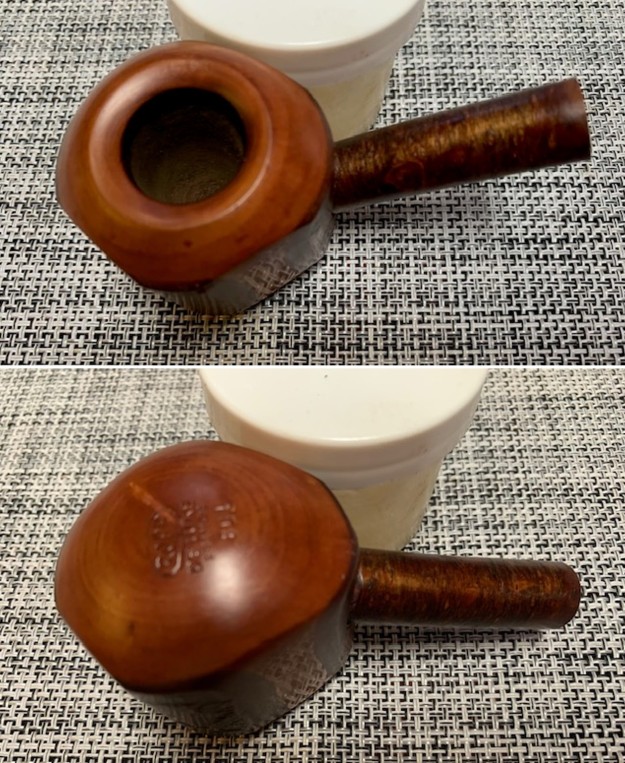
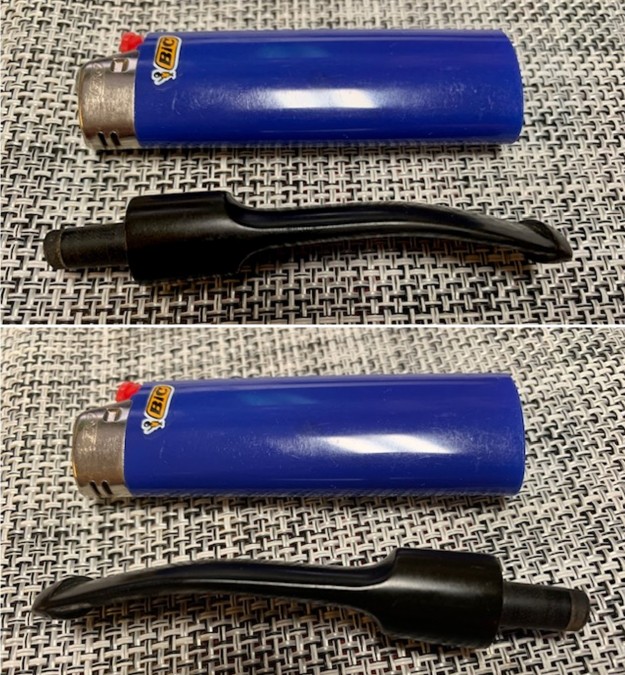
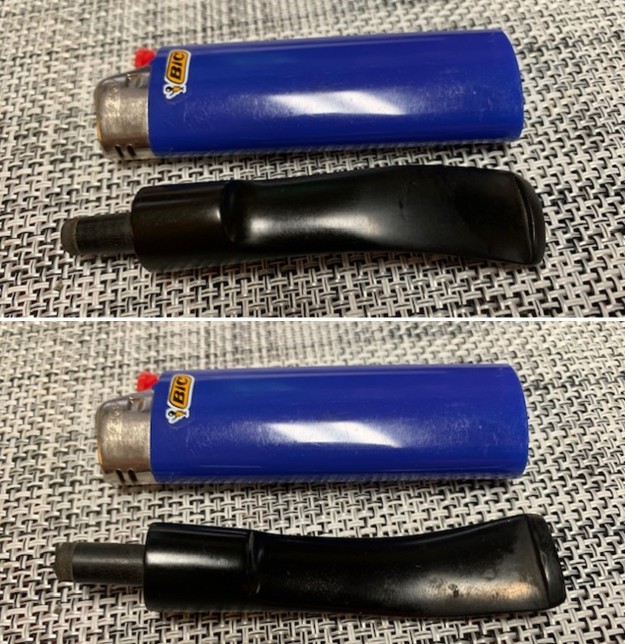
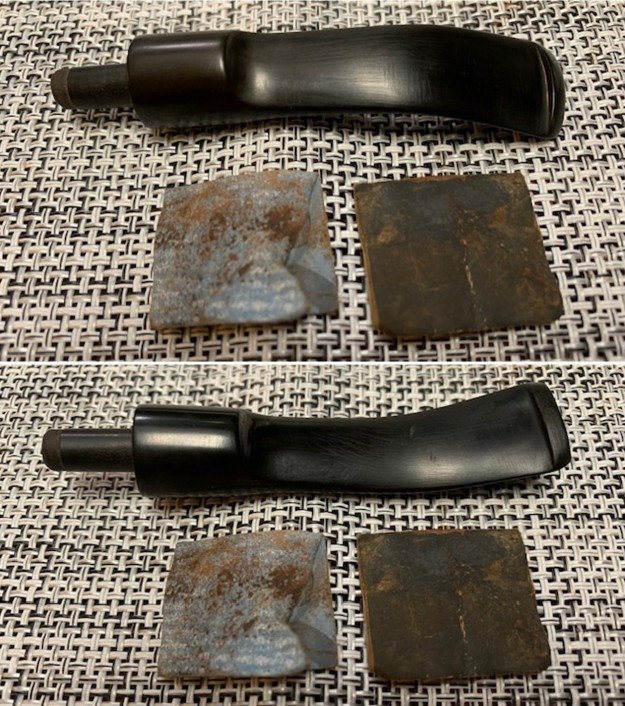
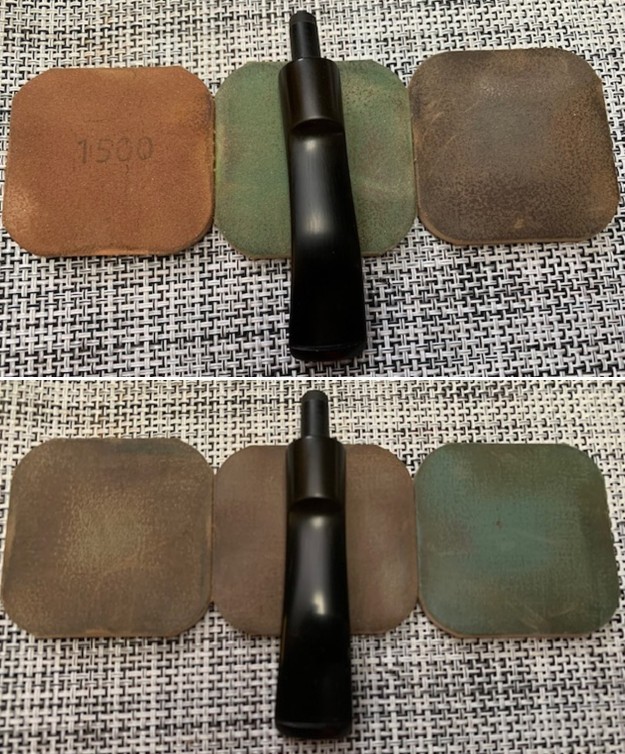
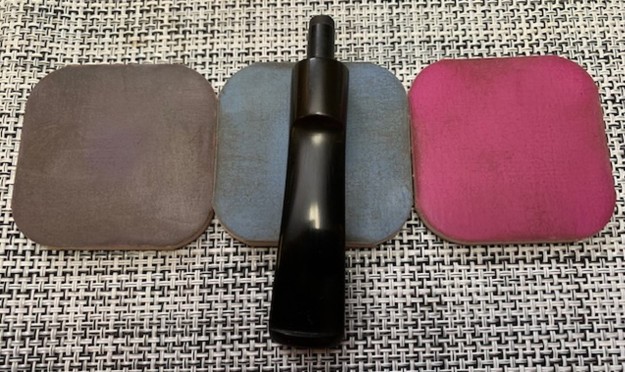
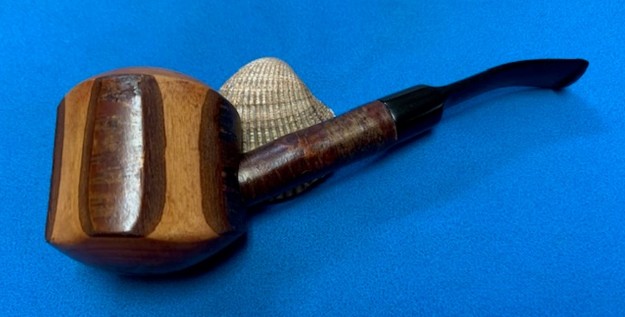
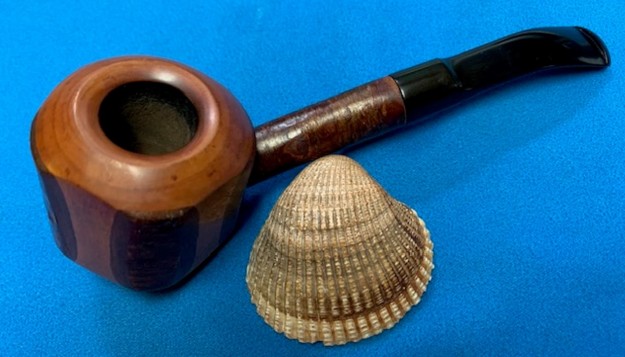
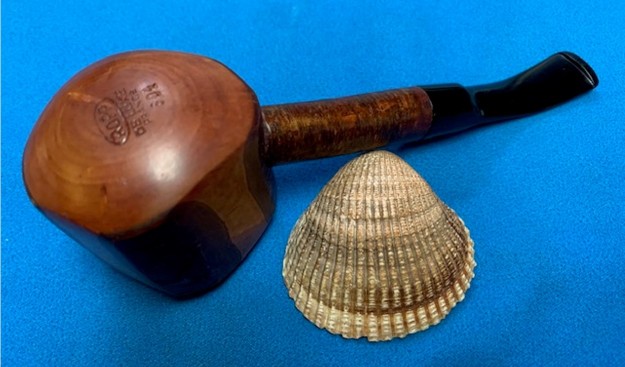
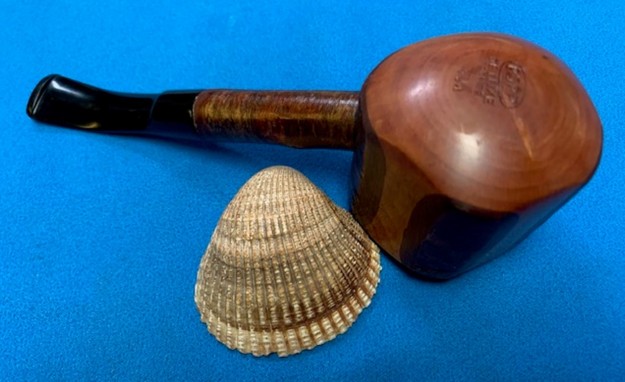
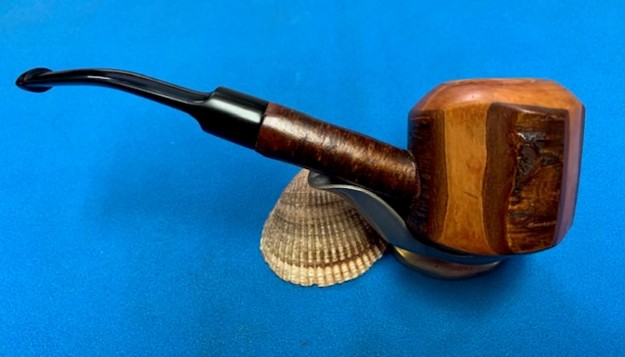
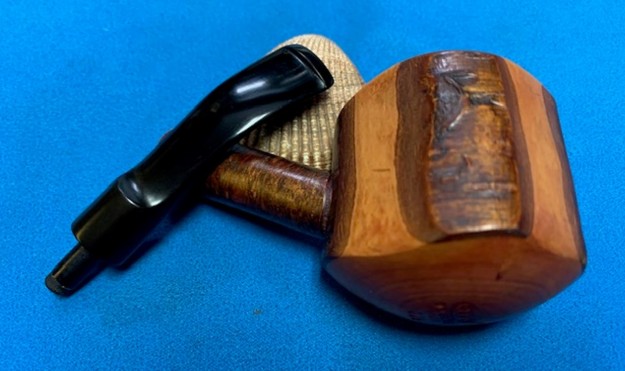
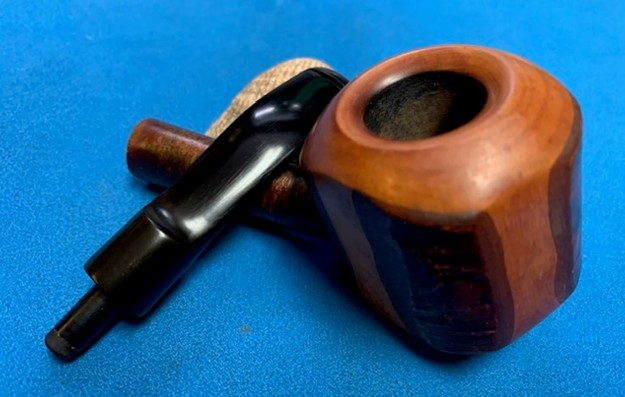
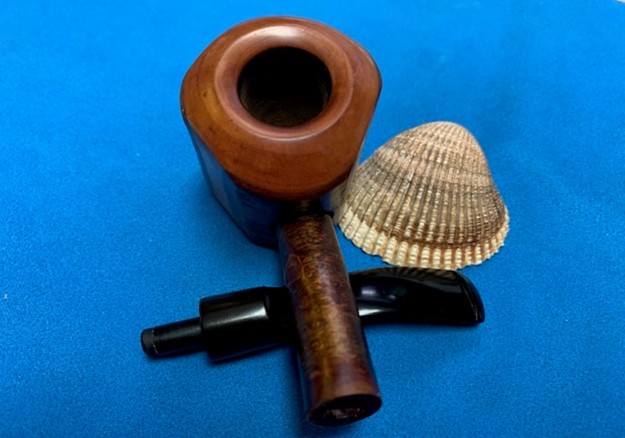
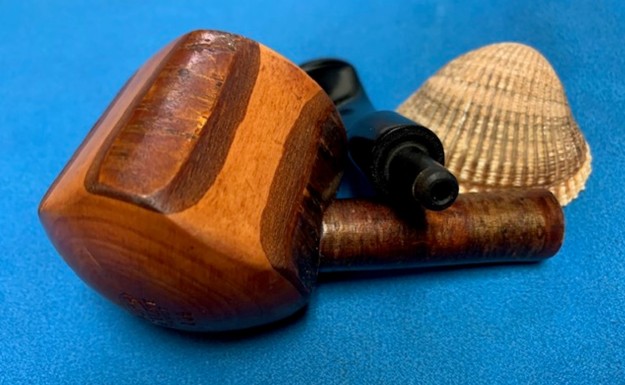
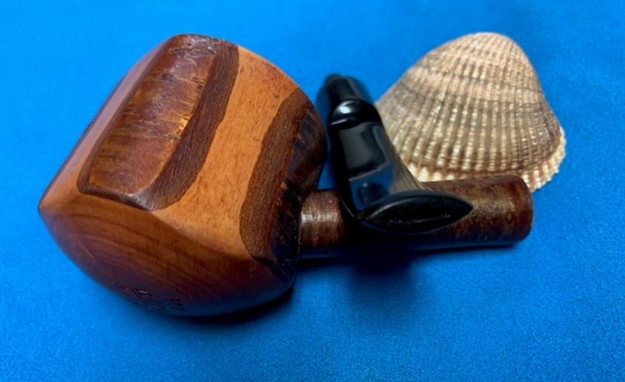
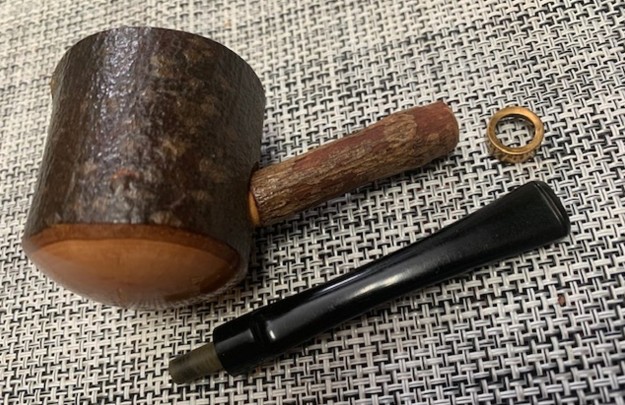
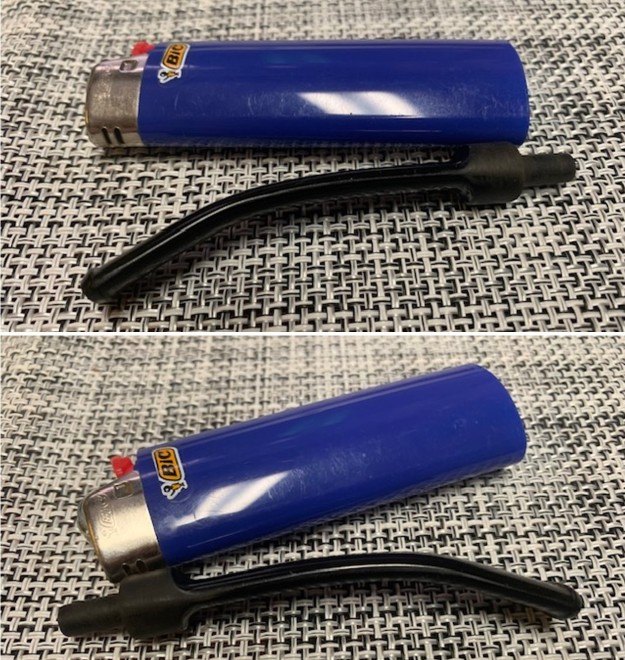
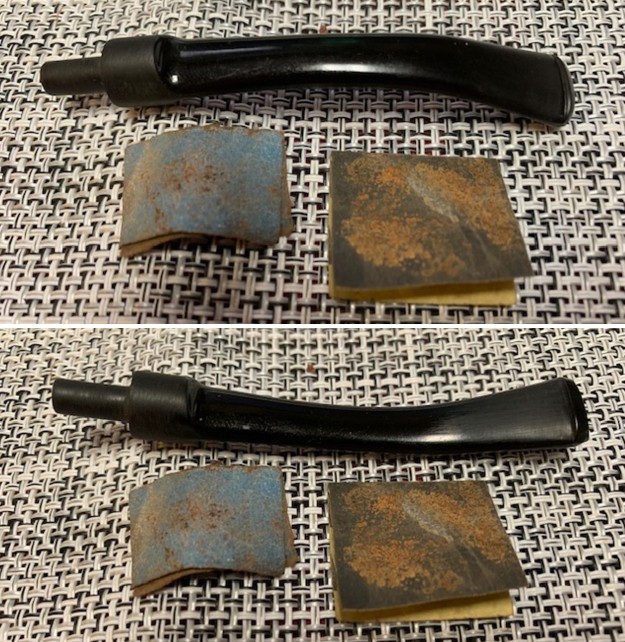
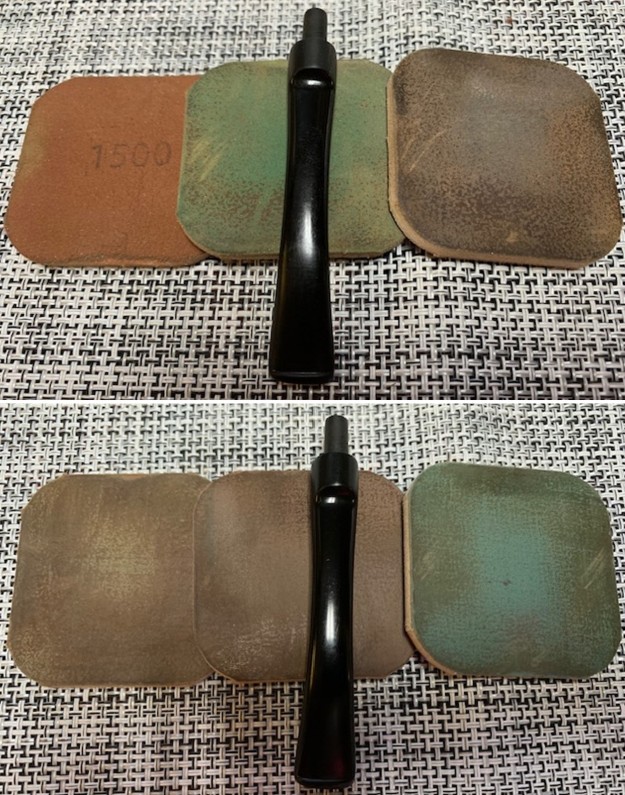
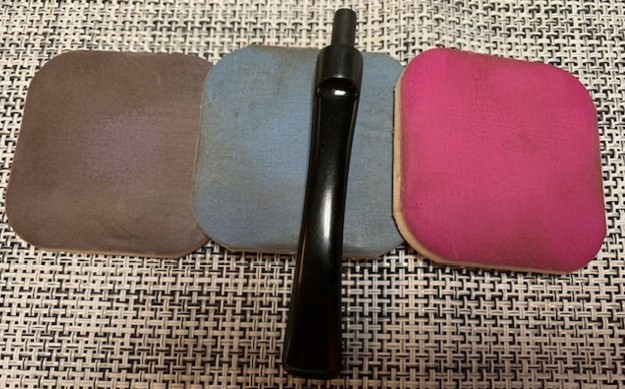
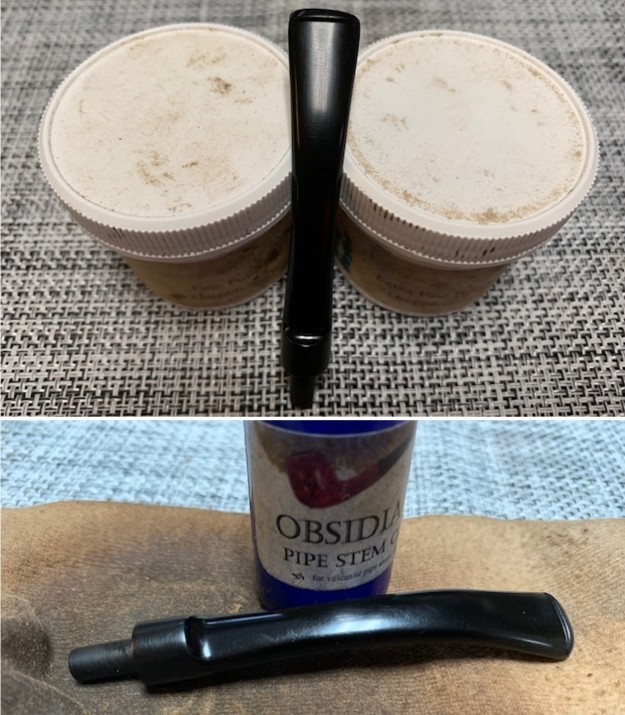
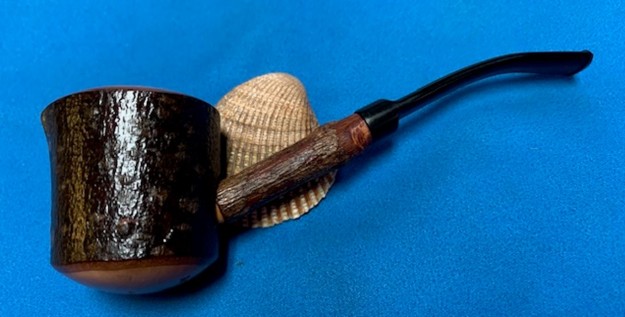
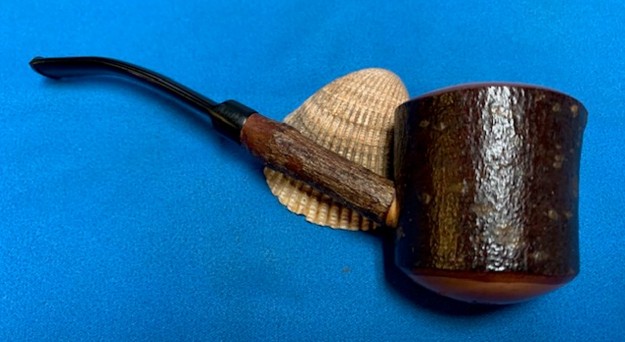
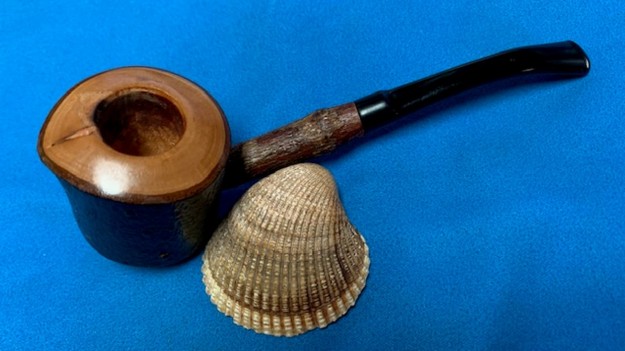
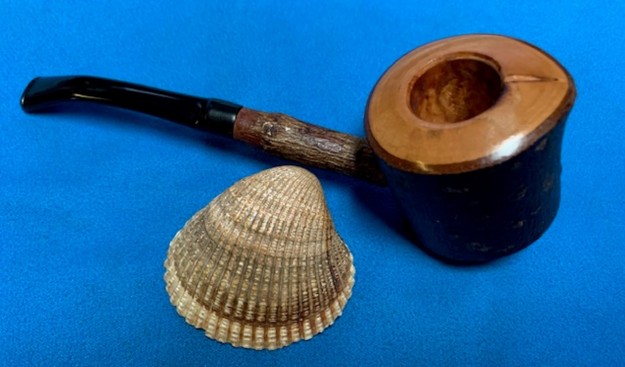
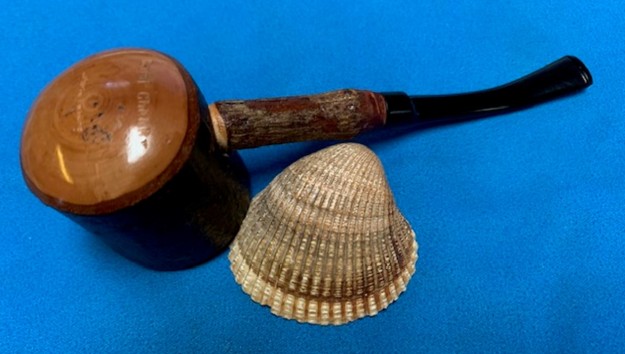
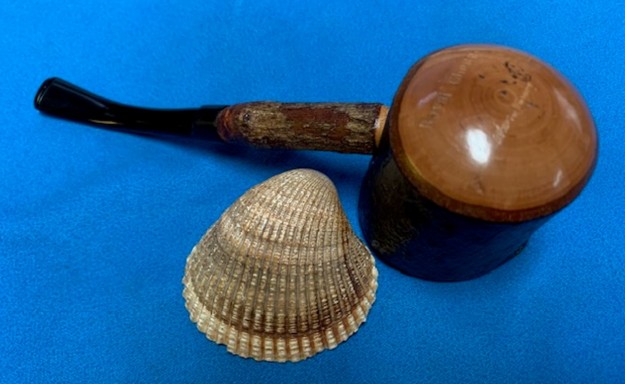
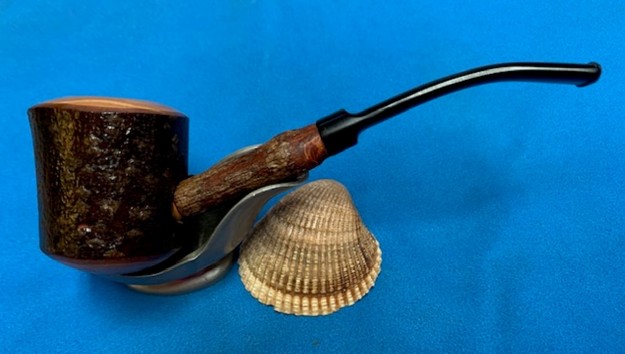
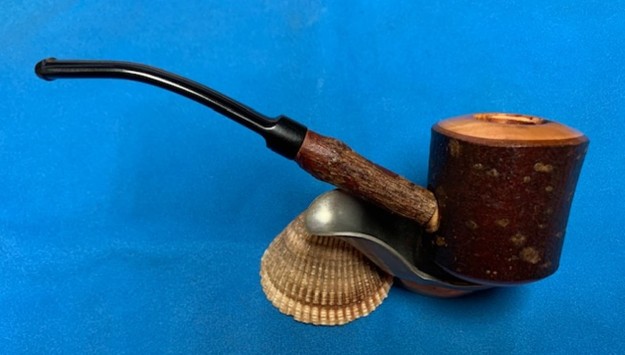
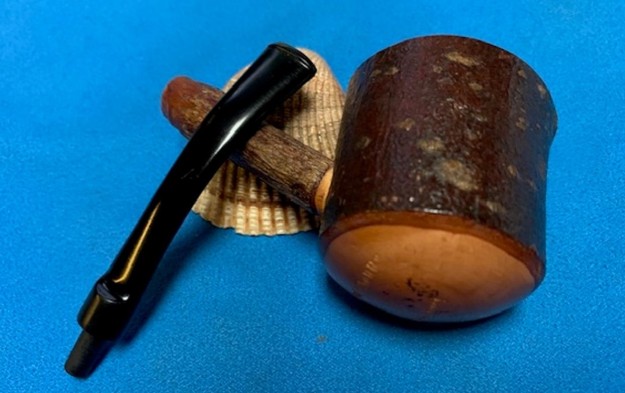
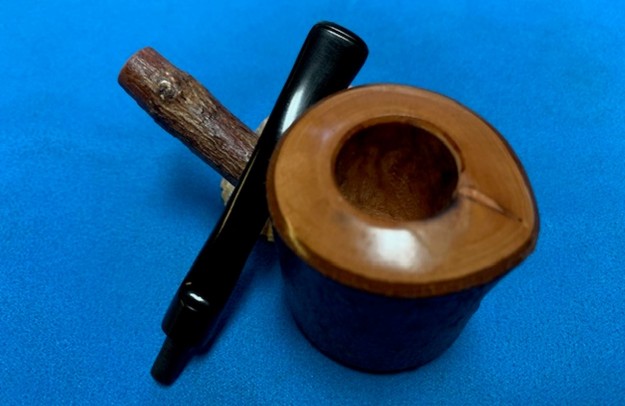
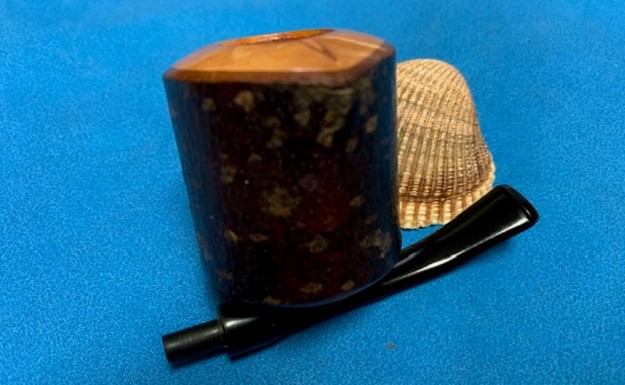
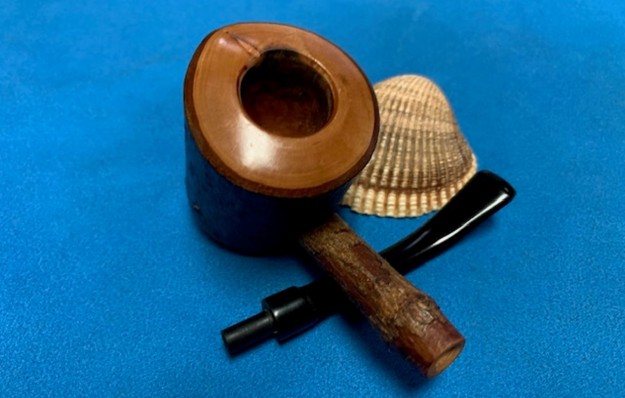
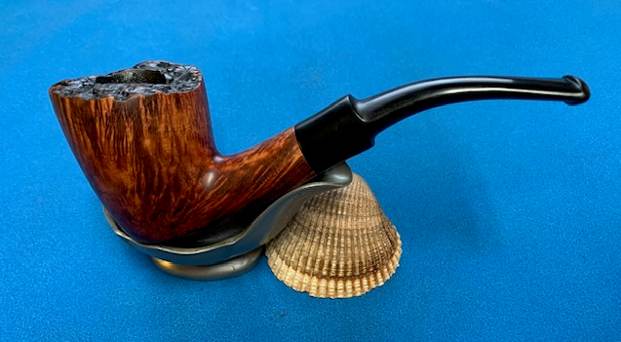
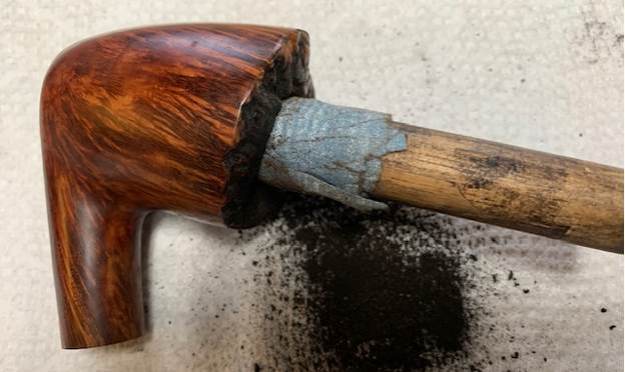
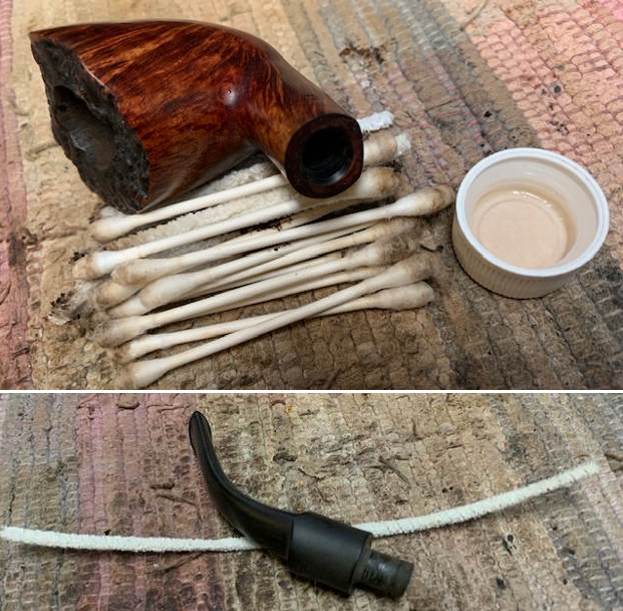
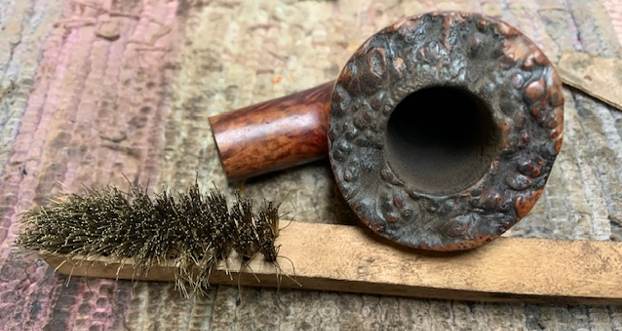
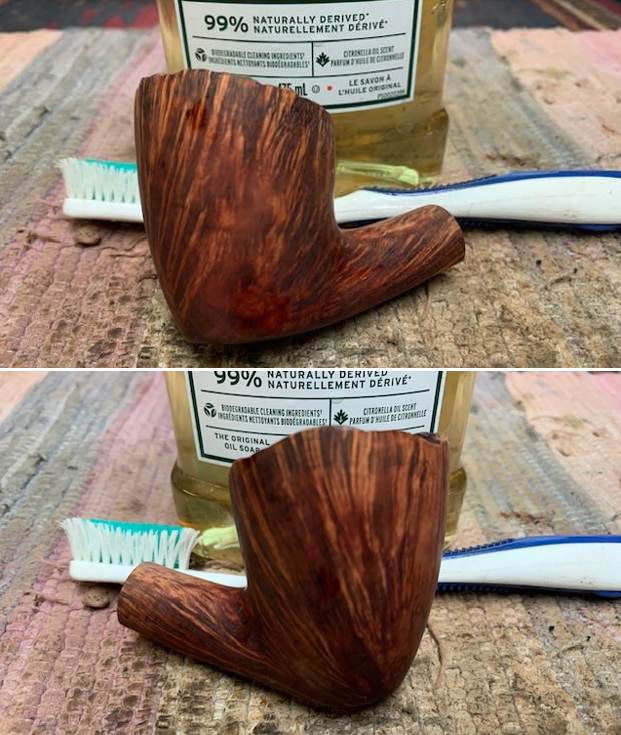
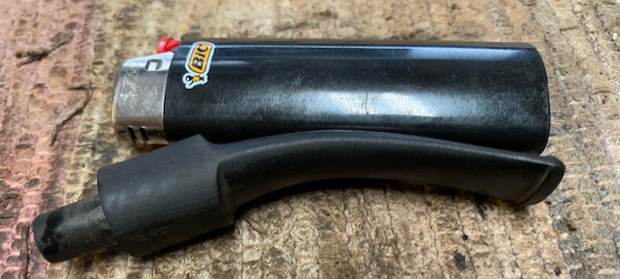
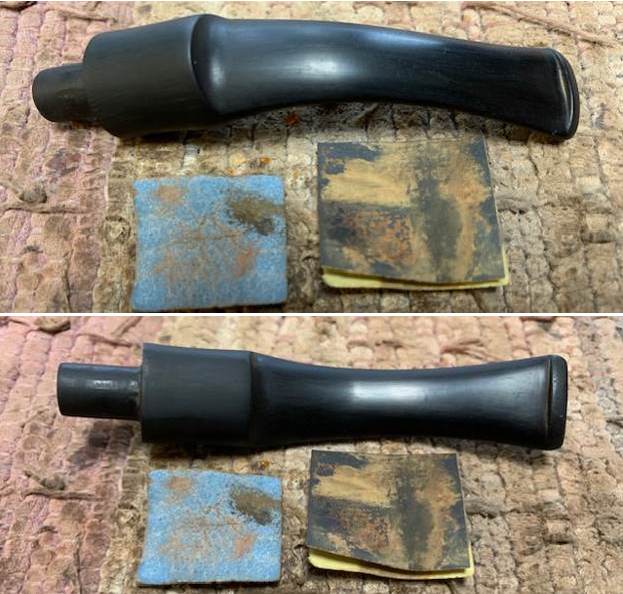
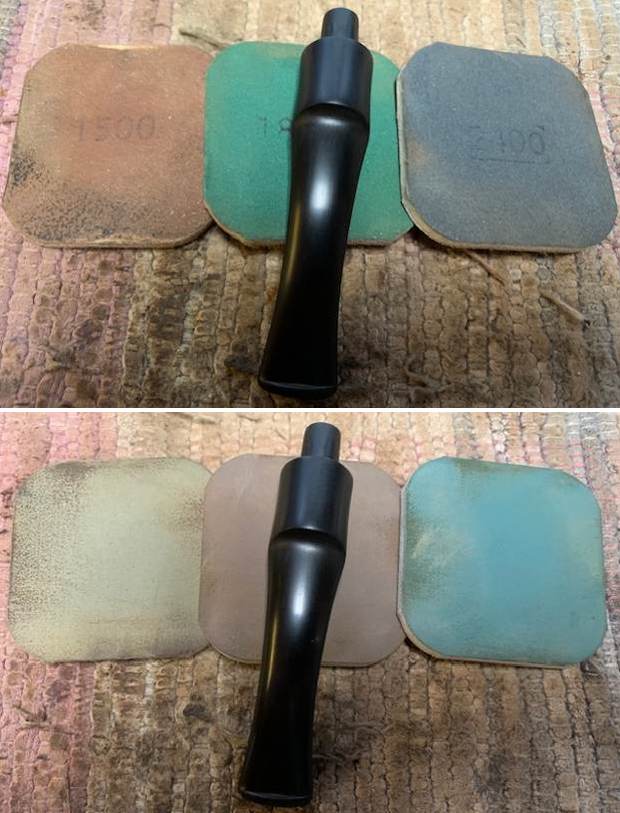
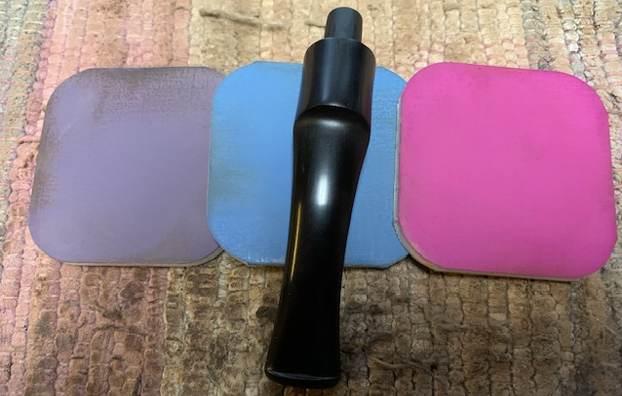
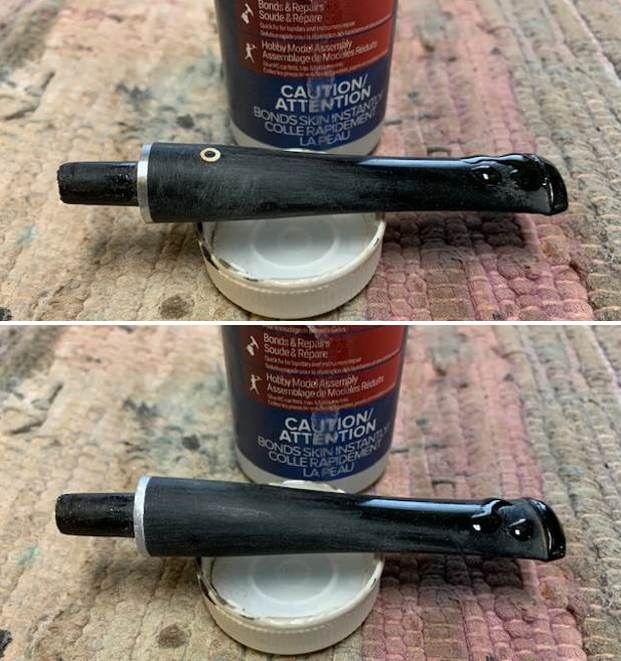
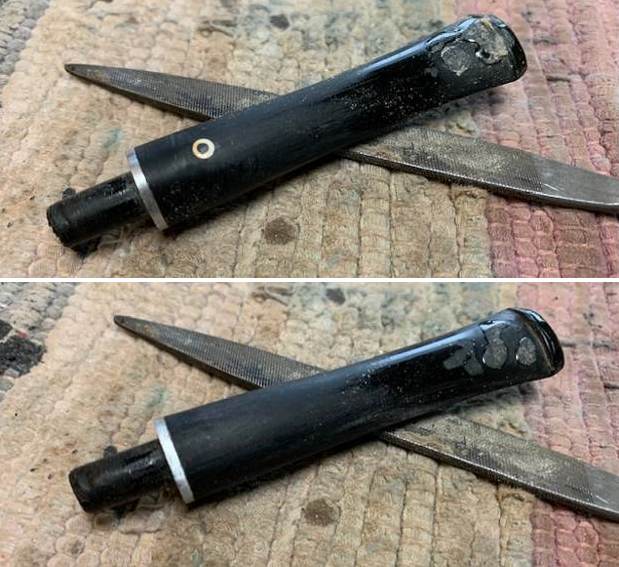
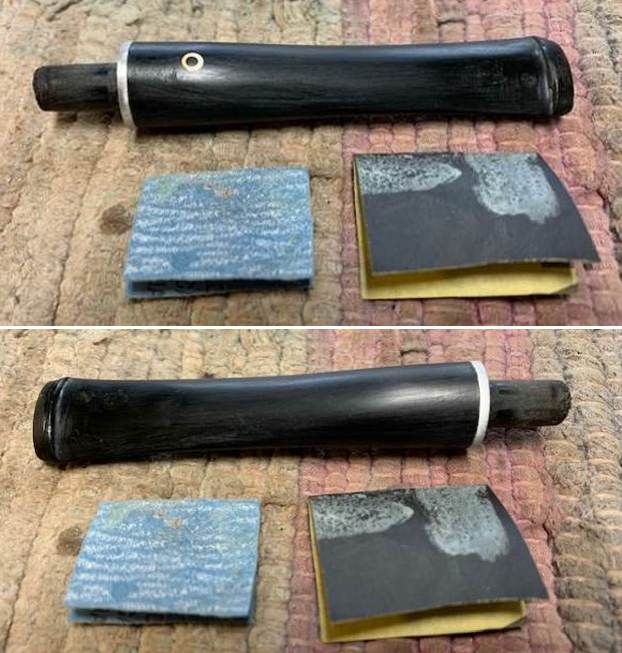
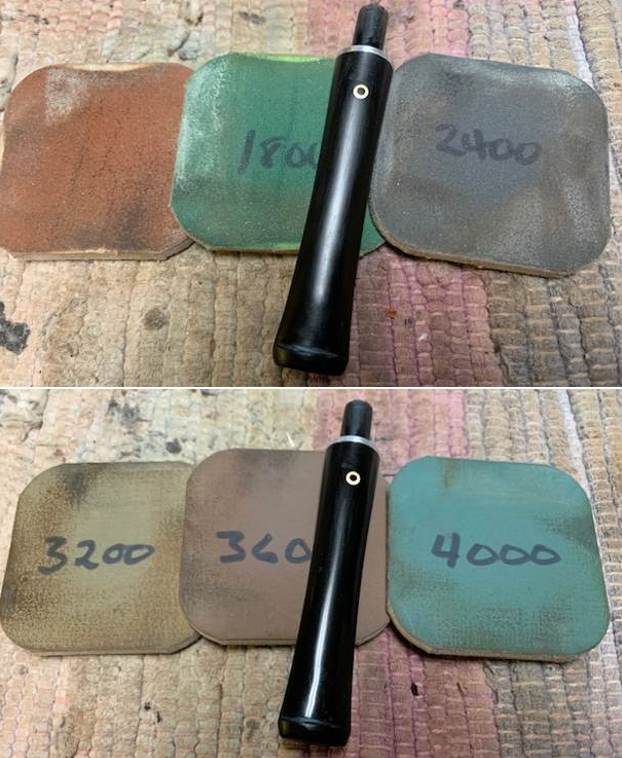
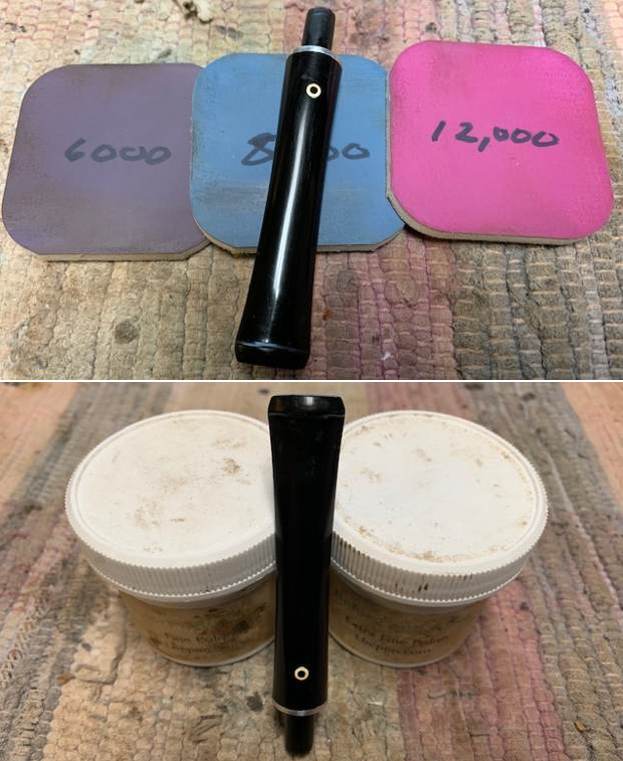
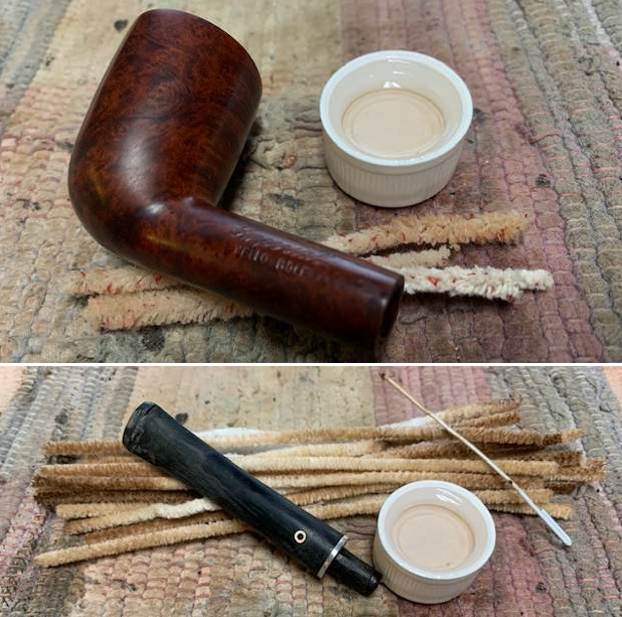
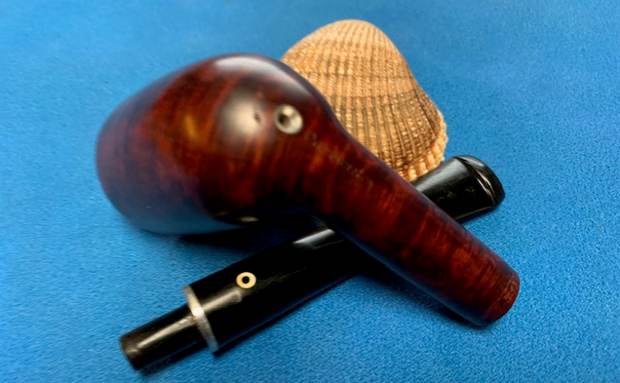
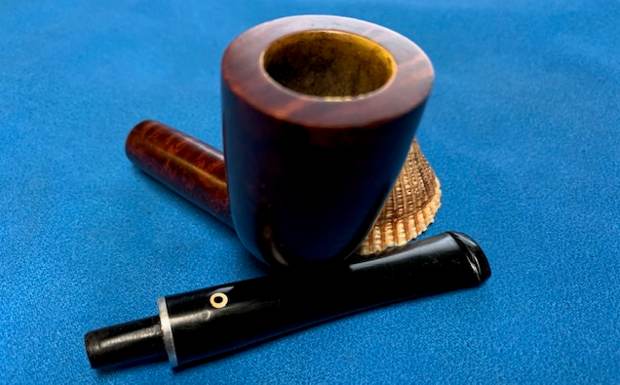
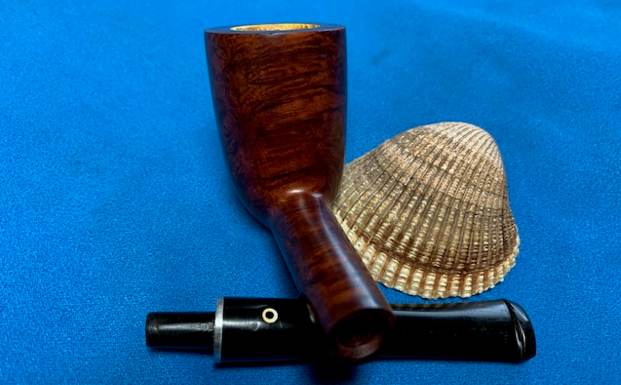
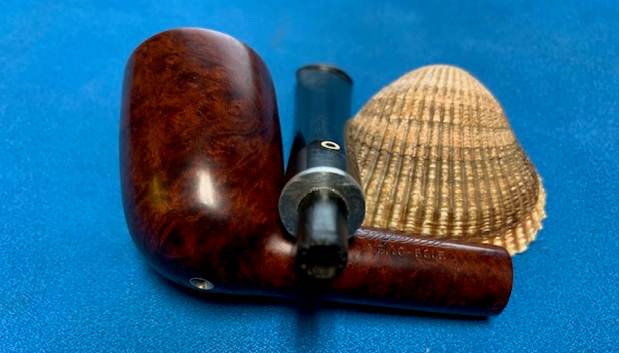
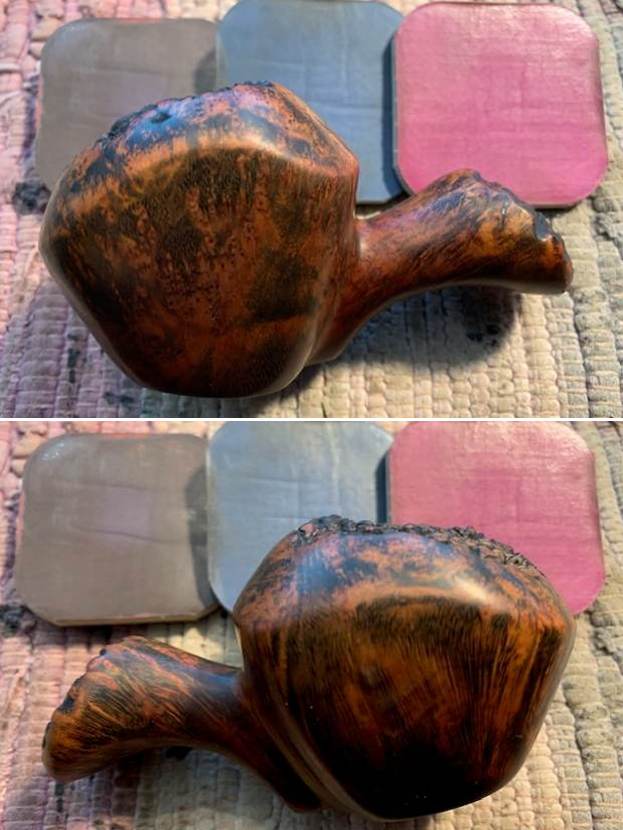
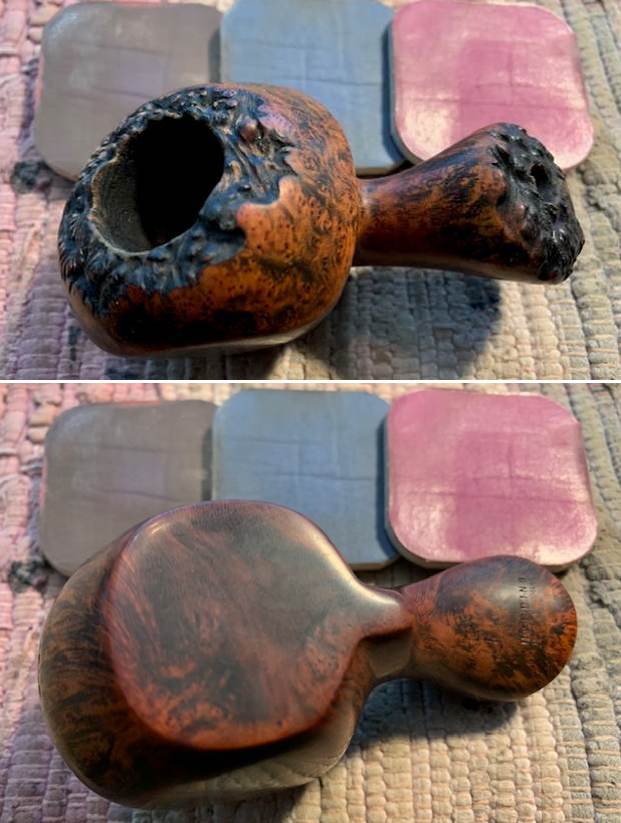
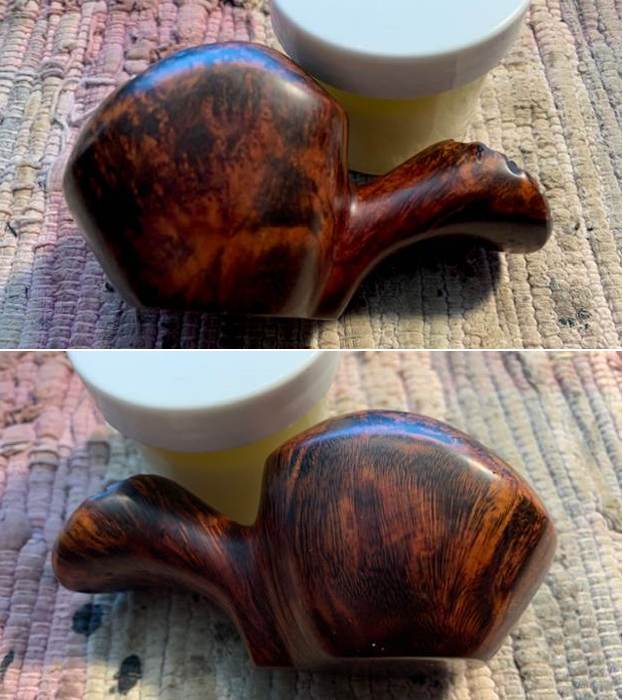
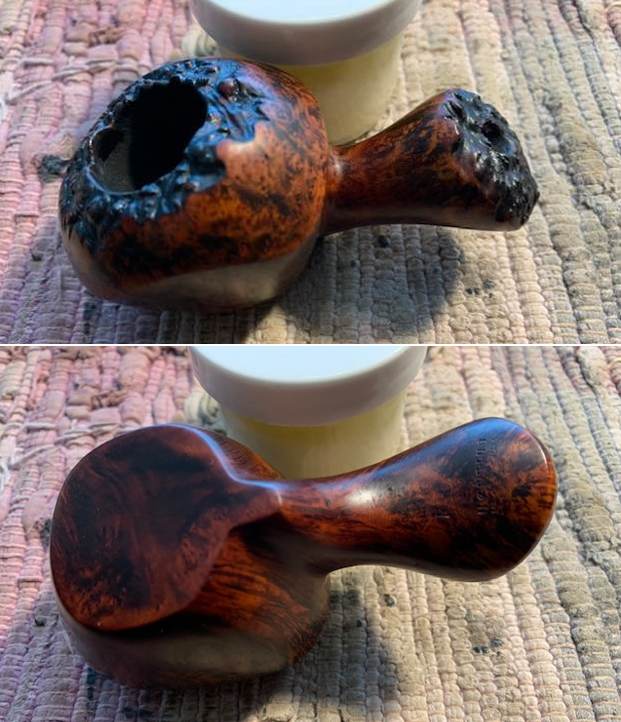
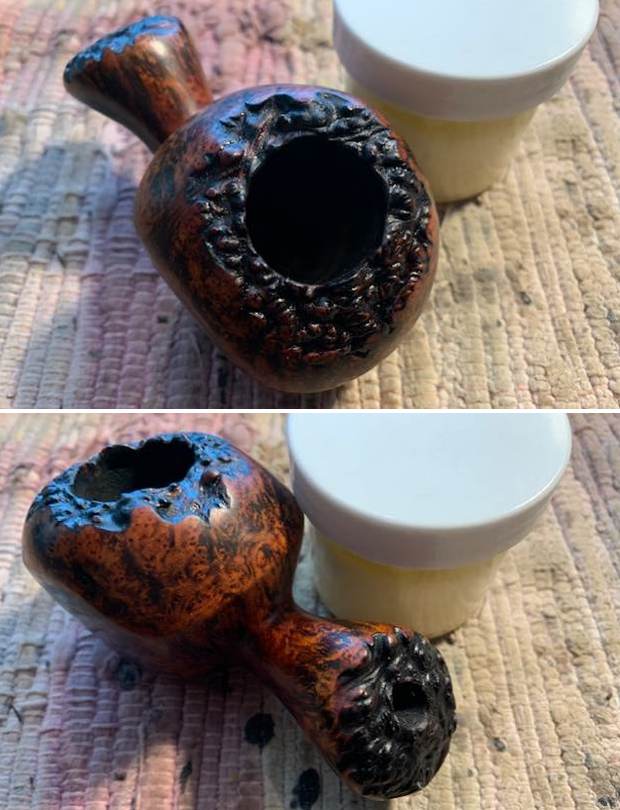
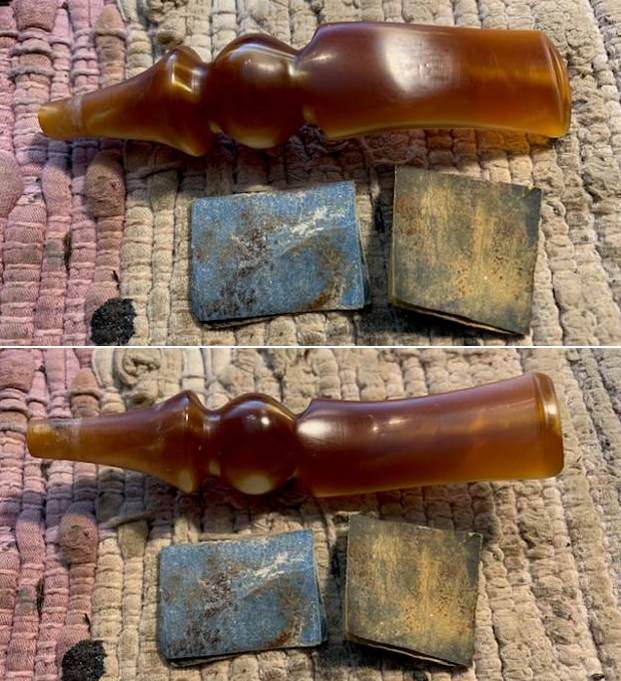
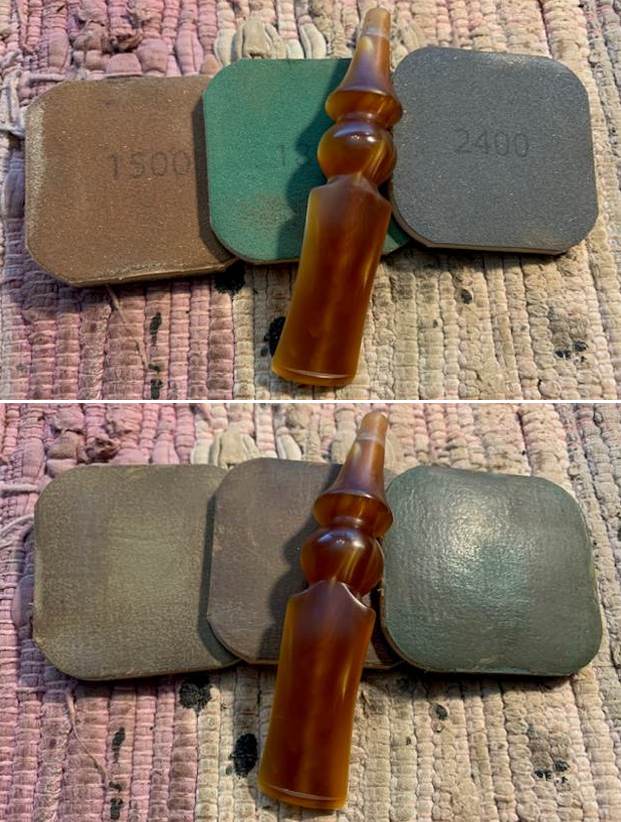
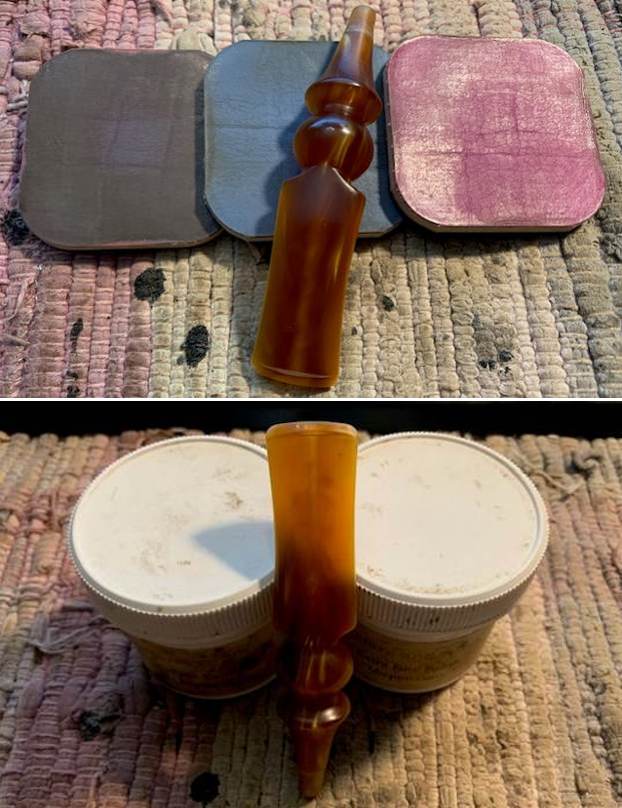
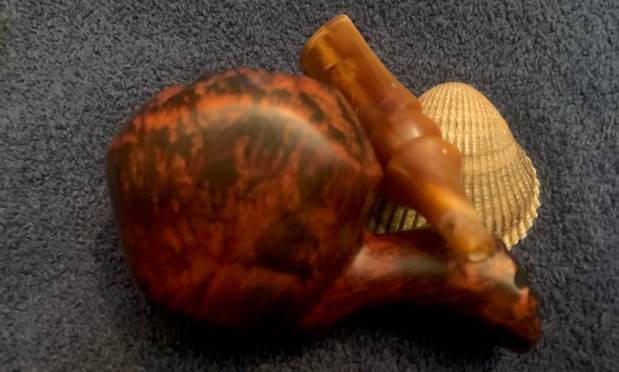
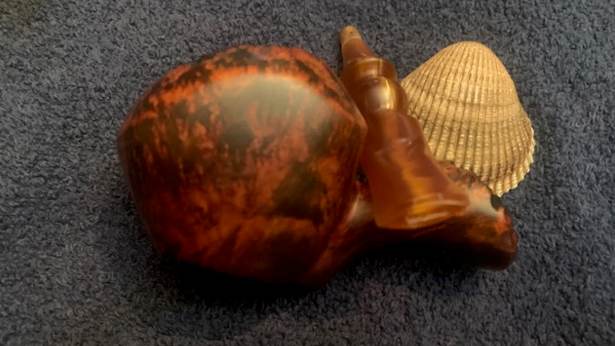
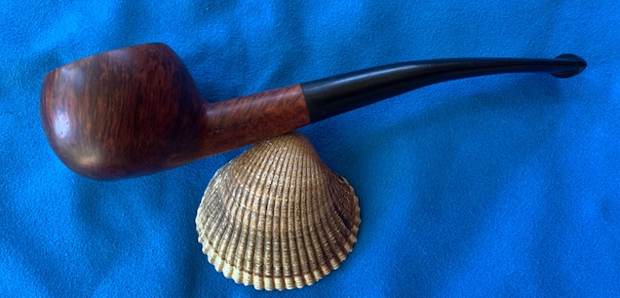
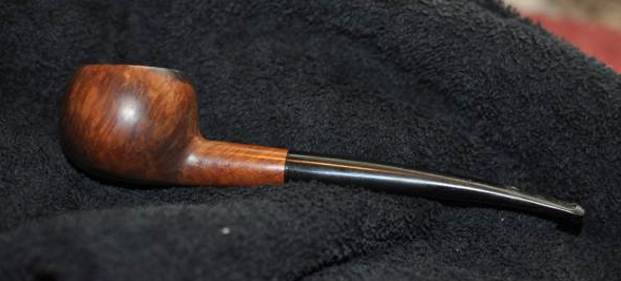
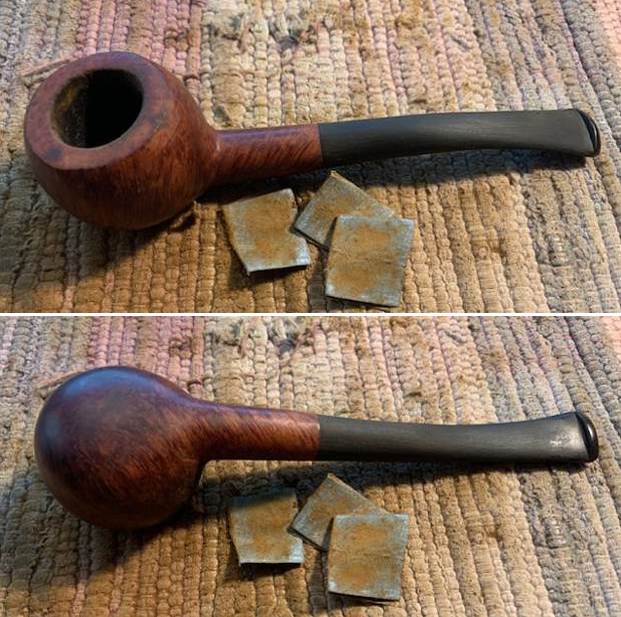
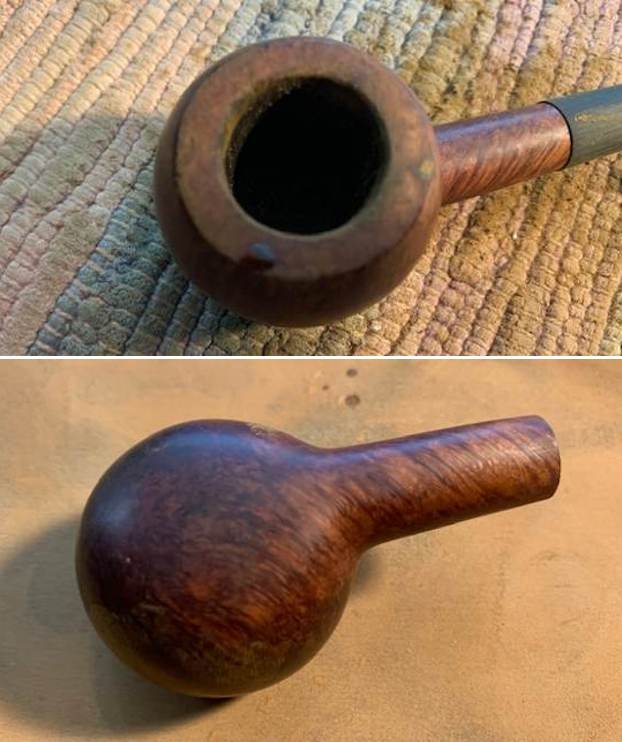
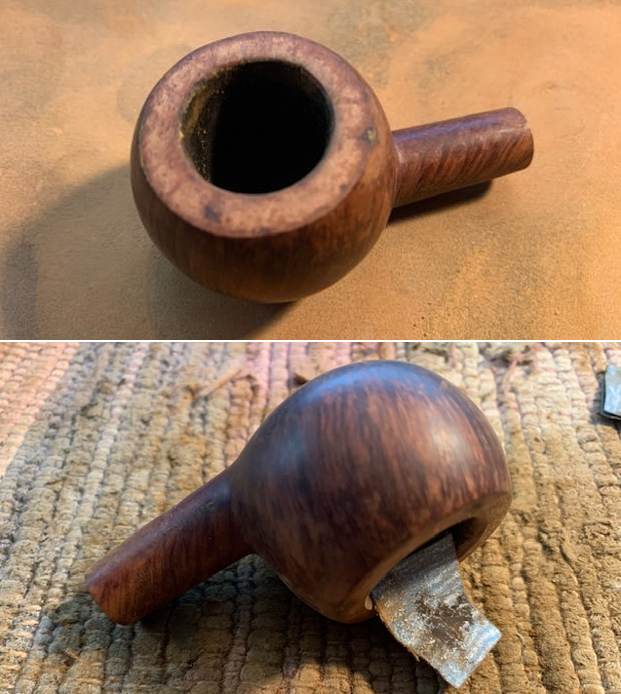
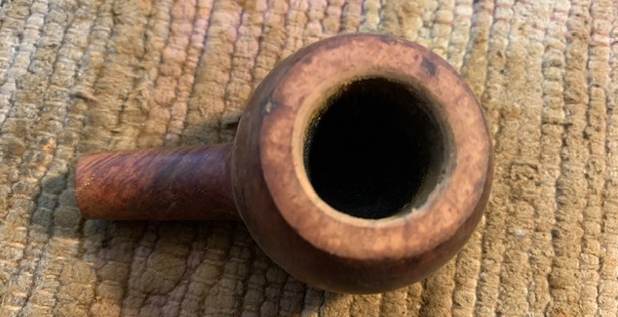
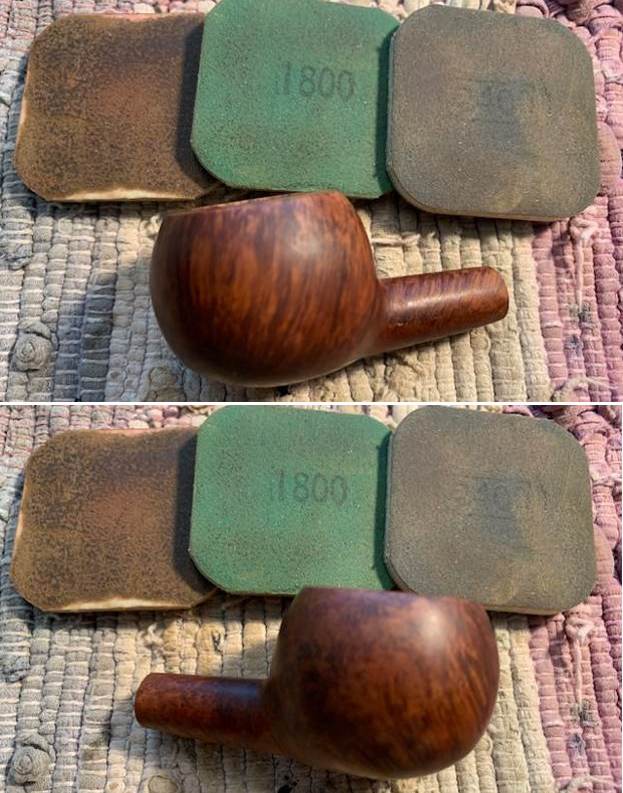
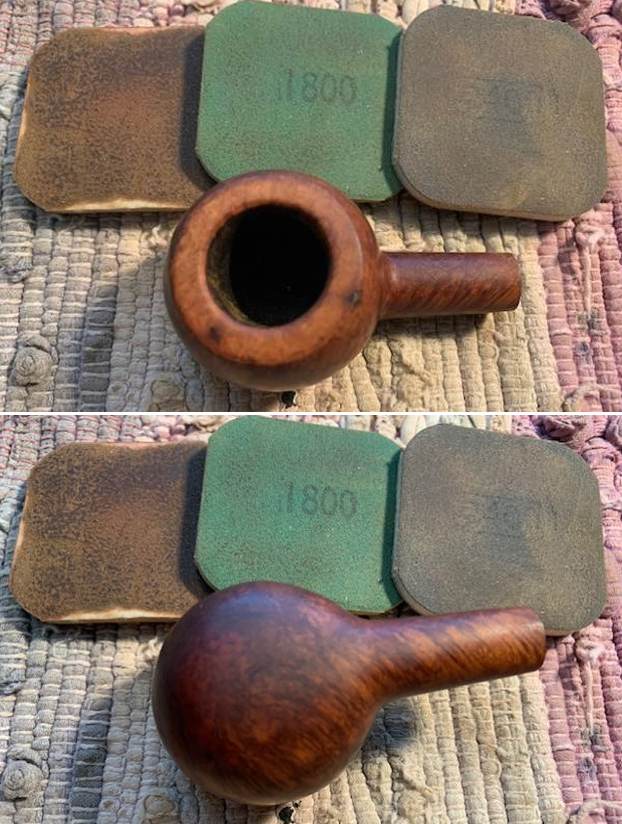
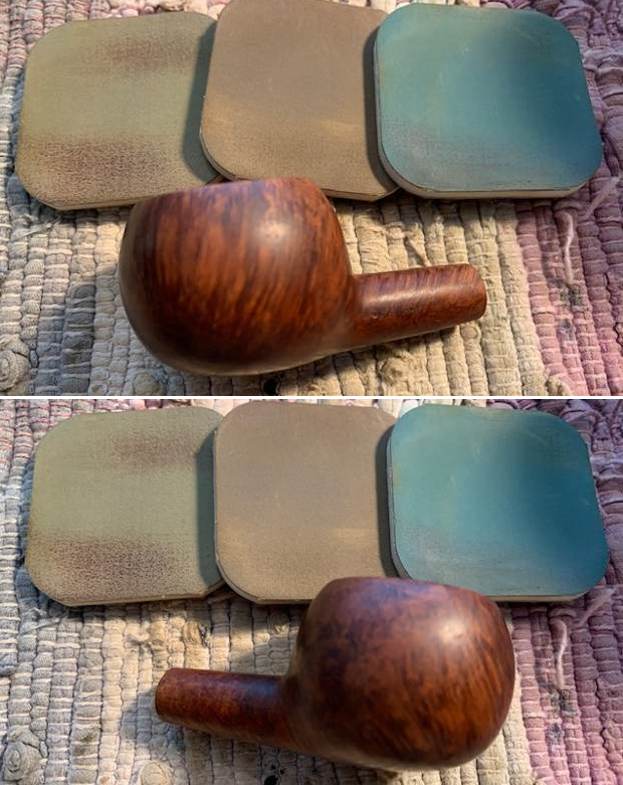
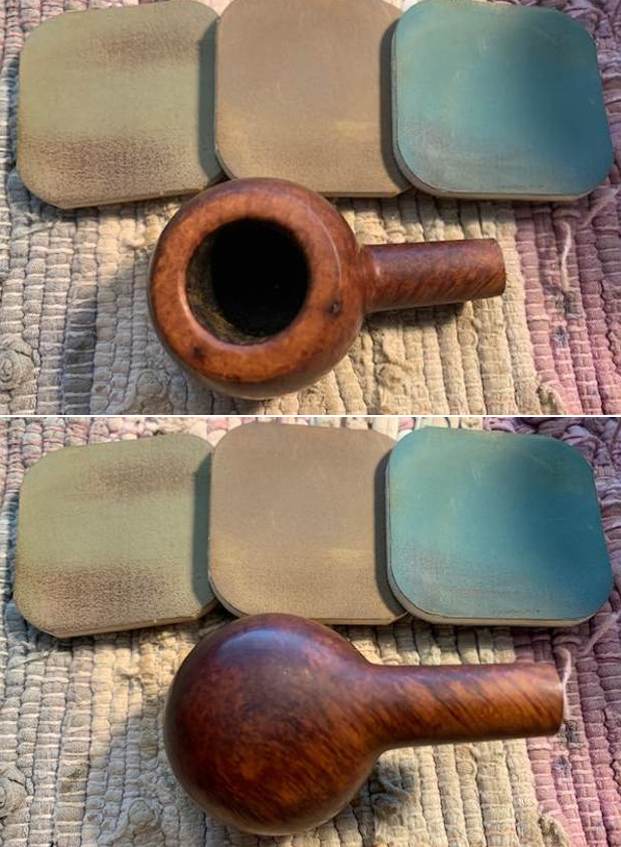
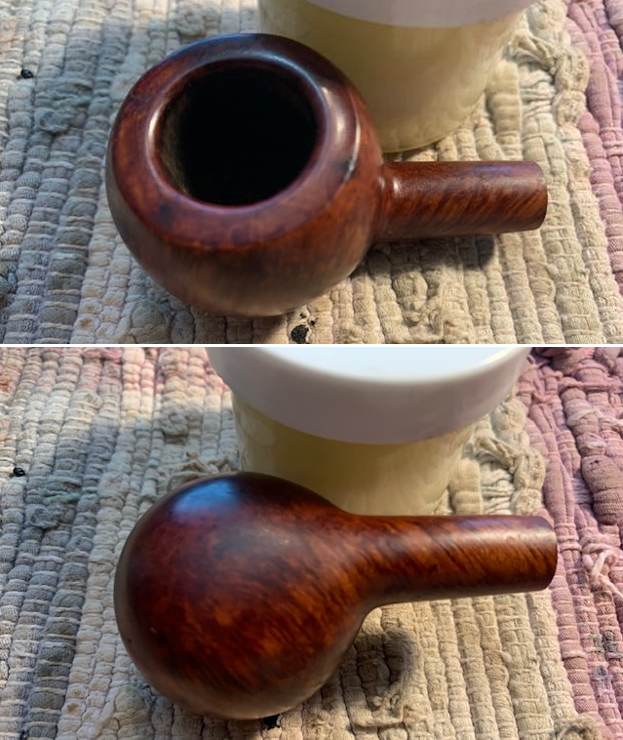
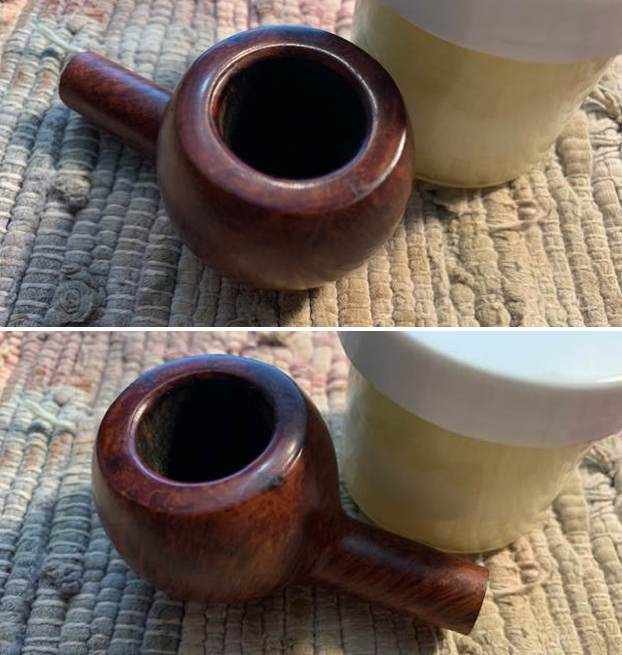
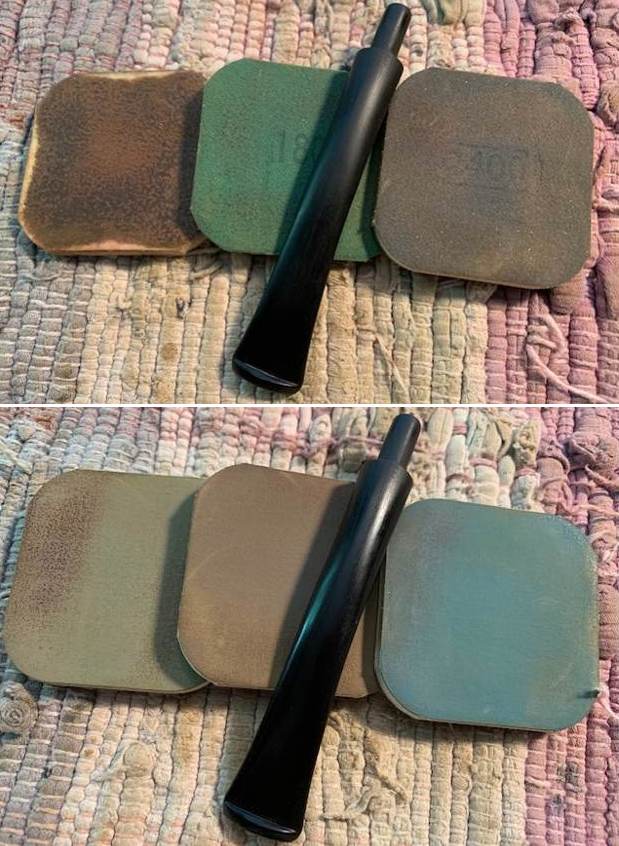
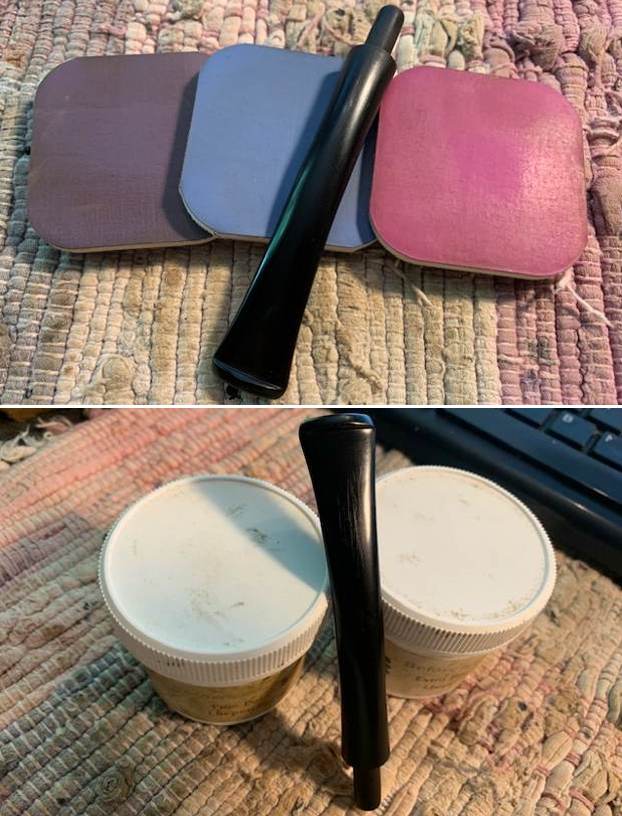
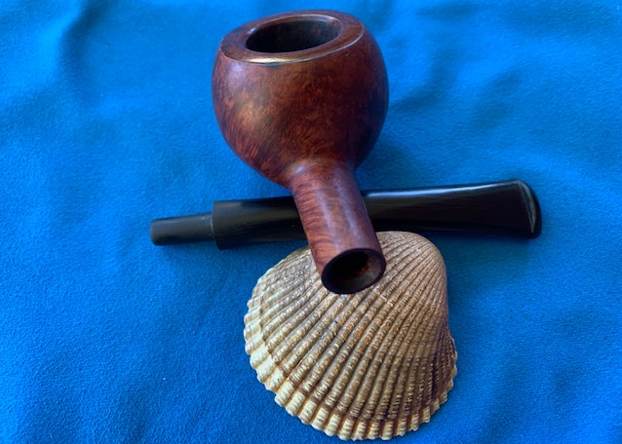
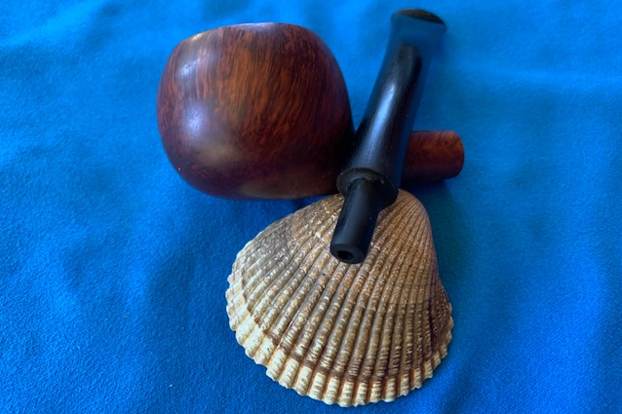
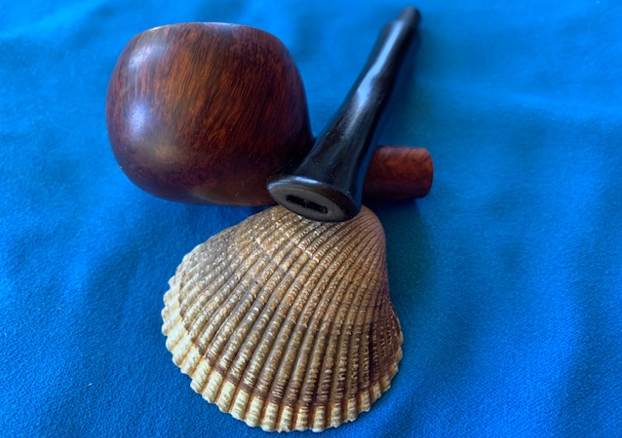
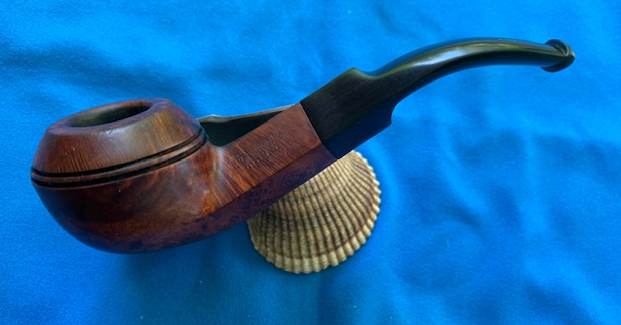
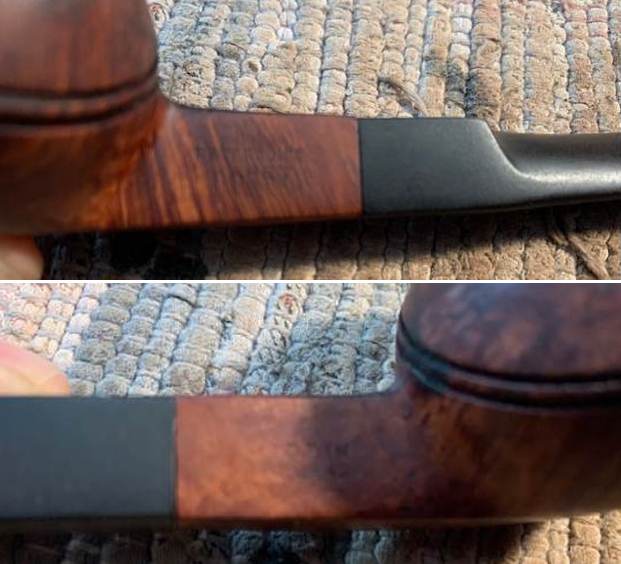
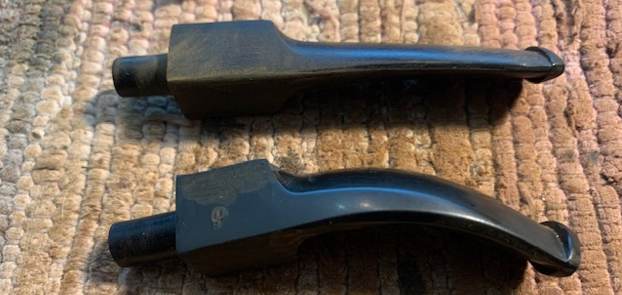
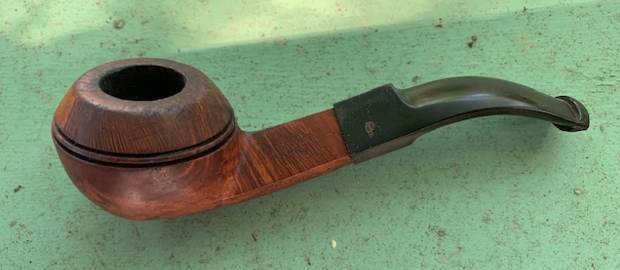
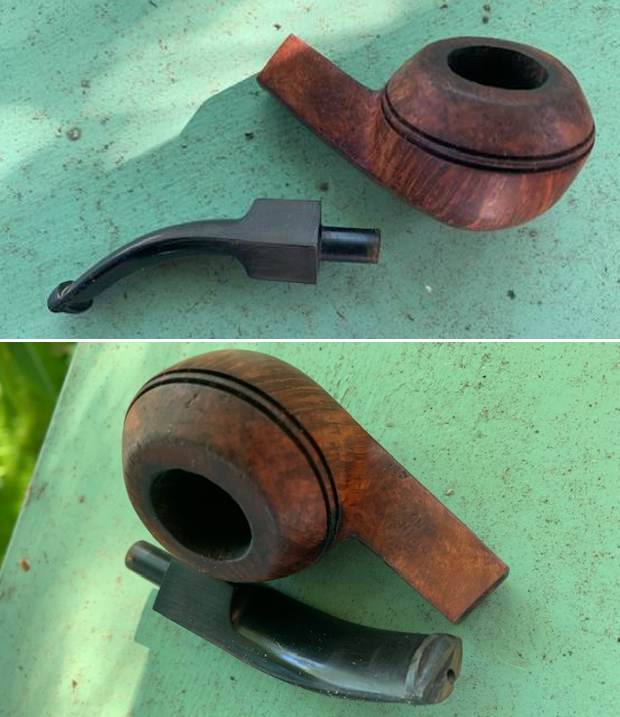
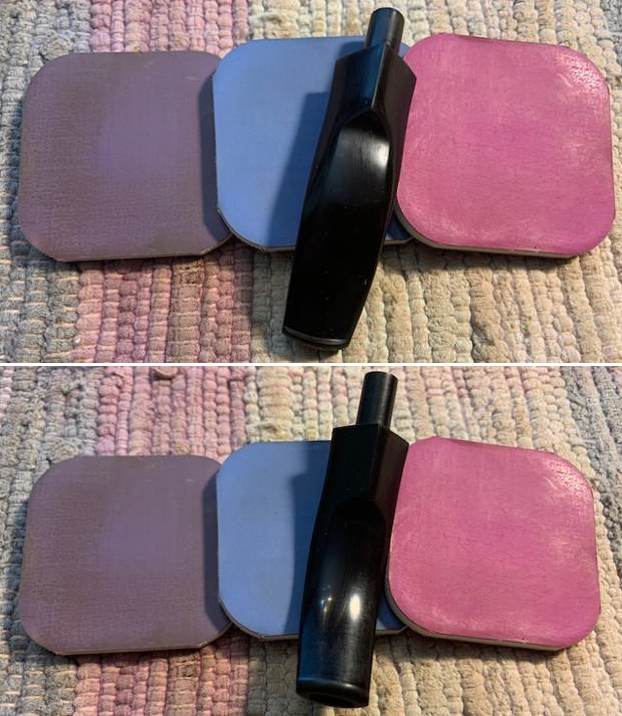
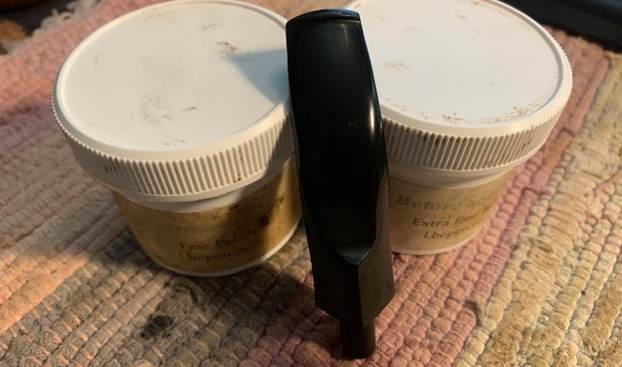
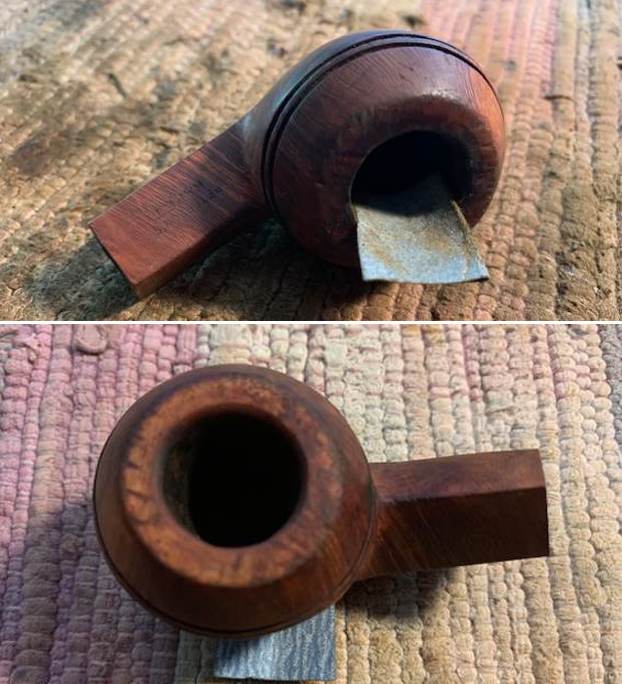
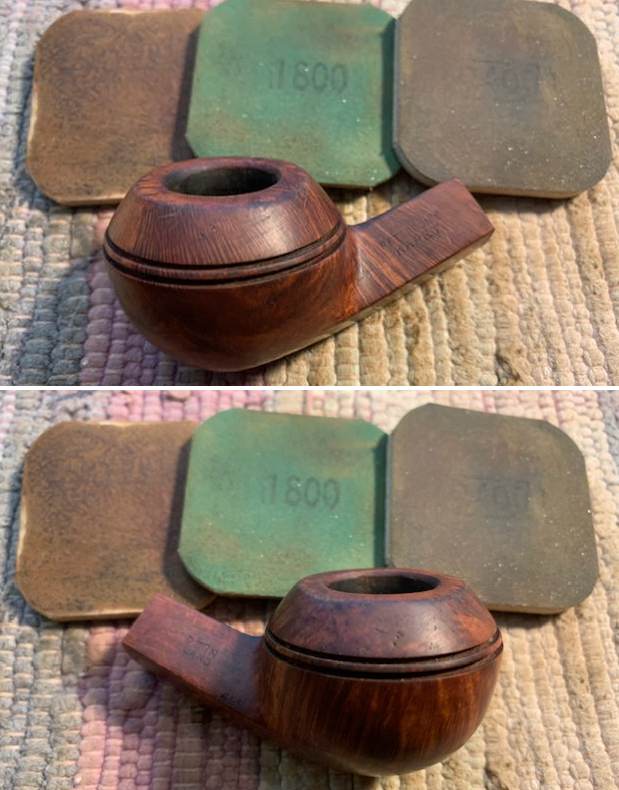
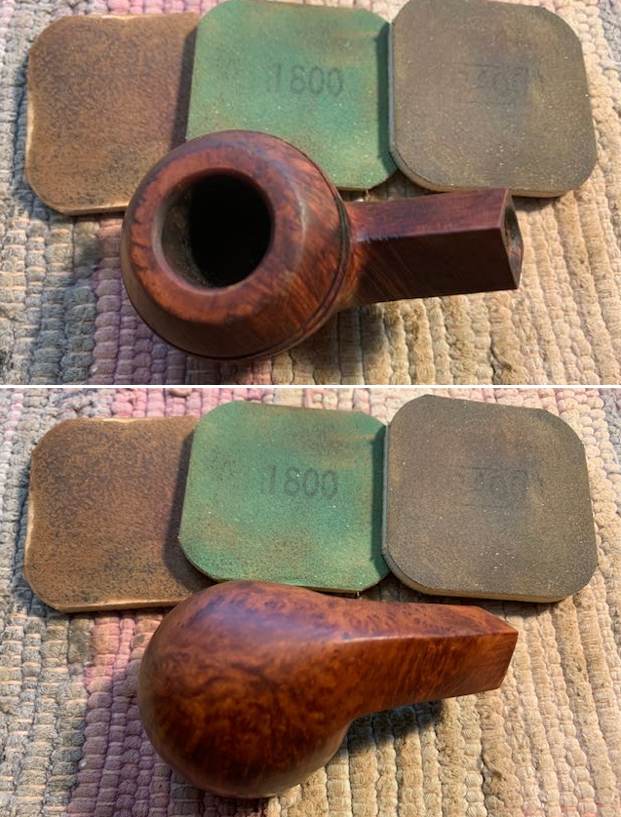
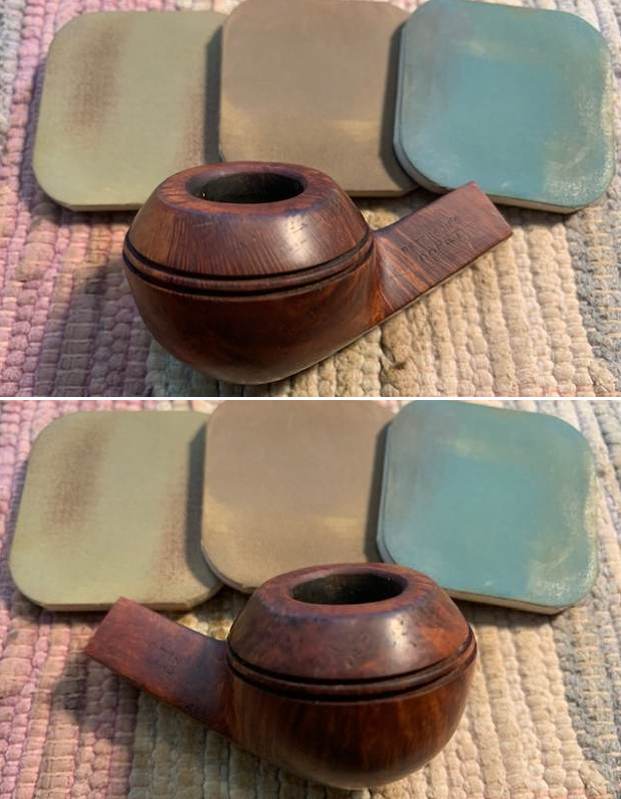
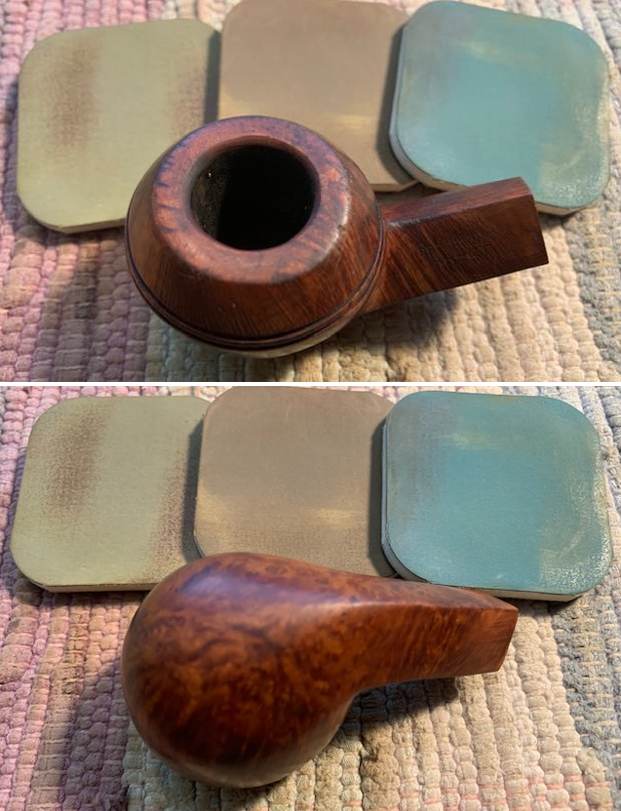
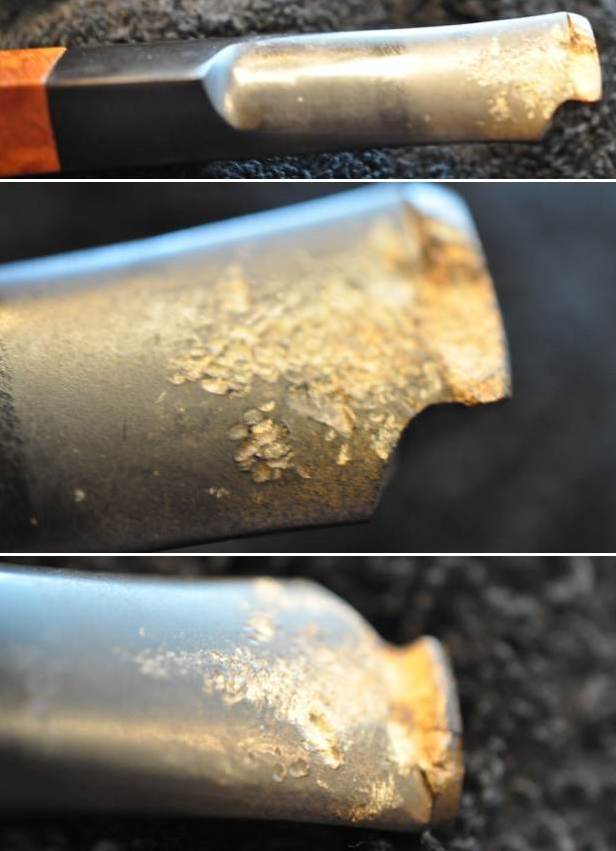
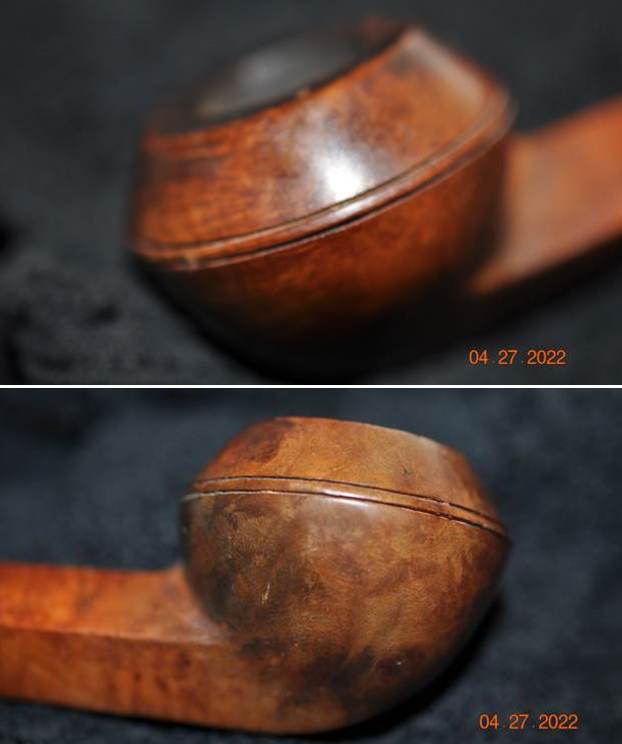
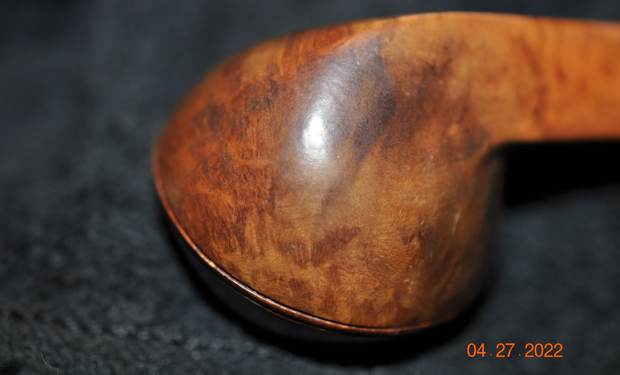
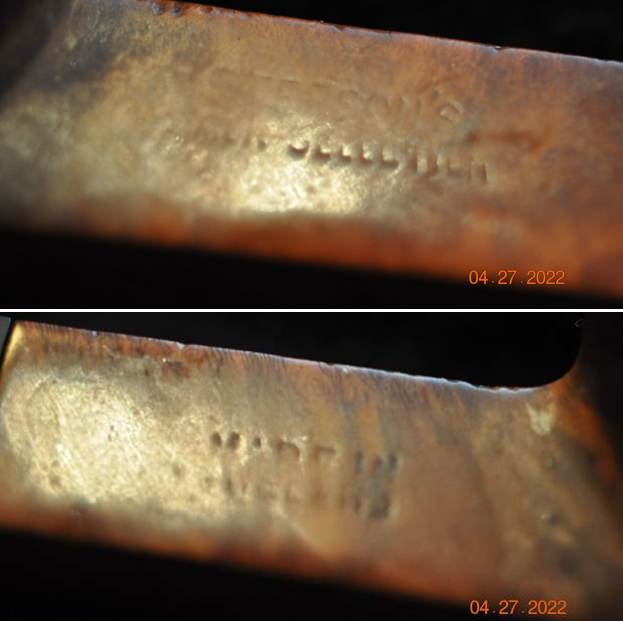
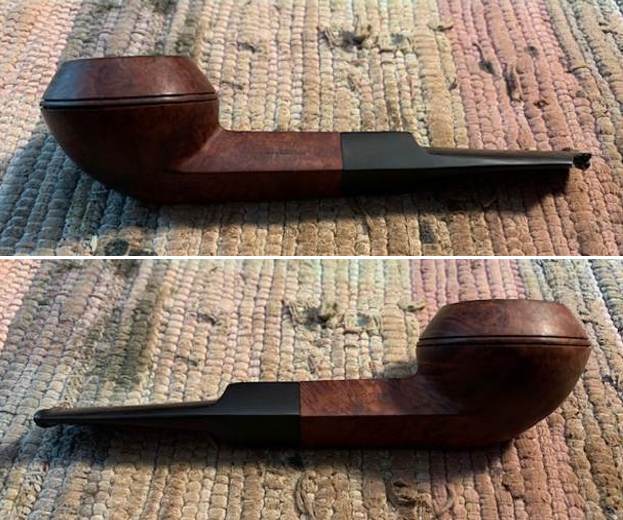
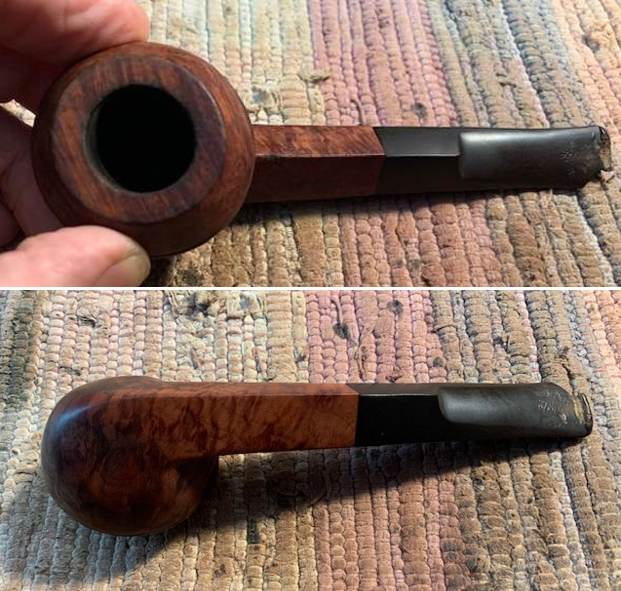
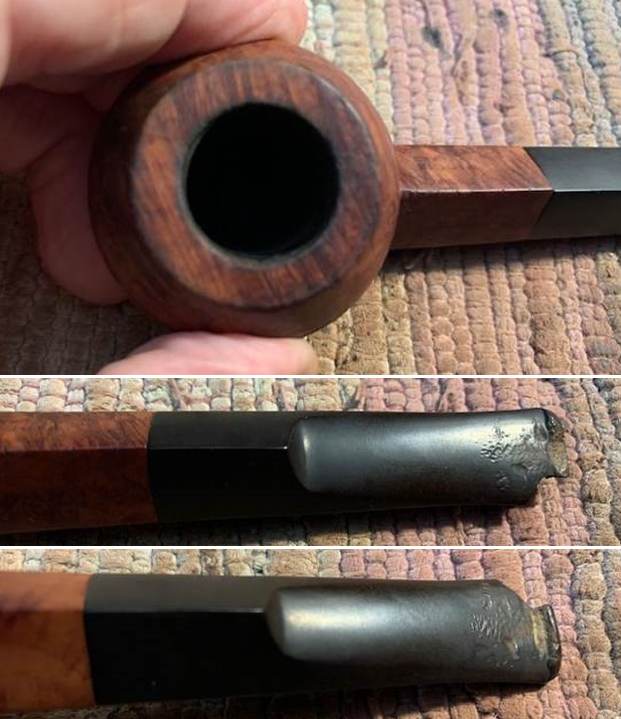
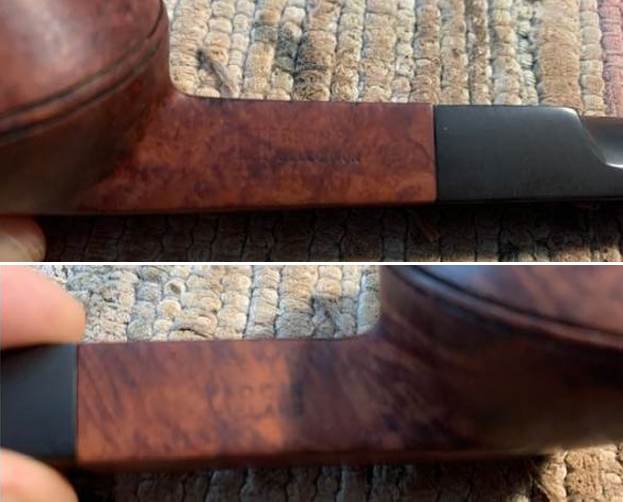
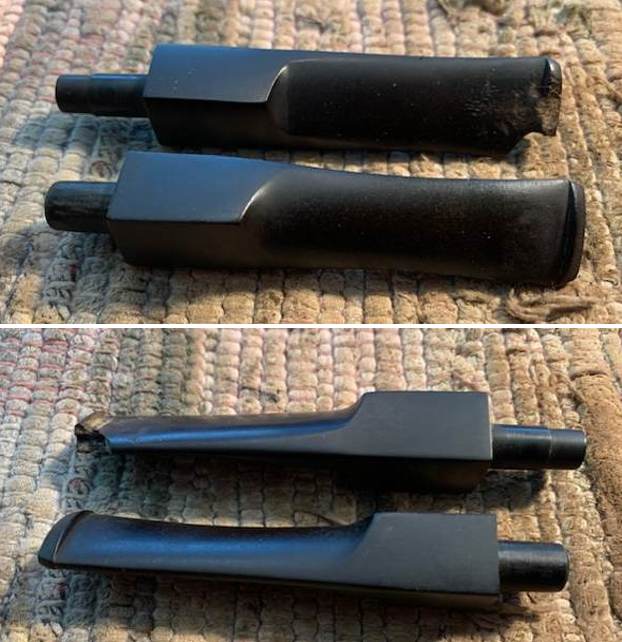
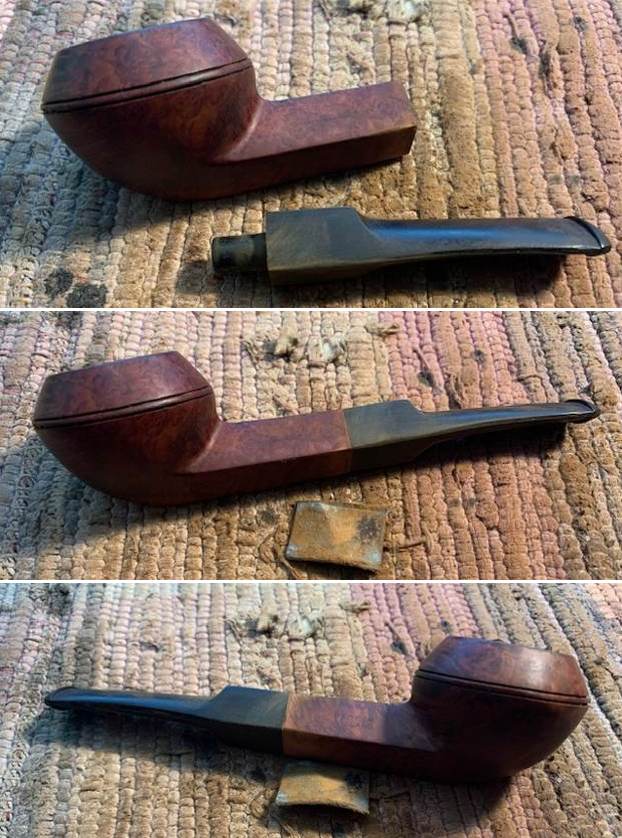
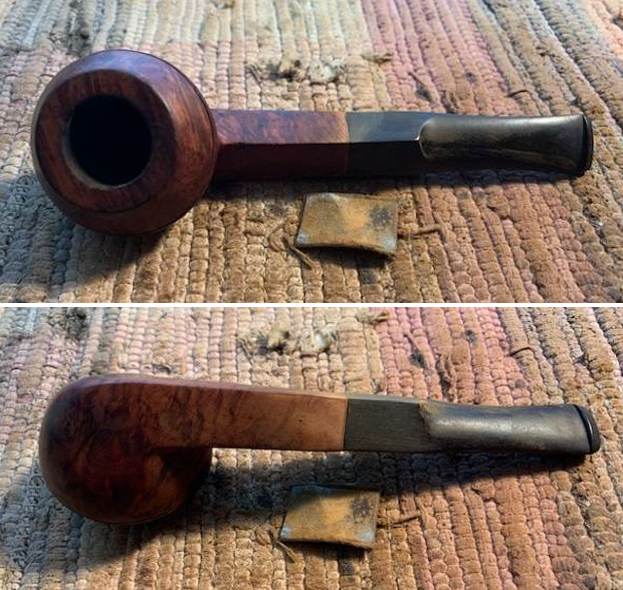
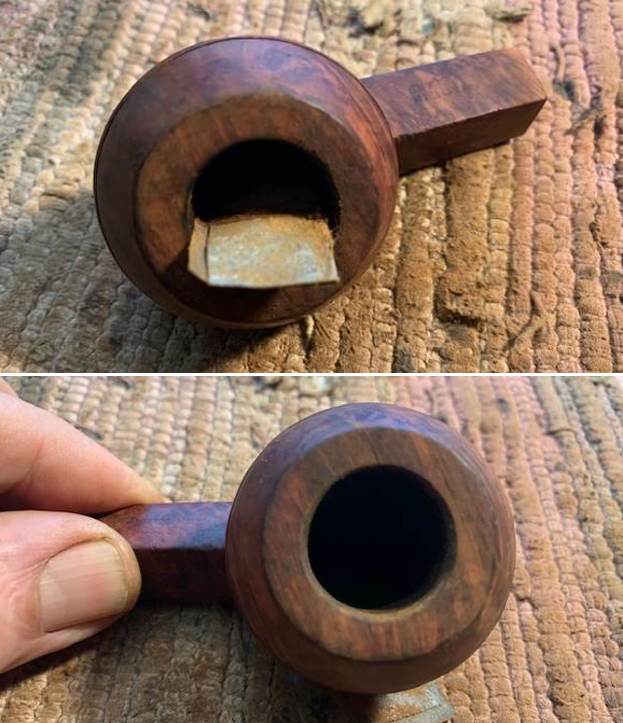
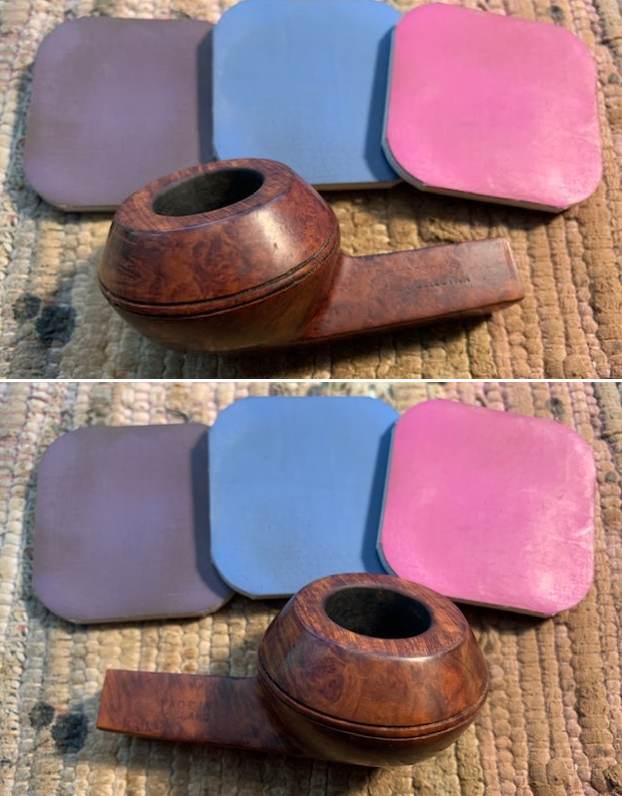
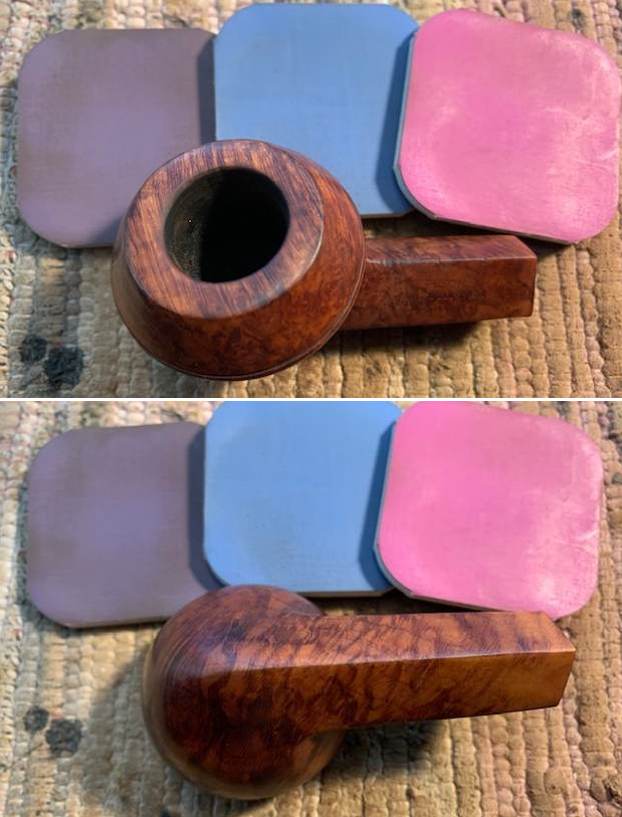
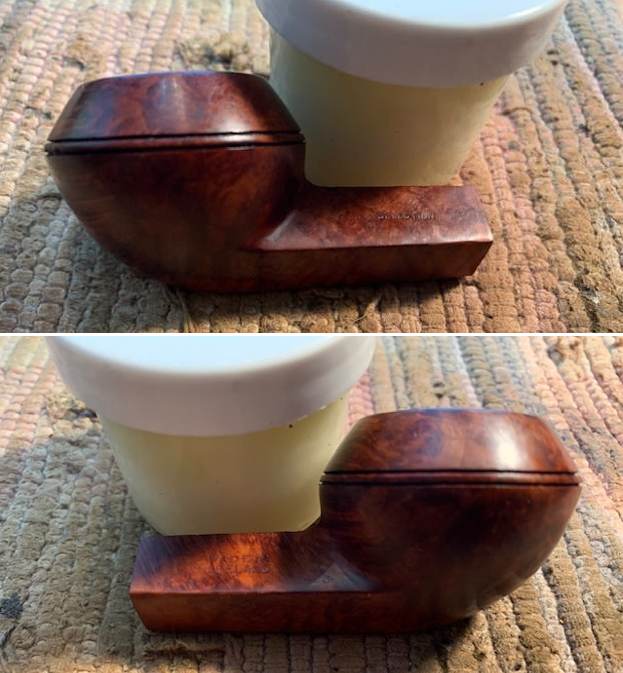
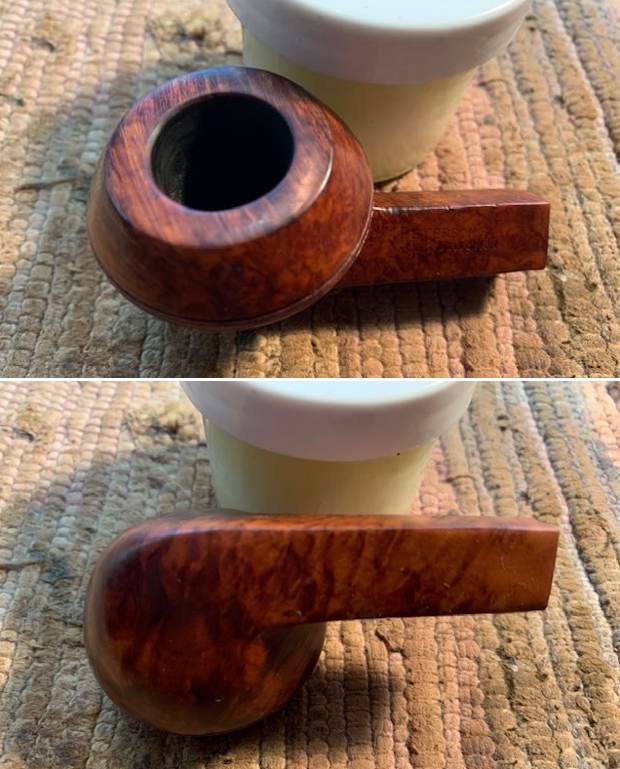
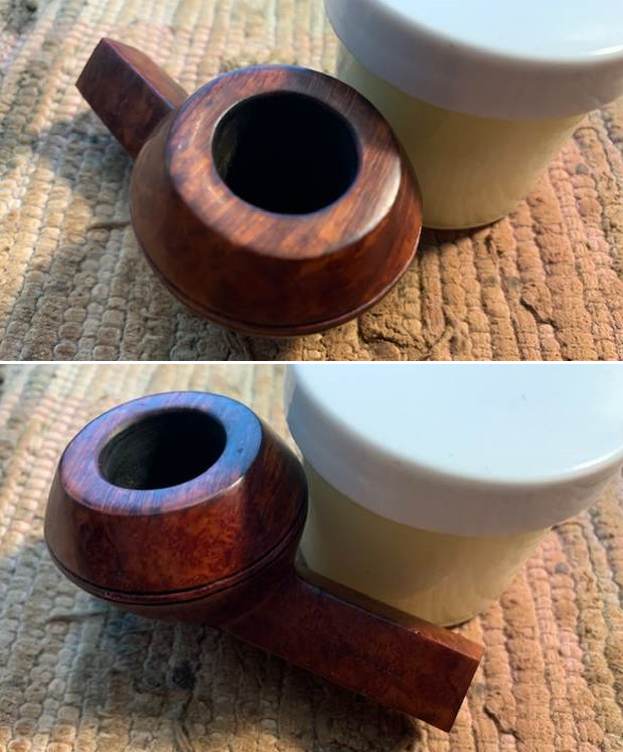
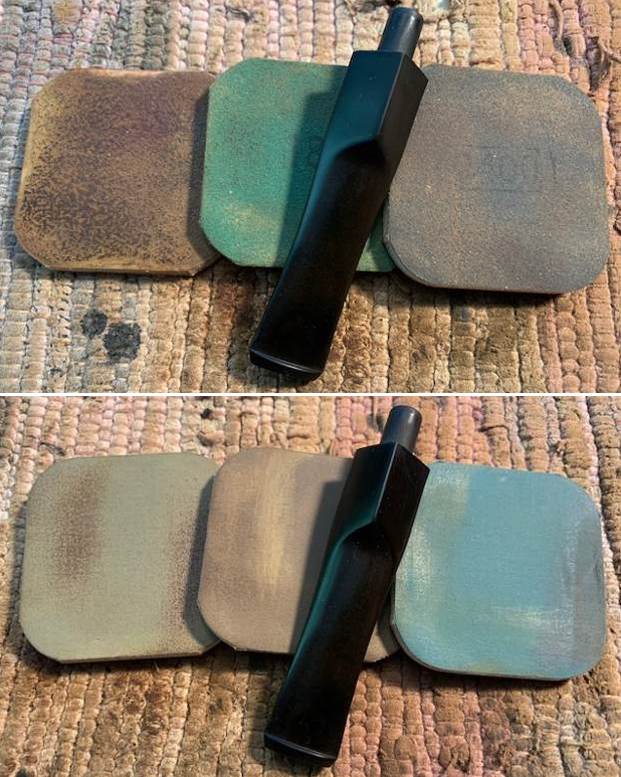
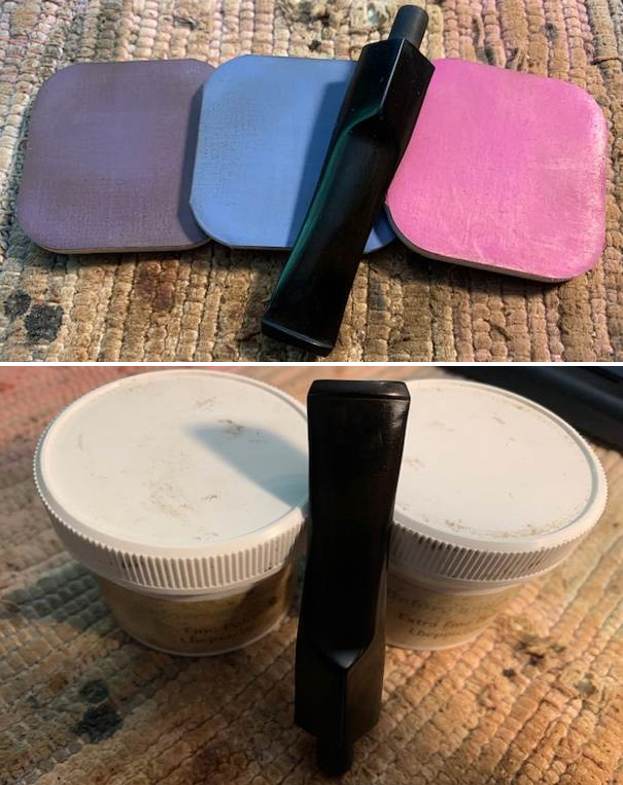
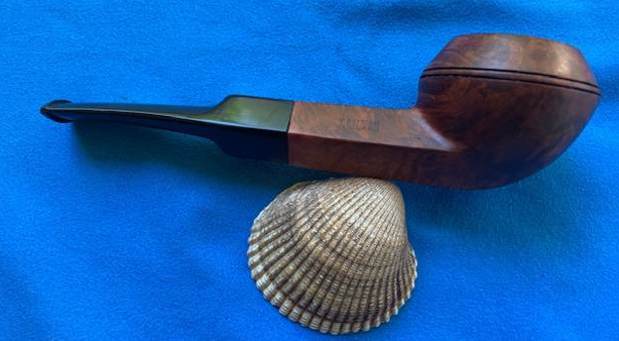
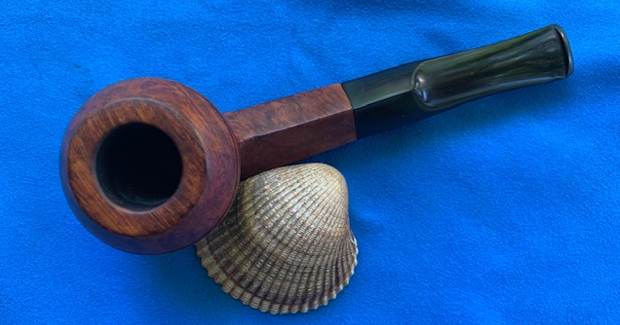
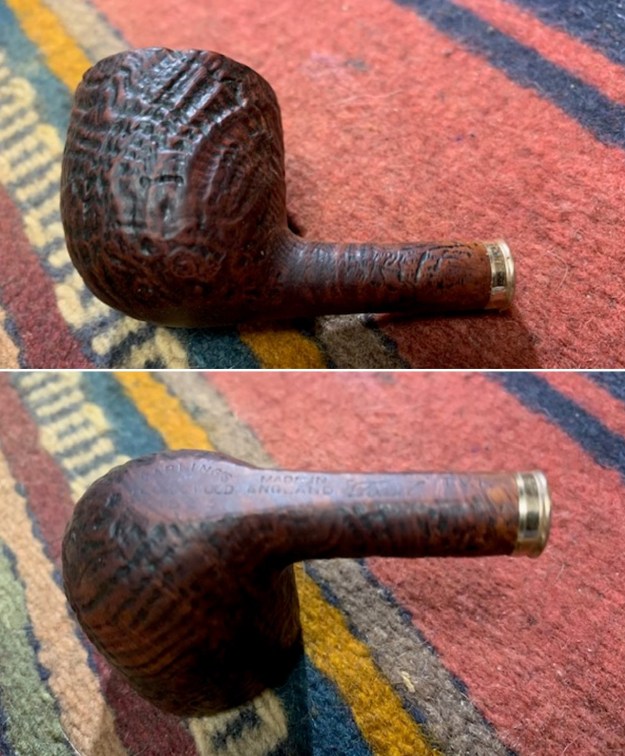
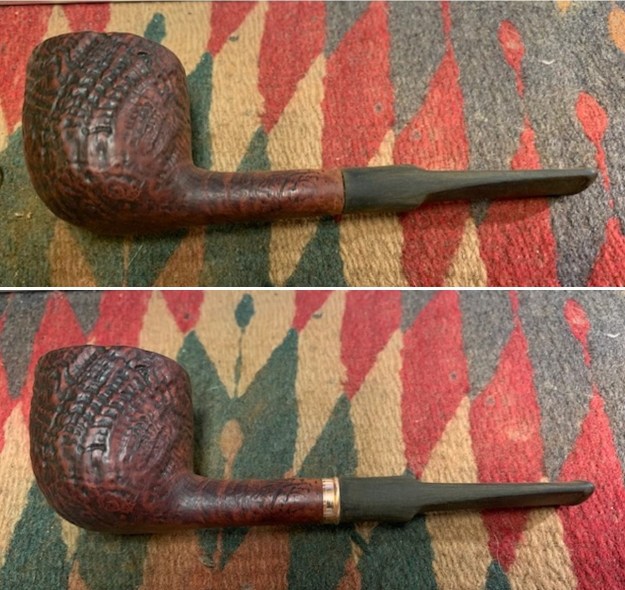
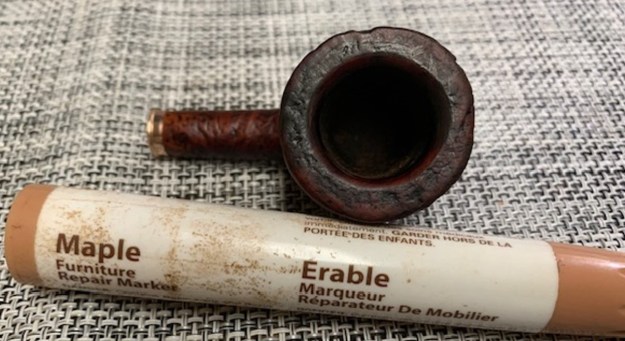
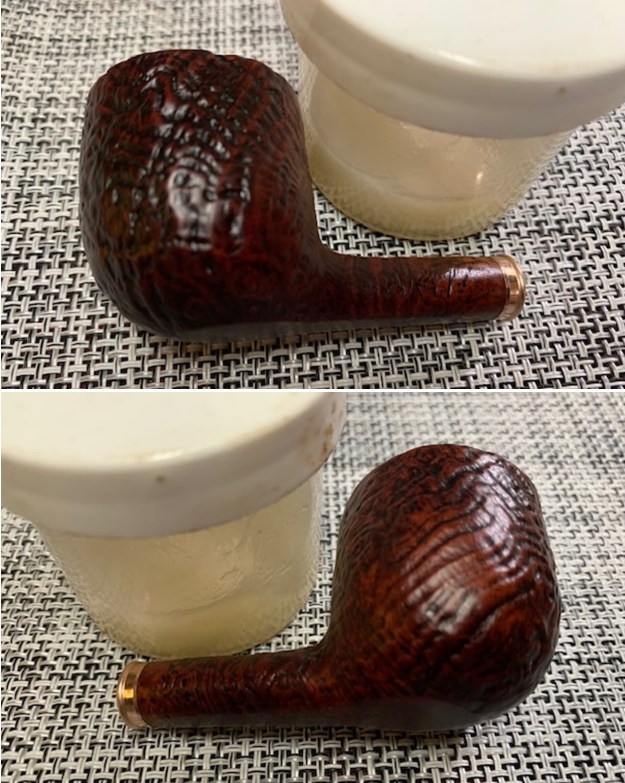
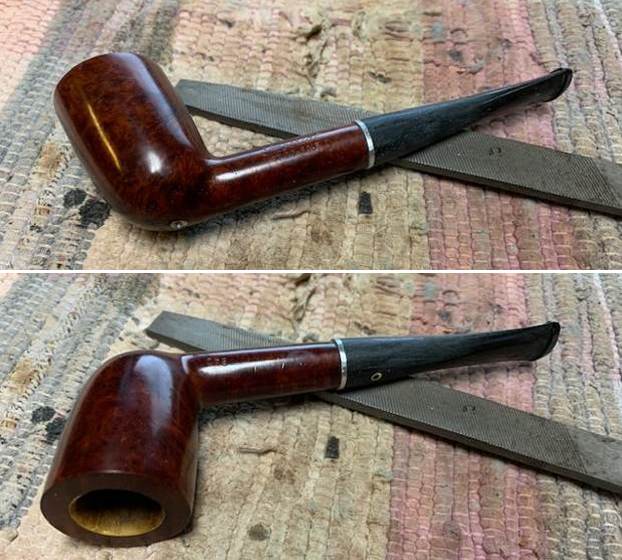
Two of my daughters and I enjoy visiting our local Flea Market. They look for a lot of different things and I keep an eye out for pipes. Not long ago we were there and the girls found their things and I found these two Cherrywood Pipes – one is marked Royal Cherry [over] Made in France (top pipe in the photo below) and the other is marked Ropp in an oval [over] Deluxe [over] France [over] 804. Both are in good condition and both are without their stems. Here is what the pipes looked like when I brought them home. After finishing the Royal Cherry Cherrywood I turned my attention to the Ropp bowl. The octagonal bowl had strips of bark on four of the panels and smooth cherry stripped of the bark on the other four panels. The rim top and the heel of the bowl were stripped of bark and were smooth cherry wood. The shank is a cherry wood branch that has been threaded and screwed into the back side of the bowl. The bark on the shank is undamaged and looks good. The bowl and shank have been given a coat of varnish or shellac as it is smooth and shiny. The bowl has been smoked and there is a light cake in the bowl with some darkening and light lava on the bevelled inner edge of the bowl. The heel of the bowl is also smooth. It is stamped Ropp in an oval [over] De Luxe [over] France [over] 804. There was no stem that came with the pipe so one would need to be fit to the shank. I took a photo of the rim top to show the darkening and lava on the bevel and the light cake in the bowl. The shape of the bowl is well done and looks very good.I took a photo of the stamping on the heel of the bowl. It is clear and readable as noted above.I found a stem in my collection that would fit the shank but it would need to be bent to follow the flow of the shank and bowl. It was used and had some tooth marks in both sides of the stem ahead of the button.I reamed the bowl to take the cake back to bare walls. I used a Savinelli Fitsall Pipe Knife and scraped it clean. I sanded the walls of the bowl smooth with 220 grit sandpaper wrapped around a piece of dowel. The walls of the bowl were smooth and undamaged.I cleaned out the shank airway and mortise with alcohol, cotton swabs and pipe cleaners. I did the same with the airway in the new stem. The pipe was clean when I was finished.I cleaned up the bevelled rim top with a folded piece of 220 grit sandpaper to remove the light lava and the darkening. It came off very well and looked much better.I polished the smooth portions of the cherry with micromesh sanding pads – 1500-12000 grit pads. I dry sanded the wood and then wiped it down with a damp cloth. The polishing work progressively brought a shine to the pipe. It looked really amazing – the combination of bark and smooth portions of the cherrywood. It is a beauty! I rubbed the bowl down with Before & After Restoration Balm. I worked it into the finish with my fingertips. The product works to clean, preserve and protect the wood. I let it sit and absorb for 10 minutes. I buffed it off with a soft cloth and then gave it a rigorous buff to raise the shine. It looks good at this point. I set the bowl aside and turned to address the stem. I heated the stem with the flame of a Bic lighter to soften the vulcanite and bend it to match the curves of the bowl and shank. Once it was soft I bent it and it looks much better. I took photos of the stem surface to show the deep tooth marks on the surface of the stem. I painted the surface of the tooth marks with a lighter flame. I was able to lift them considerably. I filled in what remained with black CA glue. I set it aside to allow them to cure. Once the repair had cured I flattened out the repair with small file to blend it into the stem surface. I sanded it smooth with a folded piece of 220 grit sandpaper. I started the polishing on the stem with a piece of 600 grit sandpaper. I wiped it down with Obsidian Oil and set it aside. I polished the stem with 1500-12000 grit micromesh sanding pads – I dry sanded the chatter on the stem surfaces on both sides and the diameter of the saddle portion of the stem. I wiped it down with Obsidian Oil on a cloth after the sanding pads. Once finished it looked very good. I finished the hand polishing of the stem with Before & After Pipe Polish – both the Fine and Extra Fine polishes. I gave it a final coat of Obsidian oil and set it aside to dry. I am really happy with the way that this restemmed Ropp De Luxe 804 Cherrywood Pipe turned out. It is a nice looking pipe with a great shape and finished with bark on the bowl sides and shank and the rim top and heel of the bowl are smooth. The vulcanite saddle stem turned out very nice. The polished stem works well with the Cherrywood finish. The wood really came alive with the buffing. The bark finish gave the pipe a sense of depth with the polishing and waxing. I put the stem back on the bowl and carefully buffed the pipe with Blue Diamond on the buffing wheel using a light touch on the wood. I gave the bowl multiple coats of Conservator’s Wax and the stem multiple coats of carnauba wax on the buffing wheel. I buffed the pipe with a clean buffing pad to raise the shine. I hand buffed the pipe with a microfiber cloth to deepen the shine. The finished Ropp De Luxe 804 Bent Cherrywood really is a beauty and feels great in the hand and looks very good. Give the finished pipe a look in the photos below. The dimensions of the pipe are Length: 6 ½ inches, Height: 2 inches, Outside diameter of the bowl: 1 ¾ inches, Chamber diameter: ¾ of an inch. The weight of the pipe is 64 grams/ 2.26 ounces. I will be putting the pipe on the rebornpipes store in the French Pipemakers Section. If you would like to add it to your collection let me know. Thanks for reading this blog and my reflections on the pipe while I worked on it. It was a fun one to work on!

As always, I encourage your questions and comments as you read the blog. Thanks to each of you who are reading this blog. Remember we are not pipe owners; we are pipe men and women who hold our pipes in trust until they pass on into the trust of those who follow us.

Restemming an Unsmoked Royal Cherry 4 Made France Cherrywood


Blog by Steve Laug

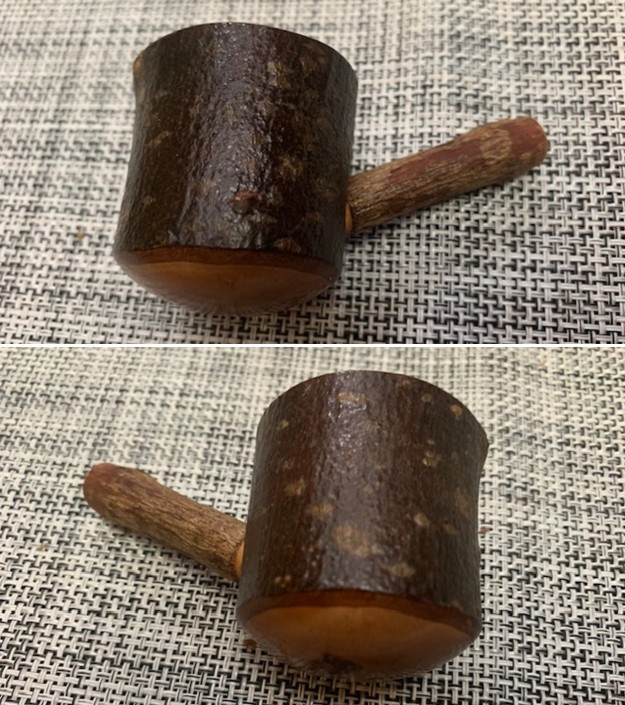
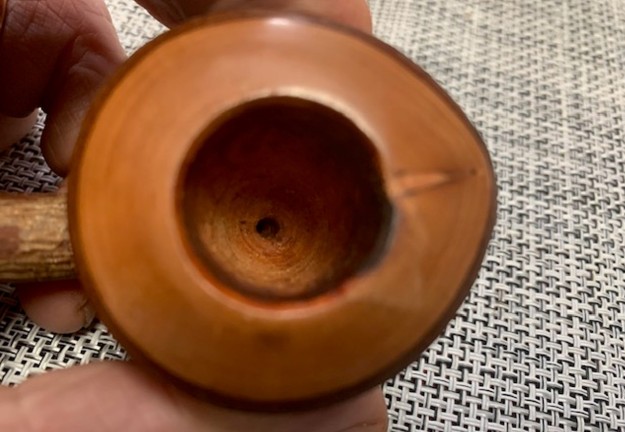
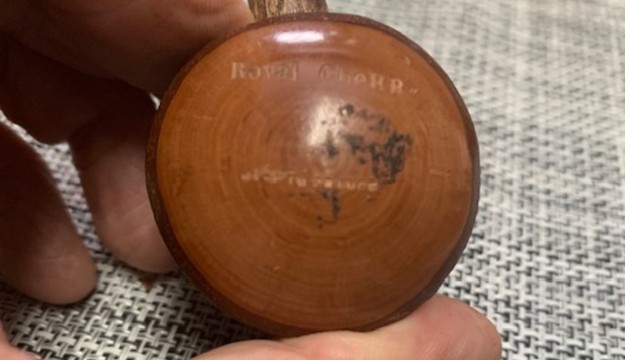
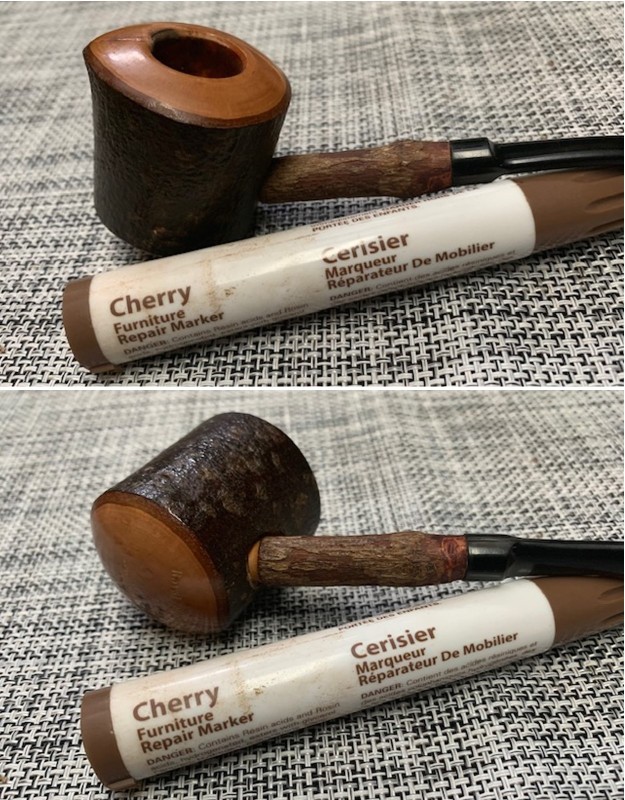
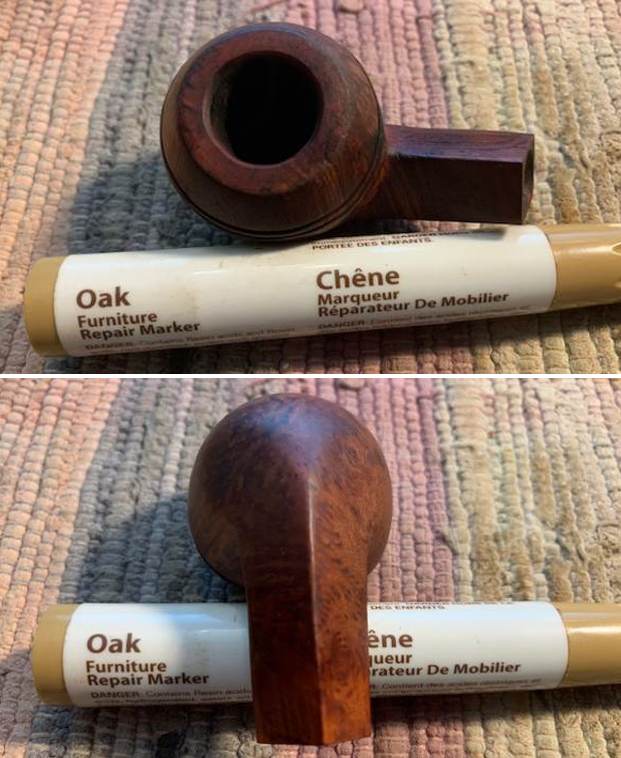
Two of my daughters and I enjoy visiting our local Flea Market. They look for a lot of different things and I keep an eye out for pipes. Not long ago we were there and the girls found their things and I found these two Cherrywood Pipes – one is marked Royal Cherry [over] Made in France (top pipe in the photo below) and the other is marked Ropp in an oval [over] Deluxe [over] France [over] 804. Both are in good condition and both are without their stems. Here is what the pipes looked like when I brought them home. I decided to work on the Royal Cherry pipe first. The bowl was covered with uninterrupted bark and seemed to have a varnish coat as there is a shiny coat on the bowl, rim top and the heel. The shank is a branch that has been threaded and screwed into the back side of the bowl. The top end of the shank is slightly tapered behind a branch nodule. The shank is not varnished or shiny. The rim top was smooth and there is a pointed nose on the front of the bowl. It has a split in it on the top that has been filled with putty. The bowl is unsmoked but there is some darkening on front inner edge of the bowl. The heel of the bowl is also smooth. It is stamped Royal Cherry [over] Made in France. There was some sticky substance on the heel from a price sticker. I took a photo of the rim top to show the clean and unsmoked bowl. You can also see the putty fill in the rim top on the pointed nose of the bowl. It is solid and smooth to the touch.I took a photo of the stamping on the heel of the bowl. It is clear and readable under the sticky substance left behind by a price tag.I found a stem that would fit the shank but it would need to be bent to follow the flow of the shank and bowl. I also put a band in the photo but ended up not using it.I touched up the shank end on the shank with a Cherry stain pen so that the smooth portion would match the stain on the smooth rim top and heel of the bowl.I heated the stem with the flame of a Bic lighter to soften the vulcanite and bend it to match the curves of the bowl and shank. Once it was soft I bent it and it looks much better.I sanded the diameter of the saddle portion to match the diameter of the shank. I used a folded piece of 220 grit sandpaper to reduce it to match the shank. I started the polishing with 600 grit wet dry sandpaper.I polished the stem with 1500-12000 grit micromesh sanding pads – I dry sanded the chatter on the stem surfaces on both sides and the diameter of the saddle portion of the stem. I wiped it down with Obsidian Oil on a cloth after the sanding pads. Once finished it looked very good. I finished the hand polishing of the stem with Before & After Pipe Polish – both the Fine and Extra Fine polishes. I gave it a final coat of Obsidian oil and set it aside to dry. I am really happy with the way that this restemmed, unsmoked Royal Cherry Bent Cherrywood Pipe turned out. It is a nice looking pipe with a great shape and finished with bark on the bowl sides and shank and the rim top and heel of the bowl are smooth. The vulcanite saddle stem turned out very nice. The polished stem works well with the Cherrywood finish. The wood really came alive with the buffing. The bark finish gave the pipe a sense of depth with the polishing and waxing. I put the stem back on the bowl and carefully buffed the pipe with Blue Diamond on the buffing wheel using a light touch on the wood. I gave the bowl multiple coats of Conservator’s Wax and the stem multiple coats of carnauba wax on the buffing wheel. I buffed the pipe with a clean buffing pad to raise the shine. I hand buffed the pipe with a microfiber cloth to deepen the shine. The finished Royal Cherry Bent Cherrywood really is a beauty and feels great in the hand and looks very good. Give the finished pipe a look in the photos below. The dimensions of the pipe are Length: 6 inches, Height: 2 inches, Outside diameter of the bowl: 1 ½ inches, Chamber diameter: ¾ of an inch. The weight of the pipe is 51 grams/ 1.80 ounces. I will be putting the pipe on the rebornpipes store in the French Pipemakers Section. If you would like to add it to your collection let me know. Thanks for reading this blog and my reflections on the pipe while I worked on it. It was a fun one to work on!

As always, I encourage your questions and comments as you read the blog. Thanks to each of you who are reading this blog. Remember we are not pipe owners; we are pipe men and women who hold our pipes in trust until they pass on into the trust of those who follow us.

Restemming and Restoring a Barling’s Make Ye Olde Wood Fossil 1553 Pot


Blog by Steve Laug

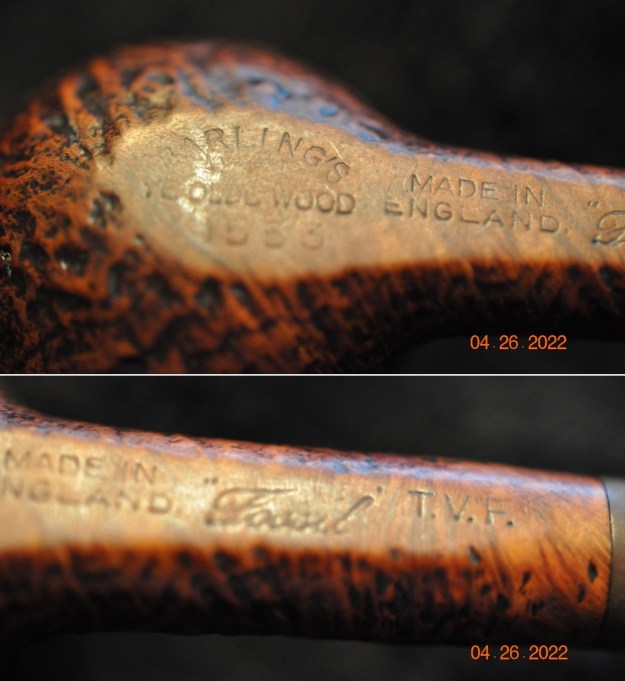
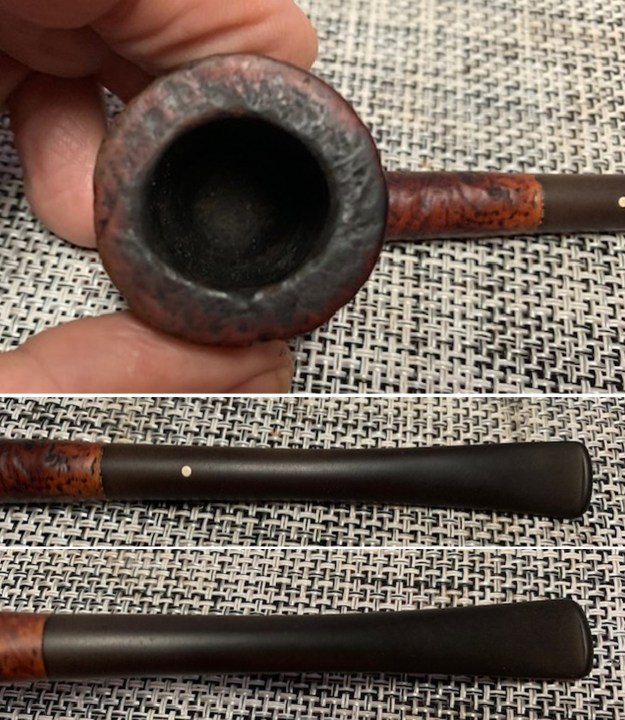
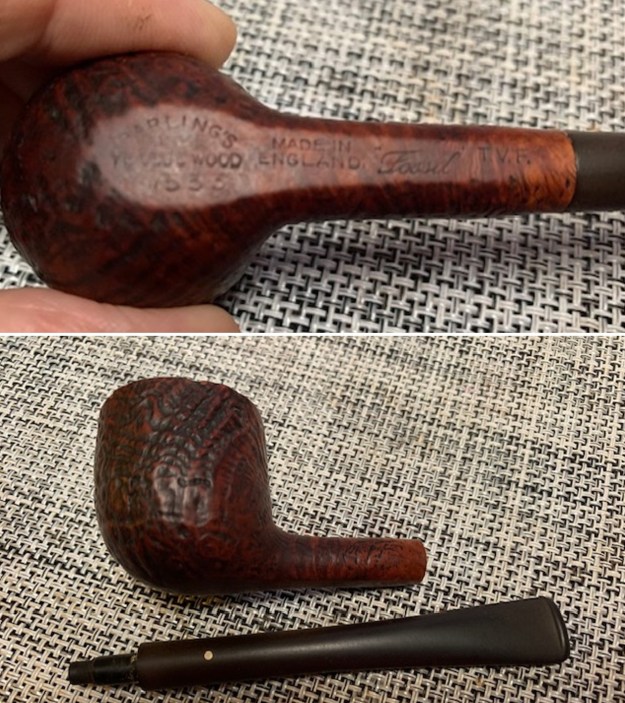
The next pipe is one that I have avoided working on for over a year. Not because it was particularly hard to work on but because of the fact that it is a Barling with a thin Dunhill Stem. The stem needed to be replaced and I was hoping I could replace it with a Barling stem that would match. I looked through all the stems that I have here and also have looked other places but no luck on the stem. So, I decided to shape a replacement stem for the pipe and finish the cleanup work on the bowl. It has only been sitting here for a year and a half. We purchased the Barling 04/09/2022 from an estate in Cleveland, Ohio, USA. It is stamped on the heel of the bowl and shank and reads Barling’s[arched over] Make [over] Ye Olde Wood [over] 1533. That is followed by Made in [over] England followed by Fossil in script. The letters TVF are at the end of the shank near the shank stem junction. Jeff took photos of the pipe before he did his cleanup work on the pipe.Jeff took a closeup photo of the bowl and rim to capture the condition of the pipe before he started his cleanup work. The rim top had a thick lava overflow and darkening on the back of the bowl. There was some burn and reaming damage on the inside edge of the bowl at the front of the bowl. The Dunhill stem is oxidized and dirty and there are light tooth marks and chatter on the surfaces ahead of the button. He also took photos of the sides and bottom of the bowl and shank to show the beautiful grain in the sandblast around the bowl. The photos show the general condition of the bowl and wear on the finish. It is very dirty but this is another beautiful pipe.  Jeff took a photo to capture the stamping on the shank. The photos show the stamping is clear and readable as noted above.I turned to Pipedia to refresh the details for a Family Era Pipe made between 1812-and late 1962 (https://pipedia.org/wiki/Barling). I am including portions of the article that are pertinent to this pipe. I have highlighted them in bold.
Family Era – 1812 – late 1962 Details

The Barling family-controlled production up till this point. Quality was excellent, however some sources indicate a marked inconsistency in quality starting as early as 1954. As stated earlier, Jonathan Guss suggests that the Algerian War for Independence played a role in the change in quality due to the lack of Algerian briar, which the company supplemented with briar sourced from other countries. (Guss)

Prior to 1954 Barling pipes were made from old growth “extra extra” grade Algerian briar, of a quality no longer available. Barling conducted their own harvesting operations, looking for roots that ranged from 80 – 150 years of age. Jonathan Guss indicates that Barling had a commercial investment in Algeria as far back as 1928, though the nature and extent of this investment is not currently known.

We do know that Barling conducted its own harvesting operations, as well as cutting and seasoning of their selected briar. These images from the 1920’s brochure, Romance Of The Barling Pipe, shows images of their Algerian ventures. Also, the copy states that Barling looked for briarroot that was about 50 years old.

While many find the grain to be beautiful, this was not the aim of the Barling Company, and many of their pipes have rather unremarkable grain. The Barling Company’s intent was simple, to create the finest smoking instruments in the history of the world. Many connoisseurs believe that they achieved that goal admirably.

In addition to the smoking qualities of their air-cured wood, the Barling Company outfitted their bowls with hand made stems that many consider to be the most comfortable ever created. Their engineering is beyond reproach. Their silver work remains unsurpassed.

As an interesting side note, the soft Algerian Briar was not initially prized, as it was prone to burnout. But Barlng took the time to properly age and season this carefully selected wood for between 3 and 5 years, before finishing. They also made pipes with thicker walls, which helped defend against burnout. The porous mature of this briar resulted in excellent heat dispersion and provided a cool smoke.

Family Era Nomenclature:

Before discussing the nomenclature of the Family Era pipes it is important to note that there are no absolutes. Barling pipes from this period show a remarkable degree of variation when it comes to nomenclature. The following information can be applied in a general fashion.

According to Tad Gage, Pre-1946 stampings are minimal. Pre WW2 pipes rarely have size, shape or grading. But pipes have surfaced, hallmarked as early as 1925 with size marks, and as early as 1926 with model numbers. There may be earlier examples, and when we see them we will revise the dates.

Examples with silver hallmarks illustrate that a distinct change in nomenclature occurred around 1938-40, although clearly the war and London bombings impacted production of silver-mounted and of all English pipes. A George Yale Pipes & Tobacco catalog from 1941 features the familiar stampings such as “YE OLDE WOOD”, “TVF”, and style names like “Fossil”, and these were not generally found on pre-1940 pipes, although “YE OLDE WOOD” did inconsistently appear on some earlier examples. (Gage)

Sandblasts:

Until recently it was believed that Barling didn’t produce sandblasts until the late 1930’s and didn’t list them formally as part of the product line prior to 1943. It’s possible that Barling may have been producing sandblasts much earlier, possibly as early as 1917, the same year Dunhill is credited with inventing the sandblast. More on that possibility in a moment.

Logo Nomenclature:

…Barling also provided sterling work for BBB until BBB established their own silver working capabilities in Birmingham England, and started crafting its own silver fitments circa 1910. (Gage) By the time that Barling was making sterling fitments for BBB the Barling makers’ mark had been changed to “EB” over “WB” for Edward and William Barling. Many Barling briar pipes made prior to 1906 lack any company markings except for the name of the shop that sold them. As was common practice at the time, the majority of bowls Barling used prior to 1906 were imported from Saint-Claude or Jura to be finished in the Barling factories. If there was anything to identify Barling as the maker it was their maker’s mark, EB over WB, stamped into a sterling fitment. During the late 1800’s the BARLING’S MAKE stamp appears on some pipes, evidence that Barling was manufacturing some of their product completely in-house. The “BARLING’S MAKE” has the word “BARLING’S” arched over the word “MAKE” in capital block letters. Barling used this block letter logo until late 1962.

In addition to the block letter logo, Barling used a script logo for special pipes as well as for advertising, and packaging art…

…During the 1930’s and early 1940’s the BARLING’S MAKE logo appeared in a small version with a simpler letter style. Following the War, the small “BARLING’S MAKE” logo was discontinued and a larger logo was used. The larger logo would continue to be in use until 1962, when the 1930’s style logo was reintroduced along with the new numbering system.
Over the years there were a number of changes and adjustments to the nomenclature, though the company logo stamps remained a constant….

Ye Olde Wood Stamp:

Sometime around 1913, the “Ye Olde Wood” stamp made its appearance on selected pipes. An example exists stamped on a 1913 date hallmarked pipe.

This logo will continue to be used in the decades to come. Initially it was used to designate a higher grade than the average, much as the “Special” grade would after the Second World War. Price lists show the “Ye Olde Wood” pipes as a separate grade from the basic BARLING’S MAKE pipe. Eventually, “Ye Olde Wood” came to represent the company to the world. The use of “YE OLD WOOD” as a stamp prior to 1940 was haphazard, at best, although the company used the slogan in advertising materials from the early teens onward. (Gage)…

Model Numbers:

Also according to Tad Gage, the only four-digit number that denotes a Pre-Transition piece begins with “1,” which was used for pipes sold in England. Any other four-digit Barling pipe is a Transitional piece– (Tad Gage in P & T magazine)…

Now I knew I was dealing with a Pre-Transition, Family Era pipe bowl as shown by the stamping and the four digit shape number. I also knew from the 1 preceding 553 shape designates that it was made for pipes sold in England. As best as I can tell it was made in the 1940s and no later than 1962.

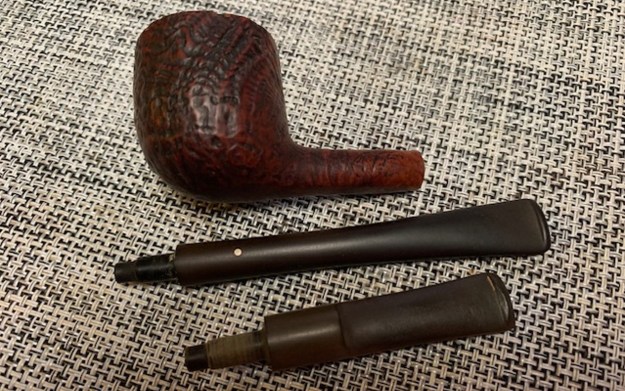
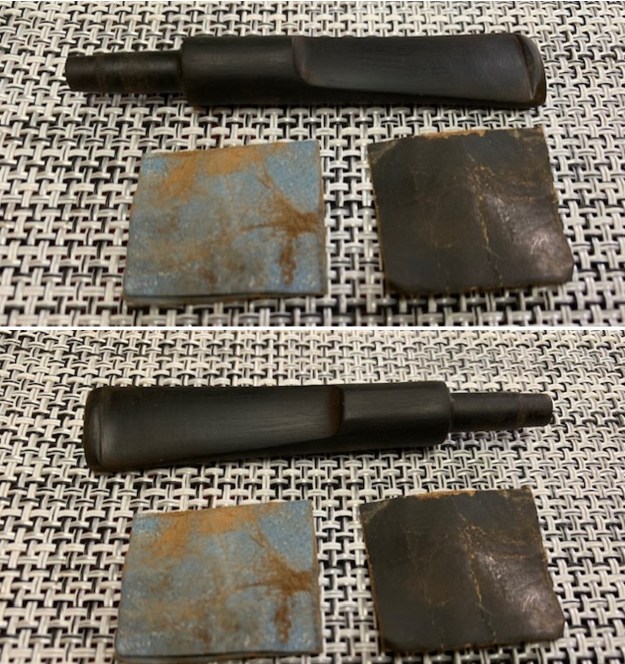
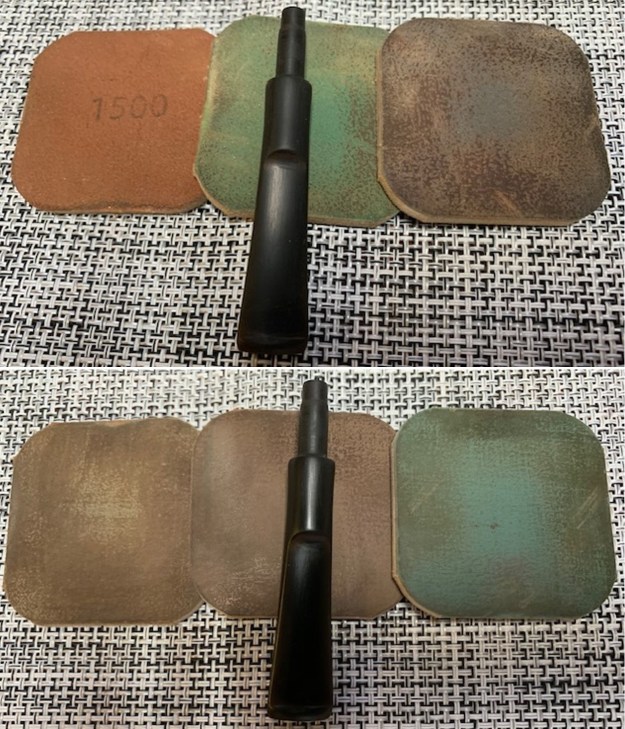
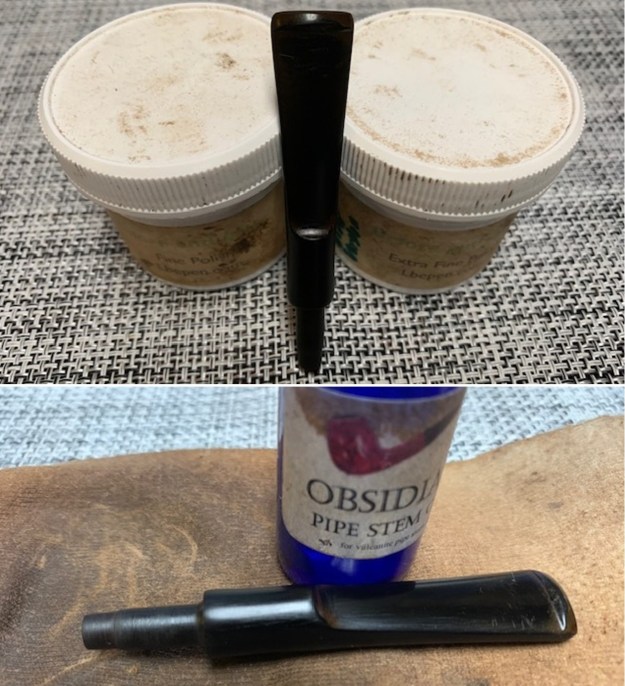
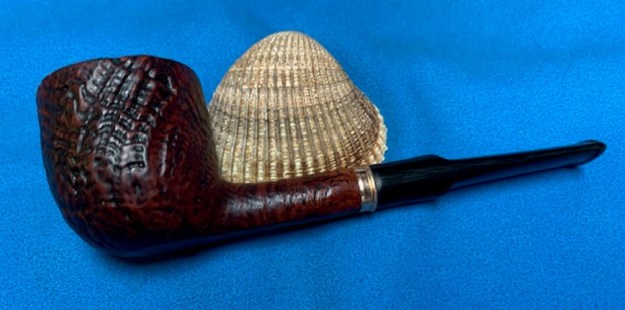
When the pipe arrived in Vancouver it was very clean. The briar and stem were spotless. The long Dunhill stem fit well to the shank. It appears that when it was fitted the shank was sanded slightly and smoothed out some of the sandblast but as I work on it I will know with more certainty. The shank end had been tapered to the stem. Jeff had reamed the bowl with a Pipenet Pipe Reamer and cleaned up the bowl walls with a Savinelli Fitsall Pipe Knife. He scrubbed the airway in the stem and shank with pipe cleaners, cotton swabs and alcohol. He scrubbed the exterior of the bowl and shank with Murphy’s Oil Soap (undiluted) and a tooth brush. He rinsed the exterior with warm running water and dried. He polished the briar and stem with a small drop of olive oil. The pipe really looked very good. It was going to be a fun one to work on for my part.  I took photos of the pipe when I brought it to the table for my work. This is what I saw. I took a photo of the rim and bowl to show the condition of the cleaned pipe. You can see the darkening and the damage on the front inner edge and the left side inner edge. The Dunhill stem is quite clean and I will be putting it in my can of stems for use on a Dunhill pipe in the future.I took a photo of the stamping on the heel of the bowl and the underside of the shank. It is clear and readable as noted above. I removed the stem from the shank and took a photo of the look of the bowl with the Dunhill stem. It looked interesting but was significantly longer than necessary.I went through my stems and found a nice saddle stem that was the right length in my mind and with some work would look great with the pipe.I set the Dunhill stem aside and turned my attention to the new stem. The tenon fit the shank perfectly so nothing needed to be done with that. The diameter of the saddle stem was larger than that of the modified shank. I used a file and 180 grit sandpaper to shape the stem. I put a plastic spacer between the shank and the stem so I could proceed without further damage to the shank. It worked well to shape the diameter of the stem to match the shank. I tried to match the diameter to the undamaged part of the shank. With the stem fit close I moved on to clean up the rim top and edge of the bowl to bring it back into round. I gave the rim a slight bevel to reduce the damage on the front inner edge of the bowl.I put the stem on the shank and took a photo to have a look at the sanded portion of the shank. It went from the end inward about ½ inches. The sandblast had been smoothed out to the point that it was virtually gone on the end. It is slightly tapered rather than the straight angle that should have been there along the top of the shank. I thought it might be worth put a small band on it to cover the damaged area and provide a straight angle. It would be cosmetic as there were no cracks to the shank end. I found a nice decorative band in my collection of bands that had some beading along the shank end. I took a photo of the band alongside the bowl to show what it looked like.I pressed the band on to the shank end and took photos of how it looked. It covered the damaged area well and took care of the tapered end of the shank. I like the way it looked.I took a photo of the pipe without the band and with the band in place. To me the band really helped with the tapered shank end. It gave a touch of bling to the pipe and cleaned up the flow from the bowl to the end of the stem. I like how it looked.I touched up the inner edge of the bowl with a Maple stain pen to blend the rim edges and top into the stain on the rest of the bowl. It really helped with blending the bevelled edge and giving the bowl a better sense of round.I worked some Before & After Restoration Balm into finish of the briar with my fingertips to clean, enliven and protect it. I let the balm sit for a little while and then buffed with a cotton cloth to raise the shine. The Restoration Balm really makes the sandblast grain stand out beautifully. I sanded out the file and 180 sanding marks on the stem surface and saddle portion with 220 grit sandpaper. I started polishing the stem with 600 grit wet dry sandpaper. It was starting to look much better. I polished the stem with micromesh sanding pads – wet sanding with 1500-2400 grit pads and dry sanding with 3200-12000 grit pads. I wiped the stem down after each pad with Obsidian Oil. I finished the hand polishing of the stem with Before & After Pipe Polish – both the Fine and Extra Fine polishes. I gave it a final coat of Obsidian oil and set it aside to dry.The Barling’s Make Ye Olde Wood 1553 Fossil Pot restemming and restoration was finished. I polished the bowl and stem with Blue Diamond to polish out the remaining small scratches. I used a very light touch so as not to damage the stamping on the shank. I gave the bowl multiple coats of Conservator’s Wax and the stem multiple coats of carnauba wax. I buffed the pipe with a clean buffing pad to raise the shine. I hand buffed it with a microfiber cloth to deepen the shine. The pipe polished up pretty nicely. The depths of the sandblast came alive with the buffing and works well with the decorative brass band and the polished black vulcanite saddle stem. Altogether this Barling’s Make Ye Olde Wood Fossil Pot has a rich look. The finished pipe is shown in the photos below. The shape, finish and flow of the pipe and new stem work very well. The dimensions are Length: 5 inches, Height: 1 ½ inches, Outside diameter of the bowl: 1 ¼ inches, Chamber diameter: 7/8 of an inch. The weight of the pipe is .99 ounces/28 grams. I will be putting it on the rebornpipes store in the British Pipemakers Section soon. If you are interested in adding it to your collection let me. I have one of these and they are a cool dry smoke. Thanks for walking through the restoration of this fine old Barling’s Make pipe. It was a pleasure to work on.
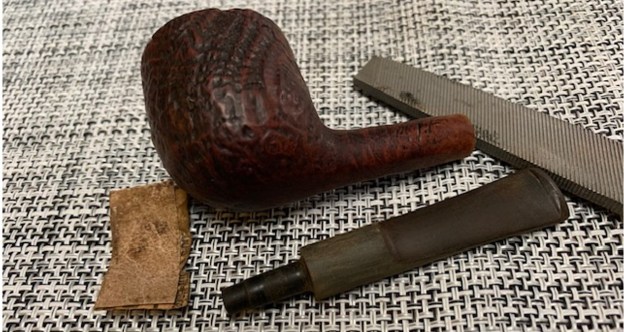
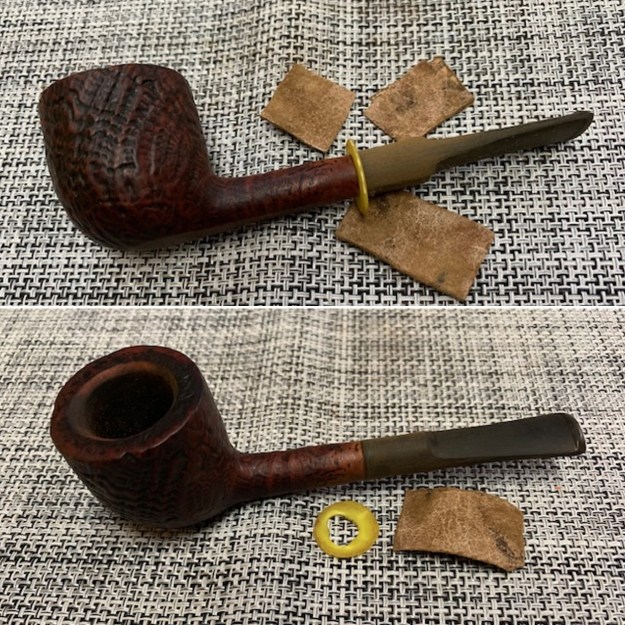
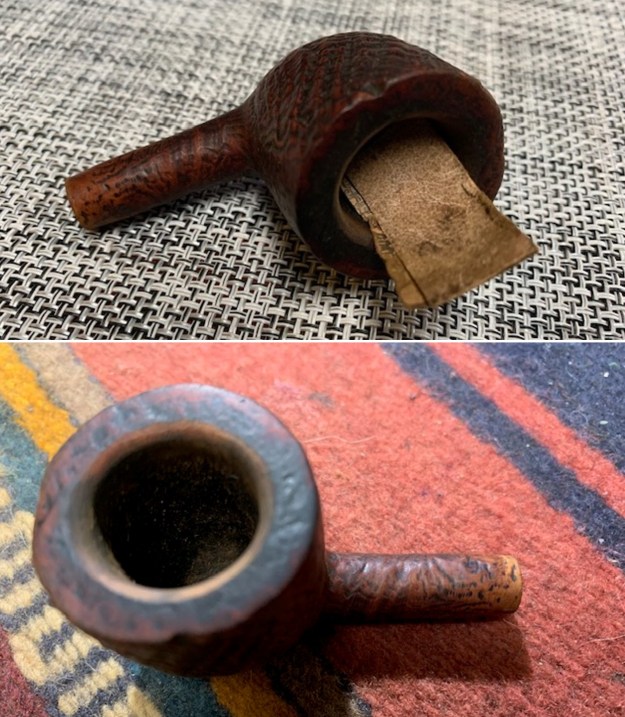
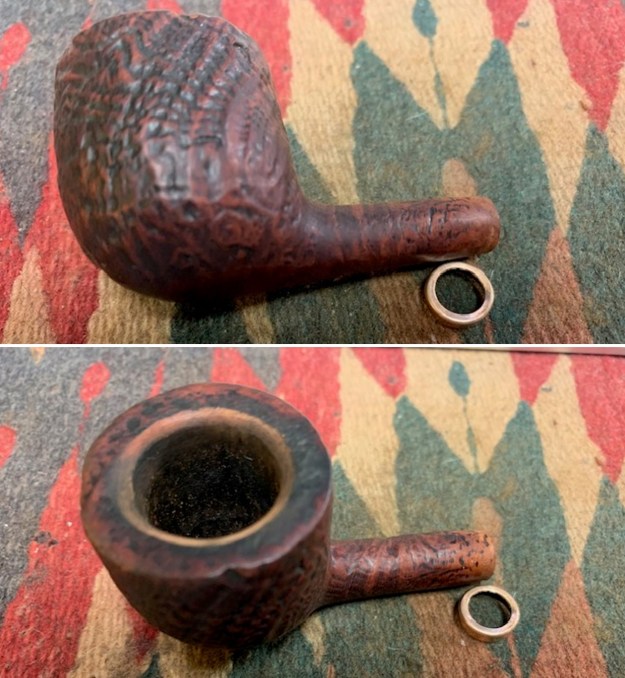
As always, I encourage your questions and comments as you read the blog. Thanks to each of you who are reading this blog. Remember we are not pipe owners; we are pipe men and women who hold our pipes in trust until they pass on into the trust of those who follow us.
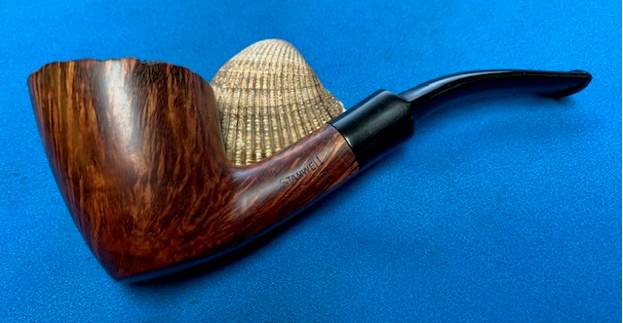
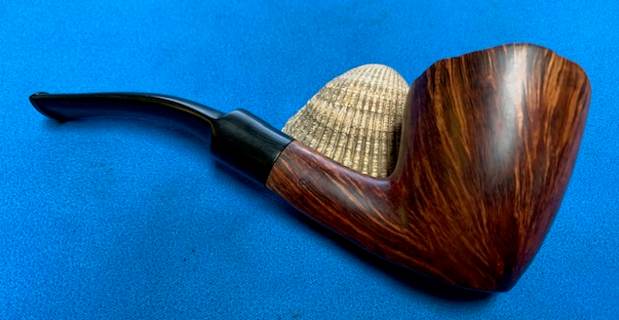
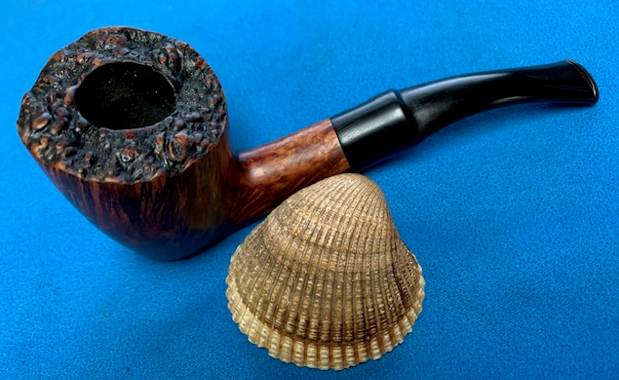
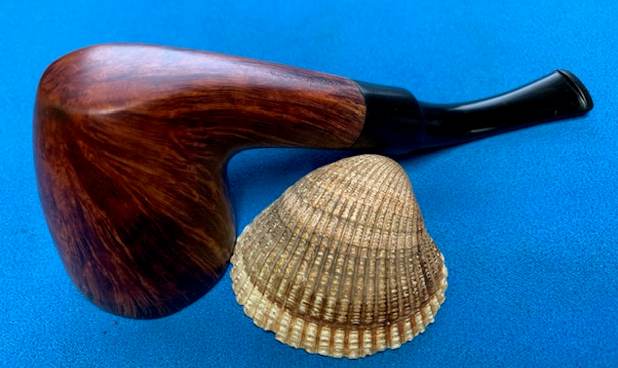
Restemming and Restoring a Stanwell Danish Star 64 Freehand Dublin


Blog by Steve Laug

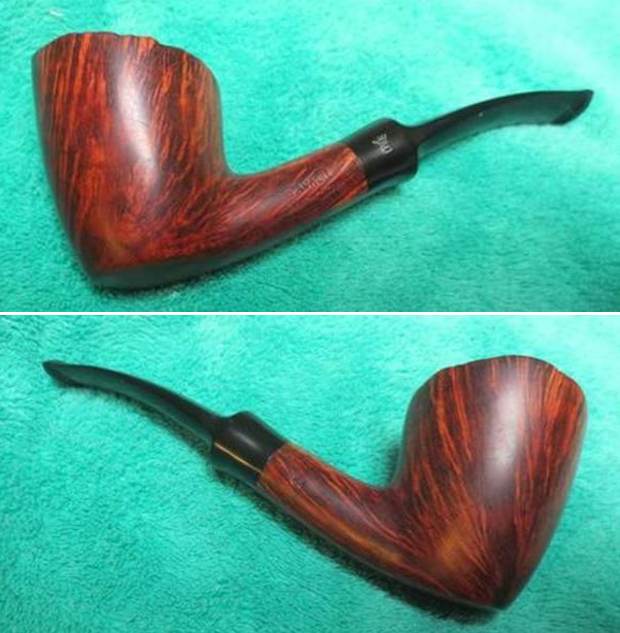
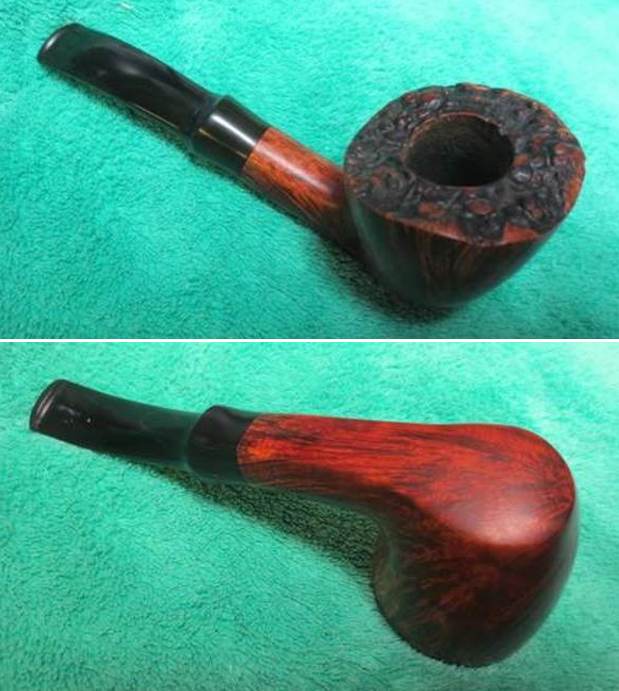
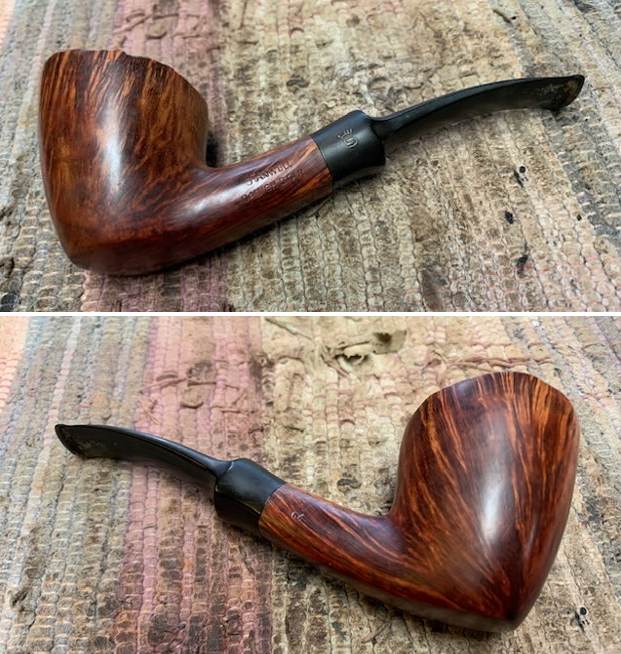
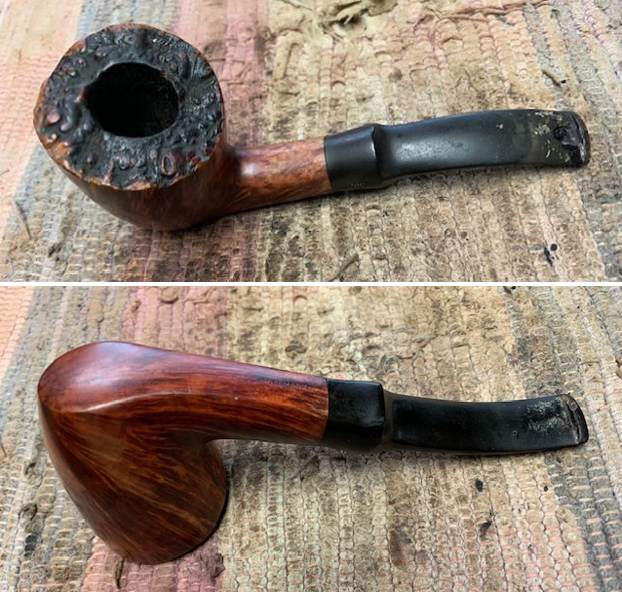
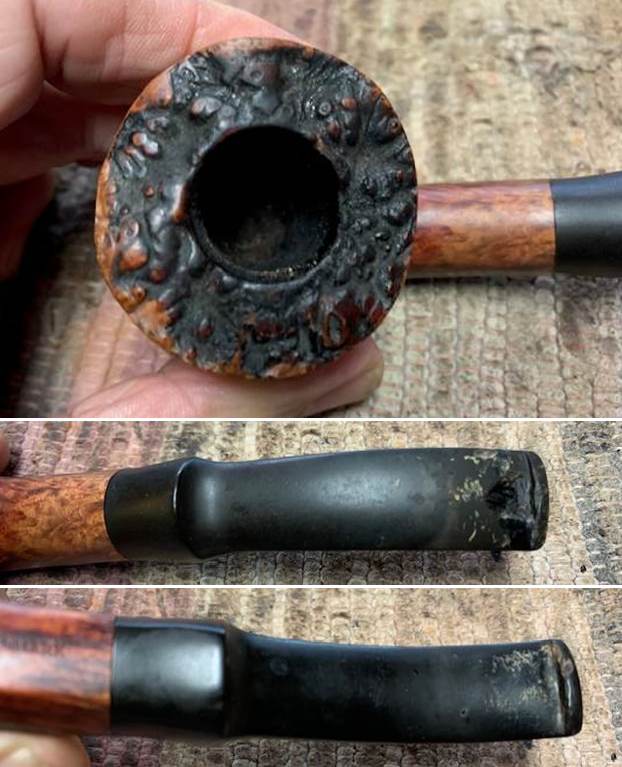
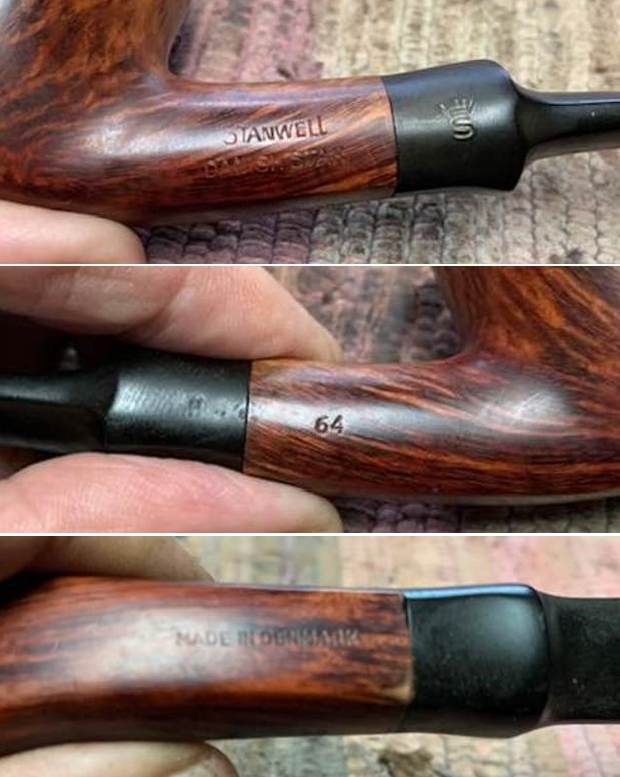
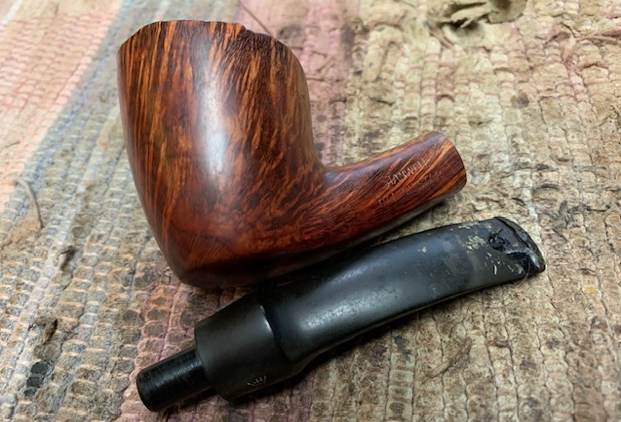
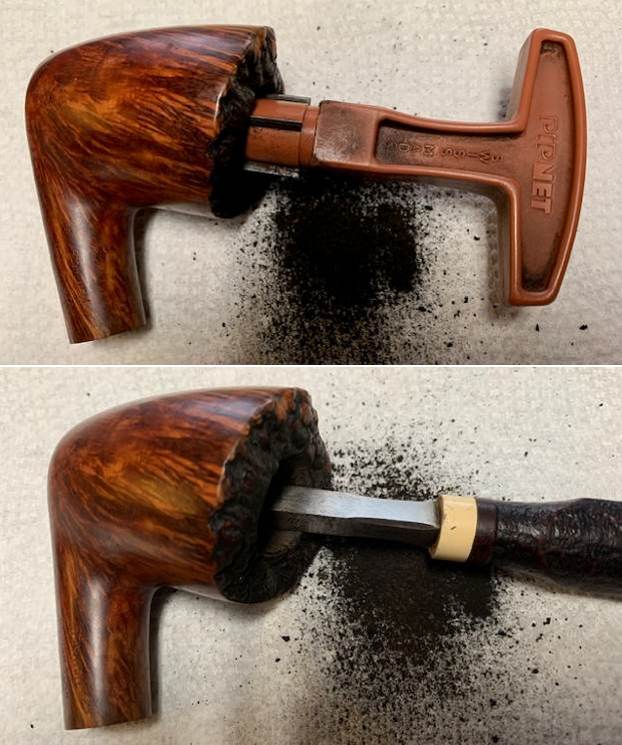
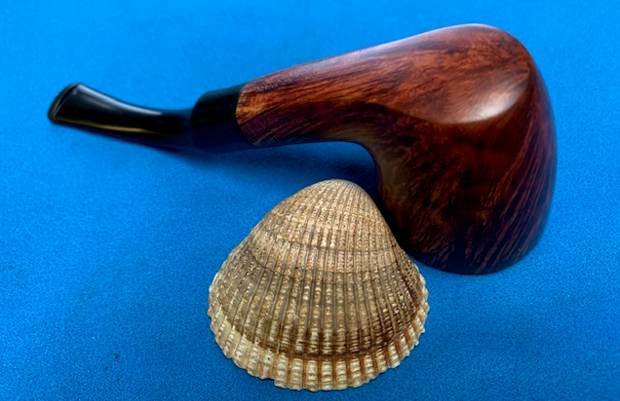
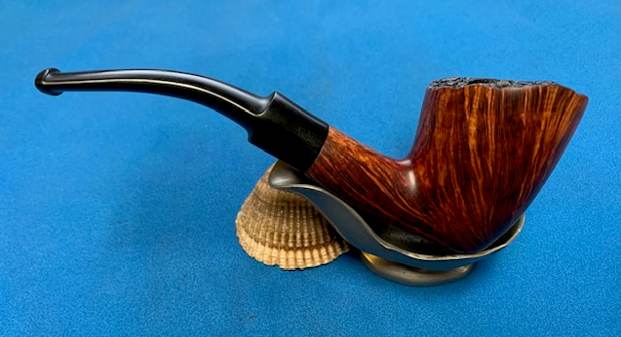
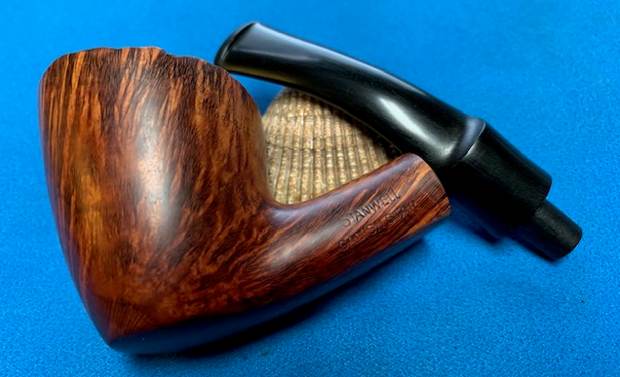
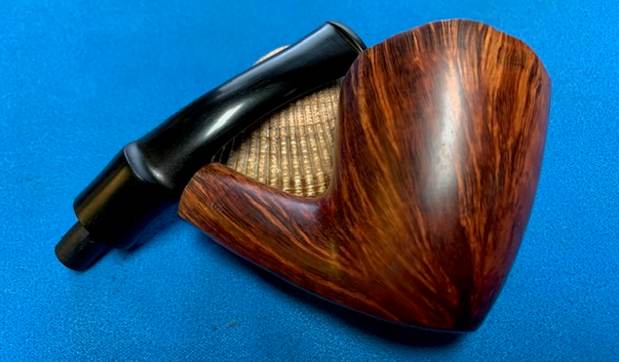
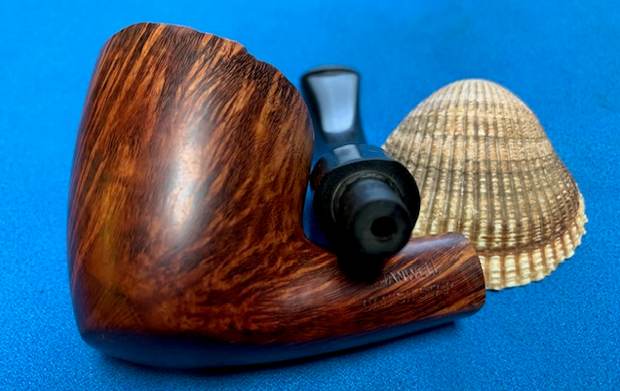
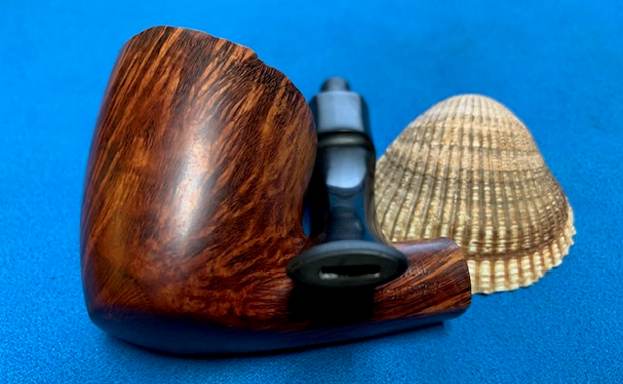
The next pipe on the table is the last of the five pipes that the Vancouver pipe man dropped off for me to work on for him. It was stamped Stanwell Danish Star and had a great flame and straight grain around the bowl and shank with plateau finish on the rim top. It is a Bent Dublin that was finished in a brown stain. It needed restoration on the bowl which was moderately caked and the shank was dirty. It also needed new stem as the current push stem was chewed and broken at the button. It was another pipe that I had restored back in 2016 and he had purchased at that time. I had done a complete restoration and removed the thick cake at that point. The stem had a small hole in the top that was about half the size it is now. The repair worked for at least 6-7 years so I am pleased with that. It is obviously another of his favourites as it is well used. The stem on it was original so I kept it and repaired it the first time. Here is the link to restoration (https://rebornpipes.com/2016/11/30/a-stanwell-danish-star-64/). Here are some photos of the pipe when he picked it up in 2016 to give a bit for context for my latest work. When I took the pipe out of the bag of pipes to work on this afternoon, this is what I saw. The finish on the briar looked very good. It was dirty but the colour had stayed true. It had a bit of patina on the bowl but it was beautiful. The bowl had a moderate cake and the airway in the shank was dirty. The stem was oxidized, calcified and had a large chunk of vulcanite missing on the topside. I took photos of the rim top and stem to show their condition. You can see the moderate cake in the bowl how it looked. The plateau rim top had some lava in the grooves of the finish and some build up around the inside edge of the rim. It will clean up pretty well. The photos of the stem show the condition of the stem. You can see the tooth marks and the large hole on the top of the stem surface. I took photos of the stamping on the sides of the shank. The stamping on the left side of the shank reads Stanwell [over] Danish Star. On the right side it is stamped with the shape number 64. On the underside of the shank it is stamped Made in Denmark. There was a Crown S stamp on the left side of the saddle I removed the stem from the shank to give a sense of the flow of the pipe.  Now it was time to work on the pipe itself. I started my work on the pipe by cleaning and reaming the bowl The cake was quite thick but it can hold residual oils from previous tobaccos and I wanted to check the bowl walls for burn damage or checking. I reamed it with a PipNet pipe reamer to cut cake back to bare briar. I cleaned up the remnants of the cake with a Savinelli Fitsall Pipe knife. I sanded the walls with 220 grit sandpaper wrapped around a piece of dowel. I worked on them until they were smooth. There was no checking or burn damage to the bowl walls. It was quite clean.  I cleaned out the internals with 99% isopropyl alcohol, pipe cleaners and cotton swabs. I worked over the shank and the airway in the new stem. It took some work but once finished it was clean and smelled fresh.  I used a brass bristle wire brush to clean up the plateau and knock off the lava and debris from the grooves and high spots on the rim top. It looked much better.I scrubbed the bowl with undiluted Murphy’s Oil Soap with a tooth brush to remove the oils and grime from the finish. I rinsed the bowl with warm water to rinse off the soap and grime. I dried it off with a soft cloth. I stained the plateau rim top with a Black stain pen. I stained the entire rim top in the valleys and in the plateau. I knock of the stain on the high spots sanding and polishing process I sand off the high spots.I polished the rim top with micromesh sanding pads – dry sanding with 1500-12000 grit pads. I sanded the stain off the high spots on the plateau rim top. I wiped the briar down with a damp cloth after each sanding pad. It took on a real shine by the time I finished with the last sanding pad. I worked some Before & After Restoration Balm into the smooth bowl and the plateau rim top. I worked it into the surface of the briar with my fingertips to clean, enliven and protect the wood. I used a horse hair shoe brush to work it into the crevices and the valleys of the plateau. Once the bowl was covered with the balm I let it sit for about 15 minutes and buffed it off with a soft cotton cloth and the shoe brush. I polished it with a microfiber cloth. I took photos of the pipe at this point in the process to show what the bowl looked like at this point. Now it was time to deal with the replacement stem. I went through my can of stems and found a bent saddle vulcanite stem that was a close fit. It was more bent than the original but with a little straightening it would be perfect. I would also need to remove a little of the diameter of the tenon to get a snug fit in the shank. I put it in the shank as far as it would go before I fitted it correctly but you can see what the pipe will look like with the new stem. It is going to work very well.  To correct the bend in the stem to match the rim top I “painted” it with the flame of a Bic lighter until the vulcanite was flexible. I bent it to the angle of the shank and rim top until I had the right look I was waiting for. It looked good.I used a piece of 220 grit sandpaper to reduce the diameter of the stem and flatten the bottom of the saddle portion to match the shank. I also sanded out the casting marks on the new stem and also the scratches in the vulcanite at the same time. I started polishing the stem with 600 grit wet dry sand paper. I used micromesh sanding pads and water to wet sand the stem with 1500-12000 grit sanding pads. I wiped it down after each sanding pad with Obsidian Oil on a cotton rag after each sanding pad as I find it does two things – first it protects the vulcanite and second it give the sanding pads bite in the polishing process. After finishing with the micromesh pads I rub the stem down with Before & After Fine and Extra Fine stem polish as it seems to really remove the fine scratches in the vulcanite. I rub the Fine Polish on the stem and wipe it off with a paper towel and then repeat the process with the Extra Fine Polish. I finished the polishing of the stem down with a final coat of Obsidian Oil and set the stem aside to let the oil absorb. This process gives the stem a shine and also a bit of protection from oxidizing quickly. I took the finished Stanwell Danish Star 64 Freehand Dublin bowl to wax and polish. I don’t buff the plateau rim top on the wheel as it leaves a lot of grit in the deep grooves of the finish. I polished the bowl and the stem with Blue Diamond on the buffing wheel to polish out the scratches in the briar and vulcanite. I buffed it and gave it multiple coats of carnauba wax to protect and give it a shine. I buffed the pipe with a clean buffing pad to raise the shine. I hand buffed it with a microfiber cloth to deepen the shine. The pipe polished up pretty nicely. The contrast of the dark stain on the briar revealing the grain with the shine of the polished vulcanite saddle stem is quite stunning. The rich finish around the bowl and shank is quite remarkable and the plateau rim top gives the pipe an incredible tactile presence. The Stanwell Danish Star 64 is a nice looking pipe and one that will be a great smoking pipe. The finished pipe is shown in the photos below with each of the stems. The dimensions of the pipe are Length: 6 inches, Height: 2 inches, Outside diameter of the bowl: 1 ¾ inches, Chamber diameter: ¾ of an inch. The weight of the large pipe is a light and comfortable 56 grams/1.98 ounces. It is a beautiful pipe and the last of the five pipes left with me for work. They are finished and ready for him to pick them up and enjoy once more. As always I encourage your questions and comments as you read the blog. Thanks to each of you who are reading this blog. Remember we are not pipe owners; we are pipe men and women who hold our pipes in trust until they pass on into the trust of those who follow us.
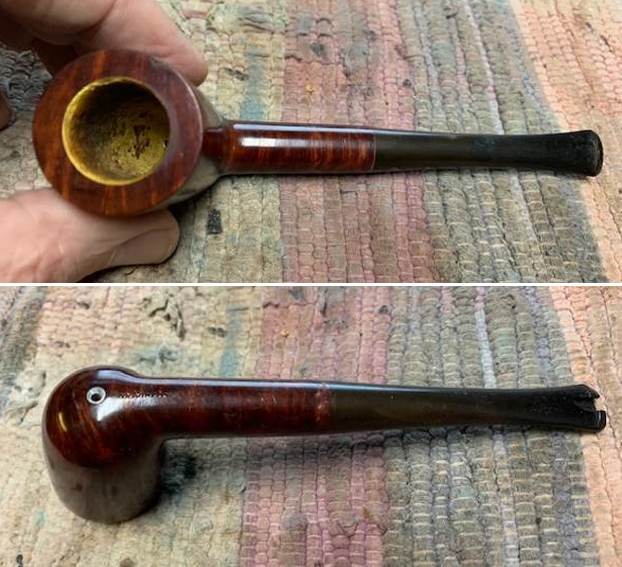
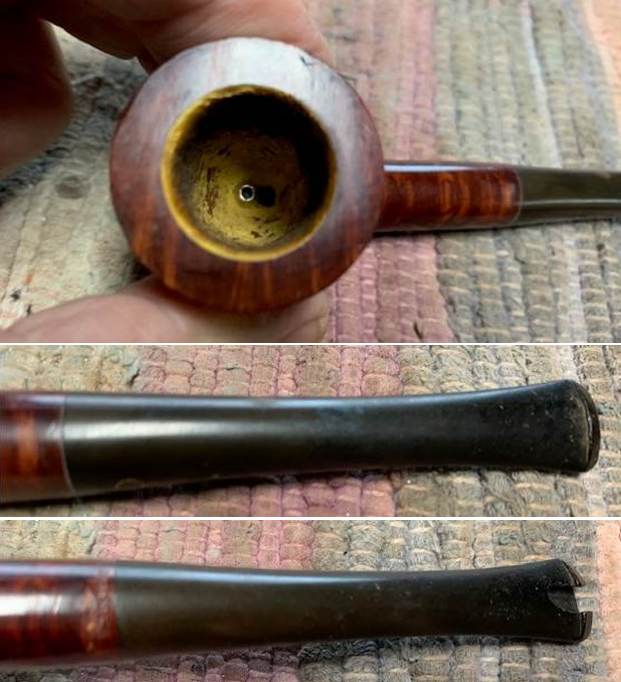
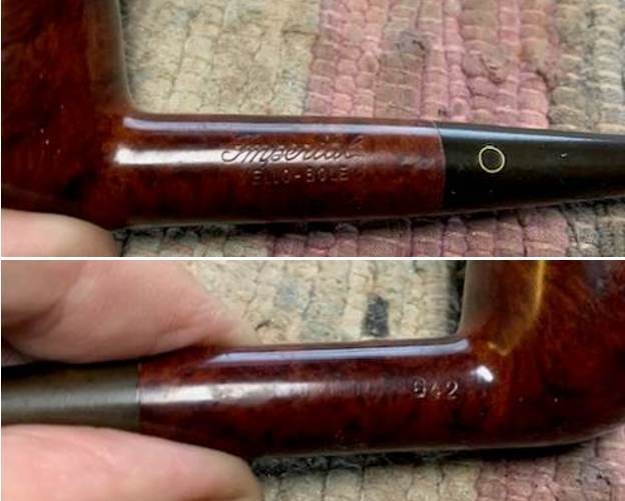
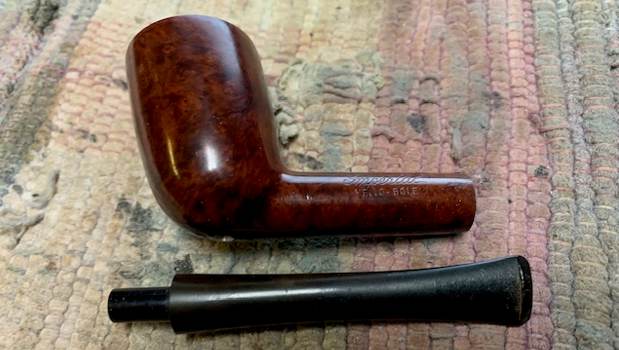
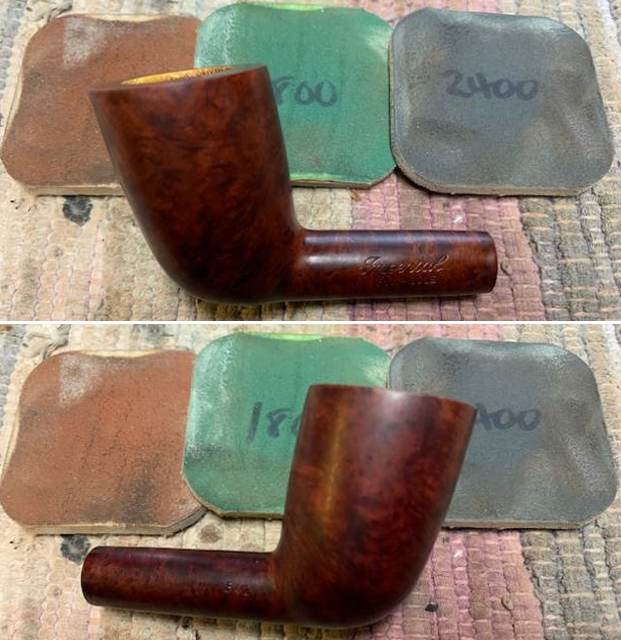
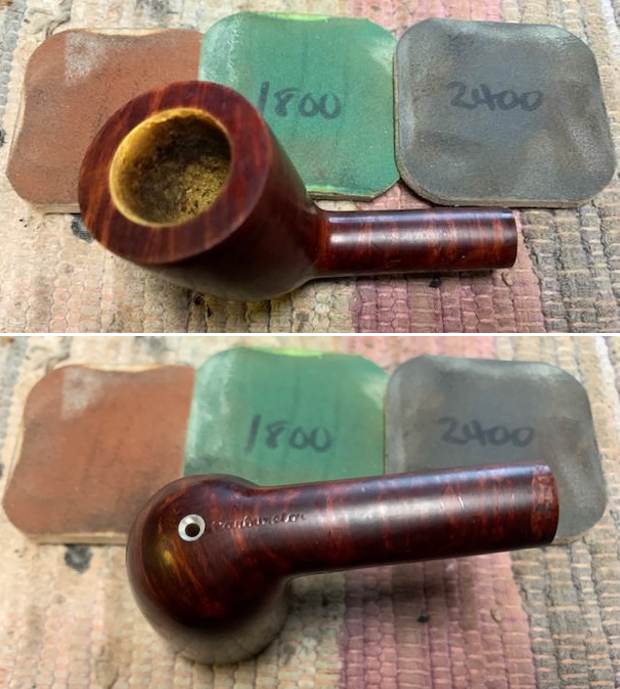
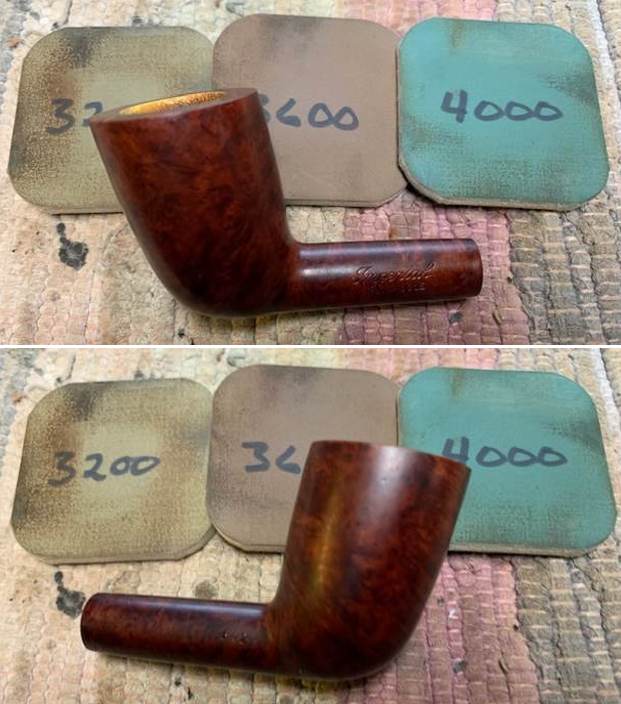
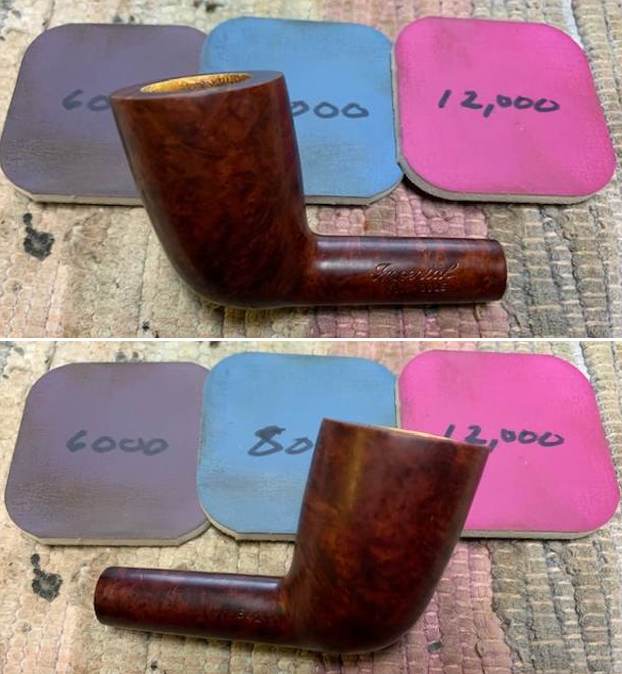
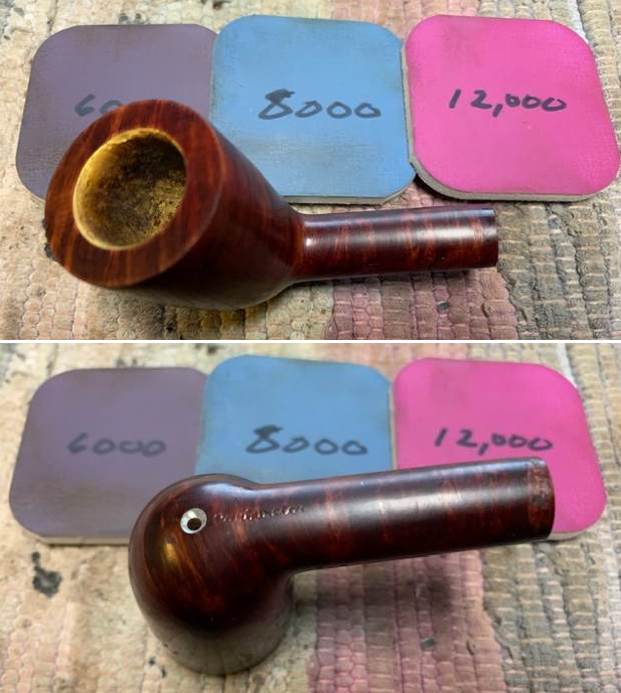
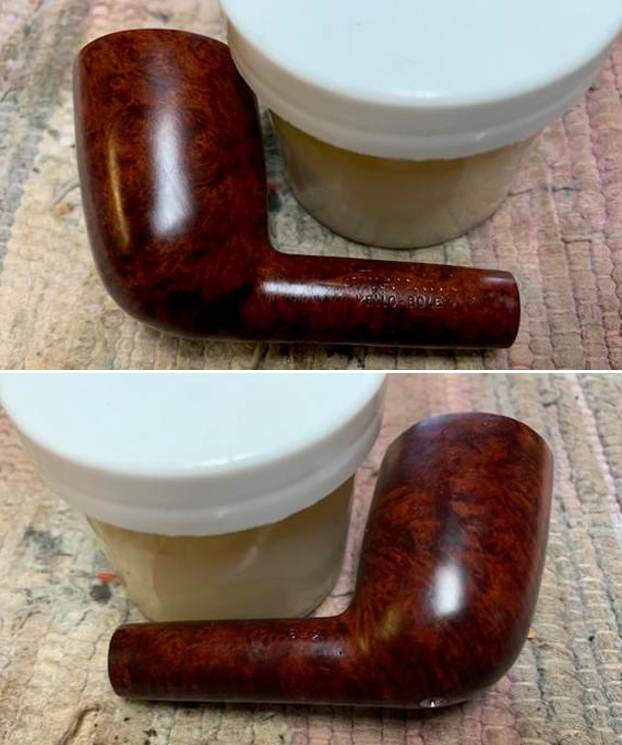
Another Interesting Clean – a Yello-Bole Imperial 642 Carburetor Dublin


Blog by Steve Laug

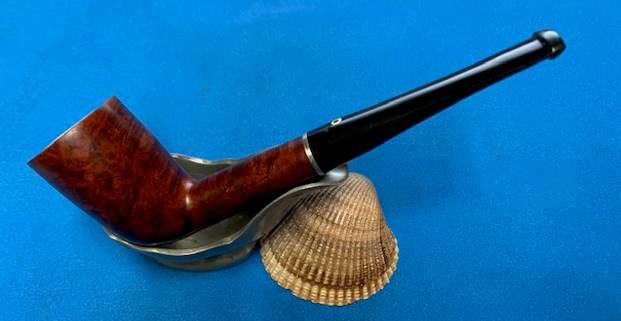
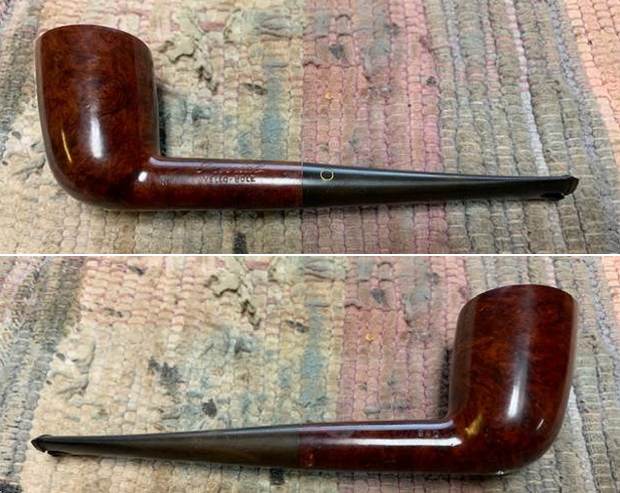
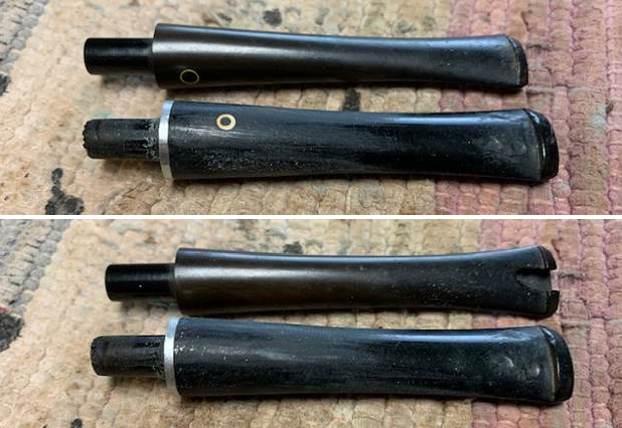
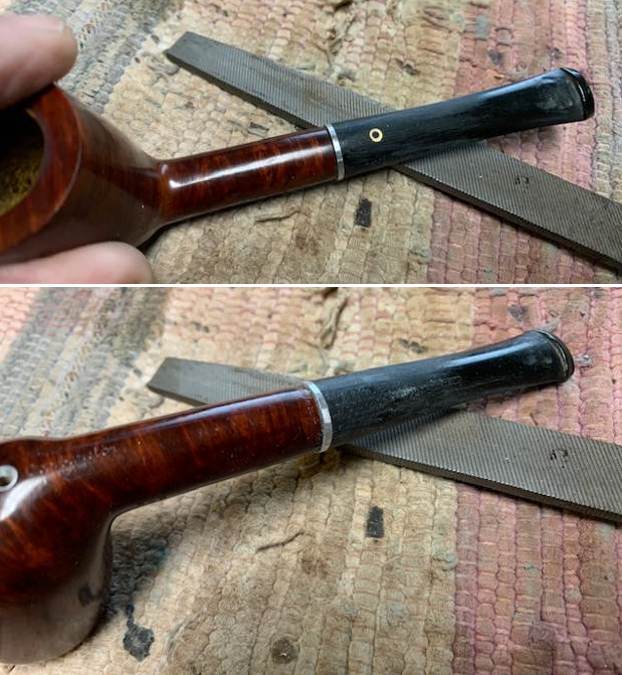
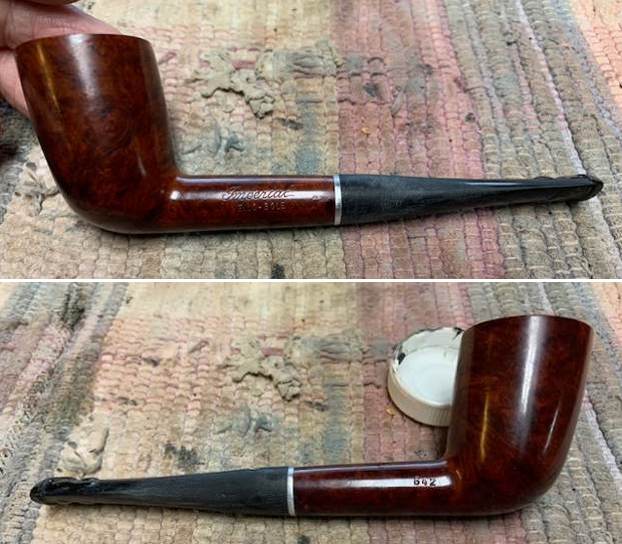
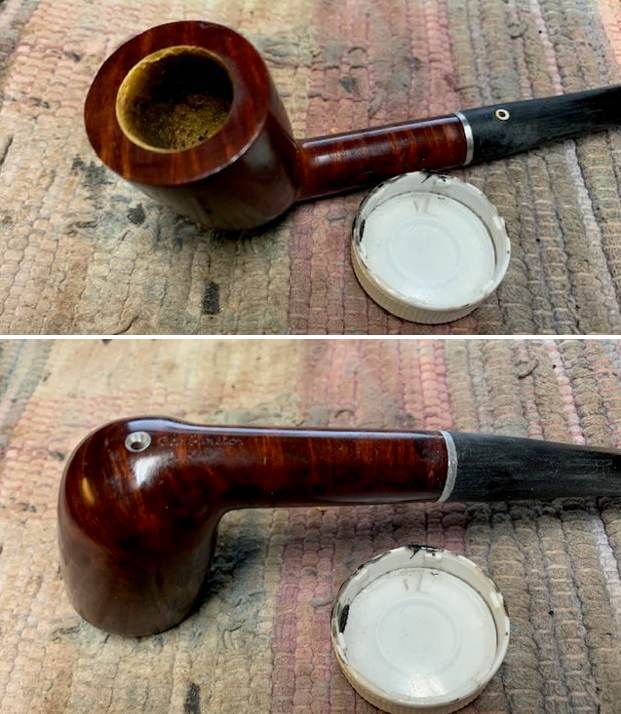
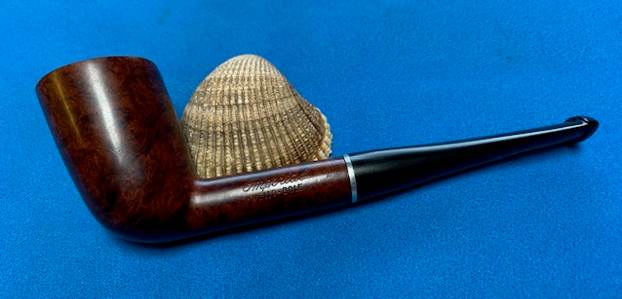
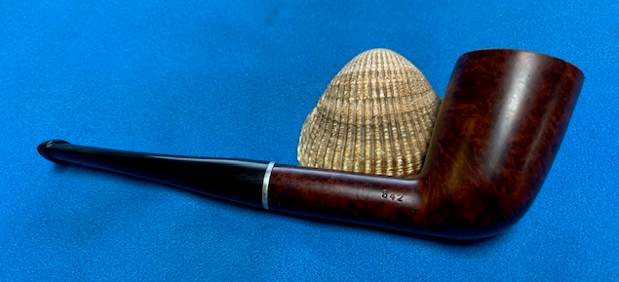
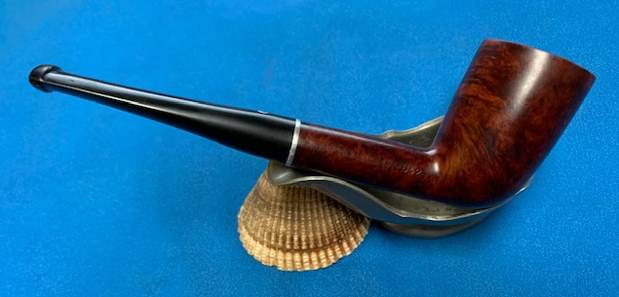
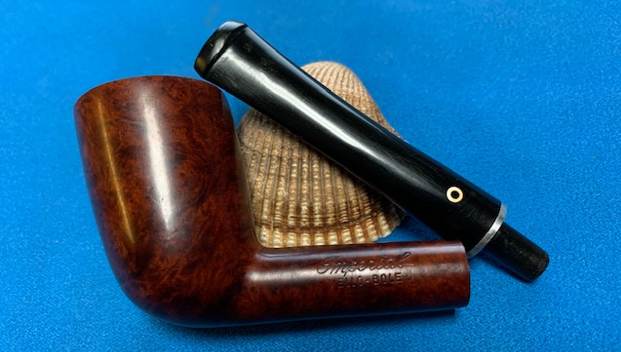
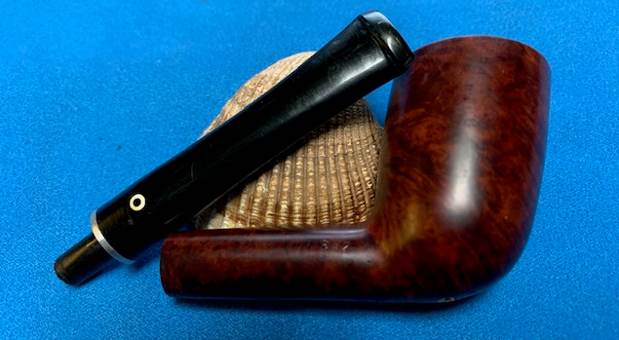
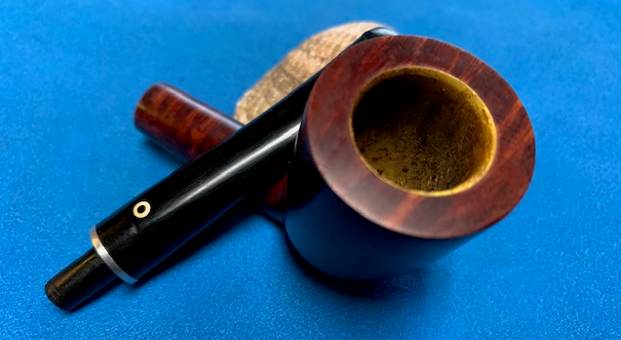
The next pipe on my table is the third and final pipe from threesome sent to for work from a fellow in Eastern Canada. This one is a smooth Dublin/Billiard. I found that it is stamped on the left side and read Imperial in script [over] Yello-Bole. On the right side it has the shape number 642 and on the heel it is stamped Carburetor next to the small aluminum tube in the heel. On the shank end where the stem and shank meet it is stamped Made in France. The bowl was hardly used and has a tube extending from the bottom of the bowl upward about 1/8 of an inch. Though there was some darkening in the bottom of the bowl the walls were still lined with the famous Yello-Bole honey coating and looked untouched. The bowl edges and rim top looked very good. The smooth finish was still shiny and new looking. The stem is probably vulcanite with a yellow circle on the left side of the taper and a huge chunk of vulcanite missing from the underside extending from the button forward about ½ inch. There were tooth marks and tooth chatter on both sides of the stem ahead of the button and on the surface. There was a Yello-Bole scoop stinger in the tenon that was also clean and undamaged. In looking at it I figured it would need a new stem. I took photos of the pipe before I started my work on it. I took photos of the bowl and rim top to show what they looked like before I started my clean up. I also took some of the stem to show the condition of both sides and the large chunk of vulcanite missing on the underside. The stamping on the sides of the shank are shown in the photos below. They are clear and readable as noted above. I removed the stem from the shank and took a photo of them to show the perspective on the pipe. You can see the burn marks on the bowl and shank and the scratches and fills in the briar.I turned my attention to the clean up of the pipe itself. The obvious place to start on this pipe was to find a stem that would fit in the shank and if possible be a Yello-Bole logoed stem. I found one in my collection of stems that had the length and tenon dimensions. It was a little larger in diameter than the original but with adjustments it would look good. The replace was not new and had tooth marks and dents on the button end but otherwise looked good.I fit it in the shank and worked on the diameter of the stem with a flat file to remove the excess material on the aluminum band and the vulcanite. It took some work and careful filing but it worked fairly well. I took the following photos of the stem after I had filed it down. It looked quite good at this point in the process. I would need to fine tune the fit with sandpaper but I liked the direction it was going. I filled in the marks that remained with clear CA glue. When the repairs cured I used a small file to reshape the button edge and flatten out the repairs. I sanded the repairs 220 grit sandpaper to blend them into the surface. I started the polishing process with 600 grit wet dry sandpaper. I polished the stem with micromesh sanding pads – 1500-12000 grit pads. I wiped it down with a damp cloth after each sanding pad. I used Before & After Pipe Polish – both Fine and Extra Fine to further polish the stem. I cleaned out the internals of the shank and stem with pipe cleaners, cotton swabs and isopropyl alcohol. Since the bowl exterior was so clean I polished it with micromesh sanding pads – dry sanding with 1500-12000 grit pads. I wiped the bowl down after each  pad to remove the grit. The bowl began to take on a rich shine. The briar took on a newer, richer look.   I rubbed the bowl down with Before & After Restoration Balm. I worked it into the briar with my finger tips and into the rusticated portion with a shoe brush. I let it sit for 10 minutes and the Balm did its magic. It enlivens, cleans and preserves the briar. It certainly brought this bowl back to life. I buffed it off with a clean cloth and took the following photos. This Yello-Bole Imperial 642 Dublin is a great looking pipe with its replacement stem and restoration. The smooth, rich red finish highlights the grain of the pipe. I put the new stem back on the bowl and carefully buffed the pipe with Blue Diamond on the buffing wheel. I gave the bowl and the stem multiple coats of carnauba wax on the buffing wheel and followed that by buffing the entire pipe with a clean buffing pad. I hand buffed the pipe with a microfiber cloth to deepen the shine. The finished Yello-Bole Dublin fits nicely in the hand and feels great. Give the finished pipe a look in the photos below. The dimensions of the pipe are Length: 5 ¾ inches, Height: 1 ½ inches, Outside diameter of the bowl: 1 ½ inches, Chamber diameter: 7/8 of an inch. The weight of the pipe is 50 grams/1.76 ounces. I have one more pipe for this Eastern Canada Pipeman to work on. Once I have finished all three I will be sending them back to him to enjoy. Thanks for reading this blog and my reflections on the pipe while I worked on it.

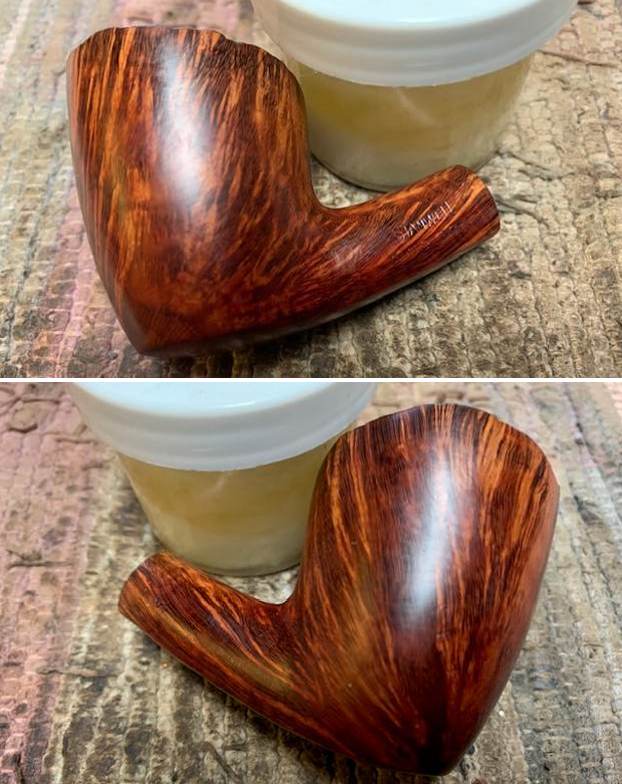
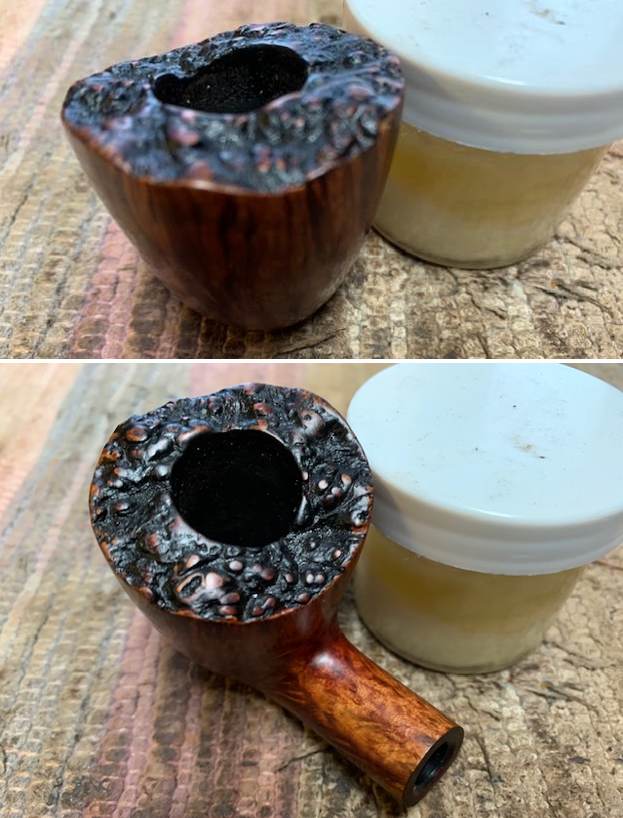
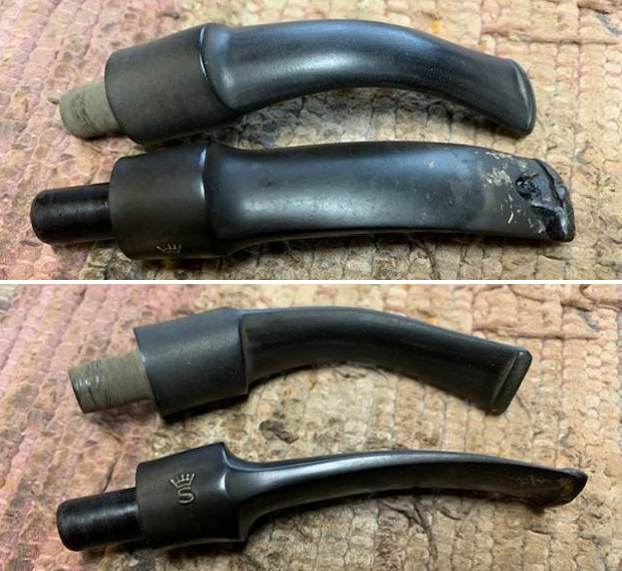
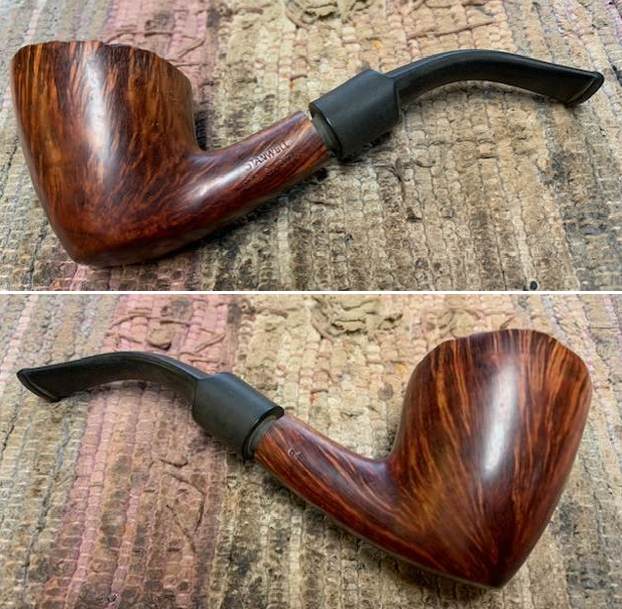
Restoring and Restemming an Interesting Nording F Freehand


Blog by Steve Laug

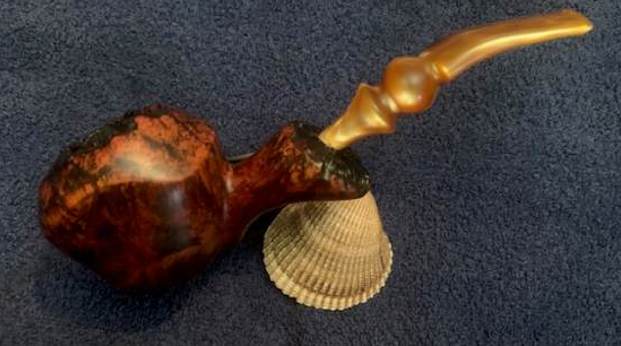
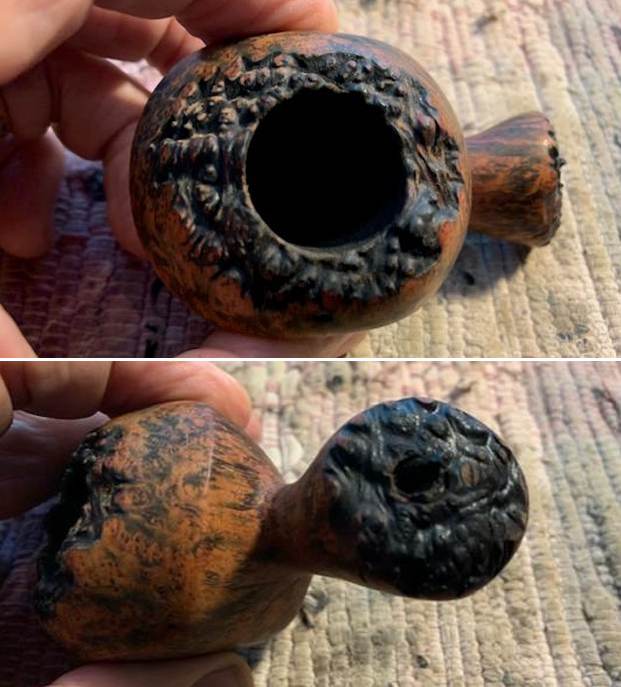
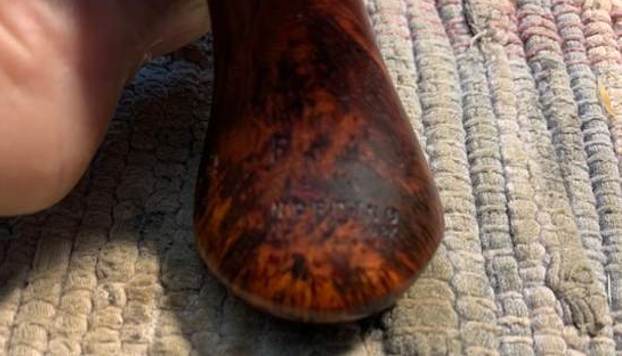
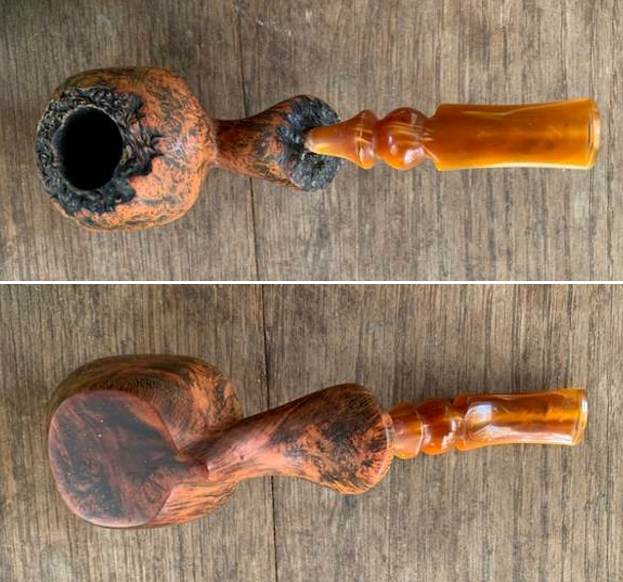
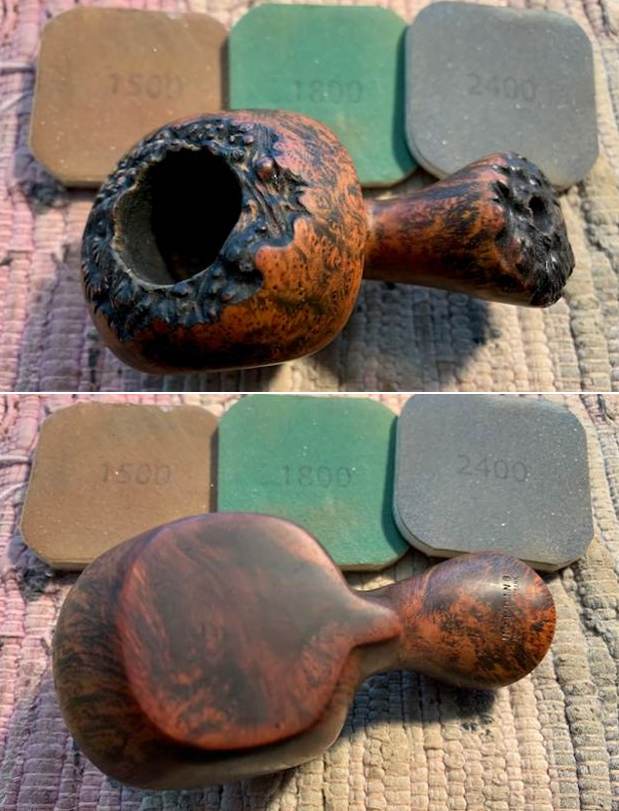
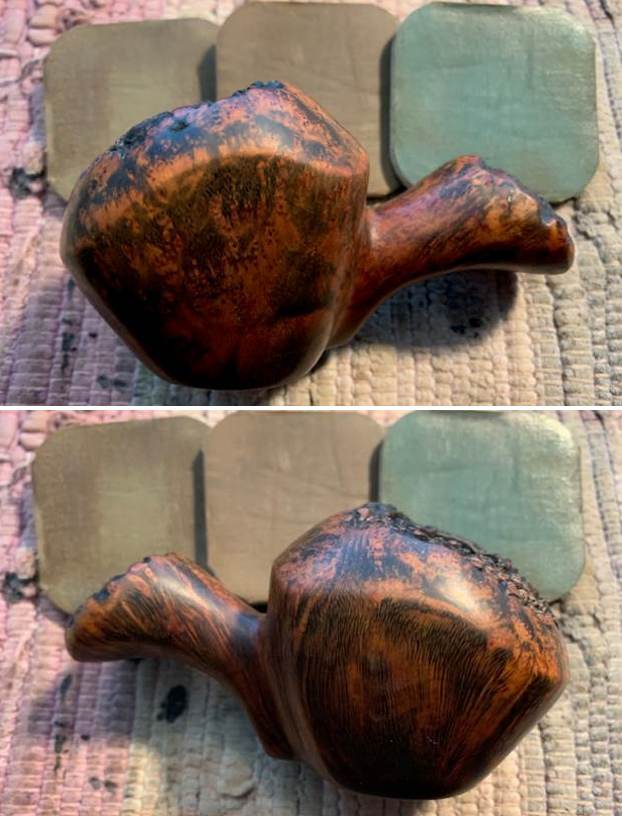
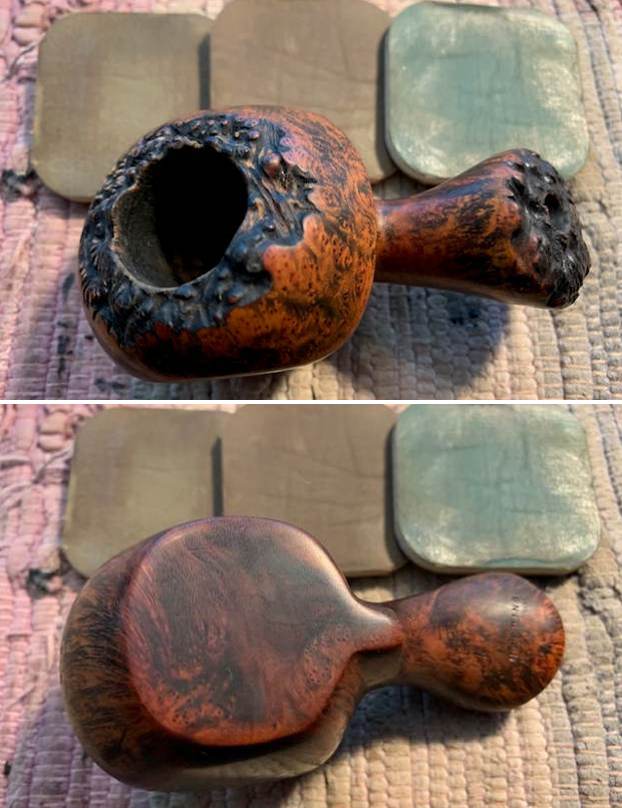
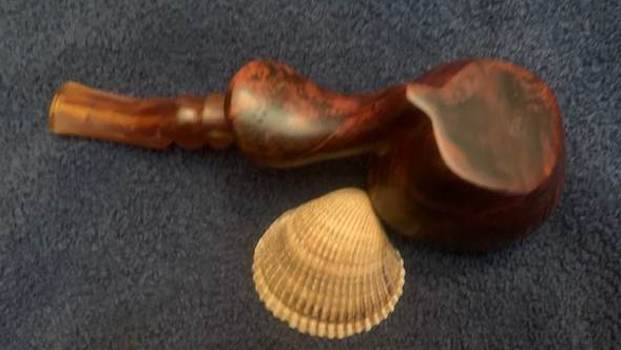
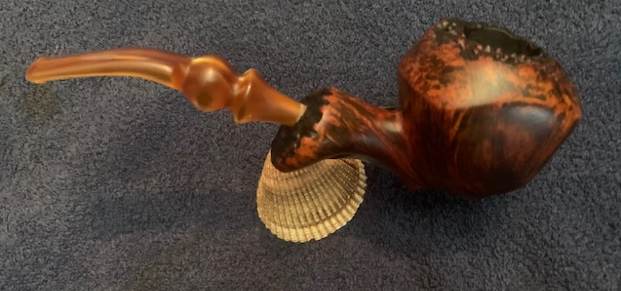
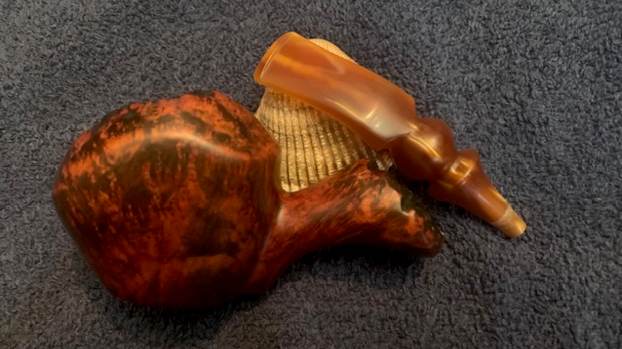
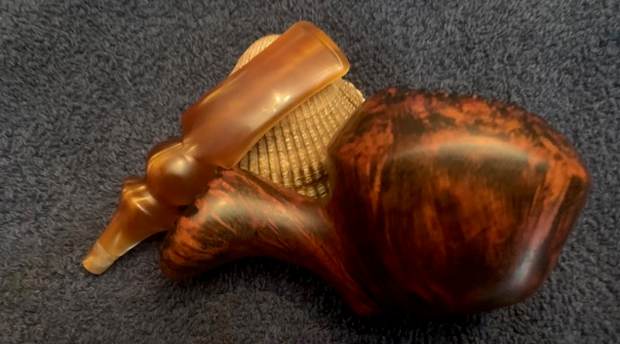
It was time to turn back to another one of the pipes that Jeff and I picked up. Neither of us had any memory of where this pipe came from but it is another interesting geometrically shaped Freehand with a variety of angles in the carving in the bowl and shank that really follow the grain on this piece of briar. The rim top and shank end is plateau and is stained black. You can see the flow of mixed grain around the bowl and shank. It is stamped on the underside of the shank F over NORDING over MADE IN DANMARK just before the plateau end of the shank. There is no other stamping on the pipe. The stem was missing and the tenon was broken off in the shank. Jeff had definitely cleaned up the pipe sometime along the way. He had reamed the bowl with a PipNet pipe reamer and cleaned it up with a Savinelli Fitsall Pipe Knife. He scrubbed the exterior with Murphy’s Oil Soap and a tooth brush to clean off lava on the rim top and shank end. He had cleaned up the internals of the shank, mortise and stem with pipe cleaners, cotton swabs and alcohol to remove all of the oils and tars in the pipe. I would need to pull the broken tenon and fit a new stem to the shank but it was a nice bowl. I took photos of the rim top and shank to show the condition of the pipe before I started working on it. You can see the condition from the bowl and rim top in the first photo. The inner edge of the bowl was in very good condition and was smooth to the touch. The second photo show the shank end plateau. It also looked very good. I took a photo of the stamping on the underside of the shank. It was faded but still readable as noted above.Before I started my work on the pipe I wanted to learn more about where this pipe fit into the Nording lines so I turned to the first of two sites that I always check to gather information on a brand. I turned first to Pipedia (https://pipedia.org/wiki/N%C3%B8rding). Nording’s were exclusively freehand shapes, graded from A, B, C, D, up to its highest grade, extra. Later an “F” grade was added—less expensive than the “A.” I could find no other information on the rest of the stamping on the pipe.

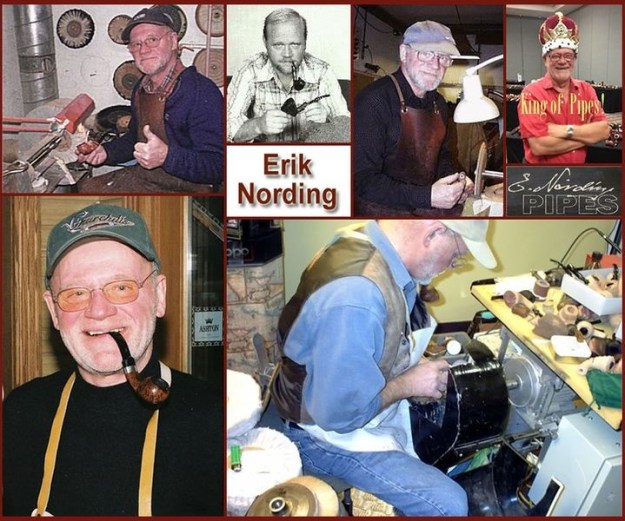
I did find a great collage of photos of Erik Nording that I have included below. I turned to the second information site – Pipephil’s (http://www.pipephil.eu/logos/en/logo-n2.html) did not find any more helpful information on the Nording Danmark stamp.

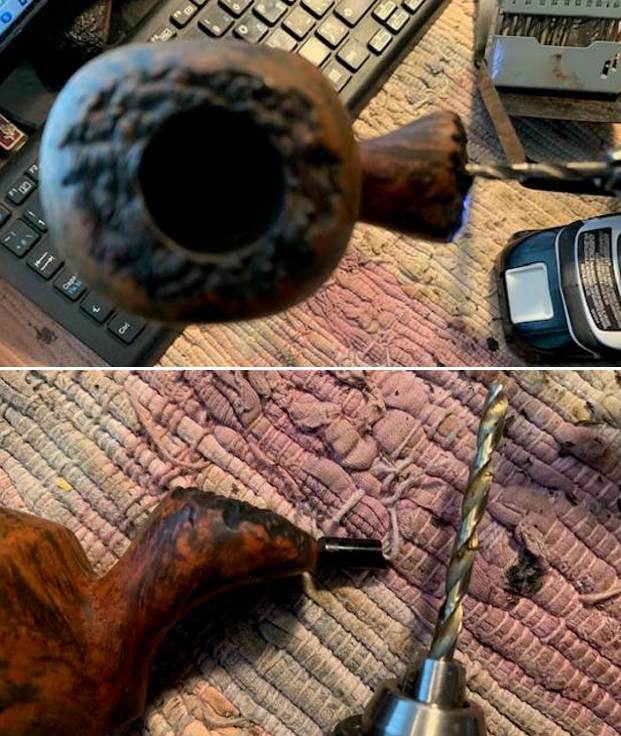
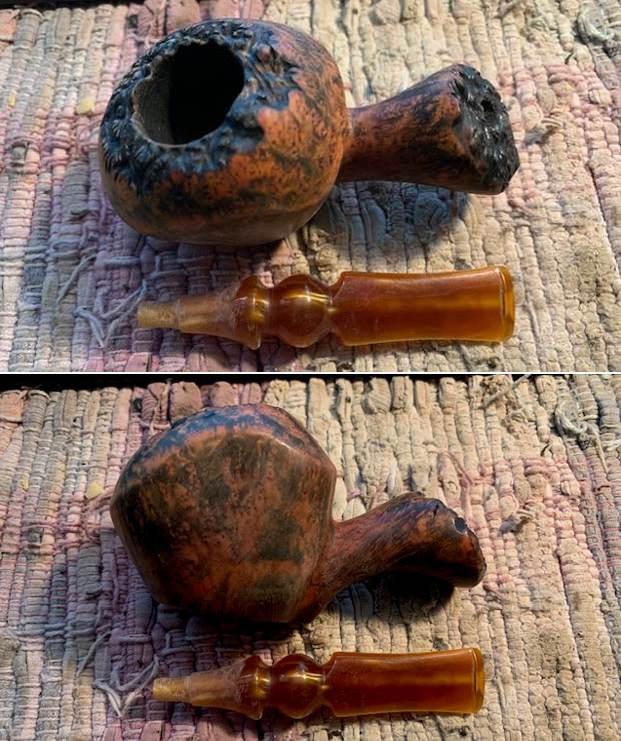
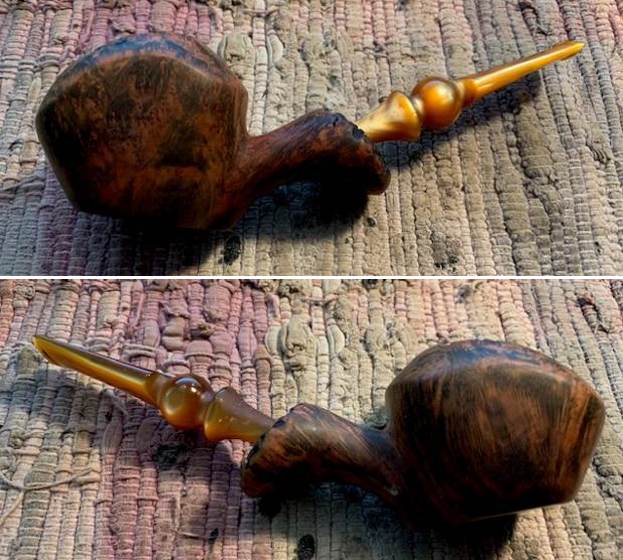
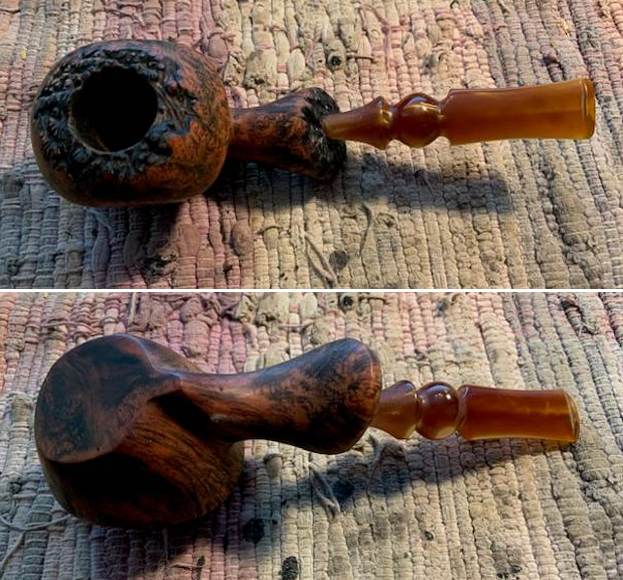
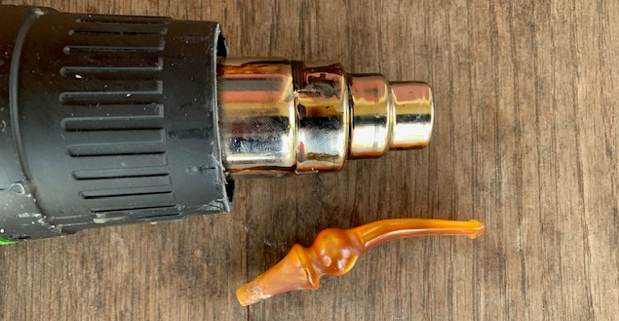
Armed with the information on the F stamp being a lower end midgrade Freehand, I knew a bit about the pipe at hand. I turned to address the pipe itself. When it arrived here in Vancouver it was a clean pipe and I knew what I had to work with. To begin my work on it, I removed the broken tenon from the shank with a drill bit turned into the shank on low speed. I took a photo of the broken tenon once I had it removed. I went through my can of stems and found this straight acrylic stem that had been partially turned for another pipe somewhere along the way. It would need some work but the fit was close. I sanded the tenon end of the new stem to get a strong fit in the shank of the pipe. I would need to refine the fit but it was looking quite good. I would also need to heat and bend the stem for a proper fit. I used a heat gun to bend the stem to match the flow of the stem. I used the lowest setting on the heat gun and bent the stem at the proper angle. I put it in the shank and took photos of the newly restemmed pipe. It is looking good at this point. I polished the briar with micromesh sanding pads. I wet sanded it with 1500-12000 grit pads. I wiped the bowl down after each pad with a damp cloth. The bowl began to take on a rich shine and grain was beginning to stand out. I rubbed the bowl and shank down with Before & After Restoration Balm to deep clean the finish on the bowl and shank. The product works to clean, enliven and protect the briar. I worked it in with my fingers to get it into the briar. I used a horsehair shoe brush to work it into the plateau top and shank end. After it sat for a 15 minutes I wiped it off and buffed it with a soft cloth. The briar really began to have a rich shine. I took some photos of the bowl at this point to mark the progress in the restoration. It is a beautiful bowl. I set the bowl aside and worked on the stem at this point in the process. I sanded the tenon area to shape the fit in the shank with 220 grit sandpaper fit snugly in the shank. I started polishing the stem with 400 grit wet dry sandpaper.  I polished the stem with micromesh sanding pads – wet sanding with 1500-2400 grit pads and dry sanding with 3200-12000 grit pads. I wiped the stem down after each pad with a damp cloth to remove the sanding dust. I used the Before & After Pipe Polish to remove the small minute scratches left in the acrylic even after the micromesh regimen. I finished by wiping the stem down with a final coat of Obsidian Oil and set it aside to dry. I put the stem back on the pipe and took the pipe to the buffer. I buffed the bowl and stem with Blue Diamond to polish the briar and the acrylic. Blue Diamond does a great job on the smaller scratches that remain in both. I gave the bowl and the stem several coats of carnauba wax and buffed the pipe with a clean buffing pad to raise the shine. I hand buffed it with a microfiber cloth to deepen the shine. The pipe polished up really nicely with a great contrasting stain look to the briar. The finished pipe is shown in the photos below. This is a unique Nording Freehand for me – the amber acrylic stem and plateau shank end gives the pipe a different look. The polished acrylic   stem looks really good with the reds and blacks standing out in the grain. The dimensions of the pipe are Length: 7 inches, Height: 2 inches, Outside diameter of the bowl: 2 inches wide x 2 ½ long, Chamber diameter: 3/4 of an inch. The weight of the pipe is 93 grams/3.28 ounces. This is another pipe that I will be putting it on the rebornpipes online store shortly, if you are interested in adding it to your collection. Thanks for walking through the restoration with me on this beauty!
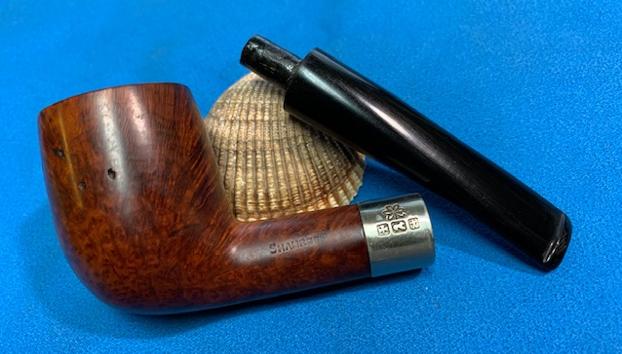
Restoring and Restemming a Made in Ireland Shamrock 106 Prince


Blog by Steve Laug

The next pipe was a mess and one that obviously had been “ridden hard and put away wet”. The finish and condition was abysmal. It was definitely a stranger to any cleaning! This one is a smooth Prince that has a rich coloured finish around the bowl sides and shank under the grit and grime of years. This pipe was purchased from an antique mall on 08/27/21 in Bozeman, Montana, USA. The finish is almost bland looking it is so dirty it was hard to know what to expect once it was cleaned. It was stamped on the  left side of the shank and read SHAMROCK. It was stamped to the right of the shank and reads MADE IN IRELAND (in a circle) with the shape number 106 lower and next to the bowl. It was filthy when Jeff brought it to the table. There was a thick cake in the bowl and lava on the rim top and the inner edge of the bowl. There were nicks in the outer edge all the way around. The replacement stem was chewed and damaged on the top and underside on and near the button. It did not appear to be vulcanite. Jeff took photos of the pipe before his cleanup work. Jeff took photos of the rim top and stem to show the general condition of the pipe. The bowl is heavily caked so it is hard to know the condition of the edges under the lava overflow. The stem was a replacement and had been heavily gnawed. The way the bit marks are on the surface of the stem makes me think that it is not vulcanite. The pipe is a real mess and I would probably have to restem the bowl. Jeff took photos of the bowl sides and heel to show the grain that was around this bowl. You can see the sandpits and nicks in the briar in the photos below. Even so, it is a nice looking pipe. He took a photo of the left side of the shank to show the stamping. The stamping is faint but readable in the photo below and is as noted above. He did not take a photo of the circular stamp Made In Ireland and the shape number on the right side of the shank. I will try to capture that later in the blog.I am including the link to the Pipedia’s article on Peterson pipes. It is a great read in terms of the history of the brand (https://pipedia.org/wiki/Peterson).
I turned to “The Peterson Pipe” by Mark Irwin and Gary Malmberg to get some background on the Peterson’s Shamrock Pipe. On page 312 it had the following information.

Shamrock (c1941-2009) Originally stamped SHAMROCK with no brand name, an inexpensive line first described in George Yale (New York) mail order booklet in 1941, imported by Rogers Import. The line was actively promoted beginning in ’45, aggressively promoted in US by Rogers from early ‘50s when they registered the Shamrock logo with US Patent Office, claiming propriety since ’38. Over the years offered with P-lip or fishtail mouthpiece, with or without nickel band, with or without Shamrock logo on the band, with or without S stamped in white or later in gold on mouthpiece. Appearing in 2008 as unstained smooth and rustic, fishtail mouthpiece with gold impressed P on the stem. COMS of MADE IN over IRELAND (C1945-1965), MADE IN IRELAND forming a circle (c1945-1965), “A PETERSON’S PRODUCT” over MADE IN IRELAND (c1945-1965), MADE IN THE over REPUBLIC over OF IRELAND9c1948-1998). Model is always difficult or impossible to date.

Judging from the description above, the pipe I am working on is stamped with the stamp noted in red above. Made in Ireland in a circle which narrows the date to between approximately 1945-1965. It is just stamped SHAMROCK with no brand name and no stamping on the stem.

I was utterly surprised when I took this pipe out of the box and compared it to the before photos. Jeff had done a great job cleaning up the pipe as usual. He reamed the pipe with a PipNet reamer and cut back the cake back to the bare briar. He cleaned up the walls with a Savinelli Fitsall Pipe Knife. Surprisingly the walls looked unscathed from the heavy cake. He scrubbed the interior of the bowl and shank with pipe cleaners, cotton swabs and alcohol to remove the tars and oils. He scrubbed the exterior of the pipe with Murphy’s Oil Soap and a tooth brush to remove the grime from the finish. He worked on the rim top lava and darkening with the soap and tooth brush. He scrubbed the inside of the stem with alcohol and pipe cleaners. He scrubbed the exterior of the stem with Soft Scrub and then soaked it in Briarville’s Deoxidizer. He washed it off with warm water to remove the Deoxidizer. When I examined the stem I knew it would need to be replaced. The pipe looked far better when it arrived. The cleaned up rim top revealed very damaged inner and outer edges and the top. There were nicks in the surface of the rim and the edges. I took some close up photos of the rim top and edges to show how well it had cleaned up and the damage to the edges around the bowl. I also took close up photos of the stem to show the tooth marks on the surface near and on the button itself. The stem would be replaced. You can see the deep tooth marks and damage to the button edges on both sides. The diameter of the stem is smaller than that of the shank as can be seen in the photos.I took photos of the stamping on the sides of the shank. It is faint but still readable. It reads as noted above.I removed the stem and took a photo of the pipe to have a look at the parts and overall look.I removed the stem from the shank and went through my stems to find one that matched the length and shape of the previous stem. I was pleased to see that it was slightly larger in diameter than the previous one. The tenon was almost the same size as the other one. It was bent more than the previous one but once straightened out it was only 1/8 of an inch shorter. I thought it would look very good.I used a small folded piece of 220 grit sandpaper to reduce the tenon enough that it would fit the mortise on the bowl. It did not take too much work and it fit perfectly. The diameter of the stem was slightly larger than the shank and would need some work to fit it properly. I took photos of the pipe with its new stem. I needed to reduce the diameter of the stem and also straighten it a bit to fit correctly. I used a flat file to take off as much of the excess as I could without damaging the briar ahead of it.I cleaned up the fit of the stem to the shank with folded 220 grit sandpaper. I worked over the flow of the stem into the shank to make the transition smooth. It was looking very good. I also heated the stem with the flame of a lighter to soften the vulcanite and straighten it. I repaired the damaged spots on the rim top with briar dust and clear superglue. Once it cured I topped the bowl on a topping board with 220 grit sandpaper. I used a folded piece of 220 grit sandpaper to clean up the inside edge of the bowl and smooth out the damage. I gave it a slight bevel to minimize the damage. I polished the briar with micromesh sanding pads – dry sanding with 1500-12000 grit sanding pads. I wiped the bowl down with a damp cloth after each sanding pad. I restained the rim top with a Walnut and a Maple stain pen to match it to the surrounding bowl colour. It looked pretty good. It will blend well once the pipe is polished and buffed. I worked some Before & After Restoration Balm into the surface of the briar with my fingertips to clean, enliven and protect the briar. I let the balm sit for 15 minutes and then buffed with a cotton cloth to raise the shine. The photos show the bowl at this point in the restoration process. I set the bowl aside and polished the stem with micromesh sanding pads – wet sanding with 1500-12000 grit sanding pads. I wiped it down after each sanding pad with Obsidian Oil. I polished it with Before & After Pipe Stem Polish – both Fine and Extra Fine. I am excited to finish this Older Made in Ireland Shamrock 106 Prince. I put the pipe back together and buffed it with Blue Diamond on the buffing wheel. I gave the bowl and the stem multiple coats of carnauba wax. I hand buffed the pipe with a clean buffing pad to raise the shine. It is fun to see what the polished bowl looks like with beautiful mixed grain all around it, looks great with the new black vulcanite stem. This smooth Classic Shamrock 106 Prince is great looking and the pipe feels great in my hand. It is light and well balanced. Have a look at it with the photos below. The dimensions are Length: 6 inches, Height: 1 ¼ inches, Outside diameter of the bowl: 1 ¼ inches, Chamber diameter: ¾ of an inch. The weight of the pipe is 36 grams/1.27 ounces. It turned out to be a beautiful pipe. I will be putting on the rebornpipes store in the Irish Pipe Makers Section. Thanks for your time and as Paresh says each time – Stay Safe.

Restoring and Restemming a Made in Ireland Peterson’s Kapet 595 Bent Rhodesian


Blog by Steve Laug

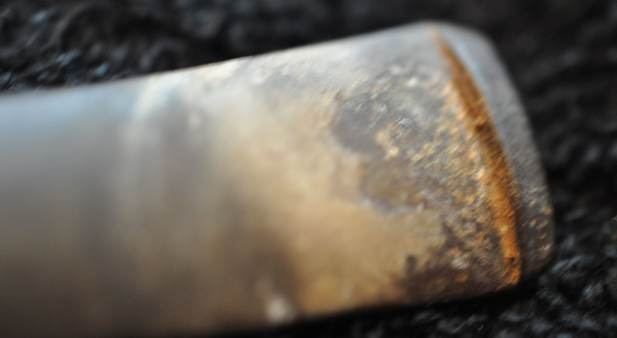
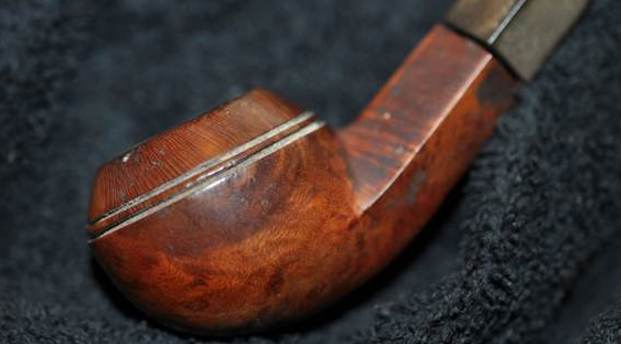
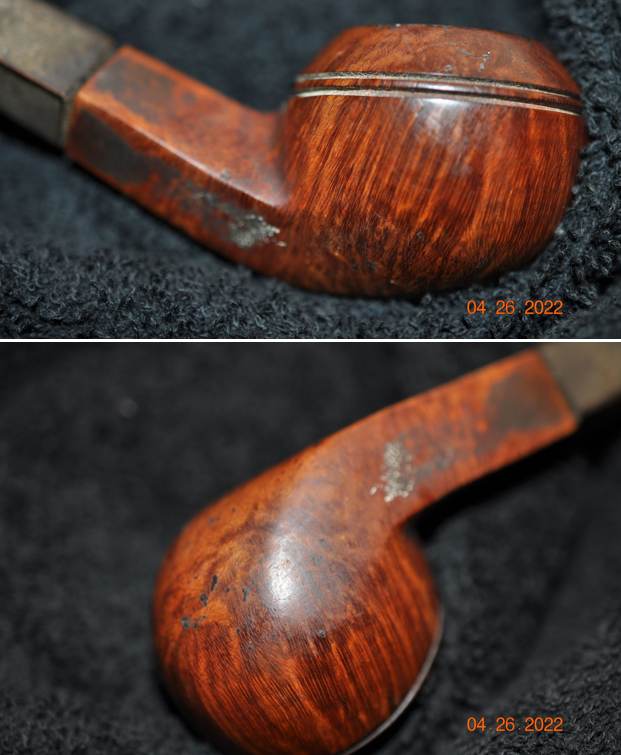
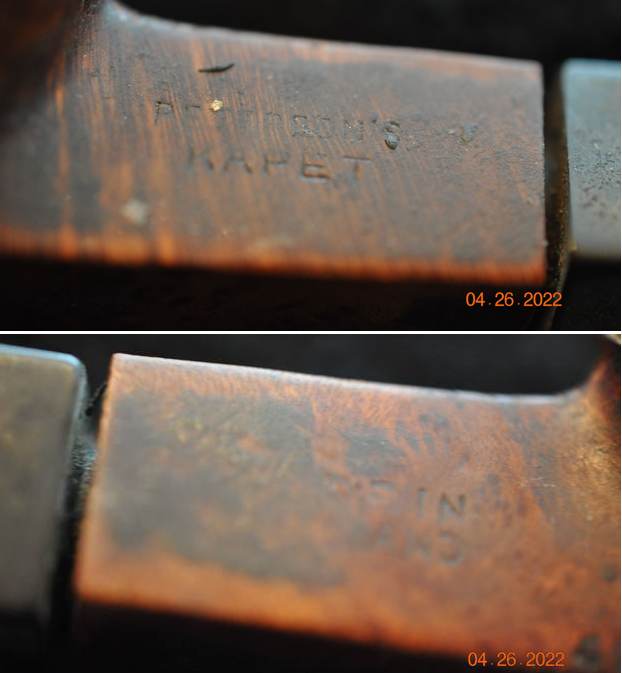
The next pipe was a mess and one that obviously had been “ridden hard and put away wet”. The finish and condition was abysmal. It was definitely a stranger to any cleaning! This one is a smooth Bent Rhodesian that has a rich coloured finish around the bowl sides and shank under the grit and grime of years. This pipe was purchased off Facebook Marketplace on 05/22/21 from Fruitland, Idaho, USA. The finish is almost bland looking it is so dirty it was hard to know what to expect once it was cleaned. It was stamped on the  left side of the shank and read Peterson’s [over] Kapet. It was stamped to the right of the shank and reads MADE IN IRELAND with the shape number 595 next to the bowl. It was filthy when Jeff brought it to the table. There was a thick cake in the bowl and lava on the back of the rim top and the inner edge of the bowl. The outer edge looked good. The vulcanite stem did not fit well and was straight rather than bent. It was oxidized and dirty. There was also tooth marks and chatter on the top and underside on the rest of the stem. Jeff took photos of the pipe before his cleanup work. Jeff took photos of the rim top and stem to show the general condition of the pipe. The bowl is heavily caked and there was a heavy lava overflow on the rim top and the inner edge. The stem is oxidized, calcified and grimy. It was a mess and it was not the correct stem. I would need to replace it. Jeff took photos of the bowl sides and heel to show the grain that was around this bowl. The grain is quite beautiful around the sides of the bowl and shank. It is a nice looking pipe.   He took photos of the sides of the shank to show the stamping. The stamping is faint but still is readable in the photos below and is as noted above. I am including the link to the Pipedia’s article on Peterson pipes. It is a great read in terms of the history of the brand (https://pipedia.org/wiki/Peterson). There was a short note toward the bottom of the page about the series. It is definitely referring to the newer line that came out later. I quote:

I turned to Pipedia (https://pipedia.org/wiki/Peterson) to first pin down a date that the pipe was made. I knew that the Made in Ireland stamp would give me that. I quote:

As usual when trying to get accurate facts in regard to Peterson history, something will jump up and get in the way. They are missing many of their records. The following is the best that we can do for a guide to the myriad markings during the period 1922 – 1949. Prior to 1920 it was rare for a country of origin to be stamped on the pipe, just Peterson’s Dublin on the band. After 1921/22, if it is stamped “MADE IN IRELAND” and the “Made in” is stacked over “Ireland” or “MADE IN EIRE” or several other forms, it was made between 1922 and 1938. A considerable number of Peterson pipes were stamped “Irish Free State”. From about 1930 to 1949, most of the pipes (those which were stamped) were stamped “Made in Ireland”.” If the stamp reads “MADE IN IRELAND” in a circle, the pipe was made between 1939 and 1948. These are all “Pre-Republic” pipes. I can tell you that the mark “Irish Free State” was adopted in 1922; and replaced by “Eire” in 1937 and then by “Republic of Ireland” in 1949.

That gave me a date for the pipe – it was made between 1922 and 1938 as can be proved by the Made in Ireland stamp on the right side of the shank.

I turned to “The Peterson Pipe” by Mark Irwin and Gary Malmberg to get some background on the Peterson’s Kapet Line. On page 305 it had the following information.

Kapet (1925-87) Line first described in 1925 brochure and featured in occasional catalogs through 1987. Early specimens will be stamped IRISH over FREE STATE. Described in 1937 catalog as available in dark plum or natural finish. Featured an aluminum “inner tube” or stinger until 1945.  Mid-century specimens may be stamped Made In over Ireland. Specimens from 1970 on may have mounts with hallmarks.

Judging from the Made in Ireland stamp, the pipe I am working on is probably made between 1922-38. Those dates work also for the Kapet information above. The stem is missing the original P-lip stem and the P emblem on the stem side as well as the inner tube.

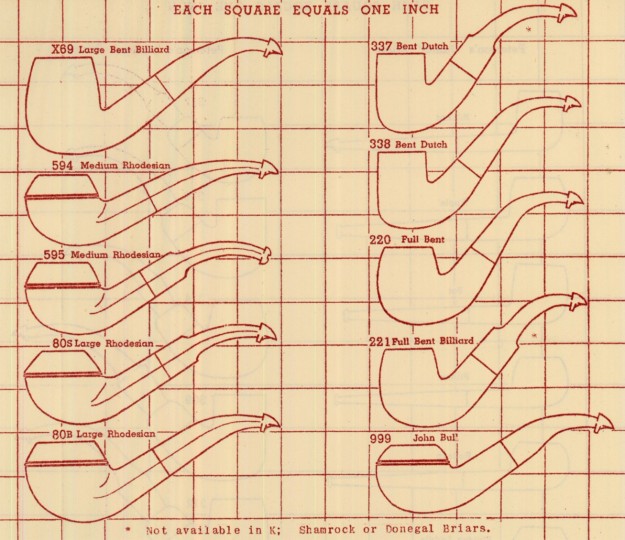
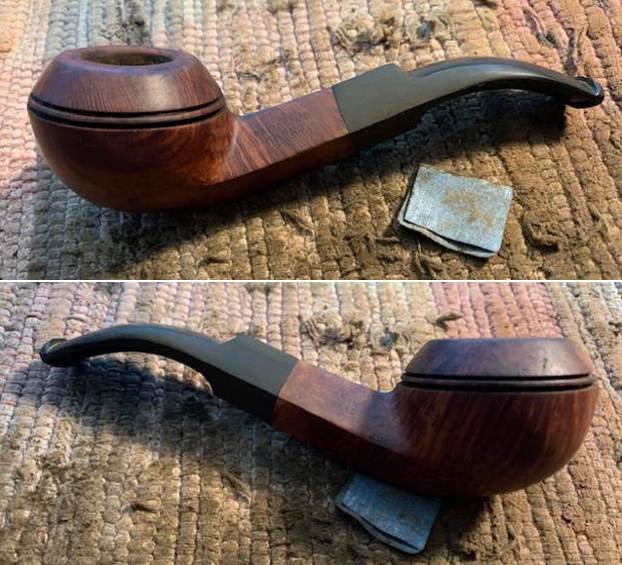
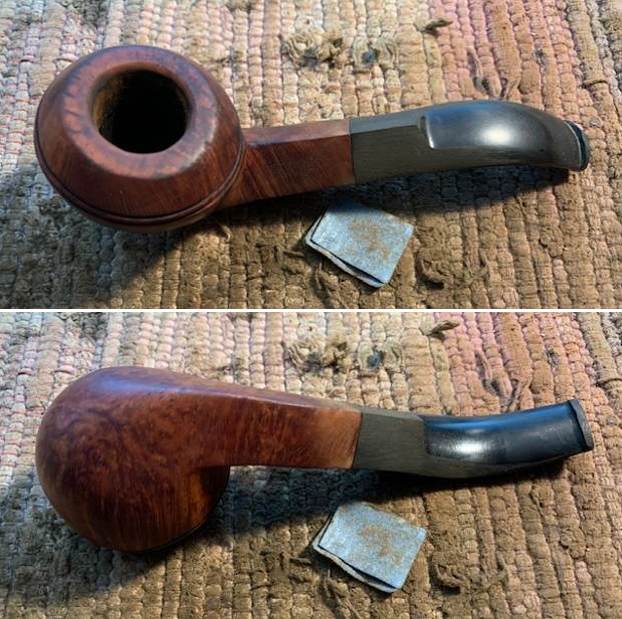
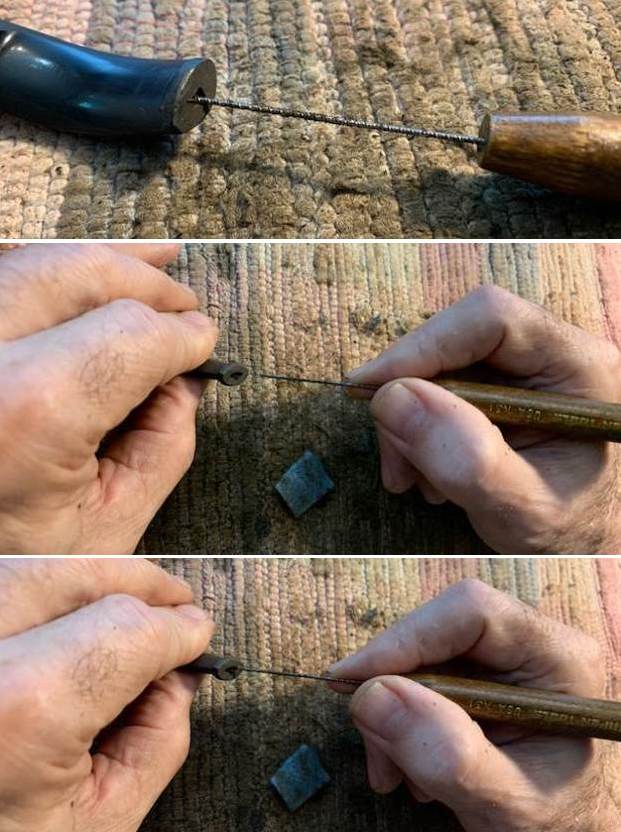
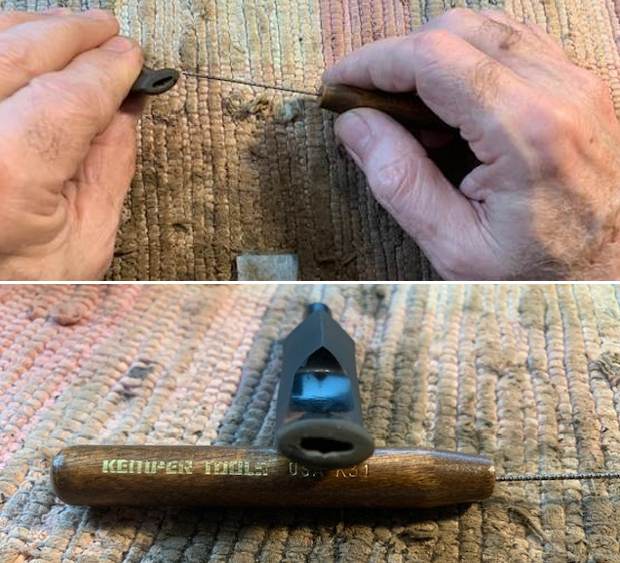
To help clarify the stamping on the shank my daughter did some digging and found a shape chart on Mark Irwin’s site that had the 595 shape and it did indeed have a saddle stem (https://petersonpipenotes.wordpress.com/?fbclid=IwAR2VQVQbIXKn90Y9DK56WQVIknkz7UVkfbivxdAjdNqslt9297JIUMvpyjc). The chart identified the 595 as a Medium Rhodesian with a fish tail stem so I was excited to see that the stem I had would be correct! I was utterly surprised when I took this pipe out of the box and compared it to the before photos. Jeff had done a great job cleaning up the pipe as usual. He reamed the pipe with a PipNet reamer and cut back the cake back to the bare briar. He cleaned up the walls with a Savinelli Fitsall Pipe Knife. Surprisingly the walls looked unscathed from the heavy cake. He scrubbed the interior of the bowl and shank with pipe cleaners, cotton swabs and alcohol to remove the tars and oils. He scrubbed the exterior of the pipe with Murphy’s Oil Soap and a tooth brush to remove the grime from the finish. He worked on the rim top lava and darkening with the soap and tooth brush. There was some scratching, dents and wear on the top and the inner edge of the rim. He scrubbed the inside of the stem with alcohol and pipe cleaners. He scrubbed the exterior of the stem with Soft Scrub and then soaked it in Briarville’s Deoxidizer. He washed it off with warm water to remove the Deoxidizer. He sent the stem along so that I could use it to fit another stem. I took photos of the pipe when it arrived. The cleaned up rim top looked clean but there were dents and marks on the top and some damage and burn marks on the inner edge of the bowl. I took some close up photos of the rim top and edges to show how well it had cleaned up. I also took close up photos of the stem to show the condition on both sides.I took photos of the stamping on the sides of the shank. It is faint but reads as noted above. I removed the stem and went through my stems and found one that matched the shank well. I would need to reduce the sides of the diamond saddle and then I would work the stem to fit correctly. The stem had originally been a P-lip style but someone along the way had cut it off. I would need to clean up that work and reshape it to be a fish tail stem like the one in the chart above. There was a faint P on the left side of the saddle that would probably disappear with the shaping.I put the stem in the shank and took a photo of the bowl with the stem first to have a look at the pipe with this stem. It looked very good and I think with the adjustments it was going to look like the original.I took photos of the stem to show the shape of the bent and also the modification that had been done to remove the P-lip and convert it to what was an attempt at a fish tail. The work on it was a bit of a hack job so it was a mess. I would need to do some reshaping and opening of the button. I started my work on this pipe by fitting the new stem to the shank. I had to reduce the sides of the diamond saddle with my Dremel and sanding drum. As with all diamond shank pipes, the sides were not equal in measurement so I had to shave off some of the vulcanite on each side to get a proper fit to the shank. I also used it on the button end to flatten it out and give it some initial shape. There is more work to do but it is getting there. I used a flat file to get the fit close to a smooth fit. Care had to be taken not to damage the briar. I then worked on it with a folded piece of 220 sandpaper. I wanted the transition between the shank and stem to be smooth. I converted the single hole in the button end to a slot using a hole saw (a pottery trimming saw). I worked on it to shape it as an oval. Once that was done I shaped the button to remove some of the thickness and give it a comfortable shape. I sanded the stem with 220 grit sandpaper and started the polishing it with 400 grit wet dry sandpaper. I sanded the inside of the slot with 220 and 400 grit sandpaper to smooth out the airway in the button.I cleaned the inside of the stem with alcohol and pipe cleaners. The stem was very dirty so it took a bit of work to get the oils and tars out of it. Once it was cleaned it smelled very good.I polished the stem with micromesh sanding pads – wet sanding with 1500-12000 grit sanding pads. I wiped it down after each sanding pad with Obsidian Oil. I polished it with Before & After Pipe Stem Polish – both Fine and Extra Fine. With the stem finished, I removed it and turned my attention to the bowl. I know some of you would have kept working on the stem but I needed a change of pace so I went to the bowl for awhile to address this darkening on the rim top and edges. I used a folded piece of 220 grit sandpaper to smooth out the inner edge and work on the darkening on the top.I used an oak stain pen to touch up the sanded areas on the rim top and edges as well as the shank end. The pen was a good match to the rest of the briar around the bowl and shank. It would blend in very well once it was buffed and waxed.I polished the briar and worked to blend in the sanded areas on the rim top and shank end with the surrounding briar with micromesh sanding pads. I dry sanded with 1500-12000 grit pads. I wiped the briar down after each pad with a damp cloth to remove the dust and assess progress. I worked some Before & After Restoration Balm into the surface of the briar with my fingertips to clean, enliven and protect the briar. I worked it into the twin rings around the cap with a shoe brush. I let the balm sit for 15 minutes and then buffed with a cotton cloth to raise the shine. The photos show the bowl at this point in the restoration process.  I am excited to finish this beautifully grained, restemmed Peterson’s Kapet 595 Bent Rhodesian. I put the pipe back together and buffed it with Blue Diamond on the buffing wheel. I gave the bowl and the stem multiple coats of carnauba wax. I hand buffed the pipe with a clean buffing pad to raise the shine. It is fun to see what the polished bowl looks like with beautiful mixed grain all around it. The Bent Rhodesian looks great with the new replacement black vulcanite stem. This smooth Classic Peterson’s Kapet Bent Rhodesian is great looking and the pipe feels great in my hand. It is light and well balanced. Have a look at it with the photos below. The dimensions are Length: 5 inches, Height: 1 ½ inches, Outside diameter of the bowl: 1 ¼ inches, Chamber diameter: ¾ of an inch. The weight of the pipe is 40 grams/1.41 ounces. It turned out to be a beautiful pipe. I will be putting on the rebornpipes store in the Irish Pipe Makers Section. Thanks for your time and as Paresh says each time – Stay Safe.

Restoring and Restemming a Made in Ireland Peterson’s Premier Selection 493 Bulldog


Blog by Steve Laug

The next pipe was a mess and one that obviously had been “ridden hard and put away wet”. The finish and condition was abysmal. It was definitely a stranger to any cleaning! This one is a smooth Bent Billiard that has a rich coloured finish around the bowl sides and shank under the grit and grime of years. This pipe was purchased from an antique mall on 08/27/21 in Bozeman, Montana, USA. The finish is almost bland looking it is so dirty it was hard to know what to expect once it was cleaned. It was stamped on the  left side of the shank and read Peterson’s [over] Premier Selection. It was stamped to the right of the shank and reads MADE IN IRELAND with the shape number 493 next to the bowl. It was filthy when Jeff brought it to the table. There was a thick cake in the bowl and lava on the back of the rim top and the inner edge of the bowl. The outer edge looked good. The replacement Biteproof stem was oxidized and had a chunk missing from the left side of the stem at the button. There was also tooth marks and chatter on the top and underside on the rest of the stem. Jeff took photos of the pipe before his cleanup work. Jeff took photos of the rim top and stem to show the general condition of the pipe. The bowl is heavily caked and there was a heavy lava overflow on the rim top and the inner edge. The stem is broken, oxidized, calcified and grimy. It was a mess. Jeff took photos of the bowl sides and heel to show the grain that was around this bowl. The grain is quite beautiful around the sides of the bowl and shank. It is a nice looking pipe. He took photos of the sides of the shank to show the stamping. The stamping is readable in the photos below and is as noted above.    I am including the link to the Pipedia’s article on Peterson pipes. It is a great read in terms of the history of the brand (https://pipedia.org/wiki/Peterson). There was a short note toward the bottom of the page about the series. It is definitely referring to the newer line that came out later. I quote:

I turned to Pipedia (https://pipedia.org/wiki/Peterson) to first pin down a date that the pipe was made. I knew that the Made in Ireland stamp would give me that. I quote:

As usual when trying to get accurate facts in regard to Peterson history, something will jump up and get in the way. They are missing many of their records. The following is the best that we can do for a guide to the myriad markings during the period 1922 – 1949. Prior to 1920 it was rare for a country of origin to be stamped on the pipe, just Peterson’s Dublin on the band. After 1921/22, if it is stamped “MADE IN IRELAND” and the “Made in” is stacked over “Ireland” or “MADE IN EIRE” or several other forms, it was made between 1922 and 1938. A considerable number of Peterson pipes were stamped “Irish Free State”. From about 1930 to 1949, most of the pipes (those which were stamped) were stamped “Made in Ireland”.” If the stamp reads “MADE IN IRELAND” in a circle, the pipe was made between 1939 and 1948. These are all “pre-Republic” pipes. I can tell you that the mark “Irish Free State” was adopted in 1922;and replaced by “Eire” in 1937 and then by “Republic of Ireland” in 1949.

That gave me a date for the pipe – it was made between 1922 and 1938 as can be proved by the Made in Ireland stamp on the right side of the shank.

I turned to “The Peterson Pipe” by Mark Irwin and Gary Malmberg to get some background on the Peterson’s Kapp-Royal Pipe. On page 310 it had the following information.

Premier on the shank (c. 1953- c. 1981) A high grade line of Classic Range shapes for the US market introduced by Rogers Imports in their 1953 catalog. Offered in smooth or sandblast finish, a P-lip mouthpiece with an aluminum P. The first occurrence of this logo in the ephemera. The Tan Bark Premier appeared in the ’69 Iwan Ries catalog. COM of Made in over Ireland, a PREMIER stamp also appears over SELECTION and will be distinguished by an inset brass P on the mouthpiece. See system for SYSTEM over PREMIER stamp.

Judging from the Made in Ireland stamp, the pipe I am working on is probably made between 1922-38. The contrary piece of the puzzle is that the second red highlight above dates it to between 1953 and 1981. It is missing the original P-lip stem and the P emblem on the stem side. So once more we enter the realm of Peterson’s mysteries. Anyone have any ideas on this one.

I was utterly surprised when I took this pipe out of the box and compared it to the before photos. Jeff had done a great job cleaning up the pipe as usual. He reamed the pipe with a PipNet reamer and cut back the cake back to the bare briar. He cleaned up the walls with a Savinelli Fitsall Pipe Knife. Surprisingly the walls looked unscathed from the heavy cake. He scrubbed the interior of the bowl and shank with pipe cleaners, cotton swabs and alcohol to remove the tars and oils. He scrubbed the exterior of the pipe with Murphy’s Oil Soap and a tooth brush to remove the grime from the finish. He worked on the rim top lava and darkening with the soap and tooth brush. Since the stem was ruined he did not clean it. He sent the ruined stem along so that I could use it to fit another stem. I took photos of the pipe when it arrived. The cleaned up rim top looked very good around the edges and the top. I took some close up photos of the rim top and edges to show how well it had cleaned up. I also took close up photos of the stem to show the damage on the left side of the stem near the button.I took photos of the stamping on the sides of the shank. It reads as noted above. I removed the stem and went through my stems and found one that matched the broken one very well. I would need to reduce the diameter of the tenon and then I would work the stem to fit correctly.I started my work on this pipe by fitting the new stem to the shank. I had to reduce the tenon with 220 grit sandpaper to fit the shank. As with all diamond shank pipes, the sides were not equal in measurement so I had to shave off some of the vulcanite or some of the briar to get a proper fit to the shank. I did the work with some 220 grit sandpaper until the transition was smooth all the way around the shank and stem. There is more work to do but it is getting there. With the stem fit I removed it and turned my attention to the bowl. I know some of you would have kept working on the stem but I needed a change of pace so I went to the bowl for awhile to address this darkening on the rim top and edges. I used a folded piece of 220 grit sandpaper to smooth out the inner edge and work on the darkening on the top.I polished the briar and worked to blend in the sanded areas on the rim top and shank end with the surrounding briar with micromesh sanding pads. I dry sanded with 1500-12000 grit pads. I wiped the briar down after each pad with a damp cloth to remove the dust and assess progress. I worked some Before & After Restoration Balm into the surface of the briar with my fingertips to clean, enliven and protect the briar. I worked it into the twin rings around the cap with a shoe brush. I let the balm sit for 15 minutes and then buffed with a cotton cloth to raise the shine. The photos show the bowl at this point in the restoration process. I set the bowl aside and turned my attention back to the stem. Started by opening up the slot in the button with a small saw. Once I had it the way I wanted I turned to the rest of the stem. I worked on the shaping and smoothing out the sanding marks with 220 grit sandpaper and starting polishing it with 400 grit wet dry sandpaper. I cleaned the inside of the stem with alcohol and pipe cleaners. The stem was very dirty so it took a bit of work to get the oils and tars out of it. Once it was cleaned it smelled very good. I polished the stem with micromesh sanding pads – wet sanding with 1500-12000 grit sanding pads. I wiped it down after each sanding pad with Obsidian Oil. I polished it with Before & After Pipe Stem Polish – both Fine and Extra Fine. I am excited to finish this beautifully grained, restemmed Peterson’s Premier Selection 493 Straight Bulldog. I put the pipe back together and buffed it with Blue Diamond on the buffing wheel. I gave the bowl and the stem multiple coats of carnauba wax. I hand buffed the pipe with a clean buffing pad to raise the shine. It is fun to see what the polished bowl looks like with beautiful mixed grain all around it. The Bulldog looks great with the new replacement black vulcanite stem. This smooth Classic Peterson’s Premier Selection Bulldog is great looking and the pipe feels great in my hand. It is light and well balanced. Have a look at it with the photos below. The dimensions are Length: 5 ¾ inches, Height: 1 ½ inches, Outside diameter of the bowl: 1 ¾ inches, Chamber diameter: ¾ of an inch. The weight of the pipe is 38 grams/1.34 ounces. It turned out to be a beautiful pipe. I will be putting on the rebornpipes store in the Irish Pipe Makers Section. Thanks for your time and as Paresh says each time – Stay Safe.

Restemming & Restoring a Peterson’s Product – a Made in Ireland  Shamrock X105 Billiard


Blog by Steve Laug

The next pipe I have chosen to work on came to me as a referral from a local pipe shop here in Vancouver. While I am not taking on work via mail I am still doing the repairs for this pipe shop. This one was a smooth finished Peterson’s Billiard bowl. It needed to have a stem fit to the shank so the fellow could smoke it again. It had not had a stem since the 70s. He decided it was time to get it back in order. He says he is a bit older than me and in our conversation it turns out that we are pretty close to the same age. He does not drive, no computer and no cell phone. We chatted a bit on his land line and decided a regular slotted stem would work for the pipe as I did not have any straight (or bent for that matter) Peterson’s stems. It had originally been offered with a choice of stems anyway. The finish is was dirty. I can see sand pits on the left side of the bowl but other than that it was in decent condition. It was stamped on the  left side of the shank and read SHAMROCK. It was stamped to the right of the shank and reads “A PETERSON’S [over] PRODUCT” over MADE IN IRELAND (3 lines) with the shape number X105 next to the bowl. The bowl had been reamed recently and the inner edge was nicked in several spots. The rim top was covered with a lava coat. I took a few photos of the pipe when I removed it from the shipping envelope.    I took a close up photo of the rim top and bowl to show the general condition of the pipe. The bowl looks to have been reamed recently but the rim top and edges have some lava overflow. I took photos of the sides of the shank to show the stamping. The stamping is readable in the photos below and is as noted above. I am including the link to the Pipedia’s article on Peterson pipes. It is a great read in terms of the history of the brand (https://pipedia.org/wiki/Peterson).

I turned to “The Peterson Pipe” by Mark Irwin and Gary Malmberg to get some background on the Peterson’s Shamrock Pipe. On page 312 it had the following information. 

Shamrock (c1941-2009) Originally stamped SHAMROCK with no brand name, an inexpensive line first described in George Yale (New York) mail order booklet in 1941, imported by Rogers Import. The line was actively promoted beginning in ’45, aggressively promoted in US by Rogers from early ‘50s when they registered the Shamrock logo with US Patent Office, claiming propriety since ’38. Over the years offered with P-lip or fishtail mouthpiece, with or without nickel band, with or without shamrock logo on the band, with or without S stamped in white or later in gold on mouthpiece. Appearing in 2008 as unstained smooth and rustic, fishtail mouthpiece with gold impressed P on the stem. COMS of MADE IN over IRELAND (C1945-1965), MADE IN IRELAND forming a circle (c1945-1965), “A PETERSON’S PRODUCT” over MADE IN IRELAND (c1945-1965), MADE IN THE over REPUBLIC over OF IRELAND9c1948-1998). Model is always difficult or impossible to date. 

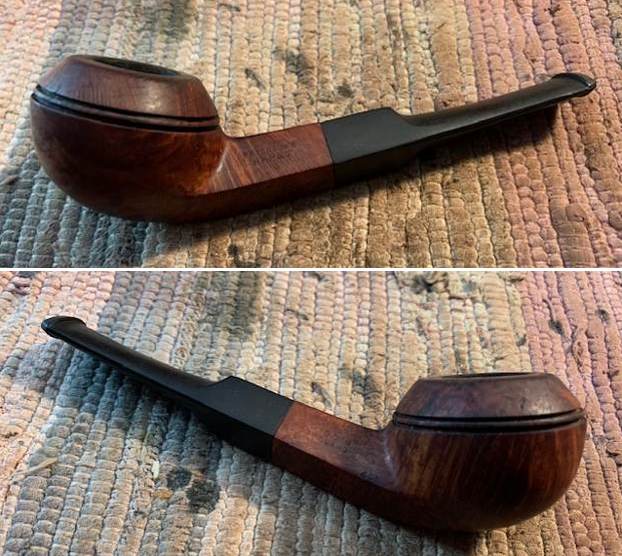
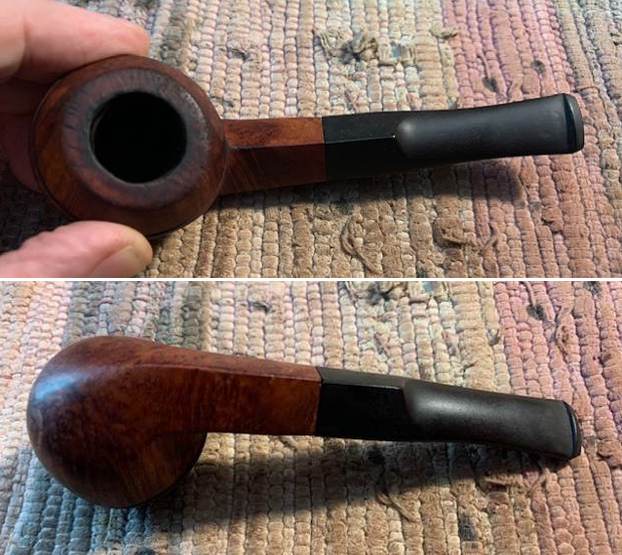
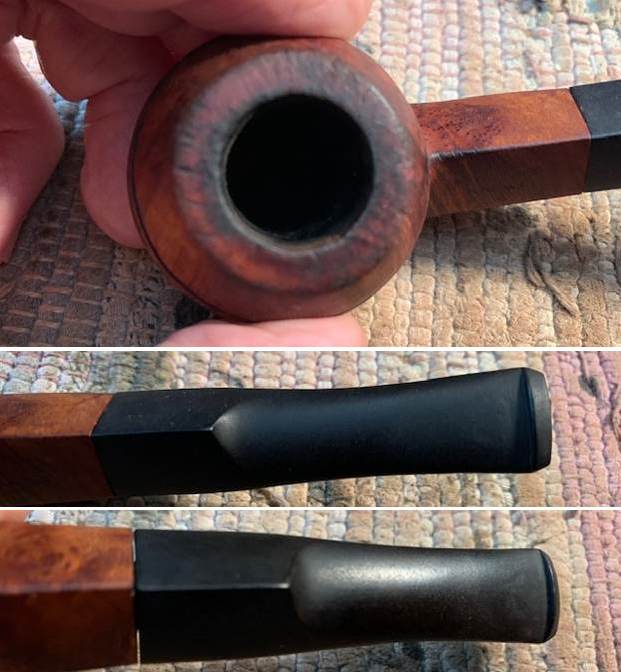
Judging from the description above, the pipe I am working on is stamped with the stamp noted in red above. It reads “A Peterson’s Product” over Made in Ireland which narrows the date to between approximately 1945-1965. It is just stamped SHAMROCK with no brand name and no stem.  

Now it was time to work on the pipe. I went through my can of stems and found a fishtail stem that would work with a little adjustment to the diameter at the band. The stem was in very good condition. I laid aside the stem and turned my attention to the bowl. I worked on the thickly lava coated rim top and edges with a folded piece of 220 grit sandpaper. I was able to remove the lava and I worked over the inner edge with the sandpaper. Once finished I reamed the bowl with a Savinelli Fitsall Pipe knife to remove the remnants of cake in the bowl. I scrubbed the externals of the bowl and rim with undiluted Murphy’s Oil Soap and a tooth brush. I rinsed the bowl with warm running water to remove the soap and the grime. The scrubbing left the surface very clean. I decided to leave the sandpits on the bowl side and filling them seemed unnecessary to me. I polished the briar with micromesh sanding pads – dry sanding with 1500-12000 grit sanding pads. I wiped the bowl down with a damp cloth after each sanding pad. I worked some Before & After Restoration Balm into the surface of the briar with my fingertips to clean, enliven and protect the briar. I let the balm sit for 15 minutes and then buffed with a cotton cloth to raise the shine. The photos show the bowl at this point in the restoration process. I sanded the diameter of the stem at the shank end with 220 grit sandpaper to take down the left side so that it matched the side of the band on the shank. I worked it over until the flow between the nickel band and the stem was smooth. I started the polishing with 400 grit wet dry sandpaper.I set the bowl aside and polished the stem with micromesh sanding pads – wet sanding with 1500-12000 grit sanding pads. I wiped it down after each sanding pad with Obsidian Oil. I polished it with Before & After Pipe Stem Polish – both Fine and Extra Fine.    I am excited to finish this Nickel Banded Older Peterson’s Shamrock X105 Straight Billiard. I put the pipe back together and buffed it with Blue Diamond on the buffing wheel. I gave the bowl and the stem multiple coats of carnauba wax. I hand buffed the pipe with a clean buffing pad to raise the shine. It is fun to see what the polished bowl looks like with beautiful flame grain all around it. Added to that the polished Sterling Silver band and the black vulcanite stem was beautiful. This smooth Classic Shamrock X105 Billiard is great looking and the pipe feels great in my hand. It is light and well balanced. Have a look at it with the photos below. The dimensions are Length: 5 ¾ inches, Height: 1 ¾ inches, Outside diameter of the bowl: 1 ¼ inches, Chamber diameter: ¾ of an inch. The weight of the pipe is 46 grams/1.62 oz. It turned out to be a beautiful pipe. I will be packing it up on the weekend and getting it ready to go back to the pipeman who sent it to me to be restemmed. Thanks for your time and as Paresh says each time – Stay Safe.