Tag Archives: Dal Stanton article

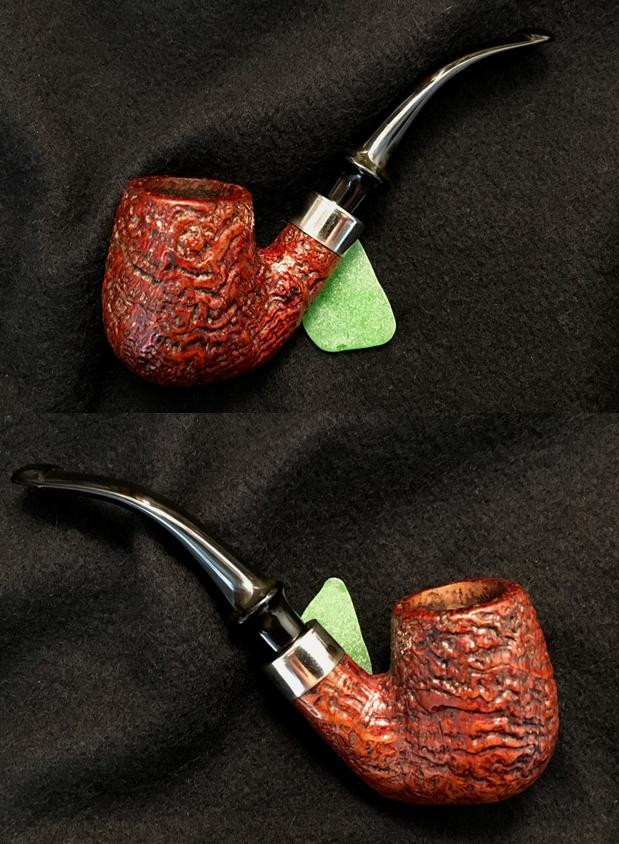
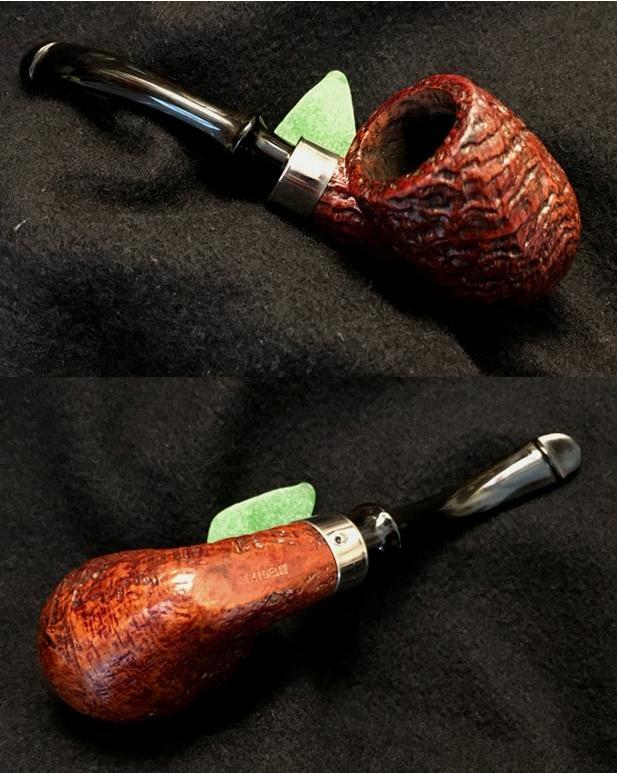
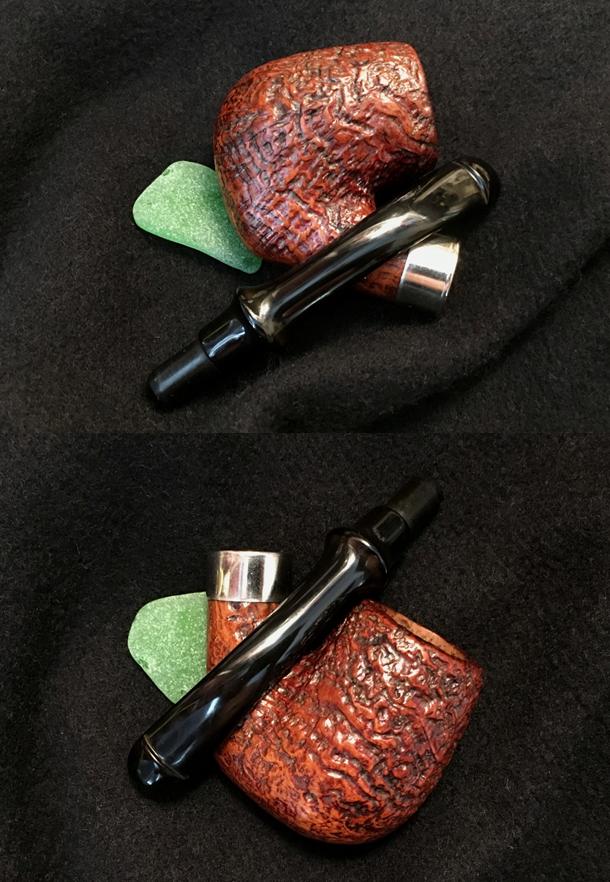
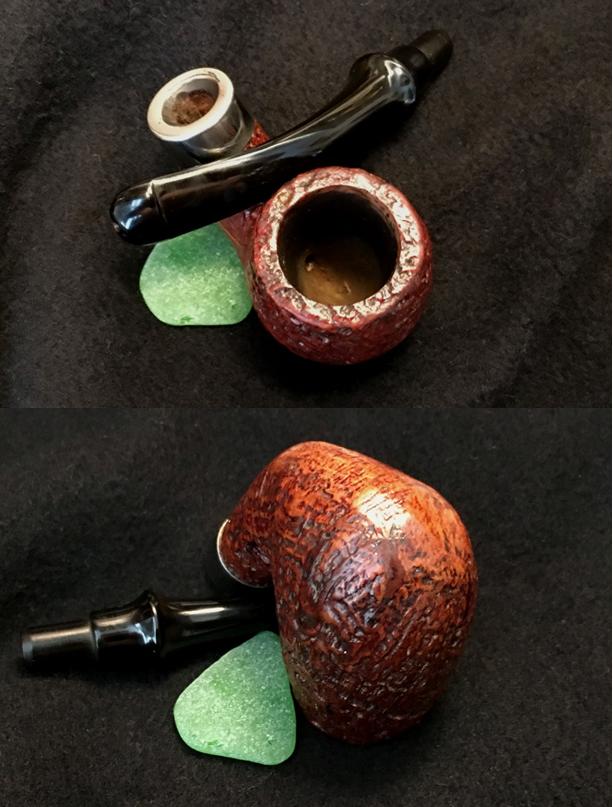
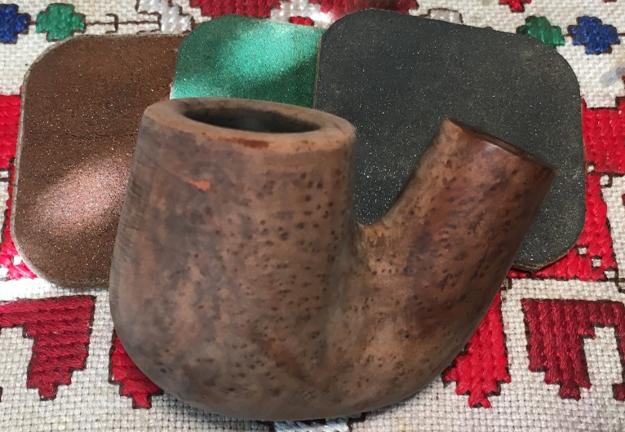
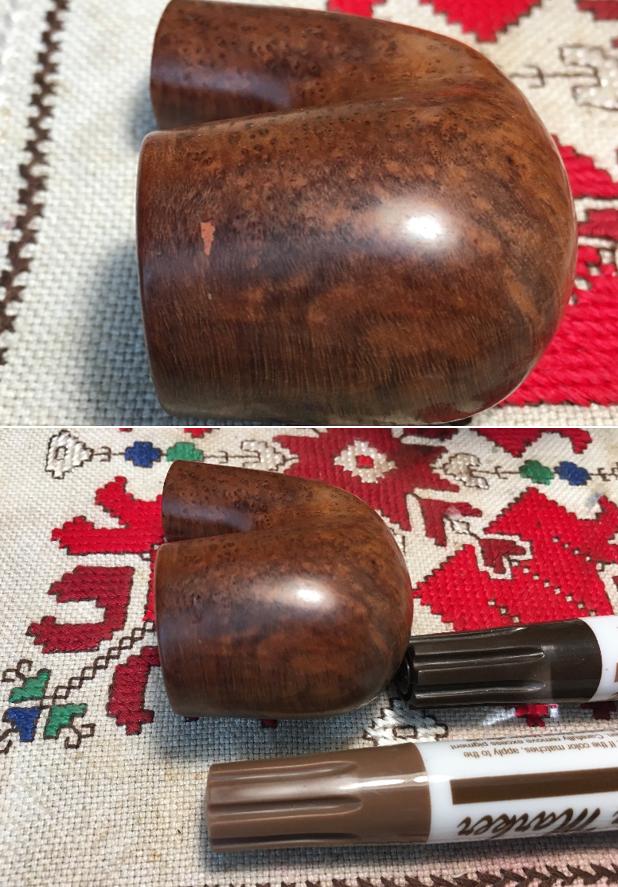
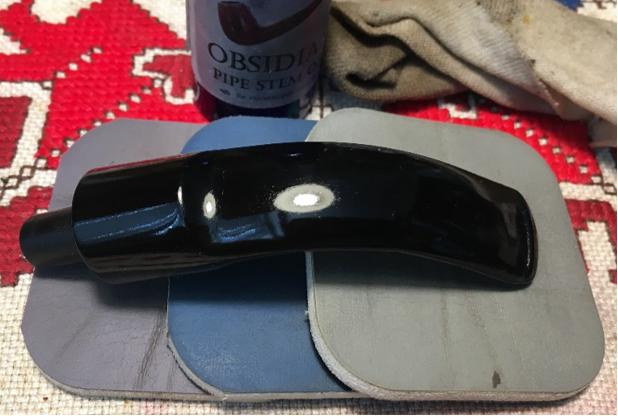
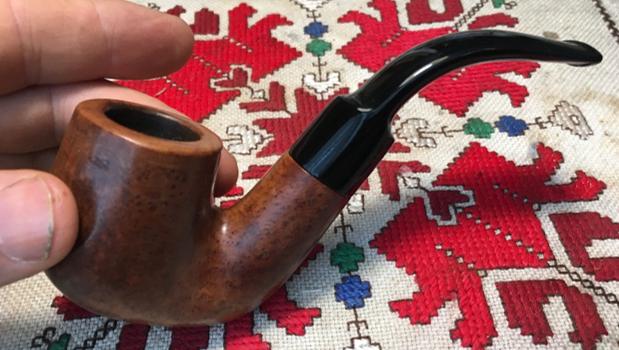
Acrylic Stem Repair – A Butz-Choquin Cadre Noir 1845 St. Claude France


Blog by Dal Stanton

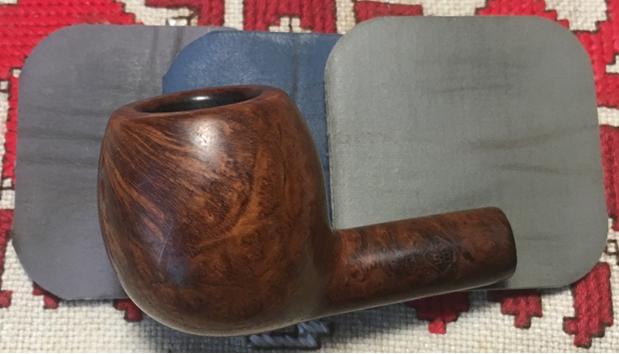
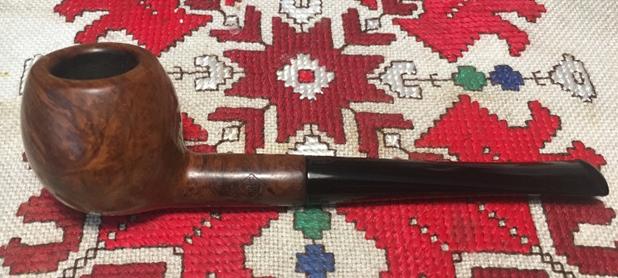
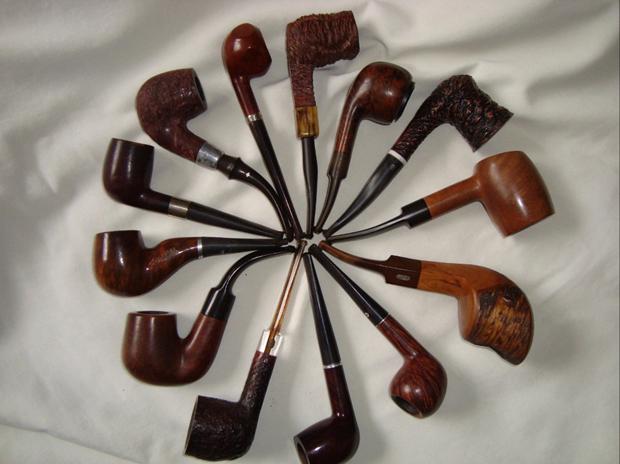
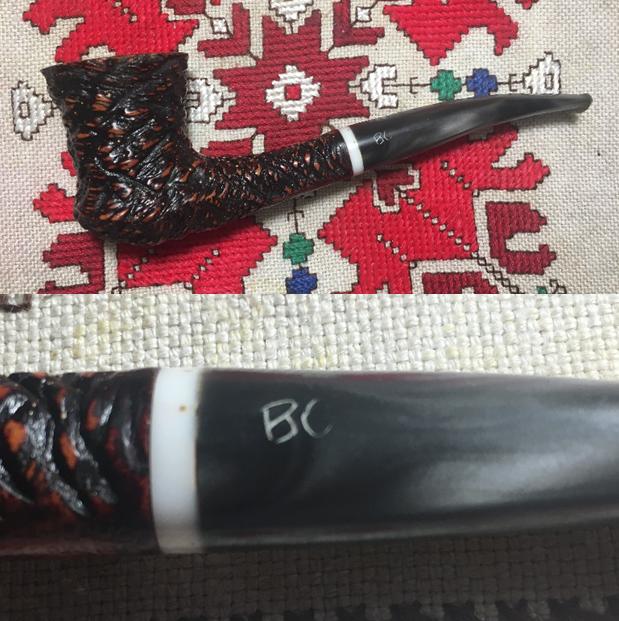
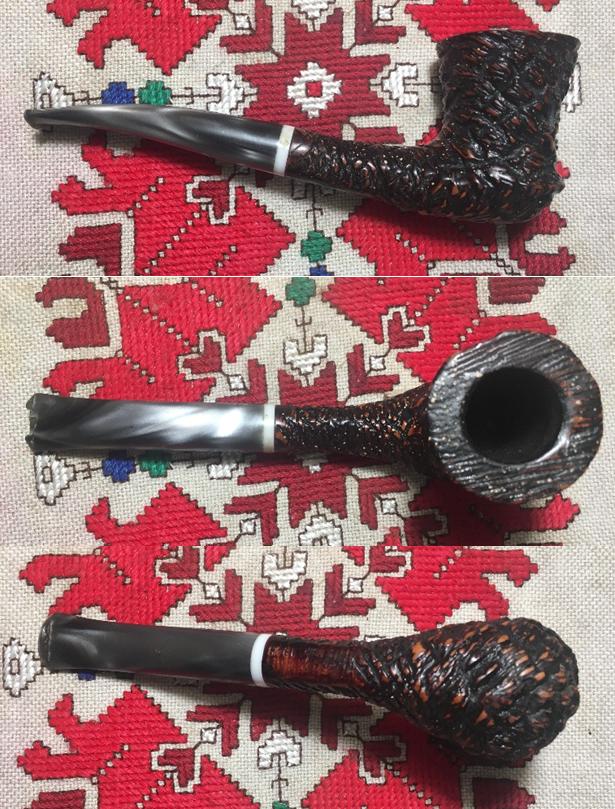
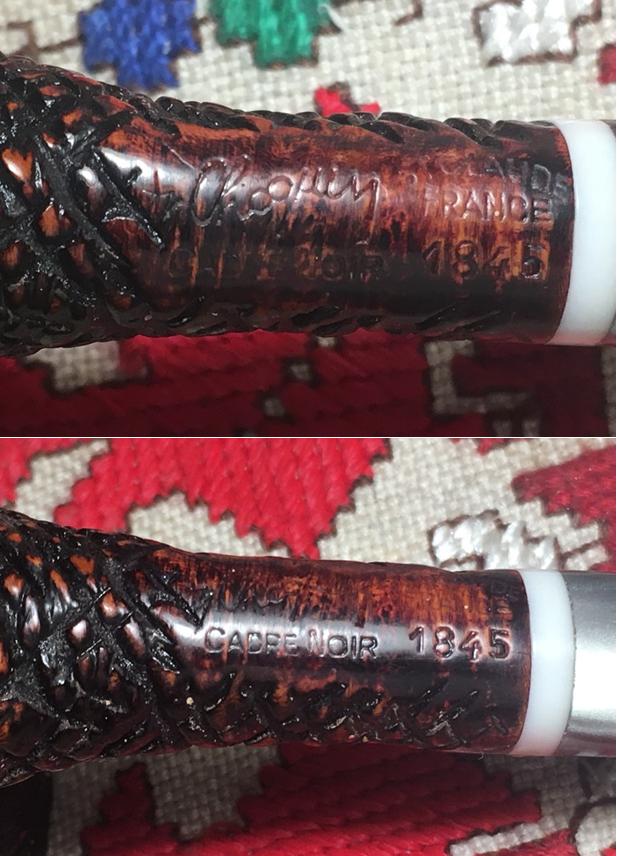
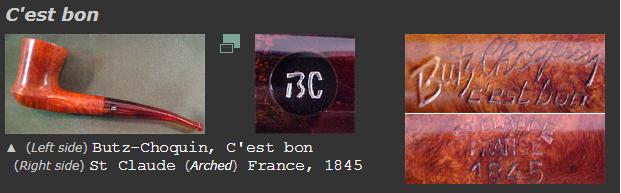
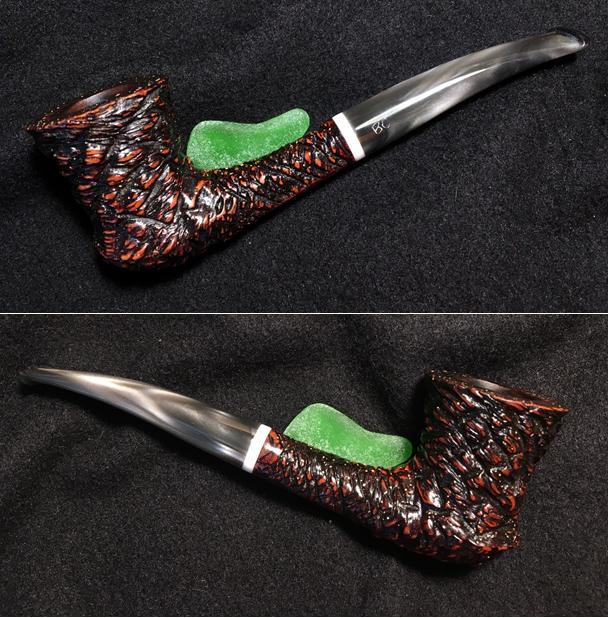
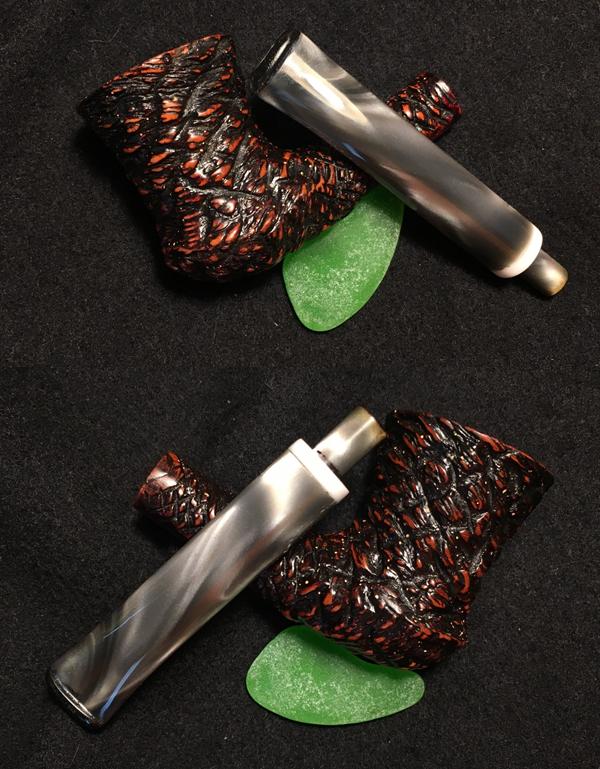
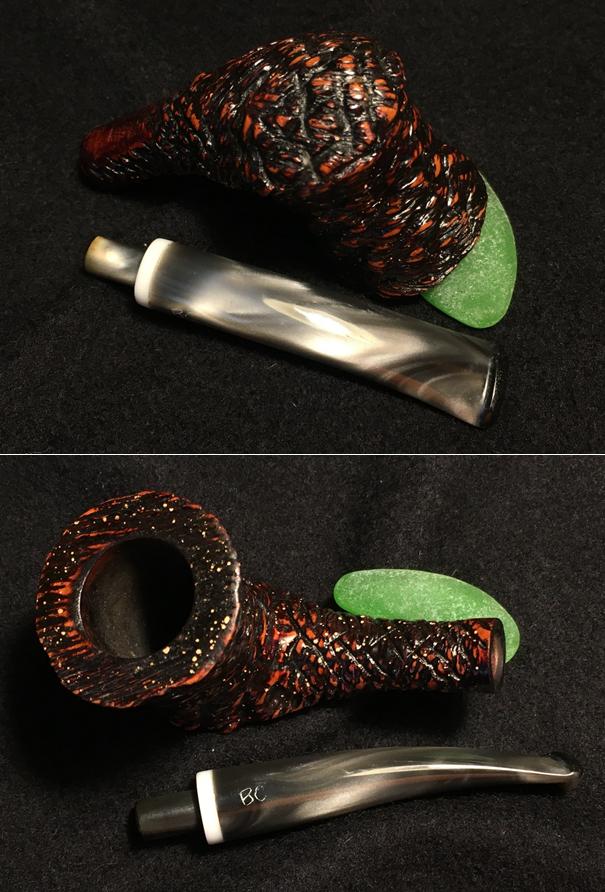
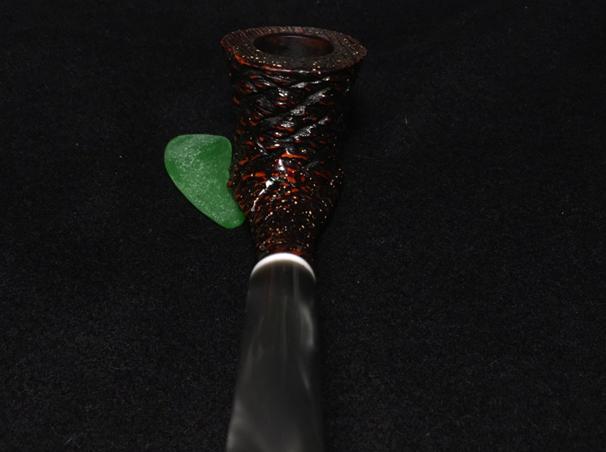
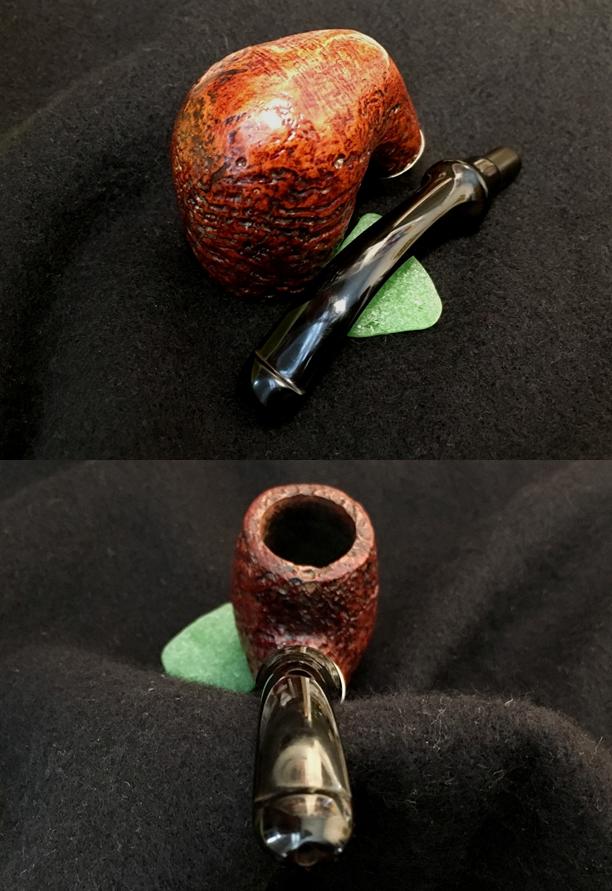
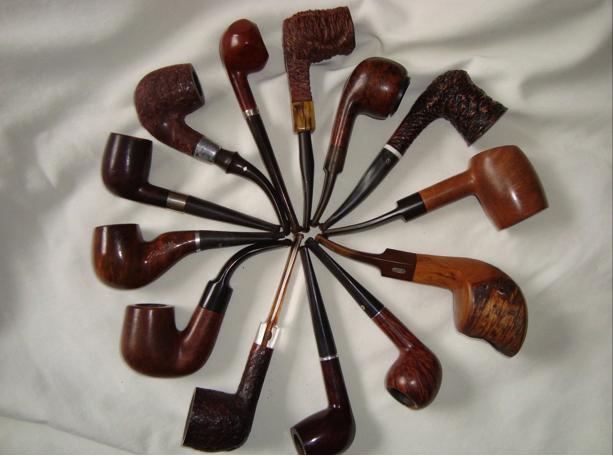
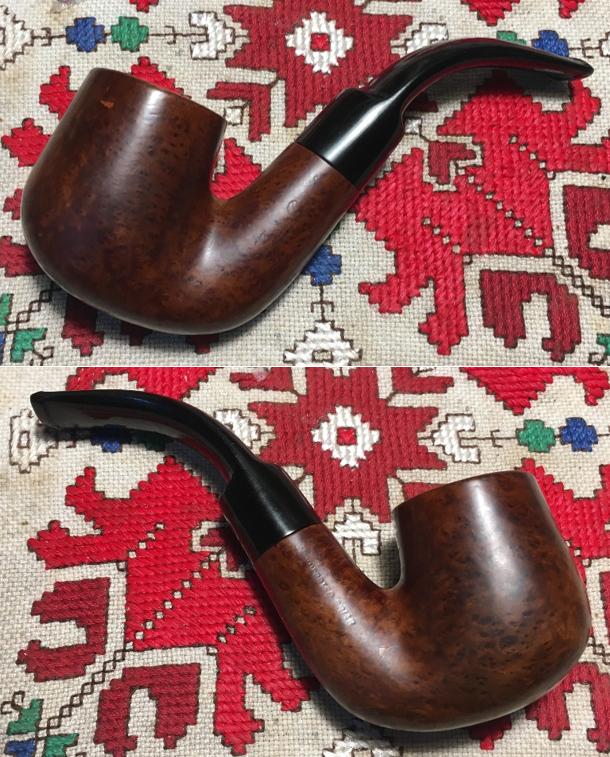
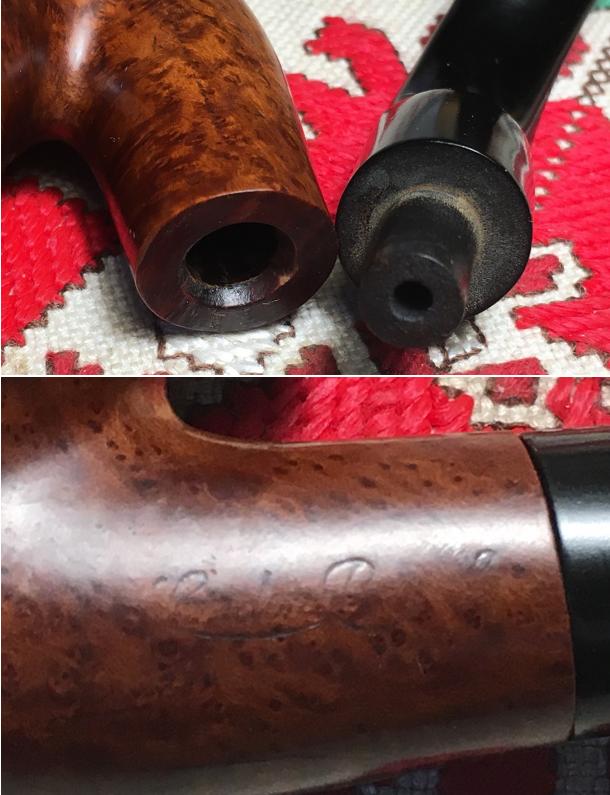
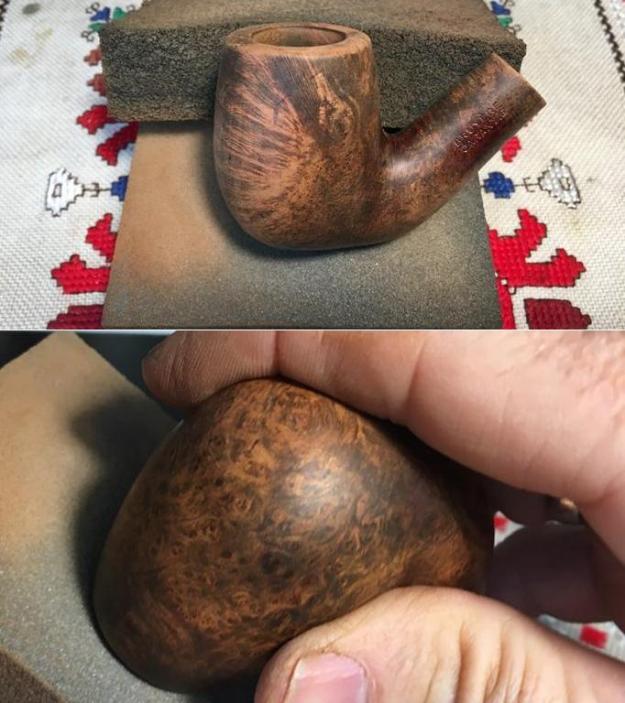
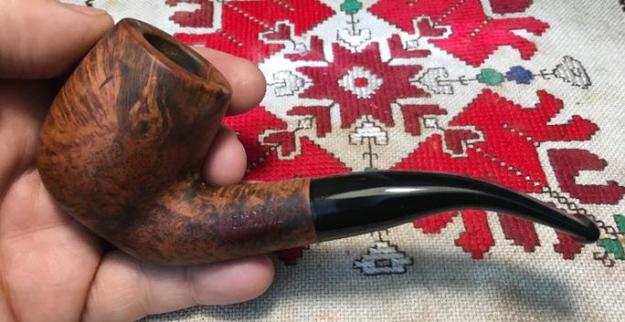
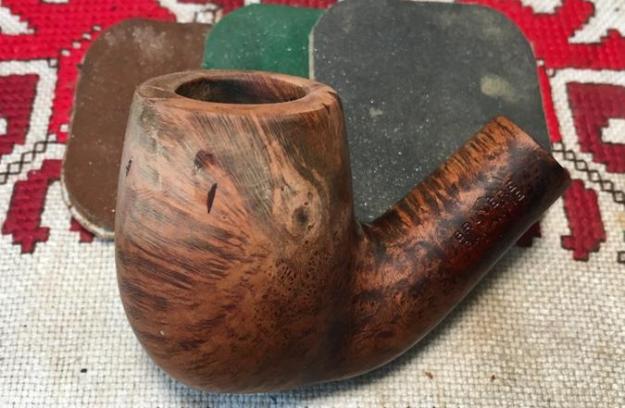
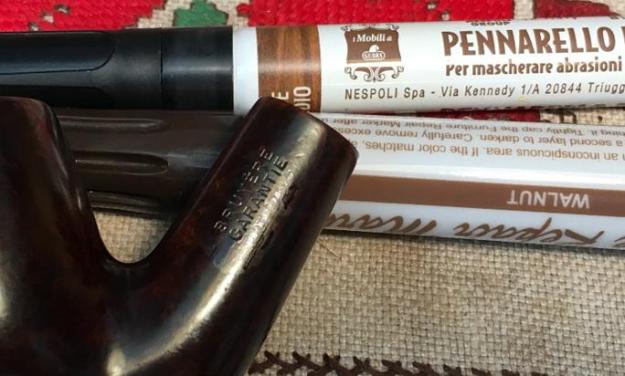
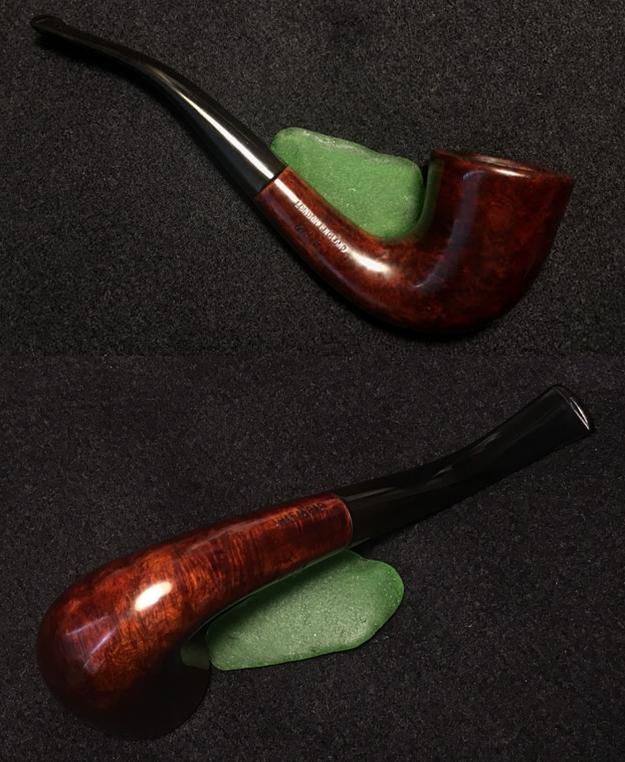
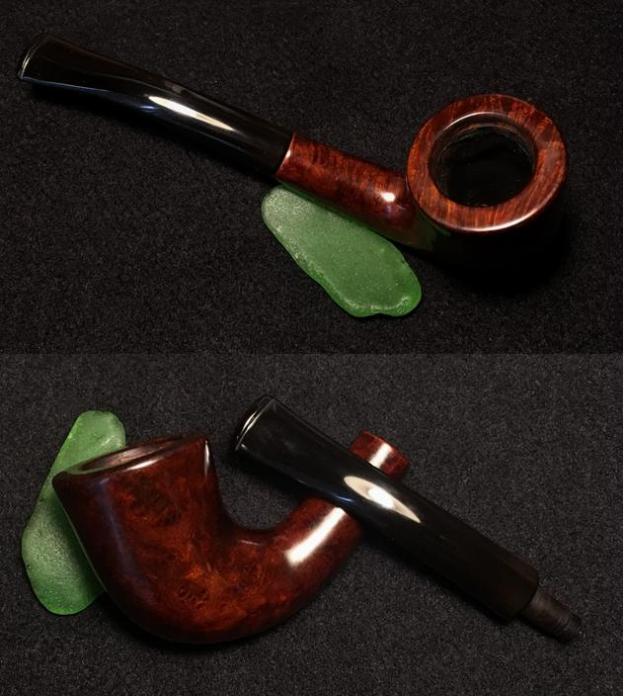
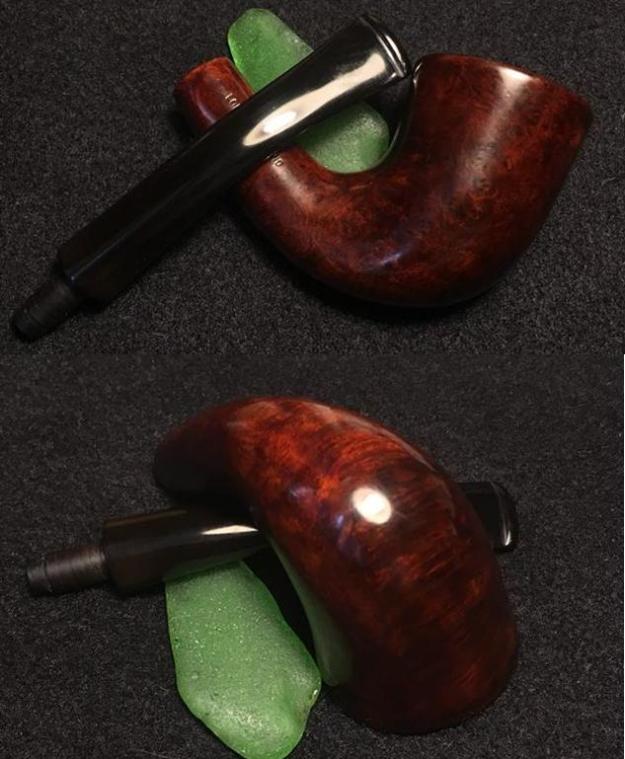
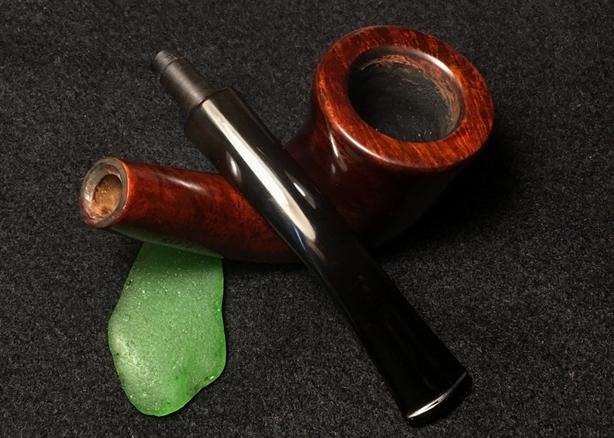
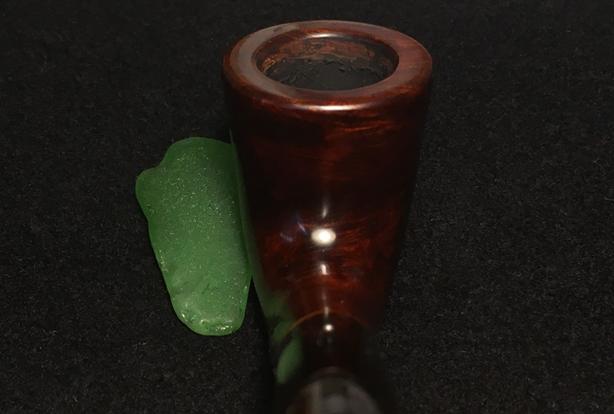
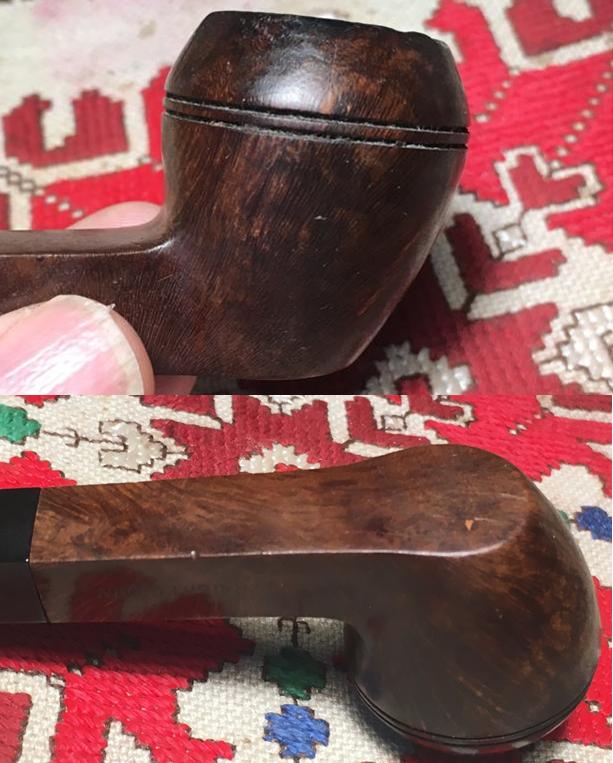
The next pipe on my work table is at 2 o’clock in this Lot of 13 I acquired from an eBay seller in Nevada.  There were several other pipes that attracted me in this lot as well, especially the Cherry Wood Ropp at the 4 o’clock position.  The LHS Purex at 9 o’clock is also an interesting shape – most of these are still waiting in my ‘Help Me!’ basket.  The Butz Choquin Cadre Noir got the attention of a couple who are in Bulgaria working with us for the summer.  Joy saw the pipe and wanted it as a gift for her brother.  I think it was the combination of the rustified Leprechaun shape and the gray marble acrylic stem that got her attention.When I bring the BC to my worktable, I take additional pictures to fill in the gaps.  The nomenclature is stamped on the lower side of the shank with the left side of the stamping reading in a fancy script, ‘Choquin’ [over] ‘Cadre Noir’ which means in French according to Google Translate, ‘Black Framework’ or ‘Black Setting’.  On the right side of the stamping is an arched ST CLAUDE [over] FRANCE [over] 1845 – which I’m assuming is a shape number. Pipephil was helpful in identifying the 1845 as a shape number.  The C’est bon below is the same BC pipe shape in a smooth version, which I described above as a Leprechaun – perhaps a mix between freehand and Dublin? The bowl moves from a wide rim, a narrower mid-section and then flares out again at the heel with ridges tapering toward the shank.  Very nice looking.Searching for the BC Cadre Noir online, one finds several examples of what TobaccoPipes.com describes as a BC line depicting a “modern pipe”.

BC’s Cadre Noir pipes are a unique rusticated pipe with an ostentatious clear acrylic stem. Unlike most rusticated tobacco pipes, this one is thoroughly modern.

Another listing of a 1772 Brandy shape sheds light on the actual understanding of Cadre Noir.

The Cadre Noir is a world-famous French riding school for jockeys and horses. This Butz-Choquin pipe, in order to pay some form of tribute to the country’s prized institute, has a rustic finish consisting of parallel trenches running across the bowl. With a black and clear acrylic stem, this 1772 brandy shaped pipe is a dapper addition to both a pipe collection and an equestrian’s repertoire.

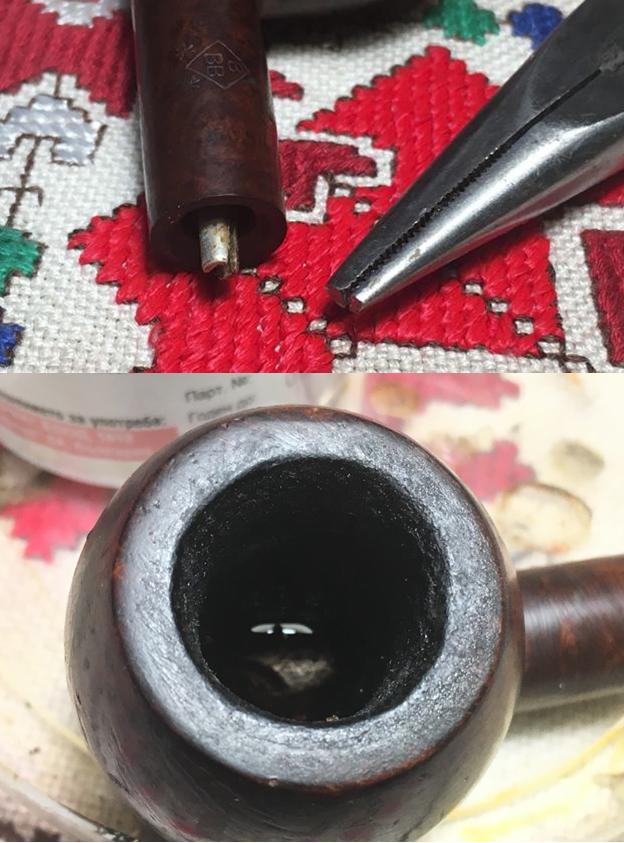
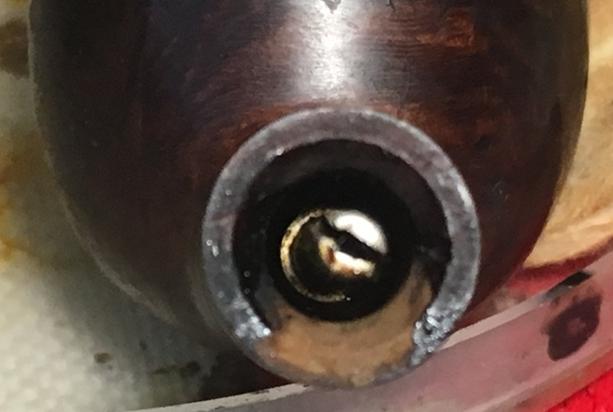
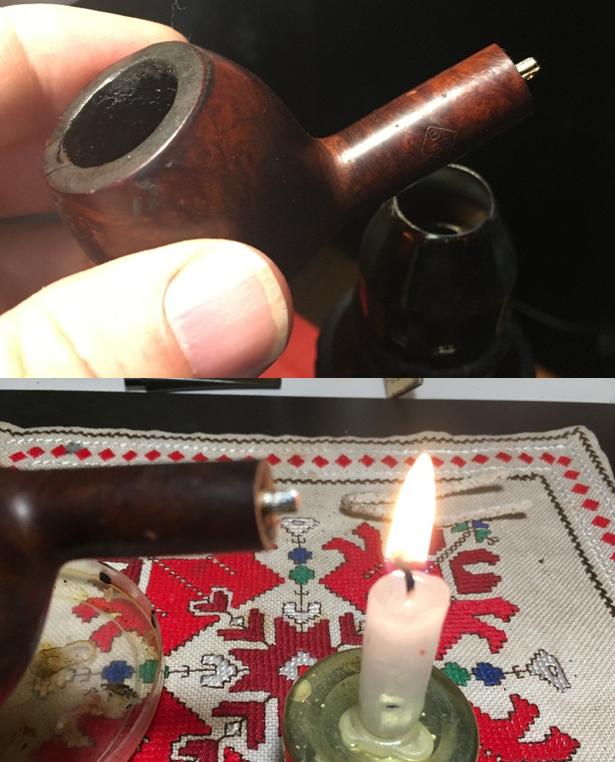
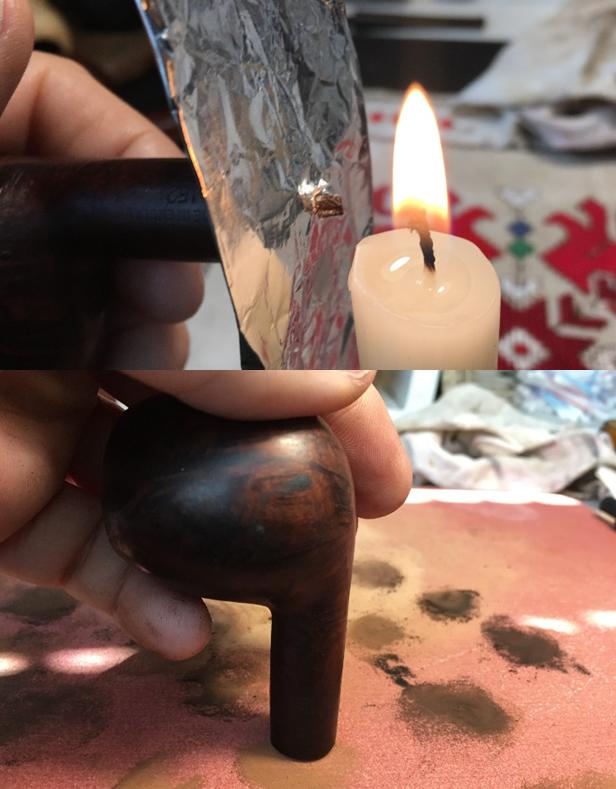
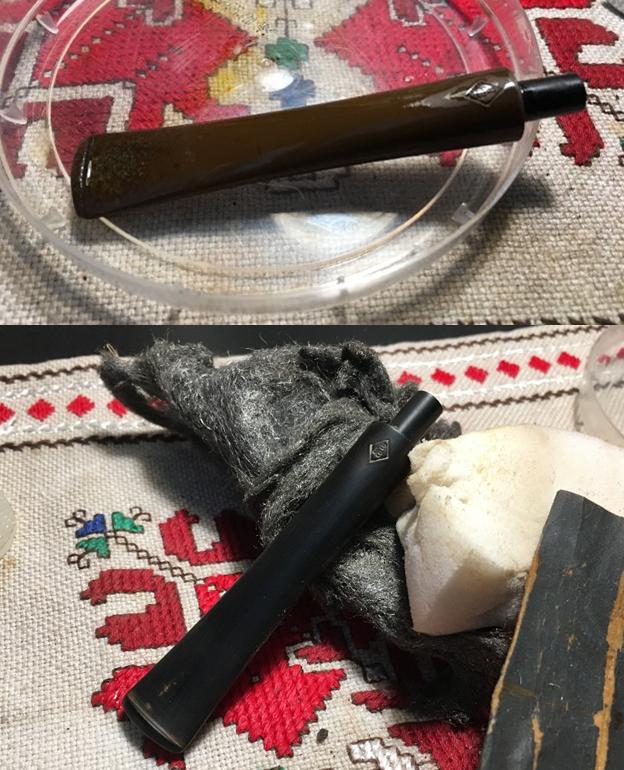
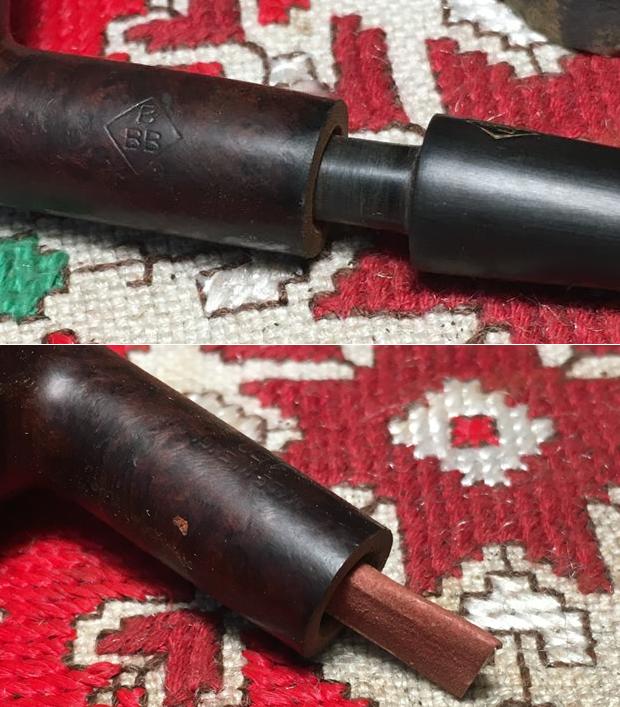
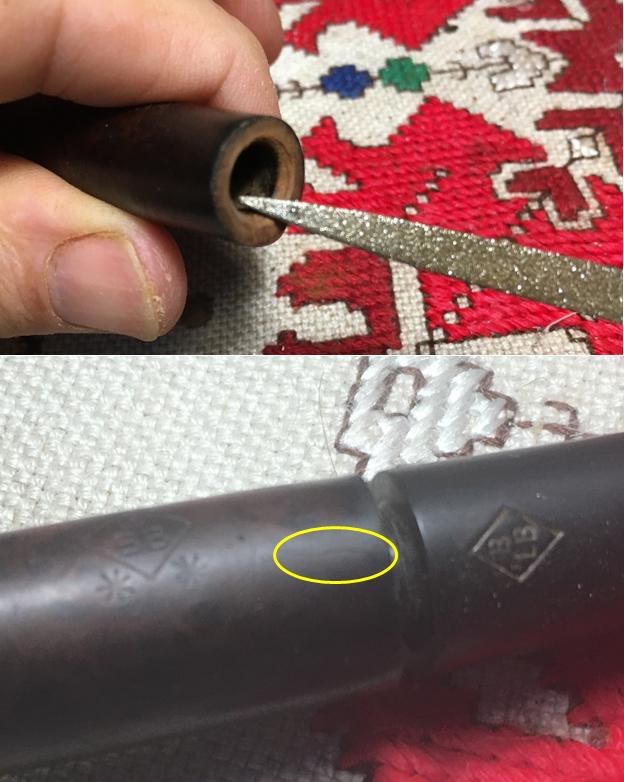
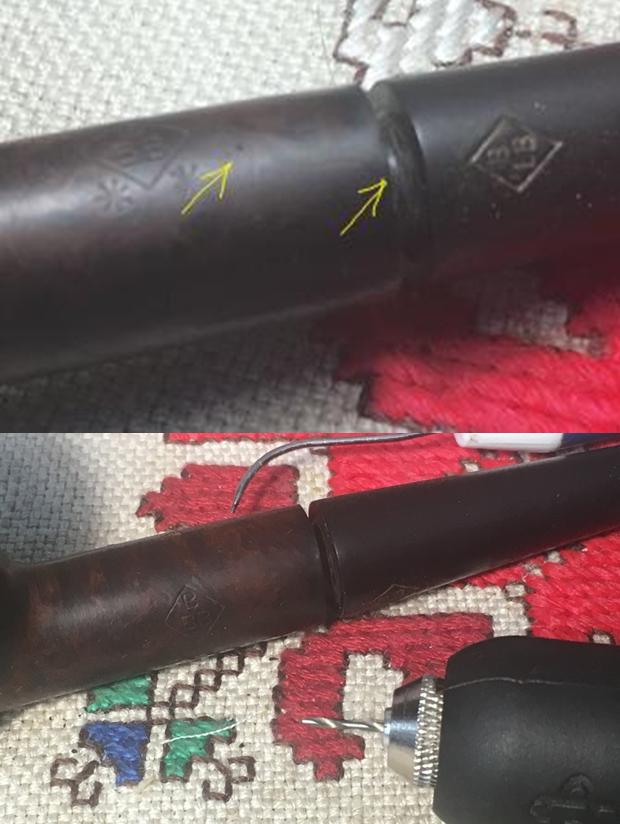
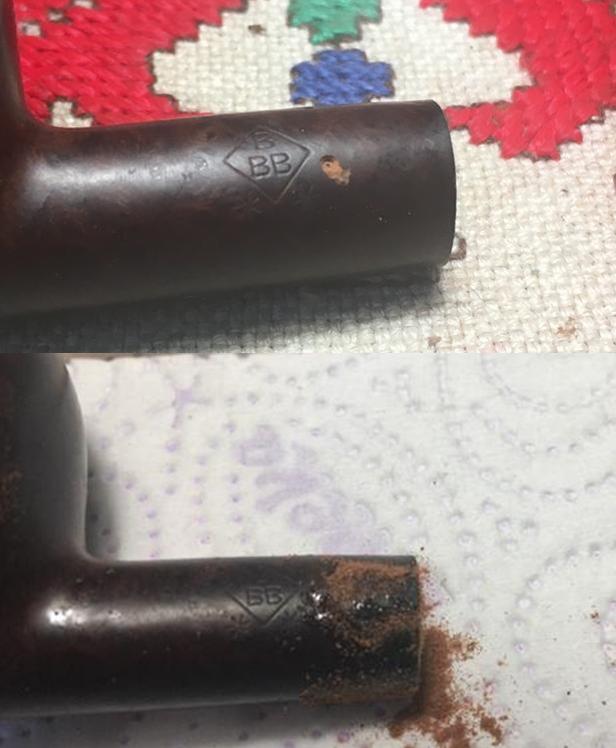
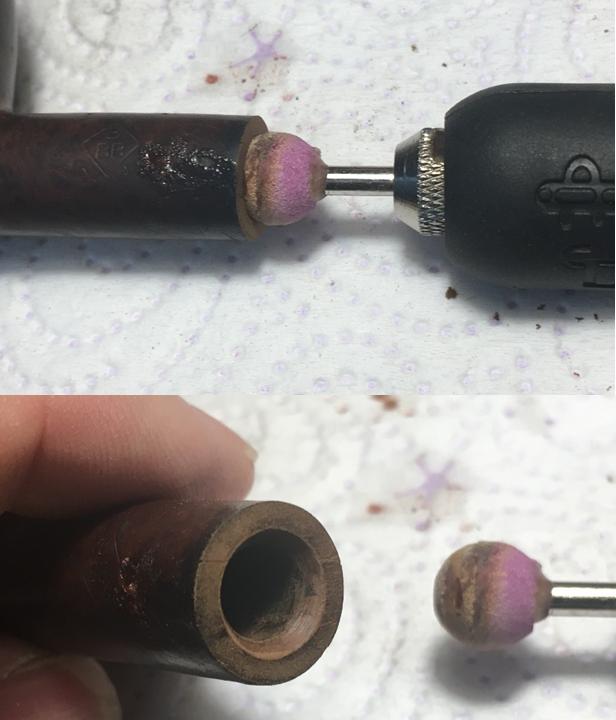
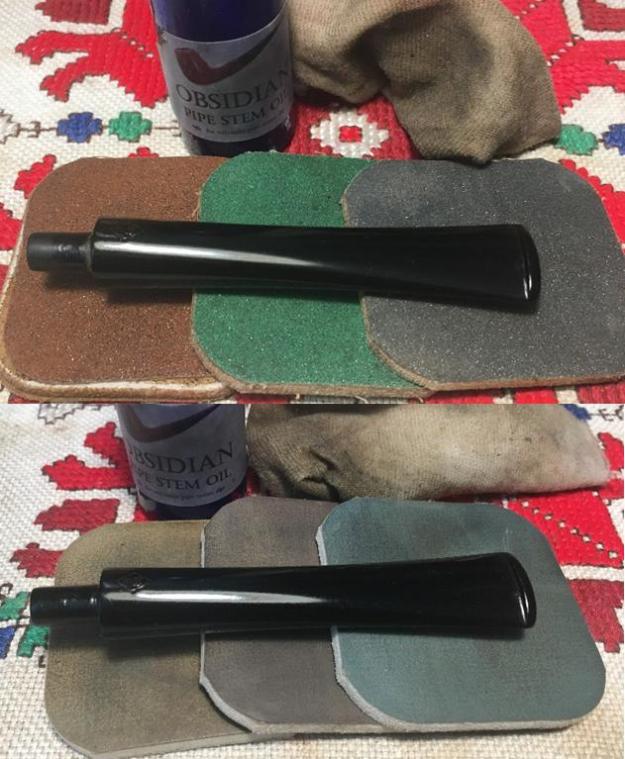
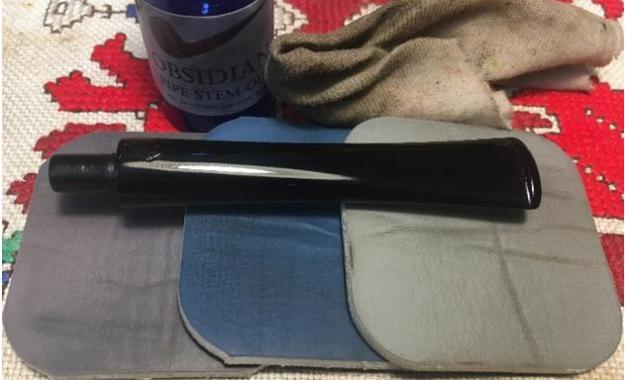
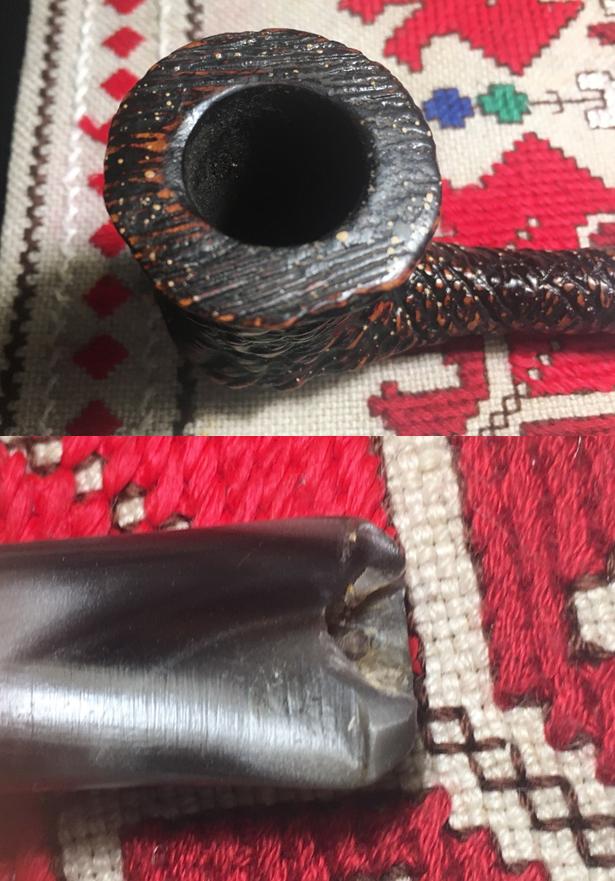
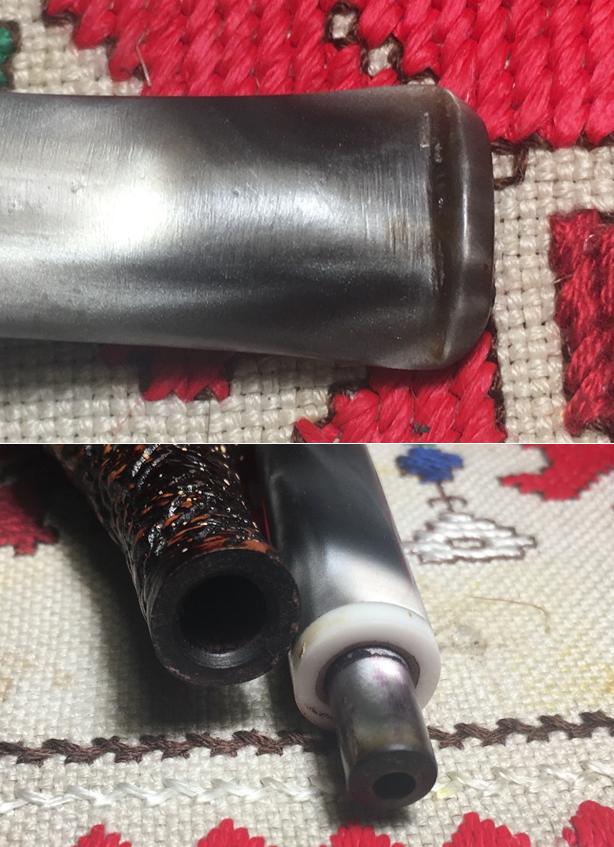
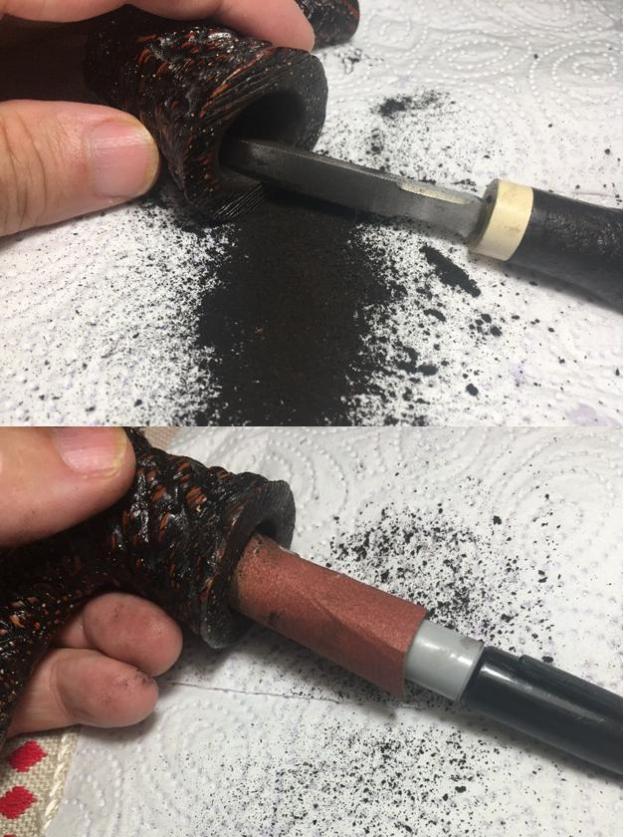
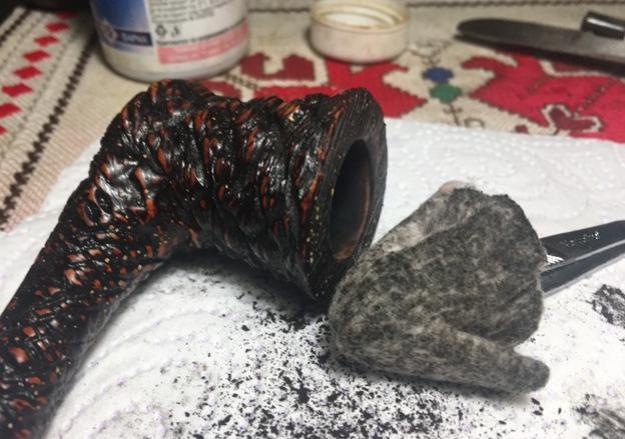
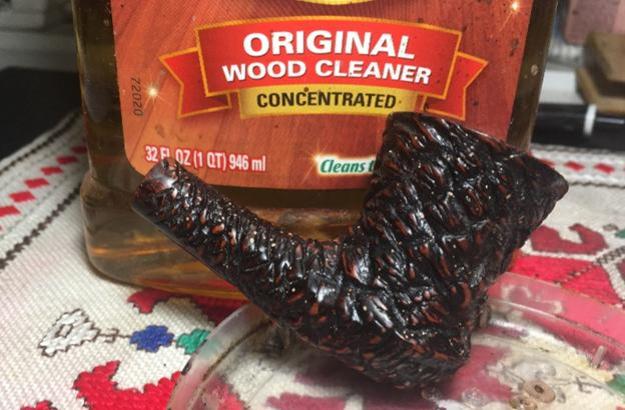
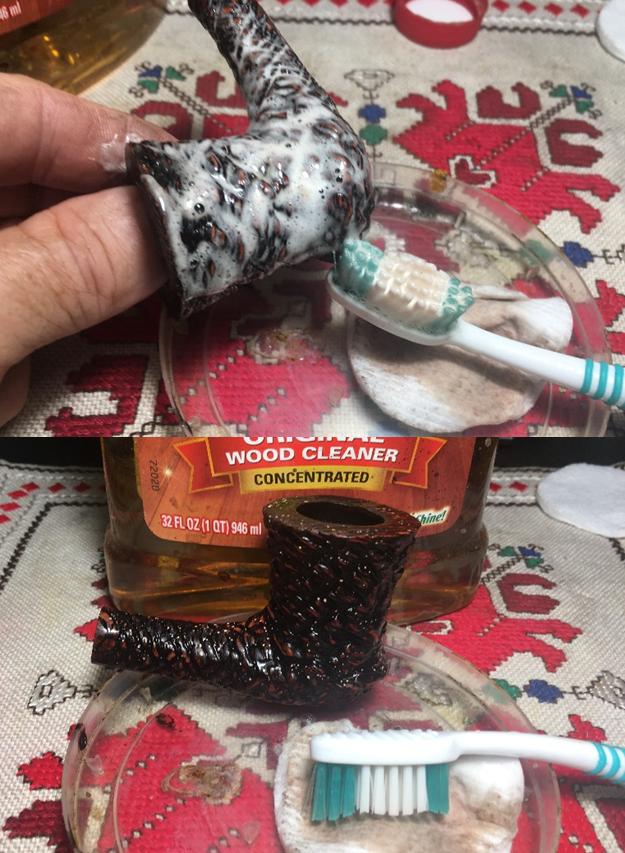
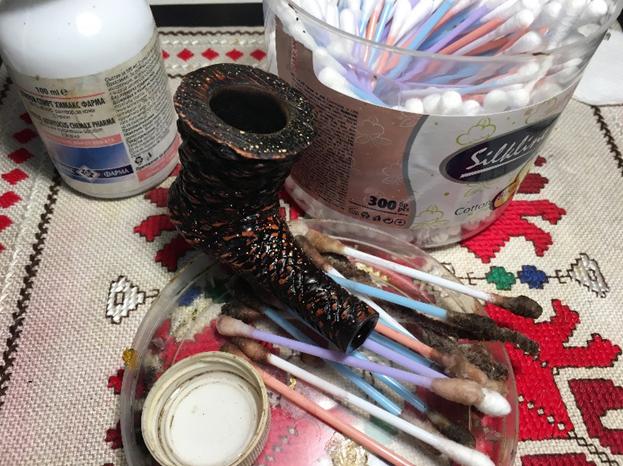
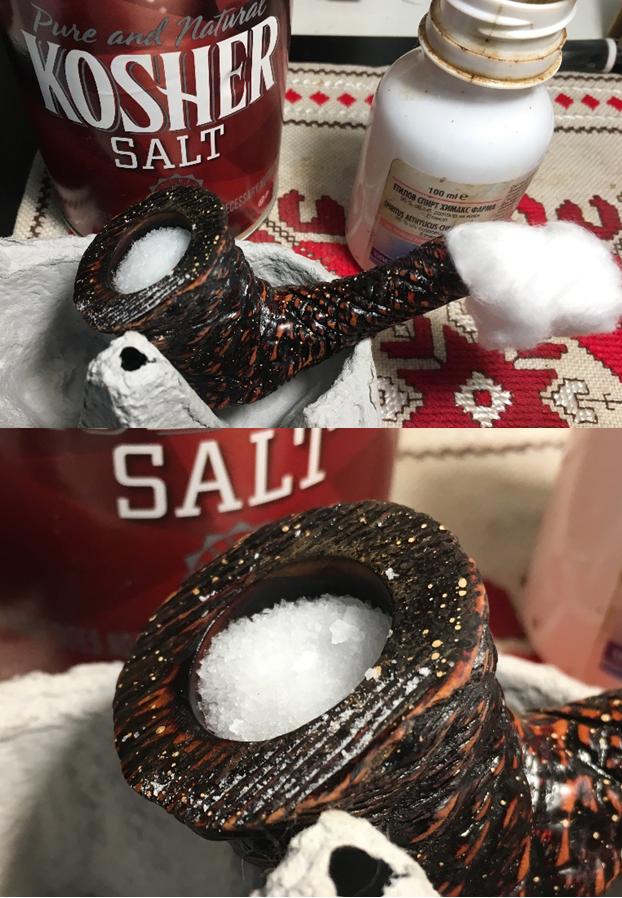
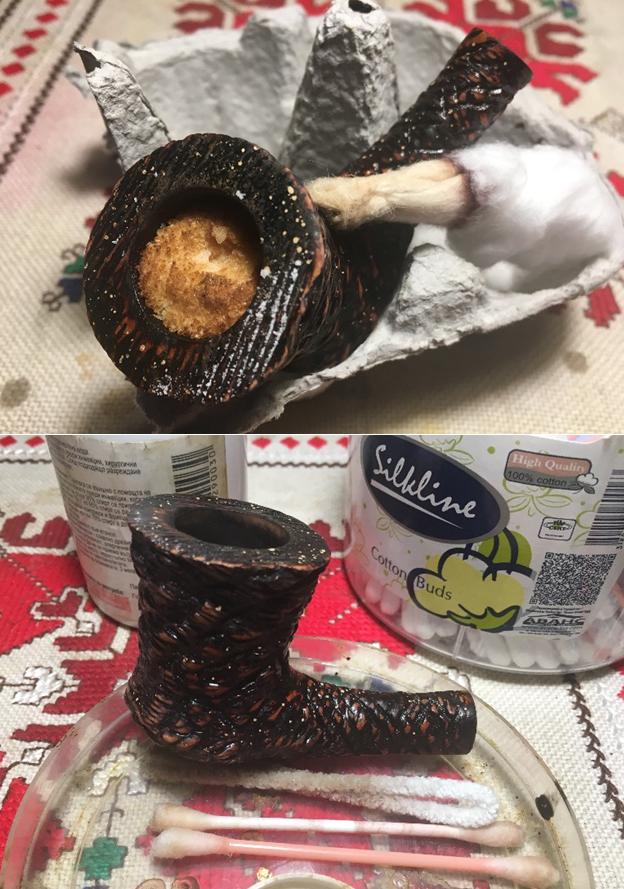
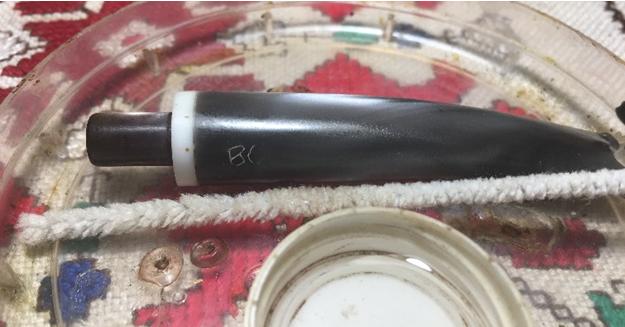
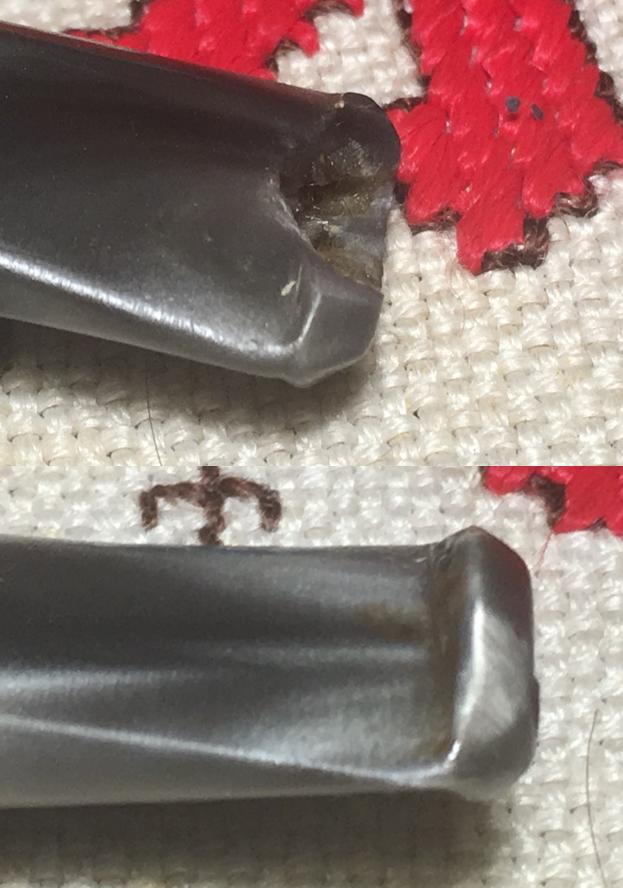
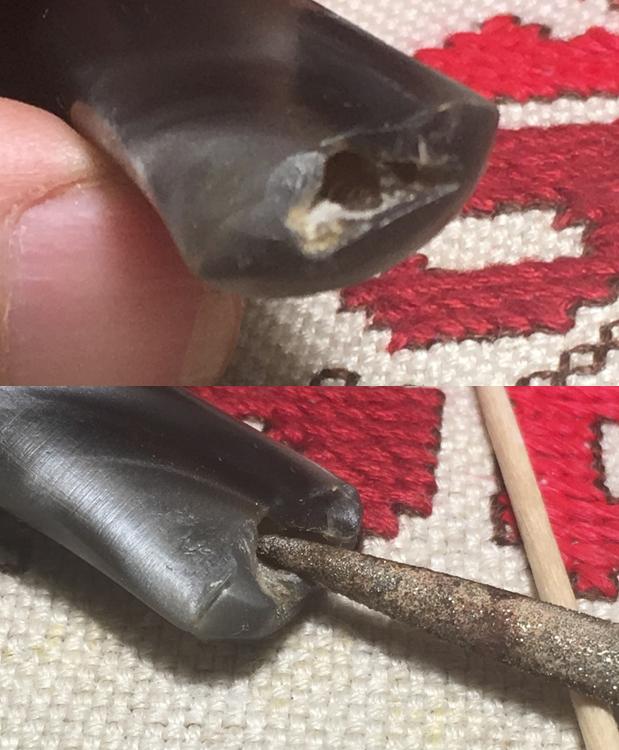
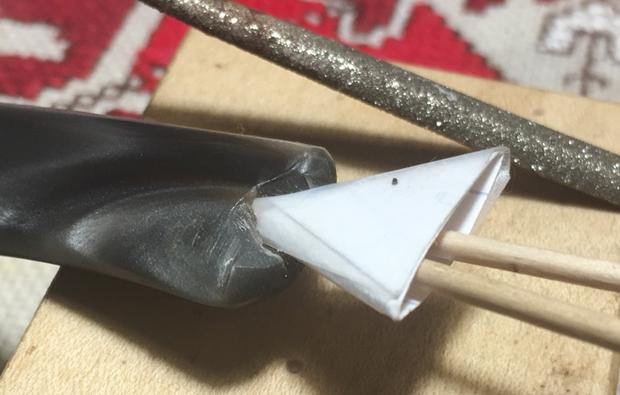
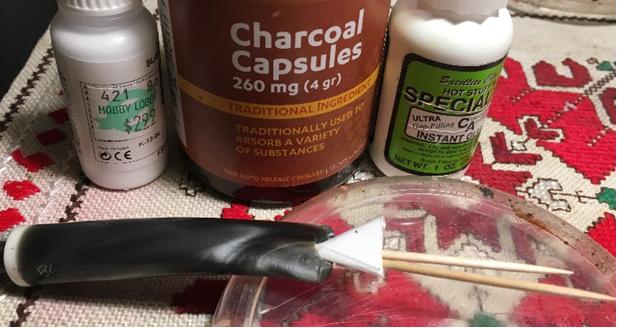
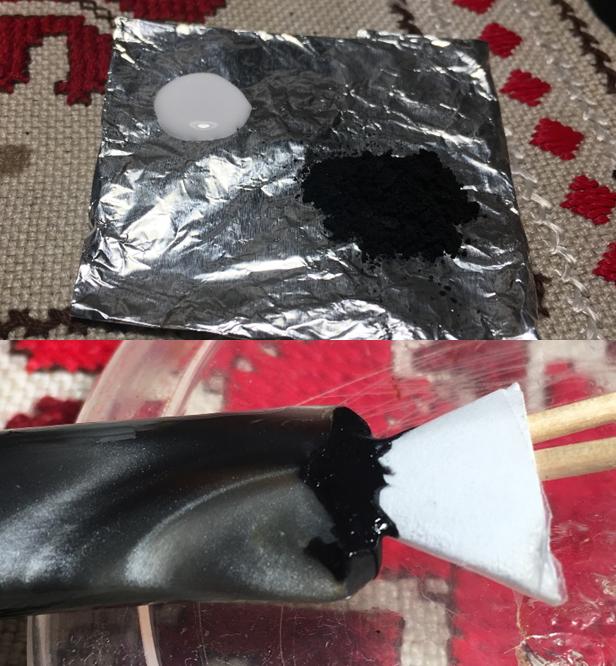
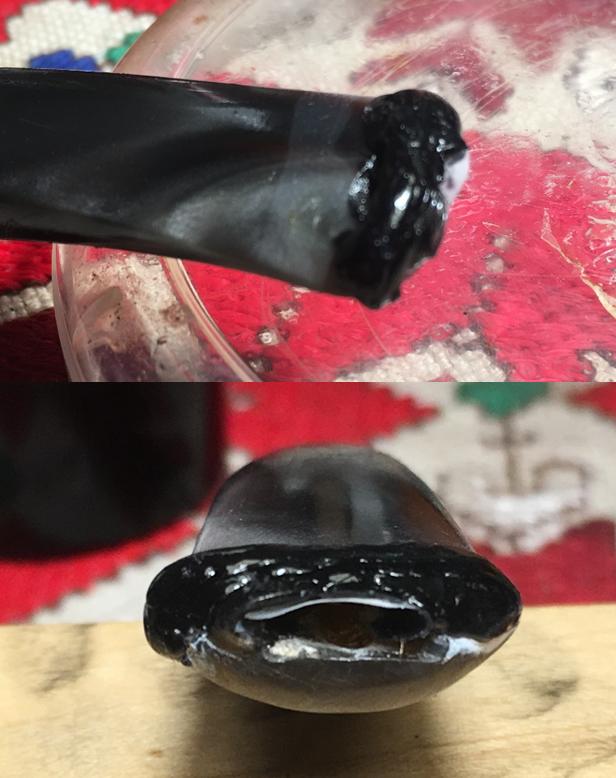
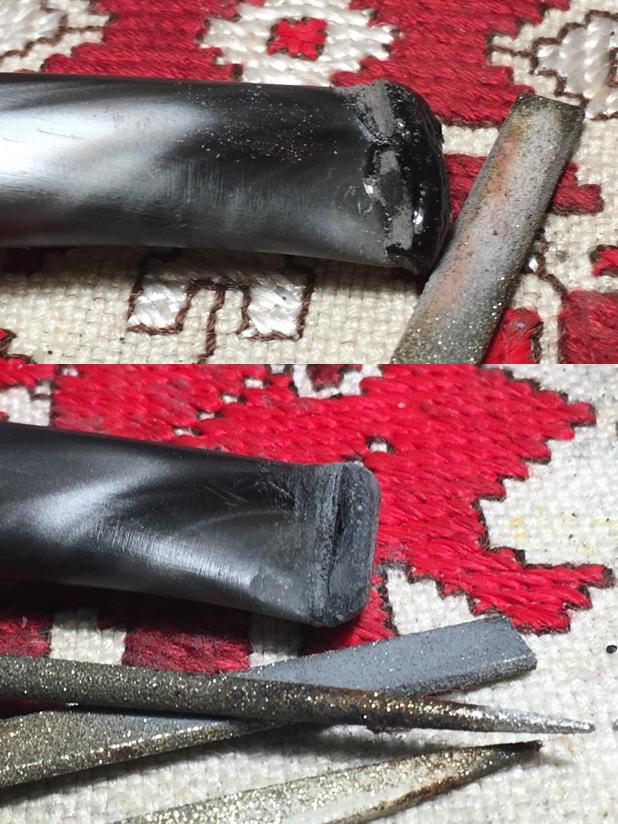
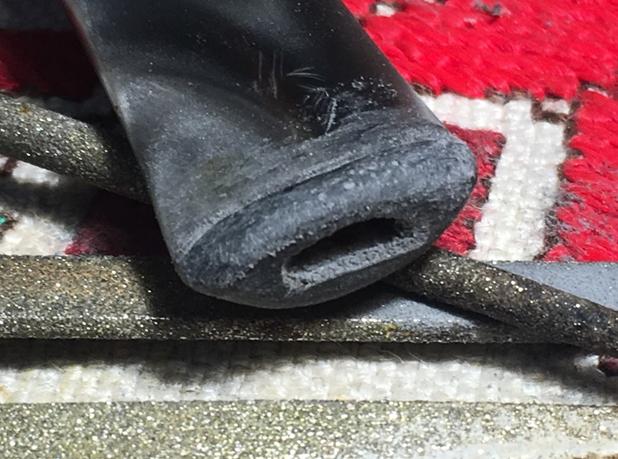
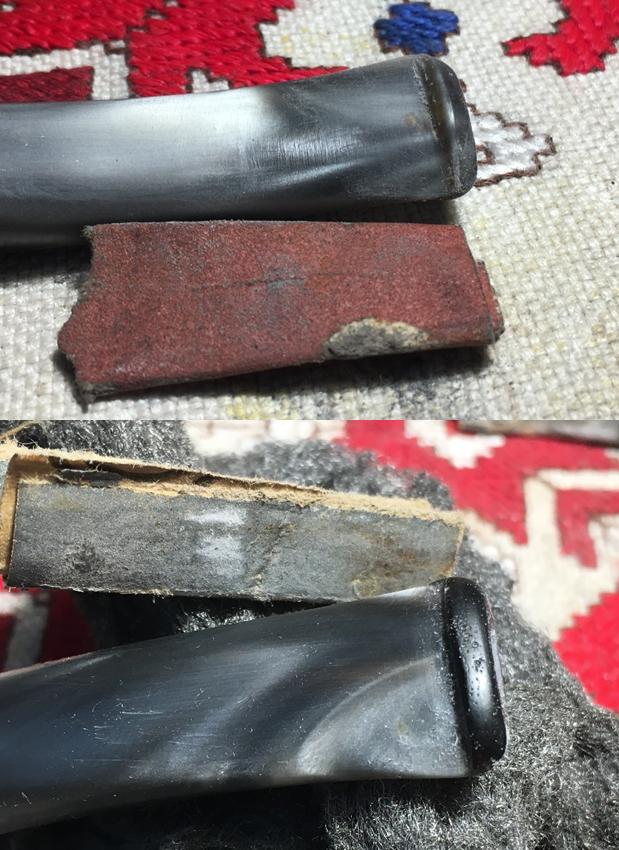
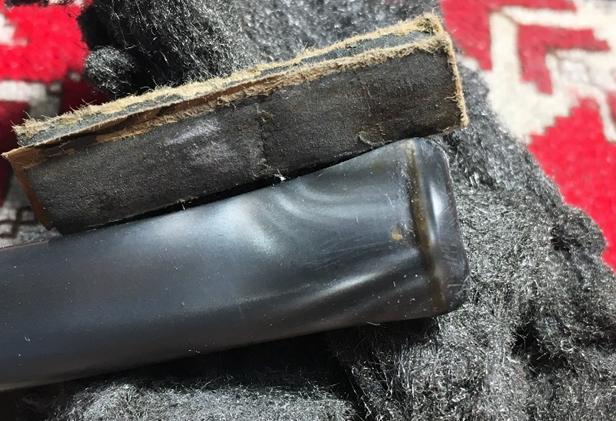
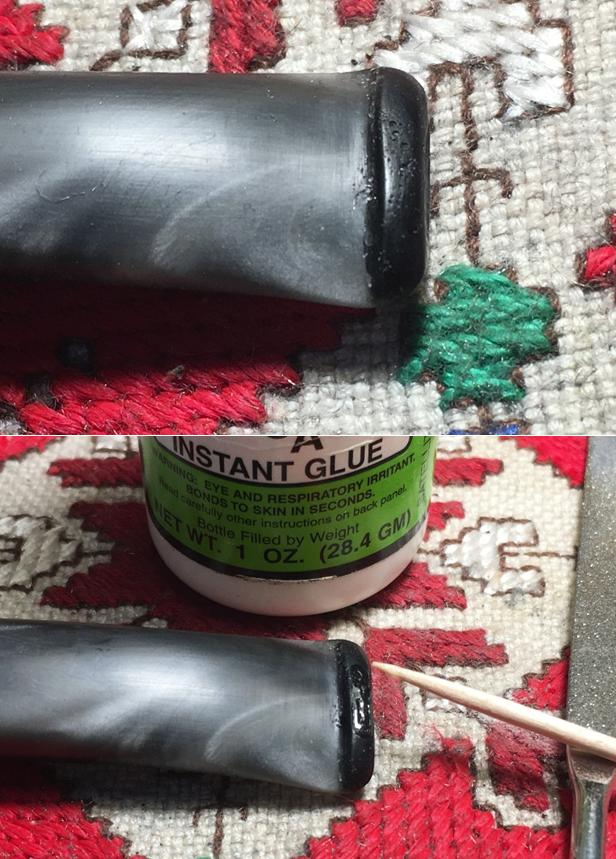
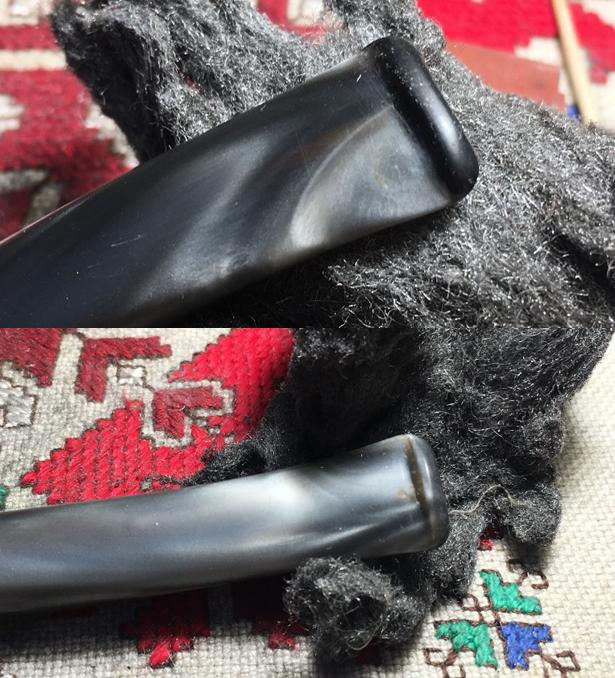
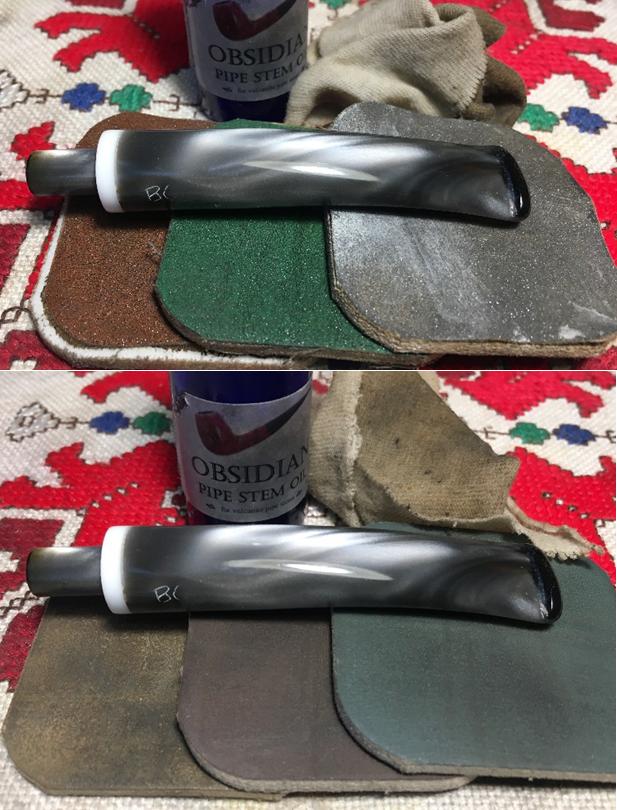
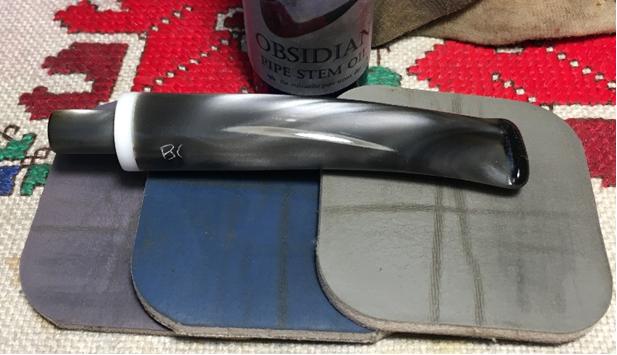
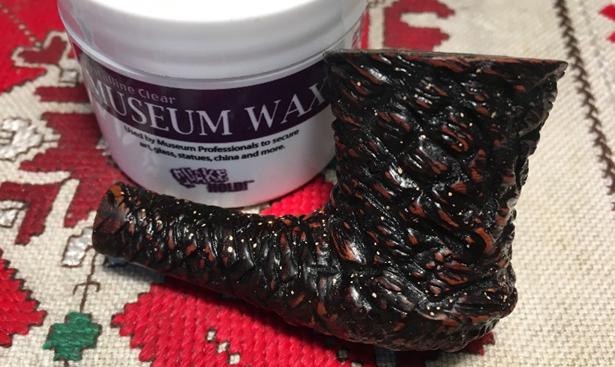
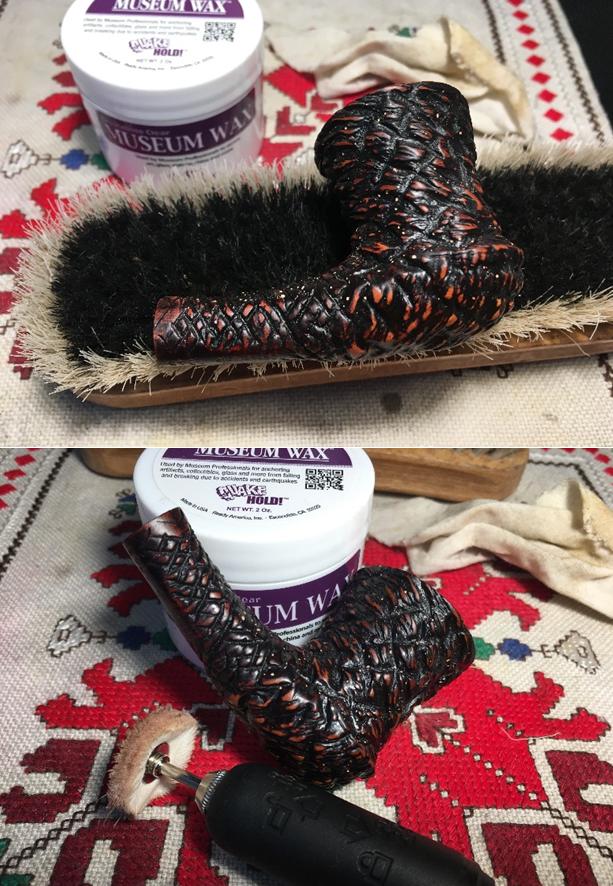
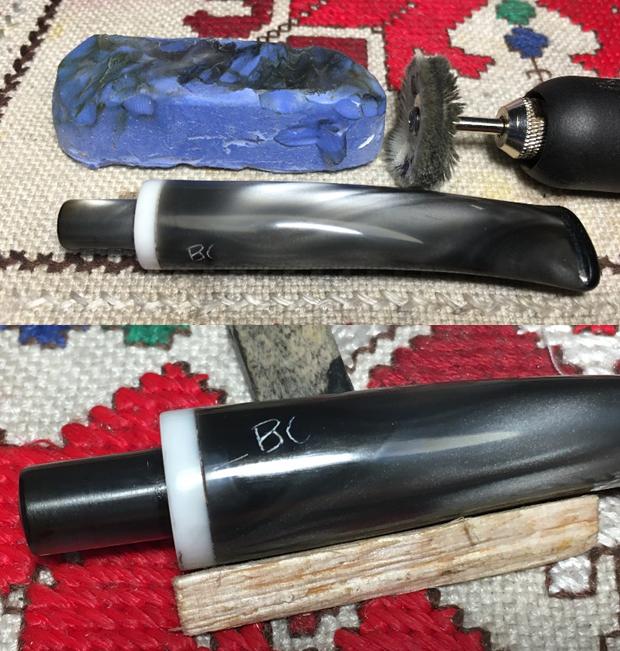
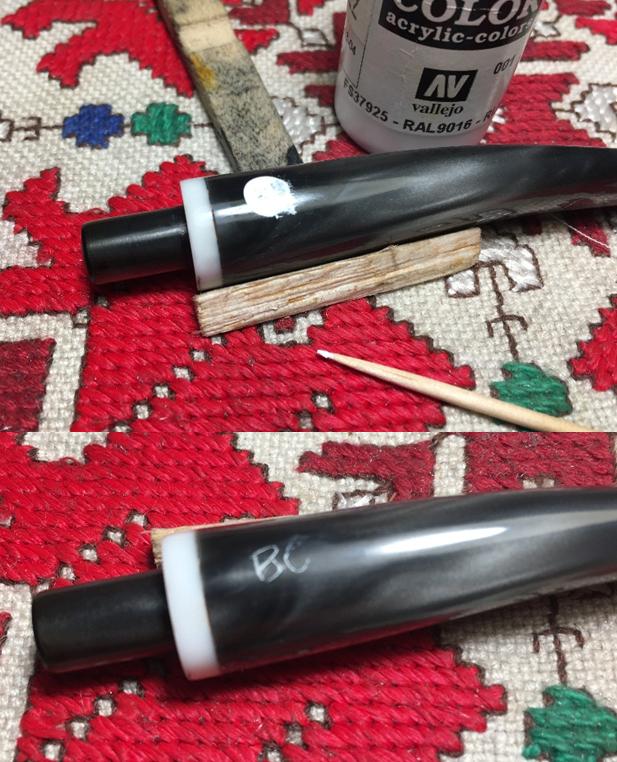
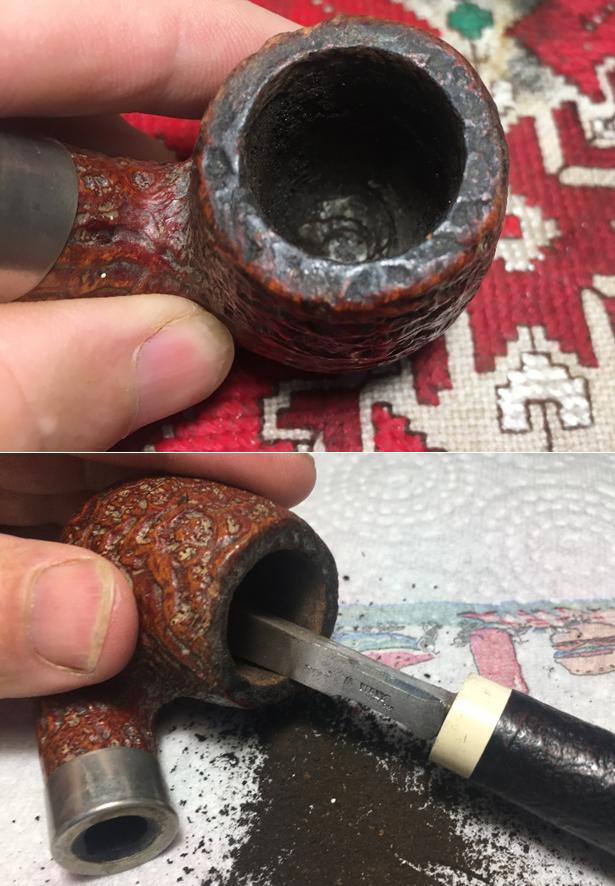
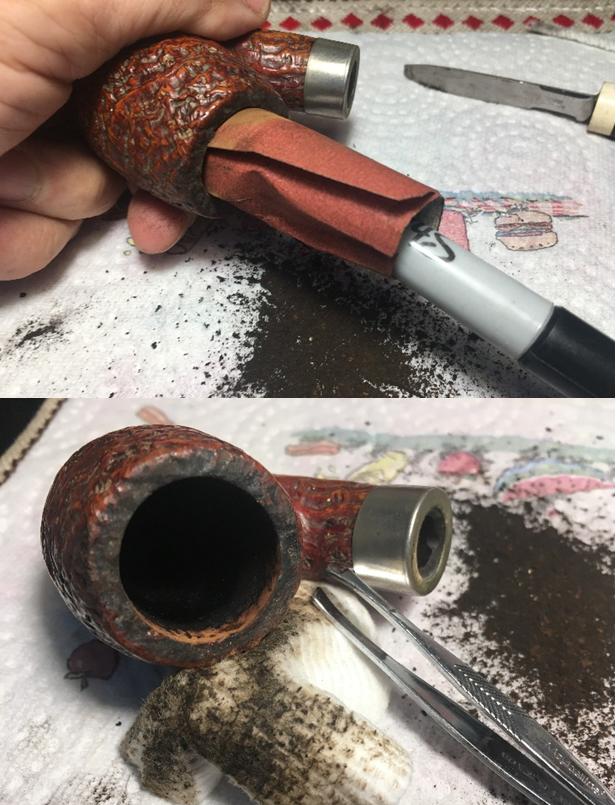
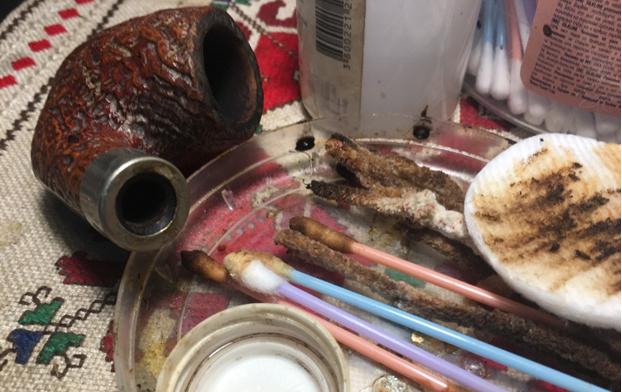
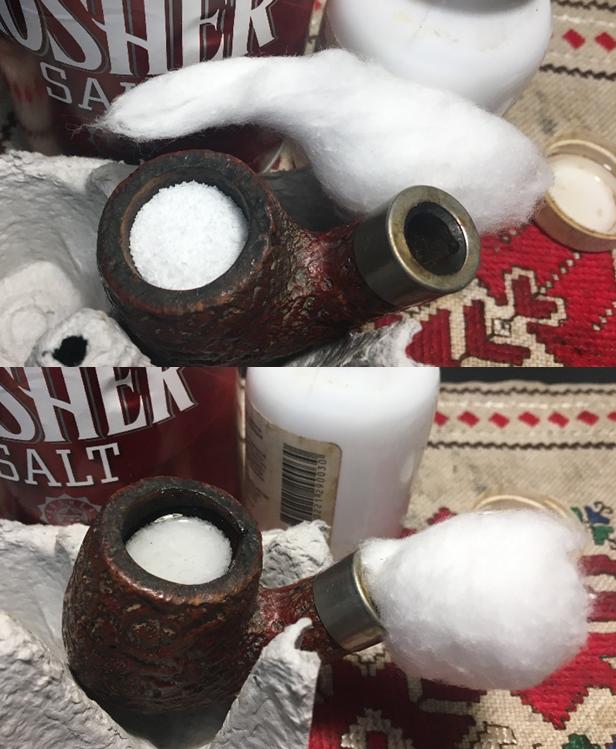
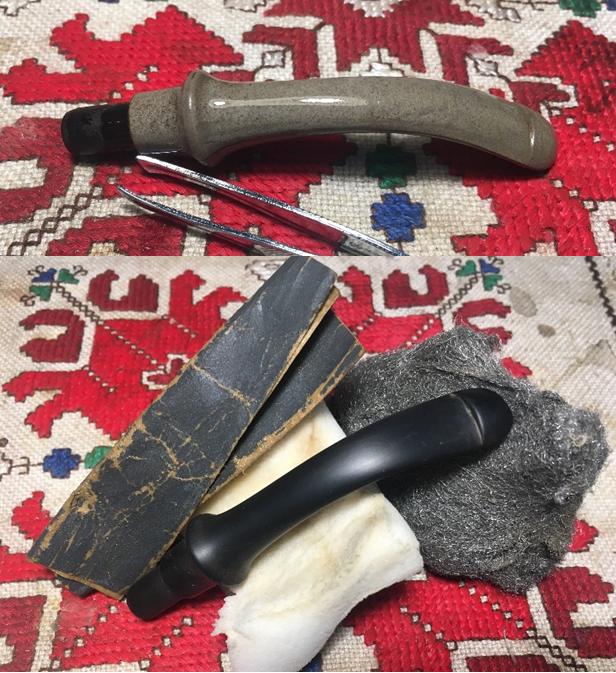
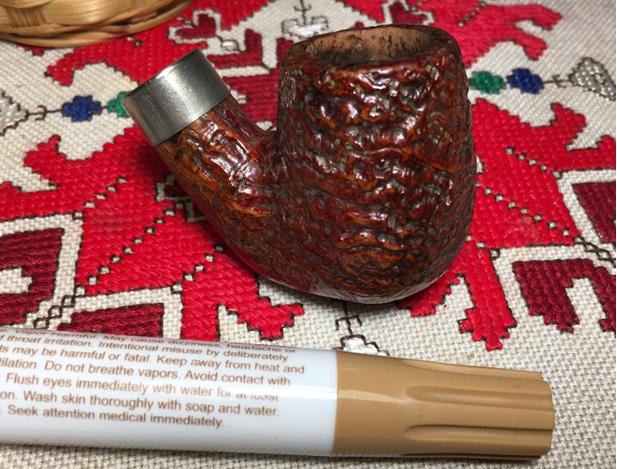
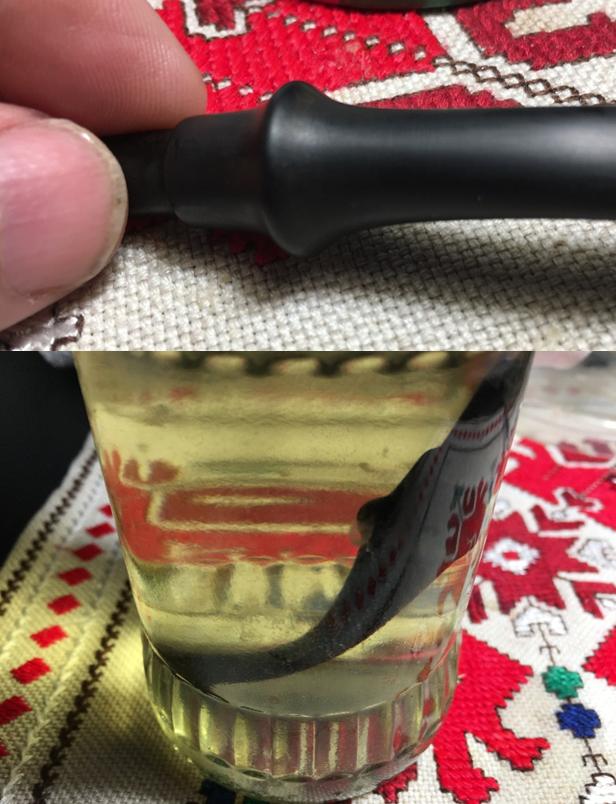
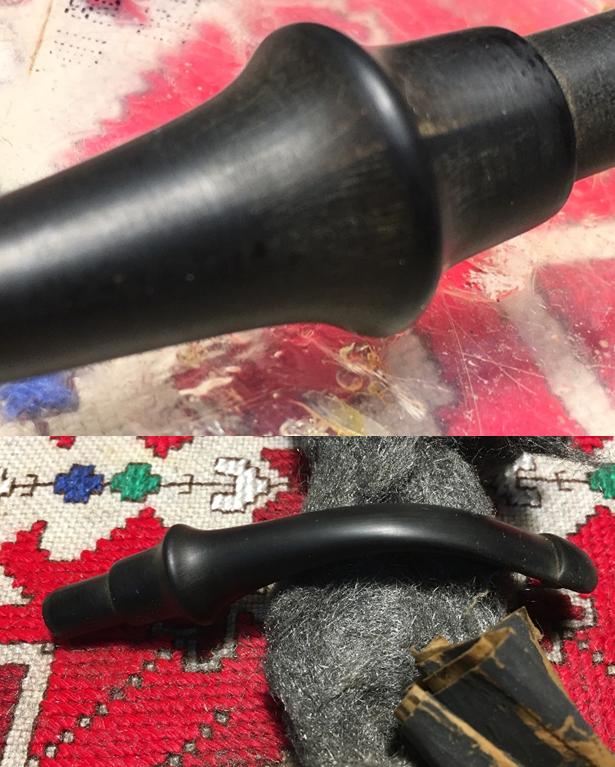
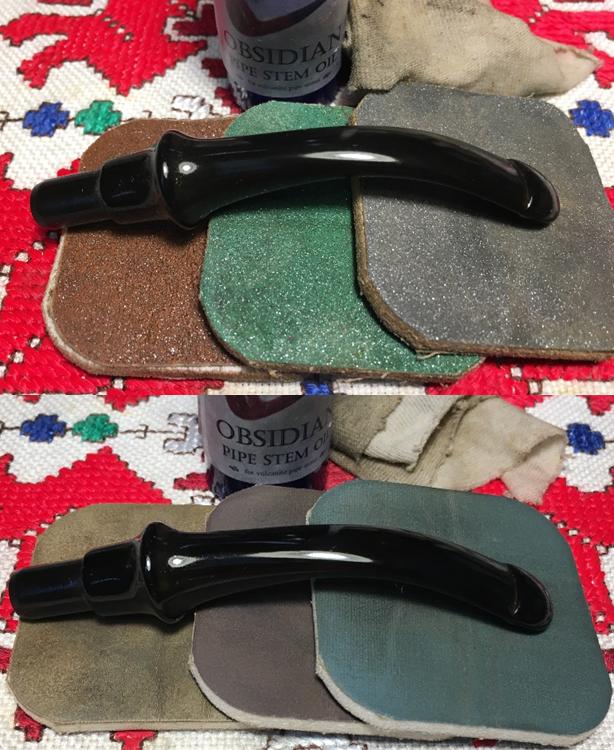
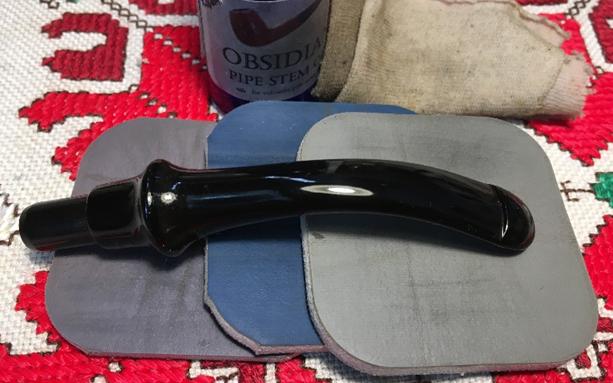
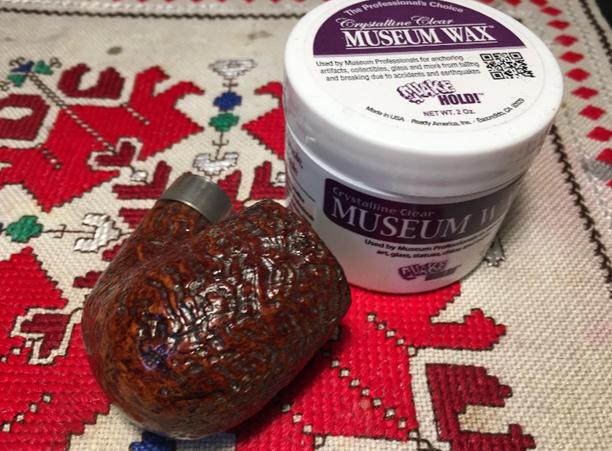
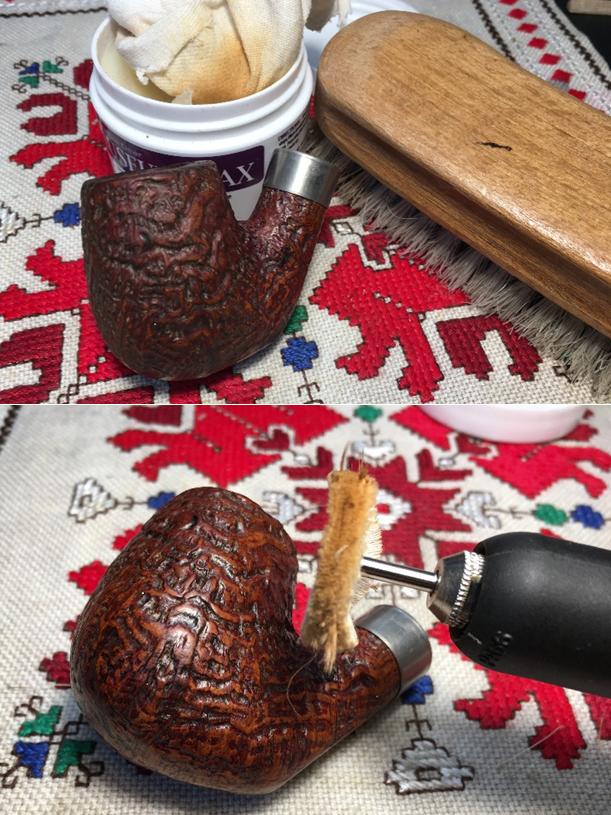
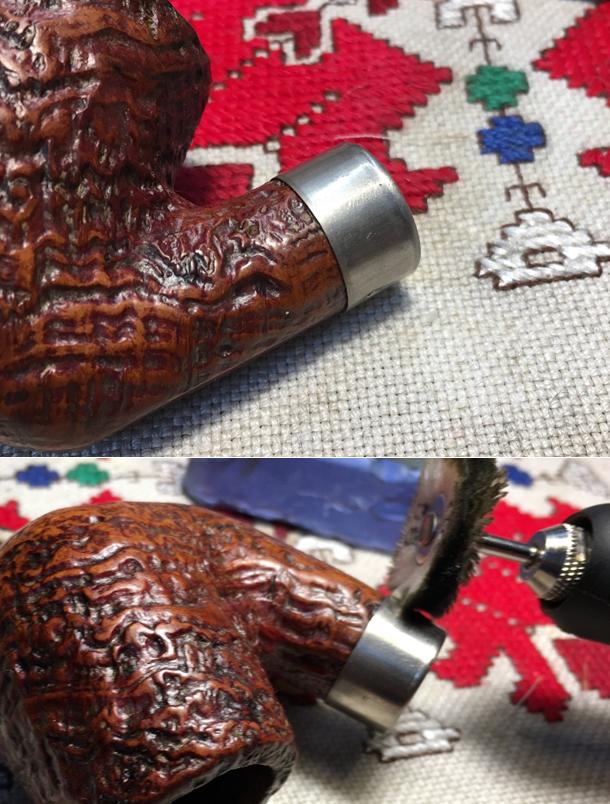
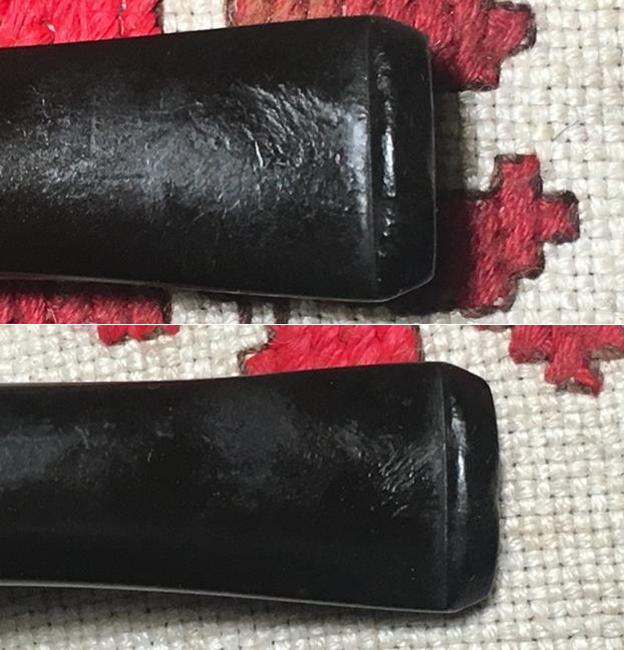
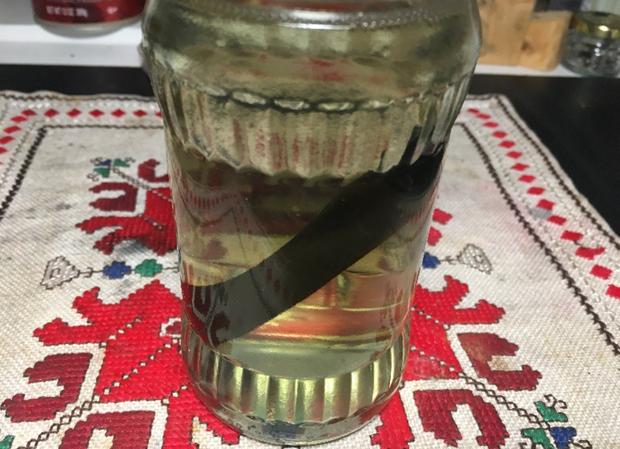
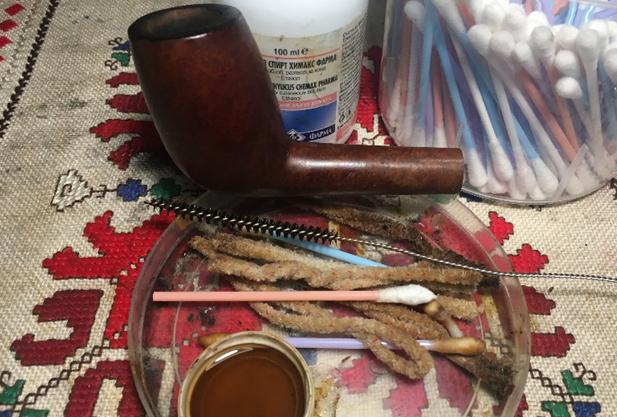
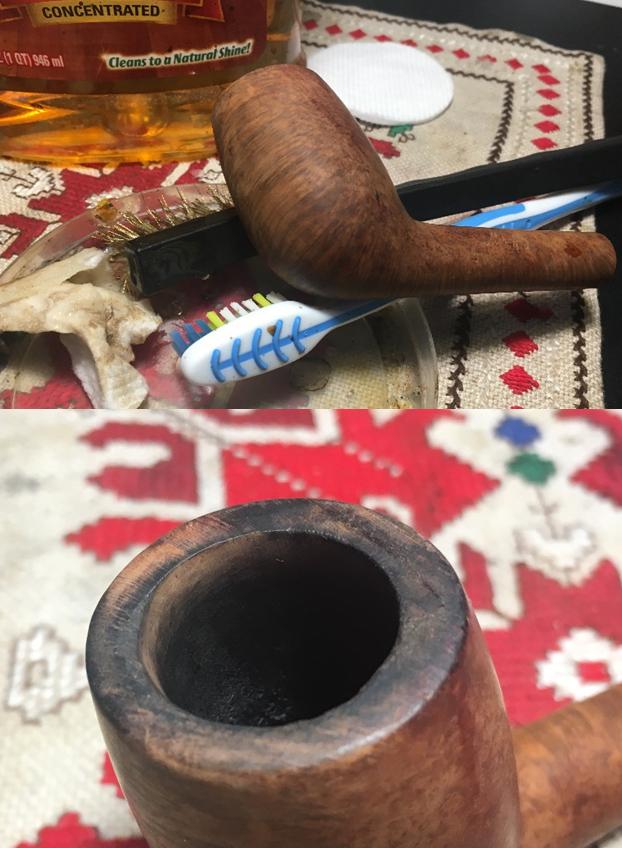
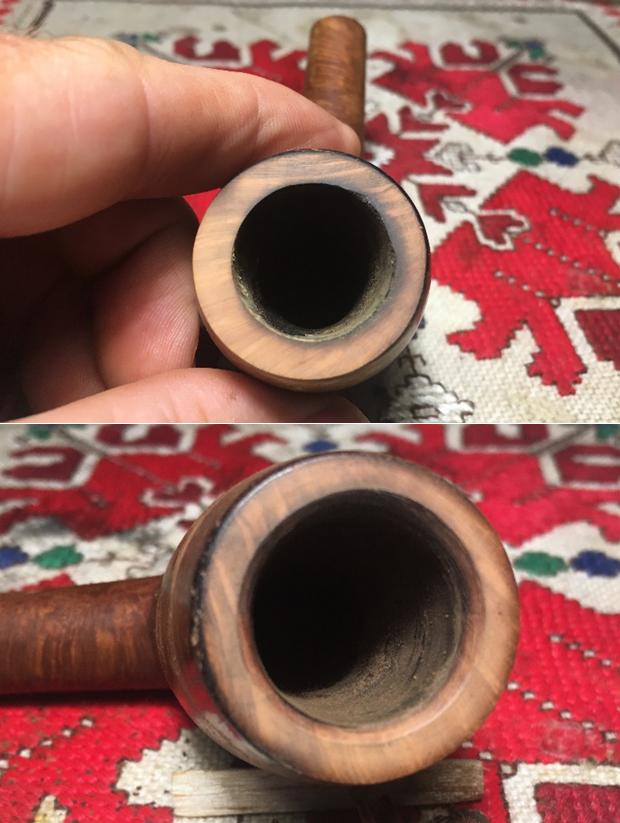
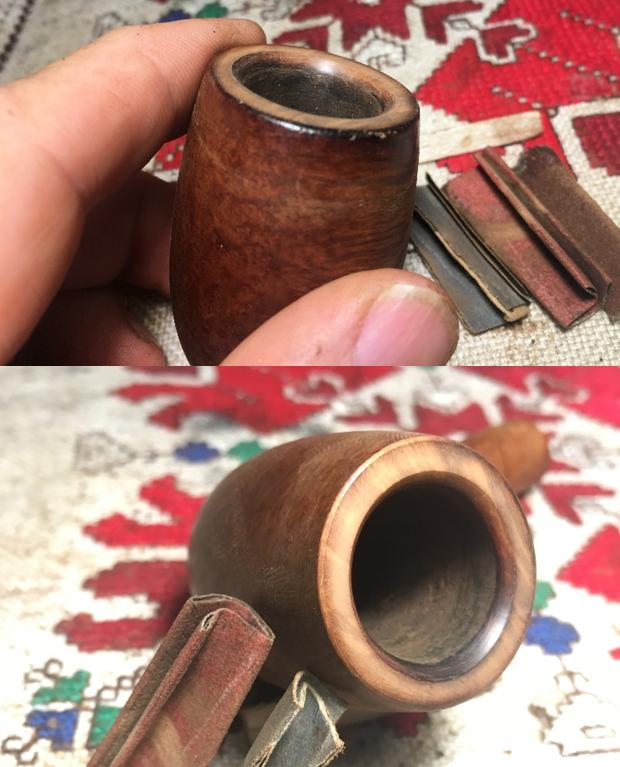
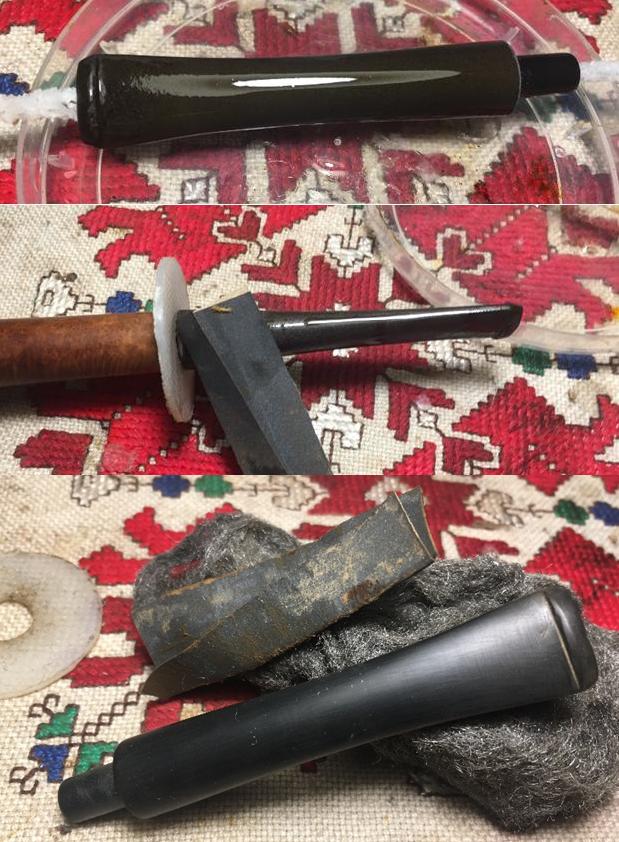
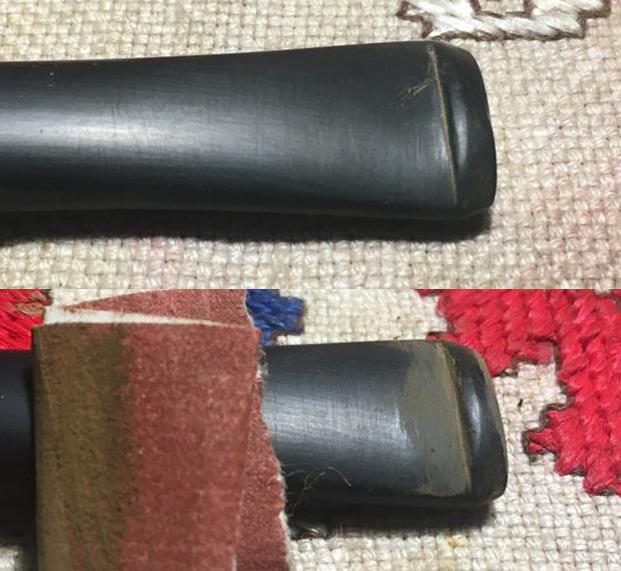
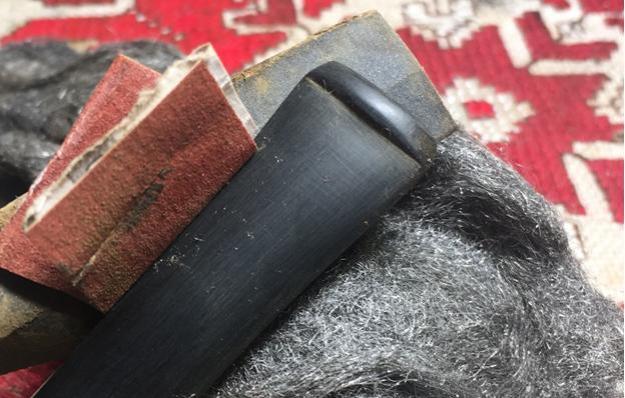
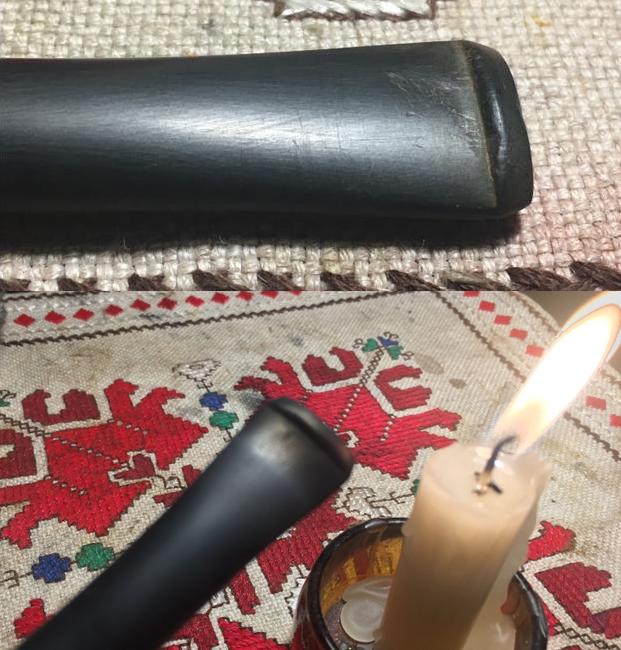
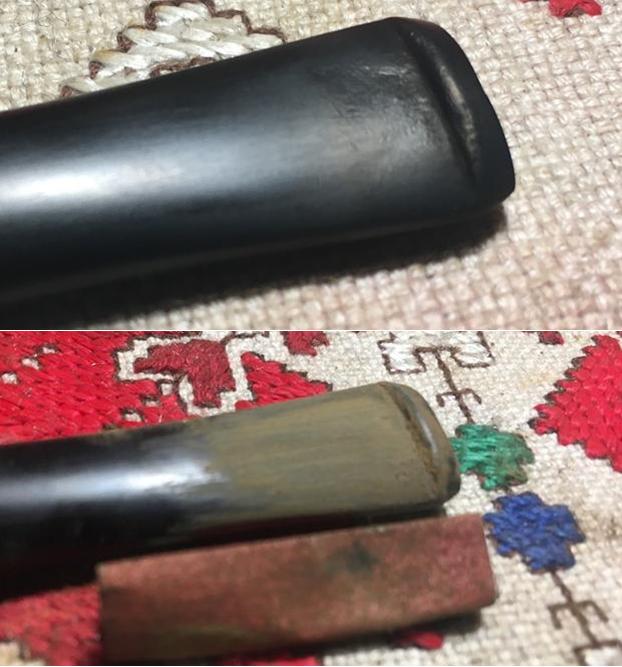
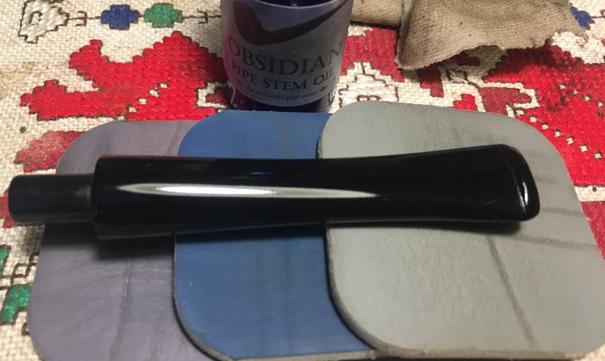
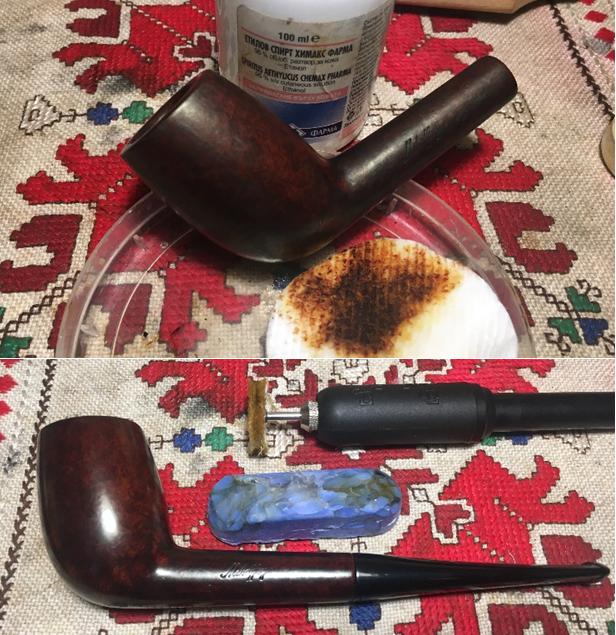
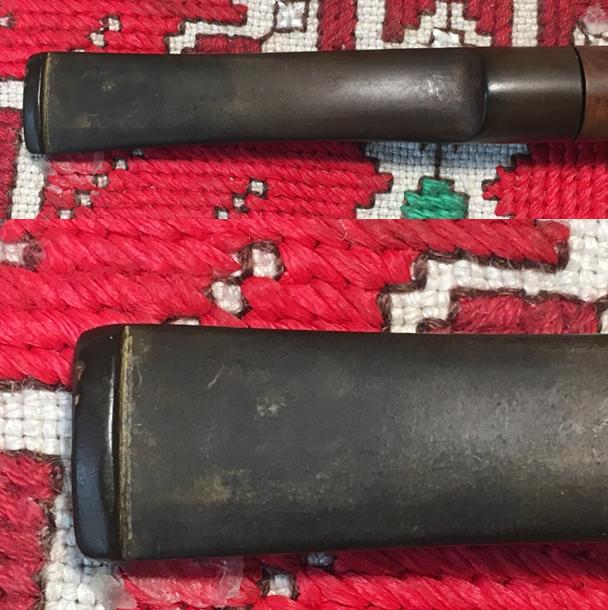
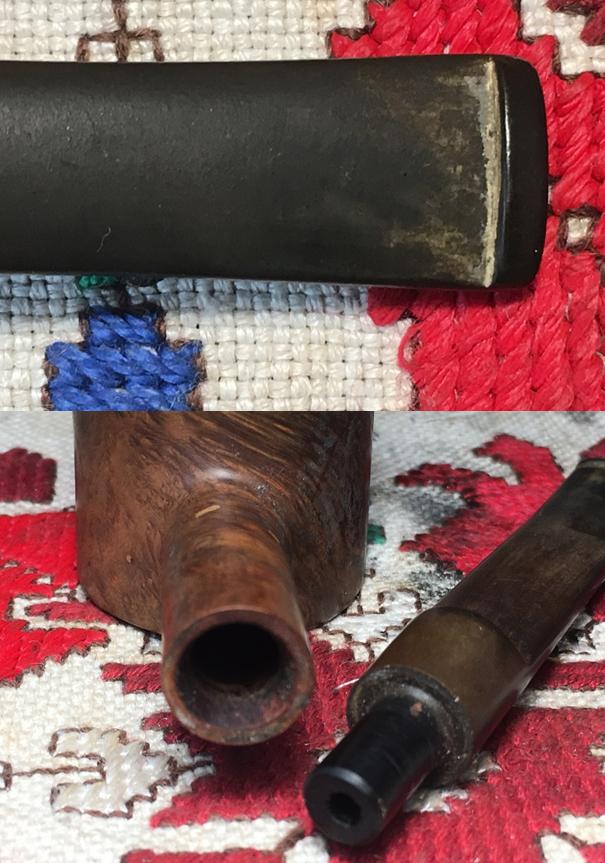
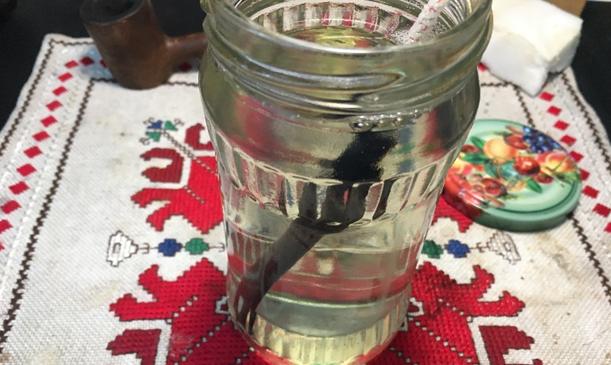
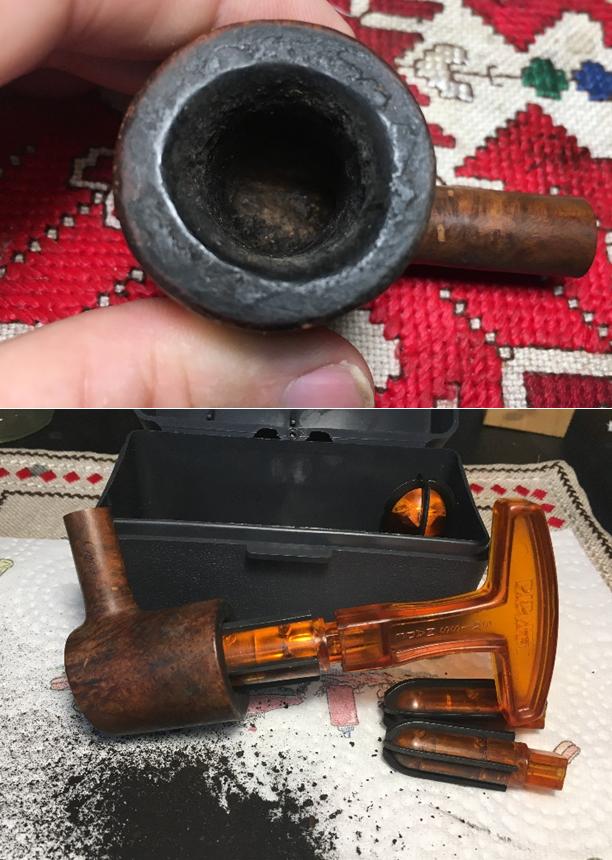
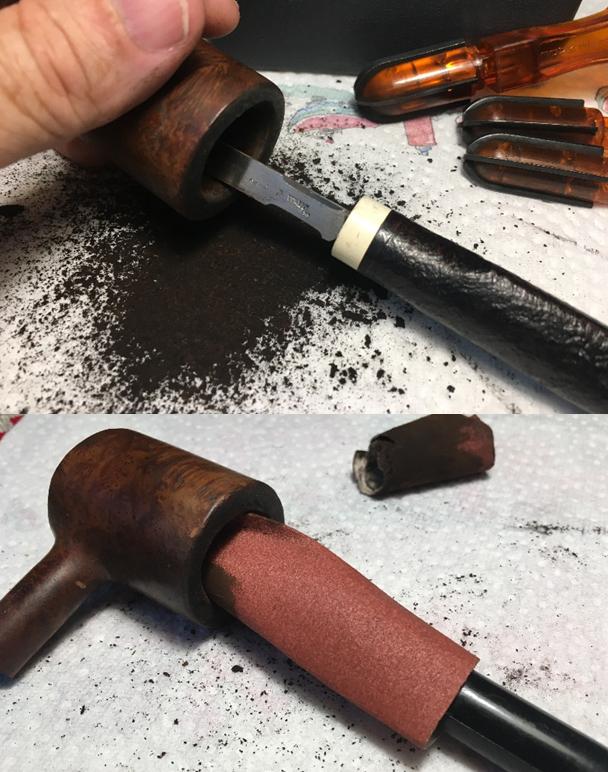
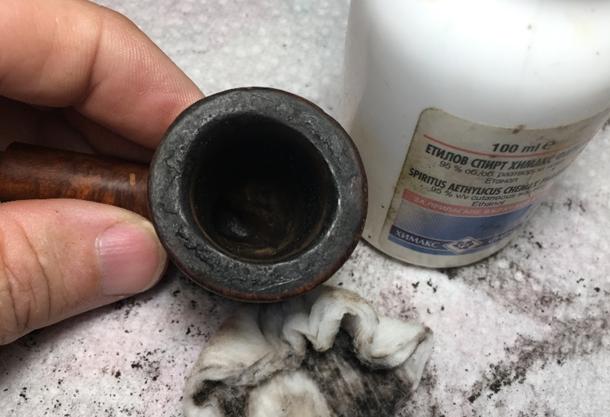
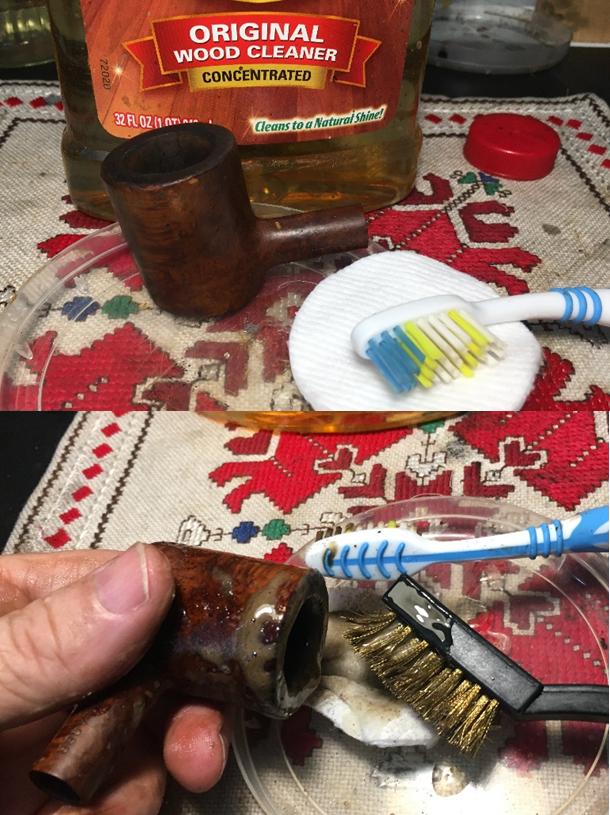
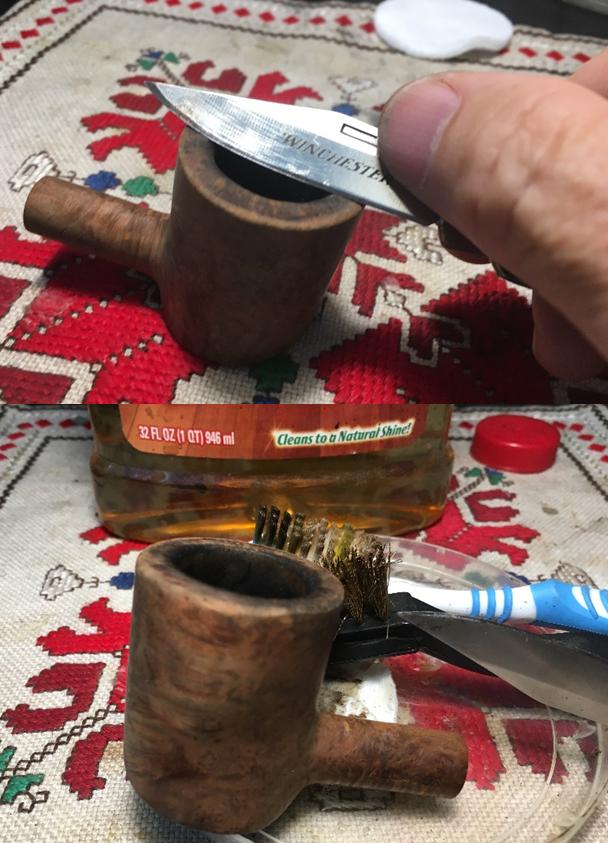
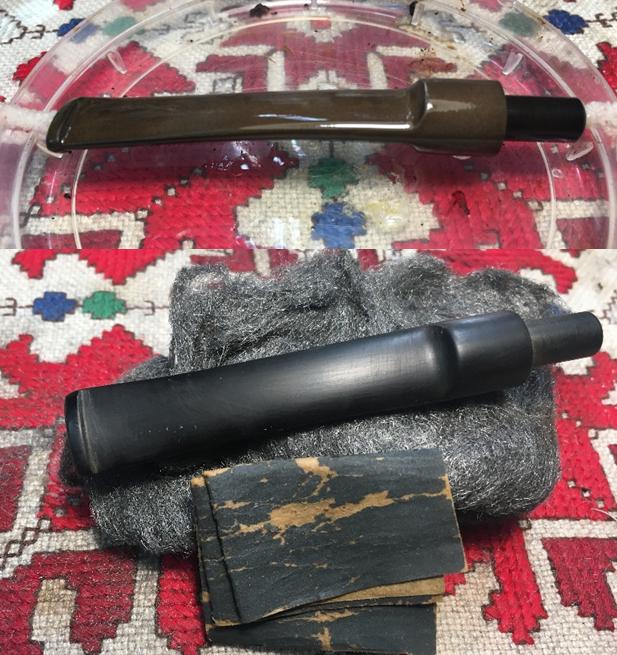
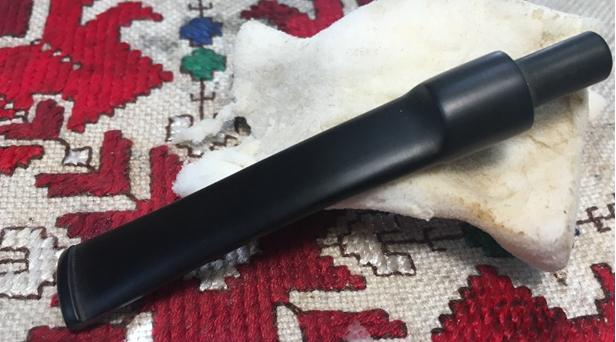
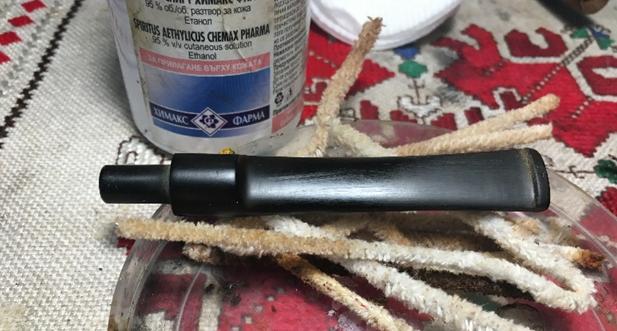
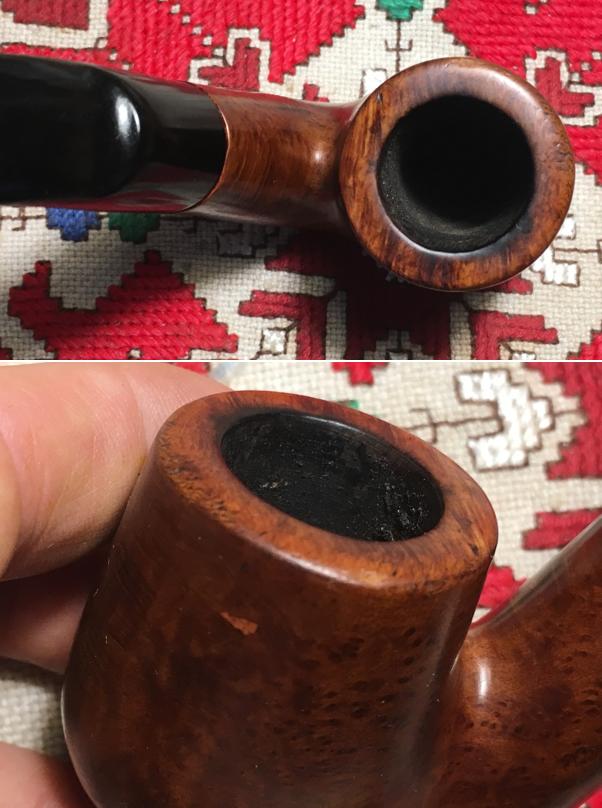
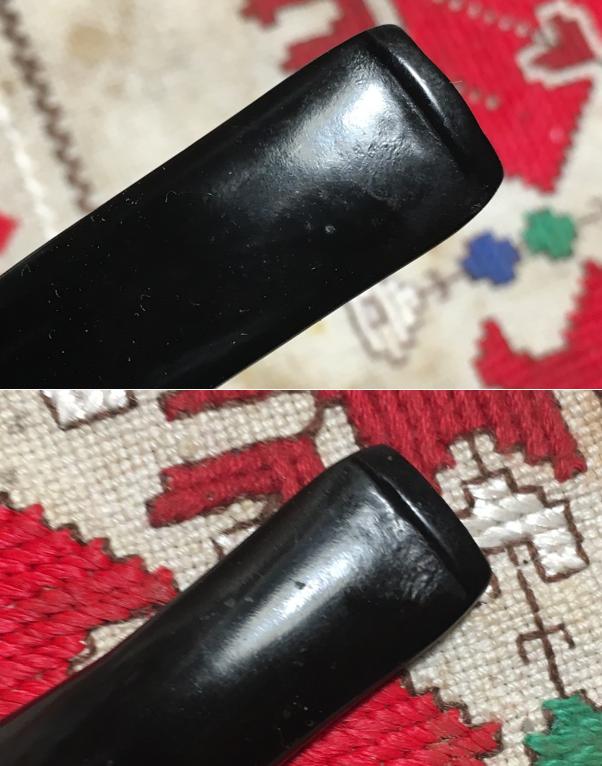
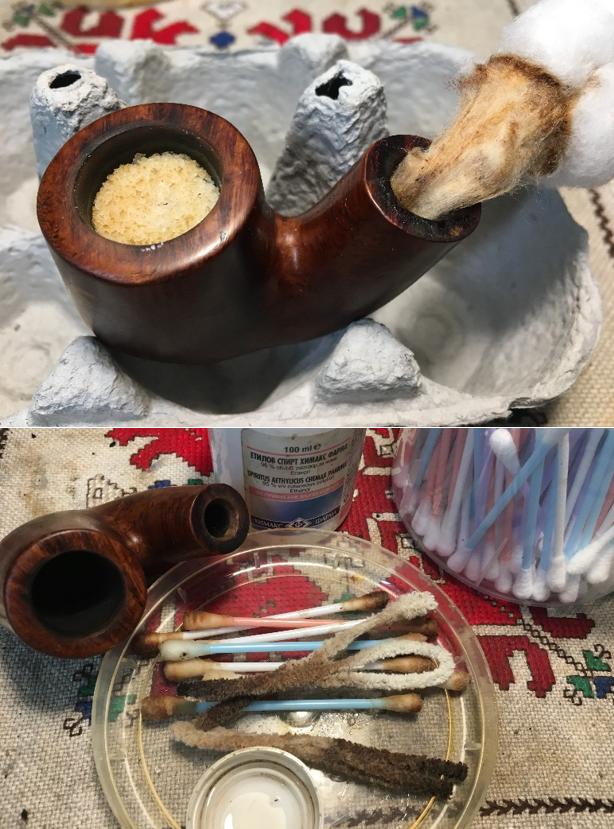
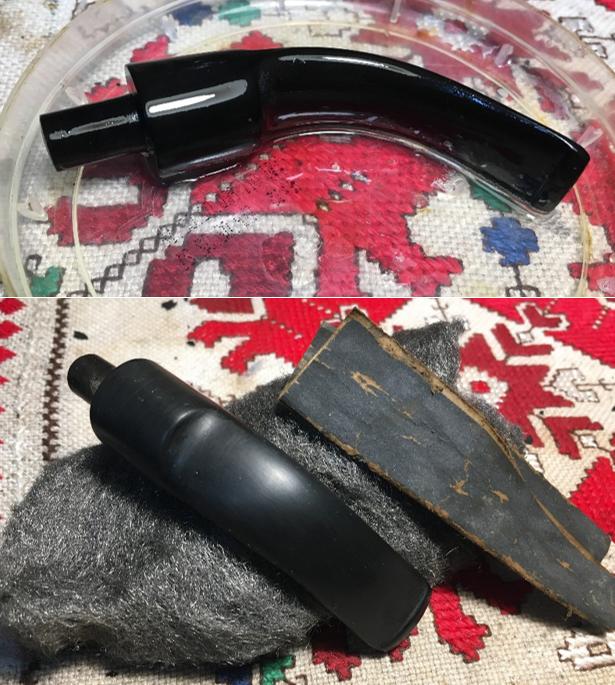
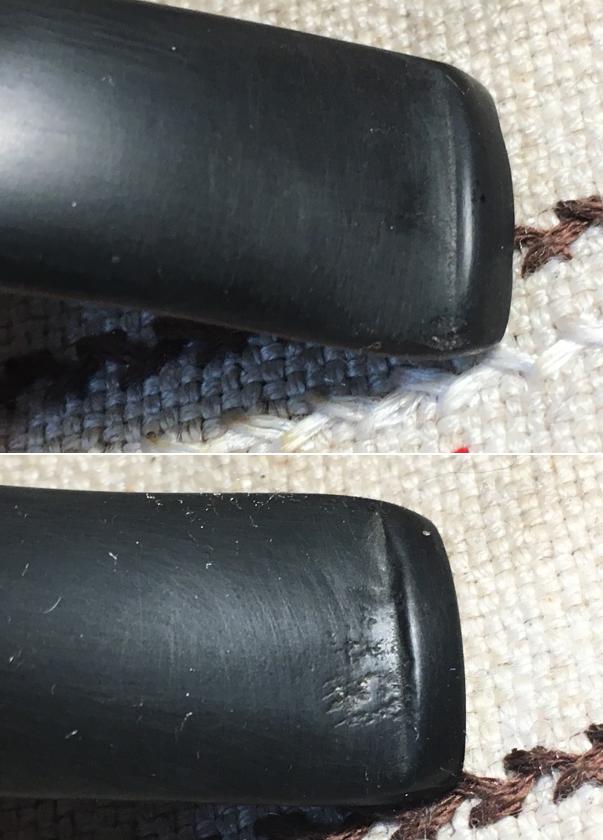
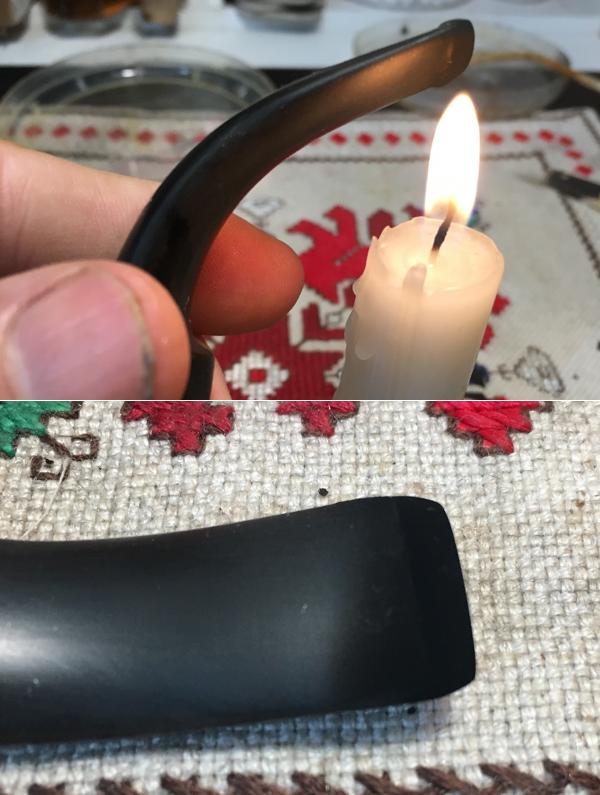
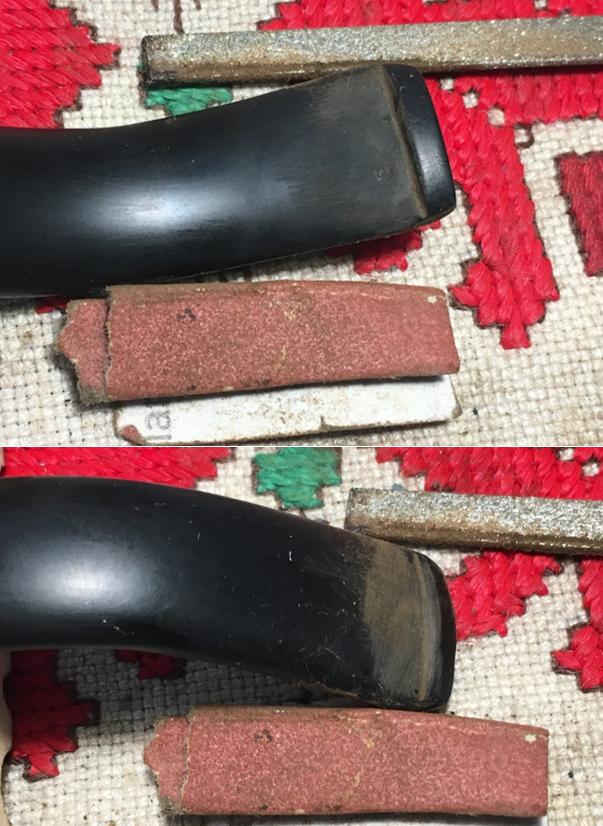
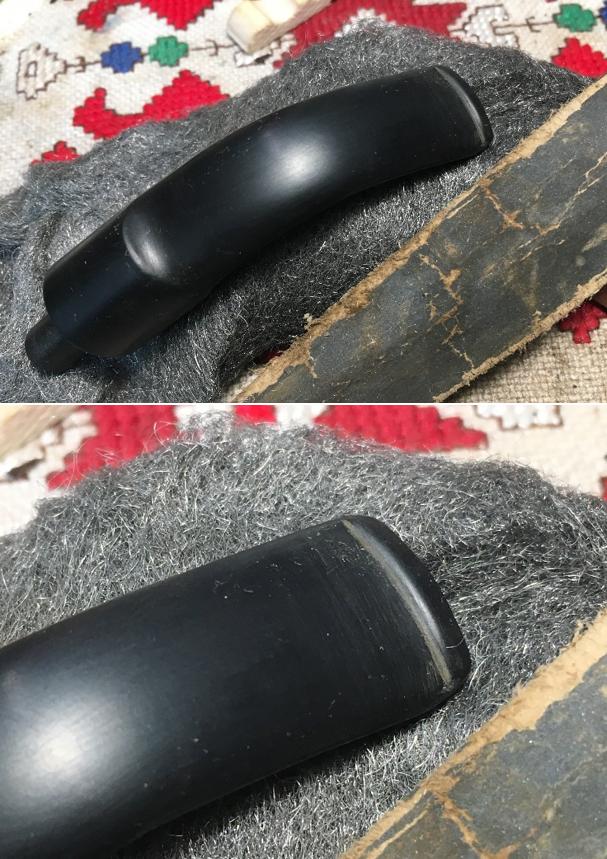
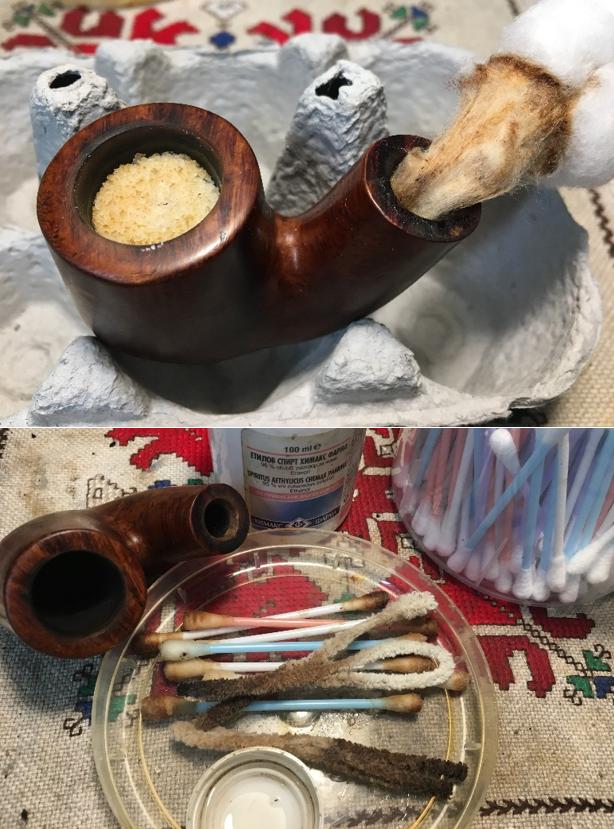
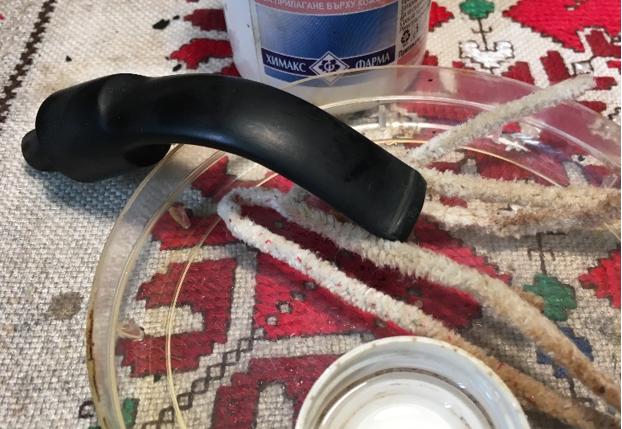
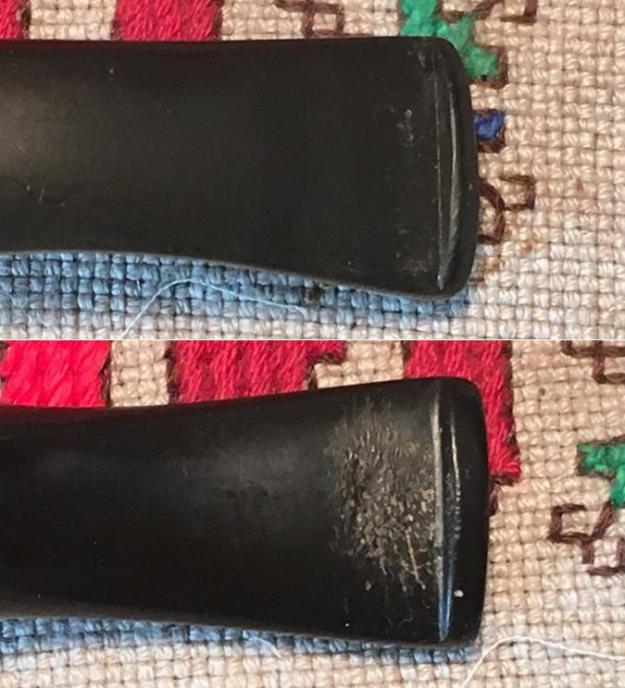
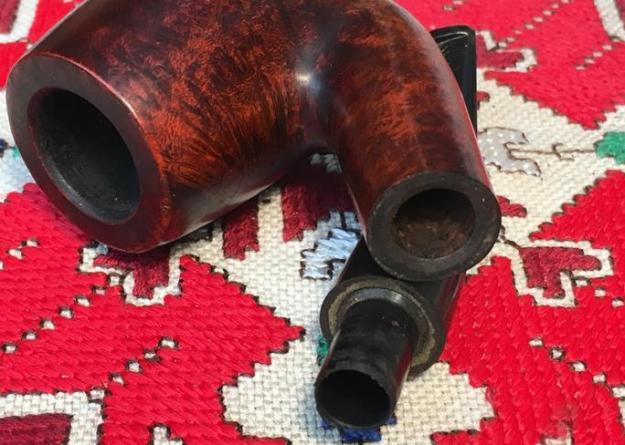
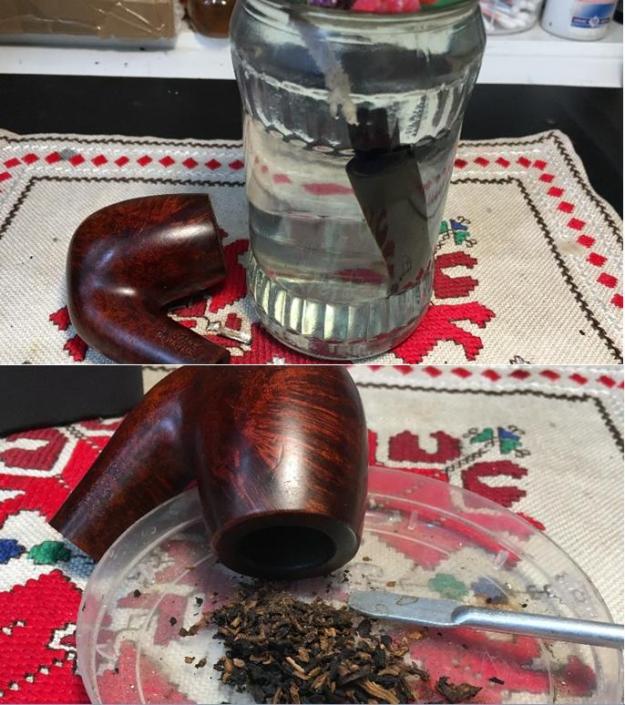
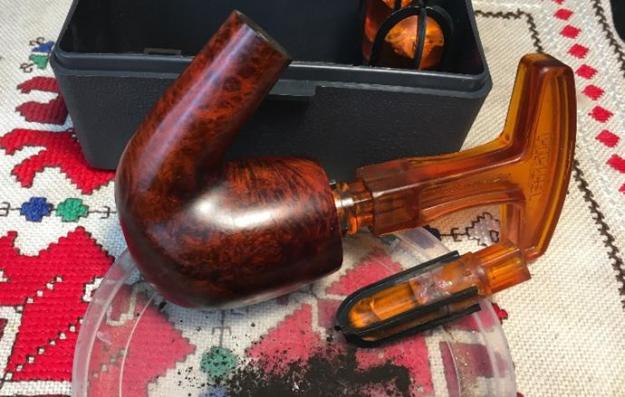
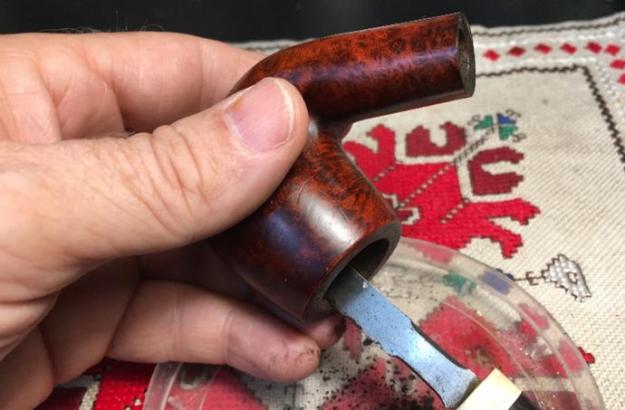
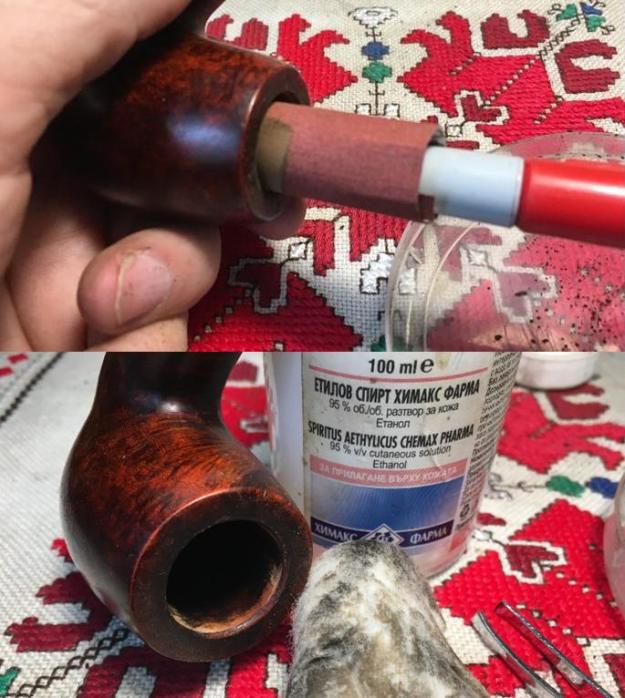
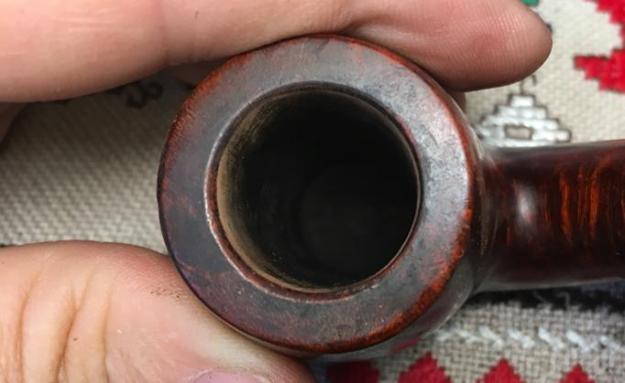
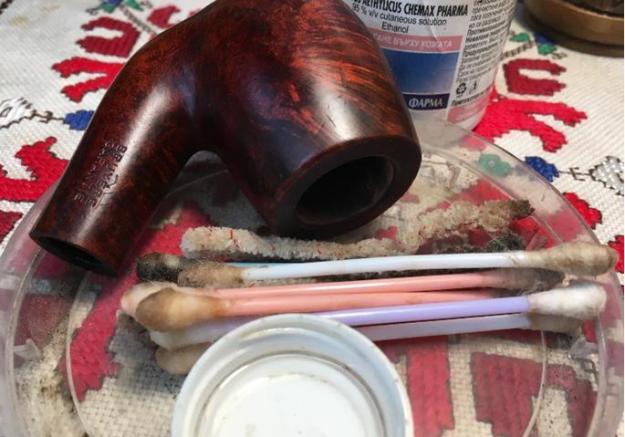
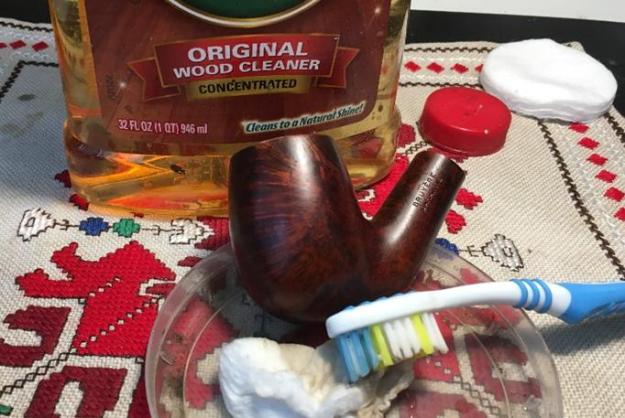
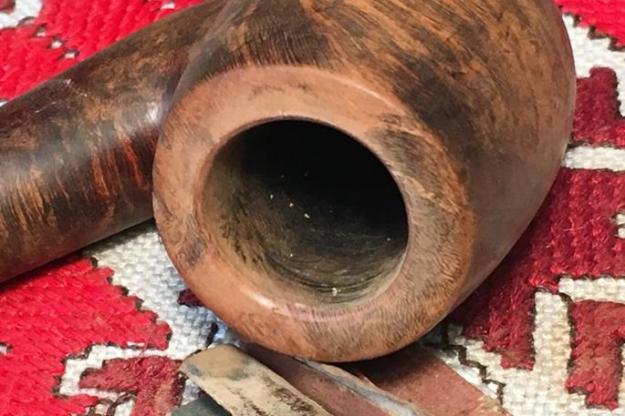
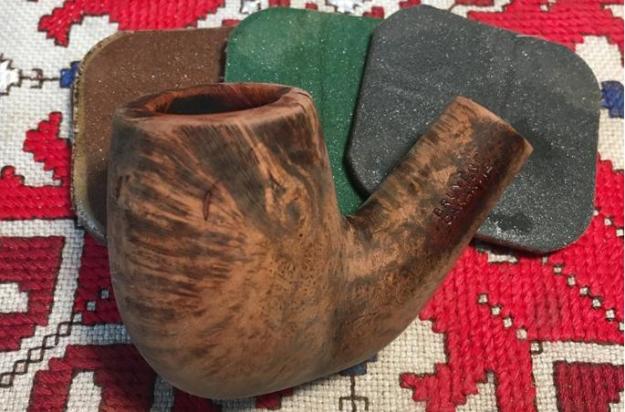
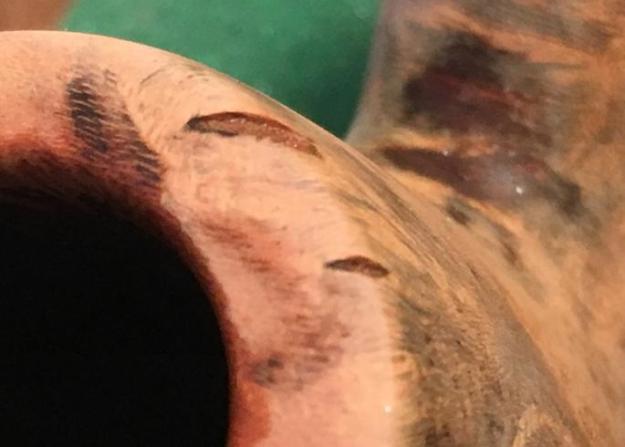
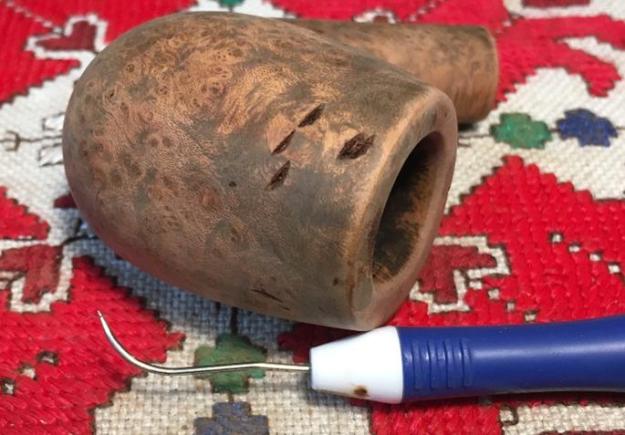
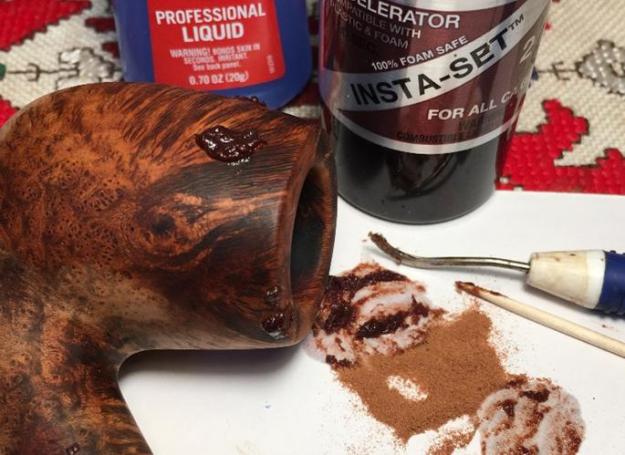
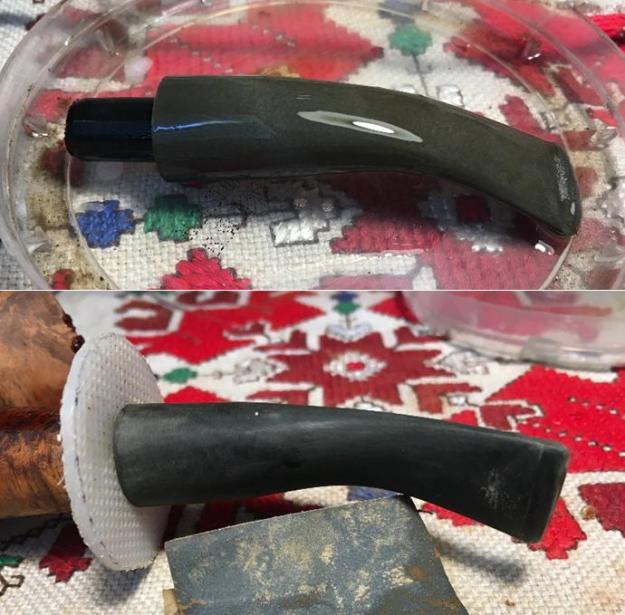
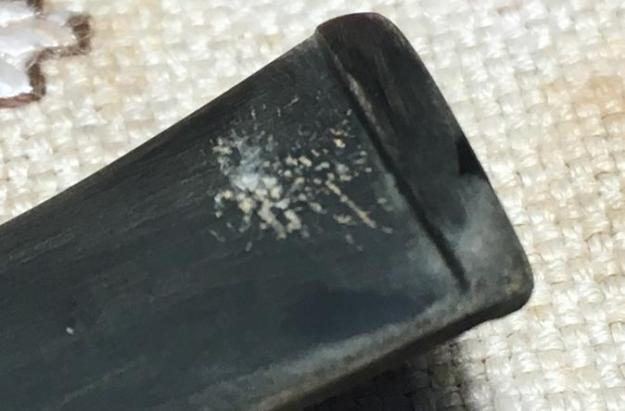
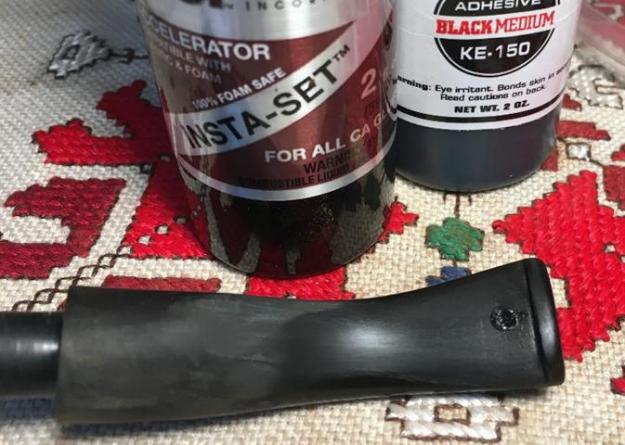
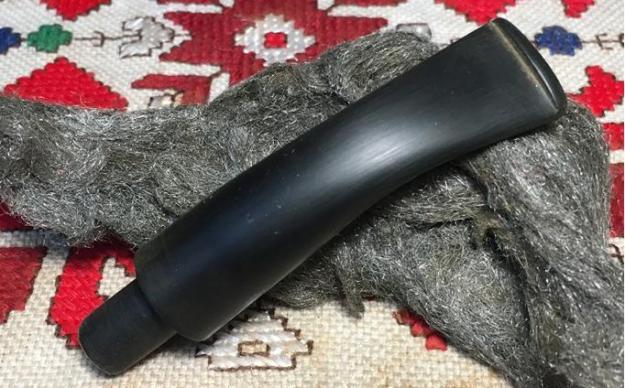
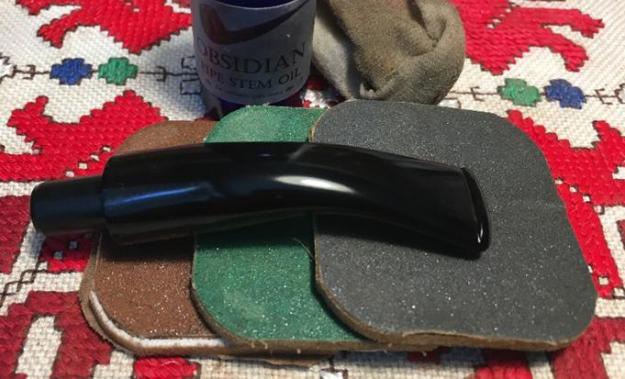
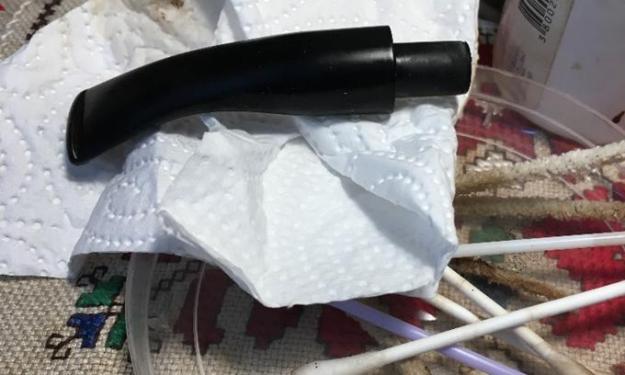
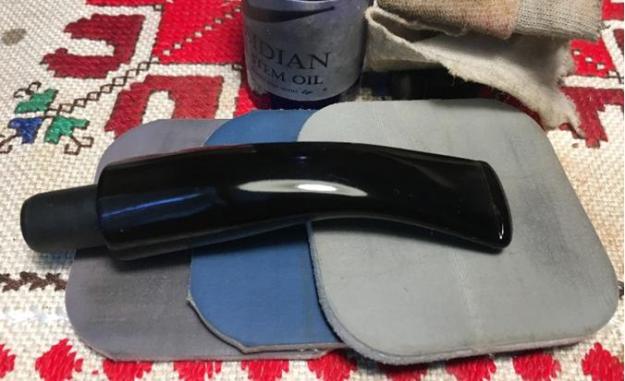
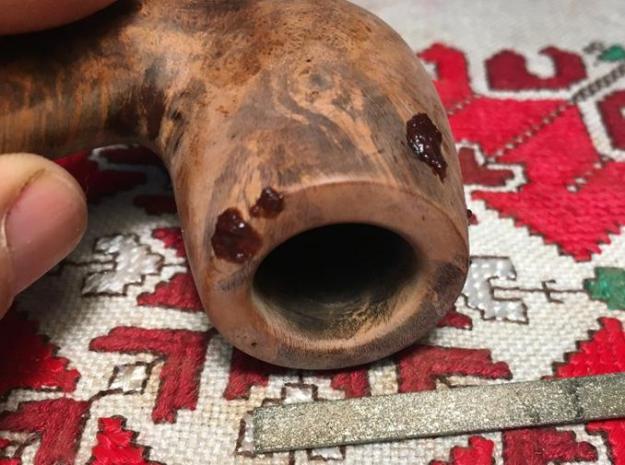
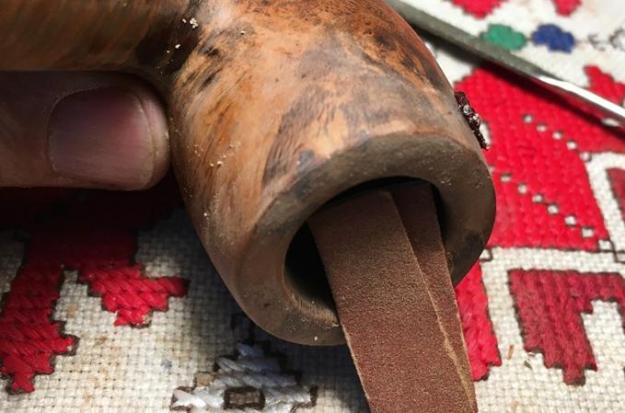
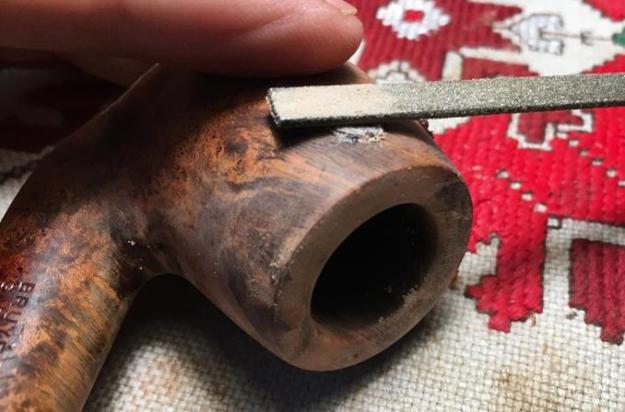
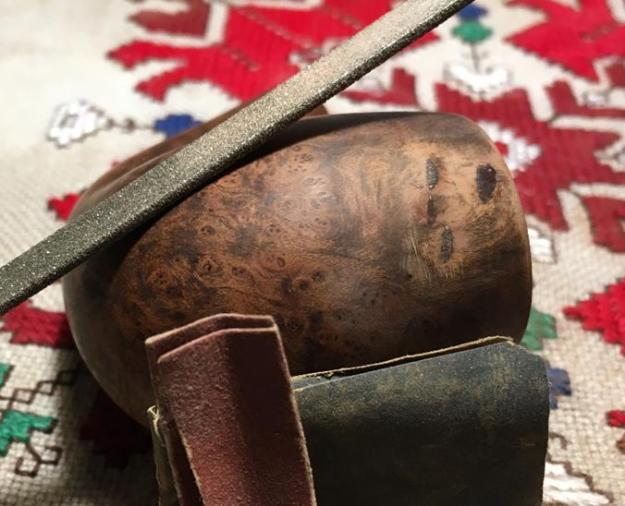
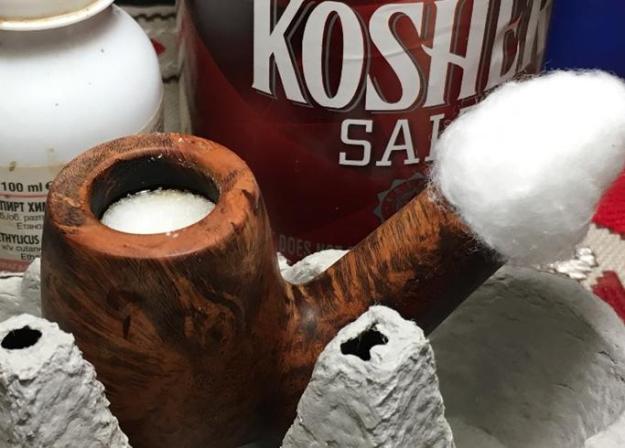
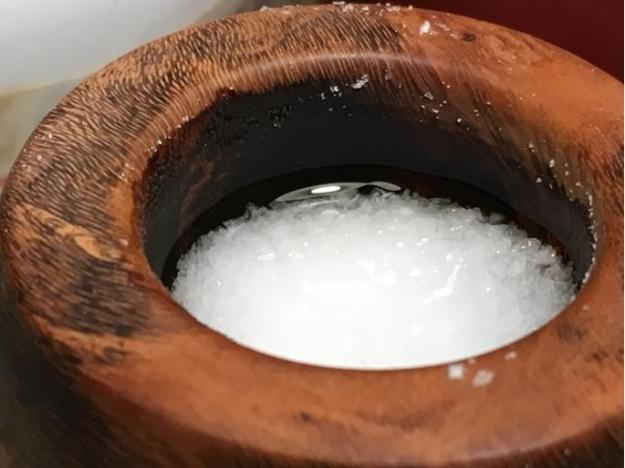
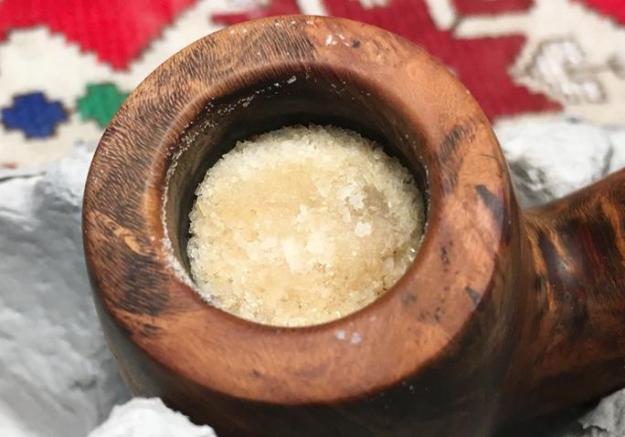
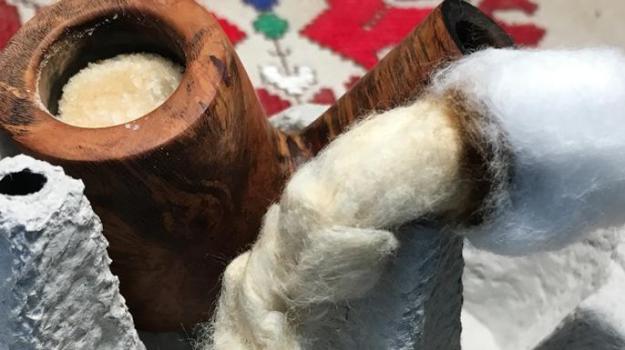
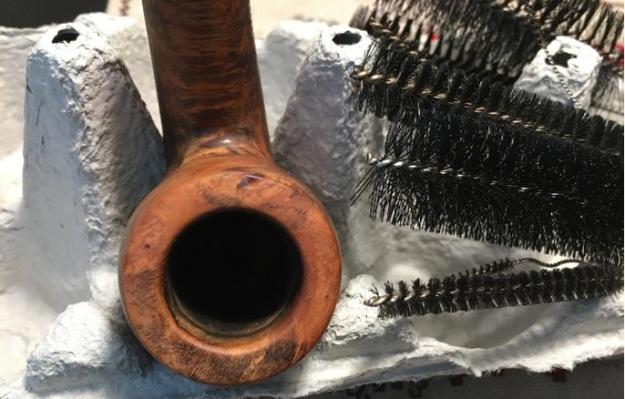
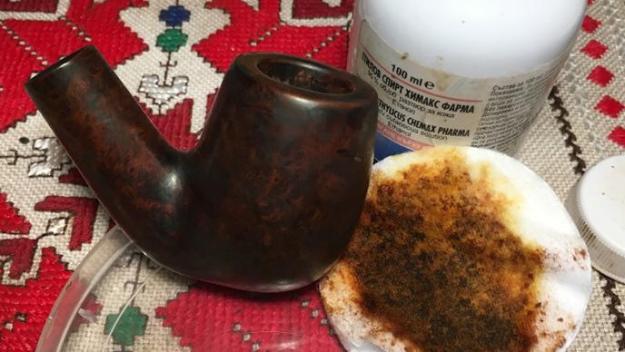
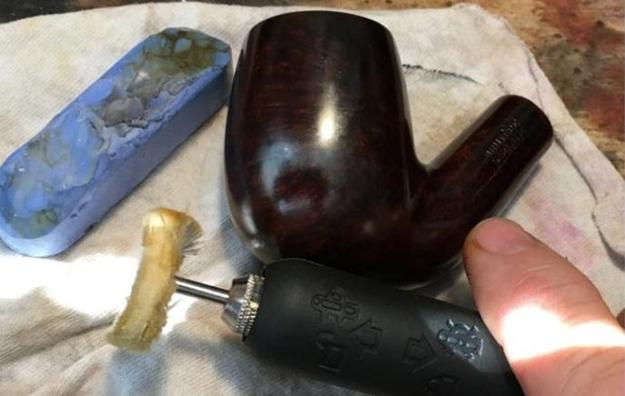
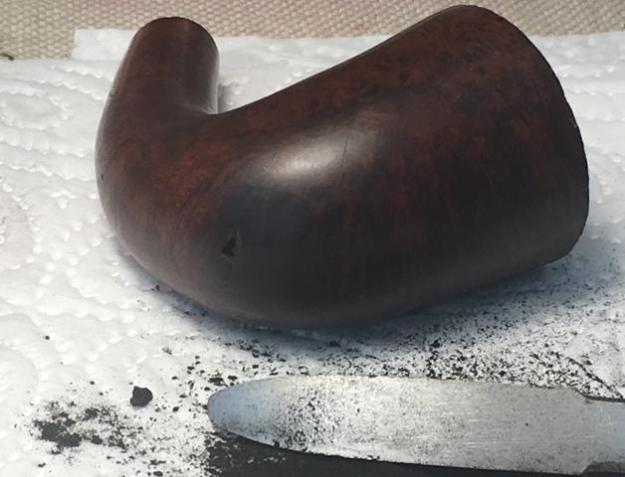
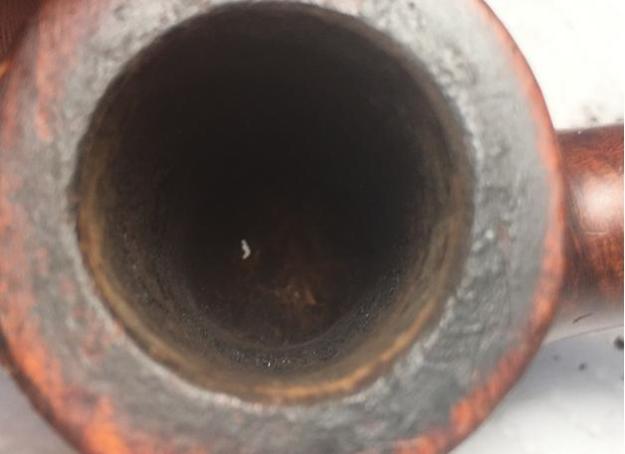
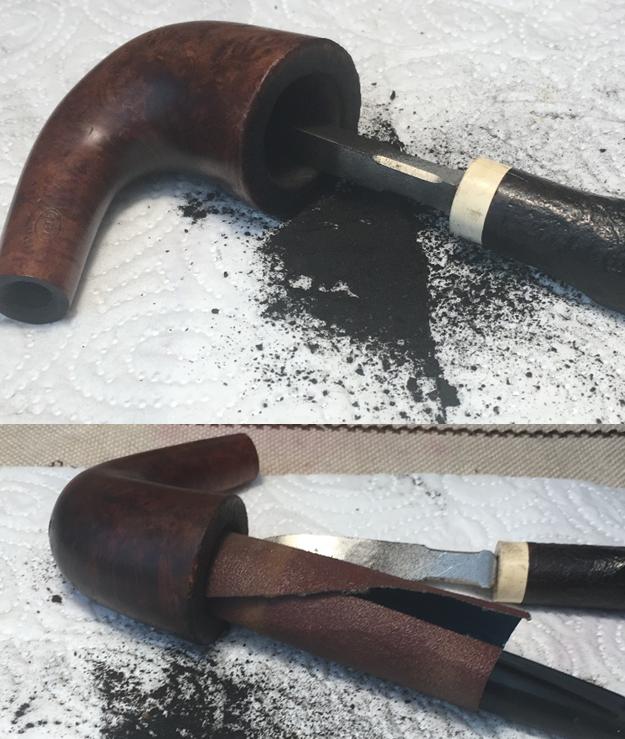
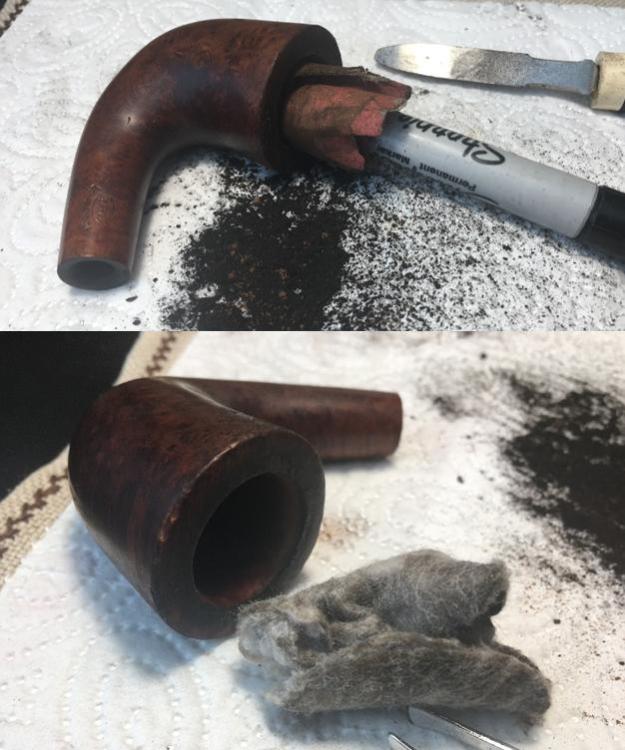
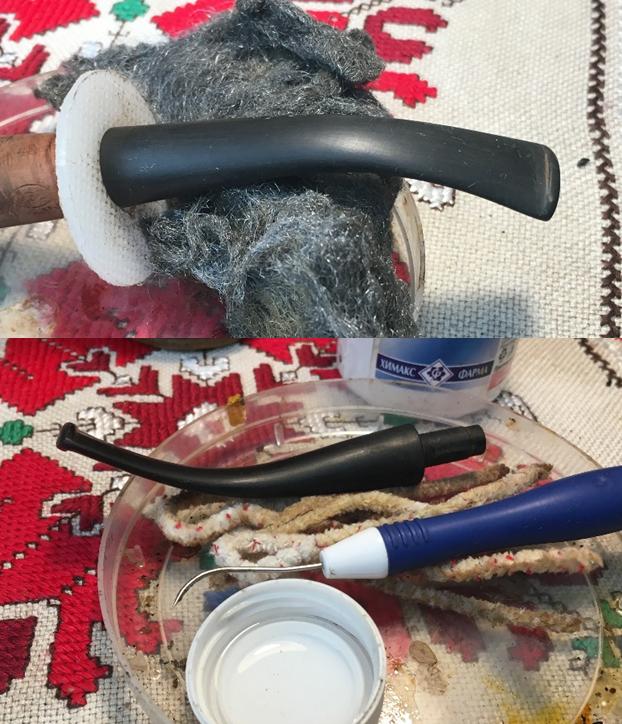
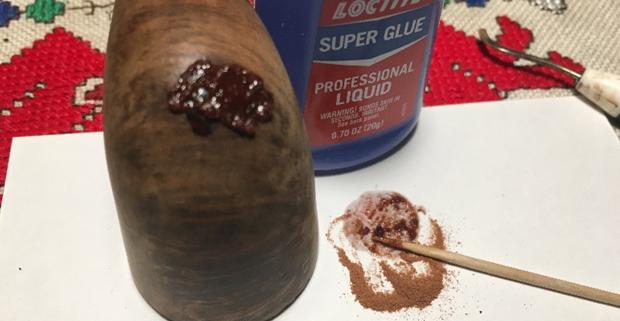
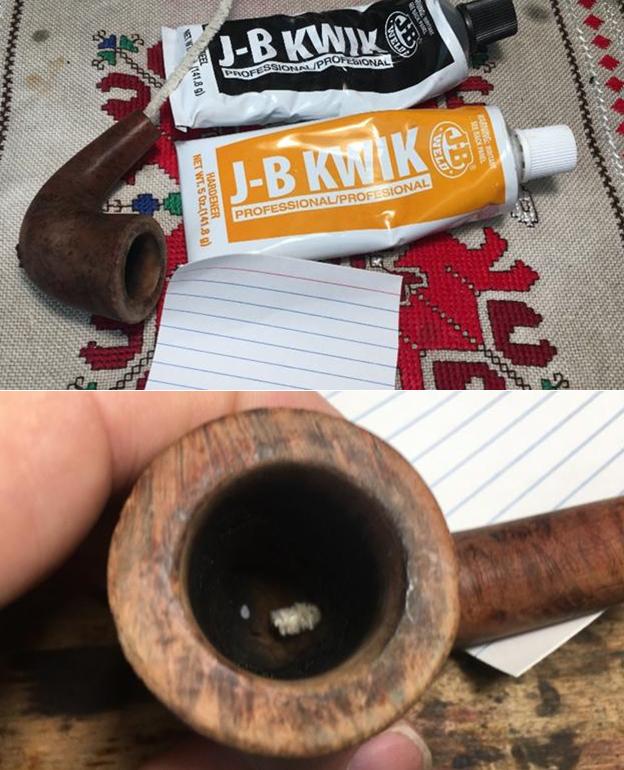
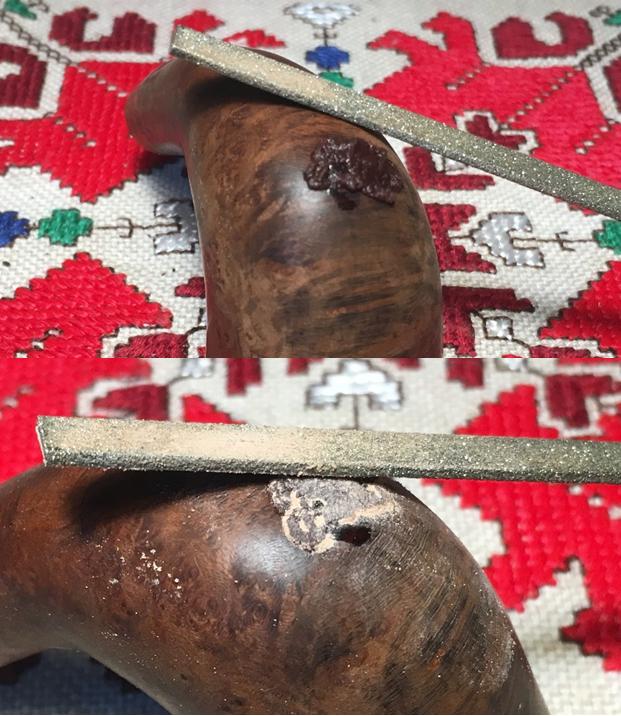
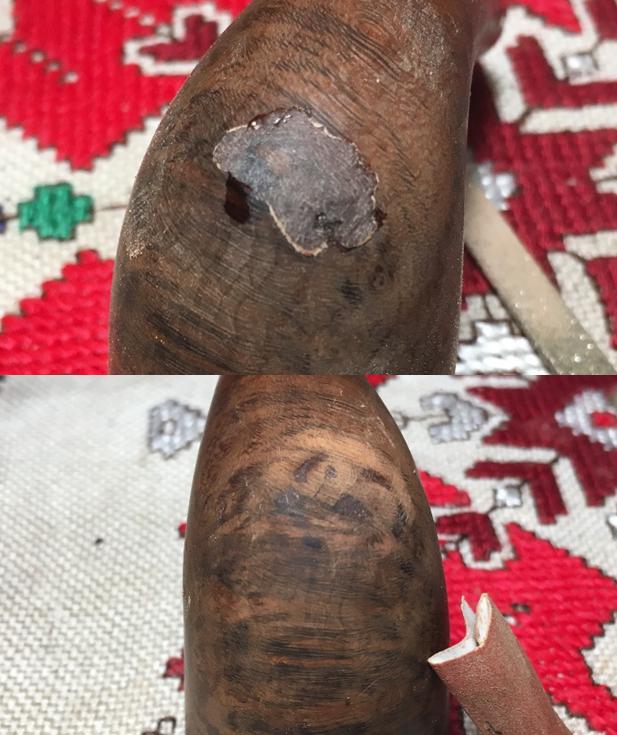
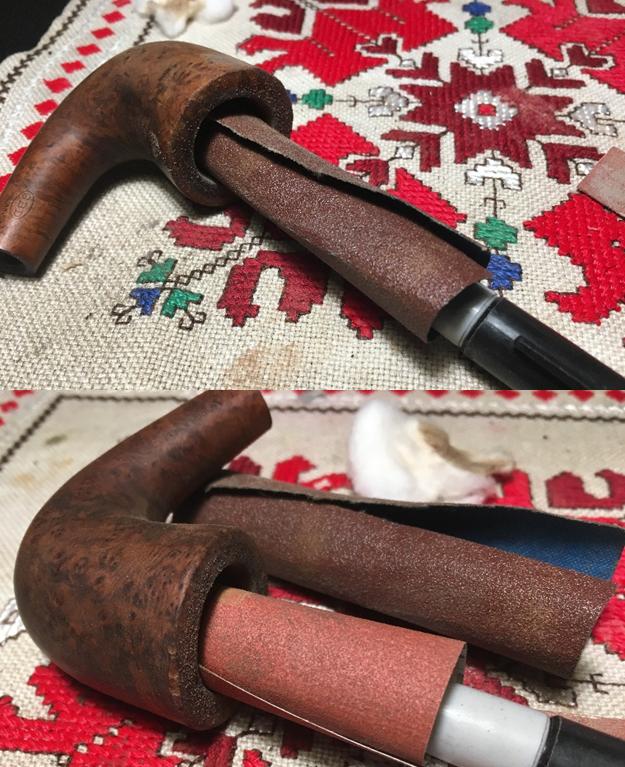
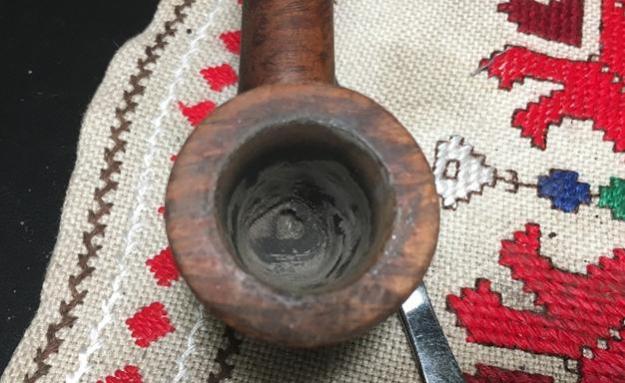
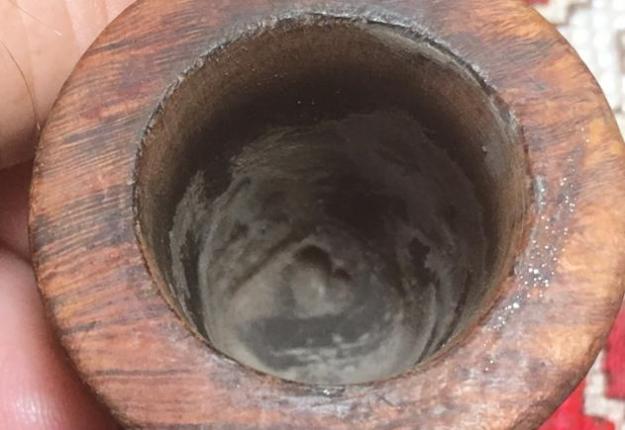
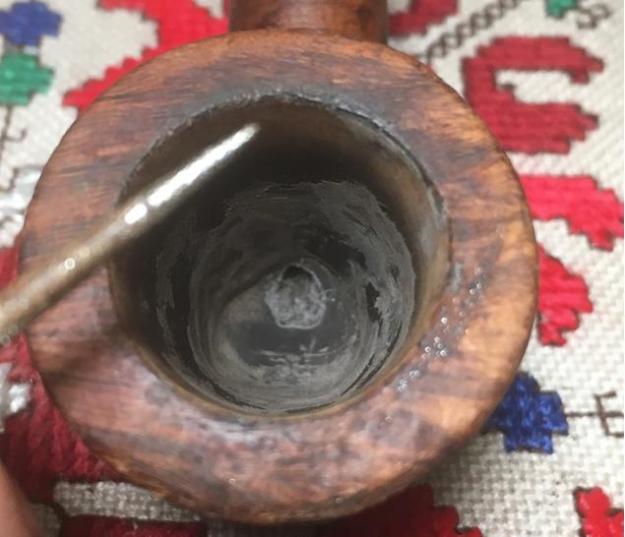
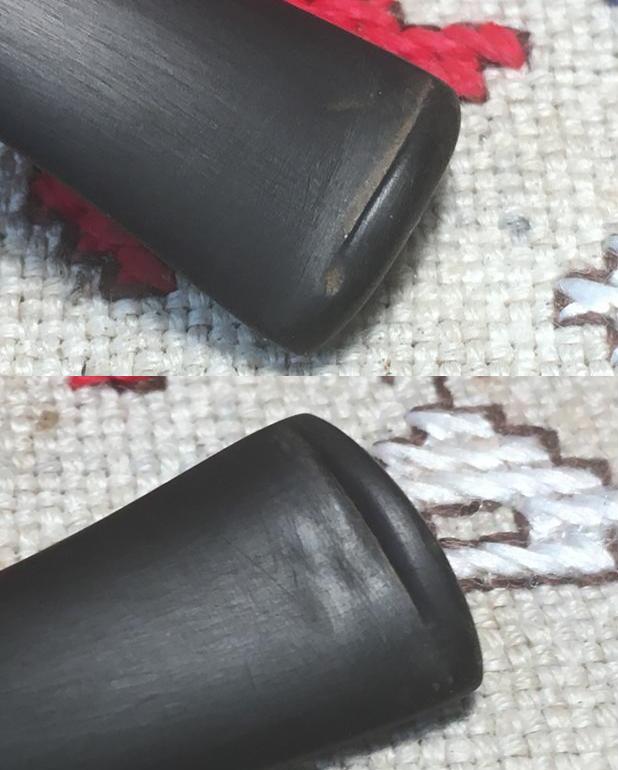
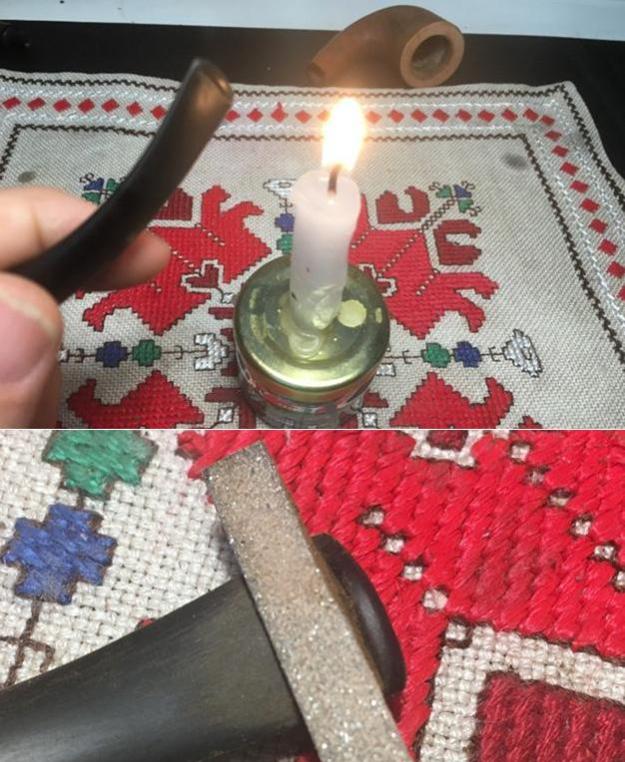
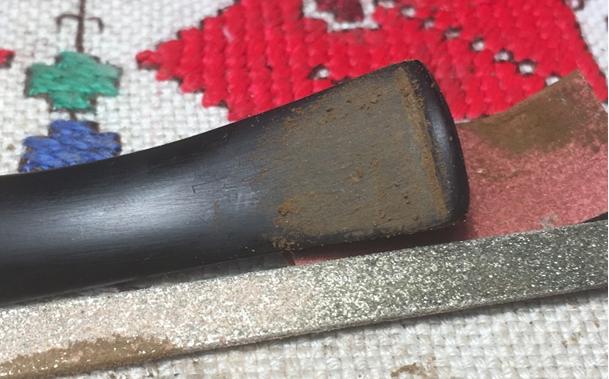
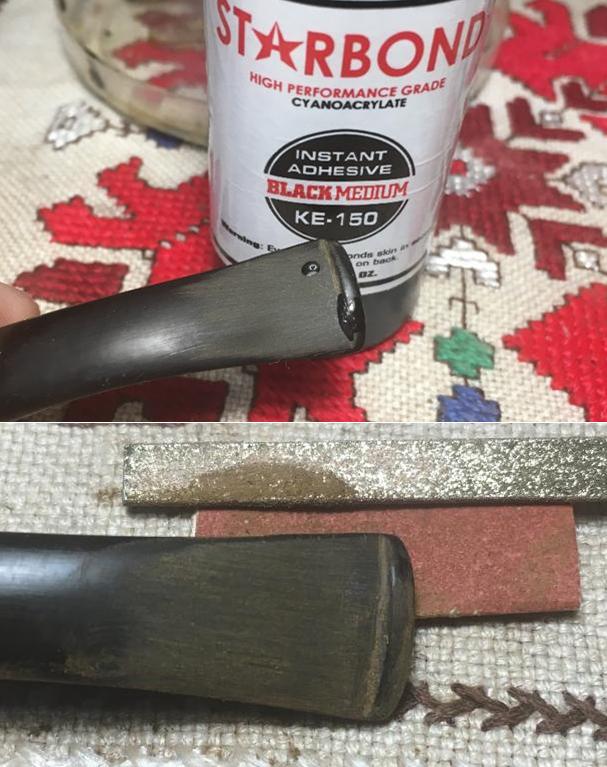
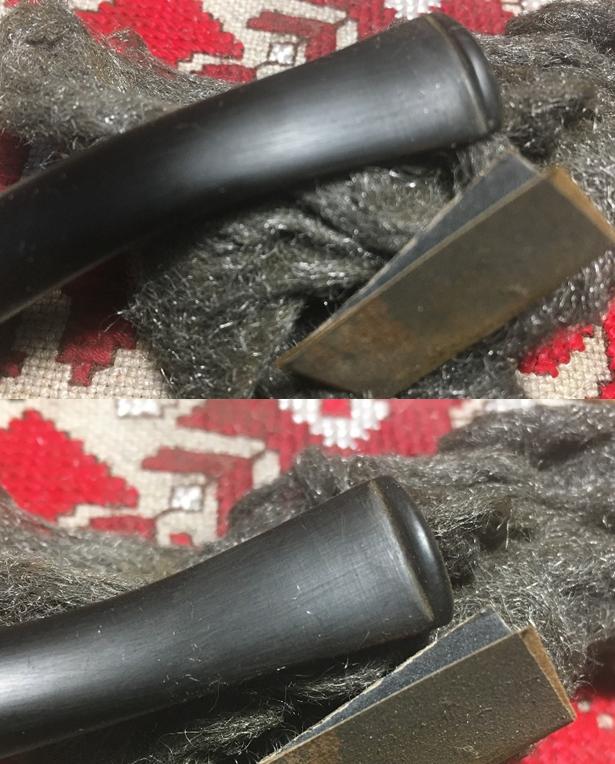
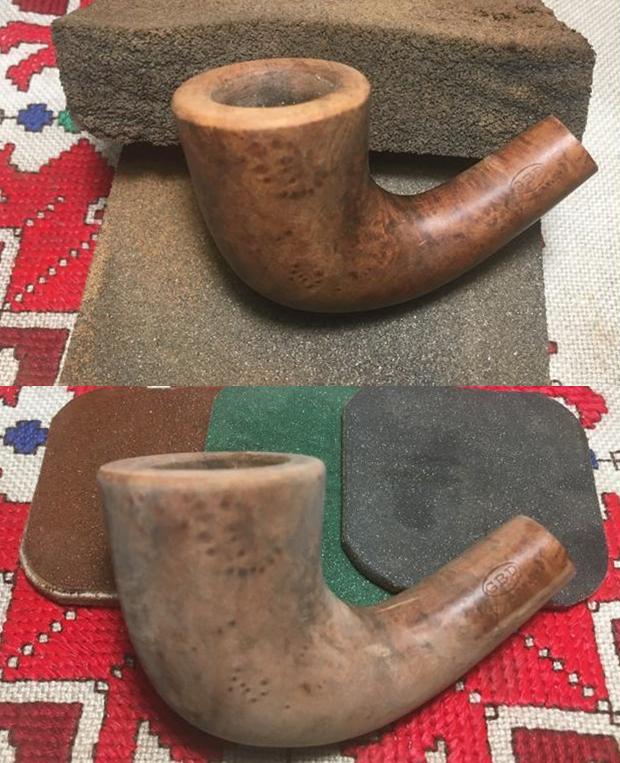
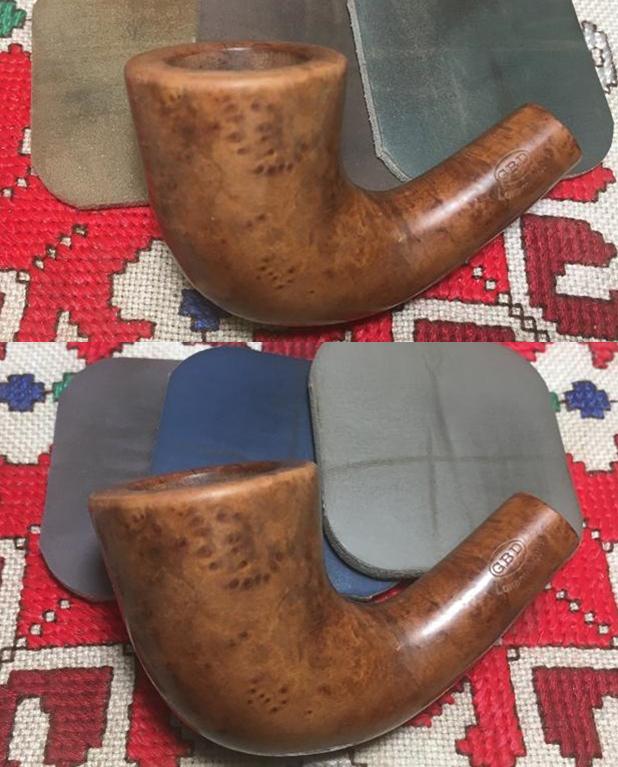
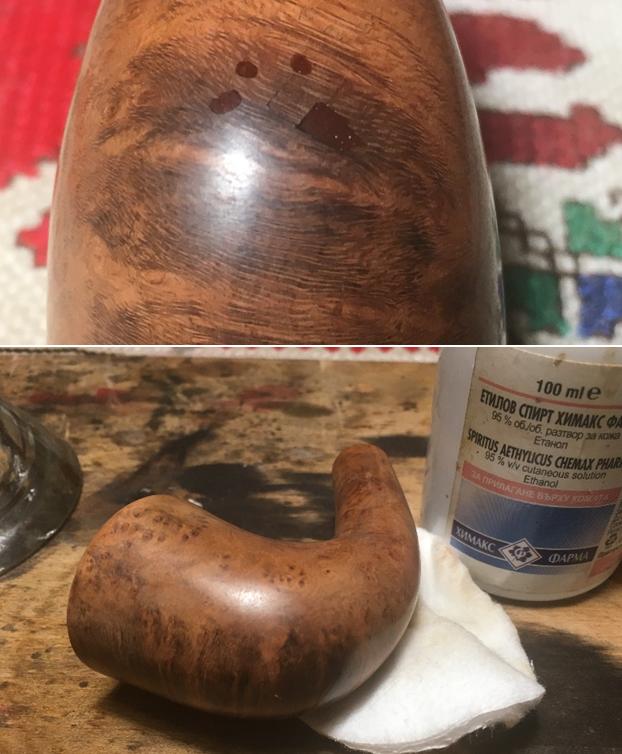
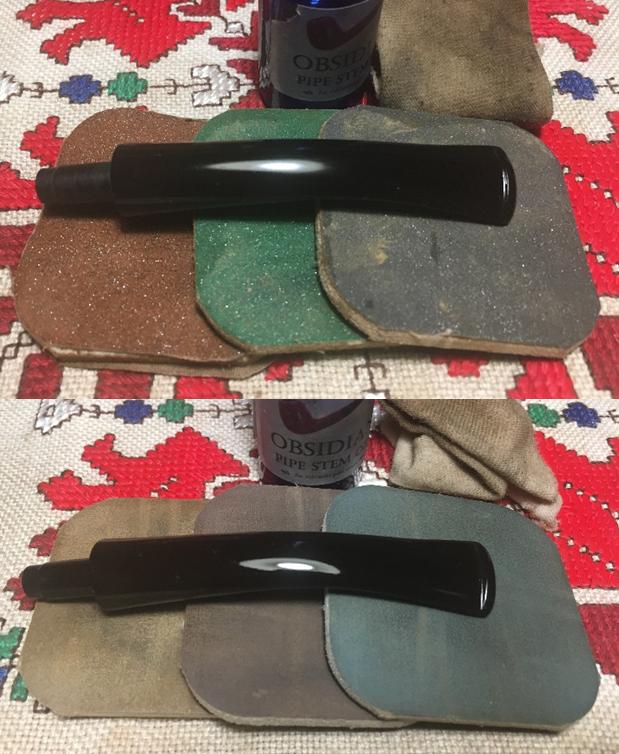
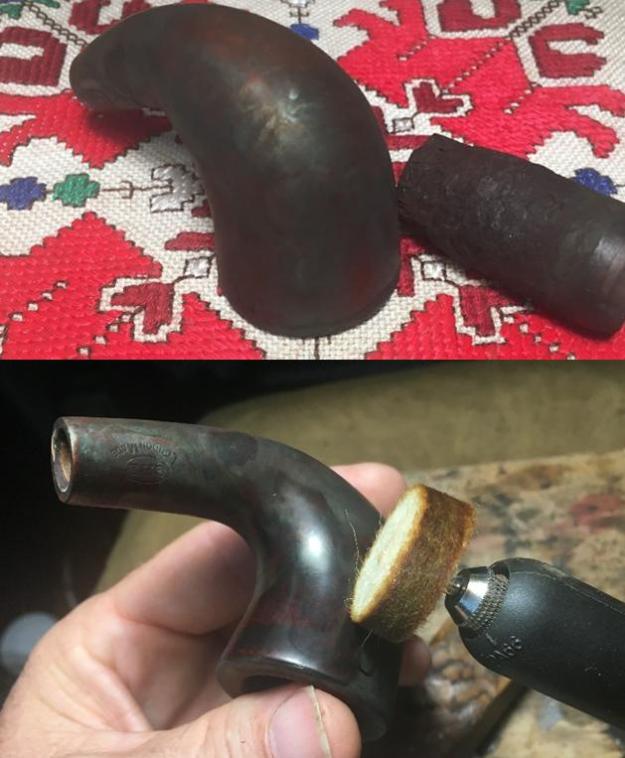
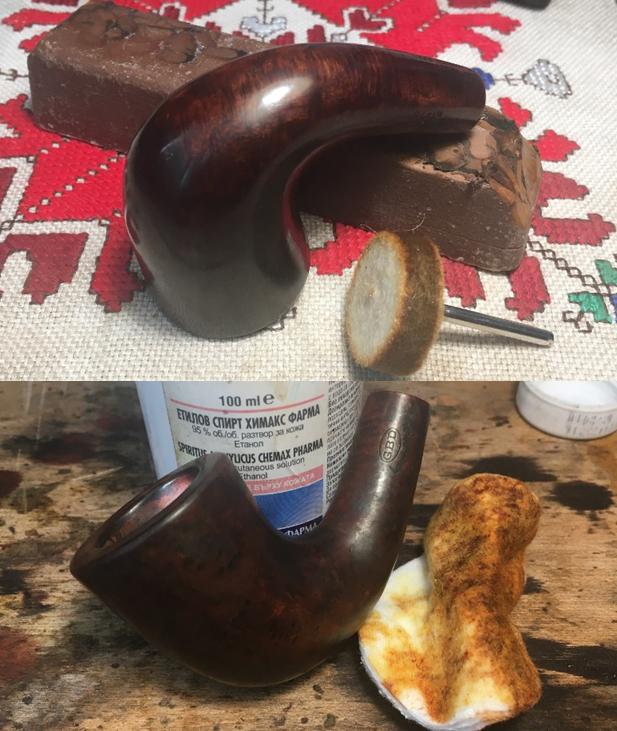
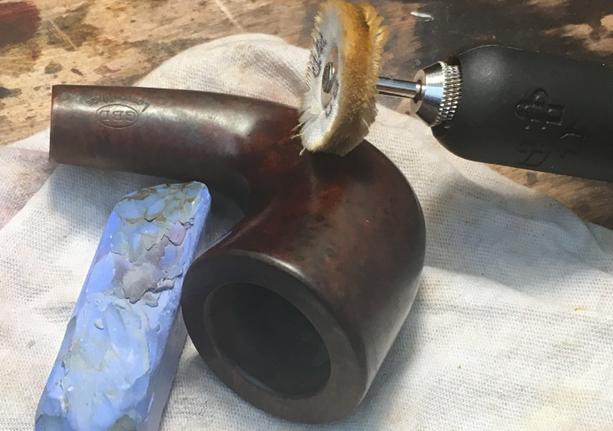
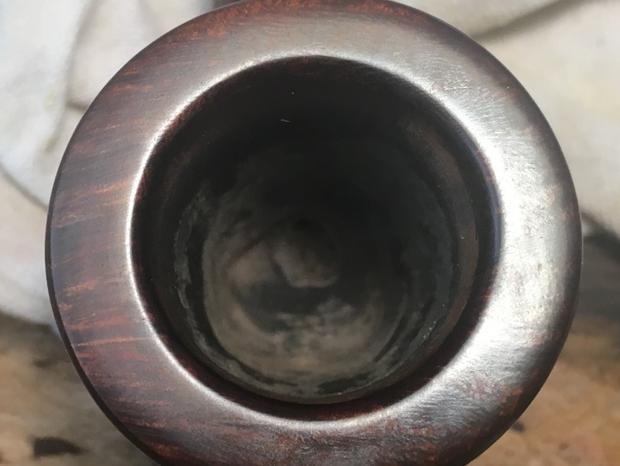
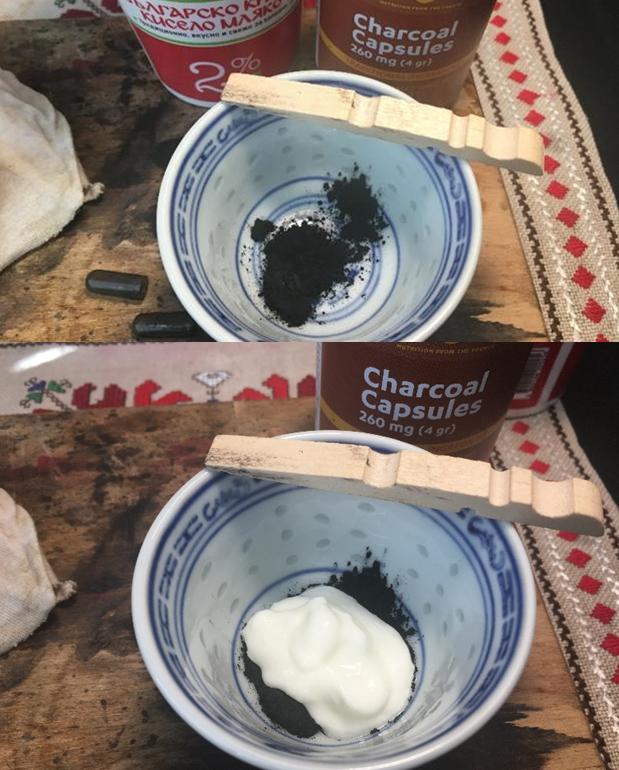
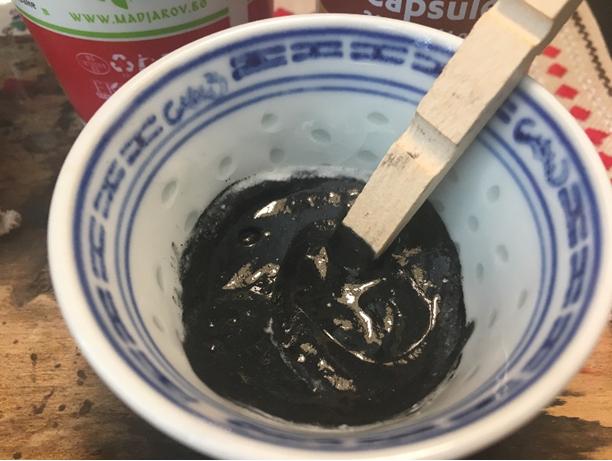
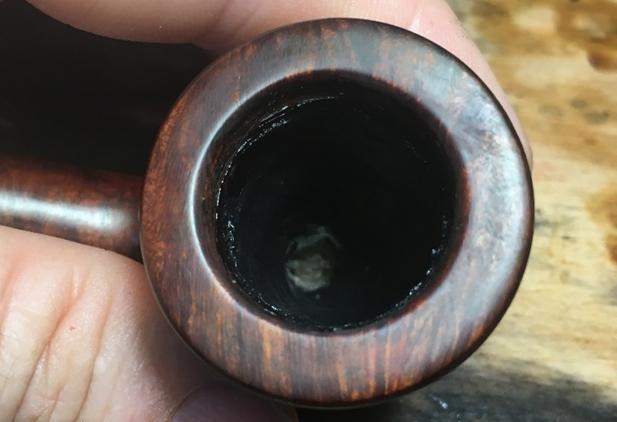
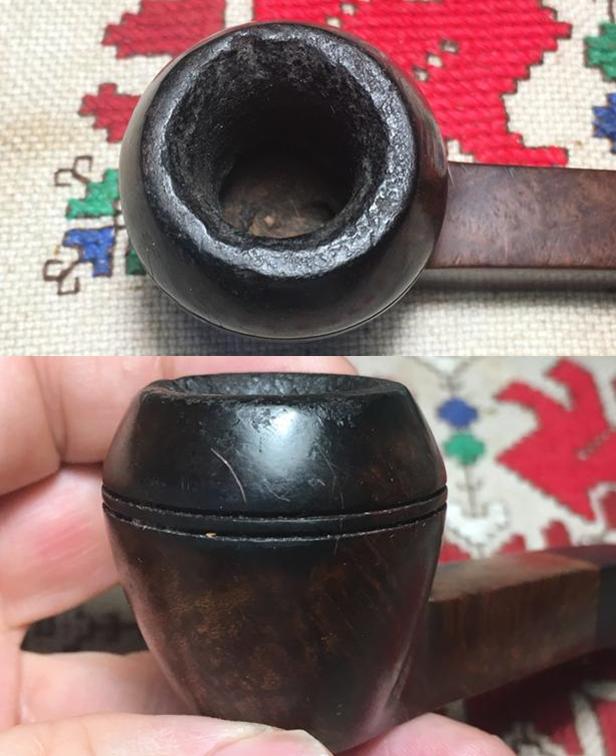
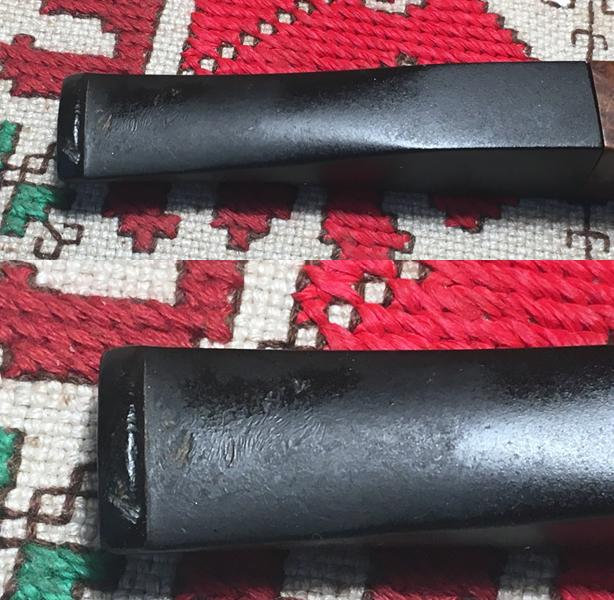
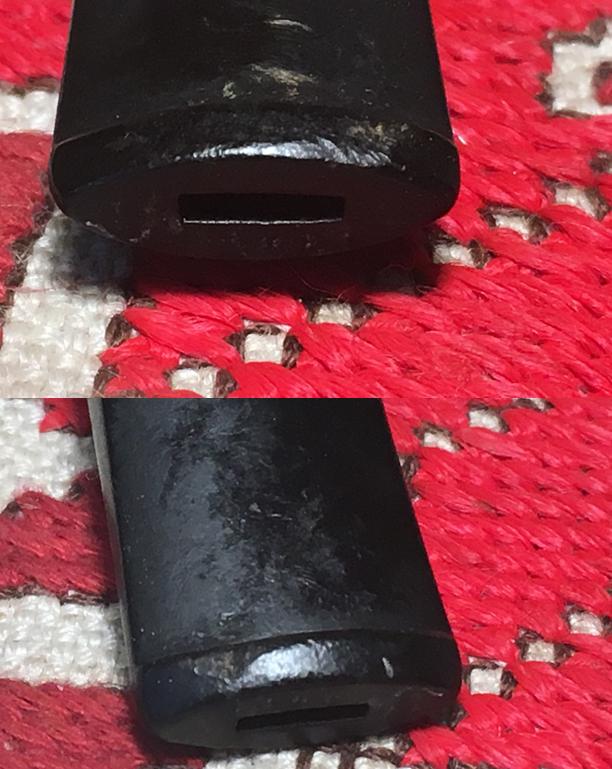
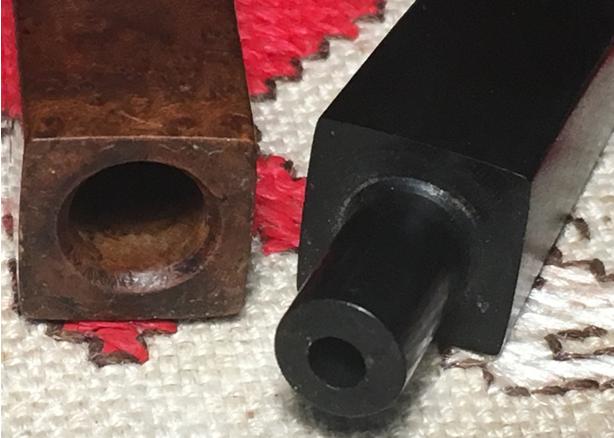
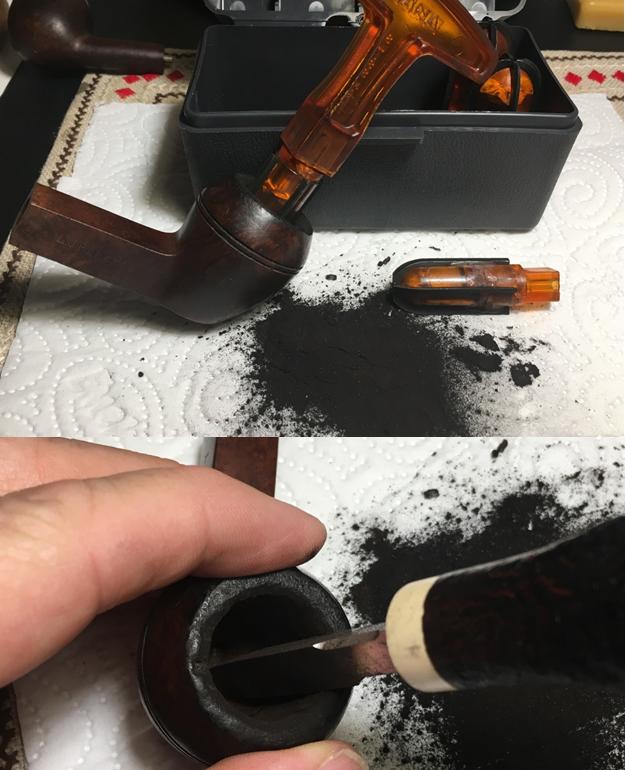
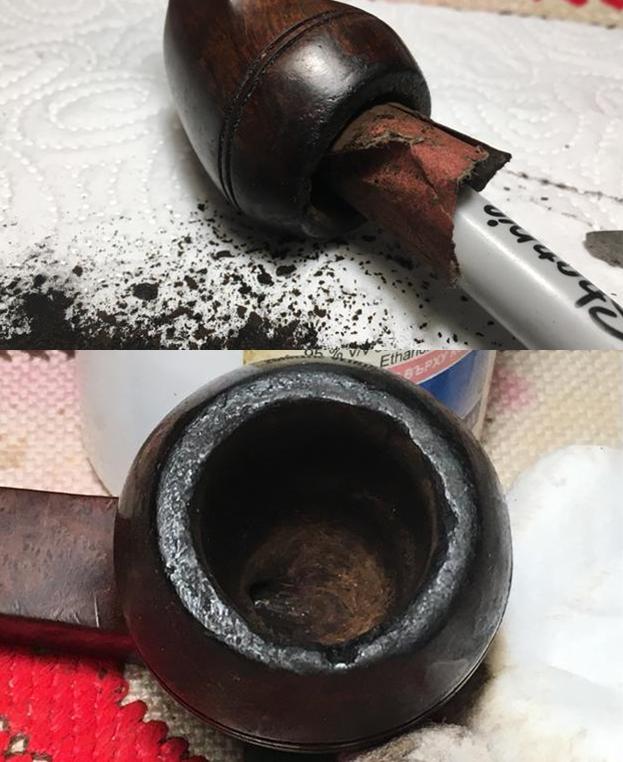
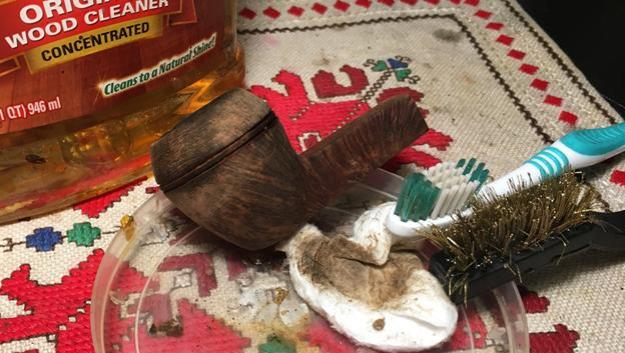
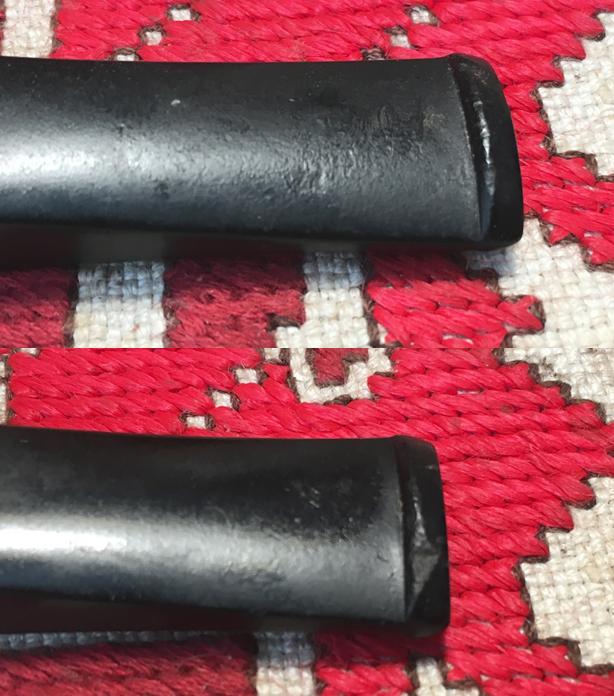
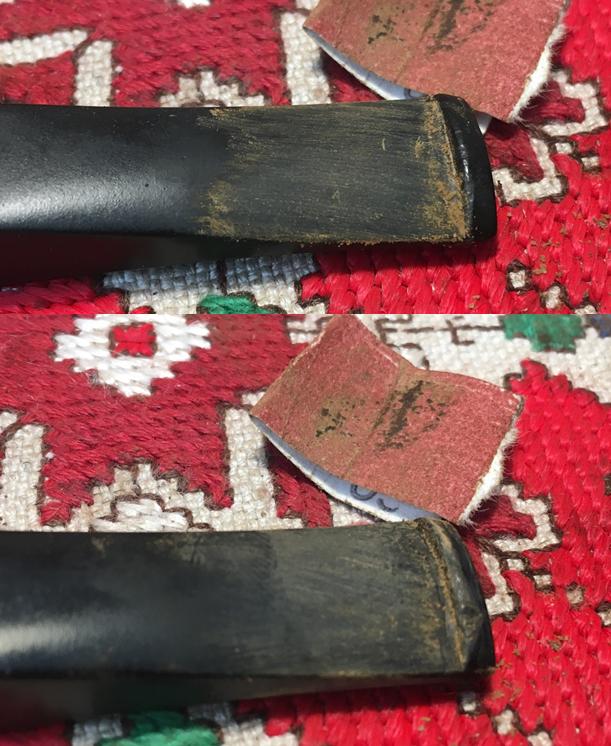
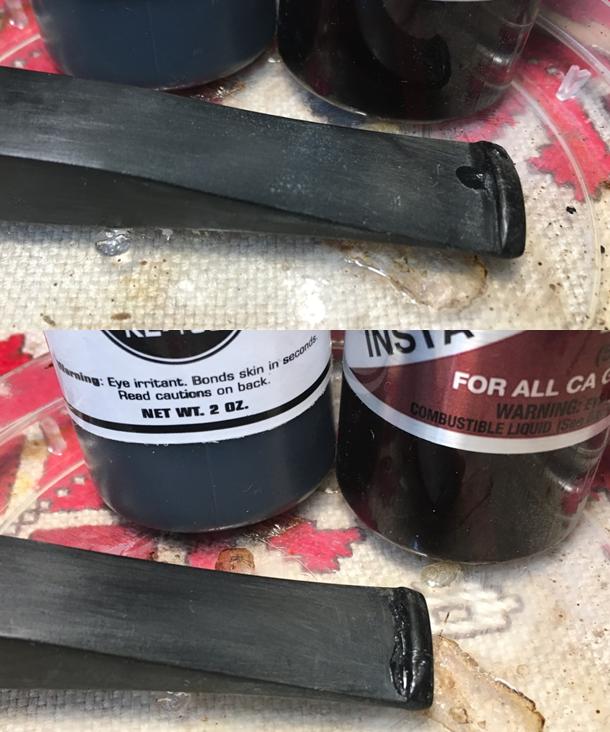
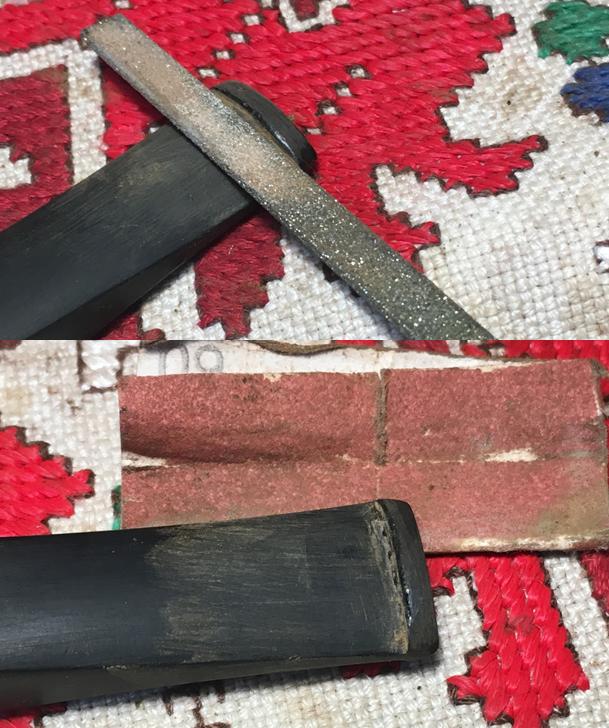
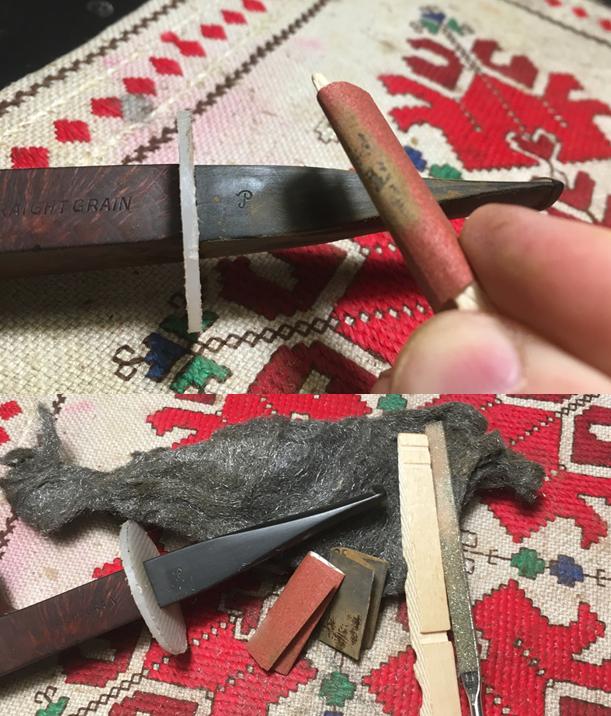
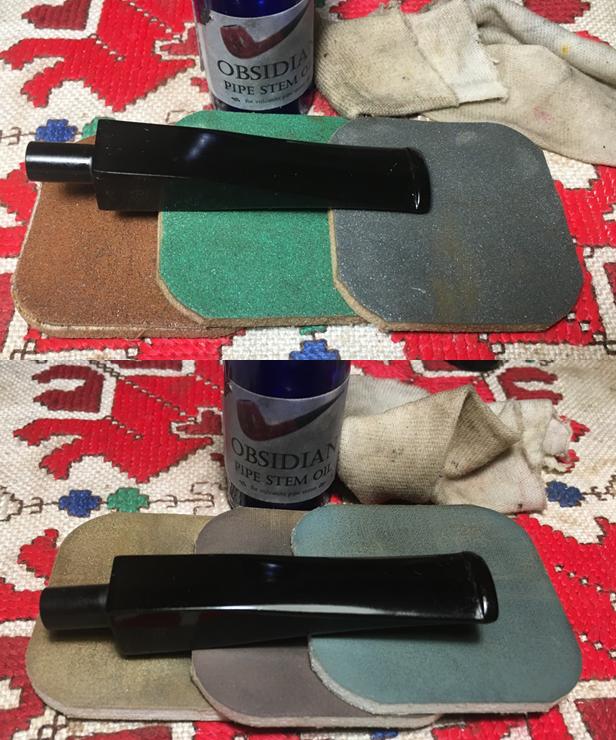
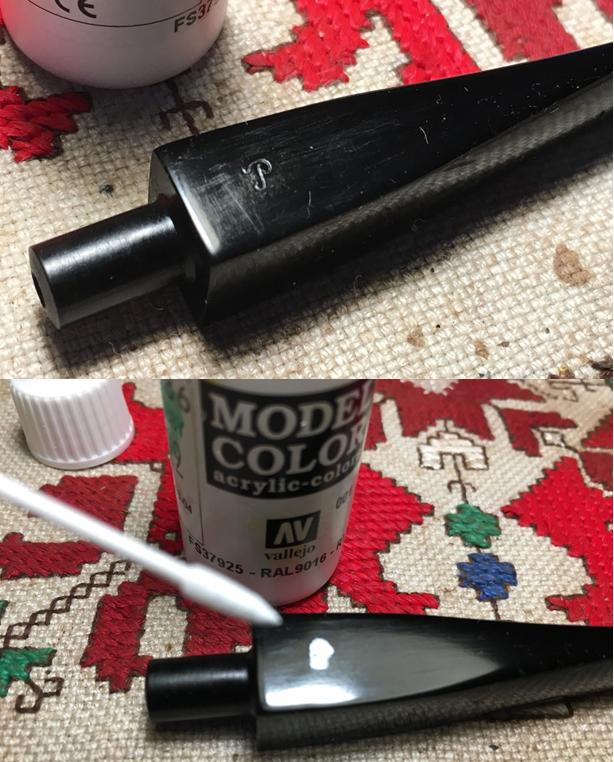
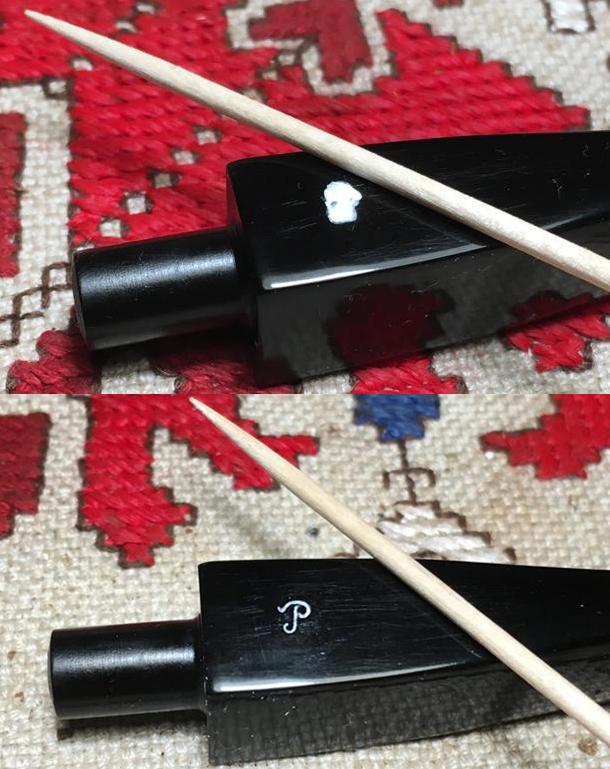
The BC before me does not have a clear acrylic stem, yet it could be described as opaque in places.  The only thing that is a significant obstacle to recommissioning this BC Cadre Noir is the damage to the gray swirl acrylic stem.  The pipe generally needs only a clean-up.  The upper button has chipped off and needs to be rebuilt.  The challenge in this rebuild is getting anywhere close to matching the colors of the patch material and the acrylic stem grays.  Before I begin any repairs, I clean the pipe.  Starting with the fire chamber, using the Savinelli Pipe Knife, I scrape out the minor carbon build up on the chamber walls.  Following this, using 240 grit sanding paper wrapped around a Sharpie Pen I clean the chamber out further.  I finish by wiping the chamber with a cotton pad wetted with alcohol to remove the carbon dust.  Now looking to the external rustified surface, I use Murphy’s Oil Soap undiluted with a cotton pad and a bristled tooth brush to get into the nooks and crannies of the surface.  The pictures show the cleaning. Switching to the internals, I use pipe cleaners and cotton swabs to do the job.  When I realize my time is waning, I decide to complete the internal cleaning and refreshing with the use of a salt – alcohol bath.  Using kosher salt, I fill the bowl, and stretch and twist a cotton ball to create a wick to stuff down the mortise.  I fill the bowl with alcohol until it surfaces over the salt and I put it aside to let it soak for several hours. The soak did the job when I return home later that day.  The salt and wick had absorbed the oils and tars from the briar.  I toss the old salt, wipe the chamber with paper towel and use a bristle brush to remove all the salt residue.  I return to using cotton swabs and as billed, the soak had done the job.  The pictures show the cleaning process.Now to the acrylic stem.  I first clean the internals which were in great shape.The major challenge I face with this BC Cadre Noir 1845, is the acrylic stem button repair.  I did a repair on a Meerschaum’s Bakelite stem which was a clinic in trial and error, but finally realizing success.  That Meerschaum is now a good friend in my rotation and you can see the Bakelite stem repair at The Pipe Steward blog site here: LINK.  I take some additional close-ups of the chipped button.  This acrylic stem has a gray marble color.  The good news is that the lower button (pictured above) is intact and acts as a template for the upper button rebuild.  The challenge is matching the patch material color with the multi-colored hues of gray.  My idea of how to approach this is to use clear thick CA glue as a base.  I will mix some white acrylic paint with it to create the light base.  Then, I will very gradually add activated charcoal to the mixture to create the movement toward the grays.  I have no idea how the white acrylic paint and the CA glue will react together.  I begin this repair using a needle file to work on the button while its exposed – filing down the lower surface of the slot which is rough from the break.  I then cut an index card forming a triangle, cover it with scotch tape which prevents the patch material from adhering to it, and insert it into the slot acting as a mold.  The mold will shape the slot area as well as guard the airway from the patch material seeping into it and clogging it. Well, mixing white acrylic paint with CA glue doesn’t work, so don’t try that path!  The paint immediately gummed up as it was mixed and did not provide a lightening effect.  To build the button, I end up simply applying thick CA glue and charcoal powder mixture to the button and spraying it with an accelerator to shorten the curing time.  It doesn’t have the gray hue I was wanting to blend better, but it should look ok after sanding and shaping.  I pull out the index mold and the slot looks rough now, but good.  Using a flat needle file, I start shaping the button lip.  Without a doubt – in my opinion, button rebuilding is the most time consuming and meticulous aspect of restoring estate pipes.  Patiently, I file the button and slot to a shape that is consistent with the original button curvature.  Using the lower lip as the template, I shape, file, shape, file….  It’s looking good.  Pictures show the progress. With the main file sculpting done, I use 240 grit sanding paper and sand the button, bit, and slot to blend the patch and the native acrylic.  Then, using 600 grit paper I fine tune, then a hearty buffing with 0000 steel wool.  Often when rebuilding a button, the patch material reveals air pockets as the sanding and buffing move toward the final stages.  This button was no different.  To cover these air pockets, I paint a fine layer of thick CA glue over the lip with a tooth pick.  The air pocket pits are filled with the CA glue.  I again run over the lip surface with a light 240 grit, then 600 grit papers, then the final 0000 grade steel wool buff to blend. With the button repair completed, I move on with the micromesh pad sanding of the acrylic stem.  I wet sand using pads 1500 to 2400.  I follow this with pads 3200 to 4000 then finish with pads 6000 to 12000.  I’m careful to avoid the ‘BC’ stem stamping as I sand. During the sanding, I also sand the white acrylic divider between stem and shank to spruce it up as well.  Even though I don’t believe the application of Obsidian Oil helps an acrylic stem, I do it anyway because it looks good and seems to bring out the marbling.  I have to admit, the button’s rebuild came out better than expected.  Even though I couldn’t create the gray hue in the patch material, the black seems to blend perfectly with the stem.  The dubbing of this Butz-Choquin Cadre Noir as being a ‘modern’ pipe, I think fits well with the results – looks great.  The pictures show the stem’s progress. Next, I look at the BC’s rustified stummel.  The dark deep contours of the bubbled rustication make the peaks of the bubbles stand out.  I like the Leprechaun look of the pipe.  To polish and protect the surface, I use Museum Wax wetted with a bit of spittle, applying it with a cotton cloth.  I work the wax into the crooks and crannies of the rustification.  After working the Museum Wax into the rustified surface, I do an initial hand buff with a bristled shoe brush.  Following this, to deepen the buff and heighten the shine, I mount the Dremel with a cotton cloth buffing wheel set at 40% speed and buff the surface further.  Pictures show the progress. Again, picking up the stem, after mounting the Dremel with a cotton cloth wheel for Blue Diamond, I buff the acrylic stem with a high gloss using the compound.  Before applying carnauba wax to the stem, I want to freshen the ‘BC’ stamping on the side of the stem.  The ‘C’ has grown less distinct.  Using white acrylic paint, I apply it over the stamping hoping that there’s enough edge left in the ‘C’ to hold the paint.  After it dries, I gently rub off the excess paint using the middle flat edge of a tooth pick.  The ‘BC’ is a bit more distinct now.  Pictures show the progress. The cotton cloth is mounted on the Dremel and I apply carnauba wax to the acrylic stem at 40% speed.  After applying the carnauba over the stem, I reunite the gray marbled acrylic stem with the Leprechaun stummel and give it a good hand buff using a micromesh cloth.

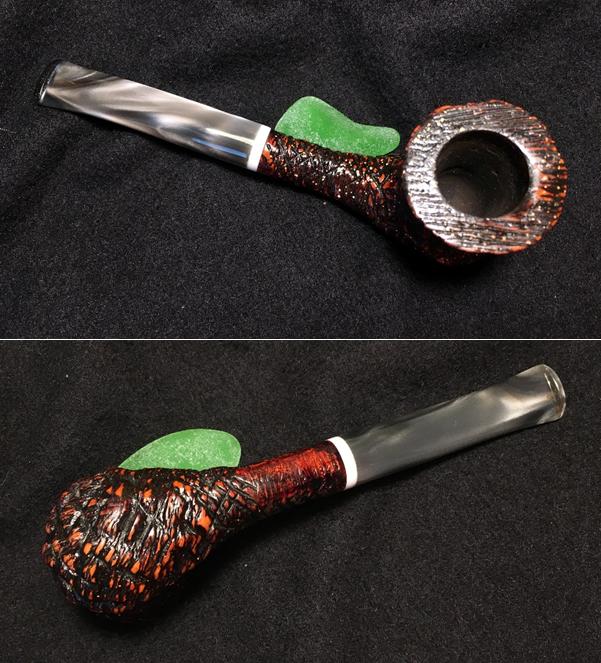
I’m very pleased with the outcome of the button rebuild and how well the patch material blends with the gray marble acrylic stem.  This French made Butz-Choquin Cadre Noir 1845, is a unique shape and will draw attention.  I’m happy to recommission this BC for Joy’s brother who will be his new steward.  Joy’s gift benefits the Daughters of Bulgaria, our work here in Bulgaria with women and girls who have been trafficked and sexually exploited.  Thanks Joy!  To learn more about how my restorations help, check out my blog, The Pipe Steward.  Thanks for joining me!

Jen’s Trove No. 8 – Restore & Upgrade of a Dr. Grabow Omega Smooth Billiard


Blog by Dal Stanton

I begin the restoration of the final pipe in Jen’s Trove before she leaves Bulgaria and returns to the US.  As I have posted eight times before this (I just figured out that I mis-numbered her pipes – two number 5s!), these pipes have been culled from my “Help Me!” basket and boxes to give as gifts to the men in her family.  I have been pleased to restore these pipes for Jen, especially because she knows each pipe she acquires benefits the Daughters of Bulgaria, help women and girls who have been sexually exploited and trafficked.  Thank you, Jen!

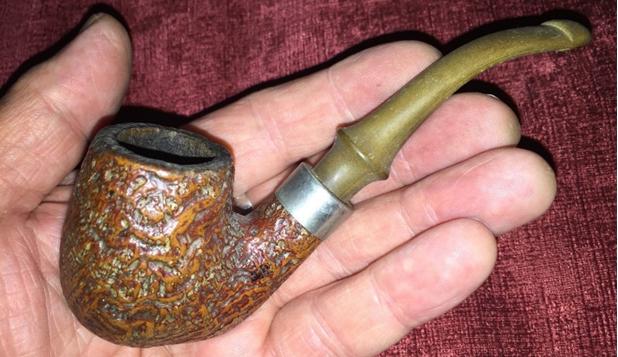
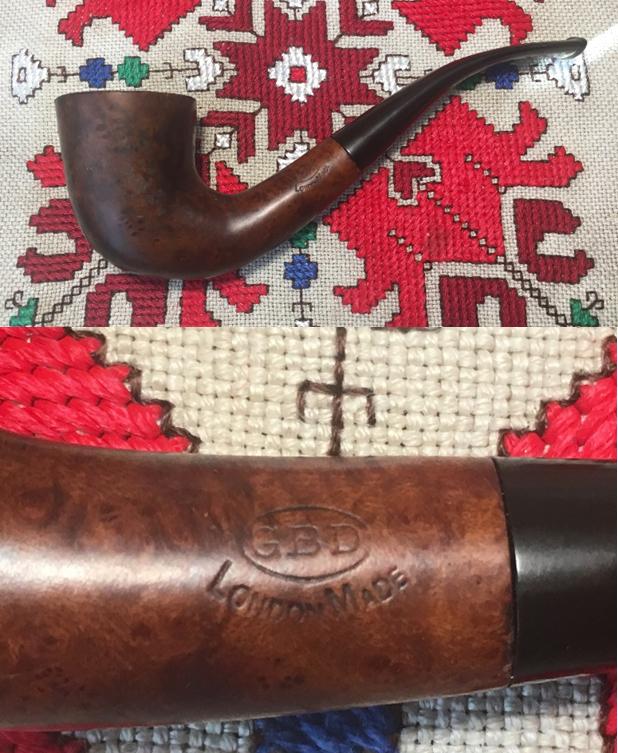
Her final pipe is a Dr. Grabow Omega Smooth Billiard – Dr. Grabow’s humbler version of a Peterson System pipe or the WDC Wellington.  Similarities include the Military stem with a P-Lip, and band.  The Omega is a smart looking pipe.  The eBay seller had a good selection and I rolled the Dr. Grabow Omega with four other pipes.  One of these was a GBD Americana Made in England which I restored (See this link at The Pipe Steward) and has become a regular friend in my rotation.  The restored Americana follows and then the seller’s picture of the Dr. Grabow Omega. The Lewis B. Linkman Co. started in 1892 (Pipedia).  Yet, the name, Dr. Grabow, was used for the first time in 1930 or 1931.  Since this is my first Dr. Grabow to restore, I find the story of the ‘Dr. Grabow’ name interesting because the Doctor is a real doctor!  From Pipedia’s article on the history of Dr. Grabow (and photo courtesy of Doug Valitchka):

Dr. Paul E. Grabow was a general physician in Chicago, located at 2348 N. Seminary Ave. Some doors north at No. 2400 was the drug store owned by Mr. Brown, a personal friend of Dr. Grabow. Grabow and Brown, both fond of fly-fishing, would often sit together in the early evening hours in a back room of the drug shop talking to one another and enjoying their pipes. Before long, they were joined by Mr. Linkman, owner of M. Linkman & Co., a large pipe factory located one block west on W. Fullerton Ave., at the corner of Racine Ave. These three gentlemen shared common interests and became fast friends.

During one of their evening get-togethers in 1930, Linkman mentioned he would introduce a new type of pipe soon that exhibited what he felt were fine improvements that greatly improved the pipe smoking experience. He was still looking for a good name and believed his pipes would sell better if they bore the name of a physician. (1) Linkman asked his friend Dr. Grabow if he would permit him to use his name. The good doctor felt flattered by the idea a pipe should be designated for him and consented. A formal agreement was not made, nor were there any contracts signed or royalties paid to Dr. Grabow for the use of his name; it was, according to one of Dr. Paul Grabow’s sons, Milford, a “friendly understanding” and Linkman expressed his thanks by sending Dr. Grabow numerous pipes throughout Dr. Grabow’s lifetime. (see The Legend of Dr. Grabow). Also interesting of note are the various instances where Dr. Paul Grabow stated that he developed, or helped develop, the Dr. Grabow brand of pipes. This was a tactic used to convince people that a pipe developed, endorsed, and used by a medical physician would be ‘more healthful’ than a pipe that was not developed by someone in the medical community.

Dr. Grabow pipes have been known as inexpensive, quality smokers – the ‘Drug Store’ variety.  The Dr. Grabow Omega line started production in the 1970s (LINK) coming in a smooth and blasted finishes.

I take additional pictures of the Omega on my work table to fill the gaps.  The nomenclature is stamped on the shank sides – OMEGA [over] DR. GRABOW on the left.  The right is stamped, IMPORTED BRIAR.  The Military mount stem has the classic Dr. Grabow Club card suit mark.  Overall, the Omega is in good shape.  The fire chamber has very little carbon cake.  The stummel surface and rim are clean.  The P-Lip stem has chatter especially on the lover button area and the stem shows no oxidation.  The biggest problem that I see on this Dr. Grabow is the finish.  I don’t like it.  These two comments on a Pipes Magazine Forum discussion about Dr. Grabow Omegas’, cost, quality and appeal, capture my thoughts regarding positives and negative:

Positives: An Omega was the first briar pipe that I ever owned. It still gets regular use and like Brewshooter, I have no complaints with it. Bowl size is a little bit smaller than I like, but it makes for a nice quick smoke, and the military mount makes it really easy to clean. I have Savinellis that I have easily paid four times more for, and sure, they smoke a little bit better, but in terms of a good smoking instrument, the Omega will do you well as long as it is smoked properly and maintained properly.

Negative: One thing I noticed about my Omega is that it had a heavy varnish or clear coat. I sanded it and gave it a nice wax. It seems to breathe a little better now and I like seeing more of the grain. I also gave the band a bit of a brushed look with some fine grain sandpaper. It’s a nice little pipe for that quick smoke.

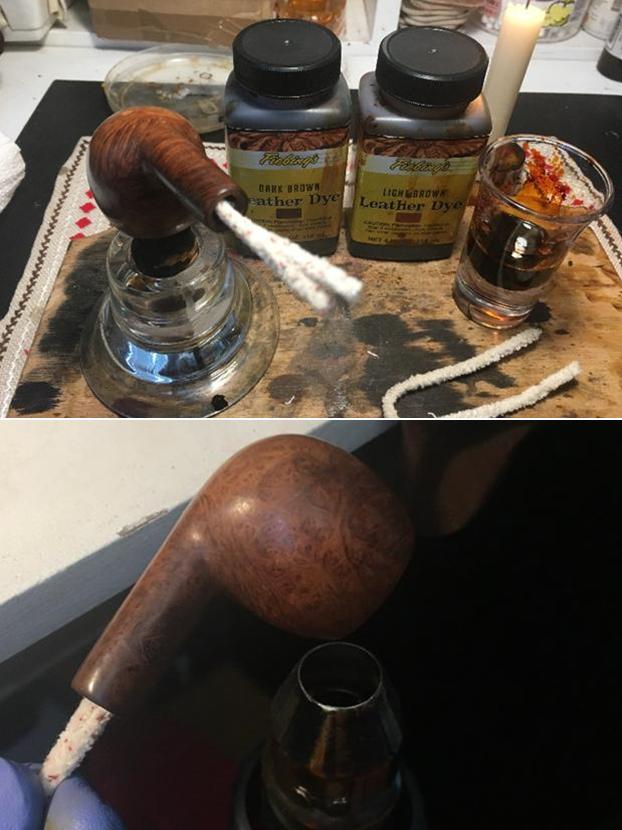
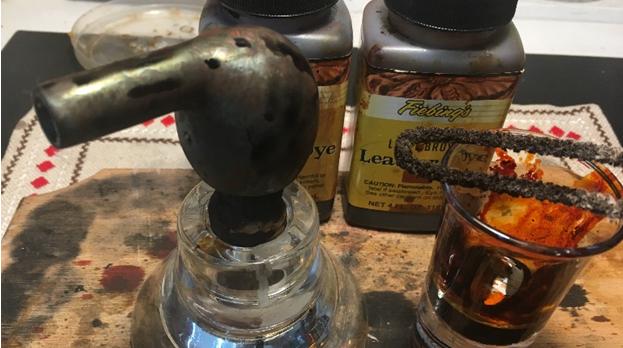
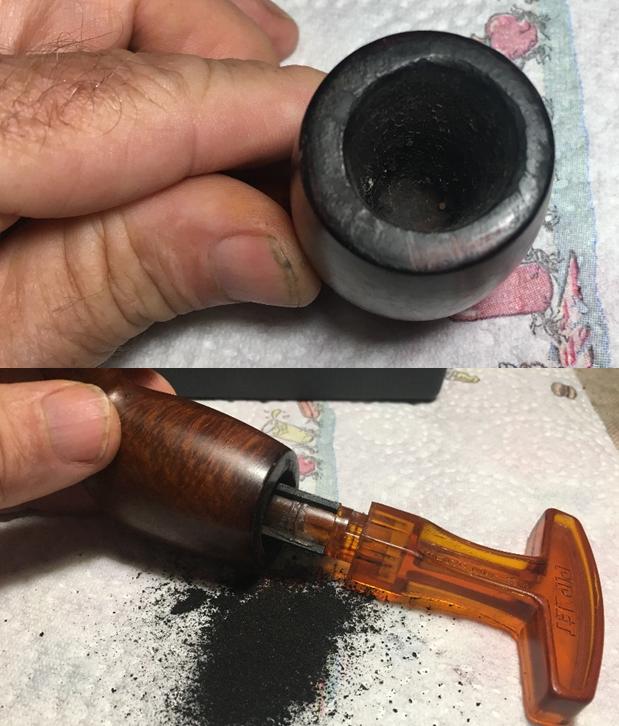
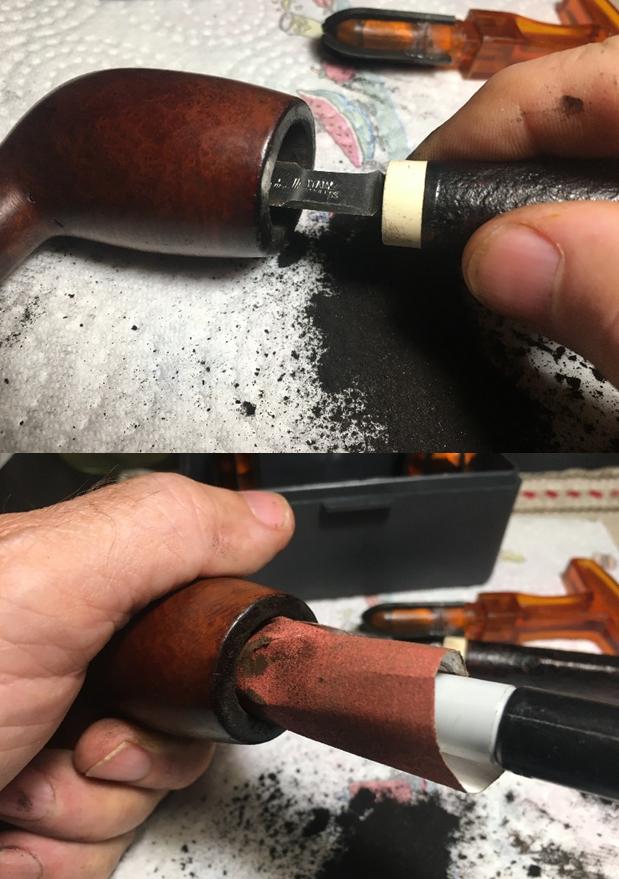
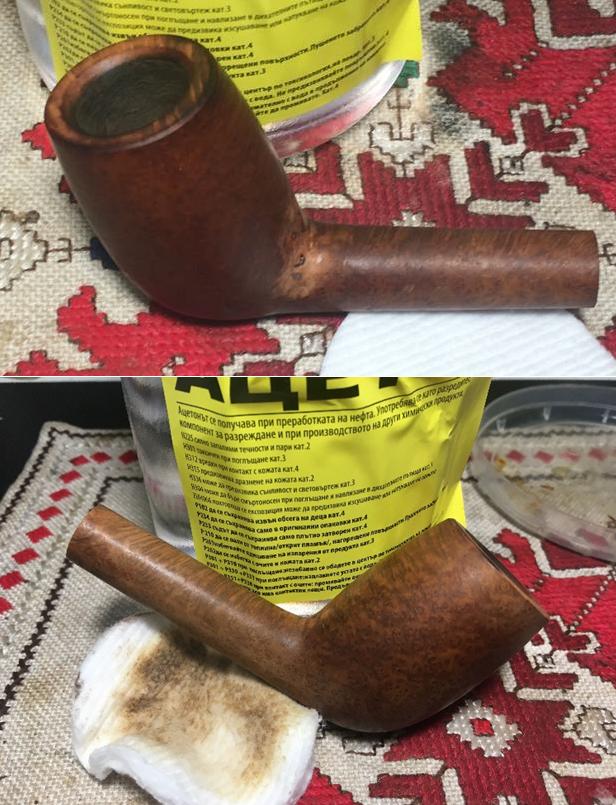
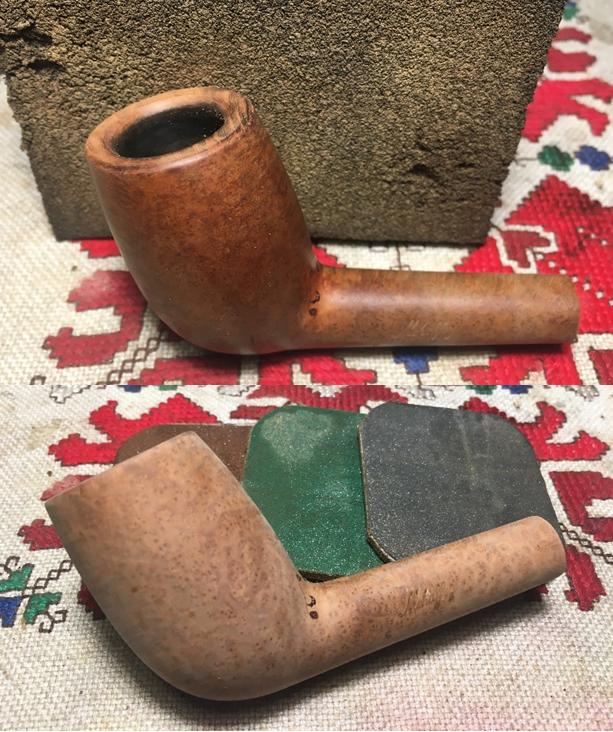
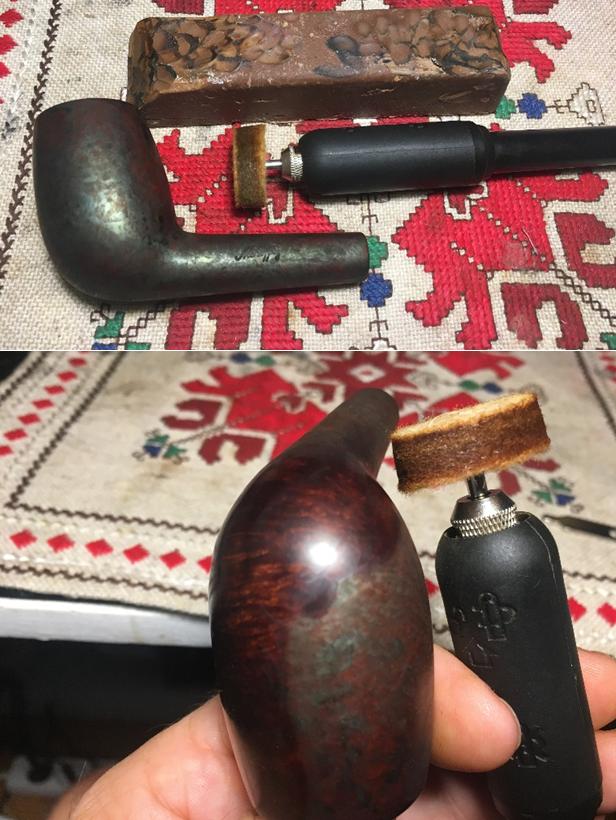
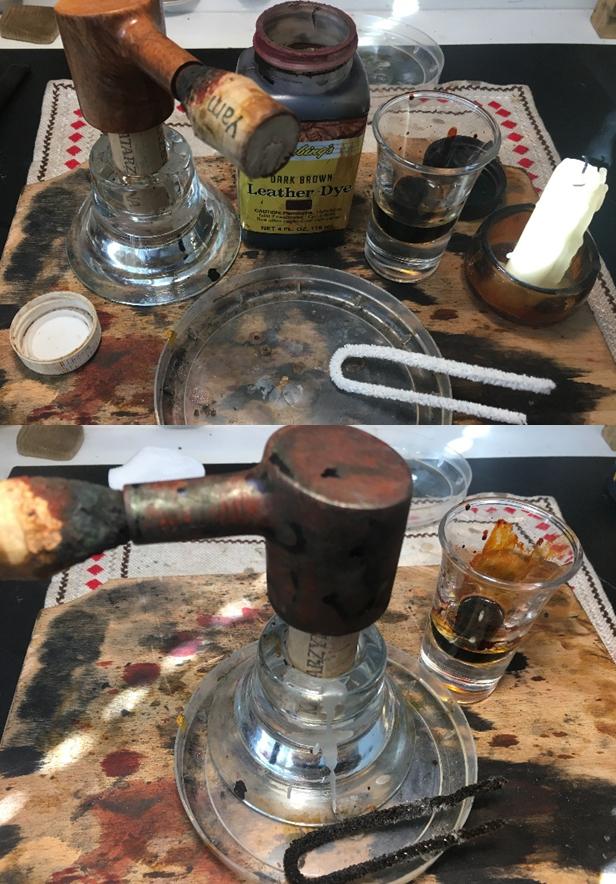
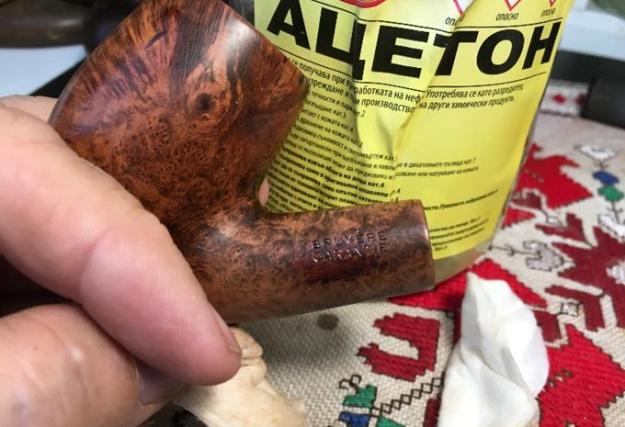
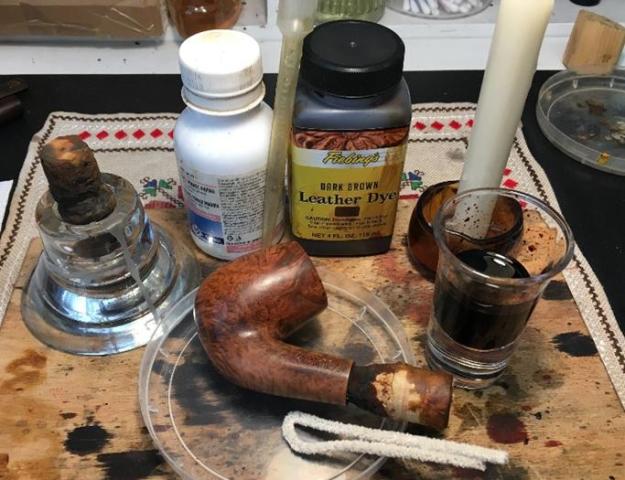
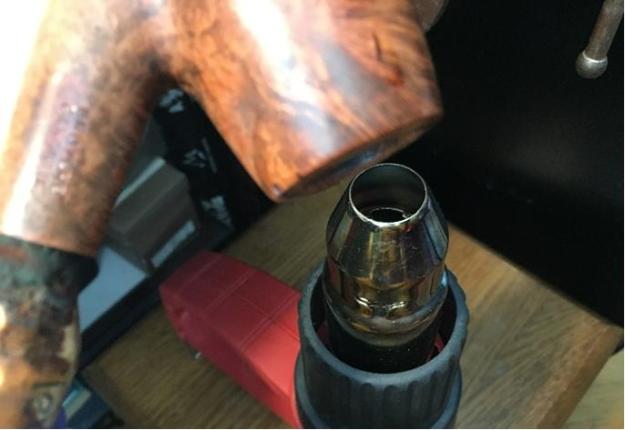
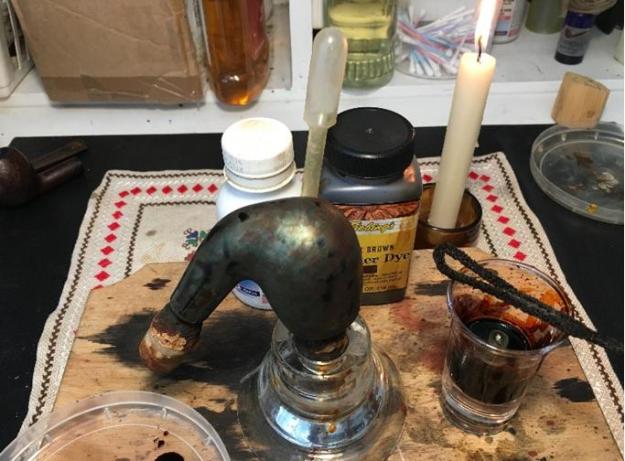
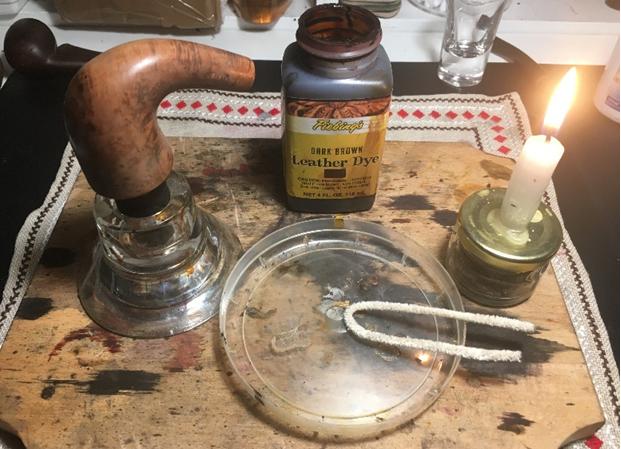
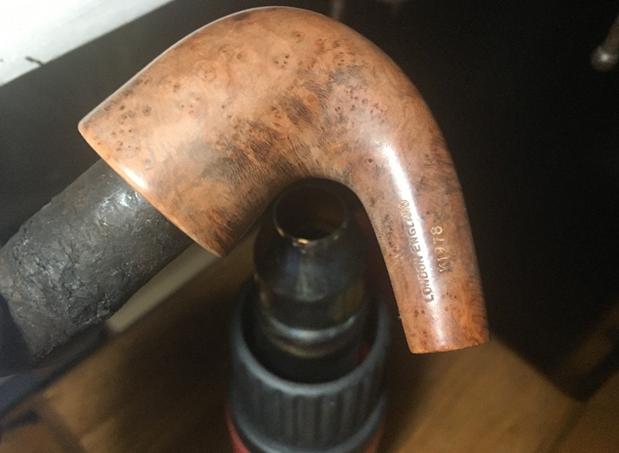
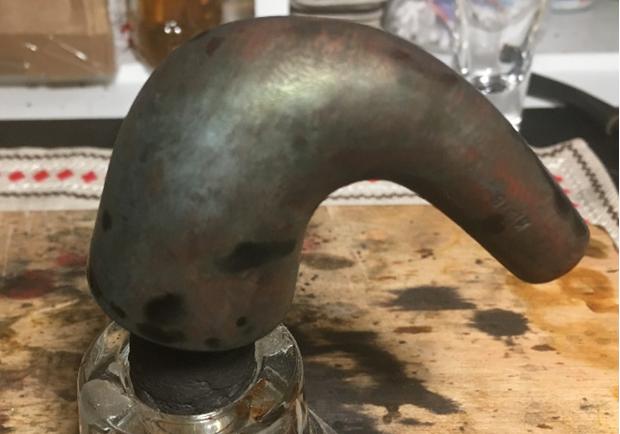
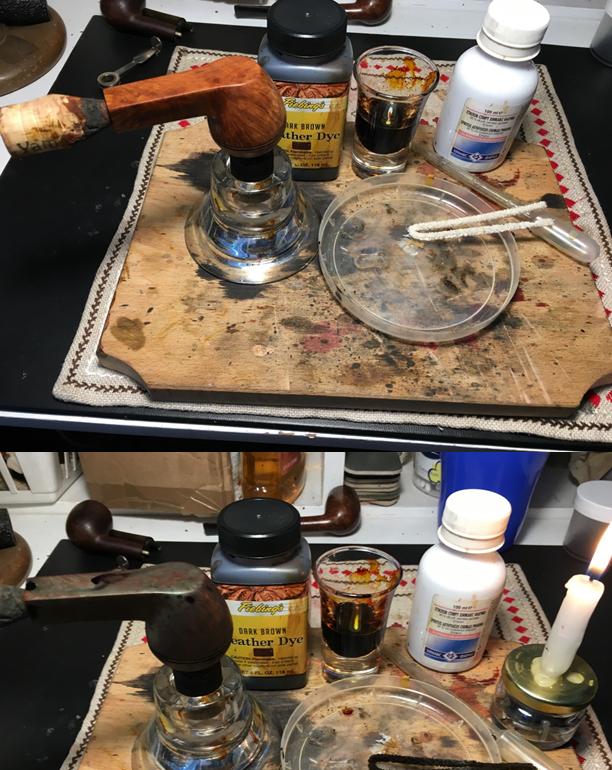
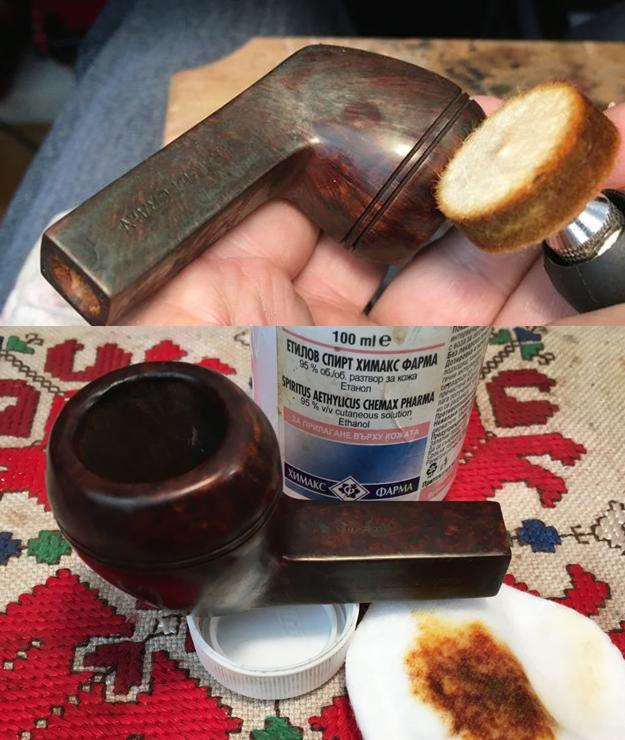
I remember when I first saw the Dr. Grabow Omega sitting in my palm after it arrived in the mail.  My first thought was, ‘Nice pipe if it didn’t have that candy apple finish.’  Even then, I knew when this pipe came to my work table, I would be removing the finish – it may be an acrylic finish and they often are bears to remove.  I’m hopeful that the acrylic finish doesn’t hide a lot of surprises.  So, with a better understanding of the Dr. Grabow Omega, Imported Briar before me, I begin its upgrade by putting the military mount stem in the OxiClean bath.  Even though I don’t detect oxidation, I want to be sure that what is there will be raised and revealed. The very light carbon cake in the bowl is addressed with the Savinelli Pipe Knife.  After putting down paper towel for a quick clean up, I ream the cake and follow by sanding the bowl with 240 grit paper wrapped around a Sharpie Pen for better leverage.  I then wipe the bowl using a cotton pad wetted with isopropyl 95% to remove the residue carbon dust.  The pictures show the progress. Even though I think it will be unsuccessful, I first try to remove the acrylic finish using cotton pads wetted with acetone.  Was I surprised.  The finish peels off immediately with the acetone.  What I thought was acrylic is more like a jell that thickens with the acetone and gums up on the surface.  It also has a reddish color to it.  I use several cotton pads because they gum up quickly with the red goo coming off the surface.  While I remove the red top layer of finish, after working on the stummel with the acetone, it still is darker than I expected if all the finish had been removed.  I also am now able to see more fills – one larger area in the back of the bowl, over the shank.  That will need some attention.  I take some pictures of the progress and fills.  I decide to let the stummel soak in an acetone bath to remove more of the old finish.  While the stummel soaks in the acetone bath, I fish the Military mount stem out of the OxiClean bath and take a picture.  While there is not much in the way of oxidation showing on the stem, the OxiClean had the effect of bringing out small speckling on the surface.  I use 600 grit paper and wet sand the surface of the stem.  I follow with a rigorous buffing with 0000 grade steel wool.  The 600 grit paper and steel wool were sufficient to work out all the tooth chatter.  I then use pipe cleaners and cotton swabs wetted with alcohol for the filter bay, and to clean the internals of the stem.  Very little was needed to finish the job. Now it’s time to fish the stummel out of the acetone bath.  The finish is removed and I’m looking at the natural briar and it does have a darker hue.  I use a sharp dental probe to test the fills I see variously around the stummel.  I see a few very small fills and most seem strong.  On a few, and on the large fill that I referenced before on the back side of the bowl, above the shank, the fill has a crevasse next to it.  Before working on the stummel fills, I first use a medium grade sanding sponge followed by a light grade sanding sponge to remove the surface blemishes on the stummel.  I like using the sanding sponges because they are gentler than regular sanding paper and soft – conforming to the nooks and crannies of the curves of the stummel.  I also do a ‘sponge topping’ to clean up the rim.  One of the things I want to do to upgrade this Dr. Grabow Omega is to work on the rim.  To me, the flat-top, sharp cut of the rim is detracting. I will introduce an internal bevel and a very gentle external bevel on the rim lip to soften the lines.  As I have said in several other restorations, I believe a beveled rim classes up the pipe.  I use a coarse 120 grit rolled piece of sanding paper to cut the initial bevel, and then following with 240 then 600.  The final picture below shows the addition of the external bevel which is less obtrusive.  I use only the 240 grit paper followed by the 600 grit paper to fashion this bevel.  I do the external bevel like this as more of an accent to the rim – softening the lines.  I really like the grain movement on the rim – upgrading Dr. Grabow Omega! After the sponge sanding, almost all of the pitting and nicks are removed from the briar surface.  At this juncture, only the large fill on the back of the stummel needs attention.  I take a close-up to show the fill.  I use Hot Stuff Special ‘T’ CA glue to fill the crevasse running along this fill. I drip a bit of glue on a toothpick and run the drop to the point to strategically place the glue.  Afterward, I spray the CA glue with an accelerator to shorten the curing time.  In a few minutes, I use a flat needle file to file the mounded CA glue down close to the briar surface.  I then use 240 grit and 600 grit paper to bring it down flush with the briar surface and blend.  Finally, I use the medium and light grade sanding sponges to finish the blending.  The pictures show the progress. With the patch sanded down, I’m ready to utilize micromesh pads on the bowl to bring out the grain of the briar.  I begin by wet sanding using micromesh pads 1500 to 2400. I follow by dry sanding with pads 3200 to 4000 and then 6000 to 12000.  Oh my, oh my.  I love to watch the grain emerge through the micromesh cycles.  This Dr. Grabow is looking good for a drug store pipe! Standing back a bit and looking at the Dr. Grabow Omega again, I reunite the unfinished smooth Billiard stummel with unfinished Military Mount stem to assess where things are and get a sense about which way this Omega wants to go in his upgrade. I’m drawn to the black, darker hues of the natural briar.  The currents of the briar’s grain flow remind me of a storm with bird’s eye swirls and flamed currents unleashed in the wind.  The stummel heel has an almost solid dark plane with a spurt of grain reaching out.  This Dr. Grabow’s newly revealed grain has some personality – no doubt! This grain pattern reminds me of a restoration I did with a very large pipe, A Desirable Reject London Made, where for the first time I used black dye as part of the staining mixture.  The results were surprising to me by pulling out almost a copper kettle hue – attractive.  Here is a picture of that project.For the upgrade of this Dr. Grabow Omega, I decide in favor of the same approach mixing 2/3s-parts Fiebing’s Dark Brown Leather Dye with 1/3-part Fiebing’s Black Leather Dye with the lightening option available by wiping down the bowl with alcohol later.  I set up my staining station and take a picture to show the setup and tools.  What I didn’t show are the latex gloves I’ve started wearing to keep my hands from being colored!  After inserting a fashioned cork in the shank as a handle, I warm the stummel with the hot air gun to open the briar grain for better reception of the dye.  Then, using a folded over pipe cleaner, I liberally apply the dye mixture to the stummel to have 100% coverage.  While the dye is wet on the stummel, I fire it using a lit candle and the alcohol in the aniline dye immediately burns off, setting the pigment.  After a few minutes of cooling, I repeat the process above and then set the stummel aside to rest.  The pictures show the staining process. With the stummel resting, I take the stem and wet sand with micromesh pads 1500 to 2400.  I follow by dry sanding with pads 3200 to 4000, then 6000 to 12000.  After each cycle, I apply Obsidian Oil to the stem to revitalize the vulcanite.  The stem looks good!  I put the stem aside to dry. This point of the process is like a kid getting up on Christmas morning!  With the stained, fired, crusted bowl in hand, I mount the felt buffing wheel in the Dremel, set the speed at the slowest speed (20%) and use the Dremel’s adjustment wrench to purge the wheel of old compound and to soften it.  Using Tripoli compound, I ‘unwrap’ the stummel with the felt buffing wheel.  When I finish with the Tripoli, I wet a cotton pad with alcohol and wipe down the stummel.  I do this to lighten it a bit and to blend the dye.  Then, with the cotton cloth buffing wheel mounted to the Dremel, and turning up the speed to 40%, I apply Blue Diamond compound to the stummel and use it to buff up the nickel planted band.  While the Blue Diamond buffing wheel is mounted, I also use it on the stem to buff.  The pictures show the progress with the compounds. Well, it was going so well until it wasn’t!  My wife arrived home with KFC Chicken for supper that we ate on the ‘Man Cave’ balcony of our 10th floor flat.  Yes, we have Colonel Sanders in Bulgaria. After finishing the chicken which was ‘finger licking good’ I was anxious to show my wife the progress on the Dr. Grabow.  You can guess.  On the balcony, perhaps because of the ‘finger licking good’ chicken was still a bit on my fingers, the Dr. Grabow literally took off and launched from my hand and hit the floor.  With inspection, the dent on the rim was evident… oh my.  Oh well….  I remembered in the back of my mind, I think I read it on an Al Jones’ post, about using a wet towel super-heated with the help of an iron, can help expand dented wood as it heats and absorbs the moisture.  Wood is more like a sponge.  I used my wife’s iron and gave it a go.  Believe it or not, it worked well.  Before and after pictures are #1 and #3.  The briar had dulled where the iron was applied so again I use the buffing wheel with Blue Diamond to restore the sheen with the rest of the stummel. Disaster averted.  Thanks, Al!  I buff the stummel with a clean cotton cloth to remove compound residue.  I mount the Dremel with a cotton cloth buffing wheel and apply carnauba wax to stem and stummel.  Following a few coats of wax, I give the entire pipe a hand buff with a microfiber cloth.

This Dr. Grabow Omega was an unremarkable ‘Drug Store’ pipe.  Now, he’s enjoys an upgrade – he has cuff links now!  The grain hidden underneath the original finish is not unremarkable!  I’m pleased that all this Omega needed was a little TLC.  Jen will give this pipe to one of the men in her family.  ALL the gifts she has given benefit our work here in Bulgaria with the Daughters of Bulgaria – helping women and girls who have been trafficked and sexually exploited.  This Dr. Grabow is the last pipe in Jen’s Trove.  Thanks, Jen!  Check out The Pipe Steward to find out more about why I do what I do.  Thanks for joining me!

Jen’s Trove No. 7 – A Trident Blasted Bent Billiard with a Question of History


Blog by Dal Stanton

This pipe represents the 7th of 8 pipes that Jen rescued from my ‘Help Me!’ baskets.  She’s leaving Bulgaria very soon returning to the US after working with us for a few years.  She is not returning without gifts!  She has chosen a trove of pipes that have garnered her attention to give as gifts to the men in her family.  Each of these gifts has the added benefit of helping the Daughters of Bulgaria, our work here in Bulgaria with women and girls who have been sexually exploited and trafficked in Europe.  My love of restoring pipes as The Pipe Steward is a way of shining a light on the tragedy of those caught in this modern-day slavery.

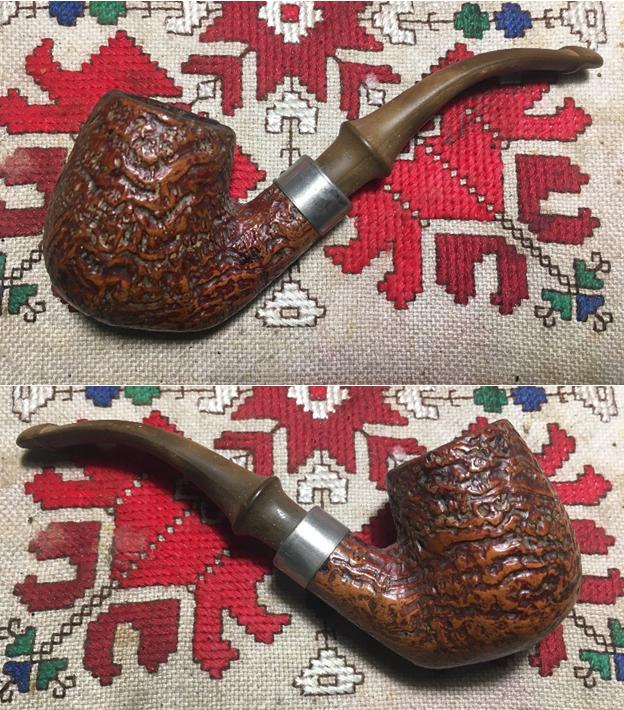
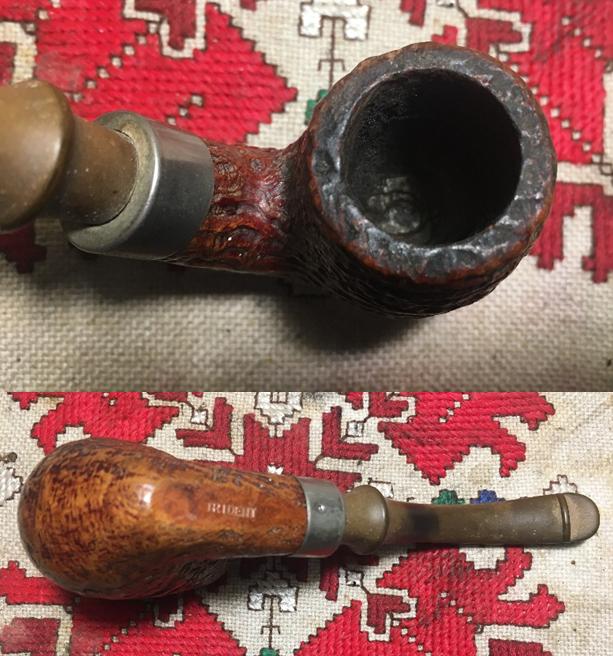
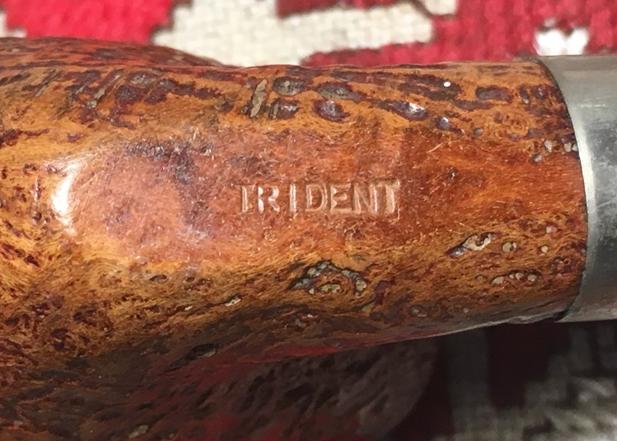
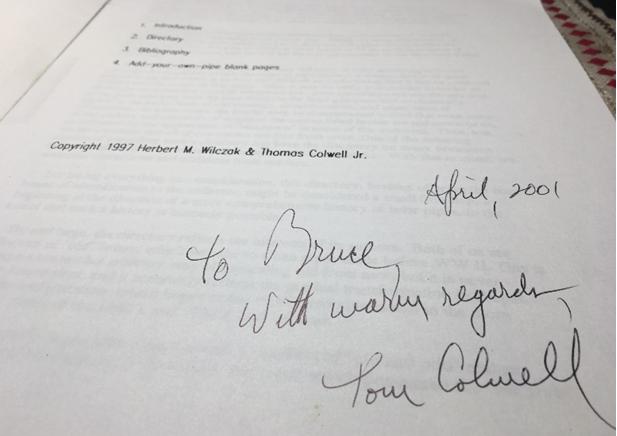
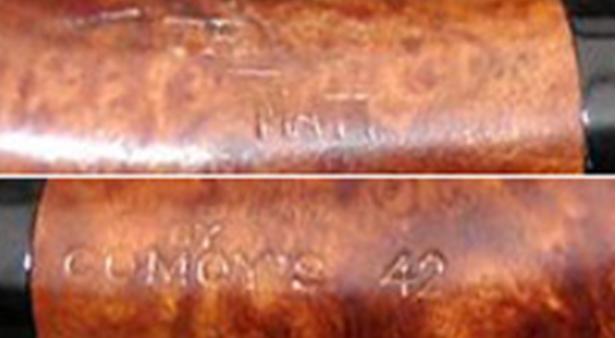
The ¾ Bent Billiard got Jen’s attention I believe, because of the blasted finish.  The only stamping is under the shank and it is marked, “TRIDENT”.  However, when I saw this pipe from an eBay seller in the UK, my attention was drawn also to the old-style P-Lip military stem and the old vintage feel of the pipe overall.  Here’s what I saw on eBay UK:This seller had other offerings which I also placed bids to take advantage of combined shipping from UK to Bulgaria.  With the Trident, I added a Hardcastle ‘Deluxe’ No. 12, and a Bewlay ‘The General’ to my basket for restoration.  Now, on my work table on the 10th floor apartment of a formerly Communist apartment block, I look at the Trident with the question, ‘Is this pipe actually vintage old or does it just look old?’  I take more pictures to fill in the gap. My first action was to look in my autographed copy of my eBay acquired copy of, ‘Who Made That Pipe?’ by Herb Wilczak & Tom Colwell.  It’s not autographed to me, but still cool!In ‘WMTP?’ the name ‘TRIDENT’ was associated with two names, ‘E Deguingand & Son/ H. Comoy’.  Country of origin, ENGL.  First looking at Pipedia’s article on Comoy’s, I discover that ‘Trident’ is a second made by Comoy’s – one among many!  Looking at PipePhil.eu, I found an example of this Comoy second which still displayed the ‘Comoy’s’ stamping and nomenclature.  The Trident before me carries no other markings and for this reason, I’m dubious of it being from the Comoy’s line of seconds.Then I turn to ‘E Deguingand & Son’ to see what I can find.  Pipedia has a helpful article that collates information about the name.

Deguingand & Son

Emile Deguingand & Son, Ltd. was a briar pipe maker in London at the end of the 19th and beginning of the 20th centuries. Originally they manufactured pipes in London, on Hamsell Street in Cripplegate, but that entire area was destroyed in the fire of 1897. Deguingand began selling at 5 Colonial Avenue, Minories, East London beginning in 1897. That same year Emile Deguingand purchased a pipe factory built by Charles Cayron in 1885 and 1886 at a place called Sur les Etapes in St. Claude, France. The factory in St. Claude was raised and enlarged in 1900 and 1902.

In 1906 Deguingand was granted a patent in France for a pipe consisting of a removable combustion chamber over a lower chamber filled with asbestos into which the airway ran.

In 1910, E. Deguingand & Son, known in France as E. Deguingand et Fils, became S.A. des anciens Etablissements Deguingand et Fils with Francis and Paul Deguingand’s entry into the business. While the plant doubled in size in approximately 1926, it was closed around 1930 and later converted to a commercial warehouse.

One pipe line known to have been sold by Deguingand was the Trident.

The last line is interesting in terms of the exclusivity it seems to imply.  The article is helpful but leaves out much and creates more questions.  When Deguingand opened operation in St. Claude, France, 1897, the same year opening another location in London after the fire of 1897, the assumption I believe, that is true, is that operations continued in both London and St. Claude under the Deguingand name.  The indication is that the operation in France closed in 1930, but there is no indication that operation in London ceased as well.  The challenge I am left with is that I can find precious little about production of Deguingand pipes or ‘Trident’ through the 1900s other than this early century reference by Pipedia.  If theories can be developed from silence, the E. Deguingand & Son Company is NOT listed in the 1949 Tobacco Retailers’ Almanac found at Chris’ Pipe Pages.  Can one deduce from this that pipes were no longer produced under the name?

The only other finding in my research that sheds some light on the E. Deguingand & Son name, comes from ‘Company Search Made Simple’ website. Here I find that E. Deguingand & Sons was incorporated, at least as an English entity, 3/12/1912, and was dissolved 7/30/1996.  The address was listed as 20 VANGUARD WAY, SHOEBURYNESS, SOUTHEND ON SEA, ESSEX, SS3 9RA.  The Director of the corporation was listed a John James Adler, from 8/1/1991 to 7/30/1996 – the same date as the dissolution of the corporation.  Of interest to me, but probably not a surprise for others more informed (!), was when I was trolling around the corporate bones of the corporate umbrellas created to manage sales and acquisitions of pipe names in much of pipedom in England and France – I discovered, Cadogan.  On this site, I compiled this list of well-known names in the pipe world that were started at different times, but all were, 1) dissolved on the same date (7/30/1996, with the exception of Kaywoodie, a few weeks later), 2) who shared the same address (Southend On The Sea) and, 3) had the same Director.  Here’s the list I compiled.What this tells me is that E. Deguingand & Son, Limited, existed at least as a corporate entity in the Cadogan consortium until 1996, but I have no indication that pipes were produced under the corporate name from the 1930s to 1996.  I’m growing in my understanding of the name, but is the Trident before me of a vintage that dates to the early 1900s?  I’m not sure, but one thing about the Trident that creates question – Does the P-Lip Military style stem help place this pipe?  It looks older to me, but my question lingers.

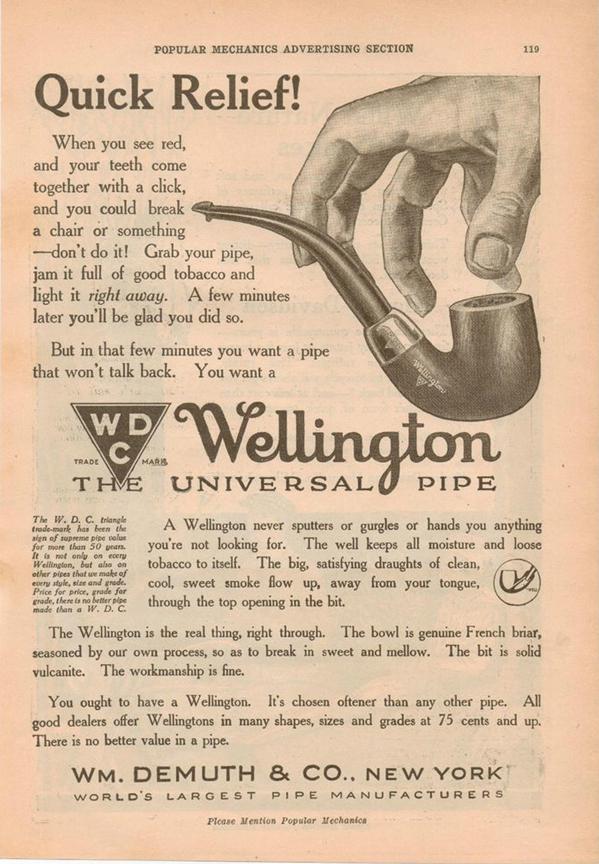
When the well runs dry in my research, I send questions to Steve to help prime the pump.  I share with him some of the research related above and some pictures of the Trident, but my specific question is, “Can a P-Lip stem indicate the age of a pipe – or contribute to its age placement?”  Steve’s first response was helpful in clueing me into the probability that the Trident before me could very well be of an early 1900s vintage.  His response was: “It looks a lot like the Wellington that WDC made in the early 1910-1920s.”  It was not difficult to find these artifacts in Pipedia’s article about the William Demuth Co. and the WDC Wellington – a WDC mainstay over the years. With the uncannily similar Wellington pictured above, courtesy of Doug Valitchka from Pipedia, the Trident lookalike before me could very well be of an early century vintage and a product of E. Deguingand & Son, Limited.

My second inquiry to Steve was how it all worked.  Did WDC make pipes (Wellington styled) for E. Deguingand and E. Deguingand marked them with ‘Trident’ though made by WDC?  Steve’s next response was even more to point questioning the accuracy of attributing the Trident to E. Deguingand.  He said,

I wonder if the E. Deguingand is correct. I wonder if WDC in NYC did not make a Trident pipe. I would do some digging in old WDC catalogues and see if you can’t find it. It has the same style band, same style faux p-lip with the air hole in the end of the button rather than on top. WDC did that I think to avoid issues with Peterson.

I did as Steve recommended and looked at several old WDC catalogs I could find online.  One forum was helpful in providing a WDC Master List.  Unfortunately, no ‘Trident’ listing was evident there or anywhere else I looked indicating a William Demuth Company source. I come up empty finding a direct connection between WDC and the Trident.  If anyone can help solve this mystery, I would be grateful!

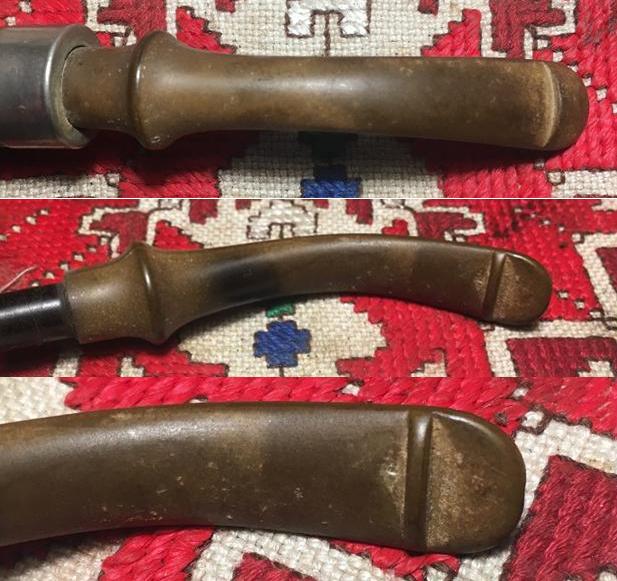
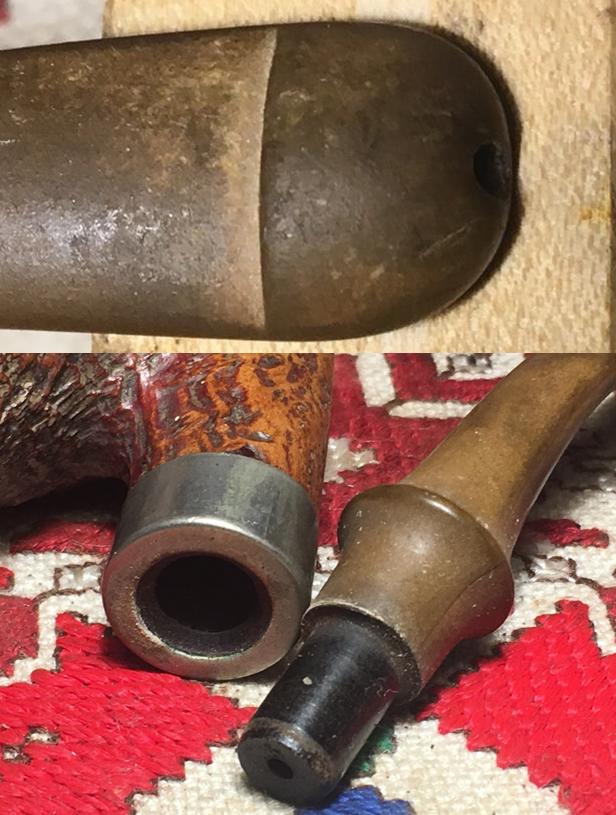
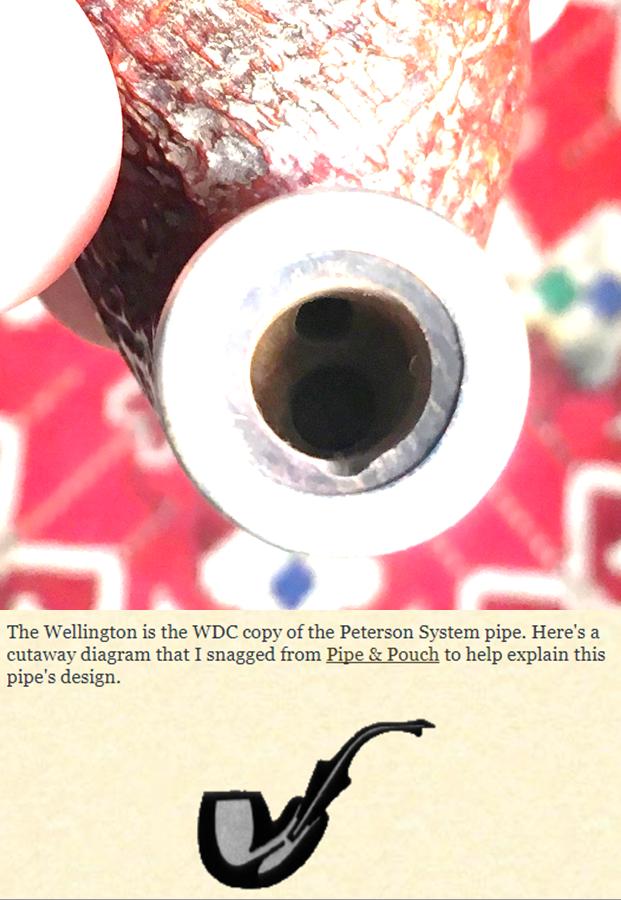
I approach the restoration of this Trident as an early vintage 1900s vintage and will seek to maintain that.   Not knowing at this point if this is an early E. Deguingand Trident or a WDC made Trident, I appreciate the fact that I do have an ‘Ole Timer’ and will handle him with care!  The ‘faux’ P-Lip Military style stem is heavily oxidized and this will be addressed.  The chamber has moderate cake and this will be removed to reveal fresh briar.  The rim has some lava but is in good shape overall.  The stummel needs cleaning of the grime and band polished.  With an appreciation for the Trident before me, I begin the clean-up by putting the P-Lip stem into the OxiClean bath to start dealing with the heavy oxidation. With the stummel in hand, the fire chamber has light carbon cake build up.  I use the Savinelli Pipe Knife to ream the chamber.  It does the job very quickly.  I then wrap 240 grit sanding paper around a Sharpie Pen and sand the chamber wall to remove more residue carbon.  I conclude the chamber clean up by wiping with a cotton pad wetted with alcohol to remove residue carbon dust.  The pictures show the progress. With the chamber reamed and cleaned I turn to the internals.  Using cotton swabs, pipe cleaners dipped in alcohol and needle files to scrape the edge of the mortise, I work on cleaning the internals of the stummel.  The internal architecture of the mortise has two internal holes drilled.  The upper hole is the airway leading to the draft hole.  Underneath this, a hole is drilled to create a reservoir for moisture to collect.  I take a picture of this and include a cut-away of a WDC Wellington from The Briar Files discussion of WDC Wellingtons After some effort working on the gunk removal, and with the growing need to attend to other obligations not having to do with pipes or their restorations, I decide to continue the cleaning job using the kosher salt/alcohol soak.  I fill the chamber with kosher salt that leaves no aftertaste, and twist and stretch a cotton ball to insert into the mortise, acting as a wick to draw out the oil and tar.  I use a large eye dropper and fill the bowl with alcohol until is surfaces over the salt.  I set it aside and let it do it work.Later, I remove the very oxidized P-Lip Military stem from the OxiClean bath and the bath did the job of raising the oxidation to the surface.  The stem is now a light grey color not the usual dark olive green.  I go to work removing the oxidation using a barrage of tools.  I wet sand the stem in warm to hot water for about 30 minutes using 600 grit paper!  Oxidation is very stubborn in the edges of the P-Lip orific button lips.  I utilize hard edges to wedge the sand paper in the corners.  I then use 0000 grade steel wool to work over the entire stem including the hard to reach corners and curves.  Finally, I use Mr. Clean MagicEraser to put the oxidation to rest.  This phase looks good – it didn’t come easily!I go directly to cleaning the internals of the stem with pipe cleaners dipped in isopropyl 95%.  It did the job quickly.After some time, I return to the stummel that is having a salt/alcohol soak. The salt has darkened showing that it has done its part.  I remove the expended salt and cotton wick and clean the stummel with paper towel to remove residue salt.  I return to cotton swabs and pipe cleaners, also using long bristled brushes to finish the job. With internals clean, I take another look at the stummel surface.  I use undiluted Murphy’s Oil Soap to remove the grime in the crevices of the blast and on the rim top.  I utilize cotton pads and a bristled tooth brush.  The rim has mild cake and I use a mild kitchen scrub pad to gently clean it.  I also clean and polish the band while I was at it. Because there was normal wear around the rim, the cleaning leaves lightened areas devoid of finish, though the blasted architecture of the rim is intact.  Using the lightest stain stick I have in the basket (Furniture Repair Marker – Oak), I color in the rim.  I like the way it darkened and complimented the texture of the hues.  I decide to use the stick on the stummel as well to highlight and deepen the peaks of the blasted surface.  I like how it turns out overall – nice.  I set the stummel aside to dry thoroughly. I take the stem to begin the micromesh pad cycles and to my chagrin, I see that the oxidation is peeking through – mainly around the curves leading to the crest of the military stem (I’m not sure if there is a technical name for that part of the stem!).  Ugh!  It’s already late so I elect again to put the stem in the OxiClean bath to see if it will do the job.  I heat the OxiClean solution in the microwave until it’s warm and plop the stem back in and turn out the lights!The next morning, I go straightaway to the stem in the bath, fish it out, wet sand the problem, oxidized areas with 600 grit paper then with 0000 steel wool.  I’m hoping that the oxidation is now removed as much as it can be removed.  I move on to wet sanding using micromesh pad 1500 to 2400, then dry sanding with pads 3200 to 4000 then 6000 to 12000.  I follow each cycle with an application of Obsidian Oil to revitalize the once oxidized Military, Faux P-Lip style stem.  I’m pleased with the pop of the vulcanite – it looks good. I put the stem aside to fully absorb the Obsidian Oil and to dry. Next, I apply Museum Wax to the bowl with a small cotton cloth – working the wax in the blasted surface landscape.  Then, I buff the bowl with a shoe brush to assimilate the Museum Wax into the surface and begin the shining process.  Turning to the Dremel, I mount a clean cotton cloth buffing wheel and set at speed 2 (40% full power) and more fully buff the stummel.  The buffing wheel does a good job working the wax in more thoroughly and bringing out a deep, resonate shine.  The pictures show the progress. With the Dremel already in use, I load the cotton cloth wheel dedicated to applying Blue Diamond compound. Using the wheel, I apply the compound to the nickel-plated band to bring out the shine.  As hoped, the buffing does the job well.  The Trident is dressing up well! Taking the stem, I mount the cotton cloth buffing wheel dedicated to applying carnauba wax.  I apply the wax to the stem to bring out the shine and protect it.  After applying a few coats of carnauba wax, I then reunite the stummel with the Military style stem and give the entire pipe a rigorous hand buffing using a microfiber cloth to raise the shine of the Trident even more.

Only two things leave me a bit wanting with the restoration and recommissioning of this Trident Blasted 3/4 Bent Billiard – the distinguished Military stem still holds some small traces of oxidation around the concave curves of the stem’s crown or horn.  Yet, my, my, it looks good mounted on the blasted stummel with its newly polished band!  The other item was not being able to identify clearly the maker of this Trident – whether E. Deguingand according to Wilczak and Colwell or the Wm. Demuth Co. as Steve suspects because of the preponderance of similarities between the Trident and WDC’s mainstay of the same style pipe, the Wellington.  In whatever way this question is ultimately settled, the Trident’s vintage status seems to place him in the 1910 to 1930 age range.  Truly, an ole timer who is now ready for another lifetime serving a new steward – gifted to one of Jen’s family members as she soon returns to the US from Bulgaria.  Her gifting helps to benefit the Daughters of Bulgaria, our work here in Bulgaria with those women and girls who have been sexually exploited and trafficked in Europe.  For more information about this, and why I do what I do, check out my blog at The Pipe Steward.  Thanks for joining me!

Jen’s Trove No. 5: Recommissioning a Mehaffey Cutty 6


Blog by Dal Stanton

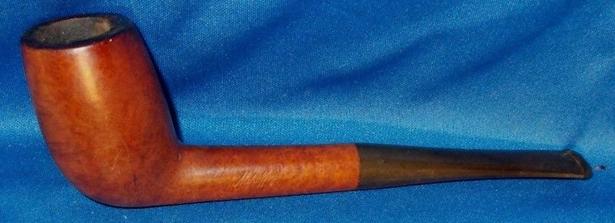
When I first saw this pipe on eBay, what drew my attention was the canted bowl.  I wasn’t sure then what shape it was, and when Jen recently pulled it out of the “Help Me!” basket to add to her trove of pipes she was collecting for restoration to give as gifts to men in her family, I still didn’t know.  After pulling it out on my work table, I took another look and started looking at my ‘go to’ sites for shapes charts.  My thinking was, “Chimney” because of the taller than usual bowl that can be canted, but “Cutty” was also in the running mainly because of the forward canted bowl.  When I sent my thoughts about the shapes and a picture to Steve for his input, his verdict was a ‘Cutty’ shape.  The forward canted bowl was the clincher and that my pipe’s bowl was tall, but not reaching ‘Chimney’ proportions.  Here is what I saw on eBay and what I sent to Steve:I enjoyed TobaccoPipes description of this very old pipe shape having its genesis in the clay world:As far as we can tell, the Cutty is the oldest pipe shape that is still available today.  

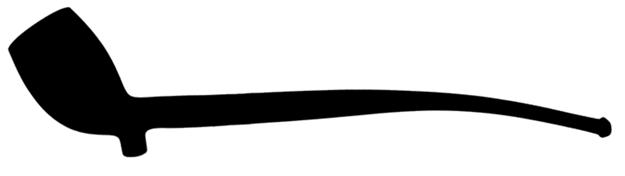
 As early as the 16th century, pipe smokers would settle in at their favorite tavern and–if they had a high enough social status–would pull out a long clay pipe, almost always a Cutty shape.  This shape was common because it was easy to craft in the molds used for clay pipes (William Goldring, The Pipe Book: A History and How to: 1973).  

Clay Cutty pipes, up until about a century ago, always included a “spur” or “boot” of extra material at the bottom of the bowl.  When smoking the same clay pipe all day long, the bowl tends to get pretty hot.  The spur allowed the smoker to grasp the base of the pipe without burning his hand.  Today, some Cutty’s keep the spur attachment, but not many.

A modern example of a Cutty pipe is the Savinelli Petite 402 model.

 Like the Dublin family this pipe falls in, the Cutty has a conical shaped chamber, which means the diameter of the chamber tapers down the closer you move to the bowl.  The largest difference between a Dublin and a Cutty is that while a Dublin has evenly thick chamber walls that move down the bowl, the Cutty has more of a rounded shape, in some ways resembling an Egg.  As pointed out by G.L. Pease, the Cutty has an exaggerated forward cant, originally purposed to keep the heat and smoke away from the smoker’s face.  

Typically, Cutty pipes have a very slight bent stem, but this is not a strict qualification. In many instances, we see modern Cutty with straight stems and deep bent stems.

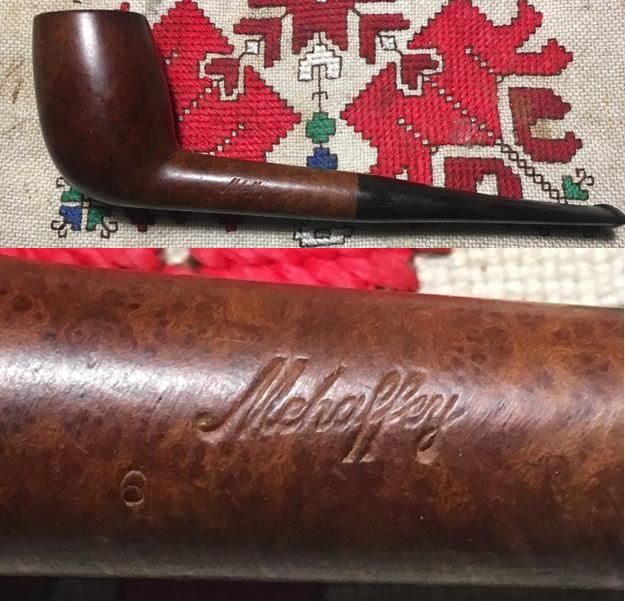
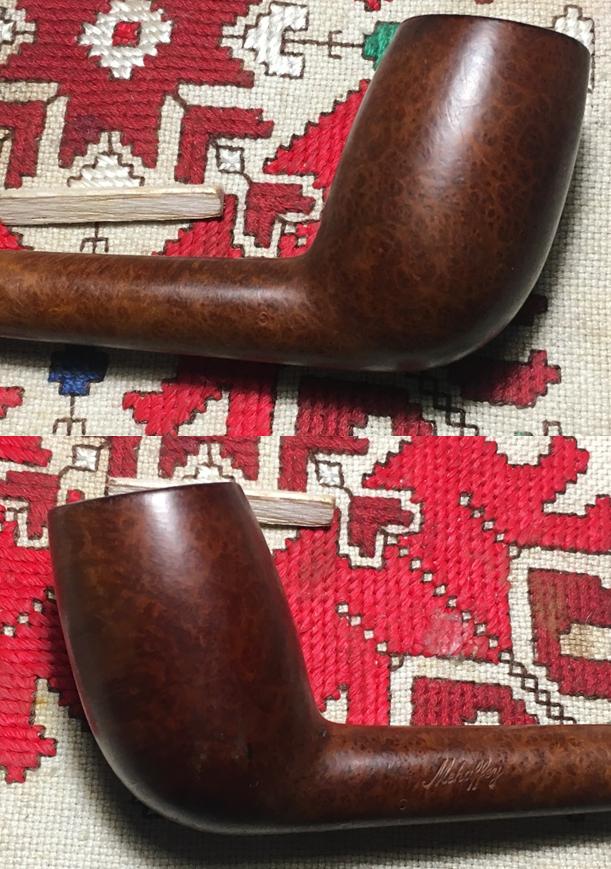
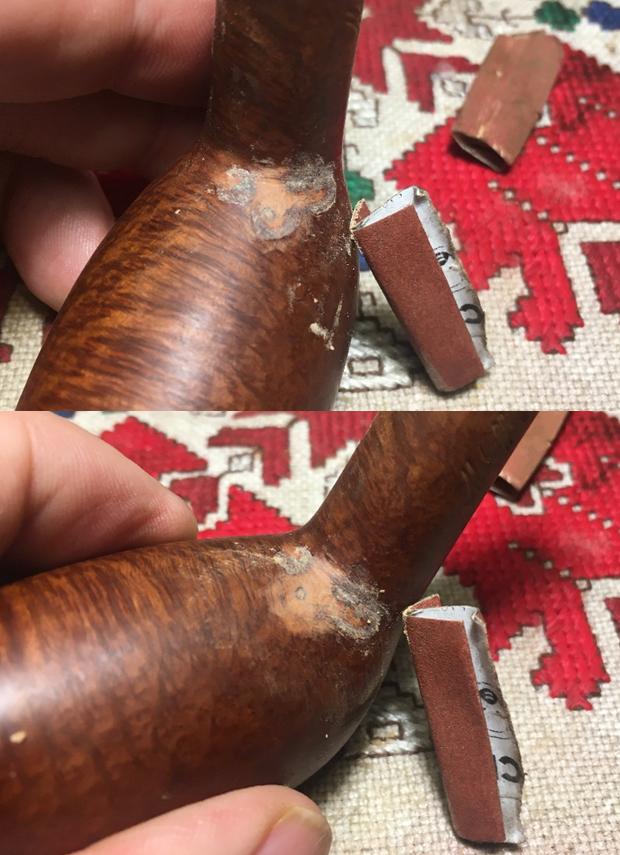
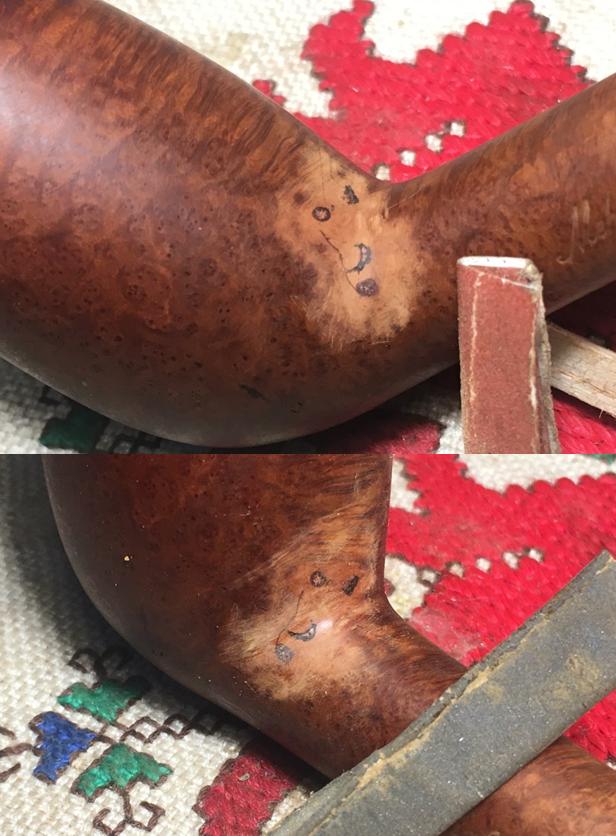
On my work table, I took these additional pictures to fill in the gaps and show some of the needs. The stamping on the left side of the shank reads ‘Mehaffey’ [over] ‘6’.  The right side of the shank also has the number ‘6’ stamped – I assume this is the shape number.  While one can find Mehaffey pipes on the internet, unfortunately, the one factoid that is repeated in many places can be found in Pipedia’s single reference to this pipe maker:

E.A. Mehaffey operated a pipe & tobacco shop in Wheaton, Maryland. He used to make pipes for many years but as legend has it, his house tobacco mixtures were much more prestigious than his pipes. Mehaffey was in business up to the 1980’s.

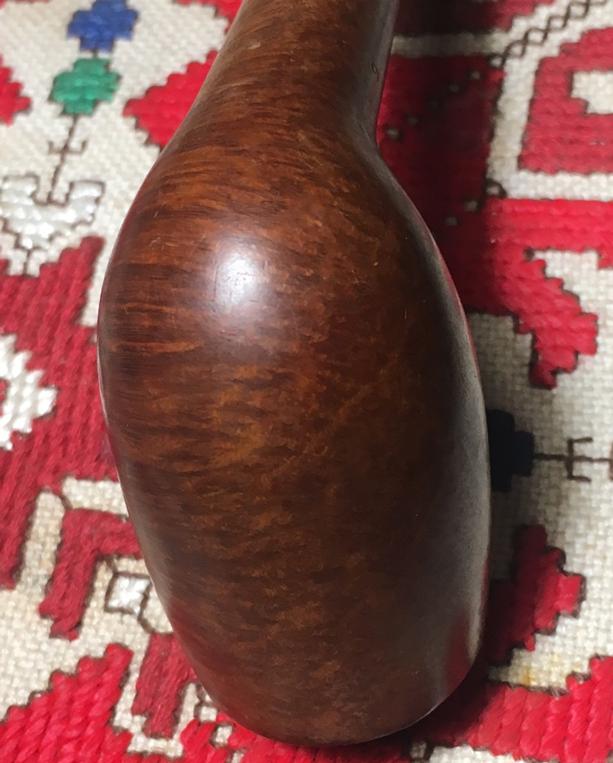
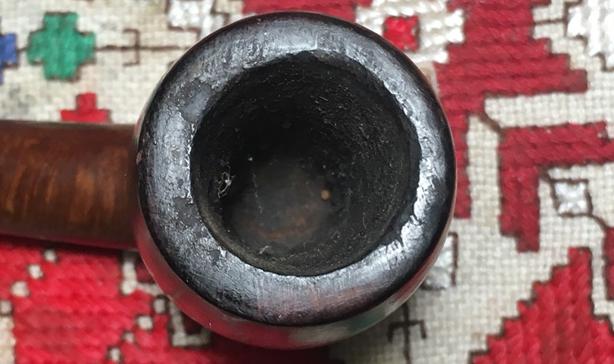
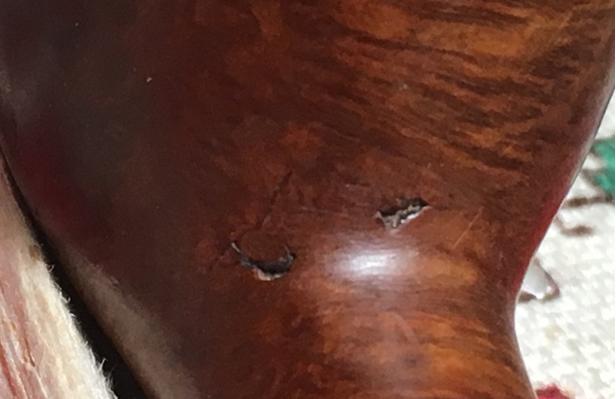
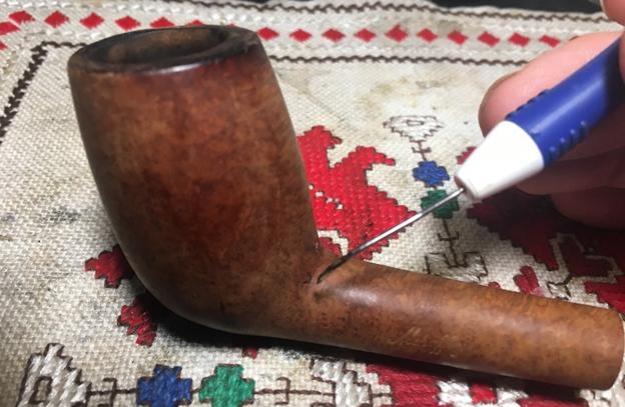
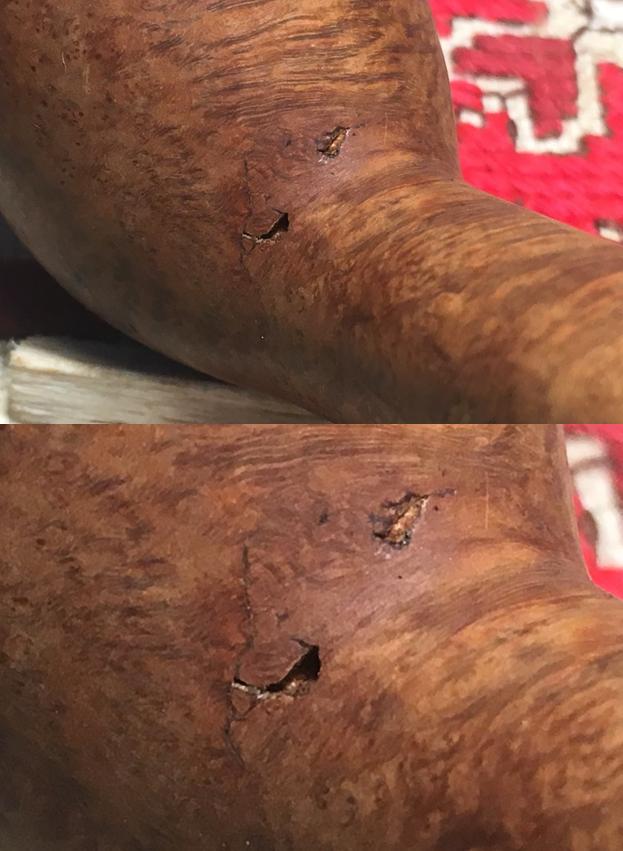
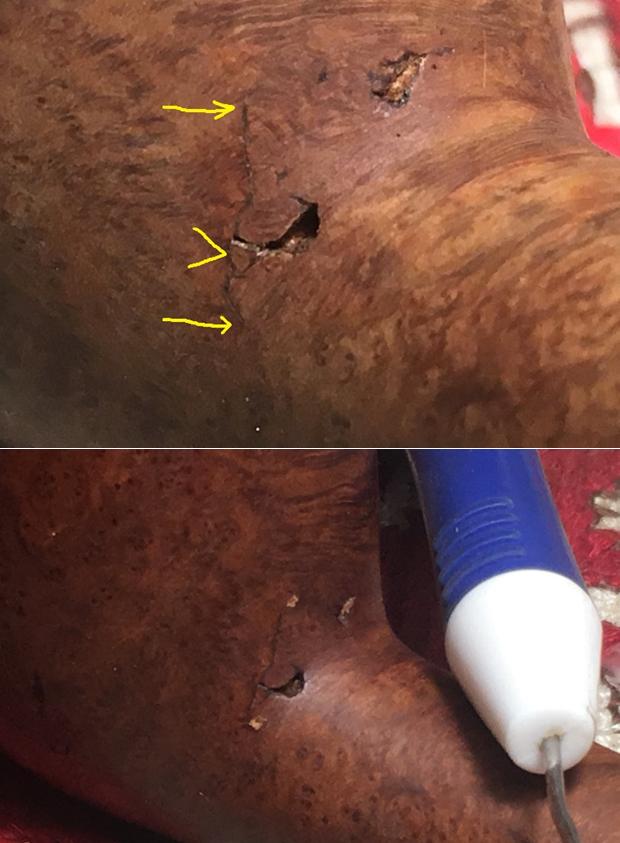
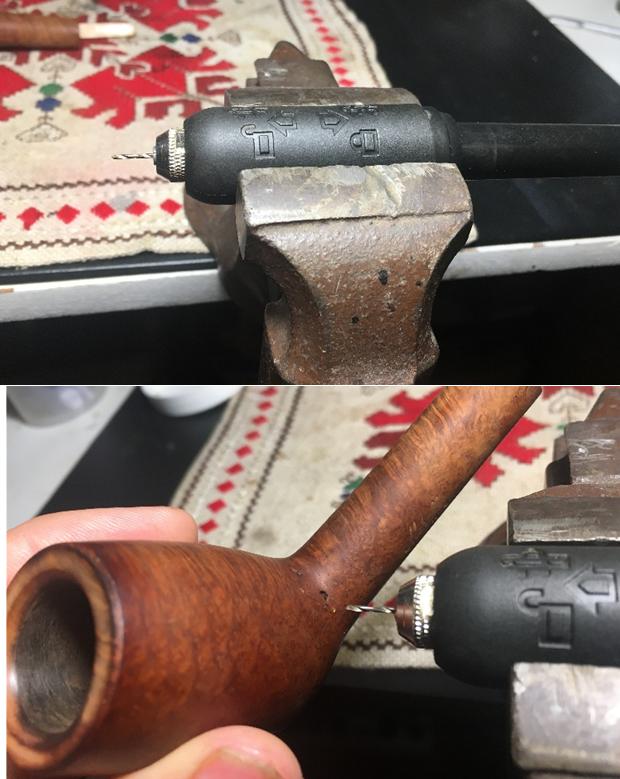
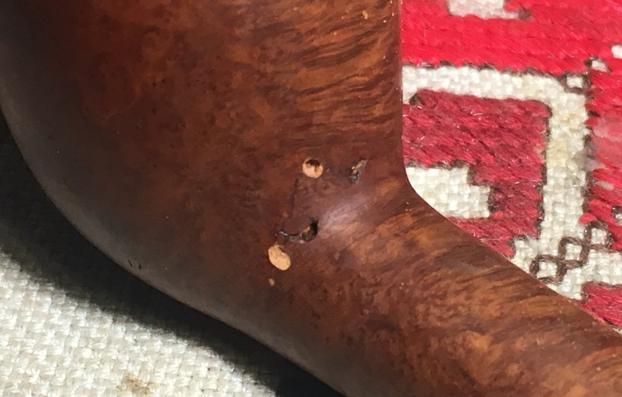
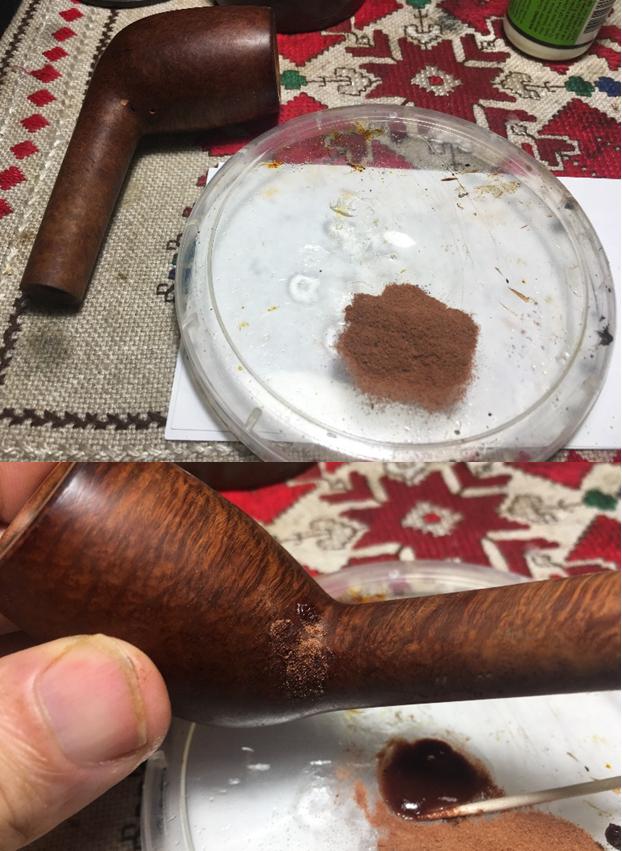
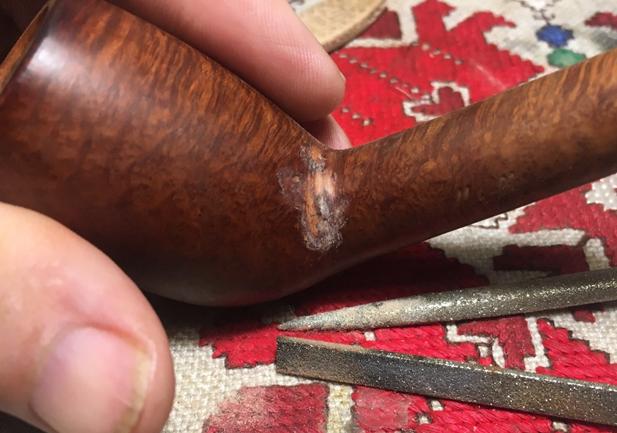
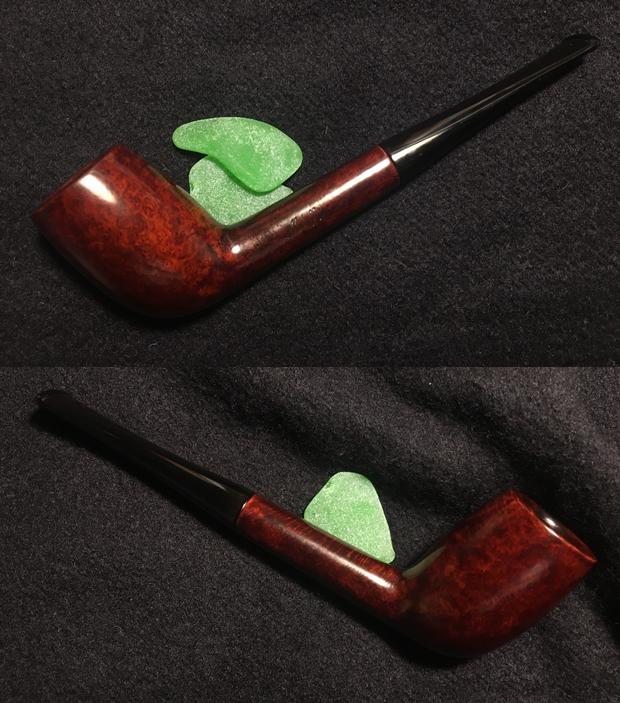
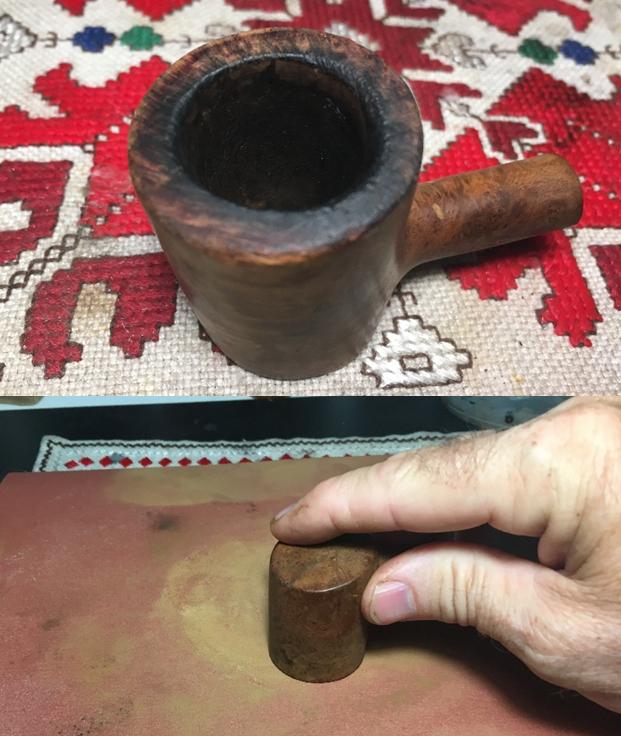
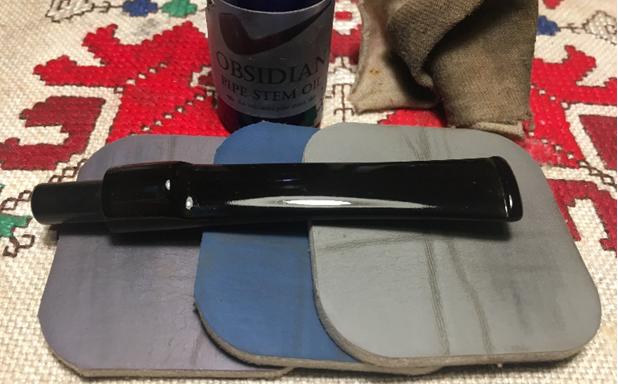
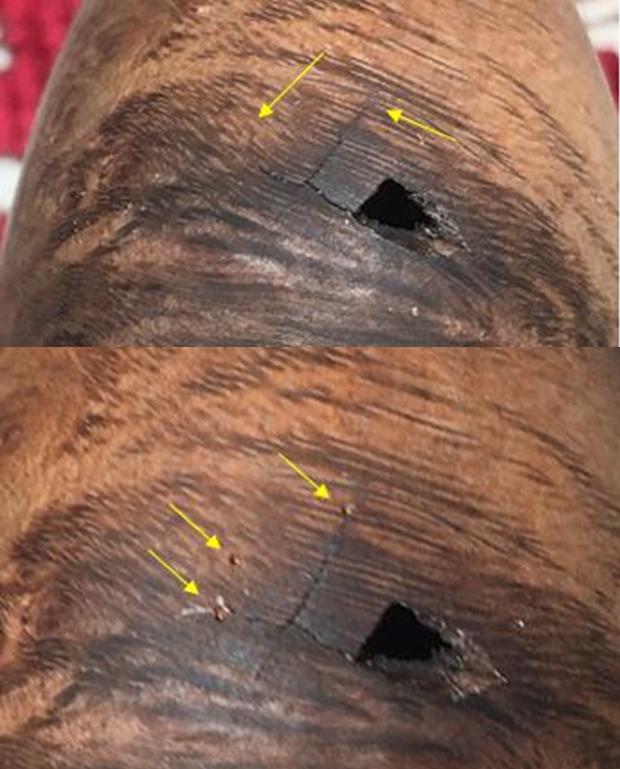
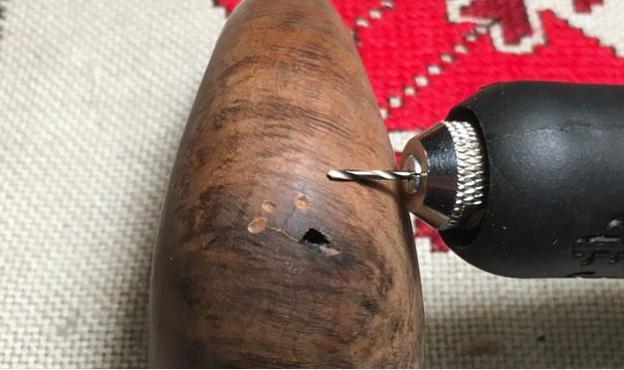
While this statement does not engender enthusiasm for E. A. Mehaffey’s pipe production, the Cutty before me boasts a very attractive, large piece of briar.  With the taller than usual bowl, both sides of the bowl showcase tight bird’s eye grain patterns, which offer a perpendicular disposition toward the grain.  On both the front and the back of the bowl, as one might expect, horizontal grain is evident – the parallel perspective of the grain.  If one thinks of a rope as grain, the horizontal grain is looking at the side-length of the rope.  Whereas, the bird’s eye grain is looking at the ends of the rope ends after they are cut.  This is a beautifully styled and positioned Cutty shape with this fine piece of briar.  Complementing the forward canted bowl, the long shank and tapered stem adds to the perception of styled length.  I’m liking it! Looking at the pipe, the needs start with a moderate build-up of carbon cake in the chamber which needs to be removed down to the fresh briar.  The rim has lava flow and black crusting which needs removal.  I see no fills on the stummel. One area of problem is at the upper junction of shank and bowl.  There are what appear to be two punctures and what appears to be a crack running perpendicularly off the left puncture.  It is difficult to guess what caused these.  I will probe the holes to make sure they are only superficial and make sure the crack is not growing.The tapered stem has mild oxidation and a good bit of tooth chatter on the upper and lower bit. I begin the recommissioning of this Mehaffey Cutty by plopping the stem into the Oxi-Clean bath to soak and to raise the oxidation from the vulcanite. Using the Pipnet Reaming Kit, I address the cake in the bowl.  After spreading paper towel to catch the exhumed carbon, I use the smallest blade first.  I realize very quickly that the smallest will be the only reaming blade I use and switch to using the Savinelli Pipe Knife.  The conical chamber narrows toward the base so the Savinelli Pipe Knife does the job.  After removing the carbon cake, I wrap a piece of 240 grit sanding paper around a Sharpie Pen and sand the chamber.  Following this, I clean the chamber using a cotton pad wetted with alcohol to remove the carbon dust.   While I want to start on the external briar, I like to take care of the dirty stuff first!  Using cotton swabs and pipe cleaners wetted with isopropyl 95% and go to work on the internals.  I like working on a clean pipe.  I discover that a metal tube is providing the airway through the long shank.  With the use of a long, bristled brush I’m able to clean the internals of the mortise very quickly.  Not bad!Now to the external briar surface.  I use undiluted Murphy’s Oil Soap with cotton pads and a bristle tooth brush to clean the bowl of the grime.  I also work on the rim using a brass bristled brush.  With a cleaned up stummel, I take another close look at the rim.  I love the tight canted look of the bowl and I hate the thought of removing any briar real estate from the profile of this Cutty.  Yet, I’ll need to remove some, just enough to remove the damaged briar and to restore fresh lines.  I look again at the problems at the upper junction of the shank and bowl.  I first use a sharp dental probe to clean out the holes of collected debris.  I’m careful with the hole on the left, looking at it very closely it appears to be prone to crumble.  As I look at the crack running to the left of this more fragile problem area, the question in my mind is whether to do a full crack repair, drilling ‘back-holes’ on either side of the crack to block any possibility of the crack enlarging.  Or, avoiding the added trauma to the briar by drilling, would simply laying a line of thin CA glue seep into the crack and sufficiently close it down?  I sent these questions and the second and third picture below to Steve for his input. While I wait for Steve’s response, I’ll focus now on the rim repair.  I begin by using 240 grit sanding paper on a chopping board to create my topping board.  Before putting paper on the board, I invert the stummel on the board and eyeball it free standing.  I want to make sure that I top it keeping the angle of the rim parallel to the board.  Damaged, scorched wood tends to be softer.  I have learned by unfortunate experience that it’s easy to start angling into the softer wood and be left with an angled rim plane.  Not pretty!  As I free stand the inverted stummel, I discover there is a rock – the rim is already dipping.  I determine by looking at which part of the rim is healthy, which part of the rim needs to guide the topping while not dipping into the worn area – softer part of the rim. The pictures that follow show the progression of the topping.  Notice the first picture is only after a few rotations on the topping board staying on the healthy part of the rim.  The dark areas are lower and so don’t engage the paper.  As the topping progresses in the subsequent pictures, the dark areas gradually are engaged by the sanding paper as the rim moves toward the paper at the different points.  The final picture shows switching to 600 grit paper to smooth the topping.  The rim plane looks good and is level! Now I remove the damaged briar on the internal rim’s edge and create an internal bevel to balance the look of the rim – blending the damaged area with the healthier area. In the first picture below, the damaged area is in the 2 to 3 o’clock area.  A bevel looks good too by creating lines that, to me, are classy.   Using a rolled-up piece of 120 grit sanding paper I fashion the internal bevel.  Then I follow with rolled pieces of 240 grit and 600 grit papers to smooth the bevel.After the internal bevel is completed, I take a look at the external edge of the rim.  It also has some heat damage and has a dark ring.  I use 240 grit paper rolled and create a gentle bevel around the outer edge.  I don’t need much – just enough to clean up the briar. I follow the 240 grit paper with 600 grit.  The rim looks good.I put the bowl aside for a time and take the stem out of the OxiClean bath.  The oxidation has risen to the surface.  I reconnect the stem and stummel placing a plastic disc between the two.  I do this to avoid shouldering the stem by rounding the shank edge of the stem.  I use 600 grit paper and wet sand the stem in warm water.  I follow this by using 0000 steel wool to buff out the sanding lines and shine the stem.Turning now to the tooth chatter and tooth dents, I start with the upper bit.  The tooth static is not serious and I sand it out using 240 grit paper.  I also sand out a slight dent on the button lip.  I then erase the 240 grit lines using 600 grit paper followed by 0000 grade steel wool.  The upper bit looks good. The lower bit is a bit more problematic with a significant tooth dent in the center of the bit.  It also has significant tooth chatter and a small dent on the button.  I use the heating method by lighting a candle and I pass the affected area over the flame – I keep the stem moving back and forth over the flame.  This heats the vulcanite and the expansion of the rubber seeks its original shape.  This method works well.  The damaged area did expand so that I am able to sand out the rough areas using 240 grit paper, then 600 to remove the scratch traces of the 240, then 0000 grade steel wool to buff our the remainder of the 600 residue marks and shine the stem.  I also sand out the dent on the button. I receive word back from Steve about the approach to the stummel problems.  His recommendation to do the full ‘surgery’ on the crack by drilling holes at the end points of the crack and filling these along with the holes together is the strategy.  As I was already aware, Steve urged caution around the left hole that appears up close to be crumbling.  The first picture below shows two arrows pointing to the end of the crack where I will drill holes.  The carrot in the middle is marking the obvious area of concern.  I want to keep this area intact so that I can fill it with a putty made from briar dust and CA glue.  First, I use the sharp dental probe to mark the points for the drill – creating a guide hole so that I don’t create unintended rustification!  I utilize a magnifying glass to do this!Historically, it hasn’t been easy to drill these holes with precision.  Using a handheld Dremel with a 1mm drill bit mounted in the hand extender (the cable extension) needs a steady hand!  I decide to try something different.  I attach the Dremel hand extender to a miniature vice.  If I stabilize half of the equation that improves my odds!  With the drill stationary, I can bring the stummel to the drill with more control.  With Dremel readied with a 1mm drill bit, I put my plan in motion.  The first hole I do, the lower one, I had a little wobble so the hole wasn’t as crisp as hoped.  The upper hole was much better.  Of course, the drilling does not go through to the internals!  The depth is only a few millimeters. Overall, this was a better setup. With holes drilled, I mix briar dust and Special ‘T’ thick, CA glue to form a putty to fill the drill holes as well as the holes.  I scoop a small mound of briar dust on a plastic lid and next to it I make a puddle of CA glue.  I gradually mix the dust into the CA glue until I arrive at the viscosity I desire – I want it to be a bit on the wet side so that the putty will better penetrate the holes, cracks and crevices.  I use a dental spade tool to tamp the putty down while I spread it over the damaged area.  I place more than needed so that when I sand the patch mounds down, they will blend well.  The day has turned to night, and it’s time to turn out the lights!Having cured overnight, I’m ready to file and sand the briar dust putty patch.  Using first flat and rounded needle files I slowly and gradually file the patch mounds down so that they are very close to being level with the briar surface. The aim is to keep the files on the patch material and not on briar.  For the fine tuning, I use 240 grit paper to bring the patch flush with the surface, aiming to remove putty from the unaffected surface area – blending the patch.  I take some pictures to show the file progressing. Next, I use 240 grit sanding paper to take the patches down to the briar surface and remove superfluous briar putty from the briar surface.  I roll the paper into more of a roll, and move it in a circular motion over the patch material.  The briar putty is easy to distinguish from briar in that it sands up into a white powder whereas briar doesn’t.  The first picture below shows this well.  I take pictures to show the 240 grit paper progress.  When I come to the place where only the filled patches remain, flush with the briar surface, I then switch to 600 grit sanding paper and smooth out the surface further.  The patches come out very well.  The pictures show the progress. During the repair, I was thinking about the next steps for finishing the stummel.  With the rim repairs, darker scorched areas around the rim, and the crack/holes repair on the stummel surface, I decide to darken the finish on the Mehaffey Cutty to blend these areas more effectively.  Again, with aniline dyes (alcohol based), the opportunity to lighten the hue is an option by wiping the surface with alcohol.  To prepare the surface, I decide to remove the old finish with acetone and cotton pads so that the staining process will have more uniform results.  The acetone removes the old worn finish very quickly and now I’m down to the raw briar.The briar surface is in good shape so I begin with using a light grade sanding sponge to smooth out the nicks.  After the sanding sponge, I wet sand using micromesh pads 1500 to 2400.  Following the wet sanding, I dry sand using micromesh pads 3200 to 4000 then 6000 to 12000.  Oh my.  What emerges through the micromesh cycles is an extraordinary piece of briar works.  Mehaffey may not have been known for his pipes, but I have little doubt that when this Cutty was on the Mehaffey shelf with a price tag on him, it was an upper shelf pipe being offered.  Other than the repair work done, there are no imperfections or fills of any sort that I can discern, and the grain…, oh my! I continue to work on the beautiful Cutty stummel now to apply the stain.  I decide to mix 1 to 1 ratio of Fiebing’s Dark Brown Leather Dye to alcohol.  During the micromesh process, I also decide to add a pinch – just a pinch, of Fiebing’s Oxblood Leather Dye to add a little rich attitude to this proud Cutty! I take a picture of the staining set-up, then wipe the stummel down with alcohol to clean the surface.  With a large eye dropper, I mix the dyes in a shot glass. I then warm the stummel using the hot air gun, expanding the grain and making it more receptive to the dye.  After warmed, I liberally apply the dye over the stummel, using a cork inserted into the mortise as a handle.  After I achieve full coverage, I fire the wet dye using a lit candle which immediately burns off the alcohol in the dye, setting the stain in the grain.  After cooling a few minutes, I repeat the process and set the stummel aside to rest for several hours.  The pictures show the staining process. With the newly stained bowl resting, I take up the stem to complete the sanding process.  Using micromesh pads 1500 to 2400, I wet sand the stem.  I follow this with dry sanding using pads 3200 to 4000 then 6000 to 12000, applying Obsidian Oil after each cycle of three to help the vulcanite regain luster and vitality.  I love that vulcanite pop! I set the stem aside to dry. Time to unwrap the stained Mehaffey Cutty and see the results.  I mount a felt buffing wheel on the Dremel and set the speed at the slowest.  After purging the wheel with the Dremel’s metal tightening wrench, using Tripoli compound, I apply the more abrasive compound by moving the wheel in a circular motion over the surface removing the fired crust.  After completing application of Tripoli, I wet a cotton pad with isopropyl 95% and wipe the surface down to blend the dye evenly over the briar.  I then mount the cotton cloth buffing wheel on the Dremel and add speed up to 2, with the fastest being 5.  I then apply a lesser abrasive compound, Blue Diamond, in the same fashion as the Tripoli compound.  When I complete applying Blue Diamond to the stummel, I reunite the stem and stummel and use Blue Diamond on the tapered stem.  I complete the application of compounds by hand buffing stem and stummel with a soft felt cloth to remove the compound dust from the surface in preparation for applying carnauba wax.  The pictures show the progress – looking very, very nice! With the finish line in sight, I mount a cotton cloth wheel on the Dremel for carnauba wax and I apply it to stem and stummel at the same speed.  After applying several coats of wax, I mount a clean cotton cloth wheel and further buff the surface to make sure the wax has deiminated into the briar and increase the shine.  I then rigorously hand buff the Cutty with a microfiber cloth.

I’m pleased with the results.  This Mehaffey Cutty with the canted bowl is complemented well with the shade of the finish – a rich deep brown and I can see the slight accent of the Oxblood I added to the mix.  The grain is a showcase of bird’s eye and horizontal flow.  The crack and hole repair is all but invisible.  I think Jenny will be pleased to give this Cutty to a special member of her family.  Her gift becomes a help to benefit our work here in Bulgaria with the Daughters of Bulgaria.  Thanks Jenny!  For more about this and why I do what I do, check out my blog, The Pipe Steward.  Thanks for joining me!

Addendum: In case anyone noticed, I forgot to clean the internal airway of the stem!  Rest assured it will be done before a new steward packs his first bowl!

Jen’s Trove #5: A ‘Savinelli’? Villager Grecian Poker Rescued


Blog by Dal Stanton

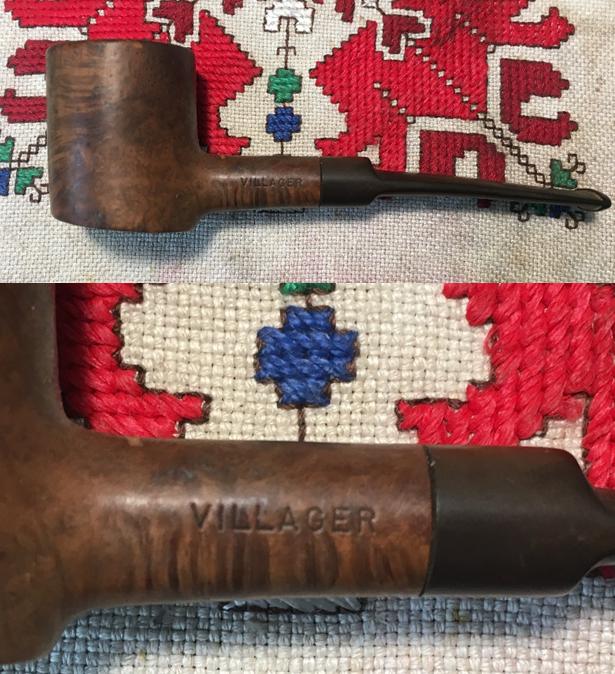
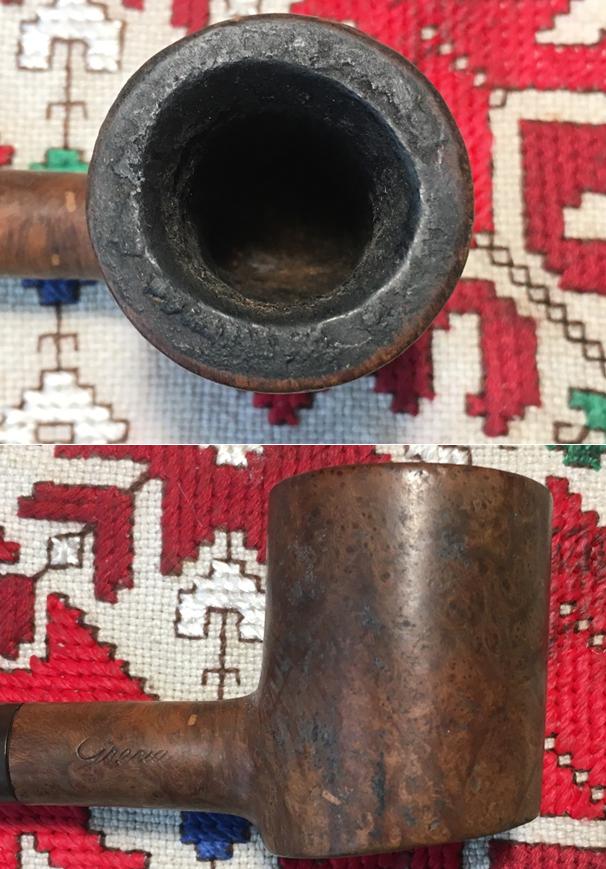
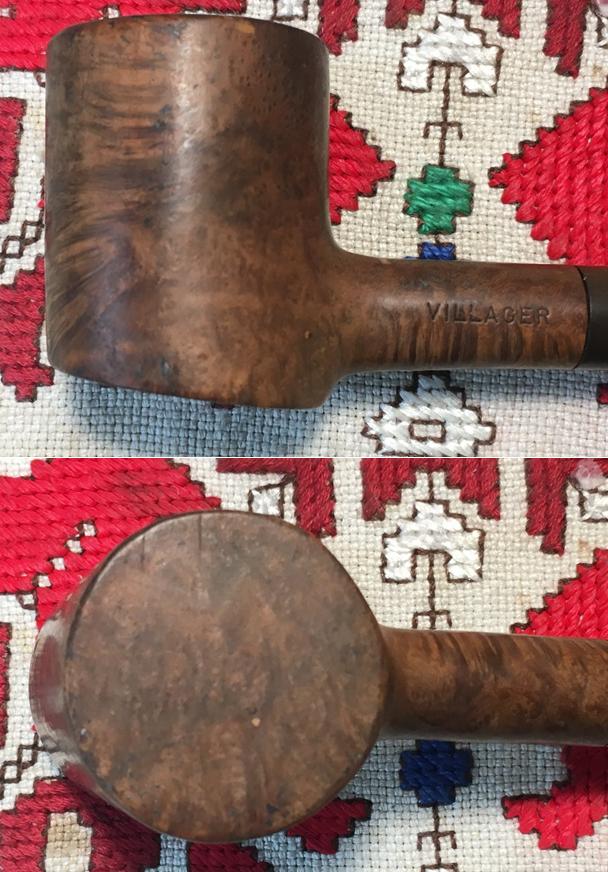
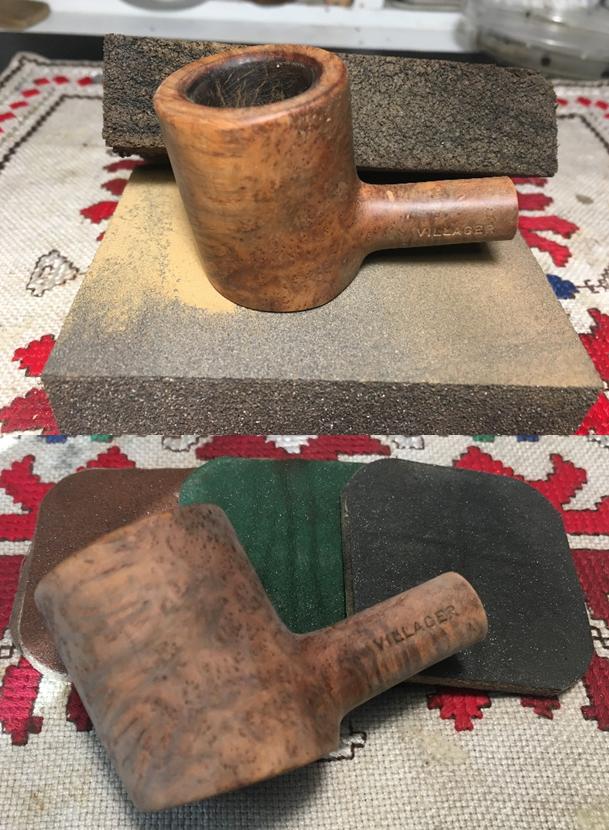
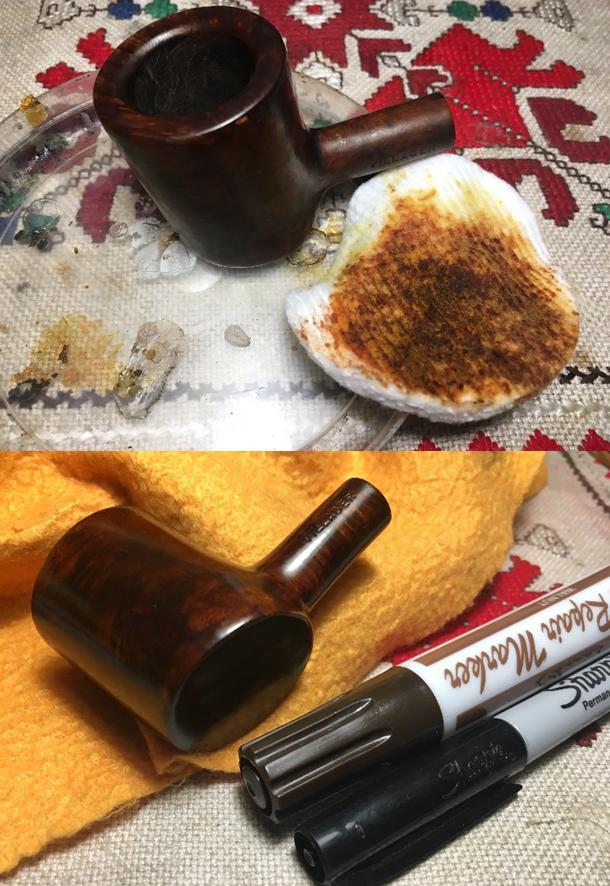
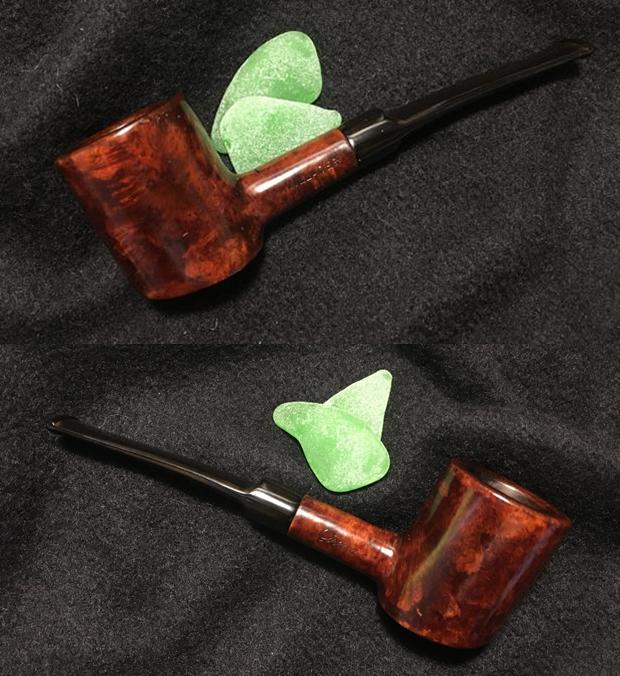
When Jenny fished this iconic shaped Poker out of my ‘Help Me!’ basket, her time of consideration was very short.  She added it to her Trove of pipes that she asked me to restore to gift the men her family when she returns to the US at summer’s end.  She has worked here in Bulgaria with us for the past few years and she will be missed!  All her Trove pipes benefit the work we do with the Daughters of Bulgaria, women and girls who have been sexually exploited and trafficked in Europe.  I really like the Poker shape.  It always elicits a ‘down home’ Mark Twain feel for me – I can easily imagine a vintage gathering of card players sitting around a poker table, dealing hands on a riverboat, and one old crust chewing on his ‘Poker’ as he considers his hand.  Taking a puff, then placing the sitter on the table, he changes 2 cards in hope of his fortune changing!  All that by looking at this pipe?  For me, yes!  This Poker got my attention on the eBay auction block and it’s now on my work table here on the 10th floor of our former Communist apartment ‘blok’.  Here is what I see. On the left side of the shank is stamped ‘Villager’ and on the right, ‘Grecian’ in a cursive script. The only reference to a ‘Villager’ in Herb Wilczak and Tom Colwell’s, ‘Who Made That Pipe?’ is to the renown Italian name, Savinelli.  While Savinelli does boast a Poker shape in its Shapes Chart I found in Pipedia, this Villager is lacking some of the usual indicators of the Savinelli brand (Savinelli stamping, stem shield, etc.).  Neither is ‘Villager’ included in the extensive list of Savinelli made sub-brands, seconds & order productions in Pipedia’s Savinelli article.  I’m dubious of the Savinelli origin of this Poker, yet I was not able to find an example of a Savinelli ‘Villager’ line to compare.  The only other marking is on the right side of the shank, ‘Grecian’.  I’m assuming this is pointing to ‘Grecian Briar’ which I’ve seen marked on pipes’ right shank sides.  After searching the ‘Villager Grecian’ together, I come up with nothing that helps to identify or disqualify (Savinelli) the origins of this Poker.  I would welcome any leads!  The one thing I can deduce with great certainty about this Villager Poker, is that it was a well-loved and smoked pipe!  But it needs help!

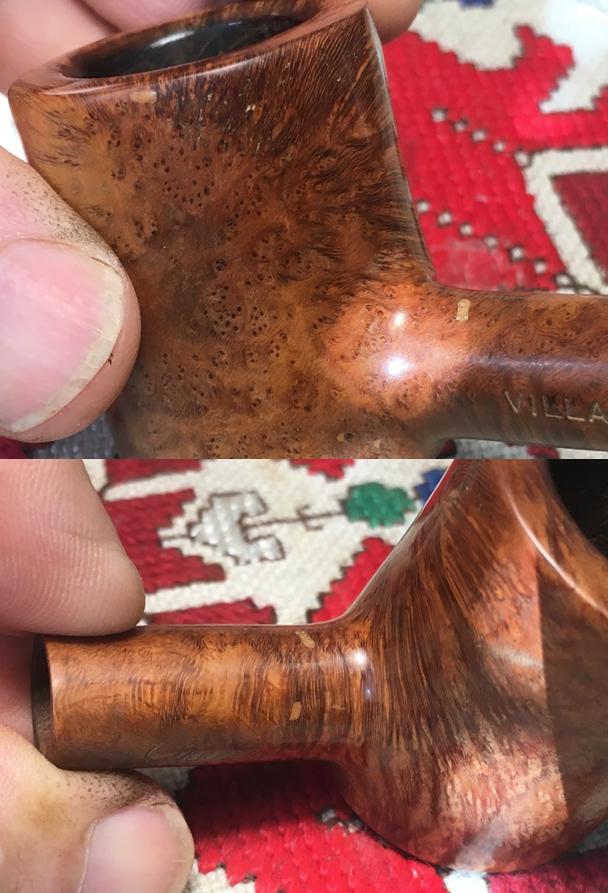
There is heavy build-up of carbon cake in the chamber and the rim is well-crusted from lava and oils.  The back-left side of the rim appears to have borne the brunt of the former stewards lighting activities – it is burned and the internal rim shape is out of round because of it.  The stummel has normal grime coverage and sports a few small fills which have lightened over time and needing attention. The ‘seat’ of this Poker has been used and shows some wear.  The stem has heavy oxidation and has been chewed on a bit and will need work.  I’m anxious to recommission this Villager Poker for Jenny’s menfolk!

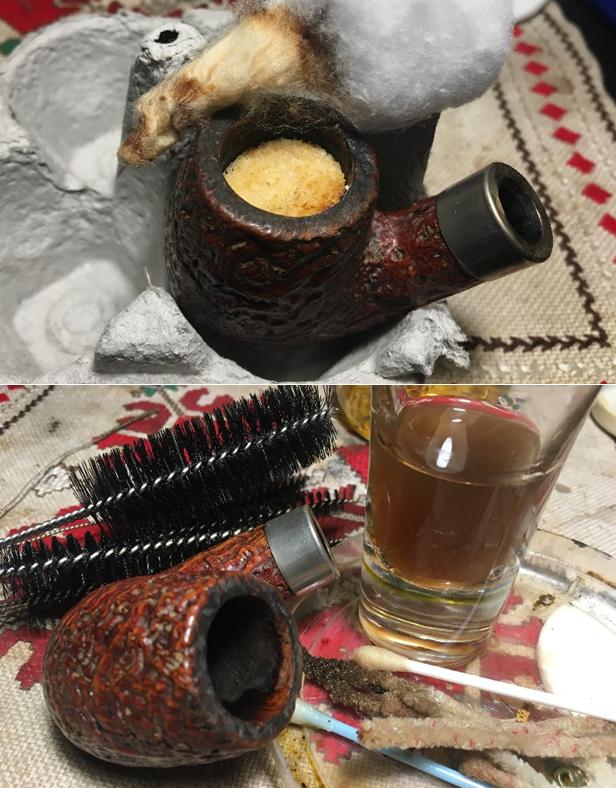
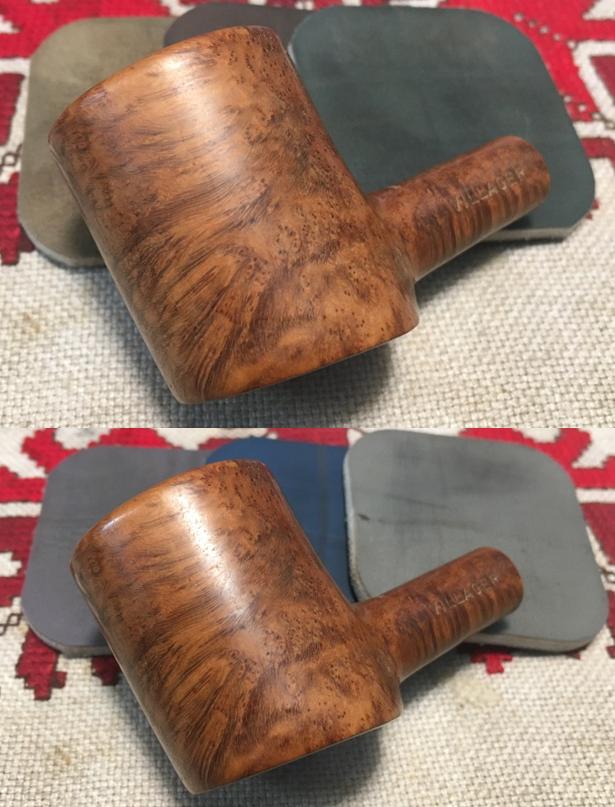
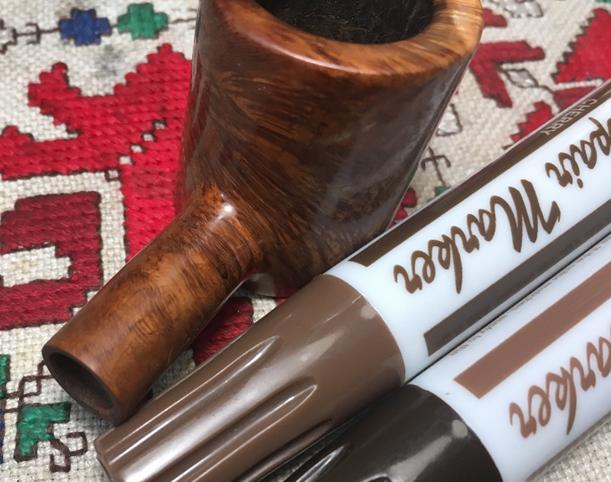
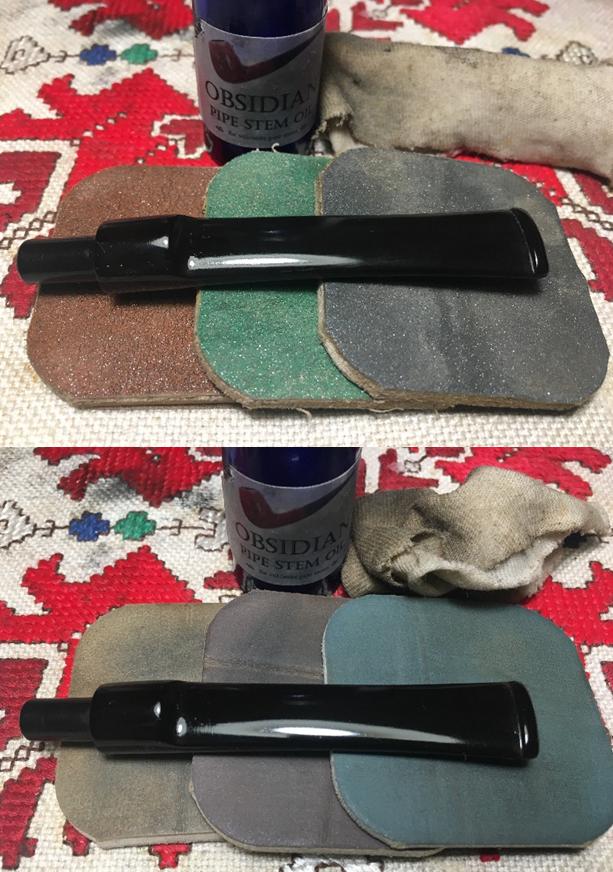
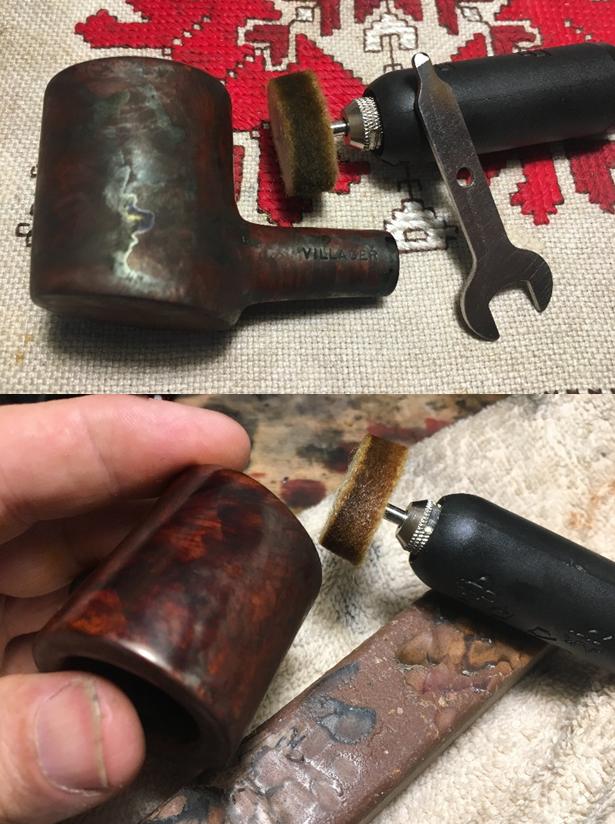
I begin by placing the stem into the OxiClean bath to raise the oxidation.  I let it stew for several hours. Starting on the stummel, I use the Pipnet Reaming Kit to remove the heavy cake from the chamber.  I will not be able to inspect the chamber wall for integrity until this is done.  I take another picture of the chamber to mark the progress. After putting down paper towel to shorten the cleanup, I employ the smallest blade first then use the next two larger sizes.  To fine tune the ream, I then utilize the Savinelli Pipe Knife to remove more carbon.  After this, I roll up a piece of 240 grit paper around a Sharpie Pen and sand the chamber removing more carbon build up seeking a fresh briar surface.  Finally, I wipe the chamber out with a cotton pad wetted with isopropyl 95% to remove the carbon dust.  I do not see any problems with the internal fire chamber’s integrity.  The pictures show the progress. With Murphy’s Oil Soap, I begin working on cleaning the rim and stummel of the grime and oils.  I use cotton pads and a bristled tooth brush to work around the stummel and rim.  Into the scrubbing, I also use a brass bristled brush on the rim – this will not damage the wood.  After rinsing off with warm tap water, I use the flat edge of my Winchester Knife to scrape more carbon off the rim surface.  After rinsing off again with warm tap water, I look at the rim condition.  I am left without any question regarding the need to top this Poker to remove the damaged briar and repair the inner-rim roundness.   Pictures show the progress. Before I move to the external stummel repairs, I turn to the internal cleaning.  I use cotton swabs and pipe cleaners dipped in isopropyl 95% to do the job.  I also utilized needle files and a small flat head screw driver to scrape the sides of the mortise to remove the plethora of tars and oil that have built up.  After some time doing this, and with other commitments with my life on the horizon, I decide to utilize a salt/alcohol soak to continue to wage war even though I’m off doing other things!  I use Kosher Salt, which does not leave an after-taste unlike iodized salt, to fill the bowl and after covering the bowl with my palm, I give the stummel a few shakes to displace and settle the salt.  Then, I stretch and twist a cotton ball to form a wick which is inserted and pushed down into the mortise using a piece of metal coat hanger.  As a wick, it acts to draw out the oils and tars as the alcohol and salt interact.  I then place the stummel in an egg carton to stabilize it and position it at a slight angle and fill the bowl with isopropyl 95% until is surfaces over the salt.  I wait a few minutes as the alcohol is drawn into the mortise and top the alcohol again. The Trojan Horse strategy commences.  Returning several hours later, the salt is discolored and the wick shows the fruit of its labors.  I toss the expended salt in the waste, clean the bowl with paper towel, and use long bristled brushes to rid the mortise of left-over salt crystals.  I return to using cotton swabs and pipe cleaners to complete the internal cleanup job.  Surprisingly, I am still scraping gunk off the mortise walls with small flat edged tools!  This stummel is a nasty little bugger.  Finally, the gunk is removed and cotton swabs are coming out clean.  Mission accomplished!  Pictures show the gunk removal. Turning now to the stem, I remove it from the Oxi-Clean bath and the oxidation has been effectively raised on the vulcanite surface.  Using 600 grade sanding paper, I wet sand the stem removing the mother share of the oxidation.  I follow with 0000 steel wool and then Mr. Clean Magic Eraser to finish the oxidation removal.  Pictures show the process. Using pipe cleaners, I now attack the internals of the stem.  Dipping pipe cleaners in isopropyl 95%, it did not take long before the airway was clean.  The picture shows the results.Turning now to the stummel, I take another closer look at the rim.  The damaged wood needs to be removed and the rim repaired.  I take 240 grit paper and put it on a chopping board to form my topping board.  Inverting the stummel, I rotate it over the paper taking off only as much briar as is needed to refresh the rim.  I check the progress often to make sure I’m not dipping into softer damaged wood – keeping the top true.  I take some pictures to show the progress.  The 4th picture below shows the thinner area at the 2 o’clock section of the rim because of the scorching.  I finish with the 240 grit paper, and I follow by topping it lightly with 600 grit paper.  To shape a more balanced and rounded rim, I create an angled internal bevel of the rim using 120 grit paper.  My aim is to create a bevel that evens out and blends with the angle created by the damaged area as much as possible.  I also create a bevel on the external rim edge to take away damage as well as encourage more balance.  I follow up the 120 grit paper by using 240 and 600 on both the internal and external rim bevels.  I think the beveling looks good and succeeds in masking the problem areas on the rim.  The pictures show the rim restoration. With the rim repair complete, I look to the stummel.  With all the wear nicks and cuts that this loved Poker has endured, I decide to remove the old finish to get down to the natural briar.  To do this I use cotton pads wetted with acetone and work on the surface.  The acetone works very efficiently and the finish comes off easily.  As I inspect the heel of the stummel, I see nicks on the edge.  I decide to lightly ‘top’ the bottom of the stummel with 600 grit paper. I am surprised by how ‘not flat’ the bottom is as I top it.  After finishing the topping of the seat of this sitter, I used rolled-up 240 and 600 grit papers respectively to bevel the bottom edge very lightly.  This removed some remaining dents on the edge that the bevel did not remove.  It looks good.  The pictures show the progress. Next, using a medium grade sanding sponge I sand the stummel removing the nicks and cuts.  I follow using a light grade sanding sponge.  Looking at the fills on the stummel, I dig at them with a sharp dental probe to see if they are solid.  They seem good, but I’ll need to darken them later.  I move directly into the micromesh pad cycles.  Using pads 1500 to 2400 I wet sand the stummel.  Following this, I dry sand with pads 3200 to 4000 then 6000 to 12000.  I take pictures showing the progress of bringing out the briar grain on this venerable Villager Poker.  This part is one of my favorites in restoring pipes – seeing the grain emerge with the hidden beauty displayed! At this point, I take cherry and walnut stain markers and touch up the lighter fills so that they will blend better.  After touching up, I lightly feather dabbed the stained fills with a cotton pad with a lightly wetted with alcohol.  This blended the fills more.  The pictures show the progress. To cover the repairs and to blend increasingly a darkened part of the rim that had been scorched, I decide to go a bit darker in the staining of the stummel.  Yet, I want to keep it lighter.  To do this I mix at a 50% ratio Fiebing’s Dark Brown Leather Dye and alcohol in a shot glass.  I want to start a bit darker, but have the option to lighten it by wiping the finish down with alcohol and cotton pad.  After I mix the dye, I fit a cork in the shank to act as a handle.  I first warm the stummel using a hot air gun to open the grain to receive the dye.  Using a folded over pipe cleaner, I apply dye to the stummel thoroughly, aiming for complete coverage.  I then ‘fire’ the stummel using a lit candle.  This burns off the alcohol in the dye and sets the stain in the grain.  After a few minutes, I repeat the process and then set the stummel aside to rest.With the stained stummel resting, I turn to the stem.  Using micromesh pads, I wet sand the stem using pads 1500 to 2400.  Then I dry sand using pads 3200 to 4000 then 6000 to 12000.  After each cycle, I apply Obsidian Oil to the stem to revitalize the vulcanite.  When completed, I set the stem aside to dry. The pictures show the progress. Turning again to the stummel, it is time to ‘unwrap’ the fire crusting to reveal the grain.  Using a felt buffing wheel mounted on the Dremel, set at the slowest speed, I first purge the wheel using the Dremel’s metal adjustment wrench against the felt surface.  This removes old compound and restores suppleness to the wheel.  Then, I apply the abrasive compound Tripoli to the surface by rotating the buffing wheel methodically over sections at a time, removing the fire crusting.  After completing the Tripoli cycle, I wet a cotton pad with alcohol and wipe down the stummel.  I do this primarily to blend the dye more evenly over the surface. I don’t rub too much because I do not want to lighten the hue – it looks good.  I then mount a cotton cloth buffing wheel on the Dremel, increase the speed a bit, and apply a slightly less abrasive compound to the surface, Blue Diamond. After the Blue Diamond compound, I buff the stummel with a felt cloth to remove the compound dust from the surface.  I also notice that the fills that I had colored earlier had lightened again through the staining process and the alcohol wipe down (see third pictures below).  I touched those up again with a black sharpie pen and a dark stain stick.  The pictures show the progress. I reunite the Villager Poker’s stem and stummel to apply wax.  With the cotton cloth buffing wheel dedicated to applying carnauba wax mounted on the Dremel, I apply several coats over the stummel and stem surface.  I follow this with a clean cotton cloth buffing wheel on the Dremel and then a rigorous hand buffing with a microfiber cloth to raise the shine more.

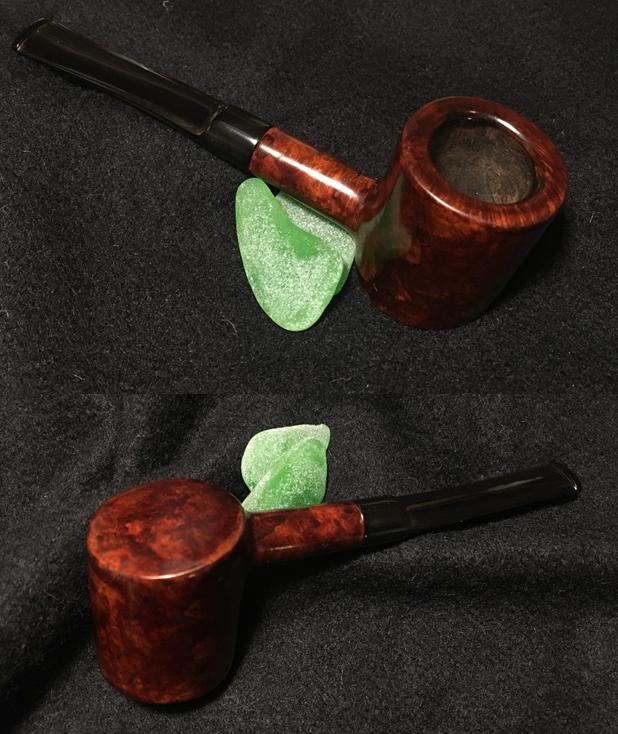
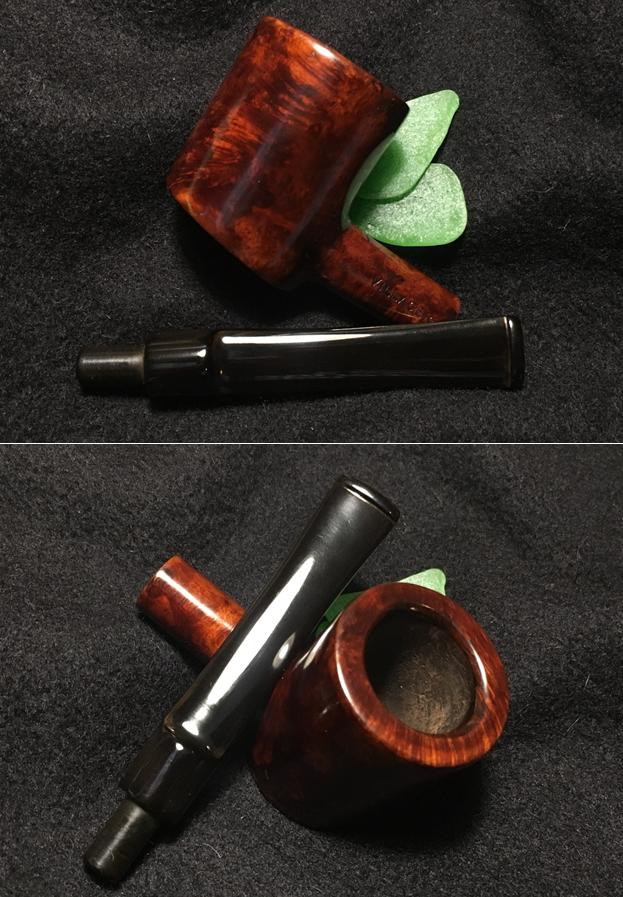
The only direct identification of the name, ‘Villager’, pointed to a pipe bearing the Italian name, Savinelli.  I was dubious that this Villager Grecian Poker rose to the quality one expects from Savinelli craftsmanship.  Yet, I am very pleased with how this iconic Poker cleaned up.  The rich depth of the briar tones and the variety of grain movement makes this ‘Ole Boy Poker’ a keeper and ready for his next steward, who will enjoy him as much as the last.  Jen’s gifting this Villager Poker to one of her menfolk benefits the work we do with the Daughters of Bulgaria.  For more information about this and my other restorations, take a look at my blog, The Pipe Steward.  Thanks for joining me!

Jen’s Trove No. 2–Perhaps a LHS London Royal Full Bent Billiard – Oom Paul


Blog by Dal Stanton

I don’t usually begin a blog with an addendum, but just before I sent this to Steve to publish on Reborn Pipes, I sent a picture of this pipe along with a few other pipes with the question, “Oom Paul or Full Bent Billiards?”  Here are the two pictures I sent – the first, Jen’s #2, and two others: This is the fun part of learning the fine art of pipe shape identification!  I was identifying the third pipe, (far right) as definitely an Oom Paul – mainly by the way the shank and bowl merge vertically and then the shank/stem breaks away but stays real tight in a full bend.  The other two, have more of a ¾ bend, but they also have more of a merge between shank and bowl creeping upwardly.  I called the 2 on the left, full-bent Billiards for that reason.  I loved Steve’s response:

Dal

To me they are all variations on an Oom Paul Shape which is actually a full bent billiard. LOL! The joys of identifying shapes.

Steve

So, with addendum completed, Jen pulled this very nice Full Bent Billiard, (Oom Paul!) out of the ‘Help Me!’ basket and added it to the trove she has asked me to restore for her.  She will be transitioning back to the US at the end of the summer and she will be packing several of The Pipe Steward’s restorations to give as gifts to the special men in her family.  I’m happy to oblige!  Jen’s purchases will benefit the Daughters of Bulgaria, and bring much joy to her family!  I found this pipe on eBay as one in a lot of 13 pipes – I acquired some interesting pipes that await restoration in the basket!  The pictures I saw from the seller in Nevada included Jen’s Oom Paul – at 8 o’clock below and then a closer view following. The seller’s attempt to identify the Oom Paul were helpful and set me on the path:

Unknown – Markings appear to be rubbed out from handling. I think I see the word “London” followed by some indiscernible word.

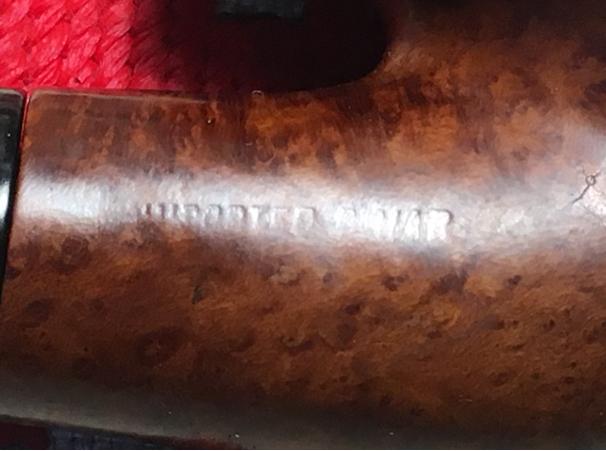
On my work desk in Sofia, Bulgaria, I take some additional pictures to fill in the gaps. Looking at two pictures above and the nomenclature on the left side of the shank, I tend to agree with the seller that the first word appears to be London in a cursive-type script with a flared line underneath.  The second word appears to start with a “P” also in a script with a flare line underneath. To see if I can make a possible identification with a pipe name starting with “London P…” I go to Wilczak & Colwell’s “Who Made That Pipe?” and I find some Comoy contenders – “London Pipe” and “London Pride”.  Neither of these candidates seem likely because the corresponding Comoy stem mark, “C” was absent.  Yet, the pipe could have a replacement stem, but not likely.  I then go to Pipephil.eu and simply search anything starting with “London”.  What I found was very interesting and possibly a match.  The clipping from Pipephil below shows the ‘London Royal’ nomenclature – looking at my specimen, what I thought was a “P” very likely is an “R”.  The flare lines underneath is a convincing indicator as well.  Also matching was the right side “Imported Briar”.  Again, missing is any stem marking – a hat in the specimen below.

While I cannot be 100% sure in the identification, “London Royal” may indeed be on target.  Pipedia gives a short description of the LHS company:

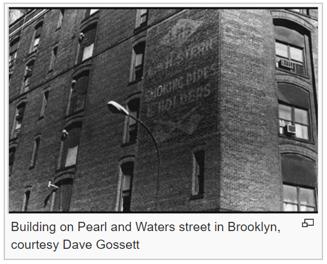
Ludwig Stern, a successful pipe manufacturer since 1893 and closing around 1960, reorganized his company along with his brother Hugo Stern, opening a factory in 1911. They named the company L&H Stern Smoking Pipes & Holders. The newly formed company was moved into a six-story building on the corner of Pearl and Waters street Brooklyn, NY.

The American company produced such pipe names as Sterncrest, Purex, Silvercrest, Barrister, Marwyn, Park Lane, Radmanol and Warwick.

Whether (or not) the Oom Paul (Billiard) before me is a LHS London Royal, it is a very attractive pipe with quality grain movement.  Overall, it is in good shape and I’m hoping an easier than normal clean-up and recommissioning.  There are a few nicks on the rim and some fills that need attention.  The chamber has very mild cake.  The stem bit shows some tooth chatter and no oxidation that I can see.  I begin the restoration of this possible, LHS London Royal by reaming the chamber bringing it to the briar for a fresh start.  I also plop the stem into the Oxi-Clean bath even though there is no visible oxidation.   Starting with the smallest, I use 2 of the 4 blades available in the Pipnet Reaming Kit.  I follow with the Savinelli Pipe Knife to fine tune the ream then sand the chamber using 240 grit paper.  I then wipe the bowl with a cotton pad wetted with isopropyl 95% to remove carbon dust.  The pictures show the progress. Turning now to the internals, I use cotton swabs and pipe cleaners wetted with isopropyl 95% to clean.  I discover the internals are pretty gummed up.  With the hour becoming late I decide to use the stealth method of cleaning.  I use kosher salt and alcohol to soak in the chamber overnight.  I first twist a cotton ball to form a wick to stuff down the mortise to draw out the oils and tars from the briar.  I then fill the bowl with salt and after placing my palm over the top give it a shake to displace the salt.  Then I carefully fill the chamber with the alcohol until it surfaces over the kosher salt.  I put it aside and turn the lights off.  The pictures show the cleaning process.Turning to the stem the next day, I remove it from the Oxi-Clean bath and even though it is minimal, the bath has successfully ‘raised’ oxidation to the surface.  Using 600 grit paper, I wet sand the stem.  Following this, I utilize 0000 steel wool to remove more and begin the polishing of the stem.  I still detect some tooth chatter especially on the lower bit and a small compression dent on the upper.  I use the heating method to raise the chatter by passing the end of the stem carefully over a lit candle.  The vulcanite when heated like this will naturally expand and seek its original place.  The heating helps, but I still need to do some sanding in the upper and lower button area using 240 grit paper.  Using a flat needle file, I use the opportunity to sharpen the upper and lower button lips. Following the 240 grit paper, I use 600 grit to further smooth and polish then conclude with 0000 steel wool.  The pictures show the progress. The stummel has been in a kosher salt/alcohol soak through the night.  Kosher salt is used because, unlike iodized salt, it does not leave an after-taste.  I remove the wick from the shank and it has done its job of pulling oils and tars out of the stummel.  I toss the used salt in the waste and clean the bowl with paper towel and a long-bristled brush.  I also use a brush reaching into the mortise to remove residue salt.  I follow by continuing use of cotton swabs dipped in alcohol and pipe cleaners to finish up the internal clean-up.  The pictures show the progress.With the stummel internals cleaned, I turn to the internals of the stem.  Using pipe cleaners dipped in isopropyl 95% I attack. It did not take long because the pipe cleaners emerged clean.With the internals clean, I now turn to the stummel surface.  I use Murphy’s Soap and cotton pads to clean the stummel surface. As advertised, Murphy’s does a great job cleaning the oils and grime that build up on the surface. After scrubbing, I rinse the excess off using tap water careful to keep water out of the internals. The cleaning reveals two fills on the surface which appear to be solid after I probe them with a sharp dental tool.  The rim has a scorch mark over the 10 o’clock area in the picture below.  There are also scuff marks at the 6 and 8 o’clock areas.  The pictures show what I see.I decide to do a light topping using 240 grit paper on a chopping board.  I don’t need to take off much – only enough to remove the scuffing and surface part of the scorching.  I will make an internal rim bevel which will remove damage along the inner rim edge.  It is a little tricky, because the shank extends beyond the height of the stummel top.  I do the topping on the edge of the board as a result.  After rotating the stummel on the topping board, periodically checking to make sure I’m staying true, I switch to 600 grade paper to smooth the top further.  Using a coarse 120 grit paper, I cut an internal rim bevel to remove damage as well as soften the rim lines.  I follow with 240 grit paper.  On the outside rim edge, I give it a light bevel with 240 followed by 600 paper – again, removing the left-over nicks as well as softening the lines of the rim.  I think bevels add a touch of class to a rim.  The pictures show the rim progress. With the rim repair complete, I move straightaway to the stummel surface.  I’m anxious to see how the briar grain emerges during the micromesh pad process.  I’m careful to stay away from the almost non-existent ‘London Royal’ nomenclature on the sides of the stummel.  I want to preserve what I can. Using micromesh pads 1500 to 2400 I wet sand.  I follow wet sanding by dry sanding with micromesh pads 3200 to 4000 and then finishing with 6000 to 12000.   As hoped and expected, the pictures show the grain emerge.  As I look at the grain, I’m beginning to think that this stummel is a candidate to remain as the natural grain color and not to stain.  There are a few fills that I darken and blend with stain sticks.  It looks good!  I think Jen will like how this Full Bent Billiard (aka Oom Paul) is coming along.  I’ll finish the stem before making the final decision about whether to apply a stain.  Turning now to the stem, I wet sand using micromesh pads 1500 to 2400 then dry sanding using pads 3200 to 4000 then 6000 to 12000.  After each set of 3 micromesh pads, I apply a coat of Obsidian Oil to the thirsty vulcanite stem.  This oil revitalizes the vulcanite.  I love the vulcanite ‘pop’ as the pads do their magic! Moment of decision.  I reassemble stummel and stem to get a look at the big picture.  The possible LHS London Royal Oom Paul is without doubt a handful of pipe.  The grain presents bird’s eye on both sides of the stummel with lateral straight grain in the front and on the shank top and bottom.  A very nice feel to it as well, as I hold it and balance it in my palm.  The rim looks great too with soft beveled lines.  Decision point – do I leave the stummel the natural grain color or do I stain it?  If I stain it, I will use a light brown hue simply to tie together what is already there.  The original appeared to have been leveraged toward the lighter hue as well.  With some input from my wife, who has more color coordination DNA in her gene pool, I decide to stay with the original, natural, saddle, leathery color – leaving it just as it is. With that decision made, I fine tune and bring out the natural finish by using Tripoli compound which applies a fine abrasion, then Blue Diamond compound – more abrasion but finer than Tripoli.  I use a cotton cloth wheel with the Tripoli compound (not my usual felt wheel) because I’m not cutting through the fired crust of a stained stummel.  After mounting the buffing wheel on the Dremel, I set the speed at 2 of 5 (fastest) and purge the wheel to clean it from old compound. I apply the compound over the stummel, rotating the wheel over the surface, not apply a great deal of downward pressure.  I let the compound and the RPMs do the work.  After completing the Tripoli cycle, I attach the Blue Diamond compound cotton cloth buffing wheel, reattach the stem and stummel, and give both the Blue Diamond buffing using the same approach as with Tripoli.  When completed, I hand buff the pipe with a felt cloth to remove the compound dust preparing for the wax.  Then, switching to the carnauba wax cotton cloth wheel, also with Dremel set at speed 2, I apply several coats of carnauba wax to stem and stummel. During the carnauba wax application, I notice that the stem has loosened during the process.  I use a technique of expanding the tenon a bit so that it gains more purchase in the shank from Charles Lemon’s blog site, Dad’s Pipes.  The procedure usually uses a drill bit, where, after gently heating the tenon, a next larger drill bit is inserted into the supple tenon expanding it microscopically.  Instead of a drill bit, I find that a Dremel shaping tool sized up a little better than the drill bit.  After heating the tenon, the shaping tool eased into the tenon.  It did the trick giving the tenon a better fit in the mortise.  The pictures show this procedure.With the tenon now a bit snugger, I complete the application of the carnauba wax. After the carnauba cycles, I mount a clean cotton buffing wheel on the Dremel and do a ‘clean’ buff over the entire pipe.  I do this to assure that no pockets of wax are left on the surface and to raise the shine.  After this, I hand buff the pipe using a micromesh cloth to deepen and raise the shine of the briar grain more.

This possible LHS London Royal Full Bent Billiard, Oom Paul has turned out very well.  I think that whichever of Jen’s family of men receives this pipe, he will enjoy it for many years to come as its new steward.  As I said earlier, the profits of this pipe benefit the work we do here in Bulgaria with women who have been sexually exploited and trafficked, the Daughters of Bulgaria.  Check out my blog, The Pipe Steward, for more information about this.  Thanks for joining me!


A difficult trust: Gift of a Grandfather – A BBB Double Star Made in England


Blog by Dal Stanton

When I study the venerable pipe on my work table, it is not a glamorous display of briar and silver bands.  Some might call it a basket pipe.  The two stars imprinted on the shank were an indication of a working man’s pipe – not high quality, but among those pipes accessible to normal, if not common, people who work, live, love and as is the case with us all, die.  This unremarkable Apple shaped, BBB [diamond over] Double Star, MADE IN ENGLAND [over] 152, is remarkable because of the story it represents.   I enjoy restoring ‘estate’ pipes because they were left to others and these pipes carry with them stories and memories of loved ones who once befriended and valued them.  Greg heard from my son, Josiah, who are college buddies, that Josiah’s old man (my words not theirs!) restored ‘old’ pipes.   This ‘old’ pipe came to Greg from his grandfather through his mother.  Josiah’s email came to me asking what I could do with these pictures from Greg. My understanding is that Greg was a bit reluctant at first to send his pipe off to Bulgaria to be restored, but after Josiah directed him to some of the restorations I’ve done, he felt he could trust me with the heirloom that had come to him.  Knowing that this pipe was from his grandfather I asked that Greg send me information about his grandfather so that I not only could place the pipe better in history, but Greg’s grandfather as well.  This is the letter he sent me:
Hi Mr. Stanton,

Thank you so much for agreeing to restore my grandfather’s pipe. I am sorry for the delay in getting you the below information, but it’s been a crazy couple of weeks.

My mother inherited the pipe from my grandfather when he passed away in 1998. I saw it in the china cabinet one day and asked her if I could have it, since I had taken up pipe smoking. She kindly agreed. She doesn’t really know when my grandfather got the pipe, but she said he must have bought it in Hong Kong.

My grandfather was from Hong Kong, and only emigrated to the United States in the 1980s. He was a malaria inspector for the Hong Kong government for his entire working career. He must have gotten the pipe at the latest in the late 1940s or early 1950s, as my mother remembers him having it when she was a child. He never smoked the pipe when I knew him, but from its condition, I assume it was well used at an earlier period in his life.

Having graduated from the University of Georgia Law School in Athens, Georgia, passed his bars and currently serves as a law clerk to a federal magistrate judge in Augusta, Georgia, AND as a young married man, I can understand why Greg “took up” smoking pipes!  Pipes are wonderful companions for blooming attorneys!  His letter concluded with an agreement to the cost of the restoration would benefit our work with the Daughters of Bulgaria!  Thank you, Greg!

The information Greg received from his mother was invaluable for placing this BBB in time and space.  Pipedia’s article about BBB is helpful.  BBB in the mid-1800s originally stood for “Blumfeld’s Best Briars”, but after the death of Blumfeld, the Adolph Frankau Company took over the company and BBB gradually became “Britain’s Best Briars”.

The “BBB Two Star” rating also is referenced in the same article in a discussion of quality descriptors for BBB pipes:

In the Thirties, the top-of-the-range one becomes “BBB Best Make” with alternatives like “Super Stopping” and “Ultonia Thule”. The BBB Carlton, sold with the detail with 8/6 in 1938, is equipped with a system complicated out of metal, system which equipped the BBB London Dry too. Blue Peter was not estampillées BBB but BBB Ultonia, and the BBB Two Star (* *) become the bottom-of-the-range one. 

When Greg’s pipe arrived in Bulgaria, thanks to a visitor’s willingness to carry it across the Atlantic and European continent, I unwrapped it and put it on my work desk and took these pictures to fill in the gaps. At PipePhil.eu an example of the BBB Two Star marking is pictured along with the stinger/tube style extending into the chamber as Greg’s grandfather’s BBB does ( as seen above).In Pipes Magazine, I found a thread discussing the dating of the BBB Two Star.  One threader’s opinion, ‘jguss’ corroborates Greg’s mother’s recollections:
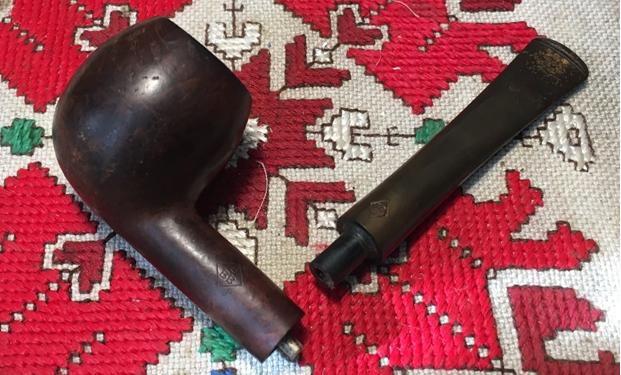
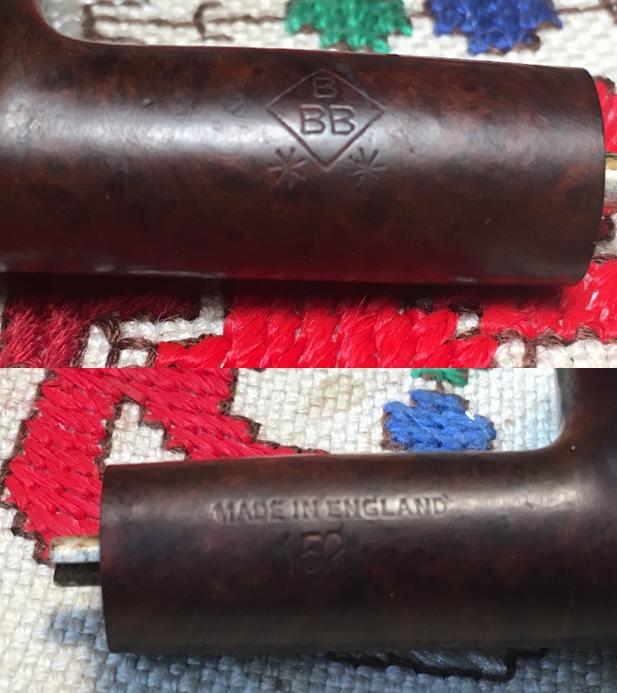
My guess is that the Two Star line started at the end of WWII; the first mention I’ve found so far is dated 1945, which at least gives a tpq (that is, an approximate dating). I know the line lasted at least into the early sixties.

It is not too difficult to speculate about the provenance of Greg’s pipe.  During WW2, briar became a scarce commodity throughout Europe and pipe manufacturing companies made do with what they could acquire.  Two Star BBBs would be lower end but more than likely during this time, a very close second when rations were short.  Added to this backdrop is the origin of our story in Hong Kong.  Hong Kong, a British holding since 1841 (see LINK), lost control of Hong Kong during WW2 to Japan in 1941 during the Battle of Hong Kong.  Undoubtedly, Greg’s grandfather would have experienced this first hand.  When Japan unconditionally surrendered in 1945, the British regained control of Hong Kong, but to counter Chinese pressures to control Hong Kong, reforms were introduced that broadened and increased the stake of local inhabitants of Hong Kong:

Sir Mark Young, upon his return as Governor in early May 1946, pursued political reform known as the “Young Plan“, believing that, to counter the Chinese government’s determination to recover Hong Kong, it was necessary to give local inhabitants a greater stake in the territory by widening the political franchise to include them.[19] (Link)

During the years following the Second World War, the same article describes unprecedented economic development which resulted in the economic powerhouse that Hong Kong became.  This period would have been while Greg’s grandfather was working as a malaria inspector for the government of Hong Kong and during which he acquired this BBB Two Star.  The smaller Apple shape would have served him well as he performed his inspection duties but given the ‘stem forensics’ pictured above, he probably chewed on it a bit as well while he worked!

With a greater sense of the story that this BBB Two Star tells, from England, to Hong Kong, to America, and now to Bulgaria, I’m anxious to restore this precious family gift from Greg’s grandfather.  At Greg’s request, he’s hoping for a pipe that is as good as new and ready for a new lifetime of service.  Yet, with all restorations, undoubtedly there will be some marks and blemishes remaining – these an ongoing testament to the memory of those who those who went before.

The first order of approach is with the stinger.  When the pipe arrived, the stinger was already separated from the stem.  The stinger extends from the stem through the mortise into the chamber itself through a metal tube air draft hole.  Using a pair of plyers, I wrap a piece of cloth around the end to pull gently to dislodge the stinger from the mortise.  I can see in the mortise that there appears to be a metal sheath that the stinger is lodged in – at least, that is what it appears to be.  The stinger is not budging and I do not want to break the stinger off.  To try to loosen things up, I pour some isopropyl 95% in the chamber to allow it to soak into the draft hole.  Hopefully, in time, this will loosen the stinger. The alcohol soak did not work.  In fact, a few weeks have transpired since writing the words above.  This stinger has given me quite the challenge.  In the back of my mind constantly, is the concern that I not leverage too much pressure pulling on the stinger.  I’m concerned about damaging the shank.  After soaking the internals for some time with alcohol, I pulled with plyers hoping to break the grip.  I also attempt heating the stummel with a heat gun in hope of dislodging the stinger.  I also heat the protruding part of the stinger with a candle, hoping that this would break the bond.  It did not.   I also was concerned about the candle flame close to the briar while trying to heat the stinger.  I craft a tinfoil shield, but this was not successful.  Unfortunately, I singed the end of the shank and had to remove the damage by ‘topping’ the shank end, which leads to a bit of work lining up the stem and shank later.  As you might expect, the protruding end of the stinger did not hold up under the pressure and eventually broke off. After the stinger protrusion broke off, and after a second email to Steve for input, I’m at the point of using a drill bit in another attempt to remove the bonded stinger.  Starting with a very small bit, I hand turn the bit to allow the drill to find the center of the stinger and gradually, remove the stinger introducing the next larger drill bit.  The end of the broken stinger begins at about 1/4-inch-deep into the mortise.  Unfortunately, this method is not working either because the drill bit will not bite into the metal and remain straight.  At the end of the stinger slot that I’m boring into with the drill bit, my efforts are flummoxed by the stinger’s design.  It has a slanted metal airflow deflector that causes the drill bit to veer off mark.  After breaking the end of the drill bit in the slot (ugh!), and digging it out with needle nose pliers, I sit and begin to think I was facing failure.  Nothing was working.  I’m introducing more problems to the restoration as I try unsuccessfully to solve the stuck stinger problem.  I can’t move forward and I’m stuck and begin to compose an apology letter to Greg in my mind.  UNTIL, on a fancy, I insert a small flat head screw driver into the slot at the end of the broken stinger 1/4-inch-deep in the mortise and I twist it gently counter-clockwise, and it snaps.  Suddenly, it was loose and I easily extract the ‘middle’ of Grandpa’s old stinger – I’m sure he was the last one to see this artifact!  I see daylight through the mortise and I’m hoping that it might also be a metaphoric ‘light at the end of the tunnel’!  I’ve not forgotten that the other end of the stinger remains lodged in the draft hole tube at the foot of the chamber.  Thankfully, a larger drill bit was the perfect size and it reaches into the mortise and hand turning the bit, it clears the rest of the stinger shrapnel.  Finally!  Oh my….  I’ll be saving the stinger debris for Greg.  This BBB will continue without difficulty stingerless.  The pictures show the results. In the interest of full disclosure, these words are coming weeks after.  Why the hiatus?  Life’s normal twists and turns, work, some wonderful travel to Crete for an organizational conference, to Athens (not in Georgia) for a consultation on the Eastern Orthodox Church, AND my growing frustration with Greg’s grandfather’s pipe’s restoration as more complications arrived!  I’ll try to catch you up to the present:

With the stinger removed, I was anxious to continue the restoration with a ‘normal’ pattern – the stem goes into the Oxi-Clean bath to deal with the oxidation in the stem.  After some hours, the stem is removed from the bath and I wet sand with 600 grade sanding paper removing the raised oxidation followed by 0000 steel wool. To clean and protect the BBB stamping on the stem, I use a non-abrasive Mr. Clean ‘Magic Eraser’ sponge.  The pictures show the progress.The next step is to re-seat the tenon into the mortise.  After the arduous process of removing the stinger, and after singing the shank end with a candle flame, and after ‘topping’ the shank to remove the damaged briar, the tenon and mortise needed to be re-wedded with the new realities.  The tenon was too large for full insertion into the shank.  Using a combination of reducing the tenon size with sanding paper and steel wool, sanding and filing the throat of the mortise, and using a rounded needle file to cut a new internal mortise openning bevel to accommodate the broader tenon base, I patiently, slowly, methodically worked to re-seat the tenon in the mortise which included working and then testing the new fit – GENTLY!  I suppose the fact that I said to myself, ‘Dal, careful, don’t crack the shank’, at least a 1000 times only made the sinking feeling more intense when I heard the sickening sound during what proved to be my last, ‘gentle testing’ of the tenon inserted into the mortise.  The hairline crack is pictured below that I took only a day ago – I couldn’t bear to take it then, when it happened.  I was sickened and put Greg’s pipe aside.  I needed some time to work through my own sense of failure of the trust given me to restore this family heirloom.  Now, after several weeks, I’ve regrouped and have taken up Greg’s pipe again.  The travels that I described above during this time in some ways felt more like Jonah running from Nineveh not wanting to face the scene of his calling and his sense of failure!  Though, my trip did prove beneficial – I sold some of my finished pipes to colleagues to benefit and raise the awareness of the Daughters of Bulgaria that The Pipe Steward supports.  I’ve included my Nineveh travels below for you who may not be familiar with ‘my world’, the Balkans – Sofia to Crete to Athens and back. Before moving forward, I needed to repair the cracked shank.  With the help of a magnifying glass, I locate the terminus of the crack and mark it by creating an indentation with a sharp dental probe.  The arrow to the left below marks this.  Using the Dremel tool, I mount a 1mm sized bit and drill a hole at that point – but not going through!  This hole acts like a controlled back-fire to stop the progress of a forest fire.  This will not allow the crack to continue creeping.  With the use of a toothpick, I spot-drop Hot Stuff CA Instant Glue in the hole and along the line of the crack which I expanded microscopically by partially inserting the tenon into the mortise.  This allows the CA glue better penetration to seal the crack.  I remove the stem immediately after the application of CA.  With the CA glue still wet, I apply briar dust to/in the hole and along the crack to encourage better blending.  The pictures show the progress. After some hours allowing the CA glue to cure on the shank repair, using a round grinding stone bit mounted on the Dremel, I reestablish an adequate and uniform internal bevel on the end of the shank to accommodate the base of the tenon when it is fully inserted into the mortise.  My theory is this is what caused the crack – lack of a sufficient internal bevel giving room for the slightly enlarged tenon as it merges with the stem proper.  With the Dremel engaged at the slowest setting, I’m careful to apply minimal pressure as I rotate the ball a bit to make sure it’s centered.  It looks good – the pictures show the progress.Due to a lapse of sorts and the intensity of my focus on re-seating the stem again without re-cracking the shank, I failed (or perhaps, had little desire) to take any pictures.  The short of it is, the stem and stummel have been reunited after some difficult times.  Also, not pictured are some of the basic steps: reaming the fire chamber of carbon cake buildup, cleaning the internals of the stummel and stem with cotton swabs and pipe cleaners wetted with isopropyl 95%, and cleaning the externals of the stummel with Murphy’s Soap.  Again, picking up the trail, pictured below is the micromesh pad process with the stem.  Using pads 1500 to 2400, I wet sand the stem, followed by dry sanding with pads 3200 to 4000 and then 6000 to 12000.  I follow each cycle with an application of Obsidian Oil to revitalize the vulcanite.  The stummel surface shows quite a bit of pitting in the first picture shown again below.  The rim also shows nicks. On the larger pits shown below on the heel of the stummel, I spot-fill with a toothpick using CA glue and shorten the curing time by using an accelerator spray on the fills.  After filing and sanding the fills to the briar surface, using a progression of 3 sanding sponges from coarse, medium to light, I work out most the remaining pitting over the stummel surface.  Using 600 grit paper on the chopping block, I also give a light topping to the rim to remove nicks and create fresh lines for the rim.  Following the topping, I introduce an internal bevel to the rim, first using a coarse 120 paper rolled tightly, then with 240 and 600.  The internal rim bevel to me, always adds a touch of class but also helps create softer lines which enhances this Apples shape.  The pictures show the unhindered progress! I now take micromesh pads 1500 to 2400 and wet sand the stummel followed by dry sanding with micromesh pads 3200 to 4000 and then 6000 to 12000 taking a picture after each set to mark the progress.  I am careful to guard the BBB nomenclature on the shank sides.  As I move through these cycles, I realize that I have been so wrapped up in the technical aspects of this restoration for Greg, that I failed to see the beauty of this diminutive Apple shape.  The grain that emerges from Grandpa’s old timer is truly beautiful. Flame grain and swirls, with a few bird’s eyes accenting the whole – totally eye-catching for a Two Star sub-mark BBB I would say! To see the big picture to help determine the next steps, I reunite stem and stummel and stand back and take a good look.  This BBB Made in England is looking real good – in spite of everything!  I can see by the way the BBB Apple naturally sits on the surface, leaning slightly like a listing ship, but remaining upright, provides some clues regarding the significant pitting on the heel of the stummel – just off center. Greg’s grandfather undoubtedly and conveniently placed his pipe on a table or counter surface, or perhaps on a nearby crate, as he made his rounds as a malaria inspector for the province of Hong Kong.  The original BBB coloring leaned toward the favored darker hues of English pipe makers and client proclivities. I decide not to go that dark, but to stain the stummel using a light brown base with a touch of dark brown to tint it down that track a bit.  This will make for better blending, especially for the darker briar around the nomenclature on the shank.  Using Fiebing’s Light Brown Leather Dye as the base, I add a touch of Fiebing’s Dark Brown.  Using a folded pipe cleaner in the shank as a handle, I begin by warming the stummel with a hot air gun to expand the briar making it more receptive to the dye.  After heated, I apply the dye mixture to the stummel generously aiming for total coverage.  I then fire the wet stummel with a lit candle igniting the aniline dye, burning off the alcohol and setting the pigment in the grain.  After a few minutes, I repeat the process concluding with firing the stummel.  I put the stummel aside to rest for several hours.  The pictures show the staining process – yes, you can see my blue fingers – I’ve started wearing latex gloves when I’m staining. After some hours, I’m looking forward to ‘unwrapping’ the fired stummel to reveal the stained briar beneath.  Using a felt buffing wheel mounted on the Dremel, set at the slowest speed, I use Tripoli compound to remove the initial layer.  Moving in a methodical, rotating pattern, I work my way around the stummel not apply a great deal of down-pressure on the wheel, but allowing the RPMs of the felt wheel and the compound to do the work. After removing the crusted layer with Tripoli, I wipe the surface with a cotton pad wetted with isopropyl 95%.  I do this not so much to lighten the finish, but to blend and even out the stain over the surface.  Following this, I mount a cotton cloth wheel on the Dremel, increase the speed slightly, and apply Blue Diamond – a slightly less abrasive compound.  After both compounds, I use a clean towel to hand buff the stummel to remove excess compound dust before applying the wax.  Pictures show the progress. Reattaching the stem and stummel, I apply several coats of carnauba wax to both.  Using a cotton cloth wheel, I set the speed of the Dremel to 2 with 5 being the fastest, I apply the carnauba and I like what I see.  With the carnauba wax applied, I mount a clean cotton cloth buffing wheel on the Dremel and again buff the stummel and stem.  Finally, I apply a rigorous hand buff using a micromesh cloth to raise the shine more.

This BBB Double Star Apple has come a long way from England to Hong Kong to the US to Bulgaria, and now it’s ready to return to its new steward.  This restoration was a bit bumpy, but then, so is life.  I’m glad to help give this pipe a new lifetime and I hope Greg not only enjoys it, but that it provides a special connection with his past.  I’m sure Grandpa would be proud.  Thanks for joining me!

French Made Bruyere Garantie Bent Billiard from Burgas


Blog by Dal Stanton

I received Gary’s email when he and his wife were visiting the Bulgarian city of Burgas on the Black Sea coast. Ever since I started restoring pipes, Gary, my colleague living and working in Plovdiv, has kept his eyes open during his travels. He’s found some very nice pipes for me. The two he found at the antique shop on the main walking street in Burgas were possibilities so he landed them for me. The larger bent billiard in the pictures he sent is on my work table now. I chose it because I’m hoping for a project that doesn’t appear to be in too much need!The only marking on the pipe is stamped on the left shank and it says, “BRUYERE” over “GARANTIE” which I’ve understood as a rather generic marking used by several manufacturers from different continental countries in Europe.  On a hunch, I looked up the generic marking in Wilczak and Colwell’s manual, “Who Made That Pipe?” and was surprised to find a semi specific listing: UNK France.  With an ‘unknown’ maker, but because of the spelling, they identify the French origins.  Odds are, if from France, then most likely the place of origin is Saint-Claude.  After receiving the pipes from Gary, I put the French made, 3/4 Bent Billiard on my work table in Sofia, and take these pictures to fill in the gaps. The grain on this larger stummel is outstanding – much motion and flow.  Standing out is the bull’s eye wraparound knot grain perfectly situated to highlight the elbow where shank and stummel meet and blend (pictured above).  The stummel surface has several dents and some cuts from normal wear and grime collection.  The rim has some oil residues but like the stummel surface, has its share of normal wear dents.  The cake in the chamber is very light and the remnants of the last smoke are still evident – a blend of sorts (pictured below)!  The stem shows light oxidation and tooth chatter primarily on the lower bit.  The button and slot look good.  To start the restoration and cleanup of the Bruyere Garantie Bent Billiard, after inserting a pipe cleaner through the stem, I put the stem in the Oxi-Clean solution to soak, working on the oxidation.  With stummel in hand, I clean out the old tobacco from the chamber with the pipe nail tool.With the Pipnet kit, I ream the cake to the briar for a fresh start.  I use the two smaller of the 4 blades available in the kit and follow this by using the Savinelli pipe knife to fine tune the ream by strategically scraping the chamber wall.  To clean the chamber wall, I wrap 240 grit paper around a Sharpie Pen and sand the chamber and then use a cotton pad wetted with isopropyl 95% to remove the carbon dust.  Looking at the cleaned chamber, it looks good. With the chamber finished, I turn to cleaning the internals of the stummel with cotton swabs and pipe cleaners dipped in isopropyl 95%.  It does not take long and pipe cleaners and swabs are coming out clean. Now turning to the cleanup of the surface of the stummel, I use undiluted Murphy’s Soap with cotton pads and a bristled toothbrush to clean the grime off the briar surface.  Murphy’s does a good job cleaning wood of grime and old finish.  I rinse the stummel with tap water careful not to flood the internals with water.  I inspect the rim and surface with things cleaned up and take some close-ups of dents and marks showing signs of wear – a well-smoked and liked pipe.  The pictures show the cleaning and surface inspection. To address the stummel rim and surface, I use a medium grade sanding sponge to remove as many of the imperfections as possible.  I use this sanding sponge to perform a gentle topping of the rim to remove the dents.  I follow with a light grade sanding sponge and I also freshen the internal rim bevel using first 240 grit paper followed by 600.  The clear majority of the nicks and dents have been removed.  Those that remain will be an ongoing testimony of the years this pipe has spent serving his steward! The pictures show the progress. I’m ready now to fine-tune the stummel by sanding with micromesh pads 1500 to 1200.  I first wet sand using pads 1500 to 2400.  After completing the wet sanding, I detect some fills that have softened.  This probably resulted from the water on the stummel and the fill material was only water based.  Two were on the rim and a few more on the side of the stummel.  Using a sharp dental probe, I dig out the old fill that at this point has the texture of wet clay.  Pictured is the completion of the first 3 micromesh pads and the beginning of a small detour – such as life!  The detour requires that I mix briar dust and super glue to make a more durable fill than what I just removed.  After filling the holes, I’ll then need strategically to re-sand the patches and return to the micromesh pads.  While I’m at it, I detect a few more fills and clean them out.  These ‘factory fills’ are normal and reveal that one seldom finds a perfect block of briar without some imperfections.  The most challenging patch will be the rim.  I begin by wetting a cotton pad with isopropyl 95% and wipe down the stummel – I want it clean and free of residue fill material.  I then use a pipe nail and scoop out an enough briar dust on an index card that serves as my mixing pallet.  I then add a small puddle of regular superglue next to the briar dust and use a toothpick to begin mixing the putty by drawing dust into the puddle of glue.  When the consistency of the putty is about like molasses, I use a flat dental spatula to apply the briar dust putty to the holes.  I leave excess putty over each patch in anticipation of sanding it down flush to the briar surface.  I use an accelerator spray to shorten the curing time for the patches.  It takes me two batches to fill the holes.  The pictures show the progress. I decide to let the stummel rest a bit as the patches cure and work on the stem.  I remove the stem from the Oxi-Clean bath that it’s been soaking in for several hours.  The oxidation has ‘surfaced’ on the vulcanite stem and I use 600 grit paper and wet sand the stem to remove the oxidation after remounting the stem and stummel with the plastic disc separator.  This helps avoid shouldering the stem.  After completing the sweep with 600 grit, I look at the lower bit where there was tooth chatter and some dents.  I use 240 grit paper to sand these out.  One dent was refusing so I dropped a bit of Black CA glue on it and applied some accelerator spray to cure it quickly.  After a bit, I returned to the patch with 240 grit paper to smooth it and blend it with the vulcanite.  I follow using 600 grit sanding paper and then finish this phase by buffing the entire stem with 0000 steel wool.  The pictures show the progress. With the stem in front of me, I decide to move it to the micromesh phase.  Using micromesh pads 1500 to 2400 I wet sand the stem. When I complete this first cycle I realize that I forgot the clean the internals of the stem!  Call me anxious….  Holding the stem with paper towel, I gingerly use pipe cleaners dipped in alcohol 95% and then with cotton swabs I clean out the filter cavity.  Thankfully, the stem was in pretty good shape.  Back to the micromesh process.  I follow this by dry sanding with pads 3200 to 4000 and then 6000 to 12000.  I follow each cycle of 3 pads with an application of Obsidian Oil which deepens the color and revitalizes the vulcanite.  The pictures show the progress – looking good! With the stem restoration complete, I turn to the stummel again.  I use a flat needle file to begin the process of bringing the excess briar dust putty down to the briar surface.  I start with the rim patches and move around the stummel.  After using the flat needle file, I use 240 grit paper on each patch to bring it down to the surface.  I finish the sanding and blending with 600 grit paper.  At this point, I notice some air pockets in some of the patches.  I spot drop a small bit of superglue in each and spray it with accelerator.  After a few minutes, I sand down the superglue fills very quickly with the flat needle file, then 240, then 600.  I take pictures along the way. With my day ending, I want to clean the stummel internals further using a kosher salt and alcohol soak.  I fill the stummel with kosher salt and I cover the bowl and give it a shake to displace the salt.  I use kosher salt and not iodized salt as it does not leave an iodine aftertaste.  I stretch/twist a cotton ball and feed it into the mortise acting as a wick to draw out the oils during the soak.  I situate the stummel in an egg carton and using a large squeeze dropper, I fill the bowl with isopropyl 95% until filled.  I wait a few minutes as the alcohol is quickly drawn down.  I top it off again with alcohol.  I turn out the lights – another day complete. The next morning, the kosher salt and alcohol soak did its job.  The salt and cotton wick are discolored indicating a not too dirty stummel giving up more gunk.  I thumped the stummel on my palm (not table!) and the expended salt goes into the waste.  I wipe the chamber with a paper towel and run bristle brushes of differing sizes in the chamber, through the mortise and draft hole to remove all the salt.  It’s looking good and the new steward of this Bent Billiard will enjoy a sweeter taste as a result.  To get a bird’s eye view of the project, I rejoin the finished stem with the now patched stummel.  The more I study the grain on this pipe, the more I like it – especially the lower horizontal grain encompassing the stummel’s heel then transitioning through the elbow of the shank merger.  A very pleasing visual as one cradles the ample Billiard bowl in his (or her!) palm. Imagination aside, time to get back to the stummel micromesh process.  Since I  had already completed the first 3 micromesh pads, I wet sand with these again, but focus on the rim and stummel patched areas.  After wet sanding with pads 1500 to 2400, I apply a stain stick to the patch on the stummel.  Because of the sanding, this area is lighter than the surrounding patch of briar.  I apply some stain, let it dry, and wipe it with a bit of alcohol on a cotton pad to blend.  Then, I continue with dry sanding with pads 3200 to 4000 and then finishing with pads 6000 to 12000.  I am amazed at how a natural grain can achieve such a gloss through this process – wax is not needed!  To me, the difference between the character of this gloss and the ‘gloss’ of an acrylic finish is the difference between a high-end HD flat screen and a so, so TV – color, but not the same sharpness or reality.  When one looks at grain through an acrylic finish, you’re looking through a film creating the shine not the grain itself, as is with a natural grain gloss – the real deal.  The stains we apply then, do not create a film over the wood but colors it to help hide imperfections, etc., – a big difference.  The pictures show the source of my amazement and reflections. With the micromesh pad cycles completed, I confer with my wife about the finish.  Yes, I often ask my wife’s opinion at this point because of her eye for beauty and colors.  Originally, I had been thinking of keeping with the original color bent – toward more reddish tones.  After our conference, because of the beauty of this grain as is, I will stay with brown, leather tones consistent with the natural grain.  I had avoided the nomenclature during the sanding processes and there was still residue of the older color.  I use acetone (yes, the yellow label is acetone in Bulgarian!) with a cotton pad and work on removing the reddish finish.  I’m not totally successful, but I don’t think what is left will make a difference. To stay in the brown/leather tones, I decide to mix 3 parts Fiebing’s Dark Brown Leather Dye with 1 part alcohol with a large bulb dropper.  I want the finish on the darker brown side to blend the briar dust putty patches, but light enough so that the grain is showcased.  To prepare the stummel, I first wipe it down with a cotton pad wetted with isopropyl 95% to clean the surface.  After mounting a narrowed cork into the shank as a handle, I warm the stummel with a heat gun to expand and open the briar allowing it to absorb the dye more efficiently.  I then liberally apply the dye mixture to the stummel with a folded pipe cleaner seeking full coverage.  With a lit candle, I then ‘fire’ the stummel, igniting the alcohol in the dye which sets the stain.  After a few minutes, I repeat the process concluding with firing the stummel.  I then put the stummel aside to rest for several hours before continuing.  The pictures show the progress. After several hours, I’m ready to unwrap the crust encasing the stummel resulting from the fired dye.  I mount a felt buffing wheel on the Dremel, set the speed of the Dremel at the lowest, and use Tripoli compound’s abrasive characteristic to remove the crust.  I first purge the wheel with a tightening wrench, to remove old compound and to soften the felt wheel.  I rotate the felt buffing wheel over the surface without a lot of downward pressure.  The speed of the Dremel and the compound do the work.  To reach the difficult angle between the shank and bowl, I switch to a smaller felt wheel.  After finishing with the Tripoli compound, I wet a cotton cloth with alcohol and wipe down the stummel to both lighten the aniline stain and to blend it.  Following this, I switch to a cloth buffing wheel and turn the speed up from 1 to 2, approximately 40% of full speed, the fastest being 5, and apply Blue Diamond compound in the same manner as the Tripoli.  I notice a few bright spots on the surface as well as around the nomenclature where the stain did not set consistently.  I applied a bit of black Fine Point Sharpie Pen and darker stain sticks to blend the areas.  I go over these areas again with the Blue Diamond buffing wheel to blend the spot staining.  It looks good. I then buff the stummel with a flannel cloth to clean it of compound dust before applying the carnauba wax.  Switching to another cotton cloth buffing wheel dedicated to carnauba wax, I reattach the stem to the stummel and apply the wax at the same 40% speed.  I apply 2 cycles of carnauba to the surface and stem, then I switch to a clean Dremel buffing wheel and buff the pipe yet again.  Finally, I give the pipe a rigorous hand-buffing with a micromesh cloth.
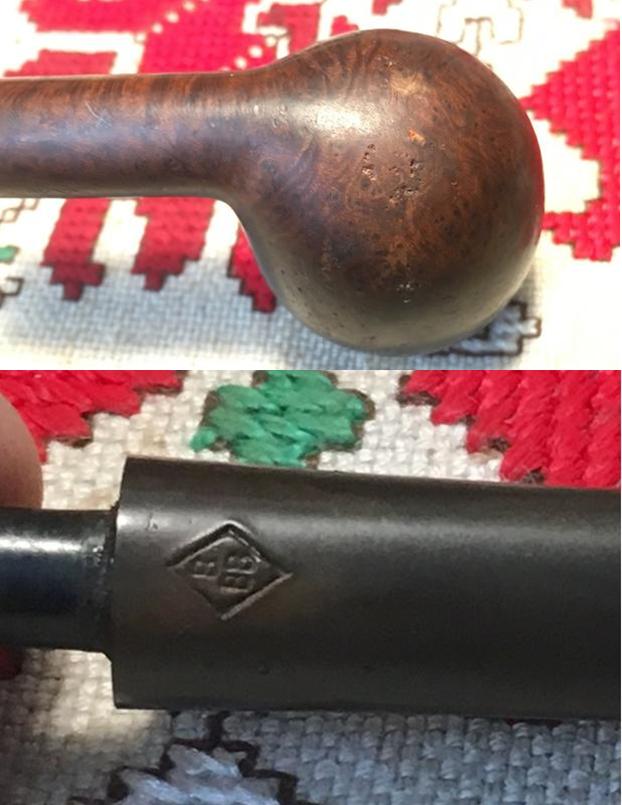
This French, probably Saint-Claude, made Bruyere Garantie Bent Billiard is stunning – the grain is beautiful.  As I mentioned before, I am drawn to the heel of the stummel, at the elbow where stummel and stem meet – the knot grain perfectly situated there is amazing and says something about the eyes and judgment of the pipe maker who chose the briar block and could see what it would become.  I’m very pleased with the results of this pipe.  If you would like to adopt this classic Bent Billiard, look at my store front at The Pipe Steward.  The sale of pipes benefit the Daughters of Bulgaria, an organization we work with helping women (and their children) who have been sexually exploited and trafficked.  Thanks for joining me!  


GBD Trafalgar London Made Calabash – An Unexpected Hole Repair


Blog by Dal Stanton

I’m calling this GBD Trafalgar a Calabash shape, and it’s been in my “Help me!” basket for some time.  I saw it on the US eBay auction block and I liked the shape and the way the grain was positioned in shaping of the flowing Calabash stummel.  From what I could make out from the few pictures the seller provided, the front and back of the bowl revealed horizontal straight grain.  These grain veins terminate on each flank with distinctive bird’s eye.  I liked it – I bid on it – and I was happy to bring it home to Sofia, Bulgaria, where it’s now on my work table.  Here are a few pictures from the seller. The markings on the Calabash on the left side of the shank show, “GBD” in the oval over “LondonMade” curved up.  The right side of the shank shows, “LONDON ENGLAND” over what I’m assuming is the shape number “K1978” only I couldn’t find this shape number listed for GBD pipes.  Under the shank is “TRAFALGAR”.  GBD (Pipedia’s article on GBD), was the handshake enterprise started by three French ‘Master Pipemakers’, Ganneval, Bondier and Donninger in Paris in 1850 to manufacture Meerschaum pipes, which was the primary material used in manufacturing pipes along with clay, until the discovery of briar in Saint Claude, France, a discovery that changed the pipe manufacturing world.  In 1902 Marechal and Ruchon sold GBD to A. Oppenheimer & Co. in London, which began the shift of GBD to being primarily a British enterprise, even though GBD pipes continued to be produced in Paris and Saint Claude, until 1981, with the closing of the French operation when the name, GBD, was merged with the Cadogan Group.  I enjoy rehearsing the historical developments of pipe names and companies because they add to the enjoyment and appreciation of restoring pipes.

The history of the ‘Trafalgar Campaign’ (see LINK) and what it would suggest I believe, is that this GBD pipe was manufactured and distributed across the channel in England, as the stampings indicate.  This is not always the case from my research on GBD.  Often, GBD pipes were manufactured in France, shipped to the UK, where they would be stamped “London Made” – or so my reading has indicated.  Yet, with the stamping of Trafalgar, my guess is that this GBD was manufactured in UK.  In 1805, ‘Trafalgar’ was the final battle engagement between the combined French and Spanish fleets and the Royal Navy to defeat Napoleon’s attempt to gain control of the English Channel, the first phase in his ultimate plan to invade England with his land forces.  To the British, Trafalgar will be commemorated as a victory thwarting the French invasion.  Fortunately, not too many years later, the economics of pipe manufacturing and the common love of pipe smoking, Brits would smoke French made pipes and the French, London made pipes.  Yet, I doubt if one will find this GBD Trafalgar London Made in the rotation of a Frenchman or Frenchwomen today!  I was anxious to integrate the Battle of Trafalgar into this restoration because of my love of tall ships.  Pictured is another of my hobbies in the same room as my pipe restoration work desk, a long-time project building the USS Constitution, now proudly anchored in Boston Harbor!

With a greater appreciation of this GBD’s history and name, I look more closely at the pipe itself and take more pictures on my work desk to look more closely and to fill in the gaps. Looking closer and assessing areas of need, the chamber has a light carbon cake, and the rim is nicked up significantly on the front outer lip and the lava flow of oils and grime need attention.  The finish on the stummel is dark and cloudy.  Oxidation on the stem is minimal but there are tooth dents on the bit, and the upper button lip has a clenching dent that will need attention.  Everything seemed straight-forward until my index finger detected a ridge where there shouldn’t be one.  I hadn’t seen it before (and I checked the eBay pictures and it wasn’t shown by the seller 😦 as sometimes is the case), but my index finger revealed what appears to be an impact fracture on the front heel of the stummel.  My first reaction is to insert my pinky finger into the chamber to see if I could feel any reciprocating activity on the internal side.  I feel nothing.  I take pictures to focus in on the fracture from different angles.  I use the sheen of the overhead lamp to see more clearly the little disaster now before me.  On the last picture below, I circled the only good news I can see at this point.  My forensic hypothesis assessing the scene of the crime: This piece of briar surface is what I assume is the impact point on a hard, unsuspecting surface.  The curvature of the stummel would have been abruptly flattened upon impact, and the expansion of this piece of impacted briar would have pushed out and then up, much like convergent tectonic plates in the earth’s surface.  The good news?  This small piece of briar is still attached to the stummel, though it appears the attachment may be tenuous.  The last two pictures below I placed arrows pointing to the terminus points of the trauma cracks which will most likely grow without intervention – what I thought would be a fairly slam dunk restore!  The pictures show the new challenge and opportunity to expand my skills! To recommission this GBD Trafalgar London Made Calabash, after inserting a pipe cleaner in the stem, I plop the stem in the Oxi-Clean bath to address the minor oxidation mainly in the bit area.  Cleaning the stummel is the next order of business.  Using the Pipnet Reaming Kit, after putting paper down on the work surface, I take out the smallest blade to use, but after eyeballing the angle of the chamber, the Calabash’s conical fire chamber is too tight to allow even the smallest blade to fit down to the lower area. Switching to the Savinelli Pipe Knife, I remove the light carbon build up down to the briar for a fresh start.  As often proves to be the case, as I proceeded with the reaming of the chamber, working the Savinelli Pipe Knife down into the foot of the chamber around the draft hole, the reality of the thinning of the briar was fully revealed.  The small piece of briar that was hanging on, on the external side, was dislodged, resulting in a hole through the stummel.  Technically, I think this is a burn through, as there is a hint of darkening of the briar indicating the heat.   As I’ve seen in other restorations, especially with the narrower drilled fire chambers, the briar at the floor of the chamber wears away with excessive reaming and digging and with time, the briar thins. After I salvage the dislodged piece of briar, not hopeful that it will be part of the solution, I take a couple pictures to record the break-through and continue cleaning the chamber.

When I finished reaming with the Savinelli knife, I use a coarser, 120 grit paper wrapped around a Sharpie Pen to clean further the carbon, especially the floor of the chamber where repairs will be made.  I then follow with 240 grit paper and finally, I wipe the chamber with a cotton pad wetted with alcohol to deal with the residue dust.  The pictures show the progress. Continuing the cleaning process, I take pipe cleaners and cotton swabs and work on the internals of the stummel.  After some effort, the internals are coming clean. With the internal cleaning complete, I look to the external surface.  To address the grime on the rim and stummel I use undiluted Murphy’s Soap with a cotton pad to scrub the surface.  I also use a brass bristled brush to clean the rim and a bristled tooth brush for general stummel cleaning.  On the back side of the rim, I also use my straight knife blade to scrape the carbon off the surface.  After completing the clean-up of the rim, it is apparent that I will still need to top the stummel a small amount to remove the damage to front ‘bumper’ of the rim.  Pictures show the progress. I’m thinking about the stummel hole repair before me while I methodically move through the normal phases of the restoration until I come to the point of focusing on the needed repair.  The plan forming is that I need to build up the floor of the chamber to the entry of the draft hole.  This will reinforce the entire base of the stummel for a long time.  I’ll use JB Weld to do this build-up, a product and method that I learned from Charles Lemon, at Dad’s Pipes.  Yet, before doing the floor buildup, I will do the repairs on the cracks and hole in the stummel.  My thinking is that this order of repair is better so that the hole fill, instead of being built on the chamber floor rebuild, will instead be reinforced by it.  Or, so my thinking goes!  I’ll let the plan cook a little longer and I put the stummel aside and fish the stem out of the Oxi-Clean bath.  Using the plastic disc I fabricated to protect against shoulder rounding, I remount the stem and stummel with the disc in between.  Using 600 grit paper, I wet sand the stem to remove the oxidation – working on the bit – button area also to remove tooth chatter and dents.  Following this, I use 0000 steel wool to buff further the stem and to rid it of oxidation.  I move directly to cleaning the internal airway with pipe cleaners dipped in isopropyl 95%.  I also use a sharp dental probe to scrape the slot area pulling out some gunk.  Without too much resistance, the stem internals are clean.  The pictures show the stem progress. Again I turn my attention to the stummel arriving at the moment of truth.  I need to address the crack repair by drilling small holes at the terminus points of the cracks to keep the cracks from creeping – like a controlled fire set in a forest fire to stop its progress.  I take another closeup of the area and with the help of a magnifying glass, I identify where the ends of the two major cracks are with arrows.  The second picture, shows where I made a mark – where I will place counter-holes.  I add one at the bottom-left because with the laterally grain movement, I can easily imagine a crack spidering out in that direction eventually.  I use a 1mm drill bit and drill each hole.  The pictures show the progress. Now, to patch the hole.  I first clean the surface with a cotton pad and alcohol and I make sure the hole is free of debris and dust.  I then spot drop thin Hot Stuff CA Glue on the cracks themselves to allow the thin glue to seep into the cracks.  Before I mix the briar dust and super glue putty to fill the hole and the control holes I drilled, I need to create a backing on the inside of the chamber so that the putty will not simply push through the hole when applied.  To do this I simply put a piece of masking tape inside over the hole as it comes through.  I then mix briar dust and superglue with a toothpick to form a putty about the consistency of molasses. Using the toothpick as a trowel, I apply the putty liberally knowing that later, after it cures, I’ll be sanding it down to the surface and blending it. I put the stummel aside to cure overnight and I call it a day.  The pictures show the patching process. The next day, I move directly to the chamber floor repair by building it up and reinforcing it with J-B Kwik Weld.  This is my second go with JB Weld.  The first was repairing a burn through with a petite horn shaped, Short Snorter.  As I think about this repair, the challenge in my mind is how to deliver the JB Weld mixture directly to the floor of the chamber without smearing it where it’s not needed.  This is where a couple of disposable popsicle sticks would come in handy, if I hand any.  The idea that begins to shape up in my mind is to mix the JB Weld on an index card, when I’m ready to ‘pour’, I’ll create a cone with the index card, insert it into the chamber to the floor, and press out the JB Weld with my finger – I’ll put on a latex surgical glove that a medical team visiting us here in Bulgaria left behind.  I’ll then shape the mixture evenly around the floor of the chamber.  That’s the plan.  I insert a pipe cleaner into the mortise and through the draft hole so that the JB Weld does not weld the airway shut.  JB Kwik Weld comes in two parts – the ‘Steel’ and the ‘Hardener’ mixtures.  The directions say to mix them equally and that one has about 4 minutes before the mixture sets.  I take a picture of the setup and of the chamber with patched hole and pipe cleaner visible.  I mix JB Weld at 50/50 (as close as I can tell) on an index card, roll it, insert it, and press it out – it was a bit messy, but mission accomplished.  I set the stummel in an egg crate with it tilted forward, and let it cure.  Pictures show the progress. Home from work, I’m ready to return to the stummel and continue working on the repairs.  The internal chamber floor build up using JB Weld looks good and feels good as I put the pinky in and feel the contours.  I look now to the external briar dust – superglue patch and I begin the process of removing the excess putty using a flat needle file.  When I near being flush with the briar surface, I switch to using 240 grit paper to bring it down to the surface.  At this point I gently bring the patch down to briar surface.  I allow the paper to do the job without applying much pressure – I want as much briar to remain as possible.  After I remove the excess putty, the patch is looking good and will not be difficult to blend with the native briar with a dark stain.   I take pictures to show the progress. I turn back to the internal chamber.  I use a coarse 120 grit sanding paper wrapped around a Sharpie Pen to sand the chamber wall cleaning it up from JB Weld that adhered to the upper area of the chamber.  Following the 120, I use 240 grit paper wrapped around a Sharpie Pen as well.  With my finger, I feel the chamber and ridges are gone and it has smoothed nicely.  The pictures show the progress. Looking more closely at the draft hole (above) I see a pointed hanger left over from JB Weld at the 2 o’clock position.  To smooth this future pipe cleaner obstacle, I reach in with a rounded needle file and file off the pointed area and round off the entire draft hole area.  The pictures show the before and after.

Before moving to the topping board, I remove all the old finish.  I use a cotton cloth pad wetted with acetone and wipe down the stummel.  It removes the old finish quickly.  Pulling out the chopping board, my topping board, I place a sheet of 240 grit paper on it.  I need only to remove enough briar to remove the damage/dents at the nose of the rim.  I take a picture to mark the progress.  I rotate the stummel evenly in a circle over the board checking the progress often.  I take just enough briar off so that I can finish removing the damaged rim lip by introducing a gentle bevel.  I do this with a rolled piece of 240 grit paper.  This removes the damage and gives the rim a classier, softer look which I like.  I do the same with the internal rim edge – I use 240 grit paper and create a gentle bevel.  This, again, removes damaged rim and creates the contoured soft look.  I follow by doing a very light, brief topping of the stummel on 600 grit paper, then follow with a rolled piece of 600 grit going over the external and internal bevel.  It looks good – this briar Calabash is picking up momentum!  The pictures show the progress from acetone to bevel. I put the stummel aside and turn my attention to the stem to do repairs.  The button area has tooth dents that I will attempt to raise using a lit candle to heat the vulcanite allowing it to regain its original contour as the heat expands it.  The upper button lip has a compression dent needing attention.  I take pictures to mark the progress.  Using the lit candle, I pass the stem end over the candle back and forth heating the vulcanite.  I repeat this on upper and lower areas and the vulcanite expands as hoped.  The dents are still visible, but now, will be more easily dispatched using sand paper.  I sand the bit area with 240 grit paper and freshen the button lip with the flat edged needle file.  On the upper button lip, I apply Starbond Black Medium KE-150 CA glue at the dent point as well as on the bit on a remaining tooth impression.  I spray the glue with an accelerator that shortens the curing time.  I use a flat needle file to remove the excess glue on the button lip and then sand it as well as the small fill with 240 grit paper.   I follow with sanding with 600 grit paper then with 0000 steel wool.  Button and bit repairs are completed.  The pictures show the progress. Turning back to the stummel, I sand with a medium grade sanding sponge followed by a light grade sanding sponge.  From here I go directly into the micromesh cycles by first wet sanding with pads 1500 to 2400.  I follow by dry sanding with pads 3200 to 4000 and then 6000 to 12000.  The grain is looking great! The horizontal straight grain on the front and back of the bowl terminates on each side with bird’s eye perspective.  The pictures show the progress. This GBD Trafalgar Calabash’s stummel is looking good and I apply Fiebing’s Dark Brown Leather Dye to the stummel to blend the crack and hole repair patch I did earlier.  After the sanding/micromesh pad cycles, the briar is its natural light color. I take a picture of the patch before the stain is applied to do a before and after – to see how well the patch blends.  I wipe the stummel with a cotton cloth wetted with isopropyl 95% to clean it.  Using a heat gun, I warm the stummel to expand the grain of the briar to more efficiently absorb the dye.  After the stummel is warmed, using a doubled over pipe cleaner, I apply the dye liberally to the stummel seeking full coverage.  When covered, I flame the aniline dye using a lit candle and the alcohol immediate combusts setting the hue of the dark brown leather dye in the briar.  In a few minutes, I repeat the process complete with flaming.  I set the stummel aside to rest. The pictures show the staining progress. With the staining process completed and the stummel resting I start the final phase of the stem polish.  Using micromesh pads 1500 to 2400 I wet sand the stem. Following this, with pads 3200 to 4000 and then 6000 go 12000 I dry sand the stem.  After each cycle of three I apply Obsidian Oil to the stem to revitalize the vulcanite. The stem looks great – the button repairs are fully blended.  The pictures show the progress. The next morning, with a cup of coffee in hand, I’m anxious to ‘unwrap’ the stummel from its fire crusting.  I mount the Dremel with a felt wheel set at the slowest RPMs, and apply Tripoli compound to remove the crust revealing the surface below.  This is one of my favorite parts of restoring pipes.  One never knows quite how the briar receives and displays the new dyes.  I first purge the felt wheel of old compound by engaging it and applying the sharp edge of the Dremel’s small metal adjustment wrench to the wheel.  I then apply Tripoli to the stummel surface in circular motions, not applying too much downward pressure but allowing the RPMs and the compound to do the work for me.  After completing the Tripoli cycle, I take a cotton pad wetted with isopropyl 95% and wipe down the stummel.  With the dye being aniline, alcohol based, I use the alcohol to lighten the dye and to blend it more fully. I record the alcohol wipe with a picture.  After the wipe, the finish clouds up reacting to the alcohol.  I then mount a cotton cloth buffing wheel to the Dremel, set at the same slowest speed, and apply Blue Diamond compound to the finish surface.  I take a set-up picture to show the Blue Diamond application. Boy, do I like what I’m seeing!!  I love briar grain – one of God’s gifts to broken people.  After completing the mild abrasion of the Blue Diamond compound, I hand buff the stummel with a flannel cloth not so much to shine it, but to remove compound dust residue from the surface before applying carnauba wax.  The pictures show the progress. There was one small light spot on the briar surface that I darkened using a fine-point black Sharpie Pen.  Before applying carnauba wax to the stem and stummel, I decide to apply a mixture of sour cream and activated charcoal dust to coat the chamber walls.  I do this for two reasons.  First, cosmetically, it will cover the lighter J B Weld patching in the chamber by giving the chamber a uniform dark color.  Secondly, this layer will aid the creation of a new cake for this GBD Trafalgar Calabash’s new pipe steward.  After it sets up and cures, the coating is very hard and sturdy, yet for the initial times of use, no scraping the chamber is allowed!  A folded over pipe cleaner is sufficient to clean the chamber, which is in fact, my practice with all my pipes.  I empty two capsules of activated charcoal into a dish and add some sour cream (you can use yogurt as well), and mix it with the stick.  I insert a pipe cleaner to keep the draft hole free, and apply the mixture throughout the fire chamber.  After letting the stummel sit for several hours to cure the final picture in the set below shows the results.  After reuniting stummel and stem, I mount the cotton cloth buffing wheel on the Dremel, up the speed by one notch and apply carnauba wax in the same manner as with the compounds – not apply much downward pressure, rotating methodically over the surface, allowing the RPMs and wax to do the work.  After applying about 3 cycles of carnauba wax to the stem and stummel, I give the pipe a rigorous hand buff with a micromesh cloth.

This GBD Trafalgar London Made Calabash was a bit of a challenge, but I’m very pleased with the results.  The hole patch and crack repairs on the stummel are virtually invisible.  The floor of the fire chamber is repaired and the pipe is ready for recommissioning.  The grain is striking and the Calabash shape is just classy.  If you would like to bring this GBD Trafalgar London Made home to add to your collection, he is ready for adoption!  Go to my blog site, The Pipe Steward, and leave me a note.  As always, profits for the sale of The Pipe Steward restorations benefit the Daughters of Bulgaria – women and their children who have been sexually exploited and trafficked here in Bulgaria and Europe.  Thanks for joining me!


Another L. J. Peretti of Boston – Square Shanked Rhodesian


Blog by Dal Stanton

When Jon put the L. J. Peretti out on the table I was excited.  I was in Oslo, Norway, where I met up with two colleagues who work in Ukraine – we were there watching a world class biathlon event and we had a great time.  Jon knew that I was restoring pipes for the Daughters of Bulgaria and had a couple pipes that he was no longer smoking.  He picked the Peretti up off eBay some time ago and he passed it on to me to restore for a new steward – a task I was more than willing to take on!  I grew a bit attached to the Boston-based Tobacconist L. J. Peretti Co., when I restored my first Peretti which my son had gifted me for Christmas.  It was a challenge as I salvaged the original Peretti stamp on the surviving squared saddle stem half and added the other half by cannibalizing another stem and accomplishing a stem splice.  For a look at this project look here:  Peretti Square Shanked Billiard.  I brought the ‘new’ L. J. Peretti home to Bulgaria and the first picture below shows the two Perettis – a remarkable resemblance in the sharp squared shanked style.In the interest of full disclosure, when I first saw the ‘new’ Peretti in Oslo, I really wasn’t sure what the shape classification would be.  The first indicator I cued on was the double groove – Bulldog?  Then, the classic Bulldog usually has a diamond shank/stem.  Rhodesian?  The squared shank didn’t fit.  Ok, a Billiard or Apple with a cool grooved ring going with the squared shank, which I think is very attractive.  My questions gave way to an email to Steve for his input and his response came very quickly.  His call is a squared shank Rhodesian.  My response, “Sweet!”  That works for me.  When I did my original research on the Peretti name I discovered the genesis of a significant story of Americana pipe history with the establishment of the L. J. Peretti Company of Boston in 1870, the second oldest tobacco shop in the US, second only to Iwan Ries & Co. of Chicago established in 1857 (See: Link).  It started in 1870, Libero Joseph Peretti arrived in Boston from Lugano, Switzerland, putting in motion the historical axis that exists today in an iconic tobacconist shop that continues to serve patrons by hand-blending tobaccos from around the world to taste.  One can take his empty bowl to the shop in Boston at 2 1/2 Park Square and test different blends under the watchful assistance of L. J. Peretti staff – total ‘old school’ and I like it! With an appreciation for the L. J. Perretti Squared Shank Rhodesian on my work table, I take more pictures to fill in the gaps. The left side of the shank is stamped “STRAIGHT GRAIN” and, interestingly, the right side is “L.J. Peretti”.  As is true of my other Peretti, usually the name is stamped on the left side.  This Peretti’s pedigree is on the right side of the shank.  The squared, tapered stem has the classic “P” stamped and in good shape. The chamber shows significant cake and will need to be cleaned down to the briar.  The rim has some significant damage on the right side and significant lava flow.  I will need to clean bowl and rim to see what might be lurking beneath.  The Rhodesian upper dome has cuts – one noticeably dissects the twin grooves.  There’s a good bit of grime in the grooves and at least one lightened fill on the heel – with the flat heel this Rhodesian is also a sitter – a nice feature for the table!  I also detect some dents on the squared shank corners – this old boy has taken a bit of bruising along the way.  The stem shows no oxidation but the button shows some biting and tooth dents – both upper and lower button lips have clench marks.  ‘Straight Grain’ is stamped on the shank and the grain has some striking features that will be visible once the grime is cleaned and things shined up a bit.

I work on the stummel first.  Taking the Pipnet Reaming Kit I use the two smallest of the four blades available to me and ream the chamber, removing the carbon cake build up to the briar. I then fine tune the ream by using the Savinelli pipe knife which enables me to remove residual cake in more difficult angles.  To clean the chamber further, I take a piece of 240 grit sanding paper and wrap it around a Sharpie Pen and sand the surface of the chamber then clean the left-over carbon dust with cotton pads wetted with isopropyl 95%.  The chamber walls appear to be in good condition.  The pictures show the progress. I now use undiluted Murphy’s Soap with cotton pads, a bristled tooth brush and a brass wired brush to clean the stummel surface, scrub the rim and clean the grime out of the twin grooves.  As I’m cleaning, it becomes evident that the left front of the upper dome is scorched from what appears to be the aftermath of using a lighter flame over the side of the rim to light the tobacco.  I do not use a lighter for this reason – it is difficult to angle the flame without bringing damage to the surface briar.  I use matches and bring the flame directly over the chamber and draw the flame directly to the tobacco.  I’ll need to send Jon a note about this!!!  After scrubbing with all available tools, I rinse the stummel with tap water without introducing water into the internals.  With the rim now clean, the extent of the damage is revealed.  The final picture in the set below, on the lower part of the picture shows this damage. Since my day is ending, I decide to hydrate the stummel surface with a light application of olive oil.  I also decide to use a kosher salt and alcohol soak to work on the internals overnight.  I twist a cotton ball and stuff it down the mortise to act as a wick to draw the oils and tars out.  I then fill the chamber with kosher salt and hold my palm over the top and give it a shake to displace the salt.  Using an eyedropper, I then fill the bowl with isopropyl 95% and leave the stummel in an egg crate for stability and turn off the lights.  The pictures show the progress.The next morning the salt, as expected had discolored somewhat and the cotton served as a wick drawing oils and gunk out of the stummel internals.  I follow with a barrage of pipe cleaners and cotton swabs to finish the cleaning job.  The pictures show the progress.I now face the most daunting part of the restoration of this L. J. Peretti Squared Shank Rhodesian.  I take more pictures for a closer look at the problems.  The burn and scorching damage on the rim and upper dome of the stummel are significant.  The rim at the 11:30 position is cratered severely and it appears that the rim burned and the charred part chipped off after becoming brittle.  From this area, down on the left side to the 7:00 position there is damage but not as severe.  My concern is whether there is healthy briar beneath what I’m seeing or has the wood charred more deeply?  If so, a lot of briar will need to be removed to repair the rim via topping, but this could impact the Rhodesian proportional balance between the upper and lower parts of the bowl – divided by the twin grooves.  This repair reminds me of a rim rebuild I did with a ‘Throw-Away Pipe’ that had little rim left.  With a desire to salvage as much of the rim as possible, I will very lightly top the pipe but only to gain the ‘high ground’ of the rim and then fill the craters and divots in the rim with a briar dust and superglue putty.  I want to ‘build-up’ the rim instead of losing it on the topping board and creating a squat-top, disproportionate Rhodesian.  The pictures show the damage and the challenges. It will be difficult to top the rim evenly with the soft spots created by the charred briar.  With the chopping block covered with 240 grit sanding paper, I very lightly begin to rotate the inverted stummel.  I take pictures to mark the gradual process.  When I arrive at the maximum topping progress, most of the rim has found it’s ‘high ground’ leaving the remainder of the damaged areas more visible.  This allows me to strategically apply patches on the rim.  I notice that there is additional carbon on the inside lip of the chamber so I take out the Peretti Pipe Knife once more and scrape the additional carbon exposed by the topping.  The pictures show the progress of the rim repair. The focus for the briar dust – superglue patch will be the 11:00 area (see above).  The remainder of the damage on the inner rim will be addressed by creating an inner rim bevel.  To prepare the area for the patch I clean it with a cotton swab dipped in isopropyl 95%.  Using Hot Stuff Special ‘T’ CA Instant Glue, I mix it with the briar dust until it reaches a viscosity like molasses.  Using a toothpick as a trowel, I apply the putty excessively over the area with the plan of sanding it down.  I put the stummel aside to allow the patch to cure.  I’ll give it a full 12 hours. The next day, the patch has cured well.  I begin sanding down the excess briar dust patch by using a half-rounded needle file to contour the inner chamber part of the patch.  My goal is to reestablish a round rim by blending the patch with the curvature of the inner rim.  After this I smooth and blend the area further with 240 grit paper.  When satisfied, I turn to the top of the rim using a flat needle file to bring the bump of the patch gently down to the briar rim surface.  The surrounding wood is softer and I avoid collateral filing as much as possible.  I follow to further smooth and blend the whole patch with 240 grit paper.  The pictures show the shaping progress. With the primary patch shaping complete, I want to introduce a bevel to the inner rim lip to remove damage as well as blend the entire rim contour – seeking a round rim.  I believe a bevel always ‘up-classes’ a pipe, too!  I use a coarser 120 grit paper to cut the bevel –  careful to remember the patch area is harder and it is easy to dig in to the surrounding softer briar.  After the 120 grit paper, I smooth and blend further with 240 paper. I complete the rim repair by returning to the topping board with a light topping first with 240 paper followed by 600 grit paper.  This ties things together.  The first picture shows the completed patch shaping to mark the progress of the bevel.  I think things are looking good at this point with the rim repair. Unfortunately, upon closer scrutiny, I discover that my topping inadvertently leaned toward the front of the stummel. This is very evident when comparing the twin grooves to the rim pitch (first picture below).  We do not have a parallel alignment which should be the case.  When I looked back at the pictures above showing the incremental topping process, this is confirmed when the front stummel part of the rim was sanding and the shank side less so.  The result I see is the Rhodesian’s dome lop-sided and that just won’t do.  Even though I’ll give up briar real estate, I take the topping board and hang the stummel over the edge of the 240 paper.  I work only the shank-side of the rim which needs to be lowered and leveled with the front side.  Gradually, I find greater alignment with rim and grooves, though there is still a bit of pitch but not as pronounced. It will work.  I reinstate the bevel and I’m satisfied with the progress.  The pictures show the progress. I put the stummel aside and turn to the stem.  I use 240 grit paper to smooth out the tooth chatter on the upper and lower bit and sand the upper and lower button lips.  By removing the superficial indentations in the vulcanite, I am then able to identify what needs to be filled.  After wiping clean the area, I use Starbond Black Medium KE-150 CA glue to drop fill tooth dents in both the upper and lower button lip as well as the upper bit area.  After application of glue, I spray an accelerator on the cosmetic fills.  I do not use accelerator when the strength of the glue is the issue as the use of an accelerator tends to weaken bonds – from my reading.  I follow with a flat needle file to freshen the button lines and then sanding with 240 grit paper to smooth out the file marks and fills and to blend. I then move to sanding the whole stem.  With some great input from Al Jones in a recent restoration regarding safe-guarding the crisp lines and edges of stems, I mount the stem to the stummel with a plastic disk I fabricated between the two.  This keeps the sanding from creating shoulders over the edge of the vulcanite.  I also wrap the 240, then 600 grit paper around a clothespin half to create a flat sanding surface to guard the sharp edges of the squared shank square and not rounding them.  After completing the sanding, careful to guard the Peretti ‘P’ stem stamp, I buff the stem with 0000 steel wool.  The pictures show the progress.Turning to the internals of the stem, I use pipe cleaners dipped in isopropyl 95% to clean the airway.  I notice that the pipe cleaners have difficulty passing through the slot so I widen it a bit using a rounded needle file against the upper and lower slot opening.  That did the trick.  Pipe cleaners move freely and now, cleanly.  Pictures show the progress.With the stem repairs completed and the internals cleaned, I’m ready to commence the micromesh pad cycle on the LJ Peretti’s squared shank.  Using pads 1500 to 2400 I wet sand the stem.  I follow by dry sanding with pads 3200 to 4000 and then 6000 to 12000.  With each set of 3 pads I apply Obsidian Oil to the stem which revitalizes the vulcanite.  The pictures show the amazing vulcanite ‘pop’ emerging. I put the stem aside to dry.With the stummel showing scorching damage on the upper dome extending downwardly over the grooves, I take another picture for a closer look.  I use a medium grade sanding sponge to address the damaged area.  I need to remove the charcoaled wood and get down to healthy briar beneath the surface.  To aim for uniformity throughout the stummel, I use the sanding sponge on the entire surface, careful to guard the nomenclature on both sides of the shank.  I follow the medium grade sponge with the light grade sanding sponge to finish addressing the charred wood and minor cuts and pits on the stummel surface.  It looks good.  The shank stamping, STRAIGHTGRAIN, is starting to show itself as the grain shows through the once scorched dome area.Taking micromesh pads, I now wet sand the stummel using pads 1500 to 2400.  Following this, I dry sand using pads 3200 to 4000 then 6000 to 12000.  Wow.  I cannot believe the grain making an appearance on this L. J. Peretti Rhodesian.  The pictures show what I watch emerge through each micromesh pad cycle. To get a big picture look at the Peretti, I reunite the stummel and stem.  As with my last Peretti restored, I like the squared shank’s flow from stummel as it tapers out through the stem.  This Rhodesian’s stem tapers whereas my other Peretti Billiard has a squared saddle stem.  Both, very nice variations of the same concept – a classy shank style. Because of the beauty of the grain I’m seeing, I’m tempted to stop at this point, and finish up with carnauba – I like the natural briar that much.  The only issue is that I would like to apply a darker brown shade of dye to better blend the patch and repair of the rim which stands out as is.  The pictures show the story.In preparation for the staining phase, I use a sharp dental probe and run it through the grooves to dislodge any briar dust from the sanding process.  There is a good bit of compressed residue coming loose.  I follow by wiping down the stummel with a cotton pad wetted with isopropyl 95% to clean the surface.  On the stummel heel, I detect one lightened fill.  I darken it with a stain stick to encourage blending.  I also touch up the patch fill on the rim to help blending and masking the patch after dye is applied.  Pictures show the preparation steps. To stain, I use Fiebing’s Dark Brown Leather Dye mixed with isopropyl 95% at 50/50.  I use a large dropper to do the mixing in a shot glass.  With the mixture ready, I heat the stummel using the air gun expanding the briar making a better receptor for the dye.  When heated, I use a doubled-over pipe cleaner to apply the dye to the stummel surface.  I apply the dye liberally seeking to achieve 100% coverage.  When completed, I fire the wet dye which immediately ignites the alcohol in the dye, setting the hue in the grain.  I repeat the above application of dye and flaming after a few minutes.  I put the stummel aside to rest for several hours before removing the fired dye crust.  The pictures show the set-up and the progress.  With the stummel resting, I restore the Peretti’s classic stem ‘P’ with white acrylic paint.  Restoring the stem stamping for me is special, along with guarding the nomenclature – and is why I went through a stem-splice with my first Peretti restore – to save the surviving saddle stem piece with the old, warn ‘P’ stamp.   I apply white acrylic paint to the ‘P’ in a large gob over the area to allow the paint to fully saturate the ‘P’ imprint.  I allow it to dry fully.  Later, when dried (it doesn’t take long), I use the edge of a toothpick and gently scrape the area removing the excess but leaving the paint in the stamp imprint.  Using the side of the toothpick has worked for me as it is a harder surface, yet soft as it’s wood.  The flat area of the toothpick passes over the stamp and does not disturb the paint.  I’m pleased with the results.The next morning, the stummel is waiting to be unwrapped of the flamed crust.  Using the Dremel high speed rotary tool, my tool of choice given the tight quarters of my work table on the 10th floor of a former Communist block apartment building, I mount a felt buffing wheel set at the slowest speed, and use Tripoli compound to apply the gentle abrasion to begin the final buffing stages.  I first purge the wheel of old compound running it against the metal adjustment wrench, then with new compound on the wheel, I apply it to the surface.  I do not use much downward pressure but allow the speed of the wheel’s RPMs and the compound to do the work.  I methodically move over the stummel surface in areas with the sheen of the overhead lamp providing the ‘headlights’ letting me know to spread the compound or apply more to the wheel.  I take a picture to show the felt wheel application of Tripoli compound – I had to stage it because I don’t have enough hands to take a picture and hold stummel and Dremel!  After completing the Tripoli cycle, I lightly wiped the stummel with a cotton pad wetted with isopropyl 95%, not wanting to lighten the hue but to blend certain areas on the heel and shank.  I avoid wiping down the bowl area – it looks good.  Dark enough to mask repairs but on the lighter side to show the striking straight grain definitions.Following the Tripoli compound, I mount a cotton cloth buffing wheel dedicated to Blue Diamond compound.  With the Dremel remaining at its slowest speed I apply the lesser abrasion of Blue Diamond compound to buff the surface preparing it for the carnauba wax application.  I reunite the squared tapered stem to the stummel and apply Blue Diamond compound to both.  I know this borders on eccentricity, but as I was finishing the Blue Diamond cycle, I notice that the rim patch done earlier was showing a ridge around the patch, and not flush with the rim.  A bit late in the game to notice this, but it won’t do.  Very strategically, I roll a piece of 600 sanding paper and address the ridging.  I follow with the full set of 12 micromesh pads folded and strategically addressing the area.  Finally, I apply a dark brown stain stick and lightly wipe a cotton pad wetted with isopropyl 95% to blend the area.  Finally, I run the Blue Diamond wheel over the rim and I’m back to where I started.  The patch is visible, but now without the ridges that draw attention to the repair.  Now, the rim is smooth to the touch.  Much better.  Before and after pictures follow this small detour! With detours behind, I hand buff the stem and stummel with a flannel cloth to remove compound dust from the surface before applying carnauba wax.  I then mount a cotton cloth buffing wheel on the Dremel and increase the speed of the RPMs to 2, a bit faster than the slowest speed, and I apply carnauba wax to both the stummel surface as well as to the mounted stem.  After 3 cycles of applying carnauba wax, I hand buff the pipe with a micromesh cloth to bring out the depth of the grain further.
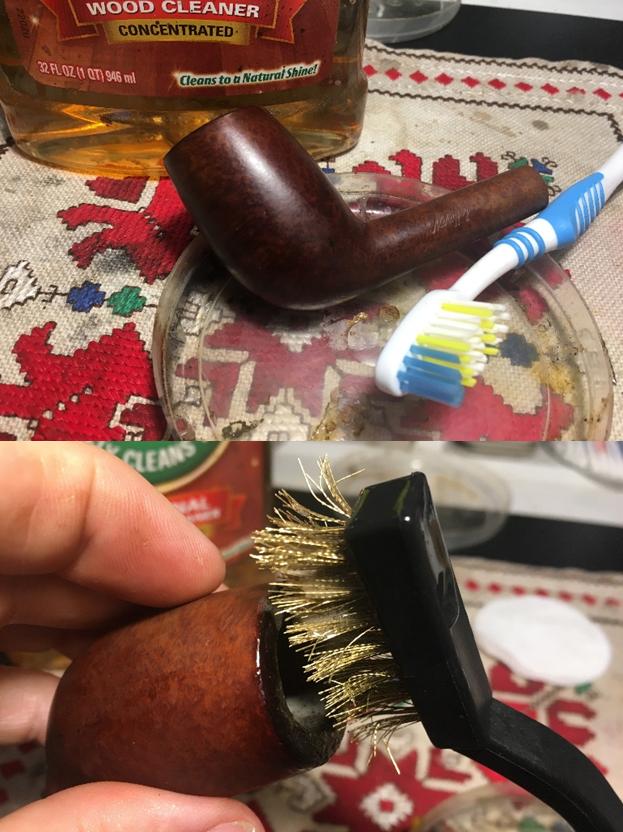
I appreciate Jon giving me this L. J. Perretti while we were in Oslo.  I’m happy to recommission this very attractive Square Shanked Rhodesian – the grain is exceptional and I like the square shank style of both Peretti’s I’ve restored.  The squared shank, not a common Rhodesian configuration, allows this Rhodesian to function like a ‘table sitter’ as well while one plays their card or board games.  If you are interested in adopting the L. J. Peretti Square Shanked Rhodesian, take a look at my blogsite, The Pipe Steward.  As always, all the profits of the sales from my restorations go to help the Daughters of Bulgaria.  Thanks for joining me!