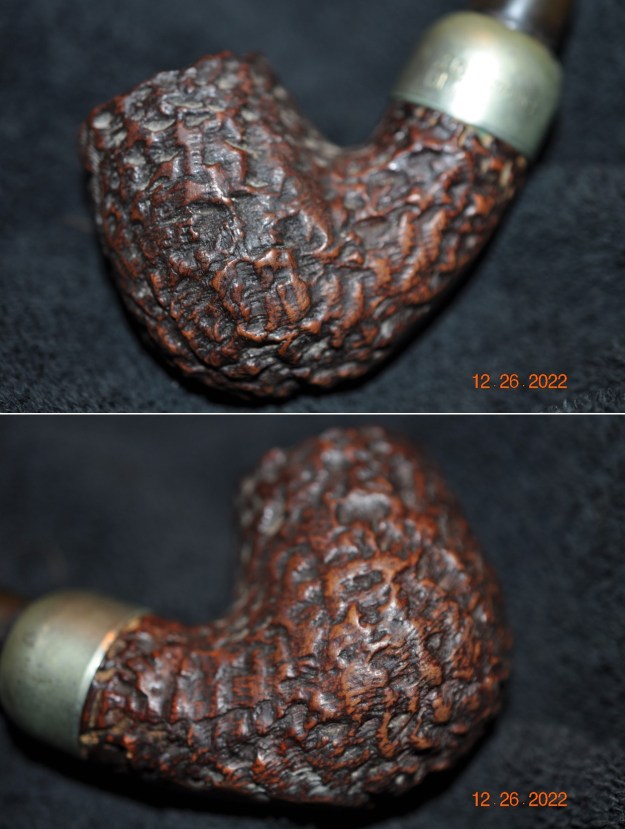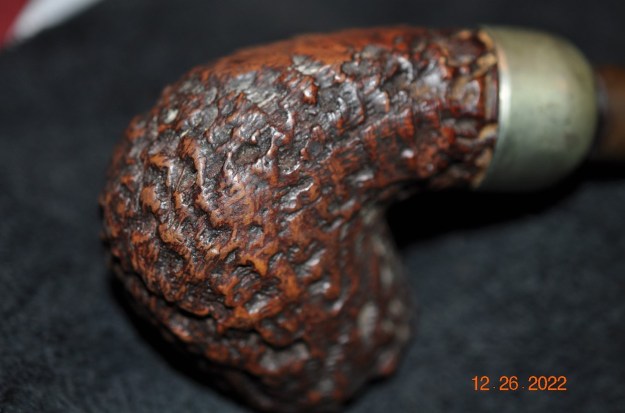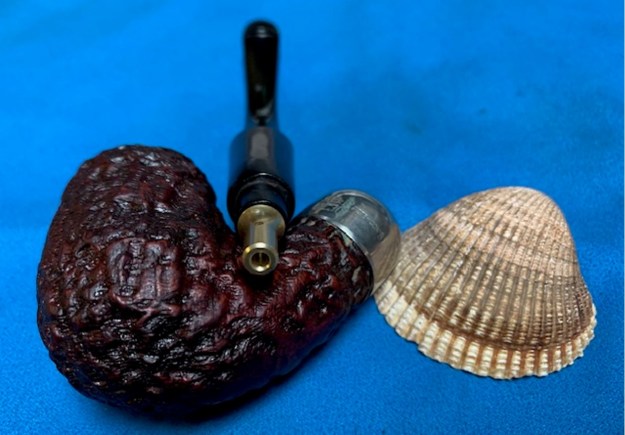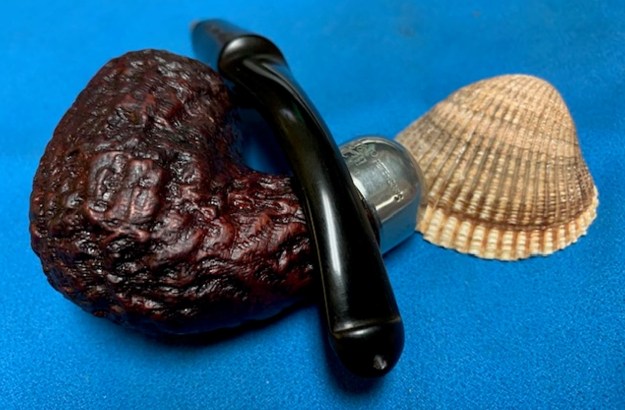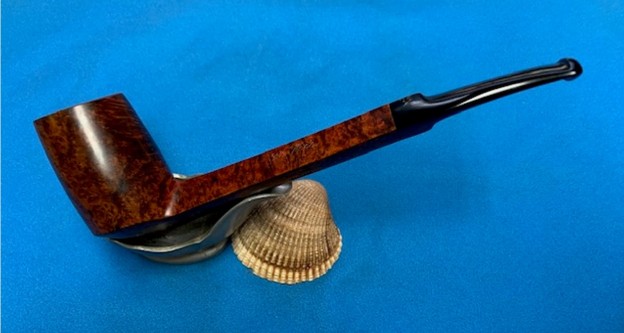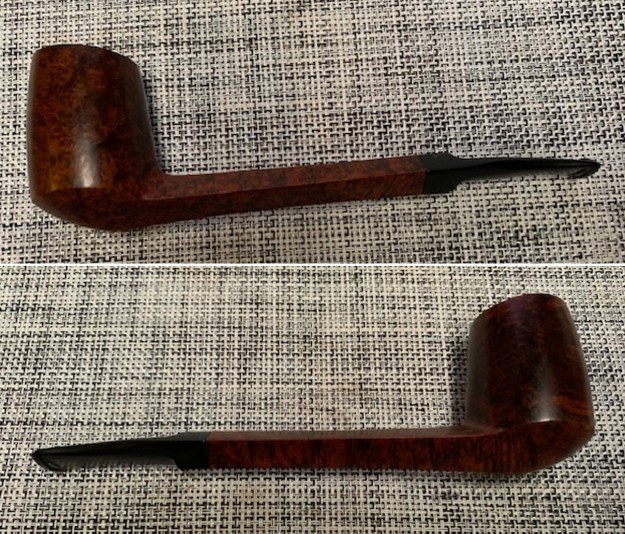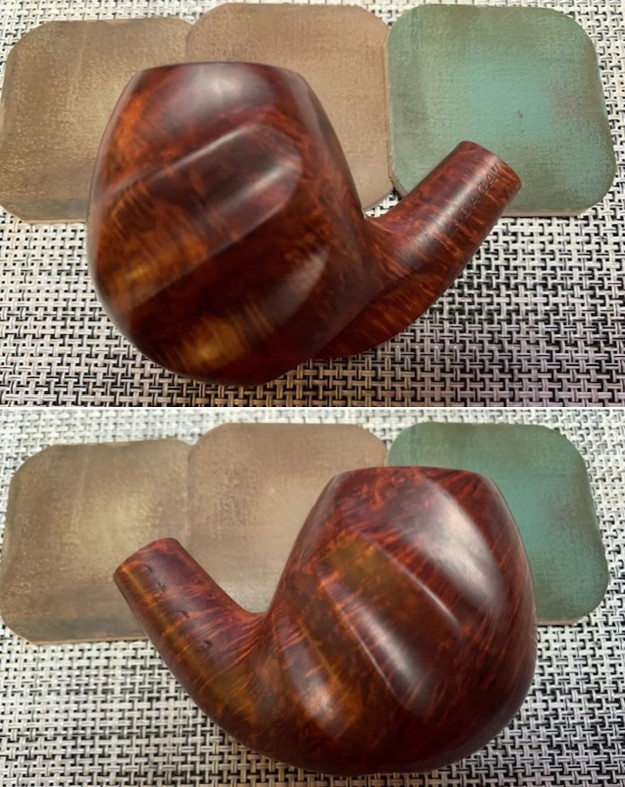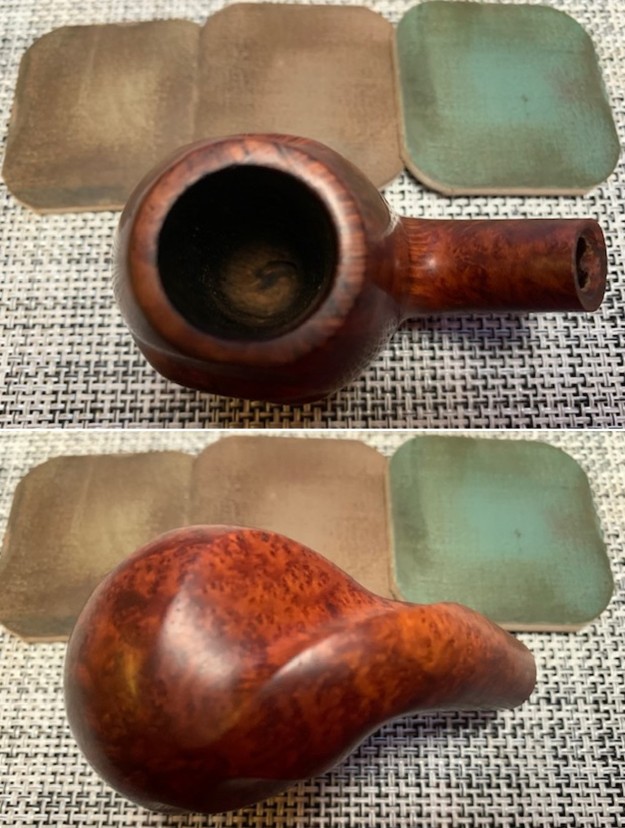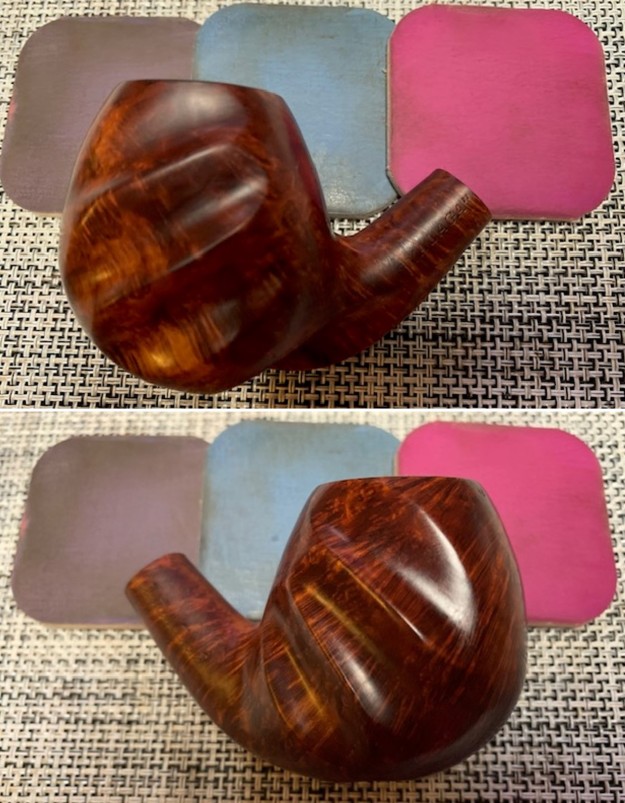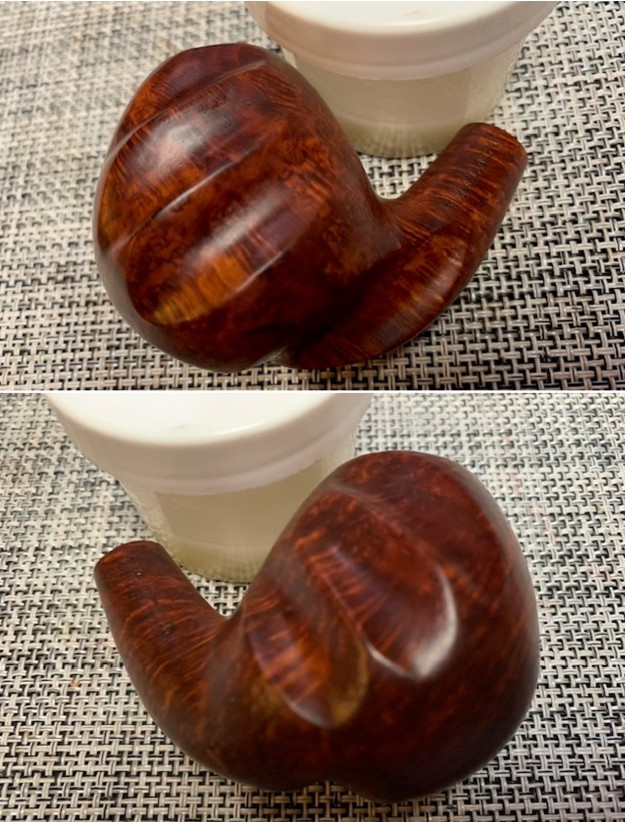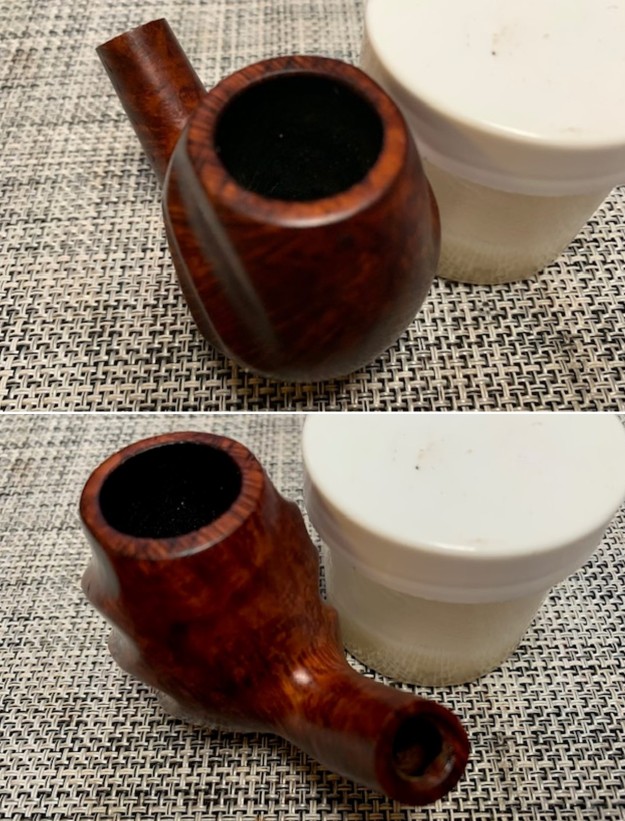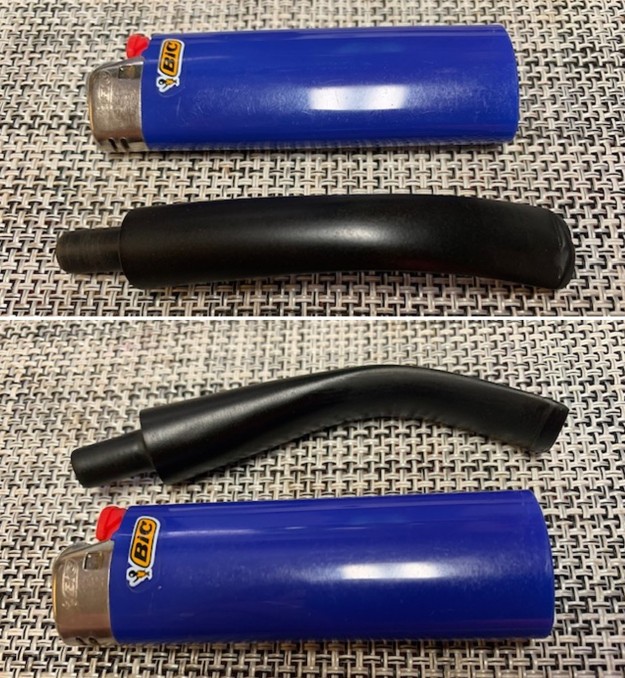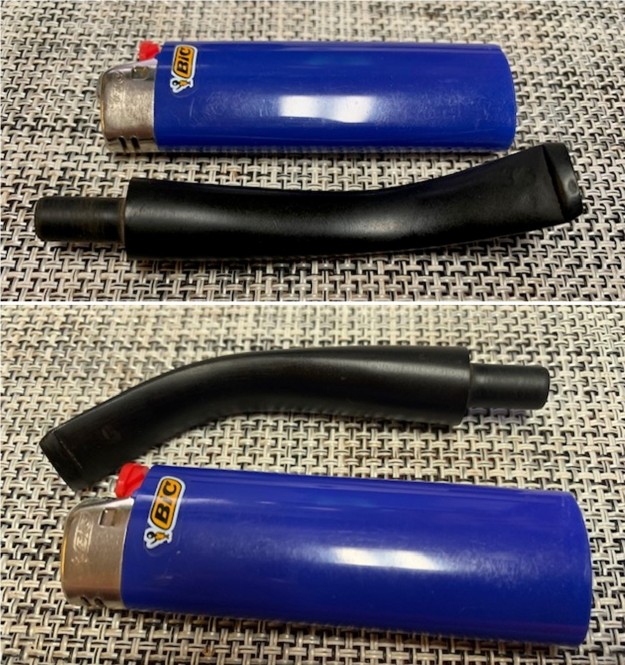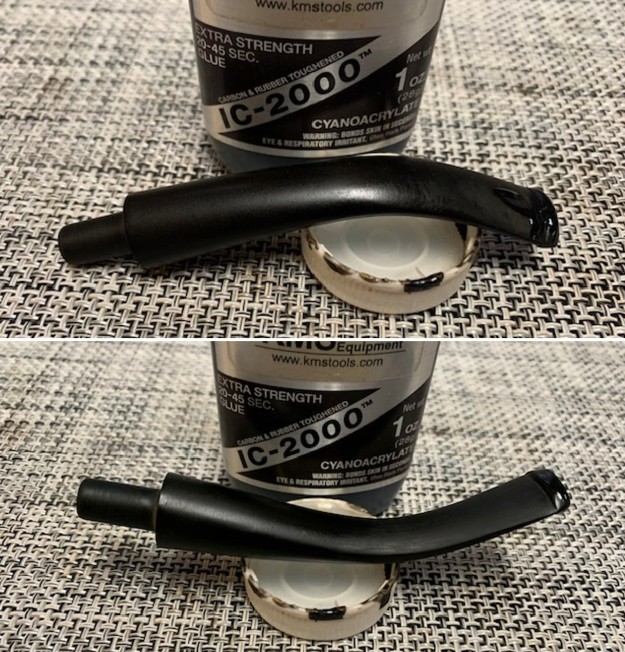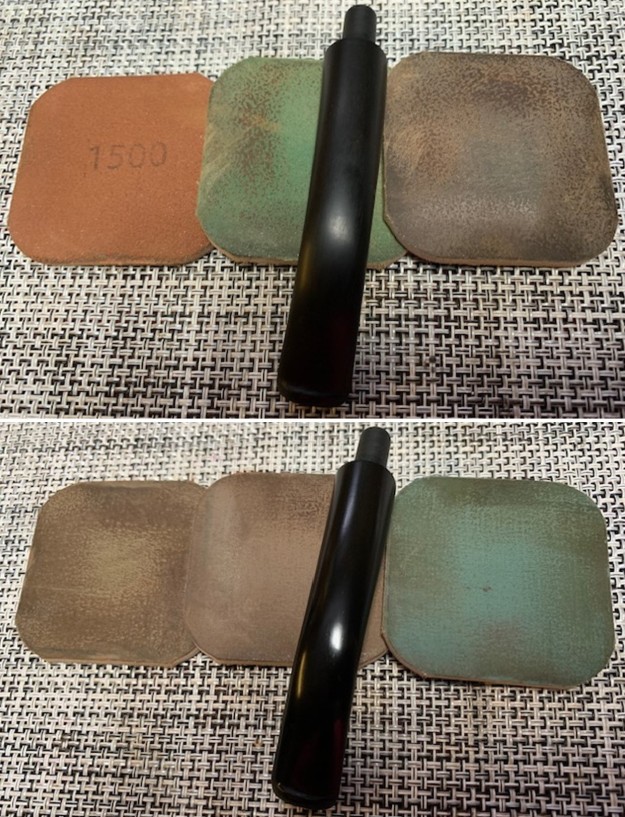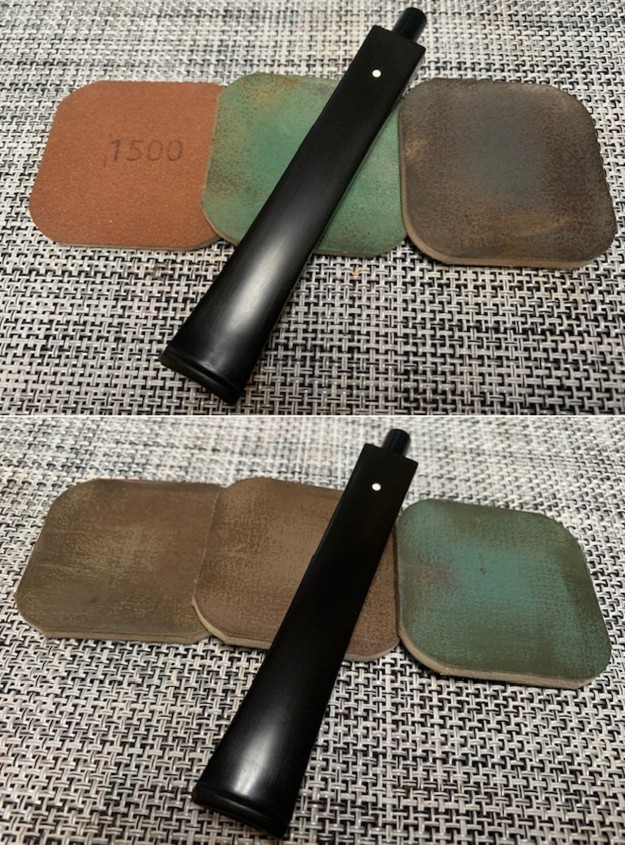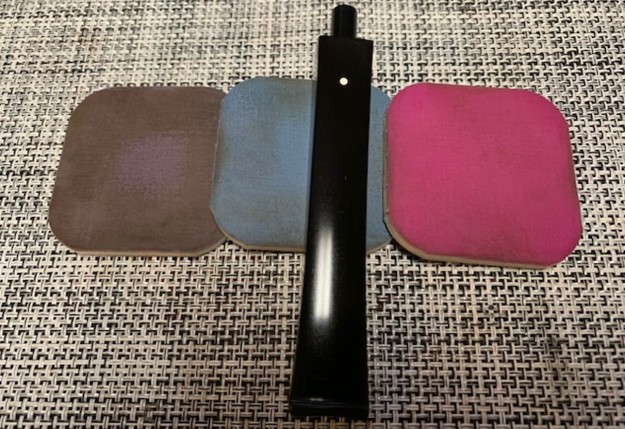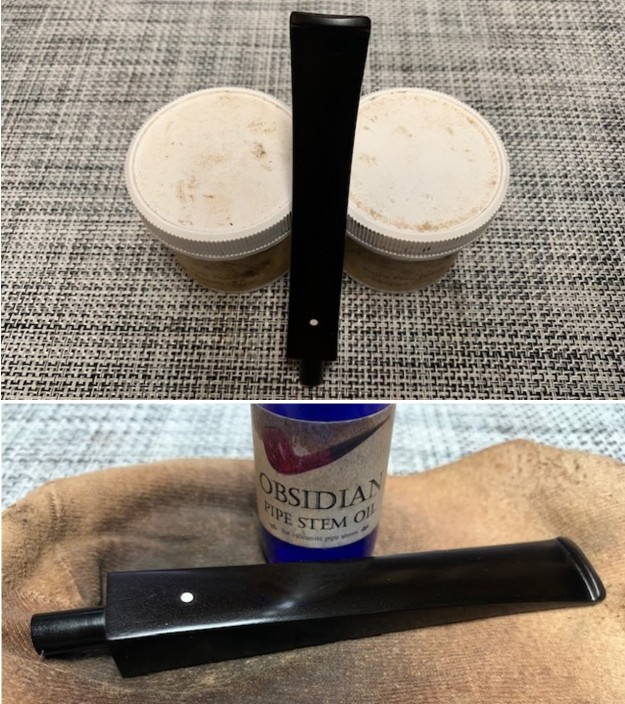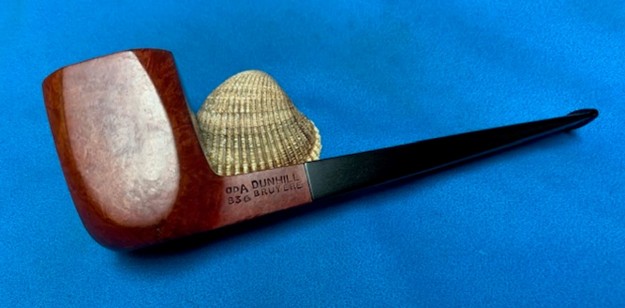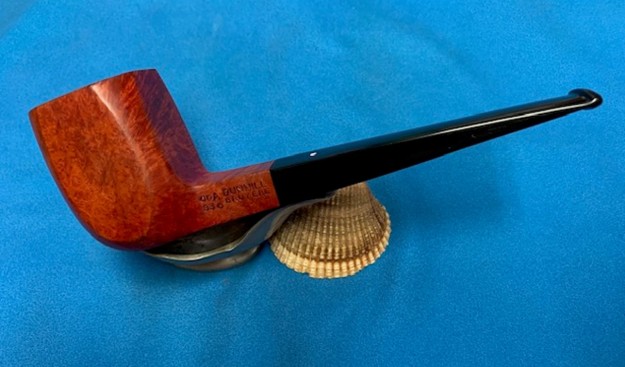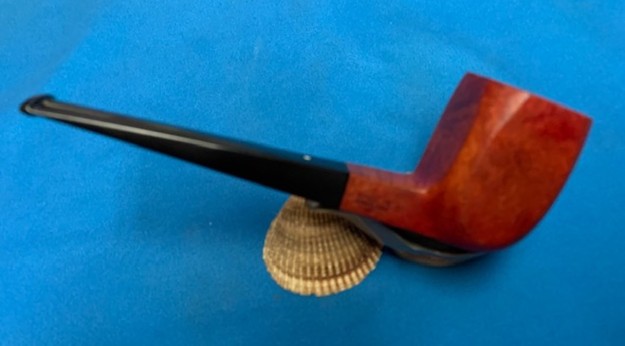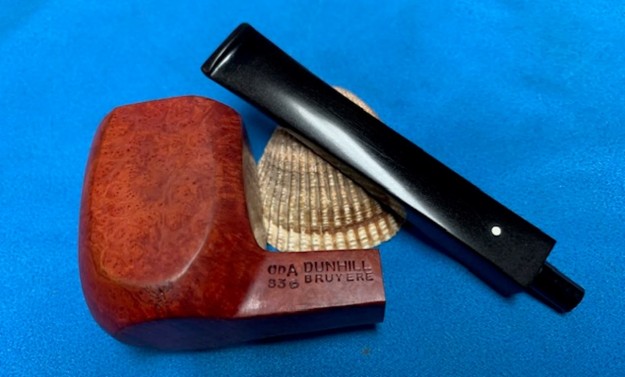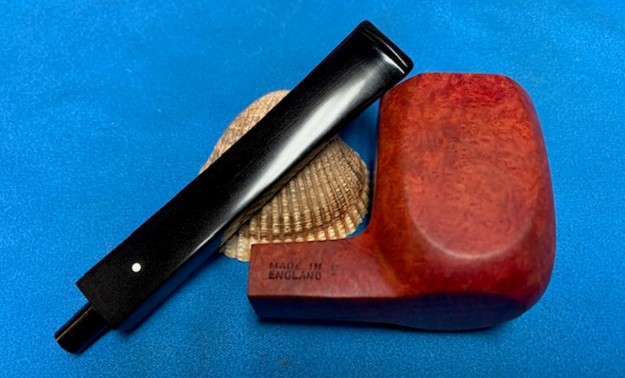
Tag Archives: bowl topping

Restoring a Smooth, Republic Era Peterson’s System Star 307 Sterling Silver Ferrule


Blog by Steve Laug

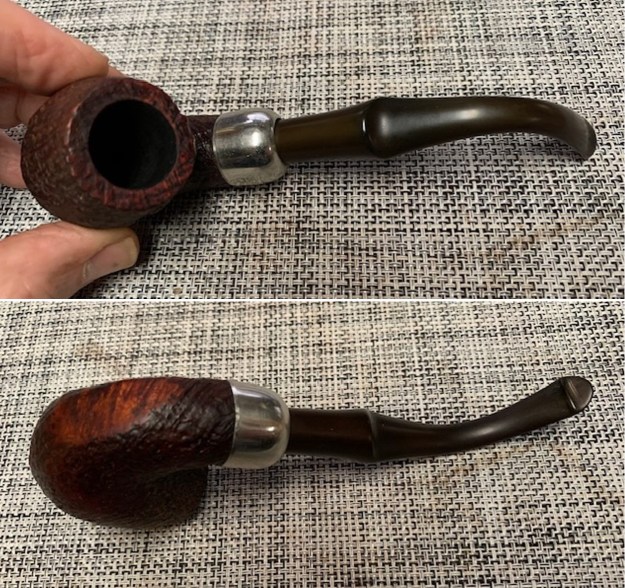
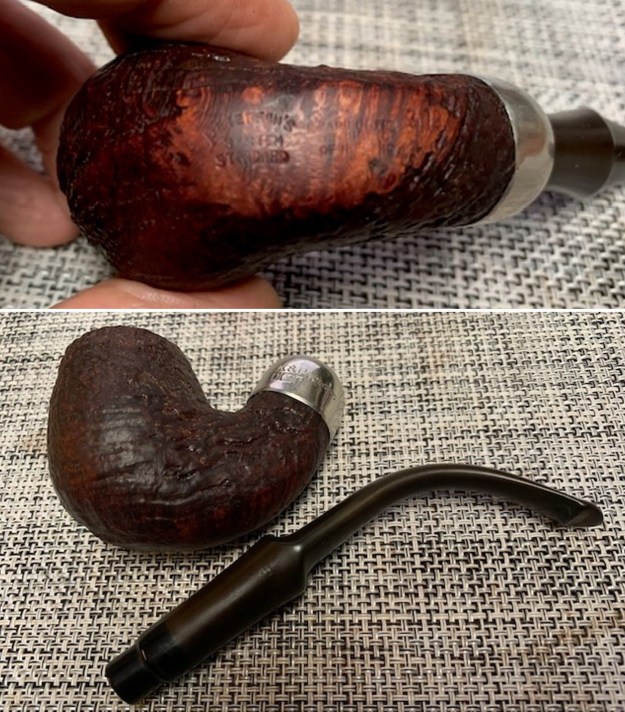
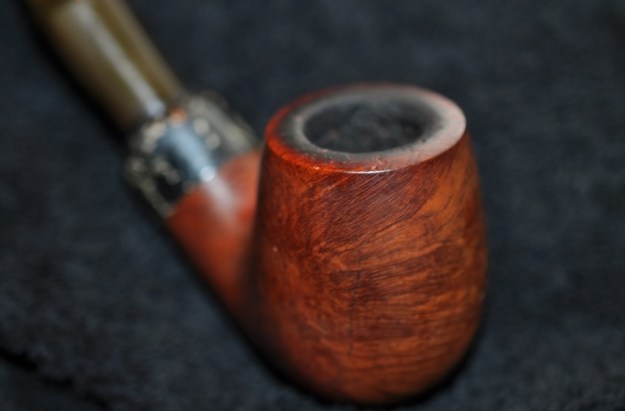
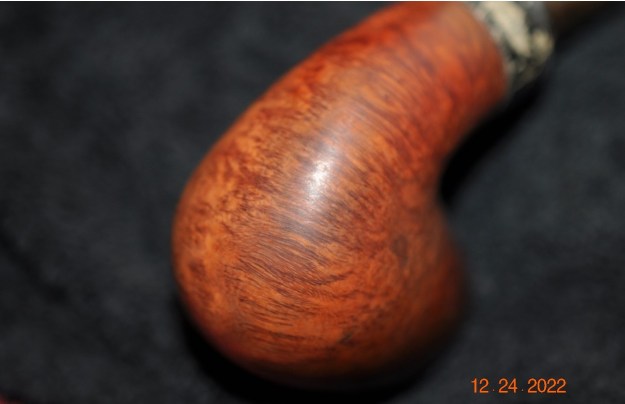
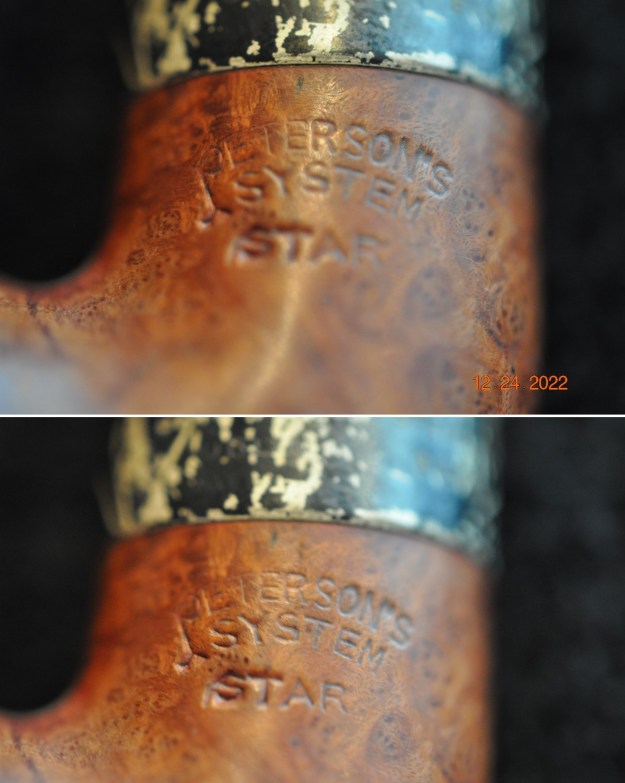
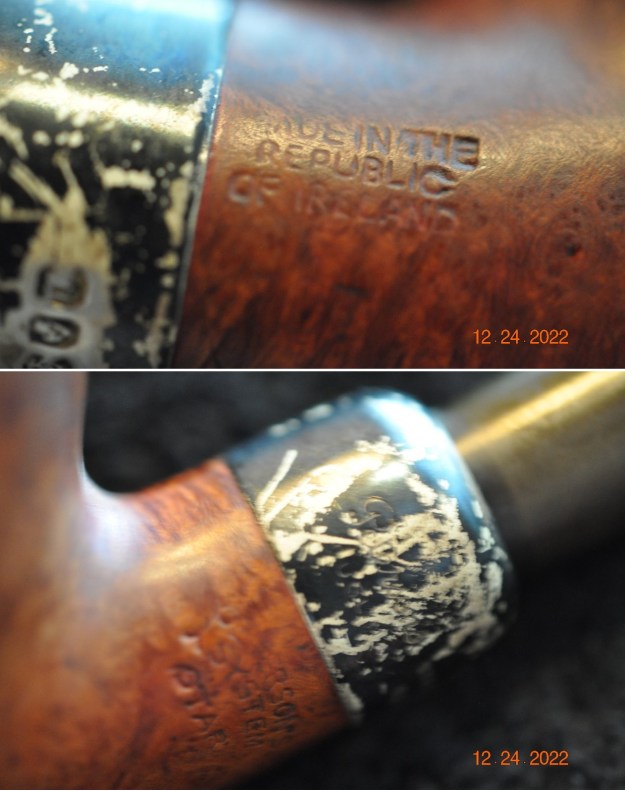
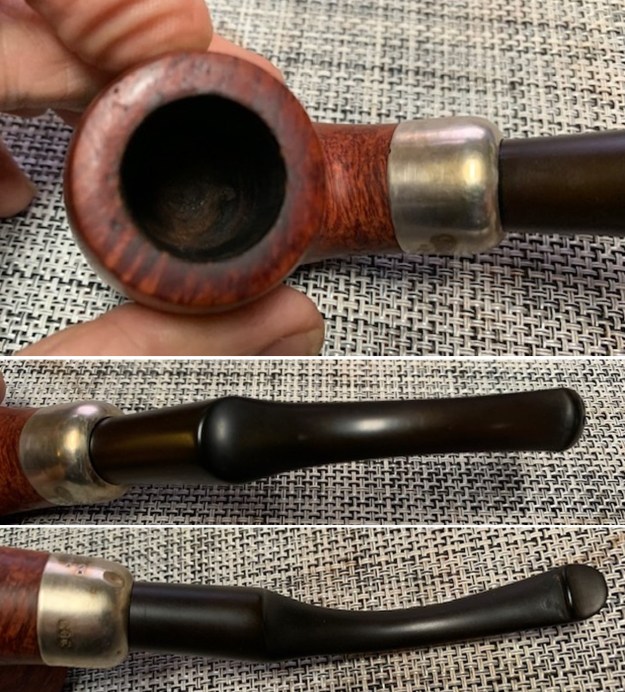
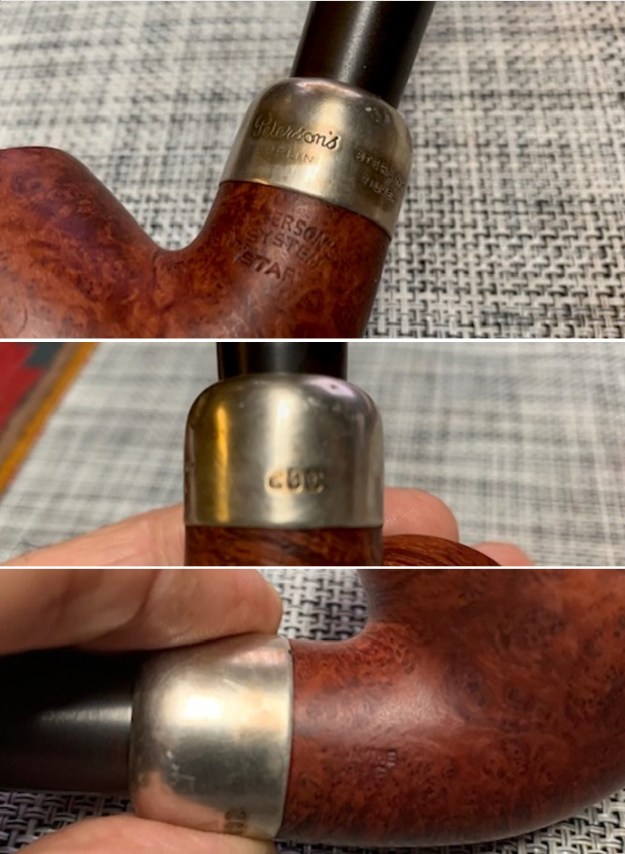
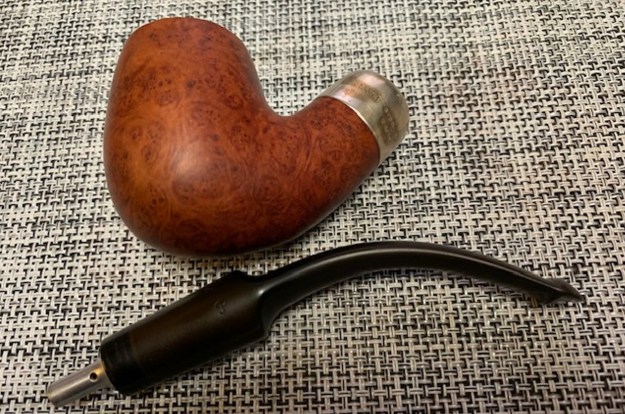
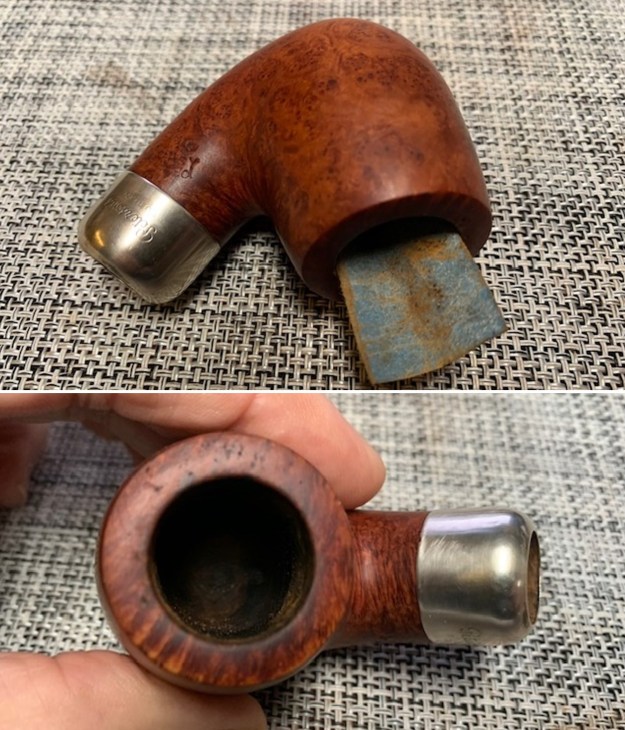
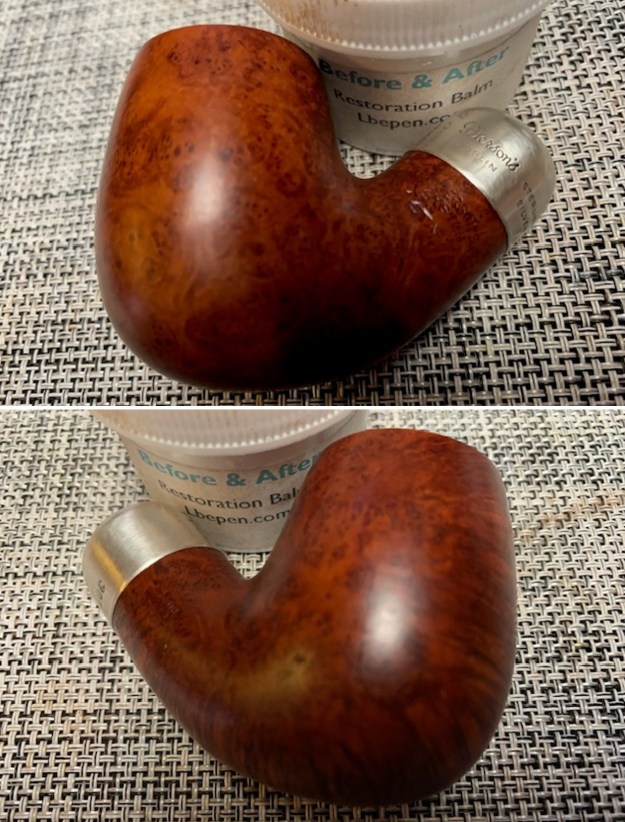
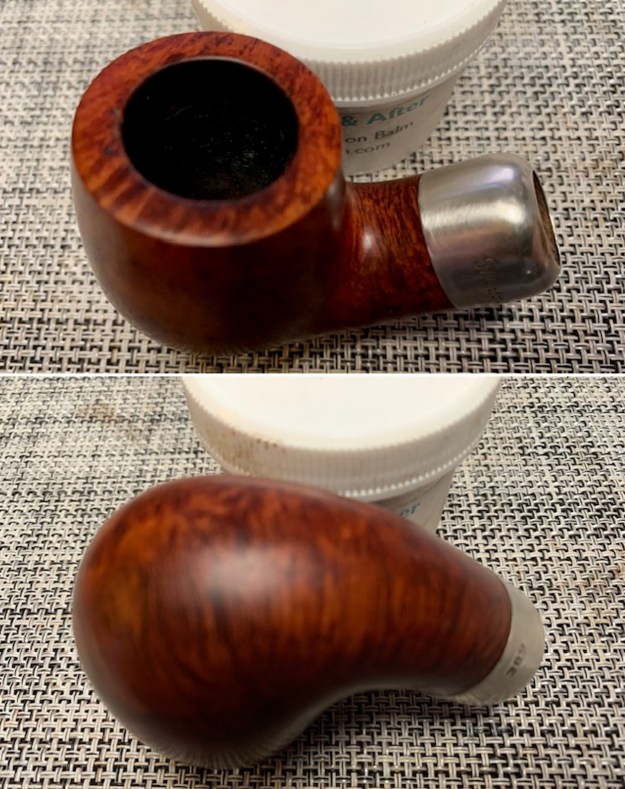
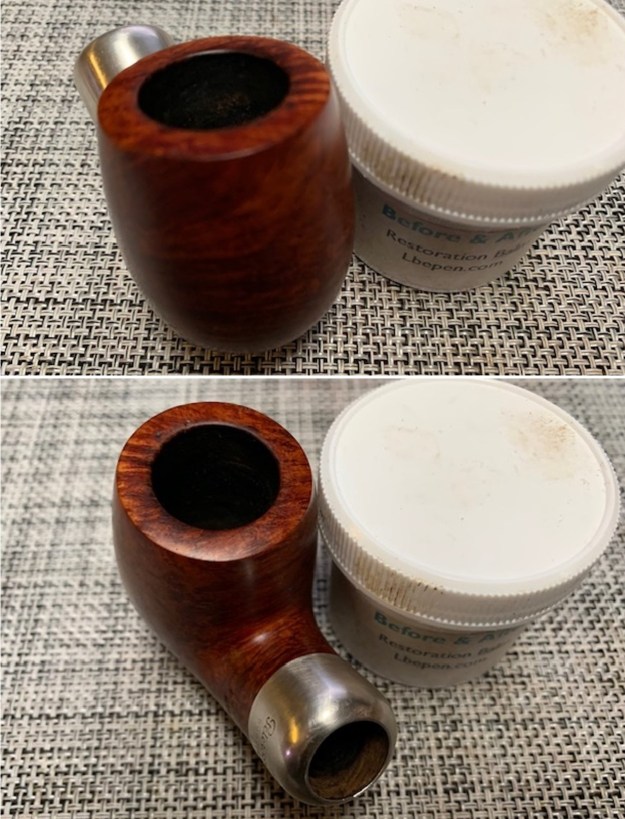
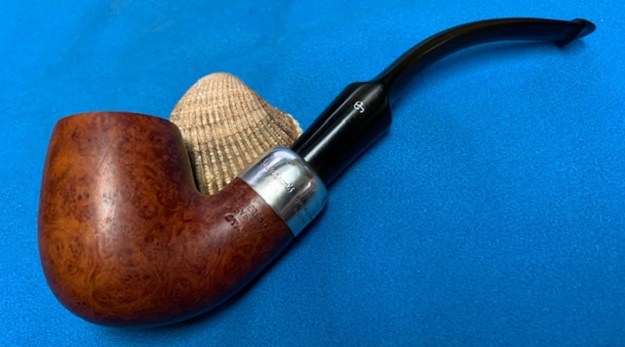
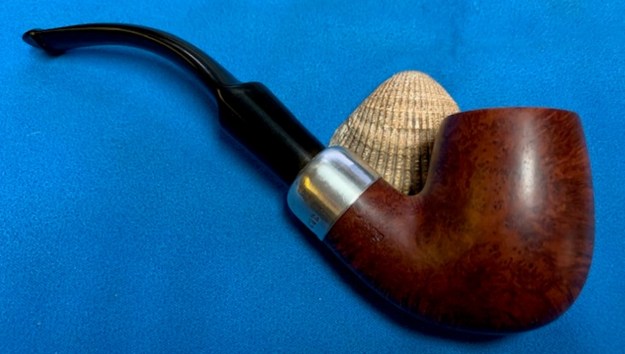
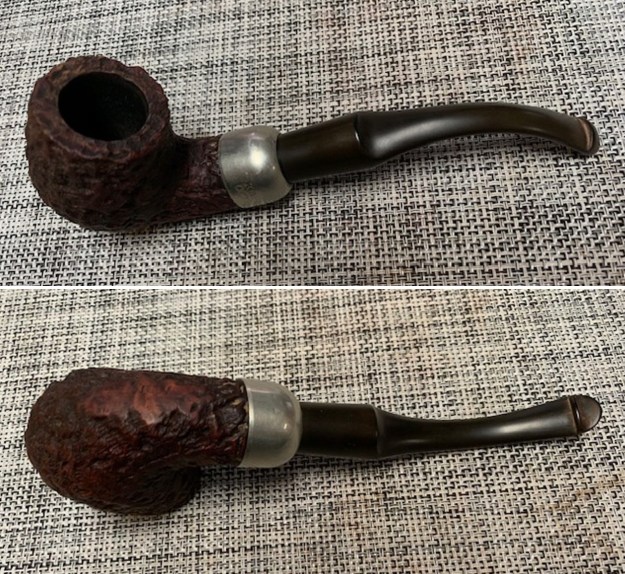
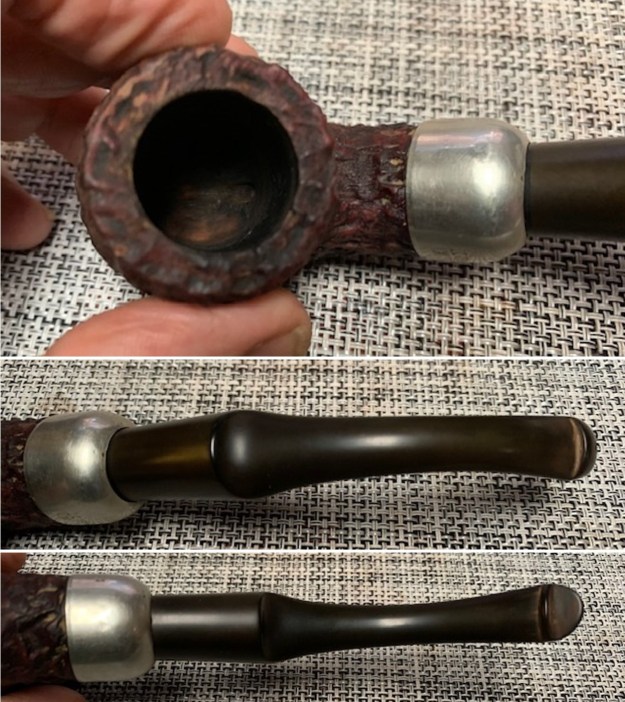
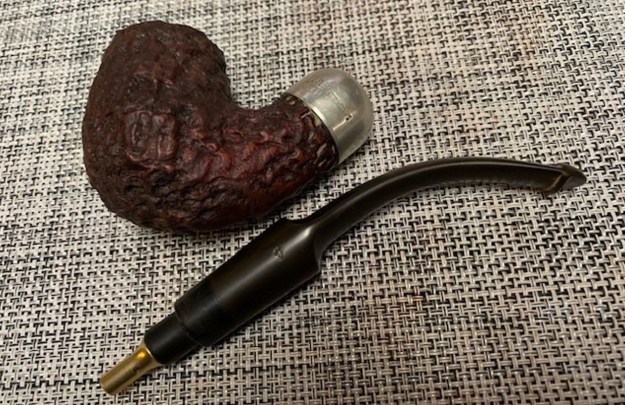
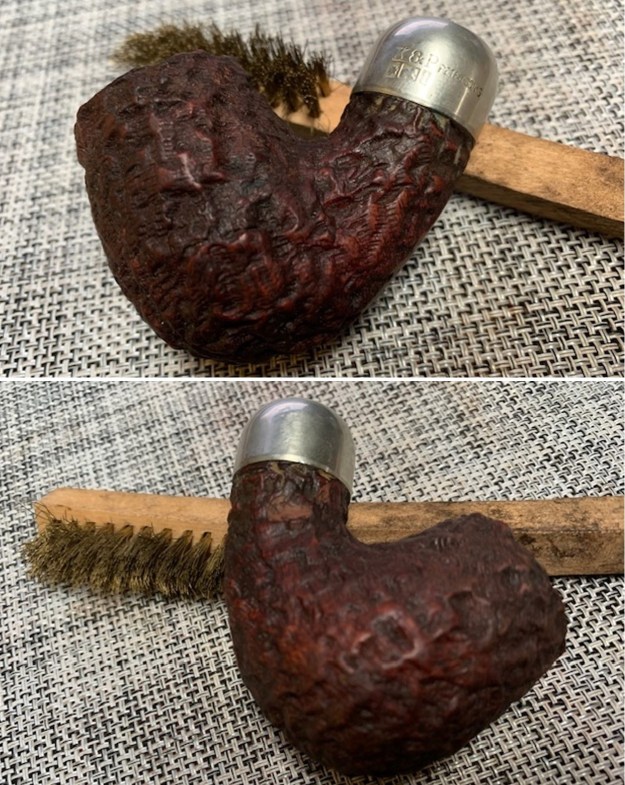
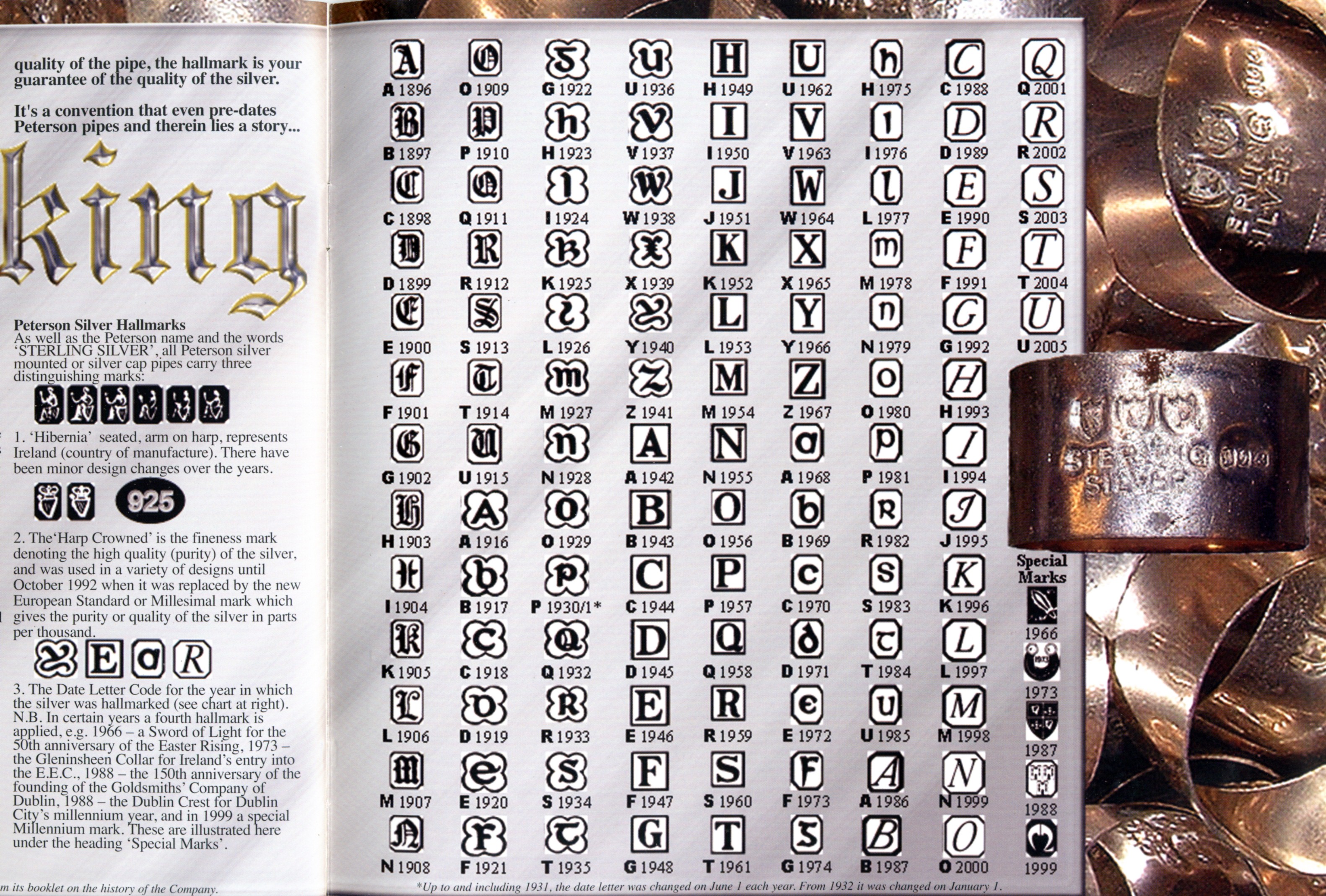
The next pipe on the work table is Peterson’s System pipe that we purchased from and estate in Plano, Texas, USA on 03/30/2022. It was stamped Peterson’s [over] System [over] Star on the left side of the shank vertically below the silver ferrule. On the right it is stamped Made in the Republic of Ireland (in three lines) [over] the shape number 307. It has a smooth finish around the bowl and shank that is covered with a lot of oils, debris and grime. There was a thick cake in the bowl with remnants of tobacco stuck on the walls. There was a lava overflow on the rim top that was heavier toward the back side. The top and edges of the rim were well hidden under the tars and lava. There was a very beautiful pipe underneath all of the buildup of years of use. The ferrule on the shank end was oxidized and is stamped on the top and left side Peterson [over] Dublin. That is followed by Sterling [over] Silver. On the underside there are three hallmarks – Hibernia seated, Crowned Harp for country of manufacture and a date letter in this case a lower case “m”. There is a small dent on the underside of the ferrule. The stem was a Peterson’s style P-Lip. It was oxidized and calcified toward the end with some tooth marks and chatter. There were tooth marks on the button itself as well. Jeff took photos of the pipe before he started his cleanup work on it. Jeff took photos of the bowl and rim top to show the thick, hard cake in the bowl with remnants of tobacco stuck on the walls of the bowl. There was a lava build up on the top of the rim and the edges of the bowl. The rim top looked pretty good but it was hard to know for sure if there was damage under the thick lava. Only clean up would tell the full story. Jeff took photos of the top and underside of the stem showing the tooth chatter, scratching, calcification and oxidation on the stem surface and wear on the edges of the button. Jeff took photos of the sides and heel of the bowl to show the condition of the finish. You can see the grime around the sides of the bowl and shank. Even under the dirt and debris of the years it looked very good. Jeff took photos of the stamping on the underside of the bowl and shank. The stamping was faint but readable as you can see from the photos. It read as noted above. The Sterling Silver Ferrule is actually clearly stamped and readable. The hallmarks are light but readable. I have not seen the System Star stamp before so this new stamping made me once again turn to The Peterson Pipe by Mark Irwin & Gary Malmberg. I looked up the System Star in the book and on page 315 it includes this information:
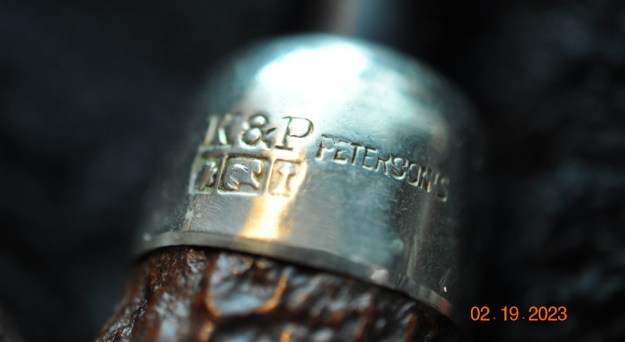
Peterson’s over System over Star (c1979-c.1985, 2010) A high-quality line between the De Luxe and Premier, in smooth burgundy finish with sterling domed mount.

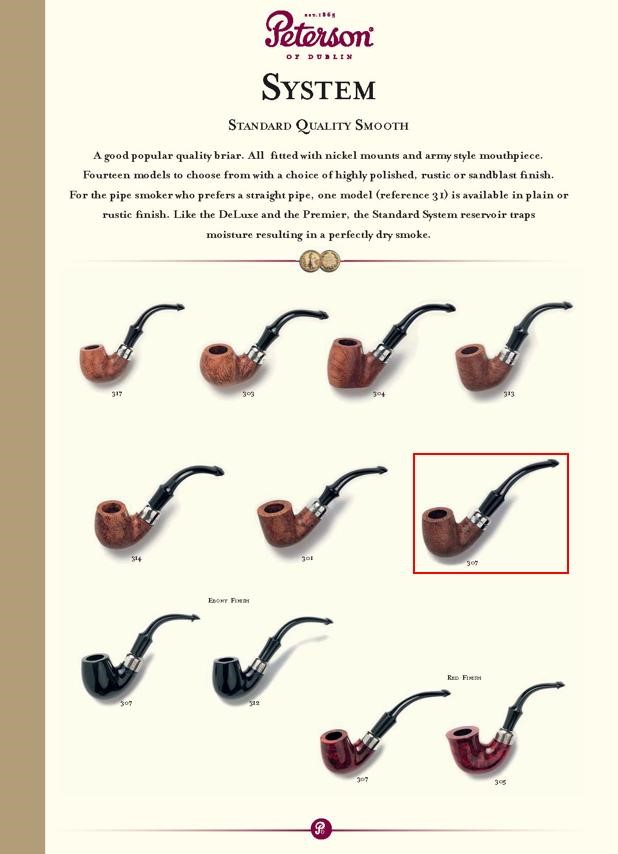
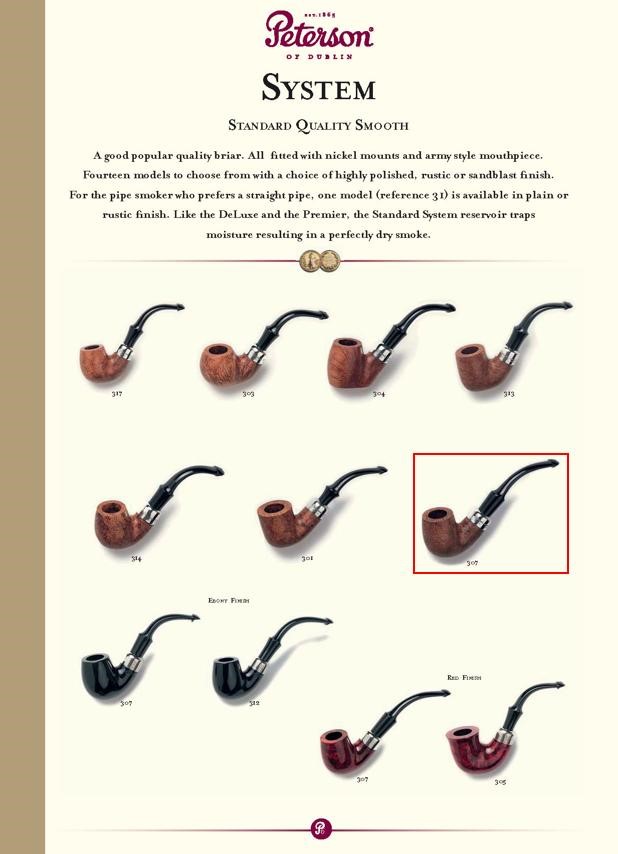
I have included the information on the shape number on this pipe that I picked up on researching the previous pipes. This is the second of two Peterson’s System pipes marked with the 307 shape number that I have worked on in the past few days. I have included a page from a Petersons Catalogue that I have on rebornpipes (https://rebornpipes.com/tag/peterson-hallmark-chart/). I have put a red box around the 307 shown in the catalogue page shown below. That should give a clear picture of the size and shape of the pipe. I am also including the information from Pipedia’s article on Peterson pipes. It is a great read in terms of the history of the brand (https://pipedia.org/wiki/Peterson). I have included a bit of the pertinent history here.

1950 – 1989 The Republic Era  – From 1950 to the present time, the stamp for this era is “Made in the Republic of Ireland” in a block format generally in three lines but two lines have been used with or without Republic being abbreviated.

During the 1950’s and 60’s the Kapp & Peterson company was still in the ownership of the Kapp family. However 1964 saw the retiral of the company Managing Director Frederick Henry(Harry) Kapp.
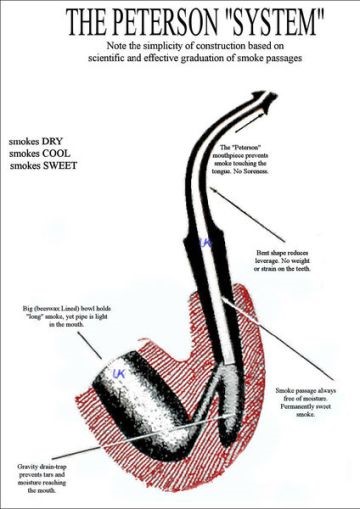
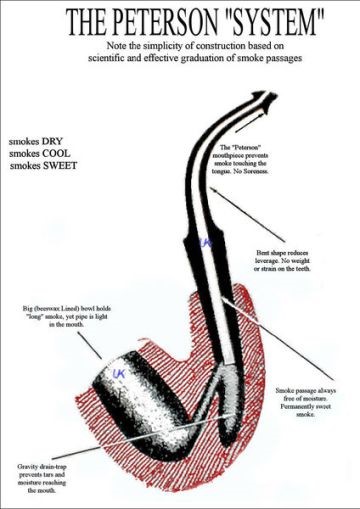
Pipedia also included a section of information on the System pipes including a diagram of the systems look (https://pipedia.org/wiki/Peterson#Republic_Era_Pipes). I quote a section of the article in part and include a link to another article on Pipedia on the System pipe.

The Peterson System pipes are the standard bearers of the Peterson pipe family, famous for the excellent smoking pleasure they provide. Often imitated but never equalled, the Peterson System smokes dry, cool and sweet, thanks to the scientific effectiveness of the original design. The heart of the System is the unique graduated bore in the mouthpiece. This makes the suction applied by the smoker 15 times weaker by the time it reaches the tobacco chamber. The result is that all the moisture flows into the reservoir and, thus cannot reach the smoker’s mouth. The Peterson Lip further enhances the effectiveness of the graduated bore by directing the flow of smoke upwards and away from the tongue. This achieves a uniquely even distribution of smoke and virtually eliminates any chance of tonguebite or bitterness. Furthermore, the shape is contoured so that the tongue rests comfortably in the depression under the opening. Each “PLip” mouthpiece is made from Vulcanite. For the Peterson System pipes to work properly, the stem/tenon has to have an extension, the tip of which will pass by the draft hole from the bowl and into the sump. Upon the smoker drawing in smoke, this extension then directs the smoke down and around the sump to dispense a lot of the moisture before the smoke enters the extension and stem. On the System Standards and other less expensive systems, this extension with be made of Vulcanite turned integrally with the stem. On the more expensive System pipes this extension will be made of metal which screws into the Vulcanite stem. This extension on the earlier pipes will be of brass and the newer pipes will be of aluminium. Most smokers not knowing this function of the metal extension, assumes that it is a condenser/stinger and will remove it as they do with the metal condensers of Kaywoodie, etc. Should you have a System pipe with this metal extension, do not remove it for it will make the System function properly and give you a dryer smoke (https://pipedia.org/wiki/A_closer_look_at_the_famous_Peterson_Standard_System_Pipe).

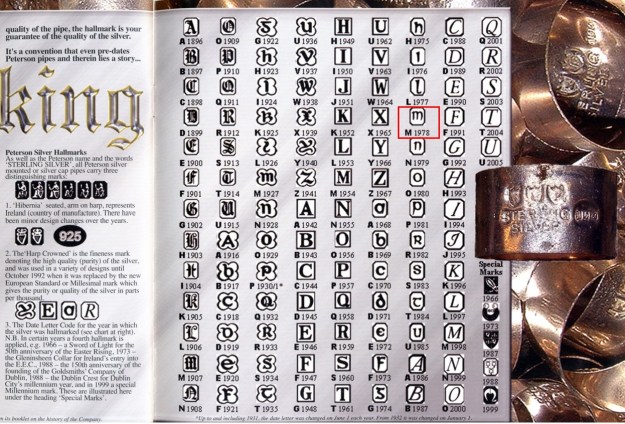
I have written many times about the hallmarks on Peterson’s Pipes and have included date charts in the past. Here is another date chart (https://rebornpipes.com/wp-content/uploads/2015/04/peterson-hallmark-chart.jpg). I spelled out the details of the hallmarks in the opening paragraph above but now want to specifically address the date of the pipe. It has a lower case “m” in the cartouche on the silver. Using the chart below the lower case “m” dates the pipe as being made in 1978. I have drawn a red box around the pertinent letter in the screen capture below. With that information in hand I knew what I was dealing with in terms of the stamping and the age of this pipe. I knew from the information that the System Star pipe was made during the Republic Era in 1978. Now it was time to work on the pipe.

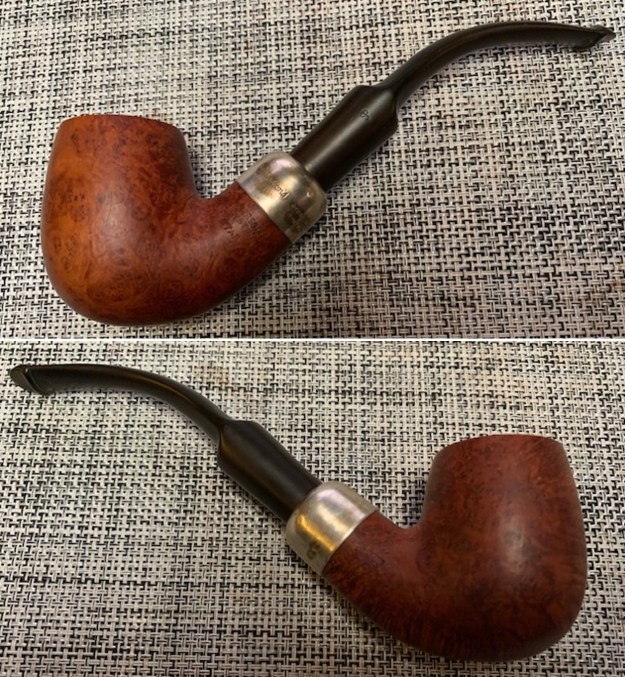
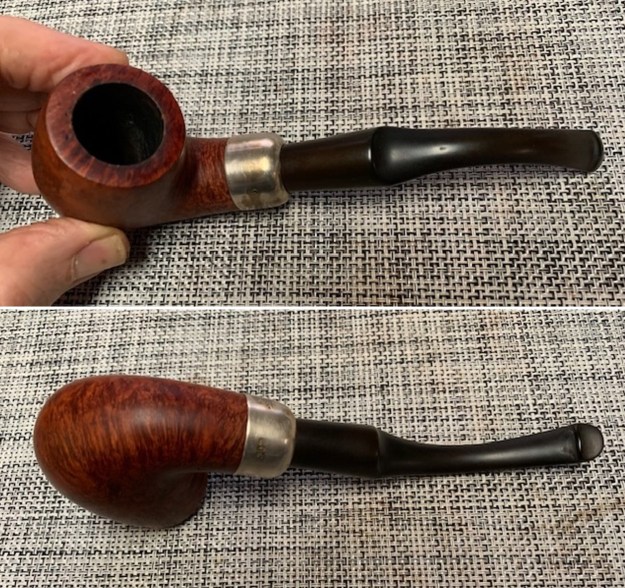
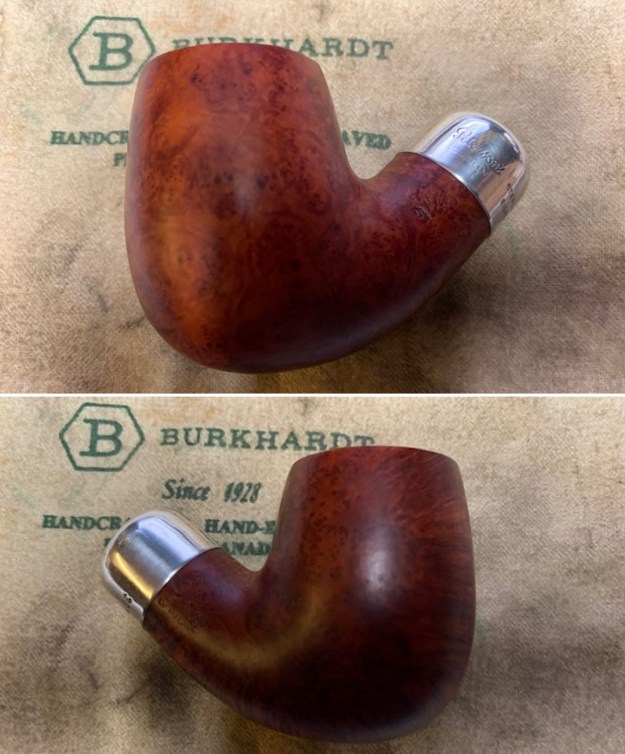
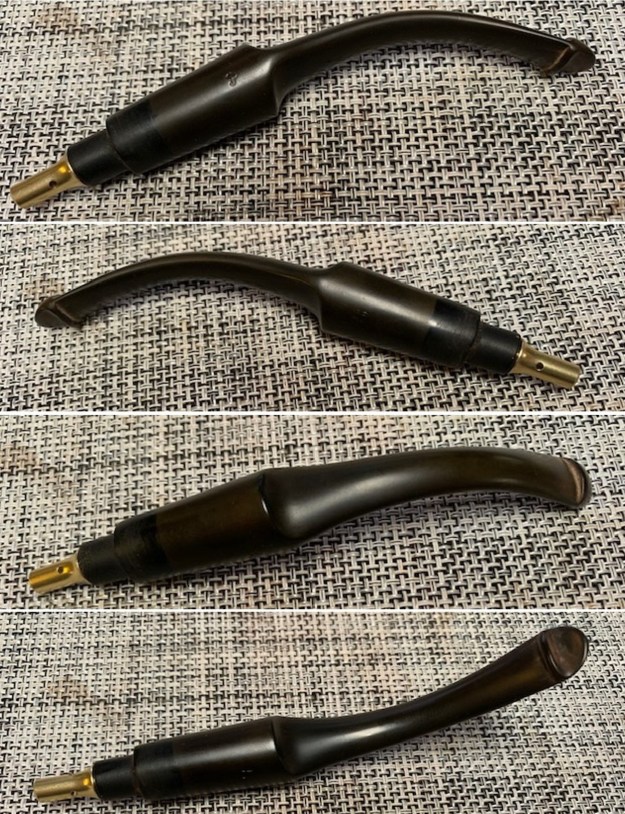
Jeff cleaned this filthy pipe with his usual clean up process. This one was a real mess and I did not know what to expect when I unwrapped it from his box. He reamed it with a PipNet pipe reamer and cleaned up the reaming with a Savinelli Fitsall Pipe Knife. He scrubbed out the internals with alcohol, pipe cleaners and cotton swabs until the pipe was clean. He scrubbed the exterior of the bowl with Murphy’s Oil Soap and a tooth brush to remove the grime and grit on the briar and the lava on the rim top. The finish looks very good with great looking grain around the bowl and shank. Jeff soaked the stem in Briarville’s Pipe Stem Deoxidizer to remove the oxidation on the vulcanite. When the pipe arrived here in Vancouver for the second stop of its restoration tour I was amazed it looked so good. I removed the incorrect stem and replaced it with a correct P-Lip stem for a 307 that I had here in my box of stems. The bonus was that the tenon had a brass chimney in the end that was correct for this pipe. I took some close up photos of the rim top and also of the stem surface. I wanted to show what an amazing job Jeff did in the cleanup of the rim top. The rim top was and inner edge were in good condition. There was some darkening and slight damage to the inner edge. The rim top also had some nicks and marks. I also took close up photos of the stem to show the condition of the vulcanite. It was quite clean  and the tooth marks on the button and on the stem ahead of the button were very visible in the photos.One of the things I appreciate about Jeff’s cleanup is that he works to protect and preserve the nomenclature on the shank of the pipes that he works on. The stamping on this one was very faint to start with so I was worried that it would disappear altogether with the cleanup. He was not only able to preserve and maintain its condition in the process. I took some photos to show the clarity of the stamping. I have noticed that many restorers are not careful to protect the stamping in their cleaning process and often by the end of the restoration the nomenclature is almost destroyed. I would like to encourage all of us to be careful in our work to preserve this as it is a critical piece of pipe restoration! I took the stem off the shank and took a photo of the pipe. I decided to start my work on the pipe by cleaning up the rim top and inner edge of the bowl with a folded piece of 220 grit sandpaper. I removed the damage on the inner edge and the nicks on the rim top. It looked significantly better.  I polished the briar with micromesh sanding pads – dry sanding it with 1500-12000 grit sanding pads. I wiped it down with a damp cloth after each sanding pad to remove the dust. The briar was really shining by the final pad. I rubbed the bowl and rim down with Before & After Restoration Balm. I worked it into the surface of the briar with my fingertips to clean, enliven and protect it. I let the balm sit for 10 minutes and then buffed with a cotton cloth to raise the shine. I really like watching the Balm do its magic and bring the briar alive. With briar polished with the Restoration Balm I moved onto the metal. I polished the Sterling Silver ferrule with a jewellers cloth to raise the shine and to protect it from further oxidation. I “painted” the stem surface with the flame of a Bic lighter to lift the tooth marks. I was able to lift them a bit but not totally. I filled in the deep marks that remained with clear CA glue and sit it aside to cure. Once it cured I used a file to flattened the repairs and redefine the button edge. I sanded the stem with 220 grit sandpaper to further blend in the repairs. I started polishing it with 400 grit wet dry sandpaper. I scrubbed the stem with SoftScrub to remove the oxidization left in the vulcanite of the saddle stem. I was able to remove a significant amount of oxidation that was on the saddle portion of the stem. It looked significantly better at this point.I touched up the “P” logo on the left side of the saddle stem with white acrylic fingernail polish. I let it dry then I polished off the excess with a worn 1500 grit micromesh sanding pad. Once the excess was removed the stamp looked much better.I polished the stem with micromesh sanding pads – wet sanding with 1500-12000 grit pads. I wiped the stem down after each sanding pad with Obsidian Oil. I polished it with Before & After Pipe Stem Polish – both Fine and Extra Fine. I gave it a coat of Obsidian Pipe Stem Oil. It works to protect the stem from oxidizing. I set it aside to dry. Once again at this point in the restoration process I am excited to be on the homestretch. I look forward to the final look when the Peterson System Star 307 is put back together, polished and waxed. I put the bowl and stem back together. I lightly polished the bowl and stem with Blue Diamond to polish out the scratches in the briar and the vulcanite. I gave the bowl and the stem multiple coats of carnauba wax. I buffed the pipe with a clean buffing pad to raise the shine. I hand buffed it with a microfiber cloth to deepen the shine. The pipe polished up pretty nicely. The depths of the rustication really pop with the wax and polish. The shiny black vulcanite stem is a beautiful contrast to the browns of the bowl and thick shank and Sterling Silver ferrule. This Republic Era Peterson’s System Star 307 Bent Billiard was another fun pipe to work on. It really is a quite stunning piece of briar whose shape follows the flow of the briar. The pipe feels great in the hand will be better when warmed up while smoking. The finished pipe is shown in the photos below. The dimensions of the pipe are Length: 6 ½ inches, Height: 2 inches, Outside diameter of the bowl: 1 ¼ inches, Chamber diameter: ¾ of an inch. The weight of the pipe is 2.43 ounces/70 grams. I will be putting it on the rebornpipes store in the Irish Pipemakers Section if you would like to add it to your rack and carry on the previous pipeman’s legacy. This is an interesting estate to bring back to life.

As always, I encourage your questions and comments as you read the blog. Thanks to each of you who are reading this blog. Remember we are not pipe owners; we are pipe men and women who hold our pipes in trust until they pass on into the trust of those who follow us.

Peterson’s System Standard XL307 Made in the Republic of Ireland Rusticated Bent


Blog by Steve Laug

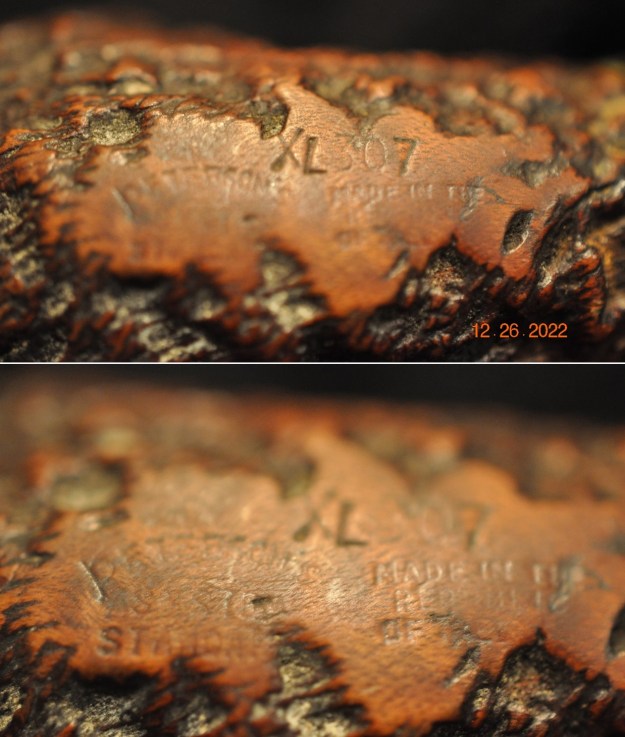
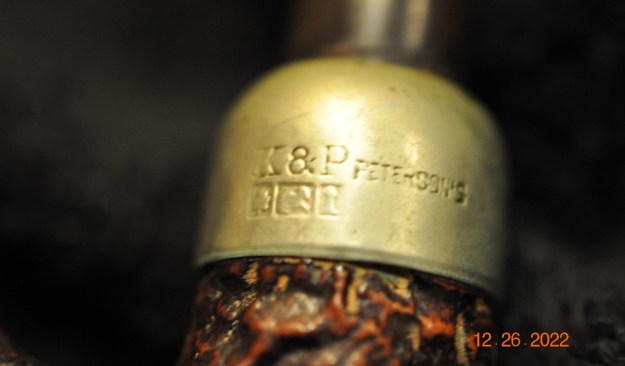
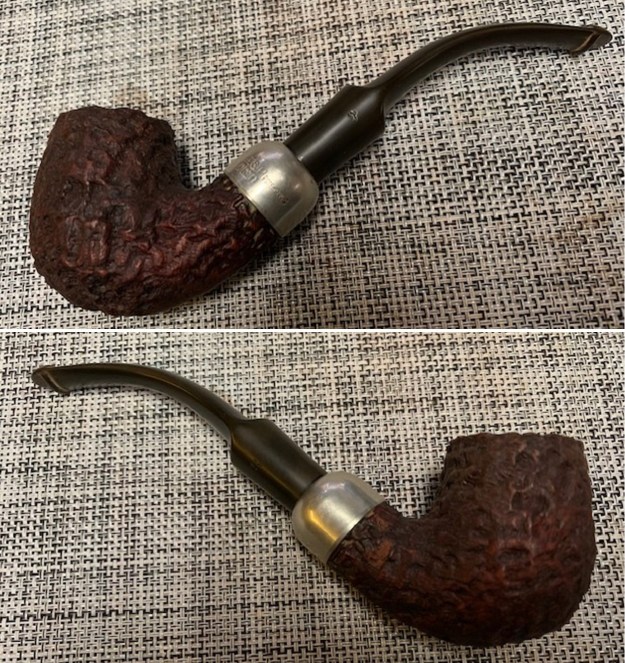
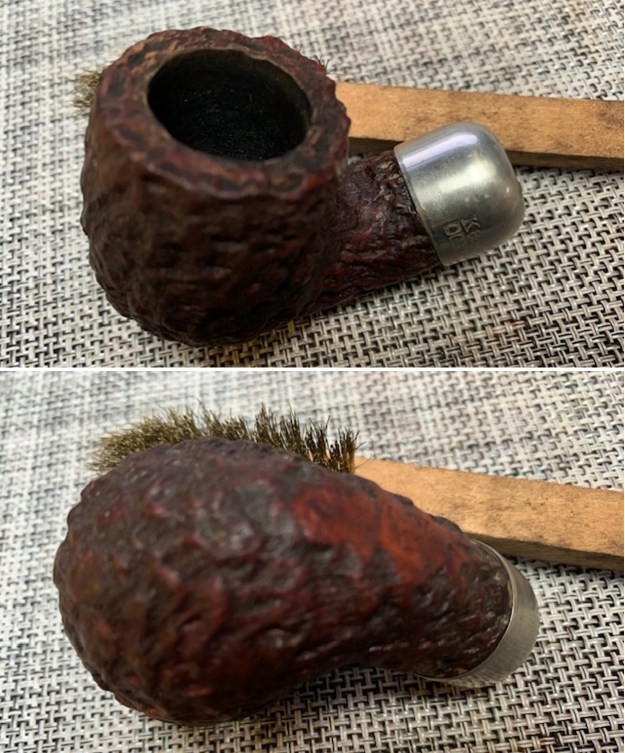
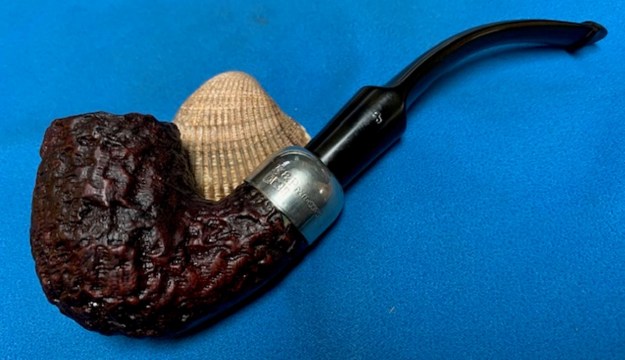
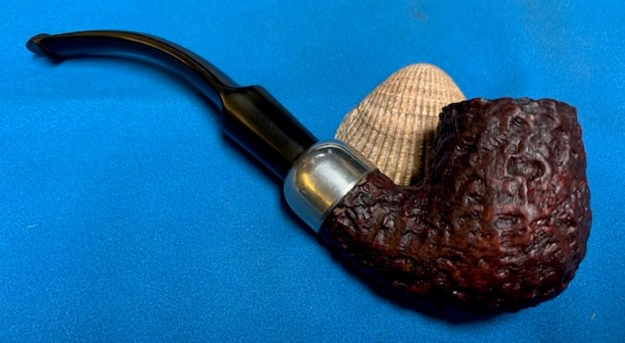
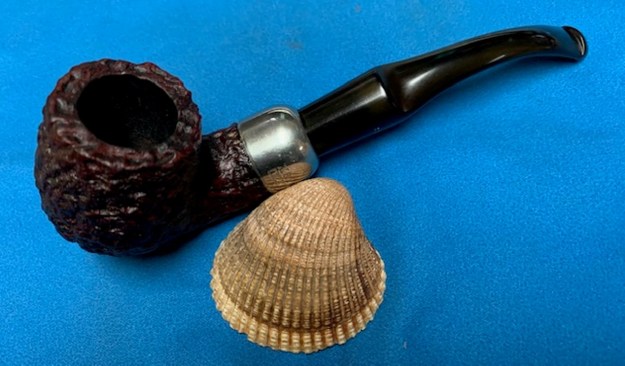
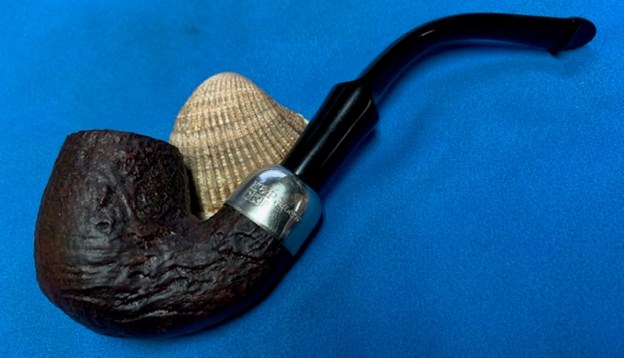
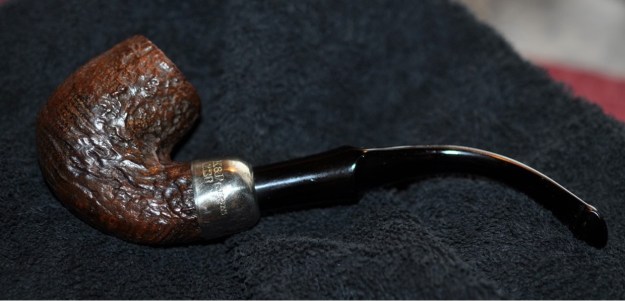
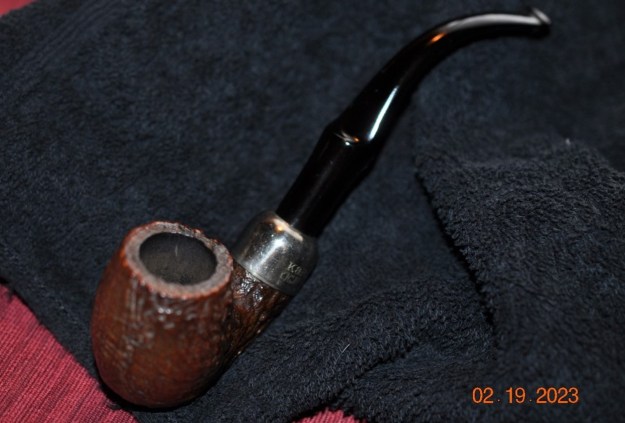
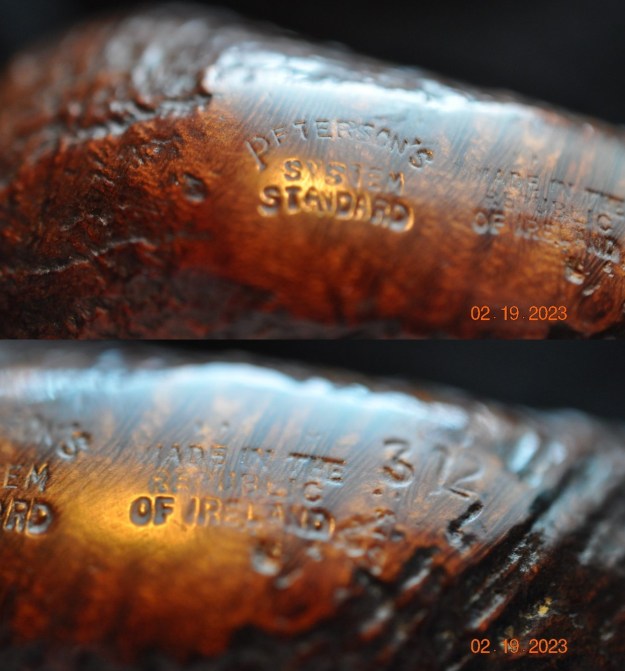
The next pipe on the work table is Rusticated Peterson’s System pipe that we purchased from and estate in Plano, Texas, USA on 03/30/2022. It was stamped Peterson’s System Standard on the underside side of the shank in a smooth panel. It was stamped Peterson’s [over] System [over] Standard. That is followed by the shape number XL307 [over] Made in the Republic of Ireland (in three lines). It has a rugged, tactile rustication around the bowl and shank that is fill with a lot of oils, debris and grime. There was a thick cake in the bowl with remnants of tobacco stuck on the walls. There was a lava overflow on the rim top that was heavier toward the back side. The top and edges of the rim were well hidden under the tars and lava. There was a very beautiful pipe underneath all of the buildup of years of use. The nickel ferrule on the shank end was oxidized and is stamped on the top and left side K&P [over] three faux hallmarks. That is followed by Petersons. It is not dented or damaged. The stem was the wrong stem for the pipe. It was not a Peterson’s style P-Lip but rather a Wellington style with the airway exiting on the end of the stem. It was oxidized and calcified toward the end with some tooth chatter. There were also some tooth marks on both sides of the stem ahead of the button. I would need to restem it with a proper stem once I received it in Vancouver. Jeff took photos of the pipe before he started his cleanup work on it. Jeff took photos of the bowl and rim top to show the thick, hard cake in the bowl with remnants of tobacco stuck on the walls of the bowl. There was a lava build up on the top of the rim and the edges of the bowl. The rim top looked pretty good but it was hard to know for sure if there was damage under the thick lava. Only clean up would tell the full story. Jeff took photos of the top and underside of the stem showing the tooth chatter, scratching and oxidation on the stem surface and wear on the edges of the button. You can also see the exit of the airway on the stem end rather than the to of the P-lip. Jeff took photos of the sides and heel of the bowl to show the condition of the finish. You can see the grime in the rustication around the sides of the bowl and shank. Even under the dirt and debris of the years it looked very good. Jeff took photos of the stamping on the underside of the bowl and shank. The stamping was faint but readable as you can see from the photos. It read as noted above. The nickel ferrule on the shank end is stamped on the top and left side K&P Peterson’s over three Peterson marks used on nickel ferrules. I have included the information on the shape number on this pipe that I picked up on researching the previous pipes. This is the second of two Peterson’s System Standard pipes in Bob’s collection marked with the 307 shape number. I have included a page from a Petersons Catalogue that I have on rebornpipes (https://rebornpipes.com/tag/peterson-hallmark-chart/). I have put a red box around the 307 shown in the catalogue page shown below. That should give a clear picture of the size and shape of the pipe. I am also including the information from Pipedia’s article on Peterson pipes. It is a great read in terms of the history of the brand (https://pipedia.org/wiki/Peterson). I have included a bit of the pertinent history here.
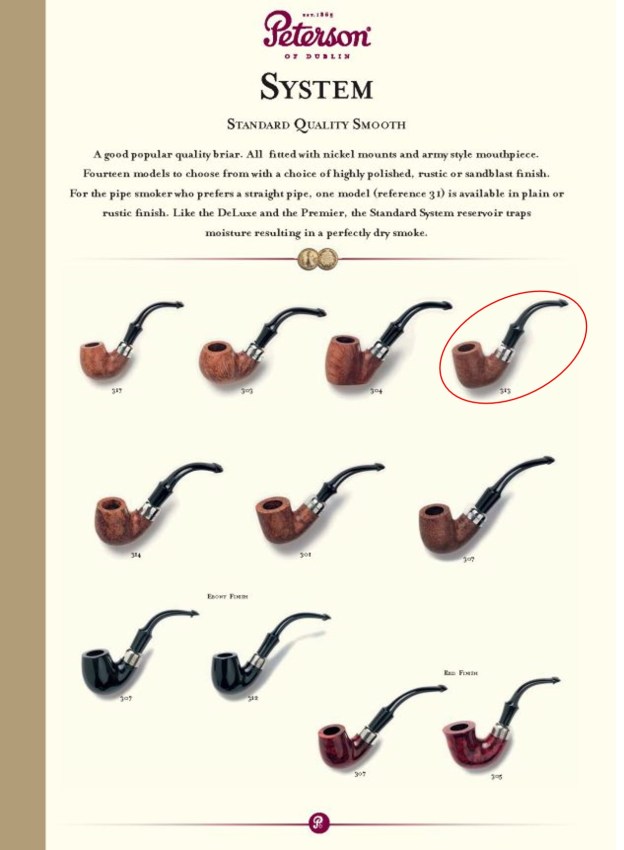
1950 – 1989 The Republic Era  – From 1950 to the present time, the stamp for this era is “Made in the Republic of Ireland” in a block format generally in three lines but two lines have been used with or without Republic being abbreviated.

During the 1950’s and 60’s the Kapp & Peterson company was still in the ownership of the Kapp family. However 1964 saw the retiral of the company Managing Director Frederick Henry(Harry) Kapp.

Pipedia also included a section of information on the System pipes including a diagram of the systems look (https://pipedia.org/wiki/Peterson#Republic_Era_Pipes). I quote a section of the article in part and include a link to another article on Pipedia on the System pipe.

The Peterson System pipes are the standard bearers of the Peterson pipe family, famous for the excellent smoking pleasure they provide. Often imitated but never equaled, the Peterson System smokes dry, cool and sweet, thanks to the scientific effectiveness of the original design. The heart of the System is the unique graduated bore in the mouthpiece. This makes the suction applied by the smoker 15 times weaker by the time it reaches the tobacco chamber. The result is that all the moisture flows into the reservoir and, thus cannot reach the smoker’s mouth. The Peterson Lip further enhances the effectiveness of the graduated bore by directing the flow of smoke upwards and away from the tongue. This achieves a uniquely even distribution of smoke and virtually eliminates any chance of tonguebite or bitterness. Furthermore, the shape is contoured so that the tongue rests comfortably in the depression under the opening. Each “PLip” mouthpiece is made from Vulcanite. For the Peterson System pipes to work properly, the stem/tenon has to have an extension, the tip of which will pass by the draft hole from the bowl and into the sump. Upon the smoker drawing in smoke, this extension then directs the smoke down and around the sump to dispense a lot of the moisture before the smoke enters the extension and stem. On the System Standards and other less expensive systems, this extension with be made of Vulcanite turned integrally with the stem. On the more expensive System pipes this extension will be made of metal which screws into the Vulcanite stem. This extension on the earlier pipes will be of brass and the newer pipes will be of aluminium. Most smokers not knowing this function of the metal extension, assumes that it is a condenser/stinger and will remove it as they do with the metal condensers of Kaywoodie, etc. Should you have a System pipe with this metal extension, do not remove it for it will make the System function properly and give you a dryer smoke (https://pipedia.org/wiki/A_closer_look_at_the_famous_Peterson_Standard_System_Pipe).

With that information in hand I knew what I was dealing with in terms of the stamping and the age of this pipe. I knew from the information that the pipe was made during the Republic Era between 1950 and 1989. My guess is that the pipes is a 1960s era System pipe. Now it was time to work on the pipe.

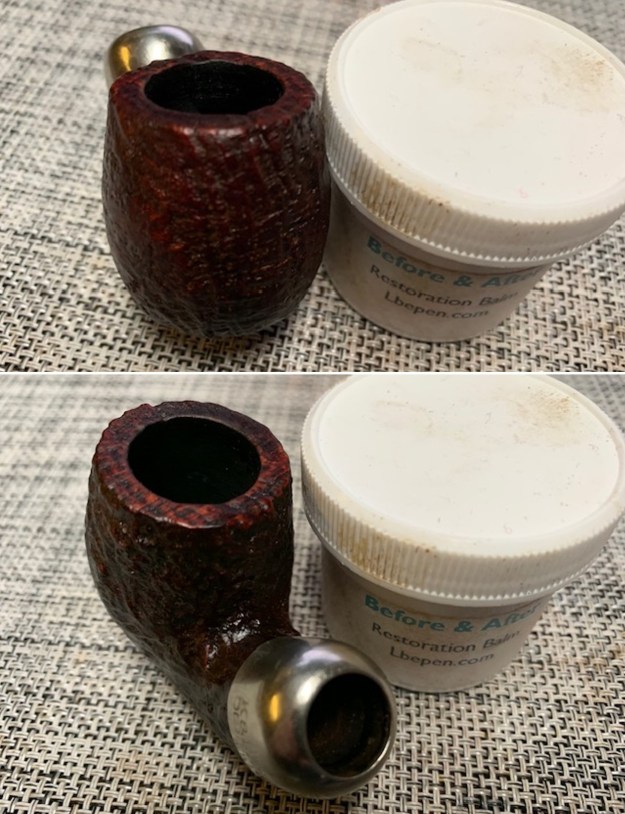
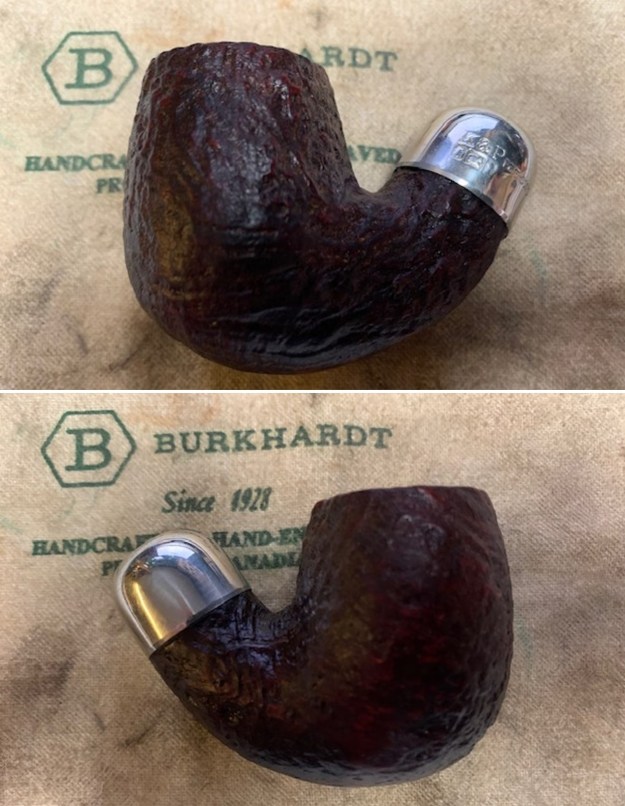
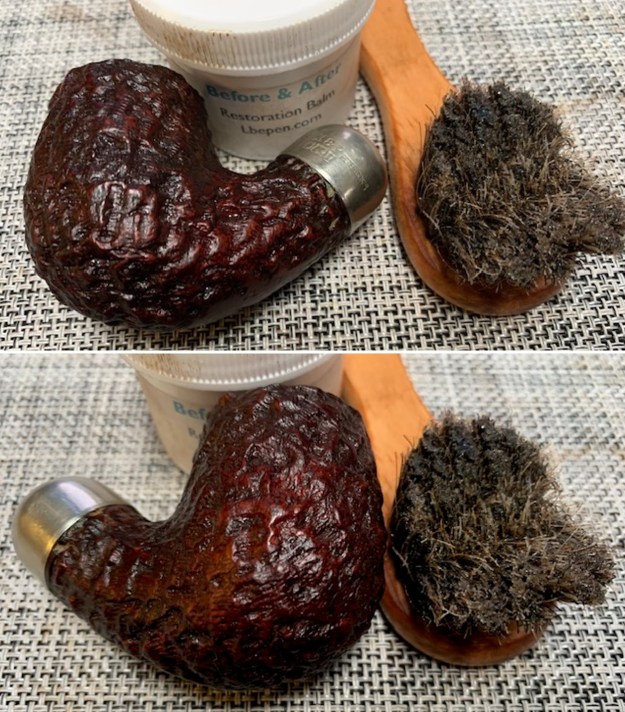
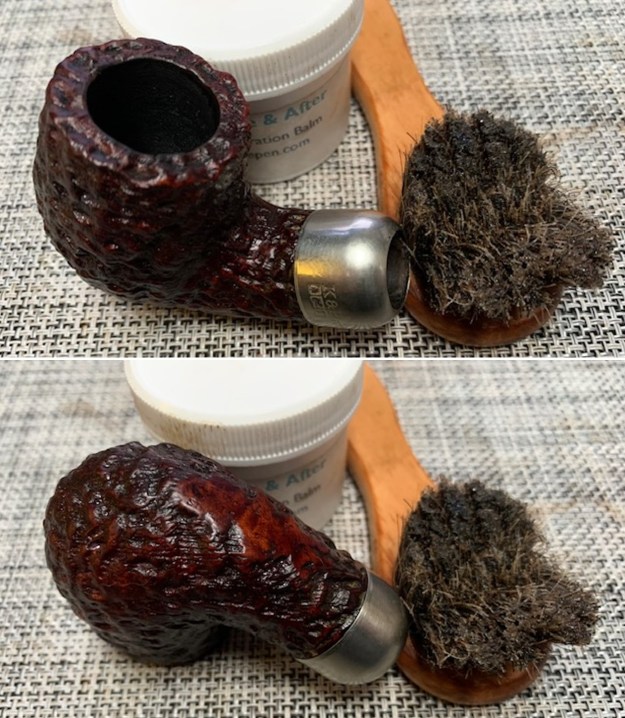
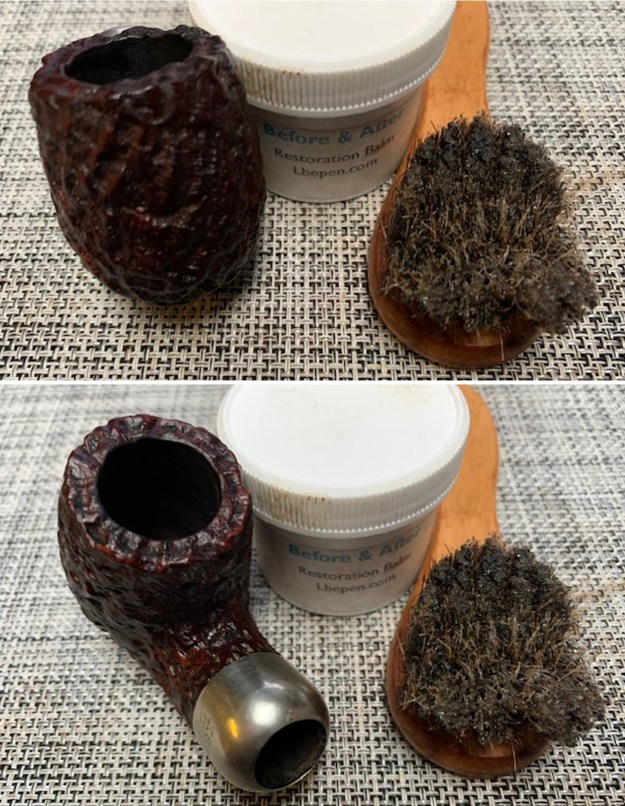
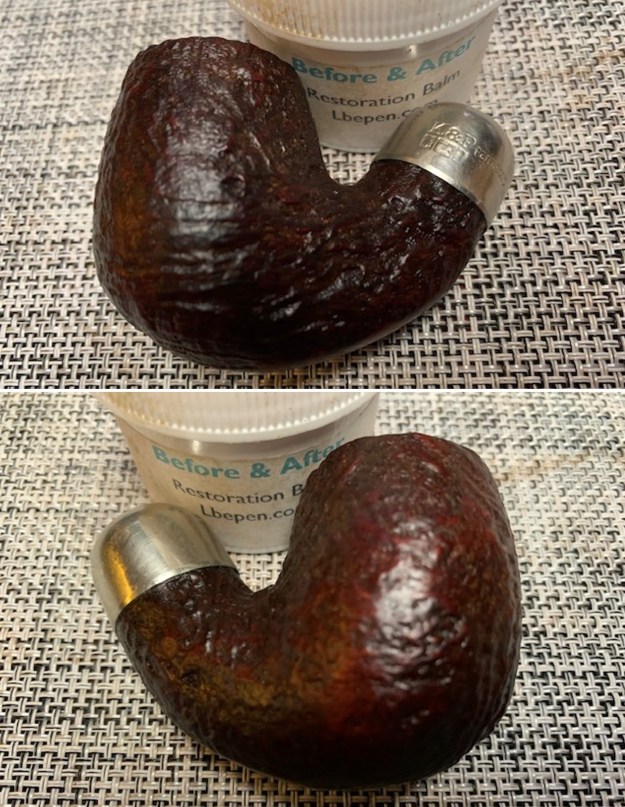
Jeff cleaned this filthy pipe with his usual clean up process. This one was a real mess and I did not know what to expect when I unwrapped it from his box. He reamed it with a PipNet pipe reamer and cleaned up the reaming with a Savinelli Fitsall Pipe Knife. He scrubbed out the internals with alcohol, pipe cleaners and cotton swabs until the pipe was clean. He scrubbed the exterior of the bowl with Murphy’s Oil Soap and a tooth brush to remove the grime and grit on the briar and the lava on the rim top. The finish looks very good with great looking grain around the bowl and shank. Jeff soaked the stem in Briarville’s Pipe Stem Deoxidizer to remove the oxidation on the vulcanite. When the pipe arrived here in Vancouver for the second stop of its restoration tour I was amazed it looked so good. I removed the incorrect stem and replaced it with a correct P-Lip stem for a 307 that I had here in my box of stems. The bonus was that the tenon had a brass chimney in the end that was correct for this pipe.I put the stem in the pipe and took photos of it with the correct stem. I liked the look of the pipe at this point in the process. I took some close up photos of the rim top and also of the stem surface. I wanted to show what an amazing job Jeff did in the cleanup of the rim top. The rim top was and inner edge were in excellent condition. I also took close up photos of the replacement stem I put in the shank to show the condition of the vulcanite. It was quite clean other than some slight oxidation at the edges of the button. There were no tooth marks or chatter on the stem surface.One of the things I appreciate about Jeff’s cleanup is that he works to protect and preserve the nomenclature on the shank of the pipes that he works on. The stamping on this one was very faint to start with so I was worried that it would disappear altogether with the cleanup. He was not only able to preserve and maintain its condition in the process. I took some photos to show the clarity of the stamping. I have noticed that many restorers are not careful to protect the stamping in their cleaning process and often by the end of the restoration the nomenclature is almost destroyed. I would like to encourage all of us to be careful in our work to preserve this as it is a critical piece of pipe restoration! I took the stem off the shank and took a photo of the pipe. I decided to start my work on the pipe by cleaning up some of the polishing compound left in the rustication ahead shank rustication ahead of the ferrule. I worked the end over with a brass bristle wire brush to remove the crud in the finish. The photos show the progress.  I rubbed the bowl and rim down with Before & After Restoration Balm. I worked it into the rusticated surface of the briar with my fingertips and a horse hair shoe brush to clean, enliven and protect it. I let the balm sit for 10 minutes and then buffed with a cotton cloth to raise the shine. I really like watching the Balm do its magic and bring the briar alive. With briar polished with the Restoration Balm I moved onto the metal. I polished the nickel ferrule with a jewellers cloth to raise the shine and to protect the ferrule from further oxidation. I sanded the stem with 220 grit sandpaper to remove the oxidation that remained in the vulcanite and also the light tooth marks on the top and underside near the button. I started polishing it with 400 grit wet dry sandpaper.I touched up the “P” logo on the left side of the saddle stem with white acrylic fingernail polish. I let it dry then I polished off the excess with a worn 1500 grit micromesh sanding pad. Once the excess was removed the stamp looked much better even though there was some faintness on the curve of the P.I polished the stem with micromesh sanding pads – wet sanding with 1500-12000 grit pads. I wiped the stem down after each sanding pad with Obsidian Oil. I polished it with Before & After Pipe Stem Polish – both Fine and Extra Fine. I gave it a coat of Obsidian Pipe Stem Oil. It works to protect the stem from oxidizing. I set it aside to dry.  Once again at this point in the restoration process I am excited to be on the homestretch. I look forward to the final look when the Rusticated Peterson System XL307 is put back together, polished and waxed. I put the bowl and stem back together. I lightly polished the bowl and stem with Blue Diamond to polish out the scratches in the briar and the vulcanite. I gave the bowl multiple coats of Conservator’s Wax and the stem multiple coats of carnauba wax. I buffed the pipe with a clean buffing pad to raise the shine. I hand buffed it with a microfiber cloth to deepen the shine. The pipe polished up pretty nicely. The depths of the rustication really pop with the wax and polish. The shiny black vulcanite stem is a beautiful contrast to the browns of the bowl and thick shank and nickel ferrule. This Peterson’s System Standard XL307 Bent Billiard was another fun pipe to work on. It really is a quite stunning piece of briar whose shape follows the flow of the briar. The pipe is tactile in the hand and should feel great as it is warmed up when smoking. The finished pipe is shown in the photos below. The dimensions of the pipe are Length: 6 ½ inches, Height: 2 inches, Outside diameter of the bowl: 1 ¼ inches, Chamber diameter: ¾ of an inch. The weight of the pipe is 2.26 ounces/64 grams. I will be putting it on the rebornpipes store in the Irish Pipemakers Section if you would like to add it to your rack and carry on the previous pipeman’s legacy. This is an interesting estate to bring back to life.
As always, I encourage your questions and comments as you read the blog. Thanks to each of you who are reading this blog. Remember we are not pipe owners; we are pipe men and women who hold our pipes in trust until they pass on into the trust of those who follow us.
Breathing New Life into a Stunning Ben Wade Danish Canadian


Blog by Steve Laug

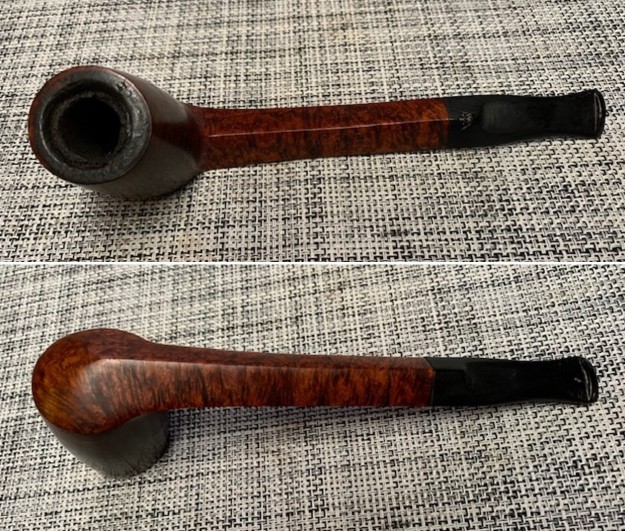
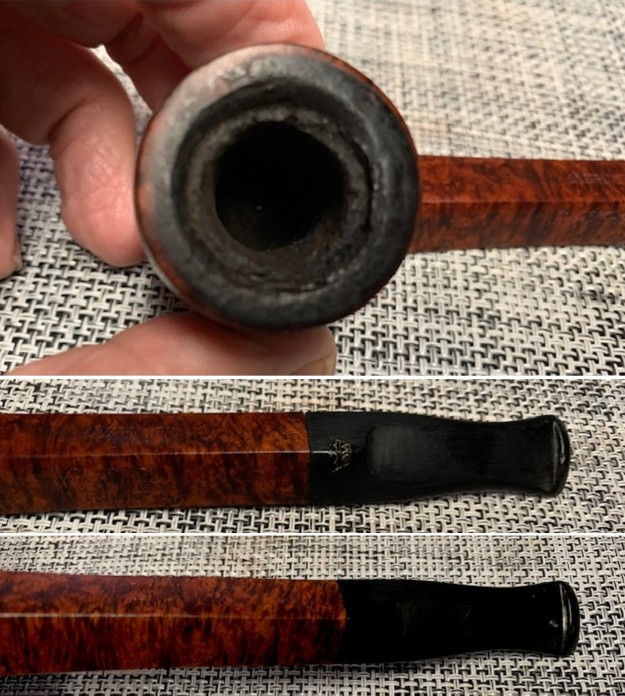
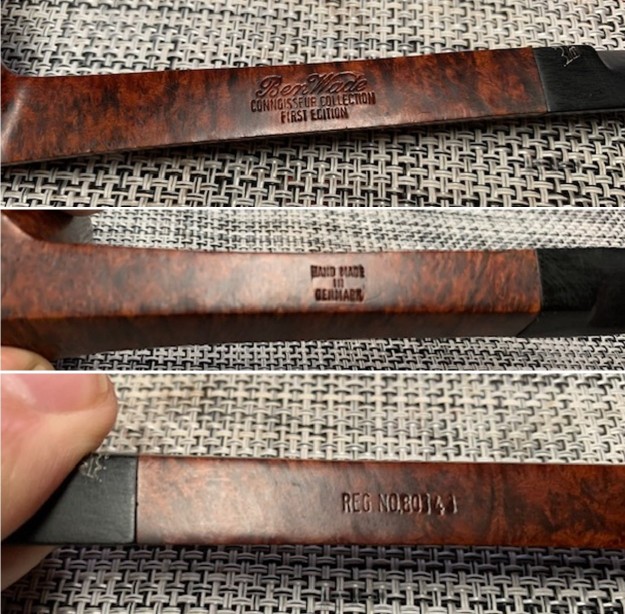
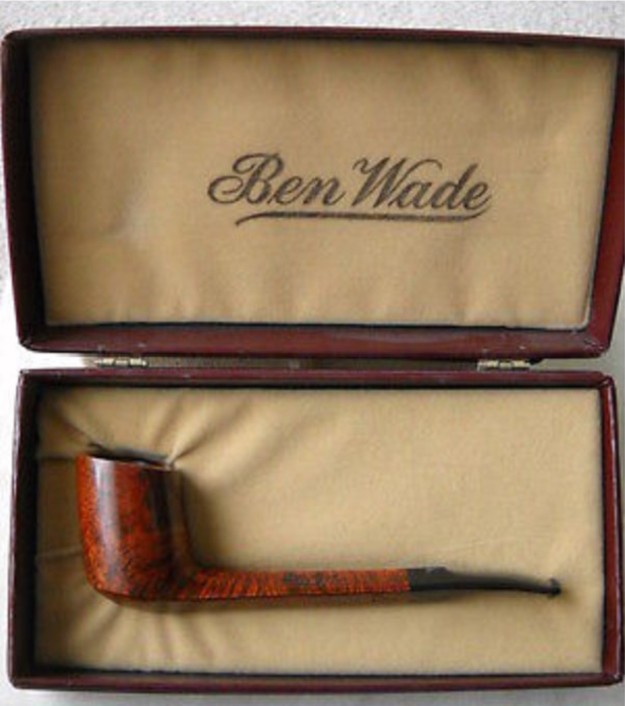
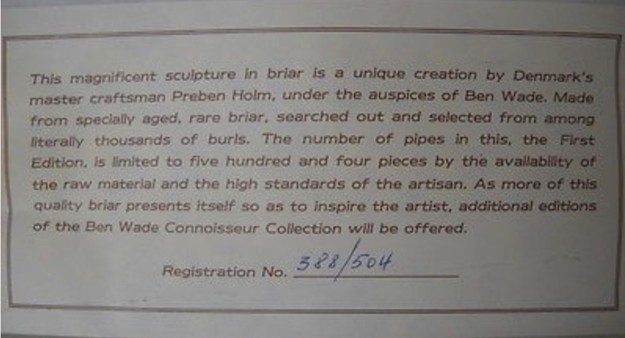
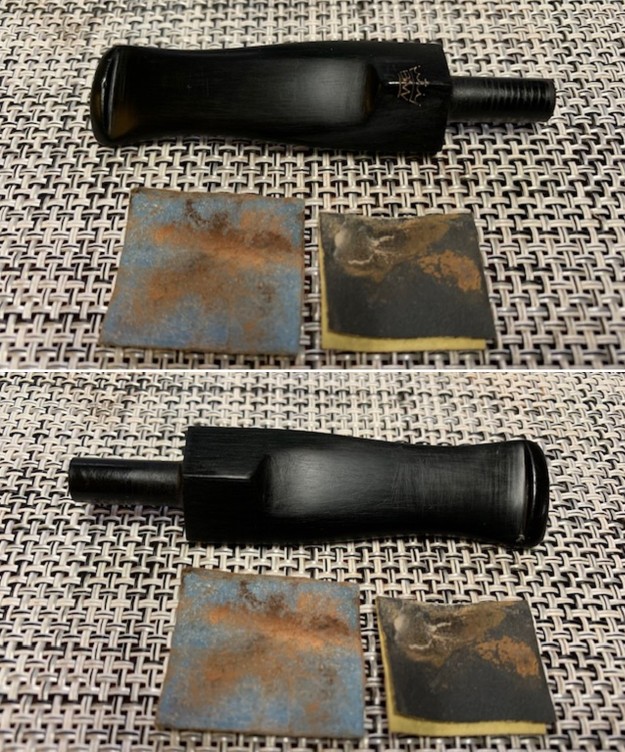
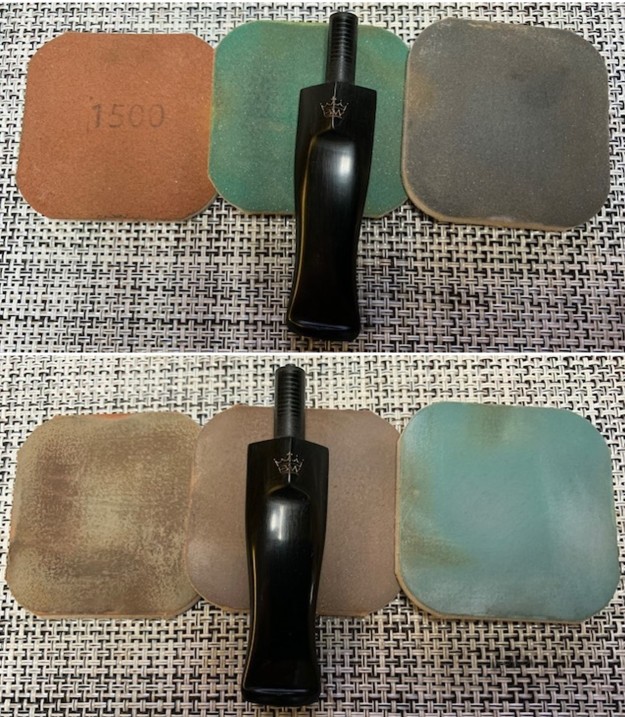
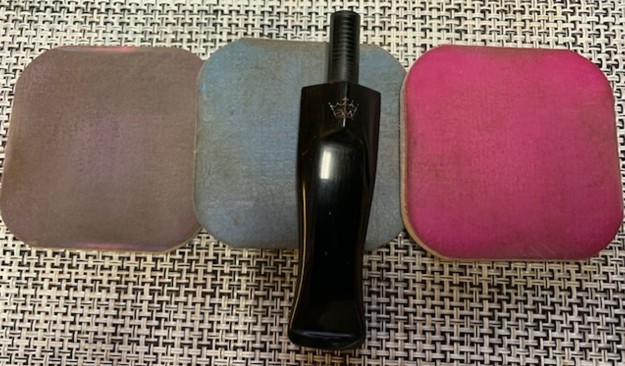
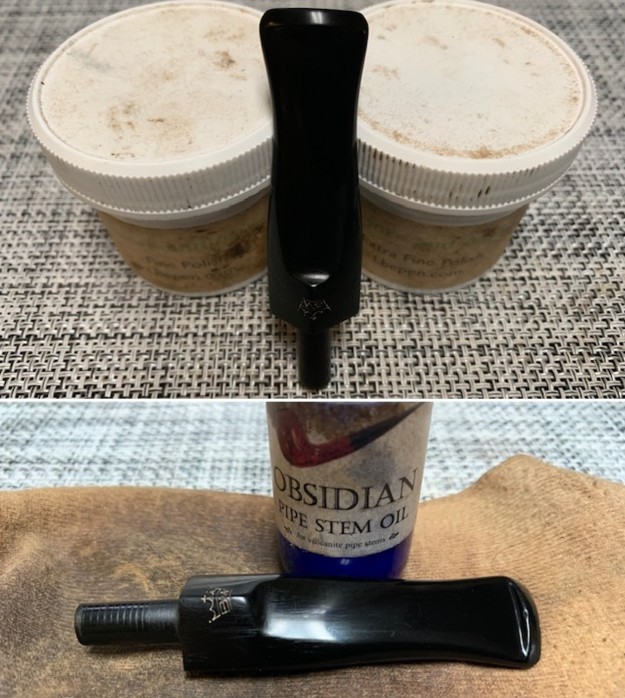
The next pipe on the table is another that came to me for restoration from a friend in the US. He sent three pipes for me to restore for him. I finished the restoration of the first of these – a 1913 GBD 347 Straight Apple (https://rebornpipes.com/2023/09/23/breathing-life-into-a-1913-mrco-gbd-london-england-347-apple/). I am turning to the second one he sent, a beautiful Ben Wade Connoisseurs Collection First Edition Long Diamond Shank Brandy with a saddle stem. That leaves the final one that I need to work on an interesting Ivarsson 389 Product Apple. All the pipes are gorgeous examples of pipe craft and all were incredibly dirty and showed various issues with their finishes. The stamping on the pipe was as follows. On the top left side of the long diamond shank it read Ben Wade in script [over] Connoisseur Collection [over] First Edition. On the left underside it is stamped Hand Made [over] In [over] Denmark. On the right side it was stamped Reg. No. 80343. My guess is that this is a Ben Wade made by Preben Holm during the time Dunhill had him making Freehands for them. The pipe was in dirty condition. The finish on the bowl and shank were worn and dirty with grime and darkening ground into the surface all around the bowl and shank. The cake in the bowl was very thick – so much so that I could not put my little finger into the bowl. The lave flowed over the rim top and inner and outer edges of the bowl. It seemed to be in fair condition under the lava but cleaning would tell the story. The vulcanite diamond saddle stem had a crown logo on the top of the diamond. The stem was dirty and had file marks/sanding marks and tooth marks and chatter on both sides ahead of the button. I took photos of the pipe before I started my clean up work on it to give a clear picture of the condition of the pipe before I started my work. I took a photo of the bowl and the rim top. The bowl had a very thick cake on the walls and bottom. I was not able to even put my little finger in the bowl. The rim top and the inner edge of the bowl showed some nicks and a thick lava overflow. There also seemed to be some burn marks on the inner edge. It was hard to know for sure what was underneath but I would be there would be some darkening. The vulcanite stem shows some deep tooth marks and chatter on both sides ahead of the button as mentioned above. There were also some file or coarse sandpaper marks. It had promise but it was dirty!I took photos of the shank sides to try to capture the stamping on the briar. I took photos of the stamping on the right top side, underside and right top side of the diamond shank. It was clear and readable. I removed the stem from the shank and took a photo to get a sense of the length of the shank and overall look of the pipe. It is a beauty!I did a Google search on the Ben Wade Connoisseur Collection [over] First Edition and found two listings on Worthpoint (an auction site). The first included the pipe, the hand made case and the certificate of authenticity (https://www.worthpoint.com/worthopedia/ben-wade-pipe-preben-holm-connoisseur-521474453). Make sure to read the certificate as it clearly states that Preben Holm made the pipe under the auspices of Ben Wade. The First Edition was limited to 504 pipes. Theoretically a second edition etc. would follow. We know that Holm died in 1989 so it appears that there was only one edition of the pipe. That makes this a rather unique and very collectible piece.

I copied the advertisement on Worthpoint in full and included it below. The description of the pipe is quite amazing as is details on the shape, size, finish etc. I quote:

You are bidding on a special BEN WADE, ” CONNOISSEUR COLLECTION ” first limited edition series that was hand crafted by legendary pipemaker PREBEN HOM, in Denmark, in 1980. This pipe shows a darker reddish stain that nicely accentuates the well-defined birdseye and cross grain that cover the entire bowl and shank. Top of bowl is very clean and in excellent condition (please see pictures). The shank itself and the mouthpiece show a distinct diamond shape. Unique, ” Canted Danish Billiard ” shaped bowl with a 1/4 bent, diamond shaped shank. Part of a ” LIMITED EDITION ” series called ” Connoisseur Collection ” of distinctively shaped and numbered pipes. This is number 388 of a first series of only 504. There has never been a second edition of Ben Wade pipes. This is roughly the size (and capacity) of a Dunhill ODA sized pipe. Lovely grain textures, unique shape, great condition and overall quality artisanship! A very lovely piece and a very original play on an old classic! This pipe has been formerly lightly smoked and is in very good condition. A pipe cleaner passed through with ease. This pipe comes in its original presentation box, and with the original certificate. The pipe was cleaned, polished and taken care of by one of the oldest pipemakers in Montreal, now celebrating 107 years of pipe making (est. 1907)! Markings: The mouthpiece is the original (acrylic), shows the original Ben Wade “crown” and is in excellent condition (no marks …). Ben Wade CONNOISSEUR COLLECTION FIRST EDITION HAND MADE INDENMARK REG NO. 8021 ……(21st PIPE OF THE FIRST EDITION, 1980). Dimensions:  Overall height of pipe: 2″ Length: 6 3/4″ Inner Diam. = 7/8″ Outer Diam. (top of bowl) = 1 3/8″ If there are any questions about this item or any other items presently available, please feel free to ask.

The second listing on Worthpoint (https://www.worthpoint.com/worthopedia/ben-wade-connoisseur-collection-first-486770771) was a second pipe with the same stamping other than the Reg. No. I have copied it below for the further information. In this article it says that Holm died in 1975 but he died in 1989. The other error it seems to my research that Ben Wade made the pipe in honour of Preben Holm. However, it seems that pipes were actually made or designed by Holm himself. I quote:

Bari Preben Holm died 1975 this pipe was made in his Ben Wade (Dunhill) era Wade Connoisseur Collection First Edition Reg.No.80353 Hand Made in Denmark that’s it!! This pipe is amazing good old times this pipe was made for collectors and lovers for a very good Danish pipe by Ben Wade to honour Preben Holm Hand Made unique birdseye smoked made without any number- means this pipe is unique. This pipe shows a smooth finish-no scratches no tooth marks very good condition for the age!!! Nearly 45years old!!High: 4,5 cm = 1,77 inch length: 17 cm = 6,68 inch smoked pipe comes cleaned with 96% alk x-mas is coming shipping with tracking number and insurance Austria : 6 €eu : 14€ = 18 $us and worldwide : 19 € = 25$i am a private seller: no returns no exchanges.Given those facts I can be certain that the pipe was made by Preben Holm in Denmark prior to his death in 1989. From the information above using the Reg. No. 80343 stamp we are given a method of dating the pipe. The pipe is thus the 34th pipe of the first edition made in 1980. It is a limited collector series of pipes that combines a touch of freehand with a classic Danish Canadian. It was a way in which Dunhill could carve a niche for themselves in the burgeoning freehand market in the US. Now it was tie to work on the pipe.

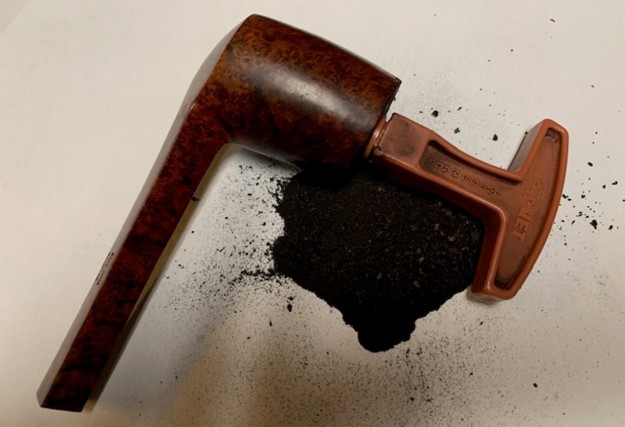
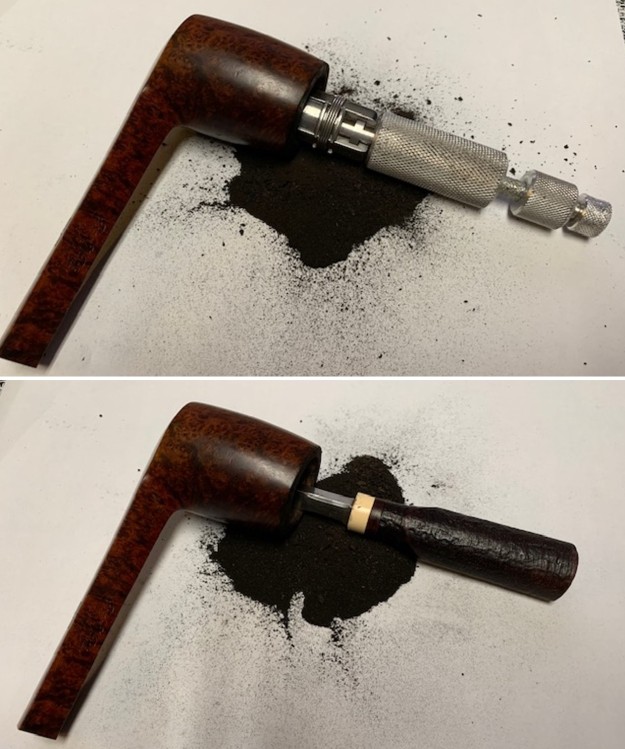
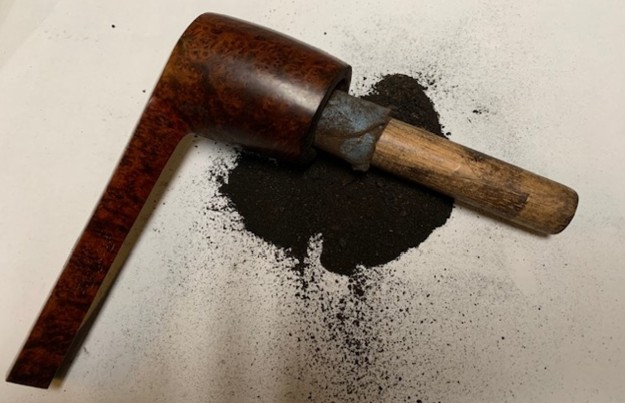
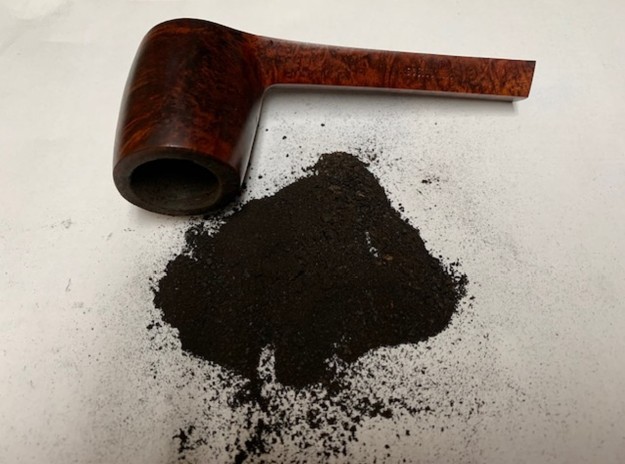
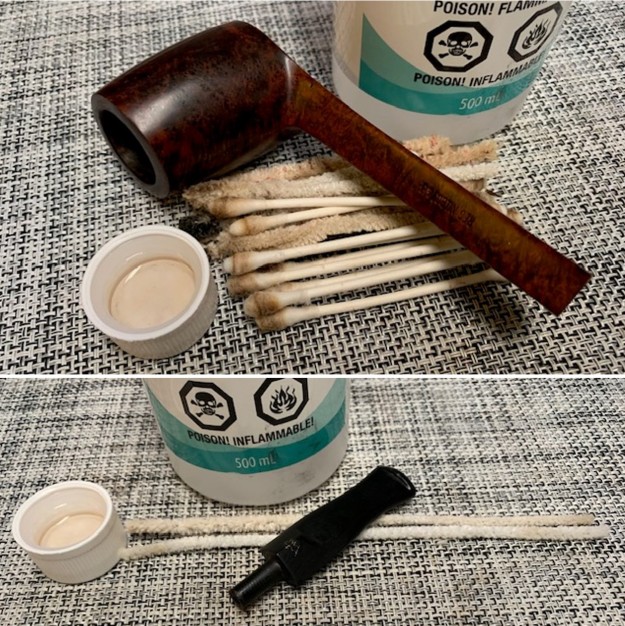
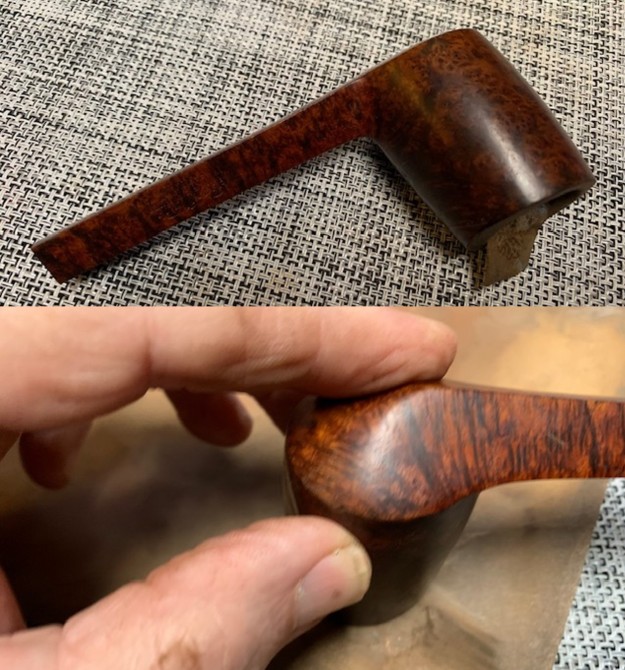
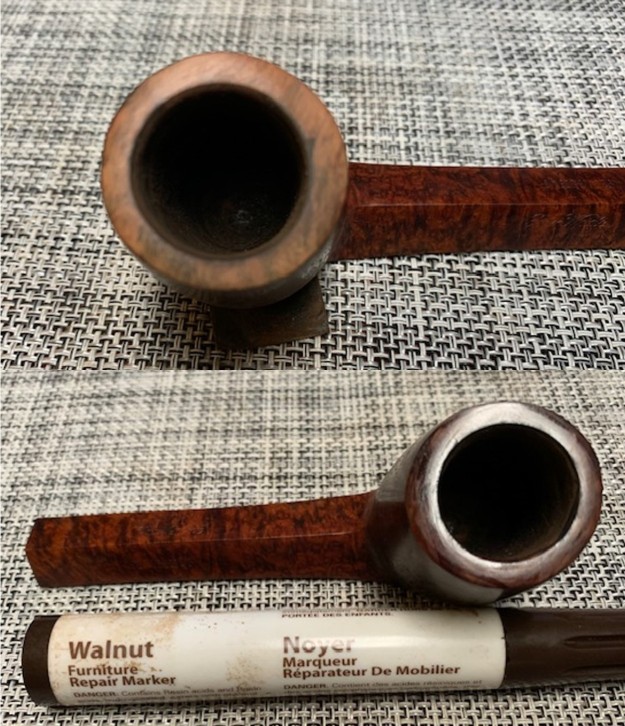
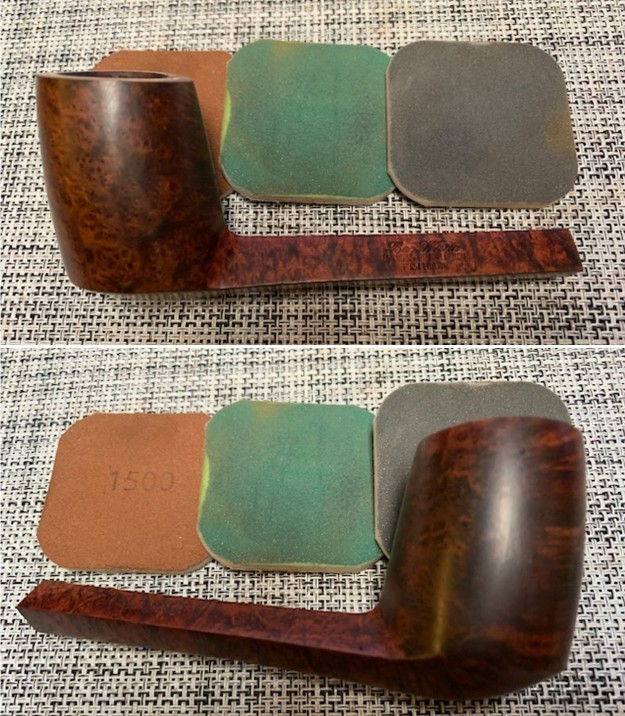
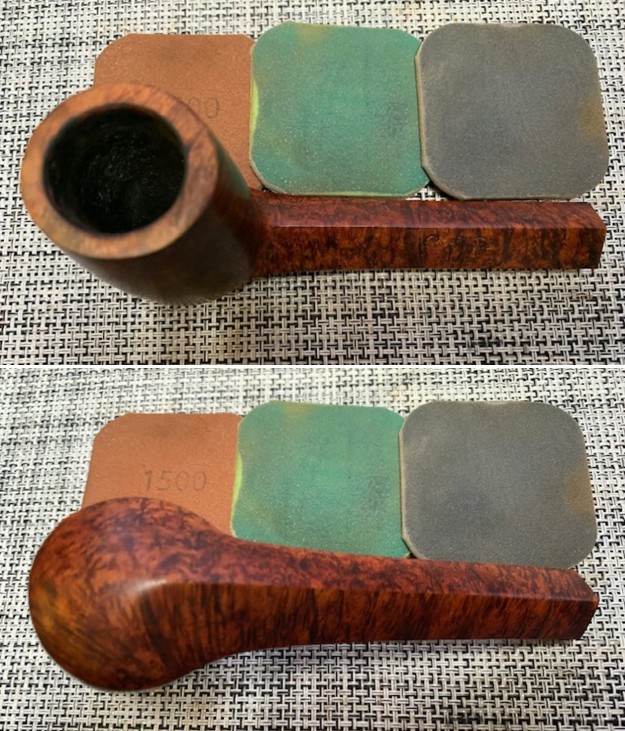
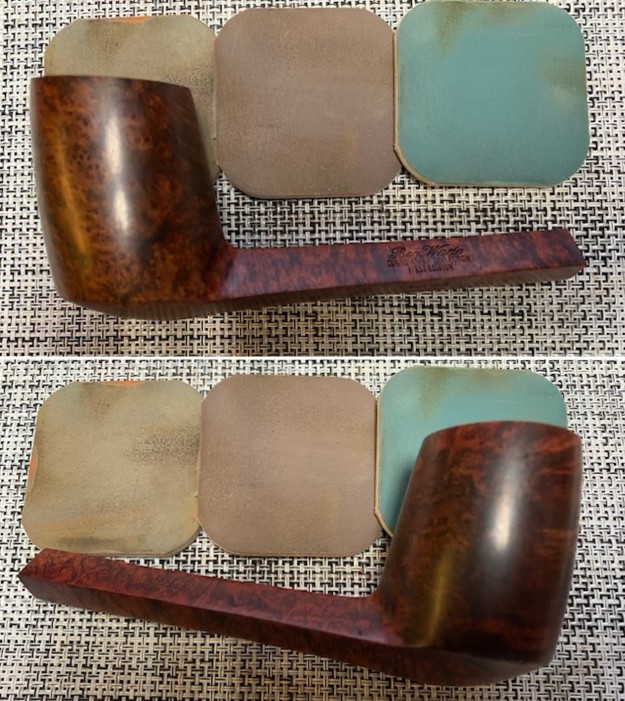
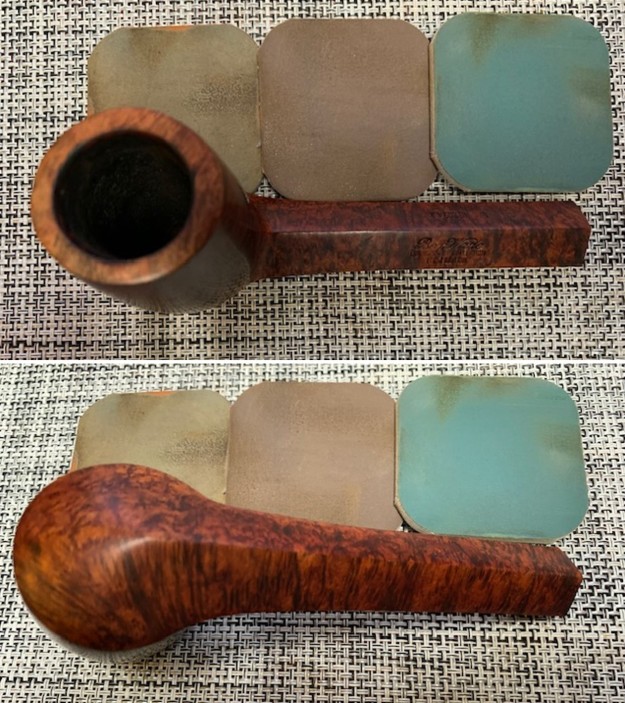
I started my work on the pipe by reaming the bowl with a PipNet pipe reamer to remove the thick cake on the walls so I could see what they looked like. Strangely, I touched the cake with the tip of the cutting head and the cake crumbled out onto the paper. It was very soft and crumbly and I have never had an entire cake come out of the bowl with the first touch of the reamer. I used a KleenReem pipe reamer to clean up the bottom of the bowl and remove remnants of cake there. I followed that with a Savinelli Fitsall Pipe Knife to scrape off the bits of remaining cake on the bowl walls. I followed that by sanding the walls of the bowl until they were smooth with 220 grit sandpaper wrapped around a piece of dowel. The bowl walls showed no checking or cracking which is remarkable. I took a photo of the mountain of carbon that came out of the bowl with the reaming.I cleaned out the airway and mortise in the shank and the airway in the stem. I used 99% isopropyl alcohol, pipe cleaners and cotton swabs to remove the tars and oils. It was extremely dirty and once cleaned smelled and looked better.I decided to deal with the damage and darkening to the rim top and inner edge of the bowl next. I used a folded piece of 220 grit sandpaper to smooth out the nicks and damage on the edge. Once finished it looked much better. I cleaned up the damage to the rim top and thick lava coat with a piece of 220 grit sandpaper and a topping board. I lightly topped the bowl to remove the damage. I did not remove much briar at all, actually I removed the thick lava coat and smooth out the nicks and marks. That was my goal and I think it worked well. I touched up the stain on the rim top with a Walnut stain pen. It would even out as I polished and buffed it. I worked on the finish around the rim top and bowl with micromesh sanding pads – 1500-12000 grit sanding pads to dry sand the briar. I wiped it down after each sanding pad with a damp cloth after each sanding pads. I rubbed the bowl and shank down with Before & After Restoration Balm. I worked it into the surface of the bowl sides and shank with my fingertips and a horsehair shoe brush. The product works to clean, enliven and protect the briar. I let the balm sit for ten minutes and then buffed with a cotton cloth to raise the shine.    I set the bowl aside and turned my attention to the stem. I painted the stem surface with the flame of a Bic lighter to lift the tooth marks. I was able to lift them quite a bit. I repaired what remained with some light spots of CA. I would have left them but the marks were large and needed to be addressed. I sanded out the repairs and blended them into the surface with 220 grit sandpaper. I stared polishing the stem with 600 grit wet dry sandpaper. I polished the stem surface with micromesh sanding pads – 1500-12000 grit pads. I wiped it down Obsidian Oil on a cotton cloth. I finished my polishing with Before & After Pipe Stem Polish – both Fine and Extra-Fine polishes. I wiped it down with a final coat of Obsidian Oil and set aside. I am excited to finish the restoration of this 1980s Preben Holm carved Era Ben Wade Connoisseur Collection First Edition Danish Canadian. I put the pipe back together and buffed it with Blue Diamond on the buffing wheel. I gave the bowl and the stem multiple coats of carnauba wax. I hand buffed the pipe with a clean buffing pad to raise the shine. It is fun to see what the polished bowl looks like with beautiful mixed grain all around it. I love the look of the polished grain on the pipe with the polished black vulcanite stem. This smooth Ben Wade Connoisseur Collection Canadian is great looking and the pipe feels great in my hand. It is quite light for its size and well balanced. Have a look at it with the photos below. The dimensions are Length: 7 inches, Height: 2 ¼ inches, Outside diameter of the bowl: 1 ¼ inch, Chamber diameter: 7/8 of an inch. The weight of the pipe is 46 grams/1.62 ounces. It turned out to be a beautiful pipe. I will be sending it back to the pipeman who sent it to me once I finish the final remaining pipe. Thanks for reading this blog and my reflections on the pipe while I worked on it.

As always, I encourage your questions and comments as you read the blog. Thanks to each of you who are reading this blog. Remember we are not pipe owners; we are pipe men and women who hold our pipes in trust until they pass on into the trust of those who follow us.
Amazing Research in the Restoration of a Classic French Pipe


Blog by Kenneth Lieblich

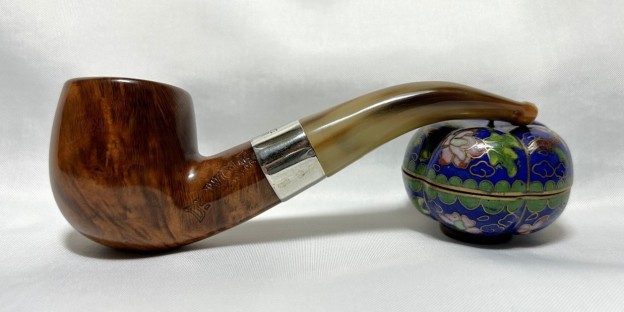
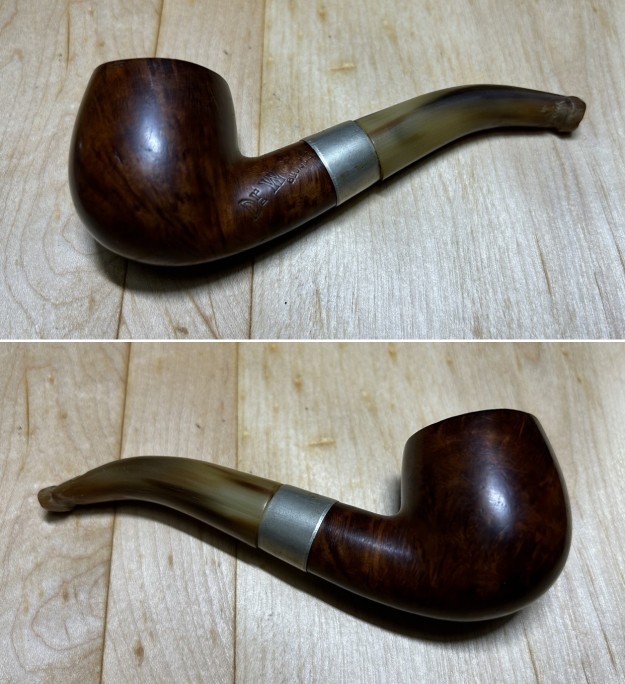
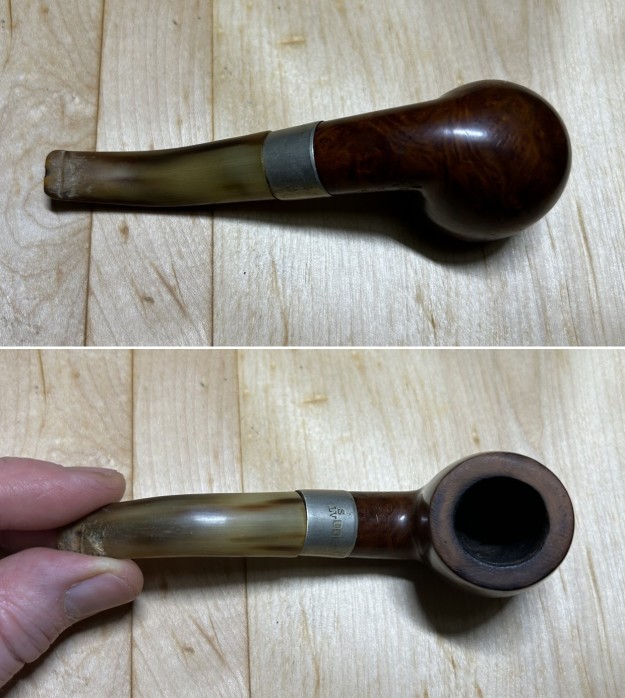
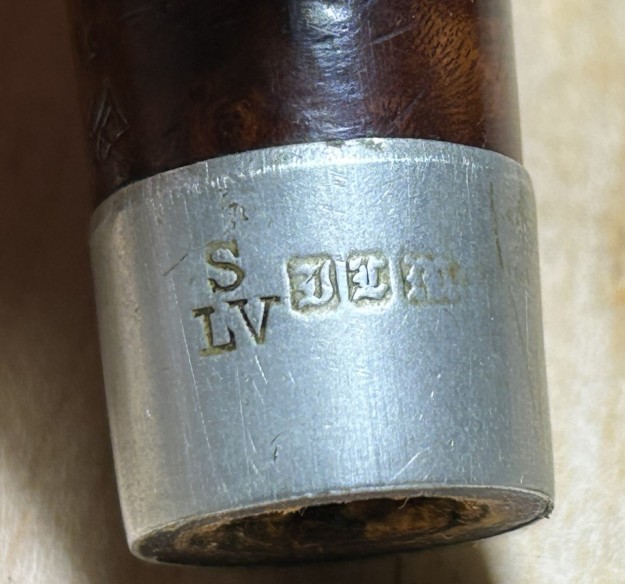
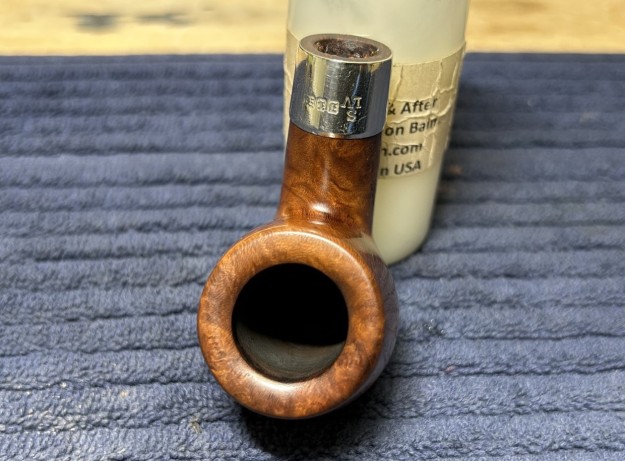
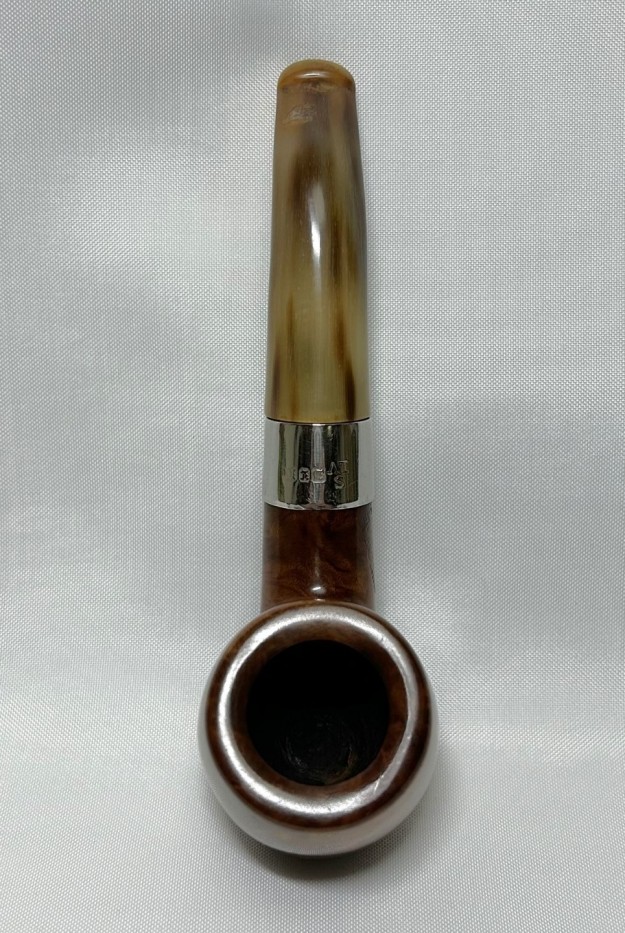
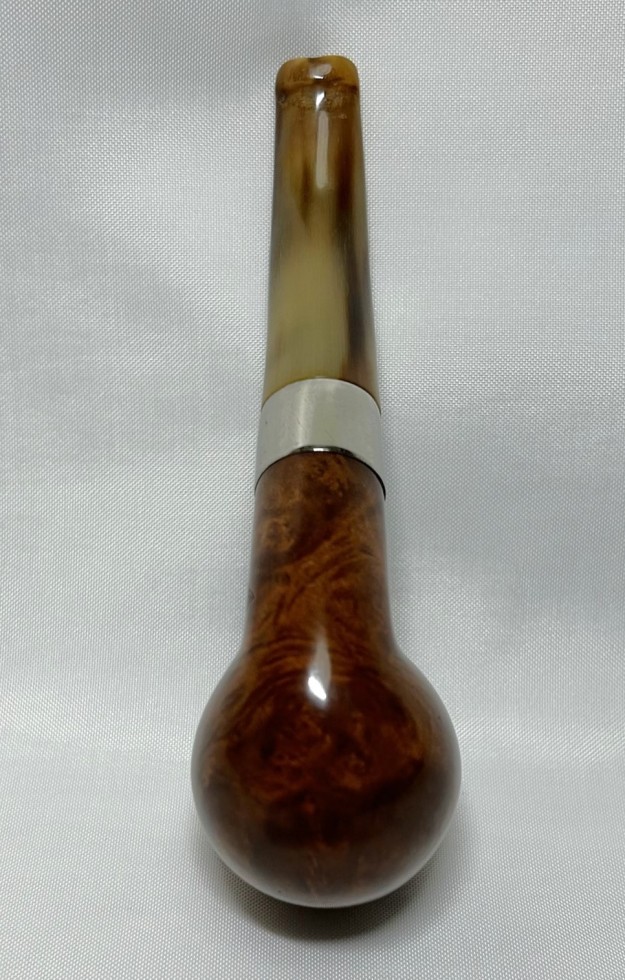
Next on ye olde chopping block is a charming pipe from France and it dates back a century – or more. It’s a very attractive bent billiard pipe that I acquired in a lot from France. Recently, I had the pleasure of meeting a young man studying for the priesthood. While he as visiting the Vancouver area, he told me he was interested in acquiring a pipe. I had him over to the house and showed him many pipes. He picked this very pipe. He wanted one of modest size and this fit the bill very well. The briar wood was quite lovely and it had an equally fetching stem made of horn. There was also a nickel band around the shank which read, S [over] LV. This was next to some blackletter characters that I couldn’t quite make out. Meanwhile, the markings on the left side of the shank read: Dr Wolf [over] BTE. S.G.D.G. The Dr Wolf part was clear enough, but I needed to confirm what the other letters referred to. I was fairly sure this was something to do with French patents, but I googled to make sure. Indeed, it was a type of French patent, extant between 1844 and 1968. The letters BTE. S.G.D.G. stand for Breveté Sans Garantie du Gouvernement, meaning “patent without government guarantee”. As Wikipedia explains:

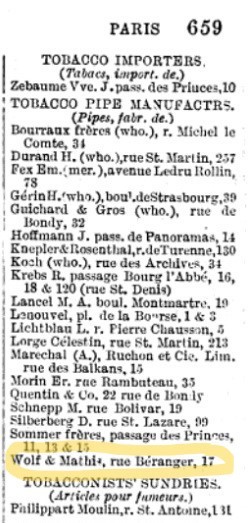
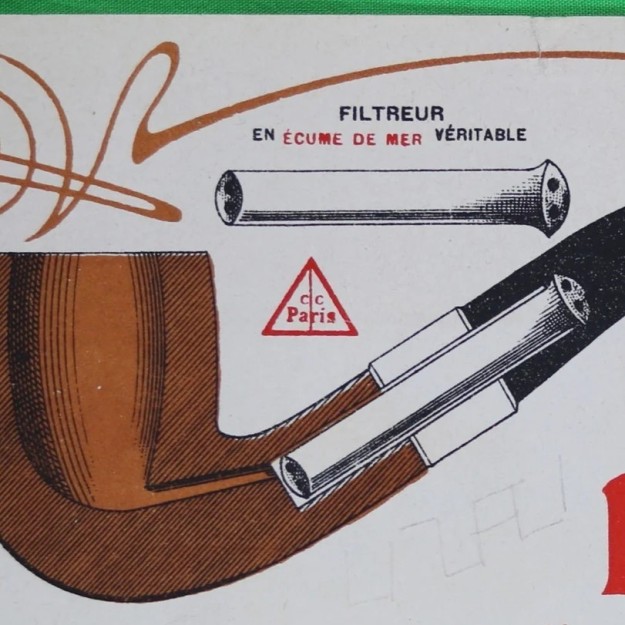
In France, the law of 1844 states that patents are issued “without prior examination, at the risk of the applicant and with no guarantee of function, novelty and merit of the invention also in terms of precision or accuracy of the description”. Back to the brand name, Dr Wolf. This was tricky – I wasn’t familiar with the brand Dr Wolf and there was nothing about it online – except for one seemingly unhelpful advertisement. This ad was on an antique shop’s website and it was listed as being from the “end of the 19th century”. I was annoyed by the lack of information, but I am nothing if not tenacious in discovering the history of pipes – especially French pipes, for which I have a particular fascination. I saved that advertising image to my computer, so I could show it in this article.My first step was consulting both Wilczak & Colwell and my own personal database of French pipe makers and, of course, there was no listing for “Dr Wolf”. However, in my database, the name, “Wolf”, did appear in the listing for a late-19th century pipe maker: CC Paris. Here is the write-up from Pipedia on CC Paris:

Every collector of antique pipes knows that pipe factory and retail store catalogs from the 1800s – early 1900s are as rare as hen’s teeth to find…and an even rarer occasion, when found complete and in good to better condition. This fragile catalog from this little-known French manufactory, merchandised its pipes with the logo of a triangle bearing the letters “C C Paris” embossed in fitted cases. Cases with this logo are known, but the Wolf and Mathiss name, until now, was not known as the factory behind the retail establishment.

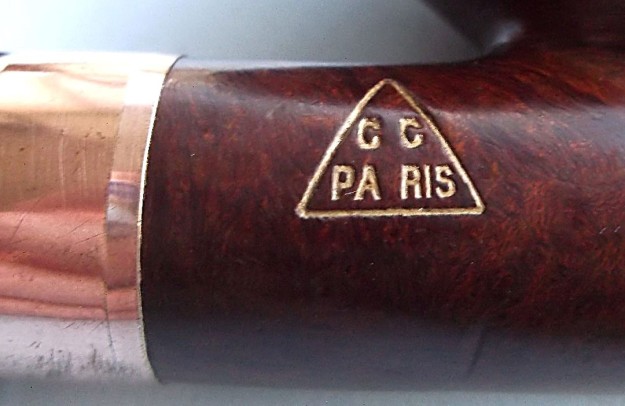
Wolf & Mathiss was originally known as Cawley & Henry, a pipe manufacturer founded in 1867. The product line was fairly robust, catering to not only pipe and cigar smokers, but also to cigarette consumers, because the catalog includes cigarette rolling papers that, according to company information, had received silver medals at two expositions, Anvers (1885) and Paris (1889).Unfortunately, the name “Wolf” is not uncommon and there was nothing to suggest that this Wolf was the same as Dr Wolf. There was also no indication of what the given names were for either Mr Wolf or Mr Mathis. As a side note, I assume that the correct spelling is “Mathiss”, not “Mathis”, as shown on Pipedia. A 1907 copy of Kelly’s Directory of Merchants, Manufacturers and Shippers lists the name with a single “S”.However, the Pipedia page for CC Paris made me wonder about a connection to Dr Wolf. First of all, the pipes on catalogue pages shown there bear some resemblance to my Dr Wolf pipe – hardly a definitive clue, but interesting nonetheless. The other thing that struck me was the logo, shown here:There is no obvious reason why the logo would be of interest, but I recognized it and couldn’t remember where I’d seen it. I love researching pipe history, but it’s always frustrating when one hits a dead end. And then it struck me! That logo! I’d seen it in the very same advertisement I downloaded earlier. Here it is (zoomed in) and look what it shows!!!So there we have it – the Wolf of Wolf & Mathiss must, in fact, be Dr Wolf. I am delighted to have made this discovery. It completes the loop between the relevant pipe makers and demonstrates the origin of the Dr Wolf name.

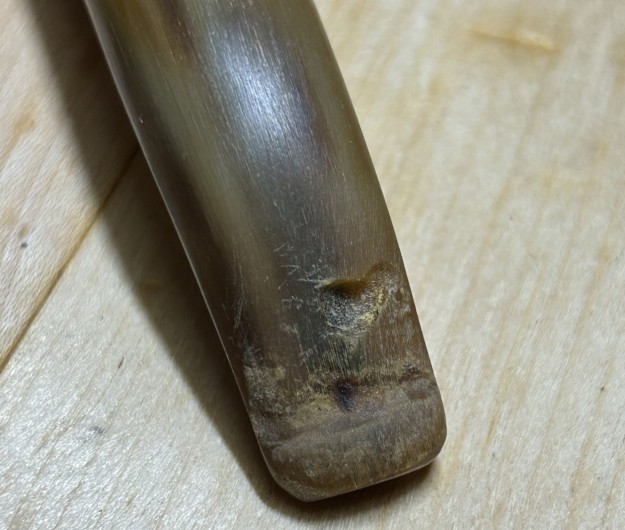
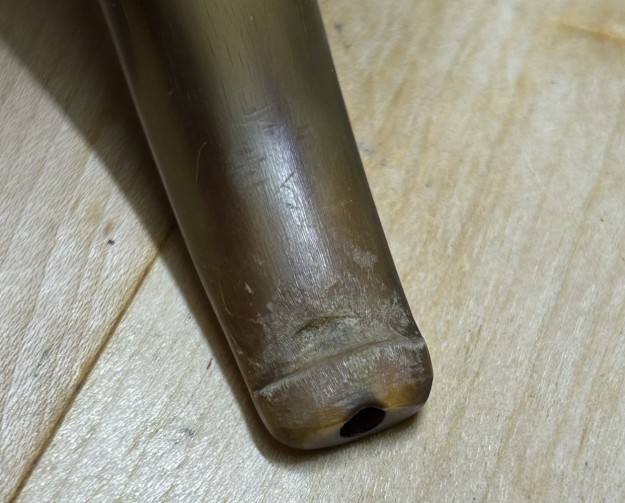
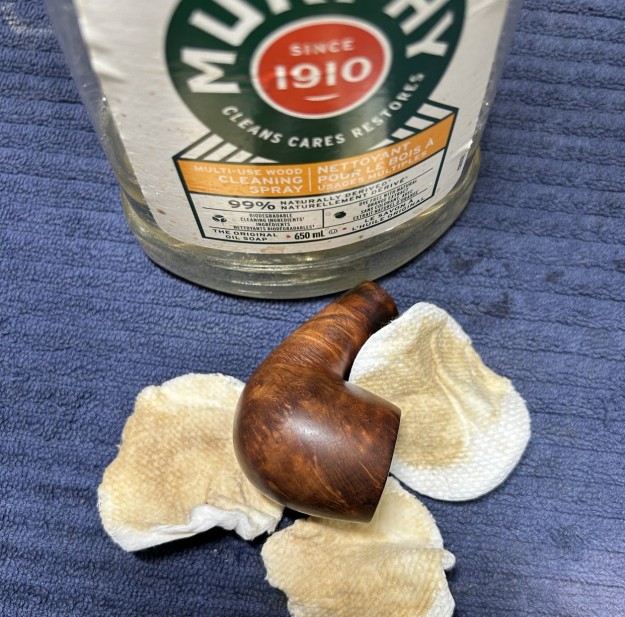
Clearly, this particular pipe had been well-loved, as it arrived well worn, with plenty of filth inside, a few dents in the work, gouges in the horn stem, and scratches all over the rim. Interestingly, this pipe had an orific button at the end of the stem, a feature that apparently disappeared by the 1930s, so it must be around a hundred years old. For more information on the orific button, take the time to read Steve’s interesting article on the subject. Well, time to get to work! I started by wiping the stem with Murphy’s Oil Soap on some cotton pads, then cleaned out the inside with pipe cleaners and isopropyl alcohol. Fortunately, it wasn’t overly dirty, and it only needed a handful of pipe cleaners. One of the odd features of this pipe was that the tenon was also made of horn. I quite liked that feature, but it did make it a pain to clean. I built up the bite marks and gouges on the stem with clear cyanoacrylate adhesive and let them fully cure. Following that, I sanded the adhesive down with 220- and 400-grit sandpapers to meld seamlessly into the stem. I then used all nine Micromesh pads (1,500 through 12,000 grit) to bring out the lovely grain of the horn on the stem, with some Obsidian Pipe Stem Oil in between each pad scrubbing.

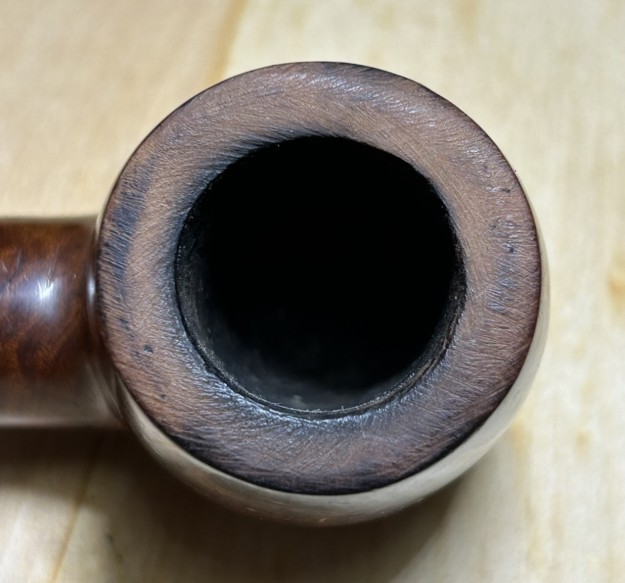
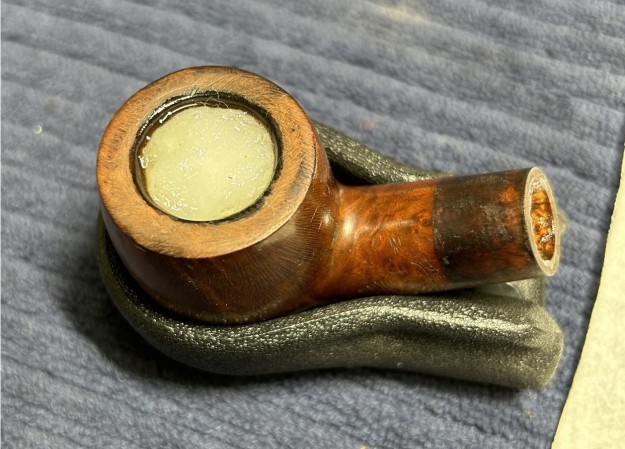
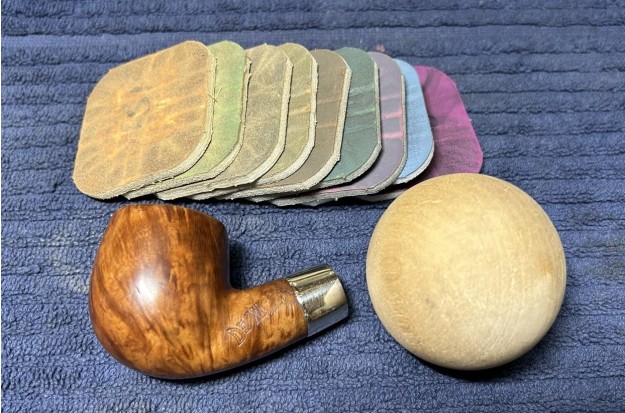
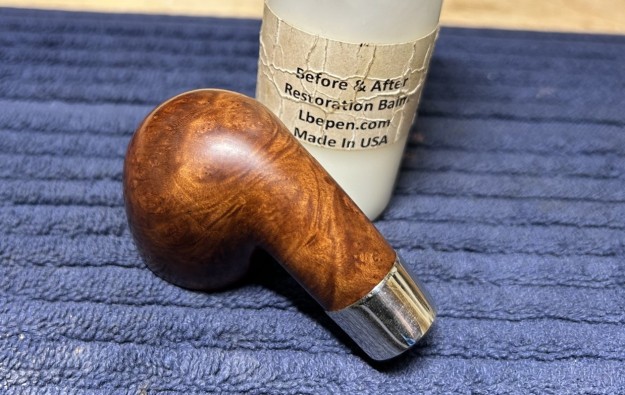
Now for the stummel. Firstly, I decided to ream out the bowl. I used the PipNet Reamer to remove the built-up cake and followed that with 220-grit sandpaper taped to a dowel to eliminate as much as I could. I took the chamber down to bare briar, as I wanted to ensure there were no hidden flaws in the wall. I also took this opportunity to wash the stummel with Murphy’s Oil Soap and remove as much grime as I could. Following this, of course, I cleaned out the insides with the requisite pipe cleaners and isopropyl alcohol. Boy, it was dirty! One issue that complicated the cleaning of the stummel was the mortise was lined with cork. This was a nifty feature, but I had to ensure that I didn’t damage the cork as I used the alcohol and implements to clean the insides. In order to restore it a bit, I added petroleum jelly to the cork with a cotton swab.The rim was so badly scratched that I had to “top” the pipe – that is, I gently and evenly sanded the rim on a piece of 220-grit sandpaper. This effectively removed the damage without altering the look of the pipe.The old patina was nice enough that it didn’t need a new stain so I cleaned it with some Murphy’s and then set it for a de-ghosting. I followed that up by cleaning the insides with some Castile soap and tube brushes. Due to the wear on the rim of the pipe, I used my wood sphere, wrapped in 220-grit sandpaper, to create a beautiful, chamfered edge on the rim. This also helped return the opening of the bowl to round. I think the results turned out very nicely. I then finished it up by sanding with my Micromesh pads (1,500 through 12,000 grit). Then applying some Before & After Restoration Balm added that je ne sais quoi which brings out the wood’s beauty. One of the issues you will have noticed in the photos is that the stem’s tenon didn’t fit well in the shank’s mortise. In order to make it fit properly, I built up one side of the tenon with some clear cyanoacrylate adhesive. This worked like a charm and the fit was perfect after I fiddled with the adhesive for a bit.I also cleaned the nickel band with SoftScrub and that worked well. I also gave it a polish with a few of my finer MicroMesh pads – then finished with my jewellery cloth which added some much-needed pizzaz. Finally, it was off for a trip to the buffer. A dose of White Diamond and a few coats of carnauba wax were just what this pipe needed.This is a handsome pipe with a classic look and feels very comfortable in hand. The lovely shine made the wood very attractive, and I know that the new owner will enjoy smoking it for many years to come. I hope you enjoyed reading the story of this pipe as much as I did restoring it. If you are interested in more of my work, please follow me here on Steve’s website or email me directly at kenneth@knightsofthepipe.com. Thank you very much for reading and, as always, I welcome and encourage your comments.

Restoring a Peterson’s London and Dublin 35P London Made Canadian


Blog by Steve Laug

The next pipe I have chosen is smooth finished Peterson’s London& Dublin Canadian pipe that had a very dirty/grimy finish but had some good looking grain around the bowl sides and shank. It came to us from a fellow in Copenhagen, Denmark on 10/03/2022. This Lightweight Canadian was stamped on the left side of the shank and read Peterson’s [over] London & Dublin. It was stamped on the right side and read London Made [over] England. On the underside near the shank/stem junction it is stamped 35P. The pipe was in filthy condition when he brought it to the table. The finish was dirty with grime ground into the briar sides and rim. There was a thick cake in the bowl and a coat of lava on the rim top but the edges of the bowl. The inner edge of the bowl was rough and looked like it had been reamed with a knife and had a lot of rough edges. The stem was dirty but there was no oxidation or calcification on it. There were tooth marks and chatter on the top and underside on and near the button. There was no “P” stamp logo on the taper stem. Jeff took photos of the pipe before his cleanup work. They tell the story and give a glimpse of the promise that we see in this pipe. Jeff took photos of the rim top and stem to show the general condition of the pipe. The bowl is caked and the rim top has a lava coat and the inner edge of the bowl is rough and shows knife damage. The photos of the stem show tooth marks and chatter on both sides near the button. Jeff took some photos of the bowl sides and heel to show the amazing grain that was around this bowl. It is a nice looking pipe.    He took photos of the sides of the shank to show the stamping. The stamping is readable in the photos below and is as noted above.  I am including the link to the Pipedia’s article on Peterson pipes. It is a great read in terms of the history of the brand (https://pipedia.org/wiki/Peterson).

I turned to “The Peterson Pipe” by Mark Irwin and Gary Malmberg to get some background on the Peterson’s London Made England line. On page 296-297 it had the following information.

MADE IN over ENGLAND and variations shown below (1936-62) Peterson maintained a factory in England for about a quarter of a century, from the late 1930s to ’62. Corporate transcripts and London business periodicals suggest the London operation on White Lion Street was about to get underway in ’37. Only a handful of London hallmarked Petersons are documented, stamped with date marks of 1936 and 1939, and these have no COM stamp. Their output would be limited by the onset of the Battle of Britain in July 1940, but it seems reasonable to suppose pipes were made in the London factory during WWII, inasmuch as the K&P Staff Register lists twelve employees earning wages there in January ’44. London hallmarked Petersons have been identified with dates of 1949-54. Most London made Petersons in a collector’s inventory were made in these postwar years, from 1949 until the closing of the factory in ’62. This narrow range of dates is probably the most reliable indicator of years when the stamp and the variations listed below were employed. The presence of one variation or another on a pipe is not by itself a reliable indicator of age.

Made In over England

Made In England forming a circle

Made In England forming an ellipse

Made in England in a line

A “Peterson’s Product” over Made In England

A Peterson’s Product over Made In England

A Peterson Product over Made in England

Made In over Great Britain

Great Britain

London Made over England

London Made

Now I knew a date range for the pipe I was working on – 1949-1962. I have underlined and made the text bold in the above list to show the stamping on the pipe I am working on. Now it was time to work on the pipe.

Jeff had done a great job cleaning up the pipe as usual. He reamed the pipe with a PipNet reamer and cut back the cake back to the bare briar. He cleaned up the walls with a Savinelli Fitsall Pipe Knife. He scrubbed the interior of the bowl and shank with pipe cleaners, cotton swabs and alcohol to remove the tars and oils. He scrubbed the exterior of the pipe with Murphy’s Oil Soap and a tooth brush to remove the grime from the finish. He worked on the rim top lava and the darkened spots with the soap and tooth brush. He scrubbed the inside of the stem with alcohol and pipe cleaners. He scrubbed the exterior with Soft Scrub and then soaked it in Briarville Pipe Stem Deoxidizer. He washed it off with warm water to remove the Deoxidizer. The pipe looked far better when it arrived. I took some close up photos of the rim top and also of the stem surface. I wanted to show how well it had cleaned up. The rim top had some looked quite good and the inner edge had some darkening and damage. It should clean up really well. I also took close up photos of the stem to show the tooth marks on the surface near the button. I took photos of the stamping on the sides of the shank. You can see that it is stamped as noted above. It is clear and readable. I removed the stem and took a photo of the pipe to have a look at the parts and overall look. I decided to address the damage on the rim top and the hacked inner edge of the bowl first. I used a folded piece of 220 grit sandpaper to smooth out the damage and bring the bowl back to as close to round as possible. The thinness of the walls did not leave a lot of room to work with so it is better but not perfect. I used a walnut stain pen to stain the inner edge of the bowl and the rim top to match the rest of the pipe. I polished the bowl and shank with micromesh sanding pads – dry sanding with 1500-12000 grit pads. I wiped down the bowl after each pad with a damp cloth to remove the sanding debris.   I worked some Before & After Restoration Balm into the surface of the bowl and shank with my fingertips to clean, enliven and protect the briar. I let the balm sit for 15 minutes and then buffed with a cotton cloth to raise the shine. The photos show the bowl at this point in the restoration process. I set the bowl aside and “painted” the stem surface with the flame of a “Bic” lighter to lift the tooth marks. I was able to raise them and I sanded the remaining marks to blend them into the surface of the surrounding vulcanite. I polished the stem with micromesh sanding pads – wet sanding with 1500-12000 grit sanding pads. I wiped it down after each sanding pad with Obsidian Oil.I finished polishing it with Before & After Pipe Stem Polish – both Fine and Extra Fine and buffed it off with a cotton cloth. I gave it a coat of Obsidian Oil to preserve and protect the stem. I am excited to finish this London Made English Peterson’s London & Dublin, Canadian 35P. I put the pipe back together and buffed it with Blue Diamond on the buffing wheel. I gave the bowl and the stem multiple coats of carnauba wax. I hand buffed the pipe with a clean buffing pad to raise the shine. It is fun to see what the polished bowl looks like with beautiful mixed grain all around it. Added to that the polished black vulcanite stem combined with the bowl and brass band on the shank and made a stunning pipe. This smooth Classic Older Peterson’s London & Dublin English Made Canadian 35P is great looking and the pipe feels great in my hand. It is light and well balanced. Have a look at it with the photos below. The dimensions are Length: 5 ½ inches, Height: 2 inches, Outside diameter of the bowl: 1 ¼ inches, Chamber diameter: ¾ of an inch. The weight of the pipe is 34grams/1.20oz. It is a beautiful pipe that I will soon be putting on the rebornpipes store in the Irish Pipe Makers Section. If you are interested in adding it to your collection send me an email or a message. Thanks for walking through the restoration with me as I worked over this pipe. Thanks to each of you who are reading this blog.

As always, I encourage your questions and comments as you read the blog. Thanks to each of you who are reading this blog. Remember we are not pipe owners; we are pipe men and women who hold our pipes in trust until they pass on into the trust of those who follow us.

Restoring a Charatan’s Make Belvedere 4 Saddle Stem Billiard with the stamping starred out


Blog by Steve Laug

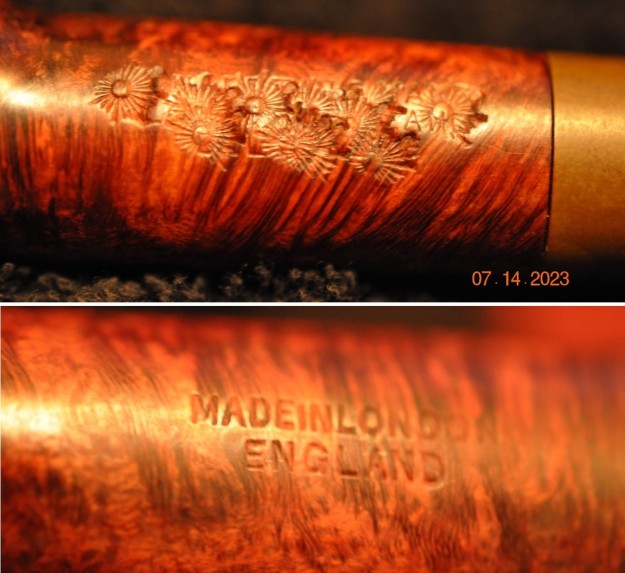
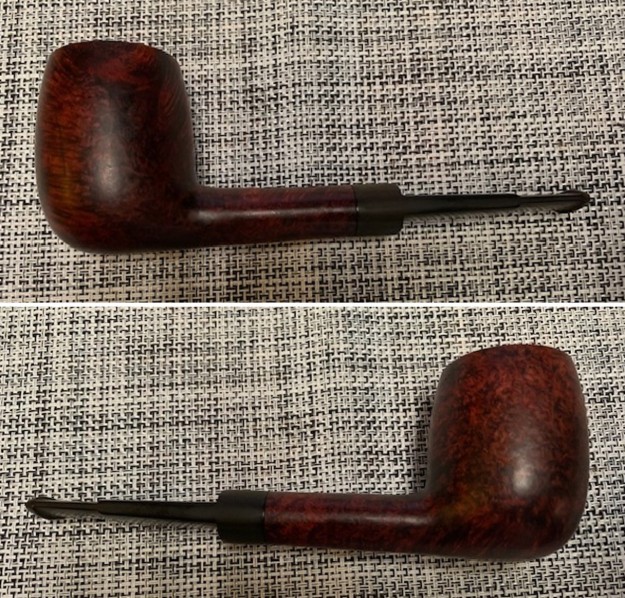
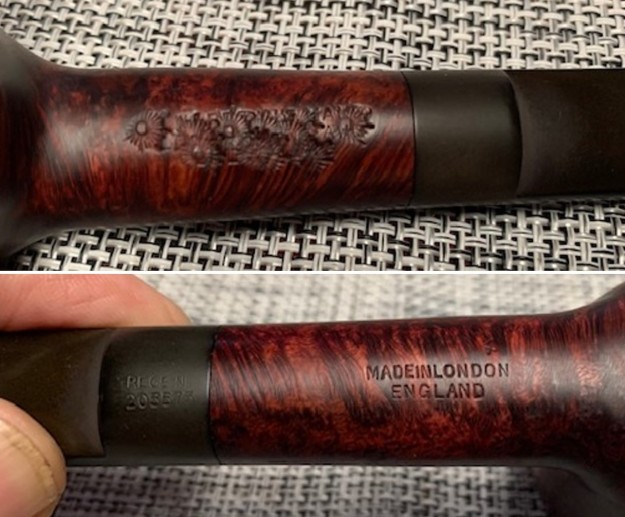
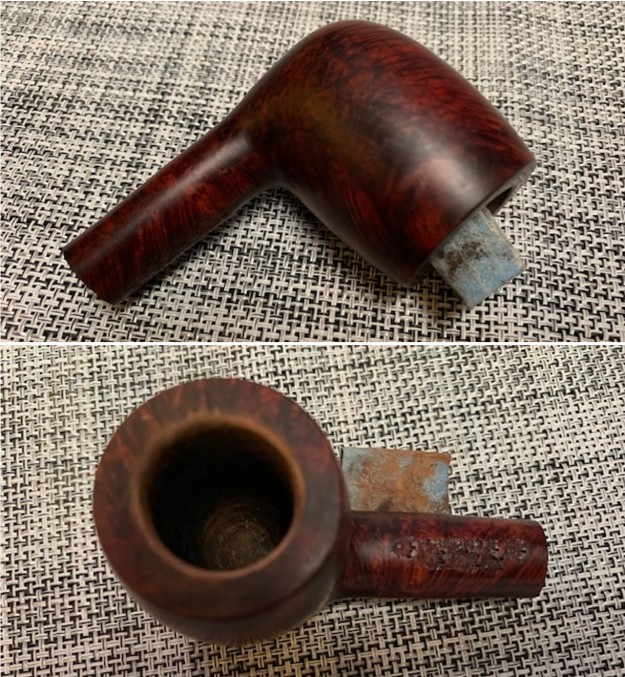
The next pipe on the table is a strange one. It is a well made Charatan’s Make billiard with some nice grain around the bowl and shank. The stamping is quite clear though the entire stamp has been covered with flower/star stamps obliterating it for the most part. I am not sure what it means as I have not seen this before. Under the flower stamps it is stamped on the topside and reads Charatan’s Make[over] London England [over] Belvedere in three lines. On the underside it is stamped Made in London [over] England. Above that it has a number stamp 4 which I assume is a shape number. We purchased the pipe on 06/24/2023 from an auction in Garland, Texas, USA. The finish on the pipe was dirty but obviously well loved. There was a thick cake in the bowl with lava flowing up and onto the rim top and edges. It is heavier on the back side of the rim top but is present all the way around. The stem was oxidized and light calcification on the area around the button. There were light tooth marks and chatter on both sides. There was no CP stamp on the sides of the stem but it was stamped on the underside and read REGD NO [over] 203573. It had the DC or Double Comfort step down saddle stem. Jeff took photos of the pipe before he started his clean up work on the pipe.He took photos of the bowl and rim top to show their general condition. You can see the tars on the inner edge of thick lava coated rim top. The cake in the bowl is quite thick and there is tobacco debris on the walls of the bowl. The finish on the bowl is very dirty with grime and oils ground into the bowl, but still very stunning. This pipe has a classic Charatan Double Comfort stem that has some oxidation, calcification on the surface of the vulcanite. There is chatter and tooth marks on the top and underside. Jeff took some photos of the sides and heel of the bowl to give an idea of the grain on this particular piece of briar. It is amazing and I cannot wait to see what it looks like once it is polished and waxed. He took photos of the stamping on the top and underside of the shank to capture it for me. The first photo shows the topside of the shank and the floral/sunburst overstamping as noted above. The second shows the underside of the shank with the Made in London [over] England as noted above. You cannot see the numeral 4 but it is above the Made in London stamp.An added part of pipe restoration for me is to try to gather as much background on a brand and maker as I can find. With Charatan that is an enjoyable web to untangle. There is a lot of information and it can lead to understanding what era a pipe was made in. To try to figure out the era of the Charatan’s pipe I was working on I turned to the Pipephil website, Logos and Stampings (http://www.pipephil.eu/logos/en/logo-charatan.html). There is some really helpful information on each of the lines of Charatan’s Make pipes that entered the market. There is an alphabetical listing of the lines but the Belvedere they showed had a stem made for a 9mm filter while the one I have is a nonfiltered pipe. The site did give a short history of the brand. I quote the portion that is most pertinent.

The brand was founded in 1863 by Frederik Charatan. When his father retired in 1910, Reuben Charatan took over the family business. All the pipes were handmade until 1973. The brand name has been overtaken by Dunhill in 1978 and sold in 1988 to James B. Russell Inc. (NJ, USA). During the period 1988-2002 Charatans were crafted by Butz Choquin in St Claude (France). Dunhill re-purchased Charatan brand name in 2002 and Colin Fromm (Invicta Briars, Castleford) followed up on freehand production.

Next, I turned to Pipedia to see if I could find more information on the brand and possibly a link to the Belvedere line (https://pipedia.org/wiki/Charatan) but once again in the general article it was not listed. It did give a little more historical information. I quote the pertinent parts and have highlighted in red the sections that give information on this particular pipe.

In 1863 Frederick Charatan, a Russian/Jewish immigrant, opened a shop in Mansell Street, located in the borough of Tower Hamlets, London E1, where he began to carve Meerschaum pipes. These pipes got very popular soon, and thus Charatan moved to a bigger workshop in Prescot Street, just around the corner. Here he began to make briar pipes which should make the name famous the world over. Charatan was the first brand to make entirely hand-made briars from the rough block to the finished pipe including the stems. The nomenclature “Charatan’s Make” refers to this method of production and was meant to differentiate Charatan from other brands who “assembled” pipes from pre-drilled bowls and delivered mouthpieces.

Being the undisputed No. 1 in English pipemaking, Charatan was approached by Alfred Dunhill who was unsatisfied with the quality of the pipes he imported from France. During 1908 – 1910 Dunhill bought pipes from Charatan paying exorbitant prices to ensure he had some of the very best pipes for sale in England. In 1910 he lured away Joel Sasieni, one of Charatan’s best carvers, and opened his own small pipe workshop on 28 Duke Street. On the retirement of his father in 1910 Reuben Charatan took over the family business…

…The pre-Lane period (prior to 1955) and the Lane era pipes (1955 to until sometime between 1979 – 1984) are of primary interest the collector. The Lane era is often quoted as beginning about 1950… Charatan records are almost non-existent before Lane due to a factory fire, making it difficult to date pre-Lane pipes. Charatan used 4 basic grades prior to 1950: Supreme, Selected, Executive, and Belvedere. After 1950 Herman Lane’s influence began, and the grades started to expand. In 1955 Lane took over sole distributorship of Charatan in the US. In 1957 he introduced the Supreme S. Most of his other introductions were from the 60’s and early 70’s…

From this I am fairly certain I am dealing with an early Lane pipe made in 1955 and because of the Belvedere stamp it could potentially go back as far as before 1950. There are none of the expected Lane stampings on the pipe which is interesting though the Double Comfort bit helps point to the Lane time.

I continued digging further into the dating of the pipe, but what I had found above was a good start for me. If some of you would like to try your hand at dating it more accurately as to the time period it came out you might want to check out the article on Pipedia on Dating Charatans (https://pipedia.org/wiki/Dating_of_Charatans).

I also reread the article on Pipedia by the Italian fellow who contributed some really helpful information on the brand (https://pipedia.org/wiki/Charatan_-_Milan_2014). I quote the section on the Second period: Reuben Charatan 1910 – c. 1962. I have highlighted a portion of the section on the shank in red to point out some more helpful dating information.

– In 1962 Herman Lane took over the business from the Charatan family, although he had already influenced production from the 1950s.

– The pipes were mostly larger than the previous ones and corresponded in size to Dunhill group 5. These are slightly less rare, but still difficult to find.

– Stem: Usually in ebonite, saddle shaped or tapered, bearing a fine “CP” stamp, underbore system (see below) used when necessary.

– Shank: The shape code is stamped on it together with the nomenclature “CHARATAN’S MAKE LONDON ENGLAND” arranged in two lines. From 1955 onwards on the models marketed for the USA there is also a serif and circled capital “L” (but not all models bear this) which resembles the pound sterling symbol. The “L” is for Lane, the importer.

From 1958, Lane changed the nomenclature for models marketed for the US to clarify the message: “MADE BY HAND”.  In this period the underbore was introduced. Its manufacturing period ranged between 1920 and c.1930. This model was equipped with a duralumin plunger trap fitted in the stem, which served to clean the residue more easily. This particular model bore a special stamp on the stem, and also had its own catalogue…

QUALITY GRADES…The stem did not only display the stamps mentioned above. Another stamp that can help dating is the one referring to the quality of the pipe. Until Herman Lane arrived on the scene there were four quality grades. Starting with the lowest: Belvedere, Executive, Selected, and Supreme. Lane went on to add higher grades from time to time: Supreme S, Supreme S100, S150, S200, S250, S300, Coronation, Royal Achievement, Crown Achievement, and Summa Cum Laude; these last three are extremely rare and almost impossible to find. He also invented other, different grades, even changing the previous pipe classification standards. We will not go into detail here, but it means that if we find an S100 or Coronation the pipe was manufactured following Herman Lane’s acquisition. In particular, the FH mark, or Freehand pipe was commissioned to the famous Danish craftsman, Preben Holm.

Now I knew I was working on an early Lane pipe which actually means it was made around 1955 as shown by the stamping. I wanted to now see if I could find any information the shape 4 number as it was not listed in any shape charts I could find.

With that information at hand I turned to work on the pipe itself. Jeff had thoroughly cleaned up the pipe. He reamed the pipe with a PipNet Pipe Reamer and cleaned up the remnants with a Savinelli Fitsall Pipe Knife. He scrubbed the bowl with undiluted Murphy’s Oil Soap with a tooth brush. He rinsed it under running warm water to remove the soap and grime. He cleaned out the inside of the shank and the airway in the stem with alcohol, cotton swabs and pipe cleaners. He scrubbed the exterior of the stem with Soft Scrub to remove as much of the oxidation and calcification as possible. He soaked the stem in Briarville’s Pipe Stem Deoxidizer and rinsed it off with warm water. I took photos of the pipe once I started to work on it.  I took some photos of the rim top and stem. The rim top and bowl looked very good. The cake and lava overflow were gone and the inward inward edge of the rim was very clean. There was damage on the back and front of the inner rim edge. Jeff had been able to get rid of most of the darkening and all of the lava and tars. The rim top looked good with no marks or nicks on the surface or edges. The closeup photos of the stem shows that it is a much cleaner and better-looking stem. There is still some residual oxidation on the saddle and blade that I will need to deal with. The light tooth chatter was still present but faint and the stem looked really good. I took some photos of the stamping on the shank sides to show the condition after the cleanup. Often the stamping takes a hit with the cleaning and is lessened in its clarity. Jeff does a great job in leaving the stamping looking very good. I also removed the stem from the shank and took a photo of the pipe to show the proportions of the pipe. It is a pretty pipe. Now it was time to work on the pipe. I started working on this pipe by turning to the bowl. I chose to deal with the darkening and burn damage on the inner rim edges and top. I used a folded piece of 220 grit sandpaper to remove the damage and darkening. It took a little work but I was able to remove all of the darkening. It is a beautiful piece of briar with some great grain.Once rim edges were reshaped and reworked I needed to blend them into the rest of the briar. I polished the briar with micromesh sanding pads. I choose to dry sand the briar rather than wet sand it. Again, it is a matter of personal preference. I prefer to use the pads dry and find they work very well on the briar. I sand with each pad (9 in total) and group them by threes for ease of reference. I also work over the plateau areas at the same time. I wipe the bowl down after each pad with a damp cloth to remove the sanding debris and check the briar. I love seeing the developing shine on the briar as I move through the pads which is why I include so many photos of this step. For the past few years now I have been using Before & After Restoration Balm. It is a “waxy” paste/balm that is rubbed into the surface of the briar and the plateau. The product works to deep clean the nooks and crannies of finish, enliven and protect the briar. I worked it into the briar with my finger tips and let it sit for 10 minutes to do its work. I wiped it off with a soft cloth and buffed it with a cloth. The briar really took on a deep shine and the grain shone through. The photos I took of the bowl at this point mark the progress in the restoration. It is a gorgeous pipe. I set the bowl aside and turned my attention to the stem. The stem was in good nick other than the light oxidation on the top side. There some light tooth marks next to the button edge button chatter on the surface. I “painted” the surface in those areas with the flame of a light and raised them. I sanded out what remained with 220 grit sandpaper and then started polishing with 600 grit wet dry sandpaper.  I scrubbed the stem surface with Soft Scrub cleanser to remove the oxidation in the vulcanite. I was able remove all of the residual in the finish and the stem looked much better. I used micromesh sanding pads and water to wet sand the stem with 1500-12000 grit sanding pads. I wiped it down after each sanding pad with Obsidian Oil on a cotton rag after each sanding pad as I find it does two things – first it protects the vulcanite and second it gives the sanding pads bite in the polishing process.   After finishing with the micromesh pads I rub the stem down with Before & After Fine and Extra Fine stem polish as it seems to really remove the fine scratches in the vulcanite. I rub the Fine Polish on the stem and wipe it off with a paper towel and then repeat the process with the extra fine polish. I finish the polishing of the stem down with a final coat of Obsidian Oil and set the stem aside to let the oil absorb. This process gives the stem a shine and also a bit of protection from oxidizing quickly.I finished with the Blue Diamond and moved on to buffing with carnauba wax. Once I have a good shine in the briar and vulcanite I always give the bowl and the stem multiple coats of carnauba wax. I have found that I can get a deeper shine if I following up the wax buff with a clean buffing pad. It works to raise the shine and then I follow that up with a hand buff with a microfiber cloth to deepen the shine. It is always fun for me to see what the polished bowl looks like with the polished vulcanite and acrylic combination stem. It really is a beautiful pipe. The smooth finish around the bowl sides and shank show the grain shining through the rich brown stains of this Charatan’s Make London England Belvedere 4 Billiard overstamped with flower/sun figures. The finished pipe feels great in my hand. It is light and well balanced. Have a look at it with the photos below. The dimensions are Length: 6 inches, Height: 2 inches, Outside diameter of the bowl: 1 ½ inches, Chamber diameter: ¾ of an inch. The weight of the pipe is 2.01 ounces/57 grams. It is a beautiful pipe and one that I will be putting on the rebornpipes store in the British Pipe Maker section.

Thanks to each of you who are reading this blog. I am always open to questions and comments from you who are reading the blog. Remember we are not pipe owners; we are pipe men and women who hold our pipes in trust until they pass on into the trust of those who follow us.
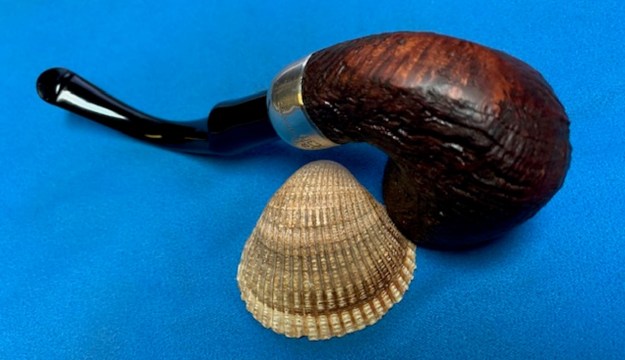
Restoring a Unique “Malaga” Custom Carved Fluted Bent Egg


Blog by Steve Laug

Jeff and I have been picking up Malaga pipes for a very long time. It does not seem that long ago that we picked them up for $4 – $5USD each. We purchased an estate of more than 30+ Malaga pipes. It was not long before the brand had our attention. The pipes are very well made and all are oil cured with a “secret” recipe and process.

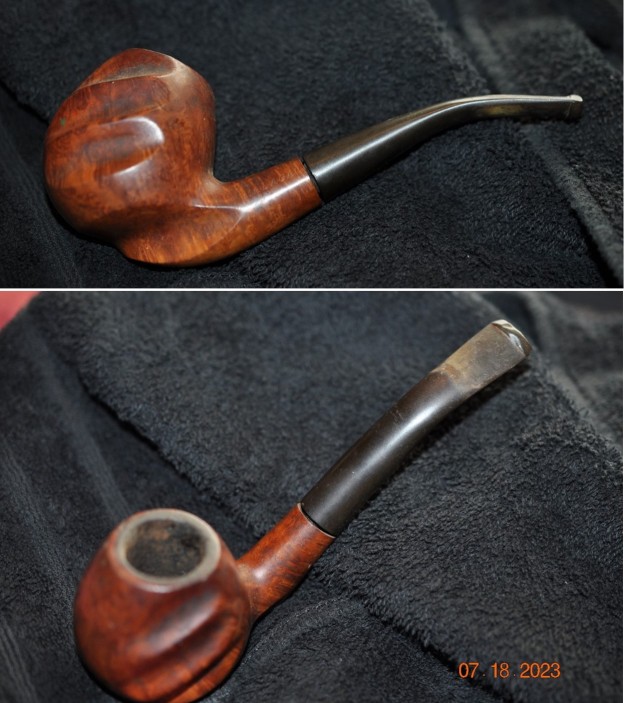
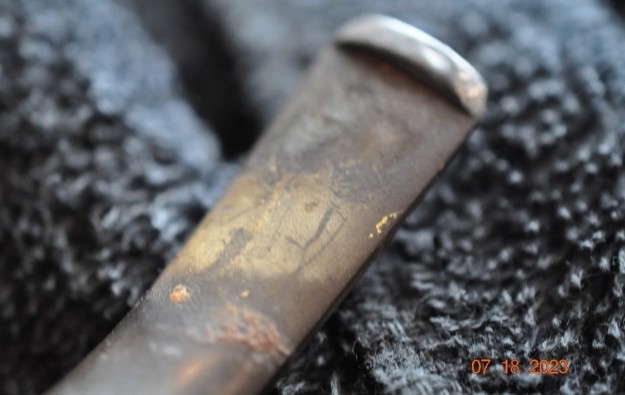
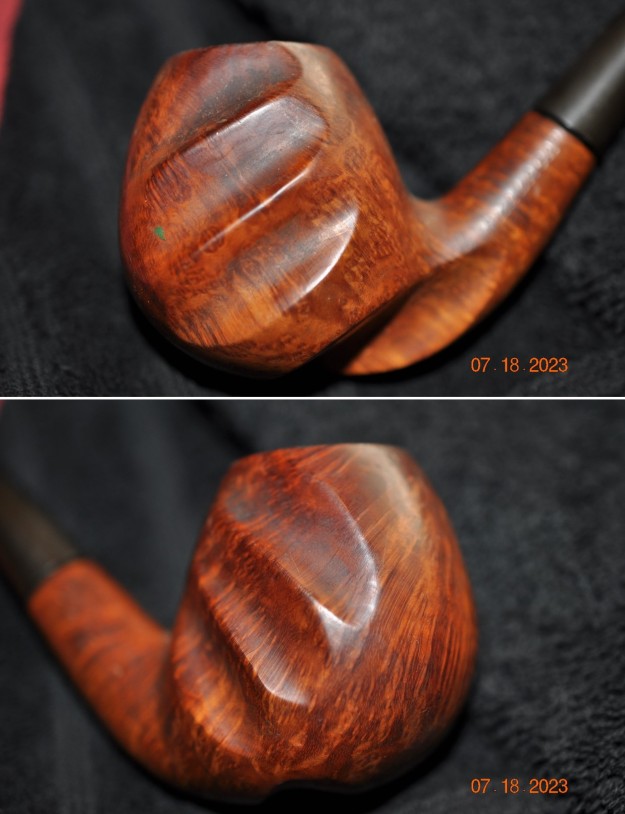
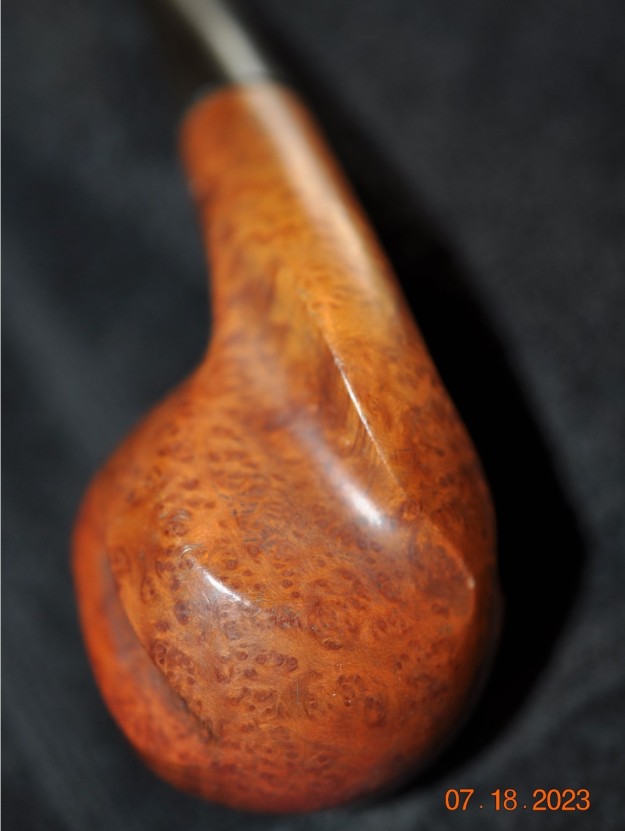
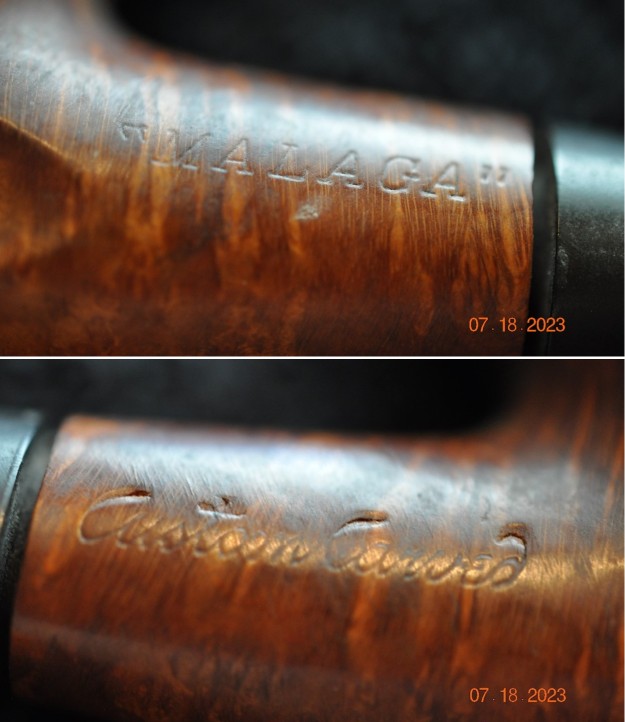
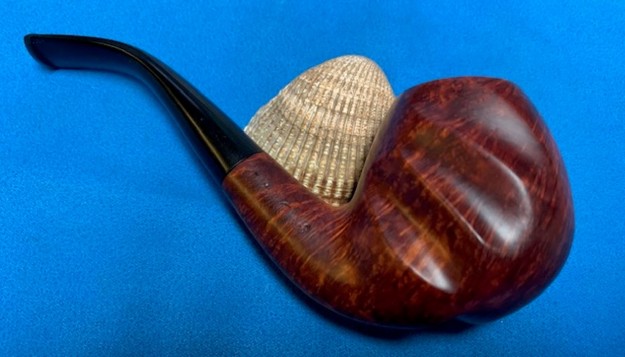
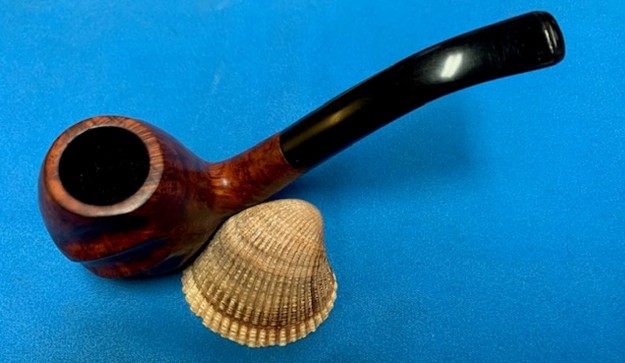
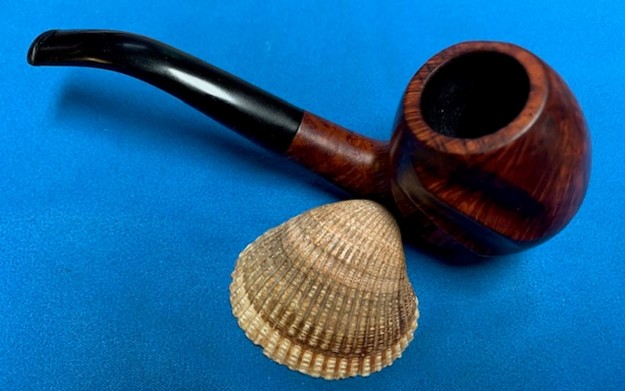
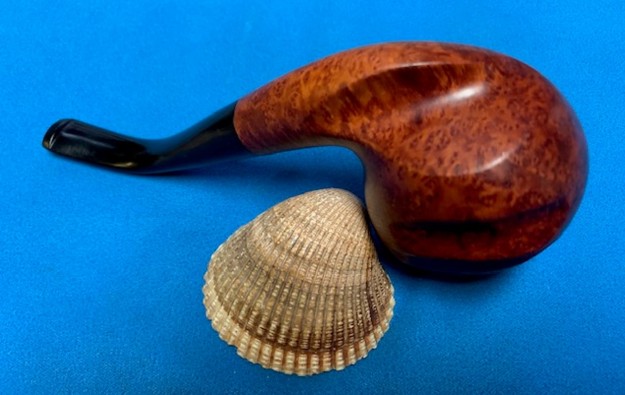
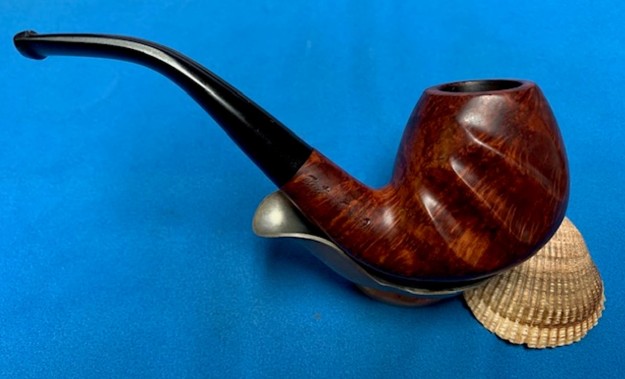
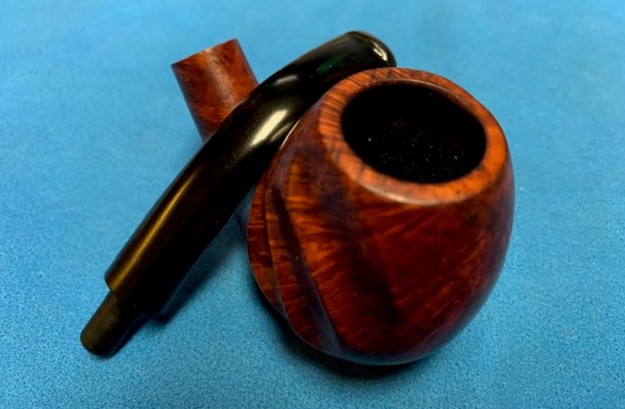
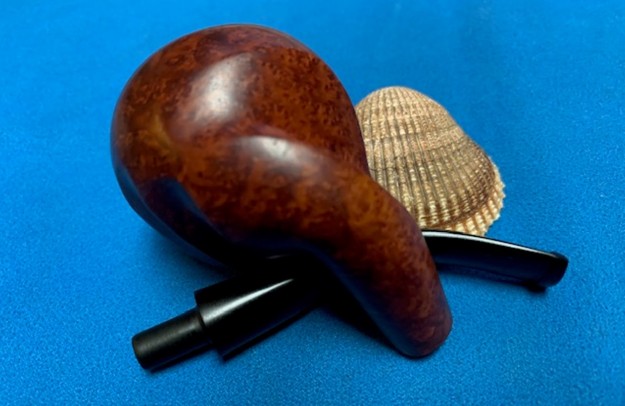
The next pipe on the table is a “Malaga” pipe that is made in a shape that I would define as a Twisted Bent Egg. We picked it up from a seller on eBay in Bristol, Indiana, USA. It has some great cross and birdseye grain and a tapered vulcanite bent stem. The grain around the bowl and shank combined with the stem make it a stunning pipe. The carver did a great job of uniquely shaping the pipe to follow the grain on the briar. The twists and turns in the bowl are well done and almost seem to be carved for fingers to fit against the bowl either left or right handed. The bowl had a thick cake that overflowed with lava onto the rim and there were scratches and nicks on the top and edges under the grime. The sides of the bowl and shank are very dirty with grime and oils from prolonged use. The stamping on the left side of the shank read “MALAGA” in quotations. On the right side it is stamped in script and reads CUSTOM CARVED. The vulcanite stem had light tooth dents and chatter on the top and the underside of the stem. The button was worn on both sides. Jeff took these photos before he started the cleanup work on the pipe.Jeff took a closeup photo of the bowl and rim to capture the condition of the pipe before he started his cleanup work. The rim top had some lava overflow and darkening on the back of the bowl. There are nicks around the inner outer edges of the bowl and rim top. The stem is oxidized and dirty and there is tooth marks (dents) and chatter on the button edges and surfaces ahead of the button. The shank was too dirty for the stem to fit snugly and it looks like it is poorly fit. I will know more once I have it in hand. He also took photos of the sides and bottom of the bowl and shank to show the beautiful grain around the bowl. The photos show the general condition of the bowl and wear on the finish. It is very dirty but this is another beautiful pipe. Jeff took a photo to capture the stamping on the shank. The photos show the stamping “MALAGA” on the left side of the shank and CUSTOM CARVED on the right side. The stamping is very readable.I am including the link to a blog that I wrote that gives some of the history of the Malaga brand and the Malaga Pipe Shop in Royal Oak, Michigan in the USA. I have written an earlier blog to give a little history of the Malaga Brand and the pipemaker, George Khoubesser. Here is the link – (https://rebornpipes.com/2013/02/09/george-khoubesser-and-malaga-pipes/). That blog also includes a catalogue and the history of the pipemaker George Khoubesser. Follow the link to get a feel for the brand and the pipemaker.

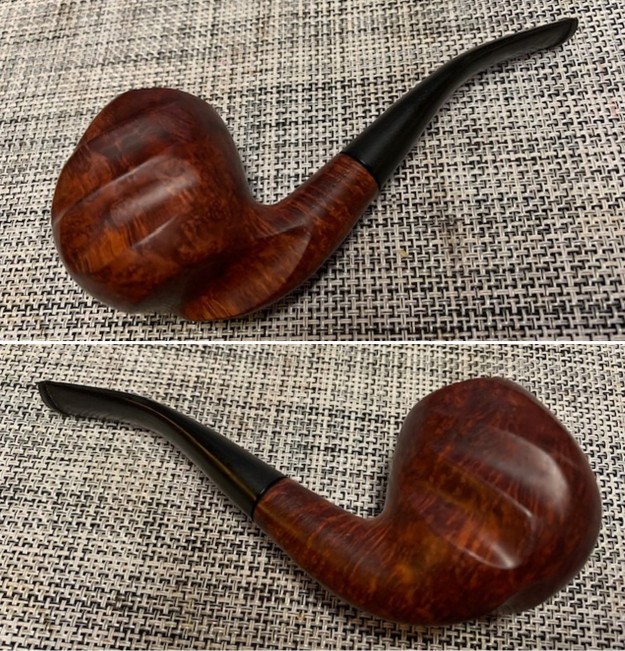
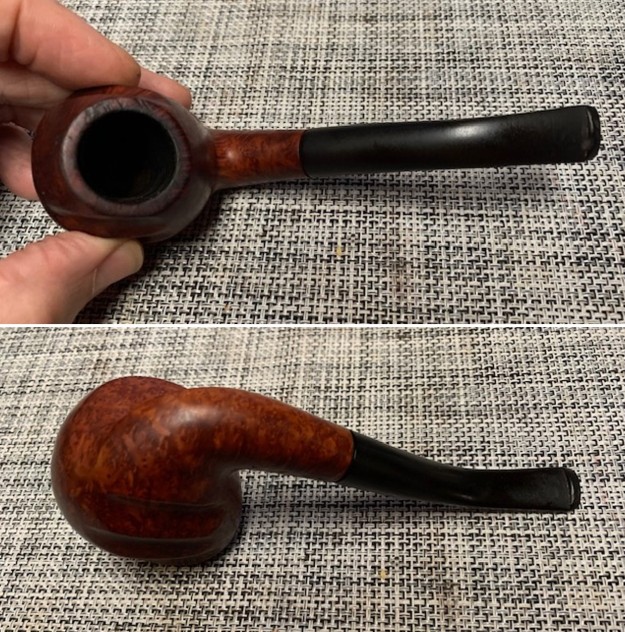
Jeff reamed the bowl with a PipNet pipe reamer and followed up with a Savinelli Fitsall pipe knife to remove the cake. He scrubbed out the mortise and the airway in the shank and the stem with alcohol, cotton swabs and pipe cleaners. He scrubbed the exterior of the bowl, rim, shank and stem with a tooth brush and Murphy’s Oil Soap to remove the oils and tars on the rim and the grime on the finish of the bowl. He rinsed it under running water. He dried it off with a soft cloth. He was able to remove the lava build up on the rim top and the flat surface of the rim looked very good. The inner edge of the rim has some serious burn damage on the front inner edge. The outer edge looked very good. He soaked the stem in Before & After Deoxidizer and rinsed it with hot water. I took photos of the pipe to show its condition before I started my work on it. Note that I will need to bend the stem slightly to fit the bend of the shank.  I took close up photos of the bowl and rim top as well as the stem. You can see the condition of the rim top and bowl in the first photo. Jeff was able to remove all of the tar and oils but you can now see the on the rim top and edges. The vulcanite stem had tooth chatter on both sides near and on the button surface.I took a photo of the stamping on the shank to show how good the condition is. It shows the “MALAGA” stamp on the left side and CUSTOM CARVED on the right side. The stamping is very legible. I took a photo of the pipe with the stem removed to give a clear picture of the character of the pipe. I started my work on the pipe by addressing the darkening on the inner edge of the bowl and the scratching and nicks on the rim top. It looked much better than when I started.I polished the rim top and the briar with micromesh sanding pads. I wet sanded the bowl with 1500-2400 grit sanding pads to prepare the rim top for staining. I wiped the bowl down after each pad with a damp cloth to remove the sanding dust. I worked some Before & After Restoration Balm into the surface of the briar with my fingertips to clean, enliven and protect it. I let the balm sit for a little while and then buffed with a cotton cloth to raise the shine. The following photos show the bowl at this point in the restoration process. I am very happy with the results. I turned to the stem to address the issues on the surface of both sides at the button. I painted the surface of the stem with the flame of a lighter to lift the tooth marks from the surface. I was able to lift them to some degree but they would need to be repaired. I also heated the stem with the flame to soften the vulcanite and bend the stem to match the angles on the bowl. I filled in the tooth marks in the top and underside of the stem with black rubberized CA glue. I set it aside to cure. Once it cured I use a small file to flatten the repairs and blend them into the stem surface. I sanded the stem surface with 220 grit sandpaper to flatten the repairs and blend them into the surface. I started the polishing with 600 grit wet dry sandpaper. I also cleaned up the tenon for a better fit to the shank. I polished the stem with micromesh sanding pads – wet sanding with 1500-2400 grit pads and dry sanding with 3200-12000 grit pads. I wiped the stem down after each pad with Obsidian Oil. I finished the hand polishing of the stem with Before & After Pipe Polish – both the Fine and Extra Fine polishes. I gave it a final coat of Obsidian oil and set it aside to dry.This Malaga Custom Carved Twisted Fluted/twisted Bent Egg with a vulcanite tapered stem turned out to be a real beauty. It has great grain around the bowl and the carver really maximized that with the shape of the pipe. Everything about the pipe – the shape of the bowl, the thin flat rim top and the cut of the briar work well to highlight the grain around the bowl sides. I polished stem and the bowl with Blue Diamond polish on the buffing wheel and the grain just popped and came alive. I gave the bowl and the stem multiple coats of carnauba wax. I buffed the pipe with a clean buffing pad to raise the shine. I hand buffed it with a microfiber cloth to deepen the shine. The pipe polished up pretty nicely. The grain took on life with the buffing. The rich oil cured colour works well with the polished vulcanite stem. The finished Malaga Custom Carved Fluted Bent Egg has a rich look that is quite catching. Have a look at it with the photos below. The shape, finish and flow of the pipe and stem are very well done. The dimensions are Length: 6 inches, Height: 2 inches, Outside diameter of the bowl: 1 ¼ inches, Chamber diameter: ¾ of an inch. I will be adding the pipe to the rebornpipes store in the American Pipemakers Section shortly. If you are interested in adding this pipe to your rack send me an email or message on Facebook. Thanks for walking through the restoration with me as I worked over another estate pipe.

As always, I encourage your questions and comments as you read the blog. Thanks to each of you who are reading this blog. Remember we are not pipe owners; we are pipe men and women who hold our pipes in trust until they pass on into the trust of those who follow us.
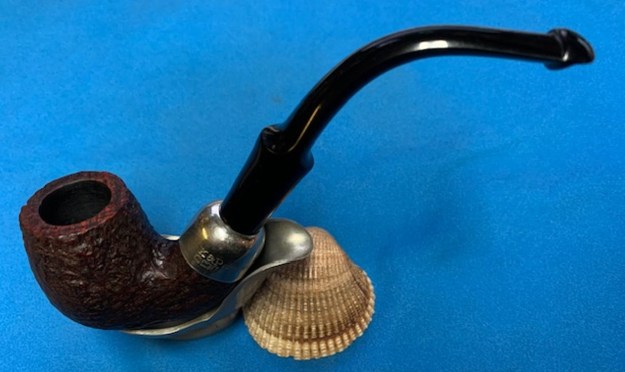
Resurrecting a Large Dunhill Bruyere ODA 836 Panel Billiard


Blog by Steve Laug

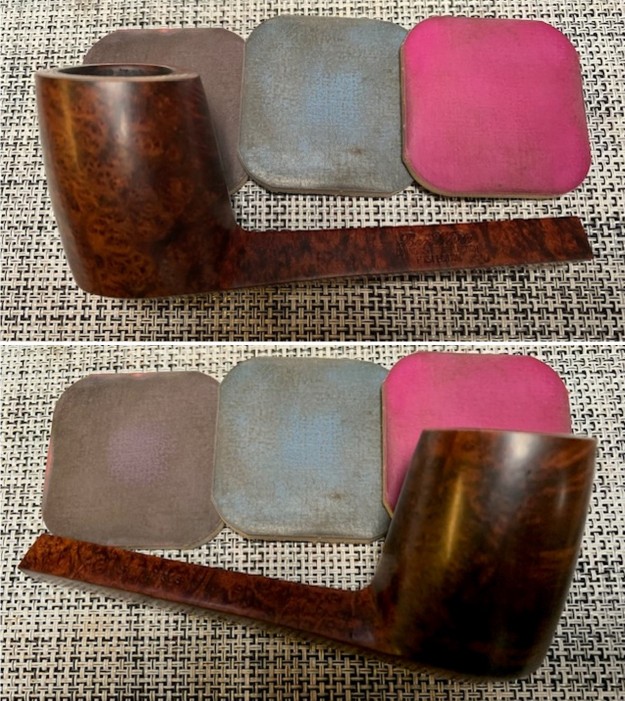
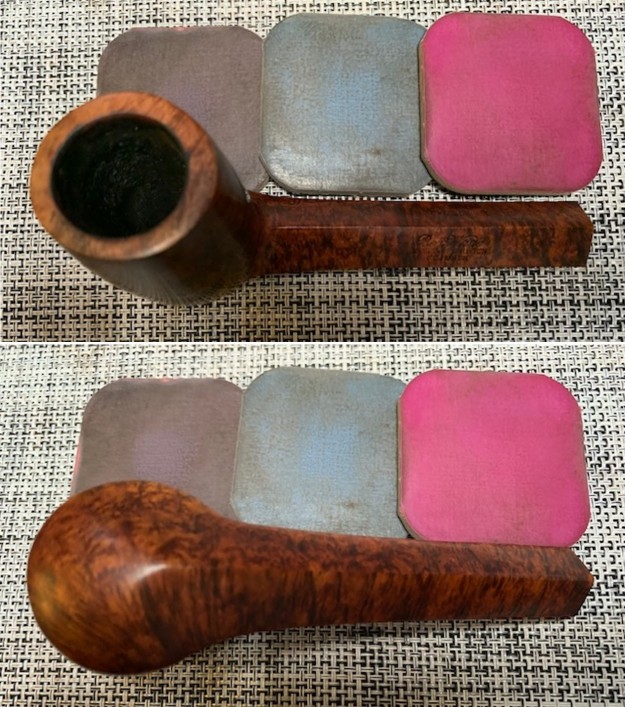
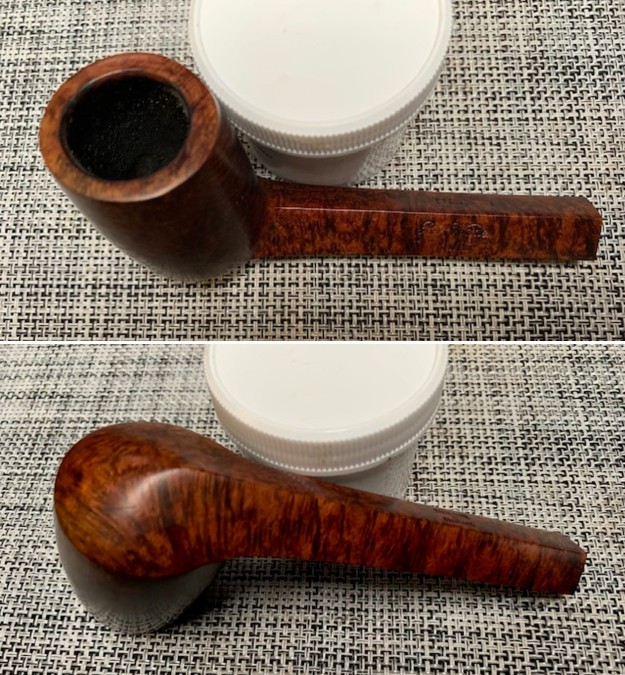
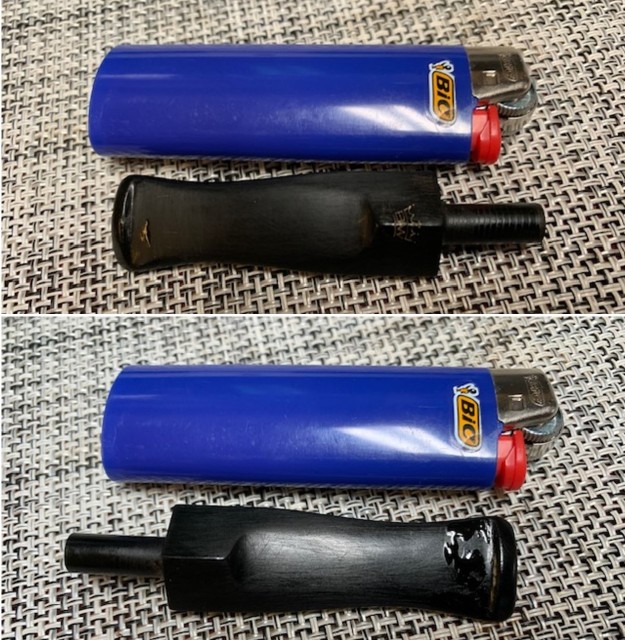
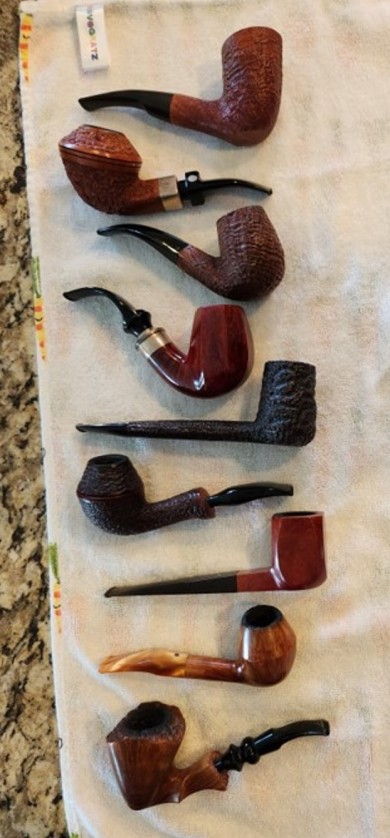
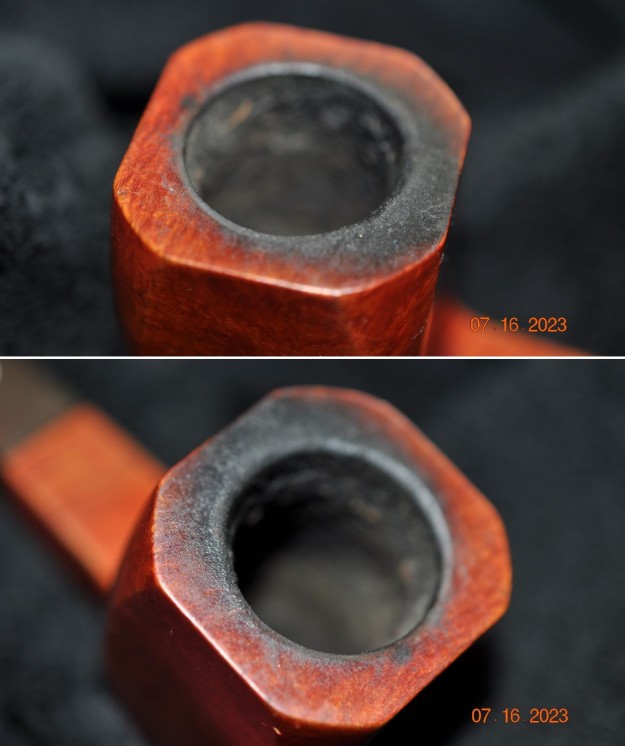
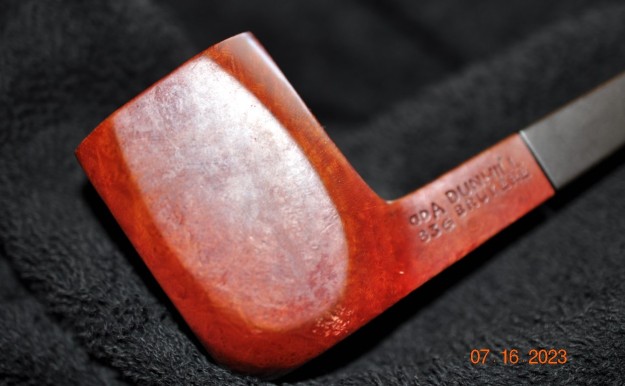
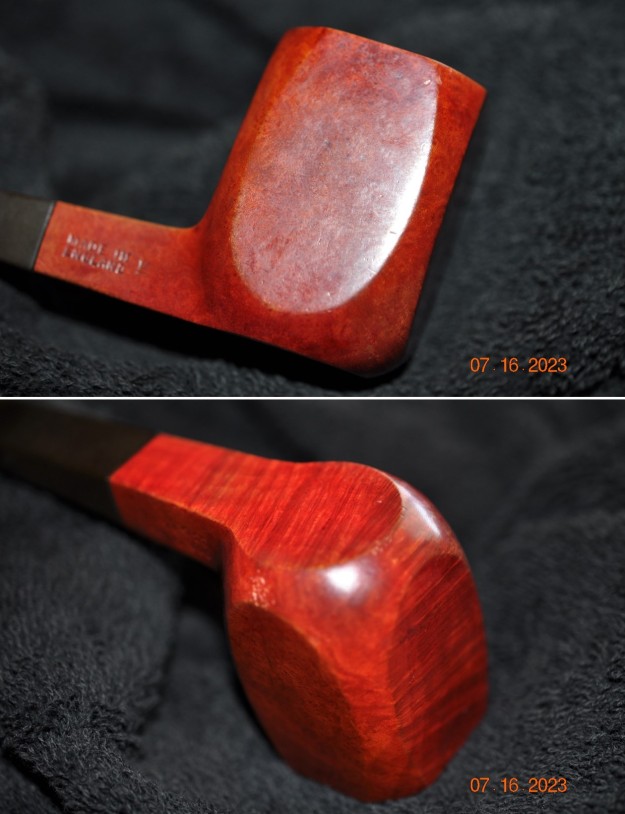
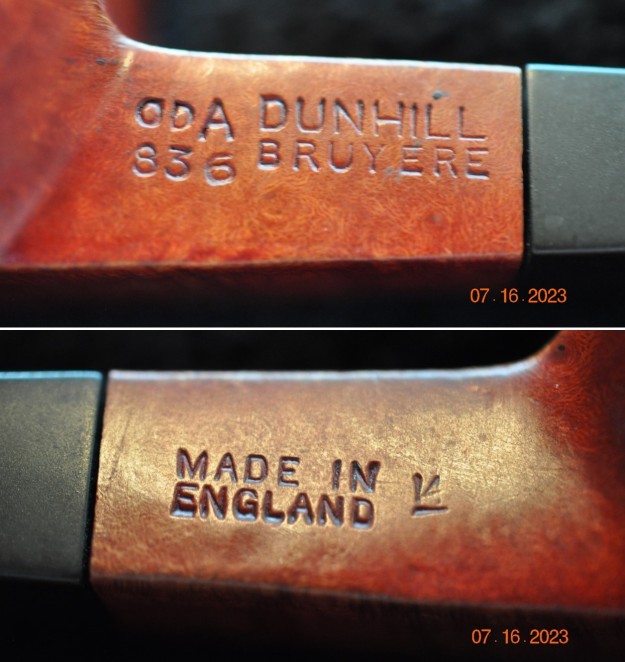
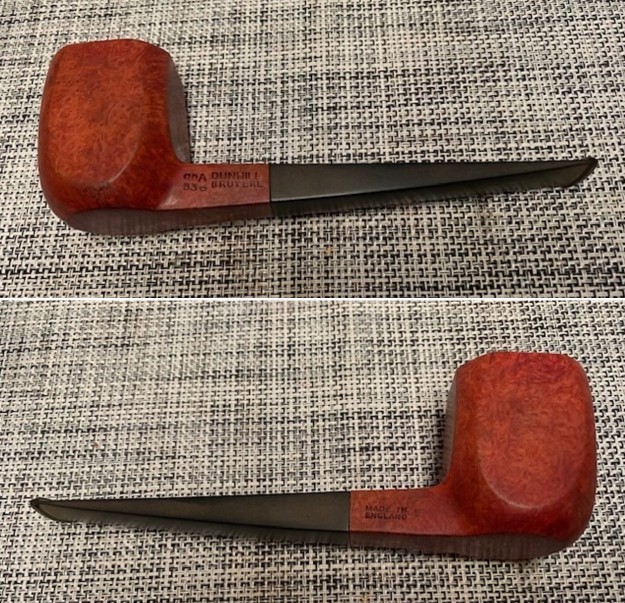
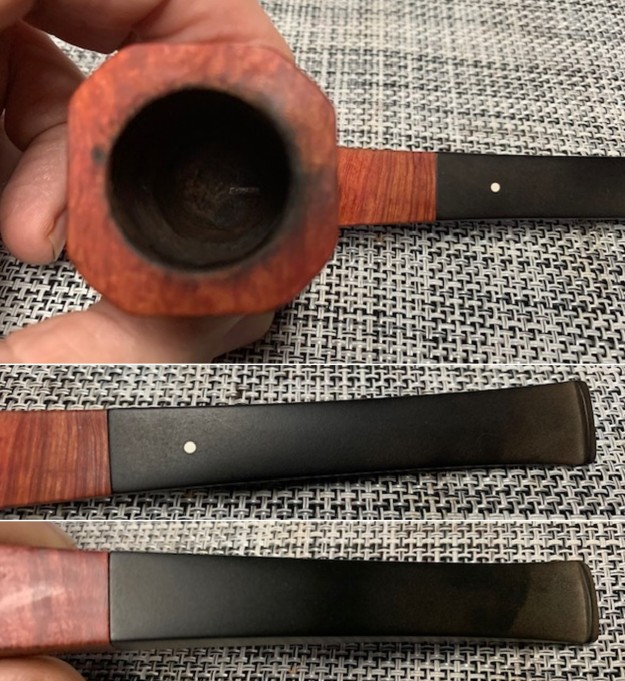
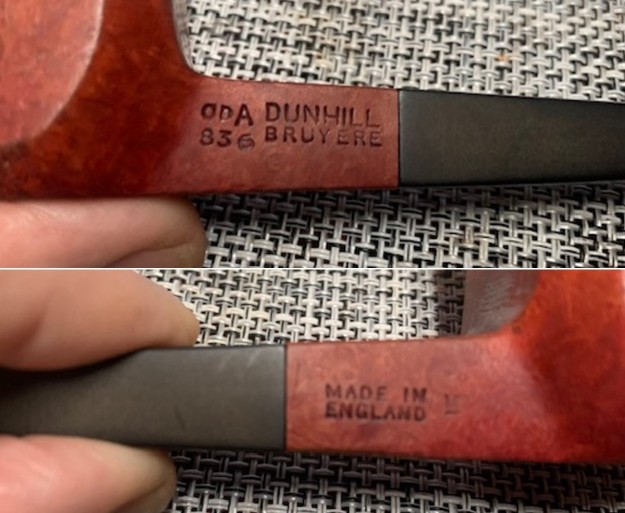
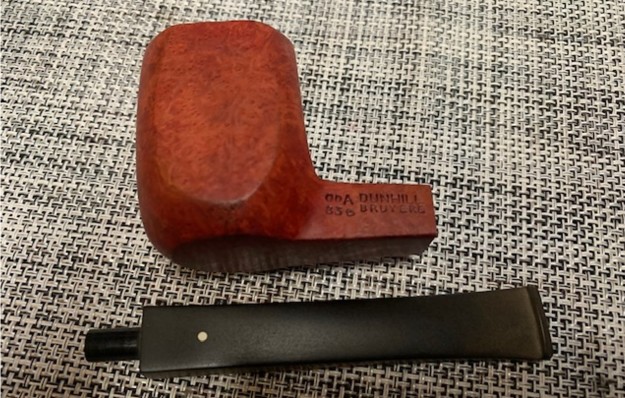
A few weeks ago I was contacted from a fellow in Montana who was selling his pipes as they had not been used for quite a few years. I asked him for a picture and he sent me the one to the left. It included the following brands (from the top to the bottom of the photo): Savinelli Autograph 5 Freehand, Mastro de Paja Ciocco 0C Bulldog, Mastro de Paja Media 1B Bent Billiard, Ser Jacopo Delecta Octagonal Bent Billiard, Caminetto Business KS 118 Canadian, Radici Rind Rhodesian, Dunhill Bruyere ODA 836 Panel Billiard, Barontini Straight Grain B3 Freehand and a Ben Wade Martinique Hand Made in Denmark Freehand.

Almost all of them were higher end pipes and all were hand made pipes. They were a mix of finishes – smooth, sandblast and also rusticated. They were a mix of shapes as well and the majority of them were Italian Made other than the Dunhill and the Ben Wade Martinique. They were beautiful pipes and after exchanging quite a few photos of the pipes from various angles to get a sense of what was there we struck a deal. We sent him the payment and the pipes arrived in Idaho a few days after I left for Vancouver.

Jeff cleaned them all and this week I received them in Vancouver. I am impressed with the way they cleaned up and the beauty of the brands. They truly are some beautiful pipes. I just need to put the final touches on each of them and address minor issues on the bowl rims and the stems and they should be good to go. I am really looking forward to working on each of them in the days ahead.

This warm, late afternoon I decided to continue working on the lot. I chose to work on the smooth Dunhill Bruyere Panel. This one is a bit different than any of the other Dunhill pipes that I have worked on. It is very nice looking piece of briar and has a square stem. The pipe is stamped on the sides of the shank. It was clear and readable. On the left side the shape number reads ODA [over] 836 followed by the stamping Dunhill [over] Bruyere. On the right side it is stamped Made in [over] England followed by an equal size 14. The reddish/brown stained finish was very dirty with grime ground in the finish all over the whole bowl and shank. Toward the bottom of left side of the bowl there was some road rash. It was rough and I would need to smooth it out some – though it would never truly be gone. The bowl had a thick cake and the rim top/inner edge had thick lava flowing up from the bowl. It appears that there is damage on the back side of the inner edge. It was hard to know its full condition with certainty until it was cleaned. The vulcanite taper stem is was dirty, oxidized, calcified and had tooth marks and chatter on both sides ahead of the button. There was the inlaid Dunhill White Spot on the top of the stem. Jeff took photos of the pipe before he started his clean up work on it. He took photos of the bowl and rim top to show the thickness of the cake and the darkening and lava overflow on the rim top. There were also nicks around the outer edge of the bowl. The photos of the stem show the oxidation, calcification and tooth marks and chatter on the surface on both sides. The photos of the sides and heel of the bowl show the great grain on the pipe. It is a beauty under the grime and dust. The stamping on the underside of the shank is shown in the photos below. It looks very good and readable. It reads as noted and explained above. The third photo shows the white spot on the stem.  I turned to Pipedia’s section on Dunhill Bruyere Pipes to get a bit of background on the Dunhill finishes (https://pipedia.org/wiki/Dunhill#Root_Briar). I quote:

Bruyere

The original finish produced (usually made using Calabrian briar), and a big part of developing and marketing the brand. It was the only finish from 1910 until 1917. A dark reddish-brown stain. Before the 1950s, there were three possible finishes for Dunhill pipes. The Bruyere was a smooth finish with a deep red stain, obtained through two coats, a brown understain followed by a deep red.

There was a link on the above site to a section specifically written regarding the Bruyere finish (https://pipedia.org/wiki/Dunhill_Bruyere). I turned there and have included the information from that short article below.

Initially, made from over century-old briar burls, classified by a “B” (denoted highest quality pipe); “DR” (denoted straight-grained) and an “A” (denoted first quality), until early 1915. After that, they became a high-end subset to the Dunhill ‘Bruyere’. The DR and B pipes, a limited production, they should be distinguished as hand-cut in London from burls as opposed to the Bruyere line which was generally finished from French turned bowls until 1917, when the Calabrian briar started to be used, but not completely. Only in 1920 Dunhill took the final step in its pipe making operation and began sourcing and cutting all of its own bowls, proudly announcing thereafter that “no French briar was employed”.

Bruyere pipes were usually made using Calabrian briar, a very dense and hardy briar that has a modest grain but does very well with the deep red stain.

“Before the 1950s, there were three possible finishes for Dunhill pipes. The Bruyere was a smooth finish with a deep red stain, obtained through two coats, a brown understain followed by a deep red. The Shell finish was the original sandblast with a near-black stain (though the degree to which it is truly black has varied over the years). Lastly, the Root finish was smooth also but with a light brown finish. Early Dunhill used different briars with different stains, resulting in more distinct and identifiable creations… Over the years, to these traditional styles were added four new finishes: Cumberland, Dress, Chestnut and Amber Root, plus some now-defunct finishes, such as County, Russet and Red Bark.”

There was also a link to a catalogue page that gave examples and dates that the various finishes were introduced (https://pipedia.org/wiki/File:Dunnypipescatalog-1.png). I turned to Pipephil’s dating guide to show how I arrived at the date of manufacture for this pipe (http://www.pipephil.eu/logos/en/dunhill/cledat-en1a.html). I am including the chart that is provided there for the dating a pipe. I have drawn a red box around the section. Since the pipe I am working on has a suffix 14 it points to the 1960 line on the chart below. I have drawn a red box around the pertinent section in the chart.On Pipedia they also have an ODA shape chart that was helpful. I have included that below (https://pipedia.org/wiki/A_DUNHILL_ODA_SHAPE_CHART).I now knew that I was working on a Bruyere that came out in 1974. The shape of the pipe is a Panel Billiard that Dunhill put out and that the #ODA 836 was a normal Panel Billiard shape with a taper stem.

I turned to work on the pipe itself. Jeff had carried out his usual thorough cleanup of the pipe. He had reamed it with a PipNet reamer to remove the cake and cleaned the reaming up with a Savinelli Fitsall Pipe Knife. He scrubbed the internals of the bowl and stem with alcohol, cotton swabs and pipe cleaners. He scrubbed the externals with undiluted Murphy’s Oil Soap and rinsed the bowl off with running water. He soaked the stem in Briarville’s Pipe Stem Deoxidizer and once it had soaked rinsed it off with warm water to remove the residual solution. He dried it off and scrubbed it down with Soft Scrub All-Purpose cleaner to remove any oxidation that was still on the stem. The pipe looked very clean when I received it though a light oxidation still remained on the stem surface. I took a photo of the rim top. Jeff had been able to remove the thick lava coat from the rim top and inner edge. There is some darkening and burn damage on the back inner edge and rim top and a burn spot on the front top and inner edge. The stem is clean but has some oxidation remaining on each end (ahead of the white spot and ahead of the button). There was also oxidation on the tapered sides of the stem.I took photos of the stamping on the right and the left side of the shank. It is clear and readable as noted above. I took a photo of the pipe with the stem removed to get a sense of what the pipe looked like. It is quite a large bowl. I started my work on the pipe by addressing the burn damage on the inner edge of the rim and the rim top. I worked on the darkening on the inner edge with a folded piece of 220 grit sandpaper to start the process. I worked on the burnt spot on the front top and the inner edge on the back top. I then used a wooden ball and a piece of 220 grit sandpaper to give the inner edge a slight bevel to hide the damage on the edges. I finished by working on it once again with a folded piece of sandpaper to smooth and shape it a bit more. I polished the briar with micromesh sanding pads – dry sanding it with 1500-12000 grit pads. I wiped the bowl down after each sanding pad with a damp cloth to remove the dust and debris from the surface of the briar. I worked some Before & After Restoration Balm into the surface of the briar with my fingertips. The product works to clean, preserve and protect the briar. I let it sit and work into the briar for 10 minutes then wiped it off with a cotton cloth. I buffed the briar with a clean cloth. The bowl is starting to look beautiful and there is a shine developing. I set the bowl aside and turned my attention to the stem. The tooth marks were very light and shallow so I moved immediately to sanding it with micromesh sanding pads. I wet sanded the stem with 1500-2400 grit pads to remove the remaining oxidation on both ends and the tooth chatter ahead of the button. I dry sanded it with 3200-12000 grit micromesh sanding pads. I wiped the stem down after each pad with some Obsidian Oil. I finished the hand polishing of the stem with Before & After Pipe Polish – both the Fine and Extra Fine polishes. I gave it a final coat of oil and set it aside to dry.I put the Dunhill Bruyere ODA 836 Panel Billiard bowl and stem back together. I polished the bowl and stem with Blue Diamond to polish out the scratches in the briar and the vulcanite. I gave the bowl and the stem multiple coats of carnauba wax. I buffed the pipe with a clean buffing pad to raise the shine. I hand buffed it with a microfiber cloth to deepen the shine. The pipe polished up pretty nicely. The reddish/brown stains worked amazingly well with the polished vulcanite taper stem. The grain around the bowl and shank and looks quite remarkable. This is truly a beautiful Dunhill Bruyere Panel Billiard ODA 836 pipe. The finished pipe is shown in the photos below. The dimensions of the pipe are Length: 6 inches, Height: 2 inches, Outside diameter of the bowl: 1 ½ inches, Chamber diameter: 7/8 of an inch. The weight of the pipe is 1.62 ounces/46 grams. I will be putting it on the rebornpipes store shortly in the British Pipemakers Section. Thanks for walking through the restoration with me. Cheers.

As always, I encourage your questions and comments as you read the blog. Thanks to each of you who are reading this blog. Remember we are not pipe owners; we are pipe men and women who hold our pipes in trust until they pass on into the trust of those who follow us.
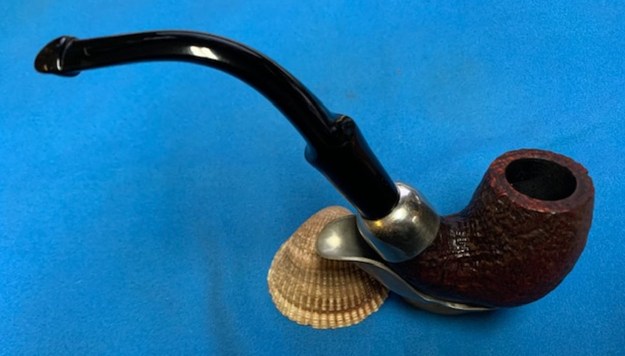
Barontini Straight Grain B3 Hand Made Freehand with a Variegated Orange Acrylic Stem


Blog by Steve Laug

A few weeks ago I was contacted from a fellow in Montana who was selling his pipes as they had not been used for quite a few years. I asked him for a picture and he sent me the one to the left. It included the following brands (from the top to the bottom of the photo): Savinelli Autograph 5 Freehand, Mastro de Paja Ciocco 0C Bulldog, Mastro de Paja Media 1B Bent Billiard, Ser Jacopo Delecta Octagonal Bent Billiard, Caminetto Business KS 118 Canadian, Radici Rind Rhodesian, Dunhill Bruyere ODA 836 Panel Billiard, Barontini Straight Grain B3 Freehand and a Ben Wade Martinique Hand Made in Denmark Freehand.

Almost all of them were higher end pipes and all were hand made pipes. They were a mix of finishes – smooth, sandblast and also rusticated. They were a mix of shapes as well and the majority of them were Italian Made other than the Dunhill and the Ben Wade Martinique. They were beautiful pipes and after exchanging quite a few photos of the pipes from various angles to get a sense of what was there we struck a deal. We sent him the payment and the pipes arrived in Idaho a few days after I left for Vancouver.

Jeff cleaned them all and this week I received them in Vancouver. I am impressed with the way they cleaned up and the beauty of the brands. They truly are some beautiful pipes. I just need to put the final touches on each of them and address minor issues on the bowl rims and the stems and they should be good to go. I am really looking forward to working on each of them in the days ahead.

This quiet Sunday afternoon I decided to continue working on the lot. I chose to work on the smooth Barontini Freehand (possibly a Rhodesian). The Barontinis I have worked on generally are nice looking pieces of briar and have had acrylic stems. This one had a nicely grained finish and a plateau style rim top. The pipe is stamped around the sides of the bowl. It was clear and readable. On the left side it reads Barontini [over] Straight Grain. On the right side it is stamped with a B3 and vertically next to the stem it is stamped Italy. On the underside of the shank it reads Fatta [over] A Mano. The stamping is clear and readable. The medium brown stained finish was very dirty but seemed to have a shellac coat over the whole bowl and shank. The bowl had a thick cake and the plateau style rim top/inner edge had thick lava flowing up from the bowl filling in the grooves. The inner edge of the bowl was covered enough with lava that it was hard to know its condition with certainty. The saddle stem is variegated orange and cream acrylic and was dirty and had tooth marks and chatter on both sides ahead of the button. There was an inlaid logo dot on the top of the stem. It was a red dot encircled with silver. Jeff took photos of the pipe before he started his clean up work on it. Jeff took photos of the bowl and rim top to show what they looked like before the clean up. You can see the thick cake in the bowl overflowing as lava on the inner edge and rim top. He also took some photos of the stem to show the condition of both sides. You can see the tooth marks and chatter on the top and underside next to the button. The photos of the sides and heel of the bowl show the beautiful grain around the bowl and shank. The stain adds depth finish on the pipe. Even under the grime it is a real beauty. The stamping on the sides of the shank are shown in the photos below. It is clear and readable as noted above. I looked up some information on the brand on the Pipephil website to get a quick overview of the history (http://www.pipephil.eu/logos/en/logo-b2.html). I did a screen capture of the listing for the brand. The fascinating thing that I learned in this quick overview was the connection to the entire Barontini family and to other companies like Aldo Velani. It is interesting to see the breadth of the brand in the following screen capture.Pipedia gives further history of the brand (https://pipedia.org/wiki/Barontini,_Cesare). It is a very brief article with little information. I quote that article in full below.

In 1890 Turildo Barontini opened a factory for the production of briar. In 1925 his son Bruno began to produce the first pipes. Cesare Barontini, son of Bruno, started direction of the factory in 1955, and still runs it together with his daughters Barbara and Silvia.

Unfortunately, on neither site was there any pertinent information on the Barontini Straight Grain pipe. I decided to do a quick google search and found a listing for what appears to be the actual pipe I am working on (https://pipes.collectionhero.com/outer/view_item.php?id=55163). I include that information and photo below. Looks like the fellow I purchased the pipe from purchased it from this auction potentially? He got it for a steal at that price as they tend to run between $90 and $120 online. I guess I will never know for sure but at least I found the pipe online. It is now time to work on the pipe itself.

Jeff had reamed the bowl with a PipNet pipe reamer and followed up with a Savinelli Fitsall pipe knife to remove the cake. He scrubbed out the mortise and the airway in the shank and the stem with alcohol, cotton swabs and pipe cleaners. He scrubbed the exterior of the bowl, rim, shank and stem with a tooth brush and Murphy’s Oil Soap to remove the oils and tars on the rim and the grime on the finish of the bowl. He rinsed it under running water. He dried it off with a soft cloth. The rim was thoroughly cleaned and the damaged areas were obvious. Without the grime the finish looked really good. The Lucite stem would need to be worked on but I really like the profile it cast. I took photos of the pipe to show its condition before I started my work on it. I took close up photos of both the rim top and the stem. Jeff had been able to get the grime and lava off of the rim top and it looked very clean. The stem looked very clean. The tooth marks and chatter were predominantly near the button.The stamping on the sides of the shank was readable as noted above. I took photos of the stamping to show the condition and readability. I took a photo of the pipe with the stem removed to give an idea of the perspective and design of the pipe. I scrubbed the carved plateau rim top of the bowl with a brass bristle wire brush to remove the remaining darkening and debris in the nooks and crannies of the rim top. It looked much better once I finished.I wiped down the bowl with acetone to remove the shiny coat. It barely broke through the coat. I wiped it down repeatedly and then moved on to the micromesh pads. I polished bowl with micromesh sanding pads using 1500-12000 grit sanding pads and wiping it down after each sanding pad with a pad and acetone to remove the sanding dust and debris from the finish. I paused the polishing after the 4000 grit micromesh sanding pad to stain the lighter spots on the bowl and shank. I used an Oak Stain Pen to match the colour of the rest of the bowl and shank. The colour was a perfect match. I touched up the light spots on the shank end, the rim cap and spots around the bowl sides. It looks much better. I finished polishing it with 6000-12000 grit micromesh sanding pads. I worked some Before & After Restoration Balm into the finish of the bowl and shank with my fingers and into the plateau carved rim top with a horsehair shoe brush. I want the product to go deep into the finish because it works to clean, enliven and protect the briar. Once I was confident that it was deeply worked into the finish I wiped it off and buffed it with a soft cloth to polish it. The pipe really began to have a rich shine. I took some photos of the bowl at this point to mark the progress in the restoration. The grain really stands out on the pipe in the photos below. I set the bowl aside and turned to work on the stem. I sanded the surface of the stem with 220 grit sandpaper to remove the tooth marks and chatter. I started polishing the acrylic stem with a folded piece of 600 grit wet dry sandpaper.I polished the stem with micromesh sanding pads – wet sanding it with 1500-12000 grit pads. I wiped it down with Obsidian Oil after each sanding pad. I know many think it is useless to use the Obsidian Oil on acrylic stems but I find that it is a good lubricant when I am sanding with the micromesh pads. For me it works! I finished the hand polishing of the stem with Before & After Pipe Polish – both the Fine and Extra Fine polishes. I gave it a final coat of oil and set it aside to dry.I put the Barontini Straight Graini B3 bowl and stem back together. I polished the smooth part of the bowl and stem with Blue Diamond to polish out the scratches in the briar and the vulcanite. I gave the sandblasted bowl and shank several coats of Conservator’s Wax and the stem multiple coats of carnauba wax. I buffed the pipe with a clean buffing pad to raise the shine. I hand buffed it with a microfiber cloth to deepen the shine. The pipe polished up pretty nicely. The medium brown stains worked amazingly well with the polished orange acrylic stem. The grain around the bowl and shank and looks quite remarkable. This is truly a beautiful Barontini Straight Grain Freehand pipe. The finished pipe is shown in the photos below. The dimensions of the pipe are Length: 5 ½ inches, Height: 2 ¼ inches, Outside diameter of the bowl: 1 1/8 inches, Chamber diameter: 7/8 of an inch. The weight of the pipe is 1.76 ounces/51 grams. I will be putting it on the rebornpipes store shortly in the Italian Pipemakers Section. Thanks for walking through the restoration with me. Cheers.

As always, I encourage your questions and comments as you read the blog. Thanks to each of you who are reading this blog. Remember we are not pipe owners; we are pipe men and women who hold our pipes in trust until they pass on into the trust of those who follow us.

New Life for a Ser Jacopo Delecta Octagonal Bent Billiard with a Black Acrylic Saddle Stem


Blog by Steve Laug

A few weeks ago I was contacted from a fellow in Montana who was selling his pipes as they had not been used for quite a few years. I asked him for a picture and he sent me the one to the left. It included the following brands (from the top to the bottom of the photo): Savinelli Autograph 5 Freehand, Mastro de Paja Ciocco 0C Bulldog, Mastro de Paja Media 1B Bent Billiard, Ser Jacopo Delecta Octagonal Bent Billiard, Caminetto Business KS 118 Canadian, Radici Rind Rhodesian, Dunhill Bruyere ODA 836 Panel Billiard, Barontini Straight Grain B3 Freehand and a Ben Wade Martinique Hand Made in Denmark Freehand.
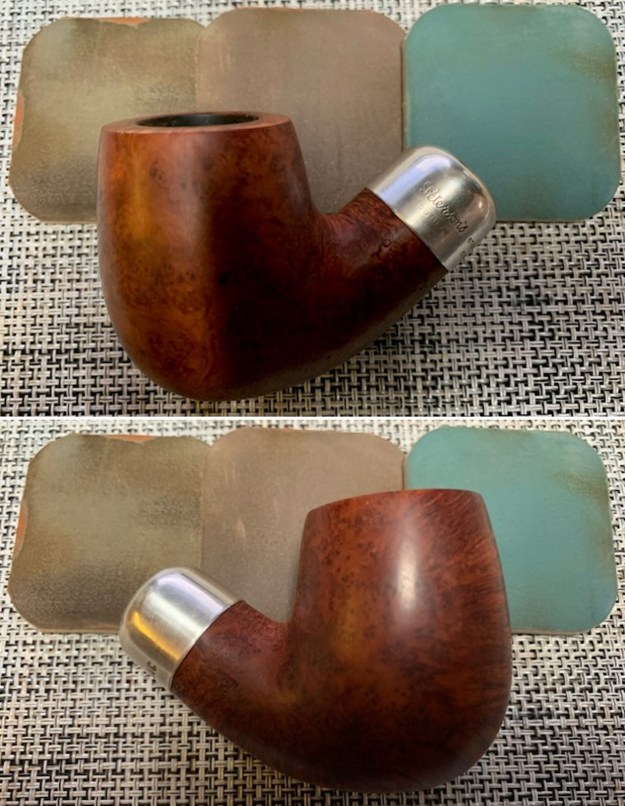
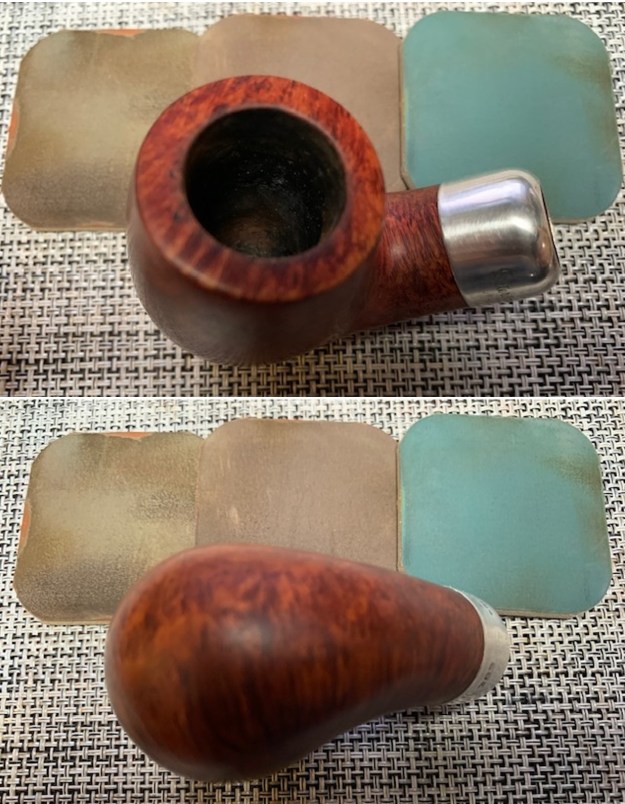
Almost all of them were higher end pipes and all were hand made pipes. They were a mix of finishes – smooth, sandblast and also rusticated. They were a mix of shapes as well and the majority of them were Italian Made other than the Dunhill and the Ben Wade Martinique. They were beautiful pipes and after exchanging quite a few photos of the pipes from various angles to get a sense of what was there we struck a deal. We sent him the payment and the pipes arrived in Idaho a few days after I left for Vancouver.
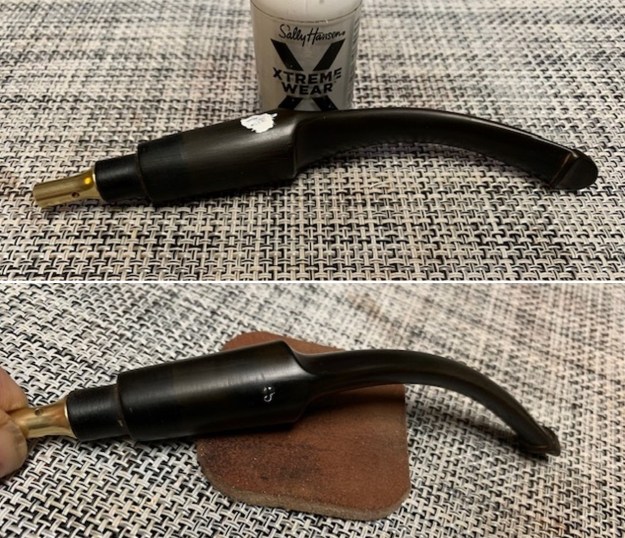
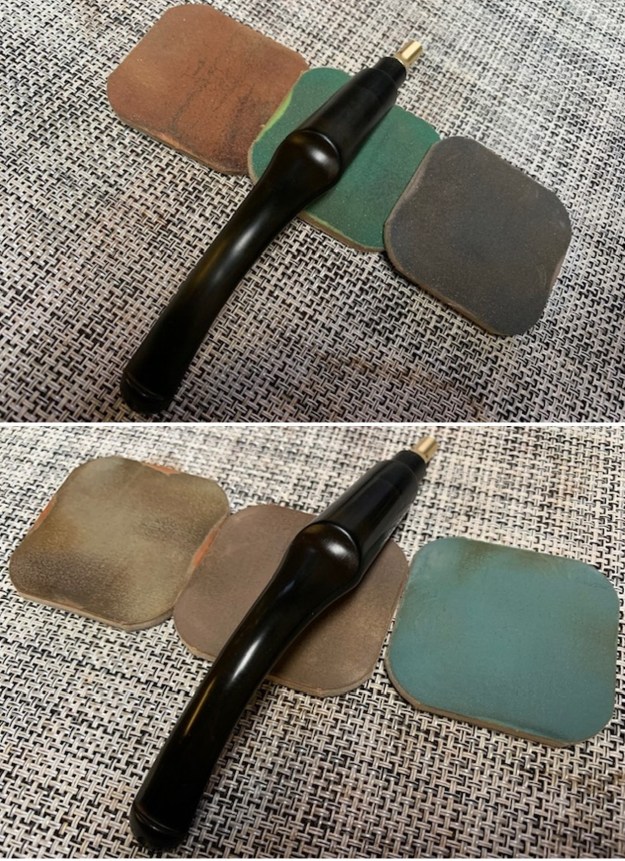
Jeff cleaned them all and this week I received them in Vancouver. I am impressed with the way they cleaned up and the beauty of the brands. They truly are some beautiful pipes. I just need to put the final touches on each of them and address minor issues on the bowl rims and the stems and they should be good to go. I am really looking forward to working on each of them in the days ahead.

This evening after work I decided to continue working on the lot. I chose to work on the smooth octagonal bent Billiard with a silver ferrule and tip on the stem. It has a classic Large Bent Octagonal Billiard shape with an Italian twist. The is smooth and well shaped.  There is a silver ferrule round the shank end as well as a silver band around the tenon end of the stem. The pipe is stamped on three sides of the shank. On the left side it Ser Jacopo [over] Fatta A Mano (made by hand). On the underside of the shank it is stamped Delecta. The stamping on the right side of the shank it read Per Aspera [over] Ad Astra. The silver ferrule is stamped on the top left side and reads Ser [over] Jacopo [over] Delecta. On the underside it is stamped 925 in an oval as the silver quality designation. There is a coral dot logo is on top side of the stem. The stamping is clear and readable. The reddish stained finish was very dirty with grime ground into the smooth briar. The bowl had a moderate cake and the rim top/inner edge had some lava flowing up from the bowl. The inner edge of the bowl was covered with some lava so it was hard to know its condition with certainty. The stem is black acrylic fancy saddle stem and was dirty with tooth marks and chatter on both sides ahead of the button. The silver ferrule and tenon end were oxidized and dirty. Jeff took photos of the pipe before he started his clean up work on it. Jeff took photos of the bowl and rim top to show what they looked like before the clean up. You can see the cake in the bowl overflowing on the inner edge rim top. He also took some photos of the stem to show the condition of both sides. You can see the tooth marks and chatter on the top and underside next to the button. The photos of the sides and heel of the bowl show the grain around the bowl and shank. The stain adds depth finish on the pipe. Even under the grime it is a real beauty. The stamping on the sides of the shank and on the silver ferrule is shown in the photos below. It is clear and readable as noted above. I turned to Pipephil (http://pipephil.eu/logos/en/logo-s5.html) to remind myself of the background of the brand. I also wanted to see what the single Coral dot meant on the stem. I knew that the Coral dot was on the older pipes but that was all I knew. I include a screen capture of the section on the brand below. The third photo below shows a similar Coral dot on the stem.I am also including the information that I found there in the sidebar on PipePhil. I quote that below. I have highlighted the R2 designation below in red.

Founder of the brand in 1982: Giancarlo Guidi (1943 – †2012). Production (2006): ~ 6000 pipes/year. Ser Jacopo seconds: Gepetto.

Finish mark: Rusticated pipes: R1 (dark brown) R2 (light brown); Sandblasted pipes: S (black), S1 (dark brown), S2 (light brown), S3 (tanshell); Smooth pipes: L (red), L1 (acceptable grain), L2 (nice grain), L3 (exceptional grain).

I then turned to Pipedia (https://pipedia.org/wiki/Ser_Jacopo) to read some more about the brand and see if there were more details regarding the single Coral dot. I quote below.

Ser Jacopo (provided by Marble Arch Ltd., US importer and distributor of Ser Jacopo)

Smokingpipes.com has an excellent concise history available on their website Ser Jacopo History at Smoking Pipes.com

Ser Jacopo, better to say Ser Jacopo dalla Gemma, was started by Giancarlo Guidi in 1982 upon leaving Mastro de Paja.

Giancarlo Guidi and Bruto Sordini broke away from Mastro de Paja in 1981 in pursuit of their own company. Ser Jacopo was named after an Italian nobleman. Guidi and Sordini, having taken part in creating the now infamous Pesaro “school” of pipe making, wanted to expand further. To accomplish this, Ser Jacopo focused their efforts on the pairing of the briar with a seemingly endless variety of mounts. Through the use of precious metals and stones, horn, and exotic woods Ser Jacopo pipes are given unique characters that many collectors find quite aesthetically pleasing. Although Ser Jacopo pipes borrow heavily from classical shapes, they are indeed quite unique in style.

In addition to creative mountings, Ser Jacopo is also well known for making themed pipes, and the most famous of these themes is perhaps the Picta Series, where pipes are modeled after pipes seen in pictures by and of famous artists, such as Vincent Van Gough.

Ser Jacopo makes multiple grades of pipes, with the “entry” level being the Geppetto brand, and the highest grade being the “Gem” series.

The small Ser Jacopo shop produces approximately 6000 pipes per year. The pipes are known for using outstanding Italian briar, which is well seasoned. The pipes have earned a well-deserved reputation for having excellent smoking qualities, equal or better than any other fine Italian pipe maker (or, for that matter, any other pipe maker in the world).

Giancarlo Guidi passed away on August 6, 2012, leaving behind a great legacy. He was 64 years old.

Nomenclature – the section on the nomenclature helps understand the stamping on the sides of the shank. It is helpful and really quite interesting.

The standard nomenclature found on Ser Jacopo pipes is as follows:

Ser Jacopo Fatta A Mano In Italia Per Aspera Ad Astra – Fatta A Mano translates to “Made By Hand”. Per Aspera Ad Astra is a Latin phrase found on Ser Jacopo pipes and is the Ser Jacopo motto. It translates to “To the Stars Through Travails”, meaning that success comes through hard work. In the Summer 1997 Pipes and Tobaccos article Giancarlo Guidi translated this as “through a difficult way until the stars are reached”.

Ser Jacopo Pipes are generally found in one of three finishes (rusticated, sandblast, smooth) designated by a letter and number code:

R1: Rusticated, dark brown or plum finish.

R2: Rusticated, light brown finish.

S:  Sandblast, black

S1: Sandblast, dark brown

S2: Sandblast, light brown

S3: Sandblast, tanshell

L:  Smooth, red, usually with silver trim

L1: Smooth, flame grain, various finishes

L2: Smooth, straight grain, various finishes

L3: Smooth, straight grain extra, discontinued

Dating Pipes

In the photo to the left you can see the development of the stem inserts on the pipes.

Top: Early Red Coral Logo Middle: Coral Logo with Silver Ring Bottom: Modern Day Silver J Logo – Courtesy of Mike Ahmadi

Ser Jacopo pipes is somewhat difficult, because Ser Jacopo does not generally use date codes (the exception being the Diamond Gemma series pipes, which are dated coded). Early pipes (from 1983 to 1997) featured a red coral dot on the mouthpiece, sometimes found encircled in a silver ring. This was discontinued and changed to a sterling silver letter “J”. On the Gemma series of pipes, the mouthpiece logo is a precious stone surrounded by an 18k gold ring.

The pipe I am working on is one of the early pipes (1983-1997) with a coral dot in the top of the saddle stem. It is a lovely pipe with an L Red finish and silver trim. Now it is time to work on the pipe and bring it back to life.

Armed with that information I turned to work on the pipe itself. Before he sent it to me, Jeff had done an amazing job cleaning the pipe. It almost looked like a different pipe after his work. He reamed the pipe with a PipNet pipe reamer and removed the rest of the cake with a Savinelli Fitsall Pipe Knife.  He scrubbed the bowl with undiluted Murphy’s Oil Soap and a tooth brush. He rinsed it under running warm water to remove the soap and grime. The finish looked very good and the rugged finish felt good in the hand. He cleaned out the inside of the shank and the airway in the stem with isopropyl alcohol, cotton swabs and pipe cleaners. He soaked the stem in Briarville’s Pipe Stem Deoxidizer and then rinsed it off with warm water. He scrubbed the stem with Soft Scrub and a tooth brush and rinsed it off with warm water. It looked good when I took it out of the package of pipes he shipped me. There were some shiny spots on the finish where the shellac coat had not all come off. It would need to be removed to even it out. I took photos of the pipe before I started my part of the restoration work.  I took close up photos of both the rim top and the stem. Jeff had been able to get the grime and lava off of the rim top and it looked very clean. You can see the spotty shellac coat that still remains on the bowl and rim top. The stem looked very clean. The tooth marks and chatter were much less than on the previous pipes in this collection and they were predominantly near the button. They should be easy to remove. The stamping on the sides of the shank was readable as noted above. I took photos of the stamping on each side to show the condition and readability. I also took a photo of the pipe with the stem removed to give an idea of the perspective and design of the pipe. To deal with the spotty coat of shellac on the bowl and shank I used a cotton pad and alcohol to wipe down the briar. I was able to remove the shellac coat completely and the grain really showed through. Here is what it looks like at this point in the process. I polished the smooth bowl and rim top with micromesh sanding pads using 1500-12000 grit sanding pads and wiping it down after each sanding pad with a damp cloth to remove the sanding dust and debris. I worked some Before & After Restoration Balm into the finish of the bowl and shank with my fingers. I want the product to go deep into the finish because it works to clean, enliven and protect the briar. Once I was confident that it was deeply worked into the finish I wiped it off and buffed it with a soft cloth to polish it. The pipe really began to have a rich shine. I took some photos of the bowl at this point to mark the progress in the restoration. The grain really stands out on the pipe in the photos below. I set the bowl aside and turned to work on the stem. I sanded out the tooth marks in the acrylic surface of the stem with 220 grit sandpaper and started the polishing with a folded piece of 600 grit wet dry sandpaper.I polished the vulcanite stem with micromesh sanding pads – wet sanding it with 1500-12000 grit pads. I wiped it down with Obsidian Oil after each sanding pad.I polished it with Before & After Pipe Polish – both the Fine and Extra Fine polishes. I gave it a final coat of oil and set it aside to dry. This Ser Jacopo Delecta Octagonal Bent Billiard with Silver Ferrule and an acrylic saddle stem is a great looking pipe now that it has been restored. The beautiful finish really highlights the grain and the polished finish is stunning. The Silver Ferrule and Silver tenon space is also a great addition. I put the stem back on the bowl and carefully buffed the pipe with Blue Diamond on the buffing wheel. I gave the bowl and the stem multiple coats of carnauba wax on the buffing wheel and followed that by buffing the entire pipe with a clean buffing pad. I hand buffed the pipe with a microfiber cloth to deepen the shine. The finished Ser Jacopo Delecta Octagonal Bent Billiard fits nicely in the hand and feels great. Give the finished pipe a look in the photos below. The dimensions of the pipe are Length: 5 ½ inches, Height: 2 ½ inches, Outside diameter of the bowl: 1 ¼ inches, Chamber diameter: ¾ of an inch. The weight of the pipe is 87 grams /3.03 ounces. I will be adding the pipe to the Italian Pipe Makers Section of the rebornpipes store. If you are interested in purchasing this pipe send me a message or an email. Thanks for reading this blog and my reflections on the pipe while I worked on it.

As always, I encourage your questions and comments as you read the blog. Thanks to each of you who are reading this blog. Remember we are not pipe owners; we are pipe men and women who hold our pipes in trust until they pass on into the trust of those who follow us.