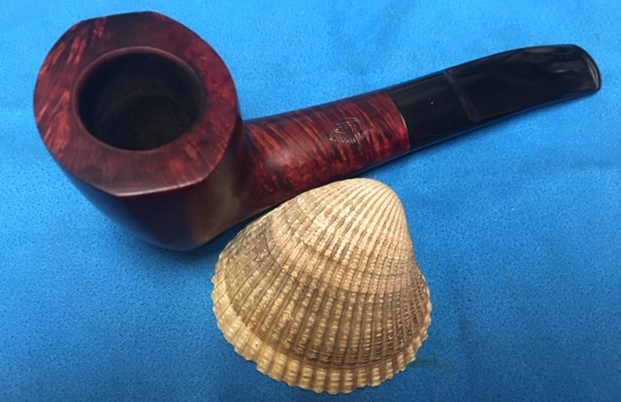
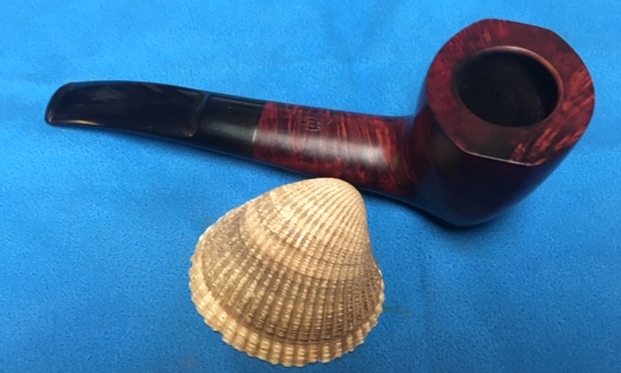
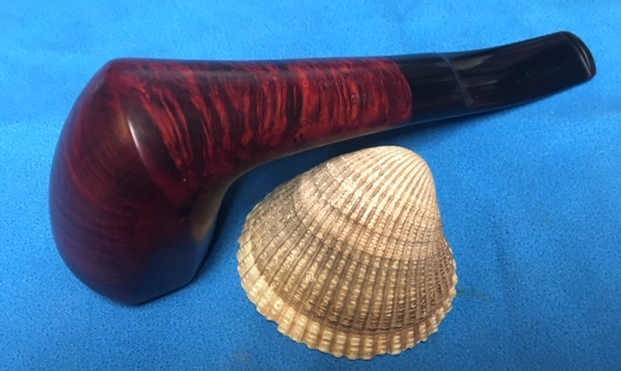
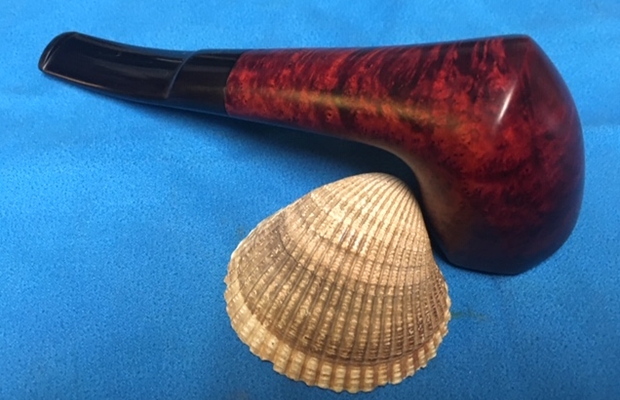
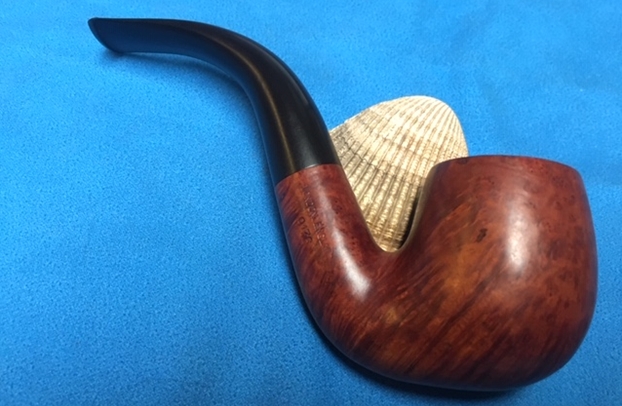
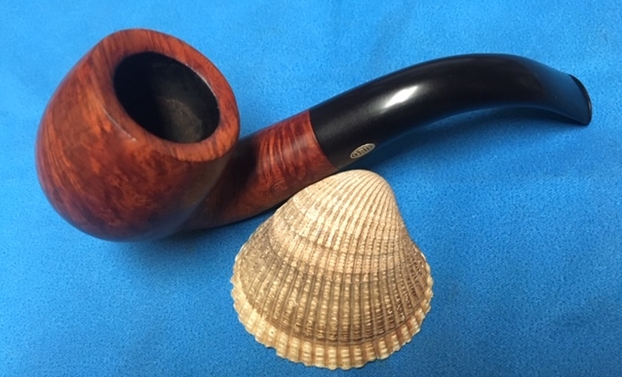
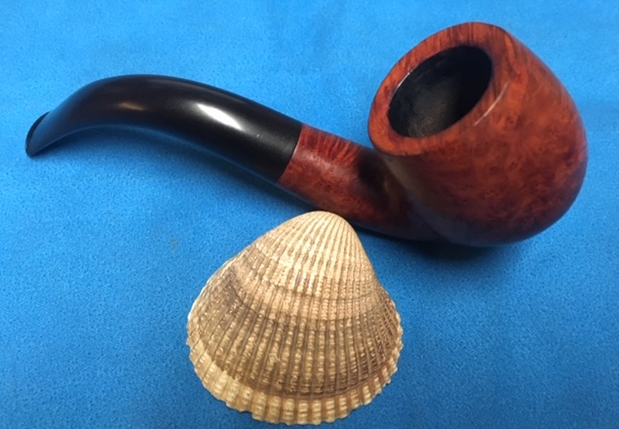
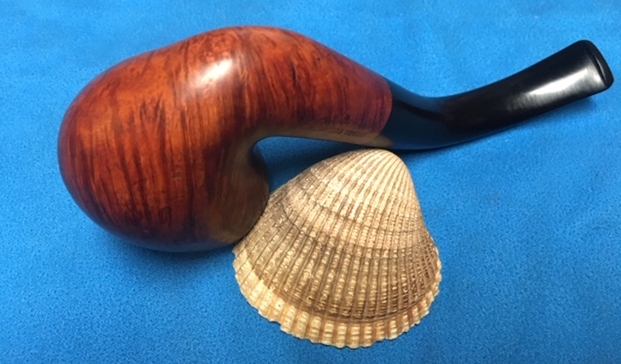
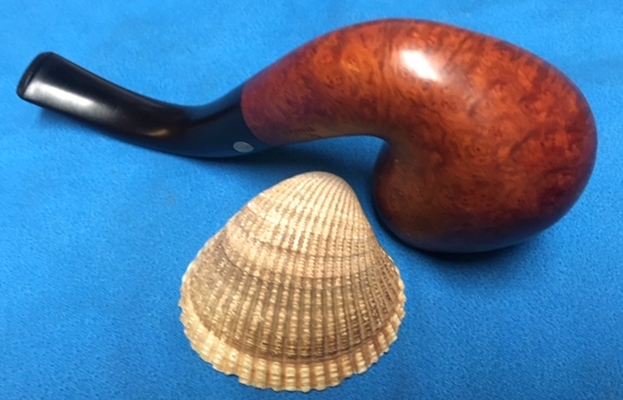
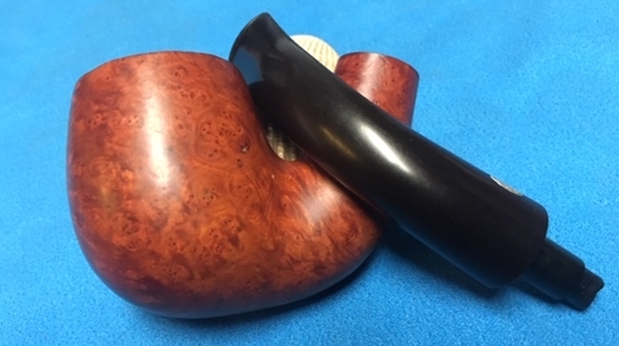
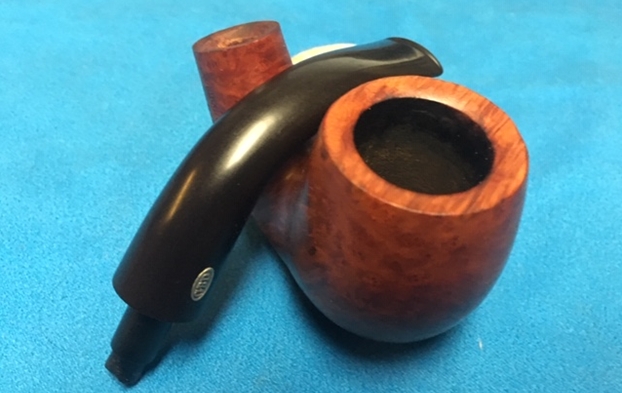
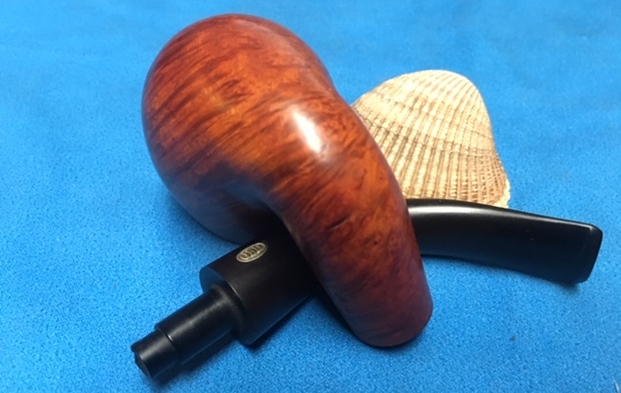
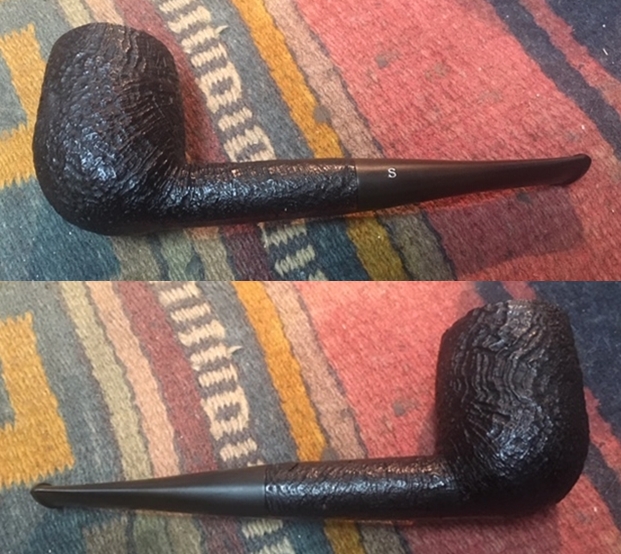
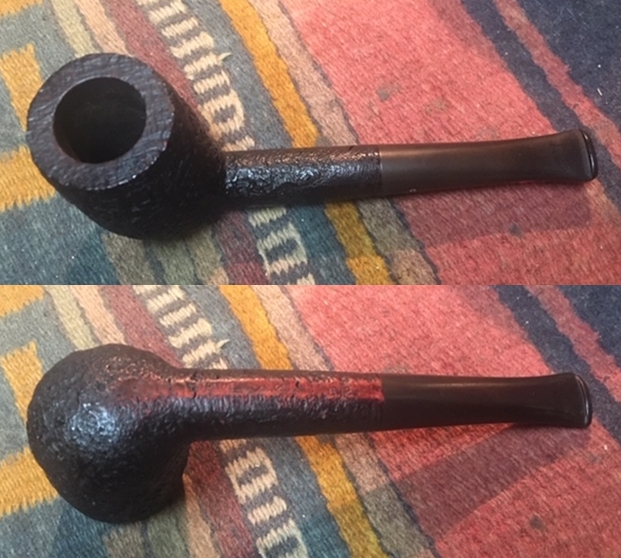
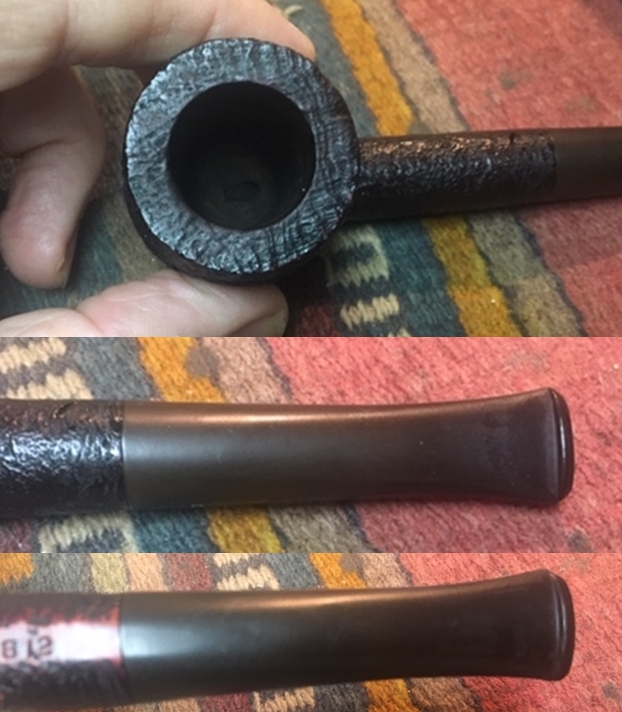
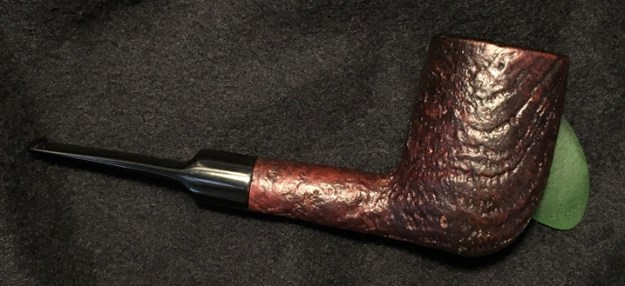
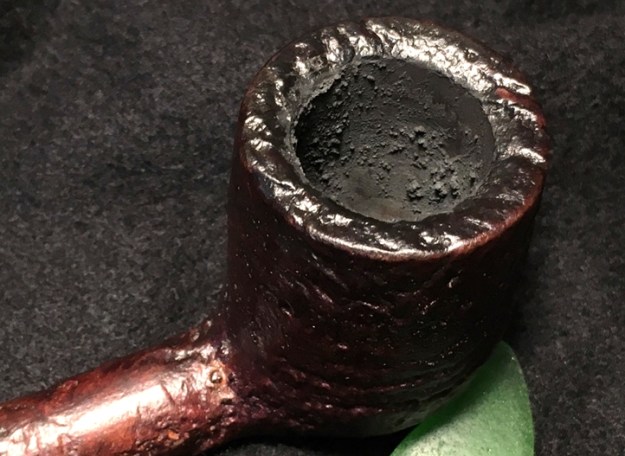
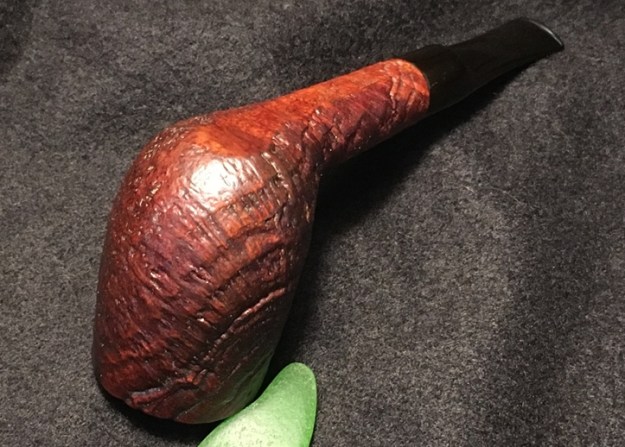
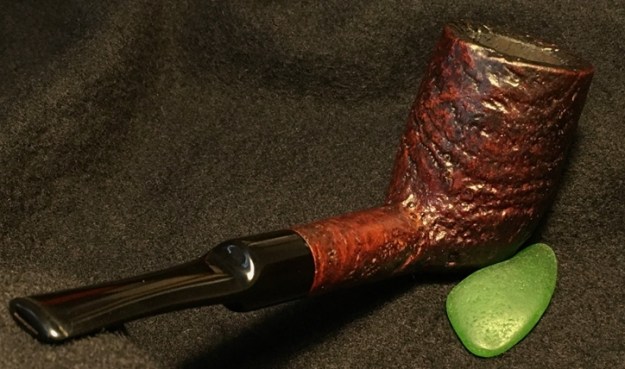
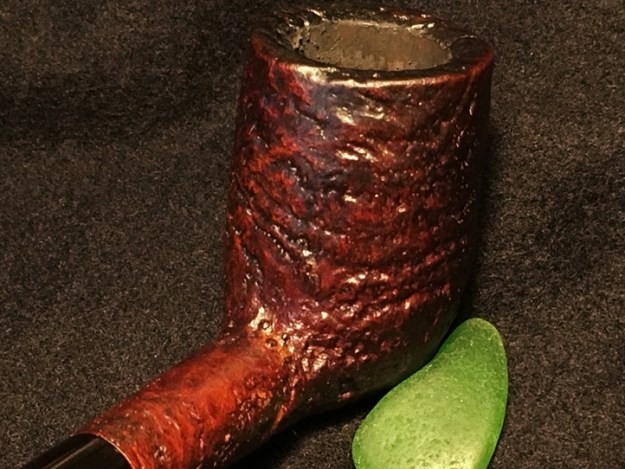
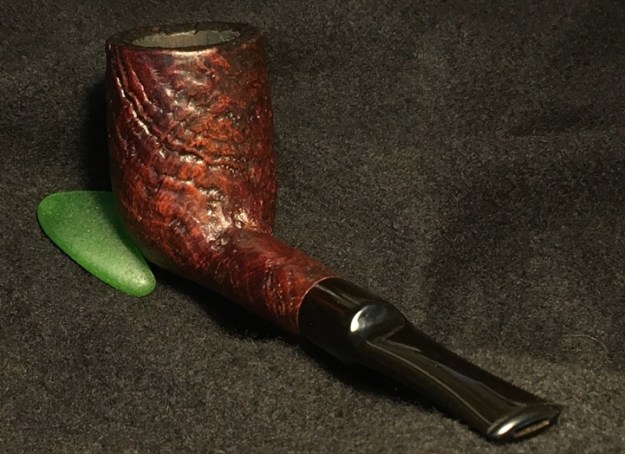
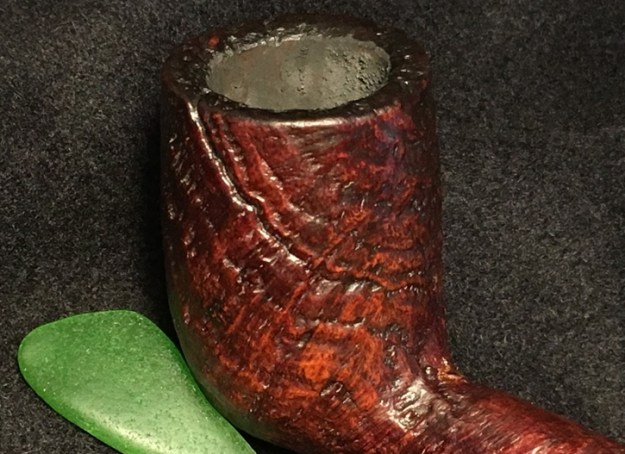
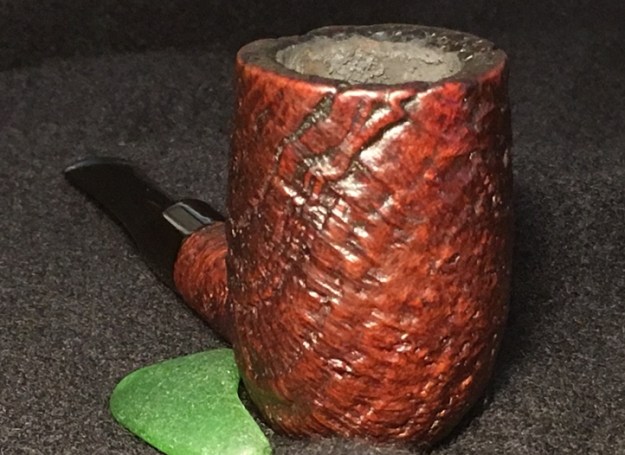
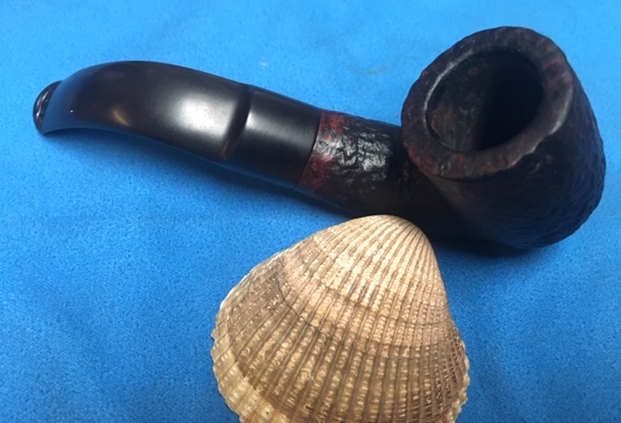
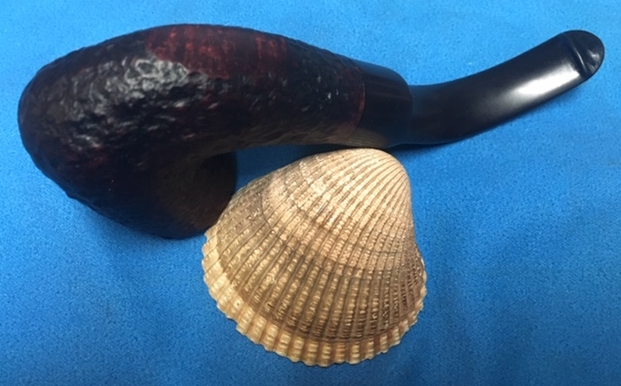
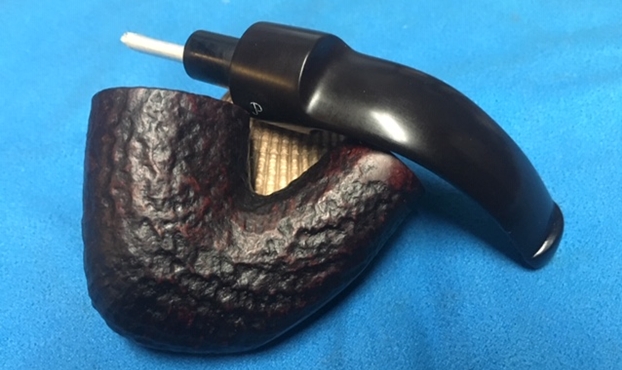
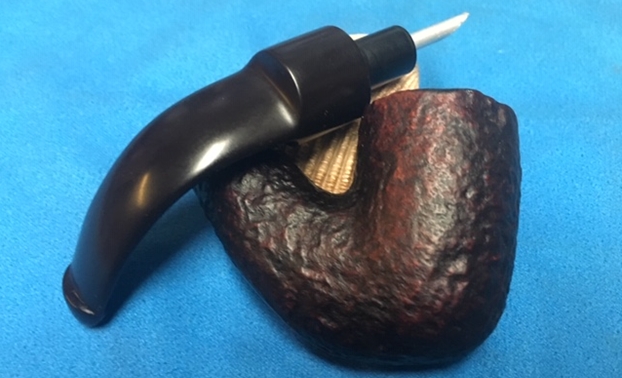
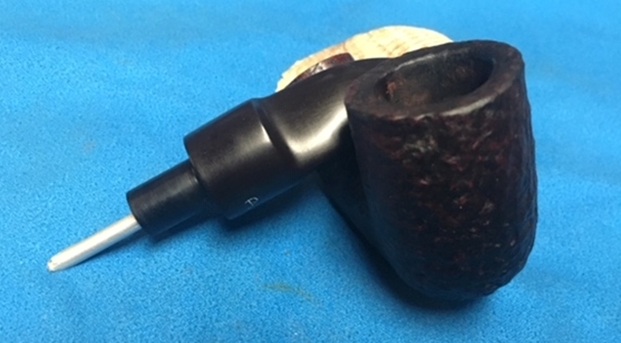
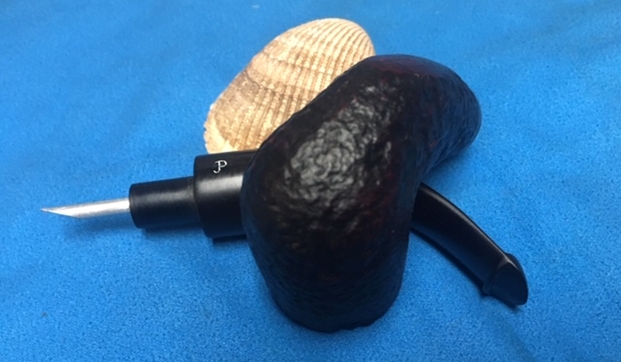
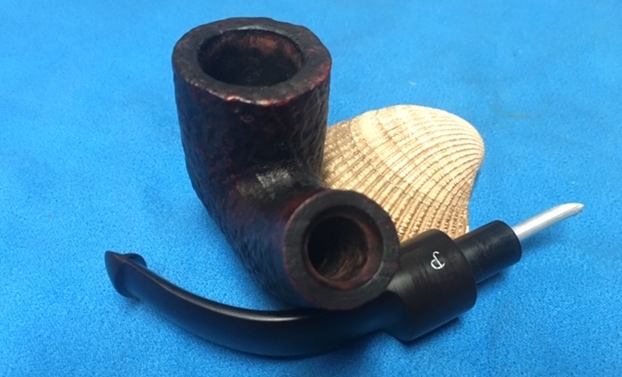
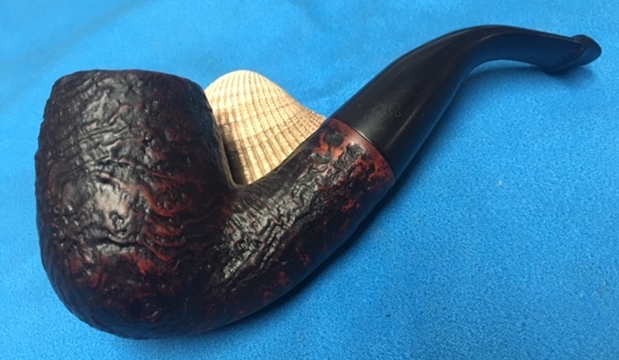
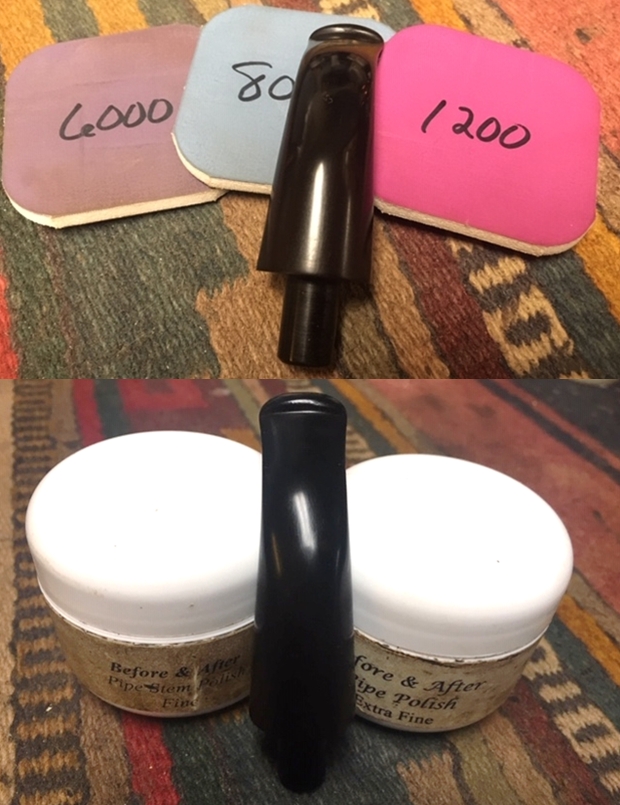
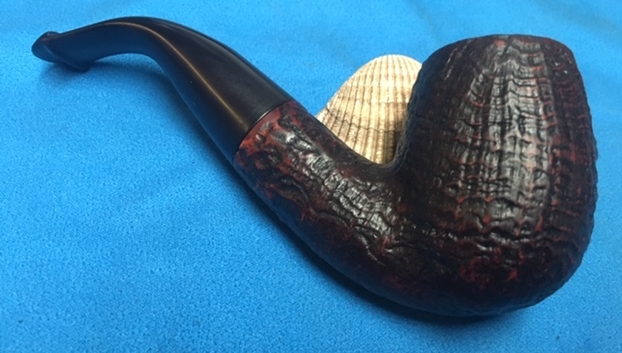
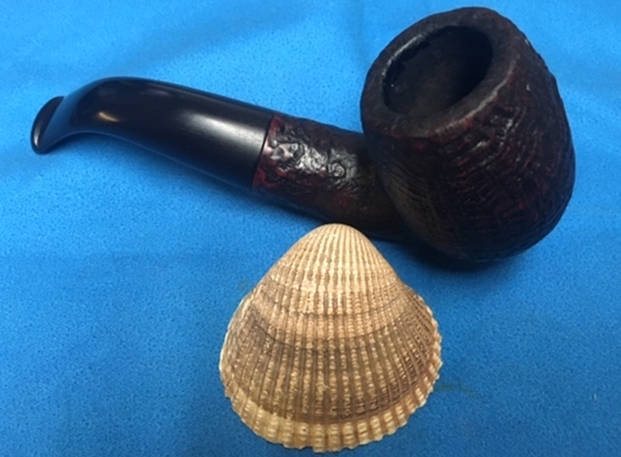
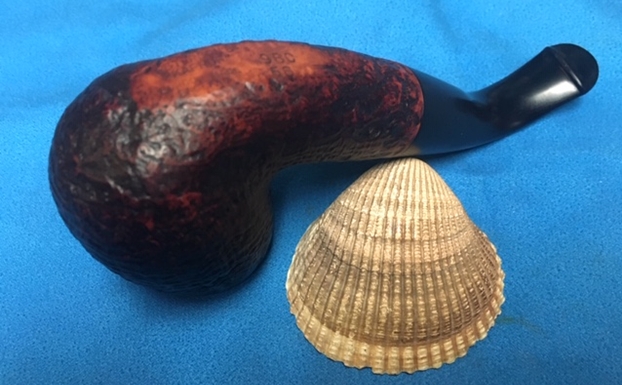
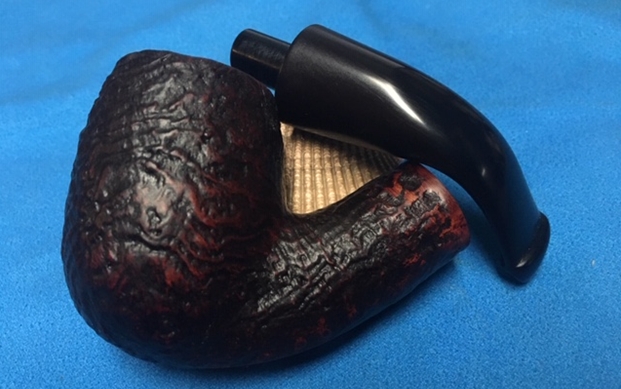
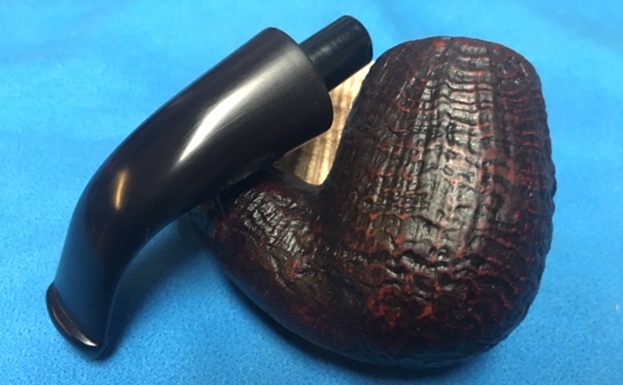
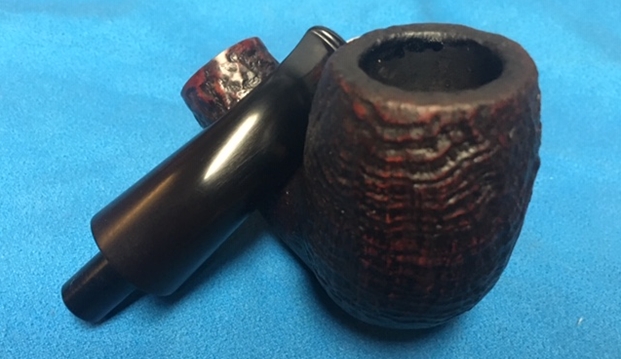
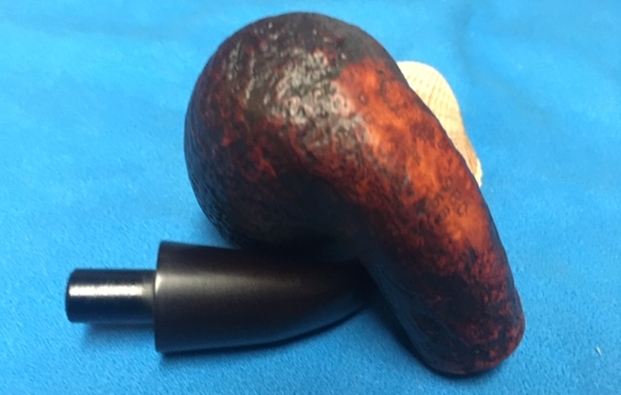
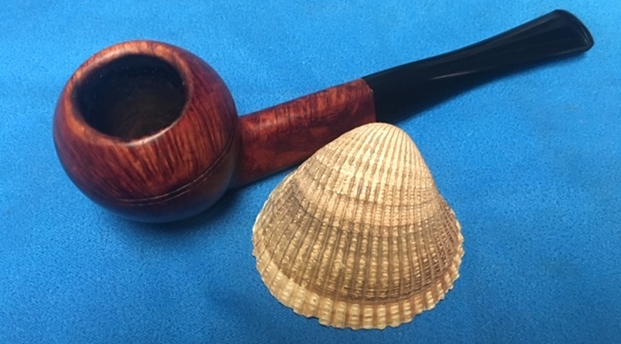
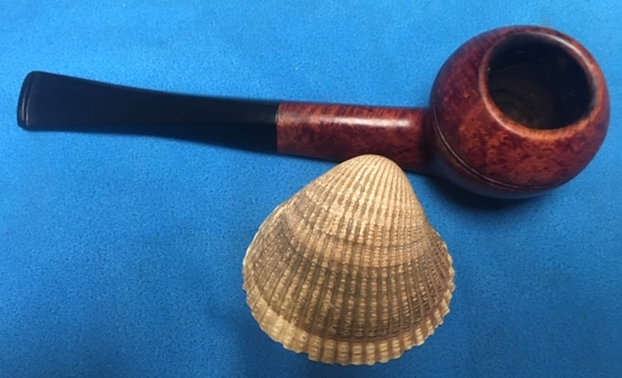
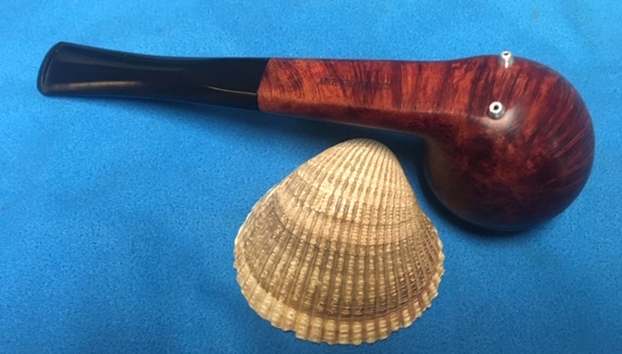
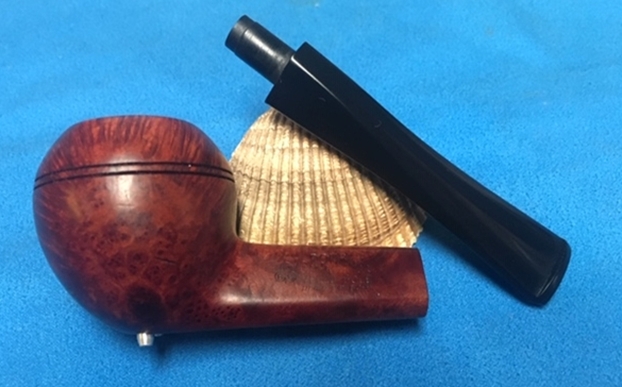
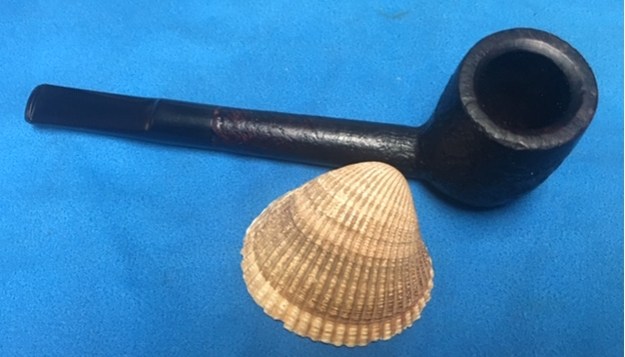
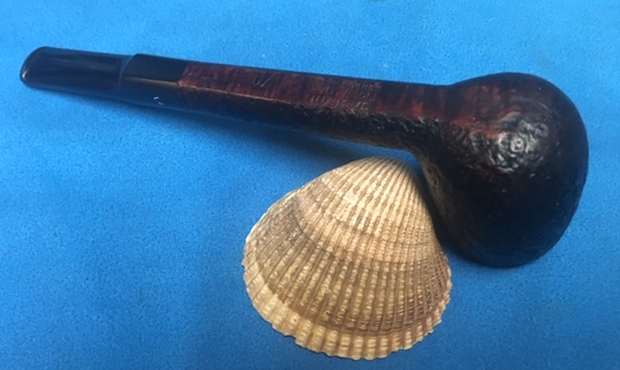
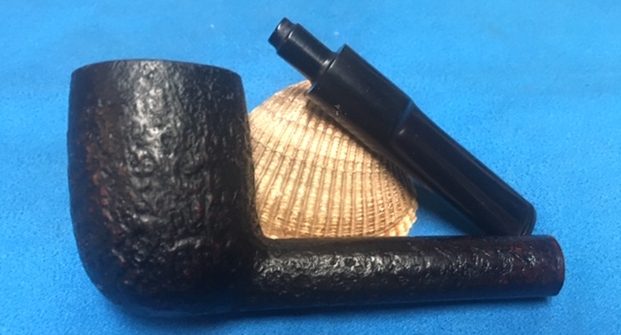
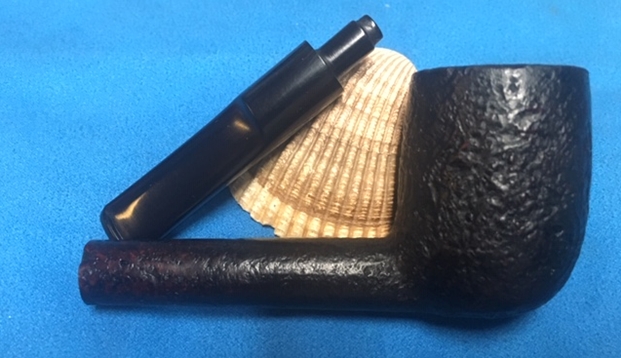
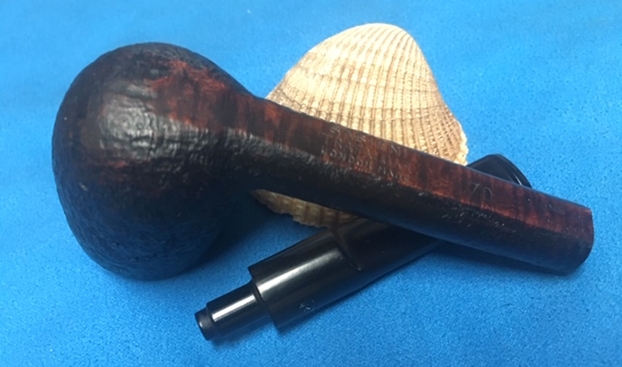
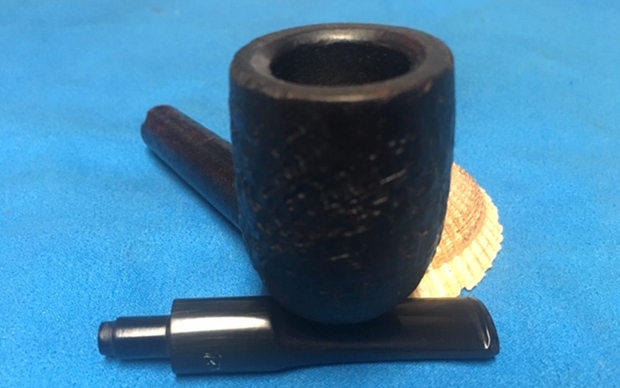
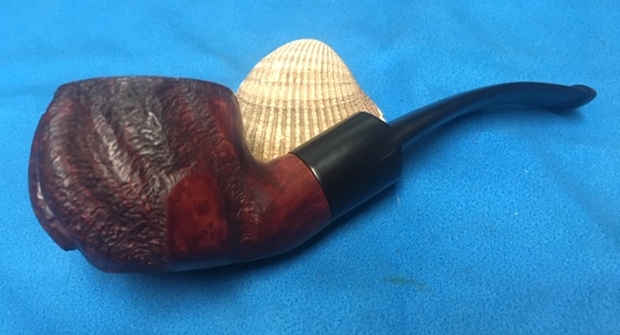
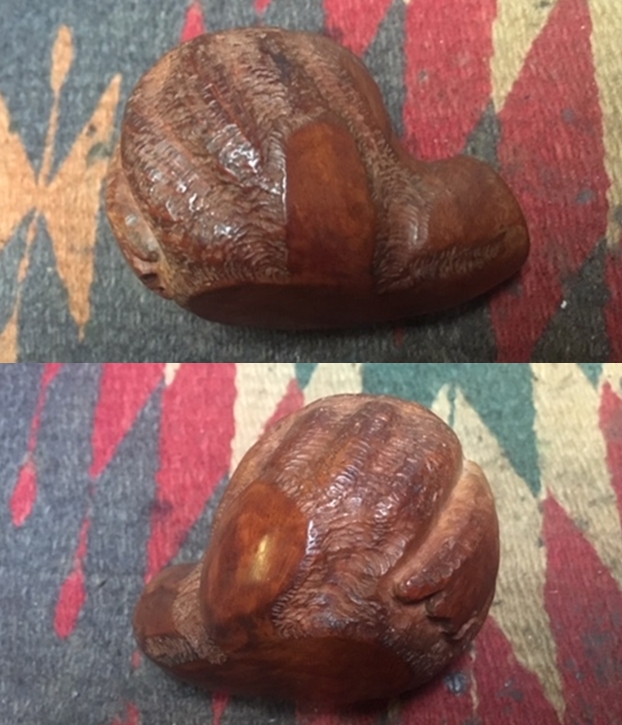
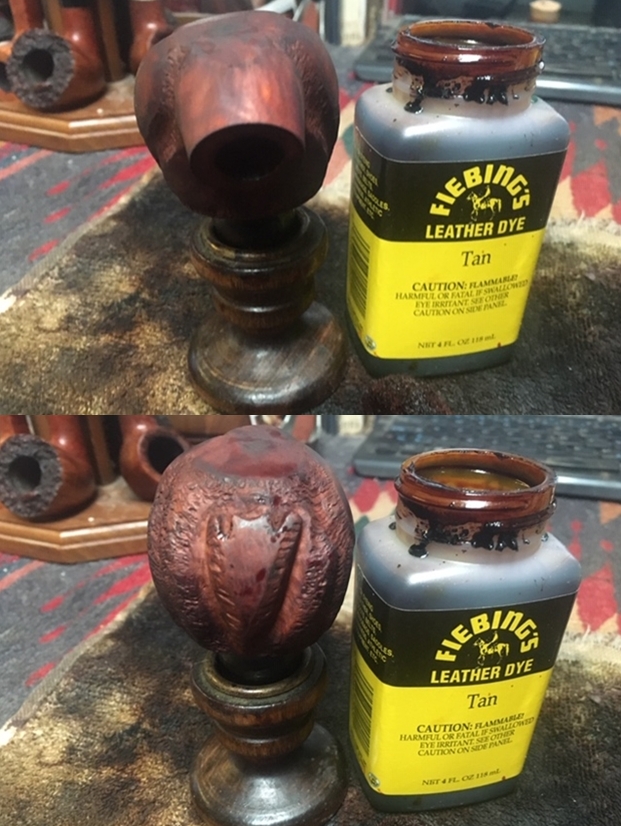
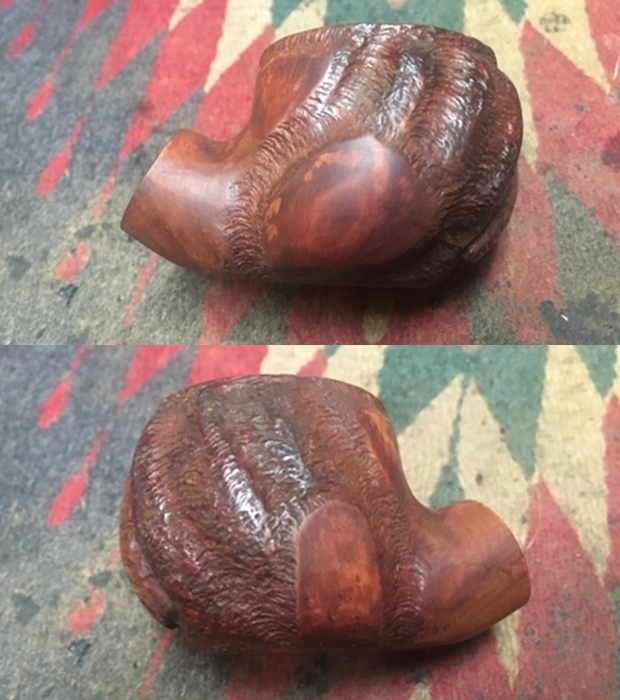
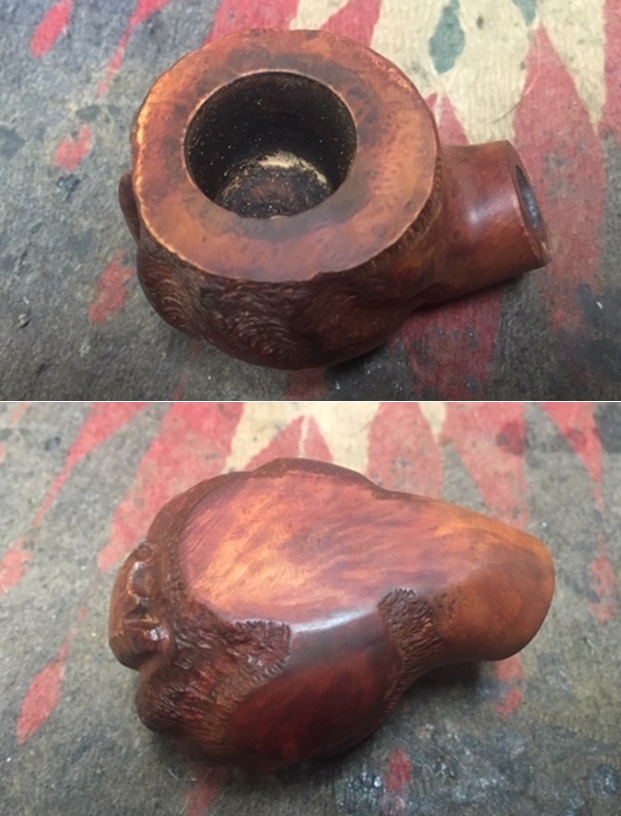
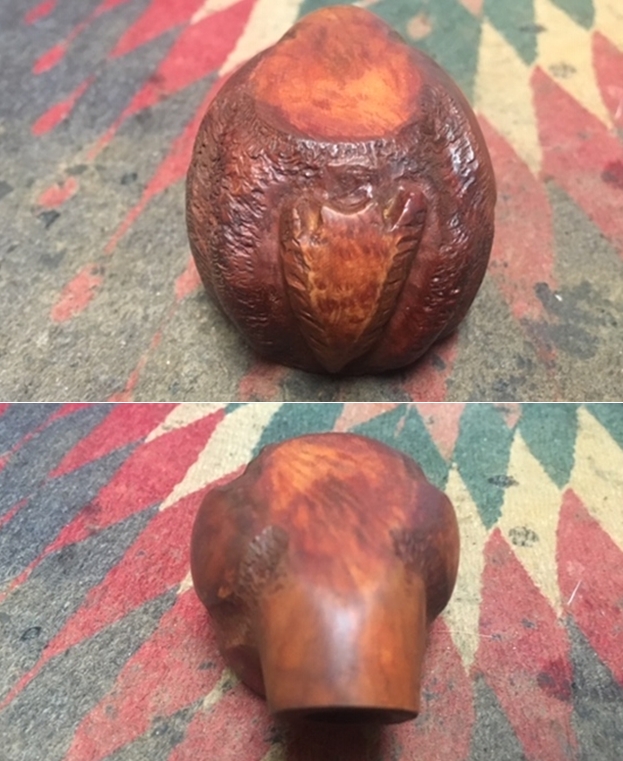
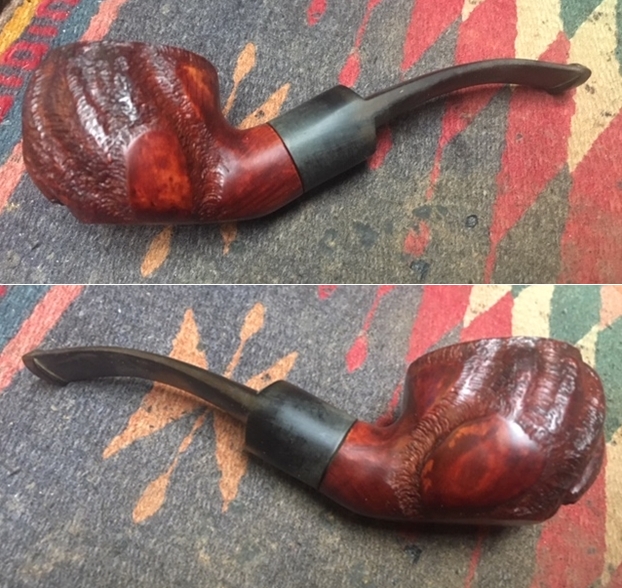
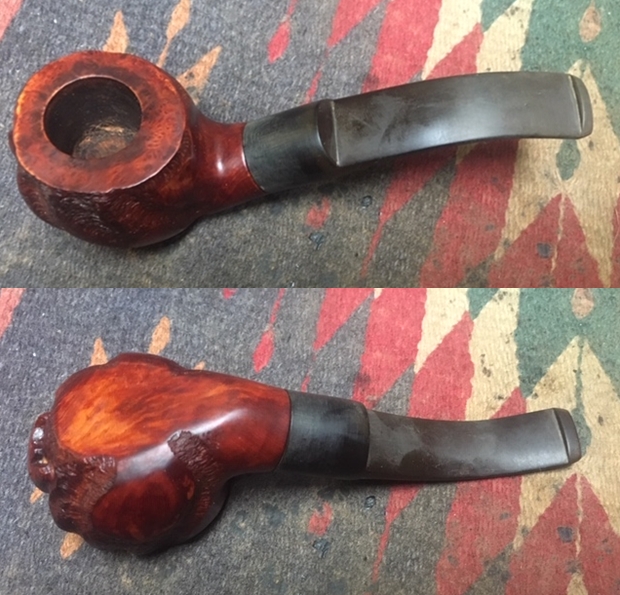
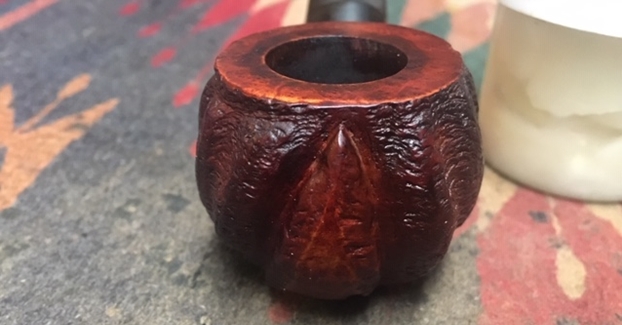
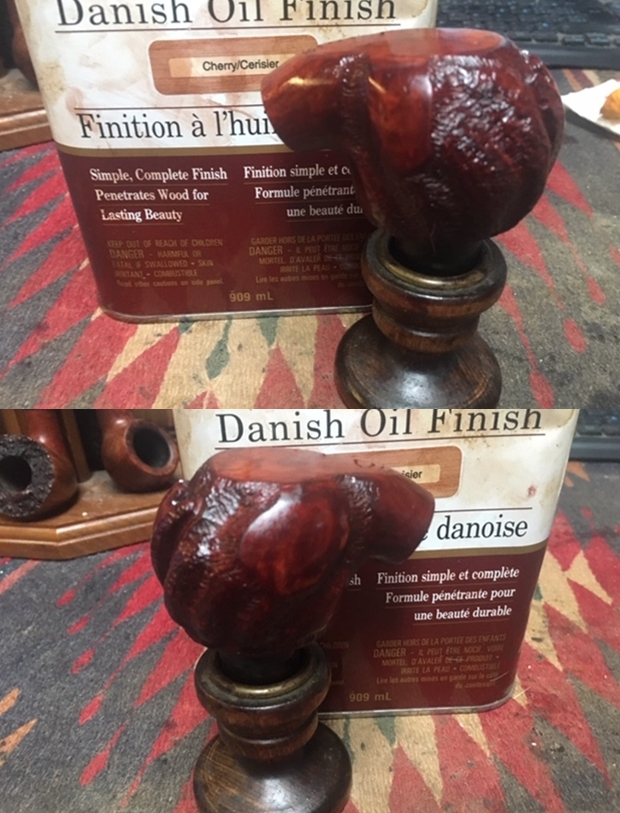
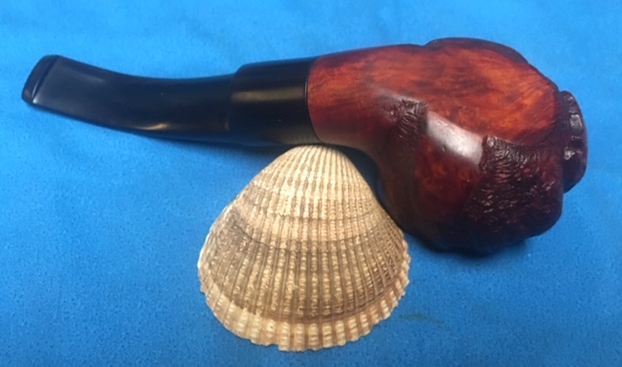
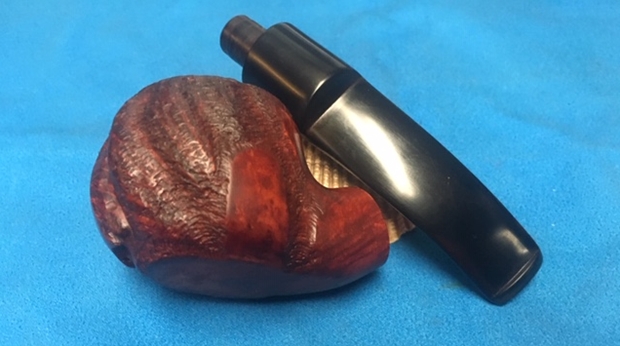
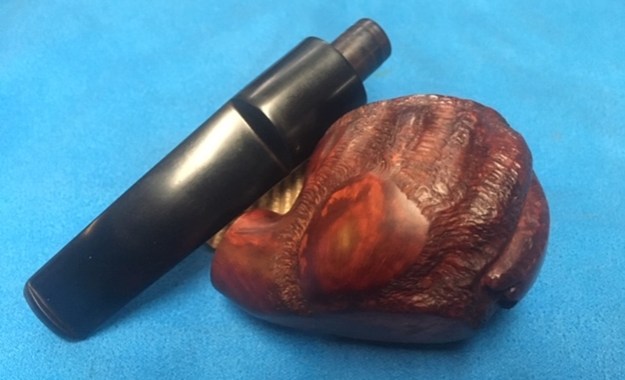
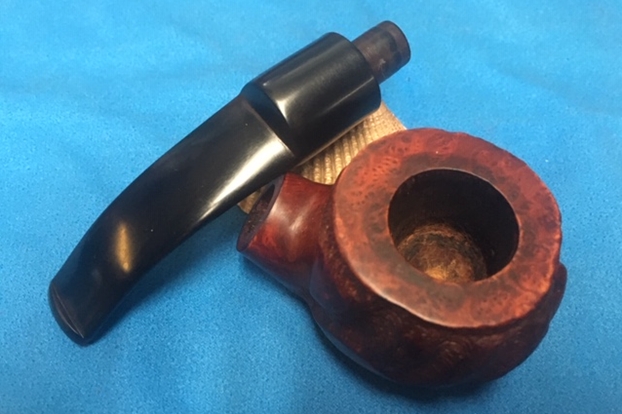
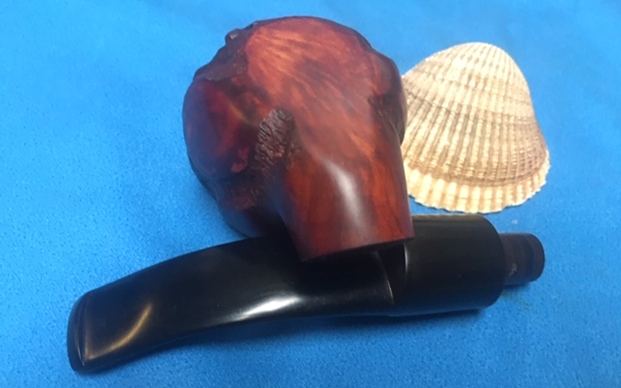
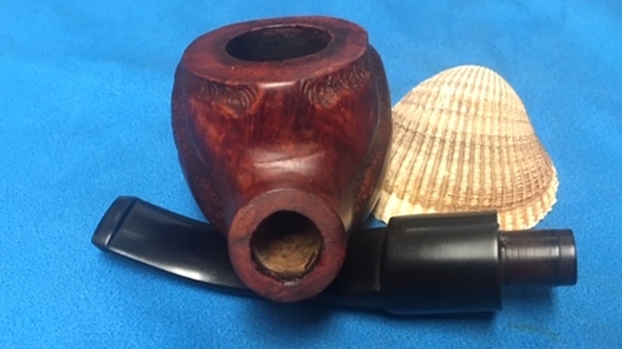
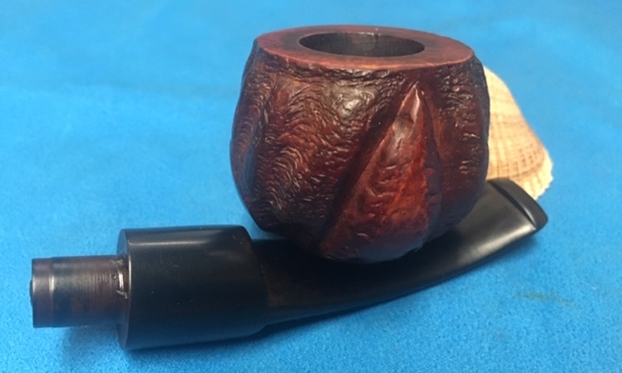
Cleaning up a GBD London Made 9664


Blog by Steve Laug

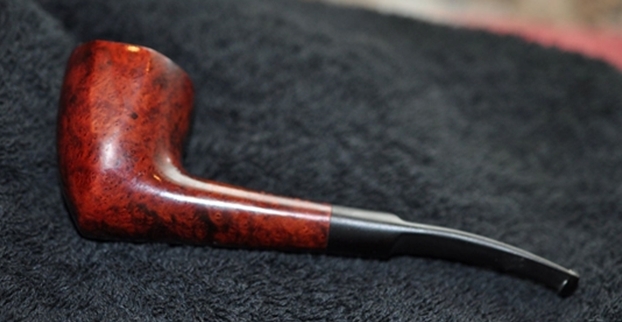
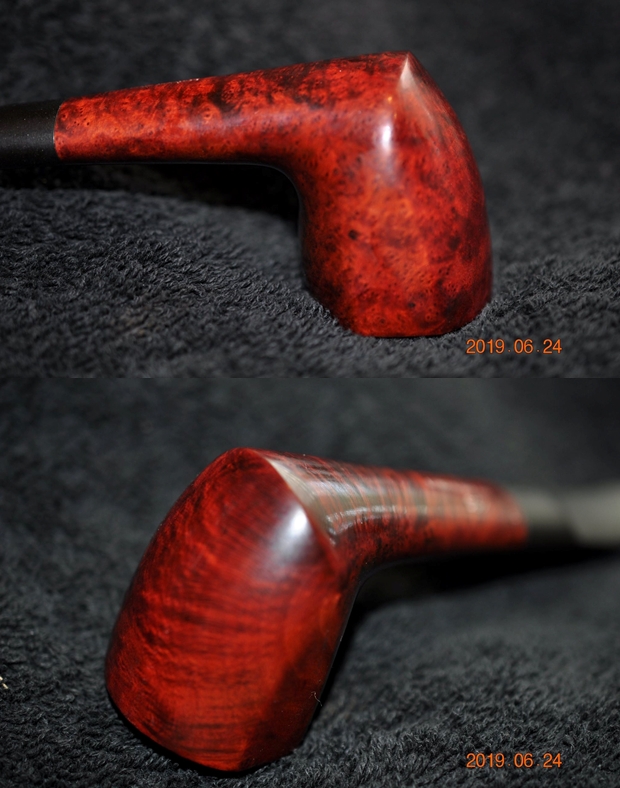
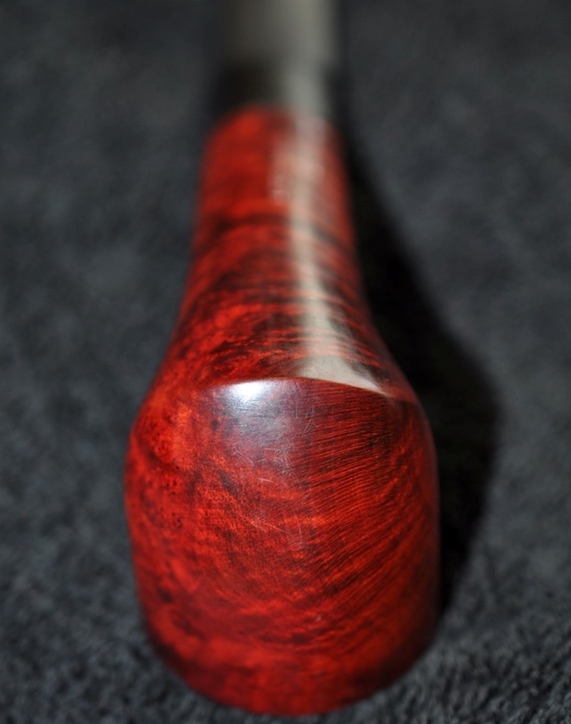
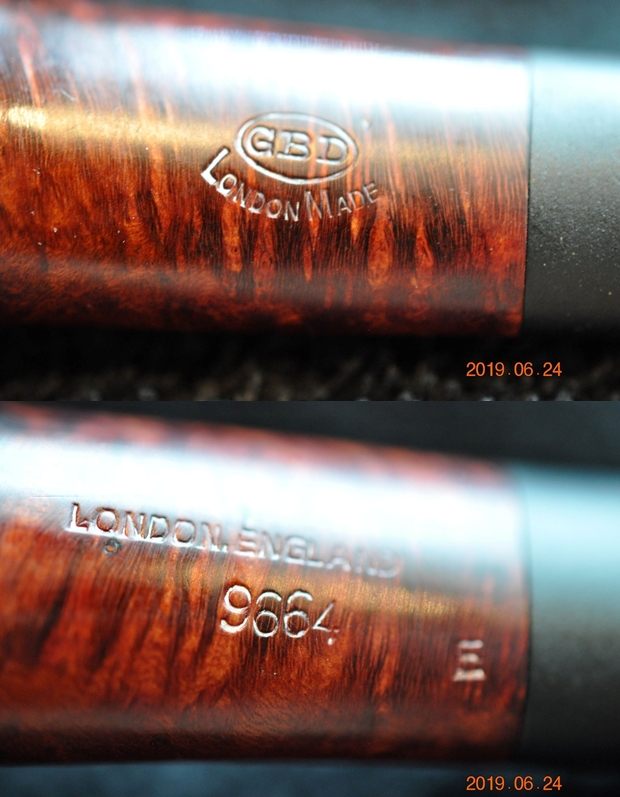
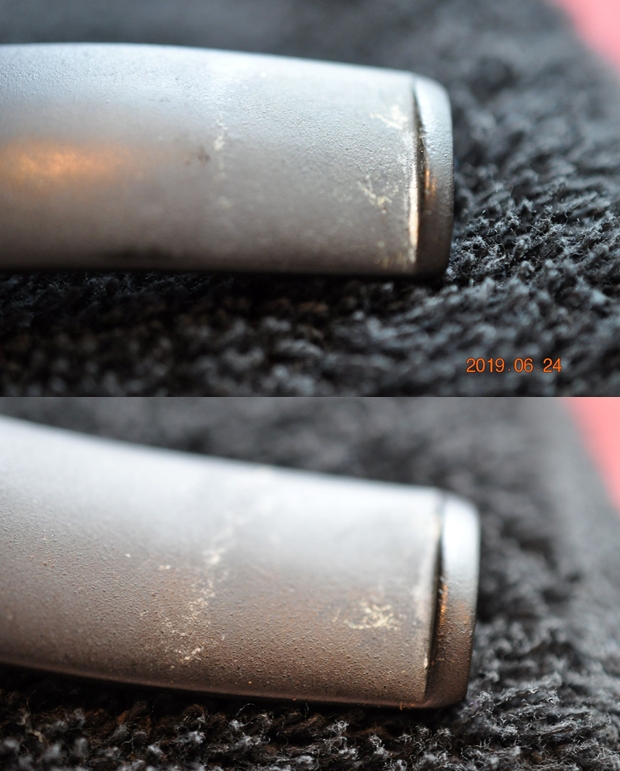
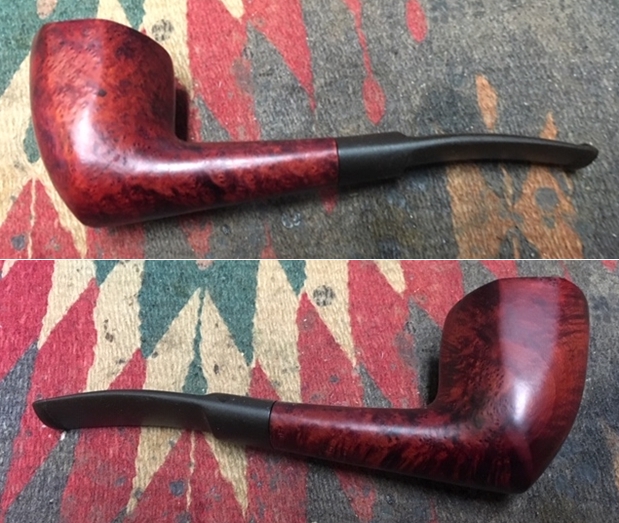
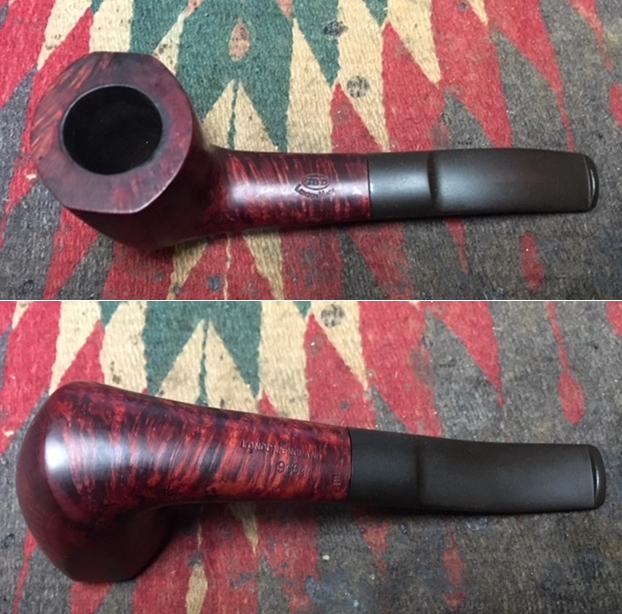
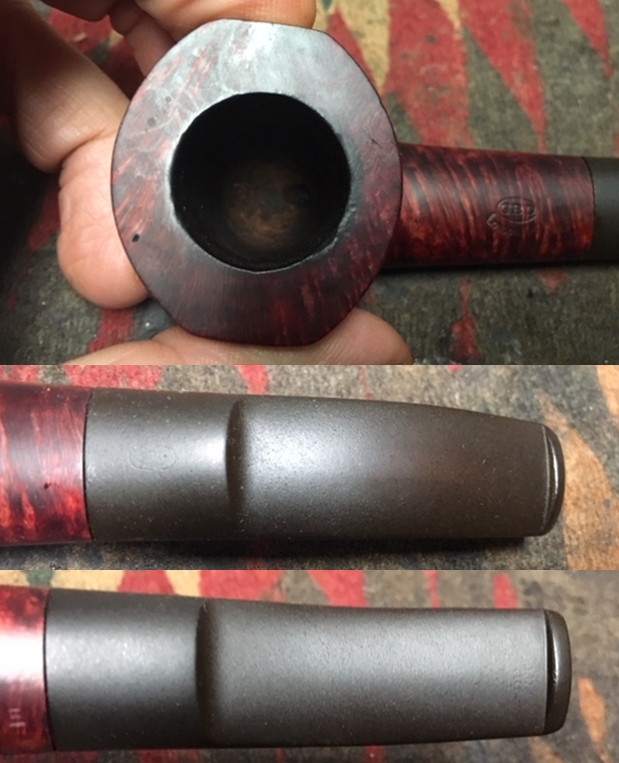
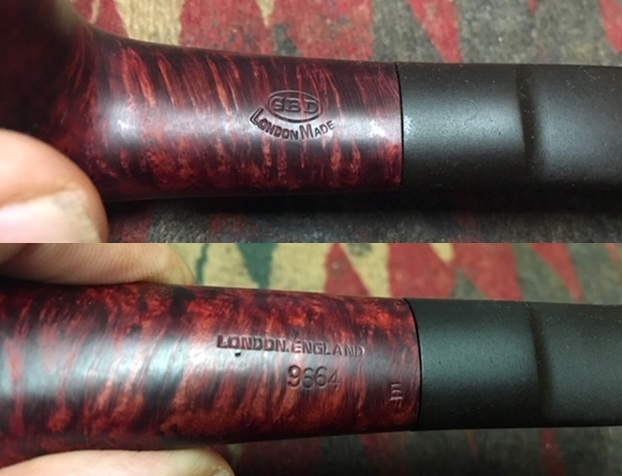
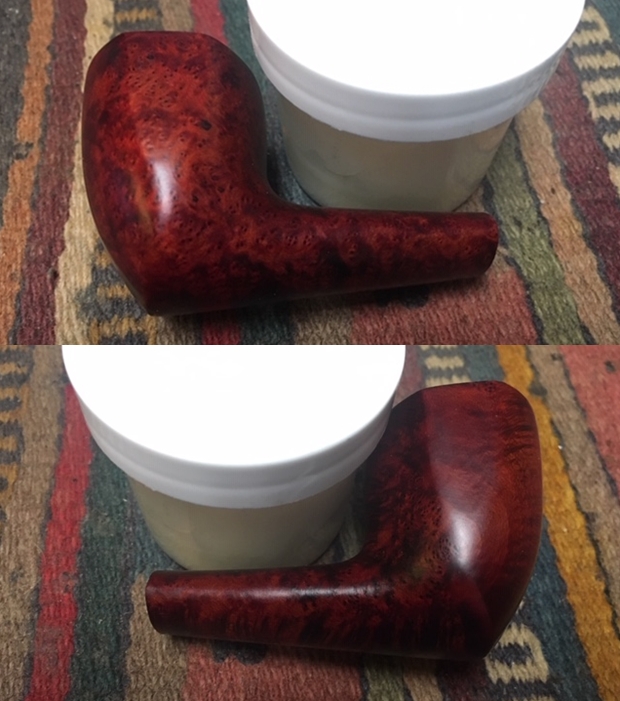
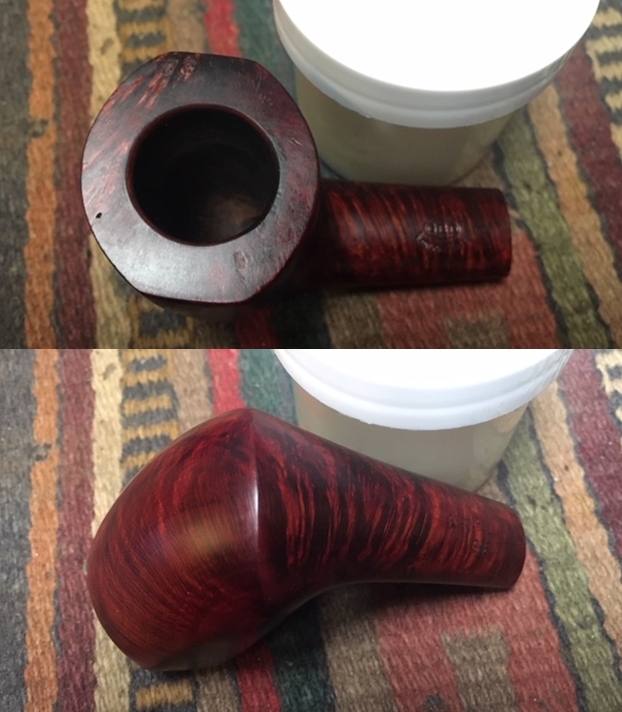
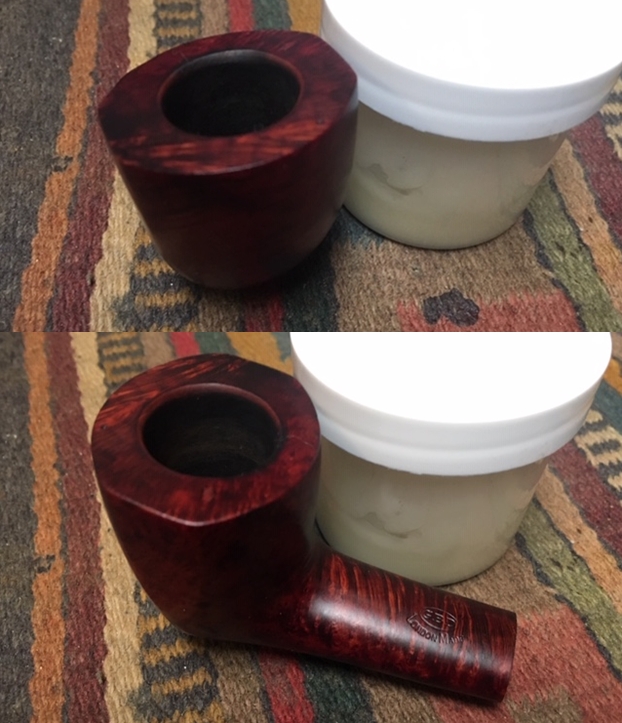
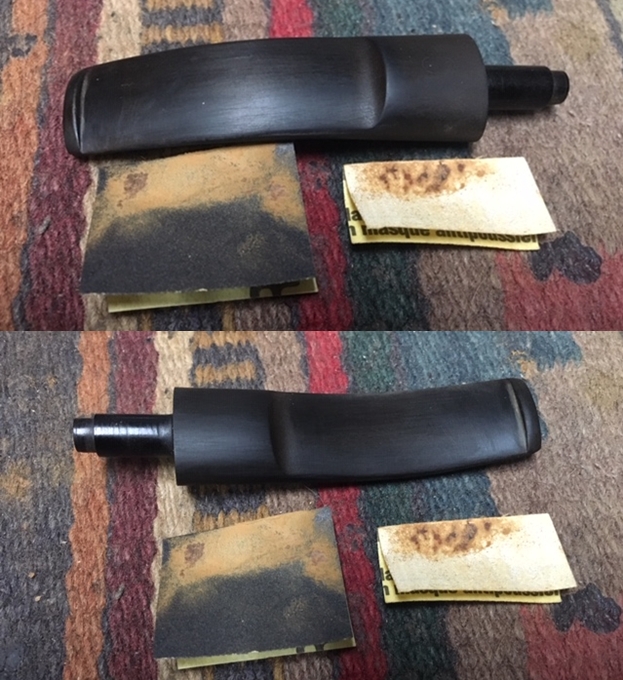
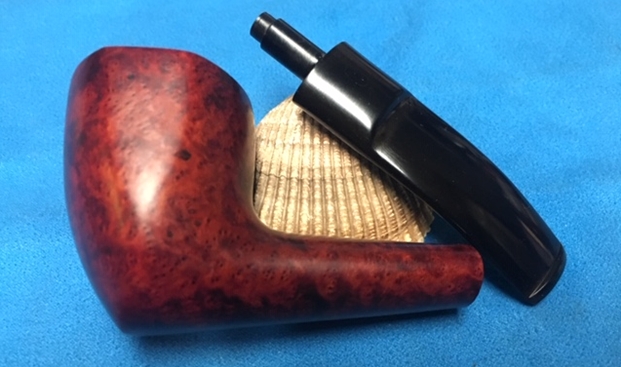
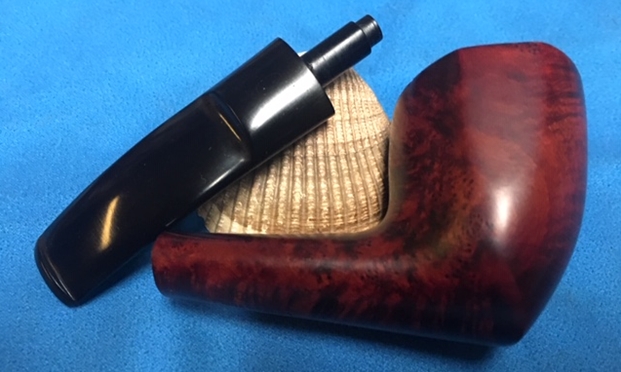
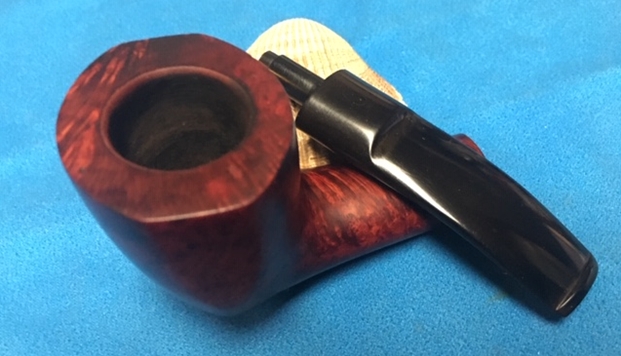
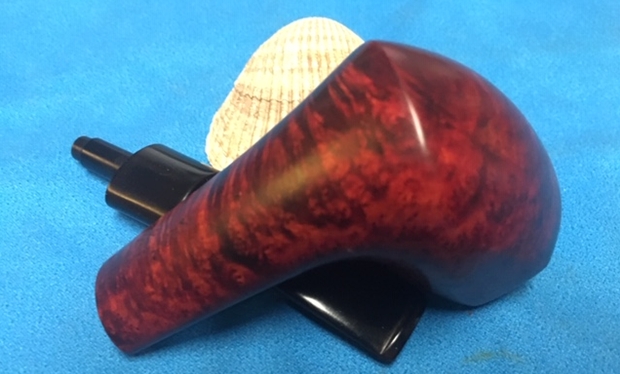
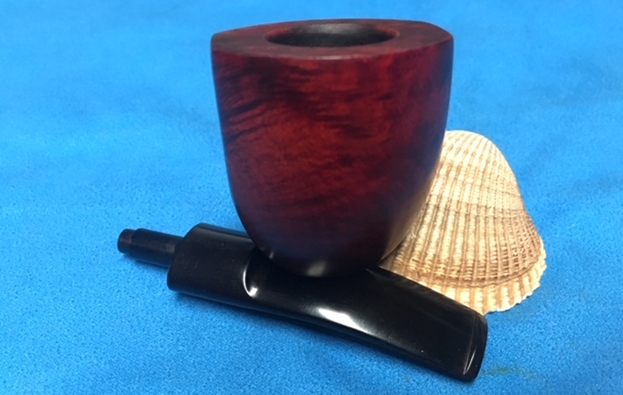
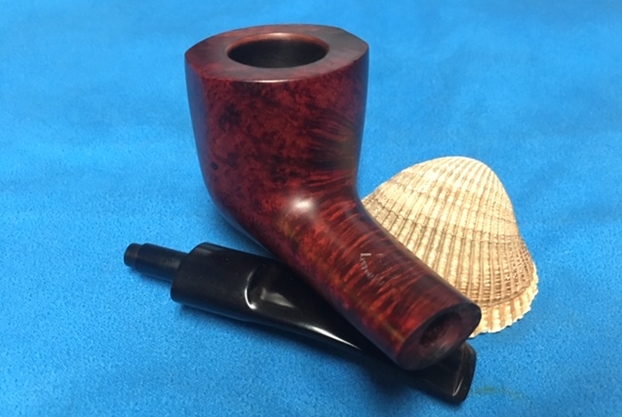
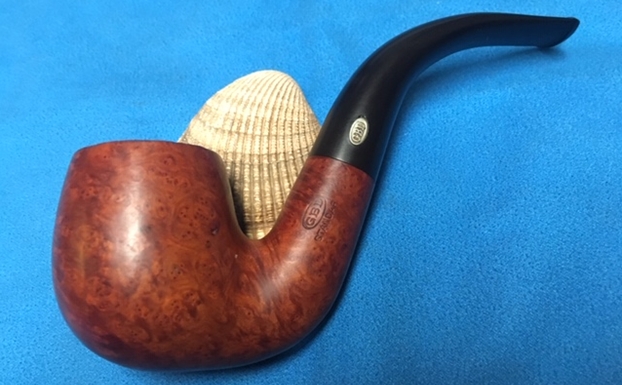
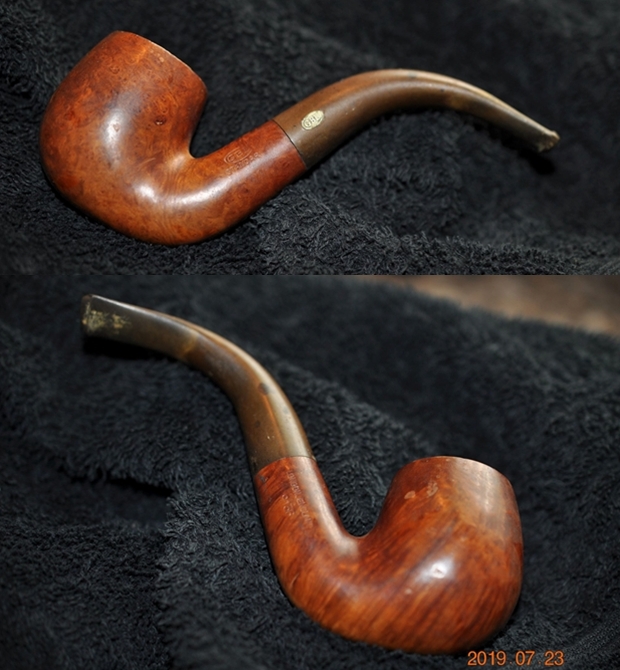
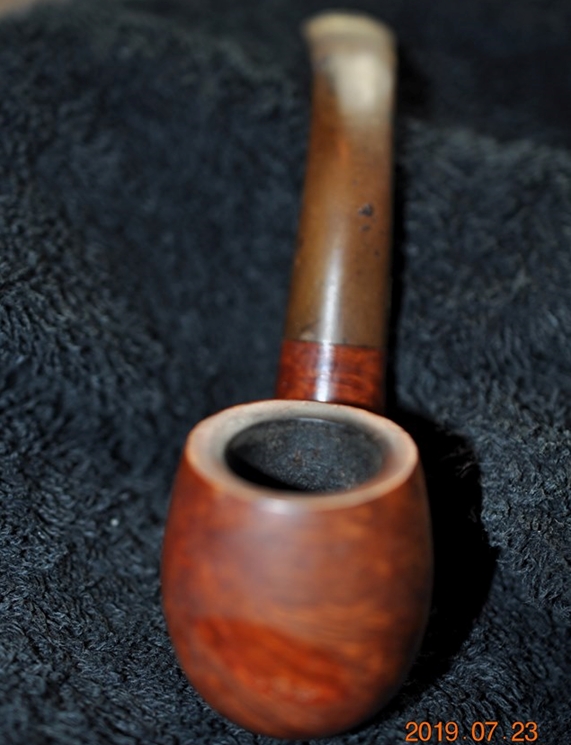
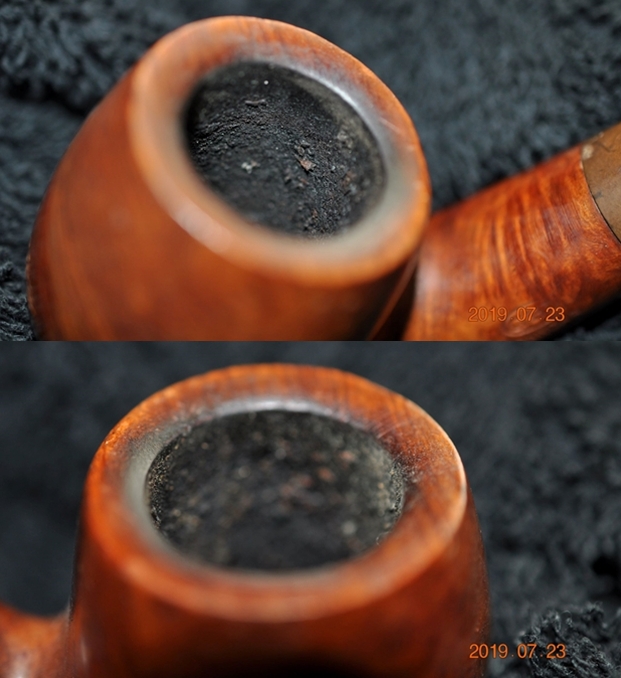
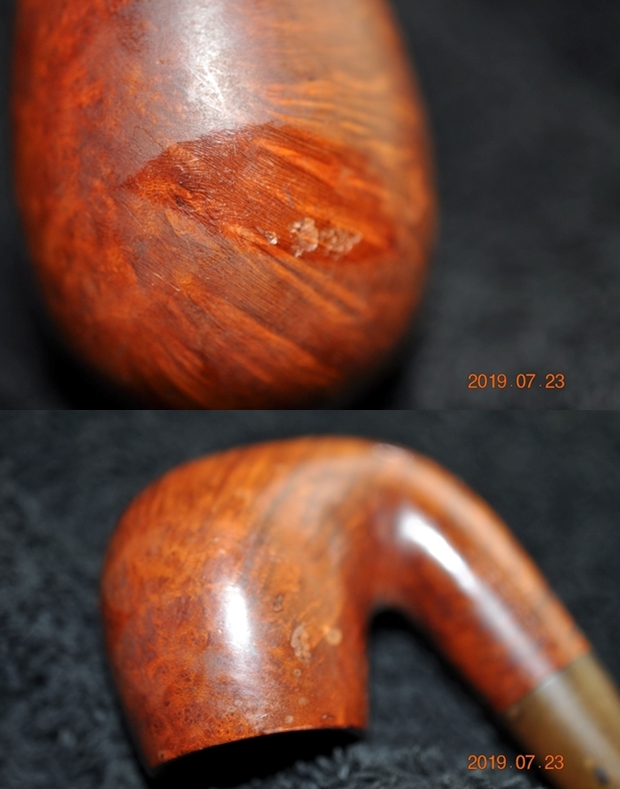
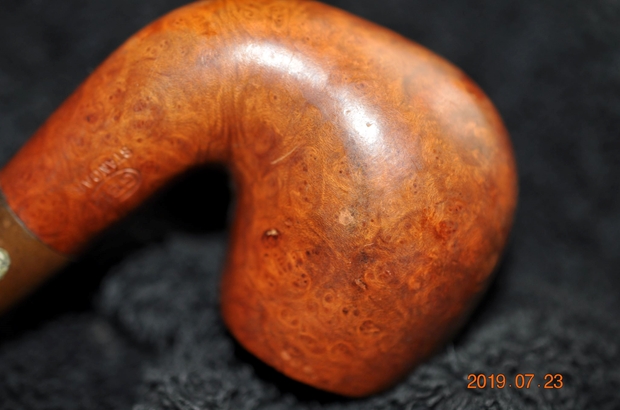
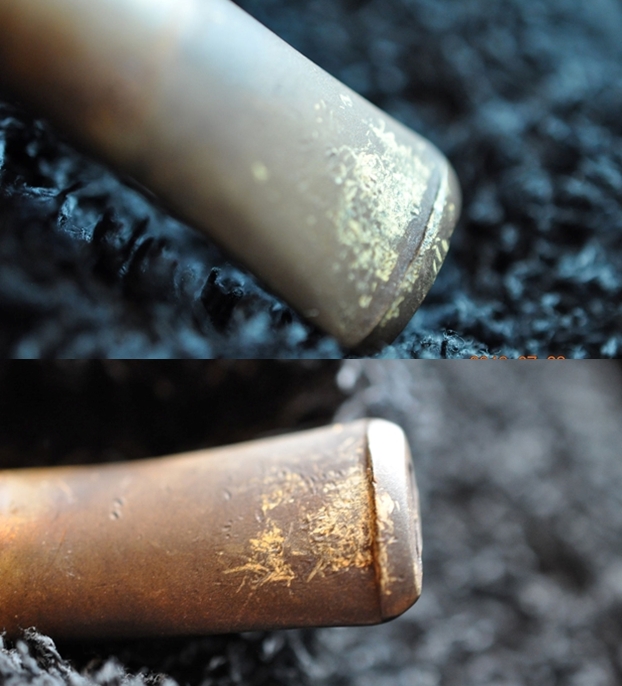
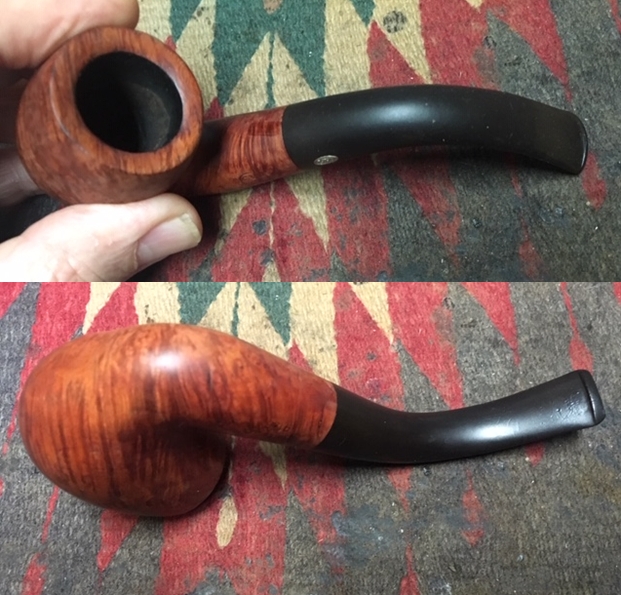
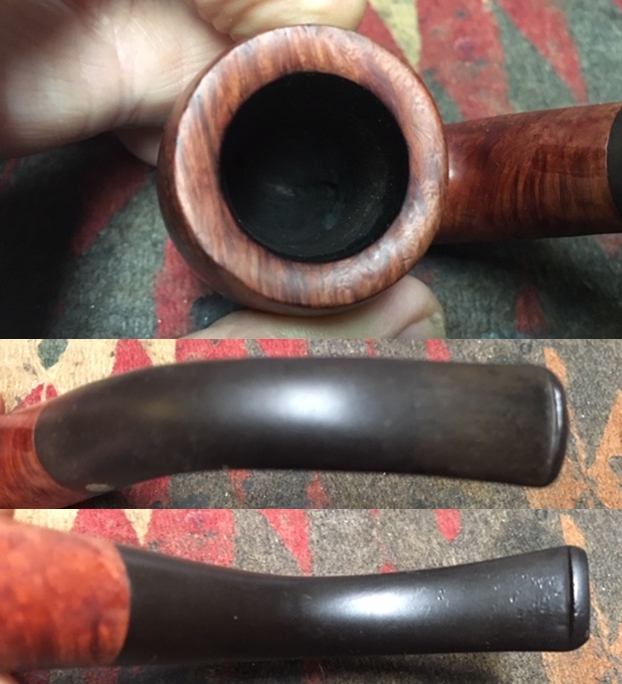
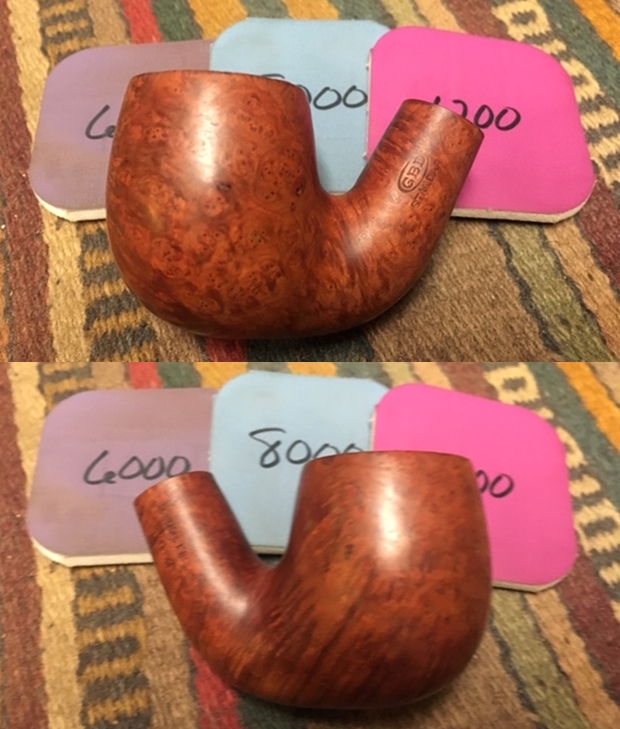
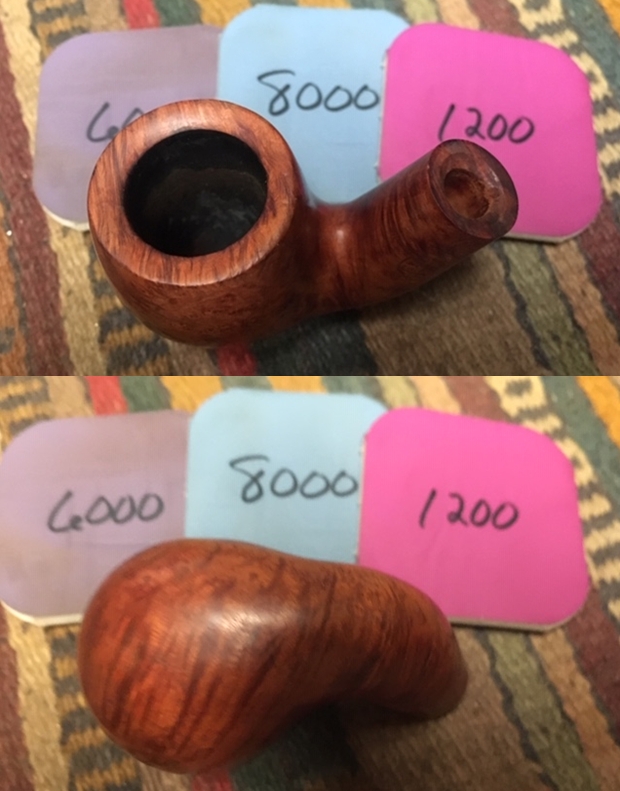
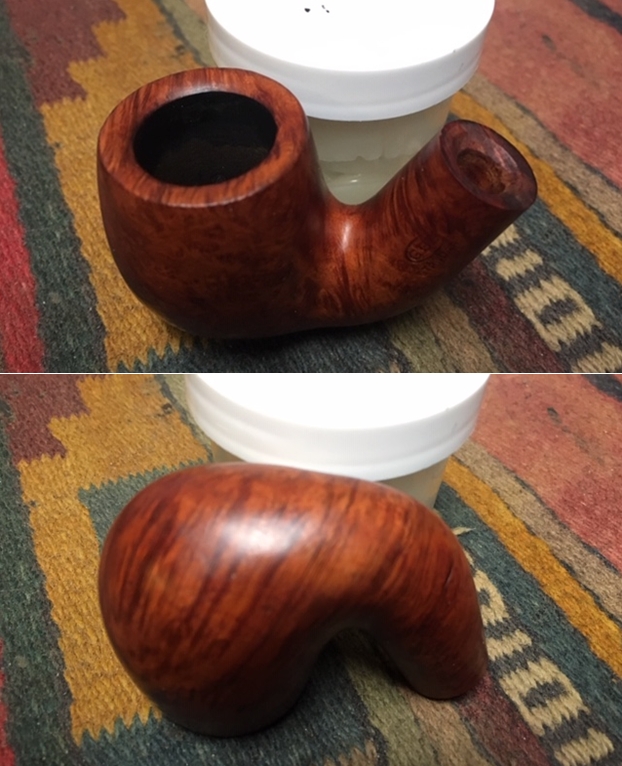
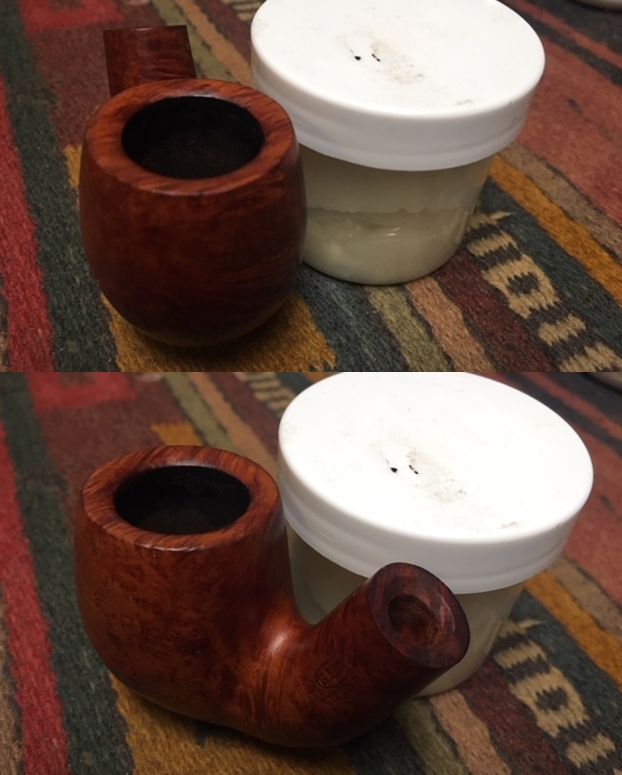
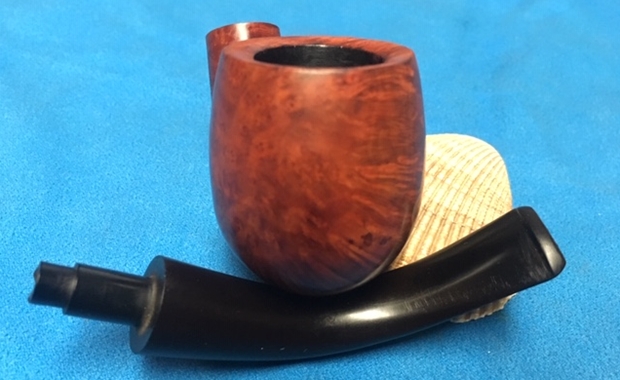
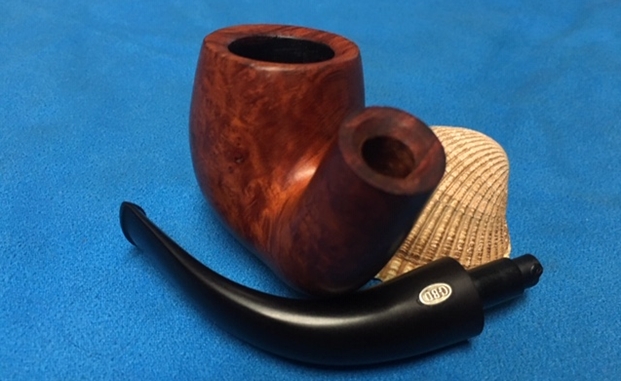
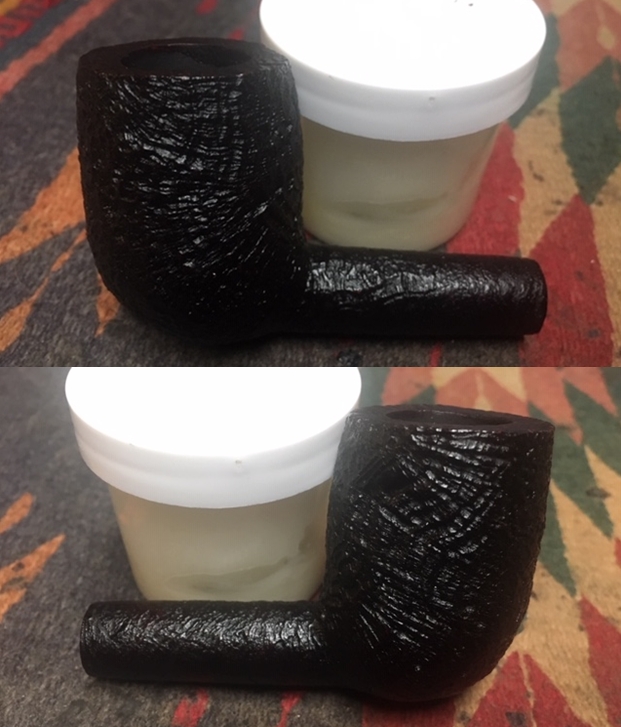
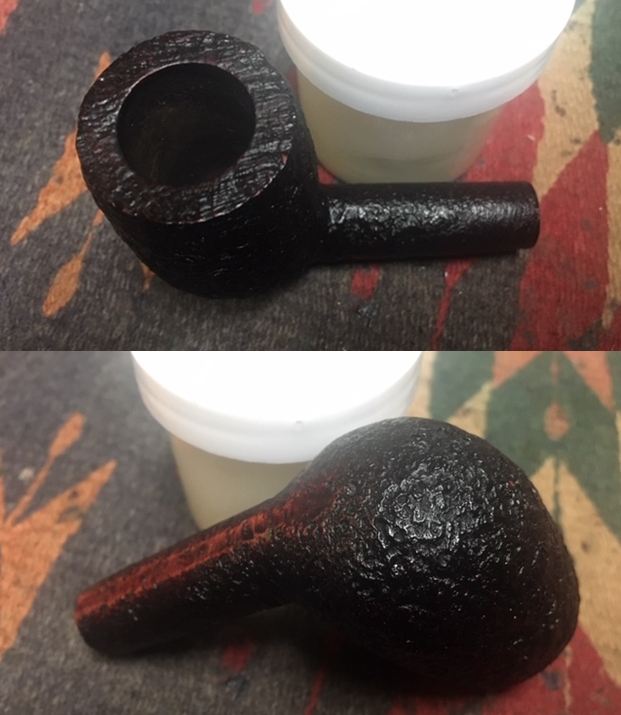
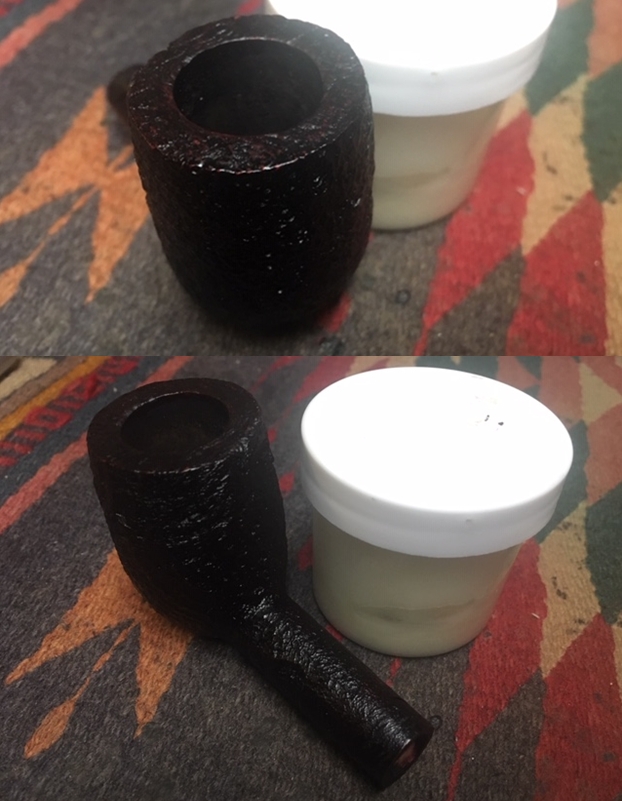
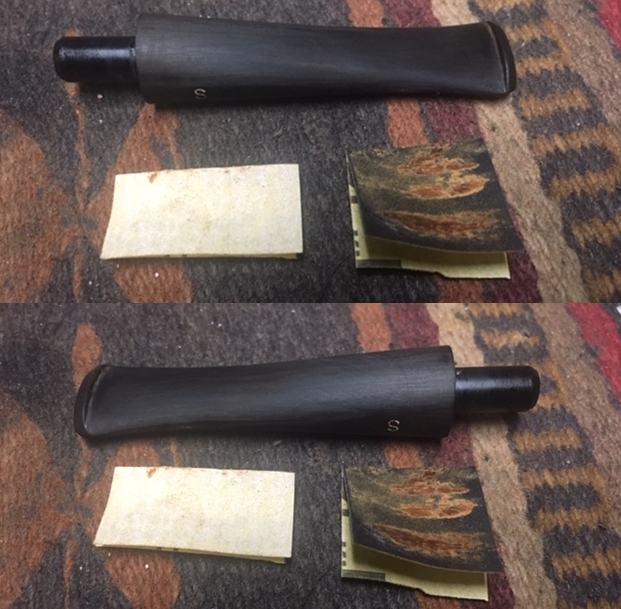
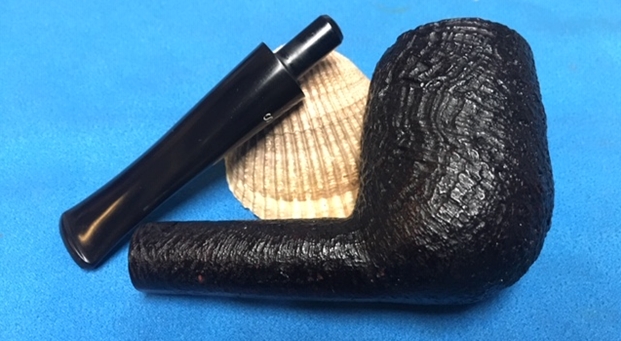
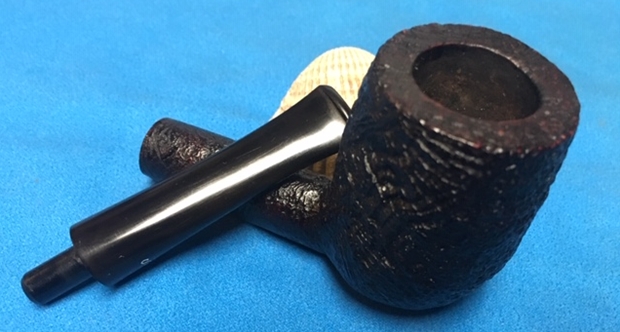
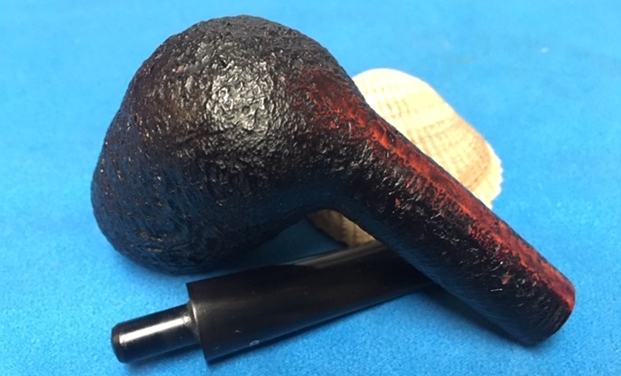
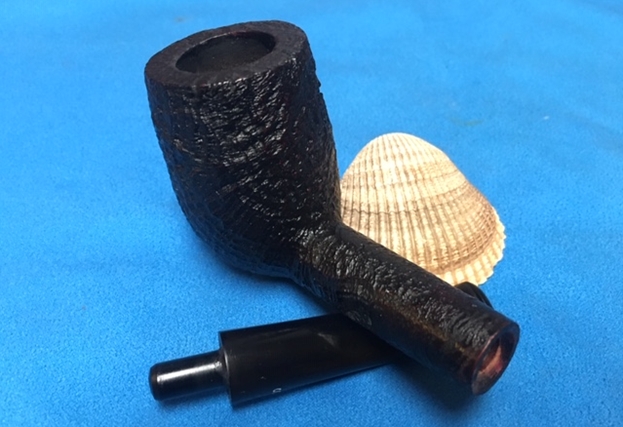
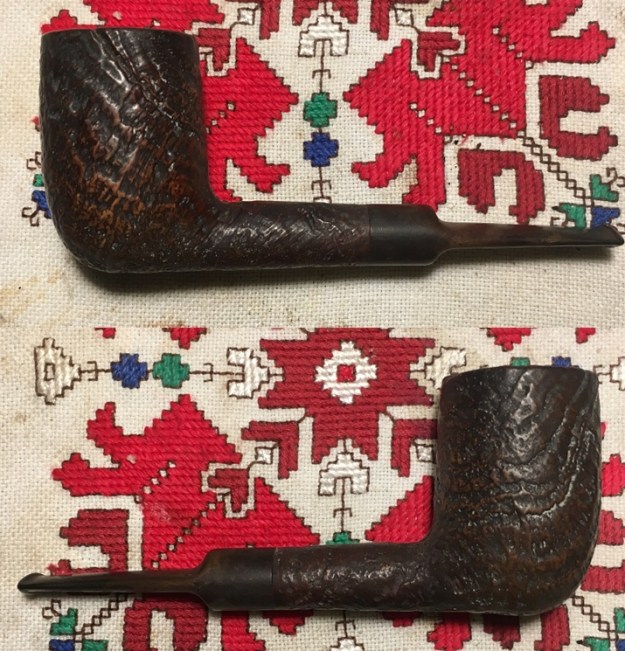
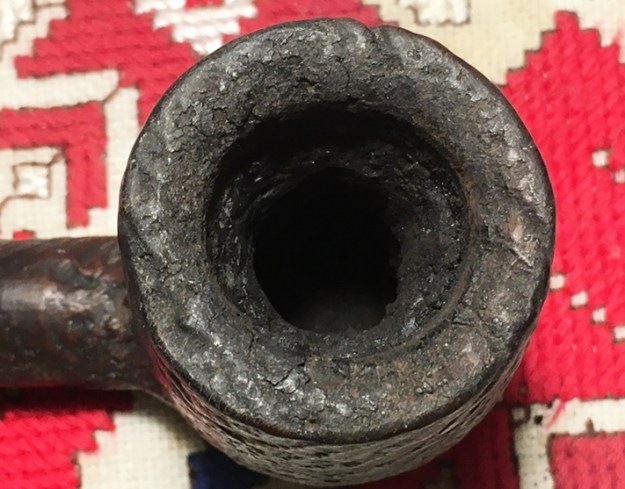
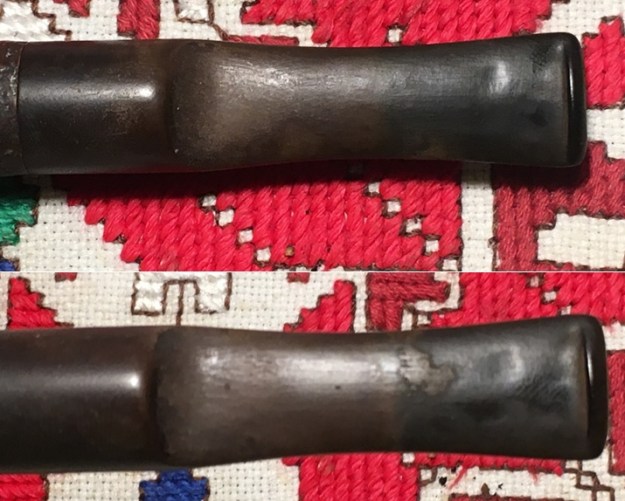
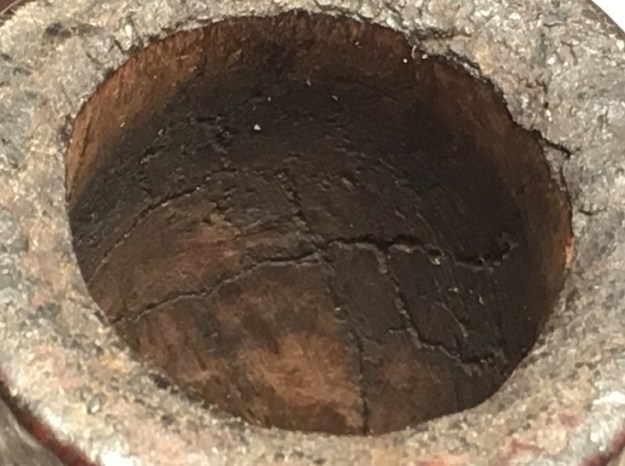
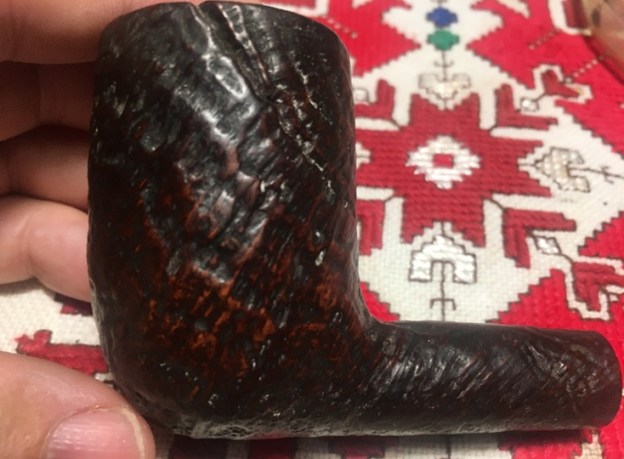
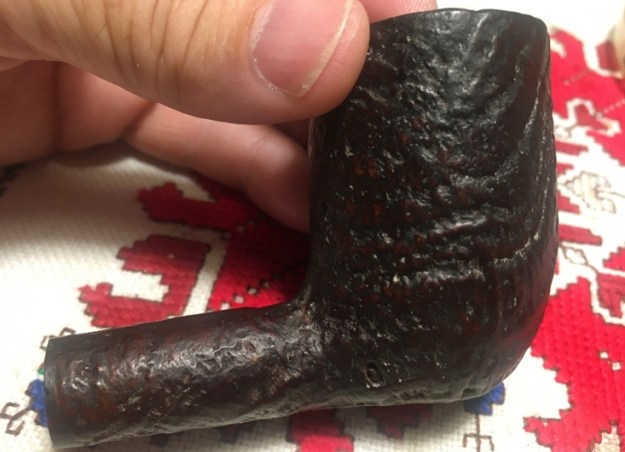
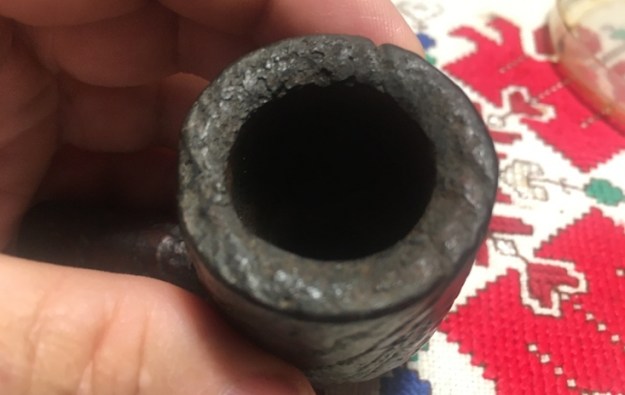
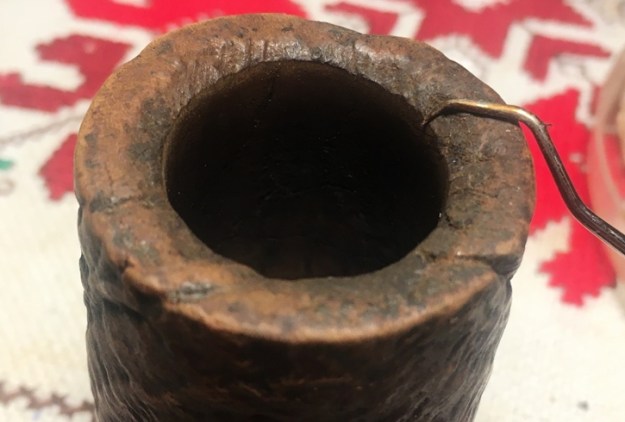
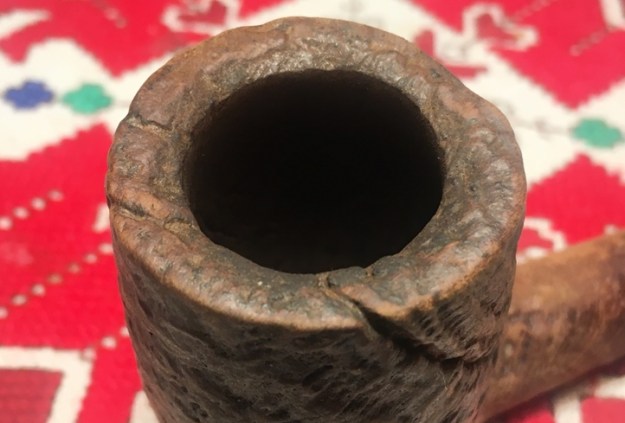
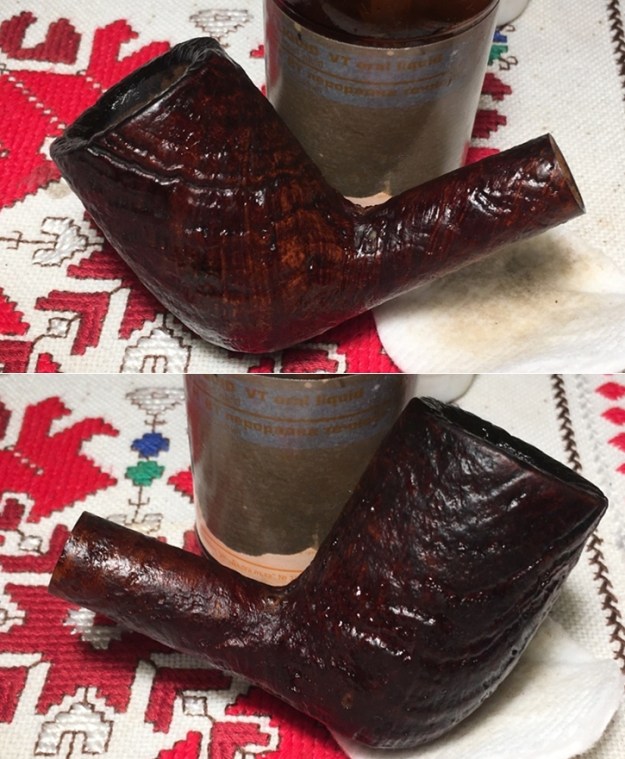
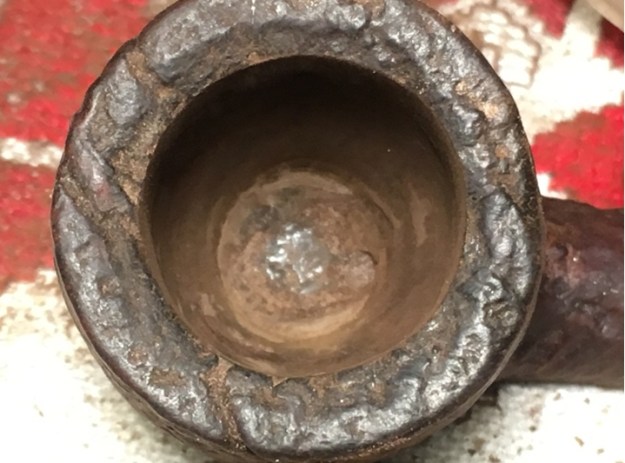
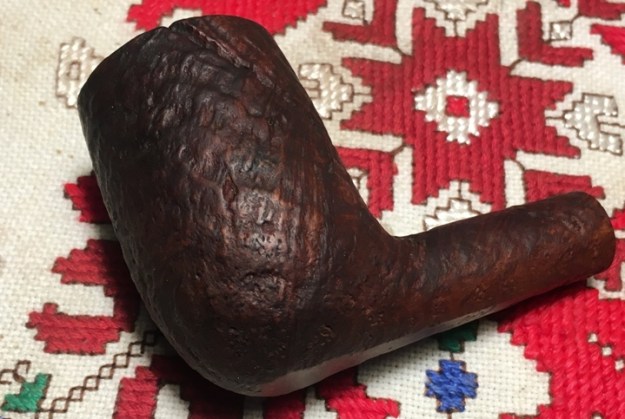
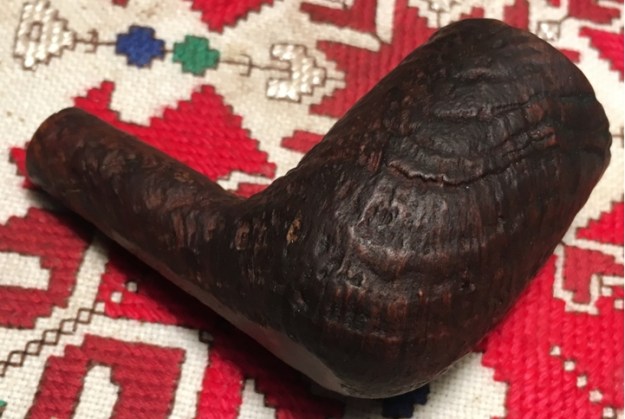
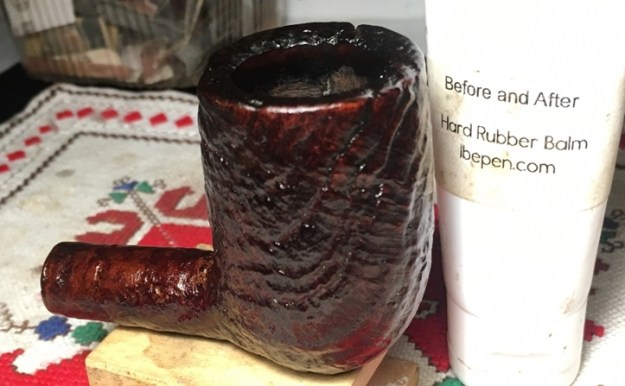
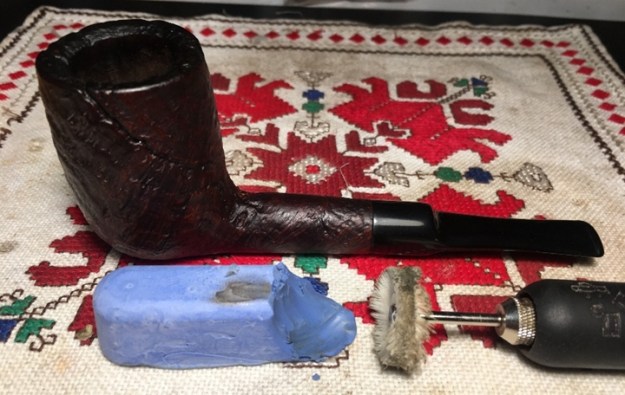
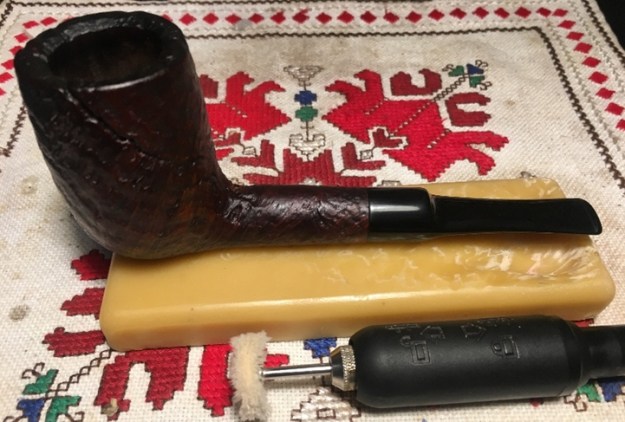
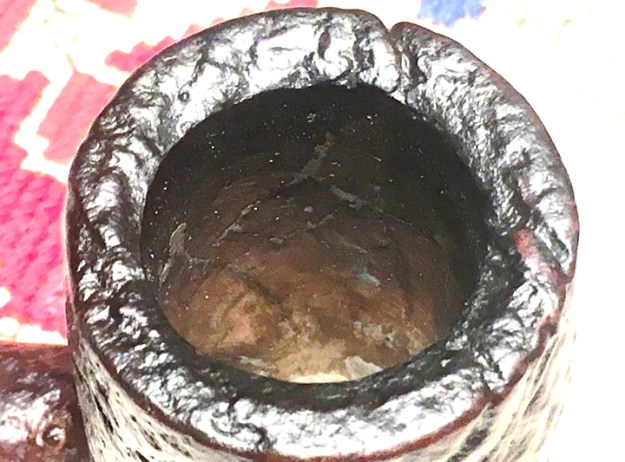
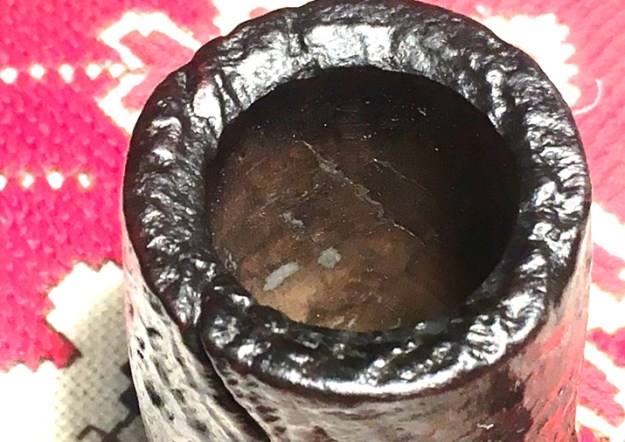
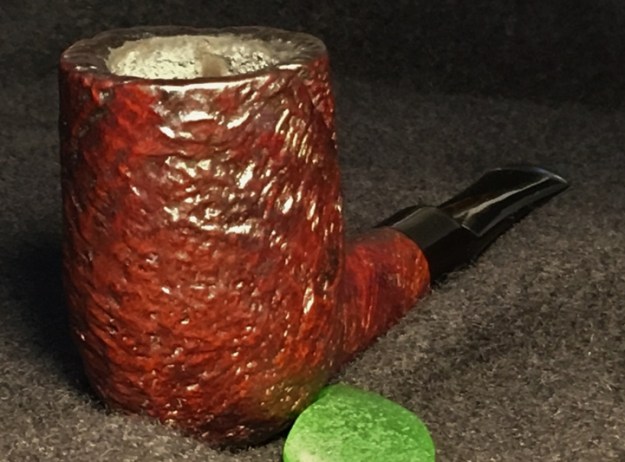
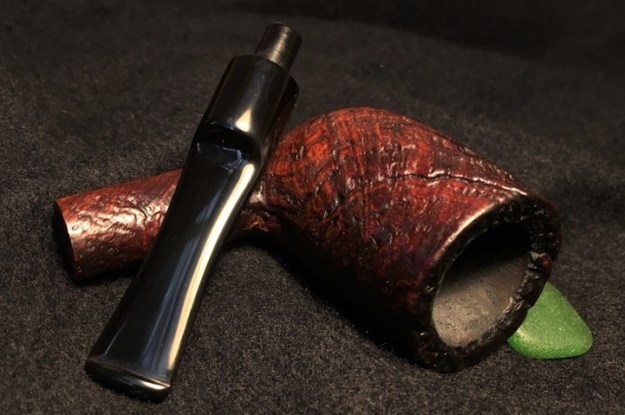
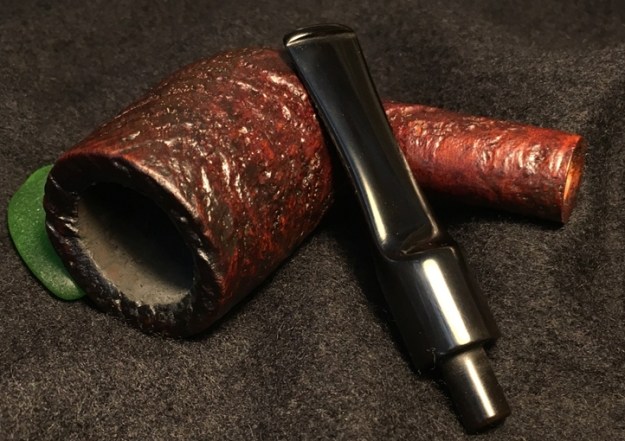
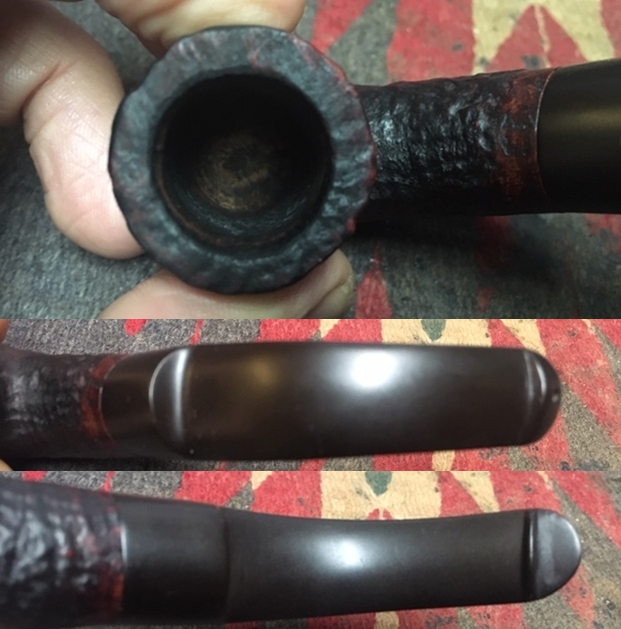
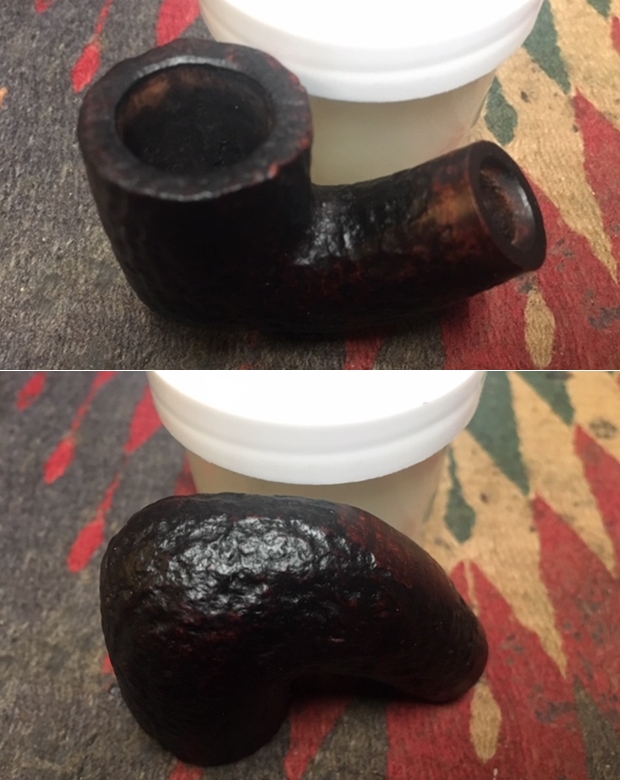
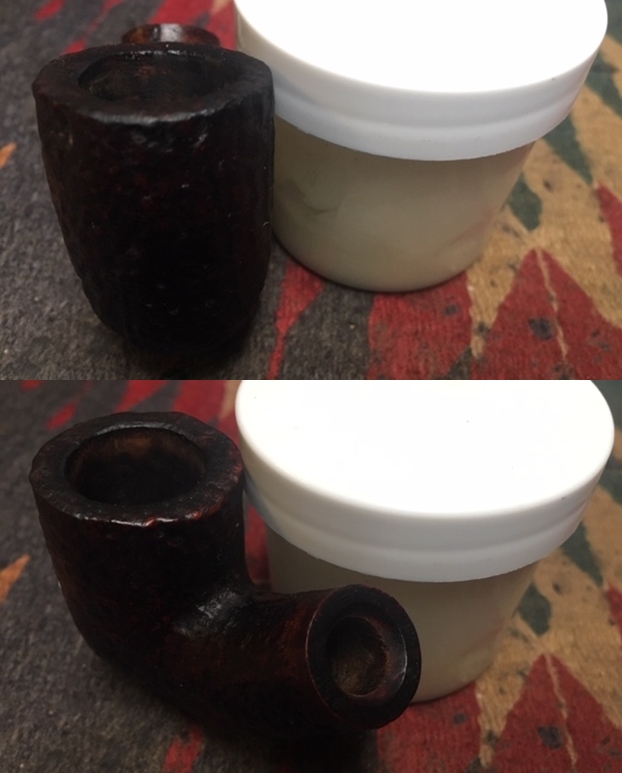
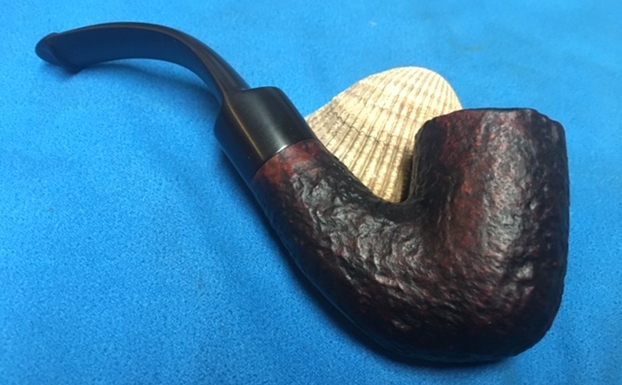
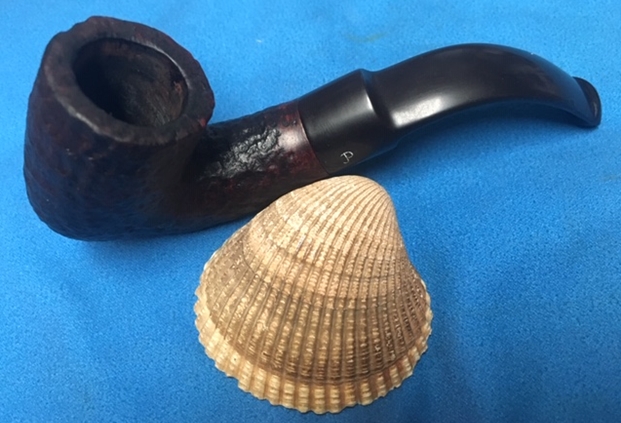
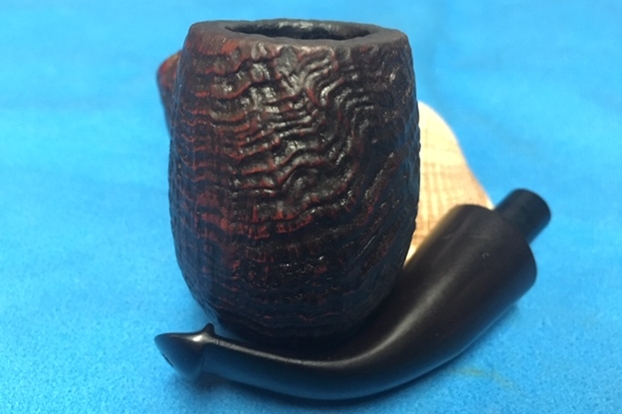
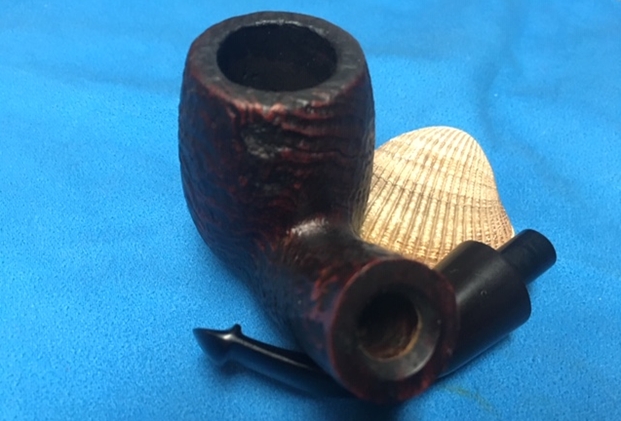
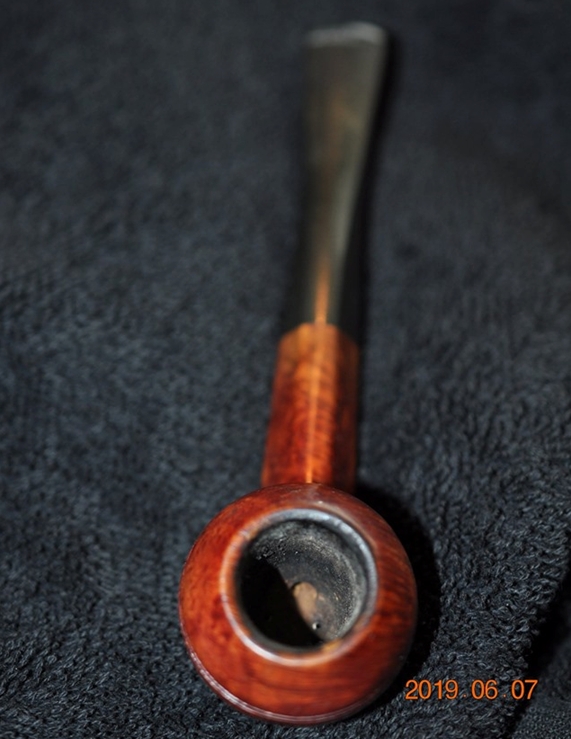
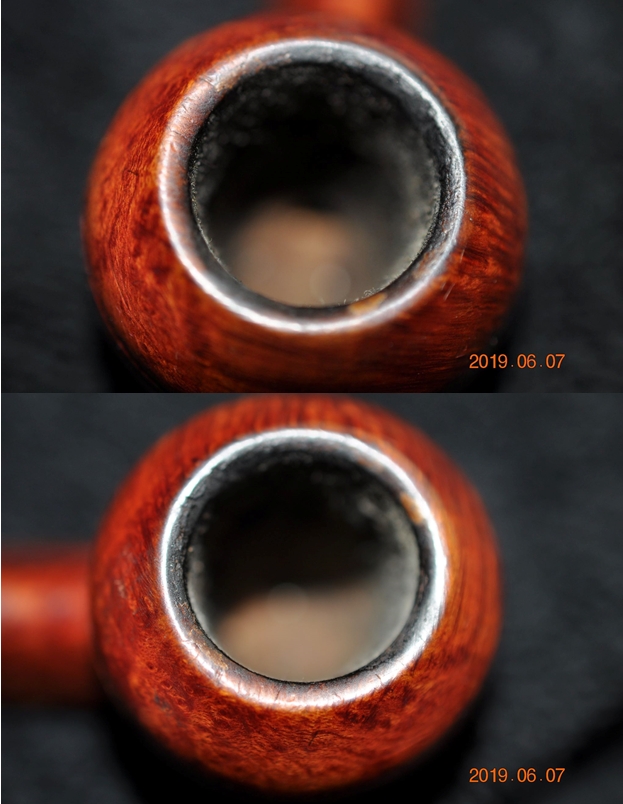
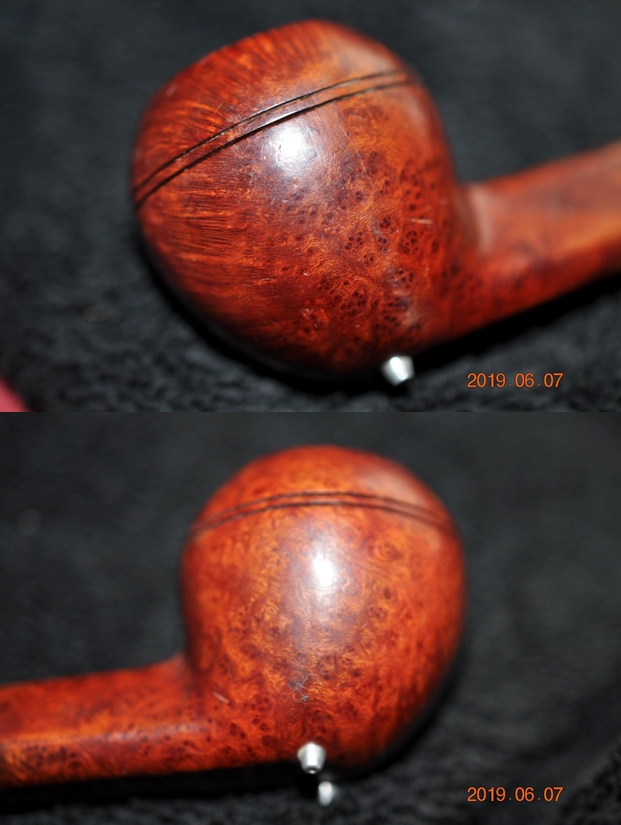
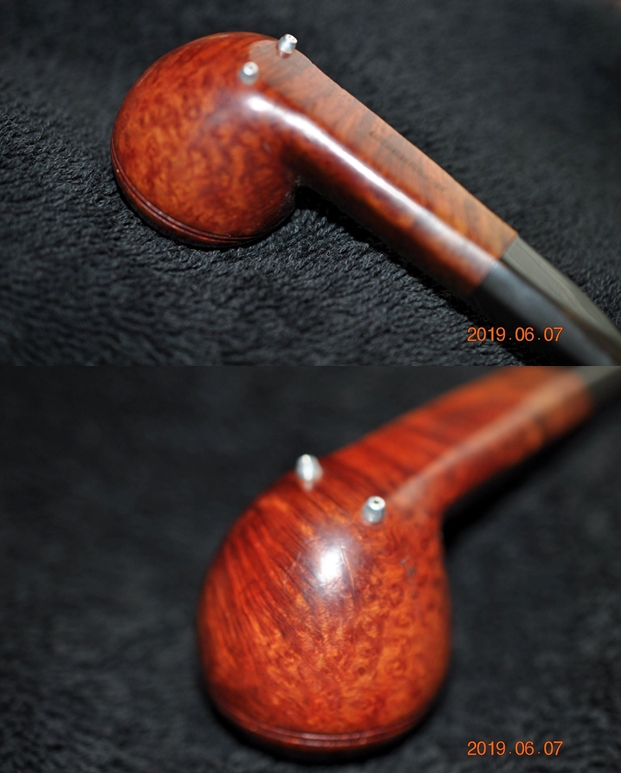
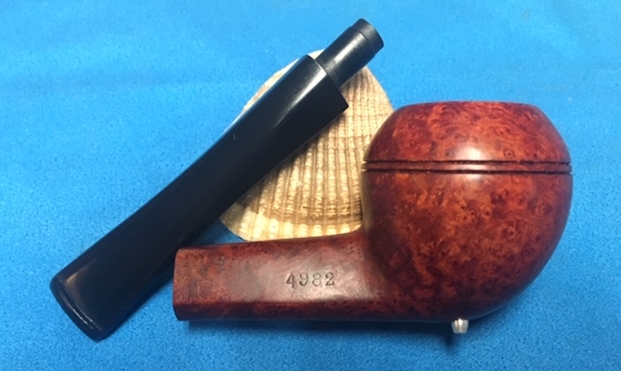
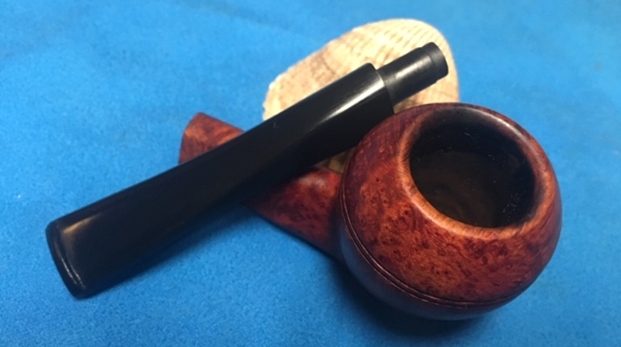
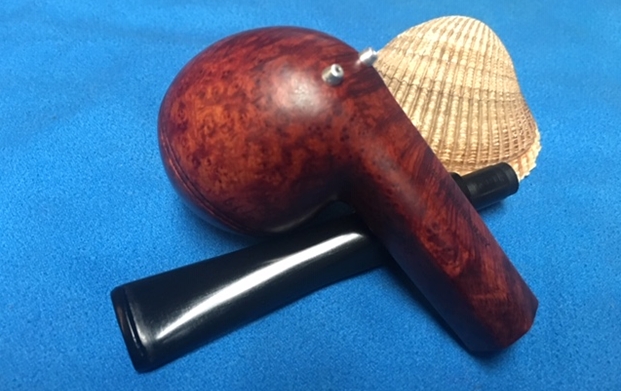
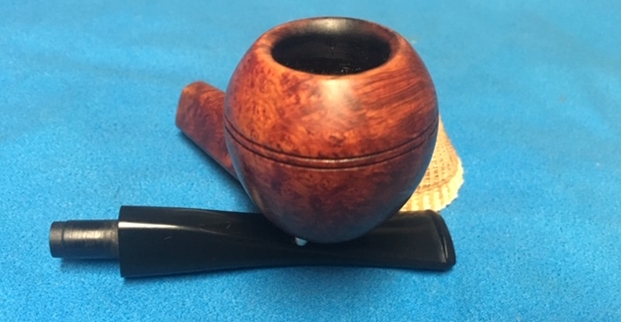
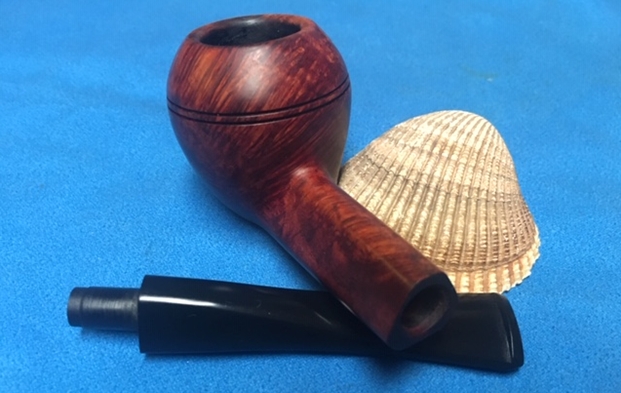
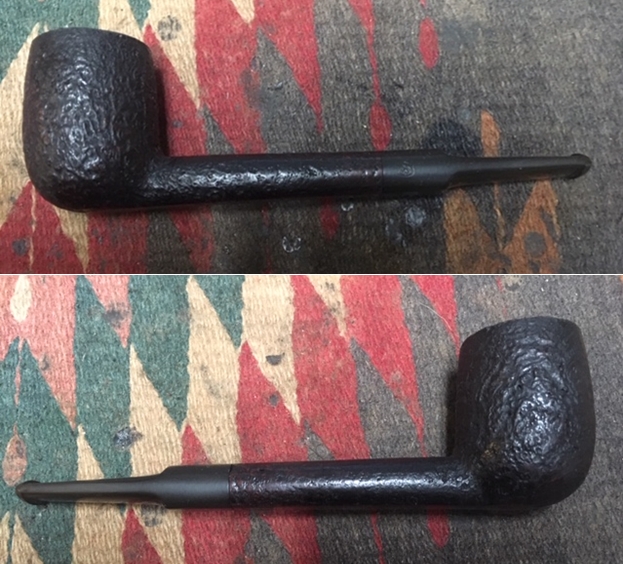
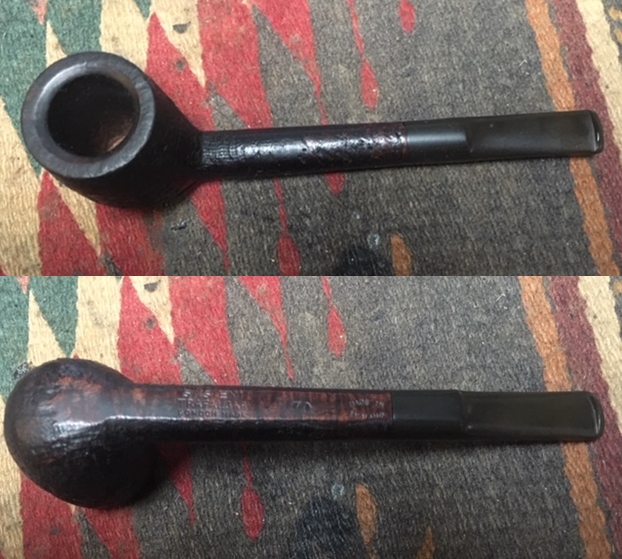
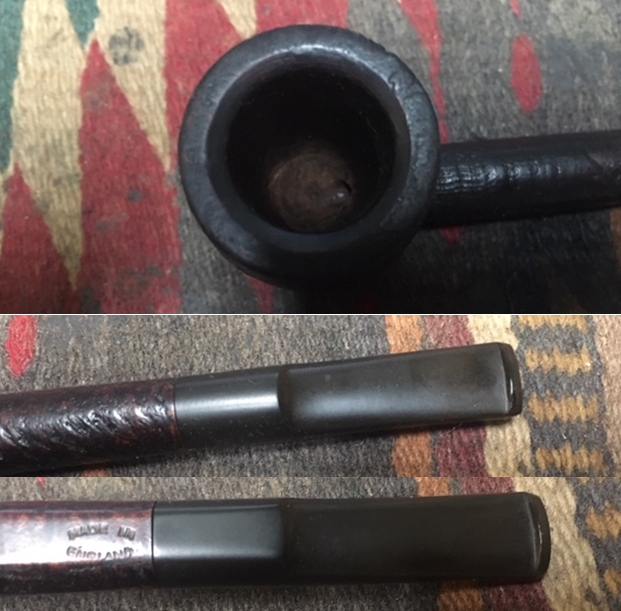
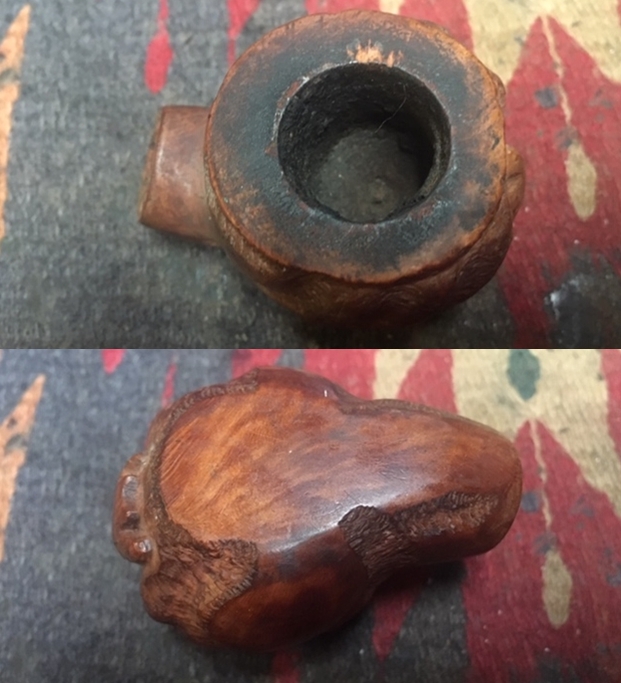
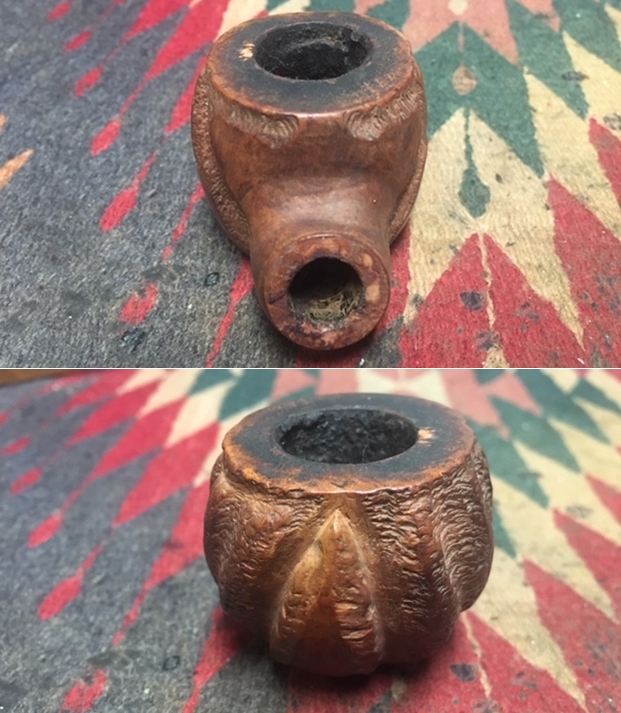
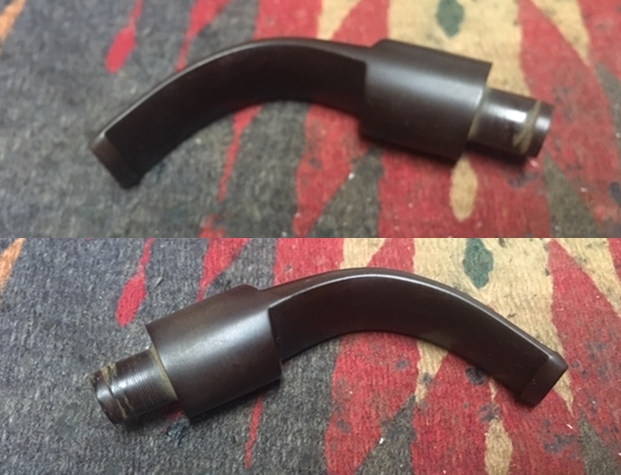
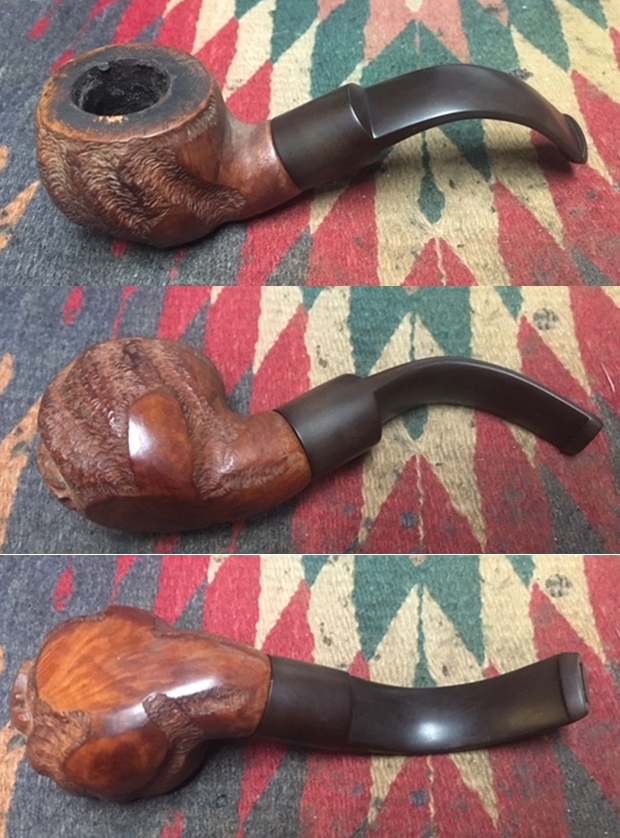
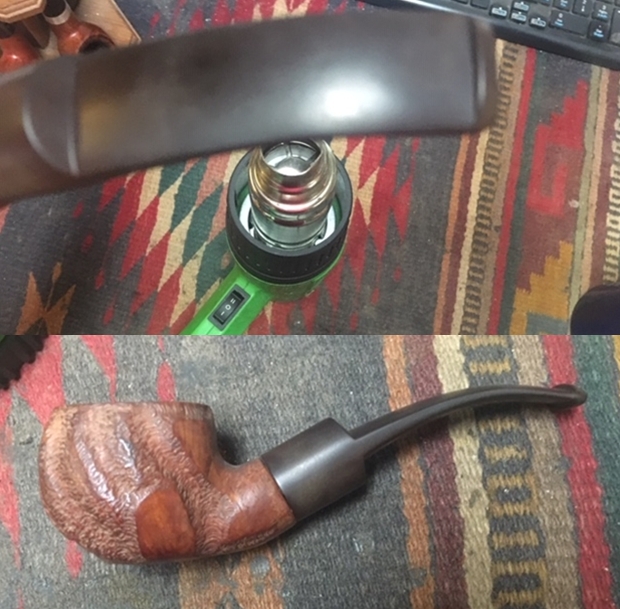
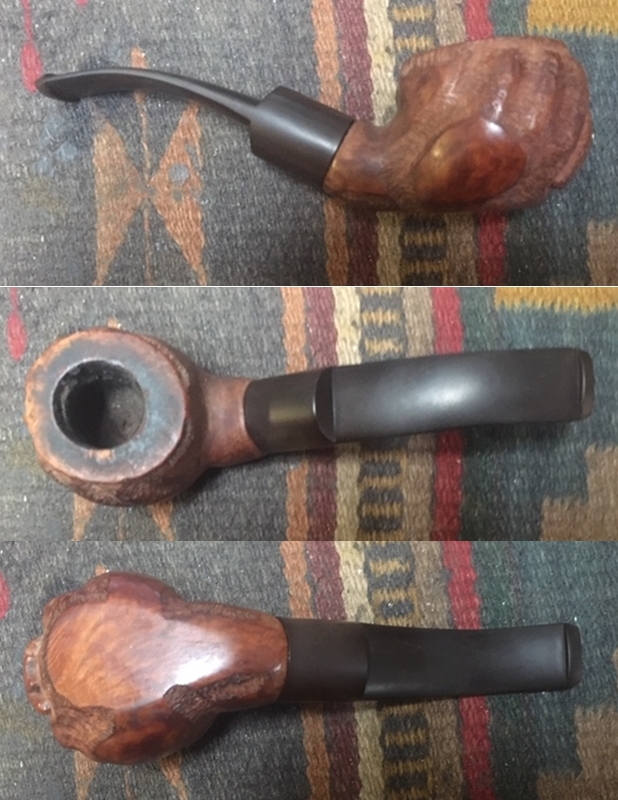
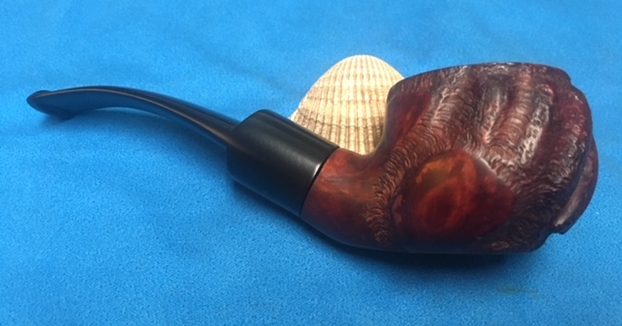
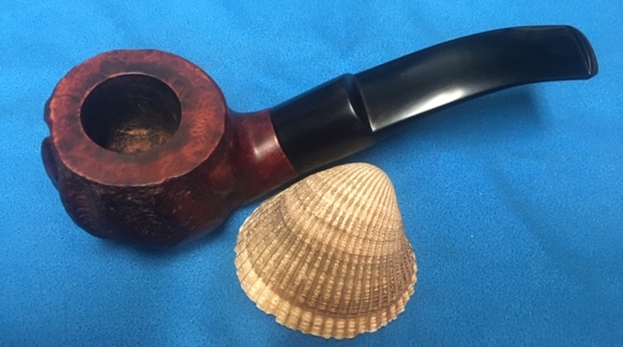
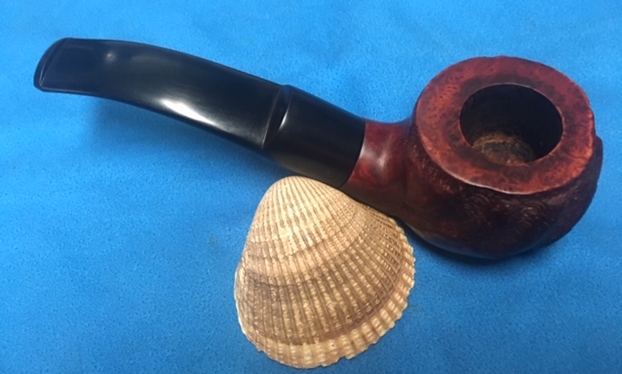
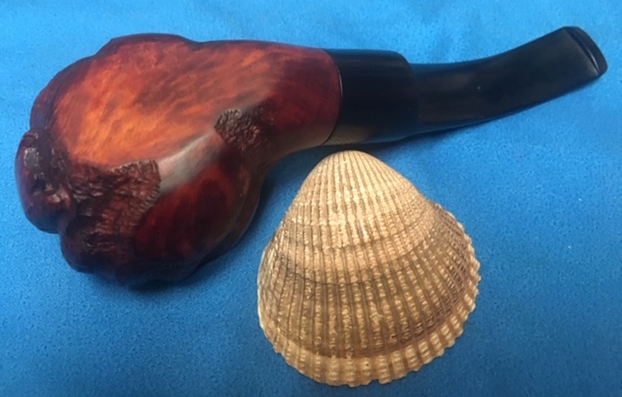
The next pipe I chose to work on has been sitting on my desk for a few weeks and since I just finished an older GBD Standard I decided to pick this GBD London Made up and work on it. It came in a recent box from my brother Jeff. He picked it up in one of the online auctions he frequents. It is interestingly shaped GBD – not even sure what I would call the shape as it is a bit of a Dublin and a bit of a pick axe. Very unique. The pipe is stamped on the top of the oval shank GBD in and oval London Made. On the underside of the shank it is stamped London, England over 9664 with a letter “E” stamped near the stem shank junction. The grain showing through the grime is a mix of swirls, cross grain and birdseye around the bowl sides and shank. It had a rich reddish brown stain but the finish was dirty and hard to see the colour well. There was a thick cake in the bowl and a light overflow of lava on the rim top. There was some darkening around the inner edge of the bowl and what looked like some damage toward the back edge. The stem was oxidized with light tooth marks and chatter on the top and underside near the button. The button was in excellent condition. Jeff took photos of the pipe before he started his cleanup work on it. Jeff took photos of the bowl and rim top to show the cake in the bowl and the lava build up on the edges of the bowl. The cake and edge speak to this being a good smoking pipe.Jeff took photos of the sides and heel of the bowl to show the condition of the finish – the pipe was dirty but the finish appeared to be in very good condition.  Jeff took photos of the stamping on the topside of the oval shank. The stamping was very readable – it read GBD in an oval over London Made. On the underside it read London, England over the shape number 9664 with the letter “E” near the shank/stem union.  Jeff took photos of the top and underside of the stem showing the scratching, oxidation and light tooth damage to the stem surface and slight wear to the edges of the button. I turned to Pipedia’s article on GBD to see if I could find any information on the London Made. The article gives a lot in terms of the history of the brand and a list of various lines of GBD pipes (https://pipedia.org/wiki/GBD_Model_Information). I quote the section where I found the reference to the London Made.

London Made — Factory unknown: Some might not be marked with GBD logo and some with additional “house” stampings. Introduced in 1978(?) plain wax finished branded pipes” available in at least six stains. – catalog (1981)

With that information in hand I knew what I was dealing with in terms of the stamping and the age of this pipe. I knew from the information from the section quoted that the London Made originally came out in 1978 in a variety of colours. Now I had an idea of the age of the pipe and it was time to work on the pipe.

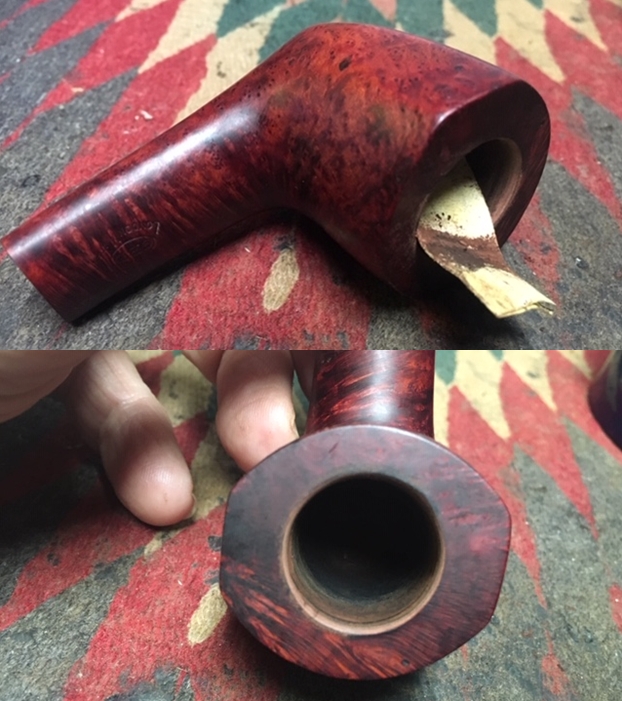
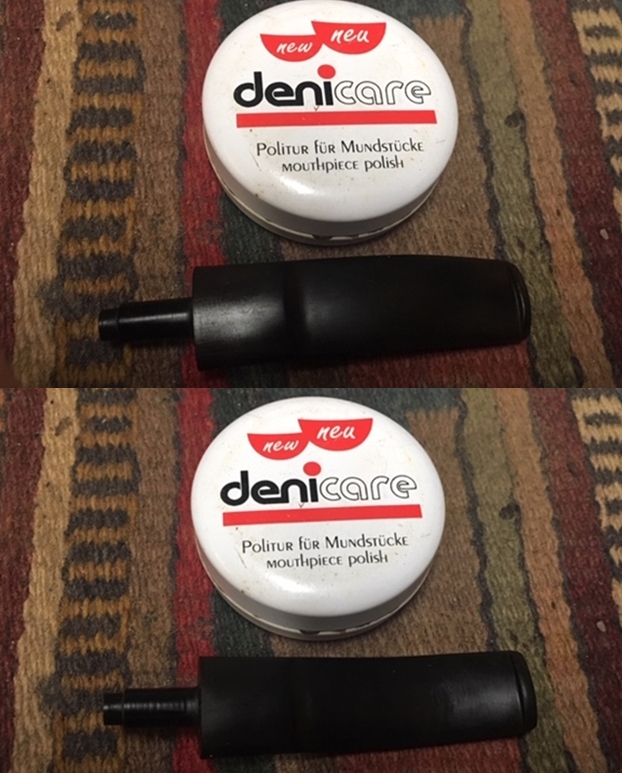
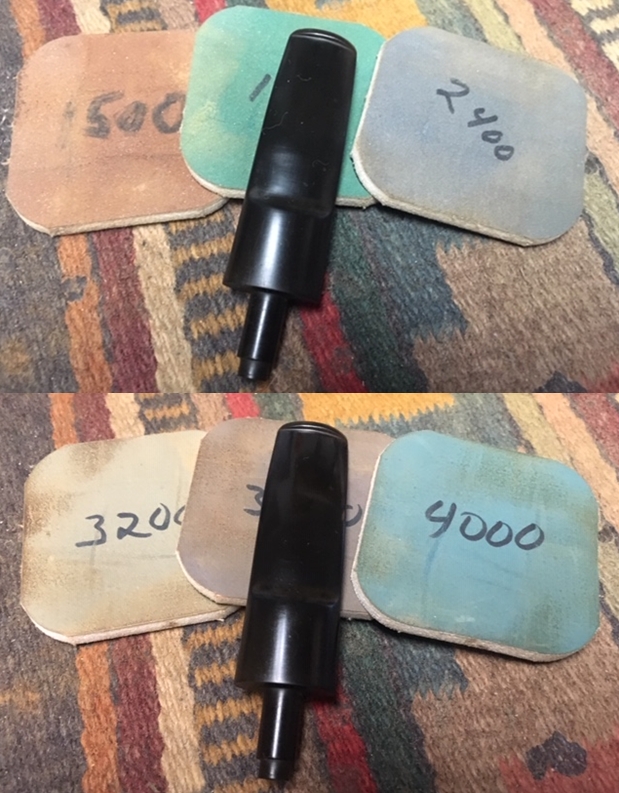
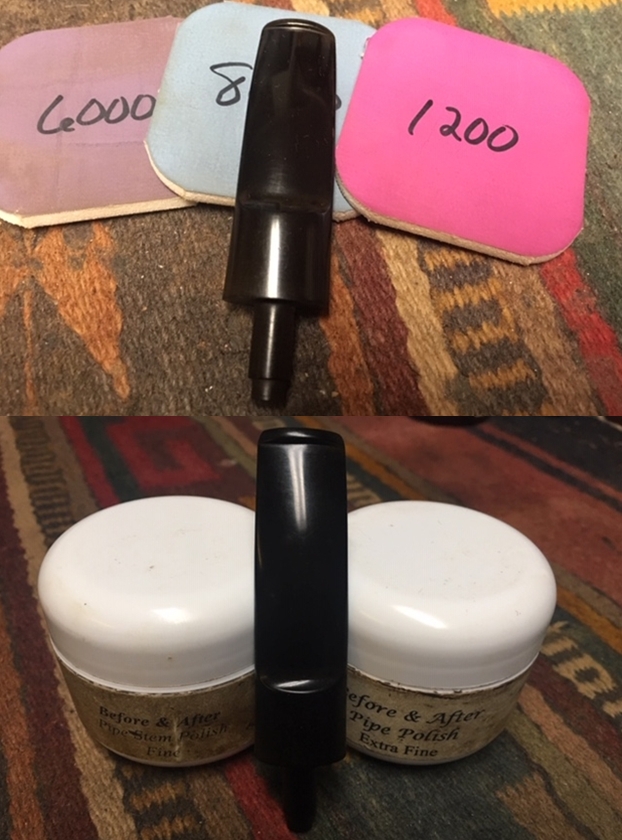
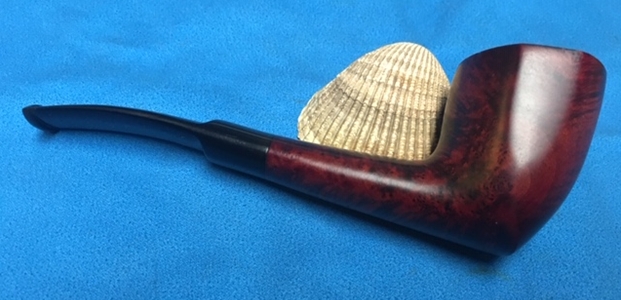
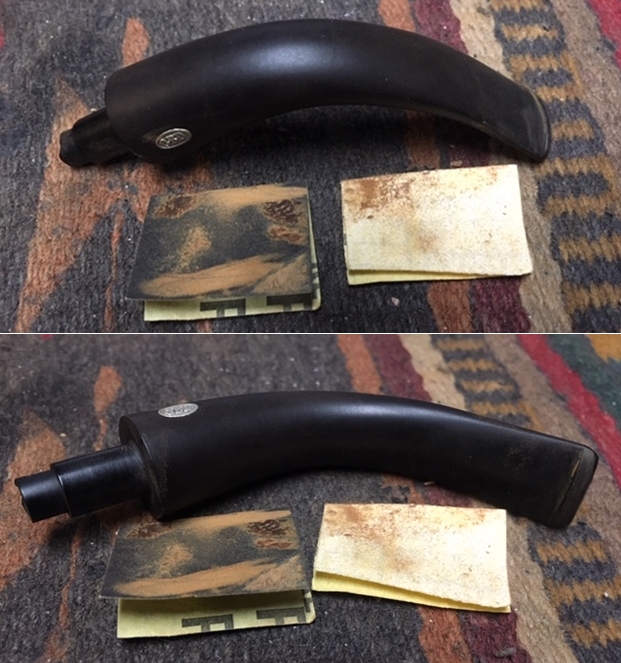
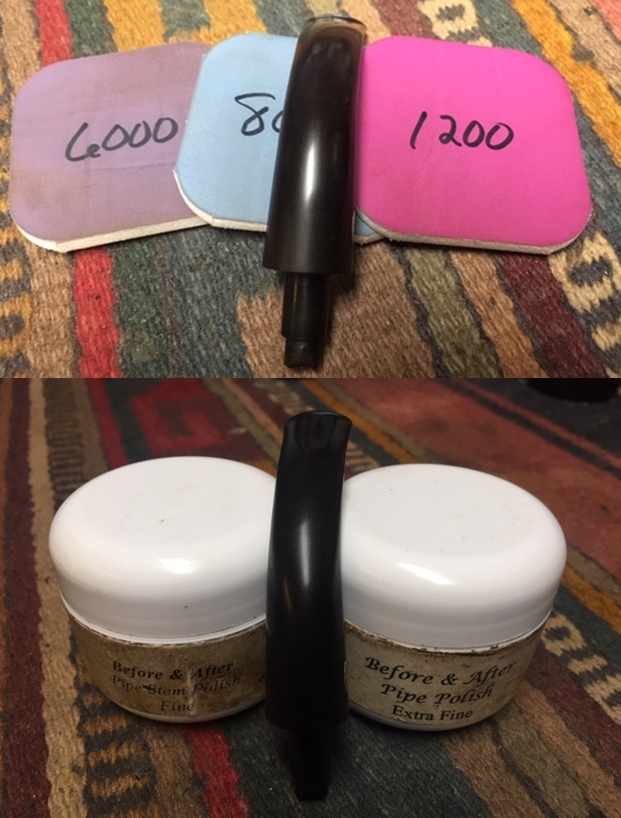
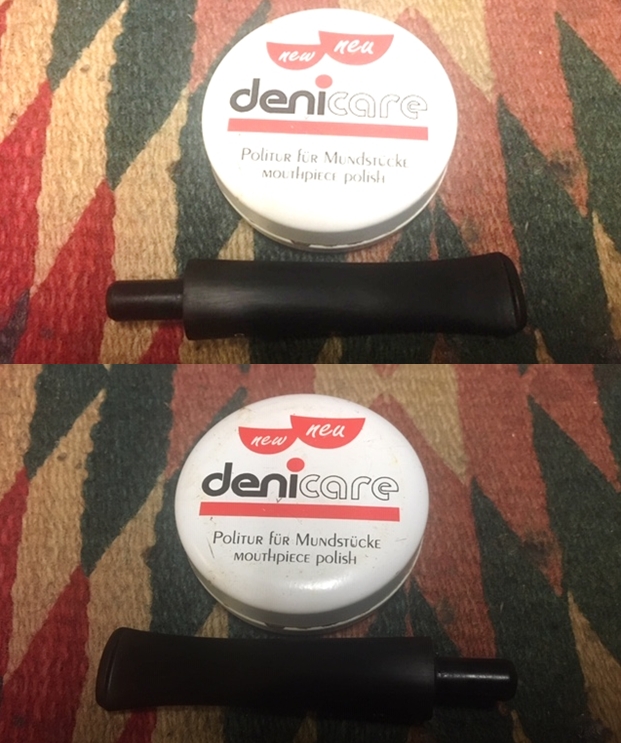
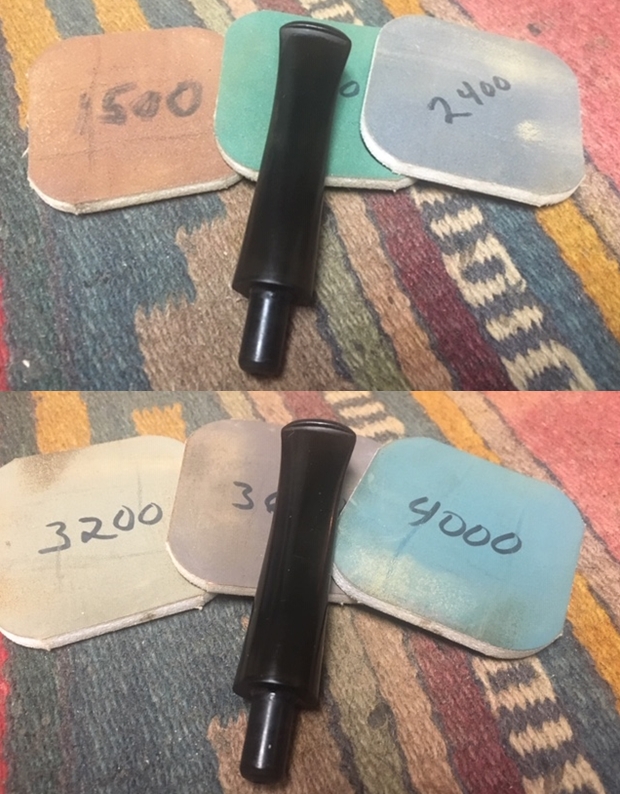
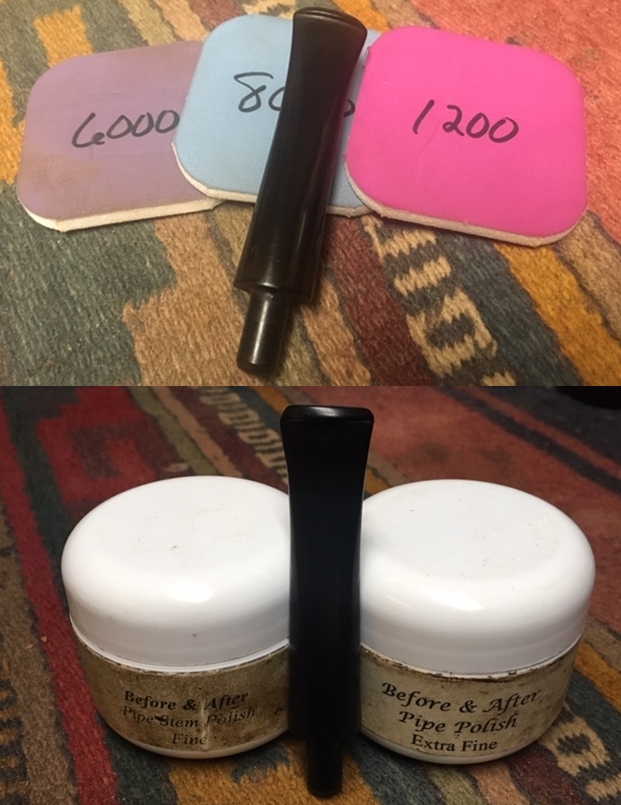
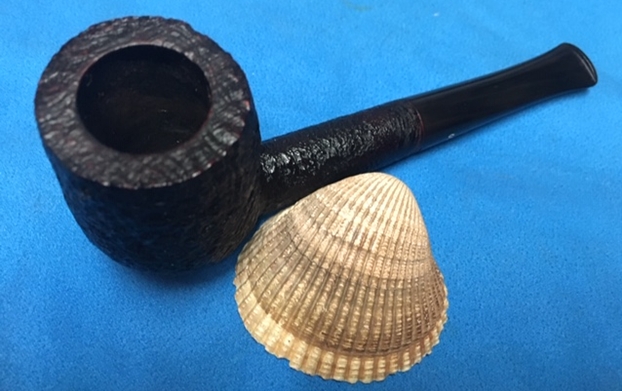
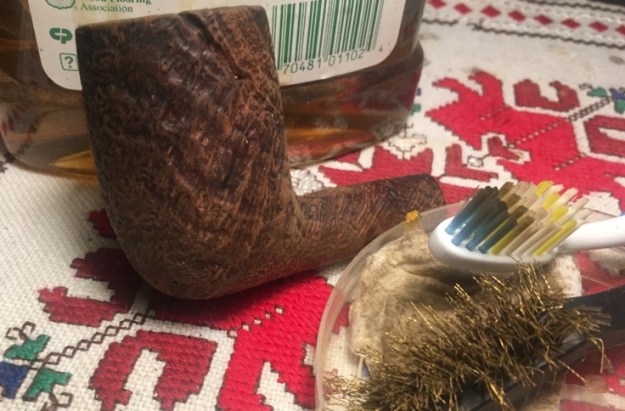
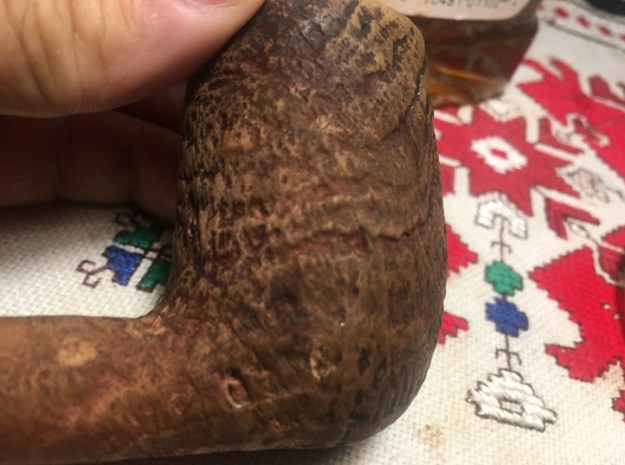
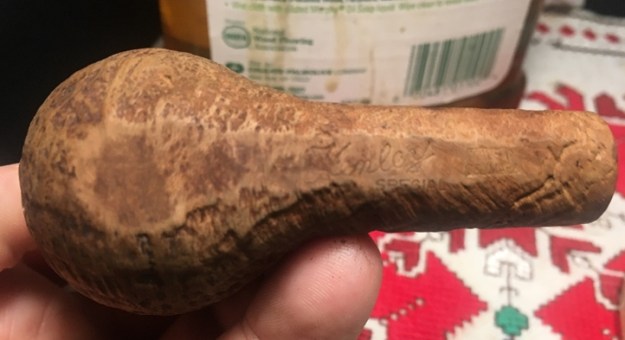
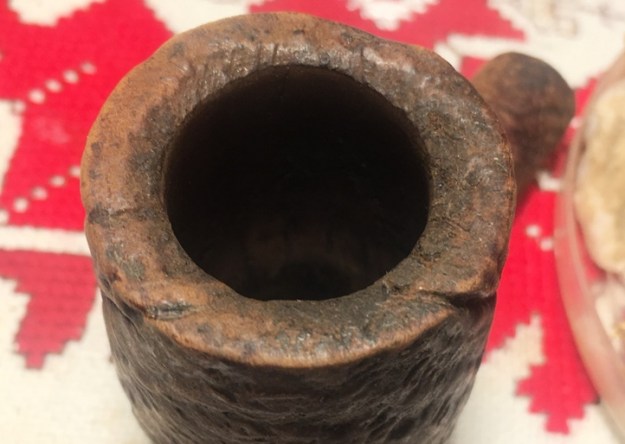
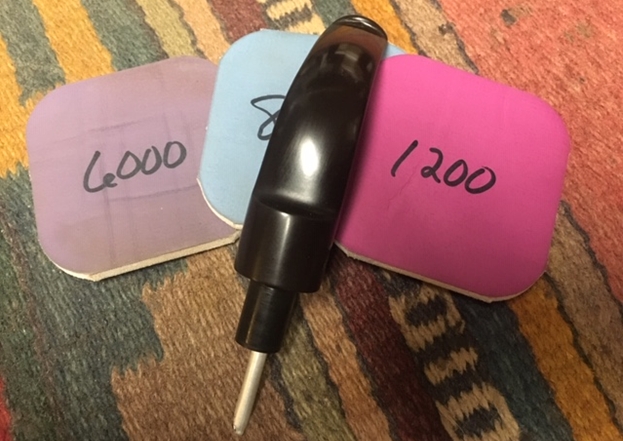
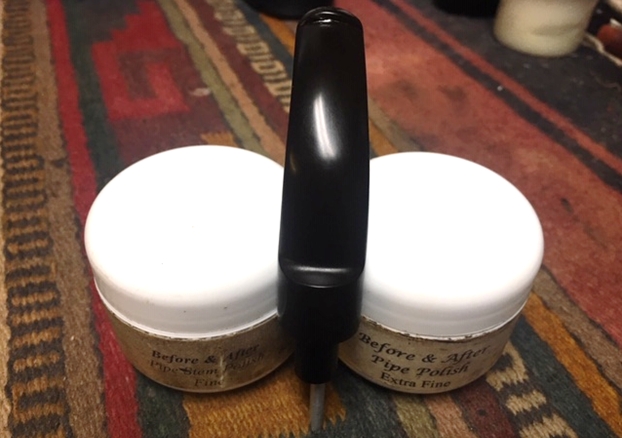
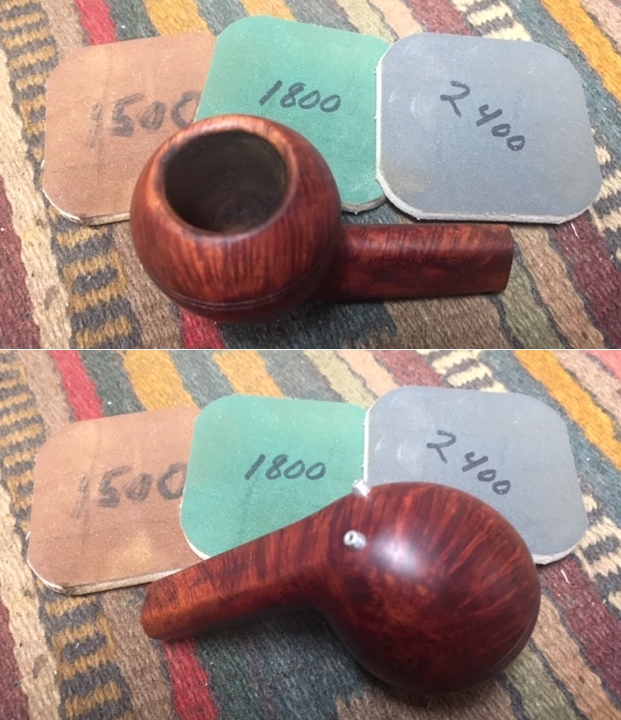
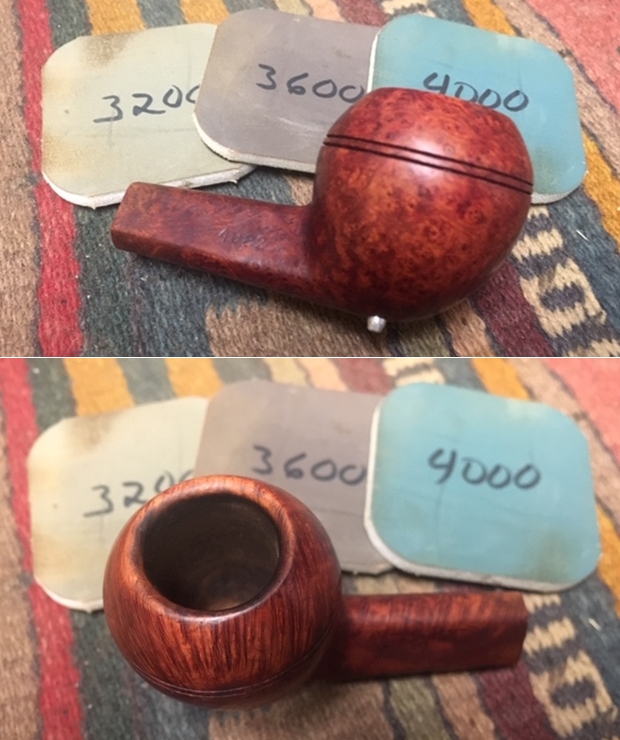
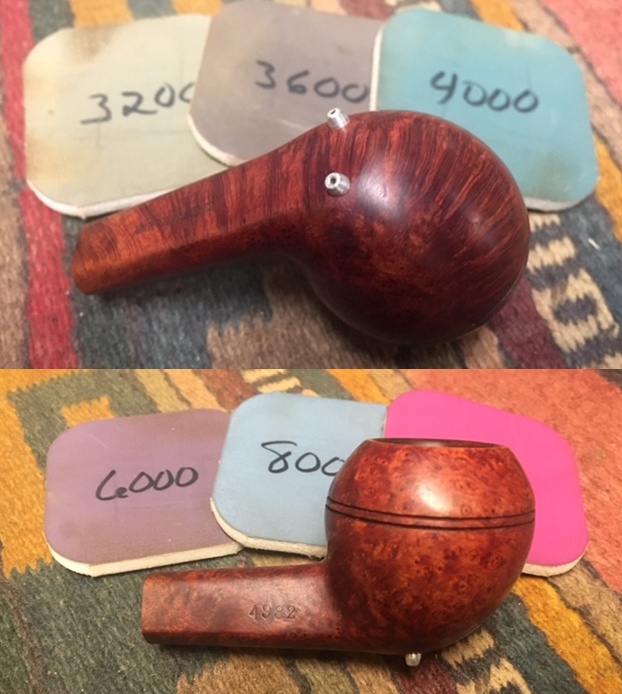
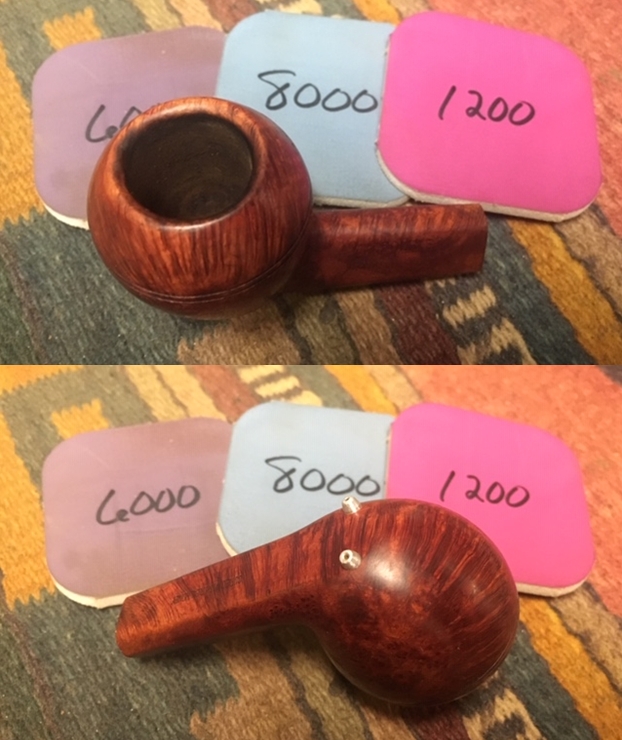
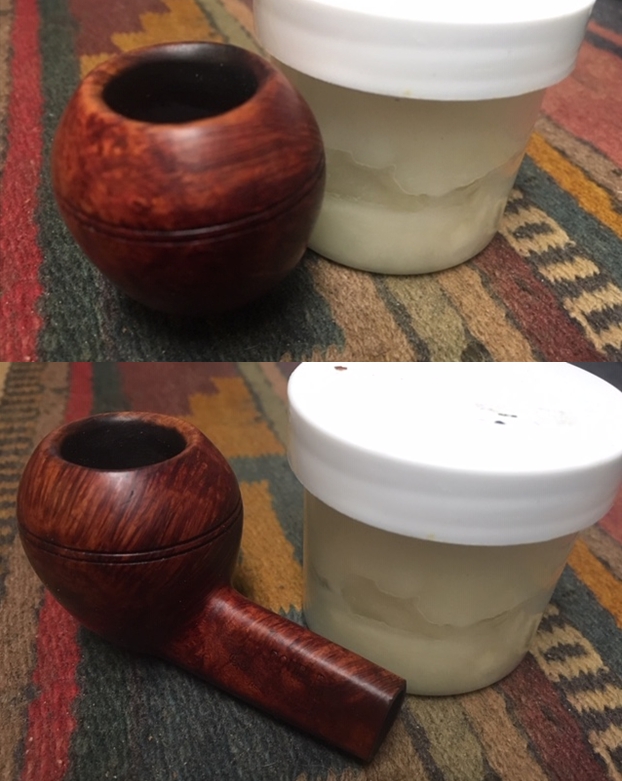
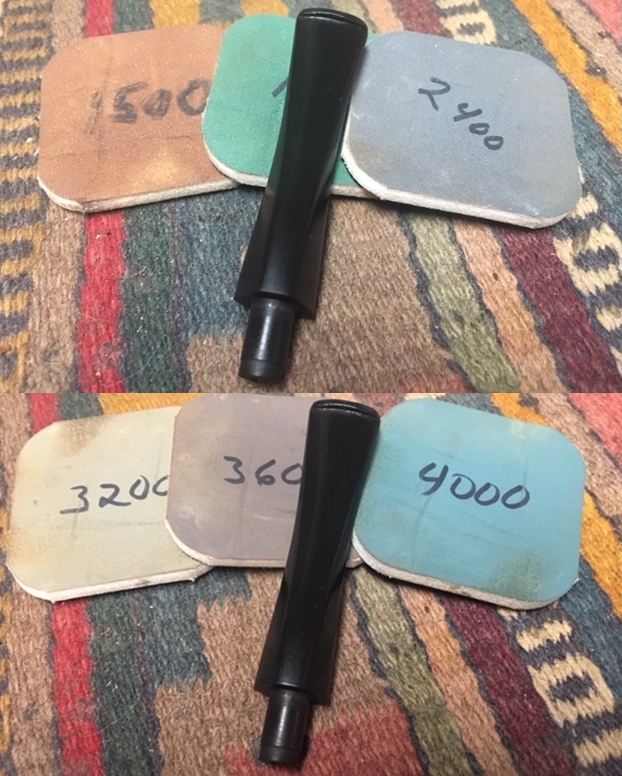
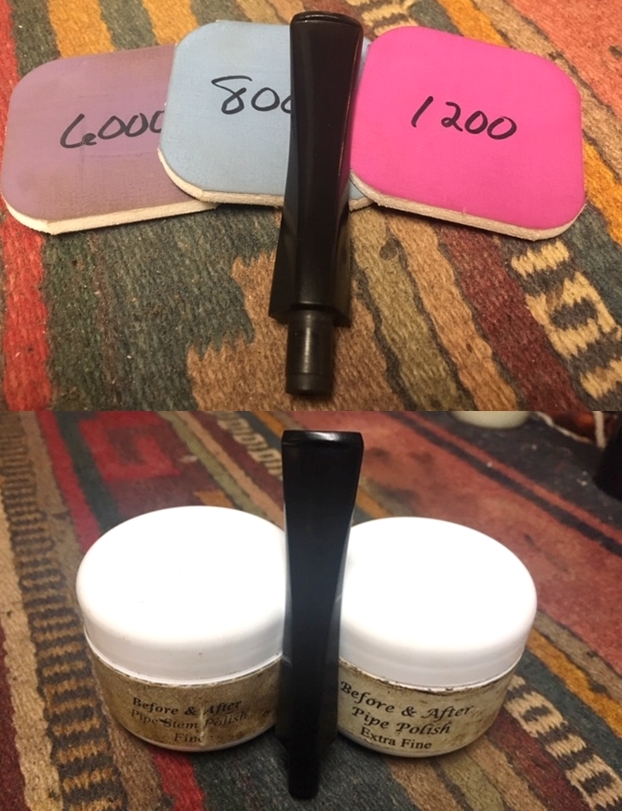
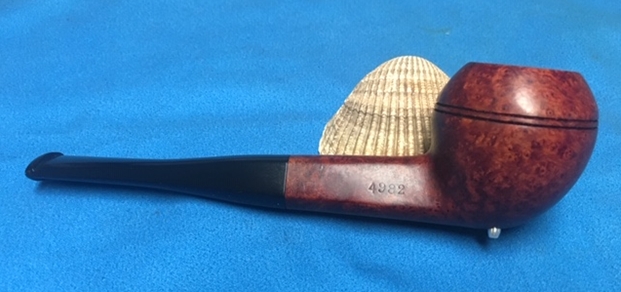
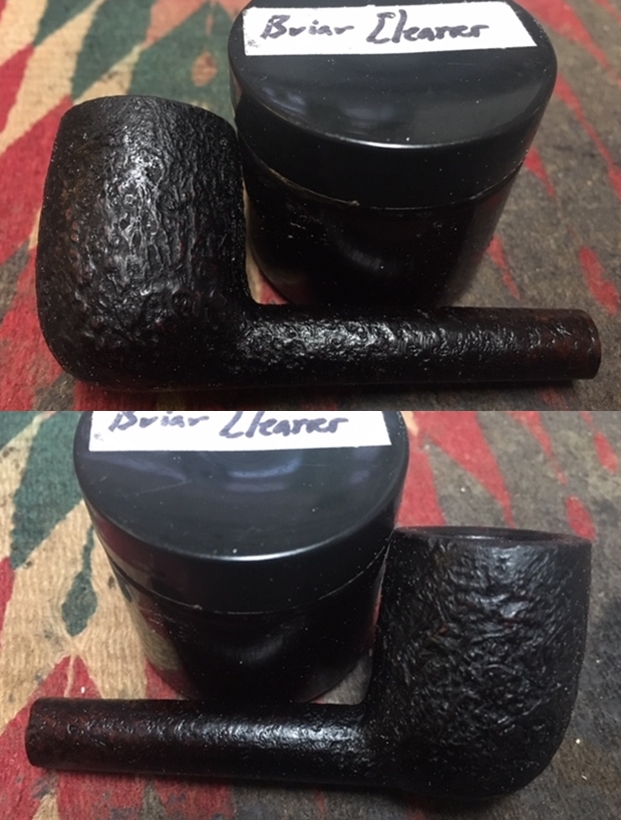
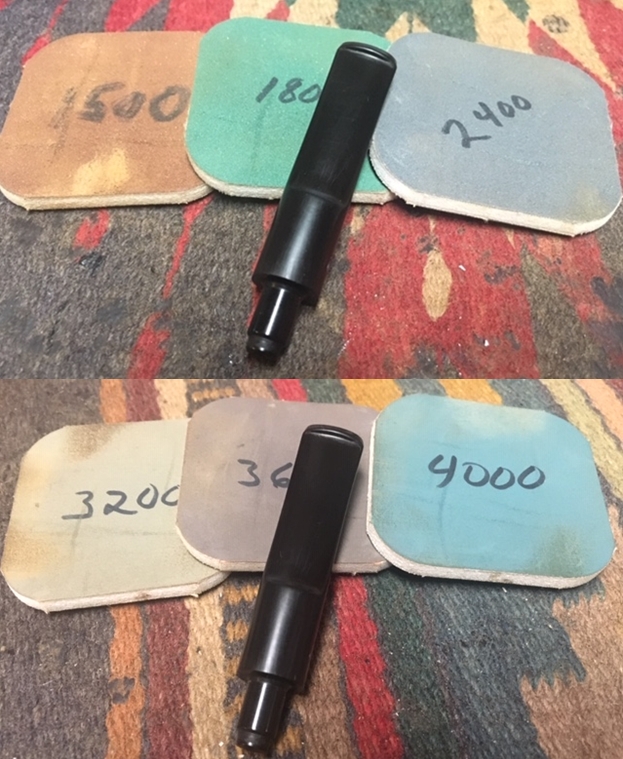
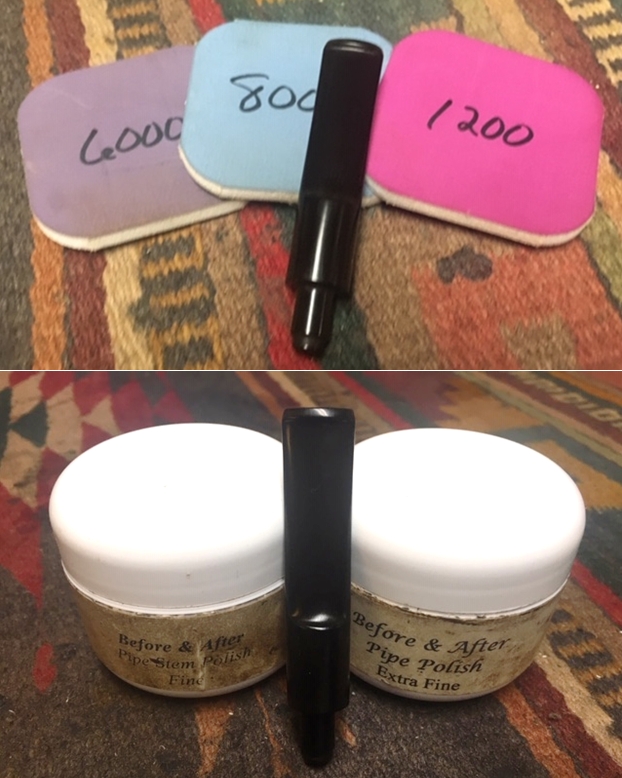
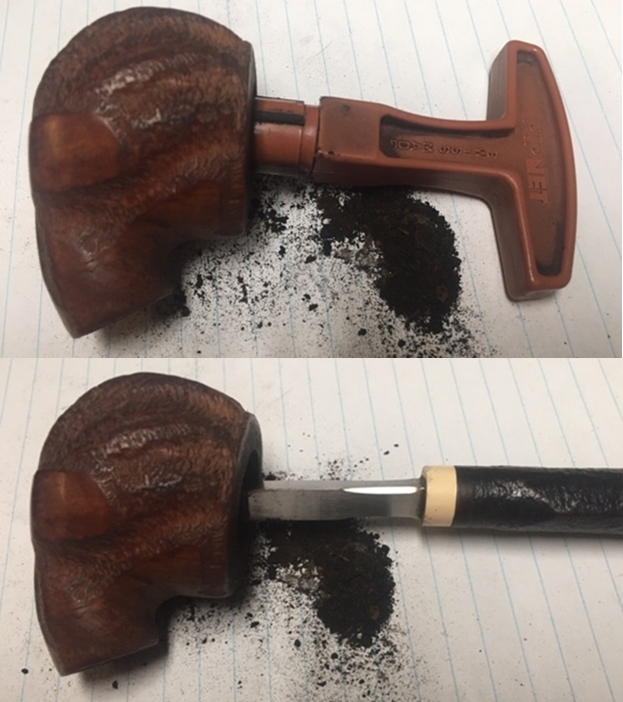
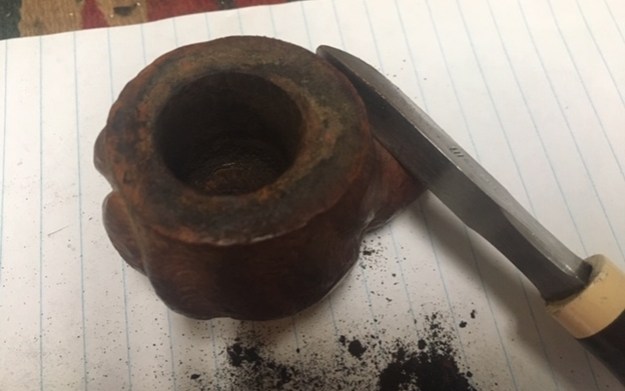
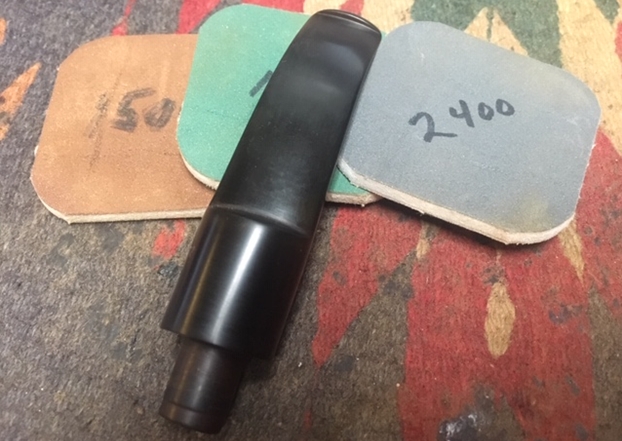
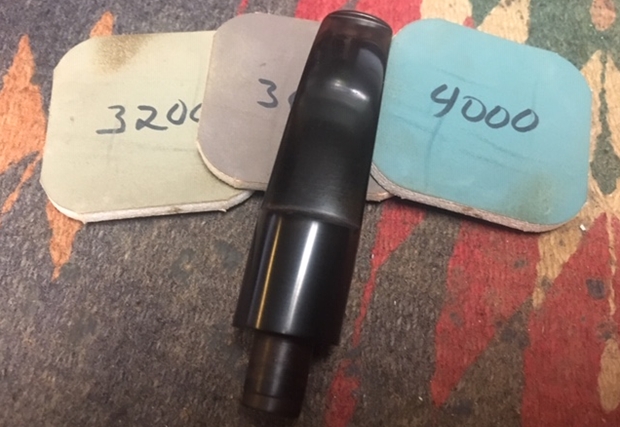
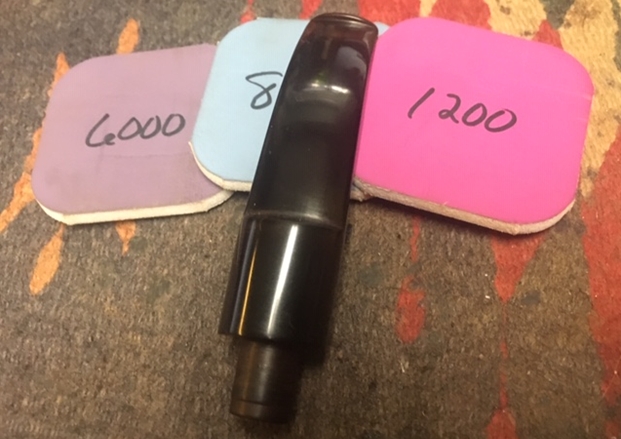
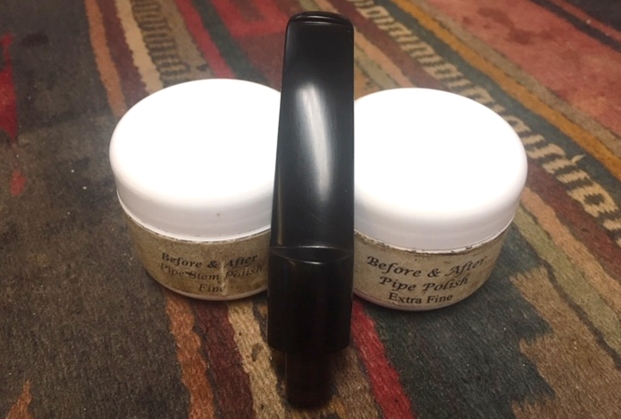
Jeff cleaned the pipe with his usual penchant for thoroughness that I really appreciate. This one was a real mess and I did not know what to expect when I unwrapped it from his box. He reamed it with a PipNet pipe reamer and cleaned up the reaming with a Savinelli Fitsall Pipe Knife. He scrubbed out the internals with alcohol, pipe cleaners and cotton swabs until the pipe was clean. He scrubbed the exterior of the bowl with Murphy’s Oil Soap and a tooth brush to remove the grime and grit on the briar and the lava on the rim top. The finish looks very good with good looking grain around the bowl and shank. Jeff soaked the stem in Before & After Deoxidizer to remove the oxidation on the rubber. When the pipe arrived here in Vancouver for the second stop of its restoration tour it looked very good. I took photos before I started my part of the work. I took some close up photos of the rim top and also of the stem surface. I wanted to show the clean top and the damage to the inner edge. The back of the bowl had been charred and there was some roughening and darkening around the rest of the inner edge of the bowl. The inside of the bowl looked very good. I also took close up photos of the stem to show the remaining oxidation and the lack of tooth marks and chatter in front of the button on both sides. There is also a faint remnant of the GBD oval stamp on the top of the saddle.I also took photos of the stamping on the pipe on the top underside of the shank. It read as noted above.  I started my work on the pipe by addressing the burned area on the inner edge of the rim. I used a folded piece of 220 grit sandpaper to smooth out the damage and give the edge a very slight bevel to remove the damage.I worked some Before & After Restoration Balm into the finish of the bowl and the rim top with my fingertips to clean, enliven and protect it. I find that the balm really makes the briar come alive again. The contrasts in the layers of stain really made the grain stand out. I let the balm sit for a little while and then buffed with a cotton cloth to raise the shine. The pipe really looks good at this point. I am very happy with the results.  I set the bowl aside and started working on the stem. I sanded the stem with 220 grit sandpaper to blend the chatter and remaining marks into the surface of the stem. I started the polishing with 400 grit wet dry sandpaper. I wiped the stem off with Obsidian Oil to remove the dust and see where I was at with the stem. I rubbed the stem down with Denicare Mouthpiece Polish. I have a few tins of this laying around so I am trying to use them up. It does a pretty good job polishing the stem. I polished the stem with micromesh sanding pads – wet sanding it with 1500-12000 grit pads and wiped it down with Obsidian Oil. I polished it further with Before & After Pipe Stem Polish – both fine and extra fine. I finished by wiping it down with Obsidian Oil and set it aside to dry. I put the stem back on the bowl and polished the bowl and stem with Blue Diamond polish on the buffing wheel. I gave the bowl and the stem multiple coats of carnauba wax. I buffed the pipe with a clean buffing pad to raise the shine. I hand buffed it with a microfiber cloth to deepen the shine. The shine on it makes the variations of colour really pop. The pipe polished up really well. The polished black vulcanite stem seemed to truly come alive with the buffing. This uniquely shaped pipe feels great in my hand and when it warms with smoking I think it will be about perfect. It must have been a fine smoking pipe judging from the condition it was when we received it. There should be a lot of life left in this GBD London Made 9664E.  Have a look at it in the photos below. The dimensions are Length: 5 ½ inches, Height: 1 ¾ inches, Outside diameter of the bowl: 1 ½ inches, Chamber diameter: ¾ of an inch. This is one that will go on the rebornpipes online store shortly. If you want to carry on the pipe trust of this unique GBD London Made let me know. Thanks to each of you who are reading this blog. Remember we are not pipe owners, we are pipemen and women who hold our pipes in trust until they pass on into the trust of the next pipeman or woman.

Back to Bob Kerr’s Estate – Working on a GBD Standard 9136 Bent Billiard


Blog by Steve Laug

I am changing up my work on Bob Kerr’s estate again by taking on this GBD Standard 9136 bent billiard. This is the first of his GBD pipes that I am working on. I am cleaning them for the family and moving them out into the hands of pipemen and women who will carry on the trust that began with Bob and in some pipes was carried on by Bob. In the collection there were 19 Peterson’s pipes along with a bevy of Dunhills, some Comoy’s and Barlings as well as a lot of other pipes – a total of 125 pipes along with a box of parts. This is the largest estate that I have had the opportunity to work on. I put together a spread sheet of the pipes and stampings to create an invoice. I was taking on what would take me a fair amount of time to clean up. I could not pass up the opportunity to work on these pipes though. They were just too tempting. This lovely GBD Standard is a great break. It is a shape that is interesting and unique. It will go on the rebornpipes store.

I have been collecting and restoring GBD pipes for as long as I have worked on pipes. This one also has some beautiful mixed grain – birdseye, cross and flame grain. It is a beauty! The pipe is stamped GBD over Standard on the left side of the shank. On the right side it is stamped London, England followed by the shape number, 9136. The swirls of grain poking through the grime and dirt are a mixture that leaves a rich look and feel. It had a rich brown stain that does not look too bad. There are nicks in the briar on the sides and heel of the bowl. There was a thick cake in the bowl with remnants of tobacco stuck on the walls. There was a light lava overflow on the rim. The edges of the rim and top are dirty but look pretty pristine under the grime. It was a beautiful pipe that was dirty and tired looking. The stem was oxidized and calcified toward the end. Again, surprisingly did not have the tooth marks that I have come to expect from Bob’s pipes. Jeff took photos of the pipe before he started his cleanup work on it. Jeff took photos of the bowl and rim top to show the cake in the bowl and the lava build up on the edges of the bowl. It was thick and hard but hopefully it had protected the rim and edges from damage. The edges look pretty good. Jeff took photos of the sides and heel of the bowl to show the condition of the finish. You can see the beautiful grain. The front of the bowl had some deep nicks toward the bottom of the bowl as seen in the first photo. The finish was very dirty.   Jeff took photos of the stamping on the smooth panel on the underside of the bowl and shank. The stamping was readable as you can see from the photos. On the left side it read GBD in an oval over Standard. On the right side it read London, England over 9136. On the left side of the stem was an inlaid GBD roundel.  Jeff took photos of the top and underside of the stem showing the tooth chatter, scratching and oxidation on the stem surface and wear on the edges of the button.I turned to Pipedia’s article on GBD to see if I could find any information on the Standard. I was familiar with the New Standard but not the Standard. The article gives a lot in terms of the history of the brand (https://pipedia.org/wiki/GBD). I quote the section where I found the reference to the Standard.

The claims after the 1st World War demanded further distinctions. First of all was the London Made, which became the Standard London Made, followed by the New Era– in 1931 the top model asking 12½ Shilling. The Pedigree, although sketched around 1926, was not produced until the later 1930s. The New Standard was introduced in order to give the popular Standard of the 20s a higher rank in value. The Prehistoric, a deeply sandblasted black pipe, that still carried the small GBD Xtra stamp, was entirely new and unusual.

With that information in hand I knew what I was dealing with in terms of the stamping and the age of this pipe. I knew from the information from the section quoted that the Standard originally came out in the 20s. In the late 1930s the New Standard was introduced after the war. So this is one of Bob’s older pipes – late 1920s to early 30s. Now it was time to work on the pipe.

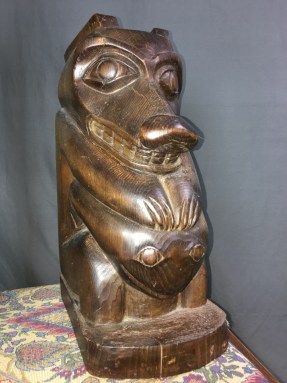
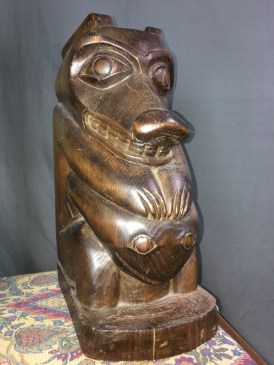
With over 125 pipes to clean from Bob’s estate I took a batch of them to the states with me on a recent visit and left them with Jeff so he could help me out. Jeff cleaned the pipe with his usual penchant for thoroughness that I really appreciate. This one was a real mess and I did not know what to expect when I unwrapped it from his box. He reamed it with a PipNet pipe reamer and cleaned up the reaming with a Savinelli Fitsall Pipe Knife. He scrubbed out the internals with alcohol, pipe cleaners and cotton swabs until the pipe was clean. He scrubbed the exterior of the bowl with Murphy’s Oil Soap and a tooth brush to remove the grime and grit on the briar and the lava on the rim top. The finish looks very good with good looking grain around the bowl and shank. Jeff soaked the stem in Before & After Deoxidizer to remove the oxidation on the rubber. When the pipe arrived here in Vancouver for the second stop of its restoration tour it looked very good. I took photos before I started my part of the work. I took some close up photos of the rim top and also of the stem surface. I wanted to show what an amazing job Jeff did in the cleanup of the rim top. The rim top looks very good. The sandblast finish is very nice. The bowl looked very good. I also took close up photos of the stem to show the lack of tooth marks and the remaining oxidation on the stem surface. Since this is another pipe Bob’s estate I am sure that some of you have read at least some of the other restoration work that has been done on the previous pipes. You have also read what I have included about Bob Kerr, the pipeman who held these pipes in trust before I came to work on them (see photo to the left). Also, if you have followed the blog for long you will already know that I like to include background information on the pipeman whose pipes I am restoring. For me, when I am working on an estate I really like to have a sense of the person who held the pipes in trust before I worked on them. It gives me another dimension of the restoration work. I asked Brian if he or his wife would like to write a brief biographical tribute to her father, Bob. His daughter worked on it and I received the following short write up on him and some pictures to go along with the words including one of Bob’s carvings. Once again I thank you Brian and tell your wife thank you as well.

I am delighted to pass on these beloved pipes of my father’s. I hope each user gets many hours of contemplative pleasure as he did. I remember the aroma of tobacco in the rec room, as he put up his feet on his lazy boy. He’d be first at the paper then, no one could touch it before him. Maybe there would be a movie on with an actor smoking a pipe. He would have very definite opinions on whether the performer was a ‘real’ smoker or not, a distinction which I could never see but it would be very clear to him. He worked by day as a sales manager of a paper products company, a job he hated. What he longed for was the life of an artist, so on the weekends and sometimes mid-week evenings he would journey to his workshop and come out with wood sculptures, all of which he declared as crap but every one of them treasured by my sister and myself. Enjoy the pipes, and maybe a little of his creative spirit will enter you!

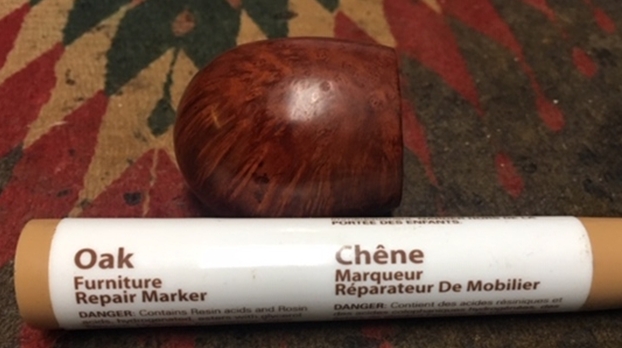
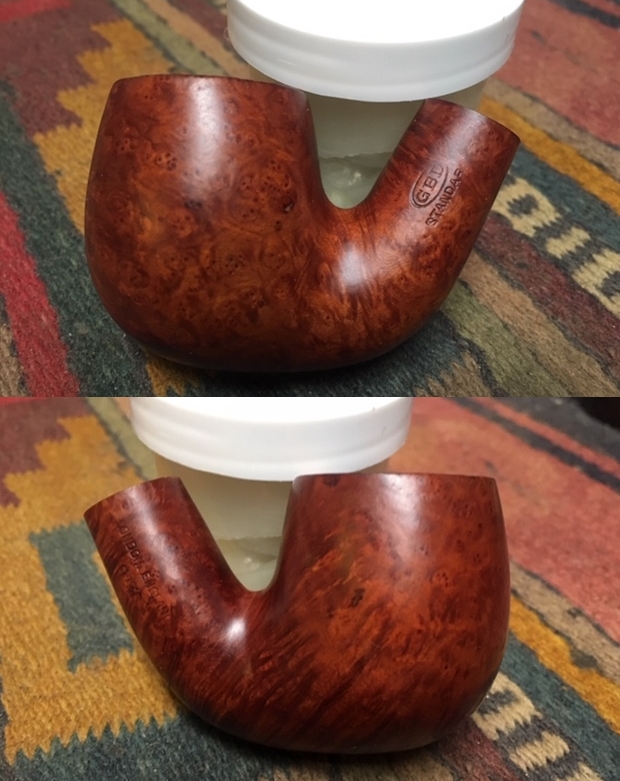
Now on to the rest of the restoration on this GBD Standard Bent Billiard. Since Jeff had done such an amazing clean up job on the bowl it was very easy for me. There was some small damage on the front of the bowl that needed to be address. It was surrounded by a shiny ring that looked like someone had tried to repair it before. I wiped it down with acetone and filled in the damaged area with clear super glue. When the glue dried I sanded the repaired area down with 220 grit sandpaper and polished it with 400 grit wet dry sandpaper.I polished the briar with micromesh sanding pads – wet sanding with 1500-12000 grit pads and wiped the bowl down after each pad with a damp cloth to remove the sanding dust. I touched up the sanded area with an oak stain pen. I carefully blended it into the surrounding surface of the briar.I rubbed the bowl down with Before & After Restoration Balm. I worked it into the surface of the briar with my fingertips and a horsehair shoe brush to clean, enliven and protect it. I let the balm sit for a little while and then buffed with a cotton cloth and shoe brush to raise the shine. Mark Hoover’s Balm is a product that I have come to appreciate and one I use on every pipe I have been working on. I set the bowl aside and turned my attention to the stem. I sanded the stem with 220 grit sandpaper to break up the oxidation. I started the polishing with 400 grit wet dry sandpaper to remove the scratching. It is starting to look good. I rubbed the stem down with Denicare Mouthpiece Polish. I have a few tins of this laying around so I am trying to use them up. It does a pretty good job polishing the stem. I polished the stem with micromesh sanding pads – wet sanding with 1500-12000 grit pads. I wiped the stem down after each sanding pad with Obsidian Oil. I polished it with Before & After Pipe Stem Polish – both Fine and Extra Fine. Once I had finished the polishing I gave it final coat of oil and set it aside to dry. I am excited to be on the homestretch with this pipe and I look forward to the final look when it is put back together, polished and waxed. I put the bowl and stem back together. I polished the bowl and stem with Blue Diamond to polish out the scratches in the briar and the vulcanite. I gave the bowl and stem multiple coats of carnauba wax. I buffed the pipe with a clean buffing pad to raise the shine. I hand buffed it with a microfiber cloth to deepen the shine. The pipe polished up pretty nicely. The grain really popped with the polished black vulcanite. This old GBD Standard bent billiard was another fun pipe to work on thanks to Jeff’s cleanup work. It really has a shape that catches the eye. The combination of various brown stains really makes the pipe look attractive. It is a comfortable pipe to hold in the hand. The finished pipe is shown in the photos below. The dimensions of the pipe are Length: 6 inches, Height: 1 ¾ inches, Outside diameter of the bowl: 1 3/8 inches, Chamber diameter: ¾ of an inch. If you are interested in carrying on Bob’s legacy with this pipe send me a message or an email. I have a lot more to work on of various brands. Perhaps one of those will catch your attention. Thanks for reading this blog and my reflections on the pipe while I worked on it. This is an interesting estate to bring back to life.

Back to Bob Kerr’s Estate – Changing Up and Working on a Danish Made Stanwell de Luxe 812 Billiard Regd. No. 969-48


Blog by Steve Laug

I am changing up my work on Bob Kerr’s estate a bit by taking on this Stanwell de Luxe 812 sandblast billiard. This is the first of his Stanwell pipes that I am working on. I am cleaning them for the family and moving them out into the hands of pipemen and women who will carry on the trust that began with Bob and in some pipes was carried on by Bob. In the collection there were 19 Peterson’s pipes along with a bevy of Dunhills, some Comoy’s and Barlings as well as a lot of other pipes – a total of 125 pipes along with a box of parts. This is the largest estate that I have had the opportunity to work on. I put together a spread sheet of the pipes and stampings to create an invoice. I was taking on what would take me a fair amount of time to clean up. I could not pass up the opportunity to work on these pipes though. They were just too tempting. This beautiful Stanwell is a great break. It is a shape that is interesting and unique. It will go on the rebornpipes store.

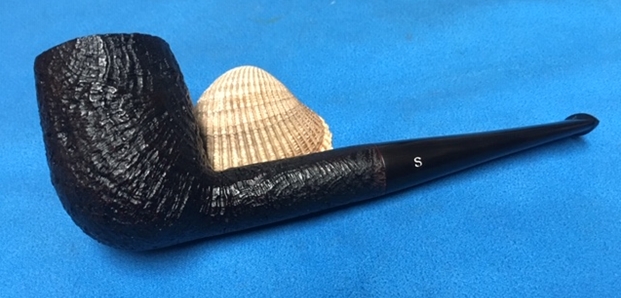
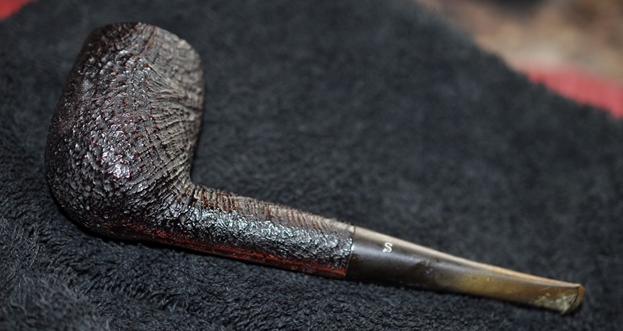
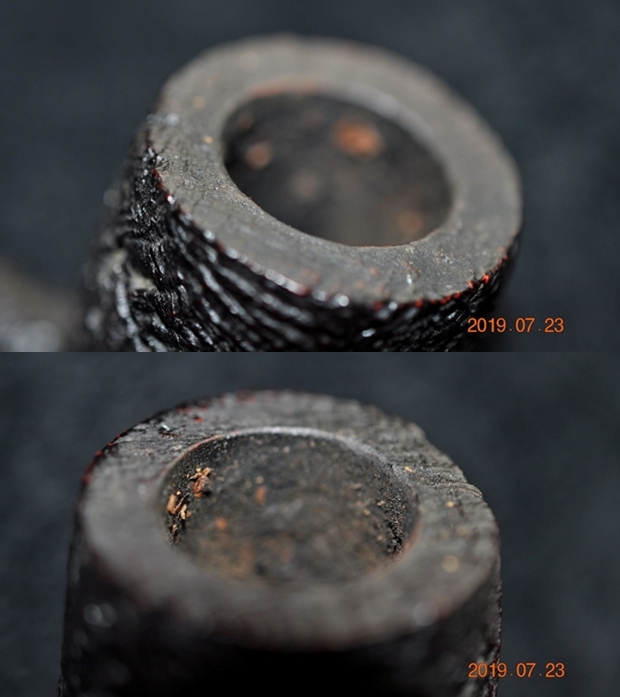
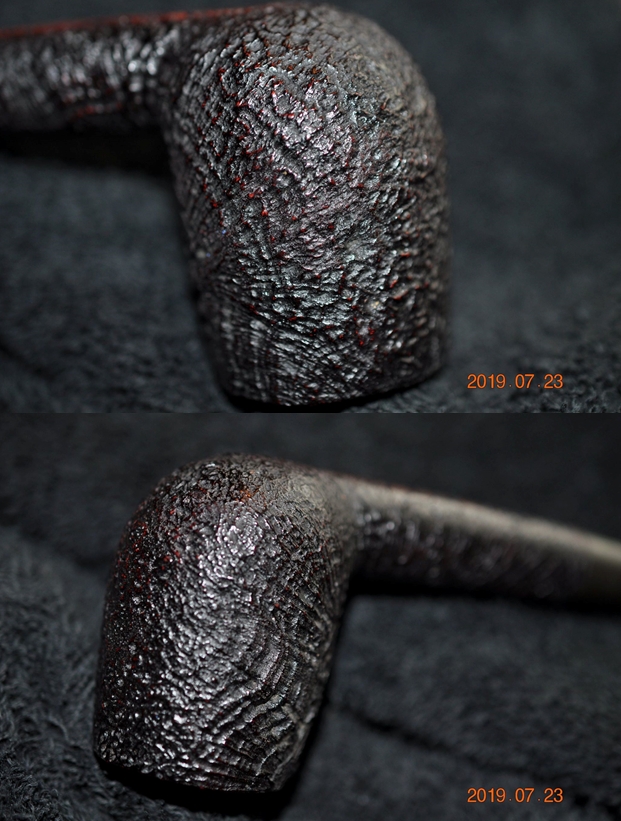
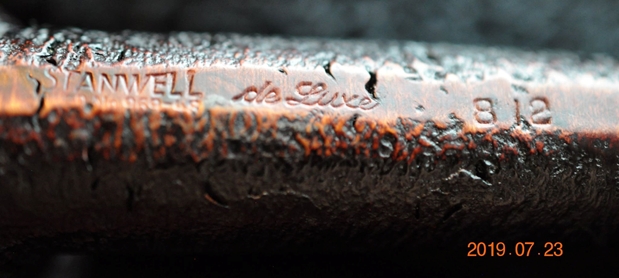
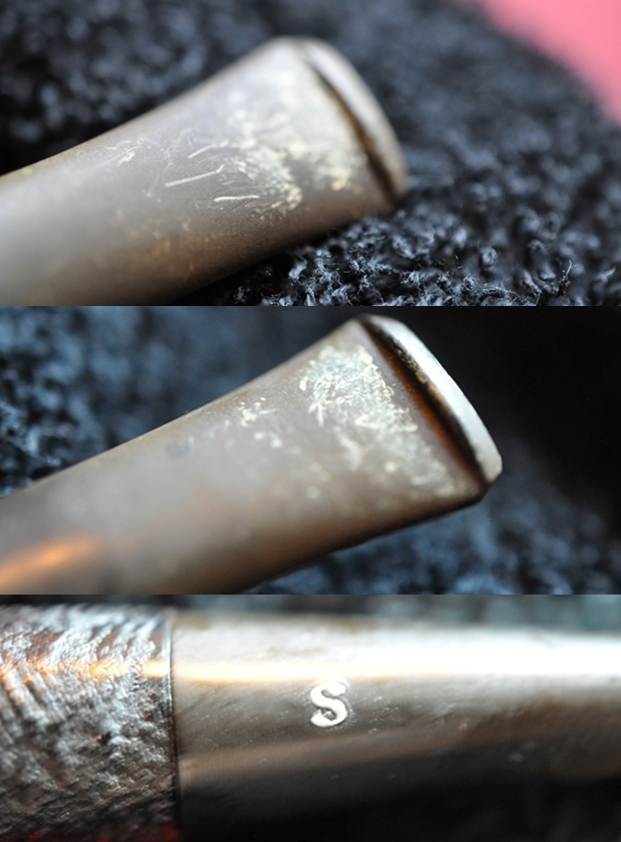
I really like the sandblasts that the Danish Stanwell Company did. This one also has a rugged, swirling sandblast finish with lots of nooks and crannies in the briar. It is a beauty! The pipe is stamped Stanwell over Regd. No. 969-48. That is followed by the line which is de Luxe and the shape number 812. The valleys and ridges of the sandblasted grain showing through the grime and dirt are a mixture that leaves a rich texture. It had a rich dark and medium contrasting brown stain that does not look too bad. There was a thick cake in the bowl with remnants of tobacco stuck on the walls. There was a fair lava overflow filling in the blast on the rim. The edges of the rim and top are dirty but look pretty pristine under the grime. It was a beautiful pipe that was dirty and tired looking. The stem was oxidized and calcified toward the end. Again, surprisingly did not have the tooth marks that I have come to expect from Bob’s pipes. Jeff took photos of the pipe before he started his cleanup work on it.   Jeff took photos of the bowl and rim top to show the cake in the bowl and the lava build up on the edges of the bowl. It was thick and hard but hopefully it had protected the rim and edges from damage. The edges look pretty good.Jeff took photos of the sides and heel of the bowl to show the condition of the finish. You can see the beautiful swirls of the sandblast. There is a lot of dust and grime filling in the valleys. Jeff took photos of the stamping on the smooth panel on the underside of the bowl and shank. The stamping was readable as you can see from the photos. It read Stanwell Regd. No. 969-48. That is followed by de Luxe and the shape number 812. Jeff took photos of the top and underside of the stem showing the tooth chatter, scratching and oxidation on the stem surface and wear on the edges of the button. The “S” on the stem was in very good condition. Interestingly it did not have the crown over the “S”. I turned first to Pipephil’s site to get a quick idea of when this pipe was made by reference to the Regd. No. on the underside of the shank (http://www.pipephil.eu/logos/en/logo-stanwell.html). I quote what I found there. Logo without crown. The “Regd. No.” stamping discontinued in late 1960s to very early 1970s.

I also turned to Pipedia’s article on Stanwell but it did not add any further information. It is a great read in terms of the history of the brand (https://pipedia.org/wiki/Stanwell).

Talking with Chris van Hilst on Facebook Tobacco Pipe Restorers Group he helped me understand that the crown was introduced mid- to late 50’s. Before that they didn’t have a stem logo.

With that information in hand I knew what I was dealing with in terms of the stamping and the age of this pipe. I knew from the information from Pipephil that the Regd. No. stamping was discontinued in the late 60s to very early in the 70s. I learned from Chris that the crown was added late in the 1950s so this one is most probably an early 1950s pipe. Most of Bob’s pipes were purchased between the 50s and late 60s so my guess is that this pipe fits that time frame. Now it was time to work on the pipe.

With over 125 pipes to clean from Bob’s estate I took a batch of them to the states with me on a recent visit and left them with Jeff so he could help me out. Jeff cleaned the pipe with his usual penchant for thoroughness that I really appreciate. This one was a real mess and I did not know what to expect when I unwrapped it from his box. He reamed it with a PipNet pipe reamer and cleaned up the reaming with a Savinelli Fitsall Pipe Knife. He scrubbed out the internals with alcohol, pipe cleaners and cotton swabs until the pipe was clean. He scrubbed the exterior of the bowl with Murphy’s Oil Soap and a tooth brush to remove the grime and grit on the briar and the lava on the rim top. The finish looks very good with good looking grain around the bowl and shank. Jeff soaked the stem in Before & After Deoxidizer to remove the oxidation on the rubber. When the pipe arrived here in Vancouver for the second stop of its restoration tour it looked very good. I took photos before I started my part of the work. I took some close up photos of the rim top and also of the stem surface. I wanted to show what an amazing job Jeff did in the cleanup of the rim top. The rim top looks very good. The sandblast finish is very nice. The bowl looked very good. I also took close up photos of the stem to show the lack of tooth marks and the remaining oxidation on the stem surface.Since this is another pipe Bob’s estate I am sure that some of you have read at least some of the other restoration work that has been done on the previous pipes. You have also read what I have included about Bob Kerr, the pipeman who held these pipes in trust before I came to work on them (see photo to the left). Also, if you have followed the blog for long you will already know that I like to include background information on the pipeman whose pipes I am restoring. For me, when I am working on an estate I really like to have a sense of the person who held the pipes in trust before I worked on them. It gives me another dimension of the restoration work. I asked Brian if he or his wife would like to write a brief biographical tribute to her father, Bob. His daughter worked on it and I received the following short write up on him and some pictures to go along with the words including one of Bob’s carvings. Once again I thank you Brian and tell your wife thank you as well.

I am delighted to pass on these beloved pipes of my father’s. I hope each user gets many hours of contemplative pleasure as he did. I remember the aroma of tobacco in the rec room, as he put up his feet on his lazy boy. He’d be first at the paper then, no one could touch it before him. Maybe there would be a movie on with an actor smoking a pipe. He would have very definite opinions on whether the performer was a ‘real’ smoker or not, a distinction which I could never see but it would be very clear to him. He worked by day as a sales manager of a paper products company, a job he hated. What he longed for was the life of an artist, so on the weekends and sometimes mid-week evenings he would journey to his workshop and come out with wood sculptures, all of which he declared as crap but every one of them treasured by my sister and myself. Enjoy the pipes, and maybe a little of his creative spirit will enter you!

Now on to the rest of the restoration on this Stanwell de Luxe 812 Billiard. Since Jeff had done such an amazing clean up job on the bowl it was very easy for me. I only had to rub the bowl down with Before & After Restoration Balm. I worked it into the surface of the briar with my fingertips and a horsehair shoe brush to clean, enliven and protect it. I let the balm sit for a little while and then buffed with a cotton cloth and shoe brush to raise the shine. Mark Hoover’s Balm is a product that I have come to appreciate and one I use on every pipe I have been working on. I set the bowl aside and turned my attention to the stem. I sanded the stem with 220 grit sandpaper to break up the oxidation. I started the polishing with 400 grit wet dry sandpaper to remove the scratching. It is starting to look good. I rubbed the stem down with Denicare Mouthpiece Polish. I have a few tins of this laying around so I am trying to use them up. It does a pretty good job polishing the stem. I polished the stem with micromesh sanding pads – wet sanding with 1500-12000 grit pads. I wiped the stem down after each sanding pad with Obsidian Oil. I polished it with Before & After Pipe Stem Polish – both Fine and Extra Fine. Once I had finished the polishing I gave it final coat of oil and set it aside to dry. I am excited to be on the homestretch with this pipe and I look forward to the final look when it is put back together, polished and waxed. I put the bowl and stem back together. I polished the bowl and stem with Blue Diamond to polish out the scratches in the briar and the vulcanite. I gave the bowl multiple coats of Conservator’s Wax and the stem multiple coats of carnauba wax. I buffed the pipe with a clean buffing pad to raise the shine. I hand buffed it with a microfiber cloth to deepen the shine. The pipe polished up pretty nicely. The valleys and ridges of the sandblast looked good with the polished black vulcanite. This Stanwell de Luxe 812 billiard was another fun pipe to work on thanks to Jeff’s cleanup work. It really has that classic Stanwell sandblast finish that catches the eye. The combination of various brown stains really makes the pipe look attractive. It is a comfortable pipe to hold in the hand. The finished pipe is shown in the photos below. The dimensions of the pipe are Length: 5 ¾ inches, Height: 2 inches, Outside diameter of the bowl: 1 ½ inches, Chamber diameter: ¾ of an inch. If you are interested in carrying on Bob’s legacy with this pipe send me a message or an email. I have a lot more to work on of various brands. Perhaps one of those will catch your attention. Thanks for reading this blog and my reflections on the pipe while I worked on it. This is an interesting estate to bring back to life.

Resurrecting a Second Stately Stanwell Henley Special, Made in Denmark, Blasted Saddle Stem Billiard


Blog by Dal Stanton

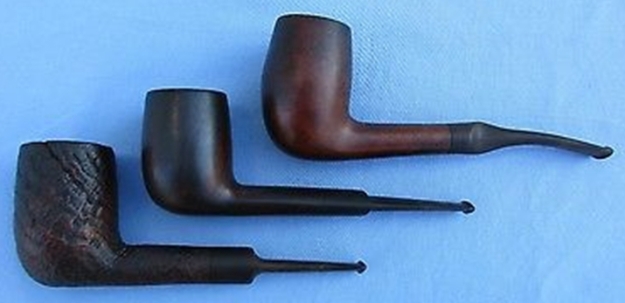
Jim was the recipient of the first Stanwell Henley Special, Oval Shank Billiard, that I restored some time ago (see LINK).  Jim saw it on the online ‘For “Pipe Dreamers” Only!’ collection benefiting the Daughters of Bulgaria – our work here in Bulgaria helping women and girls who have been trafficked and sexually exploited.  The second Stanwell Henley Special on the worktable is the Blasted Saddle Stem Billiard on the bottom in the picture below.  This pipe has not been commissioned and will be heading to The Pipe Steward Store and this beautiful stout Danish will also benefit the Daughters when a new steward brings it home.  I have also taken notice of the solid craftsmanship of these 3 Danish made pipes and decided that the third, a Stanwell Henley Special Chimney (on top in the picture below), would find a home in my personal collection.  The eBay seller gave this helpful information about this Lot of 3 Stanwell Henley Special pipes:

This auction is for three vintage Stanwell, Henley Line estate pipes from the 1950’s-60’s era. All are in good pre-owned condition. The stems are primarily free from teeth marks. The stems do have some fading. All of the stems fit snug and the wooden bowls are free from outstanding blemishes. As seen from top to bottom, the first pipe reads Henley Special #57, the second and third read Henley Special without any numbers seen. All of the pipes read Made in Denmark.

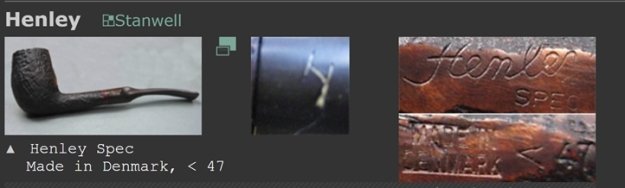
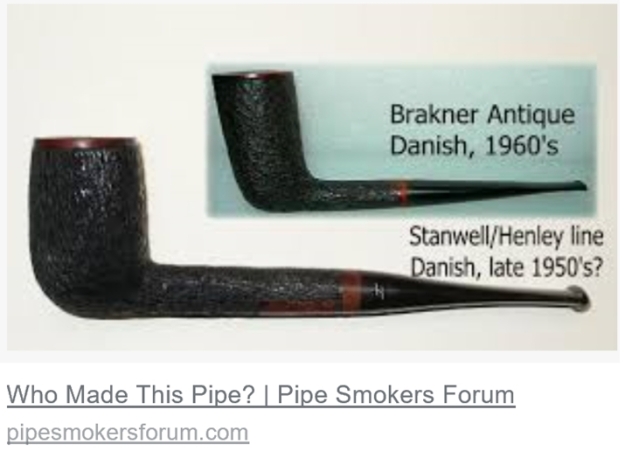
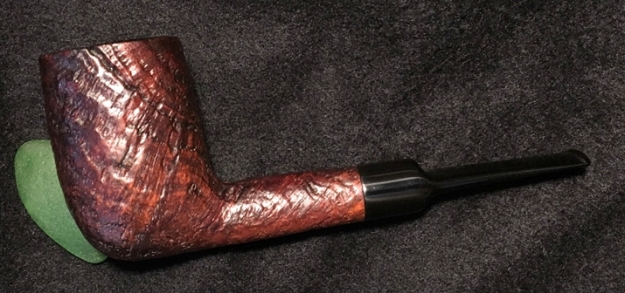
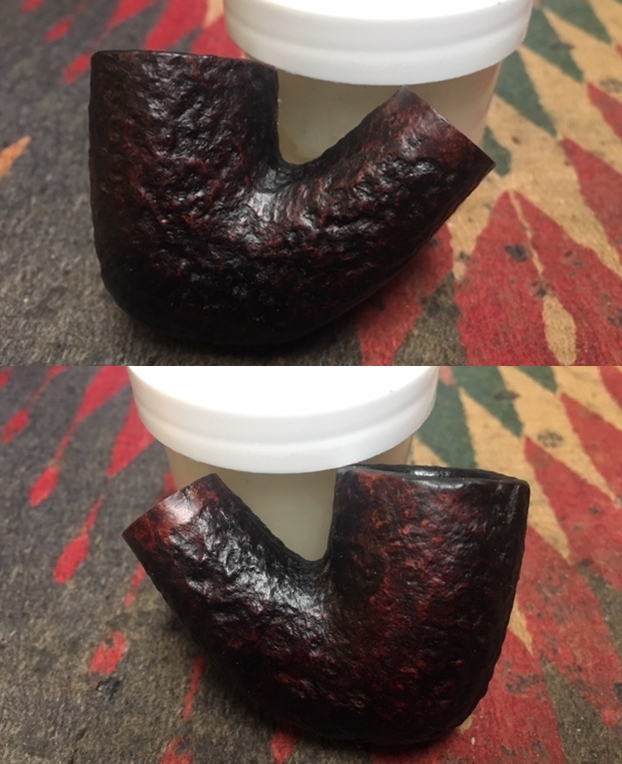
Here are the three Stanwell Henley Specials that I acquired on the eBay auction block from a seller in Maryland.  The Henley Jim commissioned is pictured in the center above and below is the restored pipe now in Jim’s collection – an unbelievable transformation!As I expressed before, since I started collecting and restoring pipes, I’ve grown in my appreciation for Danish made pipes.  They tend to be stout, well-made pipes and just fit the hand wonderfully.  Unfortunately, my original research did not uncover much online regarding the Henley line.  Pipedia’s article on Stanwell pipes simply places the Henley Special line in the list of Stanwell second brands.  Pipephil.eu provided more information with a Henley much like the slightly bent Chimney above which I’m claiming for my collection, with the interesting characteristic bulging midsection, but with a blasted finish.  It also shows an ‘H’ stem stamp.  None of the 3 Henleys of my acquisition have stem stampings – or they wore off long ago.The only information I found in my initial research that gave any reference to dating isn’t conclusive. I found the following picture on Google images with the link to pipesmokersforum.com, “Who made this pipe?”   I went to the pipesmokersforum site and searched ‘Henley’ and no reference or article emerged. I would have loved to read the thread that discussed the dating of the discontinued Stanwell second, Henley Special.  The picture puts a question mark in the late 50s and the eBay seller’s description placing the pipes in the 50s or 60s are anecdotal but seem to me to be accurate.  I will keep searching but based upon the look and feel of these Danish made pipes, I think the 50s/60s is on target.With the second Stanwell Henley Special on the worktable, I take some pictures to get a closer look. He’s a large bowled pipe with dimensions: Length: 5 1/2 inches, Height: 2 1/4 inches, Rim width: 1 7/16 inches, Chamber width: 7/8 inches, Chamber depth: 2 inches. The nomenclature on the blasted stummel is on the lower side of the pipe.  There is a flat panel running the length of the heel and shank allowing this Billiard to sit on the table – nice feature!  On the shank side of the panel in cursive is stamped a thin ‘Henley’ [over] SPECIAL.  To the right of this is stamped MADE IN [over] DENMARK.The condition of this Henley resembles the others in that they are very dark and dirty from grime over the stummel.  The blasted surface of this Henley will need much scrubbing with a brush.  One crevasse is so large/deep that when I first saw it, I thought that the bowl had cracked.  However, it is the result of the blasting process.  The blasted surface is amazing on this pipe. The chamber is choked with carbon cake buildup – this needs to be removed to give the briar a fresh start and to examine the chamber walls.  With the cake as thick as it is, there is concern for heating damage.  The rim is inundated with lava flow – it’s thick!  The saddle stem has also seen better days!  The oxidation is thick, and the bit has been chewed – or more accurate, clenched.  There are several compressions on both upper and lower bit – the former steward loved this pipe, but he was a hands-free clincher which would be no small feat for a pipe with a bowl this big!

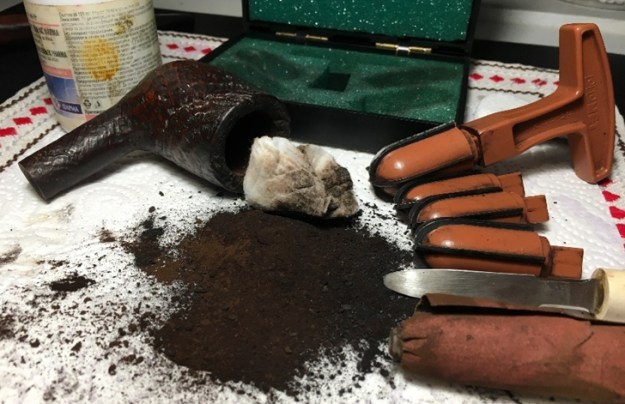
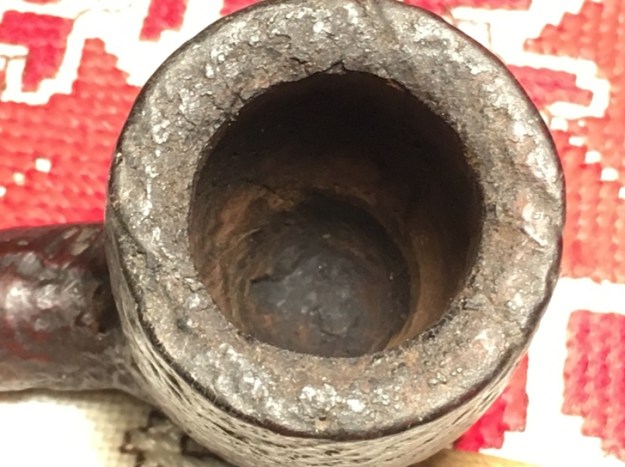
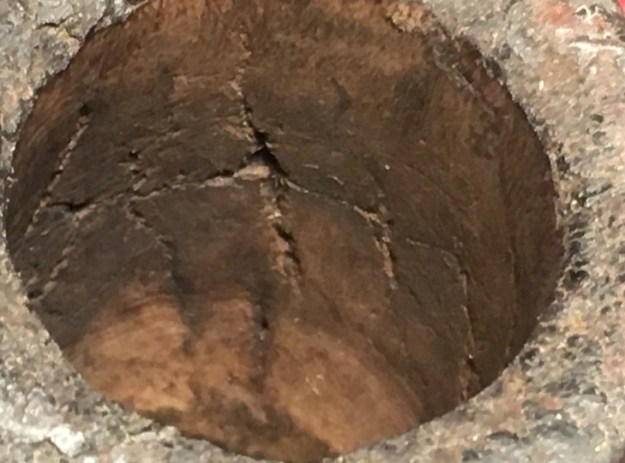
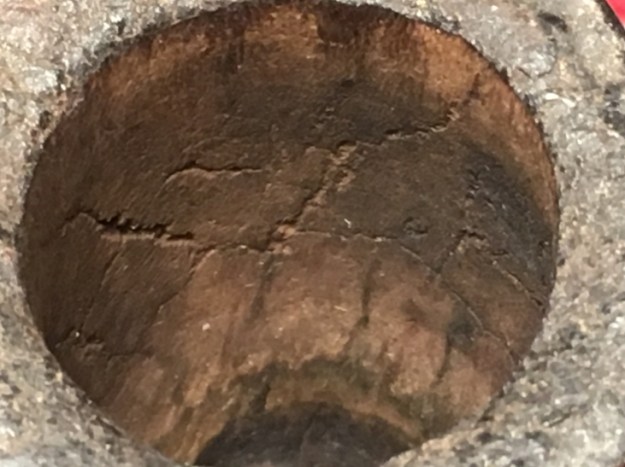
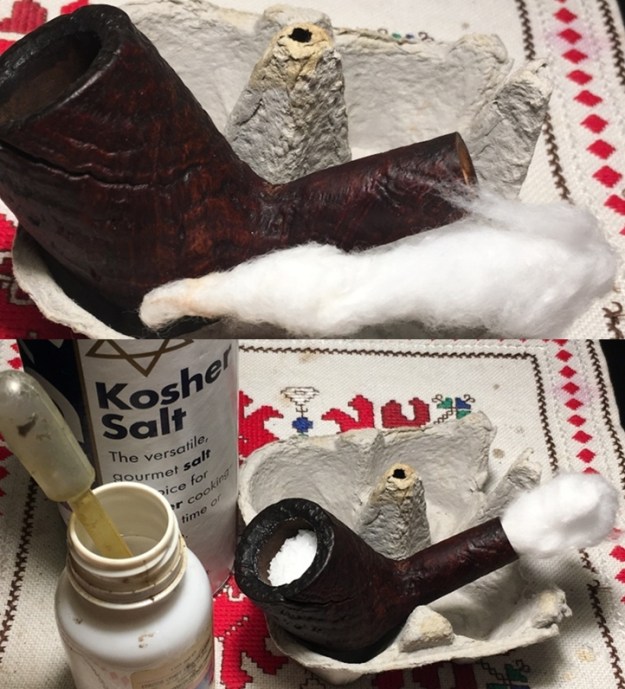
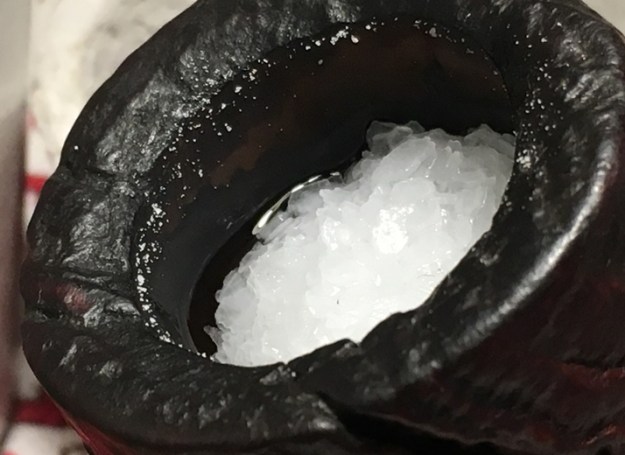
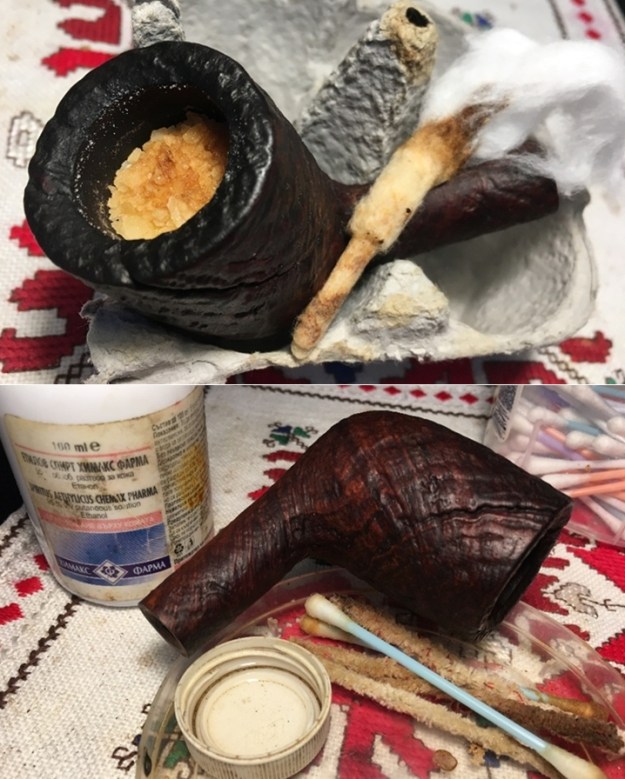
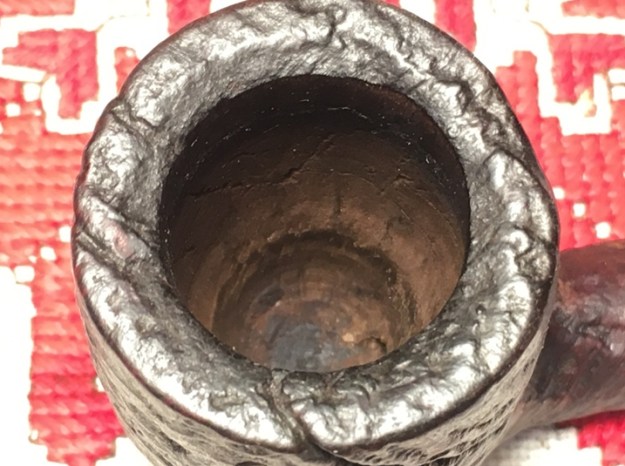
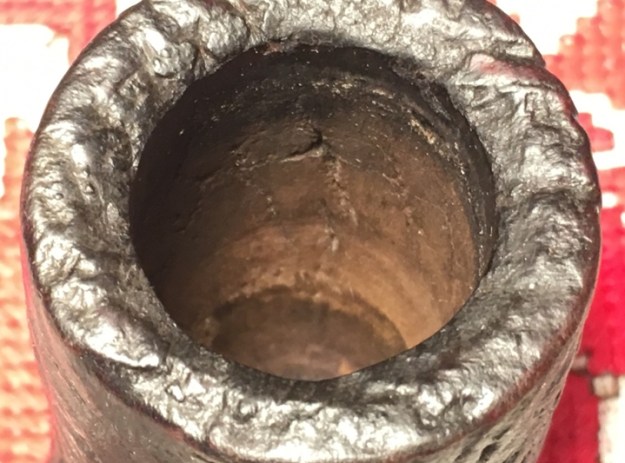
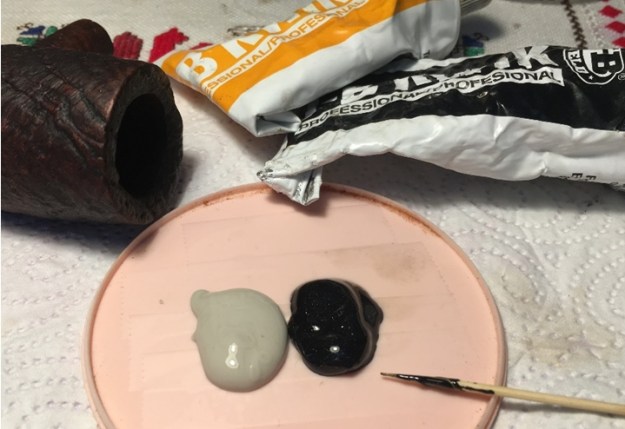
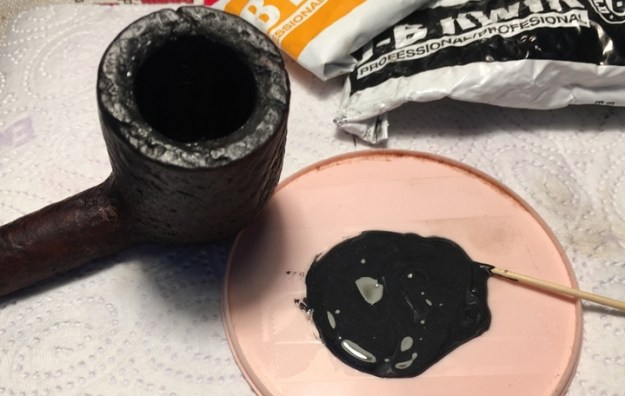
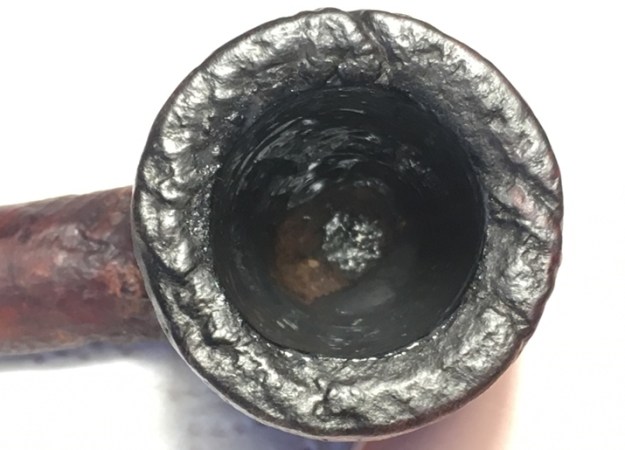
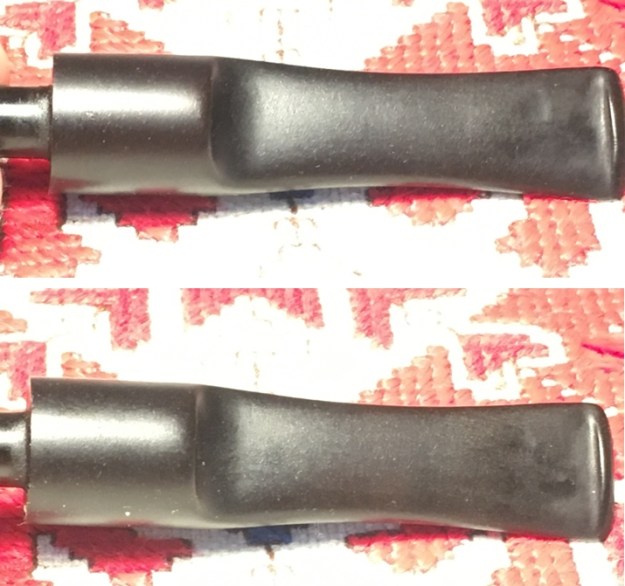
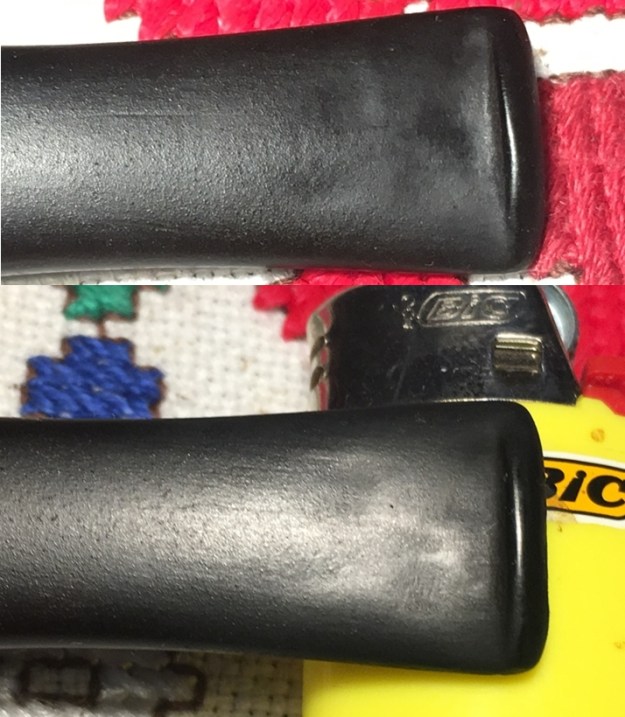
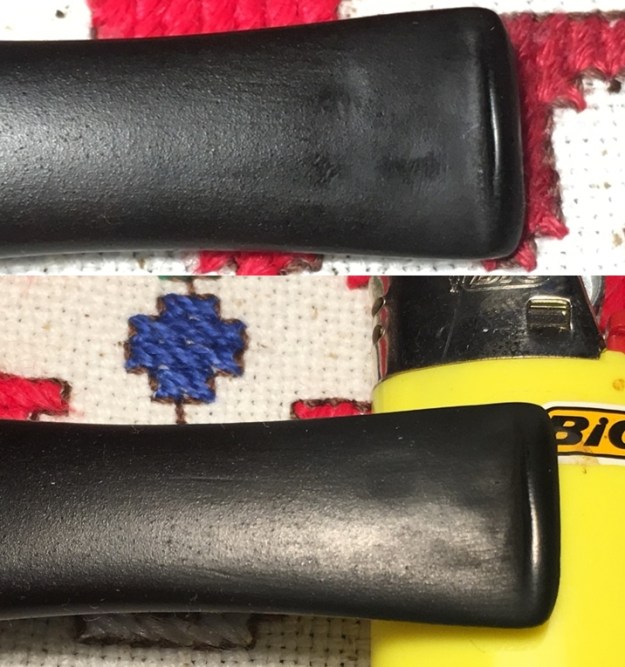
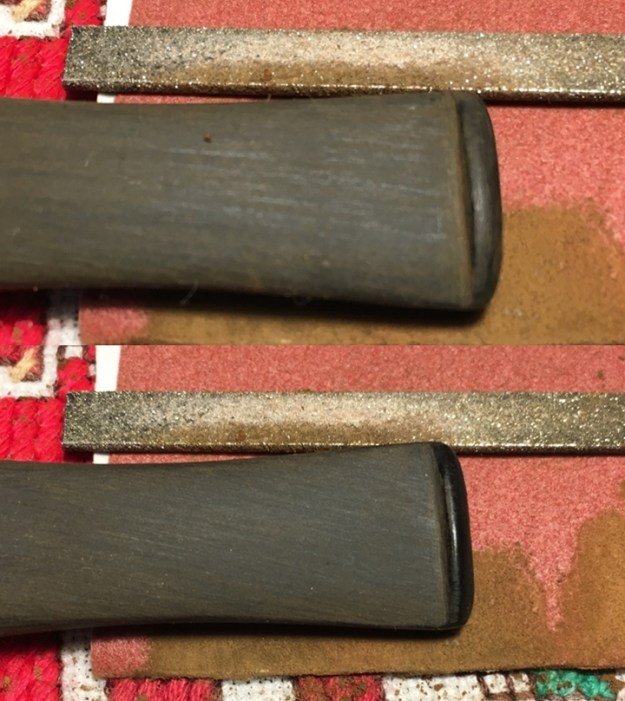
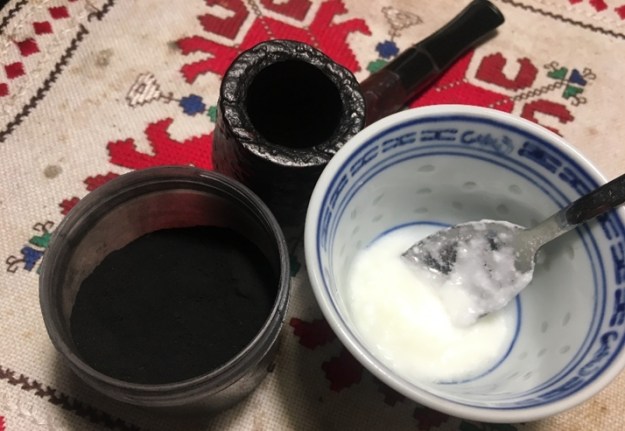
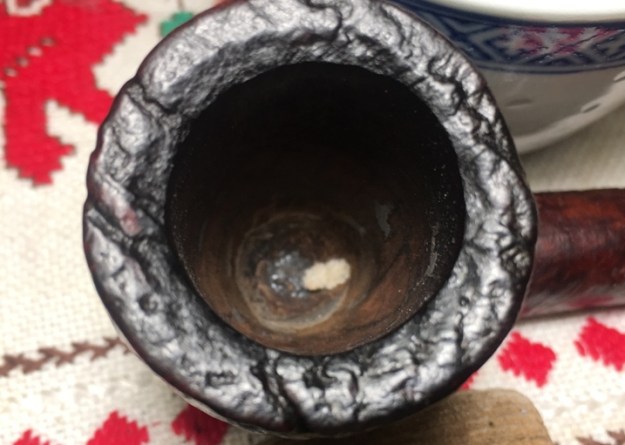
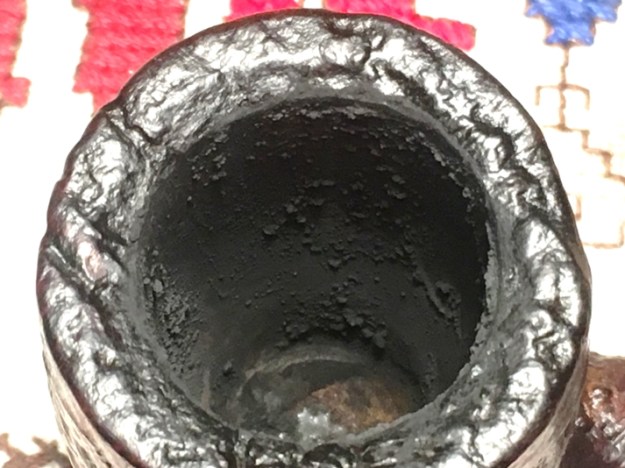
This doesn’t happen often.  My wife got into The Pipe Steward activities to picture me cleaning stems of pipes in queue – two Henleys included – this second one and the third staying with me.  Yep, this is what my worktable looks like!  I clean each airway with pipe cleaners dipped in isopropyl 95% as well as employing shank brushes.  I clean the stems before placing them in the soak of Before & After Deoxidizer. The stems soak for several hours to work on removing the oxidation.  The oxidation on the Henley is pretty think.  We’ll see how the Deoxidizer works.When I fish out the Henley’s saddle stem, I rub/wipe the stem with cotton pads wetted with isopropyl 95% to remove the raised oxidation.  I also run a few pipe cleaners wetted with isopropyl 95% through the airway to clear the Deoxidizer.I also apply paraffin oil, a mineral oil, to the stem to begin the conditioning process.  The B&A Deoxidizer did a fair job on the stem.Turning now to the Henley stummel, I take a picture to show the condition of the chamber. The cake closes as it moves down the chamber.  I’m hopeful that the chamber walls are not suffering from heating damage.  To address the thick cake, I use the Pipnet Reaming Kit.  After putting down paper towel to save time on cleaning, I begin with the smallest of the 4 blade heads available.  With a chamber width of 7/8 inches and depth of 2 inches, he took all 4 blade heads that the Pipnet Reaming Kit had to offer.  The cake is hard and crusty, and it takes patience to work the blades and not overdo it.  I follow the reaming using the Savinelli Fitsall tool to continue to scrape the chamber walls clearing more carbon. Finally, I sand the chamber using 240 grade paper wrapped around a Sharpie Pen.  The sanding is very helpful in cleaning the walls to allow inspection.  After cleaning the chamber with a cotton pad wetted with isopropyl 95%, I’m able to get a good view of the chamber and the damage from heating is evident.I take pictures going around the chamber from different angles.  With the thickness of the cake that I removed, I’m not surprised to find heating damage.  I’m sure that the cracks and fissures that I’ve pictured are a result of the heat build-up caused by the thick cake and not allowing proper heating expansion and contraction.  This puts more stress on the briar and these results occur.  As I continue the cleaning, my mind will be processing the question of how to address this. Switching from the wall issues of the chamber, I move to cleaning the external surface.  Without a doubt, this stummel is the King of Cragginess.  I love the deeply hewn valleys and ridges of this large stummel created by a very thorough sandblasting process.  I take pictures to show the various angles.  The stummel is very dark and I’m anxious to see what cleaning does. I begin the cleaning by using undiluted Murphy’s Oil Soap and scrub with a cotton pad.  With the craggy landscape, the process graduates very quick to scrubbing with a bristled tooth brush as well as a brass wire brush on the rim.Taking the stummel to the sink, warm water continues the cleaning rinsing off the Murphy’s Soap and scrubbing the surface of the crags with the toothbrush.  I also attack the internals using shank brushes and anti-oil dish soap.  I scrub the internals well and rinse the stummel thoroughly.  The result of the cleaning is a considerably lightened stummel.  Another round of pictures show the cleaned briar landscape on the Henley stummel. The rim still appears to have some lava residue on it, and I continue to clean it using a dental probe to break up the carbon in the crags as well as apply the brass bristle brush to the rim. I like the results and I love how the crevassed valley rises and bisects the rim!  This blasted stummel has a lot of expression going on!I continue to clean the internals using cotton buds and pipe cleaners dipped in isopropyl 95%. Joining the cleaning process was a small dental spoon that allowed me to reach into the mortise and airway and scrape the wall, helping to clean the old tars and oils.  I also utilize drill bits to help excavate tars and oils deeper in the airway.  I insert the bit into the airway carefully and hand-rotate into the airway. The rotation helps to remove the gunk.  After a good bit of cleaning, the buds and pipe cleaners start coming out lighter.  I called a halt to the cleaning transitioning to a kosher salt and alcohol soak to continue the cleaning in stealth mode through the night.Before I set up the kosher salt and alcohol soak, I look at the stummel and it is a very dry piece of wood.  I decide to apply a coat of paraffin oil to the stummel allowing the oil to hydrate the briar while it’s sitting through the night with the soak.  Paraffin oil is a mineral oil available here in Bulgaria in the pharmacy.  I apply the oil over the surface with a cotton pad and take a few pictures.  Man, it looks good.  This gives me a sneak peek at what the finished pipe will look like left in its present state.  The rich dark burgundy tones are peeking out.Next, for the kosher salt and alcohol soak, I pull and twist a cotton ball to form a ‘wick’ that is inserted into the mortise with the help of a firm straight wire.  The wick serves to draw the tars and oils that are released further from the internal wood.  I then fill the bowl with kosher salt which will not leave an after taste as does an iodized salt. I then set the stummel in an egg crate for stability, tip the stummel so the salt surface is generally level with the end of the shank.  Then with the use of a large eyedropper, I fill the bowl with isopropyl 95% until it surfaces over the salt.  After a few minutes when the alcohol has been absorbed, I top off with more isopropyl 95%.  I then put the stummel aside for the night and turn off the lights! The next morning the soak had done the job evidenced by the soiled salt and cotton wick.  After tossing the expended salt in the waste, and wiping the chamber out with paper towel, and blowing through the mortise to dislodge salt crystals, I used a few more cotton buds and pipe cleaners wetted with isopropyl 95% to make sure all was clean.  The soak did the job and the stummel will be much fresher for the new steward of this Stanwell Henley Special.Before moving further, I need to address the heating issues in the chamber.  There are cracks and fissures which undoubtedly developed over time because the cake buildup became too much.  With the cake so thick, it hinders proper expansion and contraction when the pipe is used. The result is what we now see in this chamber.  To address this, I mix a batch of J-B KWIK Weld using the two components, Steel and Hardener.  I use a plastic disc as a mixing pallet with scotch tape over it to aid in clean up. After mixing the two components on the pallet, about 4 minutes is available to apply the Weld before it begins to harden. I mix the components thoroughly with a toothpick, then using my finger (with a surgical glove on!), I scoop a bit of Weld and apply it to the chamber wall.  I do this uniformly around the chamber and applying pressure to make sure the Weld is filling the cracks and fissures.  I’m VERY careful to avoid dripping Weld on the rim during the application.  Later, after the Weld thoroughly cures, I’ll sand the chamber removing all the excess Weld leaving behind only what filled the cracks and fissures – or that is the theory! I usually insert a pipe cleaner to guard the airway from the Weld, but this time I forgot and thankfully, no problems result.  After completing the application, I put the stummel aside for several hours allowing the Weld to cure.  Cleanup is quick – I simply peel the tape up and discard.Turning now to the saddle stem, the Before & After Deoxidizer did a good job, but I see residual oxidation yet remaining in the vulcanite.  I take a few pictures with an opened aperture to show what I can see with the naked eye.  The bit does not have tooth chatter as much as compressions – it appears the molars were engaged by the former steward to smoke the Henley hands-free.  To address the bit compressions, I first use the heating method.  Using a Bic lighter, I paint the compressions with flame and as the vulcanite heats, it expands to reclaim the original stem shape or at least the compressions are minimized.  After heating several times, the compressions have lessened but are still visible.   The before and after pictures tell the story – in fact, I had a hard time pairing the correct photos after the heating! I believe the compressions have been minimized enough that sanding will be all that is necessary to repair the bit.  Using 240 grade paper, I sand not only the bit and button, but I expand it to the entire stem to address residual oxidation as well.  I employ a flat needle file to freshen the button lips and to assist with the tooth compressions next to the lip.  In the sanding of the saddle, I use a plastic disc I fashioned and with the disc separating the stem and stummel, I reunite the two.  The disc acts as a shield to shouldering the stem shank facing.  The sanding removed all the compressions. The pictures show the progress. With the major sanding with 240 paper complete, I continue by wet sanding the entire stem using 600 grade paper.  I then follow the wet sanding by applying 000 grade steel wool to the stem.  I’ve lost track of which is the upper and lower stem.  The stem is looking great!I move directly to applying the full regimen of 9 micromesh pads starting by wet sanding with pads 1500 to 2400 then dry sanding with pads 3200 to 4000 and 6000 to 12000.  Between each set of three pads I apply a coat of Obsidian Oil to assist in rejuvenating the vulcanite.  The saddle stem has that glassy pop! I turn back to the stummel and the J-B Weld has had time to cure.  I begin to sand off the excess J-B Weld by using the Dremel with a sanding drum.  I set the Dremel to the slowest speed and gently, without much pressure, sand off the upper layer of the J-B Weld – the excess.  With the drum, as I’m working patiently around the entire chamber, I also sand out a reaming step that had developed near the floor of the chamber.  The Dremel shortens the work amazingly.  I then switch by wrapping 240 grade paper around a Sharpie Pen. I fine tune the sanding in the chamber so that eventually, the cracks and fissures are revealed now having been filled.  I love it when theory and practice come together!  I clean out the chamber of the dust and it looks and feels great! I run my finger over the formerly cavern-filled chamber and it is smooth.  I take finish pictures and move on. I’ve been looking forward to applying the Before & After Restoration Balm to this Stanwell Henley Special’s stummel to tease out the older patina of this vintage blasted briar surface.  I make sure the surface is clean from all the chamber sanding and I take a few pictures to mark the start.  I then apply the Balm to my fingers and rub it in to the surface.  The surface practically drinks the Balm as I work the Balm into the craggy landscape.  After it’s worked in well, I put the stummel aside for 20 minutes to allow the Balm to do what it does. I take a picture in this state. After about 20 minutes I wipe off the excess Balm and buff the blasted Henley Special stummel with a microfiber cloth.  The hues are deeper and richer.  I mount a cotton cloth buffing wheel onto the stummel and set the speed at 40% full power and after reuniting the stem and stummel, I apply Blue Diamond compound to the stem.  As I go along, I experiment with the Blue Diamond on the stummel.  I don’t want to gum up the craggy surface with Blue Diamond, but what I see, with a light application of the compound, is that the briar is sprucing up and I move the wheel along with the grain of the blasted briar.  I like the results.  When I complete the application of Blue Diamond, I give the pipe a good hand-wiping with a felt cloth to remove the carbon dust before application of the wax.  I like the results.Straightaway, I load another cotton cloth buffing wheel onto the Dremel, increasing the speed of the Dremel to about 60% full power – faster than normal on smooth briar, I first apply carnauba wax to the stummel.  I increase the speed for the blasted stummel to increase the heat of the application.  I’ve found that using the Dremel on the craggy surface allows me to get up and close with the application of wax on the rough surface.  Heating the wax more helps guard against it gunking up on the rough surface.  The added speed helps dissolve the wax over the rough surface.  I’m liking what I’m seeing!  When I apply carnauba to the stem, I slow the speed of the Dremel back down to the normal 40% full power.After applying the wax, I give the pipe a rigorous hand buffing with a microfiber cloth.  This not only raises the shine but also help disseminate any excess wax on the surface.  There is one last project left to do.  The chamber was riddled with heating cracks and fissures and I used heat resistant J-B Kwik Weld to fill in the cracks.  I coated the entire chamber with the Weld mixture then sanded it after the Weld cured.  After sanding, as the theory hoped, the results were, that the only Weld remaining was that which filled the cracks and the chamber wall is smooth and again usable to put this pipe back into service.  Beautiful!  I love it when theory and practice come together so well. To help provide a protective coat over the repairs and to encourage a new cake to develop, I apply to the chamber walls a coating mixture of natural yogurt (sour cream works, too) and activated charcoal.  I mix a small amount of yogurt and charcoal in a bowl and when the consistency of the mixure will not drip off the spoon its ready to go.  After putting a pipe cleaner through the draft hole, I use my index finger to reach into the chamber and apply the mixture.  I make sure that the chamber walls are thoroughly covered, and I put the stummel aside for a time to allow the coating to cure.  It dries into an amazingly hard surface.  It’s important for the new steward to use a folded pipe cleaner to clean the bowl initially after putting the Henley into service – not to scrape the bowl! I’m very pleased with the results of this second of the 3 1950/60s Stanwell Henley Specials I acquired.  I appreciate the Danish craftmanship that is evident in all three pipes and this Blasted Billiard is no exception.  The blasting amazes me with the craggy surface showing the 3-dimensional movement of the briar grain.  One ravine is cut so drastically, at first, I thought it was a cracked bowl when I first acquired the pipes, but it remains as part of a very expressive, deep hued blasted briar landscape.  With a chamber width of 7/8 inches and depth of 2 inches, the amount of blend one can pack into this bowl is pretty impressive and with the size of the stummel and the blasting – well, I’m tempted to keep it for myself, but the third Stanwell Henley Special next on the table will be staying with me.  This Henley is heading for ThePipeSteward Store benefitting the Daughters of Bulgaria – our work here in Bulgaria helping women and girls who have been trafficked and sexually exploited.  Thanks for joining me!

Back to Bob Kerr’s Estate – Another Canadian Import Peterson’s “Kapruf” – a 54


Blog by Steve Laug

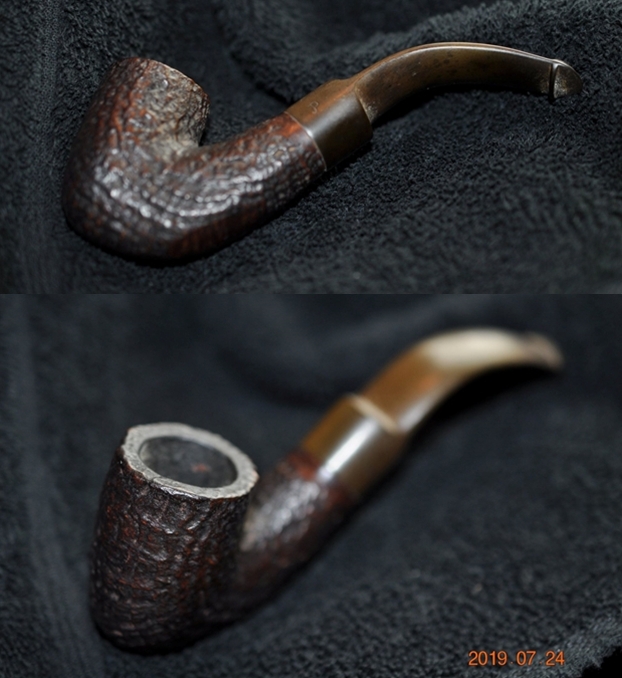
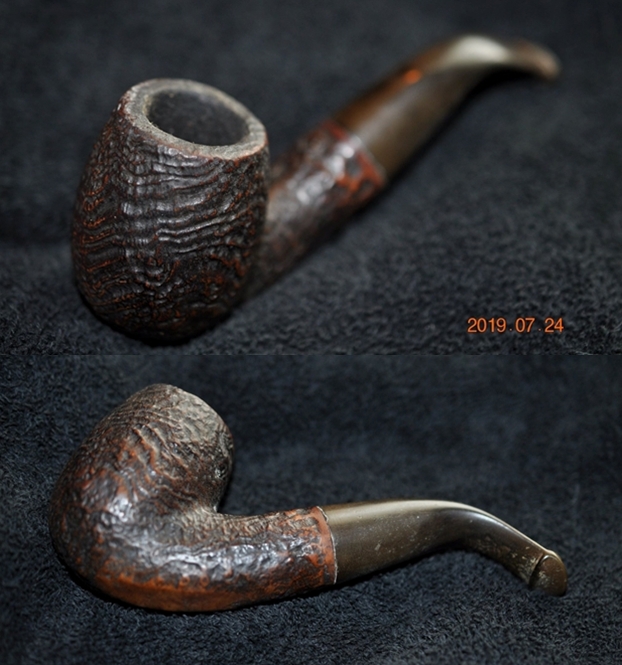
With this Peterson’s “Kapruf” 54 I am continuing my work on a few more pipes from Bob Kerr’s estate. This is the second of the Peterson’s that I am working on. I am cleaning them for the family and moving them out into the hands of pipemen and women who will carry on the trust that began with Bob and in some pipes was carried on by Bob. In the collection there were 19 Peterson’s pipes along with a bevy of Dunhills, some Comoy’s and Barlings as well as a lot of other pipes – a total of 125 pipes along with a box of parts. This is the largest estate that I have had the opportunity to work on. I put together a spread sheet of the pipes and stampings to create an invoice. I was taking on what would take me a fair amount of time to clean up. I could not pass up the opportunity to work on these pipes though. They were just too tempting. I decided to take a break from working on his Dunhills to work on a few of the other pipes. The second of them is another really nice Peterson. It is a shape that is interesting and unique. It will go on the rebornpipes store.

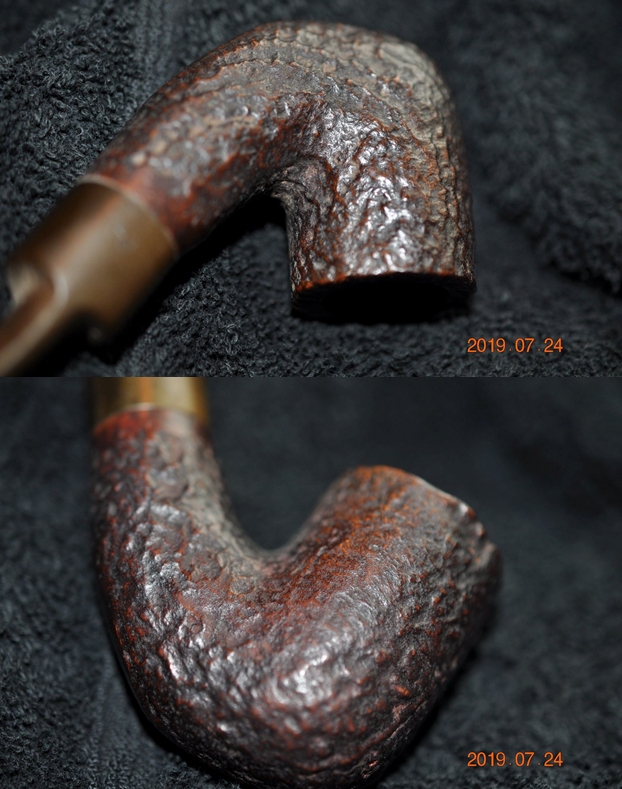
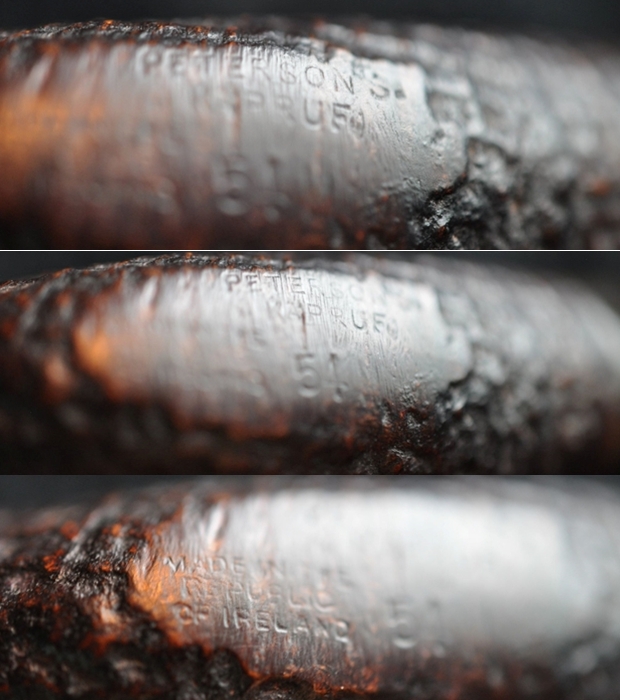
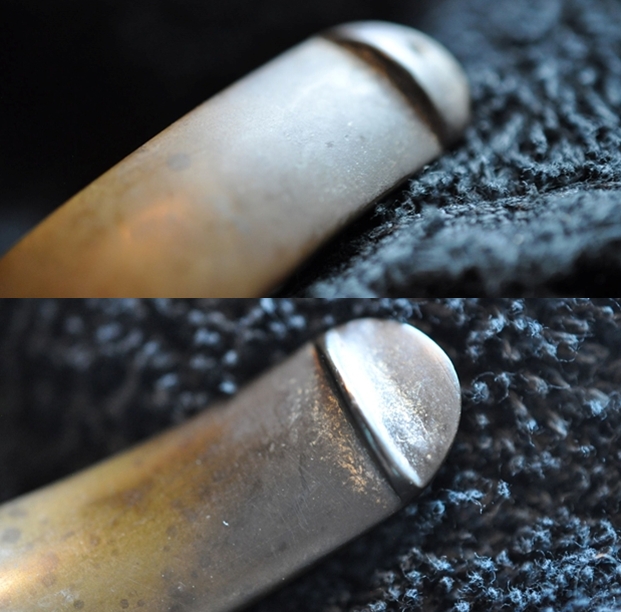
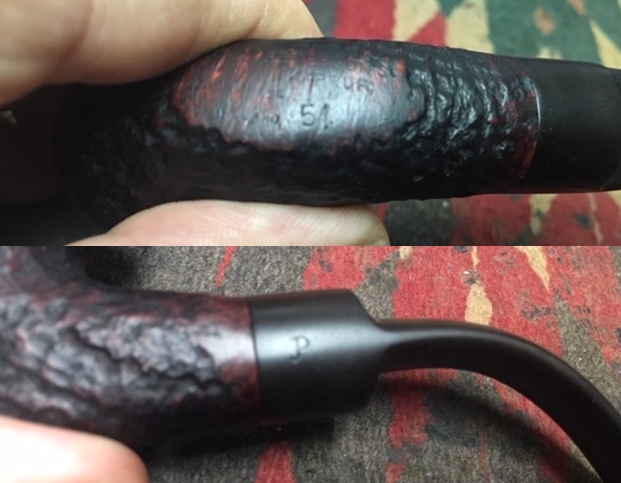
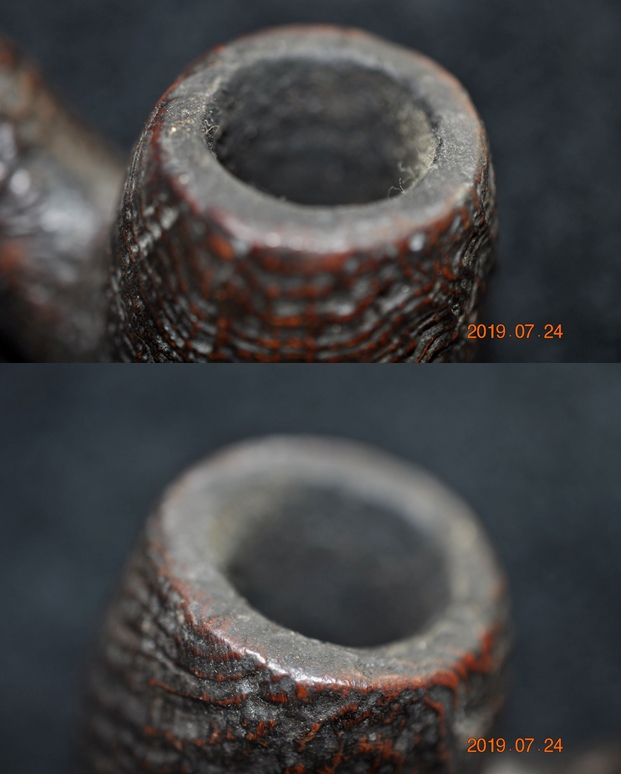
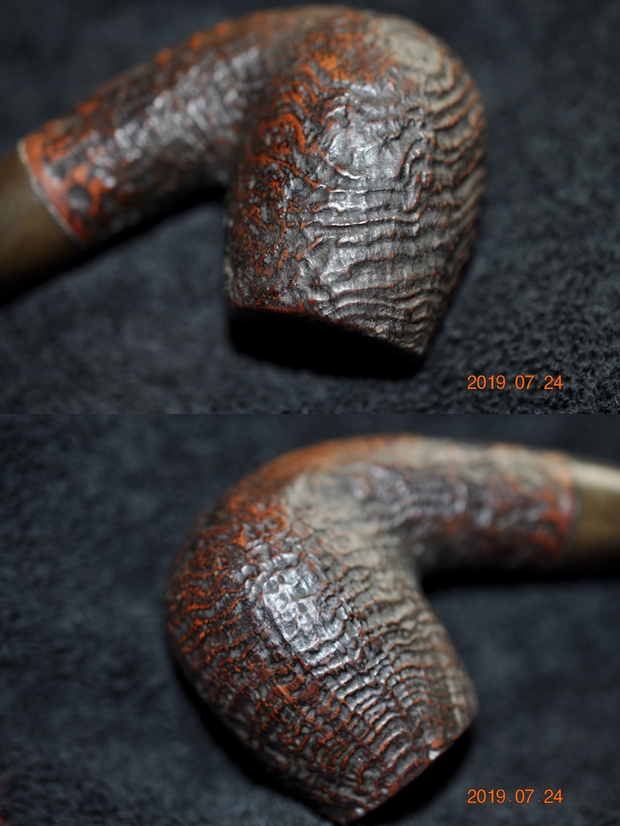
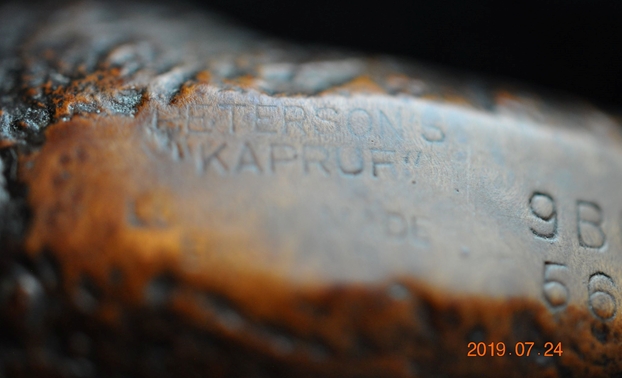
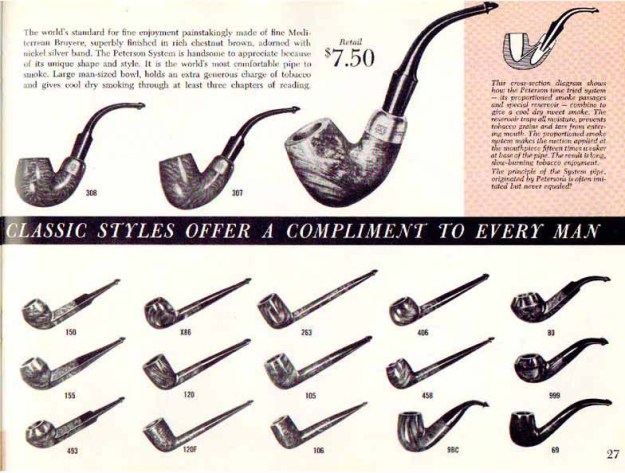
It is a shape 54 with a sandblast that makes it a favourite of mine. This one also has a rugged sandblast finish with lots of nooks and crannies in the briar. It is a beauty! The pipe is stamped Peterson’s “Kapruf” over Made in the Republic of Ireland. That is followed by the shape number 54. The valleys and ridges of the sandblasted grain showing through the grime and dirt are a mixture that leaves a rich texture. It had a rich reddish brown stain that does not look too bad. There was a thick cake in the bowl and lava overflow filling in the blast on the rim. The edges of the rim and top are dirty but look pretty pristine under the grime. It was a beautiful pipe that was dirty and tired looking. The stem was lightly oxidized and surprisingly did not have the tooth marks that I have come to expect from Bob’s pipes. He obviously loved the Peterson’s as much as he did his Dunhills.Jeff took photos of the pipe before he started his cleanup work on it.  Jeff took photos of the bowl and rim top to show the cake in the bowl and the lava build up on the edges of the bowl. It was thick and hard but hopefully it had protected the rim and edges from damage. The edges look pretty good. Jeff took photos of the sides and heel of the bowl to show the condition of the finish. You can see the beautiful undulations of the sandblast. There is a lot of dust and grime filling in the valleys. Jeff took photos of the stamping on the smooth panel on the underside of the bowl and shank. The stamping was faint but readable as you can see from the photos. It took three separate photos from different angles to capture the totality of the stamp. It read Peterson’s “Kapruf” as can be seen below. The pipe also bears the Made in the Republic of Ireland stamp and the shape stamp 54. I think that the clue to the Montreal based Peterson’s Importer is clear with the number but I will check that as I work on the pipe. Jeff took photos of the top and underside of the stem showing the tooth chatter, scratching and oxidation on the stem surface and wear on the edges of the button. The “P” on the stem was washed out but present and the P-lip button is in very good condition.   Once again I turned to the blogs that Al Jones wrote on the Peterson’s Kapruf on rebornpipes to refresh my memory through Al’s blogs written specifically on the 9BC Kapruf pipe. The first blog contained some helpful information was still pertinent to this pipe (https://rebornpipes.com/2015/06/03/peterson-9bc-kapruf-pre-59/). I quote from there and also include some of the catalogue pages from the blog.

I didn’t know much about the Kapruf line. It is described in a 1960’s catalog as: “A fine sandblast finish distinguishes this range of light natural grained pipes with their distinctive red colouring. Very popular with sportsmen.”

Al had also written a second blog about another “Kapruf” 9BC he had picked up that was not stamped with the 9BC stamp but with a shape number 56. The pipe I am working on while not a 9BC or a 56 has the shape number 54 that is a mystery as well if you go by the standard Peterson’s numbers (https://rebornpipes.com/2019/07/25/peterson-shape-56-mystery/). I am quoting the portion where Al resolves the 56 shape number because that will also cover this 54 pipe.

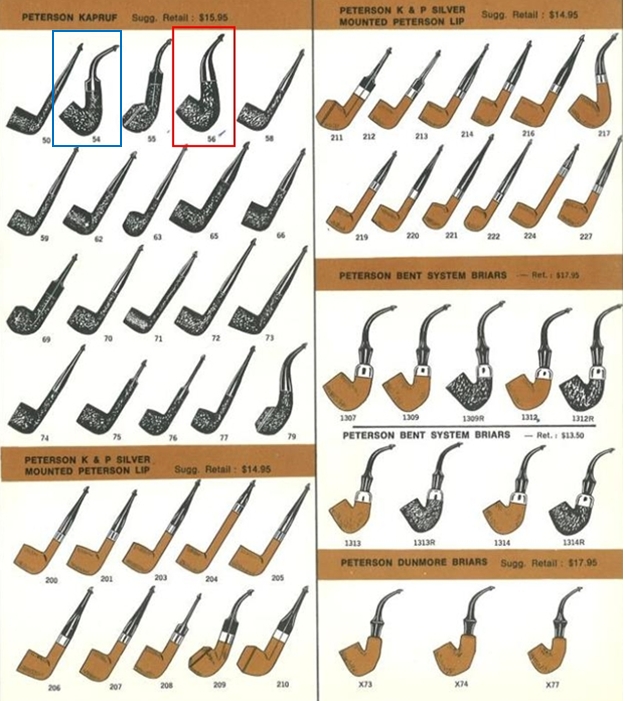
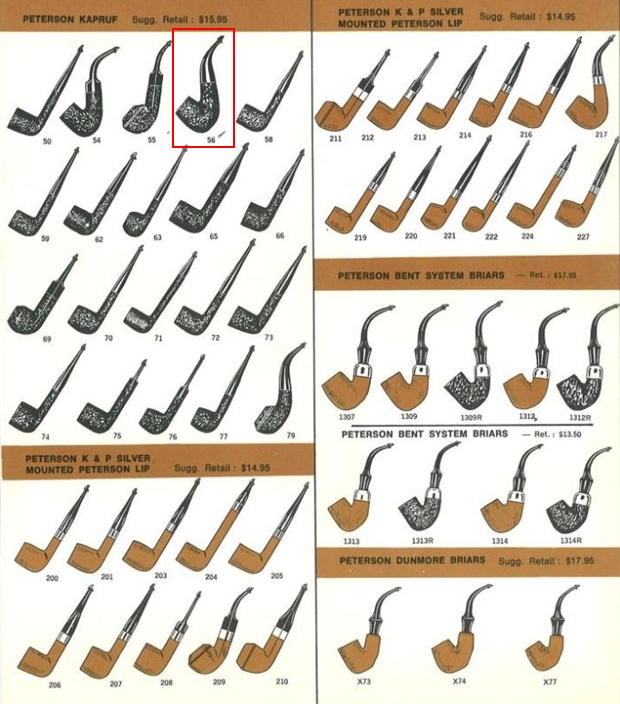
Well, the Shape 56 mystery is now resolved…Well, further sleuthing from the world’s foremost Peterson authority yielded an answer – which came directly from a blog entry here on rebornpipes, by our very own Steven Laug. In 2015, Steve posted a catalog from Canadian importer, Genin, Trudeau & Co. which shows their unique numbering system. I even comment that the Shape 56 looks like a 9BC! So, all the while, the answer was hiding on this blog! Below is that brochure page showing the Shape 56. Steve comments that the postal code used in the address dates the brochure to between 1962 and 1969. I guess not many Canadians appreciated the shape, so they are pretty uncommon. Thanks to Mark Irwin for his superior memory and to Steve for making this type of ephemera available, you never know when it will come in handy.

I have included both the link to the document for you to check out and a page from it that shows the 54 shape number (https://rebornpipes.com/2016/09/13/petersons-pipes-brochure-from-genin-trudeau-co-montreal-quebec/). I have put a blue box around the shape number to make identifying it simpler (the red box shows the 56 that Al refers to above). Be sure to check out the document as it is very informative.I turned to an article on Pipedia by a good friend, the late Mike Leverette entitled A Peterson Dating Guide (https://pipedia.org/wiki/A_Peterson_Dating_Guide;_A_Rule_of_Thumb). I quote from the section by Mike on the Republic Era pipes.

The Republic Era is from 1949 until the present. The Republic of Ireland was formed on 17 April 1949. From 1949 to present the stamp for this era is “Made in the Republic of Ireland” in a block format generally in three lines but two lines have been used with or without Republic being abbreviated.

I went to the full article on Peterson pipes after this to try to pin things down a bit more clearly (https://pipedia.org/wiki/Peterson). I believe the pipe is from the Republic Era – 1950 – 1989. I quote the pertinent section of that article below:

From 1950 to the present time, the stamp for this era is “Made in the Republic of Ireland” in a block format generally in three lines but two lines have been used with or without Republic being abbreviated.

With that information in hand I knew what I was dealing with in terms of the stamping and the age of this pipe. I knew from the information from both Mike’s Pipedia article and the longer article that the pipe was made during the Republic Era between 1950 and 1989. Most of Bob’s pipes were purchased in the 60s so my guess is that this is also a 60’s era pipe. I also knew that the pipe was brought into Canada by the Canadian importer, Genin, Trudeau & Co. in Montreal, Quebec. Noting above that the catalogue postal code puts it in the late 60s early 70s which also fits the story. Now it was time to work on the pipe.

With over 125 pipes to clean from Bob’s estate I took a batch of them to the states with me on a recent visit and left them with Jeff so he could help me out. Jeff cleaned the pipe with his usual penchant for thoroughness that I really appreciate. This one was a real mess and I did not know what to expect when I unwrapped it from his box. He reamed it with a PipNet pipe reamer and cleaned up the reaming with a Savinelli Fitsall Pipe Knife. He scrubbed out the internals with alcohol, pipe cleaners and cotton swabs until the pipe was clean. He scrubbed the exterior of the bowl with Murphy’s Oil Soap and a tooth brush to remove the grime and grit on the briar and the lava on the rim top. The finish looks very good with good looking grain around the bowl and shank. Jeff soaked the stem in Before & After Deoxidizer to remove the oxidation on the rubber. When the pipe arrived here in Vancouver for the second stop of its restoration tour it looked very good. I took photos before I started my part of the work. I took some close up photos of the rim top and also of the stem surface. I wanted to show what an amazing job Jeff did in the cleanup of the rim top. The rim top looks very good. The sandblast finish is very nice. The bowl looked very good. I also took close up photos of the stem to show the deep tooth marks on the top and underside.I took a photo of the stamping and was able to capture most of it. I also captured the P stamp on the left side of the saddle stem.  Since this is another pipe Bob’s estate I am sure that some of you have read at least some of the other restoration work that has been done on the previous pipes. You have also read what I have included about Bob Kerr, the pipeman who held these pipes in trust before I came to work on them (see photo to the left). Also, if you have followed the blog for long you will already know that I like to include background information on the pipeman whose pipes I am restoring. For me, when I am working on an estate I really like to have a sense of the person who held the pipes in trust before I worked on them. It gives me another dimension of the restoration work. I asked Brian if he or his wife would like to write a brief biographical tribute to her father, Bob. His daughter worked on it and I received the following short write up on him and some pictures to go along with the words including one of Bob’s carvings. Once again I thank you Brian and tell your wife thank you as well.

I am delighted to pass on these beloved pipes of my father’s. I hope each user gets many hours of contemplative pleasure as he did. I remember the aroma of tobacco in the rec room, as he put up his feet on his lazy boy. He’d be first at the paper then, no one could touch it before him. Maybe there would be a movie on with an actor smoking a pipe. He would have very definite opinions on whether the performer was a ‘real’ smoker or not, a distinction which I could never see but it would be very clear to him. He worked by day as a sales manager of a paper products company, a job he hated. What he longed for was the life of an artist, so on the weekends and sometimes mid-week evenings he would journey to his workshop and come out with wood sculptures, all of which he declared as crap but every one of them treasured by my sister and myself. Enjoy the pipes, and maybe a little of his creative spirit will enter you!

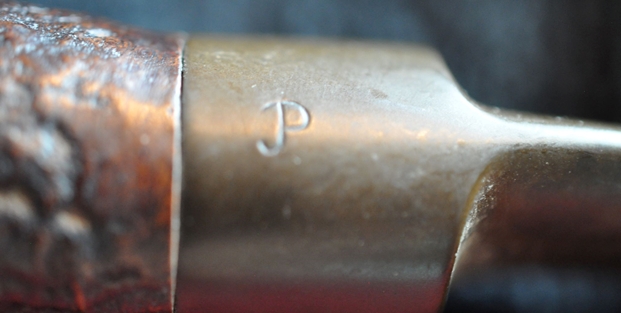
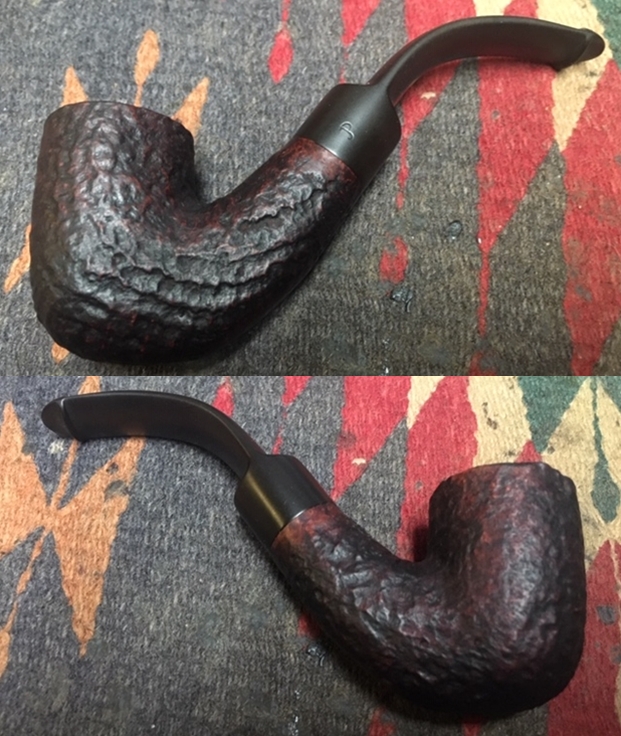
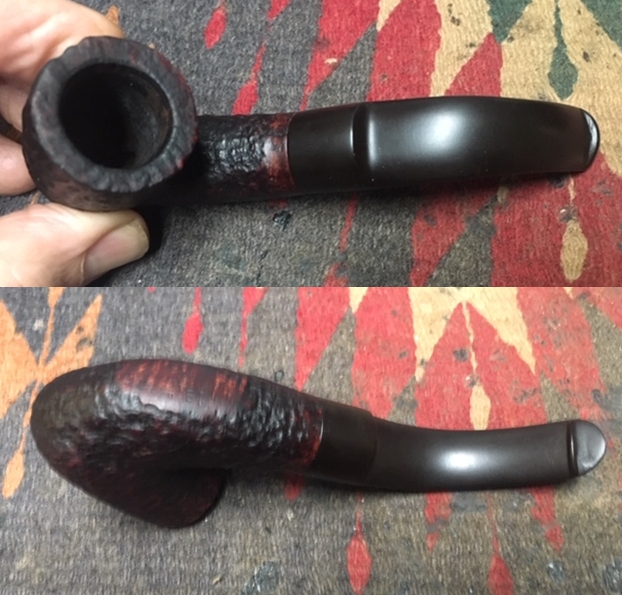
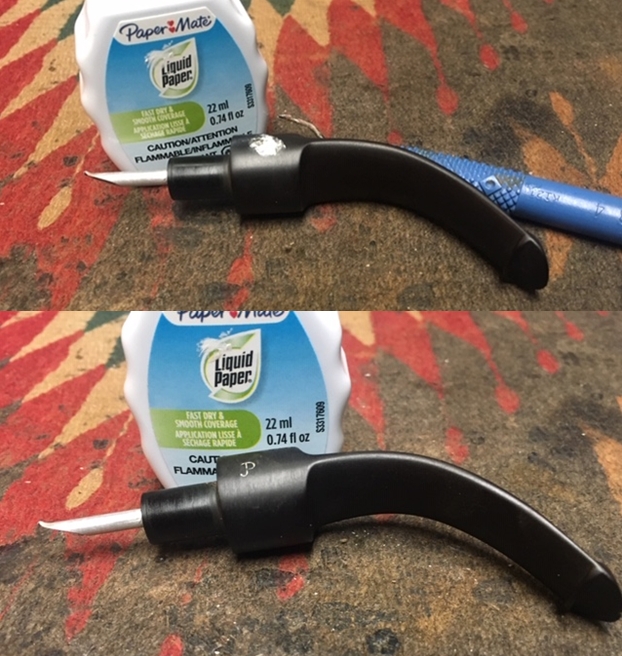
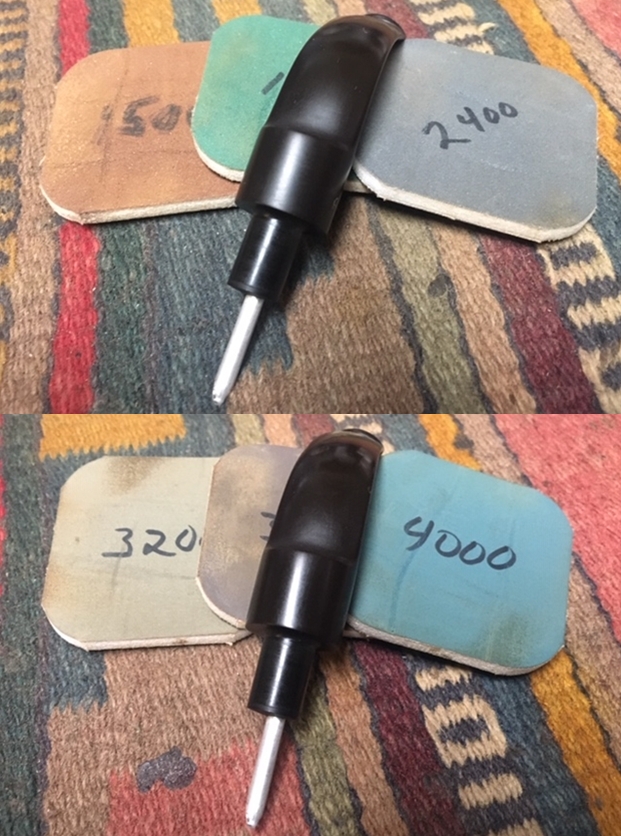
Now on to the rest of the restoration on this pipe that come from the Canadian Importer of Peterson pipes – a 54 Kapruf. Since Jeff had done such an amazing clean up job on the bowl it was very easy for me. I only had to rub the bowl down with Before & After Restoration Balm. I worked it into the surface of the briar with my fingertips and a horsehair shoe brush to clean, enliven and protect it. I let the balm sit for a little while and then buffed with a cotton cloth and shoe brush to raise the shine. Mark Hoover’s Balm is a product that I have come to appreciate and one I use on every pipe I have been working on. I set the bowl aside and turned my attention to the stem. This stem was in such good condition it made me wonder if Bob had smoked it much. However the cake in the bowl said he had. He had not chomped on the stem at all so there were no tooth marks in the surface. When I removed the stem I was a little surprised that there was an aluminum inner tube in the tenon that was obviously original. It was in good condition so I left it alone. I decided to touch up the “P” stamp before I polished the stem. I used some Papermate Liquid Paper to paint the stamped “P” and when it dried I scraped it off with my fingernail and lightly polished it with a 1500 grit micromesh pad.I polished the stem with micromesh sanding pads – wet sanding with 1500-12000 grit pads. I wiped the stem down after each sanding pad with Obsidian Oil. I polished it with Before & After Pipe Stem Polish – both Fine and Extra Fine. Once I had finished the polishing I gave it final coat of oil and set it aside to dry. Once again I am on the homestretch with this pipe and I really look forward to the final look when it is put back together and polished and waxed. I put the bowl and stem back together. I polished the bowl and stem with Blue Diamond to polish out the scratches in the briar and the vulcanite. I gave the bowl multiple coats of Conservator’s Wax and the stem multiple coats of carnauba wax. I buffed the pipe with a clean buffing pad to raise the shine. I hand buffed it with a microfiber cloth to deepen the shine. The pipe polished up pretty nicely. The valleys and ridges of the sandblast looked good with the polished black vulcanite. This second 1969/70 Peterson’s “Kapruf” a 54 Bent billiard was another fun pipe to work on thanks to Jeff’s cleanup work. It really has that classic Peterson look in a sandblast “Kapruf” finish that catches the eye. The combination of various brown stains really makes the pipe look attractive. It is a comfortable pipe to hold in the hand and I think that as it heats with smoking that over time the finish will darken and look even better. The finished pipe is shown in the photos below. The dimensions of the pipe are Length: 5 inches, Height: 1 ¾ inches, Outside diameter of the bowl: 1 1/8 inches, Chamber diameter: ¾ of an inch. If you are interested in carrying on Bob’s legacy with this pipe send me a message or an email. I have a lot more to work on include 17 more Petersons. Perhaps one of those will catch your attention. Thanks for reading this blog and my reflections on the pipe while I worked on it. This is an interesting estate to bring back to life.

Back to Bob Kerr’s Estate – Linking Peterson’s “Kapruf” 9BC with the 56 shape number


Blog by Steve Laug

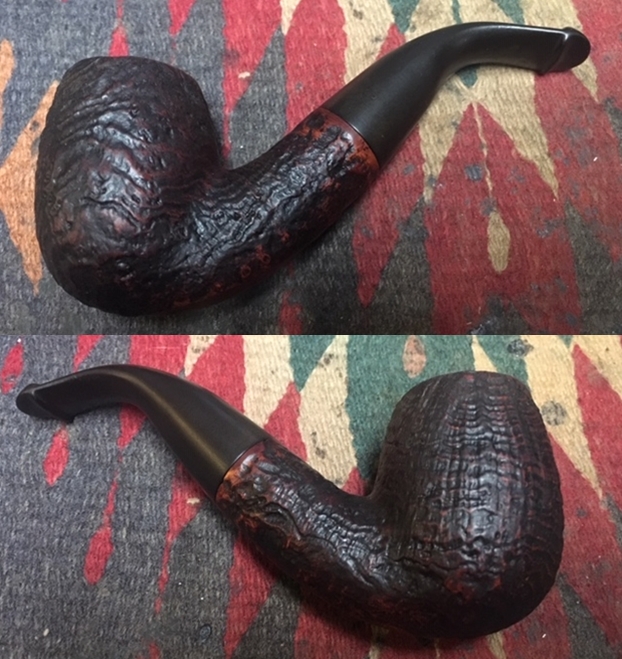
With this Peterson’s “Kapruf” 9BC I am turning again to work on a few more pipes from Bob Kerr’s estate. This is the first of the Peterson’s that I am working on. I am cleaning them for the family and moving them out into the hands of pipemen and women who will carry on the trust that began with Bob and in some pipes was carried on by Bob. In the collection there were 19 Peterson’s pipes along with a bevy of Dunhills, some Comoy’s and Barlings as well as a lot of other pipes – a total of 125 pipes along with a box of parts. This is the largest estate that I have had the opportunity to work on. I put together a spread sheet of the pipes and stamping to create an invoice. I was taking on what would take me a fair amount of time to clean up. I could not pass up the opportunity to work on these pipes though. They were just too tempting. I decided to take a break from working on his Dunhills to work on a few of the other pipes. The first of them is a really nice Peterson. It is a shape that is one of my favourites so this one will probably stay with me.

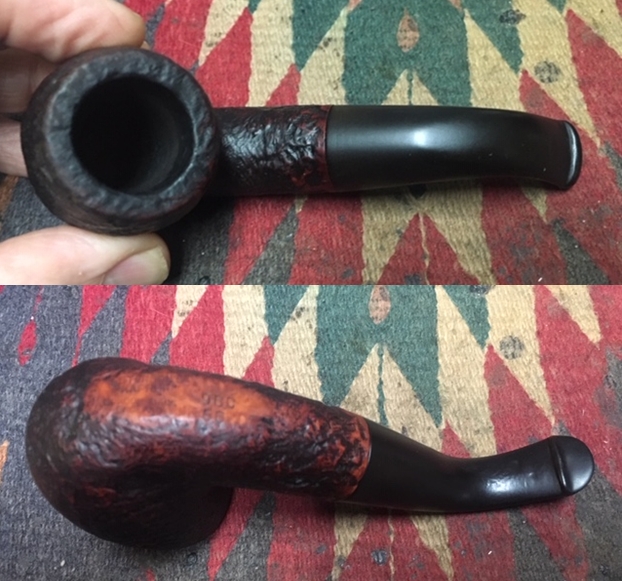
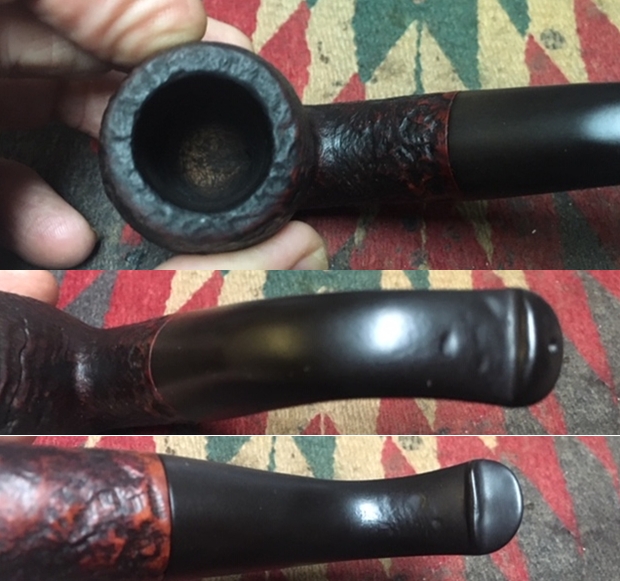
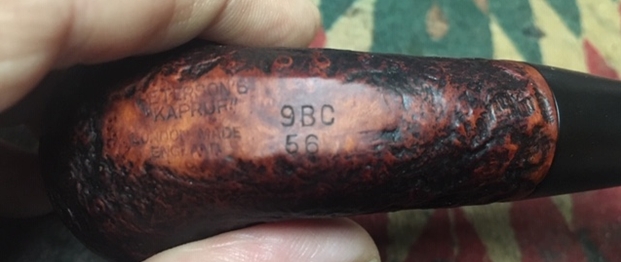
I love these older Peterson’s 9BC shapes and find that the sandblast versions really are a favourite of mine. This one has a rugged sandblast finish with lots of nooks and crannies in the briar. It is a beauty! The pipe is stamped Peterson’s “Kapruf” over London Made England. That is followed by the shape number 9BC over 56. The valleys and ridges of the sandblasted grain showing through the grime and dirt are a mixture that leaves a rich texture. It had a rich reddish brown stain that does not look too bad. There was a thick cake in the bowl and lava overflow filling in the blast on the rim. The edges of the rim and top are dirty but look pretty pristine under the grime. It was a beautiful pipe that was dirty and tired looking. The stem was lightly oxidized with the typical tooth marks and chatter on both sides that I have come to expect from Bob’s pipes. He obviously loved the Peterson’s as much as he did his Dunhills. The P-lip button had some light damage to the top surface. Jeff took photos of the pipe before he started his cleanup work on it.Jeff took photos of the bowl and rim top to show the cake in the bowl and the lava build up on the edges of the bowl. It was thick and hard but hopefully it had protected the rim and edges from damage. The edges look pretty good. Jeff took photos of the sides and heel of the bowl to show the condition of the finish. You can see the beautiful undulations of the sandblast. There is a lot of dust and grime filling in the valleys. Jeff took photos of the stamping on the smooth panel on the underside of the bowl and shank. The stamping was readable as you can see from the photos. The London Made over England stamp is faint but readable under a light. The pipe also bears the same 9BC over 56 stamp that Al Jones (upshallfan) noted on the on his previous blog and had called a mystery pipe (https://rebornpipes.com/2019/07/25/peterson-shape-56-mystery/).Jeff took photos of the top and underside of the stem showing the deep tooth marks and scratching, oxidation on the stem surface and wear on the edges of the button. The “P” logo on the stem is long gone but the robust p-lip button is in very good condition.Al Jones had written a couple of blogs on the Peterson’s Kapruf 9BC so I turned to rebornpipes to refresh my memory through Al’s blogs (https://rebornpipes.com/2015/06/03/peterson-9bc-kapruf-pre-59/). I quote from there and also include some of the catalogue pages from the blog.

I didn’t know much about the Kapruf line. It is described in a 1960’s catalog as: “A fine sandblast finish distinguishes this range of light natural grained pipes with their distinctive red colouring. Very popular with sportsmen.”

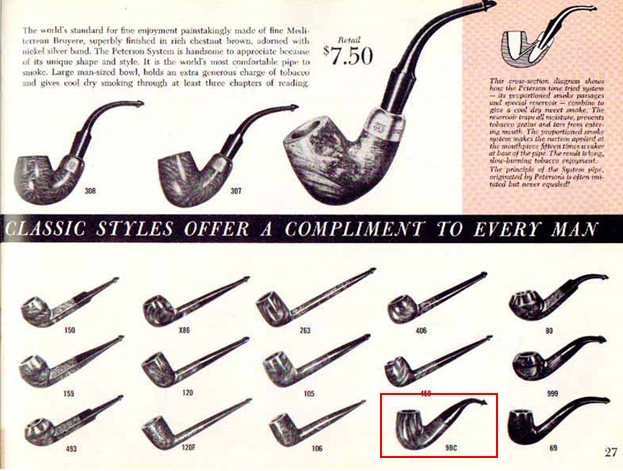
The second page shows the 9BC shape.  I have boxed the shape in with a red box for quick reference. Al had also written a blog about another “Kapruf” 9BC he had picked up that was not stamped with the 9BC stamp but with a shape number 56. Interestingly the one I am working on is stamped with both numbers. I quote from a pertinent section of that blog on the shape number (https://rebornpipes.com/2019/07/25/peterson-shape-56-mystery/).

Well, the Shape 56 mystery is now resolved…Well, further sleuthing from the world’s foremost Peterson authority yielded an answer – which came directly from a blog entry here on rebornpipes, by our very own Steven Laug. In 2015, Steve posted a catalog from Canadian importer, Genin, Trudeau & Co. which shows their unique numbering system. I even comment that the Shape 56 looks like a 9BC! So, all the while, the answer was hiding on this blog! Below is that brochure page showing the Shape 56. Steve comments that the postal code used in the address dates the brochure to between 1962 and 1969. I guess not many Canadians appreciated the shape, so they are pretty uncommon. Thanks to Mark Irwin for his superior memory and to Steve for making this type of ephemera available, you never know when it will come in handy.

I have included both the link to the document for you to check out and a page from it that shows the 9BC/56 connection Al noted above (https://rebornpipes.com/2016/09/13/petersons-pipes-brochure-from-genin-trudeau-co-montreal-quebec/). I have put a red box around the shape number to make identifying it simpler. Be sure to check out the document as it is very informative.I turned to an article on Pipedia by a good friend, the late Mike Leverette entitled A Peterson Dating Guide (https://pipedia.org/wiki/A_Peterson_Dating_Guide;_A_Rule_of_Thumb). While the one I have in hand is slightly different in terms of stamping it is an English made Peterson that bears the stamp London Made England. I quote from the section by Mike on the English pipes.

English made Peterson pipes actually spans between the pre-Republic and Republic eras. In 1895, Peterson opened a shop in London England that lasted until the late 1950s or early 1960s. So the English Era, for a simplified date, will be from 1895 through 1959. The stamps Peterson used in London and that we have seen are:

  • Made in England – block format
  • Made in England – circle format
  • Made in London
  • Made in London England
  • Simply, London England.
  • Great Britain

I went to the full article on Peterson pipes after this to try to pin things down a bit more clearly (https://pipedia.org/wiki/Peterson). I believe the pipe is from the Republic Era – 1950 – 1989. I quote the pertinent section of that article below:

1969/70 – The ‘Made in England’ stamp was discontinued with the closing down of the London based factory. Although Peterson has always prided itself in being an Irish made pipe, Peterson had also maintained a pipe factory in London since 1899.

English made Peterson pipes actually spanned the period between the pre Republic and Republic eras.

In 1899, Peterson opened the first in a series of several successive shops in London, England, that lasted until the late 1960’s/70s.

1899 – 53, New Broad St. E.C.

1910 – 7, Hills Pl., Oxford St. W.

1915 – 21, Mortimer St. W.

Finally moving to 74/77 White Lion Street until 1970.

So the English Era, for a simplified date, will be from 1899 through to around 1970. The stamps Peterson used in London are:

    • Made in England block format
    • Made in England circle format
    • Made in London
    • Made in London England
    • Simply, London England
    • London Made over England block format
    • Great Britain

With that information in hand I knew what I was dealing with in terms of the stamping and the age of this pipe. I knew from the information from both Mike’s Pipedia article and the longer article that the pipe was made during the Republic Era prior to the closer of the London based factory. My thinking is that it came from the final factory location on 74/77 White Lion Street which closed down in 1970. That fits the time frame of many of the pipes from Bob Kerr’s estate.  I also knew that the pipe was brought into Canada by the Canadian importer, Genin, Trudeau & Co. in Montreal, Quebec. Noting above that the catalogue postal code puts it in the late 60s early 70s which also fits the story. Now it was time to work on the pipe.

With over 125 pipes to clean from Bob’s estate I took a batch of them to the states with me on a recent visit and left them with Jeff so he could help me out. Jeff cleaned the pipe with his usual penchant for thoroughness that I really appreciate. This one was a real mess and I did not know what to expect when I unwrapped it from his box. He reamed it with a PipNet pipe reamer and cleaned up the reaming with a Savinelli Fitsall Pipe Knife. He scrubbed out the internals with alcohol, pipe cleaners and cotton swabs until the pipe was clean. He scrubbed the exterior of the bowl with Murphy’s Oil Soap and a tooth brush to remove the grime and grit on the briar and the lava on the rim top. The finish looks very good with good looking grain around the bowl and shank. Jeff soaked the stem in Before & After Deoxidizer to remove the oxidation on the rubber. When the pipe arrived here in Vancouver for the second stop of its restoration tour it looked very good. I took photos before I started my part of the work. I took some close up photos of the rim top and also of the stem surface. I wanted to show what an amazing job Jeff did in the cleanup of the rim top. The rim top looks very good. The sandblast finish is very nice. The bowl looked very good. I also took close up photos of the stem to show the deep tooth marks on the top and underside. The “P” logo on the stem was long gone though I could see a faint ghost of it on the left side. I took a photo of the stamping and was able to capture all of it. Even the illusive London Made over England portion shows up. Since this is another pipe Bob’s estate I am sure that some of you have read at least some of the other restoration work that has been done on the previous pipes. You have also read what I have included about Bob Kerr, the pipeman who held these pipes in trust before I came to work on them (see photo to the left). Also, if you have followed the blog for long you will already know that I like to include background information on the pipeman whose pipes I am restoring. For me, when I am working on an estate I really like to have a sense of the person who held the pipes in trust before I worked on them. It gives me another dimension of the restoration work. I asked Brian if he or his wife would like to write a brief biographical tribute to her father, Bob. His daughter worked on it and I received the following short write up on him and some pictures to go along with the words including one of Bob’s carvings. Once again I thank you Brian and tell your wife thank you as well.

I am delighted to pass on these beloved pipes of my father’s. I hope each user gets many hours of contemplative pleasure as he did. I remember the aroma of tobacco in the rec room, as he put up his feet on his lazy boy. He’d be first at the paper then, no one could touch it before him. Maybe there would be a movie on with an actor smoking a pipe. He would have very definite opinions on whether the performer was a ‘real’ smoker or not, a distinction which I could never see but it would be very clear to him. He worked by day as a sales manager of a paper products company, a job he hated. What he longed for was the life of an artist, so on the weekends and sometimes mid-week evenings he would journey to his workshop and come out with wood sculptures, all of which he declared as crap but every one of them treasured by my sister and myself. Enjoy the pipes, and maybe a little of his creative spirit will enter you!

Now on to the rest of the restoration on this pipe that links the two shape numbers that Al referred to – the 9BC and the 56. Since Jeff had done such an amazing clean up job on the bowl it was very easy for me. I only had to rub the bowl down with Before & After Restoration Balm. I worked it into the surface of the briar with my fingertips and a horsehair shoe brush to clean, enliven and protect it. I let the balm sit for a little while and then buffed with a cotton cloth and shoe brush to raise the shine. Mark Hoover’s Balm is a product that I have come to appreciate and one I use on every pipe I have been working on. I set the bowl aside and turned my attention to the tooth marks in the stem. I painted the surface of the stem with the flame of a Bic style lighter. Since vulcanite has “memory” heat will lift much of the tooth damage. The photos show the marks that remain after the heat treatment.To repair these deeper tooth marks, I filled them in with clear super glue and set the stem aside to dry. Once the glue cured it would be a matter of blending the repairs into the surface of the stem with sandpaper.Once the repairs had hardened I also sanded them to blend them into the surrounding vulcanite with a folded piece of 220 grit sandpaper. I followed the 220 grit sandpaper with 400 grit wet dry sandpaper to minimize the scratching. The two papers combined do a great job in blending the repairs. I wiped the stem down with Obsidian Oil and set it aside to dry.  I polished out the scratches with micromesh sanding pads – wet sanding with 1500-12000 grit pads. I wiped the stem down after each sanding pad with Obsidian Oil. I polished it with Before & After Pipe Stem Polish – both Fine and Extra Fine. Once I had finished the polishing I gave it final coat of oil and set it aside to dry. I am on the homestretch with this pipe and I really look forward to the final look when it is put back together and polished and waxed. I put the bowl and stem back together. I polished the bowl and stem with Blue Diamond to polish out the scratches in the briar and the vulcanite. I gave the bowl multiple coats of Conservator’s Wax and the stem multiple coats of carnauba wax. I buffed the pipe with a clean buffing pad to raise the shine. I hand buffed it with a microfiber cloth to deepen the shine. The pipe polished up pretty nicely. The valleys and ridges of the sandblast looked good with the polished black vulcanite. This 1969/70 Peterson’s “Kapruf” 9BC/56 Bent billiard was a fun pipe to work on thanks to Jeff’s cleanup work. It really has that classic Peterson look in a sandblast “Kapruf” finish that catches the eye. The combination of various brown stains really makes the pipe look attractive. It is a comfortable pipe to hold in the hand and I think that as it heats with smoking that over time the finish will darken and look even better. The finished pipe is shown in the photos below. The dimensions of the pipe are Length: 5 ½ inches, Height: 2 inches, Outside diameter of the bowl: 1 3/8 inches, Chamber diameter: ¾ of an inch. This one is staying with me as I carry on Bob’s legacy each time I fire up a bowl. I have a lot more to work on include 18 more Petersons. Perhaps one of those will catch your attention. Thanks for reading this blog and my reflections on the pipe while I worked on it. This is an interesting estate to bring back to life.

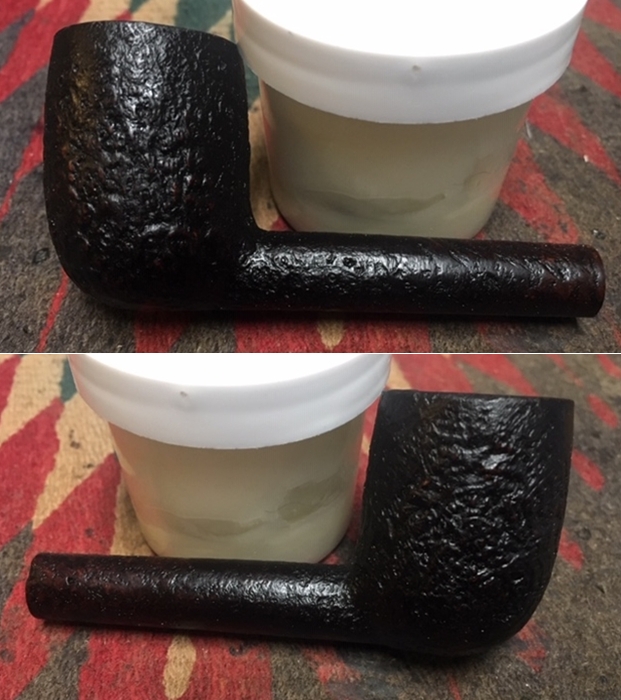
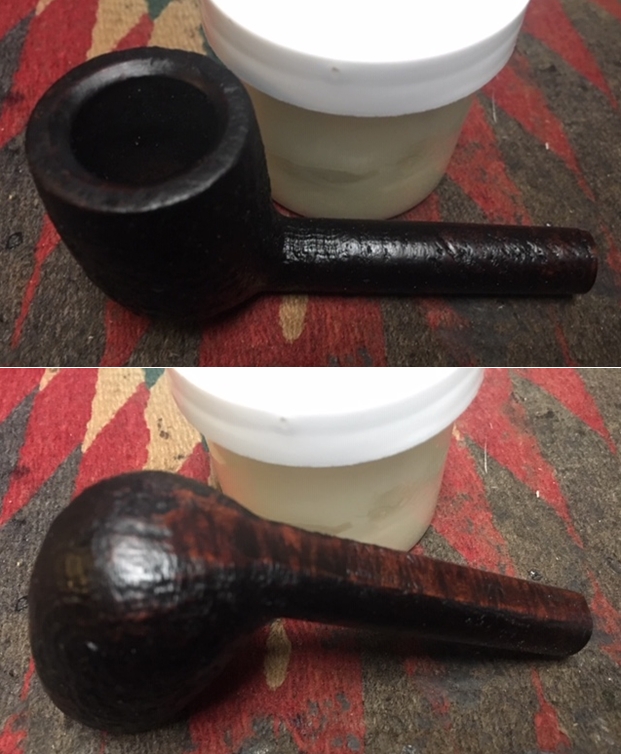
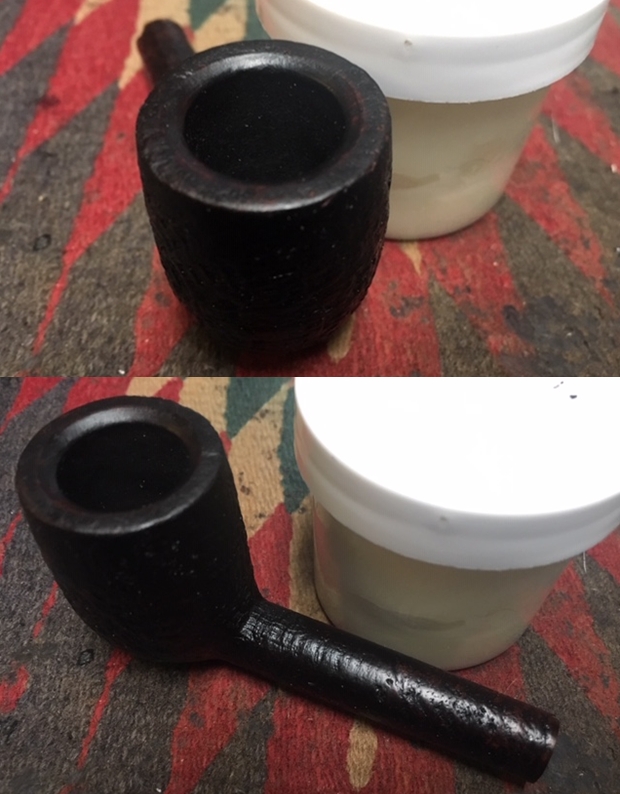
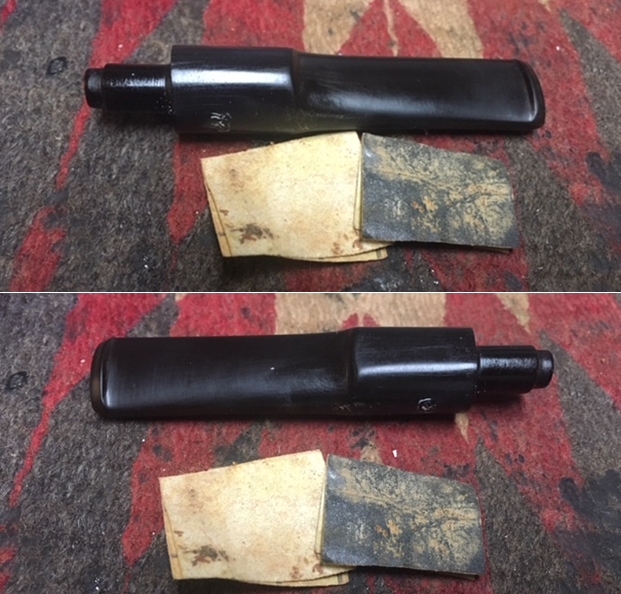
Restoring a KBB Yello-Bole Double Carburetor Bulldog


Blog by Steve Laug

The next pipe I chose to work on came in a recent box from my brother Jeff. It was another pipe he picked on one of the online auctions he frequents. It is interesting triangular shank Bulldog (Rhodesian??) with a smooth finish and twin rings separating the cap from the bowl. It also has twin carburetor’s or air “nipples” on the underside of the bowl. It is a shape I have not seen much of before. The pipe is stamped with the KBB Clover followed by DOUBLE CARBURETOR  over Yello-Bole over Reg US Pat Off.  On the underside of the triangular shank that made the pipe a sitter it is stamped Cured with Real Honey. On the right side of the shank it is stamped with a 4 digit shape number 4982. The grain showing through the grime and dirt is a mix or birdseye, cross and flame grain. It had a rich reddish brown stain and what looked like a varnish coat. There was a thick cake in the bowl and some light lava overflow. The inner beveled edge of the rim and top appeared to have some darkening under the grime. It was a beautiful pipe that was dirty and tired looking. The stem was lightly oxidized with light tooth marks and chatter on the top and underside near the button. The button had some light damage to the sharp edge. Jeff took photos of the pipe before he started his cleanup work on it. Jeff took photos of the bowl and rim top to show the cake in the bowl and the lava build up on the edges of the bowl. It was thick and hard but hopefully it had protected the rim and edges from damage. The inner bevel seems to have some darkening and potentially some burn damage but we would know better once it was reamed and cleaned.Jeff took photos of the sides and heel of the bowl to show the condition of the finish. You can see the nicks and scratches in the grime. The beautiful grain shines through the rough and dirty finish. The photos of the heel and shank show the twin “nipples” or carburetors. They were plugged and did not allow the airflow they were designed for. The final photo of this set is a close up of the underside of the bowl and the carburetors. Jeff took photos of the stamping on the sides of the shank. The stamping was very readable – on the left side it read as noted above. On the right side you can clearly see the shape number. The final photo shows the Cured with Real Honey stamp on the underside of the shank.Jeff took photos of the top and underside of the stem showing the scratching, oxidation and light tooth damage to the stem surface and slight wear to the edges of the button.I decided to pause and do a bit of research on the pipe to figure out when the KBB Yello-Bole Double Carburetor Pipes were carved. The stamping provided many clues that were very helpful in pinning down the date of manufacture. I Googled the brand and line to see what I could find out. Here is what I found.

The first link to me to the Kaywoodie Group and a thread on dating this particular pipe. There was a helpful exchange between lifeon2 and Bosun about a pipe that is stamped in a similar manner to the one that I have. Here is a link to the full conversation: https://www.tapatalk.com/groups/kaywoodie/dating-yello-bole-pipes-t86.html

lifeon2 writes: OK so there isn’t a lot of dating information for Yello-Bole pipes but here is what I have learned so far.

  1. If it has the KBB stamped in the clover leaf it was made 1955 or earlier as they stopped the stamping after being acquired by S.M. Frank.
  2. From 1933-1936 they were stamped Honey Cured Briar.
  3. Post 1936 pipes were stamped “Cured with Real Honey”
  4. Pipes stems stamped with the propeller logo they were made in the 30s or 40s no propellers were used after the 40s.
  5. Yello Bole also used a 4 digit code stamped on the pipe in the 30s.
  6. If the pipe had the Yello Bole circle stamped on the shank it was made in the 30s this stopped after 1939.
  7. If the pipe was stamped BRUYERE rather than briar it was made in the 30s.

(Information gathered from Pipedia – https://pipedia.org/wiki/Yello-Bole)

Bosun replies: the one I have is stamped on the left side of shank:

  1. Double Carburetor
  2. yello-bole
  3. u.s.pat.off
  4. with KBB to the left of the above

underside of shank has Cured with Real Honey

right side of shank has 4907

on top of stem is the white circle

lifeon2 replies: According to the list  I have it looks like you have a late 30s model, sweet

I also turned to a blog by Andrew Selkirk on rebornpipes that also added a degree of certainty to the date of manufacture of this pipe (https://rebornpipes.com/2015/05/03/1934-35-yello-bole-carburetor/).

I can say with a fair degree of certainty that this pipe is from 1934 or 35. The carburetor patent was granted in 1935, this pipe is stamped “Pat Applied For.” Interestingly enough, it also has a patent number on the bottom of the shank. Additionally, the four digit number was used by Kaywoodie until 1936. The first two numbers indicate the finish and the second two numbers indicate the shape.

With that information in hand I knew what I was dealing with in terms of age of this pipe. I knew from the information from Pipedia that the KBB in a clover leaf stamp meant that the pipe was made before 1955. The Cured with Real Honey stamp placed the pipe as 1936 or after. The four digit shape code was used until 1936. The shape code on this one was 4982 thus it is another argument for 1936. The patent was given to KBB in 1935 so the stamped “Reg. US Pat. Off also places the pipe after 1935. The information that I have gathered helps me to know with a high degree of certainty that this Double Carburetor pipe was made in 1936. The first two numbers indicate the finish and the second two numbers indicate the shape. Now it was time to work on the pipe.

Jeff cleaned the pipe with his usual penchant for thoroughness that I really appreciate. This one was a real mess and I did not know what to expect when I unwrapped it from his box. He reamed it with a PipNet pipe reamer and cleaned up the reaming with a Savinelli Fitsall Pipe Knife. He scrubbed out the internals with alcohol, pipe cleaners and cotton swabs until the pipe was clean. He scrubbed the exterior of the bowl with Murphy’s Oil Soap and a tooth brush to remove the grime and grit on the briar and the lava on the rim top. The finish looks very good with good looking grain around the bowl and shank. There was still some darkening on the front, rear and left side of the inner edge of the rim. The briar had what looked like a small burn mark on the surface of the left side – the pipe had been laid in an ashtray (I have circled it in red in the first photo below). There was no damage on the inside of the bowl. Jeff soaked the stem in Before & After Deoxidizer to remove the oxidation on the rubber. When the pipe arrived here in Vancouver for the second stop of its restoration tour it looked very good. I took photos before I started my part of the work. I took some close up photos of the rim top and also of the stem surface. I wanted to show what an amazing job Jeff did in the cleanup of the rim top. The rim top looks very good and you can see where I need to deal with the darkening on the inner bevel on the bowl. The bowl looked very good. I also took close up photos of the stem to show how well the cleaning had cleaned up what had appeared to be tooth chatter. There were still some light marks that would be easily polished out. There was not a logo anywhere on the stem and the stem did not have a stinger in the tenon.I started my cleanup on the inner edge of the rim by sanding the bowl and edge with a piece of 220 grit sandpaper wrapped around a dowel. This smoothed out any roughness on the portion that formed the bottom edge of the bevel. I used a folded piece of 220 grit sandpaper to smooth out the rest of the beveled inner edge of the rim and work on darkening present there and on the rim top.I polished the briar and worked on the darkening on the rim top and the burn mark on the left side of the bowl with micromesh sanding pads. I wet sanded with 1500-12000 grit sanding pads and wiped the bowl down with a damp cloth after each pad. I was able to polish out most of the burn mark on the lower left side of the bowl. Once I finished polishing the bowl with micromesh I thought would be a good continuation of my experimentation with a new product from Mark Hoover of Before & After Products – a Briar Cleaner that has the capacity of absorbing grime and dirt from the surface of briar. I rubbed the bowl down with some of his Briar Cleaner to see how it would work in this setting. I rubbed it onto the bowl and rim top with my finger tips and worked it into finish of the bowl. I let it sit on the pipe for about 5 minutes before I rubbed it off with a microfibre cloth. I rinsed it under warm running water to remove the residue. I was pleasantly surprised by how clean the surface on the bowl looked when I was finished. With the pipe clean it was time to move on to rubbing the bowl down with Before & After Restoration Balm. I worked it into the surface of the briar with my fingertips to clean, enliven and protect it. I let the balm sit for a little while and then buffed with a cotton cloth and shoe brush to raise the shine. Mark Hoover’s Balm is a product that I have come to appreciate and one I use on every pipe I have been working on. I set the bowl aside and turned my attention to the stem. The stem was in such great shape that I polished it with micromesh sanding pads – wet sanding it with 1500-12000 grit pads. I wiped the stem down with a damp cloth after each pad. The micromesh took care of the remaining tooth chatter on the stem and button. I further polished it with Before & After Pipe Polish – both Fine and Extra Fine. I wiped it down with a coat of Obsidian Oil and set it aside to dry.  I put the stem back on the bowl and polished the bowl and stem with Blue Diamond polish on the buffing wheel. I gave the bowl and the stem multiple coats of carnauba wax. I buffed the pipe with a clean buffing pad to raise the shine. I hand buffed it with a microfiber cloth to deepen the shine. The shine on it makes the variations of colour really pop. The pipe polished up really well. The polished black vulcanite stem seemed to truly come alive with the buffing. The unique triangular shaped shank and stem fit nicely in my hand and when it warms with smoking I think it will be about perfect. The pipe is a beauty and it must have been a fine smoking pipe judging from the condition it was when we received it. There should be a lot of life left in this 1936 KBB Yello-Bole 4982 Bulldog.  Have a look at it in the photos below. The dimensions are Length: 5 ½ inches, Height: 1 ½ inches, Outside diameter of the bowl: 1 ½ inches, Chamber diameter: ¾ of an inch. Thanks to each of you who are reading this blog. Remember we are not pipe owners, we are pipemen and women who hold our pipes in trust until they pass on into the trust of the next pipeman or woman.

This is labeled a Sasieni Second but to me it is a beauty – Sasieni Trafalgar 70


Blog by Steve Laug

The next pipe I chose to work on came in a recent box from my brother Jeff. He picked it up in one of the online auctions he frequents. It is interesting long shank Lovat with a detailed sand blast finish. The pipe is stamped Sasieni block letters over Trafalgar over London Made on the underside of the shank. That is followed by the shape number 70 and a rugby ball shaped COM stamp that read Made in England. The grain showing through the blast is a mix of swirls and birdseye around the bowl sides and shank. It had a rich dark brown stain with red hints showing through but it was dirty and hard to see the colour well. There was a thick cake in the bowl and it had overflowed with lava was dirty and tired looking. The stem was badly oxidized with light tooth marks and chatter on the top and underside near the button. The button was in excellent condition. There was also some calcification that generally comes when a pipe has a SOFTEE Bit to protect the surface. Jeff took photos of the pipe before he started his cleanup work on it. Jeff took photos of the bowl and rim top to show the cake in the bowl and the lava build up on the edges of the bowl. It was thick and hard but hopefully it had protected the rim and edges from damage. The lava coat looks horrible and it points to a well-used good smoking pipe.Jeff took photos of the sides and heel of the bowl to show the condition of the finish – the grime and grit all over the sides and flat bottom of the bowl. It is a dirty pipe.Jeff took photos of the stamping on the underside of the shank. The stamping was very readable – it read Sasieni in block letters over Trafalgar over London Made. As you move toward the stem the shape number 70 is stamped followed by a rugby ball shaped COM Stamped Made in England.Jeff took photos of the top and underside of the stem showing the scratching, oxidation and light tooth damage to the stem surface and slight wear to the edges of the button.I have worked on quite a few Sasieni in the past and always found them to be well made smoking pipes that were obviously someone’s favourite pipe. This one certainly was that for the pipeman who had owned it previously. I had never work on a Trafalgar before so I did a bit of digging to see if I could find information. I turned to the Pipephil website to see what was listed there. I found it listed under the section Seconds and Sub-brands. Here is the link to the section: http://www.pipephil.eu/logos/en/logo-sasieni2.html. I have done a screen capture of the section on the Trafalgar and included it below.To the right of the photo of the pipe in the screen capture above were two small boxes. When I clicked on them it took me to some photos of the pipe. I have included them as well. What is fascinating to me is that it appears to be the same pipe as the one that hold in my hand. It may be slightly different in terms of the sandblast but it is the same shape, the stamping is the same and the look is identical. The S in a shield on the left side of the stem is also the same. The one that I have is more faint in colour and damaged but it is the same.Now I had the information that I was searching for. The Sasieni that I have is an interesting second or sub-brand but it is still stamped Sasieni. The stem style and look of the pipe is older. My guess is I am dealing with an early 1950s pipe.

Jeff cleaned the pipe with his usual penchant for thoroughness that I really appreciate. This one was a real mess and I did not know what to expect when I unwrapped it from his box. He reamed it with a PipNet pipe reamer and cleaned up the reaming with a Savinelli Fitsall Pipe Knife. He scrubbed out the internals with alcohol, pipe cleaners and cotton swabs until the pipe was clean. He scrubbed the exterior of the bowl with Murphy’s Oil Soap and a tooth brush to remove the grime and grit on the briar and the lava on the rim top. The finish looks very good with mixed grain around the bowl and shank. There was still some darkening on the front and rear edge of the rim. The briar was rough in those two places. He soaked the stem in Before & After Deoxidizer to remove the oxidation on the rubber. When the pipe arrived here in Vancouver for the second stop of its restoration tour it looked very good. I took photos before I started my part of the work. I took some close up photos of the rim top and also of the stem surface. I wanted to show what an amazing job Jeff did in the cleanup of the rim top. The rim top looks very good with no lasting damage to the edges. The inner bevel on the bowl was also flawless. The bowl looked very good. I also took close up photos of the stem to show the tooth marks and chatter in front of the button on both sides. The S stamp was very shallow – almost a decal on the side of the stem.I also took photos of the stamping on the pipe on the underside of the shank. It read as noted above.The sandblast exterior of this pipe was perfect for me to continue experimenting with a new product from Mark Hoover of Before & After Products. This one is a product he labels briar cleaner and it has the capacity of absorbing grime and dirt from the surface of briar. I rubbed the bowl down with some of his Briar Cleaner to see how it would work in this setting. I rubbed it onto the bowl and rim top with my finger tips and worked it into the grime and grit on the bowl. I let it sit on the pipe for about 5 minutes before I rubbed it off with a microfibre cloth. I rinsed it under warm running water to remove the residue. I was pleasantly surprised by how clean the surface on the bowl looked when I was finished. I worked some Before & After Restoration Balm into the finish of the bowl and the rim top with my fingertips to clean, enliven and protect it. I find that the balm really makes the briar come alive again. The contrasts in the layers of stain really made the grain stand out. I let the balm sit for a little while and then buffed with a cotton cloth to raise the shine. The pipe really looks good at this point. I am very happy with the results.  I set the bowl aside and started working on the stem. I sanded the stem with 220 grit sandpaper to blend the chatter and remaining marks into the surface of the stem. I started the polishing with 400 grit wet dry sandpaper. I wiped the stem off with Obsidian Oil to remove the dust and see where I was at with the stem.I polished the stem with micromesh sanding pads – wet sanding it with 1500-12000 grit pads and wiped it down with Obsidian Oil. I polished it further with Before & After Pipe Stem Polish – both fine and extra fine. I finished by wiping it down with Obsidian Oil and set it aside to dry. I put the stem back on the bowl and polished the bowl and stem with Blue Diamond polish on the buffing wheel. I gave the bowl multiple coats of Conservator’s Wax and the stem multiple coats of carnauba wax. I buffed the pipe with a clean buffing pad to raise the shine. I hand buffed it with a microfiber cloth to deepen the shine. The shine on it makes the variations of colour really pop. The pipe polished up really well. The polished black vulcanite stem seemed to truly come alive with the buffing. The Lovat shaped pipe feels great in my hand and when it warms with smoking I think it will be about perfect. I am not clear what makes this pipe a second or a Sub-brand as it is a beauty. It must have been a fine smoking pipe judging from the condition it was when we received it. There should be a lot of life left in this Sasieni Trafalgar 70.  Have a look at it in the photos below. The dimensions are Length: 5 ¾ inches, Height: 1 ¾ inches, Outside diameter of the bowl: 1 ¼ inches, Chamber diameter: ¾ of an inch. This is one that will go on the rebornpipes online store shortly. If you want to carry on the pipe trust of this older Sasieni let me know. Thanks to each of you who are reading this blog. Remember we are not pipe owners, we are pipemen and women who hold our pipes in trust until they pass on into the trust of the next pipeman or woman.

Breathing Fresh Life into an Inherited Ben Wade “The Gem” from the Year 1900!


Blog by Paresh Deshpande

It’s been a while since I have worked on any of my grandfather’s pipe collection that I have inherited after his demise a few years ago. Amongst the collection, this small quaint Ben Wade was beckoning me for a long time. It is now that I decided to work on it. I had one Ben Wade without a stem, that Steve had taken back to Canada from his visit to India to fashion a stem from his bag of spares. This prompted me to fish out this Ben Wade and work towards its restoration.

This small sized straight Bulldog is typically classic British shape, with a diamond shank and a horn stem with a threaded bone tenon. The shank end is decorated with a sterling silver ferrule with embossed leaves, which is loose and came off easily. On this ferrule are the stamp details which will help in determining the vintage of this pipe. The silver shank ferrule is stamped as “A & Co” over a series of three hallmarks running from the left near the bowl end to the end of the shank on the right.The first hallmark is an “Anchor” in a shield shaped cartouche and identifies the city of Birmingham in England where the silver was crafted. The second hallmark is a passant Lion in a cartouche which signifies that the band is silver and that it was crafted by a British silversmith. The third hallmark is a square cartouche with the small letter “a” in the box which is a date letter that will give the year of the making of the pipe. Steve had recommended a site which he frequents while dating silver hallmarked pipes. Here is the link which helped me identify the city mark as Birmingham and further following the link on Birmingham date letter chart on the same page brought me to a separate page with all the letters along with the period in which they were stamped. I found the letter which matched to the one seen on the pipe in my hand and I can now say with authority that this silver ferrule is from the year of manufacture1900!! Unfortunately, the site did not allow me to copy/ edit and reproduce the relevant charts for including in this write up.

https://www.925-1000.com/british_marks.html

The next stamp which I researched was the “A & Co” stamp over the three hallmarks. I conferred with The-Beard-of-Knowledge on all things pipe, Steve and he suggested that I visit http://www.silvercollection.it and sure enough I got the information that I was looking for. I reproduce the relevant information from the site and also the link for those who may need to refer when researching their pipes.

http://www.silvercollection.it/englishsilvermarksXA.html

A business which is supposed to have been established in 1781 at Mitcham, Surrey, by William Asprey (died 1827).

CHRONOLOGY:
Francis Kennedy, c. 1804-c. 1841
Kennedy & Asprey, c. 1841-1843
Charles Asprey, 1843-c.1872
purchased the business of Charles Edwards, c.1857
Charles Asprey & Son, c.1872-c.1879
Charles Asprey & Sons, c.1879-c.1888
acquired Leuchars & Sons
C.& G.E. Asprey, c.1888-c.1900
Asprey (& Co), c.1900-1909
acquired Houghton & Gunn, 1906
acquired William Payne & Co, 1908
Asprey & Co Ltd, 1909- 1998
Asprey & Garrard, 1998-2002
Asprey & Co Ltd, 2002

The relevant stamping is highlighted in blue. The period/ vintage of the ferrule now perfectly matches and confirmed that it is from the year 1900.

With the year of make of the ferrule established as 1900, I wanted to confirm if this matched with the year of manufacture of the pipe itself. This is essential since the makers did stock up on such silver ferrule before they even made pipes for them. The stampings on the pipe itself should provide some clues to the link with the vintage of the pipe. The pipe is stamped as “B W” in a rectangle over “THE GEM”, all in golden block capital letters. There are no other markings on this pipe, not even COM stamp.I searched pipedia.org for information on this brand and further confirmation on dating this pipe. There are some interesting details on this brand and makes for an interesting read. I have reproduced some snippets of the information from pipedia.org which are relevant to dating this Ben Wade.
The company was founded by Benjamin Wade in 1860 in Leeds, Yorkshire, where it was located for over a century. Ben Wade started as a pipe trader, but yet in the 1860’s he established a workshop to produce briar pipes. The pipes were made in very many standard shapes – always extensively classic and “very British”. Many models tended to be of smaller dimensions. Ben Wade offered a very high standard of craftsmanship and quality without any fills. Thus the pipes were considered to be high grade and a major competitor to other famous English brands.

In the second World War the factory was destroyed by German air raids on Leeds. But the Ben Wade family decided to re-build it immediately after the war and pipe production was re-started soon and successfully linked to the fame from the pre-war years.

Before the second war Ben Wade clustered their offerings into three price points: “Ben Wade” included the higher end pipes (eg the Larnix, Super Grain, Selected Grain, etc), “BW” included the mid-level pipes (eg Statesman, Natural Grain, County, etc), and “BWL” were the least expensive (eg Hurlingham, Adelphi, Tense Grain). Champion was in the last group, and in the 1930s at least retailed for 2/6.

Even though the owner family decided to leave pipe business and sell off the firm. The family went into negotiations with Herman G. Lane, president of Lane Ltd. in New York at about the same time as the Charatan family. Lane Ltd. bought both firms in 1962.

From the above it is confirmed that the Ben Wade that I have inherited is from the family era and from the era before the second war, placing it before 1939. Now, I had read somewhere that it was common for pipe makers not stamp the pipe with the COM stamp in early 1900s and this was confirmed by Steve. Thus, to sum up all the information researched to date this particular piece, it is safe to conclude that this pipe is likely to have been made in the year 1900!! My inheritance indeed has some very nice and very old pipes.

INITIAL VISUAL INSPECTION
In the month of January this year, I had restored a Loewe Kenton from my inherited pipes that was nicely reamed with no overflowing lava over the rim top (https://rebornpipes.com/2019/01/17/restoring-a-classic-british-billiard-loewe-co-pipe/) and now this is the second pipe which is without a layer of cake in the chamber. However, the rim top surface is darkened and covered with lava overflow. I searched through the remaining large carton of inherited pipe for another pipe which is sans cake, but did not find any. Coming back to the pipe on my work table, the rim inner edge is mighty uneven, most probably a result of using a knife blade and shows signs of darkening due to charring. However, the outer edge is without any damage. The walls of the chamber are in excellent condition with no signs of heat fissures/ lines, but slightly uneven. A little magical touch from Pavni, my daughter who specializes in making the chamber smooth should address this issue. The stummel surface has developed a nice patina over 119 years of its existence and I have no intentions of destroying it during the restoration. Therefore, the few dents and dings that are visible shall stay and be a part of the pipes history through the years. Maybe, micromesh polishing will address a few of these dents and scratches. I wouldn’t say that this pipe has beautiful grains all round because it does not!! But yes, there is a smattering of some straight grains in the cap of the stummel and few on the shank while rest of the stummel has just some swirls of grains here and there. Even though the stummel is covered in dust, dirt and grime from years of uncared for storage, through it all the pipe still has a feel of quality maybe because of the shape or the proportions, I am not able to pin point exact reasons, but the pipe shouts vintage and quality!! The double ring separating the cap from the rest of the stummel is filled with dirt and dust, but is intact with no chipping or unevenness, which is surprising. At this stage of my initial inspection, in order to see the condition of the shank end and mortise, I tried to separate the bone stem from the shank end. The stem would not budge. I had no desire of applying more force for the fear of breaking the bone tenon inside the mortise and this would have really complicated the restoration for me as well as the originality of the pipe would have been compromised. I wanted neither and so in went the entire pipe in to freezer for a chill. A few hours later, I took the pipe out from the freezer and slightly heated the shank end. Once satisfied, I gingerly turned the stem with success. A little coaxing and finally the stem and shank were separated. Whew! What a relief. However, when I tried to reattach the two, there was a slight gap between the stem and the shank end and indicated with red arrows. I am sure that with the cleaning of the shank/ mortise of the entire gunk, the fit should improve. After the stem was separated from the shank end, the sterling silver ferrule too fell out easily. I will have to fix it with superglue. A closer examination of the mortise confirmed that it is clogged with accumulation of oils, tars and gunk of yesteryear. The threads too are covered in the gunk and most probably the cause of the incorrect seating of the stem in the mortise.The horn stem itself appears dull and lifeless and has tooth chatter on both the surfaces of the stem. The slot is perfectly round and correct for the time period of the pipe and shows accumulation of dried tars and dirt. The button edges, however, are sharp and sans any damage with a little dirt embedded at the bottom of the edges. I could make out one crack emanating from the right bottom edge of the diamond saddle and extending to more than half the length of the saddle panel. This crack is shown by a yellow arrow. The dark and light hues taken on by the stem over the years should polish out nicely and will add an additional touch of class to this classy pipe. THE PROCESS
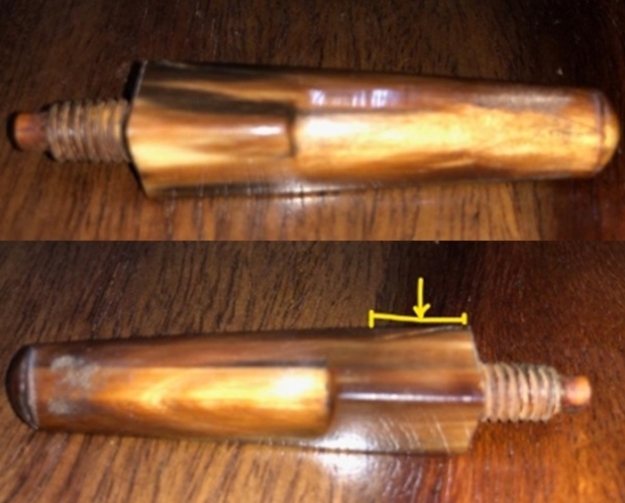
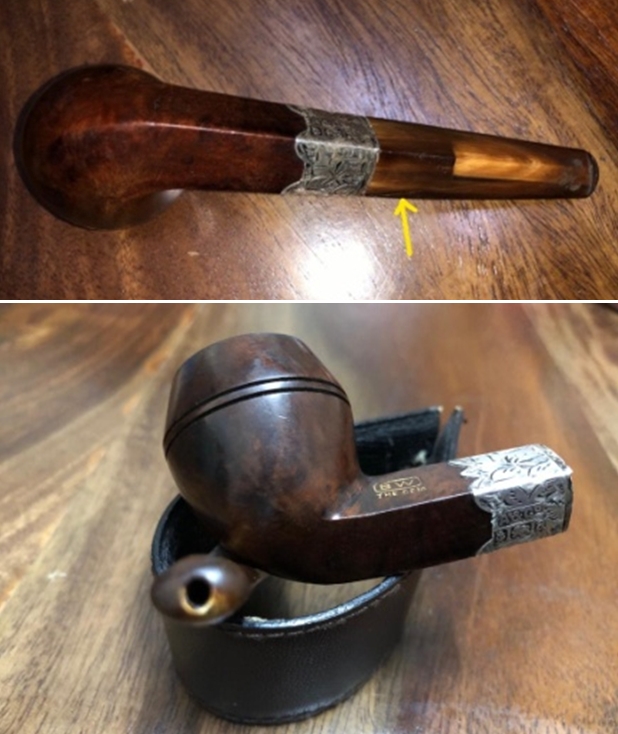
Pavni, my youngest daughter loves to help me in pipe restoration in her free time and her forte is getting the walls of the chamber as smooth as a baby’s bottom. With a folded piece of 220 grit sand paper she completely evened out the wall surface. Once she was through with her sanding regime, I cleaned out the internals of the shank and the mortise with a few hard and regular pipe cleaners dipped in isopropyl alcohol. I also cleaned out the threads in the shank end with cotton buds and alcohol. With a sharp knife, I gently scraped away the lava overflow from the rim top surface. I followed it up by cleaning the external surface of the stummel with hard bristled tooth brush and Murphy’s oil soap. I rinsed it under running tap water and dried it with paper towels and a soft cotton cloth. I diligently scrubbed the rim top surface with a scotch-brite pad and Murphy’s oil soap to remove the remaining lava overflow. With this step on this particular project, I achieved two results; firstly, the gold lettered stamping on the shank was consigned to past tense and secondly, a couple of fills were revealed (marked in yellow arrows) at the front of the bowl and in the bottom left panel of the diamond shank. Thankfully, there is no charring over the inner and outer edge or the rim surface. I removed the old and loosened fills from the front of the bowl and one on the shank that was closer to the bowl. The old fill at the shank end; I let it be as it would be covered with superglue while attaching the silver ferrule. Next, I decided to address the issue of darkened rim top surface and uneven inner edge by topping the rim on a piece of 220 grit sand paper. The progress being made was frequently checked as I had no desire to lose any briar estate than absolutely necessary. Once satisfied with the result, I wiped the rim top surface with a moist cloth. The darkened rim top has been addressed completely, however, the inner rim edge is still uneven (though greatly reduced) with slight charred edges. I address these issues by simply running a piece of 220 grit sand paper along the inner rim edge without creating a bevel, but a nice rounded even surface.Next issue to be addressed was the fills. As mentioned above, I had cleaned out the old and loose fills using my sharp dental tool. I filled these with a mix of superglue and briar dust using the layering technique. Using a toothpick, I first spot fill superglue in to the surface of the intended fill and press briar dust over it. I repeat this process, if need be, till the fill is slightly above the rest of the surface. Once all the fills are covered, I set the stummel aside to cure. Once the fills are sufficiently hardened, which is quite rapid, I sand it with a flat head needle file to achieve a rough match with the rest of the stummel surface. I follow it up by sanding with a piece of 220, 600 and 800 grit sand papers to a perfect match. Discerning readers must have noted that I did not sand the entire stummel surface. This was because, as I had decided earlier that I would maintain the aged patina that the briar had taken on over the 119 years.At this stage, I decided that I would tackle the stem repairs as addressing the crack observed on the diamond saddle would require curing time and while the stem repair is curing, I could get back to the stummel, saving on time. I began by first cleaning the bone tenon and the stem surface with a cotton swab and alcohol to remove all the dirt and gunk from the surface. I was contemplating whether or not to drill a counter hole to prevent the crack from progressing further and after weighing the cons, I decided not to do so. The probability of the stem chipping or the crack developing further was reason enough for me to avoid this drilling. I filled this crack with plain superglue and set it aside to cure. The CA superglue would seep and spread inside and stabilize the crack. During his visit, while discussing various aspects of pipe restorations, Steve had made a passing comment that in his experience the best way to preserve the patina on a briar if you need to sand it is to dry sand the stummel with 1500 to 12000 grit micromesh pads. I followed his advice and went ahead and dry sanded the entire stummel surface with 1500 to 12000 grit micromesh pads. The results are amazing. The stummel has now a deep and rich dark brown coloration and this will further deepen once I go through the polishing and wax application regimen. Most of the readers would have noticed that the double ring separating the cap from the rest of the stummel shows accumulation of briar dust and grime. Also the fills are darker than the rest of the stummel surface. I have noticed it too and will clean the rings at the end as the polish and wax would also be accumulating in these gaps subsequently. The issue of the fills was addressed by staining the fills and surrounding surface with a dark brown stain pen. I set the stummel aside overnight for the stain to set. The blend is near perfect and should blend further after application of balm and carnauba wax polish.The superglue applied over the crack was by now well cured and had seeped in to the crack as well. I sand the entire stem and the fill in particular, with a worn piece of 220 grit sand paper. This helped to address the tooth chatter seen in the bite zone as well as blend the fill with the rest of the stem surface. I followed it up with dry sanding the stem with 1500 to 12000 grit micromesh pads. I wiped the stem with a moist cloth after every three pads to remove the resulting bone dust. To finish, I applied a liberal coat of Extra Virgin Olive oil and set it aside to be absorbed by the porous bone. I am very pleased with the way the contrasting dark browns and lighter grains in the bone are now highlighted. Once polished further, this will further add a touch of class to an already chic looking Bulldog!! I applied petroleum jelly over the bone tenon and tried the fit of it in to the mortise after temporarily attaching the silver ferrule over the shank end. The alignment and seating of the two was spot on. I separated all the parts again and continued further. While the stem was being hydrated with olive oil, I went back to work the stummel. The stain had set well by this time. I applied a little “Before and After Restoration” balm with my fingers and rubbed it deep in to the stummel surface. This balm rejuvenates the briar and the transformation in the appearance of the stummel is almost immediate. The fills are now so well blended in to the briar that it is difficult to spot them. The only part that needs TLC is the sterling silver ferrule. I polish the ferrule with a very soft powder specifically available locally, and widely used by jewelers, for polishing of silver. I align the ferrule stampings with the stummel stamping on the shank and fix it over the shank with a little superglue. The contrast that this shiny ferrule provides against the dark brown of the stummel looks fantastic.Next, I ran a thin and sharp knife through the double cap ring and cleaned it. To finish, I re-attach the stem with the stummel and mount a cotton cloth buffing wheel on to my rotary tool. I set the speed at about half of the full power and applied several coats of carnauba wax over the stummel and the stem of the pipe. I finished the restoration by giving the pipe a rigorous hand buff using a microfiber cloth to deepen the shine further. The completed pipe, with dark brown hues of the stummel contrasting with silver ferrule and the shiny dark browns and lighter grains in the bone stem makes for a visual treat. The pipe looks lovely, fresh and vibrant; the photographs speak for themselves. Thank you for your valuable time. P.S. This was the last pipe that I had restored during my leave from my work. The following write ups are now on pipes that I have already restored after returning to my work place. I shall sorely miss the help that Pavni, my 10 year youngest daughter and Abha, wifey dear, extend in my work. There are about 40 odd pipes that I have carried with me and which have been cleaned by Abha. So the next couple of months are going to be interesting. Keep following rebornpipes.com for some nice, unique and interesting pipes from here in India in the near future.
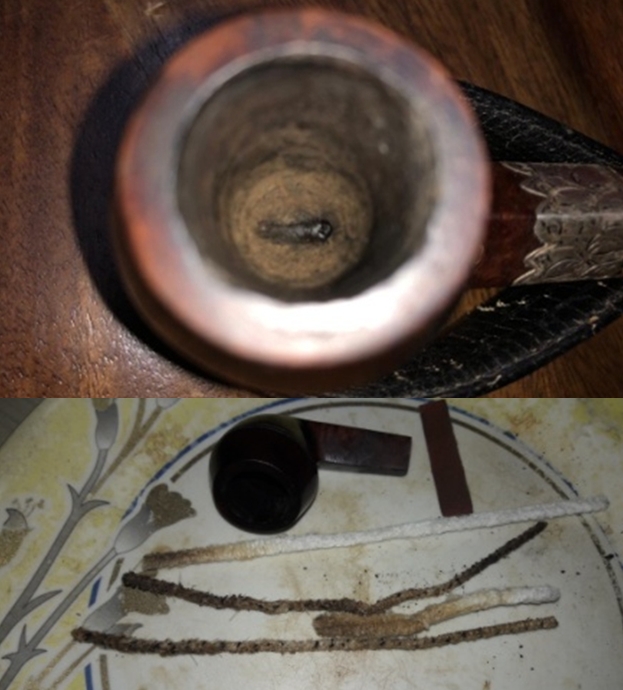
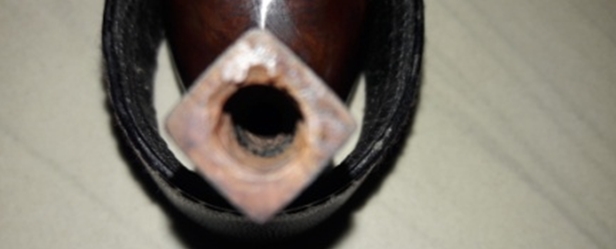
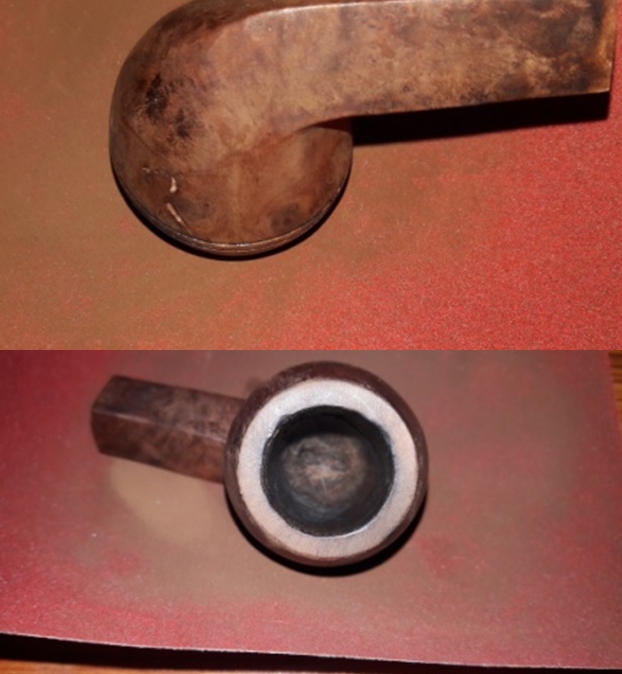
Oh, missed out on one aspect!! I tried to repaint the shank stamp with a gold glitter pen towards the end, but it would just not stay. Any suggestion would definitely help me mark this oldie as well as for future.

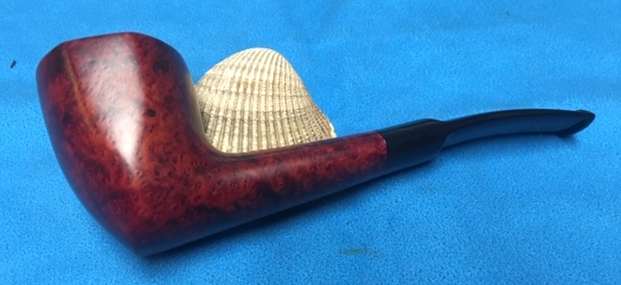
 

Giving a Second Chance to a Throw Away Bowl


Blog by Steve Laug

This morning I was looking through my boxes of pipes to restore to find what I wanted to do next. I went through several options and finally settled on a bowl that I brought back from Idaho. It was a Custombilt style bowl that we were ready to pitch in the trash because it was in rough condition. Someone had cut off the shank with a saw – a real hack job that left the shank end rough and the surface not flat. The bowl had a thick cake in it and an overflow of lava on the rim top. The inside and outside edges were dirty but it was unclear if there was damage. There was no stamping on the shank or underside. The finish was shot and there was a lot of dirt and grime in the grooves of the finish. There was also some shiny coat on the smooth portions of the bowl that made wonder if it had been varnished at some time in its life. It was an unbelievable mess. But it was enough of a challenge that I wanted to take it on. Here are some photos of the bowl when I started. I went through my cans of stems and found one that fit the mortise. I would need to work on the face of the shank itself to make it round again but it showed a lot of promise. The stem was lightly oxidized and the bend was too much but otherwise I liked the look of the saddle stem.I put the stem on the bowl and took a few photos of the pipe. To me it showed a lot of promise. It would take a bit of work to get the fit just right but the pipe had a lot of potential.I heated the stem with a heat gun to straighten out the bend. Once the vulcanite had become flexible I took the majority of the bend out so that the angle of the stem matched the angle of the top of the bowl. I took photos of it at this point in the process. I am happy with the progress. I set the stem aside and turned my attention to the bowl. I reamed it back to bare briar with a PipNet pipe reaming set. Once the bowl was smooth I cleaned up the reaming on the walls and scraped the rim top with a Savinelli Fitsall Pipe Knife. I topped the bowl on a topping board with 220 grit sandpaper to remove the damage and smooth out the surface of the rim. There was a lot of damage to the rim top and the topping took care of the damage to the rim top. I scrubbed the bowl with Murphy’s Oil Soap and a tooth brush under running water. I rinsed off the grime and took the following photos of the bowl. I cleaned out the internals on the mortise and the airway in the shank and the stem with 99% isopropyl alcohol, cotton swabs and pipe cleaners. I worked until the shank and mortise was clean and smelled new.There were still some shiny spots on the shank and smooth portions of the bowl. I wiped them down with acetone on a cotton pad. I used the Dremel and sanding drum and 220 grit sandpaper to reshape the shank. I rounded it to match the diameter of the stem and also faced the shank end on the topping board. I was moving through this restoration while I was talking with my brother and totally forgot to take photos of this part of the process. I smoothed out the sanded and reshaped shank and stem with micromesh sanding pads – wetsanding with 1500-6000 grit pads. I sanded the top of the bowl at the same time to smooth out the scratches.
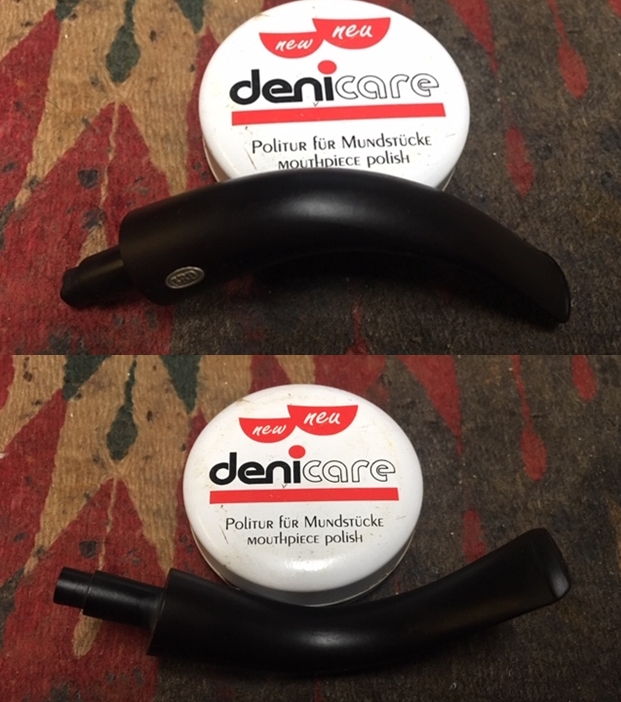
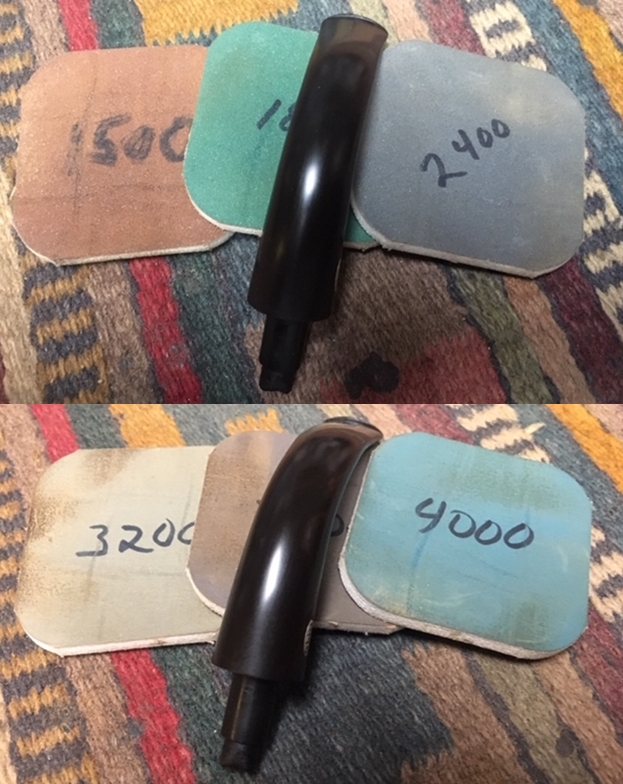
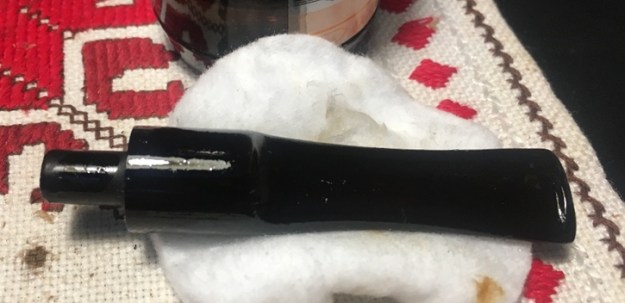
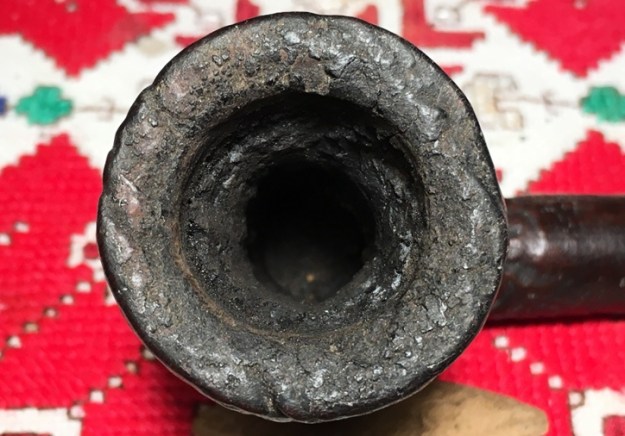
Once I had finished shaping the shank I decided to continue my ongoing experiment with the Briar Cleaner on this pipe. I scrubbed it with the product from Mark Hoover of Before & After Products. He says that the briar cleaner has the capacity of absorbing grime and dirt from the surface of briar. I rubbed the bowl down with it to see how it would work in this setting. (Just a note: In speaking to Mark he noted that the product is completely safe to use. The main product is even FDA approved edible.) I rubbed it onto the bowl and rim top with my finger tips and worked it into the remaining sanding grit on the bowl. I let it sit on the pipe for about 5 minutes before I rinsed it under warm running water to remove the residue. I hand dried it with a microfiber cloth. I was pleasantly surprised by how clean the surface on the bowl looked when I was finished. The various surfaces of the carved briar just begged for a variety of stains to give the pipe some real dimensionality. I heated the briar and gave it the first coat of stain – a Tan Fiebings. This tan has some red tints in the dried and fired coat. I applied the stain with a dauber and then flamed it with a Bic lighter to set it in the grain. I repeated the process until the coverage was what I wanted. I buffed the bowl with a clean microfiber cloth and gave the bowl a light shine. All of this was preliminary for the next stain coat. I put the stem on the bowl and buffed the pipe with Blue Diamond on the buffing wheel. The buffing really brought the reds to the surface of the briar. It helped me to make the next decision regarding the contrast stain. I touched up the rim top with a Mahogany stain pen to smooth out the finish. I then stain the entire bowl with the contrast stain coat using Watco’s Danish Oil with a Cherry stain. I rubbed it on with a soft cloth and let it sit for a while before buffing it off with a soft cloth. I gave the bowl several coats of Conservator’s Wax and buffed it with a horsehair shoe brush. I also buffed it with a microfiber cloth to deepen the shine. I set the bowl aside and turned my attention to polishing the stem. I worked it over with micromesh sanding pads – wet sanding with 1500-2400 grit pads. I buffed it on the buffing wheel with Red Tripoli to further remove the oxidation on the surface. I reworked it with micromesh sanding pads. I wet sanded it with 1500-12000 grit pads. I wiped the stem down after each pad with Obsidian Oil. I finished polishing it with Before & After Pipe Stem Polish – both Fine and Extra Fine. I gave it a final coat of Obsidian Oil and set it apart. With both parts of the pipe finished I put the pipe back together again and I polished the bowl and the stem with Blue Diamond polish on the buffing wheel. I gave the bowl multiple coats of Conservator’s Wax and the stem multiple coats of carnauba wax. I buffed the pipe with a clean buffing pad to raise the shine. I hand buffed it with a microfiber cloth to deepen the shine. The pipe polished up pretty nicely. The rich finish and the interesting grain on this briar came alive with the buffing. The finish on the briar works well with the polished black vulcanite stem. The finished pipe looks almost like it came out of the factory like this. It is a well-proportioned, nicely grained shape that I would call Bent Apple. Have a look at it with the photos below. The dimensions are Length: 5 ¾ inches, Height: 1 ½ inches, Outside diameter of the bowl: 1 ½ inches, Chamber diameter: ¾ of an inch. This throw away, cut off bowl met a stem from another place and the pipe that came out is a beauty. The condition of the bowl showed that it was a great smoker so this new edition should also be one! I am not sure who made the bowl originally but from the looks of the finish it could very well be a Custombilt. I am not sure I will ever know with certainty but it has the look. Thanks for walking through the restoration with me.