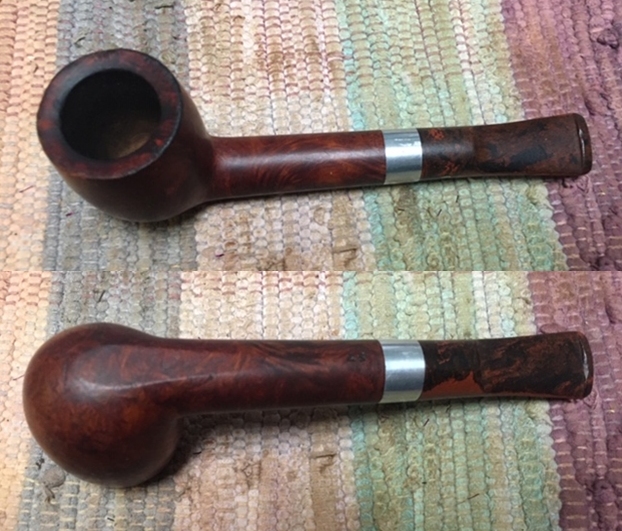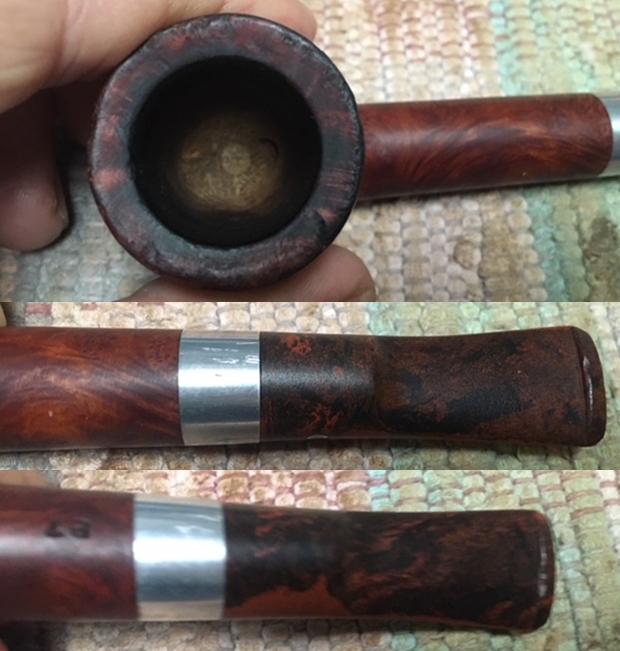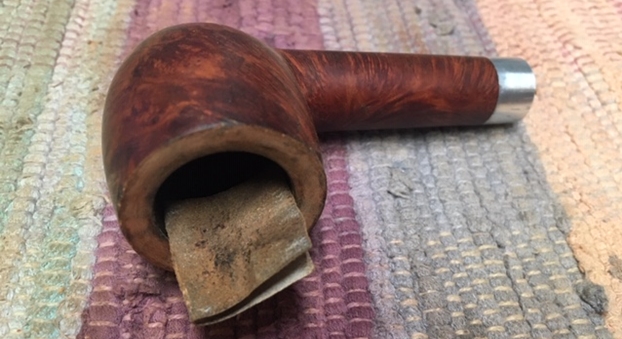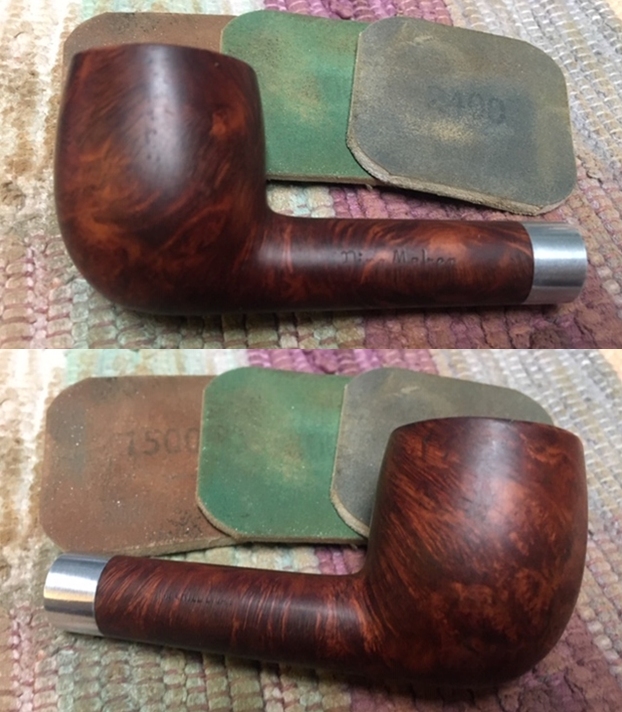
Monthly Archives: May 2020

Refreshing a Grade 3 Ligne Bretagne from 2011


Blog by Steve Laug

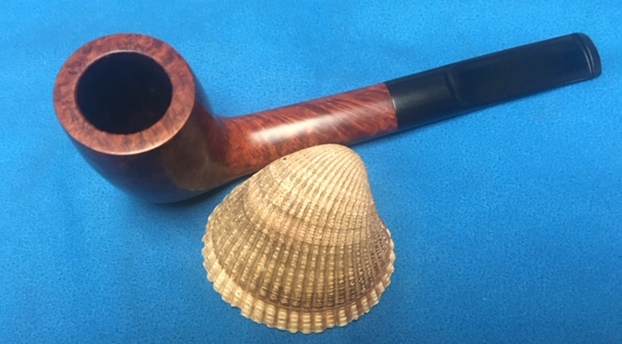
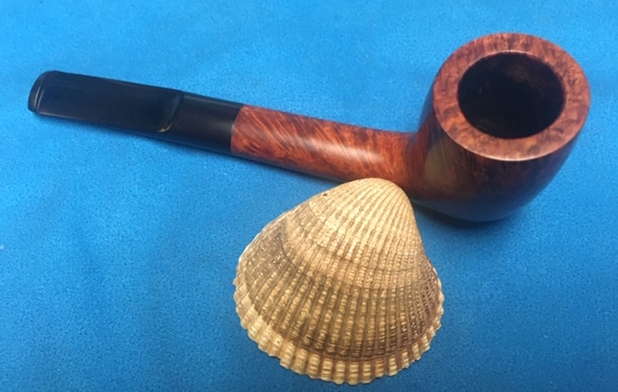
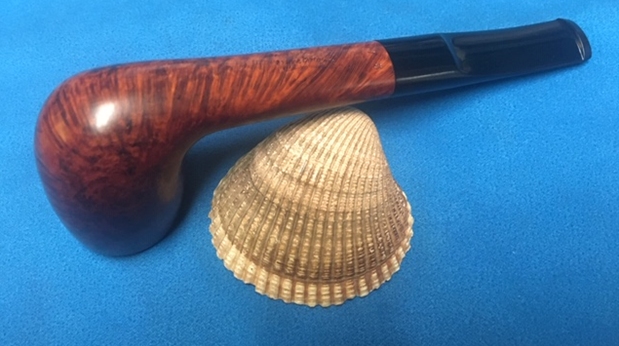
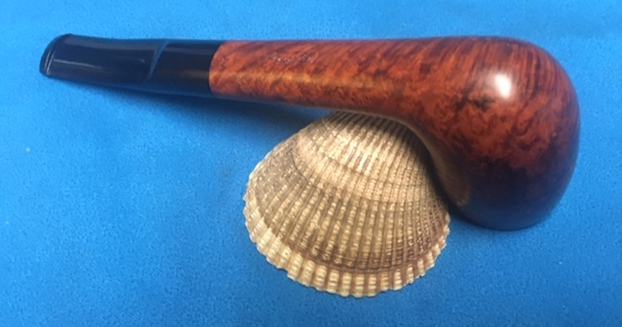
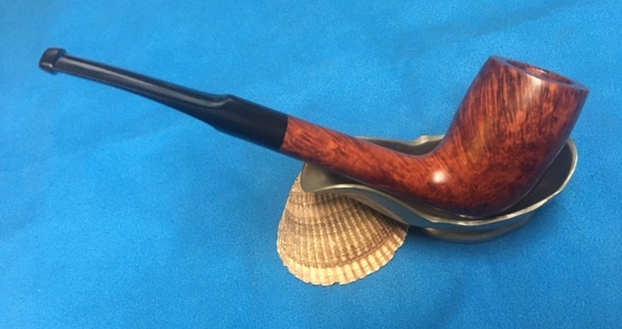
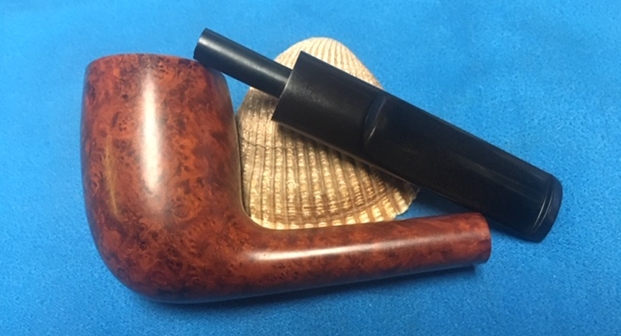
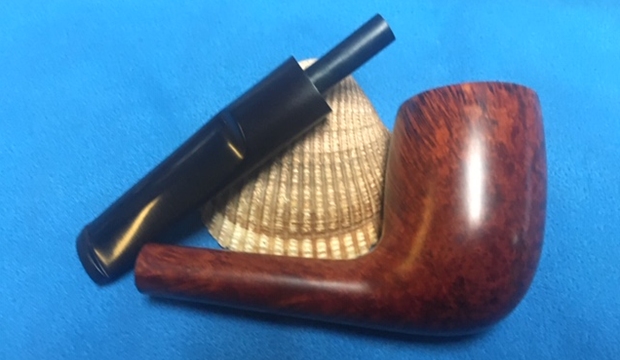
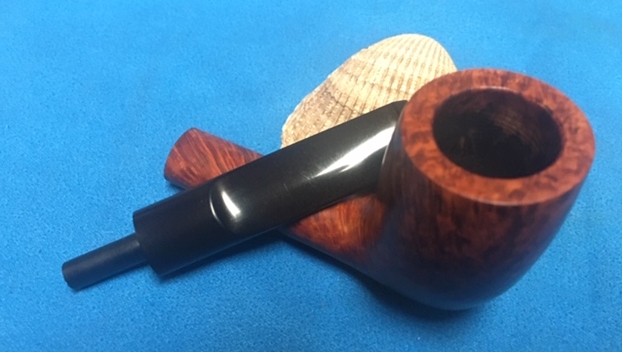
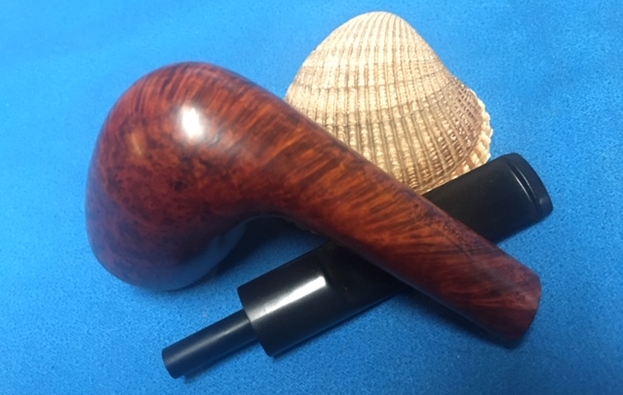
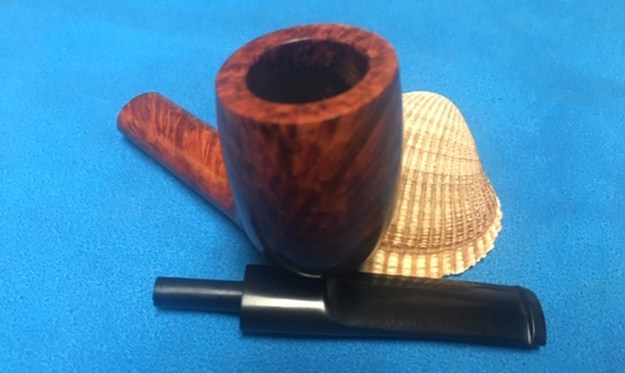
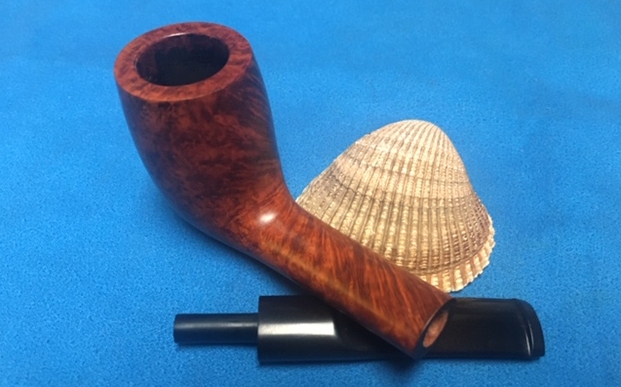
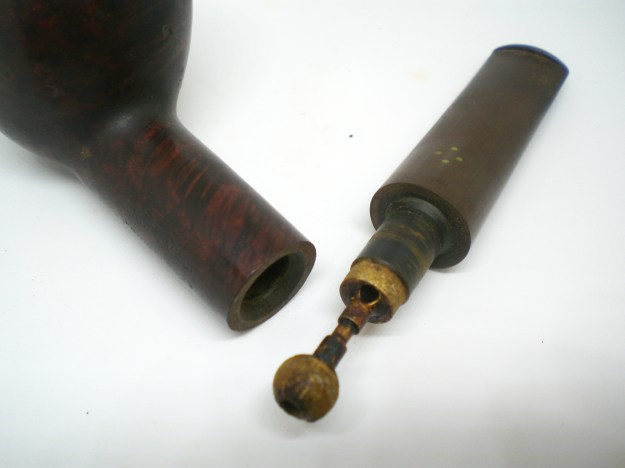
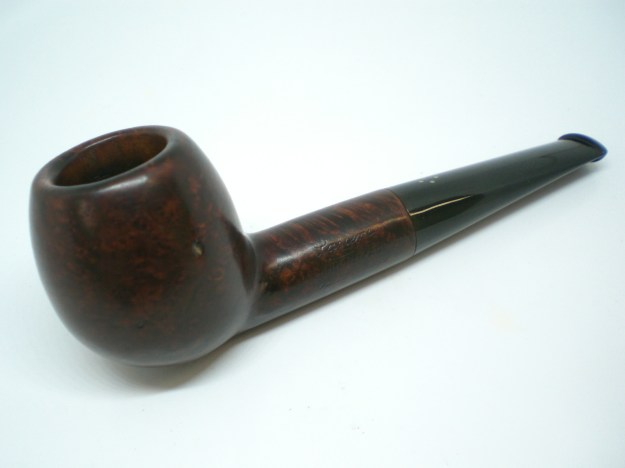
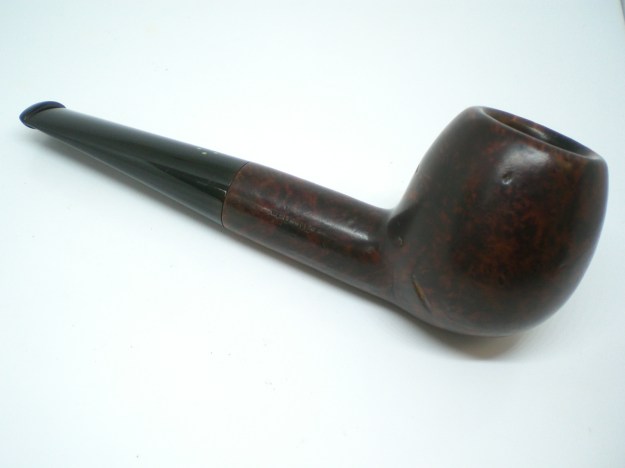
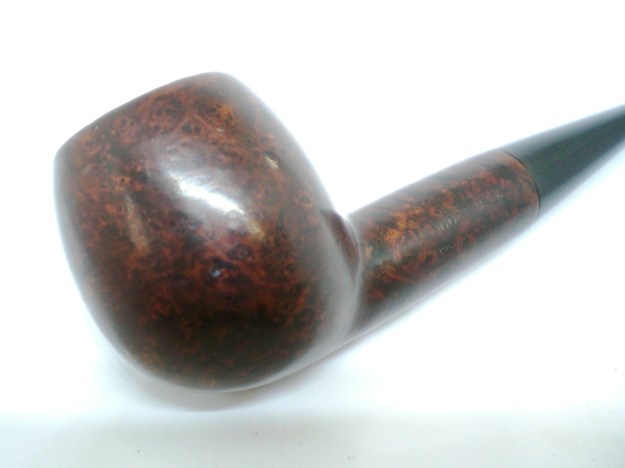
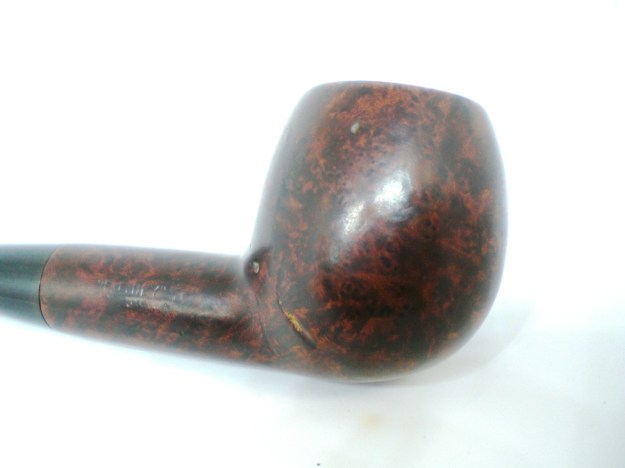
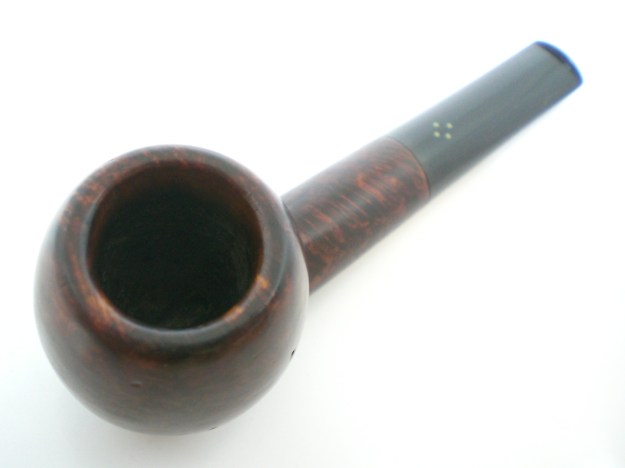
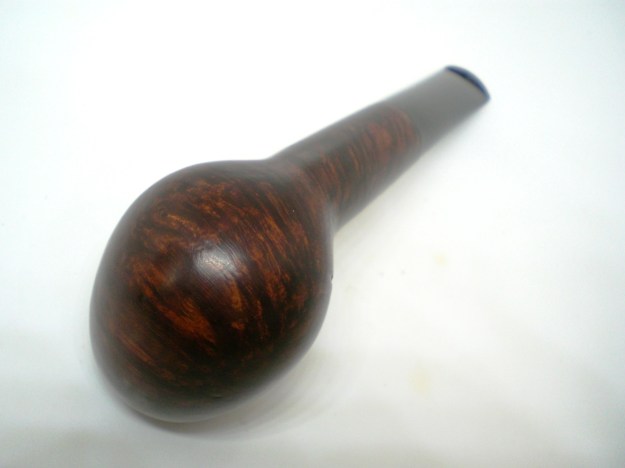
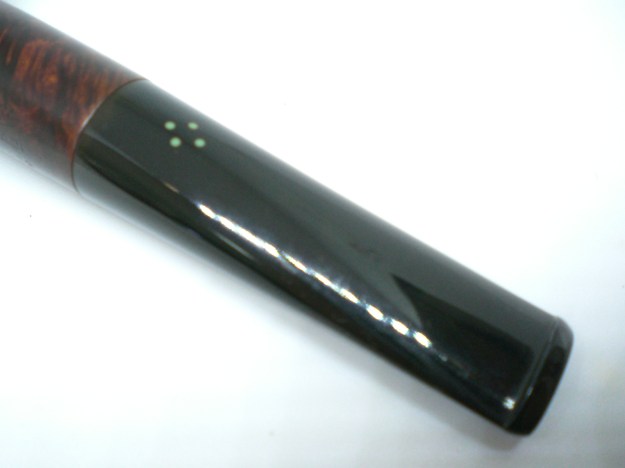
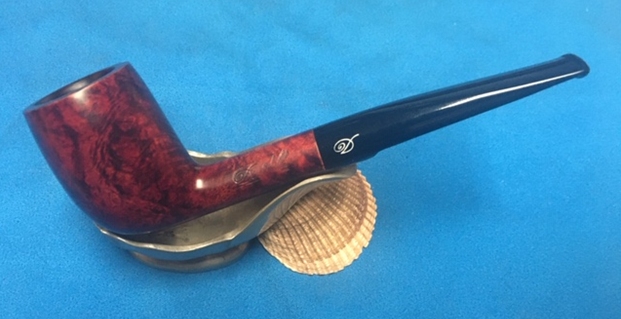
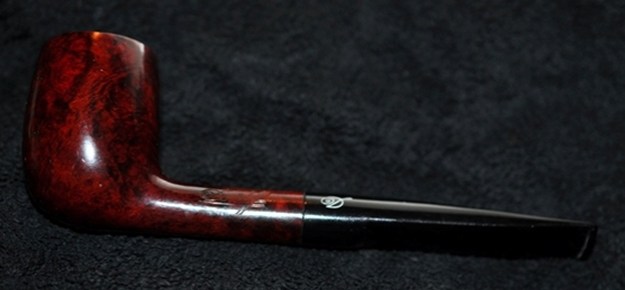
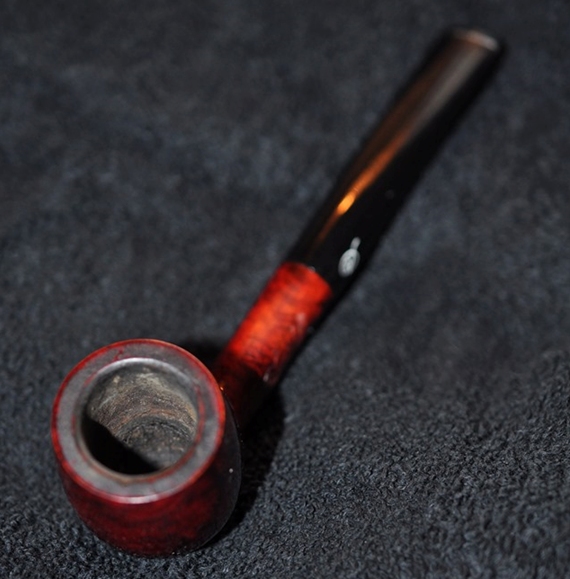
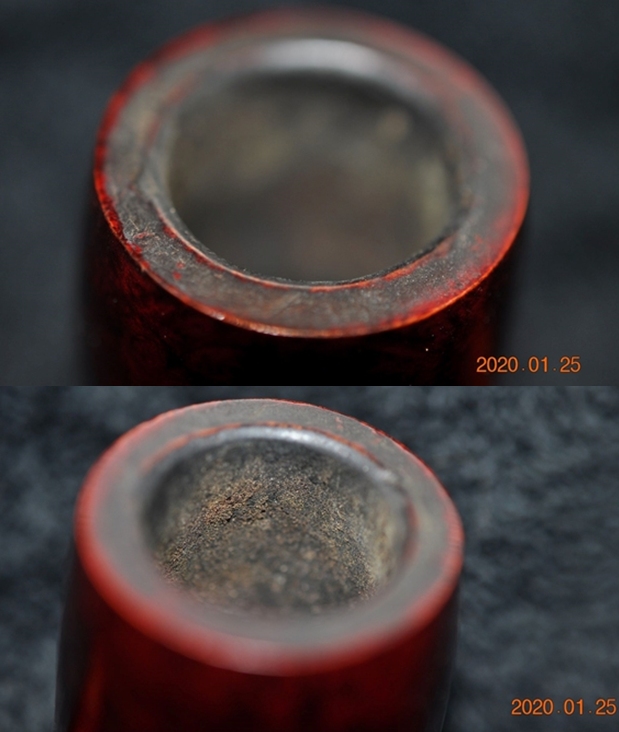
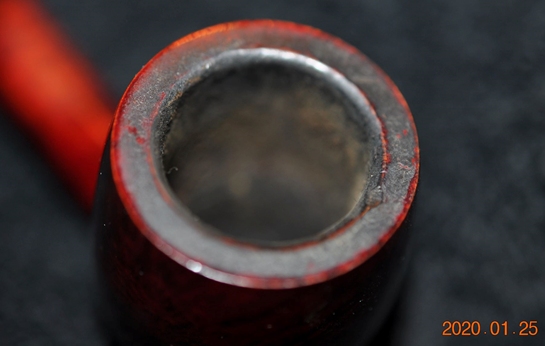
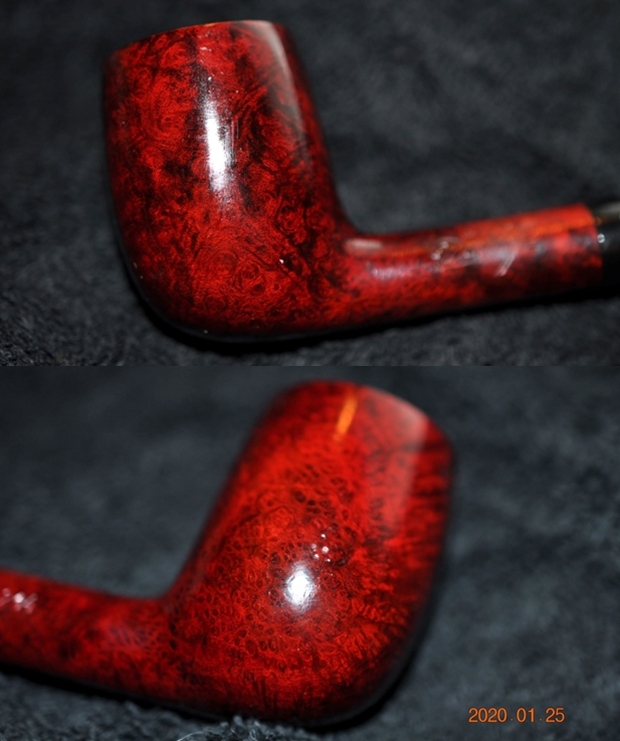
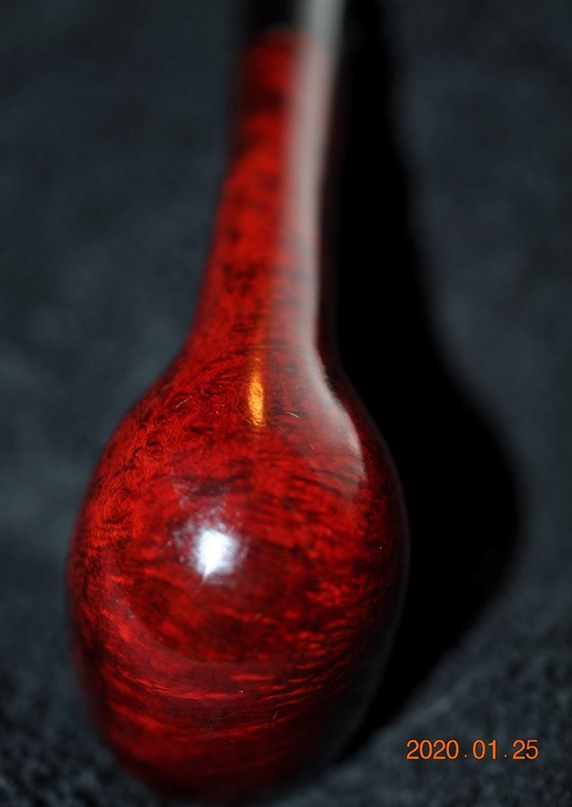
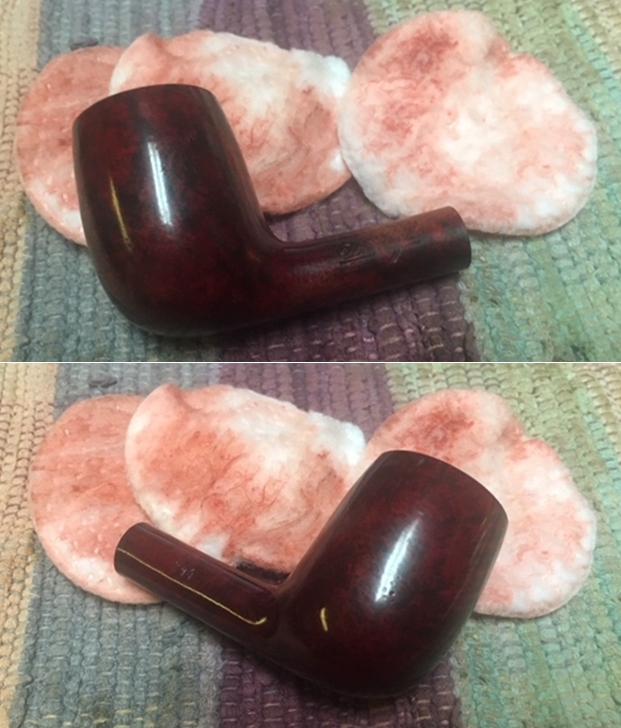
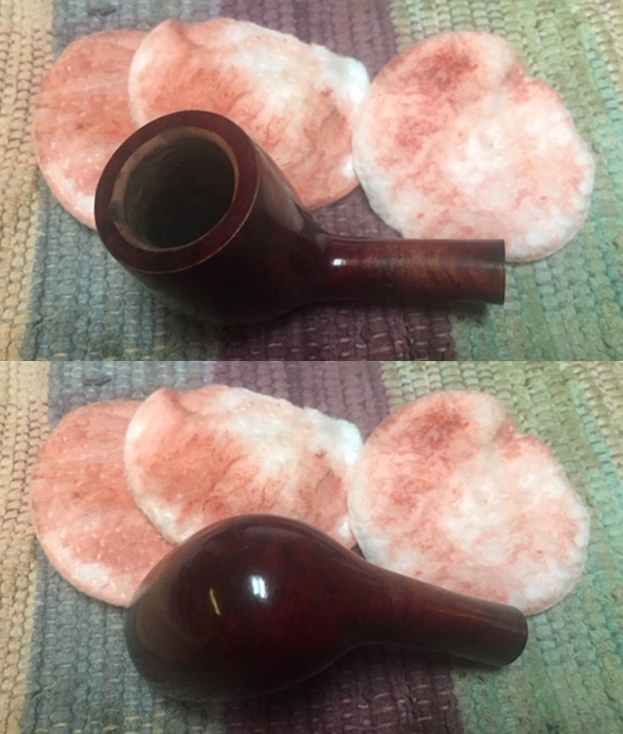
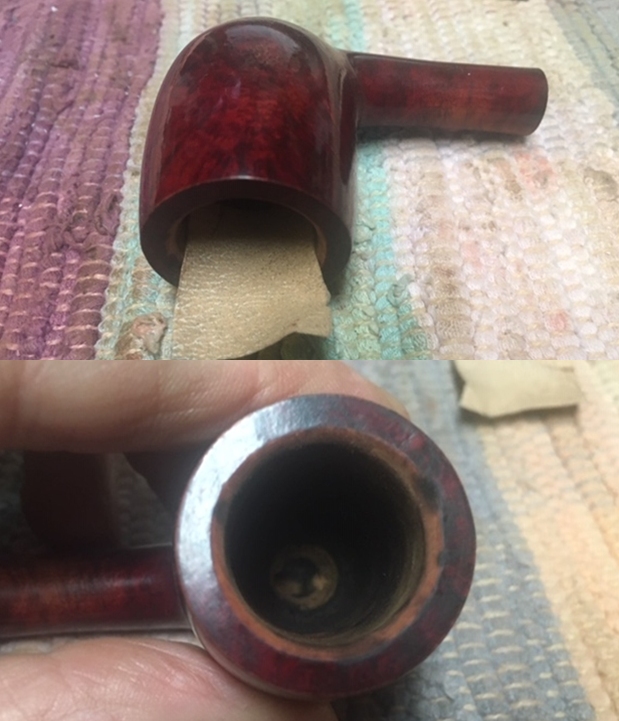
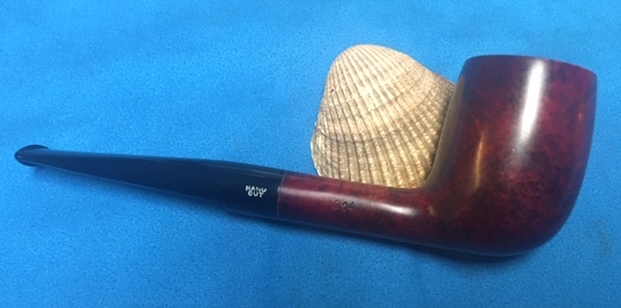
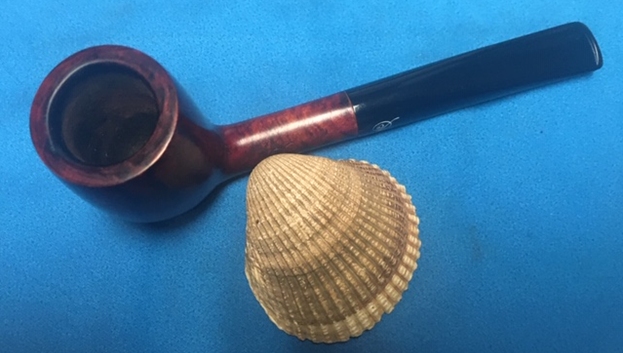
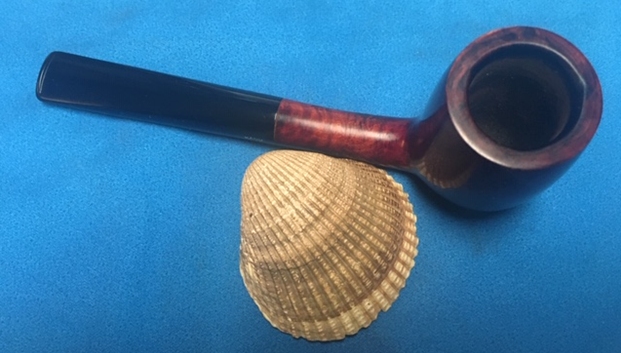
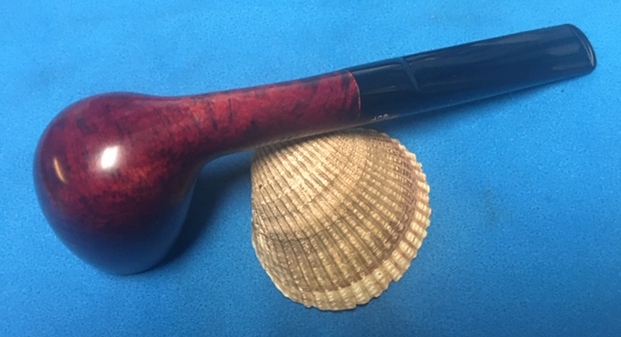
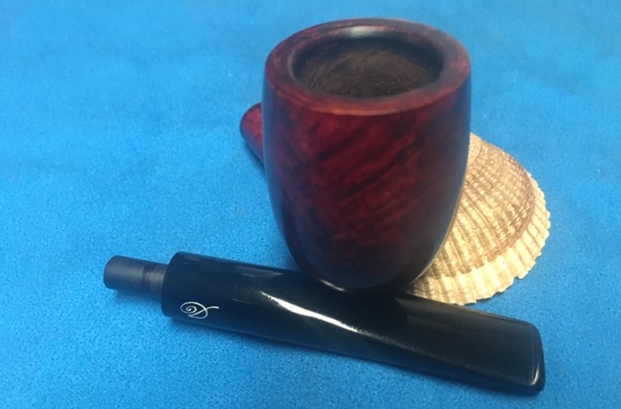
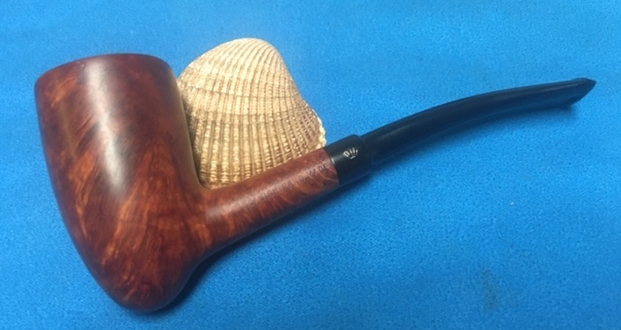
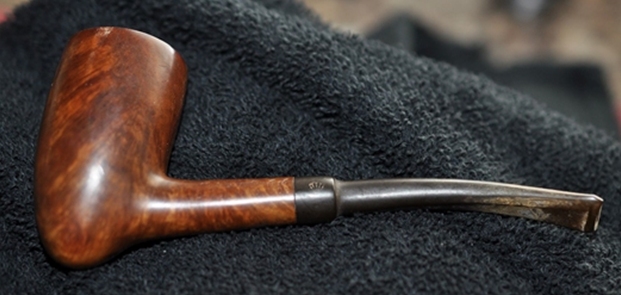
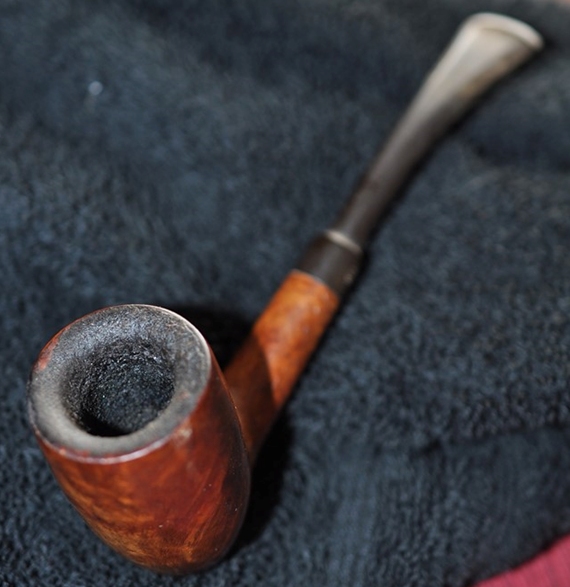
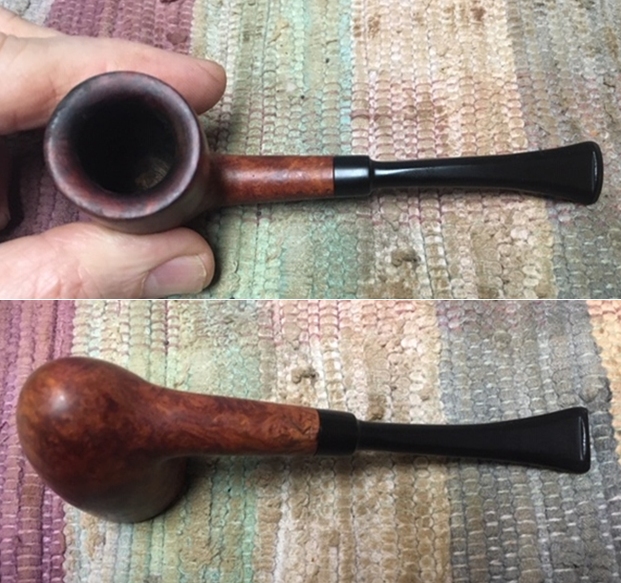
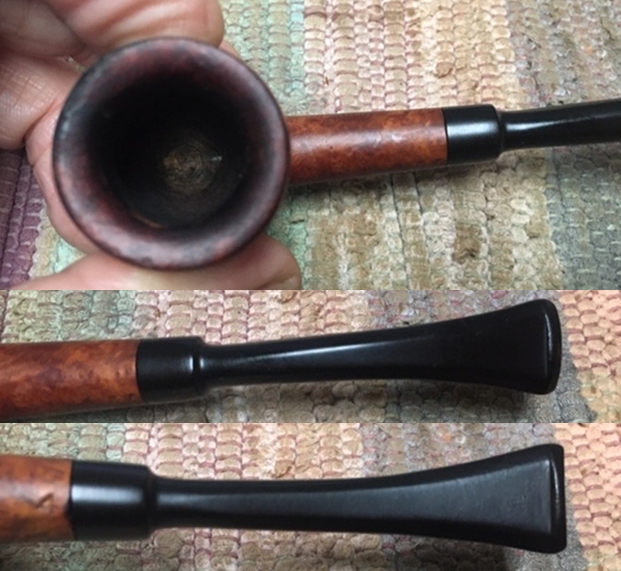
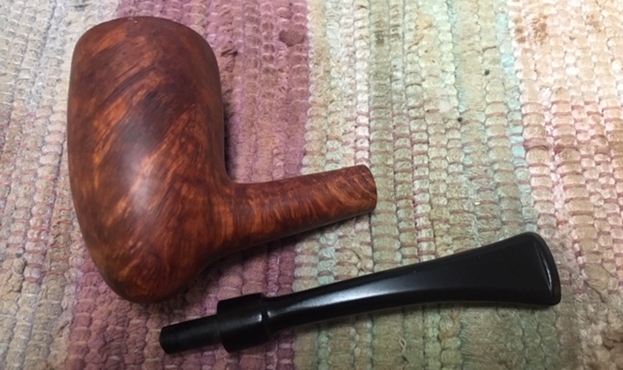
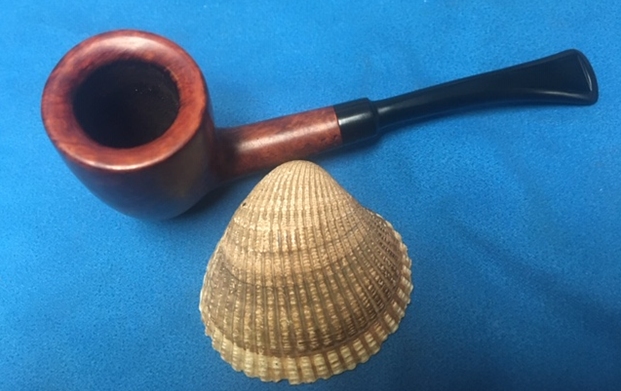
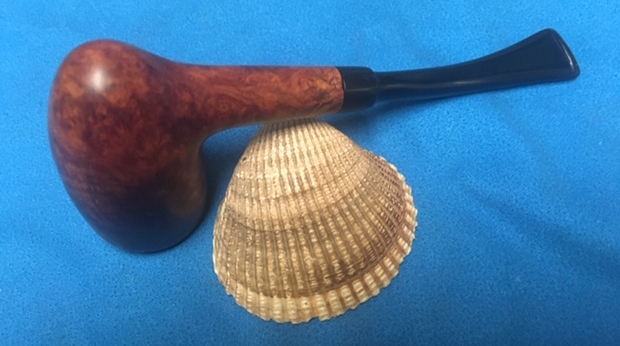
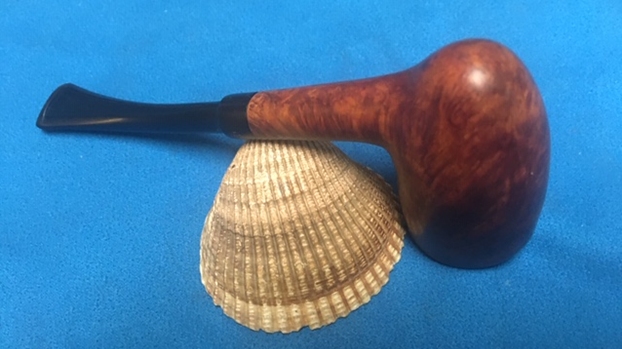
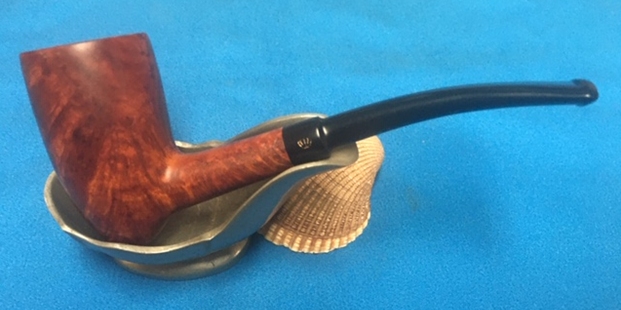
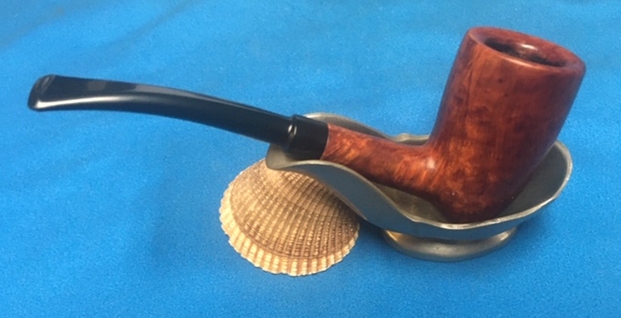
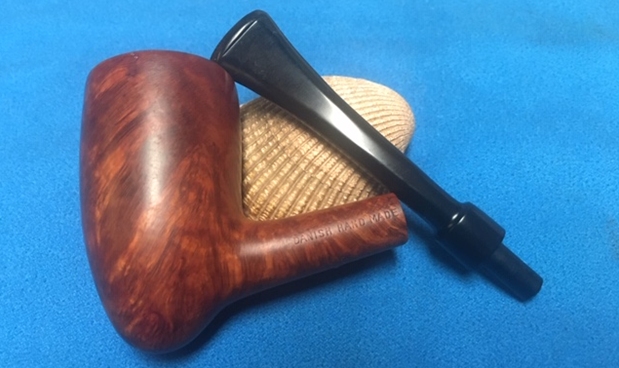
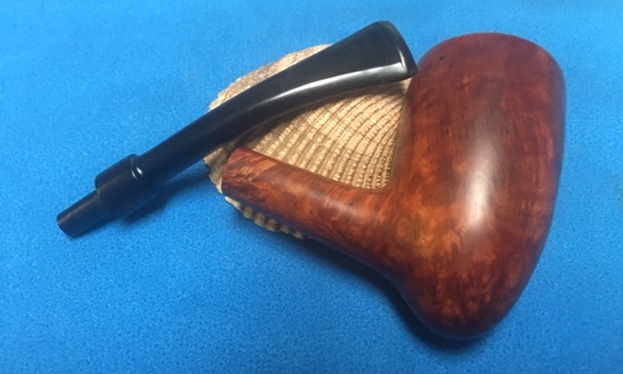
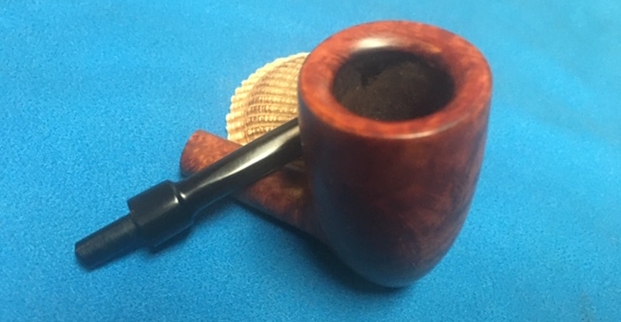
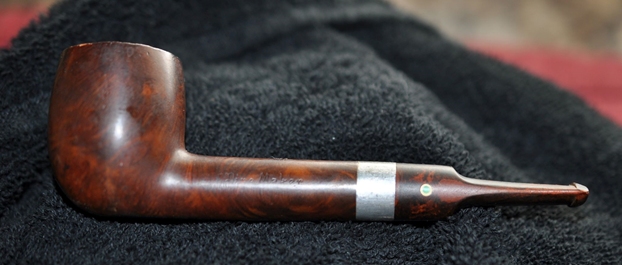
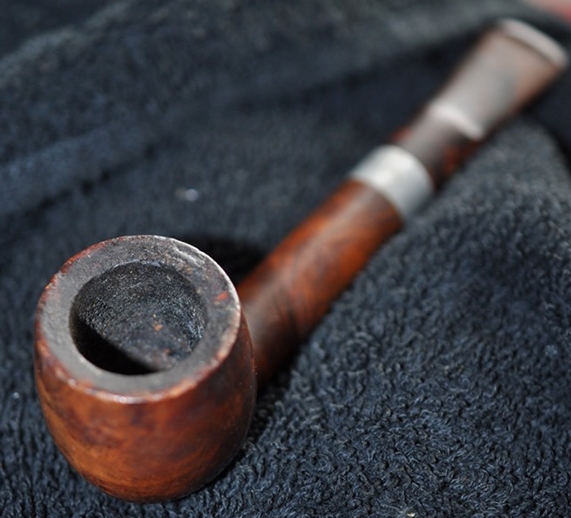
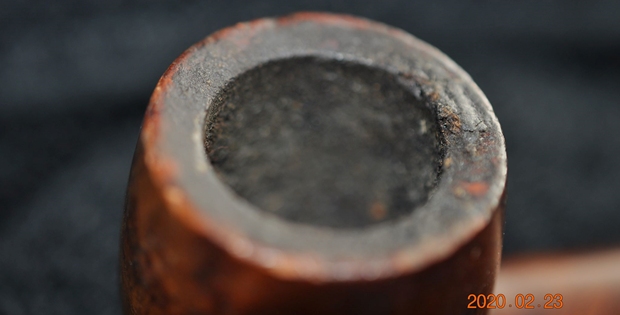
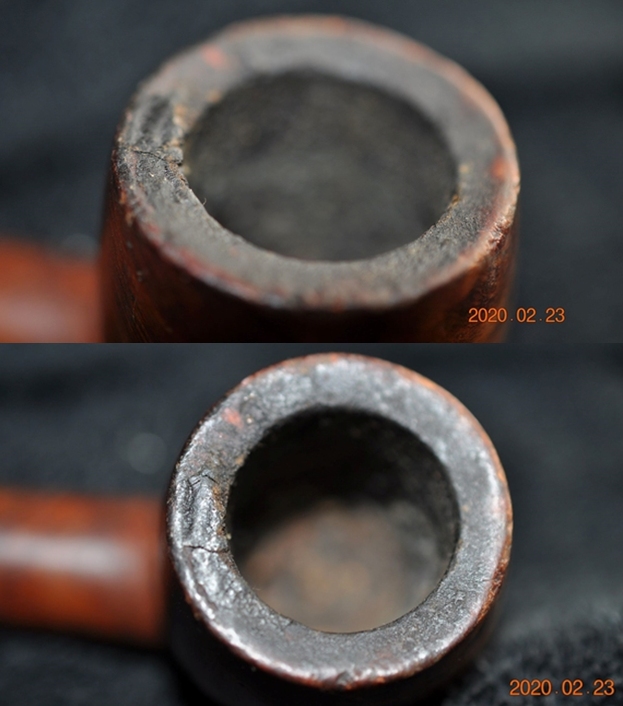
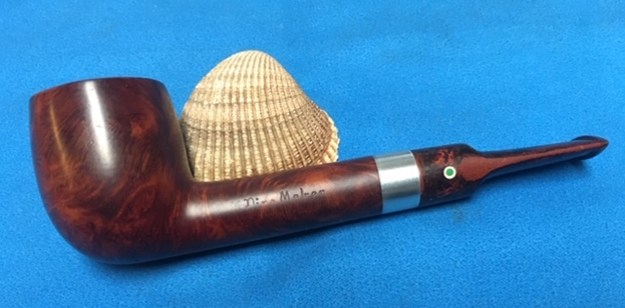
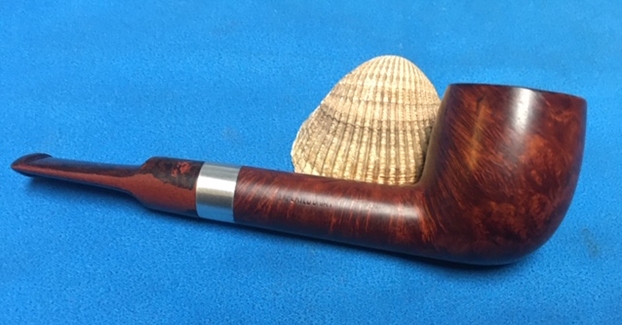
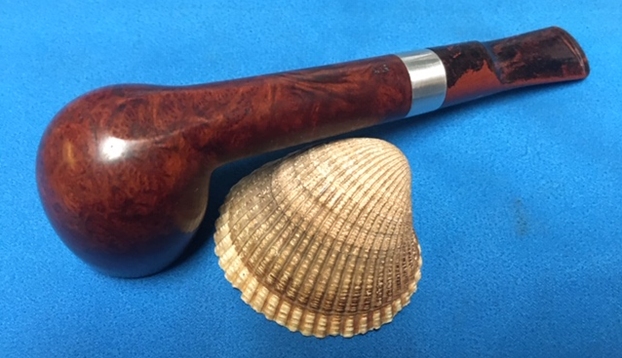
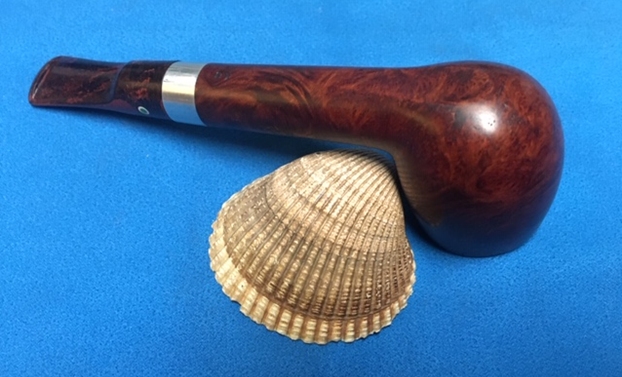
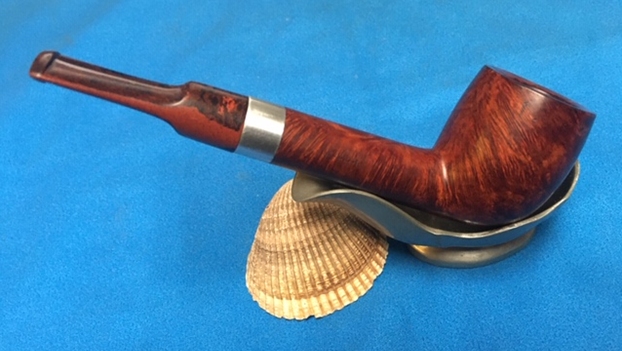
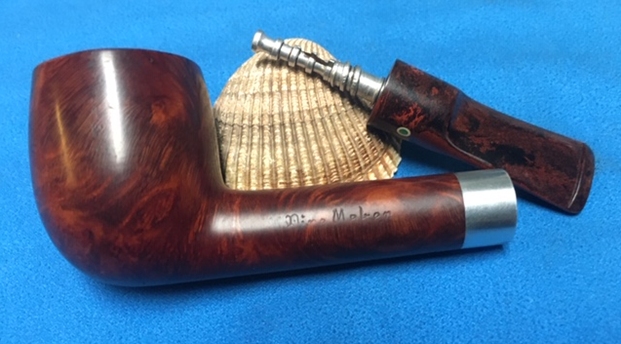
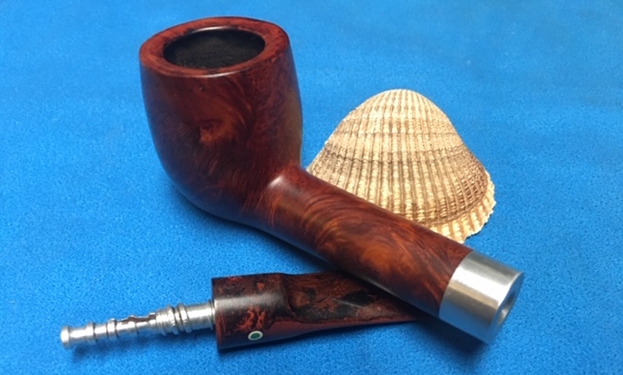
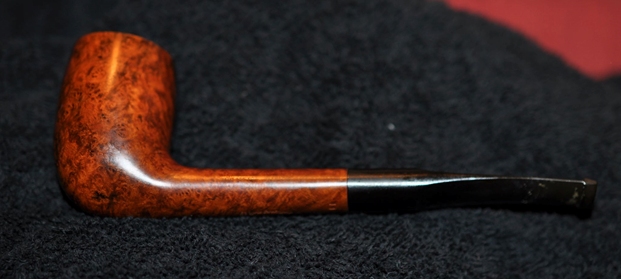
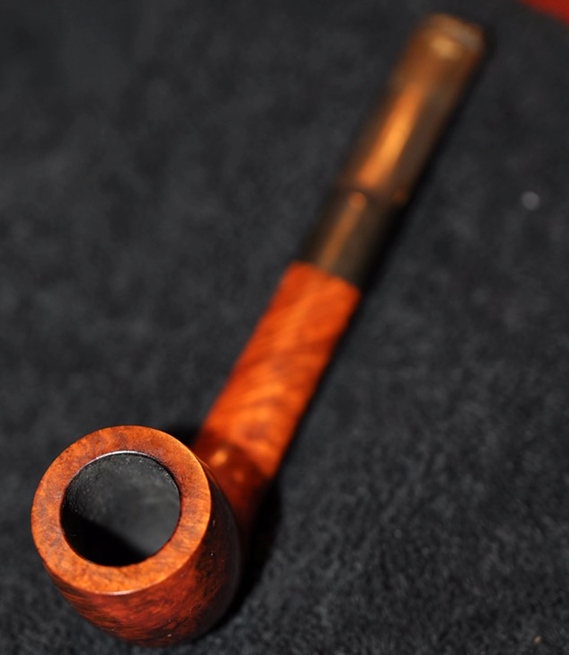
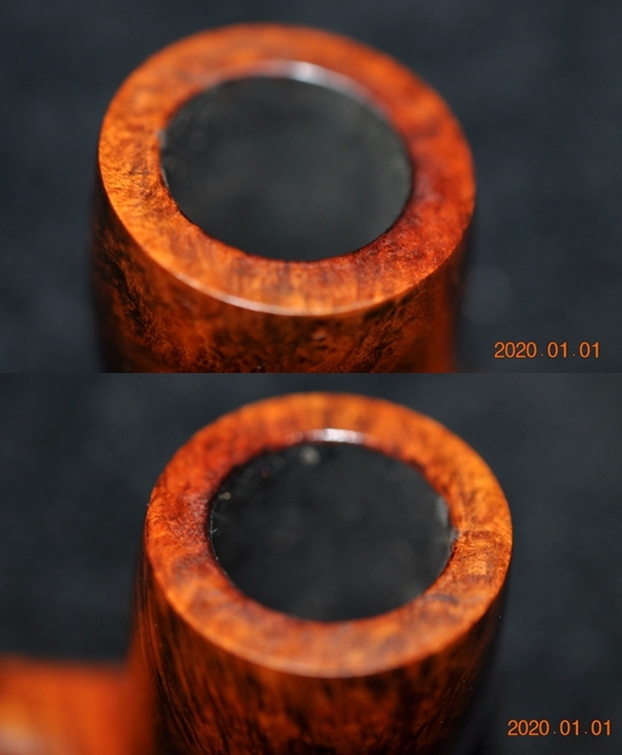
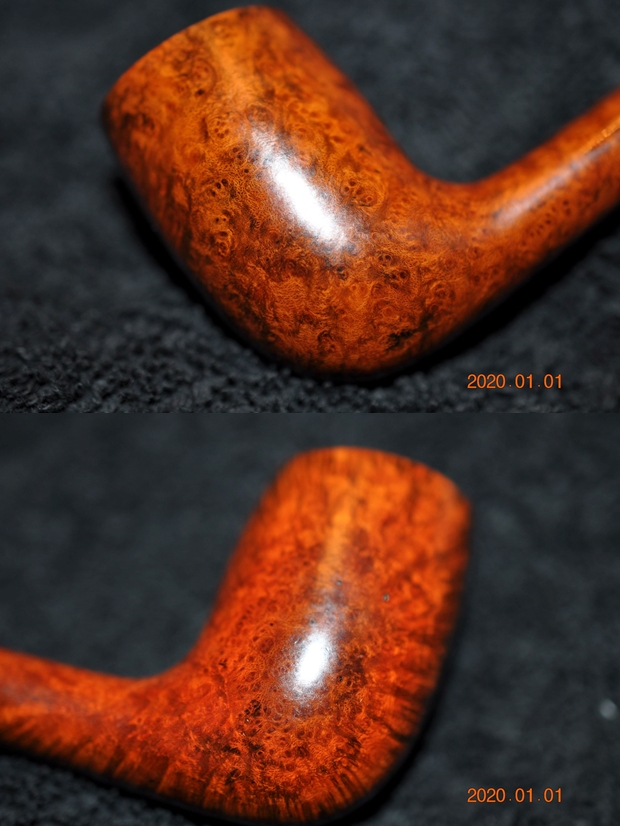
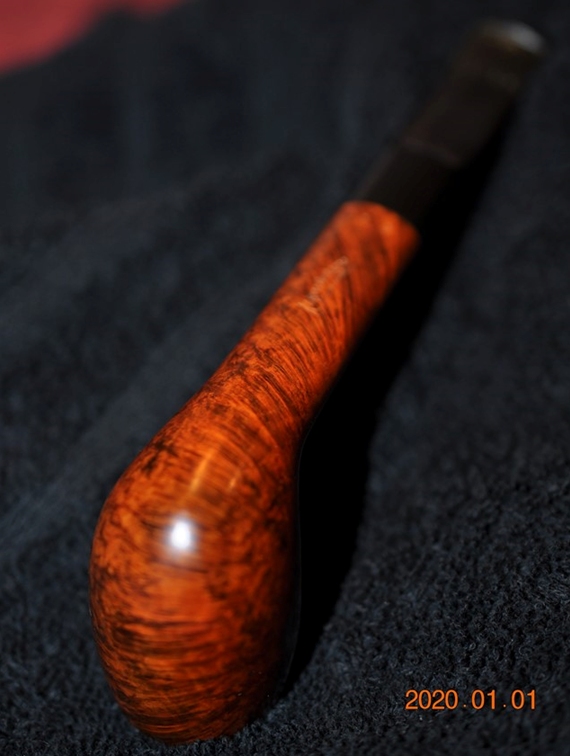
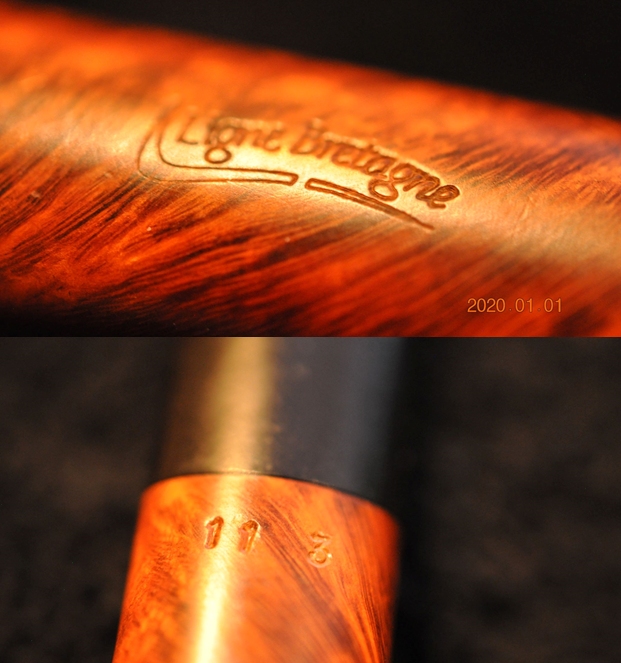
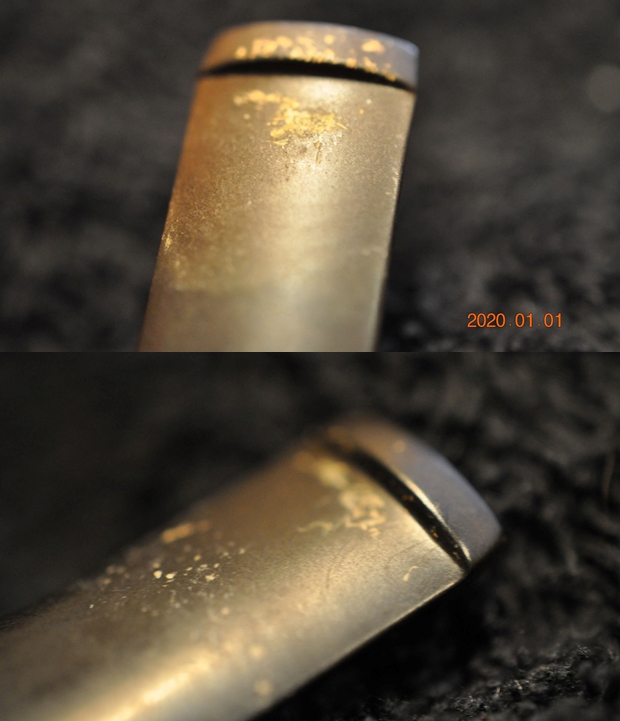
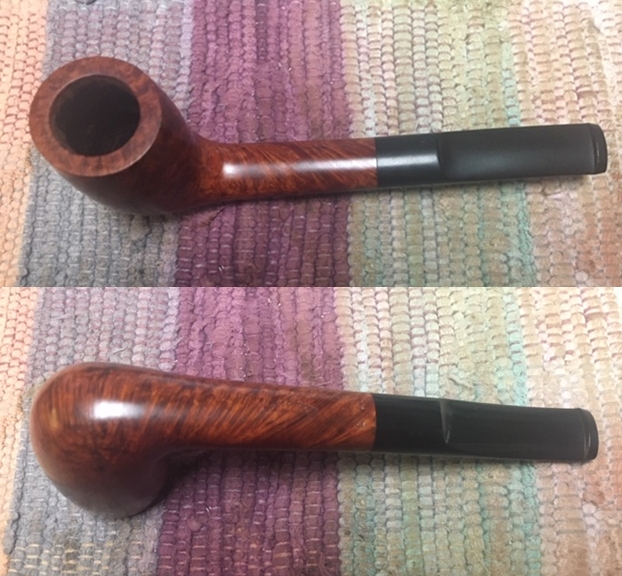
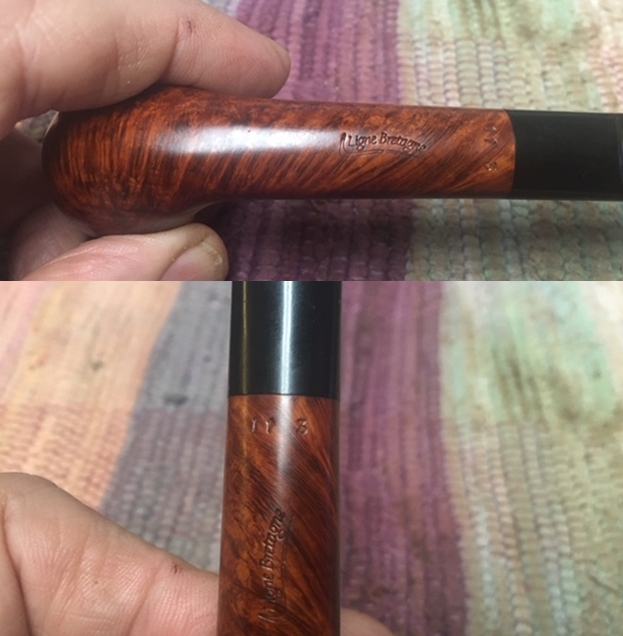
This afternoon I chose the next pipe from my boxes to work on. It is stamped Ligne Bretagne. I am not sure what I would call the shape. At some level it is almost a Cutty with a saddle stem and at another level an oval shank Billiard. You be the judge on the shape but it is a beautiful pipe. It is stamped on the underside of the shank with the Ligne Bretagne logo and the numbers 11 and 3 at the shank stem junction. It was in pretty good condition – just a little dirty and dusty when we received it. The bowl had a thin cake but the top and the edge of the rim was clean and in excellent condition. The pipe had a rich brown stain on the bowl that highlighted some nice grain on the bowl sides under the dust. The vulcanite saddle stem was in good condition with light tooth chatter and marks on both sides ahead of the button and on the button surface itself. Jeff took photos of the pipe before he started his cleanup work. Jeff captured the condition of the bowl and rim top with the next series of photos. You can see the work that is ahead of us there.The birdseye and cross grain around the bowl is quite stunning. Jeff took some great photos showing what is underneath the grime and debris of time and use. He took photos of the stamping on the underside of the shank. It is clear and readable. It read Ligne Bretagne underlined with a long line. At the shank end it is stamped with an 11 and a 3.The photos of the stem show the stem surface. It is dirty and has light tooth marks and chatter on both sides ahead of the button.This is the first Ligne Bretagne pipe that I have worked on. I knew from previous reading that the pipe was connected with Trever Talbert but was not sure how. I turned to Pipephil to get a quick overview on the brand so I knew a bit about the pipe I was working on (http://www.pipephil.eu/logos/en/logo-t2.html). I have included a screen capture of the pertinent section below. I turned to the Talbert Pipes Website and found a lot of helpful information on the pipe that I was working on. I quote from the first link a great short history of the brand and company written by Talbert (https://www.patreon.com/talbertpipes).
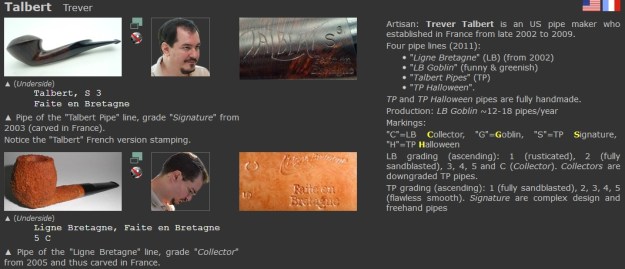
Talbert Pipes was founded in 1998, shortly after Trever Talbert won the first Pipes & Tobaccos Magazine national carving contest. Emily Talbert joined the business fulltime in 2002, when husband and wife relocated to the western coast of France for seven years to acquire tools, stock, and experience, as well as adding the Ligne Bretagne brand of pipes to our offerings. Now back in the USA, Talbert Pipes continues to offer a wide selection of classical and fantasy-themed shapes for all our fans worldwide.

From there I turned to read about the Ligne Bretagne pipes so I could have a clearer picture about the pipe in hand (https://talbertpipes.com/). I quote:

Ligne Bretagne – Aged, factory-turned shapes in classical designs, finished here in our shop for the discerning collector seeking a more individual alternative to mass-produced brands.

The final link provides a helpful explanation of the stamping on the shank of the pipe. The pipe I am working on is stamped with the Ligne Bretagne logo and the numbers 11 and 3 at the shank stem junction (https://talbertpipes.com/grading/). From this I learned that the pipe I have was made in 2011 and is a Grade 3 with is the first of the smooth finished pipes. I am including a screen capture of the site’s explanation below.
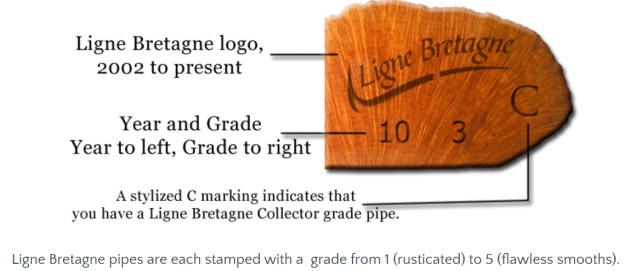
With that information in hand I knew what I was dealing with a beautifully grained factory-turned shape in a classical design, finished by the Talberts. I also knew that it was made in 2011 and was a Grade 3 smooth pipe. Now it was time to turn to work on the pipe.

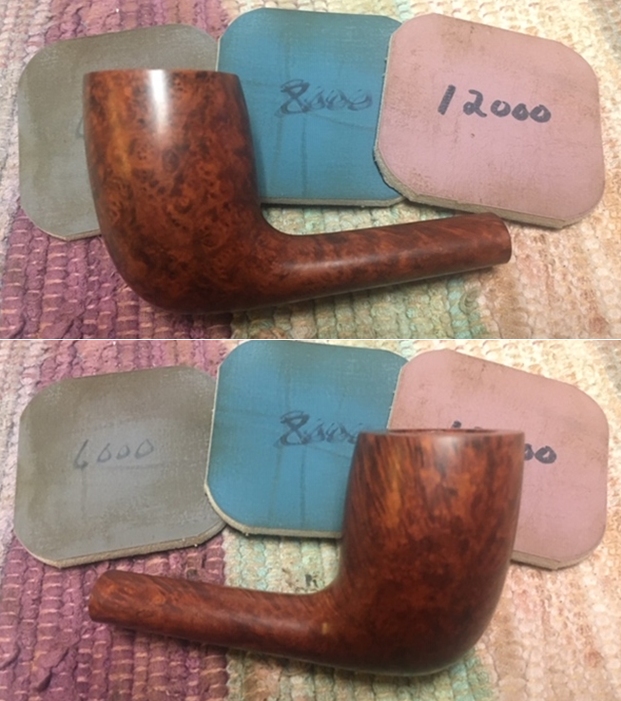
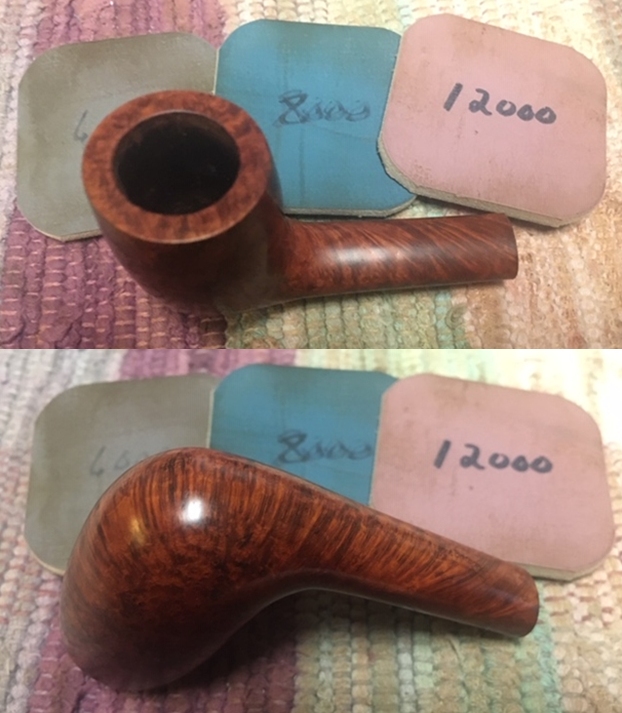
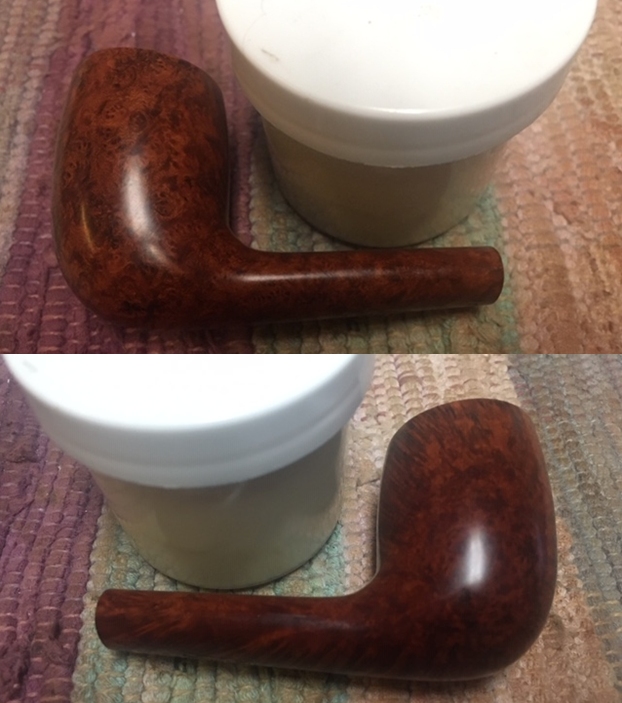
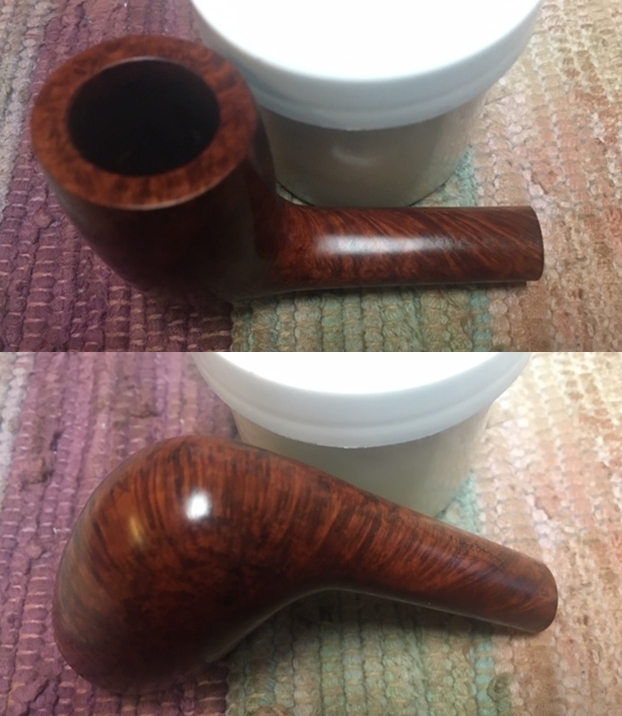
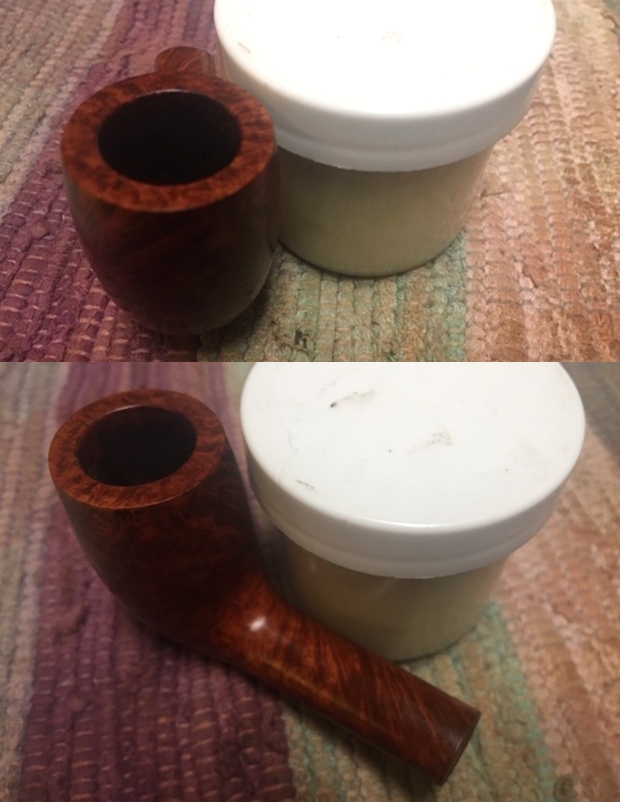
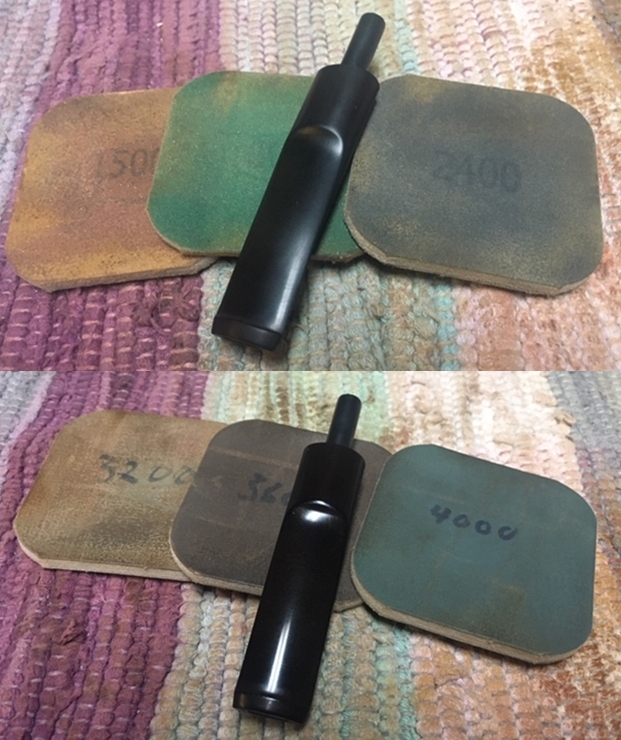
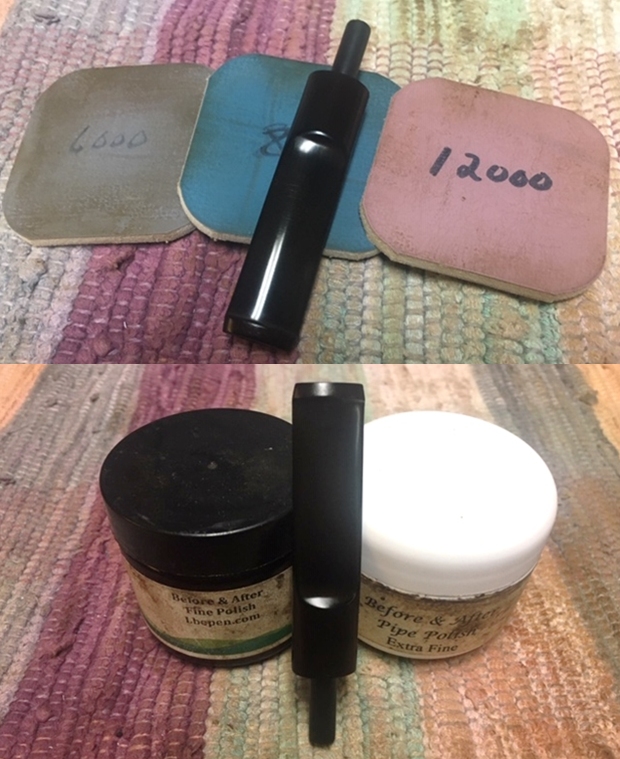
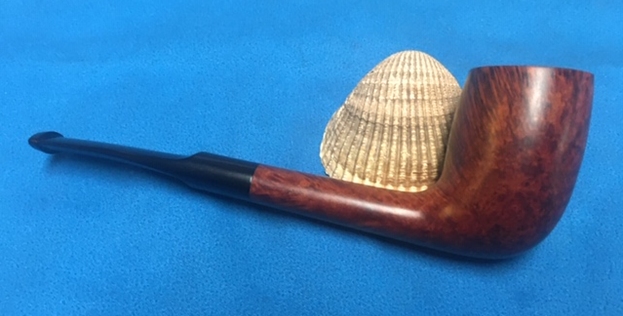
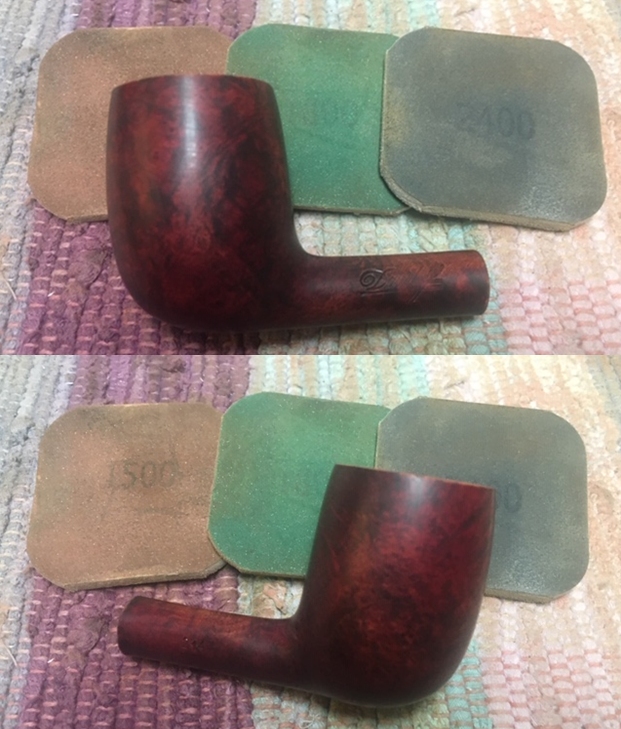
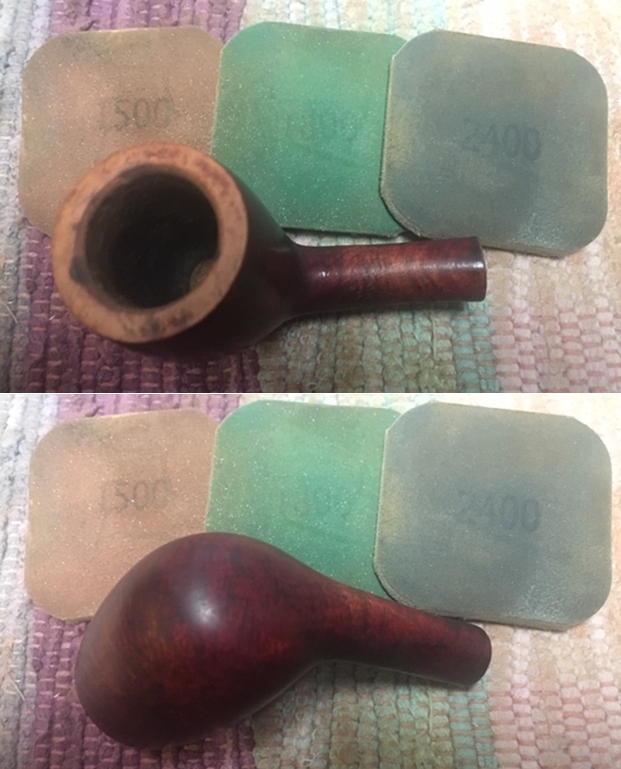
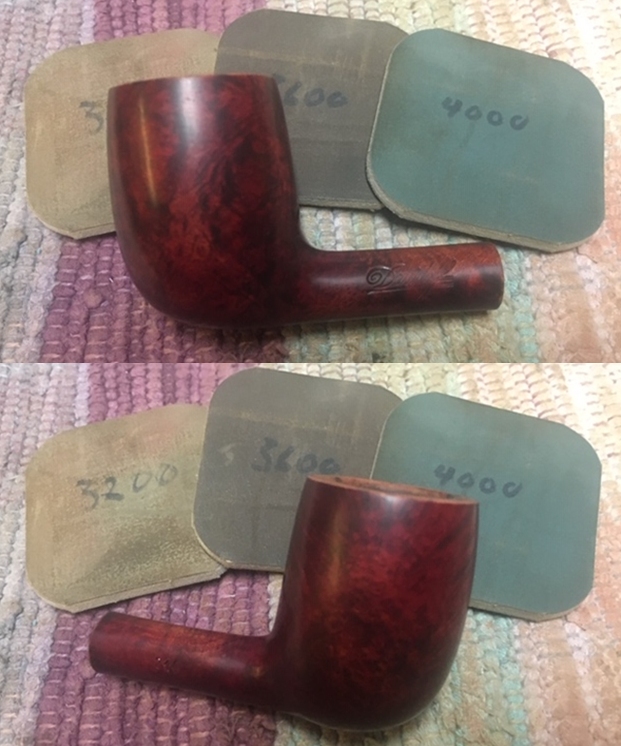
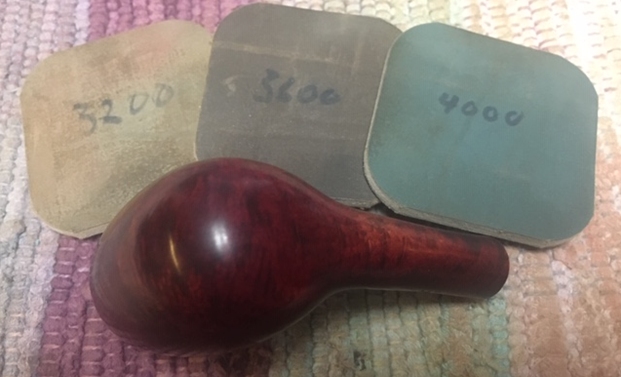
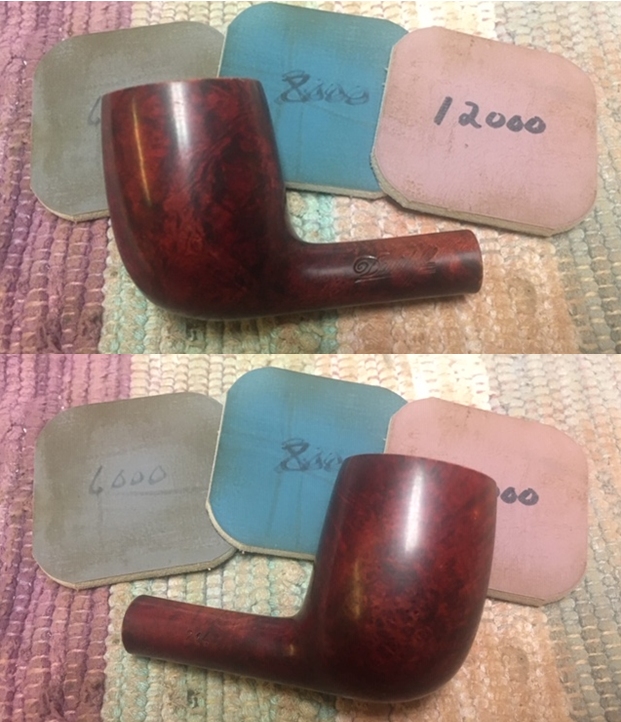
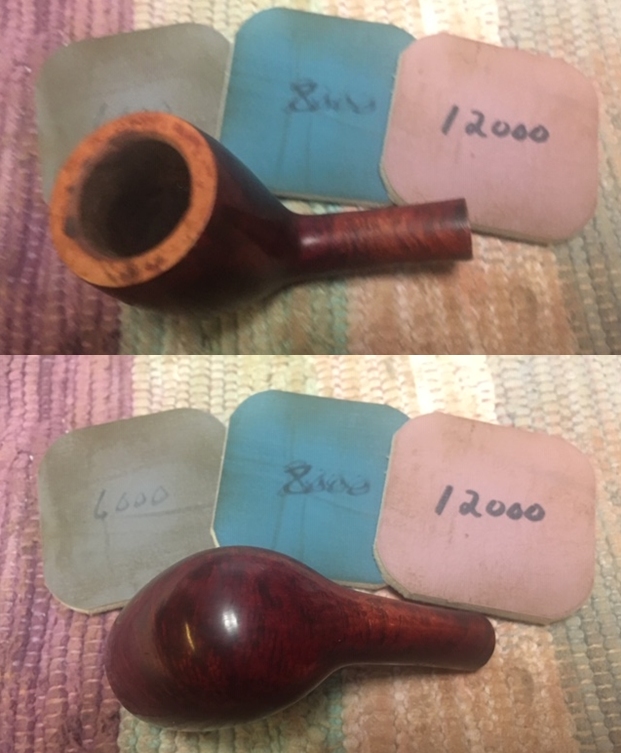
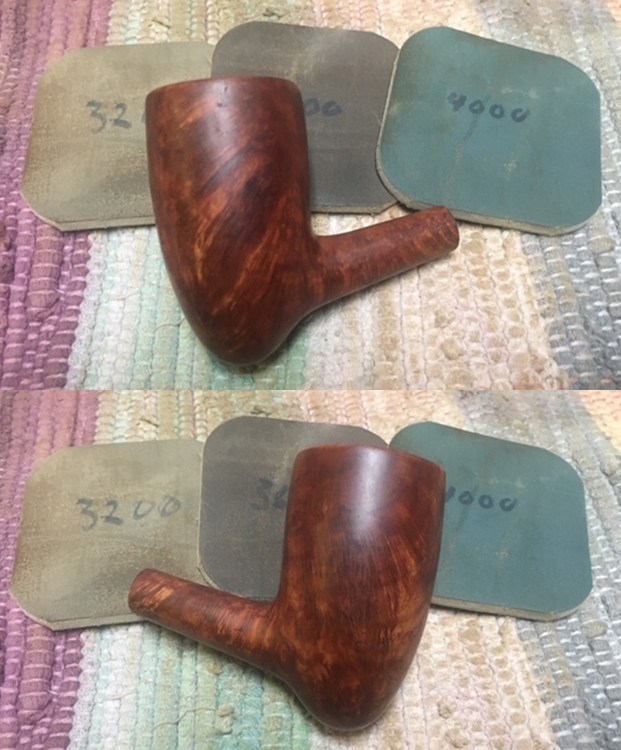
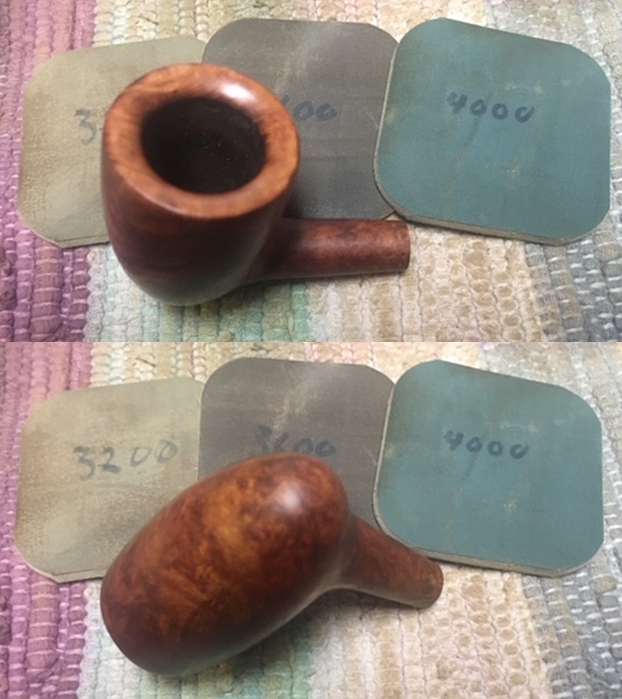
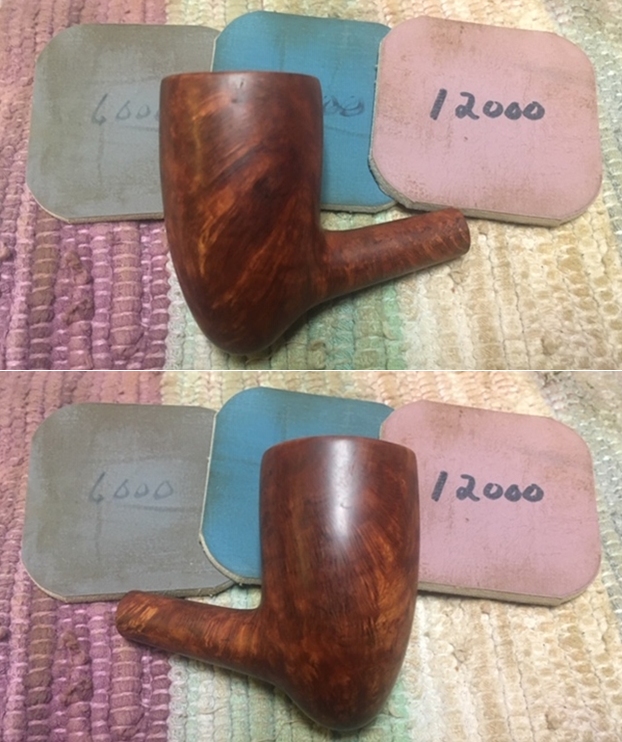
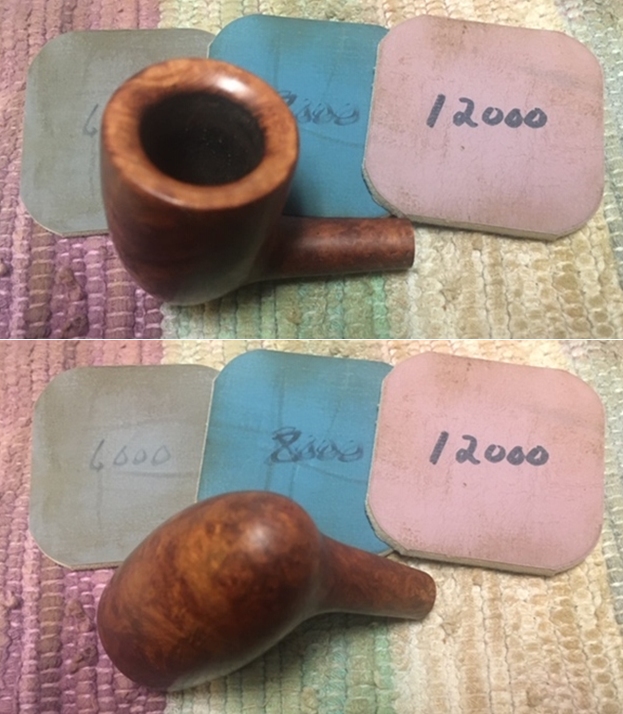
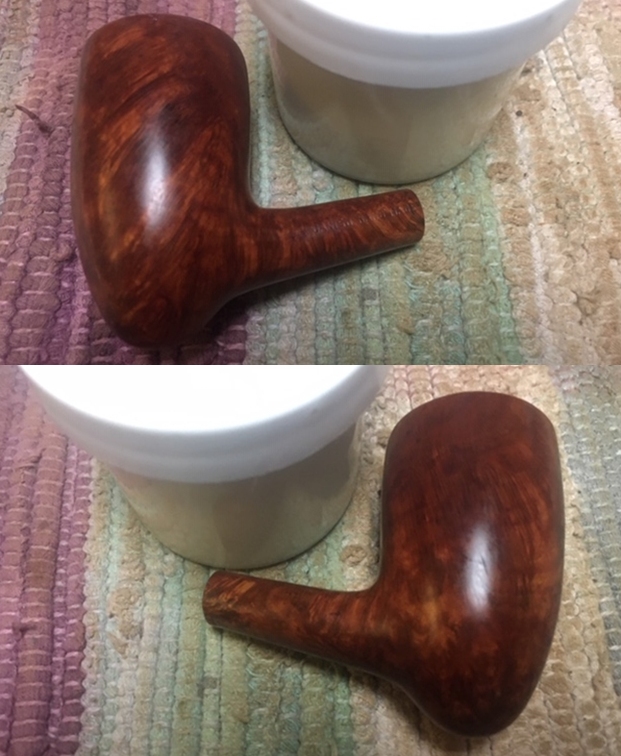
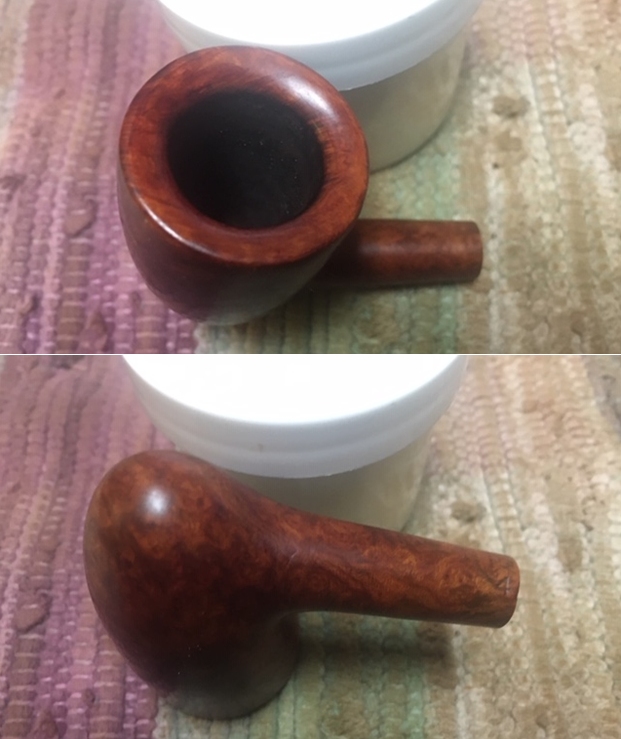
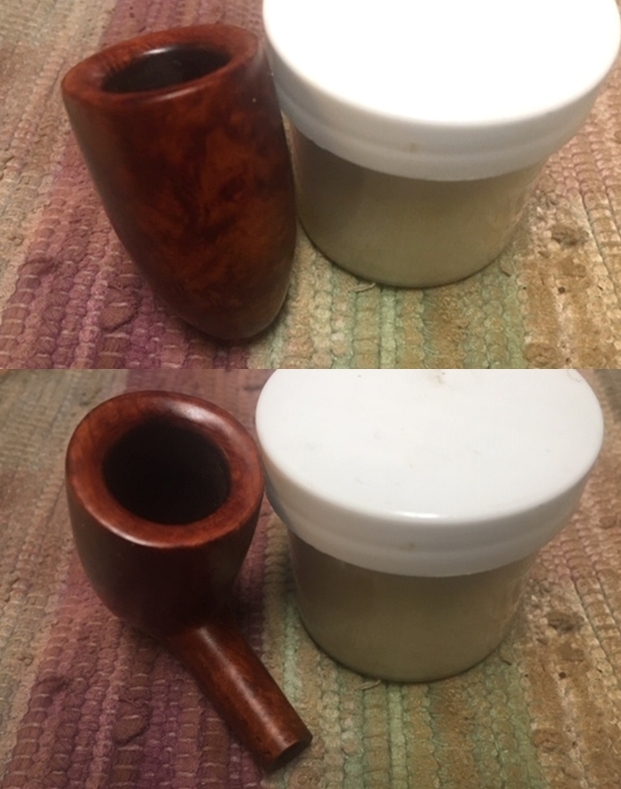
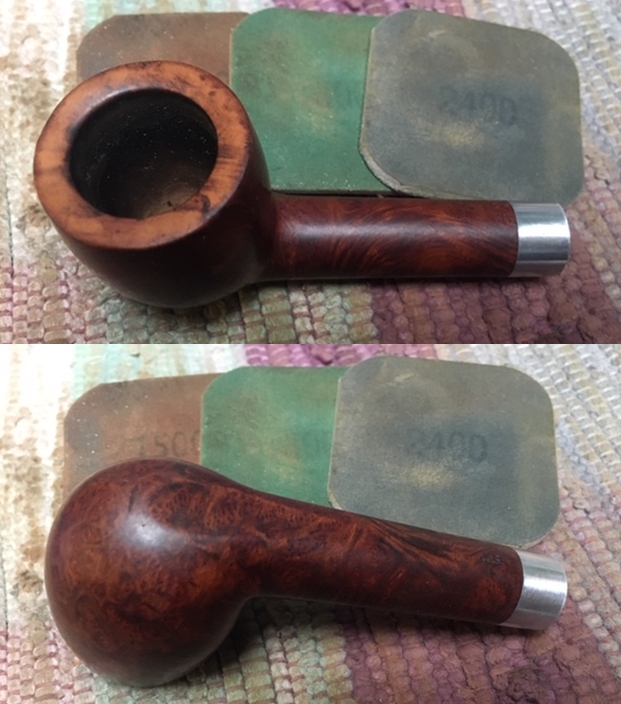
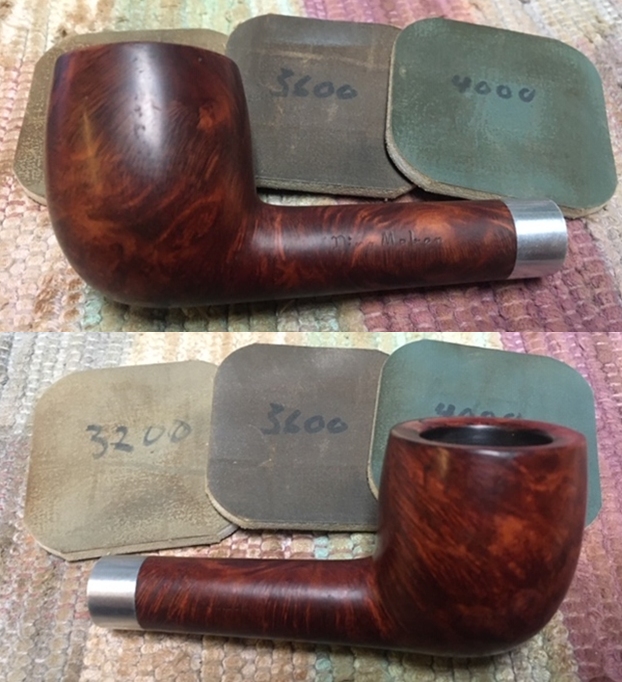
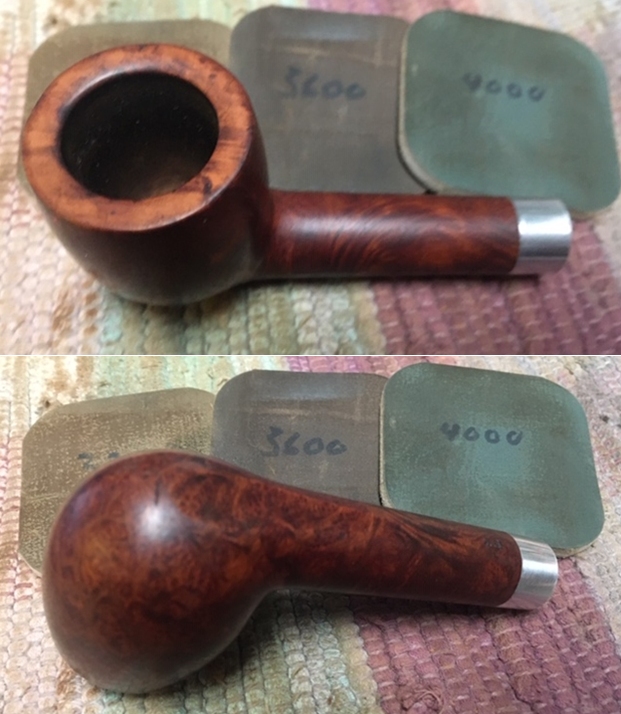
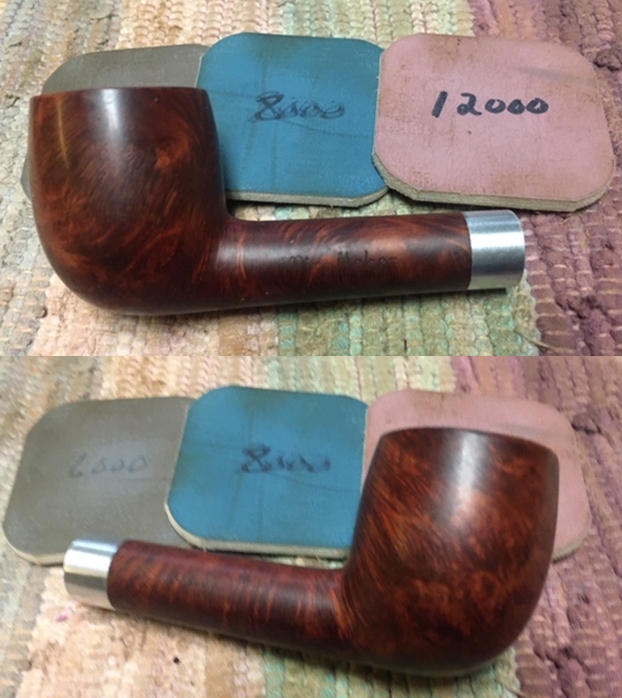
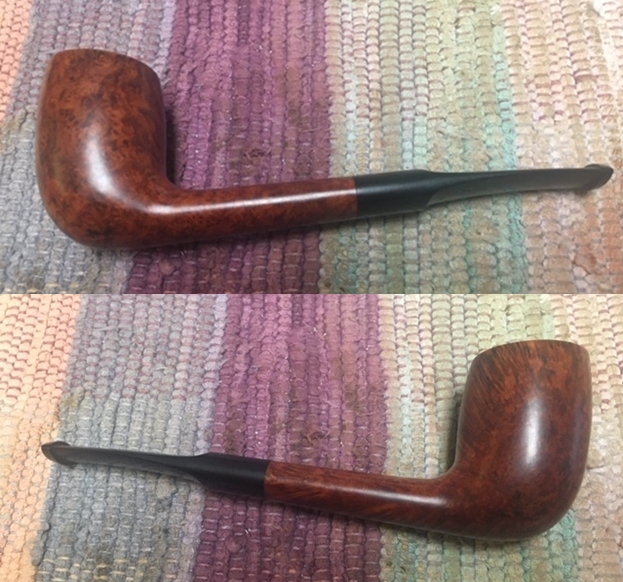
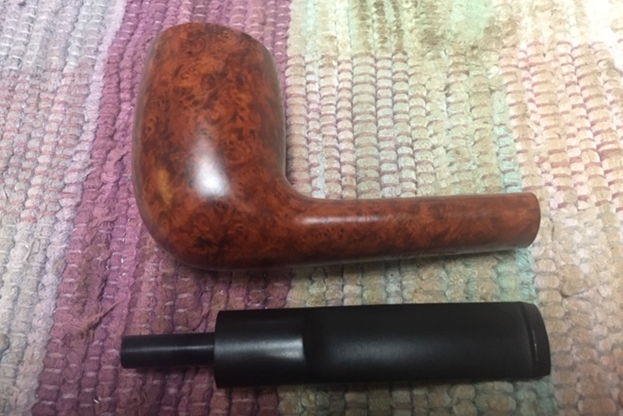
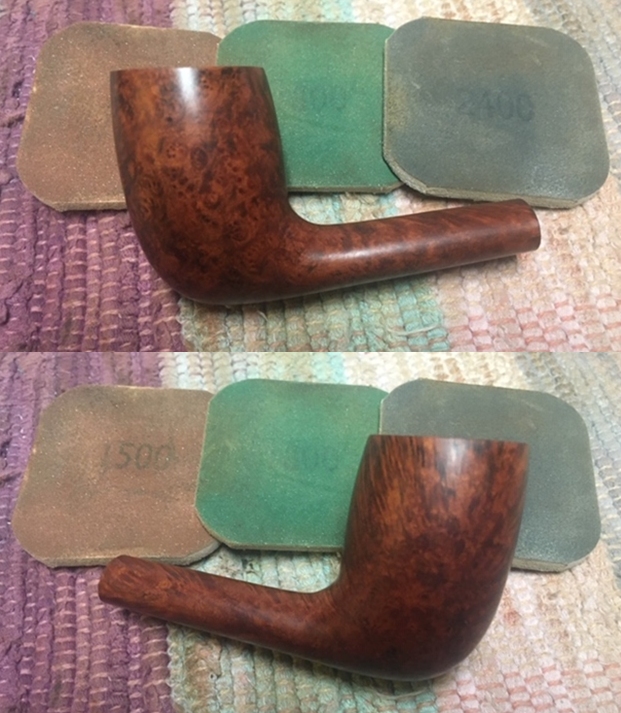
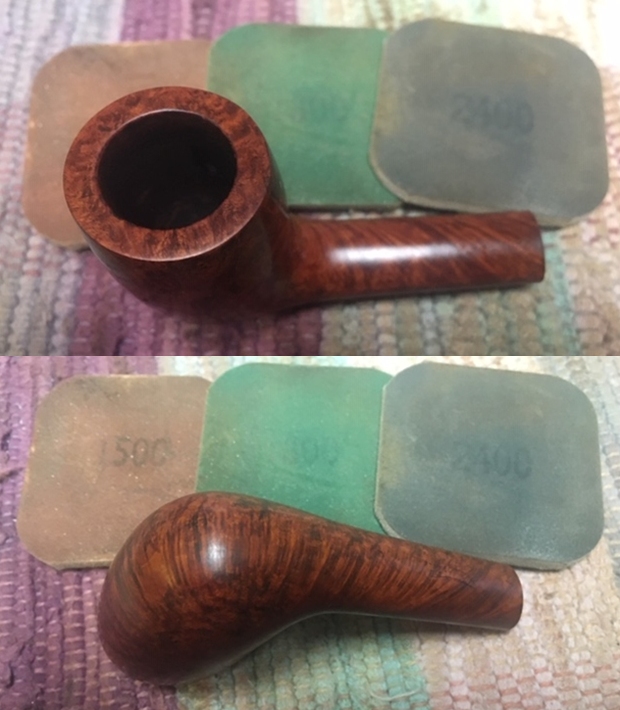
Jeff cleaned the pipe thoroughly with his usual care. He reamed it with a PipNet pipe reamer and cleaned up the reaming with a Savinelli Fitsall Pipe Knife. He scrubbed out the internals with alcohol, pipe cleaners and cotton swabs until the pipe was clean. He scrubbed the exterior of the bowl with Murphy’s Oil Soap and a tooth brush to remove the grime and grit on the briar and the lava on the rim top. The finish looks very good with good looking grain around the bowl and shank. Jeff scrubbed the stem with Soft Scrub to remove the grime and build up on the surface and soaked it in a bath of Before & After Deoxidizer. When the pipe arrived here in Vancouver for the second stop of its restoration tour it looked very good. I took photos before I started my part of the work. I took some photos of the rim top and stem. The photo of the bowl shows how clean the bowl and the smooth rim are. The inner and outer edges of the bowl look really good. They are in excellent condition. The close up photos of the stem shows that is it very clean.I took photos of the stamping on the underside of the shank of the pipe. It is clear and readable as noted above.I took the stem off the shank and took a picture of the pipe. It really is a nice looking pipe with great lines.The pipe was in great condition and only needed to be polished. I polished the beautifully grained briar with micromesh sanding pads – dry sanding with 1500-12000 grit pads. I wiped the bowl down after each pad with a damp cloth. The grain really began to stand out and the finish took on a natural shine by the last sanding pad. The photos tell the story! I worked some Before & After Restoration Balm into the surface of the briar with my fingertips. The product works to clean, enliven and protect the briar. I let the balm sit for about ten minutes and then buffed with a cotton cloth to raise the shine. The photos show the bowl at this point in the restoration process. I laid the bowl aside and turned to deal with the stem. The tooth marks and chatter on the stem were not deep. I polished the stem with micromesh sanding pads – dry sanding with 1500-12000 grit sanding pads. I wiped it down after each sanding pad with a cloth containing some Obsidian Oil. I finished polishing it with Before & After Pipe Stem Polish – both Fine and Extra Fine and buffed it off with a cotton cloth. The pipe came together quite well. The finish on the pipe is in excellent condition and the contrasting stains work well with the black vulcanite stem. With the grime and debris gone, the bowl had a natural beauty and grain that pops. I put the stem back on the bowl and buffed the pipe with Blue Diamond on the buffing wheel. I carefully avoided the stamping on the shank during the process. I gave the bowl and the stem multiple coats of carnauba wax on the buffing wheel and followed that by buffing it with a clean buffing pad on the buffer. I hand buffed the pipe with a microfiber cloth to deepen the shine. The finished Ligne Bretagne pipe is quite beautiful and is comfortable looking pipe. Give the finished pipe a look in the photos below. I can only tell you that it is much prettier in person than the photos capture. The dimensions of the pipe are Length: 5 ½ inches, Height: 1 ¾ inches, Outside diameter of the bowl: 1 ¼ inches, Chamber diameter: 5/8 of an inch. I really like the looks of this pipe. It is great looking and in great condition. Thanks for walking through the restoration with me as I worked over another beautiful pipe. Thanks for your time.
 

Sasieni “Putney” Restoration


By Al Jones

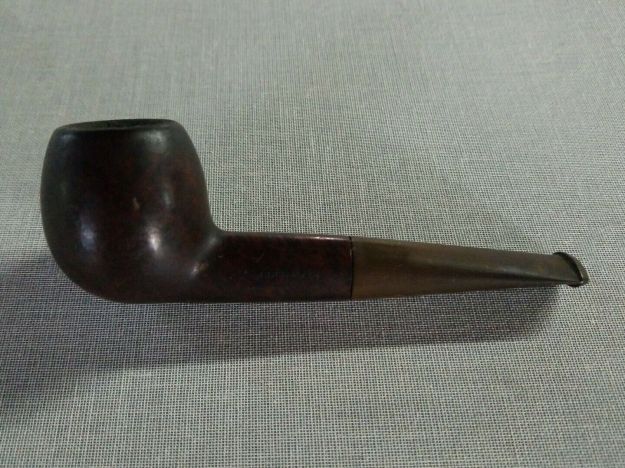
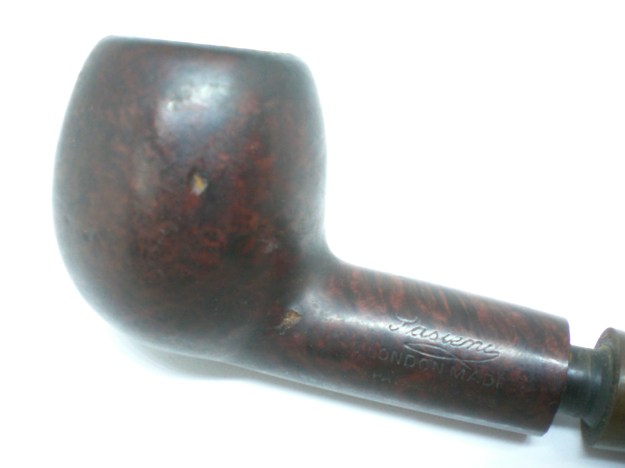
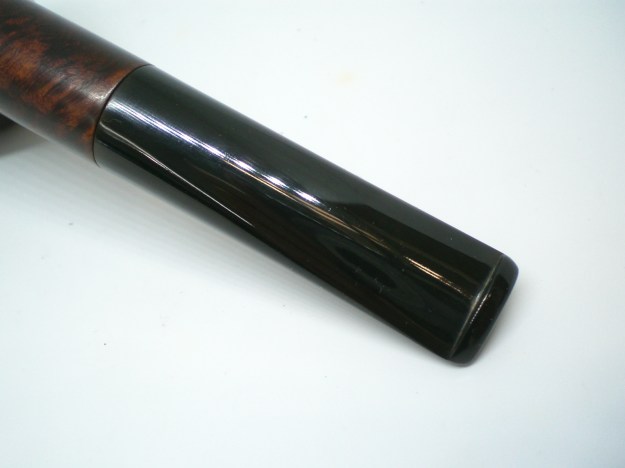
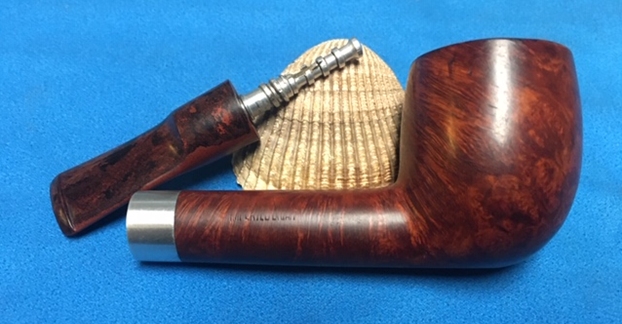
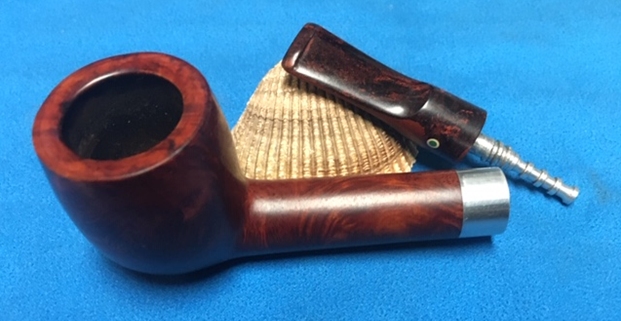
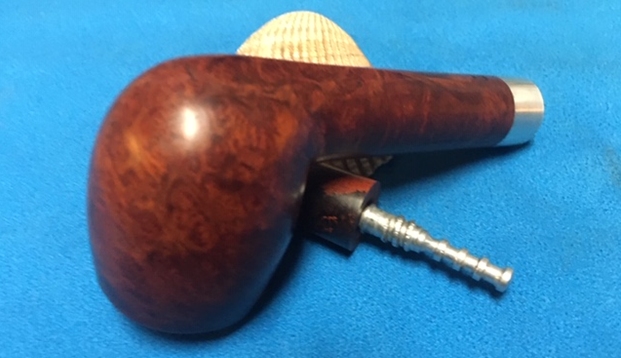
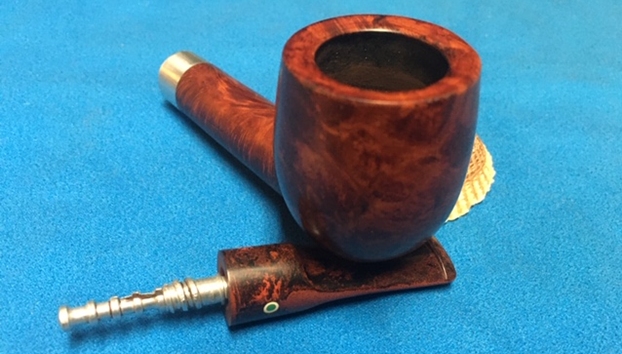
Last week marked my 10th anniversary as a pipe smoker and I’ve been restoring pipes for nearly that long.  So this wonderful Patent era Sasieni was a great way to mark that date.  The pipe came via Ebay, from a seller who only showed three, very dark photos.  The seller accepted returns, I took the gamble.  When it arrived, I’m glad that I did!

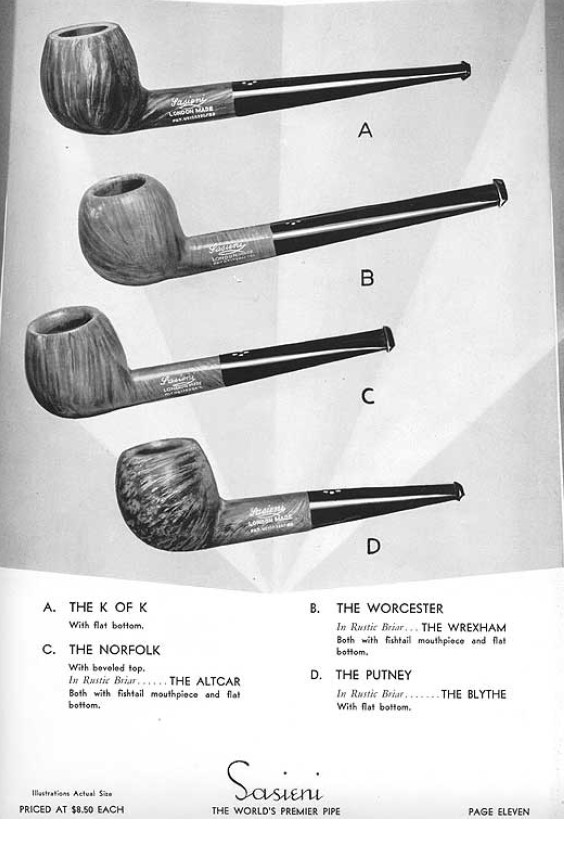
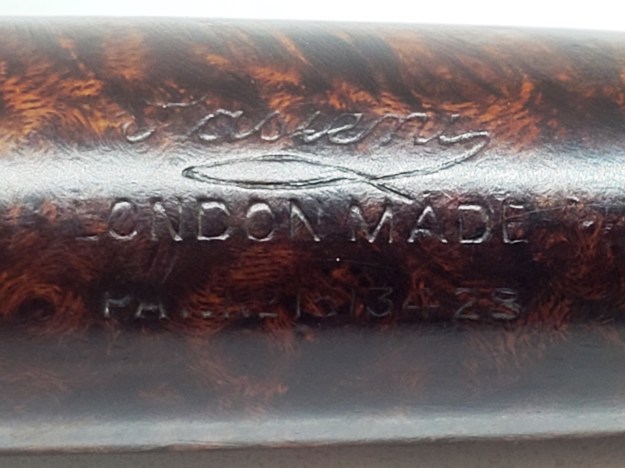
The pipe  is a Patent era pipe that I would date from the late 1920’s to before World War II.  I like to confirm pre-WWII pipe dates with my PipesMagazine forum friend Dave (member dmcmtk).  He is very knowledgeable on most British pipes and I appreciated his confirmation.  Dave suspects that because of the stinger style, it could be closer to the late 20’s versus World War II.  These details helped date the pipe:

– It was sold in the US, with a Patent number ending in 28

– The florid “Sasieni” style script

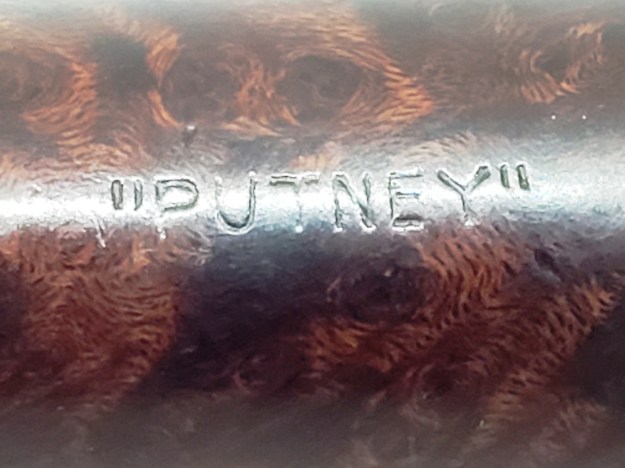
– town name

– threaded stinger

Below is a page from a 1930 era Sasieni catalog, showing the Putney shape.

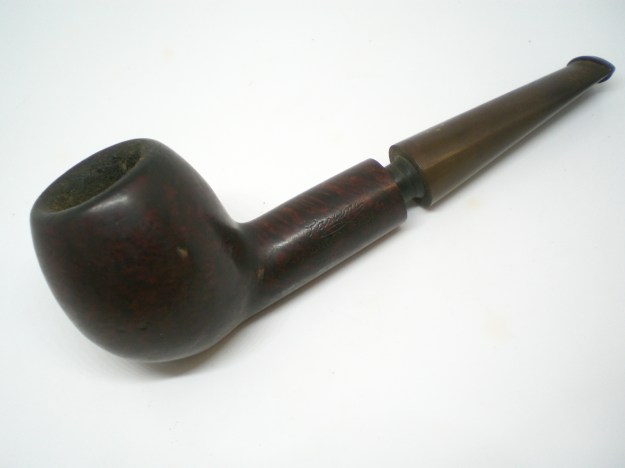
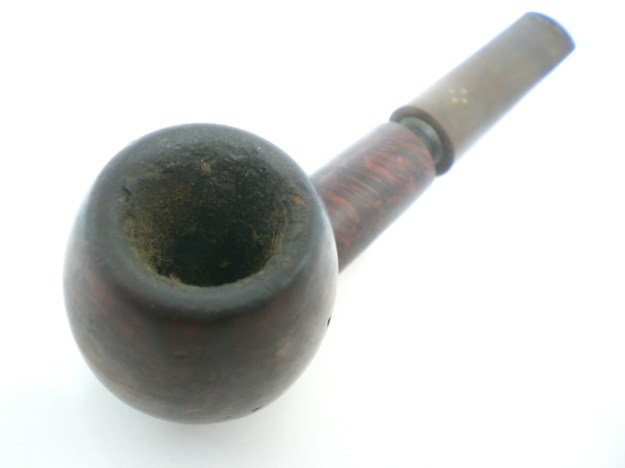
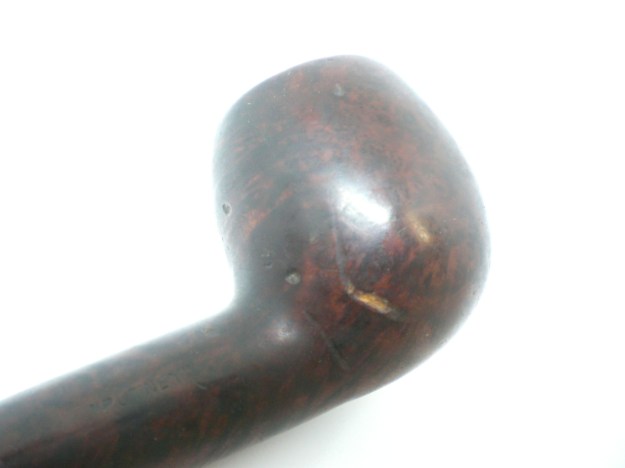
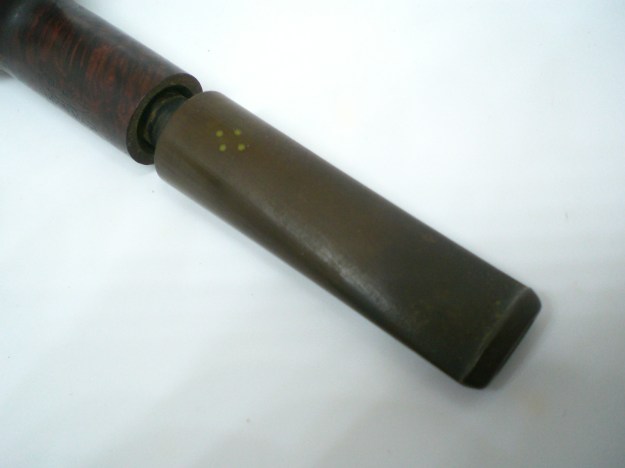
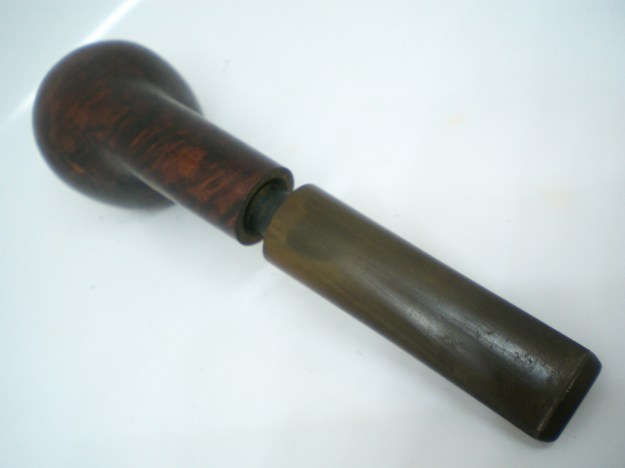
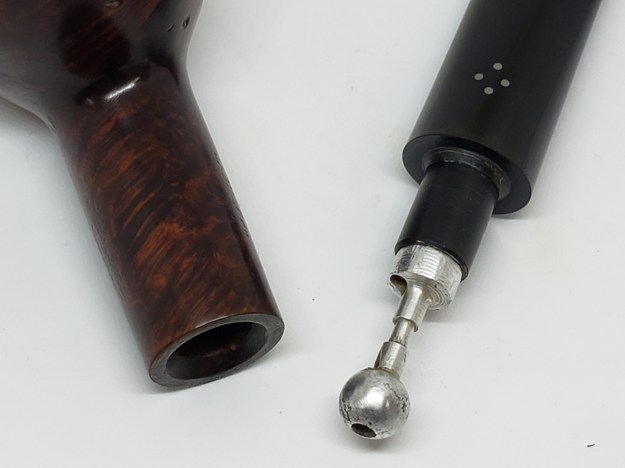
The stem was firmly stuck in the shank, but 30 minutes in the freezer released its grasp.  I was pleased to find the original stinger intact, a real bonus!  Below is one of the sellers photographs and as it was received.  I had already removed the stem before these pictures, and because of build-up in the shank, I was reluctant to insert it fully.  The pipe came with half a bowl of tobacco, and plenty of dings and gouges on the briar.  Somehow the stem was mint – so I presume that the damage to the briar occurred after the owners demise (tossed in a box or drawer?)  The last photo shows the original stinger – which was also stuck fast.

The first order of business was to unscrew the stinger.  The threads below the base of the tenon, so that is a nerve wracking experience.  I tried soaking the stinger end in alcohol and inserted alcohol dipped stingers – but no dice.  Next up a more dangerous method – I used a heat gun to warm the aluminum stinger, then pliars to screw the stem.  Great care is required here – you only need enough heat to soften the threads (or loosen the gunk) but not break or move the tenon.  This did allow the stinger to be fully unscrewed. I’m always surprised how deep these go into the stem.  I used some superfine steel wool to clean the stinger.  I was going to use the stinger when I smoke the pipe – otherwise I’ve learned that the draw is way too open for my taste.

I reamed the cake and removed the bowl top build-up with a worn piece of Scotch-brite.  I soaked the briar with alcohol and sea salt and the stem was soaked in a mild Oxy-Clean solution.  Following the soak, the shank was cleaned with a bristle brush and paper towels screwed into the shank.  It was a mess, I gather the owner had never cleaned this pipe.

I used a wet cloth and electric iron to stem some of the dents from around the bowl.  The gouges did not change much.  I mulled over filling them, but that would have required a restain and I didn’t feel that I could do justice to the finish.  I decided to leave them as patina, which seemed fitting.

The stem was mounted and oxidation removed with 400, 800, 1500 and 2000 grit wet paper, followed by 8,000 and 12,000 micromesh sheets.  The stem was then buffed lightly with White Diamond and several coats of Carnuba wax.

Below is the finished pipe, ready for a bowl of My Mixture 965 to celebrate my 10th anniversary as a pipe smoker/restorer.

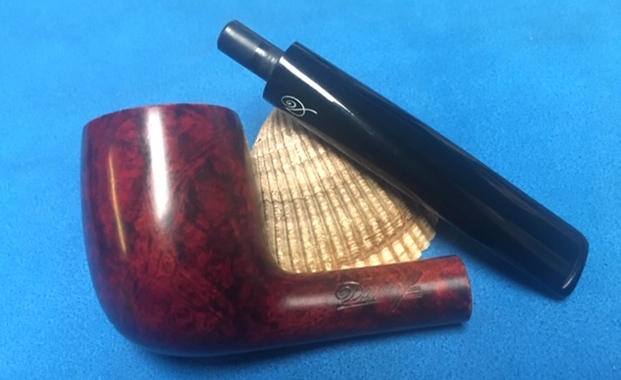
A Fresh Start for the second Davidoff  from this estate – a Straight 214 Billiard


Blog by Steve Laug

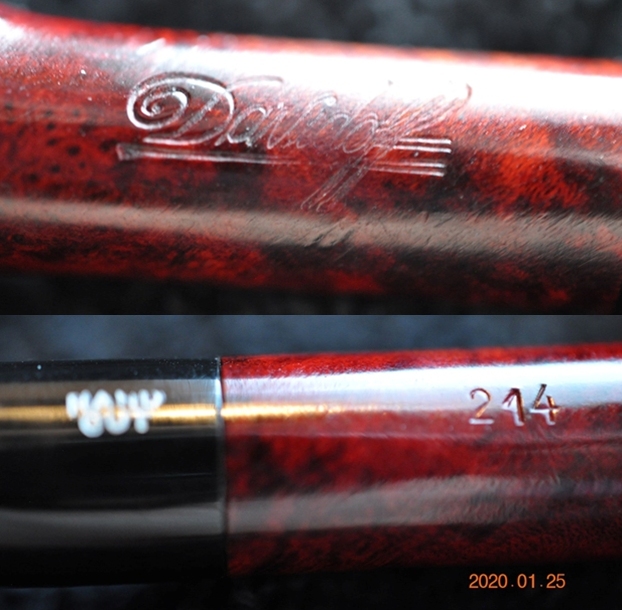
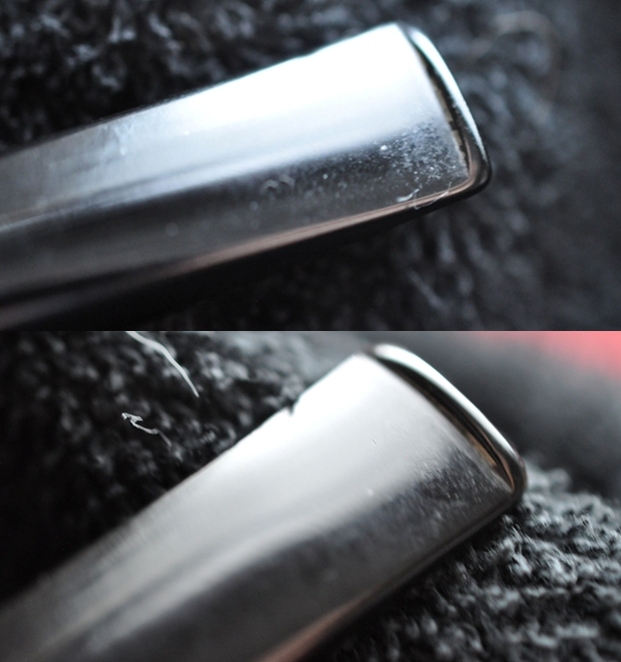
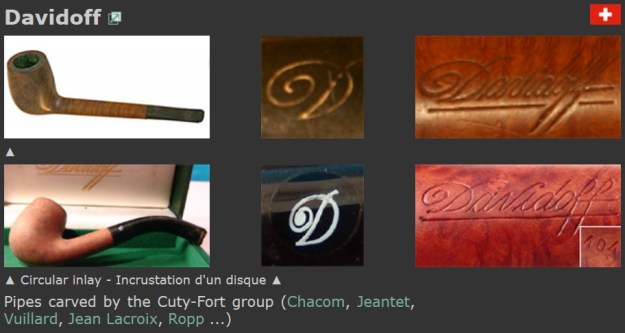
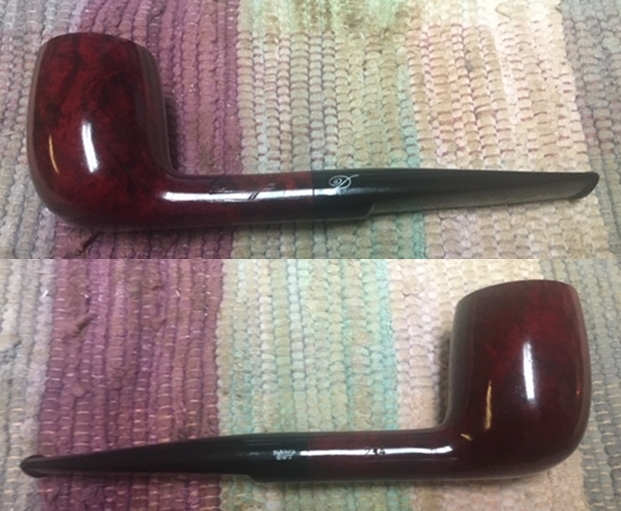
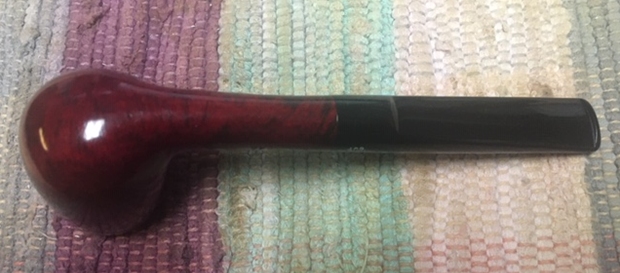
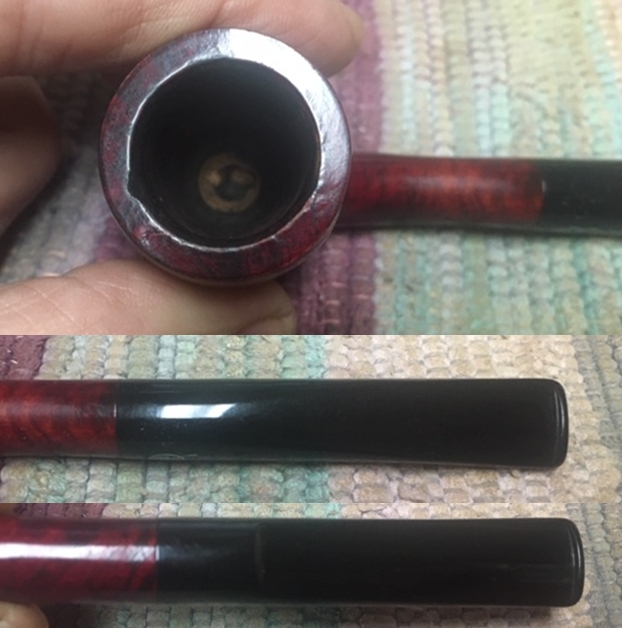
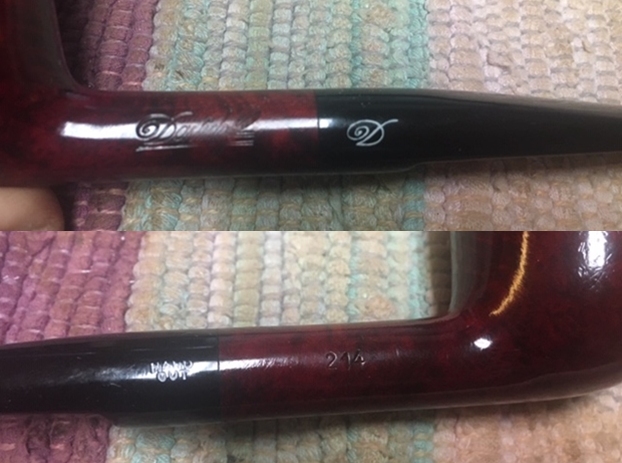
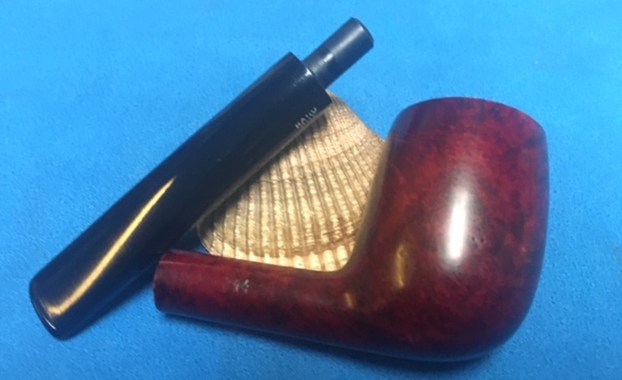
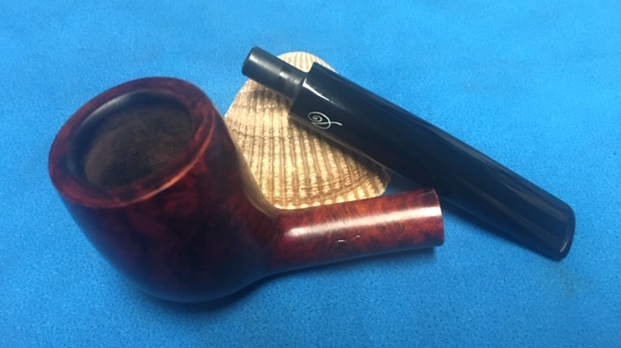
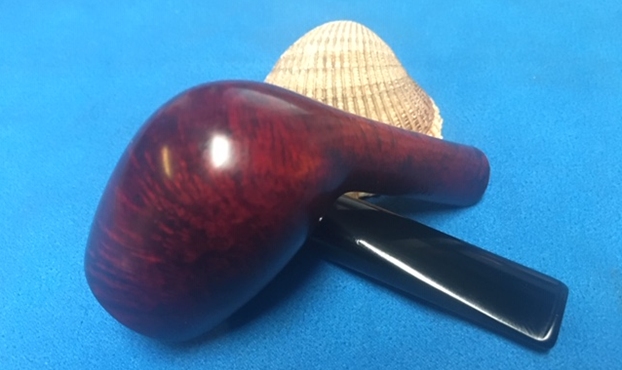
One thing about having so many boxes of pipes to work on surrounding my work table is that I can always find one that grabs my attention to work on now! This is the second of the two Davidoff pipes in the box and I had passed over in the past weeks but this morning I decided that the second pipe would join the days queue. It is a nice looking Billiard shape pipe stamped Davidoff on the left side of the shank. The name is underlined and the D has a flourish both on the stamping and on the logo on the left side of the stem. On the right side it is stamped with the shape number 214. It was dirty and was another well-loved pipe when we received it. The bowl had a thick cake and the lava overflow on the top and the edge of the rim. It was hard to know the condition of the inner edge of the bowl. The pipe had a rich Mahogany stain on the bowl that highlighted some nice grain on the bowl sides under the grime and the finish appeared to be damaged on the left side of the shank and rim top. The shiny varnish coat was damaged on the rim, on the right side of the bowl and the left side of the shank. It was worn. A lot would be revealed once Jeff had worked his magic on it. The acrylic stem was in good condition with light tooth chatter and marks on both sides ahead of the button and on the button surface itself. Jeff took photos of the pipe before he started his cleanup work. Jeff tried to capture the condition of the bowl and rim top with the next series of photos. You can see the work that is ahead of us there. The grain around the bowl is quite stunning. Jeff took some great photos showing what is underneath the grime and debris of time and use. He captured the stamping on both sides of the shank and both sides of the half saddle acrylic stem. They are clear and readable. It read Davidoff in script underlined with a Script D on the left side of the stem and Hand Cut on the right side of the stem. The photos of the stem show the stem surface. It is dirty and has light tooth marks and chatter on both sides ahead of the button.This second Davidoff pipe is also the second one I have worked on from this pipe maker. I turned to Pipephil to get a quick overview on the brand so I knew a bit about the pipe I was working on (http://www.pipephil.eu/logos/en/logo-d3.html). I have included a screen capture of the pertinent section below. It seems that for awhile anyway the pipes were carved by the Cuty-Fort Group (Chacom, Jeantet, etc.).I turned to Pipedia to fill in more of the gaps and found that the article quotes Jose Manuel Lopes whose book I have on my shelf ( https://pipedia.org/wiki/Davidoff) I quote:

From Pipes, Artisans and Trademarks, by Jose Manuel Lopés’

Davidoff started in 1911 as a family run tobacconist located in Geneva. Henri Davidoff, a Russian emigrant, was the founder. The shop was located in Geneva. His son, Zino Davidoff (1906-1994), concentrated on the tobacco business, starting in 1924, and revolutionized the conservation of quality cheroots throughout Europe.

Davidoff became World famous, and the company was acquired in 1970 by the Oettinger group, and expanded into numerous accessories for men. For Zino, the pursuit of pleasure was a constant, two of his maxims being: “Take pleasure from everything in life, without excess” and “the pipe is a valuable companion, the essence of tranquility and must be smoked with respect”.

Davidoff’s first pipes date from 1974 and were commissioned by various companies, notably Butz-Choquin and the Cuty Fort Group. The brand offers 14 classic shapes, in three finishes and with acrylic stems.

It appears the pipes are now made in Italy, as the website states the following about their pipes:

Creation of the Davidoff Pipe entails a meticulous, detailed process performed by only the most skilled Italian pipemakers. This dedication is why the Davidoff Pipe upholds a standard of quality and design found in no other pipe in the world. Made of the finest and carefully selected briar, each Davidoff Pipe features a flawless, hand-finished bowl and perfectly fitted, hand-cut acrylic stem. The Davidoff Pipe is available in three beautiful designs and finishes — sandblasted black, red brilliant and natural light brown.

With that information in hand I knew what I was dealing with either a French made or an Italian made pipe. I have been working on a lot of each lately and the pipe in hand also had the feel of a French made Chacom pipe rather than an Italian. I would work with that assumption. I had no idea of the age of the pipe but it was time to work on the pipe itself.

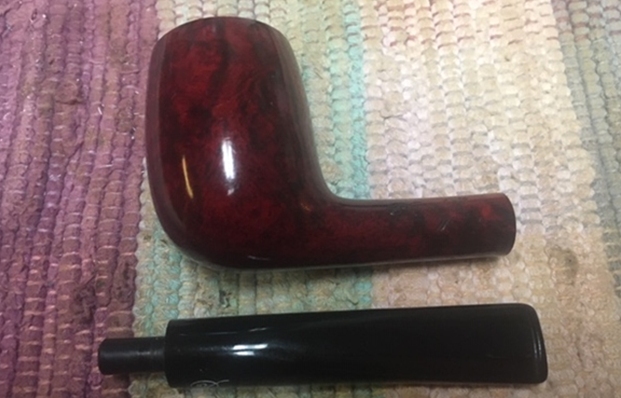
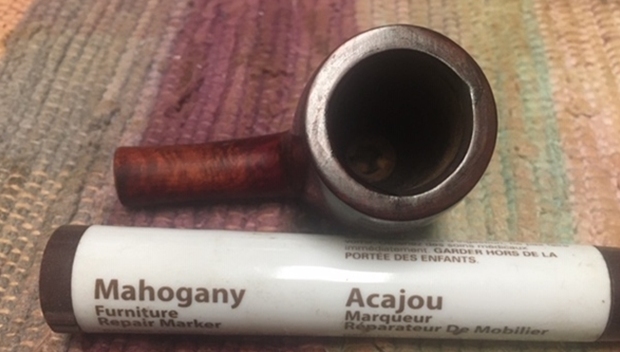
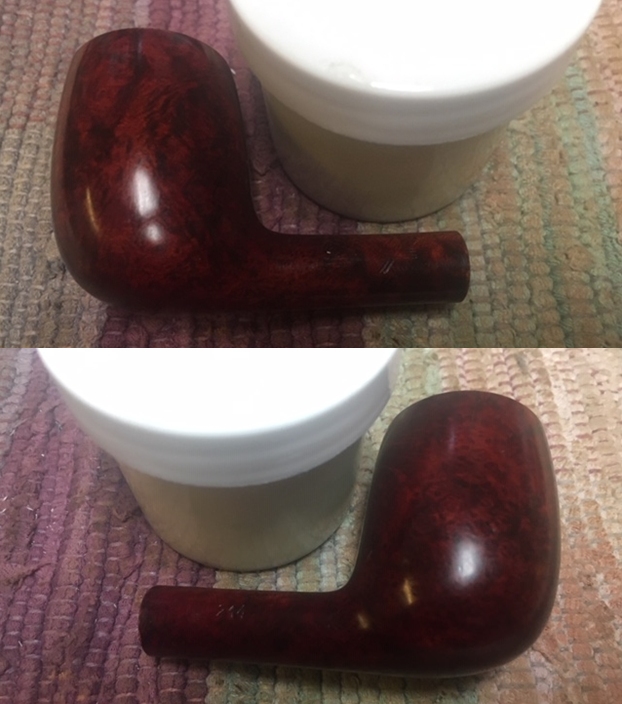
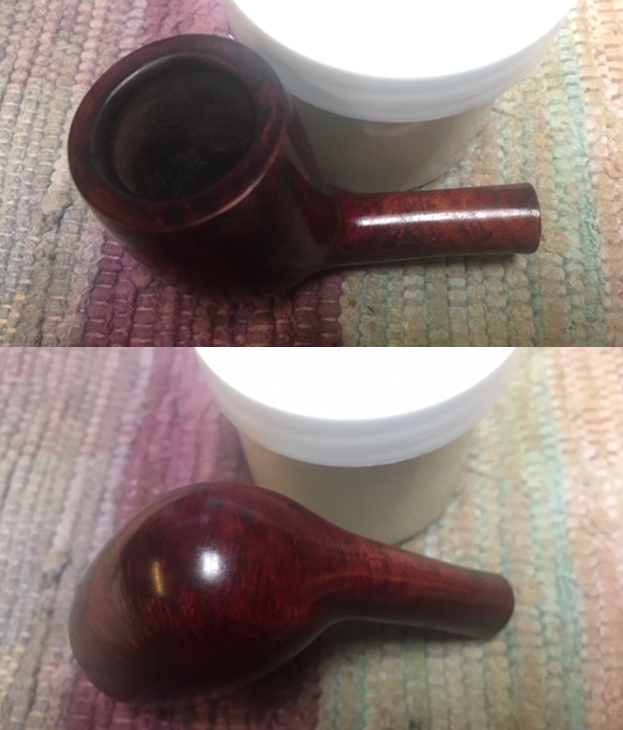
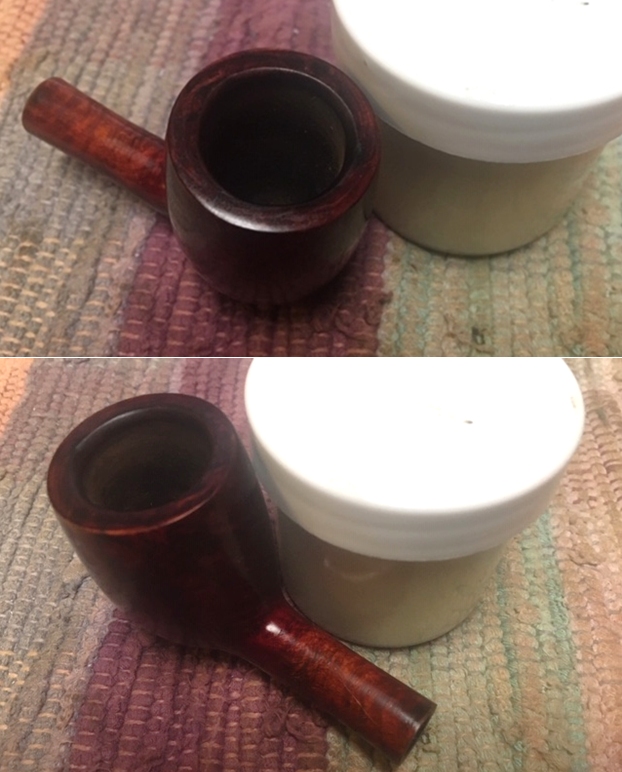
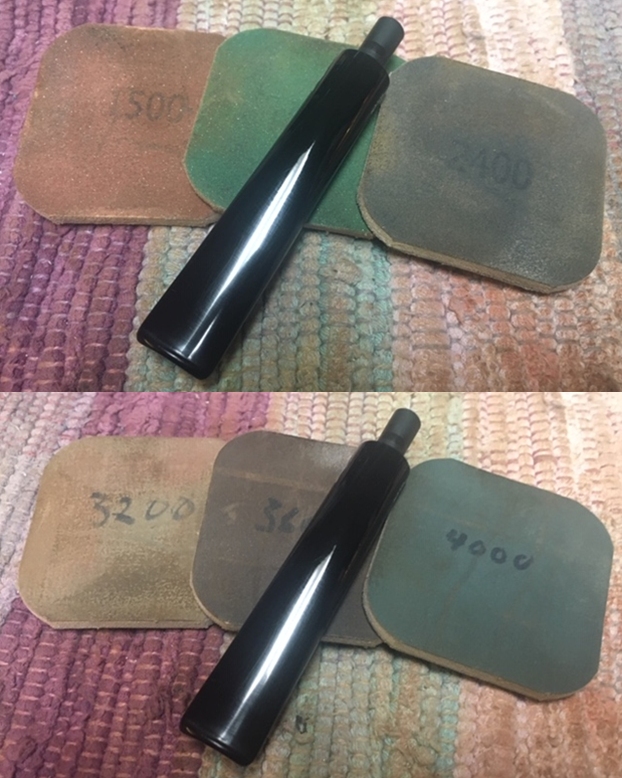
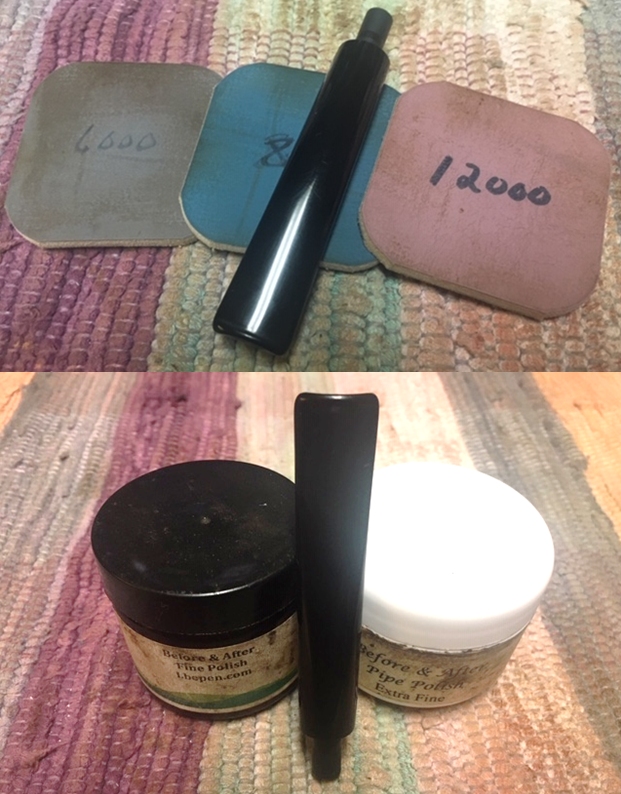
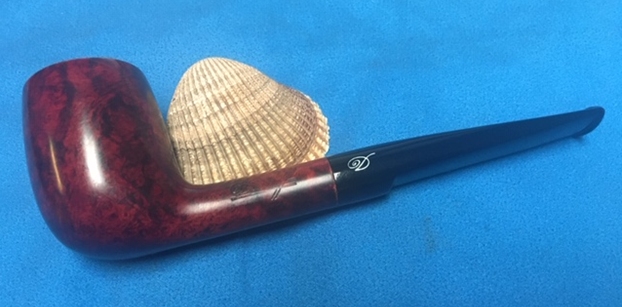
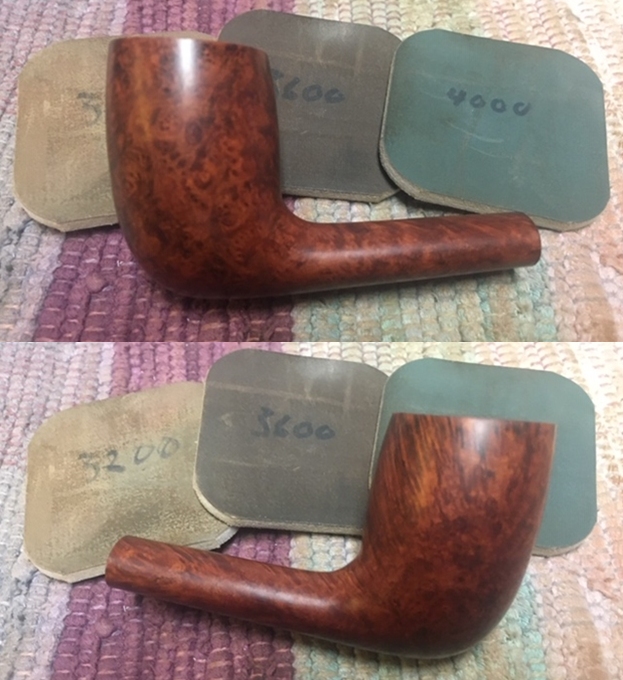
Jeff cleaned the pipe with his usual penchant for thoroughness that I really appreciate. This one was a real mess and I did not know what to expect when I unwrapped it from his box. He reamed it with a PipNet pipe reamer and cleaned up the reaming with a Savinelli Fitsall Pipe Knife. He scrubbed out the internals with alcohol, pipe cleaners and cotton swabs until the pipe was clean. He scrubbed the exterior of the bowl with Murphy’s Oil Soap and a tooth brush to remove the grime and grit on the briar and the lava on the rim top. The finish looks very good with good looking grain around the bowl and shank. Jeff scrubbed the stem with Soft Scrub to remove the grime and build up on the surface. When the pipe arrived here in Vancouver for the second stop of its restoration tour it looked very good. I took photos before I started my part of the work. (I forgot to take a photo of the top view of the pipe.) Fortunately I took some photos of the rim top and stem. The photo of the bowl shows how clean the bowl is and also the damage and peeling of the varnish coat on the smooth rim. The inner edge of the bowl was also in rough condition with burn marks and damage around the front inner edge. The close up photos of the stem shows that is it very clean.I took photos of the stamping on the stem and shank of the pipe. It is clear and readable. You can also see the smudge in the varnish finish on the left side of the shank in the middle of the Davidoff stamp.I took the stem off the shank and took a picture of the pipe. It really is a nice looking pipe with great lines.With the damage on the finish on the side of the shank and the finish on the rim top I decided to remove the varnish or shellac coat on the briar. I wiped it down with acetone on a cotton pad to remove the shiny coat. I would need to sand the rest of the finish off with micromesh sanding pads but before I did I wanted to clean up the edge and top of the rim. I used a folded piece of 220 grit sandpaper to smooth out the damage and give the rim edge a light bevel. I topped the rim with 220 grit sandpaper to remove the damaged finish and clean it up. I polished the briar with micromesh sanding pads – dry sanding with 1500-12000 grit pads. I wiped the bowl down after each pad with a damp cloth. I wanted to finish removing the varnish coat and polish the rim top. Once the varnish was removed the grain really began to stand out and the finish took on a natural shine by the last sanding pad. The photos tell the story! (Once again I forgot to take a few photos — don’t know what is happening.) I stained the polished rim top with a Mahogany Stain Pen. The colour matched the rest of the bowl perfectly. There was still a small nick in the rim edge that remains – to remove that would have changed the look of the rim.I worked some Before & After Restoration Balm into the surface of the briar with my fingertips. The product works to clean, enliven and protect the briar. I let the balm sit for about ten minutes and then buffed with a cotton cloth to raise the shine. The photos show the bowl at this point in the restoration process. I laid the bowl aside and turned to deal with the stem. The tooth marks and chatter on the stem were not deep. I polished the stem with micromesh sanding pads – dry sanding with 1500-12000 grit sanding pads. I wiped it down after each sanding pad with a cloth containing some Obsidian Oil. I finished polishing it with Before & After Pipe Stem Polish – both Fine and Extra Fine and buffed it off with a cotton cloth. The pipe came together quite well. The finish on the pipe is in excellent condition and the contrasting stains work well with the black acrylic stem. With the grime, debris and varnish coat gone, the bowl had a natural beauty and grain that pops. I put the stem back on the bowl and buffed the pipe with Blue Diamond on the buffing wheel. I carefully avoided the stamping on the shank and stem during the process. I gave the bowl and the stem multiple coats of carnauba wax on the buffing wheel and followed that by buffing it with a clean buffing pad on the buffer. I hand buffed the pipe with a microfiber cloth to deepen the shine. The finished Davidoff pipe is quite beautiful and is a lovely billiard shaped pipe. The finish on the bowl combines various mahogany and black stains to give it depth. It is very well done. Give the finished pipe a look in the photos below. I can only tell you that it is much prettier in person than the photos capture. The dimensions of the pipe are Length: 5 ½ inches, Height: 1 ¾ inches, Outside diameter of the bowl: 1 ¼ inches, Chamber diameter: ¾ of an inch. I really like this billiard shaped pipe and it also reminds me of a Chacom pipe. This is a great looking pipe in great condition. Thanks for walking through the restoration with me as I worked over another beautiful pipe. I will be adding it to the rebornpipes store soon. If you want to add it to your collection send me an email or a message! Thanks for your time.
Restoring a Pastoral Carved Mural Meerschaum


Blog by Steve Laug

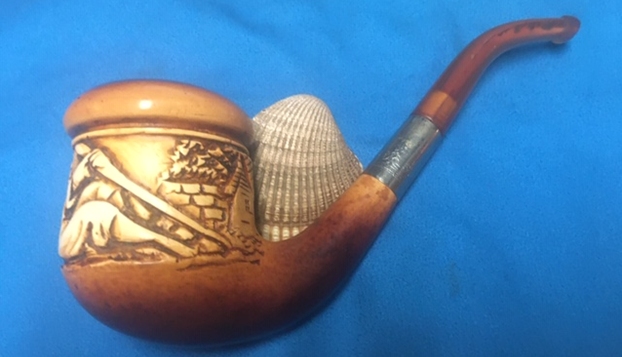
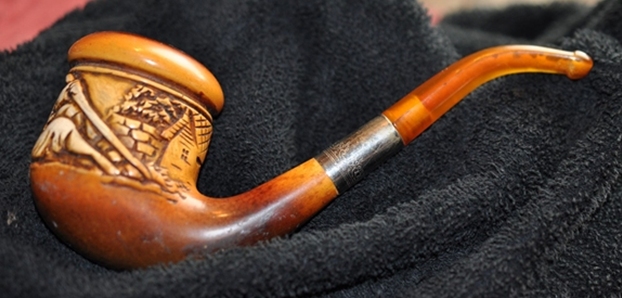
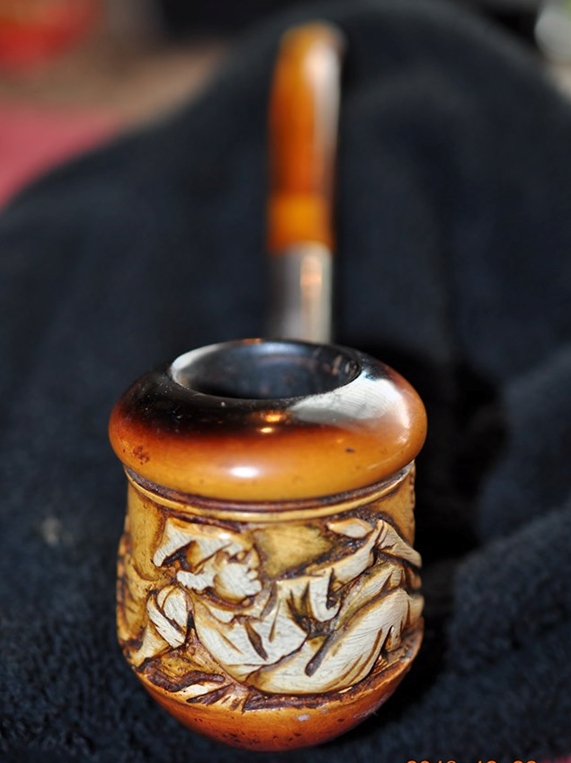
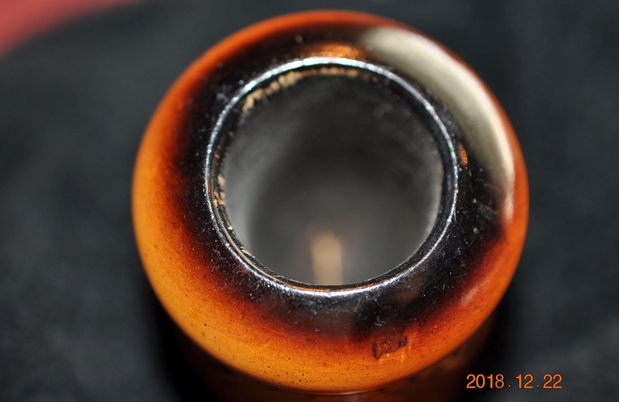
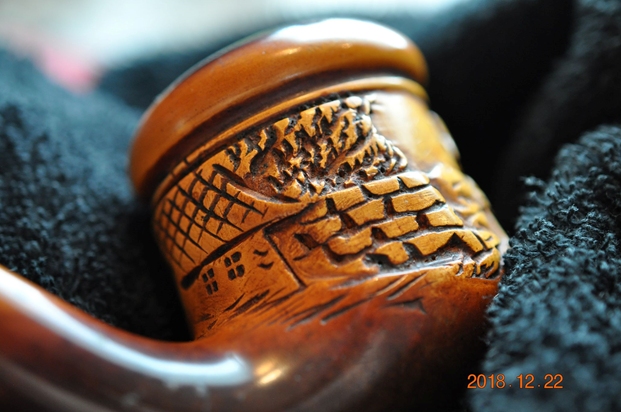
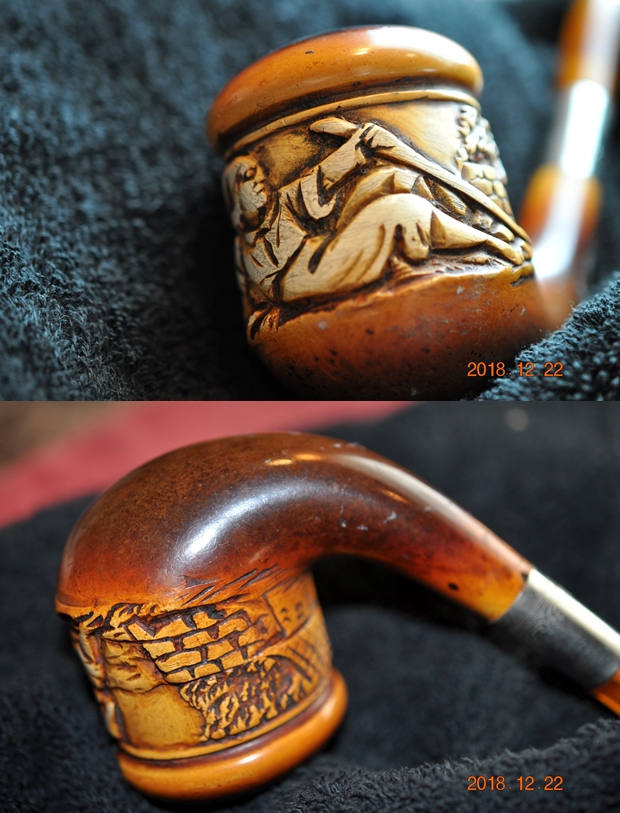
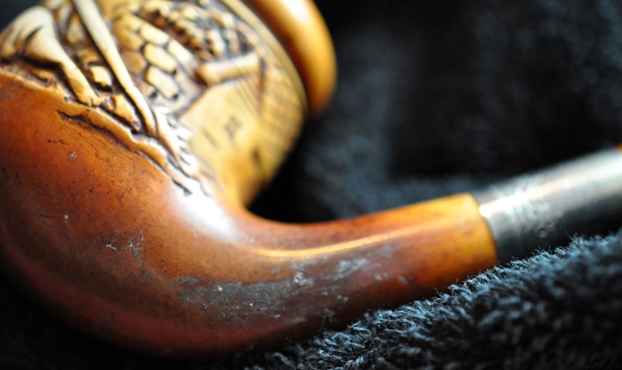
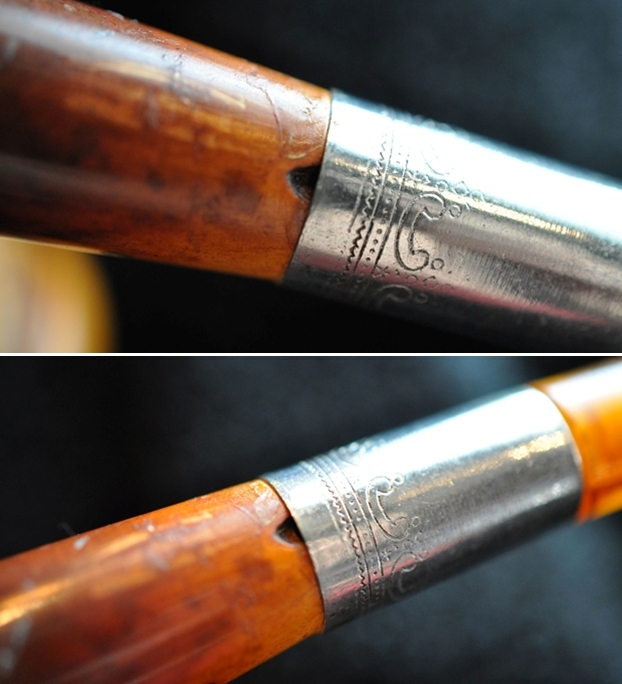
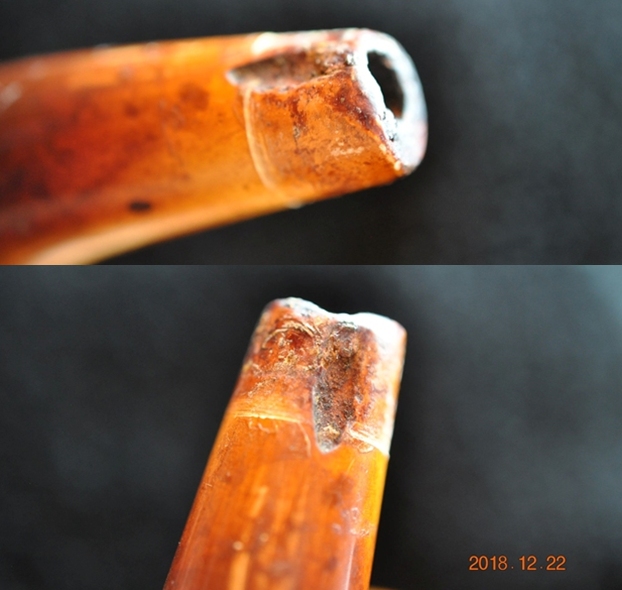
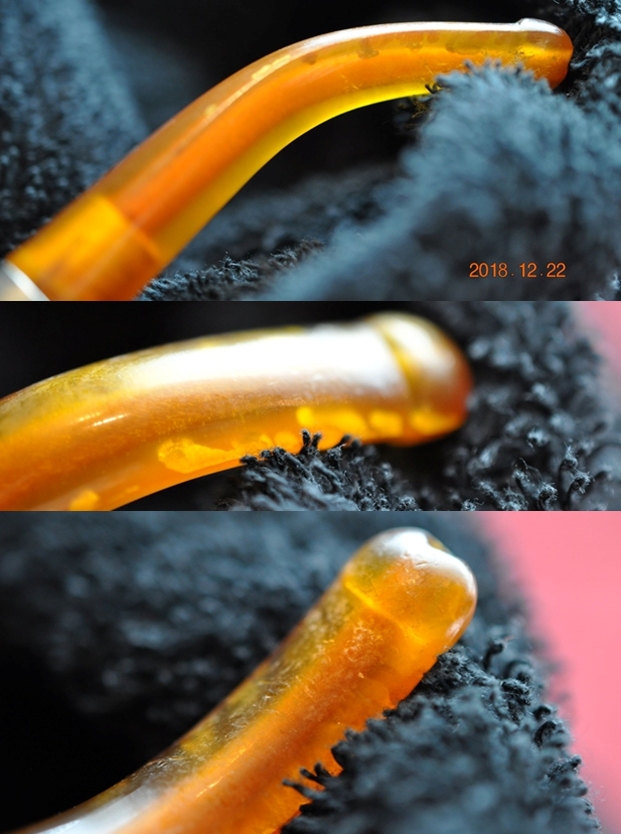
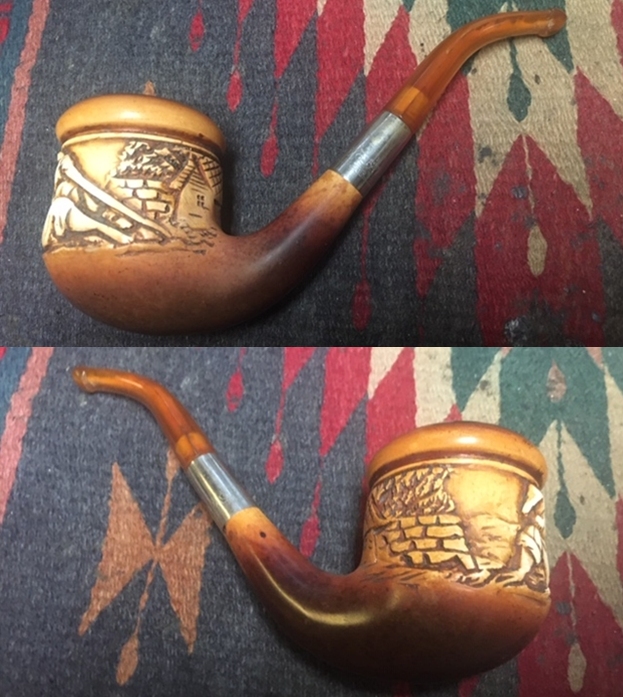
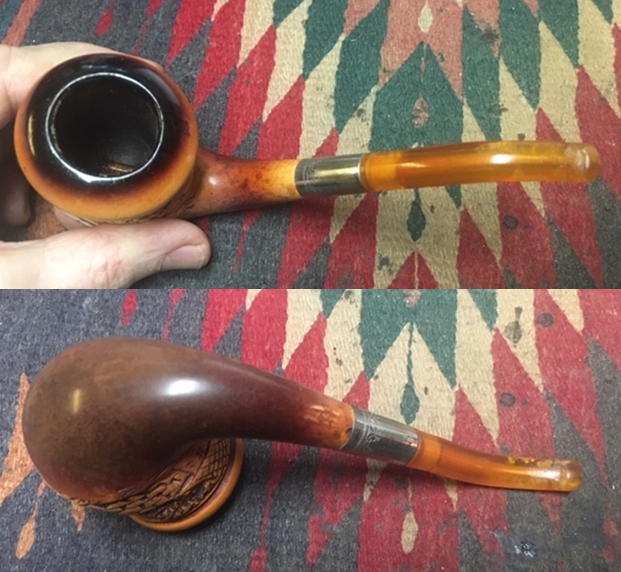
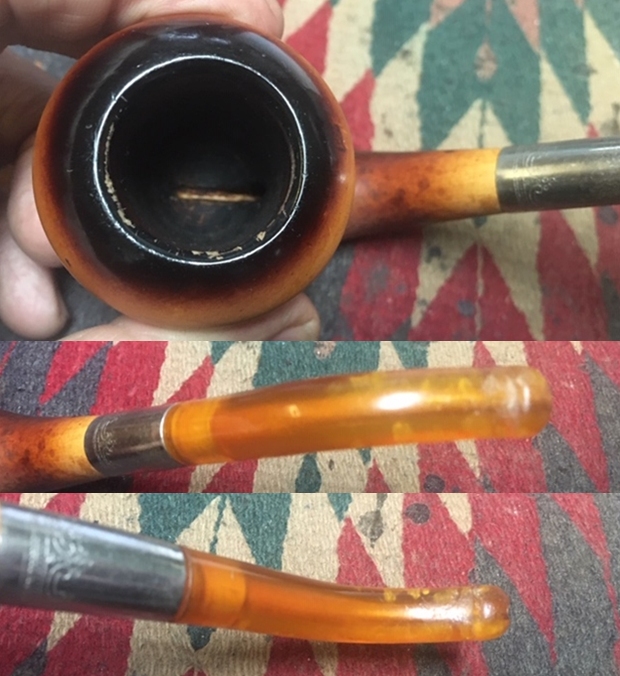
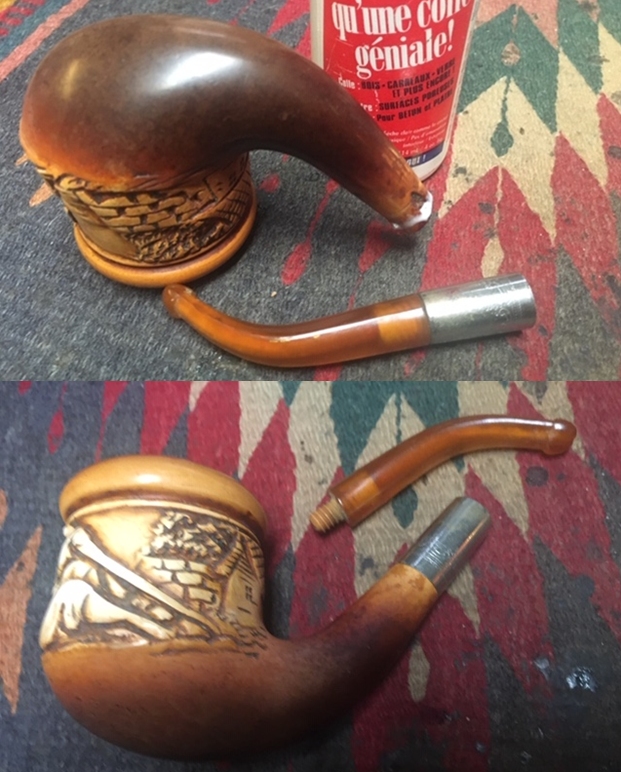
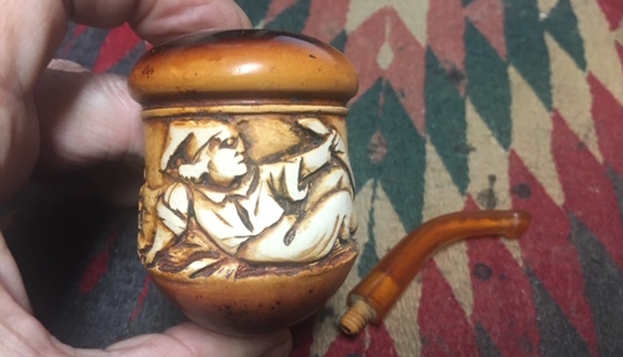
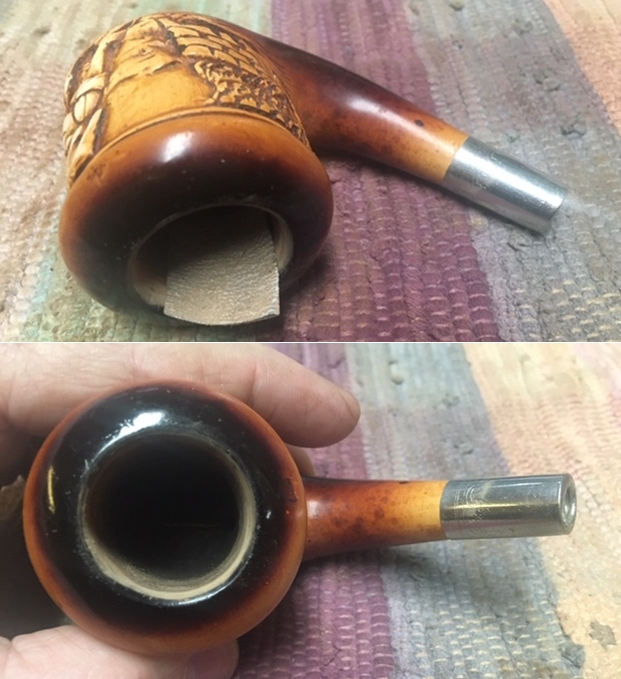
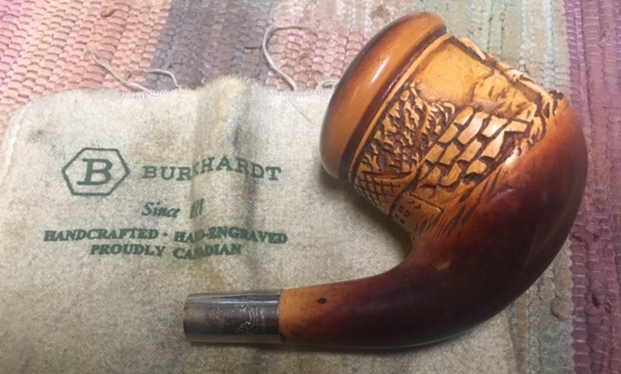
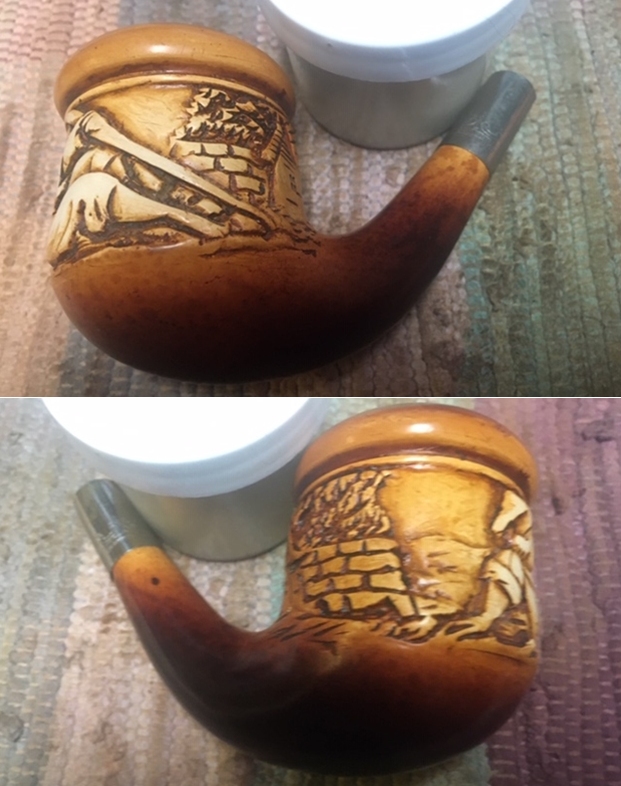
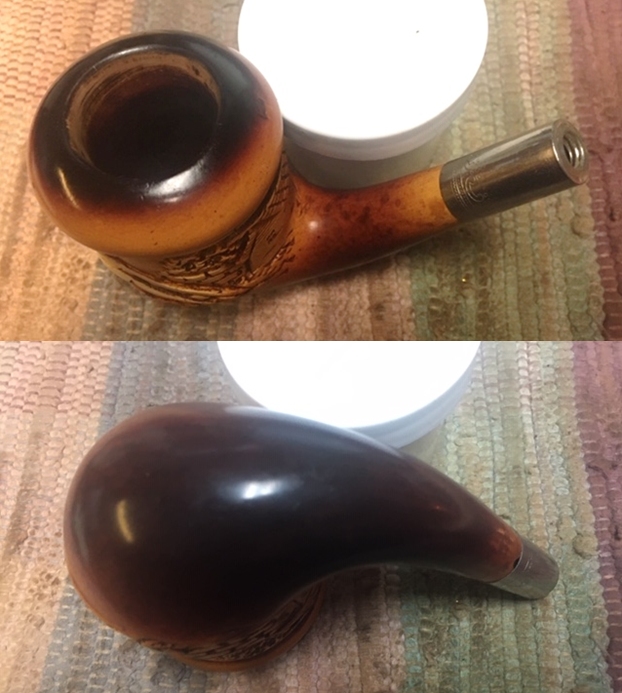
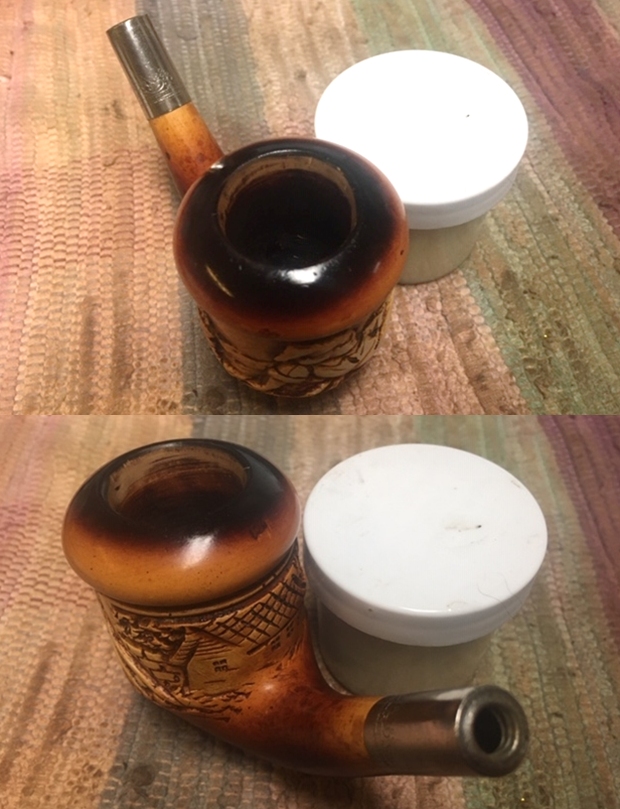
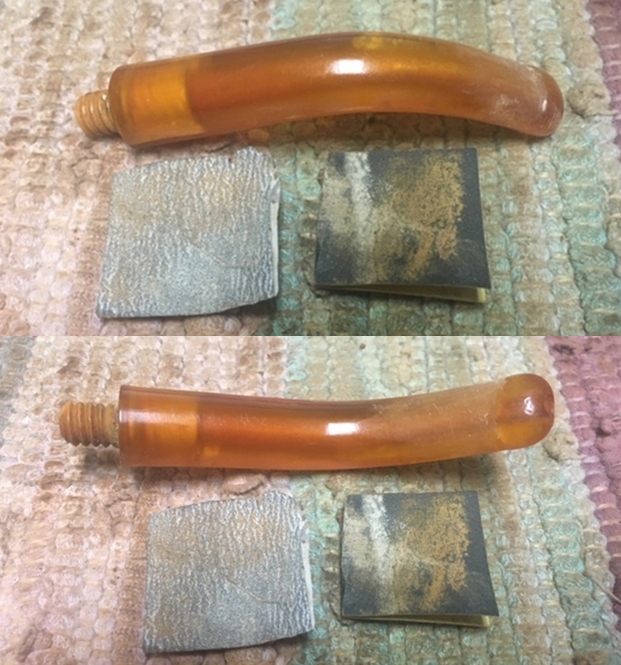
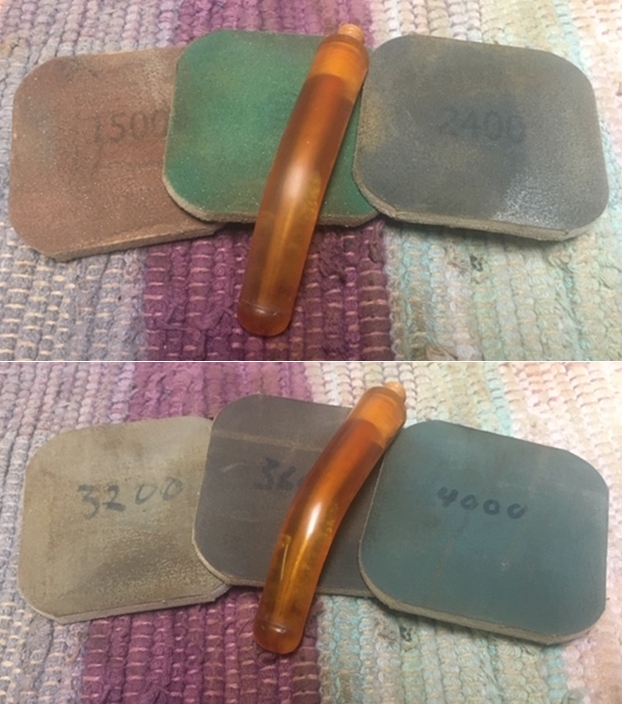
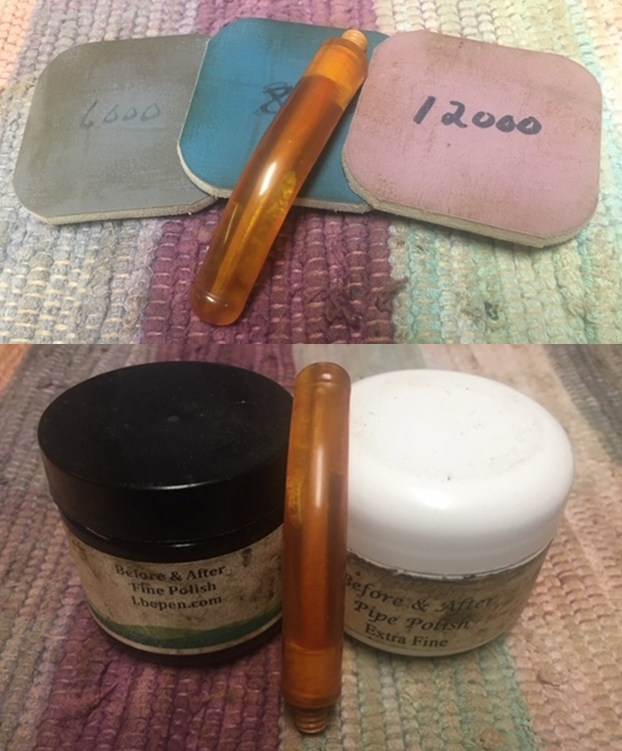
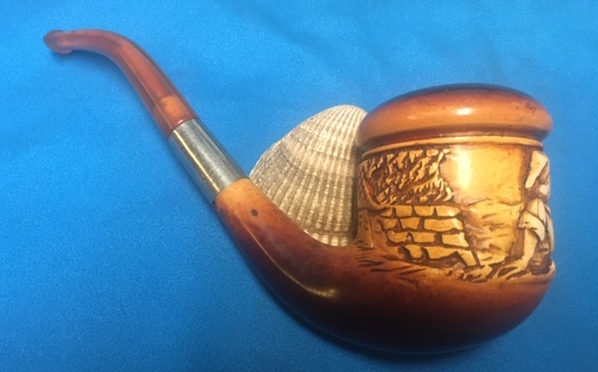
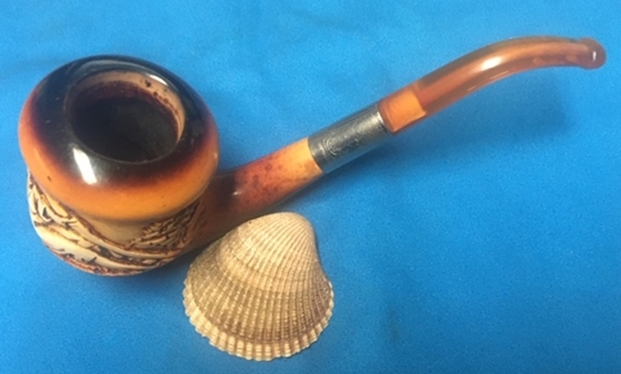
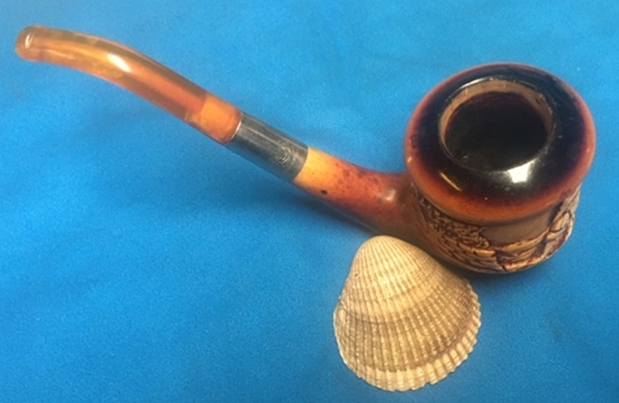
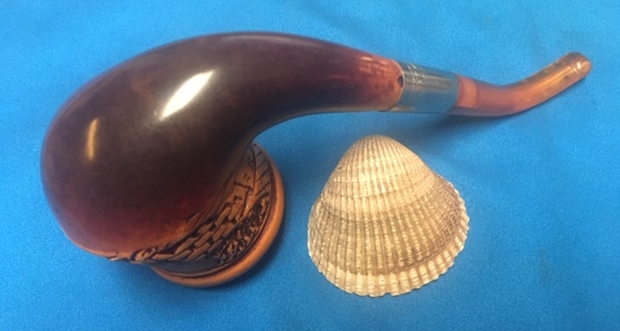
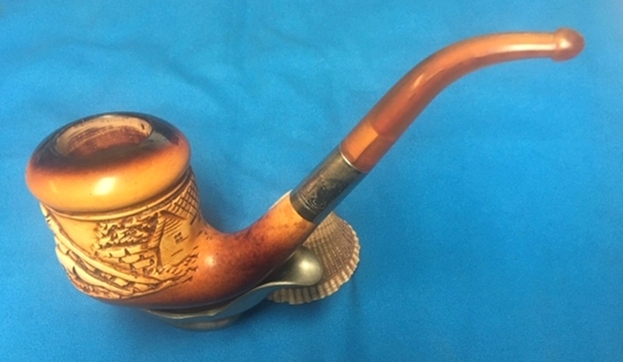
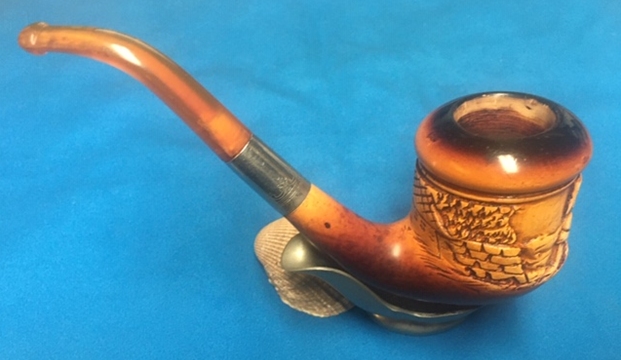
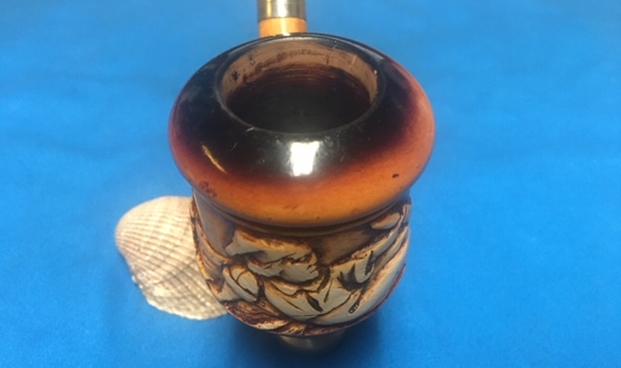
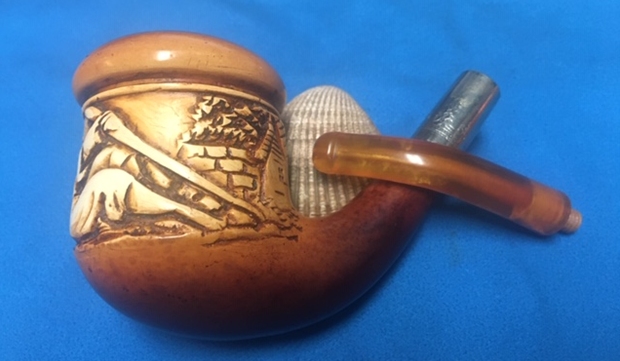
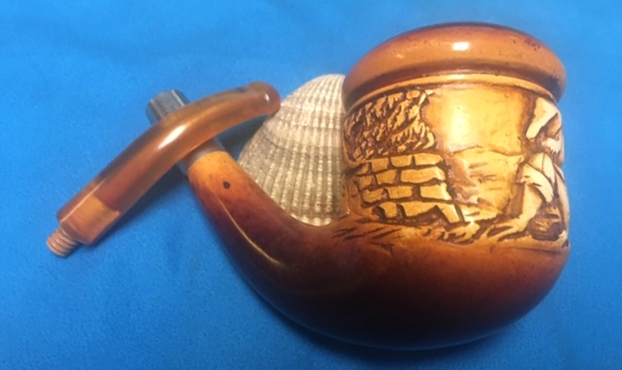
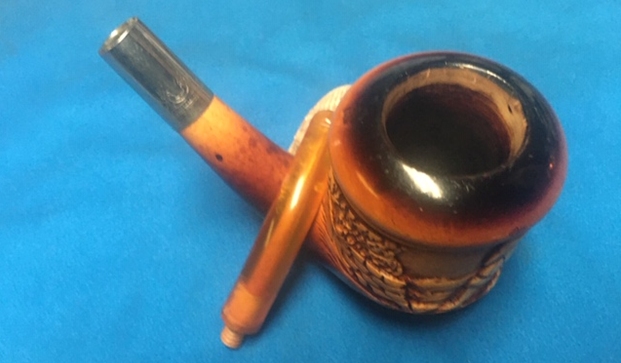
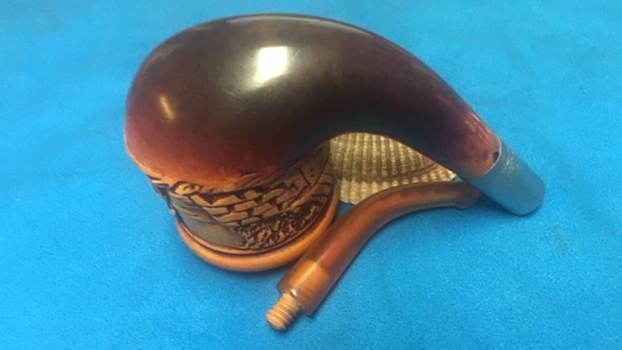
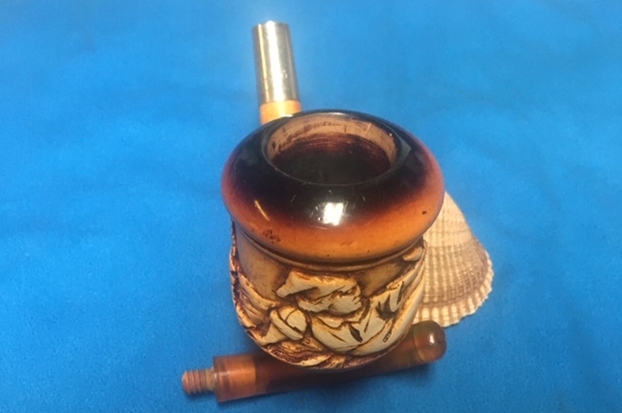
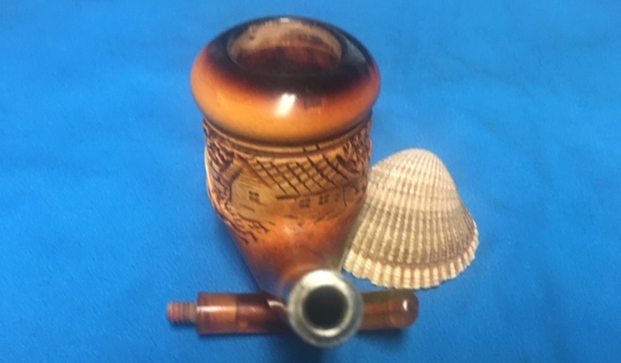
This old meerschaum pipe with a Bakelite stem and silver shank band has been sitting in my box to be restored for almost three years now. I picked up and looked at it, took it apart looked at the pieces and put it back together and put it back in the box. Today I was going through all of the boxes of pipes I had to work on and sorting them. I came upon this pipe and decided today was the day to work on it. This pipe is carved with a pastoral scene of what looks like a mountain cabin and stone fence. Reclining on the ground in the forefront is figure that looks like a Swiss hiker or shepherd with his walking staff leaning against the fence. The bowl had a cake on the walls with a lot of dust in the carving on the front and sides of the bowl. It was dusty and tired looking. The shank end was chipped and there was damage to the shank itself. A lot would be revealed once Jeff had worked his magic on it. The thin shank had a silver etched band that fit well. The shank end was threaded and acted as the mortise. The amber coloured Bakelite stem had a bone tenon that screwed into the shank end of the band. There was light tooth chatter and marks on both sides ahead of the button and on the button surface itself. Jeff took photos of the pipe before he started his cleanup work. Jeff has gotten very good at capturing the condition of the bowl and rim top with his photos. You can see the work that is ahead of us in terms of the cake in the bowl and the lava on the inner edge. The bowl is in good condition.The next set of photos show the carving around the sides of the bowl. The carving is well done. I look forward to seeing what this one looks like once it is clean and restored. He took photos of the shank to show the filigree on the band and the chipped area on the shank itself. The first two photos show the banded shank and the second two show the damage on the unbanded shank. The next photos show the stem surface. It was very dirty and worn looking. It had pitting, light tooth marks and chatter on both sides ahead of the button. There no identifying marks on the pipe or shank or band to help identify the maker. So it was time to work on the pipe itself. Jeff had done his usual great cleanup of this pipe. He cleaned up the bowl walls with a Savinelli Fitsall Pipe Knife. He scrubbed out the internals with alcohol, pipe cleaners and cotton swabs until the pipe was clean. He scrubbed the exterior of the bowl with Murphy’s Oil Soap and a tooth brush to remove the grime and grit on the briar and the lava on the inner edge of the rim. The meerschaum carving looks clean and well done. Jeff scrubbed the stem with Soft Scrub to clean up the Bakelite. When the pipe arrived here in Vancouver for the second stop of its restoration tour it looked very good. I took photos before I started my part of the work. I took some photos of the inwardly beveled rim top and stem. Once Jeff removed the lava on the top and inside of the rim top was rough. The inner edge had a bit of wear and would need to be sanded smooth. The close up photos of the stem shows that is it very clean and there is some tooth chatter and marks on the button surface and just ahead of the button. There are also casting marks on the sides of the stem that need to be removed.I took the stem off the shank and took photos. The band was loose on the shank and the stem screwed into the threaded mortise in the top of the band. At first I thought the band was a later addition but the more I looked at it the more I realized that the band was original with the inset mortise. I spread some all-purpose white glue on the end of the shank. I unscrewed the stem from the shank and pressed the band onto the shank end. I set it aside to dry while the glue cured.I took a photo of the reclining goat herd or hiker and included it now. It is well carved.I decided to address the damage on the inner edge of the rim. I used a folded piece of 220 grit sandpaper to clean up the darkening on the inner edge of the bowl. With the edge cleaned up the bowl looked better.I polished the silver band with a jeweler’s cloth and removed the tarnish on the band.I worked some Before & After Restoration Balm into the surface of the meerschaum with my fingertips. Mark Hoover developed the product to clean, enliven and protect briar but I have been using it on meerschaum as well and found it effective. I let the balm sit for about ten minutes and then buffed with a cotton cloth to raise the shine. The photos show the bowl at this point in the restoration process. I set the bowl aside at this point and turned my attention to the stem. I sanded out the tooth marks on the stem in front of the button on both sides.I polished the stem with micromesh sanding pads – dry sanding with 1500-12000 grit sanding pads. I wiped it down after each sanding pad with a cloth containing some Obsidian Oil. I finished polishing it with Before & After Pipe Stem Polish – both Fine and Extra Fine and buffed it off with a cotton cloth. This large meerschaum pot with a carved pastoral scene is an unusual piece. It has a beauty of its own with the patina around heel and bowl. It is a pipe that has grown on me as I have worked on it. I have never worked on one like it. I know next to nothing about the pipe in terms of manufacture or carver. It has a German/Swiss look to the carving but that is a guess. The silver band and the thin Bakelite stem add to the mix. With the grime and debris gone from the finish and the bowl it was a unique beauty. The rim top looks really good now. I put the stem back on the bowl and carefully buffed the pipe with Blue Diamond on the buffing wheel. I gave the bowl multiple coats of Clapham’s Beeswax by hand and the stem multiple coats of carnauba wax on the buffing wheel. I buffed the pipe with a clean buffing pad on the buffer. I hand buffed the pipe with a microfiber cloth to deepen the shine. Give the finished pipe a look in the photos below. I can only tell you that like the other pipes I am working that it is much prettier in person than the photos capture. The dimensions of the pipe are Length: 7 inches, Height: 2 ¾ inches, Outside diameter of the bowl: 2 inches, Chamber diameter: 1 inch. Thanks for walking through the restoration with me as I worked over another interesting pipe. This pipe will be added to the Meerschaum Pipes section of the rebornpipes store soon. If you want to add it to your collection send me an email or a message! Thanks for your time.

New Life for a Danish Hand Made Prince Amled 4 Peewit Shape


Blog by Steve Laug

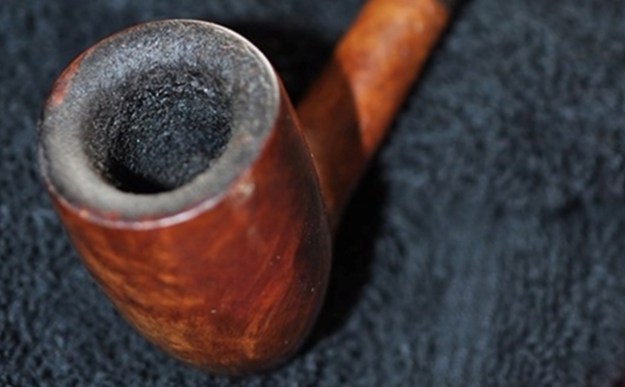
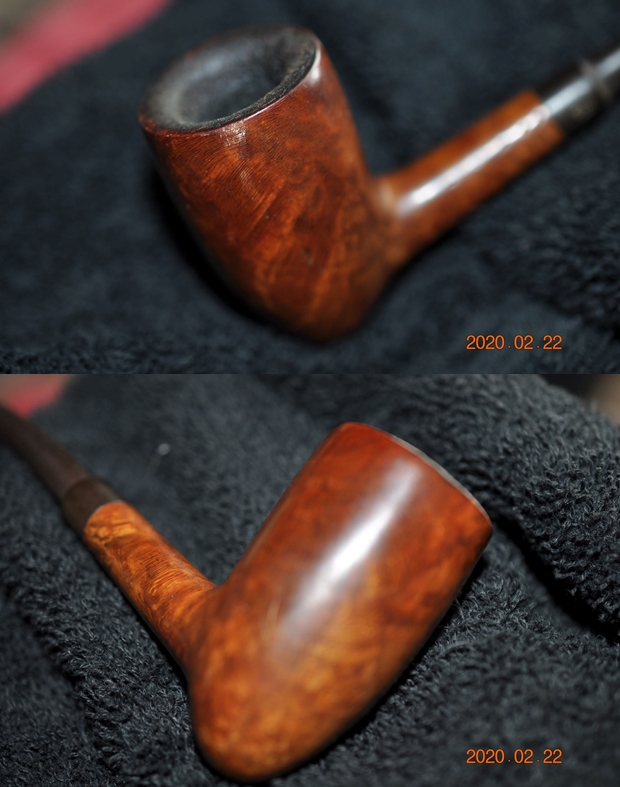
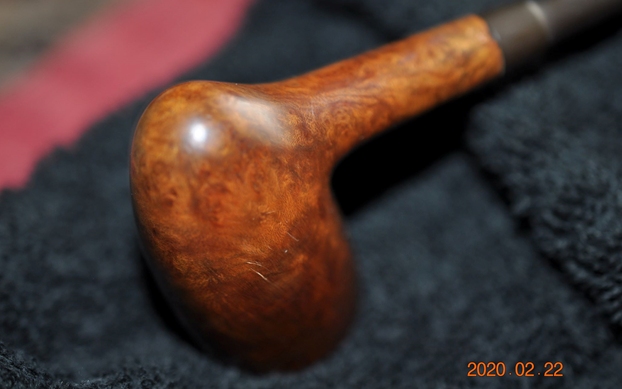
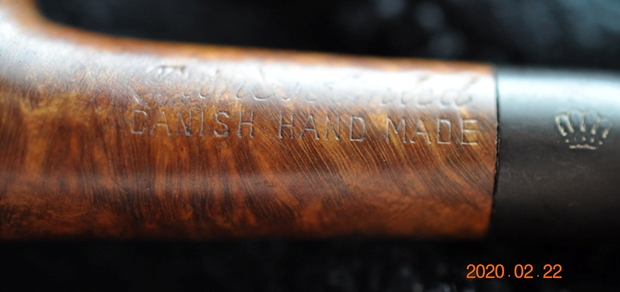
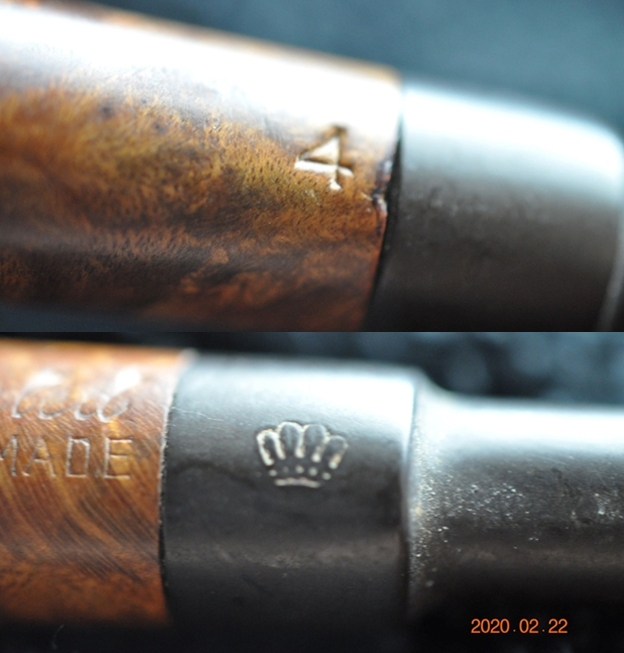
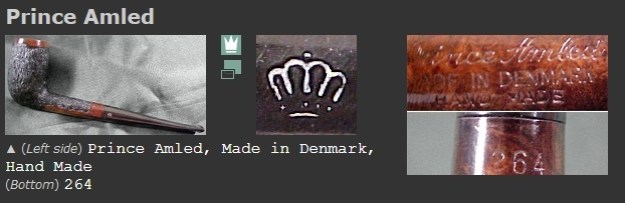
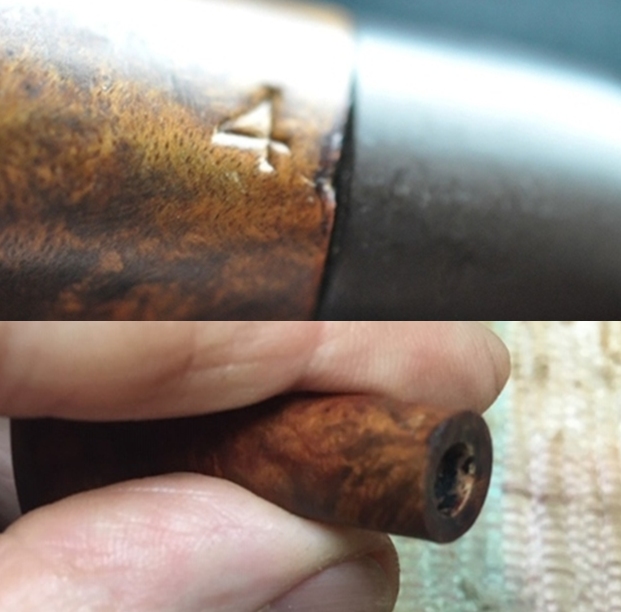
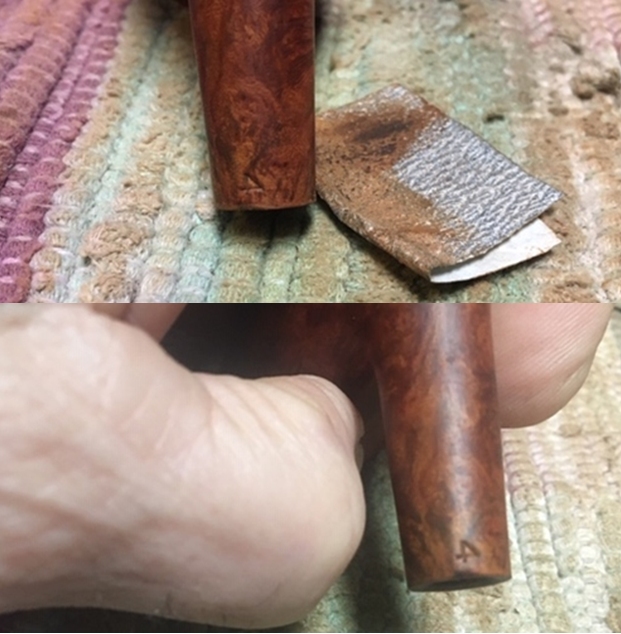
This past January Jeff and his wife Sherry and Irene and I made a pipe hunting trip down the Oregon Coast. At least that is what Jeff and I called it. We stopped in a lot of the small towns up and down the northern part of the coast and picked up some nice pipes. This little pipe was obviously Danish and I think both Jeff and I thought it was a Kriswill. We were hooked so we picked it up and added it to the finds of the trip. This pipe is stamped on the left side of the shank and on the underside at the shank/stem union. On the left side it is stamped with Prince Amled over Danish Hand Made. On the underside it is stamped with the shape number 4. Next to the 4 there was a chip in the shank end.  It was a very dirty pipe with a dull and lifeless finish but it was the shape that caught our eye. We were hoping for some nice grain around the bowl. There was a very thick cake in the bowl and a thick lava coat on the rim top and the inner edge. It was hard to see what the condition of either the inner or outer edges with the lava and grime. It did appear that there was a burned area on the right side of the outer edge. The pipe had a rich medium brown stain with a reddish tint that was meant to highlight the grain on the bowl sides. A lot would be revealed once Jeff had worked his magic on it. The pencil shank and pencil flared saddle stem was heavily oxidized and calcified. There was light tooth chatter and marks on both sides ahead of the button and on the button surface itself. Jeff took photos of the pipe before he started his cleanup work. Jeff has gotten very good at capturing the condition of the bowl and rim top with his photos. You can see the work that is ahead of us in terms of the lava and grime on the rim and the thick cake in the bowl. This pipe is a real mess.The next set of photos show the grain on the sides and heel of the bowl. It is an interesting combination of grain – cross grain, swirls and birdseye predominate. I look forward to seeing what this one looks like once it is clean and restored. He took photos of the faint stamping on the sides of the shank. The Prince Amled stamp on the left side is readable. On the underside is the shape stamp 4 which is very clear readable. The third photo below shows the crown logon on the left side of the saddle stem. The next photos show the stem surface. It was very dirty, oxidized and calcified. It had pitting, light tooth marks and chatter on both sides ahead of the button. Before I started to work on the pipe I wanted to learn about the brand. I turned first to Pipephils site to see if there was any information on the Danish Made Prince Amled brand (http://www.pipephil.eu/logos/en/logo-p5.html). I did a screen capture of what was on the site and I include that below. It was another of those pipes with little information included.I turned to Pipedia see if there was any further information to help me with hunt for this pipe manufacturer. The listing for that pipe company had some great photos but also an appeal for information on the brand. It looks like I had as much information as I could find online.

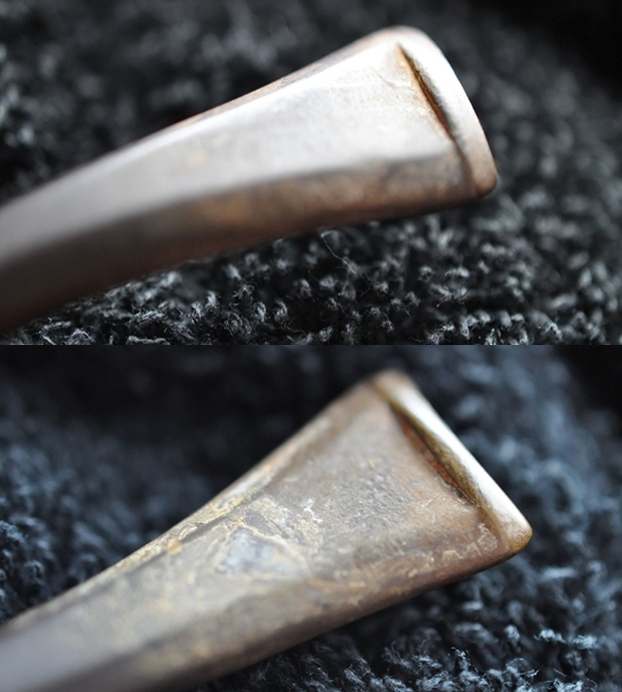
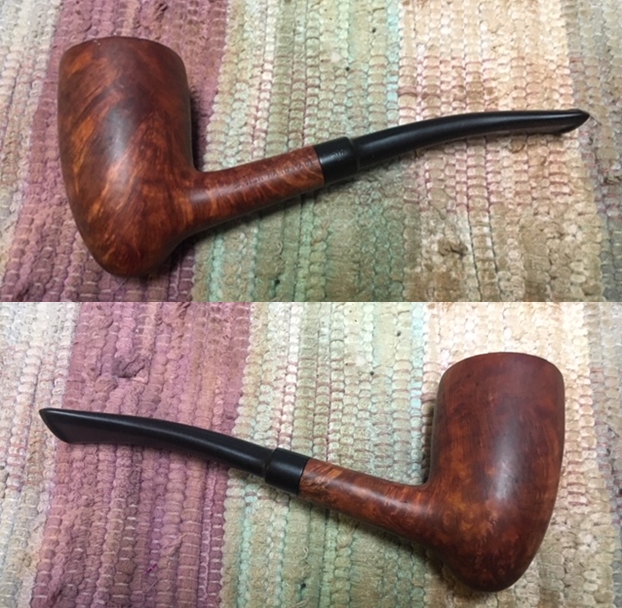
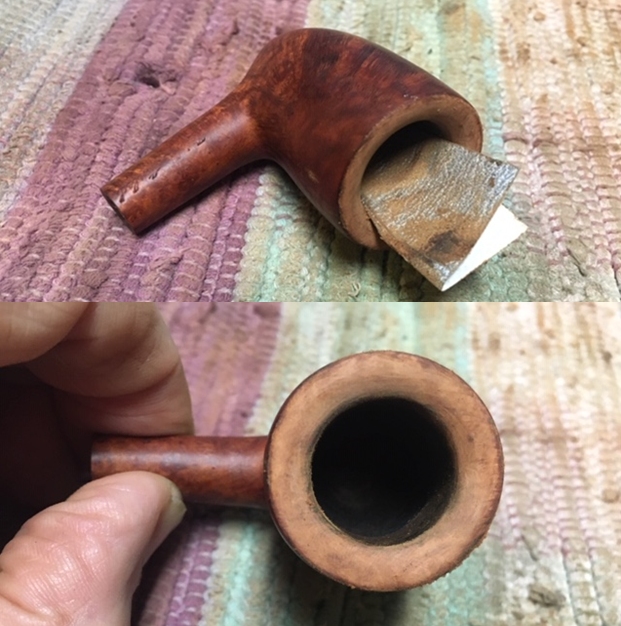
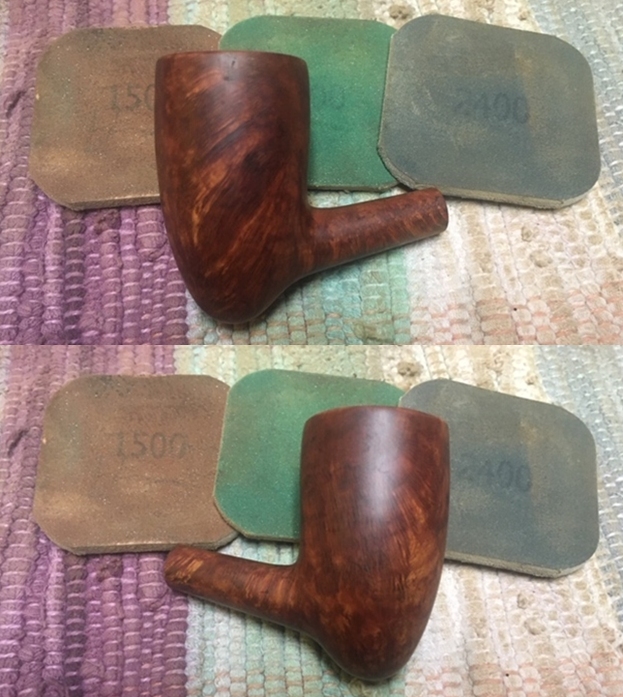
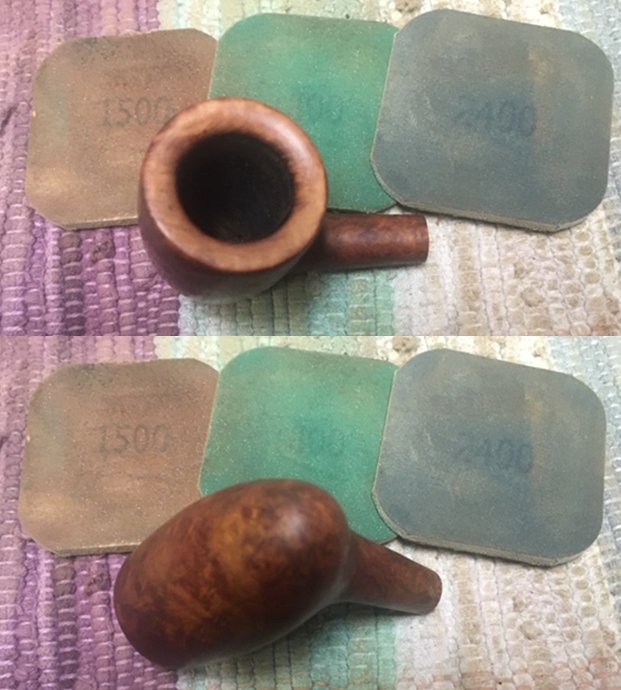
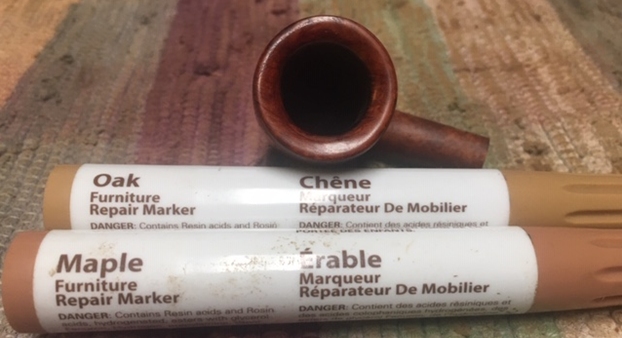
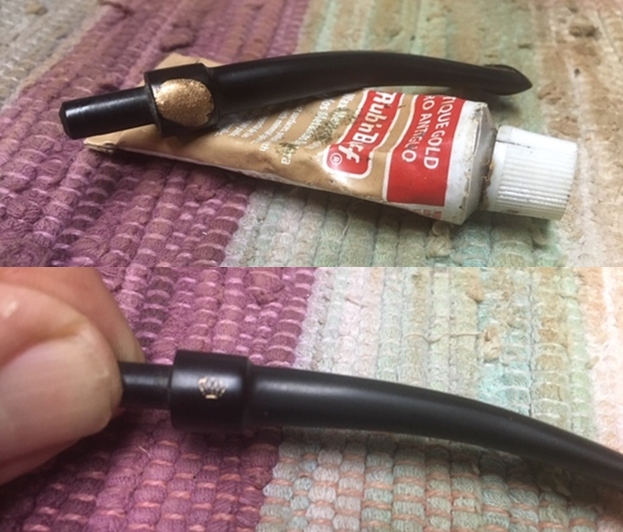
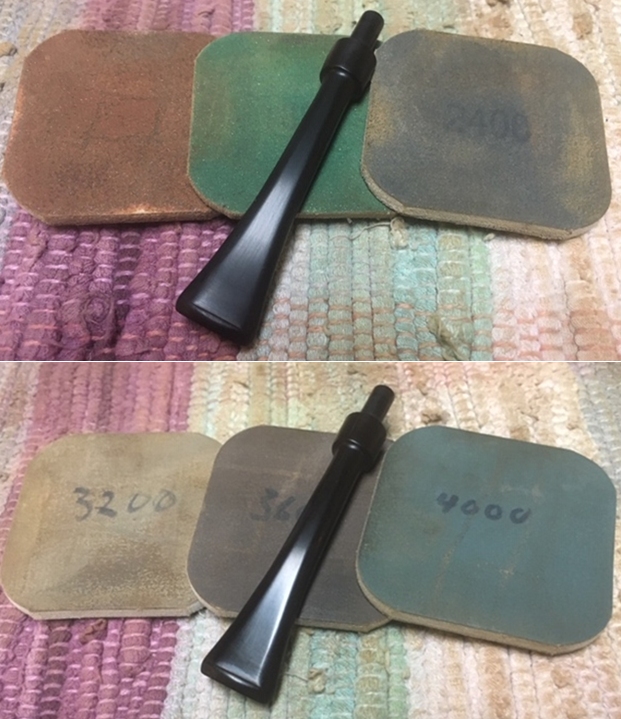
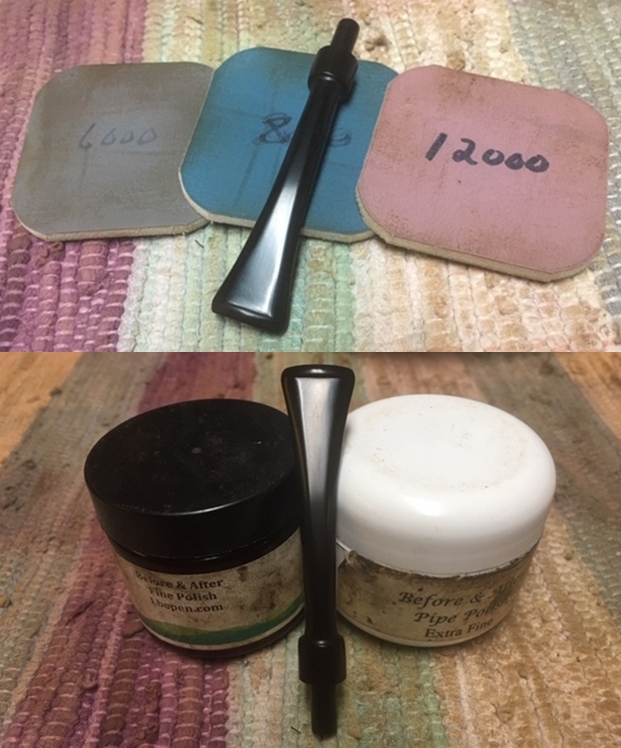
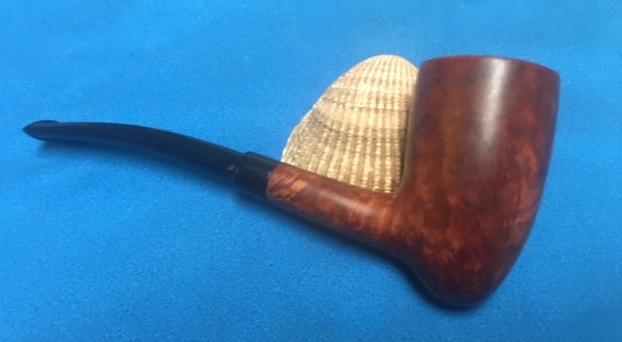
Now it was time to work on the pipe itself. Jeff had once again outdone himself on this pipe. It looked far better than what it was like when we found it. We were right in our assumption of nice grain under the grime. He reamed the bowl with a PipNet Pipe reamer and took the cake back to bare briar. He cleaned up the bowl walls with a Savinelli Fitsall Pipe Knife. He scrubbed out the internals with alcohol, pipe cleaners and cotton swabs until the pipe was clean. He scrubbed the exterior of the bowl with Murphy’s Oil Soap and a tooth brush to remove the grime and grit on the briar and the lava on the beveled rim top. The finish looks very good with good looking grain around the bowl and shank. Jeff scrubbed the stem with Soft Scrub and then soaked it in Before & After Deoxidizer to remove the oxidation on the vulcanite. When the pipe arrived here in Vancouver for the second stop of its restoration tour it looked very good. I took photos before I started my part of the work. I took some photos of the inwardly beveled rim top and stem. Once Jeff removed the lava on the top and inside of the rim top was rough. Both the inner and the outer edge of the bowl showed damage. There a lot of darkening on the inside edge and burn damage on the top right outer edge. The close up photos of the stem shows that is it very clean and there is some tooth chatter and marks on the button surface and just ahead of the button.I took the stem off the bowl and took a picture of the pipe. It really is a pretty little pipe with a classic Danish look to it.I decided to begin my work on the pipe by addressing the damage on the rim top and edges. The rim was beveled inward so topping it on a topping board was out of the question. I used a folded piece of 220 grit sandpaper to smooth out the inner and outer edges of the bowl. I also used it to smooth out the rim top to remove the damage.In the photos that Jeff took of the underside of the shank you can see a chip or large nick on the shank. It is almost like someone tried to pry off the stem. It needed to be cleaned up and repaired. I have included that photo as the first one below. One of the perks that I have found from Jeff’s cleanup methods as nicks like this will often swell and either disappear or be greatly reduced. The second photo shows the same area after his cleanup work. I used a folded piece of 220 grit sandpaper to smooth out the remaining damage on the shank (picture 3) and then took a photo of the clean shank end (picture 4). I was happy with the way the rim top and edges looked so I did not need to do anymore except to polish them. I polished the briar with micromesh sanding pads – dry sanding with 1500-12000 grit pads. I wiped the bowl down after each pad with a damp cloth. The grain really began to stand out and the finish took on a shine by the last sanding pad. The photos tell the story! I touched up the rim top to match the rest of the bowl with a blend of Oak and Maple stain pens. The blend works really well with this colour of bowl. I am happy with the work so it is time to move on.I worked some Before & After Restoration Balm into the surface of the briar with my fingertips. The product works to clean, enliven and protect the briar. I let the balm sit for about ten minutes and then buffed with a cotton cloth to raise the shine. The photos show the bowl at this point in the restoration process. I set the bowl aside at this point and turned my attention to the stem. The stem was in very good condition. I decided to apply some Antique Gold Rub’n Buff to the logo on the side of the saddle stem. I rubbed it on and buffed it off and it looks good.I polished the stem with micromesh sanding pads – dry sanding with 1500-12000 grit sanding pads. I wiped it down after each sanding pad with a cloth containing some Obsidian Oil. I finished polishing it with Before & After Pipe Stem Polish – both Fine and Extra Fine and buffed it off with a cotton cloth. This delicate and petite Prince Amled Hand Made Danish pipe is a real beauty. I know it is hand made in Denmark but that is the extent of the information available on the brand. The shaping and carving follows the grain and highlights the mix of grains around the bowl. The finish on the pipe is in excellent condition and the contrasting stains work well to highlight the stunning grain on the pipe. The thin vulcanite pencil saddle stem adds to the mix. With the grime and debris gone from the finish and the bowl it was a beauty and the grain just pops at this point. The rim top looks really good now. I put the stem back on the bowl and buffed the pipe with Blue Diamond on the buffing wheel. I carefully avoided the stamping on the shank and stem during the process. I gave the bowl and the stem multiple coats of carnauba wax on the buffing wheel and followed that by buffing it with a clean buffing pad on the buffer. I hand buffed the pipe with a microfiber cloth to deepen the shine. The finished “Peewit” shape (at least that is what I am calling it) is quite nice and feels great in the hand. Give the finished pipe a look in the photos below. I can only tell you that like the other pipes I am working that it is much prettier in person than the photos capture. The dimensions of the pipe are Length: 5 inches, Height: 2 ¼ inches, Outside diameter of the bowl: 1 ¼ inches, Chamber diameter: 5/8 of an inch. Thanks for walking through the restoration with me as I worked over another interesting pipe. This pipe will be added to the Danish Pipe Makers section of the rebornpipes store soon. If you want to add it to your collection send me an email or a message! Thanks for your time.
Breathing Life into A Pipe Maker 16 Lovat with a Cumberland Stem


Blog by Steve Laug

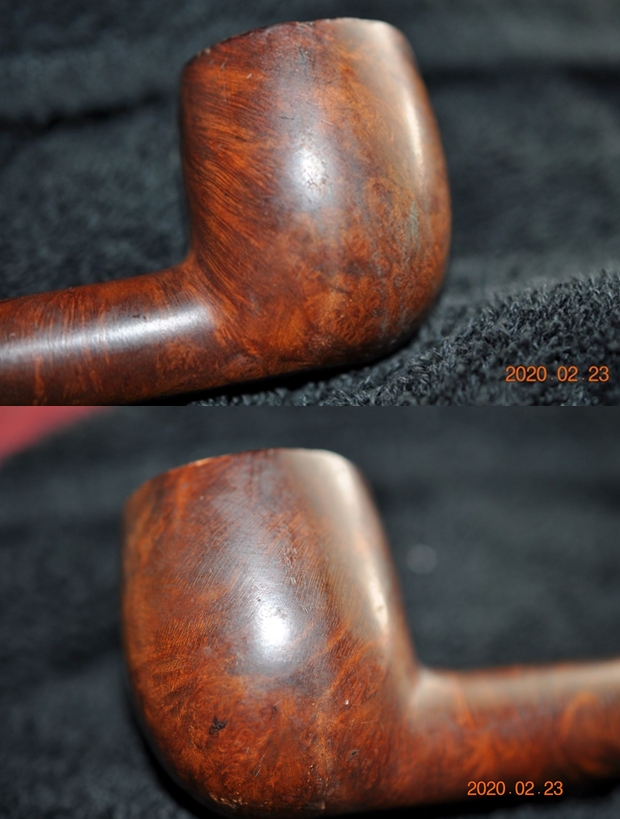
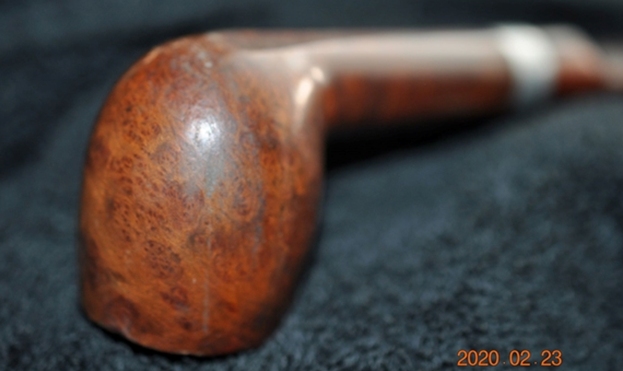
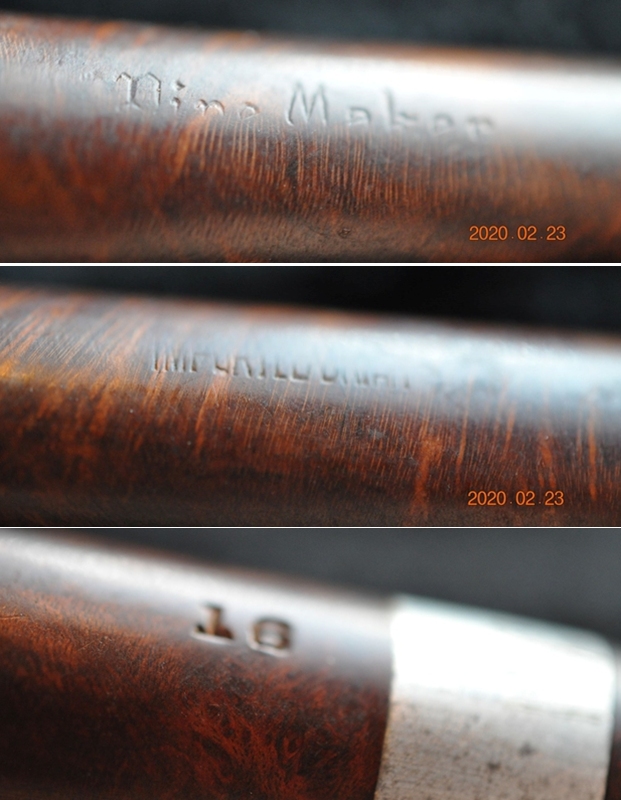
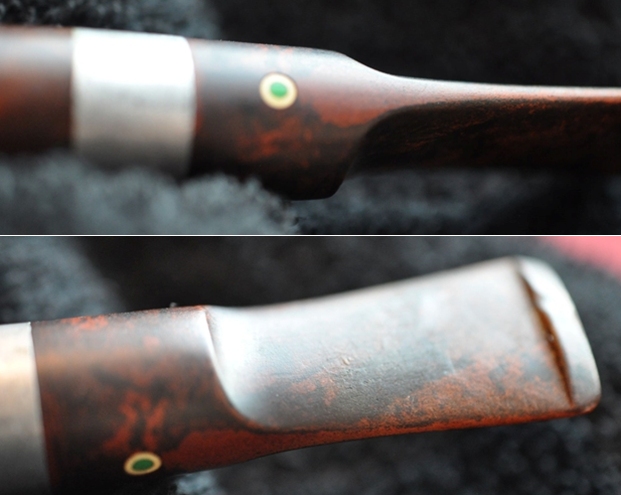
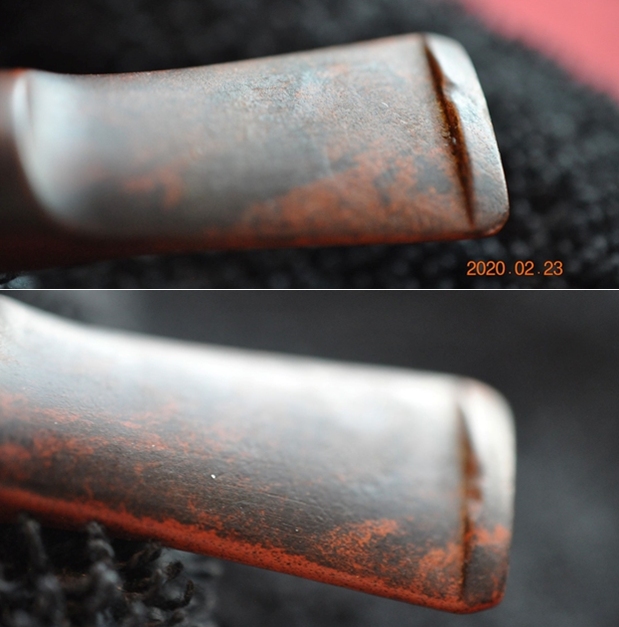
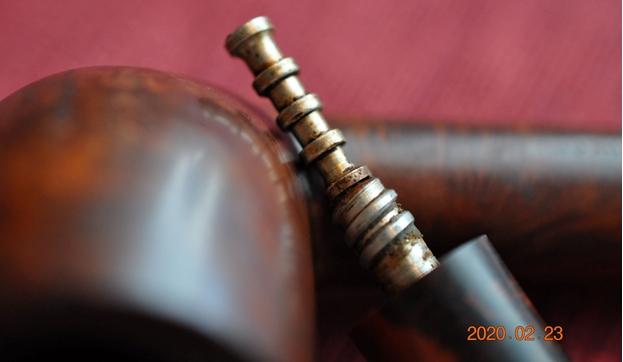
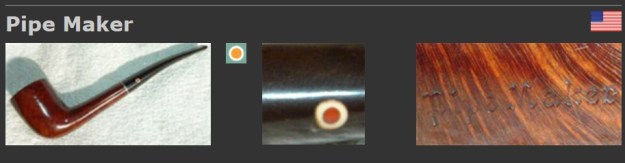
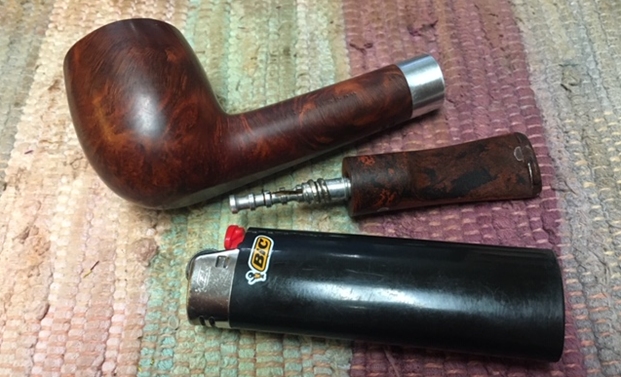
This past January Jeff and his wife Sherry and Irene and I made a pipe hunting trip down the Oregon Coast. At least that is what Jeff and I called it. We stopped in a lot of the small towns up and down the northern part of the coast and picked up some nice pipes. When I saw this little Lovat with a Cumberland stem I was hooked and we picked it up and added it to the finds of the trip. This pipe is stamped on both sides of the shank and on the underside at the shank/stem union. On the left side it is stamped with the Pipe Maker. On the right side it is stamped Imported Briar. On the underside it is stamped with the shape number 16. It was a very dirty pipe with a dull and lifeless finish that hid the grain around the bowl. There was a very thick cake in the bowl and a thick lava coat on the rim top and the inner edge. It was hard to see what the condition of either the inner or outer edges with the lava and grime. The pipe had a rich medium brown stain with a reddish tint that highlighted nice grain on the bowl sides under the grime and the finish appeared to be in good condition. A lot would be revealed once Jeff had worked his magic on it. The Cumberland style saddle stem was in good condition with oxidation and light tooth chatter and marks on both sides ahead of the button and on the button surface itself. Jeff took photos of the pipe before he started his cleanup work. Jeff has gotten very good at capturing the condition of the bowl and rim top with his photos. You can see the work that is ahead of us in terms of the lava and grime on the rim and the cake in the bowl. This pipe is a real mess. The next set of photos show the grain on the sides and heel of the bowl. It is an interesting combination of grain – cross grain and birdseye predominate. I look forward to seeing what this one looks like once it is clean and restored. He took photos of the faint stamping on the sides of the shank. The Pipe Maker stamp on the left side is faint but readable. The Imported Briar stamp on the right side is also faint but readable.  On the underside is the shape stamp 16 which is very clear readable. The fourth and fifth photos below show the logo on the left side of the saddle stem. The next photos show the stem surface. It was very dirty, oxidized and calcified. It had pitting, light tooth marks and chatter on both sides ahead of the button.  Jeff removed the stem from the shank and the photo shows the interesting stinger apparatus and threaded tenon on the pipe. I was certain that the brand was American because of the Imported Briar stamp on the shank but I wanted to learn more about it. I turned first to Pipephils site to see if there was any information on the brand (http://www.pipephil.eu/logos/en/logo-p3.html). I did a screen capture of what was on the site and I include that below.I turned to Pipedia see if there was any further information to help me with hunt for this pipe manufacturer. There was no listing for that pipe company so I had as much information as I could find online.

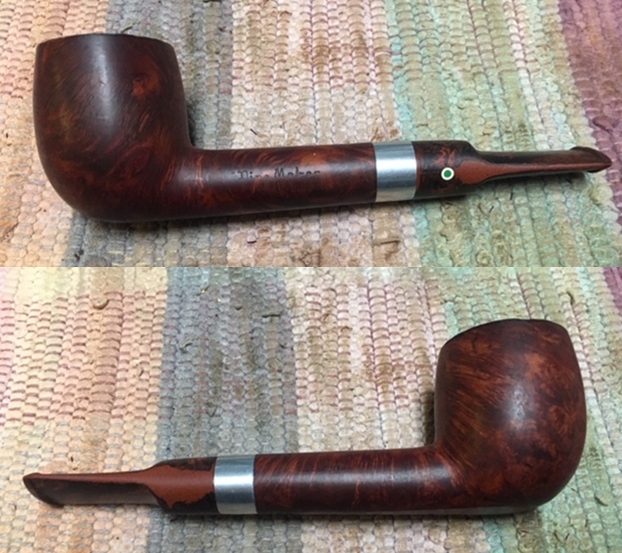
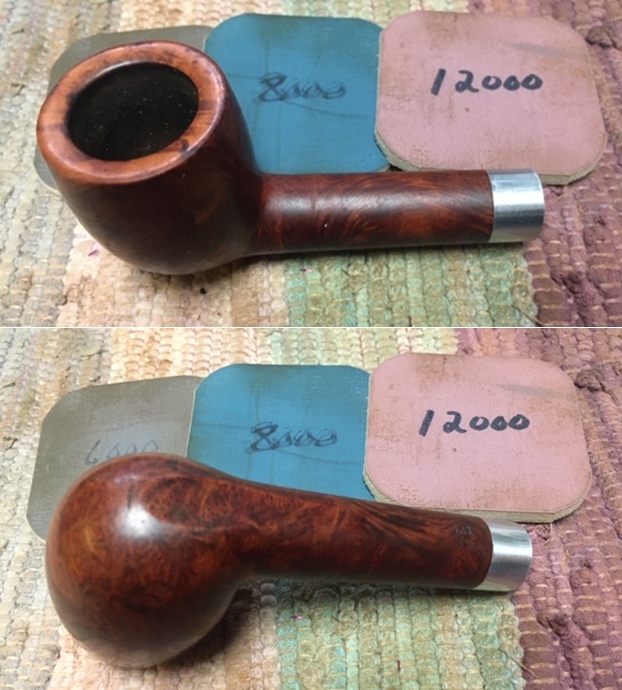
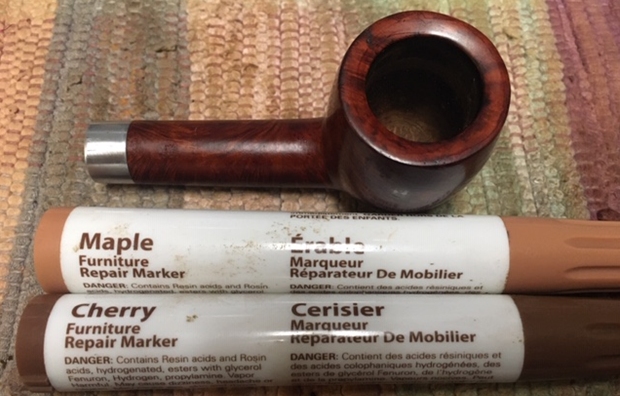
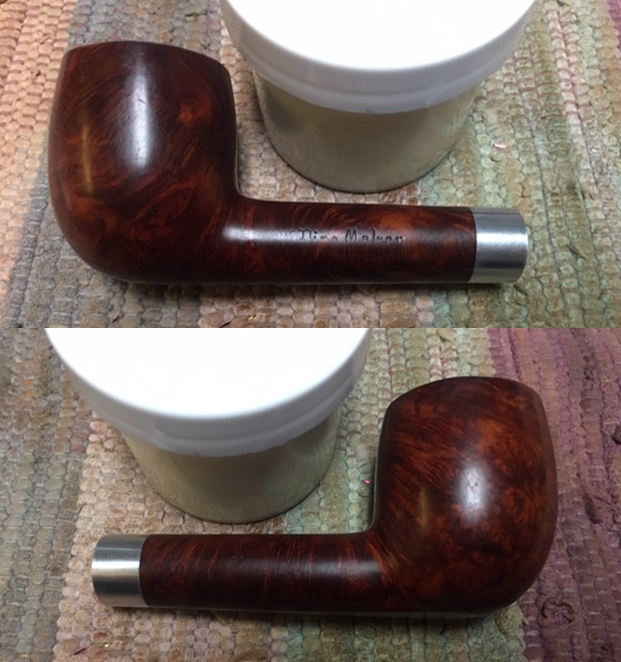
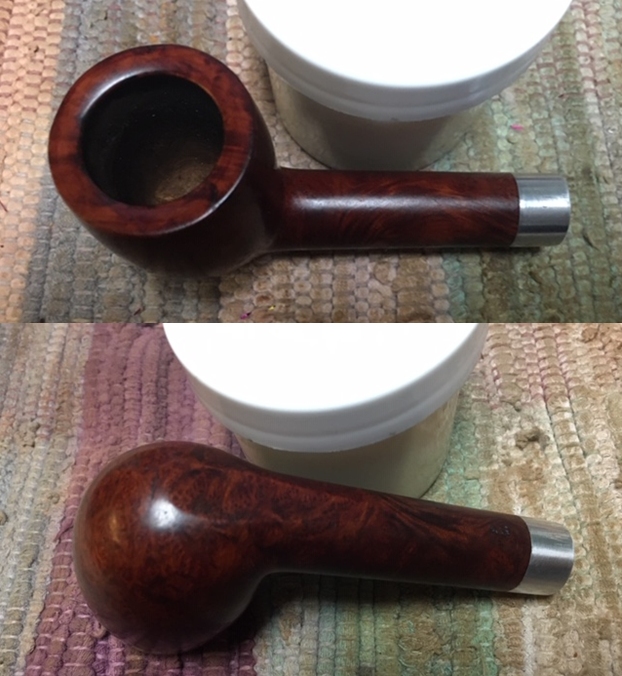
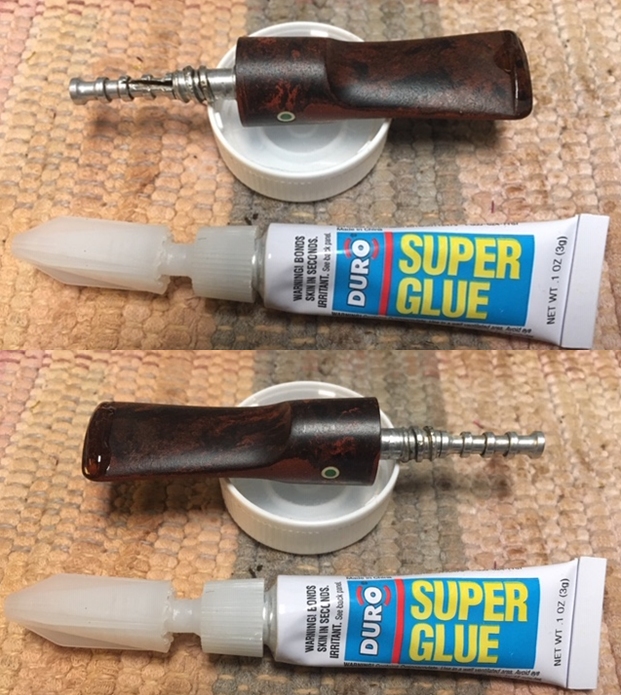
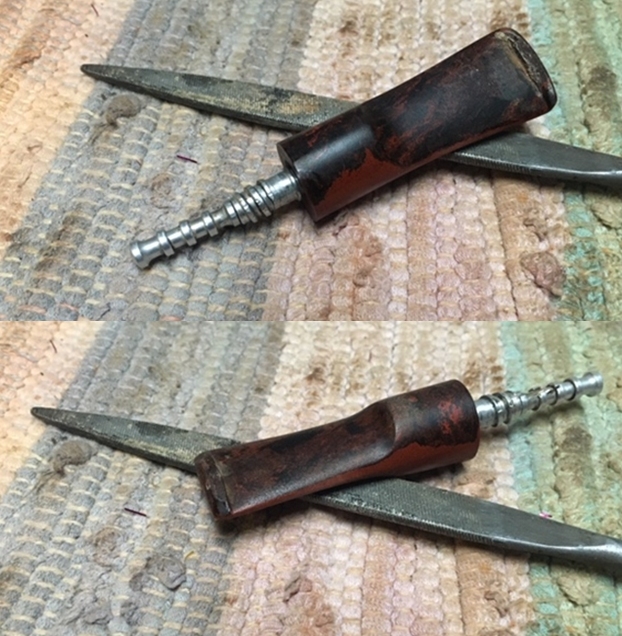
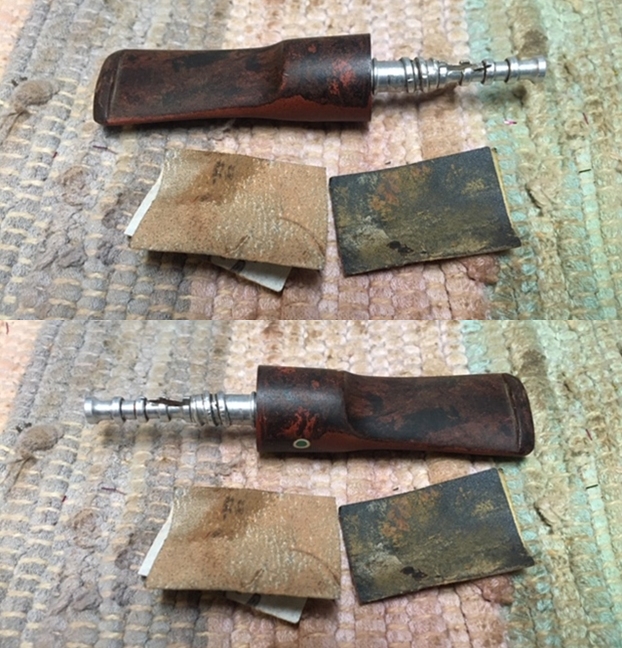
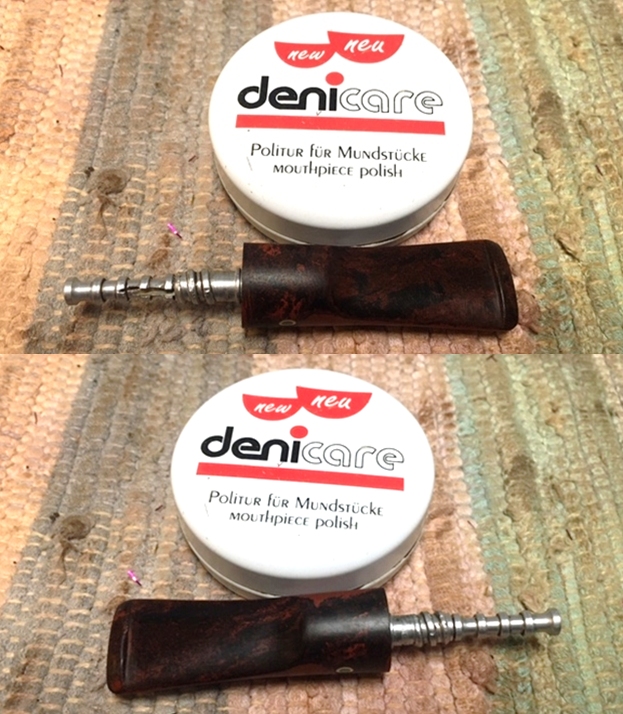
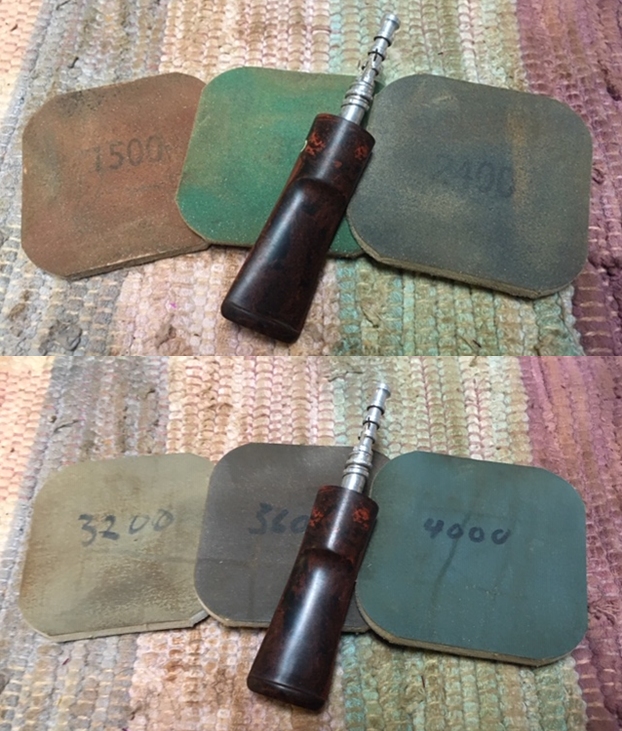
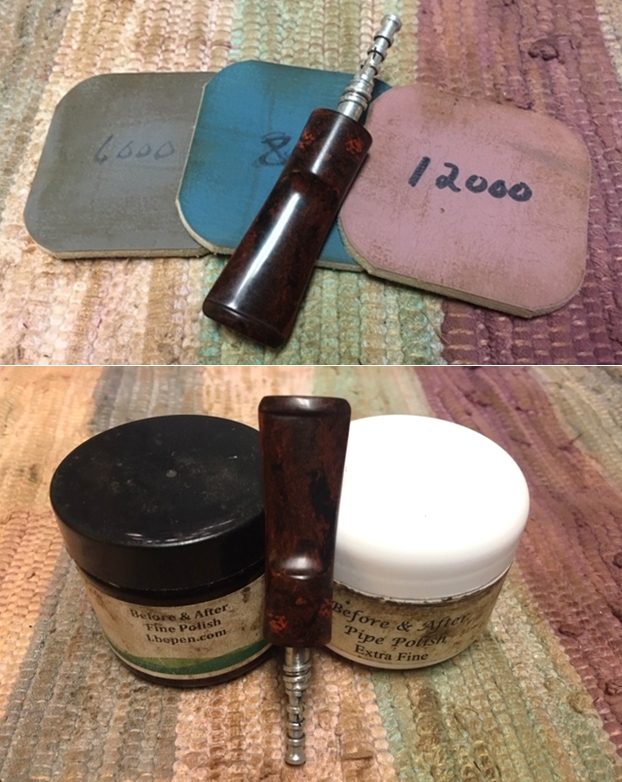
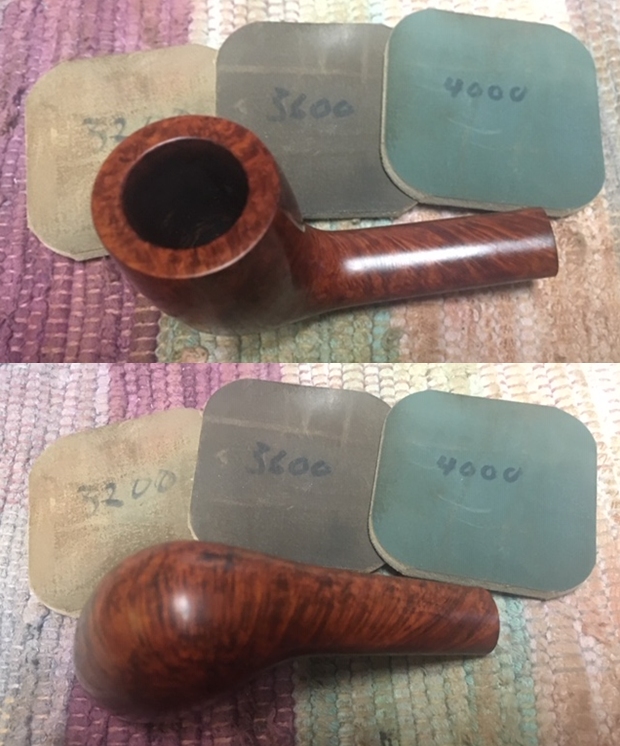
Now it was time to work on the pipe itself. Jeff had cleaned the pipe with his usual penchant for thoroughness that I really appreciate. It looked far better than what it was like when we found it. He reamed the bowl with a PipNet Pipe reamer and took the cake back to bare briar. He cleaned up the bowl walls with a Savinelli Fitsall Pipe Knife. He scrubbed out the internals with alcohol, pipe cleaners and cotton swabs until the pipe was clean. He scrubbed the exterior of the bowl with Murphy’s Oil Soap and a tooth brush to remove the grime and grit on the briar and the lava on the beveled rim top. The finish looks very good with good looking grain around the bowl and shank. Jeff scrubbed the stem with Soft Scrub and then soaked it in Before & After Deoxidizer to remove the oxidation on the Cumberland style rubber. When the pipe arrived here in Vancouver for the second stop of its restoration tour it looked very good. I took photos before I started my part of the work. I took some photos of the rim top and stem. Once Jeff removed the lava on the top and inside of the rim top was a wreck. Both the inner and the outer edge of the bowl showed damage. There were deep nicks and gouges to the surface of the rim and a lot of darkening. The close up photos of the stem shows that is it very clean and there is some tooth chatter and marks on the button surface and just ahead of the button.I removed the stem from the bowl and worked on the rim surface. The rim was beveled so topping it on a topping board was out of the question. I used a folded piece of 220 grit sandpaper to smooth out the inner and outer edges of the bowl. I also used it to smooth out the rim top to remove the damage.I was happy with the way the rim top and edges looked so I did not need to do anymore except to polish them. I polished the briar with micromesh sanding pads – dry sanding with 1500-12000 grit pads. I wiped the bowl down after each pad with a damp cloth. The grain really began to stand out and the finish took on a shine by the last sanding pad. The photos tell the story! I touched up the rim top to match the rest of the bowl with a blend of Maple and Cherry stain pens. The blend works really well with this colour of bowl. I am happy with the work so it is time to move on.I worked some Before & After Restoration Balm into the surface of the briar with my fingertips. The product works to clean, enliven and protect the briar. I let the balm sit for about ten minutes and then buffed with a cotton cloth to raise the shine. The photos show the bowl at this point in the restoration process. I set the bowl aside at this point and turned my attention to the stem. I filled in the tooth marks on the button edge and along the edge on both sides with clear super glue. When the repairs had cured I used a needle file to recut and sharpen the edges of the button and the button surface. I paused in my work on the stem to realign the stem in the shank. I heated the tenon with a lighter to soften the glue that holds it in place. I screwed the stem back in the mortise and aligned it while the glue was soft. Once it had set I removed the stem and continued to work on it.I blended the repairs into the surface of the stem and reshaped the button with 220 grit sandpaper and started the polishing with 400 grit wet dry sandpaper.I continued the polishing using Denicare Mouthpiece polish. It is a red gritty paste that feels a lot like Tripoli to me. It works very well  to polish out remnants of oxidation and smooth out fine scratches in the rubber stem.I polished the stem with micromesh sanding pads – dry sanding with 1500-12000 grit sanding pads. I wiped it down after each sanding pad with a cloth containing some Obsidian Oil. I finished polishing it with Before & After Pipe Stem Polish – both Fine and Extra Fine and buffed it off with a cotton cloth. This small Pipe Maker American Made Lovat is a bit of a mystery. I know that Frankau made them in England and Pipe Maker made them in the US but that is the extent of the information available on the brand. The shaping and carving follows the grain and highlights the mix of grains around the bowl. The finish on the pipe is in excellent condition and the contrasting stains work well to highlight the stunning grain on the pipe. The Cumberland saddle stem adds its reds to the mix. With the grime and debris gone from the finish and the bowl it was a beauty and the grain just pops at this point. I put the stem back on the bowl and buffed the pipe with Blue Diamond on the buffing wheel. I carefully avoided the stamping on the shank and stem during the process. I gave the bowl and the stem multiple coats of carnauba wax on the buffing wheel and followed that by buffing it with a clean buffing pad on the buffer. I hand buffed the pipe with a microfiber cloth to deepen the shine. The finished Lovat is quite nice and feels great in the hand. Give the finished pipe a look in the photos below. I can only tell you that it is much prettier in person than the photos capture. The dimensions of the pipe are Length: 5 ¼ inches, Height: 1 ¾ inches, Outside diameter of the bowl: 1 ¼ inches, Chamber diameter: ¾ of an inch. Thanks for walking through the restoration with me as I worked over another interesting pipe. This pipe will be added to the American Pipe Makers section of the rebornpipes store soon. If you want to add it to your collection send me an email or a message! Thanks for your time.