Monthly Archives: October 2016

A Worn Royal Danish 936 Wide Oval Shank Pipe given new life


Blog by Steve Laug

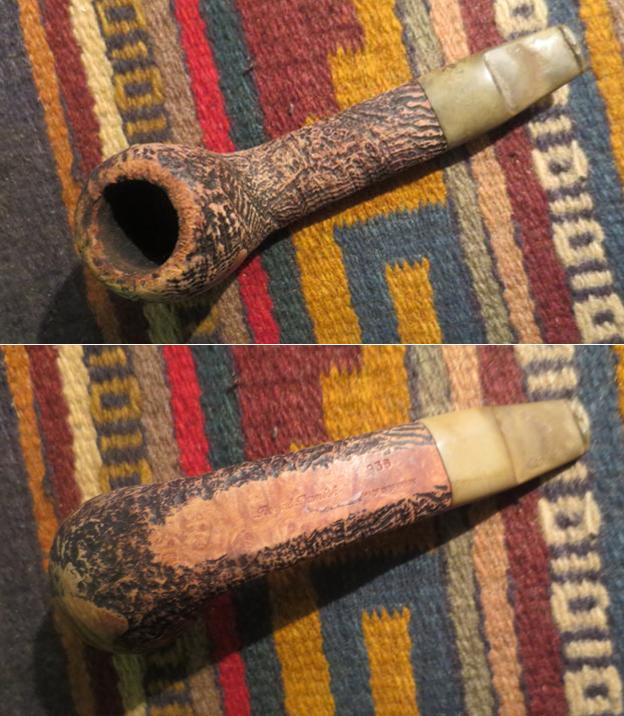
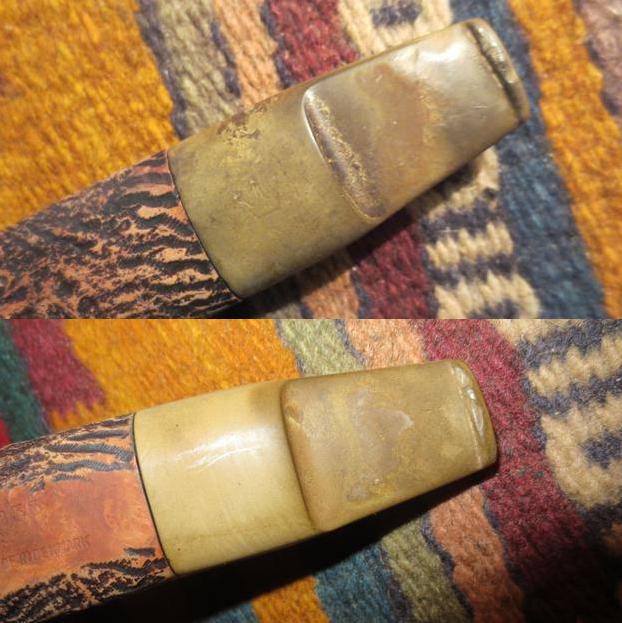
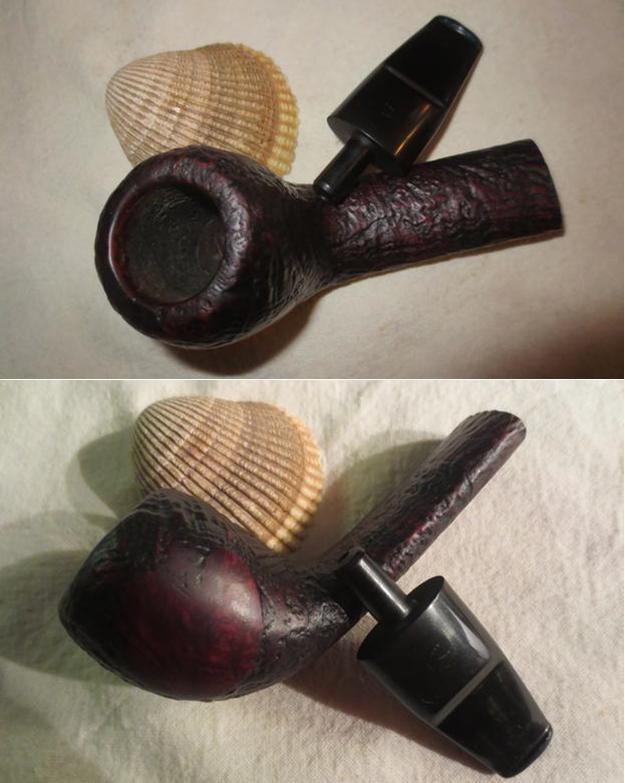
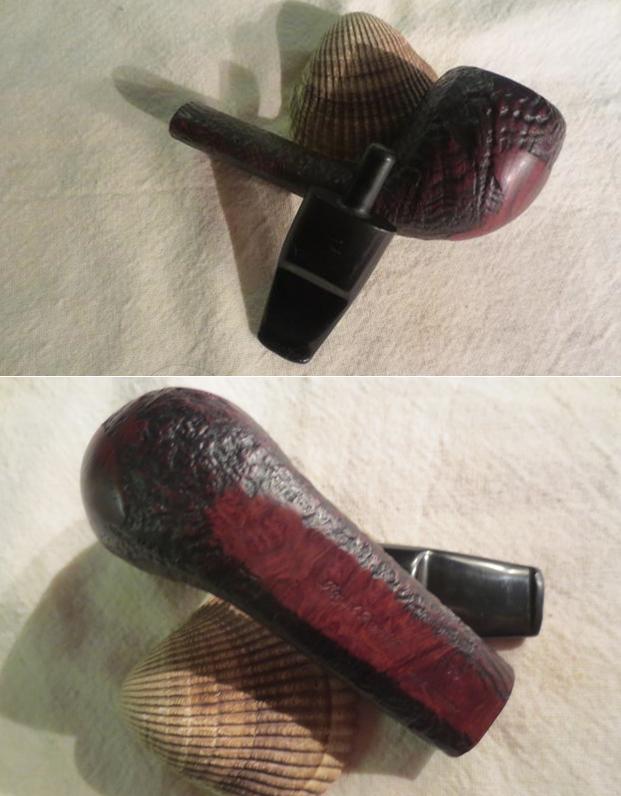
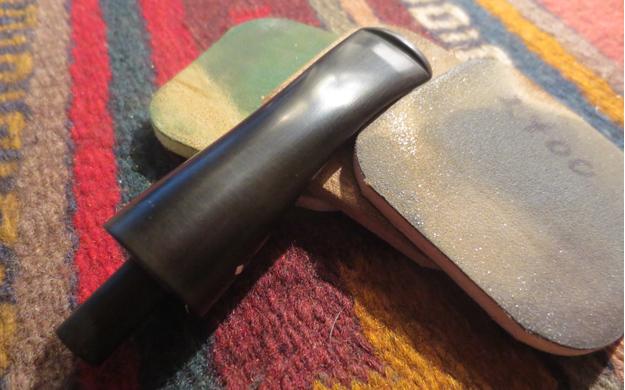
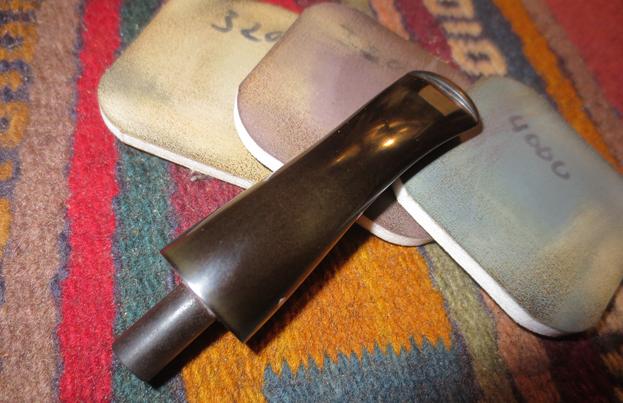
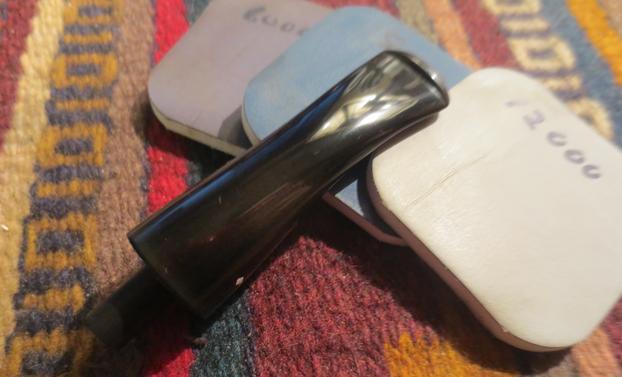
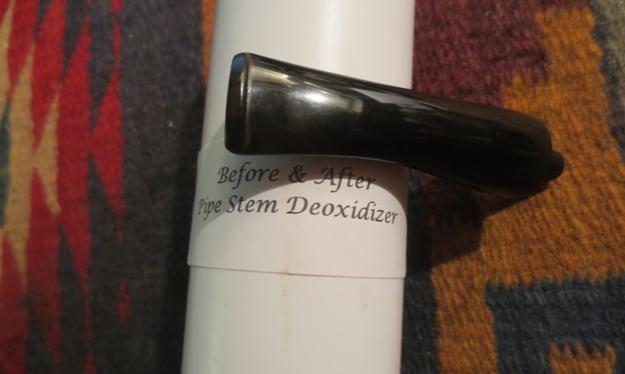
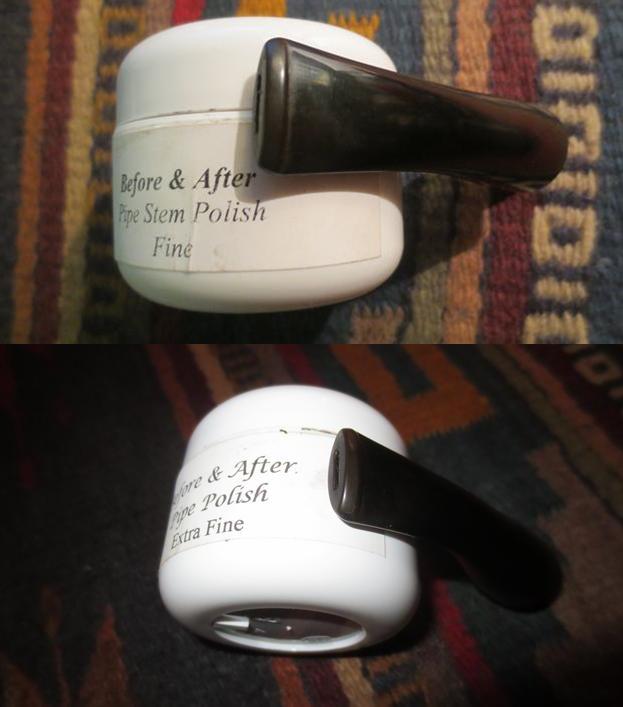
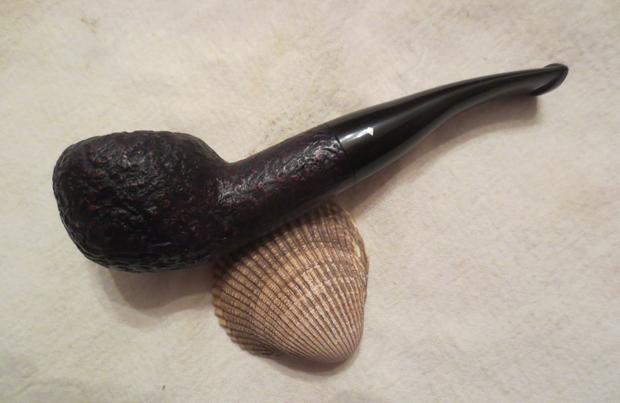
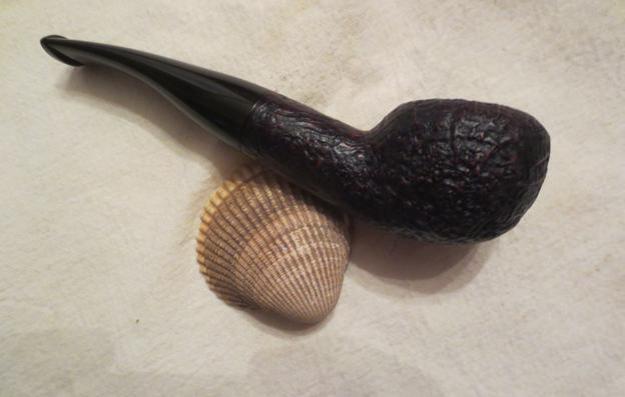
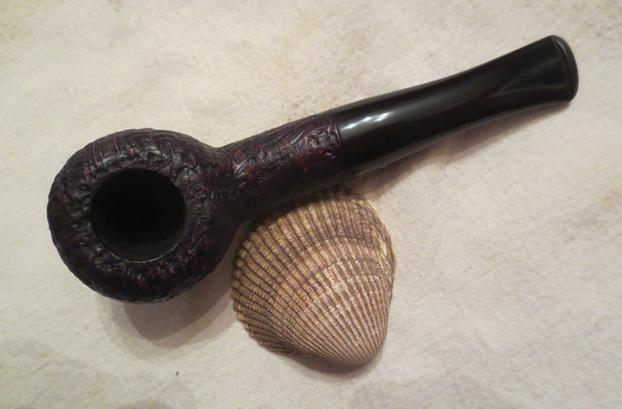
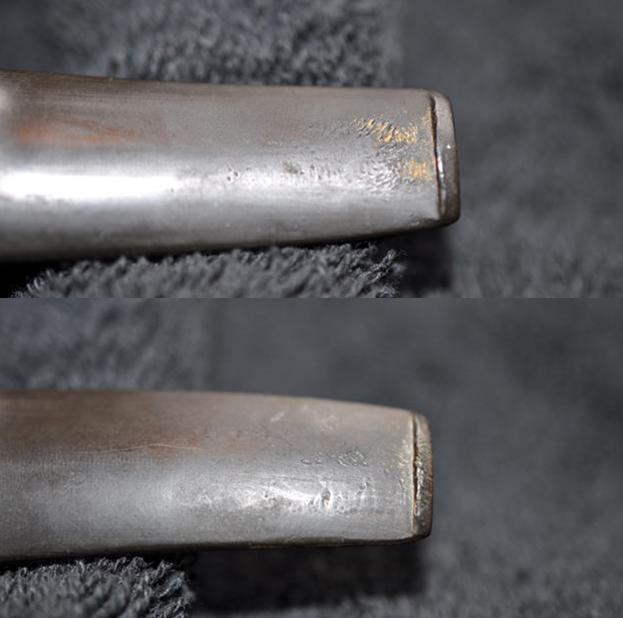
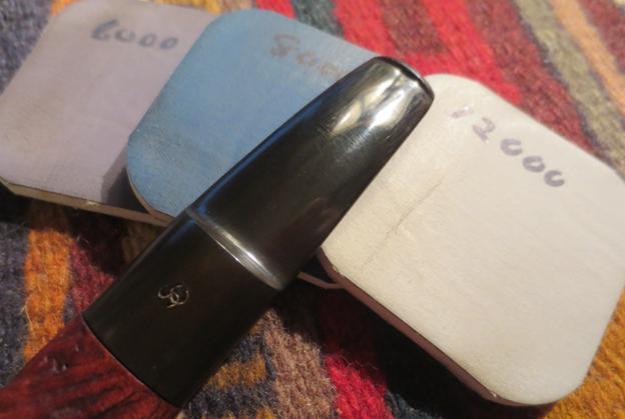
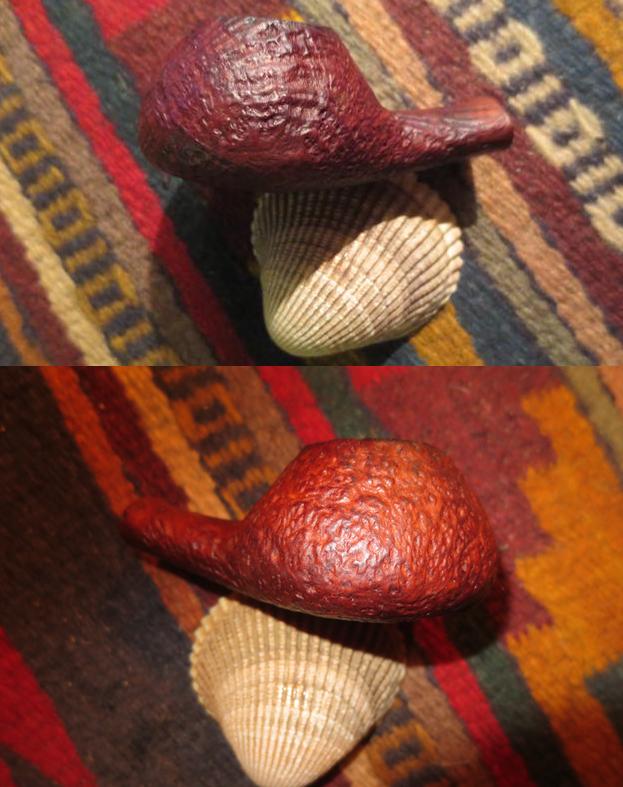
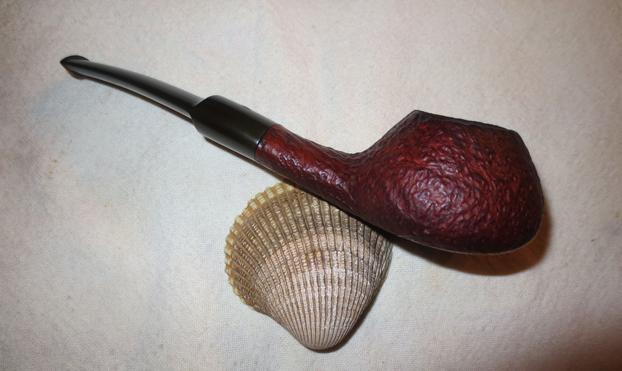
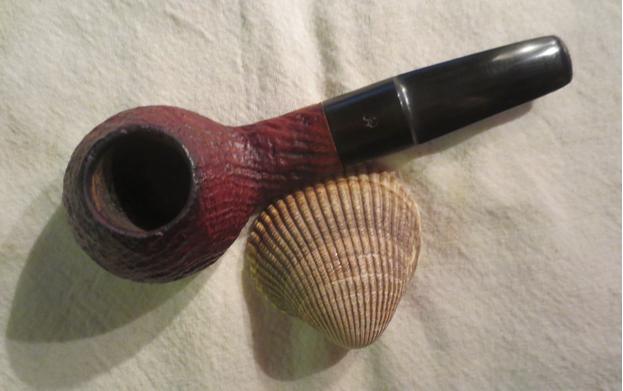
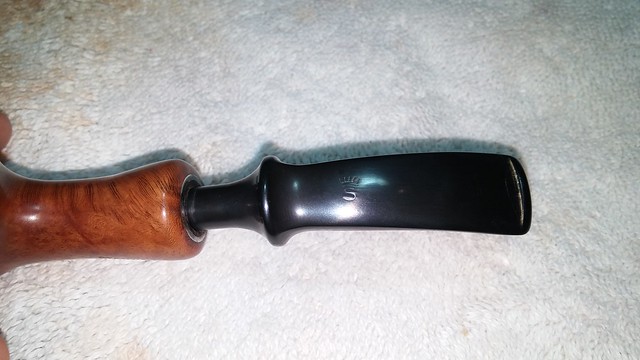
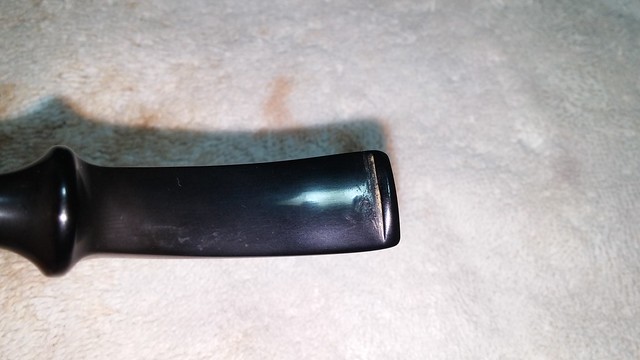
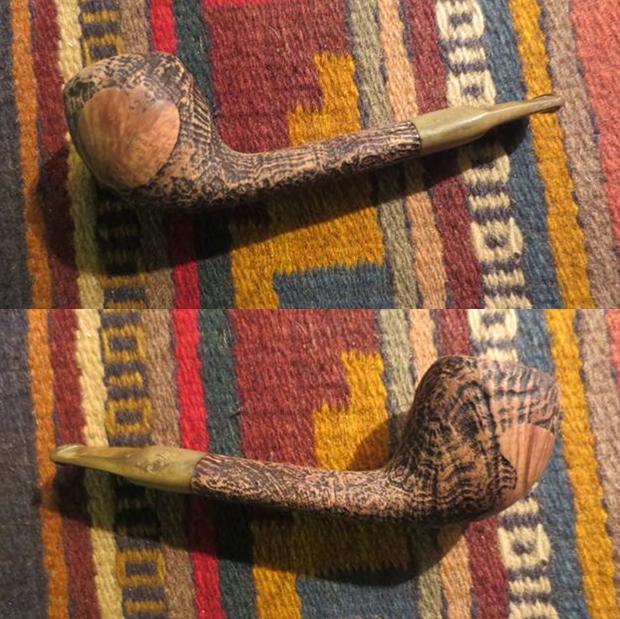
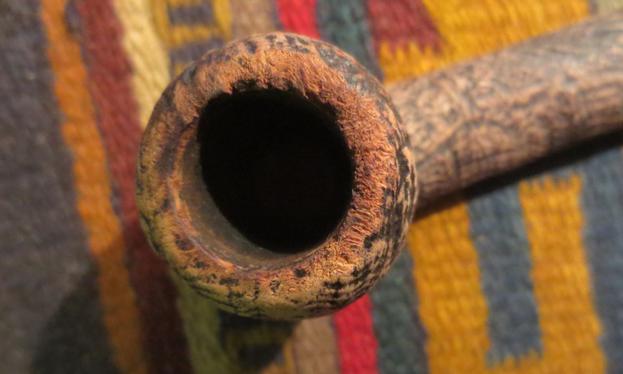
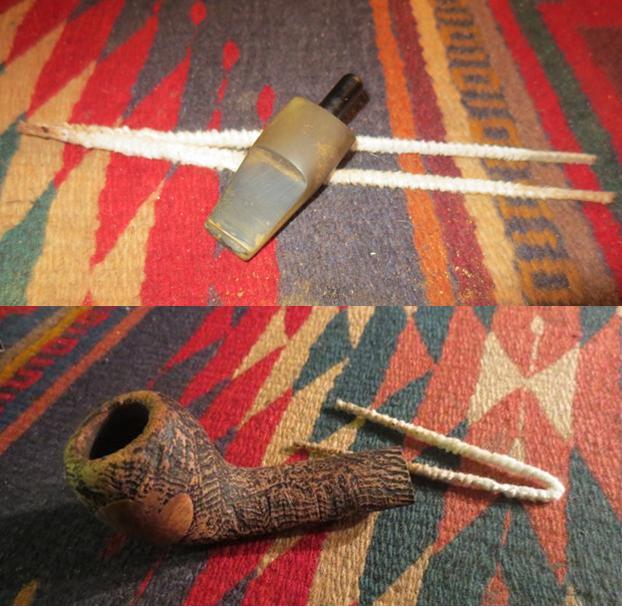
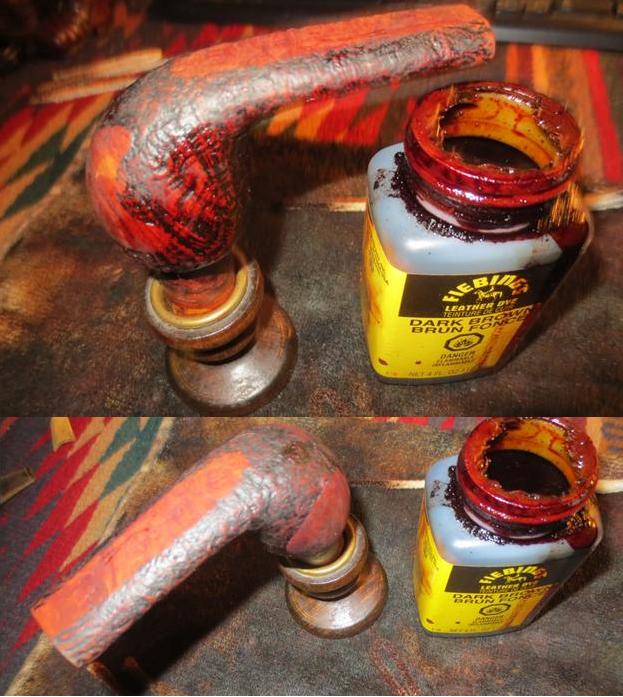
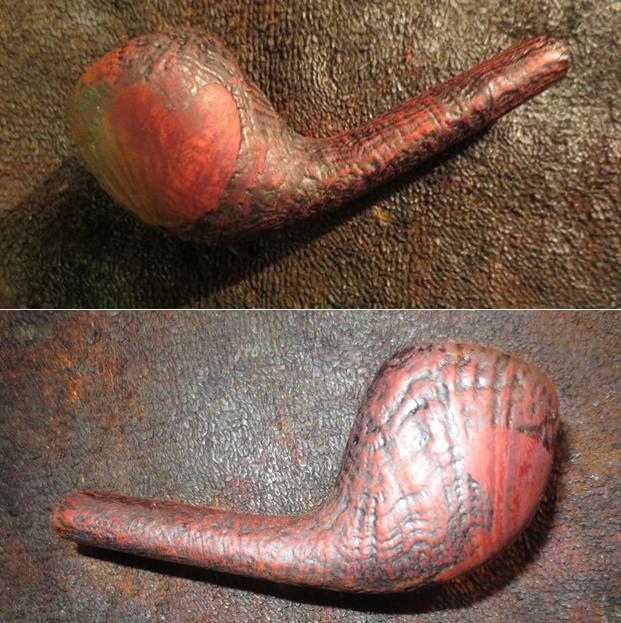
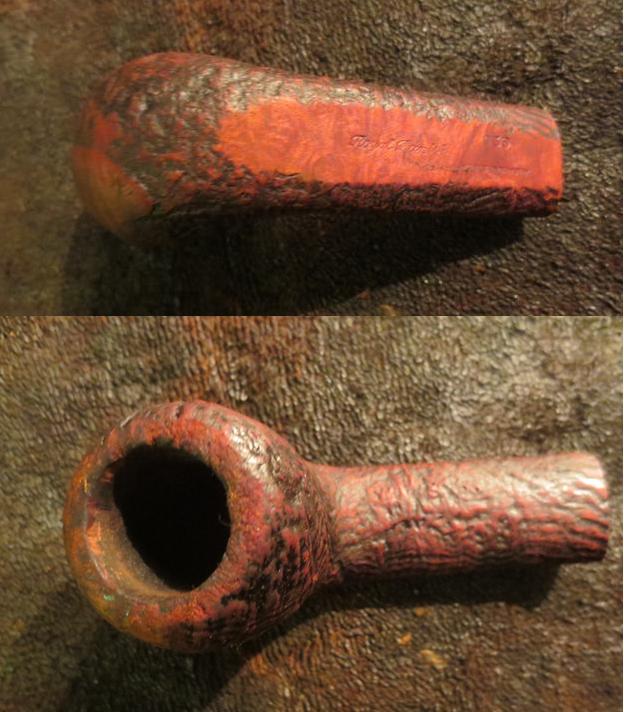
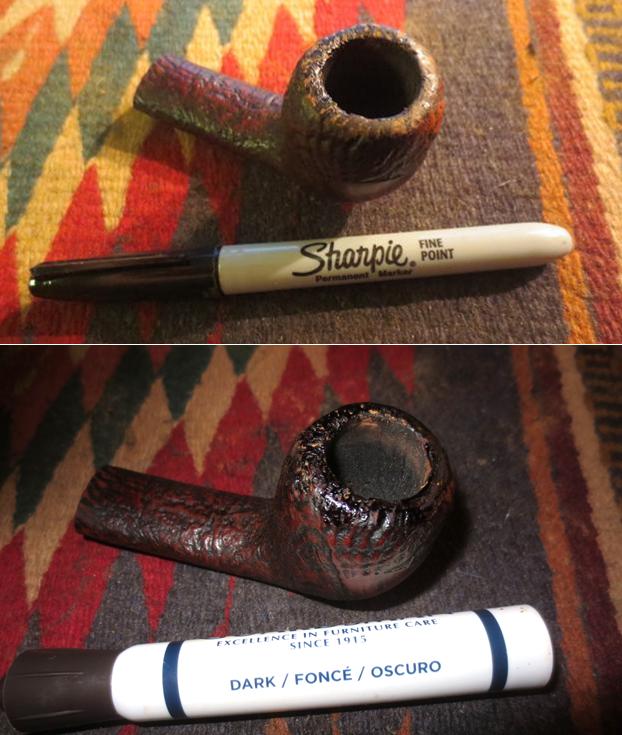
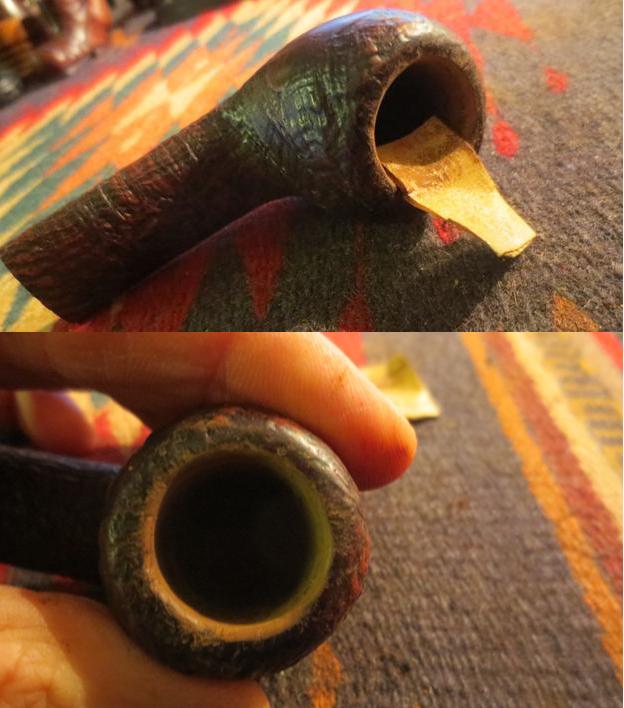
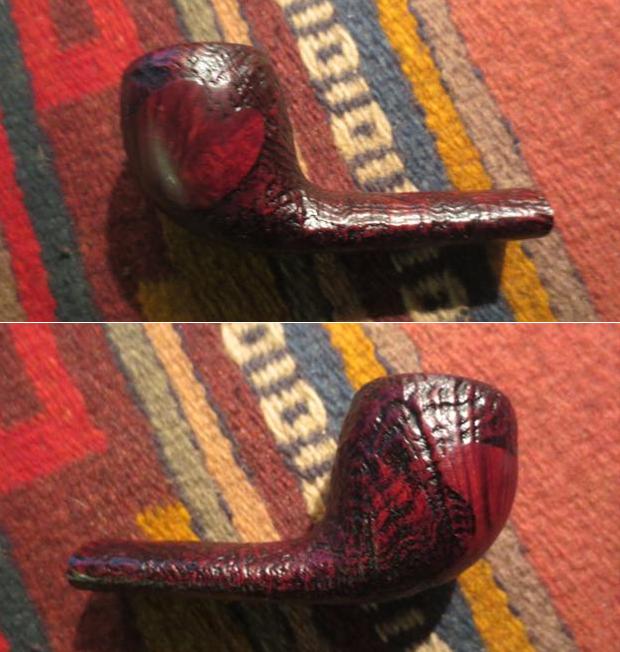
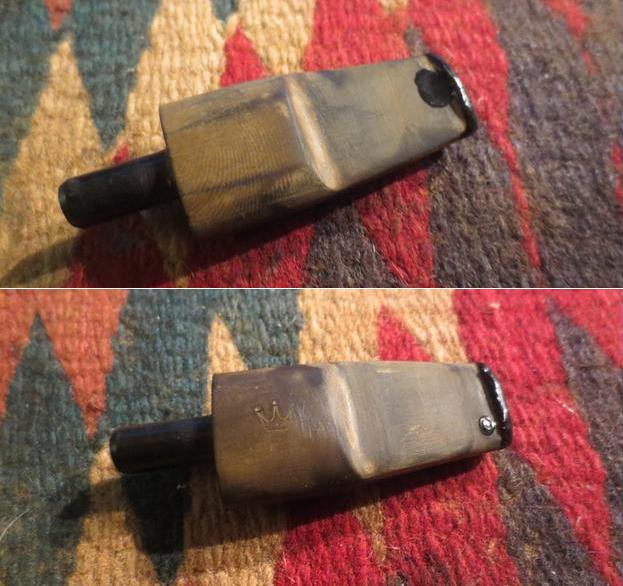
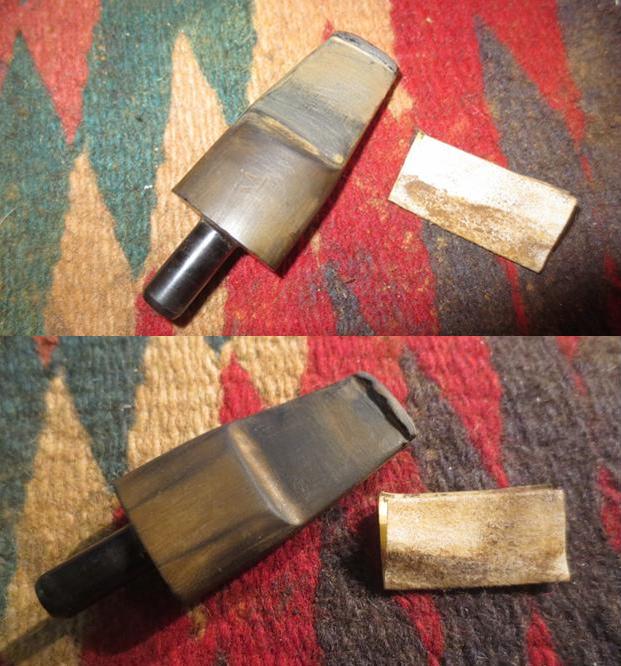
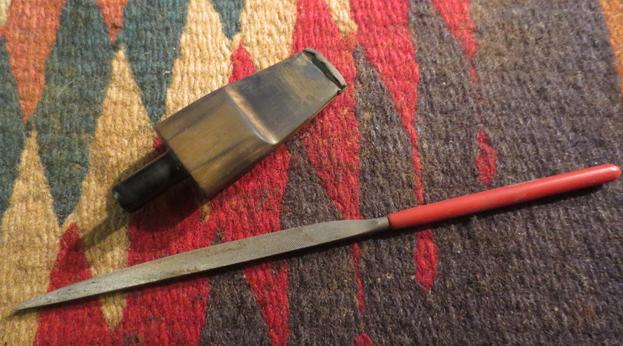
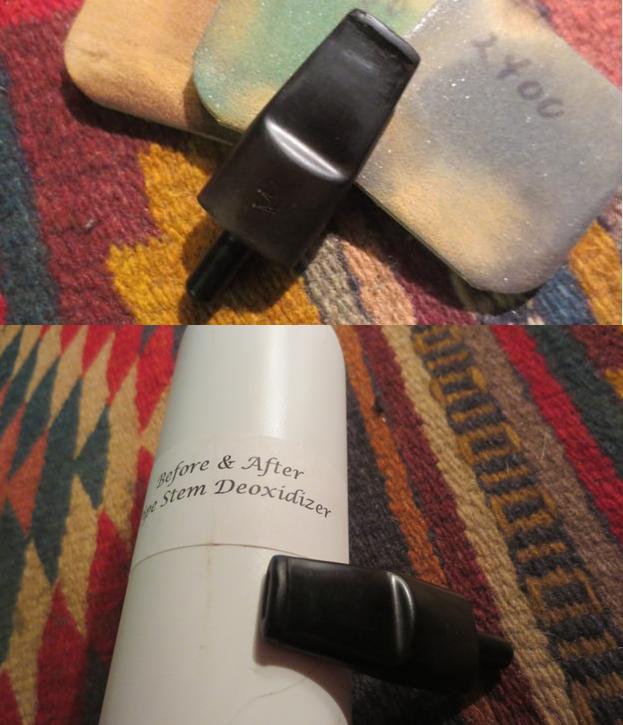
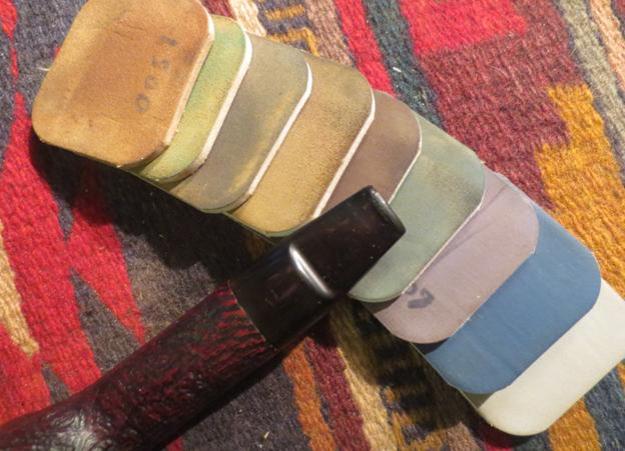
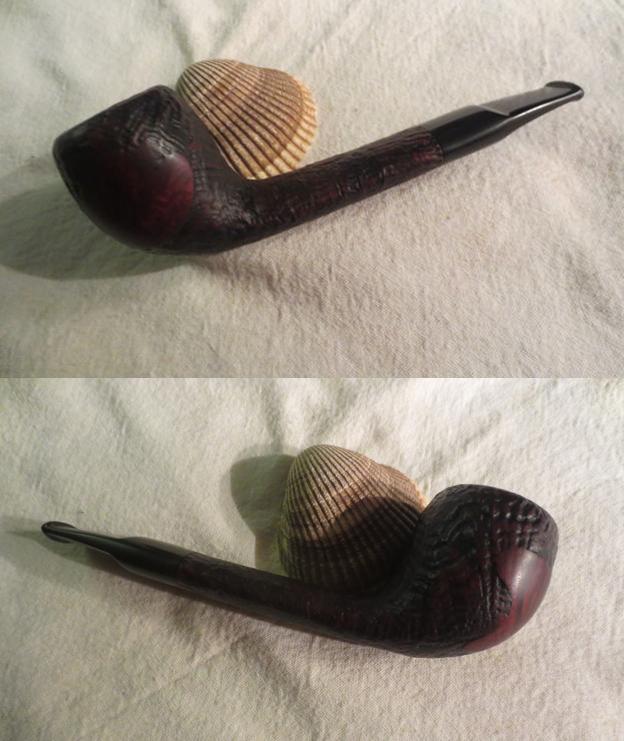
When I saw the pictures of the way this pipe looked – at least the first picture I thought it was in pretty decent shape. The finish was a little worn; particularly some of the high spots on the sand blast had worn off. The smooth patches were also worn and lifeless. The back edge of the rim looked really rough – as if the pipe had been knocked about on concrete or another hard surface to remove the dottle from the bowl. It was ragged. The inner edge of the rim also looked worn and the cake in the bowl was a bit odd looking – as if it was partially removed. It seemed heavier on one side than the other. The stem looked okay in the first picture but the second hinted that all was not well with it either.danish1The close up photos reveal the issues that I hinted at above. The first shows the strangely caked bowl – heavily built up toward the left side and rear of the bowl as well as the rough back rim top and edge of the bowl. The inner edge of the rim also looks like it has taken some damage. The second photo shows the slight cap at the stem junction that to my mind spoke of a tarry and caked mortise that kept the stem from seating properly. The finish also shows some wear in the photos. The pipe is stamped Royal Danish and Made in Denmark. The shape number is 936 which is a Stanwell shape.danish2The next two photos show the issues with the stem. There were tooth marks on the top and underside of the stem that went from quite deep to very shallow. The button top and bottom were worn down and had deep tooth marks. There was also a heavy build up of oxidation on the stem. The stem logo on the top is very faint. It made me wonder if I would be able to feel it with my finger once it arrived in Canada.danish3I am so glad my brother does the heavy work on cleaning out these pipes. I have reamed and cleaned out the shanks of a lot of pipes and I can’t say that I miss it. I still get to do my share of cleanups on pipes that I find but these that he sends me come ready for the restoration process. He scrubbed the exterior of the bowl with Murphy’s Oil Soap and was able to remove the wax and tars on bowl and rim. He reamed the bowl back to bare briar and scrubbed out the mortise and the airway in the shank and stem. When it arrived the stain was quite washed out and the stem was really oxidized. The damaged rim top was very visible and it was in rough shape.danish4 danish5I took some close up photos of the rim and the stem when it arrived here. The roughness of the rim top and inner edge are seen in the first photo. The tooth marks and wear on the stem top and underside in the second and third photos. My brother had cleaned out the mortise so the stem fit tightly against the shank so my guess mentioned above about a dirty mortise appears to have been correct. The crown logo on the top of the stem could hardly be felt by touch.danish6 danish7I started sanding the stem then decided to run a few pipe cleaners and alcohol through the airway in the stem and shank as well as in the mortise. They were quite clean and did not take too much work to remove the little bit of debris that was still left.danish8I sanded the rim lightly to take away the roughness but still leave the finish looking like the sand blasted portion of the rim that had not been damaged. I stained the bowl with a dark brown stain mixed 50/50 with isopropyl alcohol. I applied the stain and flamed it and repeated the process until the coverage was what I was looking for. I wanted the dark stain in the deep grain of blast to show through the brown top stain.danish9I hand buffed the bowl with a microfibre cloth to raise a shine and to give an even look to the finish. The photos below show the pipe at this point in the process.danish10In the second photo below the rim surface is visible. There will need to be some contrast applied to the finish to make it blend in and not look merely “less damaged”.danish11To address the contrast issue on the rim mentioned above I used a black Sharpie Pen to provide some darkening in the crevices of the pitted surface. I used a dark brown stain pen to give the top coat over the black stain.danish12I sanded the inner edge of the rim with a folded piece of 220 grit sandpaper to smooth out the roughened inner edge. In retrospect I probably should have done this before staining the bowl but I did not so I put it in the order I did the work. In the second photo below you can see how the contrast stain worked on the rim top.danish13When I finished sanding I stained the inner edge of the rim with the dark brown stain pen and added some streaks of black Sharpie pen to give it some contrast. I buffed the rim lightly Blue Diamond on the buffing wheel and with a microfibre cloth. The photos below show the pipe bowl after buffing. Notice the change to the rim after the sanding, staining and buffing.danish14 danish15I set the bowl aside and worked on the issues with the stem. I sanded the area around the button on both sides of the stem with 220 grit sandpaper and scrubbed the deeper tooth marks with cotton swabs and alcohol. Once they were clean I filled the deeper marks and built up the button surface with black super glue.danish16I sanded the repairs once they had cured with 220 grit sandpaper to smooth them into the surface of the stem. I reshaped the top of the button on both sides of the stem with the sandpaper.danish17The edge of the button on the underside of the stem was still rough so I used a needle file to shape and sharpen the straight edge.danish18I wet sanded the stem with 1500-2400 micromesh sanding pads. I rubbed the stem down with Before & After Pipe Stem Deoxidizer and a paper towel to further remove the oxidation on the stem. I polished the stem with Before & After Pipe Polish both Fine and Extra Fine with paper towels. The stem was beginning to shine.danish19 danish20I sanded the stem once again with the micromesh sanding pads using 1500-12000 grit pads. Each successive grit of sanding pad added more shine and depth to the shine. The more I polished the stem the more the crown logo disappeared.danish21I buffed the pipe with Blue Diamond on the buffing wheel and then gave the stem multiple coats of carnauba wax. I rubbed the bowl down with Conservator’s Wax by hand. I buffed the pipe with a clean buffing pad to raise the shine. I hand buffed the pipe with a microfibre cloth to deepen the shine. The finished pipe is shown in the photos below. The pipe is clean and looks new. The restoration brought it back to life. Thanks for looking.danish22 danish23 danish24 danish25
Comoy’s Grand Slam 30D Restoration


By Al Jones

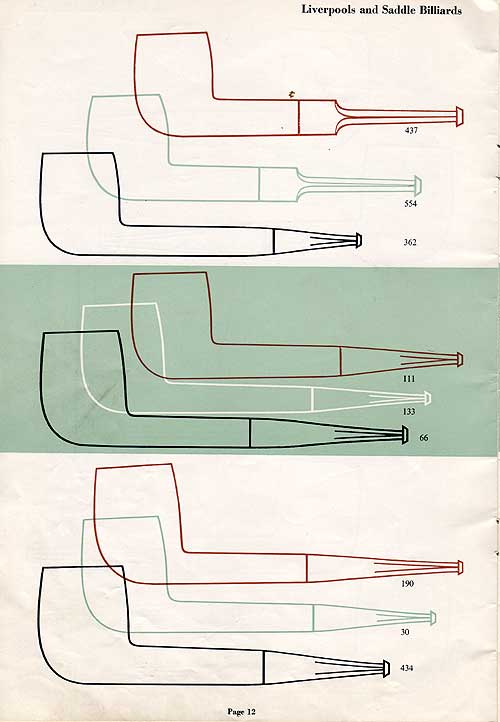
Update: Thanks to Sam’s comments below, we did confirm that the shape number is indeed a 30D. And, I found this shape chart page showing the shape 30. Thanks Sam!

comoys-shape-30

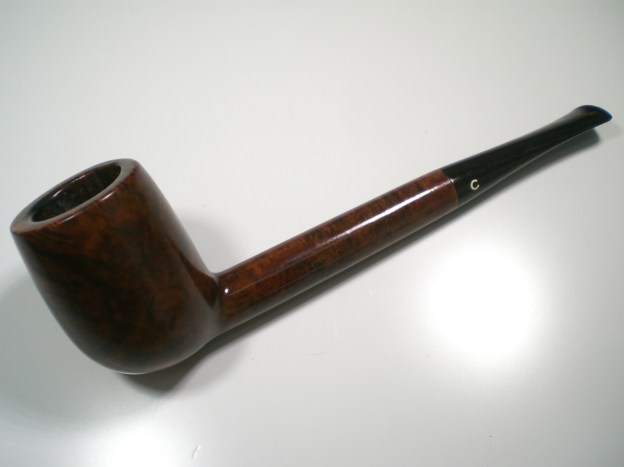
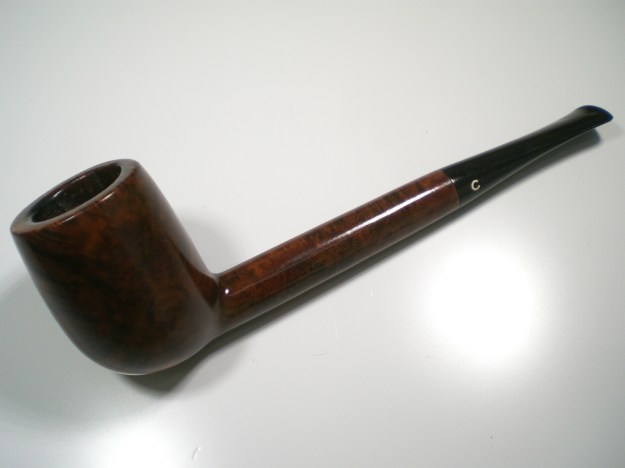
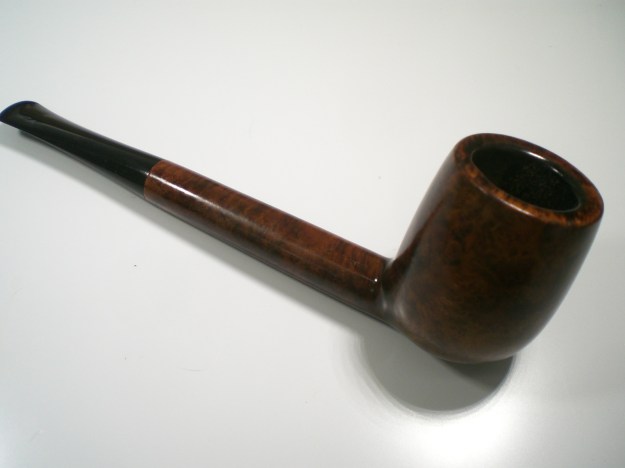
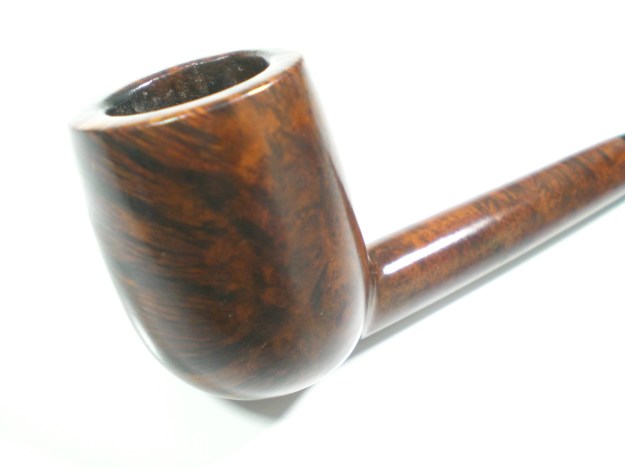
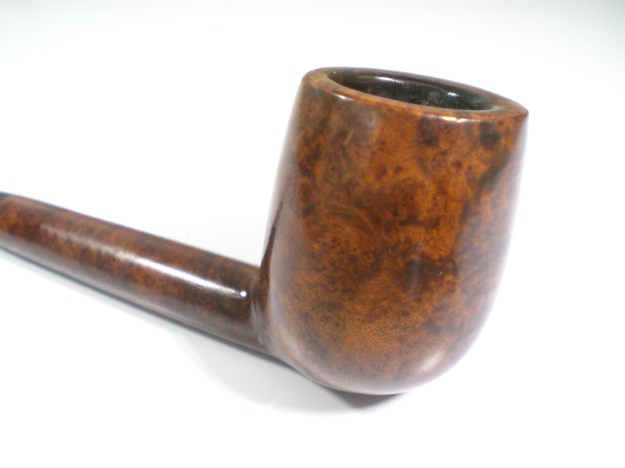
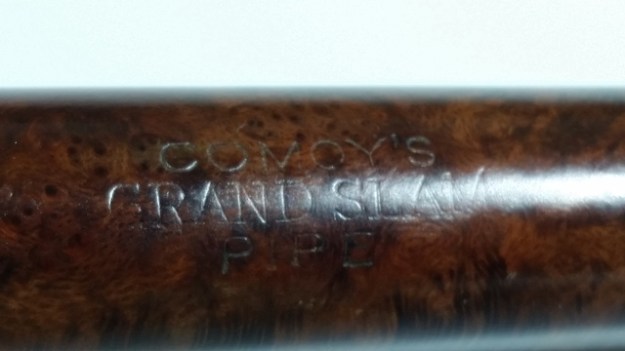
This is the second pipe sent to me by a PipesMagazine.com forum friend. Grand Slam pipes are fairly common and originally came with a complicated stinger with leather washers. Most of the stingers were discarded and was missing on this one as well.

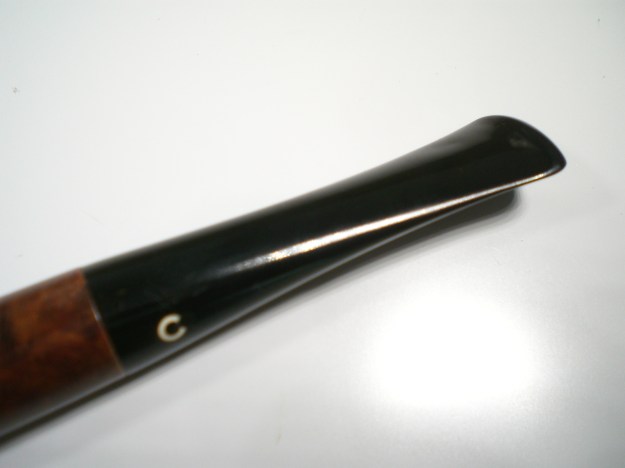
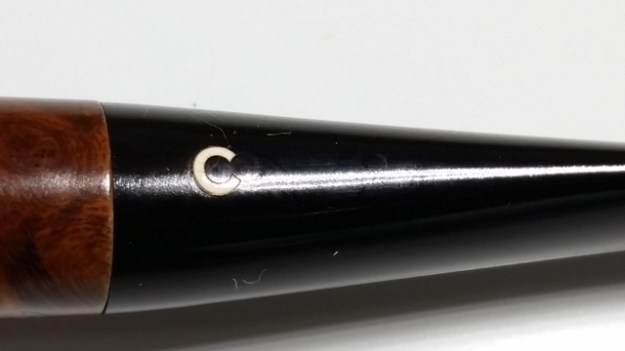
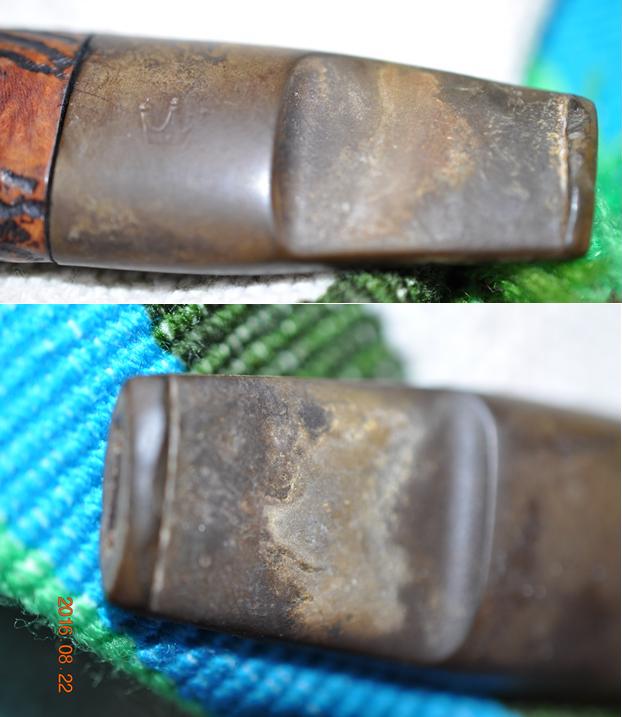
The pipe had a mildly oxidized stem, with some teeth indentions and a heavy tar build-up on the bowl top. I cleaned the bowl top with a cloth and some mild Oxy-Clean solution. As I removed the cake with my Castleford reamer, I unfortunately discovered that at some point, a previous owner had reamed it with a knife or other. The bowl was slightly out of round. I massaged that back as close as possible to round with some 320 grit paper. The bowl was then soaked with sea salt and alcohol. The stem was soaked in a mild Oxy-Clean solution, with a dab of grease on the 3 piece “C” logo.

The pipe as it was received. The stem was also very loose, to be dealt with later.

comoys_50b_grand_slam_before-1

comoys_50b_grand_slam_before-4

comoys_50b_grand_slam_before-3

comoys_50b_grand_slam_before-2

The briar was buffed with White Diamond and then several coats of Carnuba wax. I used a lighter flame to raise several of the dents on the stem. I used a tapered pin punch inserted into the tenon and then warmed with a flame to slightly enlarge the outer dimension. You can only slightly increase the tenon diameter in this way, but it was enough in this case. Typically smoking the pipe will tighten it even further. The stem was then mounted and the oxidation removed with 800, 1000 and 1500 grit paper. I then used 8000 grade micromesh before buffing with White Diamond and Meguiars Plastic Polish.

Below is the finished pipe. If anyone knows details about the 50D shape number, please add a comment.

comoys_50b_grand_slam_finish-1

comoys_50b_grand_slam_finish-3

comoys_50b_grand_slam_finish-2

comoys_50b_grand_slam_finish-5

comoys_50b_grand_slam_finish-4

comoys_50b_grand_slam_finish-7

comoys_50b_grand_slam_finish-6

?

?

?

?

?

?

Atwood 331C Restoration – Made by Comoy’s


By Al Jones

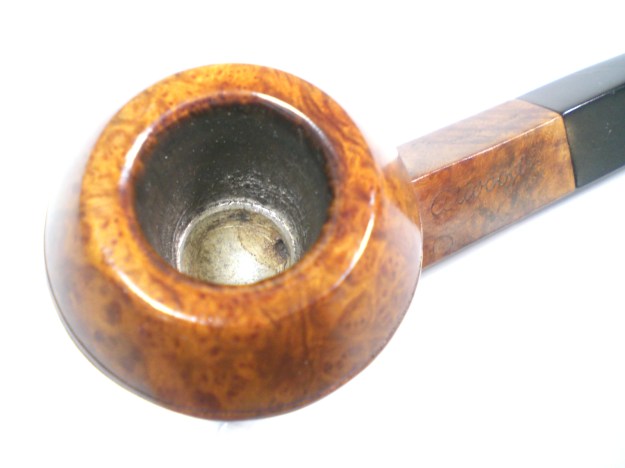
This pipe was sent to me for clean up by a recent convert to the joys of Comoy’s brand pipes. I had not heard of this maker before, and the owner shared some information about Atwood pipes, gleaned from Pipephil.eu

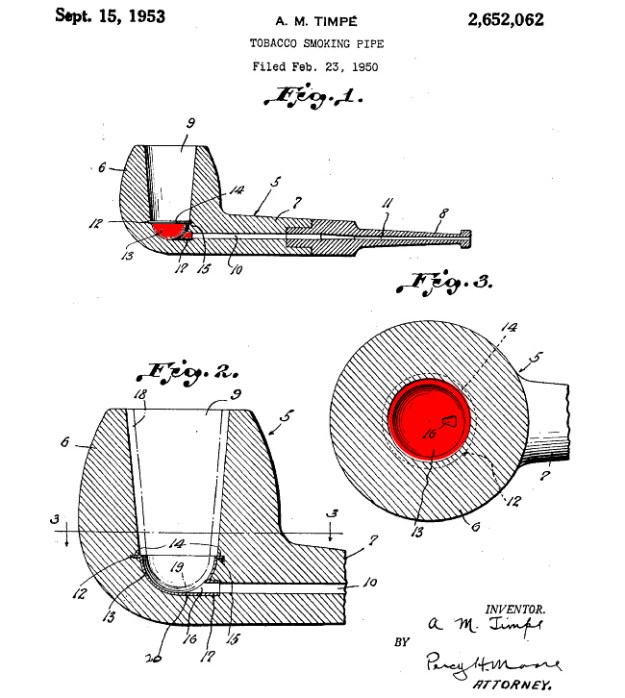
The Atwood pipes were equipped with a permanent aluminum cup at the base of the chamber, with a bore hole. Atwood M. Tempe (Los Angeles) invented the system about 1950. The patent (U.S. PAT. 2652062) was granted in 1953 and the author partnered with Comoy’s to produce the pipes. See drawings and description in document.

While researching this brand, I found that forum contributor, Robert M. Boughton, had restored an Atwood “Hall of Fame” pipe earlier this year. The pipe had a different Country of Manufacture mark, which is interesting (circle). This COM is a in a block format. The briar on tis piece also appears to be of a higher quality. I did not find any other refernces to Atwood pipes.

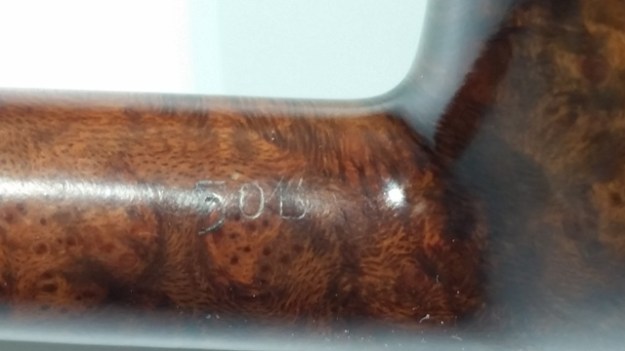
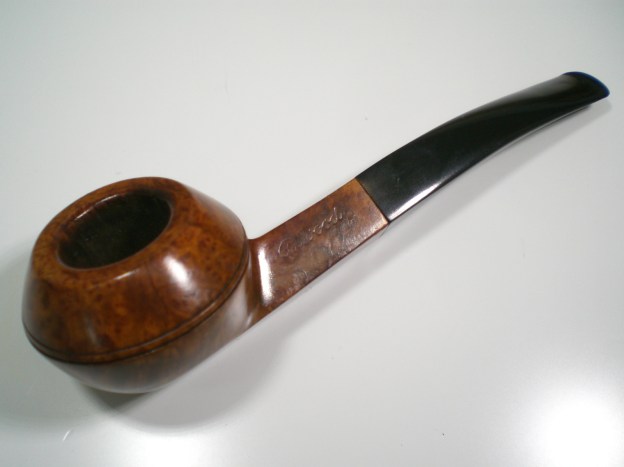
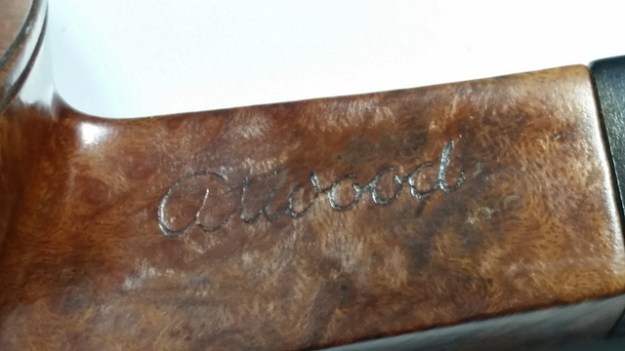
Below is a picture included with Atwood Timpe’ Patent which shows the design of the metal bowl cup. The nomenclature was a bit faded, but it appears to be a shape 331C, which is indeed a Comoy’s squat, quarter-bent bulldog.

atwood_patent_pix

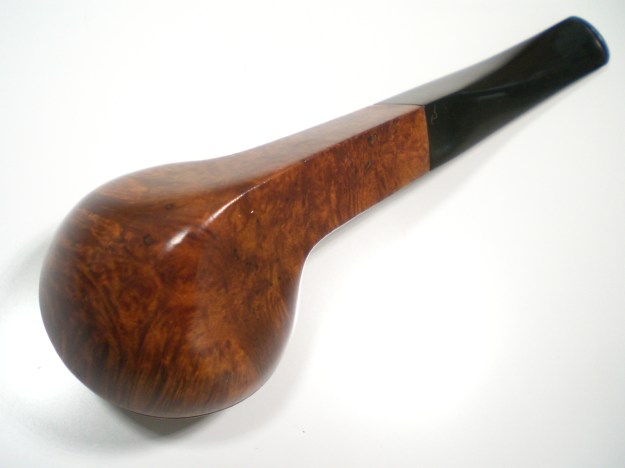
The pipe had some build-up on the bowl top and the stem was heavily oxidized.

attwood_331c_before-1

attwood_331c_before-2

attwood_331c_before-3

attwood_331c_before-4

I used a cloth with some Oxy-Clean solution to remove most of the heavy buildup on the bowl top. Then, 2000 grit wet paper removed the remainder of the build-up and some mild scorching. I reamed the interior of the bowl down to the metal cup. The bowl was quite solid, as was the cup feature. I have no idea what the cup does for the smoking experience, but it is in there for good. I filled the bowl with Sea salt, put a cork stopper in the shank and filled it to the brim with 91% alcohol. While the bowl was soaking, the stem was soaked in a mildy Oxy-Clean solution.

Following the soak, I cleaned the stem shank with some wire brushes and fresh alcohol. I screwed a paper towel soaked in alcohol into the bowl, which did a nice job cleaning the metal cup.

I mounted stem on the bowl to clean the briar. It had a few minor dents, which I was able to lift with a flame from a lighter. The heavy oxidation was removed with 800 grit wet paper, than working my way through 1000 and 2000 grades. Finally, 8000 grade micromesh was used. The stem was the buffed with White Diamond and Meguiars Plastic Polish.

The bowl was somewhat grimy and I used a mild soap solution to clean it. The bowl was then buffed with White Diamond and then several coasts of Carnuba wax.

Below is the finished pipe. The light stain is quite handsome. Typically, I’m not a big fan of Comoy’s 2nd’s lines, as I find the pre-molded stems lacking. However this stem has a better feel to it compared to an Everyman, The Guidall, etc. I’m curious as to how the owner finds it smokes compared to his Comoy’s of a similar era.

attwood_331c_finish-1

attwood_331c_finish-5

attwood_331c_finish-2

attwood_331c_finish-3

attwood_331c_finish-6

attwood_331c_finish-7

attwood_331c_finish-4

?

?

?

?

?

?

I was gifted an ugly pipe by a good friend.


Blog by Steve Laug

Over the years I have been the recipient of quite a few gift pipes. Some of them have been pipes that I had previously given away and that came home to me like one I had given to Mike Leverette many years ago. Others were gifts from friends who saw a pipe that they thought I would like and picked it up for me. Those pipes were just right and always came with a ready story attached. Besides pipes like those mentioned above I have also received pipes from my daughters as presents over the years. Those come with a special kind of love attached that exceeds the value of the pipe. Those too have been just right. These kinds of gifts are ones that speak their story to me every time I pick them up for a bowl. Each one reminds me of the giver and the circumstances of the gift.

Yesterday all of that gift goodness radically changed for me. There is no doubt that this gift will also always have a story attached but it will always be one that causes me to laugh when I pick it up. Ahhh, I am getting ahead of myself with my story. Let’s begin at the beginning as my daughters used to say when I read them stories as little ones. This story begins with a friend, Dallas coming by my office so that we go to lunch. We try to get together and have lunch and often share a bowl together at least monthly when I am in the town.  We always have a great time and some great conversation.

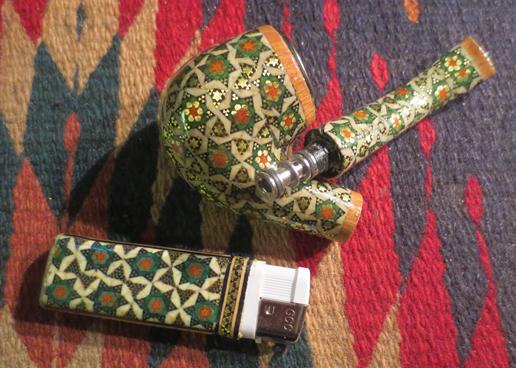
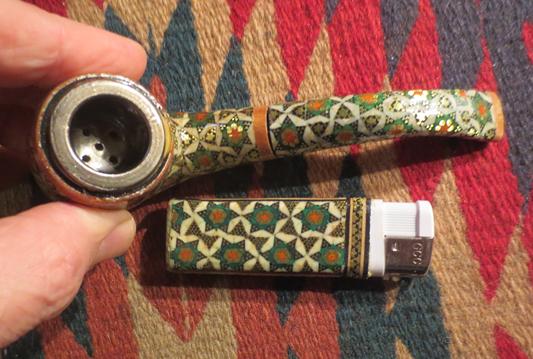
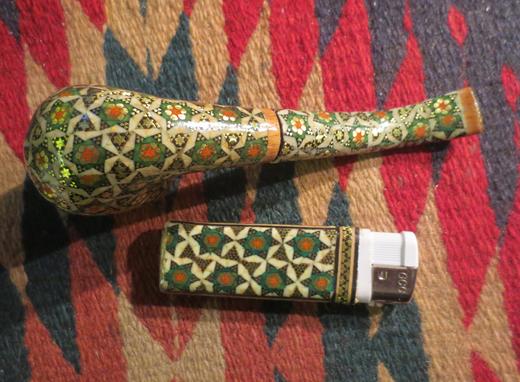
Off and on he has brought pipes for me to repair or I have brought pipes I thought he might be interested in that I have repaired. Well, yesterday he out did me. He came to my office and said he had a gift for me if I wanted it. The “if I wanted it” should have been a clue. He reached into the pocket of his coat and took out his offering. He handed me a Glad Sandwich Bag. He opened the bag and took a pipe and lighter combination out and handed it to me. The pipe and lighter we covered with a patterned paper or vinyl that was downright ugly. He laughed and said that someone had gifted him with it and he was passing it on to me. We had a good laugh as I took it from him and turned it over in my hands. It was something that only he could have gotten away with without so much as a smirk or a laugh as he came through the door. It is certainly a gift that I won’t forget and it will have that story attached to it.
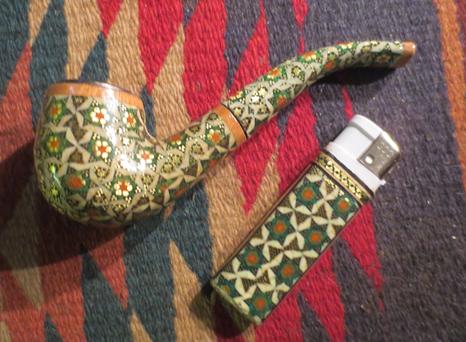
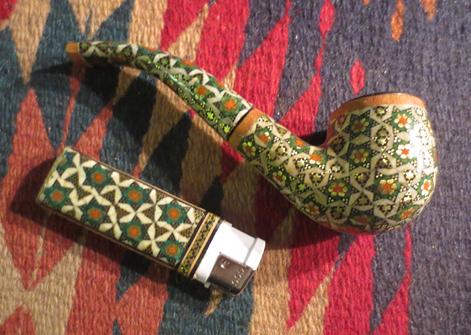
We went and enjoyed a great lunch and conversation and I took the pipe home from the office with me that evening. My daughters cracked up laughing when they saw it and one of them even said they kind of liked it. I took some photos to share with all of you. I don’t think that this is a pipe that I will ever smoke but it is certainly unique.bling1 bling2The pipe is made wood and appears to be pear wood or some other hardwood. It is very light weight and is light coloured. The bowl has a metal insert in it that has five holes in the bottom of the bowl. It extends probably half way down the inside of the wood pipe. It is the kind of bowl I have seen in cheaper Chinese knockoff pipes. I am pretty certain it was crafted for smoking something other than tobacco.bling3The photos show that the pipe is covered with what looks like wallpaper or even gift wrap. It is even uglier in person than it is in the photos. The paper covers the bowl leaving a small ring of wood around the end of the shank. It is also wrapped around the stem leaving the end of the stem uncovered. The wallpaper/gift wrap comes up to what would have normally been a button on the stem. The entire surface of the pipe is covered with a heavy coat of urethane or some kind of shiny plastic coat. The end of the stem was painted with black shiny paint and a coat of urethane to protect it. The lighter sports a matching covering and is just as shiny. It is a cheap plastic butane lighter. I would be afraid to fill it and strike it for fear of it melting in my hand.bling4I decided to explore the pipe a bit so I took the stem off to have a look. There was a metal stinger apparatus/filter tenon inserted in the stem. The whole apparatus functioned as the tenon. Inside the shank the mortise was polished. The fit of the stem to the shank was off slightly because of the paint and urethane that covered the shank and stem end.bling5Over all it is one weird-looking pipe. Thanks Dallas for this one. It has changed the way I look at gift pipes. I am already thinking about who I will pass it on to. Maybe it will be a gag gift one day. I can say this with some certainty it is a pipe that is destined to be passed on again.
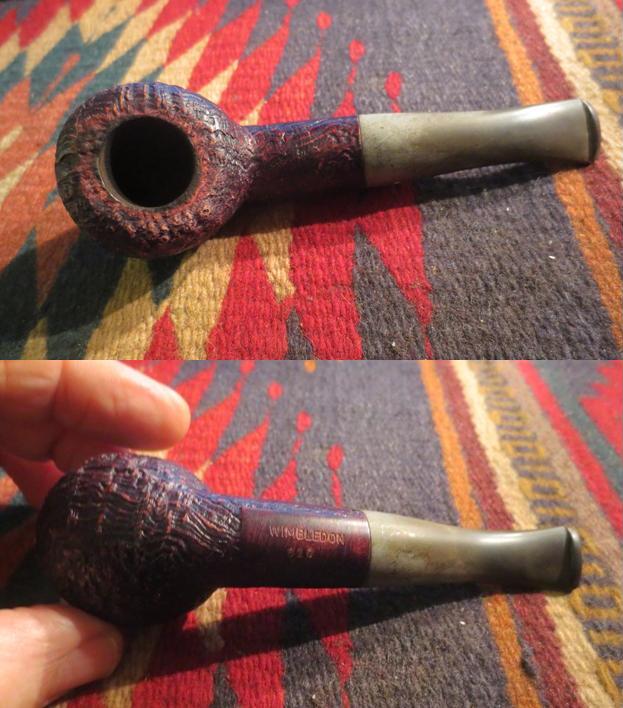
A Great Looking Wimbledon 810 Author showing promise


Blog by Steve Laug

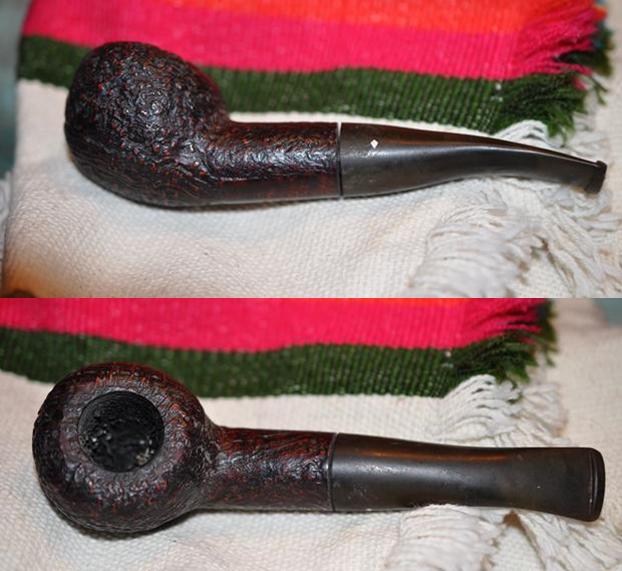
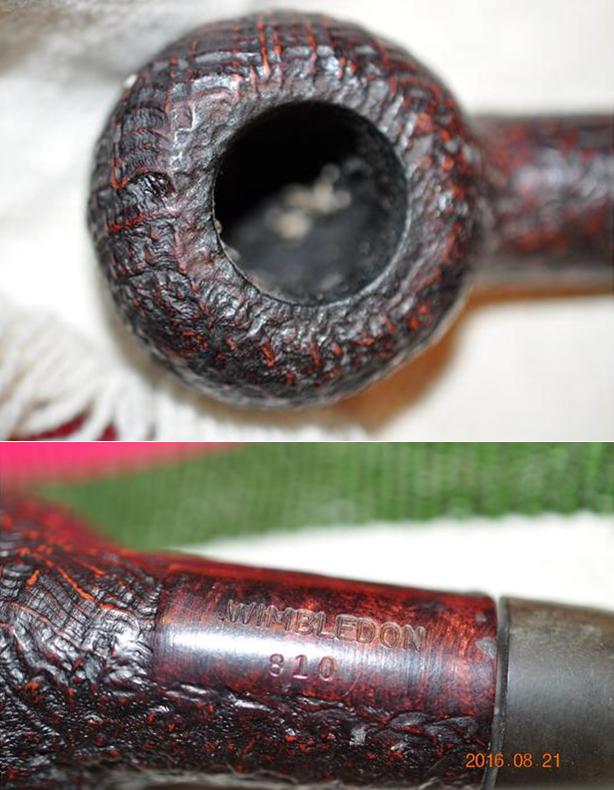
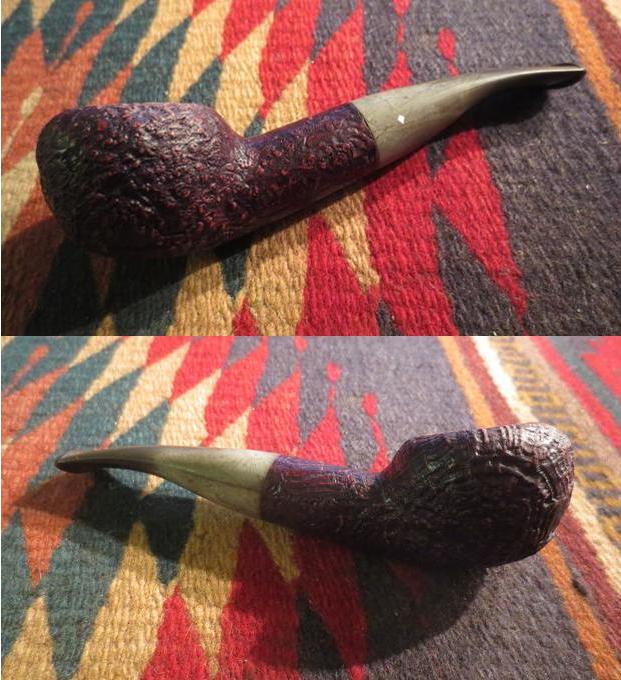
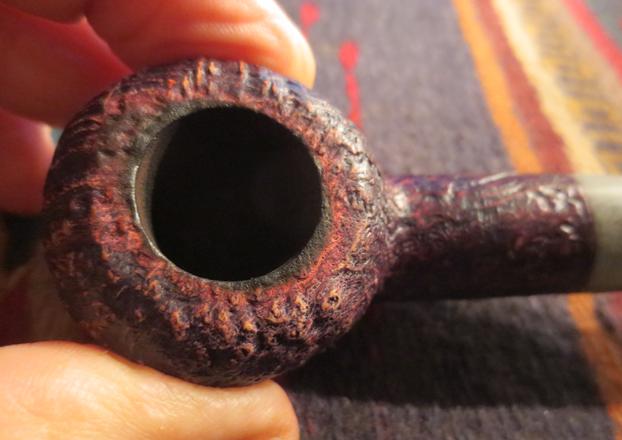
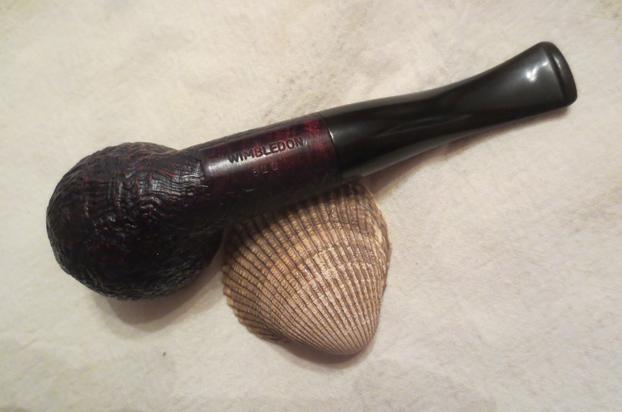
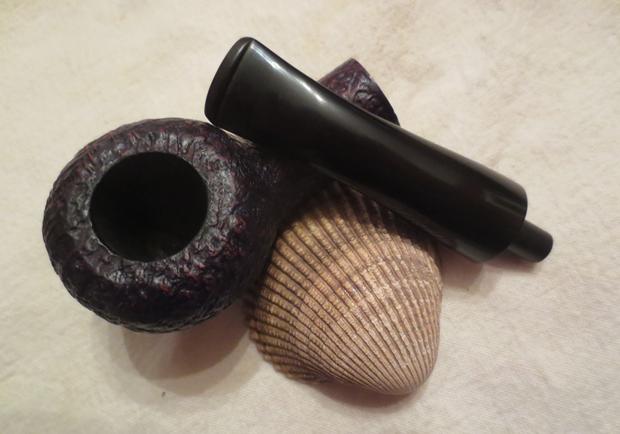
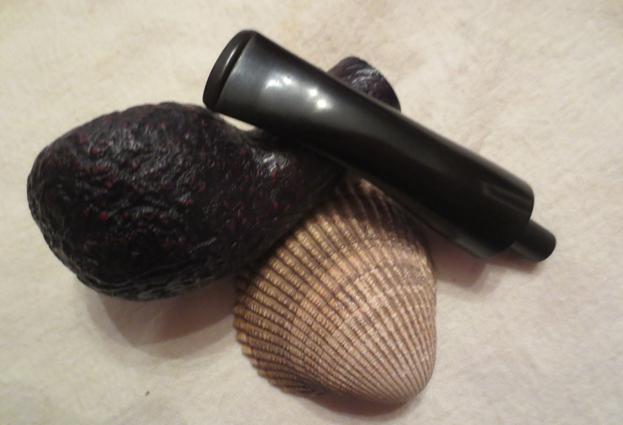
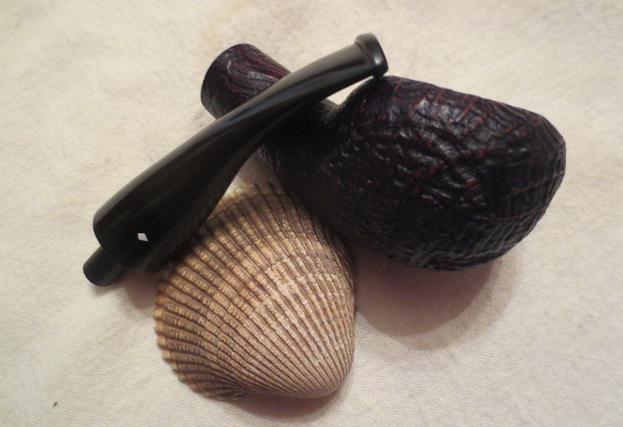
The pipe pictured below is a Wimbledon Author. It is stamped on the underside of the shank on a smooth patch, WIMBLEDON over the shape number 810. The sandblast finish is craggy and the contrast of dark brown and reddish-brown give it even more depth. My brother took the following photos when he received it from the EBay seller. The finish looked to be in excellent shape. There were no worn spots on the bowl. The rim had some tars in the grooves but it was quite clean. The bowl had a thin cake but nothing too thick. The stem did not seat in the mortise properly and there was a gap between the end of the shank and the stem. The stem was oxidized though it had no tooth marks or chatter.briar1I had seen the brand before but could not remember what I had read about it. I turned to pipephil’s site and found a picture of the same pipe – the same finish, the same stem logo and the same stamping on the underside. The site said that the pipe was crafted by Briarcraft as established by the stem logo. I have included a photo of the listing on the pipephil site.wim1That led me to look on pipedia.org to do some digging on Briarcraft pipes. Here is the link: https://pipedia.org/wiki/Briarcraft. There I found the following information. I have included the part of it here that includes a reference to the Wimbledon line.

Briarcraft Pipe Company was very prosperous between 1920 and 1940 and their pipes usually feature a diamond shield logo. They also produced a line of seconds under the following names: Airo, Arcadian, Briarmeer, Smokemaster, Cavalcade, Hallmark, Sterling Hall, and Wimbledon (emphasis mine). They closed their doors in 1950. Briarcraft was started by Richard Kliethermes Sr. and located on Pipetown Hill Rd, Spring Valley, NY. It received its power from a dam on Hyenga Lake, later it moved to 66 Central Ave., Spring Valley, NY. At first it was housed in a 2 story frame building and later a 2 story stone building was added. Upon the death of RK Sr., business was run by Richard Jr, between 1920 and 1940 it was second in size to Frank Medico pipes. All the briar root was imported from Africa, with the start of WWII, imports stopped and a briar like root was imported from S. Carolina. Richard Kliethermes Jr. was the inventor of a pipe known as Smokemaster, which used a doubled up pipe cleaner in the bit to absorb tobacco juice. With the decline in business during WWII and the following 5 years it closed its doors 1950.

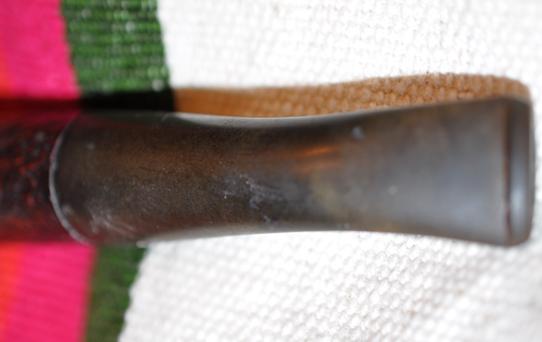
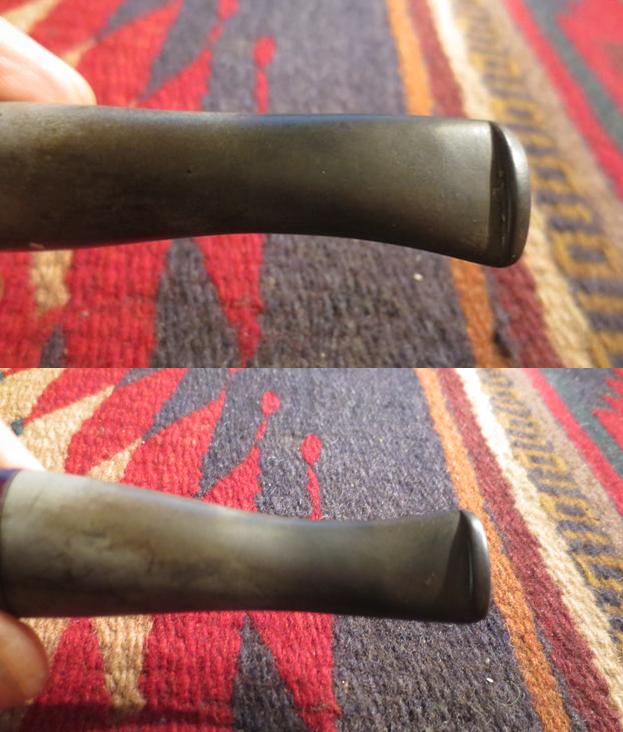
Jeff took the following close up photos to show the bowl and rim condition and the stamping on the underside of the shank. The third photo below shows the oxidation on the otherwise clean stem.briar2 briar3Jeff did his usual great clean up on the mortise and airways in the shank and stem. He reamed the bowl back to briar and scrubbed the externals with a tooth brush and Murphy’s Oil Soap. He rinsed it under running water. When the pipe arrived in Vancouver in the last box I received it looked like the photos below.briar4 briar5There was some rim darkening around the inner edge of the bowl but the briar was solid with no crumbling or burning. The finish had lightened with the scrubbing but would be easy to bring back to the original colour.briar6The oxidation on the button end of the stem was pretty light but on the tenon end was quite heavy. For some reason it rose to the surface and was almost white in colour.briar7I wiped down the rim with some alcohol on a cotton pad to clean it up and prepare it for restaining to match the bowl. I stained it with a dark brown stain pen.The colour of the stain pen was a perfect match to the bowl.briar8I wetsanded the stem with 1500-2400 grit micromesh sanding pads to cut through the surface oxidation. I dry sanded with 3200-12000 grit pads to further polish it. I rubbed it down with Obsidian Oil after each set of three pads and with the final pad set the stem aside to dry. I took the following photos of the stem and in them you can still see the residual oxidation under the flash of the camera.briar9 briar10 briar11I decided to use some more of the Before & After Pipe Stem Deoxidizer and Fine and Extra Fine Pipe Polish and see if I could draw out further oxidation. I am still experimenting with the product to check out its effectiveness so this seemed like another good test. I rubbed it down with the deoxidizer and a paper towel and was able to remove even more oxidation from the stem. I was impressed by what it brought out of the vulcanite.briar12I rubbed the stem down with the Fine and Extra Fine Pipe Polish and saw the shine on the stem increase and the oxidation disappear. So far so good.briar13I buffed the stem with Blue Diamond on the buffing wheel to futher polish it. The oxidation was gone. I gave the bowl several coats of Conservator’s Wax and the stem several coats of carnauba on the buffing wheel. I buffed the pipe with a clean buffing pad to raise the shine. I hand buffed the pipe with a microfibre cloth to deepen the shine on the pipe. The finished pipe is shown in the photos below. It is a great looking pipe and one that has great feel in the hand. This one will also make its way to the rebornpipes store soon. If you are interested let me know – send me an email at slaug@uniserve.com or a message on Facebook. Thanks for looking.briar14 briar15 briar16 briar17 briar18 briar19 briar20 briar21
Sometimes you get lucky and it’s an easy cleanup – a Royal Danish 930 Acorn


Blog by Steve Laug

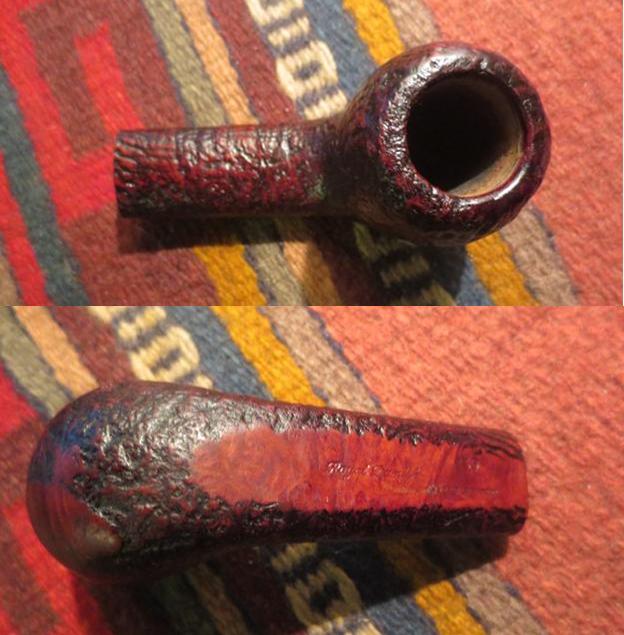
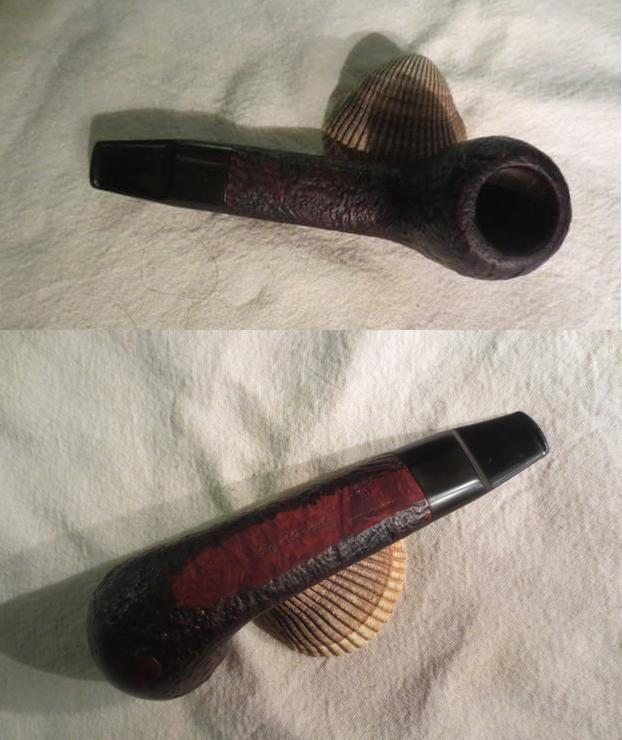
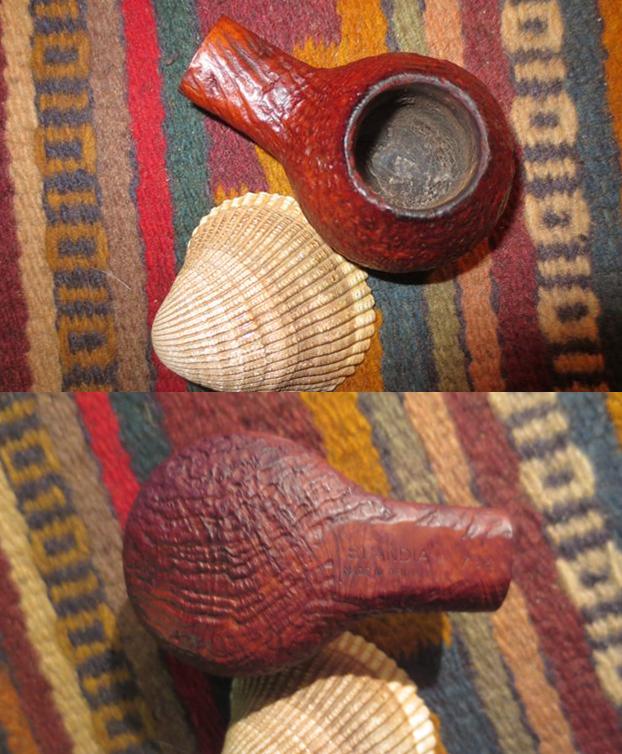
It seems that over the years I have picked up a lot of hard case pipes – pipes that need lots of TLC to even make them usable once again. Somehow, lately my brother has been picking up some pretty sweet pipes that don’t take a lot of work and if you saw my refurbishing bin you would understand why that really makes me thankful. The current pipe I am working on is one those easy ones. He did the lions share of cleaning work on it. He reamed the bowl and scrubbed the internals – the mortise and airways in the shank and stem. He scrubbed the exterior of the pipe so that added to the ease of the cleanup. The pipe is a Stanwell second or sub line. It is stamped on the underside of the shank in a smooth patch Royal Danish over Made in Denmark. To the left of that stamping is the shape number 930 which to my mind is the classic Danish acorn shape. The pipe has a shallow sandblast finish with two smooth patches on the sides of the bowl. The graceful stem gives it a classic look. There is some light oxidation on the stem and some light cake in the bowl and lava on top of the bowl. My brother took the next photos to show the overall look of the pipe.danish1 danish2He also took some close up photos of the rim, the stamping and the stem logo. The first photo below shows the light cake and lava on the rim. It should clean up nicely. The second and third photos show the stamping on the shank and the stem. The crown logo on the stem is faded and worn but still quite legible.danish3 danish4When I brought it to the work table I took the following four photos to show the state of the pipe before I cleaned or polished it. You can see from the photos that the finish was in good shape. The stem was oxidized but otherwise clean with no tooth marks or chatter.danish5 danish6I took some close up photos of the rim and bowl. The rim is in good shape. My brother cleaned off the rim with a tooth brush and Murphy’s Oil Soap to remove the grime and tars. He reamed the bowl and cleaned it. There was some lightening of the stain on the rim.danish7The stem was in great shape other than the oxidation. There were no tooth marks or chatter on the top or the underside of the stem.danish8I wet sanded the stem with 1500-2400 micromesh sanding pads to loosen the oxidation. I scrubbed the stem with the Before & After Pipe Stem Deoxidizer and paper towels. I scrubbed it with Before & After Pipe Polish Fine and Extra Fine. I rubbed the stem down with Obsidian Oil to protect and give life to the stem. I buffed it with carnauba wax and hand buffed it with a microfibre cloth.danish9 danish10I buffed the bowl lightly with Blue Diamond and the stem with a bit more pressure. I was careful around the stamping on the stem and shank. I gave the stme mulitple coats of carnauba wax and buffed it with a clean buffing pad. I waxed the bowl with Conservator’s Wax and buffed it with a clean buffing pad. I hand polished the stem with a microfibre cloth to deepen the shine. The finished pipe is shown in the photos below. The pipe will also one day be listed on the store. It is for sale now if anyone is interested. It would make a great addition to your collection.danish12 danish13 danish14 danish15 danish16 danish17 danish18 danish19

Good “bones” make for a beautiful restored pipe – Scandia 792 Squashed Tomato


Blog by Steve Laug

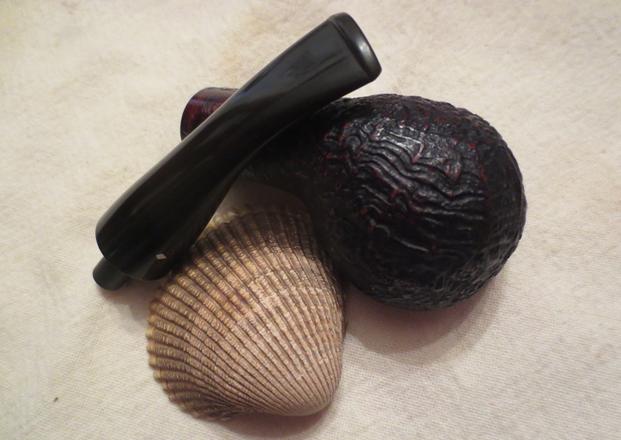
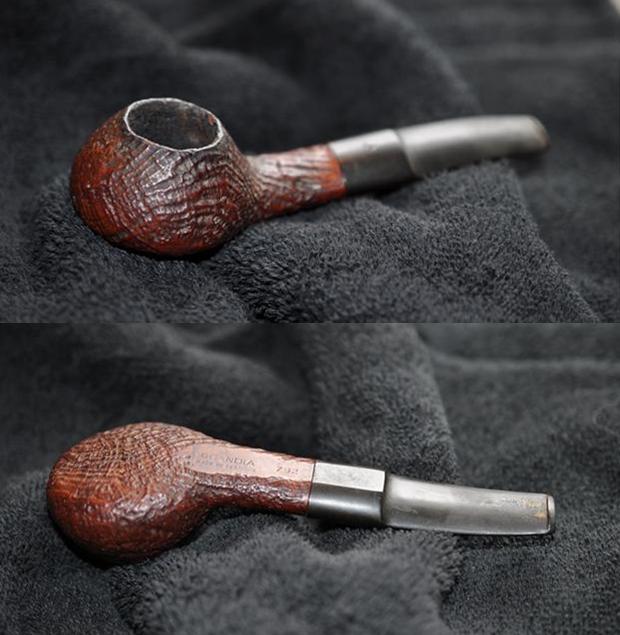
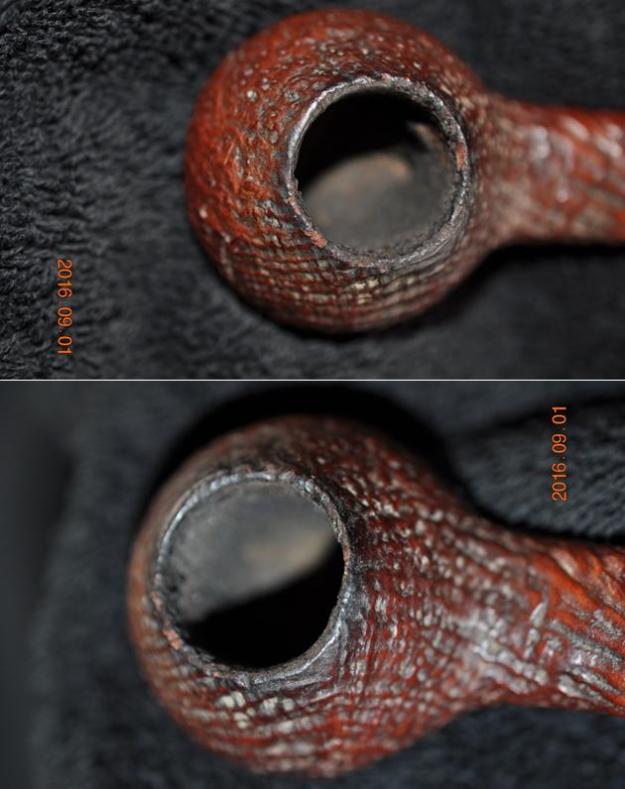
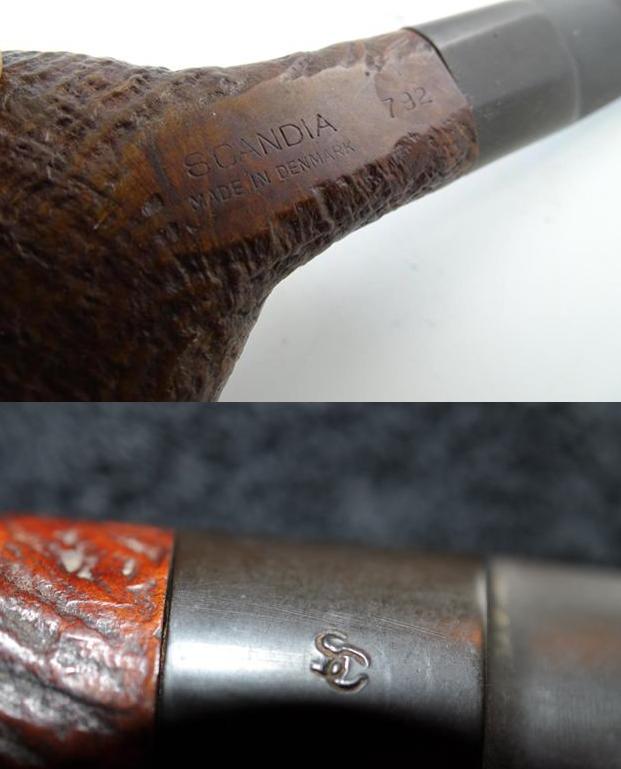
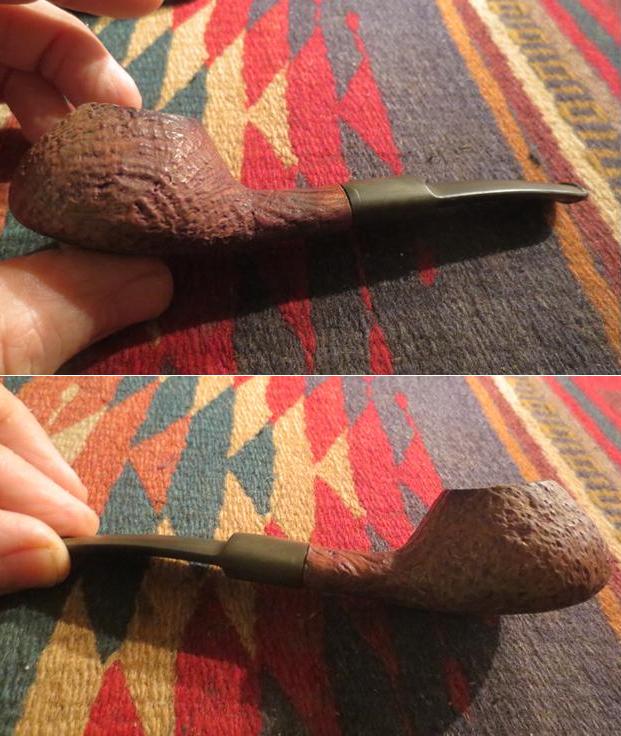
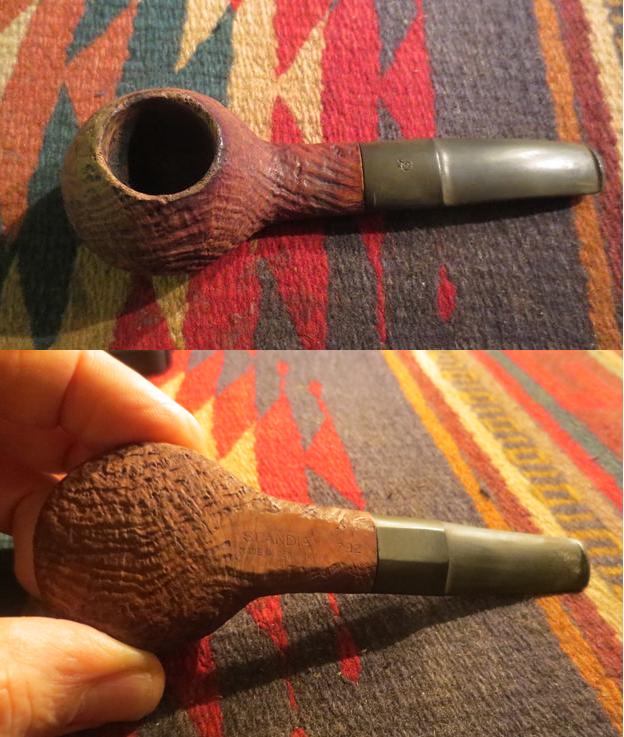
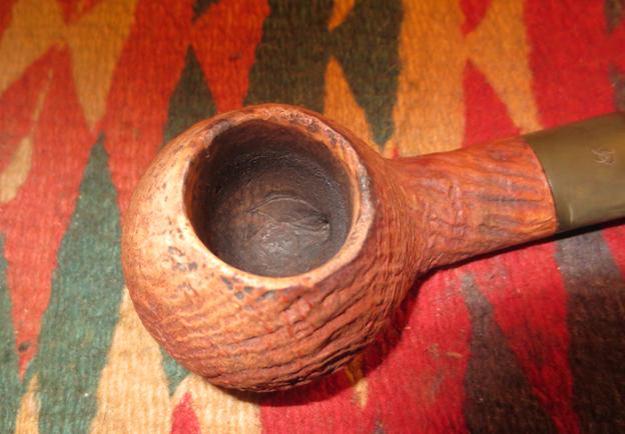
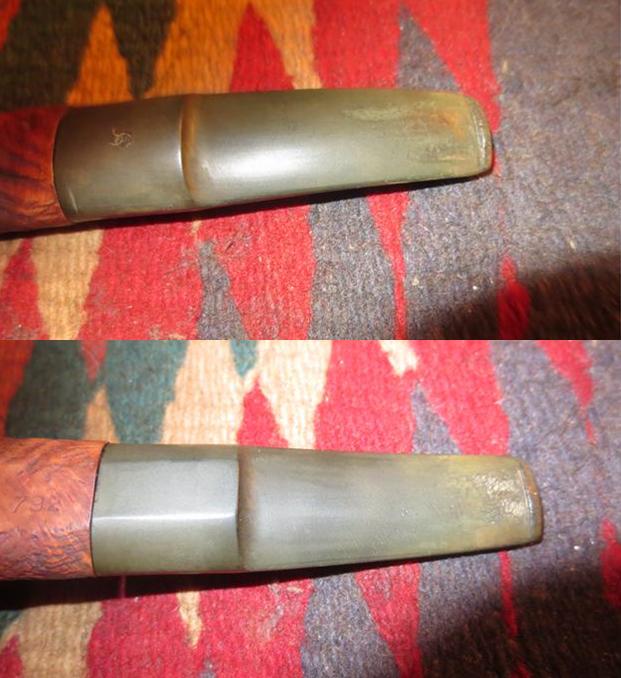
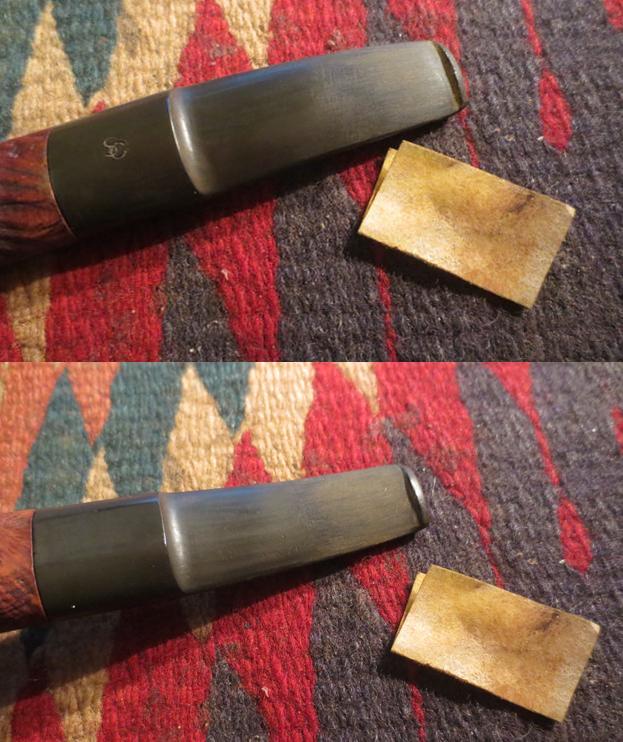
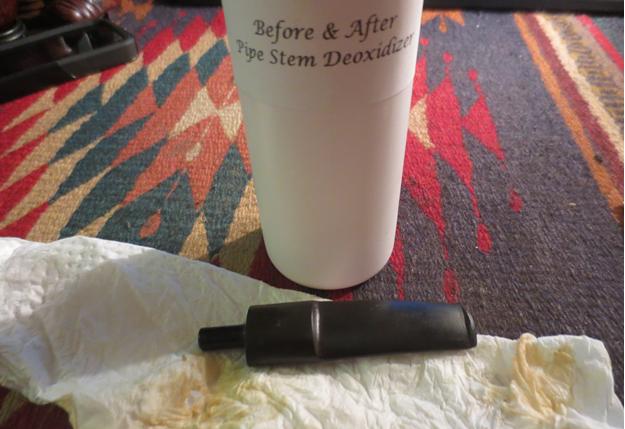
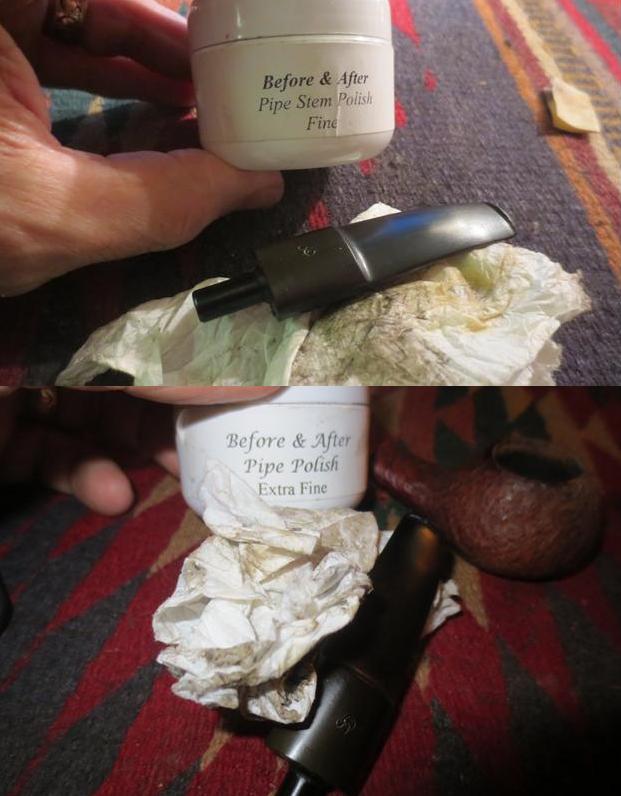
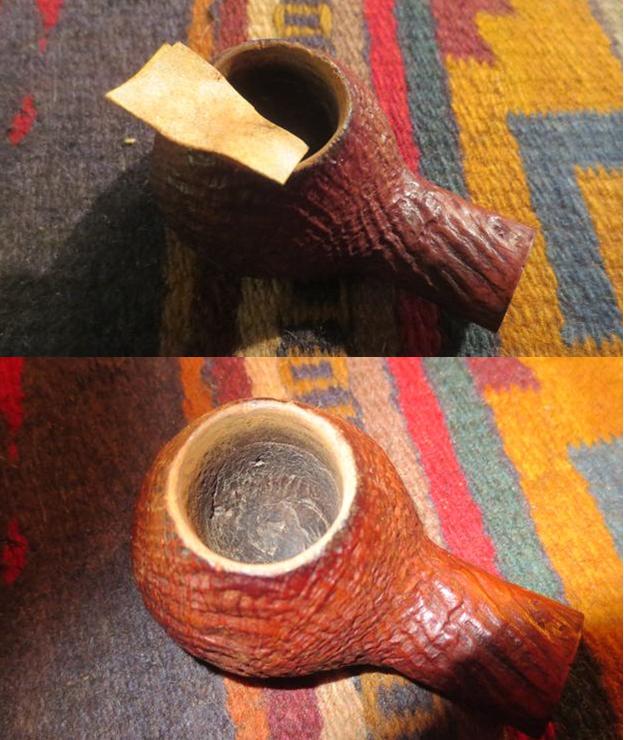
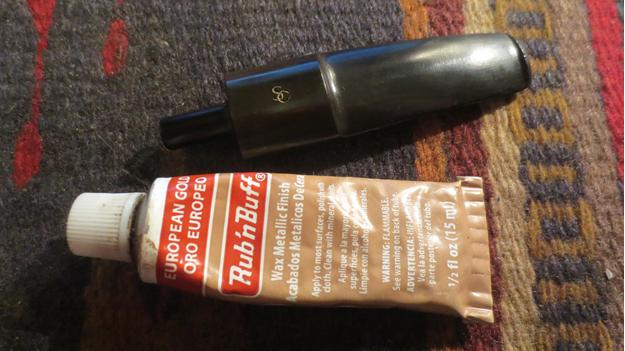
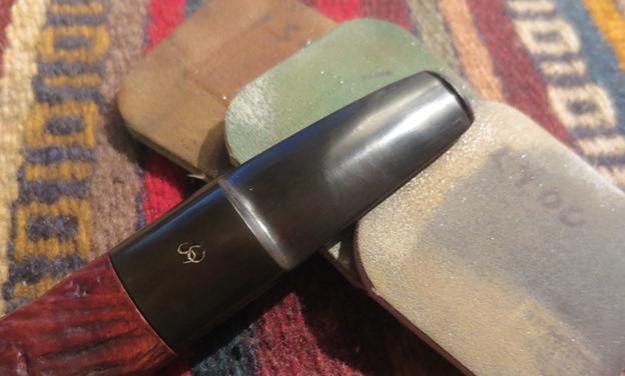
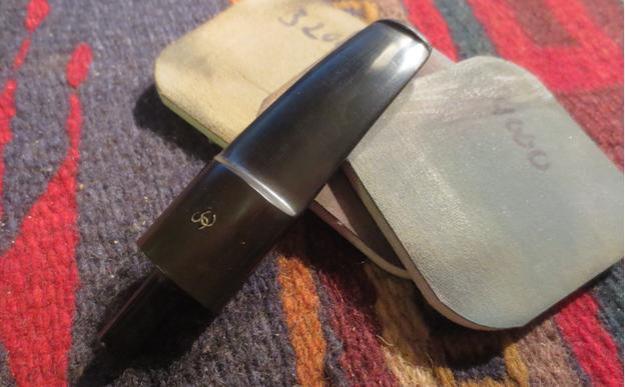
The next pipe I took out of the latest box was a Scandia 792 – a shape I call a squashed tomato. It may be a Danish author shape. It was in decent shape – the stem was lightly oxidized and there were tooth marks and chatter on the top and bottom sides of the stem near the button. The finish was worn but functional, there was a lot of dust and grime in the grooves of the sandblast. The rim had some small chips out of the inner edge. There was also darkening on the top of the bowl. The next photos show the pipe when my brother received it.scan1The next two close up photos show the close up photos of the rim. The chips on the top of the rim and on the inner edge are visible. There was also some tarry buildup on the inner edge and on the top. scan4The next two photos show the stamping on the smooth portion on the bottom of the shank. It is stamped SCANDIA over Made in Denmark and the shape number 792. The second photo shows the SC logo on the shank. Scandia is a Stanwell second line.scan2The next two photos show the tooth chatter and tooth marks on the top and underside of the stem. There was also some slight oxidation. scan3My brother scrubbed the exterior of the pipe with Murphy’s Oil Soap and rinsed it with running water. He reamed the bowl and cleaned out the mortise and airway in the shank with cotton swabs, pipe cleaners and alcohol. When I received it the pipe was in very clean shape. The next pictures show what the pipe looked like when I brought it to the work table.scan6 scan7I took some close up photos of the rim to show the darkening and the wear on the inner and outer edge. There are some chips. I took close up photos of the stem to show the condition and oxidation on the stem.scan8 scan9I sanded it with 220 grit sandpaper to remove all of the tooth chatter and tooth marks. I also sanded it to remove the oxidation.scan10I used the Before & After pipe stem cleaning kit to work on the stem. I scrubbed the stem with the Pipe Stem Deoxidizer and a paper towel until I had removed the surface oxidation. I continued to scrub it until some of the deeper oxidation came out. I polished it the Pipe Stem Fine and Extra Fine polish to further remove the oxidation.scan11 scan12I used a folded piece of 220 grit sandpaper to sand the rim edges and the top. I was able to remove the chips and divots from the inner edge. The second photo shows the rim after sanding.scan13I used Rub ‘n Buff European Gold to highlight the stamping on stem to bring life back into the logo.scan14I wet sanded the stem with 1500-2400 grit micromesh sanding pads and wiped it down with Obsidian Oil. I dry sanded it with 3200-12000 grit pads and rubbed down Obsidian Oil after each set of three pads. After the final rub down of Obsidian Oil I set the stem aside to dry.scan15 scan16 scan17I waxed the bowl with Conservator’s Wax and buffed the pipe with a clean buffing pad. The next four photos show the polished bowl.scan18 scan19I sanded out the bowl with 220 grit sandpaper on around my finger to clean up the scratches and nicks in the bowl interior. I buffed the bowl with a clean buffing pad and gave the stem several coats carnauba. I buffed the stem with a clean buffing pad and then once again with microfibre cloth to raise and deepen the shine. The finished pipe is shown in the photos below. It will one day be on the rebornpipes store, if you would like to add it to your rack email me at slaug@uniserve.com or send me a message on Facebook or a comment on the blog. Thanks for looking.scan20 scan21 scan22 scan23 scan24 scan25 scan26 scan27
 

An Italian Thompson Briar Cherry Wood


Blog by Robert M. Boughton
Member, International Society of Codgers
Member, North American Society of Pipe Collectors
Member, Facebook Gentlemen’s Pipe Smoking Society
https://www.facebook.com/roadrunnerpipes/ Now Open!
https://roadrunnerpipes.wordpress.com/
http://about.me/boughtonrobert

Photos © the Author except as noted

Sittin’ in the mornin’ sun
I’ll be sittin’ when the evenin’ comes
Watchin’ the ships roll in
Then I watch ’em roll away again, yeah
I’m sittin’ on the dock of the bay
Watchin’ the tide roll away, ooo
I’m just sittin’ on the dock of the bay
Wastin’ time.

— Otis Redding (1941-1967), U.S. singer, songwriter, arranger, record producer, talent scout, in “Dock of the Bay.” 1968

In the late great soul singer’s relaxed, heartfelt poetry, I have ventured upon a quintessential pipe quote.  To me the words evoke certain clear and happy memories of my childhood and the highest objective of all pipe enthusiasts: to sit in peaceful, easy contemplation of life and enjoy its passage with thoughts that may or may not be as eloquent as those of the lyric and stylistic artist, but nevertheless belong to us.  Only fitting, therefore, is the fact that this refurbish concerns a lovely sitter, made of briar but fashioned in the cherry wood shape.

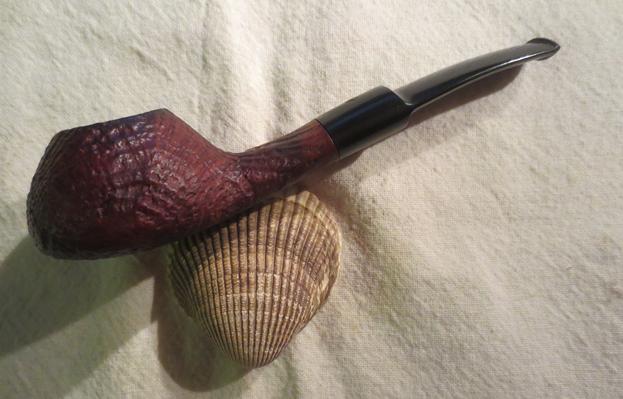
Having the Dutch pipe maker E. Gubbels B.V. of the Netherlands on the brain in recent days, I thought I had an unusual shape of one of its brands, another Thompson.  My first clue that this might be incorrect came upon my initial inspection of the fine specimen, whereupon I discovered a made in Italy stamp under the brand.  Turning to Pipephil, I noted the slight but nevertheless clear difference in the cursive style of the name.  Unless anyone comes up with a better answer, I conclude this beautiful briar pipe with almost seamless birds-eye grain was made for the Thompson Cigar Co., established in 1915, of Tampa, Florida.

I have owned several cherry wood style pipes, and only one that I recall was, to me at least, a dud.  That’s why I let it go to a collector of the brand, which shall remain unnamed despite the fine reputation it enjoys for good reason.  The gentleman snagged the little beauty, with its excellent dark red and orange vertical grain, from my first online business site the day after I blogged and posted it, and wrote to let me know how happy he was in every respect with his purchase.  This anecdote illustrates how the pleasures derived from these diminutive wonders for partaking of the sundry blends of tobaccos are of an intense and personal nature, and every functional pipe is destined, in a way, for a loving keeper.

Here are three of the many examples I have owned and come to know on an intimate basis.  The first and last are briars.thompson1thompson2And here is the Thompson I have had the pleasure of cleaning up and savoring on a frequent basis ever since.thompson3thompson4thompson5thompson6The sitter had few signs of wear and tear other than chatter and general abrasions on the bit, and so I commenced the refurbish there with an OxiClean bath.  I followed that step by sanding with 320-grit paper and wet micro meshing from 1500-12000.

thompson7thompson8thompson9The superfluous system tenon, which was of a variety so popular back in the day when every pipe maker and his brother was in the mad competitive habit of patenting such idiotic devices, was stuck so tight inside the push section that I had to heat and remove it first.  Then I reamed the chamber and sanded it smooth with 150-, 220- and 320-grit paper before running some preliminary Everclear-soaked cleaners through the shank.  As I was keeping the pipe for my own use, I tucked away the unnecessary system nuisance.

thompson10thompson11The full micro mesh treatment of the stummel was enough to clear away the insignificant blemishes on the wood.  Still, more light work was needed on the rim with 320-grit paper, then another round of micro mesh on that narrow area.thompson12thompson13thompson14Retorting the pipe necessitated several more cleaners through the shank.thompson15This is where a phenomenon I never before saw occurred.  Thinking the stummel ready for waxing, I couldn’t help noticing the inexplicable appearance of a dark red patch that appeared to be an old stain, seeming to have no logical origin, on the top front of the bowl, under the rim.  Blast me for not snapping a shot of the spooky manifestation before I corrected it with spot sanding, again using 320 paper!  I had already applied Halcyon II to the surface and had to spot wax the narrow spot again.thompson16thompson17Following the 15-minute soak-in stage and vigorous buffing with a soft thick cotton cloth, all that was left was a quick spin on the clean electric buffer wheel.thompson18thompson19thompson20 SOURCES
https://www.thompsoncigar.com/section/PIPES/8394.uts
https://wordpress.com/post/roadrunnerpipes.wordpress.com/219

The Rim on this De Jarnett Handmade Needed Attention


Blog by Steve Laug

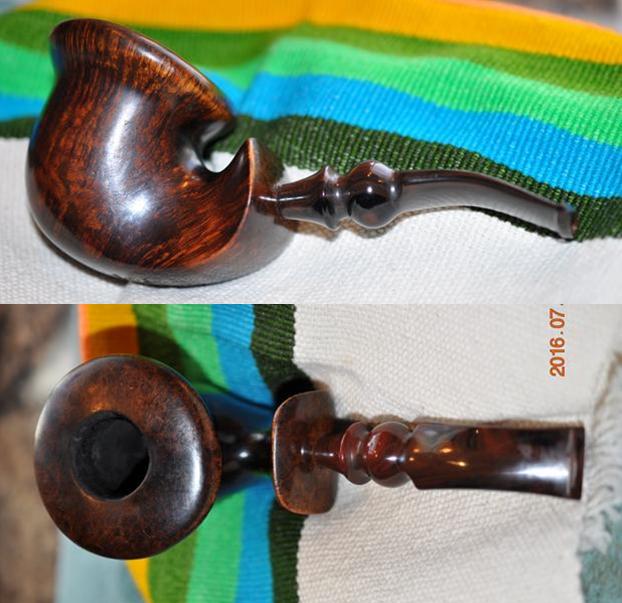
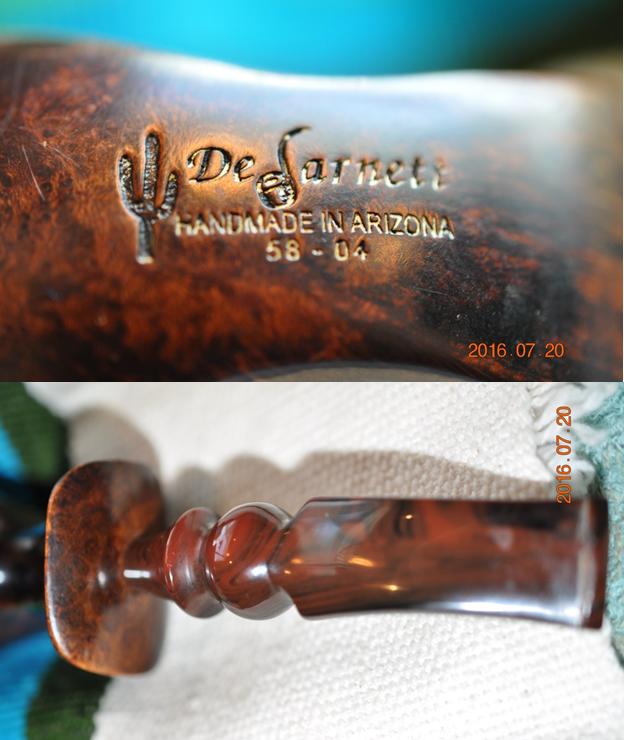
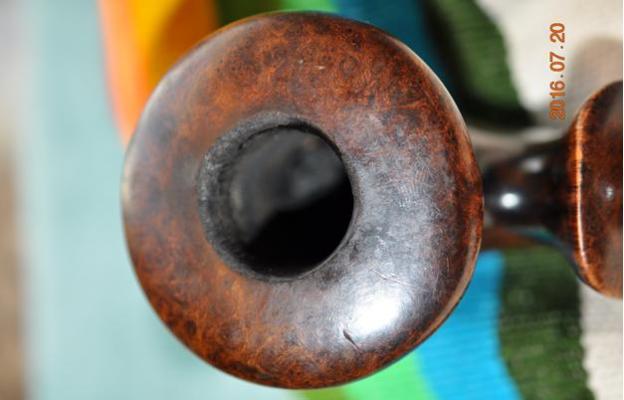
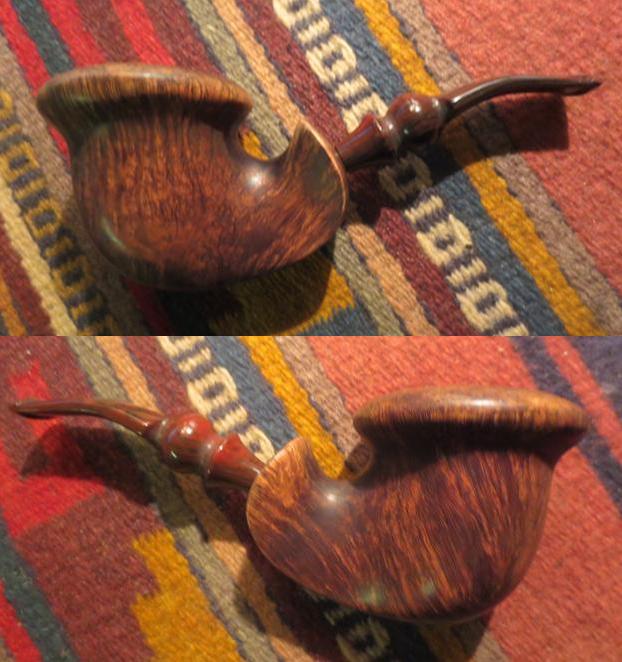
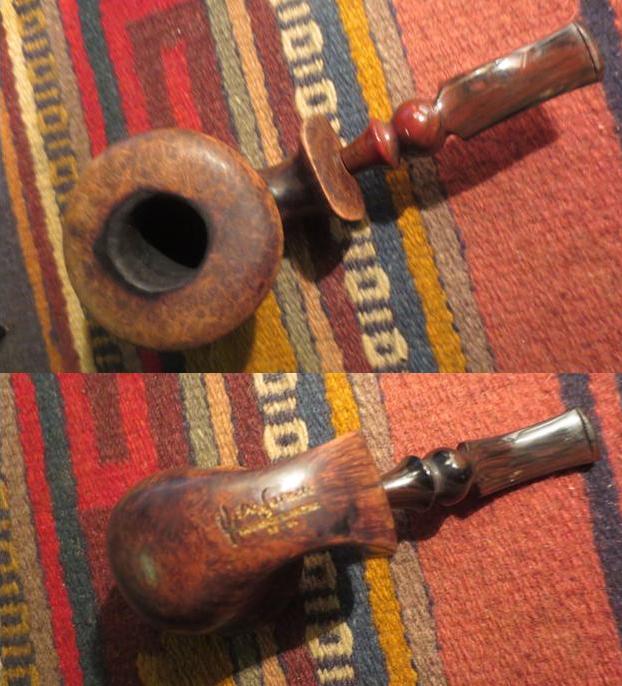
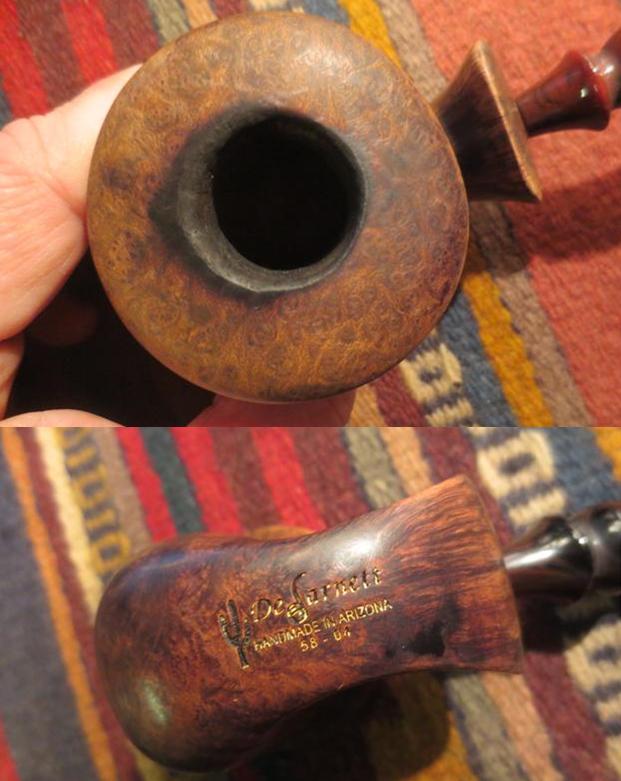
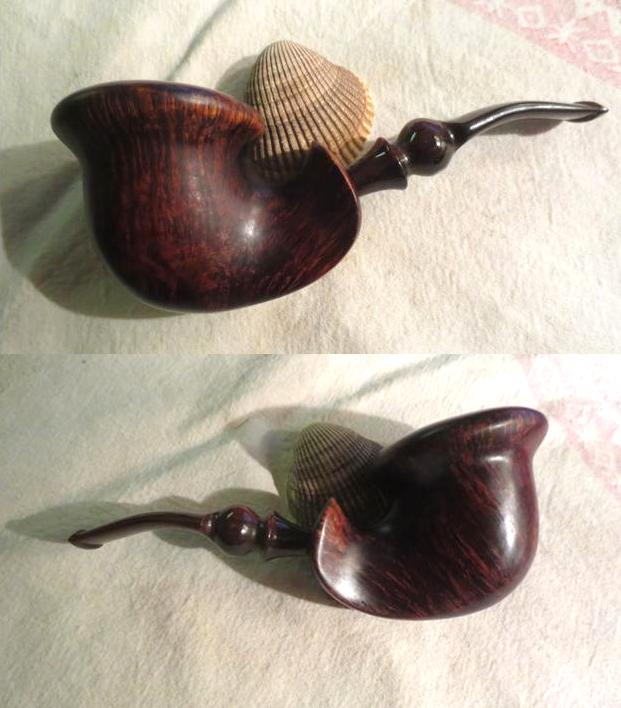
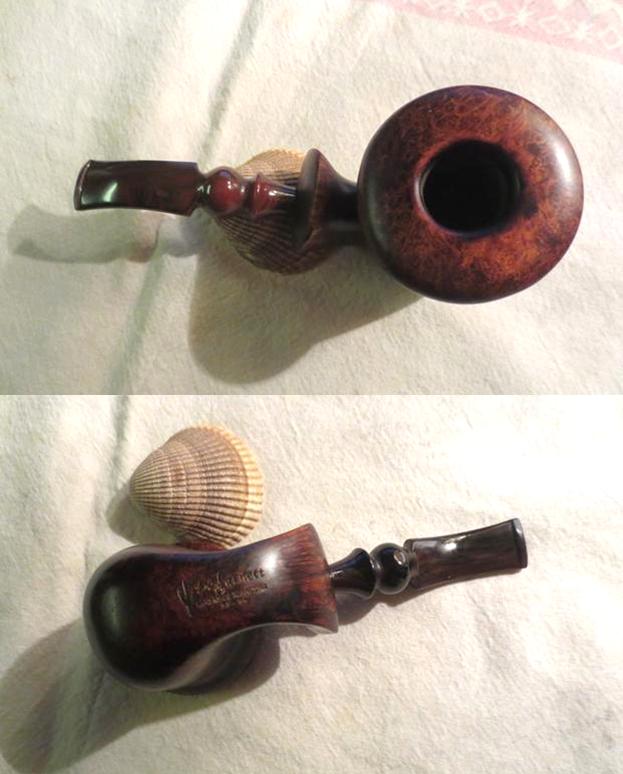
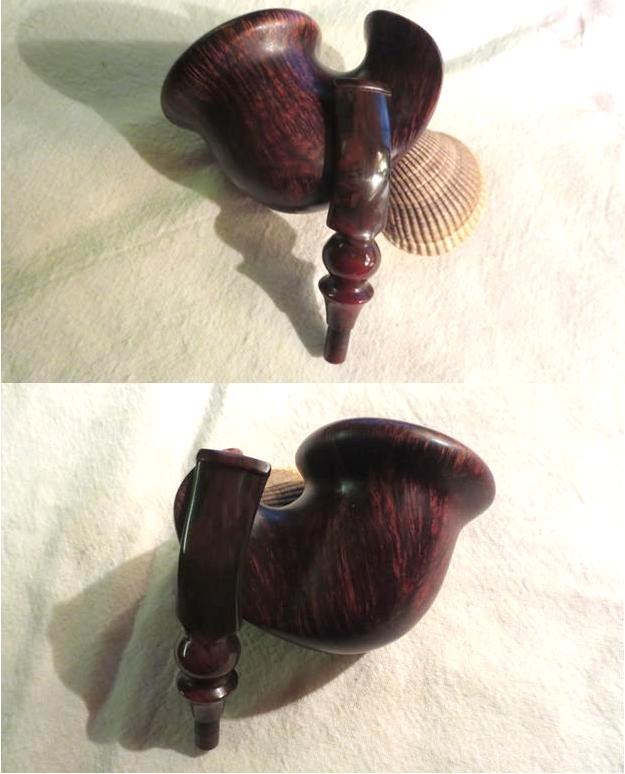
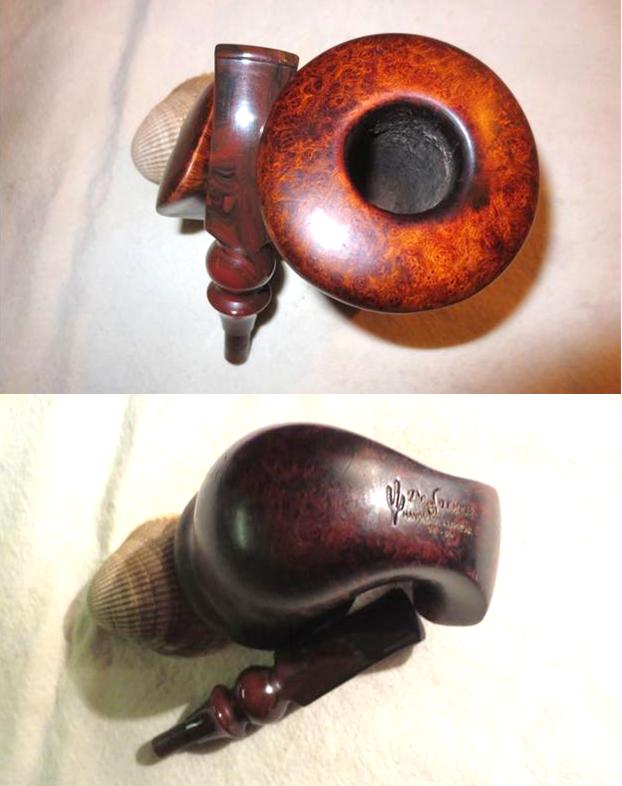
My brother sent me photos of this interestingly shaped De Jarnett pipe and wondered about it. I agreed there was something about it that grabbed me too. The grain on the darkly stained bowl, the Cumberland style Lucite stem, the curves of the pipe following the grain, the mushroom cap on the top of the bowl all were a part of the mystique of the pipe. He bid on it and the pipe was his. I received it in the mail in the last box of pipes he sent me. Last night I took it out to have a closer look at the pipe. I always have my brother take photos of the pipe before he does any work on it so he sent the following photos along with the pipe.de1It looks really nice but I had no idea how large the pipe was until I had it in hand. It is 6 ½ inches long, 2 ¾ inches tall, 2 ¼ inches in diameter with a chamber size of 7/8 inch. It is a handful. The stamping on the underside of the shank has a cactus which was Horace’s logo and the name De Jarnett with the J stylized into a pipe. Underneath it says Handmade in Arizona over 58-04. My guess is that the number stamping tells me that the pipe is the 58th pipe he made in 2004.de2The photo he sent me of the rim shows the cake in the bowl and the damage to the inner edge of the rim. It looks like it is burned but once I see it and examine it I will know how bad the burn mark is. There is also a sizable dent on the bowl top and some overall darkening of the rim cap.de3I had heard of De Jarnett pipes in the past and talked to others about them. I have also done repairs on one of them in the past but I had never taken the time to read about the maker. I assumed he was still living which turns out to be false. I turned to my two go to sites Pipephil and Pipedia for information and found little other than the dates of the maker which showed he had died and the location of the shop which is on the pipe anyway. However, Pipedia was more fruitful. Here is the link: https://pipedia.org/wiki/DeJarnett_Pipes

When I read the write up on Pipedia I found that Horace DeJarnett had died on July 24, 2013. He had been battling with terminal cancer, but his wife reported that he ultimately died of a stroke. Since I had also suffered a stroke this gave me a sense of connection with the carver. I only wish that I had been able to have a chat with him before he died. I find that those conversations I have had with pipe makers have been highlights of my pipe collecting and repair/restoration hobby.

Pipedia also included a photo of Horace that was taken by Pipes& Tobacco Magazine and used by courtesy. I have included much of the Pipedia article here for ease of reference. For the details and the remainder of the article use the link above.

Horace wrote of his pipes: “All of my pipes are carved from the finest quality Algerian briar I can find. I coat each bowl with a special pre-carb treatment which speeds up the break-in process. After the third bowl, it will smoke as if it had been in your collection for years. I get a lot of positive feed-back on this feature.

Standard draft holes are 5/32″. I think that’s too small and many pipe smokers agree with me. So I drill mine to 3/16″ for a better draw. You won’t have to send my pipes out to a pipe repairman to have them opened up, as many do.

For over 40 years I worked in the grocery industry. In 1984 I founded my own food brokerage business. It prospered and grew into a multi-state corporation. In 1999 I sold my portion of the business and retired.

Due to health concerns and public scrutiny, I quit smoking cigarettes in 1993 and took up the pipe.

(I believed then – and still do – that health risks are greatly reduced by not inhaling and just puffing.) Serious pipe-smoking is conducive to day-dreaming, and thus the idea of making my own pipes became a quest.

I was fortunate to study under Andrew Kovacs, a well-known carver in Northern Arizona (trade name “Jandrew”) for about a year, off and on. I learned a lot of the basics from Andy, but some of my best counsel came via long telephone conversations with Mark Tinsky.

Over the years I have made and sold approximately 1,000 pipes, most of them here in the United States, but I do have customers in Indonesia, Germany, Japan, England, Israel, Canada, and Thailand.

What began as a hobby has become my passion. I lost my leg in 2001 due to a blood clot, so fortunately for me, I have an occupation that is “handicap friendly”.

That glimpse of Horace from his own words gives a clear picture of what he brought to the making of each pipe that he sent out. I have no idea where the pipe that arrived in Vancouver has been before coming here nor do I know where it will go afterward. But I know that it will certainly outlive me. The quality of briar and craftsmanship give it a great chance at longevity.

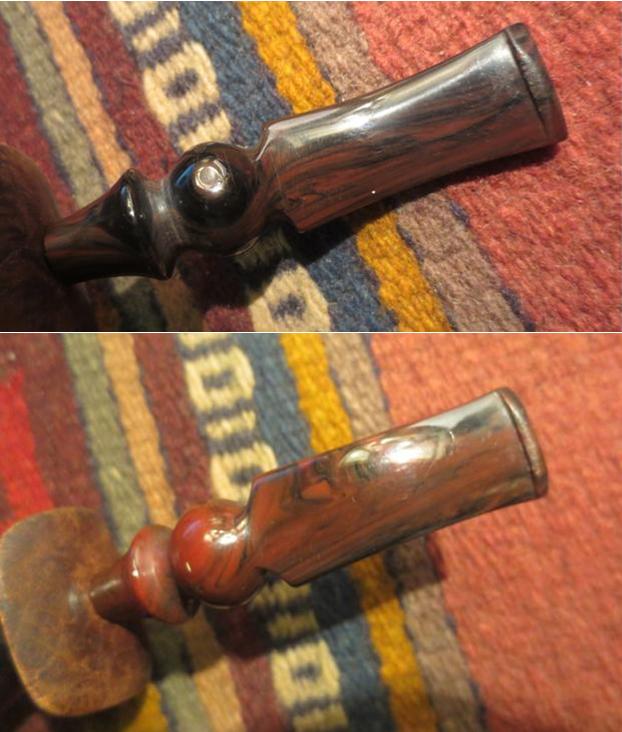
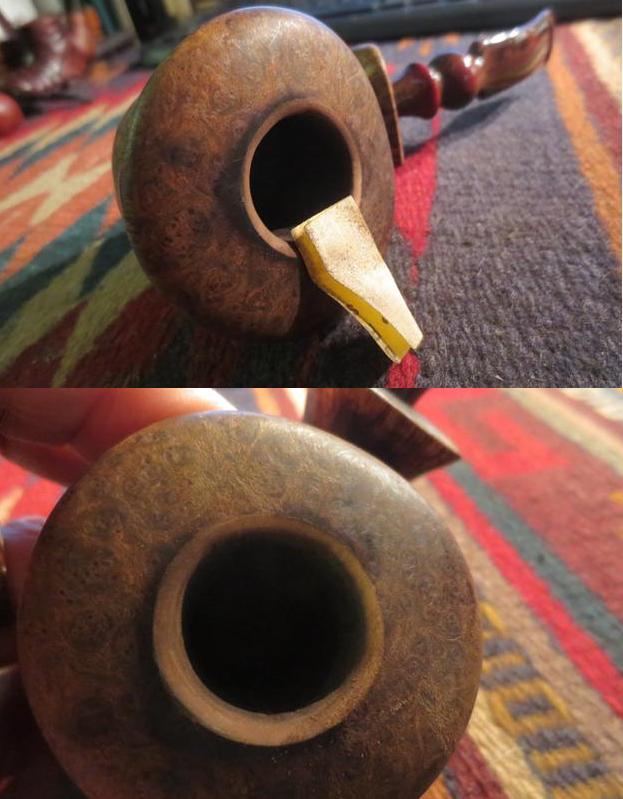
My brother Jeff did his normal thorough cleanup of the exterior and the interior of the pipe. When it arrived it had been reamed, cleaned and sent to me for the final touches. It is really nice to have him doing the grunt work on these pipes. This was no exception. I took a few photos of the cleaned up pipe when I brought it to my work table. de4The next photo shows the darkening and burn mark on the rim. A close up of that area is shown in the photos that follow.de5The burn mark and darkening at the front of the bowl was more extensive than I had originally guessed from the photos sent. The front inner edge is burned and beveled inward with the darkening extending quite a way into the rim top. The back edge also shows some burning that will need to be address. The second photo gives another view of the stamping.de6The stem had some tooth chatter on the top and the underside and the edge of the button was worn and flattened. de7To remove the burn damage on the inner edge of the rim I used a folded piece of 220 grit sandpaper to bevel the rim edge inward to accommodate the damage on the bowl front. I carried that bevel around the entire rim edge to clean up the damage at the rear as well. The next two photos show the newly beveled rim. The angle on the second photo makes the bevel appear to be thicker at the front of the bowl than the back. However, in hand the bevel is the same size around the bowl.de8I wet sanded the rim with 1500-2400 grit micromesh sanding pads and dry sanded it with 3200-12000 grit pads to polish the scratches and the new bevel. I used a dark brown stain pen to touch up the inner edge of the rim to match the colour of the bowl. All that remains of the burn mark is a small dark spot on the front top of the bowl and some darkening in the inner edge. It is far better than when I began. de9I sanded out the tooth chatter and reshaped the button with 220 grit sandpaper. I wet sanded the stem with 1500-2400 grit micromesh sanding pads, wiped it down with a damp cloth and dry sanded it with 3200-12000 grit pads. I wiped it down with a damp cloth a final time. de10 de11 de12I buffed the pipe and stem with Blue Diamond on the buffing wheel. I gave the bowl and stem multiple coats of carnauba wax. I buffed the pipe with a clean buffing pad to raise and shine and hand buffed it with a microfibre cloth. The finished pipe is shown in the photos below. It is a big pipe so it will eventually be listed on the store for sale. If you are interested in it before that time just send me an email at slaug@uniserve.com or send me a message or a comment here or on Facebook. Thanks for looking.de13 de14 de15 de16


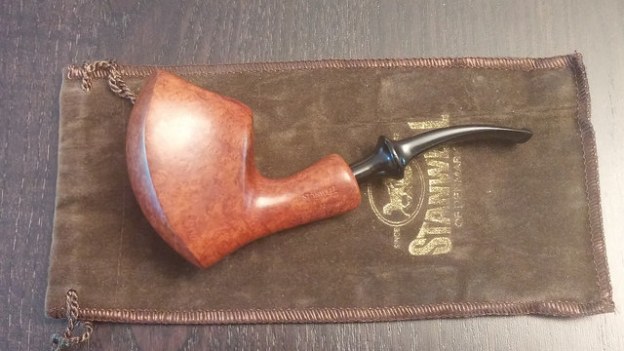
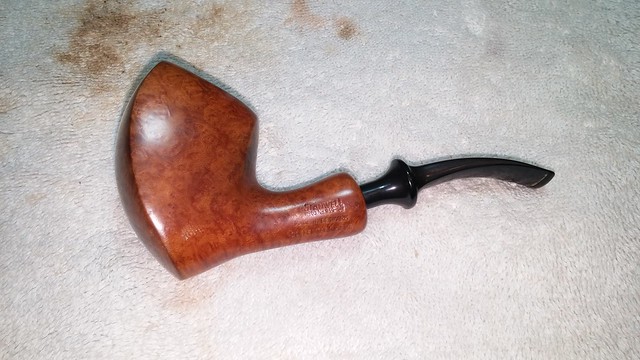
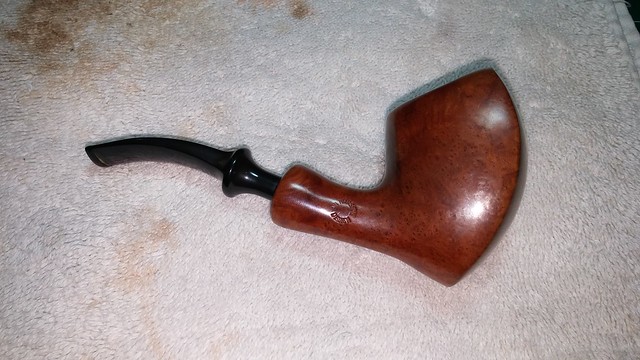
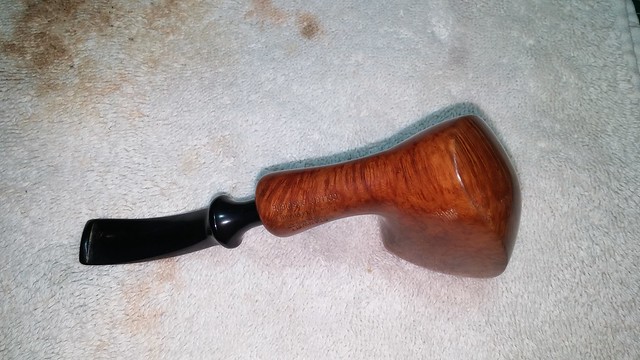
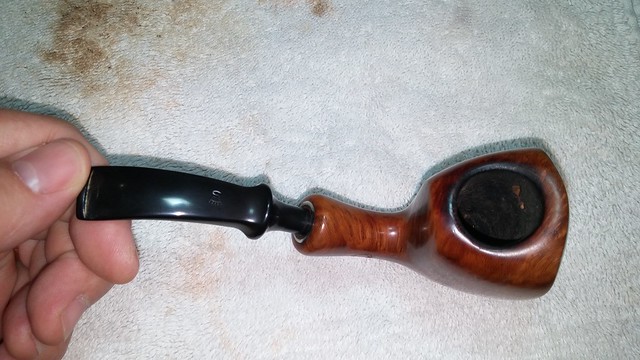
A Rare Find – An Early Ivarsson Pickaxe Stanwell Collectors Piece


I wanted to reblog this so rebornpipes readers can see this rarity. Charles has done a great job restoring it. Too bad that Bas Stevens, Mr. Stanwell died this past weekend or we could have asked him about it.

Charles Lemon's avatar

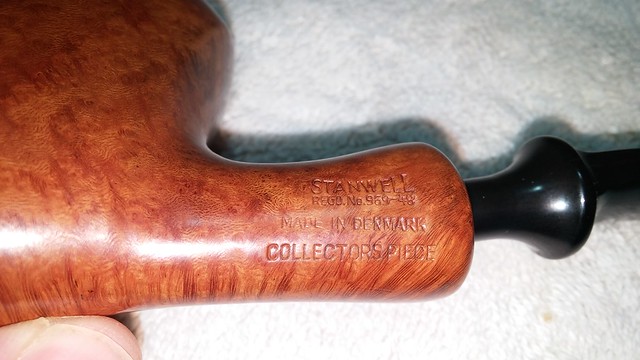
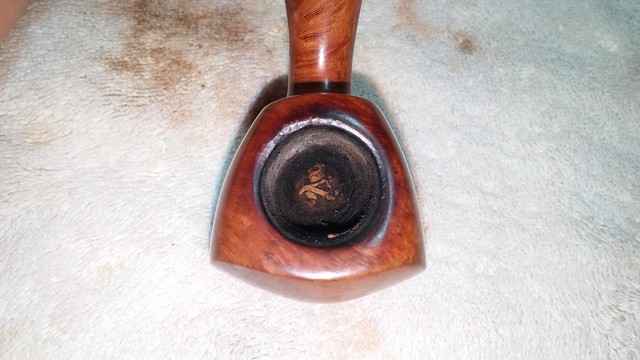
I’ve been sitting on this restoration for a while, mainly because it took some time for me to come to grips with the pipe’s pedigree. The pipe in question is a Stanwell Collectors Piece, a special series of pipes issued during the company’s “Regd. No.” era (roughly 1948 – 1970) and apparently quite rare in the North American estate pipe market (I’ve come across only one other example to date).

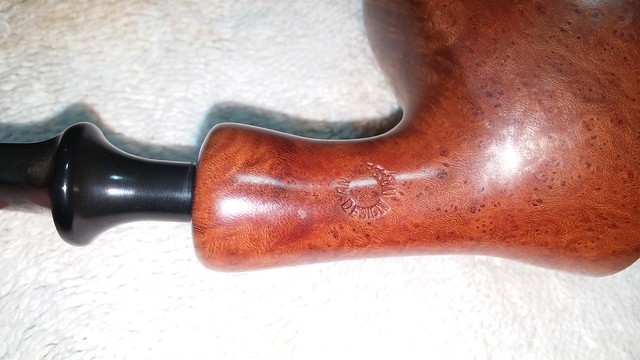
The pipe is stamped on the left shank with “Stanwell” over “REGD.No. 969-48” over “Made in Denmark” over “Collectors Piece”. On the right shank the pipe bears a circular stamp which reads “An Ivarsson Design”.

20160911_125846
20160911_12585120160911_125858
20160911_125911
20160911_12592320160911_125933
20160911_12595120160911_125957
20160911_130008

Regular DadsPipes readers will recognize Ivarsson’s Pickaxe shape from the restoration of the Royal Guard 01-M I posted a while back. In that entry, I noted that the “01” Pickaxe shape was introduced to the Stanwell catalog around 1975. The presence of the “Regd No”…

View original post 542 more words