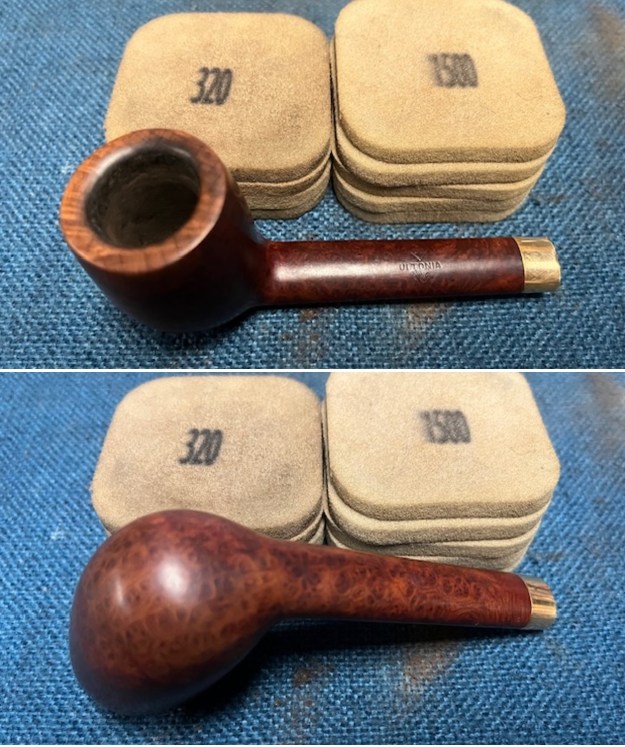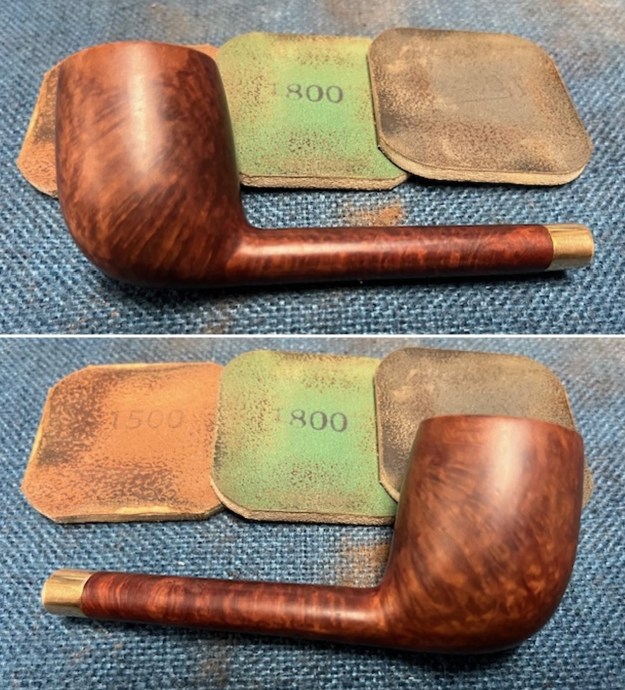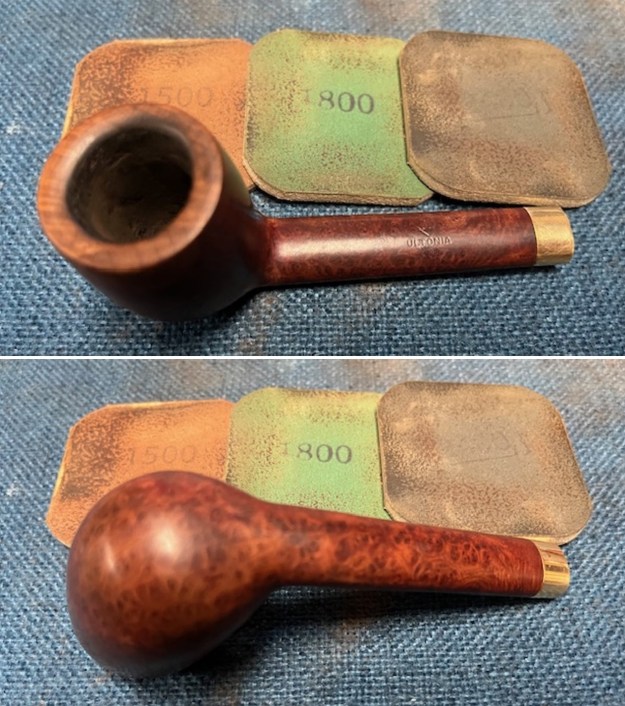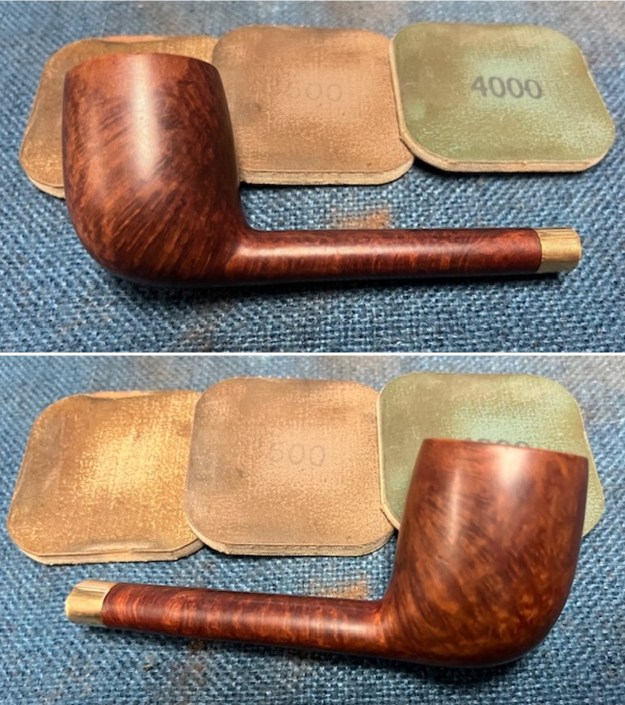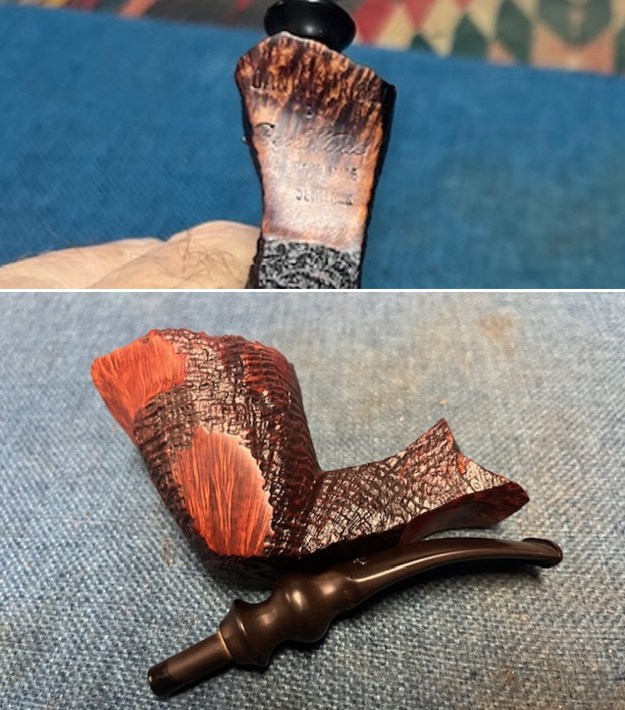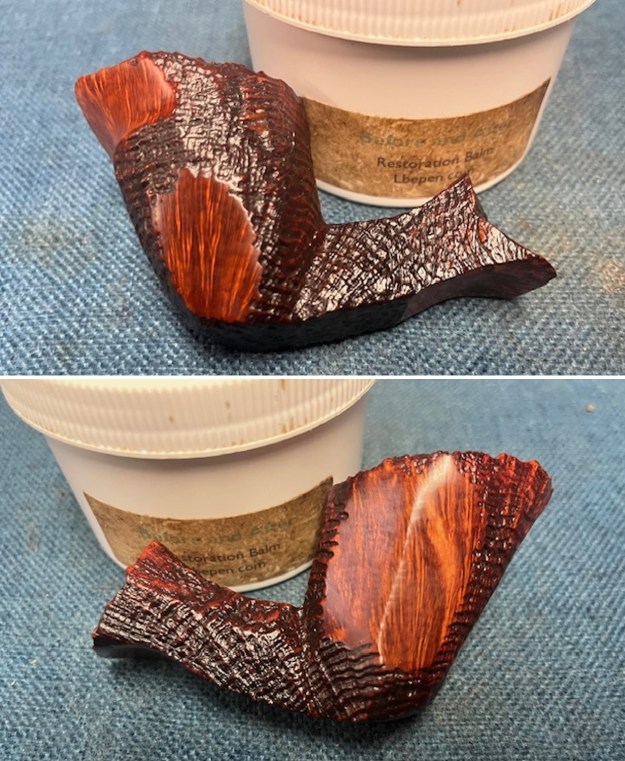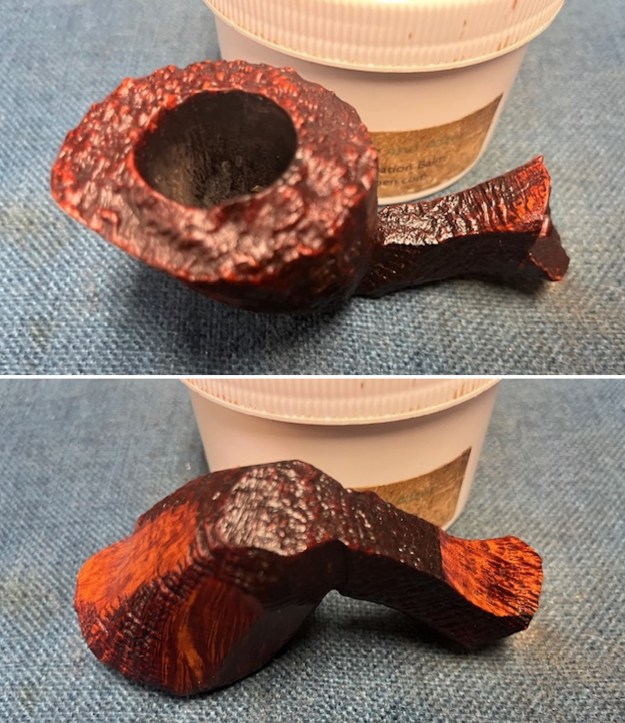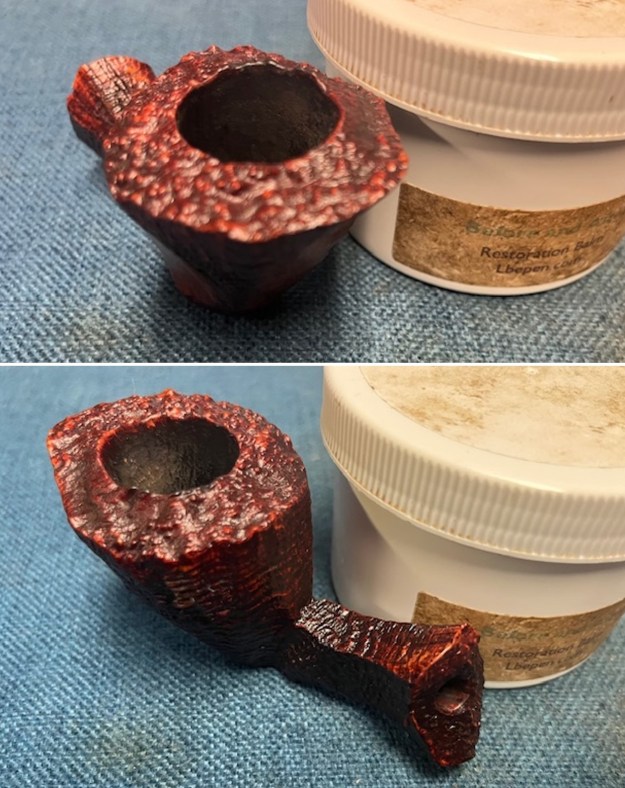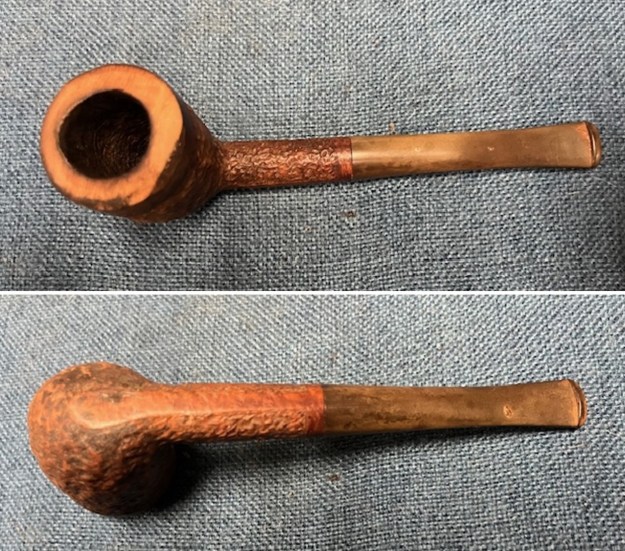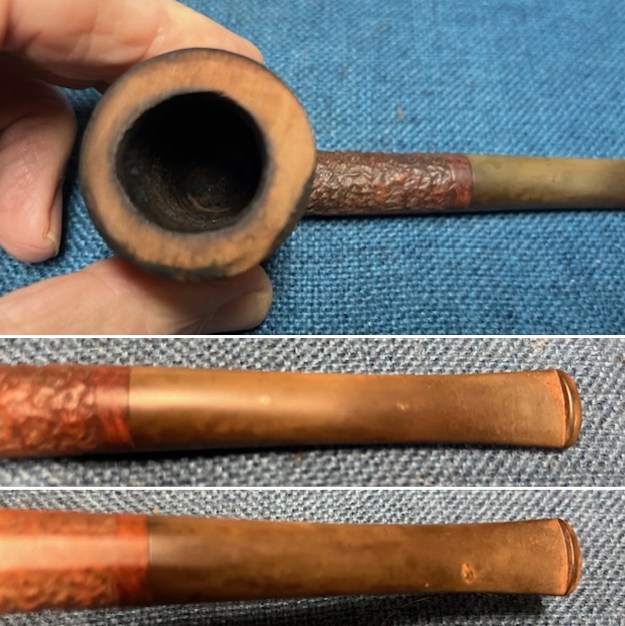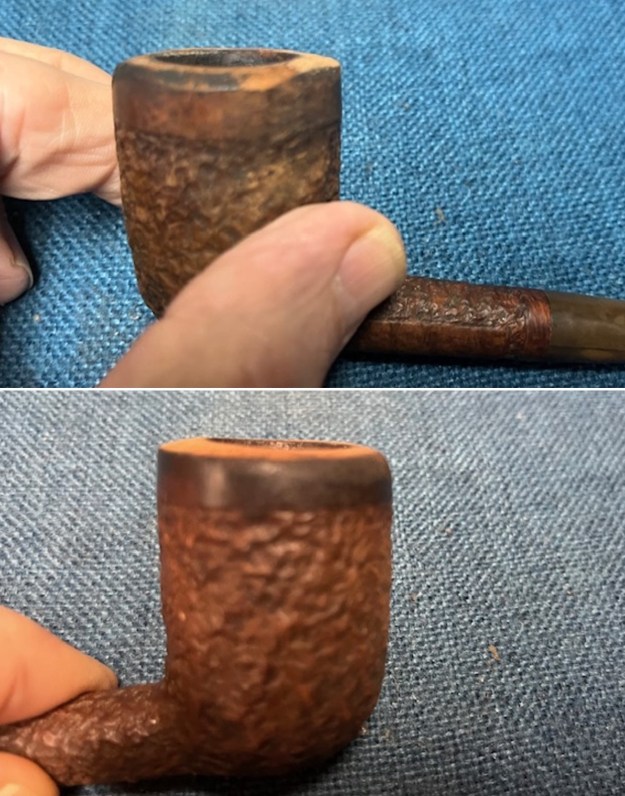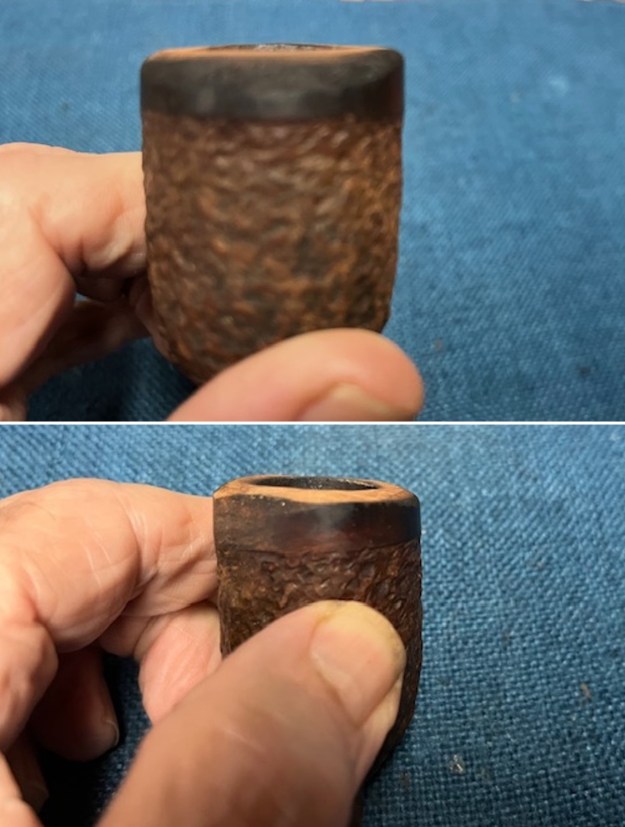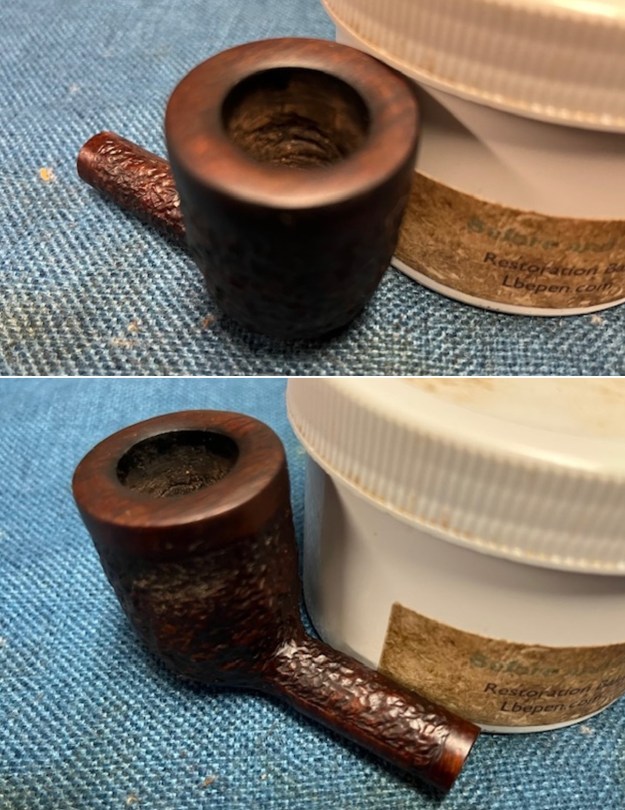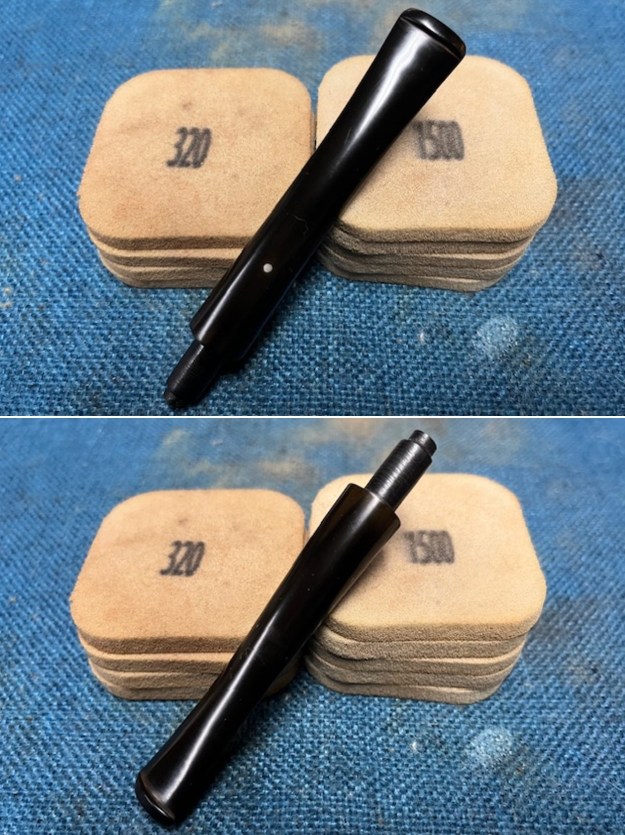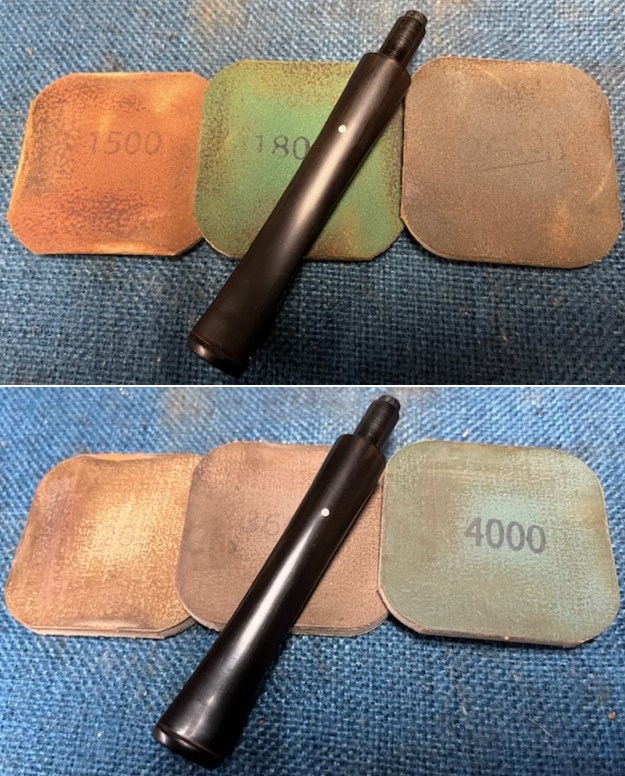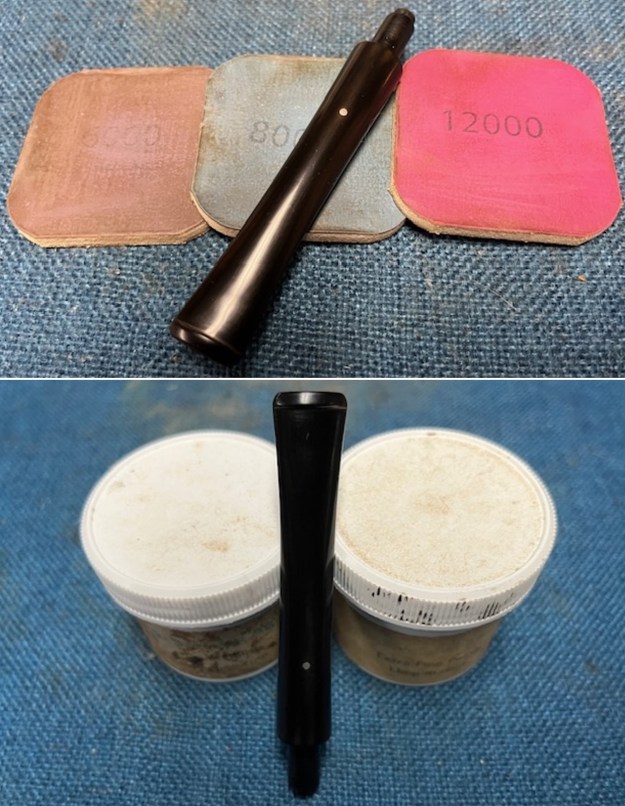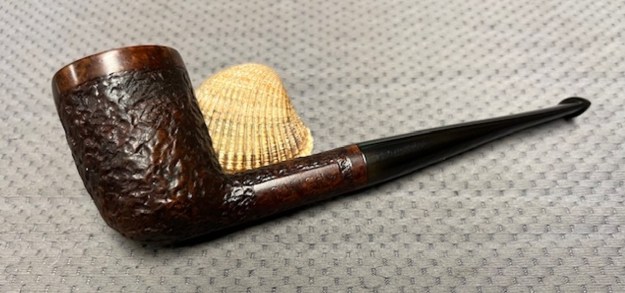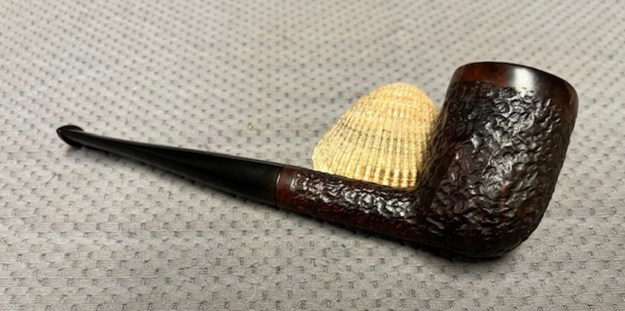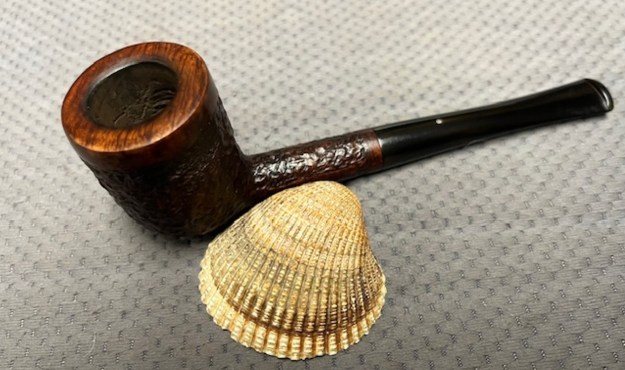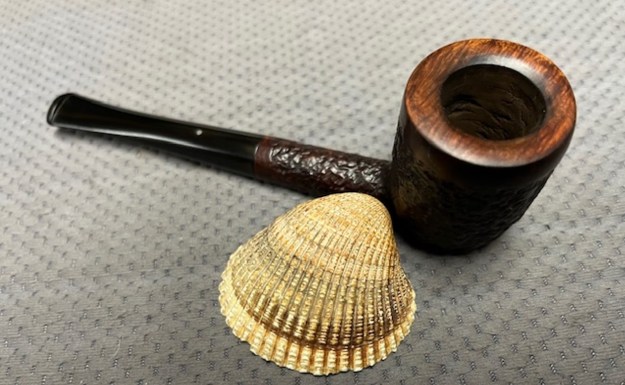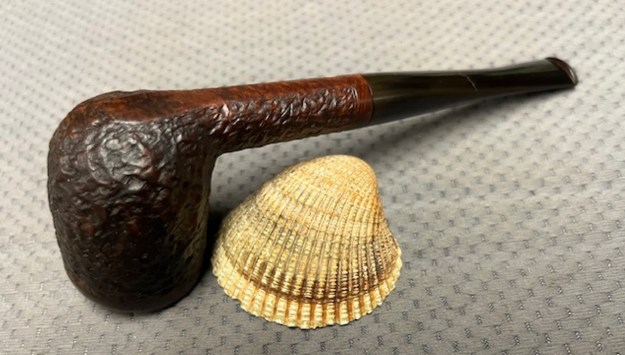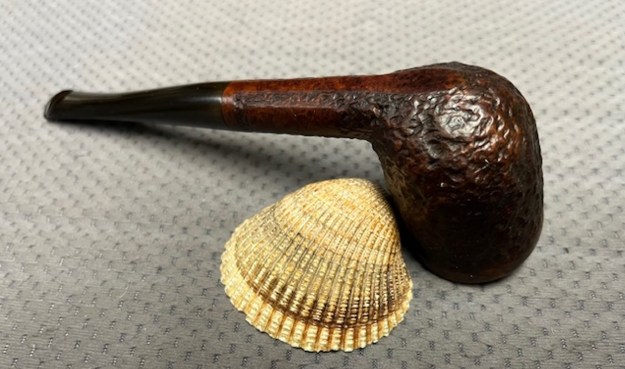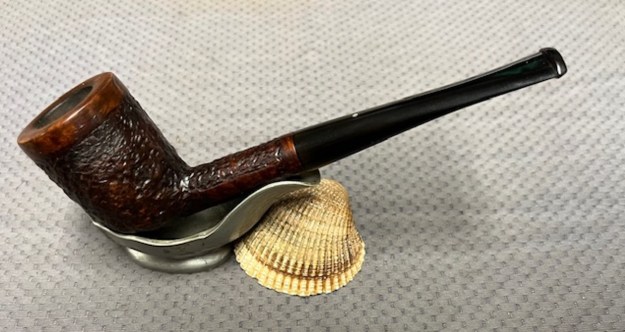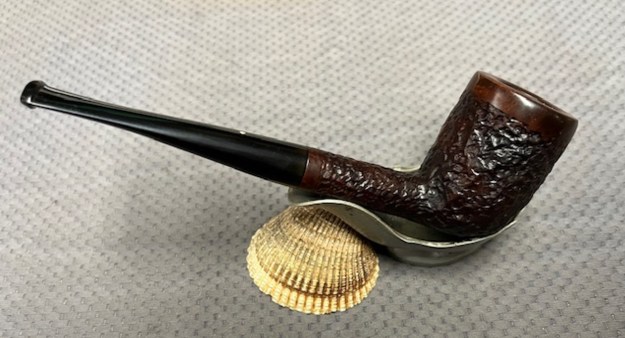
Tag Archives: vulcanite

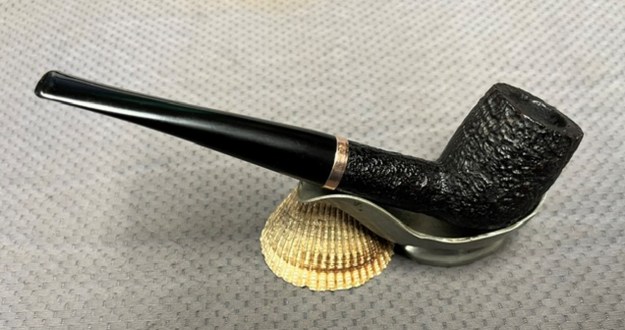
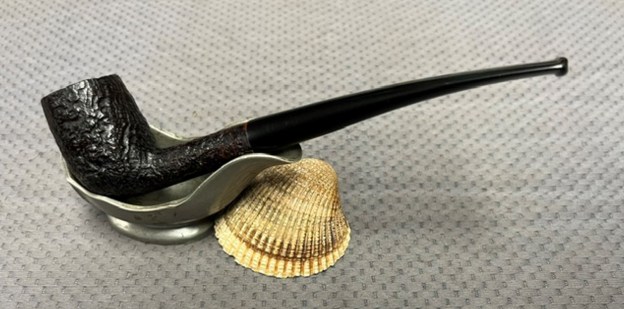
Restoring a 1955 Dunhill Tanshell ES Long Canadian


by Steve Laug

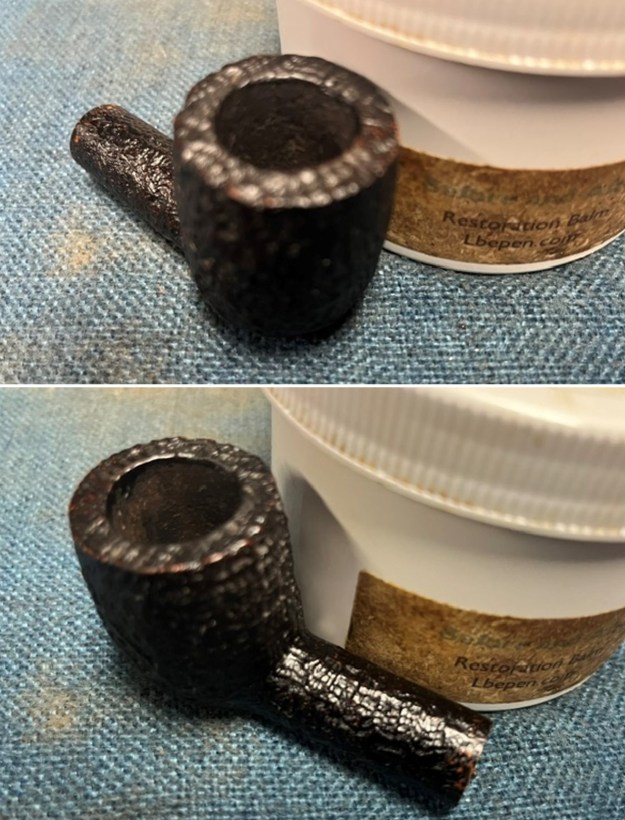
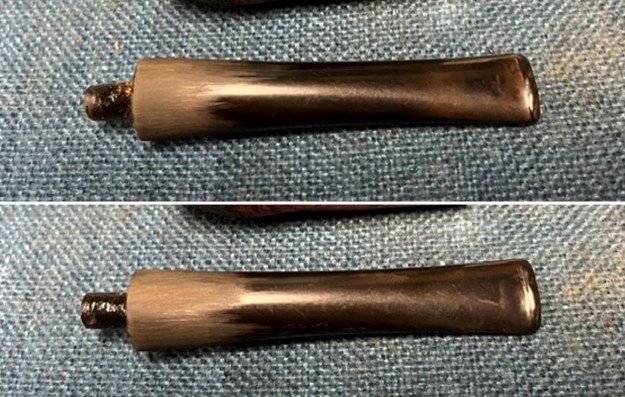
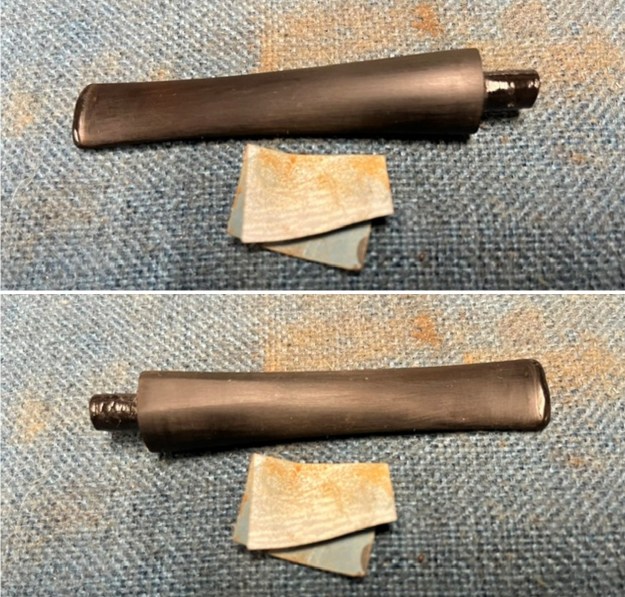
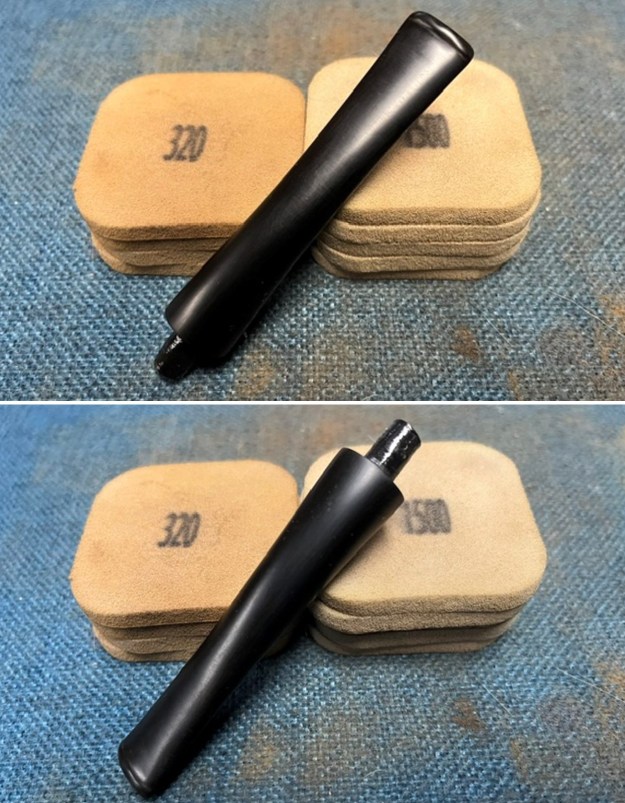
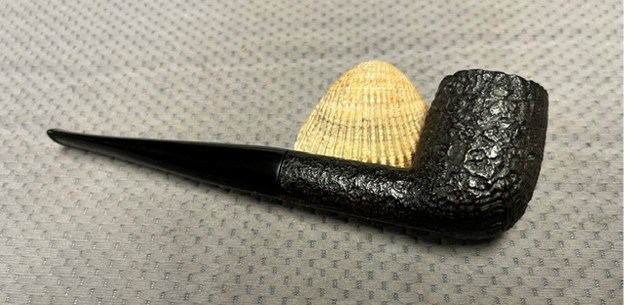
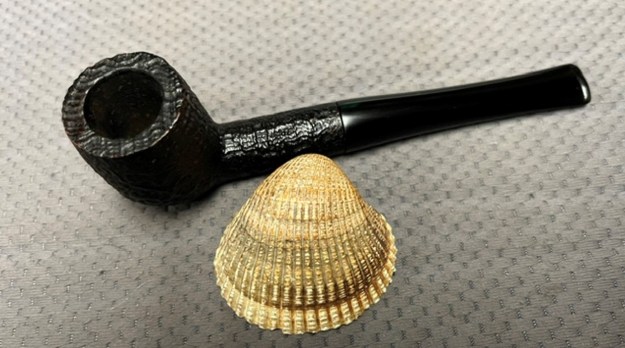
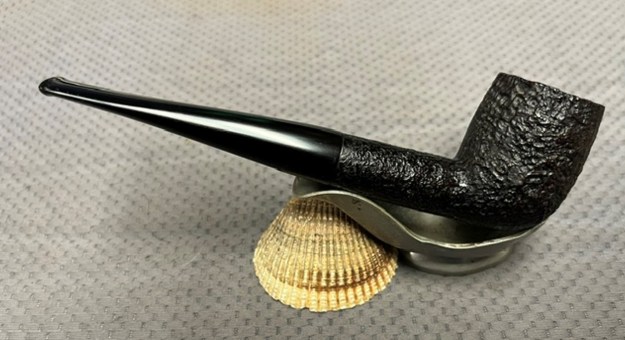
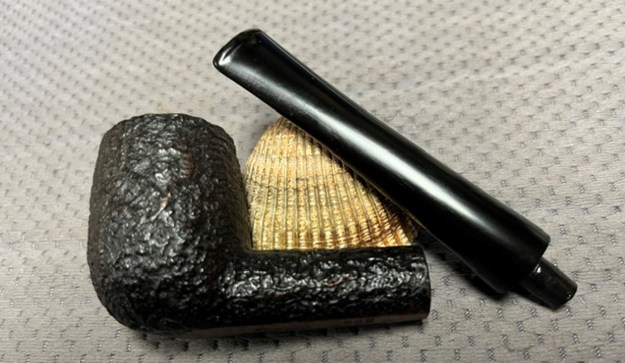
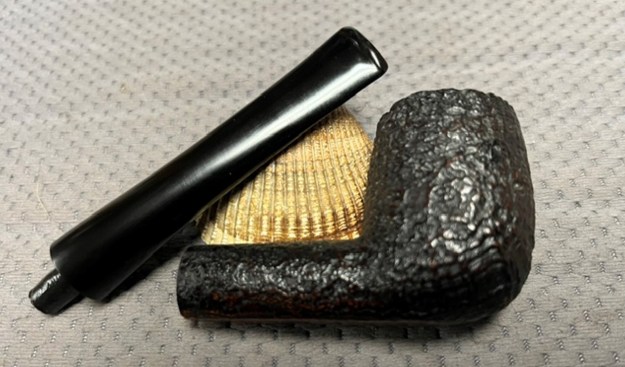
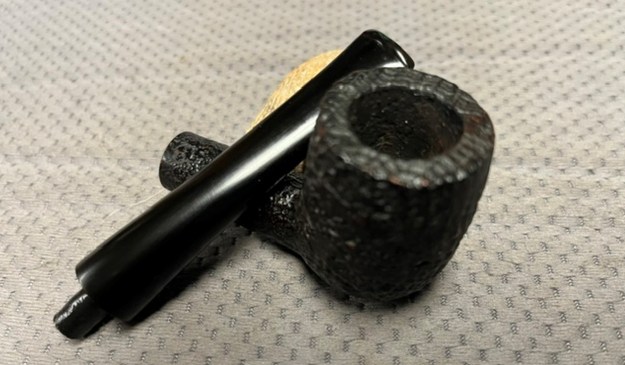
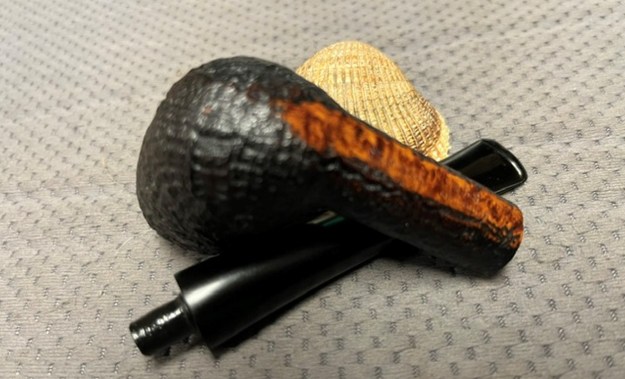
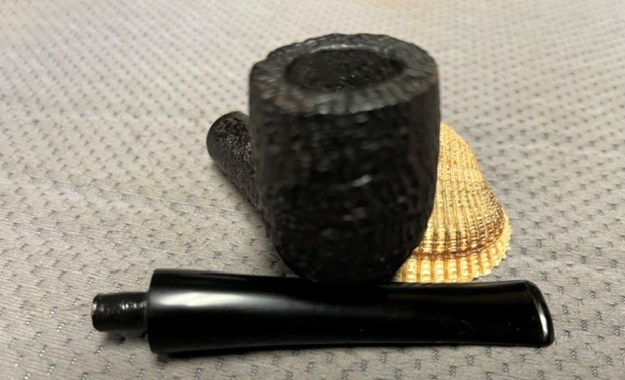
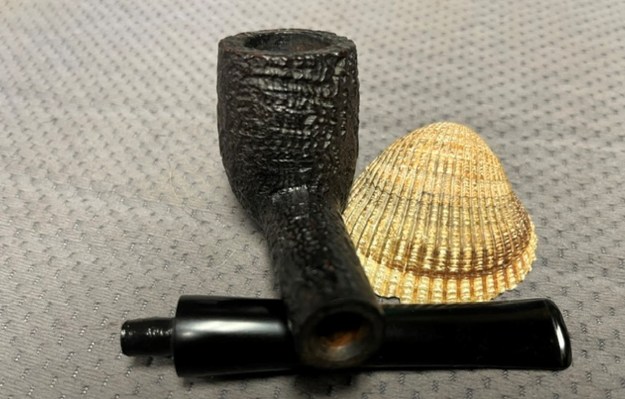
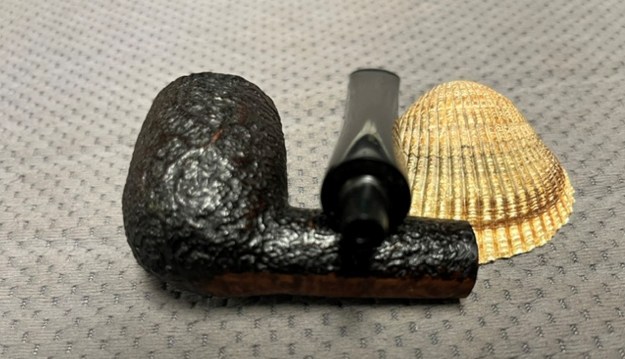
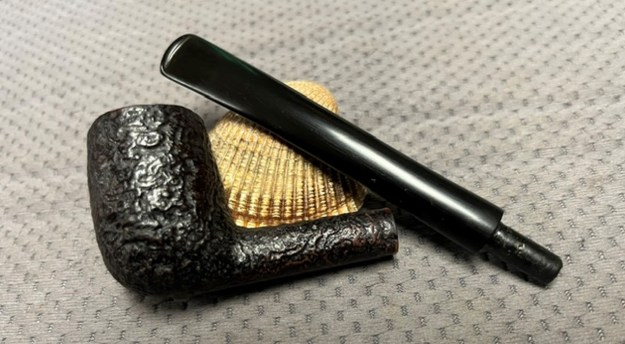
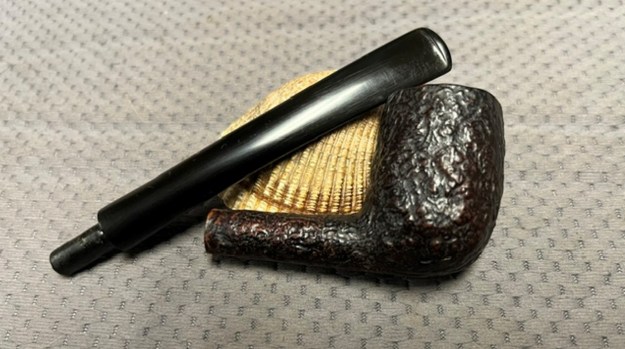
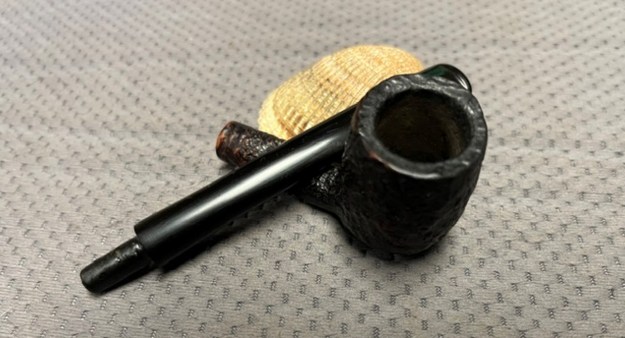
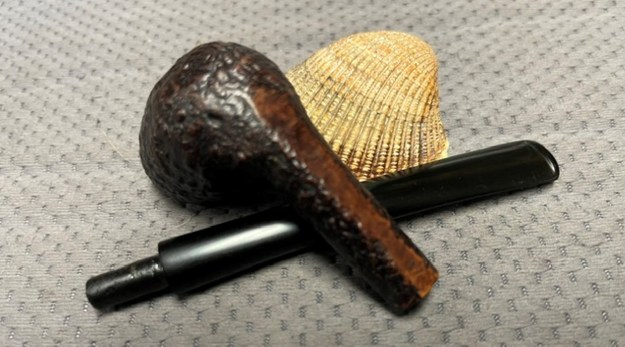
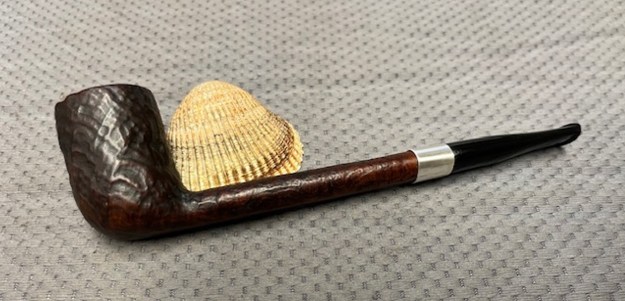
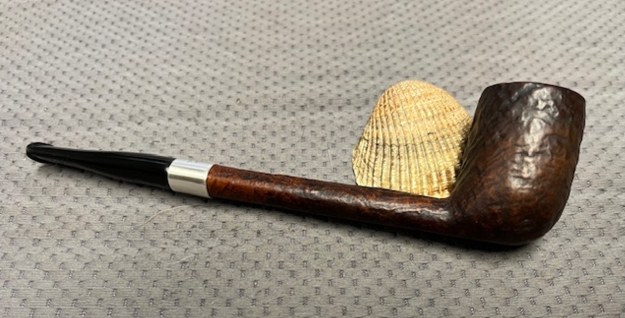
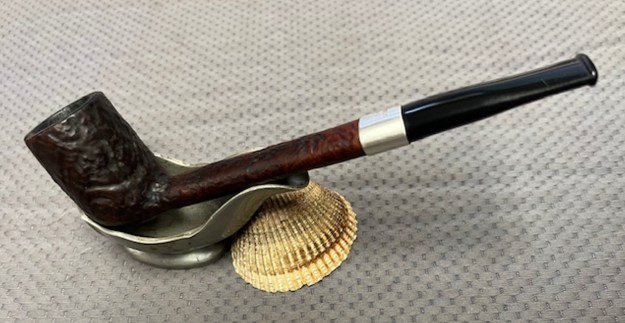
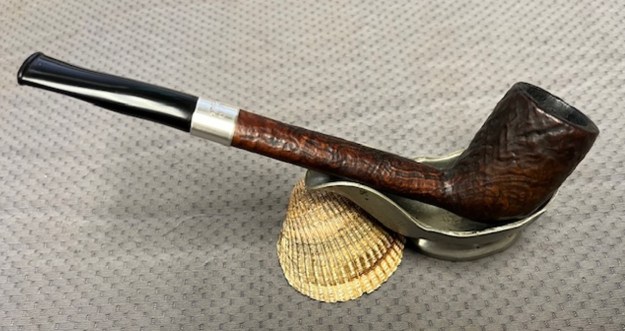
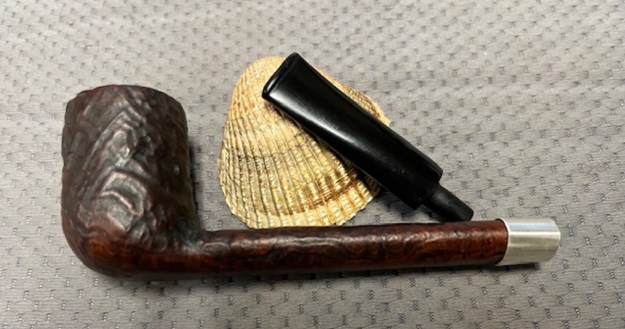
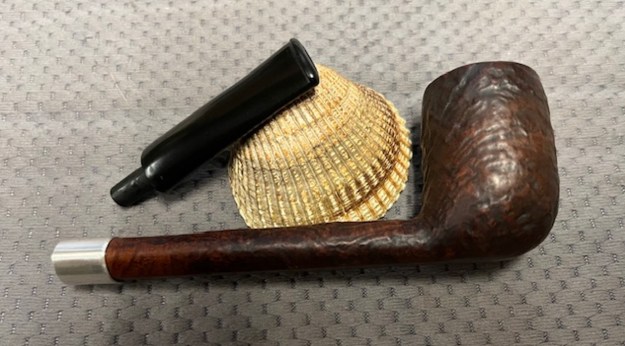
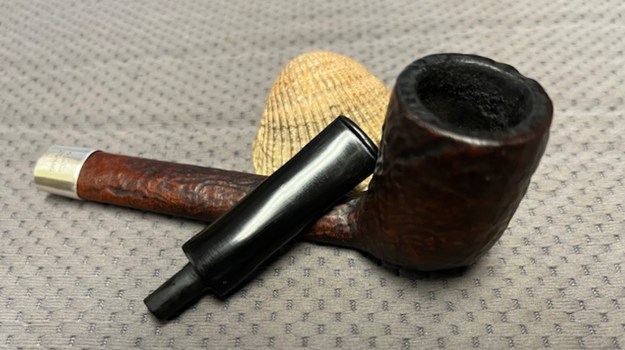
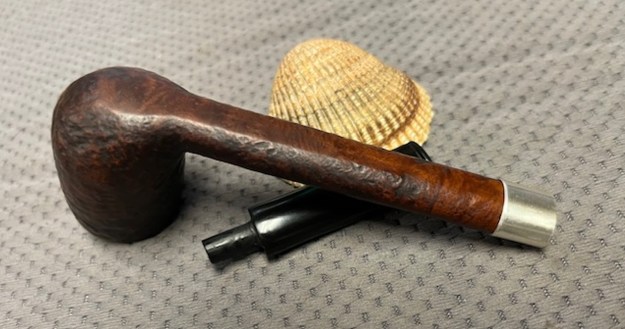
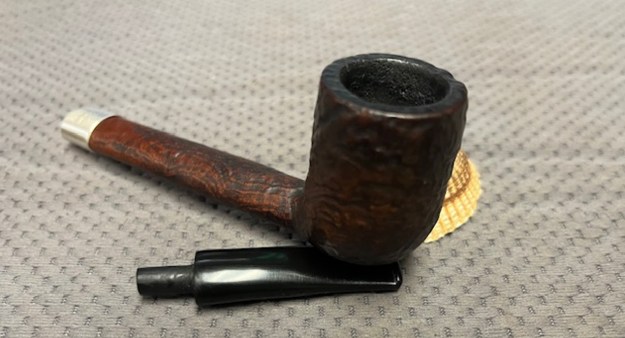
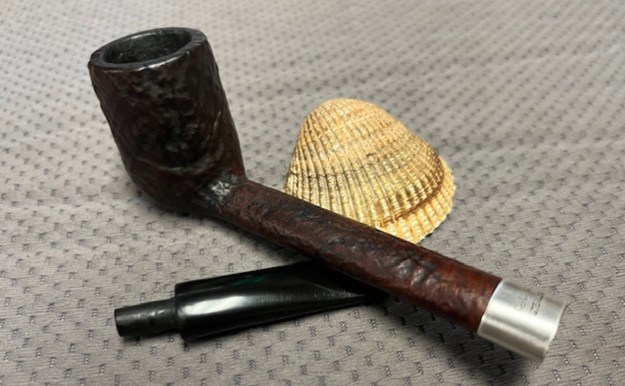
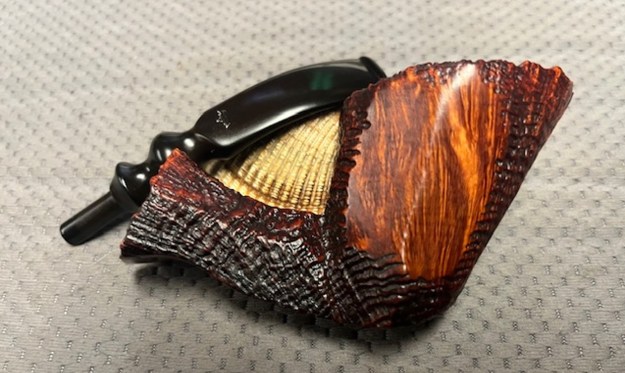
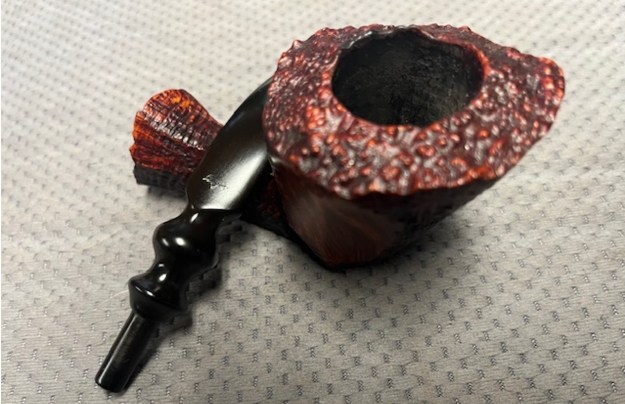
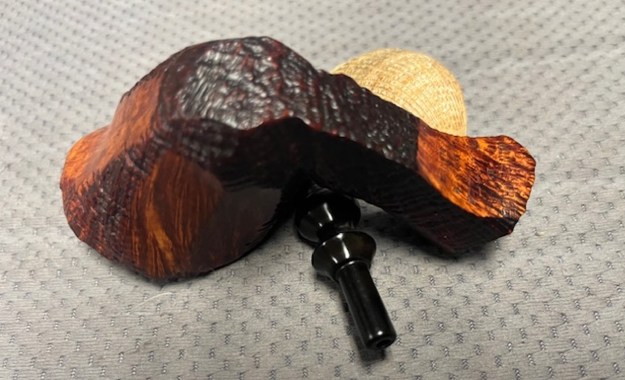
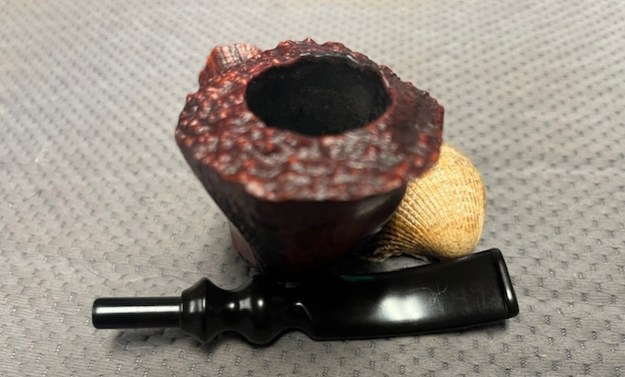
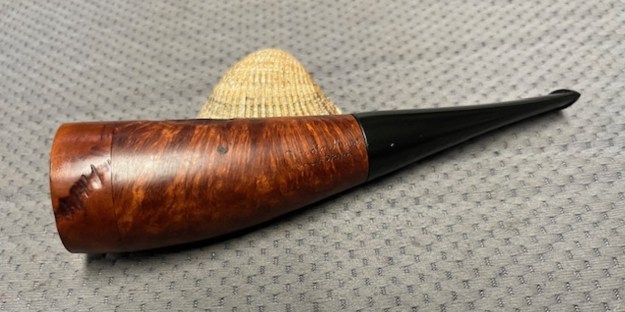
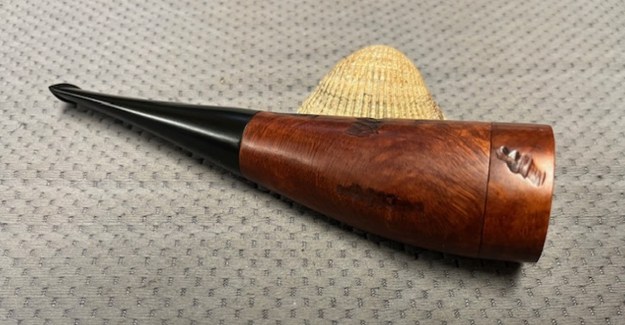
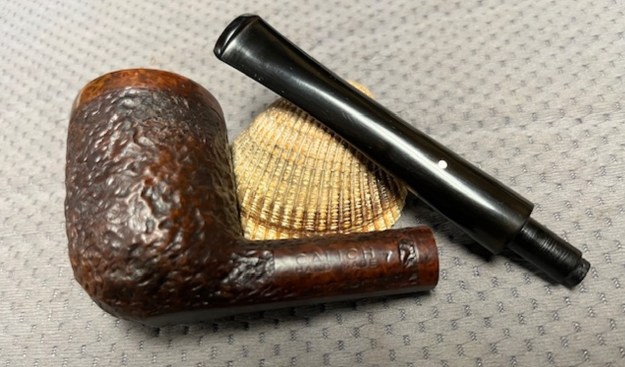
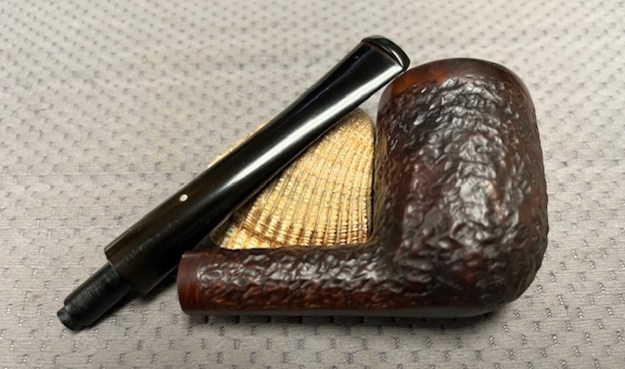
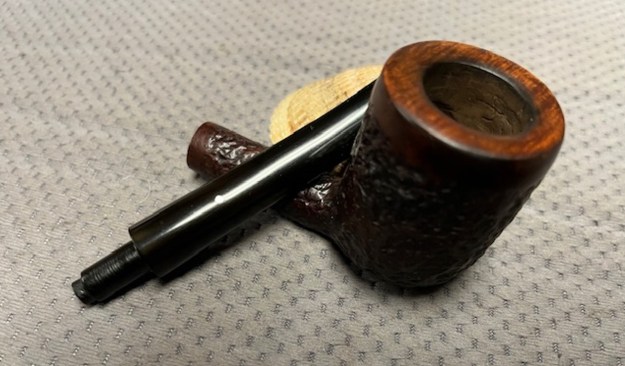
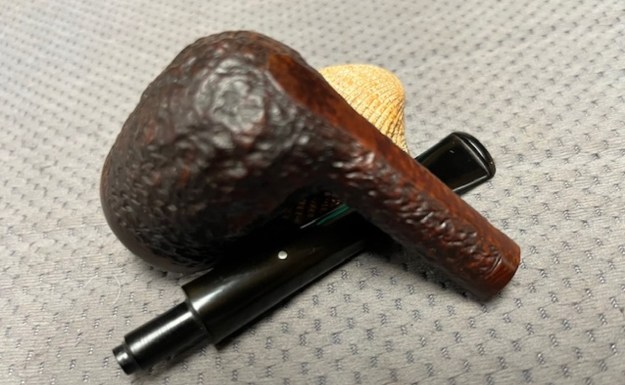
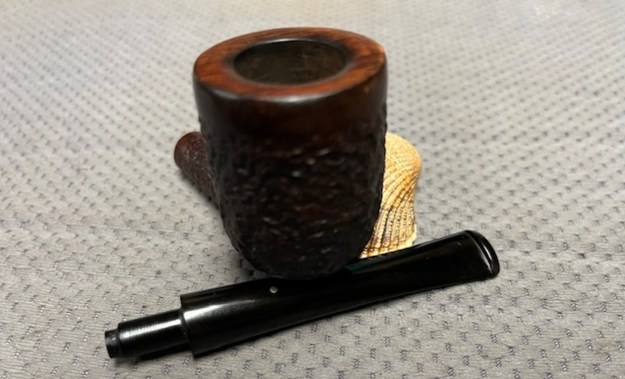
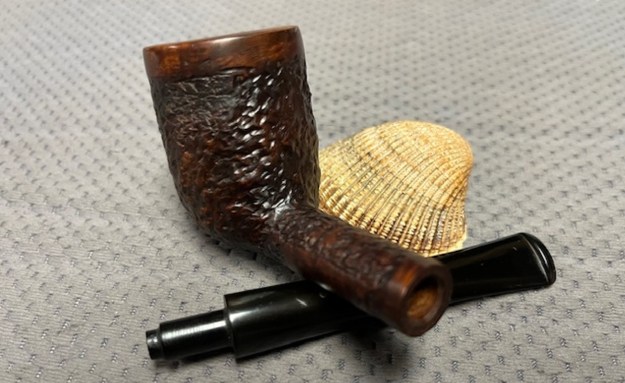
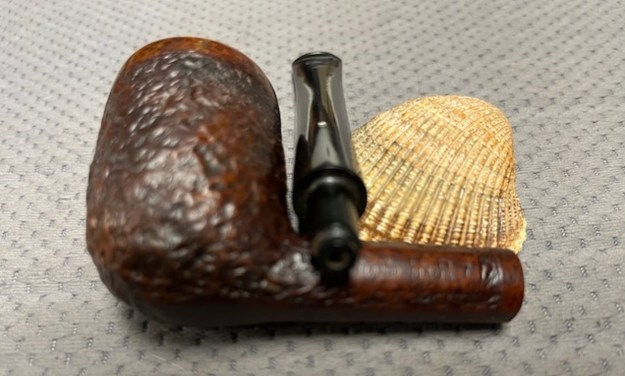
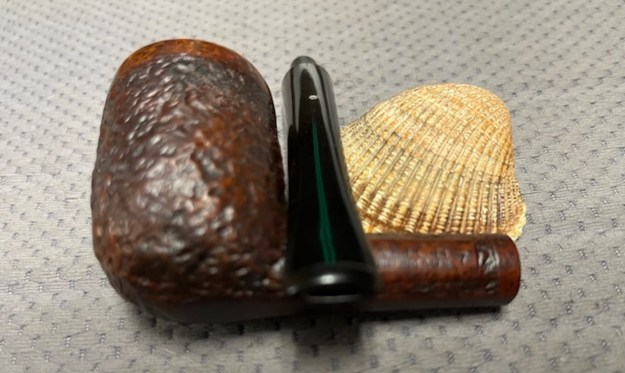
The next pipe on the table is another one that came to us from the seller in Caldwell, Idaho, USA on 07/12/2025. It is a Dunhill Tanshell Canadian with a vulcanite taper stem. It is in dirty but in good condition as can be seen in the photos below. It is stamped on a smooth panel on the underside of the shank and reads ES [followed by] Dunhill [over] Tanshell [followed by] Made in [over] England5 [followed by] circle 4T. The stamping is clear and readable. The pipe has rich Tan and Brown stains on a deep sandblast finish and some amazing grain that the shape follows well. The finish was dusty and lightly dirty with grime in the nooks and crannies of the rugged, deep sandblast. The bowl had a moderate cake and there was tobacco debris in the bowl. The rim top had a thick lava coat in the sandblast rim top and edges. The original white spot short taper stem is dirty and oxidized. I took photos of the pipe to show what it looked like before I started working on it. I took photos of the bowl and rim top to show the thickness of the cake and the lava coat on the rim top. There was some tobacco debris in the bottom of the bowl. The stem photos show the condition of the short taper stem ahead of the button. The stamping on the heel of the bowl is clear and readable as noted above. I took a photo of the pipe with the stem removed to give a sense of the proportions of the pipe. It is a real beauty.One of the first things I like to do is to unpack the stamping and understand each element in it. I turned to Pipephill helpful site (http://pipephil.eu/logos/en/dunhill/shell-briar1.html). The stamping is interpreted as follows: The ES is the shape of the pipe which I assume is a Canadian. The Dunhill Tanshell is the finish. Following the Made In England5 gives the year that the pipe was made. The circle 4 T is the stamp for a Tanshell finish.
I turned to Pipedia’s shape charts on Dunhills (https://pipedia.org/wiki/Dunhill_Shape_Chart). I have included the shape charts from the site. The first is the chart as a whole and the second is a larger version of the centre column.
From the above information I could see that I was working on a Canadian shaped pipe. The chart shows that the ES is the stamping for Canadian.

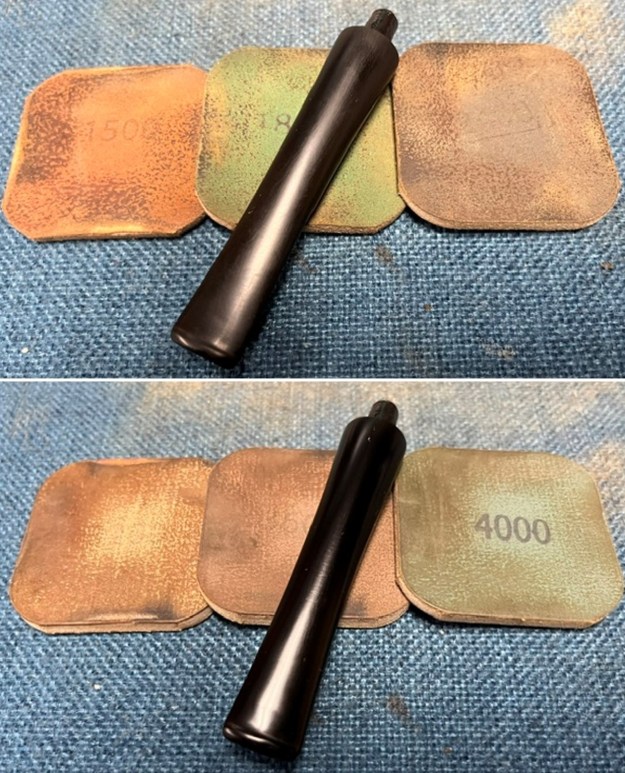
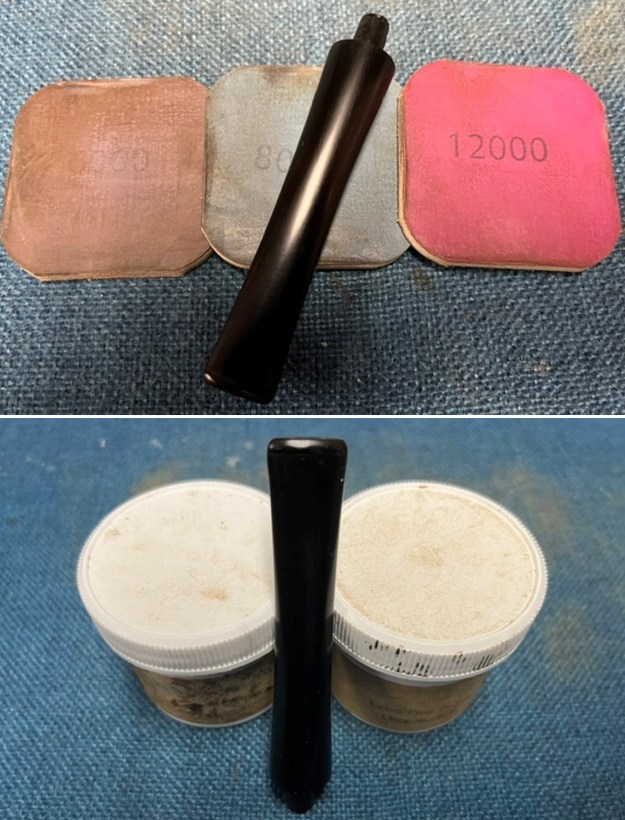
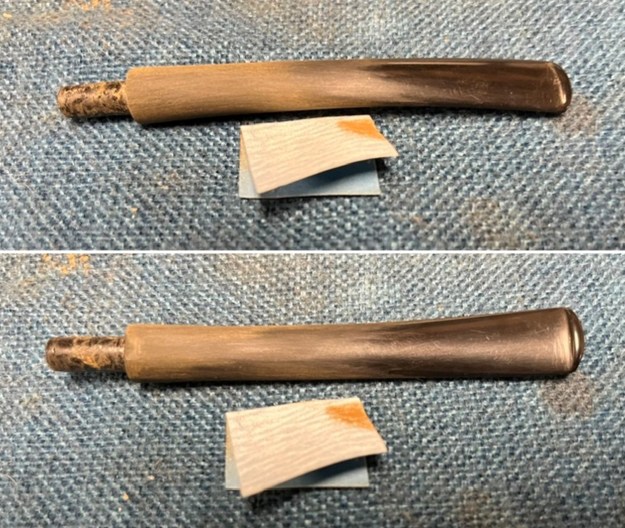
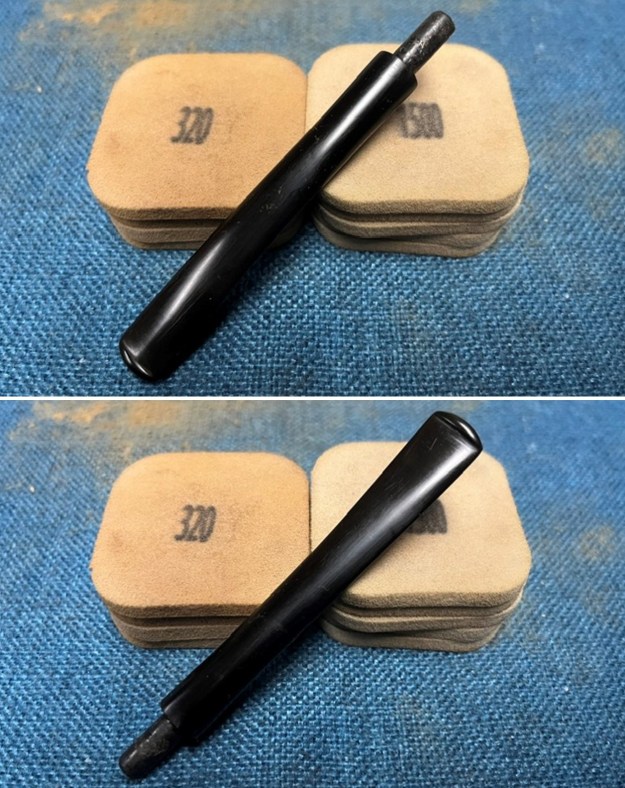
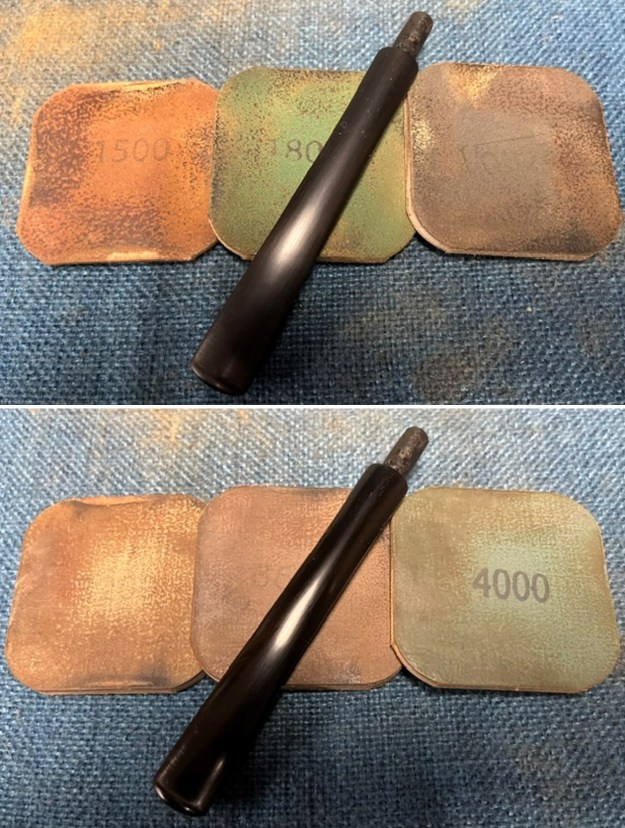
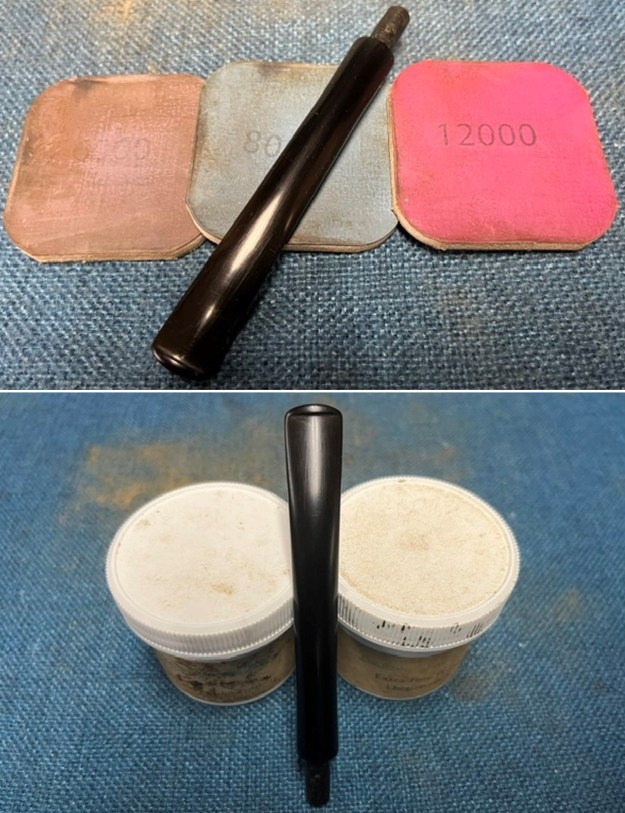
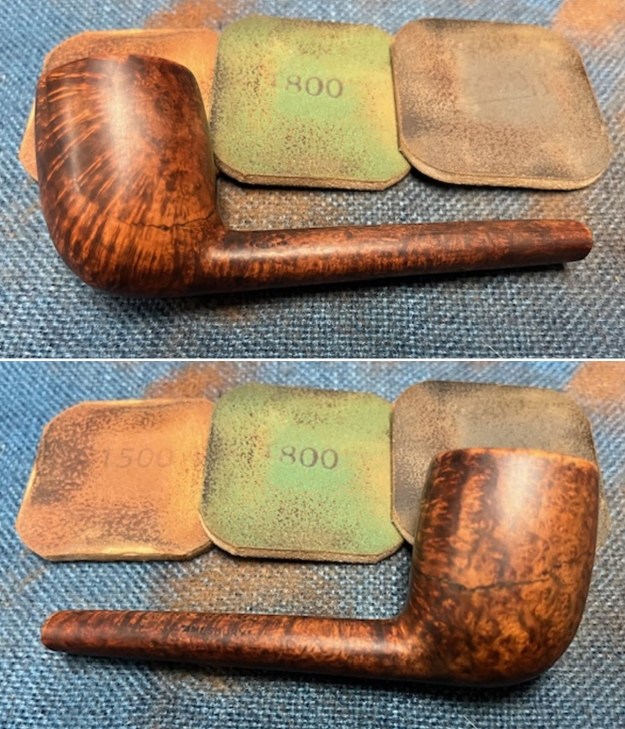
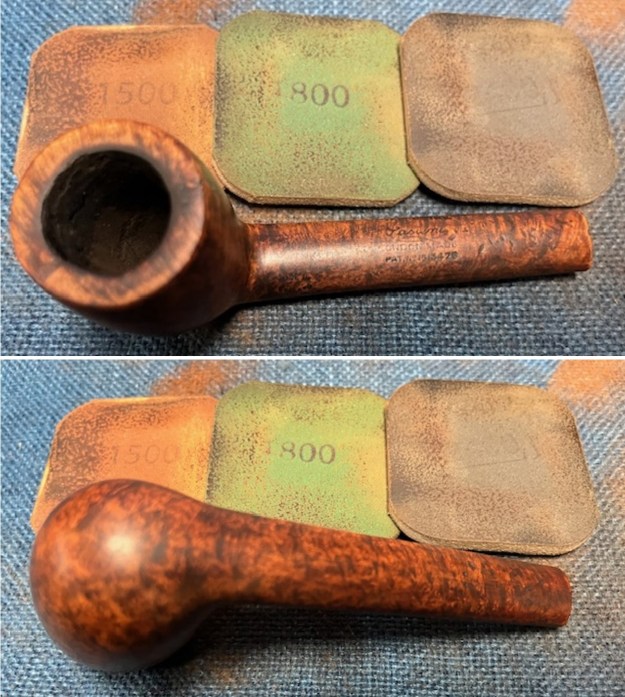
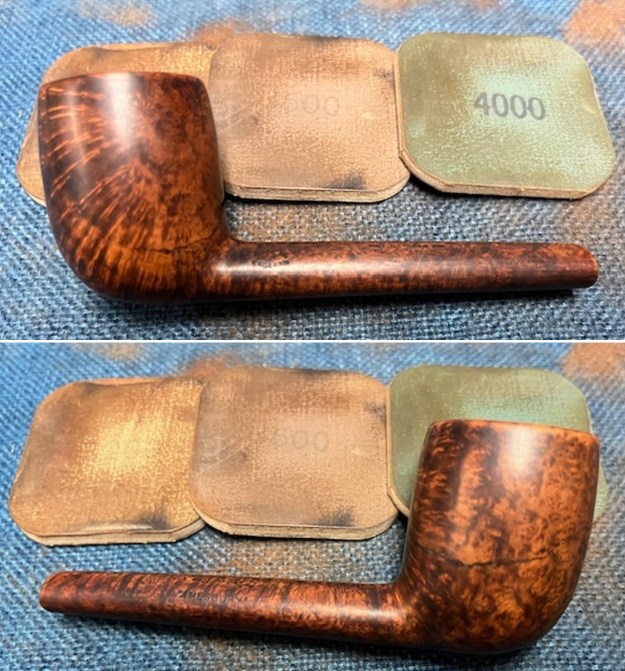
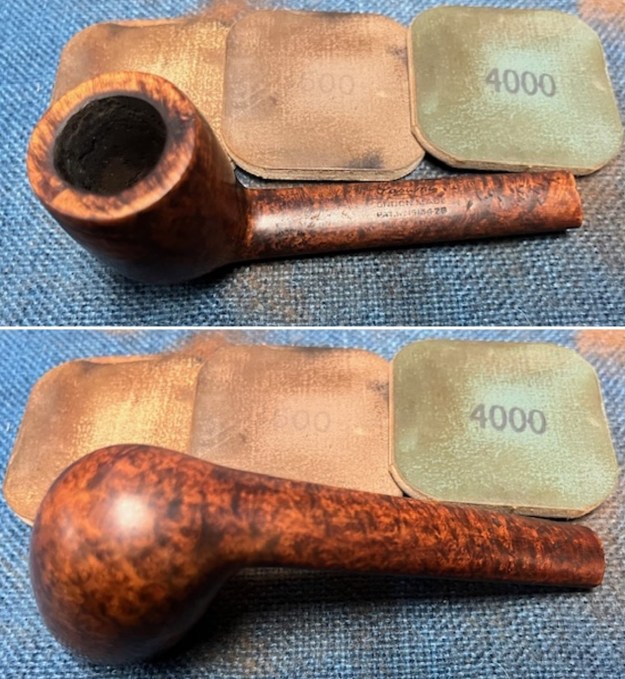
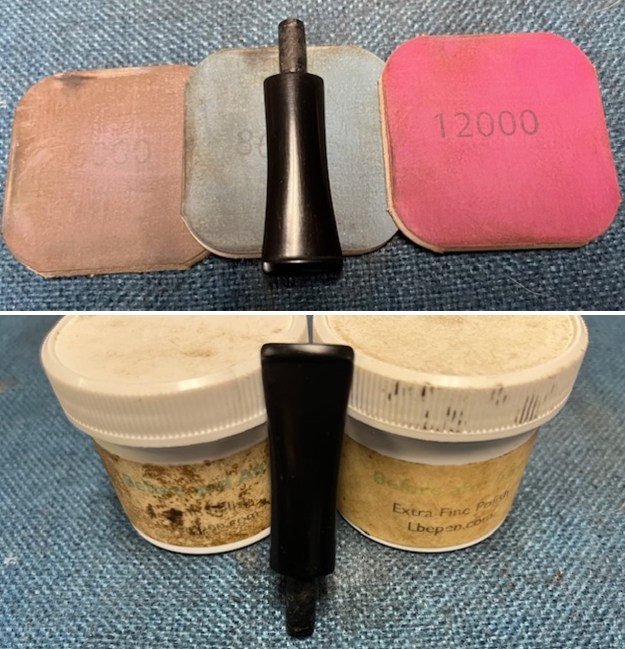
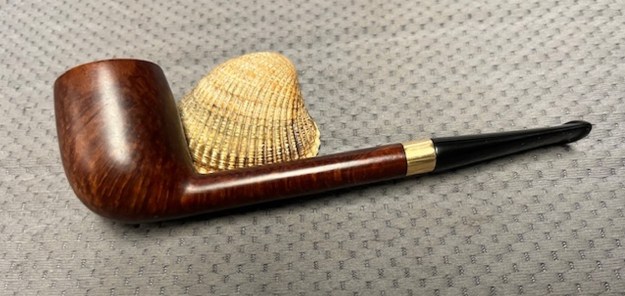
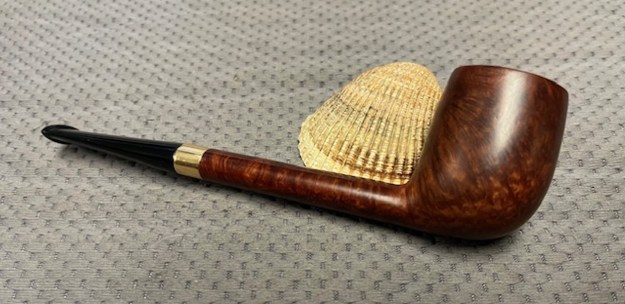
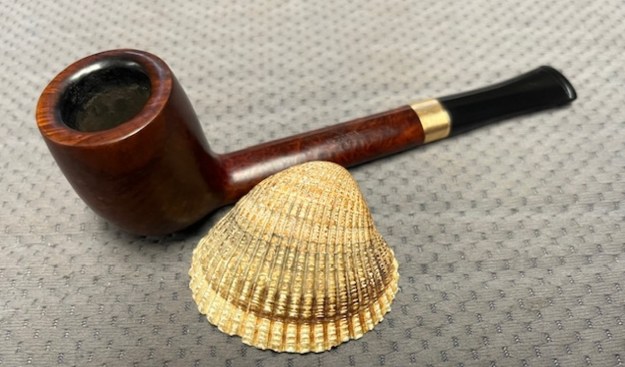
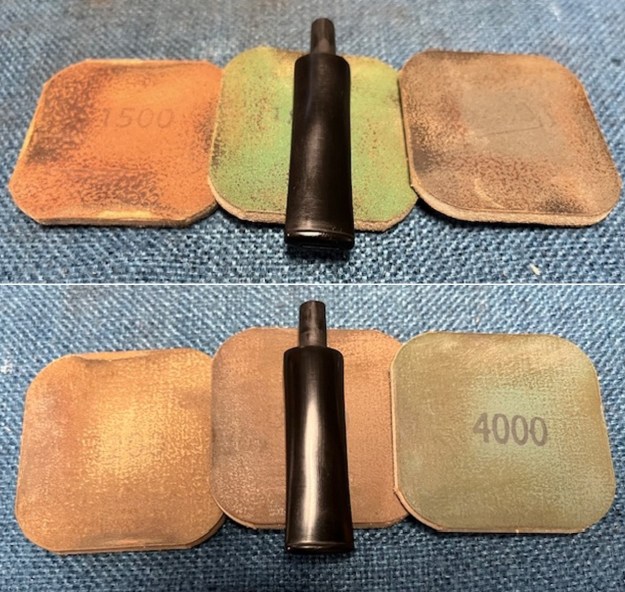
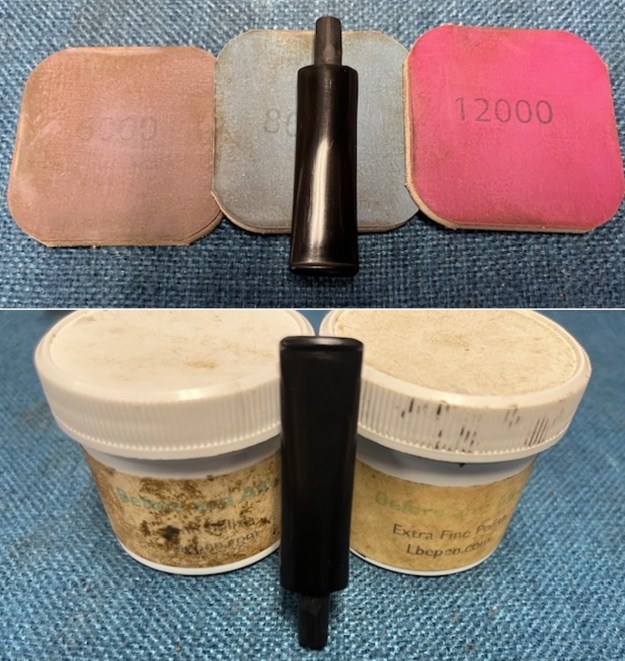
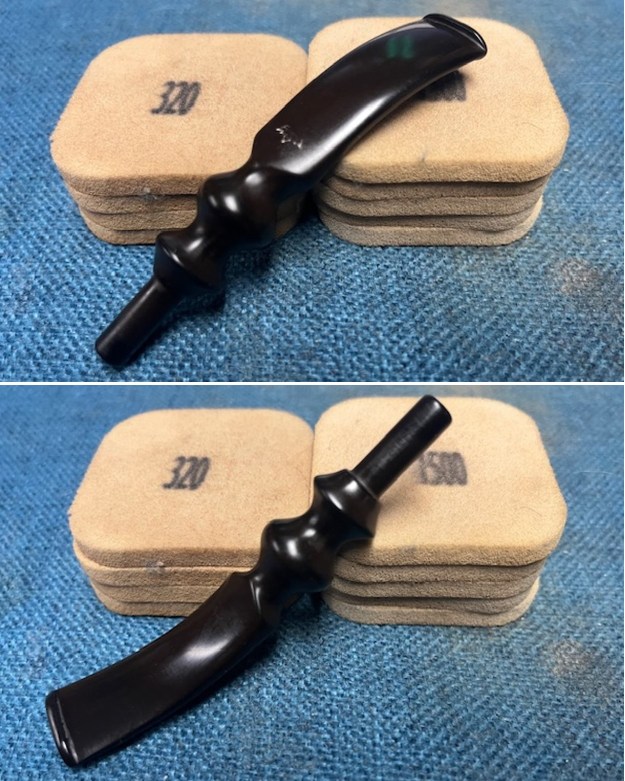
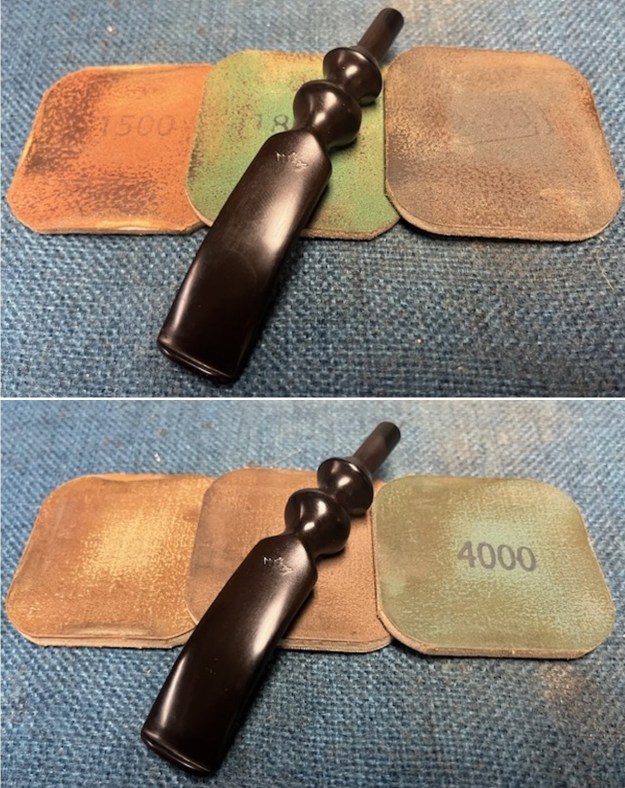
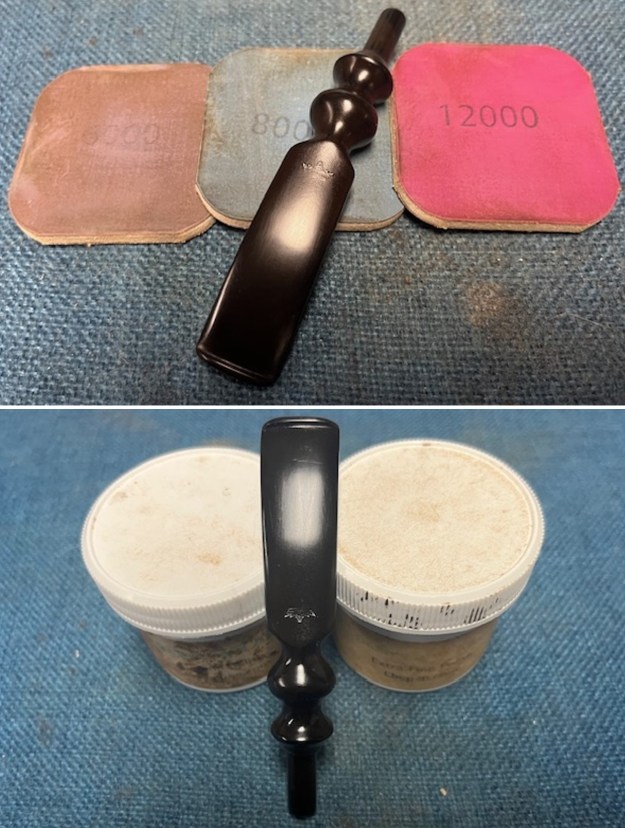
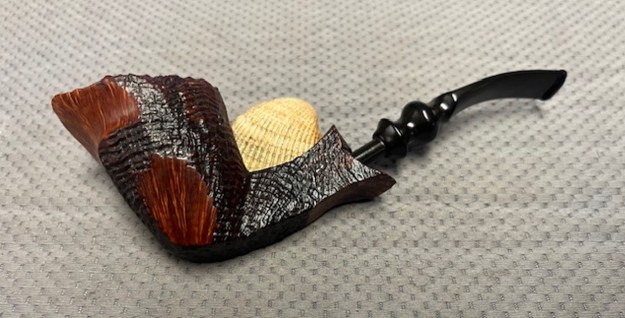
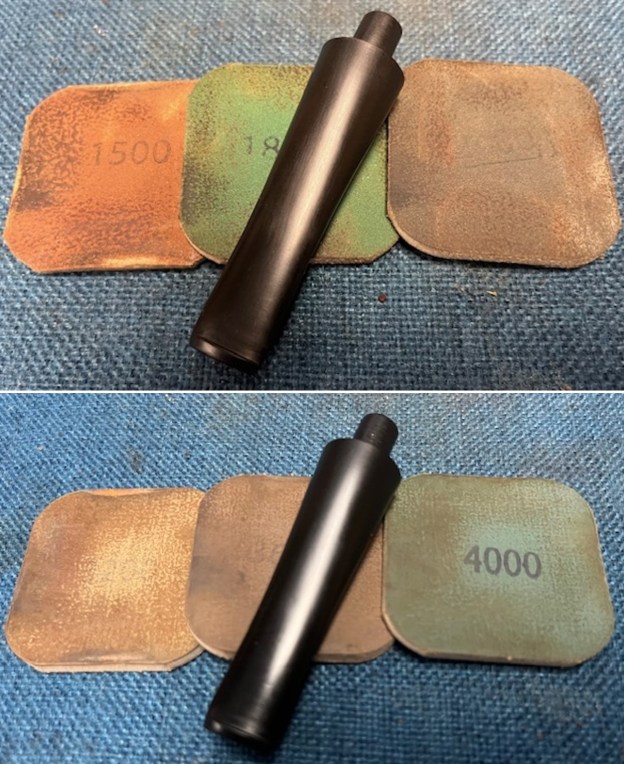
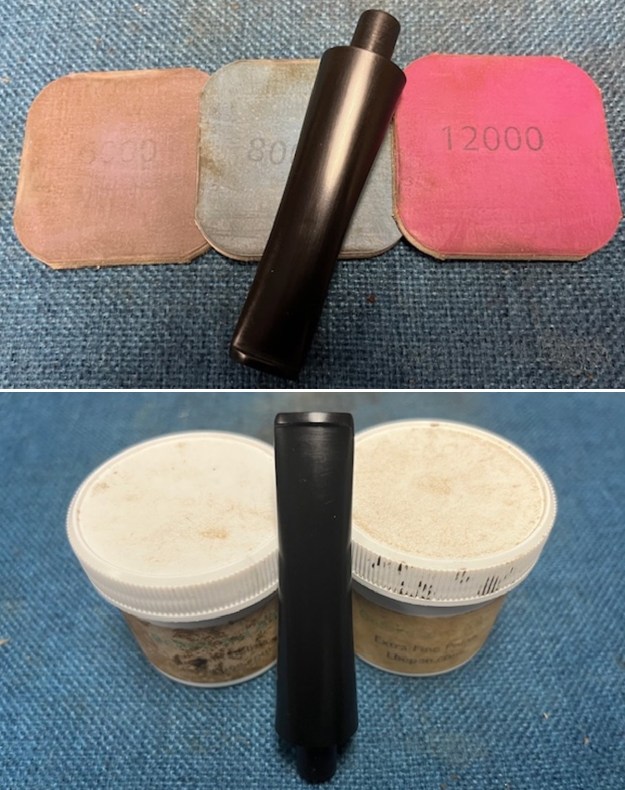
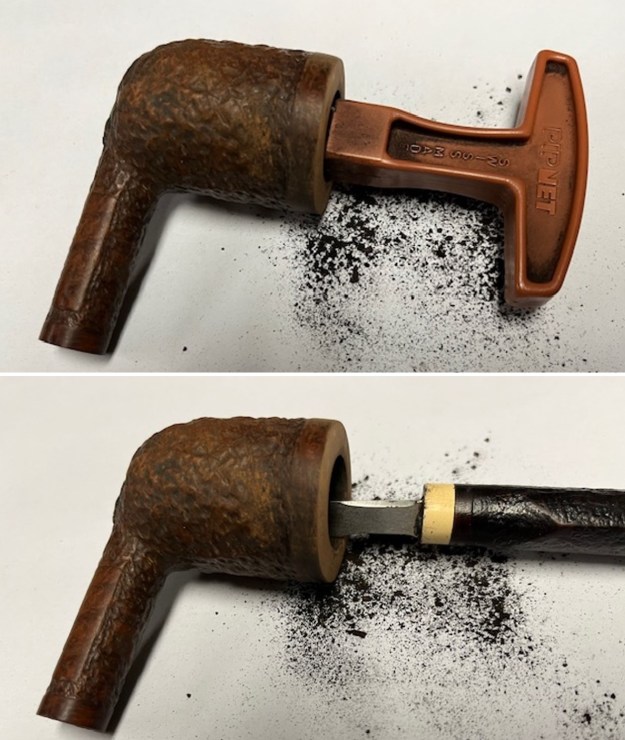
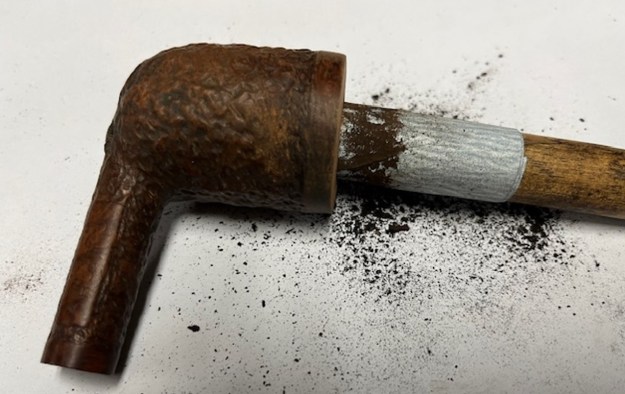
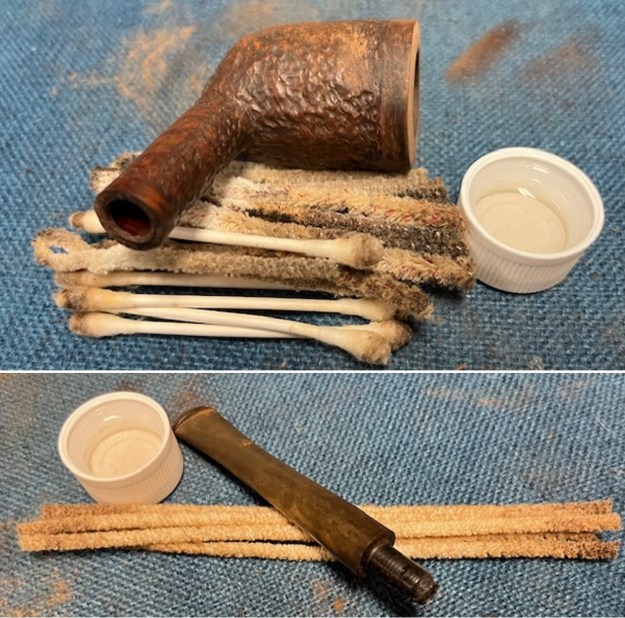
From there I wanted to pin down the date stamp 5. I have included the chart below for you to follow (http://www.pipephil.eu/logos/en/dunhill/cledat-en1a.html). The third column is where the 5-year suffix fits. Because the date code was a raised suffix, the suffix 5 is added to 1950 making the pipe a 1955 Tanshell long Canadian.I turned to work on the pipe itself. I reamed the bowl with a PipNet pipe reamer using the cutting heads 2 and 3. I finished the reaming with a Savinelli Fitsall Pipe Knife. I sanded the walls of the bowl with 220 grit sandpaper wrapped around a piece of dowel. I cleaned out the inside of the shank and the airway in the stem with alcohol, cotton swabs and both bristle and regular pipe cleaners.I scrubbed the bowl and shank with a tooth brush and some undiluted Murphy’s Oil Soap. I rinsed it off with warm water to remove the dust and soap from the finish. I dried it off with a soft cloth. The rim top was still darkened in the grooves of the sandblast.I scrubbed it further with Before & After Briar Cleaner and a brass bristle brush to work the cleaner into the grooves. I rinsed it off and repeated the process until it became cleaner. There is still some darkening in the sandblast that will not come out but it is clean and significantly better.I rubbed the briar down with Before & After Restoration Balm. I worked it into the briar with my fingertips and a horsehair shoe brush to work it into the nooks and crannies of the sandblast finish. The product works to clean, enliven and preserve the briar. I let it sit for 10 minutes then I buffed it with a cotton cloth to deepen the shine. The briar really comes alive with the balm. I set the bowl aside and worked on the stem. I sanded the oxidation and the tooth marks and chatter with 220 grit sandpaper. I was able to remove all of the light tooth damage on the stem and the majority of the oxidation.I sanded the stem and tenon surface with 320-3500 grit 2×2 inch pads. I wiped the stem down with an Obsidian Oil cloth after each sanding pad.I polished the vulcanite with micromesh sanding pads – 1500-12000 grit pads. I wiped it down with Obsidian Oil after each sanding pad. I used Before & After Pipe Polish – both Fine and Extra Fine to further polish the stem. I the polished stem and lightly buffed the sandblast bowl and shank with Blue Diamond to polish out the remaining small scratches and raise the shine. I gave the stem several coats of carnauba wax and the bowl several coats of Conservator’s Wax then buffed the pipe with a clean buffing pad to raise the shine. I hand buffed it with a microfiber cloth to deepen the shine. The pipe polished up pretty nicely. This turned out to be a beautiful 1955 Dunhill Tanshell CS Canadian. Even the darkening on the rim top does not detract from the beauty of the pipe. The finished pipe is shown in the photos below. The dimensions are Length: 6 ½ inches, Height: 1 ¾ inches, Outside diameter of the bowl: 1 ¼ inches, Chamber diameter: ¾ of an inch. The weight of the pipe is 1.16 ounces/33 grams. Thanks for walking through the restoration with me as I worked this beautiful little Dunhill sandblast. I will be putting it on the rebornpipes store in the British Pipe Maker Section soon. If you are interested in adding it to your collection let me know. Thanks for looking.

Restoring a Dunhill Tanshell Briar 6475F/T Friendly Cherrywood


by Steve Laug

The next pipe on the table is another one that came to us from the seller in Caldwell, Idaho, USA on 07/12/2025. It is a Dunhill Tanshell Cherrywood with a vulcanite saddle stem. It is in good condition as can be seen in the photos below. It is stamped on a smooth heel of the bowl and reads 6475 F/T [over] Dunhill Tanshell [over] Made in England11 [over] circle 4T. The stamping is clear and readable. The pipe has rich Tan and Brown stains on a Shell sandblast finish and some amazing grain that the shape follows well. The finish was dusty and lightly dirty with grime in the nooks and crannies of the sandblast. The bowl had a moderate cake and there was tobacco debris in the bowl. The rim top had a thick lava coat on the smooth crowned rim top and edges. The original white spot saddle stem is dirty and oxidized. It had a white Delrin replacement tenon that seemed to be loose. I took photos of the pipe to show what it looked like before I started working on it. I took photos of the bowl and rim top to show the thickness of the cake and the lava coat on the rim top. There was some tobacco debris in the bottom of the bowl. The stem photos show the condition of the saddle stem ahead of the button. The stamping on the heel of the bowl is clear and readable as noted above. I took a photo of the pipe with the stem removed to give a sense of the proportions of the pipe. It is a real beauty.One of the first things I like to do is to unpack the stamping and understand each element in it. I turned to Pipephill helpful site (http://pipephil.eu/logos/en/dunhill/shell-briar1.html). The stamping is interpreted as follows: The F/T is the stamp for a fishtail type stem. The Dunhill Tanshell is the finish. Following the Made In England11 gives the year that the pipe was made. The four digit shape number is a bit of a mystery.

I turned to Pipedia’s shape charts on Dunhills (https://pipedia.org/wiki/Dunhill_Shape_Chart). I quote what was written there and have included the shape charts from the site.

The standard catalog currently encompasses thirty-five distinct shapes, each designated by a two-digit numerical code. From time to time, however, the inherent characteristics of a particular piece of briar lend themselves to the creation of a form that exists outside this established repertoire. These unique, non-standard shapes are collectively referred to by the term “Quaint”. The modern four-digit identification system has been successfully in place for more than three decades, serving Dunhill, its commercial partners, and its clientele with proven efficacy.From the above information I could see that I was working on a Cherrywood shaped pipe but the shape number above did not match that. The chart shows that the Cherrywood was a 20 but there is no 20 number on the pipe I am working on. From there I turned to the next chart on the site which gave a digit by digit breakdown of the shape number. I include the chart below and then underneath I give the break down on the number.

  • The shape number of the pipe is 6475F/T using the chart above here is what the numbers tell us.
  • The first digit 6 is the group size of the pipe making it a large Group6.
  • The second digit 4 is the mouth piece which in this case is a ¼ bent taper but the pipe I am working on is a ¼ bent saddle stem which should be a number 5.
  • The third + fourth digit 75 which does not match anything on the chart above. Even the shape number on the first chart above identifies a Cherrywood as a 20.

From there I turned to another link on Pipedia which gave shape numbers and names on the pipes (https://pipedia.org/wiki/Dunhill_Shapes_List). The site listed that the shape I have in hand is one know as a Group 6 size 475 which is known as a Friendly.

6475 Friendly (=475?) 4 5½” 1950, 1969

From there I wanted to pin down the date stamp 11. I have included the chart below for you to follow (http://www.pipephil.eu/logos/en/dunhill/cledat-en1a.html). The second column is where the 2-year suffix fits. To arrive at the date the suffix 11 is added to 1960 making the pipe a 1971 Tanshell Cherrywood with a saddle stem – a Dunhill Friendly.I also am including a link to a similar pipe in the shape number 475 on the blog that is very similar to the one I am working on.

https://rebornpipes.com/2018/11/09/restoring-an-amazing-1963-dunhill-tanshell-cherrywood-475/

I turned to work on the pipe itself. I reamed the bowl with a PipNet pipe reamer using the cutting heads 2 and 3. I finished the reaming with a Savinelli Fitsall Pipe Knife. I sanded the walls of the bowl with 220 grit sandpaper wrapped around a piece of dowel. I scrubbed the bowl and shank with a tooth brush and some undiluted Murphy’s Oil Soap. I rinsed it off with warm water to remove the dust and soap from the finish. I dried it off with a soft cloth and it looked much better. I worked over the rim top with 320-3500 grit 2×2 inch sanding pads. I wiped the rim top down with a damp cloth after each sanding pad. The crowned smooth rim top looks good.I cleaned out the inside of the shank and the airway in the stem with alcohol, cotton swabs and both bristle and regular pipe cleaners.I rubbed the briar down with Before & After Restoration Balm. I worked it into the briar with my fingertips and a horsehair shoe brush to work it into the nooks and crannies of the sandblast finish. The product works to clean, enliven and preserve the briar. I let it sit for 10 minutes then I buffed it with a cotton cloth to deepen the shine. The briar really comes alive with the balm. I set the bowl aside and worked on the stem. I sanded the oxidation and the tooth marks and chatter with 220 grit sandpaper. I was able to remove all of the tooth damage on the stem and the majority of the oxidation.While I was working on the stem the white acrylic replacement tenon came out in my hand. It had not been glued in place in the stem so it easily slipped out. This was actually great because I wanted to replace it with a black tenon.  I went through my Delrin tenons and found one that was perfect and looked more like the original. I fit it in the shank and to make sure it all fit together correctly.I glued the new tenon in place in the stem with Black CA Glue. Once the glue set on the tenon I worked over the tenon surface with a flat file and 220 grit sandpaper to get a snug fit in the shank. I wiped down the stem and tenon with some Obsidian Oil and it began to look very good. I sanded the stem and tenon surface with 320-3500 grit 2×2 inch pads. I wiped the stem down with an Obsidian Oil cloth after each sanding pad.I polished the vulcanite with micromesh sanding pads – 1500-12000 grit pads. I wiped it down with Obsidian Oil after each sanding pad. I used Before & After Pipe Polish – both Fine and Extra Fine to further polish the stem. I the polished stem and the smooth portions of the Cherrywood bowl with Blue Diamond to polish out the remaining small scratches and raise the shine. I gave the stem several coats of carnauba wax and the bowl several coats of Conservator’s Wax then buffed the pipe with a clean buffing pad to raise the shine. I hand buffed it with a microfiber cloth to deepen the shine. The pipe polished up pretty nicely. This turned out to be a beautiful Dunhill Tanshell 6475F/T Cherrywood Friendly. The finished pipe is shown in the photos below. The dimensions are Length: 5 ½ inches, Height: 1 ¾ inches, Outside diameter of the bowl: 1 ½ inches, Chamber diameter: ¾ of an inch. The weight of the pipe is 1.48 ounces/42 grams. Thanks for walking through the restoration with me as I worked this beautiful little Dunhill sandblast. I will be putting it on the rebornpipes store in the British Pipe Maker Section soon. If you are interested in adding it to your collection let me know. Thanks for looking.

Restoring a 1962 Dunhill Shell F/T Full Bent Cavalier


by Steve Laug

The next pipe on the table is another one that came to us from the seller in Caldwell, Idaho, USA on 07/12/2025. It is a Dunhill Shell Briar Cavalier with a briar bowl, a stainless tube that fit snugly in the bowl, a vulcanite bullet that fit on the tube and a knurled cap that fit on the bottom of the bullet with a wool filter pad inserted in it. The thin bent vulcanite stem fit in the top of the bullet and then bullet fit on the tube. It is in good condition as can be seen in the photos below. It is stamped on a smooth heel of the bowl. On the heel of the bowl it is stamped with the shape F/T [over] Dunhill Shell [over] Made in England2 [over] circle 4S. The stamping is clear and readable. The pipe has a mix of black, cordovan and brown stains on a Shell sandblast finish and some amazing grain that the shape follows well. The finish was dusty and lightly dirty with grime in the nooks and crannies of the sandblast. The bowl had a moderate cake and there was lava and dust in the sandblasted rim top and edges. The vulcanite bullet piece was oxidized but otherwise looks good. The original white spot stem is on the pipe and is dirty and oxidized. I took photos of the pipe to show what it looked like before I started working on it. I took photos of the bowl and rim top to show the thickness of the cake and the lava coat on the rim top. There was some tobacco debris in the bottom of the bowl. The oxidized bullet shaped vulcanite filter shank is visible in the photos. The stem photos show the condition of the stem ahead of the button. I took the stem off the bowl and bullet and took photos of the pipe parts. It is an interesting pipe to look at. The deep sandblast really makes the grain stand out on the bowl sides.I took apart the bullet shank and showed the parts below. The knurled base cap on the bullet unscrewed from the bullet itself. It had a round wool filter pellet that filled the base. The stem and bullet itself are heavily oxidized. The stamping on the heel of the bowl is clear and readable as noted above. The gold ferrule on the shank and cap on the stem looks good. I took a photo of the pipe with the stem removed to give a sense of the proportions of the pipe. It is a real beauty.One of the first things I like to do is to unpack the stamping and understand each element in it. I turned to Pipephill helpful site (http://pipephil.eu/logos/en/dunhill/shell-briar1.html). The stamping is interpreted as follows: The F/T is the stamp for a fishtail type stem. The Dunhill Shell is the finish. Following the Made In England2 gives the year that the pipe was made.

The dating chart helped me understand the date stamp 2. I have included the chart below for you to follow (http://www.pipephil.eu/logos/en/dunhill/cledat-en1a.html). The second column is where the 2-year suffix fits. To arrive at the date the suffix is added to 1960 making the pipe a 1962 Shell Cavalier.I googled Dunhill Shell Cavalier and found some great information on the line on the site below (https://www.falkum.de/en/dunhill-cavalier-pfeife.html). I quote below:

Dunhill Cavalier pipe, size 4, in full bent shape with Shell Briar finishing.

The Cavalier pipe was especially designed by Dunhill for British officers of the West-Indian and African-corps. The pipe could be taken apart in its pieces quickly (removable bowl, middle part and mouthpiece) so they would fit easily into the breast pocket of a field jacket. In the hot and humid tropics the removable, so called ”watersack“ at the bottom of the basic part proved as a simple, but brilliant solution against the built-up of humidity and condensate.

For many years this special model has been the most much sought-after pipe by Dunhill collectors. Only within the last years Dunhill increased slightly the production of this unusual pipe which is still hard to find.

I turned to work on the pipe itself. I reamed the bowl with a PipNet pipe reamer using the cutting heads 2 and 3. I finished the reaming with a Savinelli Fitsall Pipe Knife. I sanded the walls of the bowl with 220 grit sandpaper wrapped around a piece of dowel. I used a brass bristle wire brush to clean off the debris in the sandblast on the rim top. The sandblast was clean and dry with no debris in the valleys of the sandblast.I scrubbed the bowl and shank with a tooth brush and some undiluted Murphy’s Oil Soap. I rinsed it off with warm water to remove the dust and soap from the finish. I dried it off with a soft cloth and it looked much better. I cleaned out the inside of the shank, the bullet with the catchment base and the stem with alcohol, cotton swabs and both bristle and regular pipe cleaners. I rubbed the briar down with Before & After Restoration Balm. I worked it into the briar with my fingertips and a horsehair shoe brush to work it into the nooks and crannies of the sandblast finish. The product works to clean, enliven and preserve the briar. I let it sit for 10 minutes then I buffed it with a cotton cloth to deepen the shine. The briar really comes alive with the balm. I set the bowl aside and turned my attention to the Bullet shank on the pipe. I sanded the bullet with 320-3500 grit 2×2 inch sanding pads. I wiped the bullet down each time with a cloth impregnated with Obsidian Oil. It is looking much better at this point.I polished the bullet with 1500-12000 grit sanding pads. I wiped it down after each sanding pad with a cloth impregnated with Obsidian Oil. It really began to take on a shine. I set the bullet aside and turned to address the stem. I sanded the stem surface with 320-3500 grit 2×2 inch pads. I wiped the stem down with an Obsidian Oil cloth after each sanding pad.I polished the vulcanite with micromesh sanding pads – 1500-12000 grit pads. I wiped it down with Obsidian Oil after each sanding pad. I used Before & After Pipe Polish – both Fine and Extra Fine to further polish the stem. This 1962 Dunhill Shell F/T Cavalier has a beautiful, unique Dunhill Sandblast finish. The rich Shell finish that is identified with some great grain around the bowl and shank. It has some great rugged sandblast that Dunhill specialized in making. The polished vulcanite bullet and moisture trap look very good. The polished black vulcanite bent taper stem adds to the mix. I put the stem back on the bowl and buffed the pipe with Blue Diamond on the buffing wheel being careful to not buff the stamping. I gave the bowl and the stem multiple coats of carnauba wax on the buffing wheel and followed that by buffing it with a clean buffing pad. I hand buffed the pipe with a microfiber cloth to deepen the shine. The finished Dunhill Shell F/T Cavalier is quite nice and feels great in the hand. Give the finished pipe a look in the photos below. The dimensions of the pipe are Length: 6 inches, Height: 1 ¾ inches, Outside diameter of the bowl: 1 ¼ inches, Chamber diameter: ¾ of an inch. The weight of the pipe is 35 grams/1.20 ounces. This one will be going into my own personal collection. Thanks for walking through the restoration with me as I worked over another beautiful pipe Thanks for your time.

Rethinking the Repair of Damaged Stems


by Kenneth Lieblich

Welcome to another installment of my Pipe Incident Reports. The idea, in general, is to provide a brief write-up – focusing on a particular pipe-restoration-related issue – rather than an entire restoration story. I’ve been blessed by a precious few God-given talents in my life, but innovation is not among them. I’m not usually able to come up with groundbreaking ideas to do things differently. Having said that, I do try and improve my repair/restoration skills, techniques, and procedures wherever I can. One can call it kaizen or whatever, but I try to find better ways of restoring pipes.Today, I am attempting to improve the process of repairing stem bite-throughs by incorporating steel mesh. Now, you might be thinking, ‘That’s not a sentence I ever expected to read’, and you are justified in that thought.

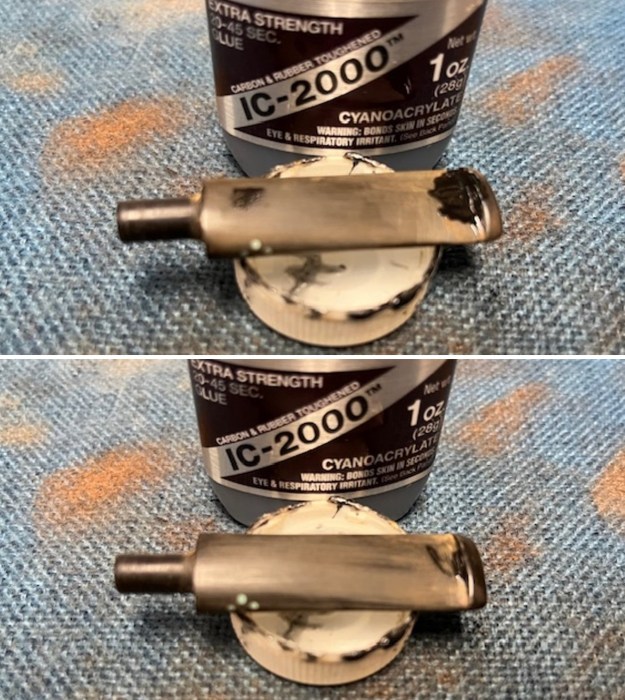
Many pipe repairmen have used various methods for repairing bite-throughs (holes) in vulcanite. Normally, this involves mixing cyanoacrylate adhesive with activated charcoal or powdered vulcanite. Some fellows have also tried some sort of epoxy to bring the stem back to life. In fact, when I started doing pipe repairs, I used that mixture of cyanoacrylate adhesive and activated charcoal. Then I discovered a black-tinted cyanoacrylate adhesive that came pre-mixed with rubber and charcoal. I introduced this product to Steve and it’s what he and I have been using ever since. However, I have always wondered about the durability of these repairs – especially against the bite of a man’s jaw. I wondered, could there be a better way?

Maybe. Read on, but please note: what I am proposing is NOT a complete solution. This is an idea that I hope someone will take and turn into a workable method.

I decided to test a pipe-stem repair with the aforementioned adhesive built around a stainless-steel wire-mesh structure. My thinking is that this would enhance the strength and durability of said repairs. For any engineers or scientists reading this article, please know that I have no scientific background and I am not equipped to conduct accurate tests of compressive or tensile strength. I am merely running an idea up the proverbial flagpole and seeing who salutes it. I hope that someone reading this will take the idea and, either, discredit it or expand upon it. The experiment I describe below is just that: an experiment. It is, possibly, a proof of concept – but certainly not the final step.

The idea came to me one day as I saw some sort of wire mesh being used in a concrete foundation. This mesh is used in construction to control cracking, to distribute stress, and add tensile strength. Perhaps it can be used, in like manner, where a large vulcanite repair is needed. My encounter with the concrete was providential because I had recently acquired a large lot of pipes, many of which had damaged stems. There was one stem in particular that stood out as a candidate for this experiment. Here it is: This is a stem that I would normally likely toss in the garbage, unless a customer specifically asked me to repair it. The damage is obviously serious. Ironically, this brutal damage actually makes this stem the perfect patient for this type of surgery.

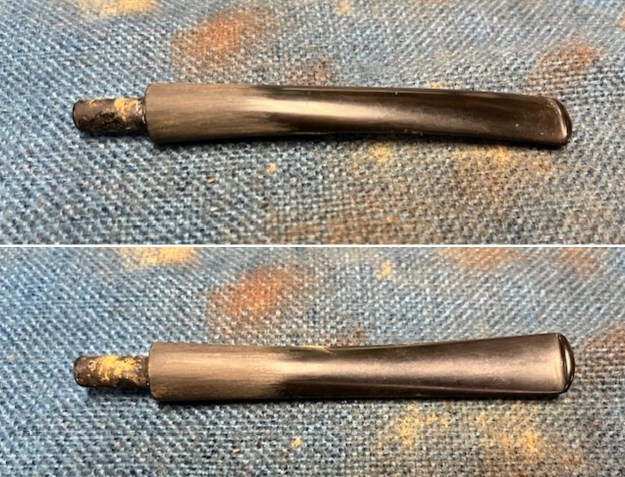
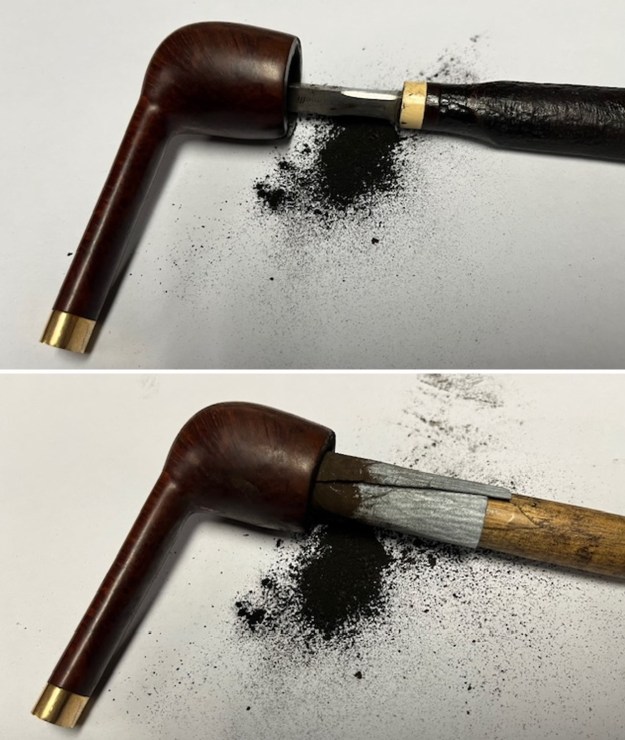
Here is the stainless-steel woven wire mesh. For those of you who know such things, this mesh has a mesh number of 200. It can be acquired inexpensively and comes in various mesh numbers. The larger the number, the finer the holes in the mesh. To be frank, my selection of 200 was pure guesswork. I didn’t really have a sense of what would be best – other than to say that it needed to be fine enough to prevent the adhesive from pouring straight through.On with the work! I first needed to create a platform upon which the adhesive and mesh could rest. This was obviously essential in order to maintain the draught hole in the bit. In the first photo below, you’ll see that I used cardboard, but I immediately abandoned that idea (I’ll explain why momentarily). I am displaying this photo in order to demonstrate my use of a pencil to scribe the precise shape of the missing section of vulcanite.I quickly eliminated the cardboard idea because it just isn’t as useful a material for this purpose. Instead, I used several layers of duct tape as my substrate. I can still scribe a line on the duct tape, but – more importantly – cyanoacrylate adhesive doesn’t stick to it. In other words, once the work had fully cured, I could readily remove the duct tape without affecting the repair.

With my scribed line, I was able to transfer the pattern of the absent vulcanite on to the wire mesh and cut it to shape. Truth be told, it would probably be better to use welded wire mesh, but I have no idea where you acquire that in such a small mesh number. Anyway, before cutting the wire mesh, I took the critical steps of (1) gently sanding the mesh with sandpaper to provide a slightly rough surface to maximize the adhesive bond, and (2) cleaning the mesh thoroughly with acetone, to remove any sanding grit and any other substance that would inhibit a good adhesive bond.

And away we go! It is important to apply the cyanoacrylate adhesive in thin layers, rather than one thick blob. I chose to apply a layer, spray it with an accelerator, apply another layer, etc. – until I was satisfied. Once complete, I left it to sit overnight and came back the next day. I freely admit that I am still concerned about the brittleness of this repair, but I think this is definitely a step in the right direction. Naturally, shaping and sanding was the next step – and this took a while. I should emphasise at this point that I didn’t employ the same attention to detail on this stem, as I would on a stem for a customer. I just wanted to get this done and see if it would work. As I sanded with needle files and sanding pads, I shaped the button and melded the repair into the surrounding vulcanite. You can see the results below. It’s pretty good and I’m sure it would look even better if I was doing it for sale or for a customer.

Some final thoughts: I think there is a rudimentary idea here. I feel confident in saying that the repair itself is likely stronger and more resilient with the mesh than without. However, I am apprehensive about whether the brittleness of the cyanoacrylate adhesive is improved or not – and I’m not sure how to reasonably overcome that issue (other than trying epoxy). Another problem that still exists is that there is no direct connection between the mesh and the pre-existing vulcanite. This surely isn’t helpful. It is at the edges – where the adhesive meets the vulcanite – that the bond must be weakest. Next steps might include (1) embedding the wire mesh in an epoxy – this might be the best way of addressing brittleness; (2) overlaying the wire mesh on the original vulcanite to create a bridge structure (although this creates its own big problems); (3) developing a way of affixing the mesh to the vulcanite.

Now, over to you! What do you think of this idea? How would you improve it? What are the next steps? What colossal errors have I made? Please let me know what you think in the comments below. If you make use of the ideas from this experiment in your pipe work, please let me know how it goes. I hope you enjoyed reading this installment of my Pipe Incident Reports – I look forward to writing more. If you are interested in my work, please follow me here on Steve’s website or email me directly at kenneth@knightsofthepipe.com. Thank you very much for reading and, as always, I welcome and encourage your comments.

Restoring a Dunhill Shell Briar 60 F/T Gold Spigot Billiard


by Steve Laug

The next pipe on the table came to us from a seller in Caldwell, Idaho, USA on 07/12/2025. It is a Dunhill Shell Briar Billiard with a gold ferrule and gold capped spigot stem that looked very good. It is in good condition as can be seen in the photos below. It is stamped on a smooth panel on the underside of the shank. On the heel of the bowl it is stamped with the shape number 60 F/T followed by Dunhill [over] Shell Briar [followed by] Made in England12. The stamping is clear and readable. The pipe has a mix of black, cordovan and brown stains on a Shell sandblast finish and some amazing grain that the shape follows well. The finish was dusty and lightly dirty with grime in the nooks and crannies of the sandblast. The bowl had a moderate cake and there was lava in the sandblasted rim top and edges. The gold ferrule and stem cap are tarnished but otherwise looks good. The ferrule is stamped 14K with makers mark. The original stem is on the pipe and it is dirty and has spots of grime stuck on the surface of the vulcanite. I took photos of the pipe to show what it looked like before I started working on it. I took photos of the bowl and rim top to show the thickness of the cake and the lava coat on the rim top. There was some tobacco debris in the bottom of the bowl. The gold ferrule on the shank is shown and is slightly tarnished. The stem photos show the condition of the spigot cap and the top and underside of the stem ahead of the button. The photos of the sides and heel of the bowl show the deep sandblast grain on the pipe along with the contrasting gold ferrule and stem cap. There was a lot of grime ground into the bowl sides. But it still did not obscure the beauty of the pipe. The stamping on the heel of the bowl and shank was clear and readable as noted above. The gold ferrule on the shank and cap on the stem looks good. I took a photo of the pipe with the stem removed to give a sense of the proportions of the pipe. It is a real beauty.One of the first things I like to do is to unpack the stamping and understand each element in it. I turned to Pipephill helpful site (http://pipephil.eu/logos/en/dunhill/shell-briar1.html). The stamping is interpreted as follows: The 60 is the shape for a taper stem Billiard. The F/T is the stamp for a fishtail type stem. The Dunhill Shell Briar is the finish. Following the Made In England12 gives the year that the pipe was made.

The dating chart helped me understand the date stamp 12.. I have included the chart below for you to follow (http://www.pipephil.eu/logos/en/dunhill/cledat-en1a.html). The second column is where the 12 year suffix fits. To arrive at the date the suffix is added to 1960 making the pipe a 1972 Shell Briar Spigot.I googled Dunhill Gold Spigot pipes and the search came up with this AI description of the brand and design.

Dunhill Gold Spigot pipes are high-end, collectible briar pipes featuring an 18k or 14k gold tube (spigot) inserted into the mouthpiece, signifying luxury, superior craftsmanship, and excellent smoking quality, often appearing as vintage estate pipes or special editions with distinct markings and rare, ornate designs, like those from the ’70s and ’80s. They represent the pinnacle of Dunhill’s luxury offerings, blending traditional pipe-making with precious metals for a distinctive, refined smoking experience.

I turned to work on the pipe itself. I reamed the bowl with a PipNet pipe reamer using the cutting heads 2 and 3. I finished the reaming with a Savinelli Fitsall Pipe Knife. I sanded the walls of the bowl with 220 grit sandpaper wrapped around a piece of dowel. I used a brass bristle wire brush to clean off the debris in the sandblast on the rim top. The sandblast was clean and dry with no debris in the valleys of the sandblast.I cleaned out the inside of the shank and the stem with alcohol, cotton swabs and both bristle and regular pipe cleaners.I scrubbed the bowl with undiluted Murphy’s Oil Soap and a tooth brush. I worked over the finish with the brush and then rinsed it off with warm water. I dried it off with a soft cloth. I polished the gold ferrule and the stem cap with a jeweller’s cloth to remove the oxidation and to protect the gold from further oxidation. The shine looks very good at this point. I rubbed the briar down with Before & After Restoration Balm. I worked it into the briar with my fingertips and a horsehair shoe brush to work it into the nooks and crannies of the sandblast finish. The product works to clean, enliven and preserve the briar. I let it sit for 10 minutes then I buffed it with a cotton cloth to deepen the shine. The briar really comes alive with the balm. I set the bowl aside and turned to address the stem. I sanded the stem surface with 320-3500 grit 2×2 inch pads. I wiped the stem down with an Obsidian Oil cloth after each sanding pad.I polished the vulcanite with micromesh sanding pads – 1500-12000 grit pads. I wiped it down with Obsidian Oil after each sanding pad. I used Before & After Pipe Polish – both Fine and Extra Fine to further polish the stem. This 1972 Dunhill Shell Briar 60F/T Gold Spigot Billiard has a beautiful, unique Dunhill Sandblast finish made in 1972. The rich Shell Briar finish that is identified with some great grain around the bowl and shank. It has some great rugged sandblast that Dunhill specialized in making. The polished 14K gold ferrule and stem cap look very good. The polished black vulcanite spigot stem adds to the mix. I put the stem back on the bowl and buffed the pipe with Blue Diamond on the buffing wheel being careful to not buff the stamping. I gave the bowl and the stem multiple coats of carnauba wax on the buffing wheel and followed that by buffing it with a clean buffing pad. I hand buffed the pipe with a microfiber cloth to deepen the shine. The finished Dunhill Shell Briar 60F/T Gold Spigot Billiard is quite nice and feels great in the hand. Give the finished pipe a look in the photos below. The dimensions of the pipe are Length: 5 ¾ inches, Height: 1 ¾ inches, Outside diameter of the bowl: 1 ¼ inches, Chamber diameter: ¾ of an inch. The weight of the pipe is 33 grams/1.16 ounces. This one will be going into my own personal collection. Thanks for walking through the restoration with me as I worked over another beautiful pipe Thanks for your time.

Breathing New Life into a Millard Imported Briar System Straight Pot


by Steve Laug

The next pipe on the table was one I received from a reader of the blog, Emil who wanted me to fit it with a new stem and clean and restore it for him. I asked Emil for photos of the pipe before he sent it to me so I could have a look at it. Emil gladly sent the following photos. The pipe was in rough shape with a nicked outer edge, thick cake and heavy lava coat. The aluminum shank end/mortise was oxidized and very dirty. The stem was oxidized, calcified and chipped on the underside of the button forward. Once I saw them I was ready to take on the pipe. From the photos and now that I have it in hand I have to say that it reminds me of a Keyser Hygienic pipe in terms of the tubes and plumbing in the stem and mortise. This one has some nice grain around the bowl and what I can see showing through on the inwardly beveled rim top. The rim top is thick with lava and the outer edge has some damage. The bowl has a thick cake and is very dirty. The shank end is polished aluminum and has a tube in the center of what acts as a condenser compartment. The aluminum has been damaged by what appears to be marks from pliers. The vulcanite stem is inserted in the shank end and also has a tube in the center. The swirling smoke in the chamber leaves the moisture on the sides of the aluminum shank extension. The stem was oxidized and calcified and has a large chunk of vulcanite out of the button on what appears to be the top but easily could be the bottom. I took photos of the pipe before I started his cleanup work. I took photos of the bowl and rim top and both the top and underside of the stem. You can see the thickness of the cake in the bowl and the lava on the rim top. The outer edges of the bowl show some damage but the inner edge seems protected by the lava coat. The stem photos show the missing damage to the button and stem surface.The pipe was stamped on the left side of the shank and it read Millard [over] Imported Briar. There was no stamping on the right side of the shank. I took a photo of the bowl with the stem removed to give a sense of the shape of the pipe.As I studied it, I also remembered that I have worked on several Millard pipes over the past years. I turned to one of the write ups on rebornpipes on a pair of Millard pipes. Here is the link https://rebornpipes.com/2015/12/11/a-pair-of-millard-perfect-pipes-a-sandblast-apple-and-dublin/. I am including a picture of a flyer that I showed in the blog and I am quoting the section that gives the background on the brand. I quote:

When I came across the Millard – the Perfect Pipe coupon in the two boxes of Kentucky Club that I found I was fascinated with the look of the pipe. It reminded me of the Keyser Hygienic pipes that I had restored over the years. The stem that fit into the metal mortise shank insert and the tubes on the inside of the stem and the shank were similar. While the Keyser tubing in the shank looked identical the one in the stem was different. Keyser was directed downward while the Millard was two straight tubes that met in the mortise. They did not touch but the metal chamber became a condensing chamber, or as they call it an Action Trap, for the smoke and collected the moisture before it continued through the tube in the stem. I looked up the brand online and found the following advertisement postcard that shows the way the system works. I found that the stems were interchangeable between the shapes that the pipe came in. The straight stems could be easily transferred from pipe to pipe. In fact the pipe originally came with an extra or replacement stem. The pipe came in a sandblast and a smooth finish in six shapes – apple, Dublin, billiard, pear, pot and bent. It came in two sizes: medium or large. In the advertisement below you can see that the pipe cost $3. I also found that Mastercraft supplied the pipes through the coupon sales. Knowing a bit of history about the company I know that they did not make pipe so they were sourced from the original manufacturer.

Before I worked on the pipe I took the box of Kentucky Club that I had on the shelf and opened it and took out the coupon. It actually was a coupon for The Millard pipe. It read as follows:

Looking for the Ideal Pipe? The Millard is often regarded as the answer. Its complete action trap keeps the pipe dry in any position and prevents mouth flow back. Se it in our new Premium Catalog. It will delight and intrigue you. We feel sure.Now it was time to work on the pipe. I went through my can of stems and found one that would work quite well with a bit of work reshaping the shank end of the stem and opening the airway to slip over the tube in the mortise of the shank. The shape was correct and it had a couple of light tooth mark on the top and underside of the stem ahead of the button. I used a drill to open the airway in the stem to slide over the tube in the shank. I started with a bit slightly smaller than the airway and worked up to the correct dimensions.I worked on giving the shank end of the stem the same diameter and taper as the inside of the aluminum mortise. I used 220 grit sandpaper to shape and fit it to the shank.I set the stem aside and worked on the bowl. I reamed the bowl with a PipNet Pipe Reamer using the 2nd and 3rd cutting heads. I cleaned up the reaming with a Savinelli Fitsall Pipe Knife and took the cake back to bare briar. I sanded the inside bowl walls with a piece of dowel wrapped in 220 grit sandpaper. I cleaned out the airway into the bowl – and the inside of the aluminum mortise and plumbing with pipe cleaners – both bristle and regular with alcohol. I was able to remove the grime and the tars in the shank and mortise area. I repeated the process on the new stem. It looked much better and smelled great.I scrubbed the bowl and rim with undiluted Murphy’s Oil Soap and a tooth brush to remove the debris and grime on the bowl sides. It looked much better. I set the bowl aside and went back to the stem. I filled in the tooth dents in the stem on the top and underside ahead of the button with rubberized black CA glue. Once the repairs cured I used small files to flatten the repairs. I sanded it with 220 grit sandpaper to smooth out the repairs. I dry sanded the stem with 320-3500 grit 2×2 inch sanding pads. I was able to clean up the scratches in the vulcanite and give the new stem a proper shape. It was looking very good.I polished the stem with micromesh sanding pads – dry sanding it with 1500-12000 grit pads. I wiped the stem down after each pad with a cloth and Obsidian Oil. I finished the polishing with Before & After Pipe Stem Polish – both Fine and Extra Fine. I gave it a final coat of Obsidian Oil. I set the stem aside and used some clear CA glue and briar dust to fill in the deep chips in the right side of the rim top.I sanded the bowl and aluminum shank with 320-3500 grit 2×2 inch sanding pads. I polished out the scratches in the aluminum as much as possible and the scratches and repairs in the briar. The bowl and shank began to look much better. I polished the briar and aluminum with micromesh sanding pads – dry sanding with 1500-12000 grit pads. I wiped the bowl down with a damp cloth after each sanding pad. It really began to take on a rich shine. I rubbed the briar down with Before & After Restoration Balm. I worked it into the briar with my fingertips. The product works to clean, enliven and preserve the briar. I let it sit for 10 minutes then I buffed it with a cotton cloth to deepen the shine. The briar really comes alive with the balm. I put the pipe back together – the bowl with its new stem. This restored Millard Imported Briar System Straight Pot is a real beauty and I think the polished aluminum shank extension (condensation chamber) and the new black vulcanite stem work well together. The grain on the bowl came alive with the buffing. I used Blue Diamond on the buffing wheel on both the bowl and stem. I gave both multiple coats of carnauba wax on the wheel then buffed it with a clean buffing pad to raise the shine. I hand buffed it with a microfibre cloth to deepen the shine. The Millard Straight Pot feels great in the hand. It is lightweight and the contrast in the browns of the briar, the polished aluminum and the vulcanite stem is quite amazing. The dimensions of the pipe are Length: 6 inches, Height: 1 ½ inches, Outer diameter of the bowl: 1 ¼ inches, Chamber diameter: 7/8 of an inch. The weight of the pipe is 1.34 ounces/38 grams. It really is a beauty. I will be sending it back to Emil this week. I am hoping that he enjoys it as much as I enjoyed working on it. Thanks for walking through the restemming and the restoration with me. Cheers.

Restoring a 1985 Dunhill Shell Briar 52033Billiard and Rebuilding a Saddle Stem


by Steve Laug

The next pipe on the table came to us from a seller in Cleveland, Ohio, USA on 04/26/2022. It is a Dunhill Shell Briar Billiard with a saddle stem that has been “ridden hard”. It is in rough shape as can be seen in the photos below. It is stamped on a smooth panel on the underside of the shank. On the heel of the bowl it is stamped with the shape number 52033 followed by Dunhill Shell Briar [over] Made in England25. The stamping is faint in spots but still readable. The date number is a bit faint and worn. The pipe has a mix of black, cordovan and brown stains on a Shell sandblast finish and some amazing grain that the shape follows well. The finish was dusty and dirty with grime ground into the nooks and crannies of the sandblast. The bowl had a thick cake and there was heavy lava in the sandblasted rim top and edges. The original stem is on the pipe and it is a mess. The button has a crack on the top side and the underside is missing a huge chunk from the button forward about ¾ of an inch or more. Jeff took photos of the pipe to show what it looked like before he started working on it. He took photos of the bowl and rim top to show the thickness of the cake and the lava coat on the rim top. The bowl is a bit of a mess. The stem photos show the damage on the top and underside of the stem ahead of the button. The photos of the sides and heel of the bowl show the deep sandblast grain on the pipe. There was a lot of grime ground into the bowl sides. But it still did not obscure the beauty of the pipe. The stamping on the heel of the bowl and shank read as noted above. It was faint in spots but it is readable in good light.One of the first things I like to do is to unpack the stamping and understand each element in it. I turned to Pipephill helpful site (http://pipephil.eu/logos/en/dunhill/shell-briar1.html). The stamping is interpreted as follows: The 52033 is the shape for a saddle stem Billiard. The Dunhill Shell Briar is the finish. Following the Made In England25 gives the year that the pipe was made. I did a little more work on the five-digit shape number. On Pipephil’s site I found some information (http://www.pipephil.eu/logos/en/dunhill/cumber1.html#52031). I have included the information below to help interpret the number 52033.

Dunhill pipes are stamped with a four-digit code.
Digit 1: (from 1 to 6) denotes the size of the pipe (the group). In this case it is size 5 pipe.
Digit 2: denotes the style of the mouthpiece (0,1=tapered, 2=saddle). The second digit 2, says that it is a saddle stem which it is.
Digit 3 and 4: denote the generic pipe shape (in yellow in the chart on top). This 03 says it is a billiard. 

When 5 digits occur, the meaning of the 4 first remain the same.

The dating chart helped me understand the date stamp 25. I have included the chart below for you to follow (http://www.pipephil.eu/logos/en/dunhill/cledat-en1a.html). The second column is where the 25 year suffix fits. To arrive at the date the suffix is added to 1960 making the pipe a 1985 Shell Briar.I turned to work on the pipe itself. Jeff had carried out his usual thorough cleanup of the pipe. He reamed the bowl with a PipNet reamer and cleaned up the reaming with a Savinelli Fitsall Pipe Knife. He scrubbed the internals of the bowl, shank and stem with alcohol, cotton swabs, shank brushes and pipe cleaners. He scrubbed the externals with undiluted Murphy’s Oil Soap and a tooth brush. He rinsed the bowl off with running water and dried it off with a soft cloth. He soaked the stem in Briarville’s Pipe Stem Deoxidizer and once it had soaked rinsed it off with warm water to remove the residual solution. He dried it off and rubbed it down to remove any oxidation that was still on the stem. The pipe looked very good when I received it. The bowl and rim top were in excellent condition. The saddle stem had a small crack in the top of the button and a large piece of vulcanite missing on the underside from the button forward. I took a photo of the rim top to show the condition. You can see the clean bowl and fading of the stain on the rim top. The stem came out looking clean. The issues noted above are visible in the photos below.I took a photo of the underside of the shank to show the stamping. It is clear, though faint toward the stem and readable as noted above. I removed the stem from the shank and took a photo of the pipe parts to show what I was working with. It is a nice looking pipe.I decided to start my work on the pipe by addressing the significant damage to the stem service. I measured the length of the stem and chose to cut off the damaged portion of the stem. I would lose about ¾ of and inch to an inch in length. I used a Dremel and sanding drum to remove the damaged portion of the stem. I would rebuild a button on the end of the stem.I smoothed out the end of the button on a topping board. I top of the stem had a lot of room to recut the button. The bottom edge was thin. I rebuilt the button on the top and underside of the stem with black rubberized CA glue. Once it cured I would reshape it into a standard button.I set the stem aside to let the rebuilt button cure. I would leave it overnight to get a deep cure. I turned my attention to the bowl. I started by working over the debris in the valleys of the rim top sandblast surface with a brass bristle wire brush. It looked significantly better. I used a black stain pen to touch up the rim top and the top of the shank.I rubbed the briar down with Before & After Restoration Balm. I worked it into the briar with my fingertips and a horsehair shoe brush to work it into the nooks and crannies of the sandblast finish. The product works to clean, enliven and preserve the briar. I let it sit for 10 minutes then I buffed it with a cotton cloth to deepen the shine. The briar really comes alive with the balm. I reshaped the rebuilt button on the stem and shaped the slot in the button with a button saw and small files. I smooth out the shape of the newly formed button and slot with 220 grit sandpaper. It looked very good at this point.I sanded the stem surface with 320-3500 grit 2×2 inch pads. I wiped the stem down with an Obsidian Oil cloth after each sanding pad. I polished the vulcanite with micromesh sanding pads – 1500-12000 grit pads. I wiped it down with Obsidian Oil after each sanding pad. I used Before & After Pipe Polish – both Fine and Extra Fine to further polish the stem. This 1985 Dunhill Shell Briar 52033 Saddle Stem Billiard has a beautiful, unique Dunhill Sandblast finish made in 1985. The rich Shell Briar finish that is identified with some great grain around the bowl and shank. It has some great rugged sandblast that Dunhill specialized in making. The polished black vulcanite saddle stem adds to the mix. I put the stem back on the bowl and buffed the pipe with Blue Diamond on the buffing wheel being careful to not buff the stamping. I gave the bowl and the stem multiple coats of carnauba wax on the buffing wheel and followed that by buffing it with a clean buffing pad. I hand buffed the pipe with a microfiber cloth to deepen the shine. The finished Dunhill Shell Briar 52033 Billiard is quite nice and feels great in the hand. Give the finished pipe a look in the photos below. The dimensions of the pipe are Length: 5 ½ inches, Height: 2 inches, Outside diameter of the bowl: 1 ½ inches, Chamber diameter: ¾ of an inch. The weight of the pipe is 48 grams/1.69 ounces. This one will be going on the rebornpipes store in the British Pipemakers Section. The shortened, reshaped stem looks good to me. The price is a good entry level Dunhill for the interested Group 5 Billiard. Thanks for walking through the restoration with me as I worked over another beautiful pipe Thanks for your time.

A Lovely Republic Era Peterson’s Sterling Filter 69 Stirling Bent Billiard


by Steve Laug

The next pipe I have chosen is smooth finished Peterson’s “Sterling Silver” pipe. The pipe came to us from our contact in Copenhagen, Denmark. This one is a Peterson’s Bent Billiard pipe with a taper fishtail stem. It has a rich brown coloured finish with interesting grain around the bowl sides and shank. It is very dirty. This Bent Billiard has a silver band on the shank that was oxidized. The grime on the finish was ground into the briar. The brown stains make the grain really pop. It was stamped on the left side of the shank and reads Peterson’s [over] “Sterling Filter”. On the right side it is stamped with the three line Made in the Republic of Ireland stamp followed by the shape number 69. The tarnished band is stamped with Peterson’s [over] Dublin followed by Sterling [over] Silver. To the right that it has three hallmarks – Hibernia seated arm on a harp (signifies country of manufacture), a crowned harp designating Sterling quality and finally a Date Letter mark – in this case an italic “I” (1976). It was in filthy condition when Jeff brought it to the table. There was a thick cake in the bowl and spots of lava on the rim top and inner edge of the bowl. The stem was oxidized, calcified and had light tooth marks and chatter on the top and underside near the button. Jeff took photos of the pipe before his cleanup work before he started on the pipe. Jeff took photos of the rim top and stem to show the general condition of the pipe. The bowl is lightly caked and the rim top and edges look very good. The stem is oxidized and has light tooth marks on the top and underside near the button. Jeff took some photos of the bowl sides and heel to show the grain that was around this bowl. It is a nice looking pipe. He took photos of the sides of the shank to show the stamping. The stamping is readable in the photos below and is as noted above. The stamping on the Sterling Silver band is also readable through the oxidation. I am including the information from Pipedia’s article on Peterson pipes. It is a great read in terms of the history of the brand (https://pipedia.org/wiki/Peterson).

I turned to “The Peterson Pipe” by Mark Irwin and Gary Malmberg to get some background on the Sterling Pipe. On page 314 it had the following information on the line.

Sterling (1949-c1957; 1978-) – Higher grade line with sterling band. Early example, 1949-57, with COM of Made in Ireland forming a circle, were offered to the US market through Rogers Imports and have no hallmark, although until recent years the line carried Peterson’s maker’s mark, the K&P is in separate shields. Models beginning in ’78 with hallmarked dates and a COM stamp of Made in [over] the Republic [over] of Ireland.

I knew that I was dealing with a pipe made between 1949-1957 as shown by the Made in the Republic of Ireland three-line format stamp. Now it was time to work on the pipe.

Jeff had done a great job cleaning up the pipe as usual. He reamed the pipe with a PipNet reamer and cut back the cake back to the bare briar. He cleaned up the walls with a Savinelli Fitsall Pipe Knife. He scrubbed the interior of the bowl and shank with pipe cleaners, shank brushes, cotton swabs and alcohol to remove the tars and oils. He scrubbed the exterior of the pipe with undiluted Murphy’s Oil Soap and a tooth brush to remove the grime from the finish. He worked on the rim top lava with the soap and tooth brush. He scrubbed the inside of the stem with alcohol, shank brushes and pipe cleaners. He scrubbed the exterior with Soft Scrub and then soaked it in Briarville’s Pipe Stem Deoxidizer. He washed it off with warm water to remove the deoxidizer. The pipe looked very good when it arrived here. I took some close-up photos of the rim top and also of the stem surface. The rim top and the inner edge looked very good. The silver cleaned up well on the band, though it needed more work. The stem was clean and the tooth marks and chatter were minimal.I took photos of the stamping on the top and underside of the shank. You can see that it is stamped as noted above. It is faint and readable. I took the pipe apart and took a photo of the pipe. It is a good looking pipe and has some nice looking grain around the bowl. I sanded the briar with 320-3500 grit 2×2 inch sanding pads to remove the scratches and marks in the finish. I wiped the bowl down with a damp cloth after each sanding pad to remove the sanding debris. It really looks much better. I polished the briar with 1500-12000 grit micromesh pads – dry sanding it with each pad and wiped down the bowl after each pad. I gave it a final wiped with a Briar Wipe cloth to polish the finish. The briar looked very good at this point. I began my work on it by working some Before & After Restoration Balm into the surface of the briar with my fingertips to clean, enliven and protect the briar. I let the balm sit for 15 minutes and then buffed with a cotton cloth to raise the shine. The photos show the bowl at this point in the restoration process. I polished the Sterling Silver band on the shank with a jeweller’s cloth to remove the tarnish and polish it. I set the bowl aside and turned my attention to the stem. I sanded the stem with 320-3500 grit 2×2 inch sanding pads and wiped it down with an Obsidian Oil cloth after each sanding pad. The stem began to take on a shine.I touched up the P stamp on the left side of the stem with white acrylic fingernail polish. I worked it into the P stamp with a tooth pick. Once it dried I scraped off the excess of the acrylic with my fingernail. I sanded the stem area with a worn 1500 grit micromesh sanding pad. It looked very good. I fit the stem with a Vauen Dr. Perl Junior 9mm filter in the filter tenon of the pipe. It is a great fit and that it fit very well.I polished the stem with micromesh sanding pads – wet sanding with 1500-12000 grit sanding pads. I wiped it down after each sanding pad with Obsidian Oil. I polished it with Before & After Pipe Stem Polish – both Fine and Extra Fine. I am excited to finish this smooth Peterson’s “Sterling Filter” 69 Bent Billiard. I put the pipe back together and lightly buffed it with Blue Diamond on the buffing wheel. I gave the bowl and the stem multiple coats of carnauba wax. I hand buffed the pipe with a clean buffing pad to raise the shine. It is fun to see what the polished bowl looks like with the depths of the sandblast taking on a rich glow. Added to that the polished Sterling Silver band and the black vulcanite taper P-lip stem was beautiful. This smooth Classic Peterson’s “Sterling Filter” 69 Bent Billiard is nice looking and the pipe feels great in my hand. It is light and well balanced. Have a look at it with the photos below. The dimensions are Length: 5 ½ inches, Height: 2 inches, Outside diameter of the bowl: 1 ¼ inches, Chamber diameter: ¾ of an inch. The weight of the pipe is 59 grams/2.08 ounces. It is a beautiful pipe and one that will be on the Irish Pipe Makers Section of the rebornpipes store soon. If you are interested in adding it to your collection let me know. Thanks for walking through the restoration with me as I worked over this pipe. Thanks to each of you who are reading this blog.
A Well Travelled 1967 Dunhill Shell Briar LB F/T Billiard


blog by Steve Laug

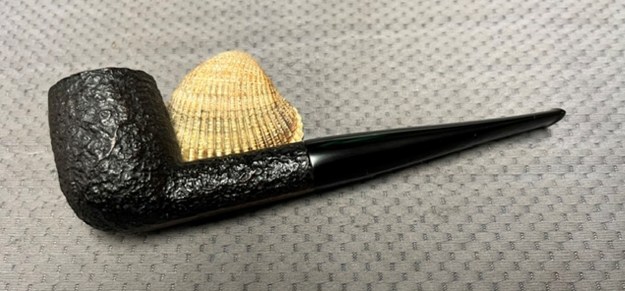
The next pipe on the table came to us from a seller on Facebook Instant Collection in Oregon City, Oregon, USA on 03/21/2024. It is a Dunhill Tanshell Briar Billiard that is in good condition. The original stem is on the pipe and it is made for a filter. It is stamped on a smooth panel on the underside of the shank. On the heel of the bowl it is stamped with the shape number LB F/T followed by Dunhill [over] Tanshell Briar [followed by] Made in [over] England 7. After that it is stamped with a 4 in a circle [followed by] T for Tanshell. The stamping is clear and readable. The pipe has a mix of tan and brown stains on a sandblast finish and some amazing grain that the shape follows well. The finish was dusty around the nooks and crannies of the sandblast but otherwise fairly clean. The shank had repaired cracks around the end that actually included about 1/3 of the shank and extended up the shank about ½ inch. The bowl had a thick cake in the bowl and there was lava in the sandblasted rim top or edges. The taper stem was dirty and had tooth marks and chatter ahead of the button. Jeff took photos of the pipe to show what it looked like before he started working on it. He took photos of the bowl and rim top to show how clean they were and of the stem to show the condition of both sides of the stem. The photos of the sides and heel of the bowl show the deep sandblast grain on the pipe. There were some dark spots on the back of the bowl, the rim top and spots on the sides. It is a beauty. The stamping on the heel of the bowl and shank read as noted above. It was faint but it is readable in good light.He took some photos of the cracks in the shank. It is clear and visible. It had been well repaired and the repair was well done. To the naked eye the crack is hidden in the valleys and low areas in the sandblast.One of the first things I like to do is to unpack the stamping and understand each element in it. I turned to Pipephill helpful site (http://pipephil.eu/logos/en/dunhill/shell-briar1.html). The stamping is interpreted as follows: The LB is the shape for a larger thick shank billiard and the F/T is the stem shape – a Fish Tail stem. The Dunhill Tanshell Briar is the finish which is corroborated the S at the end of the stamping. The size of the pipe is a Group 4. The 7 following the D of England gives the date the pipe.Pipephil also has some helpful dating keys on the site that are basically flow charts that you can walk through to date your pipe (http://pipephil.eu/logos/en/dunhill/cledat-en1a.html). I turned to Part 2 of the Dating Key and followed the chart. This pipe has a suffix of 8 following the D in England. It is not raised /smaller so that took me to the section on the chart below (column three) which instructed me that the pipe could be dated by adding the suffix 7 to 1960 which made the pipe a 1967 Tanshell Briar.  I turned to Pipedia’s section on Dunhill Root Briar to get a bit of background on the Dunhill finishes (https://pipedia.org/wiki/Dunhill#Root_Briar). I quote:

Tanshell
The Tanshell, introduced between 1951 and 1952, was Dunhill’s fourth major finish and its first significant post-war addition to the product line. It is a light tan sandblast, a finish achieved by using Sardinian briar exclusively through the 1960s. As Sardinian briar is considerably harder and denser than the Algerian variety, the resulting sandblast pattern is far more even and regular in its texture.

The development of the Tanshell was not straightforward. According to John C. Loring, the finish was the product of “certain processes… not previously employed”. The pipe was initially slated to be named the ‘Root Shell’, and a stamp to that effect was ordered in May 1951. Ultimately, however, the name ‘Tanshell’ was chosen, though the stamp for the new name was not received until December. This delay explains why most, if not all, Tanshell pipes manufactured in 1951 did not enter retail distribution until 1952 and were consequently stamped with a 1952 date code.

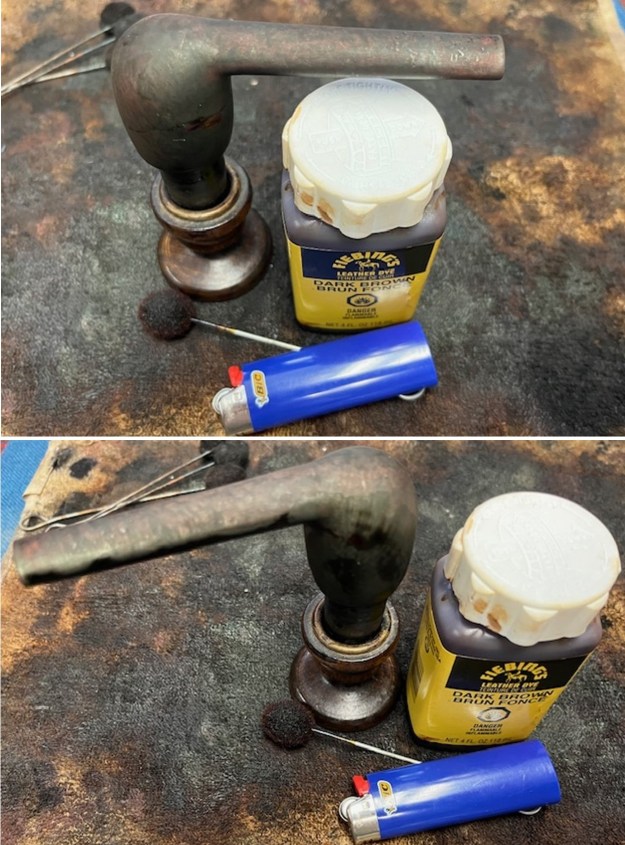
I have also included a chart from the site from Dunhill spelling out the Standard Pipe Finishes and giving short information and a timeline. I turned to work on the pipe itself. Jeff had carried out his usual thorough cleanup of the pipe. He reamed the bowl with a PipNet reamer and cleaned up the reaming with a Savinelli Fitsall Pipe Knife. He scrubbed the internals of the bowl, shank and stem with alcohol, cotton swabs, shank brushes and pipe cleaners. He scrubbed the externals with undiluted Murphy’s Oil Soap and a tooth brush. He rinsed the bowl off with running water and dried it off with a soft cloth. He soaked the stem in Briarville’s Pipe Stem Deoxidizer and once it had soaked rinsed it off with warm water to remove the residual solution. He dried it off and rubbed it down to remove any oxidation that was still on the stem. The pipe looked very good when I received it. There were dark spots on the back of the bowl, the back of each side and the back of the rim top.  I took a photo of the rim top to show the condition. You can see the clean bowl and darkening on the rim top. The stem came out looking quite good. There are some deep tooth marks and chatter on both sides ahead of the button.I took a photo of the underside of the shank to show the stamping. It is clear and readable as noted above. I removed the stem from the shank and took a photo of the pipe parts to show what I was working with. It is a nice looking pipe.I started my work on the pipe by dealing with the cracks in the shank. I took photos of the shank cracks. I trickled some clear CA glue into the cracks on the top and underside of the shank. I worked it into the cracks with a tooth pick. I went through my bag of brass bands and found one that fit the shank. It was a snug fit and once glued in place it would pull the cracks tight. I flattened the bottom of the band and put a few spots of glue on the band inside. I pressed it onto the shank for a tight fit. I took some photos of the banded shank. I really liked the look of it and the band worked well to tie the repairs together. I wiped the dark areas on the back of the bowl, rim top and shank with acetone on a cotton pad. I was able to remove the darkening and the bowl was washed out in those spots but it was very clean. I restained the bowl with a brown aniline stain. I applied it with the wool dauber and then flamed it to set it in the grain. I repeated the process multiple times until the colour was consistent all around the bowl sides.Once I had flamed the stain on the bowl I wiped it down with isopropyl alcohol on cotton pads to make the stain a bit more transparent. I wanted to hide the burn and darkening marks and this stain would blend them into the surface a bit more. I rubbed the briar down with Before & After Restoration Balm. I worked it into the briar with my fingertips and a horsehair shoe brush to work it into the nooks and crannies of the sandblast finish. The product works to clean, enliven and preserve the briar. I let it sit for 10 minutes then I buffed it with a cotton cloth to deepen the shine. The briar really comes alive with the balm. I filled in the tooth marks on the top and underside of the stem with a black, rubberized CA glue. Once it cured I used small files to flatten the repaired areas. I sanded them with 220 grit sandpaper to smooth them and blend them into the surface of the vulcanite. I sanded the stem surface with 320-3500 grit 2×2 inch pads. I wiped the stem down with an Obsidian Oil cloth after each sanding pad.I polished the vulcanite with micromesh sanding pads – 1500-12000 grit pads. I wiped it down with Obsidian Oil after each sanding pad. I used Before & After Pipe Polish – both Fine and Extra Fine to further polish the stem. This Dunhill Tanshell Briar LB F/T Chunky Billiard with taper stem has a beautiful, unique Dunhill Sandblast finish made in 1967. The thin brass repair band adds to this great looking pipe that is in almost new condition. The rich brown washed finish that is identified with some great grain around the bowl and shank. It has some great rugged sandblast that Dunhill specialized in making. The polished black vulcanite taper stem adds to the mix. I put the stem back on the bowl and buffed the pipe with Blue Diamond on the buffing wheel being careful to not buff the stamping. I gave the bowl and the stem multiple coats of carnauba wax on the buffing wheel and followed that by buffing it with a clean buffing pad. I hand buffed the pipe with a microfiber cloth to deepen the shine. The finished Dunhill Tanshell Briar LB F/T Shell Briar Billiard is quite nice and feels great in the hand. Give the finished pipe a look in the photos below. The dimensions of the pipe are Length: 5 ¾ inches, Height: 1 ¾ inches, Outside diameter of the bowl: 1 ¼ inches, Chamber diameter: ¾ of an inch. Thanks for walking through the restoration with me as I worked over another beautiful pipe. This one will stay with me for a while. I love the thick shank and solid feel of the LB shape. Thanks for your time.

Restoring a Brigham 2 Dot Crowned Rim 259 Rusticated Acorn


by Steve Laug

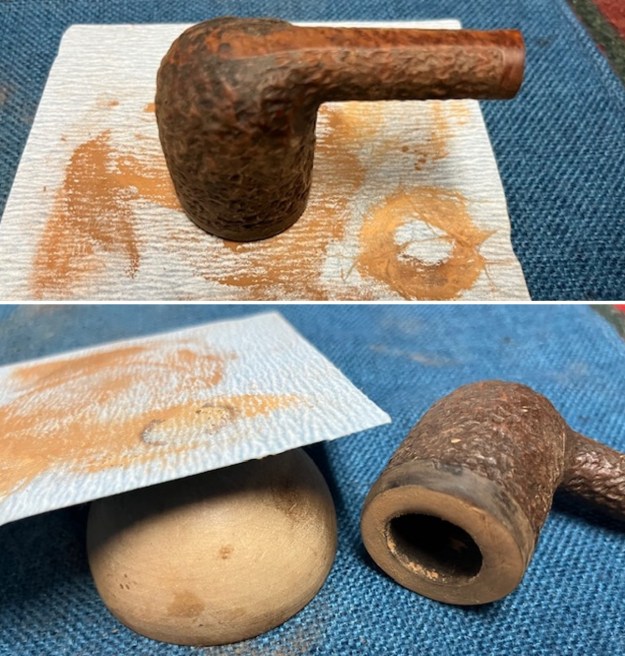
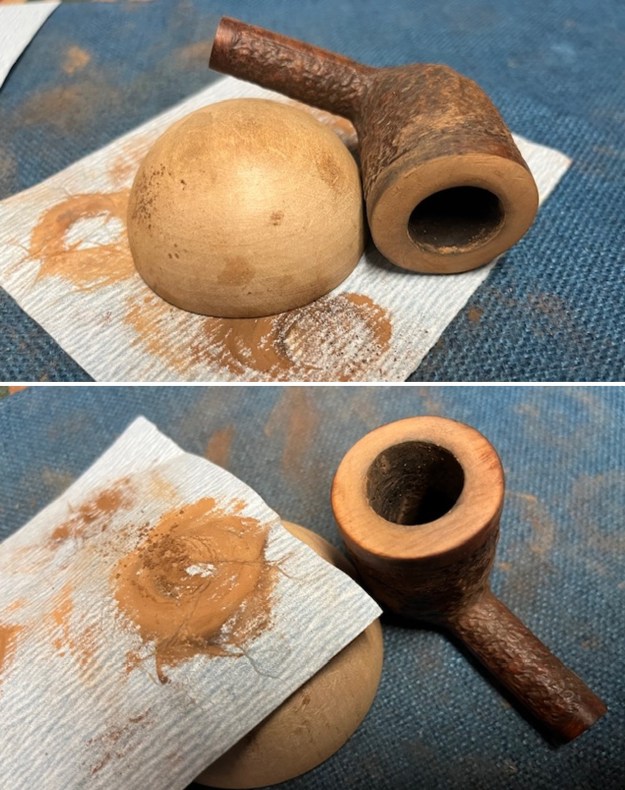
The next pipe I have chosen is a worn rusticated acorn shaped pipe that was stained with a rich brown colour. The mix of stains made the rustication take on depth even with the grime on the finish. We are not sure where we picked this pipe up – traded, found, purchased. No memory sadly. It was stamped on the underside of the shank and read shape number 259 followed by Brigham [over] Made in Canada. It was in decent condition when I brought it to the table. The finish was dirty with grime ground into the briar sides and rim but still looked okay. The bowl had been reamed and cleaned. The rim top and edges were a bit rough and the bowl was slightly out of round. The stem was oxidized and had tooth marks and chatter on the top and underside on and near the button. The Maple Distillator was in the aluminum tube and was well used. It appeared to have been rinsed off a few times as it bore stain but no oils. I took photos of the pipe before my cleanup work. They tell the story and give a glimpse of the promise in this pipe.   Jeff took photos of the rim top to show the interior the bowl and the rim top and inner edge. It has been reamed and the rim top and inner edge shows damage. The stem is oxidized and has tooth marks on the top and underside near the button.I took a photo of the underside of the shank to show the stamping. The stamping is faint but readable in the photo below and is as noted above – it reads 259 (shape number) Brigham in script [over] Made in Canada. The stem has two dots in a row on the left side.I took the stem off the bowl and took pictures of the aluminum tube tenon with the Maple Distillator in place and out of the tenon on top of the tube. Before I get into the restoration part of this pipe I decided to include a poster I picked up that shows the filtration system of the patented Brigham Distillator. Give the poster a read. It also helps to understand the internals of these older Canadian Made pipes. I decided to start my restoration work on this one by dealing with the damaged crown rim top. I used a wooden sphere and a piece of 220 grit sandpaper to deal with the damage on the top and inner edge of the bowl. It is slow tedious work but the finished product looks much better. I cleaned the shank and mortise as well as the airway in the stem with pipe cleaners, cotton swabs and alcohol. It smelled great and was ready for the next pipe man or woman who takes on the trust.I sanded the smooth rim top and edges with 320-3500 grit 2×2 inch sanding pads. I wiped the briar down with a damp cloth after each pad. The rim began to look much better. I polished the smooth rim top and edges of the briar with micromesh sanding pads – dry sanding it with 1500-12000 grit pads. After each pad I wiped the briar down with a damp cloth. I worked some Before & After Restoration Balm into the surface of the briar with my fingertips and the rustication with a shoe brush to clean, enliven and protect the briar. I let the balm sit for a little while and then buffed with a cotton cloth to raise the shine. The photos show the bowl at this point in the restoration process. I sanded out the light tooth marks and chatter with 220 grit sand paper to blend them into the rest of the stem surface.I dry sanded the stem with 320-3500 grit 2×2 inch sanding pads. I wiped the stem down after each sanding pad with a damp cloth to remove the sanding debris. It began to take on a rich shine.I polished the stem with micromesh sanding pads – dry sanding with 1500-12000 grit sanding pads. I wiped it down after each sanding pad with Obsidian Oil. I polished it with Before & After Pipe Stem Polish – both Fine and Extra Fine. Before I finished polishing the stem I fit it with the new Rock Maple Distillator. The photos show the box and the new Distillator on the box and then in place in the tenon.I am glad to finish this Brigham Made in Canada 259 Rusticated Acorn. I put the pipe back together and buffed it with Blue Diamond on the buffing wheel. I gave the bowl and the stem multiple coats of carnauba wax. I hand buffed the pipe with a clean buffing pad to raise the shine. It is fun to see what the polished bowl looks like with the grain popping through on the bowls sides and rim top. Added to that the polished black vulcanite stem with the shining brass pins was beautiful. This mixed grain on the smooth finish Brigham 2 Dot Acorn is nice looking and the pipe feels great in my hand. It is light and well balanced. Have a look at it with the photos below. The dimensions are Length: 6 inches, Height: 1 ¾ inches, Outside diameter of the bowl: 1 ½ inches, Chamber diameter: ¾ of an inch. The weight of the pipe is 1.27 ounces/ 36 grams. It is a beautiful pipe and one that will be in the Canadian Pipemakers Section on the rebornpipes store soon. If you are interested in adding it to your collection let me know.

Thanks to each of you who are reading this blog. Remember we are not pipe owners; we are pipemen and women who hold our pipes in trust until they pass on into the trust of the next generation.