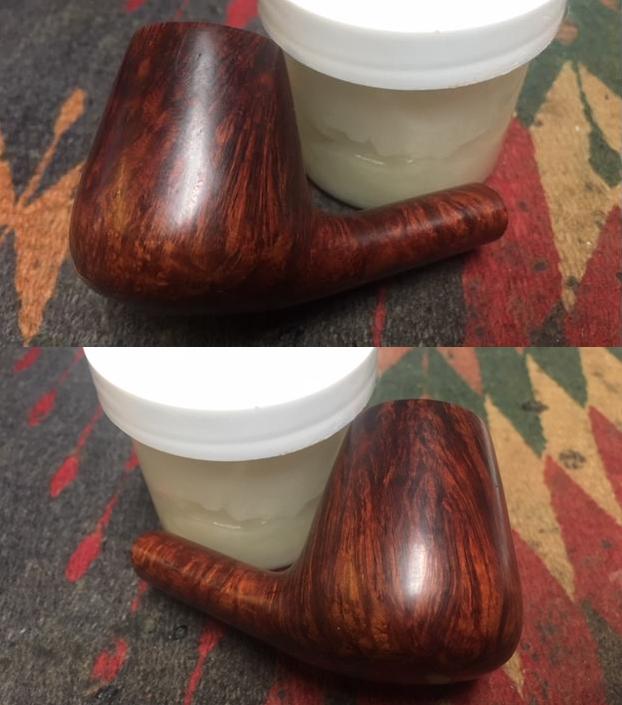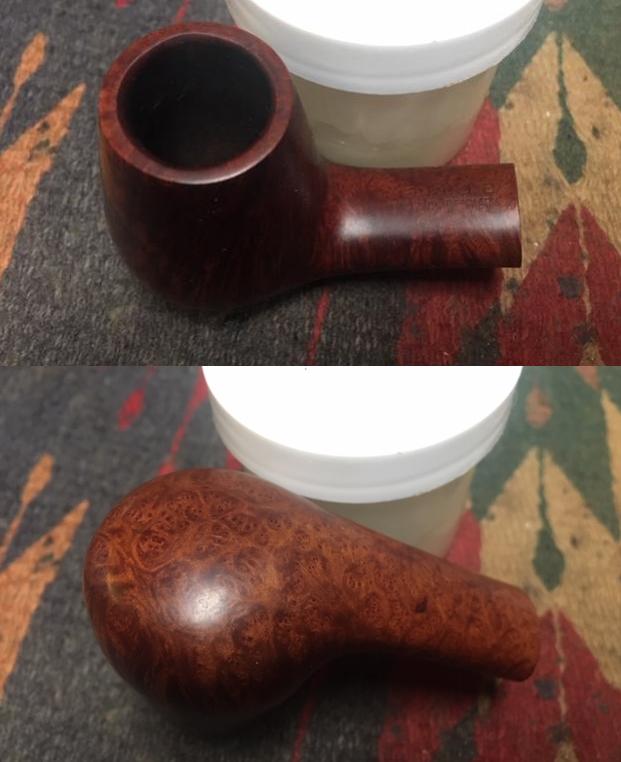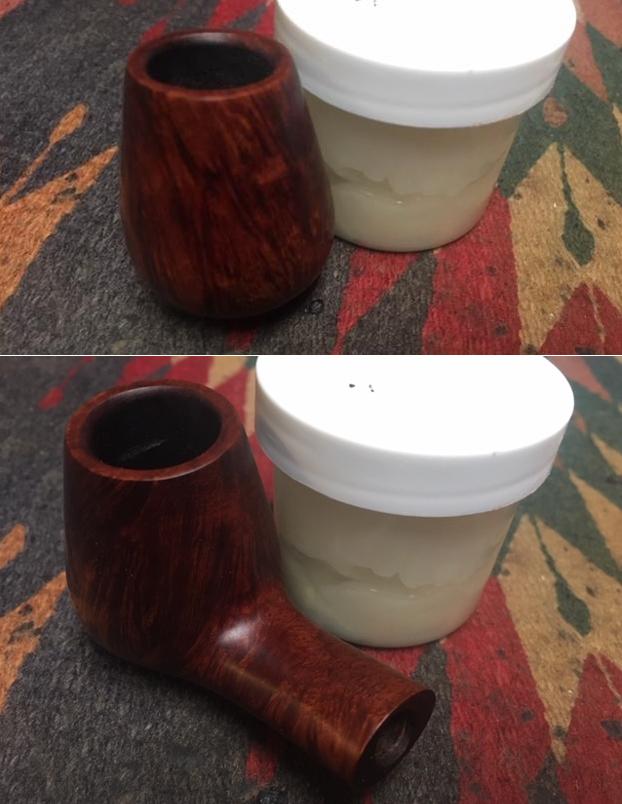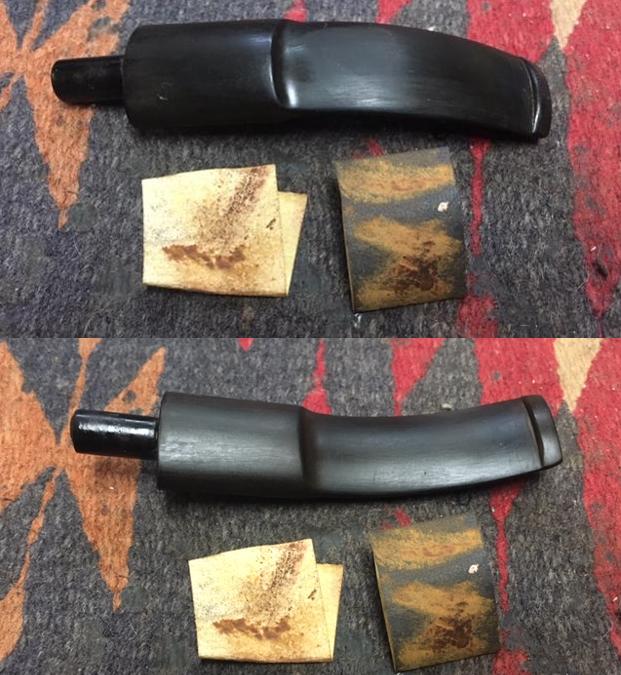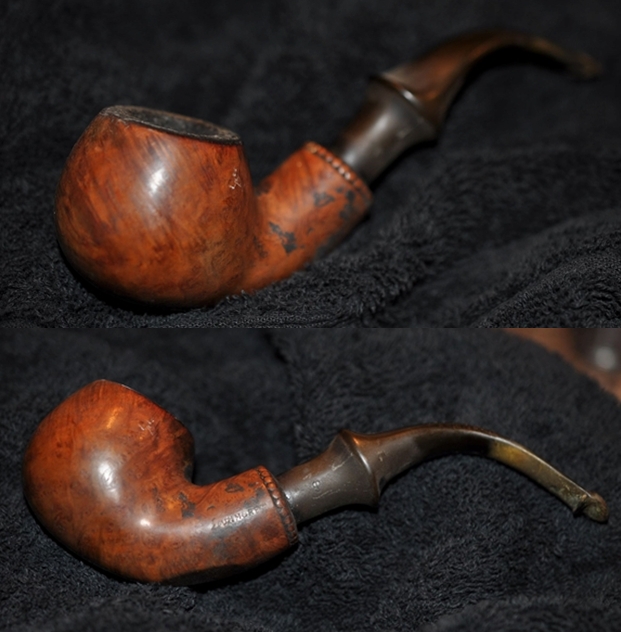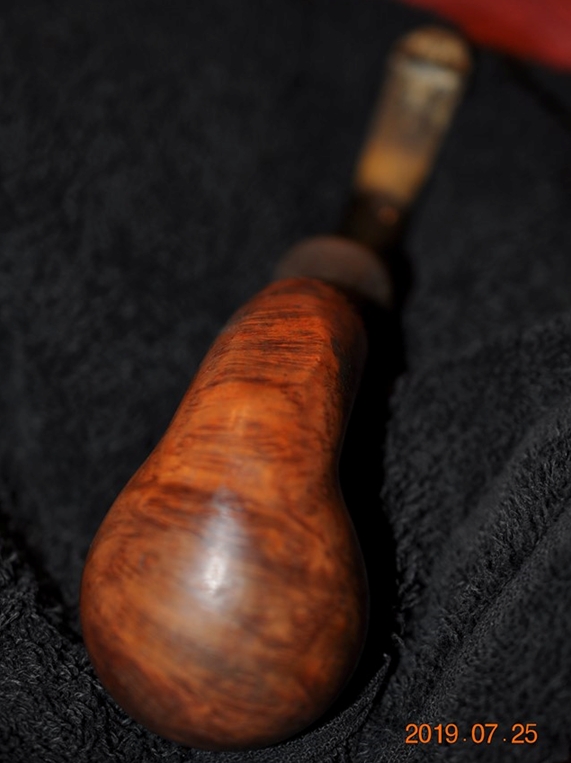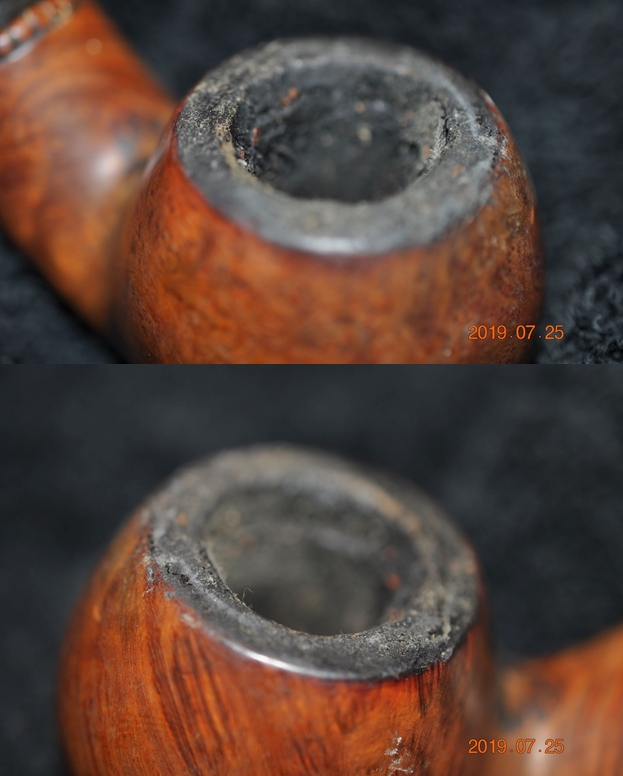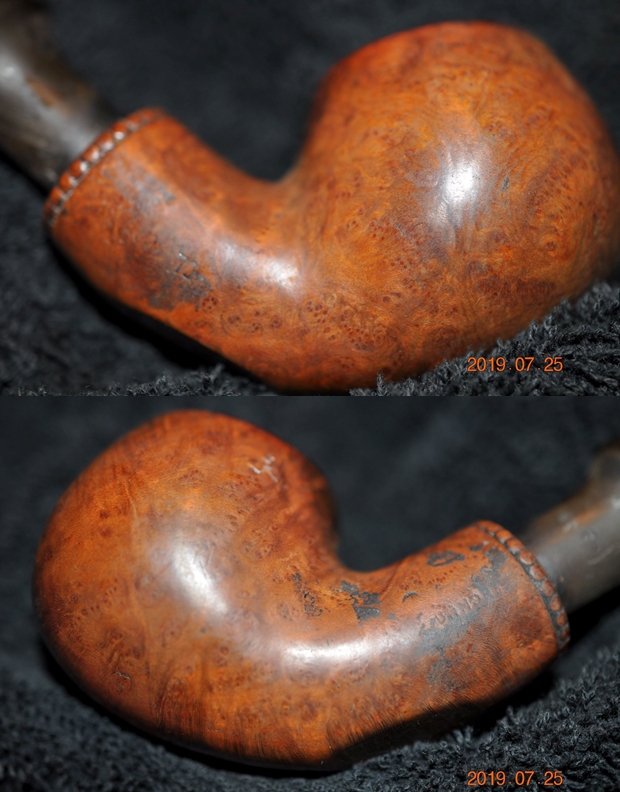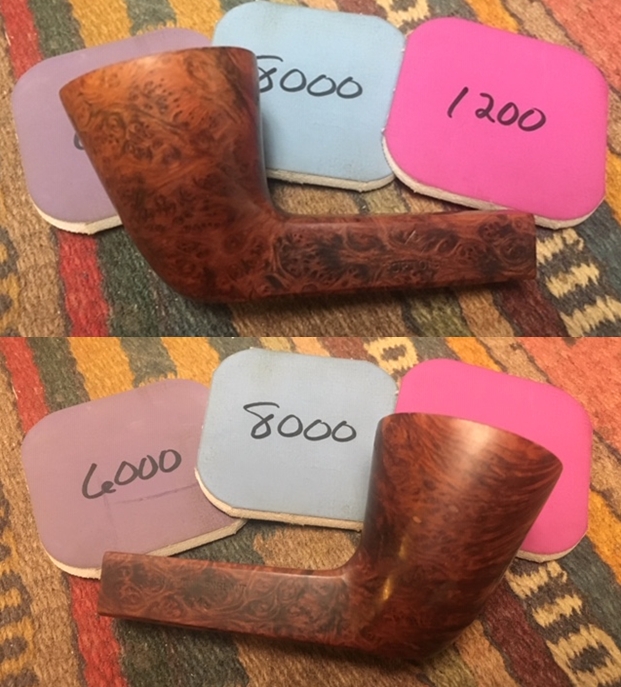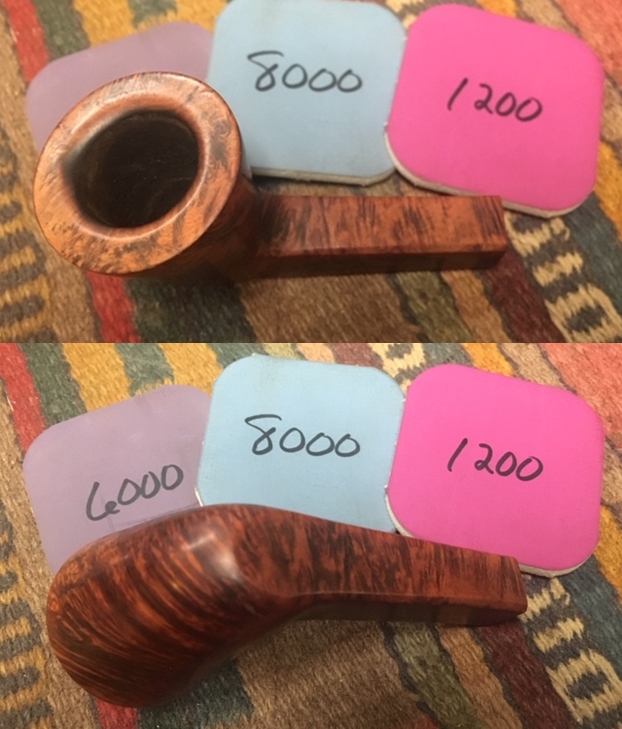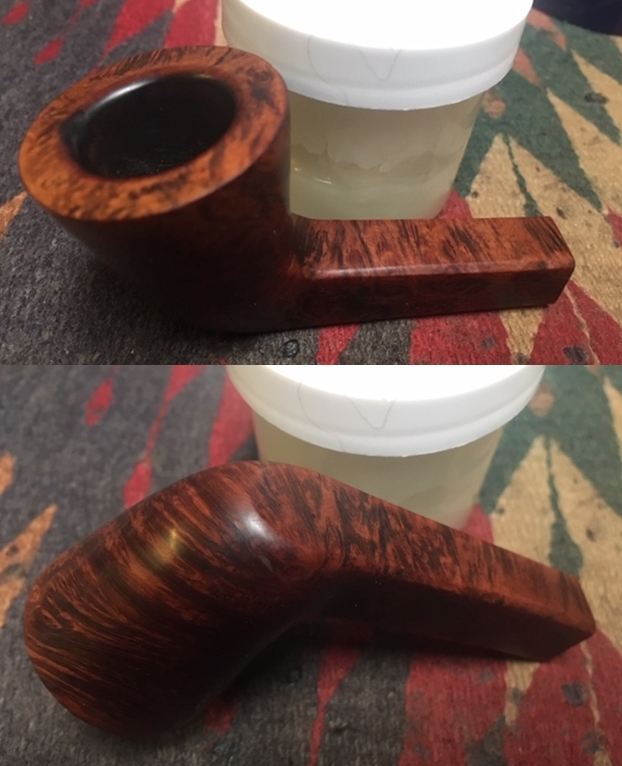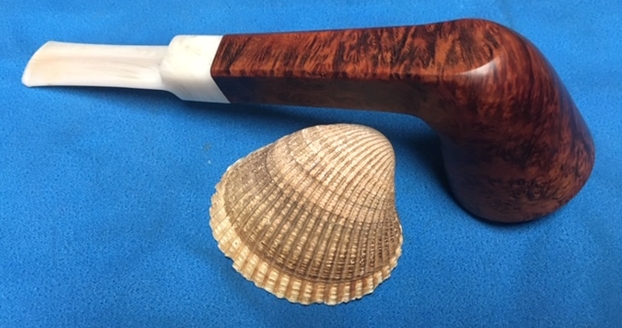
Tag Archives: topping a bowl

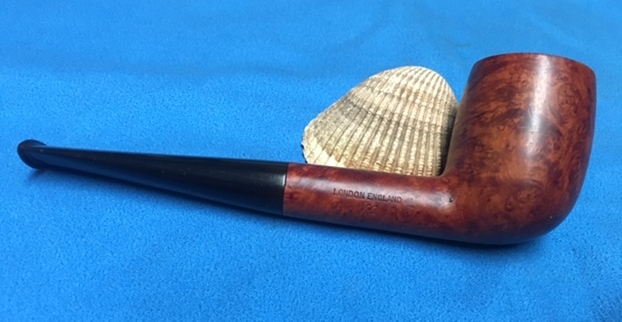
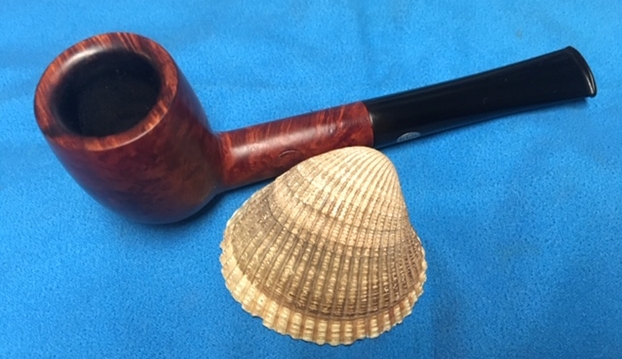
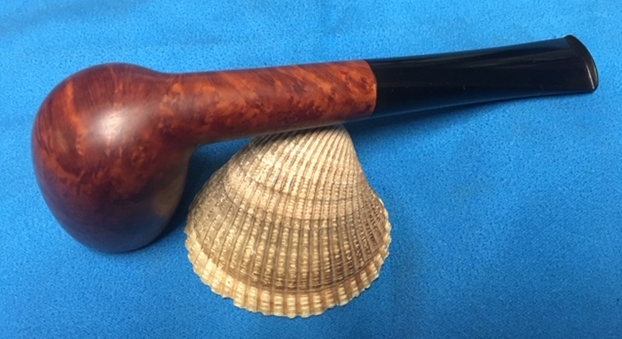
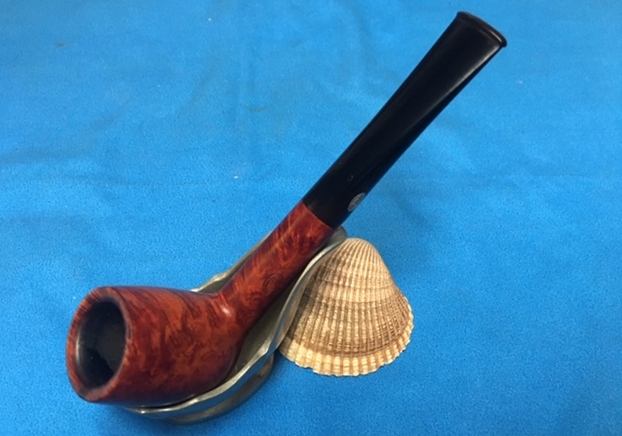
Working on a GBD New Era 122 Beveled Rim Billiard from Bob Kerr’s Estate


Blog by Steve Laug

I am continuing to work through Bob Kerr’s estate. The next pipe on the table is a GBD New Era Billiard. I am continuing to cleanup Bob’s estate for his family and moving them out into the hands of pipemen and women who will carry on the trust that began with Bob and in some pipes was carried on by Bob. In the collection there were a total of 125 pipes along with a box of parts. This is the largest estate that I have had the opportunity to work on. I put together a spread sheet of the pipes and stampings to create an invoice. I was taking on what would take me a fair amount of time to clean up. I could not pass up the opportunity to work on these pipes though. They were just too tempting.

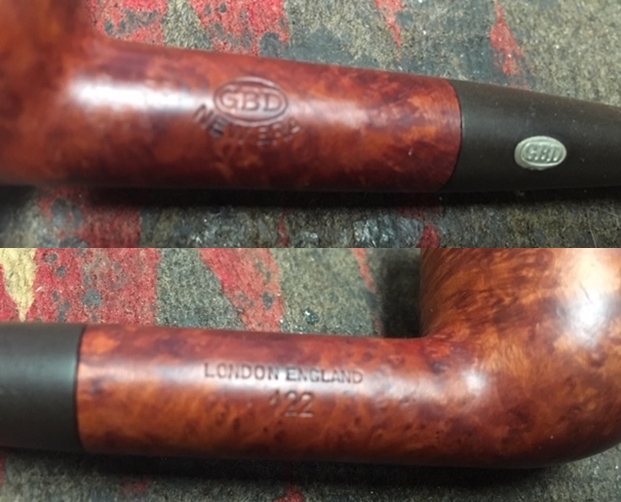
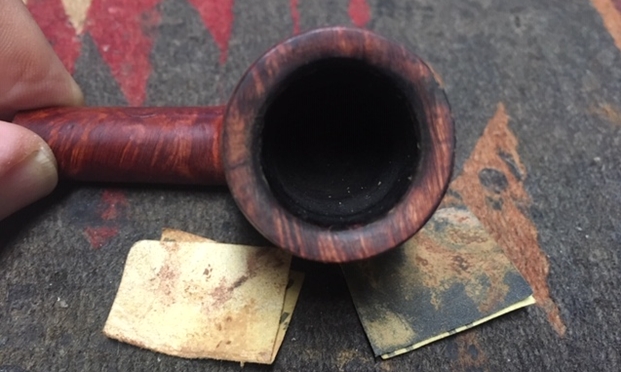
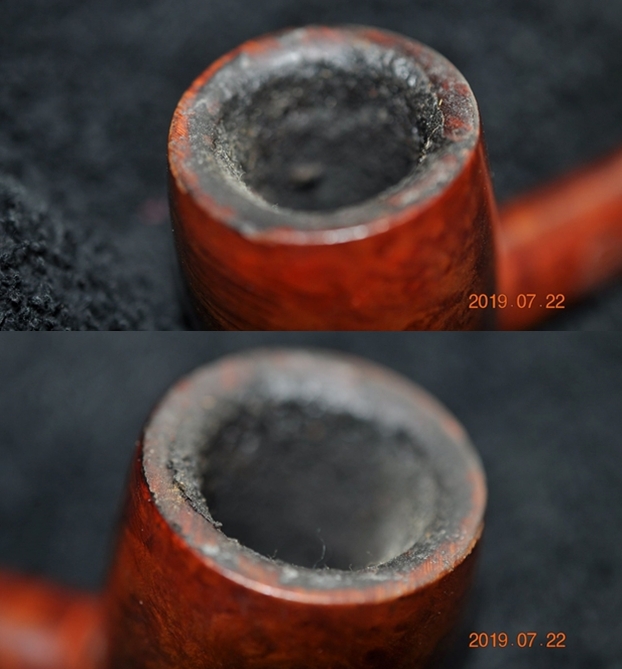
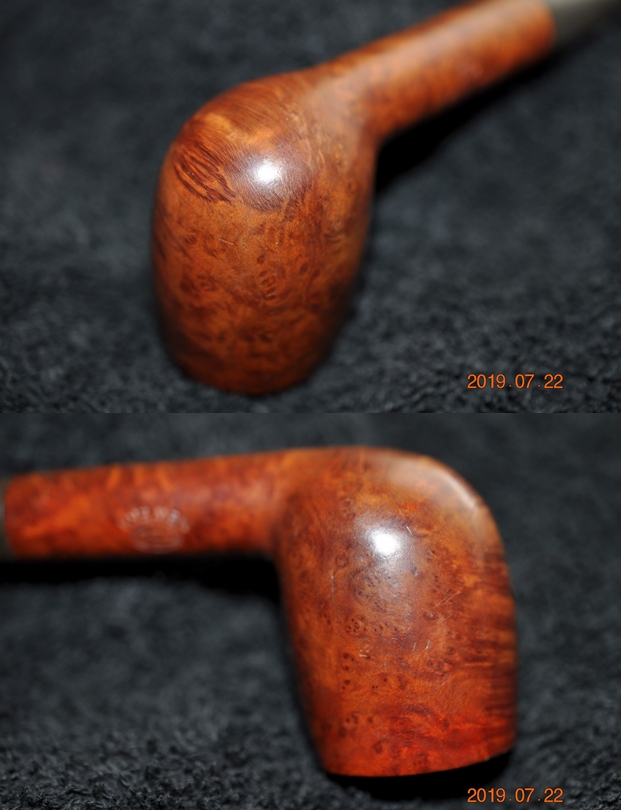
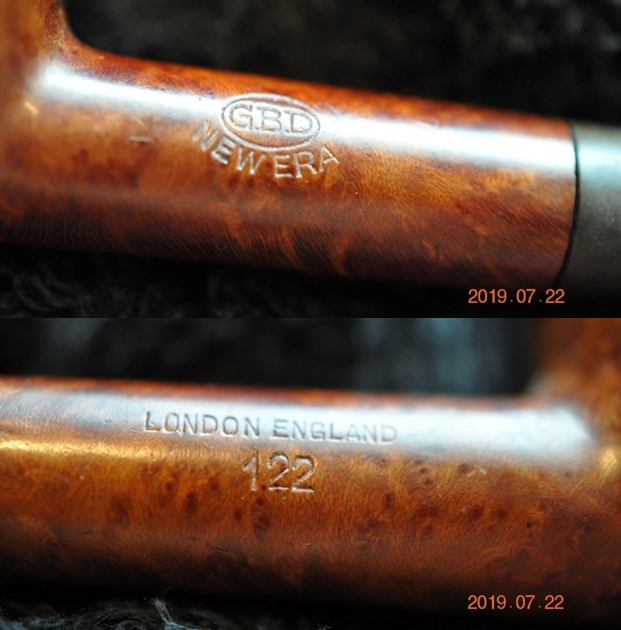
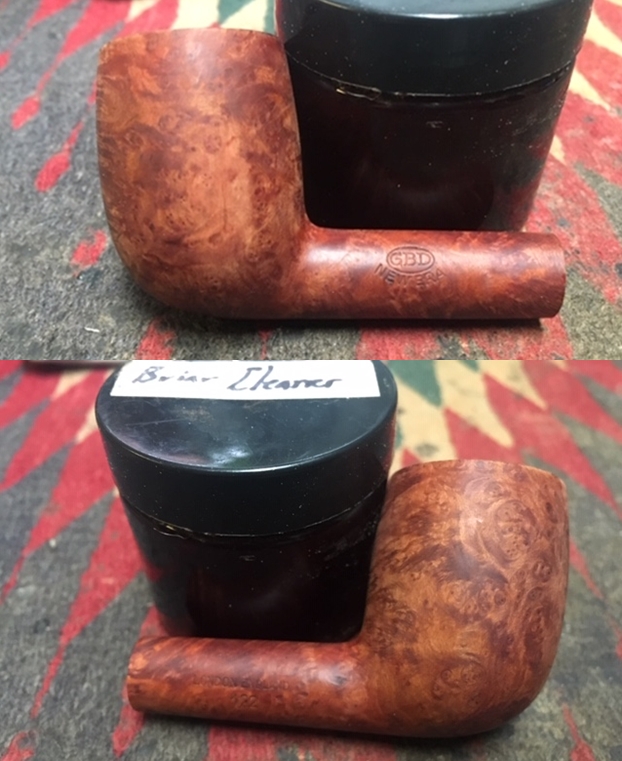
I have been collecting and restoring GBD pipes for as long as I have worked on pipes. This one also has some beautiful mixed grain underneath the grime. It is quite beautiful! The pipe is stamped GBD in an oval over New Era on the left side of the shank. On the right side it is stamped London, England over the shape number 122. It had a rich medium brown stain that does not look too bad. There was a thick cake in the bowl with remnants of tobacco stuck on the walls. There was a lava overflow on the rim. The inner beveled edge of the rim and top are dirty and had a thick lava coat. The edges look pretty pristine under the grime. It was a beautiful pipe that was dirty and tired looking. The stem was oxidized and calcified toward the end. Again, surprisingly did not have the tooth marks that I have come to expect from Bob’s pipes. Jeff took photos of the pipe before he started his cleanup work on it.Jeff took photos of the bowl and rim top to show the cake in the bowl and the lava build up on the edges of the bowl. It was thick and hard but hopefully it had protected the rim and edges from damage. The edges look pretty good.      Jeff took photos of the side and heel of the bowl to show the condition of the finish. You can see the beautiful grain – both birdseye and cross grain. The finish was very dirty.    Jeff took photos of the stamping on the smooth panel on the underside of the shank. The stamping was readable as you can see from the photos. On the left side it read GBD in an oval over New Era. On the right side it is stamped London, England over the shape number 122. On the left side of the tapered stem was an inlaid GBD roundel. Jeff took photos of the top and underside of the stem showing the tooth chatter, scratching and oxidation on the stem surface and wear on the edges of the button.    I turned to Pipedia’s article on GBD to see if I could find any information on the Popular. It was a line of GBD pipes that was new to me. The article gives a lot in terms of the history of the brand (https://pipedia.org/wiki/GBD). I have included a paragraph from the site below as well as a page from a catalogue.
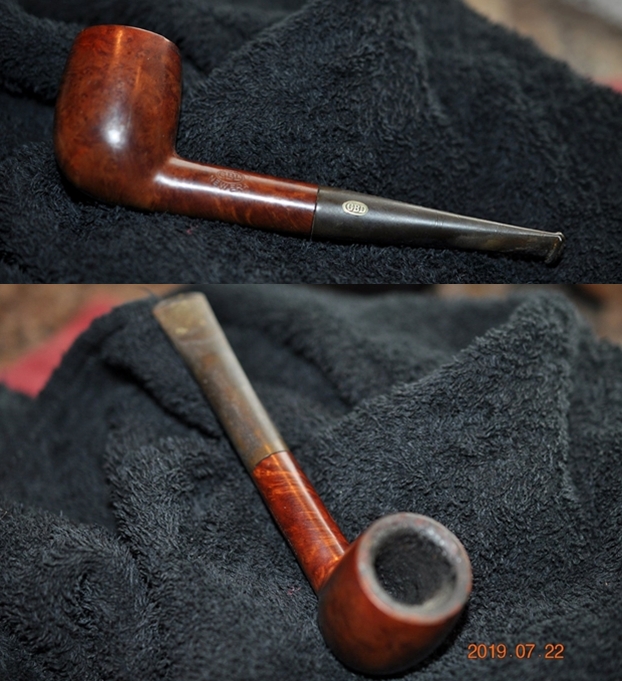
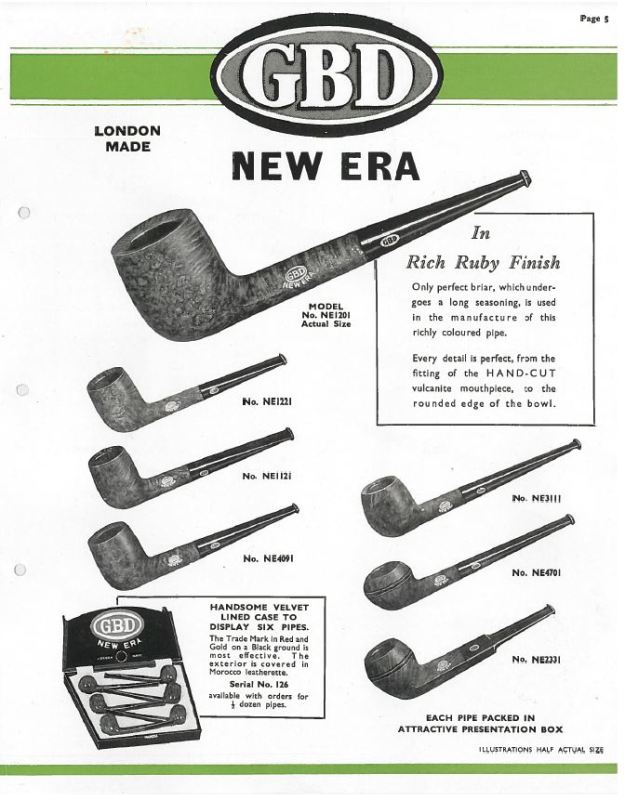
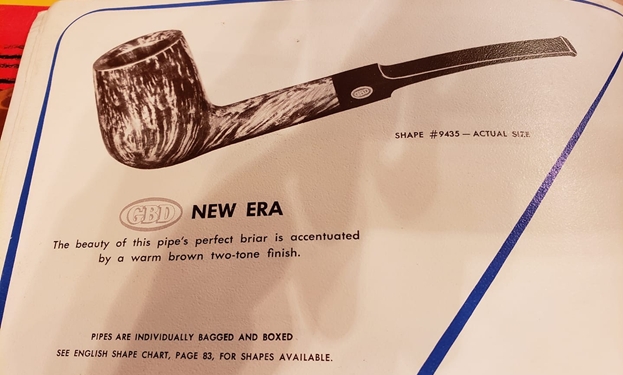
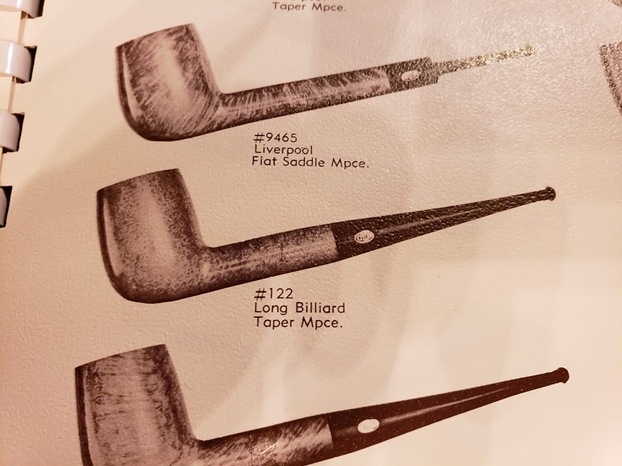
The claims after the 1st World War demanded further distinctions. First of all was the London Made, which became the Standard London Made, followed by the New Era– in 1931 the top model asking 12½ Shilling. The Pedigree, although sketched around 1926, was not produced until the later 1930s. The New Standard was introduced in order to give the popular Standard of the 20s a higher rank in value. The Prehistoric, a deeply sandblasted black pipe, that still carried the small GBD Xtra stamp, was entirely new and unusual.There was a fellow on Facebook Tobacco Pipe Restorers Group who picked up some booklets and pamphlets on GBD pipes. I messaged him and asked him to send me info on the New Era line. This photo gives a pretty good description. Combined with the one above it is an interesting mystery. The first document above says that the pipe has “a rich ruby finish” while the one below says it is “accentuated by a warm brown two-tone finish.” The pipe I am working on definitely sits somewhere between these two descriptions – it has a reddish brown finish.I also turned to the reference page on the site for GBD shapes and numbers and found the one for the straight bulldog that I was working on (https://pipedia.org/wiki/GBD_Shapes/Numbers). I did a screen capture of the section and from the various Model information. I combined them below (https://pipedia.org/wiki/GBD_Model_Information).   The fellow on Facebook also included the next photo that shows the shape and description of the 122. GBD calls it a Long Billiard with a Taper Mouthpiece.I now knew I was dealing with a well-made hand chosen piece of briar that had gone through a period of long seasoning. In terms of dating the pipe I figure that it fits in with the late 50s to late 60s of Bob’s other pipes but I cannot know for sure. Now it was time to work on the pipe.

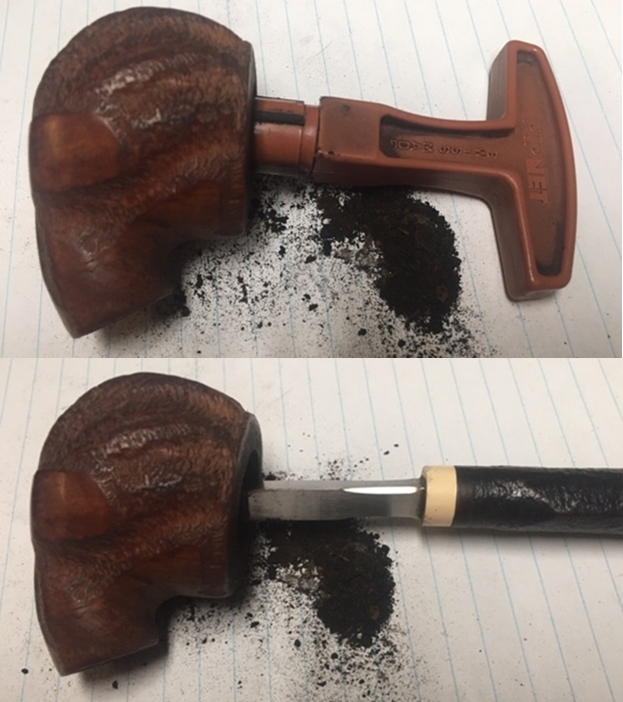
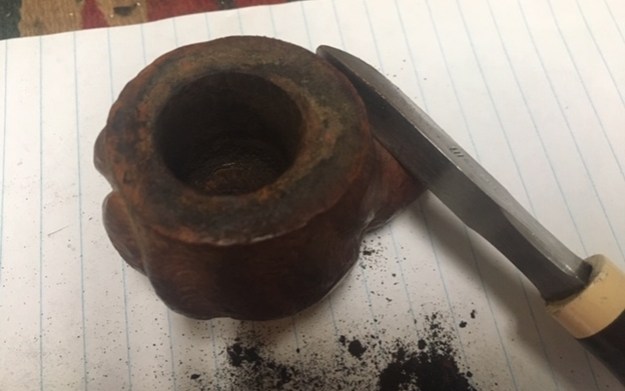
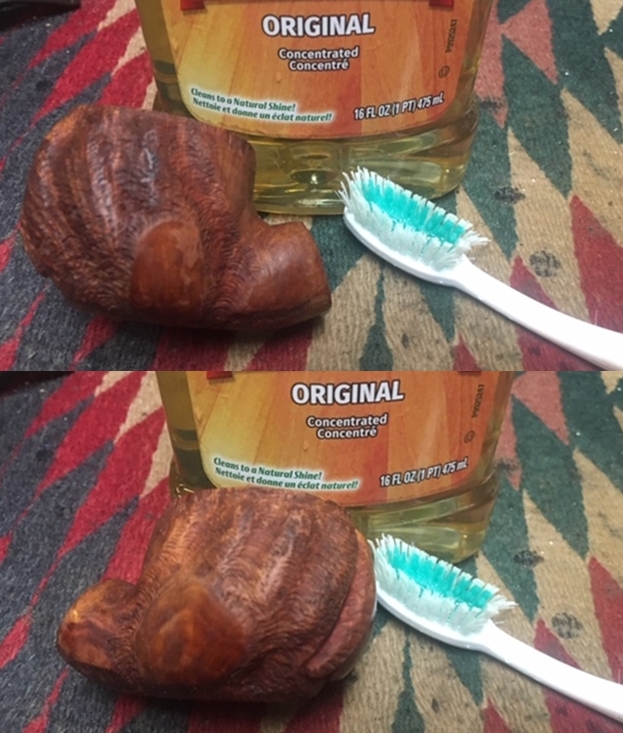
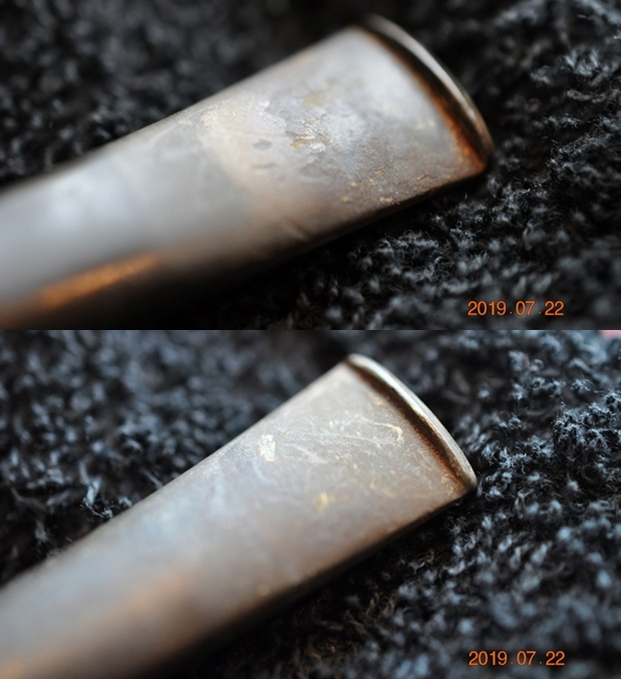
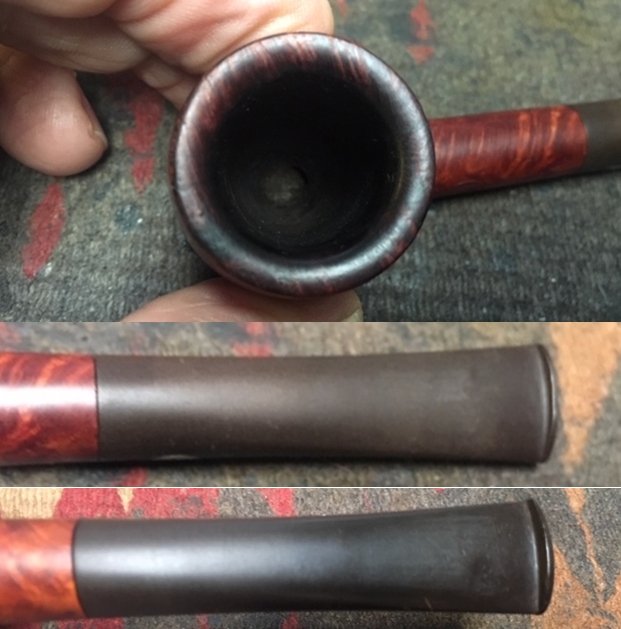
With over 125 pipes to clean from Bob’s estate I took a batch of them to the states with me on a recent visit and left them with Jeff so he could help me out. Jeff cleaned the pipe with his usual penchant for thoroughness that I really appreciate. This one was a real mess and I did not know what to expect when I unwrapped it from his box. He reamed it with a PipNet pipe reamer and cleaned up the reaming with a Savinelli Fitsall Pipe Knife. He scrubbed out the internals with alcohol, pipe cleaners and cotton swabs until the pipe was clean. He scrubbed the exterior of the bowl with Murphy’s Oil Soap and a tooth brush to remove the grime and grit on the briar and the lava on the rim top. The finish looks very good with good looking grain around the bowl and shank. Jeff soaked the stem in Before & After Deoxidizer to remove the oxidation on the rubber. When the pipe arrived here in Vancouver for the second stop of its restoration tour it looked very good. I took photos before I started my part of the work.     I took some close up photos of the rim top and also of the stem surface. I wanted to show what an amazing job Jeff did in the cleanup of the rim top. The rim top looks good. There is some darkening on the top edge and a few light nicks and scratches on the surface. The bowl looked very good. I also took close up photos of the stem to show the scratches and lack of tooth marks on the stem. You can also see the remaining oxidation on the stem surface.     I am going to keep posting the next paragraph because of the importance of protecting the stamping/nomenclature.
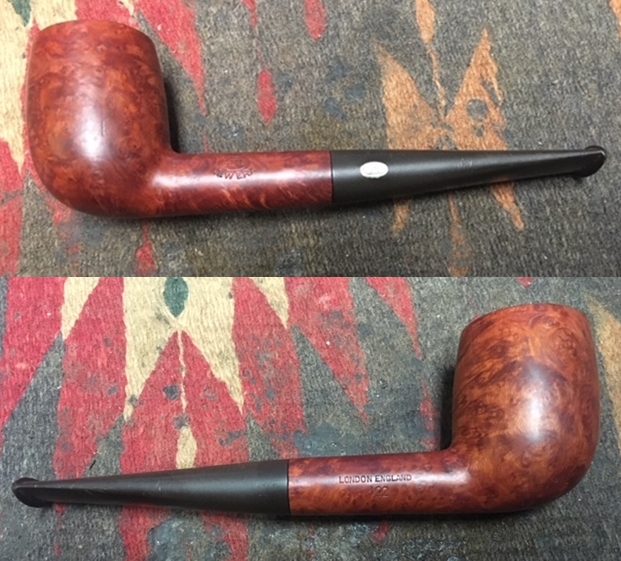
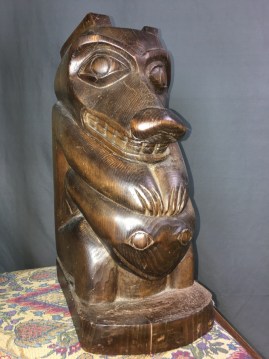
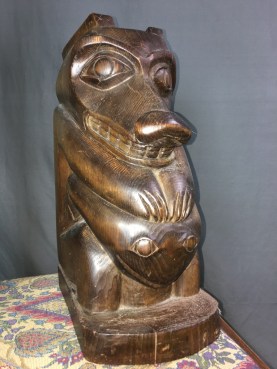
One of the things I appreciate about Jeff’s cleanup is that he works to protect and preserve the nomenclature on the shank of the pipes that he works on. The stamping on this one was very faint to start with so I was worried that it would disappear altogether with the cleanup. He was not only able to preserve it but it is clearer than shown in the earlier photos. I took some photos to show the clarity of the stamping. I have noticed that many restorers are not careful to protect the stamping in their cleaning process and often by the end of the restoration the nomenclature is almost destroyed. I would like to encourage all of us to be careful in our work to preserve this as it is a critical piece of pipe restoration!Since this is another pipe Bob’s estate I am sure that some of you have read at least some of the other restoration work that has been done on the previous pipes. You have also read what I have included about Bob Kerr, the pipeman who held these pipes in trust before I came to work on them (see photo to the left). Also, if you have followed the blog for long you will already know that I like to include background information on the pipeman whose pipes I am restoring. For me, when I am working on an estate I really like to have a sense of the person who held the pipes in trust before I worked on them. It gives me another dimension of the restoration work. I asked Brian if he or his wife would like to write a brief biographical tribute to her father, Bob. His daughter worked on it and I received the following short write up on him and some pictures to go along with the words including one of Bob’s carvings. Once again I thank you Brian and tell your wife thank you as well.

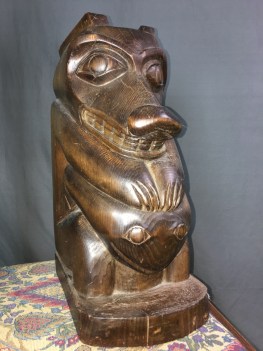
I am delighted to pass on these beloved pipes of my father’s. I hope each user gets many hours of contemplative pleasure as he did. I remember the aroma of tobacco in the rec room, as he put up his feet on his lazy boy. He’d be first at the paper then, no one could touch it before him. Maybe there would be a movie on with an actor smoking a pipe. He would have very definite opinions on whether the performer was a ‘real’ smoker or not, a distinction which I could never see but it would be very clear to him. He worked by day as a sales manager of a paper products company, a job he hated. What he longed for was the life of an artist, so on the weekends and sometimes mid-week evenings he would journey to his workshop and come out with wood sculptures, all of which he declared as crap but every one of them treasured by my sister and myself. Enjoy the pipes, and maybe a little of his creative spirit will enter you!

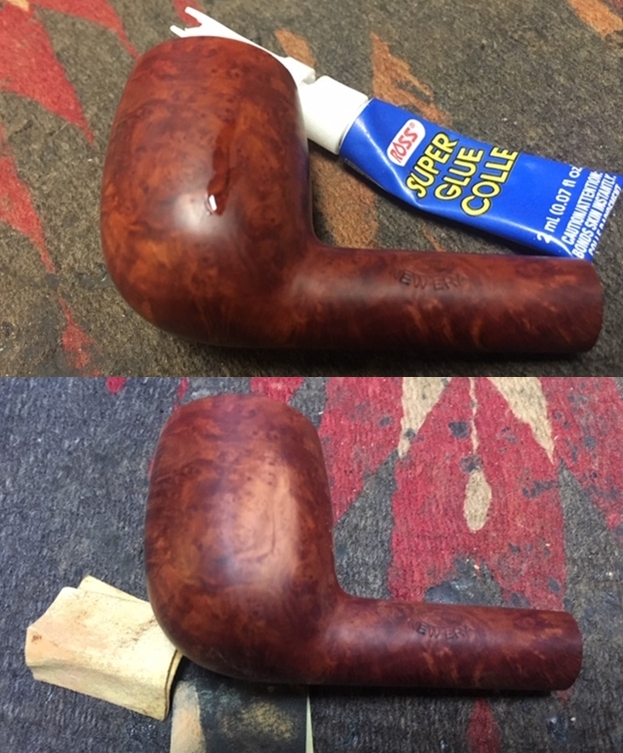
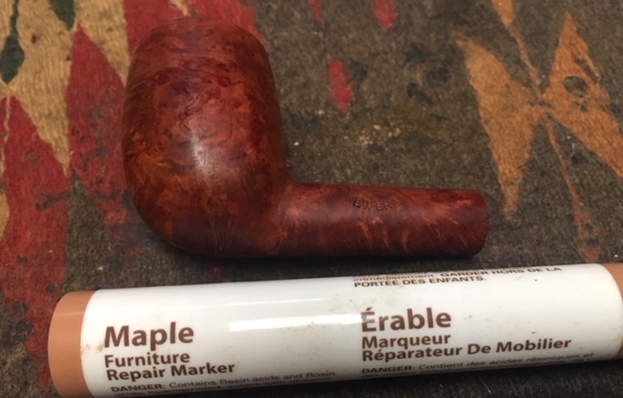
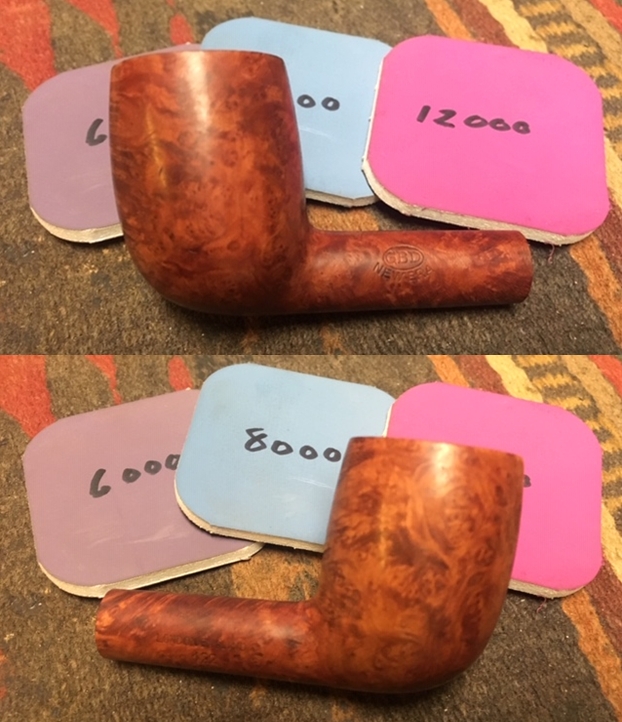
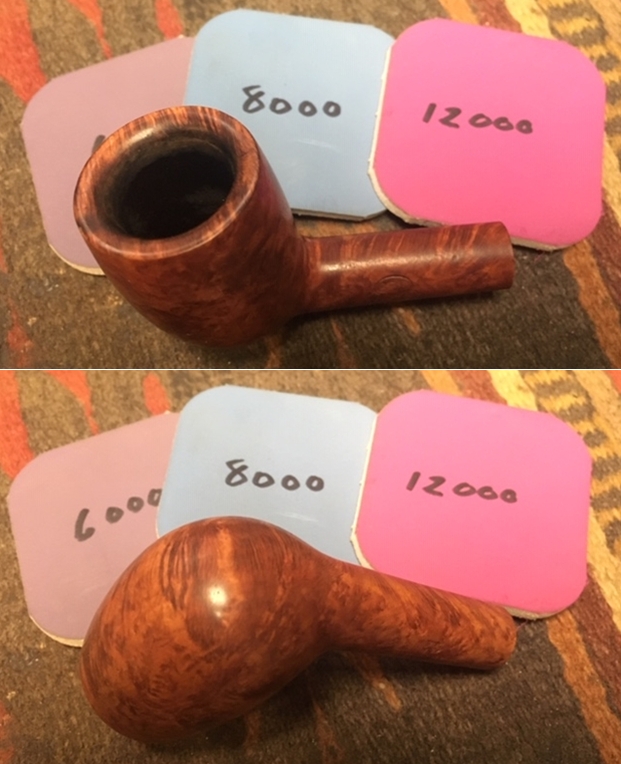
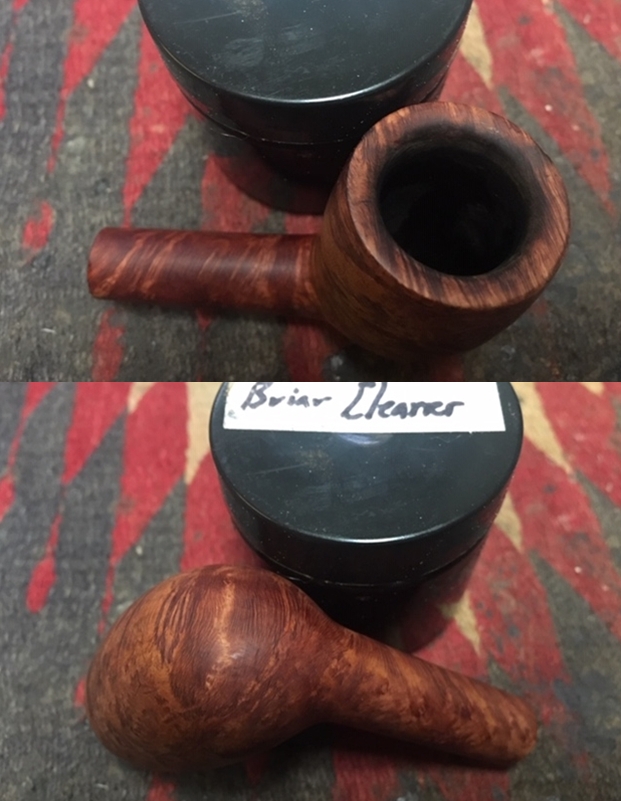
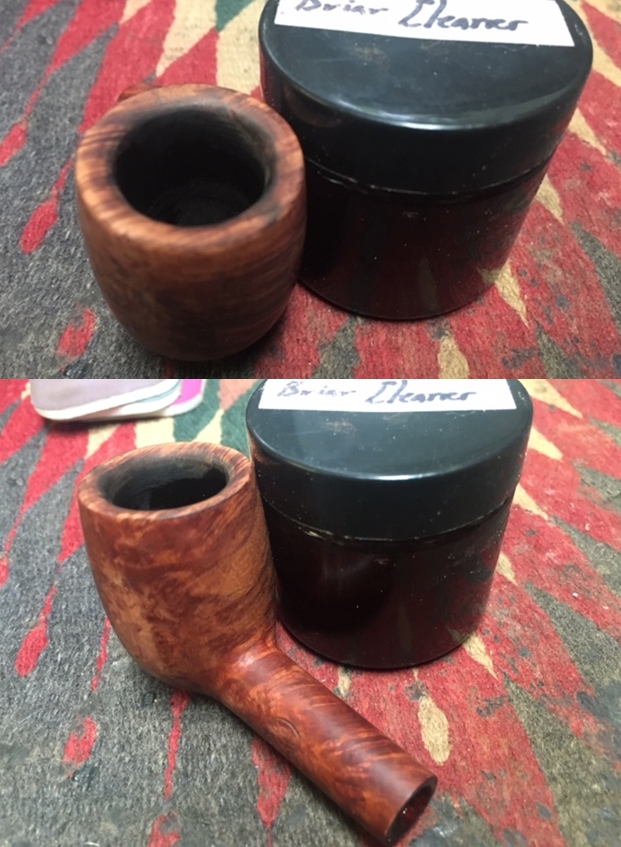
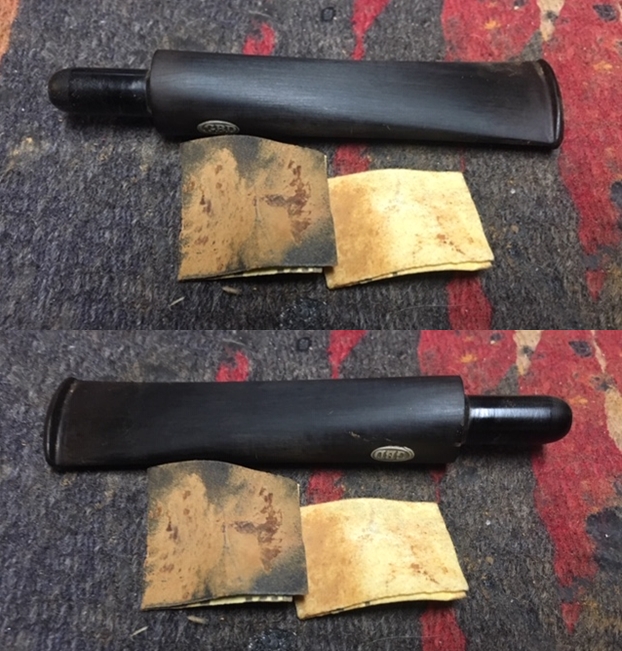
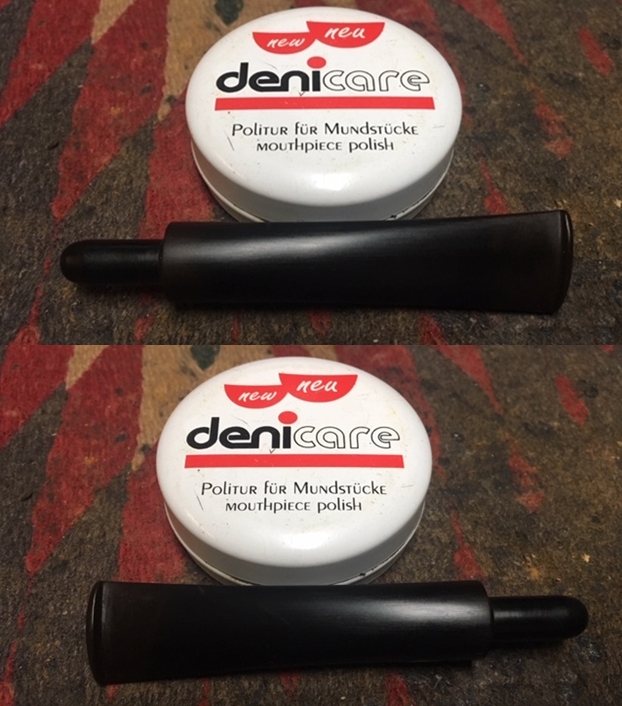
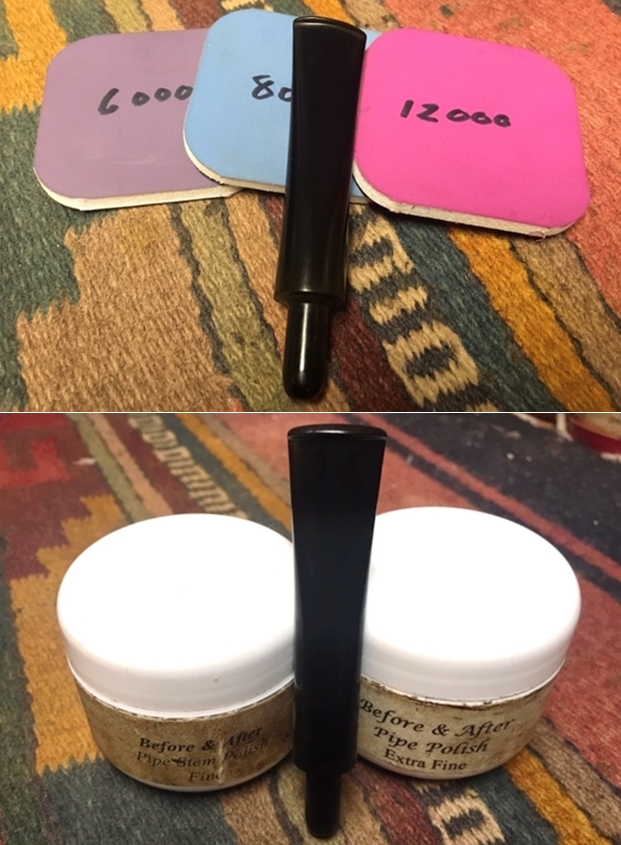
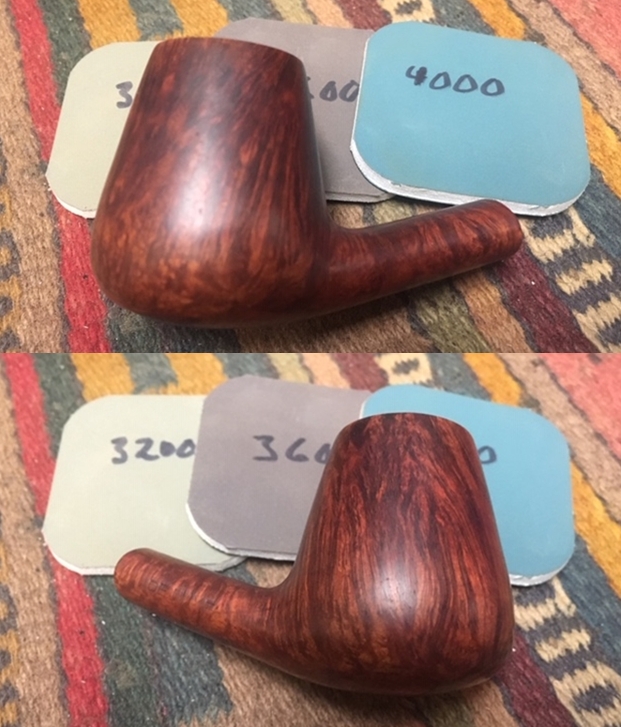
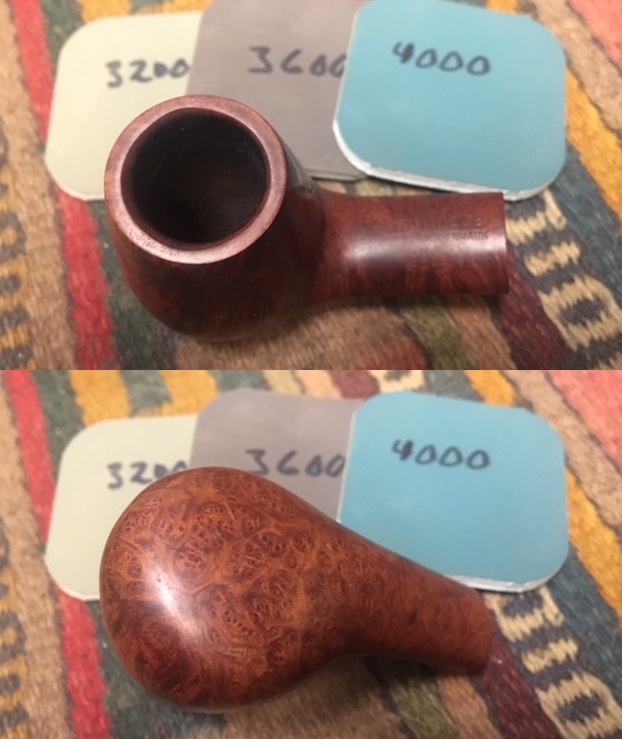
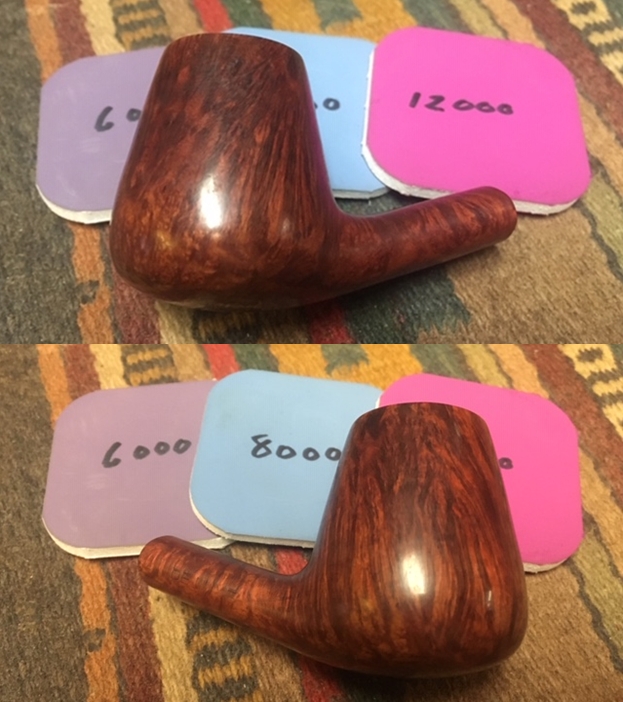
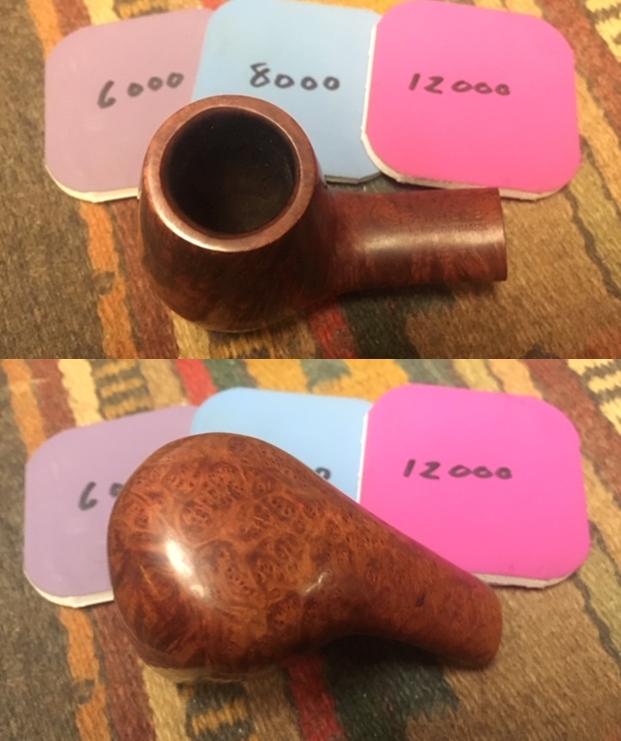
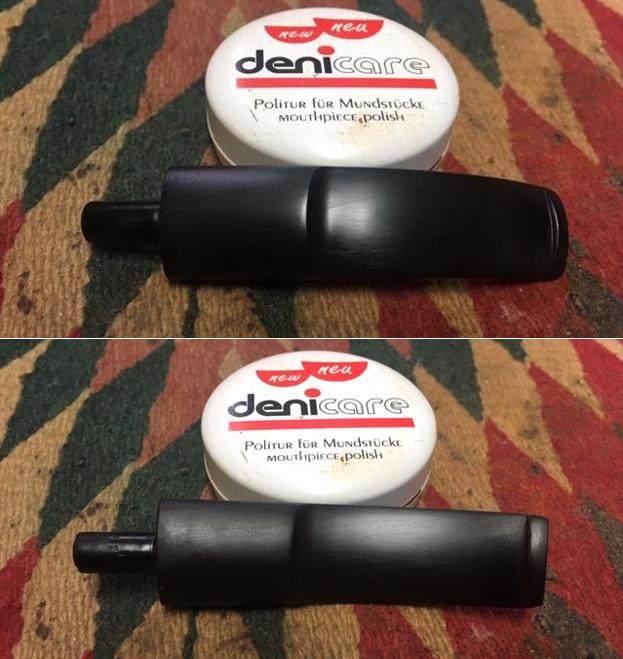
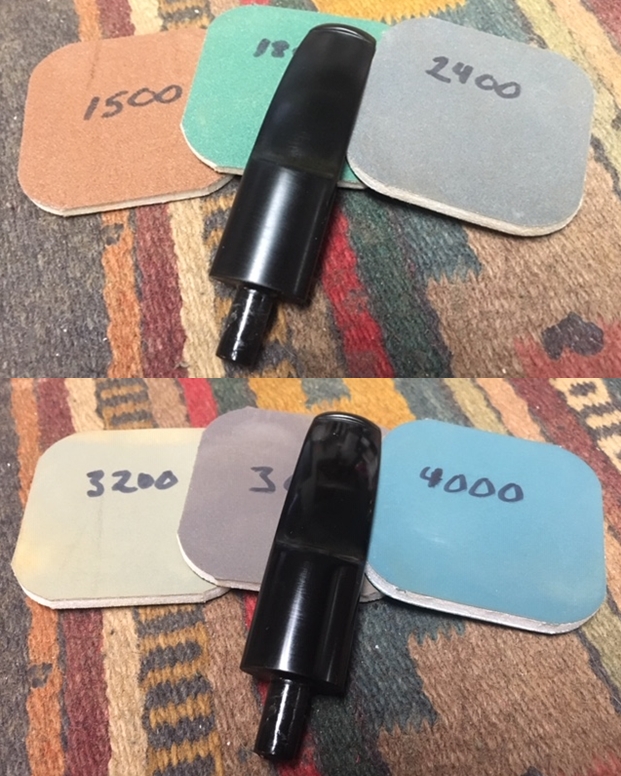
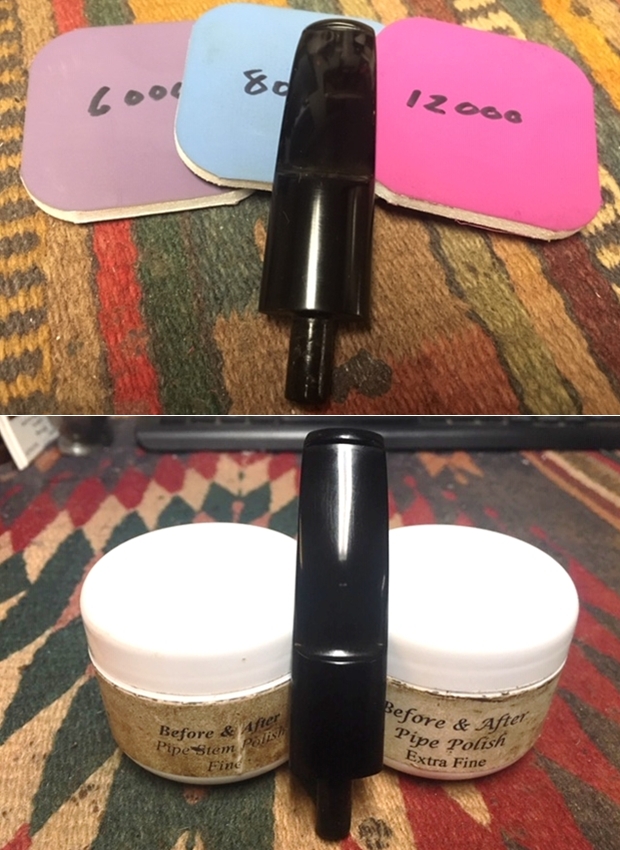
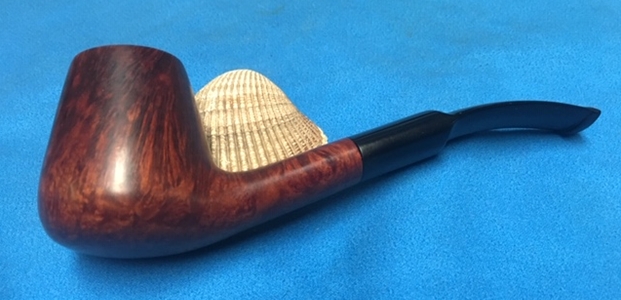
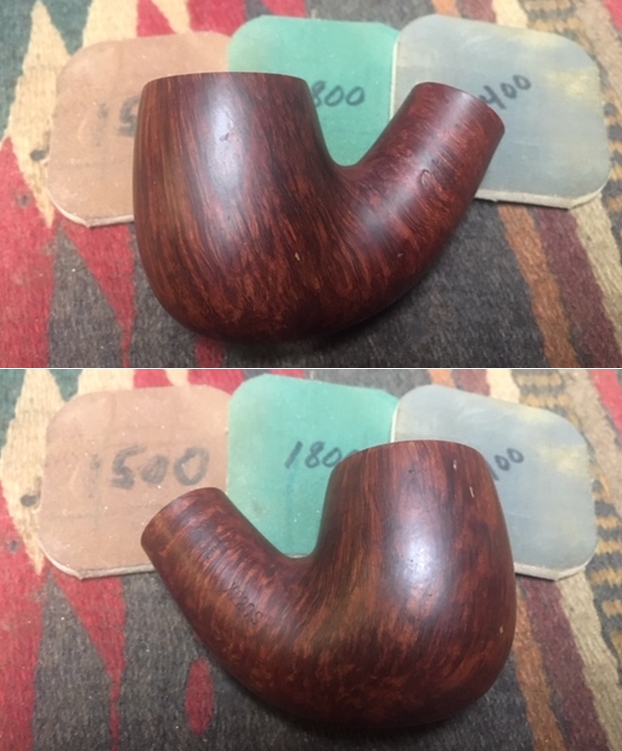
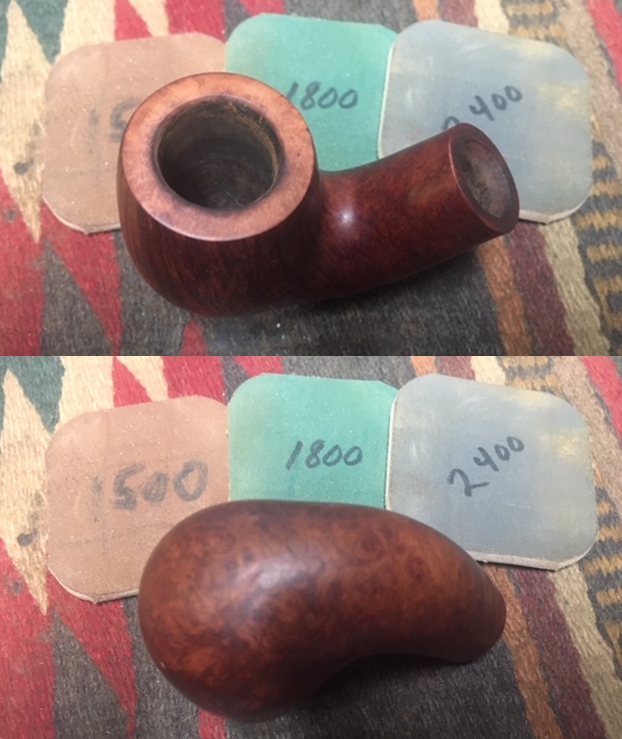
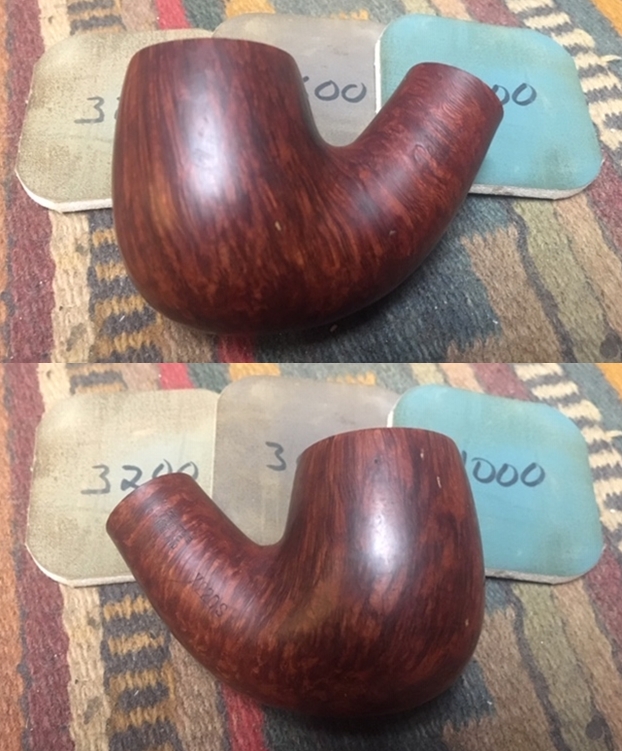
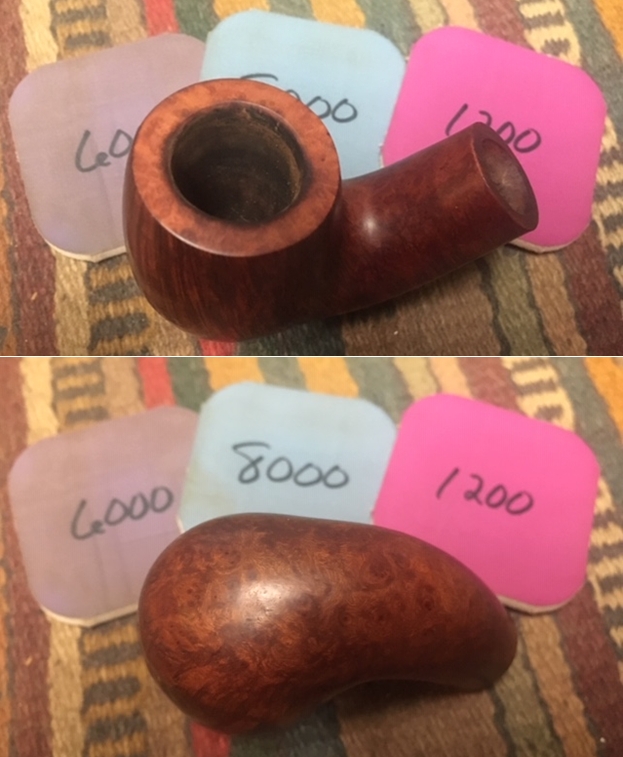
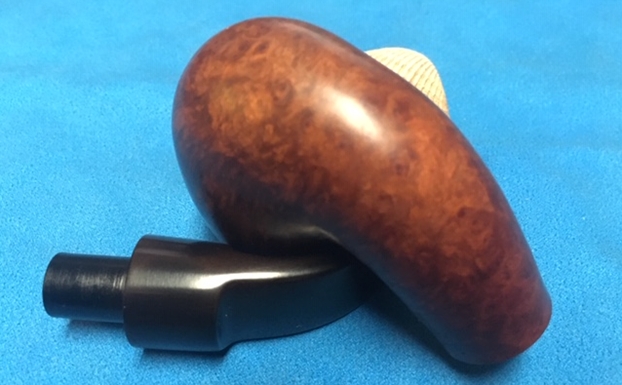
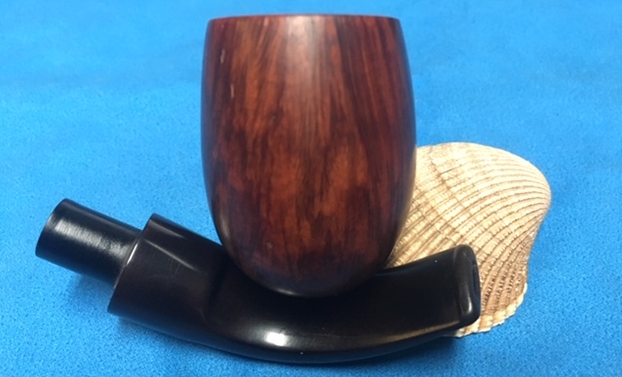
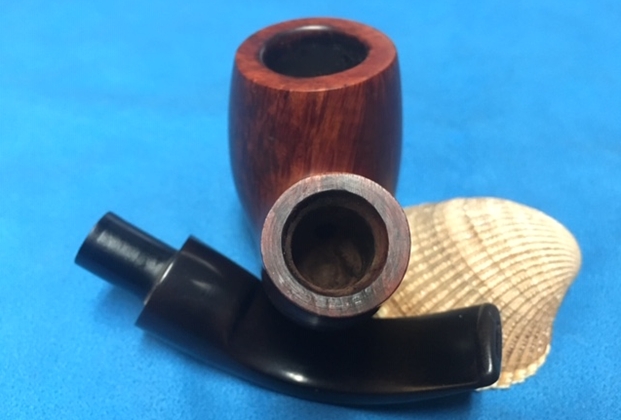
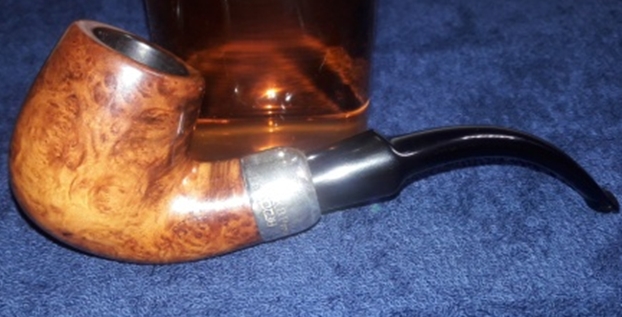
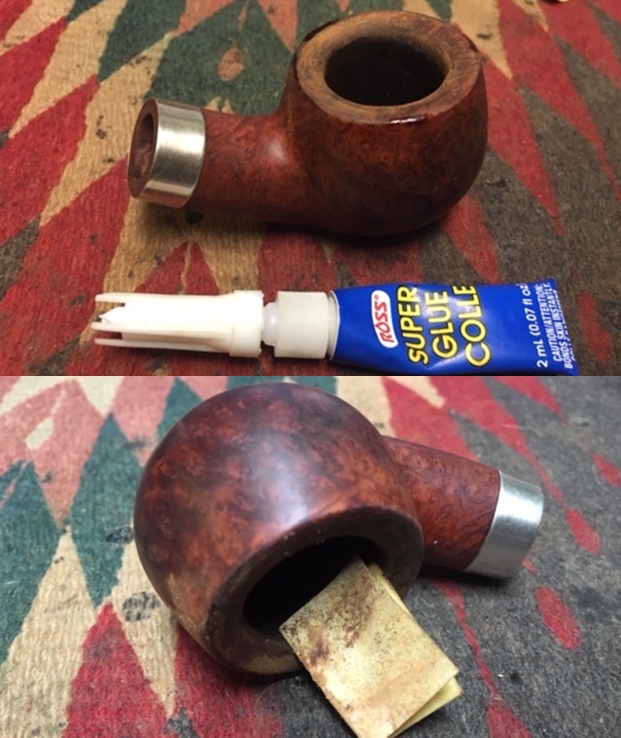
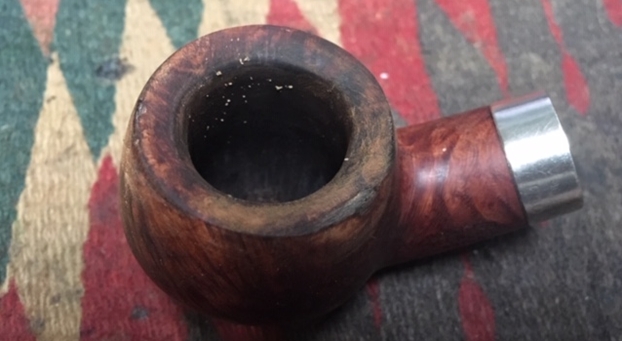
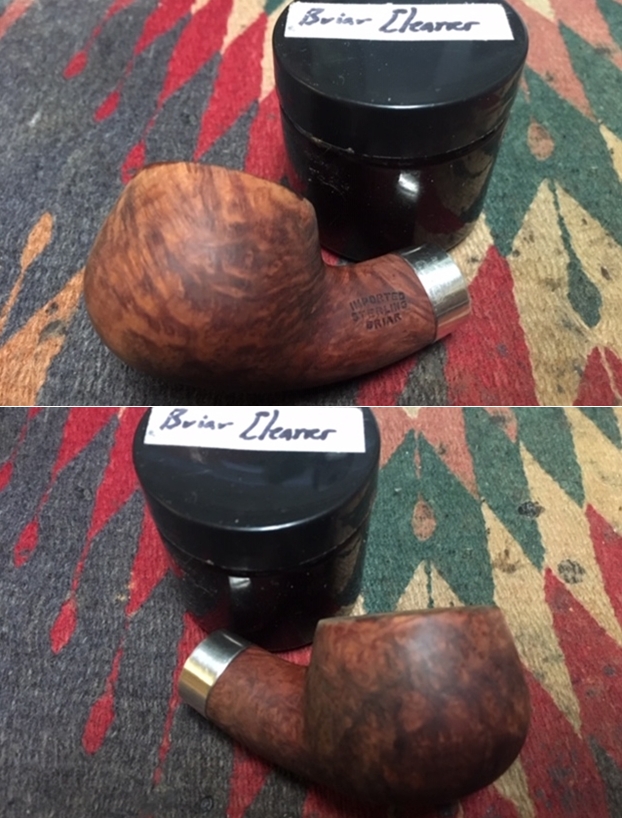
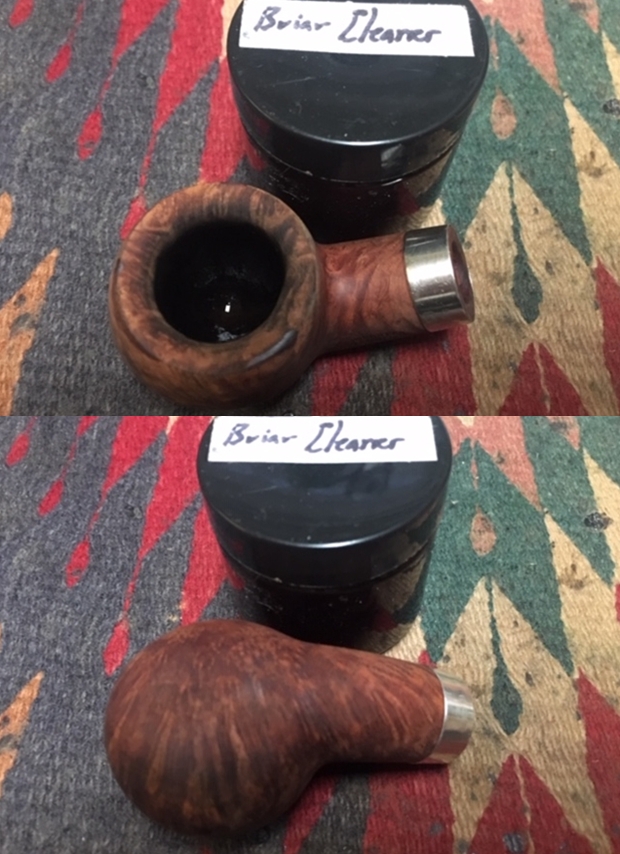
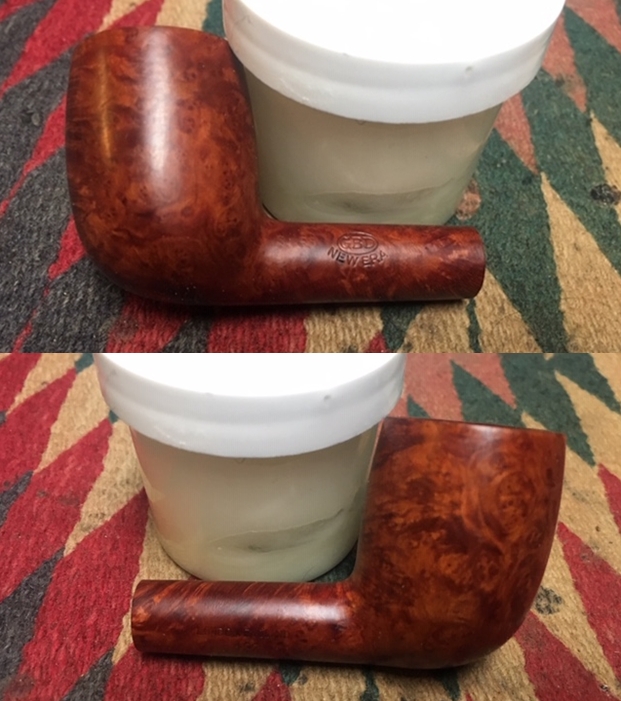
Now on to the rest of the restoration on this GBD New Era Billiard. Since Jeff had done such an amazing clean up job on the bowl it was very easy for me. There was some darkening on the inner beveled edge of the rim that needed to be addressed. I sanded it with a folded piece of 220 grit sandpaper to remove and minimize the damage to the bevel. I continued by starting to polish it with 400 grit wet dry sandpaper. I wiped the rim edge down with a damp cloth to remove the sanding dust on the briar. The finished rim top looked much better than when I started.There was a deep cut or groove in the briar on the left side of the bowl. It looked like someone had scratched it against hard surface leaving a deep gouge. I filled in the gouge with clear super glue. Once the glue had dried I sanded it smooth with 220 grit sandpaper and blended it with 400 grit wet dry sandpaper.  I used a Maple stain pen to touch up the sanded area to match the rest of the bowl. It looked very good and would completely blend once the bowl was polished with micromesh.I polished the briar with micromesh sanding pads to blend in the stain and to polish the briar and remove the scratches in the surface of the bowl, heel and shank. I wet sanded with 1500-12000 grit pads and wiped the bowl down between each pad with a damp cloth.   I decided to clean the briar with Mark Hoover’s Before & After Briar Cleaner to clean up the sanded surface of the briar and blend sanded rim edge. I rubbed it into the surface of the briar and let it sit for 10 minutes. I rinsed the bowl off with warm running water to remove the product and the grime.       I rubbed the bowl down with Before & After Restoration Balm. I worked it into the surface of the briar with my fingertips to clean, enliven and protect it. I let the balm sit for a little while and then buffed with a cotton cloth and shoe brush to raise the shine. Mark Hoover’s Balm is a product that I have come to appreciate and one I use on every pipe I have been working on.     I set the bowl aside and turned my attention to the stem. I sanded the stem with 220 grit sandpaper to break up the oxidation. I started the polishing with 400 grit wet dry sandpaper to remove the scratching. It is starting to look good.    I have one more tin of Denicare Mouthpiece Polish left from a few that I have picked up over the years. It is a coarse red pasted that serves to help remove oxidation. I polished the stem with that to further smooth out the surface of the vulcanite (and to be honest – to use it up).   I polished the stem with micromesh sanding pads – wet sanding with 1500-12000 grit pads. I wiped the stem down after each sanding pad with Obsidian Oil. I polished it with Before & After Pipe Stem Polish – both Fine and Extra Fine. Once I had finished the polishing I gave it final coat of oil and set it aside to dry.       I am excited to be finishing another one of Bob Kerr’s Estate pipes and as usual I look forward to what it will look like when it is put back together, polished and waxed. I put the bowl and stem back together. I polished the bowl and stem with Blue Diamond to polish out the scratches in the briar and the vulcanite. I gave the bowl and stem multiple coats of carnauba wax. I buffed the pipe with a clean buffing pad to raise the shine. I hand buffed it with a microfiber cloth to deepen the shine. The pipe polished up pretty nicely. The rich reddish brown finish really popped with buffing showing the contrast colours of stain on the pipe. The polished black vulcanite stem went really well with the colours of the bowl. This old GBD New Era 122 Billiard was another fun pipe to work on thanks to Jeff’s cleanup work. It really has the classic GBD Billiard shape that is very recognizable. The combination of various stains really makes the pipe look attractive. It is a comfortable pipe to hold in the hand. The finished pipe is shown in the photos below. The dimensions of the pipe are Length: 5 ¼ inches, Height: 1 ¾ inches, Outside diameter of the bowl: 1 ¼ inches, Chamber diameter: ¾ of an inch. If you are interested in carrying on Bob’s legacy with this pipe send me a message or an email. I have a lot more to work on of various brands. Perhaps one of those will catch your attention. Thanks for reading this blog and my reflections on the pipe while I worked on it. This is an interesting estate to bring back to life.

Restoring a Danmore Deluxe Volcano from Bob Kerr’s Estate


Blog by Steve Laug

The next pipe I chose to work on from Bob Kerr’s estate is part of his collection of Danish made pipes. I have worked on the restoration of others in this collection including a Stanwell Jubilee Shape 118 (https://rebornpipes.com/2019/08/11/another-bob-kerr-estate-a-stanwell-jubilee-1942-1982-shape-118/); a Stanwell de Luxe Shape 812 (https://rebornpipes.com/2019/08/10/back-to-bob-kerrs-estate-changing-up-and-working-on-a-danish-made-stanwell-de-luxe-812-billiard-regd-no-969-48/); a WO Larsen (https://rebornpipes.com/2019/01/13/restoring-pipe-17-from-bob-kerrs-estate-a-w-o-larsen-super-15-bent-stack/) and a Danish Sovereign Bulldog variation (https://rebornpipes.com/2019/08/11/another-bob-kerr-estate-a-danish-sovereign-305-bulldog-variant/).

To this list of Danish pipes I am adding the next  – a Danmore Handmade in Denmark Deluxe Volcano. Like the others it is part of Bob’s estate that the family asked me to clean up and move out to others who will carry on the trust that began with Bob. In the collection there were BBBs, Peterson’s, Dunhills, Comoy’s and Barlings as well many others – a total of 125 pipes. This is the largest estate that I have had the opportunity to work on. I created a spread sheet to track the pipes, restoration and sales. This job would take a fair amount of time to clean up. I could not pass up the opportunity to work on these pipes and help the family.

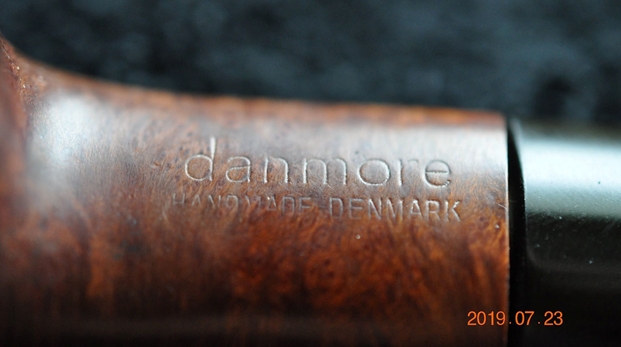
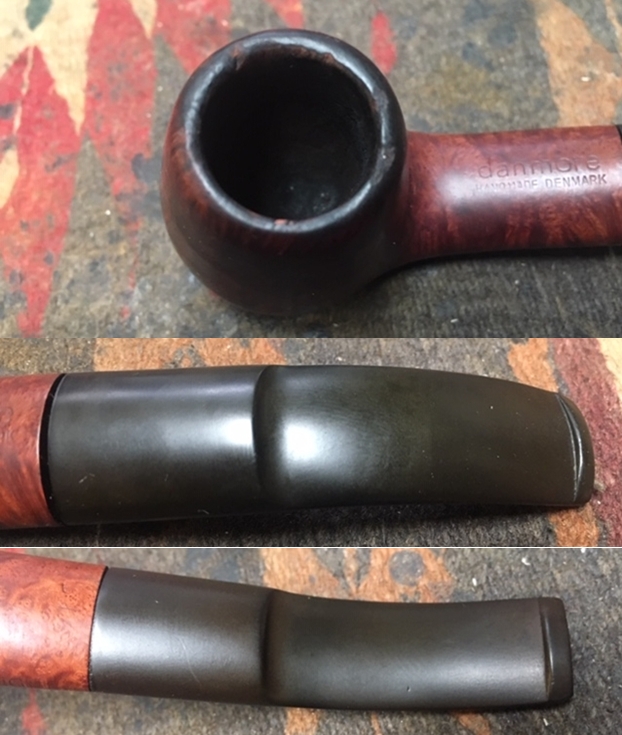
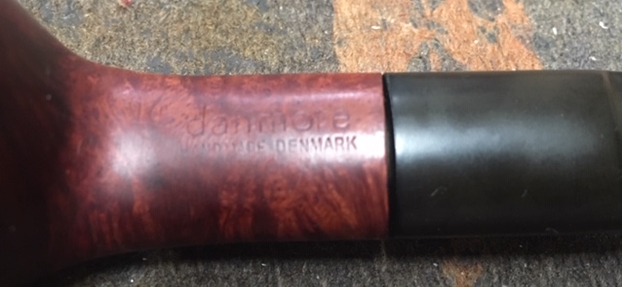
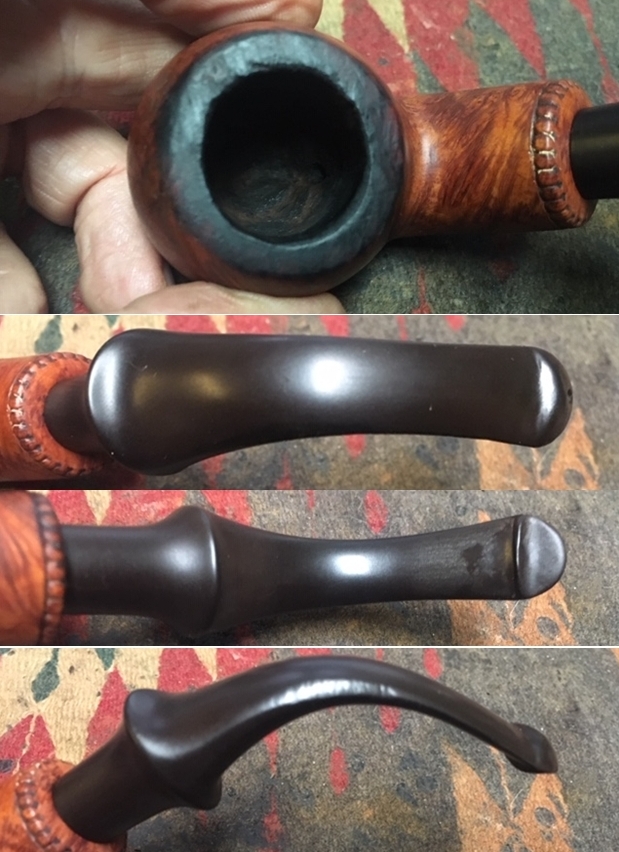
When I took the Danmore out of the box of cleaned up pipes that Jeff sent back I could see that it was stamped Danmore Handmade Denmark on the topside of the shank and Deluxe on the right side of the shank. It has straight and flame grain around the bowl and the oval shank and birdseye on the heel of the bowl and shank. The finish was dirty like the rest of the pipes in this estate. There was a thick cake in the bowl with remnants of tobacco stuck on the walls. There was an overflow of lava on the rim. The top and edges of the rim were dirty and there appears to be a deep chip on the front of the bowl edge. I could see a beautiful pipe underneath all of the grime and buildup of years of use. The stem was oxidized with tooth chatter on both sides. Surprisingly it had none of the deep tooth marks that I have come to expect from Bob’s pipes. Jeff took photos of the pipe before he started his cleanup work on it. Jeff took photos of the bowl and rim top to show the thick, hard cake in the bowl and the lava build up on the top of the rim and the edges of the bowl. You can see the chip on the rim top and inner edge of the bowl on the right side. There is some lava flowing down the outside of the bowl.   Jeff took photos of the sides and heel of the bowl to show the condition of the finish. You can see the beautiful mix of straight, flame and birdseye grain underneath the dirt and debris of the years. The birdseye grain on the heel was beautiful.    Jeff took photos of the stamping on both sides of the bowl and shank. The stamping on the topside was readable as you can see from the photos. It read danmore over Handmade Denmark. The stamp on the right side read Deluxe but Jeff did not take a photo of that stamp. You can see that the fit of the stem in the shank is off which tells me that the tenon is bent. Jeff took photos of the top and underside of the stem showing the tooth chatter, scratching and oxidation on the stem surface and wear on the edges of the button.    I turned first to Pipephil’s site to remind myself of the background of the Danmore brand. There was little information to be found there other than the factory was closed and third parties were making the pipes. I then turned to Pipedia’s article on the brand to see what I could garner from that information (https://pipedia.org/wiki/Danmore). I quote from there in full:

Danmore was founded by Hans Sørensen in the early 1970s, and produced pipes from that time until the early 1980s, at one point having up to 30 employees. The pipes were sold in the first Dan Pipe catalog. In the early 1980’s, however, production ceased in Denmark due to labor costs, and the company’s production was outsourced to Italy and Spain, and they began to also make pipecleaners and smokers articles.

Sørensen focused on the pipecleaner side of the concern, and eventually bought a share in the factory in the Far East making them. Today the company, owned by Hans’ sons Jesper and Lars Sørensen, no longer makes pipes, and instead makes only pipe cleaners under the name Danmore Hobby Aps, selling only to hobby and craftshops in Denmark and Scandinavia.

Hans Sørensen passed away in 2012. The Sørensen family continues to own the trademarks for the use of the Danmore name in relation to pipes, matches, and tobacco.

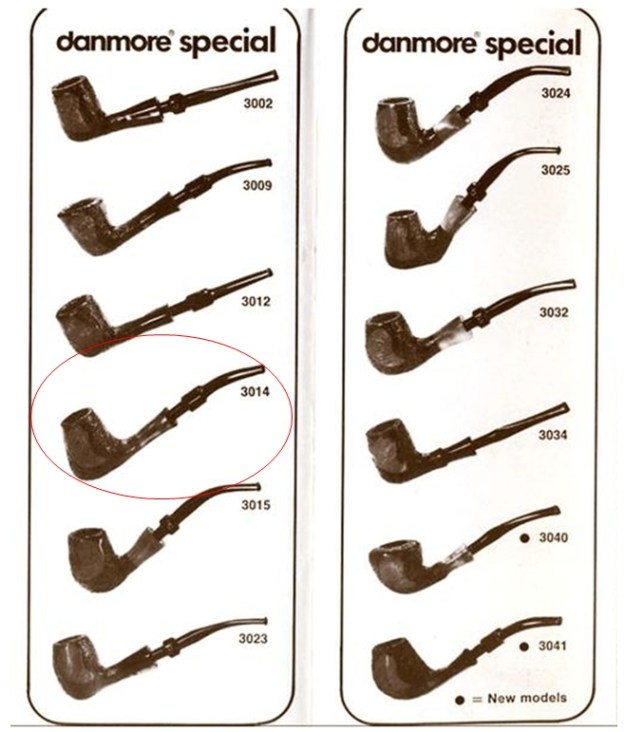
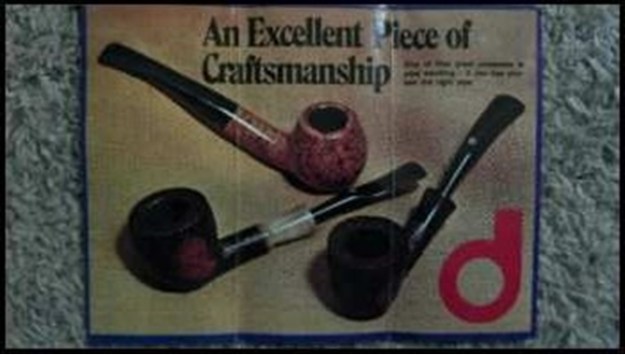
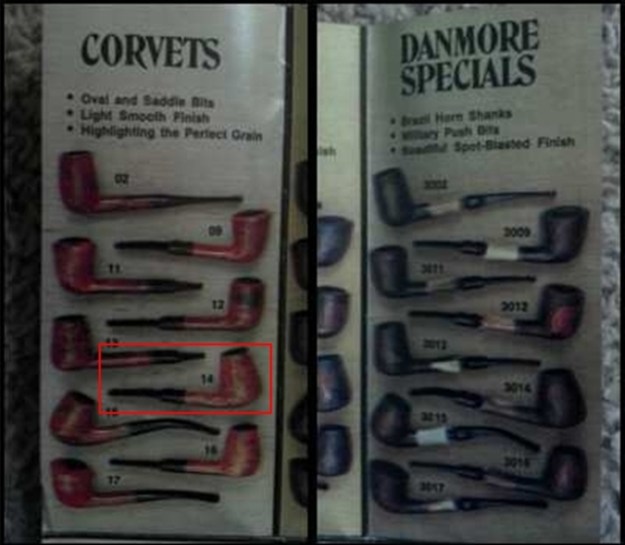
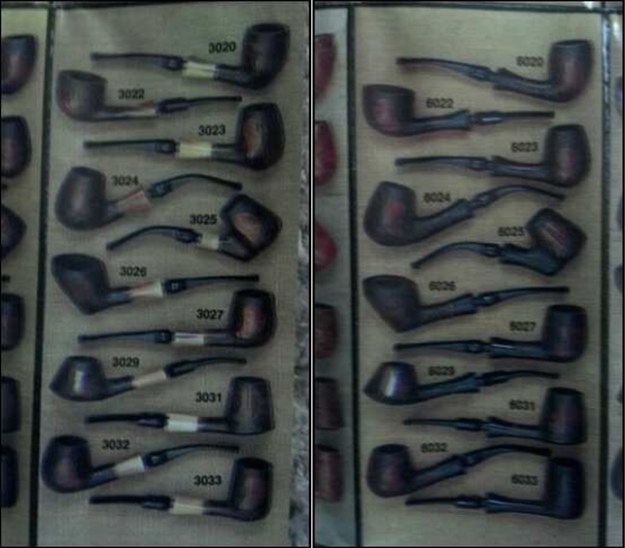
The article also included a Shape Chart that was courtesy of Doug Valitchka. I include that below as well. The shape of the pipe that I am working on is a variation on the 3014. It has a classic oval saddle stem rather than the more freehand looking one below. It also does not have the shank extension (https://pipedia.org/wiki/File:DanmoreCat.jpg). I have circled the shape in red to show which one is similar.I did a bit more searching online and found a copy of a brochure that was included in a box with a Danmore pipe on Redit in the archives. I was able to copy the photos of the pages of the brochure and have included them below. Have a look (https://www.reddit.com/r/PipeTobacco/comments/vclaj/does_anyone_know_much_about_danmore_pipes/). The Danmore I am working on is on the page labeled CORVETS. I have boxed in the pipe in red that I am working on. With that information in hand I knew what I was dealing with in terms of the stamping on the pipe. The pipe I have is the same shape as the one boxed in red – shape number 14 under section labeled CORVETS. The pipe was made for just a ten year period between early 1970s and the early 1980s. It seems that they have also been made since then by a third party. I believe this pipe was one from the original 10 year period by Hans Sørensen. Now it was time to work on the pipe.

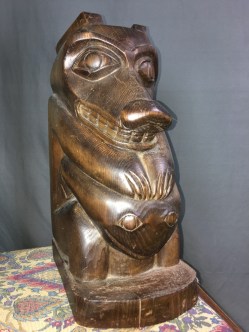
With over 125 pipes to clean from Bob’s estate I am very glad for Jeff’s help cleaning them. He cleaned this filthy pipe with his usual penchant for thoroughness that I really appreciate. This one was a mess and I did not know what to expect when I unwrapped it from his box. He reamed it with a PipNet pipe reamer and cleaned up the reaming with a Savinelli Fitsall Pipe Knife. He scrubbed out the internals with alcohol, pipe cleaners and cotton swabs until the pipe was clean. He scrubbed the exterior of the bowl with Murphy’s Oil Soap and a tooth brush to remove the grime and grit on the briar and the lava on the rim top. The finish looks very good with great looking grain around the bowl and shank. Jeff soaked the stem in Before & After Deoxidizer to remove the oxidation on the rubber. When the pipe arrived here in Vancouver for the second stop of its restoration tour I was amazed it looked so good. I took photos before I started my part of the work.   I took some close up photos of the rim top and also of the stem surface. I wanted to show what an amazing job Jeff did in the cleanup of the rim top. I also wanted to show that the damage to the rim top was more extensive than I had originally thought. The thin rim top was burned and darkened with a few large nicks on the top and inner edge. The rim top was a nightmare of issues. I also took close up photos of the stem to show the lack of tooth marks and the light oxidation on the stem surface. You can also see gap between the stem and the shank end due to a bent tenon.        One of the things I appreciate about Jeff’s cleanup is that he works to protect and preserve the nomenclature on the shank of the pipes that he works on. The stamping on this one was very faint to start with so I was worried that it would disappear altogether with the cleanup. He was not only able to preserve it but it is clearer than shown in the earlier photos. I took some photos to show the clarity of the stamping. I have noticed that many restorers are not careful to protect the stamping in their cleaning process and often by the end of the restoration the nomenclature is almost destroyed. I would like to encourage all of us to be careful in our work to preserve this as it is a critical piece of pipe restoration! Since this is another pipe Bob’s estate I am sure that some of you have read at least some of the other restoration work that has been done on the previous pipes. You have also read what I have included about Bob Kerr, the pipeman who held these pipes in trust before I came to work on them (see photo to the left). Also, if you have followed the blog for long you will already know that I like to include background information on the pipeman whose pipes I am restoring. For me, when I am working on an estate I really like to have a sense of the person who held the pipes in trust before I worked on them. It gives me another dimension of the restoration work. I asked Brian if he or his wife would like to write a brief biographical tribute to her father, Bob. His daughter worked on it and I received the following short write up on him and some pictures to go along with the words including one of Bob’s carvings. Once again I thank you Brian and tell your wife thank you as well.

I am delighted to pass on these beloved pipes of my father’s. I hope each user gets many hours of contemplative pleasure as he did. I remember the aroma of tobacco in the rec room, as he put up his feet on his lazy boy. He’d be first at the paper then, no one could touch it before him. Maybe there would be a movie on with an actor smoking a pipe. He would have very definite opinions on whether the performer was a ‘real’ smoker or not, a distinction which I could never see but it would be very clear to him. He worked by day as a sales manager of a paper products company, a job he hated. What he longed for was the life of an artist, so on the weekends and sometimes mid-week evenings he would journey to his workshop and come out with wood sculptures, all of which he declared as crap but every one of them treasured by my sister and myself. Enjoy the pipes, and maybe a little of his creative spirit will enter you!

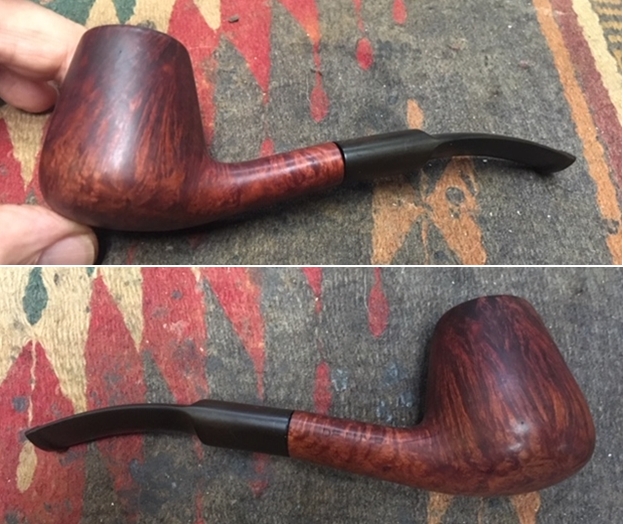
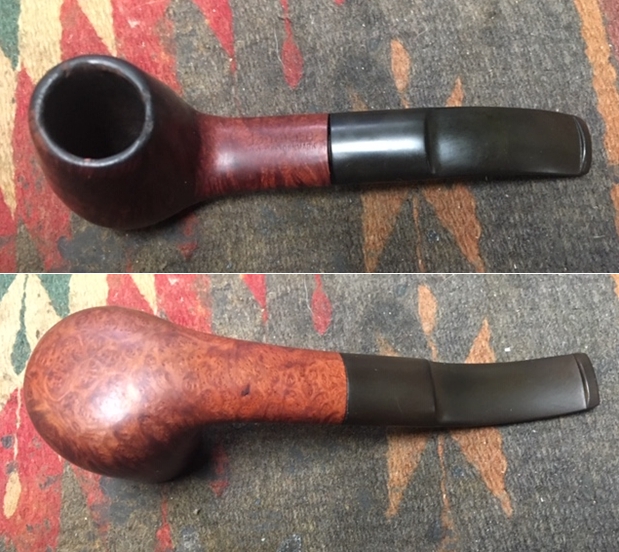
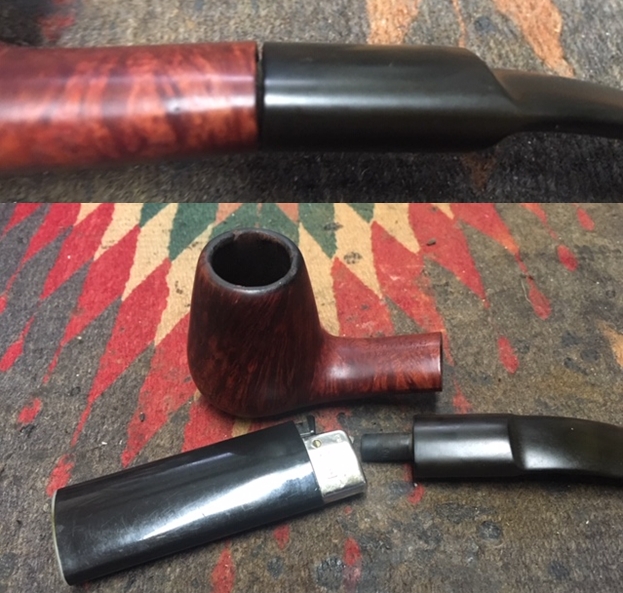
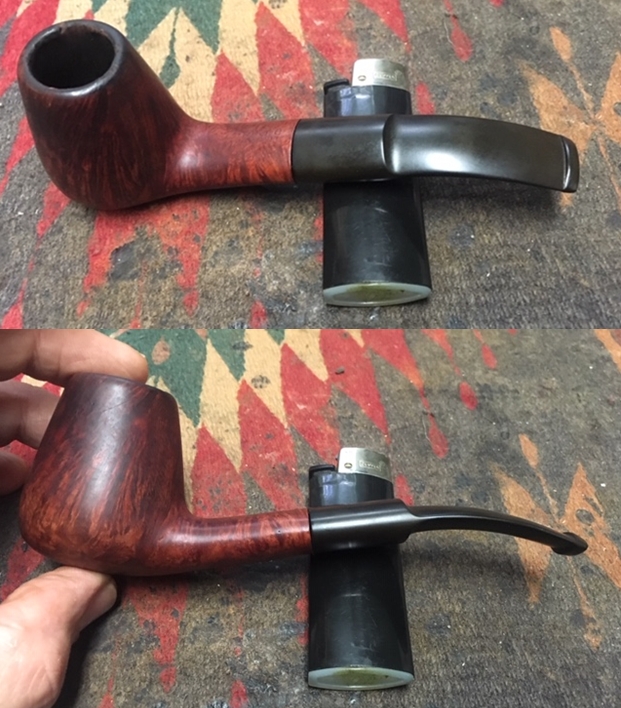
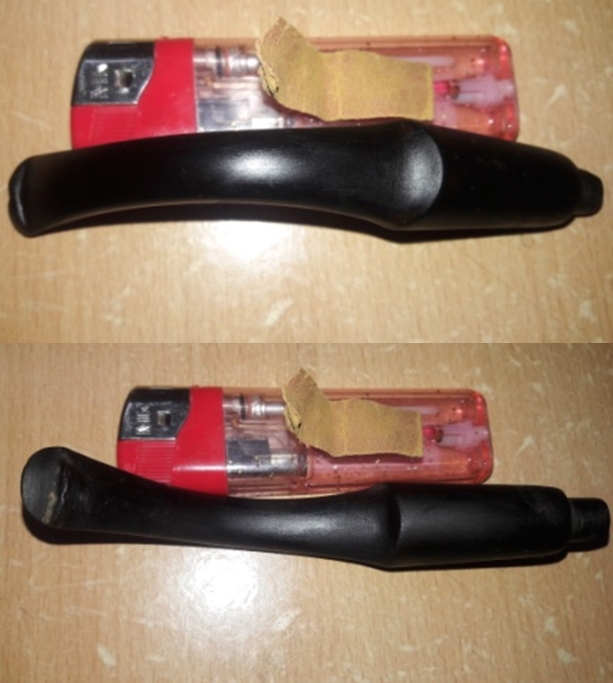
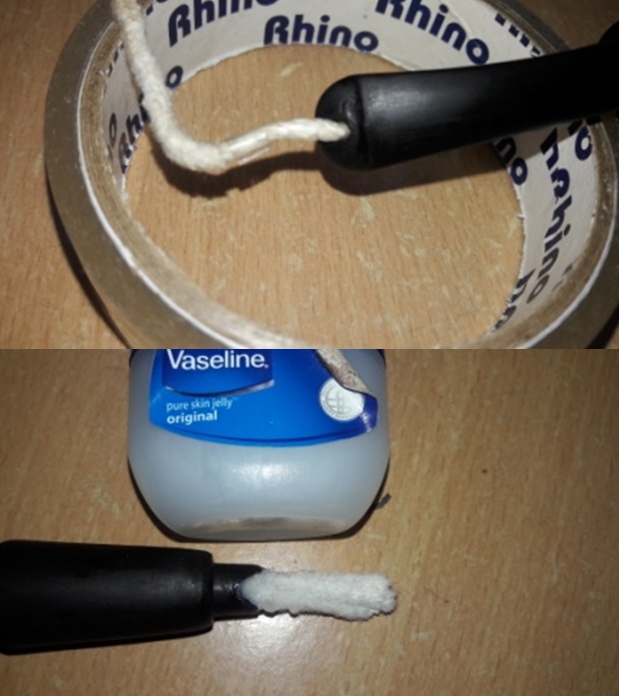
Now, on to the rest of the restoration of this beautifully grained Danmore Deluxe Volcano/Brandy. It was great that I did not need to clean the pipe. I decided to start the restoration process by addressing the poorly seated tenon. The first photo below shows the gap. I could see that the tenon itself had been bent and that caused the gap between the shank end and the face of the stem. I heated the tenon with a Bic lighter until the rubber was slightly flexible and then carefully inserted it in the mortise and adjusted the bend and fit. I held it in place until it cooled down. The fit was perfect. I took photos of the stem from the top and the side to show the repair.  I took the newly repaired stem off the shank and worked on the damage to rim top and the inner edge. From the extent of damage to the inner edge of the rim and the top of the bowl I decided I would need to top the bowl to remove as much of this damage as possible to restore the rim top back to a more pristine condition and bring the bowl back to round. I topped it on a topping board using 220 grit sandpaper. The photos show the topping process and the rim top after I had topped it to an acceptable point where the condition of the top and edges was good.  With the top cleaned up and repaired I moved on to address the inner edge surface itself. I used a folded piece of 220 grit sandpaper to bevel the edge inward to take care of the damage and thin the rim edge to its earlier dimensions. I followed that by sanding the rim top and edge with 400 grit wet dry sandpaper.I cleaned the briar with Mark Hoover’s Before & After Briar Cleaner to remove the debris left behind by the sanding of the rim top and to blend the repairs into the briar. I rubbed it into the surface of the briar and let it sit for 10 minutes. I rinsed the bowl off with warm running water to remove the product and the grime. The grain really began to stand out clearly. It was a beautiful piece of briar.  I stained the rim top and edges with a Cherry Stain pen to match the colour of the stain on the bowl. Once it was polished with micromesh sanding pads and Before & After Balm the stain would blend perfectly.I polished the briar with micromesh sanding pads to blend in the stain and to polish the briar and remove the scratches in the surface of the bowl, heel and shank. I wet sanded with 1500-12000 grit pads and wiped the bowl down between each pad with a damp cloth. I rubbed down the bowl with Before & After Restoration Balm. I worked it into the surface of the briar with my fingertips to clean, enliven and protect it. I let the balm sit for a little while and then buffed with a cotton cloth to raise the shine. Mark Hoover’s Balm is a product that I have come to appreciate and one I use on every pipe I have been working on. I set the bowl aside and worked on the stem. I sanded the stem with 220 grit sandpaper to break up the remaining oxidation and smooth out the file marks. I started the polishing with 400 grit wet dry sandpaper to remove the scratching. It is starting to look good.I have been using Denicare Mouthpiece Polish after sanding with 400 grit wet dry sandpaper for a while now as the grittiness of the product works to polish out the minor scratches in the vulcanite. I also have a few of these tins knocking around that I want to use up so it works for me to use it at this point.I polished the stem with micromesh sanding pads – wet sanding with 1500-12000 grit pads. I wiped the stem down after each sanding pad with Obsidian Oil. I polished it with Before & After Pipe Stem Polish – both Fine and Extra Fine. Once I had finished the polishing I gave it final coat of oil and set it aside to dry.   As usual at this point in the restoration process I am excited to be on the homestretch. I look forward to the final look when it is put back together, polished and waxed. I put the bowl and stem back together. I polished the bowl and stem with Blue Diamond to polish out the scratches in the briar and the vulcanite. I gave the bowl and the stem multiple coats of carnauba wax. I buffed the pipe with a clean buffing pad to raise the shine. I hand buffed it with a microfiber cloth to deepen the shine. The pipe polished up pretty nicely. The straight and flame grain really pop with the wax and polish. The shiny black vulcanite saddle stem is a beautiful contrast to the browns of the bowl. This Danmore Deluxe Volcano was another fun pipe to work on thanks to Jeff’s cleanup work. The pipemaker followed the grain in laying out this pipe to maximize the glory of the briar. The flow and feel of the pipe is appealing. The finished pipe is shown in the photos below. The dimensions of the pipe are Length: 5 ¾ inches, Height: 1 7/8 inches, Outside diameter of the bowl: 1 inch, Chamber diameter: ¾ of an inch. This beautiful pipe will be going on the rebornpipes store if you would like to add it to your collection and carry on Bob’s legacy. If not, I have a lot more of Bob’s estate to work on of various brands. Perhaps one of those will catch your attention. Thanks for reading this blog and my reflections on the pipe while I worked on it. This is an interesting estate to bring back to life.

Restoring a Peterson’s Dunmore 70 Bent Apple Sitter from Bob Kerr’s Estate


Blog by Steve Laug

The next pipe I have chosen to work on from Bob Kerr’s estate is another one of his unique Peterson’s. I have restored two of the Canadian Imports from his estate – a Kapruf 54 sandblast bent billiard (https://rebornpipes.com/2019/08/09/back-to-bob-kerrs-estate-another-canadian-import-petersons-kapruf-a-54/) and a Kapruf 9BC 56 (https://rebornpipes.com/2019/08/09/back-to-bob-kerrs-estate-linking-petersons-kapruf-9bc-with-the-56-shape-number/). These were interesting in that they both had a unique numbering system for Peterson’s pipes that were specifically brought to Canada by the Canadian importer, Genin, Trudeau & Co. of Montreal, Quebec (https://rebornpipes.com/2016/09/13/petersons-pipes-brochure-from-genin-trudeau-co-montreal-quebec/). I restored an English Made Peterson’s System ‘0’ 1307 bent billiard a  (https://rebornpipes.com/2019/08/17/an-english-made-petersons-system-0-1307-bent-billiard-from-bob-kerrs-estate/) and a Republic Era Peterson’s Flame Grain Bent billiard with a fishtail stem (https://rebornpipes.com/2019/08/16/a-petersons-flame-grain-x220s-bent-billiard-from-bob-kerrs-estate/).

The next one on the table is of interest because it is a uniquely shaped Dunmore Bent Apple Sitter. It is part of the estate that I am cleaning up for the family and moving them out into the hands of pipemen and women who will carry on the trust that began with their father, Bob. In the collection there were 19 Peterson’s pipes along with a bevy of Dunhills, some Comoy’s and Barlings as well as a lot of other pipes – a total of 125 pipes along with a box of parts. This is the largest estate that I have had the opportunity to work on. I put together a spread sheet of the pipes and stampings to create an invoice. I was taking on what would take me a fair amount of time to clean up. I could not pass up the opportunity to work on these pipes though. They were just too tempting.

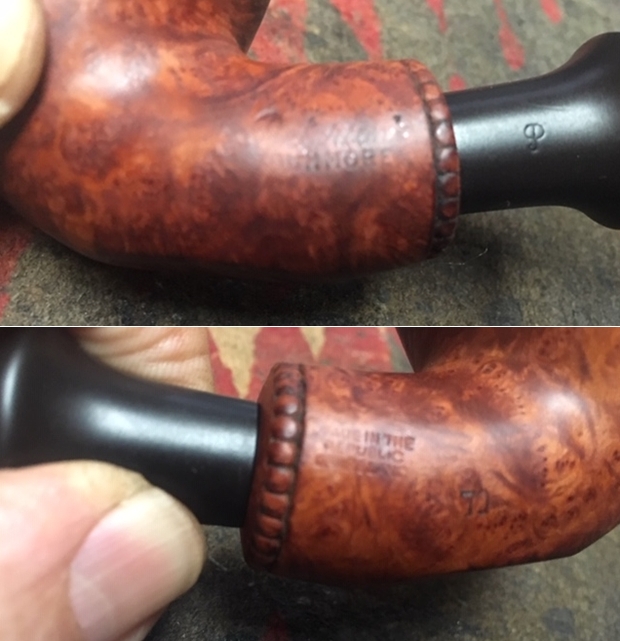
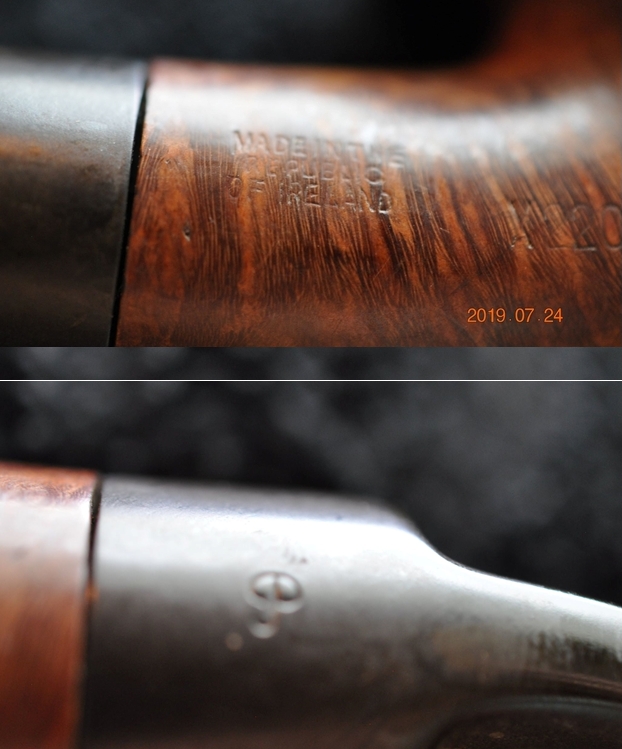
I really am enjoying working on the Peterson’s in the estate. This was another unique one. When I took it out of the box of cleaned up pipes that Jeff sent back I could see that it was stamped Peterson’s over Dunmore on the left side of the shank and Made in the Republic of Ireland followed by the shape number 70 on the right shank. It has some stunning grain around the bowl and shank under the thick grime and tarry spots. The shank is quite thick and the finish is probably the dirtiest of Bob’s pipes so far. There was a thick cake in the bowl with remnants of tobacco stuck on the walls. There was a fair lava overflow on the rim. The top and edges of the rim are dirty. I think that there was a beautiful pipe underneath all of the grime and buildup of years of use. The stem was oxidized and calcified toward the end with some hack marks on the left side mid stem. Again, surprisingly did not have the deep tooth marks that I have come to expect from Bob’s pipes but the button edges were worn. Jeff took photos of the pipe before he started his cleanup work on it.   Jeff took photos of the bowl and rim top to show the thick, hard cake in the bowl and the lava build up on the top of the rim and the edges of the bowl. It was hard to tell if there was any damage to the inner edge of the rim as it had a thick cake lining it. Hopefully it protected it. The lava flows down the outer edges so it will need to be cleaned in order to assess their condition.  Jeff took photos of the sides and heel of the bowl to show the condition of the finish. You can see the beautiful mix of swirled, flame and birdseye grain underneath the dirt and debris of the years. The cross grain on the heel was beautiful.    Jeff took photos of the stamping on both sides of the bowl and shank. The stamping on the left side was faint but readable as you can see from the photos. It read Peterson’s over Dunmore. The stamp on the right side read Made in the Republic of Ireland followed by the shape number 70. You can see that the beading around the shank end is almost filled in with the grime on the briar. Jeff took photos of the top and underside of the stem showing the tooth chatter, scratching and oxidation on the stem surface and wear on the edges of the button.    I turned first to Pipephil’s site to remind myself of the background of the Dunmore line. Unfortunately there was no information to be found there. I then turned to Pipedia’s article on Peterson pipes to see what I could garner from that information. It is a great read in terms of the history of the brand (https://pipedia.org/wiki/Peterson) but nothing specific to the Dunmore line of pipes.

I then turned to the book I should have consulted first, The Peterson Pipe, by Mark Irwin and Gary Malmberg. On page 298 there is an entry for Dunmore pipes. It reads as follows:

Dunmore (1971-c.1984 2006-10). Appeared first as Iwan Ries & Co. exclusive line “Dunmoor,” a Premier-grade in light-brown smooth or rustic red in all System shapes, with beading at the shank. Documented in the Associated Imports Catalog from 1973. Classic Range Dunmore shapes from ’78. A third Dunmore line (’06-10) featured standard and some B shapes, with beading around bowl instead of at shank-face, produced for European market.

On page 268 there is a shape chart that does comparison of the shapes in the various lines. There I found the following information:

In the Standard and Premier System it was shape 302. In the De Luxe System it was shape 25. In the Dunmore System (1977-1983) it was shape 70. In the Classic Lines it was shape 02/XL02. The production still continues. It is a Peterson Extra Large Size and was named an Extra Large Apple.

On page 165 there were also photos of pages from a catalogue with the  description: The unmounted Dunmore Premier debuted in both System and Classic Range shapes circa 1973 with a final appearance in the 1981 catalogue.

The information blurb on each page read: “Dunmore Briars.” Beautifully grained best quality briar in light-brown, matt or rustic finish. Often described as “Petersons Unmounted System” has all the advantages of the system range. Ten models each fitted with the Peterson Lip mouthpiece.

With that information in hand I knew what I was dealing with in terms of the stamping on the pipe. It is a Late Republic era pipe. It showed up in Peterson Catalogue in 1973 and from what I have learned about Bob’s other pipes this date fits well. Now it was time to work on the pipe.

With over 125 pipes to clean from Bob’s estate I am very glad for Jeff’s help cleaning them. He cleaned this filthy pipe with his usual penchant for thoroughness that I really appreciate. This one was a real mess and I did not know what to expect when I unwrapped it from his box. He reamed it with a PipNet pipe reamer and cleaned up the reaming with a Savinelli Fitsall Pipe Knife. He scrubbed out the internals with alcohol, pipe cleaners and cotton swabs until the pipe was clean. He scrubbed the exterior of the bowl with Murphy’s Oil Soap and a tooth brush to remove the grime and grit on the briar and the lava on the rim top. The finish looks very good with great looking grain around the bowl and shank. Jeff soaked the stem in Before & After Deoxidizer to remove the oxidation on the rubber. When the pipe arrived here in Vancouver for the second stop of its restoration tour I was amazed it looked so good. I took photos before I started my part of the work.     I took some close up photos of the rim top and also of the stem surface. I wanted to show what an amazing job Jeff did in the cleanup of the rim top. I also wanted to show that the damage to the rim top was more extensive than I had originally thought. The rim top was burned and darkened with nicks and notches around the inner edge. There was some darkening that ran down the front of the bowl as well. The rim top was a nightmare of issues. The outer edge of the bowl looks very good other than the burning and darkening. I also took close up photos of the stem to show the lack of tooth marks and the light oxidation on the stem surface. You can also see the wear to the button. The third stem photo shows the hatch marks on the left side of the stem. One of the things I appreciate about Jeff’s cleanup is that he works to protect and preserve the nomenclature on the shank of the pipes that he works on. The stamping on this one was very faint to start with so I was worried that it would disappear altogether with the cleanup. He was not only able to preserve it but it is clearer than shown in the earlier photos. I took some photos to show the clarity of the stamping. I have noticed that many restorers are not careful to protect the stamping in their cleaning process and often by the end of the restoration the nomenclature is almost destroyed. I would like to encourage all of us to be careful in our work to preserve this as it is a critical piece of pipe restoration! Since this is another pipe Bob’s estate I am sure that some of you have read at least some of the other restoration work that has been done on the previous pipes. You have also read what I have included about Bob Kerr, the pipeman who held these pipes in trust before I came to work on them (see photo to the left). Also, if you have followed the blog for long you will already know that I like to include background information on the pipeman whose pipes I am restoring. For me, when I am working on an estate I really like to have a sense of the person who held the pipes in trust before I worked on them. It gives me another dimension of the restoration work. I asked Brian if he or his wife would like to write a brief biographical tribute to her father, Bob. His daughter worked on it and I received the following short write up on him and some pictures to go along with the words including one of Bob’s carvings. Once again I thank you Brian and tell your wife thank you as well.

I am delighted to pass on these beloved pipes of my father’s. I hope each user gets many hours of contemplative pleasure as he did. I remember the aroma of tobacco in the rec room, as he put up his feet on his lazy boy. He’d be first at the paper then, no one could touch it before him. Maybe there would be a movie on with an actor smoking a pipe. He would have very definite opinions on whether the performer was a ‘real’ smoker or not, a distinction which I could never see but it would be very clear to him. He worked by day as a sales manager of a paper products company, a job he hated. What he longed for was the life of an artist, so on the weekends and sometimes mid-week evenings he would journey to his workshop and come out with wood sculptures, all of which he declared as crap but every one of them treasured by my sister and myself. Enjoy the pipes, and maybe a little of his creative spirit will enter you!

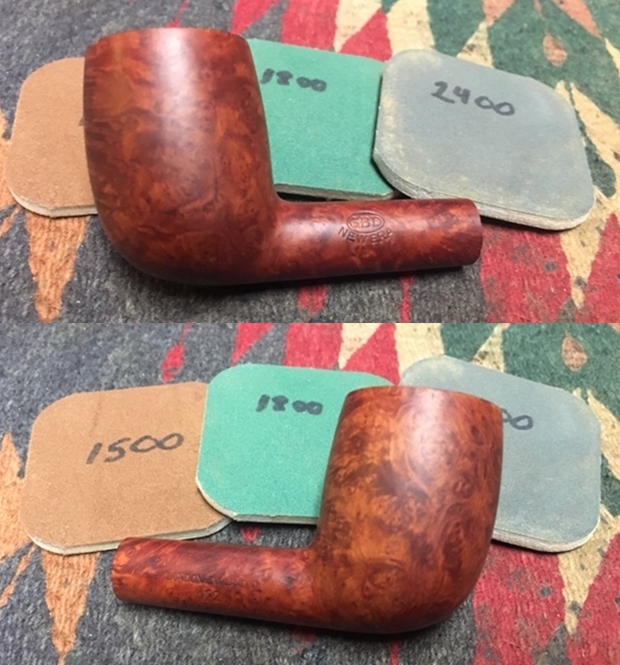
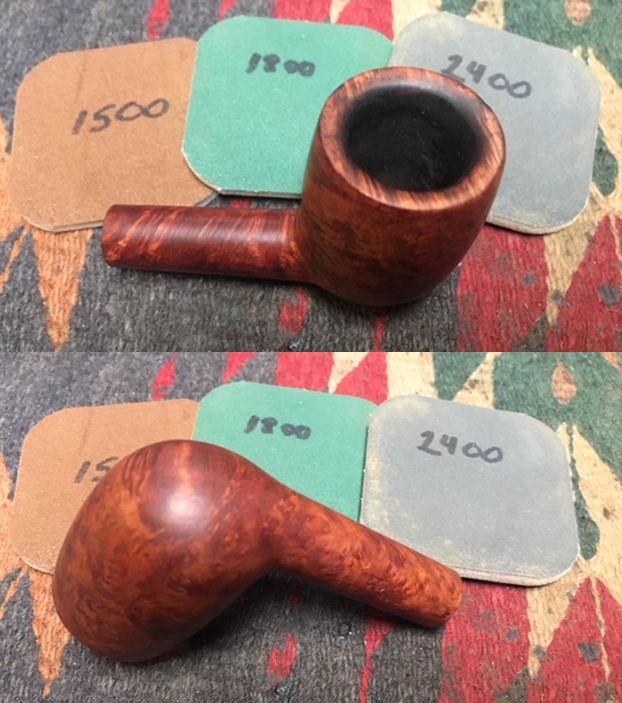
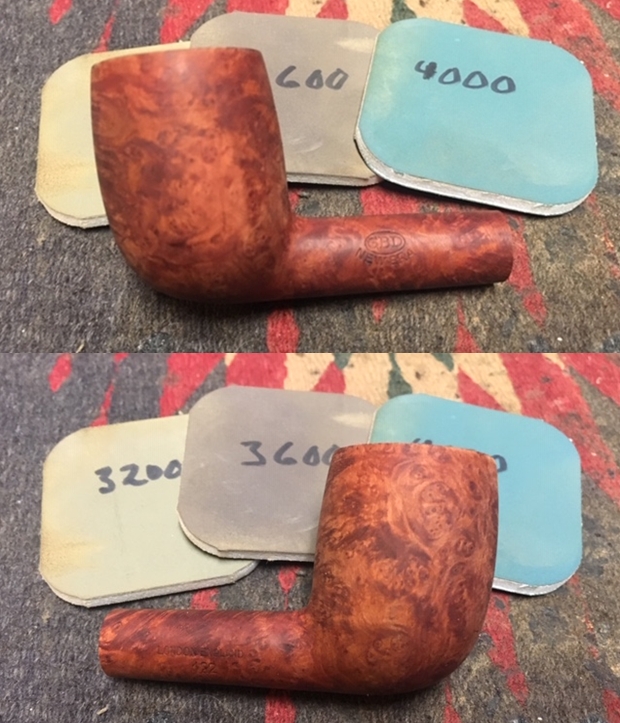
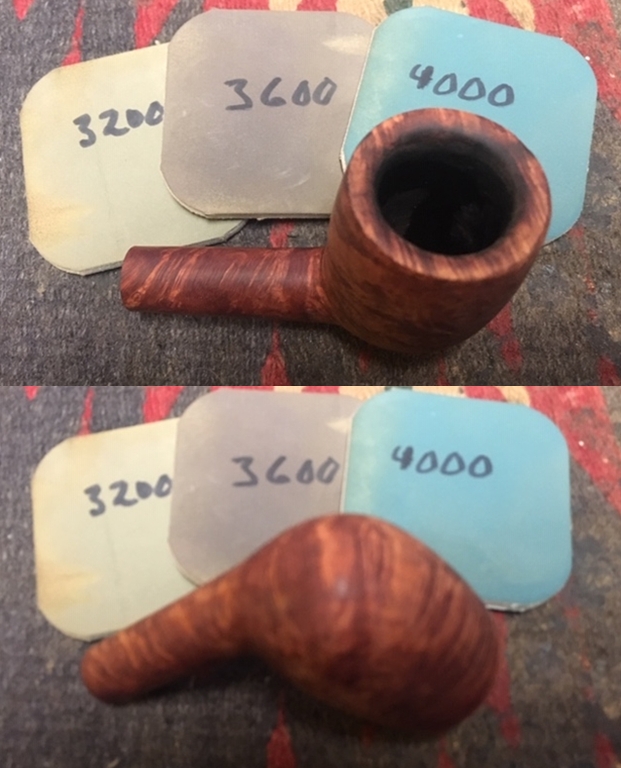
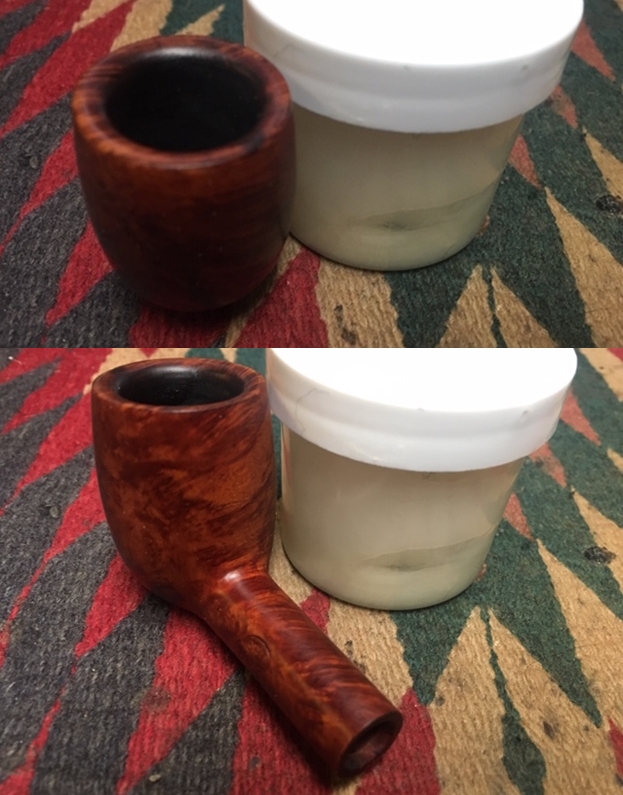
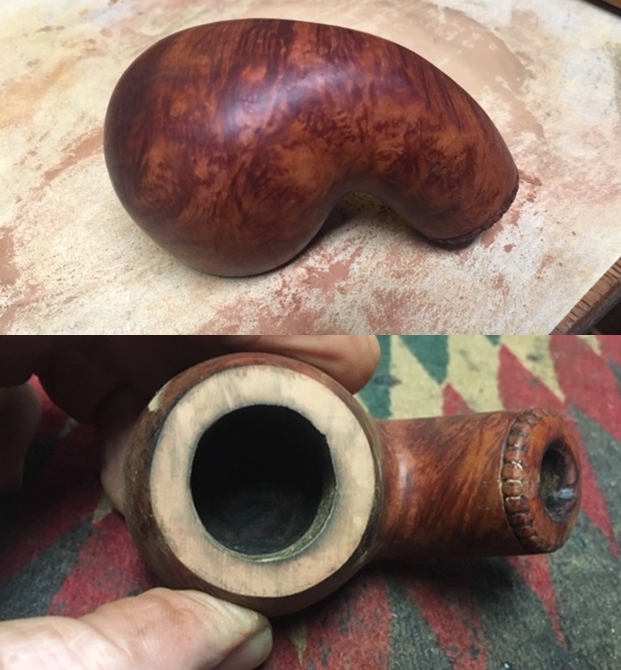
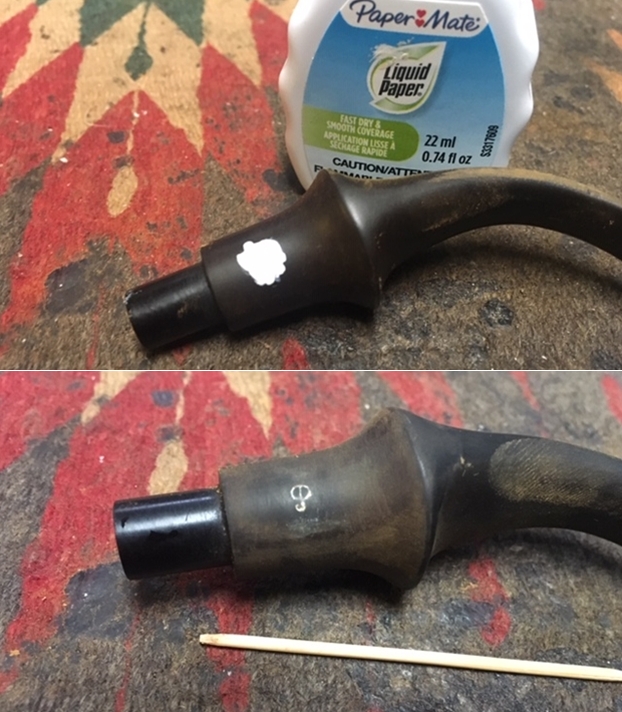
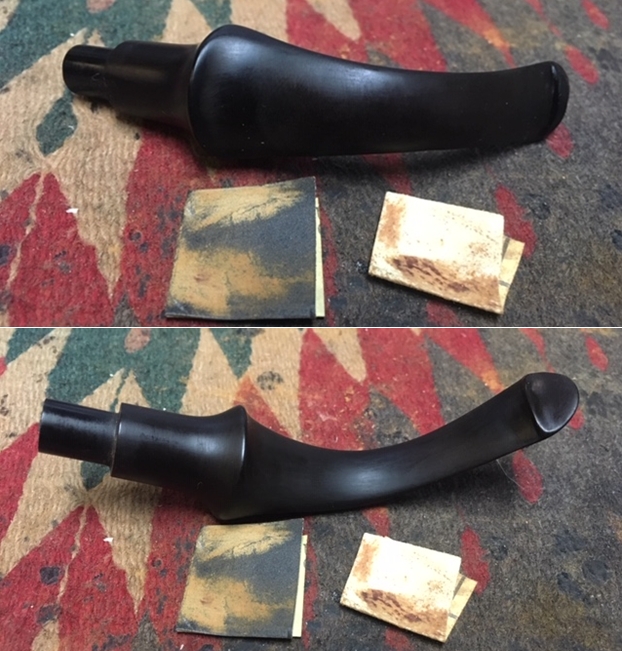
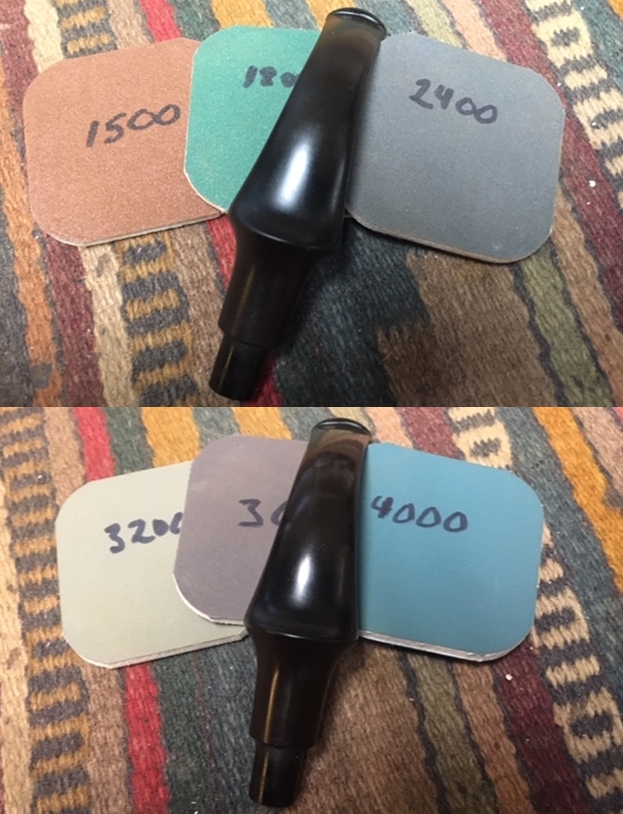
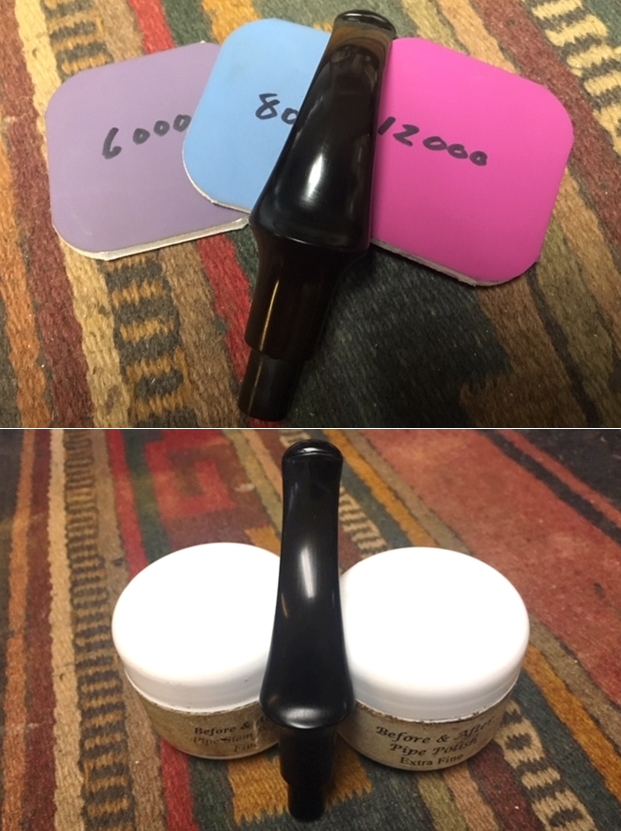
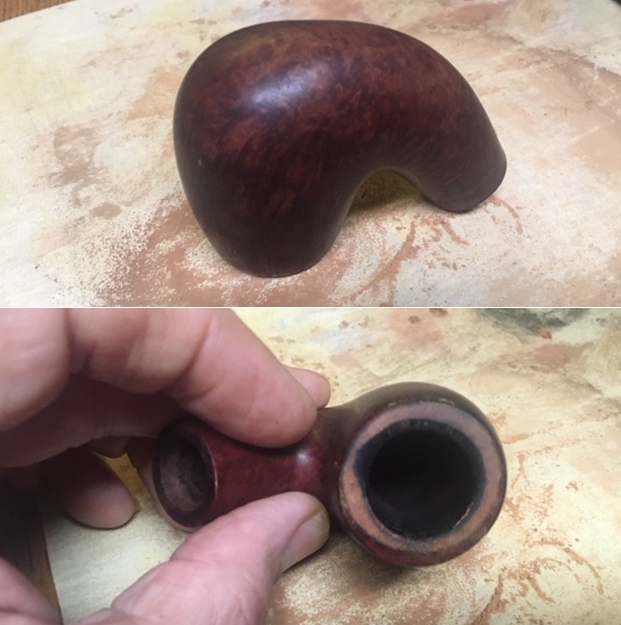
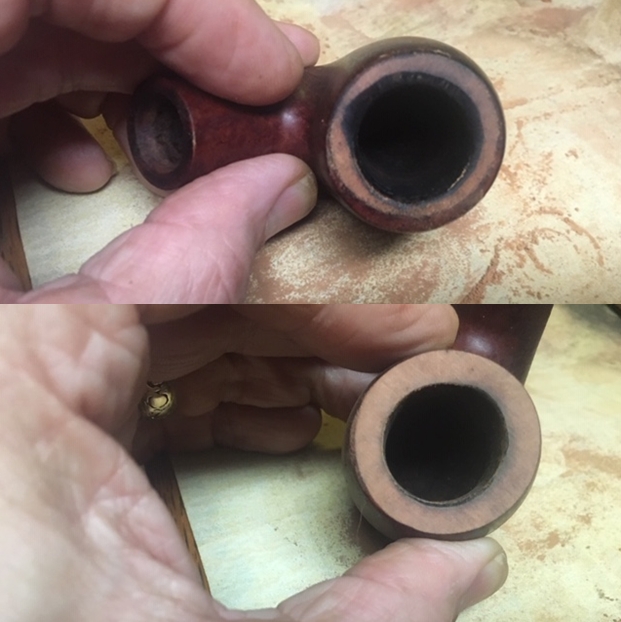
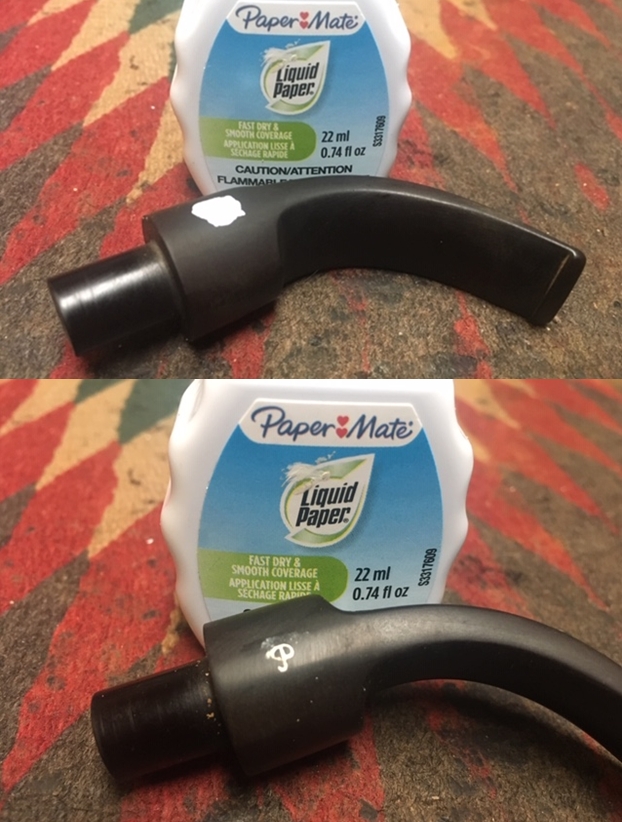
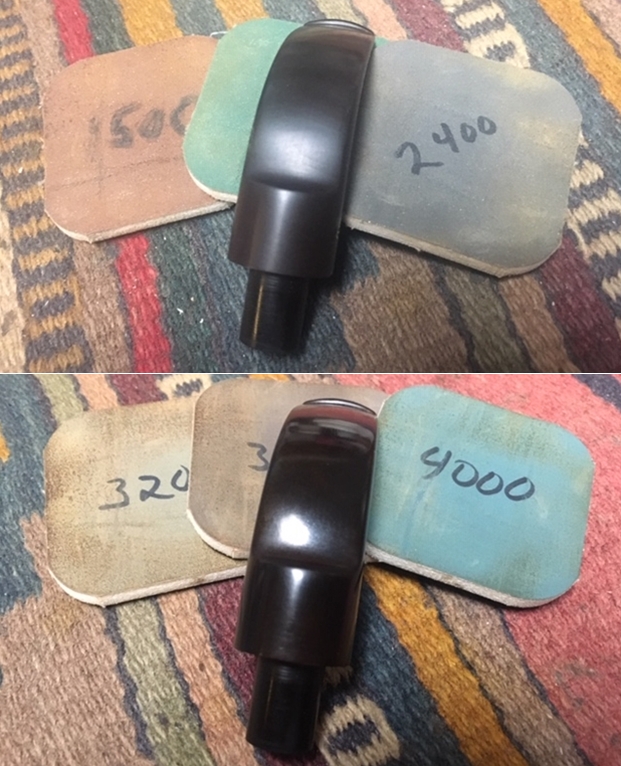
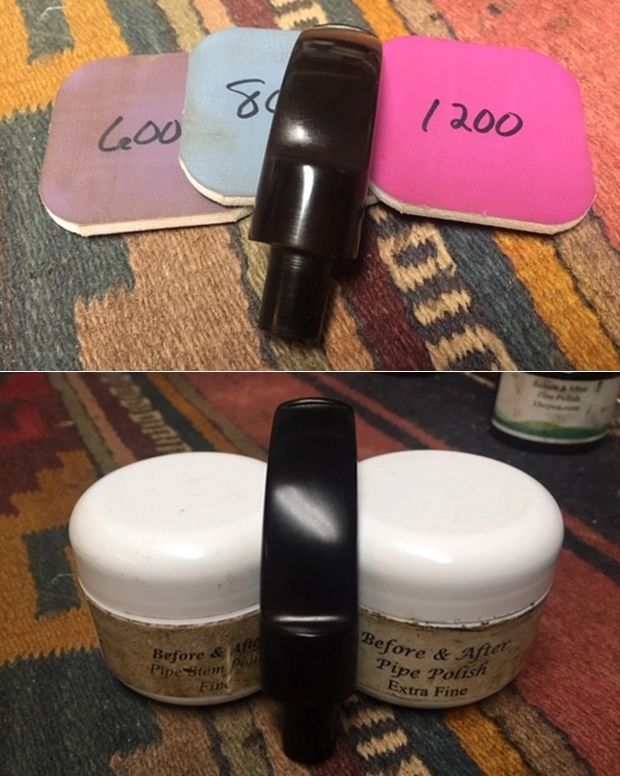
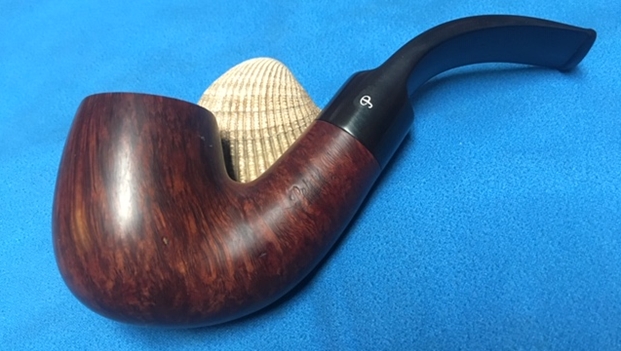
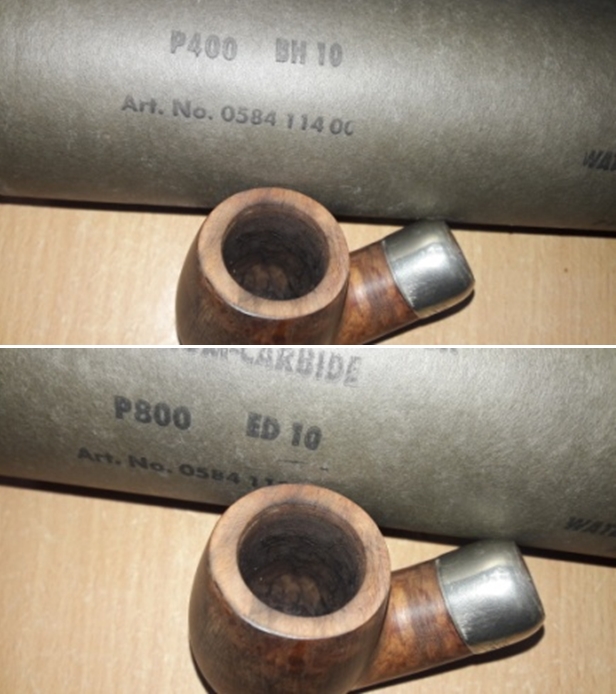
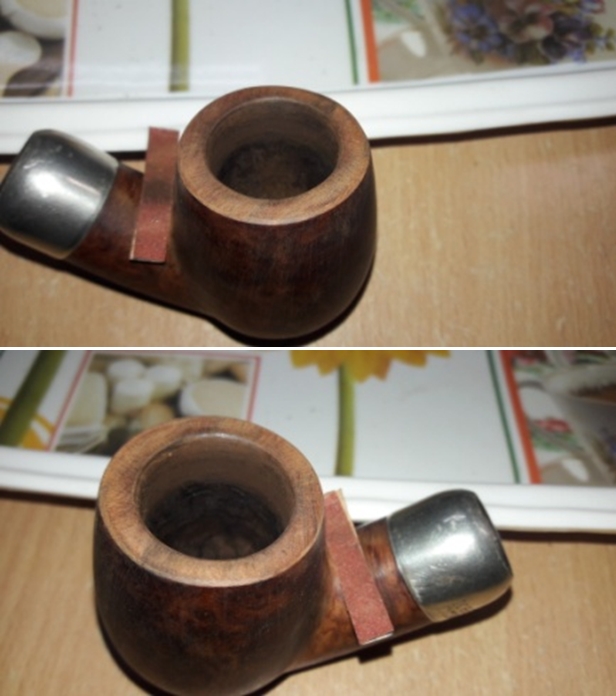
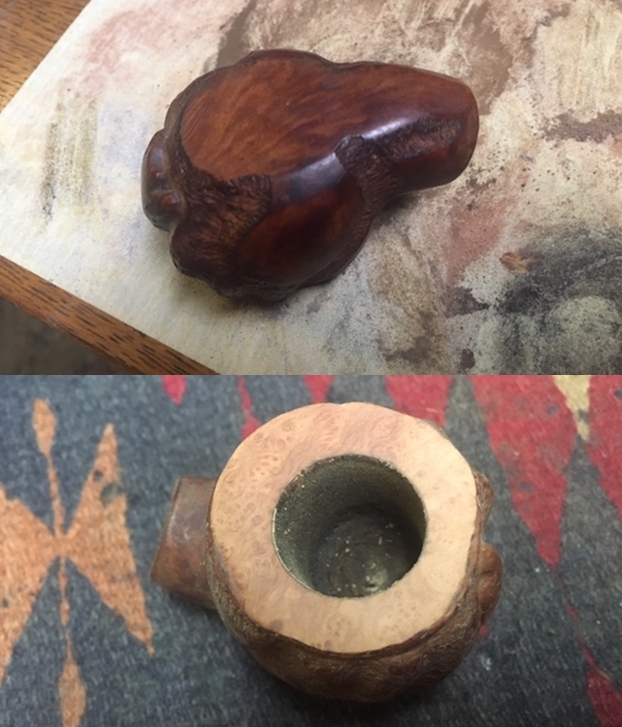
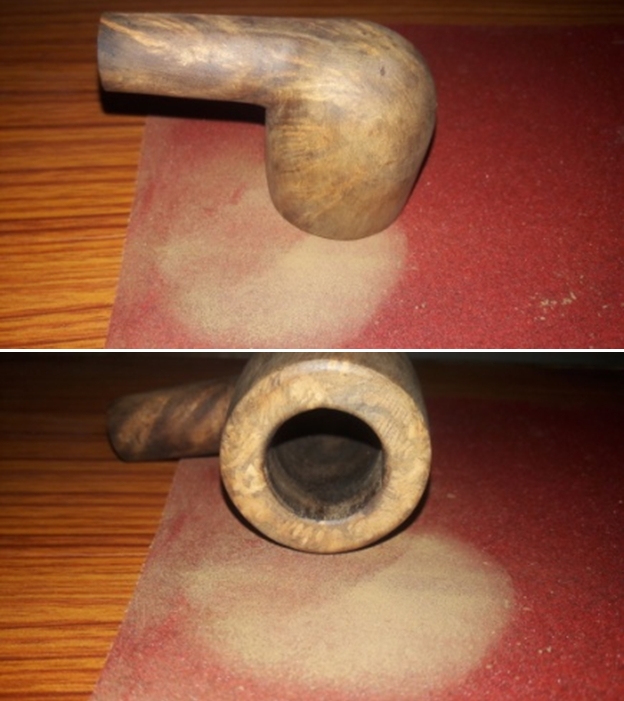
Now, on to the rest of the restoration of this beautifully grained Peterson’s Dunmore 70 Large Bent Apple. It was great that I did not need to clean the pipe. I decided to start the process by addressing the damage to rim top and the inner edge. From the extent of damage to the inner edge of the rim and the top of the bowl I decided I would need to top the bowl to remove as much of this damage as possible to restore the rim top back to a more pristine condition and bring the bowl back to round. I topped it on a topping board using 220 grit sandpaper. I took photos to show the slow process of repairing that damage. The photos show the topping process and the rim top after I had topped it to an acceptable point where the condition of the top and edges was good.    With the top cleaned up and repaired I moved on to address the inner edge surface itself. I used a folded piece of 220 grit sandpaper to remove the damage and bring the bowl back to round. I followed that by sanding the rim top and edge with 400 grit wet dry sandpaper.  I also sanded the darkening on the front of the bowl edge.   The bowl surface was quite smooth so I decided to forego polishing it with micromesh sanding pads. I cleaned the briar with Mark Hoover’s Before & After Briar Cleaner to remove the debris left behind by the sanding of the rim top and to blend the repairs into the briar. I rubbed it into the surface of the briar and let it sit for 10 minutes. I rinsed the bowl off with warm running water to remove the product and the grime. The grain really began to stand out clearly. It was a beautiful piece of briar. I stained the rim top and edges with an Oak Stain pen to match the colour of the stain on the bowl. Once it was polished with the Before & After Balm and buffed with a microfiber cloth the stain would blend perfectly.After the stain had cured, I rubbed it down with Before & After Restoration Balm. I worked it into the surface of the briar with my fingertips to clean, enliven and protect it. I let the balm sit for a little while and then buffed with a cotton cloth to raise the shine. Mark Hoover’s Balm is a product that I have come to appreciate and one I use on every pipe I have been working on. I decided to touch up the “P” stamp on the left side of the shank. I use PaperMate liquid paper for doing this. I worked it into the stamp with a tooth pick. Once the material had hardened I used the tooth pick to scrape off the excess material.  I reshaped the edge of the button and top of the P-Lip with a needle file to get a more defined shape and edge. Once I had the shape more defined I sanded the stem with 220 grit sandpaper to break up the remaining oxidation and smooth out the file marks. I started the polishing with 400 grit wet dry sandpaper to remove the scratching. It is starting to look good.   I polished the stem with micromesh sanding pads – wet sanding with 1500-12000 grit pads. I wiped the stem down after each sanding pad with Obsidian Oil. I polished it with Before & After Pipe Stem Polish – both Fine and Extra Fine. Once I had finished the polishing I gave it final coat of oil and set it aside to dry. As usual at this point in the restoration process I am excited to be on the homestretch. I look forward to the final look when it is put back together, polished and waxed. I put the bowl and stem back together. I polished the bowl and stem with Blue Diamond to polish out the scratches in the briar and the vulcanite. I gave the bowl and the stem multiple coats of carnauba wax. I buffed the pipe with a clean buffing pad to raise the shine. I hand buffed it with a microfiber cloth to deepen the shine. The pipe polished up pretty nicely. The grain really pops with the wax and polish. The bead around the shank looks very good. The shiny black vulcanite stem is a beautiful contrast to the browns of the bowl. This Peterson’s Dunmore 70 Large Bent Apple was another fun pipe to work on thanks to Jeff’s cleanup work. The beading around the shank gives this Peterson’s “Unmounted System” a unique look without the silver or nickel ferrule. It really is a quite stunning piece of briar whose shape follows the flow of the briar. The thick/chubby shank makes it a very comfortable pipe to hold in the hand. The finished pipe is shown in the photos below. The dimensions of the pipe are Length: 6 ½ inches, Height: 1 ¾ inches, Outside diameter of the bowl: 1 ½ inches, Chamber diameter: 7/8 of an inch. This beautiful large pipe will be going on the rebornpipes store if you would like to add it to your collection and carry on Bob’s legacy. If not, I have a lot more of Bob’s estate to work on of various brands. Perhaps one of those will catch your attention. Thanks for reading this blog and my reflections on the pipe while I worked on it. This is an interesting estate to bring back to life.

A Peterson’s Flame Grain X220S Bent Billiard from Bob Kerr’s Estate


Blog by Steve Laug

The next pipe I have chosen to work on from Bob Kerr’s estate is another one of his unique Petersons. I have restored two of the Canadian Imports from his estate – a Kapruf 54 sandblast bent billiard (https://rebornpipes.com/2019/08/09/back-to-bob-kerrs-estate-another-canadian-import-petersons-kapruf-a-54/) and a Kapruf 9BC 56 (https://rebornpipes.com/2019/08/09/back-to-bob-kerrs-estate-linking-petersons-kapruf-9bc-with-the-56-shape-number/). These were interesting in that they both had a unique numbering system for Petersons pipes that were specifically brought to Canada by the Canadian importer, Genin, Trudeau & Co. of Montreal, Quebec (https://rebornpipes.com/2016/09/13/petersons-pipes-brochure-from-genin-trudeau-co-montreal-quebec/). This next one is of interest because it is not one that I have seen before – a smooth fish tail stemmed nicely grained bent billiard. It is part of the estate that I am cleaning up for the family and moving them out into the hands of pipemen and women who will carry on the trust that began with their father, Bob. In the collection there were 19 Peterson’s pipes along with a bevy of Dunhills, some Comoy’s and Barlings as well as a lot of other pipes – a total of 125 pipes along with a box of parts. This is the largest estate that I have had the opportunity to work on. I put together a spread sheet of the pipes and stampings to create an invoice. I was taking on what would take me a fair amount of time to clean up. I could not pass up the opportunity to work on these pipes though. They were just too tempting.

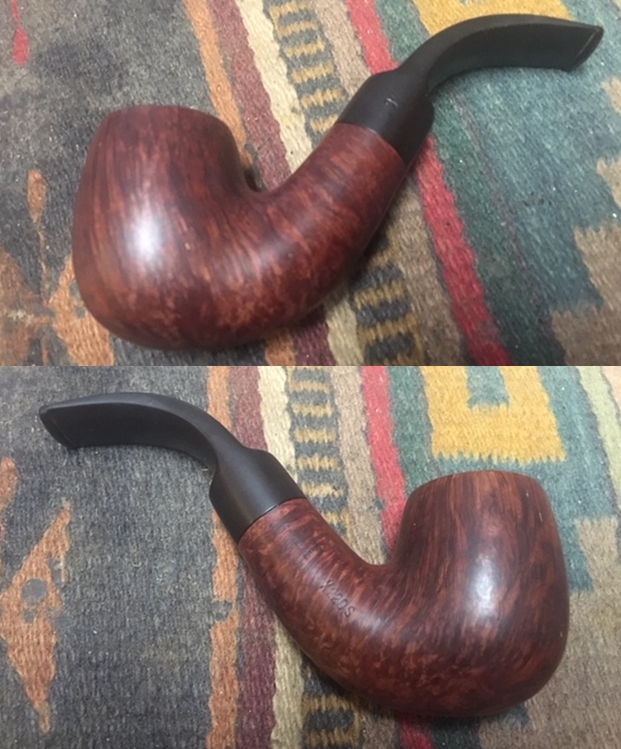
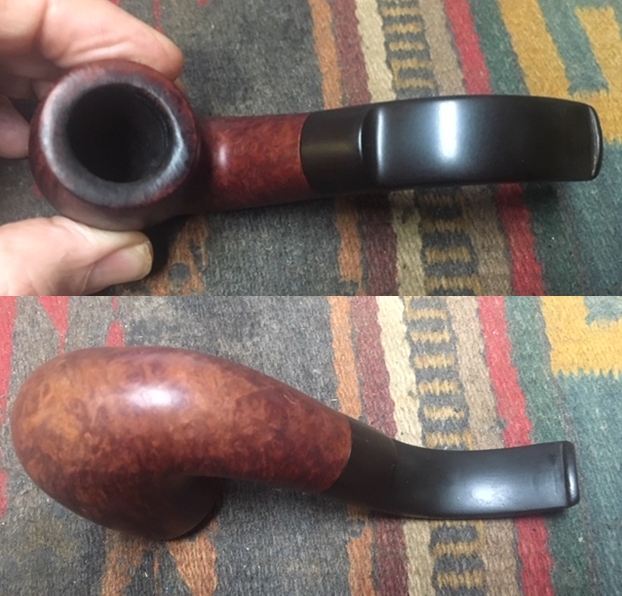
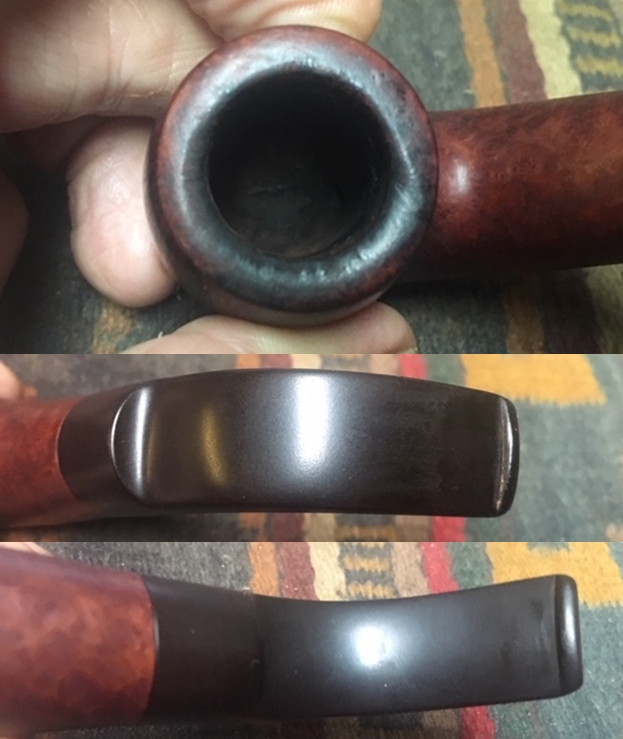
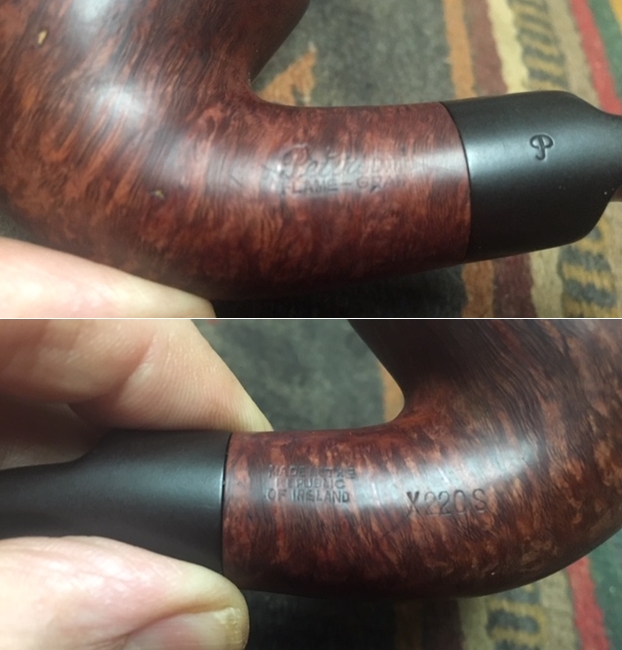
I really am enjoying working on the Peterson’s in the estate. This was a bit of a unique one. When I first looked at it when it came it noted that it was a Shamrock but I was very wrong. When I took it out of the box of cleaned up pipes that Jeff sent back I could see that actually it was stamped Peterson’s over Flame Grain on the left side of the shank and Made in the Republic of Ireland followed by the shape number X220S on the right shank. It has some stunning grain around the bowl and shank. The shank is quite thick and the finish very dirty.  There was a thick cake in the bowl with remnants of tobacco stuck on the walls. There was a fair lava overflow filling in the blast on the rim. The edges of the rim and top are dirty and there appeared to be some deep burn damage on the rear side of the bowl. It was a beautiful pipe that was dirty and tired looking. The stem was oxidized and calcified toward the end. Again, surprisingly did not have the deep tooth marks that I have come to expect from Bob’s pipes. Jeff took photos of the pipe before he started his cleanup work on it.   Jeff took photos of the bowl and rim top to show the cake in the bowl and the lava build up on the edges of the bowl. It was thick and hard but there was some burn damage on the inner edge at the back of the bowl. The outer edges looked okay but there were some nicks there as well.  Jeff took photos of the sides and heel of the bowl to show the condition of the finish. You can see the beautiful flame grain underneath the dirt and debris of the years. The birdseye grain on the heel was beautiful.Jeff took photos of the stamping on both sides of the bowl and shank. The stamping on the left side was faint but readable as you can see from the photos. It read Peterson’s Flame Grain. The stamp on the right side read Made in the Republic of Ireland followed by the shape number X220S.  There was a P stamped on the left side of the saddle stem. Jeff took photos of the top and underside of the stem showing the tooth chatter, scratching and oxidation on the stem surface and wear on the edges of the button.   I turned first to Pipephil’s site to get a quick idea of the Flame Grain line. Unfortunately there was no information to be found there. I then turned to Pipedia’s article on Peterson pipes to see what I could garner from that information. It is a great read in terms of the history of the brand (https://pipedia.org/wiki/Peterson). I quote a pertinent portion of the article below:

At the start of the 1950’s, all pipes at Kapp & Peterson were stamped with “Made in the Republic of Ireland” stamp and also starting off the decade with the hallmark letter I on any silverware. Apparently nickel was scarce in those days, just after the war and the company tried to use aluminium instead. Needless to say It was not very successful!

I have adapted this section concentrating on the period following 1950,the made in the Irish Republic era and the different near modern Peterson grades and series, which should bring us up to the time period from the 1990’s onward.

Again this was a time of great change for the brand, the company having changed ownership on several occasions. However it was also one of great creativity, with the introduction of several commemorative series and some new literary character series of pipes that would leave a very lasting impression on the pipe smoking fraternity.

I found a discussion on pipesmagazine online forum on the line and I have included a portion of that below (http://pipesmagazine.com/forums/topic/petersons-80-flame-grain).

The Flame Grain line by Peterson’s are not high grades but the briars are singled out for their exceptional grain patterns. A flaw or two might keep them from becoming a pipe costing hundreds of dollars more….

With that information in hand I knew what I was dealing with in terms of the stamping on the pipe. It is a Republic era pipe and from what I have learned about Bob’s other pipes this is probably from the 60s to the early 70s. Now it was time to work on the pipe.

With over 125 pipes to clean from Bob’s estate I took a batch of them to the states with me on a recent visit and left them with Jeff so he could help me out. Jeff cleaned the pipe with his usual penchant for thoroughness that I really appreciate. This one was a real mess and I did not know what to expect when I unwrapped it from his box. He reamed it with a PipNet pipe reamer and cleaned up the reaming with a Savinelli Fitsall Pipe Knife. He scrubbed out the internals with alcohol, pipe cleaners and cotton swabs until the pipe was clean. He scrubbed the exterior of the bowl with Murphy’s Oil Soap and a tooth brush to remove the grime and grit on the briar and the lava on the rim top. The finish looks very good with great looking grain around the bowl and shank. Jeff soaked the stem in Before & After Deoxidizer to remove the oxidation on the rubber. When the pipe arrived here in Vancouver for the second stop of its restoration tour it looked very good. I took photos before I started my part of the work. I took some close up photos of the rim top and also of the stem surface. I wanted to show what an amazing job Jeff did in the cleanup of the rim top. The damage to the rim top was more extensive than I had originally thought. The burned area extends on the inner edge around the back, the left side and front of the bowl. It is rounded over besides being burned. The outer edge of the bowl looks very good. I also took close up photos of the stem to show the lack of tooth marks and the remaining oxidation on the stem surface.   One of the things I appreciate about Jeff’s cleanup work is that he works to protect and preserve the nomenclature on the shank of the pipes that he works on. I took some photos to show the clarity of the stamping. I have noticed that many restorers are not careful to protect the stamping in their cleaning process and often by the end of the restoration the nomenclature is almost destroyed. I would like to encourage all of us to be careful in our work to preserve this! Since this is another pipe Bob’s estate I am sure that some of you have read at least some of the other restoration work that has been done on the previous pipes. You have also read what I have included about Bob Kerr, the pipeman who held these pipes in trust before I came to work on them (see photo to the left). Also, if you have followed the blog for long you will already know that I like to include background information on the pipeman whose pipes I am restoring. For me, when I am working on an estate I really like to have a sense of the person who held the pipes in trust before I worked on them. It gives me another dimension of the restoration work. I asked Brian if he or his wife would like to write a brief biographical tribute to her father, Bob. His daughter worked on it and I received the following short write up on him and some pictures to go along with the words including one of Bob’s carvings. Once again I thank you Brian and tell your wife thank you as well.
I am delighted to pass on these beloved pipes of my father’s. I hope each user gets many hours of contemplative pleasure as he did. I remember the aroma of tobacco in the rec room, as he put up his feet on his lazy boy. He’d be first at the paper then, no one could touch it before him. Maybe there would be a movie on with an actor smoking a pipe. He would have very definite opinions on whether the performer was a ‘real’ smoker or not, a distinction which I could never see but it would be very clear to him. He worked by day as a sales manager of a paper products company, a job he hated. What he longed for was the life of an artist, so on the weekends and sometimes mid-week evenings he would journey to his workshop and come out with wood sculptures, all of which he declared as crap but every one of them treasured by my sister and myself. Enjoy the pipes, and maybe a little of his creative spirit will enter you!
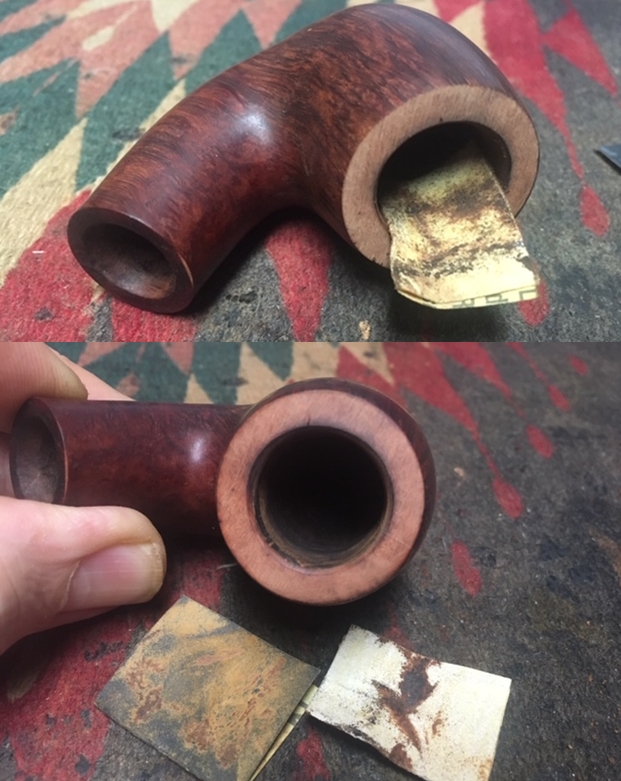
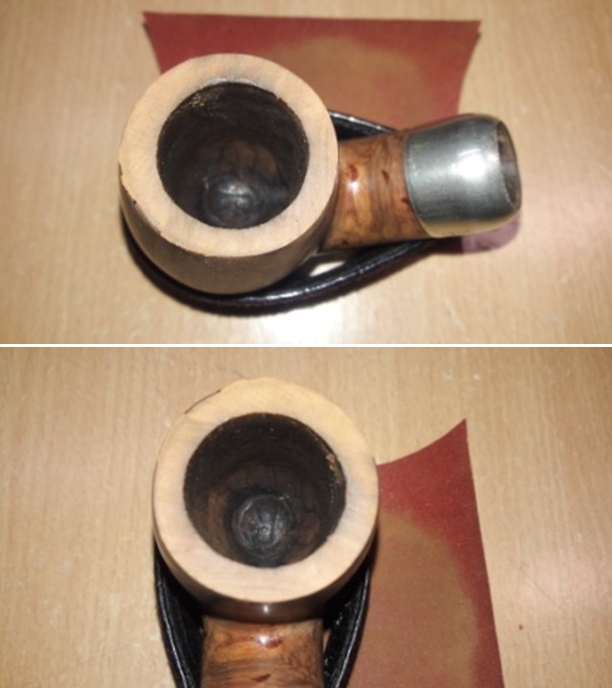
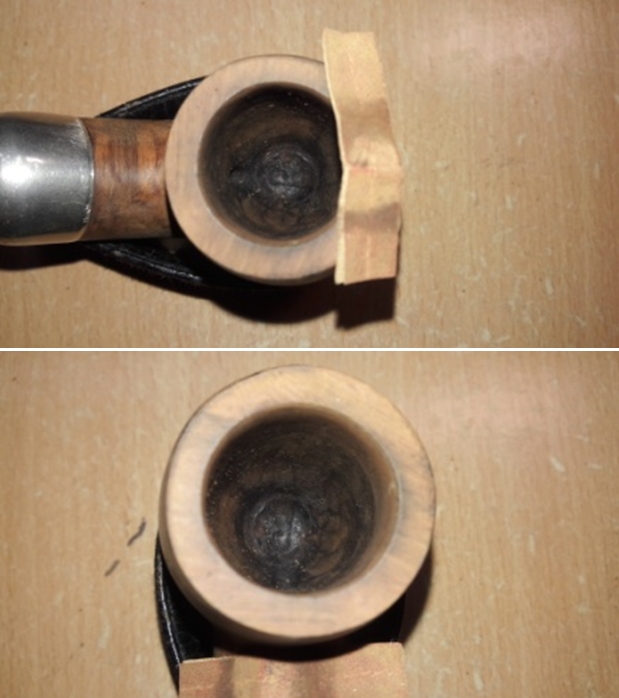
Now on to the rest of the restoration on this beautiful Flame Grain Peterson X220S bent billiard I did not need to clean the pipe. I decided to start the process by addressing the damage to the inner edge of the rim. From the extent of damage to the inner edge of the rim and the top of the bowl I decided I would need to top the bowl to remove as much of this damage as possible to restore the rim top back to a more pristine condition and bring the bowl back to round. I topped it on a topping board using 220 grit sandpaper. I took photos along the way to show the extent of the damage and the slow process of repairing that damage. Each photo shows a little more of the damage has been removed until the final one that shows the smooth rim top. With the top cleaned up and repaired I moved on to address the inner edge surface itself. I used a folded piece of 220 grit sandpaper to remove the damage and bring the bowl back to round. I followed that by sanding the rim top and edge with 400 grit wet dry sandpaper.   I polished the bowl and rim top with micromesh sanding pads – wet sanding with 1400-12000 grit pads and wiping the bowl down after each pad with a damp cloth. You can see some of the small sandpits in the surface of the bowl in the photos below. I have chosen to leave those and not fill them in as they are really part of the character of this pipe.   I decided to clean the briar with Mark Hoover’s Before & After Briar Cleaner to clean up the sanded surface of the briar and blend the repairs into the briar. I rubbed it into the surface of the briar and let it sit for 10 minutes. I rinsed the bowl off with warm running water to remove the product and the grime. After I dried the bowl off I rubbed it down with Before & After Restoration Balm. I worked it into the surface of the briar with my fingertips to clean, enliven and protect it. I let the balm sit for a little while and then buffed with a cotton cloth to raise the shine. Mark Hoover’s Balm is a product that I have come to appreciate and one I use on every pipe I have been working on.   I set the bowl aside and turned my attention to the stem. I sanded the stem with 220 grit sandpaper to break up the remaining oxidation. I started the polishing with 400 grit wet dry sandpaper to remove the scratching. It is starting to look good.   I decided to touch up the “P” stamp on the left side of the shank. I use PaperMate liquid paper for doing this. I worked it into the stamp with a tooth pick. Once the material had hardened I used the tooth pick to scrape off the excess material.   I polished the stem with micromesh sanding pads – wet sanding with 1500-12000 grit pads. I wiped the stem down after each sanding pad with Obsidian Oil. I polished it with Before & After Pipe Stem Polish – both Fine and Extra Fine. Once I had finished the polishing I gave it final coat of oil and set it aside to dry. I am excited to be on the homestretch of another one of Bob’s pipes and I look forward to the final look when it is put back together, polished and waxed. I put the bowl and stem back together. I polished the bowl and stem with Blue Diamond to polish out the scratches in the briar and the vulcanite. I gave the bowl and the stem multiple coats of carnauba wax. I buffed the pipe with a clean buffing pad to raise the shine. I hand buffed it with a microfiber cloth to deepen the shine. The pipe polished up pretty nicely. The grain really pops with the wax and polish. The shiny black vulcanite stem is a beautiful contrast to the reds and browns of the bowl. This Peterson’s Flame Grain X220S bent billiard was another fun pipe to work on thanks to Jeff’s cleanup work. It really has the unique look of a Peterson’s finish without the silver or nickel ferrule. It really is quite stunning even with the small pits in the briar. The thick/chubby shank makes it a very comfortable pipe to hold in the hand. The finished pipe is shown in the photos below. The dimensions of the pipe are Length: 5 ½ inches, Height: 2 inches, Outside diameter of the bowl: 1 ¼ inches, Chamber diameter: ¾ of an inch. I am still not sure what I am going to do with this pipe. There is something about it that makes me want to hang on to it but time will tell. I have a lot more of Bob’s estate to work on of various brands. Perhaps one of those will catch your attention. Thanks for reading this blog and my reflections on the pipe while I worked on it. This is an interesting estate to bring back to life.
Restoring a “Made in England” Peterson’s System 3 # 357 from the Mumbai Bonanza Lot


Blog by Paresh Deshpande

I have quite a few inherited Peterson’s System pipes ranging from the period 1915 to 1947 to present!!! I also have these pipes in System Standard, System 0 and System 3. So when Abha, my wife, sent me pictures of pipes that I had purchased from a Mumbai trash collector, I saw two distinct Peterson’s System pipes, one large and the other very small!! When Abha confirmed the COM stamping on both these pipes, I knew that I had Peterson’s System pipes from the 1930s-40s. Another two vintage Peterson’s System pipes added to my collection, I say. And I am not complaining, mind you readers!!

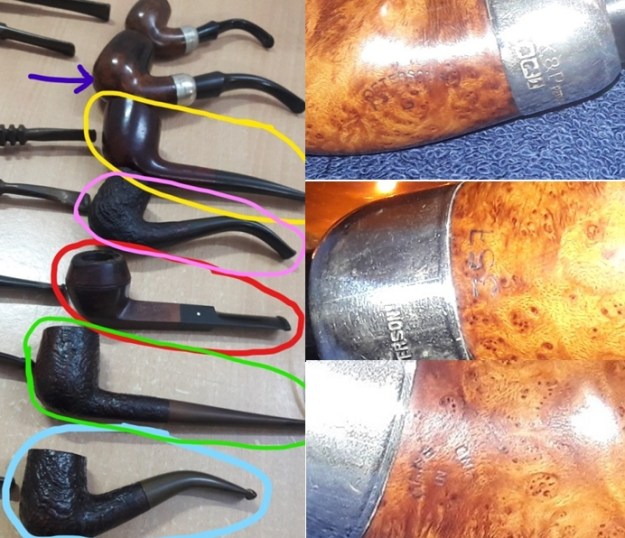
I was fortunate enough to have heeded the advice of my dear friend and mentor, Steve, and struck a deal with a junk collector from Mumbai. He did not know what he was selling and I did not know what I was buying as we reside in different cities!!!!! The argument that Mr. Steve presented was that if not anything, I shall at least have some spares and this was logical. I struck a deal and here are pictures of the pipes that I received in this lot.       This lot contains some very nice collectible pipes, a few well known brands and some mediocre brands. Overall, with seven Dunhill pipes, a Preben Holm #1 FH, a couple of “Made in England” Pete System pipes, a couple of  Charatan’s Belvedere, Custom-Bilt, Stanwell and other assorted pipes, I would say that I had struck a decent haul!!! This is indeed my “Mumbai Bonanza”.

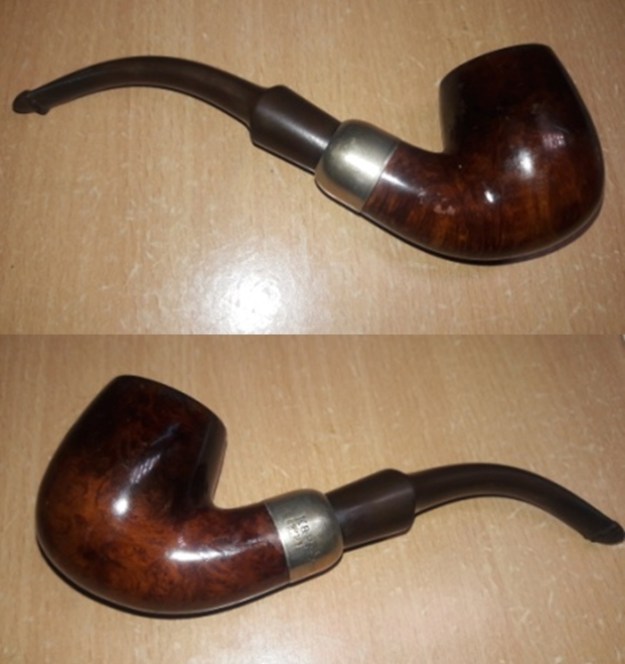
This 15th pipe that I decided to work on from this find is a large Peterson’s System 3 pipe with a nickel ferrule and is indicated in indigo color arrow. It is stamped on the left of the shank towards the shank end as “PETERSON’S” in an arch in block capital letters over arched “SYSTEM” in block capital over “# 3”. The tail of the P in Peterson’s is forked. The right side of the shank is stamped with COM stamp “MADE IN ENGLAND” in a circle format with “Made” and “England” in a circle with the “in” located in the center of the circle. Stamped at the bottom of the shank, very close to the ferrule is the shape number “357”. All the stampings are crisp and easily readable. The ferrule has the usual three cartouche with first having Shamrock, the second a Prone Fox and lastly a Stone Tower. Stamped above the cartouche are the letters “K & P” followed by “PETERSON’S” all in a straight line. The stem is devoid of any logo.In my earlier restoration of my inherited Peterson’s System 31, I had extensively researched the dating of these old Peterson’s and I can say with certainty that this pipe is from the period 1938 to 1940/ 41. Also the forked tail of “P” in Peterson’s with the inward coiling upper part corroborates the vintage of this pipe.

I reconfirmed and refreshed my learning by visiting pipedia.org and my memory has served me right. Here is the link to dating Peterson’s pipes: https://pipedia.org/wiki/A_Peterson_Dating_Guide;_A_Rule_of_Thumb

For further understanding of System Standard/ 0/ 3 etc, I referred to the main article on Peterson’s, but came out cropper. There is nothing substantive and clear information about this grading of these System pipes. Any source of information may please be shared with us on rebornpipes.com.

But nonetheless this is a Peterson’s System pipe from the 1938-40/41 vintage and sure is staying with me.

INITIAL VISUAL INSPECTION
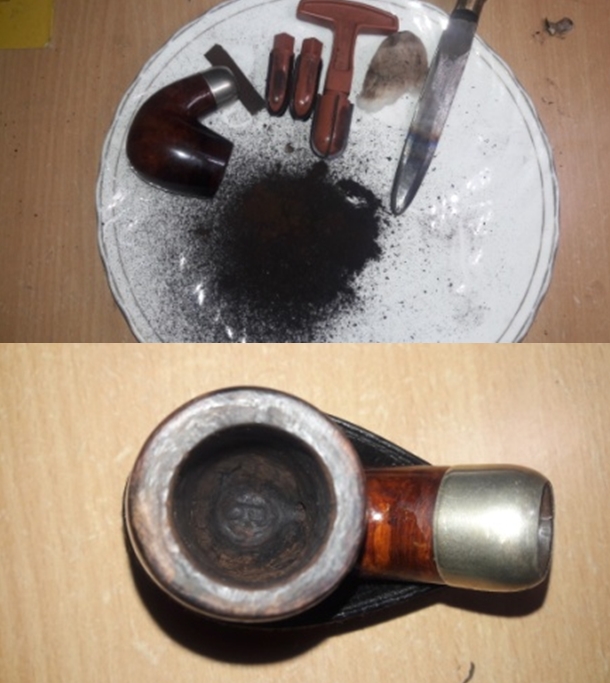
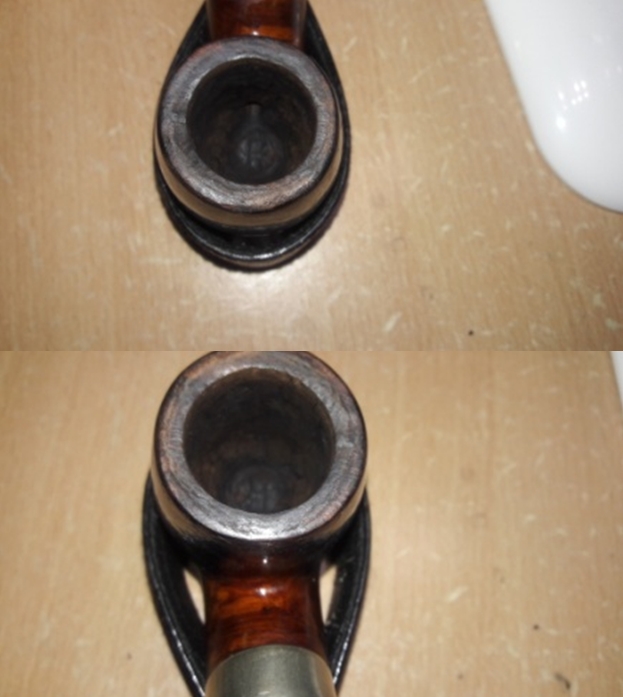
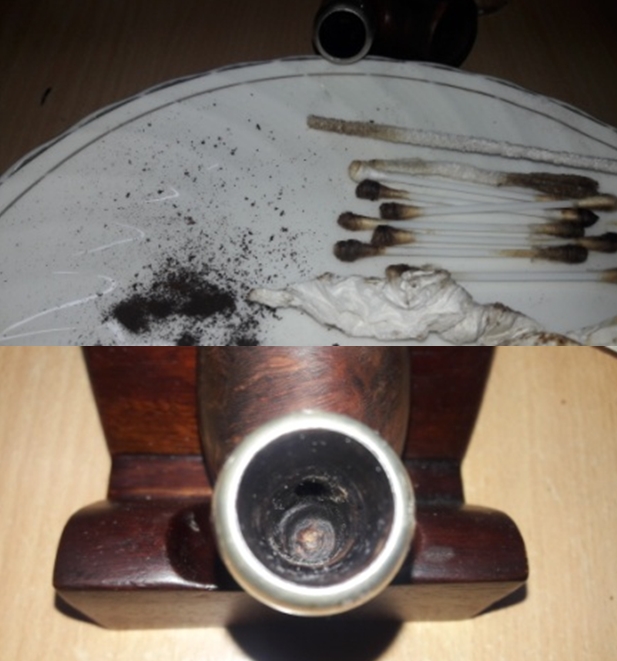
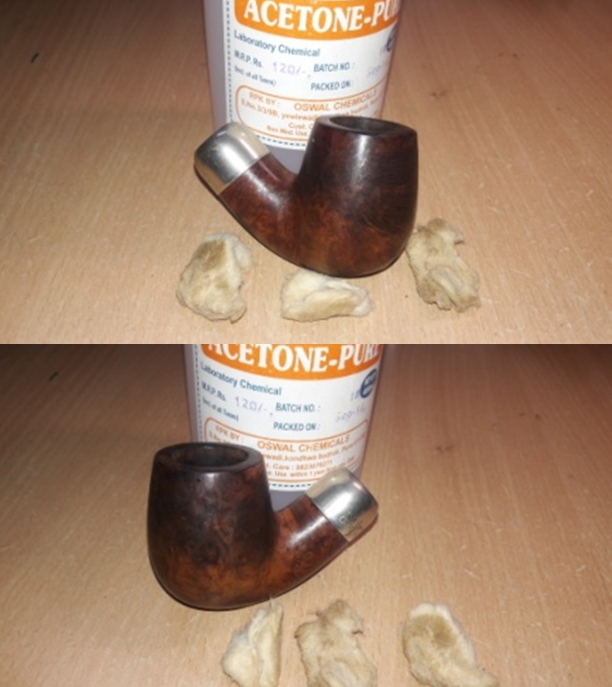
The first and foremost thing that struck me as awful was that the smooth stummel is coated with a coat of lacquer!!! To top it, the coat has disintegrated in patches giving it a very sorry appearance. The icing on the cake is that half way up towards the rim, the stummel is stained black!! Why would they do that?  Well, the long and short of the above is that both the lacquer and the black stain will be removed and whether the finish is to be kept natural or be stained will be decided later. To be honest with you, being a grade 3 System pipe, there is nothing much to boast about the grains on the stummel. It has a smattering of cross grains and swirls all around the shank and stummel. The stummel surface is covered in grime giving the stummel a dirty appearance which is further accentuated by the patches of peeled lacquer coat. The stummel surface is peppered with a number of dents and ding on the foot and front of the stummel. A couple of fills are noticeable on either side near the shank and stummel junction and shown with yellow arrows. These will be clear when the stummel is cleaned of all the grime. In spite of all these flaws, the pipe has a nice size, heft and feel in the hand. It does have a quality which is seen on vintage pipes, but difficult to explain in words. And not to forget, this is nearly an 80 year old pipe!! A thick and uneven layer of cake can be seen in the chamber. The rim top surface has suffered the maximum damage and is uneven. It is covered in thick overflow of lava, dirt, dust and grime. The condition of the inner walls of the chamber and rim top surface will be known once the cake has been taken down to bare briar and the rim top crud has been scraped off completely. The bowl is out of round with the left half being thinner than the rest of the rim top. The inner rim is uneven with suspected burn/ charred surfaces in 9 o’clock and 3 o’clock direction (marked in yellow circle). Only once the stummel has been thoroughly cleaned that I can be sure of my initial appreciation. The outer rim edge too has dents, chips and dings, but not very severe, likely caused due to knocking against the hard surface. In spite of the thick cake, the chamber odor is, surprisingly, not strong and should be addressed once the cake has been taken down to the bare briar and the shank internals have been thoroughly cleaned The shank end is adorned with a nickel ferrule. The ferrule has oxidized a fair bit but should polish up nicely. The sump shows a heavy deposition of accumulated dried gunk, adversely affecting the airflow.The P-lip vulcanite stem is heavily oxidized and has calcification deposits towards the button end. There are deep tooth marks on the lower and upper stem surface in the bite zone and appears that the previous owner has literally chomped on the bite zone of the stem. The button edges also have bite marks, in fact, they are badly worn out. The tenon end has a major chunk missing and shows heavy accumulation of oils and tars. The part of the stem that seats in to the mortise is heavily scratched. Along with the stems of other pipes in line for restoration, I immersed the stem of this Peterson’s System 3 pipe in a mix of one part Hydrogen Peroxide 20% with one part hot water after I ran a couple of pipe cleaners dipped in alcohol through the stem air way. A couple of hours later, the stem oxidation on all these stems were raised to the surface.After I had fished out the stem from the Hydrogen Peroxide bath, I scrubbed it with Magiclean sponge and followed it up with a wipe of cotton swab and alcohol. I further scrubbed the stem surface with 0000 grade steel wool. The loosened and superficial layer of oxidation was easily removed and revealed the condition of the stem. There are deep bite marks in both the upper and lower bite zone. The bite marks are deep enough to cause significant thinning of the surface and complete disfigurement of the button edges. The deeper oxidation that was pulled to the surface would require more abrasive techniques.

THE PROCESS
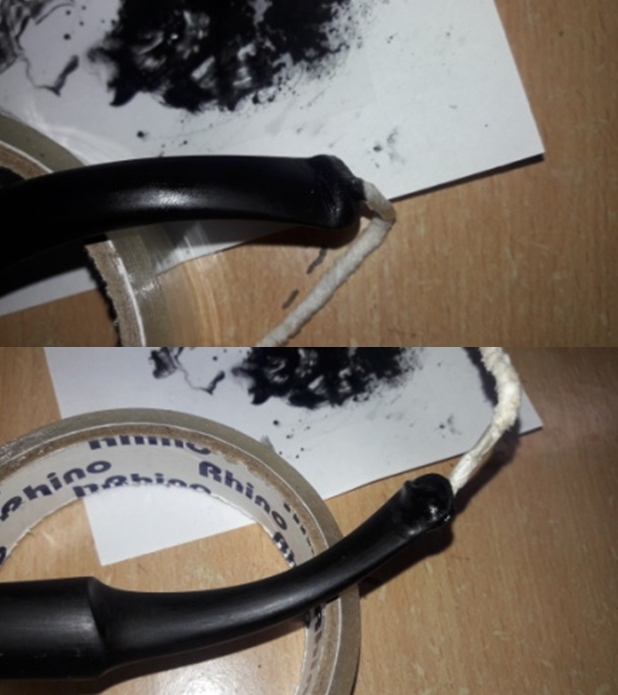
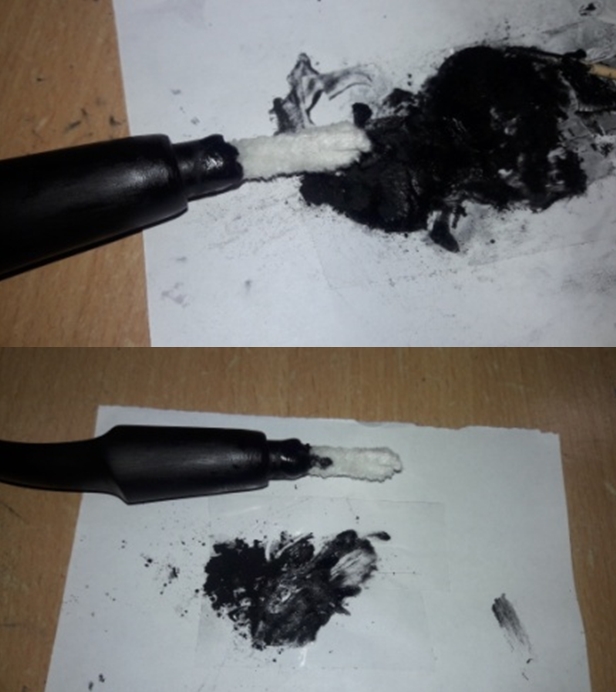
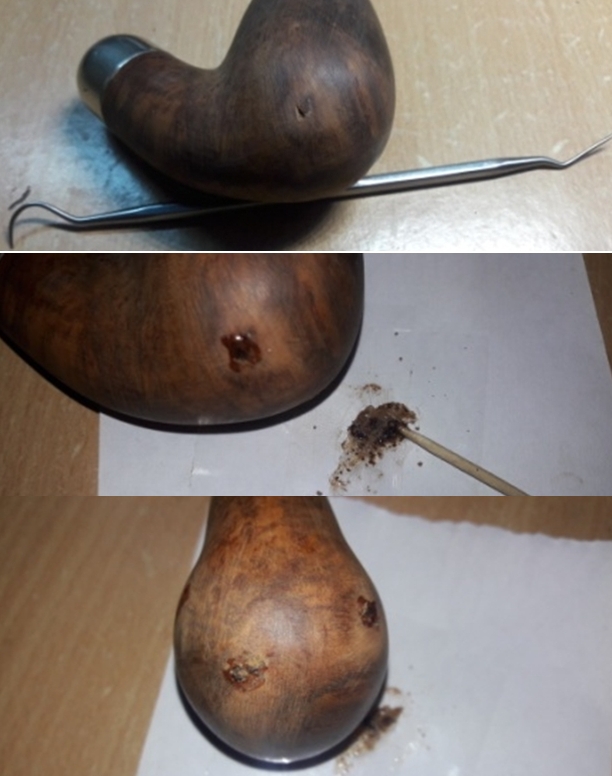
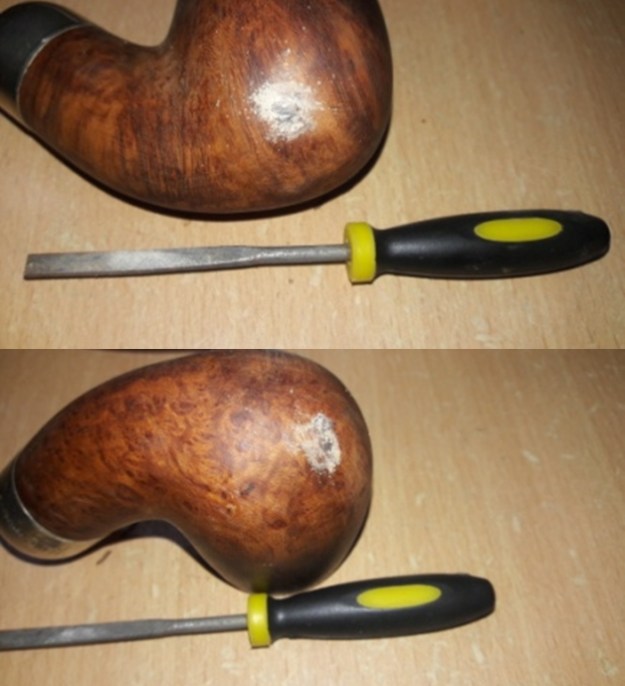
I started the restoration with the stem repairs as this would take the maximum of my time to clean, repair and spruce up the stem. I flamed the damaged button edge and the nicks and dents with the flame of a lighter. This helps the vulcanite to rise to the surface as it has an inherent property to regain its original shape when heated. At this stage, I could clearly make out the extent of damage to the lower surface and the extent of the crack in the bite zone. This was further accentuated due to heating with the flame of a lighter. The upper surface too has a couple of deep tooth marks. I cleaned the internals of the stem using hard and normal bristled pipe cleaners and isopropyl alcohol. The heap of pipe cleaners tells the sordid tale of the stem condition. With a pointed dental tool, I scraped out the entire dried gunk from the tenon end. I addressed the deeper oxidation by sanding the entire stem with a folded piece of 150 and followed by 220 grit sand paper. This also helps to address minor tooth chatter and prevents the fills turning brown once polished. Once the oxidation was completely removed, I wiped the surface clean with a cotton swab and alcohol and rubbed a little Extra Virgin Olive oil to hydrate the stem. Just for the information of statistically oriented reader, to get the stem to this stage it took better part of the afternoon and well past mid night!! Continuing with the stem repair, I tightly wrapped a scotch tape around one end of a pipe cleaner so that I had achieved a snug fit of the pipe cleaner in the small rounded slot of the P-lip stem. At the tenon end, I folded a pipe cleaner till the fit was snug in to the wide tenon and after applying generous coat of petroleum jelly, I inserted it in to the tenon end of the stem. Both the scotch tape and petroleum jelly prevents the mix of charcoal and superglue from sticking over the pipe cleaners and keeps the slot and tenon open. Thereafter, I mixed superglue and activated charcoal powder and generously applied it over the bite zone on either side, including over the button, over the chipped tenon end and set it aside to cure.  With the stem fill set aside to cure, I started with cleaning of the stummel as I was keen to know the condition of the walls of the chamber. With size 1 head followed by head size 2 and 3 of a PipNet pipe reamer, I took the cake down to bare briar. With my sharp fabricated knife, I removed the cake from the chamber where the reamer head could not reach and thereafter, using a folded piece of 180 grit sand paper, I sand out the last traces of cake and expose the walls of the chamber. I wiped the chamber with a cotton pad dipped in isopropyl alcohol to remove the carbon dust left behind by all the reaming and sanding process. Once the chamber walls were cleaned out, I was pleased to note a pristine chamber with no signs of heat fissures/ lines/ pits. With the same sharp knife, I gently scraped off the lava overflow from the rim top surface. The charred and uneven rim surface and damaged inner and outer rim edges is now clearly seen and should be addressed with simple topping of the bowl. Next, I cleaned out the internals of the shank and mortise. Using my dental tool, I scraped out all the dried oils, tars and gunk that had accumulated in the draught hole, airway and sump. The amount of crud that was scrapped out and the condition of the pipe cleaners that were used leaves no surprise why air flow through it was restricted. I finished the cleaning by running a few pipe cleaners dipped in isopropyl alcohol. I also wiped the sump with cotton buds and alcohol. I gave a final cleaning to the sump with a paper napkin moistened with isopropyl alcohol. With this cleaning, all old smells in the pipe are history. The pipe now smells clean and fresh.  All this time that I was handling cleaning of the internals of this pipe, the patchy lacquer coating and the black stain to the upper half of the stummel was irritating me no end. The more I looked at it, the more convinced I was that this needs to be removed completely. Using cotton balls dipped in pure acetone; I worked the entire stummel and got rid of the lacquer as well as the black stain. The cleaned stummel revealed a couple of more flaws in the briar, but that is fine by me. I was prepared to handle a couple of fills and a couple more does not perturb me.  Next, I cleaned the external surface using a hard bristled toothbrush and Murphy’s Oil Soap. With a soft bristled brass wired brush, I removed the overflowing lava from the rim top surface and cleaned the internals of the shank with a shank brush and dish washing soap to remove what little crud remained in the shank. I rinsed it under running tap water and wiped the stummel dry with an absorbent soft cotton cloth.   Once I had wiped the stummel dry with paper towels and soft cotton cloth, the exact extent of damage to the rim top and edges could be clearly gauged. Now I had a fair idea of the extent of topping the rim surface. I top the rim on a piece of 220 grit sand paper to even out the rim surface dents and dings and also to reduce the charred rim surface. I addressed the out of round inner edge by creating a light bevel to inner edge with a folded piece of 220 grit sand paper pinched between my thumb and index finger. With a folded piece of 220 grit sand paper, I sand the entire stummel surface and addressed the minor pits and flaws that were revealed when the lacquer coat was removed. To further smooth out the scratches left behind by the abrasive 220 girt sand paper, I top the rim surface on a piece of 400 grit sand paper. I had hoped that further sanding with a 400 grit paper will address the minor dings that remained on the outer edge, but that was not to be. Thus, with a folded piece of 220 grit sand paper pinched between my thumb and index finger, I created a light bevel over the outer edge. I am very happy at the way the chamber and rim top surface appears at this in restoration. The old fills observed earlier during initial inspection and those revealed once the lacquer coat was removed, were next that I addressed. Very carefully and painstakingly, I completely removed the old fill with a pointed dental pick. I cleaned the fill of all the debris of old fill material, wiped it with alcohol and refreshed the fill with a mix of briar dust and CA superglue in each fill and set it aside to cure overnight.By next day, the fill was nice, hard and well set. Using a flat head needle file, I sand these fills to achieve a rough match with the stummel surface. With a folded piece of 220 grit sand paper, I worked the fill till I had achieved a nice blend with the rest of the stummel surface. At this stage, the dreaded air pockets revealed itself (marked with red arrows) in one of the fills. I spot fill these air pockets with CA superglue. I repeated the sanding with a piece of 220 grit sand paper again once the glue had hardened. It turned out much better than I had anticipated. I further sand the entire stummel surface again with the same grit sand paper to further smooth the stummel surface in preparation for a polish by micromesh pads. I subjected the stummel to a complete cycle of micromesh polish, wet sanding with 1500 to 12000 grit pads. I paid greater attention to polish the rim top surface and the bevels created on the inner and outer rim edges. I wiped the stummel with a moist cloth after every grit pad to remove the sanding dust left behind by the pads. This also helps in monitoring the progress being made and provides an opportunity to take early corrective action, if required. I am happy with the progress being made till now. Next, I rub a small quantity of “Before and After Restoration Balm” in to the briar with my finger tips and worked it deep in to the surface and let it rest for a few minutes. The balm almost immediately works its magic and the briar now has a nice vibrant appearance with the beautiful swirl grain patterns on full display. The contrast of the dark browns of the grain with the light hues of the rest of the stummel adds an interesting dimension to the appearance of the stummel. I further buffed it with a horse hair brush to further deepen the shine. Turning my attention to the stem repairs in my home stretch, using a flat head needle file, I reshaped the button and roughly matched the fills with the rest of the stem surface. I sand the tenon end on a piece of I sand the fill with a piece of folded 220 grit sandpaper to even it out. With a round needle file, I smooth out the jagged tenon opening. A sanding with a flat head needle file of the buttons and bite zone to achieve a rough match, revealed air pockets on the upper and lower portions of the P-lip. I painted these air pockets with a permanent marker and spot filled it with clear superglue. Once the fill had cured, I sand the fills with a piece of folded 220 grit sand paper and followed it up by further sanding the stem with 320, 600 and 800 grit sand papers to achieve a perfect blending of the fills with the stem surface and a build a crisp button edge on either side of the P-lip. The repairs look good and the stem should polish up nicely. In my exuberance to cross the finish line and start on the new project, I completely missed out on taking pictures of this last step in stem restoration. My sincere apologies for this miss…. Using the micromesh pads, I completed the polishing cycle by wet sanding the surface with 1500 to 3200 girt pads. I had read that White diamond polish is between 3600 and 4000 grit of micromesh pads and best used between these two. I decided to give this a try to see if there is any difference in the final stem finish. I mount a fresh cotton buffing wheel on to my hand held rotary tool and apply white diamond polish and buffed the stem. I wiped the stem with microfiber cloth and go through the remaining pads, dry sanding with 4000 to 12000 grit pads. The stem looks great with the fills nicely matched with the rest of the surface. I gave a final rub with “Before and After Extra Fine” stem polish compound from Mark to remove fine scratches from the stem surface. I rub a little quantity of Extra Virgin Olive oil in to the stem surface and set it aside to be absorbed by the vulcanite. The stem polished up nicely and appears as good as when new. To complete the restoration, I mount a cotton cloth buffing wheel on to my hand held rotary tool and applied several coats of carnauba wax. I finished the restoration by giving the entire pipe a rigorous hand buffing using a microfiber cloth to raise the shine further. I vigorously buff the nickel ferrule with a jeweler’s cloth and bring it to a nice shine.I mount a clean cotton cloth buffing wheel and give the entire pipe a once over buff. The finished pipe with a natural finish to the briar looks amazingly beautiful and is now ready for its long second innings with me. The dark spots of the fills, though visible, are not addressed as the pipe looks beautiful as it is. I only wish it could share with me its life story of the past years while I enjoy smoking my favorite Virginia blend in it or maybe an English blend!! P.S. I earnestly would like to request all the readers to help me with information as to what does Standard/ 0/ 3 on these System pipes denote/ signify. The only thing that is confirmed is that this is definitely not one of the high grade System pipes from Peterson’s what with the fills that were seen on the stummel, but nevertheless, it’s a vintage Peterson’s!!

With this write up, I am through with all my pending works and look forward to work on my next project to restore a pipe which my dear friend and mentor, Steve, had sent me about a year back with the intention of providing me an opportunity to test my own skills. This pipe is close to my heart for other reasons too which I shall bring out in the write up after I have completed the restoration. Suffice to say at this point that this pipe is in a very very sad state and that it’s a DUNHILL!! I wish to thank each one for sparing their valuable time to read through this write up and sharing this journey with me.


Breathing Fresh Life into an Inherited Ben Wade “The Gem” from the Year 1900!


Blog by Paresh Deshpande

It’s been a while since I have worked on any of my grandfather’s pipe collection that I have inherited after his demise a few years ago. Amongst the collection, this small quaint Ben Wade was beckoning me for a long time. It is now that I decided to work on it. I had one Ben Wade without a stem, that Steve had taken back to Canada from his visit to India to fashion a stem from his bag of spares. This prompted me to fish out this Ben Wade and work towards its restoration.

This small sized straight Bulldog is typically classic British shape, with a diamond shank and a horn stem with a threaded bone tenon. The shank end is decorated with a sterling silver ferrule with embossed leaves, which is loose and came off easily. On this ferrule are the stamp details which will help in determining the vintage of this pipe. The silver shank ferrule is stamped as “A & Co” over a series of three hallmarks running from the left near the bowl end to the end of the shank on the right.The first hallmark is an “Anchor” in a shield shaped cartouche and identifies the city of Birmingham in England where the silver was crafted. The second hallmark is a passant Lion in a cartouche which signifies that the band is silver and that it was crafted by a British silversmith. The third hallmark is a square cartouche with the small letter “a” in the box which is a date letter that will give the year of the making of the pipe. Steve had recommended a site which he frequents while dating silver hallmarked pipes. Here is the link which helped me identify the city mark as Birmingham and further following the link on Birmingham date letter chart on the same page brought me to a separate page with all the letters along with the period in which they were stamped. I found the letter which matched to the one seen on the pipe in my hand and I can now say with authority that this silver ferrule is from the year of manufacture1900!! Unfortunately, the site did not allow me to copy/ edit and reproduce the relevant charts for including in this write up.

https://www.925-1000.com/british_marks.html

The next stamp which I researched was the “A & Co” stamp over the three hallmarks. I conferred with The-Beard-of-Knowledge on all things pipe, Steve and he suggested that I visit http://www.silvercollection.it and sure enough I got the information that I was looking for. I reproduce the relevant information from the site and also the link for those who may need to refer when researching their pipes.

http://www.silvercollection.it/englishsilvermarksXA.html

A business which is supposed to have been established in 1781 at Mitcham, Surrey, by William Asprey (died 1827).

CHRONOLOGY:
Francis Kennedy, c. 1804-c. 1841
Kennedy & Asprey, c. 1841-1843
Charles Asprey, 1843-c.1872
purchased the business of Charles Edwards, c.1857
Charles Asprey & Son, c.1872-c.1879
Charles Asprey & Sons, c.1879-c.1888
acquired Leuchars & Sons
C.& G.E. Asprey, c.1888-c.1900
Asprey (& Co), c.1900-1909
acquired Houghton & Gunn, 1906
acquired William Payne & Co, 1908
Asprey & Co Ltd, 1909- 1998
Asprey & Garrard, 1998-2002
Asprey & Co Ltd, 2002

The relevant stamping is highlighted in blue. The period/ vintage of the ferrule now perfectly matches and confirmed that it is from the year 1900.

With the year of make of the ferrule established as 1900, I wanted to confirm if this matched with the year of manufacture of the pipe itself. This is essential since the makers did stock up on such silver ferrule before they even made pipes for them. The stampings on the pipe itself should provide some clues to the link with the vintage of the pipe. The pipe is stamped as “B W” in a rectangle over “THE GEM”, all in golden block capital letters. There are no other markings on this pipe, not even COM stamp.I searched pipedia.org for information on this brand and further confirmation on dating this pipe. There are some interesting details on this brand and makes for an interesting read. I have reproduced some snippets of the information from pipedia.org which are relevant to dating this Ben Wade.

The company was founded by Benjamin Wade in 1860 in Leeds, Yorkshire, where it was located for over a century. Ben Wade started as a pipe trader, but yet in the 1860’s he established a workshop to produce briar pipes. The pipes were made in very many standard shapes – always extensively classic and “very British”. Many models tended to be of smaller dimensions. Ben Wade offered a very high standard of craftsmanship and quality without any fills. Thus the pipes were considered to be high grade and a major competitor to other famous English brands.

In the second World War the factory was destroyed by German air raids on Leeds. But the Ben Wade family decided to re-build it immediately after the war and pipe production was re-started soon and successfully linked to the fame from the pre-war years.

Before the second war Ben Wade clustered their offerings into three price points: “Ben Wade” included the higher end pipes (eg the Larnix, Super Grain, Selected Grain, etc), “BW” included the mid-level pipes (eg Statesman, Natural Grain, County, etc), and “BWL” were the least expensive (eg Hurlingham, Adelphi, Tense Grain). Champion was in the last group, and in the 1930s at least retailed for 2/6.

Even though the owner family decided to leave pipe business and sell off the firm. The family went into negotiations with Herman G. Lane, president of Lane Ltd. in New York at about the same time as the Charatan family. Lane Ltd. bought both firms in 1962.

From the above it is confirmed that the Ben Wade that I have inherited is from the family era and from the era before the second war, placing it before 1939. Now, I had read somewhere that it was common for pipe makers not stamp the pipe with the COM stamp in early 1900s and this was confirmed by Steve. Thus, to sum up all the information researched to date this particular piece, it is safe to conclude that this pipe is likely to have been made in the year 1900!! My inheritance indeed has some very nice and very old pipes.

INITIAL VISUAL INSPECTION
In the month of January this year, I had restored a Loewe Kenton from my inherited pipes that was nicely reamed with no overflowing lava over the rim top (https://rebornpipes.com/2019/01/17/restoring-a-classic-british-billiard-loewe-co-pipe/) and now this is the second pipe which is without a layer of cake in the chamber. However, the rim top surface is darkened and covered with lava overflow. I searched through the remaining large carton of inherited pipe for another pipe which is sans cake, but did not find any. Coming back to the pipe on my work table, the rim inner edge is mighty uneven, most probably a result of using a knife blade and shows signs of darkening due to charring. However, the outer edge is without any damage. The walls of the chamber are in excellent condition with no signs of heat fissures/ lines, but slightly uneven. A little magical touch from Pavni, my daughter who specializes in making the chamber smooth should address this issue. The stummel surface has developed a nice patina over 119 years of its existence and I have no intentions of destroying it during the restoration. Therefore, the few dents and dings that are visible shall stay and be a part of the pipes history through the years. Maybe, micromesh polishing will address a few of these dents and scratches. I wouldn’t say that this pipe has beautiful grains all round because it does not!! But yes, there is a smattering of some straight grains in the cap of the stummel and few on the shank while rest of the stummel has just some swirls of grains here and there. Even though the stummel is covered in dust, dirt and grime from years of uncared for storage, through it all the pipe still has a feel of quality maybe because of the shape or the proportions, I am not able to pin point exact reasons, but the pipe shouts vintage and quality!! The double ring separating the cap from the rest of the stummel is filled with dirt and dust, but is intact with no chipping or unevenness, which is surprising. At this stage of my initial inspection, in order to see the condition of the shank end and mortise, I tried to separate the bone stem from the shank end. The stem would not budge. I had no desire of applying more force for the fear of breaking the bone tenon inside the mortise and this would have really complicated the restoration for me as well as the originality of the pipe would have been compromised. I wanted neither and so in went the entire pipe in to freezer for a chill. A few hours later, I took the pipe out from the freezer and slightly heated the shank end. Once satisfied, I gingerly turned the stem with success. A little coaxing and finally the stem and shank were separated. Whew! What a relief. However, when I tried to reattach the two, there was a slight gap between the stem and the shank end and indicated with red arrows. I am sure that with the cleaning of the shank/ mortise of the entire gunk, the fit should improve. After the stem was separated from the shank end, the sterling silver ferrule too fell out easily. I will have to fix it with superglue. A closer examination of the mortise confirmed that it is clogged with accumulation of oils, tars and gunk of yesteryear. The threads too are covered in the gunk and most probably the cause of the incorrect seating of the stem in the mortise.The horn stem itself appears dull and lifeless and has tooth chatter on both the surfaces of the stem. The slot is perfectly round and correct for the time period of the pipe and shows accumulation of dried tars and dirt. The button edges, however, are sharp and sans any damage with a little dirt embedded at the bottom of the edges. I could make out one crack emanating from the right bottom edge of the diamond saddle and extending to more than half the length of the saddle panel. This crack is shown by a yellow arrow. The dark and light hues taken on by the stem over the years should polish out nicely and will add an additional touch of class to this classy pipe. THE PROCESS
Pavni, my youngest daughter loves to help me in pipe restoration in her free time and her forte is getting the walls of the chamber as smooth as a baby’s bottom. With a folded piece of 220 grit sand paper she completely evened out the wall surface. Once she was through with her sanding regime, I cleaned out the internals of the shank and the mortise with a few hard and regular pipe cleaners dipped in isopropyl alcohol. I also cleaned out the threads in the shank end with cotton buds and alcohol. With a sharp knife, I gently scraped away the lava overflow from the rim top surface. I followed it up by cleaning the external surface of the stummel with hard bristled tooth brush and Murphy’s oil soap. I rinsed it under running tap water and dried it with paper towels and a soft cotton cloth. I diligently scrubbed the rim top surface with a scotch-brite pad and Murphy’s oil soap to remove the remaining lava overflow. With this step on this particular project, I achieved two results; firstly, the gold lettered stamping on the shank was consigned to past tense and secondly, a couple of fills were revealed (marked in yellow arrows) at the front of the bowl and in the bottom left panel of the diamond shank. Thankfully, there is no charring over the inner and outer edge or the rim surface. I removed the old and loosened fills from the front of the bowl and one on the shank that was closer to the bowl. The old fill at the shank end; I let it be as it would be covered with superglue while attaching the silver ferrule. Next, I decided to address the issue of darkened rim top surface and uneven inner edge by topping the rim on a piece of 220 grit sand paper. The progress being made was frequently checked as I had no desire to lose any briar estate than absolutely necessary. Once satisfied with the result, I wiped the rim top surface with a moist cloth. The darkened rim top has been addressed completely, however, the inner rim edge is still uneven (though greatly reduced) with slight charred edges. I address these issues by simply running a piece of 220 grit sand paper along the inner rim edge without creating a bevel, but a nice rounded even surface.Next issue to be addressed was the fills. As mentioned above, I had cleaned out the old and loose fills using my sharp dental tool. I filled these with a mix of superglue and briar dust using the layering technique. Using a toothpick, I first spot fill superglue in to the surface of the intended fill and press briar dust over it. I repeat this process, if need be, till the fill is slightly above the rest of the surface. Once all the fills are covered, I set the stummel aside to cure. Once the fills are sufficiently hardened, which is quite rapid, I sand it with a flat head needle file to achieve a rough match with the rest of the stummel surface. I follow it up by sanding with a piece of 220, 600 and 800 grit sand papers to a perfect match. Discerning readers must have noted that I did not sand the entire stummel surface. This was because, as I had decided earlier that I would maintain the aged patina that the briar had taken on over the 119 years.At this stage, I decided that I would tackle the stem repairs as addressing the crack observed on the diamond saddle would require curing time and while the stem repair is curing, I could get back to the stummel, saving on time. I began by first cleaning the bone tenon and the stem surface with a cotton swab and alcohol to remove all the dirt and gunk from the surface. I was contemplating whether or not to drill a counter hole to prevent the crack from progressing further and after weighing the cons, I decided not to do so. The probability of the stem chipping or the crack developing further was reason enough for me to avoid this drilling. I filled this crack with plain superglue and set it aside to cure. The CA superglue would seep and spread inside and stabilize the crack. During his visit, while discussing various aspects of pipe restorations, Steve had made a passing comment that in his experience the best way to preserve the patina on a briar if you need to sand it is to dry sand the stummel with 1500 to 12000 grit micromesh pads. I followed his advice and went ahead and dry sanded the entire stummel surface with 1500 to 12000 grit micromesh pads. The results are amazing. The stummel has now a deep and rich dark brown coloration and this will further deepen once I go through the polishing and wax application regimen. Most of the readers would have noticed that the double ring separating the cap from the rest of the stummel shows accumulation of briar dust and grime. Also the fills are darker than the rest of the stummel surface. I have noticed it too and will clean the rings at the end as the polish and wax would also be accumulating in these gaps subsequently. The issue of the fills was addressed by staining the fills and surrounding surface with a dark brown stain pen. I set the stummel aside overnight for the stain to set. The blend is near perfect and should blend further after application of balm and carnauba wax polish.The superglue applied over the crack was by now well cured and had seeped in to the crack as well. I sand the entire stem and the fill in particular, with a worn piece of 220 grit sand paper. This helped to address the tooth chatter seen in the bite zone as well as blend the fill with the rest of the stem surface. I followed it up with dry sanding the stem with 1500 to 12000 grit micromesh pads. I wiped the stem with a moist cloth after every three pads to remove the resulting bone dust. To finish, I applied a liberal coat of Extra Virgin Olive oil and set it aside to be absorbed by the porous bone. I am very pleased with the way the contrasting dark browns and lighter grains in the bone are now highlighted. Once polished further, this will further add a touch of class to an already chic looking Bulldog!! I applied petroleum jelly over the bone tenon and tried the fit of it in to the mortise after temporarily attaching the silver ferrule over the shank end. The alignment and seating of the two was spot on. I separated all the parts again and continued further. While the stem was being hydrated with olive oil, I went back to work the stummel. The stain had set well by this time. I applied a little “Before and After Restoration” balm with my fingers and rubbed it deep in to the stummel surface. This balm rejuvenates the briar and the transformation in the appearance of the stummel is almost immediate. The fills are now so well blended in to the briar that it is difficult to spot them. The only part that needs TLC is the sterling silver ferrule. I polish the ferrule with a very soft powder specifically available locally, and widely used by jewelers, for polishing of silver. I align the ferrule stampings with the stummel stamping on the shank and fix it over the shank with a little superglue. The contrast that this shiny ferrule provides against the dark brown of the stummel looks fantastic.Next, I ran a thin and sharp knife through the double cap ring and cleaned it. To finish, I re-attach the stem with the stummel and mount a cotton cloth buffing wheel on to my rotary tool. I set the speed at about half of the full power and applied several coats of carnauba wax over the stummel and the stem of the pipe. I finished the restoration by giving the pipe a rigorous hand buff using a microfiber cloth to deepen the shine further. The completed pipe, with dark brown hues of the stummel contrasting with silver ferrule and the shiny dark browns and lighter grains in the bone stem makes for a visual treat. The pipe looks lovely, fresh and vibrant; the photographs speak for themselves. Thank you for your valuable time. P.S. This was the last pipe that I had restored during my leave from my work. The following write ups are now on pipes that I have already restored after returning to my work place. I shall sorely miss the help that Pavni, my 10 year youngest daughter and Abha, wifey dear, extend in my work. There are about 40 odd pipes that I have carried with me and which have been cleaned by Abha. So the next couple of months are going to be interesting. Keep following rebornpipes.com for some nice, unique and interesting pipes from here in India in the near future.

Oh, missed out on one aspect!! I tried to repaint the shank stamp with a gold glitter pen towards the end, but it would just not stay. Any suggestion would definitely help me mark this oldie as well as for future.


Giving a Second Chance to a Throw Away Bowl


Blog by Steve Laug

This morning I was looking through my boxes of pipes to restore to find what I wanted to do next. I went through several options and finally settled on a bowl that I brought back from Idaho. It was a Custombilt style bowl that we were ready to pitch in the trash because it was in rough condition. Someone had cut off the shank with a saw – a real hack job that left the shank end rough and the surface not flat. The bowl had a thick cake in it and an overflow of lava on the rim top. The inside and outside edges were dirty but it was unclear if there was damage. There was no stamping on the shank or underside. The finish was shot and there was a lot of dirt and grime in the grooves of the finish. There was also some shiny coat on the smooth portions of the bowl that made wonder if it had been varnished at some time in its life. It was an unbelievable mess. But it was enough of a challenge that I wanted to take it on. Here are some photos of the bowl when I started. I went through my cans of stems and found one that fit the mortise. I would need to work on the face of the shank itself to make it round again but it showed a lot of promise. The stem was lightly oxidized and the bend was too much but otherwise I liked the look of the saddle stem.I put the stem on the bowl and took a few photos of the pipe. To me it showed a lot of promise. It would take a bit of work to get the fit just right but the pipe had a lot of potential.I heated the stem with a heat gun to straighten out the bend. Once the vulcanite had become flexible I took the majority of the bend out so that the angle of the stem matched the angle of the top of the bowl. I took photos of it at this point in the process. I am happy with the progress. I set the stem aside and turned my attention to the bowl. I reamed it back to bare briar with a PipNet pipe reaming set. Once the bowl was smooth I cleaned up the reaming on the walls and scraped the rim top with a Savinelli Fitsall Pipe Knife. I topped the bowl on a topping board with 220 grit sandpaper to remove the damage and smooth out the surface of the rim. There was a lot of damage to the rim top and the topping took care of the damage to the rim top. I scrubbed the bowl with Murphy’s Oil Soap and a tooth brush under running water. I rinsed off the grime and took the following photos of the bowl. I cleaned out the internals on the mortise and the airway in the shank and the stem with 99% isopropyl alcohol, cotton swabs and pipe cleaners. I worked until the shank and mortise was clean and smelled new.There were still some shiny spots on the shank and smooth portions of the bowl. I wiped them down with acetone on a cotton pad. I used the Dremel and sanding drum and 220 grit sandpaper to reshape the shank. I rounded it to match the diameter of the stem and also faced the shank end on the topping board. I was moving through this restoration while I was talking with my brother and totally forgot to take photos of this part of the process. I smoothed out the sanded and reshaped shank and stem with micromesh sanding pads – wetsanding with 1500-6000 grit pads. I sanded the top of the bowl at the same time to smooth out the scratches.

Once I had finished shaping the shank I decided to continue my ongoing experiment with the Briar Cleaner on this pipe. I scrubbed it with the product from Mark Hoover of Before & After Products. He says that the briar cleaner has the capacity of absorbing grime and dirt from the surface of briar. I rubbed the bowl down with it to see how it would work in this setting. (Just a note: In speaking to Mark he noted that the product is completely safe to use. The main product is even FDA approved edible.) I rubbed it onto the bowl and rim top with my finger tips and worked it into the remaining sanding grit on the bowl. I let it sit on the pipe for about 5 minutes before I rinsed it under warm running water to remove the residue. I hand dried it with a microfiber cloth. I was pleasantly surprised by how clean the surface on the bowl looked when I was finished. The various surfaces of the carved briar just begged for a variety of stains to give the pipe some real dimensionality. I heated the briar and gave it the first coat of stain – a Tan Fiebings. This tan has some red tints in the dried and fired coat. I applied the stain with a dauber and then flamed it with a Bic lighter to set it in the grain. I repeated the process until the coverage was what I wanted. I buffed the bowl with a clean microfiber cloth and gave the bowl a light shine. All of this was preliminary for the next stain coat. I put the stem on the bowl and buffed the pipe with Blue Diamond on the buffing wheel. The buffing really brought the reds to the surface of the briar. It helped me to make the next decision regarding the contrast stain. I touched up the rim top with a Mahogany stain pen to smooth out the finish. I then stain the entire bowl with the contrast stain coat using Watco’s Danish Oil with a Cherry stain. I rubbed it on with a soft cloth and let it sit for a while before buffing it off with a soft cloth. I gave the bowl several coats of Conservator’s Wax and buffed it with a horsehair shoe brush. I also buffed it with a microfiber cloth to deepen the shine. I set the bowl aside and turned my attention to polishing the stem. I worked it over with micromesh sanding pads – wet sanding with 1500-2400 grit pads. I buffed it on the buffing wheel with Red Tripoli to further remove the oxidation on the surface. I reworked it with micromesh sanding pads. I wet sanded it with 1500-12000 grit pads. I wiped the stem down after each pad with Obsidian Oil. I finished polishing it with Before & After Pipe Stem Polish – both Fine and Extra Fine. I gave it a final coat of Obsidian Oil and set it apart. With both parts of the pipe finished I put the pipe back together again and I polished the bowl and the stem with Blue Diamond polish on the buffing wheel. I gave the bowl multiple coats of Conservator’s Wax and the stem multiple coats of carnauba wax. I buffed the pipe with a clean buffing pad to raise the shine. I hand buffed it with a microfiber cloth to deepen the shine. The pipe polished up pretty nicely. The rich finish and the interesting grain on this briar came alive with the buffing. The finish on the briar works well with the polished black vulcanite stem. The finished pipe looks almost like it came out of the factory like this. It is a well-proportioned, nicely grained shape that I would call Bent Apple. Have a look at it with the photos below. The dimensions are Length: 5 ¾ inches, Height: 1 ½ inches, Outside diameter of the bowl: 1 ½ inches, Chamber diameter: ¾ of an inch. This throw away, cut off bowl met a stem from another place and the pipe that came out is a beauty. The condition of the bowl showed that it was a great smoker so this new edition should also be one! I am not sure who made the bowl originally but from the looks of the finish it could very well be a Custombilt. I am not sure I will ever know with certainty but it has the look. Thanks for walking through the restoration with me.

New Life for a Mystery Pipe – an Imported Sterling Briar Author


Blog by Steve Laug

The next pipe in the queue is a ¼ Bent Author that Jeff picked up from an auction he follows in Michigan. It is a great looking pipe with some beautiful grain – swirls of birdseye, straight and flame grain around the bowl and shank. The carver did a great job utilizing the block of briar to maximize the grain. The pipe is stamped on the left side of the shank. It reads Sterling with Imported arched over the Sterling name and Briar arched underneath. The pipe was filthy with a thick cake in the bowl and overflowing lava on the back of the beveled rim top. There was some burn damage and darkening on the back inner edge of the rim but it was hard to know how badly damaged it was until it was cleaned up. There were some nicks in the outer edge of the bowl as well. Even though it was dirty there was some nice grain peeking out from under the grime. The exterior of the briar was dirty and dull looking – lifeless after sitting unused for years. The bent tapered stem is vulcanite and has no marking or stamping. It is good quality vulcanite but is pitted all over both sides. There are some tooth marks and chatter on both sides near the button. There was a tarnished Sterling Silver band on the shank with the following Hallmarks – a rampant lion (.925 silver stamp), an anchor (the Birmingham assay office) and an upper case letter “T” which will give me some idea of the date on at least the band. The photos below tell the story and give a glimpse of the pipe before clean up. I took photos of the bowl and rim to capture the condition of the pipe before Jeff did his cleanup work. There was significant darkening on the rim top and a cake in the bowl flowing over as lava on the back top edge. The inner edge showed some burn damage to the back side and rim top. The outer edges of the bowl had some nicking from the pipe being knocked out against something hard.Jeff took some photos of the side and underside of the bowl to show some of the issues with the old finish. It was more scratched than nicked but it was very worn looking on the underside of the bowl. You can also see the tarnish on the silver band in the photos.He took a photo of the stamping on the left side of the shank. It reads as noted above. The stamping is well done and readable. The photo of the silver band shows the hallmarks as noted above.The stem had some oxidation but was good quality vulcanite. There was some wear on the button edges and some tooth marks and chatter on both sides near the stem. The surface was also pitted and worn looking.I remembered working on a similar brand but was not sure how the Imported Briar stamped (which is usually used on USA made pipes) with the Hallmarks identifying the Sterling Silver band as Birmingham made and bearing a “T” date stamp. The conflicting information had several possible resolutions. One was that the pipe could be an American made pipe and the band added as bling later in its life time. Another would be that the pipe was made in England for export into the USA and the band was original. At this point I was not sure what to think about the situation. More work was necessary to see if I could gain some insight.

I turned first to the Pipephil website (http://www.pipephil.eu/logos/en/logo-s12.html). There was some information on a brand that was stamped Sterling Hall that was made by Briarcraft in New York City. The stamping was very different from the one in my hands. The stamping on Pipephil was Germanic script and had the Shield B logo of Briarcraft. The one that had in hand had neither one of those. The Aged Imported Briar stamp was also longer and different from the arched Imported Briar in block letters around the uppercase block STERLING. So at this point I was not sure there was a link to Sterling Hall. I have included a screen capture of the stamping for you to compare with the one above on this pipe.I turned to my other go to site for information – Pipedia. I looked in the British makers list for Sterling pipes but there was nothing listed. I turned to the same in the USA makers list and again it was not listed. I decided to have a look at the listing for Briarcraft and see if I could possibly find some pertinent information (https://pipedia.org/wiki/Briarcraft). I quote:

Richard Kliethermes Sr. was the founder of Briarcraft. First located on Pipetown Hill Rd, Spring Valley, NY., it moved later to 66 Central Ave., Spring Valley, NY. After the death of RK Sr., business was run by Richard Kliethermes Jr. († 1943) and was quite prosperous between 1920 and 1940. The company closed in 1950.

Briarcraft Pipe Company was very prosperous between 1920 and 1940 and usually feature a diamond shield logo. They also produced a line of seconds under the following names: Airo, Arcadian, Briarmeer, Smokemaster, Cavalcade, Hallmark, Sterling Hall, and Wimbledon. They closed their doors in 1950.

Briarcraft was started by Richard Kliethermes Sr. and located on Pipetown Hill Rd, Spring Valley, NY. It received its power from a dam on Hyenga Lake, later it moved to 66 Central Ave., Spring Valley, NY. At first it was housed in a 2 story frame building and later a 2 story stone building was added. Upon the death of RK Sr., business was run by Richard Jr, between 1920 and 1940 it was second in size to Frank Medico pipes. All the briar root was imported from Africa, with the start of WWII, imports stopped and a briar like root was imported from S. Carolina. Richard Kliethermes Jr. was the inventor of a pipe known as Smokemaster, which used a doubled up pipe cleaner in the bit to absorb tobacco juice. With the decline in business during WWII and the following 5 years it closed its doors 1950.

I have highlighted in red text the name Sterling Hall. There is no other help with the brand and there was nothing to link it to the Sterling I was working on. The other interesting thing of note in the above information is that the pipes were usually stamped with a Diamond Shield logo. The word “usually” could apply to this one not having a stamped logo.

I also checked in my copy of Who Made that Pipe (WMTP) by Herb Wilczak and Tom Cowell, copyright 1997. There I found a bit more help. There were several listings for the Sterling pipe and also variations on the name. I did a screen capture of the section showing the brands.In the above chart you can see that Arlington Briars in the US and Comoy’s, Delacour Bros and Orlik made them in England. You can also see that Kapp & Peterson made them in Ireland and Stanwell also had a Sterling brand made in Denmark. There was also a Sterling Band brand listed under Wally Frank in the US. It was pretty easy to say that the pipe in hand was not a Stanwell or Peterson made pipe so that left others that interested me.

I turned to the section on Arlington Briars to see if there were any ties there to help me get a better picture (https://pipedia.org/wiki/Arlington). I quote a part of that article and highlight the section that may give some insight. Again there is nothing certain in the article tying the brand to this company.

According to José Manuel Lopes, “North American brand that belonged to Arlington Briar Pipes Corp., Brooklyn, New York, founded in 1919. In the 1940s, Ludwig Rosenberger gave the company new life, and it continued until the 70s. His son, Mel Rosenberger, has recently launched the DiMonte brand. Jack Uhle was also linked to Arlington.” Arlington, as far as known, mainly operated as a sub-contractor for other brands. The Jobey pipes are said to be made by Arlington at an unknown point of time. Arlington’s own pipes are seldom seen.

I checked out the article on Pipedia on Delacour Bros. to see if there was a tie. But it did not have enough information to be truly helpful (https://pipedia.org/wiki/Delacour_Brothers).

I also checked the section on the Comoy’s and the Orlik article that pertained to seconds lines and there was no tie to the Sterling in either of them.

I then turned to the last noted make from the above WMTP chart – Wally Frank. I thought maybe that was a possibility as they had many companies make pipes for them. Here is the link on Pipedia (https://pipedia.org/wiki/Wally_Frank). I quote a portion of the article here for my purposes and have highlighted the portion that is interesting to this discussion:

Their numerous private-label pipes were made by many makers, including Charatan, Sasieni, Weber, and many others. Wally Frank, Ltd. also owned the Pioneer brand of meerschaum pipes, made from both Turkish and African meerschaum. In addition to importing pipes, he had many pipes made in his own name and also employed pipemakers like Peter Stokkebye, Svend Bang, and Ed Burak (who later became the owner of Connoisseur). As a result, each Wally Frank pipe must be individually evaluated on its own merit.

I have run into a dead end on the research of this pipe. I do not know where else to turn with looking for the brand. What I do know is that the most that can be said about this pipe is that it is certainly a USA Import Pipe. How it came to have a British Hallmarked Silver band on the shank is shrouded in mystery and I will probably never figure out the connection. Perhaps one of you readers can shed some light on the brand. If so let us know. Onto working on the pipe itself!

Jeff did his usual thorough cleaning of the pipe. He reamed the bowl with a PipNet Pipe reamer to take the cake back to bare briar. He cleaned up the reaming with the Savinell Fitsall Pipe Knife. He scrubbed the exterior of the pipe with undiluted Murphy’s Oil Soap and a tooth brush. He rinsed the bowl off with warm tap water to remove the grime. He scrubbed out the mortise and the airway in the shank and stem with pipe cleaners, cotton swabs and isopropyl alcohol until they were clean. He soaked the stem in Before & After Deoxidizer and when it had done its magic, rinsed it off the exterior and in the airway with warm water. He dried it and buffed it with a soft clot to remove the oxidation. I took the following photos of the pipe before I did my part in the restoration. I took a photo of the bowl and rim top to show its condition after Jeff had scrubbed it. You can see the darkening and the damage on the back inner edge of the bowl. You can also see the nicking on the outer edge of the bowl. The stem looked very good other than the few tooth marks on the surface of both sides ahead of the button. There was also some damage to the sharp edge of the button that would need to be dealt with. The silver band looked good.I took a close up photo of the stamping on the shank. The reflection of the flash makes it hard to capture the stamping on the band but it has the following Hallmarks – a rampant lion (.925 silver stamp), an anchor (the Birmingham assay office) and an upper case letter “T” which will give me some idea of the date on at least the band.I decided to figure out the potential date on at least the silver band. I found another helpful website on British silver hallmarks that covered hallmarks dating from 1743 to 2024 (https://www.silvermakersmarks.co.uk/Dates/Birmingham.html).I know that the graphic is small but check the link. When you are on the site you can click on the date letter you are looking for and it will give you every listing on the chart with that letter. I clicked on the “T” link which I have included below and it took me to a listing of the T dates (https://www.silvermakersmarks.co.uk/Dates/Birmingham/Date%20Letters%20T.html).

The date that corresponded to the hallmarks on the band were those listed for 1943. When I clicked on the date I was taken to a larger view of the stamp. I have included that here as well.

So at least I could be certain that the band for the pipe was Sterling Silver that bore the Birmingham hallmark Anchor and the date stamp of a capital T which identified it as having been stamped in 1943.

The trouble was I could not link it to the manufacturer of the briar… ah well. There always remains a bit of mystery in these restorations.

I decided to address the issues with the rim edges of the bowl first. I filled in the deep nicks and gouges on the outer edges of the bowl with clear super glue. Once the repairs had cured I sanded them smooth with a folded piece of 220 grit sandpaper. I also worked on the inner edge of the rim to remove the damage to the back side of the bowl. Once I beveled the inner edge of the rim to bring it back to round, I decided to continue my ongoing experiment with a new product from Mark Hoover of Before & After Products. This one is a product he labels briar cleaner and it has the capacity of absorbing grime and dirt from the surface of briar. I rubbed the bowl down with some of his Briar Cleaner to see how it would work in this setting. In speaking to Mark he noted that the product is completely safe to use. The main product is even FDA approved edible. I rubbed it onto the bowl and rim top with my finger tips and worked it into the grime and grit on the bowl. I let it sit on the pipe for about 5 minutes before I rubbed it off with a microfibre cloth. I rinsed it under warm running water to remove the residue. I was pleasantly surprised by how clean the surface on the bowl looked when I was finished. I polished the bowl and rim with micromesh sanding pads – wet sanding with 1500-12000 grit pads. I wiped the bowl down after each pad to remove the sanding debris. My goal was to further remove the darkening on the both the rim top and the outer edges of the bowl. I worked some Before & After Restoration Balm into the surface of the briar with my fingertips to clean, enliven and protect it. I let the balm sit for a little while and then buffed with a cotton cloth to raise the shine. Mark Hoover’s Balm is a product that I have come to appreciate and one I use on every pipe I have been working on. While there is still a bit of darkening on the rim it is still quite a stunning pipe. Have a look at the bowl now. With the bowl finished I set it aside and turned my attention to the stem. I wiped the surface down with some Obsidian Oil and dried it off. I filled in the deep tooth marks on both sides and repaired the edge of the button with clear super glue.Once the repairs had hardened I used a needle file to redefine the sharp edge of the button and to flatten the repaired areas. I sanded the stem with 220 grit sandpaper to smooth out the surface of the repairs and blend them into the stem. I started the polishing of the surface with 400 grit wet dry sandpaper. I polished the stem with micromesh sanding pads – wet sanding it with 1500-12000 grit pads. I wiped the stem down with a damp cloth after each pad. I further polished it with Before & After Pipe Polish – both Fine and Extra Fine. I wiped it down with a coat of Obsidian Oil and set it aside to dry. With both parts of the pipe finished I put the pipe back together again and I polished the bowl and the stem with Blue Diamond polish on the buffing wheel. I gave the bowl and the stem multiple coats of carnauba wax. I buffed the pipe with a clean buffing pad to raise the shine. I hand buffed it with a microfiber cloth to deepen the shine. The pipe polished up pretty nicely. The rich finish and the interesting grain on this briar came alive with the buffing. The finish on the briar works well with the polished black vulcanite stem. The finished pipe is a well-proportioned, nicely grained shape that I would call an Author. Have a look at it with the photos below. The dimensions are Length: 5 ½ inches, Height: 1 ½ inches, Outside diameter of the bowl: 1 ½ inches, Chamber diameter: 7/8 of an inch. This beautiful mystery pipe is bound to be a great smoker. Was it made in England or the USA? Were the band English and the pipe American? I am not sure we will ever know for certain. But it was an interesting mystery to research and restore. Thanks for walking through the restoration with me.
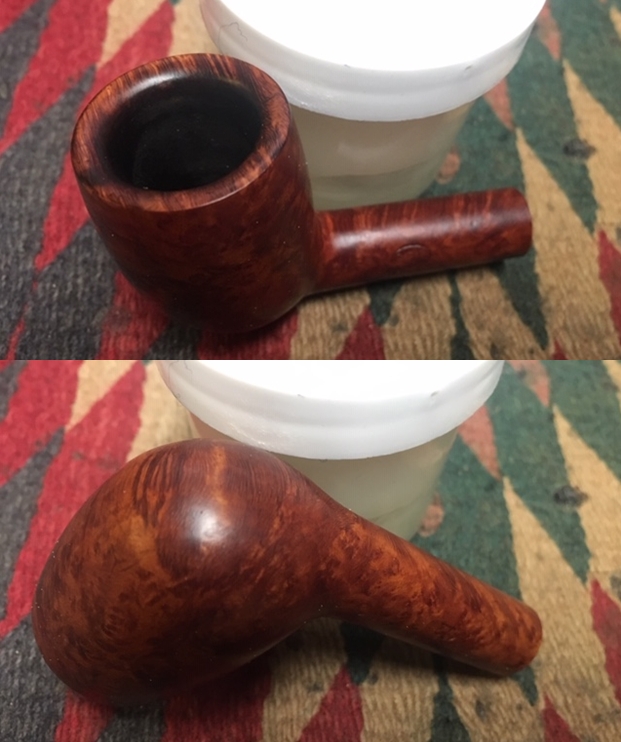
 

Restoration of a No Name “Genuine Briar” from Steve’s Grab Box


Blog by Paresh Deshpande

During one of the many Facetime interactions with Steve, I expressed my anxiety of ‘what after’ I had gone through restoring all of my inherited collection. Also discussed during this interaction was that I would be interested in working on pipes from various makers and with greater variety of repair works to gain more experience and learn new techniques. Since the ‘pipe culture’ in India met its last in the early 1970s, I did not have access to large lots of estate pipes as is available in Europe and USA. Steve suggested that I grab one of the grab boxes which he had in his store. I requested him to make one from an assortment of pipes that he had to which he agreed. Soon the awaited grab bag along with other pipes that I had liked arrived in my home town and was received by Abha. She sent me this picture of the pipes that were received. The one crossed in red is a Dunhill Cherrywood sitter that is added to my personal collection.There are a total of 15 pipes in the grab bag, each with different shapes, issues and requiring different skill sets to address them. This is exactly what I was looking for and that there are some nice branded ones is like an icing on the cake. This lot included pipes that Jeff, (Steve’s brother who does all the preliminary cleaning of pipes) had cleaned and sent to Steve for further restoration works.

The next pipe on my work table is a no name Pot that had been reamed, cleaned and readied for next stage of restoration by Jeff. The only visible stamping of “Genuine Briar” is on the right side of the shank. This pipe is marked in yellow arrow with the numeral 1.The pipe has some beautiful and densely packed straight and cross grains on the left side of the bowl and shank. Dark swirls adorn the rest of the stummel. The only stamping that is present on the right side of the stummel seen is “Genuine Briar”. There is no COM stamping and even the stem is devoid of any logo, in short there are no identifying marks that will help me in identifying or dating this pipe. However, this classic Pot shape and quality somehow makes me wonder that this could very well be an English made pipe. Since there is nothing that points me to the maker or country of origin or model/ shape code on this pipe, I move ahead with initial inspection of the pipe for further restoration process.INITIAL VISUAL INSPECTION
The stummel is clean and one can make out beautiful densely packed straight grains all around on the left and interspersed with dark swirls of grains on the right. There are very few minor dents and dings on the stummel surface. In all probability, I shall let these minor dents and dings remain. Maybe, sanding and further micromesh polishing will address a few of these dents and scratches. There are a few very minor fills towards the back and on the heel of the stummel. The stummel has a natural finish to the briar. The bottom of the shank is flat, making it a sitter. This is the first time that I am working on a pipe that has been cleaned by Jeff and he does amazing prep work, I say. The chamber is clean and odorless without any trace of the old cake. There is no damage to the inner walls of the chamber. A few specks of yellow paint are seen on the front of the bowl, but nothing serious to address. The rim top has the maximum damage and is peppered with numerous deep dents and dings, probably caused due to knocking the rim against a hard surface to remove dottle.  The rim top surface is darkened but not because of any overflow of lava, but maybe due to charring. There is significant damage to both the inner and outer edge of the rim all around, more so on the on the right side in 3 o’clock direction (marked in yellow arrows) due to charring. Simple topping of the bowl on a piece of 220 grit sandpaper should address this issue, however, in addressing this issue, though I absolutely hate it unfortunately, I would be losing some briar estate, a price I am willing to pay to resurrect this beauty. The shank end of the pipe is clean and so is the mortise. The draw is smooth, full and open. The vulcanite stem has minor tooth chatter on the upper and lower surface. Both upper and lower button has minor tooth marks and would need to be made crisp. The stem no oxidation and is an even black. The tenon is also clean and though the seating of the tenon in the shank is flush, attaching it is very hard and requires effort and there is a possibility of breaking the tenon if too much pressure is applied. I would need to address this issue. The air way is clear and draw is easy and smooth.THE PROCESS
Since Jeff had done the initial cleaning, I straight away get on with addressing the issues as observed during my initial inspection. The first issue that I decided to address is the fit of the tenon in to the mortise. Close examination of the mortise revealed an uneven surface and this could be the reason for the extremely tight fit. I roll a piece of 220 grit sand paper and sand the inner surface of the mortise to even out the surface. Once satisfied, I tried the fit of the stem in to the mortise. The fit is nice and snug with all the right noises! I sand the entire stummel surface with a folded piece of 220 grit sand paper. This should address the minor dents and dings on the stummel that I had initially observed and even out the entire stummel surface. I was careful around the only stamping on the shank. I absolutely detest losing any briar from the stummel, but to address the issue of uneven rim top surface and the dents and dings on the rim edges, this is a necessary evil. Thus, with a heavy heart, I began the process of topping the rim to reduce the charred surface and bring the bowl back to round. I use a square piece of 220 grit sand paper and firmly hold it with my hand on my work table. I work the rim top on the sand paper in circular motion, frequently checking the progress as I wanted to keep the briar loss to a bare minimum necessity. Once I was satisfied that the charred surface has been reduced and the roundness of the bowl has been restored to the extent possible, I created an inner edge bevel by pinching a folded piece of 180 grit sand paper between my thumb and forefinger and moving along the inner edge with a constant pressure, to minimize the charring on the inner edge of the rim. Similarly, I created a slight bevel on the outer edge of the rim. Thereafter, I moved to the next stage of polishing and revitalizing the entire rim top and the stummel. I even out stummel surface by polishing with micromesh pads, wet sanding with 1500 to 12000 grit pads. I wiped the stummel with a moist cloth after each wet pad to see the progress. I paid special attention to the rim top surface and the newly created inner and outer rim edge bevels. I rub a small quantity of “Before and After Restoration Balm” in to briar and let it rest for a few minutes. The balm almost immediately works its magic and the briar now has a nice vibrant appearance. I further buff it with a horse hair shoe brush. I ran a couple of hard bristled and regular pipe cleaners dipped in alcohol to be sure that the internals of the stem are cleaned out. A little bit of filing with a flat head needle file followed by sanding with folded pieces of 220 and 600 grit sand papers smoothed out the little damage to the buttons and the button edges are now even and crisp. I polished the stem with micromesh sanding pads – wet sanding with 1500 to 12000 grit pads. I rubbed the stem down with Extra Virgin Olive Oil after each set of three pads. I set the stem aside to dry. To finish, I re-attach the stem with the stummel. I mount a cotton cloth buffing wheel on to my hand held rotary tool and applied several coats of carnauba wax over the stummel and the stem. I finished the restoration by giving the pipe a rigorous hand buffing using a microfiber cloth to raise the shine further. The completed pipe, with the natural finish and beautiful grains on the stummel contrasting with the shiny black stem looks lovely, fresh and vibrant; the photographs speak for themselves. P.S. While working on the stummel a thought to stain the stummel with either dark brown or a combination of dark brown and cherry red stain did cross my mind. I did not entertain that thought long though, as I was convinced that as the pipe is smoked, it would darken beautifully and would add to the character of the pipe.

Thank you all for walking on this journey as a part of me.

New Life for a BBB Tortoise Canted Square Shank Dublin


Blog by Steve Laug

It was time to work on one of the pipes that Jeff and I purchased from a guy in Pennsylvania. The next pipe on my worktable comes from that collection. This one is a canted Dublin with a long square shank and a saddle stem. The rim topped is worn and dirty but it appears that the shape follows the grain of the block of briar very well. It is stamped on the left side of the shank BBB in a diamond over Tortoise and on the right side it is stamped London, England and the shape number 719. The stem has a BBB Diamond medallion on the topside of the saddle. The pipe was very dirty with a thick cake in the bowl and some lava overflowing on to the rim top. It was hard to know what the inner edge of the rim looked like because of the lava and cake. From the photos there seemed to be some damage to the inner edge at the front of the bowl but I could not be sure. Other than being dirty the finish appeared to be in good condition. The stem was pearlized white. There was some light tooth chatter and tooth marks on both sides of the stem at the button. I have included 3 photos that the seller sent to me to give an idea of what Jeff and I saw when we were deciding to purchase the pipe. We had the pipe lot shipped to Jeff in the US so he could do the cleanup on them for me. He took photos of the pipe before he started working on it so I could see what he was dealing with. I am including those now. He took photos of the rim top to show the thick cake in the bowl and the overflow of lava. The cake is thick and hard and the lava overflow is a thick band around the bowl. The bowl is a real mess. This must have been a great smoking pipe. There appears to be a damaged spot on the front bevel of the inner edge.The next photo shows the side and bottom of the bowl to give a clear picture of the beauty of the mixed grain around the bowl of the pipe. Under the grime some great grain peeks through.Jeff took photos of the stamping to capture the clarity of it even under the grime. The brand and the shape number are very readable. He also took a photo of the BBB Diamond Medallion on the stem top. The pearlized, tortoise stem looked dirty and there were some light bite marks and tooth chatter on the stem.The BBB Tortoise was a line of BBB pipes that came with a pearlized stem that almost looked like it was made of abalone. It was acrylic of some sort but has the softness of vulcanite. It is remarkable material.

I turned to address the pipe itself. Jeff had cleaned up the pipe for me. He reamed the bowl with a PipNet pipe reamer and cleaned it up with a Savinelli Fitsall Pipe Knife. He scrubbed the exterior with Murphy’s Oil Soap and a tooth brush to clean off the grime off the finish and the heavy overflow of lava on the rim top. He cleaned up the internals of the shank, mortise and stem with pipe cleaners, cotton swabs and alcohol to remove all of the oils and tars in the pipe. He soaked the stem in Before & After Deoxidizer and was able to remove much of the oxidation. When it arrived here in Vancouver it was a clean pipe and I knew what I had to work with. I took photos of it before I started my part of the restoration. I took photos of the rim top and the stem to show their condition. Jeff was able to clean up the incredibly thick cake and lava overflow that was shown in the rim and bowl photos above. He was also able to get rid of the grime and grit in the surface of the briar. There was a deep burn gouge on the front edge of the rim. There was some darkening around the inner bevel of the bowl. The outer edge and the rim top looked very good. The stem was much cleaner than before. There was some staining just ahead of the button. The tenon was a replacement – a black Delrin tenon. The clear white pearlized stem shows the black of the tenon through the back edge of the saddle on both the top and bottom side.I took a close up of the dark spot in the back end of the saddle. It is not a hole or a drill through. It is really the black of the Delrin replacement tenon reflecting through the translucent pearlized stem material. I have to say it is ugly but it not damaging and in no way effects the smoke.I decided to address the bowl first. I worked on both the rim damage and try to minimise the burn damage on the front inner bevel of the rim. I worked on the inner edge of the rim first using a folded piece of 220 grit sandpaper smooth out the damage, bevel the inner edge and bring the bowl back as close as possible to round.Once I beveled the inner edge of the rim to bring it back to round, I decided to continue my ongoing experiment with a new product from Mark Hoover of Before & After Products. This one is a product he labels briar cleaner and it has the capacity of absorbing grime and dirt from the surface of briar. I rubbed the bowl down with some of his Briar Cleaner to see how it would work in this setting. In speaking to Mark he noted that the product is completely safe to use. The main product is even FDA approved edible. I rubbed it onto the bowl and rim top with my finger tips and worked it into the grime and grit on the bowl. I let it sit on the pipe for about 5 minutes before I rubbed it off with a microfibre cloth. I rinsed it under warm running water to remove the residue. I was pleasantly surprised by how clean the surface on the bowl looked when I was finished. I polished the briar with micromesh sanding pads – wet sanding with 1500-12000 grit pads. I wiped the bowl down after each pad with a damp cloth. I rubbed the bowl and shank down with Before & After Restoration Balm to deep clean the finish on the bowl and shank. It also helps to blend the newly stained areas in to the surrounding briar. The product works to clean, enliven and protect the briar. I worked it in with my fingers to get it into the briar. After it sat for a little while I wiped it off and buffed it with a soft cloth. The briar really began to have a rich shine. I took some photos of the bowl at this point to mark the progress in the restoration. It is a beautiful bowl. I set the bowl aside and worked on the stem at this point in the process. I sanded the light tooth chatter on the stem with folded pieces of 220. The marks came off very easily. I rolled a piece and sanded the back edge of the saddle on both sides where the dark mark was. I took photos of the stem from various angles to give a clear picture. I polished the stem with micromesh sanding pads – wet sanding with 1500-12000 grit pads. I wiped the stem down after each pad with Obsidian Oil to enliven and protect the stem material. I used the Before & After Pipe Polish to remove the small minute scratches left in the pearlized, white stem even after the micromesh regimen. I finished by wiping the stem down with a final coat of Obsidian Oil and set it aside to dry.  I put the stem back on the pipe and took the pipe to the buffer. I worked it over with Blue Diamond to polish out the remaining small scratches. I gave the bowl and the stem several coats of carnauba wax and buffed the pipe with a clean buffing pad to raise the shine. I hand buffed it with a microfiber cloth to deepen the shine. The pipe polished up really well and even the newly beveled rim top looked good. I was happy with the results of the reworking of the rim. The finished pipe is shown in the photos below. The unique canted Dublin shape is a beauty and unlike any of the BBB Tortoise pipes that I have restored. It is a very stunning looking pipe with the mixed grain and the pearlized, white stem. The polished stem looks really good with the browns of the briar. The dimensions of the pipe are Length: 6 inches, Height: 1 3/4 inches, Outside diameter of the bowl: 1 ½ inches, Chamber diameter: 3/4 of an inch. This is another pipe that I will be putting it on the rebornpipes online store shortly, if you are interested in adding it to your collection. Thanks for walking through the restoration with me on this beauty!