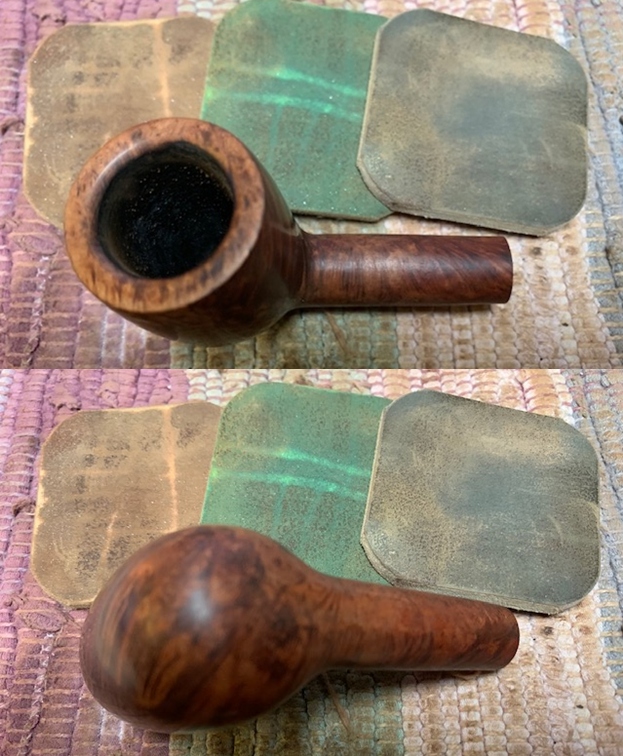
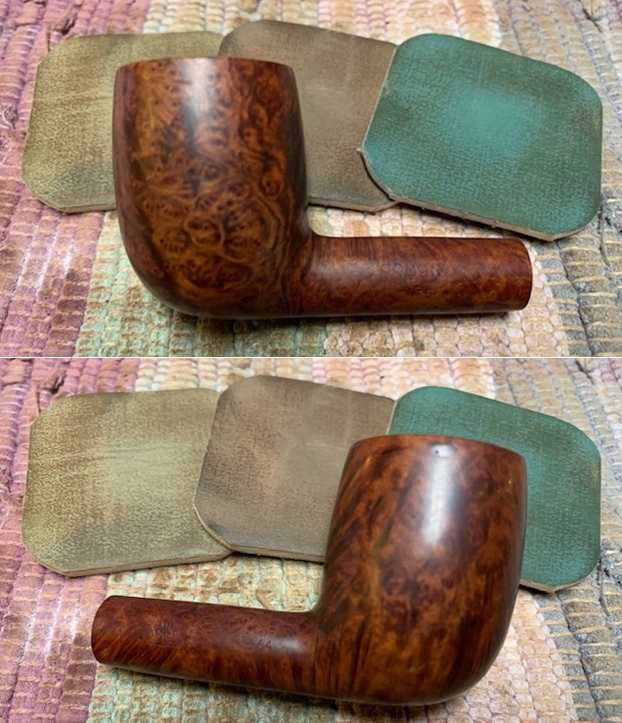
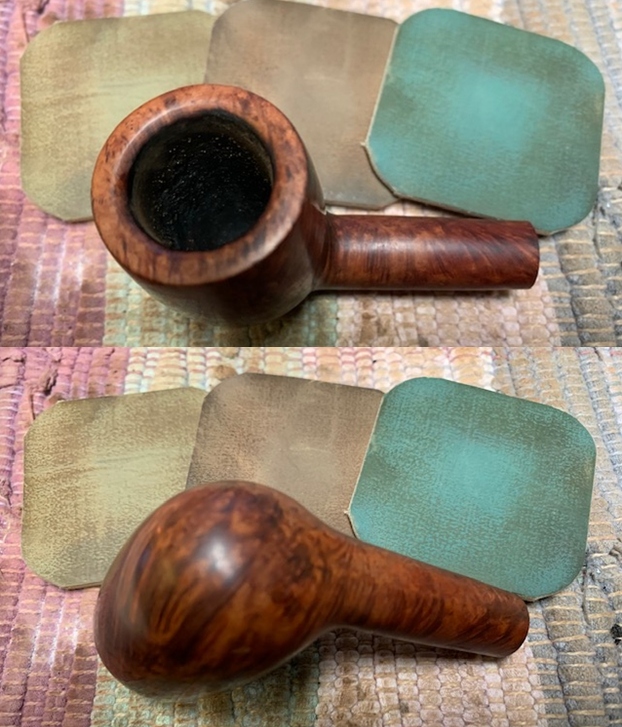
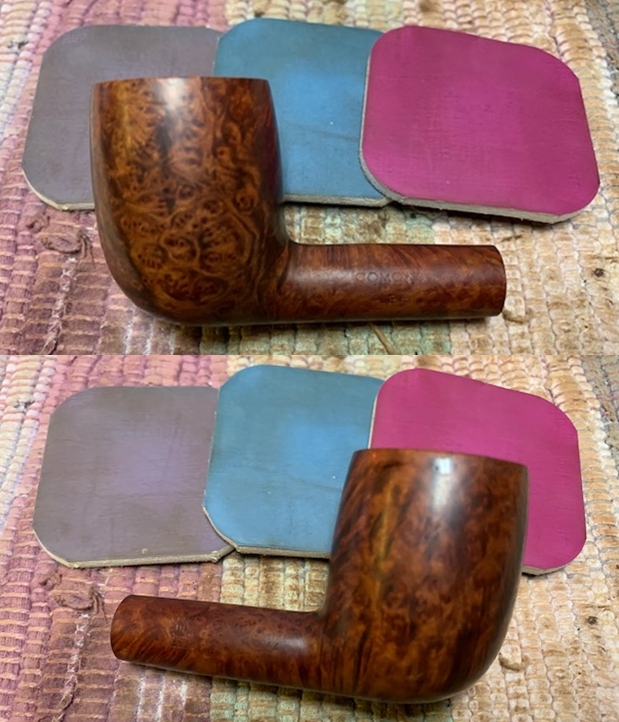
Tag Archives: topping a bowl

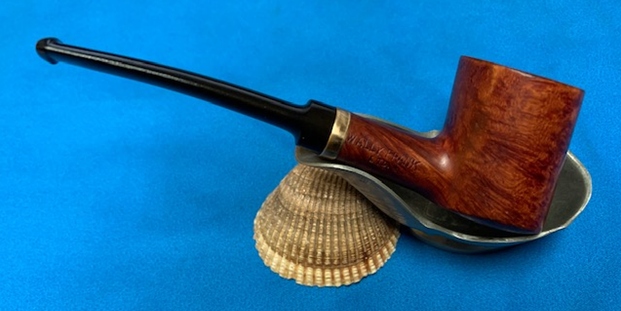
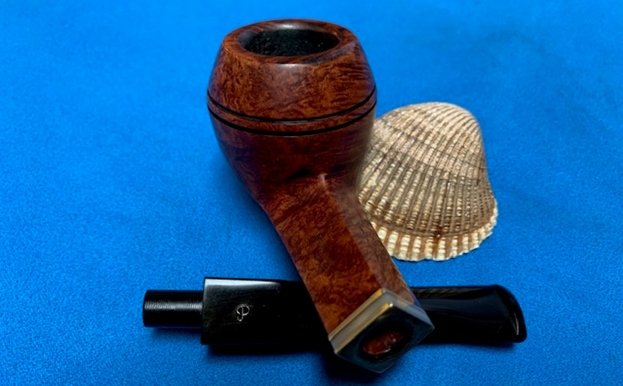
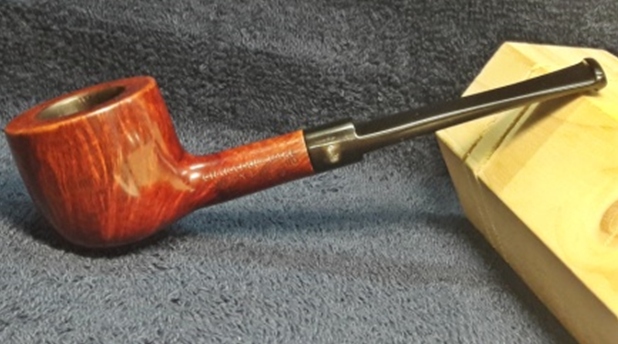
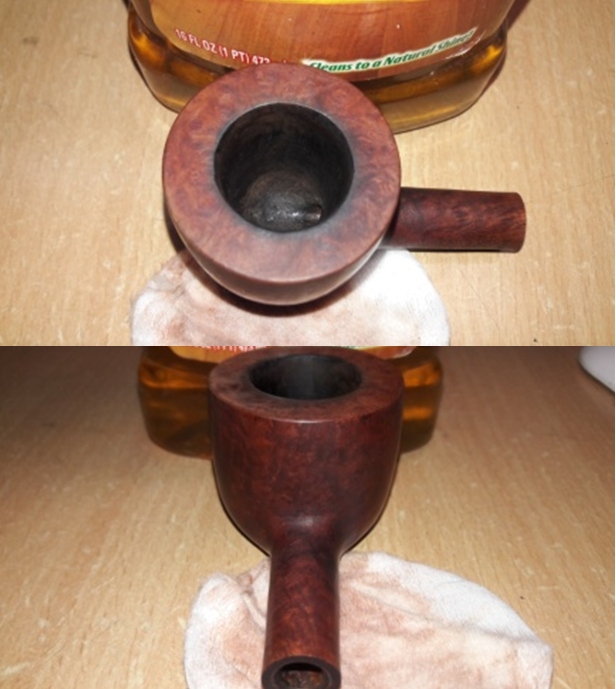
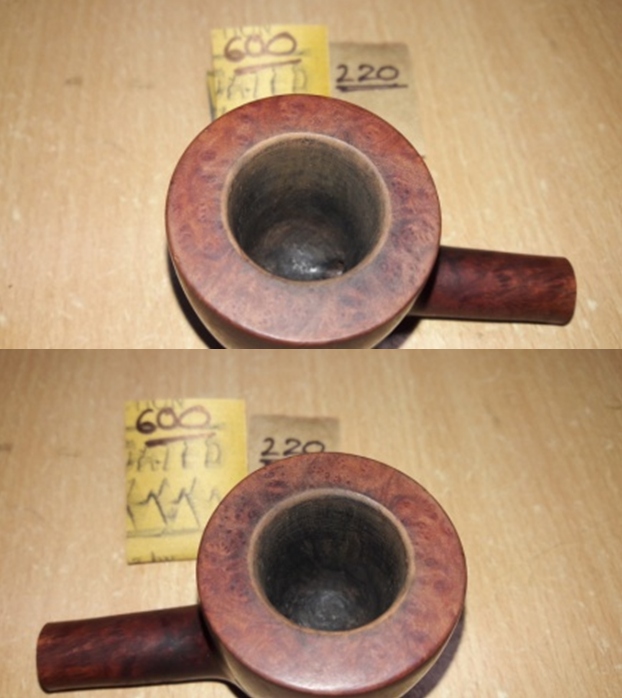
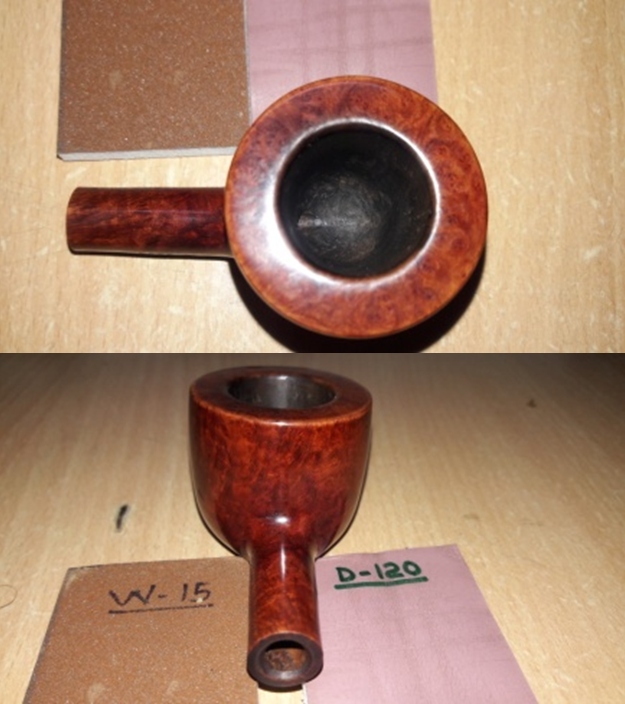
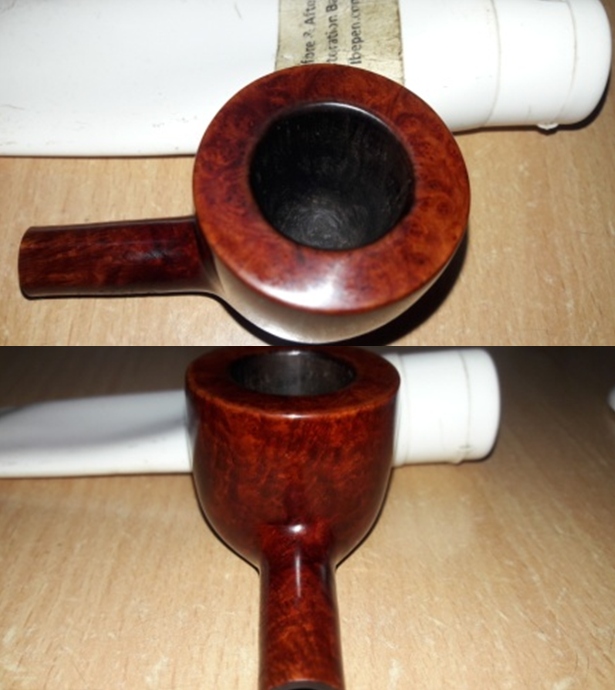
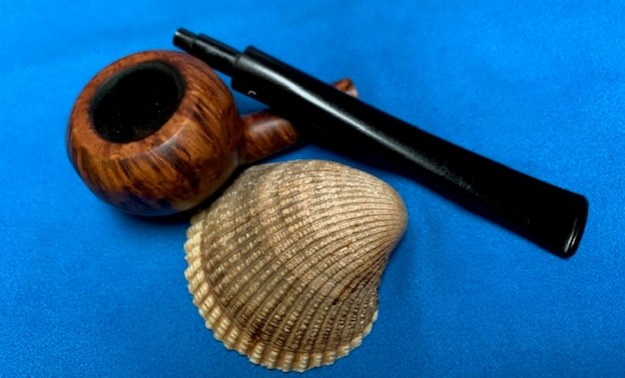
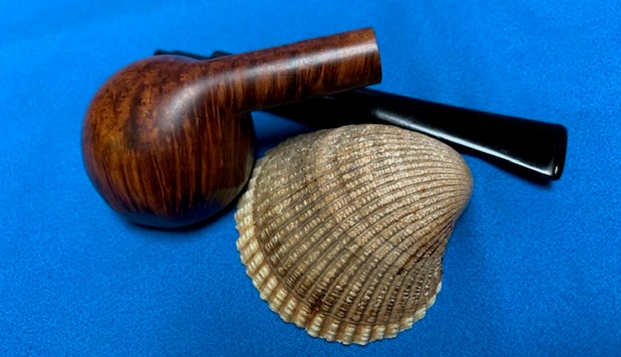
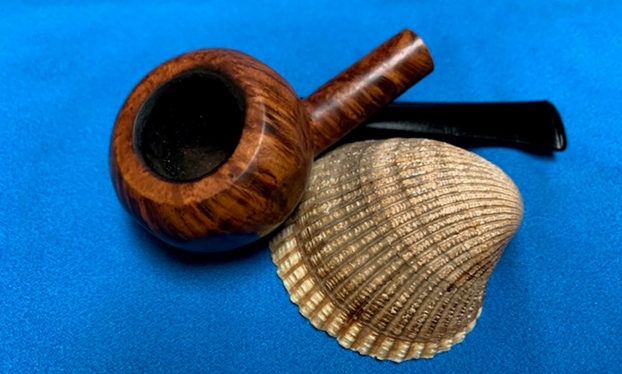
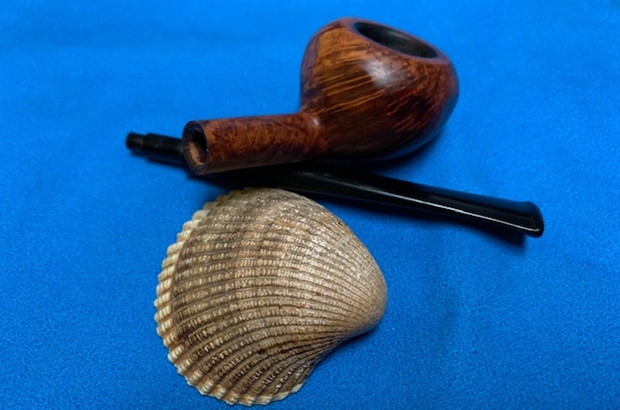
Restoring a Wally Frank Pipe of the Month Drunken Poker


Blog by Steve Laug

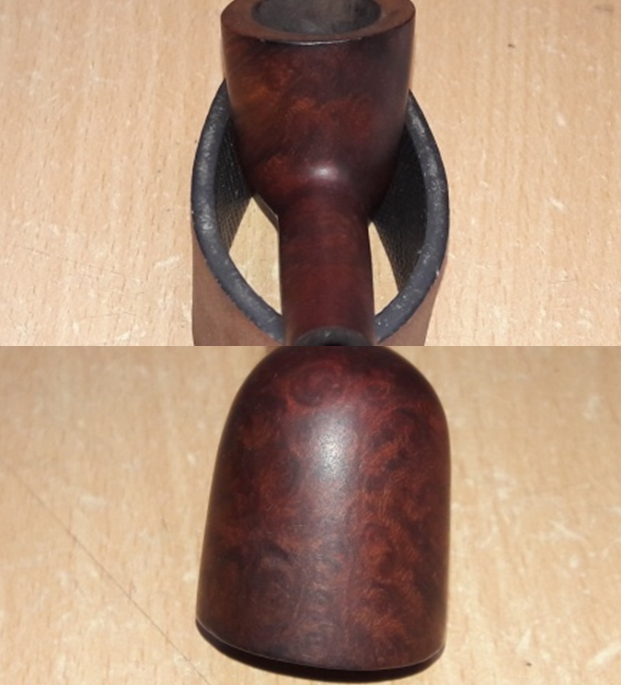
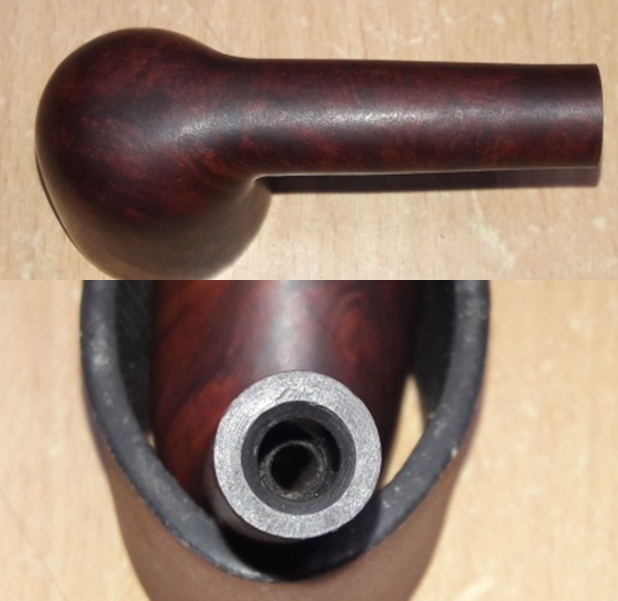
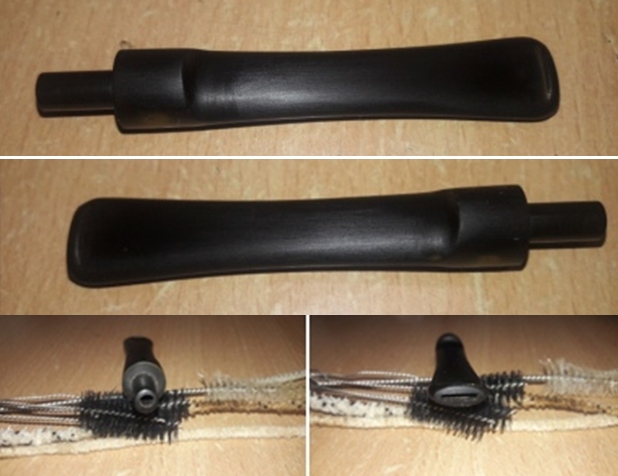
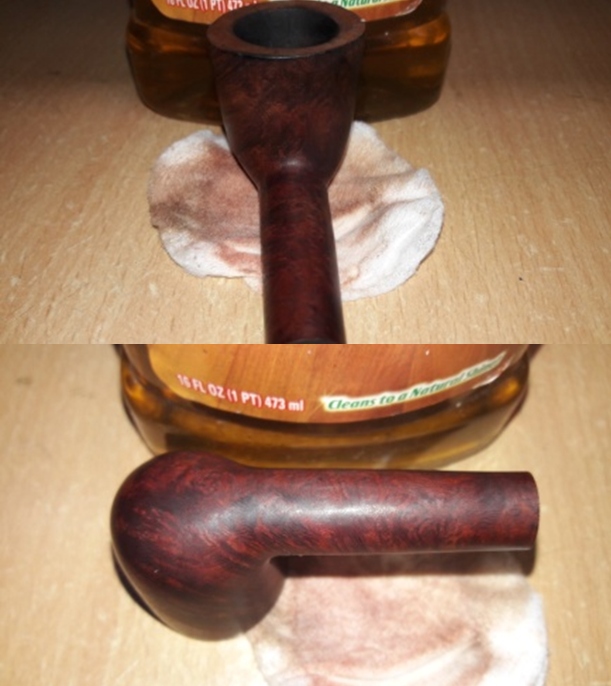
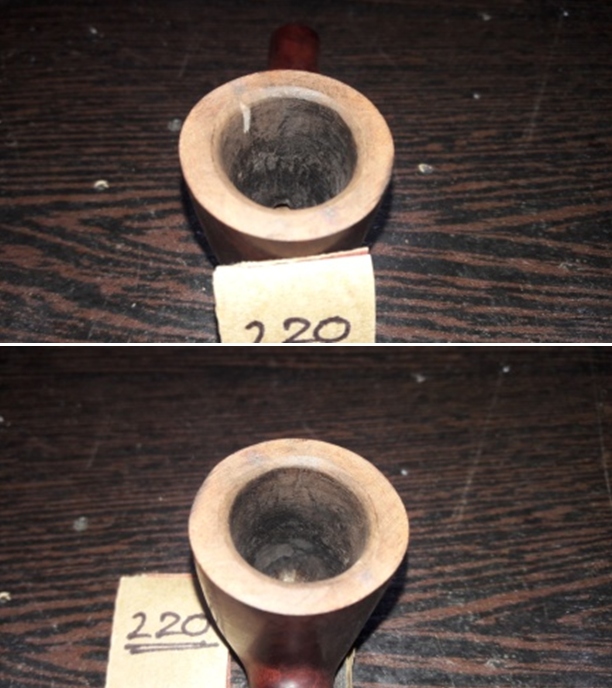
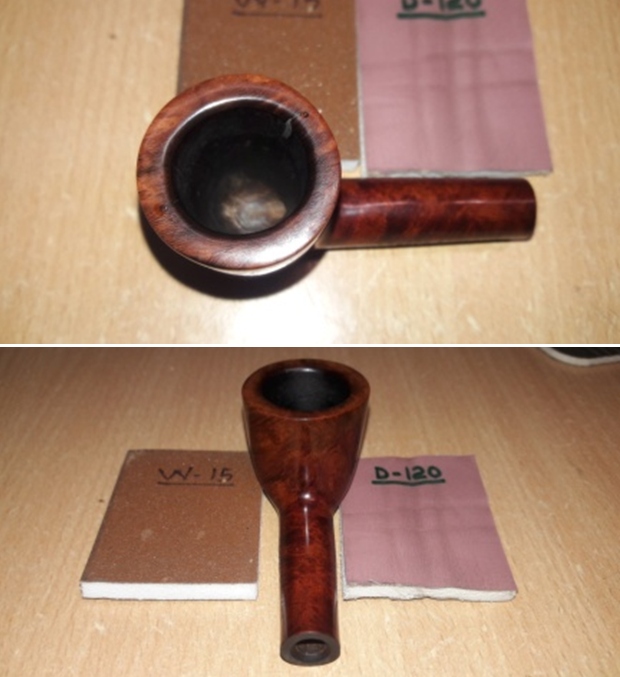
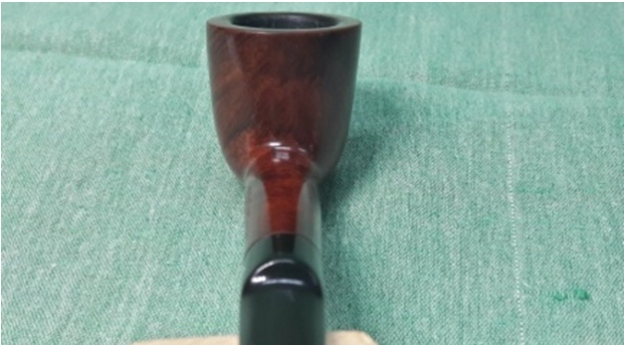
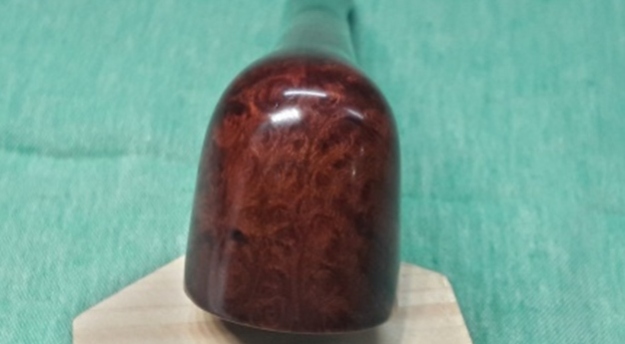
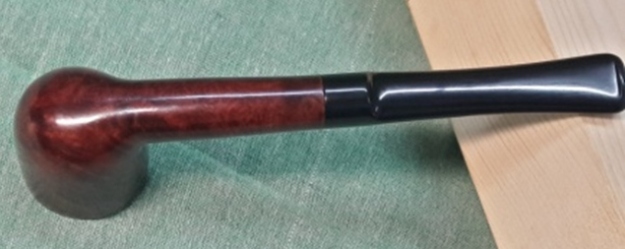
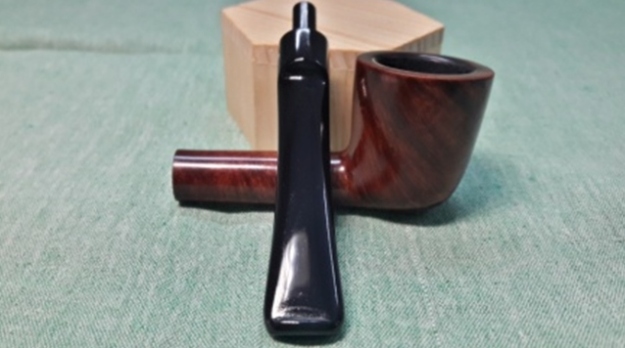
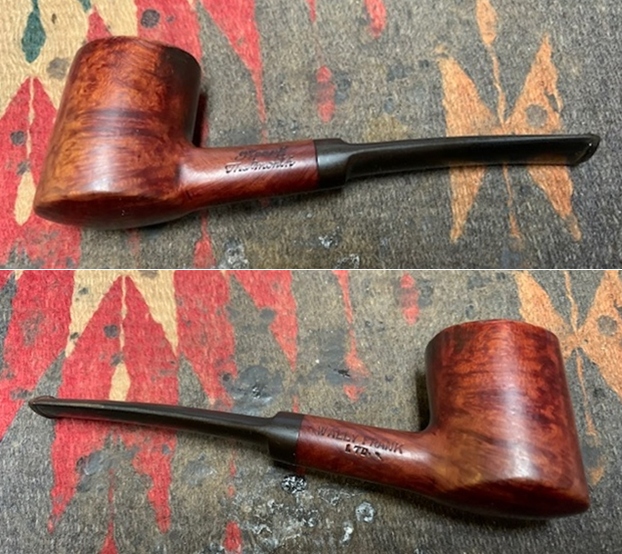
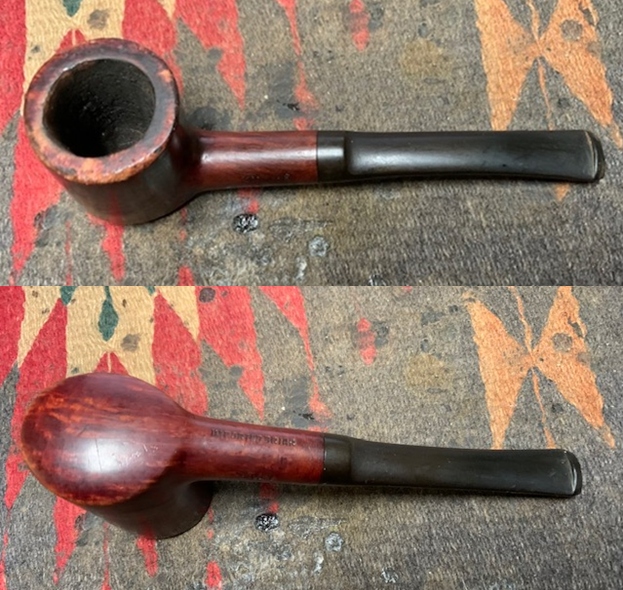
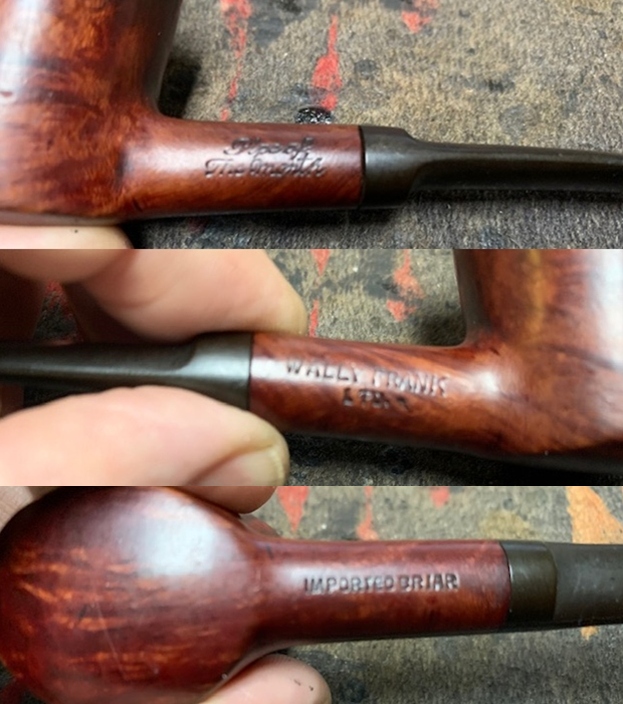
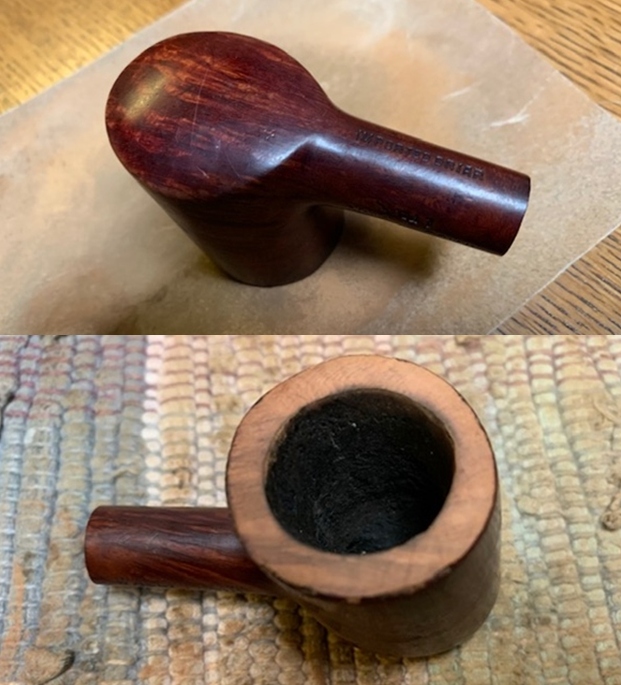
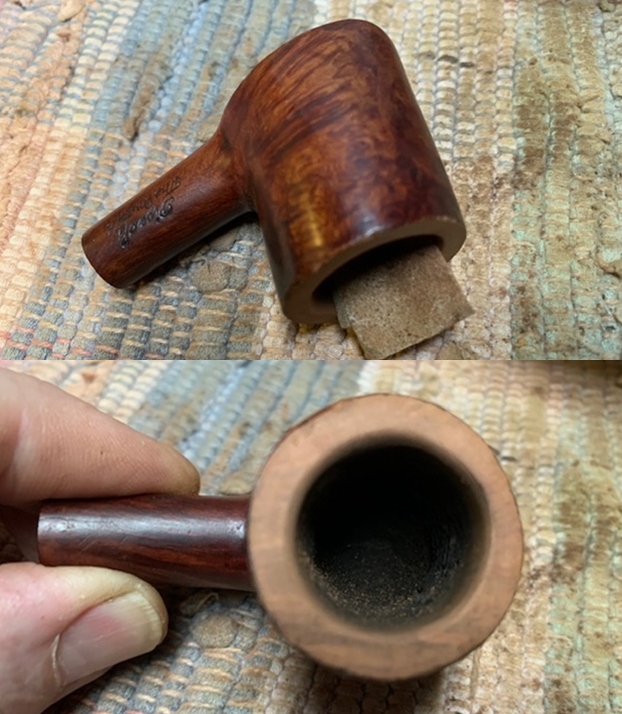
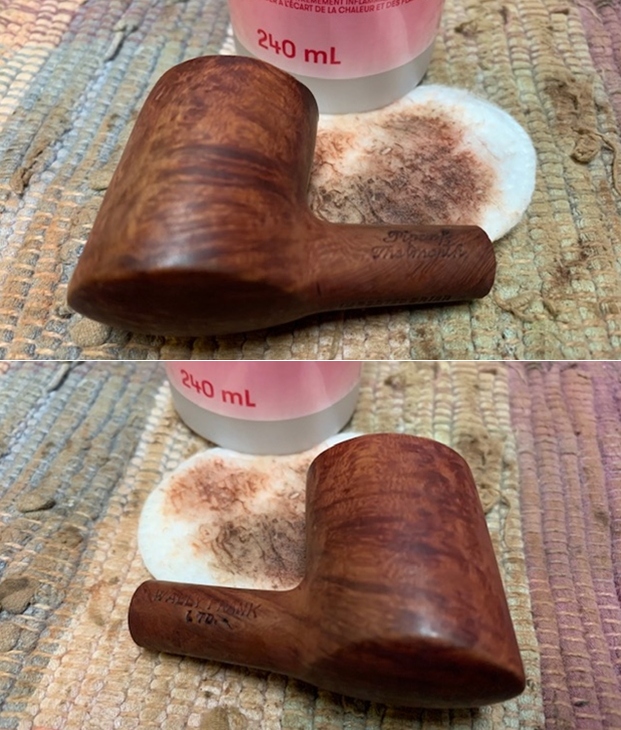
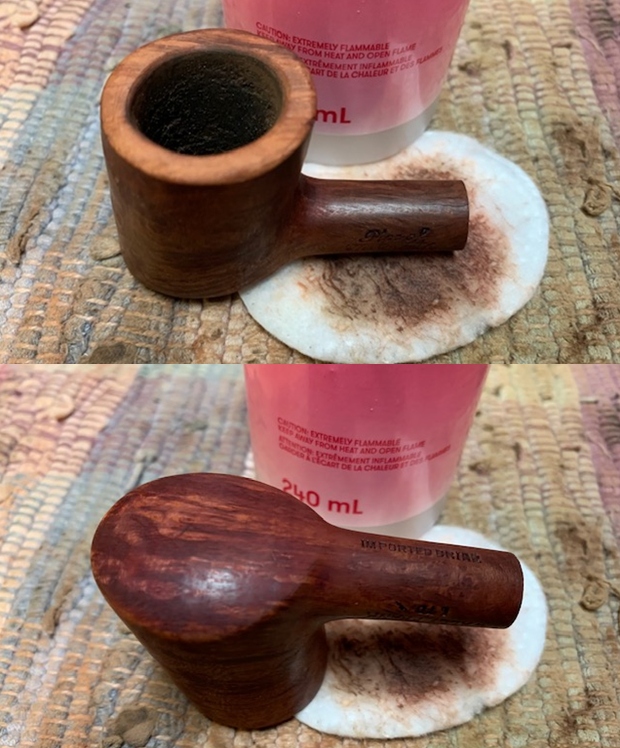
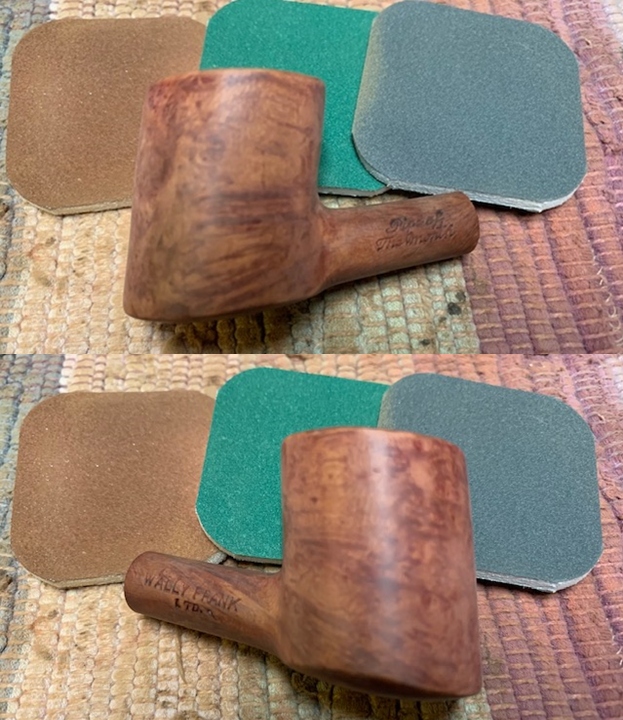
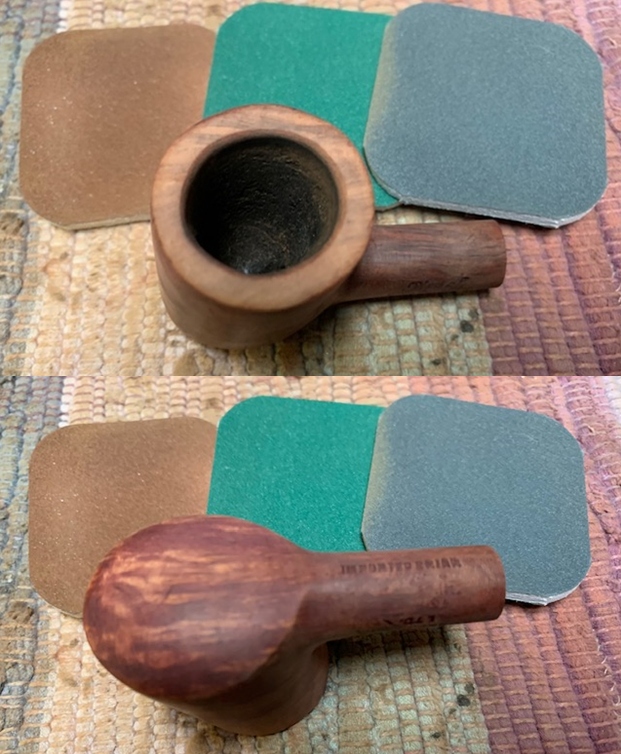
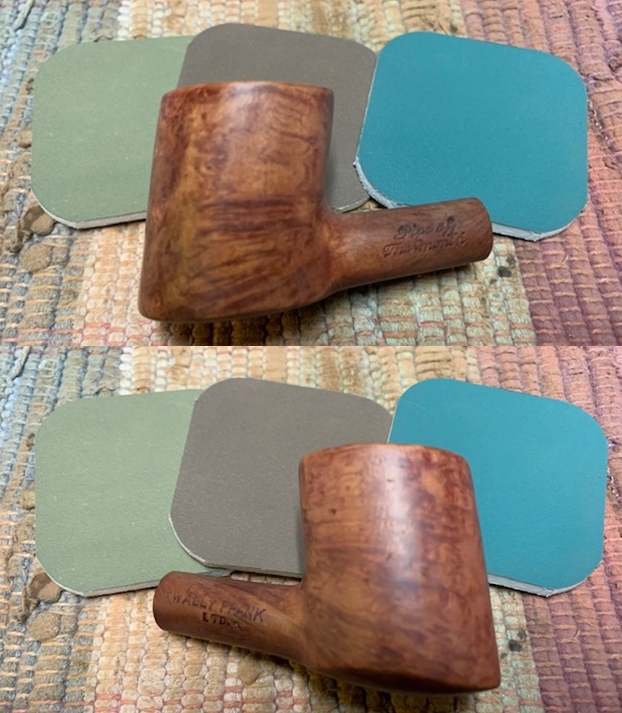
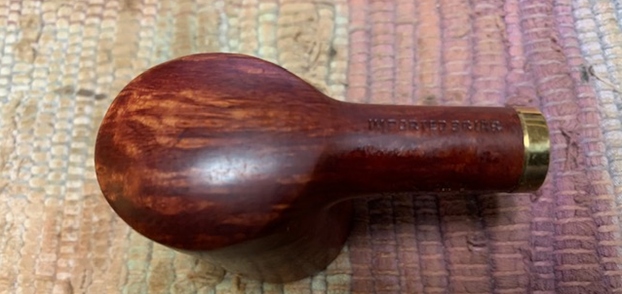
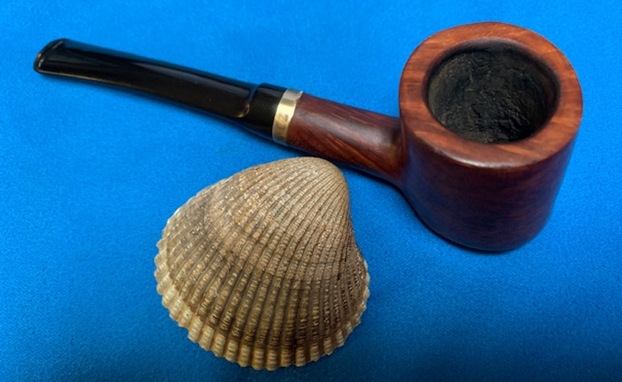
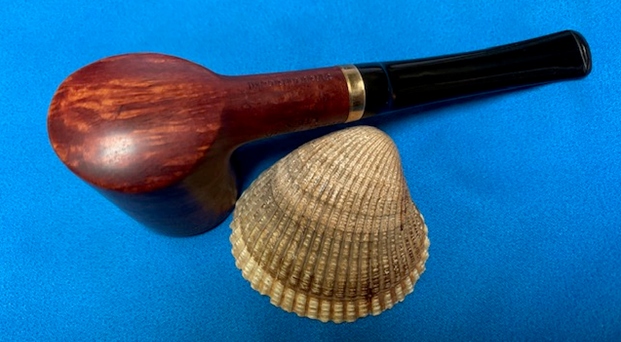
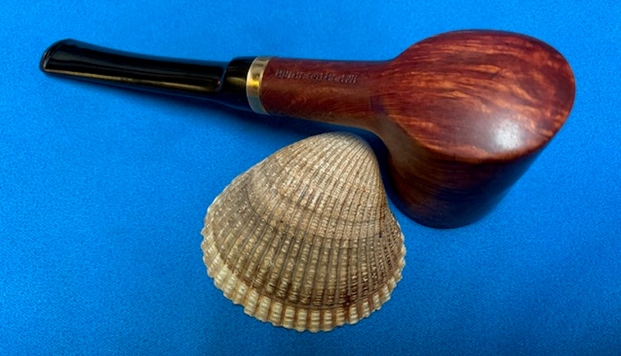
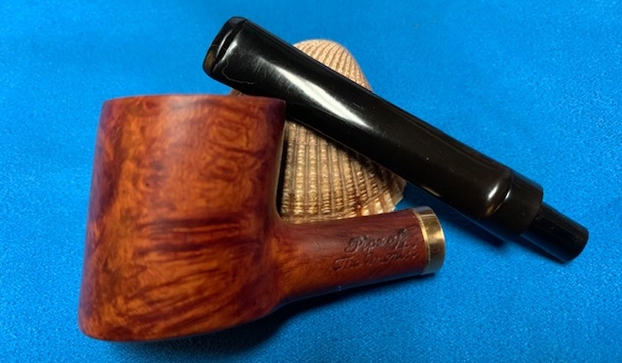
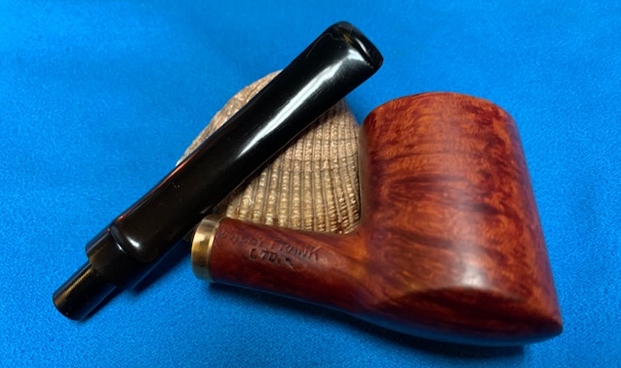
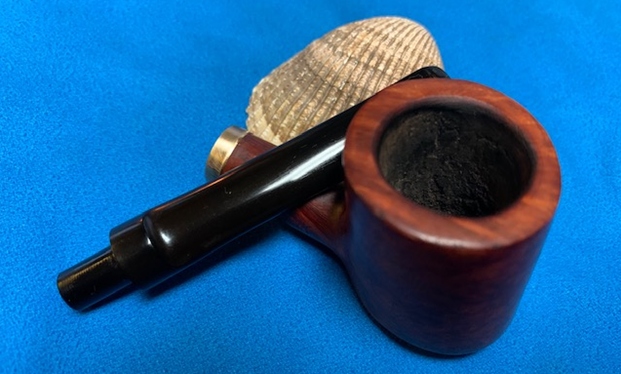
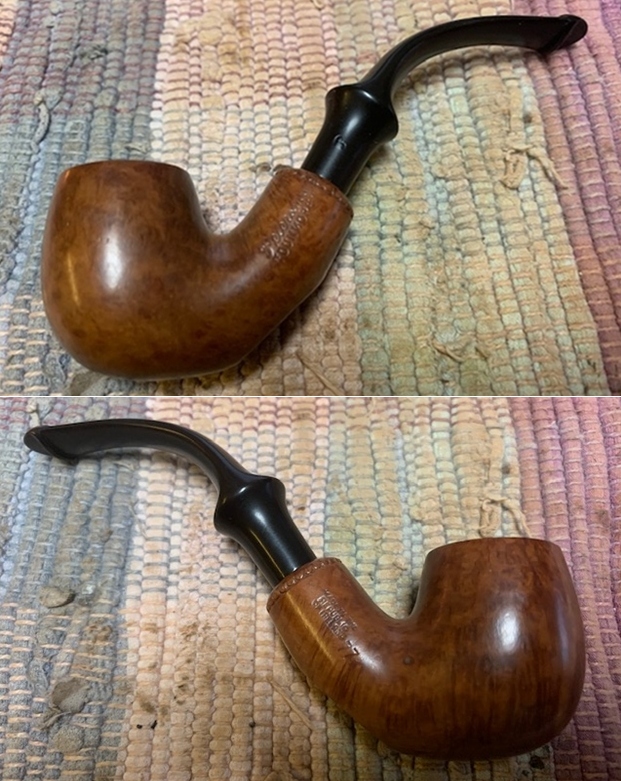
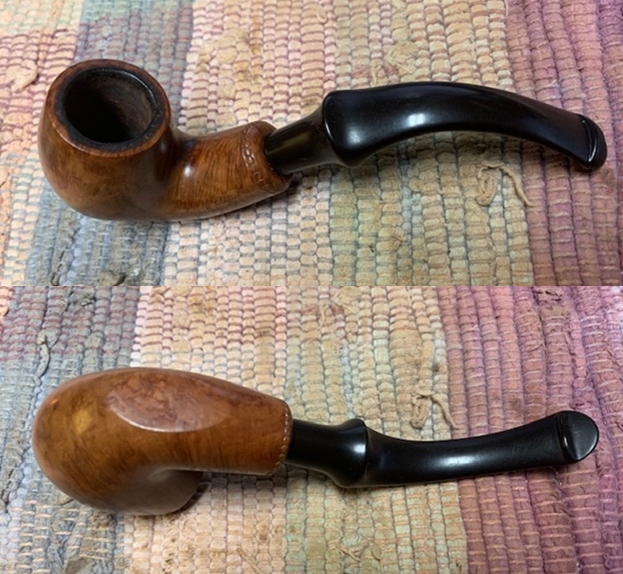
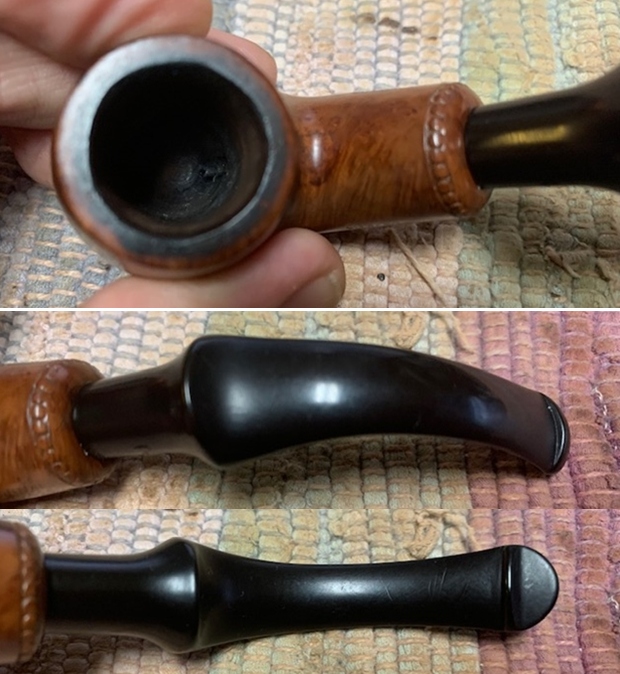
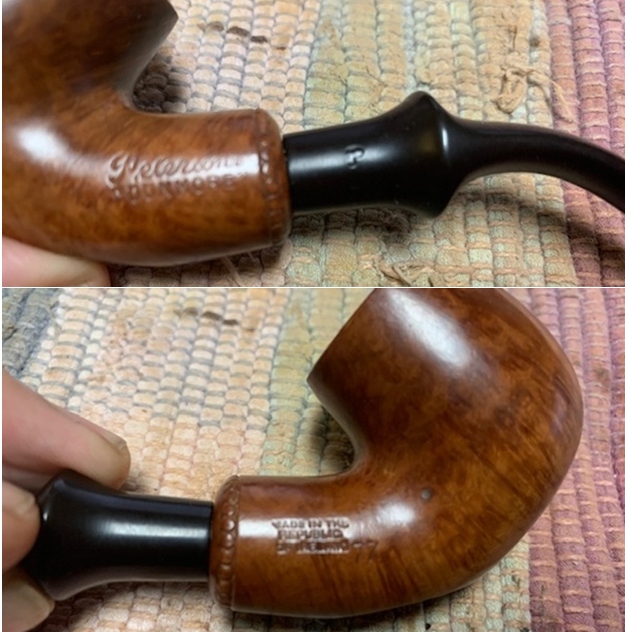
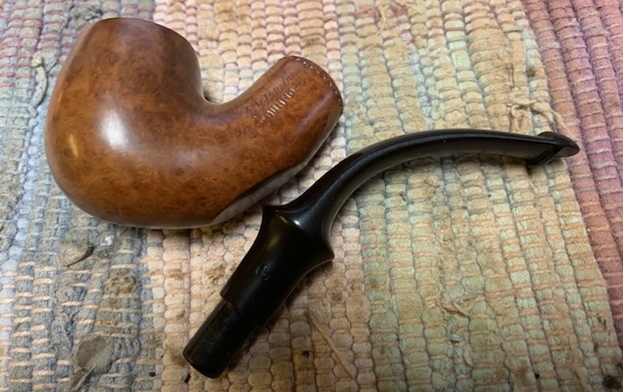
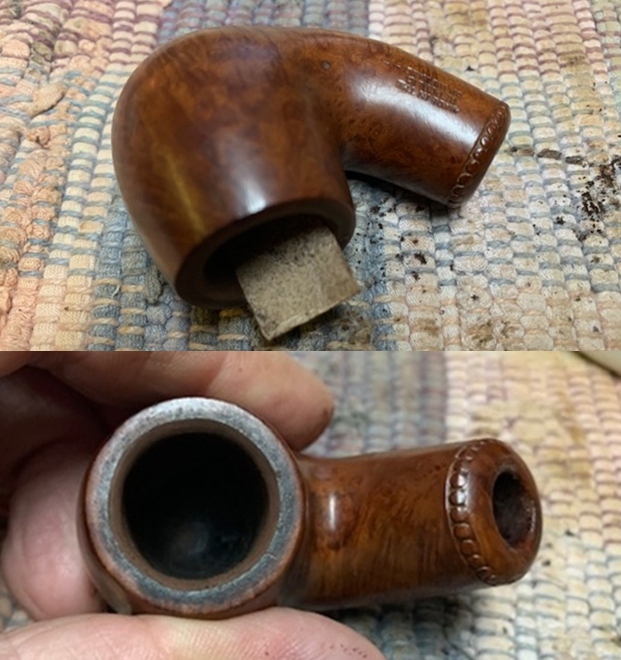
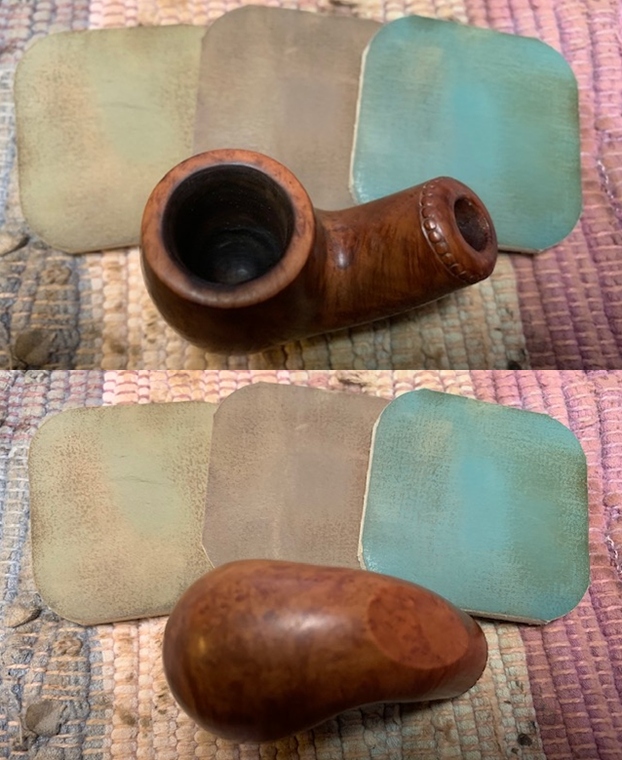
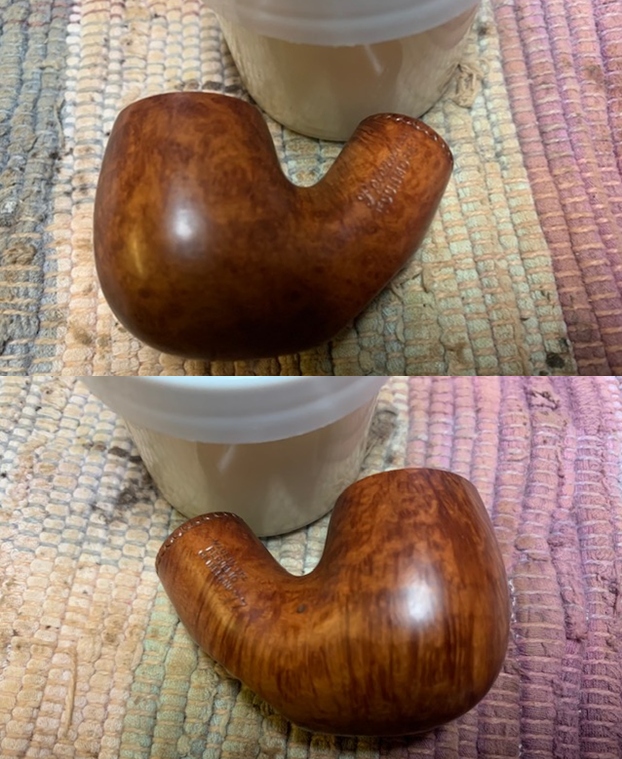
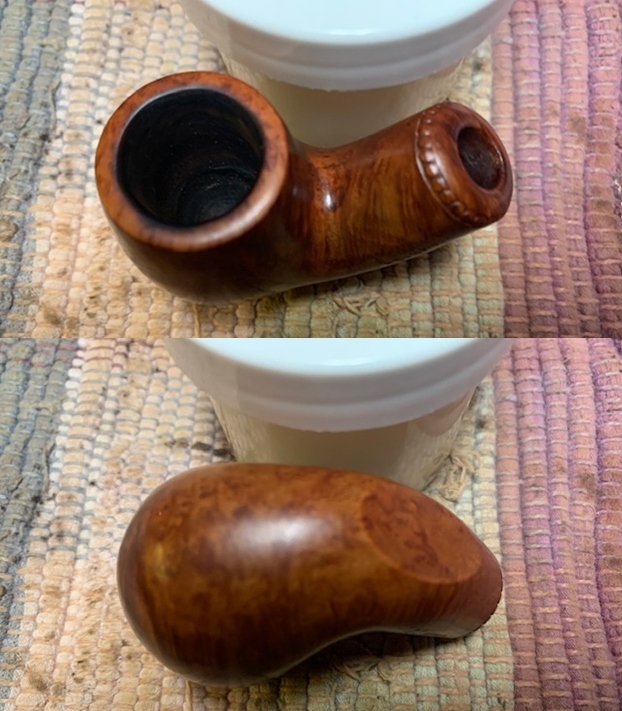
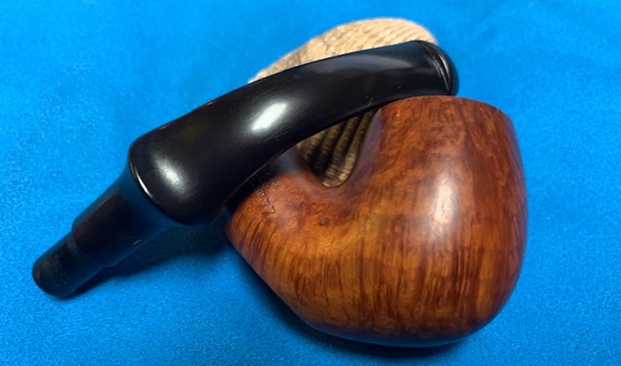
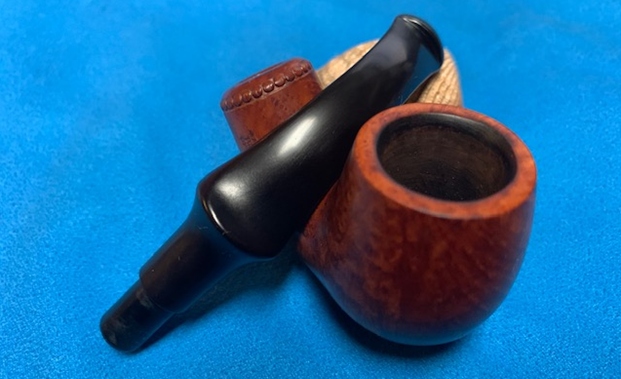
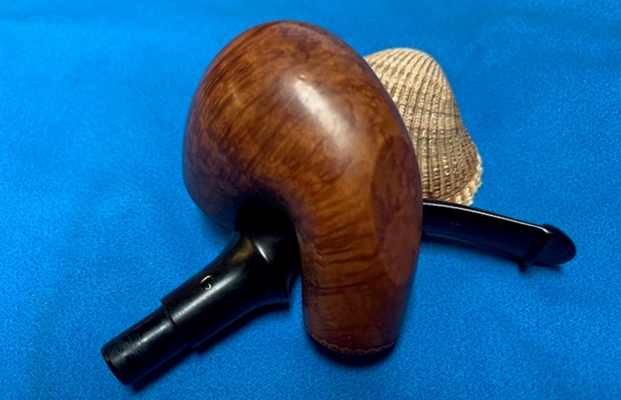
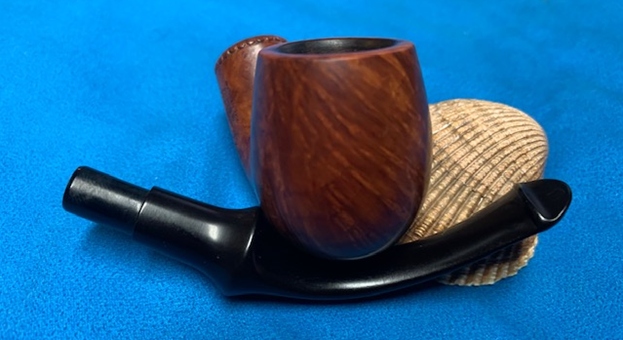
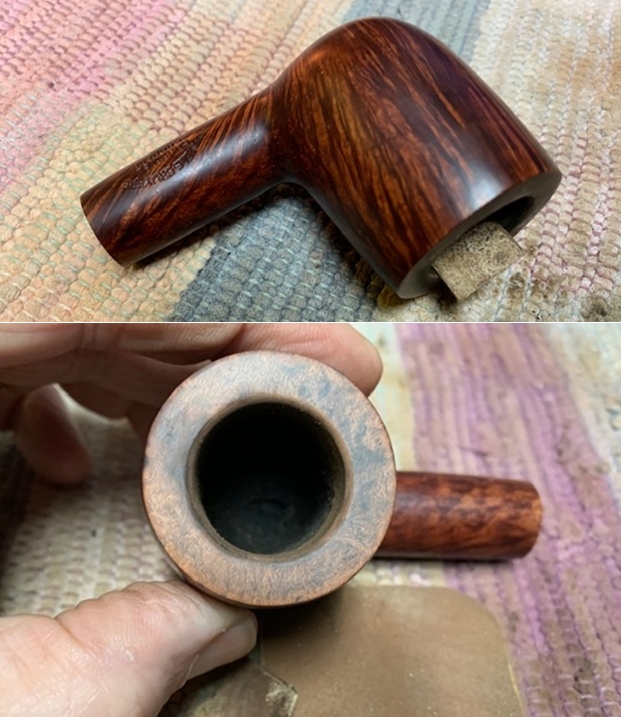
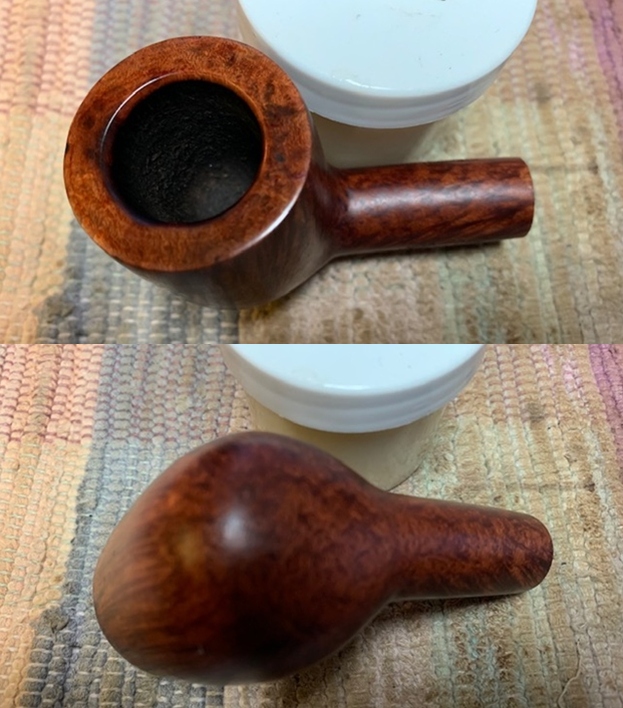
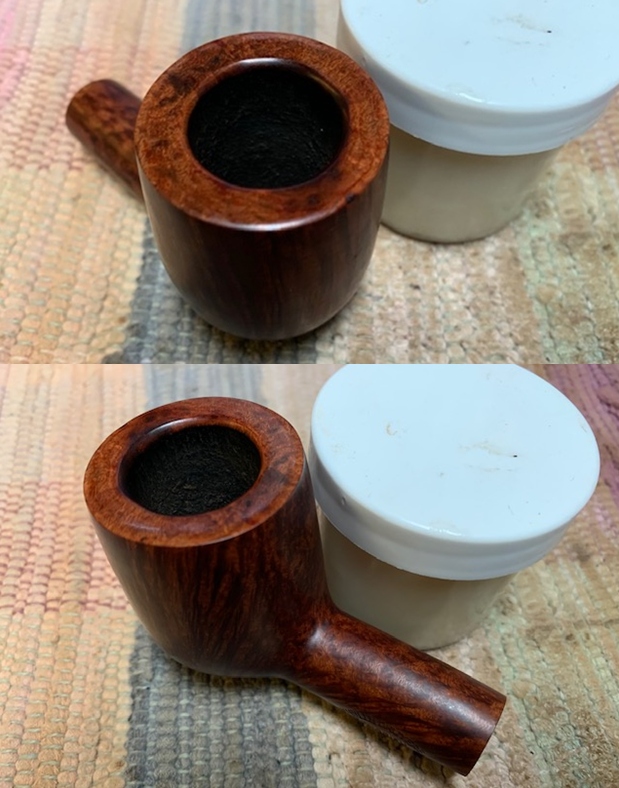
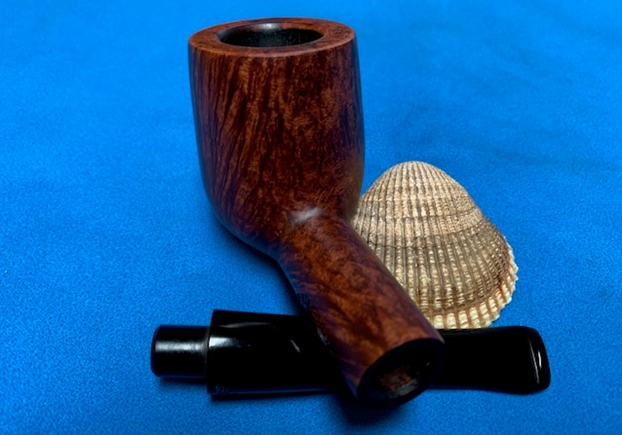
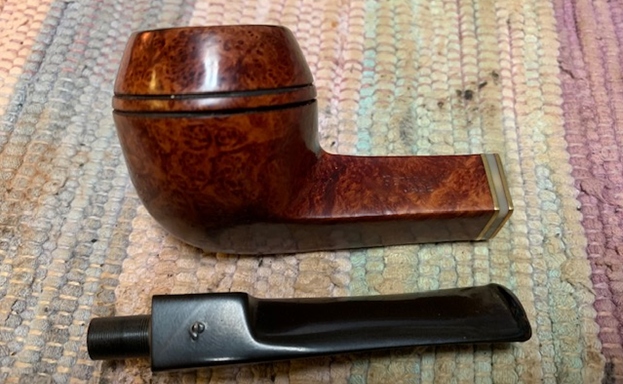
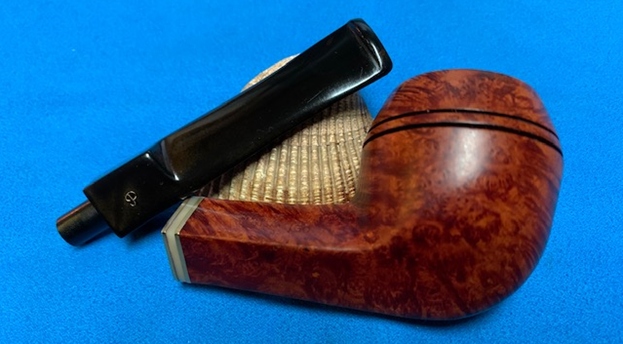
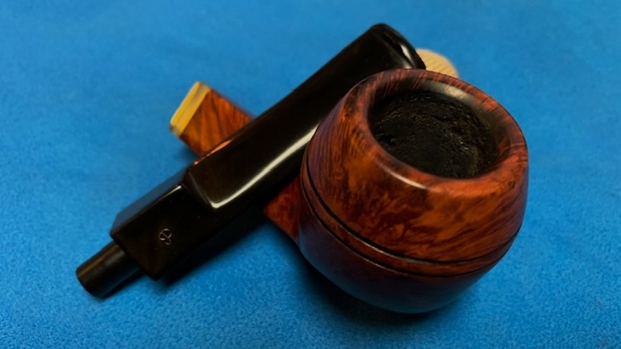
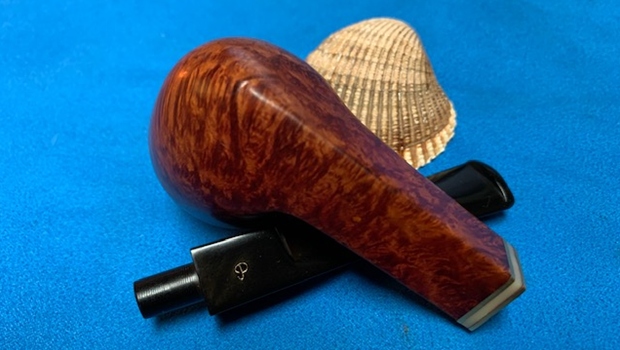
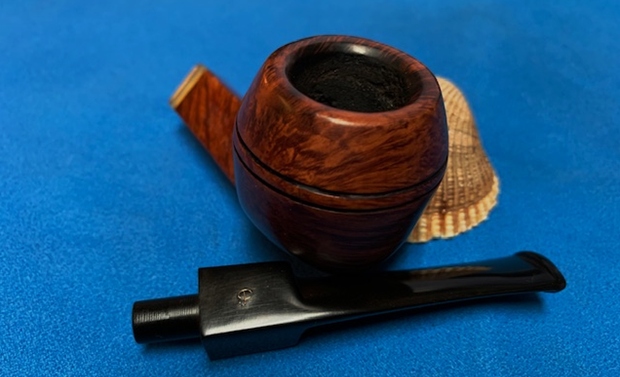
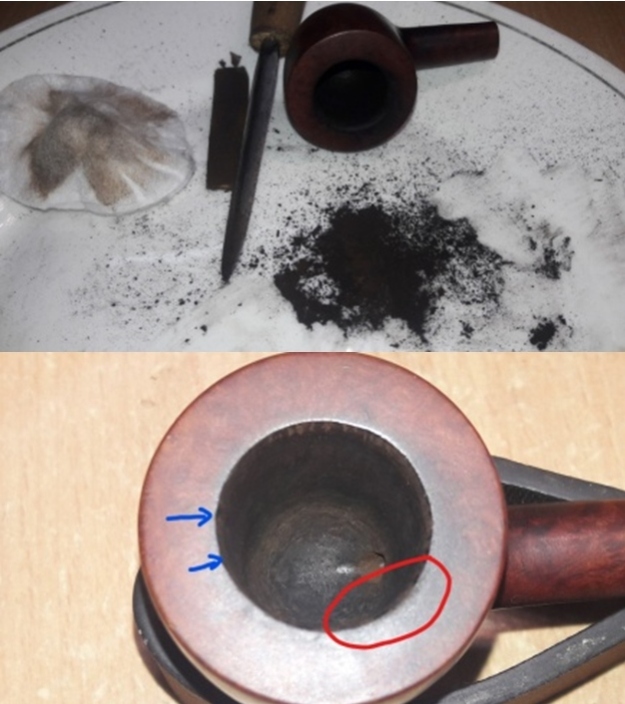
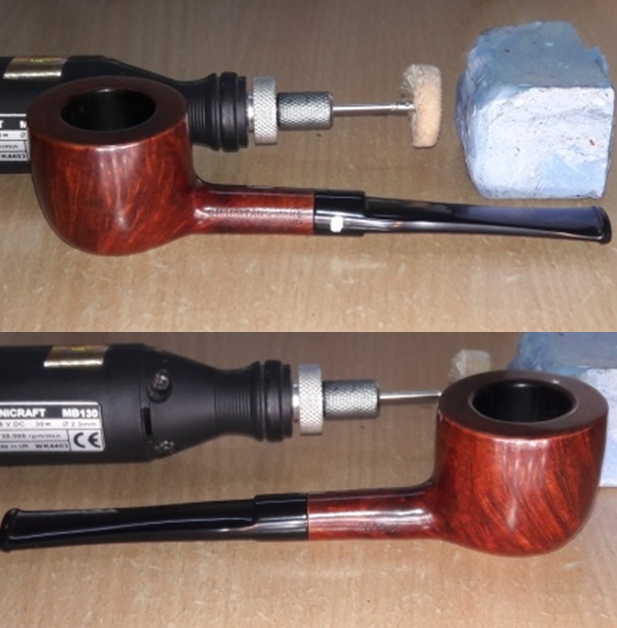
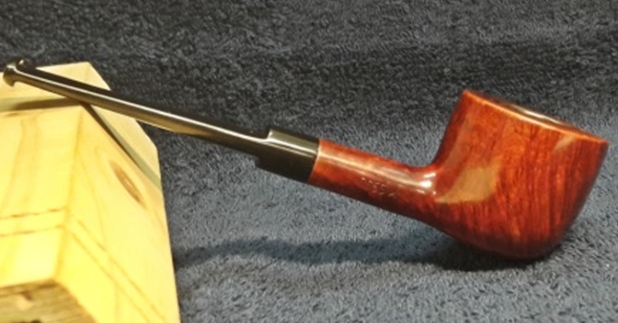
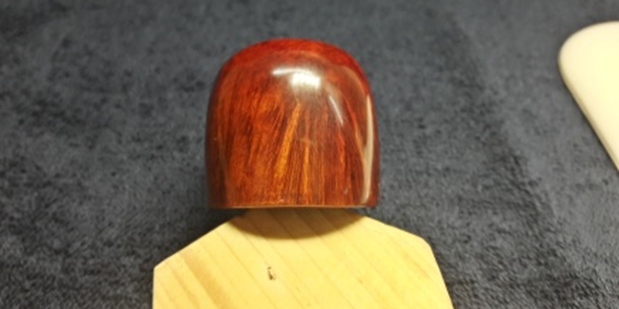
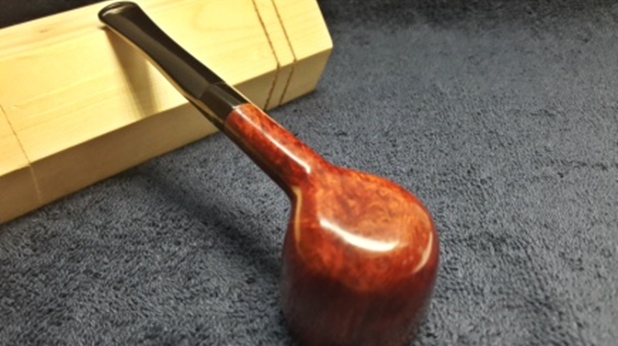
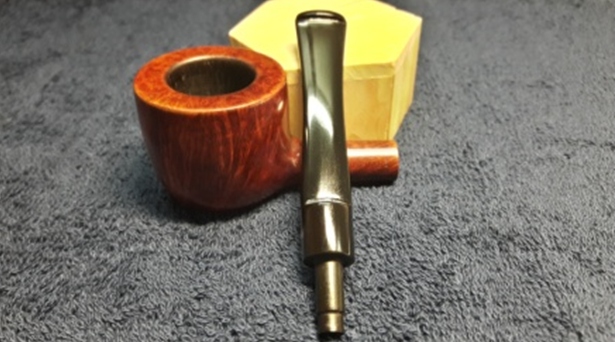
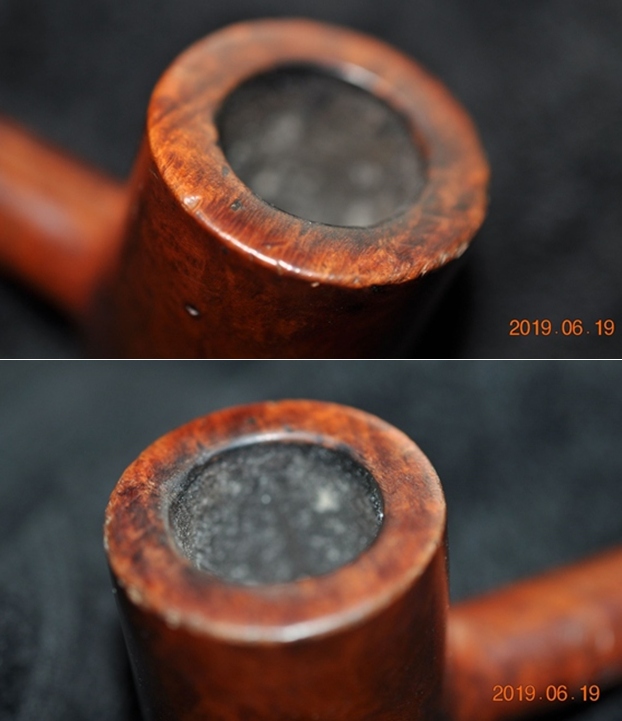
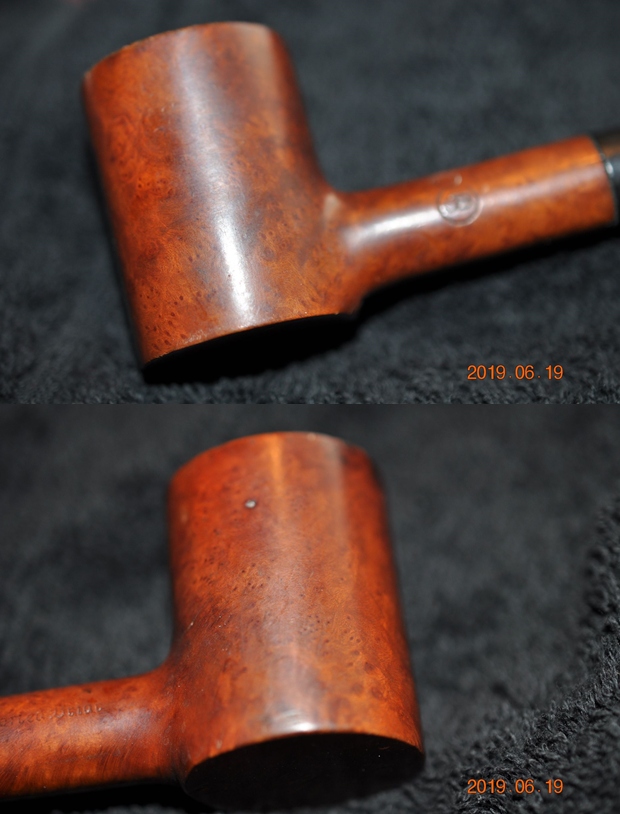
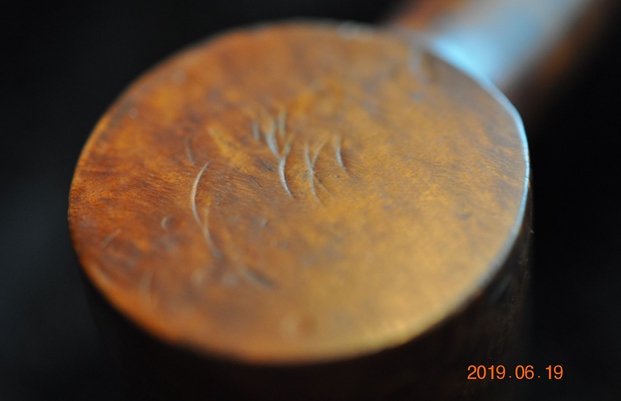
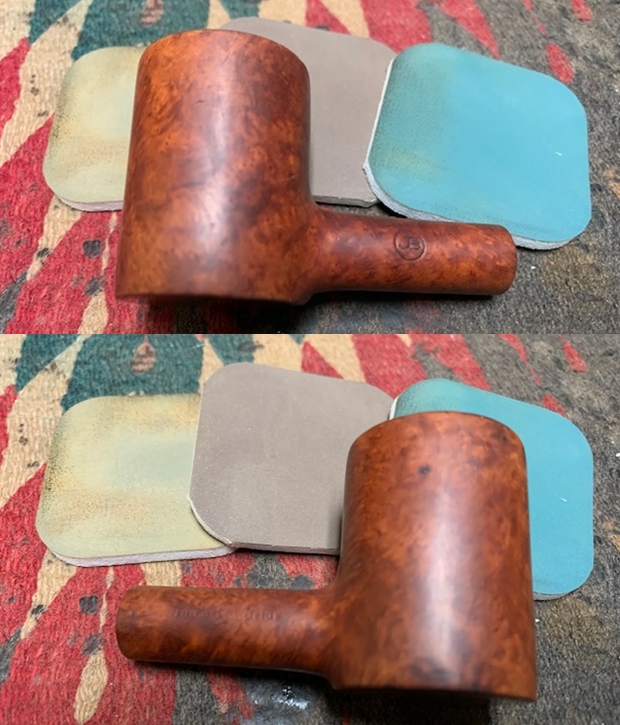
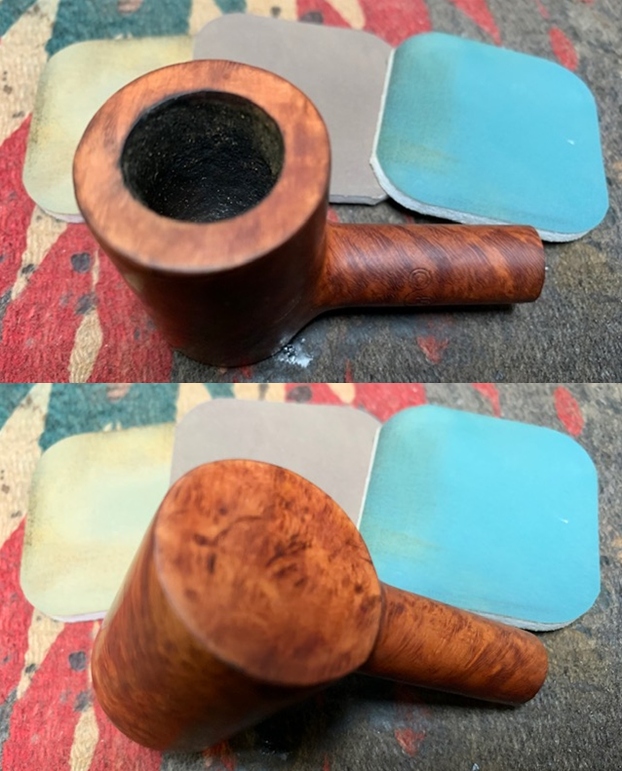
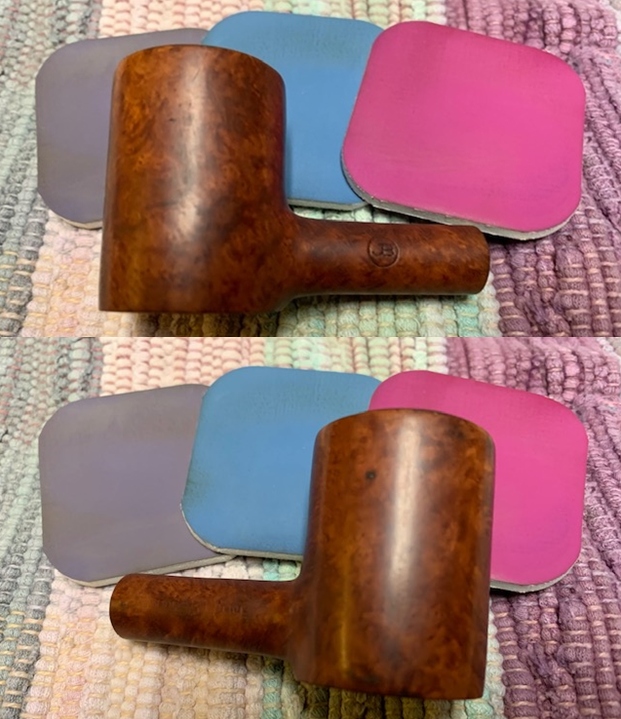
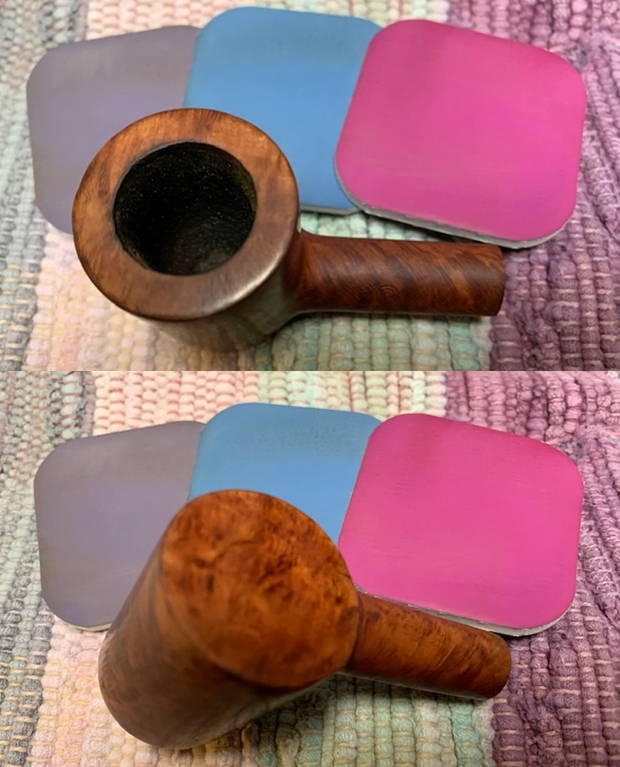
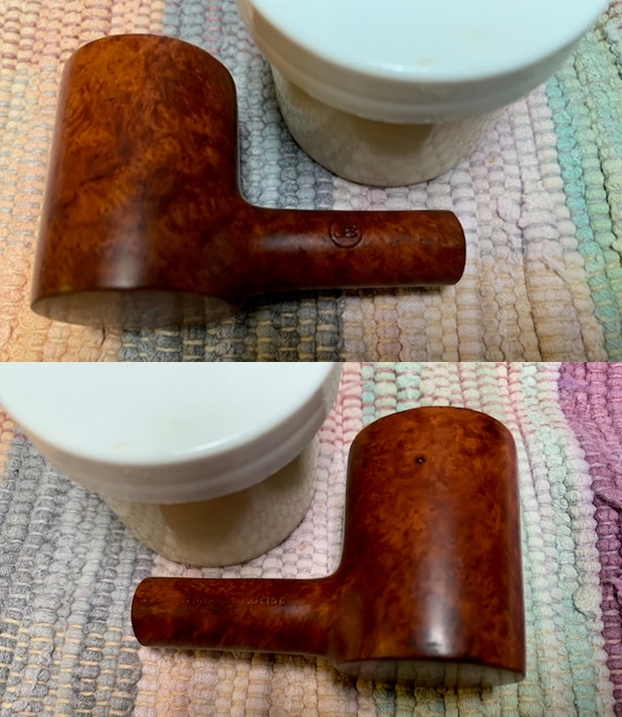
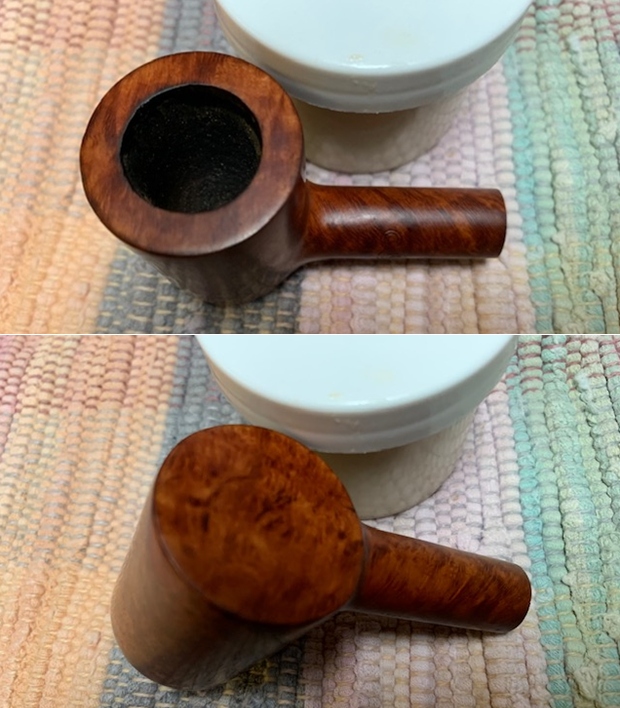
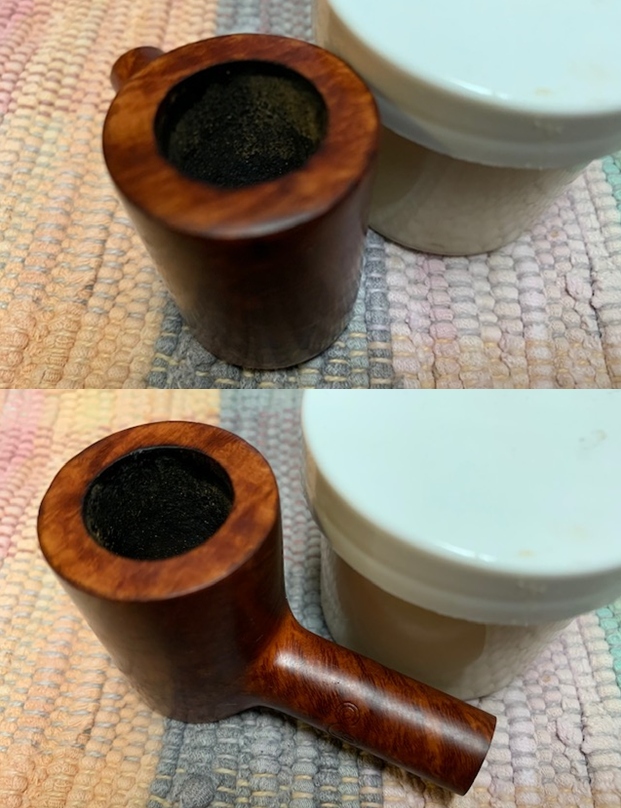
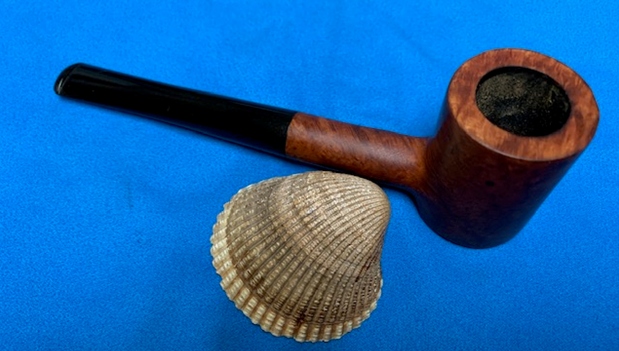
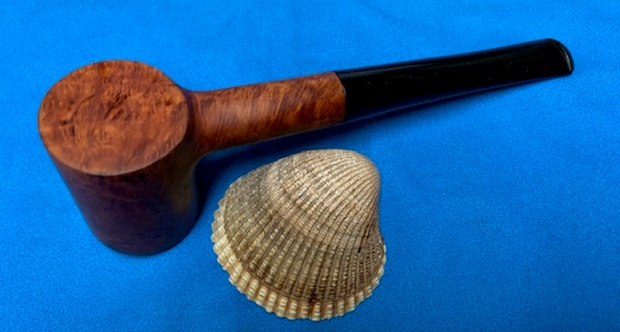
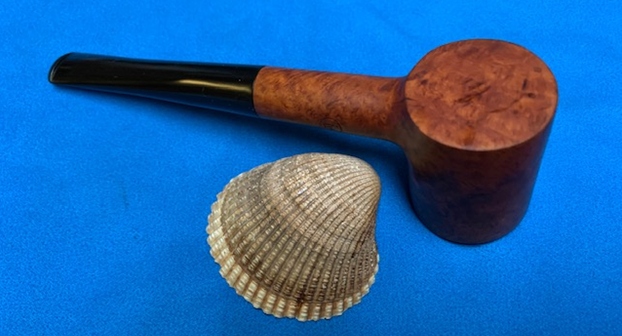
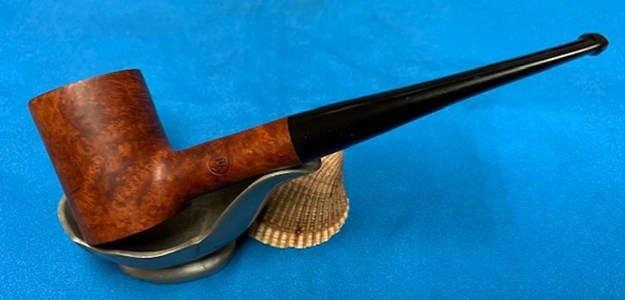
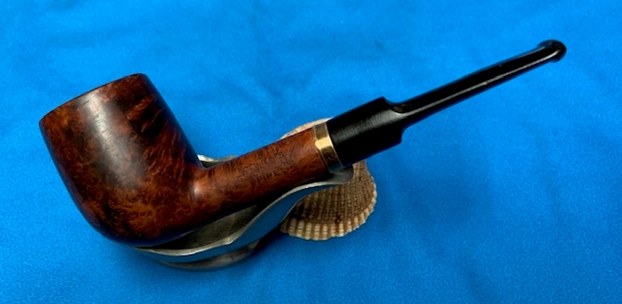
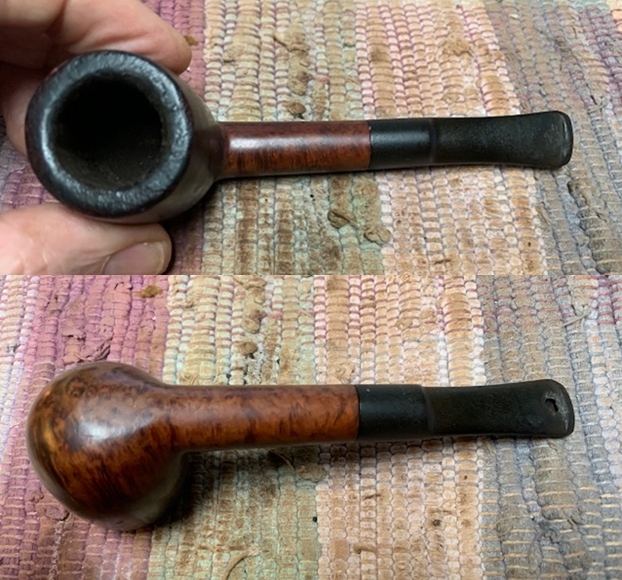
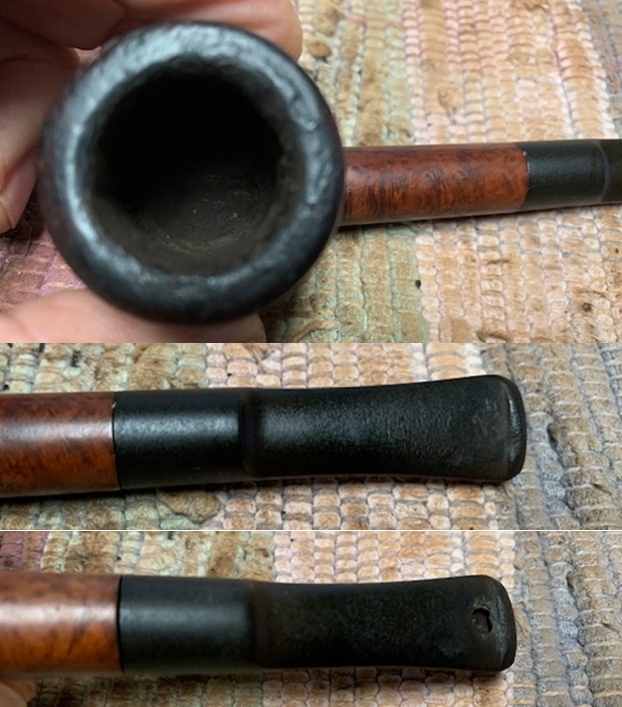
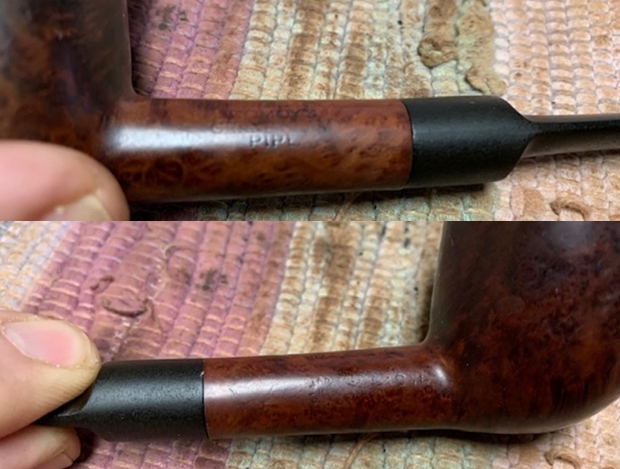
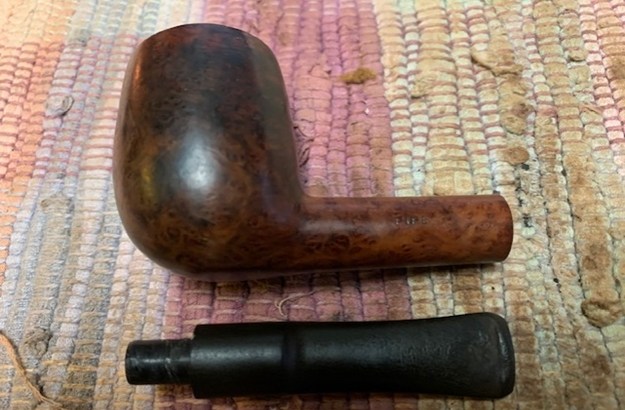
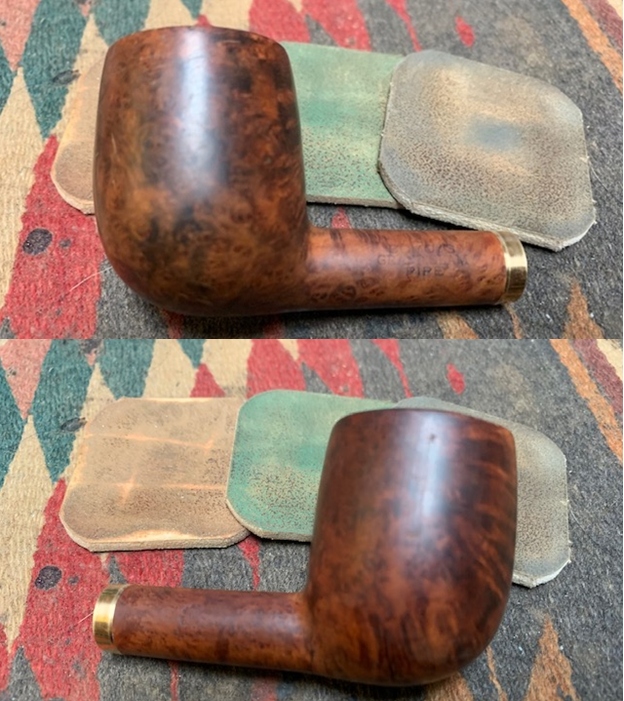
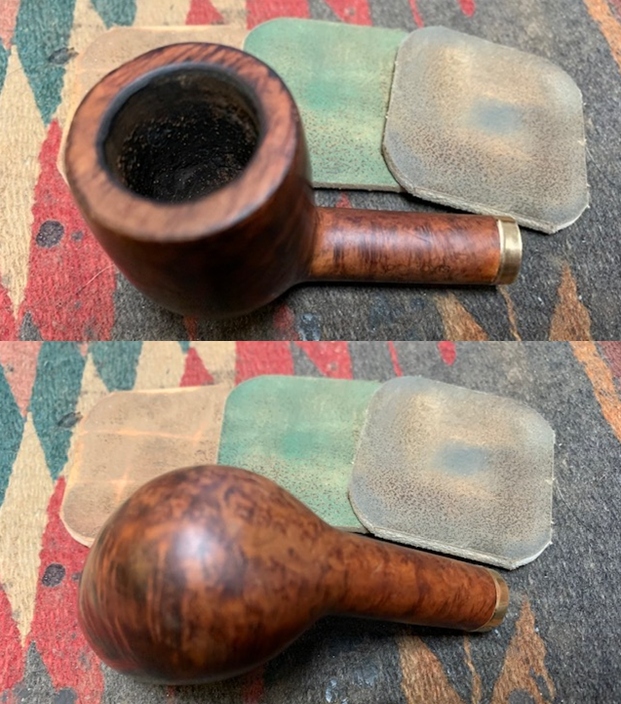
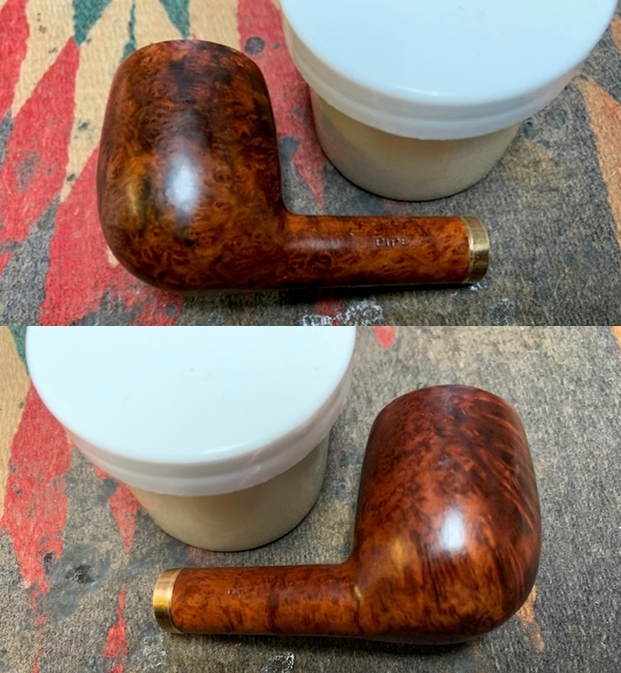
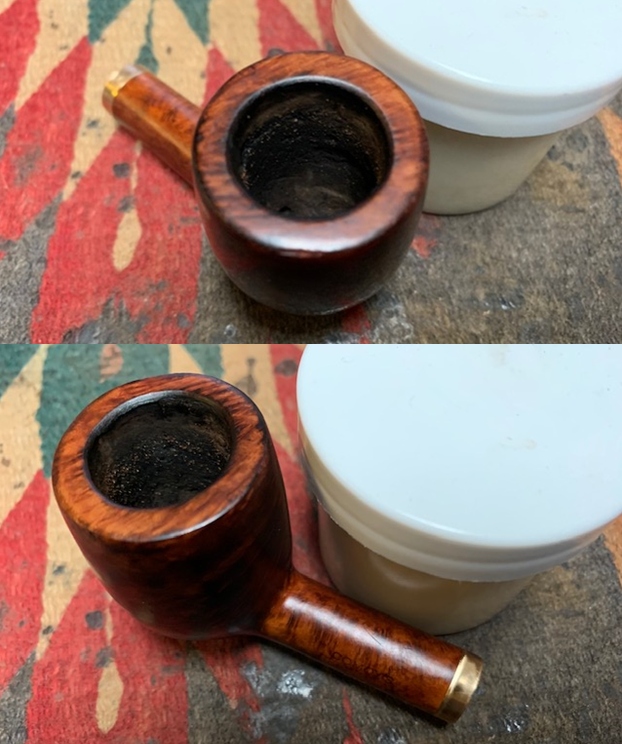
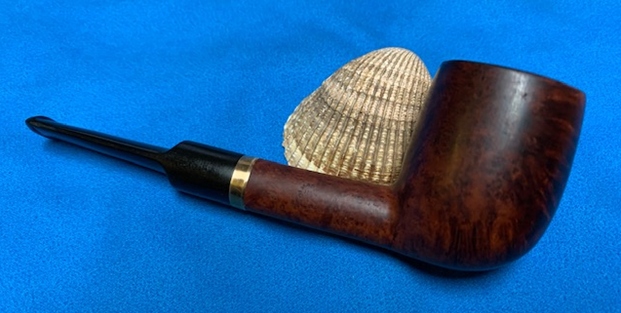
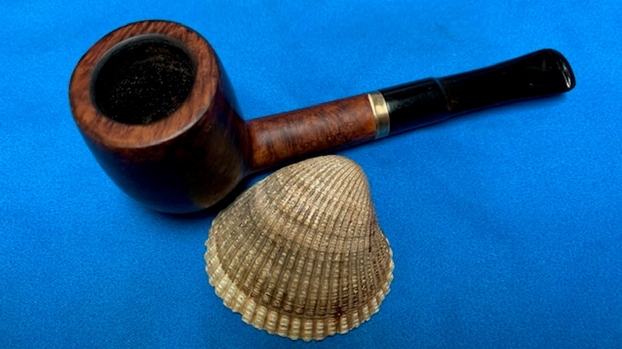
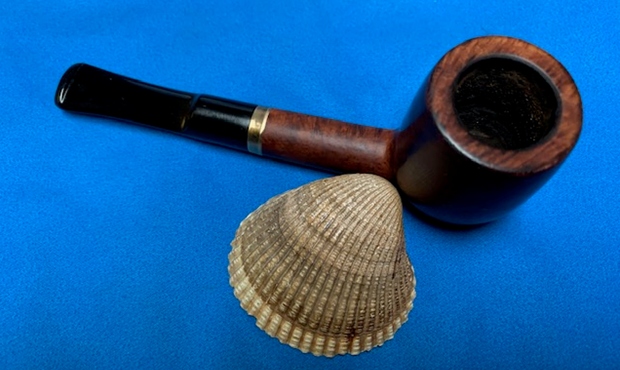
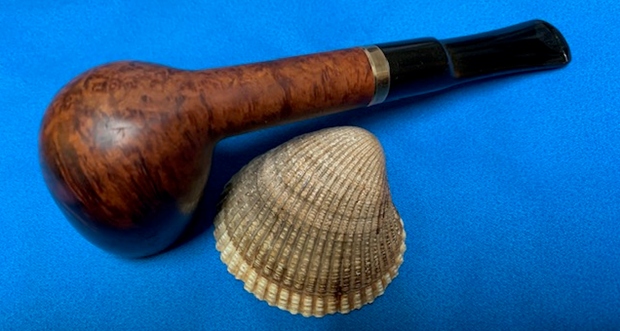
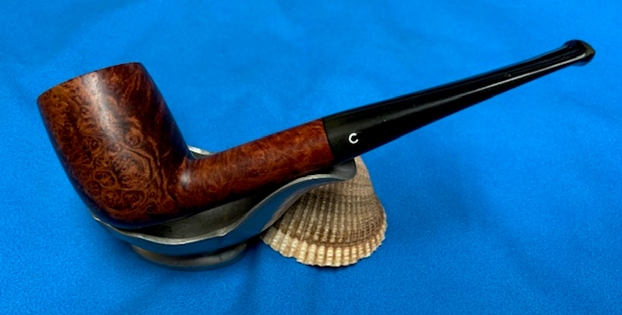
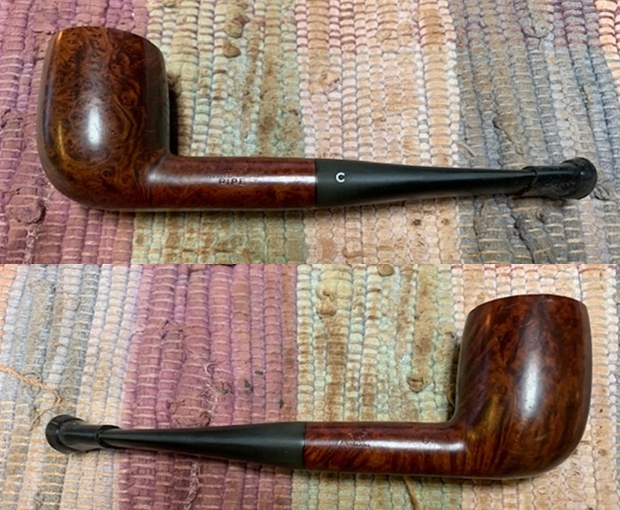
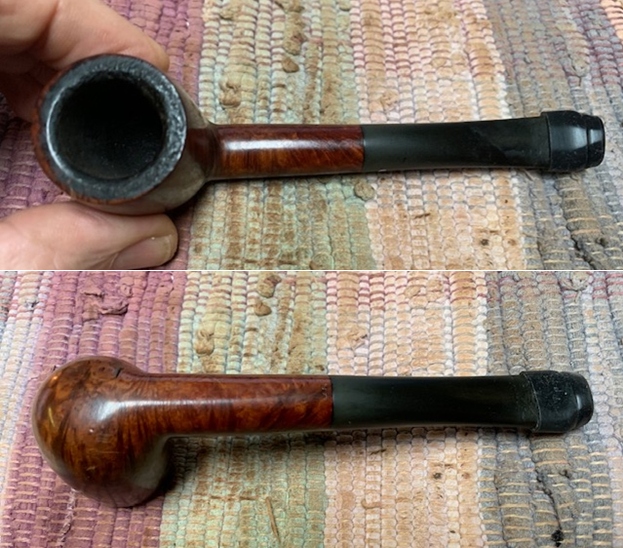
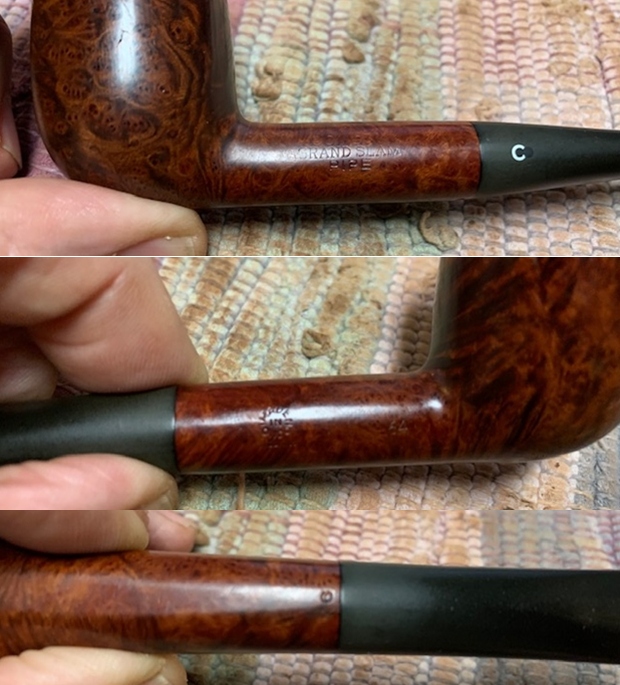
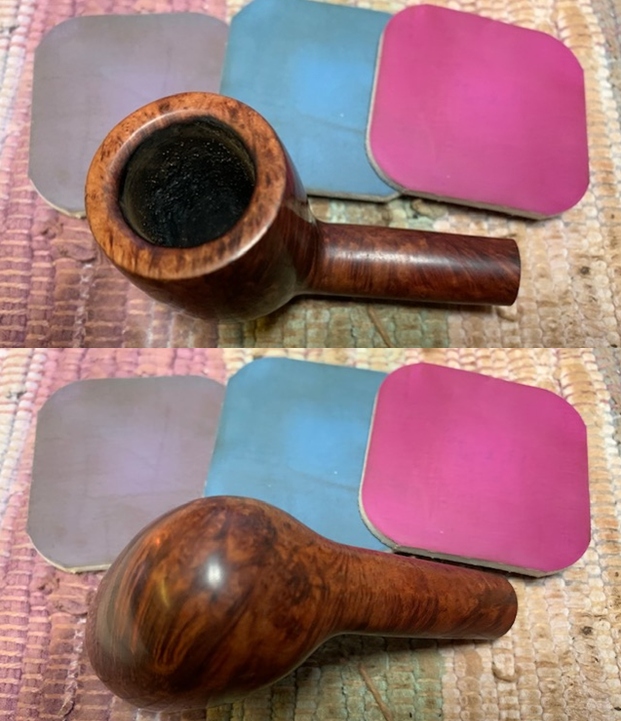
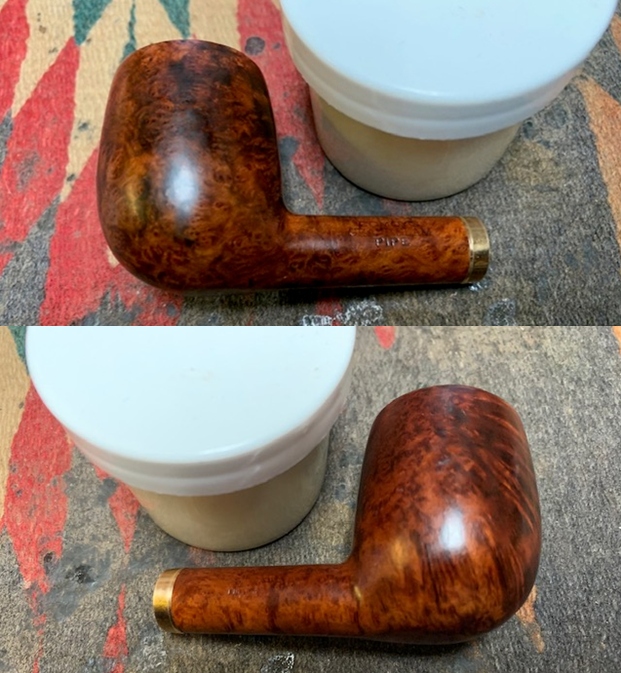
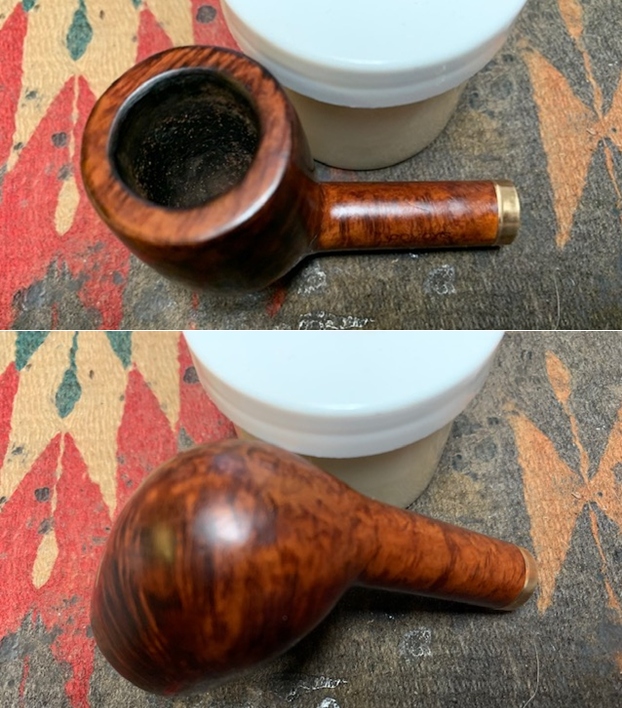
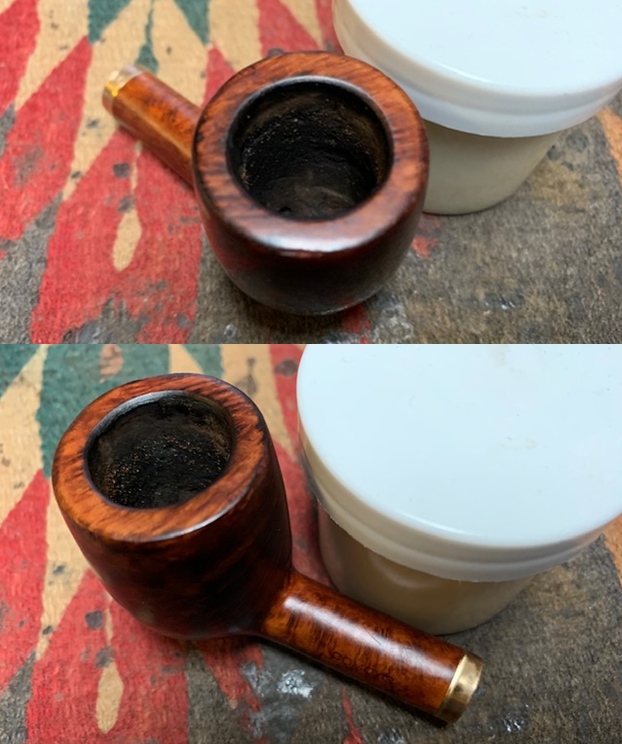
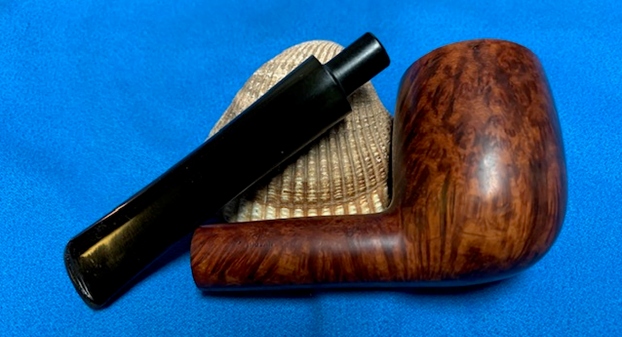
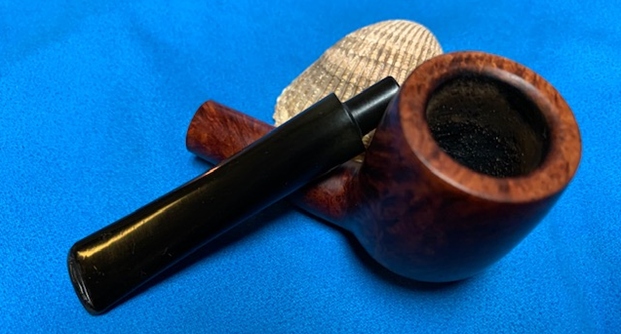
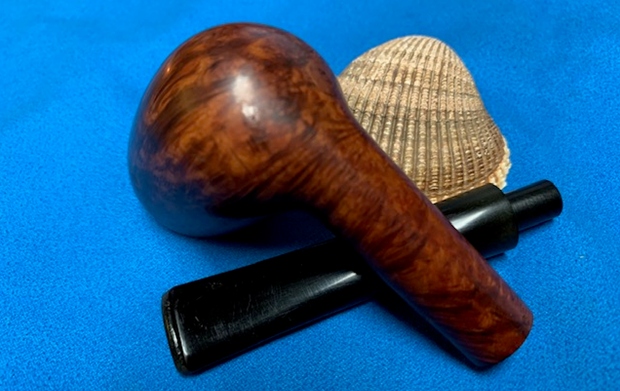
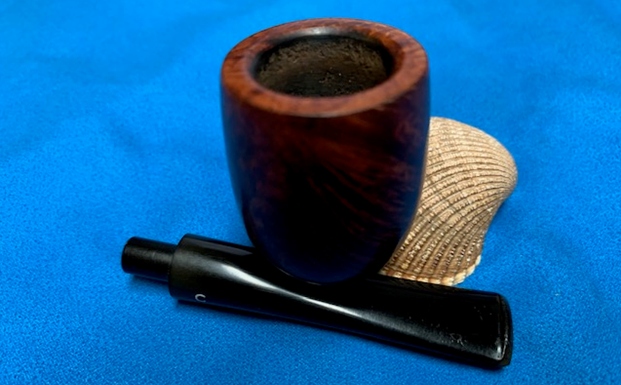
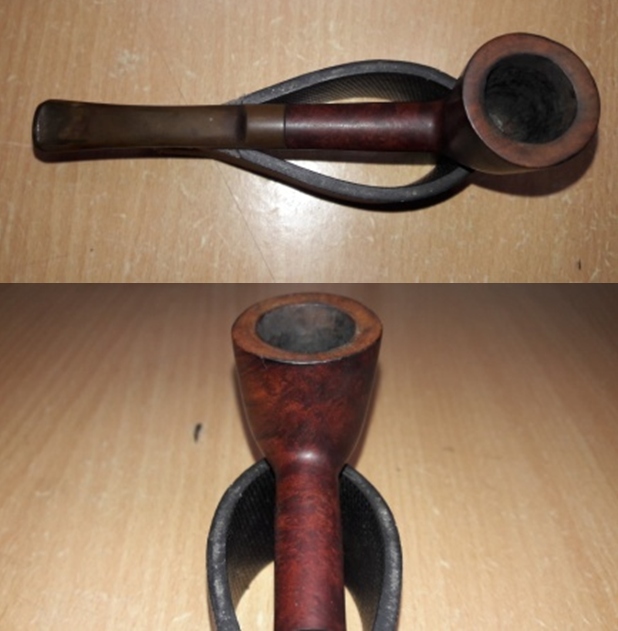
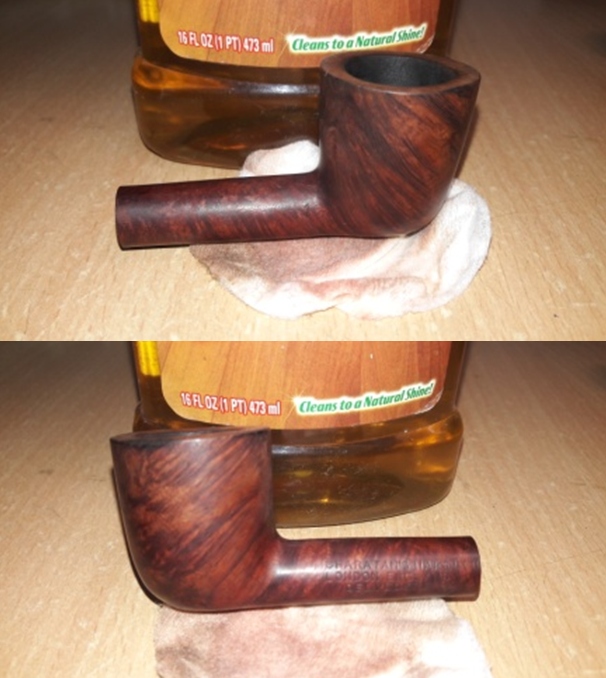
Jeff and I cannot remember where we picked up the next pipe and have no idea where we found it or what the condition was when we found it. I know that Jeff cleaned it before it ended up here but we cannot put a finger on the pre-cleanup photos or even where we got it. So I decided to just write about it as it looks today before I start the cleanup work and describe the work that I did on the pipe. It is stamped on the left side of the shank and reads Pipe of the Month in script. On the underside of the shank it reads Imported Briar while on the right it reads Wally Frank LTD. The pipe is uniquely shaped and I was tempted to call it a drunken poker (in fact I did in the title of the blog). It must have been a good smoking pipe from the condition of the cleaned bowl. The rim top and edges of the bowl are all damaged. It looked like the pipe had been knocked out on hard surfaces and reamed with a knife. The stem was in good condition once I received it with light tooth marks and chatter on both sides. The majority of my work would be done in reshaping and reworking the rim top.

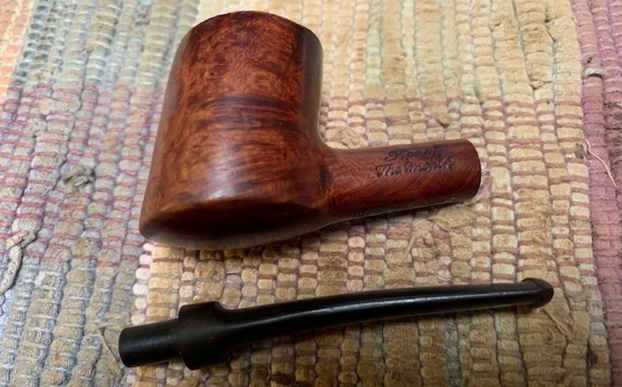
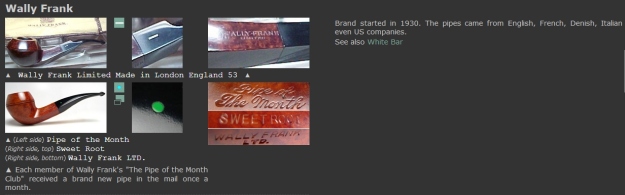
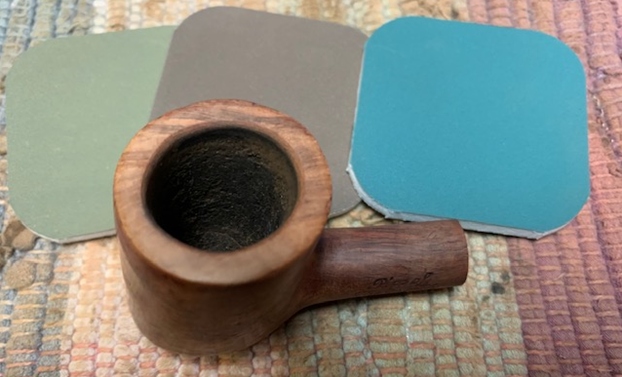
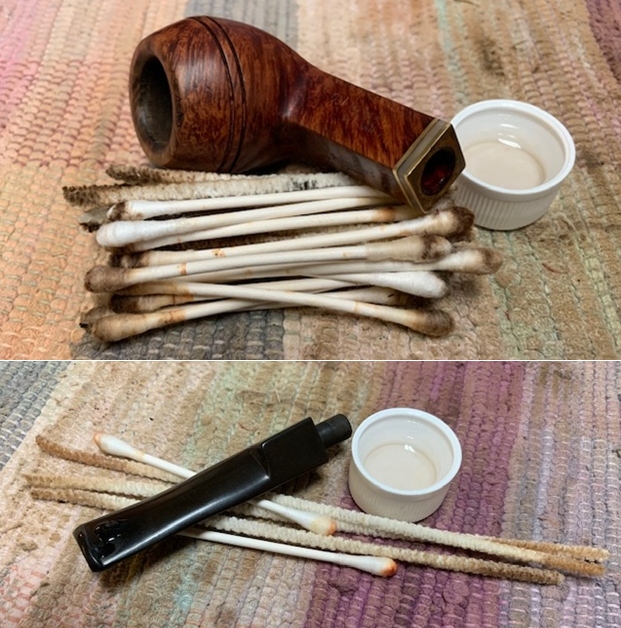
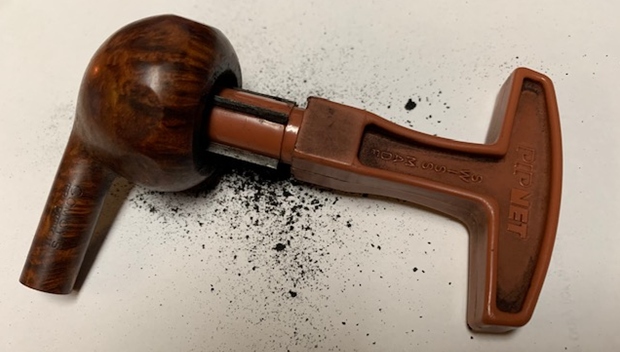
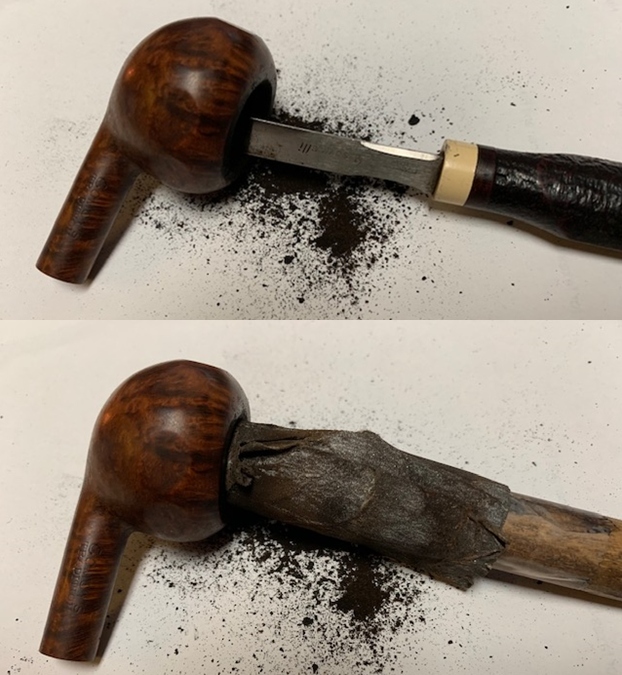
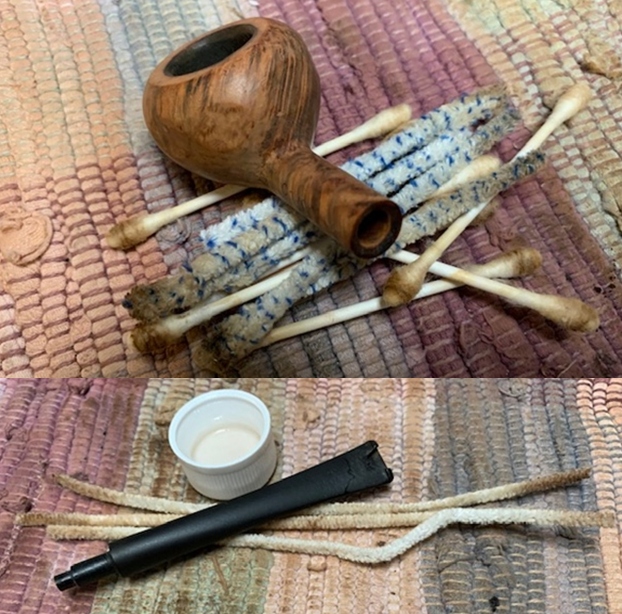
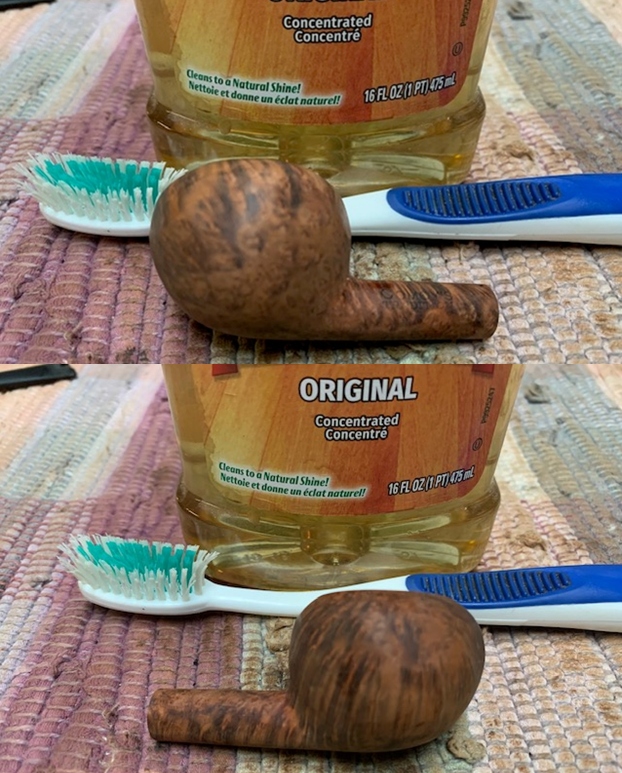
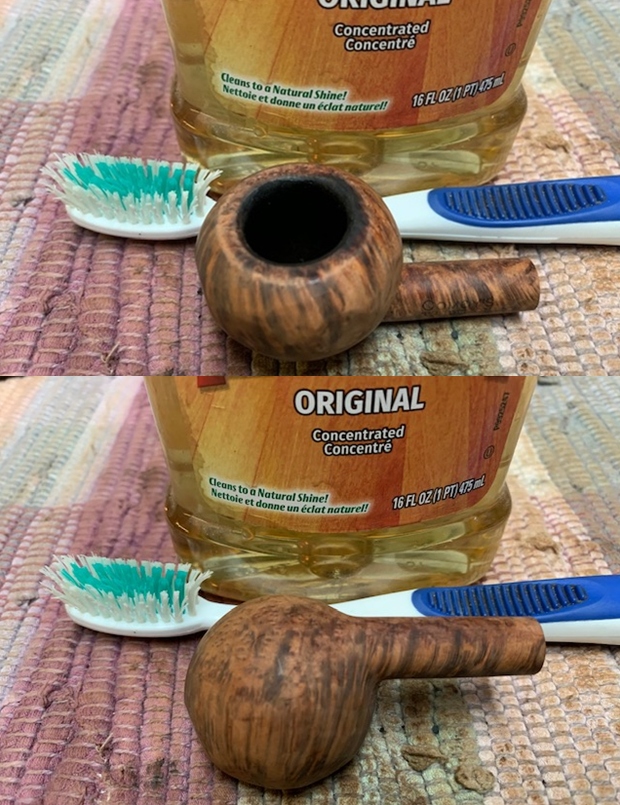
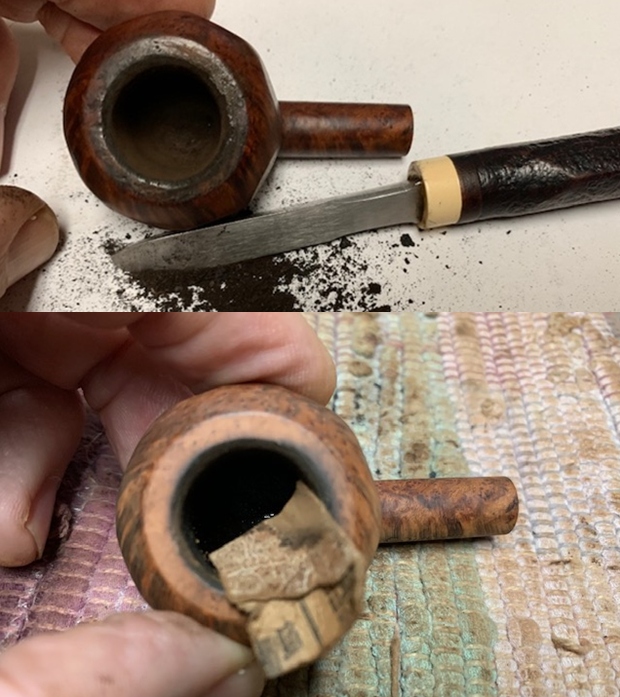
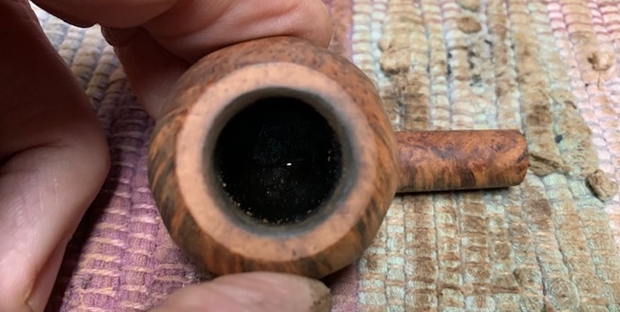
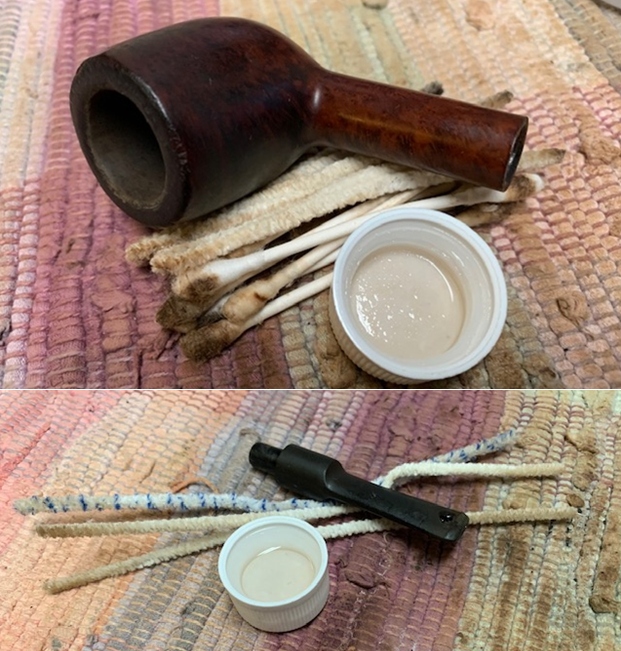
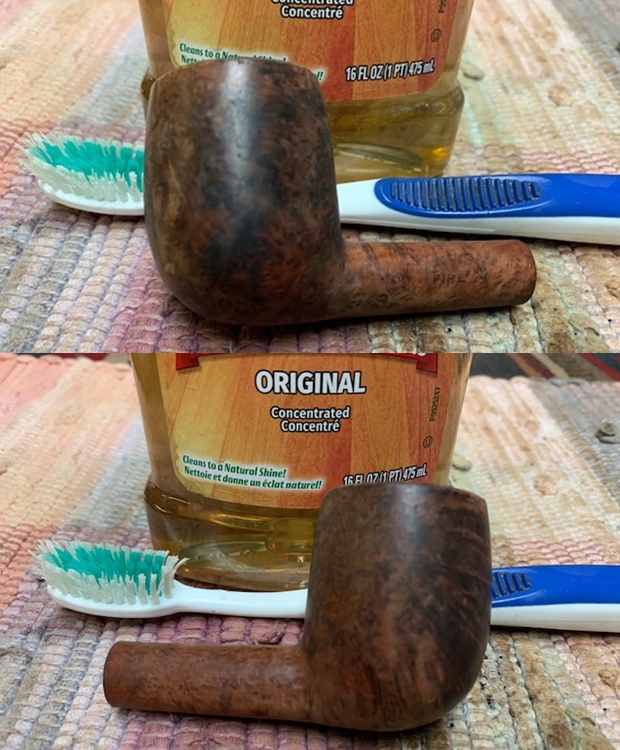
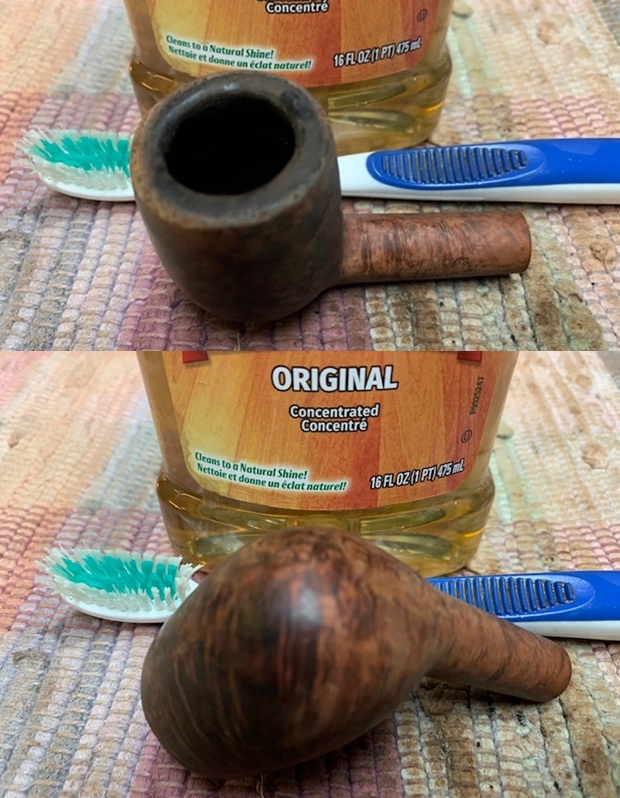
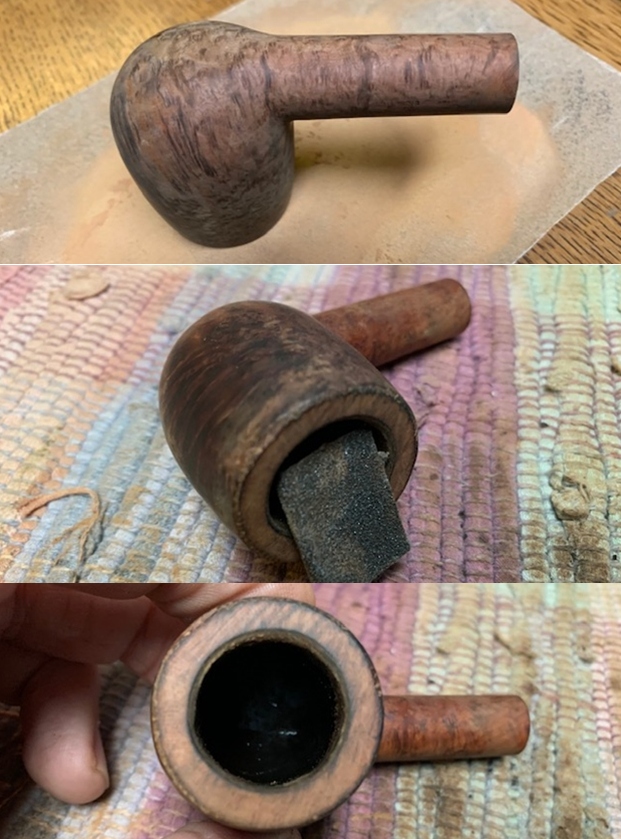
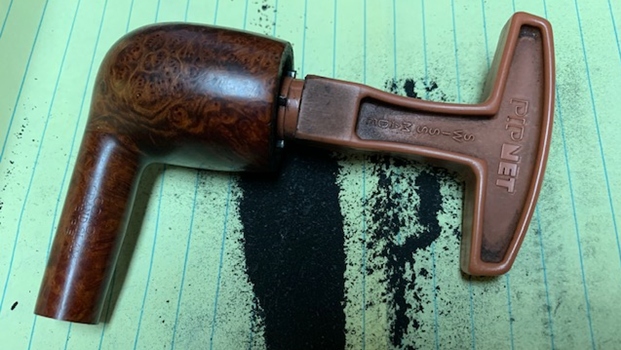
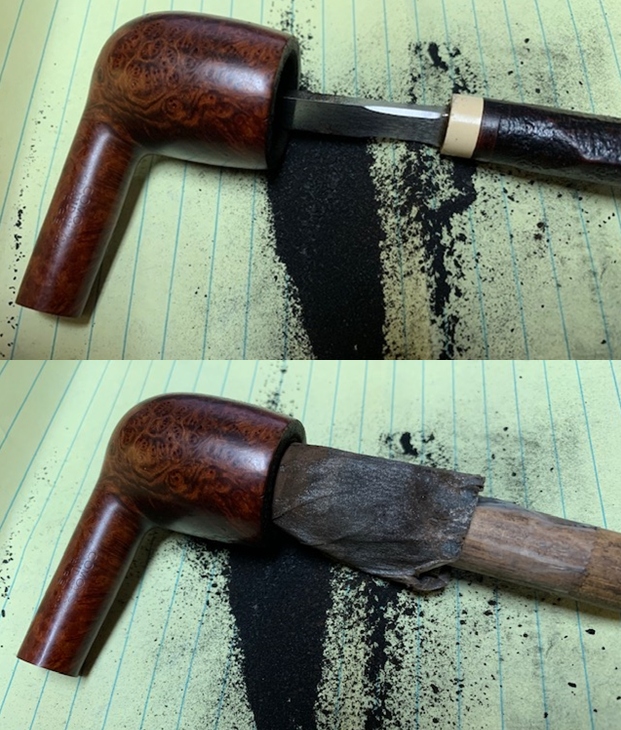
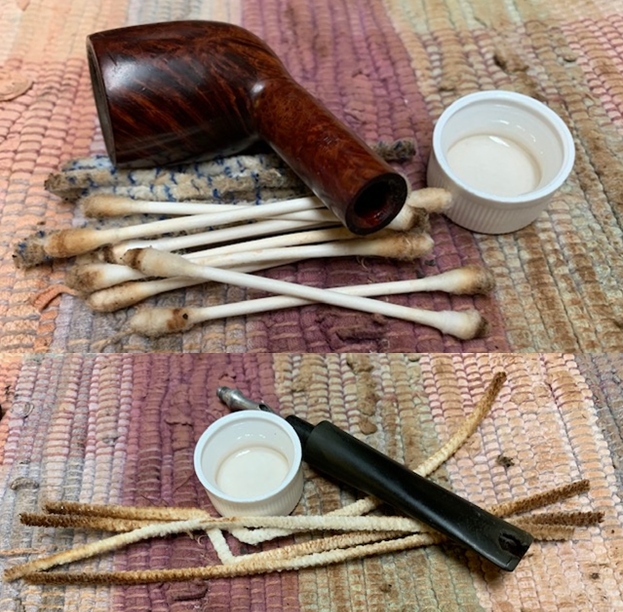
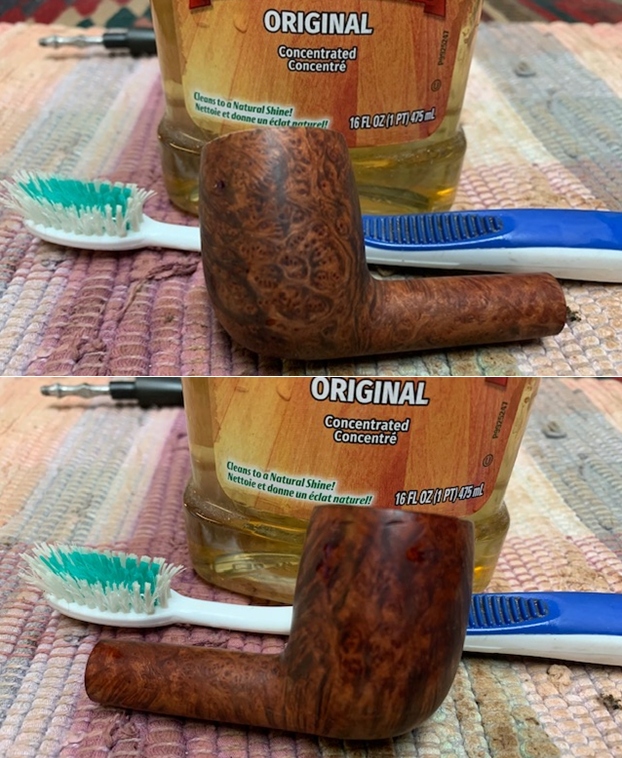
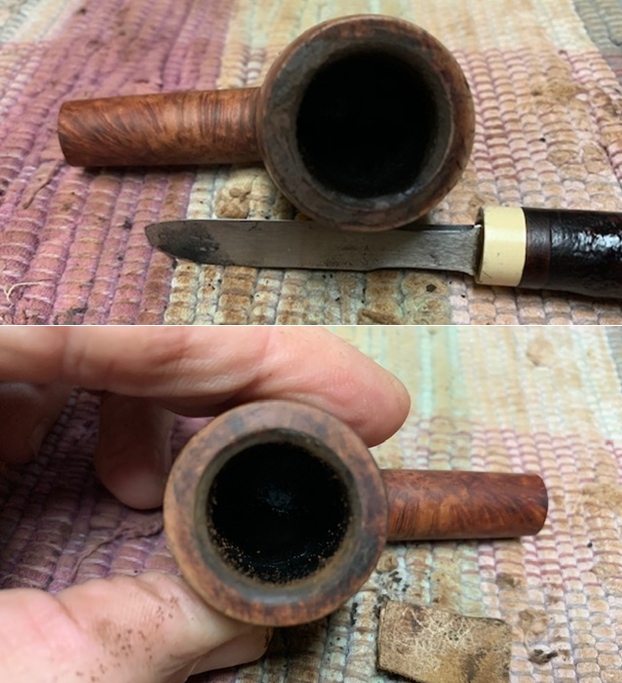
Jeff had cleaned up the pipe with his usual penchant for thoroughness. He reamed the pipe with a PipNet Pipe Reamer and cleaned up the remnants with a Savinelli Fitsall Pipe Knife.  He scrubbed the bowl with undiluted Murphy’s Oil Soap with a tooth brush. He rinsed it under running warm water to remove the soap and grime. He cleaned out the inside of the shank and the airway in the stem with alcohol, cotton swabs and pipe cleaners. He soaked the stem in Before & After Deoxidizer and rinsed it off with warm water. I took photos of the pipe before I started my work.  The rim top and edges of the rim looked rough with damage all around. The outer edge was rough and the inner edge was notched with what looked like knife marks. The rim top was also nicked and dented. The stem surface looked very good with some remaining oxidation and tooth marks and chatter on both sides near the button.  I took photos of the stamping on the sides of the shank. It is clear and readable as noted above. I removed the stem and took a photo of the pipe to give a sense of the whole. The bowl has a definitely tilt to it and the heel is rounded. The saddle stem is tapered with a slight bend that follows the flow of the pipe. I turned to Pipephil’s site (http://www.pipephil.eu/logos/en/logo-w1.html) and looked up the section on Wally Frank Pipes. I have included a screen capture of the section on The Pipe of the Month.Each member of Wally Frank’s “The Pipe of the Month Club” received a brand new pipe in the mail once a month.

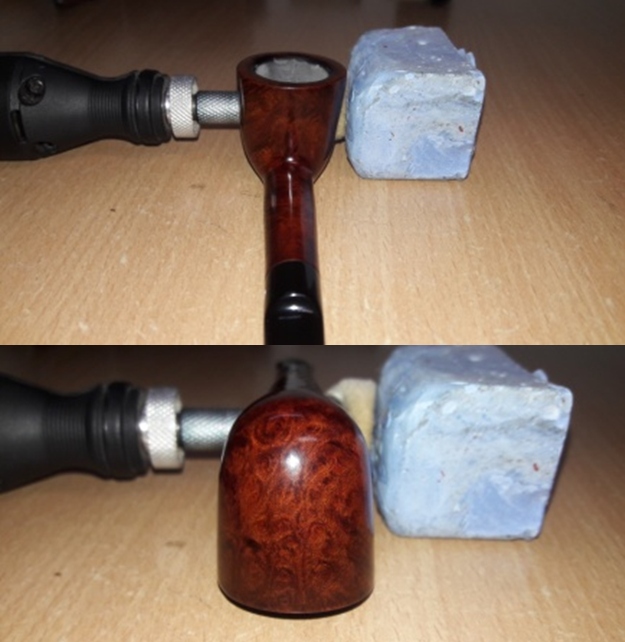
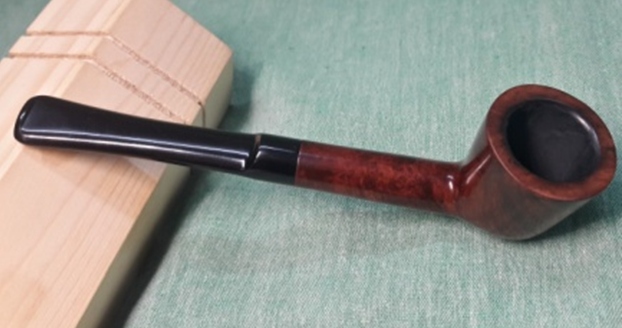
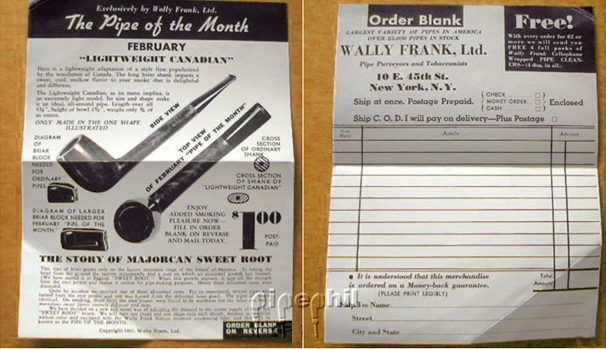
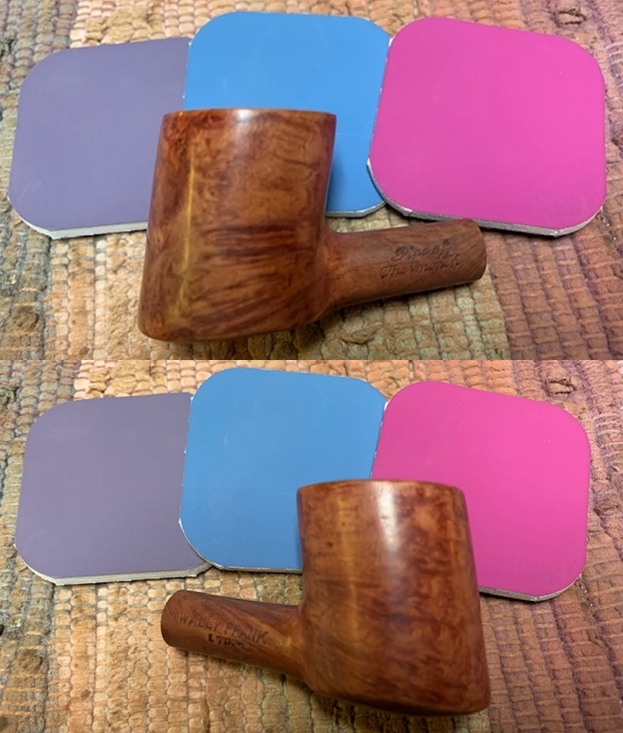
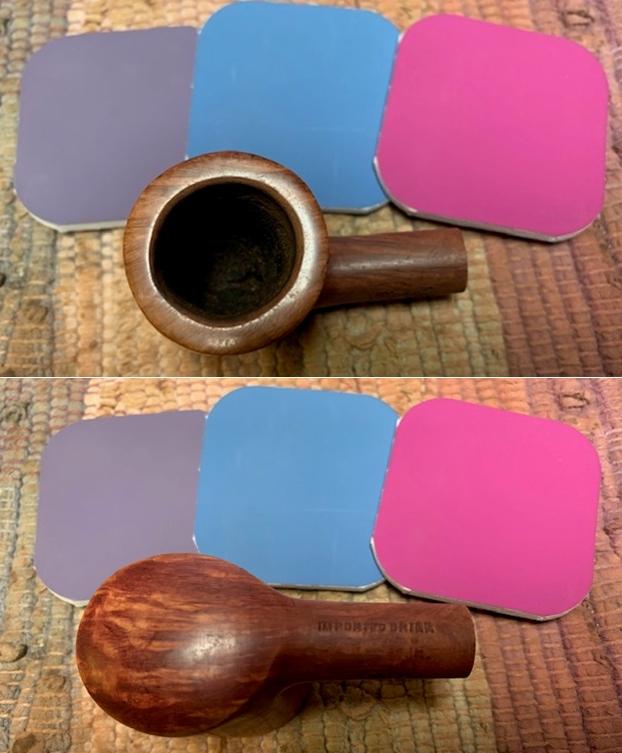
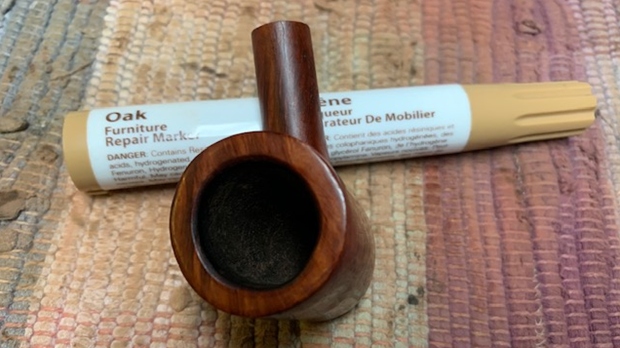
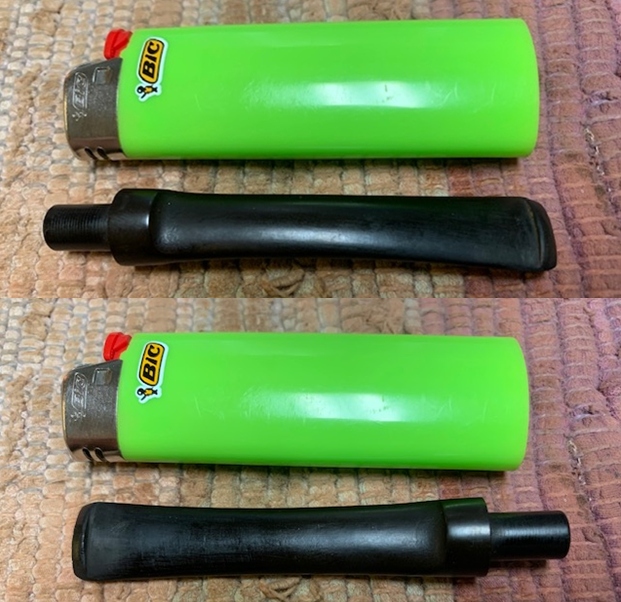
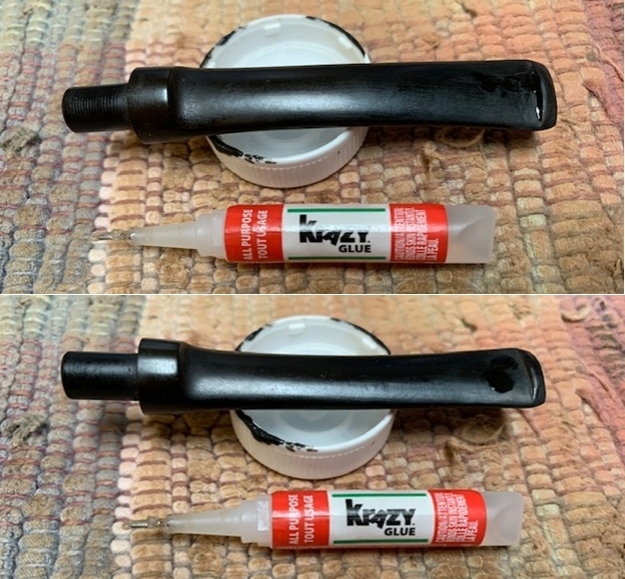
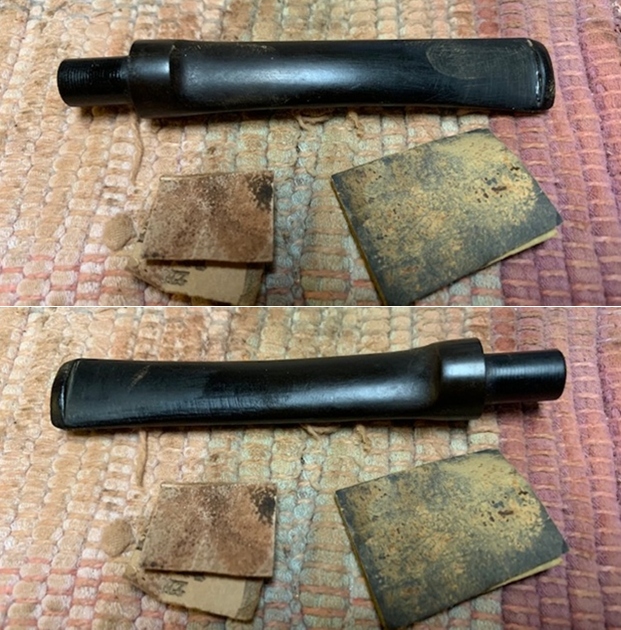
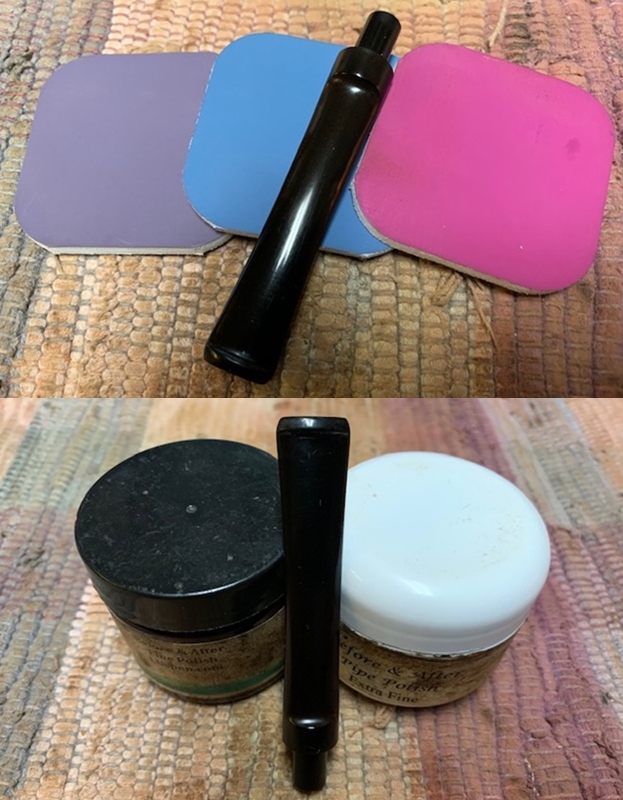
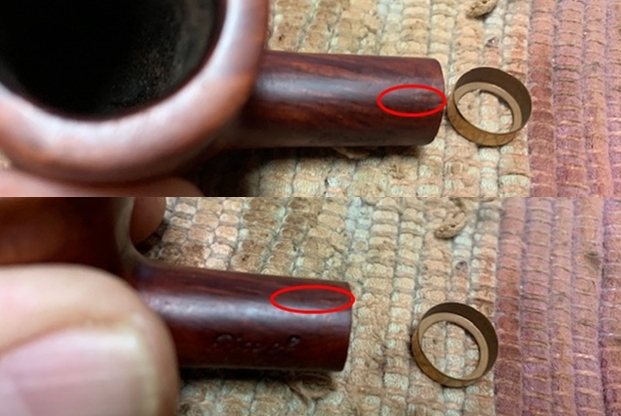
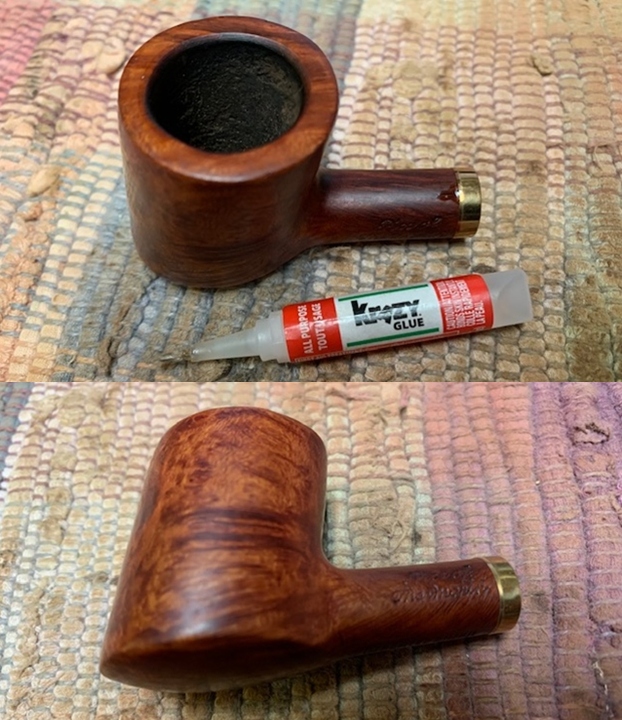
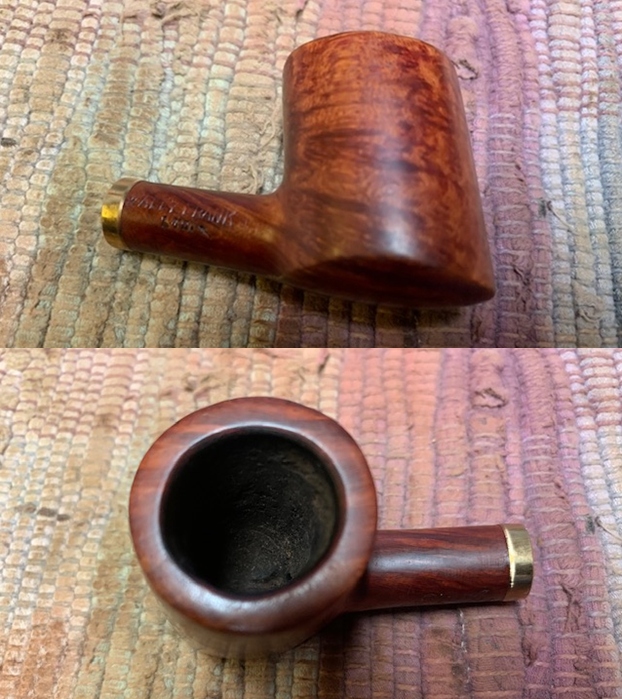
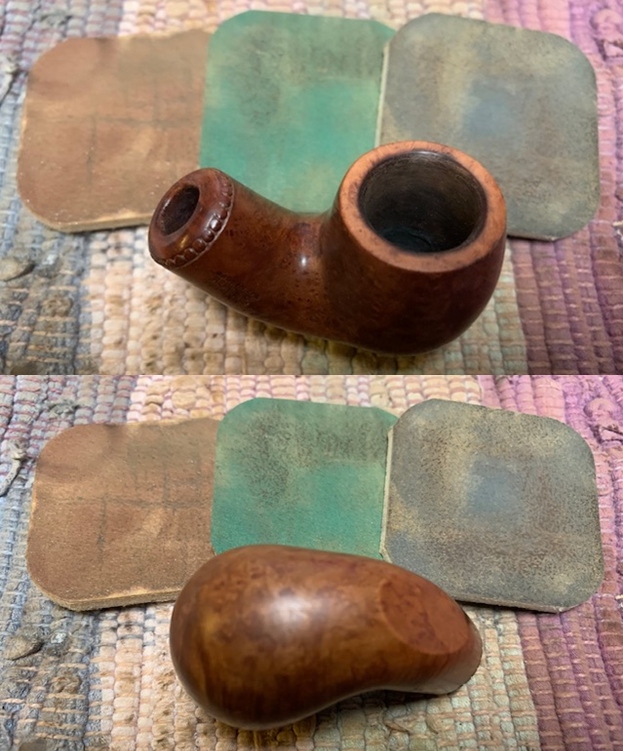
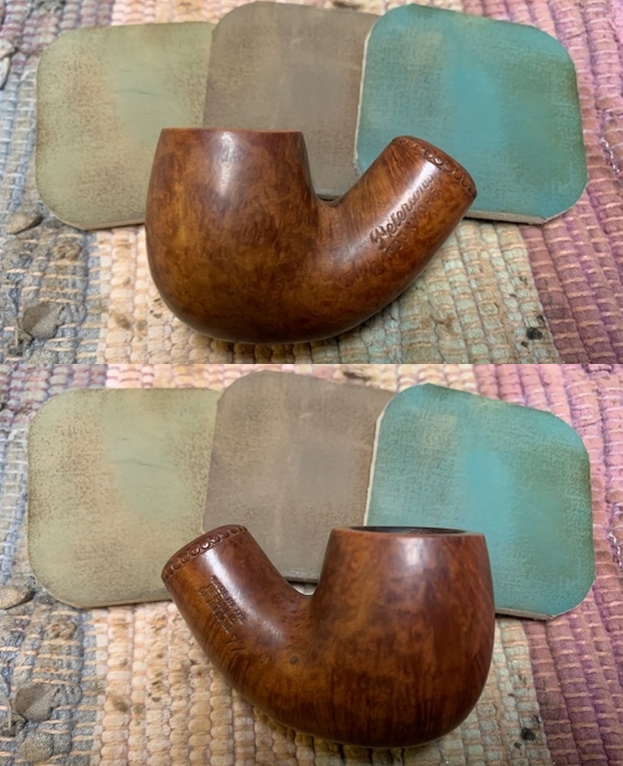
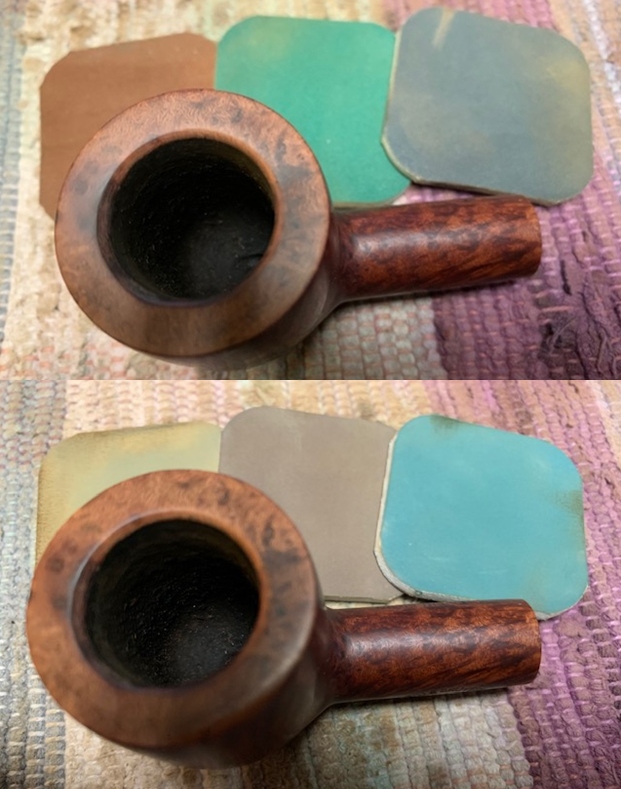
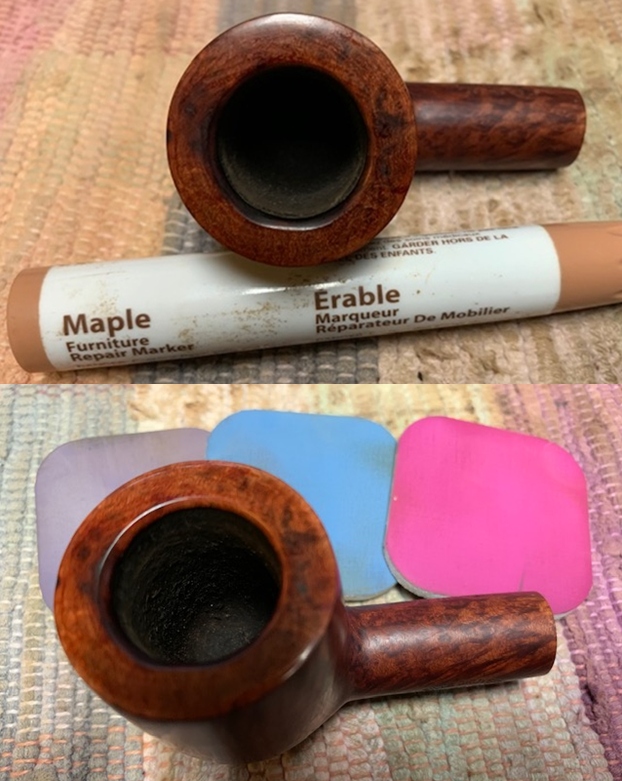
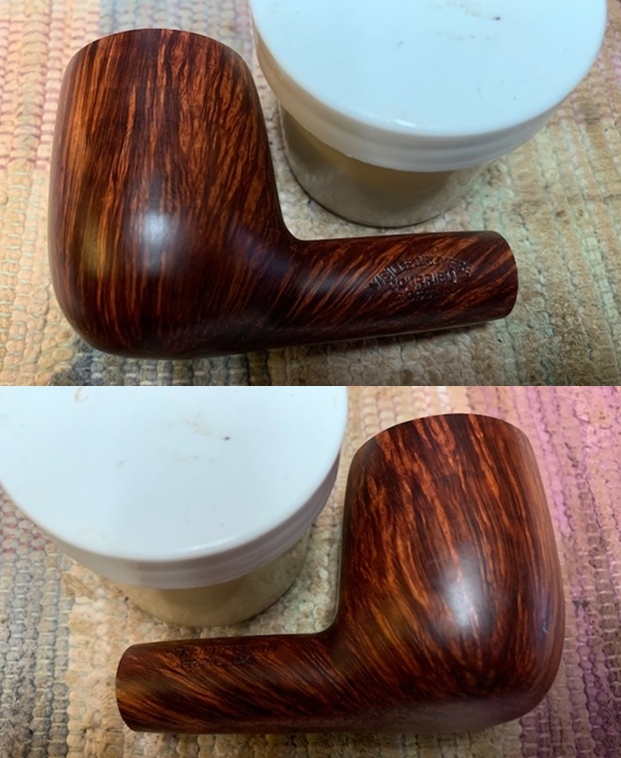
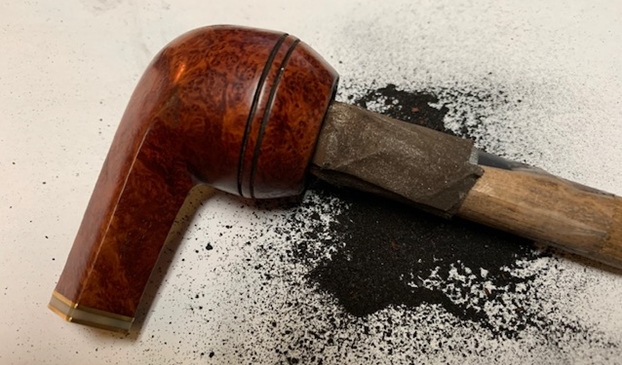
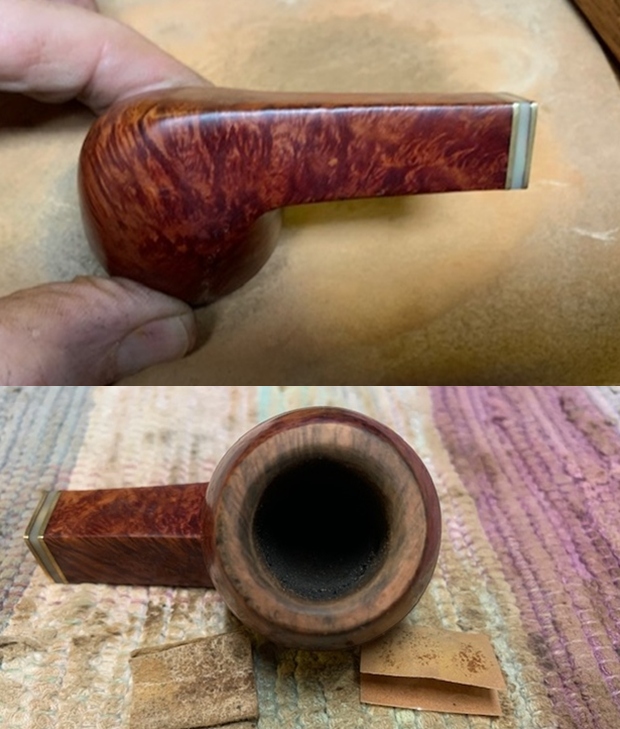
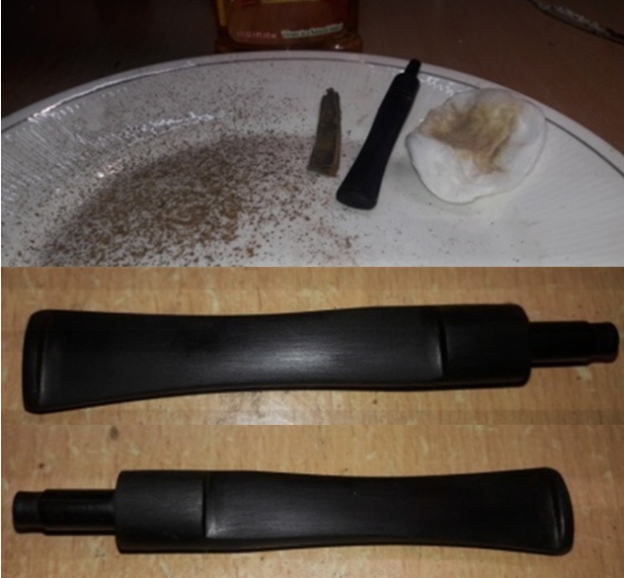
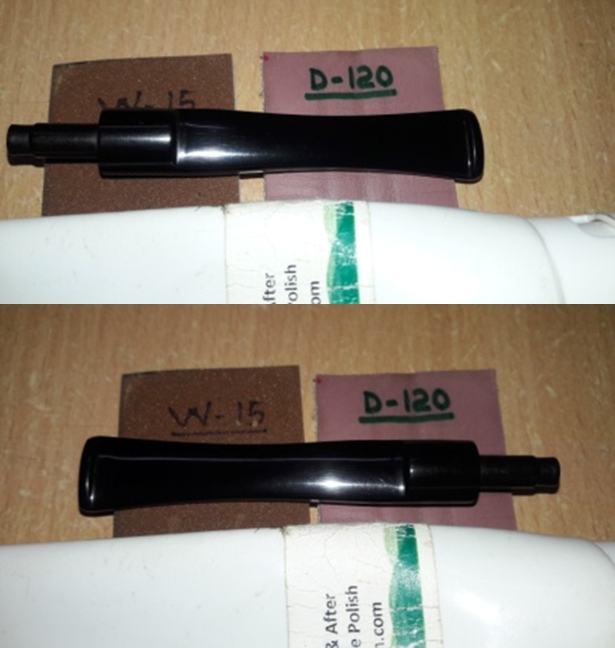
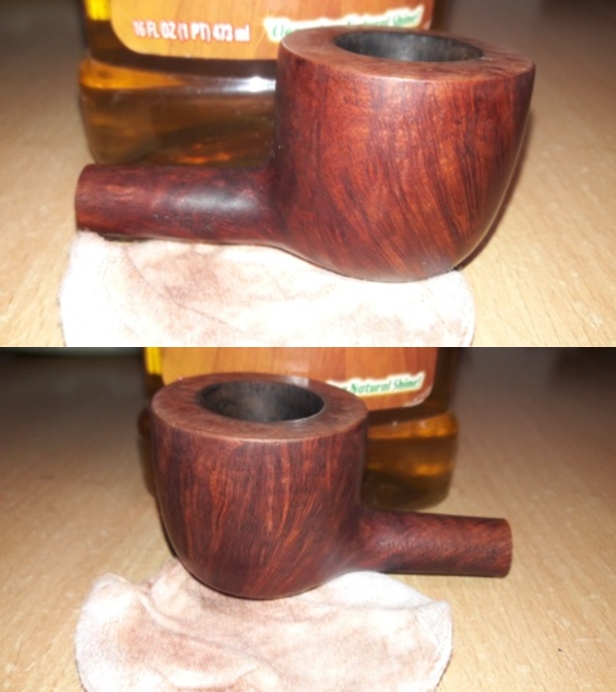
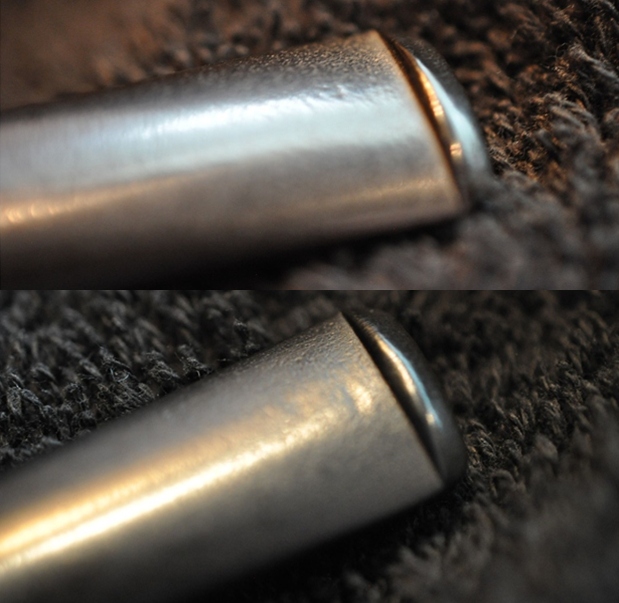
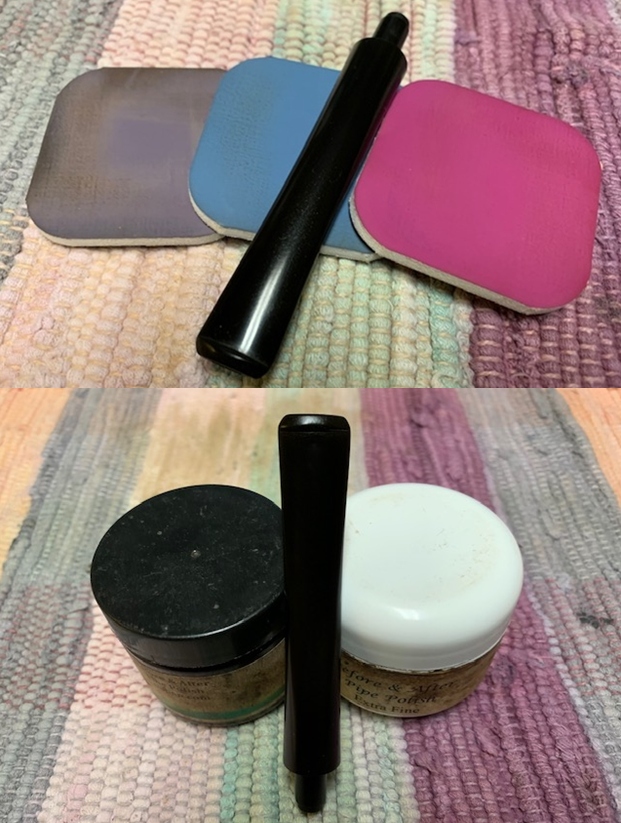
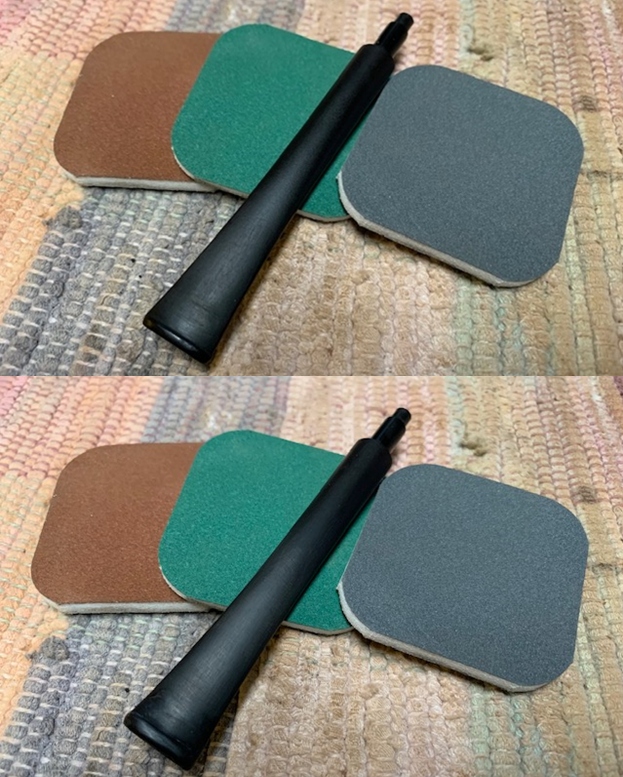
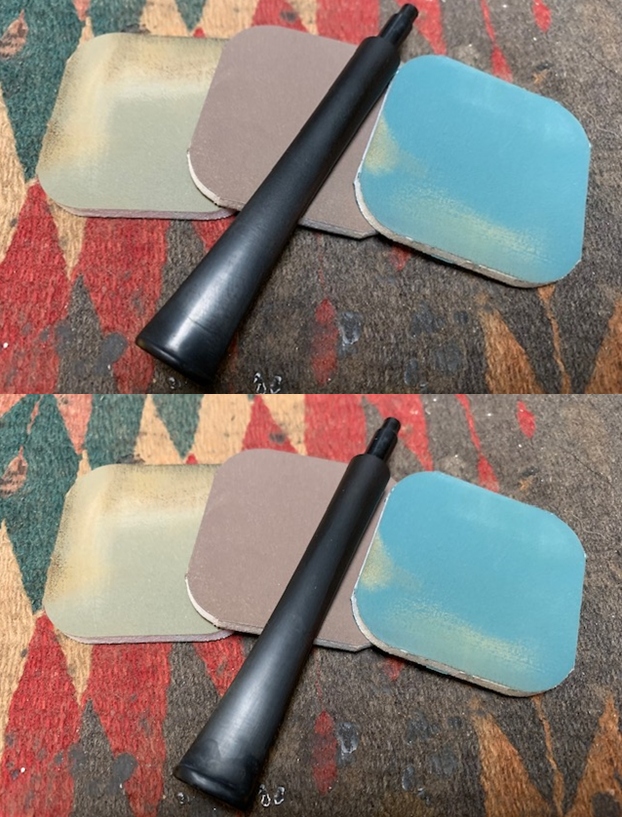
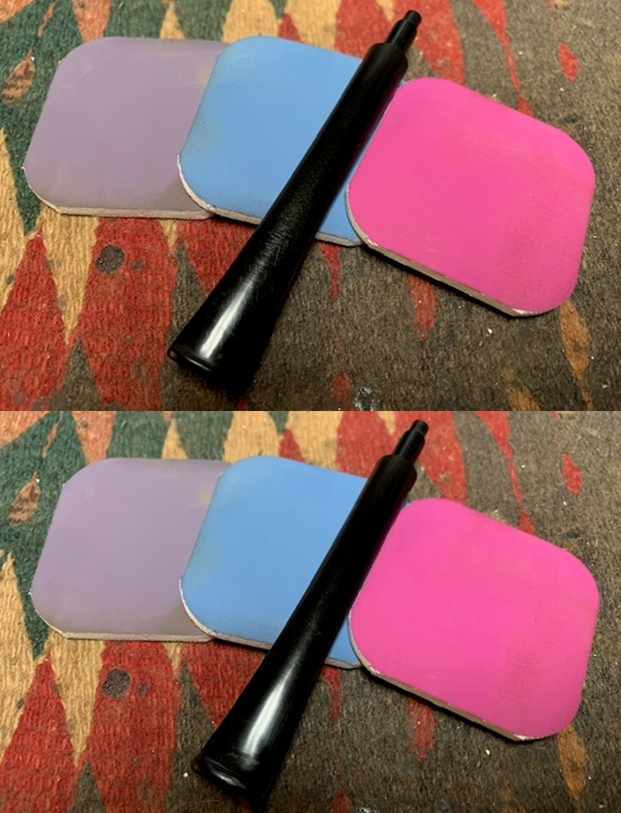
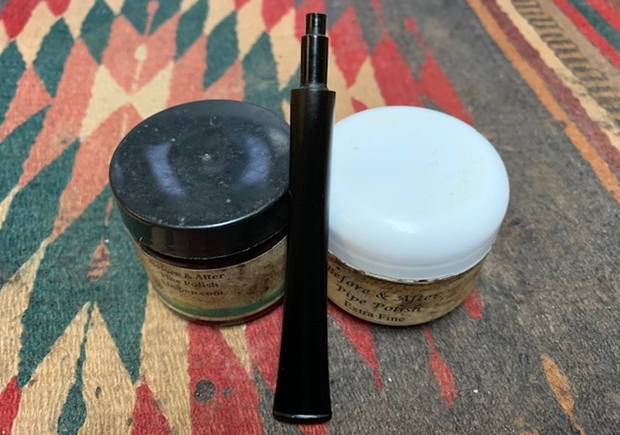
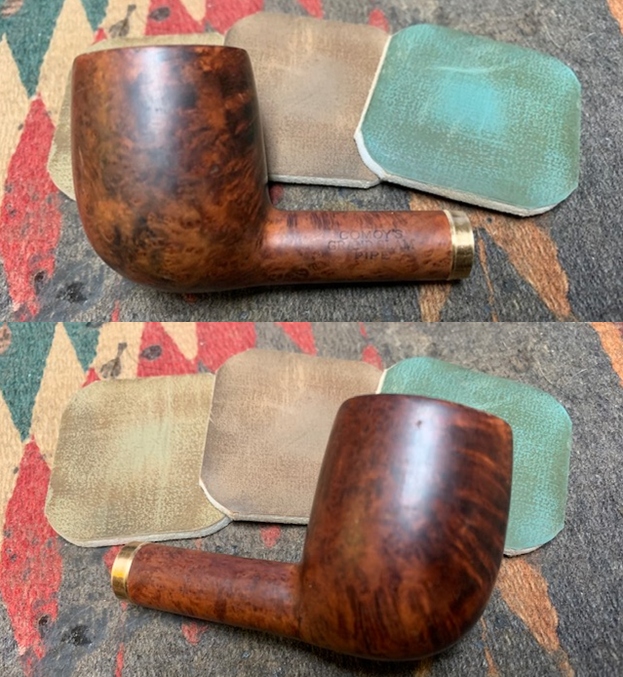
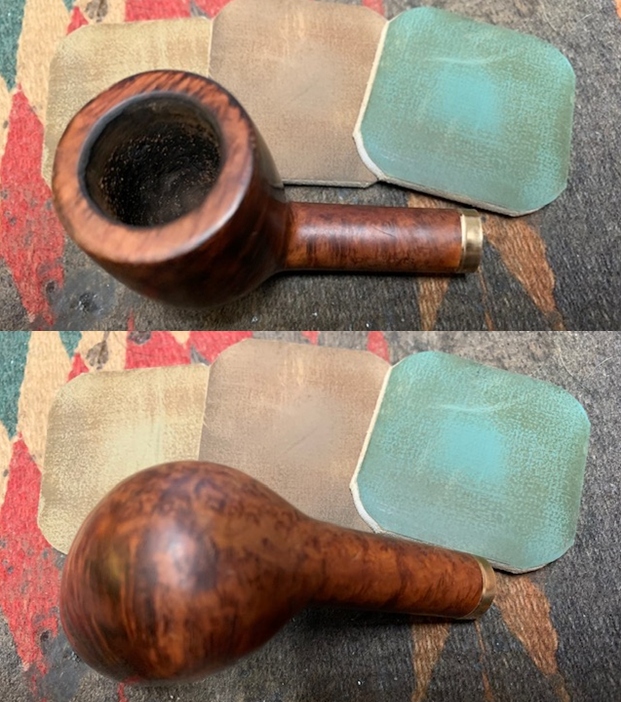
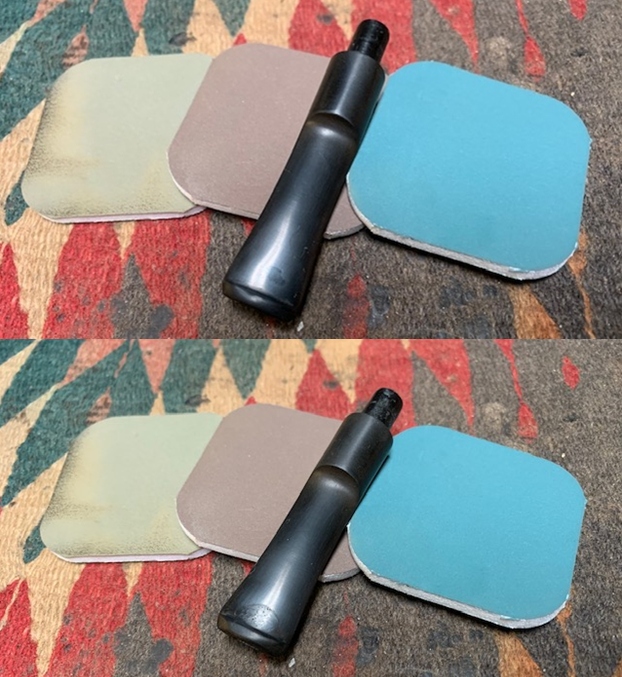
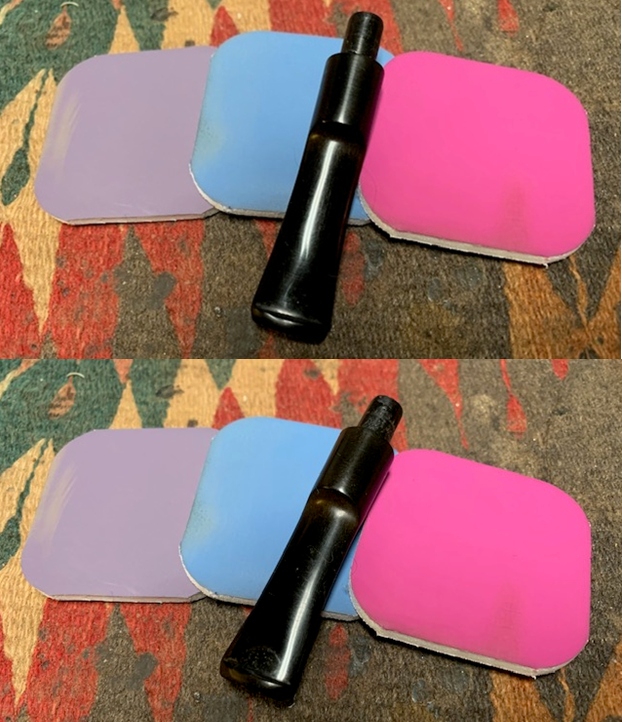
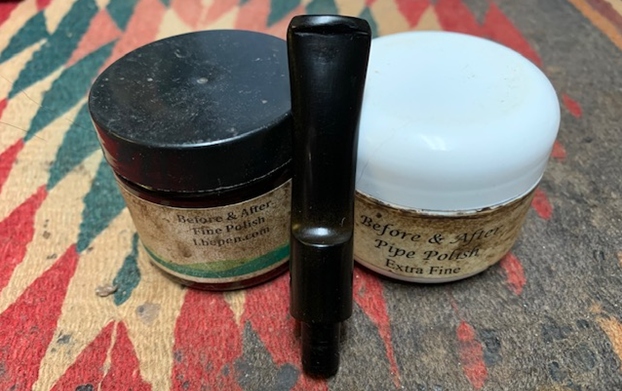
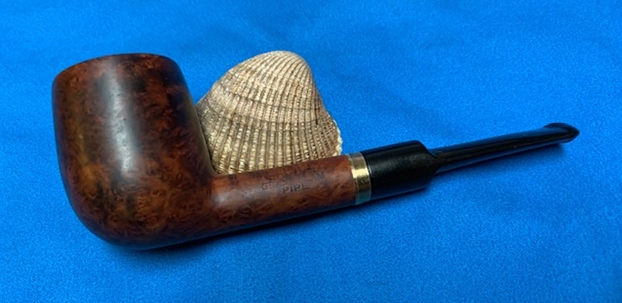
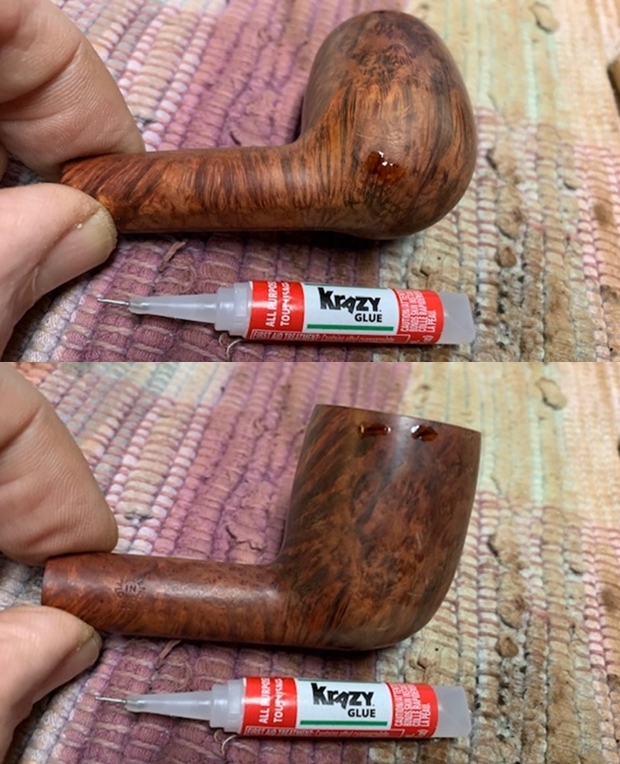
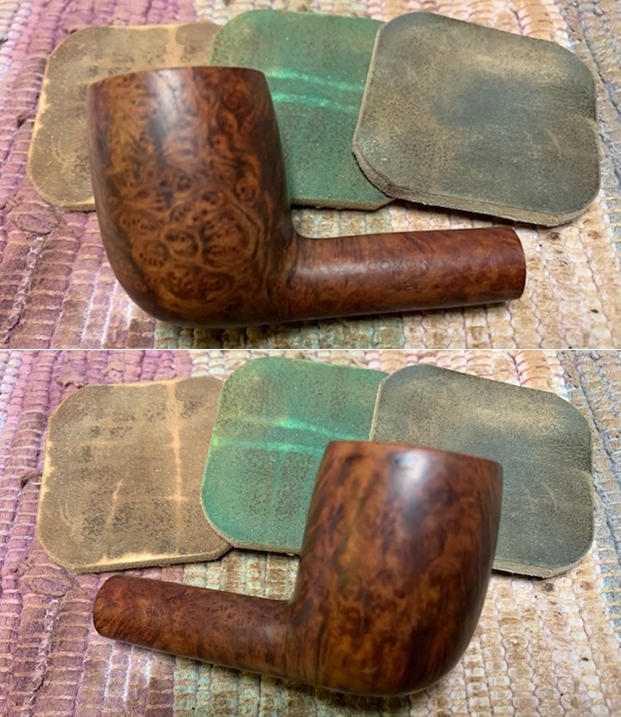
There was also a link to the Pipe of the Month Order form that was on the site. I have included that below for your viewing.Now it was time to work on the pipe. To take care of the significant damage to the rim top and edges I started my work by gently topping the bowl to minimize the damaged areas. I gave the inner edge of the bowl a bevel to reduce the burned areas. I also sanded the outer edge and smoothed out the damage. I wiped the bowl down with acetone to remove the spotty varnish coat and to get the bowl free of the shininess so I could blend in the rim top more carefully. There was some nice looking grain under the varnish. Removing varnish always gives me pause because it can often reveal things I would have rather left hidden. However in this case it was not true. I polished the briar with micromesh sanding pads – wet sanding with 1500-12000 grit pads. I wiped the bowl down after each pad with a damp cloth to remove the sanding dust. The bowl really began to take on a shine. The rim top was slightly lighter than the rest of the bowl so I touched it up with an Oak stain pen to match the rest of the pipe.With the rim cleaned up the bowl was in good condition. I rubbed it down with Before & After Restoration Balm. I worked it into the surface of the bowl sides and shank with my fingertips. The product works to clean, enliven and protect the briar. I let the balm sit for a little while and then buffed with a cotton cloth to raise the shine.  I set the bowl aside and turned to work on the stem. I “painted” the stem with the flame of a lighter to lift the tooth marks. The majority of them disappeared with the heat of the flame. Those that remained I filled in with clear super glue. Once the repairs had cured I sanded them smooth with 220 grit sandpaper. I started polishing the stem with 400 grit wet dry sandpaper.  I polished the vulcanite stem with micromesh sanding pads – 1500-12000 grit pads. I wiped it down with Obsidian Oil after each sanding pad. I used Before & After Pipe Polish – both Fine and Extra Fine to further polish the stem.  Before I put the stem back on the shank I checked out the shank end and the edges. I was surprised when I saw a small crack on the top of the shank toward the right that was obviously there before but only now after polishing could I see it. I circled the cracked area in red in the two photos below. I glued the crack with a dribble of super glue and then pressed a thin brass band on the shank end. I really like these thin bands as they do not cover the stamping on the shank – which in this case was on three sides. I like the finished look of the pipe with the band.This Wally Frank Pipe of the Month Drunken Poker with a vulcanite saddle stem is a great looking pipe now that it has been restored. The smooth finish and unique grain look and feel great in the hand and should only feel better as the pipe is smoked. I put the stem back on the bowl and carefully buffed the pipe with Blue Diamond on the buffing wheel to give a shine. I gave the bowl and the stem multiple coats of carnauba wax on the buffing wheel and followed that by buffing the entire pipe with a clean buffing pad. I hand buffed the pipe with a microfiber cloth to deepen the shine. The finished Drunken Poker fits nicely in the hand and feels great. Give the finished pipe a look in the photos below. The dimensions of the pipe are Length: 5 ¼ inches, Height: 1 ½ inches, Outside diameter of the bowl: 1 ¼ inches, Chamber diameter: ¾ of an inch. The weight of the pipe is 25gr/.88oz. If you are interested in adding this pipe to your collection send me a message or an email. Thanks for reading this blog and my reflections on the pipe while I worked on it. There are many more to come!

A Simple Restoration on a Republic Era Peterson’s “Dunmore” 77 Bent Billiard


Blog by Steve Laug

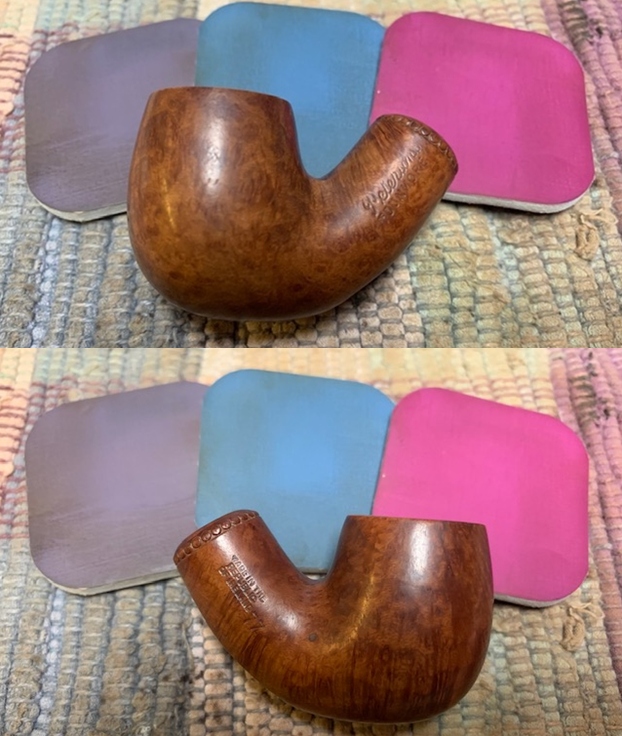
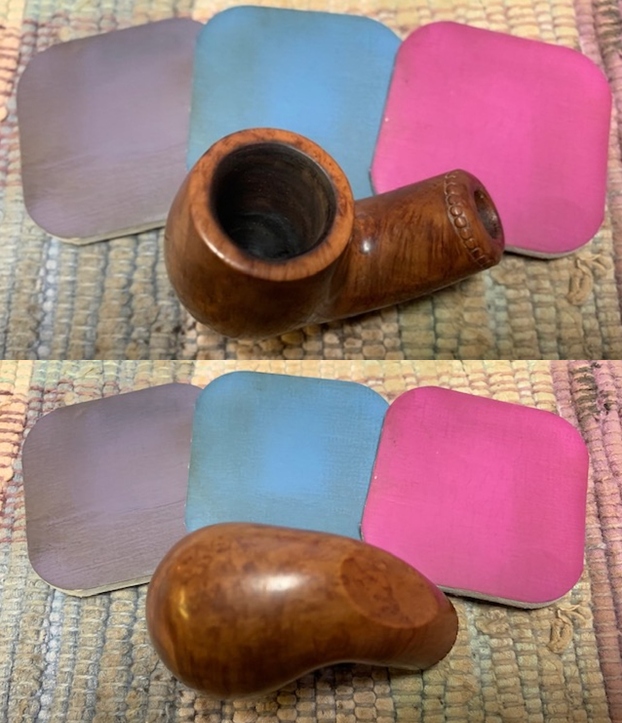
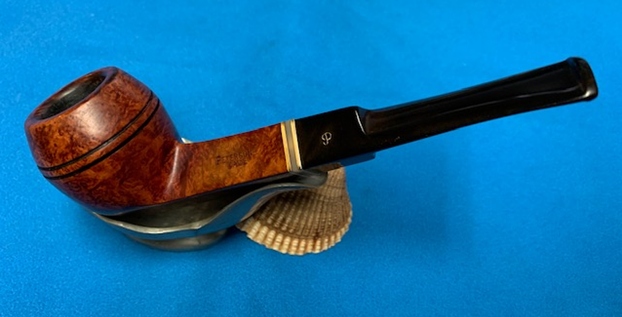
The next pipe on the table was gifted to me by Ray, a reader in Australia. It is a petite Peterson’s “Dunmore” pipe. He had read a restoration of Bob Kerr’s Estate Peterson’s “Dunmore” and thought I would enjoy working what he called “that pipe’s l’il brother”. It is about a Group 2 by Dunhill standards bowl that he had picked up in the 1970s. It is stamped on the left side of the shank and reads Peterson’s [over] “Dunmore”. On the right side it is stamped Made in the Republic of Ireland followed by the shape number 77.  Ray had done the lion’s share of the clean up on the pipe. It had been reamed, cleaned and buffed. It was in great condition. There was some rim top darkening and damage on the inner edge of the bowl but nothing too difficult. The beaded decoration on the shank end is in excellent condition. Like other Dunmore’s I have worked on it had a flattened shank and the pipe functioned as a sitter. The stem was in excellent condition with some very light tooth chatter on both sides ahead of the p-lip. The “P” stamp on the left side of the stem was clear and just needed to be touched up otherwise it looked good. I took photos of the pipe when I finally brought it to my work table. The next photos show the bowl and rim top as well as the stem condition. The bowl was clean and ready to fire up. The rim edge was out of round and showed some damage and darkening. The rim top also had some darkening. The stem looked very good with some light tooth chatter and scratches.  The stamping on the shank sides was very readable and read as noted above. It had been buffed but was not overly damaged.   I took the stem off and took a photo of the parts of the pipe to give a perspective on the size and proportions of this little pipe.After rereading Ray’s email about the pipe and the previous blog on the Dunmore I had worked on I went back and reread the blog (https://rebornpipes.com/2019/08/18/restoring-a-petersons-dunmore-70-bent-apple-sitter-from-bob-kerrs-estate/). I quote from the blog on the Dunmore line below.

I then turned to the book I should have consulted first, The Peterson Pipe, by Mark Irwin and Gary Malmberg. On page 298 there is an entry for Dunmore pipes. It reads as follows:

Dunmore (1971-c.1984 2006-10). Appeared first as Iwan Ries & Co. exclusive line “Dunmoor,” a Premier-grade in light-brown smooth or rustic red in all System shapes, with beading at the shank. Documented in the Associated Imports Catalog from 1973. Classic Range Dunmore shapes from ’78. A third Dunmore line (’06-10) featured standard and some B shapes, with beading around bowl instead of at shank-face, produced for European market.

On page 165 there were also photos of pages from a catalogue with the  description: The unmounted Dunmore Premier debuted in both System and Classic Range shapes circa 1973 with a final appearance in the 1981 catalogue.

The information blurb on each page read: “Dunmore Briars.” Beautifully grained best quality briar in light-brown, matt or rustic finish. Often described as “Petersons Unmounted System” has all the advantages of the system range. Ten models each fitted with the Peterson Lip mouthpiece.

With that information in hand I knew what I was dealing with in terms of the stamping on the pipe. It is a Late Republic era pipe. It showed up in Peterson Catalogue in 1973 which fits Ray’s memory of when he bought the pipe. Now it was time to work on the pipe.

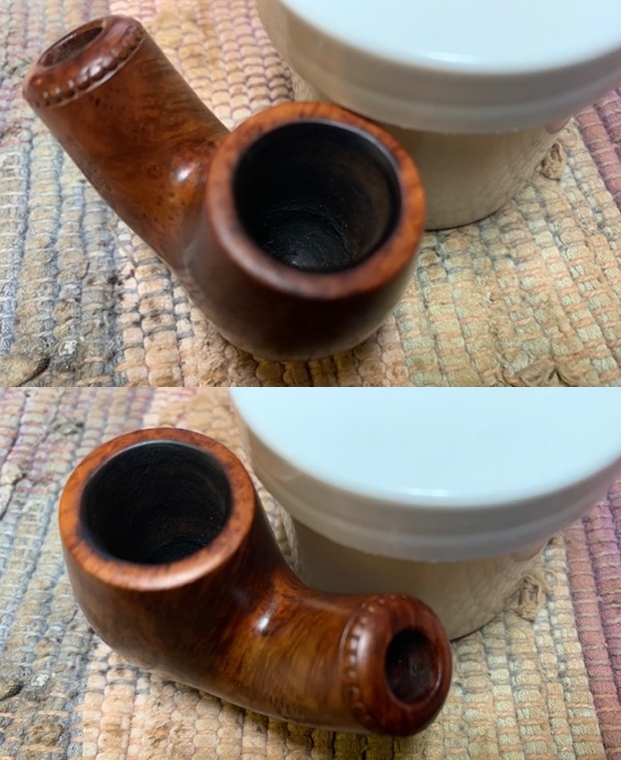
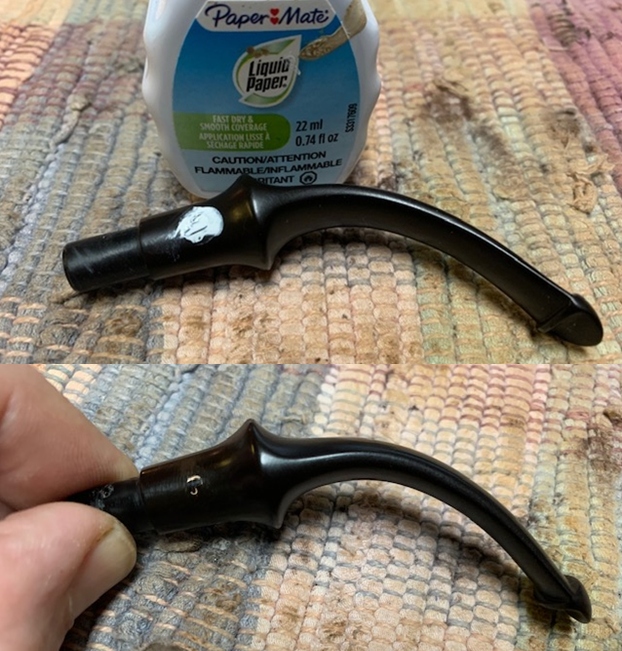
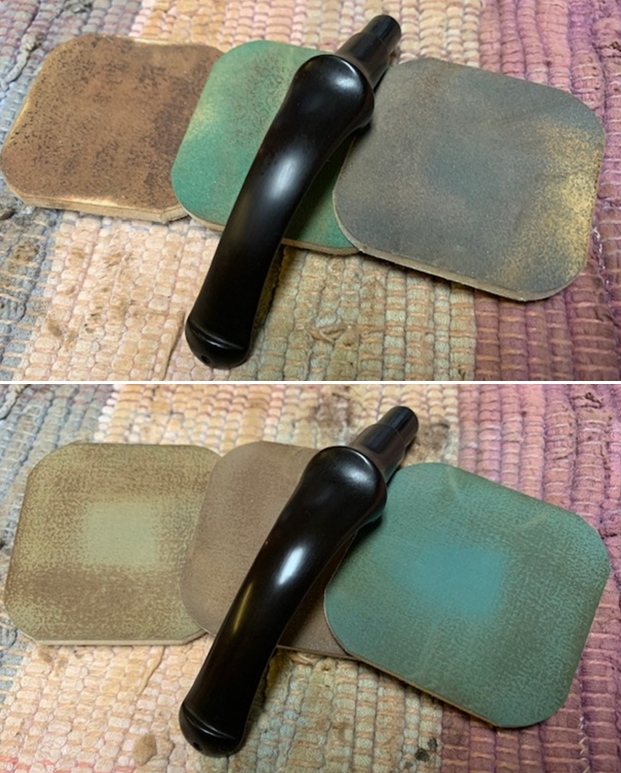
I decided to start my work on this one by reworking the inner edge of the rim with a folded piece of 220 grit sandpaper. I wanted to try and bring it back into round and smooth out the jagged condition.I polished the briar and worked over the rim top with micromesh sanding pads – 1500-12000 grit pads. I wiped the bowl down after each pad with a damp cloth. Once the finish was removed the fills in the briar became very evident.  I rubbed the bowl and shank down with Before & After Restoration Balm. I worked it into the surface of the bowl sides and shank with my fingertips to clean, enliven and protect the briar. I let the balm sit for a little while and then buffed with a cotton cloth to raise the shine.   I touched up the stamp on the left side of the saddle with liquid paper. I applied it and worked it into the stamp with a tooth pick. Once it cured I scraped off the excess. It is definitely better though the stamp is faint in some spots.  I polished the vulcanite stem with micromesh sanding pads – 1500-12000 grit pads. I wiped it down with a damp cloth after each sanding pad. I used Before & After Pipe Polish – both Fine and Extra Fine to further polish the stem.  This nice looking Peterson’s Dunmore 77 Bent Billiard and a classic Peterson’s P-lip vulcanite stem looks much better now that it has been restored. The rim top and edges cleaned up very well. The rich brown stains on the bowl came alive with the polishing and waxing. I put the stem back on the bowl and carefully buffed the pipe with Blue Diamond on the buffing wheel using a light touch on the briar. I gave the bowl and the stem multiple coats of carnauba wax on the buffing wheel and followed that by buffing the entire pipe with a clean buffing pad. I hand buffed the pipe with a microfiber cloth to deepen the shine. The finished Peterson’s Dunmore is a petite beauty and fits nicely in the hand and looks very good. Give the finished pipe a look in the photos below. The dimensions of the pipe are Length: 5 inches, Height: 1 ½ inches, Outside diameter of the bowl: 1 inch, Chamber diameter: ¾ of an inch. If you are interested in adding this pipe to your collection send me a message or an email. Thanks for reading this blog and my reflections on the pipe while I worked on it. There are many more to come!

Refreshing a Friend’s First Purchased Pipe – A French Courrieu Straight Grain Billiard


Blog by Steve Laug

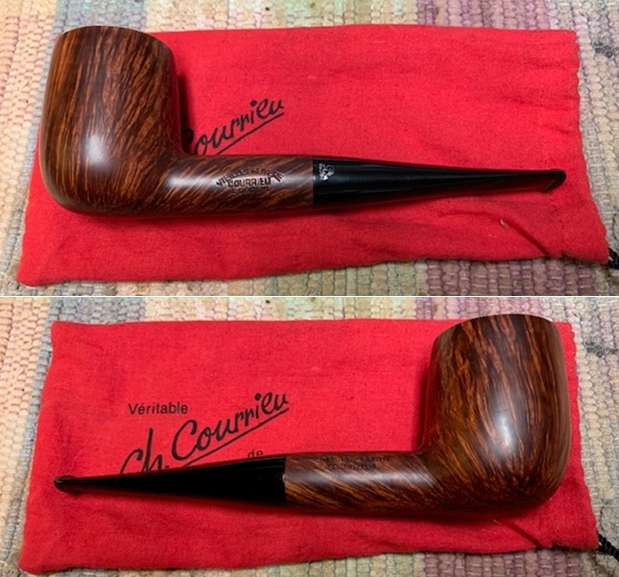
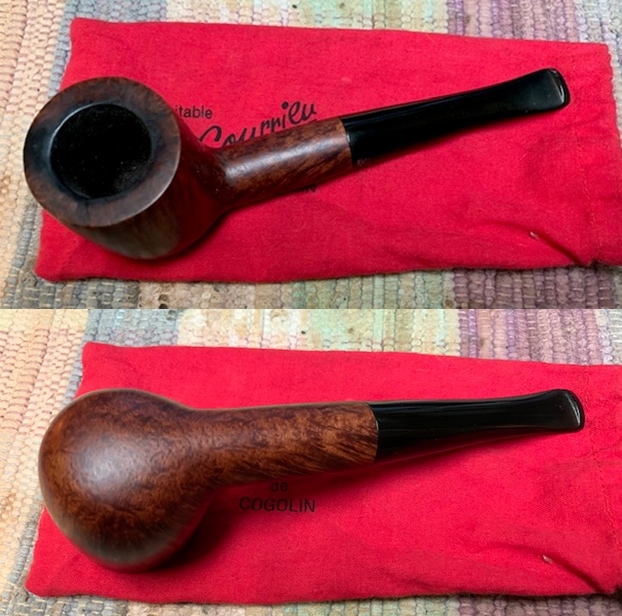
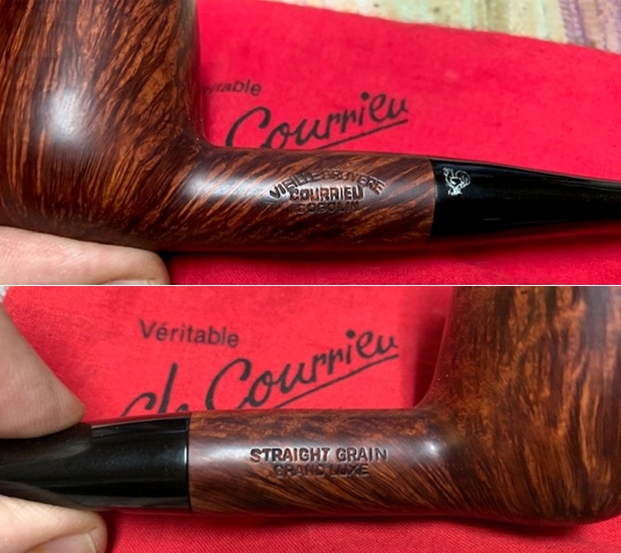
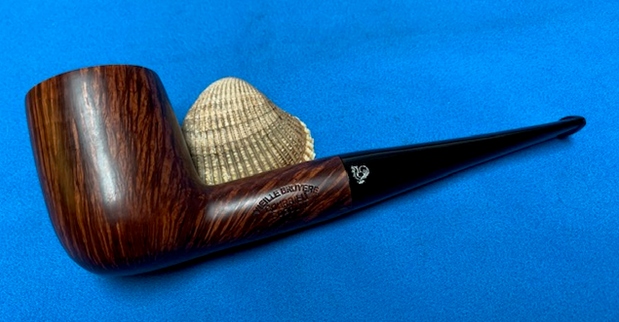
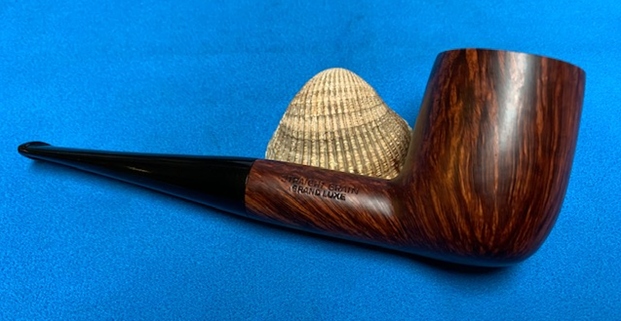
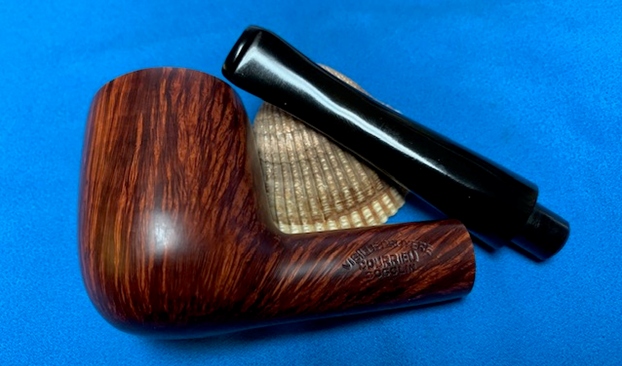
The next pipe I am working on is the second one that came from a friend, Lee who lives in the US. It is a gorgeous Straight Grain French Made Billiard. It is stamped on the left side of the shank and reads Vieille Bruyere [arched over] Courrieu [over] Cogolin. On the right side it is stamped Straight Grain [over] Grand Luxe. He sent me an email detailing what he saw in the pipe and gave his assessment as well as several pictures of the pipe. He wrote and opening paragraph and then a list of his request:

The second pipe I’ll be sending is my first pipe, a French Courrieu, billiard shape, straight grain. While it’s just fine, I’d like to see if you can remove the burning/charring on the bowl’s edge (due to me being a total newbie at the time), bowl clean, and a wood buff if possible. Again, deep sentimental value with this French pipe, so want it to be in great shape.

  1. First pipe ever purchased. Purchased from the mfg after a fascinating tour (I’m a mfg guy, so seeing how they do things both fascinated and horrified me!)
  2. I know this piece is in good shape, but the scorching on the rim due to ignorance/newbie-stumbles irritates me (I really don’t need to be reminded with every bowl of Semois how badly I’ve treated this thing); if you can assist, please do what you can to remove, even if it means sanding off the top of the bowl.
  3. My only ’need’ is you match the original stain, best you can. If that requires sanding the entire bowl and working up from there with another stain (a close match), I’m fine with that call. Again, this is a sentimental piece (unlike the Peterson – for now), so I’m not concerned about the labor required to get it the best it should be. Merci –

Once the pipe arrived I spent some time going over it to assess what I thought needed to be done to bring it back the flare to the finish of Lee’s first pipe. This Courrrieu Straight Grain Billiard really is a very beautiful pipe with some stunning grain. This is the list that I sent to him via email.

  1. Bowl exterior is in good condition. There are no deep scratches or marks in the briar.
  2. Rim top shows some scratches and marks on the surface. There is darkening around the inner edge of the bowl and on the front, back and left side of the top. The inner edge is also damaged on the front edge and rear left edge with what looks like some charring. Definitely worse on the front than the back of the rim. Bowl is slightly out of round due to that.
  3. Bowl internals are good – light cake. Do you want that cut back to bare briar again or just leave it and lightly clean it?? I ask because taking it back some will make the rim cleanup easier to manage.
  4. The stem is in relatively good condition with tooth chatter on the underside ahead of the button and on the button surface itself. A few tooth marks on the underside and on the underside of the button.

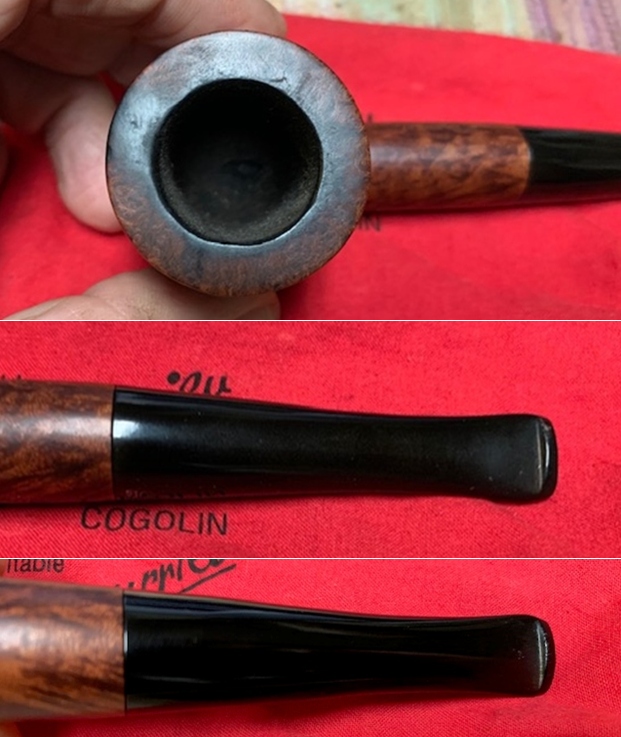
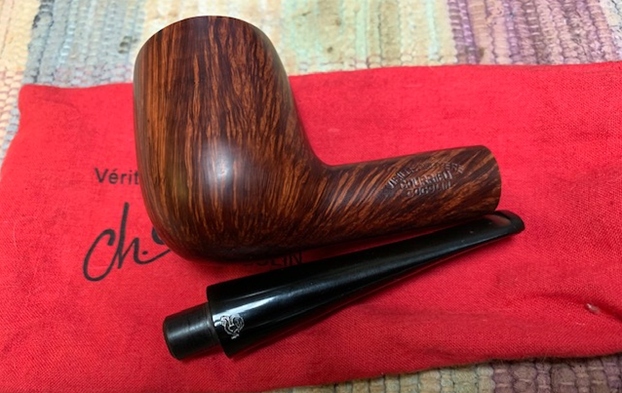
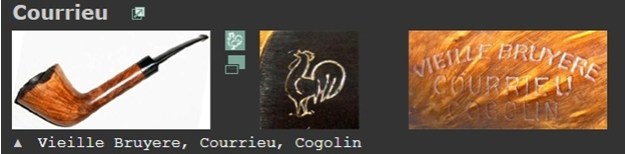
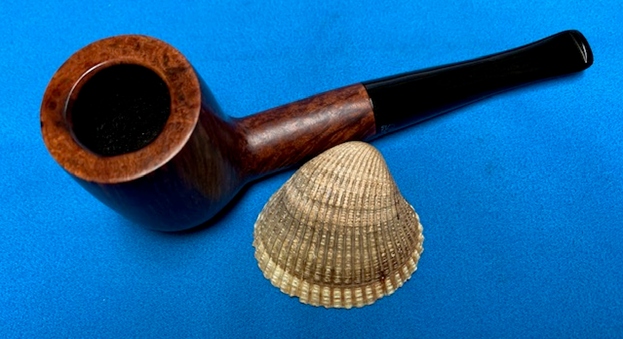
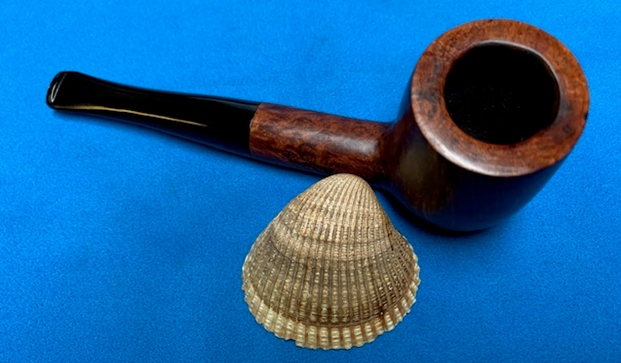
I took photos of the pipe before I started the work on the pipe. It is a beauty. The grain is beautiful and the pipe is in very good condition other than the burn marks on the rim top. The photos tell the story of pipe’s condition.  I took some photos of the rim top and stem surfaces to capture their condition. The photo of the rim top shows the darkening on the top of the rim and the damage to the inner edge of the rim. It is more pronounced on the front inner edge than the rear. It is solid but definitely burned. The bowl is slightly out of round. The stem surface is pretty clean. There are light tooth marks on the top and underside as well as on the button surface itself.   I took photos of the stamping on both sides of the shank. It is clear and readable as noted above. The stamping on the left side of the stem is a rooster. I took the stem off the shank to give a clear picture of the pipe as a whole. The flow of the bowl, shank and the taper stem contribute to the overall beauty of the pipe.I wanted to gather some background information on the Courrieu brand as this is the first pipe of this brand that I have worked on. I turned to Pipephil to get a quick overview of the brand and was not disappointed (http://www.pipephil.eu/logos/en/logo-c8.html). I have included a screen capture of the section on the brand. I also quote from the side bar below the screen capture.Ulysse Courrieu started carving pipes in Cogolin in 1802. Courrieu certainly is the oldest french briar pipe factory. The family corporate is managed (2009) by René Salvestrini who married a Courrieu daughter.

Armed with the information on the pipe maker I turned to work on the damage to the rim top and inner edges of the bowl. I sanded the damaged edge and gave it a slight inward bevel to alleviate the damage. I sanded out the burn marks as much as possible on the top of the rim with a folded piece of 220 grit sandpaper. I was able to minimize the damage on the top surface and the rim edge. I started polishing the edge and the top of the bowl with a 1500 grit micromesh sanding pad.  I polished the rim top of the rim with micromesh sanding pads. I wet sanded it with 1500-12000 grit pads and wiped the rim down after each sanding pad. The rim began to take on a good shine. After polishing it with the 4000 grit pad I restained the rim top with a Maple stain pen. I finished polishing the rim with 6000-12000 grit pads. I wiped the rim down with a damp cloth. I worked some Before & After Restoration Balm into the surface of the briar with my fingertips and a horsehair shoe brush to clean, enliven and protect the briar. I let the balm sit for about 15-20 minutes and then buffed it with a cotton cloth to raise the shine. The photos show the bowl at this point in the restoration process. With that done the bowl was finished other than a final buffing.  I set it aside and turned my attention to the stem. I polished the stem with micromesh sanding pads – wet sanding with 1500-12000 grit sanding pads. I wiped it down after each sanding pad with Obsidian Oil. I polished it with Before & After Pipe Stem Polish – both Fine and Extra Fine.     I am excited to finish this beautifully grained Courrieu Vieille Bruyere Straight Grain Billiard. I put the pipe back together and buffed it with Blue Diamond on the buffing wheel. I gave the bowl and the stem multiple coats of carnauba wax. I buffed it with a clean buffing pad to raise the shine and followed that with a quick hand buff with a microfibre cloth to deepen the shine. It is fun to see what the polished bowl looks like with the polished black vulcanite stem. This Courrieu Billiard is a great looking pipe and it feels great in my hand. It is light and well balanced. Have a look at it with the photos below. The dimensions are Length: 6 inches, Height: 2 inches, Outside diameter of the bowl: 1 ½ inches, Chamber diameter: 7/8 of an inch. It is a beautiful pipe. Thanks for walking through the restoration with me as I worked over this pipe. I am looking forward to seeing what my friend Lee thinks of the pipe after the restoration. Now that both of the pipes have been restored I will mail them back to them. Thanks to each of you who are reading this blog. Remember we are not pipe owners; we are pipemen and women who hold our pipes in trust until they pass on into the trust of the next pipeman or woman. 

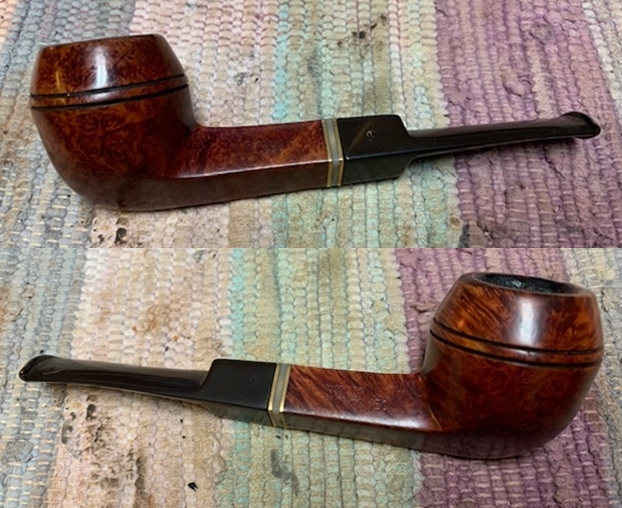
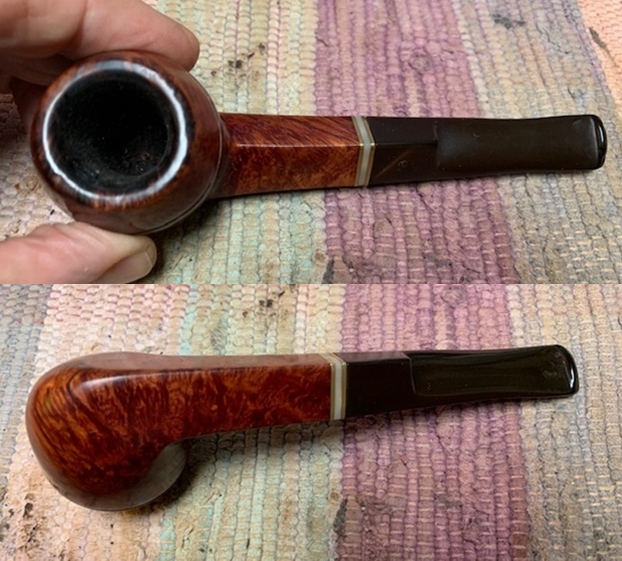
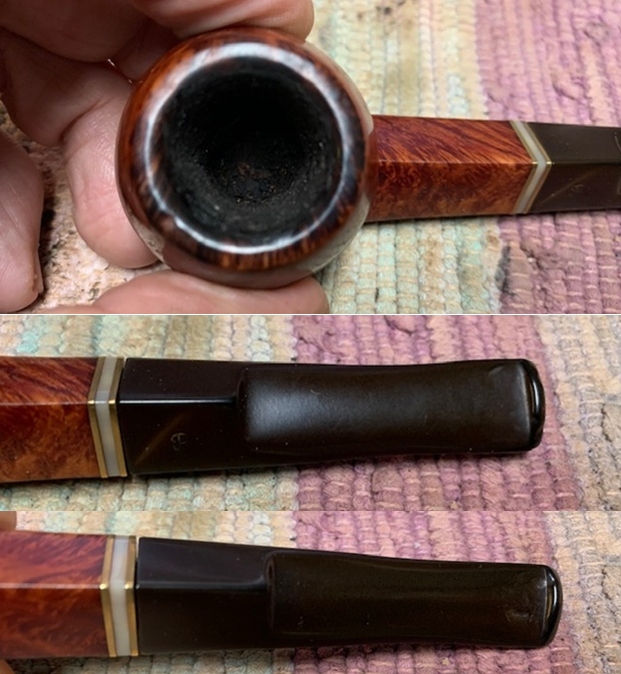
New Life for a Republic Era Peterson’s Jade 150 Bulldog


Blog by Steve Laug

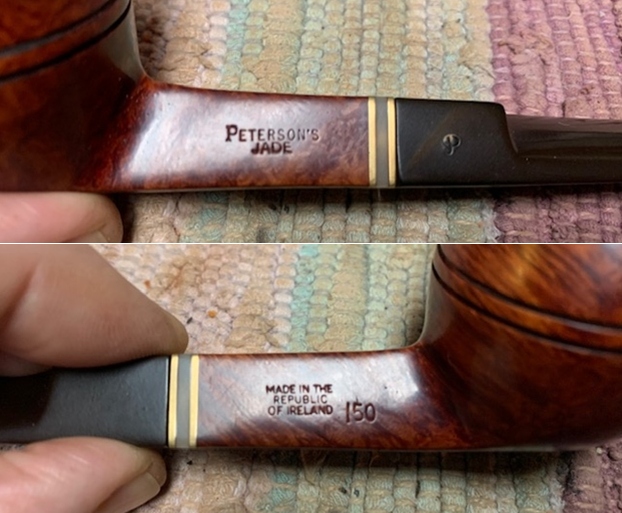
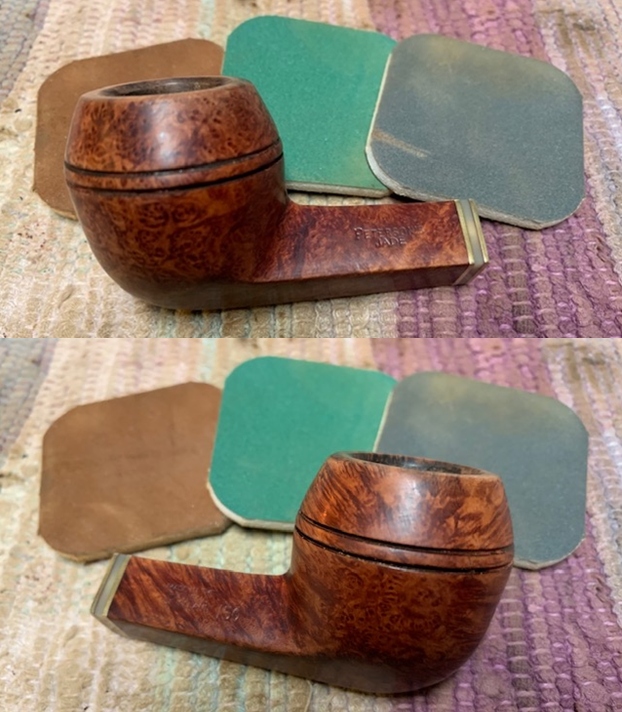
The next pipe I am working on came from a friend, Lee who lives in the US. It is a Peterson’s Straight Bulldog. It is stamped on the left side of the shank and reads Peterson’s [over] Jade. On the right side it is stamped Made in the [over] Republic [over] of Ireland followed by the shape number 150. He sent me an email detailing what he saw in the pipe and gave his assessment as well as several pictures of the pipe. He wrote:

The Peterson Bulldog is hardly in horrible shape, but would like you to go at this thing to bring to ‘showcase’ quality if possible. Of course, you’ll have to see the pipe first before expectations are set. He had picked it up on eBay. Would like you to take this to the best it could be – will leave it to you to assess, but will mention that the ‘jewel’ fastening between bowl and stem fascinates me as something for differentiate the pipe from the rest of my collection. Whatever you can do…

Here are the photos he included. The pipe arrived and I went over it to see what I thought of it before I started my work on it. Here is what I sent to Lee.

Peterson’s Republic Era Jade Bulldog.

  1. Bowl exterior is dirty with a few dings and dents in the ring and on the sharp diamond edges of the shank… particularly on the sides.
  2. Rim top is a bit of a mess. There are a lot of nicks and dings in the briar, some darkening and lava on the inner beveled edge of the bowl. The inner edge looks ok under the lava as far as I can see. Outer edge has some nicks and dings. Worn spots.
  3. Bowl internals show a heavy cake that greatly reduces the bowl capacity. Needs to be reamed and cleaned. Strong Latakia smell.
  4. Stem is scratched and lightly oxidized. There are deep tooth marks on both sides and a lot of tooth chatter marking the stem surface ahead of the button.

Overall in moderately good condition

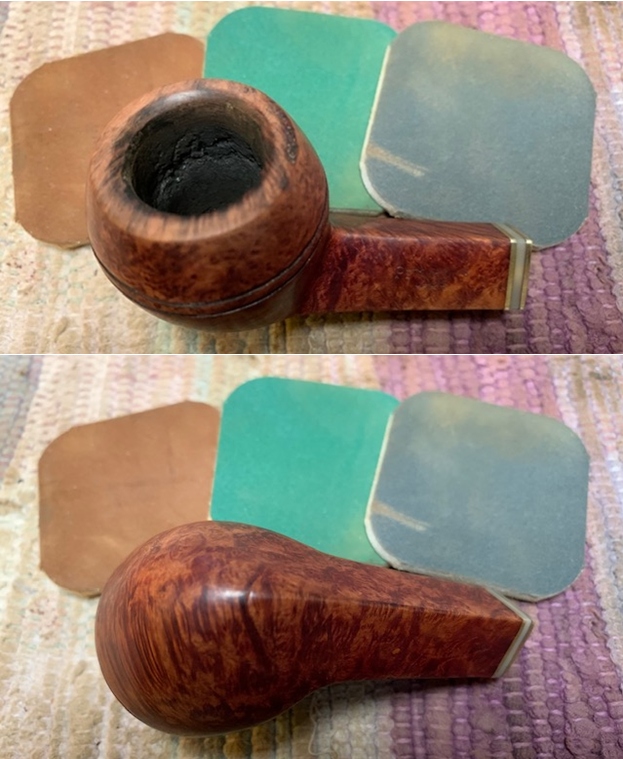
I took photos of the pipe before I started my cleanup work. They tell the story of what I have noted above in short form. They also give a glimpse of the promise that Lee saw in this pipe.  I took photos of the rim top and stem to show the condition of the bowl and stem. The interior the bowl had a heavy cake that overflowed like lava onto the rim top. There are dings and dents in the rim top and some darkening on the inner edge. The stem is oxidized, calcified and has deep tooth marks and chatter on the top and underside near the button.  The stylized P stamp on the top left side of the saddle is faded but present. I took photos of the sides of the shank to show the stamping. The stamping is readable in the photos below and is as noted above. The decorative band on the shank end is twin brass plates separated by a pearlized acrylic.       I took the stem off the shank and took a photo. It is a nice looking pipe and the shank end decorative piece looks very good.I am including the information from Pipedia’s article on Peterson pipes. It is a great read in terms of the history of the brand (https://pipedia.org/wiki/Peterson). I have included a bit of the pertinent history here.

1950 – 1989 The Republic Era – From 1950 to the present time, the stamp for this era is “Made in the Republic of Ireland” in a block format generally in three lines but two lines have been used with or without Republic being abbreviated.

During the 1950’s and 60’s the Kapp & Peterson Company was still in the ownership of the Kapp family. However 1964 saw the retiral of the company Managing Director Frederick Henry(Harry) Kapp.

I knew that I was dealing with a Republic Era pipe made between 1950-1989. It was a nice looking straight Bulldog with a unique shank end decoration. The finish was stained with a medium brown stain. Now it was time to work on the pipe.

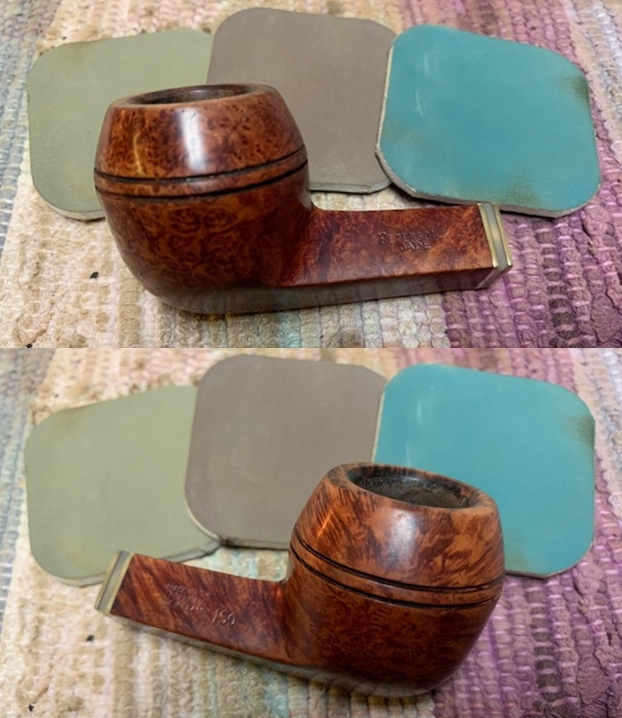
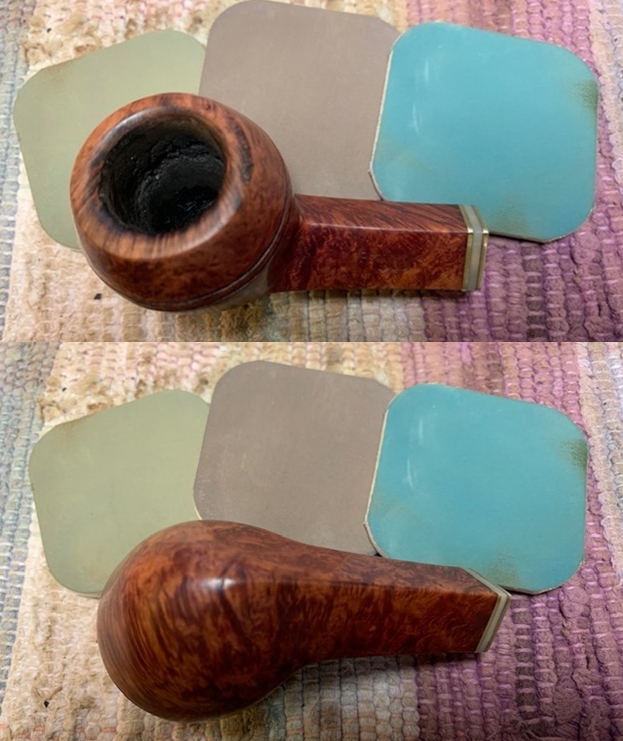
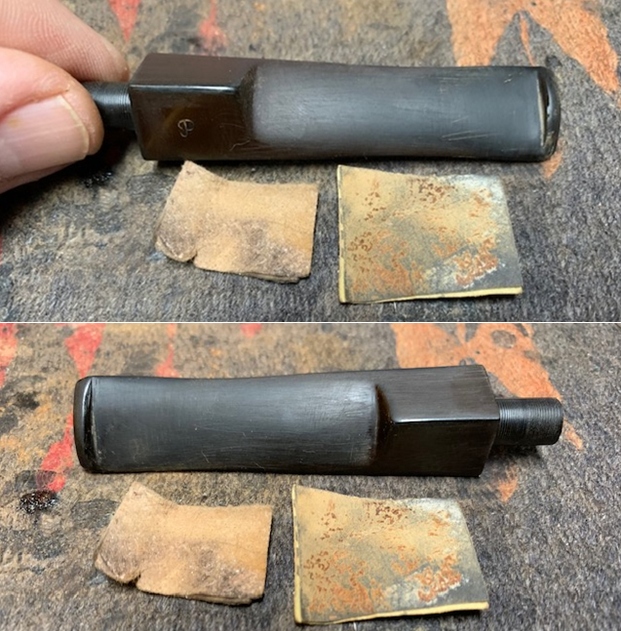
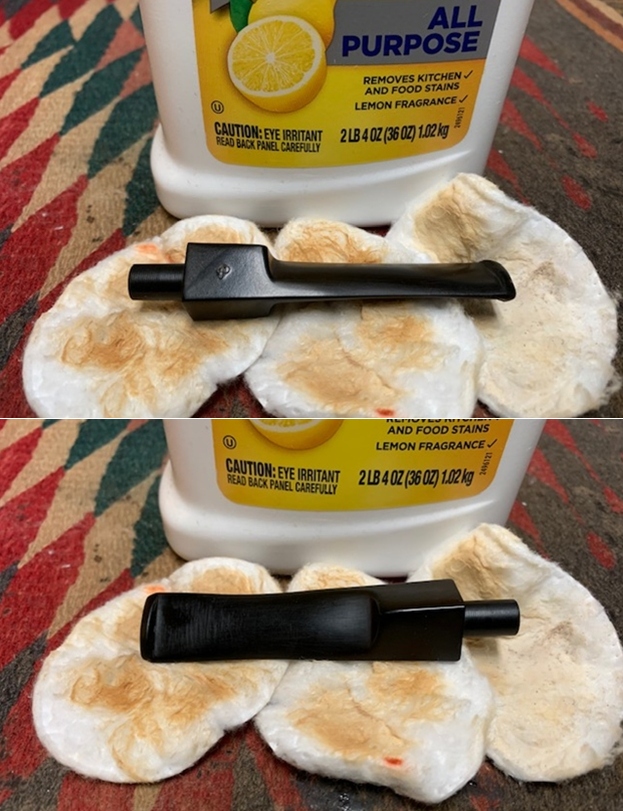
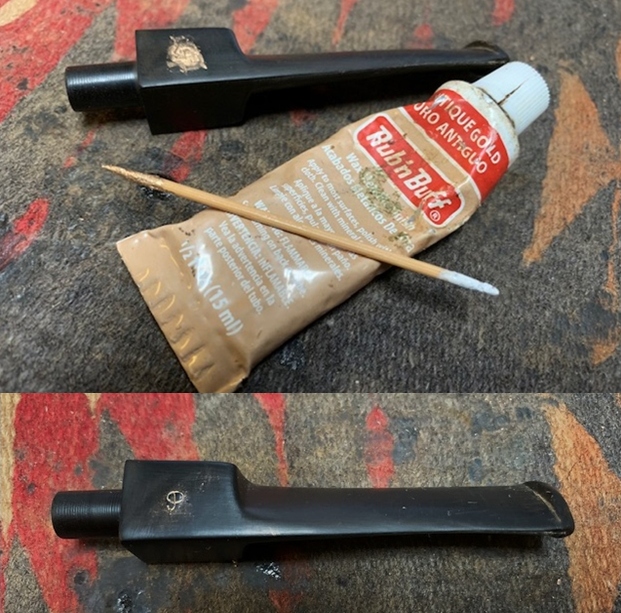
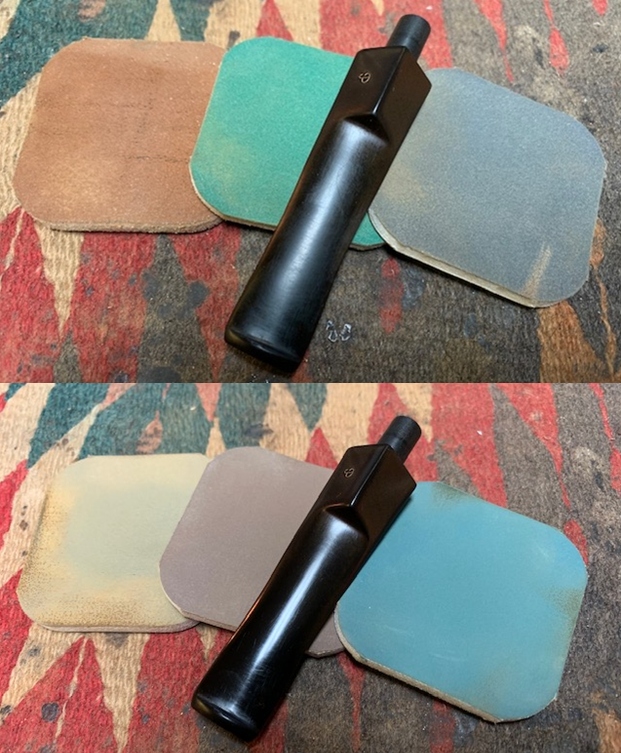
I decided to start my restoration work on this one by starting my cleanup of the bowl. I reamed the thick cake back with a PipNet pipe reamer using the smallest cutting head on this petite pipe. The cake was thick and crumbly and came out easily. I followed that by cleaning up the remnants of cake with a Savinelli Fitsall Pipe Knife and finish with a piece of dowel wrapped in 220 grit sandpaper. I decided to deal with the damaged rim top next. I lightly topped the bowl to remove the significant dents and damage to the top and outer edge. It did not take too much work to remove it. I used a folded piece of 220 grit sandpaper to smooth out the bevel on the inner edge of the bowl and remove the burn damage there. It came out looking much better. Once it is polished it will look very good and match the finish on the bowl quite well.I wiped off the exterior of the bowl with a damp cloth to remove the sanding dust and grime. Once it was clean it was time to deal with the interior. I scrubbed out the shank and the airway in the stem with pipe cleaners, cotton swabs and alcohol to remove the tars and oils. There was also some brown stain that came out of the inside of the shank  and the end of the stem.  I polished the rim top and bowl with micromesh sanding pads – wet sanding with 1500-12000 grit pads. I wiped the briar down after each pad with a damp cloth. The photos tell the story of the progress of the rim and bowl.   I worked some Before & After Restoration Balm into the surface of the briar with my fingertips and a horsehair shoe brush to clean, enliven and protect the briar. I let the balm sit for about 15-20 minutes and then buffed it with a cotton cloth to raise the shine. The photos show the bowl at this point in the restoration process. With that done the bowl was finished other than a final buffing.  I set it aside and turned my attention to the stem. I “painted” the surface of the stem to lift the tooth marks and dents I was able to lift many of them but several remained on the top and underside near the button. I filled them in with black superglue and set them aside to cure. Once they had cured I smoothed them out with a file to start to blend them into the surface of the stem. I sanded the repaired areas with 220 grit sandpaper to smooth out the repairs. I started the polishing with 400 grit wet dry sandpaper.   I scrubbed the surface of the stem to remove the remaining oxidation with Soft Scrub all Purpose cleanser. I rubbed it on and off with a cotton pad and was able to remove a lot of oxidation.    I touched up the P stamp on the left side of the saddle with Rub’n Buff Antique Gold. I applied it to the stamping with a tooth pick. I buffed it off with a paper towel and was pleased by the gold left behind in the stamp.  I polished the stem with micromesh sanding pads – wet sanding with 1500-12000 grit sanding pads. I wiped it down after each sanding pad with Obsidian Oil. I polished it with Before & After Pipe Stem Polish – both Fine and Extra Fine.     I am excited to finish this Republic Era Peterson’s Jade 150 Bulldog. I put the pipe back together and buffed it with Blue Diamond on the buffing wheel. I gave the bowl and the stem multiple coats of carnauba wax. I buffed it with a clean buffing pad to raise the shine and followed that with a quick hand buff with a microfibre cloth to deepen the shine. It is fun to see what the polished bowl looks like with the polished shank decoration on the end and the black vulcanite stem is a great contrast of colour. This Peterson’s Jade Bulldog is a great looking pipe and it feels great in my hand. It is light and well balanced. Have a look at it with the photos below. The dimensions are Length: 5 ¾ inches, Height: 1 ¾ inches, Outside diameter of the bowl: 1 ¼ inches, Chamber diameter: ¾ of an inch. It is a beautiful pipe. Thanks for walking through the restoration with me as I worked over this pipe. I am looking forward to seeing what my friend Lee thinks of the pipe after the restoration. One more of his to restore then I will mail them back to them. Thanks to each of you who are reading this blog. Remember we are not pipe owners; we are pipemen and women who hold our pipes in trust until they pass on into the trust of the next pipeman or woman.

An Easy Refurbishing of a Charatan’s Make “Belvedere” # 2655 From Mumbai Bonanza Lot


Blog by Paresh

I was fortunate enough to have heeded the advice of my dear friend and mentor, Steve, and struck a deal with a junk collector from Mumbai for a pile of pipes that he had acquired. He did not know what he was selling and I did not know what quality and condition of pipes I was buying from him as we reside in different cities!! The argument that Mr. Steve presented was that if not anything, I shall at least have some spares and this was logical. I struck a deal and here are pictures of the pipes that I received in this lot. This lot contains some very nice collectible pipes, a few well known brands and some mediocre brands. Overall, with seven Dunhill pipes, a Preben Holm #1 FH, a couple of “Made in England” Pete System pipes, a couple of  Charatan’s Make “Belvedere”, Custom-Bilt, Stanwell and other assorted pipes, I would say that I had struck a decent haul!!! This is indeed my “Mumbai Bonanza”.
I had recently completed the refurbishing of a Peterson’s System 3 # 367 that had the “Made in England” COM stamp from my Mumbai Bonanza. Here is the link to this 19th pipe from this lot.

https://rebornpipes.com/2020/08/26/restoring-a-made-in-england-petersons-system-3-367-from-mumbai-bonanza-lot/

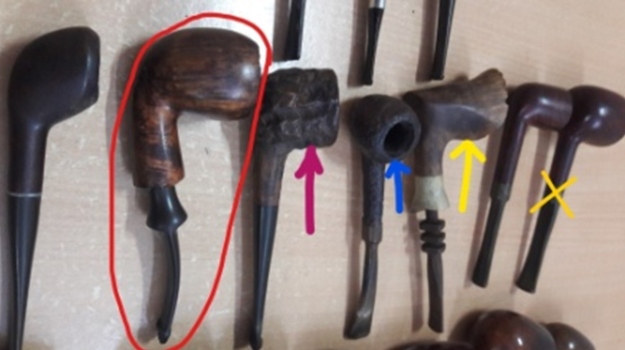
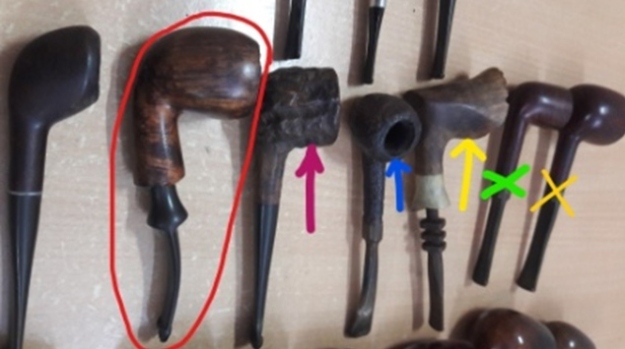
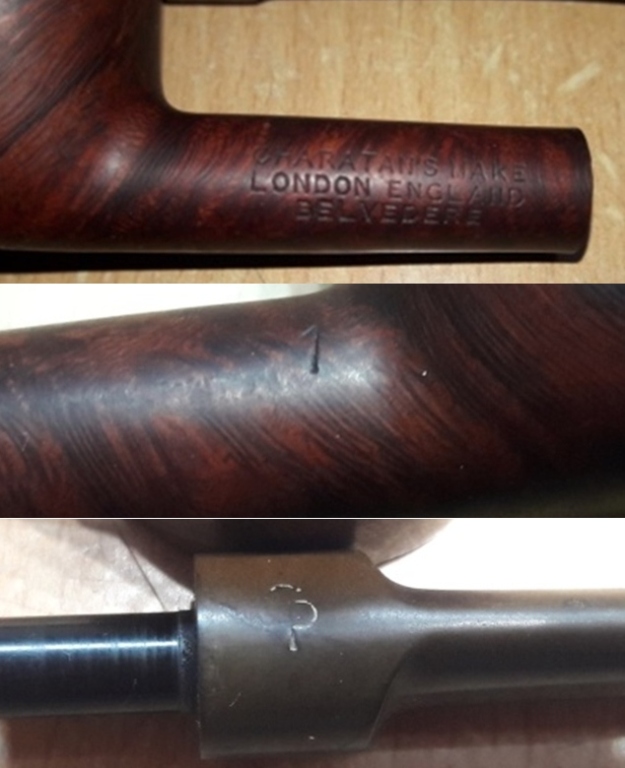
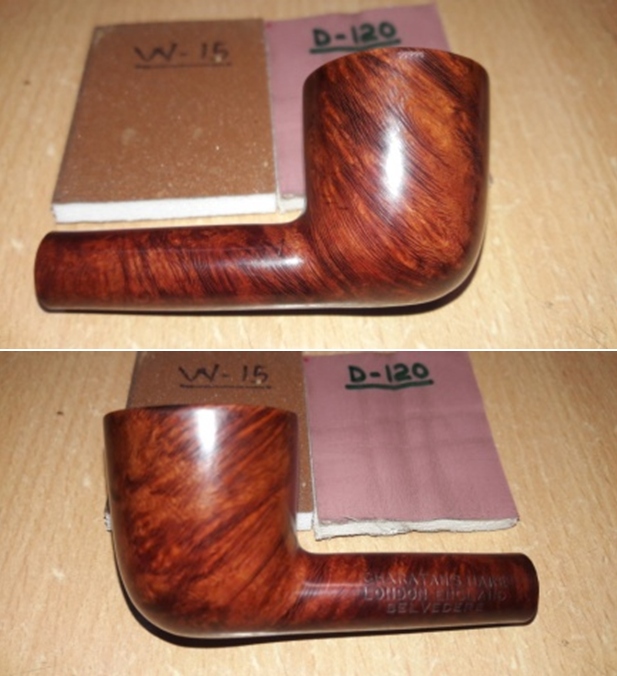
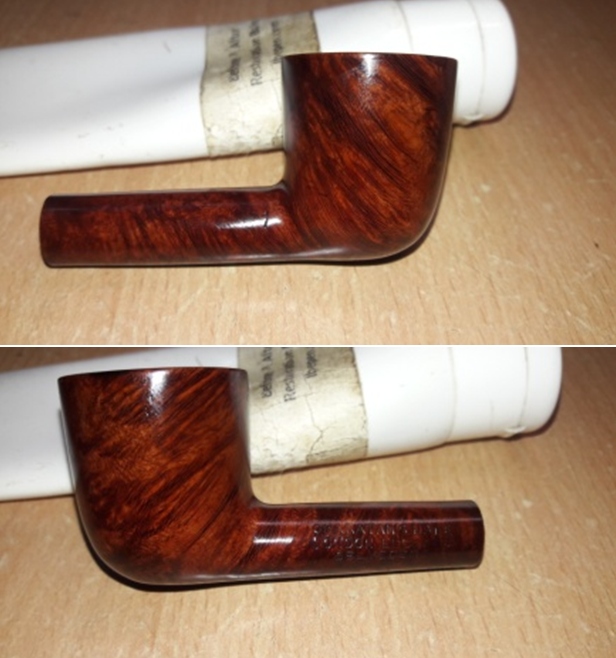
The 20th pipe that I decided to work on from this find is a thick walled CHARATAN’S MAKE “BELVEDERE” # 2655X Pot shaped pipe and is indicated by a gold cross.This pipe is stamped on the left of the shank towards the shank end as “CHARATAN’S MAKE” over “LONDON ENGLAND” over “BELVEDERE”, all in block capital letters. The right side of the shank surface bears the shape number “2655 X”. The high quality vulcanite saddle stem bears the trademark logo “CP” with the lower part of the C penetrating the P. All the stampings are crisp and easily readable save for the stem logo which is faint and the worn out.   In my earlier restoration of my inherited CHARATAN’S pipes, I had extensively researched the dating of these old pipes and I can say with certainty that this pipe is from the period post 1960s. However, to document and establish credibility to my understanding and also to refresh my memory of the brand, I visited pipedia.org. Here is the link for the readers interested in history of Charatan’s and also in viewing a 1951 catalog;

https://pipedia.org/wiki/Charatan

“In 1863 Frederick Charatan, a Russian / Jewish immigrant, opened a shop in Mansell Street, located in the borough of Tower Hamlets, London E1, where he began to carve Meerschaum pipes.

Charatan was the first brand to make entirely hand-made briars from the rough block to the finished pipe including the stems. The nomenclature “Charatan’s make” refers to this method of production and was meant to differ Charatan from other brands who “assembled” pipes from pre-drilled bowls and delivered mouthpieces.

Charatan used 4 basic grades prior to 1950: Supreme, Selected, Executive, and Belvedere. After 1950 Herman Lane’s influence began, and the grades started to expand. In 1955 Lane took over sole distributorship of Charatan in the US. In 1957 he introduced the Supreme S. Most of his other introductions were from the 60’s and early 70’s…

Here is another link from the same page which takes the readers to an absolutely well researched page on Dating of Charatan’s;

https://pipedia.org/wiki/Dating_of_Charatans

I have reproduced the relevant portions which had helped me in dating this pipe.

The first step on dating a Charatan is to carefully look to some details:

a) Shape of the mouthpiece

b) Marking on the mouthpiece

c) Engraving on the shank

d) Shape and position of shank engraving/writing

This is because you can make the following conclusions:

a) From 1863 to 1960 the mouthpieces have a normal shape, saddle or tapered. From 1961 they use the ‘Double Comfort’ style still used today. By the way there are some saddle bits (without the double comfort) used in pipes that date after 1960 but these models are always characterized by an X (in the place of the DC) engraved after the shape number on the shank. This means that if a pipe has a tapered mouthpiece instead of a double comfort one, it is definitely a pre-Lane pipe before 1960. While if a pipe has a normal saddle bit stem, it could belong to every era. Nevertheless the pipe is pre 1961 if the shape code does not include an X, and is a pipe from after 1960 if the X is engraved.
Finally any pipe with the double comfort stem is definitely after 1960.

b) The CP logo on the stem is stamped in a different shape according the era it was used. Some differences are less obvious than others, however the glaring differences are detectable in 4 phases. The CP till the 1960 is very fine, the C penetrates the P.

Identification of a third era pipe (First Lane era, 1961-1965)

Pipes of this period are quite common.

1) The mouthpiece is frequently double comfort, rarely saddle without the double comfort, never tapered. If the stem is not a double comfort but a saddle one, it is characterized by the letter X on the right of the shape code (e.g. 2502X), naturally in this case the letters DC are not displayed.

2) In the CP logo, the C enters the P

3) Presence of £ on the shank (note that from 1955 all the pipe imported in the USA by Lane has it, however that stamping is not synonymous of the Lane era)

4)Presence of the letter DC just after the shape number (e.g. 2502 DC) or of the letter X only if the stem is not a double comfort one

5) Presence in some models of the stamp “MADE BY HAND” on the shank (introduced for the first time in 1958)

6) Presence of the writing “CHARATAN’S MAKE LONDON ENGLAND” on 2 lines

7) The CP logo is thicker then in previous eras

Identification of a fourth era pipe (Second Lane era, 1965-76)

Pipes belonging to this period are quite common. Their characteristics are close to the one of the previous era, the distinctive element is that the writing on the shank changes from 2 to 3 lines.

I visited Reborn Pipes for more information and there is a very informative article that Steve had re-blogged on Charatan’s Models & Shape Information for the Collector. Here is the link for this article;

https://rebornpipes.com/2018/08/22/charatan-models-shape-information-for-the-collector/

I earnestly urge all the readers to go through this article on rebornpipes.

Thus I can conclusively say that the Charatan’s Make “BELVEDERE” pipe on my work table is from the First Lane Era and dates from the period 1961- 1965.

INITIAL VISUAL INSPECTION
The Charatan’s pipe that is currently on my work table has a classic Pot shape with thick walls. It has a chamber depth of about 1 inch, bowl height of about 1.4 inches, chamber inner diameter of 1 inch and overall pipe length of approximately 5.5 inches. The stummel has rich dark and medium contrasting reddish brown stains and is covered in dirt and grime through which beautiful straight grains can be seen around the sides, front, back and over the shank surface while Bird’s eye adorns the rim top and the foot of the stummel. There is a thin layer of cake in the chamber with lava overflow over the rim top surface. The inner rim edge has few dents and dings and a suspected char in 8 o’clock direction. The chamber appears out of round due to the inner rim edge damage. The vulcanite saddle stem is heavily oxidized with no damage to the bite zone on either surface. The buttons on both surfaces are in pristine condition. The following pictures will give the Readers an idea of the overall condition of the pipe as it sits on my work table. Overall, the thin layer of cake and excellent condition of the stem are pointers to the fact that the pipe seems to be well looked after. It should be an easy restoration project, unless some gremlins pop up during the process. DETAILED VISUAL INSPECTION
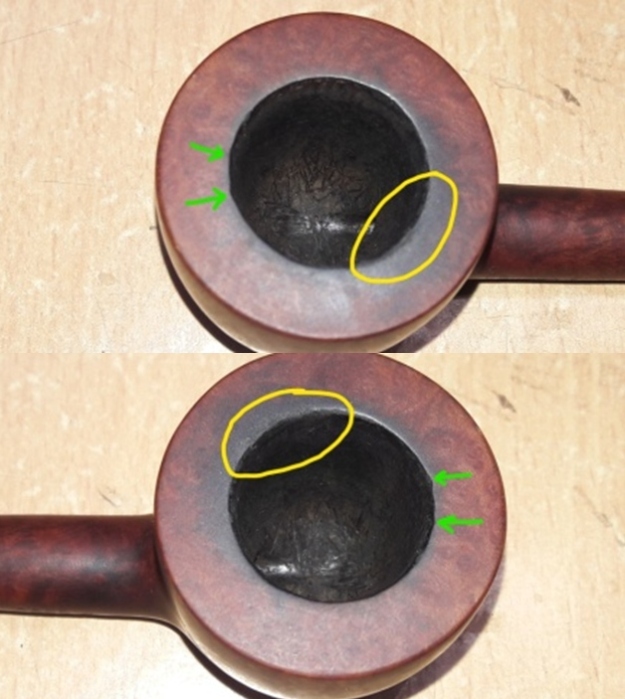
A thin and even layer of cake is seen in the chamber. The rim top surface is covered in overflow of lava, dirt, dust and grime. The condition of the inner walls of the chamber and rim top surface will be known once the cake has been taken down to bare briar and the rim top crud has been scraped off completely. The inner rim is uneven with a couple of dents (indicated with green arrows) and a suspected burn/ charred surface in 8 ‘O’ clock (marked in yellow circle). The bowl appears out of round. Only once the stummel has been thoroughly cleaned that I can be sure of my initial appreciation. The outer rim edge is in sans any damage. In spite of the thin cake, the chamber odor is strong and should be addressed to some extent once the cake has been taken down to the bare briar and the shank internals have been thoroughly cleaned. The stummel feels solid to the touch and I do not foresee any major issues with the condition of the chamber walls. The pristine condition of the rim top means that no topping is necessary. A thin delicate bevel to the inner edge should be sufficient to address the damage and get the bowl in perfect round. To be honest with you, this being a Belvedere pipe and the lowest grade in the Charatan’s line up, I had expected to find a few fills and some non-descript grain on the stummel briar. However, I was surprised to note that there is not a single fill in the stummel surface and the surface boasts of some beautiful straight grains around the sides, front, back and over the shank surface while loosely packed Bird’s eye adorns the foot of the stummel. The stummel surface is covered in dirt and grime giving the stummel a dull and dirty appearance. The stummel surface shows a few dents and dings. It does have a quality which is seen on vintage pipes, but difficult to explain in words. And not to forget, this is nearly 50 plus year old pipe!! The mortise shows accumulation of old oils and tars which would need to be cleaned. The dents and dings to the stummel surface is one issue that I am not sure about dealing with since I absolutely love the old dark reddish brown color and the patina that has developed over time that needs to be preserved. A nice polish with micromesh grit pads will bring a nice shine to the stummel and highlight the grain. The vulcanite saddle stem is heavily oxidized, but otherwise in a decent condition. The bite zone on either surface shows some minor tooth indentations with a small amount of calcification at the base of the button edge. The horizontal slot and tenon opening shows accumulation of dried oils and tars. All in all, the stem presents no major damage and should be an easy clean up.THE PROCESS
I started the restoration with cleaning of the stummel as I was keen to know the condition of the walls of the chamber. With my sharp fabricated knife, I removed the cake from the chamber and thereafter, using a folded piece of 180 grit sand paper, I sand out the last traces of cake and expose the walls of the chamber. I wiped the chamber with a cotton swab dipped in isopropyl alcohol to remove the carbon dust left behind by all the reaming and sanding process. Once the chamber walls were cleaned out, I was pleased to note a pristine chamber with no signs of heat fissures/ lines/ pits. With the same sharp knife, I gently scraped off the lava overflow from the rim top surface. The charred and uneven inner rim surface (encircled in red) and the dents/ dings to the rim edges (major ones indicated with blue arrows) are now clearly seen and should be easily addressed by creating a thin delicate inner edge bevel. The ghosting is still prevalent and will, in all probability, be addressed/ reduced once the shank internals are cleaned. Next, I cleaned out the internals of the shank and mortise. Using my dental tool, I scraped out all the dried oils, tars and gunk that had accumulated in the draught hole and on the walls of the mortise. The amount of crud that was scrapped out and the condition of the pipe cleaners that were used points to how dirt the shank internals were. I continued further cleaning of the mortise and the shank with shank brushes and dish washing soap. I have resorted to this process as it helps me save on to a ton of pipe cleaners as these are not available and which are very expensive for me to get here in India from US or the UK. I finished the cleaning by running a few pipe cleaners dipped in isopropyl alcohol through the mortise. I usually clean the mortise with dish soap/ shank brushes and rinsing under warm water when I clean the external stummel surface. However this time around, in order to preserve the old patina and the original stain over the stummel surface, I shall be avoiding the external cleaning of the stummel with warm water and Murphy’s Oil soap and resort to only wiping it clean with the oil soap on a cotton swab followed by a wipe with a moist soft cotton cloth. The old smells are still strong and would require more invasive methods to completely eliminate the ghosting.I continued the cleaning of the chamber and shank internals with a salt and alcohol bath. I usually use cotton balls which is an at par substitute to Kosher salt as I have realized over the years. However, this time around, I used kosher salt which had been lying around for some time now and I wanted to empty the container. I draw out a wick from the cotton and along with a folded regular pipe cleaner; insert it in to the mortise and through the draught hole in to the chamber. Thereafter, I packed the chamber with kosher salt to about quarter of an inch below the inner rim edge and filled it with isopropyl alcohol up to the brim. About half an hour later, the level of alcohol had gone down, having being absorbed by the salts. I topped it up once again with isopropyl alcohol and set it aside overnight. By next afternoon, the salt is dark colored and the kosher salt and alcohol had drawn out all the remaining oils and tars from the chamber and mortise, fulfilling its intended task. I removed the salts from the chamber and the pipe cleaner with cotton balls from the shank and ran pipe cleaners through the mortise to clean out all the loosened tars and gunk and further cleaned it by scarping the walls with a dental tool to completely remove the gunk. I blew through the draught hole to dislodge the trapped salts and wiped the bowl clean and dried the shank and bowl with paper napkins and set it aside to dry for an entire day. By next day, the pipe was nice and dry and all the smells were history.  With the stummel set aside for drying, I turned to address the stem issues. I addressed the deeper oxidation by sanding the entire stem with a folded piece of 220 grit sand paper. Once the oxidation was completely removed, I wiped the surface clean with Murphy’s oil soap on a cotton swab. I followed it up with cleaning the internals of the stem using hard and normal bristled pipe cleaners and isopropyl alcohol. The gunk that came out with the pipe cleaners tells the sordid tale of the stem condition. To save on to the requirement of number of pipe cleaners, I have resorted to cleaning the stem internals using thin shank brushes with anti-oil dish washing soap and finally rinsing the stem with warm water to clean and freshen up the stem internals. With a pointed dental tool, I scraped out the entire dried gunk from the tenon end and the horizontal slot. I rubbed a little Extra Virgin Olive oil to hydrate the stem and kept it aside. I used a tightly folded piece of 180 grit sand paper to shape and re-define the button edge on either surface. The stem at this point in restoration is shown below. Continuing with the stem refurbishing, I followed it up by further dry sanding the stem with 320, 600, 800 and wet sanding with 1000 grit sand papers to completely rid the surface of the oxidation and bring out the shine in the vulcanite. The stem should polish up nicely.  Using micromesh pads, I completed the polishing of the stem by wet sanding the stem surface with 1500 to 12000 girt pads. I gave a final rub with “Before and After Extra Fine” stem polish compound from Mark to remove fine scratches from the stem surface. I rub a little quantity of Extra Virgin Olive oil in to the stem surface and set it aside to be absorbed by the vulcanite. The stem polished up nicely and appears as good as when new.  Next, I cleaned the external surface of the stummel with Murphy’s Oil Soap on a cotton swab. As brought out earlier, in this project, I intended to preserve the patina and the original stain on the stummel and hence, the deviation from the usual process of scrubbing the surface with oil soap and dishing cleaning soap followed with rinsing under warm water. The external cleaning of the stummel has brought to the fore a few more scratches over the surface. I shall polish the stummel by dry sanding with micromesh pads to bring a nice shine to the stummel and highlighting the grains. Now that the rim top surface is clean and free of the entire lava overflow, the extent of the charring and dents and dings to the inner rim edge is fairly apparent. I addressed the out of round inner edge and the slight charring to the inner rim edge in 8 o’clock direction by creating a thin delicate bevel to inner edge with a folded piece of 220 grit sand paper pinched between my thumb and index finger. I addressed the issue of darkened rim surface by lightly sanding the rim top and polished the freshly created inner rim edge bevel with a piece of 600 grit sandpaper. I agree with the Readers who have observed that the issues of scratches/ dings/ dents to the stummel have not been addressed. However, I am ready to accept minor blemishes if I am able to preserve the old acquired patina of the briar. I am very happy at the way the chamber and rim top surface appears at this in restoration.I subjected the stummel to a complete cycle of micromesh polish, dry sanding with 1500 to 12000 grit pads. I paid greater attention to polish the rim top surface and the bevel created on the inner rim edge. I wiped the stummel with a moist cloth after every grit pad to remove the sanding dust left behind by the pads. This also helps in monitoring the progress being made and provides an opportunity to take early corrective action, if required. I am happy with the progress being made till now. The briar has taken on a nice deep shine with the original reddish brown of the stummel and the darker brown stains to the grains contrasting beautifully. I really like the dark reddish brown coloration and the patina that is seen over the stummel surface. Next, I rub a small quantity of “Before and After Restoration Balm” in to the briar with my finger tips and worked it deep in to the surface and let it rest for a few minutes. The balm almost immediately works its magic and the briar now has a nice vibrant appearance with the beautiful straight and Bird’s eye grain patterns on full display. The contrast of the dark browns of the grain with the light reddish brown hues of the rest of the stummel adds an interesting dimension to the appearance of the stummel. I further buffed it with a horse hair brush to further deepen the shine.   To refresh the stem logo, I coat the stem logo with white correction ink and let it dry out completely while I polished the pipe with Blue Diamond. Once the ink had dried out, with a toothpick, I gently removed the excess ink from the surrounding surface. Though the logo is not very crisp, this is the best that was possible given how worn out the stamping was to start with.To put the finishing touches, I mount a cotton cloth buffing wheel on to my hand held rotary tool and polished the stummel and stem with Blue Diamond compound. This compound helps to remove the minor scratch marks that remain from the sanding.   Next, I mount another cotton buffing wheel that I have earmarked for carnauba wax and applied several coats of the wax. I mount a clean cotton cloth buffing wheel and give the entire pipe a once over buff. I finished the restoration by giving the entire pipe a rigorous hand buffing using a microfiber cloth to raise the shine further. The finished pipe with the aged patina to the briar looks amazingly beautiful and is now ready for its long second innings with me. P.S. I had attempted to preserve the aged patina which had developed over the stummel surface with passage of time. I did accept the minor dents and scratches that were seen over the stummel surface and let them be. It would a good to know your approach in this project and the methods that you resort to while maintaining the patina over the stummel surface.

Praying for the health and safety of all the readers and their loved ones in these troubled times…


Refurbishing The Second Charatan’s Make “Belvedere” # 1 From Mumbai Bonanza Lot


Blog by Paresh

I was fortunate enough to have heeded the advice of my dear friend and mentor, Steve, and struck a deal with a junk collector from Mumbai for a pile of pipes that he had acquired. He did not know what he was selling and I did not know what quality and condition of pipes I was buying from him as we reside in different cities!! The argument that Mr. Steve presented was that if not anything, I shall at least have some spares and this was logical. I struck a deal and here are pictures of the pipes that I received in this lot.This lot contains some very nice collectible pipes, a few well known brands and some mediocre brands. Overall, with seven Dunhill pipes, a Preben Holm #1 FH, a couple of “Made in England” Pete System pipes, a couple of  Charatan’s Make “Belvedere”, Custom-Bilt, Stanwell and other assorted pipes, I would say that I had struck a decent haul!!! This is indeed my “Mumbai Bonanza”.

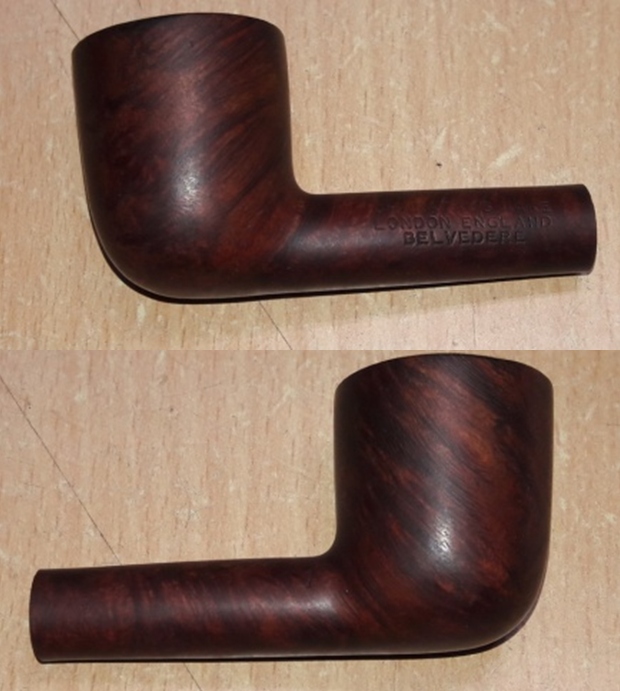
The 21th pipe that I decided to work on from this find is a beautiful small sized petite Dublin shaped CHARATAN’S MAKE “BELVEDERE” # 1 pipe and is indicated by a green cross.This pipe is stamped on the left of the shank towards the shank end as “CHARATAN’S MAKE” over “LONDON ENGLAND” over “BELVEDERE”, all in block capital letters. The right side of the shank surface bears the shape number “1”. The high quality vulcanite saddle stem bears the trademark logo “CP” with the lower part of the C penetrating the P. All the stampings are crisp and easily readable save for the stem logo which is faint and the worn out. In my earlier restorations of CHARATAN’S pipes, I had extensively researched the dating of these old pipes and I can say with certainty that this pipe is from the period post 1960s. However, to document and establish credibility to my understanding and also to refresh my memory of the brand, I visited pipedia.org. Here is the link for the readers interested in history of Charatan’s and also in viewing a 1951 catalog;
https://pipedia.org/wiki/Charatan

“In 1863 Frederick Charatan, a Russian / Jewish immigrant, opened a shop in Mansell Street, located in the borough of Tower Hamlets, London E1, where he began to carve Meerschaum pipes.

Charatan was the first brand to make entirely hand-made briars from the rough block to the finished pipe including the stems. The nomenclature “Charatan’s make” refers to this method of production and was meant to differ Charatan from other brands who “assembled” pipes from pre-drilled bowls and delivered mouthpieces.

Charatan used 4 basic grades prior to 1950: Supreme, Selected, Executive, and Belvedere. After 1950 Herman Lane’s influence began, and the grades started to expand. In 1955 Lane took over sole distributorship of Charatan in the US. In 1957 he introduced the Supreme S. Most of his other introductions were from the 60’s and early 70’s…

Here is another link from the same page which takes the readers to an absolutely well researched page on Dating of Charatan’s;

https://pipedia.org/wiki/Dating_of_Charatans

I have reproduced the relevant portions which had helped me in dating this pipe.

The first step on dating a Charatan is to carefully look to some details:

  1. a) Shape of the mouthpiece
  2. b) Marking on the mouthpiece
  3. c) Engraving on the shank
  4. d) Shape and position of shank engraving/writing

This is because you can make the following conclusions:

a) From 1863 to 1960 the mouthpieces have a normal shape, saddle or tapered. From 1961 they use the ‘Double Comfort’ style still used today. By the way there are some saddle bits (without the double comfort) used in pipes that date after 1960 but these models are always characterized by an X (in the place of the DC) engraved after the shape number on the shank. This means that if a pipe has a tapered mouthpiece instead of a double comfort one, it is definitely a pre-Lane pipe before 1960. While if a pipe has a normal saddle bit stem, it could belong to every era. Nevertheless the pipe is pre 1961 if the shape code does not include an X, and is a pipe from after 1960 if the X is engraved. Finally any pipe with the double comfort stem is definitely after 1960.

b) The CP logo on the stem is stamped in a different shape according the era it was used. Some differences are less obvious than others; however the glaring differences are detectable in 4 phases. The CP till the 1960 is very fine, the C penetrates the P.

Identification of a first era pipe (Frederick’s era, 1863-1910)

I immediately point out that pipes of this era are very rare and it is very unlikely to come across a pipe from this time.

Moreover these pipes are indiscernible from those of the second era, the only clue is that pipes of this era are, in 99% of the cases, are quite small in size.

1) Pipes are no larger than a Dunhill group 1 or max group 2

2) Saddle or tapered mouthpiece

3) No double comfort stems

4) The CP logo is engraved so that the C enters the P (not always present)

5) Absence of £ on the pipe shank

6) Absence of the letter X on the pipe shape code engraved on the shank (for ex. 2502 and not 2502X)

7) Absence of letters DC after the shape number (for ex. 2502 and not 2505DC)

8) Absence of the engraving “MADE BY HAND” on the shank

9) Presence of the writing “CHARATAN’S MAKE LONDON ENGLAND” on 2 lines

10) The CP logo is finer than in following eras

11) The stems are usually made by different material than ebonite (mostly amber, if they have not been replaced)

Identification of a second era pipe (Rueben’s era, 1910-1960)

Pipes belonging to this period are rare; however is it possible to come across one. They can be distinguished from a pipe of the first era mainly because their larger size.

Their characteristics are similar to the ones of the previous era.

1) Pipes can be larger, up to the dimension of a Dunhill group 5

2) The mouthpiece is tapered or saddle.

3) No double comfort

4) The CP logo is engraved so that the C enters the P

5) Absence of £ on the pipe shank (note that from 1955 all the pipe imported in the USA by Lane has it, however that stamping is not synonymous of the Lane era).

6) Absence of the letter X on the shape code engraved on the shank (for ex. 2502 and not 2502X)

7) Absence of letters DC after the shape number (for ex. 2502 and not 2505DC)

8) Absence of the engraving “MADE BY HAND” on the shank (introduced for the first time in 1958)

9) Presence of the writing “CHARATAN’S MAKE LONDON ENGLAND” on 2 lines

10) The CP logo is finer than in following eras

I visited rebornpipes for more information and there is a very informative article that Steve had re-blogged on Charatan’s Models & Shape Information for the Collector. Here is the link for this article;

https://rebornpipes.com/2018/08/22/charatan-models-shape-information-for-the-collector/

I earnestly urge all the readers to go through this article on Reborn pipes.

Thus I can say that the small petite Charatan’s Make “BELVEDERE” pipe on my work table is, in all probability, from the Rueben’s Era and dates from the period 1910- 1960. Here is a picture of the two Charatan’s Belvedere, # 2655 X that I had restored earlier and # 1 currently on my work table, for size comparison. This would give the readers an idea why my heart skipped a beat when I read that the “Frederick’s era, 1863-1910” pipes are no larger than a Dunhill group 1 or max group 2!! Initial Visual Inspection
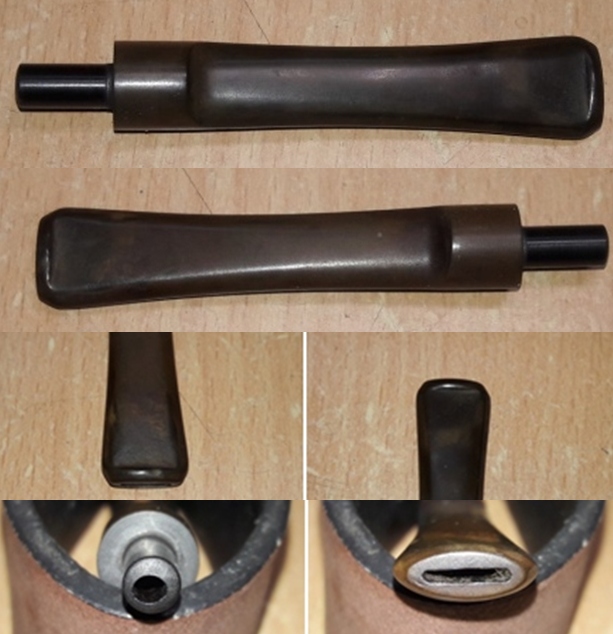
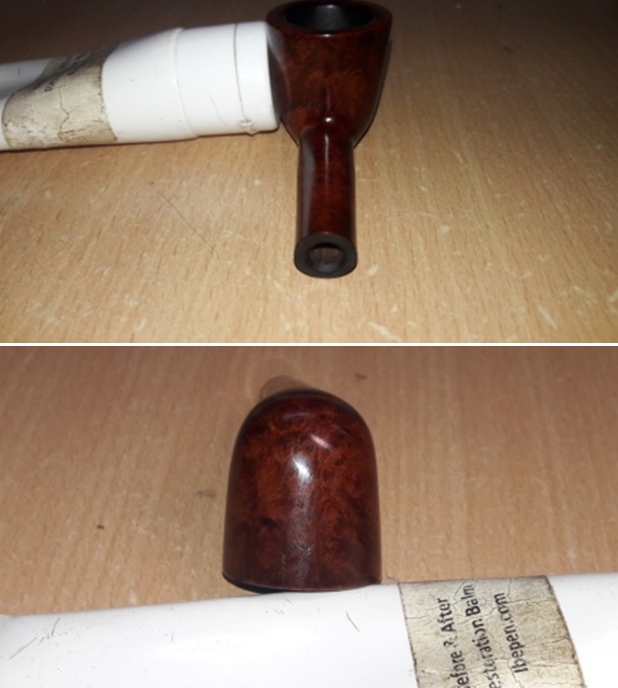
The Charatan’s pipe that is currently on my work table is a small petite pipe with a classic Dublin shape. It has a chamber depth of about 7/8 inch, bowl height of about 1 inch, chamber inner diameter of slightly less than 1 inch and overall pipe length of 5 inches. The stummel has rich dark and medium contrasting reddish brown stains and is covered in dirt and grime through which beautiful cross grains can be seen around the sides and over the shank surface while Bird’s eye adorns the front and back of the stummel. There is a very thin layer of cake in the chamber. The rim top is very clean and appears to have been scraped and is uneven. The inner rim edge has few dents and dings and the chamber is out of round due to the inner rim edge damage. The vulcanite saddle stem is heavily oxidized with no damage to the bite zone on either surface. The buttons on both surfaces are in pristine condition. The following pictures will give the Readers an idea of the overall condition of the pipe as it sits on my work table. The condition of the pipe gives me the impression that the pipe has been worked on earlier to address the damage to the rim top; however, the job is amateurish at the best. Overall, the thin layer of cake, clean rim top and excellent condition of the stem are pointers to the fact that the pipe seems to be well looked after. Detailed Visual Inspection
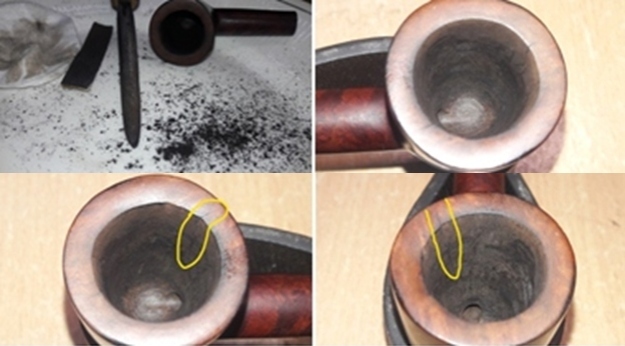
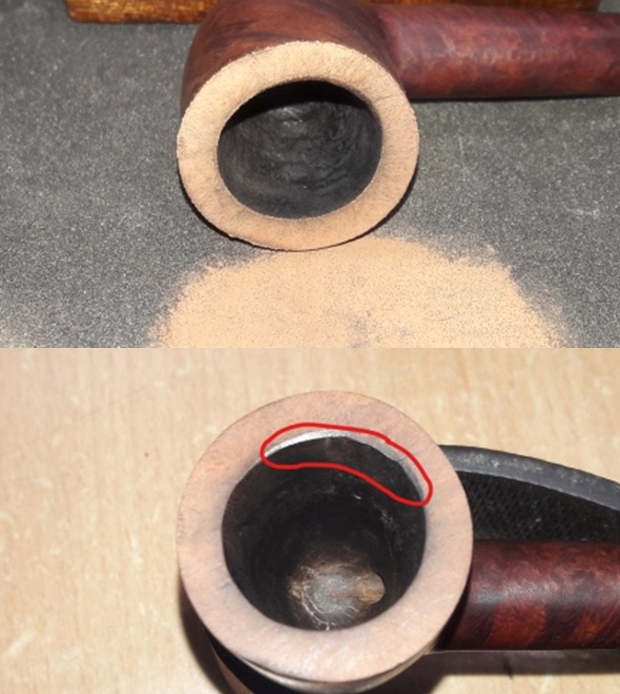
The pipe appears to have been smoked just two to three times after the chamber had been completely reamed and cleaned down to the bare briar sometime in the past. There is a just a sprinkling of carbon layer over the walls of the chamber. The inner walls of the chamber are in pristine condition with no signs of heat lines/ fissures. The rim top is clean and appears to have been unevenly scraped to remove the lava overflow resulting in an undulating rim top surface. Two prominent cracks are seen over the rim top surface; the larger crack in the 4 ‘O’ clock direction extends from the inner to the outer edge while the smaller crack in 11 ‘O’ clock direction extends about half way across the rim surface from the inner edge. These cracks are encircled in red. The inner rim edge appears to have been scraped with a pocket knife to remove any charring that would have been present in the past and is uneven with a couple of dents (indicated with green arrows) making the bowl appear out of round. The outer rim edge is scorched in three places; 10 ‘O’ clock, 3 ‘O’ clock and 7 ‘O’ clock directions (encircled in yellow). In spite of the thin cake, the chamber odor is strong and should be addressed to some extent once the cake has been taken down to the bare briar and the shank internals have been thoroughly cleaned. The undulating and cracks on the rim top surface, and the out of round chamber are the major issues that would need to be dealt with.  I was surprised to note that, in spite of being the lowest grade in Charatan’s line up, there is not a single fill in the stummel surface and the surface boasts of some beautiful cross grain around the sides and over the shank surface while Bird’s eye adorns the front and back of the stummel. The stummel surface is covered in dirt and grime giving the stummel a lifeless, dull and dirty appearance. The mortise shows accumulation of old oils and tars which would need to be cleaned. I absolutely love the old dark reddish brown color and the patina that has developed over time that I intend to preserve during the restoration. A nice polish with micromesh grit pads will bring a nice shine to the stummel and highlight the grains.   The vulcanite saddle stem is heavily oxidized, but otherwise in a decent condition. The bite zone and the button edge on either surface show some minor tooth indentations. The horizontal slot and tenon opening shows accumulation of dried oils and tars. All in all, the stem presents no major damage and should be an easy clean up. The Process
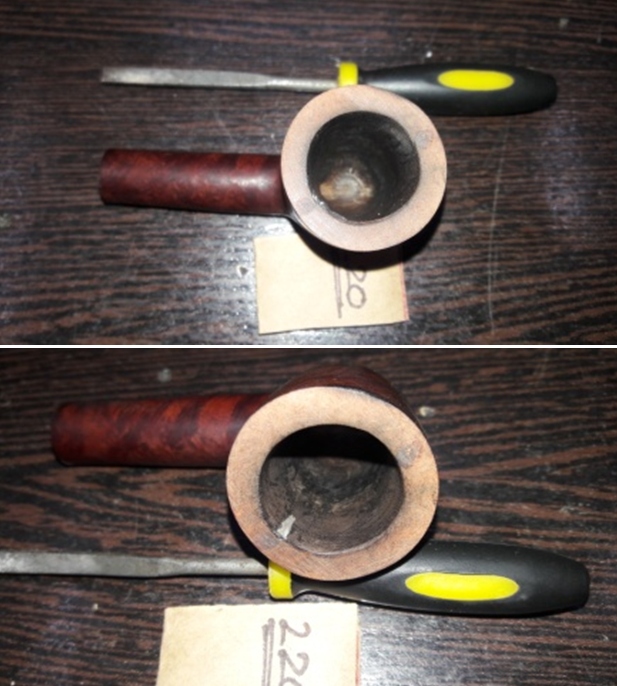
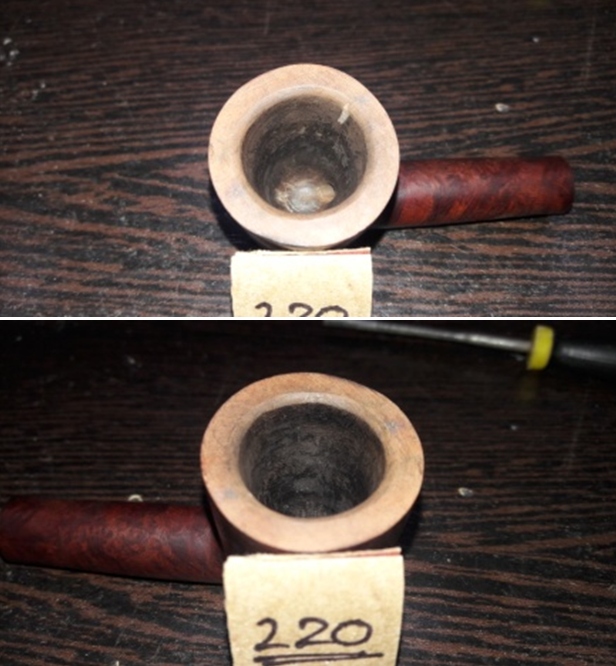
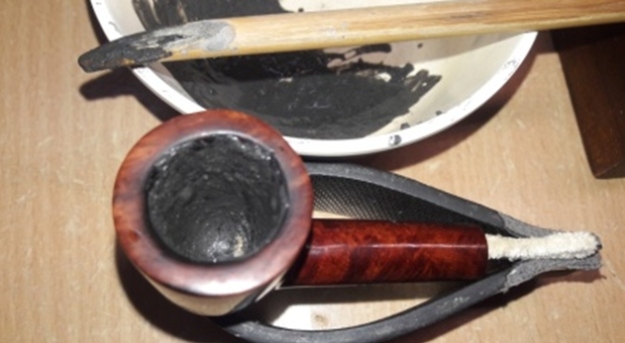
I started the restoration with cleaning of the stummel. With my sharp fabricated knife, I removed the little remaining cake from the chamber and thereafter, using a folded piece of 180 grit sand paper, I sand out the last traces of cake and expose the walls of the chamber. I wiped the chamber with a cotton swab dipped in isopropyl alcohol to remove the carbon dust left behind by all the reaming and sanding process. Once the chamber walls were cleaned out, I was could make out a couple of minor heat fissures (encircled in yellow). With the same sharp knife, I gently scraped off the minor charring from the inner rim edge. The ghosting is still prevalent and will, in all probability, be addressed/ reduced once the shank internals are cleaned. I took a closer look at the heat fissures and it was a big relief to note that the heat fissures are superficial save for the one in 4 o’clock direction (encircled in yellow) which would need to be addressed. I intend to remove the charred briar from the heat fissure and fill it with J B Weld and subsequently coat the bowl with activated charcoal and yogurt to protect it from coming in direct contact with the burning tobacco.   Next, I cleaned out the internals of the shank and mortise. Using my dental tool, I scraped out all the dried oils, tars and gunk that had accumulated in the draught hole and on the walls of the mortise. The amount of crud that was scrapped out and the condition of the pipe cleaners that were used points to how dirt the shank internals were. I continued further cleaning of the mortise and the shank with shank brushes and dish washing soap. I finished the cleaning by running a few pipe cleaners dipped in isopropyl alcohol through the mortise. The old smells are still strong and would require more invasive methods to completely eliminate the ghosting.   I continued the cleaning of the chamber and shank internals with a salt and alcohol bath. I usually use cotton balls which is an at par substitute to Kosher salt as I have realized over the years. I draw out a wick from the cotton and along with a folded regular pipe cleaner; insert it in to the mortise and through the draught hole in to the chamber. Thereafter, I packed the chamber with cotton balls to about quarter of an inch below the inner rim edge and filled it with isopropyl alcohol up to the brim. About half an hour later, the level of alcohol had gone down, having being absorbed by the cotton. I topped it up once again with isopropyl alcohol and set it aside overnight. By next afternoon, the cotton balls are dark colored and along with alcohol, had drawn out all the remaining oils and tars from the chamber and mortise, fulfilling its intended task. I removed the cotton balls from the chamber and the pipe cleaner with cotton balls from the shank and ran pipe cleaners through the mortise to clean out all the loosened tars and gunk and further cleaned it by scarping the walls with a dental tool to completely remove the gunk. I wiped the bowl clean and dried the shank and bowl with paper napkins and set it aside to dry for an entire day. By next day, the pipe was nice and dry and all the smells were history. With the stummel set aside for drying, I turned to address the stem issues. I addressed the deeper oxidation by sanding the entire stem with a folded piece of 220 grit sand paper. Once the oxidation was completely removed, I wiped the surface clean with Murphy’s oil soap on a cotton swab. I followed it up with cleaning the internals of the stem using hard and normal bristled pipe cleaners and isopropyl alcohol. The gunk that came out with the pipe cleaners tells the sordid tale of the stem condition. I further cleaned the stem internals using thin shank brushes with anti-oil dish washing soap and finally rinsing the stem with warm water to clean and freshen up the stem internals. With a pointed dental tool, I scraped out the entire dried gunk from the tenon end and the horizontal slot. I rubbed a little Extra Virgin Olive oil to hydrate the stem and kept it aside. I used a tightly folded piece of 180 grit sand paper to shape and re-define the button edge on either surface. The stem at this point in restoration is shown below. Continuing with the stem refurbishing, I followed it up by further dry sanding the stem with 320, 600, 800 and wet sanding with 1000 grit sand papers to completely rid the surface of the oxidation and bring out the shine in the vulcanite. The stem should polish up nicely.Using micromesh pads, I completed the polishing of the stem by wet sanding the stem surface with 1500 to 12000 girt pads. I gave a final rub with “Before and After Extra Fine” stem polish compound from Mark to remove fine scratches from the stem surface. I rub a little quantity of Extra Virgin Olive oil in to the stem surface and set it aside to be absorbed by the vulcanite. The stem polished up nicely and appears as good as when new.  Next, I cleaned the external surface of the stummel with Murphy’s Oil Soap on a cotton pad. As brought out earlier, in this project, I intended to preserve the patina and the original stain on the stummel and hence, the deviation from the usual process of scrubbing the surface with oil soap and dishing cleaning soap followed with rinsing under warm water. I shall polish the stummel by dry sanding with micromesh pads to bring a nice shine to the stummel and highlighting the grains. With the internal and external cleaning of the stummel completed, I turn to addressing the issues of rim damage. I topped the rim top over a piece of 220 grit sand paper till I had a smooth and even surface. The charred surface in the 2 o’clock direction has been greatly reduced but is still visible (encircled in red). I had anticipated that the crack would be addressed at this stage itself if it had been superficial. However, that was not to be. Both the cracks, larger one in 4 o’clock and the smaller one in 11 o’ clock direction are still visible and indicated with blue arrows. I shall drill counter holes to prevent the spread of these cracks.  I again checked the alignment of the crack on the rim surface with the heat fissures in the chamber walls. With a sharp dental tool, I probed the heat lines. The heat line that aligned with the smaller crack is just superficial and the surrounding briar was solid. However, the heat fissure that aligned with the larger crack did have soft charred briar in it and would need to be addressed. I also checked the stummel surface to see if the crack extended over the stummel and was mighty pleased to note that it did not. What a relief!!   I marked the end points of the two cracks with a sharp dental tool. These marks also help to guide the drill bit when drilling the counter hole. With my hand held rotary tool mounted with a 0.1 mm drill bit, I drill counter holes at the end points. These counter holes arrests the further spread of these cracks. I fill this crack and the counter holes with a mix of CA superglue and briar dust and set the stummel aside for the fills to harden.   Next, with a sharp dental tool, I completely removed the charred briar from the heat line that aligned with the larger crack in 4 o’clock direction. To protect the crack from coming in to direct contact with the burning tobacco and causing a burnout, I plan, firstly, to fill only the crack of the chamber with J B Weld followed by a second coat of activated charcoal and yogurt to the entire chamber which would assist in faster cake formation. J B Weld is a two-part epoxy Cold Weld that consists of two parts; hardener and steel which are mixed in equal parts in a ratio of 1:1 with hardening time of 5-6 minutes and complete curing time of 6-8 hours. I squeezed out the contents of the two tubes and mixed it well. With a flat bamboo frond, I applied this mix and filled the intended crack. I worked fast to ensure a complete and even filling of the crack and set the stummel aside for the J B Weld to harden.  By the next afternoon when I got back to working on this pipe, the counter hole fills over the rim top and the J B Weld coat to the wall of the chamber had completely cured and hardened considerably. I sand the rim top fills with a flat needle file to achieve a rough match with the rest of the rim surface. I fine tune the match with a piece of 220 grit sand paper. Next, using a folded piece of 150 grit sandpaper, I sand the J B Weld coating to a smooth surface till I had as thin a coat as was essential to protect and insulate the crack from the direct heat of the burning tobacco. The Weld coat has completely covered only the crack which can be seen as a thin line. I am very pleased with the repairs at this stage.With the repairs to the cracks and heat fissure completed, I addressed the out of round inner edge and the slight charring to the inner rim edge in 4 o’clock direction by creating a nice deep bevel to inner edge with a folded piece of 220 grit sand paper pinched between my thumb and index finger.  I subjected the stummel to a complete cycle of micromesh polish, dry sanding with 1500 to 12000 grit pads. I paid greater attention to polish the rim top surface and the bevel created on the inner rim edge. I wiped the stummel with a moist cloth after every grit pad to remove the sanding dust left behind by the pads. I am happy with the progress being made till now. The briar has taken on a nice deep shine with the original reddish brown of the stummel and the darker brown stains to the grains contrasting beautifully. I really like the dark reddish brown coloration and the patina that is seen over the stummel surface.     Next, I rub a small quantity of “Before and After Restoration Balm” into the briar with my finger tips and work it deep in to the surface and let it rest for a few minutes. The balm almost immediately works its magic and the briar now has a nice vibrant appearance with the beautiful straight and Bird’s eye grain patterns on full display. The contrast of the dark browns of the grain with the light reddish brown hues of the rest of the stummel adds an interesting dimension to the appearance of the stummel. I further buffed it with a horse hair brush to further deepen the shine. Now that the cosmetic aspects of this pipe have been dealt with, all that remained was the functional aspect that needed to be taken care of. The J B Weld coated crack needs to be protected from the direct heat of the burning tobacco and for this; I coat the complete chamber walls with a mix of activated charcoal and yogurt and set it aside to harden naturally. The mix has to be of the right consistency; neither too thick nor too runny. It should be of a consistency that is thick enough to spread easily, evenly and stick to the walls. Also the coating should not be very thick. A thin film is all that is required. Another important aspect to remember is that it is essential to insert a pipe cleaner in to the mortise and through the draught hole for two reasons; first is obviously to keep the draught hole from getting clogged and secondly, the pipe cleaner absorbs all the moisture from the mix and helps in faster and even drying of the coat.To refresh the stem logo, I coat the stem logo with white correction ink and let it dry out completely while I polished the pipe with Blue Diamond. Once the ink had dried out, with a toothpick, I gently removed the excess ink from the surrounding surface. Though the logo is not very crisp, this is the best that was possible given how worn out the stamping was to start with.  To put the finishing touches, I mount a cotton cloth buffing wheel on to my hand held rotary tool and polished the stummel and stem with Blue Diamond compound. This compound helps to remove the minor scratch marks that remain from the sanding.    Next, I mount another cotton buffing wheel that I have earmarked for carnauba wax and applied several coats of the wax. I mount a clean cotton cloth buffing wheel and give the entire pipe a once over buff. I finished the restoration by giving the entire pipe a rigorous hand buffing using a microfiber cloth to raise the shine further. The finished pipe with a deep reddish brown and aged patina to the briar looks amazingly beautiful and is now ready for its long second inning with me. I would like to express my gratitude to all the readers of rebornpipes who have made the effort to walk through this journey with me and shared their words of encouragement through their comments and suggestions. This does help me gain experience and grow in this hobby about which I am very passionate.
Praying for the health and safety of all the readers and their loved ones in these troubled times…

New Life for an Early John Bessai Poker


Blog by Steve Laug

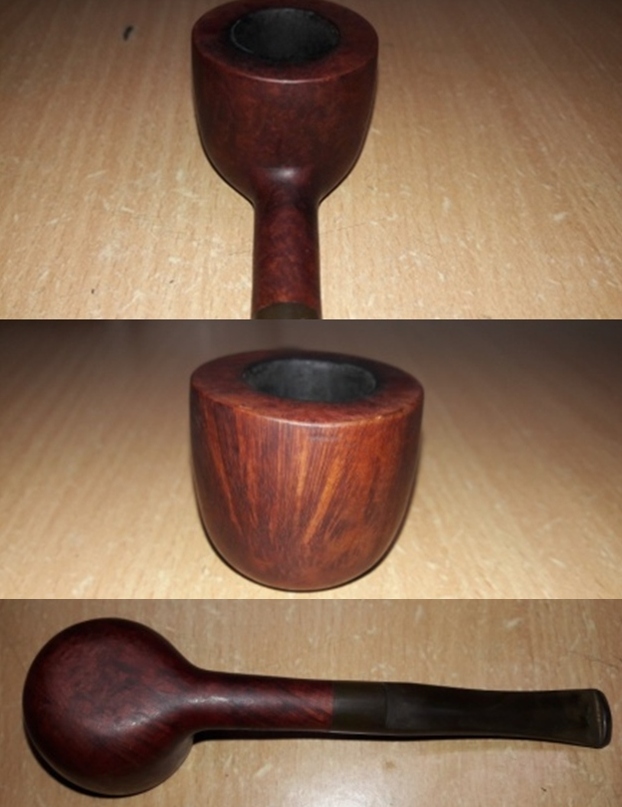
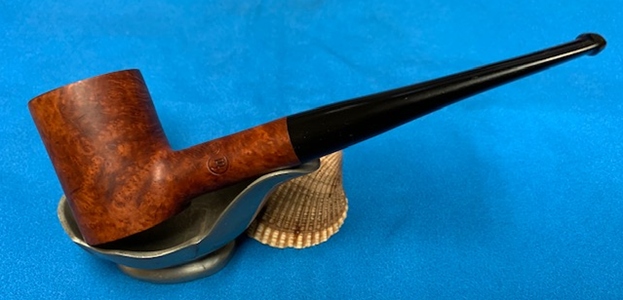
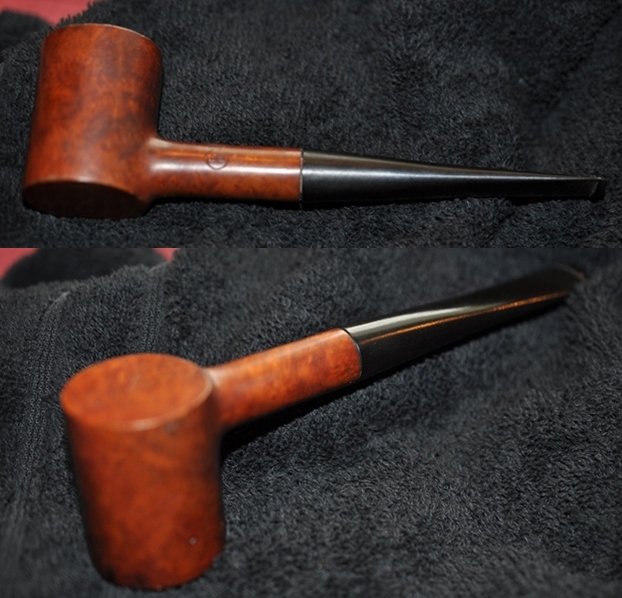
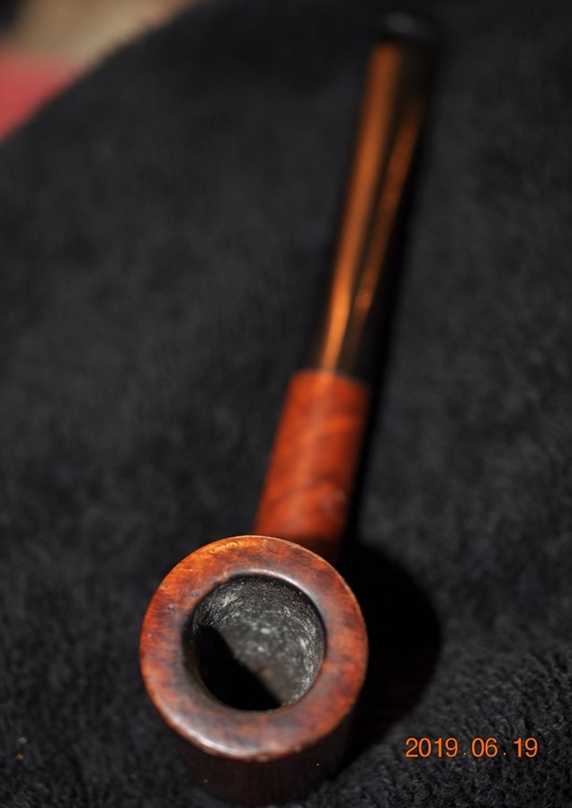
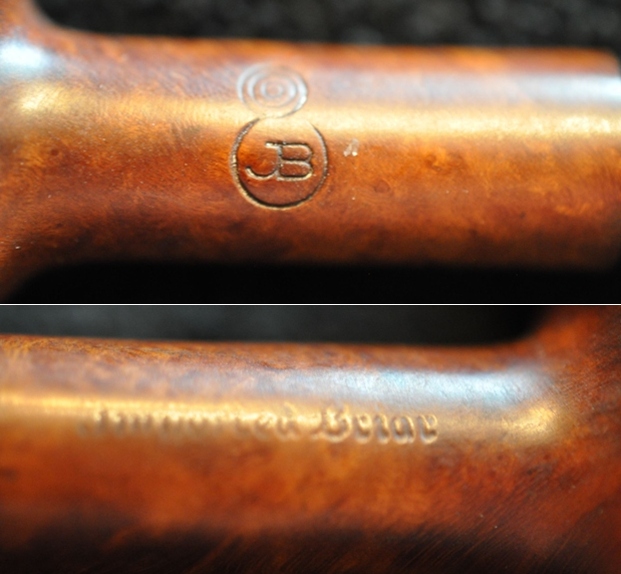
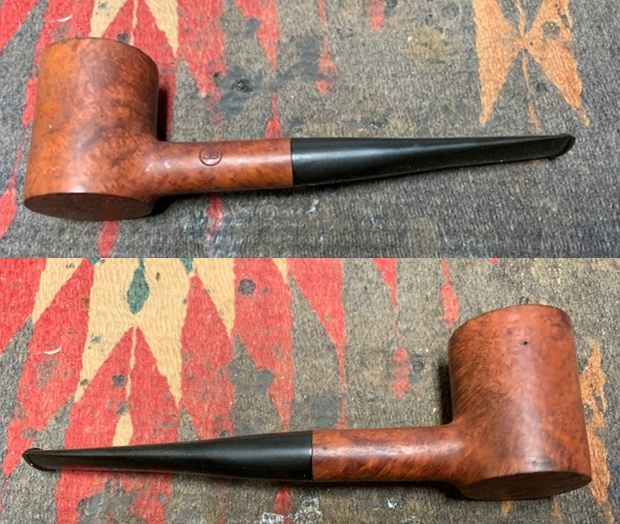
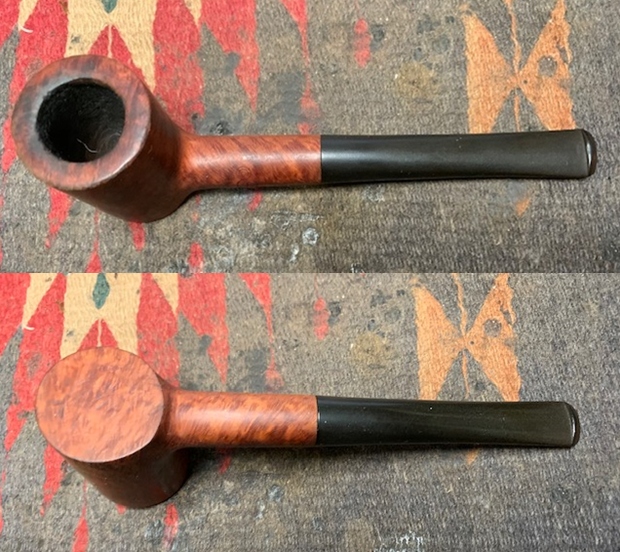
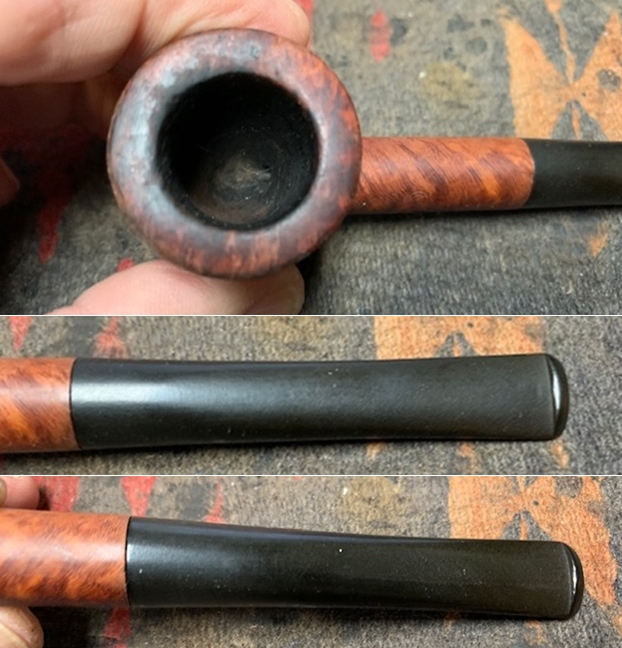
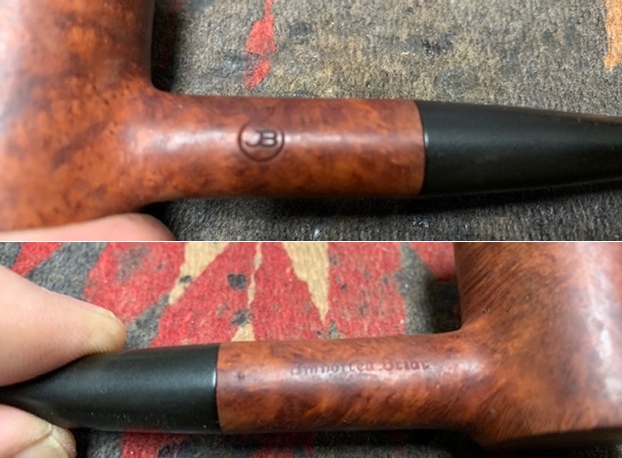
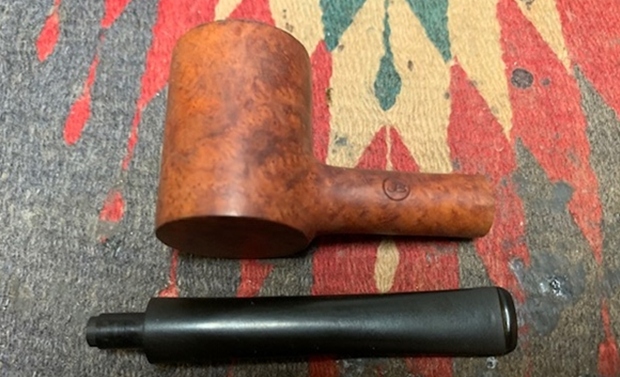
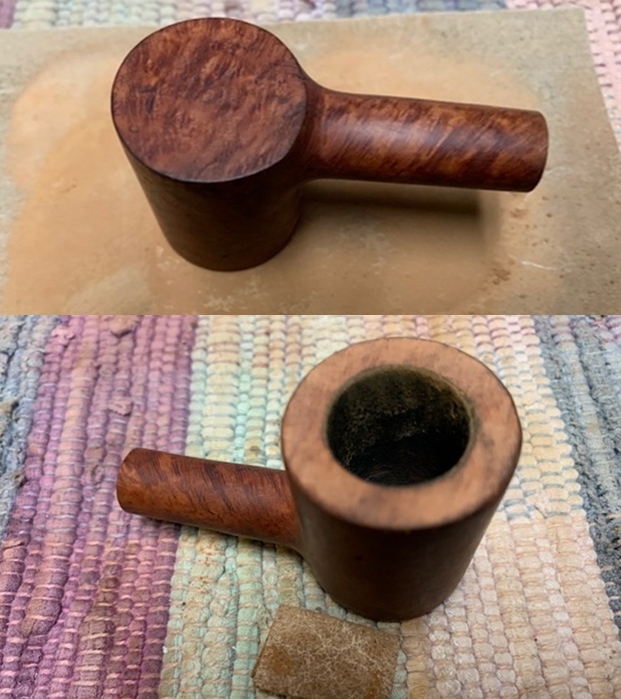
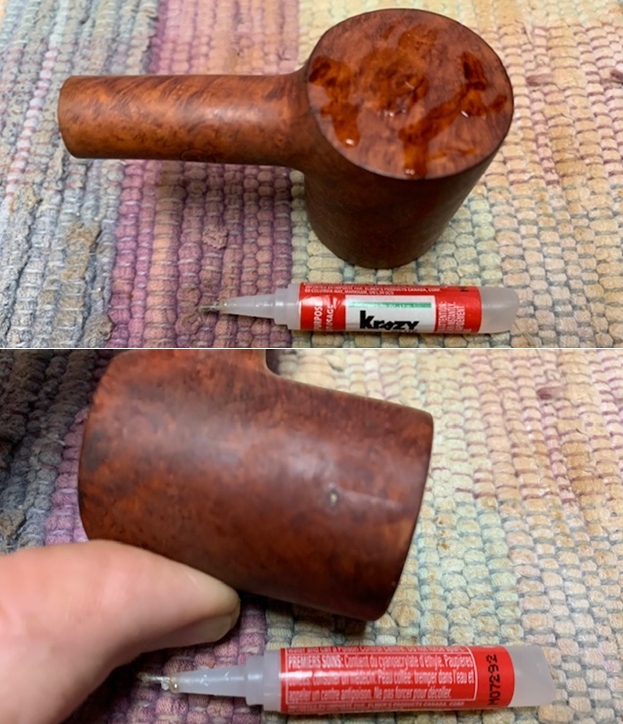
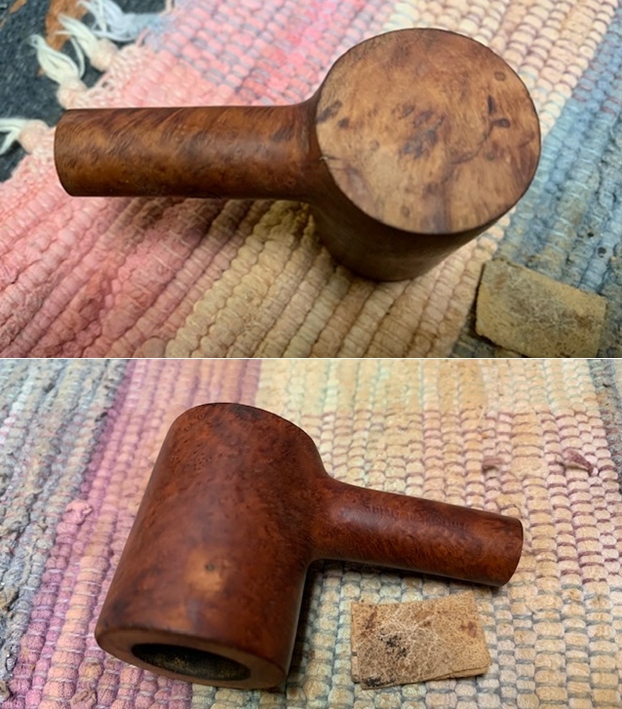
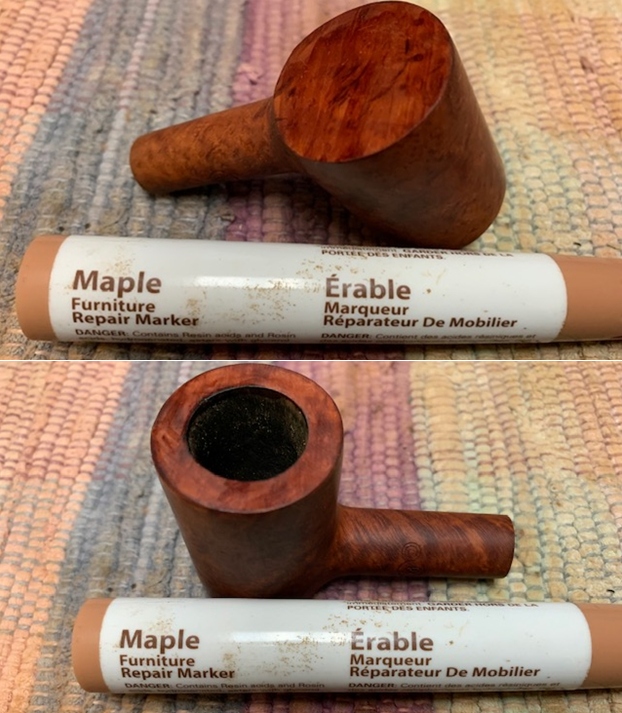
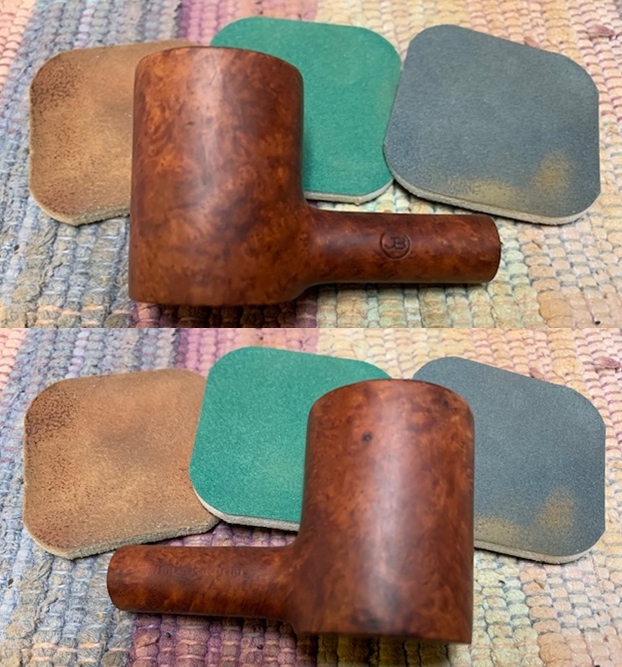
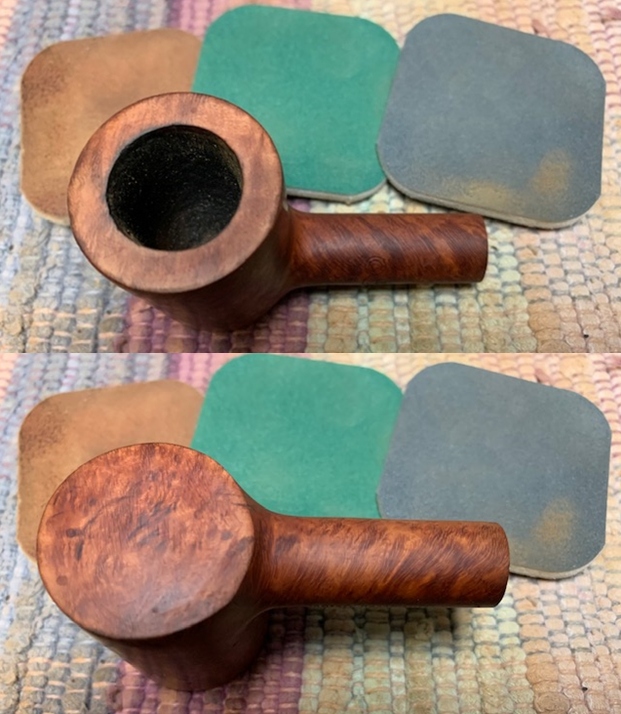
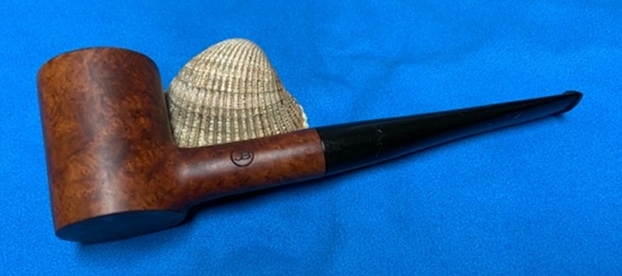
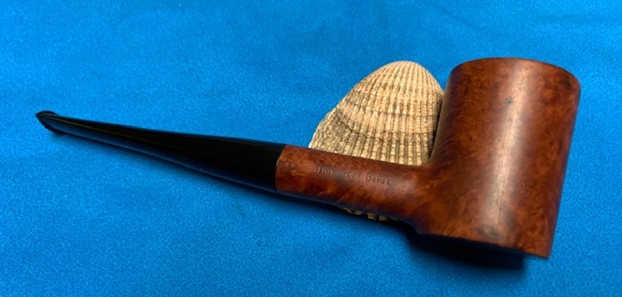
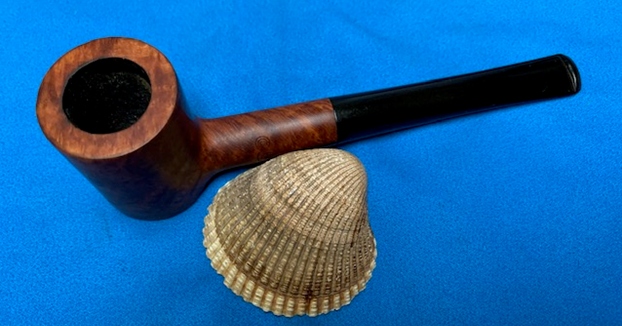
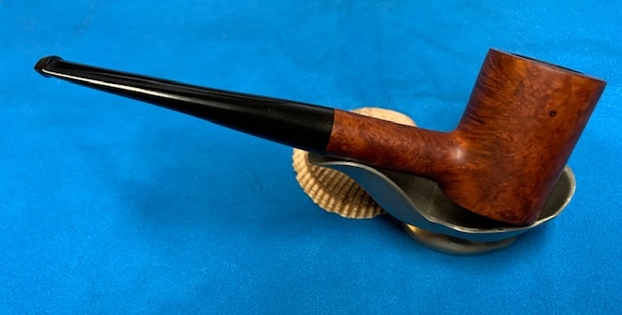
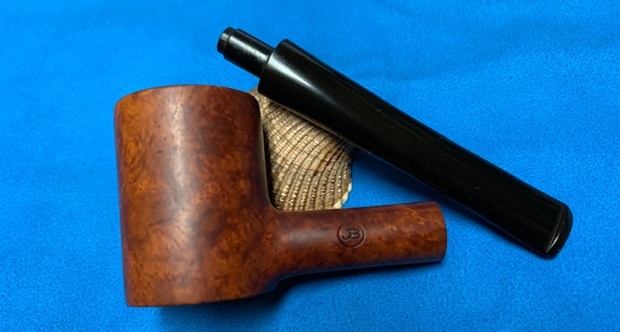
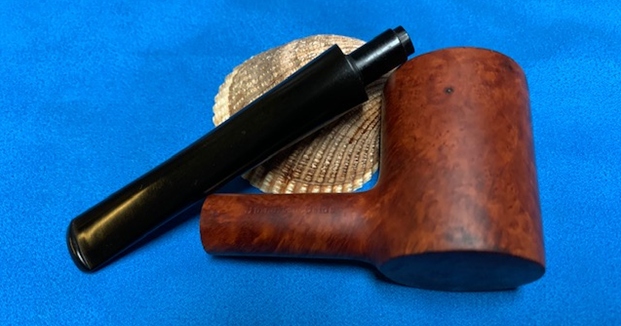
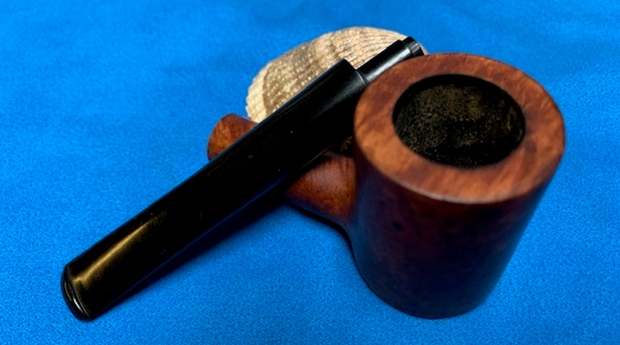
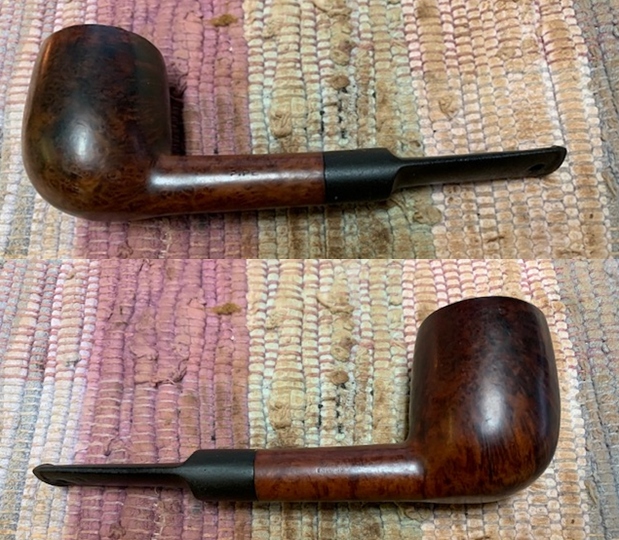
The next pipe on the work table came to us from an online auction in Wilkes Barre, Pennsylvania, USA.  The pipe is an interesting looking piece – a smooth oil finished Poker shaped pipe with some nice grain around the bowl. The pipe is stamped on the left side of the shank and has a Bullseye target [over] JB in a circle and on the right side it is stamped Imported Briar. There was a lot of grime ground into the smooth finish on the briar. The bowl was heavily caked with a light lava coat on the top of the rim. The inside edges looked to be in good condition. There were some nicks in the briar on the top of the rim and the outer edges were beat up from being tapped against hard surfaces. The stem had tooth chatter and marks on the top and underside near the button. There were not markings or a logo on the taper stem. It had promise but it was very dirty. Jeff took some photos of the pipe before he started his cleanup work. He took photos of the rim top and bowl to give a clear picture of the thickness of the cake and tobacco debris as well as the damage on the rim top and outer edges. He also took photos of the top and underside of the stem to show the oxidation and the chatter and tooth marks. Jeff took photos of the sides and heel of the bowl to give a picture of what the briar looked like. There is some nice grain around the sides. You can also see the damage to the rim edges and the heel of the bowl in the photos below.  The stamping on the left and right sides of the shank are clear and readable and read as noted above. I have worked on quite a few Bessai pipes over the years and back in 2014 I restemmed a bowl. I wrote a blog on the pipe and did quite an extensive amount of research on the brand (https://rebornpipes.com/2014/07/14/restemming-and-restoring-a-john-bessai-special-diamond-shank-bent-brandy/). I am including that information here for ease of reference. If you have read it before feel free to skip ahead to the work on the pipe.

HISTORY & BACKGROUND

I started out with what I had found previously and written about on the blog. I quote the following paragraph from Pipedia http://pipedia.org/index.php?title=Bessai

John Bessai was a long time pipemaker, repairman and tobacco shop owner who operated his pipe shop at the “Old Arcade” in Cleveland, Ohio. The shop was opened in approximately 1898. It was a small 2-room shop where he hand-crafted his own pipes in the back room and could work when customers were not there. Like so many other shop made brand, John Bessai’s limited production was quickly acquired by regular customers and thus his craftsmanship remained little known outside of Ohio and the Midwest. While his name is known by pipe collectors in the Midwest, his work is seldom seen elsewhere! He died before 1969. Nevertheless, John Bessai left behind a small number of classic shaped pipes; all were made on-site. They are praised worthy of collecting and reflecting skills well beyond most American pipe makers. John Bessai’s logo “JB” appeared as one letter as the “back” of the “J” and the “back” of the “B” share a single line. The logo was stamped on the stem and on the left side of the shank. His son Herb Bessai took over the business and also continued making pipes. He closed the shop in about 1978.

I suspected that there would be more information three years later. I did some further research and came across the information found in the paragraph below on one of the pipe forums.

John Bessai was located in the Colonial Arcade at least into the late 1980s. After his death, his son Herb ran the shop. It was taken over after Herb’s retirement by a male and then name was changed to “Old Erie Pipes”. This was then located in the Erieview Plaza and when that mall closed, taken over by Cousin’s Cigars which has a store on Euclid Avenue near CSU, and a store on Chagrin Boulevard in Woodmere Village.

That small quotation gave me a bit more information of the state of the store after John’s death and Herb’s retirement. But I still wanted more information. I wanted to know about the history of the brand and if there was any information on the various grades in the brand and the stamping on the pipes. I wanted to know a bit of a timeline for the brands. Finally my digging paid off. ON one of the pipe forums I came across a link that led me to a gold mine of information gathered by a man after my own heart, Andrew Hross. He has a blog called Classic Pipe Shop on Blogspot. I have included the link below for those who want more information. Andrew has done an amazing job of gathering information on the Bessai Brand so rather than rewrite the history I am quoting portions of Andrew’s work on The John Bessai Pipe Clinic. (http://classicpipeshop.blogspot.ca/2014/04/the-john-bessai-pipe-clinic-information.html)

The John Bessai Pipe Clinic, 35 Colonial Arcade, Cleveland, OH 44115 – by Andrew HrossOwner(s): **John Bessai 1920s until his passing in 1969, **Herb Bessai ~1962-1983, **Daniel Gottschall 1984-~1993, **Purchased by Dad’s Smoke Shop / Cousin’s Smoke Shop and rolled into the Old Erie Smoke Shop about 1993. Cousin’s Cigars purchased the remaining stock of Bessai pipes near after Herb Bessai passed away in 2002.

Years of Operation: 1920s (unkown specific date at this time) – 1983. After 1983 the business was sold to Daniel Gottschall who later sold it to Cousin’s Cigar (Euclid Ave) around 1993. The name was changed to “Old Erie Tobacco Company”. They were forced to move to the Galleria when all the tenants of the Old Arcade were cleared out to make room for renovations. Their new address was The Galleria at Erieview, 1301 East 9th Street in Cleveland.

After this move the location wasn’t as busy as they had hoped and Cousin’s moved all the Old Erie Tobacco assets to their Euclid Avenue Store. The store has since moved to a St. Clair location after Cleveland State forced them out due to anti-smoking regulations on campus. Their St. Clair location offers many of John Bessai Pipe Clinic’s old tobacco blends.

Their new store opened in the Merriman Valley area in Akron, Ohio where the store manager John Coleman oversees the day to day operations. John was instrumental in helping me piece together a lot of loose ends during Bessai Pipe Clinic’s transition years.

My father visited their shop several times in the early 60s as he attended Fenn College (now Cleveland State University) as an undergrad before moving on to Ohio State University for his Masters. He’s way smarter than I am so I just go with the flow…

He mentioned meeting John at that time who quickly gave my father some pointers on smoking a pipe and how to take samples from the shop’s expansive sample jar collection. His pipes were on display in the shop although I don’t believe he had a lot of pipes on display at any given time due to production in-shop.

John’s son Herb took over the shop in the early 60s after he graduated from Cleveland State University / Fenn College (unclear) as he is listed as having played Basketball for CSU. Herb was also a helpful, informative and friendly individual. Articles exist from the Herald in 1962 where they interviewed Herb (with photograph) about the state of smoking in the new age of the early 60s. I visited the shop in the late 70s / early 80s with my father during a trip to Cleveland and couldn’t tell you much about the shop other than the guy working was very friendly. Back then it wasn’t unusual to be a kid and walk into a smoke shop with your father. Clearly I didn’t purchase anything but my father probably picked up some tobacco but I remember him looking at pipes displayed on a back wall. The shop was small but impressive.

If anyone has any pictures of the shop or old catalogs, I would love any additional information as it’s tough to come by 30+ years later!

Pipes offered by John Bessai Pipe Clinic: Most of the pipes that were offered by the John Bessai Pipe Clinic were fairly standard in shape… I would say most of the pipes Bessai offered were smooth pipes. My assessment would be 90% smooth and 10% rusticated / sandblasted…

…The story is that John crafted pipes in the back room or off site and finished them in house while the store wasn’t busy. Very little information is available on the accuracy of this statement. Some of his pipes from the late 1960s through the 1970s (John passed away in 1969) I feel were left over stock from previous turnings and sometimes showed fills or sand pits. Some of these pipes even carry Herb’s markings (see below). These pipes still smoke very well but are not as eye-appealing as other earlier pipes from the store’s career.

Stampings and rough dating of John Bessai Pipe Clinic Pipes: Which pipes did John make and which ones did Herb make/finish? All Bessai pipes carry his standard large JB stamp either on the stem or shank or both. Typically the JB on the stem is within a circle.

All pipes created by John Bessai’s hands reportedly contain the miniscule ‘jb’ stamp on the shank or body of the pipe. I have older pipes in my possession that do not contain this stamp (condenser, old stamps, etc) that were clearly shop made pipes. I feel he started using the tiny ‘jb’ stamp in the 50s to early 60s.

An interesting note about John Bessai’s stems – they always clean very nicely and aren’t prone to as much oxidation (that brownish / green color) as most dunhill and Charatan pipes tend to oxidize. His cuts to his stems were very impressive and often transitioned from diamond-shaped shanks almost architecturally. Very comfortable to smoke.

John Bessai Special Pipes:

… I have a couple Bessai Special pipes. These stand out either by large size, graining or possibly shape. Most Specials are unique pipes and are rare to find in comparison to his regular issue pipes.

John Bessai Special X pipes:

I only have one of these and it’s a beauty. This one is a larger bowl (around a group 4 dunhill) with deep colored grain and a hefty substantial shank. Special X pipes are probably the rarest of John Bessai pipes and should be sought out if possible. I’ve smoke mine roughly 4 or 5 times and it performs with the best of my pipes…

Herb Bessai Pipes:

Unfortunately none of these pipes that I’ve seen have astounded me with grain or general appearance. Having said this, these pipes smoke nicely and are a great value if you can find them. I have one that my father found at an Antique Show in the South. There’s another author shape on reborn pipe’s blog that someone refinished because of the amount of fills in the pipe. He also states it’s a wonderful smoker (Editor’s note: This is my pipe and the write up I did on the blog). These pipes are likely from the late 60s through the early 70s. I believe many pipes after this period were created en masse at a factory in the US. It is unclear what stamp was used on these later pipes…

Dating / Circa era Bessai Pipes: If the pipe carries a stamp stating Cleveland, O U.S.A. it’s considered an older production pipe (pre1960s). I’ve not seen any newer pipes with that stamp.

Bullseye stamping usually indicates an earlier pipe as that stamp seems to have been abandoned pre1960 as well.

Most of the earlier Bessai pipes have an unusual ‘stinger’ or condenser at the end of the tenon which is unique to Bessai pipes. They are either a hard plastic or created out of wood. They are typically easy to remove and could have been easily lost if misplaced. These pipes I would consider pre-1960 and possibly 1940s-early 1950s production based on their stamps and patina of the pipes.

1970s 1980s and beyond: My feeling on these pipes after John’s passing is that they purchased finished pipes from a large manufacturer and stamped them with the John Bessai or Bessai stamp (on shank and/or stem). Most of these shapes are standard among many stores from that period and offer less than spectacular grain (and sometimes fills). Stamps on these pipes are probably fairly plain and don’t have the tiny ‘jb’ stamp on the shank indicating it was produced by John Bessai.

I know that is a lot of information and if you want to you can skip ahead to read about the restoration. I started my restoration with cleaning the internals and the externals of the pipe. I cleaned out the inside of the pipe with pipe cleaners, cotton swabs and alcohol. It was a filthy pipe on the inside.

The pipe in hand was a John Bessai Circle JB Imported Briar. As noted above the pipe is stamped with a Bullseye Stamp that seems to have been abandoned pre-1960. So I am dealing with an earlier Bessai pipe. Now on to working on the pipe.

Jeff had cleaned up the pipe with his usual penchant for thoroughness. He reamed the pipe with a PipNet pipe reamer and removed the rest of it with a Savinelli Fitsall Pipe Knife.  He scrubbed the bowl with undiluted Murphy’s Oil Soap with a tooth brush. He rinsed it under running warm water to remove the soap and grime. He cleaned out the inside of the shank and the airway in the stem with alcohol, cotton swabs and pipe cleaners. He soaked the stem in Before & After Deoxidizer and rinsed it off with warm water. I took photos of the pipe once I received it.   The rim top cleaned up really well. The rim top and outer edge of the bowl show some damage. The stem surface looked very good with a few small tooth marks and chatter on both sides near the button. The stamping on both sides of the shank is clear and readable. The left side is stamped with a Bullseye [over] JB in a Circle. On the right side of the shank it is stamped Imported Briar.    I removed the stem and took a photo of the pipe to give a sense of the whole. The stem is tapered and narrow.Now it was time to do my work on the pipe. I topped the bowl on a topping board with 220 grit sandpaper. I repaired the damaged areas on the heel of the bowl and the sandpit on the right side of the bowl with clear super glue. I sanded the repaired areas smooth with 220 grit sandpaper to blend them into the surrounding briar. Once I had smoothed out the repairs I used a Maple stain pen to touch up the sanded area on the bottom of the bowl and the rim top. I knew that once I polished it with micromesh, it would blend in very well. I polished the repaired areas and the rest of the briar with micromesh sanding pads – wet sanding with 1500-12000 grit pads and wiping it down after each pad with a damp cloth.  I rubbed the bowl and shank down with Before & After Restoration Balm. I worked it into the surface of the bowl sides and shank with my fingertips to clean, enliven and protect the briar. I let the balm sit for a little while and then buffed with a cotton cloth to raise the shine. The grain came alive and the fills while visible look better than when I began. I set the bowl aside and turned to work on the stem. It was in good condition and the tooth marks were light so I figured they would polish out fairly easily. I polished the vulcanite stem with micromesh sanding pads – 1500-12000 grit pads. I wiped it down with Obsidian Oil after each sanding pad. I used Before & After Pipe Polish – both Fine and Extra Fine to further polish the stem.       This JB (John Bessai) Bullseye stamped Poker is a great looking pipe now that it has been restored.The smooth oil cured finish around the bowl is quite beautiful and highlights the grain and works well with the polished vulcanite taper stem. The repaired gouges on the heel look much better and are now smooth to touch. I put the stem back on the bowl and carefully buffed the pipe with Blue Diamond on the buffing wheel using a light touch on the briar. I gave the bowl and the stem multiple coats of carnauba wax on the buffing wheel and followed that by buffing the entire pipe with a clean buffing pad. I hand buffed the pipe with a microfiber cloth to deepen the shine. The finished John Bessai Poker fits nicely in the hand and feels great. Give the finished pipe a look in the photos below. The dimensions of the pipe are Length: 6 inches, Height: 1 ¾ inches, Outside diameter of the bowl: 1 ¼ inches, Chamber diameter: ¾ of an inch. I will be putting it on the rebornpipes store shortly. If you are interested in adding this pipe to your collection send me a message or an email. Thanks for reading this blog and my reflections on the pipe while I worked on it. There are many more to come!
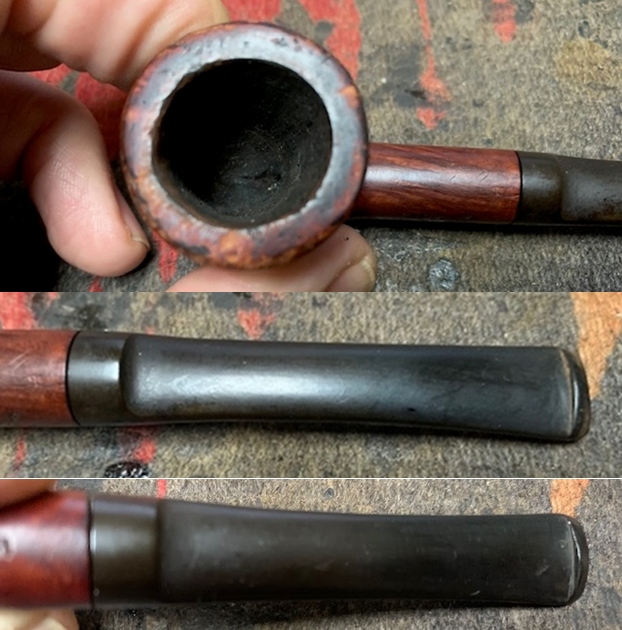
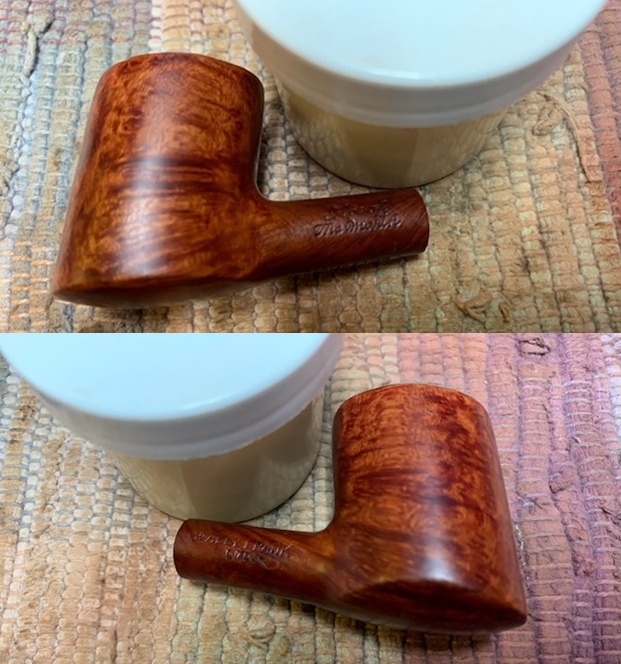
A Tale of the Rebirth of 3 Pipes – Pipe #2 – a Comoy’s Tradition 3591 Panel Prince


Blog by Steve Laug

By default this nice little Prince moved to the third slot while waiting for the stem repair to cure. It is now finished and it is a really nice looking pipe. Give the blog a read.

Last week I received an email from a fellow named Stanley who had gotten my info from the local Pipe and Cigar shop. He wrote that he had a trio of Comoy’s pipes that needed to be worked on. Two of them were Grand Slam Pipes and one was a Tradition. We connected via email and he said he would drop them off this week for me to work on. I am including part of his email so you have a sense of what I would be working on. I am also including the two photos that he attached to the email for me to see.

Hey Steve,

I had recently the chance to talk to a very kind and excellent gentleman over at City Cigar, I unfortunately was never able to get his name. However I mentioned I was looking for some replacement stems and he gave me your info…

…The pipes in question are attached in photos, I’ve never done any sort of pipe restoration in my life but I have attempted to take the cake down with a pocket knife. If you’d do it, would you be able to do a ream/clean on the three, as well as deal with the stems?

If possible, I’d prefer to save the original stems by repairing them, but it seems to me that most people remedy this problem with a replacement stem. Whatever you think is best I will go with.

If you think that I’d be better off without the stinger insert in the shape 64, then would you be able to remove it? I’m afraid I’d break the stem if I tried haha.

The 484b also seems to have a crack starting near the “Comoy’s Grand Slam” part of the shank, where it meets the stem. Is it possible to deal with this?

That is all! Please let me know what you think!

Thanks!  Stanley Last night Stanley stopped by and dropped off the three pipes. I took photos of pipes as there were when I opened the bag they were in. All three pipes were very dirty but the reaming had been started as noted in his email. The stems all had bite throughs on the underside. The bottom pipe in the photo below is a Grand Slam Pipe shape 64 Billiard. The stem has a 3 part C on the left side. The middle pipe is a Tradition 3591 Prince with 8 flattened panels on the bowl near the top. The stem also has a bite through and a missing divot. It also has a 3 part C on the left side. The top pipe in the photo is also Grand Slam Pipe 484B with a replacement stem that also has a bite through. The shank is also cracked on the left side.The last pipe left to work on in this threesome is the Tradition 3591 Panel Prince. It is a beautifully grained Comoy’s Prince that really is a pipe of Pipe Smoking History. The pipe is stamped on the left side of the shank and reads COMOY’S [over] Tradition. On the right side it has the shape number 3591 (the stamp is faint) next to the bowl/shank junction and that is followed by a Comoy’s COM stamp is worn away. The finish had a lot of grime ground into the smooth finish on the bowl and some darkening around the sides of the bowl. The bowl had been scraped but there was still a moderately heavy cake. There was an overflow of thick lava on the top of the rim and on the inner bevel of the bowl. It was hard to know what the rim top and inner edge of the bowl looked like under the grime. The stem was lightly oxidized and there was a large bite through on the underside. There was a three part inlaid C on the left of the taper stem. The pipe had promise but it was very dirty. I took photos of the pipe before he started his cleanup work.   I took photos of the rim top and bowl to give a clear picture of the thickness of the cake and the overflow of lava on the rim top. It is hard to know if there is damage to the inner edge of the bowl because of the lava coat. I also took photos of the top and underside of the stem to show the condition of the stem surface and the bite through on the underside.   I took photos of the stamping on both sides and underside of the shank. They read as noted above. I also included a photo of the 3 part C logo on the left side of the taper stem. I removed the stem and took a photo of the pipe to give a sense of the whole. It is a well shaped billiard. Once the stem was off you can see the step down tenon that was on these older Comoy’s pipes.I looked on Pipephil’s site for information on the Comoy’s Tradition and found the following information I have included a screen capture (http://www.pipephil.eu/logos/en/logo-comoy.html). It has the three part C which dated it to 1946 and following. The stamping is the same as the one I am working on.I turned to the article on Pipedia about dating Comoy’s pipes but the style of the stamping (https://pipedia.org/index.php?title=Comoy%27s_Dating_Guide#1917_to_the_end_of_the_1930.27s_.28at_least_1938.29). I have include the section in the screen capture below that date this pipe to the 1950s.

Now the Comoy’s stamp can be found in three variants in the 1950s

  1. A simple block-letter style without serifs but with the C larger than the other letters and the apostrophe before the “S”.
  2. A return to the slightly more fancy block letters with serifs and the apostrophe. (It seems that some grades carried different stamps, or at least that the stamping changed in different years for some grades.)
  3. A simple block-letter style without serifs and without the apostrophe and with the “C” the same size as the rest of the letters. This stamp was probably not used very long.
  4. A simple block-letter style without serifs but with the apostrophe before the “S” and with the “C” the same size as the rest of the letters.

Inlaid “C”

C” was first inlaid in the side of the mouthpiece around 1919. This was a complex inlay needing three drillings. First, a round white inlay was inserted, then the centre of the white was drilled out, and a smaller round black inlay was inserted. Finally, another drilling was made to remove the open part of the “C,” and an even smaller black inlay was inserted. This inlaid “C,” known as the “three-piece C,” was continued until the Cadogan era in the 1980s. However, the “C” in the 1920s and early 30s is much thinner and more delicate than the one post-WW II.

That article gave me some helpful information regarding the pipe that I was working on. I knew that the stamping and logos identified the pipe as having been made in following WW2 and from what I can see from the above information it is a 1950s era pipe.

I reamed the bowl with a PipNet pipe reamer using the 2nd and 3rd cutting head to remove the remaining cake back to briar. I followed up with a Savinelli Fitsall pipe knife to remove the remnants of cake. I sanded the walls of the bowl with a piece of 220 grit sandpaper wrapped around a piece of dowel. I scrubbed out the mortise and the airway in the shank and the stem with alcohol, cotton swabs and pipe cleaners. I scrubbed the exterior of the bowl, rim, shank and stem with a tooth brush and Murphy’s Oil Soap to remove the oils and tars on the rim and the grime on the finish of the bowl. I rinsed it under running water and dried it off with a soft cloth.      I was able to remove some of the lava build up on the rim top and finished by scraping it with the Fitsall knife and then a piece of 220 grit sandpaper.  I cleaned up the bevel with the sandpaper at the same time. I polished the bowl and the rim top, sides and shank with micromesh sanding pads – wet sanding with 1500-12000 grit pads and wiping it down after each pad with a damp cloth. I carefully avoided the stamping on the shank so as not to damage the stamping.   I rubbed the bowl and shank down with Before & After Restoration Balm. I worked it into the surface of the bowl sides and shank with my fingertips to clean, enliven and protect the briar. I let the balm sit for a little while and then buffed with a cotton cloth to raise the shine.    I set aside the bowl and turned my attention to the stem repairs. I cut a piece of cardboard for a pallet, put aside two charcoal capsules, and set out the spatula and the Loctite 380 black CA glue. I greased a pipe cleaner with Vaseline and inserted it in the stem. I filled in the hole in the stem with a mixture of charcoal powder and Loctite. I used the spatula to fill in the bite throughs on all of the stems. I sprayed the repair with an accelerator to set the glue and removed the pipe cleaners from the stems.        I filled in the deep tooth marks on the top side of the stem with black super glue and set the stems aside to let the repairs cure. I took a photo of the three pipes at this point to give a feel for where things stood. I smoothed out the repairs with a needle file and started blending them into the surface of the stem. I sanded the remaining repairs with 220 grit sandpaper to further blend it into the stem surface. I started polishing it with 400 grit wet dry sandpaper.   I polished the vulcanite stem with micromesh sanding pads – 1500-12000 grit pads. I wiped it down with a damp cloth after each sanding pad. I used Before & After Pipe Polish – both Fine and Extra Fine to further polish the stem.     This 50s era Comoy’s Tradition 3591 Panel Prince with a vulcanite taper stem is a great looking pipe now that it has been restored. I did a lot of work on the bowl and repaired the bite through on the stem. The rich browns and blacks of the contrasting stains came alive with the polishing and waxing. I put the stem back on the bowl and carefully buffed the pipe with Blue Diamond on the buffing wheel using a light touch on the briar. I gave the bowl and the stem multiple coats of carnauba wax on the buffing wheel and followed that by buffing the entire pipe with a clean buffing pad. I hand buffed the pipe with a microfiber cloth to deepen the shine. The finished Comoy’s thin shank Panel Prince is a beauty and fits nicely in the hand and looks very good. Give the finished pipe a look in the photos below. The dimensions of the pipe are Length: 5 ¾ inches, Height: 1 1/8 inches, Outside diameter of the bowl: 1 ½ inches, Chamber diameter: ¾ of an inch. He will be stopping by to pick them up soon. I am looking forward to what Stanley thinks of his repaired pipe. He had said the threesome were his favourite pipes. This is the second of  the three but the last one I finished. Thanks for reading this blog and my reflections on the pipe while I worked on it. There are many more to come!
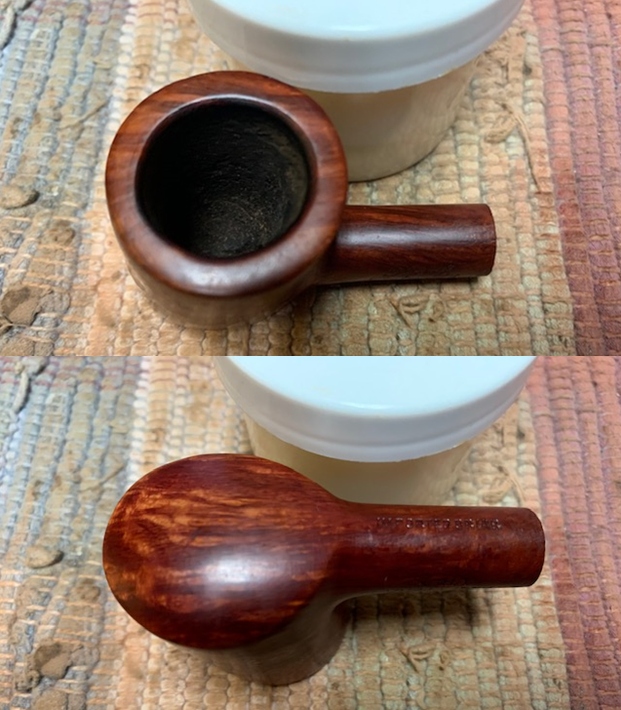
A Tale of the Rebirth of 3 Pipes – Pipe #3 – a Comoy’s Grand Slam Pipe 484B Billiard


Blog by Steve Laug

While this is the third and last of the trio I ended up finishing it second. The little panel prince has some added challenges that I was not expecting so it will actually be finished last even though I started on it second. Ah well the surprises of pipe restoring are part of fun.

Last week I received an email from a fellow named Stanley who had gotten my info from the local Pipe and Cigar shop. He wrote that he had a trio of Comoy’s pipes that needed to be worked on. Two of them were Grand Slam Pipes and one was a Tradition. We connected via email and he said he would drop them off this week for me to work on. I am including part of his email so you have a sense of what I would be working on. I am also including the two photos that he attached to the email for me to see.

Hey Steve,

I had recently the chance to talk to a very kind and excellent gentleman over at City Cigar; I unfortunately was never able to get his name. However I mentioned I was looking for some replacement stems and he gave me your info…

…The pipes in question are attached in photos, I’ve never done any sort of pipe restoration in my life but I have attempted to take the cake down with a pocket knife. If you’d do it, would you be able to do a ream/clean on the three, as well as deal with the stems?

If possible, I’d prefer to save the original stems by repairing them, but it seems to me that most people remedy this problem with a replacement stem. Whatever you think is best I will go with.

If you think that I’d be better off without the stinger insert in the shape 64, then would you be able to remove it? I’m afraid I’d break the stem if I tried haha.

The 484b also seems to have a crack starting near the “Comoy’s Grand Slam” part of the shank, where it meets the stem. Is it possible to deal with this?

That is all! Please let me know what you think!

Thanks!  Stanley Last night Stanley stopped by and dropped off the three pipes. I took photos of pipes as there were when I opened the bag they were in. All three pipes were very dirty but the reaming had been started as noted in his email. The stems all had bite throughs on the underside. The bottom pipe in the photo below is a Grand Slam Pipe shape 64 Billiard. The stem has a 3 part C on the left side. The middle pipe is a Tradition 3591 Prince with 8 flattened panels on the bowl near the top. The stem also has a bite through and a missing divot. It also has a 3 part C on the left side. The top pipe in the photo is also Grand Slam Pipe 484B with a replacement stem that also has a bite through. The shank is also cracked on the left side.I decided to finish the last pipe of the trio while I waited for some stem repairs to cure on the second pipe – the Tradition Prince. I had left the pipe in the worst condition to work on last. It was another Grand Slam Pipe shape 484B or maybe 4846 as it is hard to read. It was in rough condition. The finish has a lot of dirt and dark grime ground into the briar but it appears to have some nice grain underneath all of that. I hope to be able to set that free with cleaning. It was probably a Comoy’s Billiard but somewhere along the way it had been given a replacement stem that turned it into a saddle billiard. The stamping is faint but with a light and lens reads COMOY’S [over] Grand Slam [over] Pipe. On the right side it has the shape number 484B(?6) next to the bowl/shank junction and that is followed by a very faint Comoy’s COM stamp that reads Made in London in a circle [over] England. There was a crack in the shank about an inch long on the left side extending into the Grand Slam Stamp. It is a hairline but is a definite issue. It appears that when it was restemmed the shank cracked. The pipe is dirty so it is not readily apparent. The bowl had been scraped but there was still a moderately heavy cake. There was an overflow of thick lava on the top of the rim and on the inner bevel of the bowl. The top and outer edge had been hammered and had a lot of damage. The replacement saddle stem was pitted and rough. There was a large bite through on the underside. This was the pipe I was the most worried about when I assessed the damage. I took photos of the pipe before he started his cleanup work.    I took photos of the rim top and bowl to give a clear picture of the thickness of the cake and the overflow of lava on the rim top. You can see the thick lava and the damage to the inner and outer edge of the bowl. I also took photos of the top and underside of the stem to show the condition of the stem surface and the bite through on the underside.    I took photos of the stamping on both sides of the shank. They are faint but read as noted above. I removed the stem and took a photo of the pipe to give a sense of the whole. It is a well shaped billiard. Once the stem was off I noted that tenon had a thick coating of wax as did the shank which made me wonder if that had cause the crack.I looked on Pipephil’s site for information on the Comoy’s Grand Slam Pipe and found the following information I have included a screen capture (http://www.pipephil.eu/logos/en/logo-comoy.html). The one I am working on is like the second one in the screen capture below. It has has a replacement saddle stem so there is no C on left side. The stamping on the shank is the same as the one I am working on.I turned to the article on Pipedia about dating Comoy’s pipes but the style of the stamping (https://pipedia.org/index.php?title=Comoy%27s_Dating_Guide#1917_to_the_end_of_the_1930.27s_.28at_least_1938.29). I have include the section in the screen capture below that date this pipe to the 1950s.

Now the Comoy’s stamp can be found in three variants in the 1950s

  1. A simple block-letter style without serifs but with the C larger than the other letters and the apostrophe before the “S”.
  2. A return to the slightly more fancy block letters with serifs and the apostrophe. (It seems that some grades carried different stamps, or at least that the stamping changed in different years for some grades.)
  3. A simple block-letter style without serifs and without the apostrophe and with the “C” the same size as the rest of the letters. This stamp was probably not used very long.
  4. A simple block-letter style without serifs but with the apostrophe before the “S” and with the “C” the same size as the rest of the letters.

Made in London England

Appears in two versions. This is again stamped in a circle with “MADE” at the top, “IN” in the middle, and “LONDON” at the bottom, with “ENGLAND” in a straight line beneath. It can be assumed that this stamp was first used in the export drive in the early 1950s. On a Bulldog Sandblast from the early 50s the Comoy name no. 2 above was used together with “MADE IN LONDON” over “ENGLAND”. There are no known examples of pre-WW II Comoy’s stamped in this way. The second version is the same as above but in a “rugby ball ” shape. This shape is verified on Comoy´s “Extraordinaire” pipes.

That article gave me some helpful information regarding the pipe that I was working on. I knew that the stamping and logos identified the pipe as having been made in following WW2 and from what I can see from the above information it is a 1950s era pipe.

I reamed the bowl with a PipNet pipe reamer using the 2nd and 3rd cutting head to remove the remaining cake back to briar. I followed up with a Savinelli Fitsall pipe knife to remove the remnants of cake. I sanded the walls of the bowl with a piece of 220 grit sandpaper wrapped around a piece of dowel. I scrubbed out the mortise and the airway in the shank and the stem with alcohol, cotton swabs and pipe cleaners.   I scrubbed the exterior of the bowl, rim, shank and stem with a tooth brush and Murphy’s Oil Soap to remove the oils and tars on the rim and the grime on the finish of the bowl. I rinsed it under running water and dried it off with a soft cloth. I was topped the bowl on a piece of 220 grit sandpaper and a topping board to smooth out the damage on the surface of the rim and reduce the damage on the edges. I used a folded piece of 220 grit sandpaper to clean up the beveled inner edge of the rim. With the general cleanup finished I decided to address the cracked shank. I have circled the area of the crack in red in the photo below. I removed the stem and spread the crack slightly and used a tooth pick to put super glue in the crack. I pressure fit a thin band on the end of the shank to bind it together. The band allowed the glue to cure and the crack virtually disappeared. The band is thin enough not do obscure the stamping on the shank sides.I polished the bowl and the rim top, sides and shank with micromesh sanding pads – wet sanding with 1500-12000 grit pads and wiping it down after each pad with a damp cloth. I carefully avoided the stamping on the shank so as not to damage the stamping. I rubbed the bowl and shank down with Before & After Restoration Balm. I worked it into the surface of the bowl sides and shank with my fingertips to clean, enliven and protect the briar. I let the balm sit for a little while and then buffed with a cotton cloth to raise the shine.      I set aside the bowl and turned my attention to the stem repairs. I cut a piece of cardboard for a pallet, put aside two charcoal capsules, and set out the spatula and the Loctite 380 black CA glue. I greased a pipe cleaner with Vaseline and inserted it in the stem. I filled in the hole in the stem with a mixture of charcoal powder and Loctite. I used the spatula to fill in the bite throughs on all of the stems. I sprayed the repair with an accelerator to set the glue and removed the pipe cleaners from the stems.     I filled in the deep tooth marks on the top side of the stem with black super glue and set the stems aside to let the repairs cure. I took a photo of the three pipes at this point to give a feel for where things stood. I smoothed out the repairs with a needle file and started blending them into the surface of the stem. I sanded the remaining repairs with 220 grit sandpaper to further blend it into the stem surface. I started polishing it with 400 grit wet dry sandpaper.     I polished the vulcanite stem with micromesh sanding pads – 1500-12000 grit pads. I wiped it down with a damp cloth after each sanding pad. I used Before & After Pipe Polish – both Fine and Extra Fine to further polish the stem. This 50s era Comoy’s Grand Slam Pipe 484B Billiard with a replacement vulcanite saddle stem turned out to be a nice looking pipe now that it has been restored. I did a lot of work on the bowl and repaired the bite through on the stem. The rich browns and blacks of the contrasting stains came alive with the polishing and waxing. The thin brass shank band adds a touch of class to the pipe. I put the stem back on the bowl and carefully buffed the pipe with Blue Diamond on the buffing wheel using a light touch on the briar. I gave the bowl and the stem multiple coats of carnauba wax on the buffing wheel and followed that by buffing the entire pipe with a clean buffing pad. I hand buffed the pipe with a microfiber cloth to deepen the shine. The finished Comoy’s Billiard is a beauty and fits nicely in the hand and looks very good. Give the finished pipe a look in the photos below. The dimensions of the pipe are Length: 5 ½ inches, Height: 1 ¾ inches, Outside diameter of the bowl: 1 ¼ inches, Chamber diameter: ¾ of an inch. I am looking forward to what Stanley thinks of his repaired pipe. He had said the threesome were his favourite pipes. While this was the last of  the threesome it pushed ahead of number 2 in the queue so there is one more to come! Thanks for reading this blog and my reflections on the pipe while I worked on it. There are many more to come!
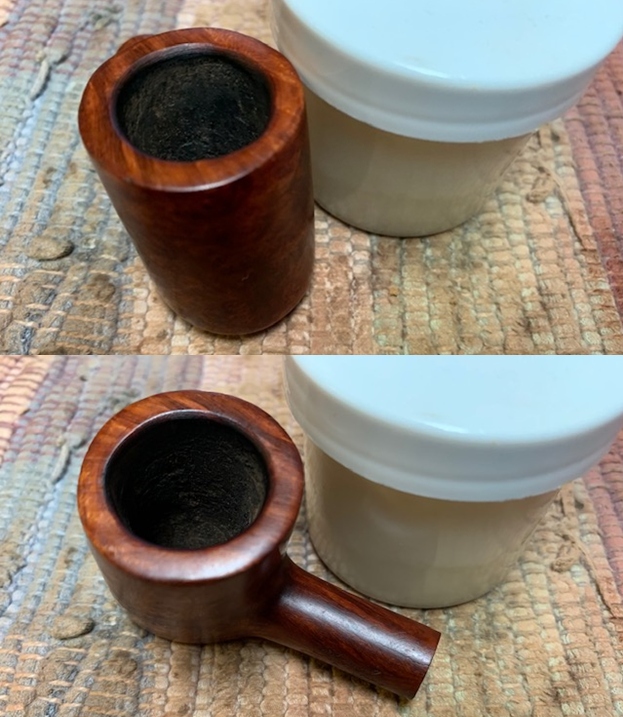
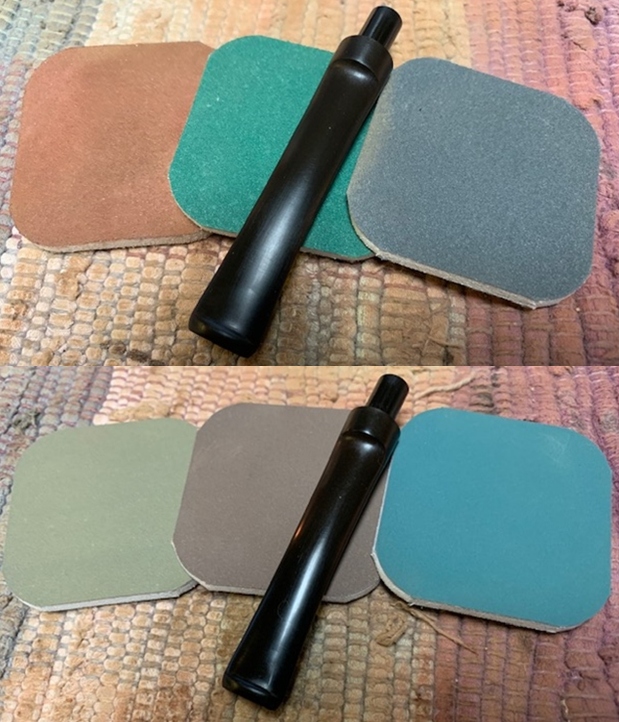
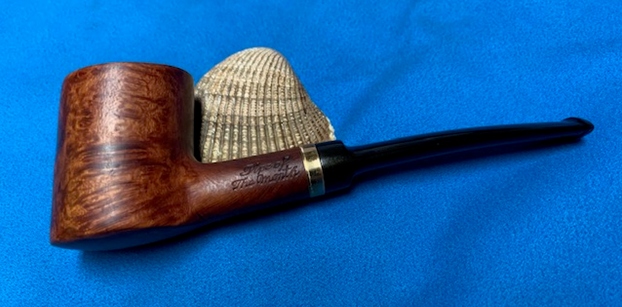
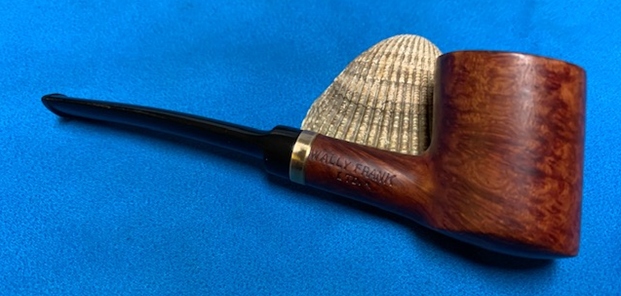
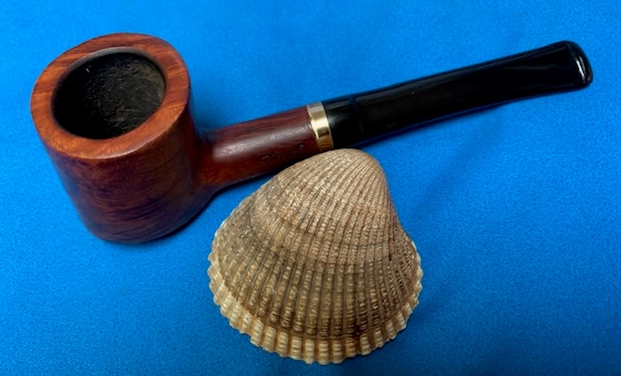
A Tale of the Rebirth of 3 Pipes – Pipe #1 – a Comoy’s Grand Slam Pipe 64 Billiard


Blog by Steve Laug

Last week I received an email from a fellow named Stanley who had gotten my info from the local Pipe and Cigar shop. He wrote that he had a trio of Comoy’s pipes that needed to be worked on. Two of them were Grand Slam Pipes and one was a Tradition. We connected via email and he said he would drop them off this week for me to work on. I am including part of his email so you have a sense of what I would be working on. I am also including the two photos that he attached to the email for me to see.

Hey Steve,

I had recently the chance to talk to a very kind and excellent gentleman over at City Cigar, I unfortunately was never able to get his name. However I mentioned I was looking for some replacement stems and he gave me your info…

…The pipes in question are attached in photos, I’ve never done any sort of pipe restoration in my life but I have attempted to take the cake down with a pocket knife. If you’d do it, would you be able to do a ream/clean on the three, as well as deal with the stems?

If possible, I’d prefer to save the original stems by repairing them, but it seems to me that most people remedy this problem with a replacement stem. Whatever you think is best I will go with.

If you think that I’d be better off without the stinger insert in the shape 64, then would you be able to remove it? I’m afraid I’d break the stem if I tried haha.

The 484b also seems to have a crack starting near the “Comoy’s Grand Slam” part of the shank, where it meets the stem. Is it possible to deal with this?

That is all! Please let me know what you think!
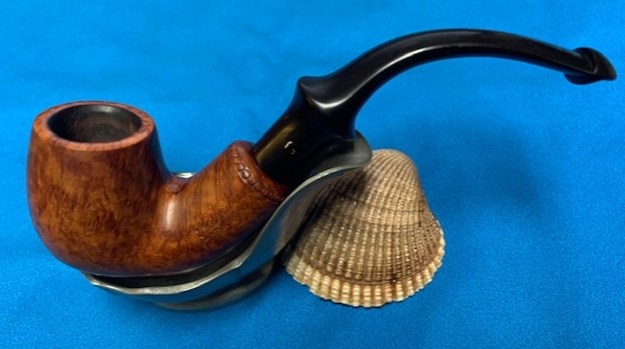
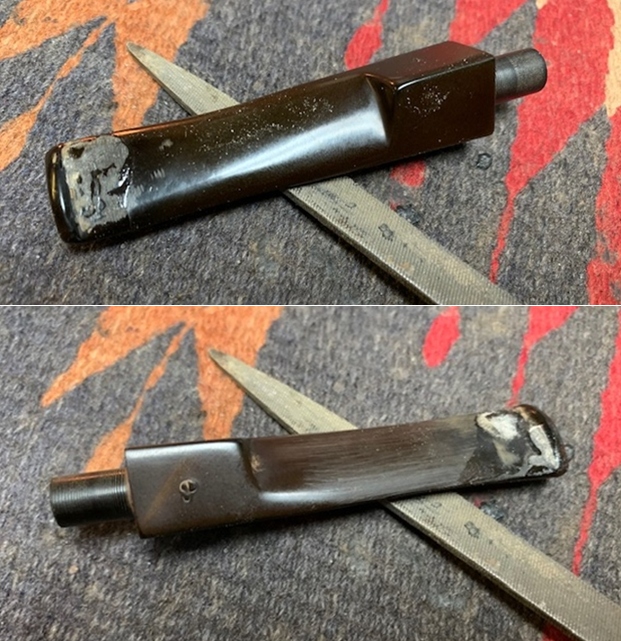
Thanks!  Stanley Last night Stanley stopped by and dropped off the three pipes. I took photos of pipes as there were when I opened the bag they were in. All three pipes were very dirty but the reaming had been started as noted in his email. The stems all had bite throughs on the underside. The bottom pipe in the photo below is a Grand Slam Pipe shape 64 Billiard. The stem has a 3 part C on the left side. The middle pipe is a Tradition 3591 Prince with 8 flattened panels on the bowl near the top. The stem also has a bite through and a missing divot. It also has a 3 part C on the left side. The top pipe in the photo is also Grand Slam Pipe 484B with a replacement stem that also has a bite through. The shank is also cracked on the left side.I decided to work on the Grand Slam Pipe 64 Billiard. It is a beautifully grained Comoy’s Billiard that really is a pipe of Pipe Smoking History. The stamping is the significant marker that points this out for me. It is stamped on the left side of the shank and reads COMOY’S [over] Grand Slam [over] Pipe. On the right side it has the shape number 64 next to the bowl/shank junction and that is followed by a Comoy’s COM stamp that reads Made in London in a circle [over] England. On the underside there was a *6 stamped at the stem/shank junction. The finish had a lot of grime ground into the smooth finish on the bowl and some darkening around the sides of the bowl. The bowl had been scraped but there was still a moderately heavy cake. There was an overflow of thick lava on the top of the rim and on the inner bevel of the bowl. It was hard to know what the rim top and inner edge of the bowl looked like under the grime. The stem was lightly oxidized and there was a large bite through on the underside. There was a three part inlaid C on the left of the taper stem. When the pipe arrived it had a Softee Bit over the damaged stem. The pipe had promise but it was very dirty. I took photos of the pipe before he started his cleanup work. I took photos of the rim top and bowl to give a clear picture of the thickness of the cake and the overflow of lava on the rim top. It is hard to know if there is damage to the inner edge of the bowl because of the lava coat. I also took photos of the top and underside of the stem to show the condition of the stem surface and the bite through on the underside.I took photos of the stamping on both sides and underside of the shank. They read as noted above. I also included a photo of the 3 part C logo on the left side of the taper stem.   I removed the stem and took a photo of the pipe to give a sense of the whole. It is a well shaped billiard. Once the stem was off I noted that tenon had a Comoy’s Grand Slam metallic stinger threaded in the stem. It was missing the cap on the end that held the leather washer in place the apparatus was damaged and I would not be able to fit a new cap on the end. I would remove it from the tenon so that I could clean the stem and do the repairs.I looked on Pipephil’s site for information on the Comoy’s Grand Slam Pipe and found the following information I have included a screen capture (http://www.pipephil.eu/logos/en/logo-comoy.html). The one I am working on is like the second one in the screen capture below. It has the three part C which dated it to 1946 and following. The stamping is the same as the one I am working on. The *6 is the size of the washer on the end of the stinger.I turned to the article on Pipedia about dating Comoy’s pipes but the style of the stamping (https://pipedia.org/index.php?title=Comoy%27s_Dating_Guide#1917_to_the_end_of_the_1930.27s_.28at_least_1938.29). I have include the section in the screen capture below that date this pipe to the 1950s.

Now the Comoy’s stamp can be found in three variants in the 1950s

  1. A simple block-letter style without serifs but with the C larger than the other letters and the apostrophe before the “S”.
  2. A return to the slightly more fancy block letters with serifs and the apostrophe. (It seems that some grades carried different stamps, or at least that the stamping changed in different years for some grades.)
  3. A simple block-letter style without serifs and without the apostrophe and with the “C” the same size as the rest of the letters. This stamp was probably not used very long.
  4. A simple block-letter style without serifs but with the apostrophe before the “S” and with the “C” the same size as the rest of the letters.

Made in London England

Appears in two versions. This is again stamped in a circle with “MADE” at the top, “IN” in the middle, and “LONDON” at the bottom, with “ENGLAND” in a straight line beneath. It can be assumed that this stamp was first used in the export drive in the early 1950s. On a Bulldog Sandblast from the early 50s the Comoy name no. 2 above was used together with “MADE IN LONDON” over “ENGLAND”. There are no known examples of pre-WW II Comoy’s stamped in this way. The second version is the same as above but in a “rugby ball ” shape. This shape is verified on Comoy´s “Extraordinaire” pipes.

Inlaid “C”

C” was first inlaid in the side of the mouthpiece around 1919. This was a complex inlay needing three drillings. First, a round white inlay was inserted, then the centre of the white was drilled out, and a smaller round black inlay was inserted. Finally, another drilling was made to remove the open part of the “C,” and an even smaller black inlay was inserted. This inlaid “C,” known as the “three-piece C,” was continued until the Cadogan era in the 1980s. However, the “C” in the 1920s and early 30s is much thinner and more delicate than the one post-WW II.

That article gave me some helpful information regarding the pipe that I was working on. I knew that the stamping and logos identified the pipe as having been made in following WW2 and from what I can see from the above information it is a 1950s era pipe.

I reamed the bowl with a PipNet pipe reamer using the 2nd and 3rd cutting head to remove the remaining cake back to briar. I followed up with a Savinelli Fitsall pipe knife to remove the remnants of cake. I sanded the walls of the bowl with a piece of 220 grit sandpaper wrapped around a piece of dowel. I scrubbed out the mortise and the airway in the shank and the stem with alcohol, cotton swabs and pipe cleaners. I scrubbed the exterior of the bowl, rim, shank and stem with a tooth brush and Murphy’s Oil Soap to remove the oils and tars on the rim and the grime on the finish of the bowl. I rinsed it under running water and dried it off with a soft cloth.    I was able to remove some of the lava build up on the rim top and finished by scraping it with the Fitsall knife and then a piece of 220 grit sandpaper. There were some deep cuts on the bottom right side of the bowl and on the top right side near the edge. I filled these in with a spot of clear super glue.   I polished the bowl and the rim top, sides and shank with micromesh sanding pads – wet sanding with 1500-12000 grit pads and wiping it down after each pad with a damp cloth. I carefully avoided the stamping on the shank so as not to damage the stamping.   I rubbed the bowl and shank down with Before & After Restoration Balm. I worked it into the surface of the bowl sides and shank with my fingertips to clean, enliven and protect the briar. I let the balm sit for a little while and then buffed with a cotton cloth to raise the shine.    I set the bowl aside and turned my attention to the stem. I heated the stinger with a Bic lighter and unscrewed it with a pair of pliers.I set aside the bowl and turned my attention to the stem repairs. I cut a piece of cardboard for a pallet, put aside two charcoal capsules, and set out the spatula and the Loctite 380 black CA glue. I greased a pipe cleaner with Vaseline and inserted it in the stem. I filled in the hole in the stem with a mixture of charcoal powder and Loctite. I used the spatula to fill in the bite throughs on all of the stems. I sprayed the repair with an accelerator to set the glue and removed the pipe cleaners from the stems.  I filled in the deep tooth marks on the top side of the stem with black super glue and set the stems aside to let the repairs cure. I took a photo of the three pipes at this point to give a feel for where things stood.   I smoothed out the repairs with a needle file and started blending them into the surface of the stem. I sanded the remaining repairs with 220 grit sandpaper to further blend it into the stem surface. I started polishing it with 400 grit wet dry sandpaper. I polished the vulcanite stem with micromesh sanding pads – 1500-12000 grit pads. I wiped it down with a damp cloth after each sanding pad. I took photos of both sides of the stem to show the repair work on both sides.     This 50s era Comoy’s Grand Slam Pipe 64 Billiard with a vulcanite taper stem is a great looking pipe now that it has been restored. I did a lot of work on the bowl and repaired the bite through on the stem. The rich browns and blacks of the contrasting stains came alive with the polishing and waxing. I put the stem back on the bowl and carefully buffed the pipe with Blue Diamond on the buffing wheel using a light touch on the briar. I gave the bowl and the stem multiple coats of carnauba wax on the buffing wheel and followed that by buffing the entire pipe with a clean buffing pad. I hand buffed the pipe with a microfiber cloth to deepen the shine. The finished Comoy’s Medium Billiard is a beauty and fits nicely in the hand and looks very good. Give the finished pipe a look in the photos below. The dimensions of the pipe are Length: 5 ½ inches, Height: 1 ¾ inches, Outside diameter of the bowl: 1 ¼ inches, Chamber diameter: ¾ of an inch. I am looking forward to what Stanley thinks of his repaired pipe. He had said the threesome were his favourite pipes. This is the first of  the three. Thanks for reading this blog and my reflections on the pipe while I worked on it. There are many more to come!