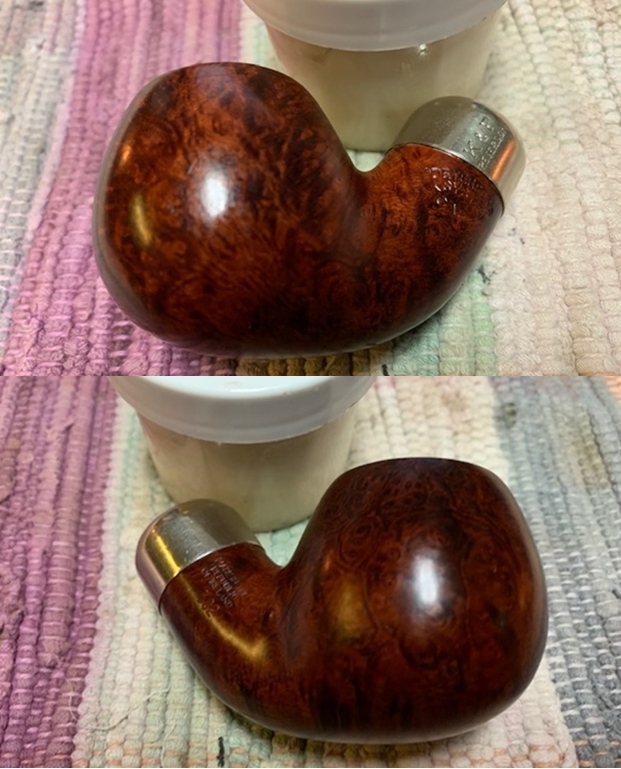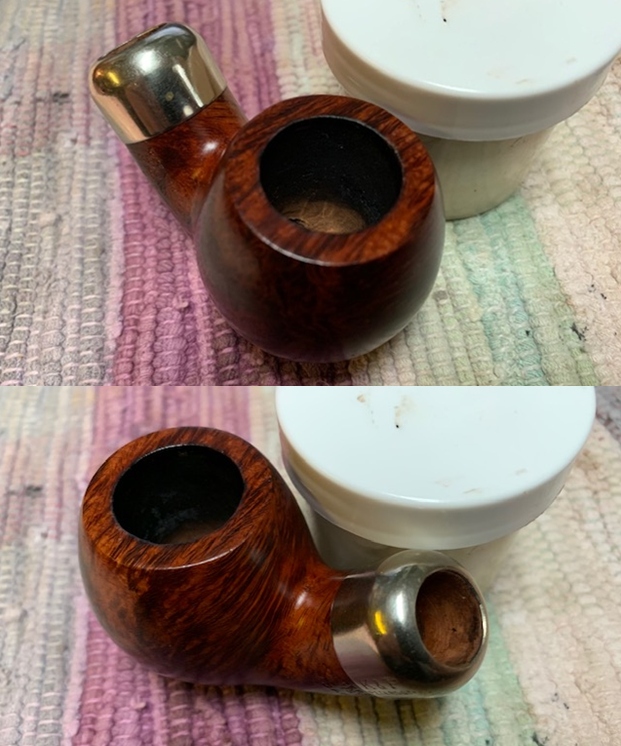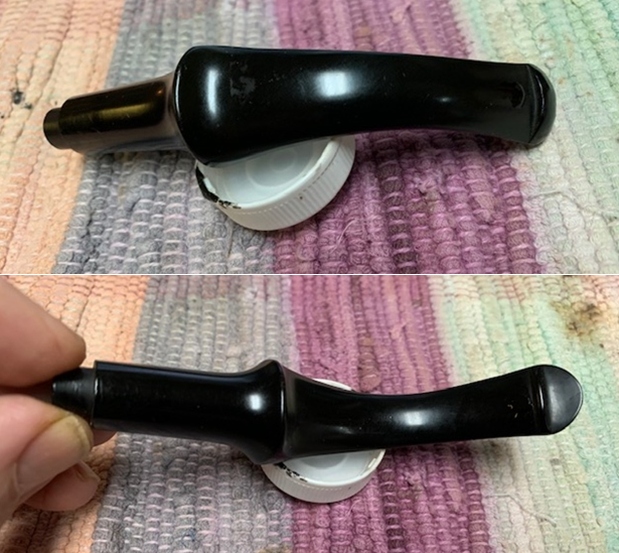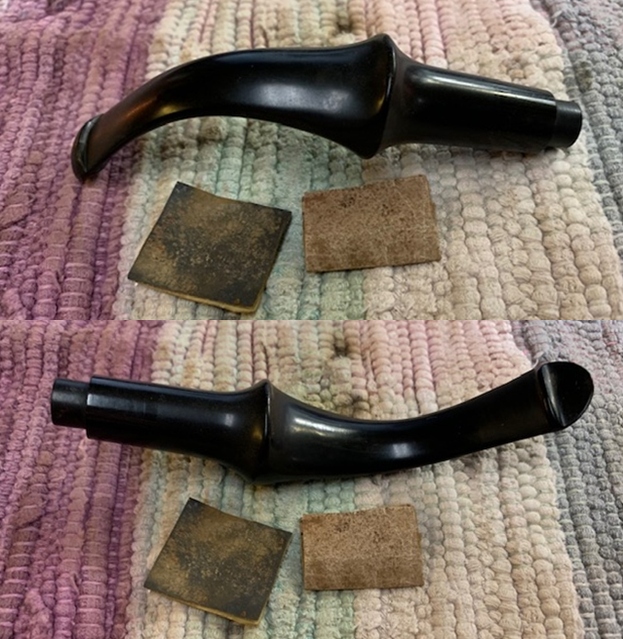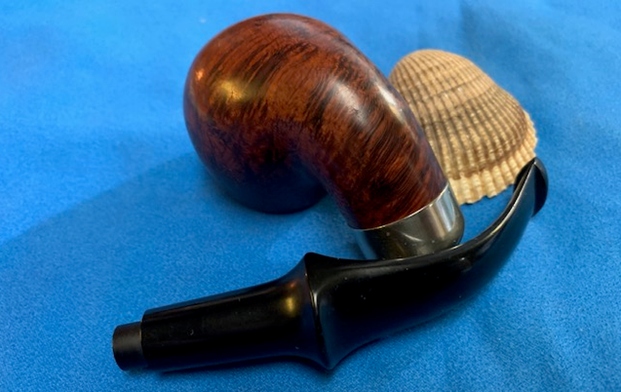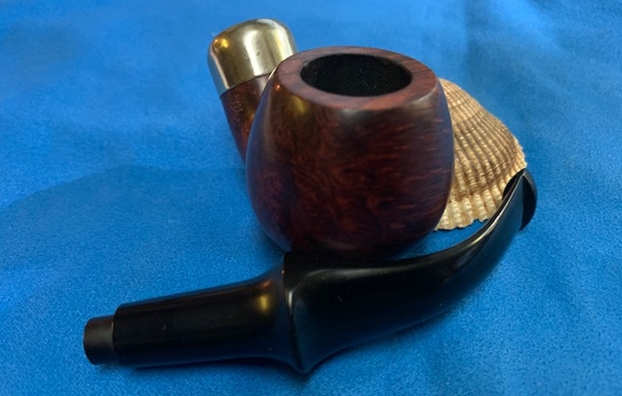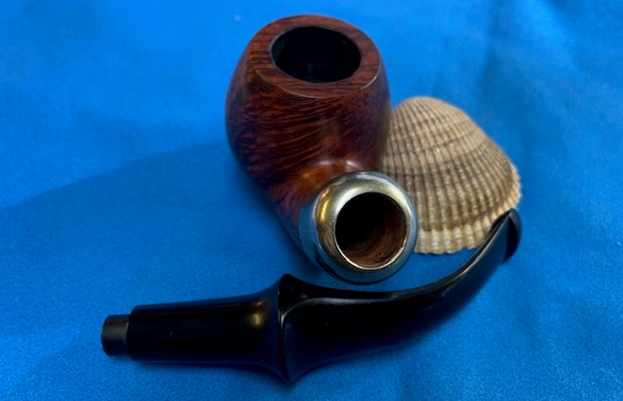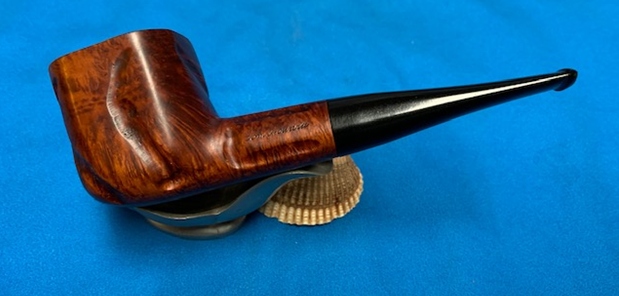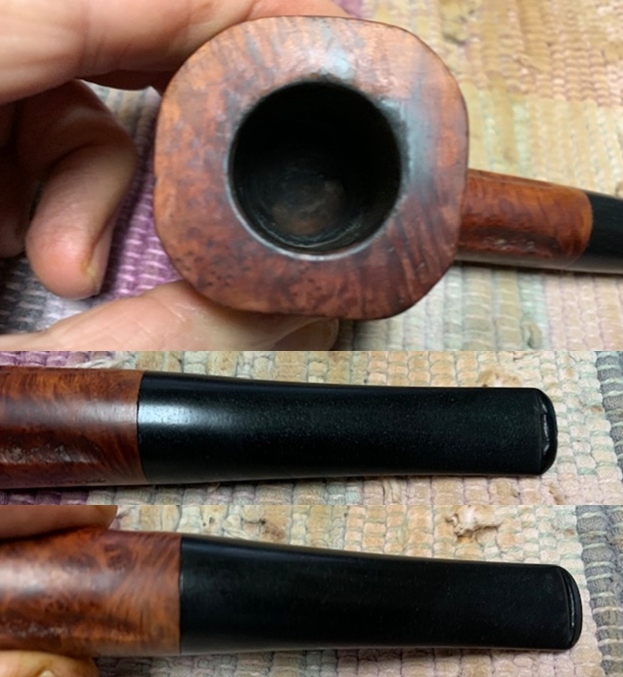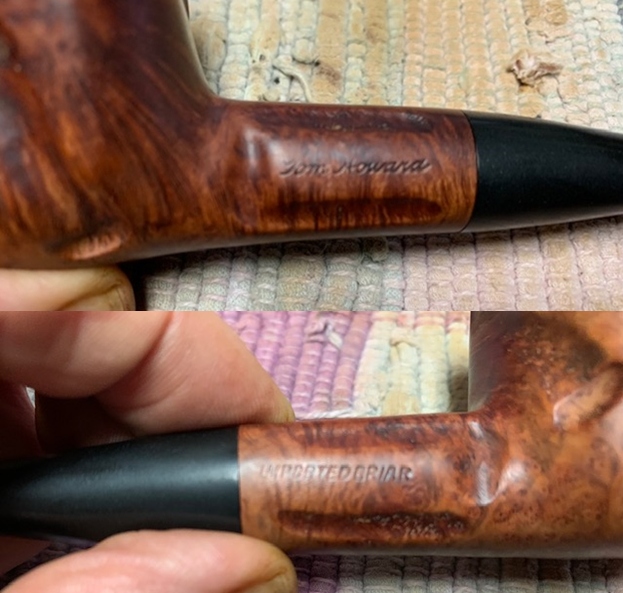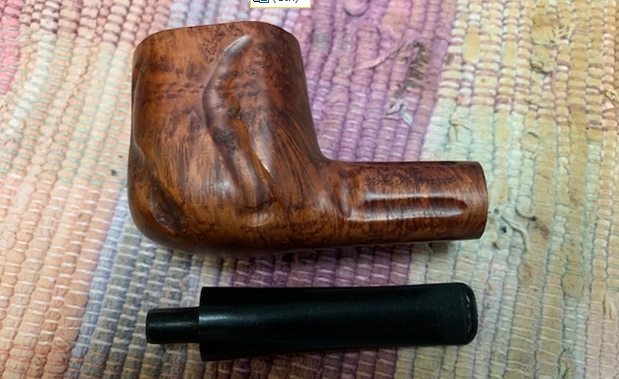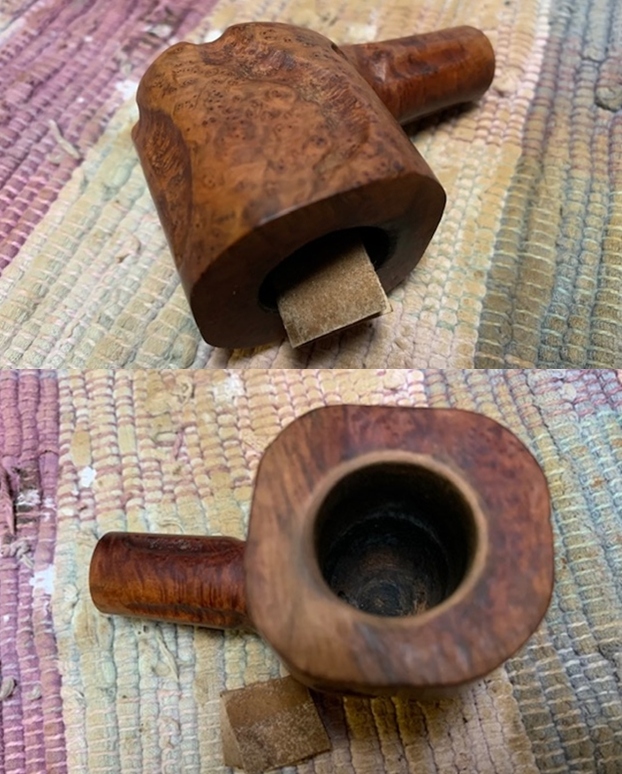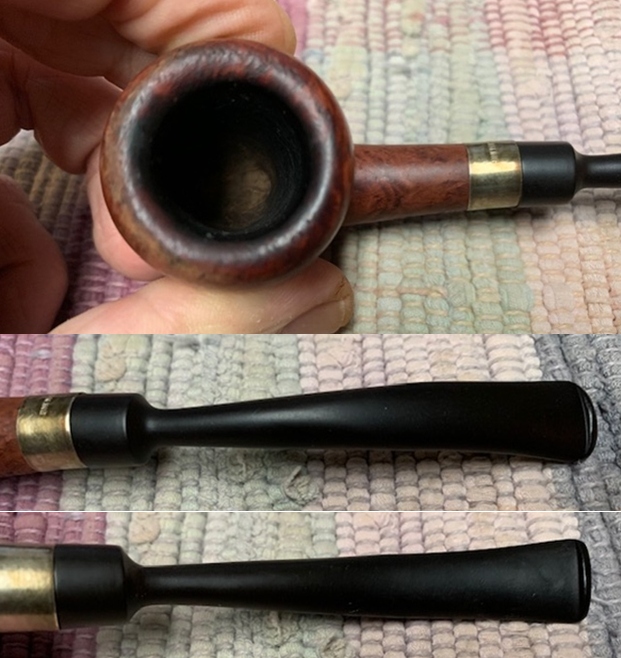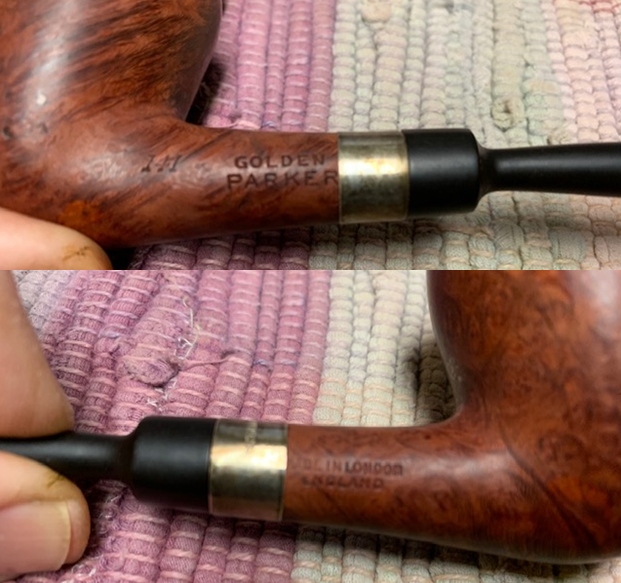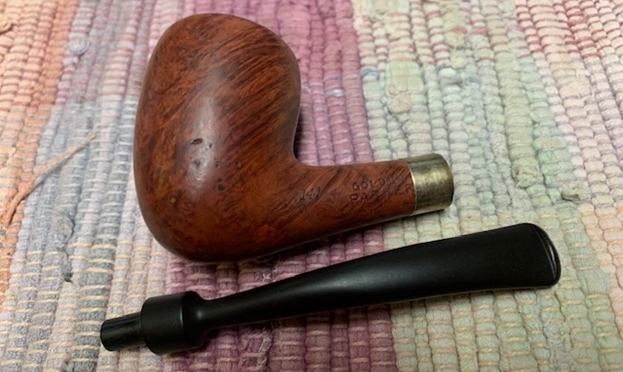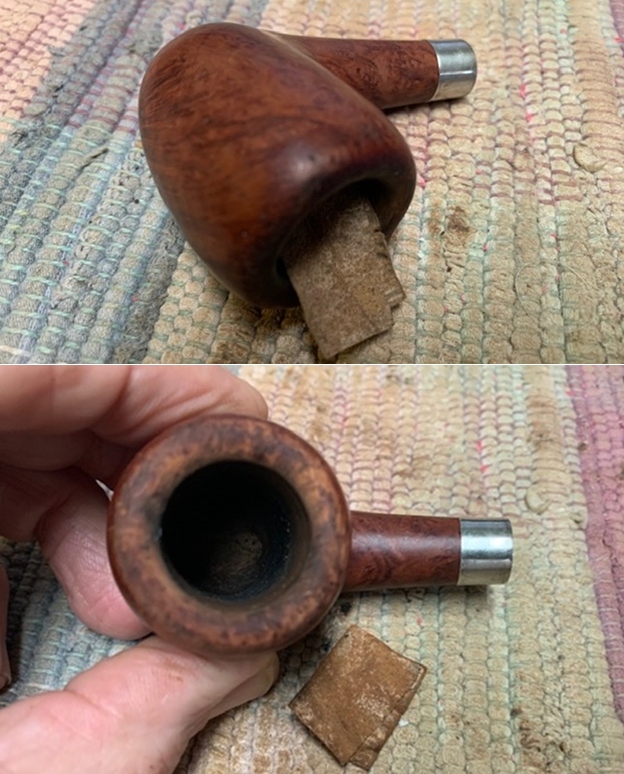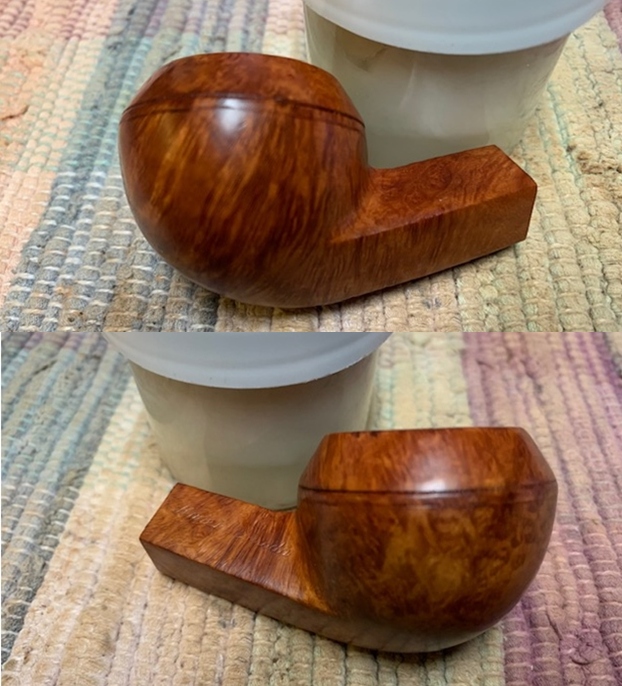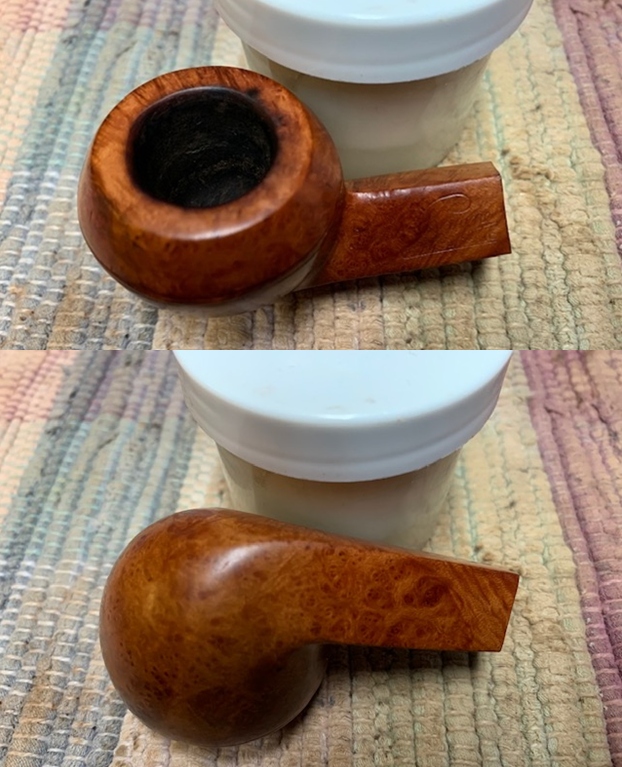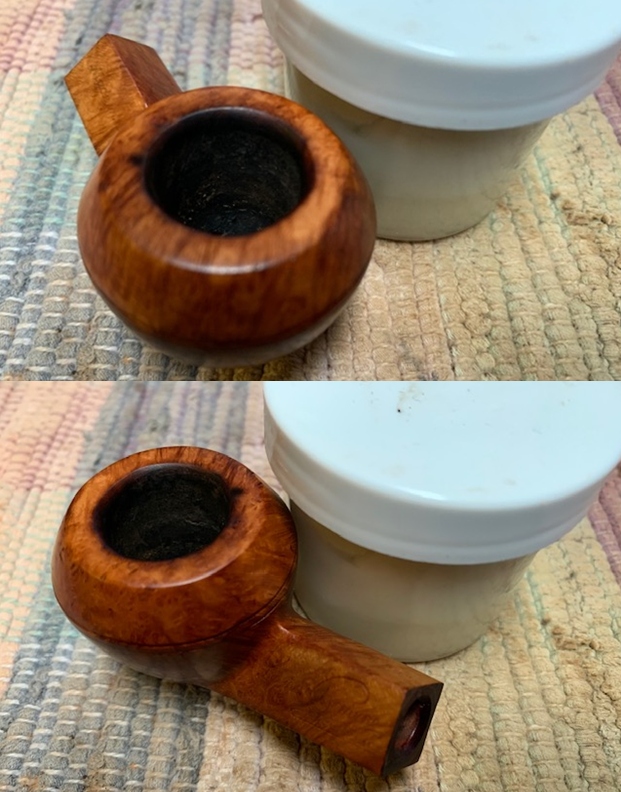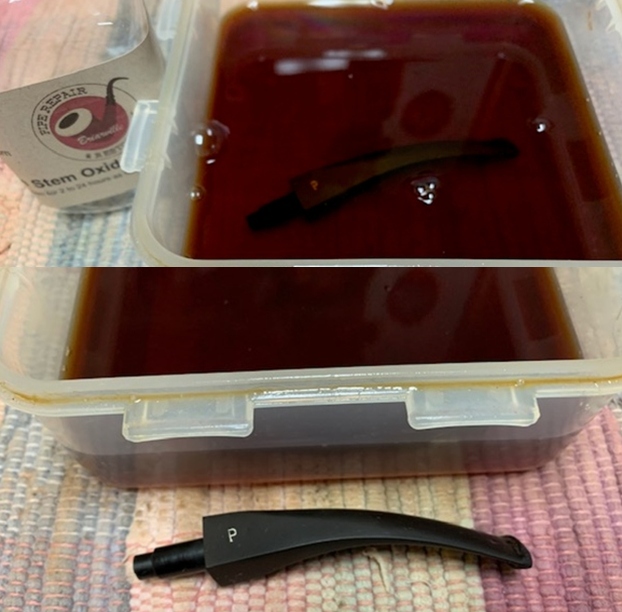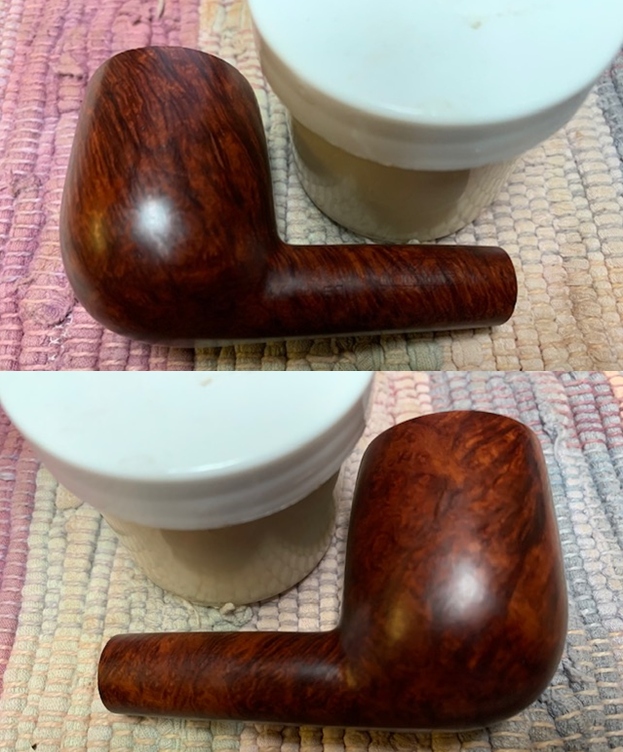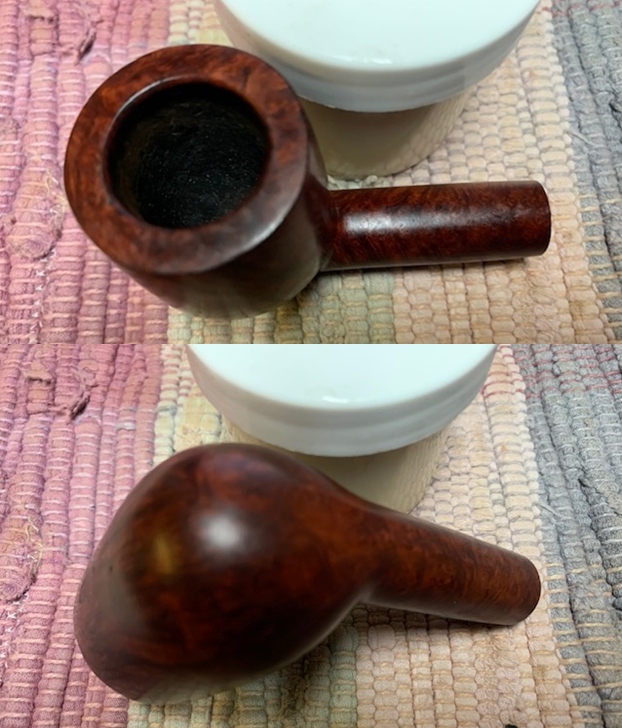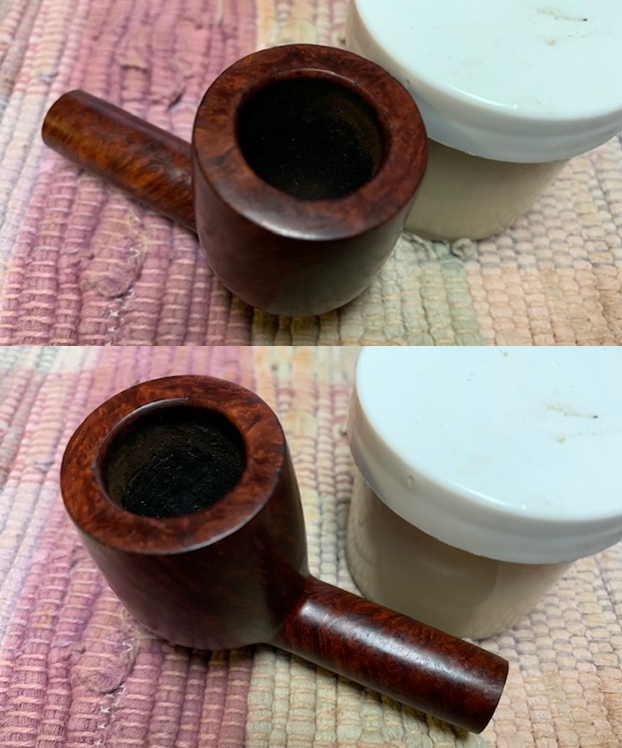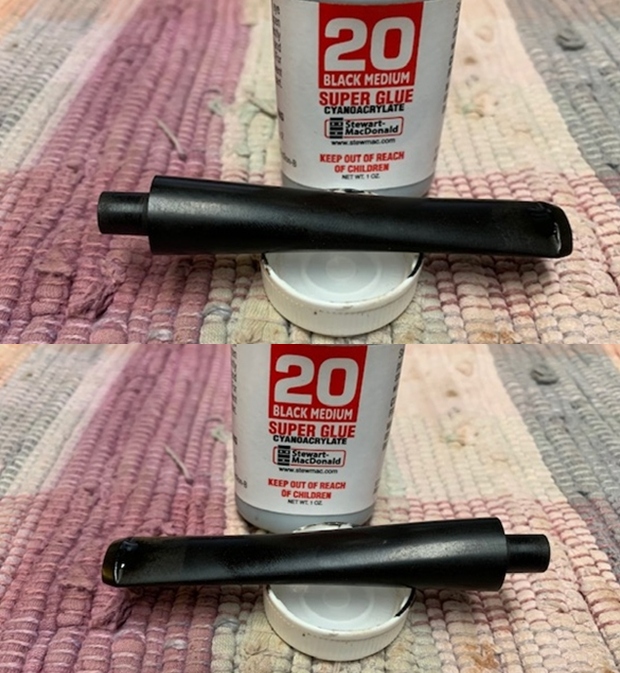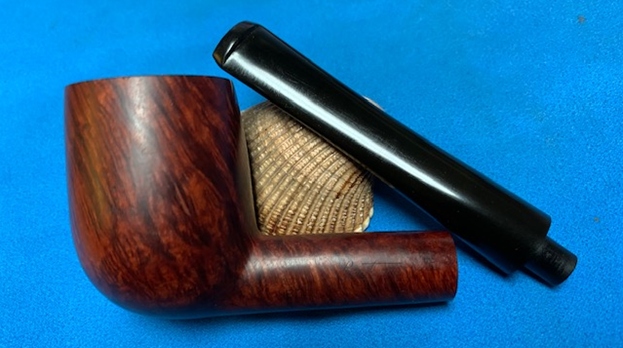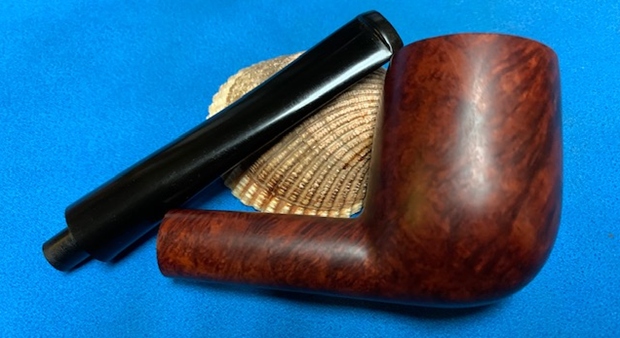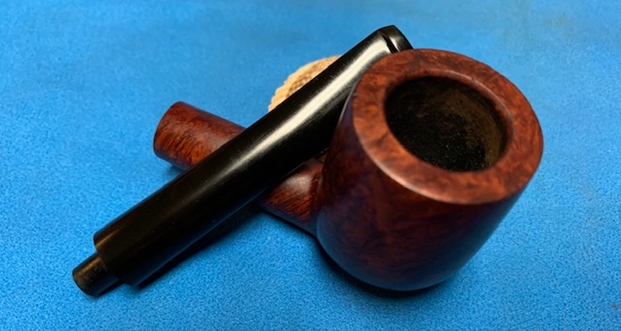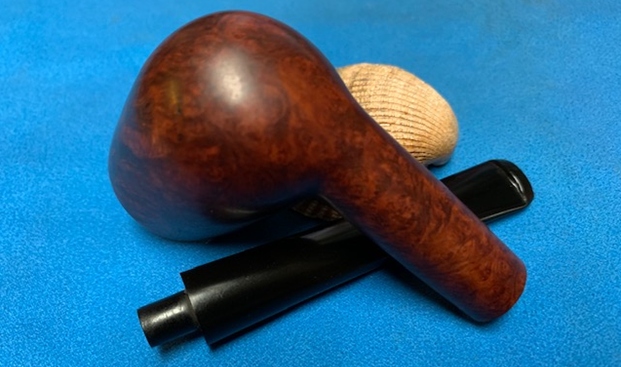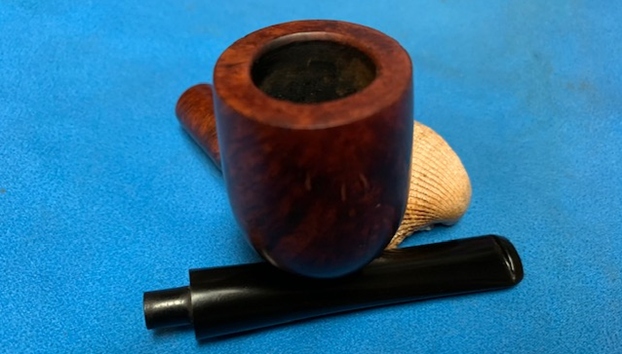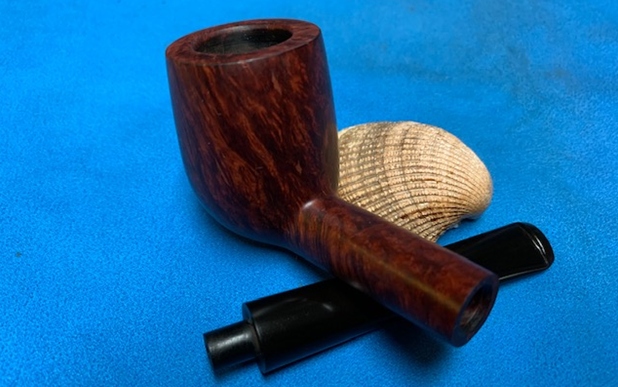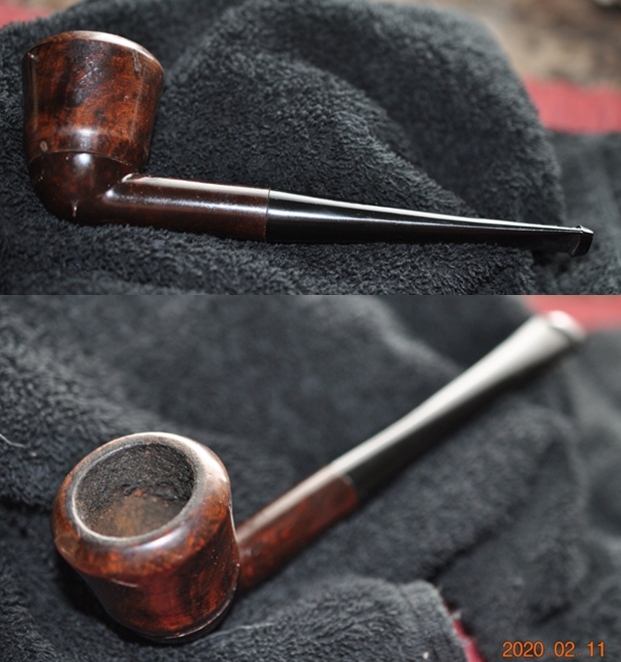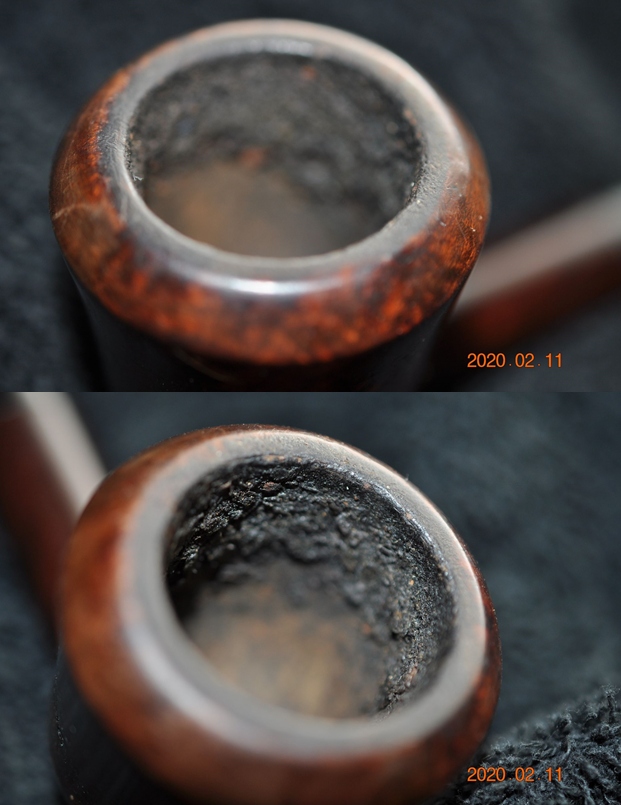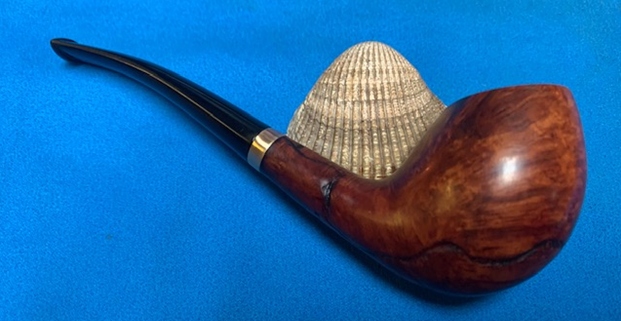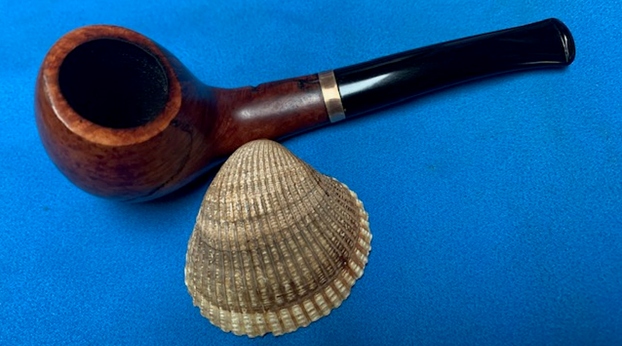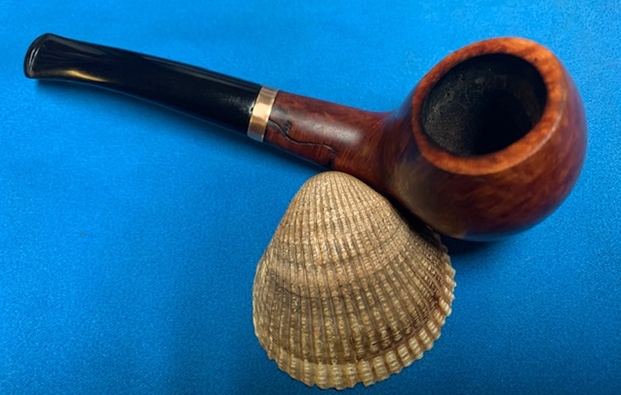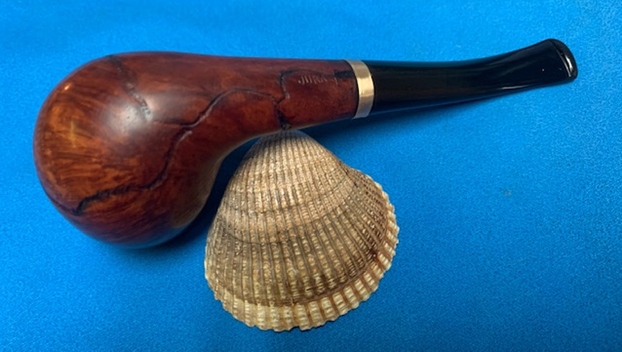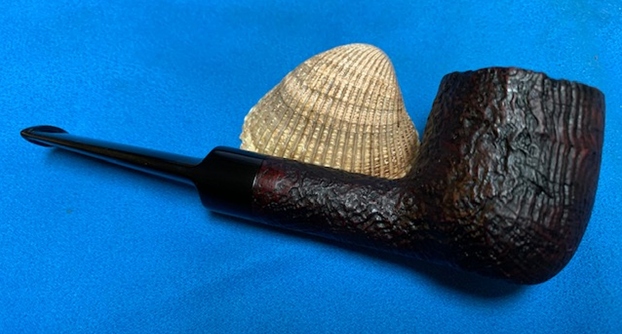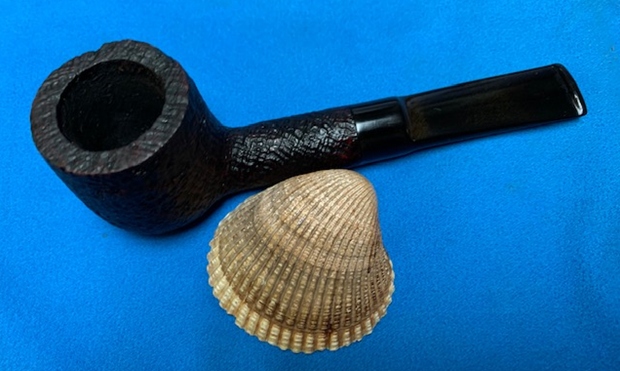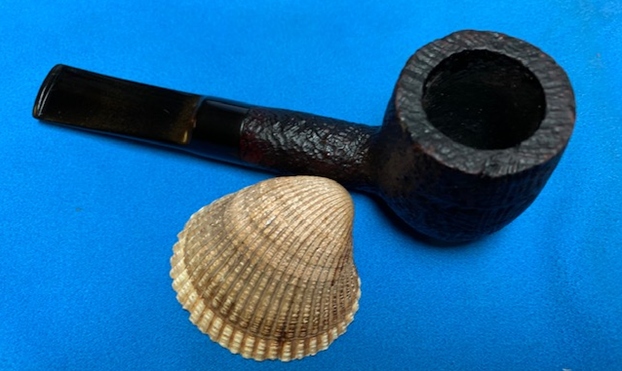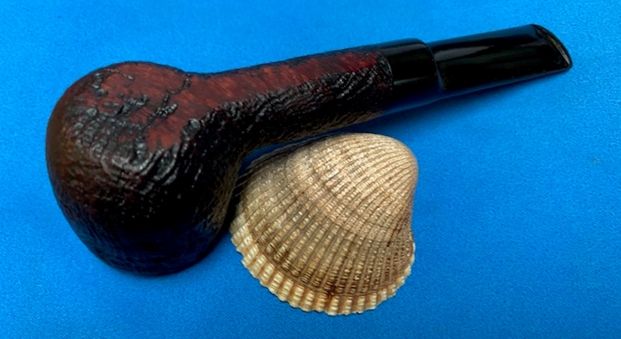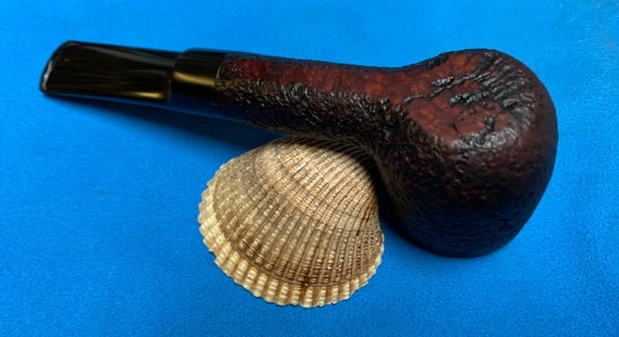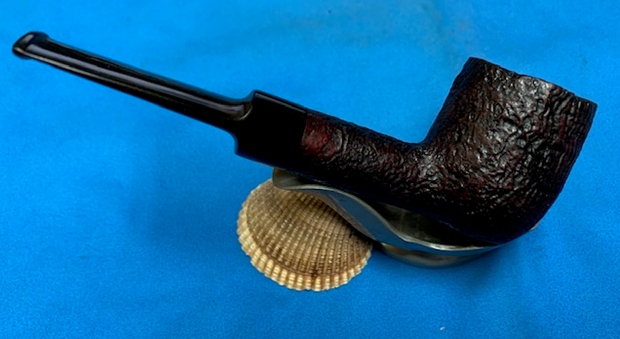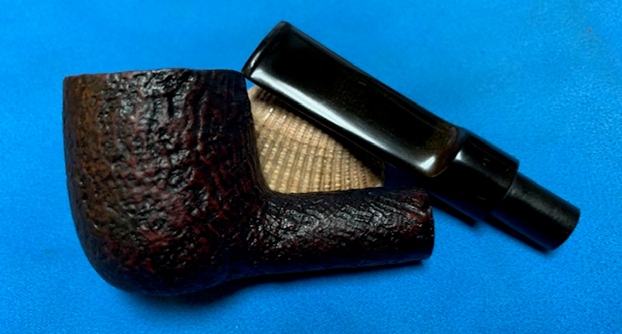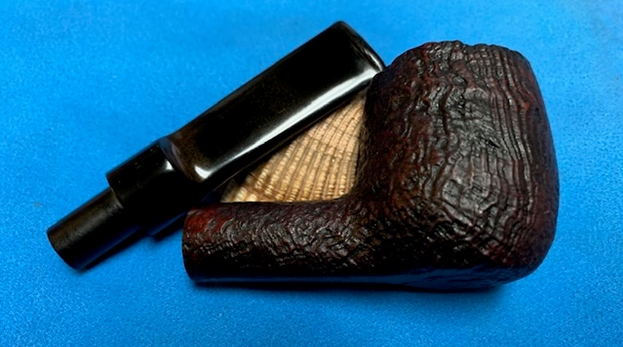
Tag Archives: Stem repairs

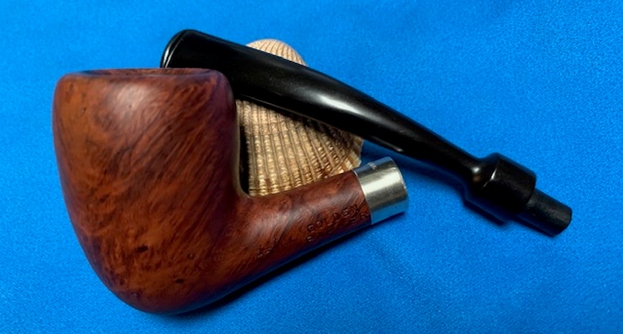
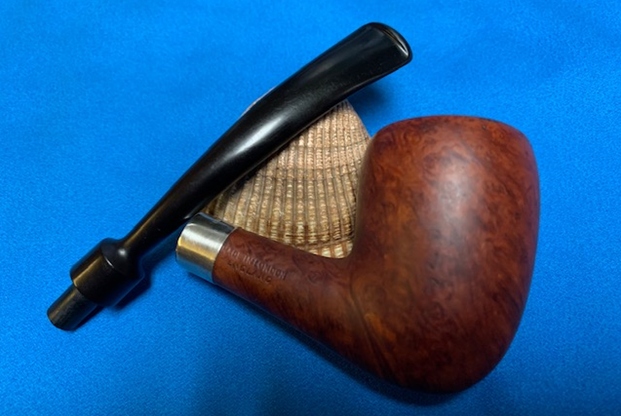
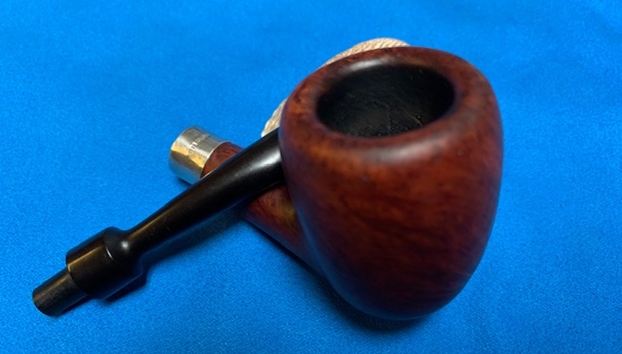
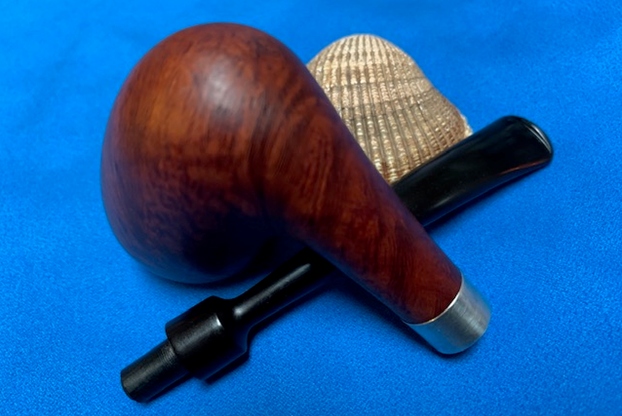
A Rebirth for LHS Sterncrest Hunter’s Billiard


Blog by Steve Laug

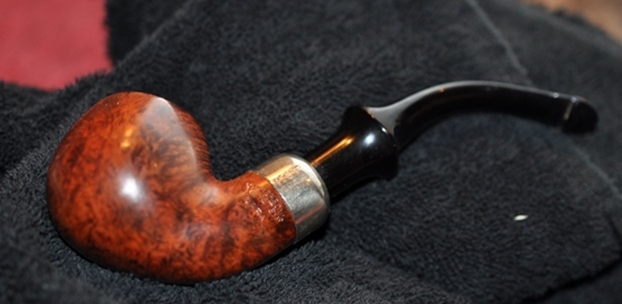
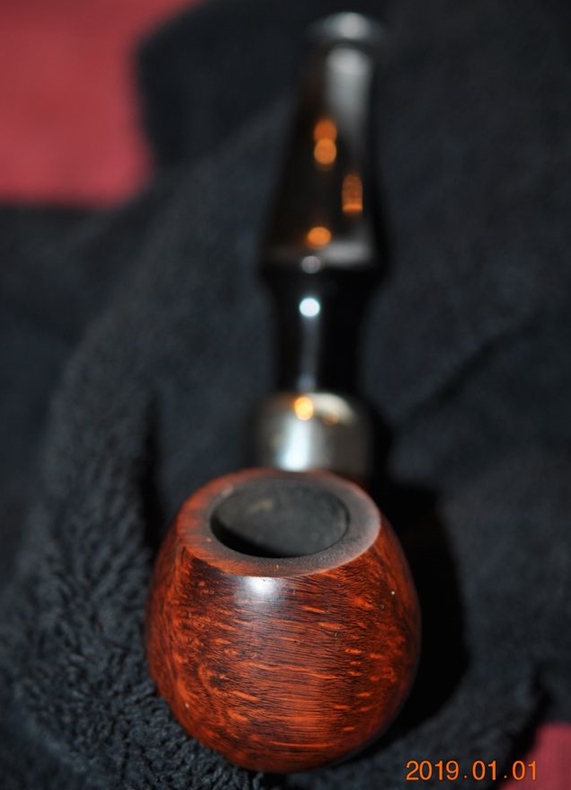
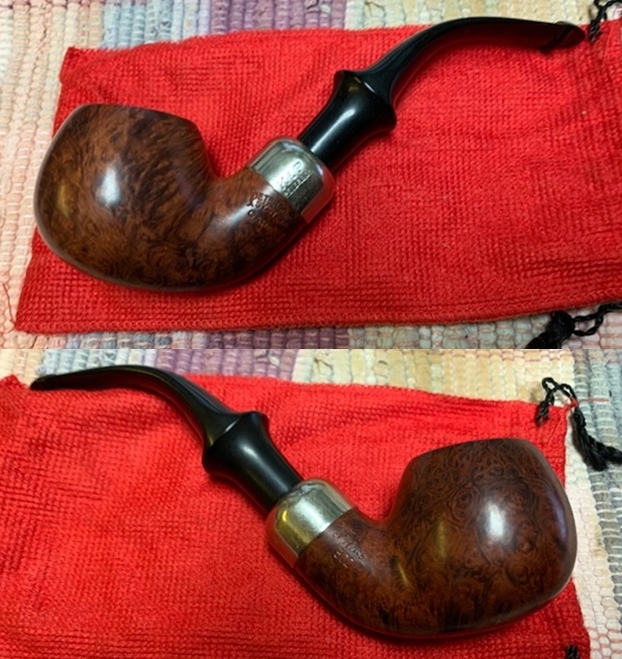
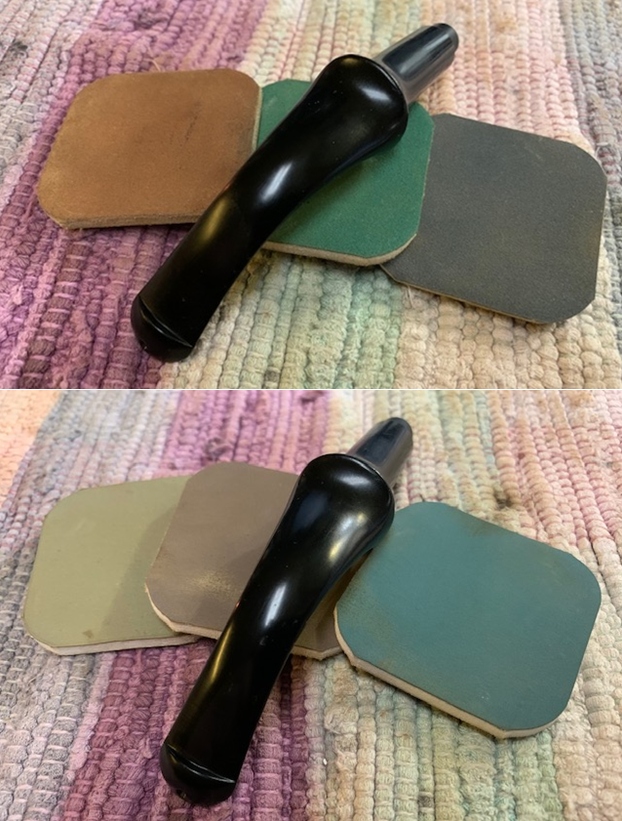
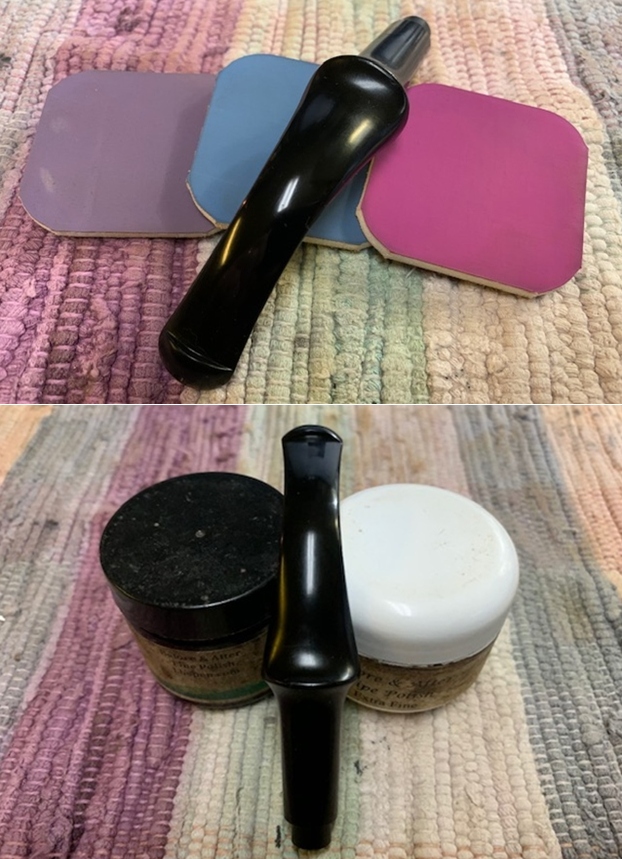
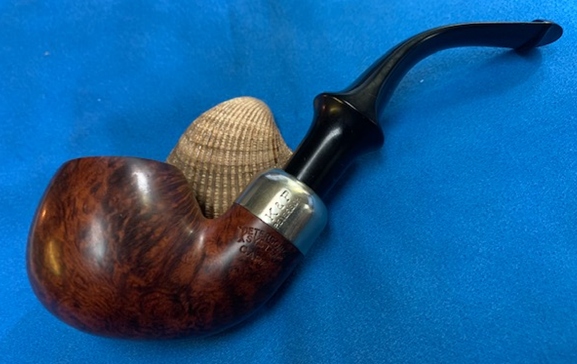
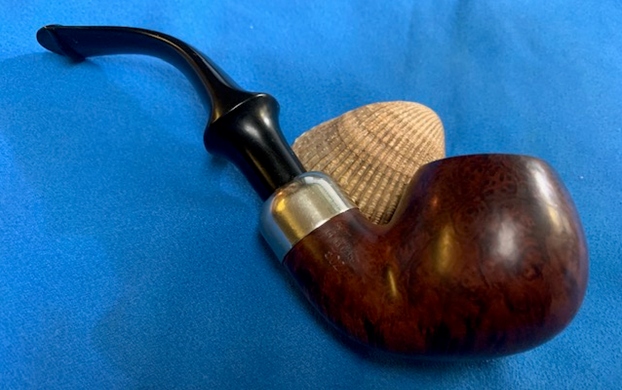
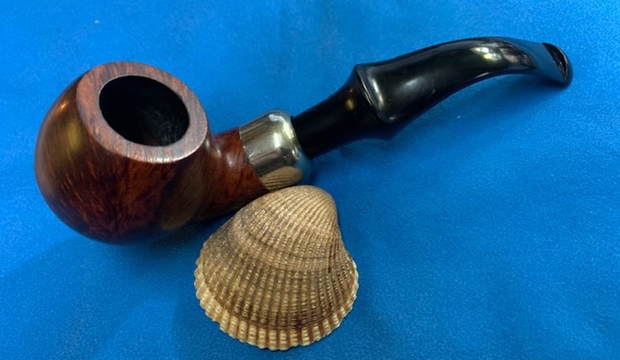
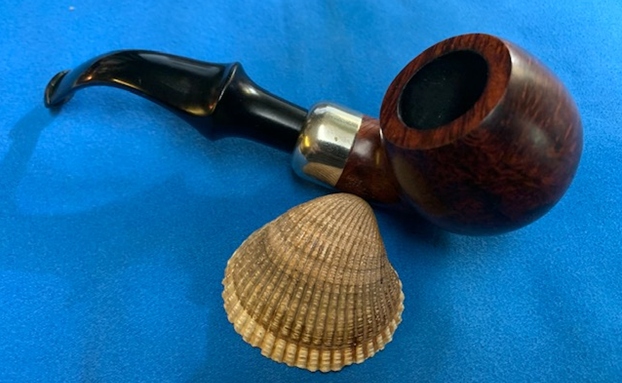
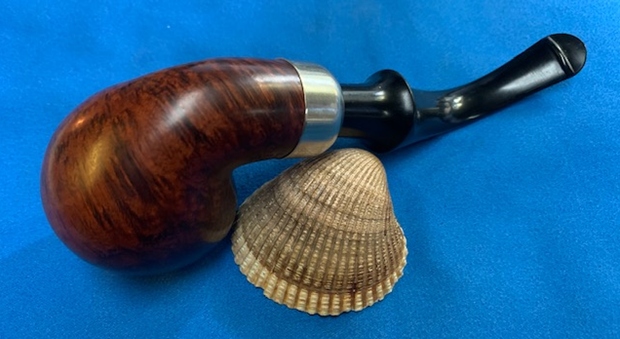
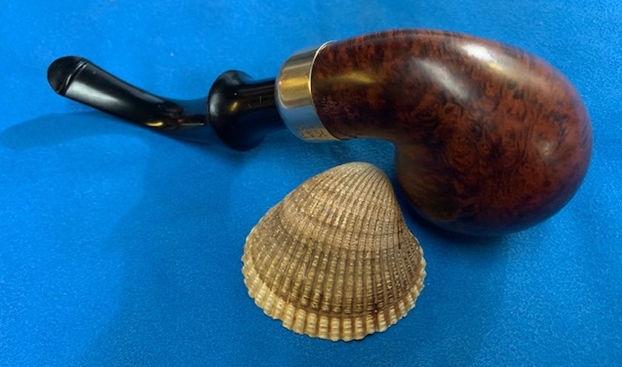
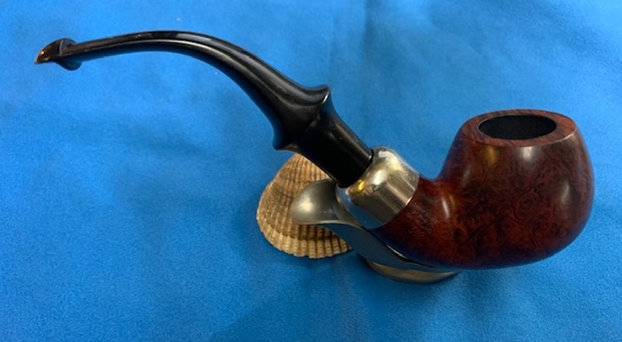
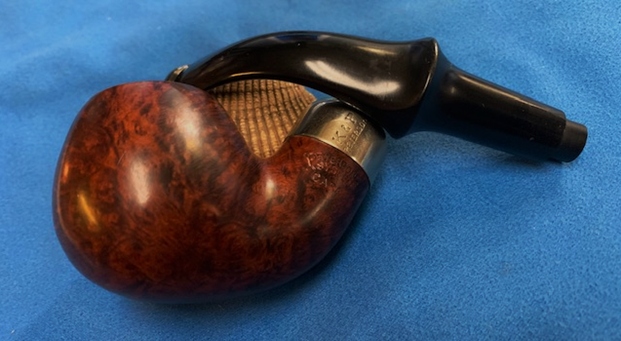
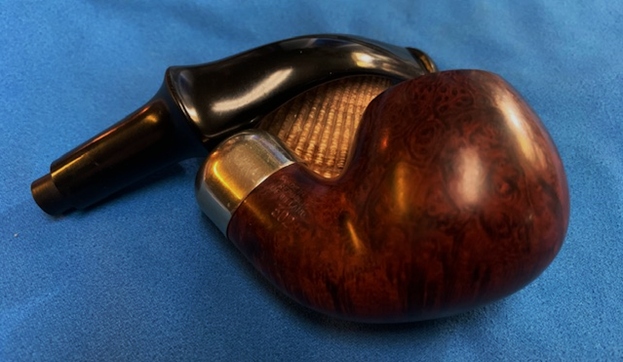
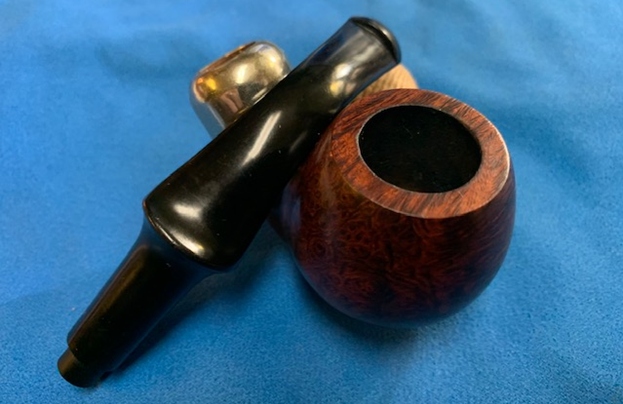
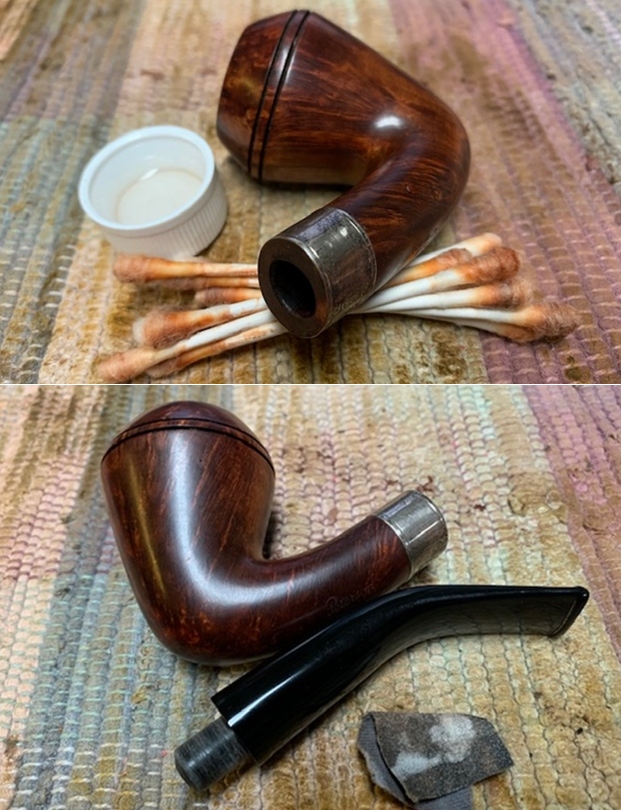
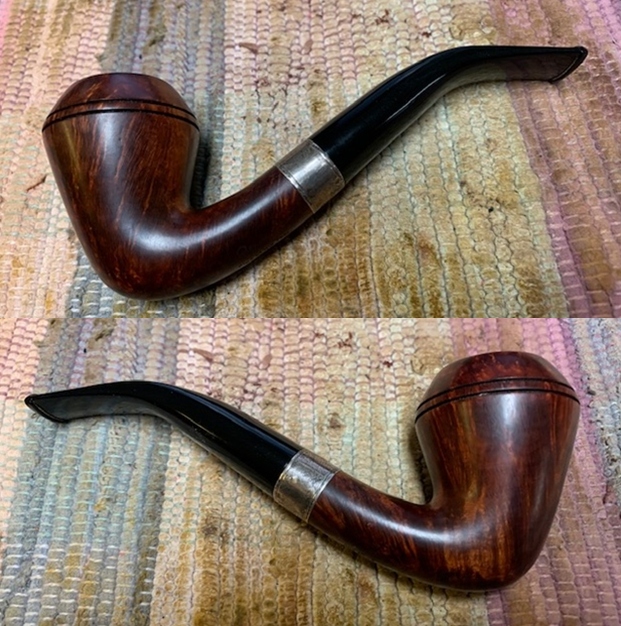
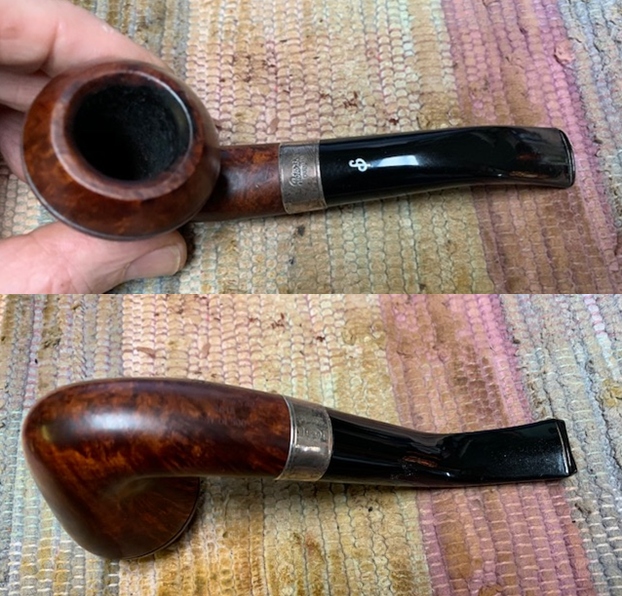
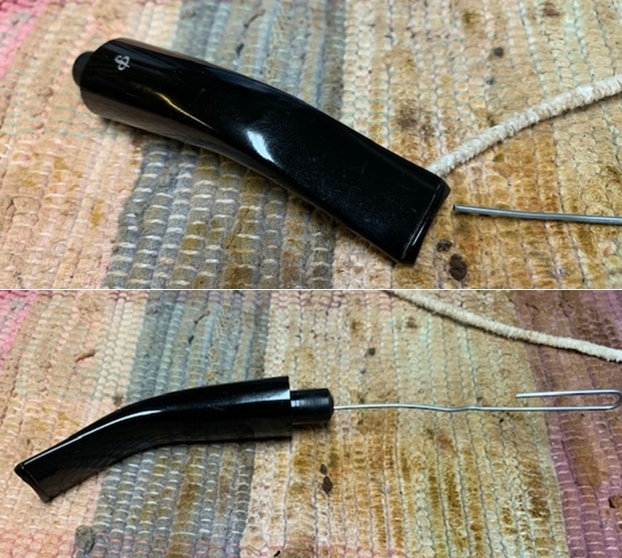
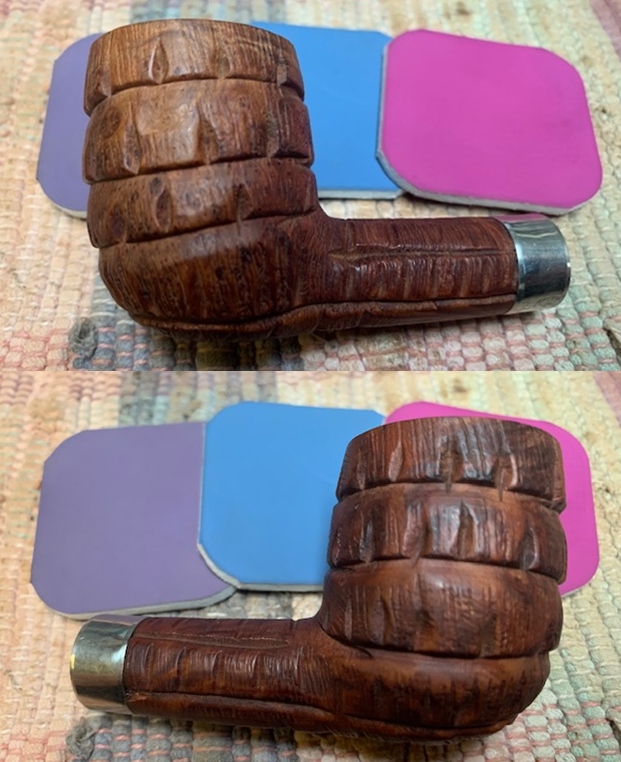
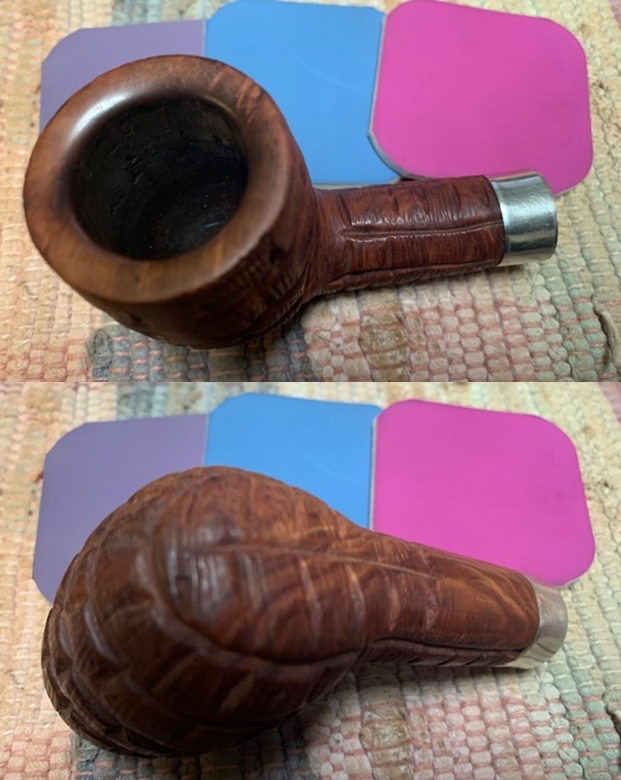
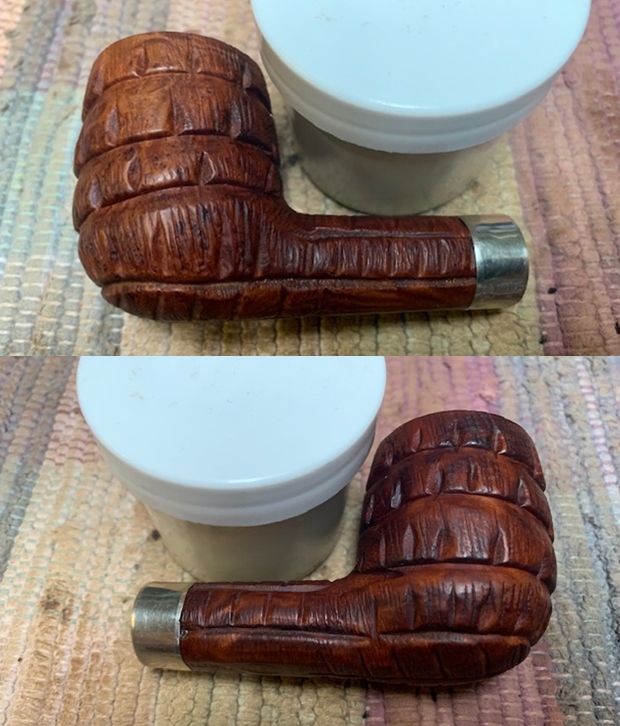
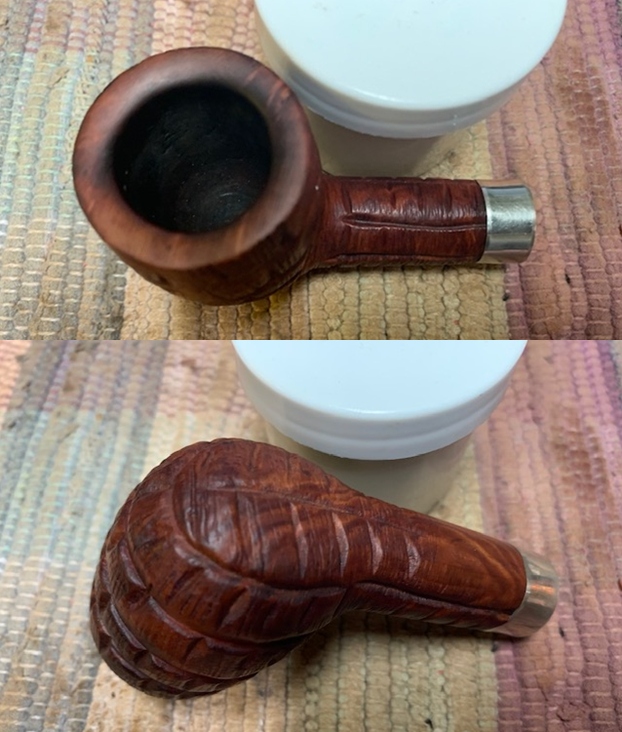
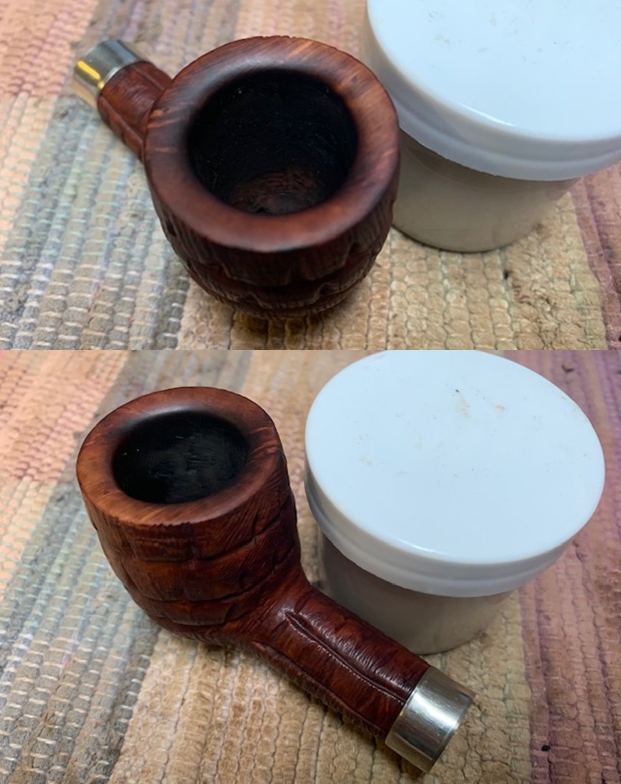
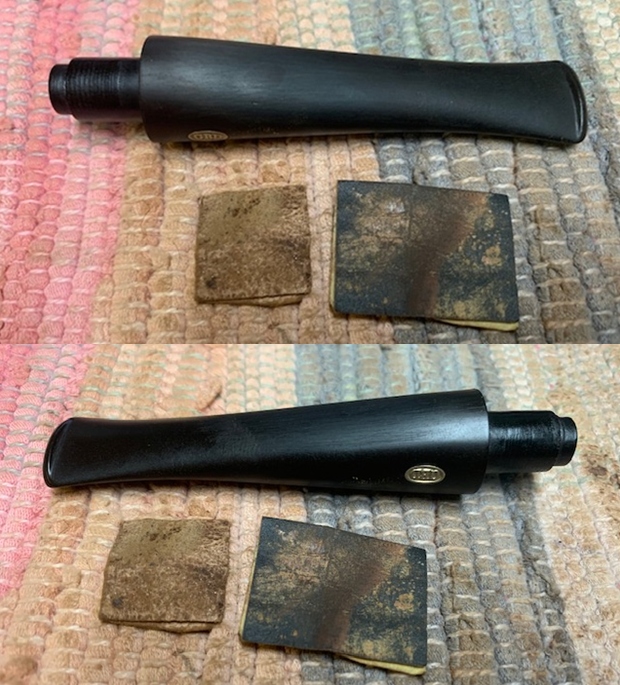
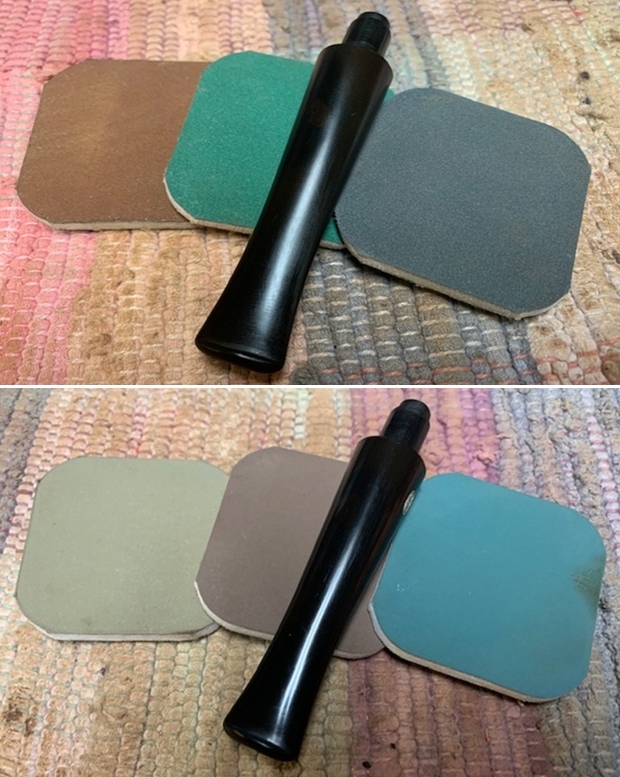
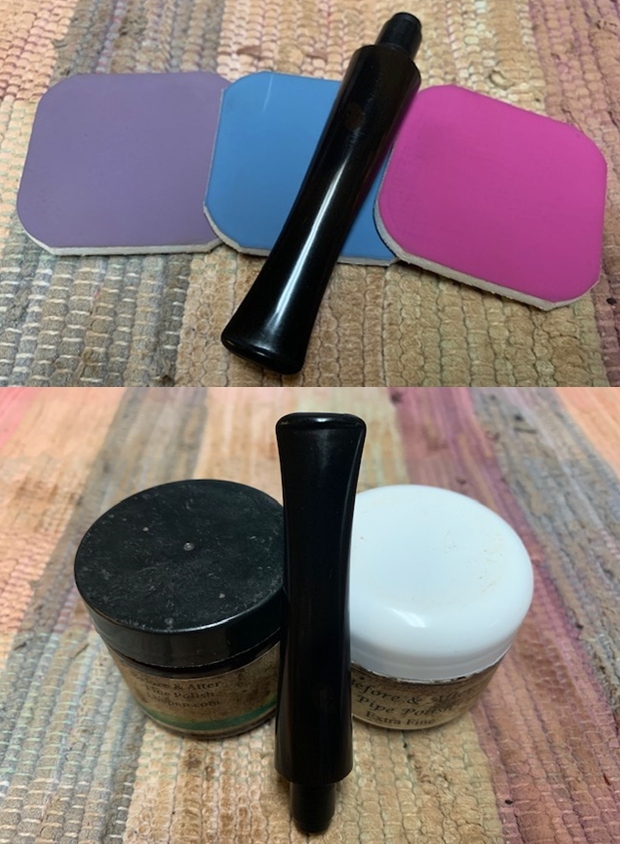
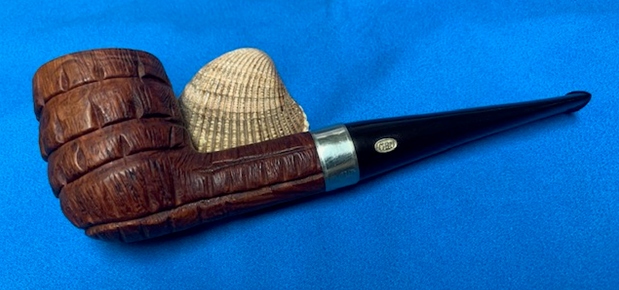
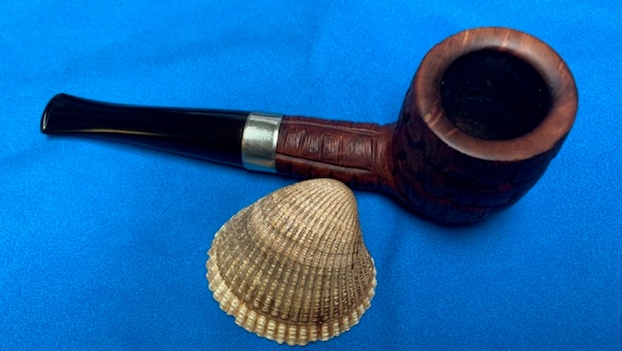
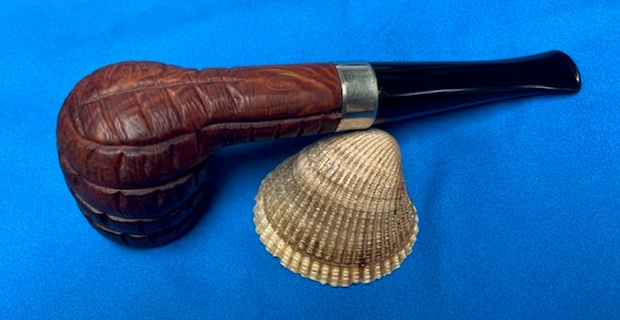
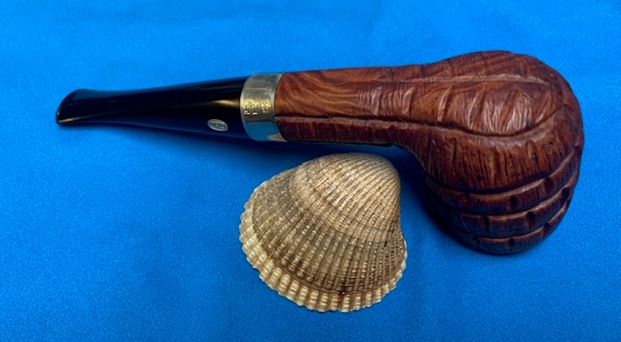
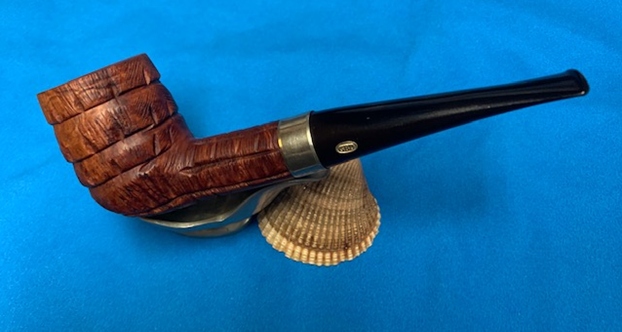
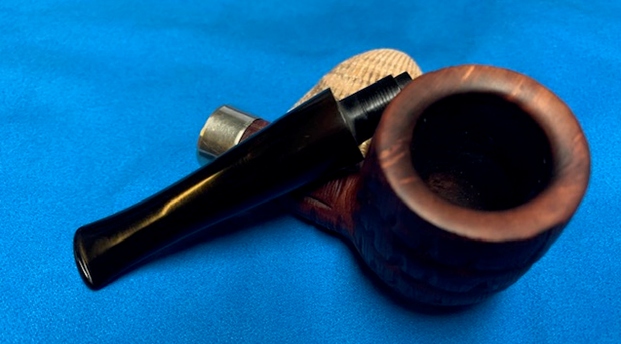
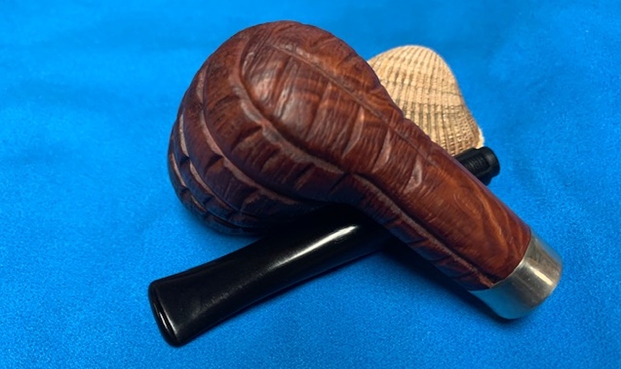
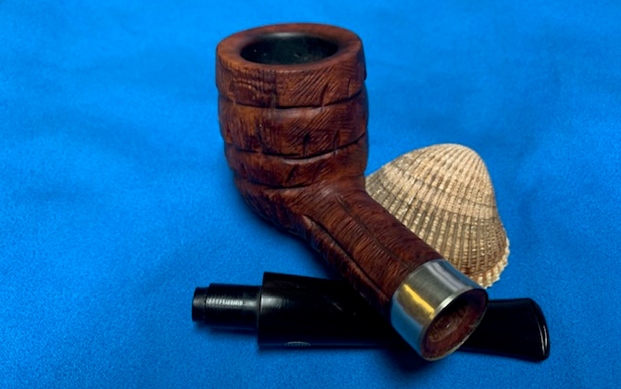
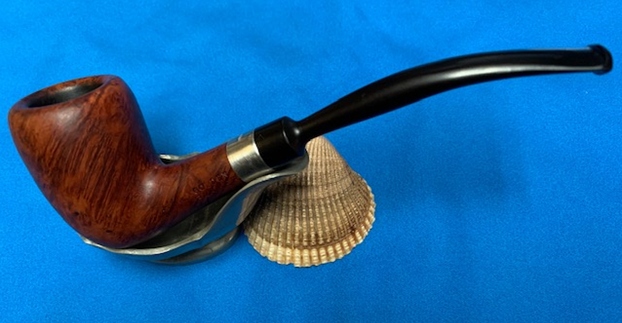
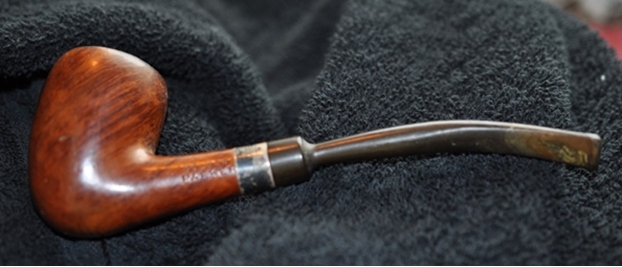
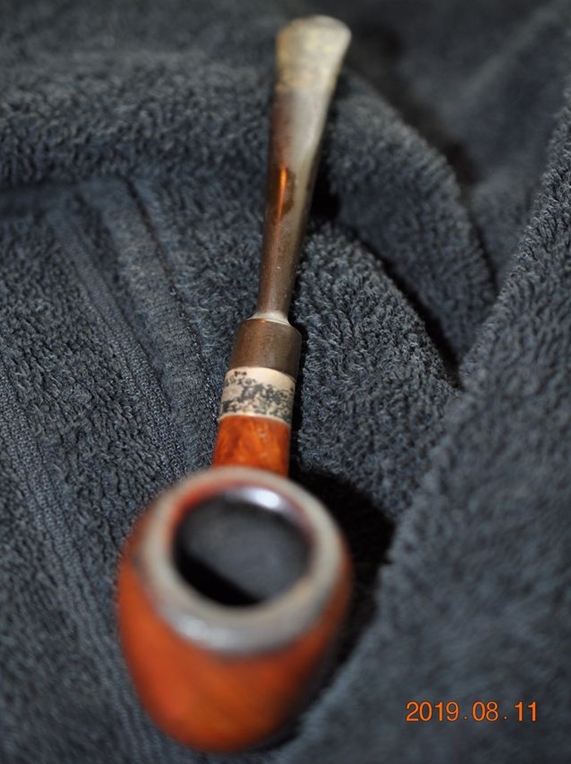
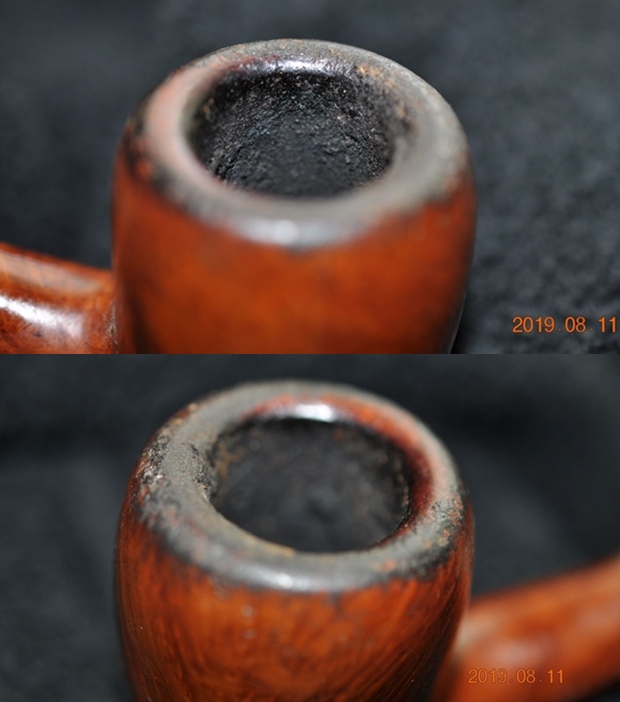
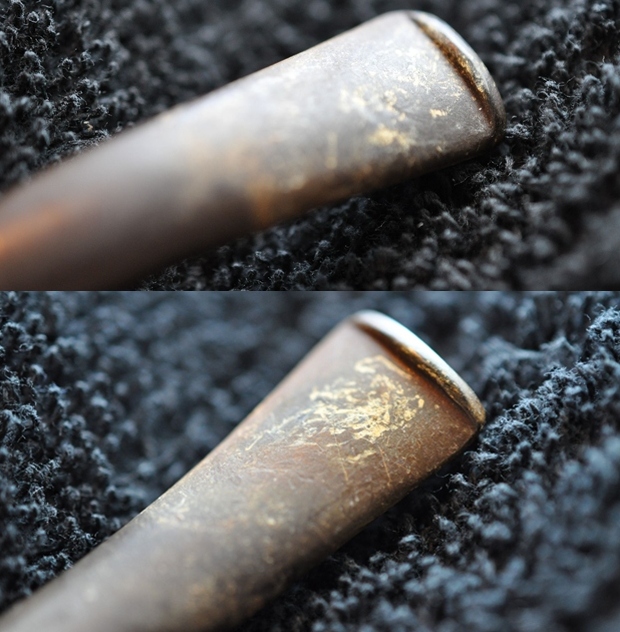
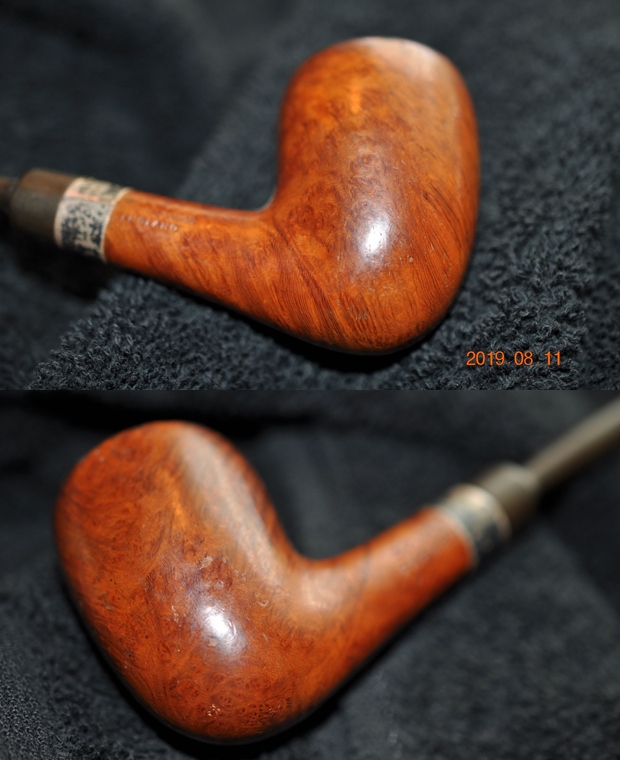
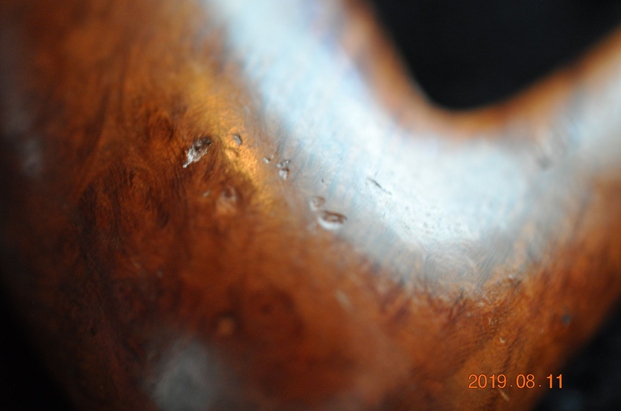
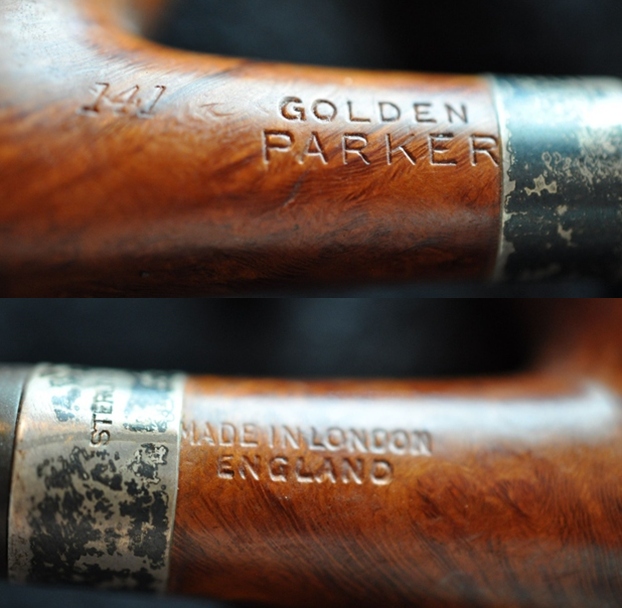
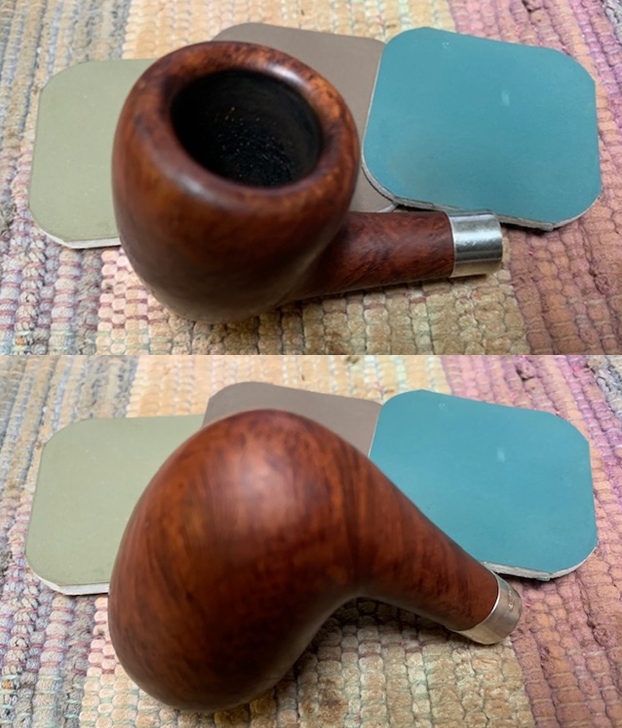
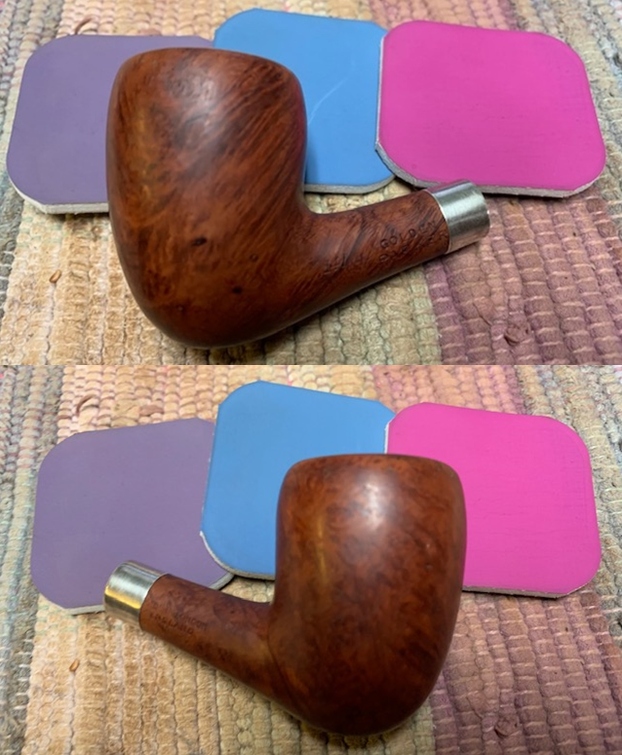
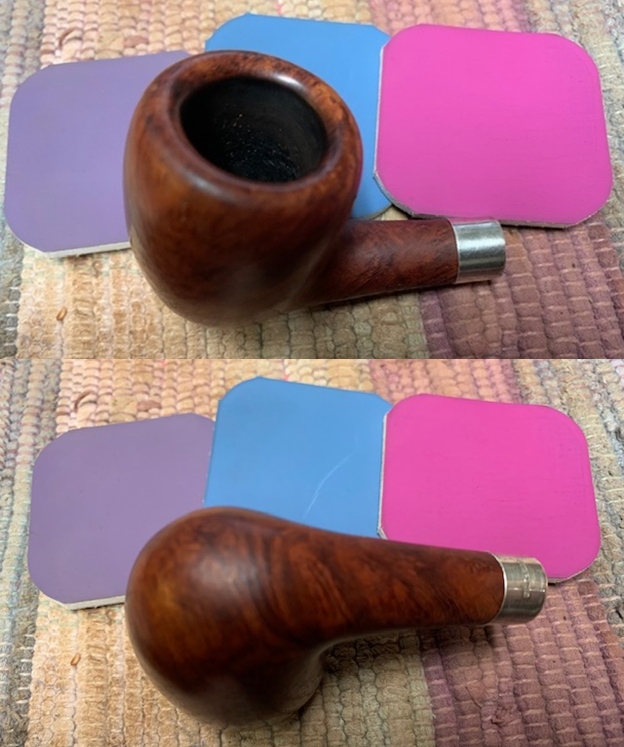
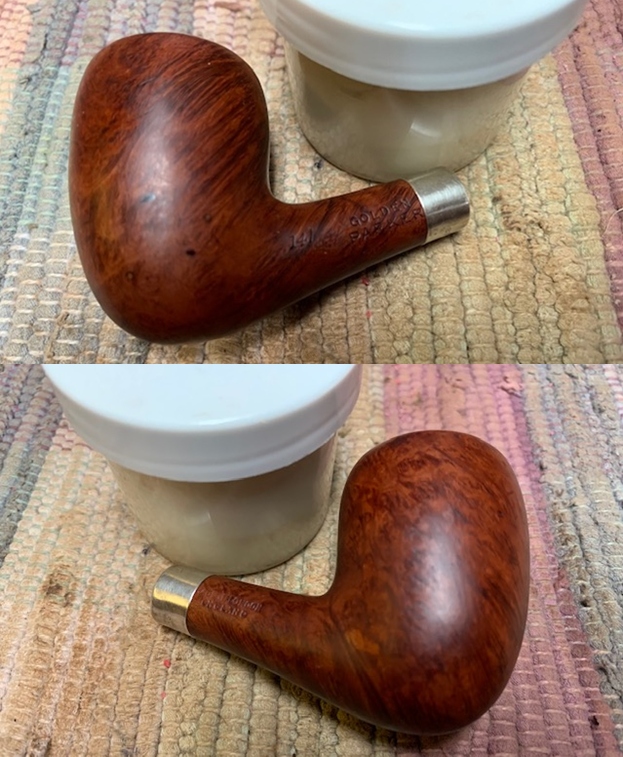
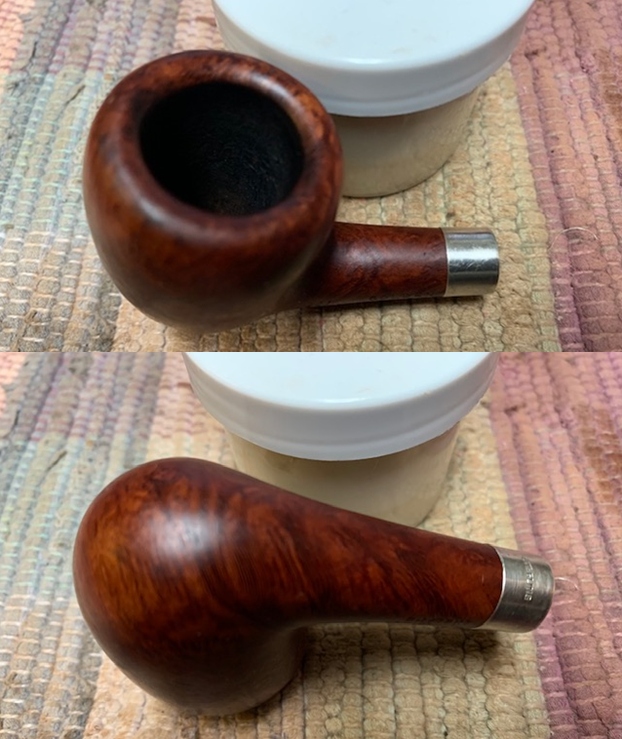
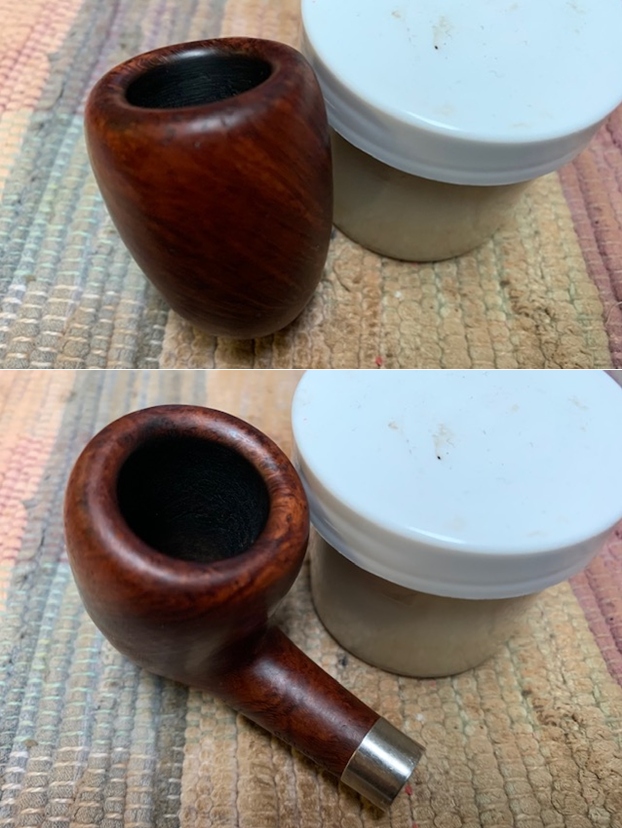
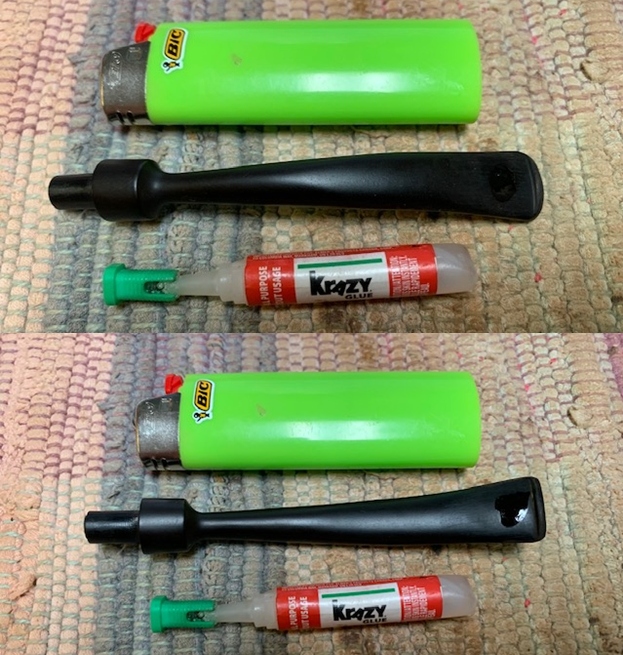
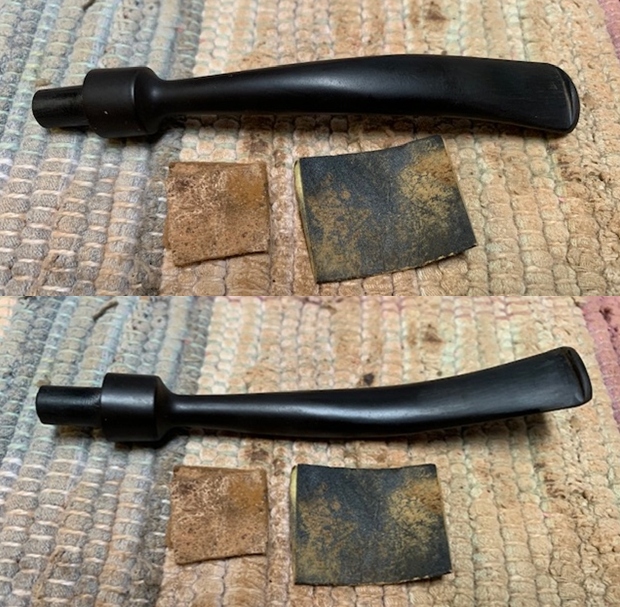
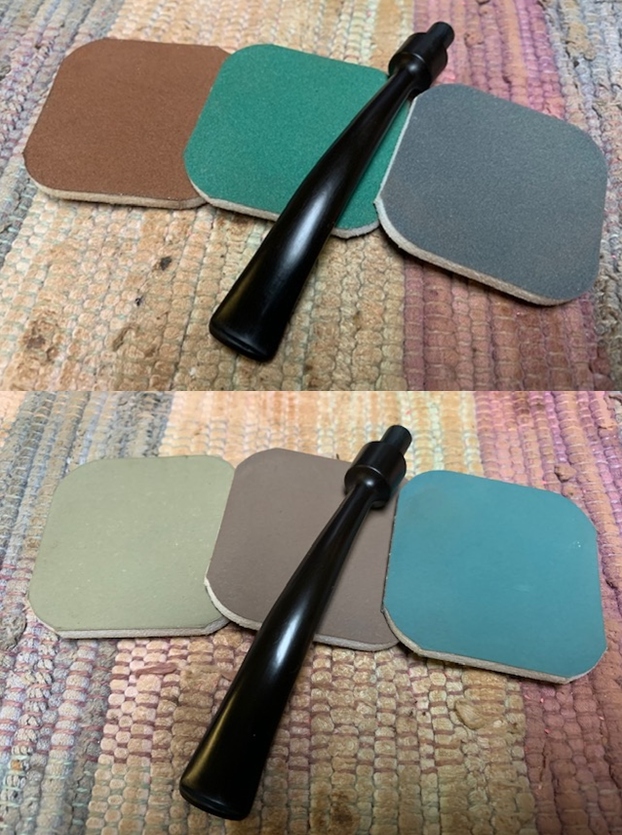
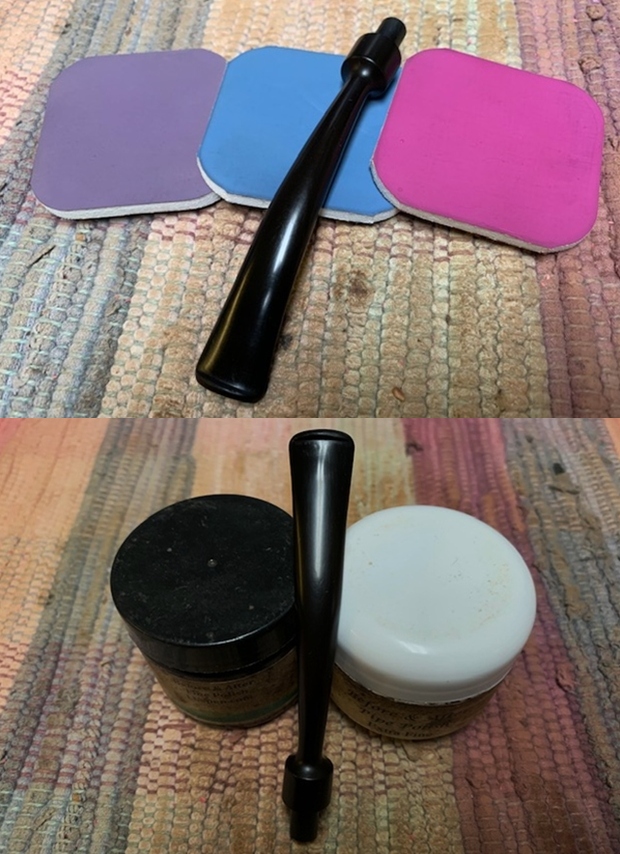
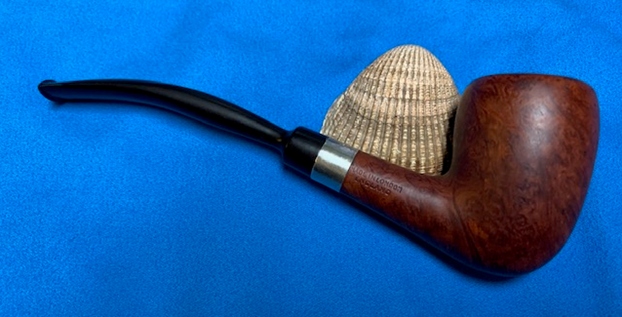
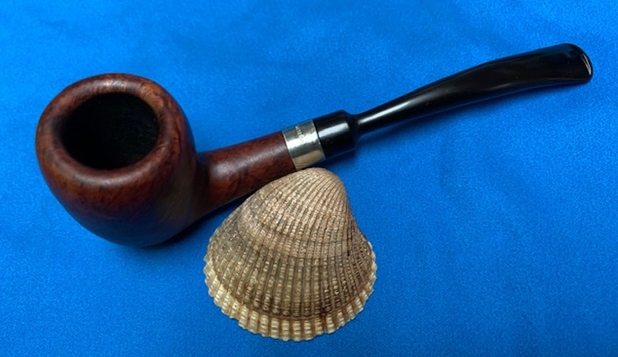
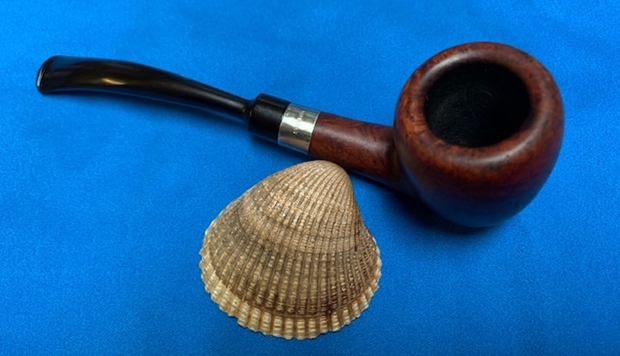
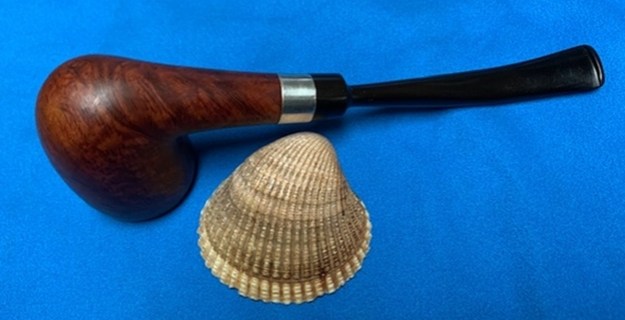
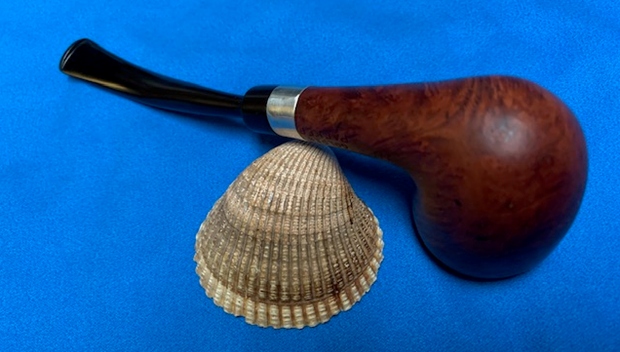
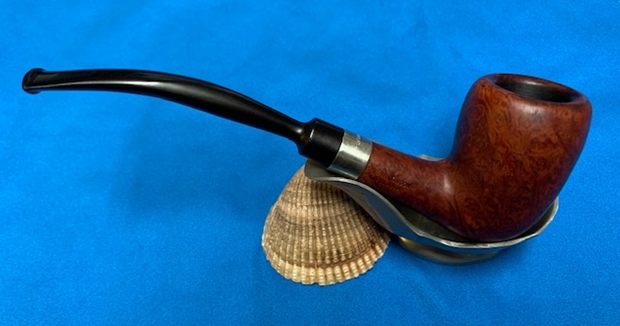
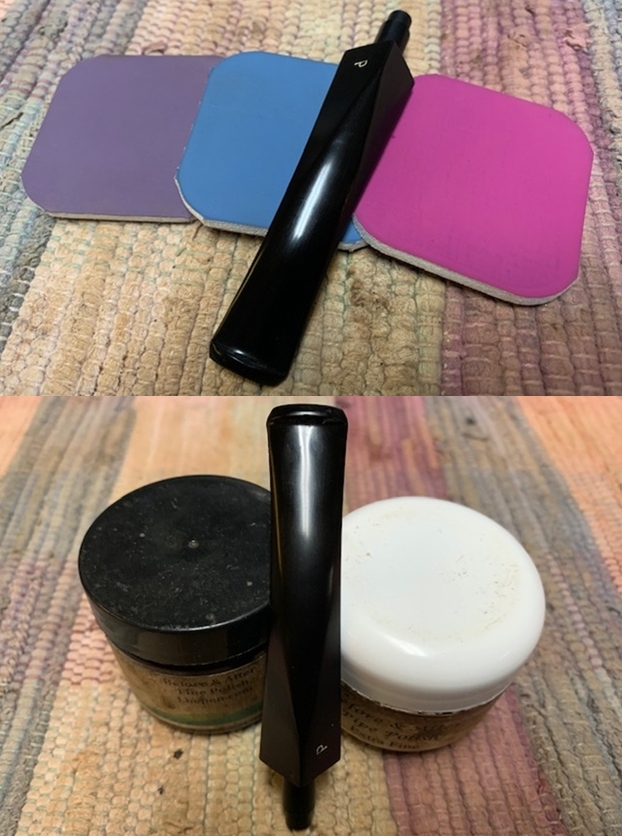
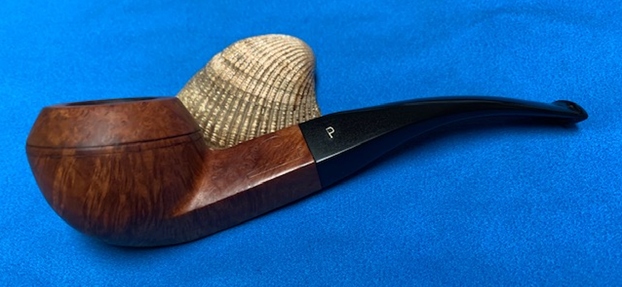
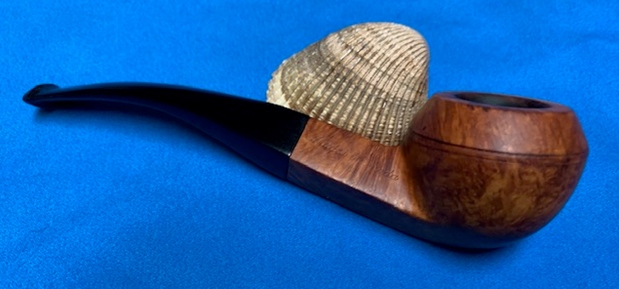
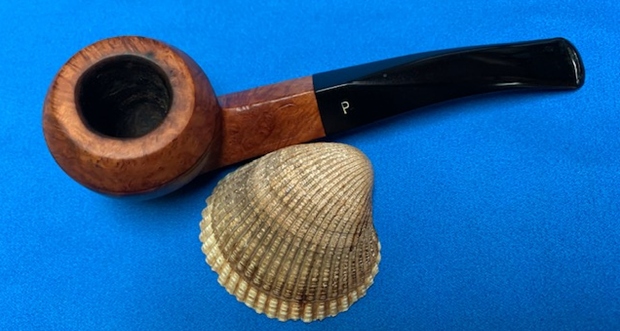
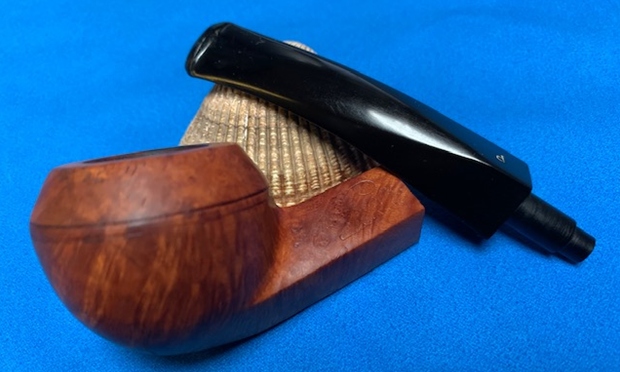
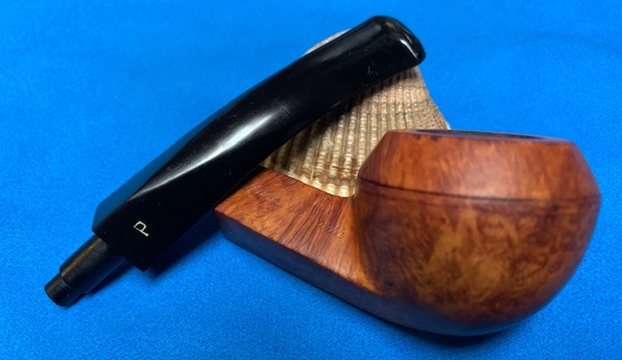
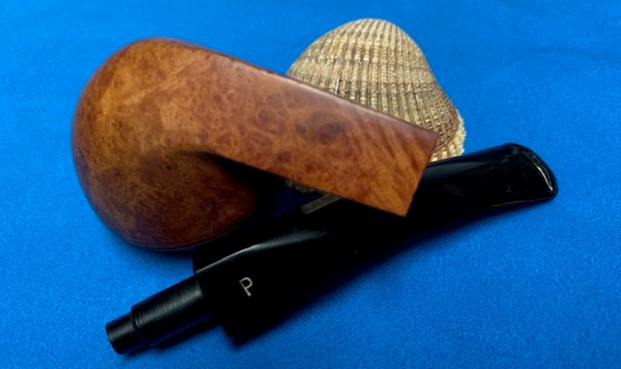
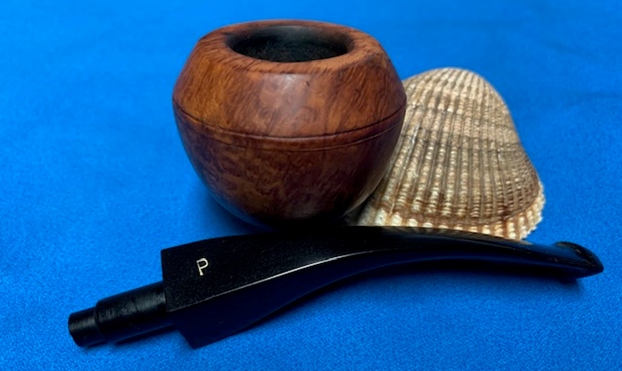
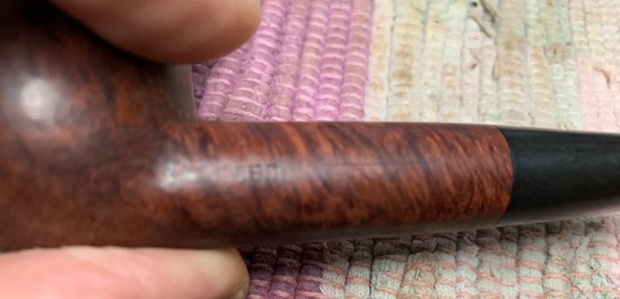
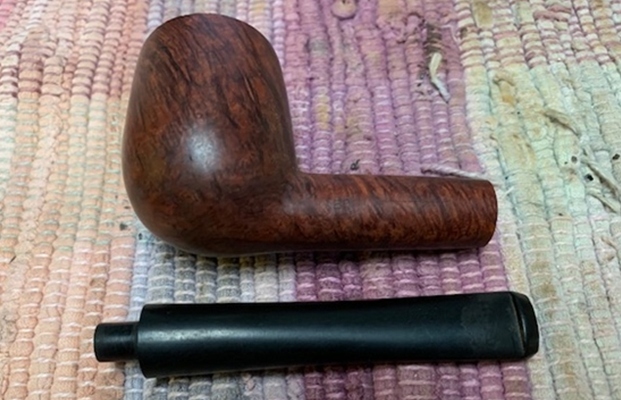
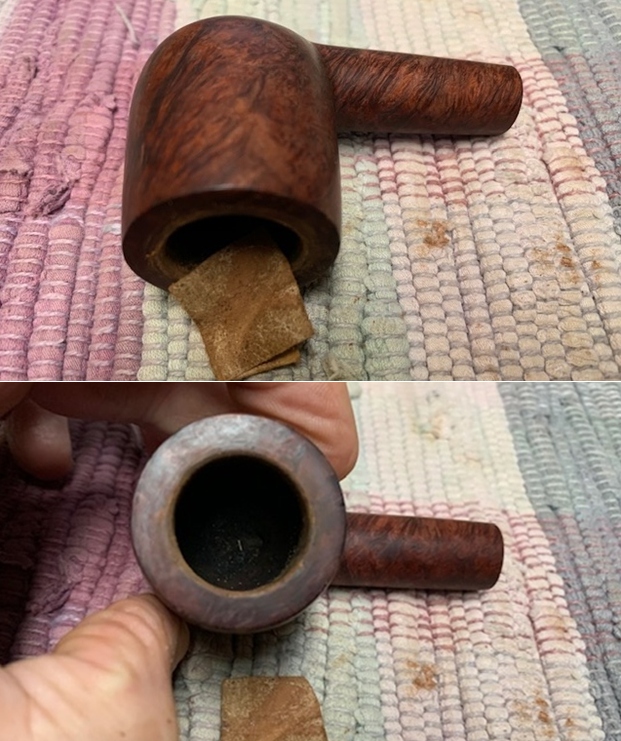
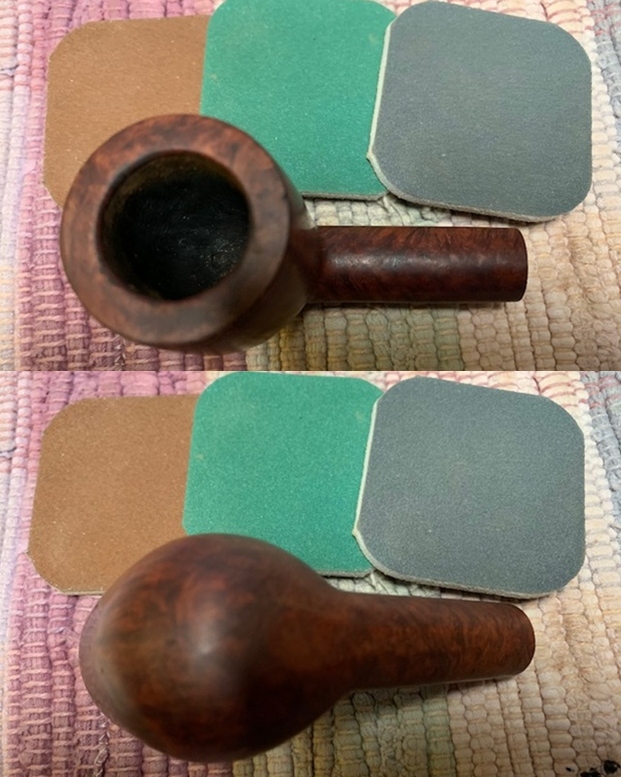
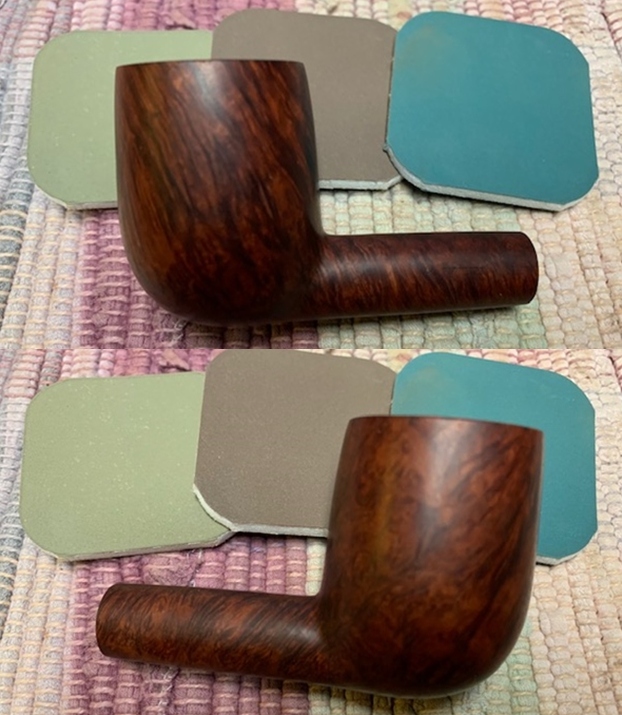
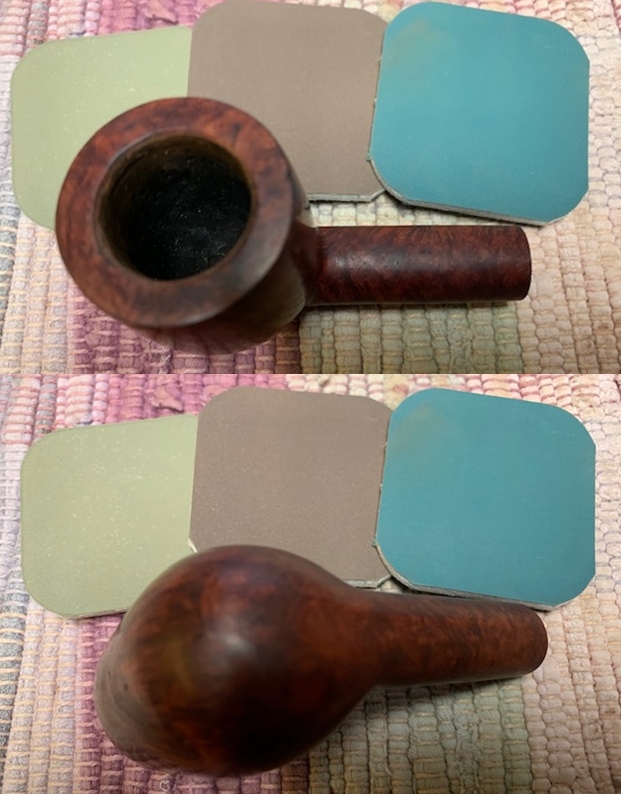
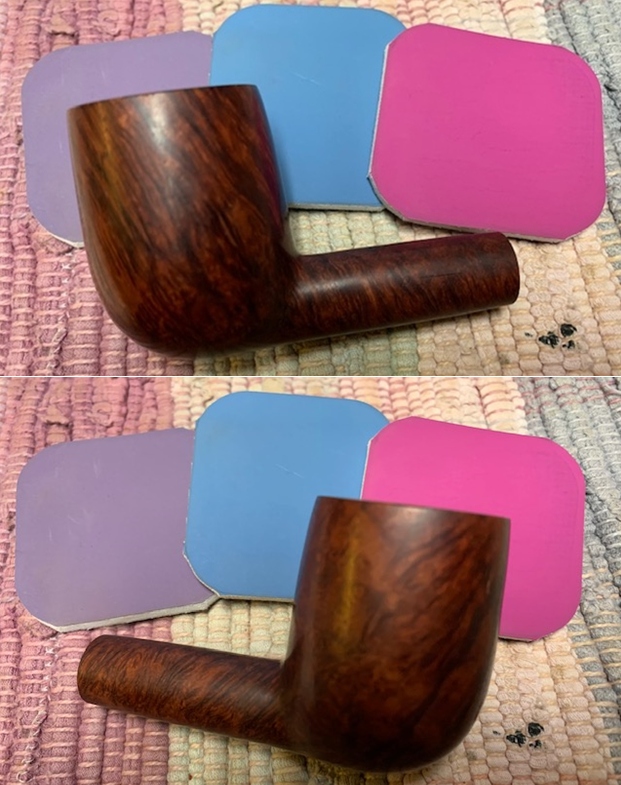
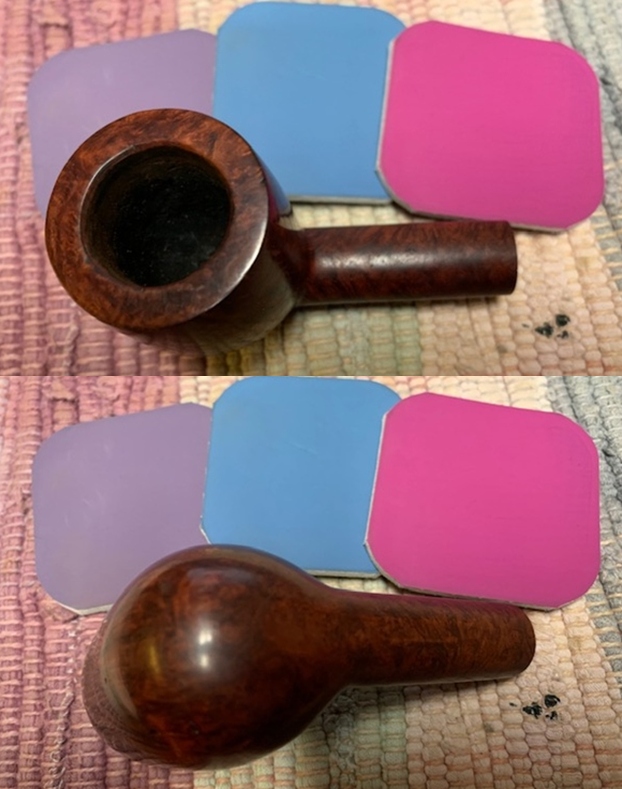
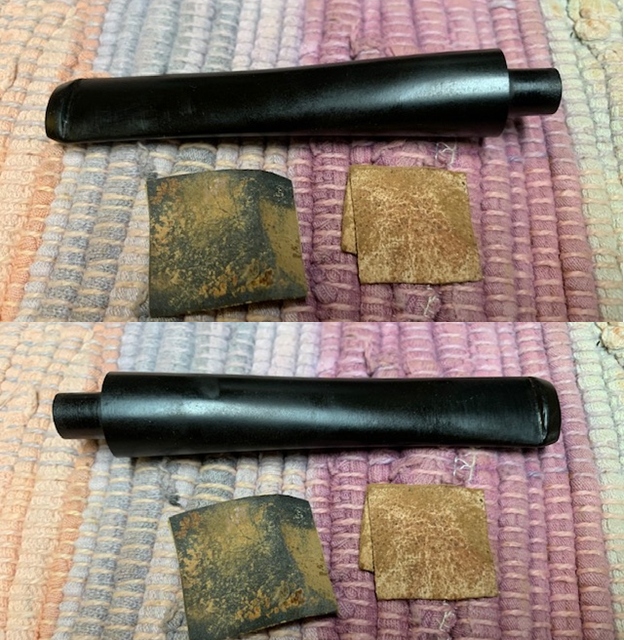
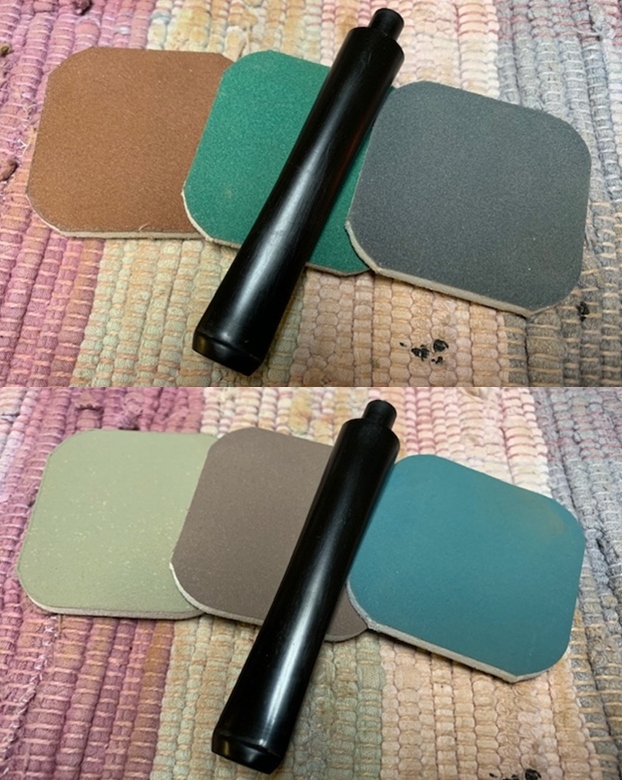
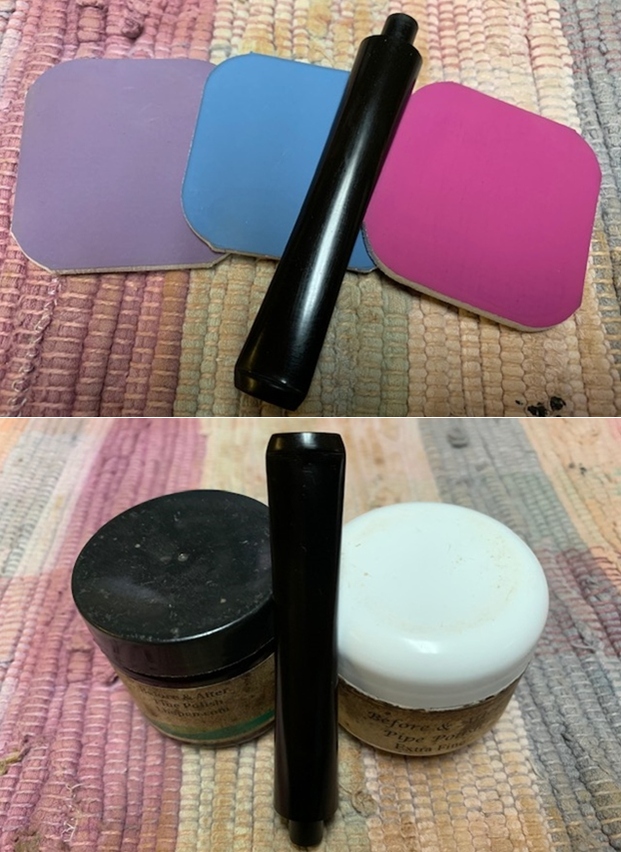
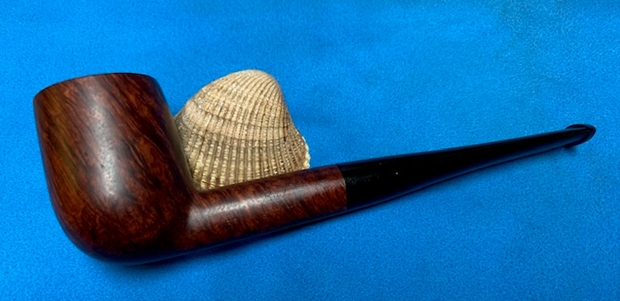
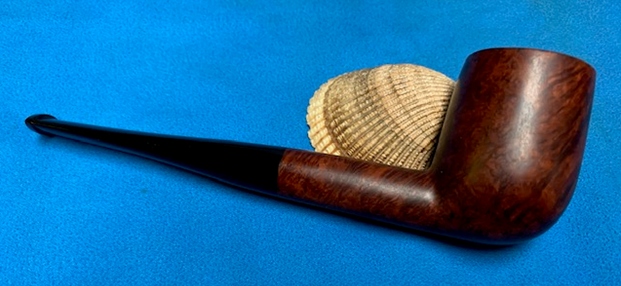
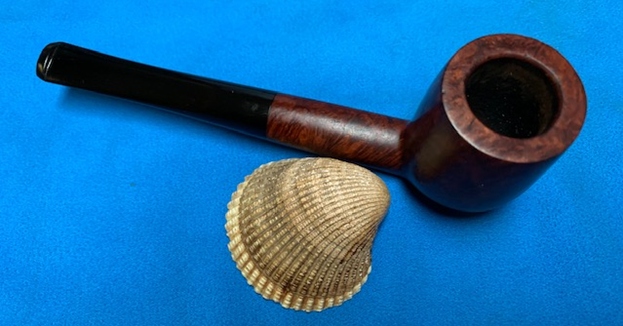
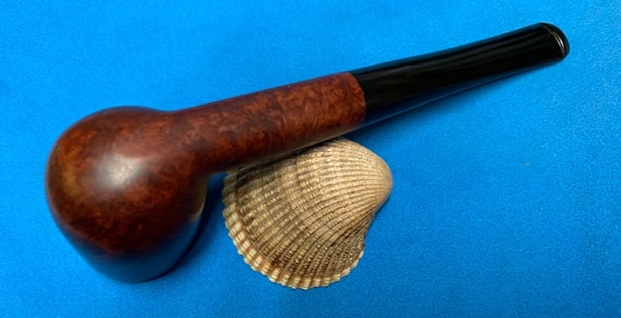
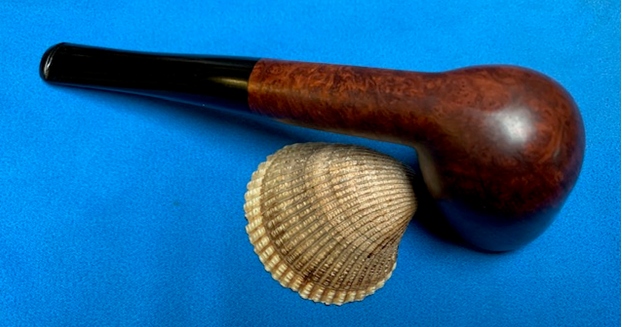
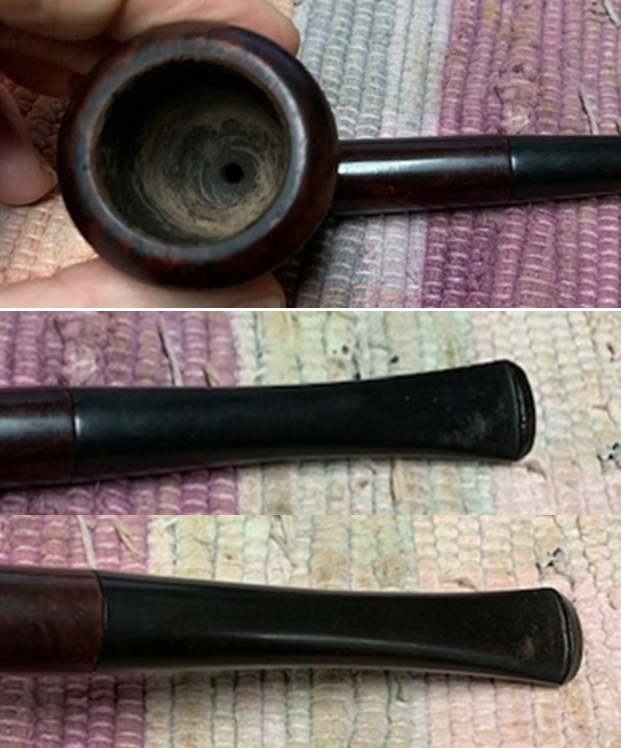
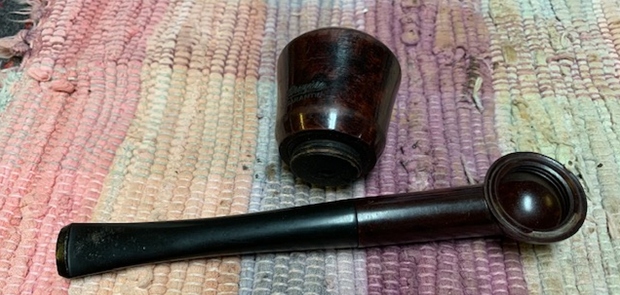
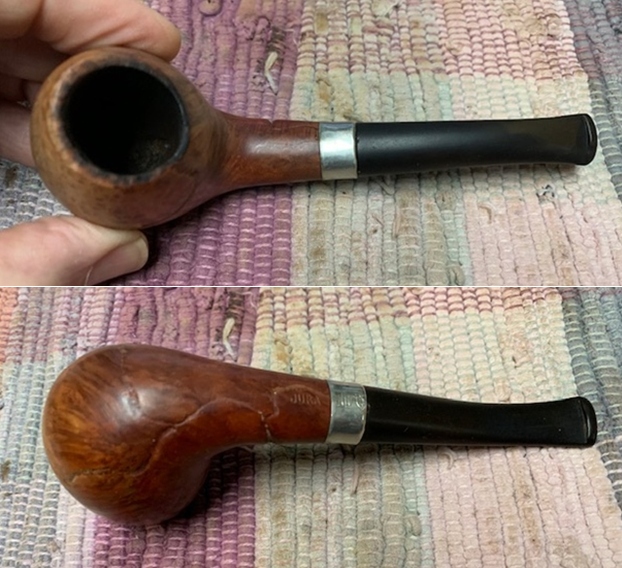
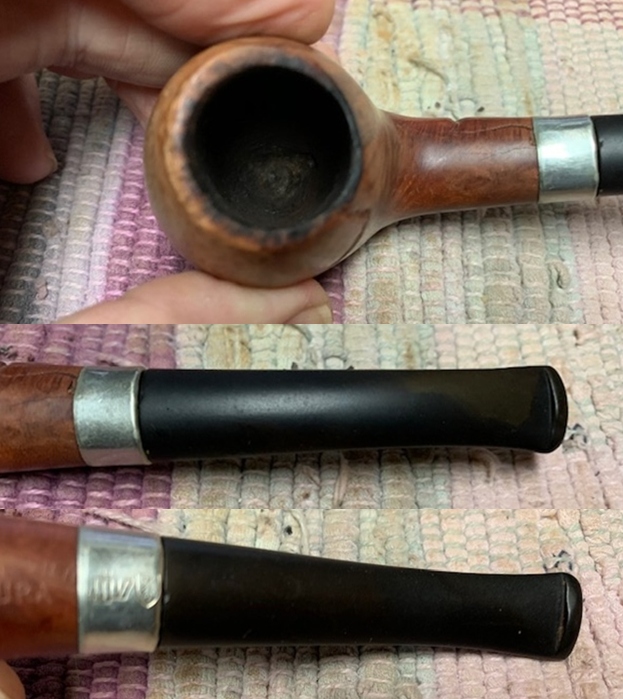
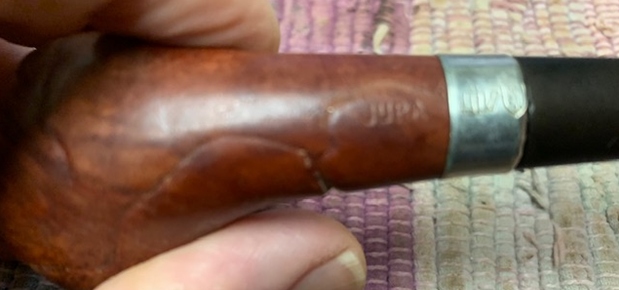
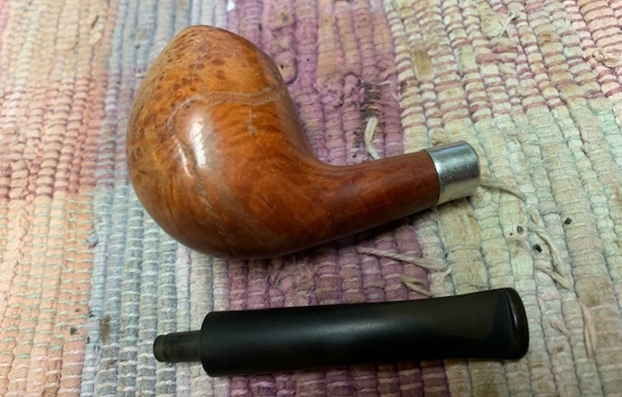
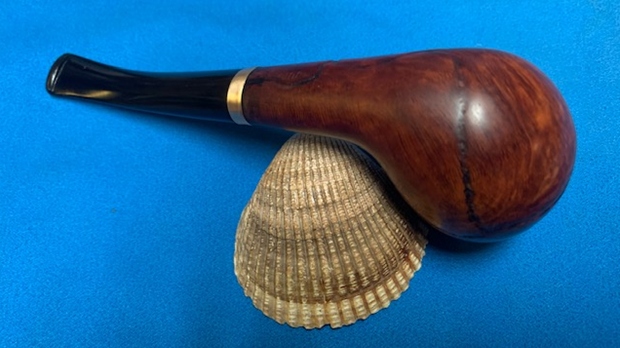
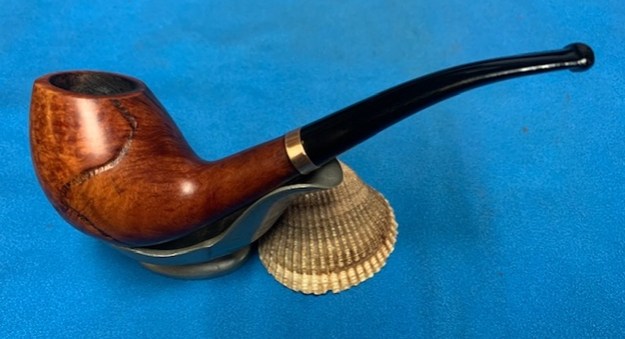
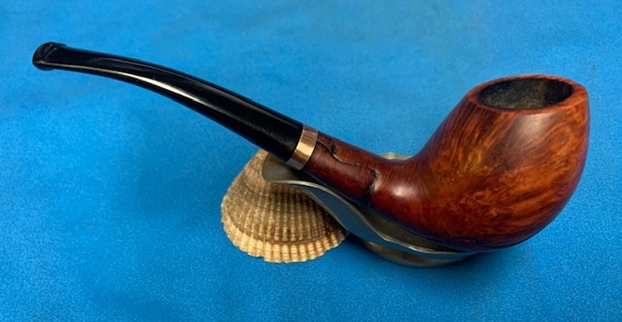
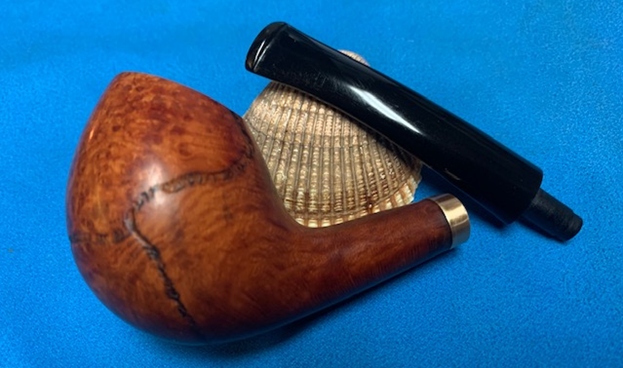
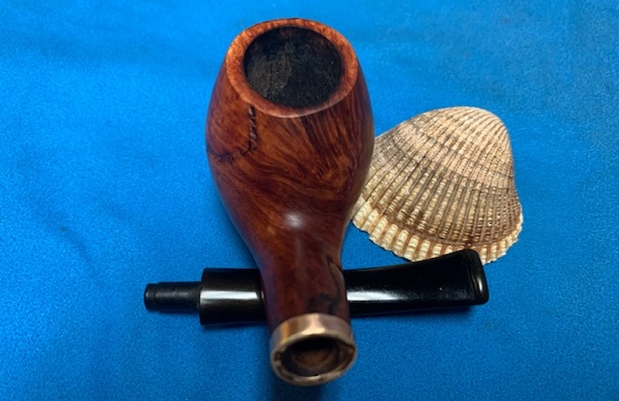
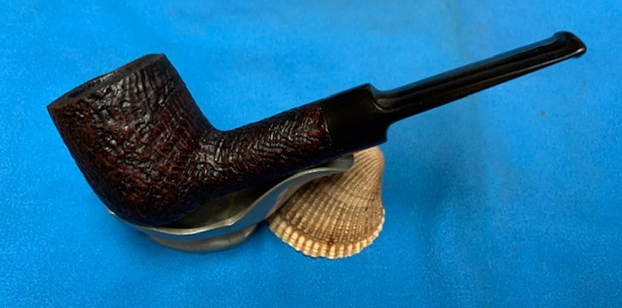
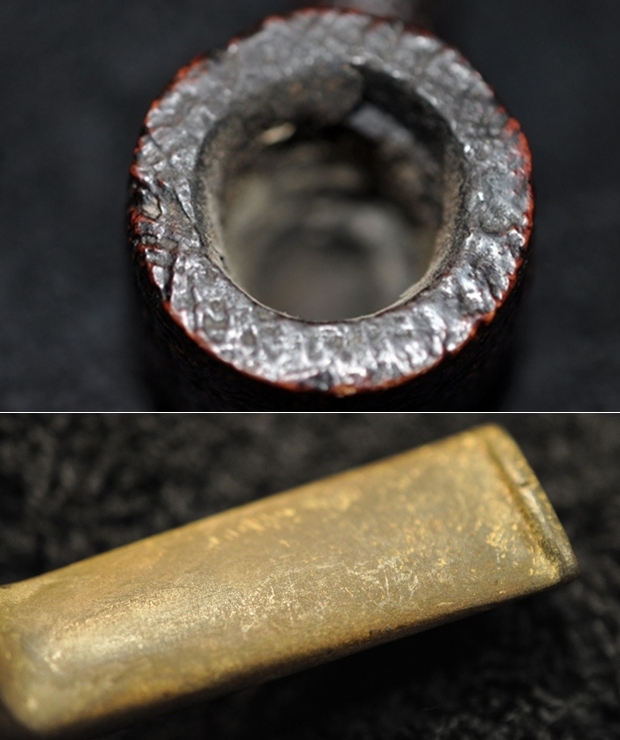
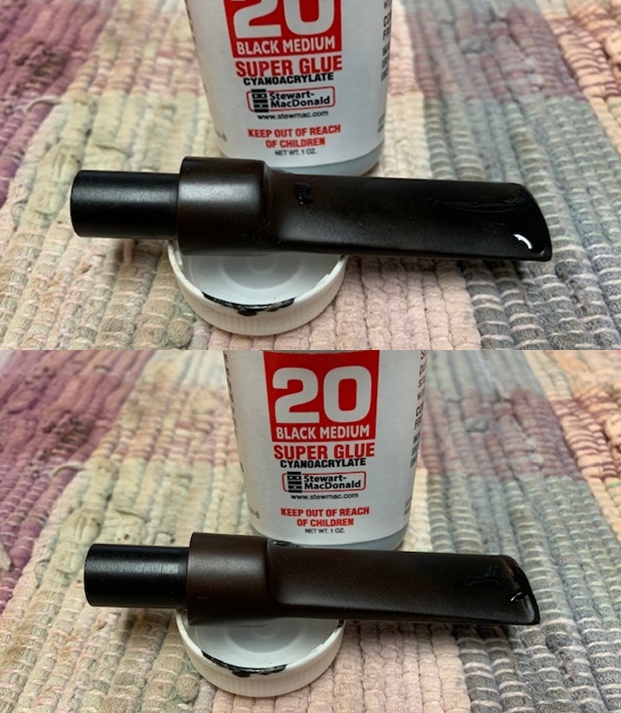
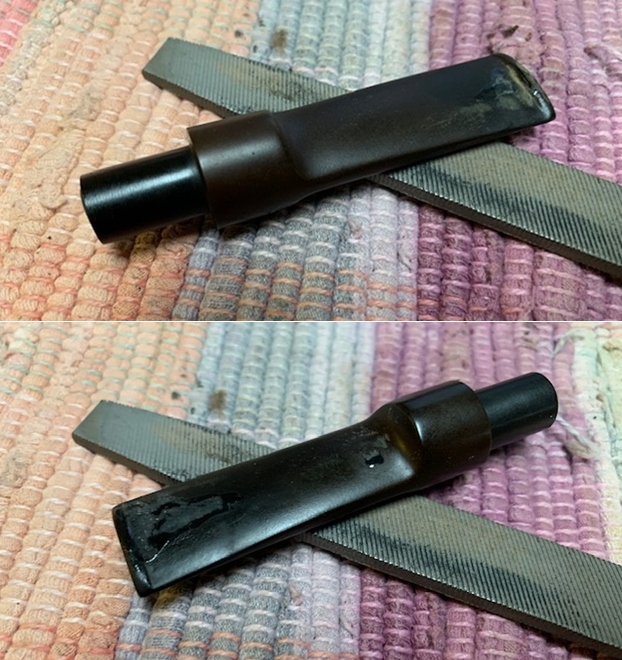
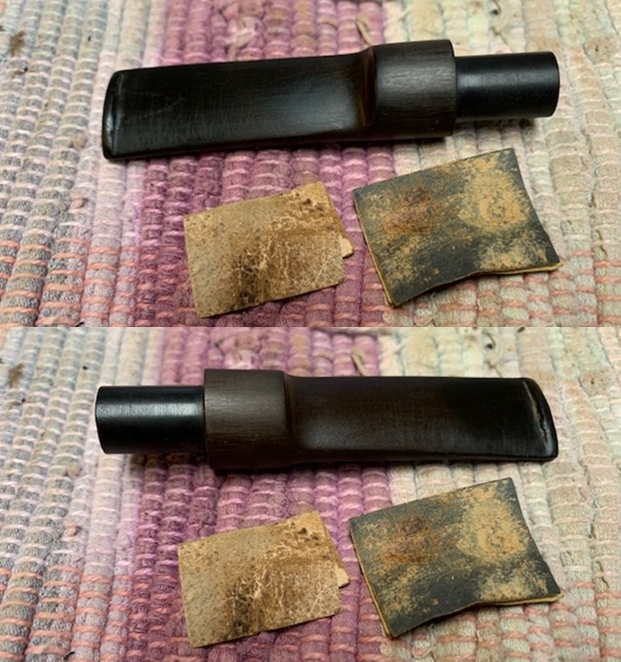
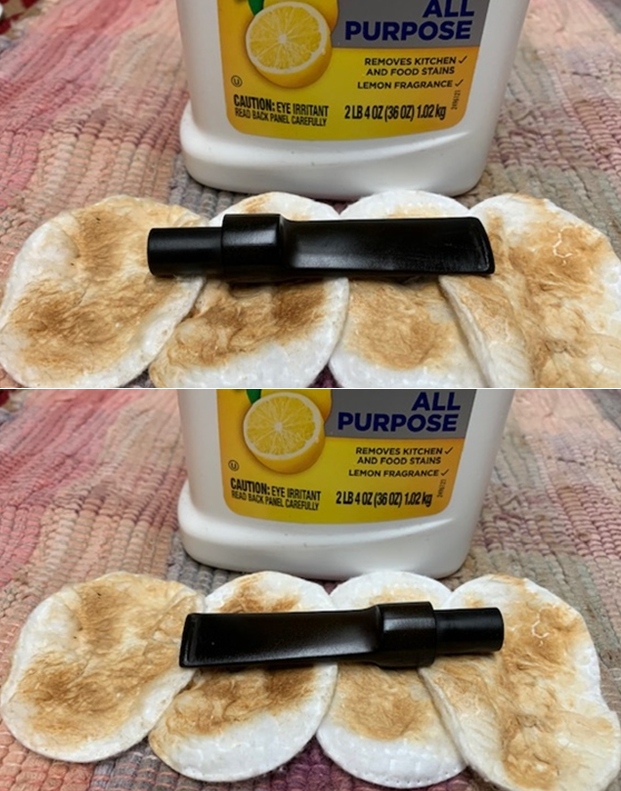
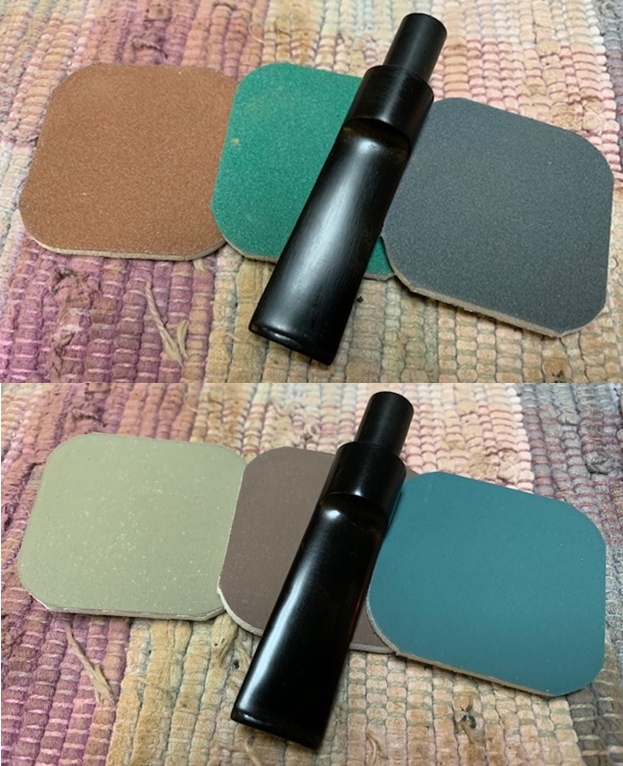
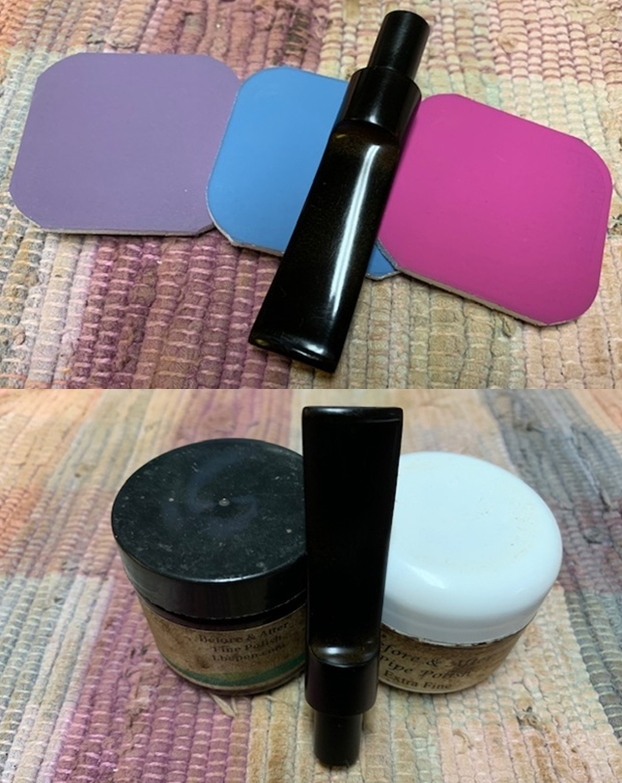
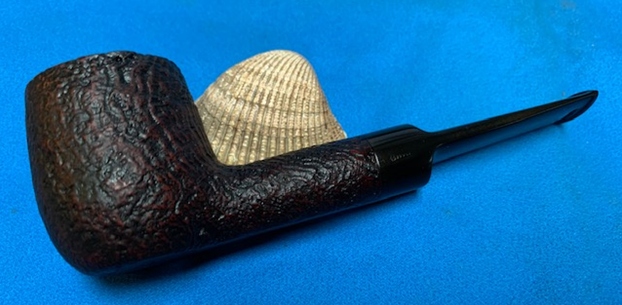
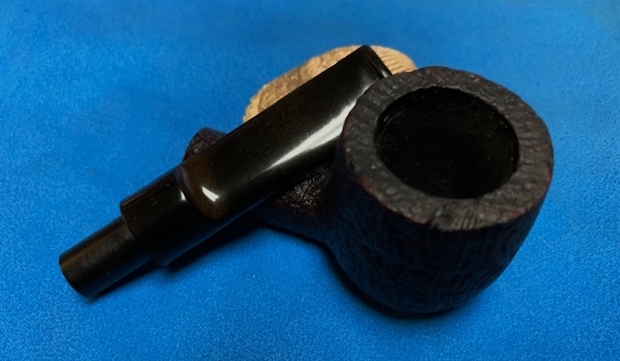
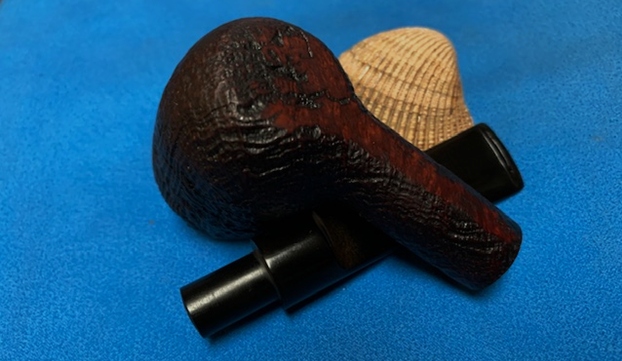
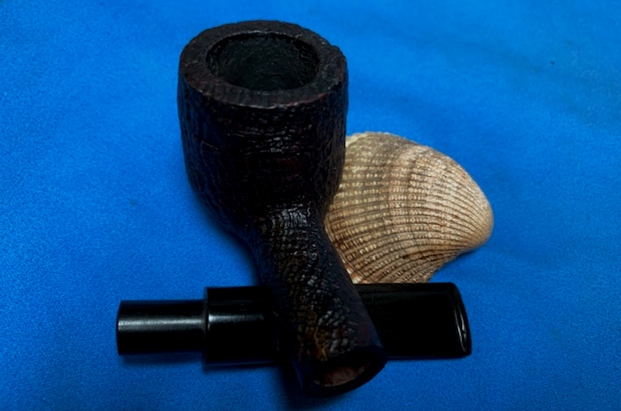
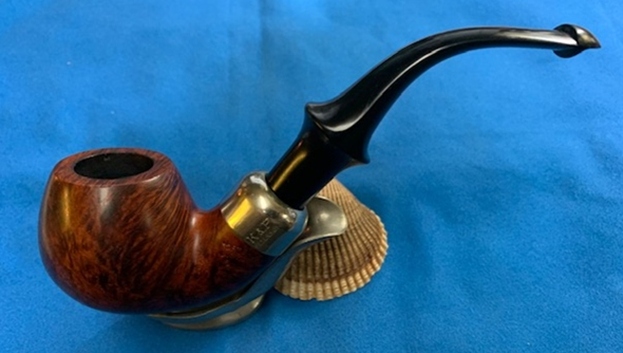
The next pipe on the work table came to us from an online auction from Schulenburg, Texas, USA. It is classic Billiard with mixed grain around the bowl and shank. It is stamped on the left side of the shank and reads Sterncrest [over] LHS in a Diamond [over] Imported Briar. There is a Sterling Silver band on the shank that has the image of a hunting dog (pointer) [over] Sterling on the top side. I have worked on and restored quite a few American made LHS (LH Stern) pipes over the years and quite a few have been Sterncrest. However, this is the first one I have done with the hunting dog etched in the Sterling Silver band. The finish was very dirty with dust and grime ground into the bowl sides and obscuring the grain. There were some putty fills and deep nicks in the finish around the bowl sides. There was a very thick cake in the bowl and lava overflow on the beveled rim top. The silver band was oxidized and dirty. The vulcanite stem was oxidized, calcified and had deep tooth marks and chatter ahead of the button on both sides. Jeff took photos of the pipe to show its general condition before he did his cleanup.  As I mentioned above the exterior of the pipe was very dirty – grime and grit ground in from years of use and sitting. I have to say that this was obviously someone’s favourite pipe judging from the buildup in the bowl. The rim top was covered with a coat of thick lava that overflowed from the extremely thick cake in the bowl. It was hard to know what the rim edges looked like because of the lava.  The stem was dirty and oxidized with tooth chatter and marks on the top and underside of the stem at the button. Jeff took photos of the sides and the heel of the bowl to give a better feel for the condition of the briar around the bowl. The pink fills are visible all around the bowl sides.  The next photos show the stamping on the side of the shank and the etched hunting dog on the band. The stamping is very readable. It reads as noted above. The stamped dog comes through in the tarnished silver in the pictures.  Jeff took a photo of the stem removed from the shank to show the pressure fit stinger in the tenon.Jeff cleaned the pipes with his usual penchant for thoroughness that I really appreciate. The pipe was a real mess when he got it and I did not know what to expect when I unwrapped it from his box. I was surprised to see how well it turned out. He reamed it with a PipNet pipe reamer and cleaned up the reaming with a Savinelli Fitsall Pipe Knife. He scrubbed out the internals with alcohol, pipe cleaners and cotton swabs until the pipe was clean. He scrubbed the exterior of the bowl with Murphy’s Oil Soap and a tooth brush to remove the grime and grit on the briar and the lava on the rim top. The finish looks very good with good looking grain around the bowl and shank. The putty fills had all fallen out on the sides and front of the bowl and left pits.  Jeff scrubbed it with Soft Scrub and soaked it in Before & After Deoxidizer to remove the oxidation on the rubber. When the pipe arrived here in Vancouver for the second stop of its restoration tour it looked a lot better. I took photos before I started my part of the work.  I took some close up photos of the rim top and the stem surface. I wanted to show what cleaned bowl and rim top looked like. The rim top shows some darkening and some damage to the inner edge of the rim on the front. I also took close up photos of the stem to show the tooth chatter and marks on the stem surface.     I took a photo of the stamping on the side of the shank and it is clear and readable. It is stamped as noted above. I removed the stem for the shank and took a photo of the bowl and stem to give a picture of what it looked like. It is a classically shaped Billiard. To me the stinger needs to go!Now, on to my part of the restoration of this Sterncrest Billiard. I decided to clean up the damaged rim top and inner edge of the bowl. I cleaned up the inside of the bowl edges with a folded piece of 220 grit sandpaper. I sanded the darkening on the rim top with a folded piece of 220 grit sandpaper. Once I was finished the top and edge looked a lot better.  I was glad to see that all of the pink putty fills had come out during the cleanup process. I decided to replace them with briar dust and clear super glue. There were actually quite a few of them. I did the repairs to the fills and took photos of the “freckles” around the mid-bowl on the left, front and right sides. Once the repairs cured I sanded them smooth with 220 grit sandpaper. I wiped the bowl down with isopropyl alcohol to remove the debris and the heavier stained areas and even out the coverage on the bowl. I wanted to make the stain more transparent so the grain would show through the finish.   I polished the top of the bowl, the repaired areas and the entirety of the bowl with micromesh sanding pads – wet sanding with 1500-12000 grit pads and wiping the briar down with a damp cloth after each sanding pad.   I rubbed the bowl down with Before & After Restoration Balm. I worked it into the surface of the briar with my fingertips to clean, enliven and protect it. I let the balm sit for 10-15 minutes and then buffed with a cotton cloth to raise the shine.     I set the bowl aside and turned my attention to the stem. I heated the stinger and wiggled it free from the tenon with a pair of pliers. I dropped the stem in Briarville’s Pipe Stem Oxidation Remover to clean up the remaining oxidation. I let it sit in the bath for 2 hours and then removed it and dried it off. I forgot to take a photo of the stem when I removed it from the bath. I dried it off and then filled in the deep tooth marks with black super glue. I set the stem aside to let the repairs cure. Once the repair had cured I used a flat rasp and a file to clean up the button edge and flatten out the repairs. I sanded it with 220 grit sandpaper to further blend the repairs into the vulcanite. I started polishing the stem with 400 grit wet dry sandpaper. I polished the vulcanite with micromesh sanding pads – 1500-12000 grit pads. I wiped it down with a damp cloth after each sanding pad. I used Before & After Pipe Polish – both Fine and Extra Fine to further polish the stem.  I left a little oxidation around the stamp so as not to damage it more.      This LHS Sterncrest Hunter’s Billiard turned out to be a great looking pipe. The brown stained brown mixed finish (smooth/rusticated) on the pipe is in great condition and works well with the polished vulcanite taper stem. I put the stem back on the bowl and carefully buffed the pipe with Blue Diamond on the buffing wheel. I gave the bowl and stem multiple coats of carnauba wax on the buffing wheel and followed that by buffing the entire pipe with a clean buffing pad. I hand buffed the pipe with a microfiber cloth to deepen the shine. The finished LHS Sterncrest Billiard fits nicely in the hand and feels great. Give the finished pipe a look in the photos below. The dimensions of the pipe are Length: 5 ¾ inches, Height: 1 ¾ inches, Outside diameter of the bowl: 1 ¼ inches, Chamber diameter: ¾ of an inch. The weight of the pipe is 36g/1.27oz. If you are interested in carrying on the pipe man’s legacy with this pipe send me a message or an email. I have more to work on of various brands. Perhaps one of those will catch your attention. Thanks for reading this blog and my reflections on the pipe while I worked on it.

A Rebirth for a Comoy’s Made Royal Falcon 237 Bulldog


Blog by Steve Laug

The next pipe on the work table came to me from one of our estate purchases. Between us we pick up quite a few pipes for restoration. I try to work them into the restoration queue so that I can keep them moving. The next one is classic shaped Bulldog with a mix of grains around the bowl. It was stamped on both sides of the shank. On the left side it is stamped Royal [over] Falcon. On the right side it has the shape number 237 next to the bowl shank junction and to the left of that it has Made in London in a circle [over] England COM stamp. The finish was dirty with dust and grime ground into the bowl sides. There was a thick cake in the bowl and lava overflow on the rim top. The vulcanite stem was oxidized and had tooth marks and chatter ahead of the button on both sides. Jeff took photos of the pipe to show its general condition before he did his cleanup.  As I mentioned above the exterior of the pipe was very dirty – grime and grit ground in from years of use and sitting. The rim top was covered with a coat of thick lava that overflowed from the thick cake in the bowl. It was hard to know what the rim edges looked like because of the lava.  The stem was dirty, calcified and oxidized with tooth chatter and marks on the top and underside of the stem at the button.  Jeff took photos of the sides and the heel of the bowl to give a better feel for the condition of the briar around the bowl.    The next photos show the stamping on the sides of the shank and it is very readable. It reads as noted above. You can also see the Falcon head logo on the left side of the stem.  The pipe is stamped on the left side of the shank, Royal over Falcon as pictured to the left. On the right side it is stamped Made in London in a Circle over England. Next to that is stamped shape number 157 which is a Comoy’s number. In checking on Pipephil’s site on the Royal Falcon brand (http://www.pipephil.eu/logos/en/logo-r6.htmlit) it is clear that the pipe is definitely a Comoy’s brand. The stem has the same logo as Phil shows on his site though the pipe in hand has much fainter stamping.

I turned to Pipedia’s article on Comoy’s pipes and scrolled down to the section on seconds and the brand is listed there (https://pipedia.org/wiki/Comoy%27s). There was also was a photo of a Comoy’s made Royal Falcon on the site. Underneath it is written the following: Early Comoy’s Royal Falcon with circular Made in England stamp. Thin pencil shank pipe. 1930’s? The pipe I am working on is stamped with the same Made in England circular stamp.

From the above information I knew that I was working on an early Comoy’s made Royal Falcon. Perhaps as early as the 1930s!

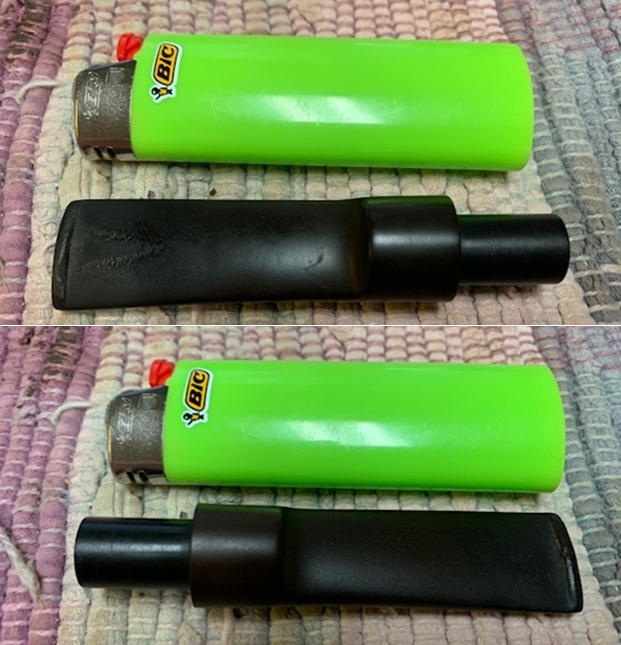
Jeff cleaned the pipes with his usual penchant for thoroughness that I really appreciate. Once he finished he shipped them back to me. The pipe was a real mess when he got it and I did not know what to expect when I unwrapped it from his box. I was surprised to see how well it turned out. He reamed it with a PipNet pipe reamer and cleaned up the reaming with a Savinelli Fitsall Pipe Knife. He scrubbed out the internals with alcohol, pipe cleaners and cotton swabs until the pipe was clean. He scrubbed the exterior of the bowl with Murphy’s Oil Soap and a tooth brush to remove the grime and grit on the briar and the lava on the rim top. The finish looks very good with good looking grain around the bowl and shank. Jeff scrubbed it with Soft Scrub and soaked it in Before & After Deoxidizer to remove the oxidation on the rubber. When the pipe arrived here in Vancouver for the second stop of its restoration tour it looked a lot better. I took photos before I started my part of the work. I took some close up photos of the rim top and the stem surface. I wanted to show what cleaned bowl and rim top looked like. The rim top shows some damage on the outer edge of the bowl on the right front and on the inner edge at the top of the bevel and rim top. I also took close up photos of the stem to show the tooth chatter and marks on the stem surface.  I took photos of the stamping on the sides of the shank and it is clear and readable. It is stamped as noted above. There is some staining around the shank end.    I removed the stem for the shank and took a photo of the bowl and stem to give a picture of what it looked like. It is a classically shaped British Bulldog.Now, on to my part of the restoration of this Comoy’s made Royal Falcon Bulldog. I decided to clean up the damaged rim top and inner edge of the bowl. I lightly topped the bowl on a topping board with 220 grit sandpaper. I cleaned up the inside of the bowl edges with a folded piece of 220 grit sandpaper. Once I was finished the edge looked a lot better. I polished the top of the bowl and the entirety of the bowl with micromesh sanding pads – wet sanding with 1500-12000 grit pads and wiping the briar down with a damp cloth after each sanding pad.   I rubbed the bowl down with Before & After Restoration Balm. I worked it into the surface of the briar with my fingertips to clean, enliven and protect it. I let the balm sit for a little while and then buffed with a cotton cloth and shoe brush to raise the shine. I set the bowl aside and turned my attention to the stem. I used a Bic lighter to “paint” the surface of the stem with the flame to lift the tooth marks on both sides of the stem. The heat lifted most of the tooth marks. I filled in the remaining tooth marks with clear super glue. Once the repairs had cured I filed them flat with a small file. I sanded the repaired areas with 220 grit sandpaper to smooth and blend them. I started polishing the stem with 400 grit wet dry sandpaper. Royal Falcon, Falcon Head logo on the left topside of the saddle stem was worn and would not hold any touch up material. I would not be able to preserve or restore that stamp. I polished the vulcanite with micromesh sanding pads – 1500-12000 grit pads. I wiped it down with a damp cloth after each sanding pad. I used Before & After Pipe Polish – both Fine and Extra Fine to further polish the stem.  I left a little oxidation around the stamp so as not to damage it more.   This Comoy’s Made Royal Falcon 237 Bulldog turned out to be a great looking pipe. The mixed stain brown finish on the pipe is in great condition and works well with the polished vulcanite saddle stem. I put the stem back on the bowl and carefully buffed the pipe with Blue Diamond on the buffing wheel. I gave the bowl and stem multiple coats of carnauba wax on the buffing wheel and followed that by buffing the entire pipe with a clean buffing pad. I hand buffed the pipe with a microfiber cloth to deepen the shine. The finished Royal Falcon Bulldog fits nicely in the hand and feels great. Give the finished pipe a look in the photos below. The dimensions of the pipe are Length: 5 ½ inches, Height: 2 inches, Outside diameter of the bowl: 1 ¼ inches, Chamber diameter: ¾ of an inch. The weight of the pipe was 38g/1.38oz. If you are interested in carrying on the pipe man’s legacy with this pipe send me a message or an email. I have more to work on of various brands. Perhaps one of those will catch your attention. Thanks for reading this blog and my reflections on the pipe while I worked on it.

Restoring a MALAGA Second  Octagonal Panel, Square Shank Billiard


Blog by Steve Laug

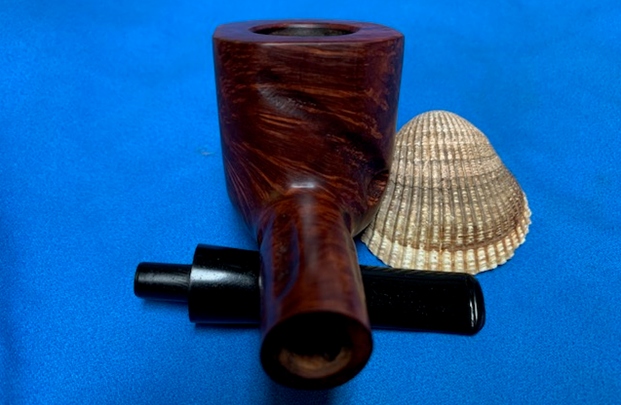
The next pipe on the table is a “Malaga” Second pipe that Jeff picked up from an online auction early in 2019 from Columbus, Michigan, USA. It is an interesting looking octagonal Panel Billiard with a square shank.  It has the classic Malaga oil cured finish and some great looking grain around the bowl and shank. The pipe is stamped on underside of the shank and reads MALAGA. Second. From what I can see the large flaw on the underside of the shank near the stamping is the only thing that made it a second. The carver did a great job of carving the pipe to capture the grain around the bowl and shank. The bowl had a heavy cake with an overflow of lava on the rim top with heavier overflow on the back side of the rim top. The sides of the bowl and shank are very dirty with grime and oils ground into the finish from prolonged use. The vulcanite stem was heavily oxidized and calcified. It had tooth dents and chatter on the top and the underside of the stem. Jeff took photos of the pipe before he started the cleanup work. With some work it will be a real beauty. I looked forward to seeing it in person.    Jeff took a close up photo of the bowl and rim to capture the condition of the pipe before he started the cleanup work. The bowl has a thick cake and the uneven overflow of lava on the rim top is quite thick all the way around but slightly heavier toward the back. The inside edge of the rim could be damaged but it quite hidden under the lava coat. The stem is deeply oxidized, calcified and dirty and there is tooth chatter and marks on both sides of the stem ahead of the button.  He took a photo of the stamping on the underside of the shank. It read as noted above. You can also see the large flaw in the shank under the stamp.Jeff took photos of the sides and heel of the bowl to give a picture of what the briar looked like. There is some nice grain around the sides. You can also see the damage to the rim edges and the heel of the bowl in the photos below.    I am including the link to a blog that I wrote that gives some of the history of the Malaga brand and the Malaga Pipe Shop in Royal Oak, Michigan in the USA. I have written an earlier blog to give a little history of the Malaga Brand and the pipemaker, George Khoubesser. Here is the link – https://rebornpipes.com/tag/malaga-pipes/.That blog also includes links to a catalogue and the history of the pipemaker George Khoubesser. Follow the link to get a feel for the brand and the pipemaker.

Jeff had cleaned up the pipe with his usual penchant for thoroughness. He reamed the pipe with a PipNet pipe reamer and removed the rest of it with a Savinelli Fitsall Pipe Knife.  He scrubbed the bowl with undiluted Murphy’s Oil Soap with a tooth brush. He rinsed it under running warm water to remove the soap and grime. He cleaned out the inside of the shank and the airway in the stem with alcohol, cotton swabs and pipe cleaners. He soaked the stem in Before & After Deoxidizer and rinsed it off with warm water. I took photos of the pipe once I received it.    The rim top cleaned up really well. The rim top and outer edge of the bowl show some darkening over most of the surface. There is damage to the inner edge of the bowl and bowl is out of round.  The stem surface looked very good with tooth marks and chatter on the top side and the underside near the button. The stamping on the underside of the shank is clear and readable. It reads as noted above. You can also see the flaw in the briar on the underside of the shank.  I removed the saddle stem and took a photo of the pipe to give a sense of the whole.  I started my work on the pipe by cleaning the inner edge of the bowl with a folded piece of 220 grit sandpaper. Once I had it cleaned up I topped the bowl on a topping board to remove the damage to the rim top. It also helped to minimize some of the damage to the inner edge.   I filled in the flaw on the underside of the shank with briar dust and clear super glue. Once the repair cured I carefully sanded it smooth with 220 grit sandpaper and blended it into the surrounding briar. I used a Walnut Stain Pen to touch up the sanded area of the repair on the underside of the shank.   I combined a Cherry and a Walnut stain pen to blend the topped rim to match the rest of the bowl and shank.  I took a photo of the shank end to show the relative thinness of the right side of the shank. I wonder if this was not also a reason the pipe was a second.I polished the briar with micromesh sanding pads – wet sanding with 1500-12000 grit pads and wiping it down after each pad with a damp cloth.     I rubbed the bowl and shank down with Before & After Restoration Balm. I worked it into the surface of the bowl sides and shank with my fingertips to clean, enliven and protect the briar. I let the balm sit for 10-15 minutes and then buffed with a cotton cloth to raise the shine. The grain came alive and the finish looked rich.   I set aside the bowl and turned my attention to the stem. I “painted” the surface of the stem with the flame of a Bic lighter to lift them as much as possible. I filled in the remaining tooth dents and marks with Clear Super Glue and set it aside for the repairs to cure. Once they cured I flattened them with a file. I cleaned up the repaired areas with 220 sandpaper to blend the repairs into the surface of the stem. I started polishing it with 400 grit wet dry sandpaper.  I polished the vulcanite stem with micromesh sanding pads – 1500-12000 grit pads. I wiped it down with Obsidian Oil after each sanding pad. I used Before & After Pipe Polish – both Fine and Extra Fine to further polish the stem.     This Malaga Second Octagonal Panel Square Shank Billiard with a vulcanite saddle stem turned out to be a real beauty. The carver really maximized the grain with the shape of the pipe. I polished stem and the bowl with Blue Diamond polish on the buffing wheel and the finish just popped and came alive. I gave the bowl and the stem multiple coats of carnauba wax. I buffed the pipe with a clean buffing pad to raise the shine. I hand buffed it with a microfiber cloth to deepen the shine. The pipe polished up pretty nicely. The pipe took on life with the buffing. The rich oil cured colour works well with the polished black vulcanite stem. The finished Malaga Second has a rich look that is quite catching. Have a look at it with the photos below. The shape, finish and flow of the pipe and stem are very well done. The dimensions are Length: 5 ¼ inches, Height: 1 ½ inches, Outside diameter of the bowl: 1 ¼ inches, Chamber diameter: ¾ of an inch. The weight of the pipe was 27g/.95oz. I will be putting it on the rebornpipes store shortly. Thanks for reading this blog and my reflections on the pipe while I worked on it. There are many more to come!    

Breathing Life into a BBB Natural Grain 01 Zulu


Blog by Steve Laug

The next pipe on the work table came to us from a pipe hunt that Jeff and his wife recently did in Utah, USA.  The pipe is a classic Zulu shape pipe. The pipe was an absolute mess which probably accounted for how it ended up where it was at a fair price. On the top of the shank it is stamped with the BBB Diamond Logo [over] Silver Grain. On the right side of the shank it is stamped with the shape number 01. The stain is a mix of browns that makes me wonder about the Natural Grain stamping on the pipe. The finish was very dirty making it hard to see beyond that to the grain that pokes through underneath. There was a thick cake in the bowl and a thick overflow of lava onto the rim top and edges. It was hard to know at this point the condition of the rim edges. The stem was oxidized and there were deep tooth marks and chatter on both sides just ahead of the button and on the button surface itself. The stem had a stamped BBB Diamond logo on the topside of the taper. Jeff took photos of the pipe before he started working on it. I include those below.   Jeff took photos of the bowl and rim top to show the cake in the bowl and the condition of both. It was thick and hard cake with an unbelievably thick lava overflow on the rim top and edges. Hopefully it had protected the rim and edges from damage. He took photos of the top and underside of the stem showing the scratching, oxidation and tooth marks on the stem surface and button. The tooth marks are quite deep on both sides of the stem.     Jeff took a photo of the sides and heel of the bowl to show the condition of the finish – the grime and grit all over the sides and bottom of the bowl. The finish so dirty it is hard to see the grain but it is present nonetheless.  Jeff took photos of the stamping on the top and right side of the shank. It is very clear and readable as noted above.    This pipe was a real mess like many of the pipes we work on. I was curious to see what it would look like when I unpacked it. I was surprised at how good it looked. Jeff reamed it with a PipNet pipe reamer and cleaned up the reaming with a Savinelli Fitsall Pipe Knife. He scrubbed out the internals of the shank and stem with alcohol, pipe cleaners and cotton swabs until the pipe was clean. He scrubbed the exterior of the bowl with Murphy’s Oil Soap and a tooth brush to remove the grime and grit on the briar and the lava on the rim top. The finish on the bowl looked really good when I got it. The rim top looked much better but had some darkening that I would need to deal with. The inner edge showed some significant damage and outer edges looked good. He soaked the stem in Before & After Deoxidizer bath to remove the oxidation. The stem looked better other than some light oxidation and the tooth marks and chatter in the surface. When the pipe arrived here in Vancouver for the second stop of its restoration tour it looked much better than when he found it. I took photos of the pipe before I started my work on it.  I took photos of the condition of the rim top and stem before I started working. The rim top looks better than before and the damage is very obvious to the rim top and the inner edge. The bowl is spotless. The stem has some deep tooth marks on both sides and the button itself. I took photos of the stamping on the sides of the shank. It is clear and readable as noted above.  I took the bowl and stem apart and took a photo of the pipe to show the look of the pipe. I was surprised to see a rather large stinger. I would be removing that and not putting it back. If the new owner wants it I will include it in the package with the pipe.I started my work on the pipe by cleaning the inner edge of the bowl with a folded piece of 220 grit sandpaper. Once I had it cleaned up I topped the bowl on a topping board to remove the damage to the rim top. It also helped to minimize some of the damage to the inner edge. I polished the briar with micromesh sanding pads. I dry sanded the bowl and rim top with 1500-12000 grit pads and wiped the bowl down with a damp cloth after each pad. The briar really took on a shine by the final pads.   I touched up the rim top with a Maple stain pen to match the rest of the briar around the bowl. Buffing and polishing would blend it in further.I worked some Before & After Restoration Balm into the finish of the bowl, rim top and shank with my fingertips to clean, enliven and protect it. I find that the balm really makes the briar come alive again. The contrasts in the layers of stain and the separate finishes really made the grain stand out. I let the balm sit for 10-15 minutes and then buffed with a cotton cloth to raise the shine. The bowl really looks good at this point. I set it aside and worked on the stem. I set aside the bowl and turned my attention to the stem. I started by heating the stinger with a lighter and carefully turning it out of the tenon. It was pressure fit so the heat loosened the tars that held it fast and I was able to remove it. I “painted” the surface of the stem with the flame of a Bic lighter to lift them as much as possible. I filled in the remaining tooth dents and marks with Black Super Glue and set it aside for the repairs to cure. Once they cured I flattened them with a file. I cleaned up the repaired areas with 220 sandpaper to blend the repairs into the surface of the stem. I started polishing it with 400 grit wet dry sandpaper.  I polished the stem with micromesh sanding pads – wet sanding it with 1500-12000 grit pads. I polished it further with Before & After Pipe Stem Polish – both fine and extra fine.   I used some Rub’n Buff Antique Gold to touch up the brass/gold colour in the BBB Diamond logo on the topside of the stem. I rubbed it in and rubbed it off leaving the gold behind in the stamp.   Once again I am the part of the restoration that I always look forward to – the moment when all the pieces are put back together. I put the pipe back together and lightly buffed the bowl with Blue Diamond. I buffed the stem with a heavier touch with Blue Diamond on the buffing wheel. I gave the bowl and the stem multiple coats of carnauba wax. I buffed the pipe with a clean buffing pad to raise the shine. I hand buffed it with a microfiber cloth to deepen the shine. It is fun to see what the polished bowl looks like with the smooth finish and the black vulcanite stem. This richly stained BBB Natural Grain 01 Zulu must have been a fine smoking pipe judging from the condition it was when we received it. Have a look at it in the photos below. The dimensions are Length: 5 ½ inches, Height: 1 ½ inches, Outside diameter of the bowl: 1 ¼ inches, Chamber diameter: ¾ of an inch. The weight of the pipe is 25grams/.88oz. This is one that will go on the British Pipemakers section of the rebornpipes online store shortly. Thanks to each of you who are reading this blog. Remember we are not pipe owners; we are pipemen and women who hold our pipes in trust until they pass on into the trust of the next generation.


Renewed Life for a Comoy’s Blazon 332 Billiard


Blog by Steve Laug

The next pipe on the work table came to us from a pipe hunt that Jeff and his wife recently did in Utah, USA.  The pipe is interesting looking rusticated billiard that is not my favourite but from the looks of it was someone else’s.  The rim top is actually quite clean but has a lot of scratches in the surface. On the heel of the bowl it is stamped Comoy’s [over] Blazon. That is followed by Made in London England and the shape number 332. The pipe has a slashes carved all over the surface and I am wondering if the Blazon name is a clue to what it supposed to be – perhaps flames? The stain is a mix of browns and blacks that also add to the idea of flames. The finish was very dirty with dust in all of the rustication, making it hard to see beyond that to the grain that pokes through underneath that. There was a thick cake in the bowl and it had overflowed with lava onto the inner rim edge. It was hard to know at this point the condition of the rim edges. The stem was oxidized and there were deep tooth marks and chatter on both sides just ahead of the button and on the button surface itself. The stem did not have the characteristic C logo or stamp. Jeff took photos of the pipe before he started working on it. I include those below. Jeff took photos of the bowl and rim top to show the cake in the bowl and the condition of both. It was thick and hard cake but hopefully it had protected the rim and edges from damage. There are a lot of nicks and scratches in the surface of the rim top. He took photos of the top and underside of the stem showing the scratching, oxidation and tooth marks on the stem surface and button. The tooth marks are quite deep on both sides of the stem.   Jeff took a photo of the sides and heel of the bowl to show the condition of the finish – the grime and grit all over the sides and bottom of the bowl. The rustication is unique and dirty but it is interesting. This is another tactile finish that will be interesting as it heats up during a smoke. Jeff took two photos of the stamping on the underside of the shank to capture all of it. It is very clear and readable other than the faint Made in London England stamp mid shank.    This pipe was a real mess like many of the pipes we work on. I was curious to see what it would look like when I unpacked it. I was surprised at how good it looked. Jeff reamed it with a PipNet pipe reamer and cleaned up the reaming with a Savinelli Fitsall Pipe Knife. He scrubbed out the internals of the shank and stem with alcohol, pipe cleaners and cotton swabs until the pipe was clean. He scrubbed the exterior of the bowl with Murphy’s Oil Soap and a tooth brush to remove the grime and grit on the briar and the lava on the rim top. The finish on the bowl looked really good when I got it. The rim top looked much better and the inner and outer edges were looking good. He soaked the stem in Before & After Deoxidizer bath to remove the oxidation. The stem looked better other than some light oxidation and the tooth marks and chatter in the surface. When the pipe arrived here in Vancouver for the second stop of its restoration tour it looked very good. I took photos of the pipe before I started my work on it.  I took photos of the condition of the rim top and stem before I started working. The rim top looks better than before and the damage is very obvious to both the inner edge and top. The crevices and valleys of the rustication are clean and look great. The bowl is spotless. The stem is lightly oxidized and has some deep tooth marks on both sides and the button itself. I took a photo of the stamping on the underside of the heel and the shank. It is far more clear and readable in person than in this photo.I took the bowl and stem apart and took a photo of the pipe to show the look of the pipe.I started my work on the pipe by cleaning up the rim top and inner edge of the bowl with a folded piece of 220 grit sandpaper. Once finished it looked far better.  I polished the briar with micromesh sanding pads. I dry sanded the bowl with 1500-12000 grit pads and wiped the bowl down with a damp cloth after each pad. The briar really took on a shine by the final pads.    I worked some Before & After Restoration Balm into the finish of the bowl and the rim top and shank with my fingertips and a horsehair shoe brush to clean, enliven and protect it. I find that the balm really makes the briar come alive again. The contrasts in the layers of stain and the separate finishes really made the grain stand out. I let the balm sit for 10-15 minutes and then buffed with a cotton cloth to raise the shine. The bowl really looks good at this point. I set it aside and worked on the stem.    The shank end was coned and did not fit well against the stem. I have included the photo of the fit before I went ahead and worked on it. I have drawn a box around the area in red in the photos below. I decided to press a brass decorative band on the end of the shank to clean up the fit. I heated it and pressed it on the shank. It took care of the damage and the stem fit well against it.I set aside the bowl and turned my attention to the stem. I filled in the tooth dents and marks with Black Super Glue and set it aside for the repairs to cure. Once they cured I flattened them with a file. I cleaned up the repaired areas with 220 sandpaper to blend the repairs into the surface of the stem. I started polishing it with 400 grit wet dry sandpaper.  I polished the stem with micromesh sanding pads – wet sanding it with 1500-12000 grit pads. I polished it further with Before & After Pipe Stem Polish – both fine and extra fine. Once again I am the part of the restoration that I always look forward to – the moment when all the pieces are put back together. I put the pipe back together and lightly buffed the bowl with Blue Diamond. I buffed the stem with a heavier touch with Blue Diamond on the buffing wheel. I gave the bowl and the stem multiple coats of carnauba wax. I buffed the pipe with a clean buffing pad to raise the shine. I hand buffed it with a microfiber cloth to deepen the shine. It is fun to see what the polished bowl looks like with the combination of rustication and smooth finishes. The black vulcanite stem stands out as a shiny black contrast to the colours of the bowl. This dark stained Comoy’s Blazon 332 Billiard must have been a fine smoking pipe judging from the condition it was when we received it. Have a look at it in the photos below. The dimensions are Length: 5 ¾ inches, Height: 2 inches, Outside diameter of the bowl: 1 1/4 inches, Chamber diameter: 3/4 of an inch. The weight of the pipe is 45grams/1.59oz. This is one that will go on the British Pipemakers section of the rebornpipes online store shortly. Thanks to each of you who are reading this blog. Remember we are not pipe owners; we are pipemen and women who hold our pipes in trust until they pass on into the trust of the next generation.

Renewed Life for a Savinelli Capri Root Briar 316EX Squat Dublin


Blog by Steve Laug

The next pipe on the work table came to us from a pipe hunt that Jeff and his wife recently did in Utah, USA.  The pipe is a great looking squat Dublin shape. The rim top and bowl are clean with variations of brown and black stains. On the heel of the bowl it is stamped Savinelli Capri [over] Root Briar. That is followed by The Savinelli “S” shield and Italy and the shape number 316EX. The pipe has a Sea Rock or coral style rustication that I really like. The finish was very dirty with dust in all of the rustication, making it hard to see beyond that to the finish underneath that. There was a medium cake in the bowl and it had overflowed with lava onto the rim top. It was hard to know at this point the condition of the rim edges. The stem was oxidized and there were tooth marks and chatter on both sides just ahead of the button. The Savinelli S shield logo on the top of the stem had worn off. Jeff took photos of the pipe before he started working on it. I include those below. Jeff took photos of the bowl and rim top to show the cake in the bowl and the lava build up on the rim top and dust and grime in the rustication. It was thick and hard but hopefully it had protected the rim and edges from damage. The lava is deep in the rustication and there is a buildup on the inner edge of the bowl. He took photos of the top and underside of the stem showing the scratching, oxidation and tooth marks on the stem surface and button. The tooth marks are quite deep on both sides of the stem.   Jeff took a photo of the sides and heel of the bowl to show the condition of the finish – the grime and grit all over the sides and bottom of the bowl. The rustication is deep and dirty but it is interesting. This is a very tactile finish and one that I enjoy.   Jeff took two photos of the stamping on the underside of the shank to capture all of it. It is very clear and readable other than the shape number 316EX. This pipe was a real mess like many of the pipes we work on. I was curious to see what it would look like when I unpacked it. I was surprised at how good it looked. Jeff reamed it with a PipNet pipe reamer and cleaned up the reaming with a Savinelli Fitsall Pipe Knife. He scrubbed out the internals of the shank and stem with alcohol, pipe cleaners and cotton swabs until the pipe was clean. He scrubbed the exterior of the bowl with Murphy’s Oil Soap and a tooth brush to remove the grime and grit on the briar and the lava on the rim top. The finish on the bowl looked really good when I got it. The rim top looked much better and the inner and outer edges were looking good. He soaked the stem in Before & After Deoxidizer bath to remove the oxidation. The stem looked better other than some light oxidation and the tooth marks and chatter in the surface. When the pipe arrived here in Vancouver for the second stop of its restoration tour it looked very good. I took photos of the pipe before I started my work on it.  I took photos of the condition of the rim top and stem before I started working. The rim top looks very good. The crevices and valleys of the rustication are clean and look great. The bowl is spotless. The stem is lightly oxidized and has some tooth marks and tooth chatter. The Savinelli S shield on the top of the stem is worn off. I took a photo of the stamping on the underside of the heel and the shank. It is clear and readable as noted above.I took the bowl and stem apart and took a photo of the pipe to show the look of the pipe.I worked some Before & After Restoration Balm into the finish of the bowl and the rim top and shank with my fingertips and a horsehair shoe brush to clean, enliven and protect it. I find that the balm really makes the briar come alive again. The contrasts in the layers of stain and the separate finishes really made the grain stand out. I let the balm sit for a little while and then buffed with a cotton cloth to raise the shine. The bowl really looks good at this point. I set it aside and worked on the stem. I filled in the tooth dents and marks with Black Super Glue and set it aside for the repairs to cure. Once they cured I flattened them with a file. I cleaned up the repaired areas with 220 sandpaper to blend the repairs into the surface of the stem. I started polishing it with 400 grit wet dry sandpaper.  I polished the stem with micromesh sanding pads – wet sanding it with 1500-12000 grit pads. I polished it further with Before & After Pipe Stem Polish – both fine and extra fine. Once again I am the part of the restoration that I always look forward to – the moment when all the pieces are put back together. I put the pipe back together and lightly buffed the bowl with Blue Diamond. I buffed the stem with a heavier touch with Blue Diamond on the buffing wheel. I gave the bowl multiple coats of Conservator’s Wax and the stem multiple coats of carnauba wax. I buffed the pipe with a clean buffing pad to raise the shine. I hand buffed it with a microfiber cloth to deepen the shine. It is fun to see what the polished bowl looks like with the combination of rustication and smooth finishes. The black vulcanite stem stands out as a shiny black contrast to the colours of the bowl. This dark stained Savinelli Capri Root 316EX Dublin must have been a fine smoking pipe judging from the condition it was when we received it. Have a look at it in the photos below. The dimensions are Length: 5 ¾ inches, Height: 1 ¾ inches, Outside diameter of the bowl: 2 inches, Chamber diameter: 1 ¼ inch. The weight of the pipe is 49grams/1.69oz.  This is one that will go on the Italian Pipemakers section of the rebornpipes online store shortly. Thanks to each of you who are reading this blog. Remember we are not pipe owners; we are pipemen and women who hold our pipes in trust until they pass on into the trust of the next generation.

New Life for a Bessai Special X JB Diamond Shank Pot


Blog by Steve Laug

The next pipe on the work table came to us from an online auction in Kingman, Arizona, USA.  The pipe is an interesting looking piece – a smooth oil finished Diamond Shank Bent Pot pipe with some nice grain around the bowl. The pipe is stamped on the left side of the shank and reads Bessai [over] Special (over) X and a subscript JB. There was a lot of grime ground into the smooth finish on the briar. The bowl was heavily caked with a thick lava coat on the top of the beveled rim. The inside edges looked to be in good condition. The overall look of the rim appears to be good under the thick lava coat. The stem had tooth chatter and marks on the top and a bite through on the underside near the button. There was a JB in a circle logo on the saddle stem. It had promise but it was very dirty. Jeff took some photos of the pipe before he started his cleanup work.    He took photos of the rim top and bowl to give a clear picture of the thickness of the cake and tobacco debris as well as thick lava coat on the top. He also took photos of the top and underside of the stem to show the oxidation and the chatter and tooth marks on the topside and the bite through on the underside near the button.    Jeff took photos of the sides and heel of the bowl to give a picture of what the briar looked like. There is some nice grain around the sides. You can also see the damage to the rim edges and the heel of the bowl in the photos below.    The stamping on the left side of the shank is clear and readable and read as noted above.     I have worked on quite a few Bessai pipes over the years and back in 2014 I restemmed a bowl. I wrote a blog on the pipe and did quite an extensive amount of research on the brand (https://rebornpipes.com/2014/07/14/restemming-and-restoring-a-john-bessai-special-diamond-shank-bent-brandy/). I am including that information here for ease of reference. If you have read it before feel free to skip ahead to the work on the pipe.

HISTORY & BACKGROUND

I started out with what I had found previously and written about on the blog. I quote the following paragraph from Pipedia http://pipedia.org/index.php?title=Bessai

John Bessai was a long time pipemaker, repairman and tobacco shop owner who operated his pipe shop at the “Old Arcade” in Cleveland, Ohio. The shop was opened in approximately 1898. It was a small 2-room shop where he hand-crafted his own pipes in the back room and could work when customers were not there. Like so many other shop made brand, John Bessai’s limited production was quickly acquired by regular customers and thus his craftsmanship remained little known outside of Ohio and the Midwest. While his name is known by pipe collectors in the Midwest, his work is seldom seen elsewhere! He died before 1969. Nevertheless, John Bessai left behind a small number of classic shaped pipes; all were made on-site. They are praised worthy of collecting and reflecting skills well beyond most American pipe makers. John Bessai’s logo “JB” appeared as one letter as the “back” of the “J” and the “back” of the “B” share a single line. The logo was stamped on the stem and on the left side of the shank. His son Herb Bessai took over the business and also continued making pipes. He closed the shop in about 1978.

I suspected that there would be more information three years later. I did some further research and came across the information found in the paragraph below on one of the pipe forums.

John Bessai was located in the Colonial Arcade at least into the late 1980s. After his death, his son Herb ran the shop. It was taken over after Herb’s retirement by a male and then name was changed to “Old Erie Pipes”. This was then located in the Erieview Plaza and when that mall closed, taken over by Cousin’s Cigars which has a store on Euclid Avenue near CSU, and a store on Chagrin Boulevard in Woodmere Village.

Finally my digging paid off. On one of the pipe forums I came across a link that led me to a gold mine of information gathered by a man after my own heart, Andrew Hross. He has a blog called Classic Pipe Shop on Blogspot. I have included the link below for those who want more information. Andrew has done an amazing job of gathering information on the Bessai Brand so rather than rewrite the history I am quoting portions of Andrew’s work on The John Bessai Pipe Clinic. (http://classicpipeshop.blogspot.ca/2014/04/the-john-bessai-pipe-clinic-information.html)

The John Bessai Pipe Clinic, 35 Colonial Arcade, Cleveland, OH 44115 – by Andrew HrossOwner(s):

**John Bessai 1920s until his passing in 1969, **Herb Bessai ~1962-1983, **Daniel Gottschall 1984-~1993, **Purchased by Dad’s Smoke Shop / Cousin’s Smoke Shop and rolled into the Old Erie Smoke Shop about 1993. Cousin’s Cigars purchased the remaining stock of Bessai pipes near after Herb Bessai passed away in 2002.

Years of Operation: 1920s (unkown specific date at this time) – 1983. After 1983 the business was sold to Daniel Gottschall who later sold it to Cousin’s Cigar (Euclid Ave) around 1993. The name was changed to “Old Erie Tobacco Company”. They were forced to move to the Galleria when all the tenants of the Old Arcade were cleared out to make room for renovations. Their new address was The Galleria at Erieview, 1301 East 9th Street in Cleveland…

…John’s son Herb took over the shop in the early 60s after he graduated from Cleveland State University / Fenn College (unclear) as he is listed as having played Basketball for CSU. Herb was also a helpful, informative and friendly individual.

Pipes offered by John Bessai Pipe Clinic: Most of the pipes that were offered by the John Bessai Pipe Clinic were fairly standard in shape… I would say most of the pipes Bessai offered were smooth pipes. My assessment would be 90% smooth and 10% rusticated / sandblasted…

…The story is that John crafted pipes in the back room or off site and finished them in house while the store wasn’t busy. Very little information is available on the accuracy of this statement. Some of his pipes from the late 1960s through the 1970s (John passed away in 1969) I feel were left over stock from previous turnings and sometimes showed fills or sand pits. Some of these pipes even carry Herb’s markings (see below). These pipes still smoke very well but are not as eye-appealing as other earlier pipes from the store’s career.

Stampings and rough dating of John Bessai Pipe Clinic Pipes: Which pipes did John make and which ones did Herb make/finish? All Bessai pipes carry his standard large JB stamp either on the stem or shank or both. Typically the JB on the stem is within a circle.

All pipes created by John Bessai’s hands reportedly contain the miniscule ‘jb’ stamp on the shank or body of the pipe. I have older pipes in my possession that do not contain this stamp (condenser, old stamps, etc) that were clearly shop made pipes. I feel he started using the tiny ‘jb’ stamp in the 50s to early 60s.

An interesting note about John Bessai’s stems – they always clean very nicely and aren’t prone to as much oxidation (that brownish / green color) as most Dunhill and Charatan pipes tend to oxidize. His cuts to his stems were very impressive and often transitioned from diamond-shaped shanks almost architecturally. Very comfortable to smoke.

John Bessai Special Pipes:

… I have a couple Bessai Special pipes. These stand out either by large size, graining or possibly shape. Most Specials are unique pipes and are rare to find in comparison to his regular issue pipes.

John Bessai Special X pipes:

I only have one of these and it’s a beauty. This one is a larger bowl (around a group 4 Dunhill) with deep colored grain and a hefty substantial shank. Special X pipes are probably the rarest of John Bessai pipes and should be sought out if possible. I’ve smoke mine roughly 4 or 5 times and it performs with the best of my pipes…

Herb Bessai Pipes:

Unfortunately none of these pipes that I’ve seen have astounded me with grain or general appearance. Having said this, these pipes smoke nicely and are a great value if you can find them. I have one that my father found at an Antique Show in the South. There’s another author shape on reborn pipe’s blog that someone refinished because of the amount of fills in the pipe. He also states it’s a wonderful smoker (Editor’s note: This is my pipe and the write up I did on the blog). These pipes are likely from the late 60s through the early 70s. I believe many pipes after this period were created en masse at a factory in the US. It is unclear what stamp was used on these later pipes…

Dating / Circa era Bessai Pipes: If the pipe carries a stamp stating Cleveland, O U.S.A. it’s considered an older production pipe (pre1960s). I’ve not seen any newer pipes with that stamp.

Bullseye stamping usually indicates an earlier pipe as that stamp seems to have been abandoned pre1960 as well.

Most of the earlier Bessai pipes have an unusual ‘stinger’ or condenser at the end of the tenon which is unique to Bessai pipes. They are either a hard plastic or created out of wood. They are typically easy to remove and could have been easily lost if misplaced. These pipes I would consider pre-1960 and possibly 1940s-early 1950s production based on their stamps and patina of the pipes.

1970s 1980s and beyond: My feeling on these pipes after John’s passing is that they purchased finished pipes from a large manufacturer and stamped them with the John Bessai or Bessai stamp (on shank and/or stem). Most of these shapes are standard among many stores from that period and offer less than spectacular grain (and sometimes fills). Stamps on these pipes are probably fairly plain and don’t have the tiny ‘jb’ stamp on the shank indicating it was produced by John Bessai…

The pipe in hand was a John Bessai Special X pipe so it is a rare one. It has a larger bowl (around a group 4 Dunhill) with deep colored grain and a hefty substantial shank. It has an excellent transition between a large bowl and a diamond shank and stem flowing into a flat blade. Special X pipes are probably the rarest of John Bessai pipes and should be sought out if possible. Now it was time to work on the pipe.

Jeff had cleaned up the pipe with his usual penchant for thoroughness. He reamed the pipe with a PipNet pipe reamer and removed the rest of it with a Savinelli Fitsall Pipe Knife.  He scrubbed the bowl with undiluted Murphy’s Oil Soap with a tooth brush. He rinsed it under running warm water to remove the soap and grime. He cleaned out the inside of the shank and the airway in the stem with alcohol, cotton swabs and pipe cleaners. He soaked the stem in Before & After Deoxidizer and rinsed it off with warm water. I took photos of the pipe once I received it.   The rim top cleaned up really well. The rim top and outer edge of the bowl show some darkening more prevalent toward the back of the bowl. The stem surface looked very good with tooth marks and chatter on the top side and a bite through on the underside near the button.  The stamping on the left side of the shank is clear and readable. It reads as noted above.    I removed the saddle stem and took a photo of the pipe to give a sense of the whole. Now it was time to do my work on the pipe. I worked on the rim top and edges with a folded piece of 220 grit sandpaper to clean up the darkening and damage. Once I was done sanding it looked much better and it was ready to polish.   I polished the repaired areas and the rest of the briar with micromesh sanding pads – wet sanding with 1500-12000 grit pads and wiping it down after each pad with a damp cloth.  Once I had polished the rim top I used a Maple stain pen to touch up the rim top. I knew that once it was polished it would blend in very well. I rubbed the bowl and shank down with Before & After Restoration Balm. I worked it into the surface of the bowl sides and shank with my fingertips to clean, enliven and protect the briar. I let the balm sit for a little while and then buffed with a cotton cloth to raise the shine. The grain came alive. I set the bowl aside and turned to work on the stem. I mixed a batch of charcoal powder and Loctite Black CA glue on piece of cardboard and cellotape. I stirred the mixture until I had a putty-like substance. I greased a folded pipe cleaner with Vaseline and inserted it in the slot in the airway under the bite through. I used a dental spatula to fill in the bite through on the underside and the deep tooth mark on the topside. I sprayed it with an accelerator to harden it and then removed the pipe cleaner.  Once the repairs cured I used a file and a rasp to smooth out the repair. Once I had it smoothed as much as possible with the files. I filed in the air pockets in the repair with black super glue. Once it cured I used 220 grit sandpaper to further smooth the finish.   I touched up the gold circle JB stamp with Rub’n Buff Antique Gold. I pressed it into the stamp with a tooth pick then buffed it off with a soft cloth.    I polished the vulcanite stem with micromesh sanding pads – 1500-12000 grit pads. I wiped it down with Obsidian Oil after each sanding pad. I used Before & After Pipe Polish – both Fine and Extra Fine to further polish the stem.   This Bessai Special X JB stamped Diamond Shank Bent Pot is a great looking pipe now that it has been restored. The smooth oil cured finish around the bowl is quite beautiful and highlights the grain and works well with the polished rebuilt vulcanite saddle stem. The repaired bite through on the underside of the stem looks much better and is now smooth to touch. I put the stem back on the bowl and carefully buffed the pipe with Blue Diamond on the buffing wheel using a light touch on the briar. I gave the bowl and the stem multiple coats of carnauba wax on the buffing wheel and followed that by buffing the entire pipe with a clean buffing pad. I hand buffed the pipe with a microfiber cloth to deepen the shine. The finished Bessai Special X JB Bent Pot fits nicely in the hand and feels great. Give the finished pipe a look in the photos below. The dimensions of the pipe are Length: 5 ¾ inches, Height: 1 ¾ inches, Outside diameter of the bowl: 1 ½ inches, Chamber diameter: 7/8 of an inch. The weight of the pipe is 48g/1.69oz. I am not sure what I am doing with this one yet. It may well end up on the store. Keep an eye open for it. Thanks for reading this blog and my reflections on the pipe while I worked on it. There are many more to come!

Breathing Life into a Custom-Bilt Imported Briar Panel Billiard


Blog by Steve Laug

The next pipe on the work table came to us from an antique store in Murray, Utah, USA. The pipe is a classic Custom-Bilt piece – a rusticated Panel Billiard shaped pipe with some nice grain around the bowl. The pipe is stamped on the left side of the shank and reads Custom-Bilt and below that on another smooth band it reads Imported Briar. There was a lot of grime ground into the smooth and rusticated portions of the finish on the briar. The bowl was heavily caked with an overflow of lava on the rusticated top and inner edge of the rim. The inside edges looked to be in good condition. The stem was dirty and lightly oxidized. It had tooth chatter and marks on the top and underside near the button and on the button edge. There were not markings or a logo on the saddle stem. There was also a removable stinger in the tenon end. It had promise but it was very dirty. Jeff took some photos of the pipe before he started his cleanup work. He took photos of the rim top and bowl to give a clear picture of the thickness of the cake and tobacco debris as well as the lava on the rim top rustication. He also took photos of the top and underside of the stem to show the light oxidation and the chatter and tooth marks.  He took the stem off the shank and took a photo of the stinger in the tenon end. Jeff took photos of the sides and heel of the bowl to give a picture of what the briar looked like. The rustication pattern around the bowl is instantly recognizable as done by Custom-Bilt. It is hard to see that the right and left side are flat which is what I call a panel.  The stamping on the left side of the shank is clear and readable and read as noted above. I turned to Pipephil (http://www.pipephil.eu/logos/en/logo-c8.html) to get a quick view of the brand once again. I knew that I was working with one of the older pipes and probably made by Tracy Mincer himself. He stopped making the Custom-Bilt pipes in the early 1950s. The screen capture I included below shows a brief history of the brand. I turned to Pipedia (https://pipedia.org/wiki/File:CustomBilt_Stamp1.jpg) for a quick read. The majority of the information there was two book reviews of the Custom-Bilt Story by Bill Unger.

The one line I culled was the following: “Tracy Mincer started the original Custom-Bilt pipes it appears in 1934”.

I did a screen capture of the stamping that matched the stamping on the pipe that I am working on.What I learned from that is that the stamp was used by Tracy Mincer in Indianapolis in the US from 1938-1946 and possibly in Chicago before 1938 as well. There were also some metal bits in the vulcanite and the Imported Briar stamp which made think WW2 or shortly after. So now I had a possible date for this pipe. It was an old timer and it was well worth working on.

Armed with that information I turned to work on the pipe itself.  Jeff had cleaned up the pipe with his usual penchant for thoroughness. He reamed the pipe with a PipNet pipe reamer and removed the rest of it with a Savinelli Fitsall Pipe Knife.  He scrubbed the bowl with undiluted Murphy’s Oil Soap with a tooth brush. He rinsed it under running warm water to remove the soap and grime. He cleaned out the inside of the shank and the airway in the stem with alcohol, cotton swabs and pipe cleaners. He soaked the stem in Before & After Deoxidizer and rinsed it off with warm water. I took photos of the pipe before I started my part of the restoration work. The rim top cleaned up really well. The rim top and outer edge of the bowl look very good. The stem surface looked very good with a few small tooth marks and chatter on both sides near the button. There was a deep tooth mark on the topside of the button.    The stamping on underside of the shank is clear and readable. It is stamped as noted above.I removed the stem and took a photo of the pipe to give a sense of the whole. The tapered stem is nice and the photo shows the removable stinger.I cleaned up the inner edge of the bowl with a folded piece of 220 grit sandpaper to smooth out the damage. Once I had smoothed out the edge the bowl was ready.   The bowl was in excellent condition so started by rubbing the bowl and shank down with Before & After Restoration Balm. I worked it into the surface of the bowl sides and shank with my fingertips and a horsehair shoe brush to clean, enliven and protect the briar. I let the balm sit for about 10-15 minutes and buffed with a cotton cloth to raise the shine. The grain came alive.  I set the bowl aside and turned to work on the stem. I removed the pressure fit stinger before working on the rest of the stem. I will include it with the pipe to the next owner but will not reinstall it. I also filled in the deep tooth mark on the topside of the button with clear superglue. Once the repair cured I sanded it with 220 grit sandpaper to blend it into the surface of the vulcanite. I started polishing it with 400 grit wet dry sandpaper. I polished the vulcanite stem with micromesh sanding pads – 1500-12000 grit pads. I wiped it down with Obsidian Oil after each sanding pad. I used Before & After Pipe Polish – both Fine and Extra Fine to further polish the stem. This Custom-Bilt Imported Briar Panel Billiard is a great looking pipe now that it has been restored. The style of rustication that is used around the bowl is quite beautiful and works well with both the shape and the polished vulcanite taper stem. I put the stem back on the bowl and carefully buffed the pipe with Blue Diamond on the buffing wheel using a light touch on the briar. I gave the bowl multiple coats of Conservator’s Wax and the stem multiple coats of carnauba wax on the buffing wheel and followed that by buffing the entire pipe with a clean buffing pad. I hand buffed the pipe with a microfiber cloth to deepen the shine. The finished Custom-Bilt is another pipe that fits nicely in the hand and feels great. Give the finished pipe a look in the photos below. The dimensions of the pipe are Length: 6 inches, Height: 2 inches, Outside diameter of the bowl: 1 ½ inches, Chamber diameter: ¾ of an inch. The weight of the pipe is 53g/1.87oz  I will be putting it on the rebornpipes store shortly. If you are interested in adding this pipe to your collection send me a message or an email. Thanks for reading this blog and my reflections on the pipe while I worked on it. There are many more to come!

Restoring a Wally Frank Pipe of the Month Drunken Poker


Blog by Steve Laug

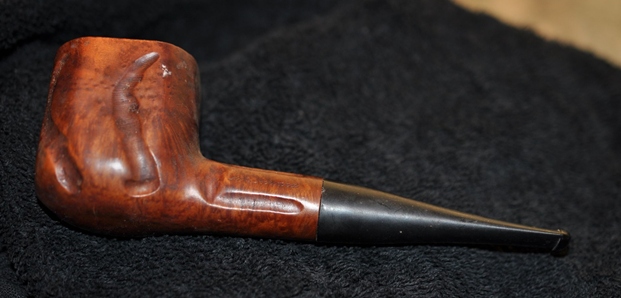
Jeff and I cannot remember where we picked up the next pipe and have no idea where we found it or what the condition was when we found it. I know that Jeff cleaned it before it ended up here but we cannot put a finger on the pre-cleanup photos or even where we got it. So I decided to just write about it as it looks today before I start the cleanup work and describe the work that I did on the pipe. It is stamped on the left side of the shank and reads Pipe of the Month in script. On the underside of the shank it reads Imported Briar while on the right it reads Wally Frank LTD. The pipe is uniquely shaped and I was tempted to call it a drunken poker (in fact I did in the title of the blog). It must have been a good smoking pipe from the condition of the cleaned bowl. The rim top and edges of the bowl are all damaged. It looked like the pipe had been knocked out on hard surfaces and reamed with a knife. The stem was in good condition once I received it with light tooth marks and chatter on both sides. The majority of my work would be done in reshaping and reworking the rim top.

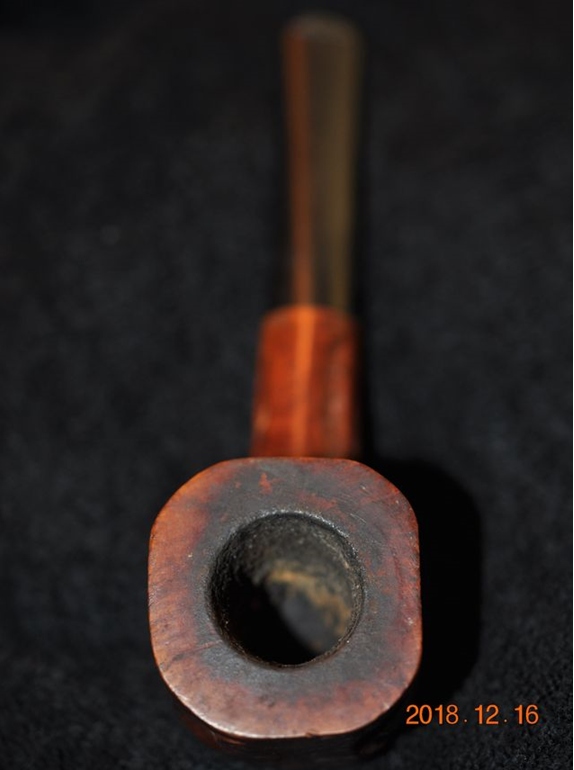
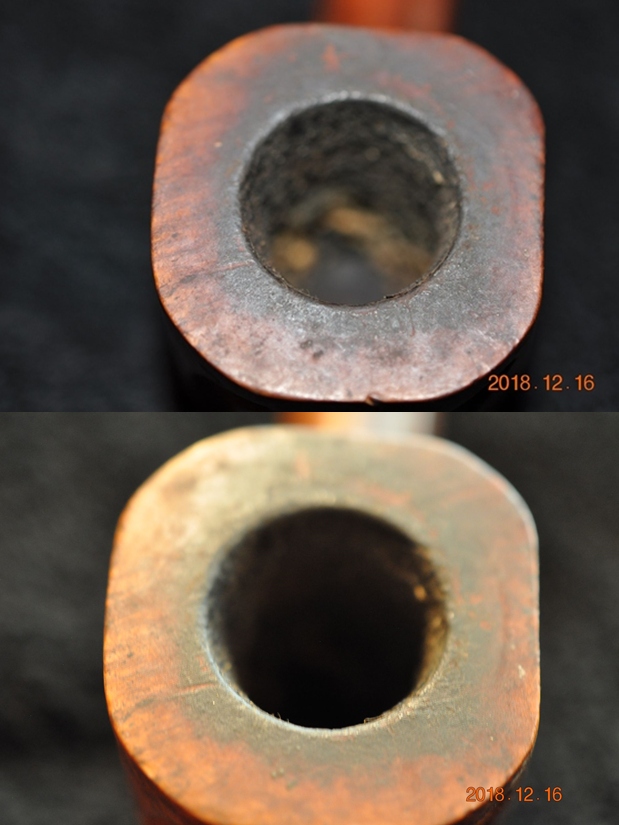
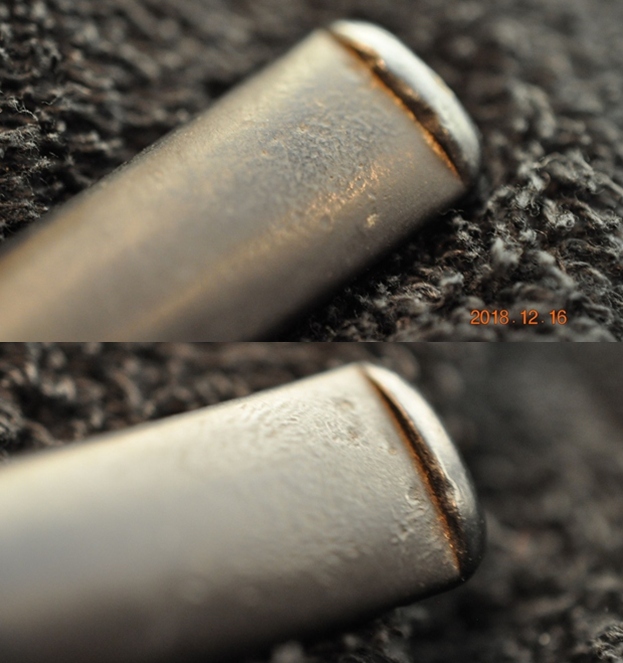
Jeff had cleaned up the pipe with his usual penchant for thoroughness. He reamed the pipe with a PipNet Pipe Reamer and cleaned up the remnants with a Savinelli Fitsall Pipe Knife.  He scrubbed the bowl with undiluted Murphy’s Oil Soap with a tooth brush. He rinsed it under running warm water to remove the soap and grime. He cleaned out the inside of the shank and the airway in the stem with alcohol, cotton swabs and pipe cleaners. He soaked the stem in Before & After Deoxidizer and rinsed it off with warm water. I took photos of the pipe before I started my work.  The rim top and edges of the rim looked rough with damage all around. The outer edge was rough and the inner edge was notched with what looked like knife marks. The rim top was also nicked and dented. The stem surface looked very good with some remaining oxidation and tooth marks and chatter on both sides near the button.  I took photos of the stamping on the sides of the shank. It is clear and readable as noted above. I removed the stem and took a photo of the pipe to give a sense of the whole. The bowl has a definitely tilt to it and the heel is rounded. The saddle stem is tapered with a slight bend that follows the flow of the pipe. I turned to Pipephil’s site (http://www.pipephil.eu/logos/en/logo-w1.html) and looked up the section on Wally Frank Pipes. I have included a screen capture of the section on The Pipe of the Month.Each member of Wally Frank’s “The Pipe of the Month Club” received a brand new pipe in the mail once a month.

There was also a link to the Pipe of the Month Order form that was on the site. I have included that below for your viewing.Now it was time to work on the pipe. To take care of the significant damage to the rim top and edges I started my work by gently topping the bowl to minimize the damaged areas. I gave the inner edge of the bowl a bevel to reduce the burned areas. I also sanded the outer edge and smoothed out the damage. I wiped the bowl down with acetone to remove the spotty varnish coat and to get the bowl free of the shininess so I could blend in the rim top more carefully. There was some nice looking grain under the varnish. Removing varnish always gives me pause because it can often reveal things I would have rather left hidden. However in this case it was not true. I polished the briar with micromesh sanding pads – wet sanding with 1500-12000 grit pads. I wiped the bowl down after each pad with a damp cloth to remove the sanding dust. The bowl really began to take on a shine. The rim top was slightly lighter than the rest of the bowl so I touched it up with an Oak stain pen to match the rest of the pipe.With the rim cleaned up the bowl was in good condition. I rubbed it down with Before & After Restoration Balm. I worked it into the surface of the bowl sides and shank with my fingertips. The product works to clean, enliven and protect the briar. I let the balm sit for a little while and then buffed with a cotton cloth to raise the shine.  I set the bowl aside and turned to work on the stem. I “painted” the stem with the flame of a lighter to lift the tooth marks. The majority of them disappeared with the heat of the flame. Those that remained I filled in with clear super glue. Once the repairs had cured I sanded them smooth with 220 grit sandpaper. I started polishing the stem with 400 grit wet dry sandpaper.  I polished the vulcanite stem with micromesh sanding pads – 1500-12000 grit pads. I wiped it down with Obsidian Oil after each sanding pad. I used Before & After Pipe Polish – both Fine and Extra Fine to further polish the stem.  Before I put the stem back on the shank I checked out the shank end and the edges. I was surprised when I saw a small crack on the top of the shank toward the right that was obviously there before but only now after polishing could I see it. I circled the cracked area in red in the two photos below. I glued the crack with a dribble of super glue and then pressed a thin brass band on the shank end. I really like these thin bands as they do not cover the stamping on the shank – which in this case was on three sides. I like the finished look of the pipe with the band.This Wally Frank Pipe of the Month Drunken Poker with a vulcanite saddle stem is a great looking pipe now that it has been restored. The smooth finish and unique grain look and feel great in the hand and should only feel better as the pipe is smoked. I put the stem back on the bowl and carefully buffed the pipe with Blue Diamond on the buffing wheel to give a shine. I gave the bowl and the stem multiple coats of carnauba wax on the buffing wheel and followed that by buffing the entire pipe with a clean buffing pad. I hand buffed the pipe with a microfiber cloth to deepen the shine. The finished Drunken Poker fits nicely in the hand and feels great. Give the finished pipe a look in the photos below. The dimensions of the pipe are Length: 5 ¼ inches, Height: 1 ½ inches, Outside diameter of the bowl: 1 ¼ inches, Chamber diameter: ¾ of an inch. The weight of the pipe is 25gr/.88oz. If you are interested in adding this pipe to your collection send me a message or an email. Thanks for reading this blog and my reflections on the pipe while I worked on it. There are many more to come!

Restoring a Late Republic Era Peterson’s Sherlock Holmes Rathbone Bent Tall Billiard


Blog by Steve Laug

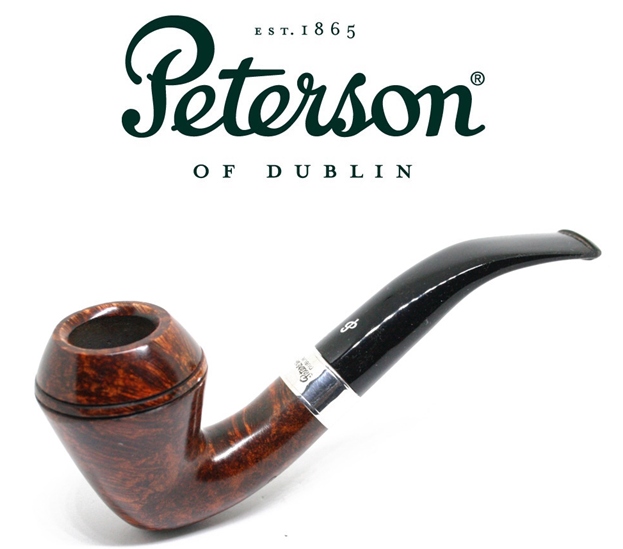
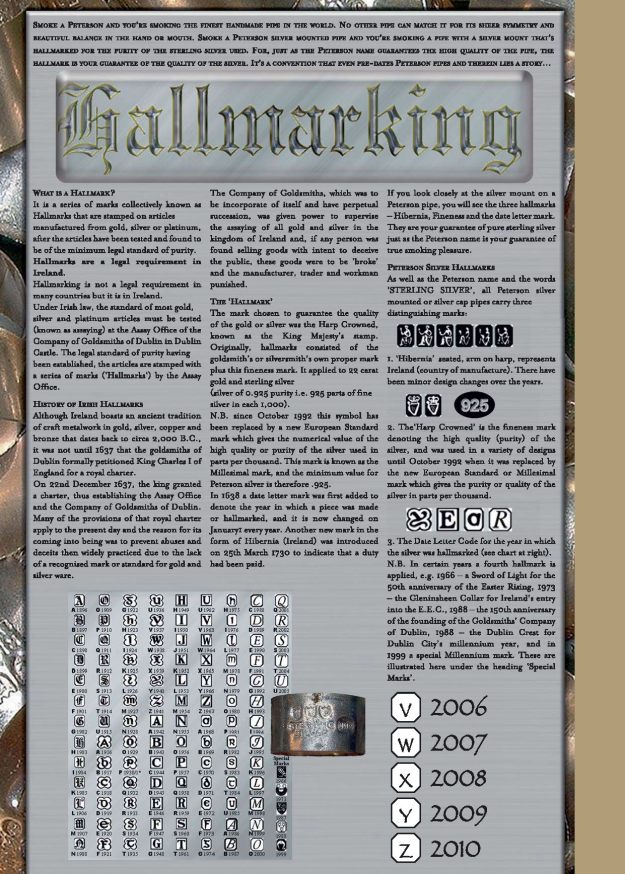
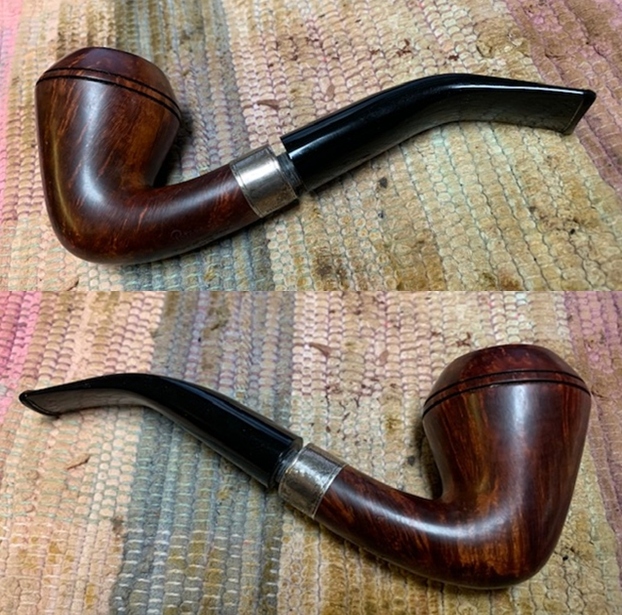
The next pipe on the work table came to us from an online auction from Hermann, Missouri, USA. It is a rusticated Peterson’s Sherlock Holmes line pipe with a tapered vulcanite stem. The pipe is stamped on the underside of the shank and reads Peterson’s [over] Sherlock Holmes [over] Rathbone. That is followed by the stamping Made in the Republic of Ireland. This is a nicer piece of briar than I have seen on some of the firsts I have worked on. The finish had a lot of grime ground into the rusticated finish on the bowl. The bowl was heavily caked and there was a lava coat and the inner edge of the rim. The edges looked okay but we would know more after the cleanup. The stem was oxidized, calcified and had tooth chatter and marks on the top and underside near the button. There a silver P glued onto the left side of the taper stem. The Sterling Silver Band is stamped with the profile of Sherlock Holmes with Sterling Silver above and below the profile. Under that it has three hallmarks that will identify the year the pipe was made. The pipe showed promise but it was very dirty. Jeff took photos of the pipe before he started his cleanup work.   He took photos of the rim top and bowl to give a clear picture of the thickness of the cake and the condition of the rim top and edges. He also took photos of the top and underside of the stem to show the oxidation, calcification and chatter and tooth marks.    Jeff took photos of the sides and heel of the bowl to give a picture of what the briar around the pipe looked like. It is a craggy and rugged rustication.    He took photos of the stamping on the shank and the Sterling Silver band. It reads as noted above and is clear and readable. You can also see the Silver P on the side of the stem. It appears to be loose and lifted from the stem surface. The Sterling Silver band on the shank had the classic Peterson’s Hallmarks. The first mark was the seated Hibernia with her arm on a harp representing Ireland as the country of manufacture. The second mark was a crowned harp used to identify the quality of the silver. The third mark was a slanted capital M that gave the date the pipe was made. I turned to a Peterson’s Hallmark chart that I had on rebornpipes to see if I could identify the date the pipe was made (https://rebornpipes.com/tag/peterson-hallmark-chart/). The slanted letter “M” is the stamp for 1998. That tells me the pipe was made in 1998.I am including the information from Pipedia’s article on Peterson pipes. It is a great read in terms of the history of the brand (https://pipedia.org/wiki/Peterson). I have included a bit of the pertinent history here.
1950 – 1989 The Republic Era – From 1950 to the present time, the stamp for this era is “Made in the Republic of Ireland” in a block format generally in three lines but two lines have been used with or without Republic being abbreviated.

I turned to Pipedia to see if I could find some specific information on the Sherlock Holmes Series (https://pipedia.org/wiki/Peterson#Peterson_Pipe_Collections). The site gave this following information on the series

The Sherlock Holmes Series: Probably the most popular and successful series of pipes ever produced by Peterson. Including the Meerschaum version of the seven day sets. Both briar and Meers can be purchased either as individual pipes or complete seven day sets and stands. Expect to pay around $250 for briars and $300 for individual Meerschaums. The Adventures of Sherlock Holmes runs around $1000 for a 4 pipe boxed set. Complete 7 day sets and stands can be up to $1500 – $2000.

That was followed by the second series the Return of Sherlock Holmes.

I turned to the article on dating Peterson pipes on Pipedia to see if I define the time frame of the Return of Sherlock Holmes Series and it dated it at approximately 1991 (https://pipedia.org/wiki/A_Peterson_Dating_Guide;_A_Rule_of_Thumb#Silver_Band_Dating). That fit this pipe well as it is dated 1998. It clearly links it to the Second or Return of Sherlock Holmes series,

I turned to the catalogue I had on a blog on rebornpipes (https://rebornpipes.com/tag/peterson-hallmark-chart/). I have copied the page from the catalogue on the Sherlock Holmes Original Collection. From that page it appears that the Rathbone was part of the second series of Sherlock Holmes pipes – The Return of Sherlock Holmes.I knew that I was dealing with a Republic Era pipe made between 1950-and the present – a Late Republic pipe. It was a rusticated bent billiard that came out as part of the Return of the Sherlock Holmes Series in 1998. The finish was stained with a combination of brown and black stains. Now it was time to work on the pipe.

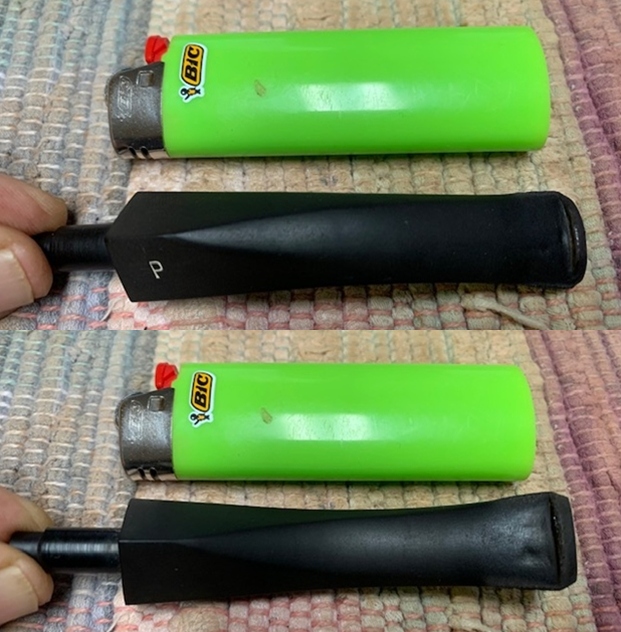
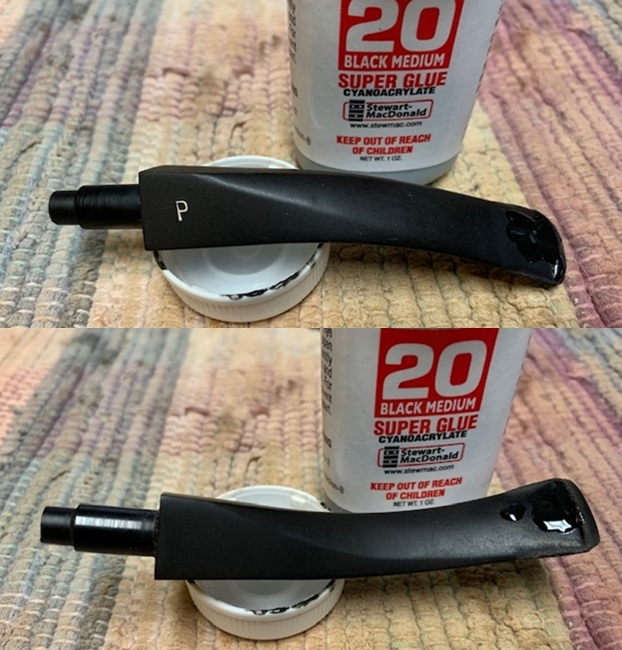
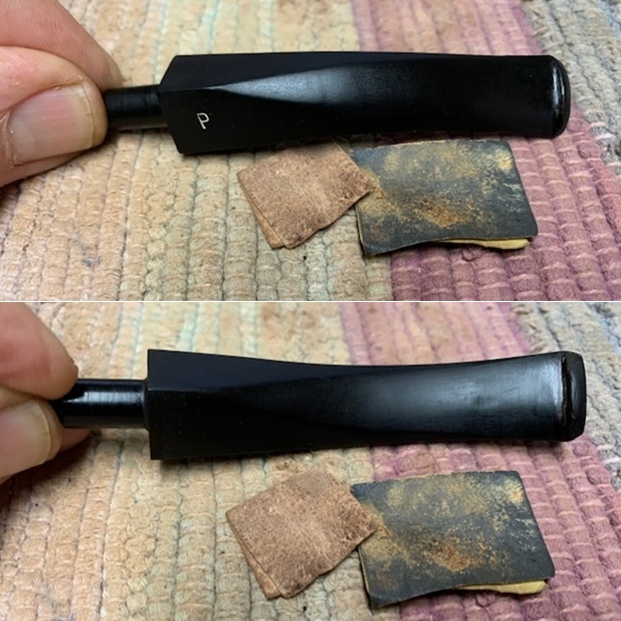
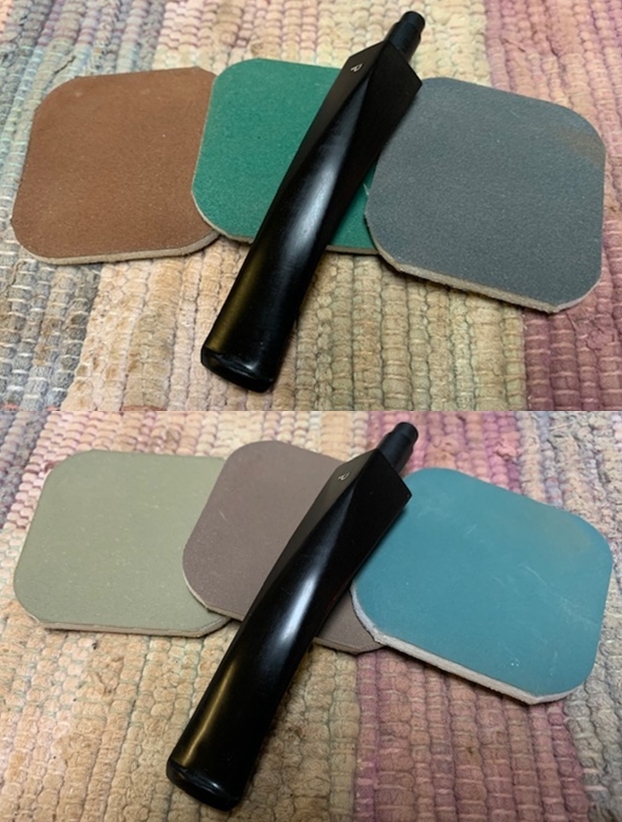
Jeff had cleaned up the pipe with his usual penchant for thoroughness. He reamed the pipe with a PipNet Pipe Reamer and cleaned up the remnants with a Savinelli Fitsall Pipe Knife.  He scrubbed the bowl with undiluted Murphy’s Oil Soap with a tooth brush. He rinsed it under running warm water to remove the soap and grime. He cleaned out the inside of the shank and the airway in the stem with alcohol, cotton swabs and pipe cleaners. He soaked the stem in Before & After Deoxidizer and rinsed it off with warm water. I took photos of the pipe once I received it.  (The plastic bag in the bowl contains the silver P which fell off in the clean up.) The rim top and inner edge of the rim looked very good with a bit of damage on the inner bevel of the rim surface. The stem surface looked very good with some remaining oxidation and tooth marks and chatter on both sides near the button.     I took a photo of the stamping on the shank. It is clear and readable as noted above. The second photo shows the spot were the silver P was inset into the vulcanite. I would need to reset the P.I removed the stem and took a photo of the pipe to give a sense of the whole. The stem is tapered. I started my work on the pipe by addressing the loose P logo that needed to be reset in the stem surface. You can see where someone tried to reset it with heat and damaged the vulcanite around the P. I daubed the surface of the P stamp with all clear CA glue and pressed the P into the shape on the stem surface. I set the stem aside while I worked on the bowl. I cleaned up the darkened and damaged beveled inner edge of the bowl with a folded piece of 220 grit sandpaper. Once I had the bevel finished I polished it with 1500-2400 grit micromesh pads and wiped off the dust. I restained it with a Walnut Stain pen to match the rest of the bowl finish.  With the rim cleaned up the bowl was in good condition. I rubbed it down with Before & After Restoration Balm. I worked it into the surface of the bowl sides and shank with my fingertips and worked it into the nooks and crannies of the rustication with a horsehair shoebrush. The product works to clean, enliven and protect the briar. I let the balm sit for a little while and then buffed with a cotton cloth to raise the shine. I set the bowl aside and turned to work on the stem. I smoothed out the damage to the vulcanite around the P with a new 1500 grit micromesh pad. I was able to remove the damage and the stem looked good.  I polished the vulcanite stem with micromesh sanding pads – 1500-12000 grit pads. I wiped it down with a damp cloth after each sanding pad. I used Before & After Pipe Polish – both Fine and Extra Fine to further polish the stem.  This Return of Sherlock Holmes Series Rathbone Bent Tall Billiard with a vulcanite taper stem is a great looking pipe now that it has been restored. The rugged rustication feels great in the hand and should only feel better as the pipe is smoked. I put the stem back on the bowl and carefully buffed the pipe with Blue Diamond on the buffing wheel using a light touch being careful around the silver P and gentle on the rusticated briar. I gave the bowl multiple coats of Conservator’s Wax and the stem multiple coats of carnauba wax on the buffing wheel and followed that by buffing the entire pipe with a clean buffing pad. I hand buffed the pipe with a microfiber cloth to deepen the shine. The finished Sherlock Holmes Rathbone fits nicely in the hand and feels great. Give the finished pipe a look in the photos below. The dimensions of the pipe are Length: 5 ¾ inches, Height: 2 ¼ inches, Outside diameter of the bowl: 1 ½ inches, Chamber diameter: ¾ of an inch. The weight of the pipe is 53gr/1.87oz. If you are interested in adding this pipe to your collection send me a message or an email. Thanks for reading this blog and my reflections on the pipe while I worked on it. There are many more to come!