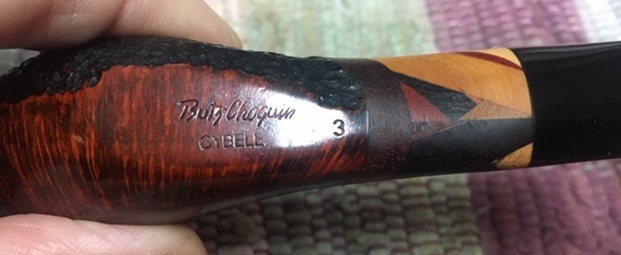
Tag Archives: sanding a stem

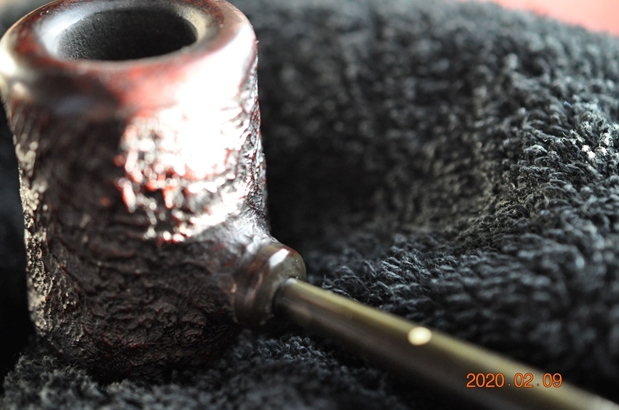
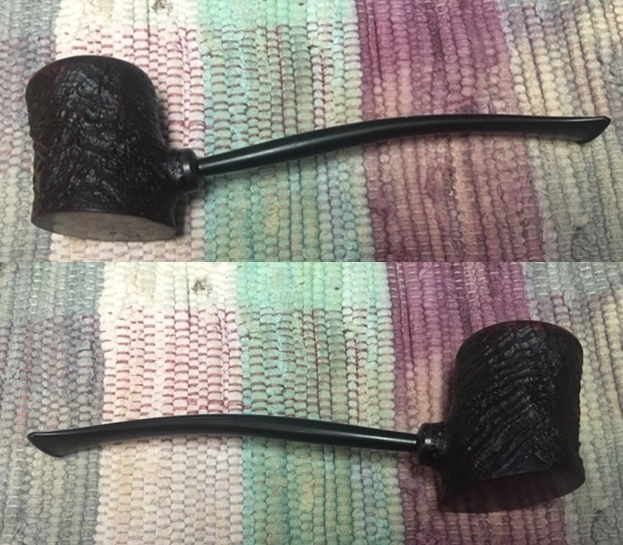
Restoring a long awaited Dunhill Shell Briar 483FT 4S Don


Blog by Steve Laug

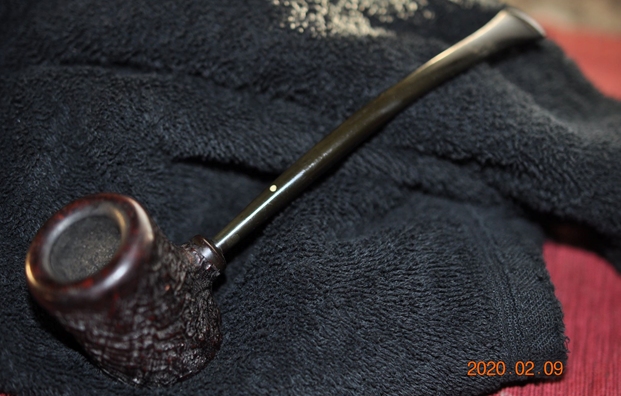
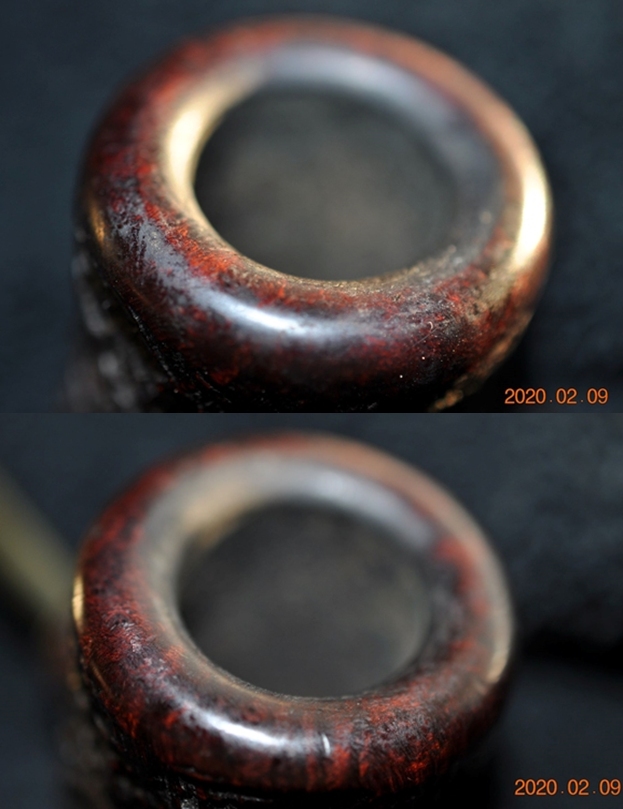
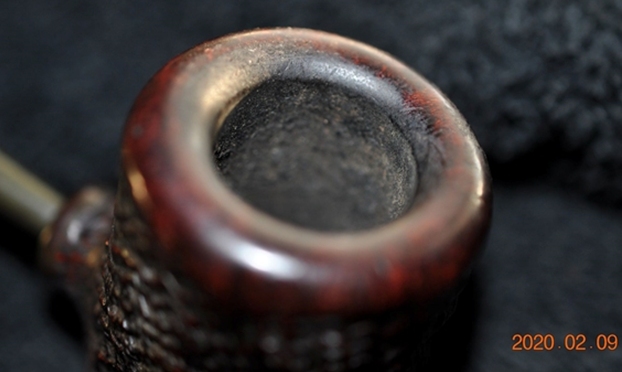
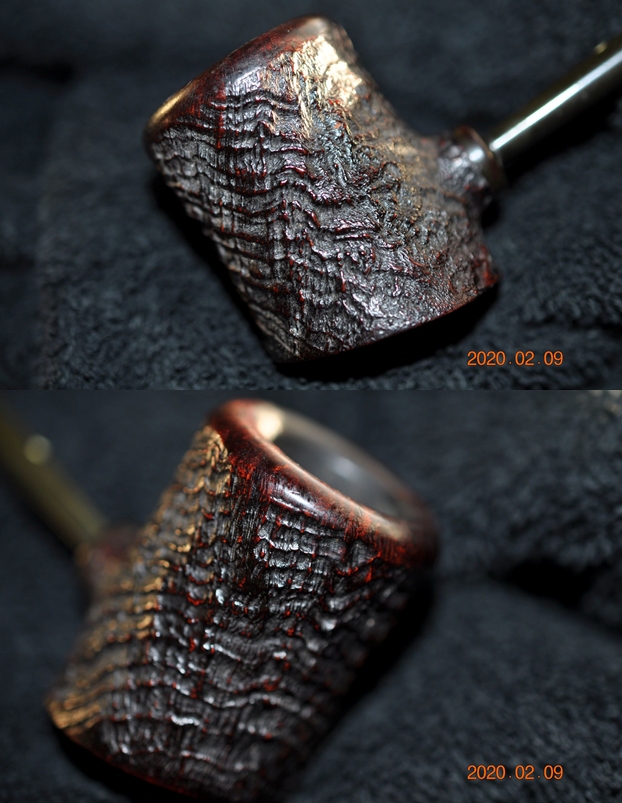
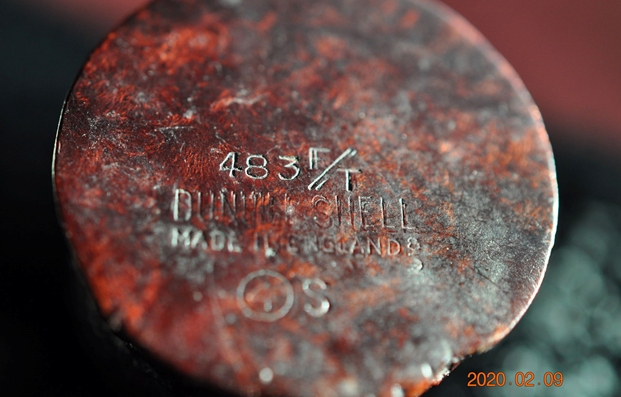
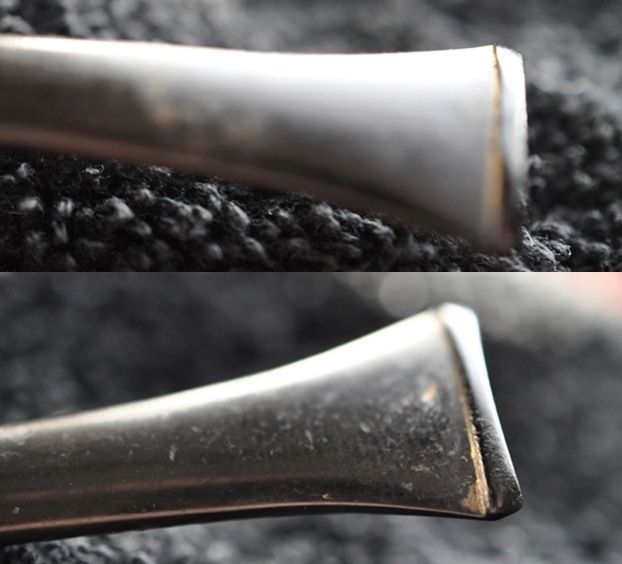
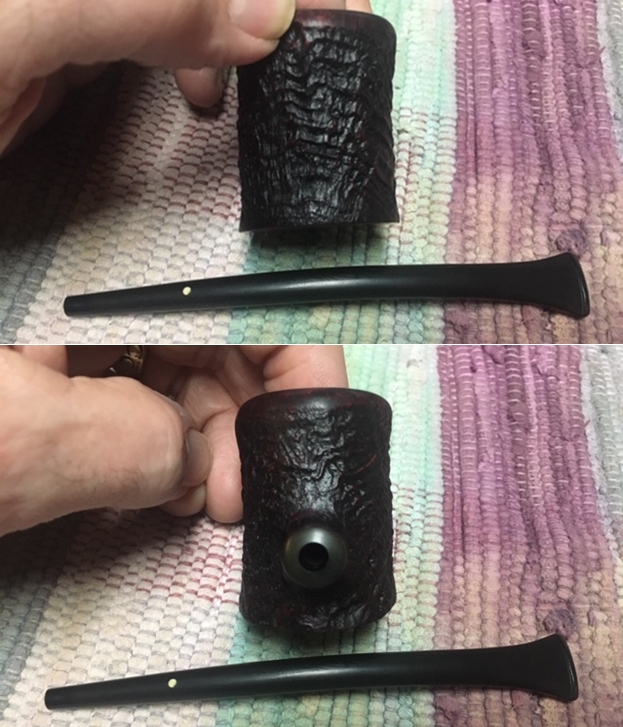
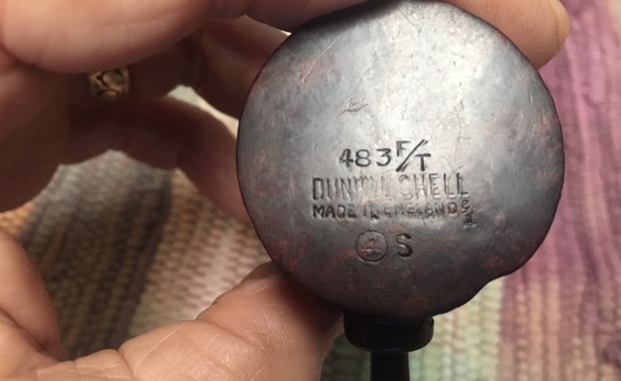
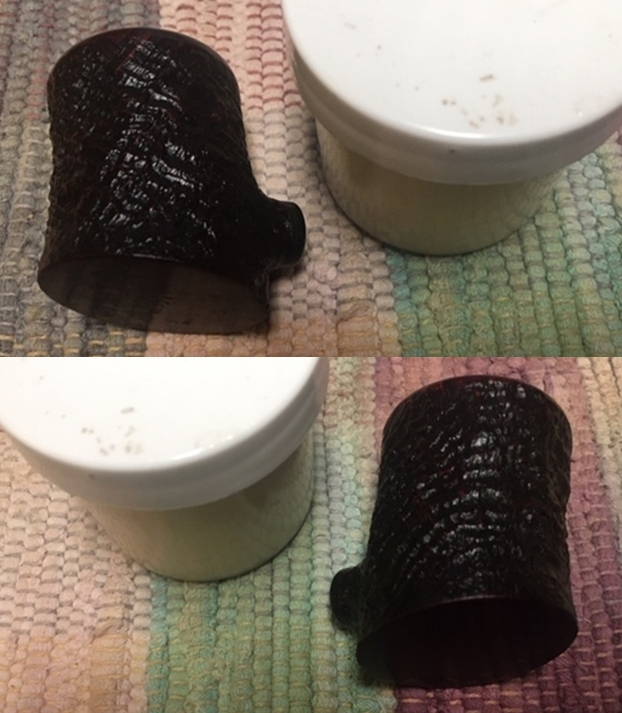
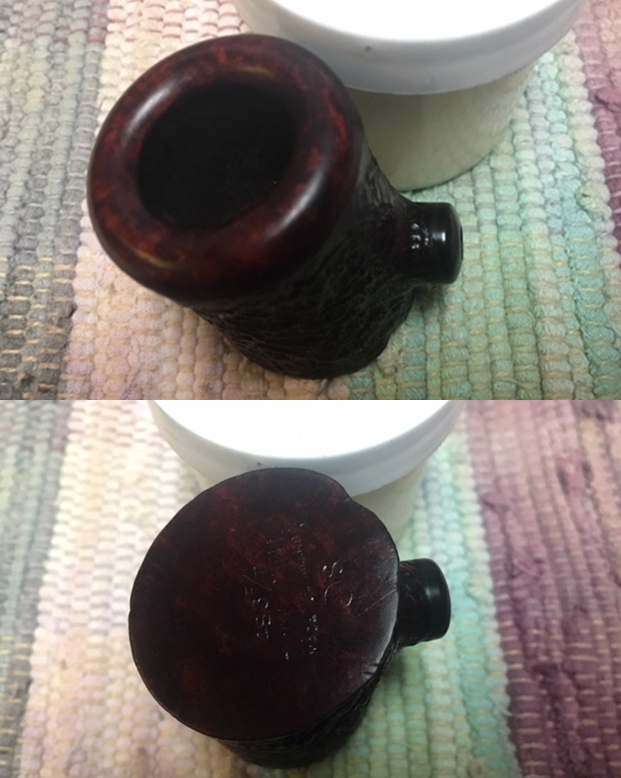
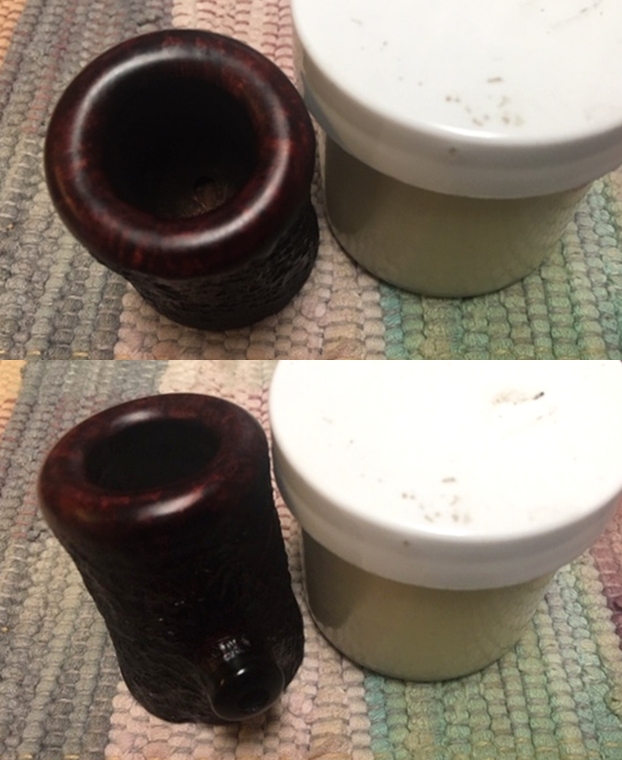
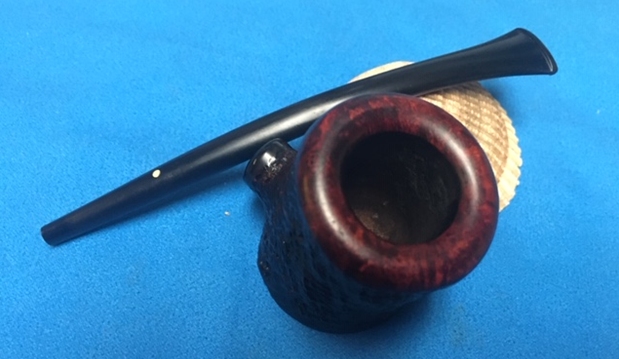
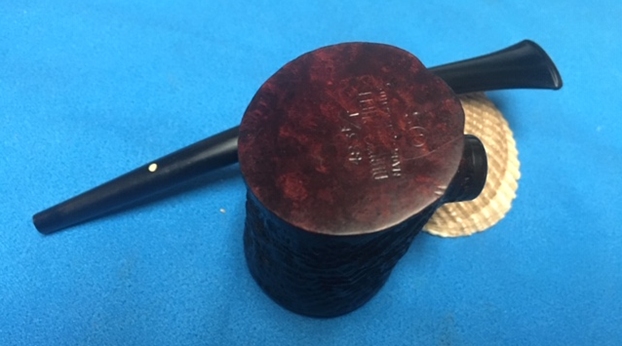
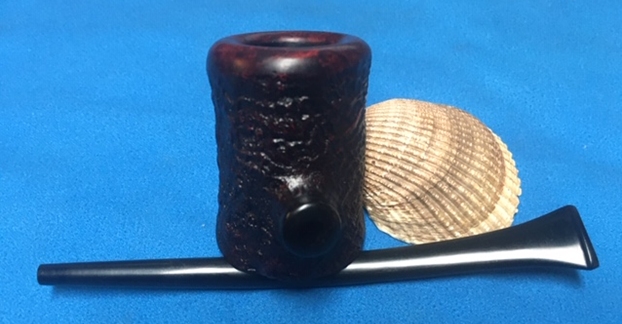
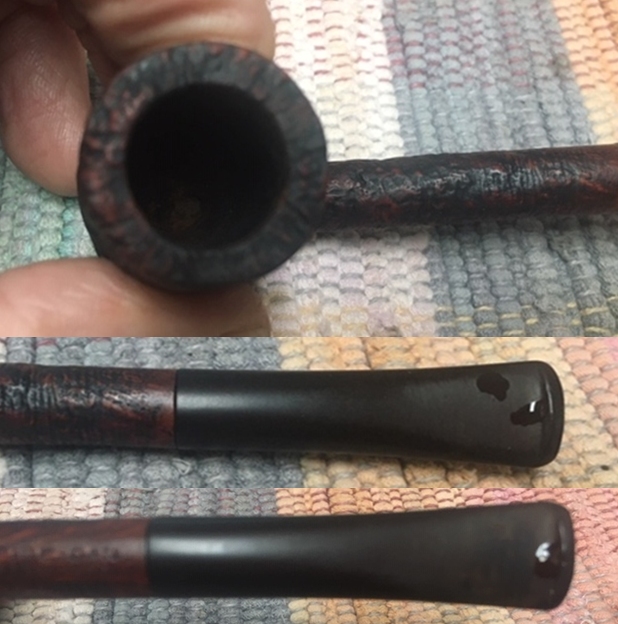
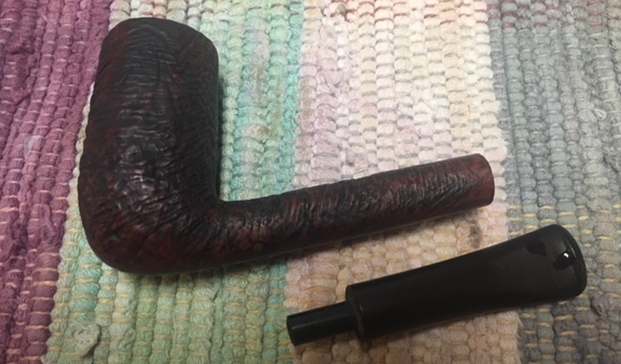
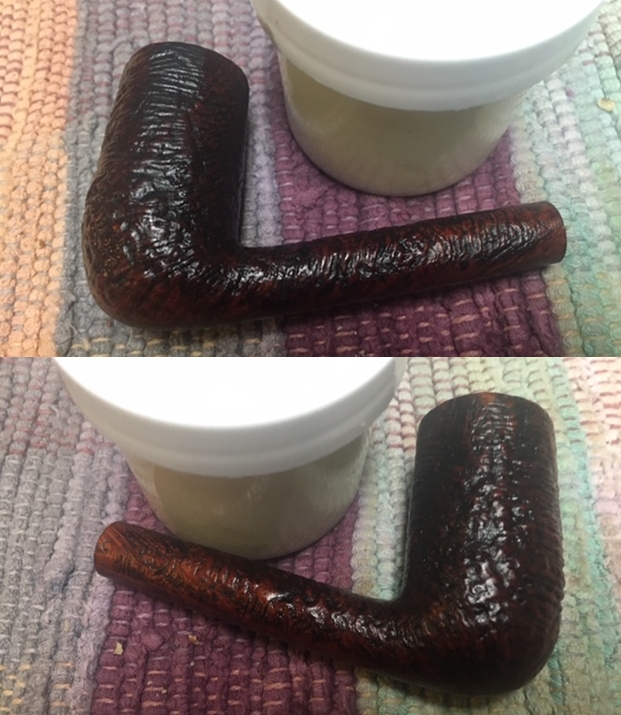
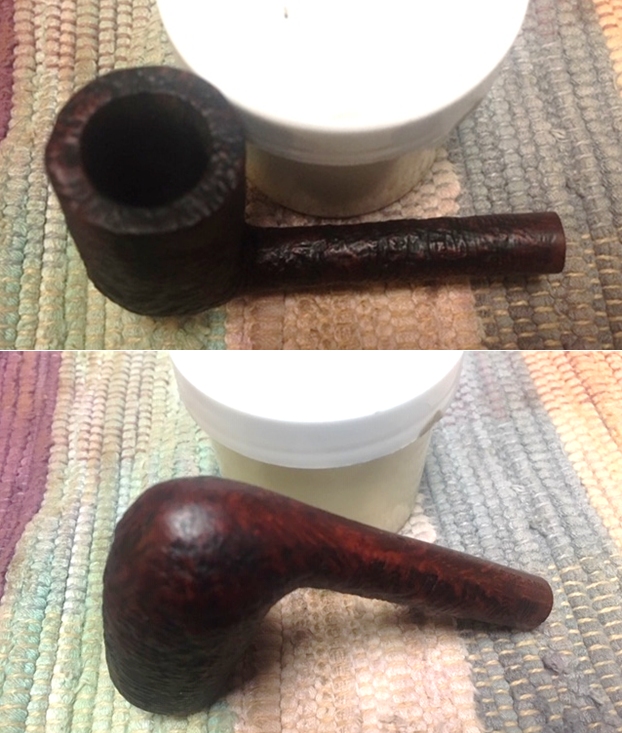
Not too long ago Jeff sent me pictures of a pipe that someone had sent him an email about. They were selling it and the price was not too bad for what it was. Interestingly it was a shape that I have been looking for, for several years. It was Dunhill shape that they called a Don. It had a Shell finish with deep sandblasting around the bowl and a smooth crowned rim top and base. The shank was very short and capped with a vulcanite button. The stem was a thin military bit fishtail with a broad flare at the button. The pipe is stamped on the base as follows: 483F/T over DUNHILL SHELL. Under that it was stamped Made in England with the numbers 8 and 9 following he D in England. From my research that means the pipe was made in 1968 and sold in 1969. There is a Circle 4S stamped as well – 4 referring to the size of the pipe (Group 4) and S referring to the Shell finish on the bowl. The pipe is very dirty with grime and dust in the sandblast finish. There is a thick cake in the bowl and an overflow of lava and tars on the crowned rim top. The base is dirty and has some scratching around the stamping but it is readable. The vulcanite shank cap was oxidized as and dirty. Then thin stem was oxidized and there were light tooth marks and chatter on the surface of the stem on both sides ahead of the button. Otherwise it is a clean looking stem. Jeff took photos of the pipe before he started his cleanup work. Jeff took photos of the rim top from various angles to show the condition of the bowl and rim as I described above. The finish appears to be okay beneath the grime and the inner and outer edge of the rim look very good under the thick cake and lava overflow. There do not appear to be any nicks of dents in the smooth briar crown of the rim. He took photos of the sides of the bowl showing the deep and rugged sandblast that I like on these Dunhill Shell pipes. This one was exceptional. You can also see the vulcanite shank cap in the photos. I have included the last photo is this series even though it is a little blurry because it captured the blast on the lower part of the left side of the bowl. Jeff took a photo of the stamping on the smooth heel of the bowl. It is a little double stamped but is still readable. There was a lot of grime and debris in the stamping and on the base.He took photos of the stem to show the oxidation as well as the wear on the button. You can also see the calcification, tooth marks and chatter on both sides.Using the information on pipephil’s site I was able to confirm my interpretation of the stamping spelled out above (http://pipephil.eu/logos/en/dunhill/shell-briar1.html). The 483F/T stamp tells me the pipe is a shape number 483 (a Don) while the F/T tells me that the stem is a fish tail stem. The Shell Briar stamp refers to the sandblast finish. The number 8/9 following the Made in England stamp identifies the date as 1968 and sold in 1969. The circled 4 is the Group bowl size. The S is the stamping for the Shell Briar finish.

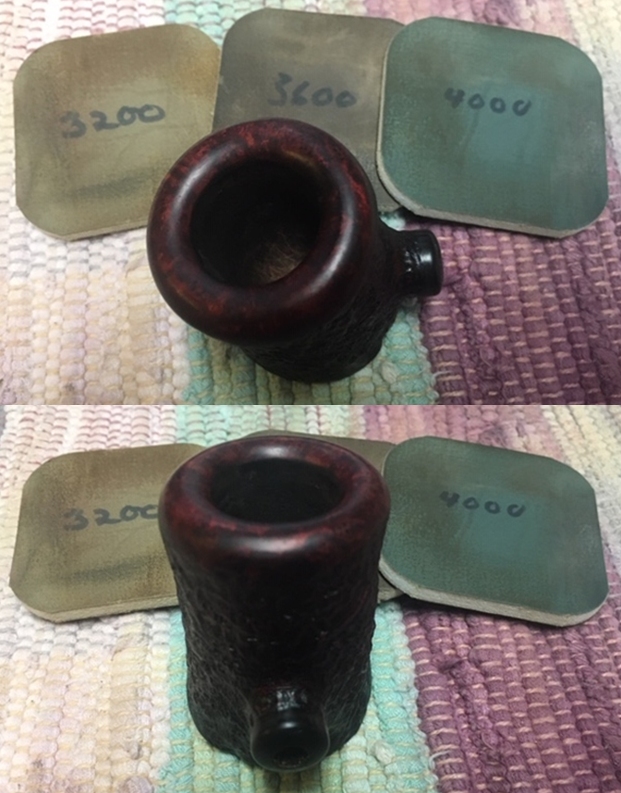
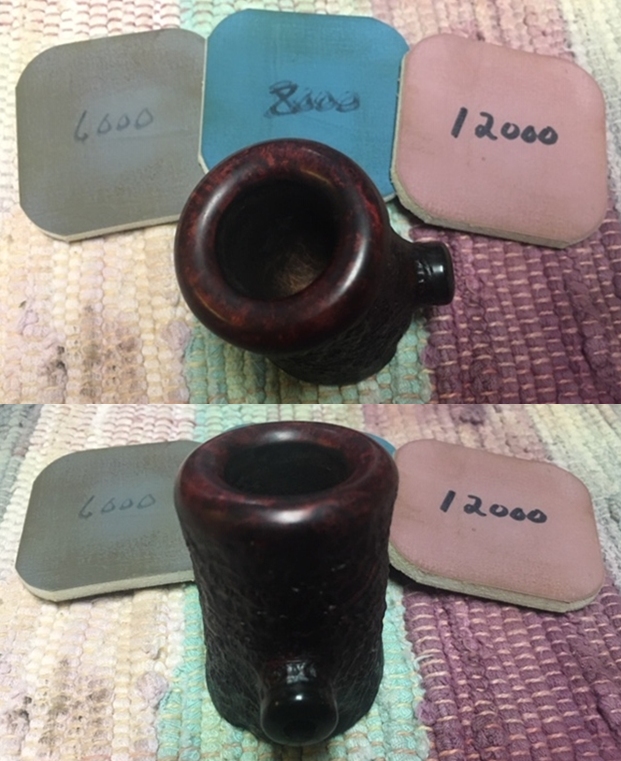
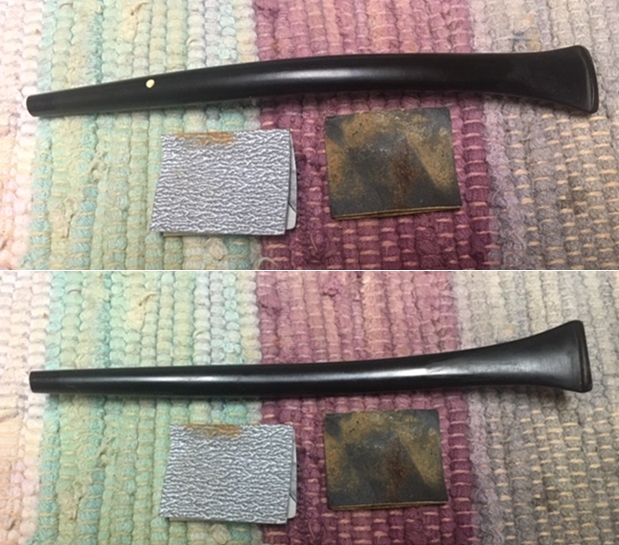
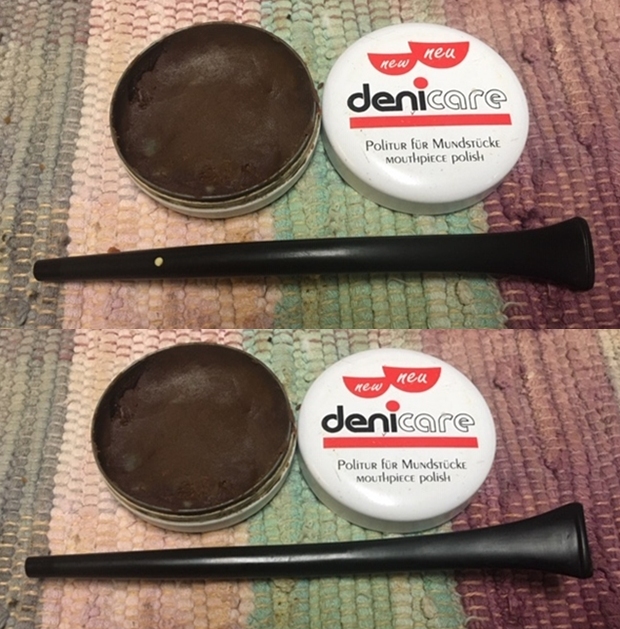
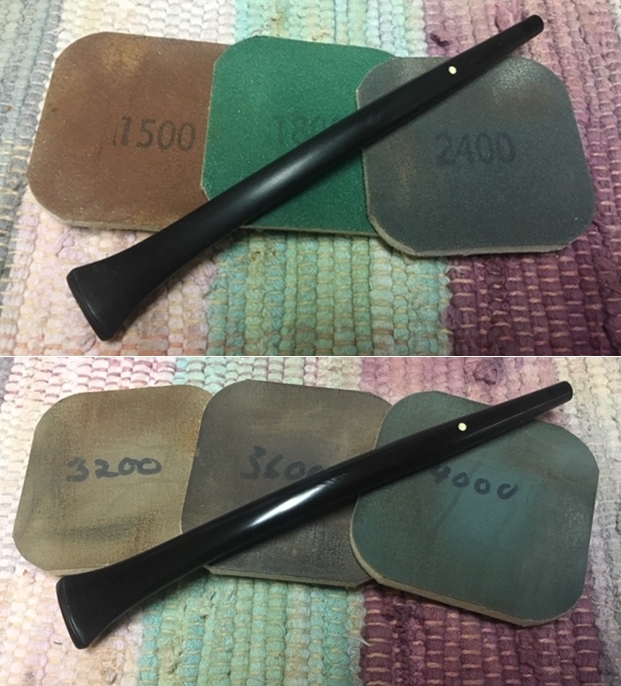
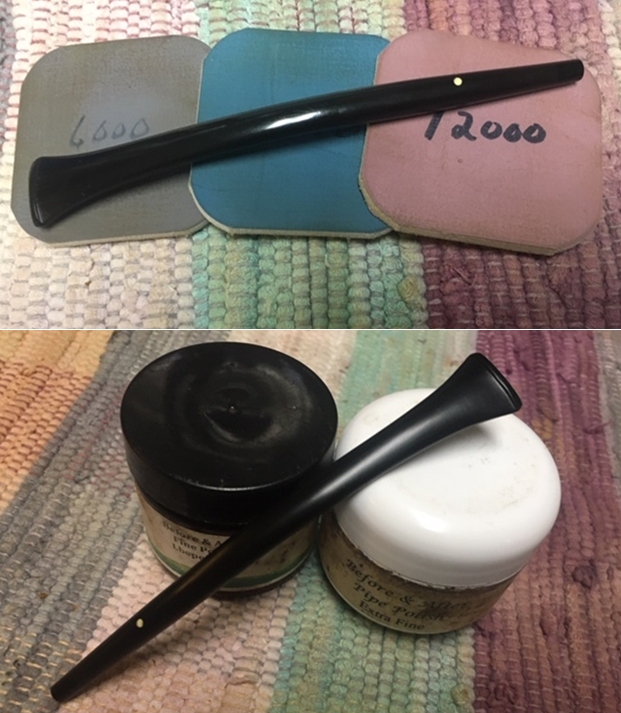
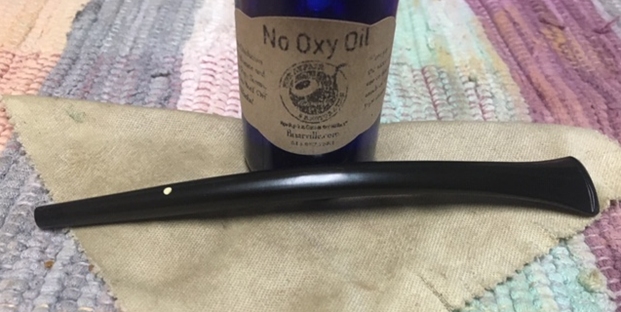
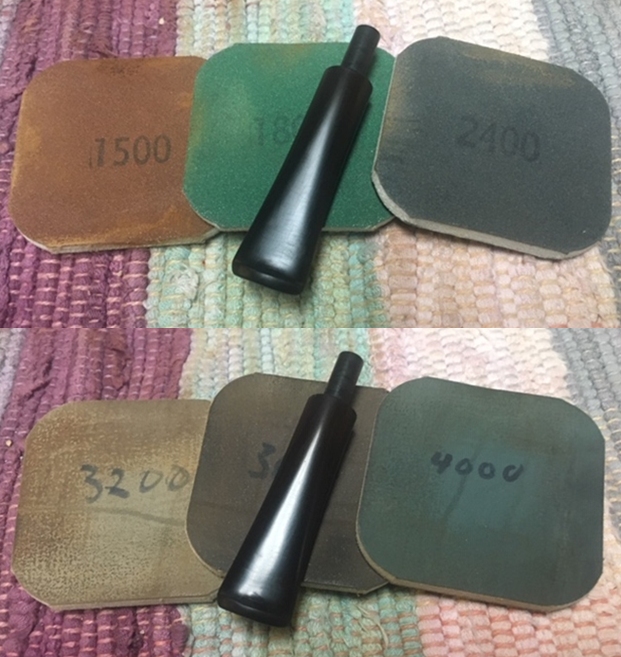
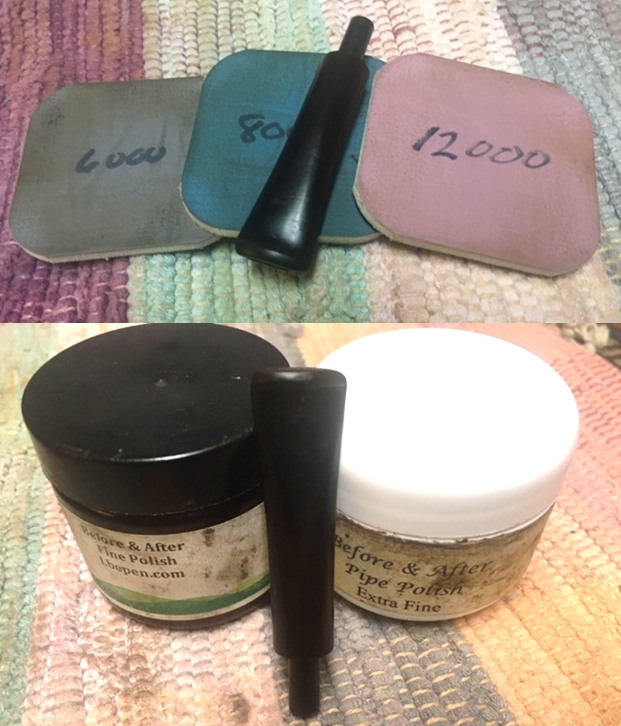
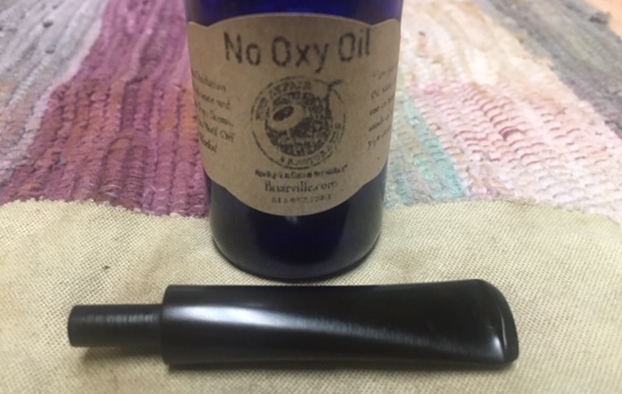
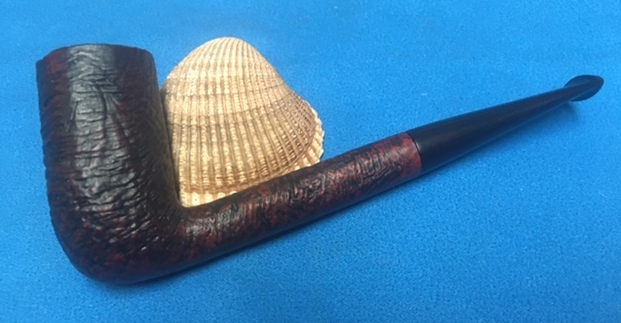
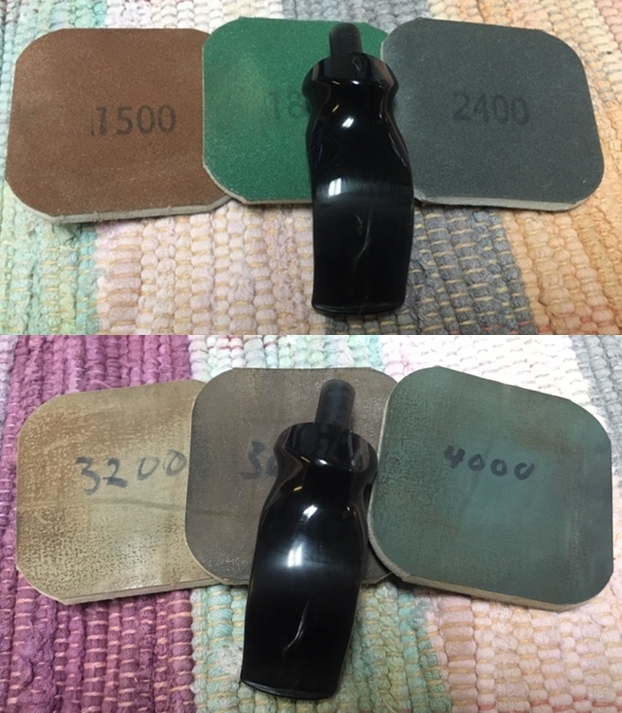
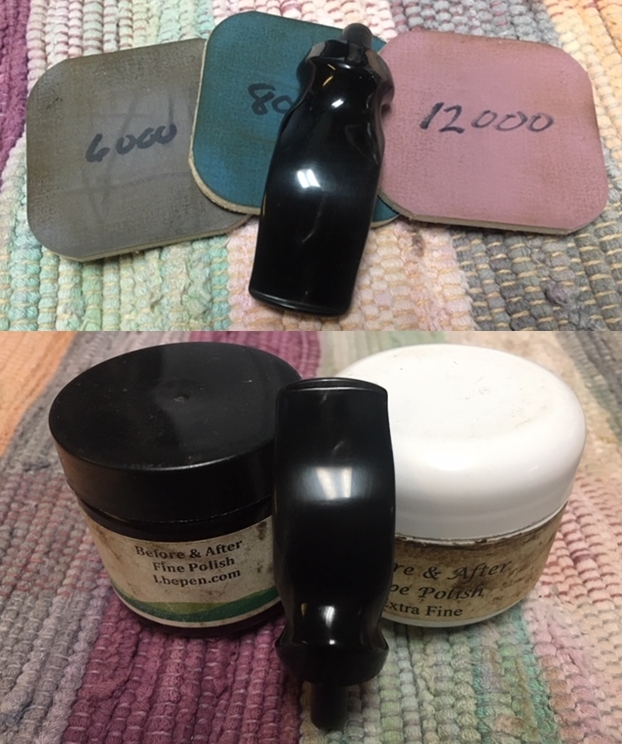
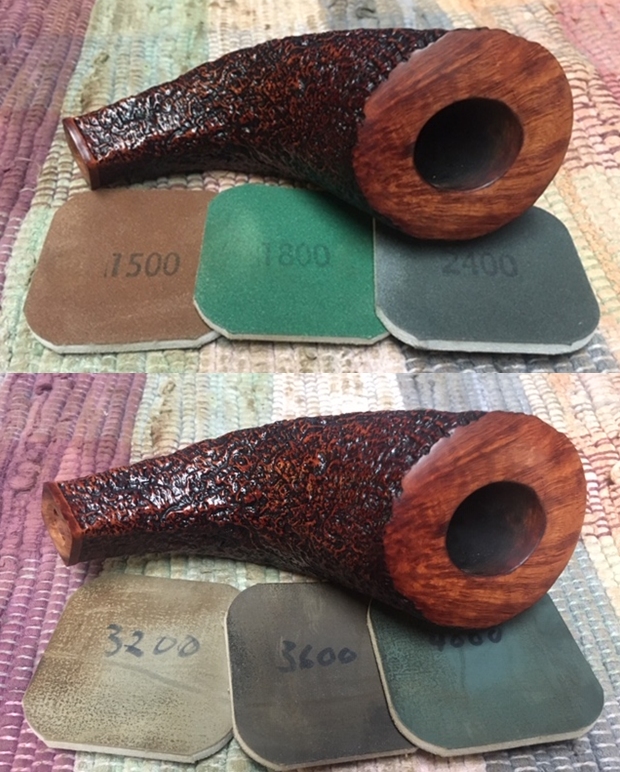
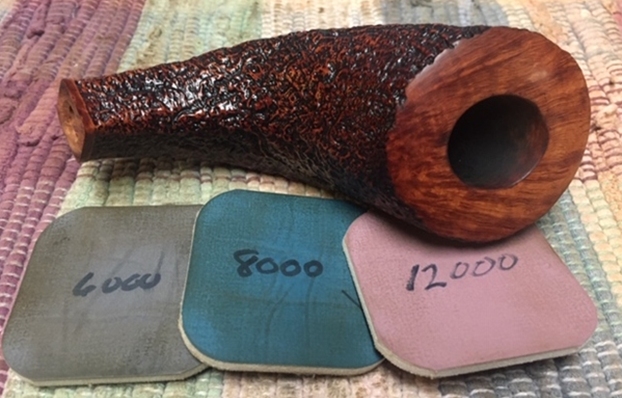
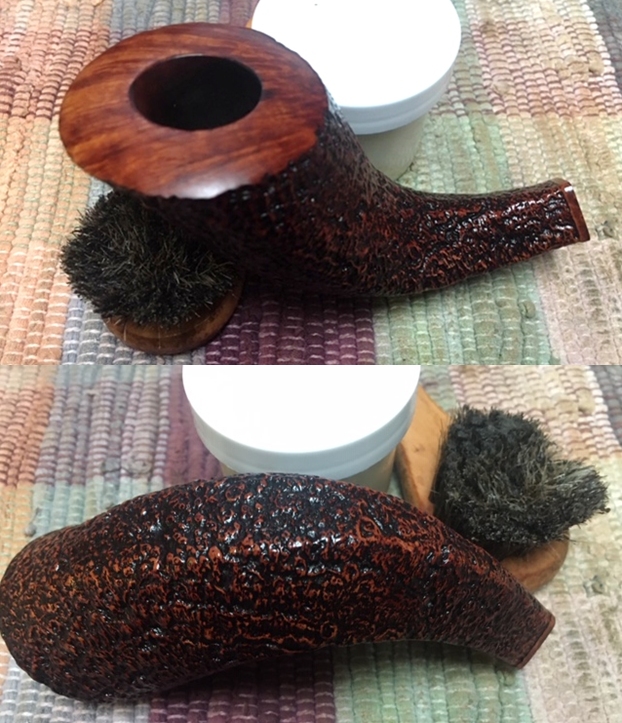
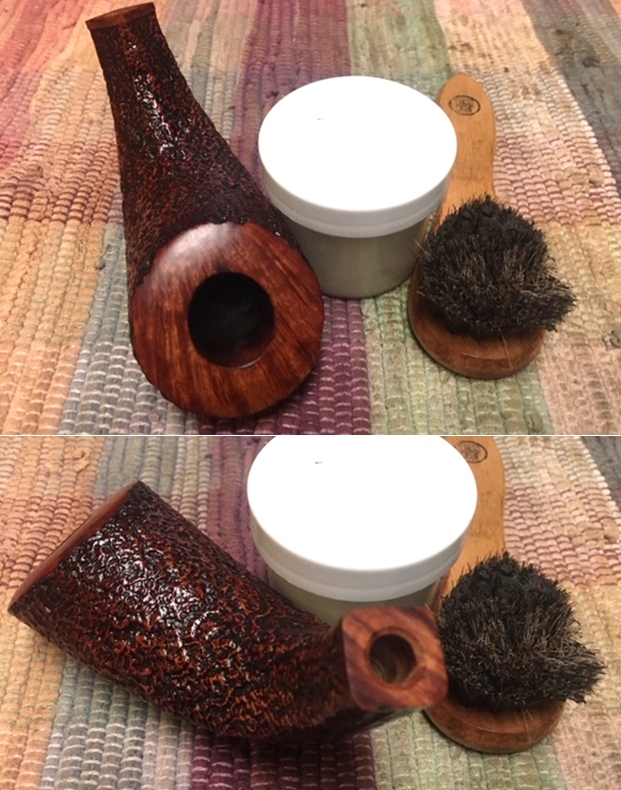
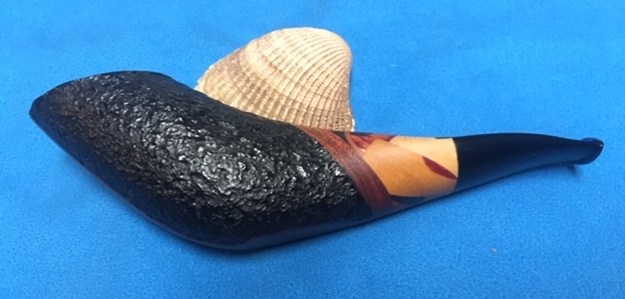
With that in mind I turned to work on this pipe. When Irene and I met with Jeff and Sherry on the Oregon Coast he sent me back with a bag of cleaned pipes and this was one of them. Jeff had done a great job in cleaning up this Dunhill. He had reamed the bowl with a PipNet reamer and cleaned up the remnants with a Savinelli Fitsall Pipe Knife. He took back the thick cake to the walls of the bowl. He also scraped off the lava and grime on the rim. He scrubbed the exterior of the bowl with Murphy’s Oil Soap and a tooth brush to remove the grime on the bowl and rim and rinsed it off with warm running water. He cleaned out the interior of the bowl and shank with pipe cleaners, cotton swabs and alcohol until they came out clean. The rim top looked much better when you compare it with where it started. He cleaned the stem with Soft Scrub to remove the grime on the exterior and cleaned out the airway with alcohol, cotton swabs and pipe cleaners. He soaked it in Before & After deoxidizer and rinsed it clean after wards I took some photos of the pipe as I saw it. It was a beautiful piece of sandblasted briar. To show how clean the rim top and stem really was I took a close-up photo of the rim and stem. The bowl was clean and cake free. The rim top is quite clean and the inner edge of the bowl has all of the lava removed. The crowned rim looks great. The vulcanite fishtail stem looks very good. The surface and the button edge appear to be in good condition. There were some small tooth marks and chatter on both sides but it looked good.I took a photo of the shank cap to show that it still had some oxidation but it was in good shape.I took the stem off the pipe and took photos of the bowl sides to show the rich and deep sandblast on the craggy sides of the bowl. I took a photo of the stamping and the heel of the bowl. It looks a lot better. You can see the double stamping on most of the stamp – readable but also has a ghost!I started my part of the restoration of the pipe by polishing the crowned rim top and the vulcanite shank cap with micromesh sanding pads. I dry sanded with 1500-12000 grit pads and wiped the surface of both down with a damp cloth between each sanding pad. I worked some Before & After Restoration Balm into the finish of the bowl and the rim top. I worked it into the surface with my fingertips and a horsehair shoe brush to clean, enliven and protect the wood. I let the balm sit for 10 minutes and buffed it off with a soft cotton cloth. I took photos of the pipe at this point in the process to show what the bowl looked like at this point. I set the bowl aside and turned my attention to the stem. I also sanded out the tooth marks and chatter on the surface of the vulcanite with a folded piece of 220 grit sandpaper. I followed the 220 grit sandpaper with 400 grit wet dry sandpaper to minimize the scratching.    I polished the stem with Denicare Mouthpiece Polish to take out the oxidation at the button edge and on the end of the mouthpiece. I buffed the stem with a microfiber cloth.I polished out the scratches with micromesh sanding pads – wet sanding with 1500-12000 grit pads. I wiped the stem down after each sanding pad with Obsidian Oil. I polished it with Before & After Pipe Stem Polish – both Fine and Extra Fine. Once I had finished the polishing I wiped it down with Briarville’s No Oxy Oil and set it aside to dry. I am happily on the homestretch with this pipe and I really look forward to the final look when it is put back together and polished and waxed. I put the bowl and stem back together. I polished the bowl and stem with a light touch of Blue Diamond on the buffing wheel. I gave the bowl multiple coats of Conservator’s Wax and the stem multiple coats of carnauba wax. I buffed the pipe with a clean buffing pad to raise the shine. I hand buffed it with a microfiber cloth to deepen the shine. The pipe polished up pretty nicely. The rugged sandblasted bowl really looked good with the polished black vulcanite. This 1968 Dunhill Shell Briar 483F/T Group 4 Size Don was a fun pipe to work on. The Don really has a classic Dunhill look in a Shell Briar finish that catches the eye. The combination of red and black stains really makes the pipe look attractive. It is a comfortable pipe to hold in the hand. The finished pipe is shown in the photos below. The dimensions of the pipe are Length: 6 ½ inches, Height: 2 inches, Outside diameter of the bowl: 1 3/8 inches, Chamber diameter: ¾ of an inch. This pipe is staying with me. I look forward to loading a bowl of a favourite Virginia and enjoying this pipe. Thanks for reading this blog and my reflections on the pipe while I worked on it. This is an interesting estate to bring back to life.

Restoring an older BRC Meerschaum Bulldog


Blog by Steve Laug

Jeff and I picked up old cased Bulldog on a pipe hunt on the Oregon Coast. We asked at the counter if the clerk knew if they had any pipes in the store. She opened the counter display and took out this pipe case. The case looked old enough to get my heart going. Generally they have something interesting in them – though I have had the disappointment of opening an empty case. When she handed it to me I felt the weight and knew that there was a pipe inside. I took a deep breath and opened the case and let out a sigh of relief. The pipe looked good and it looked old. Jeff came to the counter then and I showed it to him. A deal was struck and the pipe left the store with us. I left it with Jeff so he would work his cleanup magic on it. Jeff took a photo of the case and with it opened to reveal the pipe and in doing so I was able to relive this find. I still remember the two older women who ran the store and the conversation that the pipe initiated. It was a good day! Jeff opened the case and took a photo to show the embossed label in the cover of the pipe case. It was an oval that with a circle holding BRC split into three quadrants in the centre. On either side it was flanked by Genuine Meerschaum. The case was lined with plush red material and the exterior was covered in a worn brown leather.He took a photo the pipe as he removed it from the case and after he laid it on the table before he did the clean up. The pipe is actually very dirty. There is a thick cake in the and an overflow of lava on the rim top. There appear to be scratches in the rim top surface as well. The bowl is dirty and heavily scratched. The twin rings around the bowl are damaged and filed in with grit and grime. The shank and the lower part of the bowl was starting to get a nice patina. The silver band was very dirty and oxidized. There is no stamping on the shank or the band. The stem is not amber nor is it newer acrylic. I believe it is Amberoid – a man made amber material that was a material consisting of small pieces of amber or sometimes other resins united by heat and pressure. It appears to be the original stem as the fit to the shank is perfect and it is threaded for the bone tenon. There are light tooth marks and chatter on the surface of the stem ahead of the button. Otherwise it is a clean looking stem.Jeff took close-up photos of the bowl and rim top from various angles to capture the condition of the bowl and rim top edges. There was a very thick cake in the bowl and you can see the overflow of lava and scratches in the rim top and edges. You can also see the nicks and damage to the cap of the bowl.Jeff took photos of the sides and heel of the bowl to show condition of the meer. You can see the damage to the rings on the right side and the many scratches around the sides and heel of the bowl.Jeff took photos of the shank stem junction with the tarnished silver band. The shape of the stem is perfect for the shank and band. If it is a replacement stem it is very well done. The next photos of the stem to show the general condition of the amberoid stem shape. The flow of the stem is perfect for the diamond shank Bulldog. He took photos of the top and underside of the stem to show the light tooth chatter on both sides near the button.  He also shows the orific button on the end of the stem. I looked for the BRC brand on Pipedia and on Pipephil with no luck. I have no idea if the pipe is English, French, Austrian or otherwise. There was nothing to help me identify the maker. Ah well it is a well made mystery. If any of you can help out with information on the make I will greatly appreciate your help. Thank you.

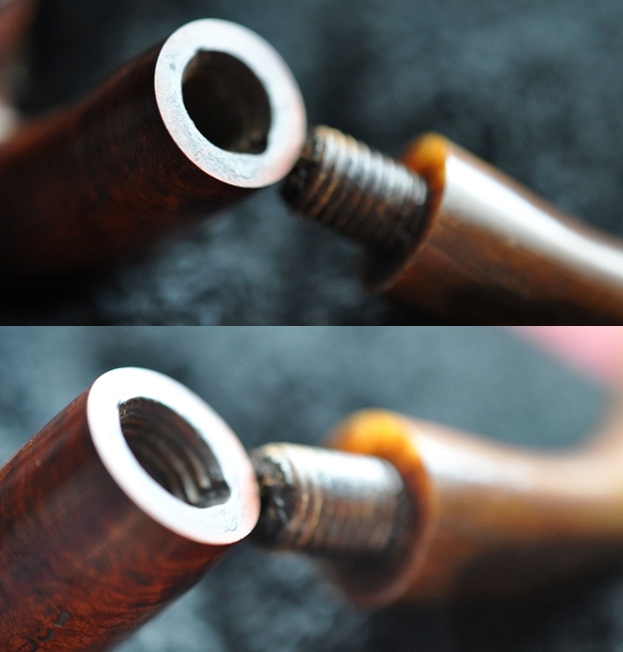
Having seen the before pictures on this pipe I did not know what to expect when I unpacked the most recent box Jeff sent to me. The pipe was present in the box with other cased pipes so as I took each one out and opened it I waited to see if it was this one. When I finally opened a case and this pipe was there I did not know what to expect. I put the worn and tired case on my desk and opened it to see what was there. I opened the case and took a photo of the pipe inside.I was astonished to see how clean the pipe was. The pipe appeared to be very clean. The scratches in the meerschaum looked to have lessened a bit but I was not sure. Now it was time to take it out of the case and have a look at it up close and personal. Jeff had done another incredible job in cleaning up this meerschaum. He had carefully reamed the bowl with a Savinelli Fitsall Pipe Knife, scraping away the thick cake on the walls of the bowl. He also scraped off the lava on the rim top. Though there were still scratches it was clean. He scrubbed the exterior of the bowl with Murphy’s Oil Soap and a tooth brush to remove the grime on the bowl and rim and was able to remove much of the grime and dirt. He cleaned out the interior of the bowl and shank with pipe cleaners, cotton swabs and alcohol until they came out clean. The rim top looked much better when you compare it with where it started. There is some still some darkening and scratching but the bowl was clean. He cleaned the stem with Soft Scrub to remove the grime on the exterior and cleaned out the airway with alcohol, cotton swabs and pipe cleaners. I took some photos of the pipe as I saw it. To show how clean the rim top and stem really was I took a close-up photo of the rim and stem. The bowl was clean and cake free. The rim top is quite clean and the inner edge of the bowl has all of the lava removed. There is still some scratching in the meerschaum on the rim top that I would like to remove but it is very clean. The rich golden amber coloured stem looks very good. The surface and the button edge look really good. There are no issues that are there to address. The tarnished silver band had a rich shine to it now as well.I removed the stem from the bowl and took photos of the parts. When I unscrewed it the stem came off the tenon. In this case it was made that way. It was older style bone tenon and it had been anchored in the shank of the pipe. The stem was threaded and screwed on and off the stationary tenon.I decided to address the darkening and scratching on the rim top and edges first. I also worked over the bowl and shank to polish out the scratching as much as I could. I polished it with  the micromesh sanding pads – wet sanding with 1500-12000 grit pads to remove the darkening and the scratches on the rim top and bowl. I wiped it down with a damp cloth to remove the sanding dust. When I finished the bowl and rim top looked significantly better. I have had a jar of Clapham’s Beeswax Polish here for quite a while. I have used it quite often on meerschaum pipes in the past and it works great. I just had forgotten about it until today. I applied several coats to the meerschaum and buffed it out by hand. The bowl was finished so I set it aside and turned my attention to the stem. Since it was quite clean I decided to polish it with micromesh sanding pads – dry sanding with 1500-12000 grit sanding pads. I wiped the stem down after each sanding pad with a cloth containing some Obsidian Oil. I finished polishing it with Before & After Pipe Stem Polish – both Fine and Extra Fine and buffed it off with a cotton cloth. Even though the stem is amberoid I decided to give it a coat of Briarville’s No Oxy Oil to preserve and protect it. I put the bowl and stem back together again and buffed it with a microfiber cloth to raise the shine on the meerschaum and the acrylic stem. The hand buffing adds depth to the shine. I had already given the bowl multiple coats of Clapham’s Beeswax Polish so I buffed the stem with some Carnauba on the buffing wheel. The Beeswax Polish is a soft wax that I can apply with a soft cotton pad and buff with a microfiber cloth. The colours of the pipe came alive and looked great to me. It has a great feel in the hand and the interesting patina should continue to develop as the pipe is smoked. The finished pipe is shown in the photos below. The dimensions of the pipe are Length: 5 inches, Height: 1 ¾ inches, Outside diameter of the bowl: 1 ¼ inches, Chamber diameter: 5/8 of an inch. This Meerschaum Bulldog has some age on it and it is a beauty whose scratches and dings tell a story of its journey. To me they make it interesting. It should make someone a great pipe. It is one that will be on the rebornpipes store very soon. If you are interested let me know. Thanks for reading this blog and my reflections on the pipe while I worked on it.

This is a restoration I have been waiting for – an HWB Modele Depose Figural Head


Blog by Steve Laug

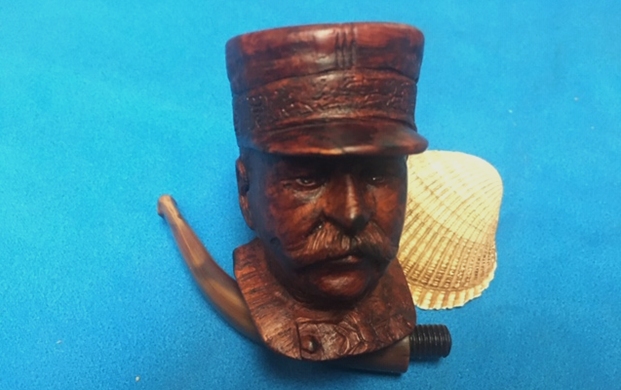
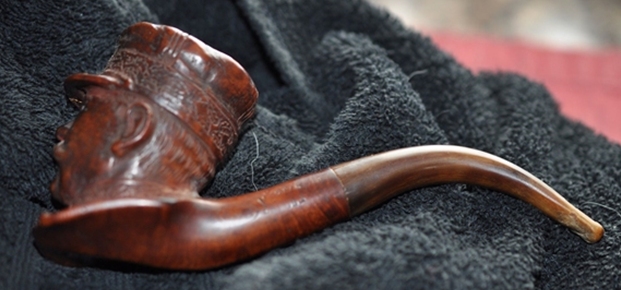
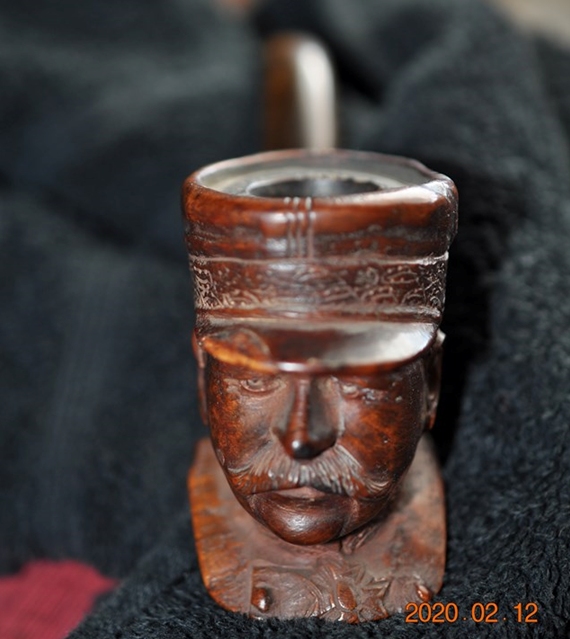
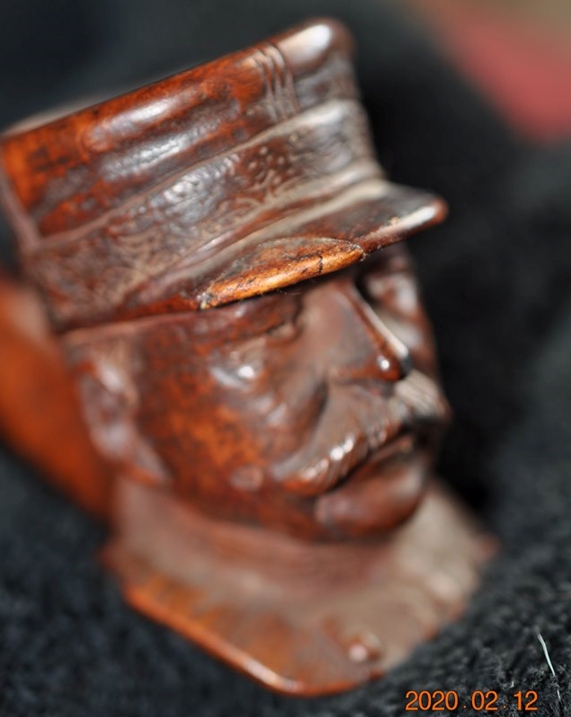
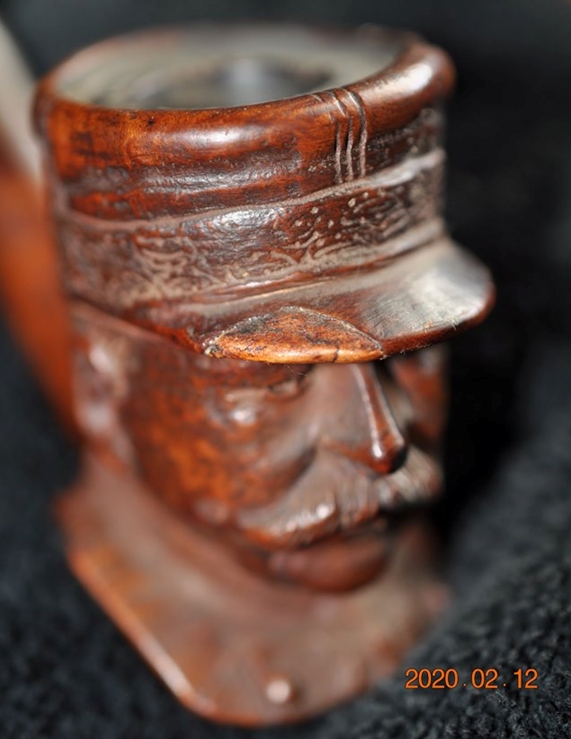
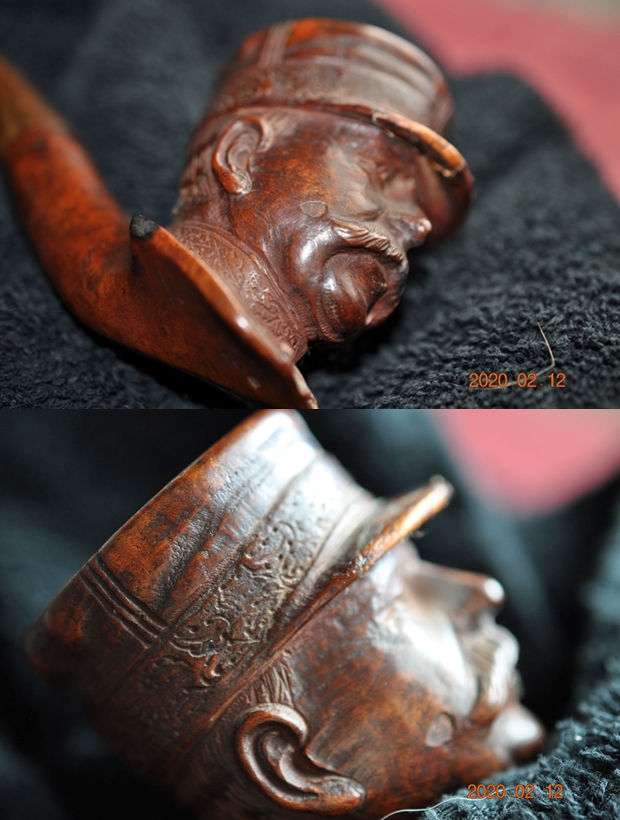
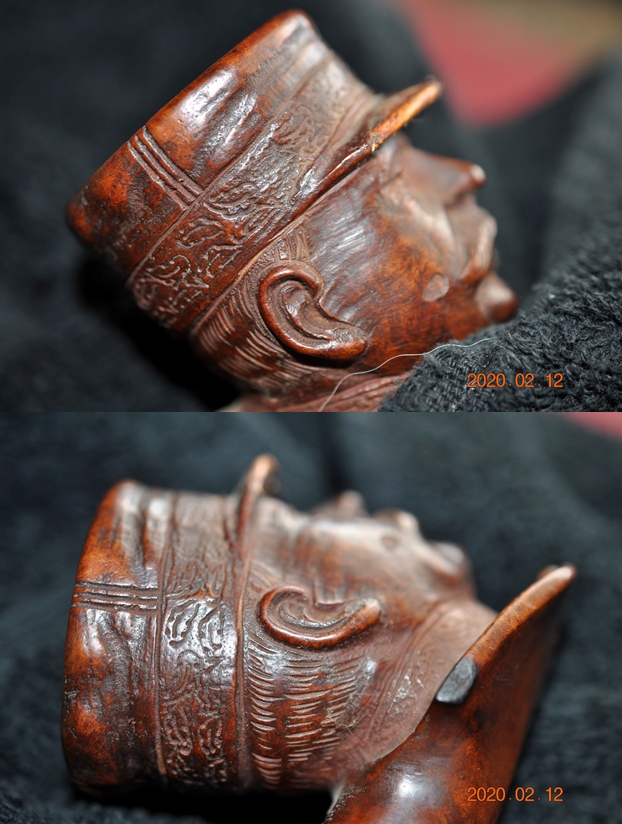
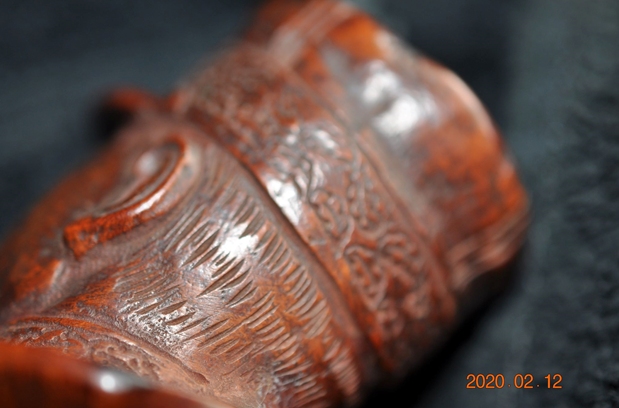
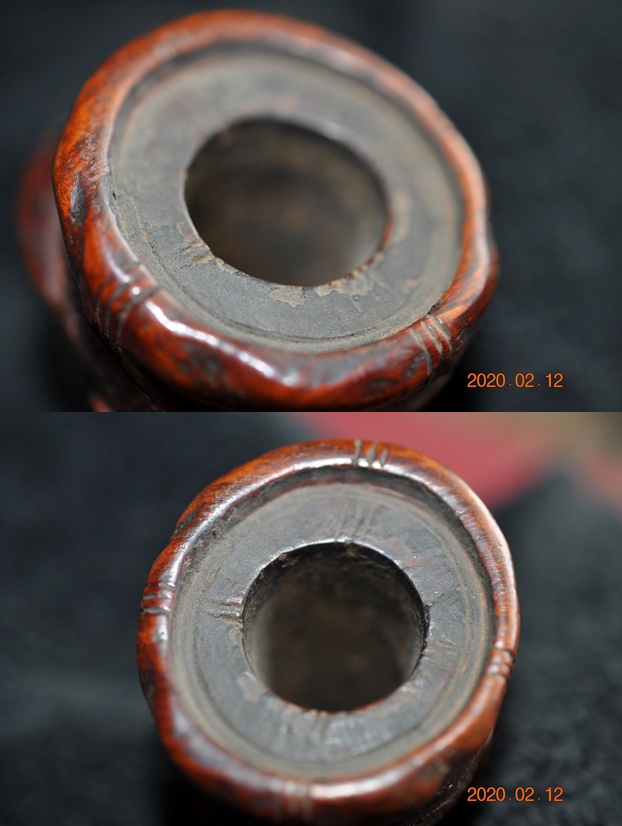
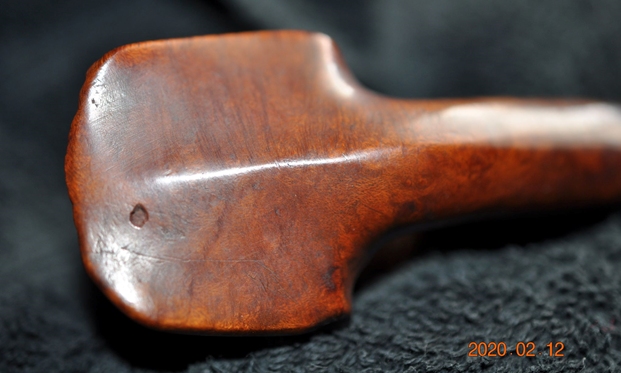
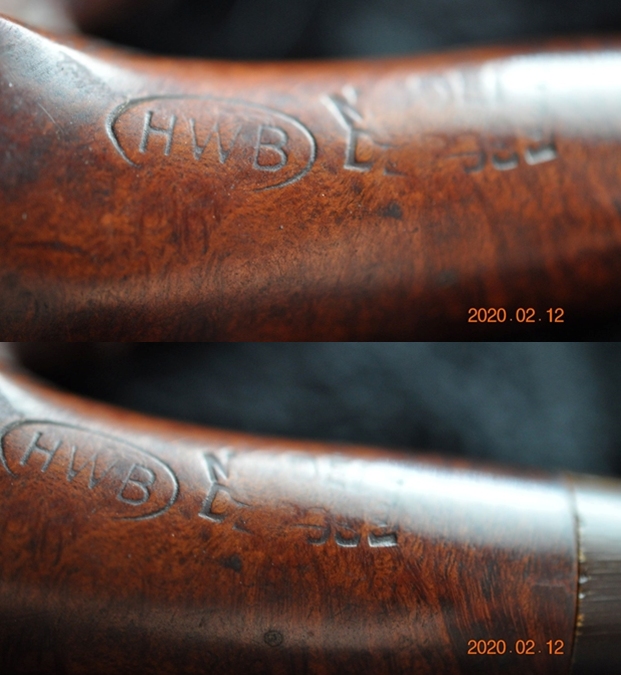
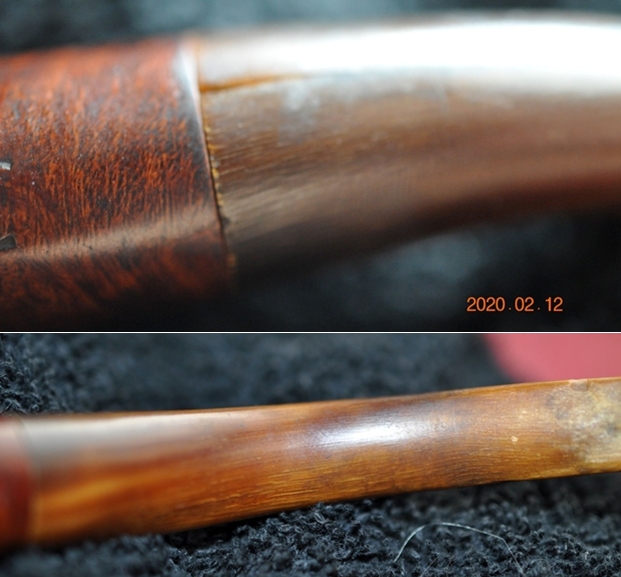
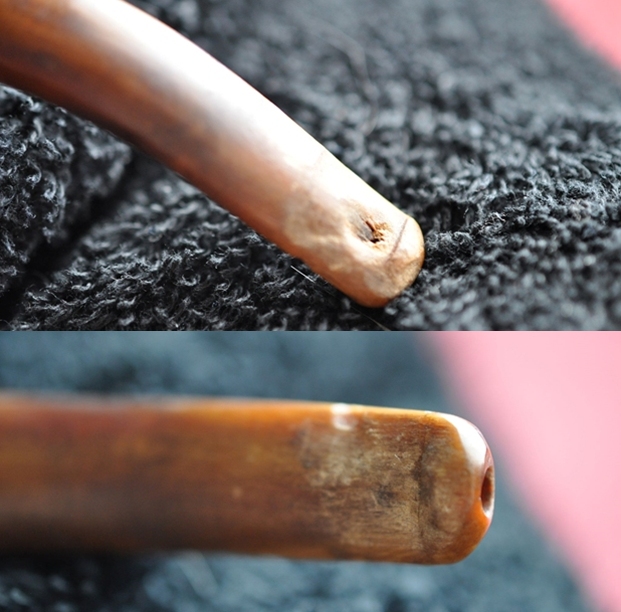
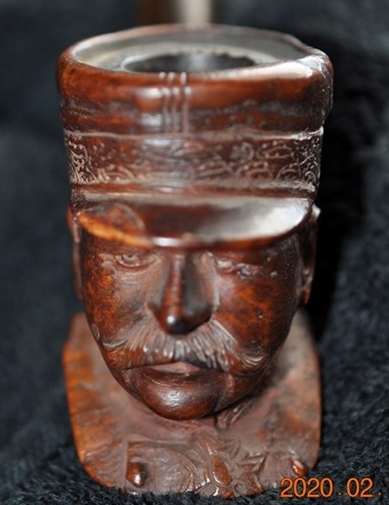
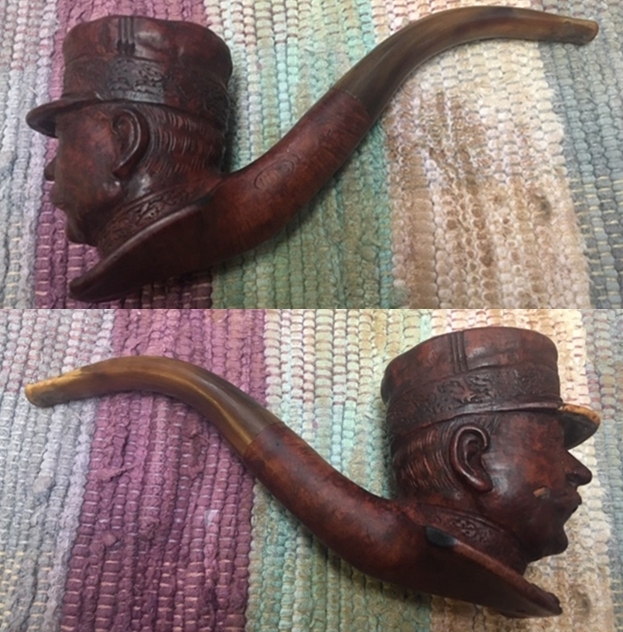
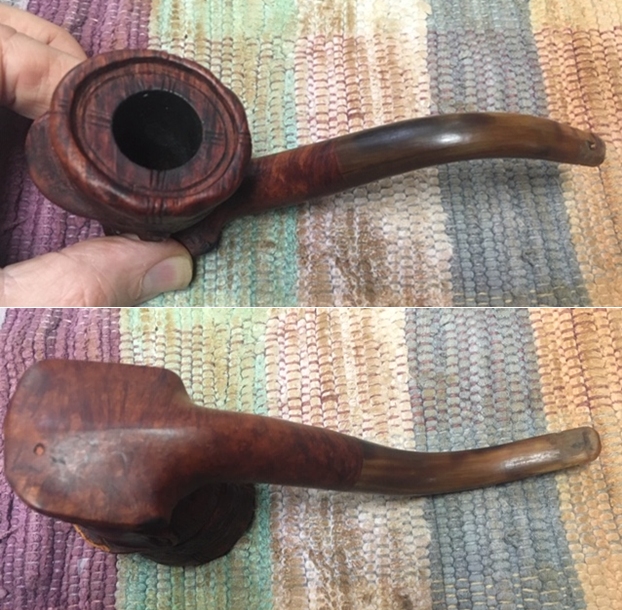
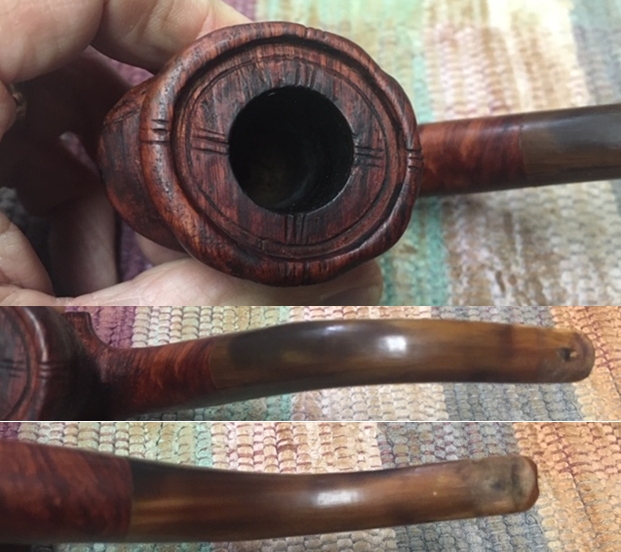
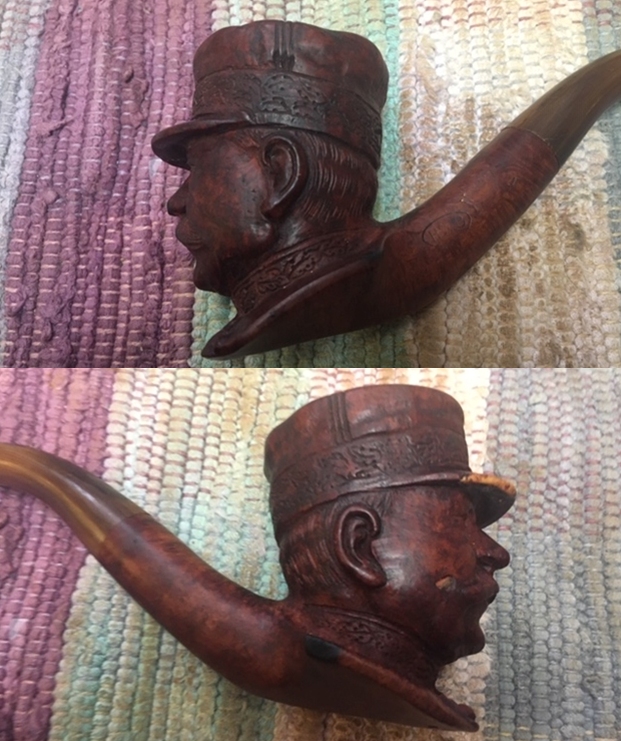
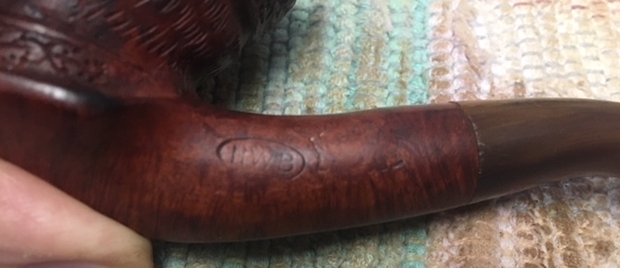
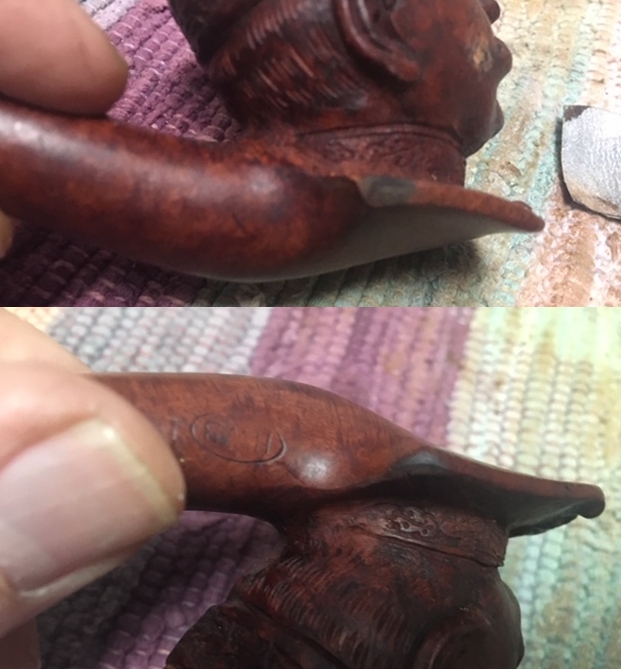
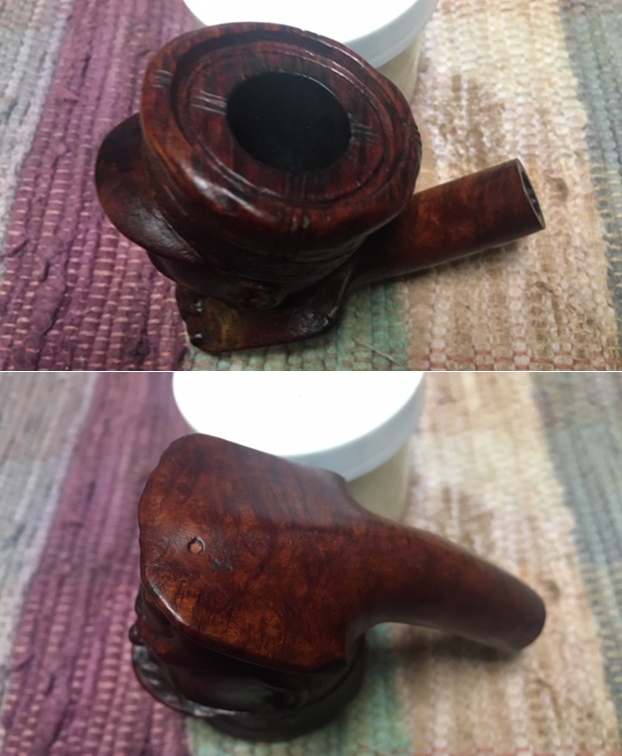
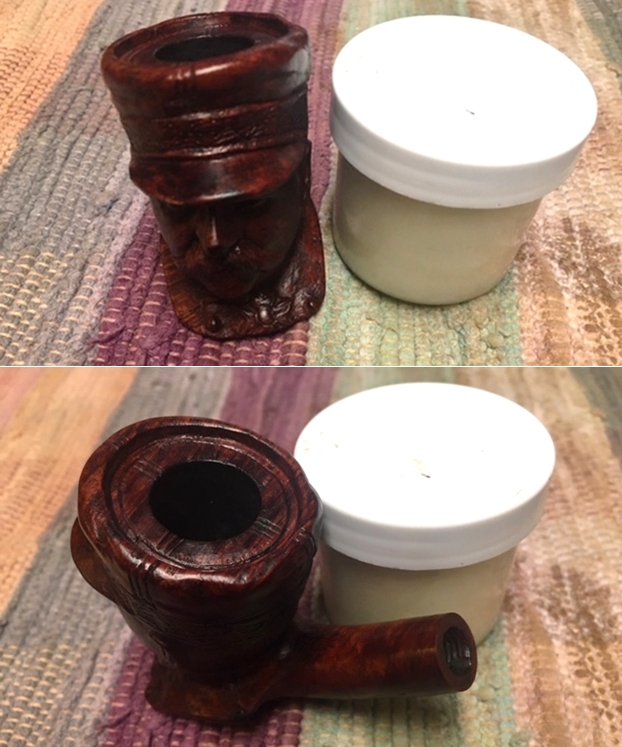
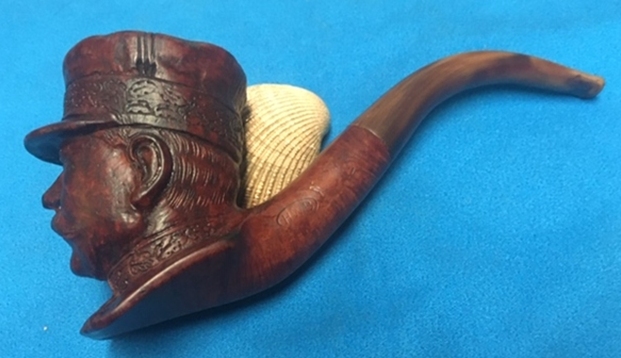
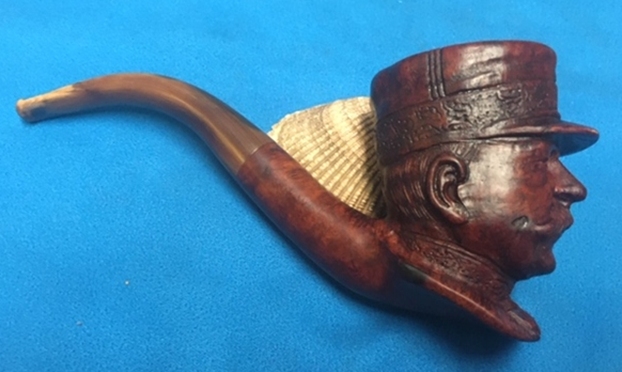
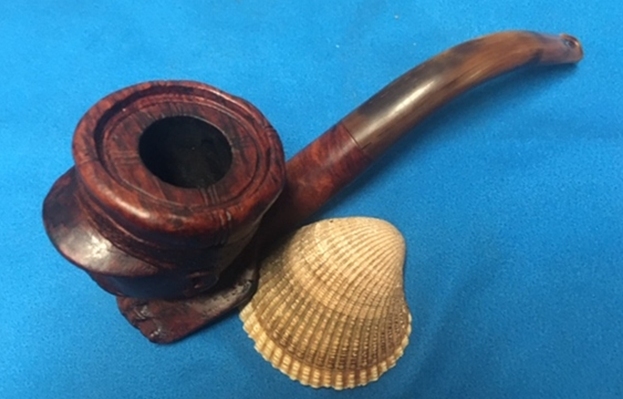
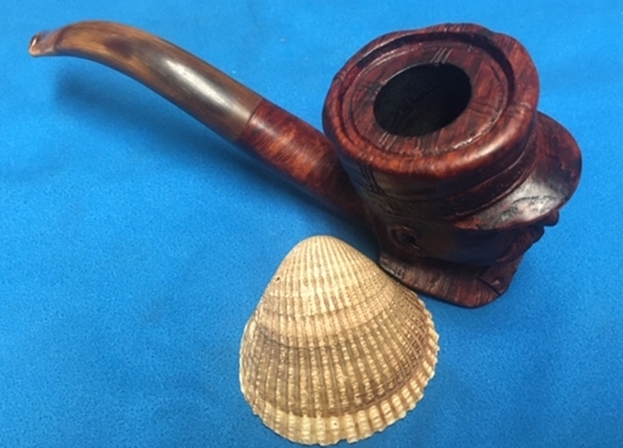
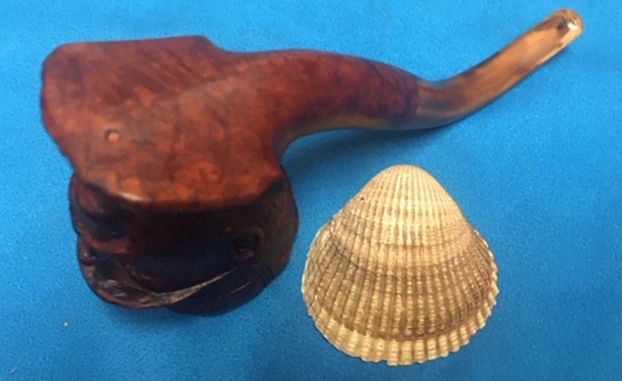
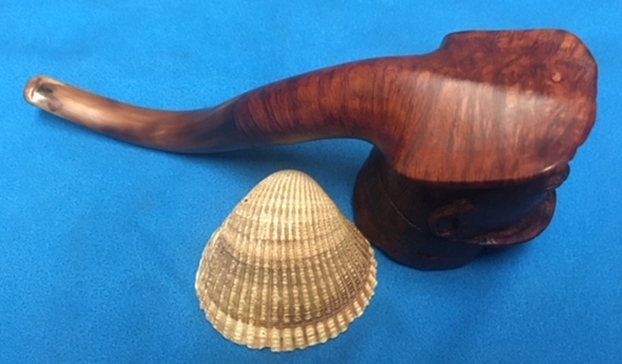
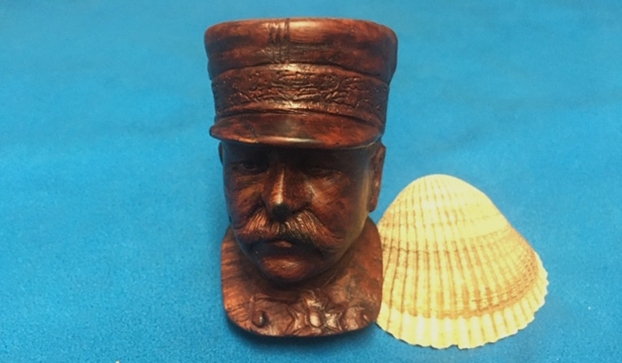
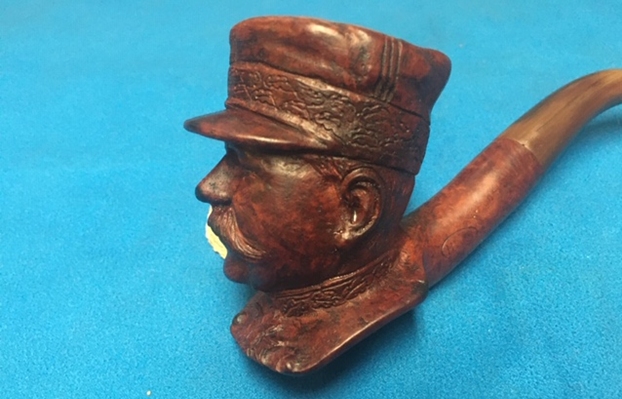
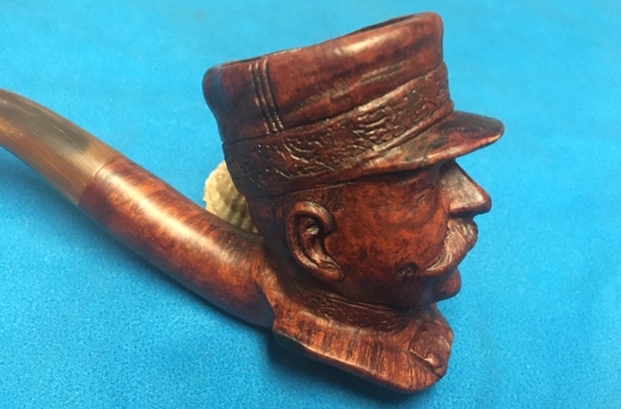
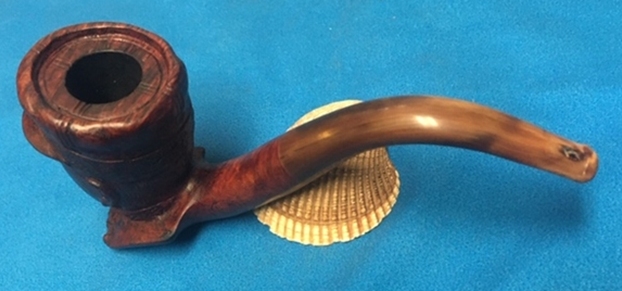
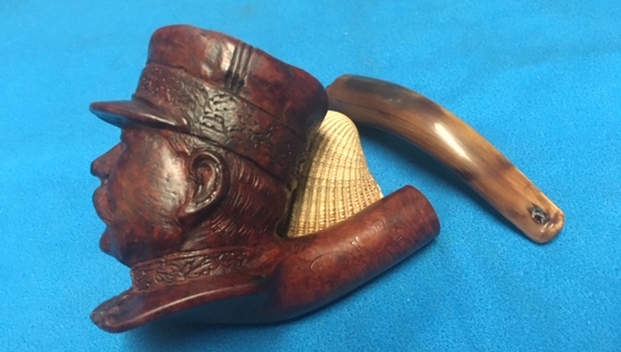
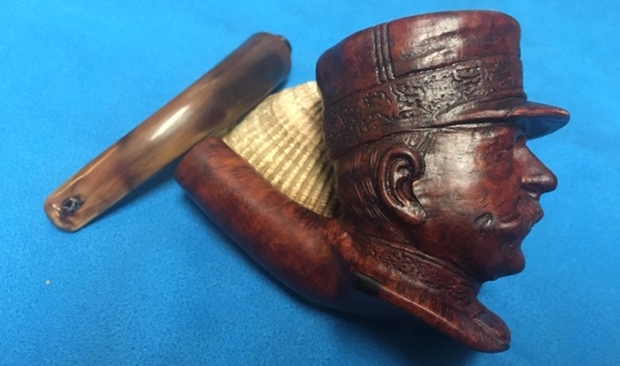
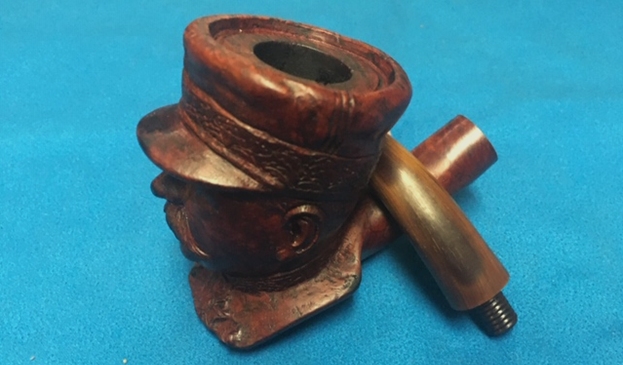
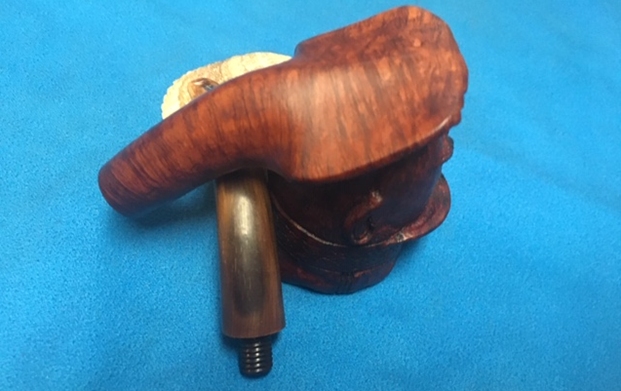
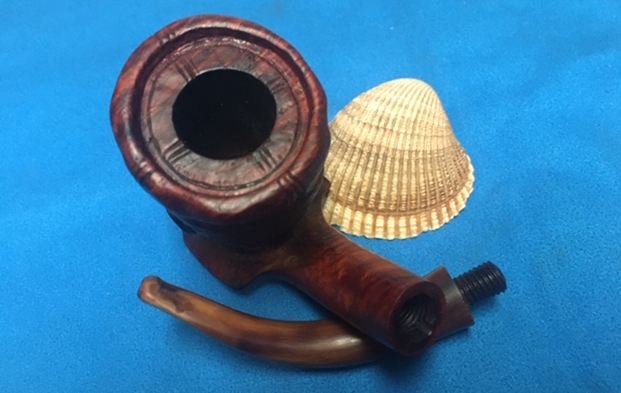
The next pipe on the worktable is an incredibly detailed carved figural head that has a lot of character in the well carved features that Jeff picked up from an auction in the Midwest of the US. It has a tapered horn stem that has a threaded tenon that screw into the shank. The finish is smooth under the carved head and the shank and heel of the bowl. There appears to be some nice grain around the bowl. The curves of the shank and stem give the pipe a sense of true dignity. The pipe is stained with various hues of brown. The pipe is stamped with HWB in an oval followed by Modele Depose on the left side of the shank. There is no other stamping on the bowl or shank of the pipe. The pipe is far from being a collectible decorative piece and was obviously an earlier pipeman’s favourite smoker. The finish was very dirty and tired looking with a lot of grime and oils ground into the sides of the bowl. There was a thick cake in the bowl overflowing with tars onto the rim top. There is also some darkening on the inner edge of the rim top. There was repaired damage on the bill of the hat and there were also burn marks on the back corners of the heel of the bowl. The tapered horn stem is heavily damaged with a crack in the left side near the shank junction and both the top and underside of the first inch of stem is well chewed with a bite through on the top side. The button is worn down and the sharp edge all but flattened. Because of the uniqueness of this particular pipe Jeff took a lot of photos of the pipe before he started his cleanup work. Jeff took photos around the bowl from various angles to show the well done carving on this pipe. You can see in the first photo below the repair that had been done to the right side of the bill of the hat somewhere in the pipe’s journey. It was well done and solid. Look at the details in the carving. The fancy hat band on the hat with the triple lines on the front/back/sides that are carried over the rim top are an example. Note the cross medal on the front of the collar. Note the features of the hair on the head and the moustache. It is a well carved piece of briar. Jeff captured the condition of the rim top. It is hard to see but the triple lines on the outer edges continue across the rim of the bowl. You can see the cake in the bowl and the lava build up on the rim top. It was a well-loved and oft smoked pipe.Jeff also took a photo of the heel of the bowl. The briar is quite beautiful as you can see. The base or heel is spade shaped and flows from the shoulders of the bust above. The base is not flat but it can be balanced as a sitter. Quite a beauty. You can also see the flaw in the briar toward the front of the bowl. He also took photos of the stamping on the shank. It includes an HWB in an oval followed by the words Modele Depose. I have been unable thus far to find out any information on the HWB brand but I did a quick search of the translation of Modele Depose. I included that below

https://www.linguee.com/french-english/translation/mod%C3%A8le+d%C3%A9pos%C3%A9.html

Modèle Déposé noun, masculine it translates as registered design and less commonly as registered pattern.

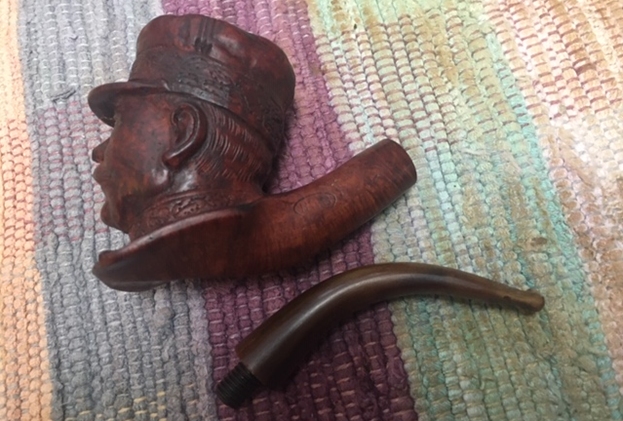
This is the first clue that leads me to think that the pipe is French made. As I examine the pipe and get input there will be more clues.The next photos reveal the well-used condition of the horn stem. It was very dry and had a crack at the shank/stem junction as seen in the first photo. The second photo shows a long view of the stem and you can see the striations of the horn on the underside. The final two photos below show the chewed end of the stem just ahead of the button. On the top side of the stem there is a hole all the way through to the airway below. There is quite a bit of damage to the stem that will need to be addressed. For his final photos of the pipe before cleaning Jeff unscrewed the stem from the shank and took pictures. The photos show the condition of mortise and tenon. It actually looks to be in excellent condition.Before turning to my restoration of the pipe I decided to see if I could figure out who the figure depicted. Both Jeff and I wondered if it was not General Charles de Gaulle. I posted a query for help on the Facebook group – Tobacco Pipe Restorers and received a lot of responses. The options included General De Gaulle of France, Philippe Pétain (the Lion of Verdun) France, Marshal Joseph Jacques Césaire Joffre of France, Marshal Ferdinand Foch of France, Otto von Bismarck of Germany and even a suggestion that it was a Victorian Baseball player. I thank each of those who responded as each one took me closer to a solution.

Here is what I have learned so far:

  1. The figure is probably French and definitely military.
  2. The figure is from the period of or directly after World War I.
  3. The figure was a hero of some sort, a key figure that was commemorated by the carving.

That is what I know so far. That is progress. During the night I received a response from Aaron Comsia on Facebook Tobacco Pipe Restorers Group that noted the medal around the neck of the figure. He included the following photo of French medal matching the one on the figure’s neck. I have included that below.The medal was another clue further confirming a French connection of both the figure and the pipe. The stamping pointed to France and the Medal on the neck of the figure pointed to France. Now I knew that I could eliminate the German figures and the Baseball player. That left me with four options – General de Gaulle, General Philippe Pétain, Marshal Ferdinand Foch and finally Marshal Joseph Jacques Césaire Joffre. I decided to find photos of these figures (some I picked up on the web and others were shared by those from the group who put the person forth in response to my question). I will work through them in order and narrow the field further.

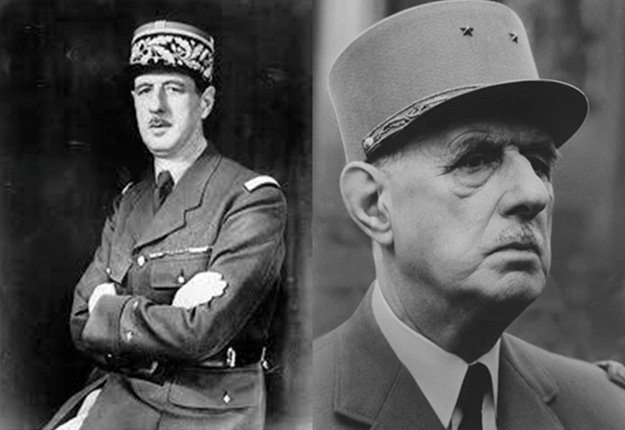
General Charles de Gaulle was the choice of three of four of the responders to my question for who people thought the figure represented. I found a younger and an older photo of General de Gaulle. Comparing these photos to the carved figural above I note some dissimilarities that take de Gaulle off the list. These include a longer narrower face, a smaller and thinner moustache and the large prominent nose. The carved figure had a rounder, fuller face and a thick moustache and a smaller nose. The hat is also different in these two photos and in others that I scanned on the web. I am as certain as I can be that the figure is not General Charles de Gaulle.

The second choice that came up more than once was General Philippe Pétain. He had been acknowledged as having saved the French Army in 1917 at Verdun. His exploits there earned the moniker ‘Lion of Verdun’. He was a prominent figure in French political and military history. During World War II he became part of the Viche Government (working with the Nazi’s in France). For many this would have made him a collaborator. Here are two photos of Pétain that I found online.Comparing these photos to the carved figural above I thought for some time that I had found the right historical character to match the pipe. Looking at the photo the hat is the same as the carved head. The nose and moustache are close for sure but there is some dissimilarity as well when I studied the face. The eyes on the photos are much closer set with the nose than on the figure. The jawline is also different in that the carved figure seems to have a more round chin and the upper jaw seem to extend over the lower much more than in the photos. Given those features and his connection to the Vichy Government I think I can rule out General Philippe Pétain personage of the carving. To be honest this was a hard one to let go of for me.

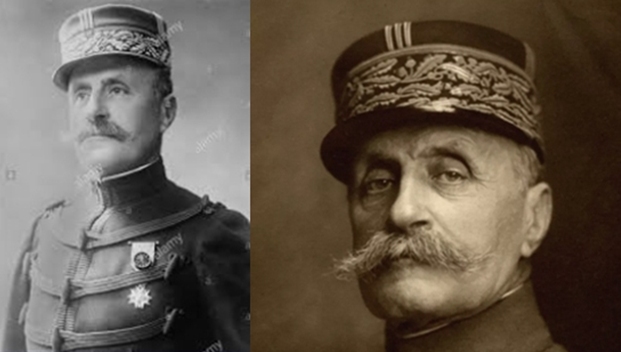
The third choice that came up several times was Marshal Ferdinand Foch. Marshal Foch was a noted French commander during World War I. One respondent on the group, Taeve Schaer commented that many carvers in St.Claude, France (they call themselves the cradle of pipemaking) did these pipes. Many of the carvings were of Marshal Foch. Several responders included the photo of Foch on the right. I found the second one and included them both here.Comparing these photos to the carved figural above I thought for some time that this was a good possibility. Taeve Schaer’s comment about many carved figural pipes of Marshal Foch were made in St. Claude. Looking at the photo the hat is the same as the hat on the carved head. The nose and moustache are close for sure but there is some dissimilarity as well when I studied the face. The drooping brows and eyes on the photos are different than those on the figure. The jawline is also different in that the carved figure seems to have a more round chin and the upper jaw seem to extend over the lower much more than in the photos. The cleft in the chin is also notably missing in the carving. The moustache is longer and more ragged than the cropped one on the carved figure. Given those features I think I can rule out Marshal Ferdinand Foch as the personage of the carving. This was easier to let go of than Pétain.

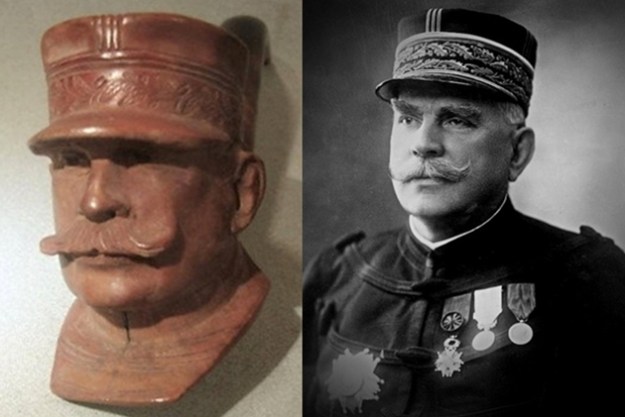
The fourth choice that came to me was that the figure was Marshal Joseph Joffre. Chris van Hilst suggested Joffre and included a photo of another carved figural pipe of Joffre from 1917. Marshal Joseph Jacques Césaire Joffre (12 January 1852 – 3 January 1931), was a French general who served as Commander-in-Chief of French forces on the Western Front from the start of World War I until the end of 1916. He is best known for regrouping the retreating allied armies to defeat the Germans at the strategically decisive First Battle of the Marne in September 1914.

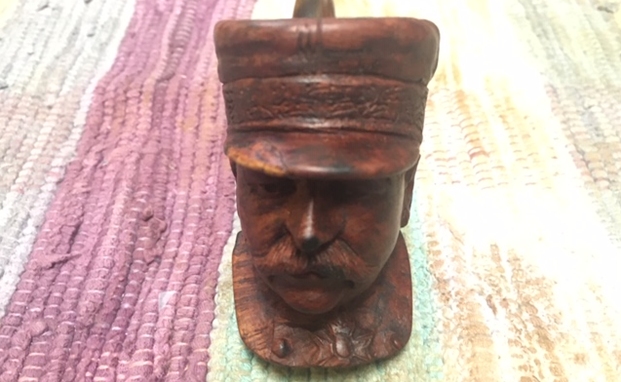
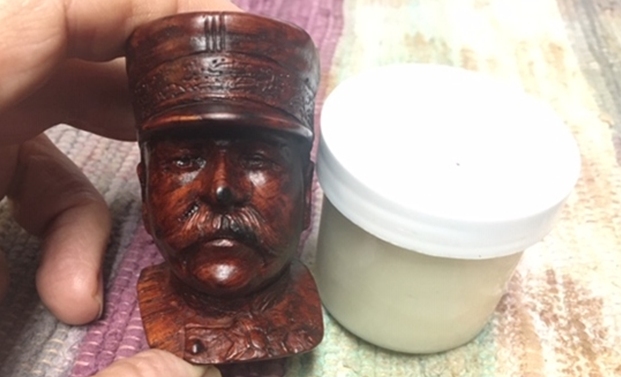
I used the photo of the figural of Joffre and picture that I found online. I have included them both below. You can see the similarity between that figural and Joffre for sure. But did it match the figural that I was working on? I have included a frontal view of the figural I am working on below these two photos. What do you think?From my perspective the facial features match this choice the best. The jawline, the nose, the moustache, the set of the eyes and the hat as well as the medal on the chest of the figural and the picture of Joffre all point to the similarities between Joffre and the pipe that I have. I am convinced that the pipe is indeed Marshal Joseph Jacques Césaire Joffre. I am sure some of you will not be convinced but that is my logic.

I did some more reading about Joffre on Wikipedia (https://en.wikipedia.org/wiki/Joseph_Joffre). It included the previous information I included above but also the following:

…His political position waned after unsuccessful offensives in 1915, the German attack on Verdun in 1916, and the disappointing results of the Anglo-French offensive on the Somme in 1916. At the end of 1916 he was promoted to Marshal of France, the first such promotion under the Third Republic, and moved to an advisory role, from which he quickly resigned. Later in the war he led an important mission to the United States. His popularity led to his nickname Papa Joffre.

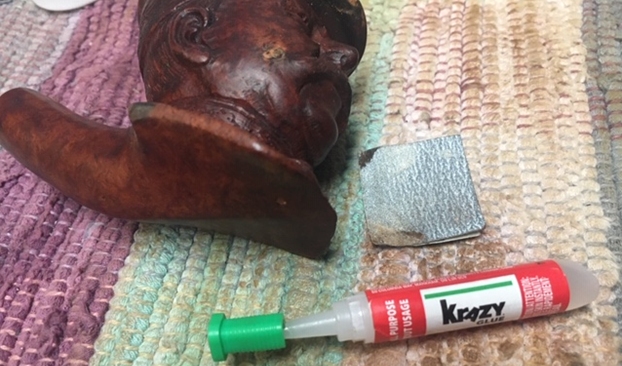
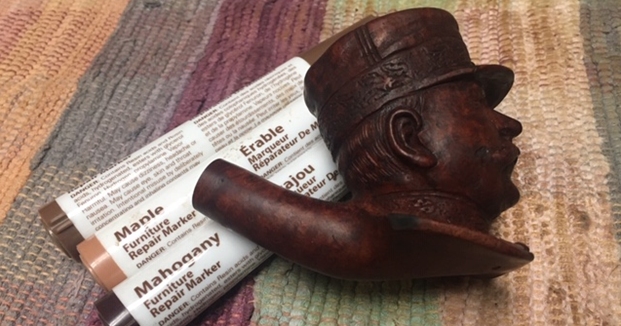
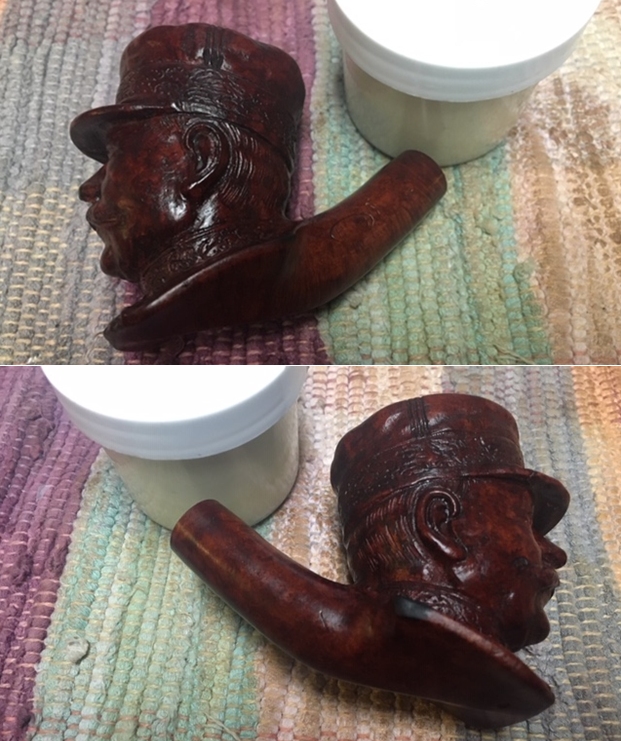
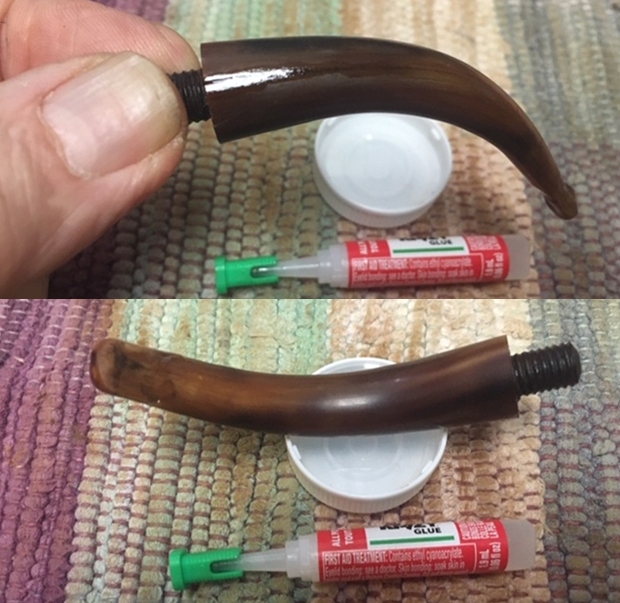
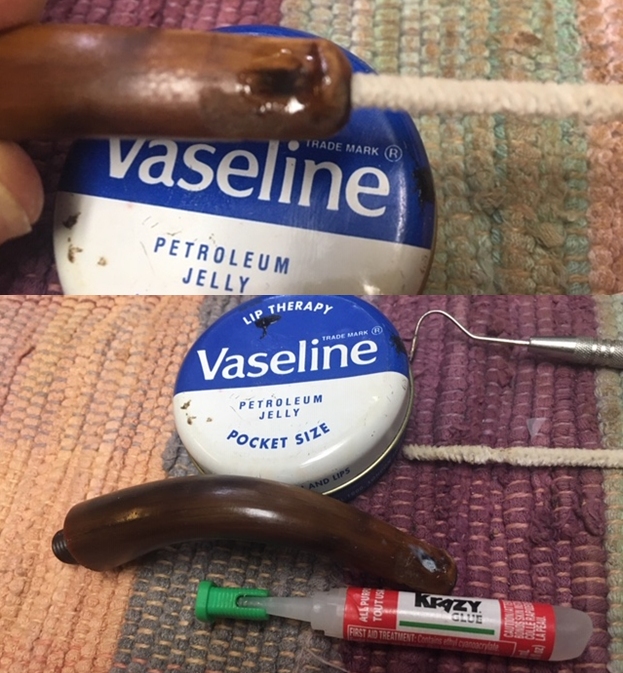
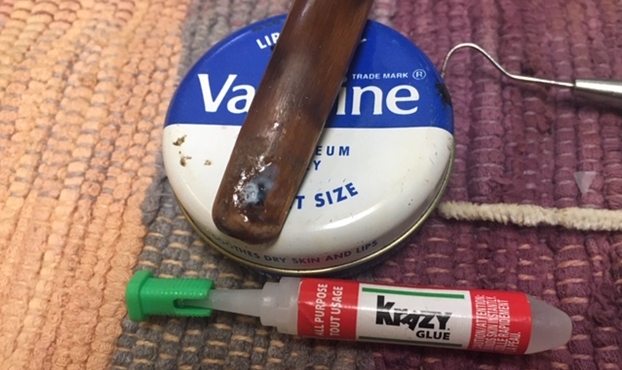
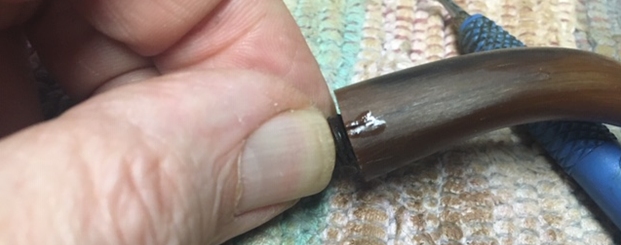
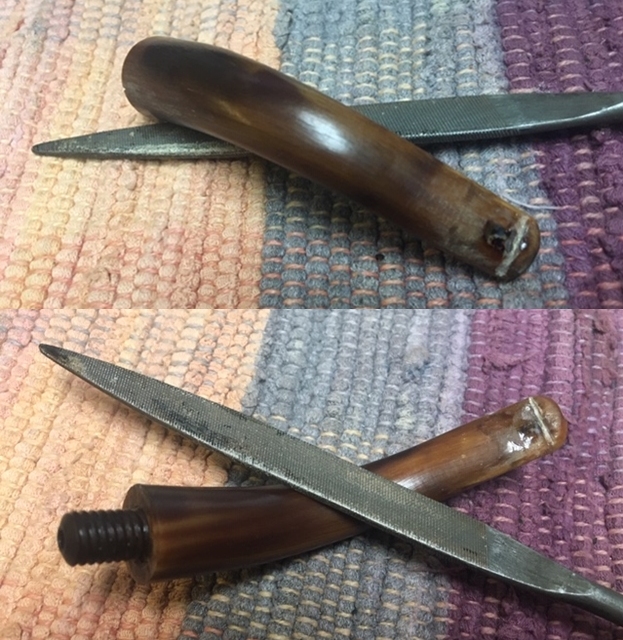
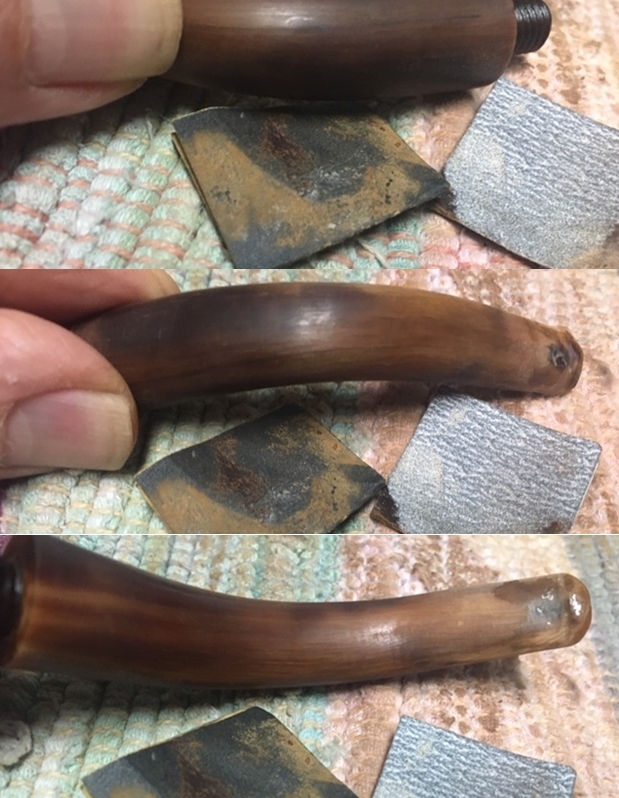
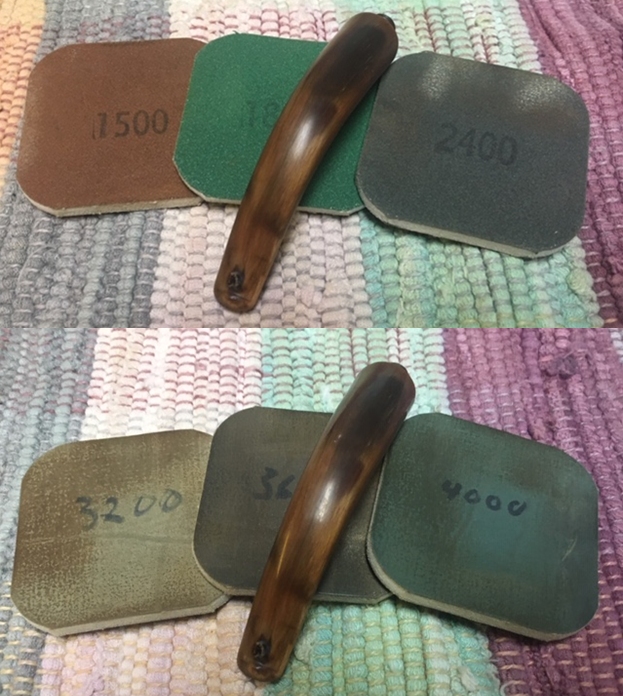
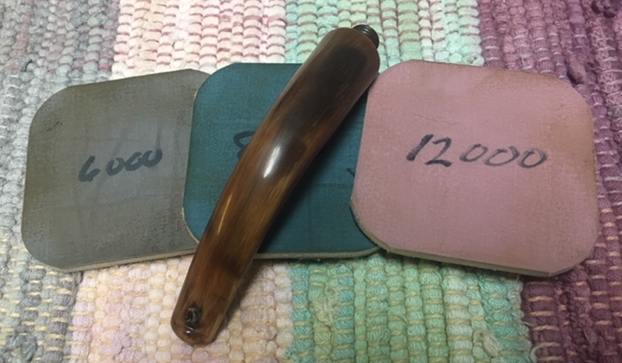
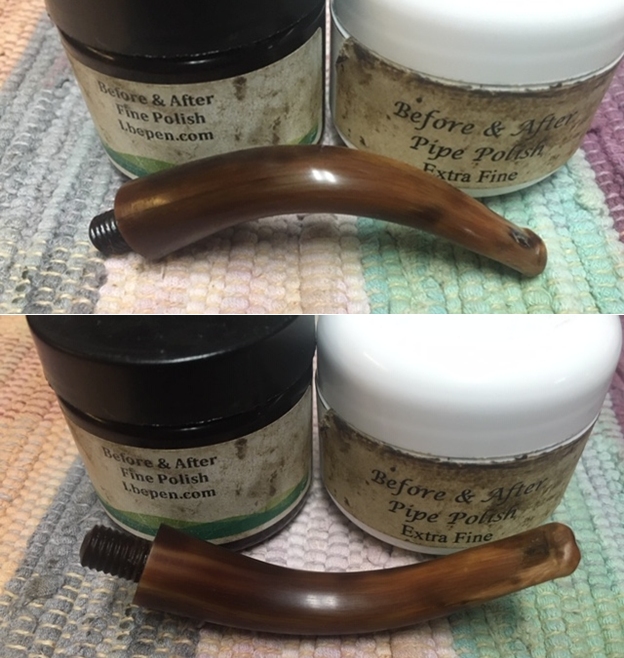
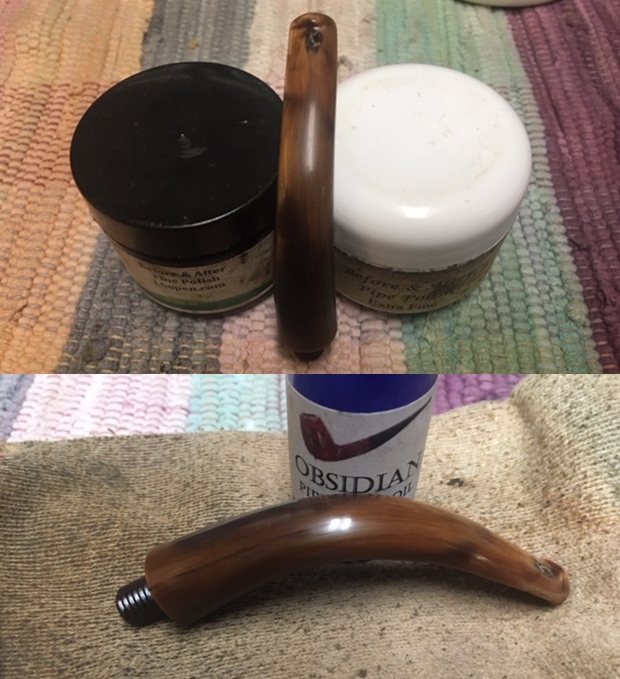
It makes good sense to me that a pipe carver in St. Claude with HWB would so beautifully capture the features of Papa Joffre. Now it was time to do my part of the restoration of this pipe. Jeff had done his usual thorough cleanup of the pipe. He had reamed it with a PipNet reamer and cleaned up the remnants with a Savinelli Fitsall reamer. He cleaned out the internals of the shank and stem with alcohol, cotton swabs and pipe cleaners. He carefully scrubbed the grime and oils off the surface of the briar with a tooth brush and undiluted Murphy’s Oil Soap. He rinsed it with warm water and dried it off with a soft towel. He set it aside to air dry before putting it back together. When he brought it to Oregon on a recent trip we made pre-COVID-19 I was stunned at how well it had cleaned up. I have wanted to work on it for a while now but somehow had mislaid it. I found it recently and brought it to the worktable. Here is what it looked like before I started. I took close-up photos of the bowl and rim top and stem to show how much better they looked. You can see the lines from the front, back and sides of the hat carried across the rim top. The briar is clean and quite beautiful to me. The issues with the pipe really involved the stem more than anything else. There was the split in the left side at the shank and the bit through and gnawing on the top and underside of the stem. The stem was really a mess and had been well used. That is where the lion’s share of my work would come.I took photos of the sides and front of the bowl to show the fine details of the carving now that it is cleaned up. The repair to the right front of the bill of the hat is also visible. It really is a well carved figural. I only wish I could find information on the initials HWB on the shank side. I took another photo of the stamping on the left shank side in hopes that it may register with a reader of the blog. I removed the stem from the shank and took a photo of the parts.Now it was time to start the restoration. I wanted to minimize the flaw on the right cheek. It appear to be damaged. I filled in with CA glue to lessen it slightly and feathered the edges with a corner of sandpaper. I used a folded piece of 220 grit sandpaper to smooth out and reduce the damage on the burned rear corners of the base. I touched up the repaired areas on the face, the heel edges and the bill of the hat with a mixture of Cherry, Maple and Mahogany stain pens. The three pens blended together to match the surround areas of the briar. I was happy with the look of the repairs.I worked some Before & After Restoration Balm into the surface of the briar with my fingertips and a horsehair shoe brush and q-tip to work it into the nooks and crannies of the carving. The product works to clean, enliven and protect the briar. I let the balm sit for ten minutes and then buffed the bowl with a cotton cloth to raise the shine. The photos show the carved bowl at this point in the restoration process. It almost looks oily at this point but that will soak into the briar as it sits while I work on the stem. I set the bowl aside at this point and moved on to address the issues with the stem. I cleaned out the crack on the left side of the stem and the chewed area on the underside of the stem and gave them both the first fill coat of clear CA glue. These were the straightforward repairs to the stem. I have found that clear super glue stabilizes the horn in damaged areas and binds split in the stem very well.The damage on the topside of the stem required more work. I greased a pipe cleaner with Vaseline and slid it into the airway in the stem. It plugged the bite through area on the top of the stem and would keep the glue from closing the airway. I put drops of super glue on the stem surface and after the first layer I removed the pipe cleaner. The bite through was sealed. I continued to layer on the glue repairs until the surface of the stem was even with the surrounding sound horn areas. I sprayed the area with an accelerator – and promptly was reminded why I did not do that normally! The glue dried WHITE… and it was ugly. I am not sure what the accelerator adds but what normally dries clear went white… now I had one more issue to address. I sanded the crack repair on the shank end of the stem with 220 grit sandpaper and was able to blend it in quite well. I filled in the very end of the crack with more glue. To remove as much of the whitening as I could I scraped the top file with a dental pick. I stained it with a maple stain pen and applied another coat of CA glue over the top of it. I added another layer of glue to the underside at the same time. The repair was looking better. You have to remember that the repair will always show at some level but to me darker is better than WHITE.Once the repair cured I used a needle file to redefine the sharp edge of the button and to flatten out the repair and begin to blend it into the surface of the stem. Ahhh… even though there is still a long way to go I feel like I am making some progress.I sanded out the repaired areas of the stem to blend them into the surrounding areas with a folded piece of 220 grit sandpaper. I started polishing the repairs with 400 grit wet dry sandpaper. The repair to the crack on the left topside of the stem looks very good and has blended in very well. The areas around the button look much better and with polishing will look even better. Progress is evident now.The stem was now ready to be polished. I use micromesh sanding pads to polish out the scratches in the horn. I find that wet sanding with 1500-12000 grit pads and wiping the stem down after each pad with Obsidian Oil enlivens and enriches the horn and a beautiful shine begins to appear that  really bursts forth with the last set of sanding pads. I polished it further with Mark Hoover’s Before & After Pipe Polish. I rub the Fine and Extra Fine polishes into the stem surface with my fingertips. I let it sit for a few moments and the buff the each polish off with a soft cotton cloth. I find that these polishes actually take the shine to another level. I finished my work on the stem by rubbing it down with a cloth impregnated with Obsidian Oil as it protects and enlivens the horn even more. I am pretty happy with the stem. It is highly functional and though far from what it was originally it looks really good to my eye. This has been an incredibly fun pipe to restore. The reading and history lessons learned in the process were great. The interactions with the various people on the Facebook Pipe Restorers Group were invaluable and enjoyable as well. It really was like having folks in my shop while I restored the pipe and I could ask questions. Thank you all!

Now I was at one of the best parts of restoration for me – putting it all back together again and seeing how the pipe looks. I put the stem on the shank and carefully buffed the pipe with a lightly loaded buffing wheel of Blue Diamond polish. I wanted to be careful to not fill in the fine details with the polish but I wanted to get the benefit of a buff. I gave the bowl and stem multiple coats of Conservator’s Wax and buffed it with a clean buffing pad. I hand buffed it with a microfiber cloth to deepen the shine. The pipe really has come alive and the figure is so well done that I have found myself just stopping and studying the handiwork of the unknown HWB carver. The dimensions of the pipe are probably helpful to give perspective now. The length from the tip of the hat bill to the end of the button is 6 ½ inches, the height from the top of the hat to the edge of the French medal 2 ½ inches. The outside diameter of the bowl is 1 ¾ inches long by 1 ½ inches wide. The diameter of the chamber is ¾ of an inch. The photos below of the finished pipe tell the finished story. Papa Joffre will not be leaving me anytime soon. Way too much enjoyment in just observing it and turning it over in my hands! I am looking forward to loading and enjoying a bowl. If you have read through the entirety of this blog I want to thank you for your time.


Breathing Life into a Weary But Graceful Butz-Choquin Maitre Pipier De Luxe


Blog by Steve Laug

The next pipe on the worktable is a gracefully shaped pipe made by Butz-Choquin. It is a vulcanite tapered stem with a BC logo on the left side of the taper. The finish is smooth with some nice grain around the bowl. The bowl has straight and flame grain on the sides with mixed grain on the rim top and heel of the bowl. The curves of the shank and bowl give the bowl a sense of grace. The stem carries out the theme. The pipe is stained with black and various hues of brown. It truly is a beautiful finish. The pipe is stamped Butz-Choquin over Maitre Pipier over De Luxe on the left side of the shank. On the right side it is stamped Fait Main (Hand Made) over St. Claude France. The finish was very dirty and tired looking with a lot of grime and oils ground into the sides of the bowl. The finish is peeling and bubbling on the rim top and on the back of the bowl. It appears that the pipe had a varnish or shellac coat that is damaged. There was a thick cake in the bowl and some darkening on the inner edge of the rim top. The tapered vulcanite stem is heavily oxidized and had calcification over much carries on the twist of the shank. The stem looked good. It is dirty with light tooth marks and chatter on both sides near the button. Jeff took some photos of the pipe before he started his cleanup work. He took photos of the bowl and rim top to show their general condition. You can see the bubbling and peeling finish on the rim top. There is cake in the bowl and some darkening around the rim edges and some tars on the rim edge as well. Jeff took some photos of the sides and heel of the bowl to give an idea of the smooth finish and the grain shining through the grime. I cannot wait to see what it looks like once it is cleaned and polished.He took several photos of the stamping on the sides of the shank to capture it for me. It is clear and readable. It reads as noted above. He also included a photo of the acrylic encased BC inlay on the left side of the stem.The vulcanite stem is a bit of a mess! It is oxidized and there is calcification and a rust coloured build up all over the stem from the button forward. There are also light tooth marks and chatter on both sides of the stem. The button appears to be in good condition. The photos below show the condition of the stem. Before I started working on my part of the restoration I decided to do some research on the Maitre Pipier line to see what I could learn. I turned first to PipePhil’s site to get a quick overview of the brand (http://www.pipephil.eu/logos/en/logo-butzchoquin.html). There found the following information. I am also including a screen capture of the pertinent section from the site.

Pipes of the “Maitre Pipier” series were crafted by Paul Lanier until he retired and after him by Alain Albuisson. The model illustrated is remarkable for its “swan neck” shank.

The one pictured in the screen capture is an Extra but the shape is very similar to the one I have that is stamped De Luxe. The same swan neck shank is a part of its beauty.I turned then to Pipedia and did not find anything pertinent to this series of pipes. If you would like to learn more about the brand here is the link (https://pipedia.org/wiki/Butz-Choquin).

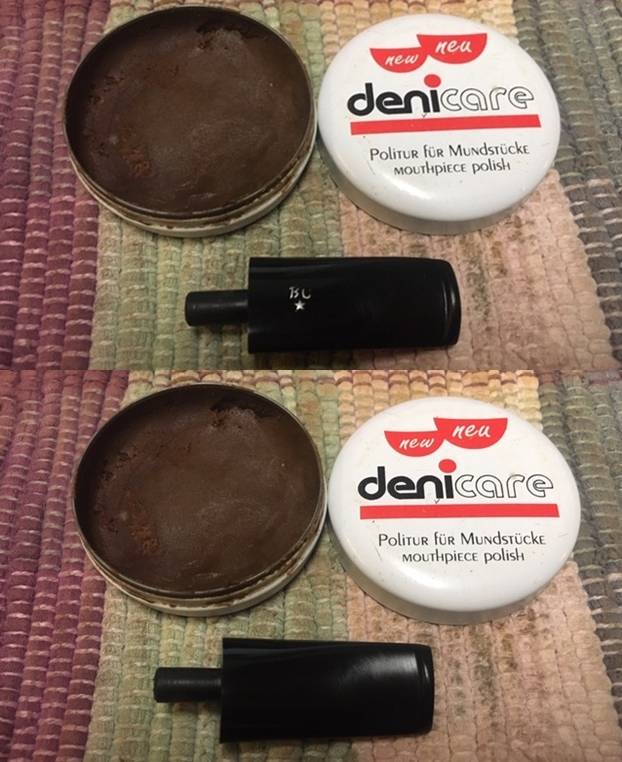
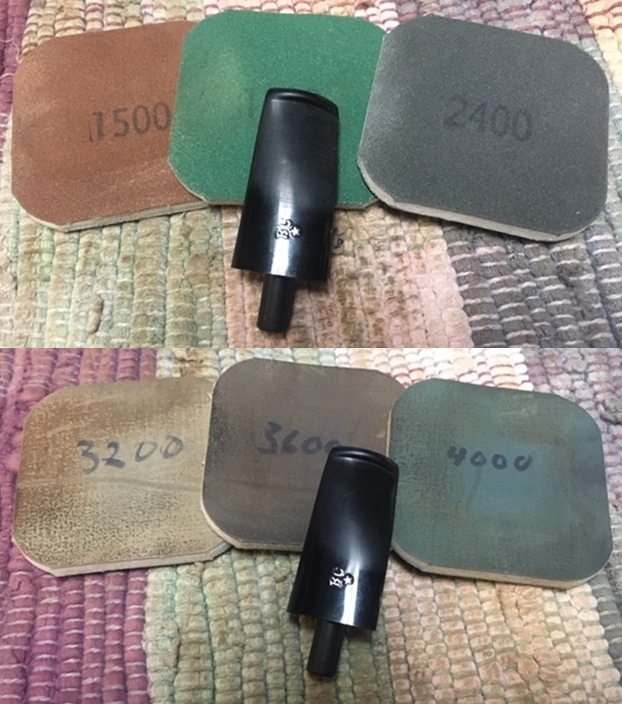
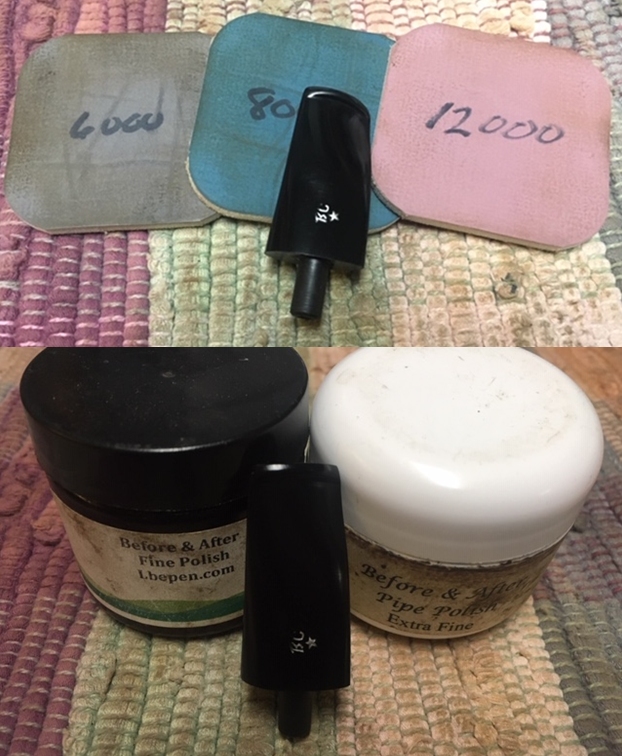
Now I had a pretty good idea the carvers of the Maitre Pipier Series. I am not sure of the date this pipe was made but I did know who made it. With that information I moved forward to do my part of the restoration work on the pipe itself and see what I had to do with it. The bowl looked unbelievably good in light of where it started. All of the flaking and peeling finish was gone. What remained was some very nicely grained briar. The stem looked much better with just a few tooth marks on each side of the stem just ahead of the button. Jeff had done his normal thorough clean up – reaming, scrubbing, soaking and the result was evident in the pipe when I unpacked it. I took photos of the pipe before I started my work on it. The shape and finish on this pipe is very unique. I took some photos of the rim top and stem. The rim top and bowl looked very good. He was able to clean up the on the top and back side as well as the cake in the bowl. The bowl, rim top and inner edges of the bowl look very good at this point. The close up photos of the stem shows that is it very clean.I took pictures of the stamping on the shank. It is very clear and readable. Jeff’s clean up work left it unfazed and if anything more readable now that the peeling varnish coat was gone.I removed the stem from the shank and took a photo of the pipe at this point. You can clearly see the condition, size and shape of the pipe. It is interesting to note the black metal tube in the end of the tenon. When the stem is in place it extends to the bend in the shank. It is removable but I will leave it in place.I started my restoration work on the pipe by addressing two sand pits or nicks in the finish that were like white spots on the briar. One was on the left side mid bowl and the other was on the right side lower near the shank/bowl junction. I filled them in with a spot of clear CA glue. Once the glue cured I sanded them smooth with a corner of 220 grit sandpaper and 1500 grit micromesh. I did not want to damage the finish but just smooth out the glue. I polished the briar with micromesh sanding pads – dry sanding with 1500-12000 grit pads. I wiped the bowl down after each pad with a damp cloth. The grain really began to stand out and the finish took on a shine by the last sanding pad. The photos tell the story!I worked some Before & After Restoration Balm into the surface of the briar with my fingertips. The product works to clean, enliven and protect the briar. I let the balm sit for about ten minutes and then buffed with a cotton cloth to raise the shine. The photos show the bowl at this point in the restoration process. I laid the bowl aside and turned to deal with the stem. I sanded the tooth marks and chatter on the stem with a folded piece of 220 grit sandpaper to blend them into the surface of the stem and started polishing with 400 grit wet dry sandpaper.   I polished the stem with some Denicare Mouthpiece polish – a red gritty paste that feels a lot like the texture of red Tripoli. It works well to polish out some of the scratches. I find that it does a great job preparing the stem for polishing with micromesh sanding pads.  I polished the stem with micromesh sanding pads – dry sanding with 1500-12000 grit sanding pads. I wiped it down after each sanding pad with a cloth containing some Obsidian Oil. I finished polishing it with Before & After Pipe Stem Polish – both Fine and Extra Fine and buffed it off with a cotton cloth. I wiped the stem down with a coat of Briarville’s No Oxy Oil to protect the rubber and slow down oxidation.

Putting this pipe back together was very rewarding. The change in condition and appearance was remarkable. The removal of the shiny, peeling coat brought the briar back to life. I love seeing the grain just pop at this point. I put the stem back on the bowl and buffed the pipe with Blue Diamond on the buffing wheel. I carefully avoided the stamping on the shank during the process. I gave the bowl and the stem multiple coats of carnauba wax on the buffing wheel and followed that by buffing it with a clean buffing pad on the buffer. I hand buffed the pipe with a microfiber cloth to deepen the shine. The finished pipe is quite beautiful and is a graceful, swan-necked French pipe. The finish on the bowl combines various stains to give it depth. It is very well done. Give the finished pipe a look in the photos below. I can only tell you that it is much prettier in person than the photos capture. The dimensions of the pipe are Length: 6 inches, Height: 2 ½ inches, Outside diameter of the bowl: 1 ½ inches, Chamber diameter: ¾ of an inch. Butz-Choquin seems to have a lot of creatively shaped designs that leave me respecting the creativity. This interesting pipe is no exception and it is a great looking pipe in great condition. Thanks for walking through the restoration with me as I worked over another beautiful pipe. I will be adding it to the rebornpipes store soon. If you want to add it to your collection send me an email or a message! Thanks for your time.


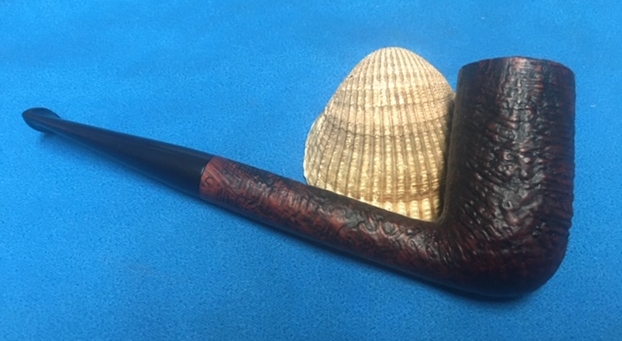
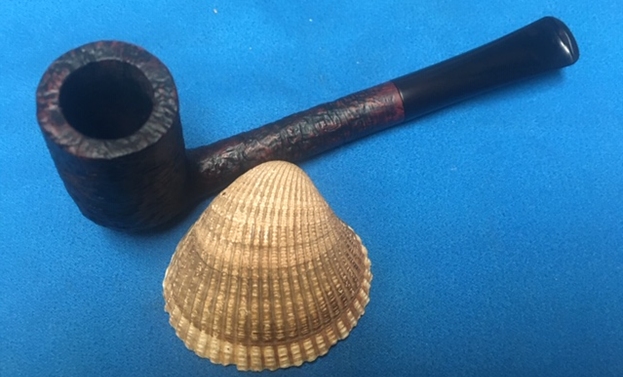
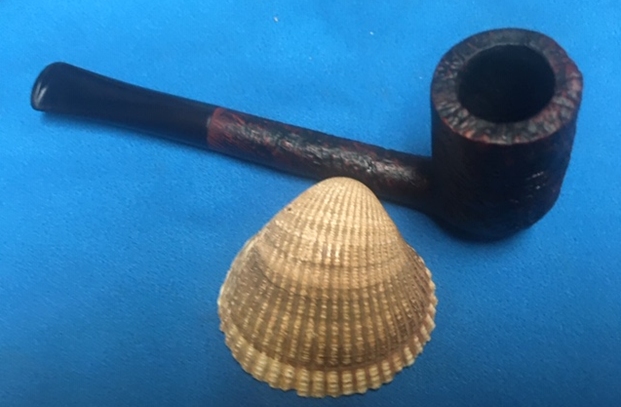
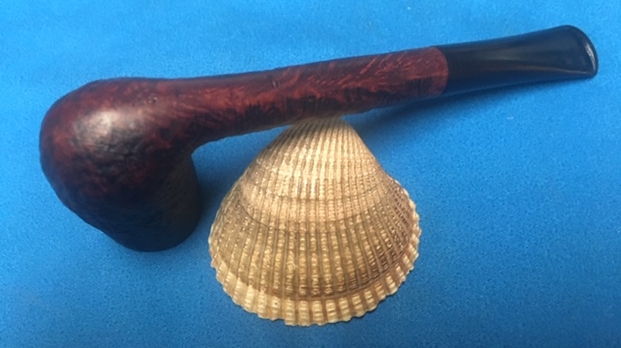
Restoring a Well Worn Dan Shape-Reformed 28 261 Sandblast Canted Chimney


Blog by Steve Laug

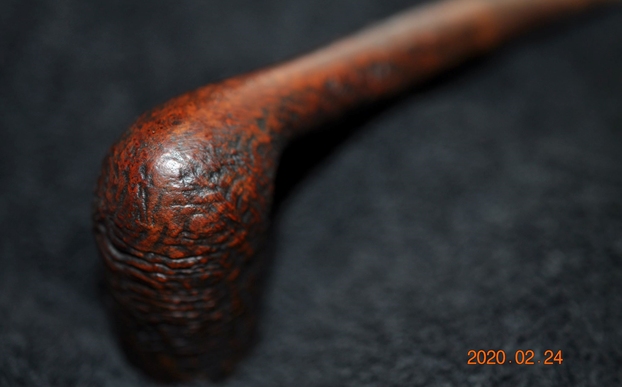
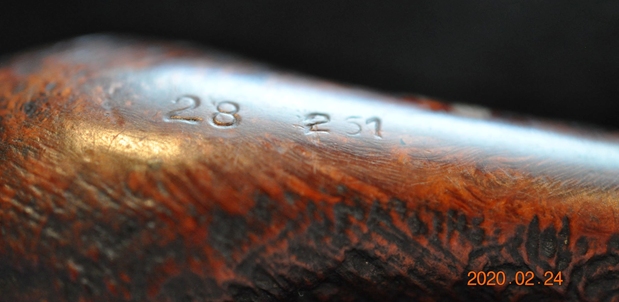
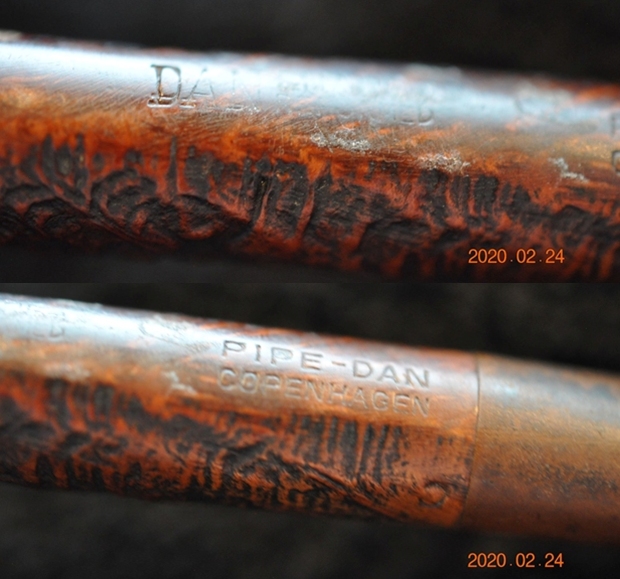
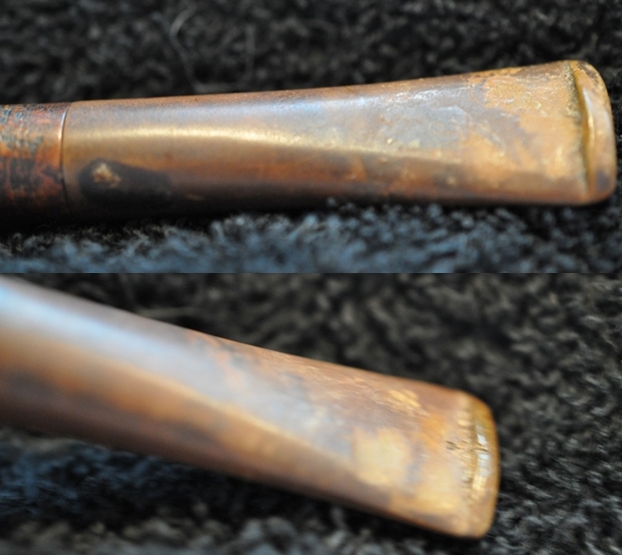
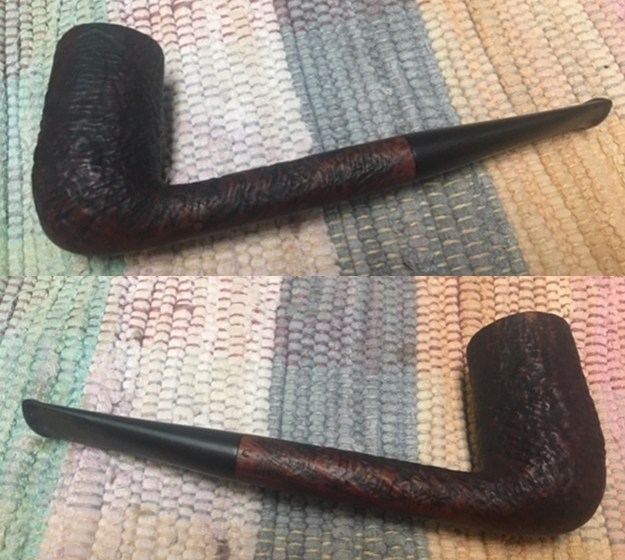
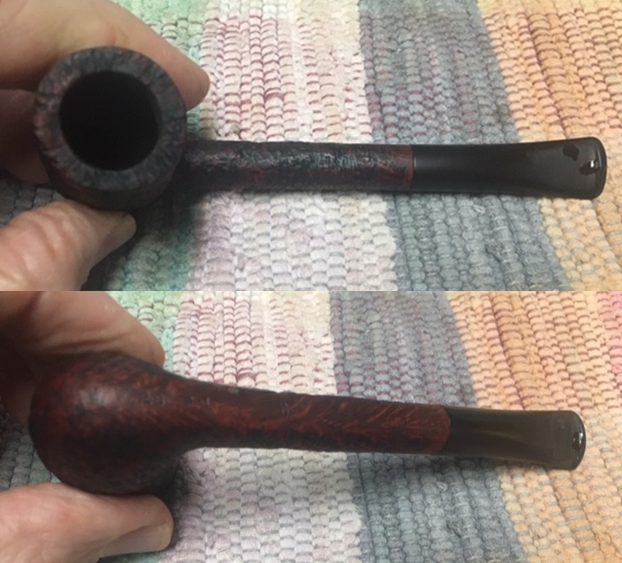
The next pipe on the worktable is an interestingly shaped pipe made by Pipe-Dan. It is a backward canted stack, tall and thin shank with a short lumberman style round vulcanite stem. The finish is an interesting mix of sandblast and rusticated. The bowl sides are horizontally rusticated and then sandblast over the top of the rustication. It gives the pipe a very unique finish. The rim top of the bowl bears the same combination of sandblast and rustication. The pipe is stained with black and various hues of brown. It truly is a beautiful finish. The pipe is stamped with a 28 on the heel of the bowl followed by 261. Next to that it is stamped DAN followed by Shape-Reformed. At the shank end it is stamped Pipe-Dan Copenhagen. The finish was very dirty and worn looking with a lot of grime and oils ground into the valleys and crevices of the blast. There was a thick cake in the bowl overflowing in lava filling in the rim top. The tapered vulcanite stem is heavily oxidized and had calcification over much carries on the twist of the shank. The stem looked very good. It is dirty with light tooth chatter on both sides near the button. Jeff took some photos of the pipe before he started his cleanup work. He took photos of the bowl and rim top to show their general condition. You can see the thick cake in the bowl. The cake and lava are so thick that it is not clear what the inner edge of the bowl looks like at this point. The lava also fills in the grooves and crevices in the finish of the rim top making it almost smooth. Jeff took some photos of the sides and heel of the bowl to give an idea of the unique finish that mixes sandblast and rustication giving the tall bowl a very tactile finish. You can also see the debris in the rustication around the bowl and rim. I cannot wait to see what it looks like once it is cleaned and polished. He took several photos of the stamping on the underside of the shank to capture it for me. It is clear and readable. It runs from the heel to the stem. It is 28 261 Dan Reformed-Shape followed by Pipe Dan Copenhagen. The vulcanite stem is a mess! It is heavily oxidized and there is calcification all over the stem from the button forward. There are also tooth marks and chatter on the stem on both sides. The button appears to be in good condition. The photos below show the condition of the stem.Before I started working on my part of the restoration I decided to do some research on the brand to see what I could learn. I turned first to PipePhil’s site to get a quick overview of the brand (http://www.pipephil.eu/logos/en/logo-p3.html). There found the following information. I am also including a screen capture of the pertinent section from the site.

Brand created in 1943. The shop (Danish name: Pibe-Dan) which closed in 1991 was run by H. Dan Christensen. He sometimes designed pipes but he is merely renowned for having helped young artisans like Tom Eltang, Preben Holm, Jes Phillip Vigen, Hans Hartmann…

Pipe-Dan let the pipe maker stamp his own name on a pipe along with the shop’s name.

There was one line on the page that stood out to me because it applied specifically to the pipe on the table today. I quote:

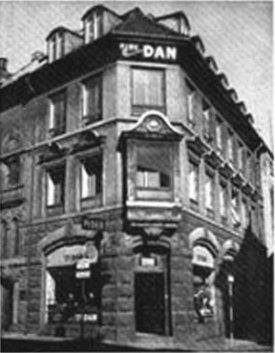
The line name “Shape-Reformed” means that a traditional shape had been redesigned.I turned then to Pipedia to get more history and background to the brand and potentially more information on the pipe (https://pipedia.org/wiki/Pibe-Dan). I quote the article in full as well I have included a photo from the site showing the storefront.

The House of Pibe-Dan was founded in Copenhagen in May, 1943, and was named for H. Dan-Christensen, nicknamed Pibe-Dan. Pibe-Dan (Pipe-Dan) unfortunately closed in 1991, but during the 48 years it was in business it was the ultimate place to find pipes by Danish masters.

Pibe-Dan would often let the pipemaker stamp his own name along with the company name… Pibe-Dan published its first catalog in the late 1950’s and, as was the case with W.O. Larsen, published it in English given their international customer base. While they sold pipes by Stanwell, Kriswill, Brakner and others, the classic pipe sold from Pibe-Dan was the Dan Shape-Reformed Pipe, which had a very tall vertical bowl, and were hand made of Corsican briar. Pibe-Dan claimed that the design was longer, drier, cooler and more even smoking. The Shape-Reformed was available in various lines including the Danois, Standard, Champion, Half Chimney and others.

At the same time, Pibe-Dan had a long history of also including pipes by Danish artisans in their catalog. Sixten Ivarsson’s Peewit, Oliphant, Ukulele and other shapes first appeared in Pibe-Dan’s catalog, and other artists who either began with or sold through Pibe-Dan include, among many others, Hans Hartmann, Gert Holbek, Sven Knudsen, Tom Eltang, Arne Nygaard, P. Holtorp, Poul Hansen, and Ph. Vigen, among others. The legendary Preben Holm sold pipes to the Pibe-Dan shop before his sixteenth birthday in 1963, and soon after was selling twenty to thirty pipes a week to the company, with Pibe-Dan setting the prices. This relationship continued until 1968.

From that information I learned that the line name “Shape-Reformed” means that a traditional shape had been redesigned. This shape was the classic pipe sold by the company. They described the pipe as having a very tall vertical bowl and hand made from Corsica briar. They claimed that the design was longer, drier, cooler and more even smoking. The Shape-Reformed was available in various lines.

Now I had a pretty good idea of how the pipe was stamped and made. With that information I moved forward to work on the pipe itself and see what I had to do with it. The bowl looked unbelievably good in light of where it started. The stem looked much better with just a few tooth marks on each side of the stem just ahead of the button. He had done his normal thorough clean up – reaming, scrubbing, soaking and the result was evident in the pipe when I unpacked it. I took photos of the pipe before I started my work on it. The shape and finish on this pipe is very unique.

Just a word of explanation… I was excited to get started on this one so I did a repair on the tooth marks on the stem. I put a spot of superglue on both sides to fill the damaged areas. Then I recalled I did not take any  before photos. I went back and took the ones that follow! I took some photos of the rim top and stem. The rim top and bowl looked very good. He was able to clean up the thick lava as well as the cake in the bowl. The bowl and rim top look very good at this point. The close up photos of the stem shows that is it very clean. Remember my disclaimer above that I already filled in the deep tooth marks on the stem surface.I removed the stem from the shank and took a photo of the pipe at this point. You can clearly see the condition, size and shape of the pipe.I worked some Before & After Restoration Balm into the surface of the briar with my fingertips. The product works to clean, enliven and protect the briar. I let the balm sit for about ten minutes and then buffed with a cotton cloth to raise the shine. The photos show the bowl at this point in the restoration process. I had taken photos of the stem earlier when I had filled in the deep nicks/tooth marks on the top and underside in my rush to get started. Here are some close up photos to show the repaired areas.   When the repairs had cured I sanded the stem with a folded piece of 220 grit sandpaper to blend them into the surface of the stem and started polishing with 400 grit wet dry sandpaper. I polished the stem with some Denicare Mouthpiece polish – a red gritty paste that feels a lot like Tripoli. It works well to polish out some of the scratches. I find that it does a great job preparing the stem for polishing with micromesh sanding pads.  I polished the stem with micromesh sanding pads – dry sanding with 1500-12000 grit sanding pads. I wiped it down after each sanding pad with a cloth containing some Obsidian Oil. I finished polishing it with Before & After Pipe Stem Polish – both Fine and Extra Fine and buffed it off with a cotton cloth. I wiped the stem down with a coat of Briarville’s No Oxy Oil to protect the rubber and slow down oxidation. Putting this pipe back together was rewarding. The change in condition and appearance was remarkable. I put the stem back on the bowl and buffed the pipe lightly with Blue Diamond on the buffing wheel. I carefully avoided the stamping on the shank during the process. I gave the bowl multiple coats of Conservator’s Wax and the stem multiple coats of carnauba wax on the buffing wheel and followed that by buffing it with a clean buffing pad on the buffer. I hand buffed the pipe with a microfiber cloth to deepen the shine. The finished pipe is quite beautiful and is a uniquely shaped Danish pipe. The finish on the bowl combines various methods and stains to give it a living and tactile nature. It is very well done. Give the finished pipe a look in the photos below. I can only tell you that it is much prettier in person than the photos capture. The dimensions of the pipe are Length: 5 ¼ inches, Height: 2 inches, Outside diameter of the bowl: 1 inch, Chamber diameter: 5/8 of an inch. This interesting Dan Shape-Reformed Stack is a great looking pipe in great condition. Thanks for walking through the restoration with me as I worked over another beautiful pipe. I will be adding it to the rebornpipes store soon. If you want to add it to your collection send me an email or a message! Thanks for your time.


Life for another J.M. Boswell 2013 Bent Billiard with a Twist


Blog by Steve Laug

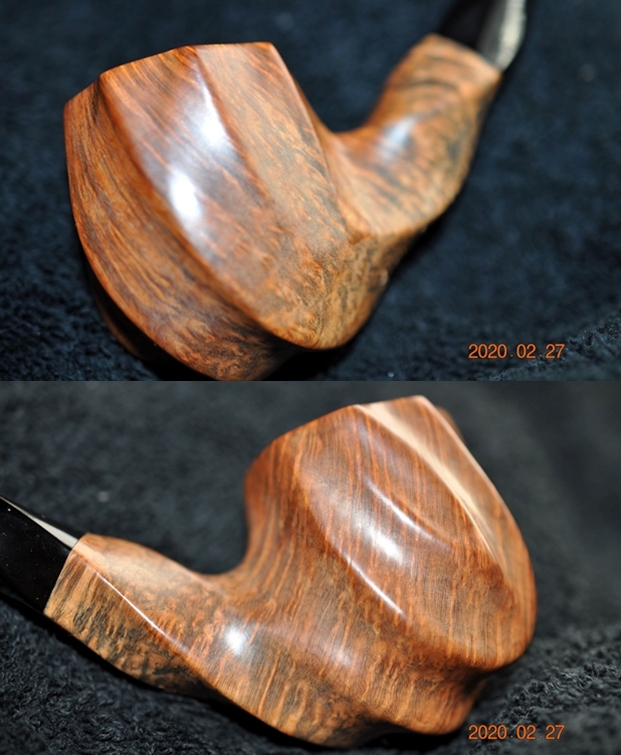
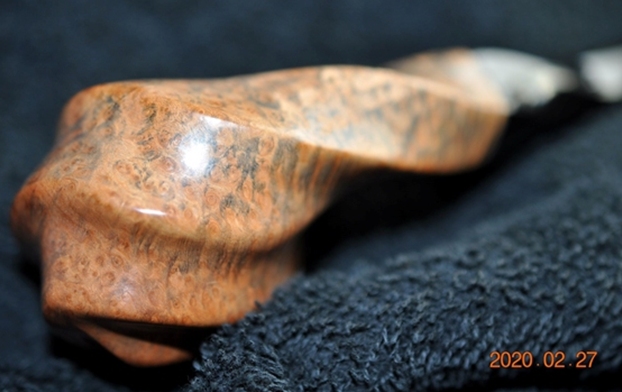
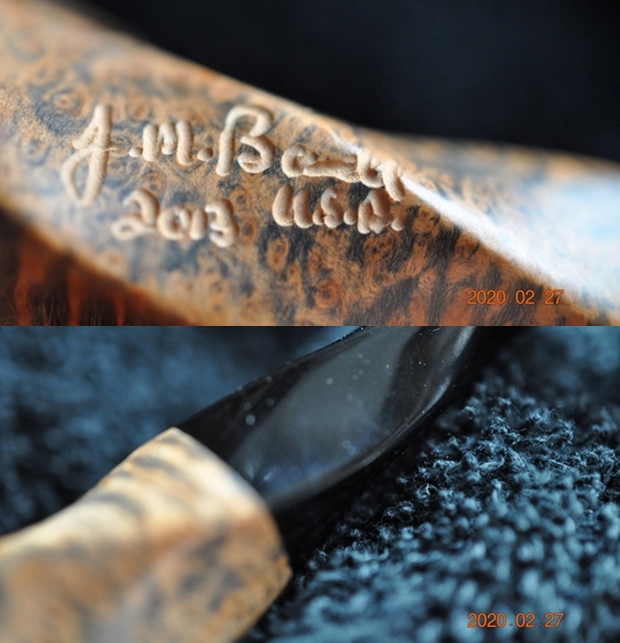
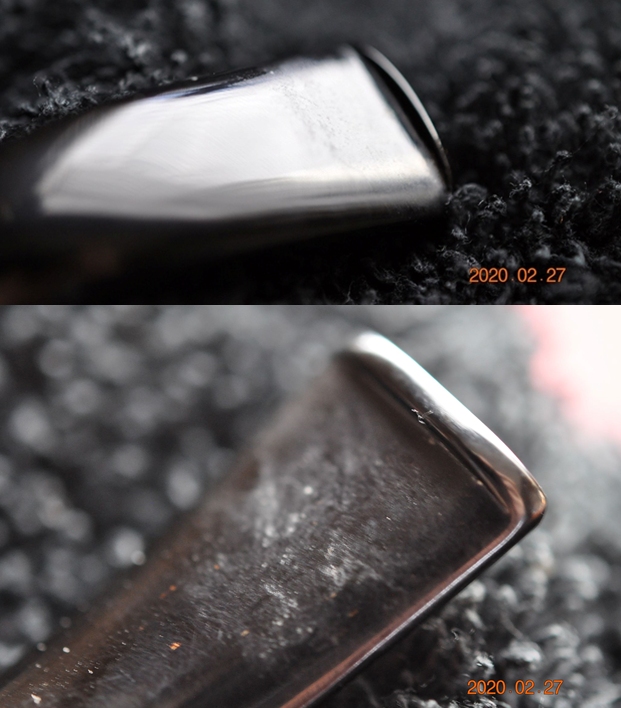
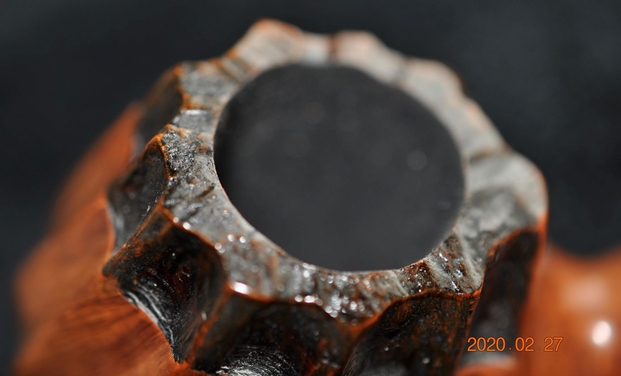
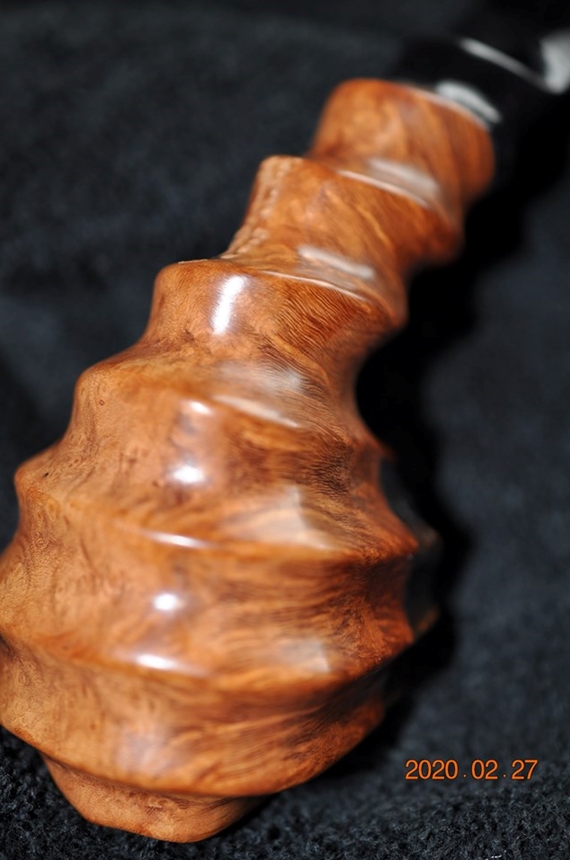
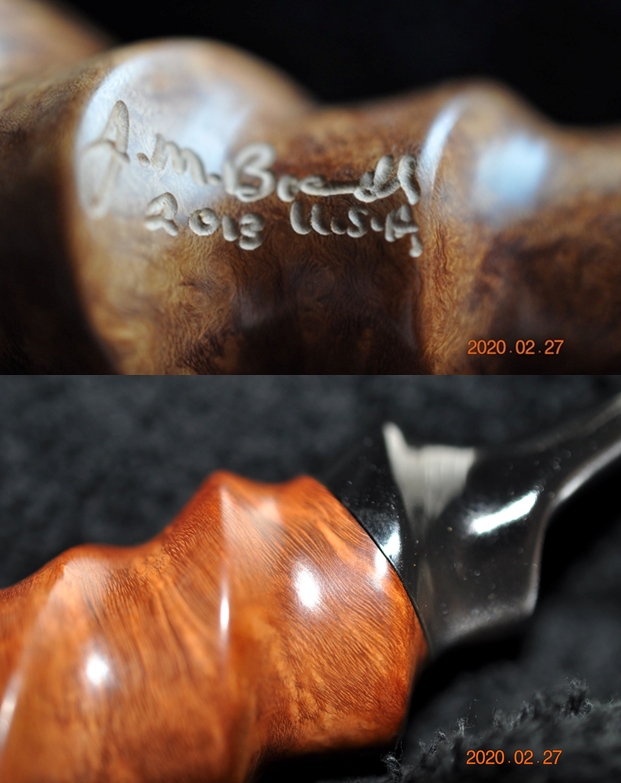
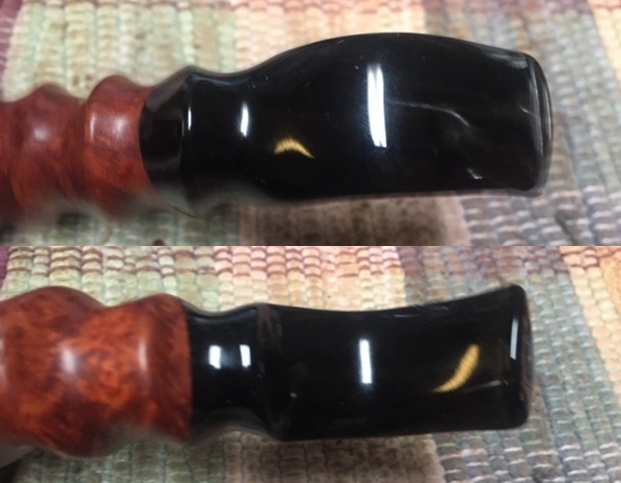
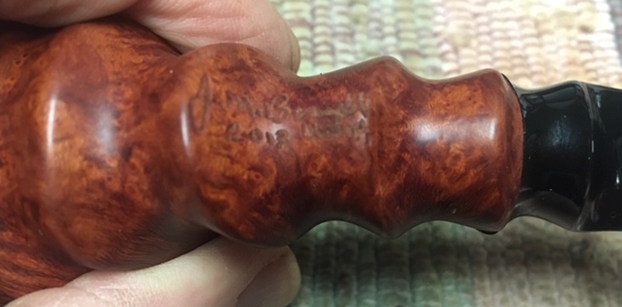
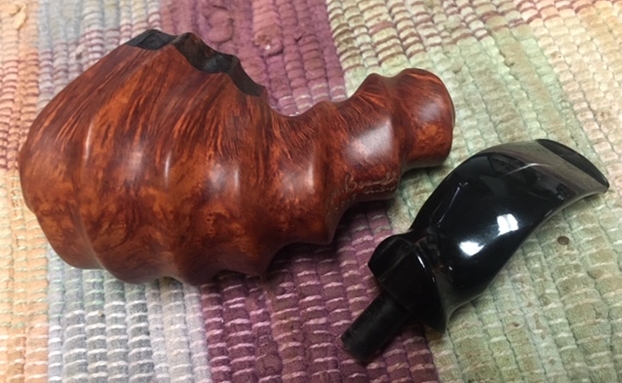
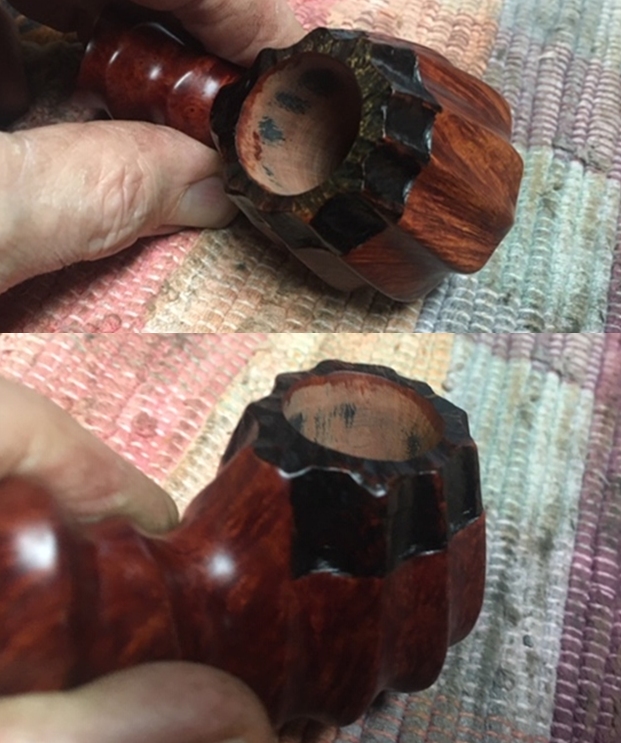
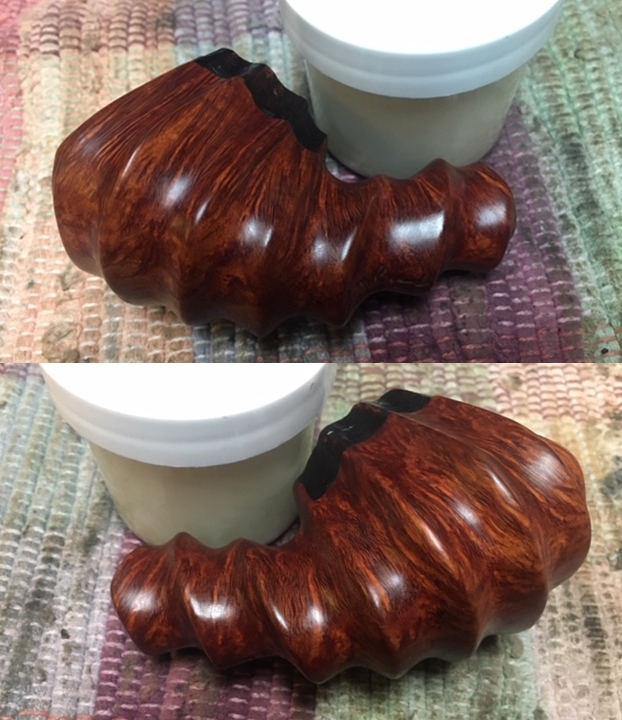
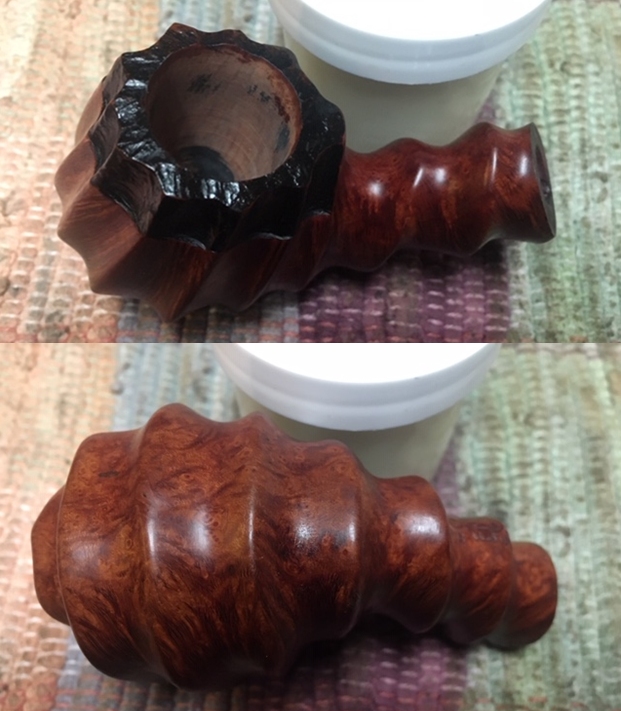
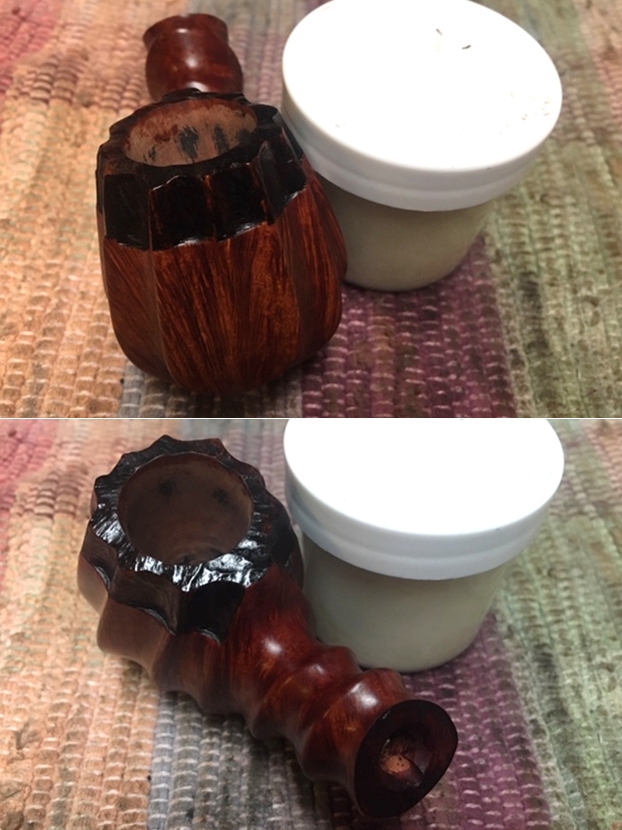
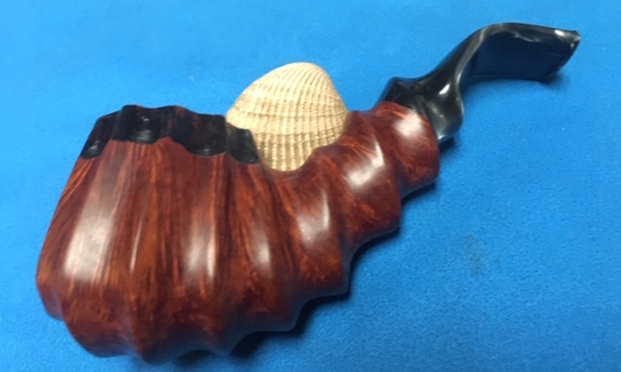
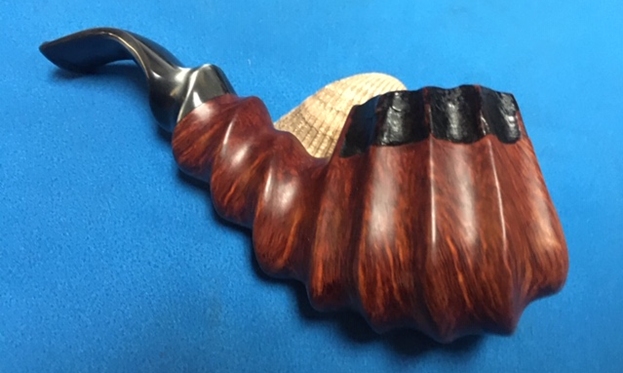
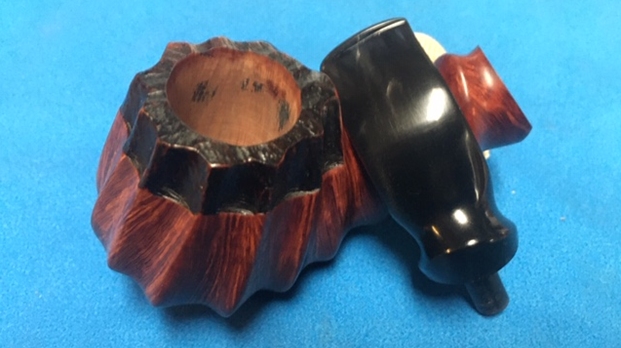
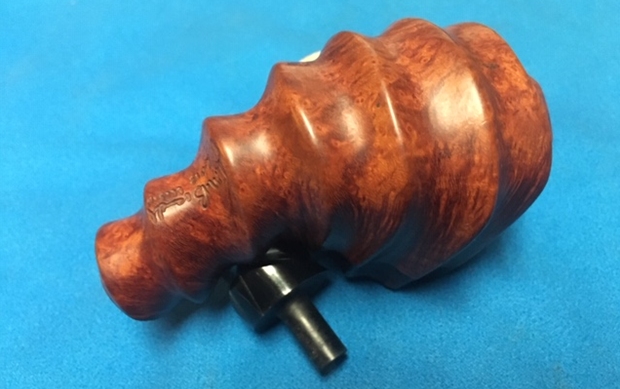
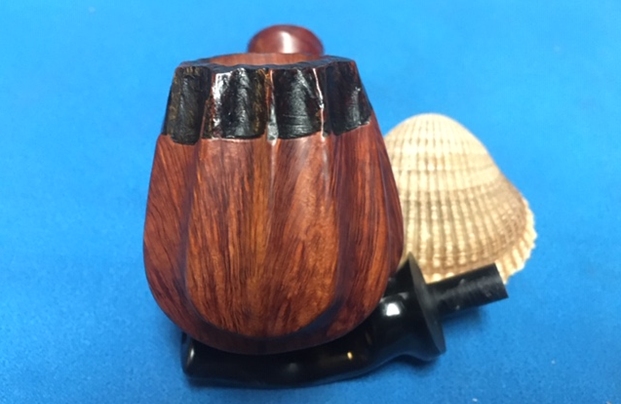
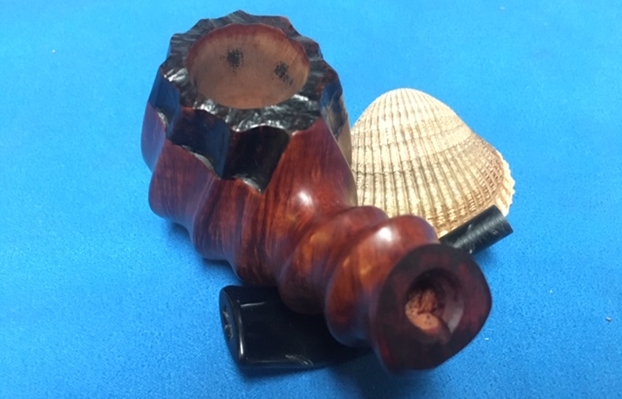
The next pipe on the worktable is another American made pipe from the workshop of J.M. Boswell. It is a bent billiard shaped pipe with swirls or twists around the bowl and featuring a twisted shank and black acrylic stem. The top of the bowl sides are smooth and was stained a rich medium brown. There were not a lot of issues to deal with in the cleanup and restoration. The pipe very lightly smoked and there was a medium cake in the bowl. There was some darkening around the inner edge of the bowl with a bit heavier appearance on the front edge of the rim top. It is signed J.M. Boswell over the date it was made – 2013 followed by U.S.A. The finish was dusty and dirty and somewhat lifeless. There is some fading in the finish toward the bottom of the bowl and shank. The black acrylic taper stem carries on the twist of the shank. The stem looked very good. It is dirty with light tooth chatter on both sides near the button. Jeff took some photos of the pipe before he started his cleanup work. He took a photo of the bowl and rim top to show their general condition. You can see the darkening around the inner edge of the bowl. You can also see the cake in the bowl. The rim top looks very good with no real damage. The smooth fluted carving on the bowl sides all the way to the outer edges and make an interesting pipe.Jeff took some photos of the sides and heel of the bowl to give an idea of the unique twists and fluting pattern around the bowl and continuing on the shank and stem. It is quite stunning with the carvings and the rusticated edge and rim top and the twisted heel of the bowl, shank and stem. You can also see the fading in the finish that has happened as the briar has been used and sitting. I cannot wait to see what it looks like once it is cleaned and polished. He took a photo of the stamping on the underside of the twisted shank to capture it for me. It is clear and readable. The J.M. Boswell signature with the date it was carved and U.S.A. He included a photo of the transition from the twisted shank to the stem.The black acrylic stem is in good condition other than being dirty and having light tooth marks and chatter on the both sides of the stem at the button. The photos below show the condition of the stem.I am including the information on the brand and the shop that I included in the previous blog for ease of reference. Here is a link to that blog (https://rebornpipes.com/2020/04/08/life-for-a-j-m-boswell-2013-bent-volcano-with-a-twist/).

In July, 2017 I restored another Boswell Twist pipe, a 2003 and had done some research into the brand (https://rebornpipes.com/2017/07/19/refurbishing-a-boswell-2003-spiral-twist-bent-billiard/). I turned to that blog and reread the information that I had included there. I took the liberty to include the information that I included from the box that came with that pipe that below.

The backside of the box reads:

Dear Pipe Smoker: J.M. Boswell crafts each of his pipes exclusively by hand! From the bare briar block to the final stain and polish, each step is a hands on procedure in old world tradition. Boswell pipes feature individual craftsmanship and style.

Additionally, J.M. Boswell has developed an exclusive bowl coating that greatly shortens the “break-in” time of a Boswell pipe and gives a sweet smoke from the very first bowl full. This coating is applied to each new pipe that Boswell makes.

One more compelling feature of Boswell pipes: “Their cost”! Boswell pipes can be had at a fraction of what most import pipes are. This is a feature pipe smokers find gratifying.

Our second feature is repairs by Boswell. J.M. Boswell has no peers in the quality and speed in which he gives “Turn-around” on pipe repairs, from stem replacement to banding, to reaming and cleaning.

I will be glad to answer any questions that you have regarding all the features of Boswell’s pipes, my repair work, plus the crafting process which can be witnessed first hand at our store and pipe making shop at 586 Lincoln Way East in Chambersburg, Pennsylvania.

Cordially J.M. Boswell, Owner.

I then turned to the Boswell Pipe and Tobacco Shop site (https://boswellpipes.com/product-category/boswell-pipes/). The description of the pipes in that section of the site parallels what I found above. I quote:

In the creation of these exquisite smoking pipes, we use the finest quality briar – “cream of the crop” is what the proprietor of the mill calls it. Boswell Pipes have their own special bowl coating for easy break-in. J.M. has used his special coating for Boswell Pipes since 1982.  100% natural coating,which will force the briar wood to absorb the moisture and heat.  For the finishing touch, J.M. hand inscribes his signature into the briar.  J.M. dates the year and proudly declares made in the USA “J.M. Boswell 2018 U.S.A.”. 

I also checked out the description of the other twisted or as he called them Swirls and include that below as I found it quite interesting (https://boswellpipes.com/product/boswell-pipe-jumbo-freehand-swirls-2020/).

J.M.’s Signature Swirls, gorgeously grained.

Incredible smoking properties of a Boswell pipe, are the thick bowl walls to give you that cool enjoyable smoke.

Uniquely sculptured deep Swirls.

Old craftsmanship style with thick walls and shank for a cooler smoke.

Natural finish with eye-catching dark bold highlights to show off its grain.

Incredible cool smoke with an extremely easy draw for some serious smoking.

J.M. Boswell is known worldwide for crafting theses incredible, massive looking, King Size briars for well over 39 years.  Addition to being amazing smokers as well, they are capable of holding a generous supply of your favorite tobacco.

As with each and every Boswell pipe made, the airway is hand bored (not using a lathe).  This is why the air passage way will always provide the smoker with a full draw and allows for a fuller smoother smoke. J.M. finds the old fashion way of doing so completes his pipes.

Wide plateaux is displayed along the rim and shank.

Accent etching along the shank.

Using a high power magnifier there may be a few specks of natural imperfections.

Large hand-cut acrylic spiraling mouthpiece with pearlized raspberry red tones.

Your new Boswell pipe will come nestled in a protective Jumbo handmade pipe sleeve and placed in a Boswell gift box.  We also include all the essentials for your first smoke.

Smoking becomes a Relaxing time with a Boswell.

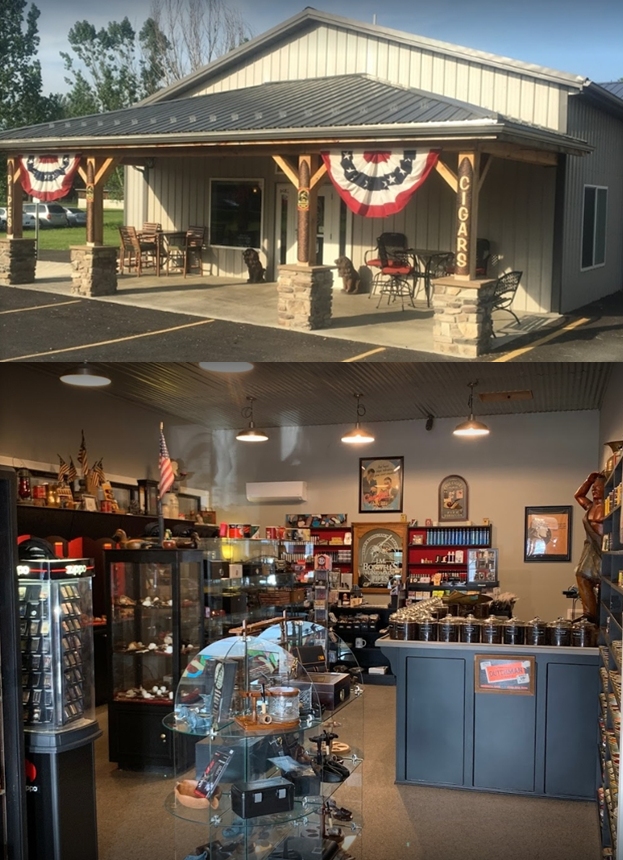
I also found some photos of the shop online that I am including here as well. I am also including the address of the shop and the phone number.

J.M. Boswell’s Pipes and Tobacco

6481 William Penn Hwy, Alexandria, PA 16611, United States

+1 814-667-7164

It looks like it would be a great place to visit and spend time enjoying. One day I may get to do that. We shall see!Now I had a pretty good idea of how the pipe was stamped and made. The one I had did not have a pearlized raspberry stem but the black, one. It also did not have any plateau on the rim or shank end. But otherwise the description fits. With that information I moved forward to work on the pipe itself and see what I had to do with it. The pipe looked amazing. The stem looked like new, with most of the tooth marks and chatter gone. He had done his normal thorough clean up – reaming, scrubbing, soaking and the result was evident in the pipe when I unpacked it. I took photos of the pipe before I started my work on it. The shape and finish on this pipe is quite beautiful! I took some photos of the rim top and stem. The rim top and bowl looked very good. He was able to clean up the rim darkening as well as the cake in the bowl. The bowl and rim top look very good at this point. The close up photos of the stem shows that is it very clean.I took a photo of the stamping on the underside of the shank to show the condition after the cleanup. This stamping is a signature done with an engraver of some sort. It looks good.I removed the stem from the shank and took a photo of the pipe at this point. You can clearly see the condition, size and shape of the pipe.I worked some Before & After Restoration Balm into the surface of the briar with my fingertips. The product works to clean, enliven and protect the briar. I let the balm sit for about ten minutes and then buffed with a cotton cloth to raise the shine. The photos show the bowl at this point in the restoration process. I polished the stem with micromesh sanding pads – dry sanding with 1500-12000 grit sanding pads. I wiped it down after each sanding pad with a cloth containing some Obsidian Oil. I finished polishing it with Before & After Pipe Stem Polish – both Fine and Extra Fine and buffed it off with a cotton cloth. Putting this pipe back together was not as dramatic as it usually is but still it is rewarding nonetheless. I put the stem back on the bowl and buffed the pipe with Blue Diamond on the buffing wheel. I carefully avoided the stamping on the shank sides during the process. I gave the bowl and the stem multiple coats of carnauba wax on the buffing wheel and followed that by buffing it with a clean buffing pad on the buffer. I hand buffed the pipe with a microfiber cloth to deepen the shine. The finished pipe is another good example of a Boswell Swirls pipe. The flow of the grain and the way the shape follows it is very well done. Give the finished pipe a look in the photos below. I can only tell you that it is much prettier in person than the photos capture. The dimensions of the pipe are Length: 5 ½ inches, Height: 2 inches, Outside diameter of the bowl: 1 ¼ inches, Chamber diameter: ¾ of an inch. This interesting Boswell Swirls Hand Made Billiard is a great looking pipe in great condition. Thanks for walking through the restoration with me as I worked over another beautiful pipe. I will be adding it to the rebornpipes store soon. If you want to add it to your collection send me an email or a message! Thanks for your time.

Life for a J.M. Boswell 2013 Bent Volcano with a Twist


Blog by Steve Laug

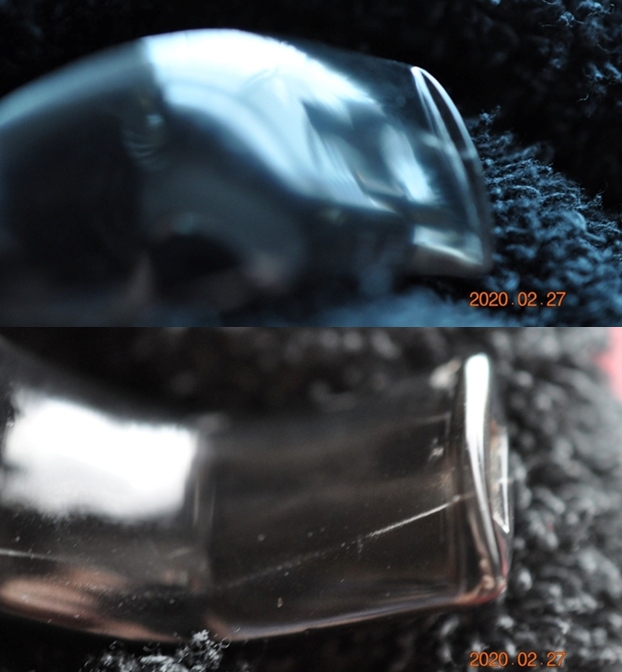
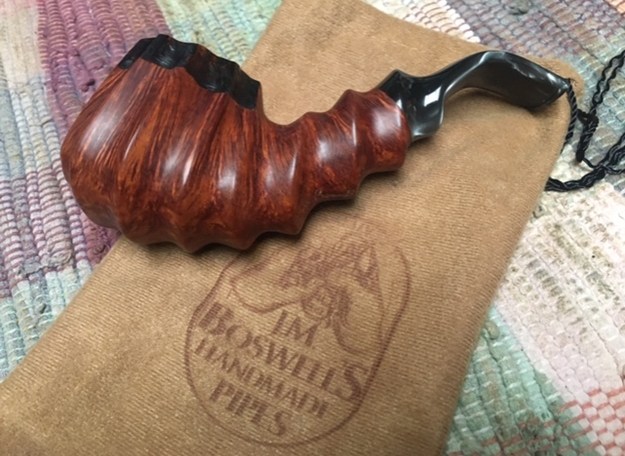
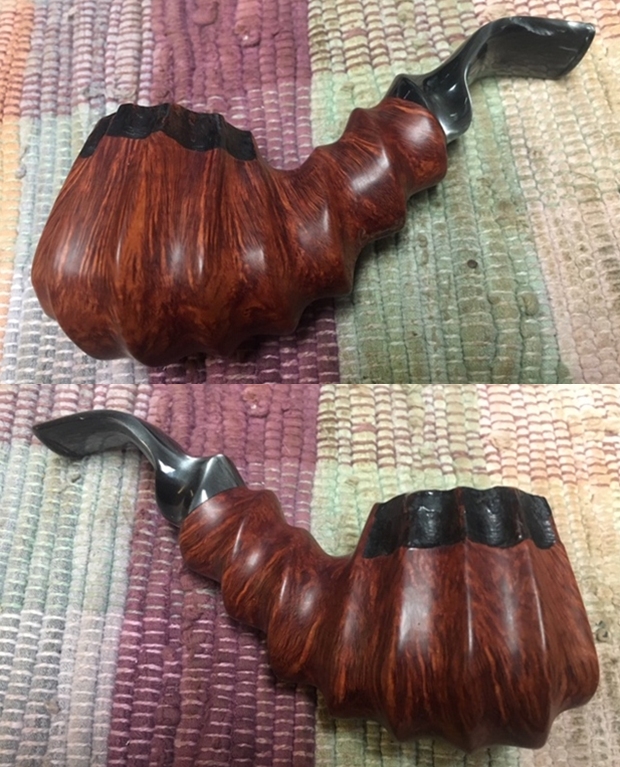
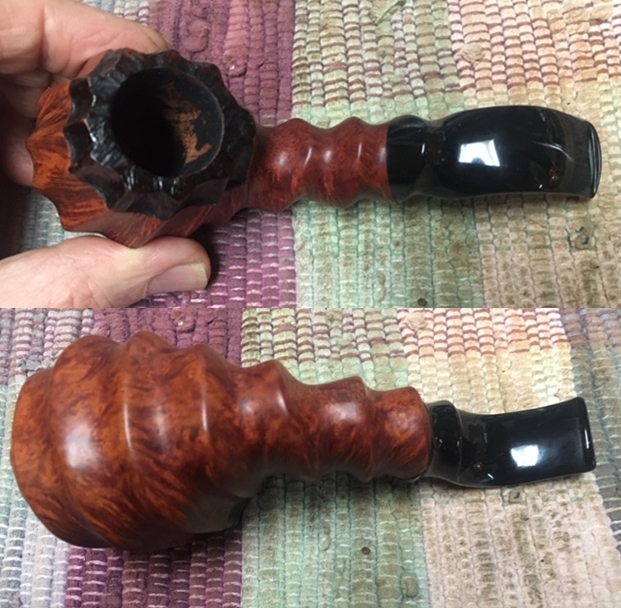
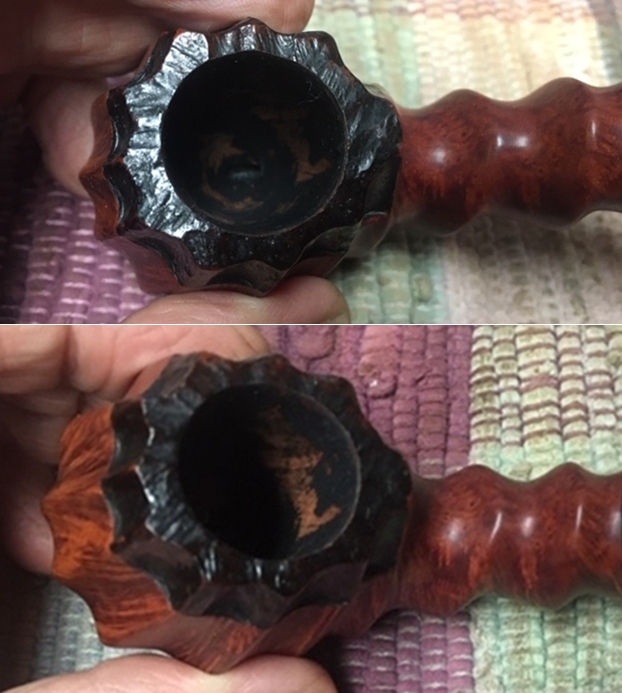
The next pipe on the worktable is an American made pipe from the workshop of J.M. Boswell. It is a large bent volcano shaped pipe fluted around the bowl and featuring a twisted shank and variegated grey/silver/black acrylic stem. The top of the bowl sides and the rim top featured a rustication and was stained dark brown. The pipe came in a tan cloth J.M. Boswell’s Handmade Pipes Bag and when Jeff took it out it was in very good condition. There were not a lot of issues to deal with in the cleanup and restoration. I am not sure it was even smoked as it looks like a bowl coating on the walls – but if it had it was very lightly smoked. It is signed J.M. Boswell over the date it was made – 2013 followed by U.S.A. The finish was dusty and there was dust in the rustication around the bowl and rim top. The variegated grey/silver/black acrylic saddle stem carries on the twist of the shank. The stem looked very good. Jeff took some photos of the pipe before he started his cleanup work. He took a photo of the bowl and rim top to show their general condition. You can see the dust and debris in the rustication on the rim top. The does not appear to be a cake in the bowl. The smooth fluted carving on the bowl sides ending in about ½ an inch of rustication up to the rim top an over the top of the rim top combine to make an interesting pipe.Jeff took some photos of the sides and heel of the bowl to give an idea of the unique fluting pattern on the bowl, the rustication as noted and the twist of the carving on the shank and stem. It is quite stunning with the carvings and the rusticated edge and rim top and the twisted heel of the bowl, shank and stem. I cannot wait to see what it looks like once it is cleaned and polished. He took a photo of the stamping on the left underside of the shank to capture it for me. It is clear and readable. The J.M. Boswell signature with the date it was carved and U.S.A. He included a photo of the transition from the twisted shank to the stem.The variegated black, grey and silver acrylic stem is in good condition other than being dirty and having light tooth marks and chatter on the both sides of the stem at the button. The photos below show the condition of the stem. The first photo caught the reflection of the light in the stem surface. It is a bit blurry but it is still quite unique so I kept it.In July, 2017 I restored another Boswell Twist pipe, a 2003 and had done some research into the brand (https://rebornpipes.com/2017/07/19/refurbishing-a-boswell-2003-spiral-twist-bent-billiard/). I turned to that blog and reread the information that I had included there. I took the liberty to include the information that I included from the box that came with that pipe that below.

The backside of the box reads:

Dear Pipe Smoker: J.M. Boswell crafts each of his pipes exclusively by hand! From the bare briar block to the final stain and polish, each step is a hands on procedure in old world tradition. Boswell pipes feature individual craftsmanship and style.

Additionally, J.M. Boswell has developed an exclusive bowl coating that greatly shortens the “break-in” time of a Boswell pipe and gives a sweet smoke from the very first bowl full. This coating is applied to each new pipe that Boswell makes.

One more compelling feature of Boswell pipes: “Their cost”! Boswell pipes can be had at a fraction of what most import pipes are. This is a feature pipe smokers find gratifying.

Our second feature is repairs by Boswell. J.M. Boswell has no peers in the quality and speed in which he gives “Turn-around” on pipe repairs, from stem replacement to banding, to reaming and cleaning.

I will be glad to answer any questions that you have regarding all the features of Boswell’s pipes, my repair work, plus the crafting process which can be witnessed first hand at our store and pipe making shop at 586 Lincoln Way East in Chambersburg, Pennsylvania.

Cordially J.M. Boswell, Owner.

I then turned to the Boswell Pipe and Tobacco Shop site (https://boswellpipes.com/product-category/boswell-pipes/). The description of the pipes in that section of the site parallels what I found above. I quote:

In the creation of these exquisite smoking pipes, we use the finest quality briar – “cream of the crop” is what the proprietor of the mill calls it. Boswell Pipes have their own special bowl coating for easy break-in. J.M. has used his special coating for Boswell Pipes since 1982.  100% natural coating,which will force the briar wood to absorb the moisture and heat.  For the finishing touch, J.M. hand inscribes his signature into the briar.  J.M. dates the year and proudly declares made in the USA “J.M. Boswell 2018 U.S.A.”. 

I also checked out the description of the other twisted or as he called them Swirls and include that below as I found it quite interesting (https://boswellpipes.com/product/boswell-pipe-jumbo-freehand-swirls-2020/).

J.M.’s Signature Swirls, gorgeously grained.

Incredible smoking properties of a Boswell pipe, are the thick bowl walls to give you that cool enjoyable smoke.

Uniquely sculptured deep Swirls.

Old craftsmanship style with thick walls and shank for a cooler smoke.

Natural finish with eye-catching dark bold highlights to show off its grain.

Incredible cool smoke with an extremely easy draw for some serious smoking. 

J.M. Boswell is known worldwide for crafting theses incredible, massive looking, King Size briars for well over 39 years.  Addition to being amazing smokers as well, they are capable of holding a generous supply of your favorite tobacco.

As with each and every Boswell pipe made, the airway is hand bored (not using a lathe).  This is why the air passage way will always provide the smoker with a full draw and allows for a fuller smoother smoke. J.M. finds the old fashion way of doing so completes his pipes.

Wide plateau is displayed along the rim and shank.

Accent etching along the shank.

Using a high power magnifier there may be a few specks of natural imperfections.

Large hand-cut acrylic spiraling mouthpiece with pearlized raspberry red tones.

Your new Boswell pipe will come nestled in a protective Jumbo handmade pipe sleeve and placed in a Boswell gift box.  We also include all the essentials for your first smoke.

Smoking becomes a Relaxing time with a Boswell.

I also found some photos of the shop online that I am including here as well. I am also including the address of the shop and the phone number.

J.M. Boswell’s Pipes and Tobacco

6481 William Penn Hwy, Alexandria, PA 16611, United States

+1 814-667-7164

It looks like it would be a great place to visit and spend time enjoying. One day I may get to do that. We shall see!Now I had a pretty good idea of how the pipe was stamped and made. The one I had did not have a pearlized raspberry stem but the variegated black, grey and silver one. It also did not have any plateau on the rim or shank end. But otherwise the description fits. With that information I moved forward to work on the pipe itself and see what I had to do with it. The pipe looked amazing. Even the stem looked like new, with most of the tooth marks and chatter gone. Jeff was pretty sure it was unsmoked as well but he had cleaned it to remove the dust and grime. He had done his normal thorough clean up – reaming, scrubbing, soaking and the result was evident in the pipe when I unpacked it. He had also cleaned out the bowl coating as we usually do so we could see what was underneath. I took photos of the pipe before I started my work on it. The shape and finish on this pipe is quite beautiful! I took some photos of the rim top and stem. The rim top and bowl looked very good. When Jeff removed cake from the bowl it revealed some sloppy black stain all over the walls and bottom of the bowl. It is not unlike what I have seen on Peterson’s Pipes. It is good that Jeff removed the coating because stain gives the tobacco a really foul taste – bitter and unpleasant. I will need to sand out the inside of the bowl on this otherwise pristine pipe. The close up photos of the stem shows that is it very clean. I took a photo of the stamping on the underside of the shank to show the condition after the cleanup. This stamping is a signature done with an engraver of some sort. It looks good.I removed the stem from the shank and took a photo of the pipe at this point. You can clearly see the condition, size and shape of the pipe.I started my part of the restoration work on this pipe by removing as much of the stain as I could. I wiped it down with alcohol and sanded out the inside of the bowl with 220 grit sandpaper wrapped around a dowel. Most of it was gone and bowl was smooth. There were dark spots that I could not remove but no amount of work on them removed the stain. The pictures show the issue I am talking about. It was deep in the briar.I worked some Before & After Restoration Balm into the surface of the briar with my fingertips on the smooth portions and a horsehair shoe brush to get in the nooks and crannies of the rustication on the rim top of the bowl. The product works to clean, enliven and protect the briar. I let the balm sit for about ten minutes and then buffed with a cotton cloth to raise the shine. The photos show the bowl at this point in the restoration process. I set the bowl aside and turned my attention to the stem. I sanded the stem with 220 grit sandpaper and 400 grit wet dry sandpaper to remove the scratching in the acrylic of the stem.I polished the stem with micromesh sanding pads – dry sanding with 1500-12000 grit sanding pads. I wiped it down after each sanding pad with a cloth containing some Obsidian Oil. I finished polishing it with Before & After Pipe Stem Polish – both Fine and Extra Fine and buffed it off with a cotton cloth. Putting this pipe back together was not as dramatic as it usually is but still it is rewarding nonetheless. I put the stem back on the bowl and buffed the pipe lightly with Blue Diamond on the buffing wheel. I carefully avoided the stamping on the shank sides during the process. I gave the bowl and the stem multiple coats of carnauba wax on the buffing wheel and followed that by buffing it with a clean buffing pad on the buffer. I hand buffed the pipe with a microfiber cloth to deepen the shine. The finished pipe is a good example of a Boswell Swirls pipe. The flow of the grain and the way the shape follows it is very well done. Give the finished pipe a look in the photos below. I can only tell you that it is much prettier in person than the photos capture. The dimensions of the pipe are Length: 5 ½ inches, Height: 2 inches, Outside diameter of the bowl: 1 ¼ inches wide x 1 ½ inches long, Chamber diameter: ¾ of an inch. This interesting Boswell Swirls Hand Made Volcano is a great looking pipe in unsmoked condition. Thanks for walking through the restoration with me as I worked over another beautiful pipe. I will be adding it to the rebornpipes store soon. If you want to add it to your collection send me an email or a message! Thanks for your time.

Continuing My Practice on Tenon Replacement… Working on a Connoisseur, NYC Pipe


Blog by Paresh Deshpande

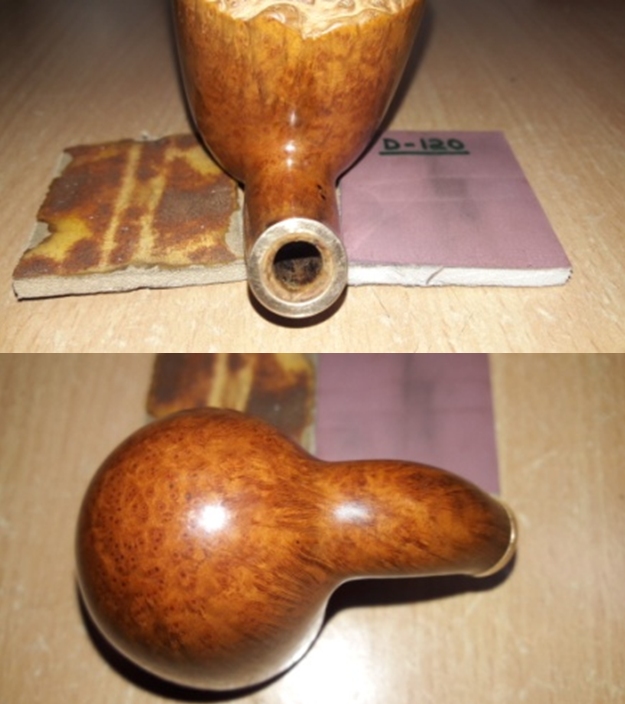
Any learning consists of three phases; first is being taught, second is practice and the third phase is mastering!! Continuing on my learning curve, I wanted to practice replacing broken tenons on pipes to make them smoke worthy again.

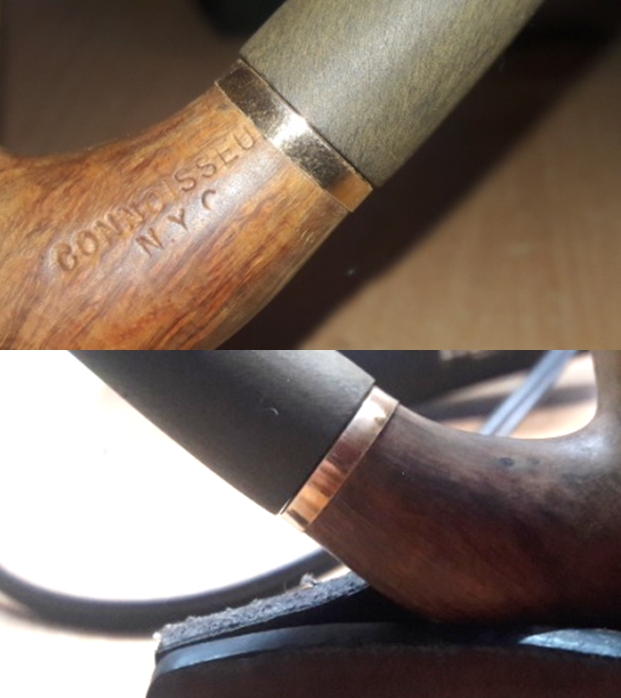
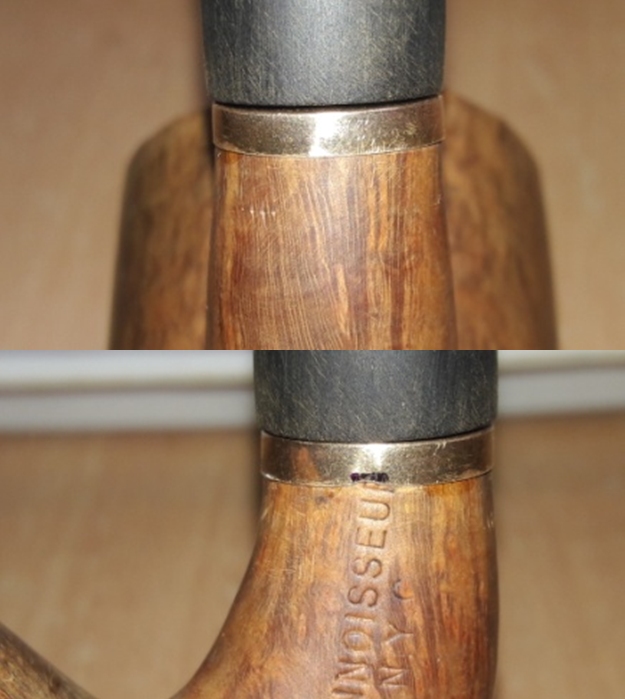
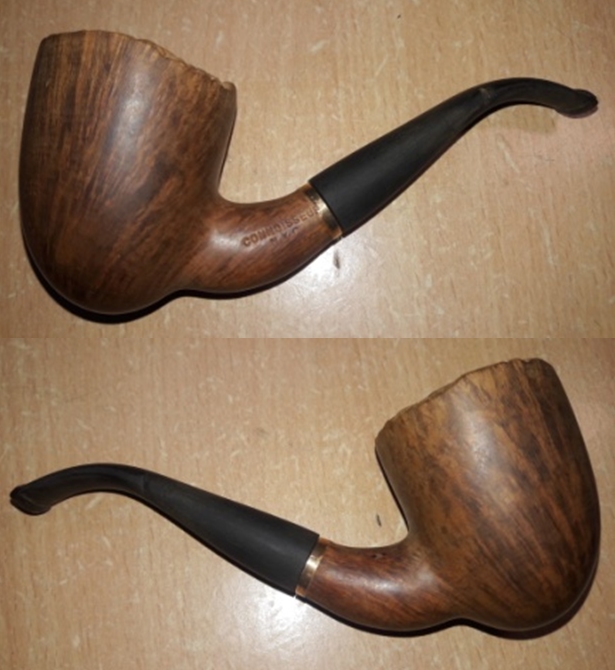
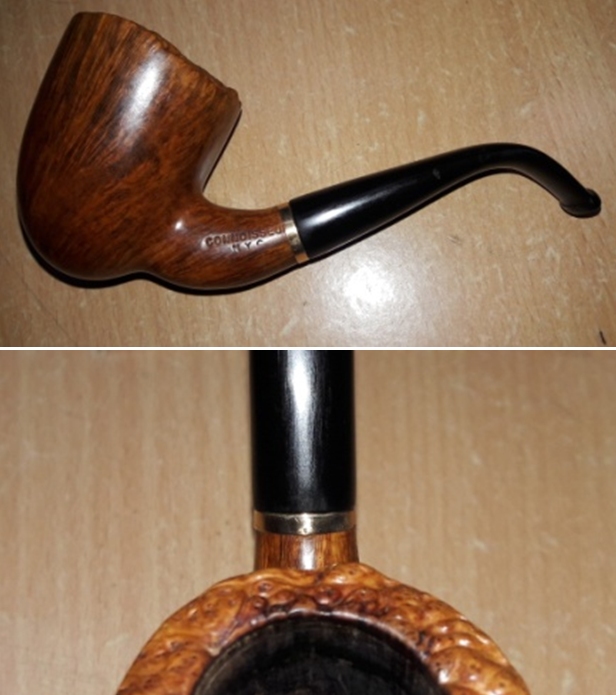
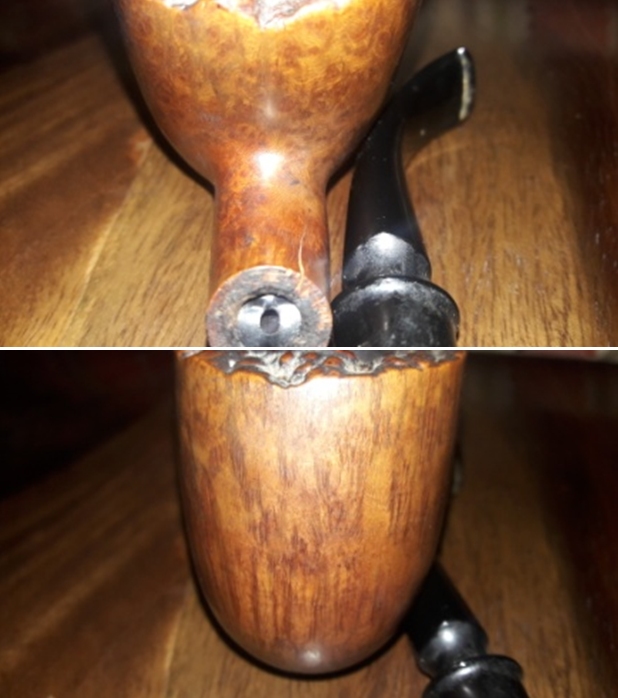
The pipe that I chose to practice on is a free hand that boasts of straight / flame grains all around the stummel with bird’s eyes on the heel of the bowl with a plateau rim top. It is stamped on the left of the shank as “CONNOISSEUR” over “N.Y.C.”. These stampings are crisp and easily readable. There is no other stamping seen on either the stummel or the stem. This is the first time that I am working on a Connoisseur and am keen to know more about this pipe brand, carver and also dating this pipe. As is my habit, the first site that I visit is rebornpipes where, over the years, it seems like Steve has chronicled almost all the pipes that were and are in existence. True enough, Steve has restored and researched a pipe from this maker. Here is the link for a detailed information on this pipe; https://rebornpipes.com/2015/05/23/restoring-an-ed-burak-connoisseur-tall-stack/
Further down the write up, he also gives out the dating methodology adopted by Ed Burak and the same is reproduced for immediate reference.

I also learned on Pipephil’s website (http://www.pipephil.eu/logos/en/about-en.html) that the stamping did indeed give some information that helped in identifying the period that a particular pipe was made. There I found that one may generally separate Connoisseur pipes’ date of manufacture into three periods.

From late 1960’s until 1974: no stampings
From 1974 until 1981: CONNOISSEUR over N.Y.C.
From 1981 on: CONNOISSEUR over N.Y.C. and Ed Burak’s signature.

Thus from the above information, it’s evident that this beautiful Connoisseur pipe in my hand is from the period 1974 to 1981!

INITIAL VISUAL INSPECTION
The first and foremost issue that I noticed and was aware of from the description given by the seller is that of the broken tenon. When I saw the pictures of this pipe for the first time, I had observed, apart from the most obvious broken tenon a number of other issues which presented a challenge of their own. The briar was natural and unstained. It had darkened slightly with age. This was how the pipe had reached me…discerning readers will easily make out other major issues that need to be addressed on this pipe. The chamber has a thick uneven layer of dry and hard cake with the inner rim edge showing darkening in 6 o’clock direction (marked in yellow). The condition of the inner walls of the chamber can be checked and ascertained only after the cake has been taken down to the bare briar. However, I do not envision any damage to the chamber walls. There is heavy lava overflow and debris embedded in the plateau of the rim top surface. The condition of the inner rim edge will be commented upon once the lava overflow has been removed. There are very strong and all pervading smells of old tobacco emanating from the chamber. Hopefully this issue should be addressed once the cake has been removed and the mortise is thoroughly cleaned. The stummel boasts of beautiful straight/flame grain all around and extend over the shank surface too!! The surface is covered in lava overflow, dirt and grime. The stummel briar is without a single fill and through all the dirt and grime, exudes a very high quality briar and craftsmanship. The foot of the stummel shows beautiful bird’s eye grains and is sans any damage. The slightly tapered end of the shank has the broken end of the tenon still embedded within. A prominent crack is visible over the shank on the right side. This pipe, in all probability, has suffered this catastrophic damage as a result of having fallen in stem down position. The mortise has the broken tenon stuck inside. I did try to wriggle it out with a screw driver, but the broken tenon wouldn’t budge. This will require more invasive technique. The heavy build up of cake in the chamber, dirty plateau rim top and the sorry condition of the stem all point towards a clogged mortise. This will be ascertained once the broken piece is removed from the shank end.The fancy stem has blobs of sticky oils and tars on both the surfaces as well as in between the nooks and crannies at the tenon end. There are significant tooth indentations on both the upper and lower buttons, to the extent that they would need to be rebuild completely. The slot just does not appear correct. It appears to be a orifice, but it is not a perfect round and  there are horizontal extensions on either side. Even this opening is clogged with old oils and tars. The broken tenon end of the stem is jagged and sharp at the place where the tenon has snapped. In my opinion, there is something which is not right about this stem. The quality of the stem is not something which is to be expected on a Connoisseur pipe. THE PROCESS
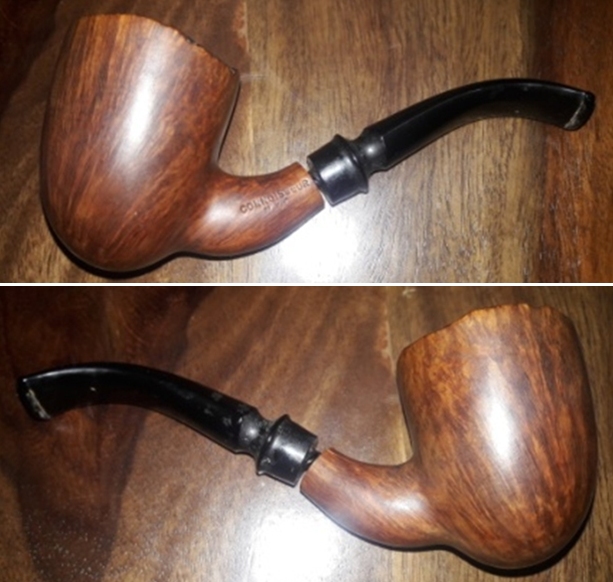
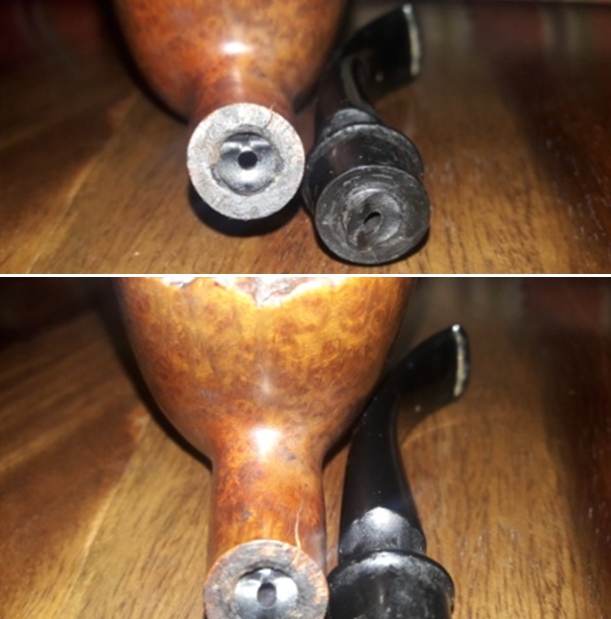
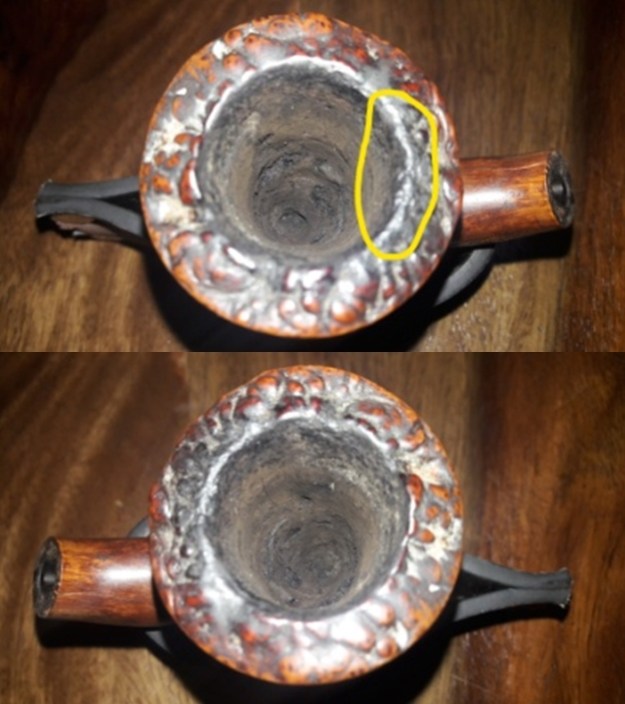
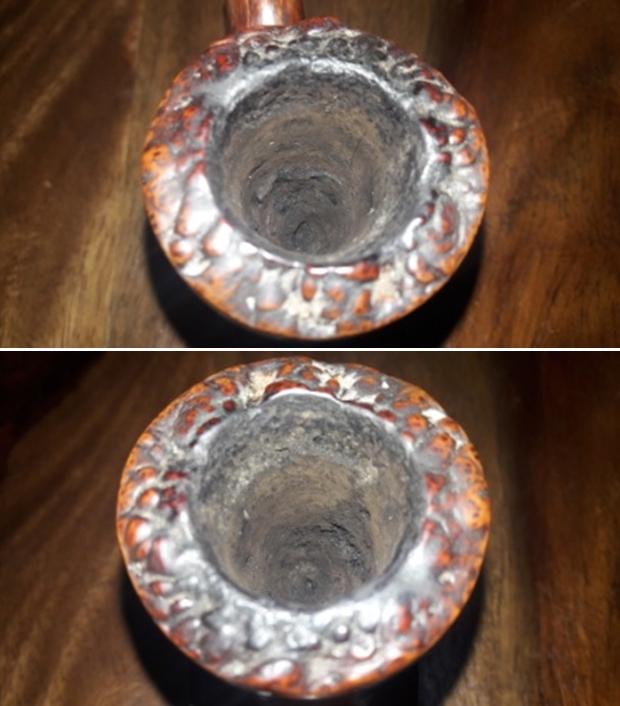
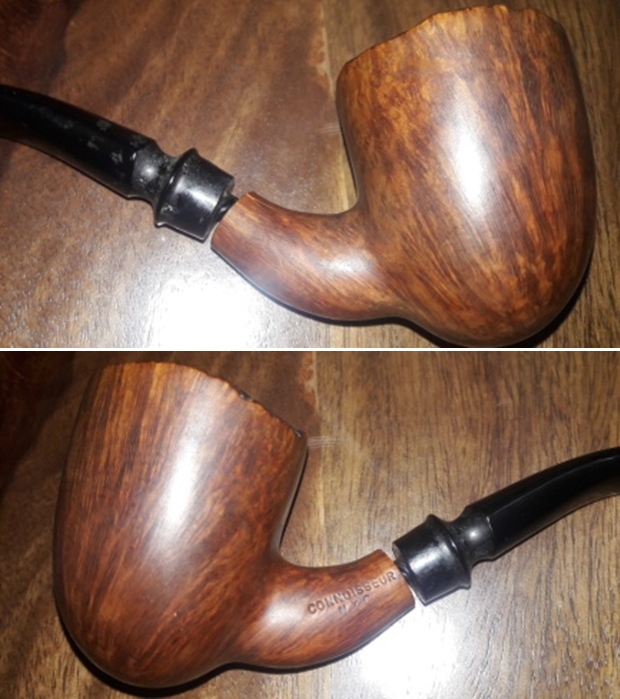
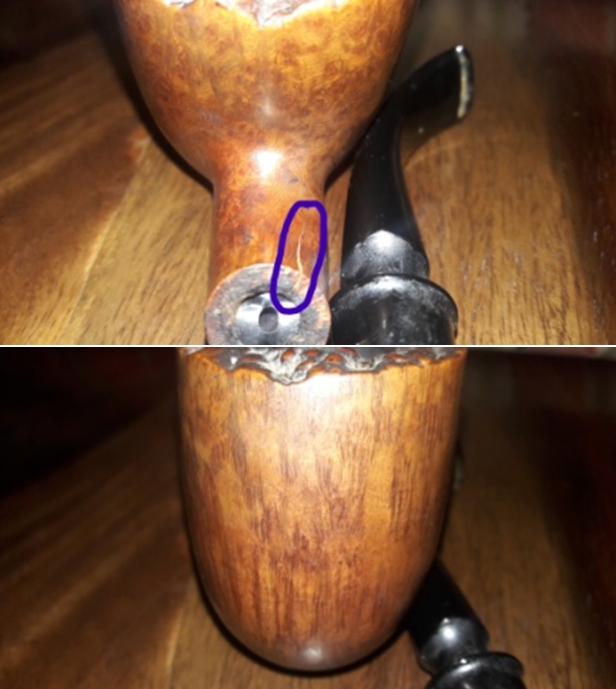
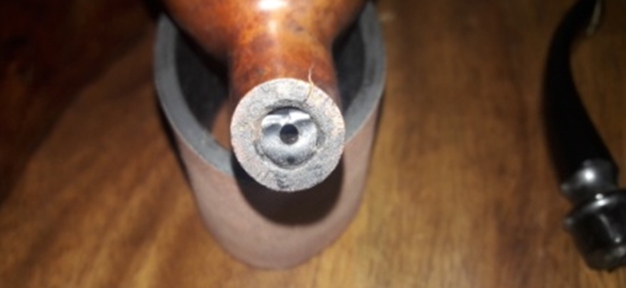
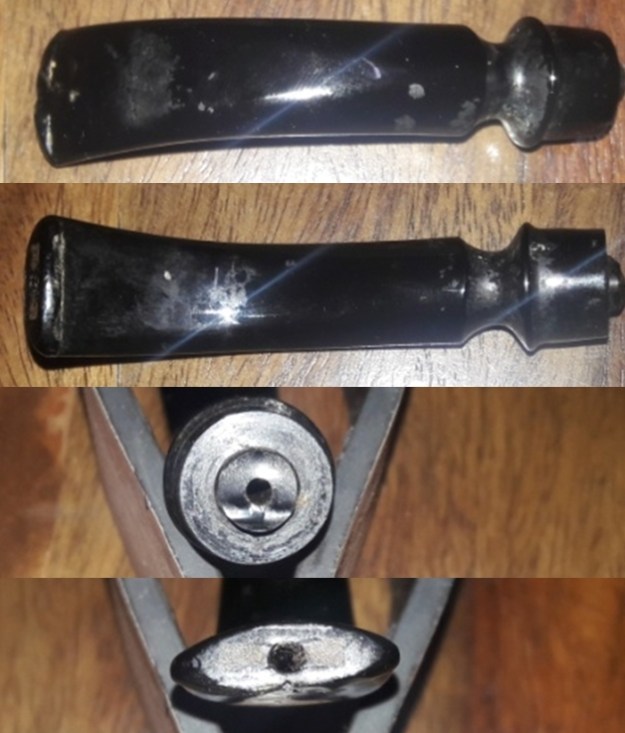
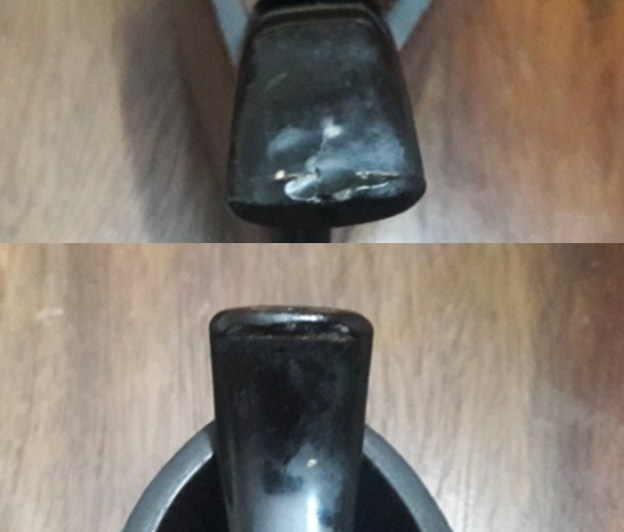
I began the process of refurbishing this pipe with cleaning the internals of the stem using pipe cleaners with isopropyl alcohol (99.9% pure) and dunking the stem in to “Before and After Deoxidizer” solution developed by my friend Mark Hoover. The solution helps to draw out heavy oxidation to the surface making its removal a breeze, while the minor oxidation is eliminated to a very great extent. I usually dunk stems of 5-7 pipes that are in-line for restoration and this pipe is marked in pastel blue arrow. I generally allow the stems to soak in this solution overnight for it to work its magic.With the stem soaking in the deoxidizer solution, I decided to remove the broken portion of the tenon from the shank. I select a drill bit that was slightly bigger than the tenon airway opening and mount it on my hand held drill. Very gently holding the drill absolutely straight, I give the drill machine a few forward turns. Once the drill bit is firmly embedded in to the broken tenon, I turn the drill machine in reverse. The reverse turns pull the broken end of the tenon out from the mortise. I breathe a sigh of relief as this is a very delicate step and a lot of things can go wrong if not executed with precision and patience. I further work the stummel, reaming the chamber with my PipNet reamer using head sizes 1 to 3. Using my fabricated knife, I further ream out the cake from places where the PipNet reamer could not reach and follow it with sanding the chamber walls with a 220 grit sand paper. I wipe the chamber with isopropyl alcohol and a cotton swab to remove all the carbon dust. This final cleaning of the chamber reveals a minor indentation in the wall opposite the draught hole, a result of over enthusiastic use of pipe cleaners to clean the mortise (marked in yellow semi- circle)!! Though not a major issue now, one will have to be careful with using pipe cleaners in future. Next, I clean the mortise with hard bristled and regular pipe cleaners dipped in isopropyl alcohol. I scrub the external surface of the bowl with undiluted Murphy’s oil soap and hard bristled tooth brush and dry it using paper towels and soft cotton cloth. I carefully clean the plateau rim top with a soft brass wire brush to remove the accumulated dirt and debris from the surface. Thereafter, I clean the mortise, plateau rim top and stummel surface with anti-oil dish washing soap on a shank brush and a tooth brush. The entire stummel, including the plateau rim top, cleans up nicely. I set the stummel aside to dry out naturally. The smells from the pipe, though reduced, are still very strong. Close observation of the stummel reveals the culprit to be the now moistened accumulated gunk in the mortise. Using my dental tools, I assiduously pick out and clean the mortise of all the gunk. I also clean the mortise with q-tips and alcohol. The amount of old grime that is scraped out from the mortise itself tells the story. The mortise is now clean and smells fresh.Moving ahead, I now address the crack that is seen on the right side of the shank, extending from the shank end to nearly half distance towards the stummel. Firstly, I clean off all the debris that is lodged in the crack using dental floss. The thin floss cleans the crack of all the dirt without widening it.I follow up this cleaning of the crack by marking the end points and turning points of the crack with a sharp dental pick. These marks help to guide the drill bit when drilling the counter hole. I take care that the drill is just sufficiently deep enough to arrest the further spread of the crack and not a through hole.I fill this crack with a mix of CA superglue and briar dust. To ensure a tight fill I clamp it down with pliers till the mix had cured, which by the way, is instantaneous!! Once the repair has cured for couple of hours, I sand it down with a flat needle file to achieve a rough match with the rest of the stummel surface. I fine tune the match with  220, 400 and 600 grit sand paper.To further stabilize the crack and prevent it from splitting again, I decide to place a band over the shank end. I select a band that is a tad bit smaller than the shank end diameter. When I place this band over the shank end, I realize that the last two letters of the stamping are being masked. I decide on grinding away the excess material from the band with my sanding drum mounted on a hand held rotary tool to a size which while being appropriate to stabilize the crack will not mask the stampings. The process is long and fraught with mistakes… The band has flown out of my hands a few times, since it can not withstand the stress of the sanding drum and is deformed , not to mention the time factor involved. However, through all these difficulties, I have prevailed to shape a band for the shank end. This is the pictorial depiction of the process and the result. Once I am satisfied with the fit, I heat the band with a heat gun in order to expand it and fix it over the shank end. I have avoided gluing it securely in place just in case I may have to revisit the entire process and go for a fresh band. Here is how the band fits over the shank end. Truth be told, I am not very confident that the band would be a success given the fitting of the band over the shank end. I set the stummel aside and decide to replace the tenon on the stem. I have explained in great detail the procedure that I have learnt and followed while replacing the tenon on a Preben Holm # 7 FH pipe. To avoid repetition of the process, I would request all to refer to the write up and other literature on the subject that is available on rebornpipes.
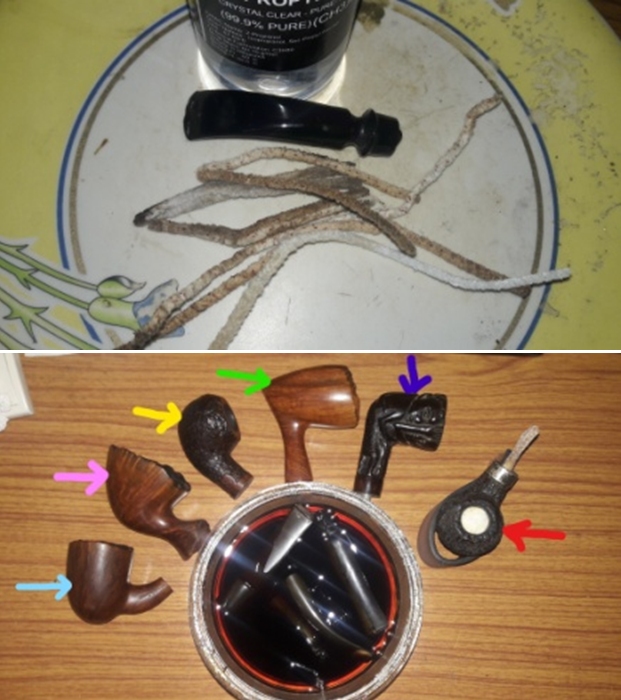
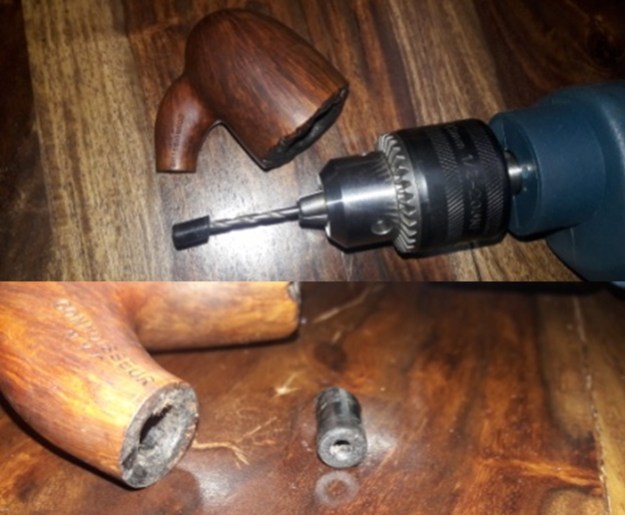
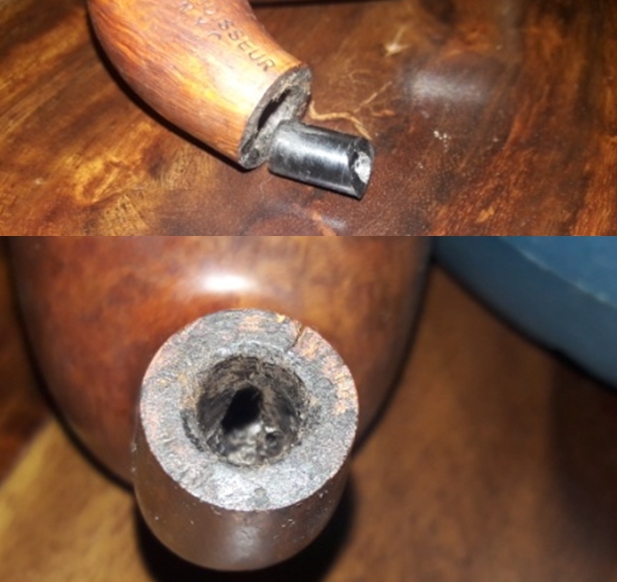
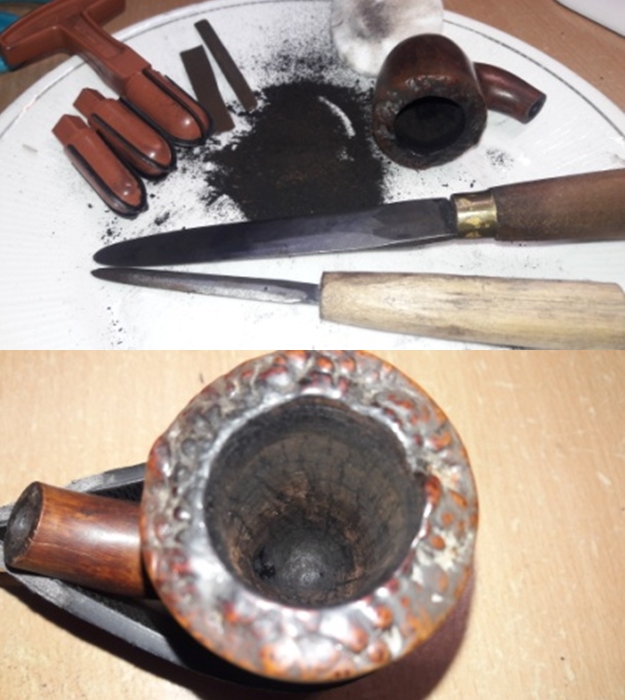
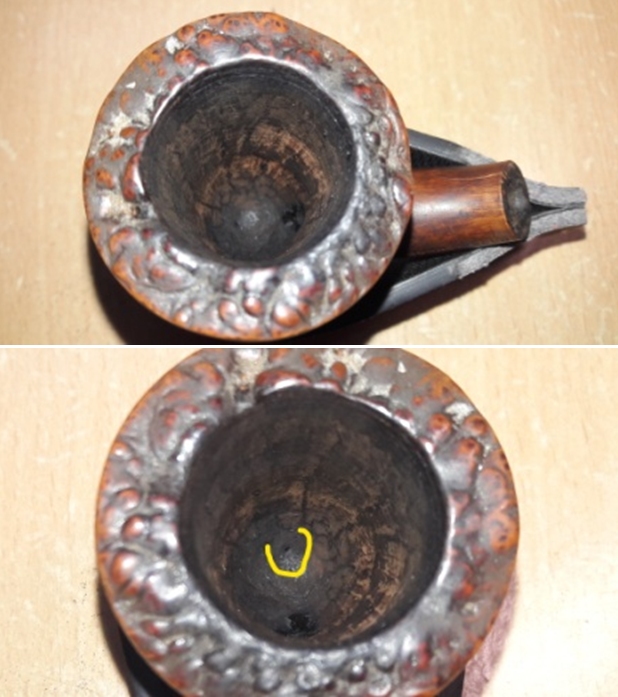
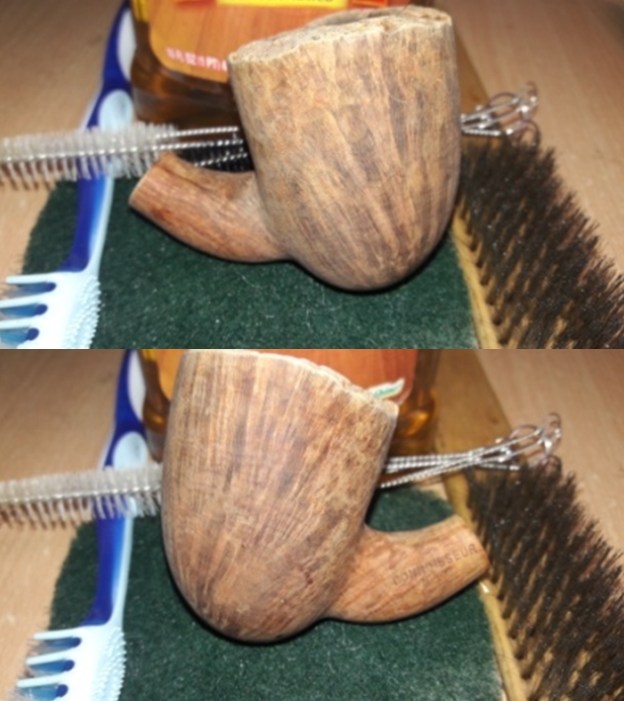
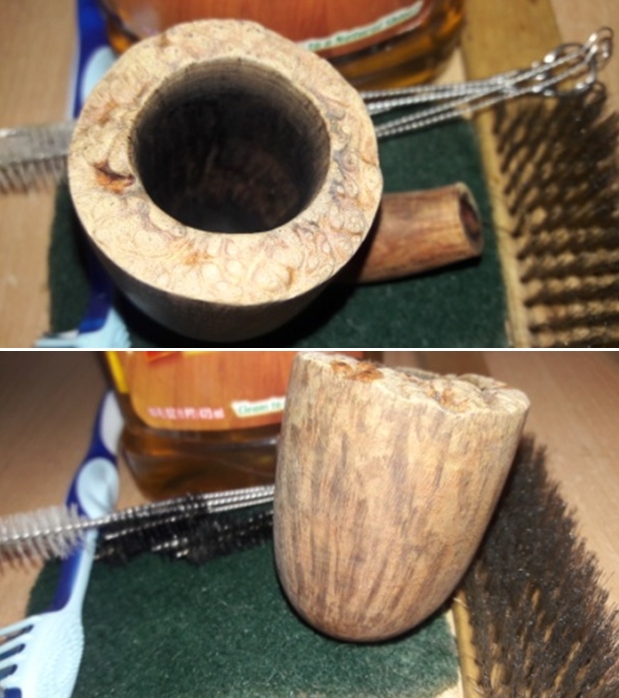
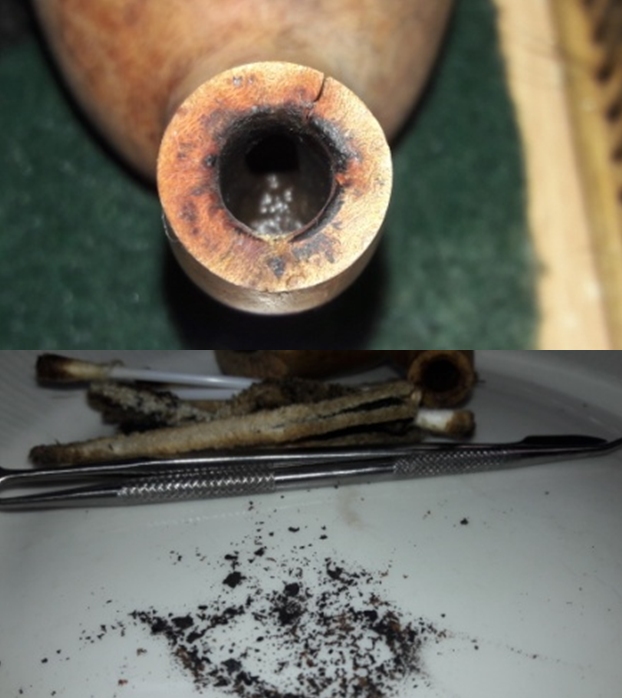
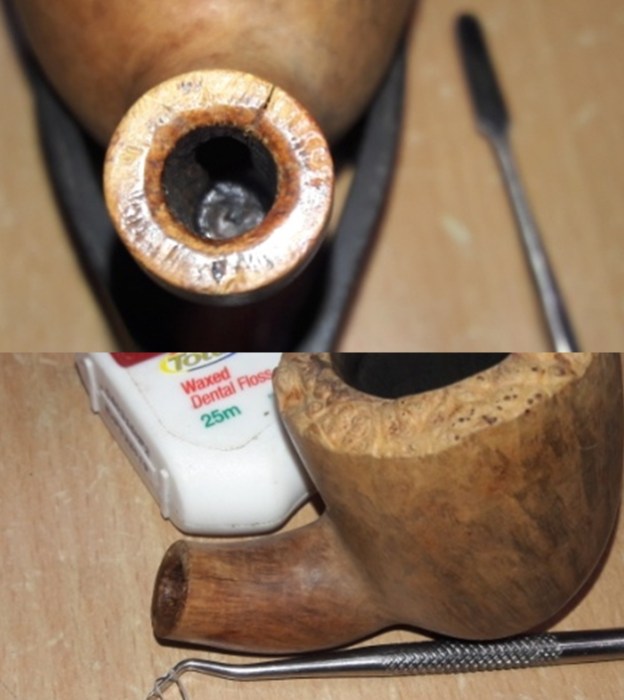
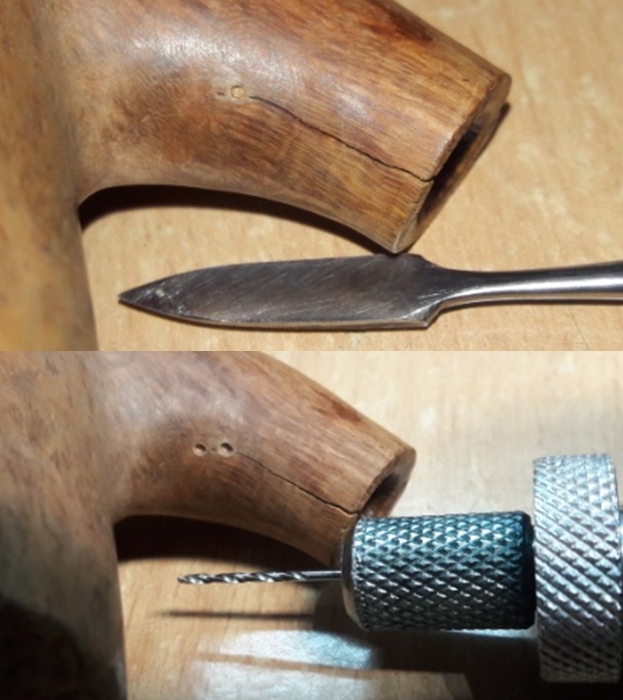
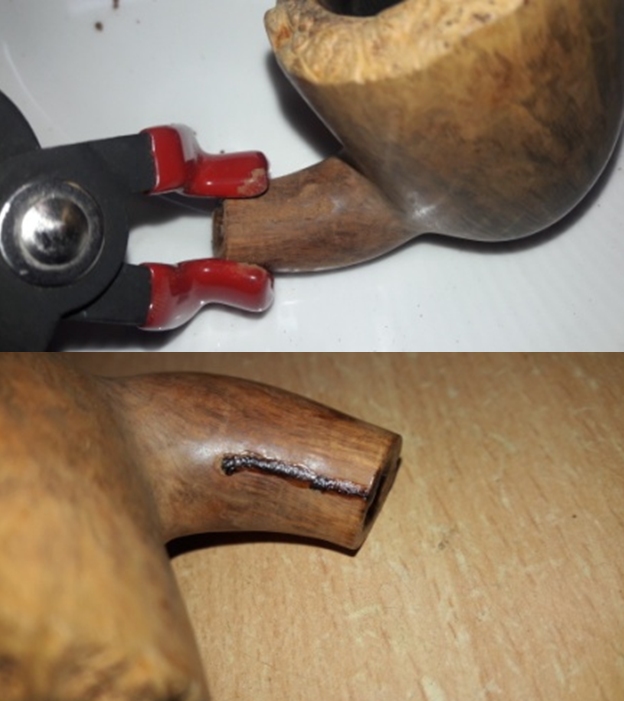
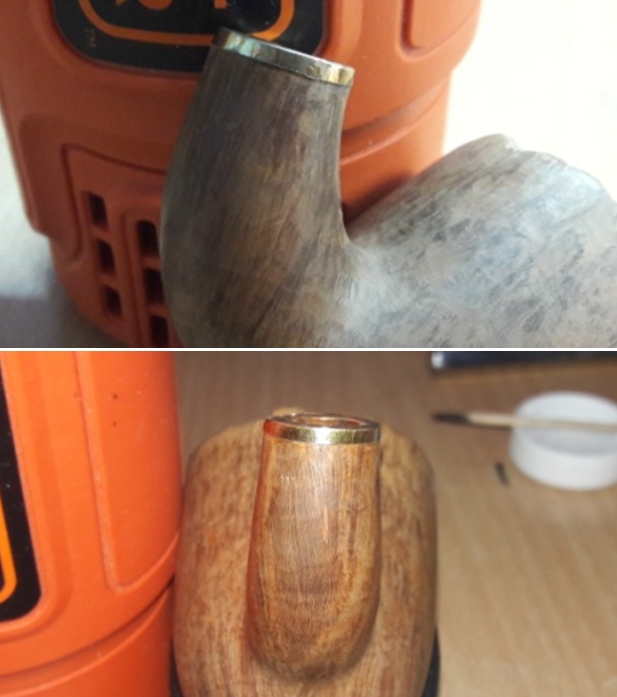
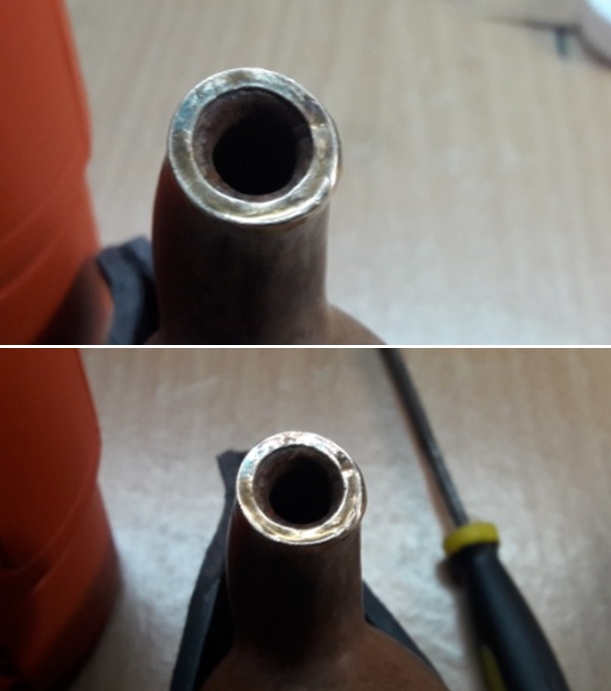
Given below are a series of sequential pictures explaining the procedure. Here I would also like to note that as I had mentioned earlier, the quality of the stem appeared circumspect and this was corroborated while drilling the stem air way to accommodate the new tenon. The plastic or some such low quality of the stem did pose a lot of resistance during the drilling and a straight drill was very difficult. However, my persistence has paid off and I am happy with the replaced tenon. Once the tenon is replaced, I try the fit of the stem in to the mortise. The fit though snug, reveals gaps and the seating of the stem in to the mortise is not flush. No amount of tweaking and minor adjustment by sanding of the tenon can ensure a flush seating. I feel that I have botched up the banding of the shank end and that is what has caused this issue. Here is how the seating appears after all the adjustments and tweaking. At this point in restoration, I shared pictures of this issue and then later in the day had a FaceTime chat with my Guru, Steve. Steve, with his vast experience and having worked on and researched a Connoisseur pipe before, immediately commented that the stem is not the right style for Connoisseur pipes and could be a replacement stem. I have another Connoisseur pipe (which awaits restoration) with a saddle stem in my collection and when the stem of this freehand was compared, it was no where near the quality that was seen on the other saddle stem. The pictures below show the difference in quality of the stem material and finish between the two pipes. Thereafter we discussed the shank band and he suggested to reband the shank end while going in for a completely new stem. Thereafter, we went through my can of spare stems and selected one that would be the best match for this pipe. Here are the pictures of the shortlisted stem. The slightly bent stem with all the calcification is the one that would replace the one that the pipe came with. The shortlisted stem, I am afraid, is not in the best of condition. The tapered slightly bent vulcanite stem is nearly the same length as the replaced one while being very thick at the tenon end. The quality of the re-replacement stem is very good. The stem is heavily oxidized with significant calcium deposition and deep tooth indentations in the bite zone on either surfaces of the stem. A couple of deep chips are seen along the seam on either sides as well as on the lower and upper surfaces of the stem. The button surfaces on either side has bite marks and the edges are equally damaged and deformed. The tenon and the horizontal slot shows heavy accumulation of oils, tars and gunk. All in all, the refurbishing and shaping of this stem presents a ton of effort and time.I begin the refurbishing and reshaping of the stem by first cleaning the stem, both internally and externally. With my fabricated knife and a paper cutter, I remove the entire calcium sediments from the bite zone. Using a dental tool, I dislodge all the dried oils and tars from the tenon and slot end. I clean the stem internals with pipe cleaners and shank brush dipped in isopropyl alcohol. I sand the entire stem surface with a folded piece of 150 grit sand paper to remove some oxidation as well as to even out some tooth chatter from the bite zone. Once the initial cleaning is done, I move ahead for shaping/sizing the stem. The tenon is too thick for the mortise and that is my start point. I mount a sanding drum on to my hand held rotary tool and sand the tenon till I achieve a rough fit in to the mortise. During the entire process, I frequently check the progress being made as I do not want to sand too much material from the tenon, making for a loose fit.I fine tune the fit of the tenon in to the mortise by hand sanding with flat head needle file and 180 grit followed by a 220 grit sand paper. The tenon attachment with the stem is shaped with a triangular needle file. I check the seating of the stem in to the mortise after I remove the shank band. The stem fit is nice and snug. Before I move to the final fit and shaping of the stem, I decide to reband the shank end. This time I select a band that was a snug fit as against a size smaller as I have done earlier. To reduce the thickness of the band, this time I manually sand it over a 150 grit sand paper instead of using my rotary tool and a sanding drum. It does take a long time, but the end result is much better. The last letter “R” has been masked, but I shall deal with it later (will I…?). I still have not glued the band in place, just to be on the safer side!!Now with the band in place, I move ahead with shaping and aligning the stem. The first thing that I proceed to do is to shave of the excess meat from the shoulders at the tenon end. Readers, when I say excess, please be aware that the word excess does not convey the quantum of excess… It  was hell of a lot of material to shave off!! I mount a 150 grit sanding drum on to the rotary tool and go to town sanding off the material from the shoulders of the stem. Once I have achieved a rough match, I use a flat head needle file to further match the fit. I progress to manual sanding with a 180 grit sand paper to fine tune the match. This is how the stem profile matches with the shank end of the stummel…not quite there but getting close. I feel that the mid region of the stem needs to be trimmed a bit and do so with a flat head needle file and a 180 grit sand paper. Here is where I have reached at this stage. Truth be told, eye balling the shape is not the easiest way to achieve the exact shape since I am always seeing it, shaping it and matching it. It’s something akin to optical illusion that I am experiencing. There is a bit of overhang at the shoulders of the stem and I need to shave off some more material from the area above it. Also a slight gap is seen at the lower end and on the left side of the stem that needs to be addressed. I decide to take a break from all the sanding of the stem and move on to shaping the stem to match the profile of the stummel. I insert a pipe cleaner through the stem’s air way to prevent it from collapsing once the stem is heated. I first straightened the stem by heating it with a heat gun. To impart the requisite bend, I try to adopt the technique that my friend, Dal Stanton of PipeSteward fame, uses and that is to draw a diagram marked with the plane of the stummel rim top, a parallel plane that is required, the present profile of the stem and thereafter, the exact place and shape of the bend that is needed. Well, it is an attempt that I made, but ended up eye balling the exact bend to be imparted. I heat the stem with my heat gun till the vulcanite becomes pliable and gives it the necessary bend. I hold it in place till the stem had cooled down a bit and thereafter, hold the stem under cold water for the bend to set. The next issue that is addressed is of the stem repairs. I insert a triangle shaped index card covered in transparent tape in to the slot. The tape prevents the mix of superglue and charcoal from sticking to the index card. I mix superglue and activated charcoal powder and generously apply it over the bite zone, including over the button. I also fill the couple of deep chips along the seam on either sides as well as on the lower and upper surfaces of the stem with the charcoal mix and set it aside to cure. Once the mix has cured, I remove the index card from the slot. While the stem fill is set aside to cure, I polish the stummel with micromesh pads, wet sanding with 1500 to 12000 pads. This time around, I do not repeat the mistake of polishing the plateau rim top as I had done with the PH # 3 earlier! I wipe the surface with a soft cloth at the end of the micromesh cycle. The stummel looks amazing with a deep shine and beautiful straight grains popping over the stummel surface. I rub a small quantity of “Before and After Restoration Balm” in to the briar. I rub this balm deep in to the nooks and crannies of the plateau rim top surface with my fingers and let it rest for a few minutes. The balm almost immediately works its magic and the briar now has a nice vibrant appearance with the dark brown hues of the grain contrasting with the rest of the stummel surface. I further buff it with a horse hair shoe brush. The appearance of the stummel at this stage motivates me further to complete this project at the earliest. I set the stummel aside and all that remains was to shape, align and polish the stem! Now motivated with the appearance of the stummel, I turn my attention to the stem repair. The fills have cured nicely and I move ahead and began the process of filing and shaping the button end with a flat head needle file. At this stage, I get in touch with Steve on Face Time and discuss the progress on the stem. He suggests that a slightly sharper bend to the stem from near the bite zone would accentuate the shape and flow of the shank with that of the stem. He also suggests that the profile of the stem near the shoulder and mid region needs to be more slender. So, it is back to heating the end of the stem with the heat gun and giving it the desired bend, of course, eyeballing it to the desired shape!As discussed with Steve, with a flat needle file, I shave off some more vulcanite from the shoulder and the mid region of the stem. I further sand the stem with 220, 320, 400, 600, 800 grit sand papers and finally with 0000 grade steel wool. I wipe the stem with a cotton pad dipped in alcohol to remove the resultant dust and rub some extra virgin olive oil onto the stem and set it aside to be absorbed.I polish the stem with micromesh pads, wet sanding with 1500 to 12000 grit pads. I rub a little extra virgin olive oil in to the stem at the end of the micromesh pads polishing cycle. I complete the polishing regime of the stem by rubbing a small quantity of Extra Fine Stem polish developed by my friend Mark Hoover, and giving it a final polish with a soft cotton cloth. The stem is now nice, smooth and shiny.To apply the finishing touches, I first mount a cotton cloth buffing wheel on to my hand held rotary tool and apply a coat of Blue Diamond to the stummel and the stem to polish out the minor scratches. Boy, am I glad to finally have reached the home run stretch to complete this project!! I shared these images with Steve for his comment. He suggested that the shoulder overhang needs to be reduced and under belly to be straightened out more.Well, here I was back with a flat needle file and 220 grit sand papers as against carnauba wax and rotary tool!! I again diligently worked on these issues, frequently checking for progress being made. Once I am satisfied that the shoulder overhangs and under belly issues have been resolved, I check the seating of the stem in to the mortise. The seating is canted backwards. I address this issue by heating the tenon and slightly pushing it upwards (that is, in the opposite direction). I check the seating and am quite pleased by the overall appearance of the stem and its seating. Thereafter, I go through the entire regime of sanding and polishing as explained above. At the end of the micromesh pads, I complete the polishing regime of the stem by rubbing a small quantity of Extra Fine Stem polish developed by my friend Mark Hoover, and giving it a final polish with a soft cotton cloth. The stem is now nice, smooth and shiny. With a cotton buffing wheel that I use for carnauba wax, I apply a coat of carnauba wax to the stummel and stem and continue to work on it till the complete coat of wax is polished out. I mount a clean cotton cloth buffing wheel and give the entire pipe a once over buff. I finish the restoration by giving the entire pipe a rigorous hand buffing using a microfiber cloth to deepen the shine further. The finished pipe is shown below. P.S. – This project was more tedious than I had anticipated, mostly because of my own faults and errors in judgement.  But then, isn’t this the fun part of being of the learning curve? I shall be avoiding the following in my future restorations:
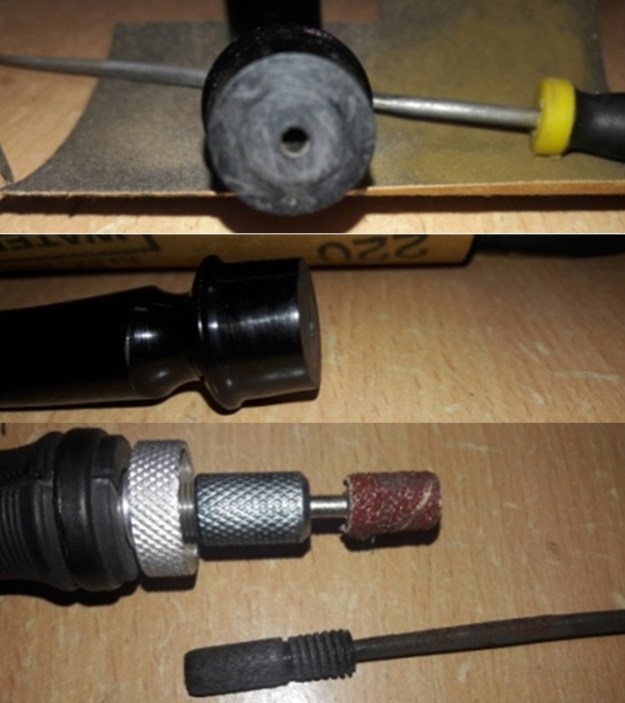
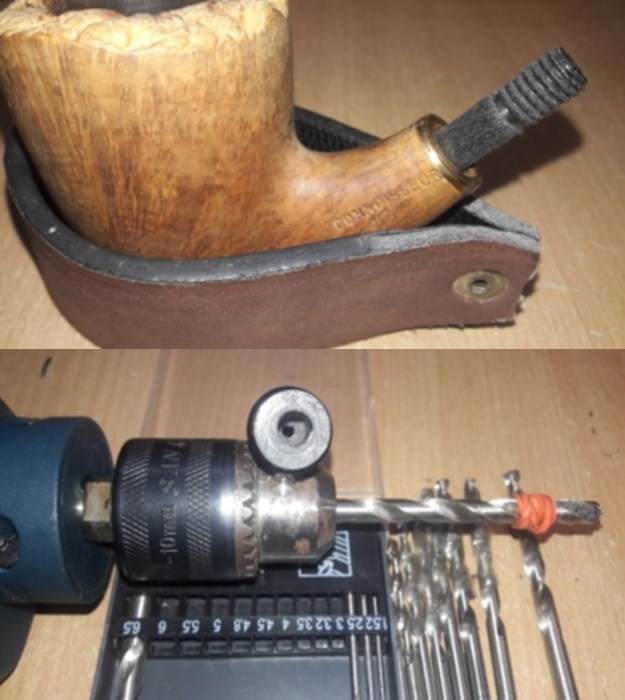
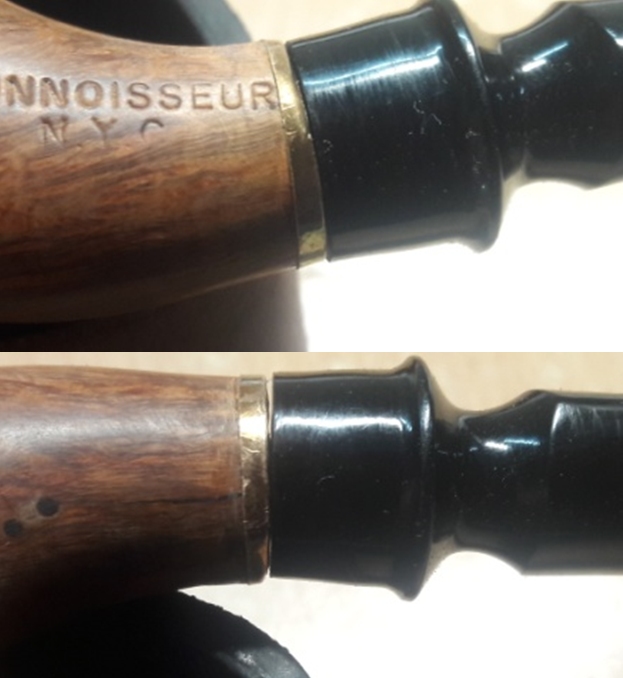
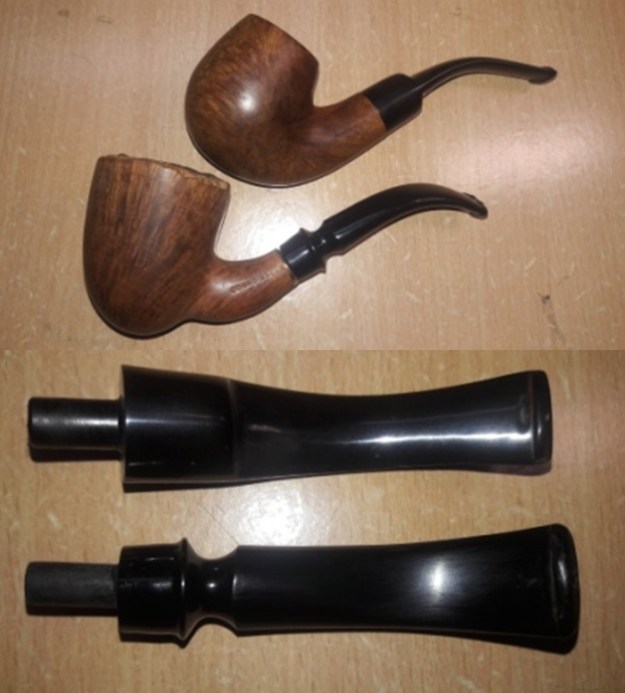
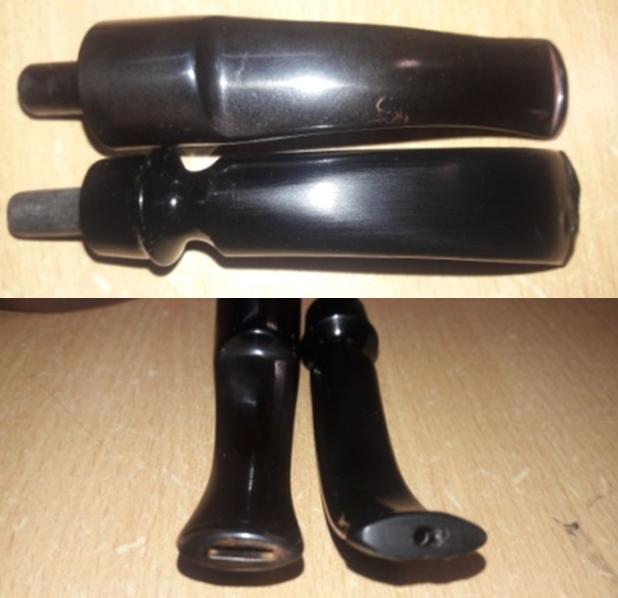
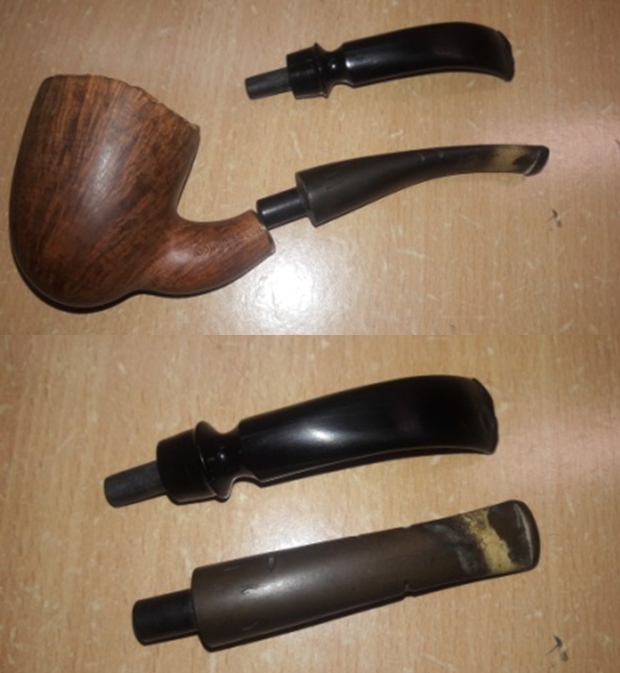
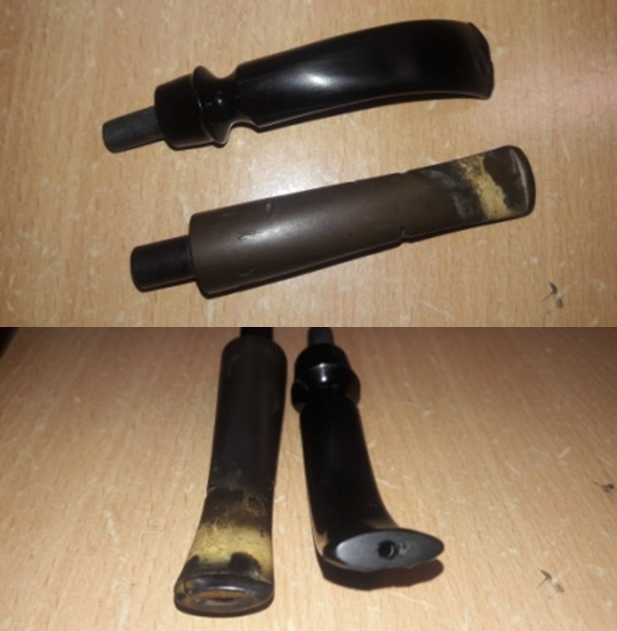
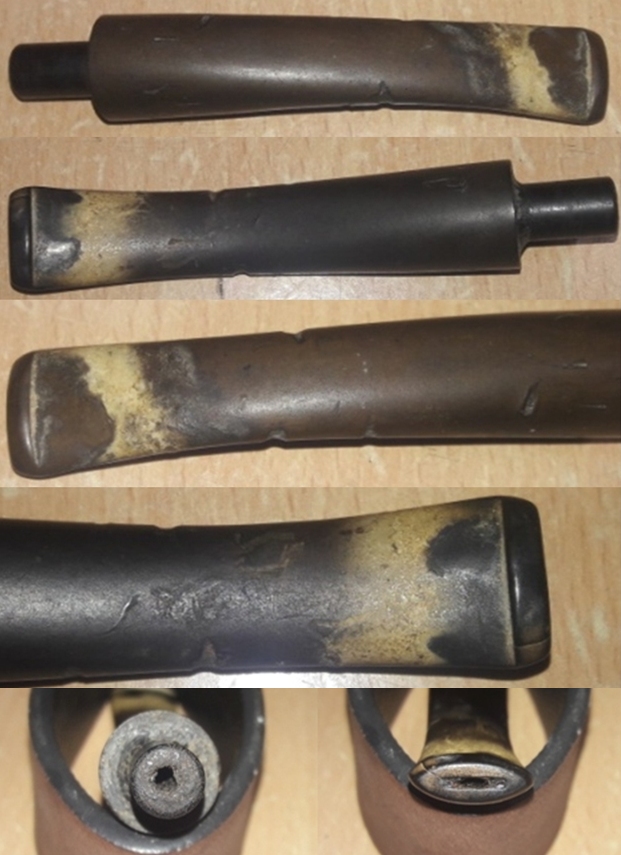
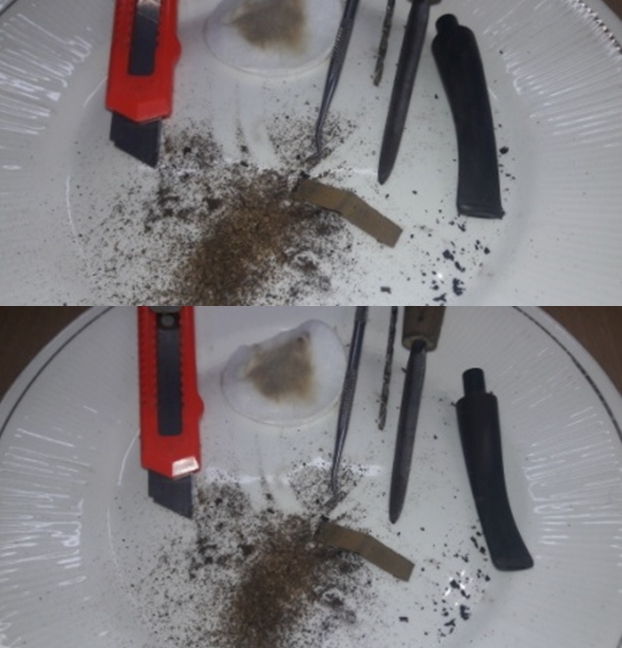
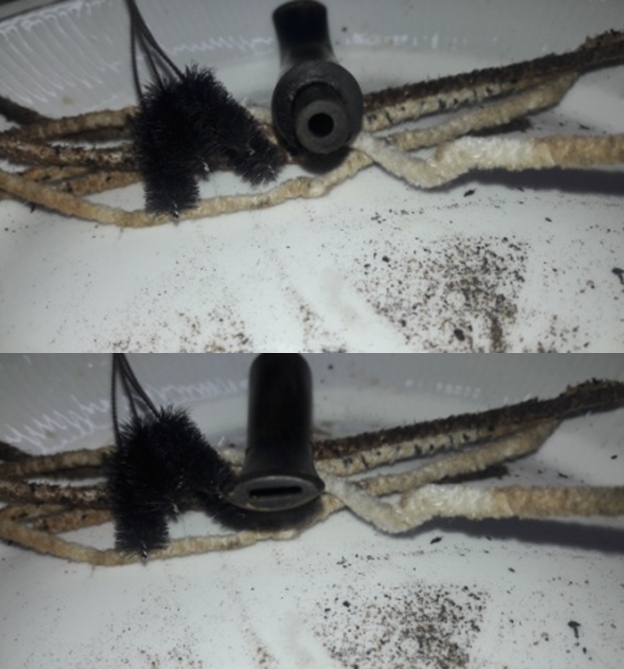
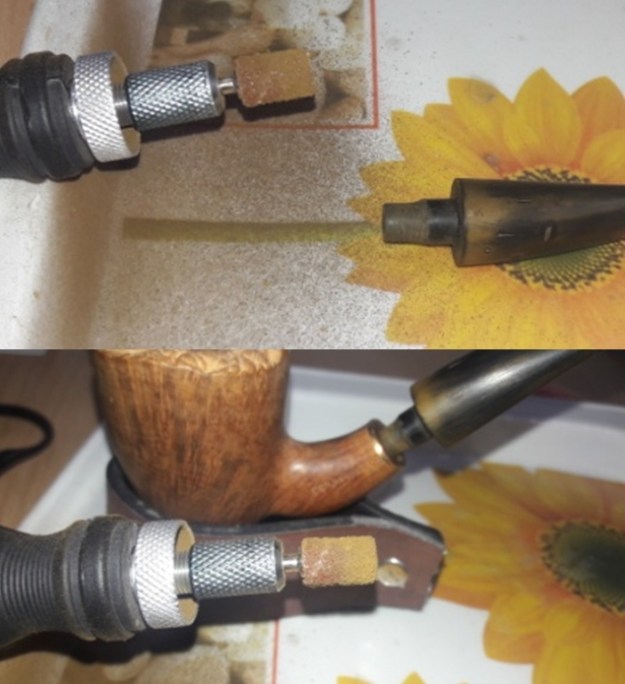
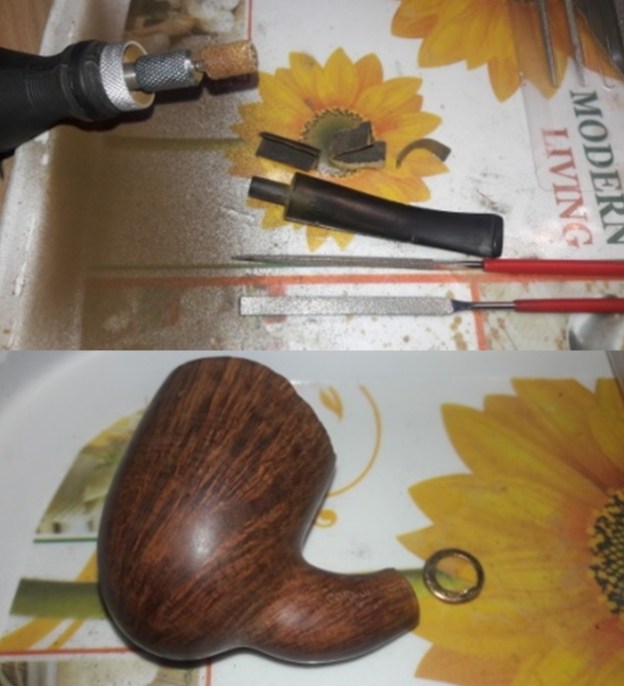
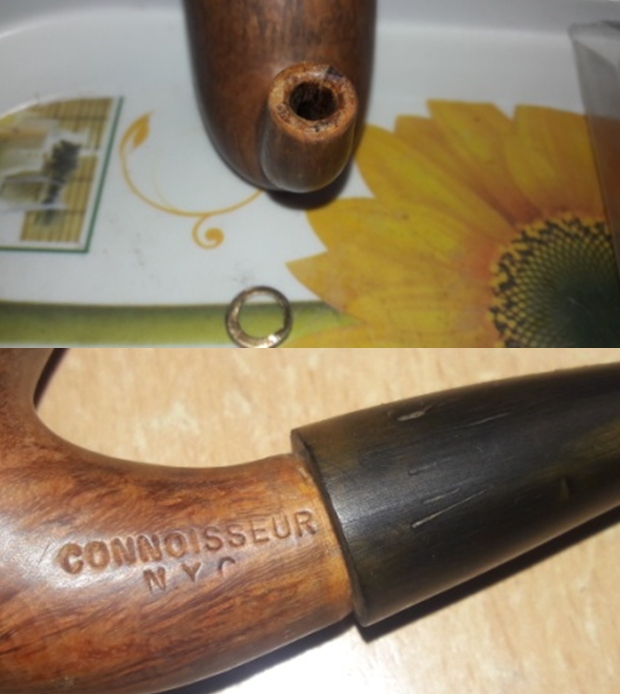
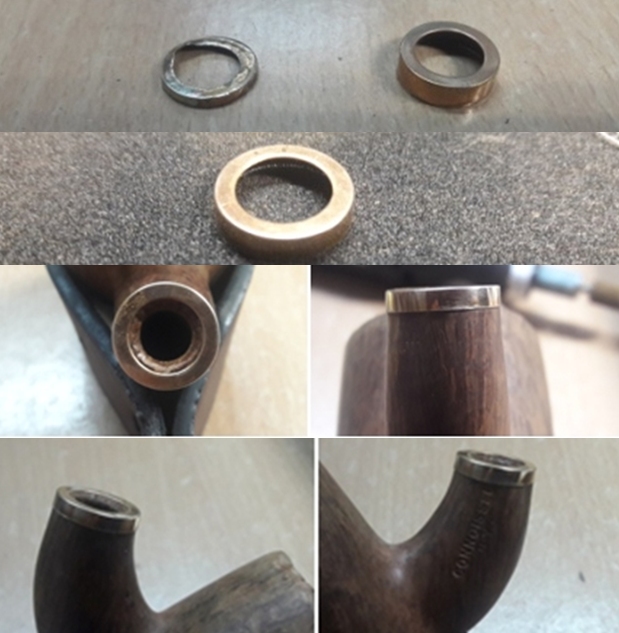
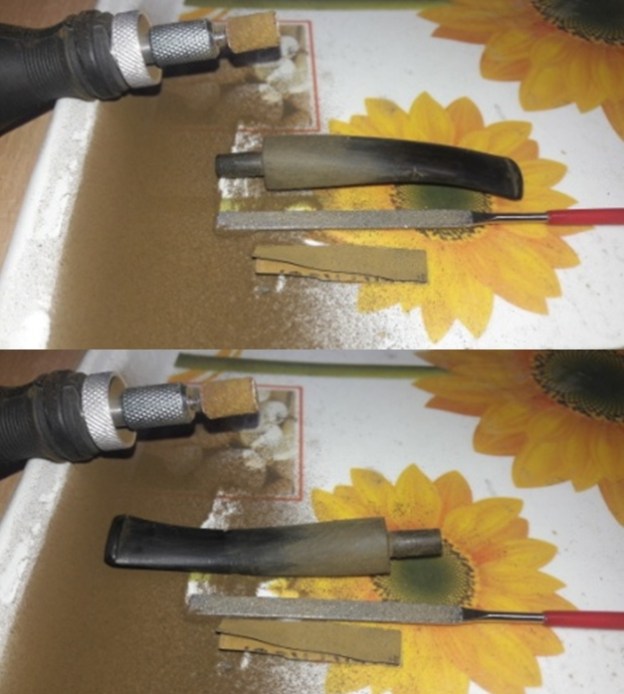
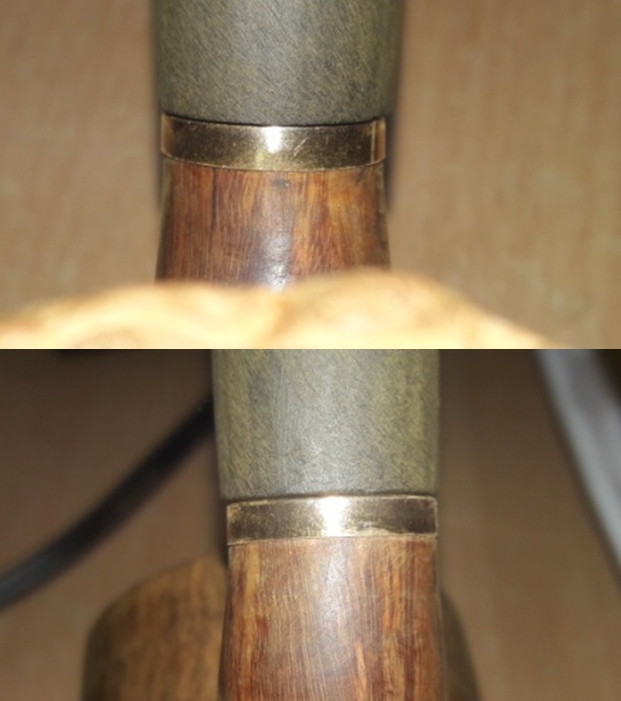
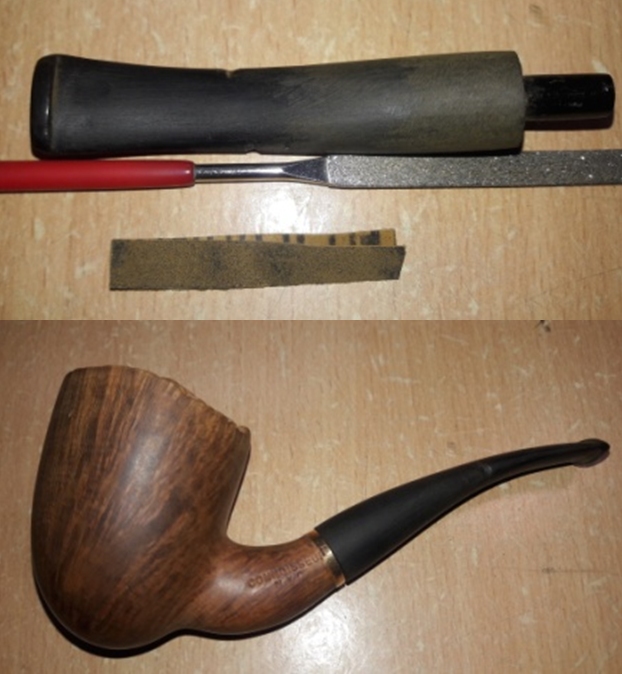
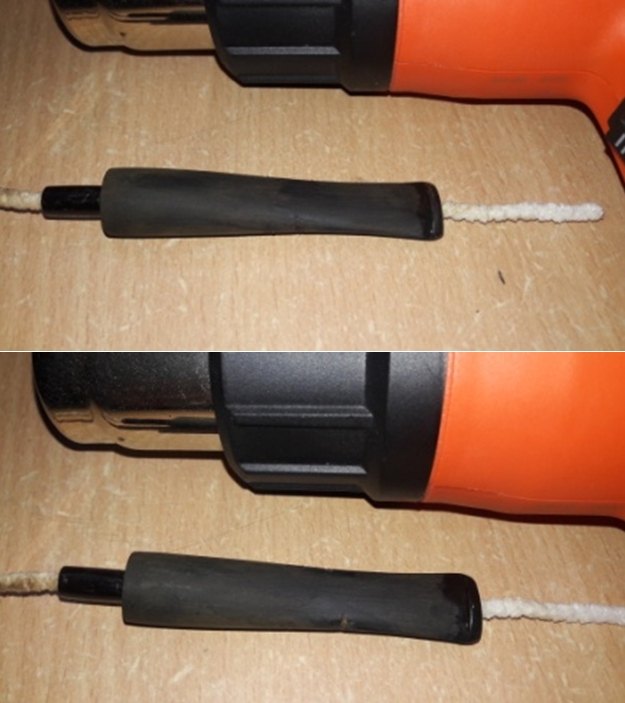
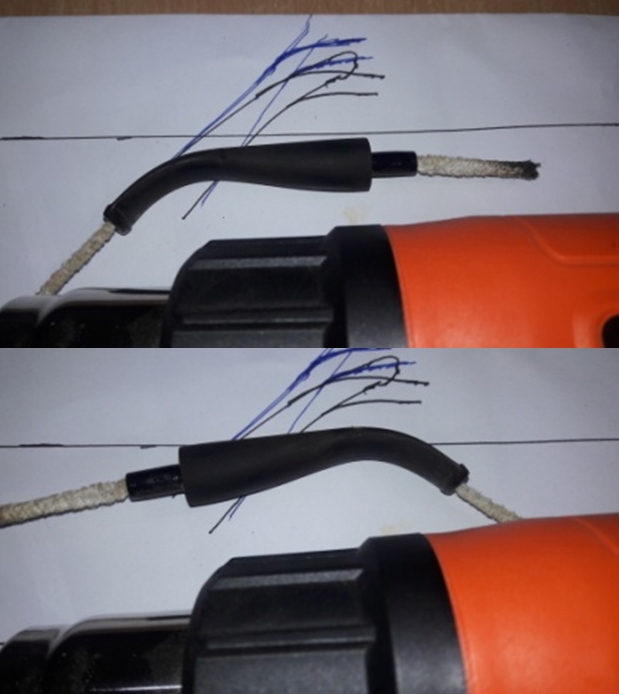
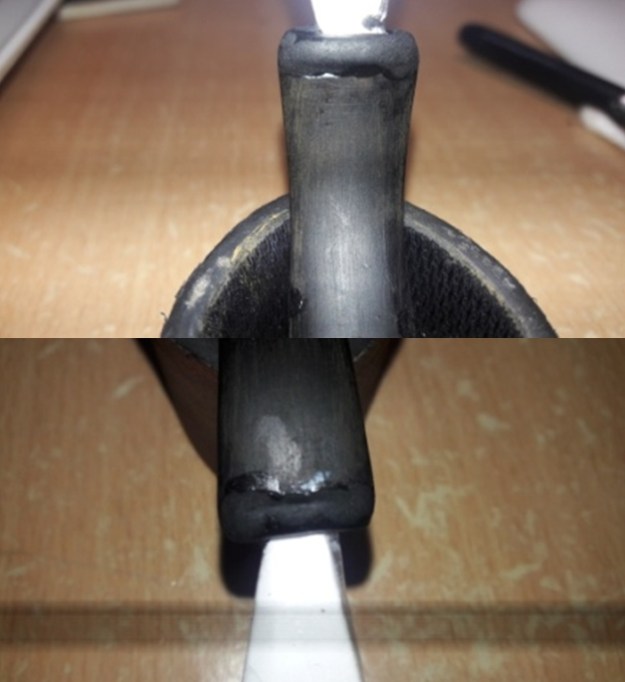
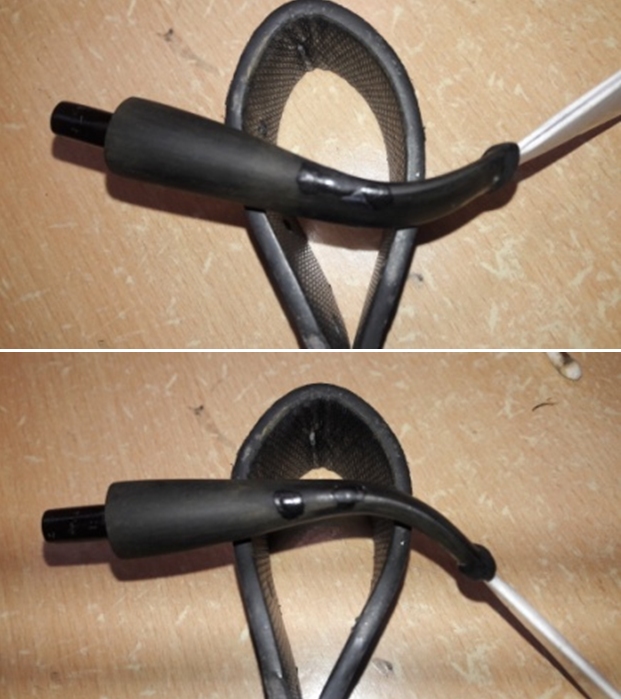
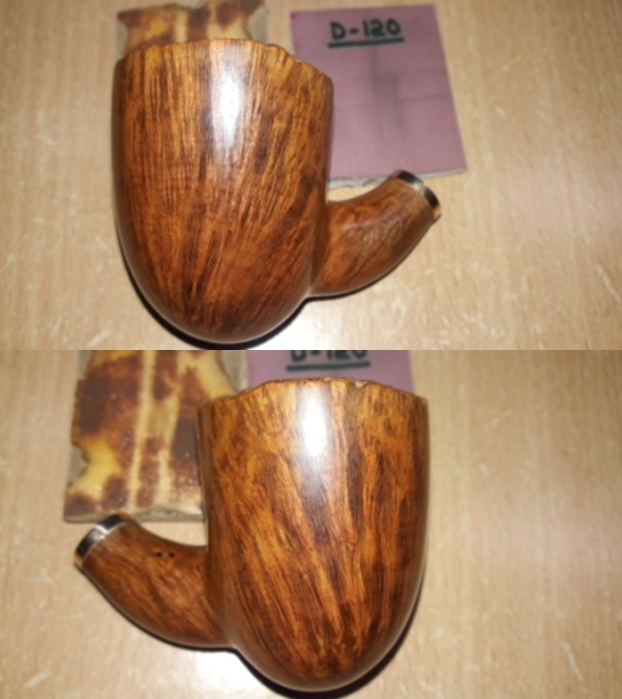
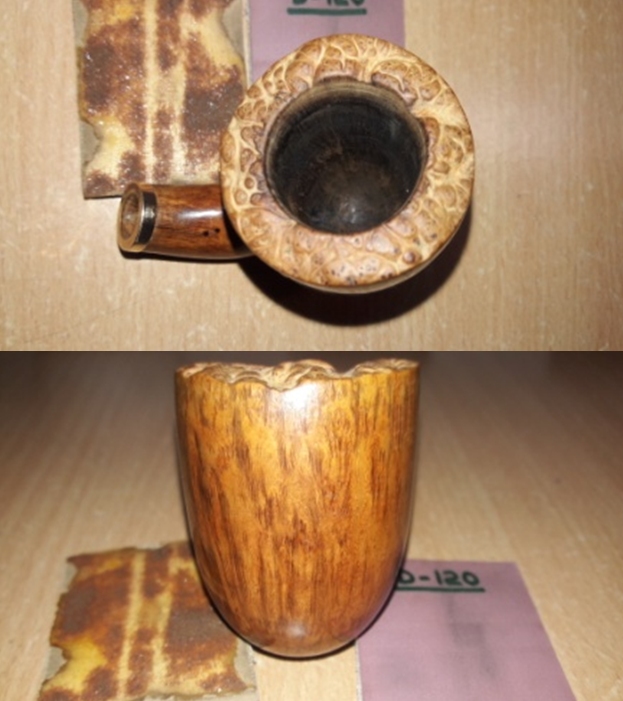
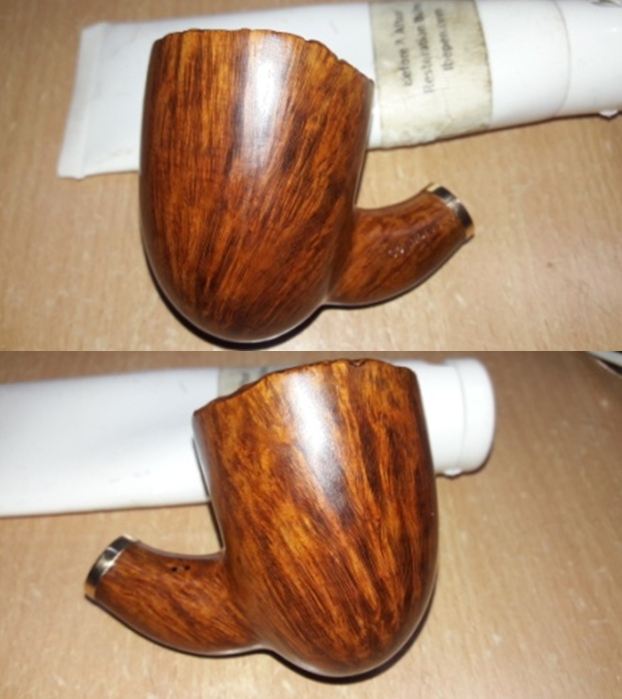
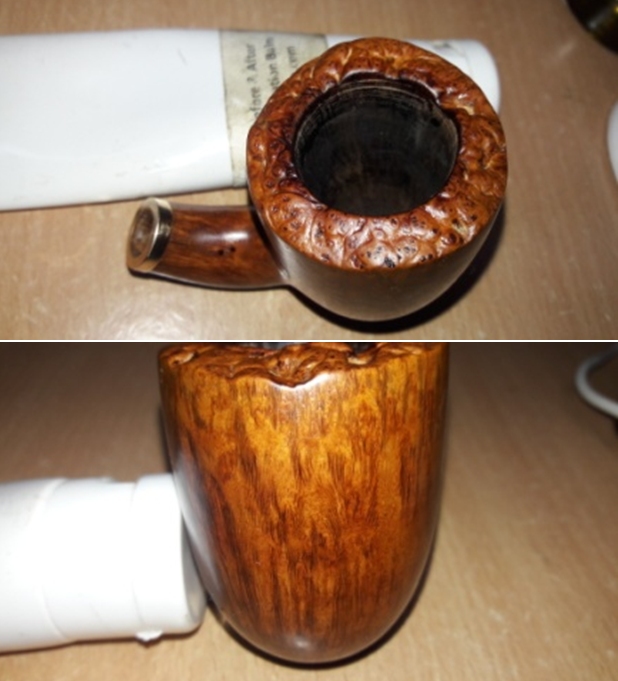
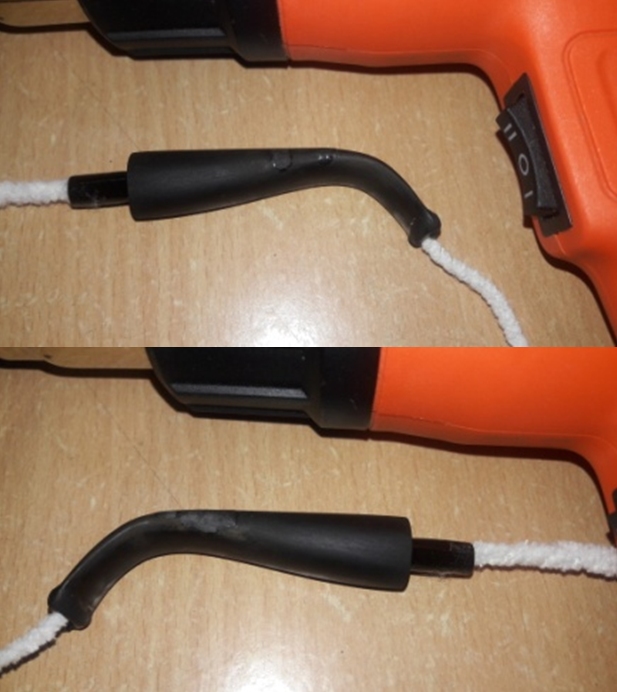
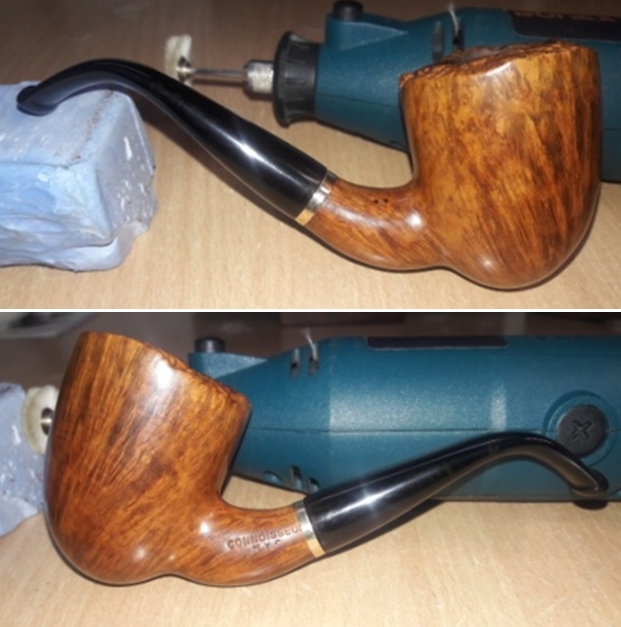
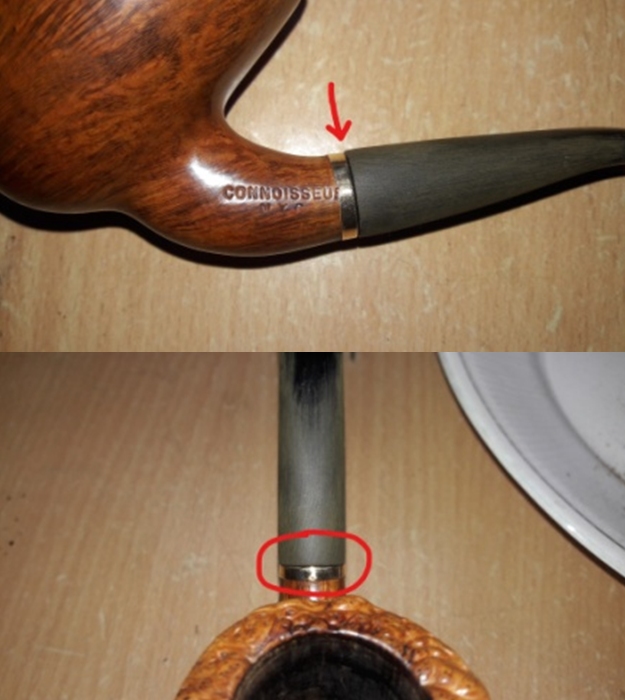
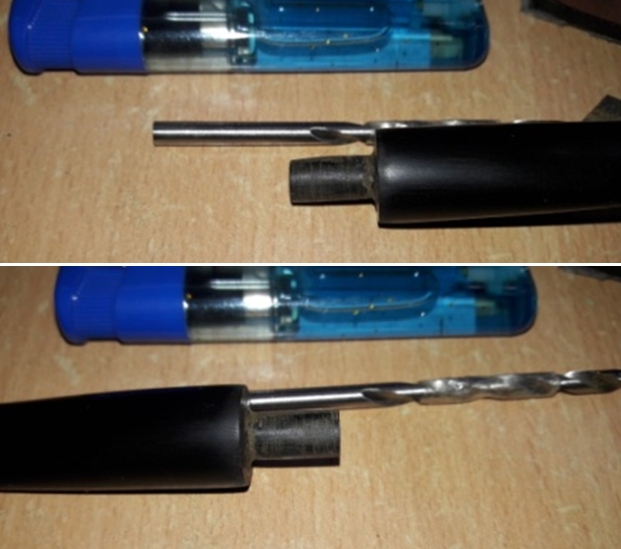
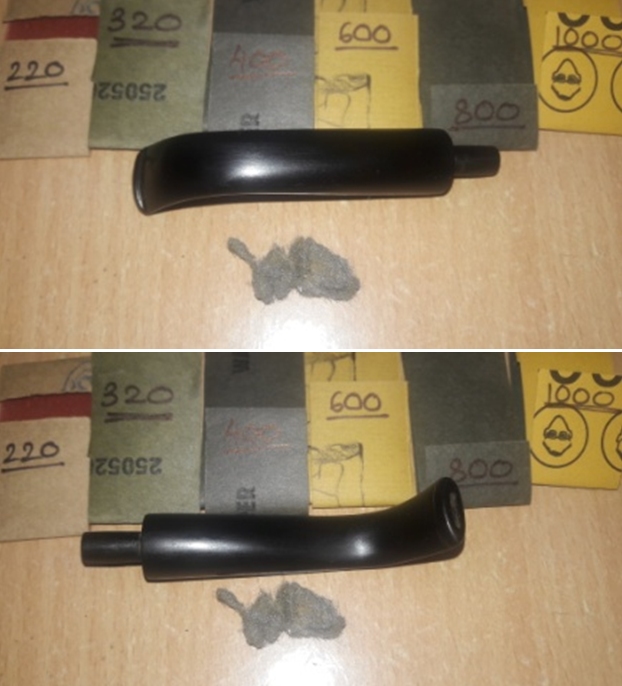
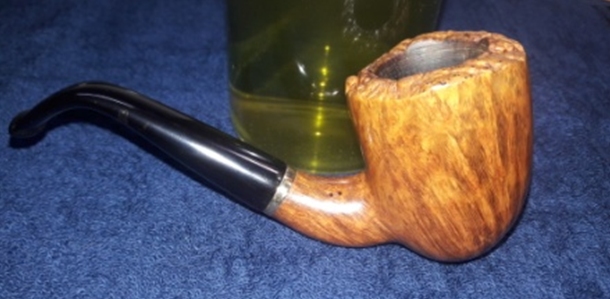
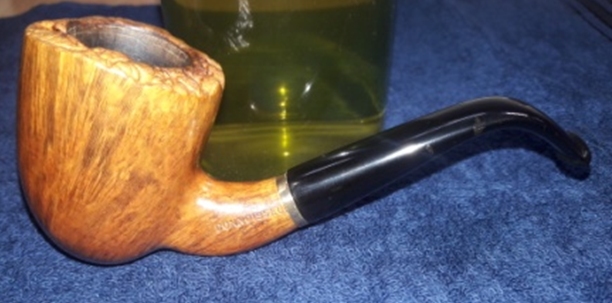
(a) Using a band that is a tad smaller then the shank end diameter. I would rather use a band that has a snug and perfect fit over the shank end.

(b) Using a rotary tool with a sanding drum to get the band to the desired size. It’s better, safer and precise to manually sand the band on a sand paper.

(c) Clamping the shank end after filling a crack. I am not sure, but I think that the clamping down may have caused a slight deformation that had caused me such grief with the seating of the stem.

(d) Less reliance on “eye balling” for sizing and shaping…need to get on with hunting for a “PIMO TENON TURNING TOOL” and a set of “VERNIER CALIPERS”.

I am really fortunate to be in the process of learning the nuances of pipe restoration and cannot thank Steve enough for his support and guidance.

Thanks for your patience and looking forward to input about the write up. Cheers…

An Easy Restore – an Il Ceppo 1 Hand Made Paneled Horn


Blog by Steve Laug

The next pipe on the worktable is another one that I have been looking forward to working on. It is a large Il Ceppo Paneled Horn. The pipe is in very good condition when he took it from the box. There were not a lot of issues to deal with in the cleanup and restoration. It is stamped on the underside of the diamond shank 1 in a circle followed by Il Ceppo followed by Hand Made Italy. The pipe is horn shaped. It has a round rim top flowing into 5 panels down the sides of the bowl merging into a diamond shaped shank. There was some darkening around the inner edge of the rim and top toward the back of the bowl. There was a moderate cake in the lower portion of the deep bowl. The upper portions had darkened and had a thin cake. The finish was dirty and there dust in the rustication around the bowl. The black acrylic diamond shaped saddle stem had a white inlaid C on the left side of the saddle. There were light tooth marks and chatter on the top and underside ahead of the button. Otherwise the stem looked very good. Jeff took some photos of the pipe before he started his cleanup work. He took photos of the bowl and rim top to show their general condition. You can see the tars and darkening on the inner edge of the rim top. The cake in the bowl is moderate and thickening as you go further down the bowl. The rusticated finish on the bowl sides and the smooth rim top combine to make an interesting pipe.Jeff took some photos of the sides and heel of the bowl to give an idea of the unique rustication on this particular piece of briar. It is quite stunning with the smooth rim top and the diamond shaped shank end. I cannot wait to see what it looks like once it is cleaned and polished. He took a photo of the stamping on the left underside of the diamond shank to capture it for me. It is clear and readable. The encircle 1 followed by the il ceppo stamp and then Hand Made Italy. He included a photo of the inlaid C on the left side of the saddle stem.The black acrylic stem is in good condition other than being dirty and having light tooth marks and chatter on the both sides of the stem at the button. The photos below show the condition of the stem.Not too long ago I worked on an il ceppo large sandblast billiard and had done some research into the brand (https://rebornpipes.com/2020/01/25/life-for-a-beautiful-sandblast-il-ceppo-made-by-hand-triangle-1-billiard/). I turned to that blog and reread the information that I had included there. I took the liberty to include that below.

I turned then to Pipedia to see what I could find out about Il Ceppo pipes. I read through the Il Ceppo page written by the pipemaker and then the next section of the page written by RD Field. Here is the link to that page on Pipedia (https://pipedia.org/wiki/Il_Ceppo).  I will quote from the section on the line below.

The il ceppo brand has been in production since the late 1970’s but, in spite of its overall good value, is not well known in all parts of the United States. Partly this is because of a limited supply of pipes and partly because the brand has not been put in front of the pipe smoking public through a national venue.

The il ceppo brand is made in Pesaro, Italy and is part of the famous Pesaro school of design that has also produced Mastro de Paja and Ser Jacopo. That all three brands have similar characteristics can be seen at a glance, but they all have significant differences as well.

Giorgio Imperatori, an architect, had a passion for pipes, and in 1978 began to design and make Il Ceppo. Always considered a good value and very good for smoking, the brand did not make folks stop and take notice until 1995 when Franco Rossi joined the firm. He brought with him a true elegance of design and a unique flair that now helps Il Ceppo stand apart. Giorgio has retired to his farmhouse, and the pipes are now all made by Franco and his sister Nadia.

Individuals involved in the creation and continuation of the Il Ceppo brand are; Giorgio Imperatori (now retired from pipe making); Franco Rossi who, along with his sister Nadia, are the current Il Ceppo pipe makers; Mario Lubinski, the distributor of the Il Ceppo brand in Italy; Massimo Palazzi who worked with Il Ceppo until 1998 when he founded his own brand, L’Anatra.

I turned to Pipephil’s site (http://www.pipephil.eu/logos/en/logo-i.html) to gather additional information. I have included a screen capture below of the section on the brand.From the notes on that page it confirms RD Field’s information. Brand founded by Giorgio Imperatori in 1977 (first period) and bought by Franco Corinaldesi Rossi (second period, about 1996) when Giorgio retired. Franco and his sister Nadia are the current (2011) Il Ceppo pipe makers.

I also found that the section on the grading system on the Pipephil site was really helpful in identifying and reading the stamping on the pipe in my hands.

Grading system.

Pipes from the first period:

“Il Ceppo” stamping slightly curved, A to H and a 4-5 digit number, Group number in a triangle

Now the new information. Putting together all of the information on the pipe I can summarize what I have learned. I knew now that the pipe on my table war from the Second Period (1996-2010). The Il Ceppo stamping is a straight line on this one. The number 1 on the shank indicates a sandblasted pipe. The last point is interesting as I would not have called this a sand blasted pipe. Perhaps a good description would be “Blasticated”.

With that information I moved forward to work on the pipe itself and see what I had to do with it. The pipe looked amazing. Even the stem looked like new, with most of the tooth marks and chatter gone. There was some darkening on the edge of the rim but that too had almost disappeared. Jeff had done his normal thorough clean up – reaming, scrubbing, soaking and the result was evident in the pipe when I unpacked it. I took photos of the pipe before I started my work on it. The shape and finish on this pipe is quite beautiful! I took some photos of the rim top and stem. The rim top and bowl looked very good. The cake and the darkening on the back side of the inner edge of the rim looked better. Jeff had been able to get rid of most of the darkening. There was some light scratching that I would be able to polish out. The close up photos of the stem shows that it is a much cleaner. There was still some light tooth chatter but it was really quite minimal.I took a photo of the stamping on the underside of the shank to show the condition after the cleanup. Often the stamping takes a hit with the cleaning and is lessened in it clarity. Jeff does a great job in leaving the stamping looking very good.I removed the stem from the shank and took a photo of the pipe at this point. You can clearly see the condition, size and shape of the pipe.I started my part of the restoration work on this pipe by polishing the rim top and inner edge of the bowl. I dry sanded with micromesh sanding pads -1500-12000 grit pads. I wiped the rim top down after each sanding pad with a damp cloth. The rim top and edges look very good at this point. I worked some Before & After Restoration Balm into the surface of the briar with my fingertips and a horsehair shoe brush to get in the nooks and crannies of the “Blastication’ on the sides of the bowl. The product works to clean, enliven and protect the briar. I let the balm sit for about ten minutes and then buffed with a cotton cloth to raise the shine. The photos show the bowl at this point in the restoration process. I set the bowl aside and turned my attention to the stem. The remaining tooth chatter and marks were very minimal and I could remove them with polishing. I polished the stem with micromesh sanding pads – dry sanding with 1500-12000 grit sanding pads. I wiped it down after each sanding pad with a cloth containing some Obsidian Oil. I finished polishing it with Before & After Pipe Stem Polish – both Fine and Extra Fine and buffed it off with a cotton cloth. Putting this pipe back together was not as dramatic as it usually is but still it is rewarding nonetheless. I put the stem back on the bowl and buffed the pipe lightly with Blue Diamond on the buffing wheel. I carefully avoided the stamping on the shank sides during the process. I gave the bowl multiple coats of Conservator’s Wax and the stem multiple coats of carnauba wax on the buffing wheel and followed that by buffing it with a clean buffing pad on the buffer. I hand buffed the pipe with a microfiber cloth to deepen the shine. The finished pipe is a real stunning example of a Horn shaped pipe. The “Blasticated” grain and the way the shape follows it is very well done. Give the finished pipe a look in the photos below. I can only tell you that it is much prettier in person than the photos capture. The dimensions of the pipe are Length: 7 inches, Height: 3 inches, Outside diameter of the bowl: 2 inches wide x 2 inches long, Chamber diameter: ¾ of an inch. This interesting il ceppo Italian Hand Made 1 Horn is a great looking pipe in excellent condition. Thanks for walking through the restoration with me as I worked over another beautiful pipe. I will be adding it to the rebornpipes store soon. If you want to add it to your collection send me an email or a message! Thanks for your time.

Crème de la Crème – There are just some pipes that leave you speechless


Blog by Steve Laug

This is one of those pipes that have to be seen to truly appreciate the craftsmanship that went into it. In my title for this blog I called Crème de la crème which in French literally means ‘cream of the cream’. It is an idiom meaning “the best of the best”, “superlative”, or “the very best”. You may not like the shape; I have to admit I did not when I first saw it. My speechlessness at first was over how odd and ugly the pipe was at first glance. It is not one that I would naturally gravitate to that is for sure. However, you cannot deny the sheer craftsmanship that went into this pipe as you turn it in your hands and look at all the various angles and asymmetrical twists in the bowl and stem. It is quite singularly stunning and certainly a pipe that I did not expect to see or work on. The pipe is stamped Butz Choquin over Cybele 3 on the heel of the bowl and underside of the shank.

How to describe this pipe? That is certainly a hard this to capture the craftsmanship with words. But I will try! The left side of the pipe is sandblast and literally the blast covers roughly the left half of the bowl. The rim top is smooth as is the right side of the pipe. The shank which flow directly out of the combined finishes is a mosaic of inlaid hard woods of varying colours and grains. The only pattern to them is really a lack of pattern. Looking down the pipe from the stem to the front of the bowl you can see that the shank takes a decided twist to the left and flattens out on the right. It ends at the shank end in an oval shape.  The stem is acrylic and also carries the twist even farther. It has a silver BC and inlaid star on the top of the stem. When sight down the stem from the button you will see that it is actually tipped very slightly to the left though appears to be aligned with the rim top. Jeff took photos of the pipe from a variety of angles to capture what I have tried to describe. He took a photo of the inlay work on the shank showing it from the right side. Some of you probably can name the various woods that are included in the shank but I cannot. I am fairly certain that there is a briar core and these are like a shank extension over that. They appear a bit rough in the photo and marred but all of that will be remedied in the restoration.Jeff took a photo of each side of the bowl to give an idea of the sheer contrast in terms of finish and also colour. The first shows the left side the second shows the right side. You can see the nicks in the finish on the right side as well as some potential fills.I realize as I get to this point in the blog that I have yet to describe the condition of the pipe. Okay let me do that now. I have been so caught up in trying to describe the craftsmanship and uniqueness of the design that I honestly forgot! To be honest the pipe is filthy! The sandblast portion has dust and debris in the finish. The rest of the bowl is dirty. The wood inlays are scratched, dented and the finish that protected them is worn off. The rim top has some marks and scratches in the surface. The inner edge of the bowl has some darkening and some tars and lava. The inside of the bowl appears a little odd to me. There is a cake in the bowl but what is shown in the two photos below looks like some bowl coating on the top portion that is peeling away with cake on top of it. That is strange. The stem is also dirty with tooth marks and chatter around the button on both sides.Jeff took some photos of the front of the bowl the grain on the smooth portion is really nice cross grain. The line running between the sandblast and the smooth portion is flowing and almost alive looking. It is rough because of the merging of the two finishes. Jeff took two photos of the stamping on heel and shank. The first photo shows the stamping clearly and the joint between the briar and the inlaid woods. The inlaid words are shown more clearly in the second photo. The woods are dull and lifeless looking up close. They are also rough to the touch. The stamping on the stem appears to be white but it is actually silver and is a inlaid into the acrylic. The stem is dirty and there is light tooth chatter and marks on both sides. There is also some scratching in the acrylic that is visible in the photos.I turned to Pipephil’s site to see what he had to say about this particular line of Butz Choquin pipes (http://www.pipephil.eu/logos/en/logo-butzchoquin.html). He gives me a quick summary of the history of the brand. He also says that “the Cybele model has always the same shape with a shank extension of reconstructed exotic woods”.At this point I did some research on the name Cybele. I googled the name and found a link to smokingpipes.com that was written by Eric Squires describing the name of the pipe what he thought of the pipe he was looking at. (https://www.smokingpipes.com/pipes/estate/france/moreinfo.cfm?product_id=189504). I quote:

Cybele’s role in her native Anatolian remains an unknown. Most of what we know of her comes through the ancient Greeks worshiping her as an exotic deity, or the Romans’ later adoption of her as the Magna Mater. But what’s with this pipe? Given just how exotic its shaping is, and the sweeping nature of it, I would think it was inspired by the wilder rites that came to be associated with the goddess of enigmatic origins. Definitely this is one of the stranger designs I’ve seen by B.C., but that said it does still sit well.

I also googled the goddess Cybele to get a bit broader picture of what she was about in the Greek pantheon (https://www.theoi.com/Phrygios/Kybele.html).

KYBELE (Cybele) was the ancient Phrygian Mother of the Gods, a primal nature goddess worshipped with orgiastic rites in the mountains of central and western Anatolia. The Greeks identified her with their own mother of the gods–the Titaness Rhea.

Interesting information by it really did not help me understand why Butz Choquin had named their pipe Cybele. But I think I will leave that for now and move on to the restoration work on the pipe. Jeff had done his usual thorough cleanup of the pipe. He had reamed it with a PipNet reamer and cleaned up the reaming with a Savinelli Fitsall pipe knife. He scrubbed the internals of both the shank and he stem with alcohol, cotton swabs and pipe cleaners. He scrubbed the externals with undiluted Murphy’s Oil Soap and a tooth brush. He cleaned the stem with Soft Scrub and let the pipe dry thoroughly before putting it back together and sending it to me. I took some photos of the pipe when I unpacked the box. I took photos of the bowl and rim top to show the difference the cleaning had made. There are a few nicks in the surface of the rim top but the edges look very good. The stem also looks much better. There are a few light tooth marks in the surface of the stem on the top and underside near the button.The stamping looked very clear and the scratching on the wood inlay section looked better. I took the stem off the bowl and took some pictures. I decided to polish out the scratches in the smooth parts of the bowl and the wood inlaid shank first so I used micromesh sanding pads. I dry sanded with 1500-12000 grit sanding pads and wiped the bowl down after each sanding pad to get a sense of progress. I worked some Before & After Restoration Balm into the surface of the briar with my fingertips and a horsehair shoe brush to get in the nooks and crannies of the blast. The product works to clean, enliven and protect the briar. I let the balm sit for about ten minutes and then buffed with a cotton cloth to raise the shine. The photos show the bowl at this point in the restoration process. I set the bowl aside and turned my attention to the stem. I sanded out the tooth chatter and blended in the repairs with 220 grit sandpaper and started to polish it with a folded piece of 400 wet dry sandpaper. Once it was finished it was smooth.I used some Denicare Mouthpiece Polish that I have in my kit to start polishing out some of the scratches and remaining stains on the surface of the stem. I rubbed it in with a cotton pad and my finger tip and buffed it off with a cotton pad.I polished the stem with micromesh sanding pads – dry sanding with 1500-12000 grit sanding pads. I wiped it down after each sanding pad with a cloth containing some Obsidian Oil. I finished polishing it with Before & After Pipe Stem Polish – both Fine and Extra Fine and buffed it off with a cotton cloth. This was an interesting pipe to work on and each step brought more life and colour to it. I put the stem back on the bowl and buffed the pipe lightly with Blue Diamond on the buffing wheel. I carefully avoided the stamping on the underside of the shank during the process. I gave the bowl and stem multiple coats of carnauba wax on the buffing wheel and followed that by buffing it with a clean buffing pad on the buffer to give it a shine. I hand buffed the pipe with a microfiber cloth to deepen the shine. The finished pipe is a very interesting example of the creativity and craftsmanship of Butz Choquin in France. The sandblast grain on the left side of the bowl and the smooth grain on the briar and the inlaid woods look great and seem to follow the flow of the briar. This is the first BC Cybele pipe I have seen or worked on it was an interesting piece. Give the finished pipe a look in the photos below. I can only tell you that it is much prettier in person than the photos capture. The dimensions of the pipe are Length: 6 inches, Height: 2 inches, Outside diameter of the bowl: 1 ¼ inches wide x 1 ½ inches long, Chamber diameter: ¾ of an inch. This French Made Butz Choquin Cybele came out looking great and it is in excellent condition. Thanks for walking through the restoration with me as I worked over another beautiful pipe. This one will be going on the rebornpipes store soon if you are interested in adding it to your collection. Thanks for your time.