Tag Archives: restaining

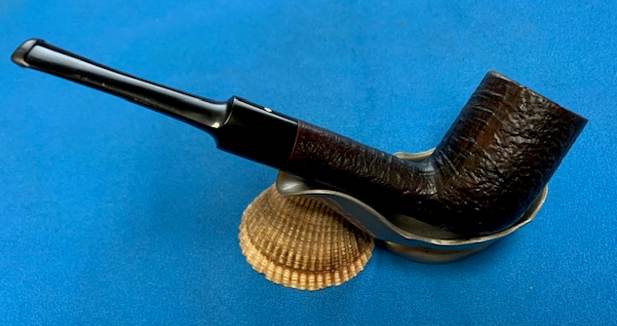
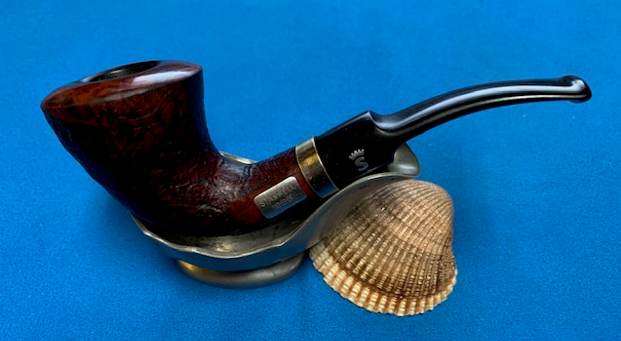
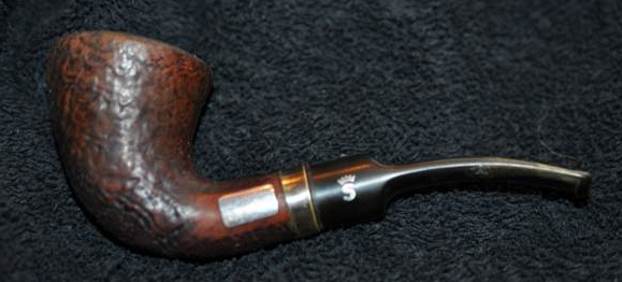
Restoring a Silver Banded BBB Own Make 722 Diplomat


Blog by Steve Laug

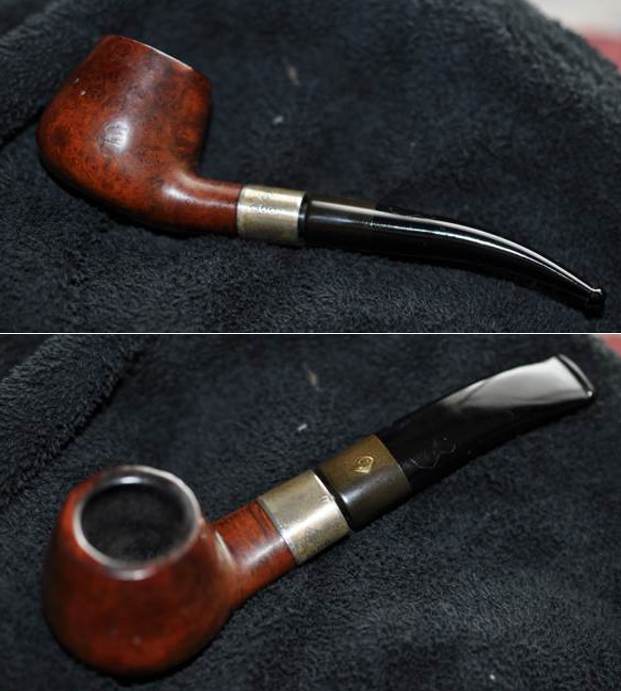
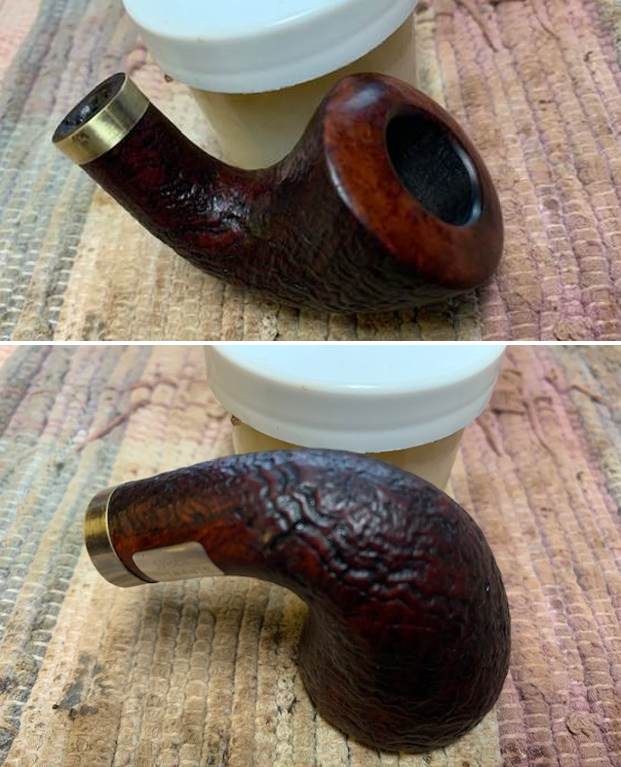
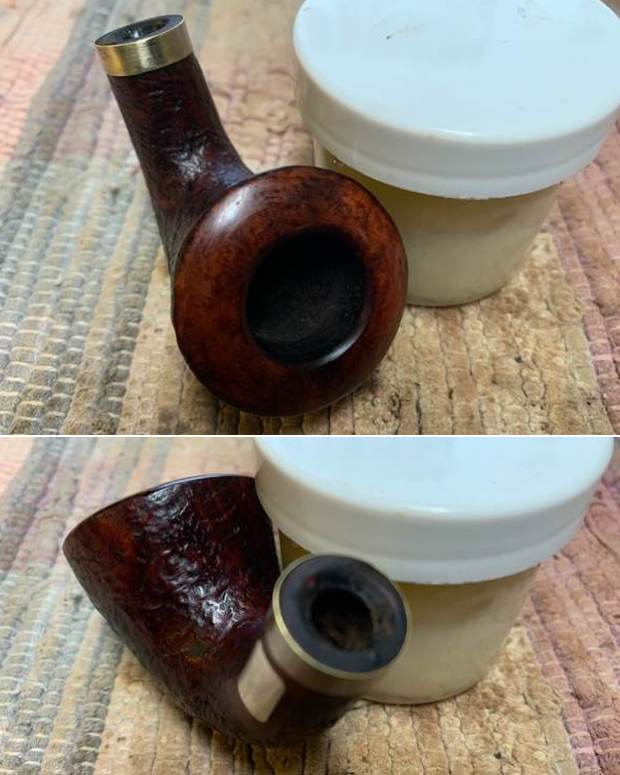
I thought with this blog that I would take a different tack in the write up and take you through my process of working on each pipe that we purchase. Jeff has set up a spread sheet to track where the pipe came from, the date of purchase and what we paid for it so that we know what we have invested in the pipe before we even work on it. This takes a lot of the guess work out of the process. This particular pipe was purchased on 01/26/2023 from Copenhagen, Denmark from a seller we buy a lot of pipes from. I also want you to understand why we take the photos we do. It is not accidental or chance as the photos have been taken to help me make an assessment of the pipe Jeff sees before he starts his clean up work. We do this to record the condition that the pipe was in when received it and to assess what kind of work will need to be done on. When I look at these photos this is what I see.

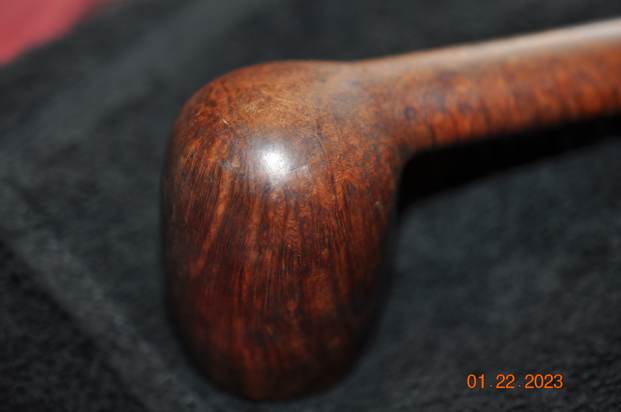
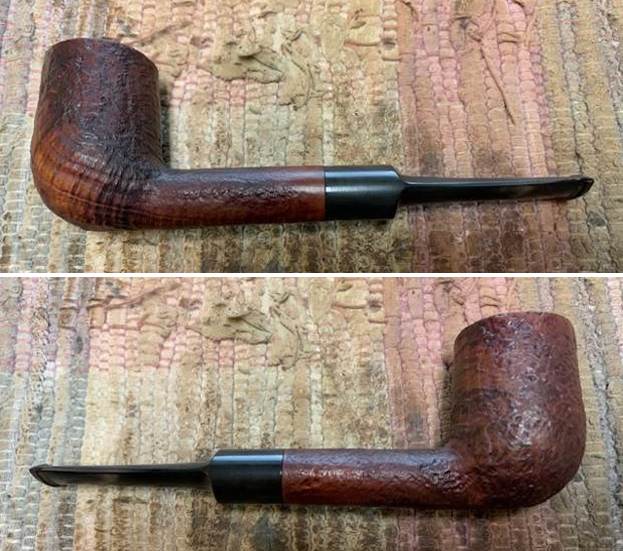
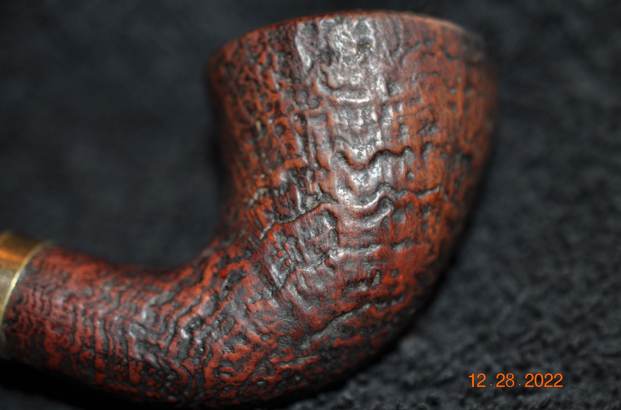
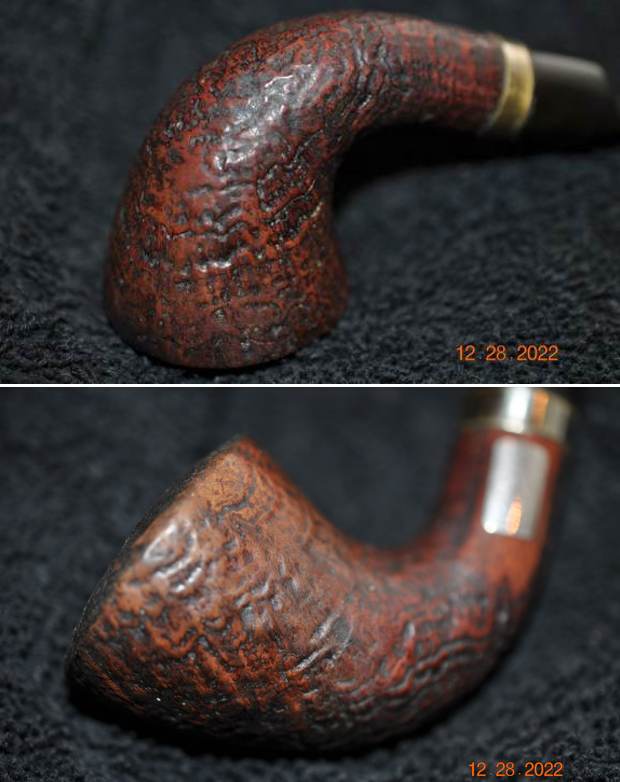
  1. The finish is dirty and there are nicks in the sides of the bowl from being dropped it looks like. There appeared to be some nice grain under the grime. The shank is fairly short with the factory silver band on the end.
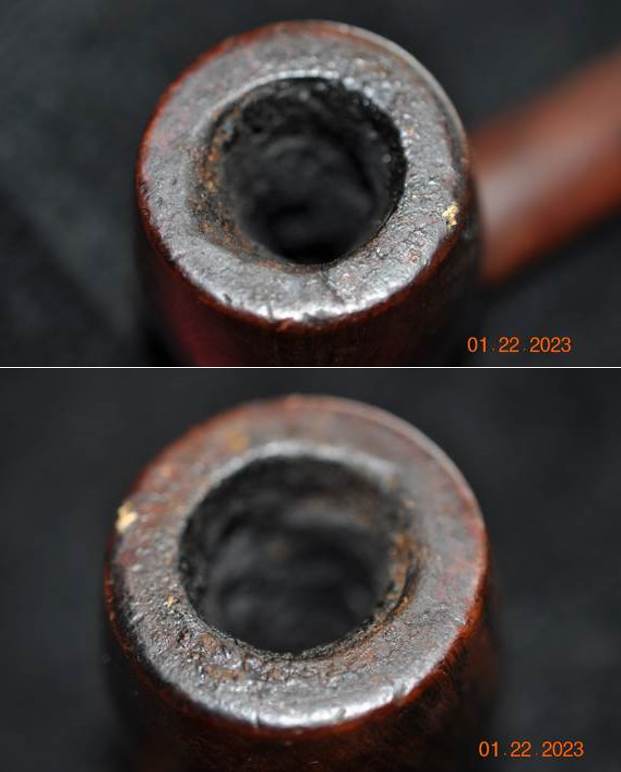
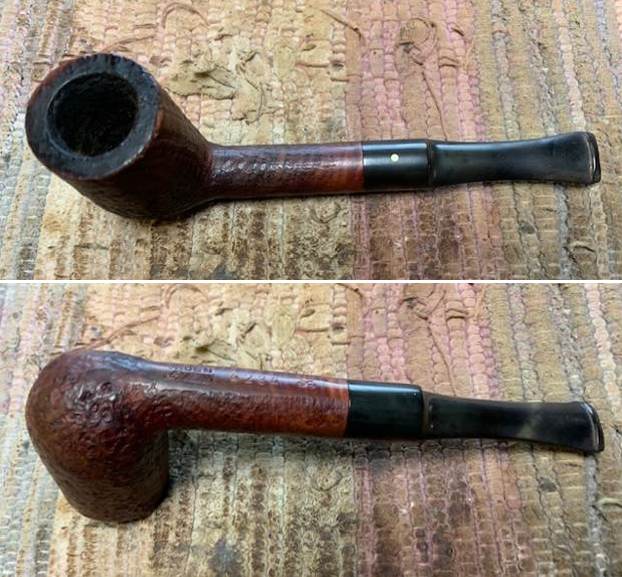
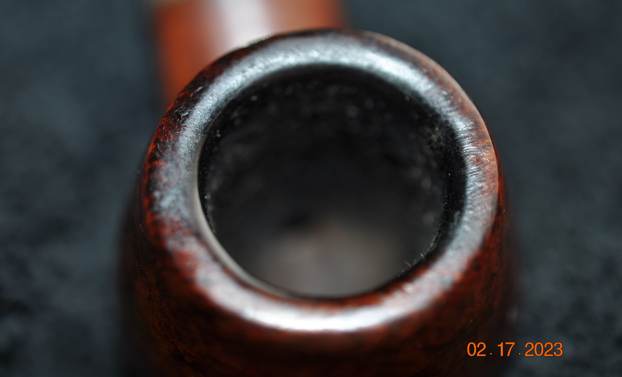
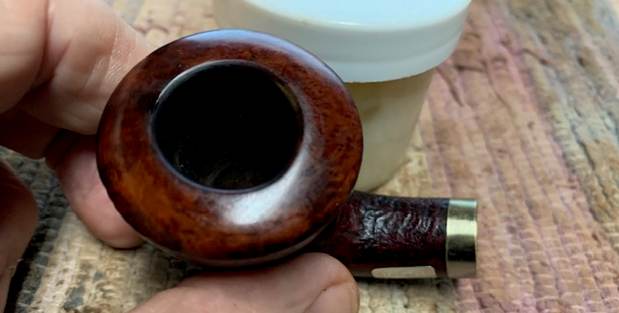
  2. The slightly crowned rim top had a thick lava overflow from the cake in the bowl. It was thicker on the back half of the rim top. There was also some darkening around the top and edges as well. The inner and outer edges of the bowl looked to be in good condition though covered with thick lava. Its overall appearance is very dirty looking.
  3. The bowl has a thick cake in it but the inner edge of the bowl actually looks to be undamaged from what I can see at this point. There does not appear to be any burning or reaming damage to the edges of the bowl. You would be surprised (though maybe not) in how many pipes we pick up that have major issues in this area.
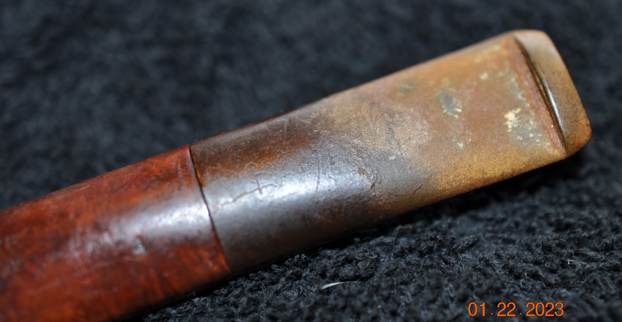
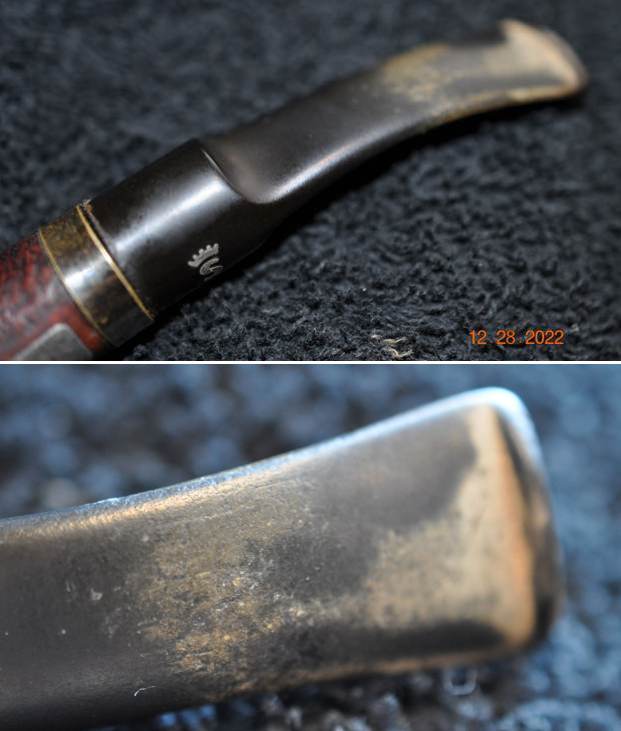
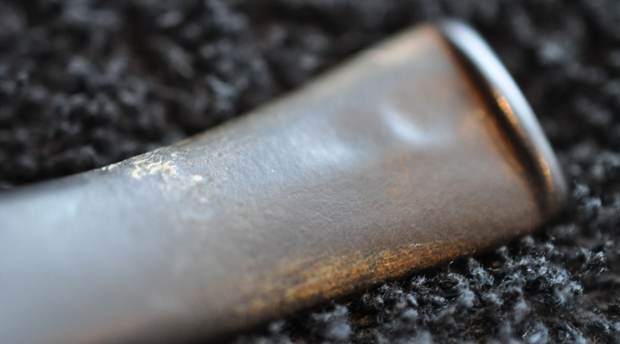
  4. The stem is an oddity to me. The first inch of the stem from the silver band back down the stem is lighter in colour than the rest of the stem. It appears to combine vulcanite and acrylic bound together somehow. I want to try to understand how the two materials are bound together.
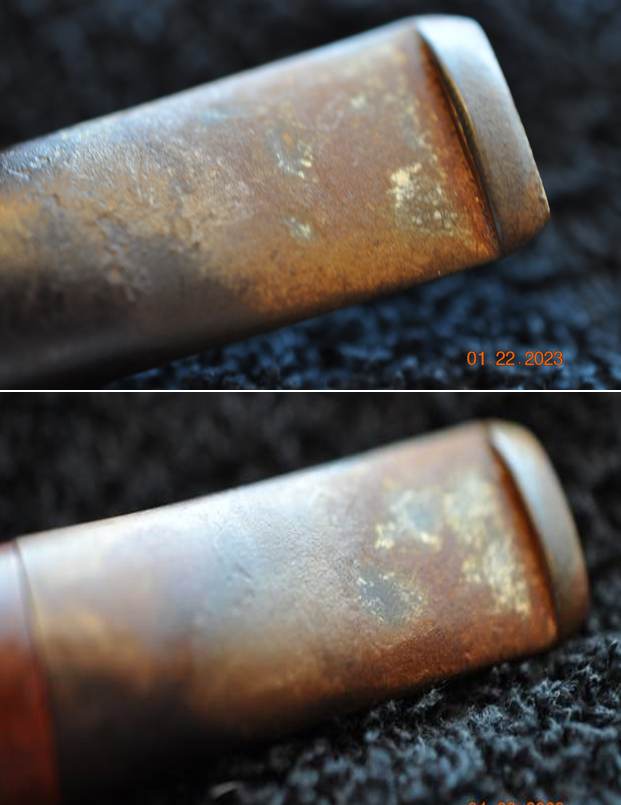
  5. The stem had some oxidation on the top portion around the logo. The acrylic portion was clean and there were no tooth marks and chatter visible in the photos below.

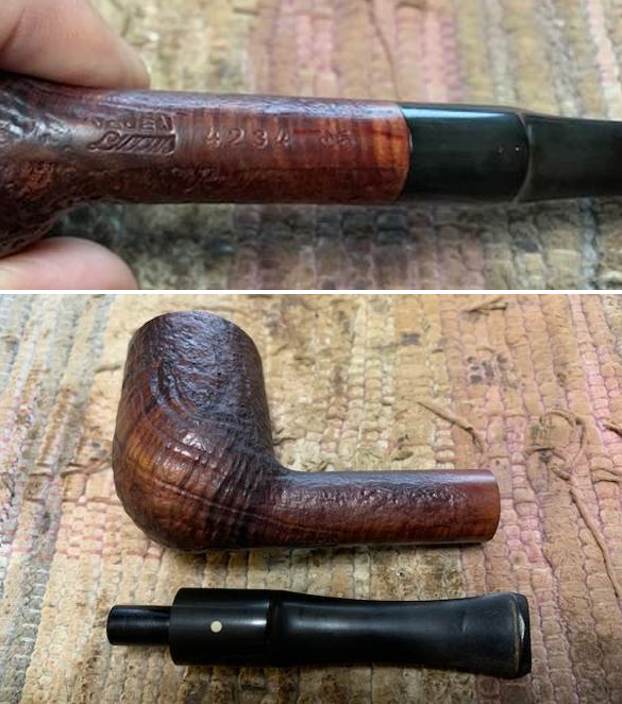
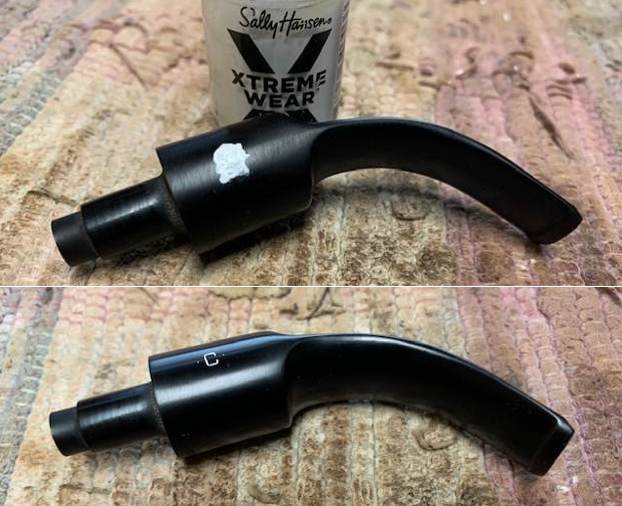
Overall my impressions of this pipe is that it is a beauty that once cleaned up will look pretty amazing. The cake does not seem to hide any burns or checking and the exterior of the bowl does not show any hot spots or darkening. The pipe is very English looking and is a classic Diplomat shape. It has a lot of BBB stylistic touches that I have come to expect as I have worked on a lot of them over the years. The photos below confirm the assessment above.Jeff took close up photos so that I could have a clearer picture of the condition of the bowl and rim edges and top. The rim top photos confirm my assessment above. The cake in the bowl is quite thick and the rim top has lava and debris on it. You can also see the condition of the inner and outer edges of the rim. This is what I look for when assessing a pipe. While there is lava and darkening there is no visible burn damage at this point and the previous reaming has not left damage either. The bowl is still fairly round. There are some scratches in the surface of the crowned rim top. His photos of the stem surface confirmed and heightened my assessment of the condition. You can see the oxidation (particularly around the top inch of the stem from the shank end back) and a different appearance to the second part of the stem. It really does appear that they are two separate materials – vulcanite around the brass logo and acrylic on the back two thirds. The stem is quite dirty but otherwise undamaged. I always ask Jeff to take photos of the sides and heel of the bowl. While this definitely shows the grain patterns around a bowl it also allows me to do a more thorough assessment of the condition of the briar and the finish. In this case I look at the nicks and scratches around the bowl sides to see if there are any cracks or splits radiating from the pits in the centre of each one. I also look for flaws in the grain as those can also hide cracks or damage. In this case the bowl exterior is sound and should clean up very well. I love the grain patterns and the way the play off the silver band on the shank end. I also ask him to take photos of the stamping so I can see if it is faint in any spots or double stamped or unclear. It often takes several photos to capture what I am looking for. The stamping on the underside of the shank is actually undecipherable for the most part. It appears to have a BBB diamond logo at the top of the photo (left side). Underneath that is seems to read Own Make (very faint) [over] Made in [over] London England [over] 722. There is also an odd symbol next to the shape number. Jeff also took photos of the stamping on the silver band and the brass inset logo on the top of the stem. The stamp on the band is hallmarked with three silver hallmarks – a rampant lion, a lion’s head and the letter C. The first one tells us that it is sterling silver. The second one tells us that it is a London assay mark. The third one – the C – is a date stamp. I will work on the date of the pipe once I have it in hand. The brass logo is slightly damaged on the lower side of the inset. I love working on background history of the pipes I restore as they add a depth to my ongoing understanding of the pipe. Being able to put it in a specific date on the pipe puts it in a time frame. I turned to a British Silver Makers Hallmarks site that I use all the time. I narrowed down my search to the London pipes. The first two marks as noted above – the rampant lion and the lion’s head were simple to decipher. The Rampant Lion is the symbol for Sterling silver. The The Lion’s Head is the symbol for London Silver makers. I turned to the dates list on the site. I have included it below (https://www.silvermakersmarks.co.uk/Dates/London.html).I clicked on the section that had a C stamp like the one on the band and it expanded to a size that I could easily read. I have included the link below as well as a screen capture of the section of the list (https://www.silvermakersmarks.co.uk/Dates/London/Cycle%201975-1999.html).

I knew that the pipe I had was made in London by BBB and the silver assay stamp dates the pipe as 1977 in terms of the shape of the C. The band I am working on does not have a Queen’s Stamp so it is a little different. But I am convinced that the pipe was made in 1977.

I am sure many of you skip my paragraph on the work Jeff has done before the pipe gets here but it is quite detailed in its brevity. I know some laugh at my opening line Jeff did a thorough cleaning of this pipe. However, I want you to know the details of the work. Back in 2020 Jeff wrote a blog about his cleaning process. I am including a link to that now so you can see what I mean about his process. Do not skip it! Give it a read (https://rebornpipes.com/2020/01/20/got-a-filthy-estate-pipe-that-you-need-to-clean/). Here is the introduction to that blog and it is very true even to this day.

Several have asked about Jeff’s cleaning regimen as I generally summarize it in the blogs that I post rather than give a detailed procedure. I have had the question asked enough that I asked Jeff to put together this blog so that you can get a clear picture of the process he uses. Like everything else in our hobby, people have different methods they swear by. Some may question the method and that is fine. But it works very well for us and has for many years. Some of his steps may surprise you but I know that when I get the pipes from him for my part of the restoration they are impeccably clean and sanitized. I have come to appreciate the thoroughness of the process he has developed because I really like working on clean pipe!

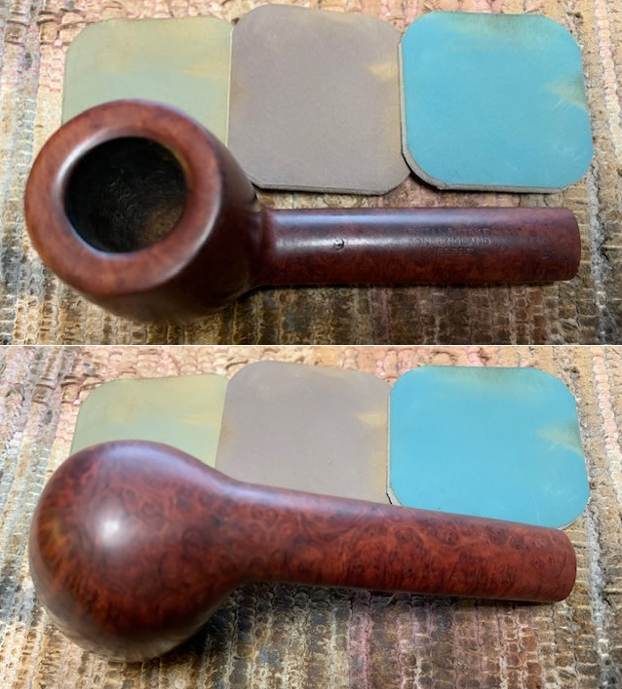
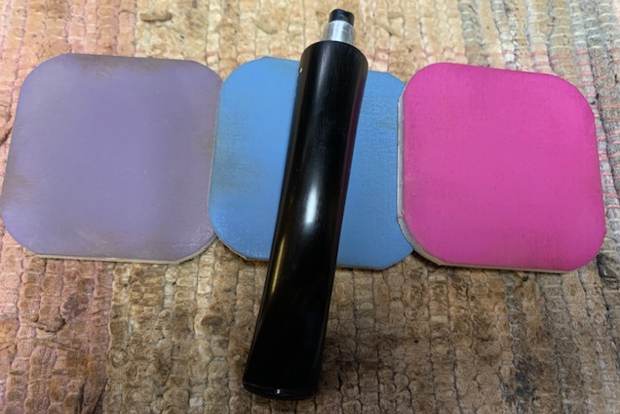
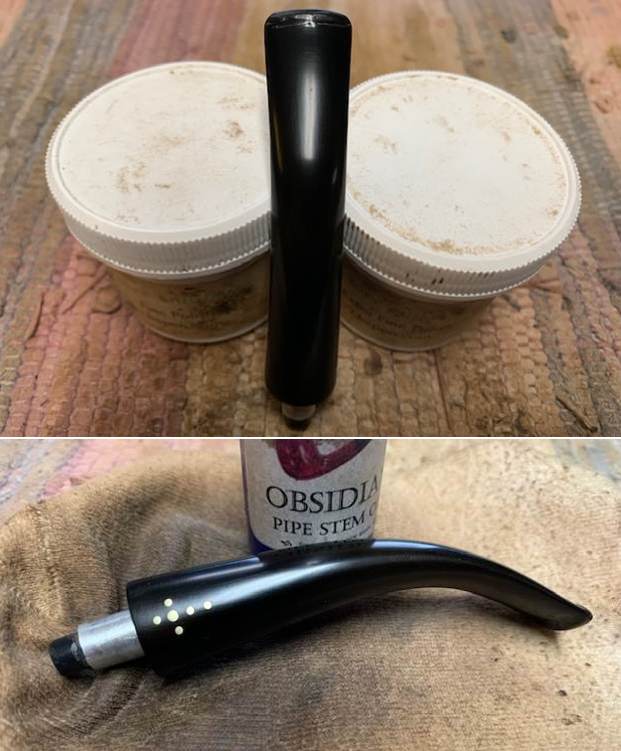
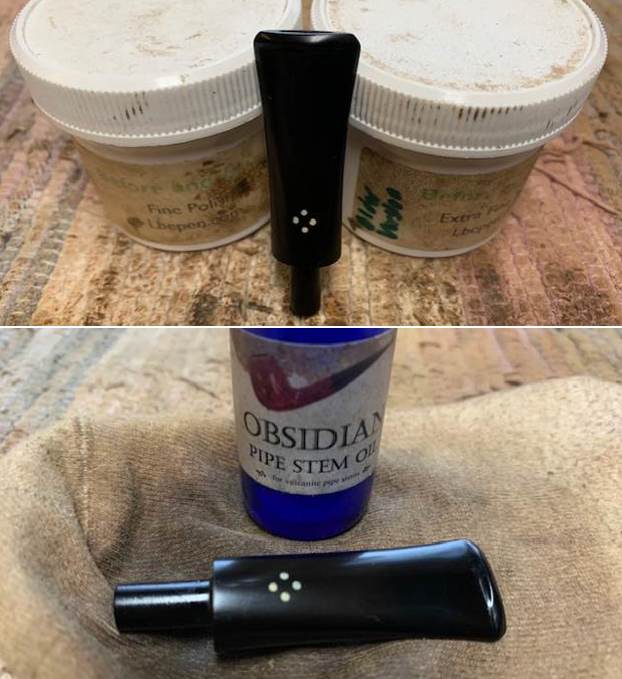
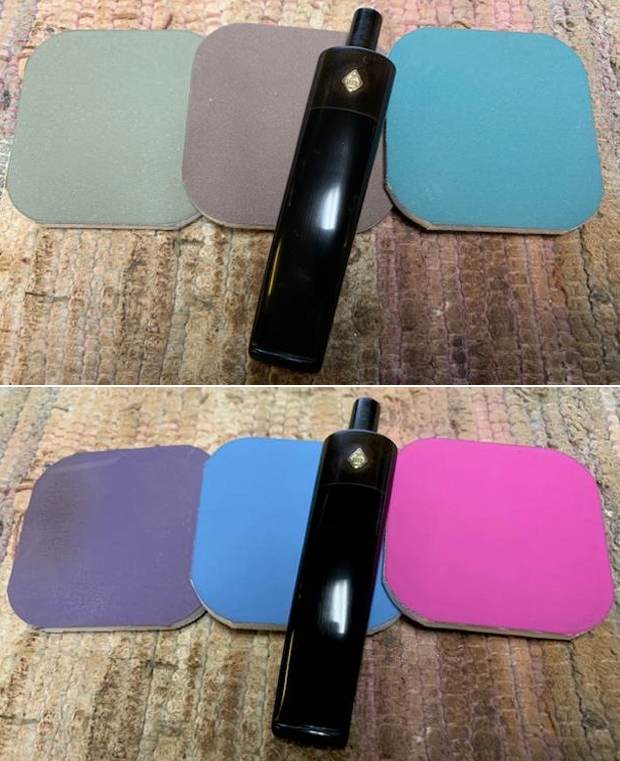
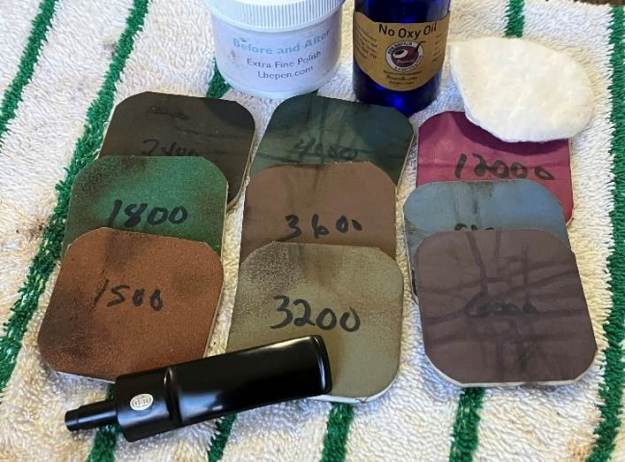
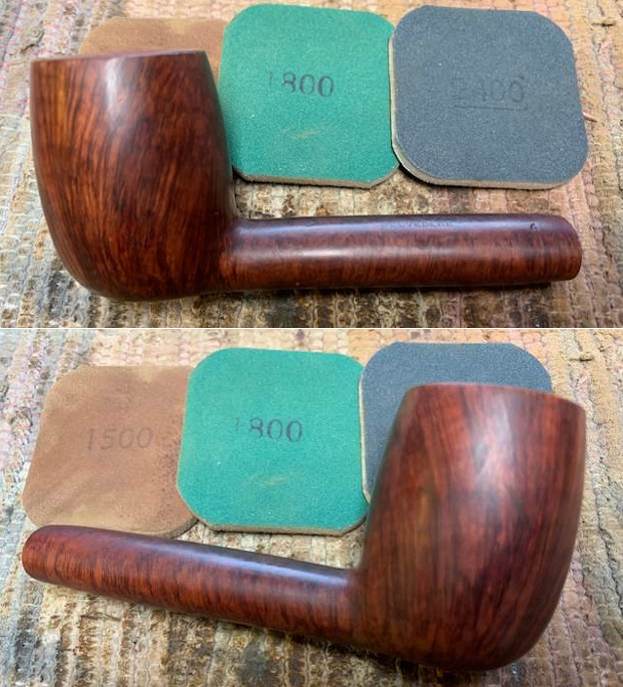
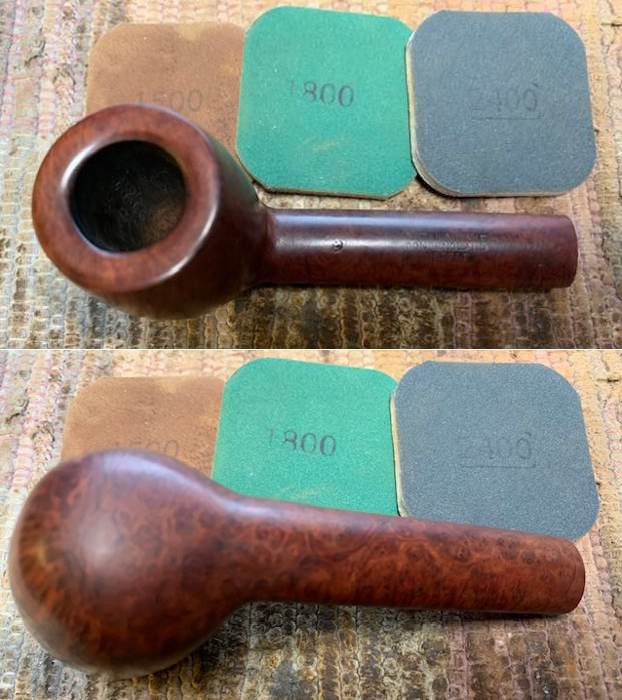
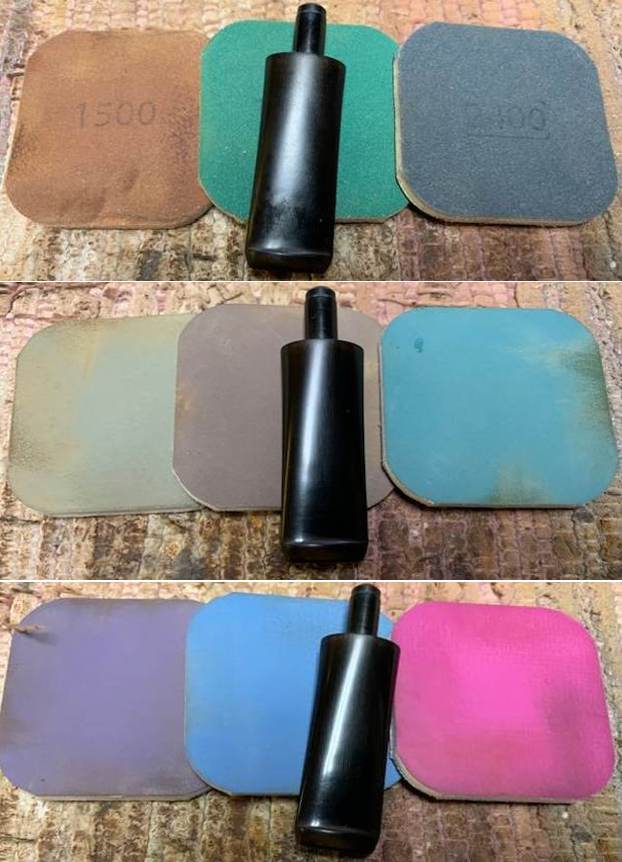
For the benefit of some of you who may be unfamiliar with some of the products he uses I have included photos of three of the items that Jeff mentions in his list. This will make it easier for recognition. These three are definitely North American Products so you will need to find suitable replacements or order these directly on Amazon. The makeup pads are fairly universal as we were able to pick some up in India when we were with Paresh and his family.

In the blog itself he breaks his process down into two parts – cleaning the stem and cleaning the bowl. Each one has a large number of steps that he methodically does every time. I know because I have watched him do the work and I have seen the pipes after his work on them. He followed this process step by step and when the pipe got to me it was spotlessly clean and ready for my work. The inside of the stem, shank and bowl were clean and to me that is an amazing gift as it means that my work on this end is with a clean pipe! I cannot tell you how much difference that makes for my work.

When the pipe arrives here in Vancouver I have a clean pipe and I go over it keeping in mind my assessment shared in the opening paragraph above. I am looking for any significant structural changes in the bowl and finish as I go over it.

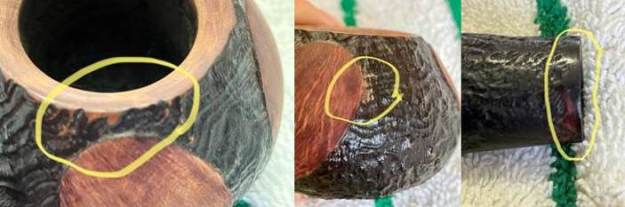
  1. The finish is very clean and the grain stands out on the surface of the clean briar. The scratches in the briar swelled up a bit so that they were not as deep as originally assumed in the first photos. There are no cracks showing up in the grain lines or in the flaws under the leaf carvings. It is sound on the outside. I will need to polish the briar and buff it to bring back the shine.
  2. The slightly crowned rim top is clean of the lava but there is still some darkening on the top and edges of the bowl. The good news for me is that there are no cracks showing up in the rim top. The bowl was sound.
  3. The bowl was very clean and smelled clean. The clean walls did not show evidence of checking or cracking. There were no hot spots or damage on the walls or around the entrance of the airway into the bowl. It was clean and smooth which is great news for me. The inner edge of the bowl was undamaged and did not show any sign of burning or reaming damage to the edges of the bowl. Both the shank and the bowl were very clean showing no debris on a clean pipe clean run through them. I would need to give it a final cleaning with pipe cleaners and alcohol once I had finished with the external work to remove the debris that may have collected there in the process.
  4. The oddity I saw in the stem was even more evident now – the vulcanite stem end and the acrylic bit were bound together in a well done manner. It was going to be interesting to examine more closely and possibly remove some of the oxidation on the vulcanite portion.
  5. The oxidation was much less on the front portion of the stem after Jeff’s work on it. The acrylic portion did not show any tooth marks or chatter. It was in great condition.

Hopefully the steps above show you both what I look for when I go over the pipe when I bring it to the work table and also what I see when I look at the pipe in my hands. They also clearly spell out a restoration plan in short form. My work is clear and addressing it will be the next steps. I took photos of the whole pipe to give you a picture of what I see when I have it on the table. This is important to me in that it also shows that there was no damage done during the clean up work or the transit of the pipe from Idaho to here in Vancouver. I take some time to go over the bowl and rim top to get a sense of what is happening there. In this case has some darkening on the top and the inner edge of the bowl. It is clean but will need to be worked on to bring it back to normal. The edges are not damaged and neither is the top of the bowl. That is the good news. I also go over the stem carefully. There were no tooth marks or dents in the stem. The biggest mystery for me is the connection of the two materials on the stem. There is a visible difference in the photos below. I took photos of the rim top and stem sides to show as best as I can what I see when I look at them.I always check to make sure that the clean up work did not damage the stamping on the shank in any way. I was hoping that the clean up might have made the stamping more clear but that was not the case. It was as faint as before. You can see a bit of it in the last photo above. I also took a photo of the silver. I also removed the stem from the shank and took a photo to get a sense of what was in the mind of the pipe maker when he crafted the pipe. It is a beauty in flow and shape. The question at this point of where to begin the restoration work is always a matter of personal preference. If you read this blog much you will see that each of the restorers who post here all start at different points. I personally almost always start with the bowl because I truly do not like the tedious work of stem repairs and polishing. I always leave that until last even though I know that it needs to be done. So if you are restoring your pipes choose where you want to start and go from there. Just know that it all will need to be done by the end but for me the encouragement of seeing a rejuvenated bowl is the impetus I need to attack the stem work.

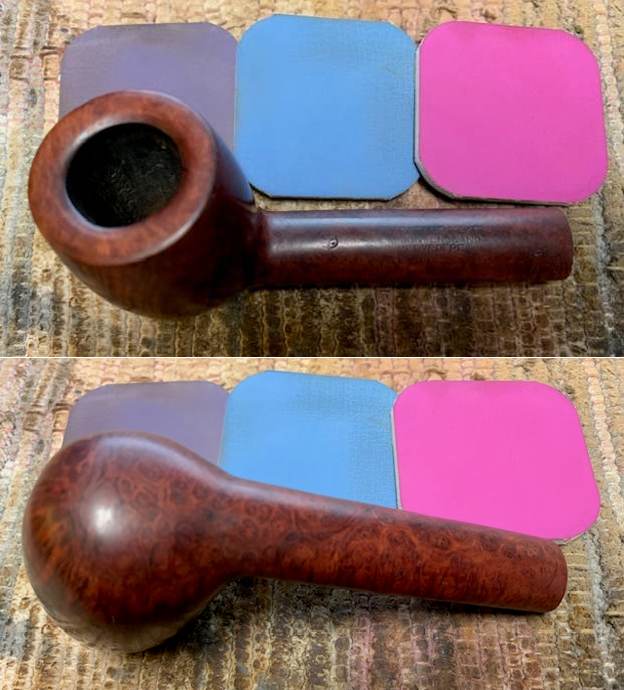
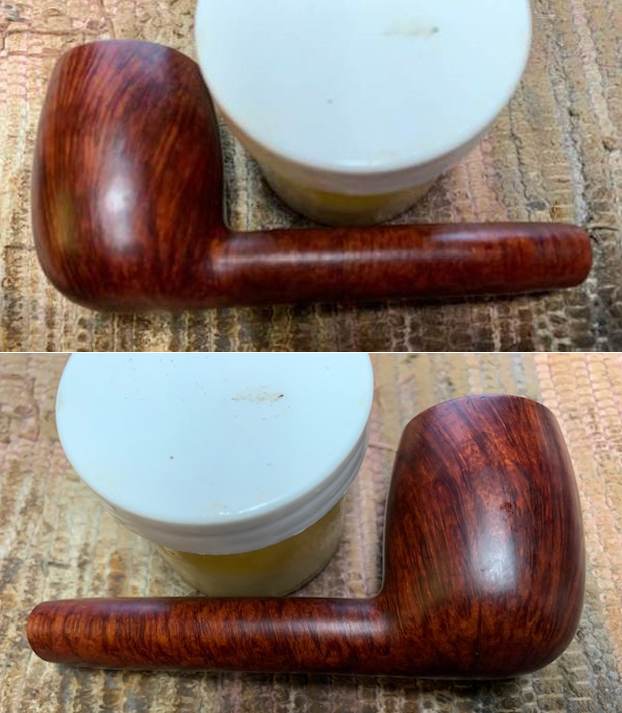
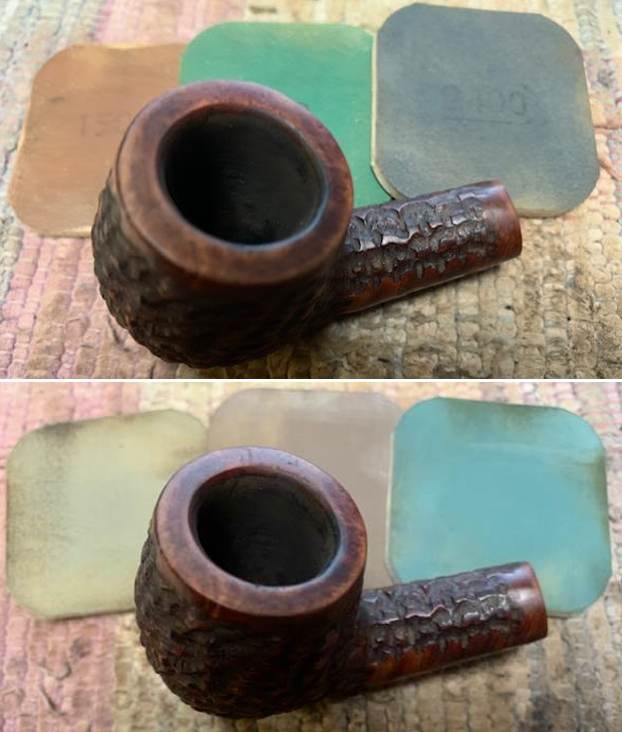
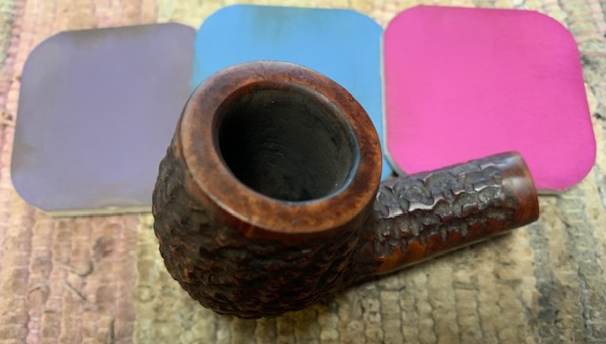
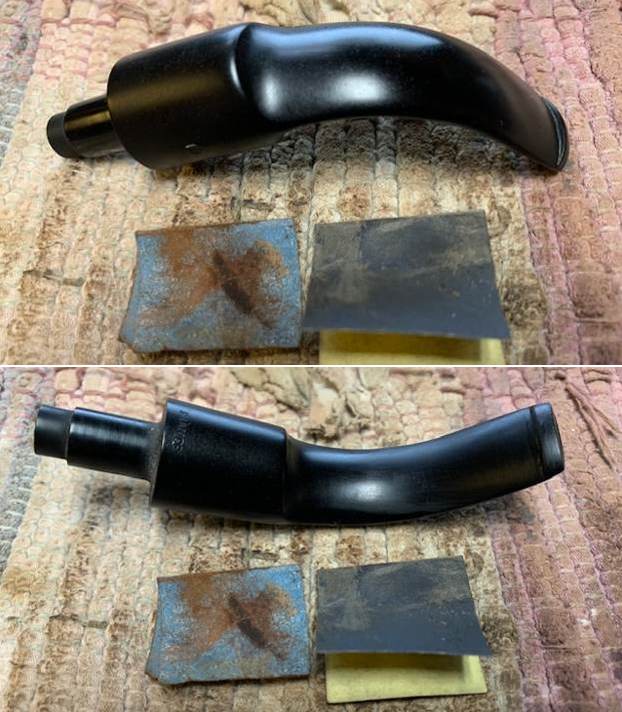
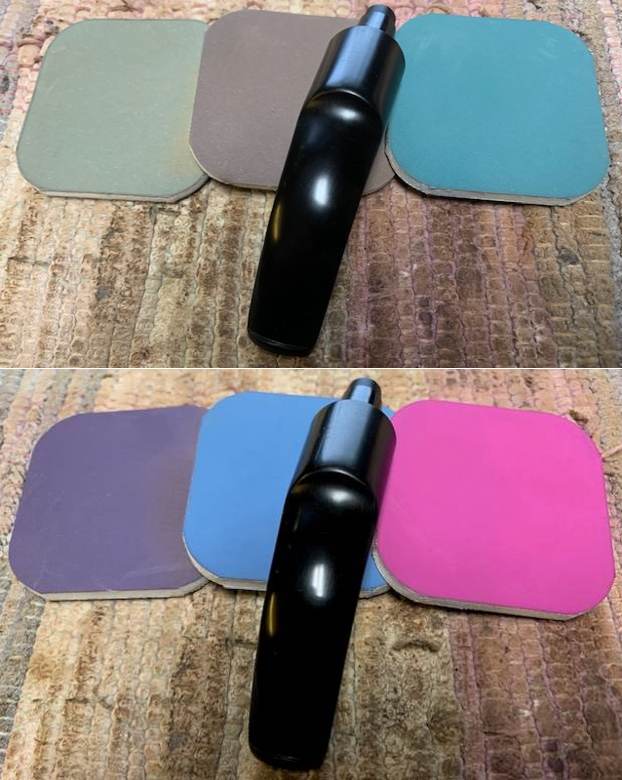
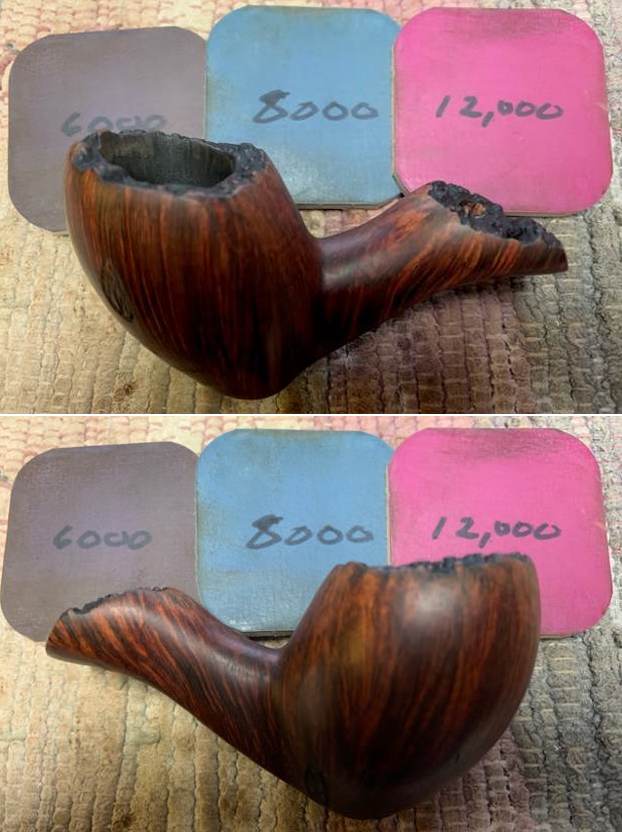
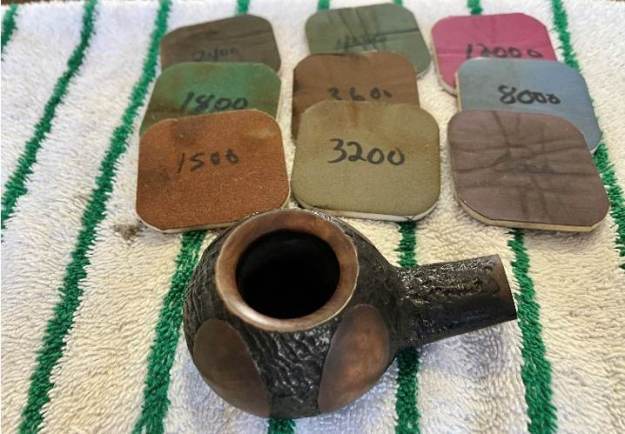
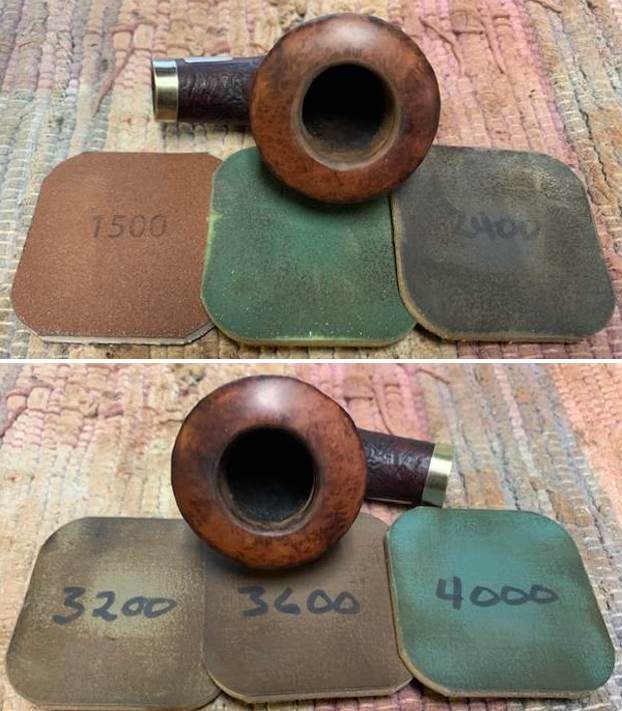
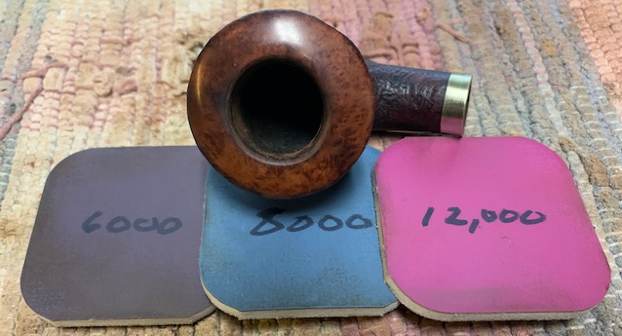
For me then I started working on this pipe by turning to the bowl. I chose to deal with the darkening to the rim edges and top. I used a folded piece of 220 grit sandpaper to reshape and remove the rim top and damage. It took a little work but I was able to remove all of the darkening. It is a beautiful piece of briar with some great grain.When I have to deal with scratch marks like those on the left side of the bowl I generally use a butter knife and a damp cloth to steam them out of the finish as much as possible. I know others use steam irons with great success but I generally use the butter knife and damp cloth to lift them as it allows me to pin point the tip of the knife on the marks. I was able to lift some of them nicely but some still remained when I finished. I used a small bit of CA glue to fill in the three marks that remained (it looks like more glue than it actually is – it is quite thin). I sanded the repairs smooth with 600 grit wet dry sandpaper. I started the polishing with micromesh sanding pads – working it over with 1500 grit pads.Once I have the repair sanded smooth I blend them into the surface of the briar. I polished the briar with micromesh sanding pads. I choose to dry sand the briar rather than wet sand it. Again it is a matter of personal preference. I prefer to use the pads dry and find they work very well on the briar. I sand with each pad (9 in total) and group them by threes for ease of reference. I also work over the plateau areas at the same time. I wipe the bowl down after each pad with a damp cloth to remove the sanding debris and check the briar. I love seeing the developing shine on the briar as I move through the pads which is why I include so many photos of this step. Once I have a bowl at this point in the process I go over it to see the coverage on the bowl. In this case the finish was very spotty. I chose to restain the bowl with a Light Brown aniline wash. I mixed some brown pigment with some isopropyl alcohol to mix a wash. I used a cotton dauber to  cover the surface of the briar with the stain wash. I lit the finish with a lighter and set the stain in the briar. I repeated the process a second time to make sure it was a smooth finish. I took a few photos of the stained bowl. It appears significantly darker than I expected but I knew that buffing it would lighten the finish and perhaps make it match. Buffing would tell the tale. When I stain a bowl like the one above I take it to the buffer after the stain has dried. I buffed it first with Red Tripoli to remove the “crust” of the new stain. The Tripoli took off the opacity of the stain on the bowl and gave me more of the colour I was hoping for under the stain coat. I buffed it a second time with Blue Diamond and was able to remove more. The bowl also began to take on a deep shine. I took photos of the bowl after buffing and have included them below. For the past few years now I have been using a product developed by Mark Hoover called Before & After Restoration Balm. It is a paste/balm that is rubbed into the surface of the briar and the plateau. The product works to deep clean the nooks and crannies of finish, enliven and protect the briar. I worked it into the briar with my finger tips and let it sit for 10 minutes to do its work. I wiped it off with a soft cloth then buffed it with a cotton cloth. The briar really began to have a deep shine in the briar and the grain shone through. The photos I took of the bowl at this point mark the progress in the restoration. It is a gorgeous pipe. Now it was time to address the part of the restoration I leave until last. I set the bowl aside and turned my attention to the stem. This one was a unique stem so I was not as slow to start because of damage to the stem it was more to try to put together why the stem has two materials and how they were joined. The junction was flawlessly done and the transition was very smooth. It made me wonder who had done this work and why. I have never seen any other BBB pipe with the compound material stem. Here are a couple of thoughts I have as I have been working on it. There are several possibilities.

The first is that this stem is kind of a Frankenpipe rebuild.

  1. Somewhere in the life of the pipe the original vulcanite stem was ruined from the button forward. The original owner wanted to keep the front portion next to the shank intact so that original brass logo would not have to be moved.
  2. A possibility is that the old stem was cut off and an acrylic end was made for it. They were joined together with a tenon and glue that bound the parts together seamlessly.
  3. The stem was then sanded to make the transition between the two materials seamless.

The second is that it originally came out that way as a means of protecting the stem from bite through. It may well have been a BBB innovation – just one that I have never seen or read about.

I suppose at one level I will never really know for sure but whatever the reason for the mixed material of the stem it is a beauty. Now it was time to work on it.

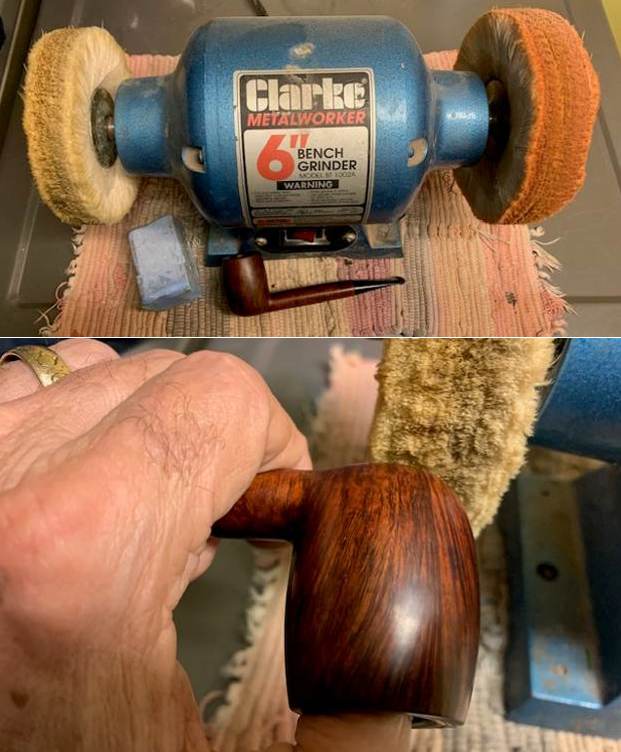
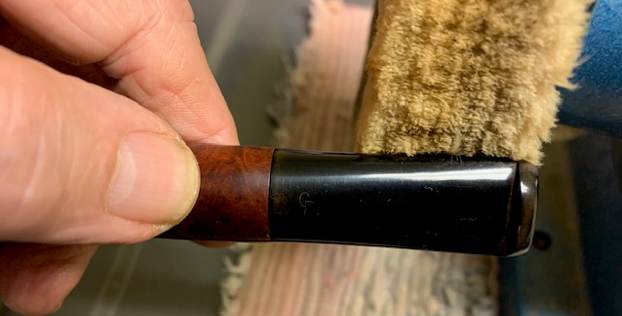
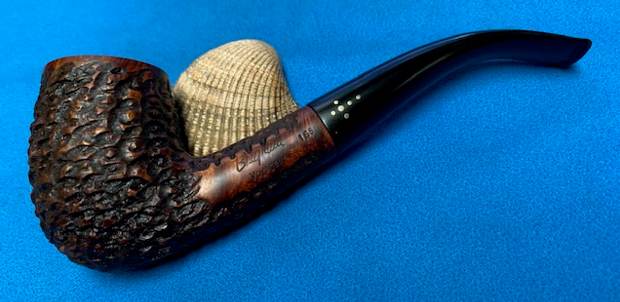
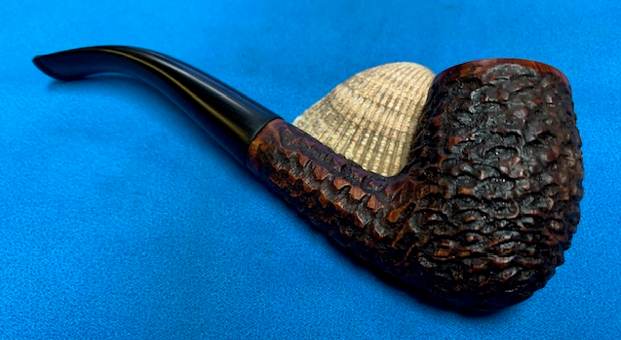
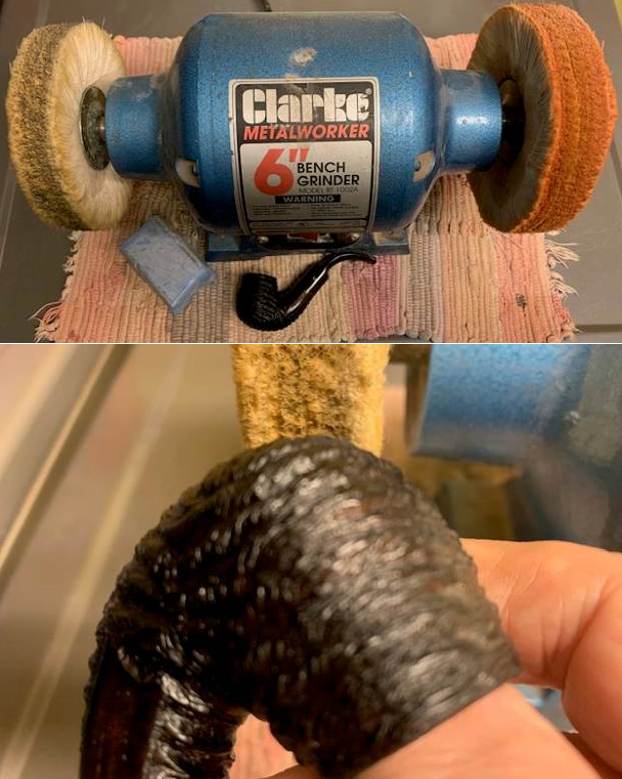
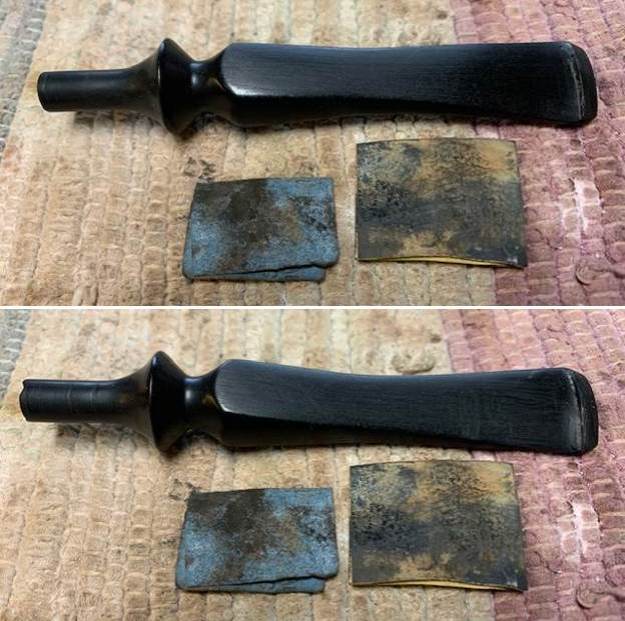
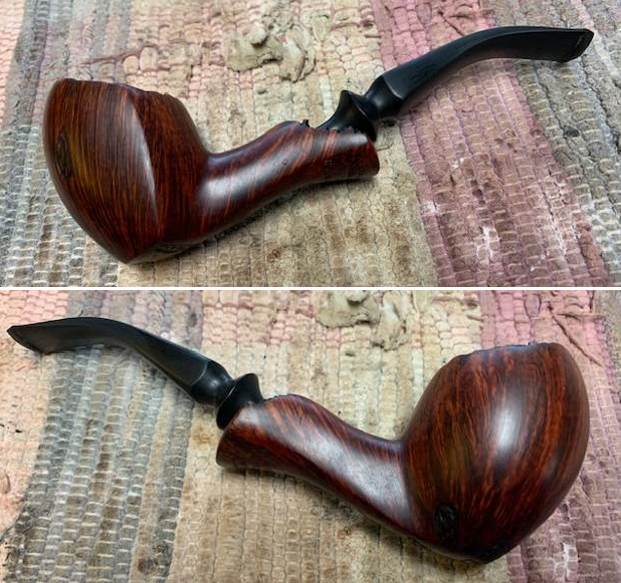
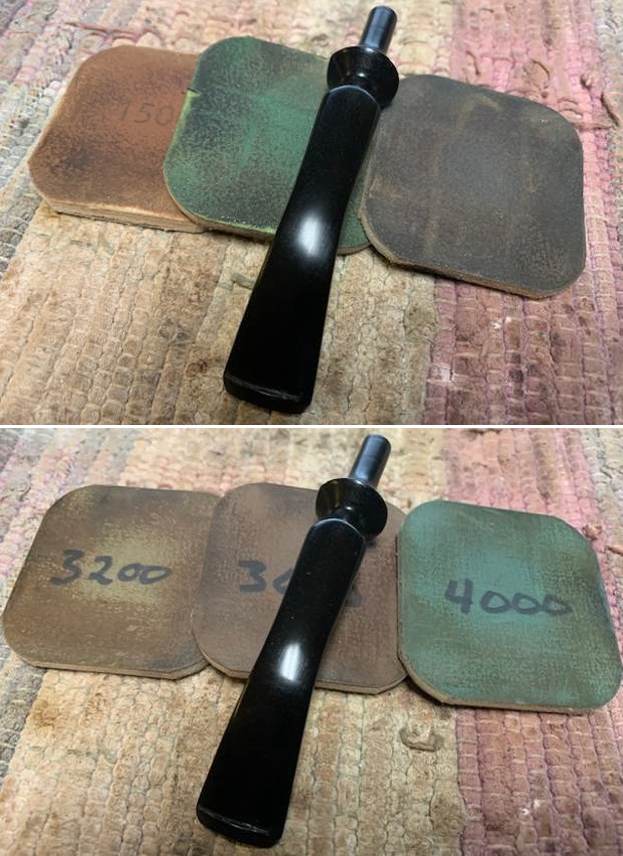
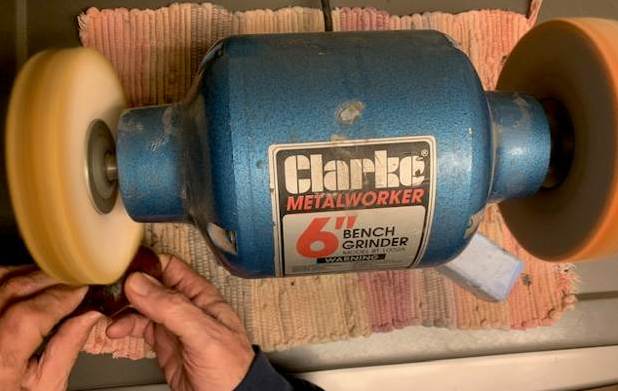
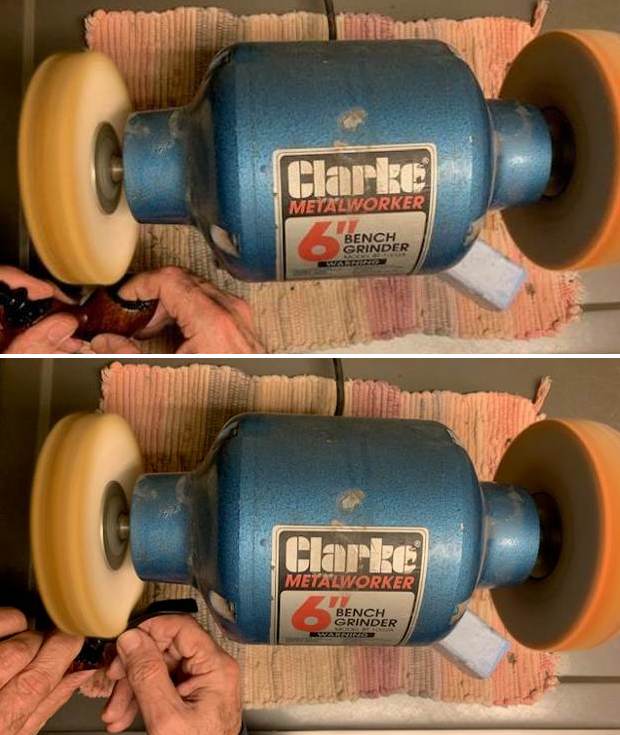
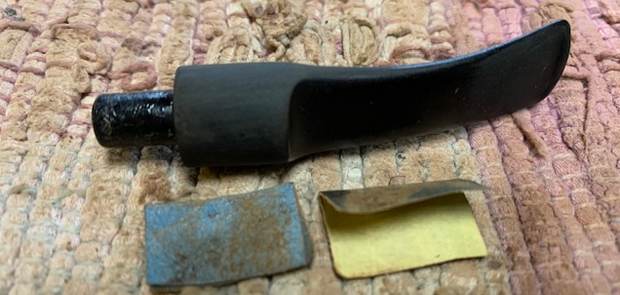
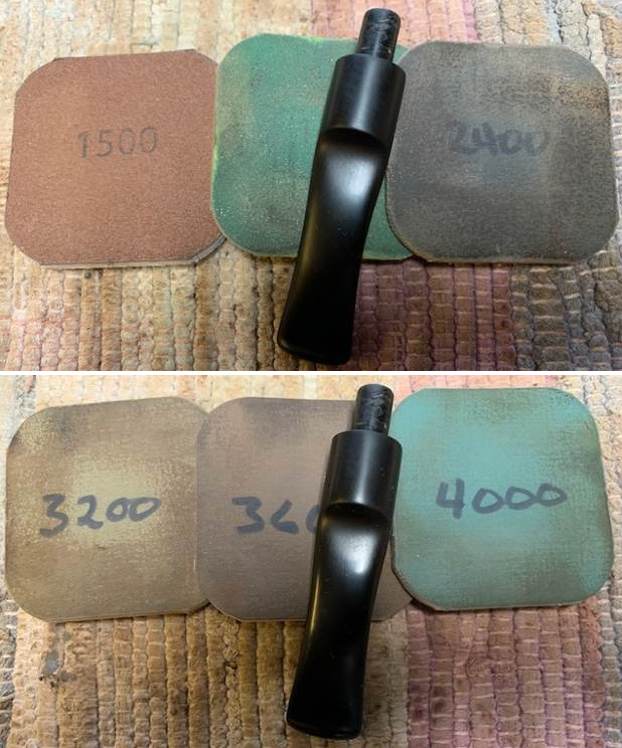
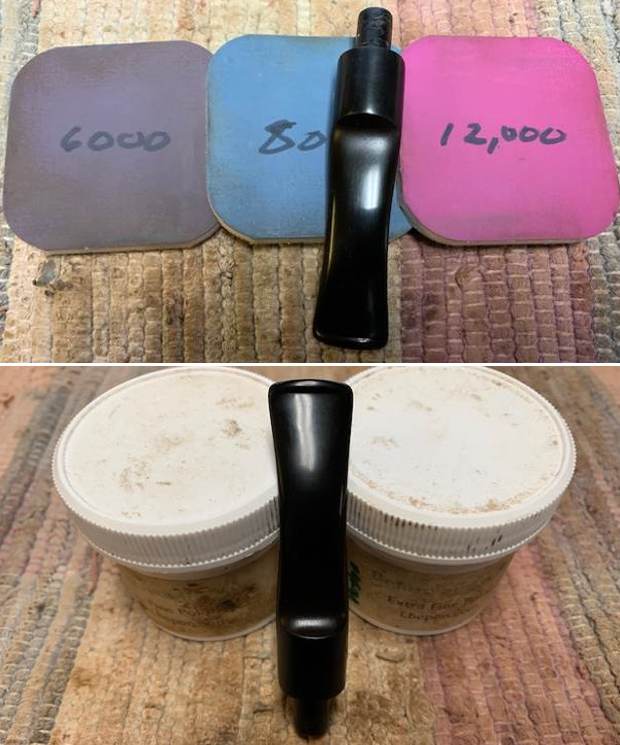
At this point in the process I chose to polish the stem and bring back a shine. I use micromesh sanding pads and water to wet sand the stem with 1500-12000 grit sanding pads. I wiped it down after each sanding pad with Obsidian Oil on a cotton rag after each sanding pad as I find it does two things – first it protects the vulcanite and second it give the sanding pads bite in the polishing process. After finishing with the micromesh pads I rub the stem down with Before & After Fine and Extra Fine stem polish as it seems to really remove the fine scratches in the vulcanite. I rub the Fine Polish on the stem and wipe it off with a paper towel and then repeat the process with the extra fine polish. I finish the polishing of the stem down with a final coat of Obsidian Oil and set the stem aside to let the oil absorb. This process gives the stem a shine and also a bit of protection from oxidizing quickly.The final steps in my process involve using the buffer. I first buff the stem and the briar with Blue Diamond on the buffing wheel. Blue Diamond is a plastic polish but I find that it works very well to polish out the light scratches in the vulcanite and the briar. I work the pipe over on the wheel with my finger or thumb in the bowl to keep it from becoming airborne. It works well and I am able to carefully move forward with the buffing. The briar and stem just shone! I finished with the Blue Diamond and moved on to buffing with carnauba wax. Once I have a good shine in the briar and vulcanite I always give the bowl and the stem multiple coats of carnauba wax. I have found that I can get a deeper shine if I following up the wax buff with a clean buffing pad. It works to raise the shine and then I follow that up with a hand buff with a microfiber cloth to deepen the shine. It is always fun for me to see what the polished bowl looks like with the polished vulcanite and acrylic combination stem. It really is a beautiful pipe. The smooth finish around the bowl sides and shank show the grain shining through the rich brown stains of this BBB Own Make 722 Diplomat. The finished pipe feels great in my hand. It is light and well balanced. Have a look at it with the photos below. The dimensions are Length: 5 ½ inches, Height: 1 ½ inches, Outside diameter of the bowl: 1 1/8 inches, Chamber diameter: 7/8 of an inch. The weight of the pipe is 1.59 ounces/44 grams. It is a beautiful pipe and one that I will be putting on the rebornpipes store in the British Pipe Maker section.

Hopefully this tack of writing this blog is helpful to you in some way. In it I show both what I am looking for and how I move forward in addressing what I see when work on a pipe has been helpful to you. It is probably the most straightforward detailed description of my work process. As always I encourage your questions and comments as you read the blog. Thanks to each of you who are reading this blog. Remember we are not pipe owners; we are pipemen and women who hold our pipes in trust until they pass on into the trust of those who follow us.

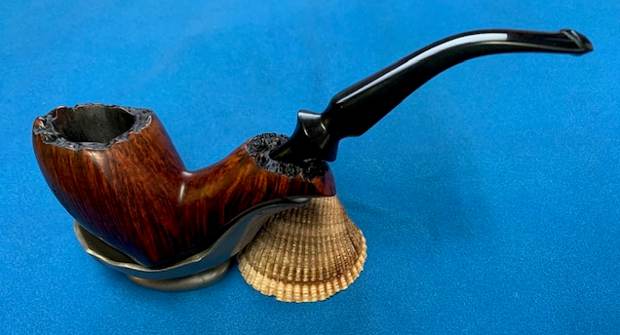
Life for a Karl Erik Carved Wenhall Langelinie Made In Denmark 1 Freehand


Blog by Steve Laug

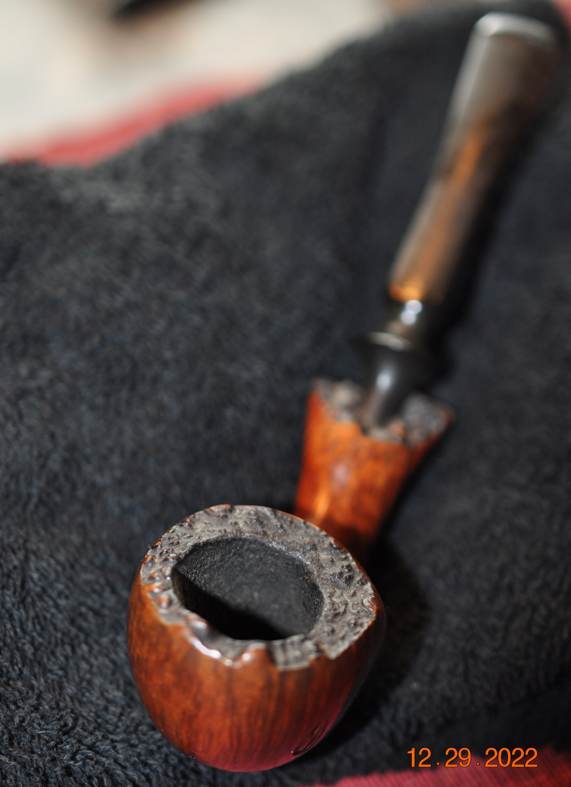
I thought with this blog that I would take a different tack in the write up and take you through my process of working on each pipe that we purchase. Jeff has set up a spread sheet to track where the pipe came from, the date of purchase and what we paid for it so that we know what we have invested in the pipe before we even work on it. This takes a lot of the guess work out of the process. This particular pipe was purchased on 04/09/2022 from Cleveland, Ohio, USA from a seller we bought quite a few pipes from. I also want you to understand why we take the photos we do. It is not accidental or chance as the photos have been taken to help me make an assessment of the pipe Jeff sees before he starts his clean up work. We do this to record the condition that the pipe was in when received it and to assess what kind of work will need to be done on. When I look at these photos this is what I see.

  1. The finish is dirty and flat but underneath there is some excellent grain. There are also some leaves carved on the left side of the bowl and around the heel. These were typically done to obscure flaws in the briar.
  2. The plateau rim top and shank end are dirty. In the rim top plateau there is a lot of lava overflow from the cake in the bowl. Along with that there is dust and debris in both the plateau on the rim top and shank end. Its overall appearance is very dirty looking.
  3. The bowl has a thick cake in it but the inner edge of the bowl actually looks to be undamaged from what I can see at this point. There does not appear to be any burning or reaming damage to the edges of the bowl. You would be surprised (though maybe not) in how many pipes we pick up that have major issues in this area.
  4. The stem is vulcanite and has straightened out from heat and sitting and will need to be rebent to match the flow of the shank and bowl.
  5. The stem had some oxidation and tooth marks and chatter that are visible in the photos below. Nothing to deep but nonetheless present.

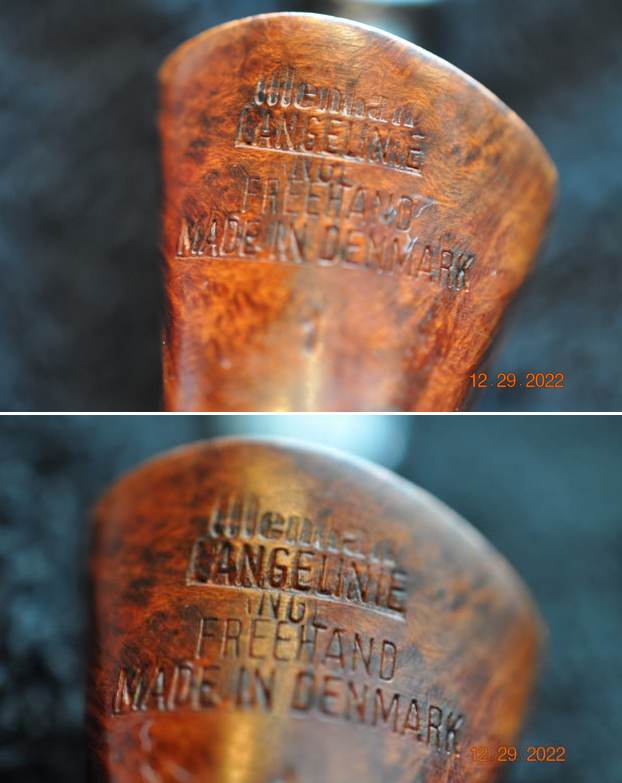
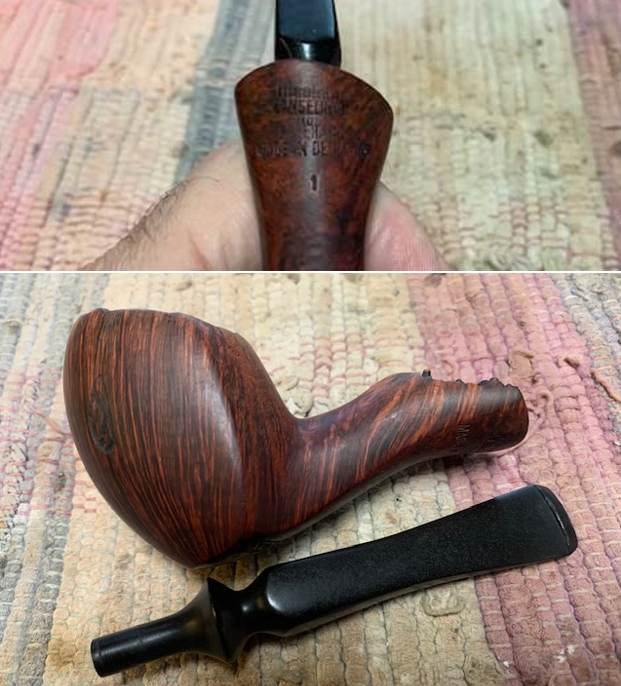
Overall my impressions of this pipe is that it is a beauty that once cleaned up will look pretty amazing. The cake does not seem to hide any burns or checking and the exterior of the bowl does not show any hot spots or darkening. When I look it I immediately think of the carver Karl Erik. It has a lot of his stylistic touches that I have come to expect as I have worked on a lot of his pipes over the years. The photos below confirm the assessment above. Jeff took close up photos so that I could have a clearer picture of the condition of the bowl and rim edges and top. The rim top photos confirm my assessment above. The cake in the bowl is quite thick and the plateau on the rim top is almost filled in with lava and debris. You can also see the condition of the inner and outer edges of the rim. This is what I look for when assessing a pipe. While there is lava and darkening there is no visible burn damage at this point and the previous reaming has not left damage either. The bowl is still fairly round. The plateau on the shank end is very dusty and dirty as can be seen in the fourth photo below. His photos of the stem surface confirmed and heightened my assessment of the condition. You can see the oxidation (particularly around the turned area and the speckled surface of the button area) and what appears to be a gummy substance on the stem surface. Note also the tooth marks on the edge of the button on both sides. It is actually more damaged than the surface of the stem. I always ask Jeff to take photos of the sides and heel of the bowl. While this definitely shows the grain patterns around a bowl it also allows me to do a more thorough assessment of the condition of the briar and the finish. In this case I look at the finish around the carved portions to see if there are any cracks or splits radiating from the pits in the centre of each one. I also look for flaws in the grain as those can also hide cracks or damage. In this case the bowl exterior is sound and should clean up very well. I love the grain patterns and even the odd leaf carvings do not detract too much from that for me. I also ask him to take photos of the stamping so I can see if it is faint in any spots or double stamped or unclear. It often takes several photos to capture what I am looking for. The stamping on the underside of the shank is relatively clear in the picture below. It reads Wenhall [over] Langelinie [over] Freehand [over] Made In Denmark [over] 1. The Wenhall stamp is faint at the top of the stamp but still readable. You can also see that part of the Langelinie is double stamped. The rest of the stamp is clear and readable.Before I start working on any pipe in my hands I want to confirm its provenance. I want to know for certain who made it rather than just counting on my memory. In this case in the back of my mind I remembered a connection between Wenhall and Karl Erik pipes. I could not remember the details of the connection but I remembered there was one. I have several sites that I turn to for this work. First I turned to Pipephil’s – Pipes, Logos and Stampings website and found that there was no information on the brand there.
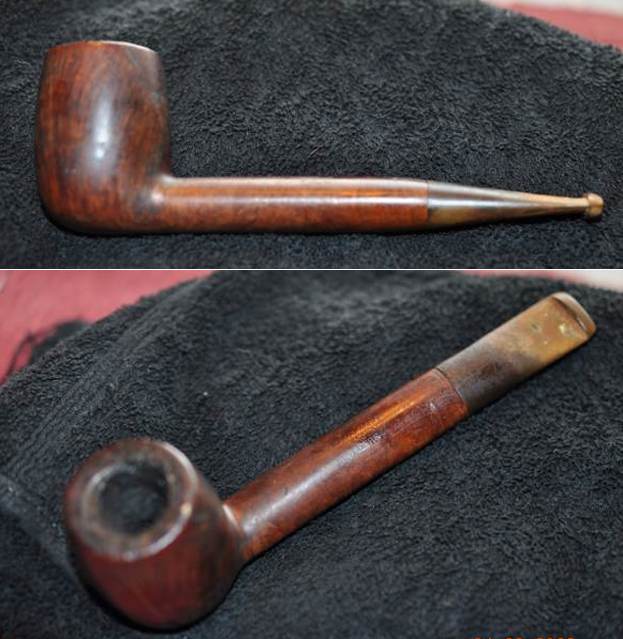
Then I turned to Pipedia and looked up Wenhall in the Pipe Makers list that is included there. I found the link there I was looking for (https://pipedia.org/wiki/Wenhall). It was a short article but it made a lot of connections to names that I was familiar with from working on pipes. I include the majority of the article because of the pertinent information that it provides and for ease of reference in the future.

Wenhall Pipes Ltd. was a distribution company out of New York City.

By the end of the 1970’s Wenhall approached Michael Kabik and Glen Hedelson, at that time operating from a farm house in Glen Rock, Maryland to create a line of freehands called Wenhall. The situation was favorable, because Kabik & Hedelson had ended their cooperation with Mel Baker of Tobak Ltd. to produce the famed Sven-Lar freehands shortly before.

Upon Wenhall’s offer the partners got a bank loan and set up a studio of 2000 square feet in a fairly new industrial park in Bel Air, Maryland and took on the name Vajra Briar Works. Wenhall initially wanted 500 pipes a week! But Kabik & Hedelson doubted that they could move that much product and told them they would produce 250 pipes per week. Happily, some of the old crew from Sven-Lar joined them at Vajra Briar Works, and thus they rather quickly met the production demands.

Furthermore during this time, Wenhall requested to create a line of pipes consisting of 12 different shapes. The line was called The Presidential and, while they repeated the same 12 shapes for this series, each one was freehand cut. Although they came up with interesting designs, mainly developed by Hedelson, especially Kabik was never really happy with the line or the concept, but, by this time, they had nine people on full-time payroll.

The stint with Wenhall lasted a couple of years, at which time they asked them to join Wenhall in a move to Miami, Florida. But by this time Kabik and Hedelson felt very uncomfortable with the owners of Wenhall and decided that they’d rather close the shop than make the move. Time proved that decision very wise, as Wenhall folded shortly after the move. All the same they had to close Vajra, but scaled down to the two of them and moved the operation to the farm house Glen was currently living in.

Presumably for a shorter period only Wenhall had pipes made in Denmark by Karl Erik. (BTW K.E. Ottendahl ceased all sales to the USA in 1987.)

The last sentence in red above gave me the confirmation I was seeking. I knew that the pipe I had was made in Denmark and thus by Karl Erik. I also knew that it was made before he ceased all sales in the US so that it was made before 1987. That is when his time with Wenhall ended. I always love being able to pin down a time frame for the pipe I am working on and knowing that this one was made prior to 1987 meant this was an older pipe. Now on to the work.

I am sure many of you skip my paragraph on the work Jeff has done before the pipe gets here but it is quite detailed in its brevity. I know some laugh at my opening line Jeff did a thorough cleaning of this pipe. However, I want you to know the details of the work. Back in 2020 Jeff wrote a blog about his cleaning process. I am including a link to that now so you can see what I mean about his process. Do not skip it! Give it a read (https://rebornpipes.com/2020/01/20/got-a-filthy-estate-pipe-that-you-need-to-clean/). Here is the introduction to that blog and it is very true even to this day.

Several have asked about Jeff’s cleaning regimen as I generally summarize it in the blogs that I post rather than give a detailed procedure. I have had the question asked enough that I asked Jeff to put together this blog so that you can get a clear picture of the process he uses. Like everything else in our hobby, people have different methods they swear by. Some may question the method and that is fine. But it works very well for us and has for many years. Some of his steps may surprise you but I know that when I get the pipes from him for my part of the restoration they are impeccably clean and sanitized. I have come to appreciate the thoroughness of the process he has developed because I really like working on clean pipe!

For the benefit of some of you who may be unfamiliar with some of the products he uses I have included photos of three of the items that Jeff mentions in his list. This will make it easier for recognition. These three are definitely North American Products so you will need to find suitable replacements or order these directly on Amazon. The makeup pads are fairly universal as we were able to pick some up in India when we were with Paresh and his family.

In the blog itself he breaks his process down into two parts – cleaning the stem and cleaning the bowl. Each one has a large number of steps that he methodically does every time. I know because I have watched him do the work and I have seen the pipes after his work on them. He followed this process step by step and when the pipe got to me it was spotlessly clean and ready for my work. The inside of the stem, shank and bowl were clean and to me that is an amazing gift as it means that my work on this end is with a clean pipe! I cannot tell you how much difference that makes for my work.

When the pipe arrives here in Vancouver I have a clean pipe and I go over it keeping in mind my assessment shared in the opening paragraph above. I am looking for any significant structural changes in the bowl and finish as I go over it.

  1. The finish is very clean and the grain stands out on the surface of the clean briar. The carved leaves looked good as well and appeared to have some dark stain tracing the lines in them and helping them stand out. There are no cracks showing up in the grain lines or in the flaws under the leaf carvings. It is sound on the outside. I will need to polish the briar and buff it to bring back the shine.
  2. The plateau rim top and shank end are clean and have some faded spots due to the cleaning and removing of the tars and oils that were scrubbed off. This will mean that in need to restain them with black and buff them with wax to bring them back to what they looked like when sent to the US originally. The good news for me is that there are no cracks showing up in the rim top plateau or in the shank end plateau. Those two areas are also sound.
  3. The bowl was very clean and smelled clean. The clean walls did not show evidence of checking or cracking. There were no hot spots or damage on the walls or around the entrance of the airway into the bowl. It was clean and smooth which is great news for me. The inner edge of the bowl was undamaged and did not show any sign of burning or reaming damage to the edges of the bowl. Both the shank and the bowl were very clean showing no debris on a clean pipe clean run through them. I would need to give it a final cleaning with pipe cleaners and alcohol once I had finished with the external work to remove the debris that may have collected there in the process.
  4. The vulcanite stem has clearly straightened over the years and that can be seen in the angle of the stem to the top of the bowl. I will need to heat it and bend the end to match the angle of the rim top. I always aim to get a basic straight line from the rim top to the curve of the stem when it is sitting in my mouth.
  5. The oxidation was gone from the stem after Jeff’s work on it. The tooth marks and chatter will need to be dealt with once I finish the bowl.

Hopefully the steps above show you both what I look for when I go over the pipe when I bring it to the work table and also what I see when I look at the pipe in my hands. They also clearly spell out a restoration plan in short form. My work is clear and addressing it will be the next steps. I took photos of the whole pipe to give you a picture of what I see when I have it on the table. This is important to me in that it also shows that there was no damage done during the clean up work or the transit of the pipe from Idaho to here in Vancouver. I then spend some time going over the bowl and rim top to get a sense of what is happening there. Remember that with plateau tops there can be dips in the plateau that extend into the bowl edge and are not damage but rather a natural feature. You can see the fading to the black of the plateau on the bowl top and the shank end. It is clean but will need to be restained to match what it was when made. I also went over the stem carefully. There were dents in the stem that are visible in the photos. But the good news is that the tooth marks were not deep and did not seem to puncture the airway. They would clean up well. I examined the button edge as it was damaged with tooth marks as well but I was happy to see that there were no cracks in the button surface. I took photos of the rim top and stem sides to show as best as I can what I see when I look at them.I always check to make sure that the clean up work did not damage the stamping on the shank in any way. I know Jeff is cognizant of this but I do it anyway and take a photo to show what I see when I examine it. In this case it has not changed at all from the pictures I included above. I also remove the stem from the shank and check the tenon and lay the parts of the pipe out to get a sense of the proportion that was in the mind of the pipe maker when he crafted the pipe. It is a beauty in flow and shape.The question at this point of where to begin the restoration work is always a matter of personal preference. If you read this blog much you will see that each of the restorers who post here all start at different points. I personally almost always start with the bowl because I truly do not like the tedious work of stem repairs and polishing. I always leave that until last even though I know that it needs to be done. So if you are restoring your pipes choose where you want to start and go from there. Just know that it all will need to be done by the end but for me the encouragement of seeing a rejuvenated bowl is the impetus I need to attack the stem work.
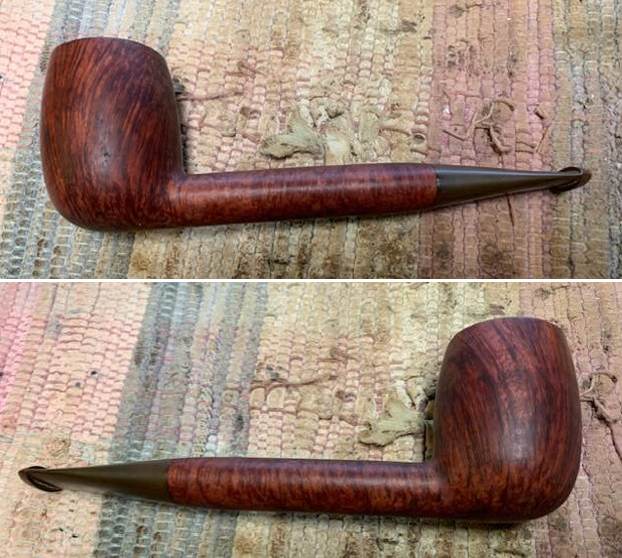
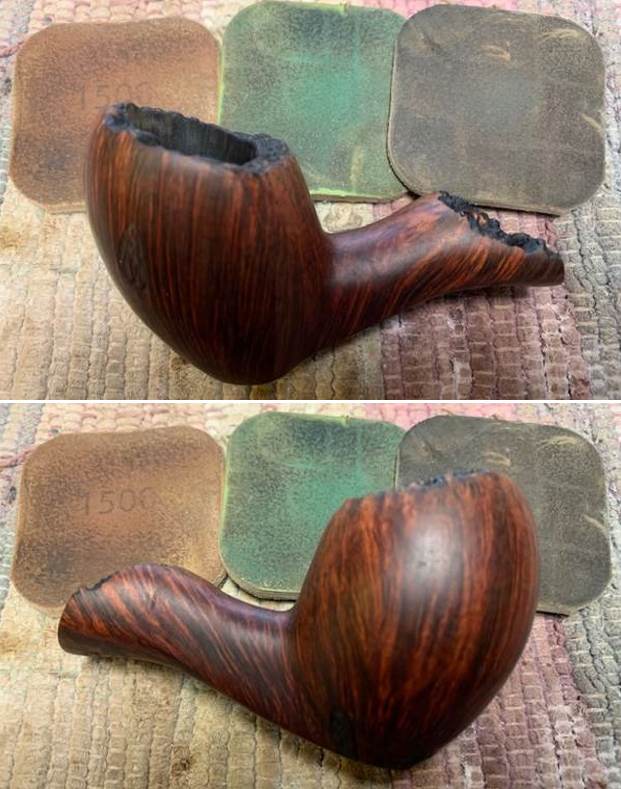
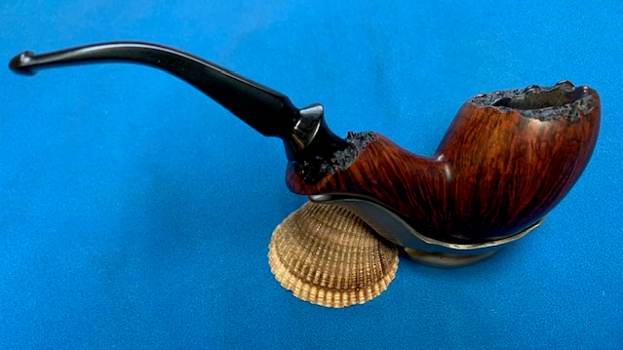
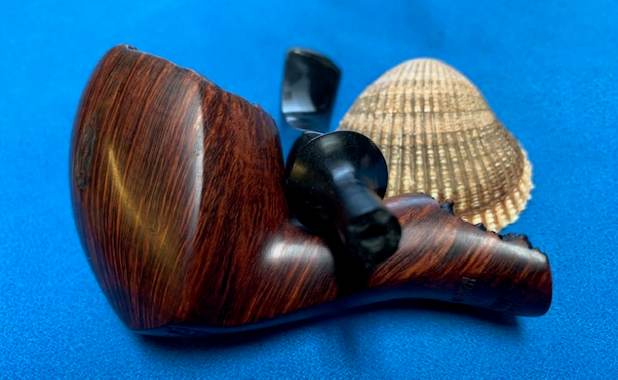
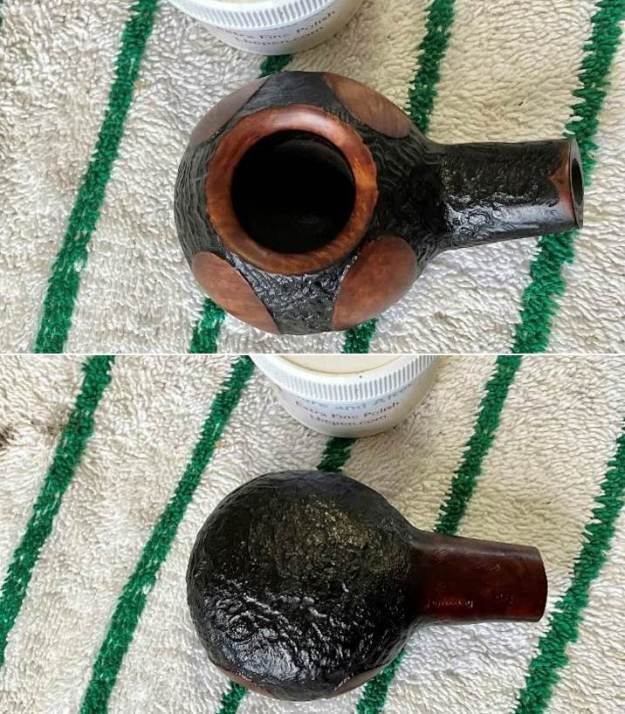
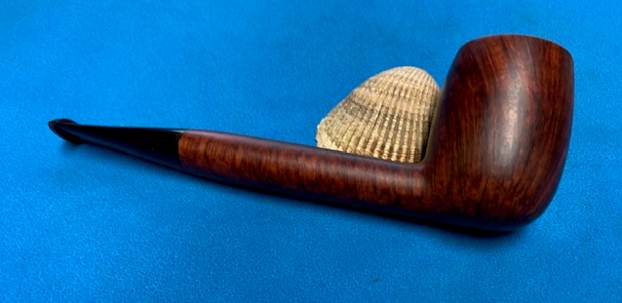
For me then I started working on this pipe by turning to the bowl. I chose to deal with the faded plateau on the rim and shank first because I would be polishing the briar and always like to go over the rim top and shank end plateau at the same time. I find that polishing those areas with micromesh differentiates the high points of the plateau from the valleys. I used a black stain pen to restain both areas. Remember this is only the first step in rim top staining. Polishing the briar will come next and that will change these areas as well.From here I turned to polishing the briar with micromesh sanding pads. I choose to dry sand the briar rather than wet sand it. Again it is a matter of personal preference. I prefer to use the pads dry and find they work very well on the briar. I sand with each pad (9 in total) and group them by threes for ease of reference. I also work over the plateau areas at the same time. I wipe the bowl down after each pad with a damp cloth to remove the sanding debris and check the briar. I love seeing the developing shine on the briar as I move through the pads which is why I include so many photos of this step. Pay attention to the changes in the briar and the plateau top in these photos as you work through them. To further sharpen the curves and grooves of the plateau on the shank and rim top I used a brass bristle wire brush. It is soft enough metal to clean up edges but not hard enough to scratch the surface of the briar.For the past few years now I have been using a product developed by Mark Hoover called Before & After Restoration Balm. I find that it is remarkable in its ability to really give the bowl deepened sense of colour and grain. It is a paste/balm that is rubbed into the surface of the briar and the plateau. The product works to deep clean the nooks and crannies of finish, enliven and protect the briar. I worked it into the briar with my finger tips and a horsehair shoe brush to get it into the grooves of the plateau. I let it sit for 10 minutes to let it do its work. I wiped it off with a soft cloth then buffed it with a cotton cloth. The briar and the plateau really began to have a deep shine in the briar. The photos I took of the bowl at this point mark the progress in the restoration. You see the shine that the briar has taken on and the contrast finish on the plateau areas is very beautiful. It is a gorgeous pipe. Now it was time to address the part of the restoration I leave until last. I set the bowl aside and turned my attention to the stem. I wanted to repair the tooth damage on the stem surface and on the surface of the button. Before doing any repairs to a stem surface I try to lift the marks as much as possible. To do that I use a Bic lighter to heat the tooth marks and dents in the stem surface. I describe that as “painting” the surface. What I mean by that is that I hold the stem stationary and quickly move the flame of the lighter across the dents repeatedly. Typically I am able to lift the dents significantly and sometimes in totality with the heat. It utilizes the “memory” vulcanite and the heat raises the marks.In this case I lifted all but two – one on each side. The heat did not have any effect on the tooth damage on the edge of the button. To take care of that I filled the edge in with clear CA glue and let it cure. Once it was hardened I recut the button edge with a small file to clean up the damage. I finished the reworking of the button and stem with 220 grit sandpaper and started polishing it with 600 grit wet dry sandpaper to remove the scratches. This process makes the repairs almost invisible when polished and also takes care of scratching in the surface of the vulcanite.I usually heat a stem to be bent with my heat gun until it is pliable then set it with running water. Today however I ran into a problem. My heat gun is no where to be found. I evidently either loaned to someone who still has it or it is somewhere in the house where I have overlooked it in the hunt. So I had to resort to an older way of heating the stem that is a bit more tricky. I “painted” the underside of the stem at the bend that was present with the flame of a Bic lighter as described above. When it became soft and pliable enough to bend to the angle I wanted I set the bend with cold water and dried it off. I checked the angle of the bend with the shank repeatedly until I was happy with the new look. I took some photos of the stem and of the stem in place in the shank and have included them below. It is possible to bend a stem with minimal tools. With the bend in the stem finished I needed to polish the stem and bring back a shine. I use micromesh sanding pads and water to wet sand the stem with 1500-12000 grit sanding pads. I wiped it down after each sanding pad with Obsidian Oil on a cotton rag after each sanding pad as I find it does two things – first it protects the vulcanite and second it give the sanding pads bite in the polishing process. After finishing with the micromesh pads I rub the stem down with Before & After Fine and Extra Fine stem polish as it seems to really remove the fine scratches in the vulcanite. I rub the Fine Polish on the stem and wipe it off with a paper towel and then repeat the process with the extra fine polish. I finish the polishing of the stem down with a final coat of Obsidian Oil and set the stem aside to let the oil absorb. This process gives the stem a shine and also a bit of protection from oxidizing quickly.The final steps in my process involve using the buffer. I first buff the stem and the briar with Blue Diamond on the buffing wheel. Blue Diamond is a plastic polish but I find that it works very well to polish out the light scratches in the vulcanite and the briar. I work the pipe over on the wheel with my finger or thumb in the bowl to keep it from becoming airborne. It works well and I am able to carefully move forward with the buffing. I lightly buff the plateau on the rim top and shank end at the same time making sure to keep the product from building up in the grooves of the finish. I finished with the Blue Diamond and moved on to buffing with carnauba wax. Once I have a good shine in the briar and vulcanite I always give the bowl and the stem multiple coats of carnauba wax. I have found that I can get a deeper shine if I following up the wax buff with a clean buffing pad. It works to raise the shine and then I follow that up with a hand buff with a microfiber cloth to deepen the shine. It is always fun for me to see what the polished bowl looks like with the polished vulcanite stem. It really is a beautiful pipe. The smooth finish around the bowl sides and shank show the grain shining through the rich brown stains of this Karl Erik Wenhall Langelinie Freehand. The black plateau on the shank end and rim top looked very good with some of the high points showing through in brown. The contrast in the combination looks very good.  The finished pipe feels great in my hand. It is light and well balanced. Have a look at it with the photos below. The dimensions are Length: 6 inches, Height: 2 ½ inches, Outside diameter of the bowl: 1 ½ inches, Chamber diameter: 7/8 of an inch. The weight of the pipe is 1.90 ounces/54 grams. It is a beautiful pipe and one that I will be putting on the rebornpipes store in the Danish Pipe Maker section.
Hopefully this tack of writing this blog is helpful to you in some way. In it I show both what I am looking for and how I move forward in addressing what I see when work on a pipe has been helpful to you. It is probably the most straightforward detailed description of my work process. As always I encourage your questions and comments as you read the blog. Thanks to each of you who are reading this blog. Remember we are not pipe owners; we are pipemen and women who hold our pipes in trust until they pass on into the trust of those who follow us.
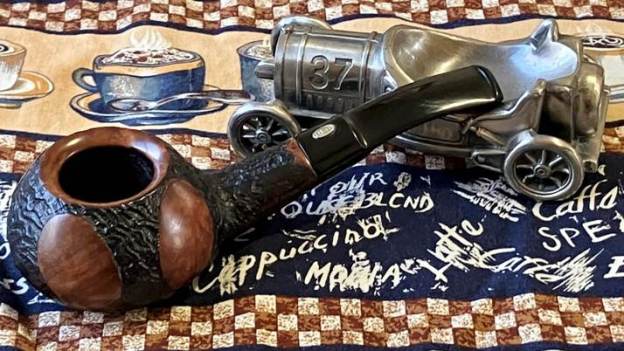
Cleaning up a GBD Fantasy 9643 Tomato


Blog by Mike Belarde

Hello, I hope everyone is doing well. I’m grateful to finally have an easy going Sunday to clean up a pipe. This GBD Tomato is not a shape that I have encountered often, and I was excited to win the online auction.

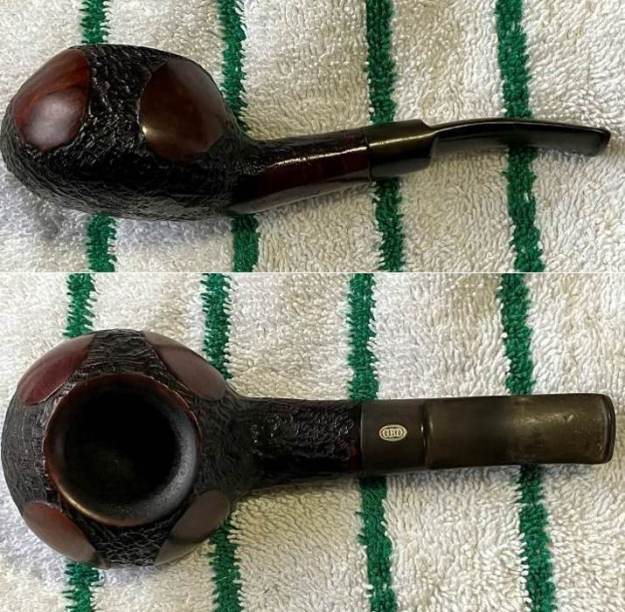
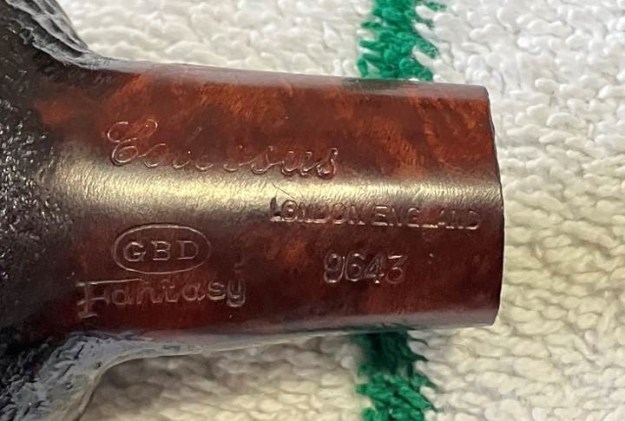
The pipe is an impressive piece of briar with a very wide and squat bowl. When I received it, I was pleased that it was in fairly good condition.  The stummel had been cleaned and waxed, but the pipe still looked a little grimy and dull.  The chamber and rim had a light build up of carbon. Thankfully, the stem still had a nice crisp button and was only lightly oxidized.  Below are photos of the initial condition.As you can see from the photos, it is a great looking pipe.  I really like GBD’s Fantasy and Tapestry lines with their whimsical geometric smooth panels over a black or brown sandblast.  The stamping on this pipe is still crisp.  The markings include the Colossus stamp, and the linear London England stamp.  Below these, are the GBD in an oval over the Fantasy stamp with the shape number of 9643.

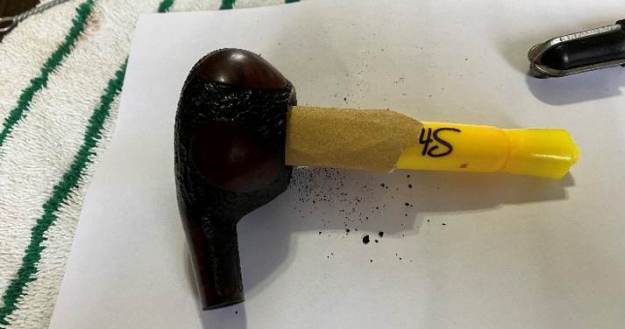
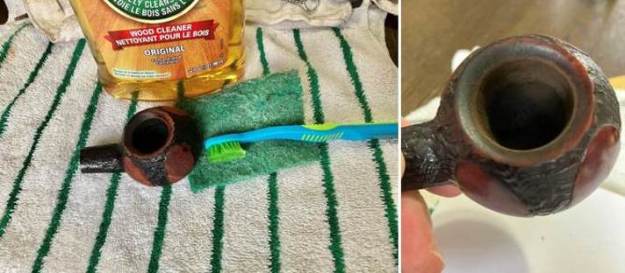
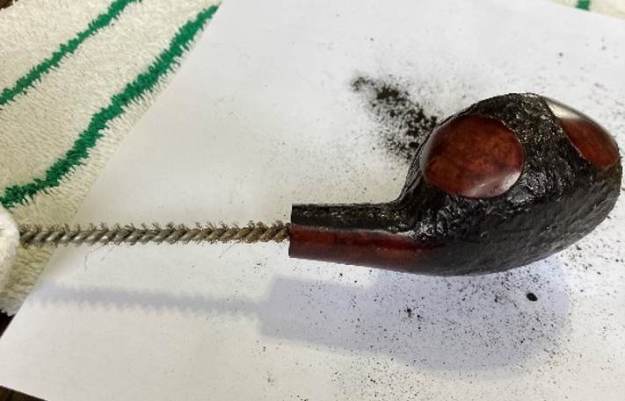
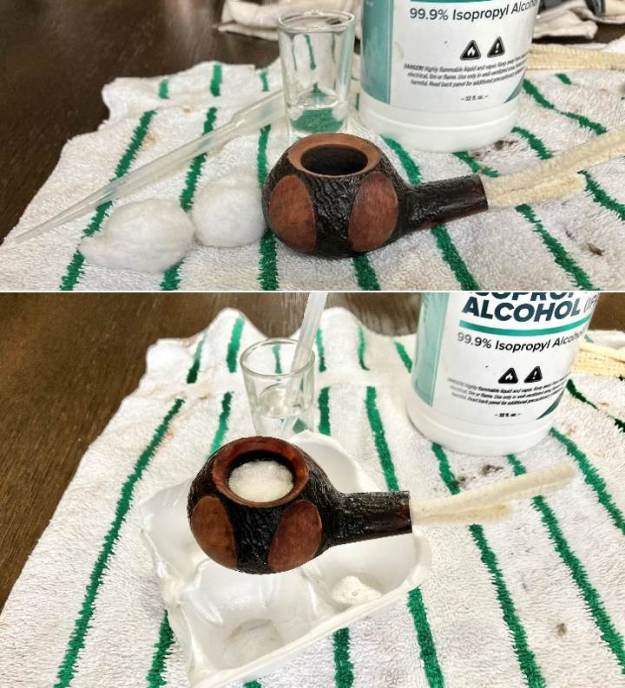
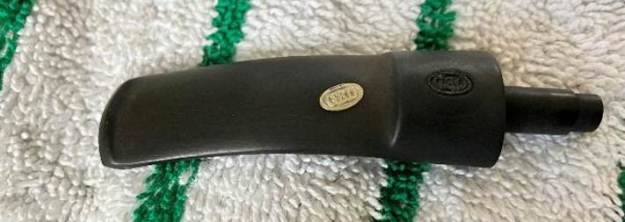
The Colossus stamp indicates that this was part of GBD’s line of supersized pipes. The linear London England stamp, paired with the brass GBD rondel, dates this pipe prior to 1981 or 1982.  My guess is this pipe was made sometime in the 1970s.Eager to clean the pipe up and add it to my collection, I placed the stem in a small Tupperware to soak overnight in Briarville’s Pipe Stem Oxidation Remover solution. I then set to cleaning up the stummel. Realizing all my pipe reamers were too small for the width of the chamber, I wrapped a piece of 220 grit sandpaper around a highlighter to remove the built-up carbon.After this was done, I took the stummel to the sink and washed the exterior with Oil soap and an old toothbrush.  A light lava build up was present on the rim so I used an old green scouring pad to scrub it away. With the chamber and the exterior clean, the Tomato was looking really nice. The chamber seemed to be in good condition once the light cake had been removed.Thankfully the internals of this pipe were fairly clean and required minimal work on my part. I have to admit that cleaning the draught is my least favorite part of restoring estate pipes! I first used a 3mm wire brush to gently clean out the shank. Once done, I cleaned the internals with a handful of pipe cleaners dipped in 99% Isopropyl alcohol.After the interior of the pipe was cleaned to a satisfactory level, I prepared the pipe for de-ghosting. I put two fluffy pipe cleaners down the shank to act as a wick and then placed two cotton balls in the chamber. I soaked each cotton ball with alcohol, as I placed them one at a time in the chamber. To let the alcohol, work its magic and draw out more of the old tar and grime, I let it sit overnight. The next day I took the stem out of the Briarville solution and scrubbed the surface with a green scouring pad and some Soft Scrub.  The stem looked great, but I ran into a problem – for some reason the brass rondel came off. I’m not really sure what went wrong, but it would have to be fixed. I reattached the rondel by applying a small amount of Super Glue and used a soldering iron to apply heat. Hopeful that the heat would soften the vulcanite under the rondel and allow it to reattach as the vulcanite cooled. The process seemed to work, but I’m going to keep an eye on the rondel for possible problems down the road.

With that done, I sanded the stem with some 220 grit sandpaper and polished it with the series of micropads (1500-12000). Between each pad I wiped the stem down with stem oil. In the final step, I applied some Before and After Extra Fine Stem polish. I think the results turned out pretty well and am happy with how the stem looked. I may go back and rework some of the area around the rondel, but I am leery of disturbing the area too much and dislodging it again.Satisfied with the progress on the stem, I turned my attention to the stummel. I polished the rim and smooth panels with the progression of micromesh pads (1500-12000), wiping the areas with a damp paper towel after each pad. I lightly polished the sandblast areas with the 6000-12000 pads to avoid removing any of the original black stain. After I cleaned the stummel, I noticed a few areas that needed to be re-stained. You’ll notice the areas where the brown stain was showing through on the sandblast in the pictures below. I also noticed the transition between the shank and stem was darkened like it had been stained over with black dye. On other Fantasy pipes that I own, this transition is usually stained brown giving the pipes a nice highlight on the shank. I lightly sanded the rim with a piece of 220 grit sandpaper to remove some lingering darkening. I also lightly sanded the smooth panels and shank transition to remove some of the dark stain there. After this was done, I mixed a 1-to-3 ratio of Medium Brown and Black dyes with alcohol to thin them down. I like to apply the stain with a small hobby brush as I find the brush helps me to coat the stummel evenly. Once the stain was applied, I used a candle to fire the briar and set the dye. I let the stummel sit for 10 or 15 minutes and then removed some of the excess stain with a folded paper towel dampened with alcohol.I began to polish the stummel with the micromesh pad series (1500-12000), wiping the briar down with a damp paper towel between each pad. Once finished with the micro pads, I worked some Before and After Restoration Balm into the stummel, let it sit for about 10 minutes, and then buffed it with a cotton cloth. At this point I was very pleased with the results – the pipe looked great! For the last step, I buffed both the stummel and stem with Red Tripoli and Blue Diamond. I gave both several coats of Carnauba wax and buffed them with a cotton cloth.

I’m really happy how this pipe turned out! It is a great shape and the size of the bowl just dominates one’s palm.  The overall length of the pipe is 5.25”, with the outside diameter of the bowl coming in at 2.13”. The chamber itself is a generous 1”, while the entire bowl stands at a modest 1.13”. The pipe weighs a noticeable 2.20oz, and its haft and size just feel nice in one’s hand.   It should be a nice smoking pipe, and I’m happy that I can add it to my collection. Thank you for taking the time to read this blog!

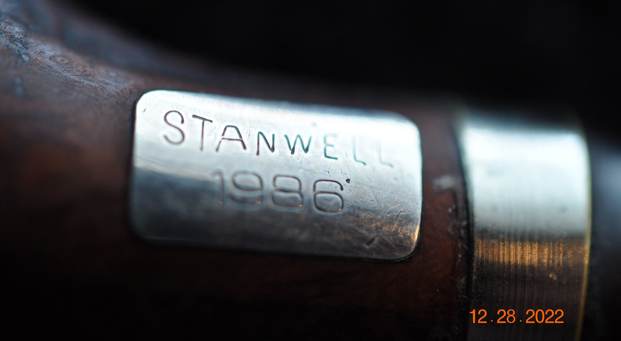
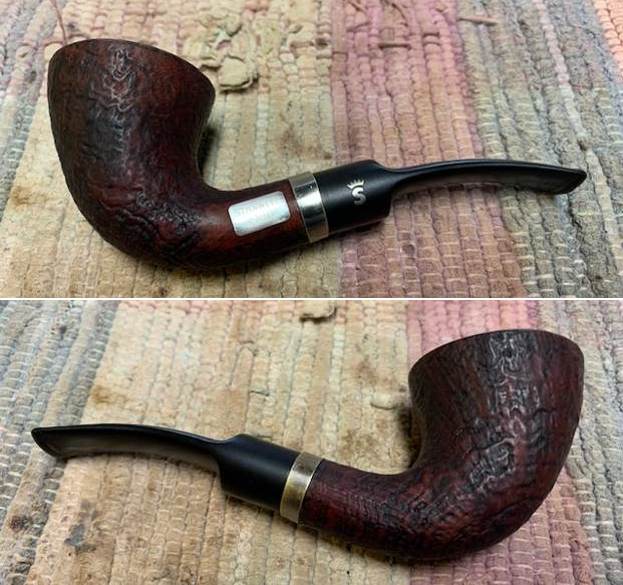
Is it possible to give this Horribly Abused Stanwell 1986 POY Dublin New Life?


Blog by Steve Laug

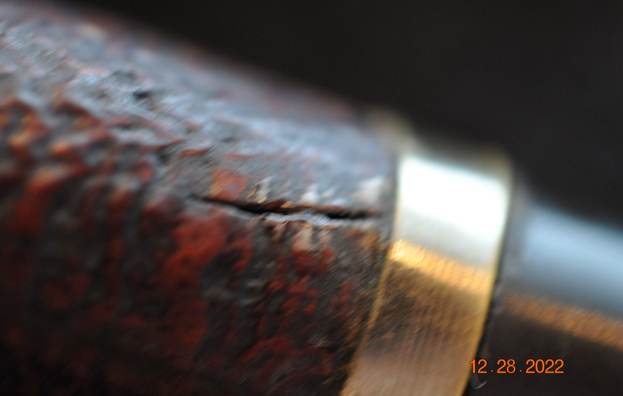
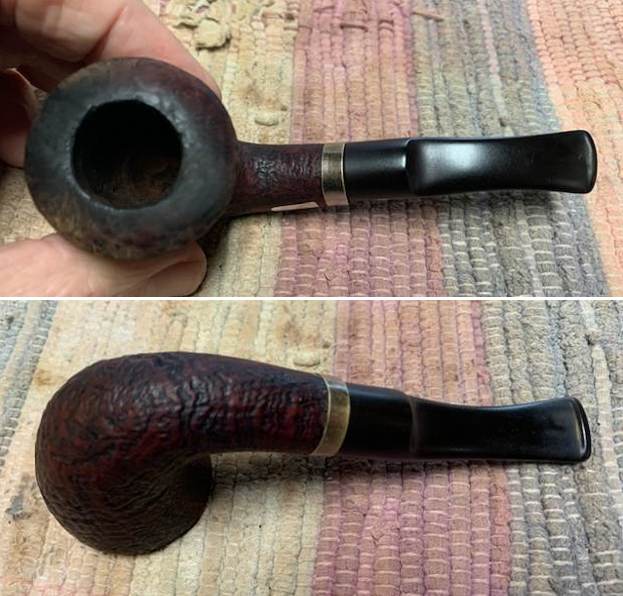
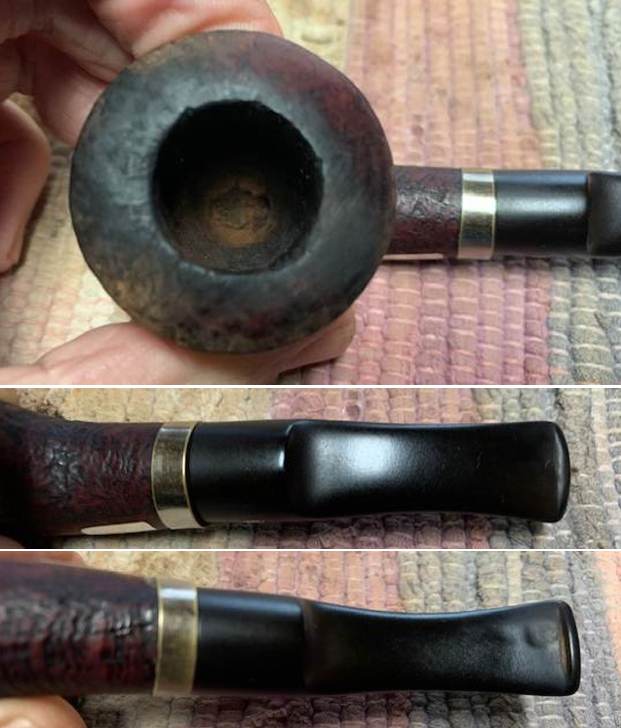
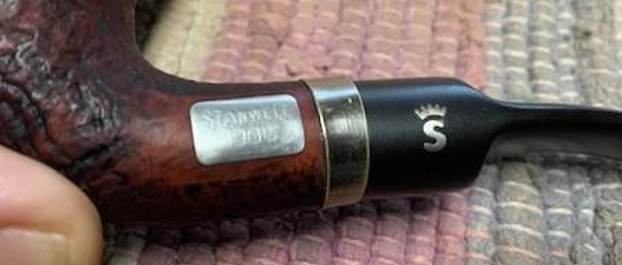
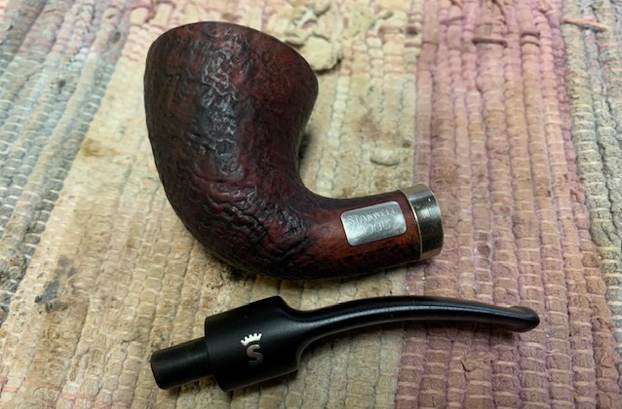
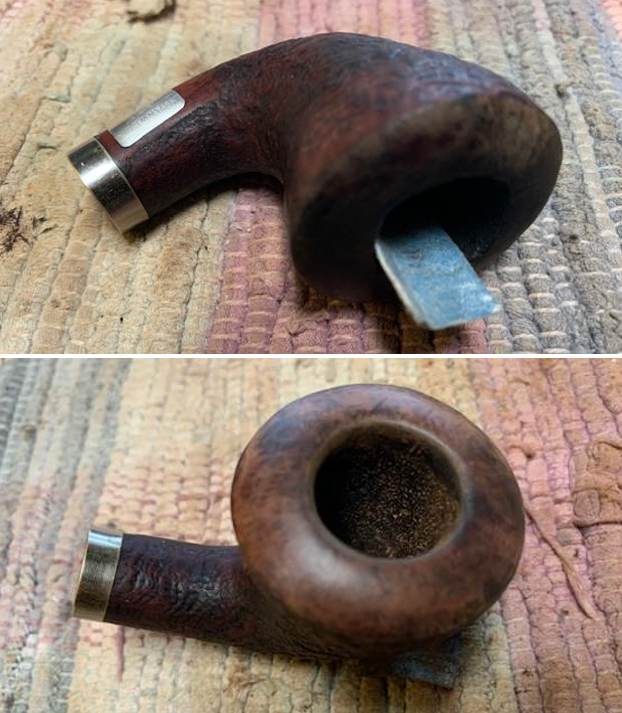
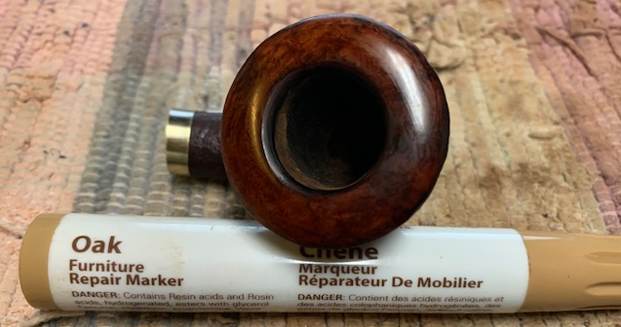
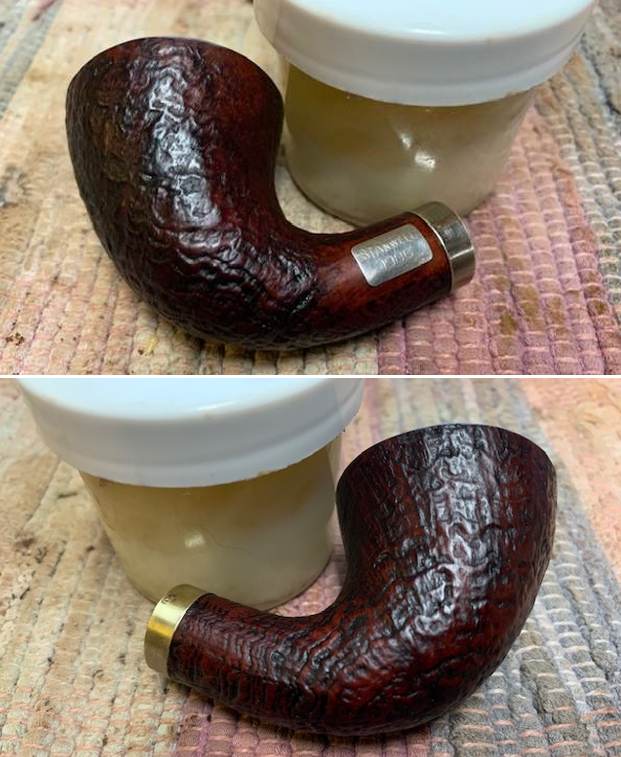
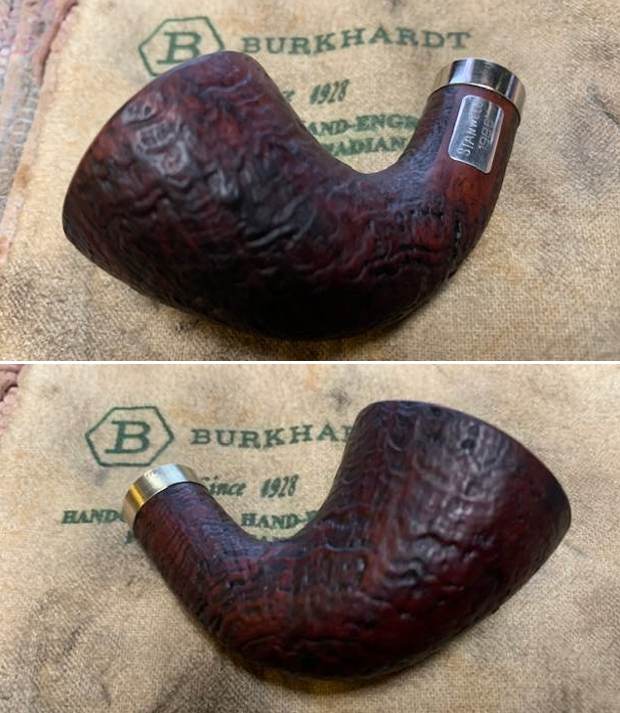
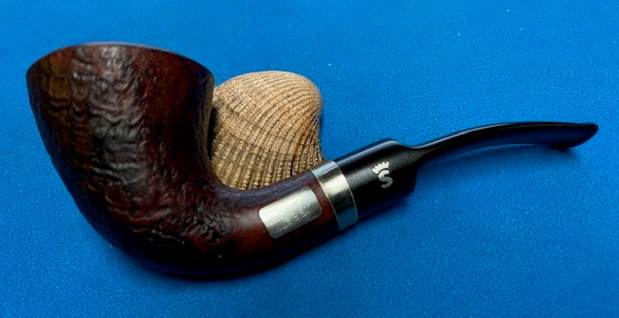
The next pipe I am working on was purchased on 11/14/2022 as part of a group of pipes from a fellow in Copenhagen, Denmark. This was a horribly tired and dirty pipe with a lot of wear and tear and obviously it had been someone’s favourite smoker. The pipe has an identifying plate on the left side of the shank that reads Stanwell [over] 1986. There was no other stamping on the shank and the silver plate confirmed for me that it was a Stanwell Pipe of the Year. The dirty sandblast finish on this was worn and tired looking. There were tars and oils ground into the surface of the briar. The silver band on the shank was an later addition to address a crack in the shank on the underside. one showed some nice grain around the bowl and shank and though it was a little dirty it was a nice looking pipe. The bowl had a thick cake that flowed over the top of the lightly crowned rim in a thick coat of a lava and showed potential damage on the top and the inner edge. The stem was a black vulcanite saddle stem with a silver Crown S on the left side of the saddle. It had some deep and wide tooth marks and chatter on both sides ahead of the button. There was also some oxidation and calcification on both sides of the stem. For me the question was would it clean up well enough to make it worth doing a thorough restoration. Time would tell once it was cleaned up and I had a chance to look it over. Jeff took photos of the pipes before he started his clean up work.  He took photos of the rim and bowl to show the heavy cake and thick lava coat covering the rim top. It really was filthy and a mess. He also took photos of the stem surfaces to show its overall condition when it arrived. The photos of the sides and heel of the bowls show beautiful grain around the bowl and shank sides. The sandblast is nicely done and highlights the grain. The brown stain on the briar adds depth finish on the pipe and makes the grain really stand out. It shows some promise. He took a photo of the crack in the underside of the shank. It had been repaired before but the band had slipped off a bit and the crack had opened up. He also took a photo of the stamped silver plate on the left underside of the shanks. It reads as noted above. Jeff cleaned up the pipe for me. He reamed the bowl with a PipNet pipe reamer and cleaned it up with a Savinelli Fitsall Pipe Knife. He scrubbed the exterior with Murphy’s Oil Soap and a tooth brush to clean off the grime off the finish and the heavy overflow of lava on the rim top. The cleaning had removed the thick coat on the rim top. He cleaned up the internals of the shank, mortise and stem with pipe cleaners, cotton swabs and alcohol to remove all of the oils and tars in the pipe. He soaked the stem in Before & After Deoxidizer and was able to remove much of the oxidation, calcification. When it arrived here in Vancouver it was a clean pipe and I knew what I had to work with. I took photos of it before I started my part of the restoration. I took a photo of the rim top and the stem to show their condition once it arrived in Canada. Jeff was able to clean up the incredibly thick cake and the lava overflow that was shown in the rim and bowl photos above. The rim top showed damage on the surface and the inner edge of the bowl was in rough condition. It was chipped and out of round. He was also able to get rid of the grime and grit in the surface of the briar around the sandblast. The last photo of the three below shows the crack in the shank. The stem looked better, though there were deep tooth marks and chatter on both sides near the button. I took a photo of the stamping on the silver plate on the left side of the shank to show that it was readable and undamaged by the cleanup work.I removed the stem from the shank and took a photo of the parts to give a sense of what the pipe looks like.I started my work on the inner edge and rim top with a folded piece of 220 grit sandpaper. I was able to remove that damage on the rim top and bring the inner edge back into round. It looked much better. (I also filled in the remnants of the crack on the underside of the shank with clear CA glue to further strengthen the  previous repair. I forgot to take pictures of this step.)I started polishing the smooth rim top with micromesh sanding pads. I wet sanded it with 1500-12000 grit pads. I wiped the bowl down after each pad with a damp cloth. The crowned rim top began to take on a rich shine and grain was beginning to stand out. I wet sanded with all of the pads and wiped the bowl down after each pad with a soft cloth. I used an oak stain pen to touch up the stain on the rim top to match the other smooth portions of the bowl and shank.I rubbed the bowl and shank down with Before & After Restoration Balm to deep clean the finish on the bowl and shank. The product works to clean, enliven and protect the briar. I worked it in with my fingers to get it into the briar. I used a horsehair shoe brush to work it into the sand blast. I let it sit for 10 minutes then I wiped it off and buffed it with a soft cloth. The briar really began to have a rich shine. I took some photos of the bowl at this point to mark the progress in the restoration. It is a beautiful bowl. I polished the silver band and plaque on the side of the shank with a jewelers cloth to remove the slight remaining oxidation and to protect and preserve it. I set the bowl aside and worked on the stem at this point in the process. The stem sat straight in the shank but the fit was thicker on the right side of the shank rather than the left side. I would need to reduce the diameter of the stem on the right side to get a more centered fit. I sanded the side with a piece of 220 grit sandpaper to reduce the diameter on that side. At the same time I filled in the deep tooth marks with clear CA glue. I flattened the repairs with a small file. And sanded the smooth with 220 grit. I started polishing the whole stem with 600 grit sandpaper until the sanding marks were gone. I polished the stem with micromesh sanding pads – dry sanding with 1500-12000 grit pads. I wiped the stem down after each pad with a damp cloth to remove the sanding dust. I gave it a further polish with Before & After Stem Polish – both Fine and Extra Fine. I finished by wiping the stem down with a final coat of Obsidian Oil and set it aside to dry. I put the stem back on the Stanwell Pipe of the Year 1986 Dublin Calabash pipe and took the pipe to the buffer. I buffed the bowl and stem with Blue Diamond to polish the briar and the acrylic. Blue Diamond does a great job on the smaller scratches that remain in both. I gave the bowl and the stem several coats of carnauba wax and buffed the pipe with a clean buffing pad to raise the shine. I hand buffed it with a microfiber cloth to deepen the shine. Considering the mess the pipe was when we received it I am amazed at how well it turned out. The finished pipe is shown in the photos below. This is a beautiful Stanwell POY 1986 – the vulcanite saddle stem and crowned rim top and sandblast finish combine to give the pipe a great look. The polished black, vulcanite stem looks really good with the rich browns standing out in the sandblast. The dimensions of the pipe are Length: 5 inches, Height: 2 inches, Outside diameter of the bowl: 1 ½ inches, Chamber diameter: ¾ of an inch. The weight of the pipe is 1.34 ounces/38 grams. This is another pipe that I will be putting on the rebornpipes online store in the Danish Pipe Pipemaking Companies Section shortly, if you are interested in adding it to your collection. Thanks for walking through the restoration with me on this beauty!

Restoring a Nicely Grained Stanwell Buffalo 141 Billiard


Blog by Steve Laug

It is a rainy Saturday for me here in Vancouver so I decided to work on another one that was purchased on 01/10/2023 in a lot of pipes that came to us from Copenhagen, Denmark. This is a tall billiard almost a tall Brandy with a smooth finish and a variegated yellow/gold shank extension. It is another Made in Denmark Stanwell. The smooth finish on this pipe, around the bowl and shank has a mix of grain highlighted by the reddish brown stain. The pipe is stamped on the underside of the shank near the stem/shank junction and reads STANWELL [over] Made in Denmark [over] Buffalo. On the left side of the shank it has the shape number 141 stamped. The pipe was a well used pipe when Jeff received it. There was dust and grime ground into the finish. The mixture of brown stains highlights some beautiful grain under the dirt. The bowl was lightly caked and there was a light overflow of lava on the smooth rim top. The inner edge looked quite good. It had been reamed recently before we received it and there were scrape marks around the bottom of the bowl. They not grooves but rather smooth clean briar scraped by a reamer. The stem is vulcanite and was dirty, oxidized and had light tooth marks, chatter and scratches on both sides ahead of the button and on the button itself. There is a white crown S logo stamped on the left side of the taper stem. Jeff took photos of the pipe before he started his clean up work on it. He took photos of the bowl and rim top to show what they looked like before his clean up. You can see the scratches in the smooth rim top. The inner edge also shows some damage. He also took some of the stem to show the condition of both sides. The photos of the sides and heel of the bowl show the uniquely stained grain around the bowl and shank. The mixture of brown stains adds depth to the finish on the pipe. Even under the grime it is a real beauty. You can also see the swirls in the acrylic shank extension. The stamping on this one was around the bamboo horizontally and is shown in the photo below. It is clear and readable as noted above. The second photo shows the white stamped crown S on the stem side. Before I started my work on the pipe I wanted to see if I could find any information that would help me get a sense of the line. I turned to Pipephil to see if there was any listing on the Buffalo Line (http://pipephil.eu/logos/en/logo-stanwell.html). There was nothing listed.

I then turned to Pipedia (https://pipedia.org/wiki/Stanwell) for more information. The article is great and gives a lot of history on the brand. There were also links to a shape article by Bas Stevens that I originally published on rebornpipes. I looked up the 141 shape number to see who had designed that shape (https://pipedia.org/wiki/Stanwell_Shape_Numbers_and_Designers). I quote the information on shape 141.

  1. Billiard, medium size, conical bowl, full mouthpiece by Jess Chonowitsch.

I found a listing on Smokingpipes.com that had a description of the Buffalo line of pipes (https://www.smokingpipes.com/pipes/estate/denmark/moreinfo.cfm?product_id=229371). I am including part of the description below.

A rather easy to spot Stanwell series, the pipes of the Buffalo line were distinguished by swirled pattern acrylic ferrules in colors reminiscent of water buffalo horn.

Now it was time to work on the pipe.

Jeff had thoroughly cleaned up the pipe. He reamed the pipe with a PipNet Pipe Reamer and cleaned up the remnants with a Savinelli Fitsall Pipe Knife. He scrubbed the bowl with undiluted Murphy’s Oil Soap with a tooth brush. He rinsed it under running warm water to remove the soap and grime. He cleaned out the inside of the shank and the airway in the stem with alcohol, cotton swabs and pipe cleaners. He scrubbed the exterior of the stem with Soft Scrub to remove the grime and calcification. He soaked the stem in Before & After Deoxidizer and rinsed it off with warm water. The pipe looked very good when it arrived here in Vancouver. I took close up photos of the bowl, rim and the stem. You can see the damage on rim top and inner edge. The bowl is quite clean inside with marks from a previous reaming on the bottom of the bowl. The acrylic stem is in good condition with light tooth marks and some chatter as noted above.I took photo of the stamping on the underside and right side of the shank. It is clear and readable as noted above. I removed the stem from the shank and took a photo to give a sense of the proportions of the pipe. The briar is quite beautiful and the dark and medium stains really make it stand out.I started my work on the pipe working on the damage to the inner edge and the rim top with a folded piece of 220 grit sandpaper to bring the edge back into round and it looked much better.I used a Cherry stain pen to touch up the sanded edges and top spots on the rim top where I sanded it smooth and removed the damaged. The colour was a perfect match to the remainder of the bowl and shank.I polished the bowl and shank with micromesh sanding pads – dry sanding with 1500-12000 grit pads. I wiped the bowl down after each pad to remove the grit. The bowl began to take on a rich shine. It is a beauty. I rubbed the bowl down with Before & After Restoration Balm. I worked it into the briar with my finger tips. I let it sit for 10 minutes and the Balm did its magic. It enlivens, cleans and preserves the briar. It certainly brought this bowl back to life. I buffed it off with a clean cloth and took the following photos. I set the bowl aside and turned my attention to the stem. I polished the stem with micromesh sanding pads – 1500-12000 grit pads. I wiped it down with a damp cloth after each sanding pad. I used Before & After Pipe Polish – both Fine and Extra Fine to further polish the stem. This Stanwell Buffalo 141 Billiard with a vulcanite taper stem is a great looking pipe now that it has been restored. The mix of stains once cleaned up really highlights the grain and the polished sandblast finish is stunning. I put the stem back on the bowl and carefully buffed the pipe with Blue Diamond on the buffing wheel. I gave the bowl and the stem multiple coats of carnauba wax on the buffing wheel and followed that by buffing the entire pipe with a clean buffing pad. I hand buffed the pipe with a microfiber cloth to deepen the shine. The finished Stanwell Buffalo 141 Billiard fits nicely in the hand and feels great. Give the finished pipe a look in the photos below. The dimensions of the pipe are Length: 6 inches, Height: 2 inches, Outside diameter of the bowl: 1 inch, Chamber diameter: ¾ of an inch. The weight of the pipe is 40 grams / 1.41 ounces. I will be adding the pipe to the Danish Pipe Makers Section of the rebornpipes store. If you are interested in purchasing this pipe send me a message or an email. Thanks for reading this blog and my reflections on the pipe while I worked on it.

Another Old Timer – A Patent No. Dunhill Shell Briar 40 Made in England Lovat


Blog by Steve Laug

The next pipe on the table came to us from a group of pipes that Jeff and I purchased from a fellow in Copenhagen, Denmark on October 3, 2022. It is a Dunhill Shell Lovat that is in good condition. It is stamped on a smooth panel on the underside of the shank. On the heel of the bowl someone scratched 1953. Then it is stamped with the shape number 40 F/T followed by Dunhill [over] Shell Briar. Next to that it is stamped Made in England followed by the date number superscript 2 and next to that superscript 3. Underneath that it reads Pat. No. 417574/34. After that it is stamped with a 4 in a circle [followed by] S for shell. The stamping is clear and readable as noted above. The pipe has a mix of black, cordovan and brown stains on a sandblast finish and some amazing grain that the shape follows well. The finish was dusty around the nooks and crannies of the sandblast but otherwise fairly clean. The bowl had a light cake and there was some light lava on the sandblasted rim top or edges. The short saddle stem was oxidized, dirty and had tooth marks and chatter ahead of the button. Jeff took photos of the pipe to show what it looked like before he started working on it. He took photos of the bowl and rim top to show their condition and of the stem to show the condition of both sides of the stem. The photos of the sides and heel of the bowl show the deep sandblast grain on the pipe. It is a beauty.  The stamping on the underside of the shank is shown in the photo below. It looks very good and faint but readable. It reads as noted and explained above. Jeff captured the detail in the photos below. One of the first things I like to do is to unpack the stamping and understand each element in it. I turned to Pipephil helpful site (http://pipephil.eu/logos/en/dunhill/shell-briar1.html). The stamping is interpreted as follows: The scratched date 1951 is in question. The number 40 is the shape number for a Lovat. The F/T is the designation for a Fishtail stem. The Dunhill Shell is the finish which is corroborated the S at the end of the stamping. The size of the pipe is a Group 4. The 2 3 following the D of England gives the date the pipe.Pipephil also has some helpful dating keys on the site that are basically flow charts that you can walk through to date your pipe (http://pipephil.eu/logos/en/dunhill/cledat-en1.html). I turned to Part 1 of the Dating Key and followed the chart. This pipe has a suffix of 2 3 following the D in England. It is raised and underlined so that took me to the section on the chart below (column one) which instructed me that the pipe could be dated as being made between 1921 and 1954. The date stamp 2 3 which made the pipe a 1952 Shell that was sold in 1953.I followed the link following the “Your pipe was crafted between 1921 and 1954. Narrow down your dating”. That took me to Page 2 of the dating key (http://pipephil.eu/logos/en/dunhill/cledat-en1b.html). The first column on the left led me to the section on 1…4 where the directive of dating the pipe is spelled out as follows: 1950 + suffix which gives the  pipe a date of 1954.I then turned to Pipedia’s section on Dunhill Root Briar to get a bit of background on the Duhill finishes (https://pipedia.org/wiki/Dunhill#Root_Briar). I quote:

Shell
A deep craggy sandblast with a black stain finish (usually made using Algerian briar) – the color of the stain used has varied over the years. Although there is some doubt as to them being the first to sandblast pipes, Dunhill’s Shell pipes, and the sandblasting techniques developed to create them are considered one of Dunhill’s greatest and most lasting contributions to the art of pipe making.

The documented history of Dunhill’s inception of the Shell is largely limited to patent applications — there are no catalog pages or advertisements promoting blasted pipes at the time. The preliminary work on the English patent (No. 1484/17) was submitted on October 13, 1917. The patent submission was completed half a year later, on April 12, 1918, followed by the granting of the English patent on October 14, 1918. This was less than a month before the end of The Great War on November 11th.

In 1986 Dunhill released a line of premium Shell finish pipes – “RING GRAIN”. These are high-quality straight grain pipes which are sandblasted. Initially only Ring Grain, but now in two different finishes. In 1995 the “Shilling” was introduced with Cumberland finish – it is an extremely rare series. These pipes exhibit a deeper blast characteristic of that of the 1930’s – mid-1960’s (and the limited ‘deep blast’ pipes of the early 1980s) and show a fine graining pattern. These are considered the best new Dunhills by many enthusiasts today and are very rare. The finish is sometimes described as tasting like vanilla at first, with the taste becoming more normal or good as the pipe breaks in.

I have also included a chart from the site from Dunhill spelling out the Standard Pipe Finishes and giving short information and a timeline. I turned to work on the pipe itself. Jeff had done an amazing cleanup of the pipe. He reamed the light cake with a PipNet reamer and cleaned up that with a Savinelli Fitsall Pipe Knife. He scrubbed the internals of the bowl and stem with alcohol, cotton swabs and pipe cleaners. He scrubbed the externals with undiluted Murphy’s Oil Soap and rinsed the bowl off with running water. He soaked the stem in Briarville’s Pipe stem Deoxidizer and once it had soaked rinsed it off with warm water to remove the residual solution. He dried it off and rubbed it down to remove any oxidation that was still on the stem. The pipe looked very good when I received it. I took a photo of the rim top to show the condition. You can see the clean bowl. It almost looks as if it was never smoked to the bottom of the bowl. The stem came out looking quite good. There are some tooth marks and chatter on both sides ahead of the button.  I took a photo of the underside of the shank to show the stamping. The photo clearly shows the stamping and is actually more readable in the photo than in person. I removed the stem from the shank and took a photo of the pipe parts to show what I was working with. It is a nice looking pipe.The bowl was in such good condition that I had to do some minimal work with it. I touched up the stain on the worn spots on the rim with a walnut stain pen. I rubbed the briar down with Before & After Restoration Balm. I worked it into the briar with my fingertips and a horsehair shoe brush to work it into the nooks and crannies of the sandblast finish. The product works to clean, enliven and preserve the briar. I let it sit for 10 minutes then I buffed it with a cotton cloth to deepen the shine. The briar really comes alive with the balm. I “painted” the stem surface on both sides to lift the dents. The heat lifted the ones on the top completely and the ones on the underside for the most part. I filled in the two small remaining marks on the underside of the stem with clear CA glue. Once it cured I sanded repairs out with 220 grit sandpaper and started the polishing with 400 grit wet dry sandpaper. I polished the vulcanite with micromesh sanding pads – 1500-12000 grit pads. I wiped it down with Obsidian Oil after each sanding pad. I used Before & After Pipe Polish – both Fine and Extra Fine to further polish the stem.  This 1952 Patent No. Dunhill Shell 40 F/T Lovat has a beautiful, unique Dunhill Sandblast finish that is very deep and craggy. The dark mixed black/brown/red finish highlights some great grain around the bowl and shank. It has some great rugged sandblast that Dunhill specialized in making. The polished black vulcanite short saddle stem adds to the mix. I put the stem back on the bowl and buffed the pipe with Blue Diamond on the buffing wheel being careful to not buff the stamping. I gave the bowl multiple coats of Conservator’s Wax and the stem multiple coats of carnauba wax on the buffing wheel and followed that by buffing it with a clean buffing pad. I hand buffed the pipe with a microfiber cloth to deepen the shine. The finished Dunhill Shell 40 F/T Lovat is quite nice and feels great in the hand. Give the finished pipe a look in the photos below. The dimensions of the pipe are Length: 5 inches, Height: 1 ¾ inches, Outside diameter of the bowl: 1 1/8 inches, Chamber diameter: ¾ of an inch. The weight of the pipe is .92 ounces/26 grams. Thanks for walking through the restoration with me as I worked over another beautiful pipe. If you are interested in adding it to your collection I will be adding it to the British Pipe Makers Section of the rebornpipes store. Thanks for your time.

Restoring a Classic Custom-Bilt


Blog by Kenneth Lieblich

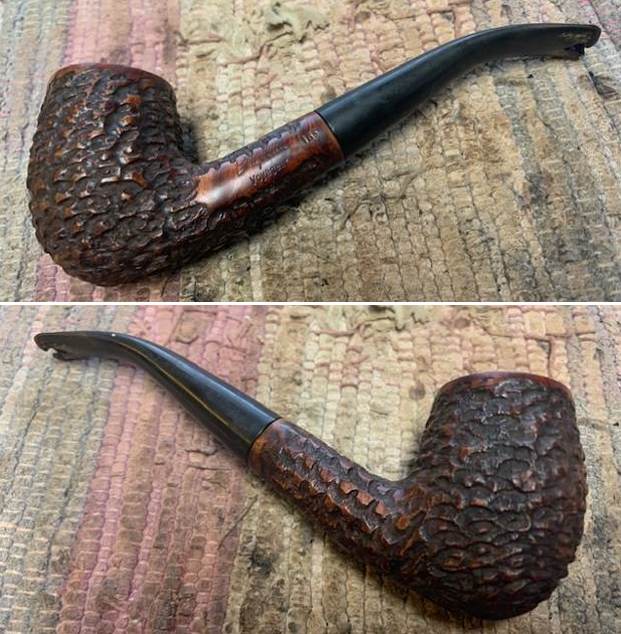
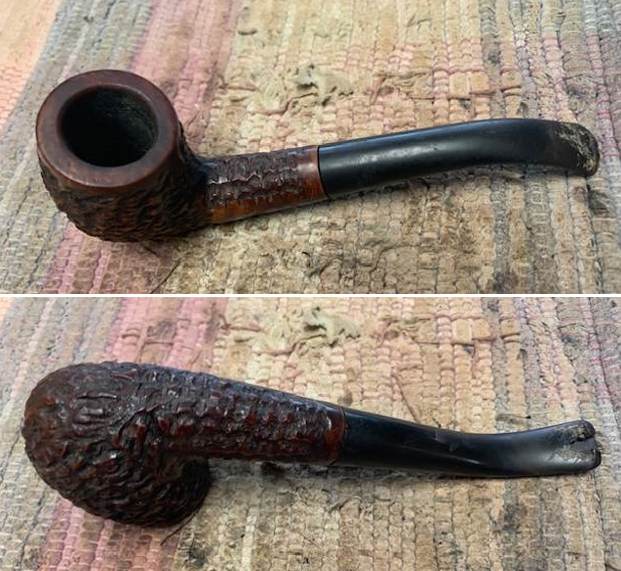
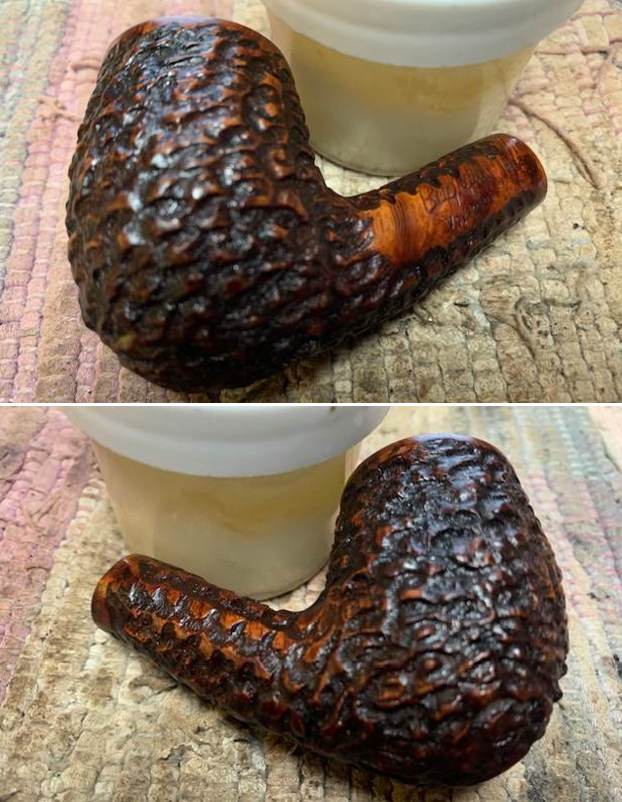
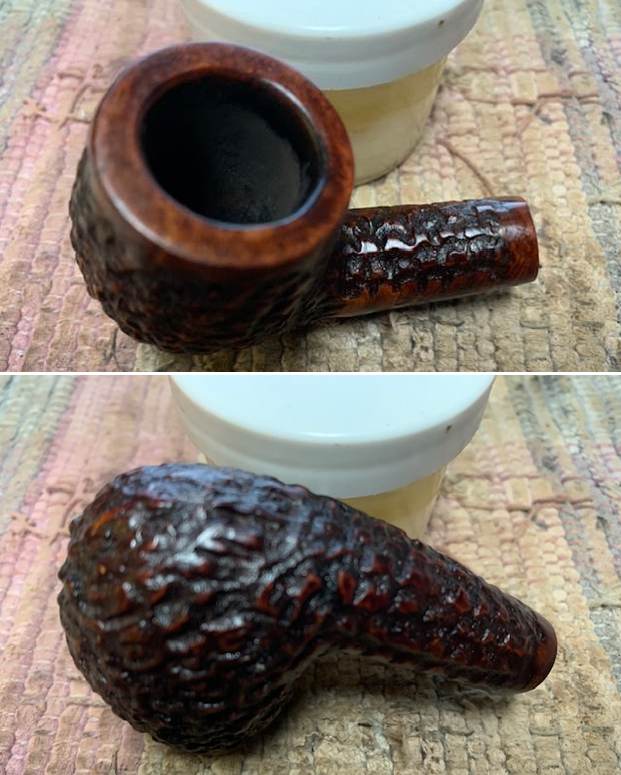
Next on the chopping block is this handsome and rugged Custom-Bilt Oom Paul. I acquired this pipe with Steve at one of those antique fairs where the term ‘antique’ is most loosely applied. Editorial comments aside, the fair was good fun and Steve and I enjoyed ourselves. This pipe piqued my interest because I know that there are many admirers (or should I say ‘fanatics’?) of Custom-Bilt pipes. Clearly, this one had had an active life and looked awfully tired now, but I felt I could bring it back to its best. As you can see, the pipe has the classic Custom-Bilt rustication on it. These marks are reminiscent of Tracy Mincer’s original work and are seen as something of a hallmark of the brand, nowadays. On the left side of the shank, the markings were as follows: Custom-Bilt [over] Imported Briar. No markings on the right side and no markings on the stem.The history of Custom-Bilt pipes is an interesting one and the most comprehensive source of information comes from The Custom-Bilt Pipe Story by Bill Unger. By all the accounts that I’ve heard, it is a very good book. I haven’t had the chance to read it myself, but it would appear to be the fount of knowledge on these pipes. If you’ve got a copy of Unger’s book that’s you’d like to get rid of, please drop me a line!Pipedia’s article on Custom-Bilt consists primarily of review’s of Unger’s book. It offers a cursory view of the markings and their approximate dating. My pipe’s markings correspond to “Stamp Number Three” as seen below, even though the markings on my pipe are not identical to that one. Thus, this pipe seems to be from the Wally Frank era.Pipephil provided a bit more information on the brand, although not strictly related to my pipe.Finally, the pipesrevival.com website has yet more information on Custom-Bilt pipes. This page seemed to confirm that my pipe is from the Wally Frank era, but my interpretation of the photos, etc. is that this is from the early part of that era – probably the early 70s. It is difficult to be sure, but that seems reasonable. In any event, if you are interested in these pipes, I recommend reading all three websites.I figure that this pipe must have been a good smoker because it had been thoroughly used and there was plenty of wear from its long life. This wasn’t a difficult restoration, but there were a lot of steps and it took longer than usual. The stem was heavily oxidized. There were a few minor scratches and a couple of notable tooth dents, and the inside was definitely dirty. However, the real issues were on the stummel. It had accumulated much dirt and debris over the years. The bowl had tons of cake inside and the rim was coated in lava (and potentially burn marks). The front edge of the rim was damaged, presumably from banging out dottle on a hard surface over the years. The grooves of the rustication were embedded with debris and there was a notable burn mark on the back-right part of the bowl, near the shank. Meanwhile, on the left of the bowl, there were a couple of fills (including a major one) that would need addressing. I haven’t even mentioned the miscellaneous scratches, dents and other marks all over the place! Let’s get restoring. The stem was first on my list. I wiped the outside with Murphy’s Oil Soap on some cotton pads. I also took a BIC lighter and ‘painted’ the stem with its flame to lift the few bite marks and dents. However, it did not do much. Then I cleaned out the inside with pipe cleaners and isopropyl alcohol. Given the amount of oxidation, this one needed the usual overnight Pipe Stem Oxidation Remover bath. The following day, I cleaned all of the de-oxidizing mess off with alcohol, pipe cleaners, et cetera. The oxidation had migrated to the surface and I scrubbed with SoftScrub on some cotton pads to remove the leftover oxidation. With that done, I built up the dents on the top and bottom of the stem with black cyanoacrylate adhesive and let them fully cure. I then sanded the adhesive down with 220-, 400-, and 600-grit sandpapers to meld seamlessly into the stem. I then used all nine Micromesh pads (1,500 through 12,000 grit) all over to bring out the lovely black lustre on the stem. I also used Obsidian Pipe Stem Oil in between each pad scrubbing.You may notice that the stem looked odd – well, you are right. Over time, it gradually straightened itself out. I wanted the end of the stem to be roughly parallel with the rim of the bowl, so I brought out my heat gun and heated the vulcanite stem to make it malleable. The heat gun is very powerful – it doesn’t take long! When soft, I gently curved the stem over a wooden dowel. The dowel provides a firm surface and a proper curve. Once I had the bend I wanted, I left the stem to cool and set itself in place.

When I was done, I noticed some unusual “stretch marks” on the stem where I’d bent it. Then I asked Steve about it and learned that it does happen occasionally. Suffice it to say, it was extremely annoying as I had to go back and sand that section again. Lesson learned: bend the stem before sanding it!All that finished, I set the stem aside and I began work on the very dirty stummel. Firstly, I decided to ream out the bowl. I used both the PipNet Reamer and the KleenReem to remove the built-up cake and followed that with 220-grit sandpaper taped to a dowel to eliminate as much as I could. I took the chamber down to bare briar, as I wanted to ensure there were no hidden flaws in the wall. Fortunately, there were none. As the photos show, there was quite a mound of debris. I then proceeded to clean out the insides of the shank with Q-tips, pipe cleaners, and lemon-infused isopropyl alcohol. It was ridiculously dirty and took up the country’s supply of cotton to get it clean. I followed that up by cleaning the insides with some dish soap and tube brushes. Next, I used cotton rounds and a toothbrush to scrub the outside of the stummel. Due to the lava on the rim, I carefully used a knife to scrape away as much as I could. All that scrubbing accentuated some very ugly fills which had been repaired with typical red putty.To exorcize the ghosts of tobaccos past, I decided to de-ghost the pipe. I thrust cotton balls into the bowl and the shank and saturated them with 99% isopropyl alcohol. I let the stummel sit overnight. This caused any remaining oils, tars and smells to leach out into the cotton. Although it helped, the de-ghosting was not as successful as I hoped. As a result, I plopped the stummel in my alcohol bath overnight. This removes old stain and cleans debris, odours etc. As you can see, after the bath, the stummel looked rather naked but much cleaner. I next used a dental pick to dig out the awful putty in those fills, as I felt I could do better. I redid the fills with a mixture of cyanoacrylate adhesive and briar dust. The main fill on the back of the bowl was in an awkward position for sanding and making it consonant with the surrounding wood was tricky. In any event, I used some miniature files and various grits of sandpaper to make it look good. Next was the burn on the backside. I took some oxalic acid, used several Q-tips, and rubbed and rubbed and rubbed. The burn dramatically improved and any stain I would later apply would cover it up. Fortunately, the burn was very superficial and did not affect the integrity of the wood at all.To remove the nicks on the rim, I “topped” the pipe – that is to say, I gently and evenly sanded down the rim on a piece of 220-grit sandpaper. This effectively removed the damage, without altering the look of the pipe. However, since I did not want to top the pipe too much, the bashed-in front edge of the pipe would have to be addressed differently. I dug out my iron and a damp cloth to attempt a repair. The hot and moist steam can often cause the wood to swell slightly and return to shape. There was some movement – not a lot, but it was better than doing nothing. I opted to ever-so-slightly round the rim of the pipe in such a way that looks both natural and handsome. Then I sanded the stummel down with all nine Micromesh pads (1,500 through 12,000 grit). The smooth areas got all nine pads, whereas the rusticated areas on received only the last four. Although almost all of the nicks were removed, a hint of a couple of wounds remains. This is part of the story of this pipe – it is its history. Due to all the necessary work for this pipe, I needed to restore the colour, so I stained it with Fiebing’s Medium Brown Leather Dye. First, I brought out my heat gun and spent a couple of minutes thoroughly heating the wood, so it would be as receptive as possible to the stain. I needed the brown to penetrate well into the wood, to give the best results. I applied dye with a cotton dauber. I flamed it with my BIC lighter, let it set, then coated it again with dye, flamed it again, and let that set too. I decided to let the pipe sit overnight. This dye is alcohol-based, so I used isopropyl alcohol to wipe down the pipe and remove excess stain. My intent was not to create a new look for this pipe, but rather to restore the original colour. Finally, I took it to the buffer and used some White Diamond and a few coats of Conservator’s Wax. This pipe took a lot of work, but it was worth it. This Custom-Bilt looks fantastic again and is ready to be enjoyed again by the next owner! I am pleased to announce that this pipe is for sale! If you are interested in acquiring it for your collection, please have a look in the ‘American’ pipe section of the store here on Steve’s website. You can also email me directly at kenneth@knightsofthepipe.com. The approximate dimensions of the pipe are as follows: length 4¾ in. (120 mm); height 5⅛ in. (130 mm); bowl diameter 1½ in. (38 mm); chamber diameter ⅞ in. (22 mm). The weight of the pipe is 2⅜ oz. (69 g). I hope you enjoyed reading the story of this pipe’s restoration as much as I did restoring it. If you are interested in more of my work, please follow me here on Steve’s website or send me an email. Thank you very much for reading and, as always, I welcome and encourage your comments.

New Life for a Charatan Made Mountbatten 852 Dublin Made in England


Blog by Steve Laug

The next pipe on the work table came to me in a group of six pipes I bought from a fellow in Eastern Canada. It included two Canadian made pipes – a Blatter of Montreal and a Trypis. In the mix was an English made Charatan second stamped Mountbatten and two Peterson’s and an Irish Second. The pipes were well used and all had been smoked. The seller sent me a photo of the pipes so that I could see what he was selling. We discussed some options together and arrived at an agreement and the pipes were on their way to me in Vancouver.There was something about the forward canted bowl on this slightly-bent-Dublin, the bottom pipe in the left column that grabbed my attention and made me want to work on it next. This is what I saw. The pipe is stamped on the left side of the shank and reads Mountbatten [over] of Made In England. On the right side of the shank is the shape number 852. The finish had some grime ground into the finish on the bowl but still looked to be in good condition. The bowl was thickly caked with some light lava on the top at the back and some darkening on the top and the beveled inner edge of the rim. The taper stem had some light tooth chatter on the top and underside near the button. It had promise but it was dirty. I took some photos of the pipe before I started my cleanup work. I took photos of the rim top and bowl to give a clear picture of the thickness of the cake and the overflow of lava on the back rim top and beveled inner edge. I also took photos of the top and underside of the stem to show the oxidation and the chatter and tooth marks. I took photos of the sides and heel of the bowl to give a picture of what the briar around the pipe looked like. There is some stunning grain under the grime.  I took photos of the stamping on the sides of the shank and on the band. It reads as noted above and is clear and readable. I removed the stem from the shank and took a photo of the pipe to give a sense of the proportion of this Canted Dublin 852.I turned to Pipephil to confirm the connection I remembered to Charatan. I wanted to read a bit of the history (http://pipephil.eu/logos/en/logo-m7.html#mountbatten). Sure enough the connection is there. Pipephil said that Mountbatten was a Charatan second. I have included a screen capture of information on the site below.I did some further digging and found a link on Pipes Magazine’s forum where the brand was discussed: http://pipesmagazine.com/forums/topic/mountbatten-pipe. There was a discussion on that thread regarding the brand. Quite a few of the respondents originally said that the brand was a Charatan second. There was one dissenting voice that led to more responses similar in tone. The fellow said that the pipe was not a second. There was a quote from another site.

I googled the information and found that the quote came from a thread on pipes.org. Here is the link: http://pipes.org/forums/messages/23/45025.html?1169997817 I quote the original dissenter on the Pipes Magazine site in full because of the information that it gives. The original poster was Bill Ramsey. Here is Bill’s reply:

“Friends, after 40 years of nosing around pipes, what I have gleaned is this: Charatan sold its seconds under private labels and later acquired the English rights for Ben Wade for just this purpose. Mountbatten, on the other hand was not a “second”(in that there was some physical deformity in the pipe) but rather a first line production from Charatan’s apprentice program. Each Charatan carver might have four or six apprentices at any one time of various skill levels. As they improved and started cutting pipes themselves, these pipes had to move… thus the Mountbatten. These were made on Charatan tooling with Charatan materials and teaching. Bear in mind that there was a high attrition rate and , perhaps, one apprentice in nine or ten made it to cutting their own bowls much less a Charatan carver. This is why you see more Charatans than Mountbattens on the market. You’re never going to put your kid through college by selling one but you’ve got a day to day workhorse of the first order. Good luck and happy puffing.”

That was just the kind of information I had been looking for. I close this section on the history of the brand with a quote that pretty well sums up the details that I had learned. It is taken from the same conversation that is traced in the last link above. “Yup now I know Mountbatten pipes were the fruit of an apprentice’s labor made under the supervision of a Master Pipe Maker at Charatan, most likely in the pre-Lane era; not a second, but a “sub-brand” (even though many experts still classify them as seconds anyway).”

Now I knew I was dealing with a pipe made by an apprentice pipe carver at Charatan. It really is a beautiful pipe. Now it was time to work on the pipe itself.

I started my work on the pipe by reaming the bowl the pipe with a PipNet Pipe Reamer using the first and second cutting heads to remove the cake. I cleaned up the remnants of the cake on the walls with a Savinelli Fitsall Pipe Knife. I finished by sanding the bowl smooth with 220 grit sandpaper wrapped around a piece of dowel. I cleaned up the inner edge of the rim with a folded piece of 220 grit sandpaper. I was able to remove almost all of the darkening with the sandpaper. I scrubbed the externals of the pipe with undiluted Murphy’s Oil Soap with a tooth brush. I rinsed it under running warm water to remove the soap and grime. The bowl and rim top cleaned up really well with the lava coat removed. The inner edge of the rim was in good condition.  I cleaned out the inside of the mortise, shank and the airway in the stem with isopropyl alcohol, cotton swabs and pipe cleaners. The pipe had a strong aromatic smell just like the three Petersons I just completed. It smelled like a mix of fruit and vanilla so it needed to be deghosted. I filled the bowl with cotton boles and twisted a plug into the shank end. I used and ear syringe to fill the bowl with alcohol. The alcohol will eventually evaporate from the bowl wicking out the oils and tars in the briar into the cotton. I let it sit over night and in the morning pulled it out and took photos of the cotton at that point. I ran some pipe cleaners through the shank and dried out the bowl edges. I stained the bevel with and oak stain pen to match the rest of the bowl and shank. It looked very good at this point in the process.I polished the smooth briar with micromesh sanding pads – dry sanding with 1500-12000 grit pads and wiped it down with a damp cloth after each sanding pad. By the end of the last set of three the bowl took on a rich shine. I worked some Before & After Restoration Balm into the surface of the briar with my fingertips to clean, enliven and protect the briar. I let the balm sit for 15 minutes and then buffed with a cotton cloth to raise the shine. The photos show the bowl at this point in the restoration process. I set the bowl aside and turned my attention to the stem. I sanded out the tooth marks and chatter with a folded piece of 220 grit sandpaper. I started the polishing of the stem with 400 grit wet dry sandpaper. I scrubbed down the surface of the stem with Soft Scrub and cotton pads to remove the oxidation on the top side of the stem. Once finished it looked much better.I polished the vulcanite stem with micromesh sanding pads – 1500-12000 grit pads. I wiped the stem down with Obsidian Oil after each sanding pad. I polished the stem with Before and After Stem Polish – both Fine and Extra Fine. I rubbed it down with some more Obsidian Oil. It was great to finish this Charatan Made Mountbatten 852 Canted Dublin. I put the pipe back together and buffed it with Blue Diamond on the buffing wheel. I gave the bowl and the stem multiple coats of carnauba wax. I buffed the pipe with a clean buffing pad to raise the shine. I hand buffed the pipe with a microfiber cloth to deepen the shine. It is fun to see what the polished bowl looks like with deep sandblast all around it. Added to that the polished black, vulcanite, fishtail stem was beautiful. This Mountbatten Made in England 852 is great looking and the pipe feels great in my hand. It is light and well balanced. Have a look at it with the photos below. The dimensions are Length: 6 ½ inches, Height: 1 ¾ inches, Outside diameter of the bowl: 1 ½ inches, Chamber diameter: ¾ of an inch. The weight of the pipe is 36 grams/ 1.27 ounces. It is a beautiful pipe and one that will soon be on the rebornpipes store in the British Pipe Makers Section of the store. If you want to add it to your collection let me know. Thanks for walking through the restoration with me as I worked over this pipe. Thanks to each of you who are reading this blog.

Restoring a Generation 1.5 Kirsten – Made in U.S.A. K


Blog by Steve Laug

This past week I received an email from a fellow named George. He was hunting for a specific Kirsten Pipe that he wanted as a gift for his son. I am including his first correspondence with me about the pipe.

Hi Steve

I am inquiring about the Kristen Companion K Straight Pipe. I read the posting on this pipe and am wondering if there is any place where I can purchase this style pipe. My father had and used this style pipe. It was his favorite of all the pipes he had. He had purchased it because the bowl was replaceable. He was very poor growing up, coming out of the Depression and WWII times and every penny counted. Having a pipe that he could replace just the bowl and not have the expense of purchasing the entire pipe appealed to him. My son is looking for this pipe to remind him of his grandfather and I want to find one for my son. Any leads you could provide me would be deeply appreciated. Thank you.

I wrote him back and sent him a picture of an anodized Kirsten Companion K and polished aluminum Kirsten K both of which I had here in my clean up queue. I asked him to have a look and get back to me on whether one or both would fit his needs.He wrote me back and gave me a bit of the back story on the pipe he was seeking. I have included a portion of that email below.

Hi Steve,

Thank you so very much for getting back to me. As with any pipe, there is always a back story, but I will only relate the Reader’s Digest version.  I have a son who remembers his grandfather’s (my dad’s) pipe of this style and regrets that he was only 14 and too young to speak up and get one of my dad’s pipes when he passed in 1982.  I am trying to surprise my son with this replica of my dad’s favorite pipe.  I am thrilled you have two of this style and are willing to sell one or both… I do like the bowl on the lower one better since my dad had only very plain bowls…

George

I corresponded with George and answered his questions regarding the difference on the two pipes and he wrote back with his choice. I quote from that email as follows.

Steve,

Thank you for your reply and your clear explanation of the difference in the pipes.  I would be interested in the smooth finished as that is the type pipe my dad had.  The less ornate, smooth finished, brown bowl would be the one I would like. Please keep my informed, but there is no rush on getting the pipe to me as I want to send it to my son on my father’s birthday which was on 18 February… Thanks for your help in doing this for my son and my dad’s memory.

George

With his choice made I knew what pipe I was working on next – a Kirsten metal pipe with a smooth briar Dublin bowl with carvings around the smooth finish. It is stamped on the left side of the shank, Kirsten in a cursive script. On the underside it is stamped Made in U.S.A. – K.

Here is some background information on the brand. These pipes were made for a long period of time in the Seattle, Washington area of the US. They came in four generations or iterations – Generation 1, 1.5, 2 and 3. The stamping on this one, the absence of a metal cap to hold the bowl, and the presence of the rubber O rings on the metal valve and on the stem insert, point to it being a Generation 1.5 pipe or a transitional one.

I am thankful to Dave Whitney for the information he provided for an earlier blog on Kirstens to help date this pipe (https://rebornpipes.com/2012/11/03/kirsten-generation-1-1-5-2-3/). The blog gives following information on the Generation 1.5 – transitional period – mid to late 50’s.

This was an experimental stage. Kirsten realized that the bit and insert were prone to seizure as the condensate dried. This model always has O-rings on the metal insert, and later models can have O-rings on both. Same markings, as I remember it. There is no metal cup spacer under the bowl. This generation has O rings either on the valve or mouthpiece but no O rings on the other end. This transitional period is stamped “Pat. Pending” and “Pats. & Pats. Pending” some with “Made in U.S.A. It seems like the company was using surplus parts to combine into this series of pipes. This particular pipe is stamped K after the U.S.A. thus making it a Companion.

With that I knew that the Kirsten K I was working on was a Companion (what George had asked for). It was made from the mid to late 1950s during the transitional period of Kirsten manufacture. It will be a great, smokable piece of both Kirsten history and George’s family history once it is finish. Now it was time to work on the pipe itself.

Somewhere along the journey of this pipe Jeff had done a great cleanup on the pipe. He reamed the bowl with a PipNet pipe reamer and followed up with a Savinelli Fitsall pipe knife to remove the cake. He scrubbed out the mortise and the airway in the shank and the stem with alcohol, cotton swabs and pipe cleaners. He scrubbed the bowl exterior and the aluminum barrel with a tooth brush and Murphy’s Oil Soap to remove the grime on the finish of the bowl and the lava from the rim top. He rinsed it under running water. One of the benefits of this scrub is that it also tends to lift some of the scratches and nicks in the surface of the briar. He dried it off with a soft cloth. He cleaned the internals and externals of the aluminum barrel and the vulcanite stem with alcohol, pipe cleaners and cotton swabs. He soaked the stem in Before & After Pipe Stem Deoxidizer and rinsed it off with warm water and cleaned out the airway in the stem with alcohol, pipe cleaners and cotton swabs. I took photos of the pipe as I saw it when I put it on the table.   I took photos of the rim top and stem to show the condition. The rim top and beveled edge looked amazing. The stem was vulcanite and there were tooth marks and chatter on both sides ahead of the button. I took photos of the stamping on the sides of the aluminum barrel. They are clear and readable as noted above.   I removed the stem from the barrel and the flow adjuster valve from the front of the barrel. I removed the bowl from the top of the shank and took a photo of the pipe to give a sense of the components of the pipe.I set the parts aside and worked on the bowl. I removed the screw from the bottom of the bowl so that I could clean up the bowl. I sanded the inside of the bowl and topped the rim top to remove the burning and darkening. I worked on the inner edge with a folded piece of 220 grit sandpaper to smooth out the darkened and damaged inner edge of the bowl. In the photo below there is a mark at the 5 o’clock section of the rim top below. The mark is actually a fill in the rim top. It is solid and undamaged. Once finished, the top and inner edge looked better.I used a Maple stain pen to restain the rim top to match the sides of the bowl. Once it was finished and polished it would look a lot better.I polished the bowl sides and top with micromesh sanding pads – dry sanding with 1500-12000 grit pads. I wiped it down with a damp cloth after each sanding pad to remove the grime. The finish began to look much better. I rubbed the bowl down with Before & After Restoration Balm and worked it into the grooves as well as the smooth surface of the briar. I let it sit for 15 minutes then buffed it off with a soft cloth. The bowl took on a rich glow and the grain shown through the finish. I polished the aluminum valve on the from of the barrel with 4000-12000 grit micromesh pads to polish off the oxidization that was on it when I first took it out of the box. It shined up very well. I coated the rubber gasket on the valve with some Restoration Balm as it worked to bring the rubber back to life. Once it had sat for awhile I wiped it off and put the valve back in the barrel of the pipe and the bowl. The valve was easily adjustable and would act like a flue on a wood stove when the pipe was smoked. I set the bowl and barrel aside and turned my attention to the stem. I “painted” the vulcanite stem surface with the flame to lift the tooth marks. I was able to lift them considerably. I filled in the remaining tooth marks with clear CA glue and set it aside for the repairs to cure. I used a small file to flatten the repairs and start the process of blending them into the surface of the stem. I then sanded them with 220 grit sandpaper to blend them into the surface of the vulcanite stem. I used micromesh sanding pads to polish the stem and bring back the shine. I dry sanded the stem with 1500 – 12,000 grit pads and rubbed it down with Obsidian Oil after each sanding pad. I polished it with Before & After Fine and Extra Fine Polish and then gave it a final coat of Obsidian Oil and let it dry. This Kirsten Gen. 1.5 Made in U.S.A. – K straight pipe with a vulcanite saddle stem has a smooth reddish finish. The rich reds and blacks of the contrasting stain makes the grain come alive with the polishing and waxing. I buffed the barrel lightly with the Blue Diamond and also buffed the bowl. I gave the bowl and barrel several coats of carnauba wax and then lightly buffed it with a clean flannel buffing pad to raise the shine. I put the vulcanite stem back on the bowl and carefully buffed the pipe with Blue Diamond on the buffing wheel using a light touch on the briar and followed that by buffing the entire pipe with a clean buffing pad. I hand buffed the pipe with a microfiber cloth to deepen the shine. This older Kirsten Companion K is a great looking pipe and the Dublin bowl gives it a distinctive look. Give the finished pipe a look in the photos below. The dimensions of the pipe are Length: 5 ½ inches, Height: 1 ¾ inches, Outside diameter of the bowl: 1 ¼ inches, Chamber diameter: ¾ of an inch. The weight of the pipe is 1.66 oz./46 grams. The finished pipe is shown in the photos below. It is ready for George to give to his son in memory of his grandfather. Thanks for reading this blog and my reflections on the pipe while I worked on it. There are many more to come!

New Life and New Look for a Neerup Made in Denmark Bulldog


Blog by Steve Laug

Last week I received a call from Curtis, a gentleman who had been referred to me by City Cigar. He called to inquire if I could repair a broken tenon on a Savinelli Hand Made Estella that was gift from his son and he had dropped it and snapped the tenon off. We chatted and he sent photos and eventually agreed on the repair. He sent the pipe to me through Canada Post and when the box arrived on Monday it also included a second pipe. I talked with Curtis about the second pipe and we decided to restem it as the chip on the top button edge and stem were too big for a repair. The pipe is a sandblast Freehand style Bulldog with a smooth briar band, a black acrylic band and a white acrylic band. It is stamped on the smooth underside of the briar band and reads Neerup followed by Made in Denmark. The stem was vulcanite and had a fitted brass cap above the tenon. It was a slight saddle stem with a gentle bend. It was seriously damaged. There was a large wedge missing from the topside and just ahead of that there was a carved line like a dental bit to facilitate holding it in the teeth. There was a very thick cake in the bowl that took up over half of the diameter of the bowl and the shank was filled with gummy tars and oils. There was an overflow of lava on the rim top and some damage on the back right outer edge from knocking out the pipe. It was a pretty little pipe that looked great. I took photos of the pipe before I started my work on it. I took a close up photo of the bowl and rim top to show the thickness of the cake and the condition of the stem when I received the pipe. It was a bit of a mess. The stem was in rough condition as noted above. You can see the damage on both sides of the stem – the chipped and broken top of the stem and button as well as the tooth damage on the underside of the stem. Looking at it you can see why we chose to restem it.The next two photos showed the stamping on the underside of the shank. It is faint but readable as noted above.I removed the stem and took a photo of the pipe to give a sense of perspective to the parts.I reamed the bowl with a PipNet Pipe Reamer to remove the cake from the bowl – using the #1 and #2 cutting heads to take out the majority of the cake in the bowl. I cleaned up the reaming with a Savinelli Fitsall Pipe Knife and a piece of dowel wrapped with some 220 grit sandpaper. I scrubbed the bowl with Murphy’s Oil Soap and a tooth brush on the sandblast and the a brass bristle brush on the rim top. I rinsed the bowl with warm running water to rinse off the soap and the grime left behind. It looked better. I touched up the nicks and marks on the sandblast bowl and rim top with a black stain pen to blend them into the rest of the bowl. I rubbed the bowl down with Before & After Restoration Balm. I worked it into the sandblast with my fingertips and a horsehair shoe brush to get it deep in the grooves of the sandblast. I let it sit for 15 minutes and buffed it off with a soft cloth. I went through my stem and found this slightly longer taper stem that would need very little adjustment to fit in the shank. I also found a metal ferrule cap in my collection that would fit on the end of the stem and approximate the one that was on the original stem. I took pictures of the old stem with the replacement stem in the photo to show the difference.I glued the polished aluminum ferrule onto the end of the stem – sliding it over the tenon to give a metal end decoration and create a metal look to the stem. I cleaned up the excess glue and took a photo of the finished look of the stem. I liked it.Then I remembered that I had not cleaned out the shank and the internals of the pipe or the new stem. I did it now. I cleaned out the shank and the mortise with pipe cleaners, cotton swabs and isopropyl alcohol to remove the tars and oils. I also cleaned out the airway in the stem I had chosen to use as well.I polished the stem with micromesh sanding pads – dry sanding with 1500-12000 grit sanding pads. I wiped the stem down after each sanding pad with a cloth impregnated with Obsidian Oil. The oil both preserves the rubber and also provides some needed friction for the micromesh pads. I polished it with Before & After Fine & Extra Fine Polish. I rubbed it down a final time with the oil and set it aside. This Neerup Made in Denmark Freehand Bulldog carved by Peder Jeppesen combines a great looking piece of sandblast briar with a multi-banded shank extension and a vulcanite stem to make a beautiful pipe. The removal of the thick shiny coat allows the grain to come alive with the polishing and waxing. I put the stem back on the bowl and carefully buffed the pipe with Blue Diamond on the buffing wheel. I gave the bowl and the stem multiple coats of carnauba wax on the buffing wheel and followed that by buffing the entire pipe with a clean buffing pad. I hand buffed the pipe with a microfiber cloth to deepen the shine. The finished Neerup Made in Denmark Bulldog really is a beauty and fits nicely in the hand and looks very good. Give the finished pipe a look in the photos below. The dimensions of the pipe are Length: 5 1/2 inches, Height: 2 inches, Outside diameter of the bowl: 1 ¾ inches, Chamber diameter: ¾ of an inch. The weight of the pipe is 1.80 ounces/51 grams. Once I finish the second pipe this one will be going back to Curtis to enjoy. Thanks for reading this blog and my reflections on the pipe while I worked on it. There are many more to come!