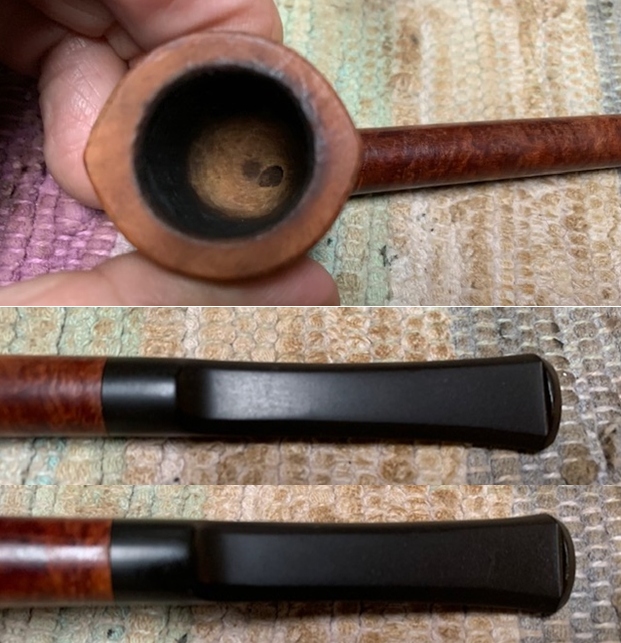
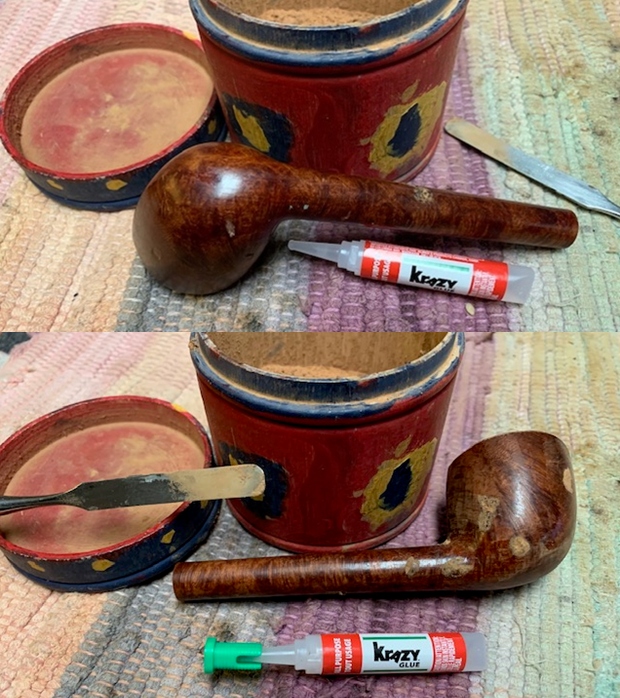
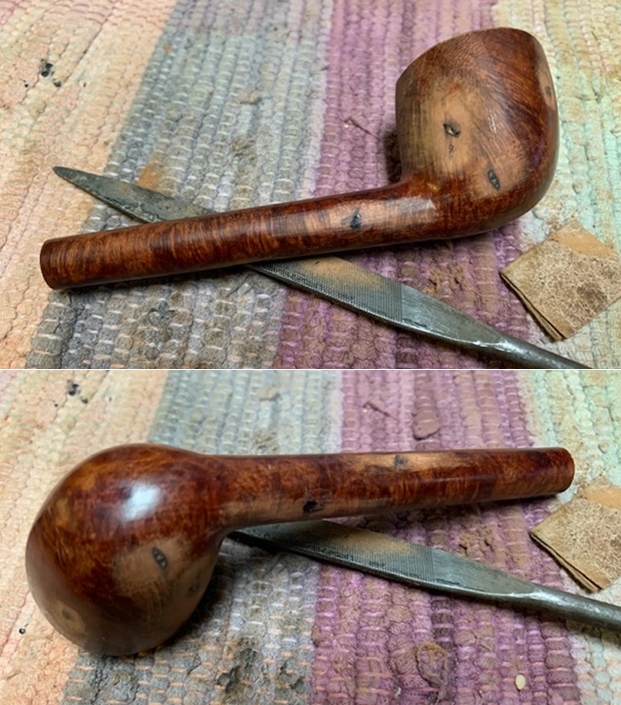
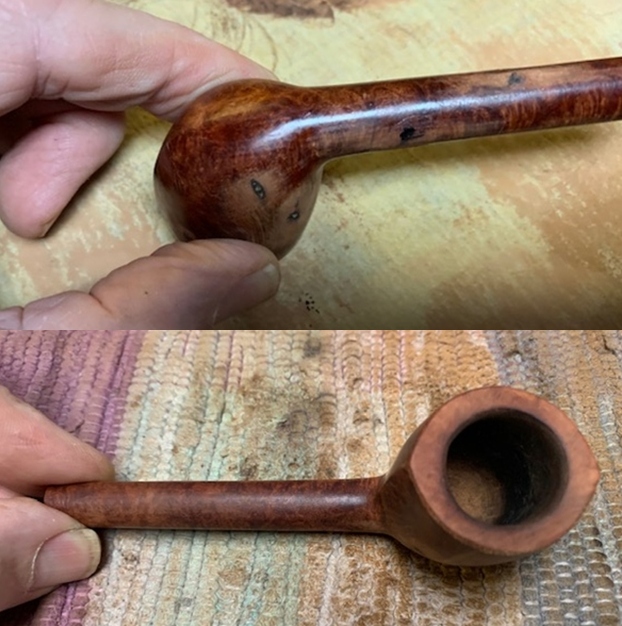
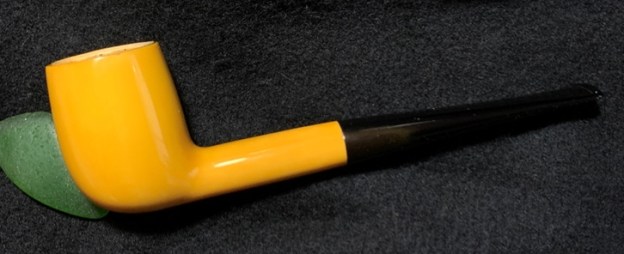
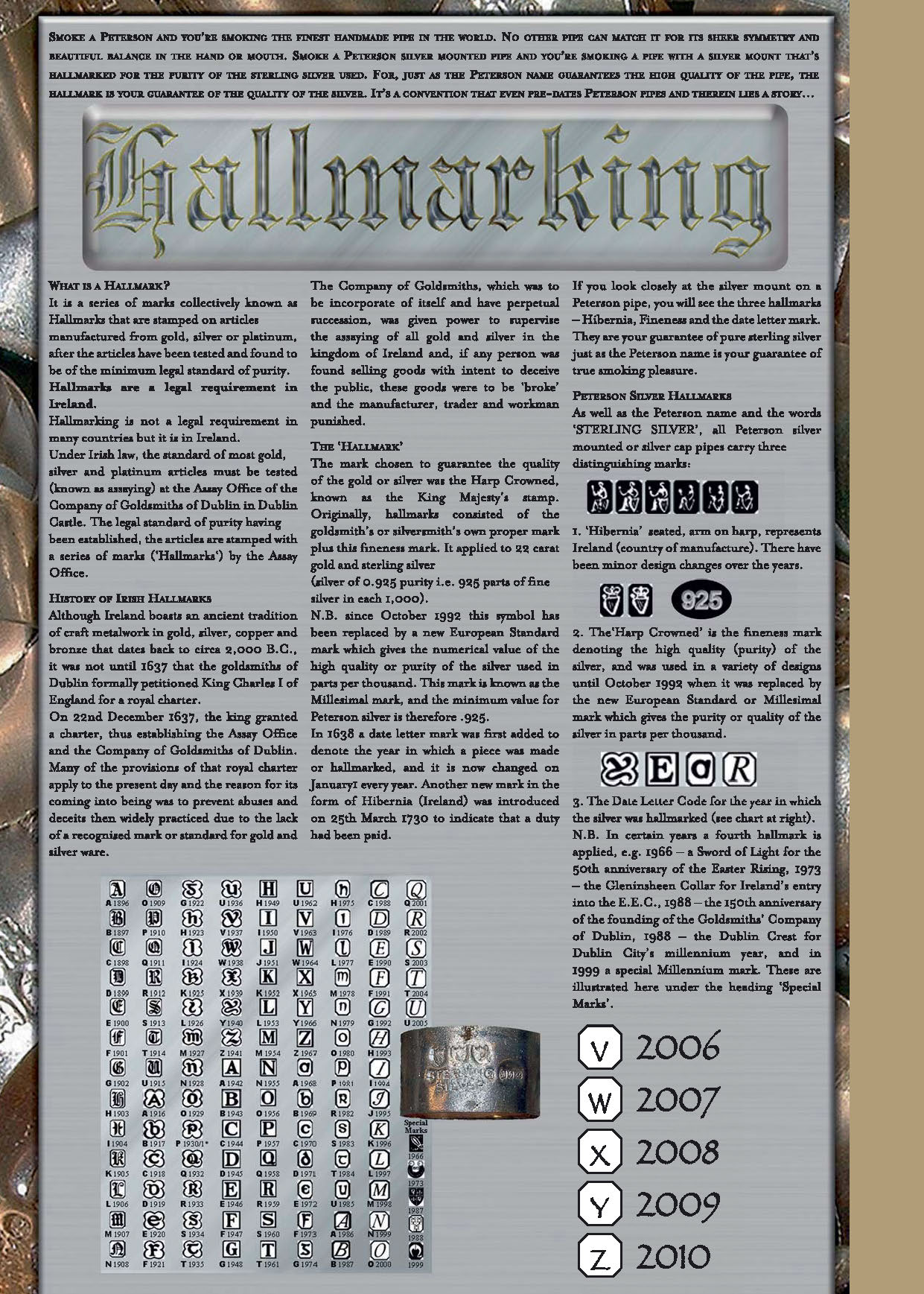
Tag Archives: removing tooth marks

New Life for a Peterson’s Republic Era “Donegal” Rocky 6 Billiard


Blog by Steve Laug

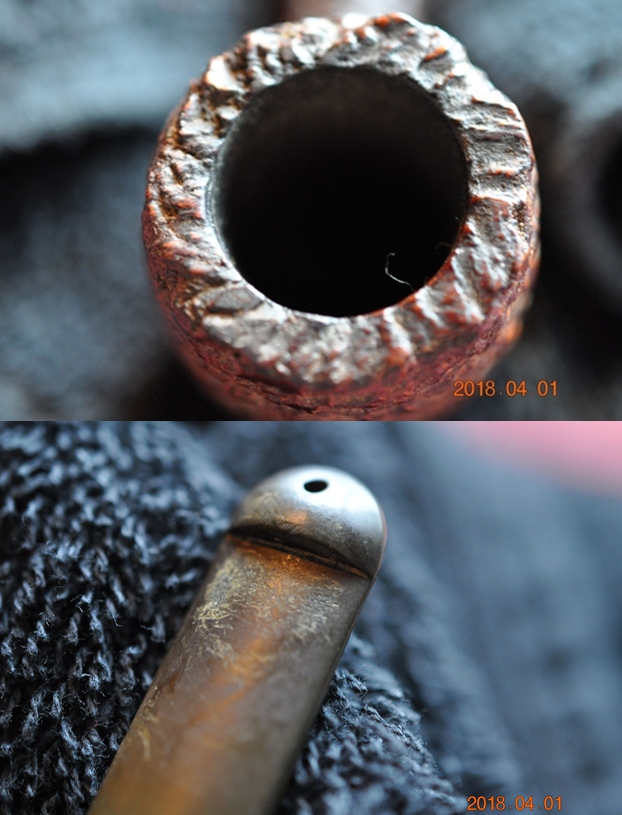
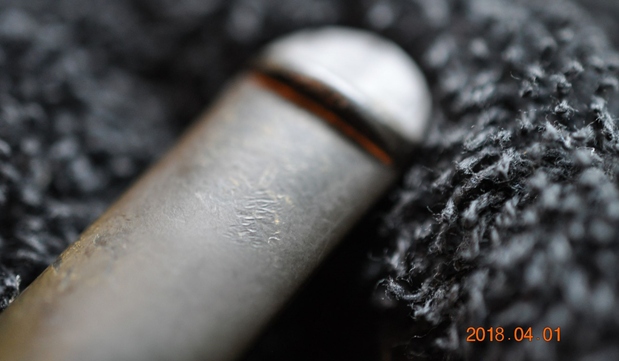
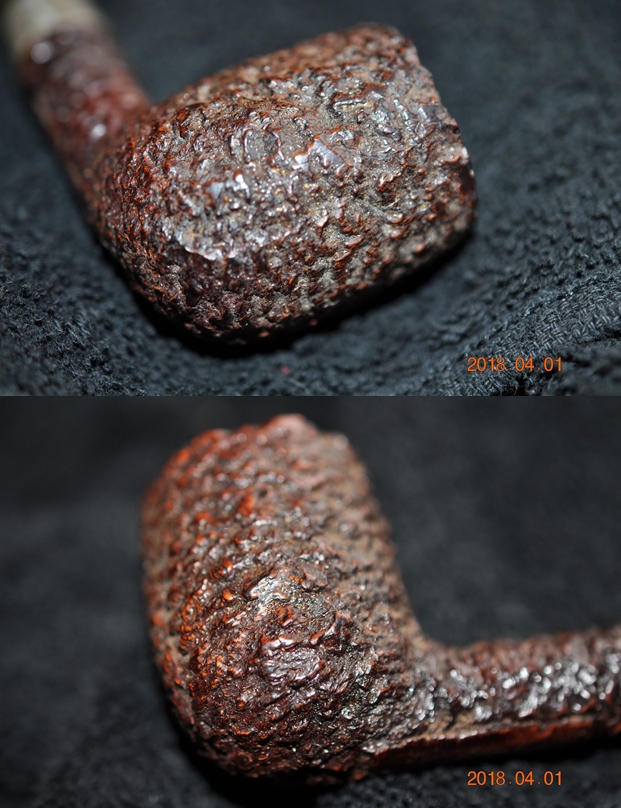
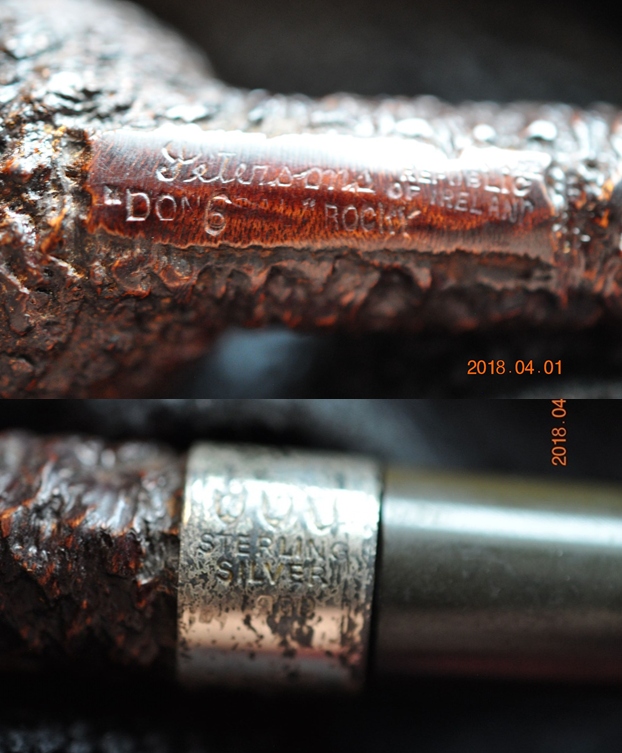
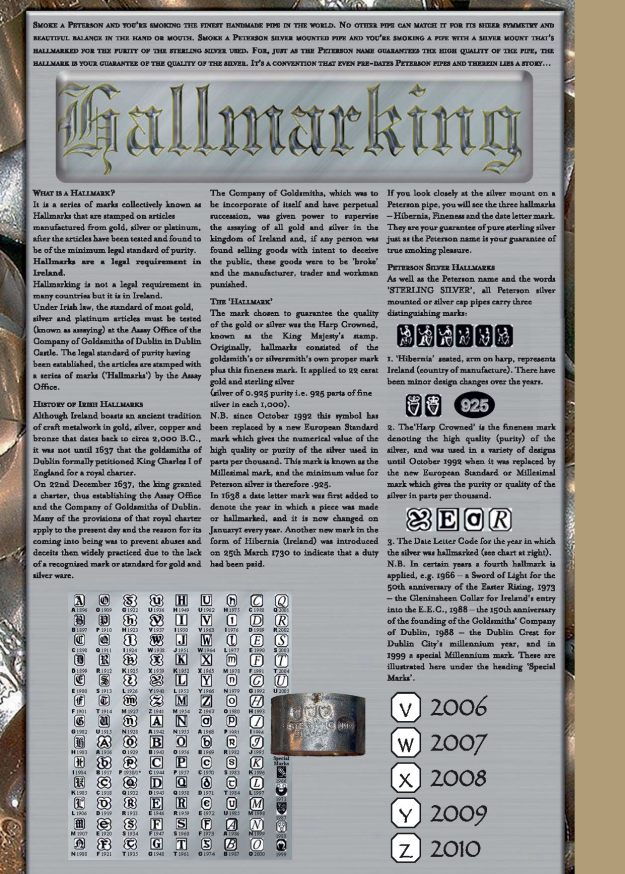
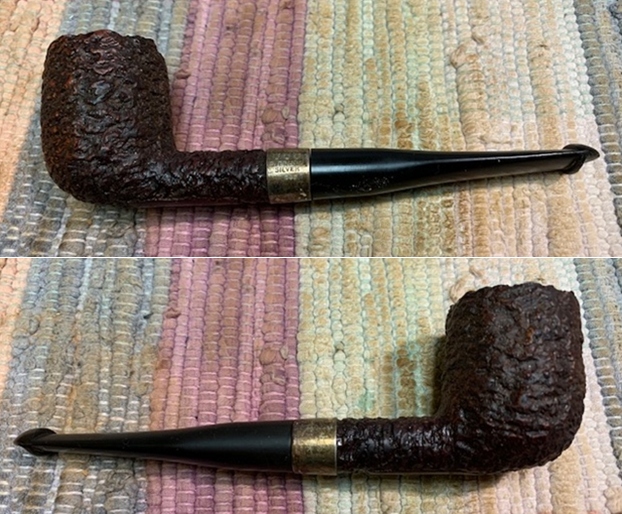
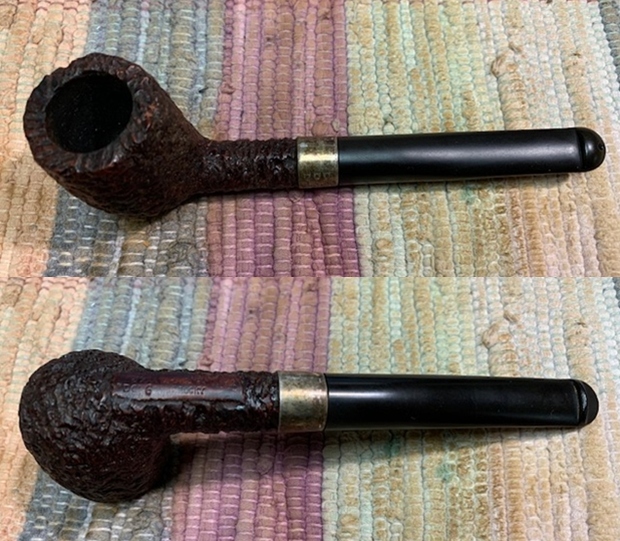
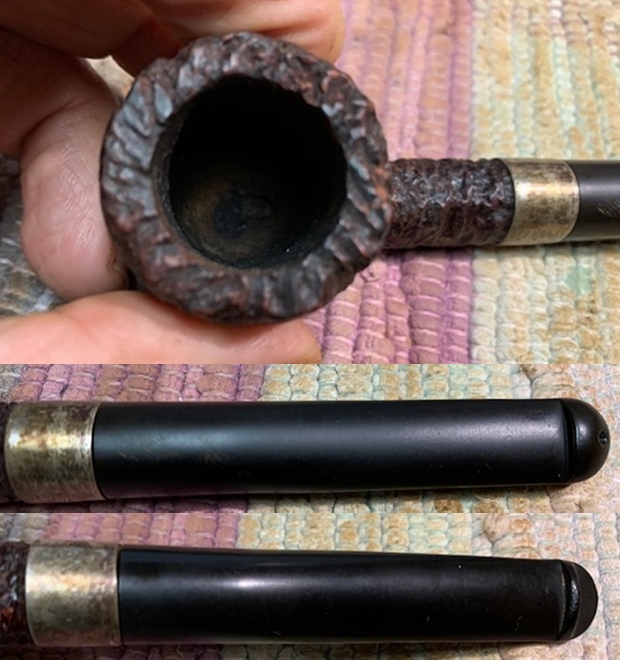
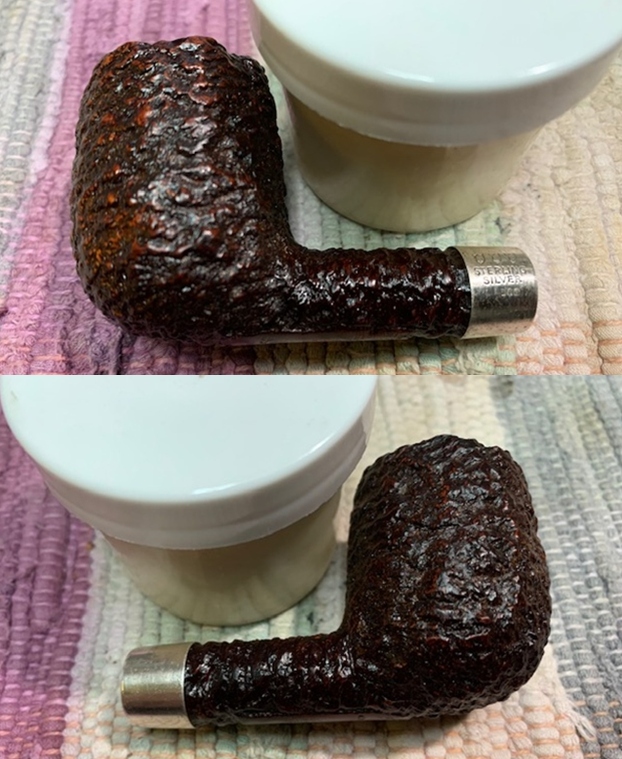
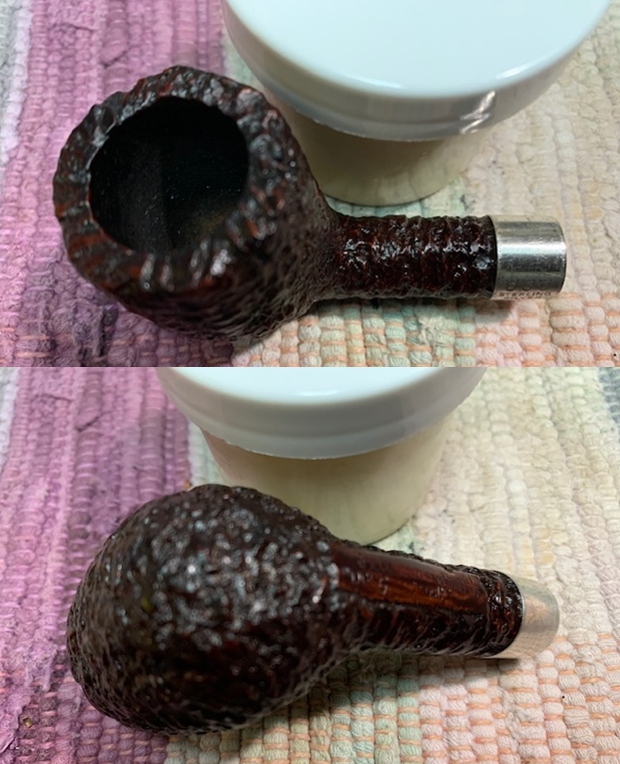
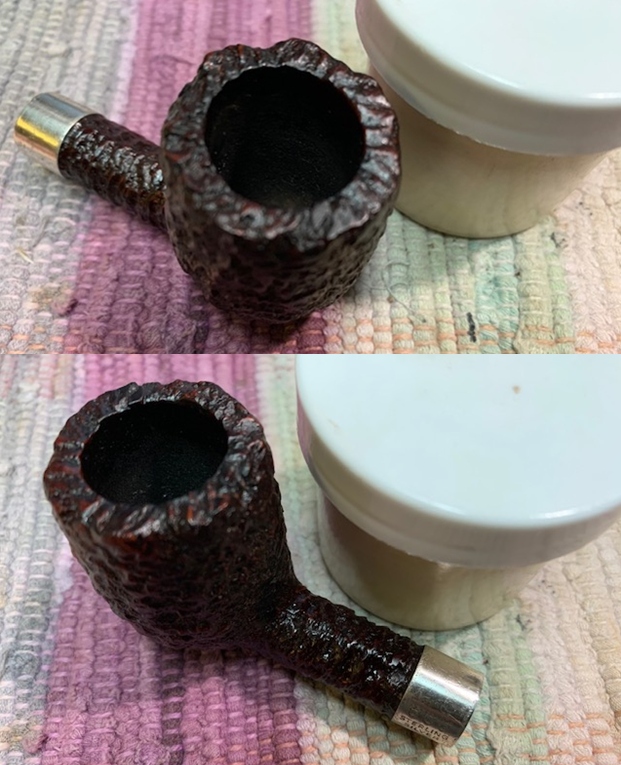
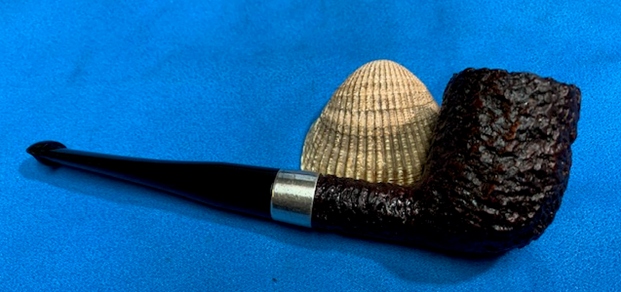
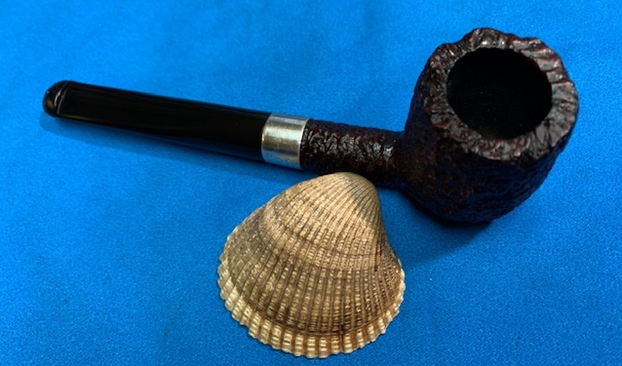
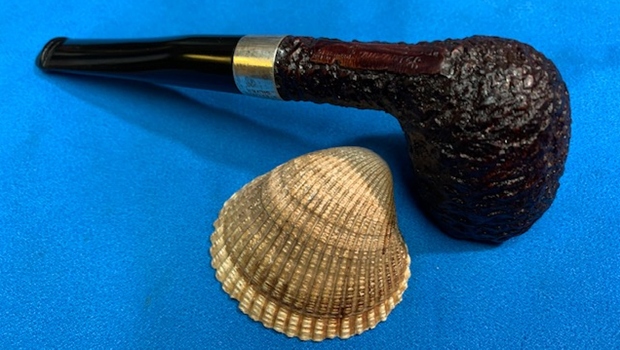
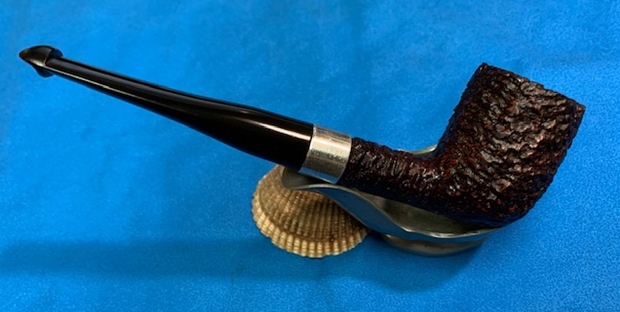
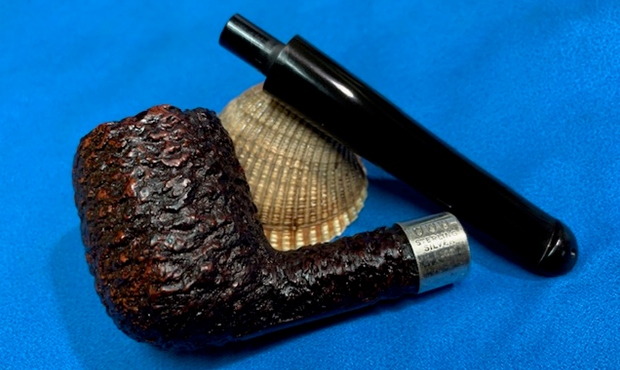
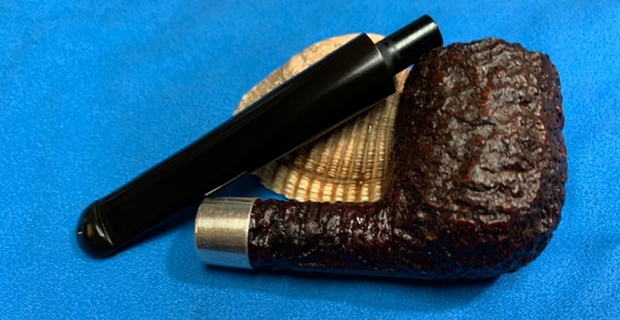
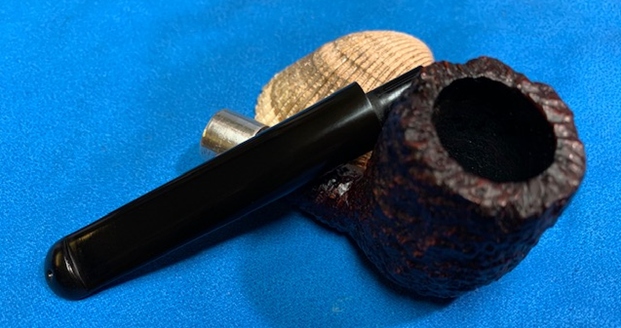
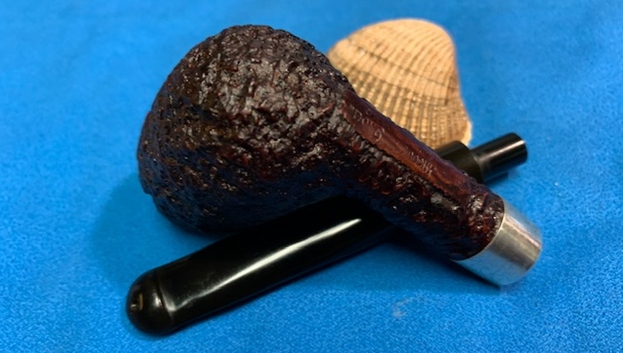
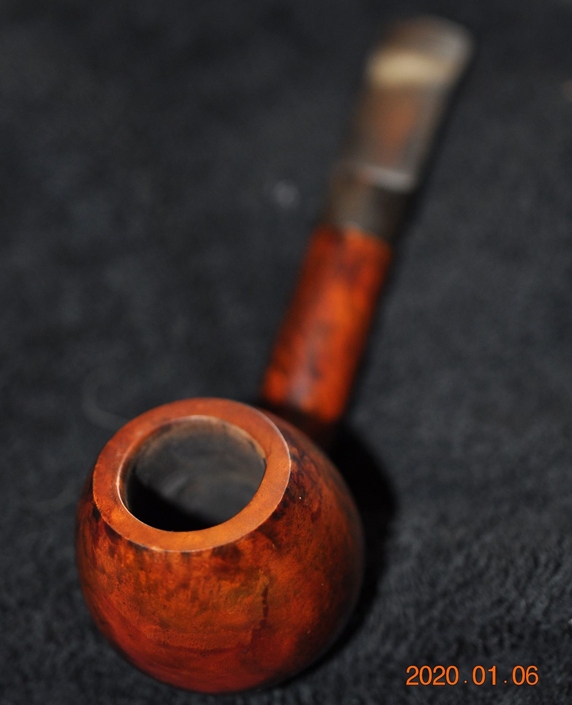
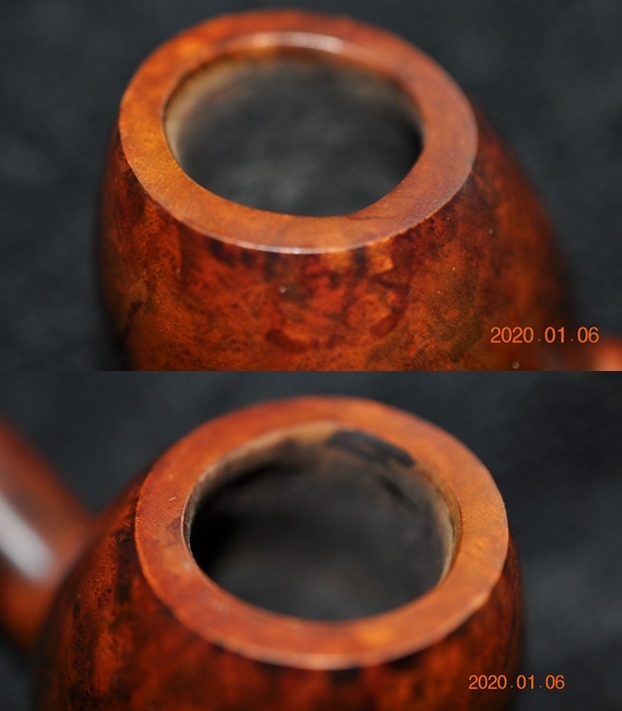
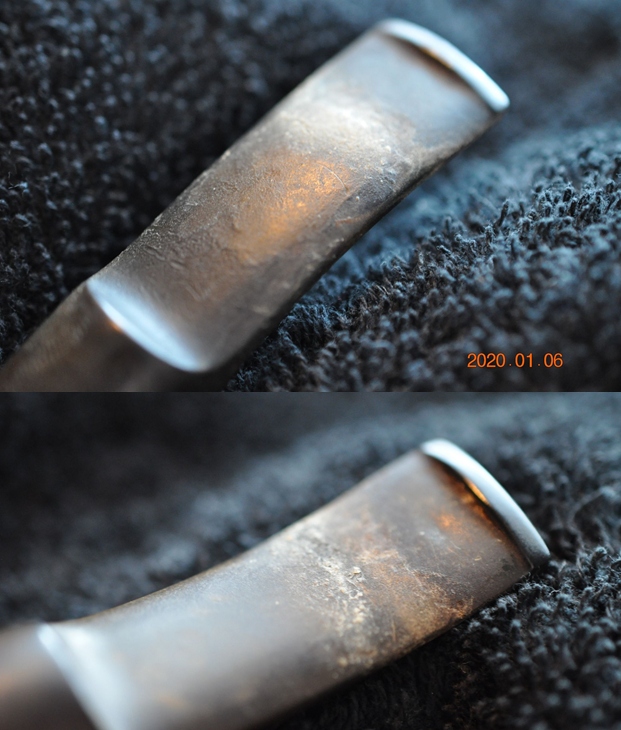
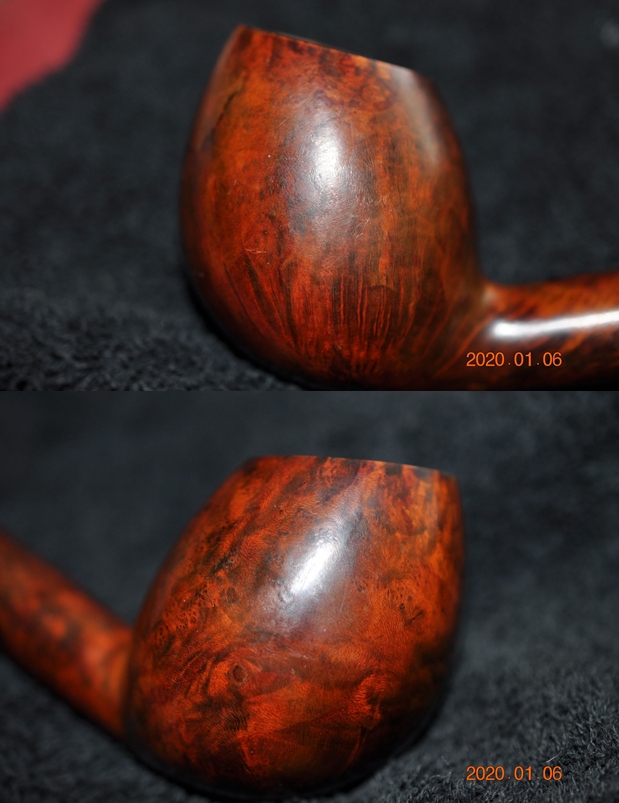
The next pipe I have chosen is a smooth Peterson’s “Donegal” Rocky 6 Billiard that was incredibly dirty. It had a silver band on the shank that was badly oxidized. The grime on the finish ground into the rustication on the bowl sides. The contrast of the dark stains gave the bowl a sense of depth. Jeff and I picked it up from a fellow in St. Leonard, Maryland, USA. It was stamped on the underside of the shank. The stamping was readable. It read Peterson’[over] “Donegal” Rocky. On top of that is stamped the number 6 which is the shape number for a billiard. That is followed by Made in the Republic of Ireland. The band is stamped with K&P in shields [over] Sterling Silver. Under that are three hallmarks – the seated woman, the harp and the letter E. It was in filthy when he brought it to the table. The finish was dirty with grime ground into the briar sides and rim. There was a moderate cake in the bowl and an overflow of lava on the rim top and the inner edge of the bowl. The stem was oxidized, calcified and had light tooth marks and chatter on the top and underside on and near the button. Jeff took photos of the pipe before his cleanup work. They tell the story and give a glimpse of the promise that we see in this pipe.   Jeff took photos of the rim top and stem to show the general condition of the pipe. The bowl is moderately caked with a lava overflow on the rim top. The stem is oxidized, calcified and has tooth marks on the top and underside near the button.  Jeff took some photos of the bowl sides and heel to show grain that was around this bowl. It is a nice looking pipe.  He took a photo of the underside of the shank to show the stamping. The stamping is readable in the photos below and is as noted above. He also took a photo of the band. I am including the information from Pipedia’s article on Peterson pipes. It is a great read in terms of the history of the brand (https://pipedia.org/wiki/Peterson). I have included a bit of the pertinent history here.

1950 – 1989 The Republic Era  – From 1950 to the present time, the stamp for this era is “Made in the Republic of Ireland” in a block format generally in three lines but two lines have been used with or without Republic being abbreviated.

During the 1950’s and 60’s the Kapp & Peterson Company was still in the ownership of the Kapp family. However 1964 saw the retiral of the company Managing Director Frederick Henry(Harry) Kapp.

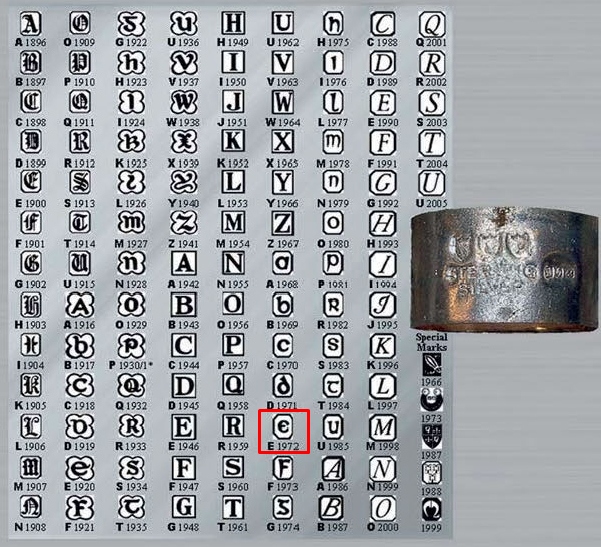
I turned to the hallmarking chart on one of the blogs on rebornpipes to lock down the date for the pipe (https://rebornpipes.com/wp-content/uploads/2015/05/peterson-cataloguecomp_page_27.jpg). The chart defines the meaning of each hallmark. The first one of the seated woman with a harp is known as the Hibernia stamp and identifies the pipe as made in Ireland. The second stamp is a crowned harp which is a fineness mark denoting the high quality of silver that was used. The third stamp is the letter E. I have included a larger screen capture of the chart in the lower left of the photo below.I have drawn a square around the date letter below. It identifies the date of this Peterson’s pipe to 1972.I knew that I was dealing with a Republic Era pipe made between 1950-1989. The K&P mark on the silver band ties to Kapp & Peterson brings the date to the time between 1950-1964.  The hallmarks date the pipe to 1972. Now it was time to work on the pipe.

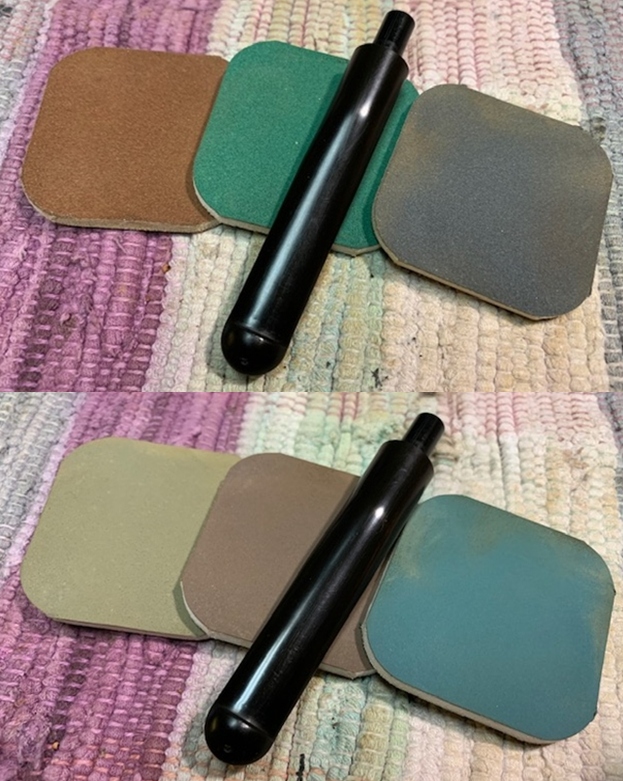
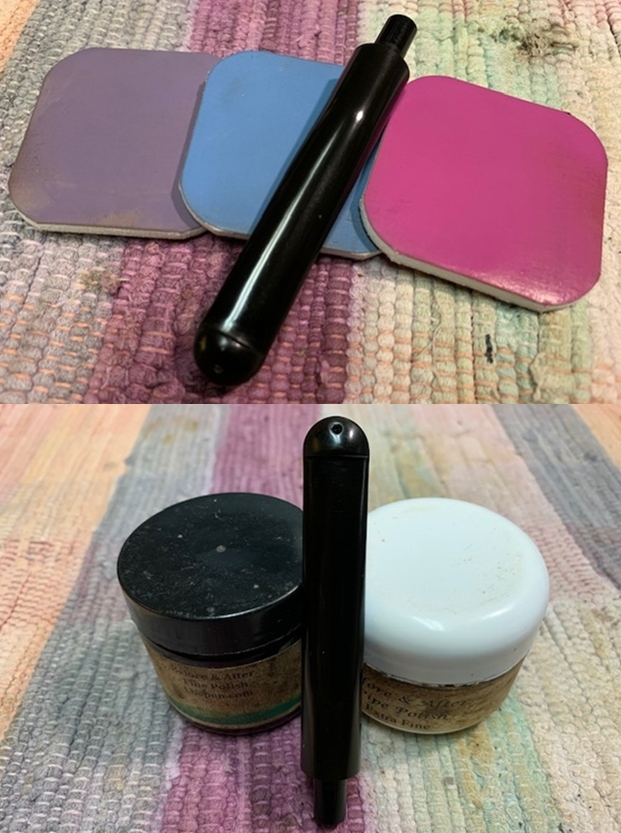
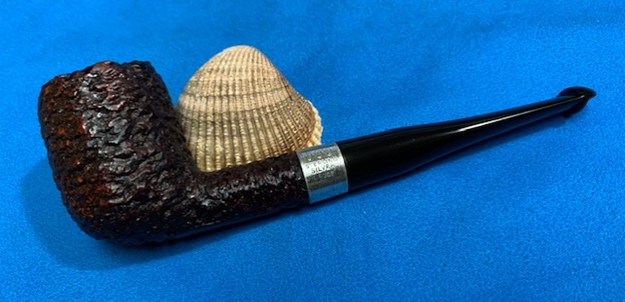
Jeff had done a great job cleaning up the pipe as usual. He reamed the pipe with a PipNet reamer and cut back the cake back to the bare briar. He cleaned up the walls with a Savinelli Fitsall Pipe Knife. He scrubbed the interior of the bowl and shank with pipe cleaners, cotton swabs and alcohol to remove the tars and oils. He scrubbed the exterior of the pipe with Murphy’s Oil Soap and a tooth brush to remove the grime from the finish. He worked on the rim top lava and darkening with the soap and tooth brush. He scrubbed the inside of the stem with alcohol and pipe cleaners. He scrubbed the exterior with Soft Scrub and then soaked it in Before & After Deoxidizer. He washed it off with warm water to remove the deoxidizer. The pipe looked far better. I took some close up photos of the rim top and also of the stem surface. I wanted to show how well it had cleaned up. The rim top and edges look quite good. There is a small chip on the back outer edge of the bowl. It should clean up really well. I also took close up photos of the stem to show the light tooth marks on the surface near the button.     I took a photo of the stamping on the underside of the shank. You can see that it is stamped as noted above. It is clear and readable. I took the pipe apart and took a photo of the pipe. It is a good looking pipe and has some great grain around the bowl and shank.I polished the Sterling Silver band on the shank with a jeweler’s cloth to remove the tarnish and polish it.I worked some Before & After Restoration Balm into the surface of the briar with my fingertips and a horsehair shoe brush to clean, enliven and protect the briar. I let the balm sit for a little while and then buffed with a cotton cloth to raise the shine. The photos show the bowl at this point in the restoration process. I polished the stem with micromesh sanding pads – wet sanding with 1500-12000 grit sanding pads. I wiped it down after each sanding pad with Obsidian Oil. I polished it with Before & After Pipe Stem Polish – both Fine and Extra Fine.  I am excited to finish this Republic Era Peterson’s “Donegal” Rocky 6 Straight Billiard. I put the pipe back together and buffed it with Blue Diamond on the buffing wheel. I gave the bowl mulitiple coats of Conservator’s Wax and the stem multiple coats of carnauba wax. I hand buffed the pipe with a clean buffing pad to raise the shine. It is fun to see what the polished bowl looks like with the grain popping through on the bowls sides and rim top. Added to that the polished Sterling Silver band and the black vulcanite stem was beautiful. This rusticated Peterson’s Sitter is nice looking and the pipe feels great in my hand. It is light and well balanced. Have a look at it with the photos below. The dimensions are Length: 6 inches, Height: 1 ¾ inches, Outside diameter of the bowl: 1 ¼ inches, Chamber diameter: ¾ of an inch. The weight of the pipe is 35grams/1.23oz. It is a beautiful pipe and one that will be on the Irish Pipe Makers section of the rebornpipes store soon. If you are interested in adding it to your collection let me know. Thanks for walking through the restoration with me as I worked over this pipe. Thanks to each of you who are reading this blog.

Breathing New Life into a Bjarne Hand-Carved Canted Egg


Blog by Steve Laug

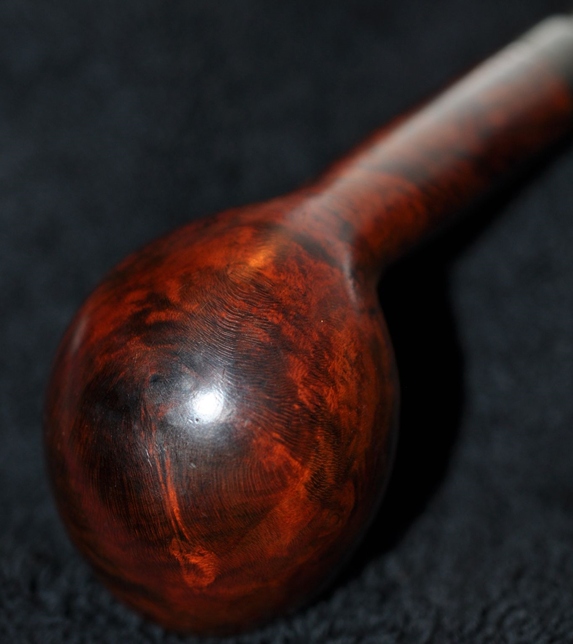
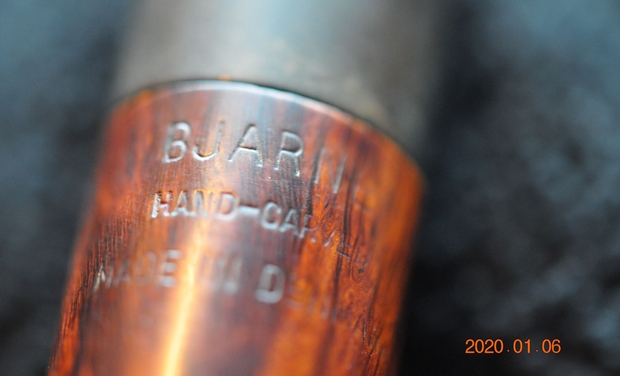
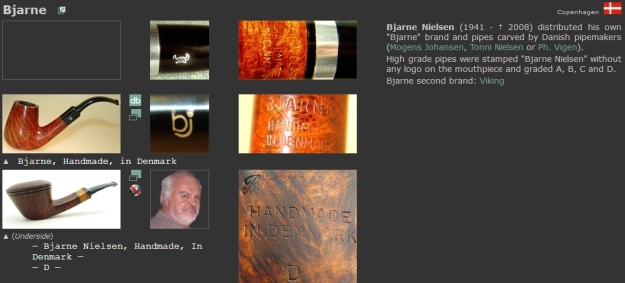
The next pipe came to us from a lot of pipes that Jeff and I purchased from a fellow in Los Angeles, California, USA. It is canted egg shape pipe that is quite large in the hand. Even though it was dirty it had some charm showing through the grit and grime of the years. The grain around the bowl and shank were quite stunning under the grime. On the underside of the shank it was stamped Bjarne [over] Hand-Carved [over] Made in Denmark. The finish is filthy with dust and grit ground into the briar of the bowl and shank sides. The bowl had a light cake and no overflow of lava on the top and inner edge of the rim. It was surprisingly clean inside the bowl other than being just dusty. The stem is calcified, oxidized and had tooth marks and chatter on both sides near the button. It was a filter pipe and came to us without a filter in the shank. The interior of the stem and shank were quite dirty with tars and oils. Jeff took some photos of the pipe to show its overall condition before he started his cleanup work. He took photos of the rim top and bowl to give a clear picture of the good the pipe bowl looked inside. The rim was quite clean but the inner edge was out of round on backside. It was not burned but appeared to have been caused when it was reamed sometime in its history. The photos show the contrast of the bowl’s general condition with the wear and tear on the saddle stem surface.   Jeff took photos of the sides and heel of the bowl and shank to give a picture of what the briar around the pipe looked like. He took a photo of the stamping on the shank. It reads as noted above and is clear and readable.    I turned to my favourite go to sites on the background of brands. The first is Pipephil’s site (http://www.pipephil.eu/logos/en/logo-b5.html). There I looked up the Bjarne brand. I have copied the pertinent information below.

Bjarne Nielsen (1941 – † 2008) distributed his own “Bjarne” brand and pipes carved by Danish pipemakers (Mogens Johansen, Tonni Nielsen or Ph. Vigen). High grade pipes were stamped “Bjarne Nielsen” without any logo on the mouthpiece and graded A, B, C and D. Bjarne second brand: Viking.

I have included a screen capture of the section on the brand below. I turned to Pipedia and looked up the brand for a bit more information on the pipes that were stamped like the one that I am working on (https://pipedia.org/wiki/Bjarne). It is a great history of the brand and a good read. Toward the end of the article I found what I was looking for. I quote:

Among the pipemakers that worked for Bjarne were Johs (for the lower priced high volume pieces), and makers like Ph. Vigen, Ole Bandholm and Tonni Nielsen for high grade pieces. The cheaper line was stamped “Bjarne” while the highest grades were stamped “Bjarne Nielsen” (never with the pipemakers’ name) and graded, from highest to lowest, by the letters: AX, A, B, C, D, E, F, G, H, I, and J.

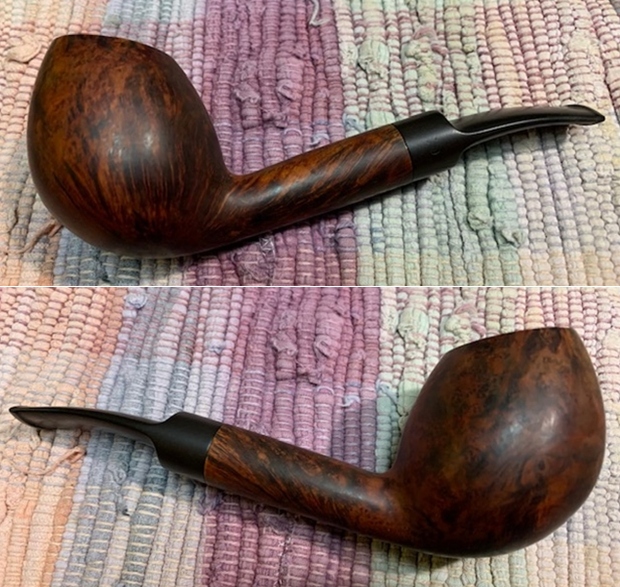
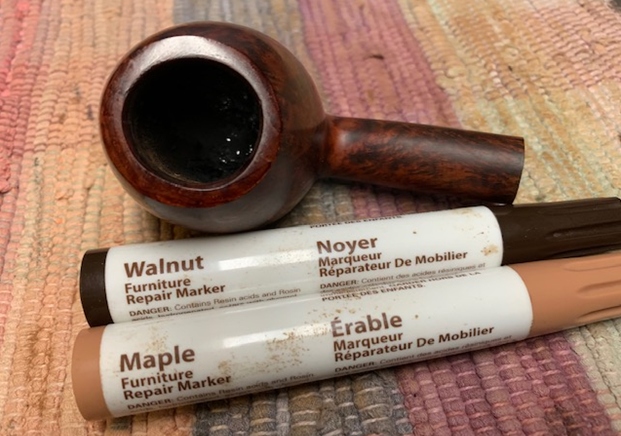
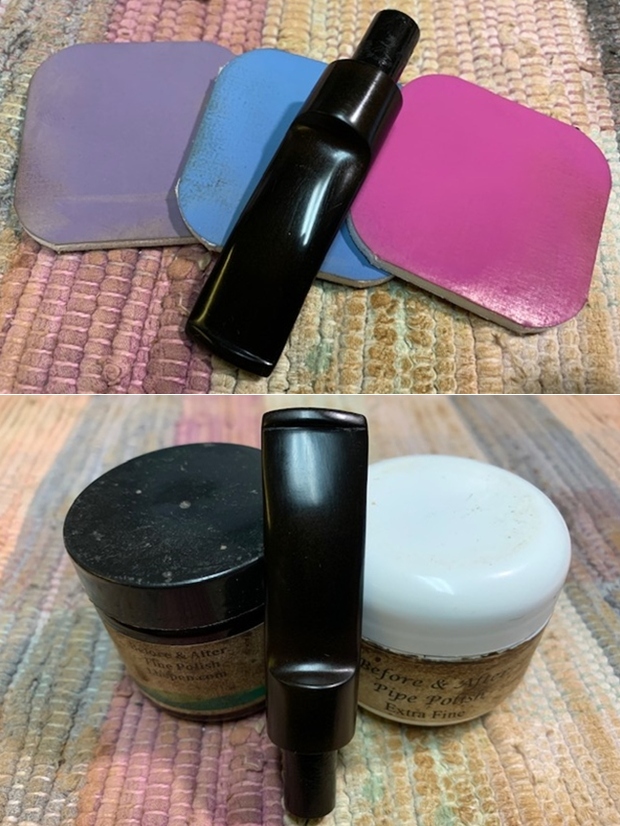
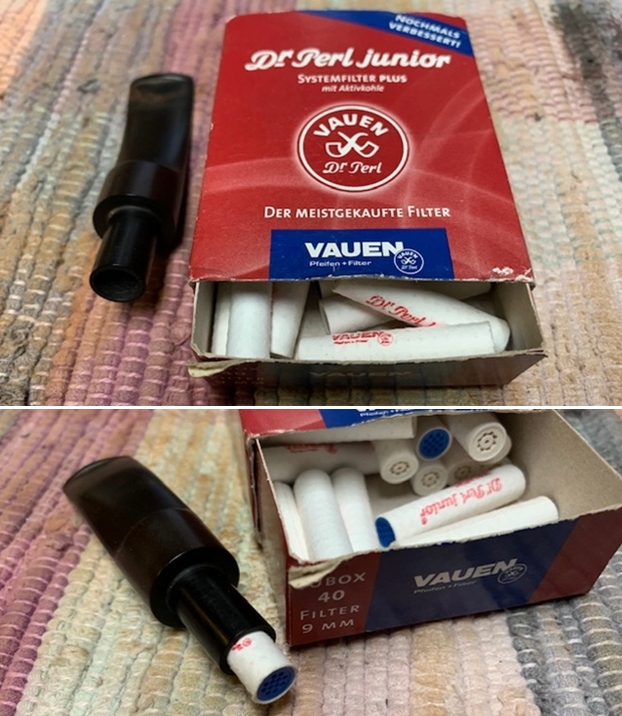
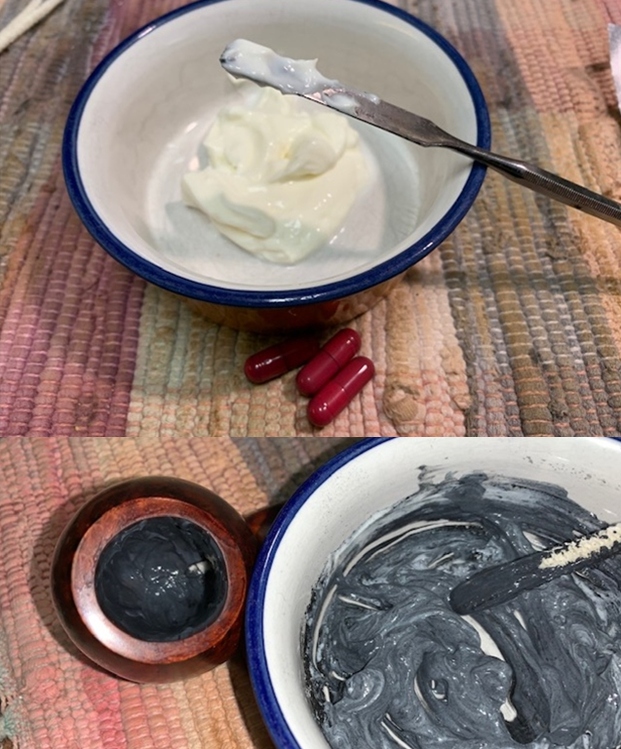
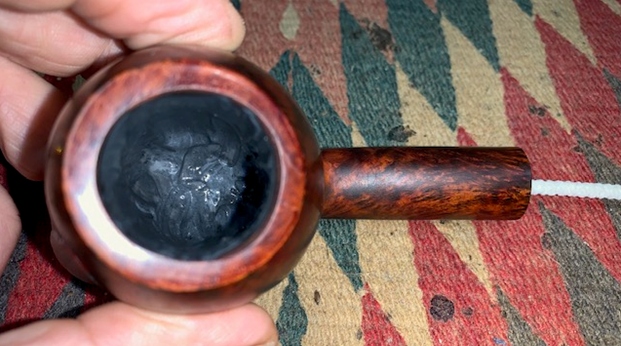
Now I knew that I was dealing with the cheaper line of pipe made by the company. It was stamped Bjarne while the higher grade pipes were stamped Bjarne Nielsen with a grade stamp. Now it was time to work on the pipe. Jeff had cleaned up the pipe with his usual penchant for thoroughness. He reamed the pipe with a PipNet Pipe Reamer and cleaned up the remnants with a Savinelli Fitsall Pipe Knife.  He scrubbed the bowl with undiluted Murphy’s Oil Soap with a tooth brush. He worked over the debris on the plateau rim top and was able to remove it. He rinsed it under running warm water to remove the soap and grime. He cleaned out the inside of the shank and the airway with alcohol, cotton swabs and pipe cleaners. I took photos of the pipe bowl once I received it. It really looked good.    The bowl had been over reamed to the point that there was a pit in the bottom of the bowl. There was a trough from the airway to the front of the bowl and large dip mid bowl. It makes the bottom of the bowl quite thin. There were chips out of the rim top and the bowl was out of round. The stem looks really quite good. There were some light tooth marks and chatter on both sides near the button.I took a photo of the stamping on the underside of the shank. It was clear and read as noted above. I took the stem off the shank and took a picture of the pipe to give a sense of its overall look. It is going to be a great looking pipe once the restoration is finished. I decided to begin my work on the pipe by dealing with the damage to the rim top and inner edge of the bowl. I topped the bowl on a topping board with 220 grit sandpaper. I took of the damage and removed the chips from the rim top. I used a folded piece of 220 grit sandpaper to reshape the inner edge of the bowl. I gave it a light bevel to deal with the damage to the edge of the bowl. When I was finished it looked a lot better than when I started.   The next item on the agenda was the surprise mess on the bottom of the bowl. The bowl had a trough from the entry of the airway to the front of the bowl and a pit mid bowl that made the bowl bottom dangerously thin. I mixed up a batch of JB Weld and filled in both the trough and the pit in the bowl bottom. I used a folded pipe cleaner to press it into the bottom and set it aside to cure.  I polished the briar with micromesh sanding pads – dry sanding with 1500-12000 grit pads. I wiped it down after each sanding pad to remove the sanding dust. I stained the top of the rim with a mix of Walnut and Maple Stain pens and was able to match the surrounding briar perfectly. Once it is buffed it will be very nice.I rubbed the bowl down with Before & After Restoration Balm. I worked it into the surface of the bowl sides and shank with my fingertips. The product works to clean, enliven and protect the briar. I let the balm sit for 15 minutes and then buffed with a cotton cloth to raise the shine.   I set the bowl aside and turned my attention to the stem that I had picked out. I “painted” the surface of the stem with the flame of a lighter to lift the tooth marks. I was able to lift all of them on the top side and all but one on the underside. I filled them in with super glue and set it aside to cure. I used a file to flatten the repair on the stem and reshape the button. Once I had it reshaped and the repair flattened I sanded the stem with 220 grit sandpaper to remove the scratching and blending them into the surface. I began the polishing with 400 grit wet dry sandpaper. The stamping on the left side of the saddle stem was faint but I touched up what remained with Rub’n Buff Antique Gold.  I rubbed it into the stamping and used a tooth pick to work it into the stamp. I buffed it off with a cotton pad.I polished the scratches out of the stem with micromesh sanding pads – 1500-12000 grit pads. I wiped it down with a damp cloth after each sanding pad. I used Before & After Pipe Polish – both Fine and Extra Fine to further polish the stem.    The stem and shank were made for a 9MM filter so I took out a box of Vauen Dr. Perl Filters and fit one into the end of the stem. It fit perfectly in both the stem and the shank. Once the repair in the bowl bottom cured I mixed a bowl of sour cream and charcoal powder to protect the bowl and facilitate breaking it in the first few smokes. I put a pipe cleaner in the airway into the bowl and used a folded pipe cleaner to paint the walls and bottom of the bowl with the mixture. I set the bowl aside to let the mixture harden and cure. Once the bowl coating dries it is neutral and leaves behind no taste that affects the flavour of the tobacco.   This smooth finished Bjarne Hand-Carved Canted Egg is a great looking pipe. It is a pipe made in Denmark. The fancy, saddle vulcanite stem that is drilled for a 9mm filter works well and goes nicely with the reds of briar. I put the stem back on the bowl and buffed the pipe with Blue Diamond on the buffing wheel using a light touch on the briar. I gave the bowl and the stem multiple coats of carnauba wax on the buffing wheel and followed that by buffing the entire pipe with a clean buffing pad. I hand buffed the pipe with a microfiber cloth to deepen the shine. The finished Bjarne Canted Egg fits nicely in the hand and feels great. Give the finished pipe a look in the photos below. The dimensions of the pipe are Length: 6 ½ inches, Height: 2 ¼ inches, Outside diameter of the bowl: 1 ½ inches, Chamber diameter: 7/8 of an inch. The weight of the pipe is 74grams/2.61oz. I will be adding it to the rebornpipes store shortly in the Danish Pipe Makers Section. Thanks for reading this blog and my reflections on the pipe while I worked on it. There are many more to come!

Restoring and Restemming an Asselta Freehand Egg


Blog by Steve Laug

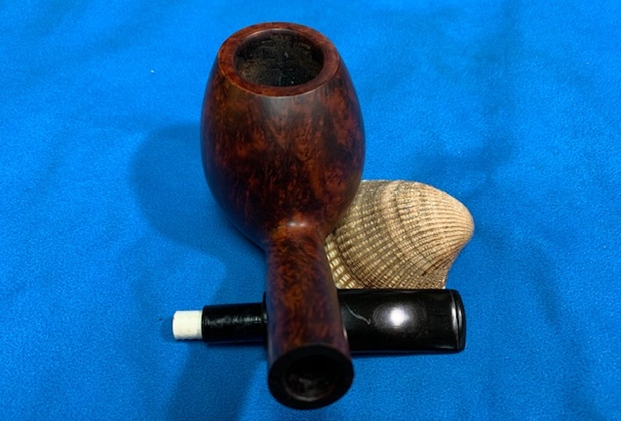
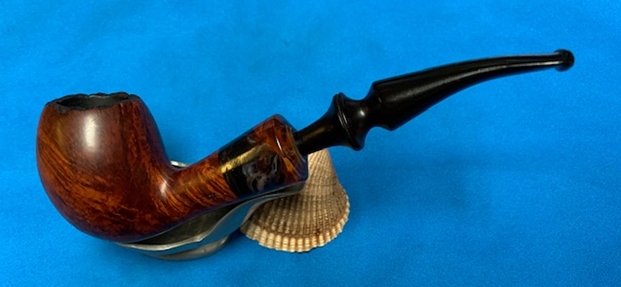
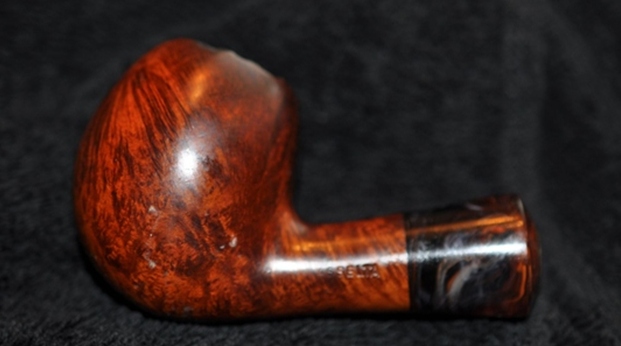
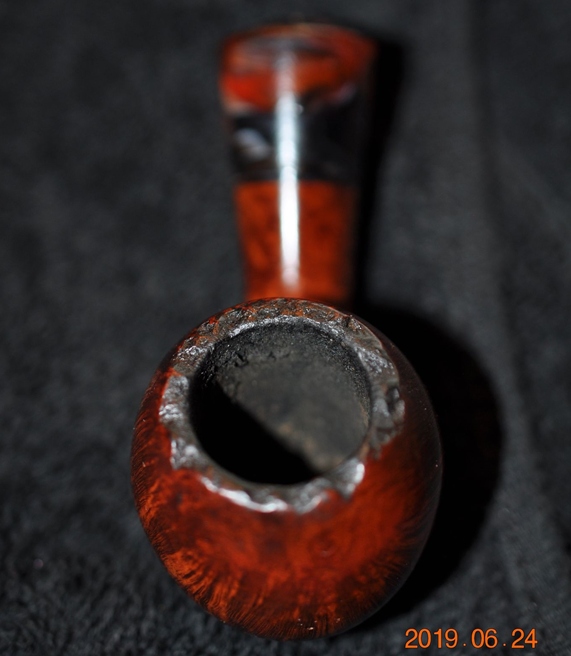
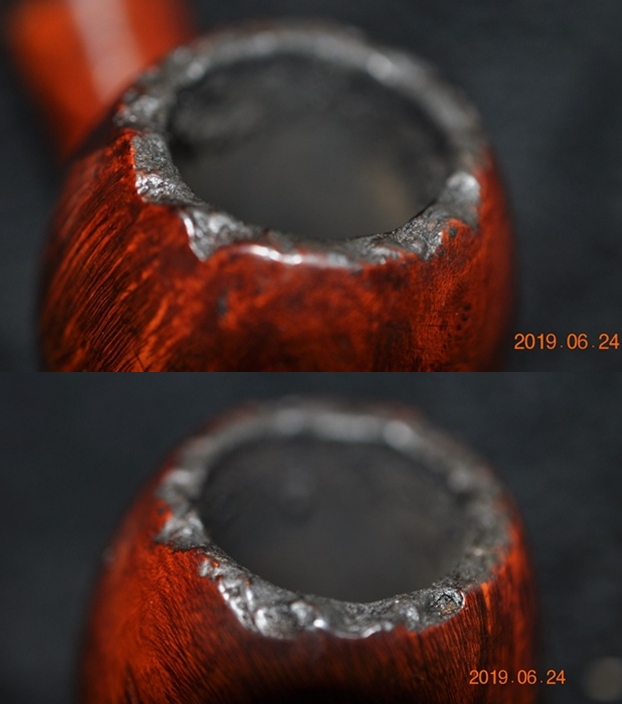
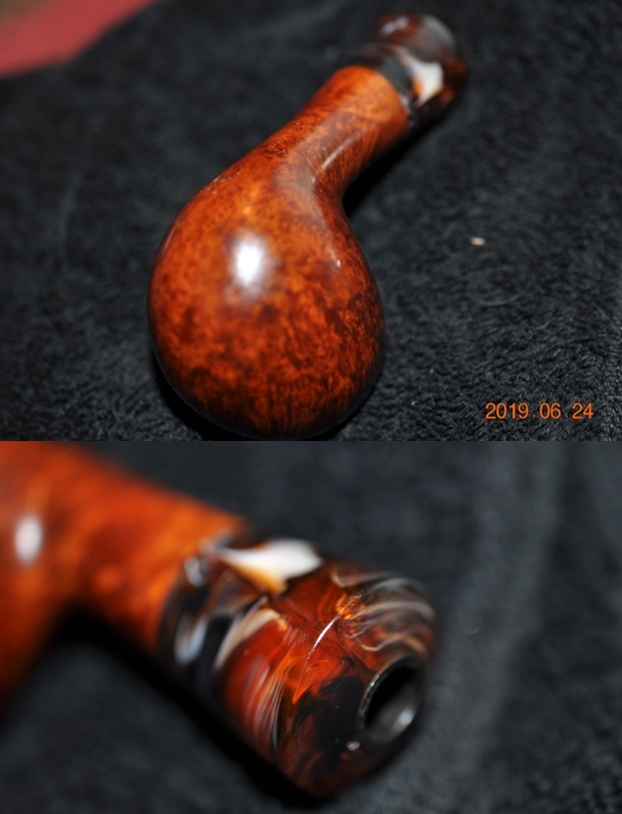
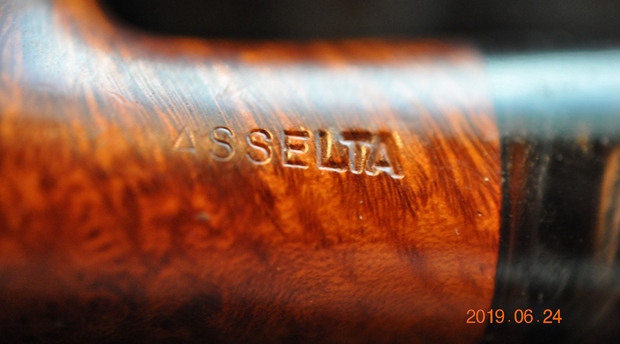
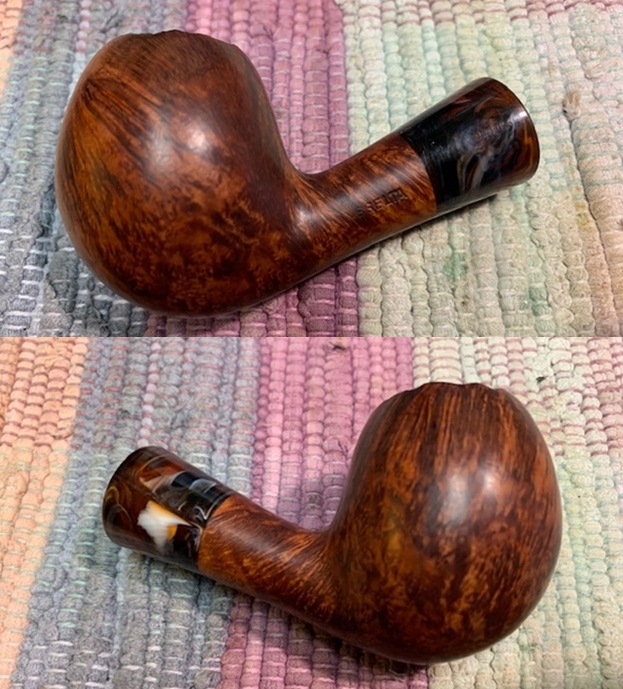
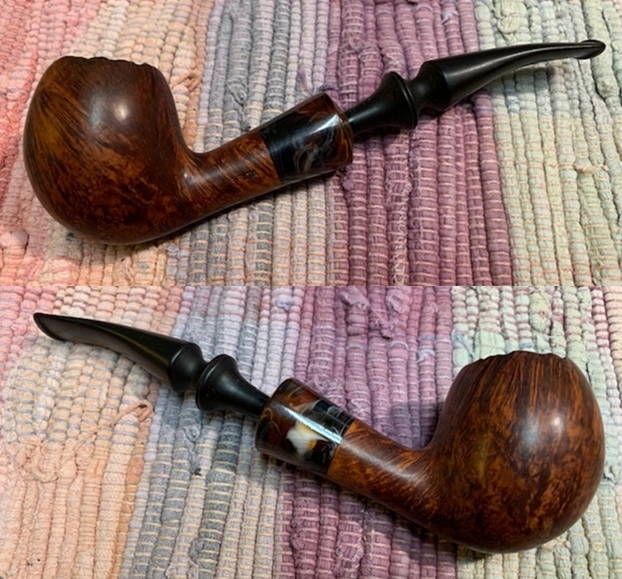
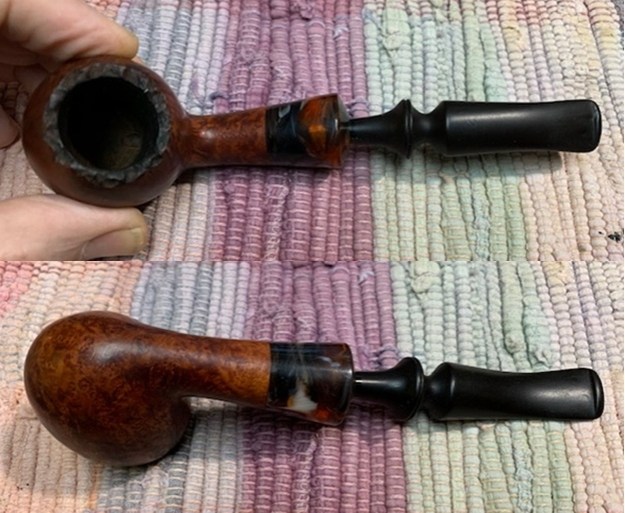
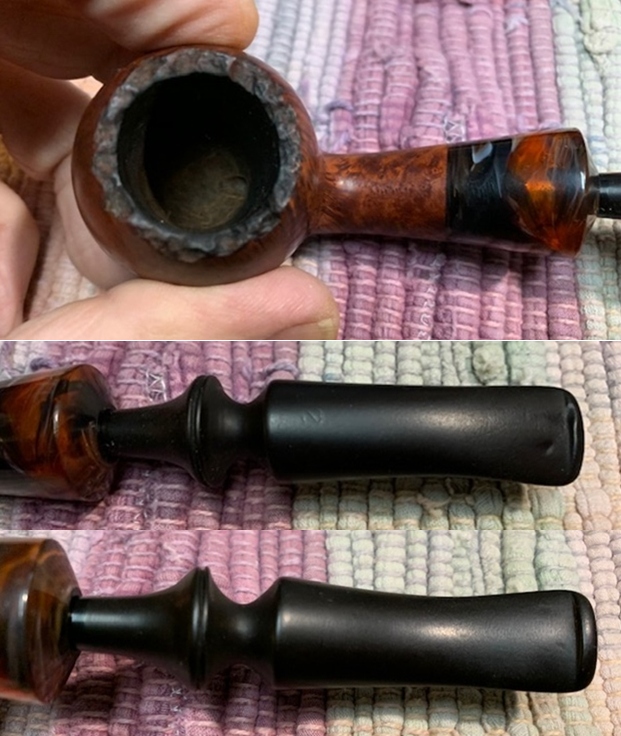
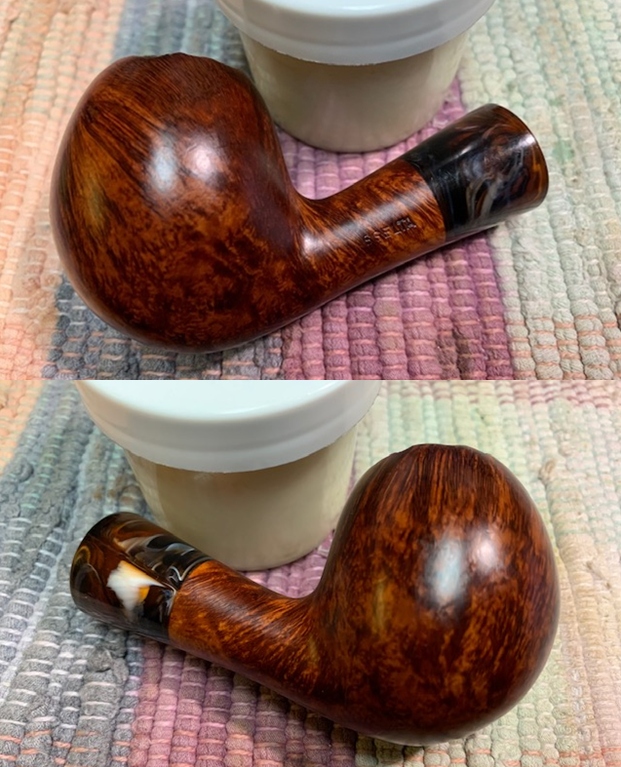
The next pipe came to us from an auction in Huntington Station, New York, USA and has been sitting here since mid-2019. I am finally getting to it. Even though the plateau rim top was dirty it had some charm showing through the grit and grime of the years. The grain around the bowl and shank were quite stunning under the grime. The acrylic shank extension was an incredible mixture of brown, orange and blue swirls. On the left side of the shank it was stamped Asselta. The pipe came to us without a stem so I would need to pick through what I have here and find a good option. The pipe is a smooth egg shape bowl with a plateau rim. The finish is filthy with dust and grit ground into the briar of the bowl and shank sides. The bowl had a thick cake and an overflow of lava on the top and inner edge of the rim obscuring the plateau. Jeff took some photos of the pipe to show its overall condition before he started his cleanup work. He took photos of the rim top and bowl to give a clear picture of the thickness of the cake and the lava and dust ground into the plateau rim top.   Jeff took photos of the sides and heel of the bowl and shank and the acrylic swirled shank extension to give a picture of what the briar around the pipe looked like.   He took a photo of the stamping on the shank. It reads as noted above and is clear and readable.    I turned to Pipedia and did a search for Asselta pipes. The search came with a link in the American Pipe Brands (https://pipedia.org/wiki/American_Pipe_Brands_%26_Makers_A_-_B). It appears that the pipe was potentially made in Long Island, New York, USA. Seeing how the pipe came to us from New York it had not traveled far in its life before we purchased it. Now it has traveled from New York to Idaho and then to Vancouver, Canada. Where its journey will end only time will tell.

Now it was time to work on the pipe. Jeff had cleaned up the pipe with his usual penchant for thoroughness. He reamed the pipe with a PipNet Pipe Reamer and cleaned up the remnants with a Savinelli Fitsall Pipe Knife.  He scrubbed the bowl with undiluted Murphy’s Oil Soap with a tooth brush. He worked over the debris on the plateau rim top and was able to remove it. He rinsed it under running warm water to remove the soap and grime. He cleaned out the inside of the shank and the airway with alcohol, cotton swabs and pipe cleaners. I took photos of the pipe bowl once I received it. It really looked good.    The plateau rim top was very clean and the bowl was spotless. It was a good looking pipe. The swirled acrylic shank extension was beautiful.   I took a photo of the stamping on the left side of the shank. It was clear and read as noted above. I went through my assortment of stems and found one that really worked well with the shank extension and the bowl. It is going to be a great looking pipe. I put the stem in the shank and took photos of the new look of the bowl. I like the overall look that pipe had. Once I cleaned up and polished the stem it would look very good.  I took close up photos of the bowl and plateau rim top and the stem. I was going to need to remove the tooth marks but the stem was going to look very good. The bowl was in such good condition that I started my work on it by rubbing down with Before & After Restoration Balm. I worked it into the surface of the bowl sides and shank with my fingertips. I used a horsehair shoe brush to work it into plateau top. The product works to clean, enliven and protect the briar. I let the balm sit for 15 minutes and then buffed with a cotton cloth to raise the shine.   I set the bowl aside and turned my attention to the stem that I had picked out. I “painted” the surface of the stem with the flame of a lighter to lift the tooth marks. I was able to lift all of them on the top side and all but two on the underside. I filled them in with super glue and set it aside to cure. I used a file to flatten the repair on the stem and reshape the button. Once I had it reshaped and the repair flattened I sanded the stem with 220 grit sandpaper to remove the scratching and blending them into the surface. I began the polishing with 400 grit wet dry sandpaper. I polished the scratches out of the acrylic stem with micromesh sanding pads – 1500-12000 grit pads. I wiped it down with a damp cloth after each sanding pad. I used Before & After Pipe Polish – both Fine and Extra Fine to further polish the stem.     This smooth finish/plateau rim top Asselta Freehand Egg with a swirled acrylic shank extension is a great looking pipe. It is a pipe made in Long Island, New York but other than that the carver is a mystery to me. The replacement fancy, saddle vulcanite stem works well and goes nicely with the extension and the briar. I put the stem back on the bowl and buffed the pipe with Blue Diamond on the buffing wheel using a light touch on the briar. I gave the bowl and the stem multiple coats of carnauba wax on the buffing wheel and followed that by buffing the entire pipe with a clean buffing pad. I hand buffed the pipe with a microfiber cloth to deepen the shine. The finished Asselta Freehand Egg fits nicely in the hand and feels great. Give the finished pipe a look in the photos below. The dimensions of the pipe are Length: 6 ¼ inches, Height: 2 inches, Outside diameter of the bowl: 1 ¼ inches, Chamber diameter: ¾ of an inch. The weight of the pipe is 53grams/1.87oz. I will be adding it to the rebornpipes store shortly in the American Pipe Makers Section. Thanks for reading this blog and my reflections on the pipe while I worked on it. There are many more to come!

Restoring an Interesting Eriksen Rusticated Bulldog


Blog by Steve Laug

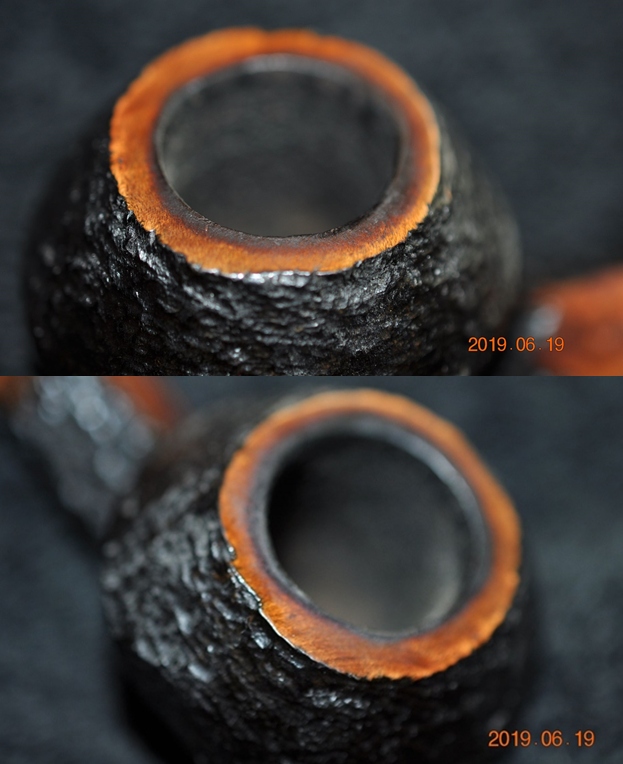
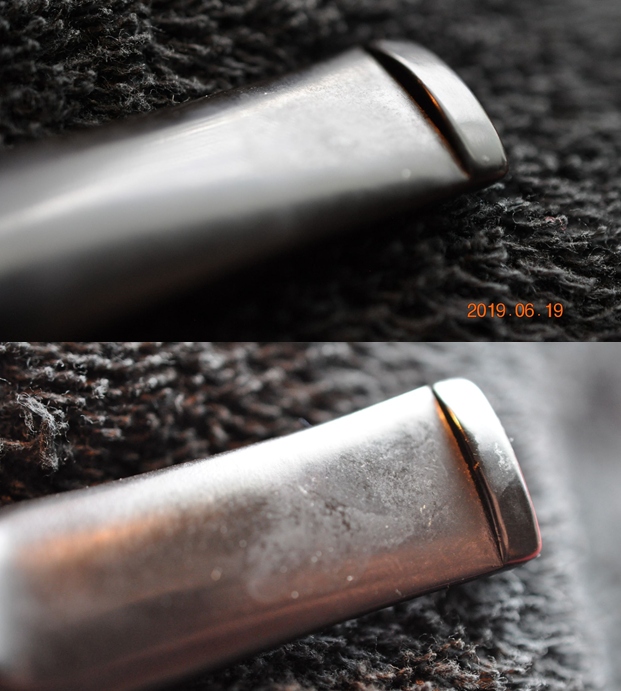
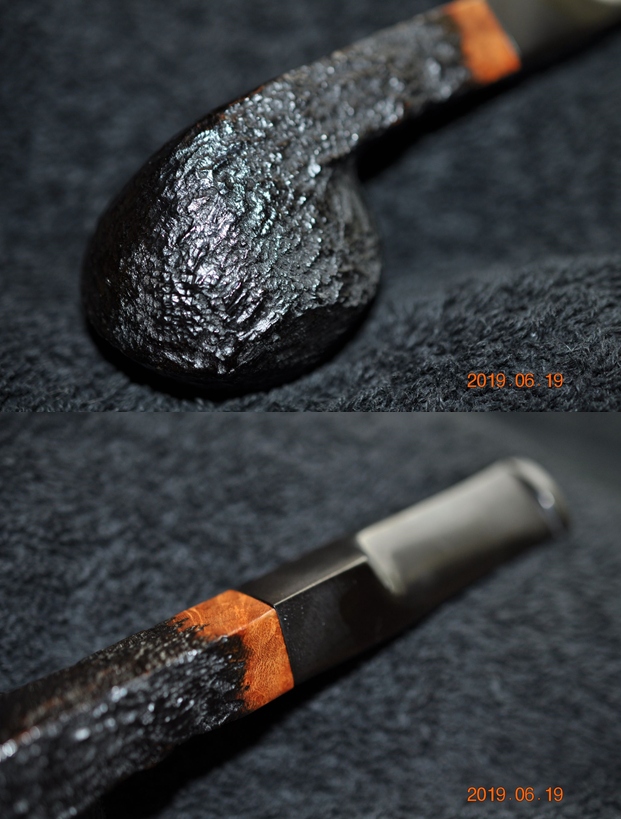
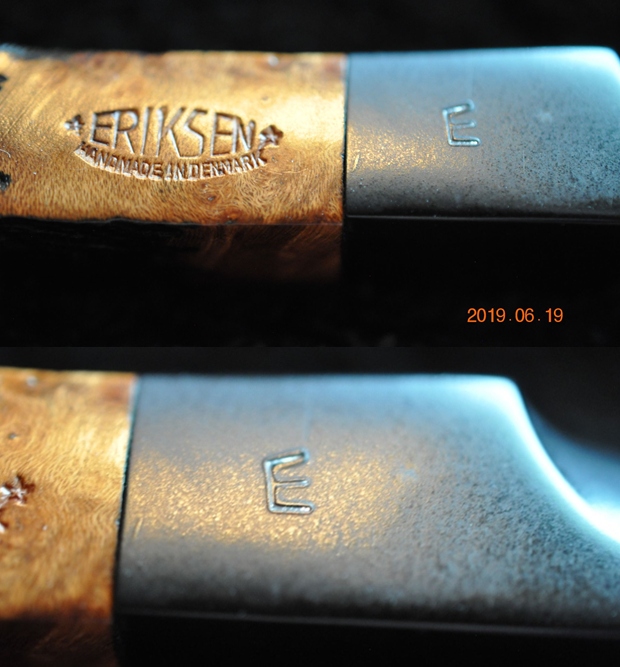
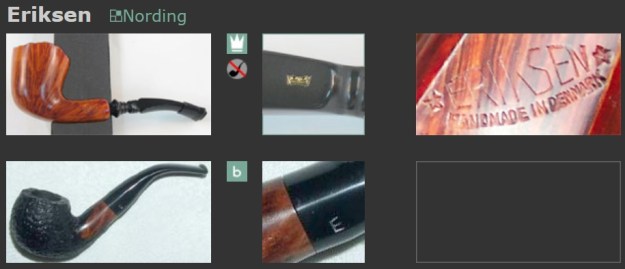
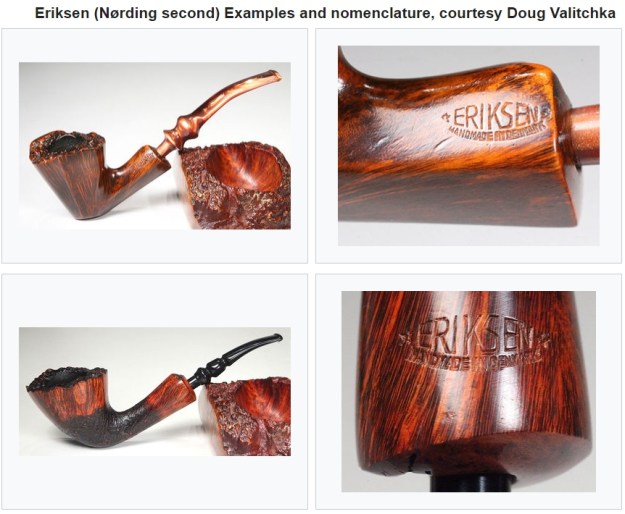
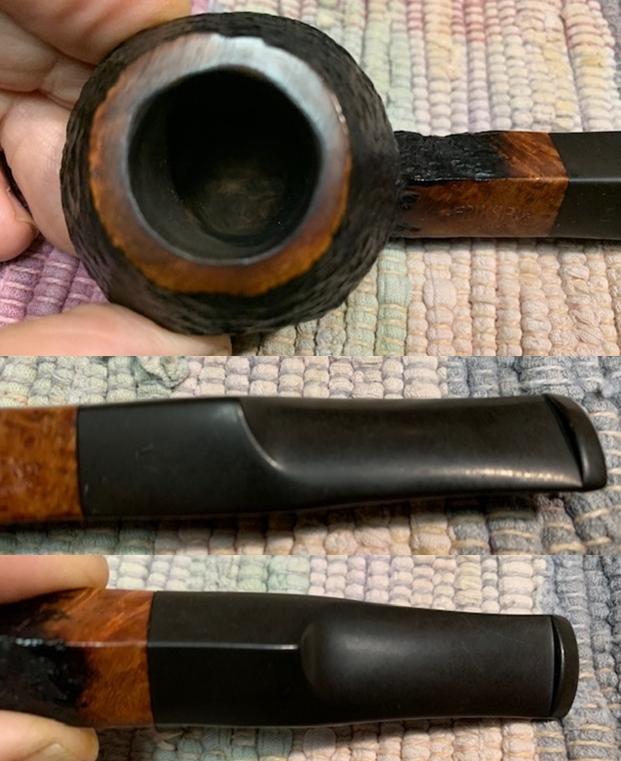
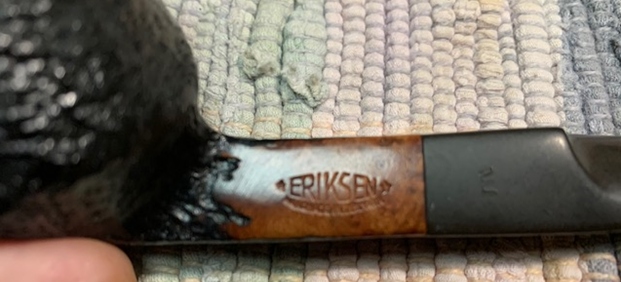
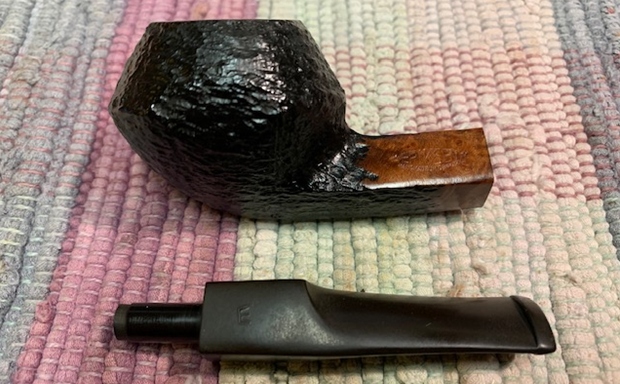
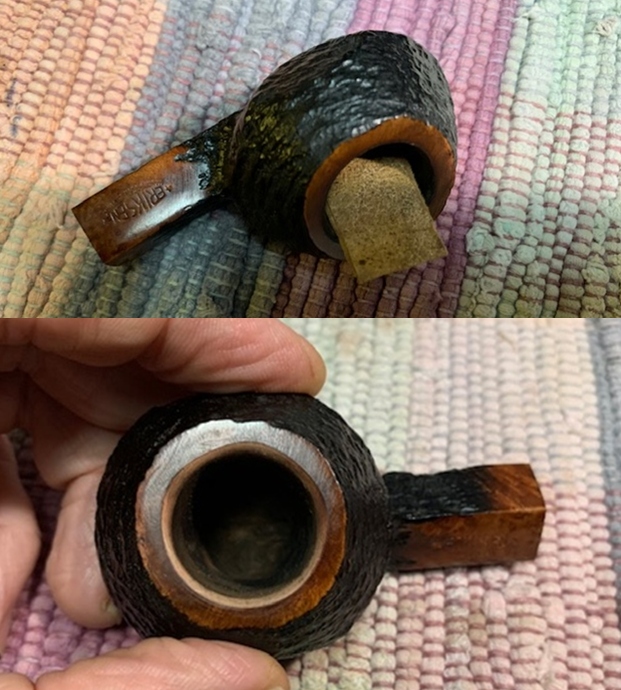
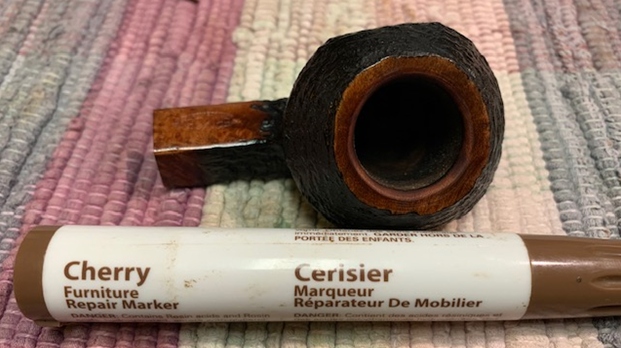
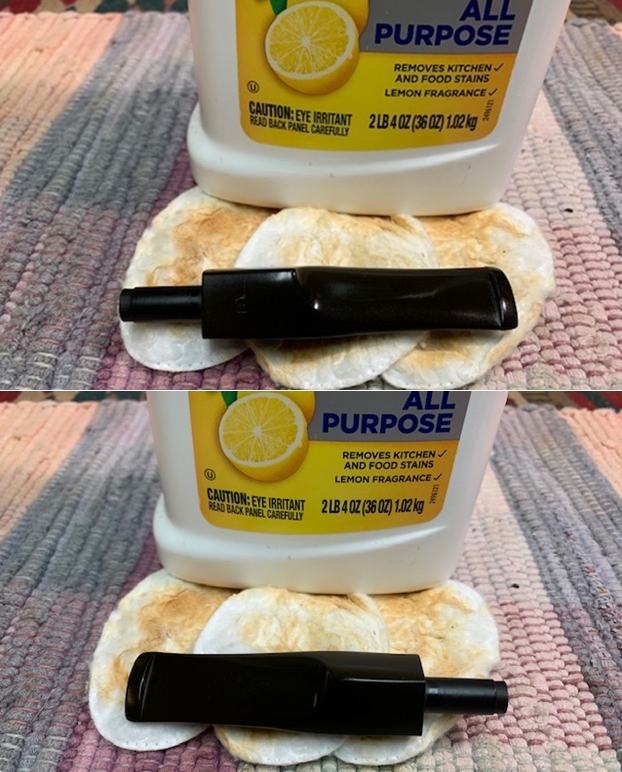
The next pipe came to us from a pipe hunt in Northern Utah, USA so it has been sitting here since mid-2019. Even though the rusticated finish was dirty it had some charm showing through the grit and grime of the years. On the left side of the shank it was stamped Eriksen in an oval shape with a star before and after it.  Under that it is stamped Handmade in Denmark. The saddle stem also had an upper case E on the upper left side of the Diamond saddle. The pipe is a rusticated Bulldog with a smooth rim top and shank band as well as a smooth panel for the stamping. The saddle stem fit the shape well and had a slight flair to the saddle! The finish is filthy with dust and grit ground into the rusticated briar of the bowl and shank sides. The bowl had a thick cake and an overflow of lava on the top and inner edge of the rim. There was burn damage on the inner edge and it was out of round. The stem was a vulcanite saddle stem that was dirty and calcified but surprisingly did not have tooth marks. Jeff took some photos of the pipe to show its overall condition before he started his cleanup work. He took photos of the rim top and bowl to give a clear picture of the thickness of the cake and the lava and dust ground into the rim top. He also took photos of the top and underside of the stem to show how clean the stem actually appeared.   Jeff took photos of the sides and heel of the bowl and shank to give a picture of what the briar around the pipe looked like. He took a photo of the stamping on the shank and the stem. It reads as noted above and is clear and readable.    I turned to Pipephil’s site (http://www.pipephil.eu/logos/en/logo-e4.html) to the section on Eriksen pipes. The screen capture links the Eriksen brand to Erik Nording. The finish on the second pipe in the photo below is identical to the Nording Bulldog I am working on.I turned to Pipedia (https://pipedia.org/wiki/N%C3%B8rding) and found a bit more information on the Eriksen brand connecting it to Nording pipes. The screen capture below from the site makes the connection well. Now it was time to work on the pipe. Jeff had cleaned up the pipe with his usual penchant for thoroughness. He reamed the pipe with a PipNet Pipe Reamer and cleaned up the remnants with a Savinelli Fitsall Pipe Knife.  He scrubbed the bowl with undiluted Murphy’s Oil Soap with a tooth brush. He worked over the debris on the rim top and was able to remove it. He rinsed it under running warm water to remove the soap and grime. He cleaned out the inside of the shank and the airway in the stem with alcohol, cotton swabs and pipe cleaners. He soaked the stem in Before & After Pipe Stem Deoxidizer and rinsed it off with warm water. He scrubbed the stem with Soft Scrub and cotton pads to remove remaining oxidation on the ferrule and the stem. He rinsed it with warm water and dried it off. I took photos of the pipe once I received it. It really looked good. The rim top and the rim looked good but the bowl was out of round and damaged. The stem had some remaining oxidation but it was otherwise clean.  I took a photo of the stamping on the left side of the shank. It was clear and read as noted above. I removed the stem and took a photo of the pipe to give a sense of the whole. I decided to start my work on the pipe by dealing with the out of round bowl. I worked it over with a folded piece of 220 grit sandpaper.   I restained the inner edge of the bowl with a Cherry stain pen and it matched the top of the rim and the smooth portions of the shank and shank end.I rubbed the bowl and shank down with Before & After Restoration Balm. I worked it into the surface of the bowl sides and shank with my fingertips. I used a horsehair shoe brush to work it into rustication. The product works to clean, enliven and protect the briar. I let the balm sit for 15 minutes and then buffed with a cotton cloth to raise the shine.   I scrubbed the stem with Soft Scrub All-Purpose Cleaner to remove the oxidation from the stem surface. The product works really without damaging the stamping on the saddle.  I polished the scratches out of the acrylic stem with micromesh sanding pads – 1500-12000 grit pads. I wiped it down with a damp cloth after each sanding pad. I used Before & After Pipe Polish – both Fine and Extra Fine to further polish the stem.  I touched up the gold E on the stem with Rub’n Buff Antique Gold. I worked it into the stamp with a tooth pick and buffed it off with a cotton pad.  This combination rusticated and smooth Eriksen Handmade Danish Bulldog is a beauty. It is a pipe made by Erik Nording and was sold as a second but it is hard for me to understand what makes it a second. It has a flared vulcanite saddle stem that makes it a great looking pipe. I put the stem back on the bowl and buffed the pipe with Blue Diamond on the buffing wheel using a light touch on the briar. I gave the bowl multiple coats of Conservator’s Wax and the stem multiple coats of carnauba wax on the buffing wheel and followed that by buffing the entire pipe with a clean buffing pad. I hand buffed the pipe with a microfiber cloth to deepen the shine. The finished Eriksen Bulldog fits nicely in the hand and feels great. Give the finished pipe a look in the photos below. The dimensions of the pipe are Length: 5 ½ inches, Height: 1 ¾ inches, Outside diameter of the bowl: 1 ¾ inches long x 2 inches wide, Chamber diameter: ¾ of an inch. The weight of the pipe is 45grams/1.59oz. I will be adding it to the rebornpipes store shortly in the Danish Pipe Makers Section. Thanks for reading this blog and my reflections on the pipe while I worked on it. There are many more to come!

Recommissioning Another Barontini Aldo Velani Trio of Italy – A Classic Billiard


Blog by Dal Stanton

The Aldo Velani Trio Classic Billiard now on the worktable represents the 6th of 7 pipes Daniel commissioned from the For “Pipe Dreamers” Only! collection.  It also represents the second Aldo Velani Trio Daniel included in his trove of 7.  I acquired 4 Aldo Velani Trios in 2018 in what I have called the St. Louis Lot of 26 that my son, Josiah, found in an antique shop. The original 4 Velanis are pictured below.The  Bent Apple and Rusticated Volcano have already found homes with new stewards. The Pot on the bottom is waiting for the Billiard to be completed to join Daniel’s commissioned pipes all which benefit the Daughters of Bulgaria – women and girls who have been trafficked and sexually exploited.   This is a classy line up of pipes!  Looking at their current restored states:   With the Classic Billiard next, some pictures provide a closer look.  The nomenclature on the left shank side is cursive script, ‘Aldo Velani’ [over] ‘TRIO’.  On the shank underside, the COM, ‘ITALY’ is followed by the shape number ‘52’.  As I noted with the Pot, when I first looked at the logo it was difficult to figure out but found in Pipedia’s Aldo Velani article, an example and details of the stamping on an original Aldo Velani box (courtesy of Doug Valitchka).  The stamp depicts a pipe as the front leg of the ‘A’ for Aldo and the back leg of the ‘A’ forms the front riser of the ‘V’ of Velani.  Again, I repeat the previous research here:  The article cited from Pipedia provides helpful information understanding the provenance of the Aldo Velani Trio line:

Most Aldo Velani pipes are made in Livorno, Italy, for the USA market by Cesare Barontini. They were previously imported by Lane Limited. Lane spokesman Frank Blews once described Velani’s stylish, intrinsically Italian designs as “Billiards with more ball, bulldogs with more jaw.” The name “Aldo Velani” is actually fictional.

Another Barontini 2nd is named “Cesare”.

I learn two interesting things from this information.  First, Aldo Velani is a faux name that does not describe an Italian pipe house but a specific line of pipes.  Secondly, the Aldo Velani is made by the Casare Barontini name based in Livorno, Italy.   Further information is available cross referencing to Casare Barontini in Pipedia:

In 1890 Turildo Barontini opened a factory for the production of briar. In 1925 his son Bruno began to produce the first pipes. Cesare Barontini, son of Bruno, started direction of the factory in 1955, and still runs it together with his daughters Barbara and Silvia.

Sub-brands & Seconds: Aldo Velani. Cesare, L’artigiana, Stuart, Cortina

Additional information is found in Pipephil’s site.  Aldo Velani line was produced primarily for export.  The stem stamping on the Aldo Velani line had different variations provided by Pipephil:Looking now to the condition of the Aldo Velani Trio Billiard, much like his Apple and Pot brothers, the chamber has a thick cake which needs cleaning.  The lava crusted on the rim too, is thick.  This will need cleaning.  The stummel with the ruby/burgundy is soiled and generally in good shape.  I’m hopeful of keeping the hues consistent between the Pot and Billiard now on the table.  The clear acrylic stem, like the Aldo Velani Trio Apple, is soiled and has some tooth chatter.  There is one tooth compression on the lower bit which was the same on the other Aldo Velani Trio pipes – forensics pointing to a sole steward passing these pipes on.  The clear acrylic always gives a pause to ask the question about whether it is the earlier acrylic known as Perspex, on older GBD pipes.  This stem is not Perspex and therefore alcohol may be used to clean without concerns of the material crazing.  The airway does have a burgundy coloring, so after cleaning, it should still be burgundy but more translucent. I take a picture of the starting point of the clear acrylic stem. To start the airway’s cleaning process, I put the entire stem into a soak of lemon juice to help soften the oils in the airway.  As a natural acidic cleaning agent, I use lemon juice when working on Perspex stems.  I decide to experiment to see how it works on the Aldo Velani stem.  I assure you; the stem is in the lemon juice!While the stem is soaking in the juice, I begin the cleaning process of the chamber and rim.  I’m hopeful that there will be no heating issues with this Aldo Velani Billiard as was the case with his brother, the Pot.  The rim is capped with a thick lava flow crust.  The cake in the chamber is thick and I take a picture to show the starting point.To begin the reaming of the chamber, starting with the smallest of 4 blade heads provided by the Pipnet Reaming Kit, I use 2 blade heads.  Next, I transition to scraping the chamber wall using the Savinelli Fitsall tool and finish by sanding the chamber with 240 grade sanding paper wrapped around a Sharpie Pen.   After wiping the chamber with a cotton pad to remove carbon dust residue, an inspection of the chamber reveals healthy briar ready to go again. Looking to the rim, using the edge of my Winchester pocketknife, I carefully scrape the crusted carbon.  I avoid gouging the briar by pulling the edge over the surface rather than pushing the blade.  Next, using undiluted Murphy’s Oil Soap and starting with a cotton pad, the ruby/burgundy external surface is scrubbed.  I also employ a brass wire brush to work on the rim.  After scrubbing the bowl and rim, I take the stummel to the sink and continue the cleaning using warm water to rinse the Murphy’s Soap.  Using shank brushes, I then work on the internal mortise chamber with anti-oil liquid dishwashing soap.  This helps to break down the tars and oils which have built up through use.  After a thorough rinsing, the stummel is transitioned back to the worktable.  After the cleaning, the rim shows some bald spots where raw briar is exposed.  I’ll need to address these, but the challenge will be to match and blend the stummel ruby/burgundy and the rim contour so that it doesn’t draw attention.I also find a small fill needing attention in the crook of the bowl and shank.  It is not too noticeable.The cleaning continues with the internals using cotton buds and pipe cleaners dipped in isopropyl 99%.  After some effort, the cleaners and buds emerge lighter.  The job is done, and I move on.I continue with the stummel and take another look at the rim.  I had to do some work on rim of the Aldo Velani Trio Pot that I just completed.  I saved the dye mixture I used to color the rim and I’ll use that dye mixture on the Billiard’s rim.  The hue will be consistent between the two restorations of the same colored pipes.  I take another picture of the Billiard’s rim, which is not in bad of shape as was the Pot’s, but the finish on the rim is thin at places and uneven. First, I apply the 1500 grade micromesh pad to clean the rim.This is followed by applying the full battery of micromesh pads to smooth the rim surface.As I mentioned above, I saved the dye mixture that I used to restore the Aldo Velani Pot, in my last restoration project.  After testing and some experimentation, I used a mixture with the base of Fiebing’s Oxblood Leather Dye with a few drops of Fiebing’s Black Leather Dye to deepen the hue.  It worked well on the Pot so I’m hopeful the Billiard will be just as happy! I apply several applications of the dye mixture with a cotton bud until the rim seems to be fully colored.I take another look at the fill I found earlier at the crook of the shank/bowl union.  While I have the dye on the worktable, I apply some of the mixture on the fill to see if it would help camouflage the area. Unfortunately, it didn’t.  Next, a red Sharpie Pen is used to attempt to blend the fill in.  After touching up the fill, the Sharpie has helped somewhat but the fill is still somewhat visible.  The reality of the challenge of this seemingly small repair is that to remove fully it would require refinishing the entire stummel.  Yet, desiring to preserve the original ruby/burgundy finish so that it matches the Aldo Velani Pot also in Daniel’s Trove of 7 commissioned pipes, creates the necessity of leaving small imperfections in the original finish.  If I attempt a spot repair by sanding and then refinishing, I’m afraid the result would be to draw even more attention to it!  I’ll be satisfied at this point with the Sharpie repair.Putting the stummel aside and turning now to the clear acrylic stem, the stem has been waiting in a lemon juice soak.  Using lemon juice allowed the natural acidic hopefully to help clean the airway of staining.  The original stem airway has a burgundy coloring.  I fish the stem out of the lemon juice.  The airway continues to be darkened.  We’ll see if the lemon soak had any benefit.Using bristled and smooth pipe cleaners, I use isopropyl 99% to clean the airway.  Using smaller diameter shank brushes also helped to clear the staining from the airway.  As I work, I can see the cloudiness dissipate and more of a translucent airway emerges.  It looks much better now, and I move on!Looking now more closely at the upper and lower bit, there is tooth chatter on both and the lower also has a small tooth compression.  Using 240 sanding paper, the tooth chatter and tooth compression are easily sanded and dispatched.    After inspecting the entire stem, I can find no scratching in the acrylic stem other than the bit sanding to repair the tooth chatter. With most of the stem in pristine condition, there is no need to sand the entire stem.  I will focus the sanding with 600 grade paper on the bit and then apply 0000 grade steel wool to the entire stem.  Therefore, using 600 grade paper the bit area is wet sanded.  Following this I apply 0000 steel wool to entire stem.Transitioning now to micromesh pads, the stem is wet sanded with pads 1500 to 2400 followed by dry sanding with pads 3200 to 4000 and 6000 to 12000.  Even though it really doesn’t protect the acrylic stem from oxidation, I like applying Obsidian Oil to condition it.  The stem looks great. To shine the gold nickel shank ring, I use Tarn-X Tarnish Remover which gives the metal a new spark of life. I apply some of the Tarn-X to a cotton pad and rub it into the ring, making sure I get it into the crevasse between the two ring risers.  I also am careful to keep the cleaner off the briar which would probably leech the dye.  After applying the Tarnish Remover, I wipe/rinse the fluid off with a cotton pad wet with water.  I then buff up the ring with a cotton cloth.  It looks great – the bling factor is increased with the ring!Next, after reuniting stem and stummel, a cotton buffing wheel is mounted on the Dremel and the speed is set to about 40% full power.  I then apply Blue Diamond to the pipe avoiding the ring – this would create a black gunk that could stain the briar surface.  After applying the Blue Diamond over the entire pipe, the pipe is given a buffing with a felt cloth to remove the residual compound dust before applying the wax.The unique Aldo Velani stem stamping needs refreshing to augment the classy look of this Billiard.Using European Gold Rub ‘n Buff metallic paint, I use a pointed cotton bud to paint over the stem stamping. Once thoroughly covered, I wait only a few moments because the paint sets up very quickly.  I then use the side of the pointed cotton bud to scrape excess paint.  I then flip the bud to the clean end and wipe/buff up the remaining excess to sharpen the stamping.  The results are nice – it looks great!Next, another cotton cloth buffing wheel is mounted onto the Dremel.  Remaining at the same speed, carnauba wax is applied to the stem and stummel.  After applying the carnauba, the pipe is given a rigorous hand buffing to remove excess wax and to raise the shine.I’m pleased with the results of this second of the Aldo Velani Trio pipes that Daniel commissioned.  The ruby-burgundy finish initially draws one’s attention and then the clear, glass-like acrylic stem.  Finishing the ensemble is the golden double-bumped shank ring joining stem and stummel to present this classic Billiard after-dinner pipe.  Both Aldo Velani brothers that Daniel commissioned, this Billiard and the Pot, will provide great fellowship with one’s favorite blend and adult beverage.  Daniel has the first opportunity to claim the Aldo Velani Trio Billiard in The Pipe Steward Store which benefits the Daughters of Bulgaria.  Thank you for joining me!

Wow what a mess this Brebbia 931 Rhodesian was – but what a beauty was born out of it


Blog by Steve Laug

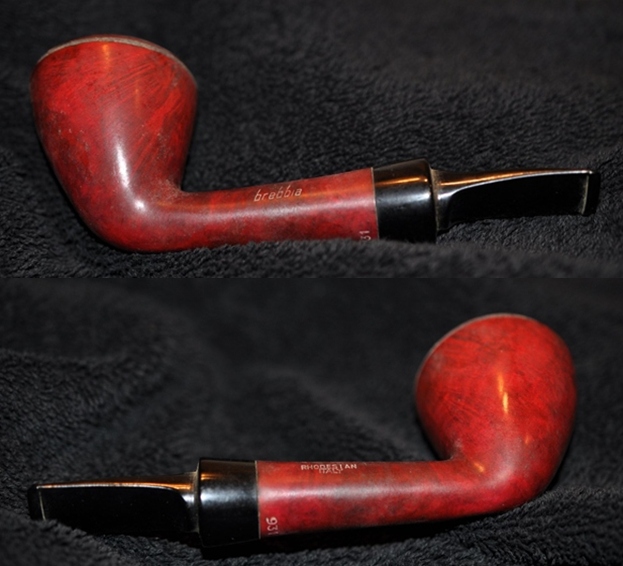
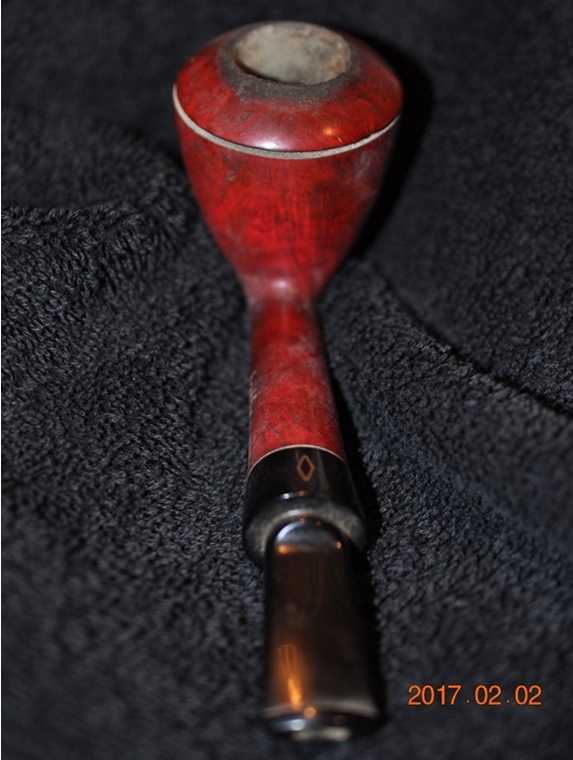
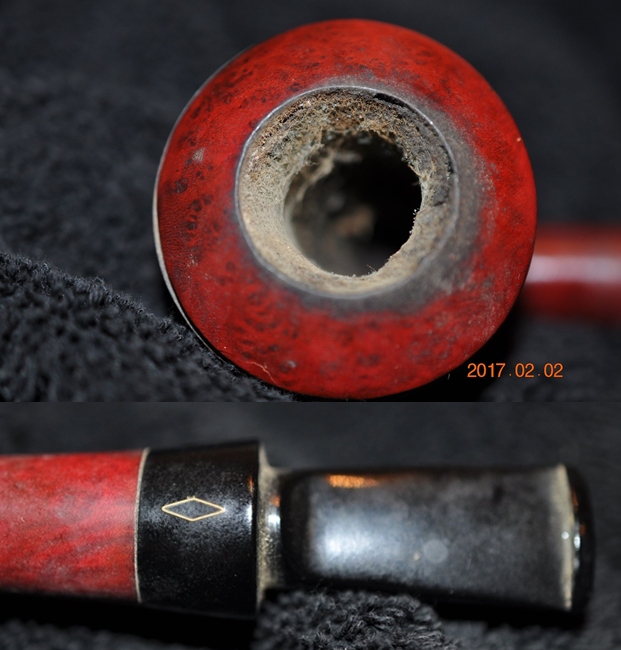
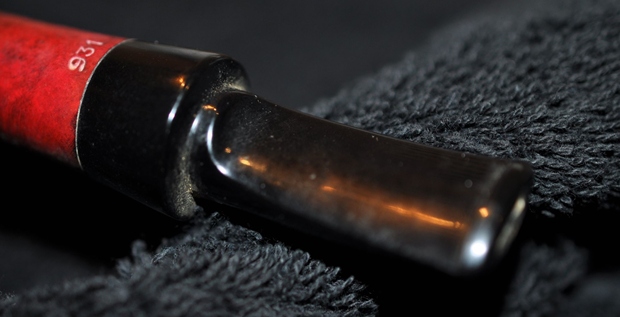
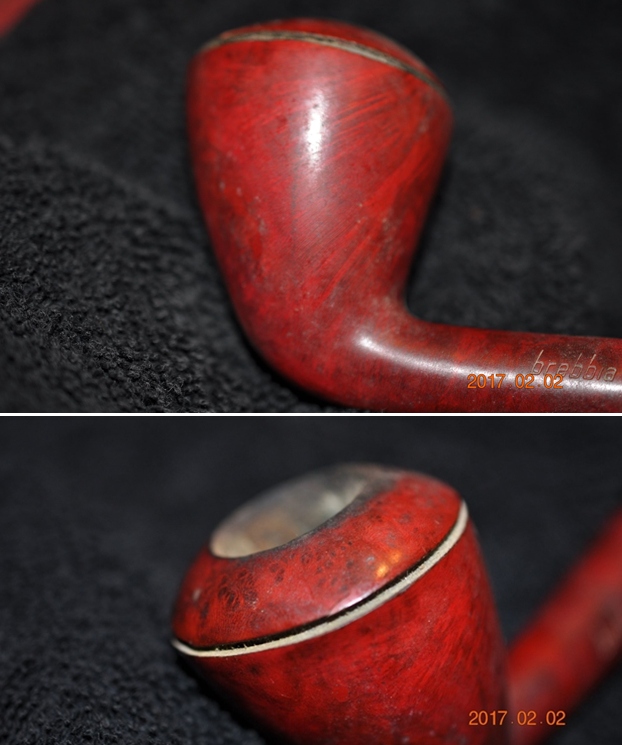
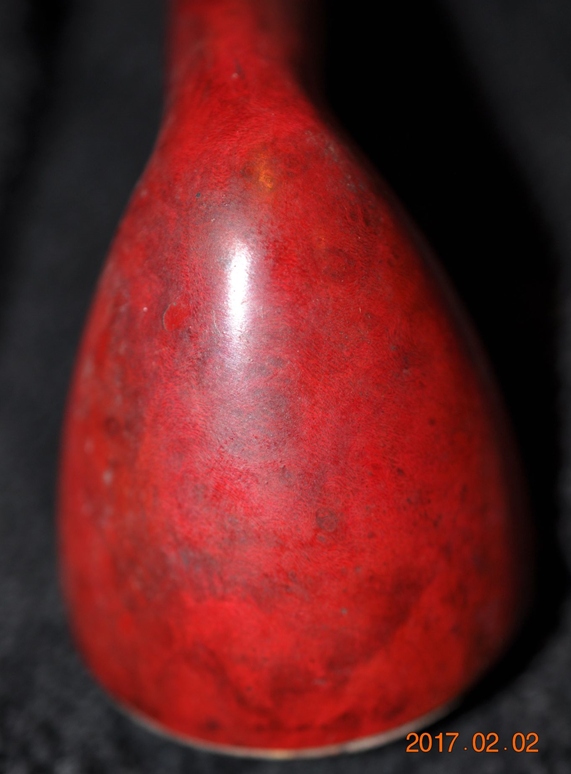
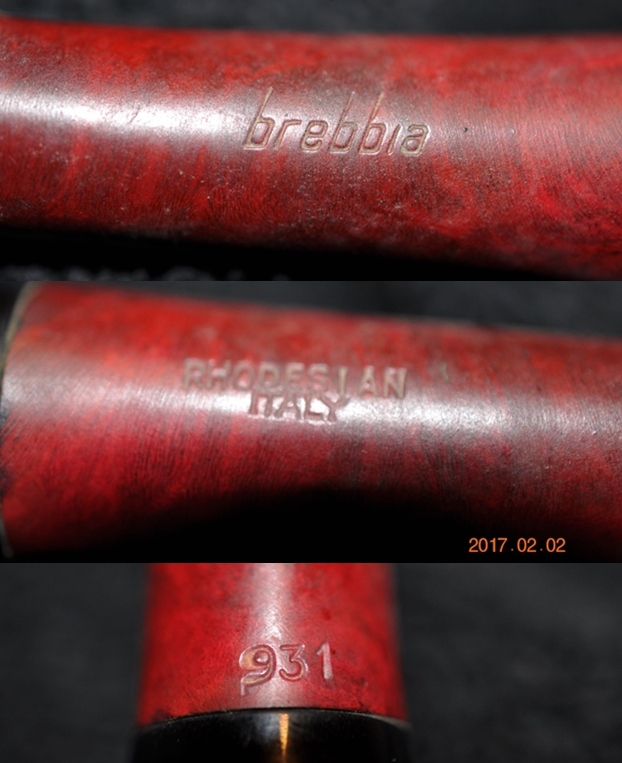
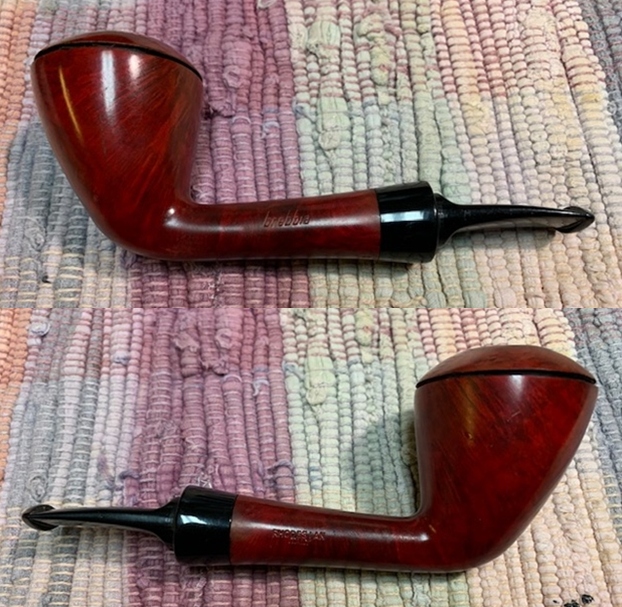
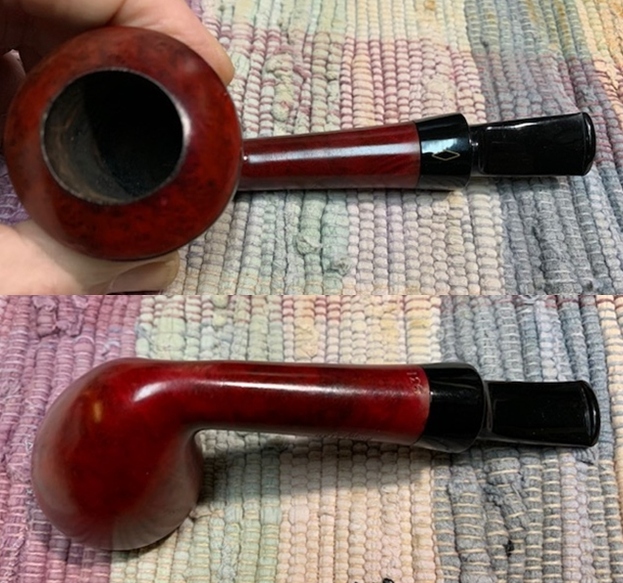
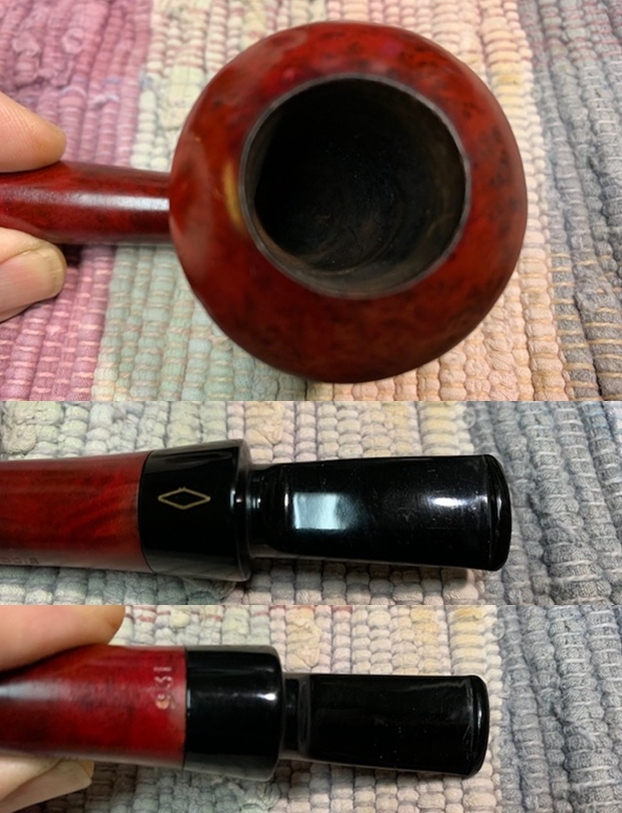
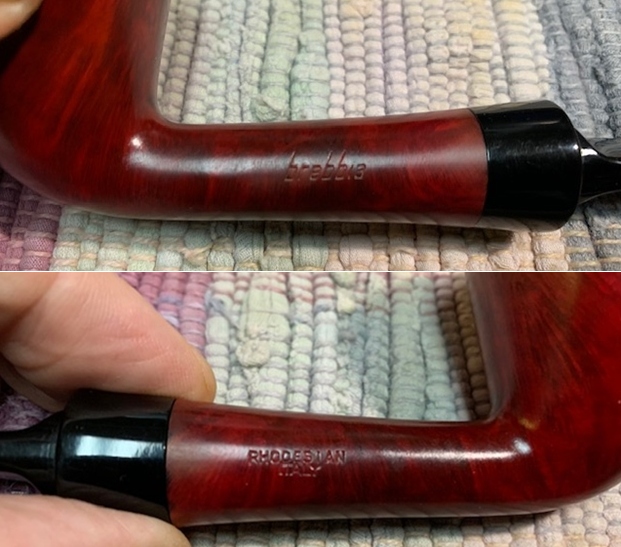
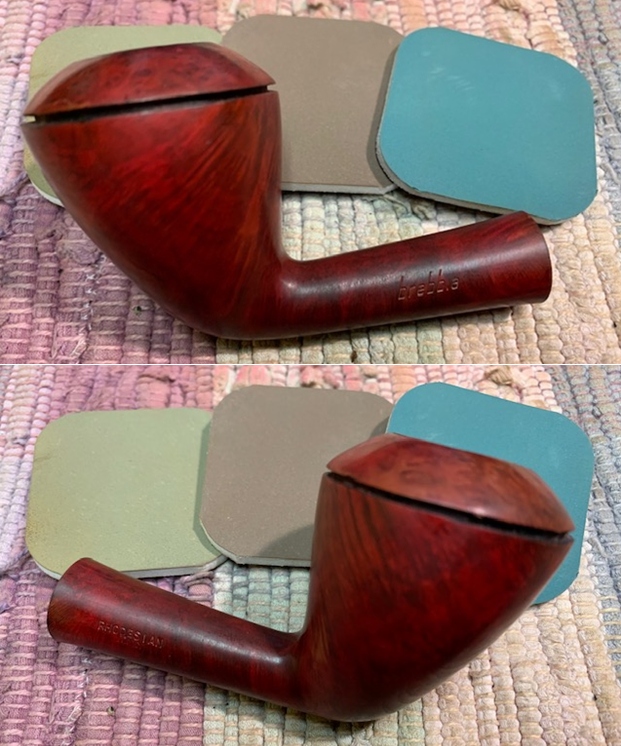
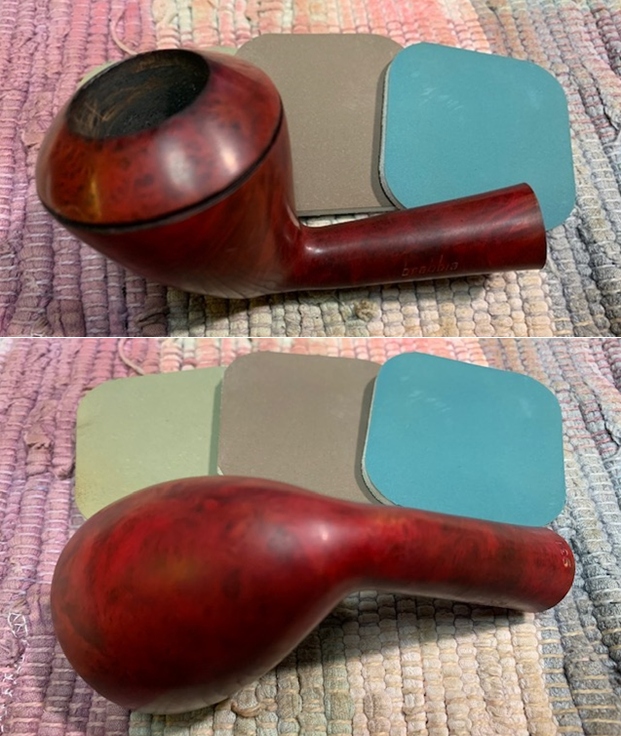
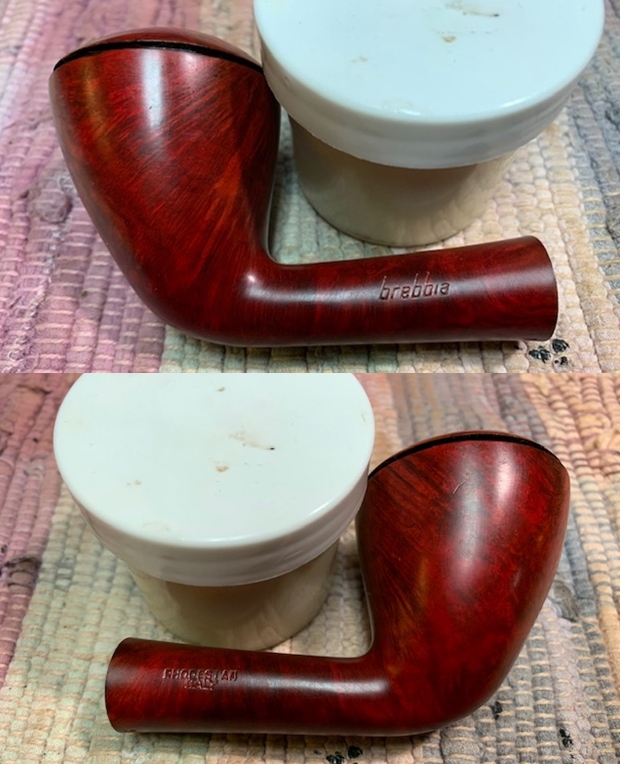
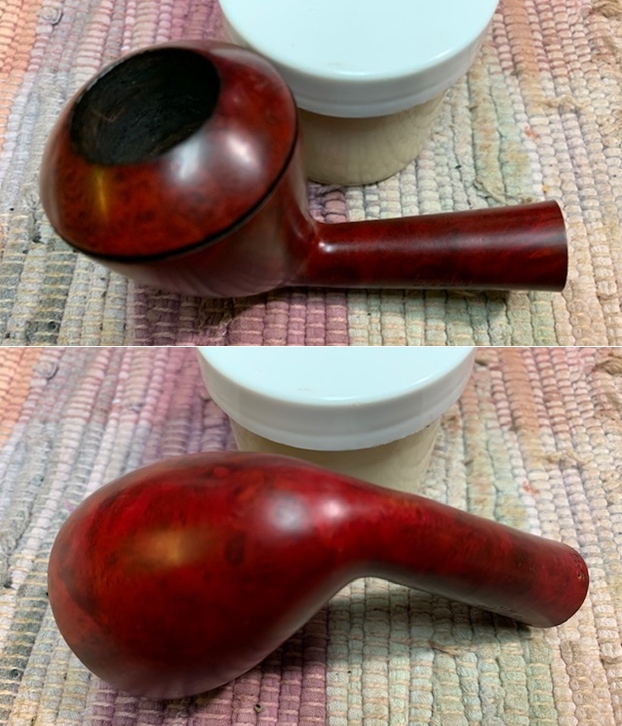
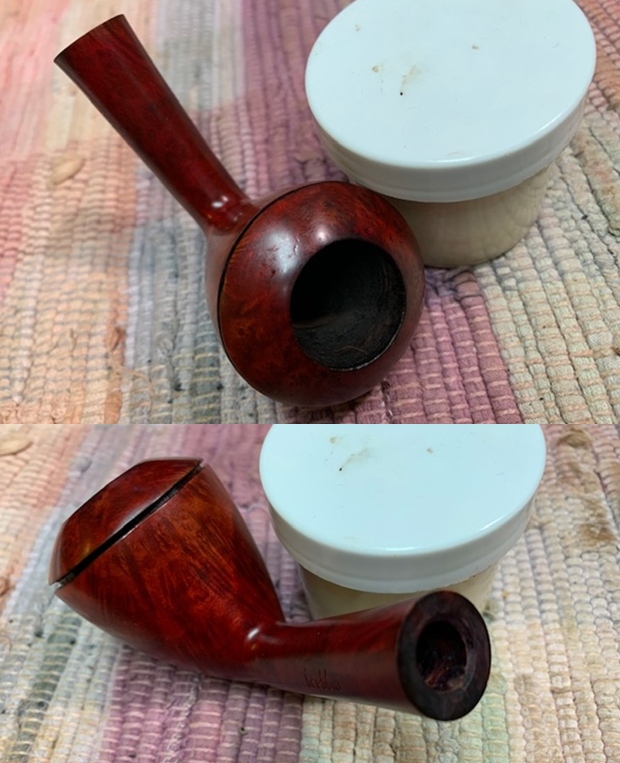
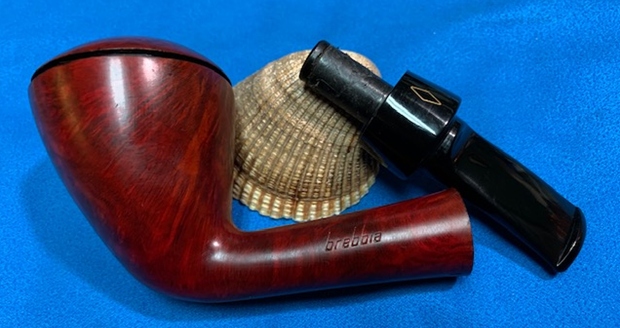
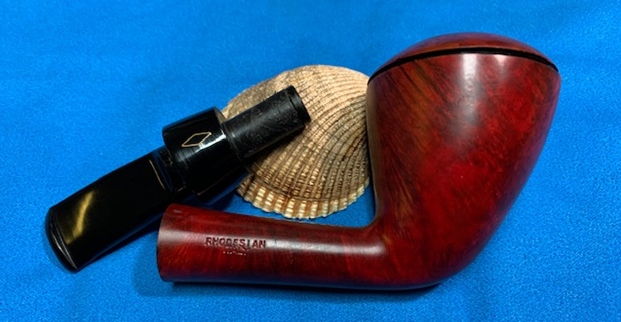
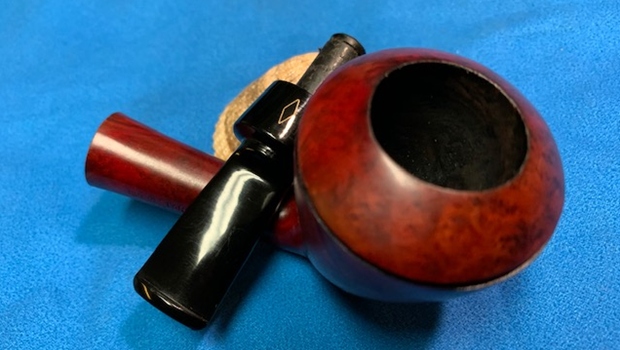
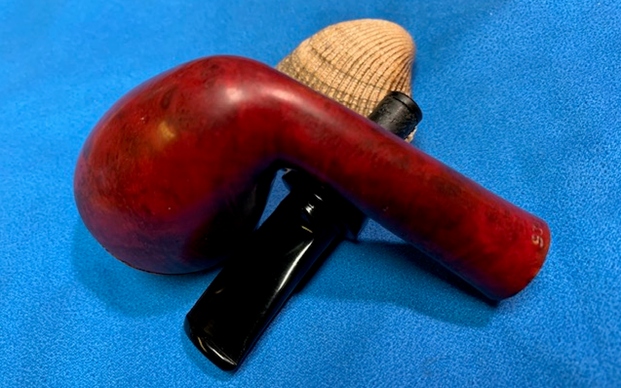
The next pipe came to us off EBay in 2017 from Poughkeepsie, New York, USA so it has been sitting here for a while. Even though the finish was dirty and worn it had some charm showing through the grit and grime of the years. On the left side of the shank it was stamped brebbia and on the right side it was stamped Rhodesian [over] Italy. On the underside of the shank was the shape number 931. The saddle stem also had the Brebbia gold diamond logo on the top of the saddle. The pipe is a long shank, tall Rhodesian. The fancy saddle stem would fit the shape well and matched the broadening of the flair on the shank end! The finish is filthy with grime and oil ground into the briar of the bowl and shank sides. The bowl had an incredibly thick cake. It was hard to know what the inner edge looked like under all of the thick buildup. The cap on the rim with the single line going around the circumference of the bowl was an interesting touch. It was a very thin Rhodesian cap on a broadly flared bowl. The stem was an acrylic saddle stem that was filthy and calcified with tooth marks and chatter on both sides ahead of the button. Jeff took some photos of the pipe to show its overall condition before he started his cleanup work. He took a photo of the rim top and bowl to give a clear picture of the thickness of the cake and the lava and dust ground into the rim top. It is one thick cake that has a lot of tobacco debris missed in with it. He also took photos of the top and underside of the stem to show the chatter and tooth marks. The stem really was a mess.   Jeff took photos of the sides and heel of the bowl to give a picture of what the briar around the pipe looked like. He took a photo of the stamping on the shank. It reads as noted above and is clear and readable. I turned to Pipephil’s site (http://www.pipephil.eu/logos/en/logo-brebbia.html) to the section on Brebbia. The first screen capture below gives a brief history of the brand and some photos of the principals of the company. It is fascinating to me that it was founded by Enea Buzzi and Achille Savinelli in 1947. They split and Buzzi kept the factory and created the MPB Brand – Maniffatura Pipe Brebbia. In 1968 it was shortened to Brebbia. There was nothing on the specific pipe but it is a fascinating read.I turned to Pipedia (https://pipedia.org/wiki/Brebbia) and found a bit more information on the brand. There was still no details on the  Rhodesian line. It is well worth a read. Now it was time to work on the pipe.

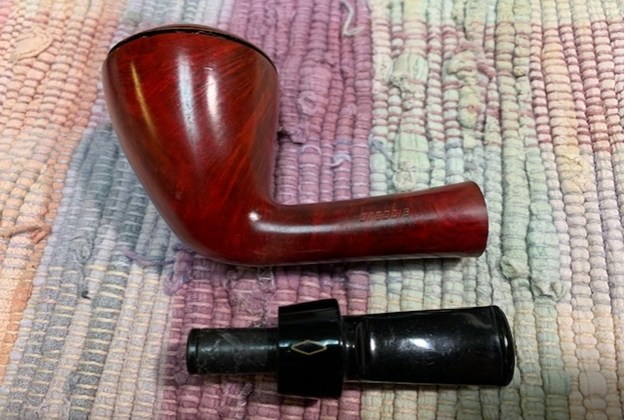
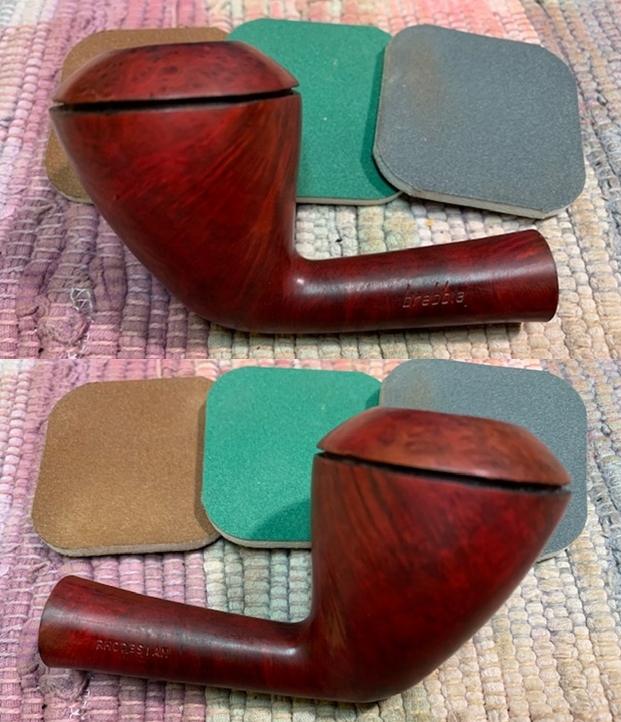
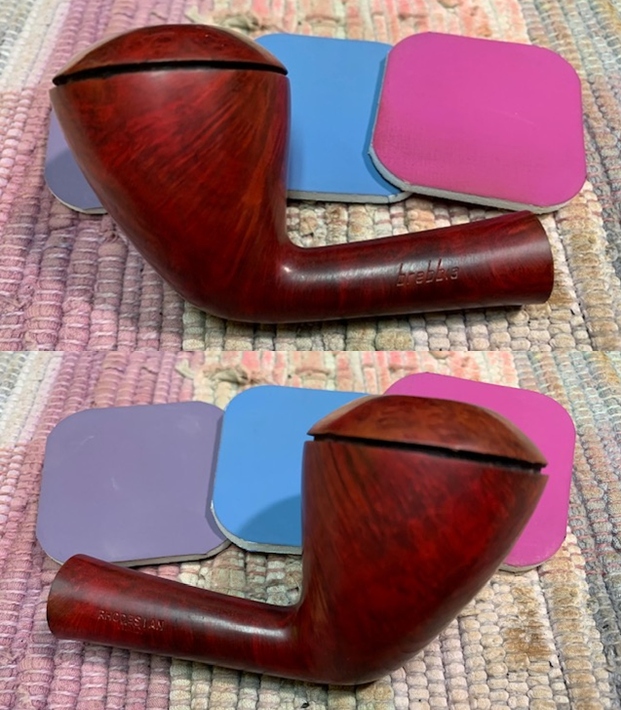
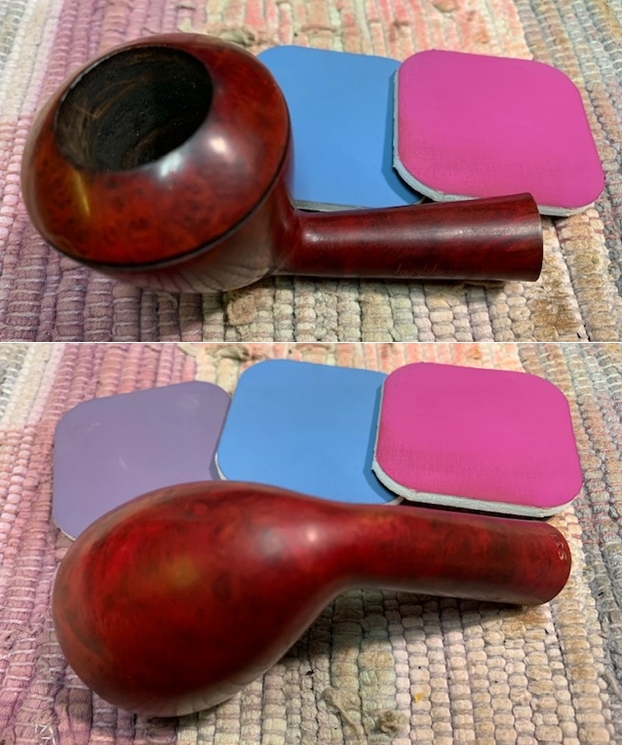
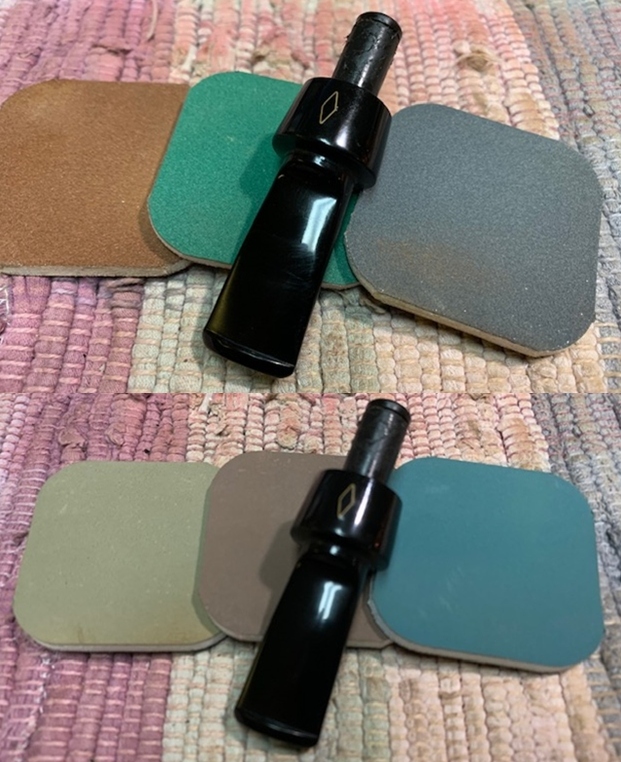
Jeff had cleaned up the pipe with his usual penchant for thoroughness. He reamed the pipe with a PipNet Pipe Reamer and cleaned up the remnants with a Savinelli Fitsall Pipe Knife.  He scrubbed the bowl with undiluted Murphy’s Oil Soap with a tooth brush. He worked over the debris on the rim top and was able to remove it. He rinsed it under running warm water to remove the soap and grime. He cleaned out the inside of the shank and the airway in the stem with alcohol, cotton swabs and pipe cleaners. He soaked the stem in Before & After Pipe Stem Deoxidizer and rinsed it off with warm water. He scrubbed the stem with Soft Scrub and cotton pads to remove remaining oxidation on the ferrule and the stem. He rinsed it with warm water and dried it off. I took photos of the pipe once I received it. It really looked good. The rim top and the inner edge of the rim looked very good. I was surprise that there was no damage to the briar. The stem had some small scratches but otherwise looked very good.  I took a photo of the stamping on the sides of the shank. It was clear and read as noted above. I removed the stem and took a photo of the pipe to give a sense of the whole. The pipe has an acrylic saddle stem. At this point I also noted that the stem had an adapter in the tenon that was removable. The pipe could thus be smoked either as a filter pipe or as a regular pipe.I polished the briar with the full array of micromesh sanding pads – 1500-12000 grit pads. I wiped the bowl down after each pad with a damp cloth to remove the sanding dust. I rubbed the bowl and shank down with Before & After Restoration Balm. I worked it into the surface of the bowl sides and shank with my fingertips. I used a horsehair shoe brush to work it into ring around the rim cap. The product works to clean, enliven and protect the briar. I let the balm sit for 15 minutes and then buffed with a cotton cloth to raise the shine.   I polished the scratches out of the acrylic stem with micromesh sanding pads – 1500-12000 grit pads. I wiped it down with a damp cloth after each sanding pad. I used Before & After Pipe Polish – both Fine and Extra Fine to further polish the stem.  The Delrin tenon was a bit odd in that it seemed to be peeling a bit. To remove all of the peeling parts would loosen the tenon. This Italian take on a Rhodesian by Brebbia is a real beauty. It is combined with a flared acrylic saddle stem that makes it a great looking pipe. It is a far cry from the pipe that we started with now that it has been restored. I put the stem back on the bowl and buffed the pipe with Blue Diamond on the buffing wheel using a light touch on the briar. I gave the bowl and the stem multiple coats of carnauba wax on the buffing wheel and followed that by buffing the entire pipe with a clean buffing pad. I hand buffed the pipe with a microfiber cloth to deepen the shine. The finished Brebbia Rhodesian 931 fits nicely in the hand and feels great. Give the finished pipe a look in the photos below. The dimensions of the pipe are Length: 5 ½ inches, Height: 2 ¼ inches, Outside diameter of the bowl: 2 inches, Chamber diameter: ¾ of an inch. The weight of the pipe is 53grams/1.87oz. I will be adding it to the rebornpipes store shortly in the Italian Pipe Makers Section. Thanks for reading this blog and my reflections on the pipe while I worked on it. There are many more to come!


Another Bizarre & Interesting System Pipe – A Lenox All Wood Pipe


Blog by Steve Laug

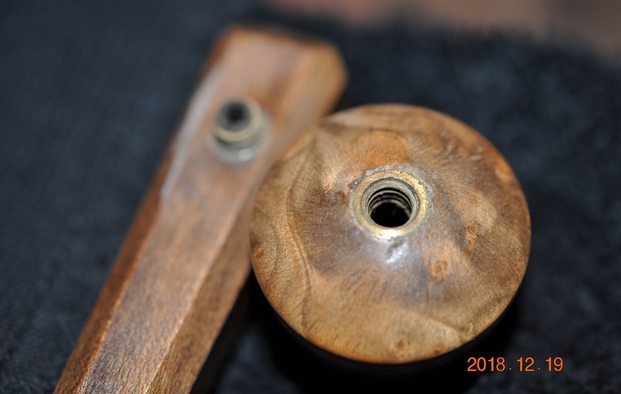
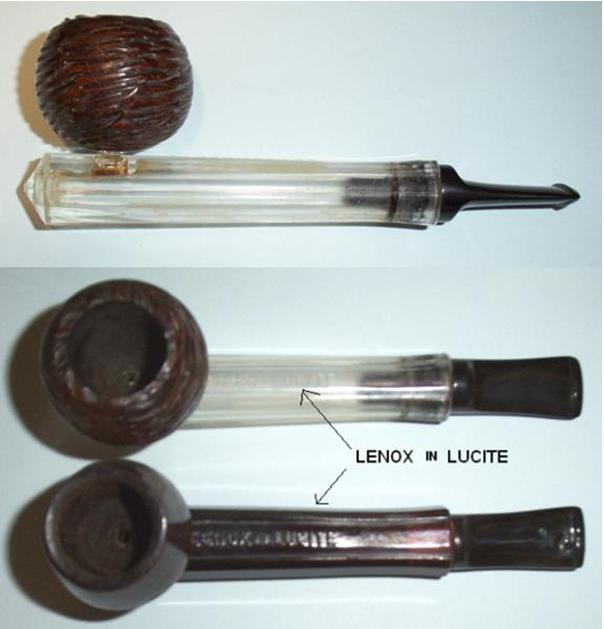
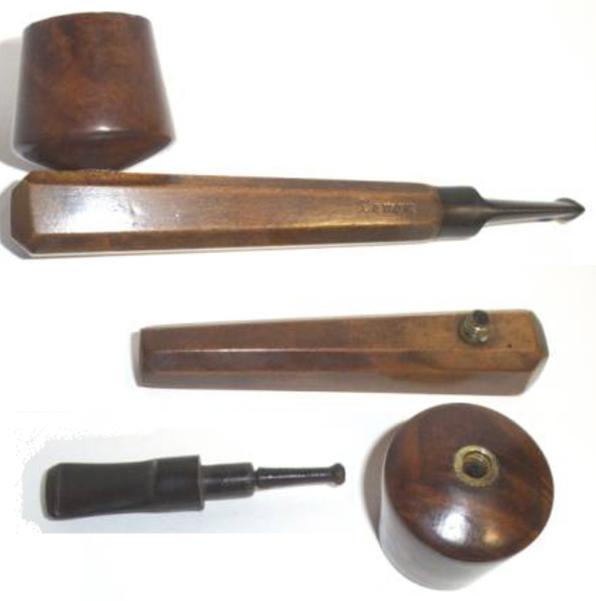
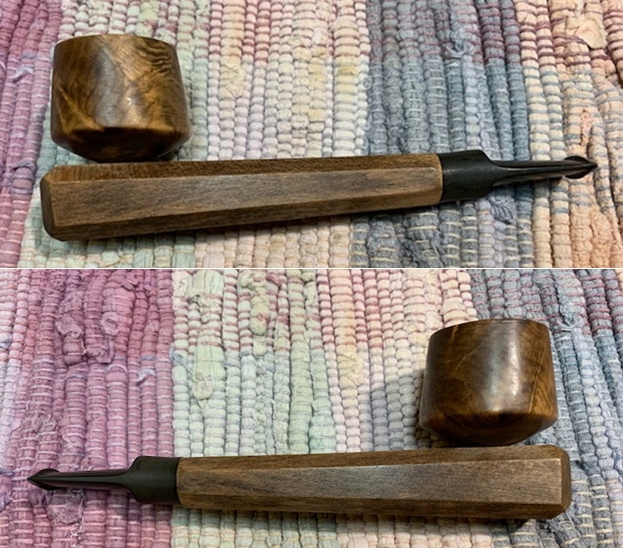
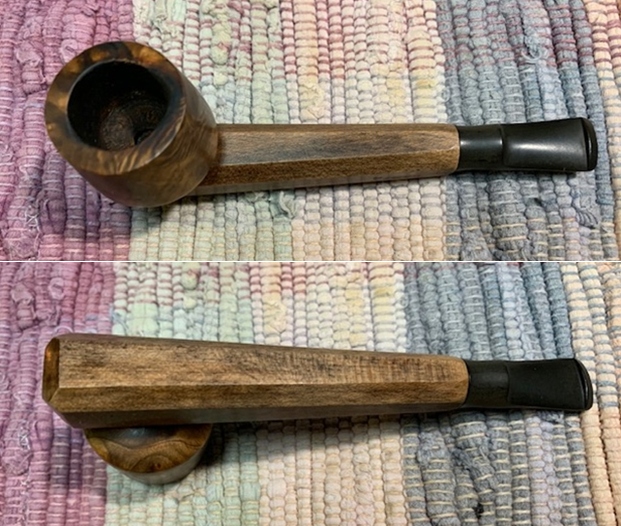
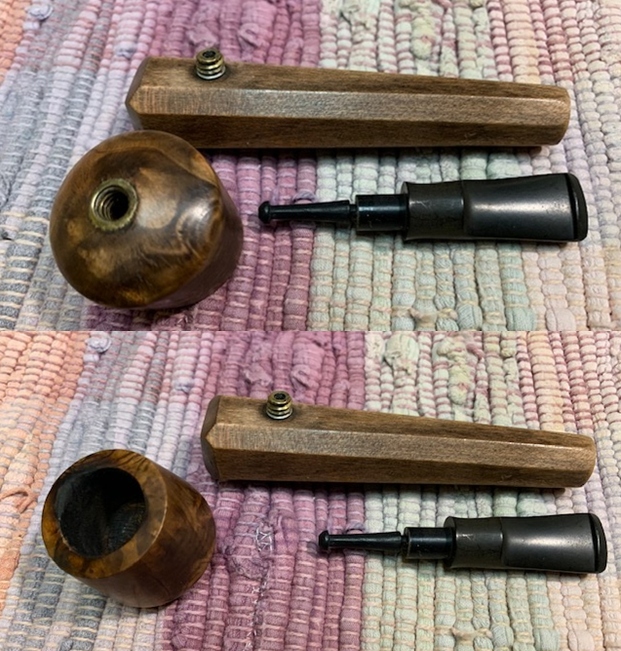
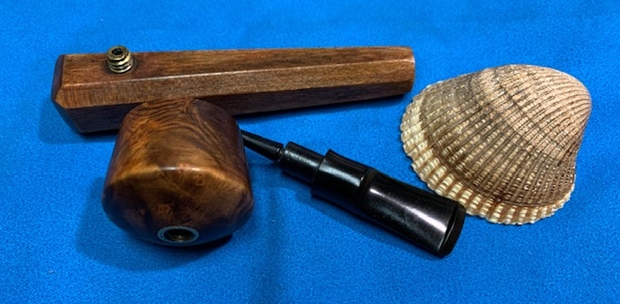
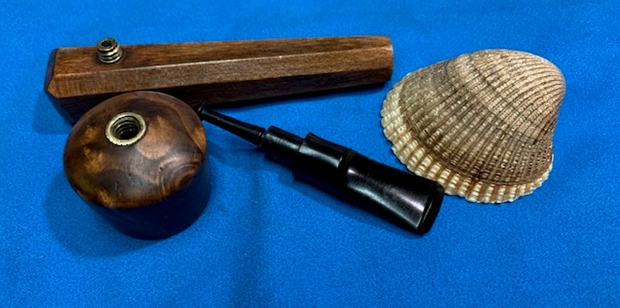
A few years ago Jeff picked up a Lenox from EBay that had a plastic wood finished barrel and a wooden bowl. It was an interesting looking piece. I restored it and have it in my collection of unusual pipes. When he saw this one he was drawn to it because it was all wood. The barrel and bowl were both wood. The internals were the same as the previous pipe. He picked it up because of it being all wood. He can’t remember where it came from but he remembers finding it. It is now on the work table after sitting here for almost a year. The pipe was dust and dirty. There was a thick cake in the bowl and a lava overflow on to the rim top. There appeared to be burn damage on the back inner edge and rim top that would need to be dealt with. The wooden barrel was dirty and dusty but otherwise in good condition. The bowl screwed onto the barrel and seemed to align well. The barrel is stamped Lenox on the left side of the barrel near the stem. The wood of the barrel and that of the bowl were stained to match each other well. The stem was inserted in the end of the barrel and was in good condition. There was some light oxidation and tooth marks and chatter on both sides near the button. Jeff took the following photos of the pipe before he sent it to me. It looks a lot like a wooden version of a Kirsten — at least externally. Jeff took some photos of the rim top and bowl to give an idea of the extent of the cake and the damage to the inner edge of the bowl at the rear of the pipe. You can see the damage and the lava coat on the top. The stem photos show the light oxidation and tooth marks and chatter on both sides near the button.  He took photos of the sides of the barrel and the bowl. The grain on this wooden barrel and bowl is quite unique. It is obviously not briar but I am not sure what the wood is. He removed the bowl from the barrel and took a photo.  His photo shows the threads in the bowl and the metal threaded extension on the top of the barrel. I turned to the blog I had written on the previous Lenox pipe and read what I had found out when I worked on that pipe (https://rebornpipes.com/2016/10/30/a-bit-of-the-bizarre-and-interesting-restoring-a-lenox-system-pipe/). I include that information below.

I was not familiar with the Lenox brand so I did some research to see what I could find out. There was not much information on the brand online until I turned to one of my favourite sites for information on odd and unusual metal pipes – smokingmetal.com

I found the brand listed in three variations. The first of them was a Lenox made of Lucite (ed. By Lucite I assume that barrel is actually made of Perspex so in the information below I have edited it to read that). The link for the brand is: http://smokingmetal.co.uk/pipe.php?page=82. The site has this to say about the Perspex version of the pipe. I quote: “Hard to see the purpose of this one. There would be no significant extra cooling and there is no end plug to remove for ease of cleaning. It is stamped LENOX in the perspex top of barrel. (ed. I have included two photos from the site on the Lucite version of the pipe.) Centre image shows two colour versions. The dark version does not appear to be the result of discolouration by tar etc. These pipes were certainly on sale in 1951. The overall length 5 5/8 inch (143 /m).The site also had photos of the Lenox with a wooden barrel and wooden bowl. The metal barrel is stamped LENOX on the top of the barrel and a threaded bowl was screwed onto the top. The bowl had a brass insert in the bottom and it threads onto the nipple on the barrel. The following link has photos of the pipe: http://smokingmetal.co.uk/pipe.php?page=150.Jeff had cleaned up the pipe with his usual penchant for thoroughness. He reamed the pipe with a PipNet pipe reamer and removed the rest of it with a Savinelli Fitsall Pipe Knife.  He scrubbed the bowl with undiluted Murphy’s Oil Soap with a tooth brush. He rinsed it under running warm water to remove the soap and grime. He cleaned out the inside of the barrel and the airway in the stem with alcohol, cotton swabs and pipe cleaners. He soaked the stem in Before & After Deoxidizer and rinsed it off with warm water. I took photos of the pipe once I received it.  I took photos of the bowl and rim top after the cleanup. You can see the extent of the damage on the backside of the edge and rim top. The bowl is very clean. The stem looks very good. The light chatter and marks will easily come off.I took a photo of the stamping on the left side of the shank. It reads as noted above.I unscrewed the bowl from the barrel and took the stem out of the end. The next three photos below show the “exploded” view of the pipe. The rim darkening in the first photo needed to be cleaned up. I decided to start my work on the pipe by addressing the damage to the rim top and inner edge. The damage was quite extensive so I started by topping the bowl on a piece of 220 grit sandpaper. Once I had removed some of the damage I rebuilt that portion of the top and edge with the dust from the sanding and super glue.   I cleaned up the inner edge with a folded piece of 180 grit sandpaper to smooth out the repair and then retopped the bowl to remove the buildup from the repair. Once I finished it was better. The bowl was back in round and the darkening was minimized on the top.  I polished the bowl and rim top with micromesh sanding pads – dry sanding with 1500-12000 grit pads. I wiped the bowl down with a damp cloth after each set of sanding pads.  I stained the bowl and the barrel with an Oak Stain pen to blend in the repairs with the rest of the bowl. The Oak stain highlighted the grain and tied the parts together. I put the pipe together and took photos of it at this point in the process.   I rubbed the bowl and shank down with Before & After Restoration Balm. I worked it into the surface of the bowl sides and shank with my fingertips to clean, enliven and protect the briar. I let the balm sit for 15 minutes and then buffed with a cotton cloth to raise the shine. The Balm did its magic and the grain stood out.   I pulled the pressure fit stinger out of the tenon and ran a pipe cleaner through the stem. It came out very clean – yet another testimony to the great job my brother does in his clean up. I put it back in the tenon and took two close-up photos of the stem to show the really clean condition the stem was in. All that needed to happen was to polish it.I polished the stem with micromesh sanding pads – dry sanding it with 1500-12000 grit pads. I rubbed the stem down with Obsidian Oil between each set of three pads. I polished the stem with Before & After Pipe Polish – both Fine and Extra Fine. I rubbed it down with a final coat of Obsidian Oil and hand buffed it.   The wood is clean and really came alive. The rich reddish brown coloured stain gave the grain a sense of depth with the polishing and waxing. I put the pipe back together and buffed it on the buffing wheel with Blue Diamond polish to bring a shine to the surface. I gave the bowl, barrel and the stem several coats of carnauba wax. I buffed the bowl, barrel and stem with a clean buffing pad to polish the wax coats. I hand buffed it with a microfibre cloth to deepen the shine. The finish unique pipe is shown in the photos below. The bowl and barrel and the bowl match very well and look like they may well have come from the same piece of wood.  The finished Lenox System Pipe has its own beauty and feels great in the hand and looks very good. Give the finished pipe a look in the photos below. The dimensions of the pipe are Length: 5 ½ inches, Height: 1 ¾ inches, Outside diameter of the bowl: 1 ¼ inches, Chamber diameter: ¾ of an inch. The weight of the pipe is 34grams/1.20oz. I will be adding it to the rebornpipes store in the US Pipe Makers section if you are interested in adding it to your collection. Thanks for reading this blog and my reflections on the pipe while I worked on it. There are many more to come!

Breathing Life into a 1960 Dunhill Bruyere 251 Group 3 Billiard


Blog by Steve Laug

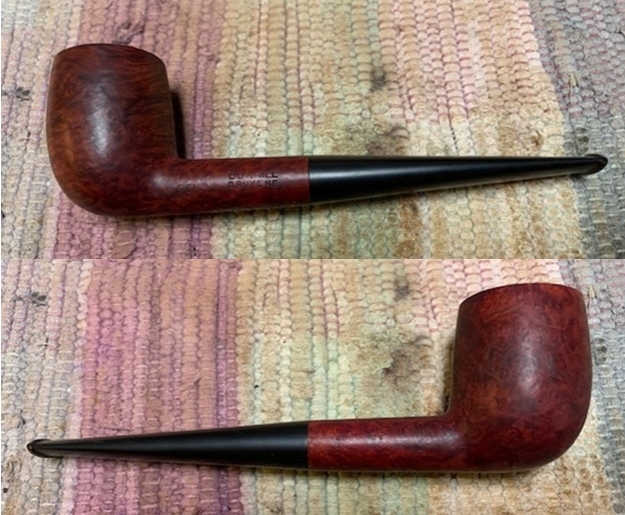
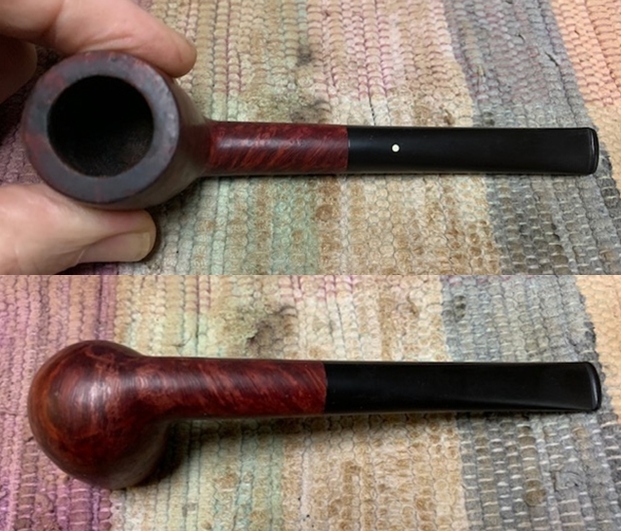
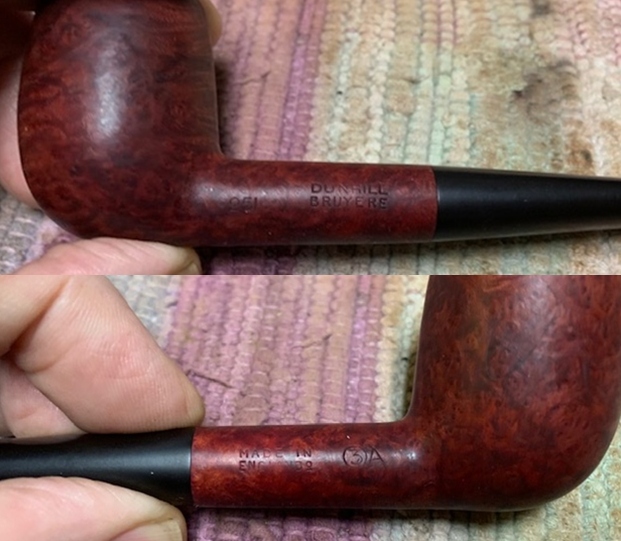
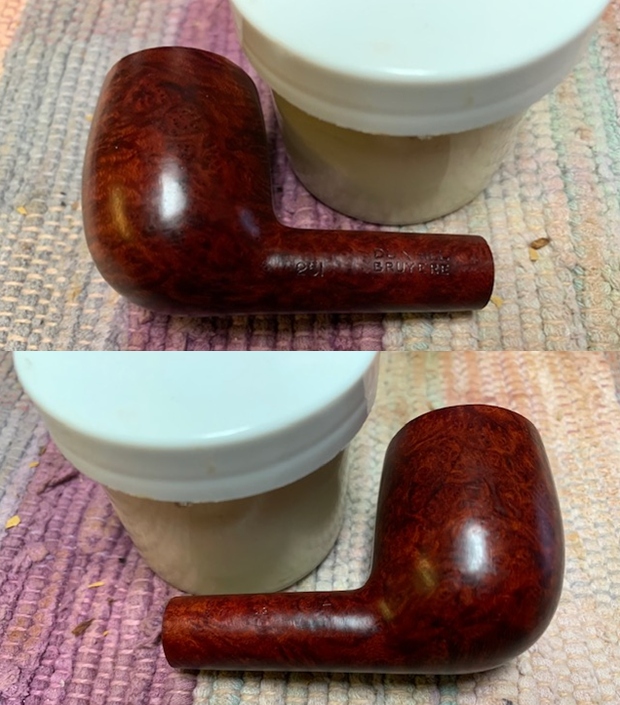
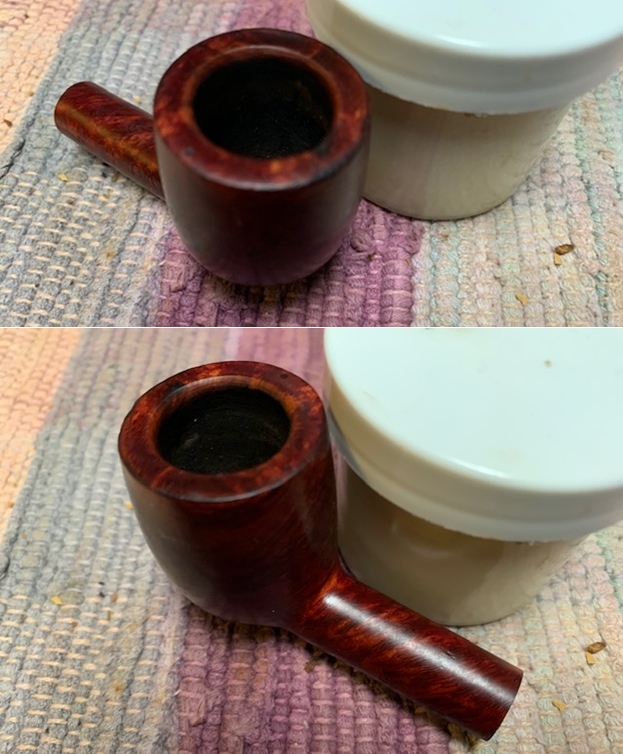
The next pipe on the table came to us in a group of pipes that we purchased from an Antique Mall on the Oregon Coast, Oregon, USA. It is a Dunhill Bruyere Straight Billiard that is in good condition. It is stamped both sides of the shank. On the left side it is stamped with the shape number 251 followed by Dunhill [over] Bruyere. On the right side it is stamped with 3 in a circle followed by A for Bruyere next to the bowl. That is followed by Made in [over] England0. Interpreting that stamp it is as follows: The 251 is the shape for a straight billiard. The Dunhill Bruyere is the finish which is corroborated the A at the end of the stamping. The 0 following the D of England gives the date the pipe was made and identifies it as 1960. The stamping is clear and readable. The age of the pipe and the oils in the finish has given the pipe a rich reddish brown finish. There is also some amazing grain that the shape follows well. The finish was dirty with dust ground into the surface of the bowl and shank. There was a thick cake in the bowl and tobacco debris stuck to the walls of the bowl. The rim top showed darkening and some lava on the surface. The vulcanite taper stem was oxidized, calcified and had light tooth marks and chatter ahead of the button on both sides.  Jeff took photos of the pipe to show what it looked like before he started working on it.  He took photos of the bowl and rim top to show the thickness of the cake and the darkening and lava overflow on the rim top. There were also nicks around the outer edge of the bowl. The photos of the stem show the oxidation, calcification and tooth marks and chatter on the surface on both sides.  The photos of the sides and heel of the bowl show the great grain on the pipe. It is a beauty under the grime and dust.   The stamping on the underside of the shank is shown in the photos below. It looks very good and readable. It reads as noted and explained above. The fourth photo shows the white spot on the stem.   I turned to Pipedia’s section on Dunhill Root Briar Pipes to get a bit of background on the Dunhill finishes (https://pipedia.org/wiki/Dunhill#Root_Briar). I quote:

Bruyere

The original finish produced (usually made using Calabrian briar), and a big part of developing and marketing the brand. It was the only finish from 1910 until 1917. A dark reddish-brown stain. Before the 1950s, there were three possible finishes for Dunhill pipes. The Bruyere was a smooth finish with a deep red stain, obtained through two coats, a brown understain followed by a deep red.

There was a link on the above site to a section specifically written regarding the Bruyere finish (https://pipedia.org/wiki/Dunhill_Bruyere). I turned there and have included the information from that short article below.

Initially, made from over century-old briar burls, classified by a “B” (denoted highest quality pipe); “DR” (denoted straight-grained) and an “A” (denoted first quality), until early 1915. After that, they became a high-end subset to the Dunhill ‘Bruyere’. The DR and B pipes, a limited production, they should be distinguished as hand-cut in London from burls as opposed to the Bruyere line which was generally finished from French turned bowls until 1917, when the Calabrian briar started to be used, but not completely. Only in 1920 Dunhill took the final step in its pipe making operation and began sourcing and cutting all of its own bowls, proudly announcing thereafter that “no French briar was employed”.

Bruyere pipes were usually made using Calabrian briar, a very dense and hardy briar that has a modest grain but does very well with the deep red stain.

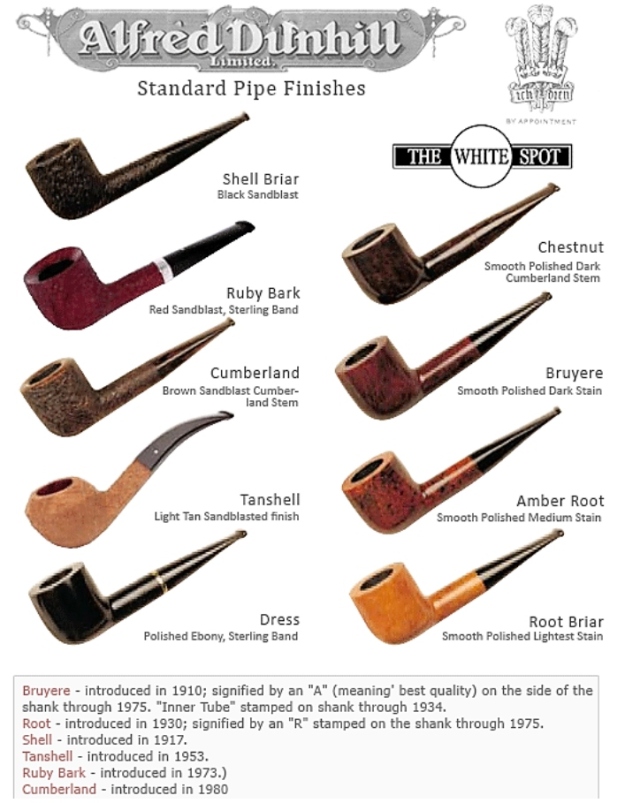
“Before the 1950s, there were three possible finishes for Dunhill pipes. The Bruyere was a smooth finish with a deep red stain, obtained through two coats, a brown understain followed by a deep red. The Shell finish was the original sandblast with a near-black stain (though the degree to which it is truly black has varied over the years). Lastly, the Root finish was smooth also but with a light brown finish. Early Dunhill used different briars with different stains, resulting in more distinct and identifiable creations… Over the years, to these traditional styles were added four new finishes: Cumberland, Dress, Chestnut and Amber Root, plus some now-defunct finishes, such as County, Russet and Red Bark.”

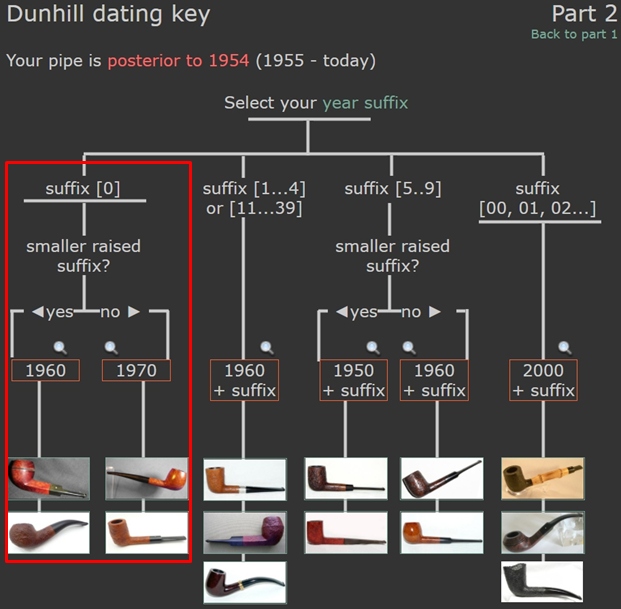
There was also a link to a catalogue page that gave examples and dates that the various finishes were introduced (https://pipedia.org/wiki/File:Dunnypipescatalog-1.png). I turned to Pipephil’s dating guide to show how I arrived at the date of manufacture for this pipe (http://www.pipephil.eu/logos/en/dunhill/cledat-en1a.html). I am including the chart that is provided there for the dating a pipe. I have drawn a red box around the section. Since the pipe I am working on has a suffix 0 that is raised superscript it points to the 1960 line on the chart below.I now knew that I was working on a Bruyere that came out in 1960. The shape of the pipe was one of many Billiards that Dunhill put out and that the #251 was a normal billiard shape with a taper stem.

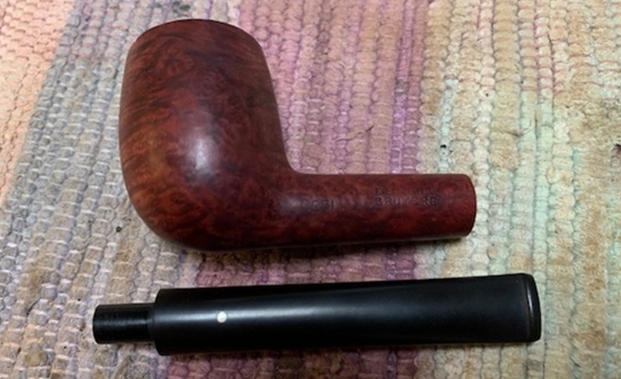
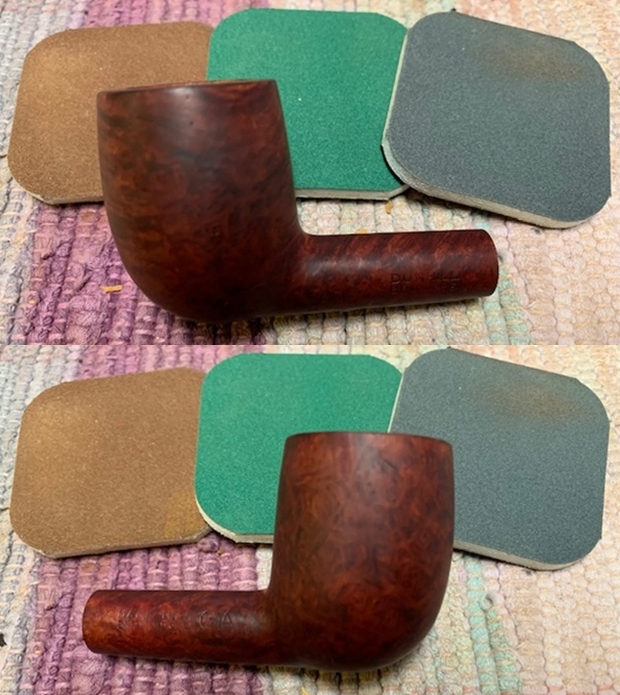
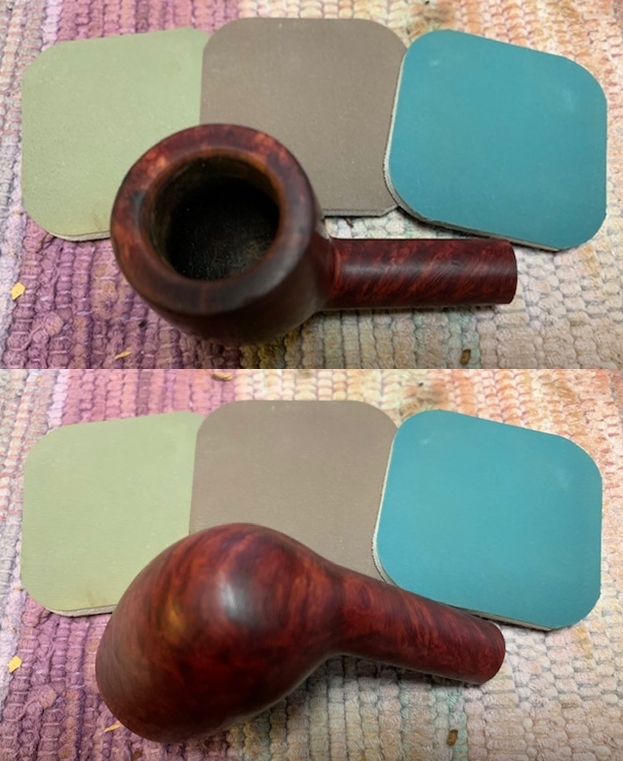
I turned to work on the pipe itself. Jeff had carried out his usual thorough cleanup of the pipe. He had reamed it with a PipNet reamer to remove the cake and cleaned the reaming up with a Savinelli Fitsall Pipe Knife. He scrubbed the internals of the bowl and stem with alcohol, cotton swabs and pipe cleaners. He scrubbed the externals with undiluted Murphy’s Oil Soap and rinsed the bowl off with running water. He soaked the stem in Before & After Deoxidizer and once it had soaked rinsed it off with warm water to remove the residual solution. He dried it off and scrubbed it down with Soft Scrub All-Purpose cleaner to remove any oxidation that was still on the stem. The pipe looked very clean when I received it. I took a photo of the rim top to show the condition. You can see the darkening on the rim top. It is roughened and slightly out of round. The stem came out looking quite good. There are light tooth marks and chatter on both sides near the button but the oxidation was gone.  I took photos of the sides of the shank to show the stamping. It is clear and readable as noted above.  I removed the stem from the shank and took a photo of the pipe parts to show what I was working with. It is a nice looking pipe.I decided to start the restoration on this one by working on the damage on the inner edge of the bowl. It had darkening and some damage to the edge. There were burn and reaming damage marks on the edge from a previous pipeman. I worked it over with a folded piece of 220 grit sandpaper to give the edge a light bevel and remove and minimize the damage on the edge. When I finished with it, the bowl and the rim top looked much better. I polished the rim top and bowl with micromesh sanding pads – dry sanding with 1500-12000 grit sanding pads. I wiped the bowl down with a damp cloth after each sanding pad. The briar began to take on a shine.   With the repair completed I rubbed the briar down with Before & After Restoration Balm. I worked it into the briar with my fingertips. The product works to clean, enliven and preserve the briar. I let it sit for 15 minutes while I worked on the stem. After the time passed I buffed it with a cotton cloth to deepen the shine. The briar really comes alive with the balm.   I set the bowl aside and turned my attention to the stem. I polished the vulcanite with micromesh sanding pads – 1500-12000 grit pads. I wiped it down with Obsidian Oil after each sanding pad. I used Before & After Pipe Polish – both Fine and Extra Fine to further polish the stem.   This Dunhill Bruyere 251 Group 3 Billiard from 1960 is a beautiful looking piece of briar that has a shape that follows grain. It is a great looking pipe that came out looking even better after the cleanup. The Bruyere is an early finish that Dunhill specialized in making. The finish on the pipe is in excellent condition. The red and brown stain on the bowl works well to highlight the grain. The polished black vulcanite taper stem adds to the mix. With the grime gone from the finish and the bowl it was a beauty and is eye-catching. I put the stem back on the bowl and buffed the pipe with Blue Diamond on the buffing wheel being careful to not buff the stamping. I gave the bowl and the stem multiple coats of carnauba wax on the buffing wheel and followed that by buffing it with a clean buffing pad. I hand buffed the pipe with a microfiber cloth to deepen the shine. The finished Bruyere 251 Billiard is quite nice and feels great in the hand. Give the finished pipe a look in the photos below. I can only tell you that like the other pipes I am working that it is much prettier in person than the photos capture. The dimensions of the pipe are Length: 5 ½ inches, Height: 1 ¾ inches, Outside diameter of the bowl: 1 ¼ inches, Chamber diameter: ¾ of an inch. The weight of the pipe is 29grams/1.02oz. It will soon be added to the British Pipe Makers section on the rebornpipes store. Thanks for walking through the restoration with me as I worked over another beautiful pipe. Remember we are not pipe owners; we are pipemen and women who hold our pipes in trust until they pass on into the trust of the next generation.

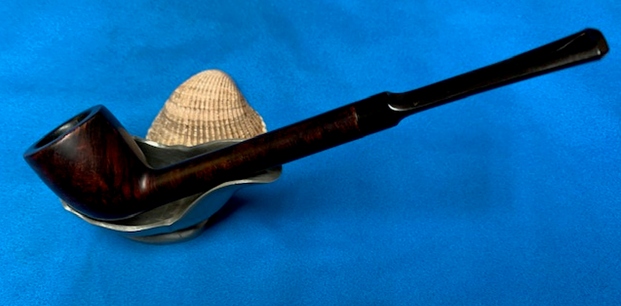
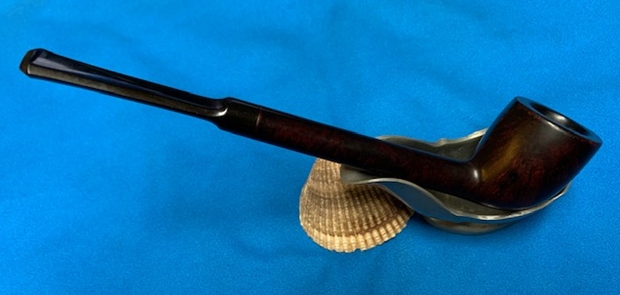
This Long Pencil Shank Viborg French Made Lovat is a real Beauty


Blog by Steve Laug

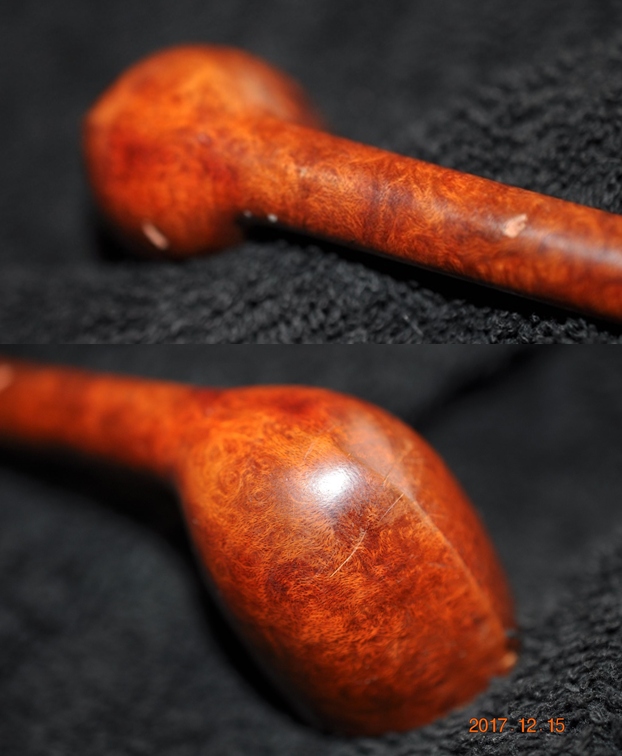
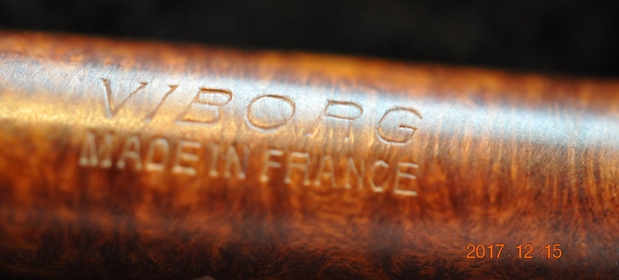
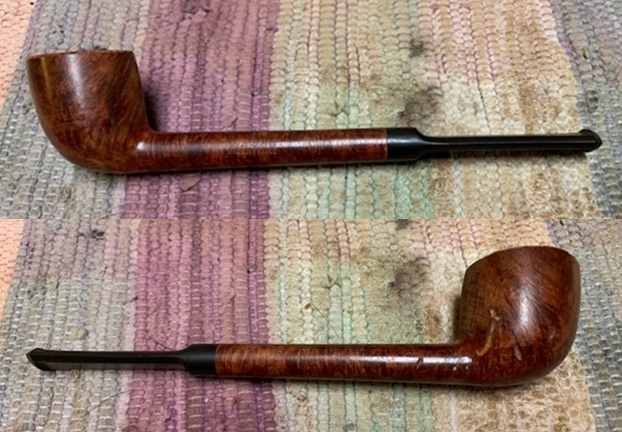
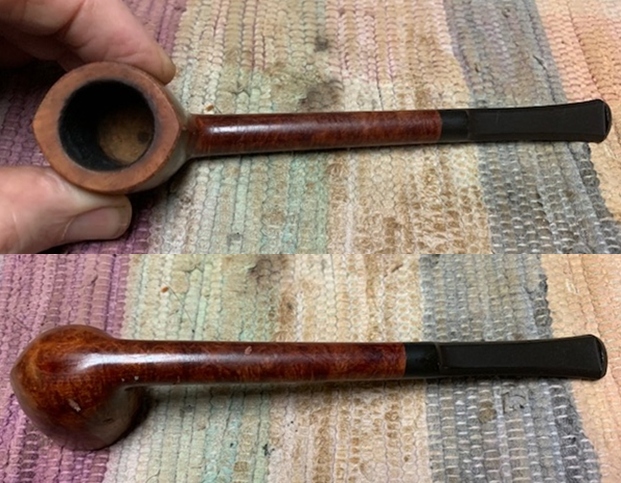
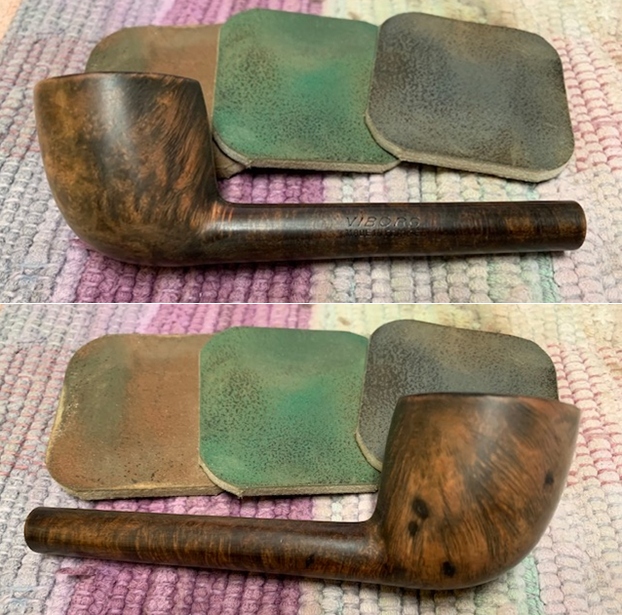
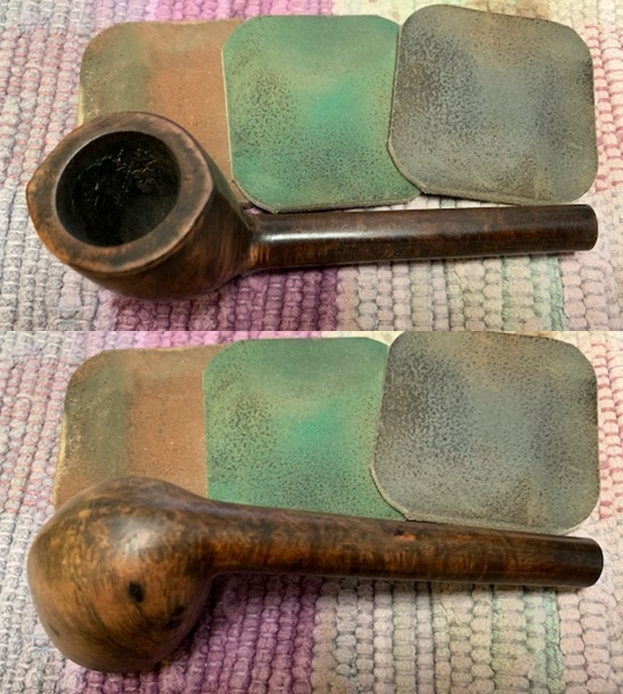
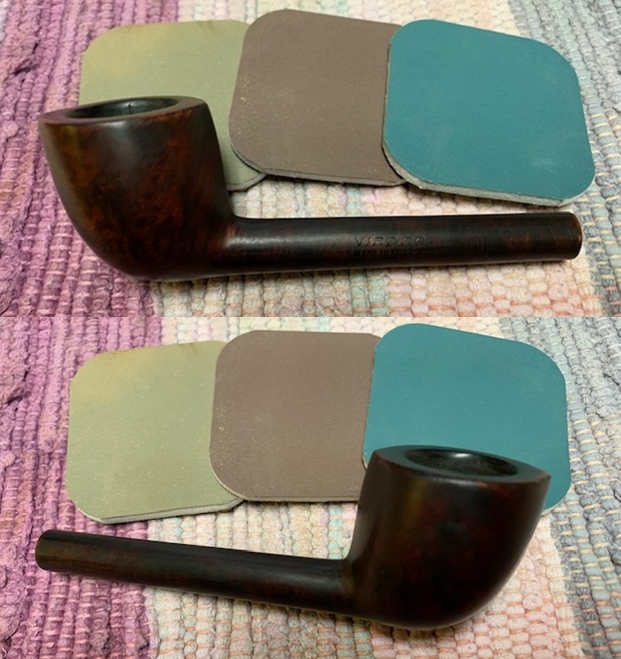
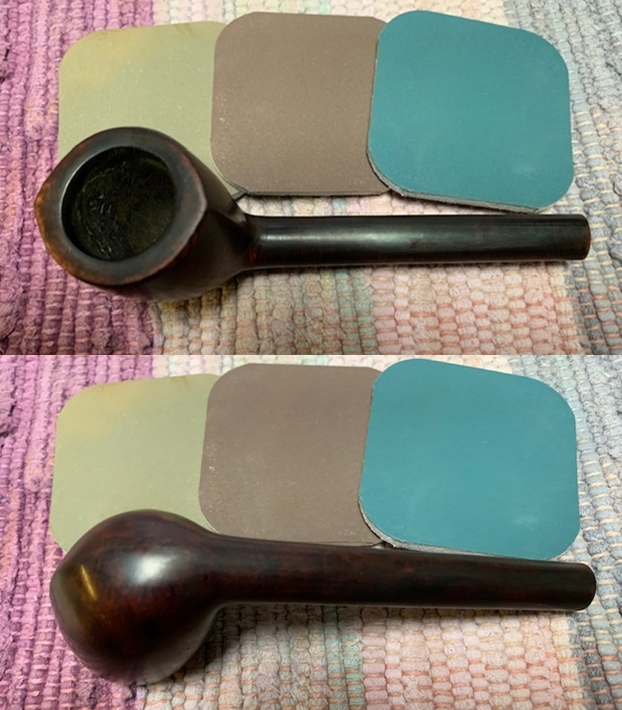
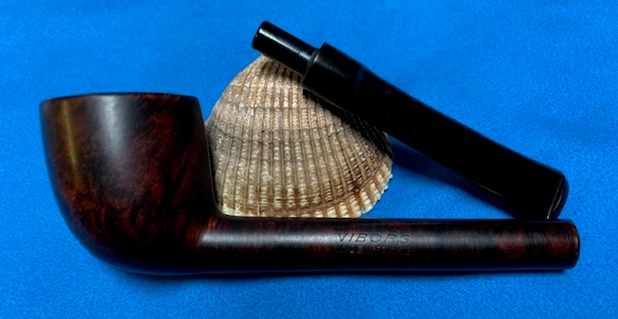
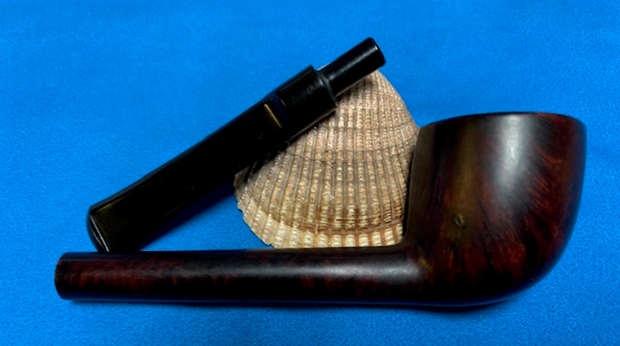
I woke up to the sound of something large jumping on the roof next to our bedroom window around 4:30am this morning. That gave me an early start at the work bench. I have to tell you that on days like today I miss my old supervisor Spencer who would greet me no matter what time and beg for a treat… strange to not have him here. Ah well time to work. The next pipe, the second one on the table today, came to us in a group of pipes that we picked up through an online auction in 2017 in Wilder, Idaho, USA so it has been sitting here for a while. Even though the finish was a dirty and worn it had some charm showing through the grit and grime of the years. On the left side of the shank it was stamped Viborg [over] Made in France. The pipe is a long pencil shanked pipe with an elliptical shaped bowl. The saddle stem would make it a long Lovat but the stem is also long! The finish is filthy with grime and oil ground into the briar of the bowl and shank sides. The bowl had a thick cake and there was an overflow of lava on the rim edges. There was some damage to the inner edge of the bowl as well. The stem was a vulcanite saddle stem that was oxidized, calcified and had tooth marks and chatter on both sides ahead of the button. Jeff took some photos of the pipe to show its overall condition before he started his cleanup work. He took a photo of the rim top and bowl to give a clear picture of the thickness of the cake and the lava and dust ground into the rim top. You can also see the damage to the inner edge of the bowl and the burn marks on the top back. He also took photos of the top and underside of the stem to show the chatter and tooth marks. Otherwise the stem is quite clean. Jeff took photos of the sides and heel of the bowl to give a picture of what the briar around the pipe looked like. There are a lot of white putty fills on the right side of the bowl and on the right and underside of the shank. He took a photo of the stamping on the shank. It reads as noted above and is clear and readable. The pipe is a bit of a mystery to me. The Viborg name sounds like it should be Danish but the pipe is stamped Made in France. I looked on Pipedia and Pipephil’s site and nothing was listed for the brand on either one. Perhaps one of you know the brand and could shed some light on it for us all. Thank you!

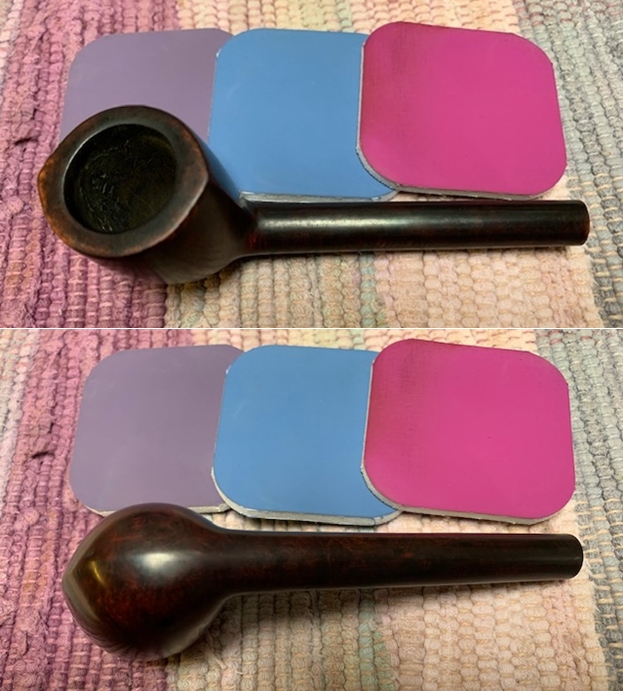
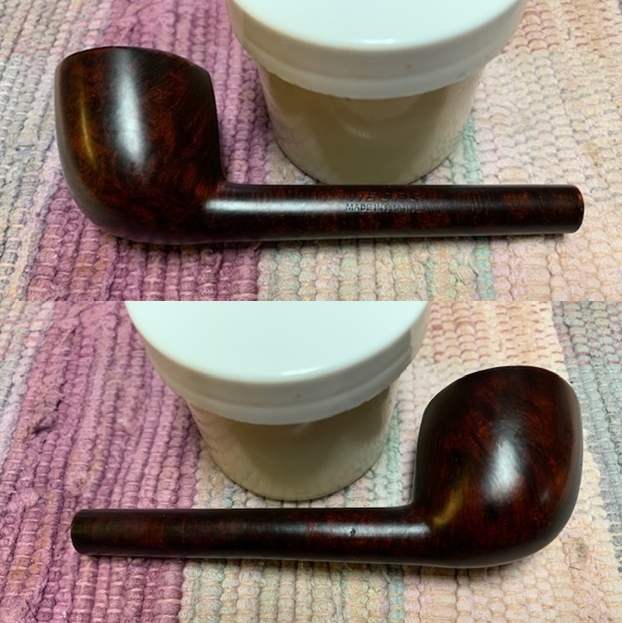
Jeff had cleaned up the pipe with his usual penchant for thoroughness. He reamed the pipe with a PipNet Pipe Reamer and cleaned up the remnants with a Savinelli Fitsall Pipe Knife.  He scrubbed the bowl with undiluted Murphy’s Oil Soap with a tooth brush. He worked over the debris on the rim top and was able to remove it. He rinsed it under running warm water to remove the soap and grime. He cleaned out the inside of the shank and the airway in the stem with alcohol, cotton swabs and pipe cleaners. He soaked the stem in Before & After Pipe Stem Deoxidizer and rinsed it off with warm water. He scrubbed the stem with Soft Scrub and cotton pads to remove remaining oxidation on the ferrule and the stem. He rinsed it with warm water and dried it off. I took photos of the pipe once I received it. It really looked good.  The rim top and the inner edge of the rim were clean but the damage was very evident. The stem had remaining oxidation and a few small tooth marks and chatter on both sides near the button. I took a photo of the stamping on the underside of the shank. It was clear and read as noted above. I removed the stem and took a photo of the pipe to give a sense of the whole. The pipe has a vulcanite saddle stem. I decided to address the damaged white putty fills first. I cleaned up the area in the fills and then replaced them with briar dust and super glue. It tends to turn the repair dark but anything would look better to me than the white spots on the bowl and shank.   When the repairs had cured I flattened them with a small file and then smoothed them out with a folded piece of 220 grit sandpaper. I wanted to start the process of blending them into the surrounding briar so I wanted them smooth to touch.   With that finished I wanted to address the damage to the rim top and inner edges of the bowl. I topped the bowl on a topping board with 220 grit sandpaper. I worked over the inner edge with a folded piece of 220 grit paper. The rim top and edges looked considerably better once I was finished.   To help mask the fills on the bowl and shank and to make the grain stand out better I stained the pipe with a black aniline stain. I flamed it to set the stain and repeated the process to ensure good coverage. Once it had cured I wiped down the bowl with isopropyl alcohol to begin the process of removing the black from bowl while leaving it in the grain.   I polished the bowl and the rim top with 1500-2400 grit micromesh sanding to remove more of the stain and make the grain stand out more.   Once I had finished the sanding I buffed the pipe with red Tripoli and then brought to the worktable for the top coat of light brown stain. I applied the stain and flamed it. I repeated the process until I had proper coverage. I buffed the bowl with Blue Diamond on the buffing wheel and then brought it back to take it through the entire range of micromesh sanding pads – 1500-12000 grit pads. I wiped the bowl down after each pad to remove the sanding dust. I rubbed the bowl and shank down with Before & After Restoration Balm. I worked it into the surface of the bowl sides and shank with my fingertips. I used a horsehair shoe brush to work it into the plateau on the rim top and shank end. The product works to clean, enliven and protect the briar. I let the balm sit for 15 minutes and then buffed with a cotton cloth to raise the shine. I polished the vulcanite stem with micromesh sanding pads – 1500-12000 grit pads. I wiped it down with a damp cloth after each sanding pad. I used Before & After Pipe Polish – both Fine and Extra Fine to further polish the stem.    This interesting French Made Long Pencil Shank Viborg Lovat with a vulcanite saddle stem is a great looking pipe now that it has been restored. I put the stem back on the bowl and buffed the pipe with Blue Diamond on the buffing wheel using a light touch on the briar. I gave the bowl and the stem multiple coats of carnauba wax on the buffing wheel and followed that by buffing the entire pipe with a clean buffing pad. I hand buffed the pipe with a microfiber cloth to deepen the shine. The finished French Made Viborg Lovat fits nicely in the hand and feels great. Give the finished pipe a look in the photos below. The dimensions of the pipe are Length: 6 ¾ inches, Height: 1 ½ inches, Outside diameter of the bowl: 1 ¼ x 1 3/8 inches, Chamber diameter: ¾ of an inch. The weight of the pipe is 23grams/.78oz. I will be adding it to the rebornpipes store shortly in the French Pipe Makers Section. Thanks for reading this blog and my reflections on the pipe while I worked on it. There are many more to come!


Recommissioning an Interesting Belgian Hilson Fantasia Block Meerschaum Lined Billiard


Blog by Dal Stanton

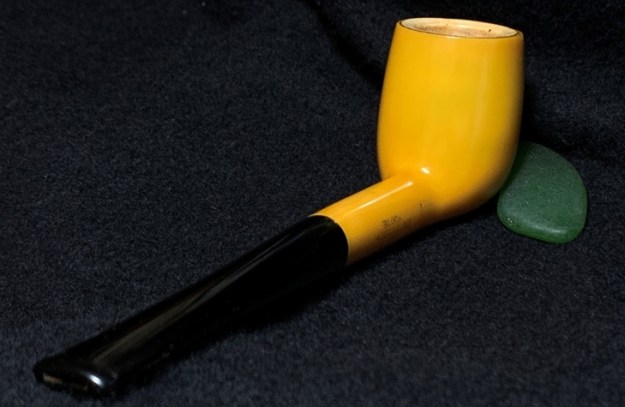
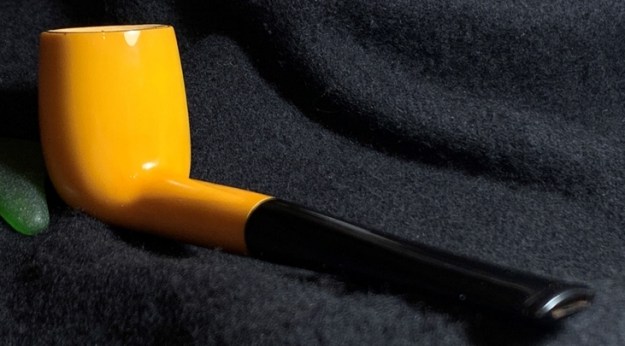
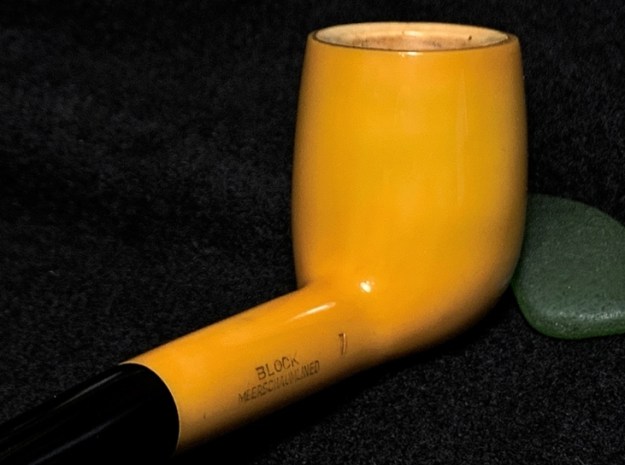
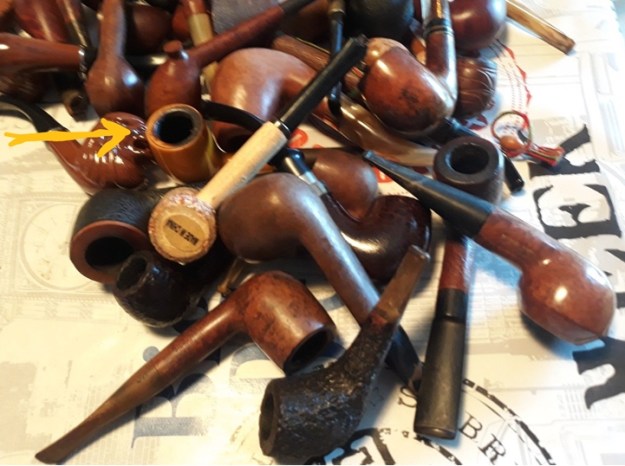
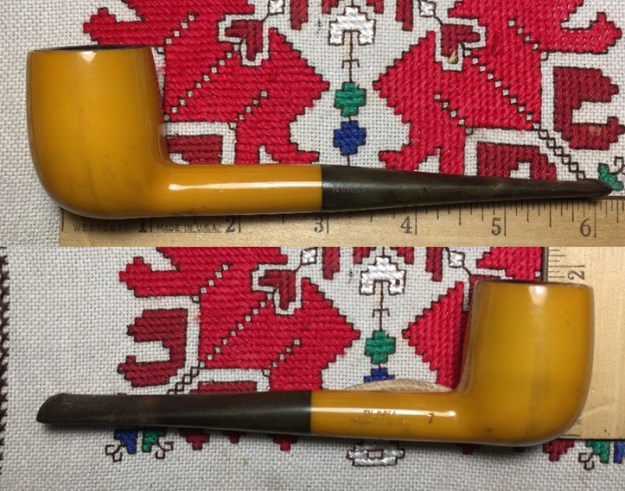
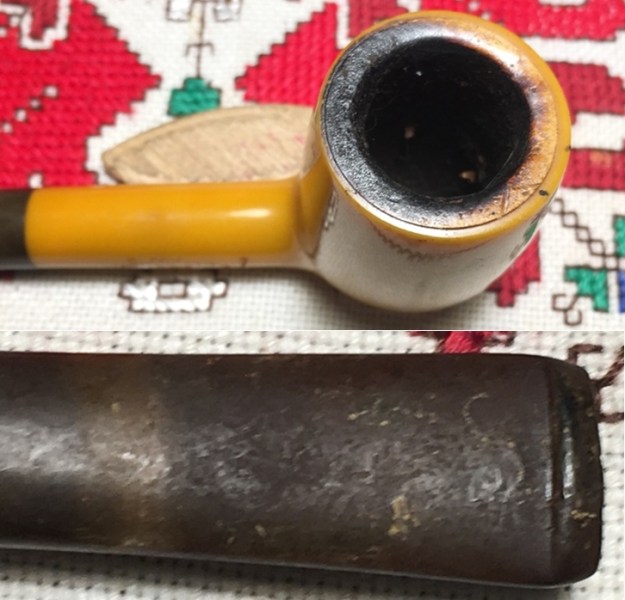
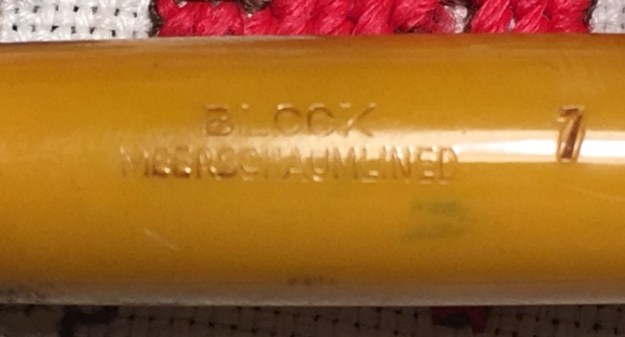
Thanksgiving travels are now completed with us visiting kids and grandchildren in St. Louis and Nashville and I’m now back at the worktable in Golden, looking at an interesting pipe.  Daniel was bold to commission 7 pipes from the For “Pipe Dreamers” Only! collection and with 3 completed, the fourth is now on the table, a Meer lined Hilson Fantasia.  I acquired it along with another commission of Daniel, the Paul Viou Plume (See: Discovering the Vintage of a Paul Viou ‘Feather’ with the Help of Sebastien Beaud of Genod Pipes of St. Claude) from a Lot I acquired from an eBay seller in Paris.  The pictures show the French Lot of 50 and the Hilson marked by the arrow in the picture below.The Hilson is next on the worktable and I take some pictures to get a closer look. The Hilson name is not found on the shank, but the stem.  On the right shank flank is imbedded, BLOCK [over] MEERSCHAUMLINED.  To the right is the shape number, ‘7’. The stem’s left side is stamped a half ghosted, HILSON [over] FANTASIA.  This is my first opportunity to work on a pipe with the Hilson mark and my first impression of it drew mixed reviews – what is the material this is made of?  I discover in a quick look to Pipedia’s article that this name finds its origins in Belgium but after financial difficulties was acquired in the early 1980s by the Dutch consortium, Elbert Gubbels & Zonen B.V., which later acquired the Big Ben name from England and started the Royal Dutch Pipe brand.  I think the best short description of the Hilson name I initially found in Pipephil.eu but later discovered it originally came from Estervals Pipe House website:

 In 1846 a German named Jean Knödgen started the production of clay pipes in Belgium. At the end of the 19th century Jean Hillen (married into the Knödgen family) took over the company and developed the idea of also producing briar wooden tobacco pipes in his factory. He had some suppliers from the French Jura district turn some bowls which he then finished himself. Some time later he took up the complete production process of briar wooden tobacco pipes so he did not have to depend on others.

Jean Hillen had 2 sons: Jos Hillen who was responsible for sales and Albert Hillen who was responsible for the production of pipes. Albert was also an interpreter in the English army during WWII and he succeeded in establishing many international contacts. Thus they were soon able to export the first pipes manufactured in Belgium to countries all over the world with the brand name HILSON (Hillen and sons).

In 1980 the Hillen Pipe factory from the Belgium-Limburg town of Bree was purchased by the Royal Dutch Pipe Factory where the production of Hilson pipes was continued, carefully observing the traditional craftsmanship.

The link to the Estervals Pipe House website I found in a rebornpipes posting in which Steve’s research and summary of the Hilson name provides a great overview of the Fantasia.  The title of this rebornpipes.com writeup resonates with my first impressions and sets the table for a great summary:  Is it really a plastic smoking pipe? What is a Hilson Fantasia?

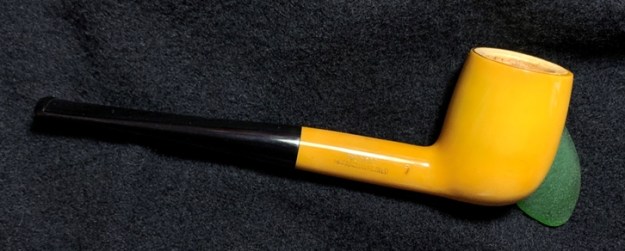
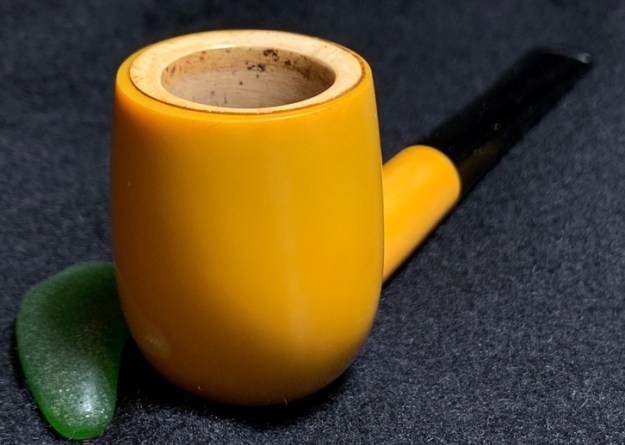
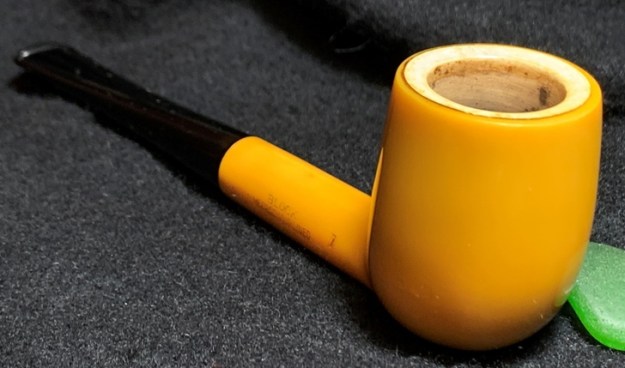
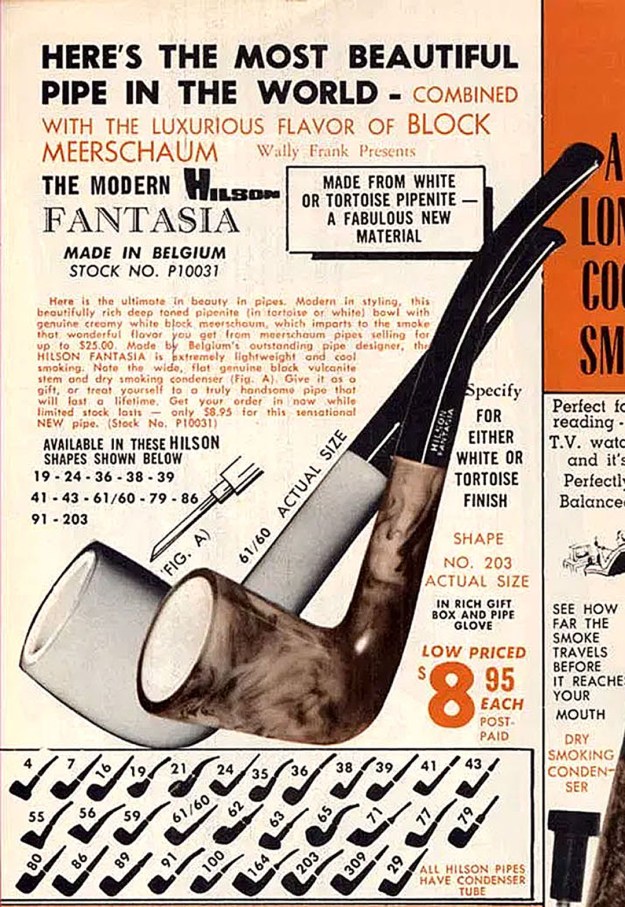
From my research on the web I found that the Hilson Fantasia, made in Belgium originally came out as a meerschaum lined pipe with an outer bowl made of a new material that they called pipenite. In 1962 it came out in what they called ivory white and in a colour they called tortoise. In 1963 they seemed to have added the option of a black pipenite bowl. From what I can find out about the material they call pipenite, it was a specially designed polyester resin. It was light weight and fairly indestructible. The block meerschaum insert was something that Hilson turned into a specialty. (I have restored some beautiful briar pipe with the Double Ecume or meerschaum liners as well.) These colourful resin pipes look like a product of the 60’s and in my research on Chris’ Pipe pages, http://pipepages.com/hilson.htm I found them in catalogues from that era. The swirled materials of the bowl gave the pipe a 60’s psychedelic look. I have included a catalogue page from a 1962 Wally Frank Catalogue that was on the pipepages site. The write up on the Hilson Fantasia is entertaining to read in terms of the sales pitch that is delivered.

Unfortunately, Chris’ Pipe Pages that Steve references above is now defunct, but the Pipedia Hilson article has the early 60’s Fantasia add Steve references which follows containing the great pipe pitch as the ‘Most Beautiful Pipe in the World’!  Who could resist having a Fantasia in one’s collection!When I first took a close look at the Hilson Fantasia chosen by Daniel, I wondered what the butterscotch colored material was – plastic?  Steve’s research revealed that the ‘pipenite’ described in the Wally Frank add is a specially designed polyester resin which is practically indestructible.  The other noteworthy characteristic Steve referenced from the add is the quality Meerschaum block used in the Fantasia line.  The add also makes a point regarding the long, smoking condenser which was Hilson’s contribution to the pipe world’s ‘holy grail’ – the dryer, cooler smoking experience. The lower inset box in the add above shows the #7 as among a large offering of shapes by Hilson equipped with the condenser.
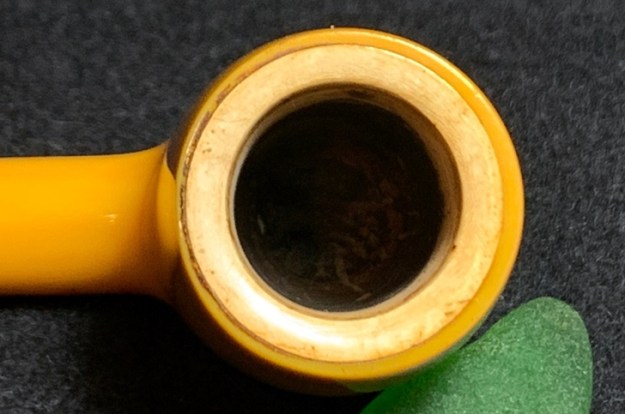
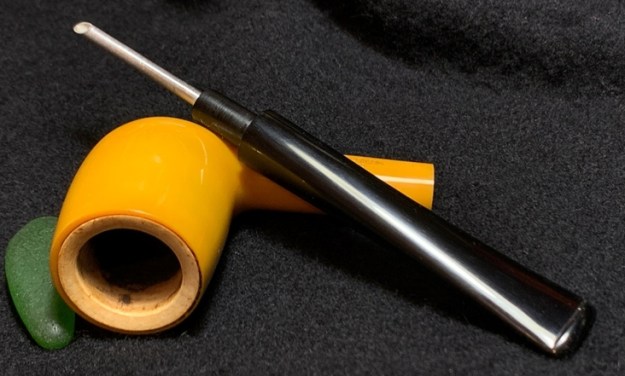
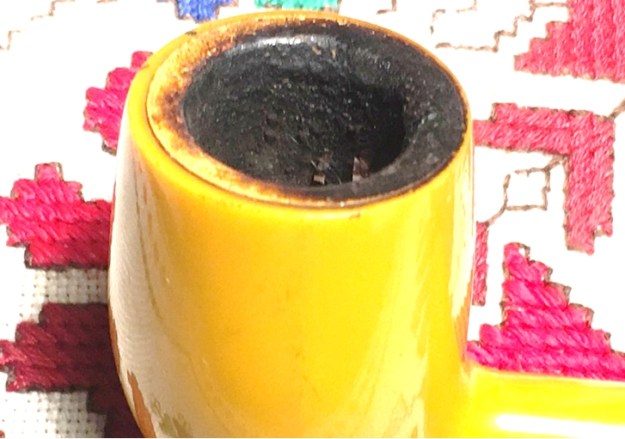
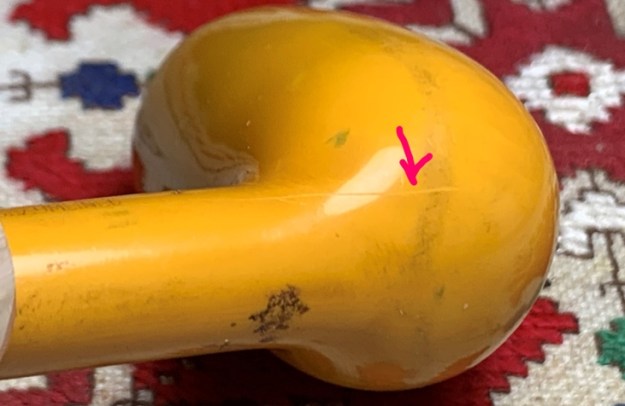
With a better understanding of the history of the Hilson Fantasia on my worktable, I look closer at its condition.  The Block Meerschaum chamber and rim are covered with a thick cake buildup with the lava over the rim.  This needs cleaning to give the Meerschaum a fresh start.   I’ve lightened the picture to enable the black surface to be visible.The stem has deep oxidation, and the bit has heavy tooth chatter on both upper and lower bit.  The ‘Pipnite’ surface is dirty and should clean up well without problem.  The only question I have is what first appeared as a crack in the polyster acrylic resin bowl but is most likely a scratch.  The question is, how best to address this, if at all?  The glassy surface probably does not respond well to sanding or if I did sand the surface or buff with a compound to erase the scratch, will the scratching of the abrasives (papers, pads or compound) be able to be removed?  Or will sanding inevitably leave the highly glossed surface dulled? If this is the case, then any attempt to sand out the scratch will leave the repair area standing out from the rest of the Pipenite surface.  My guess now is that it is an ‘all or nothing’ proposition – either sand/buff the whole stummel or not at all.  With the question of the approach to the stummel a question, I decide to send a note to Steve to get his feedback on the behavior of Pipenite if sanded?  While waiting for Steve’s response, I press on.
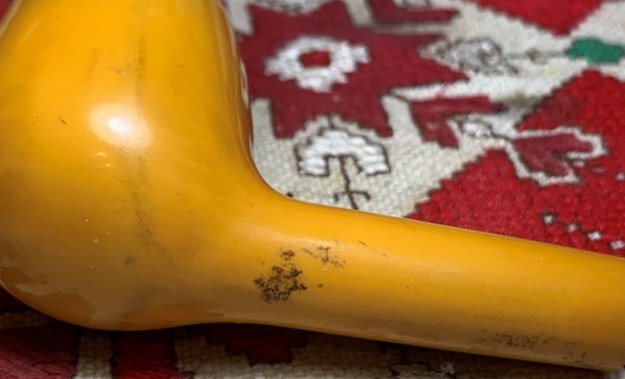
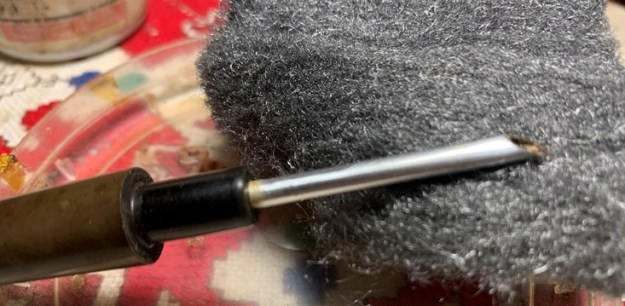
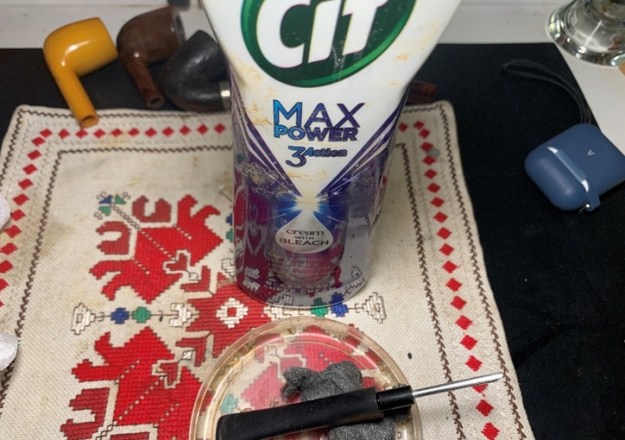
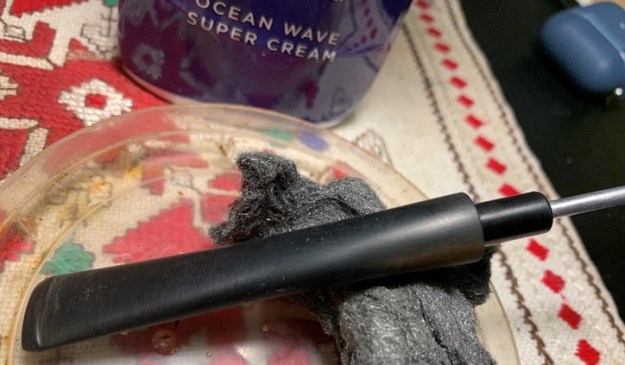
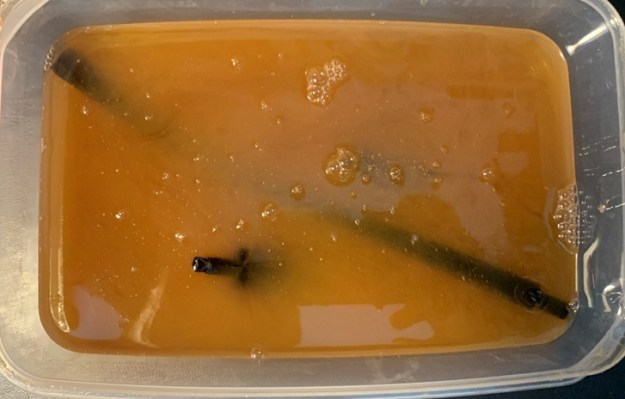
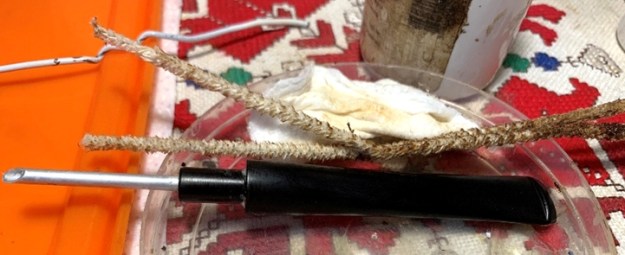
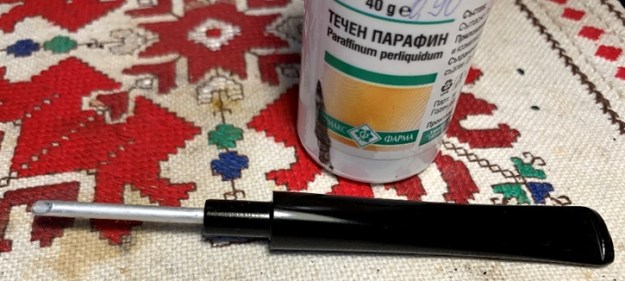
The cleaning of this Hilson stem began while I was still in Bulgaria and these pictures record the cleaning of the stem.  Starting with 0000 grade steel wool, I rub and buff the long, heralded Hilson condenser. It spruces up the nickel condenser nicely.Following this, only a few pipe cleaners dipped in isopropyl 95% clean the internal stem airway.Next, a ‘Soft Scrub’ product gets a head start breaking up the oxidation imbedded in the stem surface before continuing the cleaning by giving the stem a Before & After Deoxidizer soak.  While protecting the Hilson stem stamp, using 0000 grade steel wool wetted with the CIF, the oxidation is mitigated. To further the cleaning of the stem, it joins other stems in the queue in a Before & After Deoxidizer soak.  The stem soaks for several hours.After the soak is completed, the stem is fished out of the Deoxidizer allowing the fluid to drain off.  A cotton pad wetted with isopropyl 95% is then used to wipe away the excess Deoxidizer from the stem surface.  This is followed by using a few pipe cleaners, also wetted with isopropyl 95% to clear the Deoxidizer from the internal airway.The stem’s rejuvenation is commenced using paraffin oil and a cotton pad.  The stem looks good.Earlier I sent a note to Steve to get his input on how best to approach the Pipenite surface scratch and the kind of material Pipenite is?  His response was helpful in describing the universal lack of consensus on what ‘Pipenite’ is!  Here’s Steve’s first response:
Hey Dal

The material on the Fantasia is described as everything from Bakelite to epoxy resin in a multitude of places. Others have called it plastic resin. some even fiber glass. To me nothing fits better than the resin concept… not sure about epoxy but everything about it is resin. It is not bakelite for sure…
Sanding the pipenite or resin leaves scratches that are nearly impossible to remove. I polished out a lot of scratches with my buffer and blue diamond polish and succeeded in not losing the lustre. Personally, I would buff it out best you can and leave it alone… war wounds from its travels.

S

To refresh my understanding of the unique composition of resin, I turn to a helpful Wikipedia article:

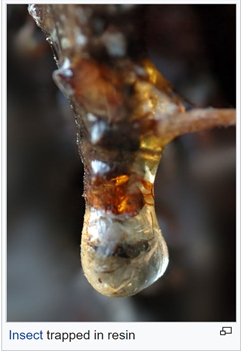
In polymer chemistry and materials science, resin is a solid or highly viscous  substance of plant or synthetic origin that is typically convertible into polymers.[1] Resins are usually mixtures of organic compounds. This article focuses on naturally occurring resins.

Plants secrete resins for their protective benefits in response to injury. The resin protects the plant from insects and pathogens.[2] Resins confound a wide range of herbivores, insects, and pathogens, the volatile phenolic compounds may attract benefactors such as parasitoids or predators of the herbivores that attack the plant.[3]

Steve followed with another email with links from sites like Pinterest, Etsy, and Worthpoint, which are sales platforms with examples of different Hilson Fantasia offerings and the varied descriptions of the pipes running the gambit as Steve described above. I enjoyed looking at the Hilson Fantasias for sale on these sites which were of the ‘tortoise shell’ variety – nice.  The collage below shows these examples.These examples reminded me of another Hilson Fantasia in my Pipe Steward inventory that also is a tortoise shell but has a significant crack in the stummel, so it never made it to the For “Pipe Dreamers” Only!  online offerings – I just didn’t know what it was – or whether it was worth the effort being a ‘plastic’ pipe?  I might give this Hilson another look!The tortoise shell is attractive, but the description by Steve that Pipenite is ‘practically indestructible’ found an example expanding ‘practically’!  I still believe that Daniel’s Hilson Fantasia is marred by a scratch in the polyester resin shell, even if it is a trauma crack, perhaps from being dropped (?), it doesn’t appear to be such to question the pipe’s integrity with the Pipenet resin material.  Turning now to the Hilson Block Meerschaum stummel, I start with clearing the Block Meerschaum chamber of the accumulation of carbon cake.  As a reminder, Meerschaum does not need a protective layer as with briar pipes.  It is best to keep the Meerschaum totally clean of buildup.  In my own Meerschaums, after each use my practice is to gently scrape the chamber with a folded bristled pipe cleaner.  This cleans the surface nicely keeping the Meerschaum in good shape.  To allow a cake buildup can cause the Meerschaum to crack in time.  Carbon cake expands differently from Meerschaum when heated and this can cause stressing on the Meerschaum.  I take a couple pictures to mark the start of the cleaning process.The aft section of the rim reveals the lighting practices of the former steward – drawing the flame over the back.  The crusted lava cake has totally covered the Meer rim lining and the Pipenet portion, too.  Cleaning is needed to show what’s beneath.With Meerschaum, using my usual Pipnet Reaming Kit with the blade heads is not good.  The torque created by this reaming approach can crack the Meer.  Instead, using the slow, patient, less intrusive approach, the chamber wall is gently scraped using the Savinelli Fitsall Tool.The Fitsall Tool also does well to begin clearing the rim of lava flow.  The approach is gentle!  I then transfer to the sharper edge of the Winchester pocketknife.  With the knife, the approach is more to ‘pull’ the blade carefully over the surface rather than to push the blade.  I’m careful not to gouge the softer Meerschaum.    With the rim scraping looking good, I transition to sanding the chamber by wrapping 240 grade sanding paper around a Sharpie Pen.  I then continue the sanding on the rim using a small piece of 240 paper.  I sand the rim gently and remove the lava and clean the rim nicely.     To complete the main cleaning of the Meerschaum lining and finish, I wipe the bowl with a cotton pad wetted with isopropyl 99%.  In Bulgaria, I was able to find isopropyl at 95% purity.  Now in the US, I was able to find 99% which is about a pure as one can get.  Switching now to the external ‘Pipenite’ surface, undiluted Murphy’s Oil Soap is used to scrub with a cotton pad.  The surface, as expected, cleans up very nicely.  To guard the Meerschaum lining, instead of rinsing under a tap, I wet a cotton cloth and wipe the bowl to rinse off the soap. Next, the internal mortise is cleaned using several cotton buds dipped in isopropyl 99% and one pipe cleaner.  After a time, the buds emerge lighter and it’s’ time to move on.  Cleaning completed.The stem now awaits attention.  The stem cleaned up nicely from the thick oxidation.  Even though the HILSON FANTASIA stem stamping was protected during the process, it appears even more ghosted now.  I’ll continue to protect this remnant by covering the stamping with painters’ tape during the next stages of sanding.Both the upper and lower bit have minor tooth chatter remaining along with a bite compression.  I’ll begin to minimize the damage by the heating method.  Vulcanite, a rubber compound, is an amazing material.  Using a Bic lighter to paint flames on the bit, the heating causes the expanding of the vulcanite allowing it to regain much of its original composition.  After several ‘flaming’ cycles, a few more on the lower bit, the comparison of before and after shows a distinct improvement with upper and lower.  Using a piece of 240 sanding paper, I sand the residual tooth chatter which is dispatched without difficulty.  I also refresh the button with a flat needle file and sand it with 240.  From the 240 paper and file working on the bit and after placing tape over the stem stamping, the sanding is furthered first by wet sanding the entire stem with 600 grade paper.  The 600 paper is followed by applying 0000 grade steel wool.  Next, the full regimen of micromesh pads is applied to the stem.  Starting with pads 1500 to 2400 the stem is wet sanded.  This is followed by dry sanding with pads 3200 to 4000 and 6000 to 12000.  Between each set of 3 pads, Obsidian Oil is applied which rejuvenates the stem and helps to prevent future oxidation. The pop in a freshly micromeshed stem is nice!   After the micromesh cycles are completed, the Hilson Fantasia stem and stummel are reunited to get a look at the progress. I discover that the union of tenon and mortise reveal a bit too much tightness.  I know that the Pipenite is tough, but I don’t want to test it and inadvertently crack the shake trying to force the tenon in the mortise.  To reduce the mortise pressure, 0000 steel wool is first used to see if this will clean the tenon allowing a seating.  While pinching the tenon with the steel wool, I then rotate the stem to create the abrasion.  After using the steel wool, the fit is tried again, and it remains too tight.Next, 240 is employed in the same way to reduce the pressure by sanding the tenon.  This does the trick.  The mortise now receives the tenon snugly.   I finish the tenon smoothing with 600 paper and 0000 steel wool and reunite the Hilson stem and stummel.Next, after mounting a cotton cloth buffing wheel on the rotary tool, the speed is set to about 40% full power and Blue Diamond compound is applied to stem and stummel.  I start with the Pipenite stummel with a bit of fear and trembling.  Steve had used the compound on his Fantasia projects but the anxiety stewing in my mind was, will the Blue Diamond buff up the glossy surface or will it apply fine scratchings that become impossible to remove?  I gingerly start applying the compound with the Dremel’s cotton cloth buffing wheel and to my joy, the surface is responding very nicely to the fine tune buffing of the Blue Diamond.  I continue with the stummel then the stem.  I like the results. The gloss of the Pipenite is enhanced with additional glow and the removal of fine marks and scratches on the resin surface.Before applying wax to the pipe, I spruce up the BLOCK MEERSCHAUMLINED stamping on the right shank side with Rub ‘n Buff European Gold metallic paint.  The gold and the butterscotch hue of the stummel will go well.As the name implies, after rubbing some of the metallic paint with a toothpick over the lettering and number, I simply rub it off with the flat edge of a toothpick then a cotton pad.  The result is good.  The ghosting of the stem stamping leaves me with no hope of freshening it with white acrylic paint, so it remains as it is – bearing the wear of its service.After wiping the entire pipe with a felt cloth to remove residue compound dust, another cotton cloth wheel is mounted with the speed remaining the same.  Carnauba wax is applied to the entire pipe followed by a rigorous hand buffing with a microfiber cloth to raise the shine further.
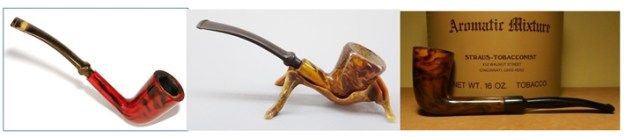
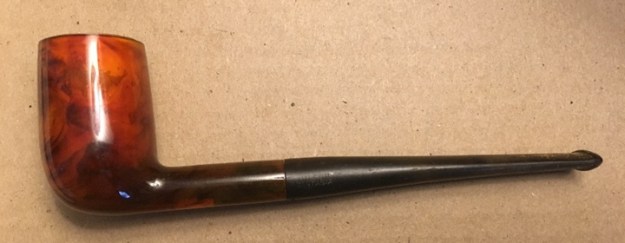
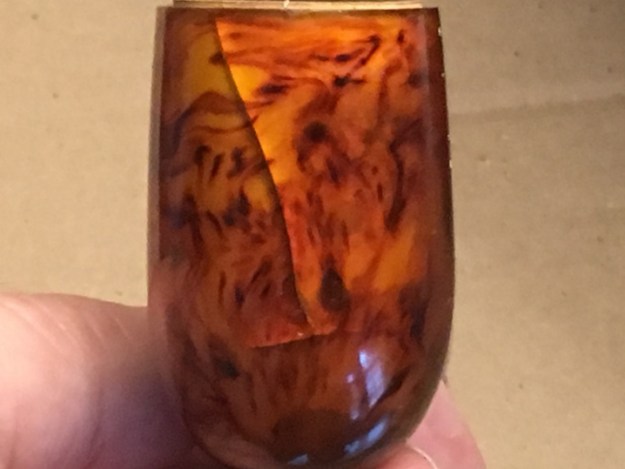
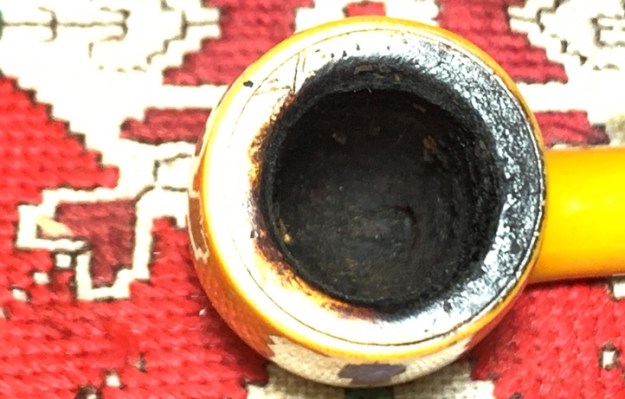
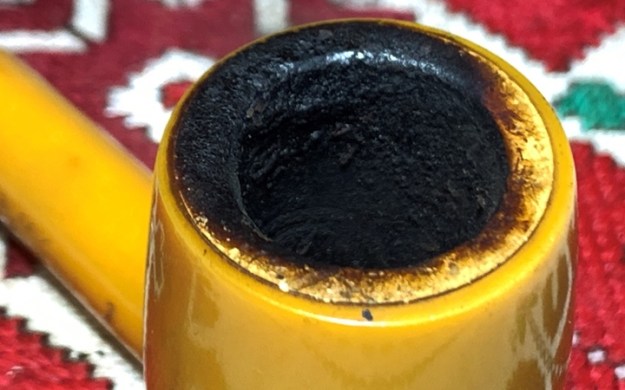
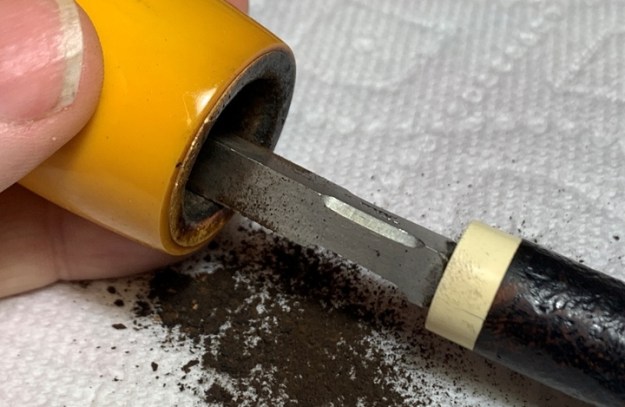
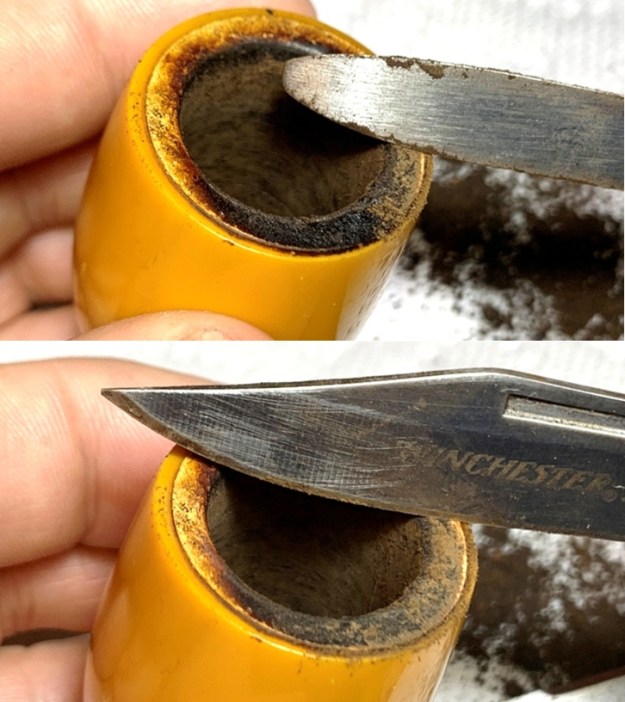
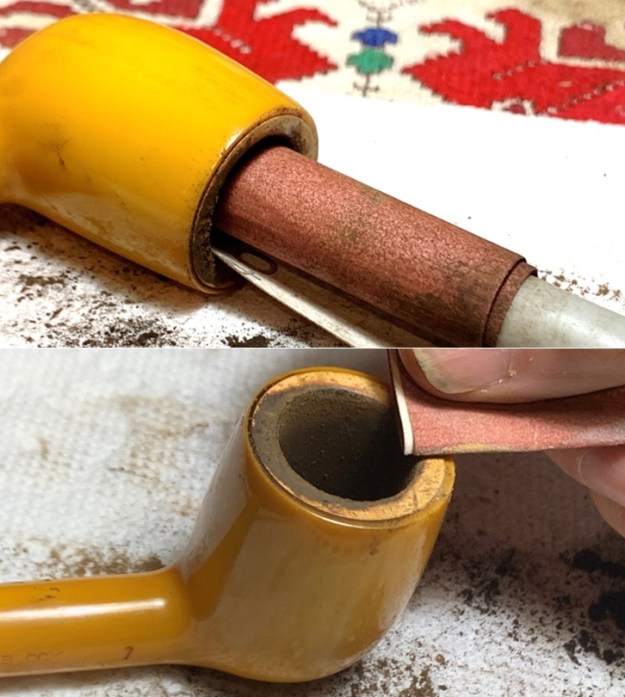
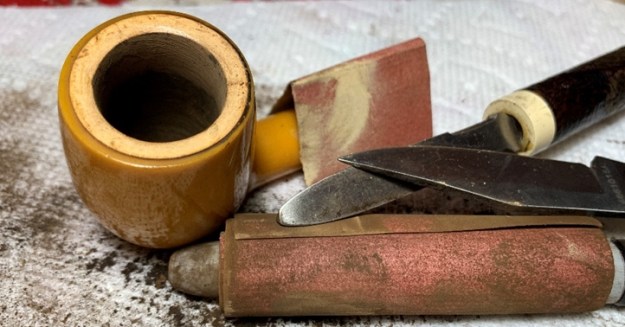
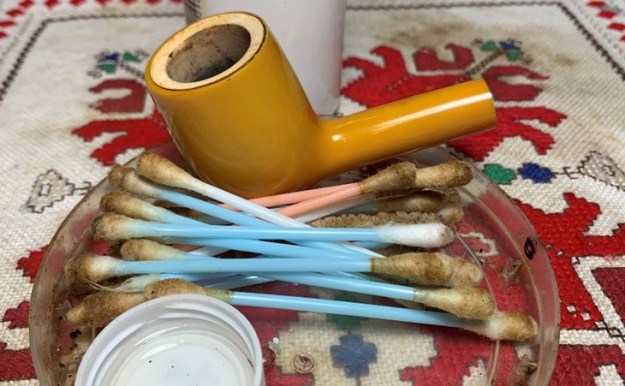
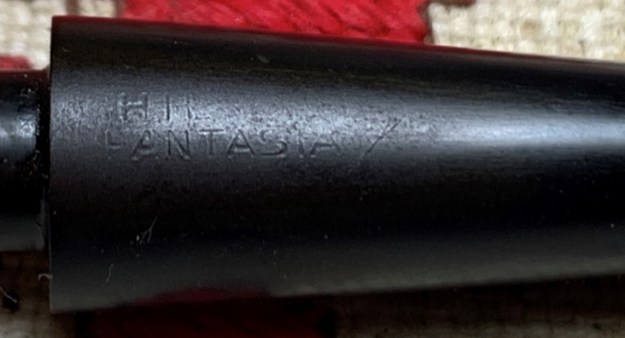
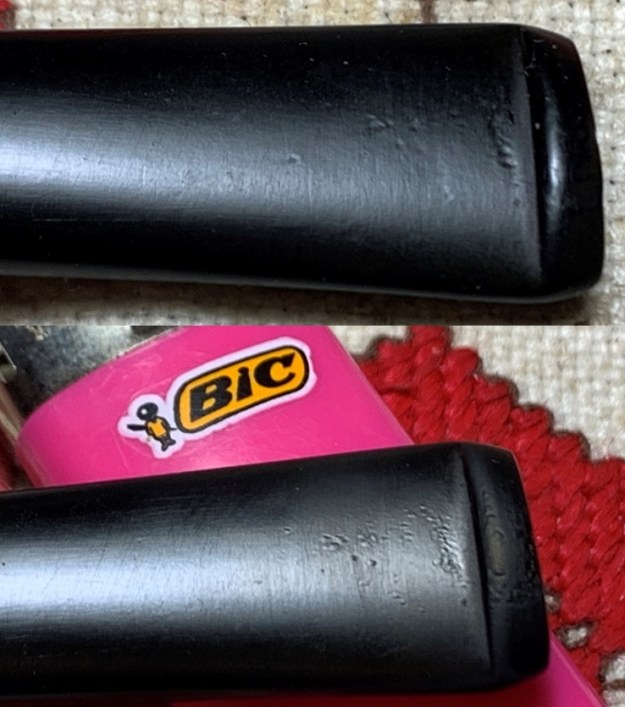
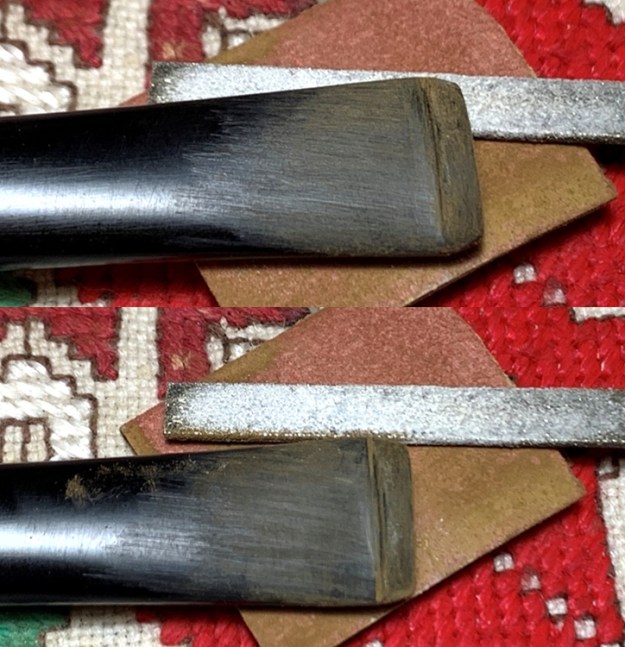
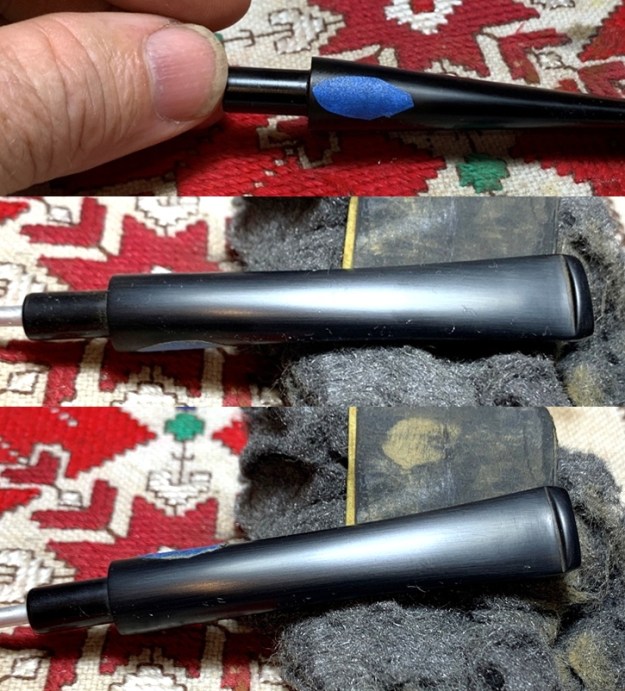
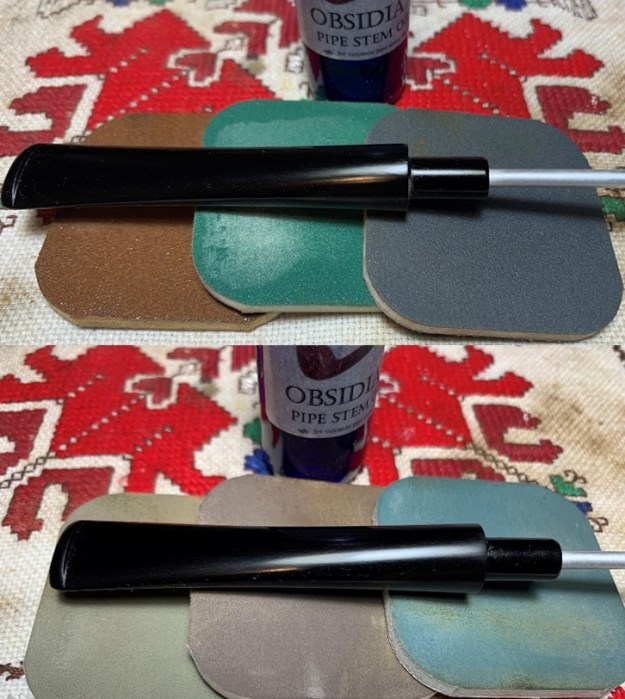
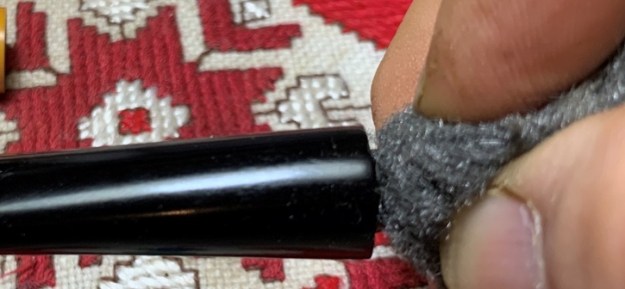
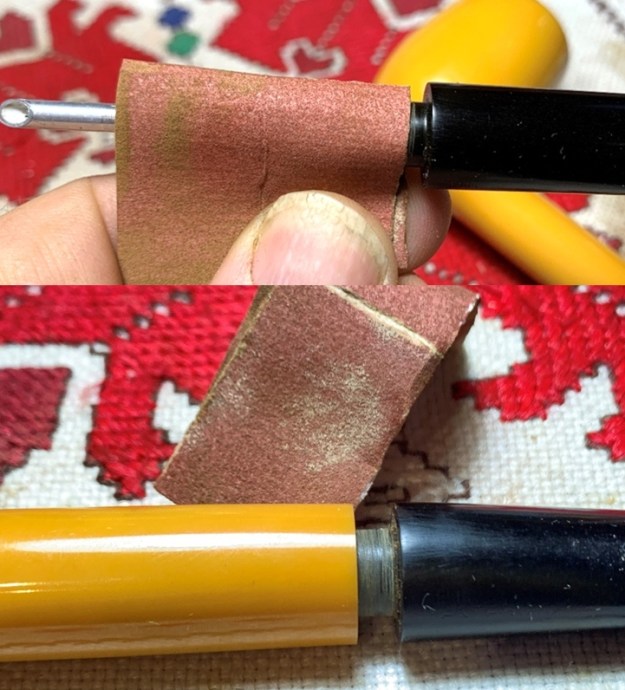
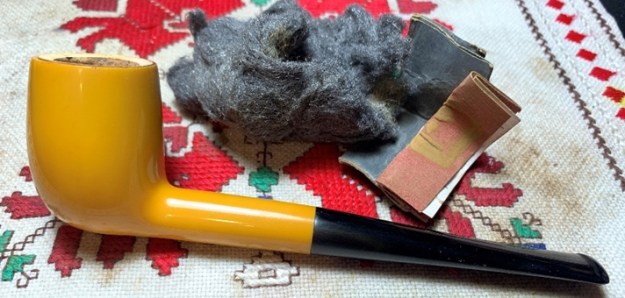
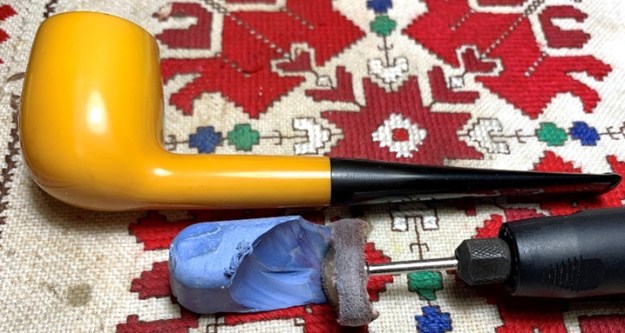
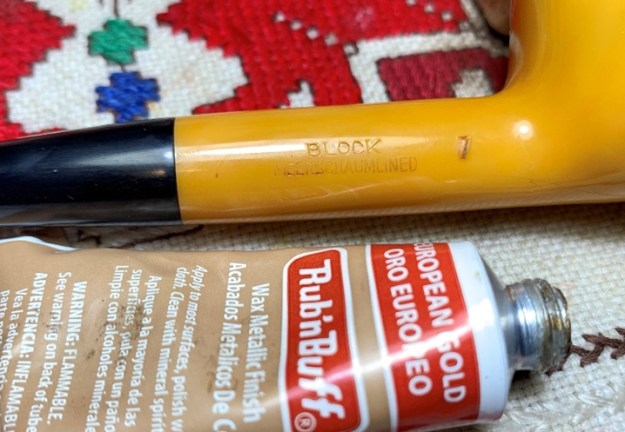
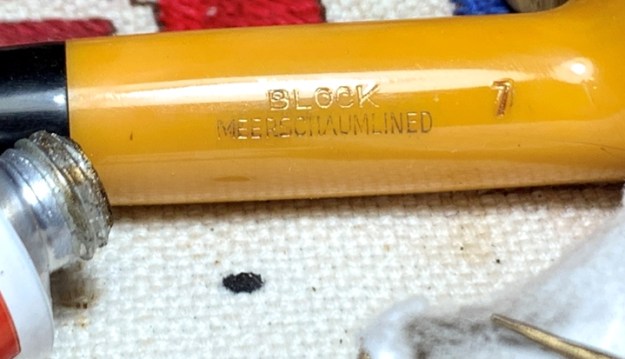
This Hilson Fantasia Block Meerschaum Lined has transformed amazingly from being an interesting gimmick pipe to becoming an extremely attractive alternative pipe to briar.  The butterscotch hue of the bowl pops in relationship to quality Block Meerschaum lining. The added benefit is the ability of the Meerschaum to be used repeatedly without rest, unlike briars.  This makes for much fellowship!  The timeless classic lines of a Billiard make this Hilson Fantasia a great addition to a collection and possibly to add to one’s regular rotation.  Daniel commissioned this pipe and will have the first opportunity to claim it from The Pipe Steward Store benefitting the Daughters of Bulgaria.  Thanks for joining me!