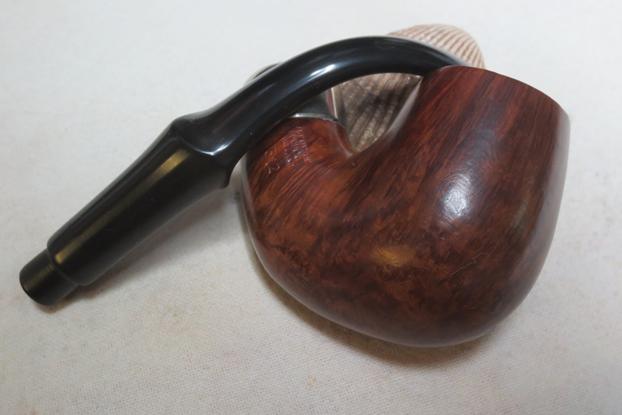
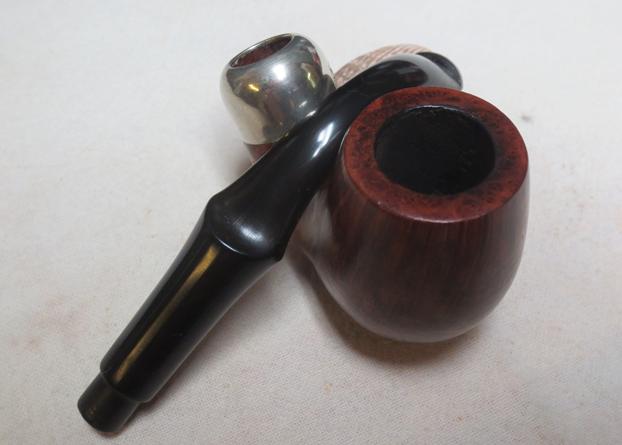
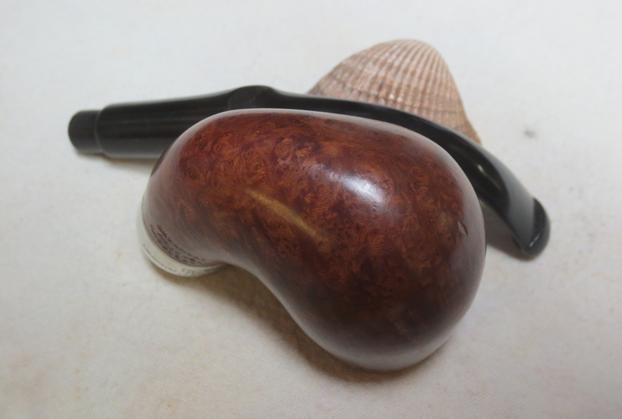
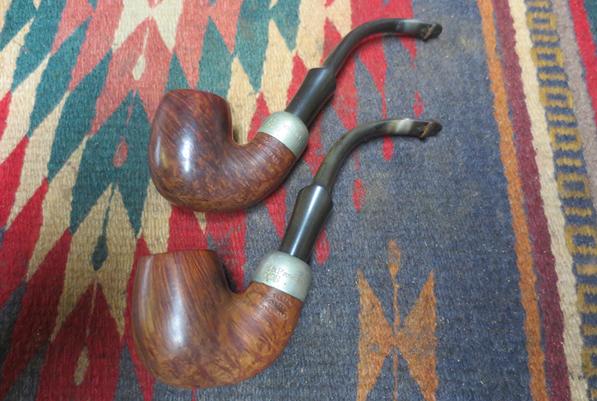
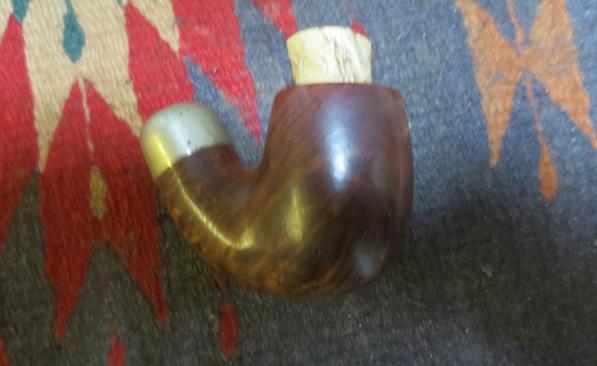
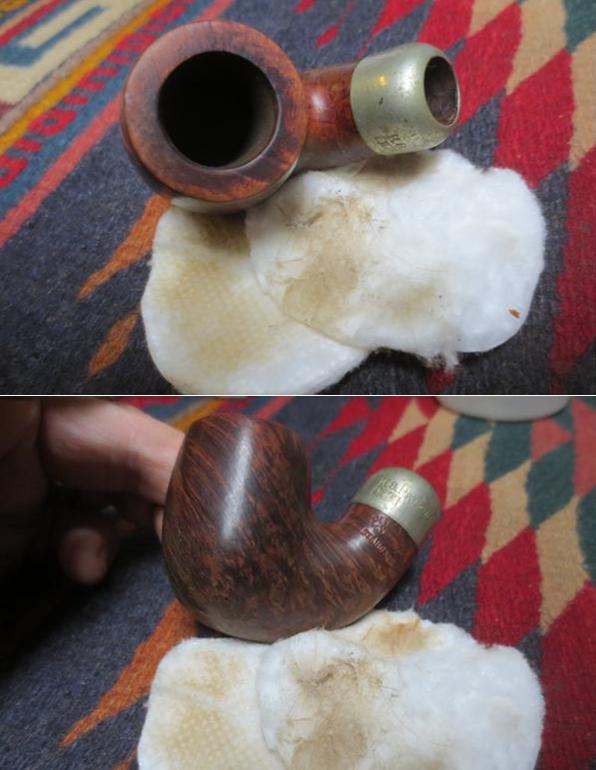
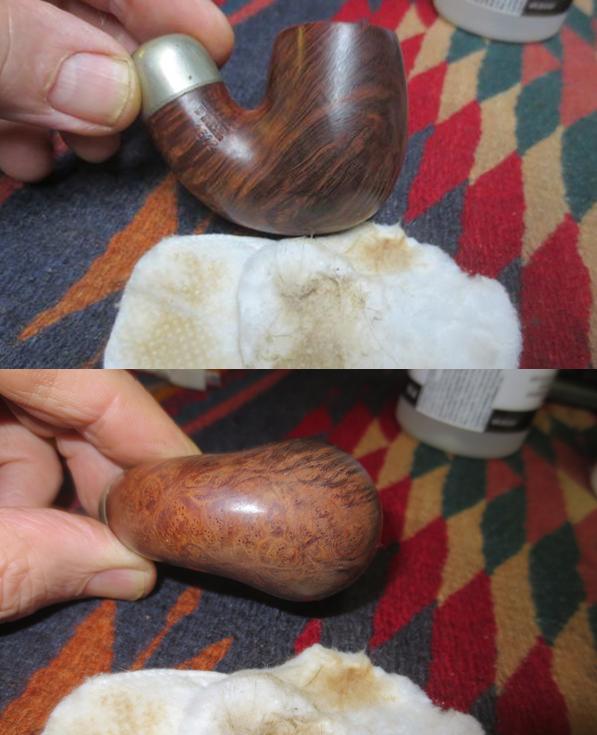
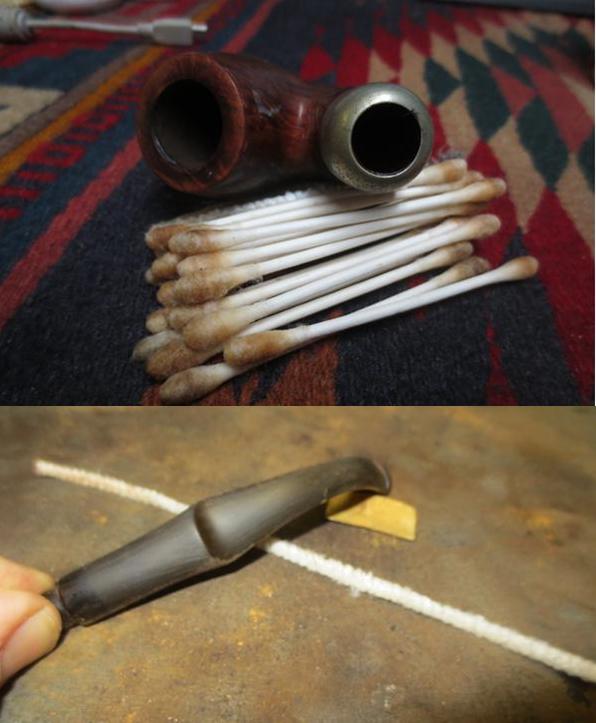
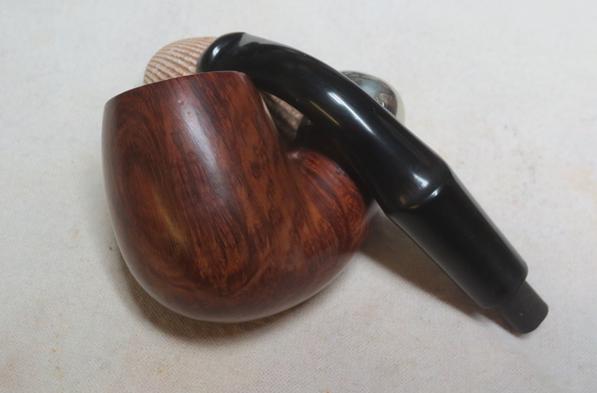
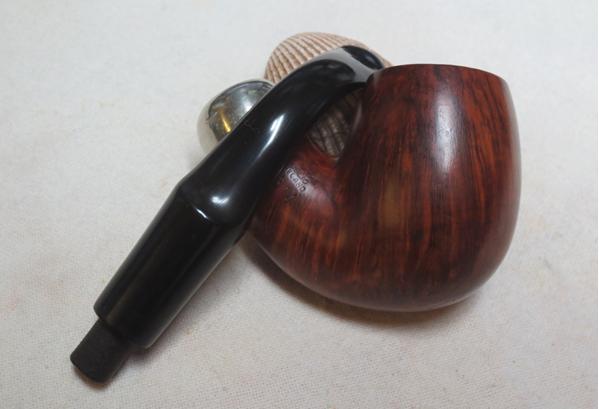
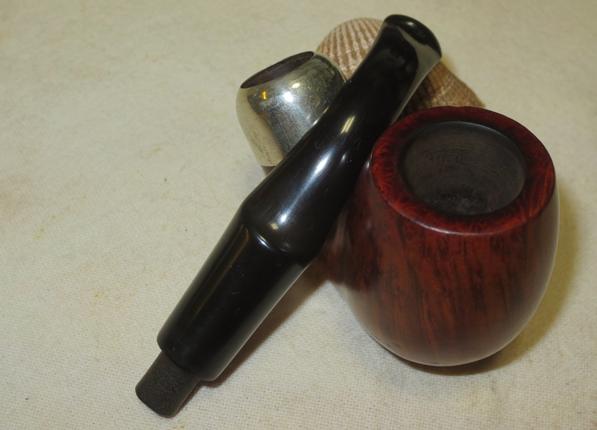
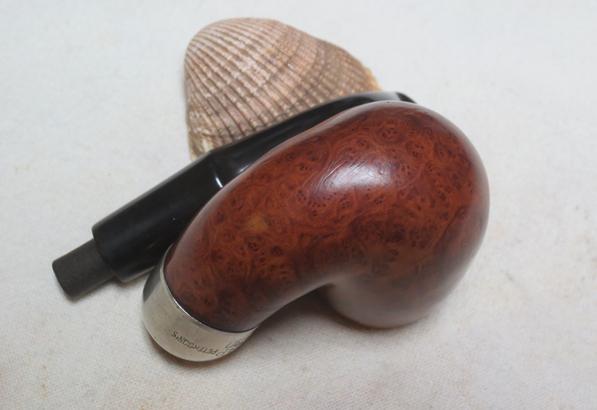
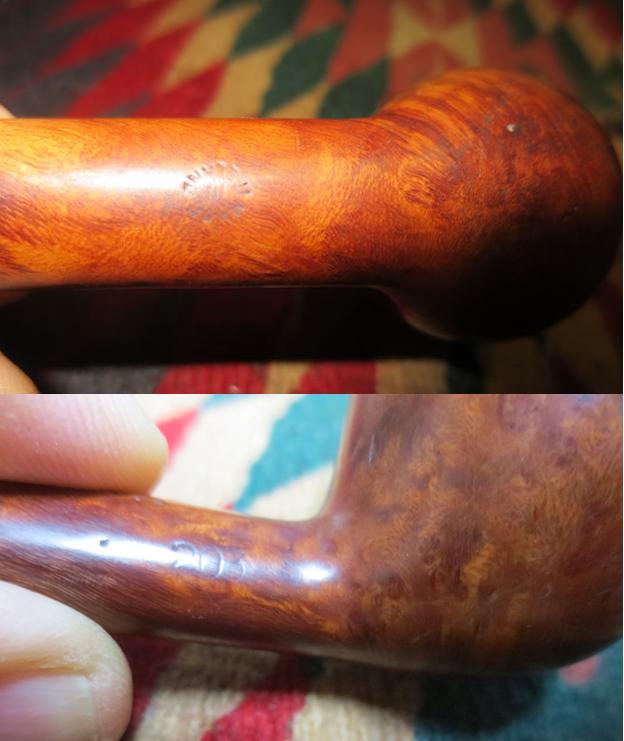
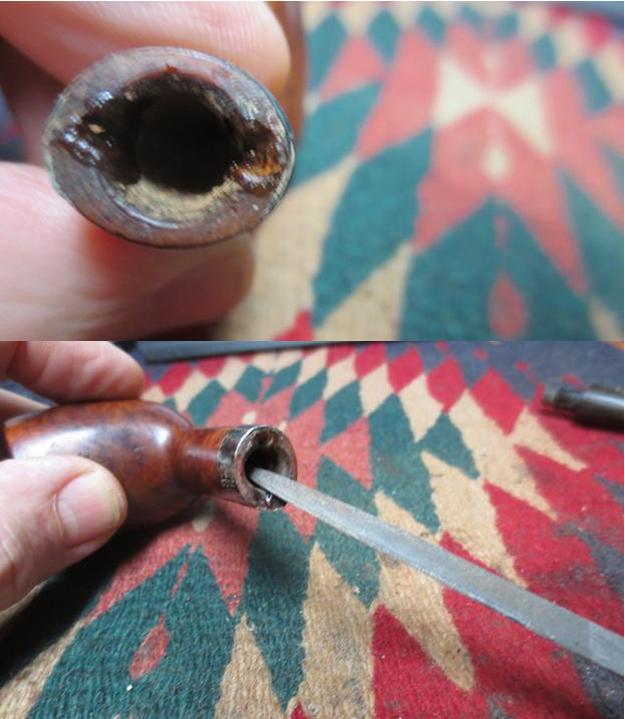
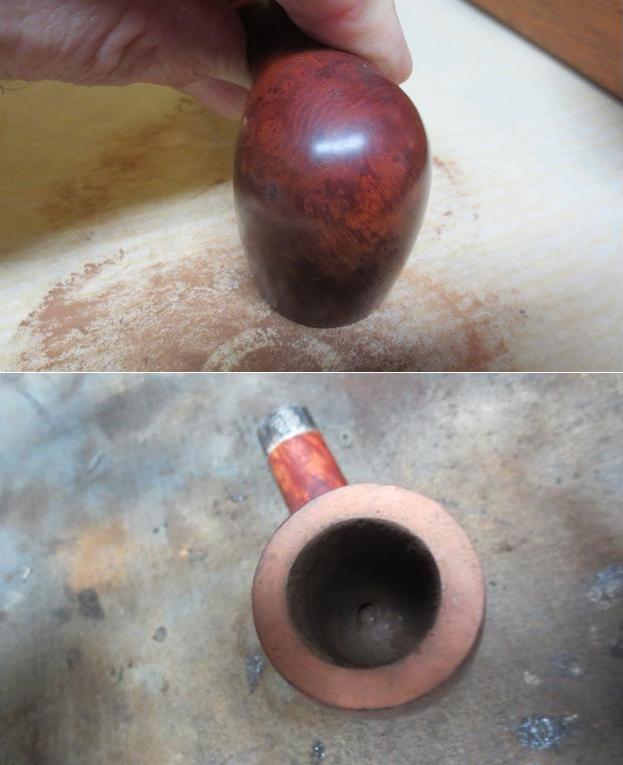
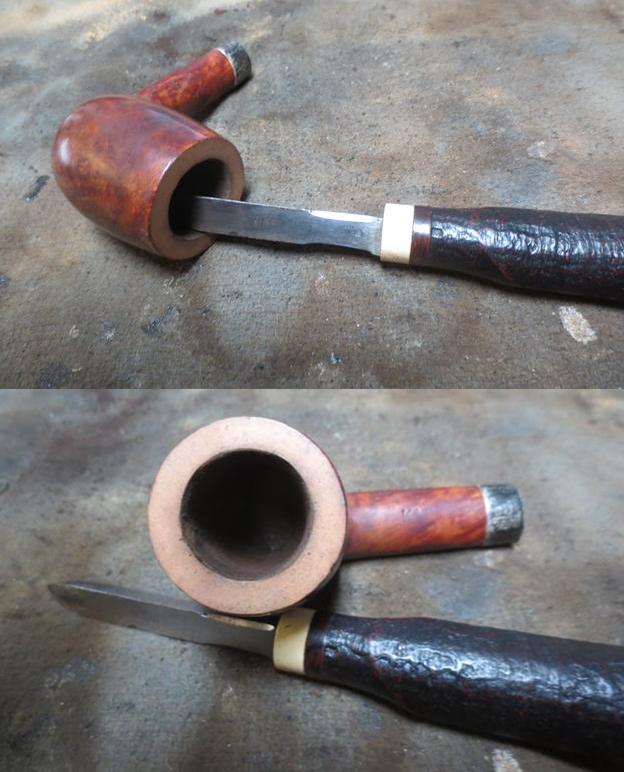
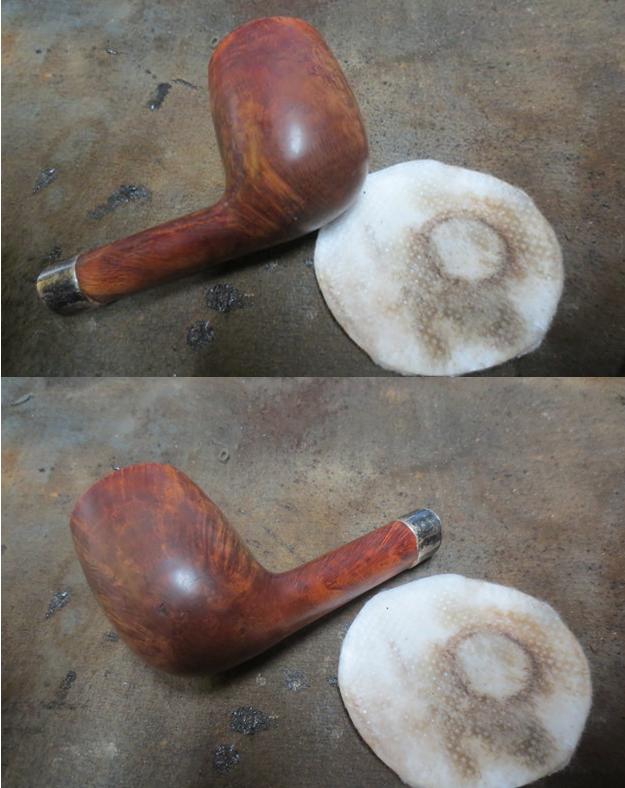
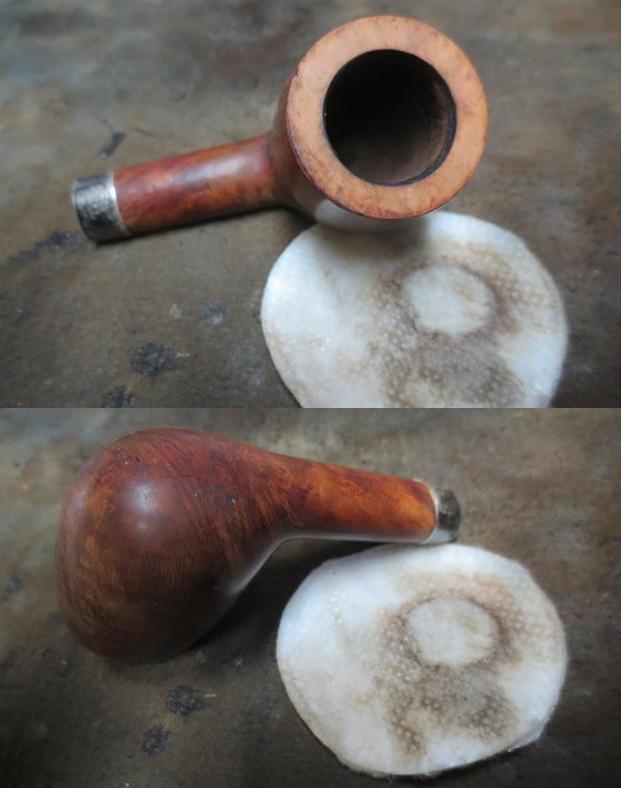
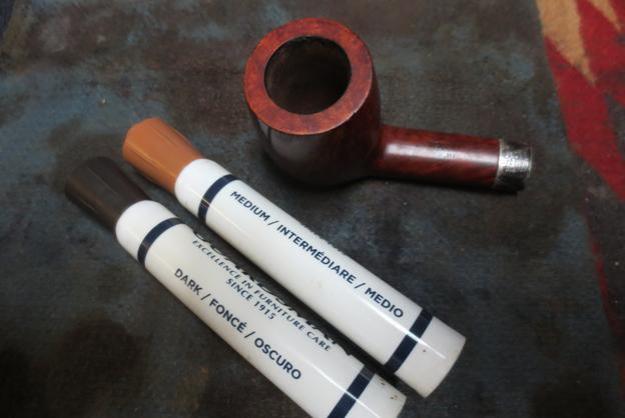
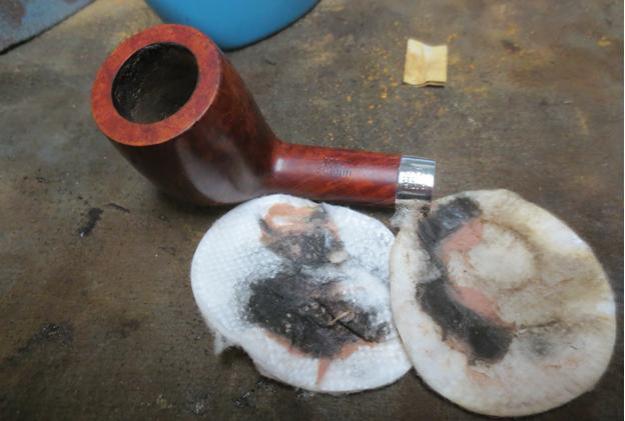
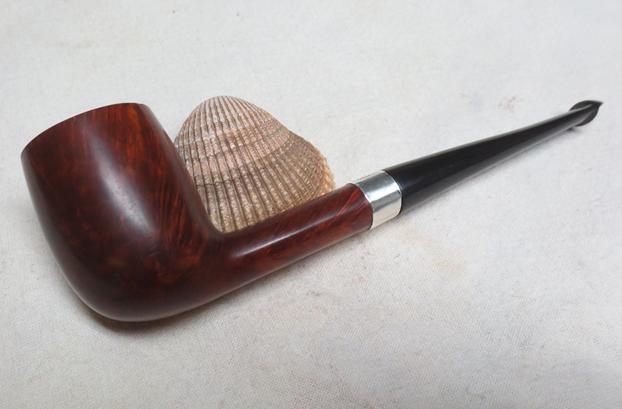
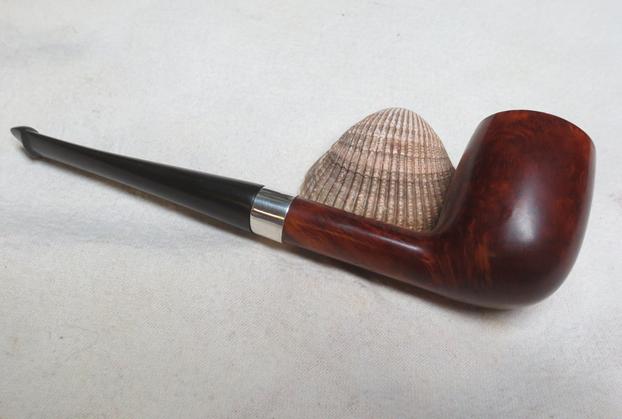
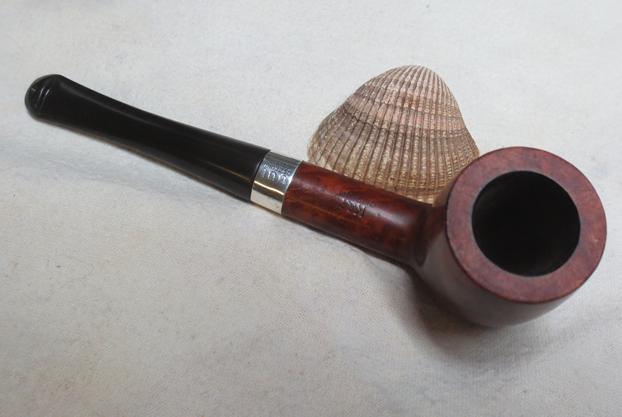
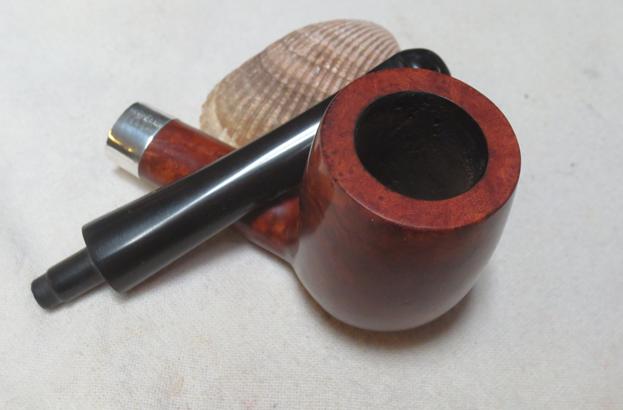
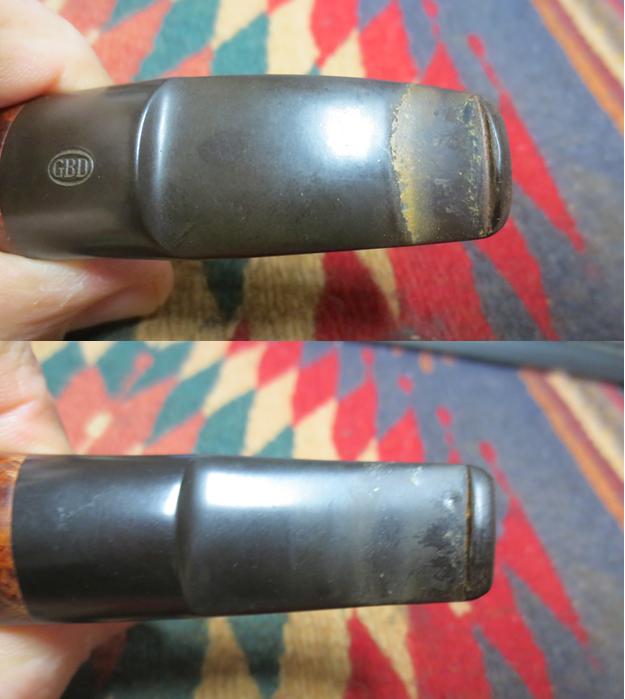
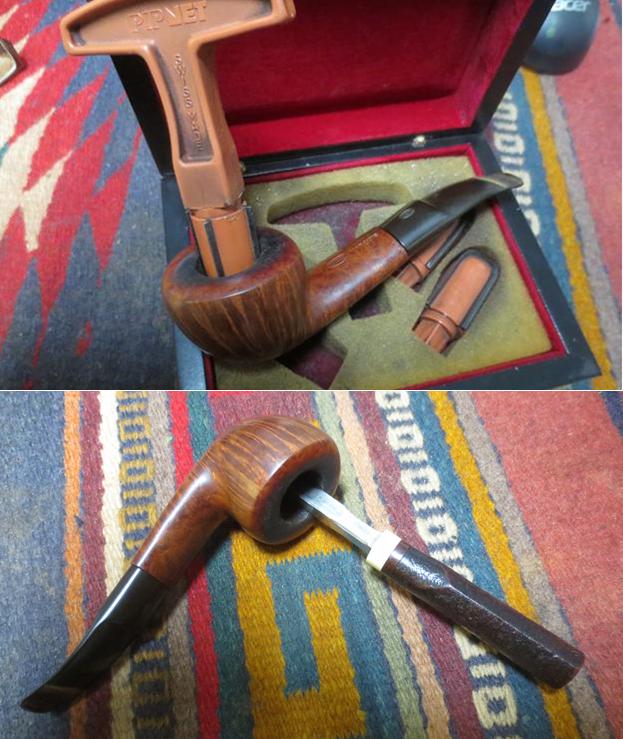
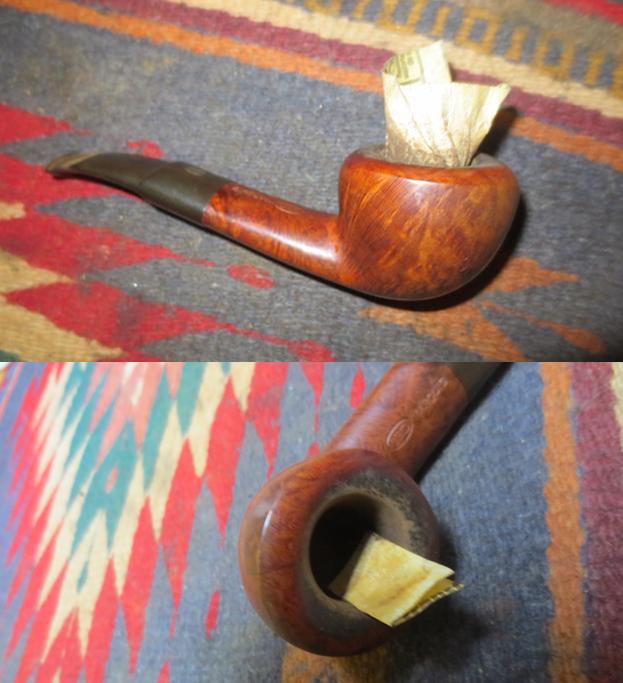
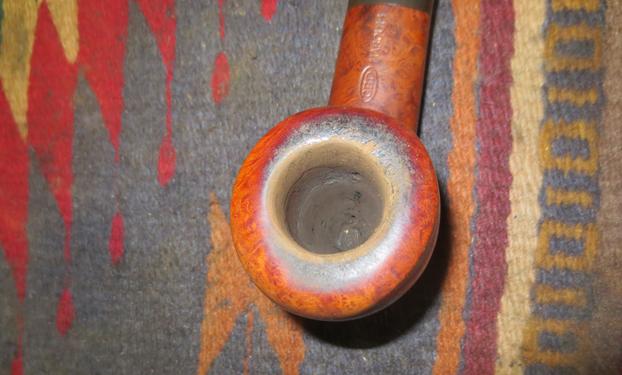
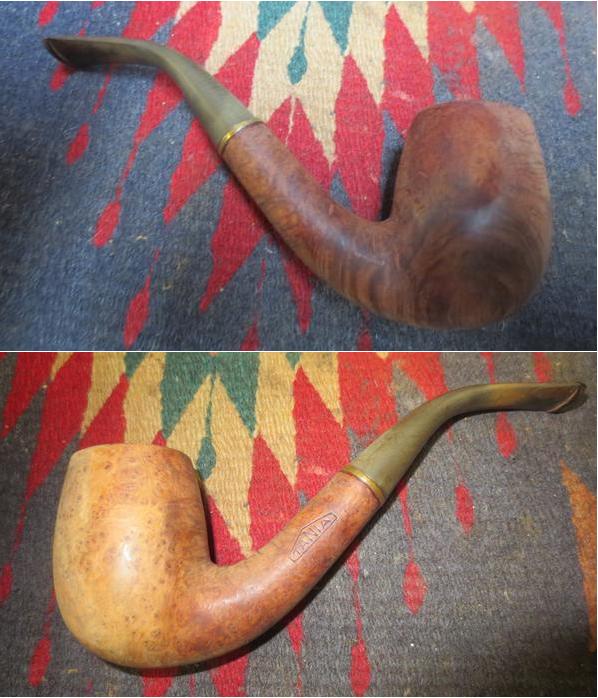
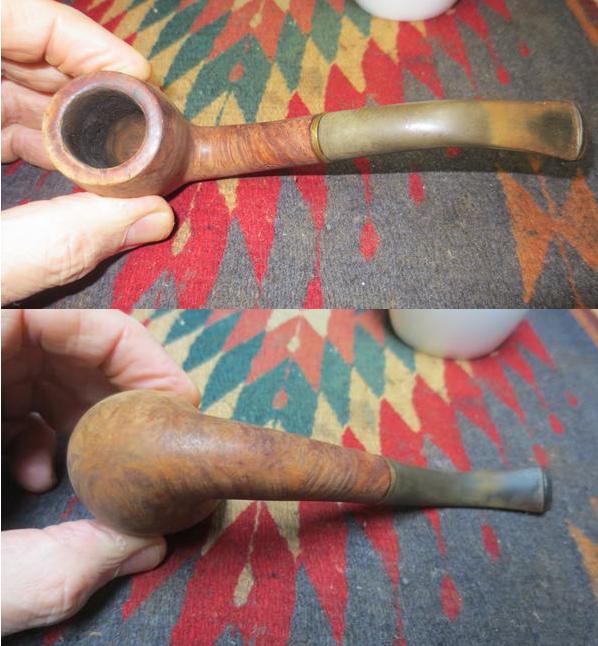
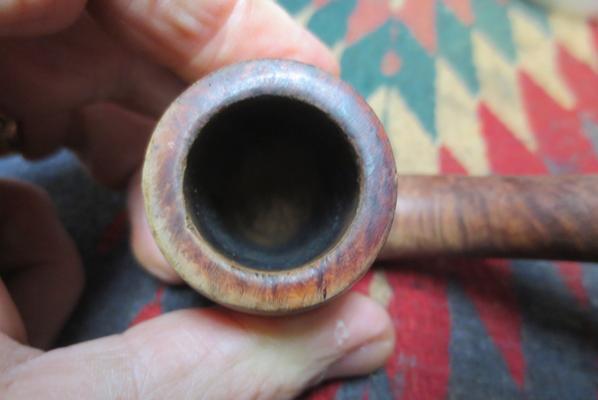
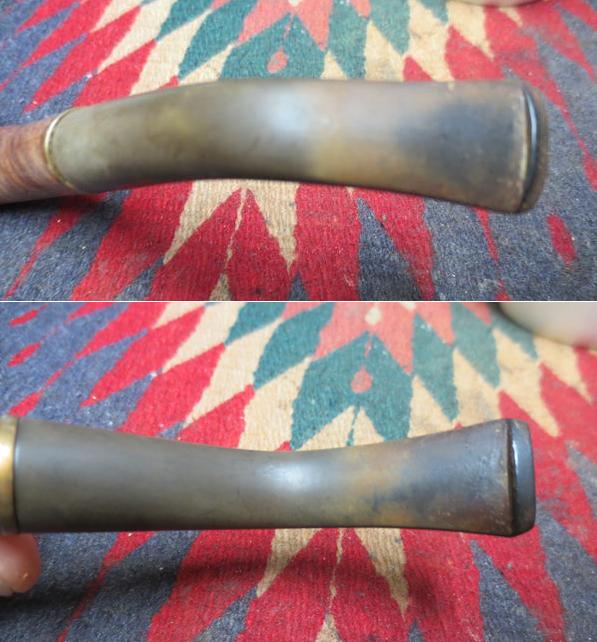
Tag Archives: removing oxidation

Breathing New Life into a Gold Star Giant 8597


Blog by Steve Laug

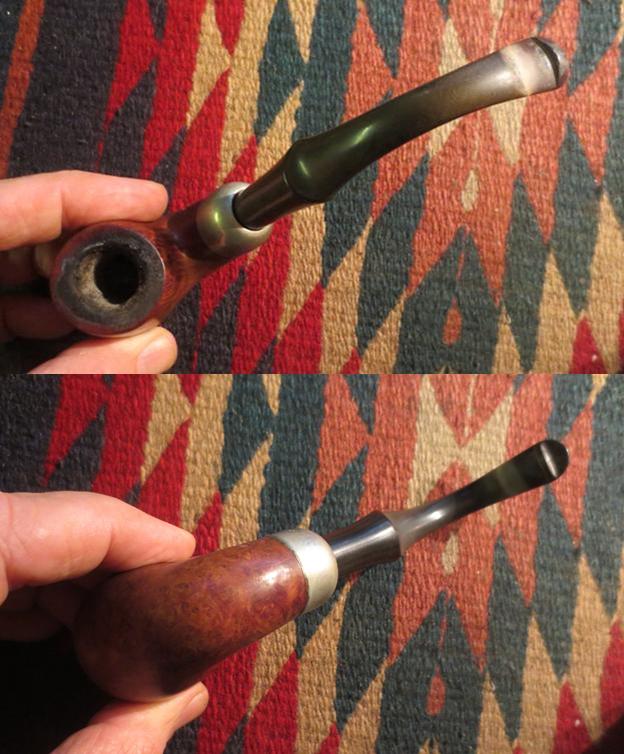
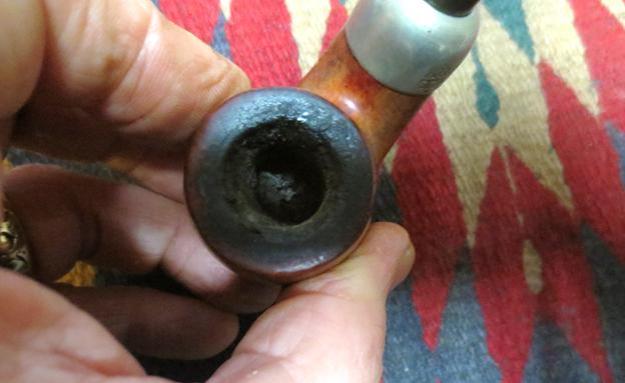
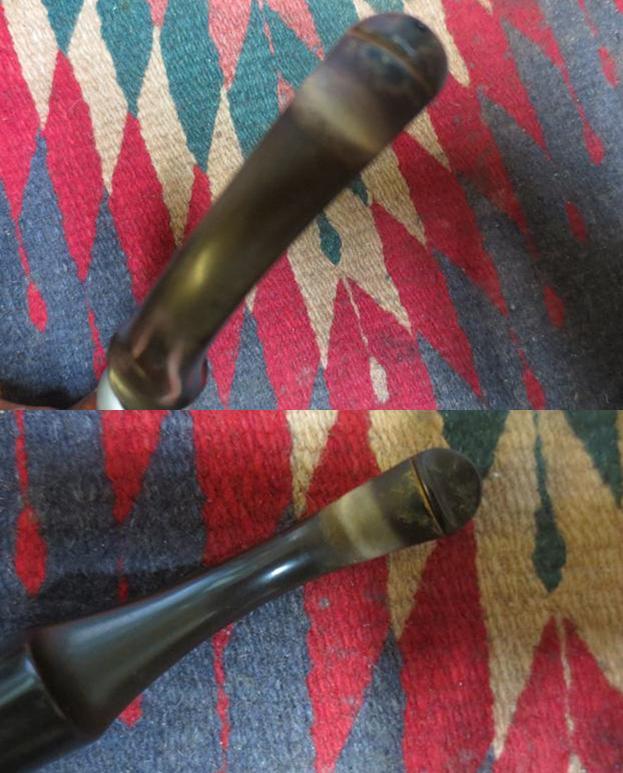
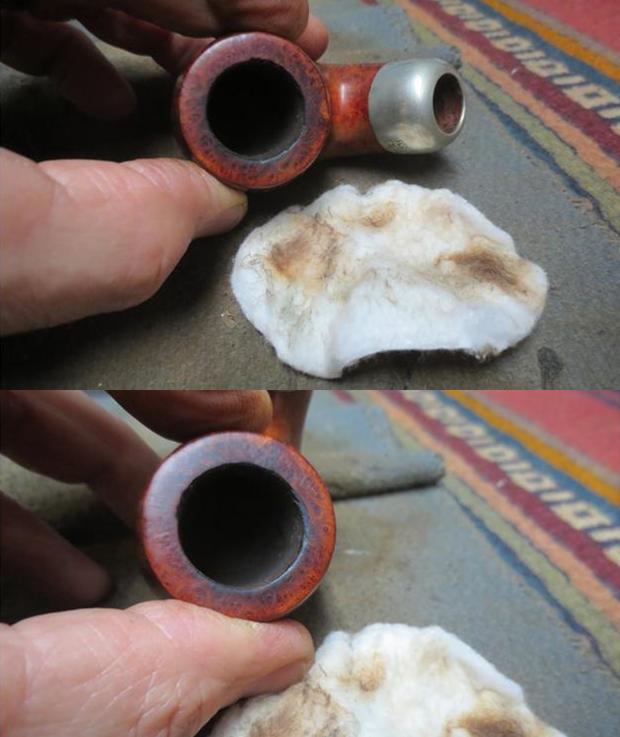
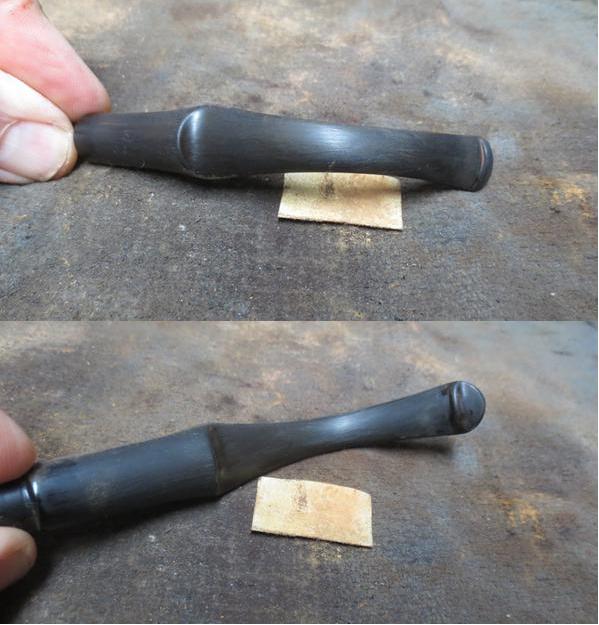
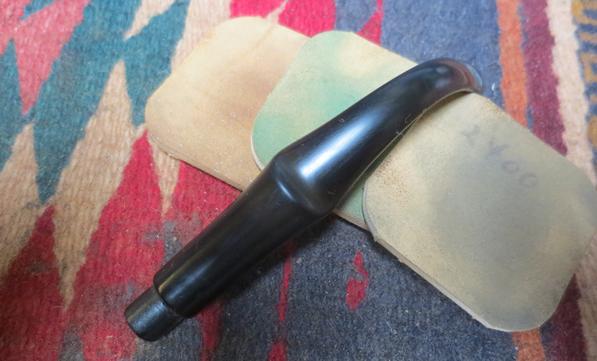
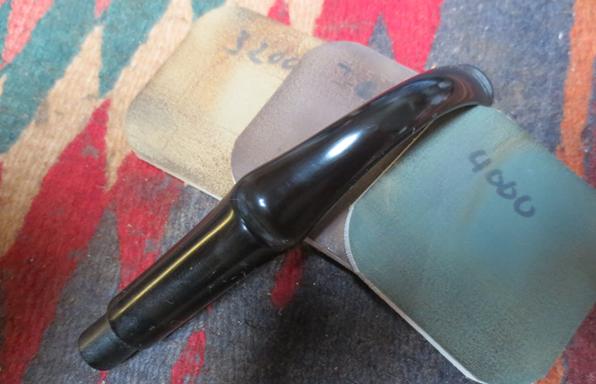
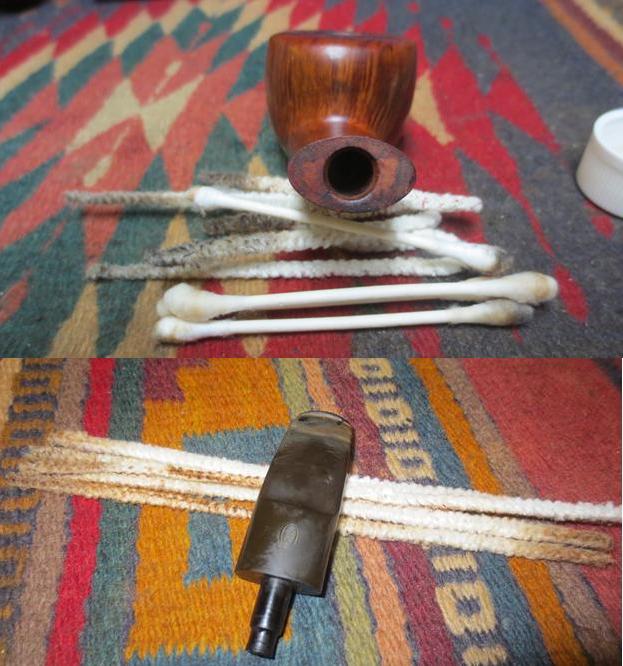
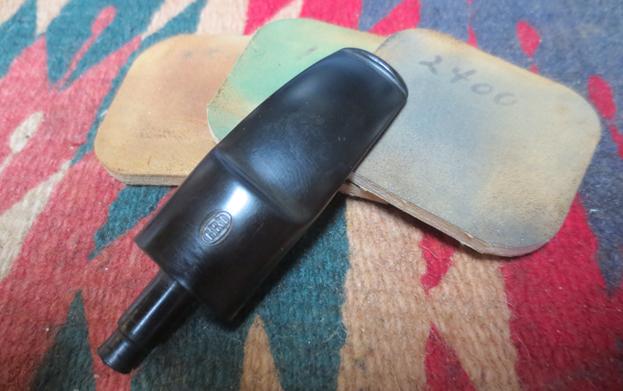
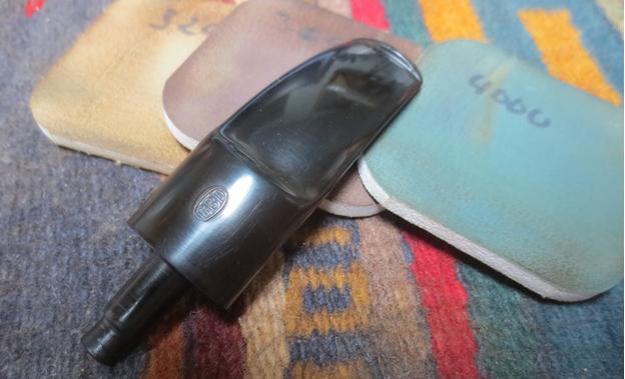
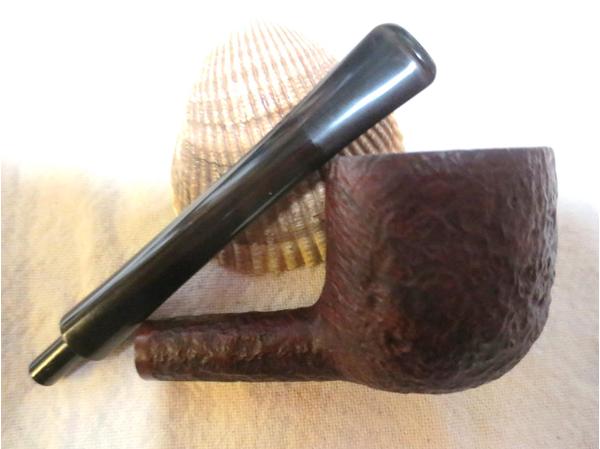
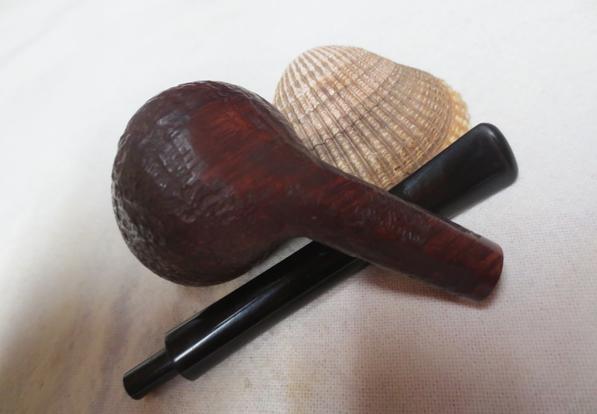
I have a lot of pipes to work on so making a decision which one to work on it a bit interesting. Several months ago now Steve in Dawson Creek sent me a box of pipes for restoration as allowed. He sent me a list of priorities regarding which pipes he wanted restored in the order of importance to him. So I decided to work on one of the pipes that he sent me for restoration. The next one on his list of priorities was a bulldog that was in pretty rough shape. It is stamped Gold Star on the left side of the shank and Giant on the right side. On the underside of the left side of the diamond shank it is the shape number 8597. I can’t much information about the brand. It is a bit of a mystery pipe but under the grime and the peeling finish there was nice looking grain. gold1The pipe was dirty and the finish was very rough. The varnish coat was peeling away. There was a large chip out of the ring on the right side of the bowl. The rim was darkened and caked under tars. The cake was thick and overflowing the bowl. The stem was oxidized and there were tooth marks on the top and underside of the stem next to the button.gold2I took a close up photo of the rim and the bowl to show you what I was working on in dealing with this pipe. The bowl was a mess. I also took close up photos of the stem to show the bite marks on the top and underside of the stem.gold3 gold4I reamed the bowl with a PipNet reamer and a Savinelli Pipe Knife to take the cake back to bare briar on the bowl walls. There was a lot of cake so it took some time. I used the largest cutting head and the cutting head just below that one.gold5I topped the bowl on a topping board with 220 grit sandpaper. I worked the rim against the sandpaper until the damaged bowl top was removed and the bowl was once again smooth and round.gold6I repaired the damaged portion of the ring around the bowl with briar dust and super glue. I mixed the two together and made putty and pressed it into the damaged area of the ring. In the photo below you can see the repaired area on the ring.gold6aI used the Dremel and sanding drum to remove the excess patch and sanded it back until it was smooth against the rest of the bowl.gold7I sanded it with 220 grit sandpaper until the ring blended in with the rest of the pipe. I used a hack saw blade to recut the grooves on each side of the ring repair. The photo below shows the recut grooves and the repaired ring. It still needs to be cleaned up but it is looking better.gold8I used a knife blade needle file to clean up the grooves. I was able to match the grooves on the rest of the bowl. I sanded the ring with 220 grit sandpaper.gold9I wiped the bowl down with acetone (fingernail polish remover) on cotton pads. I broke up the peeling varnish with sandpaper and wiped it down again.gold10I scraped the inside of the mortise with a dental spatula to remove the hardened tars. It scraped away all of the buildup and then I scrubbed it down with pipe cleaners, cotton swabs and alcohol until it was clean. I cleaned the airway in the stem until it was clean.gold11 gold12I sanded the tooth marks out the top and underside of the stem with 220 grit sandpaper until they were minimized.gold13I wet sanded the stem with 1500-2400 grit micromesh sanding pads to smooth out the scratches in the vulcanite.gold15I scrubbed the stem with Before & After Pipe Stem Deoxidizer to remove the oxidation. It took some elbow grease but I was able to remove all of the oxidation with the new product. I am starting to really like this stuff.gold14I polished the stem with the Before & After Pipe Polish using the fine and the extra fine polishing compound. I rubbed it on by hand using a finger and then scrubbed it off with a cotton pad until the polish was gone and the stem shone.gold16 gold17I stained the bowl with a medium brown aniline stain and flamed it to set it in the grain. I repeated the process until the stain was evenly spread on the bowl.gold18I buffed the bowl on the buffing wheel to see what the new stain coat looked like. I liked the new look of the old Gold Star Giant. What do you think?gold19 gold20I buffed the pipe and stem with Blue Diamond on the wheel to bring a shine to the bowl and gave it multiple coats of carnauba wax. I buffed it with a clean buffing pad and then with a microfibre cloth. The finished pipe is shown in the photos below. Steve, this one turned out to be another beauty. I am looking forward to hearing what you think about it once you get it back to Dawson Creek.gold21 gold22 gold23 gold24 gold25 gold26 gold27 gold28


A Relatively Easy Refurbishment on a Peterson’s Kinsale


Blog by Steve Laug

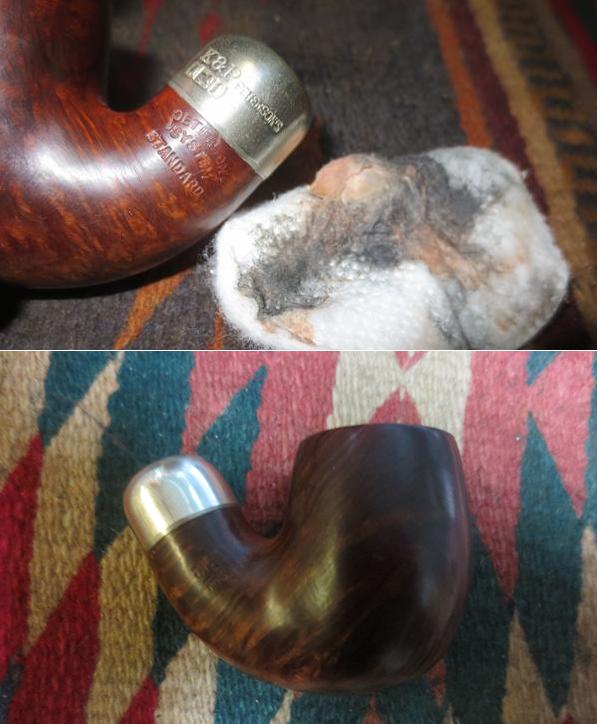
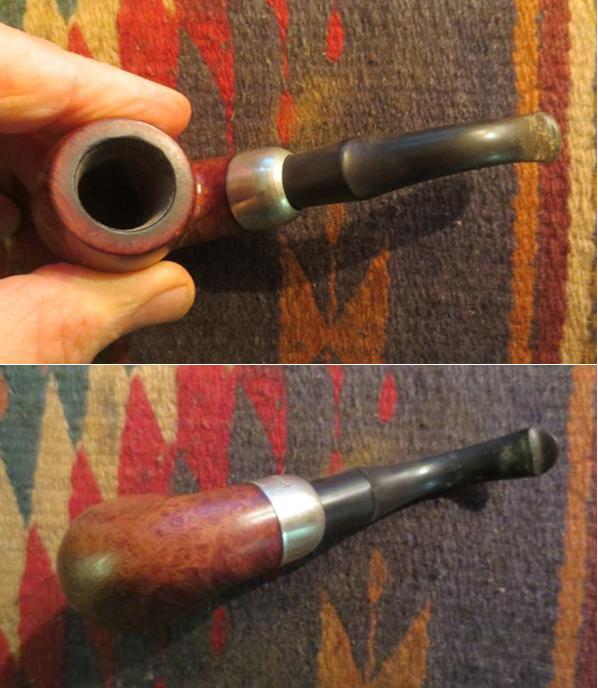
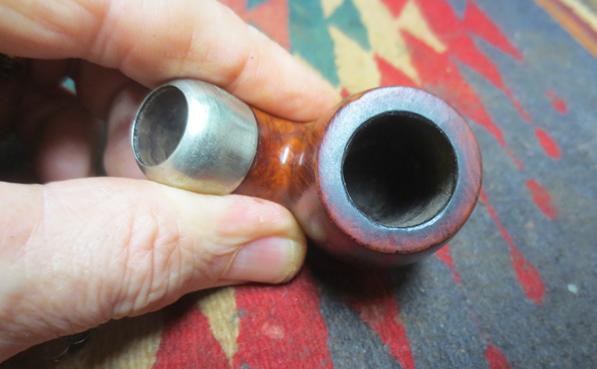
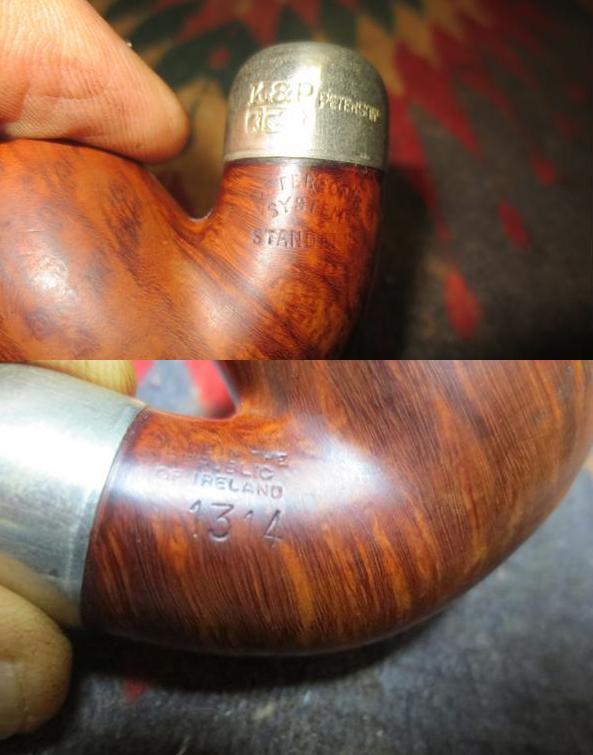
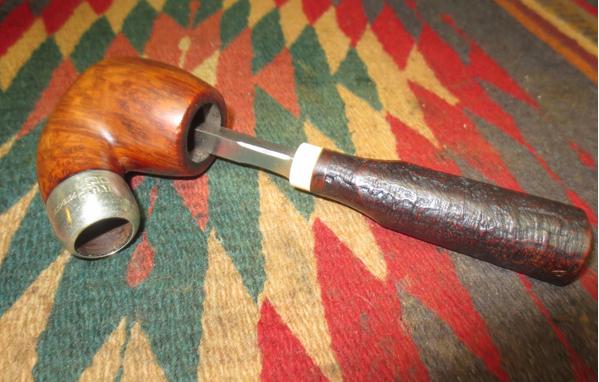
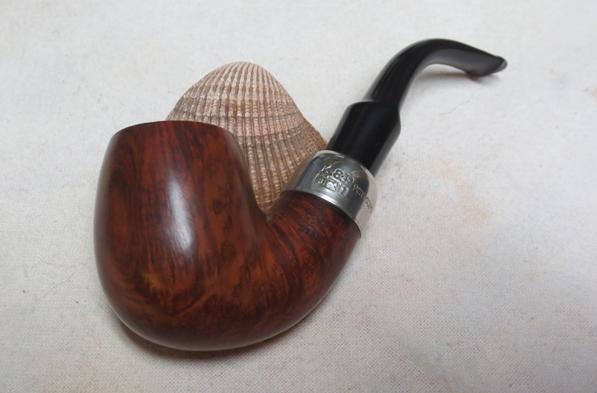
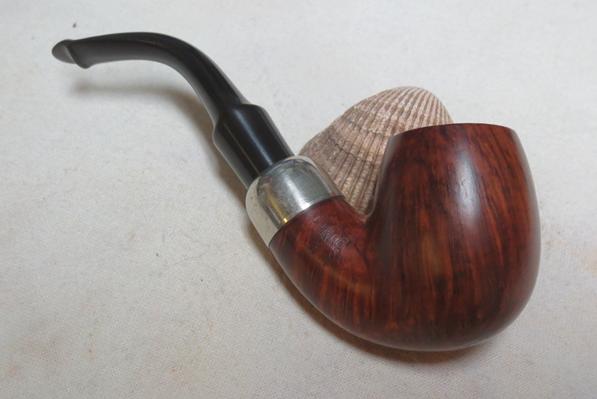
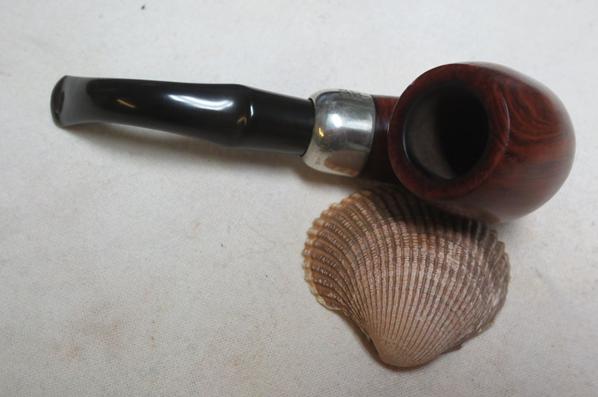
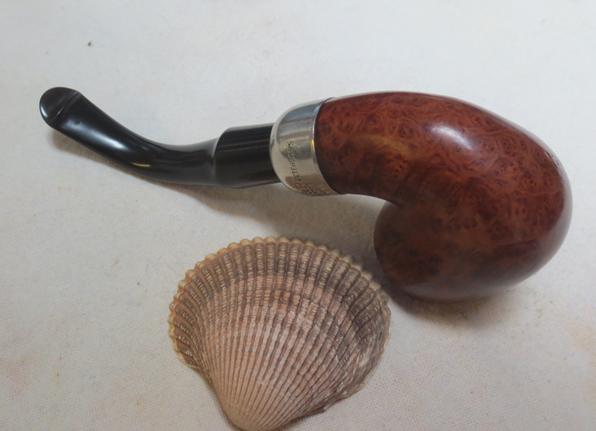
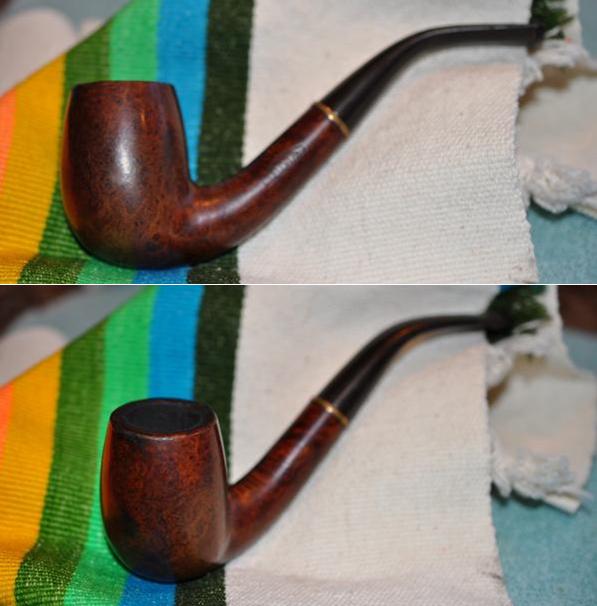
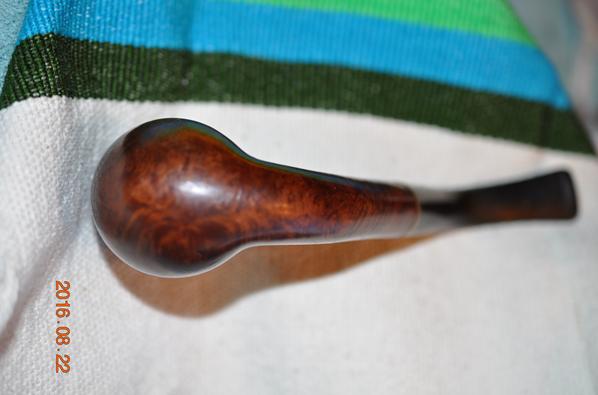
In going through the last box of pipes that my brother sent me I came across this beautiful Kinsale by Peterson’s. It is stamped on the top of the shank Peterson’s over Kinsale. On the underside of the shank it is stamped Made in the Republic of Ireland. The shank end has a band that is integral to the shank two bars of brass around a thicker bar of silver. The band was lightly oxidized. The finish had a shiny coat of varnish. The rim was dirty and some of the coat had bubbled a bit. The rest of the finish was in excellent shape. There was some beautiful grain poking through the finish. The stem had a Peterson’s P in gold on the top of the saddle. There was some oxidation around the saddle portion of the stem and there were tooth marks on the top and the underside of the stem near the p-lip button. There was a small tooth mark on top of the p-lip. My brother took the next two photos of the pipe before he cleaned it up.pete1He scrubbed the externals with Murphy’s Oil Soap and reamed and cleaned the internals. The bowl and stem were quite nice when it arrived here. I took the next photos to show the condition of the pipe when I started the work on it.pete2 pete3I took some closeup photos of the stamping on the pipe. The stamping was sharp and clear. It is very readable. You can also see that the P is quite distinct on the stem. The gold is still in place. This would be a great experiment for the new deoxidizer and polishing mixture I purchased.pete4I took close up photos of the stem as well to show the tooth marks and scrapes on to two sides of the stem ahead of the p-lip and on the p-lip itself.pete5I sanded the stem dents and heated them with a lighter to try to lift them. I was able to lift all of them on the underside and topside of the stem except for two. There was a tooth mark on the both sides next to the button.pete6I sanded the glue when it dried with 220 grit super glue and with 1500-4000 grit micromesh sanding pads. Once it was smooth I scrubbed the stem with the Before & After Stem Deoxidizer on cotton pads and was able to remove all of the oxidation. It took some elbow grease but the Deoxidizer removed the oxidation but not the P stamp on the stem top.pete7I used the Fine Before & After Pipe Polish to work over the stem. I scrubbed the stem with my finger. Applying the paste to the stem and scrubbing it into the surface. I wiped it down with a cotton pad. I followed that by polishing it with the Extra Fine Polish and did the same procedure.pete8I worked on the rim with micromesh sanding pads. I did not want to break the finish but to remove the bubbling and the buildup. I sanded it with 3200-12000 grit pads to polish it.pete9The finished pipe is shown in the photos below. I buffed it lightly with Blue Diamond and then gave it a light coat of wax. I buffed that to raise a shine on the bowl and protect and shine the stem. I polished the metal band with 8000-12000 grit micromesh sanding disks. It is truly a beautiful pipe and the shape and the shine look great. This is available now and will soon be on the store. If you are interested in it email me at slaug@uniserve.com or send me a message. Thanks for looking.pete10 pete11 pete12 pete13 pete14 pete15 pete16 pete17

Nice find in Plovdiv, Bulgaria – Denicotea Deluxe Curling Bruyere Extra


Blog by Dal Stanton

In my last post restoring the Jeantet Fleuron (Link), I mentioned my recent pipe hunting expeditions during our R&R travels in Bulgaria with our daughter and son-in-law visiting from Denver, Colorado.  Jordan, my son-in-law, is a blooming pipe man and was my eager accomplice as we dipped in and out of antique shops we found.  One of those ‘dips’ unfolded in one of the longest inhabited cities in Europe and the world (since 5000BC!) – Plovdiv, Bulgaria, which enabled me to land the Denicotea Deluxe Curling before me now.  Since my field shape identification skills are still in development, when I first saw the pipe in the display case, I thought it was from the Canadian family – the longish shank and the long saddle stem got my attention.  Since the antique shop was situated in Old Towne, Plovdiv, in the shadow of the historic Thracian settlement (to the Romans, they were the ‘Barbarians’) the lady with whom I negotiated was pretty tough – I assume because her overhead expenses were more due to her classic location!  So the deal we struck was not as good as I was hoping, but with new pipe in hand, I took these initial pictures outside the antique shop with ancient cobblestone as a backdrop.de1 de2 de3 de4After just finishing the Jeantet Fleuron and my research zeroing in on French pipe making mecca, Saint Claude, I was anxious to start my work on this Denicotea Deluxe Curling, a name also ‘claimed’ by Saint Claude, according to one of my sources in that research. Here’s where the confusion began.  The source, a pipe shop of Saint Claude, La Pipe Rit, stated on their home page:

On our website, you will find pipes from Saint Claude made by the most famous brands, such as EoleChacomBayard, Butz-ChoquinDenicoteaJeantet and Ropp. The works of Saint Claude’s craftsmen are also present, for example, the unique handmade pipes created by Pierre Morel. You will also discover pipes from all over the world through VauenBig Ben, DunhillL’anatraPetersonPorscheSavinelliStanwellViprati and meerschaum pipes as well.  (La Pipe Rit)

This blurb led me to the assumption that the name Denicotea was claimed by Saint Claude, but when I started my digging on the Denicotea Curling on Pipedia I found, what many of you already know, Denicotea is a German enterprise.  Pipedia says of Denicotea,

Brand founded in 1932 in Cologne, Germany, by Willy Heineberg. Denicotea is actually the name of a silica gel filter, cigarette holders and care products for pipes and cigarette holders. They also introduced the brands Aldo Morelli, Adsorba, Wessex. (Link)

Pipephil confirms this information and adds that pipes were also manufactured by an English third party and marketed under the Denicotea brand. (Link).

So, at this point in my research I’m wondering what the French connection is – assuming that both sources were correct?  I dug a lot (learned a lot too!) looking at Pipedia and other sources seeking to confirm another ‘sighting’ of the name Denicotea in Saint Claude but found none.  The most plausible hypothesis that I was cultivating was that perhaps Willy Heineberg, who was born actually in Metz, France, had connections with Saint Claude before moving across the Rhine River into Germany (Metz and Cologne are relatively close) to establish the Denicotea operation.  I discovered that Willy Heineberg was born a Frenchman (though his surname appears to be of a German-Jewish lineage – see: Link) when I unearthed an interesting letter he wrote on July 31, 1951, to the director of the CIA, General Walter Bedell Smith, seeking help for the rebuilding of a French village raised by the Nazis during WWII – Saint-Die’.  Heineberg references in this letter that he was born in Metz, France, nearby Saint-Die’ and therefore wanted to help his compatriots.  At the time of writing, his letterhead placed him in NYC on 41 Park Avenue – the tobacco business must have been going well! (See the letter here: Link – in the letter he references at least one other tobacco mogul of RJ Reynolds along with other ‘who’s who’ of his day)

My research on Denicotea pipes was not terribly fruitful – one mostly finds information about their filter and accessory lines of production.  Notwithstanding, I’m looking at this Denicotea, not from Saint-Claude, yet very handsome and I’m attracted to the long saddle stem of this classic billiard – my revised shape identification.  On the left side of the shank is an arched Denicotea over De Luxe.  The right side is Curling over Bruyere Extra.  A shape number is pressed on the bottom of the shank which I believe is 118 or possibly 119 – not sure.  The saddle stem has a very faint, warn stamped D ensconced in a circle.  I hope to bring this fading stamp back from the edge of oblivion with some acrylic paint applied – we’ll see if there’s enough imprint to hold the paint.  The bowl is in good shape with some minor nicks and scrapes on the bottom.  There is some crusty cake build up in the fire chamber and the rim has some nicks and lava flow on it but it appears minor and in good shape.  The stem has significant oxidation but very little tooth chatter to worry about.  I take some additional pictures on my work table after returning home to Sofia.de5 de6 de7 de8de9I remove the stem and deliver it to the Oxi-clean bath to begin raising the oxidation from the vulcanite stem.  When I remove the stem and examine the mortise, I’m not sure what I see.  Has the tenon become dislodged from the stem and now unceremoniously implanted in the mortise or does this pipe by design have a vulcanite filter extension coming out of the mortise?  I also see what appears to be an old used filter jammed pretty snuggly in the mortise and I cannot remove it with my fingernails.  I also try to remove it with tweezers and after scraping at it a bit, I discover that what I thought was an old used filter is metal – I haven’t seen anything like this before.  It appears to have an airway slot on the lower portion of the metal ‘insert’. After trying unsuccessfully to pull the metal object out with my fingernails and gently trying to coax it out with my Buck knife, I decide to dip the mortise end in alcohol hopefully to loosen things up. After some careful prying so as to not damage the vulcanite ‘tenon’ in the mortise, what emerged was not anything I was expecting.  I have no idea what kind of internal stinger contraption I’m looking at.  After I clean it up the only thing I can think of is some clever internal stinger system that Denicotea came up with seeking that ever elusive cooler, dryer smoking experience.  I’m still not sure if the tenon has dislodged from the stem and is stuck in the mortise or if what I’m looking at is by design. de10 de11Taking my questions back to the internet, it didn’t take long to figure things out.  Pipephil’s entry for Denicotea (Link) has a picture showing a shape almost identical to the Curling and the mortise has the same vulcanite insert.  When I Googled for images, I saw other Curling styles with the same design.  With one particular entry from eBay, the metal insert I dislodged looks very familiar to the object in the Denicotea advertisement pictured below – it appears to be part of a filtration system which wedges up against an elongated filter of sorts that fits in the broad/long stem.  The very next thought that came to mind was that I hadn’t thought to look into the stem for a filter before dropping it into the Oxy-clean bath!  I’m not sure what I will do with the insert, but it does appear to serve as an air restrictor that would be helpful for use without a filter.  Any feedback on this would be appreciated! de12 de13With the object removed, I take my new Savinelli pipe knife to ream the bowl on my 10th floor balcony ‘Man Cave’.  This is where I’m able to smoke my pipes (door sealed) with my wife’s blessings.  With it being a beautiful fall day in Bulgaria, I’m happy to work there.  I can see why Steve enjoys using his Savinelli pipe knife – it takes the cake off very well and allows for a more delicate and selective approach when needed.  After reaming, I use 240 grit paper and clean and smooth the chamber walls further.  I like to work on clean pipes so I take pipe cleaners and Q-tips dipped in isopropyl 95% and go to work on the internals of the stummel.  After several Q-tips the mortise was not coming clean.  With Q-tips I detect an internal ridge inside the mortise created by the vulcanite inserted to the mortise.  I’m thinking that this design is a natural gunk collector which makes cleaning more of an on-going challenge.  I decide to hold off on more Q-tips and try the salt and alcohol technique I’ve read in other blogs (See at DadsPipes).  I use ‘all natural’ non-iodized Himalayan salt that I can find on the store shelves in Bulgaria. Why non-iodized?  I asked Charles Lemon at DadsPipes, why he used kosher salt?  His reply was that it was not ionized – that the ionization could leave an iodine taste when smoking the pipe.  I twist an unraveled cotton ball into the mortise to plug up that end.  I stabilize the stummel on the pipe stand and fill the bowl with salt.  Then I carefully add alcohol 95% to the bowl until I see it emerge at the top layer of salt.  It’s getting late so I let it soak overnight. de14 de15While the salt and alcohol does its thing, I fish the saddle stem out of the Oxy-clean bath.  My first instinct is to look down the throat of the stem to see if a long Denicotea stem filter is lying in wait.  To my chagrin, it is.  I take pictures to commemorate my discovery and then begin to wet sand the stem’s oxidation with 60 grit paper then with 000 steel wool.  I’m careful to avoid the stamped ‘D’ area of the stem, but when I look at the area of the D stamp my concern grows because it looks like the Oxi-clean bath itself caused some further deterioration.  I now realize that I should have covered the area with Vaseline to protect it…. learning one mistake at a time….  The oxidation on the stem has been minimized and I take pictures to show the progress.  Turning to the lodged stem filter, I use a dental probe to pull up on the filter while pushing from the button end with a pipe cleaner.  The surgery is successful and what looks like a charcoal filter emerges from the long saddle stem.  An economic theory starts forming in my mind about Denicotea pipes – could they be designed, produced and exist primarily for the filters Denicotea produces?  It makes economic sense.  A pipe is sold once and its profit is finite.  While filters made for that pipe are a continuous revenue stream.  Could my theory hold water? de16 de17With stem free of old filters, I clean the airway up with Q-tips and pipe cleaners dipped in isopropyl 95%.  After using a few Q-tips I simply rolled large cotton ball pieces to clean the inside of the large stem using tweezers.  It did not take long.de18 de19The next day I dump the salt out of the bowl and wipe out the bowl with a paper towel to remove any left-over salt residue.  I returned to the Q-tip therapy to find out if the salt/alcohol soak had an impact on the gunk in the shank.  I discover residue so I expend several more Q-tips but finally get to the bottom of the gunk build-up in the shank and turn to the external bowl clean up.  To clean up the lava flow on the rim and the bowl surface I use Murphy Oil Soap undiluted with a cotton pad.  After the Murphy Oil Soap scrub I rinse the stummel with cool tap water careful not to allow water into the mortise or bowl.  The rim and bowl cleaned up nicely allowing me to see more clearly the wood and problem areas.  The rim has a burn mark just over the shank junction.  It looks like the previous owner drew the flame over the back side of the rim when lighting the tobacco.  I used a brass brush, which will not scratch the briar, with alcohol on that spot to see if it would remove the burn but it did not.  As I work on the burn, I see that it has burned ‘into’ the rim as well and because of this the inner bowl rim is slightly out of round – I need to correct this.  The stummel is showing attractive fire grain and some birds eye – I like the potential.  With a close inspection of the finish, I detect some blotches and what I call ‘candy apple shine’ spots.  The finish is worn.  I decide to remove it to get down to the bare briar.  I use cotton pads with acetone to do the job.  After removing the finish, I cut a slight bevel on the inner rim to regain round and remove the burn damage.  I use 120 grit paper rolled up tightly for the initial bevel followed by 240 then 600 to smooth it. I take pictures to show the progress, and yes, the picture below is ‘Acetone’ in Cyrillic!de20 de21 de22 de23To remove the light nicks and cuts on the stummel I use a medium grade sanding sponge and follow with a fine grade sanding sponge.  I then take a cotton pad with alcohol and wipe down the stummel to clean it from the sponge sanding residue.  I do this to take a closer look at the surface for fills or blemishes that need attention before I move on to the micro-mesh sanding.  I do find some pitting on the surface that I address with sanding sponges directly. I rejoin stummel and stem to assess the progress.  After taking a close up look at the stem after purging the oxidation with an Oxi-clean bath and sanding, I see no teeth chatter that needs to be addressed.  I also take another look at the Denicotea circle-D stamp on the stem to see if it can be salvaged.  Unfortunately, only the right portion of the circle is barely viable along with a very faint D.  Applying acrylic paint would only highlight the fact that it’s not all there, so I decide to finish the stem trying to salvage the remnant stamp as is.de24 de25 de26Using micro-mesh pads 1500-2400, I wet sand the stem attached to the stummel and follow by applying Obsidian Oil. With pads 3200 to 4000, then 6000 to 12000, I dry sand the stem and apply Obsidian Oil after each set of 3.  I never tire watching the shine make an appearance during the micromesh process!  I take pictures to show the progress and set the stem aside to dry.de27 de28 de29Turning to the bowl, I begin preparing the surface finish by wet sanding using micromesh pads 1500 to 2400 followed by dry sanding with micromesh pads 3200-4000 and 6000-12000.  I’m liking very much the briar’s grain movement on this bowl.  I document the progress at each step.de30 de31 de32I started this restoration with the idea of experimenting with a staining technique I read in one of Steve’s restores – I’m not sure which one as I’ve read so many!  He used a black dye followed by a rub down with alcohol.  The purpose was to set the dark hue in the veins of the grain and then lighten the backdrop briar – Steve didn’t describe it quite like this but this is what recorded in my memory!  He then followed with another die hue to cast the contrast. I would like to try the same by first setting the dark hue with a dark walnut Italian aniline stain I found here.  I will follow this with a new arrival with my daughter and son-in-law from the States, Fiebing’s Oxblood Leather Dye.  I’m looking for the rich, deep reddish, burgundy hues in the briar that hopefully is subtle – I like this classic look even though it would be a total change in the color scheme of this Denicotea billiard, I hope it will dress it up nicely.  I give the stummel a quick wipe down with a cotton pad and alcohol to rid the surface of any possible residue leftover from the micromesh sanding.  I mount the inverted corked stummel on the candle stick holder and decide to try another technique I read recently from one of Steve’s postings of warming the briar first before applying the stain.  I do this with an air gun then, after putting on throw-away poly vinyl gloves, with a cotton dauber I apply the dark walnut dye generously to the inverted bottom and allow the die to saturate the stummel. I pick up the candle stick and rotate the stummel and make sure I daub die into the inverted rim.  After the surface is adequately covered I ‘flame’ the surface by lighting the wet dye with a butane lighter.  The alcohol in the die burns off very quickly to set the hue in the briar. I follow by wiping the stummel surface with alcohol and cotton pads to lighten and blend the initial dark walnut stain.  I repeat the process with Fiebing’s Oxblood Leather Dye diluted about ¼ with alcohol.  I complete the second application by flaming the dye which sets the oxblood over the dark walnut hue in the briar.  After taking pictures to show progress, I put the stummel aside allowing the stain to rest overnight.  I look forward to seeing how my experiment turns out when I return to the project tomorrow!de33 de34 de35I really enjoy witnessing the initial revelation of the briar surface after the staining process.  This pipe was no exception.  I take my compact Dremel tool (a wonderful friend when workshop space in not available!) with a felt wheel and apply Tripoli to the final flamed Oxblood surface I completed the night before.  I use the lowest speed and do not apply a great deal of pressure to the felt wheel as I consistently move it over the stummel surface.  I allow the speed of the wheel and the compound to do the work.  The briar is emerging as I buff with the Tripoli.  I love the mosaic of grain design that emerges as I work over the stummel surface.  I follow the Tripoli compound with Blue Diamond, also using a felt wheel with the Dremel speed set to the lowest RPM.  After completing the Blue Diamond, I attach a cotton cloth wheel to the Dremel and increase the speed by one number and apply several applications of carnauba wax to both stummel and the rejoined saddle stem.  Through trial and error, I’ve been able to develop a technique for applying the compounds and carnauba wax that works well for me – in my compact 10th floor work station.  Under a bright light, with the sheen of the stummel surface my focus, I am able to see the application of the compound and how it disburses over the briar with the different wheels.  I am able to identify compound or wax that hasn’t integrated into the surface – it appears as a thick ripple, and I’m able to revisit it with the wheel rotation to work in more thoroughly what has been ‘left-behind’.  This works especially well with the carnauba wax which disburses with the heat of the wheel’s rotation.  I can see the wax liquefy and am able to spread it over a portion of the surface.  After applying several applications of carnauba wax, I Dremel buff the entire stem and stummel surface with a clean cotton wheel and complete the process with a rigorous hand-buff with a clean microfiber cloth to raise the shine more.

I am thoroughly pleased with the rich, deep hues the stains contributed to the beautiful briar grain of this Denicotea DeLuxe Curling Bruyere Extra.  I’m not sure the pictures below capture the depth of grain that I can appreciate with the naked eye.  The color and the shape bring to mind what could be a pleasing match for a classic smoking jacket one might see donned by the Earl of Grantham, Robert Crawley, as he retires to the smoking room at Downton Abbey.  ‘Classic’ is the one word that keeps coming to mind about this pipe!  One question that remains for me is what to do with the internals of the filtration system – any thoughts on that would be appreciated.  As I shared with my last post, my wife has lovingly put her foot down! This pipe will reluctantly head to eBay or, if you have an interest in adding this classic shape to your collection, let me know.  Thanks for joining me!de36 de37 de38 de39 de40 de41 de42 de43 de44

A Heibe Filter Bruyere Extra 1132 Churchwarden Made in West Germany


Blog by Steve Laug

Looking at the stamping on this older churchwarden pipe I can distinguish HEI__ on the left side of the shank over FILTER. From what I can see looking at it under a bright light with a lens it looks to me like the stamping is HEIBE. On the right side of the shank it is stamped Bruyere over Extra. On the underside of the shank it is stamped Made in West Germany followed by the number 1132. The pipe is 10 ½ inches long and the bowl is 2 inches tall. The diameter of the chamber is 5/8 inches. The finish was in decent shape with some scratching and the pipe is dirty. The rim was damaged and the bowl had a burn mark on the inside edge of the inner rim. The bowl was out of round and the top of the bowl was also damaged. The stem was oxidized and the pipe smelled foul. The next series of photos with the granite/marble counter top were taken by the eBay seller and show the overall state of the pipe.h1According to Pipedia, Heibe pipes were made by the company of the same name, owned in turn by Erich Heikaus, KG, in Bergneustadt, Germany. The trademark for the Heibe name was first filed on March 9, 1966 and registered on January 14, 1967. The sole trademarked line name of Heibe is the Heibe Goldpoint, which was applied for in 1970 and granted on May 31, 1972. Pipes have been seen stamped both “Germany” and “West Germany”, showing that the Heibe Company continued to make pipes after 1990, but these pipes appear to no longer be in production. https://pipedia.org/wiki/Heibe h2 h3The next photos are close ups of the pipe. They show the condition of the rim and the grain around the sides of the bowl.h4 h5My brother reamed the bowl cleaned up and scrubbed the exterior of the bowl and stem. He took some photos of the pipe after he cleaned it. h6The next photos show the stamping on the pipe. The first one shows the underside of the shank with the shape number and West Germany. The left side shows the brand over the word Filter. The right side shows the name Bruyere Extra.h7 h8 h9The next two photos show the beautiful grain on this pipe. The spots and streak on the second photo were just grime on the pipe. When I received it those were gone.h10 h11The next photo shows the damage to the rim top. There outer edge shows damage and the inner edge bevel is rough and looks like it did not belong originally. There is clearly a burn mark at the back side of the inner rim. There are a lot of dings and dents on the rim edge.h12When the pipe arrived in Vancouver I took the next four photos to show what it looked like before I started on it. My brother did a great job cleaning up the surface of the bowl. He was able to scrub off the finish and the grain just pops.h13 h14The next photo shows the rim after my brother cleaned it up. The dents and dings on the out edge are visible. The burn mark at the back of the inner rim is very clear. It is not deep but it is present. The bowl will need to be topped.h15I topped the bowl on the topping board with 220 grit sandpaper. It took some time to remove the inner rim damage. I sanded and checked constantly to make sure I did not sand too far. The second photo shows the topped bowl and the cleaned rim edge.h17I sanded the inside of the bowl with the rolled sandpaper to smooth out the inner edge of the bowl. The second photo below shows the fresh edge of the bowl.h18I sanded the rim top with 1500-4000 grit micromesh sanding disks until the scratches were gone. I restained the rim with a dark brown stain pen to blend it into the colour of the bowl. h19I cleaned out the mortise and airway in the shank with cotton swabs, pipe cleaners and alcohol. It appears that the bowl was dip stained as the cotton swabs came out with a red stain and no tars or oils. I cleaned the stem with pipe cleaners with and alcohol.h20I used my new micromesh sanding pads on the stem and it made short work of removing the oxidation. I forget how quickly new micromesh pads remove oxidation and polish the vulcanite. I sanded it with 1500-12000 grit sanding pads – wet sanding with 1500-2400 and dry sanding with 3200-12000 grit pads. I rubbed the stem down with Obsidian Oil after each set of three pads. I set the stem aside to dry after the last rub down.h21 h22 h23I buffed the bowl and stem with Blue Diamond on the buffing wheel to polish the scratches. It always amazes me how much different the pipe looks after buffing. I buffed it with several coats of carnauba wax to protect the vulcanite and bowl. I buffed it with a clean buffing pad to raise the shine and then by hand with a microfibre cloth to add depth. The photos below show the new restored German Churchwarden. It is a beauty. Thanks for looking.h24 h25 h26 h27 h28 h29 h30

Annals of Pipe Crimes: The 42-Minute Meerschaum Job


Robert M. Boughton

Member, International Society of Codgers
Member, North American Society of Pipe Collectors
Member, Facebook Gentlemen’s Pipe Smoking Society
http://www.roadrunnerpipes21.biz (under construction)
http://about.me/boughtonrobert

Photos © the Author except as noted

Wisely and slow. They stumble that run fast.
— William Shakespeare (1564-1616), English playwright and poet, in Romeo and Juliet, Act. 2, Sc. 3

INTRODUCTION
Let me begin by apologizing in advance for the end results of this over-fast cleaning job I insisted on undertaking, at no charge, for a schizophrenic friend.  Now, having admitted I was a party to the injustice perpetrated against a certain meerschaum pipe with potential for a far more beautiful future, I must beg mitigating circumstances that in this case call for an affirmative defense, which shall be made apparent.

My friend, Fred (not his real name), who can by no means be described as an aficionado of pipes, on several occasions remarked that his father used to collect them.  I noted the past tense in my mind while keeping my mouth shut, as my own father often urged me to do.  A couple of months ago I sold Fred a Guildhall London Pipe straight pot (a Comoy’s second) for $10.  He was so excited by my box of restored pipes, the way a kid looks through a store window at a shiny toy he wants, that I could not help myself.  I also happened to need gas or I might have had to walk home.  But the deal was not all about money; I had a nice no-name that would have left my challenged friend, and almost anyone else, just as happy.

Still, to my perception, the Guildhall suited him better, and when he asked for my advice I replied in good faith.  I put considerable work into making that vintage pipe shine again.  Looking back at the two-year-old blog, I see where I now could remove the tooth chatter altogether.  Still, compared to the horror with which I started, the straight pot was like new.meera meerbAnd so, the stories I started hearing from my guileless friend were disturbing.  You see, the anti-psychotic cocktail some head-shrinker prescribed to Fred caused permanent tics and muscle spasms, as well as other occasional unpleasant side effects.

That easy observation explained, at least to me, Fred’s blunt disclosure one day that he bit off the mouthpiece.  Despite my sincere offer to seek out a replacement for the bitten bit, Fred declined with vehemence, insisting that it worked just fine even though he had some trouble keeping it between his lips.  With that mental image, I confess to having some difficulty keeping a straight face.  Somehow I managed to sit back and return his wide-eyed gaze with a clinical stare any psychoanalyst would envy (irony intended).

Then, not long after the bite reflex account, Fred blurted to me that he had lost the remainder of the bit.  It had just disappeared while he was vacuuming and was nowhere to be found.  He said he looked everywhere for the gnawed scrap of Vulcanite – my description, not his – and that it had vanished without a trace.  When I asked if he checked the vacuum bag, the look on his face was unnerving, but my considerable first-hand experience dealing with schizophrenics, some in my own family, served me well once more.  Fred’s eyes narrowed, perhaps seeking to discern if I were as crazy as he or only joking.  My relief when he at last grinned, his entire expression returning to its normal manic happy face, was intense.  He never answered my question.

And so I pressed on, bent on sparking a connection between two or more of his synapses, by asking if he remembered where he was when he last saw the pipe whole, meaning more or less.

“It was right there,” he said as his arm pointed off into thin air, having an apparent vision of the place he meant that I was sure I would never share.  But he continued, thank God.  Part of me needed to know.  This, no doubt, is where the offhand claim that insanity is contagious comes from.  “It was right there, on the shelf, where I always put it.  I remember I took the stem out and put both parts there on the shelf, in case one of them fell or something, they wouldn’t both get broke.”

I had to give a genuine nod of my head to that logic.  My senses returning, I assured Fred the bit had to be there, somewhere, that it didn’t get up and walk out the door.  He gave me a good smile at that.   I advised Fred to keep looking everywhere the bit could not possibly be.  I even tried to explain the famous Sherlock Holmes maxim from “The Sign of Four” and suggested a few possibilities, including the refrigerator and freezer.  When that look started to reappear, I changed the subject, as I will do again now.

The long and short of it is that Fred’s dad did have an impressive collection of pipes, until he passed away at an advanced age of non-tobacco-related reasons.  At that point, the collection was distributed according to the man’s final wishes.  Fred’s share included three and a half very nice pieces: an uncommon rustic Dublin Everyman stummel, being another Comoy’s second related to Fred’s Guildhall; a Thompson cherry wood, both the shape and material, from the Elbert Gubbels stable; an easy bent Author, stamped on the bottom of the shank Made in London above England, and after at least an hour of scrutiny through my jeweler’s magnifier lenses, the shape number 140; and the amazing meerschaum to which this account will soon come.  [I was sure the unknown #140 was another Comoy’s until I sniffed it out online, listed as a Masta Author.  Masta was an English maker founded about 1900 that was bought by Parker-Hardcastle in 1967.]

And now I will explain the slight problem.  Fred was happy to let me take the Everyman stummel, Thompson and Masta the night he showed them to me, with my promise to pay him an amount upon which we agreed.  He was, however, obdurate, as only someone with schizophrenia can be, in his apparent lack of trust in my able care to take the meerschaum pipe home with me where I could give it the attention it so needed.  His mind was set like the steel trap my own used to be.  He was in earnest, would not equivocate or retreat a single inch, to paraphrase the American abolitionist William Lloyd Garrison.  If only I could have explained that quote to Fred, I might have made him understand the extreme hard place he put me in.

Fred, to make it clear, did not care if I left the pipe in the filthy, scratched condition it was in.  It was the single gift from his beloved father that he had – with very good taste and judgment – chosen to keep for his own, and he was not about to let it out of his sight.  As a result, my only option was to perform a half-assed crash job on the meerschaum, with its ample smoothness, spare but intricate carving and lovely patina, right there at the club (not for pipe smokers but also not against them) where we sat beside each other.  And he had a bus to catch in a little more than an hour.  I fixed that by offering him a ride home.

Here is the elegant meerschaum as I first saw it.meer1 meer2 meer3 meer4 meer5 meer6 meer7RESTORATION
Note the grime, extensive scratches, rim burn, dirty chamber with tobacco of an unknown vintage still inside, and of course the bit that was in utter ruin.  I even had an almost identical replacement that I could use for it, but not without refitting.  And then there was the fresh coat of beeswax I would have liked to add for the perfect completion of the proper repair.  But as Fred would have none of that, and time was of the essence as he had important business to conduct – watching TV back in his tiny studio apartment – before I might never see the pipe again, I was lucky to have a box with my primary implements of restoration with me in the trunk of my Ford SDX.

I began with the vigorous applications of purified water on the stummel, using small cotton gun cleaning squares to remove layers of ancient dirt, and then resorted to a very small amount of diluted Everclear.  The second photo below shows the need for the alcohol.meer8meer9Superfine “0000” steel wool on the rim did much but not enough there.  A progression of 150-, 180- and 320-grit sandpaper cleared out the excess char in the chamber and made it smooth.meer10Again, with cotton balls soaked in more purified water, I scoured the outer stummel, and used pipe cleaners and freshener to clear out as much of the crud and filth inside the shank.meer11Other than spot buffing with the “0000” again, that was all I could do for the meerschaum.  I took the awful bit in hand and used the full wet micro mesh treatment on it from 1500-12000.meer12 meer13 meer14I coated the bit with a dab of Halcyon II wax, let it sit, and worked it in with a thick cotton cloth.  As for the weird obelisk-like piece of meerschaum marked Hirsch, I doubted at the time that it was part of the pipe but knew it could be a crazy lid of some sort.  Steve supported my hunch of the likelihood that it was not part of the pipe.  He surmised it might have been used with cork around it as a fancy wine bottle stopper or to plug something else.  I buy that!  But I took the last two shots before I received Steve’s sage input, and by then, the pipe was forever out of my control.

I found the actual Kirsch brand records online with last-minute research.  The Trademark was first recorded on January 1, 1907 and is now owned by Newell Window Furnishings Inc., a subsidiary of Newell Rubbermaid Inc.  The business suppliers fine home design goods using an assortment of exotic materials, including meerschaum.

For better or worse, here is the result.  I based the time spent on this rush-job at 42 minutes from the date and time stamps on photo number 8, showing the beginning of the cleaning with purified water at 18:07, to photo number 14, with the bit finished at 18:49.

meer15 meer16 meer17 meer18 meer19 meer20 meer21 meer22CONCLUSION
The last time I saw Fred was when I dropped him off at his apartment, the precious meerschaum wrapped in a piece of terry cloth and stowed in a box tucked with great protection in the crook of an arm.  Earlier that night, he was rushing about the club, sweating, his blood pressure elevated even to the average observer, anxious and agitated, and seeming to have some trouble swallowing.  All of these are signs of serious adverse effects to anti-psychotics.  I have not seen him since then and am, for good reason, somewhat worried.

Every time Fred speaks of his father, it is with a sadness that is far greater than that which he feels for the man’s passing.  As the former long-time caregiver to another friend, who was also my roommate for a month short of 15 years, I saw the tension that the mental illness of a family member causes.  Families, in particular the parents, will alienate one of their own who is infirm in a physical or mental way.  Like other, so-called lower forms of animals, they push from the nest those who are born with any weakness, for many reasons: fear, shame, powerlessness to correct the problem, to name a few, but more than anything else, an unbearable sense of guilt.

But the true bearer of these feelings is the blameless victim of whatever handicap befell him.  The worst part of this age-old denial of the basic humanity of those who are sick, however their diseases may be manifested, is the belief that is instilled in them from birth that they are somehow bad for reasons they do not understand, guilty in ways they are unable to comprehend, and more or less worthless.  As in Fred’s case, they try to hide the self-loathing that consumes them with “inappropriate” outbursts such as laughing or trying to joke in an attempt to alleviate the unhappiness they sense in those who are dearest to them.

All of this is the cause of the true sadness I sense in Fred.  I’m sure he never had a chance to make peace with his father; to say goodbye, even to visit him in the hospital or the home in which he was raised.

Instead of these memories, I try to recall the utter joy on Fred’s face when I had snapped the final shots of the improved meerschaum and handed it to him by the less-than-perfect bit.  I told him he should try to avoid handling the porous meerschaum with his bare hands, grasping instead the bit where it pushed into the shank with a firm fit, or using a handkerchief maybe on the bottom of the bowl.

Fred nodded his head up and down in wondrous agreement, taking in little of what I said, I’m sure.  His eyes were wide open with the appreciation all humans have for works of art.

SOURCES
https://rebornpipes.com/2014/10/09/the-guildhall-london-pipe-large-pot-an-account-of-extreme-abuse-robert-m-boughton/
https://trademarks.justia.com/715/83/kirsch-71583153.html

I love Savinelli Tortuga Pipes & the Tortoise Shell Lucite Stem


Blog by Steve Laug

The Savinelli Tortuga line is an interesting looking line of pipes. It comes with a tortoise shell Lucite stem that has an amber looking stem. The mottled browns, golds and yellows of the stem shimmer in the light when they are polished. The pipes are aptly named for the look of an animal they convey. Tortuga is the Spanish or Catalan word for Tortoise and it shows in the design of these striking pipes. The pipe that I am working on at the moment is one of those beauties. It is stamped Savinelli over Tortuga on the left side of the shank and on the right it is stamped with a Savinelli Shield followed by the shape number 114KS over Italy. In the photos from the eBay seller the pipe appeared to be in decent shape. The finish was darkened with grime and the rim had some darkening and tars on the top but the inner and outer edges of the bowl appeared to be in great shape. There was a light cake in the bowl. The stem looked good as well (what could be seen in the photos as they were cut off at the button). There appeared to be a stamp of some sort on top of the stem. I assumed that it was the standard Savinelli S shield. From the pictures it appeared that the tenon was white. Over all, the pipe looked to be in decent shape and since the pipes are now discontinued they are no longer available.tort1Each briar of this series sported not only a tortoiseshell-patterned stem, but also a domed, shell-like cap with a foam-rubber stopper. The purpose of the stopper was to preserve an unfinished smoke which one wishes to pick up again to finish later The domed lid on this bowl had long since disappeared with this pipe. In fact I have never seen one over the many I have cleaned up that came with the matching lid. I found a picture on the web that showed the pipe with a lid on the bowl.tort2My brother cleaned up the externals and did a light cleaning on the internals of the pipe. He was able to remove the grime in the finish and broke through the light varnish coat on the bowl. When it arrived in Vancouver it was in decent shape. The finish appeared a bit mottled from the cleaning but the rim was very clean. The bowl had been reamed and cleaned. The stem looked good but had some light tooth chatter at the button on the top and underside. The Savinelli logo of the S within the shield was stamped on the top of the saddle stem in gold. It was in great shape. When I removed the stem I saw that it was set up the Savinelli unique 6mm filter system. In the shank/stem a bore of 6mm was drilled to hold a triangular piece of balsa wood. This lightweight piece of wood is extremely porous and absorbs tar and nicotine from the smoke. The tenon was white Delrin. The tenon was stained, but otherwise clean.tort3 tort4I took some close up photos of the rim and the stem to show the condition. This pipe was in excellent shape other than wear and tear to the finish. The stem shows the light tooth chatter in the photos below.tort5I started my work by removing the rest of the varnish coat and the spotty top finish on the bowl. I wiped it down with acetone on cotton pads and was able to smooth out the finish. The nice oxblood stain looked more even once the pipe had been wiped down. Once it was polished the finish would look great.tort6 tort7After I wiped it down I took some photos of the stamping on the shank. You can see the name on the left side of the shank. It is very clearly stamped and there are no issues with the stamping there. On the right side the stamp is very readable however, the Italy stamping is faint at the beginning of the word and the middle of the shape number is lighter than the rest of the stamping.tort8Because of the wide diameter of the mortise I used a dental spatula to scrape out the hardened tars in that area. I cleaned the mortise and the airway in the shank and stem with alcohol, cotton swabs and pipe cleaners. I cleaned out the 6mm tenon with cotton swabs and alcohol and scrubbed the stained area on the end.tort9The tooth chatter was not deep so I decided to work on it with the micromesh sanding pads. I wet sanded it with 1500-2400 grit pads and was able to remove the chatter. I polished it with 3200-12000 grit pads to get the shine back on the stem.tort10 tort11 tort12I rubbed the bowl down with a light coat of olive oil and let it dry. I buffed the pipe with Blue Diamond on the buffing wheel and worked on some of the remaining scratches on the stem edges. I was able to polish those out. I buffed the bowl and worked on the rim edges and top to smooth out any marks that remained in those spots. There were a few small nicks in the bowl and most of them disappeared in the buffing. I gave the pipe multiple coats of carnauba wax and buffed it with a clean buffing pad to raise the shine. It is important to take this step in the buffing process as it really adds to the shine of the pipe. I finished by hand buffing it with a microfibre cloth. The finished pipe is shown in the photos below. This one will also end up on the rebornpipes store when I get a chance. I will include a 6mm balsa wood filter for it. It is a beautiful pipe that would make a nice addition to any pipe man’s rack. If you are interested contact me via email at slaug@uniserve.com or through messenger on Facebook. Thanks for looking.tort13 tort14 tort15 tort16 tort17 tort18 tort19 tort20


 An easy restore on a smooth Jobey Extra Underslung Pipe


Blog by Steve Laug

I think that the shape of this one is what caught my brother’s eye when he saw this Jobey. He has introduced me to some neat looking Jobey’s that have great grain, shape and stem work. The Jobey Link tenon system is a breeze to replace and repair as it screws into the shank and is pressure fit into the stem. This one has some great grain on it all the way around – birdseye on the sides and cross grain on the front, back and the top and bottom of the shank. It was in decent shape with just a few dings in the left side of the bowl. The rim was lightly tarred and the cake in the bowl was not very thick. The finish was faded in spots. The stem was in great shape other than the usual tooth chatter on the top and underside near the button. There were no deep tooth marks. The link system was undamaged.  extra1 extra2The next two close up photos show the stamping and the condition of the rim. The stamping is simply Jobey in script over Extra. The E on Extra is faint. The Jobey medallion on the stem is in great shape. The inner edge of the rim shows some buildup of tars and oils.extra3As usual my brother cleaned up the pipe before sending it to me. I am getting spoiled as he is doing a lot of the hard clean up. He reamed the bowl with the PipNet reamer and scrubbed the exterior with Murphy’s Oil Soap and a soft tooth brush. He rinsed of the soap with running water. He cleaned out the airway in the stem and the shank and the mortise with cotton swabs, pipe cleaners and alcohol. When it arrived in Vancouver I took the following photos.extra4 extra5The next photo shows the bowl and the rim after he had cleaned it up. It was in excellent shape.extra6The next two photos show the tooth chatter on the stem and a light oxidation that was over the surface of the stem.extra7I tried to steam the dents out of the side of the bowl with a damp cloth and a hot knife and was able to lift quite a few. There were three of them with rough edges that I lifted some but was not able to smooth them out with steam. I used some drops of clear super glue to fill in the spots on the bowl side. Once the glue dried I sanded it with 220 grit sandpaper and then with 1500-4000 grit micromesh sanding pads.extra8I restained the areas on the bowl that had lightened from sanding with a combination of light, medium and dark stain pens and a little bit of black Sharpie pen. I gave the entire bowl several coats of dark brown aniline stain mixed 50/50 with isopropyl alcohol. I flamed it and repeated the process until I had an even coverage. I set the bowl aside to dry. I was sure that I would need to do some more touch ups to blend the stain well but I wanted the stain to set.extra9 extra11 extra12I sanded the tooth chatter off the stem with 220 grit sandpaper and was able to smooth out all of the tooth marks.extra10I polished the stem with micromesh sanding pads – wet sanding with 1500-2400 grit pads and dry sanding with 3200-12000 grit pads. I rubbed the stem down with Obsidian Oil after each set of three pads. After the final rub down I let the stem dry.extra13 extra14 extra15I buffed the pipe with Blue Diamond after the stain had cured and gave it multiple coats of carnauba wax. I buffed it with a clean buffing pad to raise the shine and then by hand with a microfiber cloth to deepen the shine. The pipe is really a beauty and the stain and shine make the grain stand out. This one will also be going on the store so if you are interested in adding it to your collection let me know via email, message or a comment on the blog. Thanks for looking.extra16 extra17 extra18 extra19 extra20 extra21 extra22 extra23

A Bleak Looking Royal Danish with an indistinguishable shape number


Blog by Steve Laug

My brother Jeff found this old pipe either on eBay or in his travels and picked it up. He sent me photos of the pipe when he received it. It looked pretty bleak to me but there was some promise in the interesting shape of the pipe and the grain that was visible in the photos. There were also some dark spots on the sides of the bowl that I wondered about as I looked at the photos. The finish was very dirty and underneath the grime it was gone. There were some burn marks around the top of the bowl. The bowl was lightly caked but very dirty. The stem was lightly pitted and oxidized but there were no tooth marks or chatter on the stem.dan1 dan2My brother cleaned the pipe really well and the grime and remnants of the finish were all gone by the time I received the pipe. I took some photos of the pipe before I started to work on it. The dark spots on the sides of the bowl are visible in the photos below. The damage to the rim is also visible. There are some nicks in the top of the bowl and some burned areas that will need to be addressed. He cleaned out the airway in the shank and the stem as well as the mortise area. I noticed however that there was a slight ledge in the mortise that was hard and made me wonder what was happening there.dan3 dan4I took a close up photo of the bowl to show the extent of the damage to the inner edge of the rim and the rim top. The bowl was quite out of round and the burn marks though not deep were prevalent in the briar. I took some close up photos of the stem as well to show the condition they were in when I started the clean up.dan5I topped the bowl on the topping board with 220 grit sandpaper until all of the damage was removed.dan6I sanded the inside of the bowl and the inner edge of the rim with a tube of sandpaper until the edge was smooth and round.dan7I sanded the top of the rim with micromesh sanding pads – wet sanding with 1500-2400 grit pads and dry sanding with 3200-12000 grit pads. The rim took on a shine.dan10I wiped the bowl down with acetone on a cotton pad to remove the remaining debris and worked on the dark areas. The dark areas turned out to be fills and the darkening occurred around the edges of the fills.dan8 dan9I warmed the briar and then stained it with a dark brown aniline stain mixed 50/50 with isopropyl alcohol. I flamed the stain to set it in the briar and then repeated the process until the coverage on the bowl was good.dan11I hand buffed the bowl with a microfiber cloth to see what the coverage looked like particularly over the filled areas. The photos below show the pipe at this point in the process. The putty spots are visible in the first two photos. I have circled them in red to make them clear. Both fills were solid and tight but had a red overtone that stood out.dan12The top of the rim came out looking really good. The burned spots and damage to the rim top and inner edge have been minimized.dan13I recleaned the interior of the shank using the dental spatula to scrape away the hardened tars and oils. I scrubbed it with pipe cleaners, cotton swabs and alcohol until it was clean. I cleaned up the airway in the stem with bristle cleaners and was able to remove the last of the tars.dan14The stem fit against the shank with a slight gap on the right side. I heated the tenon with a Bic lighter and while it was still soft held it straight in the shank until it cooled.dan15On the underside of the shank next to the stem there was a chipped area where the briar was missing from the shank. I cleaned out that area and filled it in with clear super glue and briar dust. Once it dried I sanded it smooth with 220 grit sandpaper and then polished it with 1500-4000 grit micromesh sanding pads. I used a dark brown stain pen to touch up the sanded area.dan16I sanded the stem with 220 grit sandpaper to smooth out the pits and roughness. I polished it with micromesh sanding pads. I wet sanded it with 1500-2400 grit pads and dry sanded it with 3200-12000 grit pads. I rubbed the stem down with Obsidian Oil between each set of three pads. After the final rubdown I let the stem dry.dan17 dan17a dan18I used a black Sharpie Pen to draw “grain” lines through the fills and used the dark brown stain pen to blend the pen lines into the body of the pipe. I buffed the pipe and stem with Blue Diamond polish on the buffing wheel to finish cleaning up the small remnants of oxidation. I gave it several coats of carnauba wax and buffed it with a clean buffing pad. I hand buffed it with a microfibre cloth. The finished pipe is shown in the photos below. Thanks for looking.dan19 dan20 dan21 dan22 dan23 dan24 dan25 dan26
 

Another nice find at the ‘Hole in the Wall’ – Jeantet Fleuron 70-7


Blog by Dal Stanton

The Jeantet Fleuron before me was mentioned when I posted the restoration of a beautiful BBB Banker Bent Volcano.  I found both pipes last April, during a visit to ‘The Hole in the Wall’ antique store near the Zhenski Pazar (Women’s Market) in downtown Sofia, Bulgaria.  In order to achieve a better bargain for the BBB Banker I grabbed the Jeantet out of the basket as a good candidate for a bundled deal, which helped me negotiate 30 Bulgarian Leva for the pair – not a bad deal!  When I arrived home from the Hole in the Wall I took these pictures:dal1 dal2 dal3 dal4 dal5 dal6 dal7 dal8The bent egg shape is in pretty good condition with an attractive elongated bowl that fits well in the hand.  The left side of the shank is marked with Jeantet (pronounced, ‘Zhawn-Te’) over Fleuron and on the right what I assume is the shape number 70-7.  The stem has the nice Jeantet J stamp.  Looking at Pipedia to do a little research on this name led me to Sainte Claude, France, considered to be the birthplace of the serious production of briar pipes and scores of French made pipe names claim Saint Claude as home. My curiosity piqued, I wanted to know why St. Claude, France?  Was the briar in good supply there?  I looked to the history of the city itself to see what I could find.  I unearthed an archived New York Times article written March 20, 1983, in the ‘Shoppers World’ travel section entitled, THE PIPE CAPITAL OF FRANCE – very interesting and worth reading.  I found the answer to the question, ‘Why Saint Claude and pipes?’ with this article I found posted on Fumerchic.com with these informative excerpts:

In the 15th Century, Saint-Claude was canonised by Pope Louis XI, the city took on the name Saint-Claude alone and remained a favoured site for pilgrims.

Since Saint-Claude was one of the stops on the Way of Saint James, the monks, who had been turning wood since the 7th century, began crafting wooden religious objects like crucifixes and rosaries. These monks slowly began training craftsmen, which lead to the establishment of the first wood turning workshop in Saint-Claude.

The craftsmen developed the manufacture of wooden items and widened the scope of their operation by making toys (spinning tops, whistles and rattles), so children and pilgrims could play during their pilgrimages. The number of turning workshops then grew. The main materials they used were wood, bone and ivory.

But with the introduction of tobacco to France, of smoking tobacco in particular, the wood turning workshops adapted by making snuff boxes and pipes made from local boxwood. The pipe craftsmen of Saint-Claude gradually forged themselves a reputation for an unparalleled level of manual skill and expertise.

So, it wasn’t the plentiful supply of briar that put Sainte Claude on the pipe-makers’ map but industrious wood-turning monks who passed their wood working skills on to local craftsman.  The story went on with the discovery of a non-burning pipe made from our beloved briar:

During the 19th Century, pipes from Saint-Claude underwent a profound change. Boxwood had been the wood used to make the pipes until then, but it produced a bitter taste when smoked. Around 1855, a businessman passing through Saint-Claude presented a Saint-Claude wood turner with a pipe, the bowl of which did not burn, carved from a heavy wood in dark shades. It was the first pipe made from briar. The arborescent briar pipe is highly resistant to heat and fire, giving the smoker the greatest possible pleasure from the plumes of tobacco smoke. The craftsmen of Saint-Claude therefore began using briar instead of boxwood, ensuring the Saint-Claude pipe caused excitement in the pipe smoking community. The number of workshops grew, with names like Chacom and Butz-Choquin appearing for the first time, while the craftsmen began producing more and more high-quality pipes thanks to their expertise that became globally renowned among pipe smokers.

Considered to be the capital of briar wood pipes, EoleChacomBayard,Butz-ChoquinDenicoteaJeantet and Ropp are well-known names all originally claimed by Saint Claude, France. The works of Saint Claude’s craftsmen are also present, for example, in the unique handmade pipes created by Pierre Morel (link).

One more factoid about Saint Claude’s history caught my attention.  In 1966, Saint Claude established the Confrérie des Maîtres-Pipiers de Saint-Claude (The Brotherhood of Master Pipe-Makers in Saint-Claude) to promote the expertise of the many masters that have historically resided and worked in Saint Claude.  Famous personalities are inducted as the “Premier Pipe-Smoker of the Year’ to serve as ambassadors for the pipe industry in Saint Claude.   For every personality chosen, Paul Lanier (awarded the prestigious meilleur ouvrier de France title in 1991), crafts a pipe that includes a portrait of the inductee, thus perpetuating the tradition of the sculpted briar pipe.  I think this is a very cool tradition and found it very interesting that the first likeness below strongly resembles the master pipe restorer who oversees Rebornpipes.com!dal9According to Pipedia, the Jeantet name came on to the scene in 1775.  The 1800s saw great expansion of production of Jeantet pipes primarily through the development of local cottage industry – farming out different aspects of the pipe production to small shops in Saint Claude.  Consolidated production grew in the 1900s but in the 1960s sales dwindled in spite of attempts to modernize.  This final part of my research comes from Pipehill:

1988
The company was taken over by S.A. Cuty Fort Entreprises(1) while keeping its label. It established in the group beside Chapuis-Comoy (Chacom), Jean Lacroix and Emile Vuillard.  Today (2010) the brand isn’t part of the group any more. The label owned by Dominique Jeantet still exists but pipe production is discontinued.dal10When I take this product of Sainte Claude, France, the Jeantet Fleuron, out of the ‘Rescue Me’ basket, I take a closer and more appreciative look at the pipe.  First impressions mark the nice shape of the stummel – I like the tapered egg shape that culminates in a tightly circled rim beveled on the inner chamber side.  The bowl shows minor cake and appears to have been cleaned before but I will bring it down to the briar and clean it well.  The stummel surface has minor dents and ‘blemishes’ on the finish.  A significant ‘scab’ is evident where the shank and bowl converge on the topside.  It doesn’t appear to be a burn through but this will need attention after cleaning the exterior surface.  The rim has minor dent marks on the blade edge of the beveled rim.  When I take off the stem, I notice that in the mortise is a metal cylinder – some sort of a metal airway or a stinger that got loose?  With a few thumps on my palm, the rogue stinger shakes loose (pictured below).  After attempting to insert it into the end of the tenon, I have questions as to whether this stinger is original – the fit is very loose which explains why it slipped down into the stummel airway.  I decide the stinger is history and it goes in the spare parts bucket.  Minor teeth dents are on the underside of the bit. I take some close up shots for a better look at problem areas.dal11 dal12 dal13 dal14 dal15 dal16I begin by putting the stem in an OxiClean bath to soak in order to raise the oxidation out of the vulcanite.  Then I take my Pipnet Reaming Kit and work on the light cake build up in the bowl.  I use the two smaller blades of the four blades available to me to ream the bowl.  After this I use 240 grit sanding paper to further clean and smooth the chamber wall.  I like working on a clean pipe so I take pipe cleaners and Q-tips dipped in isopropyl 95% and work the mortise and stummel airway.  The internals were surprisingly clean so it didn’t take long.

Now to the external surface.  I use undiluted Murphy Oil Soap on the stummel with cotton pads to remove the grime and hopefully to eradicate some of the blemishes I detect on the surface.  After cleaning with Murphy Soap I rinse the stummel with cool tap water avoiding water entering the fire chamber or mortise.  The ‘scab’ at the upper junction of the shank and bowl is starting to look like a botched superglue repair job.  I’ll need to give some thought as to how to address this eyesore on an otherwise attractive piece of briar – I’m starting to see the briar’s potential.  The pictures show the progress. dal17 dal18 dal19 dal20I put the stummel aside and turn to the clean-up of the stem.  I fish the stem out of the Oxyclean bath.  It did the job of ‘surfacing’ the dull greenish oxidation and I initially attack it with 000 steel wool.  I then clean the internal airway with bristled and smooth pipe cleaners dipped in isopropyl 95%.  The stem put up more resistance than the stummel.  After several pipe cleaners I’m satisfied that the airway is ready for service.dal21 dal22Next, the ‘scab’ on the bowl surface.  I take 240 grit sanding paper rolled as close to a blade as I could make it and sanded the gummed up super glue patch – at least I believe that is what it is – at the junction between the upper shank and bowl.  I sand the super glue or epoxy down to the surface.  When I remove the buildup bump it appears to be a patch – I don’t believe it’s a burn through, but it’s definitely a fill.  It appears to be solid so I leave it as is and hope to blend it when I finish the stummel.  Next I prepare a batch of briar dust super glue putty to fill in two holes just below the rim at about 1 o’clock (picture below).  I use a toothpick as a trowel to pack the holes well and to leave an overflow so that it will sand out smoothly with the surface.  The final repair is to apply black super glue to two small tooth dents on the underside of the bit.  When cured, it will sand smooth and polish well.  The pictures show the progress of the patch work.dal23 dal24 dal25 dal26After the KE-150 Black super glue patch on the underside of the bit cures, I take 240 grit sanding paper to smooth out the patch bumps bringing them down to the stem surface level.  I do the same to remove light tooth chatter on the upper side.  To redefine the button, I use the needle file to shape the contours of the button lip top and bottom.  I again use 240 grit to remove the file marks and remove light tooth chatter.  With micromesh pads grit from 1500 to 2400 I wet sand the stem and apply Obsidian Oil.  Unfortunately, after admiring the shine beginning to move to the surface, I also saw some small ‘patches’ of oxidation remained visible – a bit near the button and on both upper and lower parts of the saddle stem that tapers from shank level down to button level.  If this part of the saddle stem has a special name, I’m not sure what it is!  I was frustrated and therefore forgot to picture this!  I put the stem back in the Oxyclean bath for another baptism.  The pictures below represent the micromesh process after the second bath, which raised the residue oxidation to the surface and I remove it beginning with the 1500 grit micromesh pad.  Following the 1500 to 2400 micromesh wet sand cycle (again!) I apply Obsidian Oil.  With pads from 3200 to 4000 grit I dry sand and follow again with applying Obsidian Oil to the stem.  I complete the micromesh polishing with pads 6000 to 12000, apply Obsidian Oil and put the stem aside to dry.  I’m pleased with the results even though I had a detour.  The pictures show the progress on the stem repairs and polishing.dal27 dal28 dal29 dal30 dal31With the stem ready for a stummel, I start working on completing the Jeantet’s re-commissioning by using 240 grit sanding paper to remove the cured briar dust super glue putty patch on the holes just below the rim.  I’m careful to sand strategically by folding the paper and using it like a blade directly on the patch so I don’t unintentionally sand into the rim’s sharp beveled top edge – that would not be good to deface the rim!  I take a before and after picture to show the progress.  The rim already has a very nice bevel, but to remove the dents and pitting on the rim I use 240 grit paper folded and work on the rim.  I pinch the paper with my thumb on the beveled contour as I rotate the stummel.  I find that this method allows for an even movement and a consistent bevel angle to develop.  With the bevel already in place, I simply go with the contour that is already present but remove the damage producing a fresh beveled surface.dal32 dal33 dal34Well, all work on the Jeantet came to a halt for about 3 weeks as my wife and I enjoyed our annual R&R on the Black Sea coast near the fishing town of Sozopol.  Reading books and enjoying the beach is one of our favorite things to do to relax and decompress from the work we do in Bulgaria.  A special joy to us during these weeks was the visit of our daughter and her husband from Denver, Colorado.  They joined us at the Black Sea for our last few days on the beach and from there we took them to see different sights in Bulgaria as well as spending the last week of their visit on the beautiful Greek island of Santorini!  Another great part about their visit was that they brought supplies and pipes I had ordered and purchased from eBay.  They also brought another prize – the Savinelli pipe knife to add to my tool box that I won in a fierce bid on eBay!  During this time of R&R I also visited several antique shops in different Bulgarian towns and secured some future restorations – it was a good time but now, back to life and the Jeantet Fleuron!

With stem reattached to the stummel I use a medium grade sanding sponge on the bowl.  Following this, I utilized all 9 micro-mesh sanding pads, 1500 to 12000 to sand/polish the bowl preparing it for staining. I’m liking the briar grains beginning to make an appearance on the Jeantet.  The pictures show the progress on the stummel surface.dal35 dal36I’m anxious to try out one of the supply items that my daughter and son in law brought from the US – Fiebing’s Leather Dye.  They brought dark brown and oxblood colors and I decide to try the dark brown on the Jeantet.  One of the challenges that I have finding supplies in Bulgaria is not having good selection of aniline (alcohol based) dyes or stains that would readily ‘flame’ helping to set the stain in the wood. I remove the stem and give the bowl a cleaning with alcohol with a cotton pad to make sure it is clean from the residue left over from sanding.  I set the bowl up on the cork and candle stand, inverted to apply the dark brown dye that I have chosen.  Using a cotton dauber, also a new arrival from the US, I apply the dye liberally over the inverted bottom of the bowl allowing the dye to saturate the briar surface.  I’m able to rotate the bowl with the cork in hand to make sure dye reaches the rim beveled surface on the bottom. When the surface is covered I flame it with a butane lighter which evaporates the alcohol from the dye and sets the color more deeply in the grain.  After it cools to the touch, I repeat the process above a second time, applying dye and flaming.  The pictures below show the progress but also the fact that I need to figure out a better way of pouring the dye into the lid so I’m not wasting so much on my work board missing the briar!  After cooled, I use cotton pads with isopropyl 95% and wipe down the newly stained bowl to lighten it and even out the dye application.  This allows the grain to jump out more it seems to me.dal37 dal38 dal39I let the bowl sit overnight to thoroughly dry and set the newly stained surface.  I turn to my Dremel using a felt wheel with Tripoli compound on the bowl surface and stem to begin the polishing process.  I utilize the slowest RPM speed and keep the wheel moving over the briar surface – not pressing too much allowing the wheel and compound to do the work.  I follow the Tripoli with Blue Diamond – also with its own dedicated felt wheel (each compound has dedicated wheels) and again, allow the RPMs, wheel and compound to do the work, keeping the movement of the wheel moving on the stummel surface.  For the carnauba wax application, I switch from a felt wheel to a cotton cloth wheel and also increase the RPM speed on the Dremel by one number.  I have discovered that the carnauba needs a bit more ‘heat’ to spread evenly over the surface.  I apply several coats of carnauba wax over the bowl surface and stem.  I love to watch how the briar grain increasingly pops with each step of the polishing process.  The beauty of the grain on the Jeantet Fleuron is living up to its name – Fleuron.  Since I didn’t study French in school, Google translate provided the English meaning of Fleuron – ‘finial’, which is, according to Dictionary.com, “a relatively small, ornamental, terminal feature at the top of a gable, pinnacle, etc.”  Or, simply, a nice finishing touch!  I complete the Jeantet Fleuron with a clean cotton cloth wheel buff with the Dremel and then a rigorous buffing by hand with a microfiber cloth to bring out the grain even more and deepen the shine.

Since my wife has lovingly started to put her foot down regarding my growing collection of pipes (I’m sure some of you have faced this as well!) this Jeantet Fleuron 70-7 will make a debut on eBay Europe and US to find a good home! I am considering how to sell more restored pipes and giving the profits to help further the work we do here, with the Daughters of Bulgaria – Bulgarian women who are sexually exploited and trafficked.  If you’re interested in adding the Jeantet to your collection, leave a comment below.  Thanks for joining me!dal40 dal41 dal42 dal43 dal44 dal45 dal46 dal47


This BBB Tiger Grain Bulldog was in rough shape


Blog by Steve Laug

I have always liked older BBB pipes. I used to buy them on eBay when no one was hunting for them for almost nothing. The prices they are today they are generally untouchable for me. Once in a while though one slips under the radar. This Tiger Grain with a Lucite stem was one my brother caught in his ongoing prowl of eBay. He got it for a decent price. It is either a newer BBB or it has a replacement stem on it. My thinking tends toward the previous – a newer pipe from when Cadogan took over the line. The pipe is stamped on the left side of the shank with BBB in a Diamond and underneath it reads Tiger Grain. The right side of the shank reads London England and the number 4. The next two photos show the condition of the pipe when it arrived in Idaho. The bowl finish on the bowl was dirty and there were rough spots. The rim had burn marks on the outer and inner edges on the front side. The beveled rim was thickly caked with the overflow from the cake in the bowl. The Lucite stem had tooth marks and was covered with sticky debris. The airway in the stem was darkened with tars and oils. The mix of bright yellows, white and greys looked good underneath the grime. The dark black/brown airway stood out like a sore. With the exterior that dirty I could only guess that the inside was also very dirty.bbb1My brother once again did the major clean up on this pipe. He reamed the bowl with a PipNet reamer and took the cake back to bare briar. He scrubbed the exterior with Murphy’s Oil Soap to remove all of the grime and grit. He was able to scrub away much of the rim build up and the surface of the stem. He scrubbed the internals with pipe cleaners and cotton swabs. When the pipe arrived in Vancouver it was pretty clean. I took the following photos of the pipe before I began to work on it.bbb2 bbb3I took a close up photo of the rim to show the small amount of cake on the rim and the burn marks on the front of the pipe on both the inner and outer edge of the rim. I circled the burned spot with a red circle in the photo below.bbb4There was a red tone to the briar. I rubbed it down with a light coat of olive oil and brought out the red. I wanted to see what the bowl and rim looked like when it had been oiled.bbb5I sanded the rim and bevel with a folded piece of 220 grit sandpaper to remove the remaining cake and clean up the bevel on the rim. When I finished the rim was clean but it still showed the burn marks and the inner bevel on the rim was also darkened.bbb6I decided to top the bowl on the topping board to remove the damaged rim top and the burn marks. I sanded it until the rim top was smooth and the outer edge was clean.bbb7I polished the topped bowl with micromesh sanding pads – wet sanding with 1500-2400 grit pads and dry sanding with 3200-12000 grit pads. When I finished the rim was smooth and polished.bbb8I worked on the mortise and shank with pipe cleaners, cotton swabs and alcohol. I used a dental spatula to scrape out the mortise. Once I was finished cleaning it the shank and airway was clean. I also scrubbed out the airway in the stem with pipe cleaners and alcohol. I used bristle pipe cleaners- both thin and thicker to scrub out the tars and dark stains.bbb9 bbb10I sanded out the tooth marks on the top and underside of the stem to remove them and blend them into the surface of the Lucite.bbb11aI polished the stem with micromesh sanding pads – wet sanding it with 1500-2400 grit pads and dry sanding it with 3200-12000 grit pads. I wiped it down with a damp cloth between each grit of micromesh pads.bbb12 bbb13 bbb14I buffed the pipe and stem with Blue Diamond on the buffing wheel to polish the pipe. I carefully avoided the stamping. I gave the bowl and stem several coats of carnauba wax and buffed it with a clean buffing pad. I hand buffed it with a microfibre cloth to deepen the shine. The finished pipe is shown in the photo below. It is a nice looking pipe. The bowl and rings are in perfect shape. The new rim top looks like it has always been there. Thanks for looking.bbb15 bbb16 bbb17 bbb18 bbb19 bbb20 bbb21 bbb22