Tag Archives: removing oxidation

Refurbishing An Inherited Cased 1907 “AGE” Bent Billiard With A Military Mount


Blog by Paresh

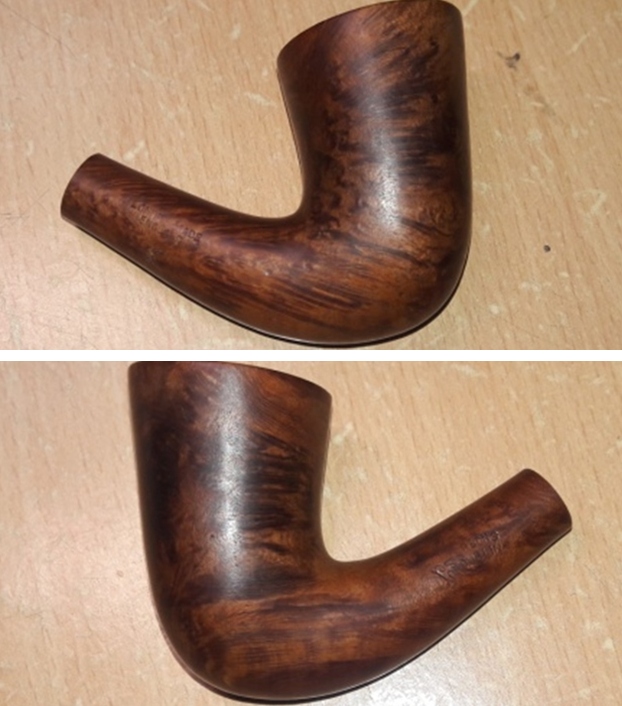
I had randomly selected four pipes to work on, three inherited pipes and one that I had purchased a few years back, since I prefer to put a few pipe stems together in the “Before And After” Deoxidizer solution that has been developed by Mark Hoover. I have completed the restoration of three of these pipes, a Wally Frank “BLACKTHORNE”, a Wally Frank “NATURAL UNVARNISHED” TWO DOT Bulldog and a GEORG JENSEN EXTRA. This is the last of these four pipes, a cased AGE Bent Billiard shaped pipe from my grandfather’s collection.

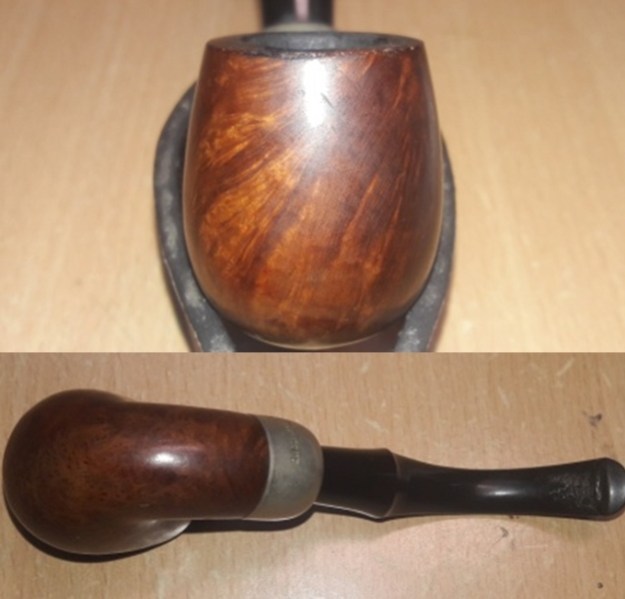
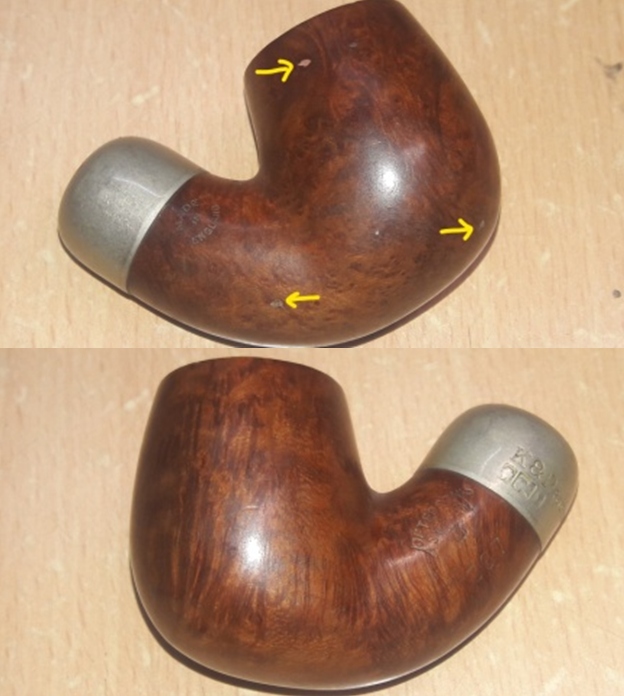
The pipe is a classic Bent Billiards with a military mount vulcanite stem. It is a medium sized pipe with a nice hand feel and a light weight that makes it comfortable for clenching. It is stamped on the left surface of the shank as “AGE” inside an oval. The silver ferrule at the shank end is also stamped as “AGE” in an oval over three sterling silver hallmarks. From left to right the first cartouche stamping is completely buffed out followed by a cartouche with a LION PASSANT certifying silver quality and the last cartouche with date code letter “m”. There was also a diamond with a banner and a “R.J.” stamp on it towards the bowl end. The vulcanite stem is stamped over the top surface as “AGE” inside an oval over “LONDON” in block capital letters. The stampings on the stem are faded and visible only under bright light and magnification. I had not come across this brand earlier and to know more about this brand I visited rebornpipes.com. As expected, Steve had worked and researched this brand in great detail. The link below will lead those interested to the write up posted on rebornpipes.com(https://rebornpipes.com/2019/05/18/restoring-a-1919-age-extra-bulldog/).

I earnestly request all the readers to read through the well researched write up on the brand as Steve’s efforts are worth their weight in gold. From the write up, I have deduced the following with respect to the pipe currently on my work table.

(a) AGE brand of pipes has both French and English connection. The hallmarked silver ferrule on my pipe points to the English connection. Who Made That Pipe by Wilczak and Colwell had pointed towards Salmon & Gluckstein brand as English makers of this pipe.

(b) Salmon & Gluckstein brand was bought out by Imperial Tobacco Co. in 1902. Since that was prior to the purported date of this pipe it made sense that it was made by Imperial Tobacco Co. The brand continued under their manufacture until 1955 when the brand was dropped.

(c) The R.J stamp on the silver ferrule stands for Reuben Jordon, a London silversmith who did bands for Imperial Tobacco Co. in London. Reuben Jordon had entered his mark at both the London Assay office in 1906 (by Imperial Tobacco Co.) and at the Chester Assay Office in 1910. The LONDON stamping on the stem of the pipe that I am working on is indicative that the silver hallmarks were assayed by the London office.

(d) Thus, it appears that the pipe was a brand of the Imperial Tobacco Co. and linked to the Salmon & Gluckstein brand.

To date this pipe based on the sterling silver hallmarks, I visited www.silvercollection.it. I have reproduced the downloaded picture of the relevant portion (enclosed in red circle) which points to the year in which this pipe was made.

Thus from the above information, it is concluded that the pipe that I am working on is a brand name made by Salmon and Gluckstein after it was brought over by Imperial Tobacco Co. and the silver ferrule was assayed in London Office by Reuben Jordon for Imperial Tobacco in 1907.

With the provenance of the pipe established to my satisfaction, I move ahead with my initial visual inspection.

Initial Visual Inspection
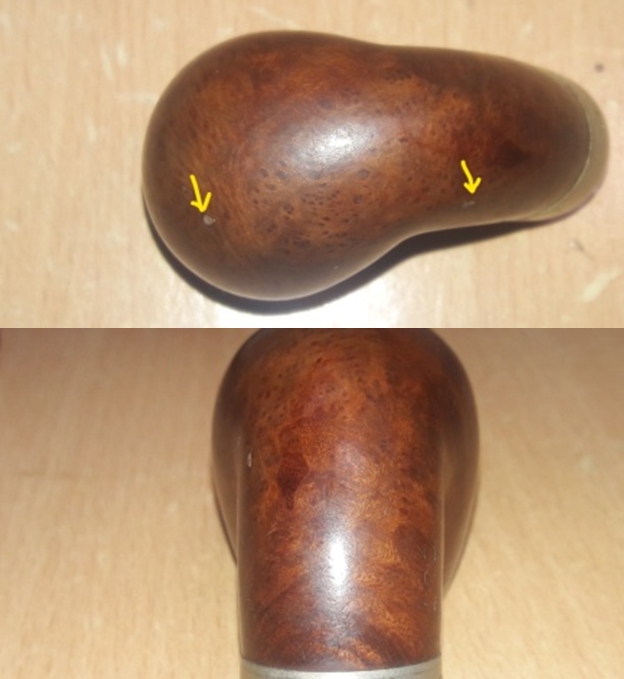
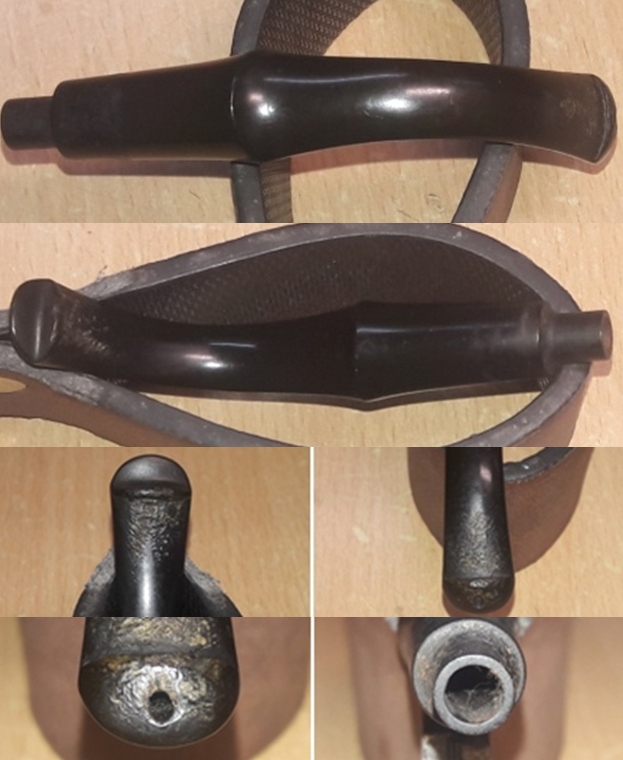
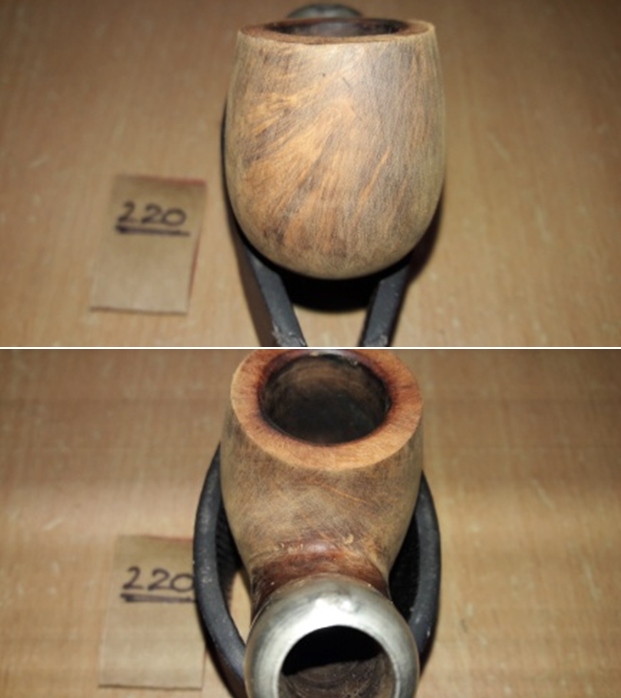
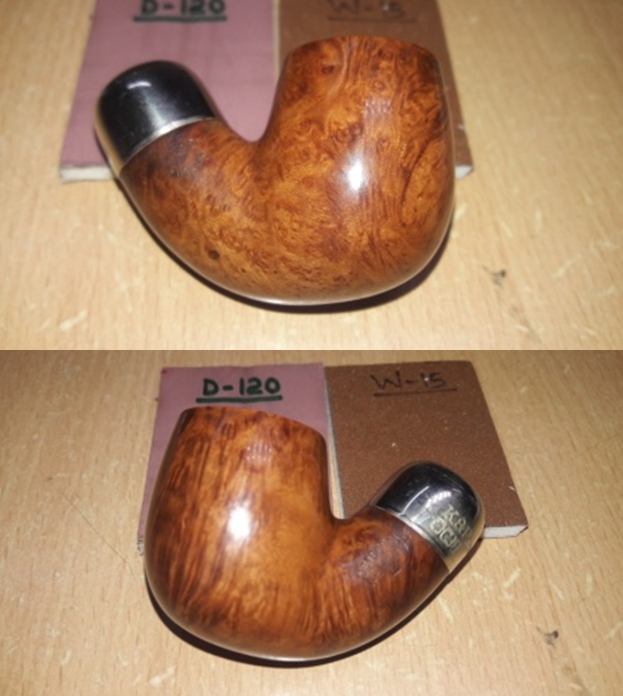
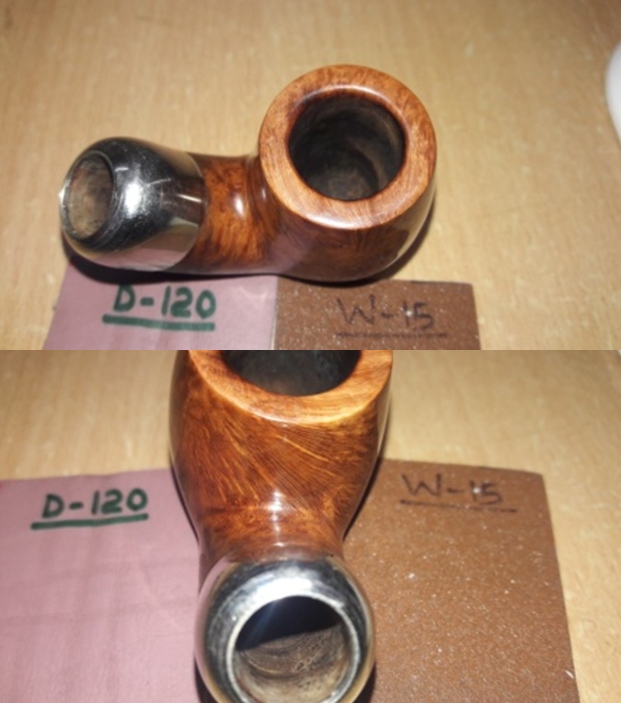
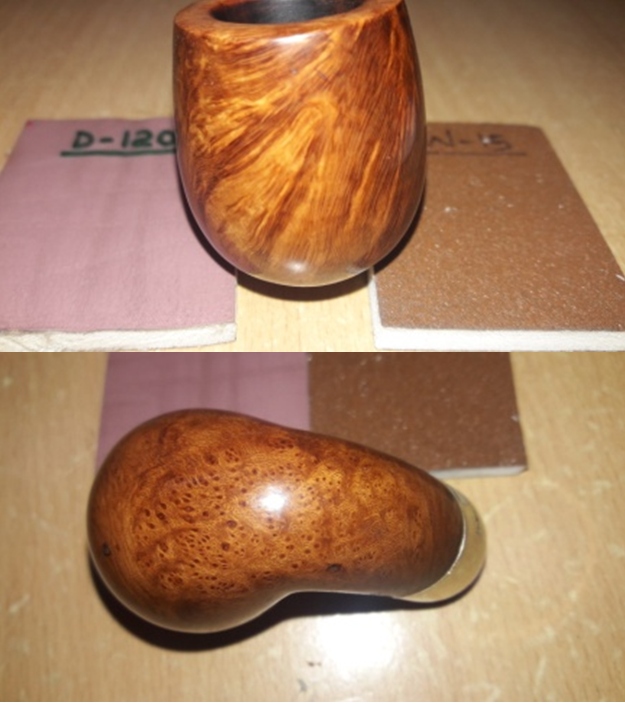
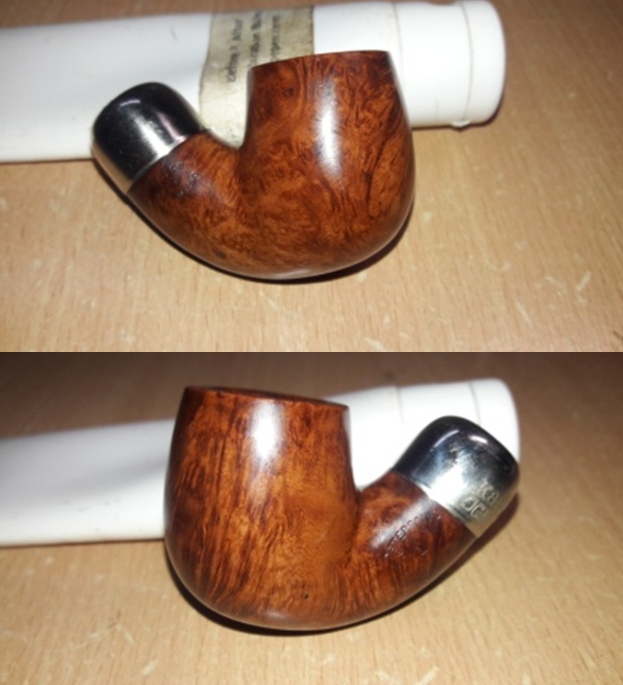
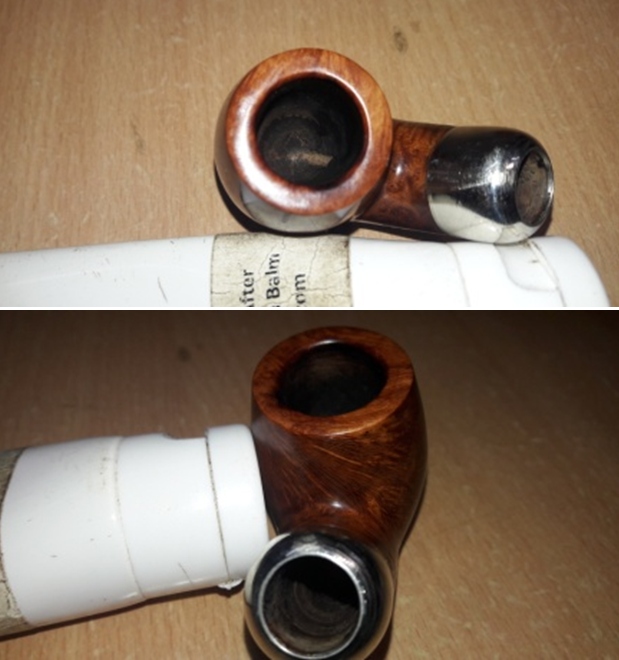
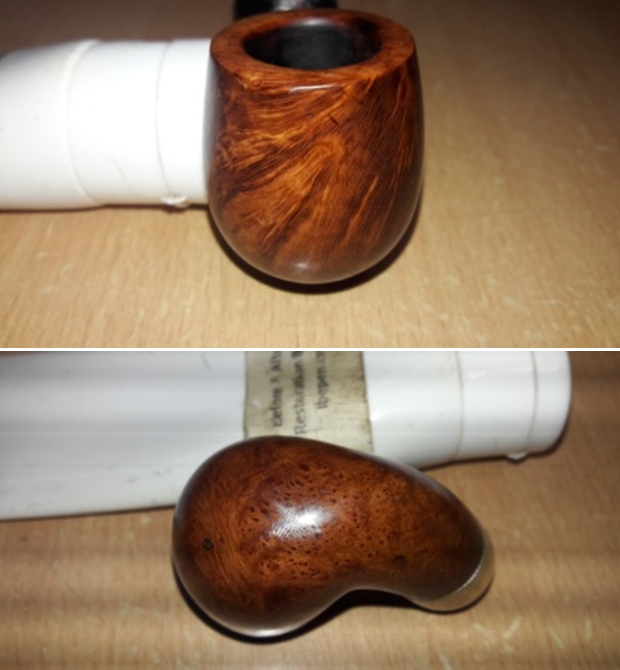
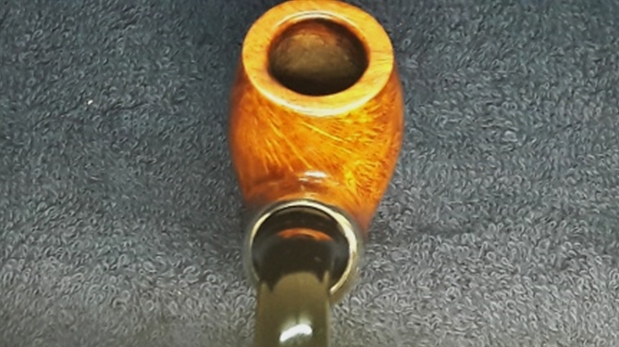
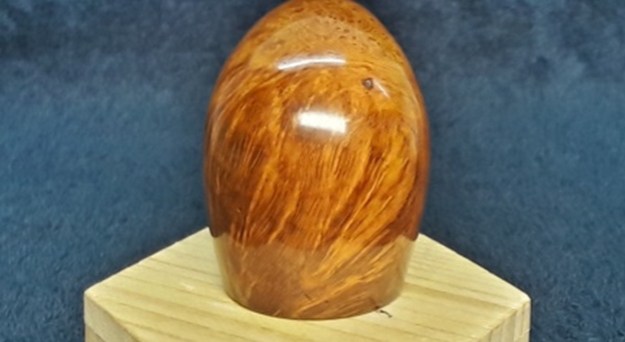
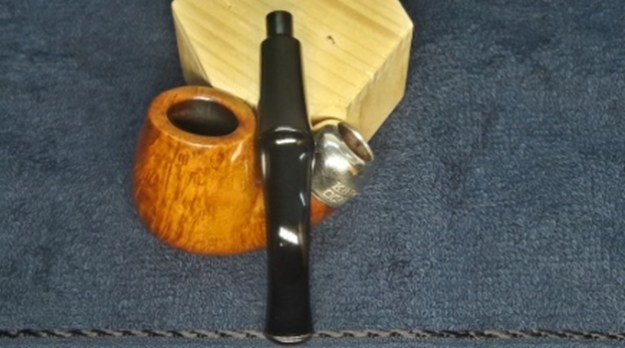
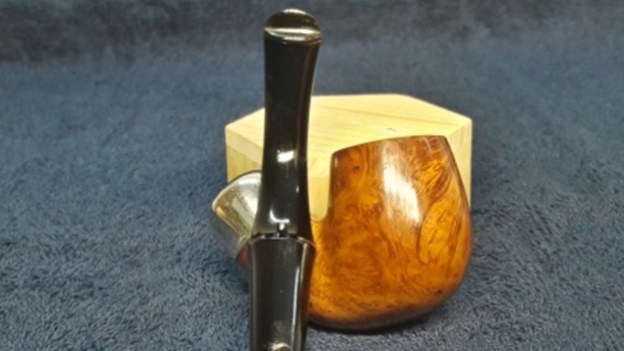
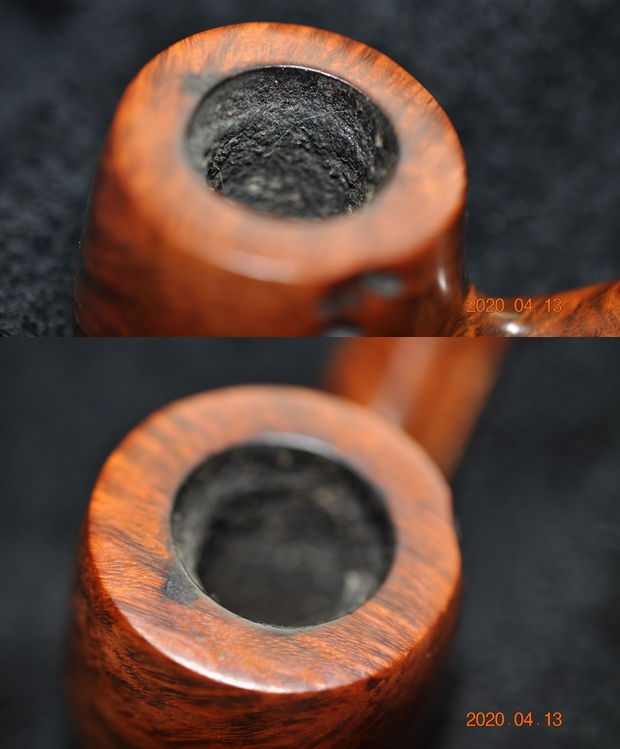
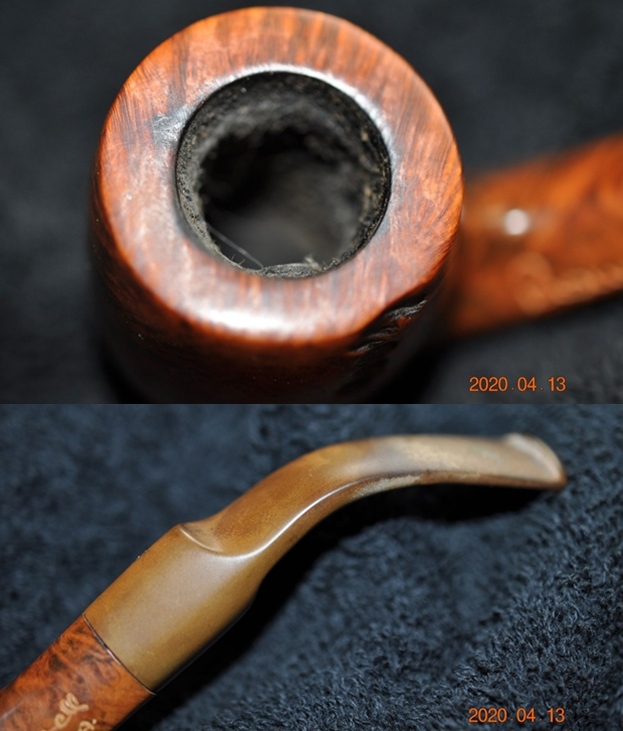
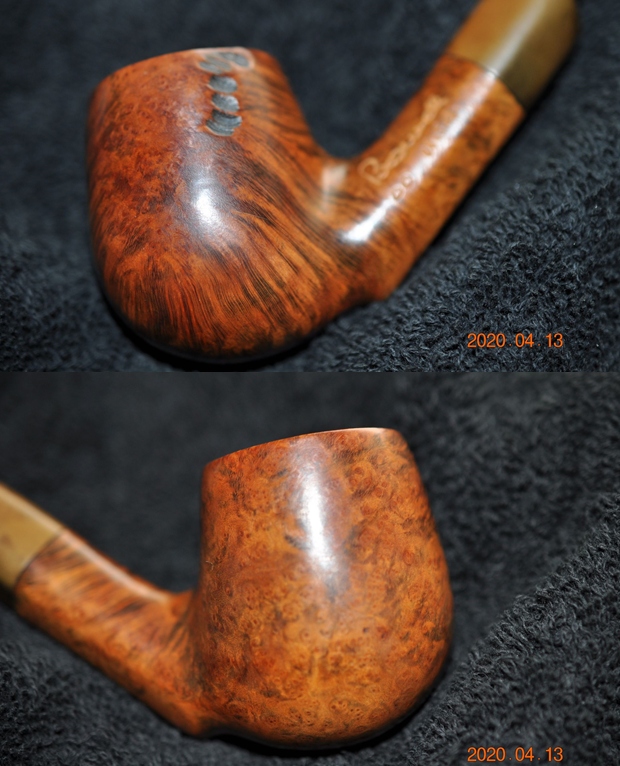
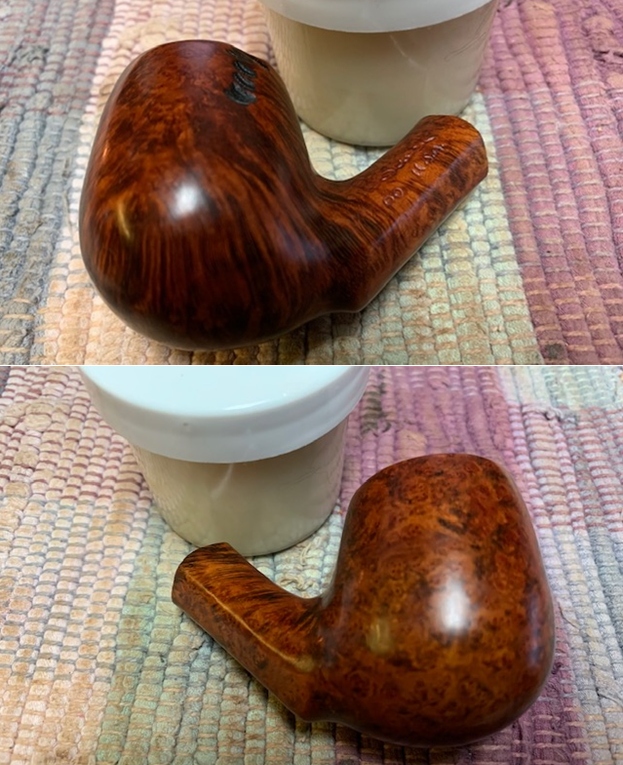
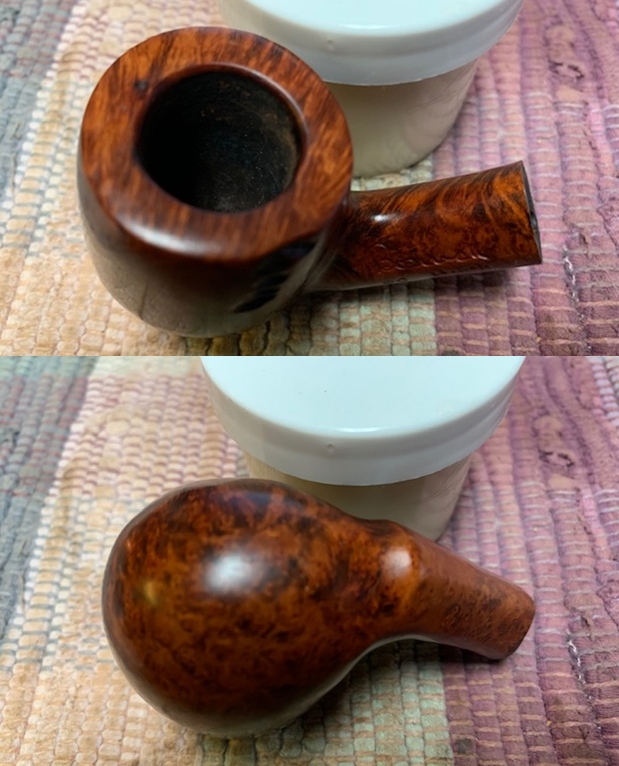
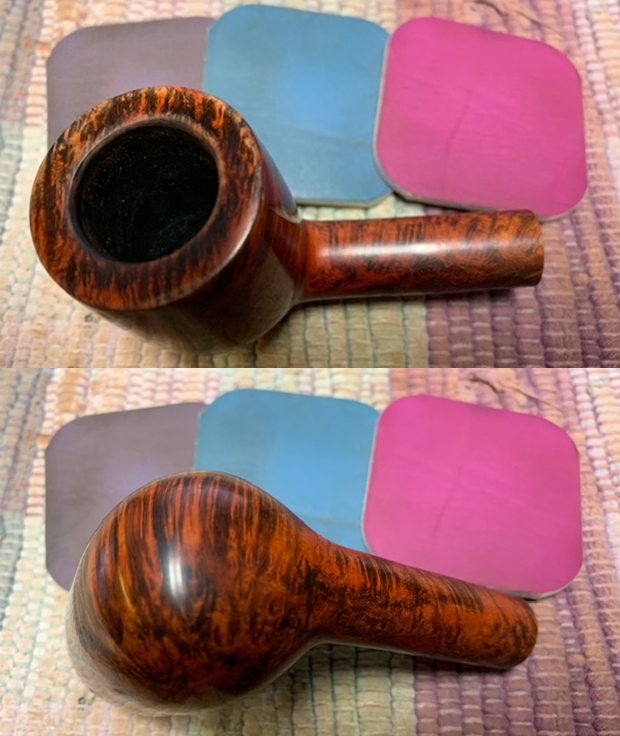
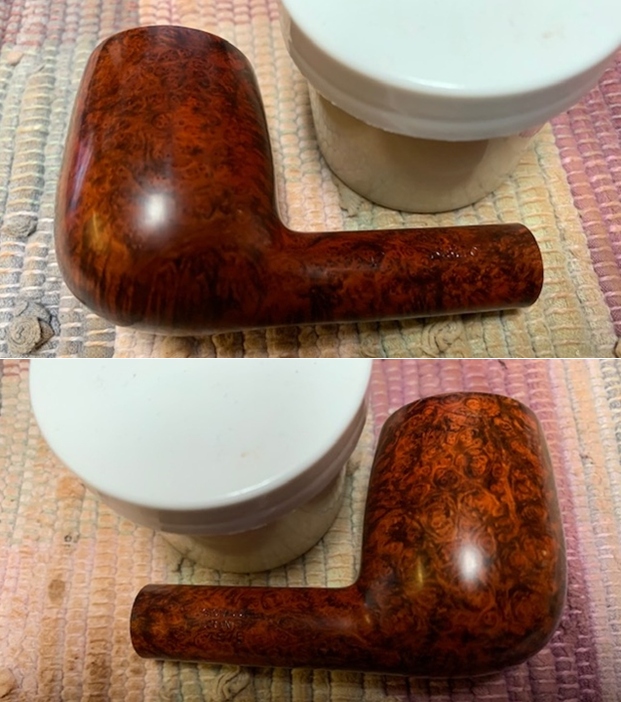
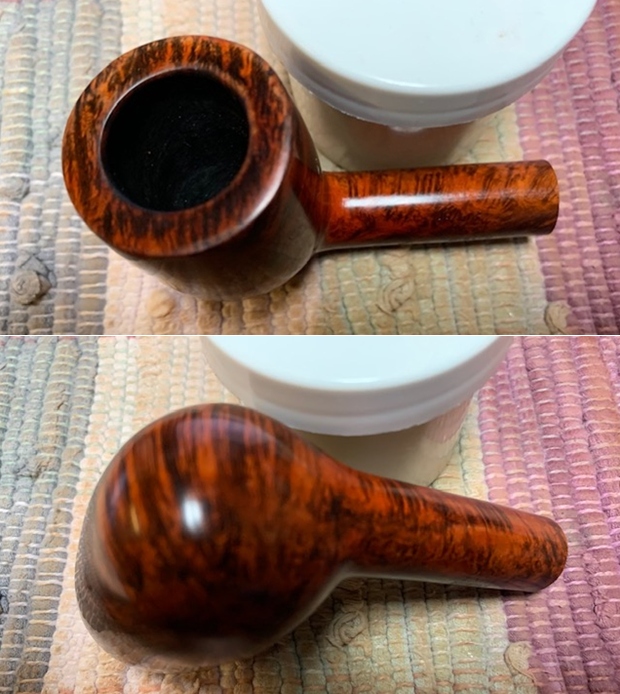
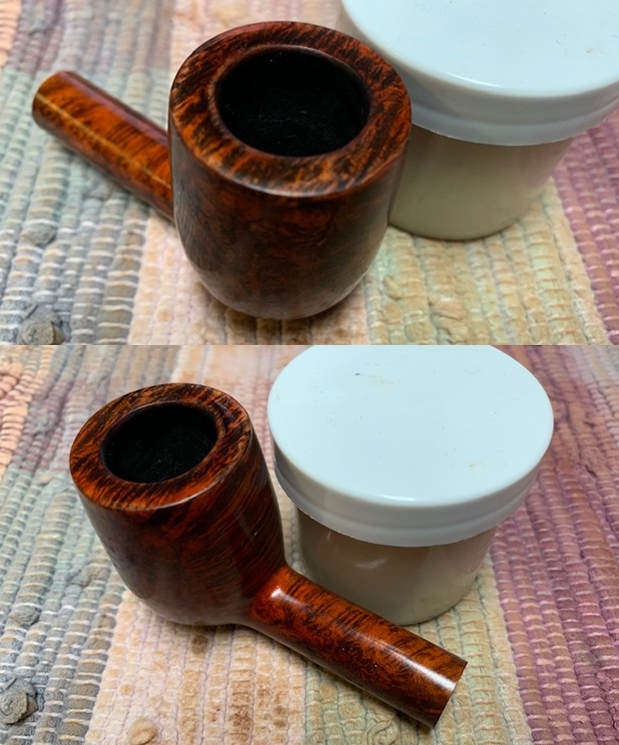
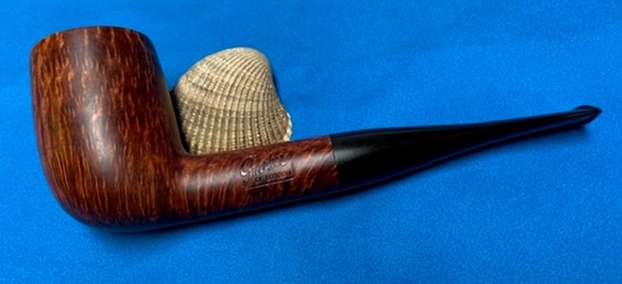
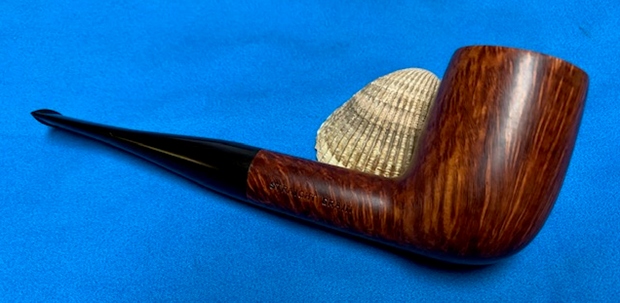
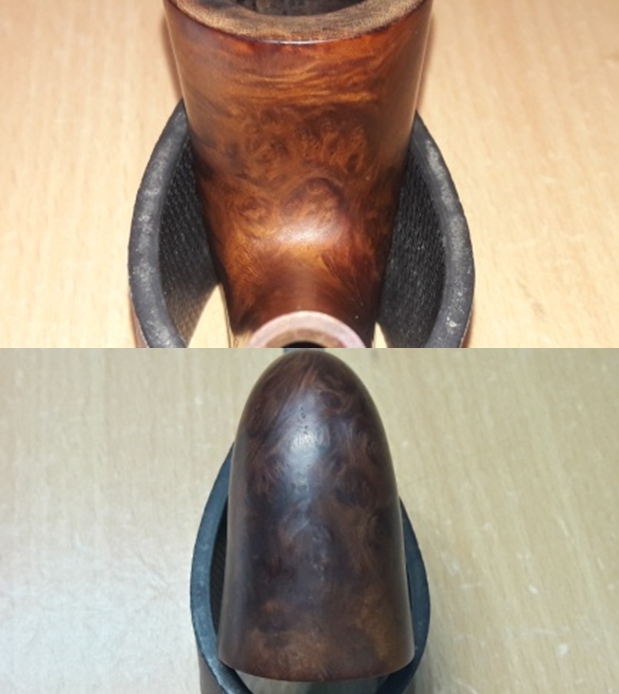
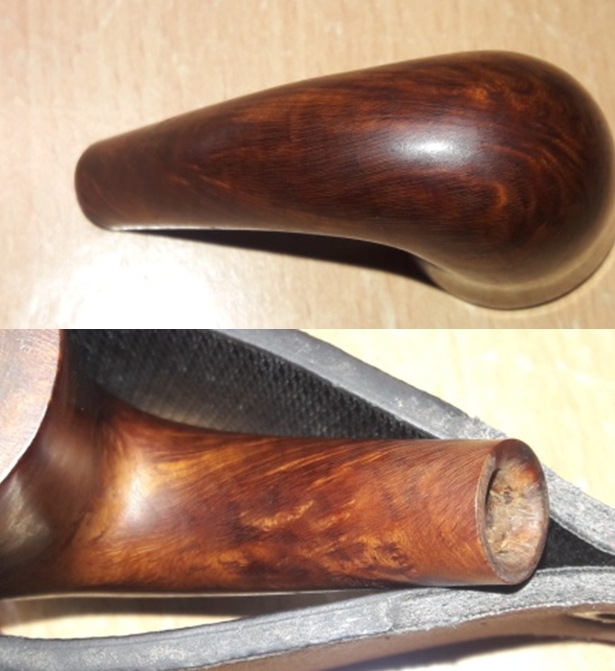
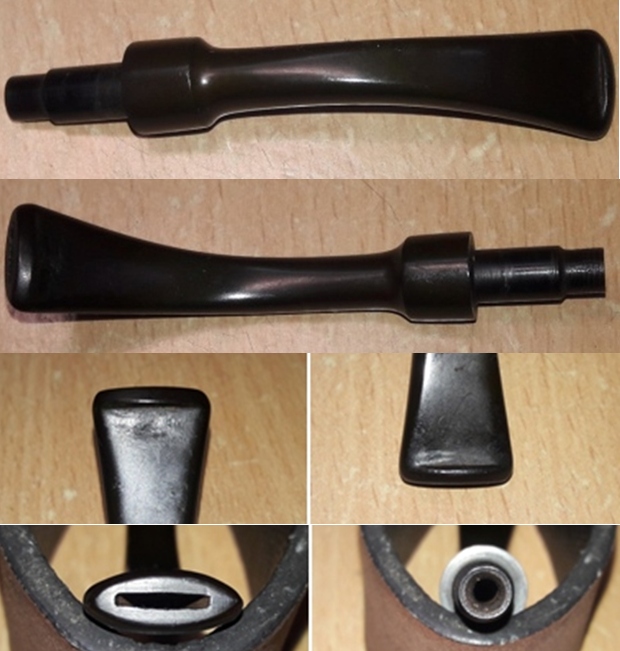
This pipe has the classic Bent Billiard shape with a medium sized bowl. The stummel boasts of some beautiful Bird’s eye to the right side and cross grains all over the remaining bowl and shank. The stummel surface is covered in dirt and grime of the overflowed lava and grime. There is not a single fill in the briar which speaks of high quality selection of the briar. There is a thick layer of cake in the chamber. The stem has been cut short and is heavily oxidized with a through hole on the lower stem surface and few deep bite marks in the bite zone. Here is how the pipe appears as it sits on my work table. The pipe was in its original leather covered case with a green velvet internal lining. The leather surface is dirty with pieces of leather cover missing along the seams of the case. The locking mechanism is in working condition and clasps firmly shut.   Detailed Inspection Of The Pipe And Observations
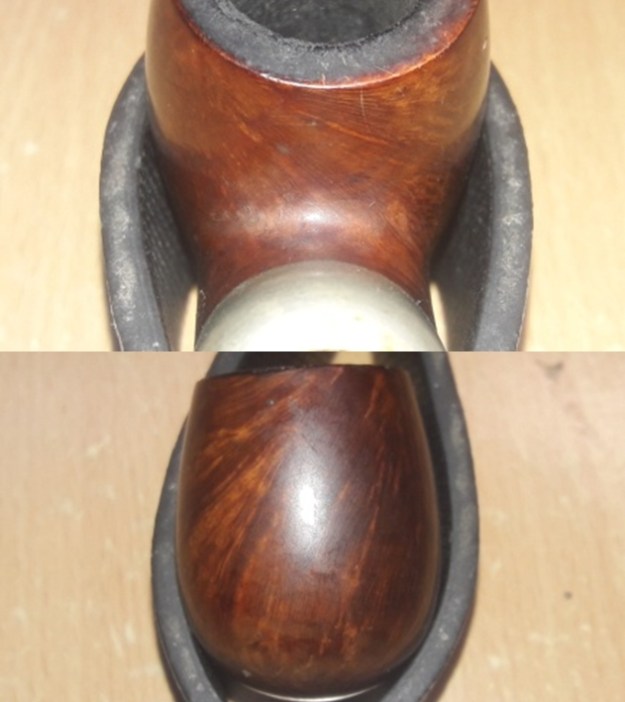
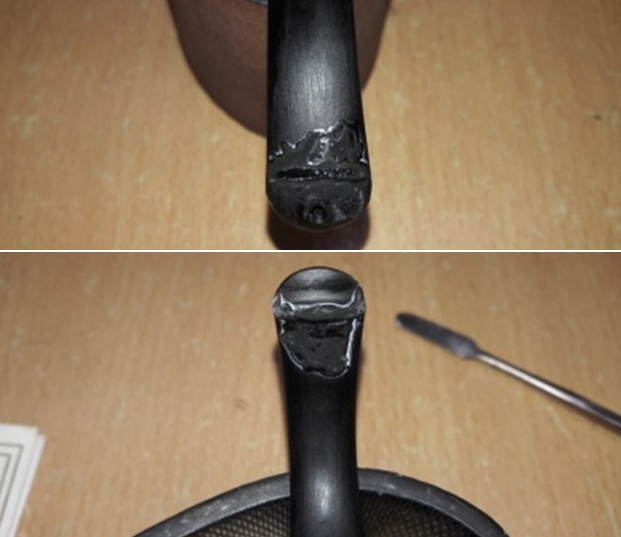
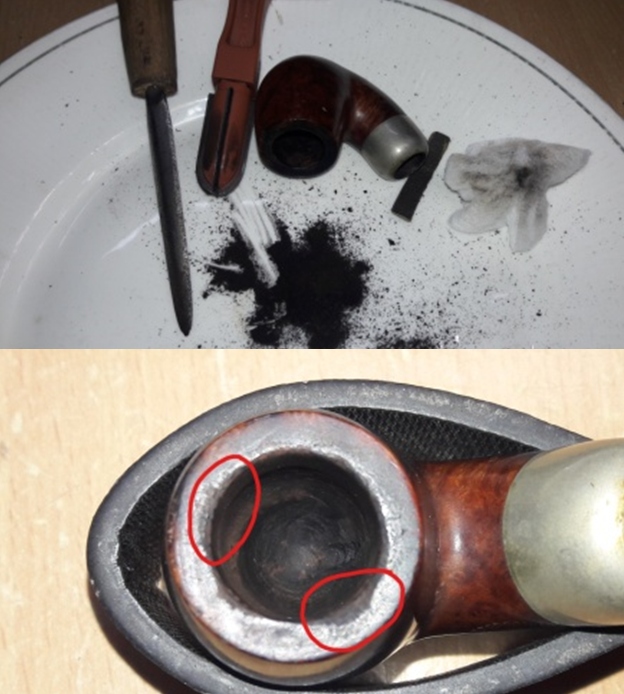
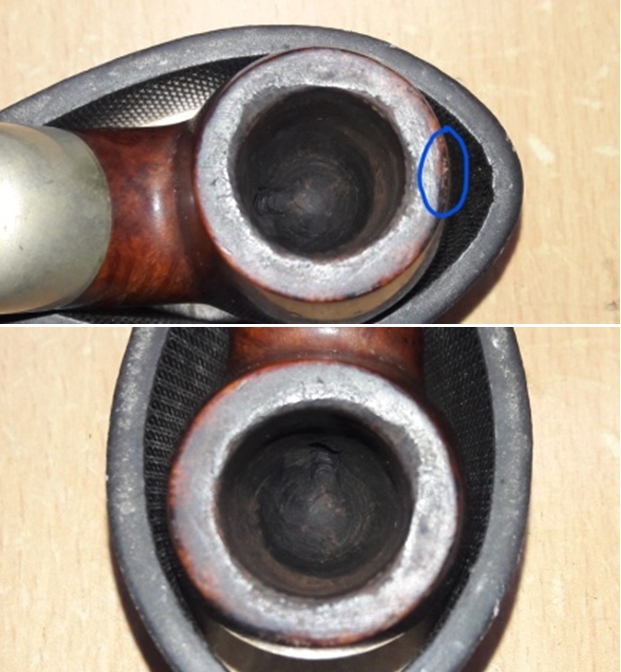
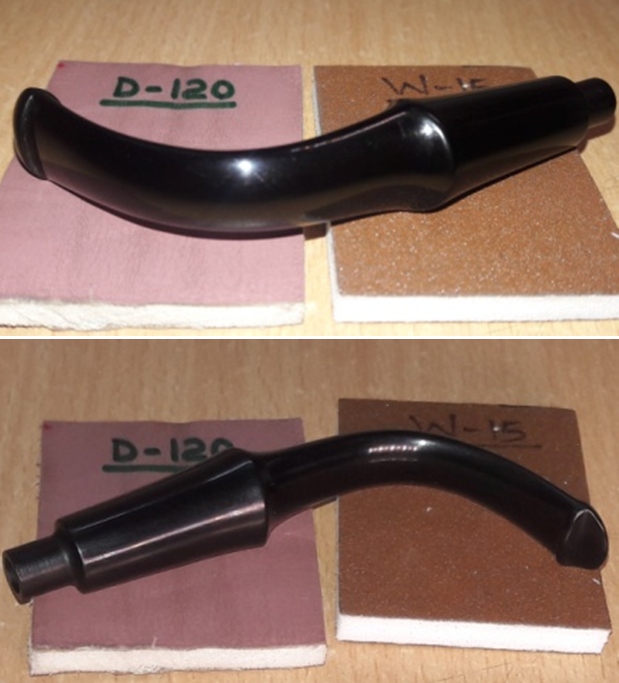
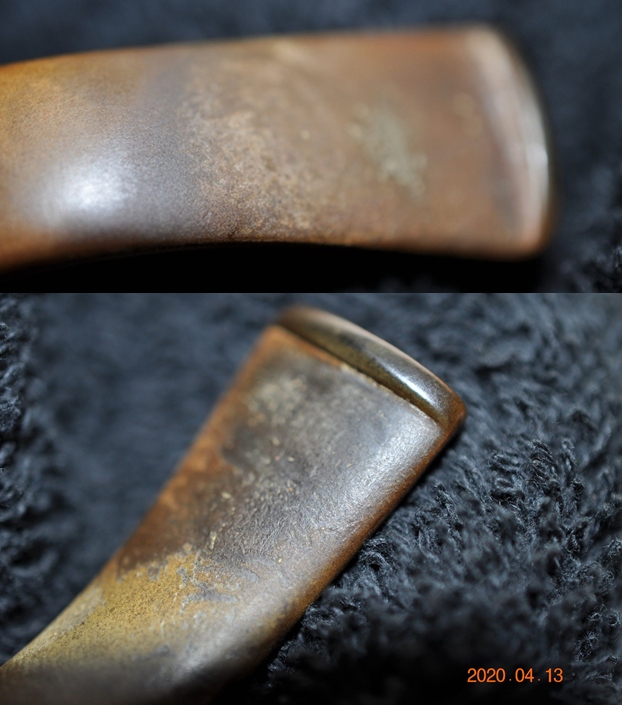
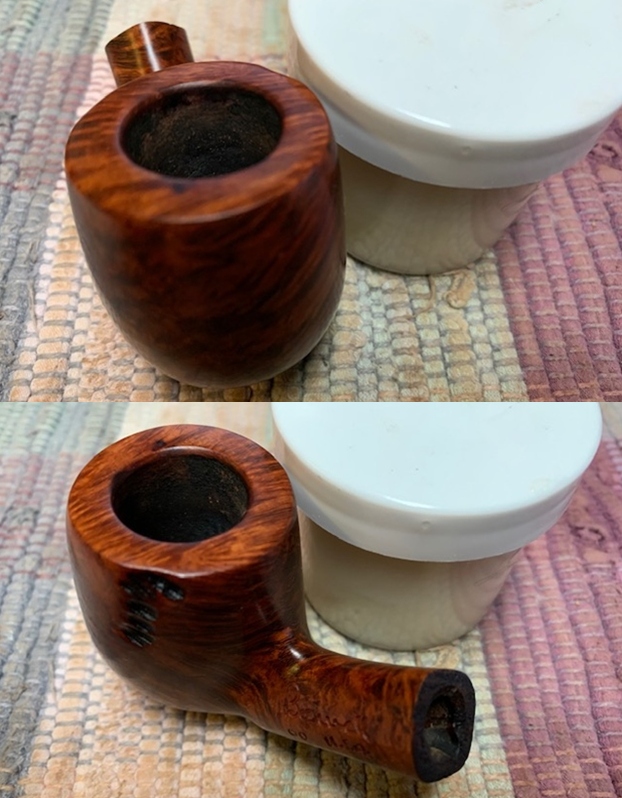
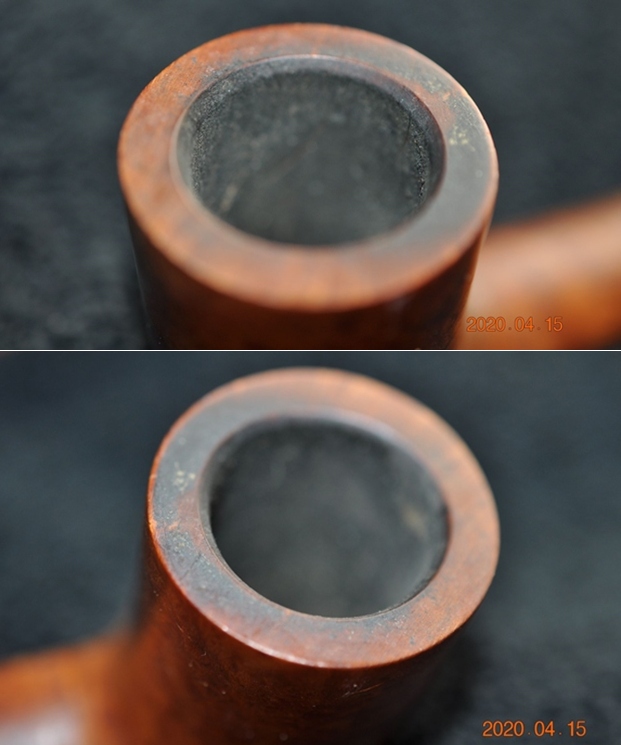
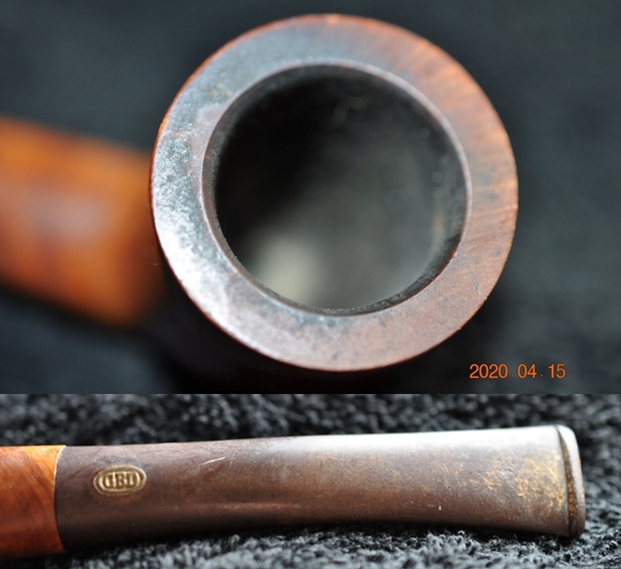
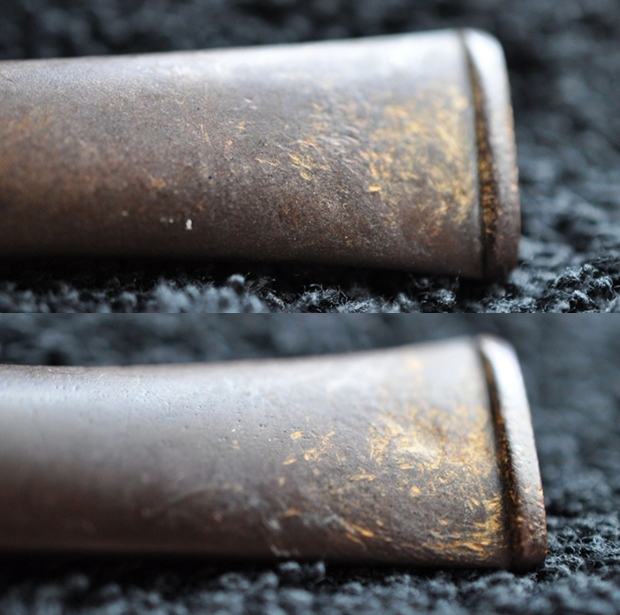
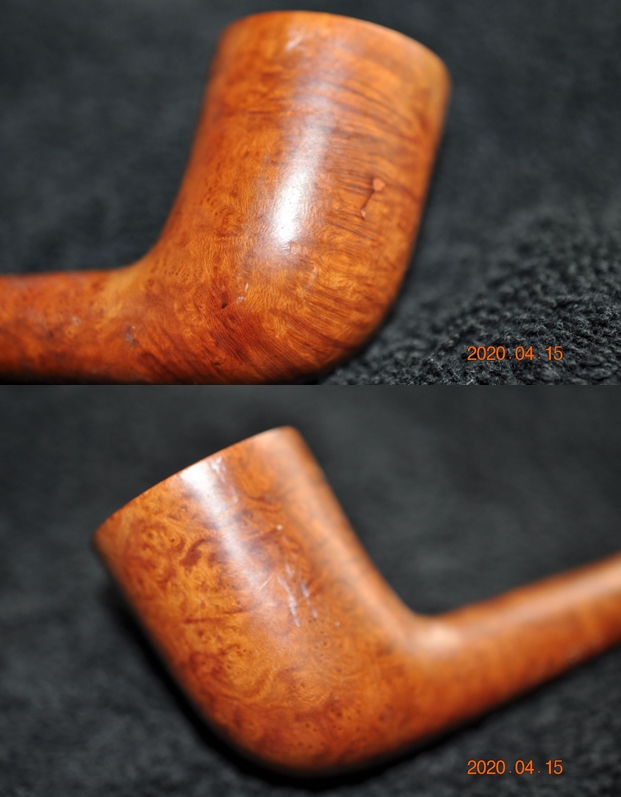
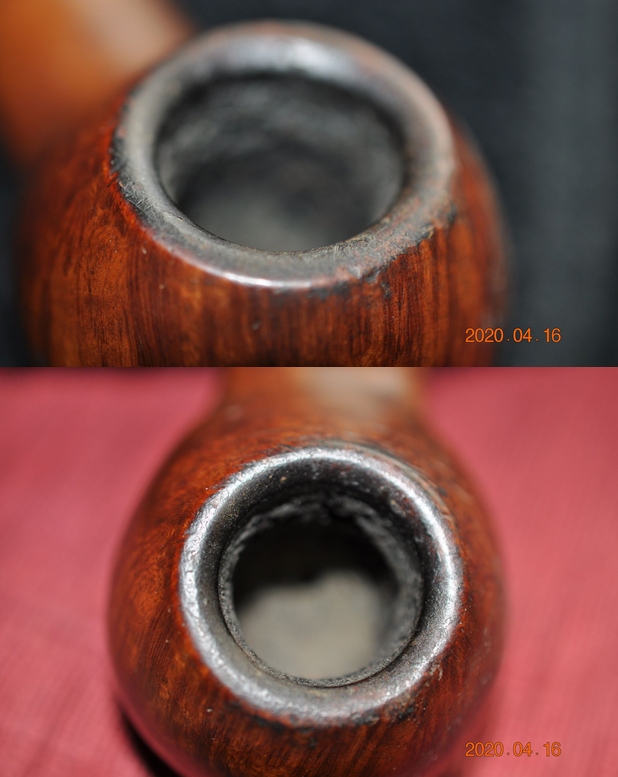
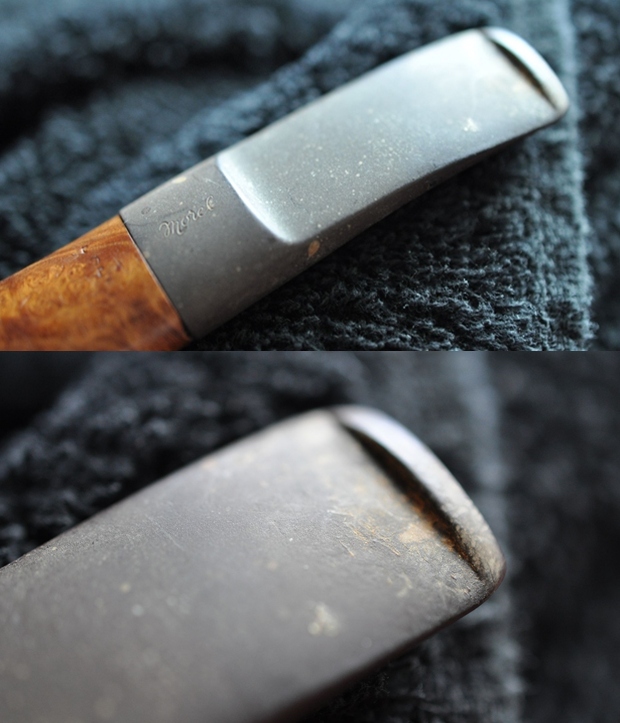
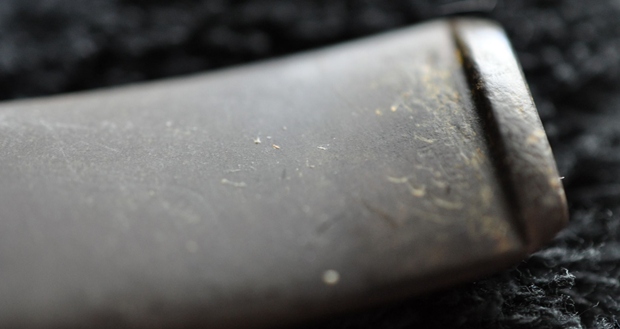
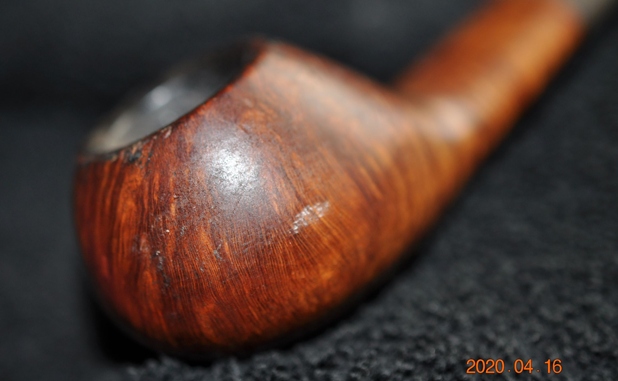
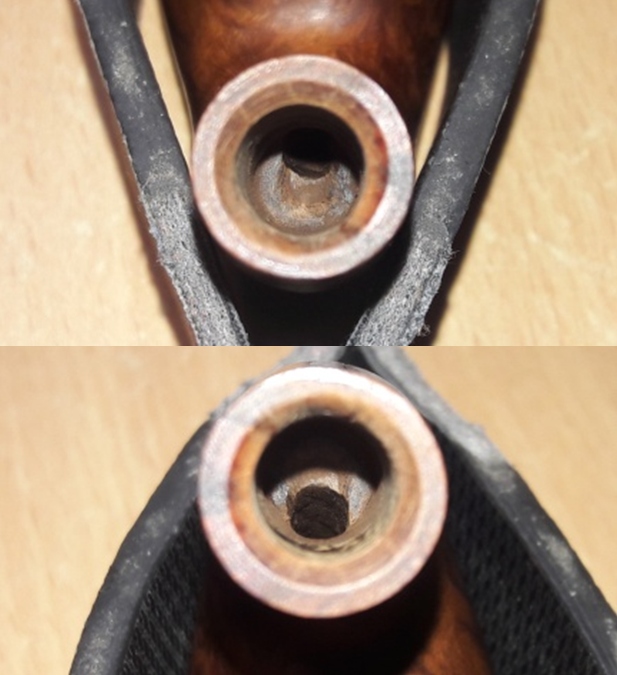
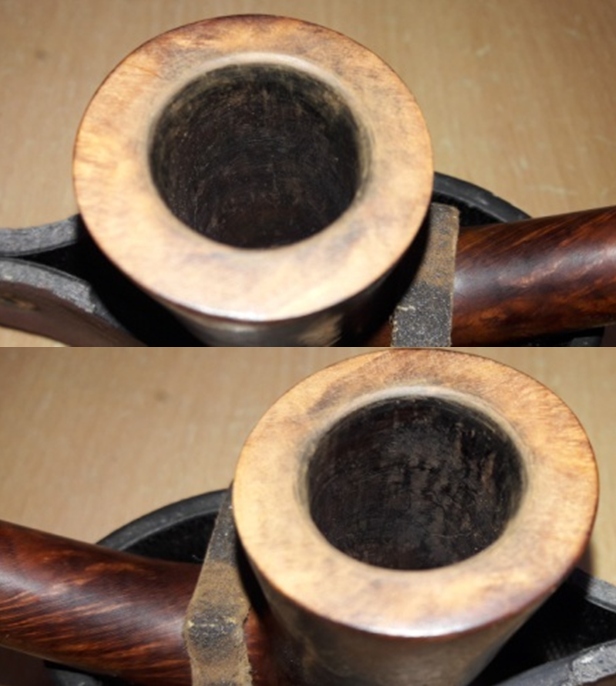
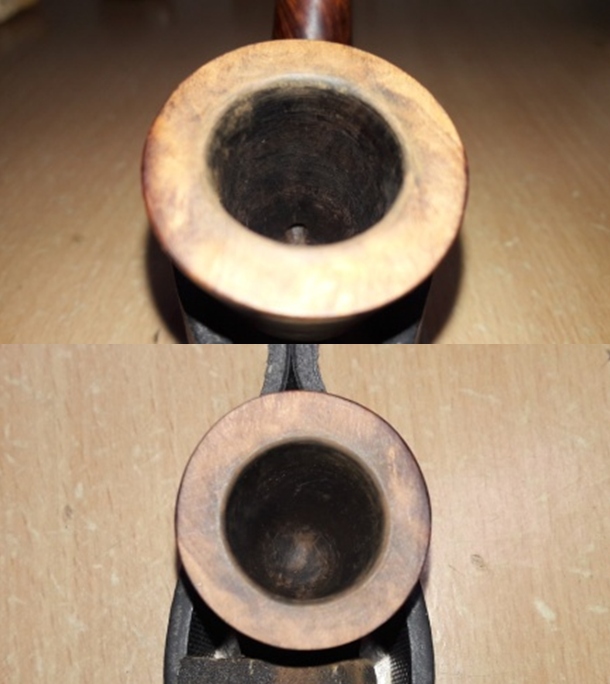
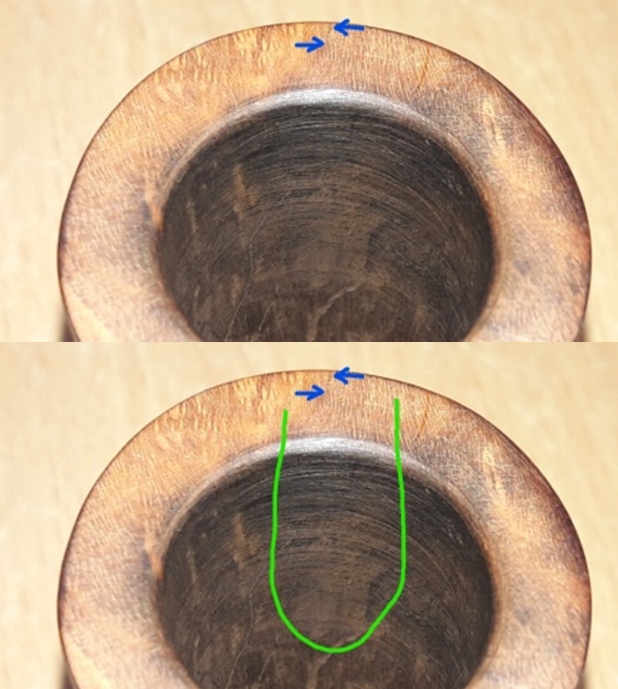
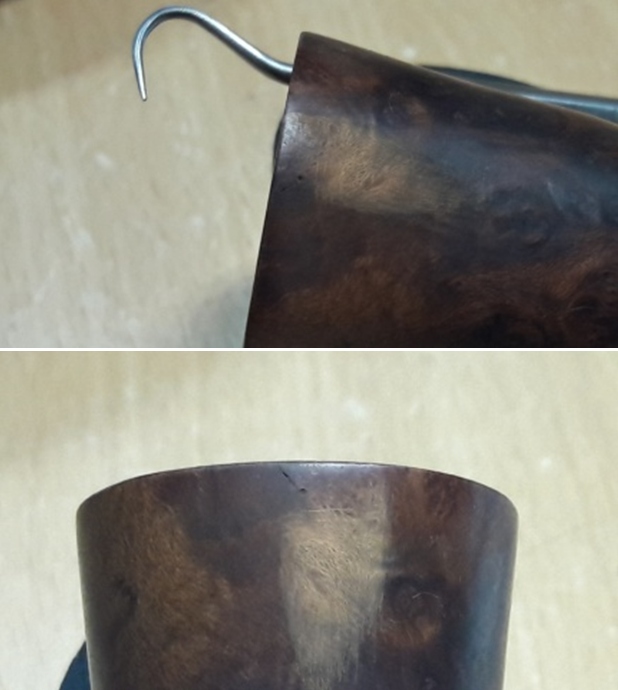
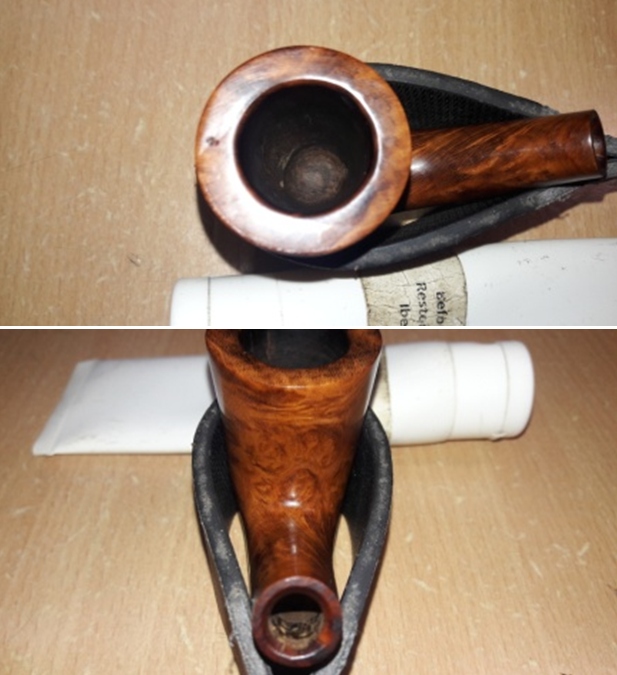
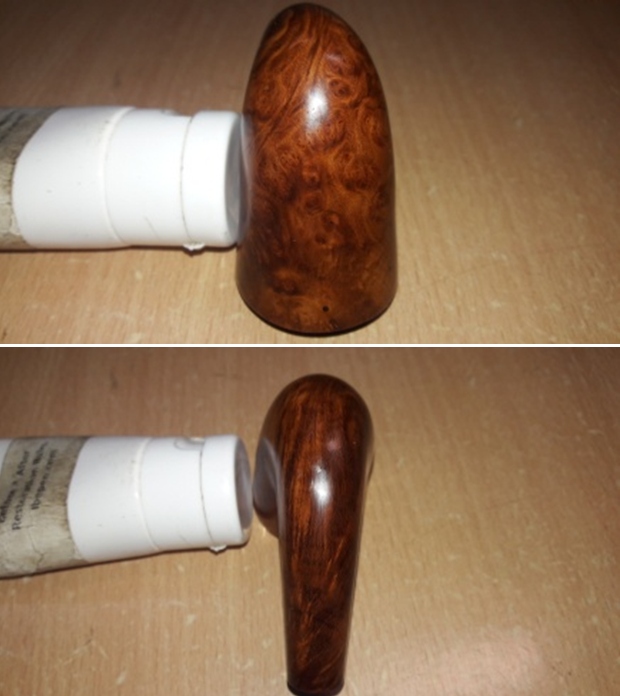
The chamber has an even layer of thick cake. The smooth rim top surface shows few dents/ dings and is covered in lava overflow, dirt and grime from previous usage. Both the inner and the outer rim have suffered a few blows on a hard surface resulting in a few minor chipped edge surfaces and with the inner edge being out of round. The condition of the inner walls of the chamber can be commented upon after the cake has been taken down to the bare briar. The chamber exudes a very strong odor of old tobacco. The draught hole is dead center and at the bottom of the chamber and that makes me believe that it should great smoke and the thick cake in the chamber lends credence to this observation. The stummel appears solid to the touch all around and hence I do not foresee any serious damage to the walls in the form of burnout/ deep heat fissures/ lines or pits. To address the damage to the inner and outer rim edges, I shall create a slight bevel to both the rim edges. The reaming and subsequent cleaning of the chamber and mortise should reduce the ghost smells from the chamber.  The smooth stummel surface is finished in a natural virgin finish and has taken on a layer of aged patina, through which one can make out the beautiful Bird’s eye grains to the right side of the stummel and over the lower shank surface. Tightly packed cross grains adorn the rest of the stummel surface. There are a few scratches over the stummel surface, probably due to likely falls. However, there is not a single fill in the entire stummel, signifying very high quality of briar used in carving this pipe. The briar is looking lifeless and bone dry and has taken on dull grey hues. Thorough cleaning of the stummel surface and rinsing it under warm water should highlight the grain patterns while preserving the patina. In all probability, I shall let these minor dents and dings to the stummel surface remain and avoid the process of sanding the stummel with sand paper in order to preserve the beautiful patina. Maybe, micromesh polishing will address a few of these scratches to some extent.   The mortise shows heavy accumulation of oils, tars and gunk and the air flow is not full and smooth. The high quality vulcanite military mount stem is so heavily oxidized that it appears brownish green in color. The stampings on the stem are also covered under the heavy oxidation. The tenon end of the military mount is black while the rest of the stem surface that was exposed to the elements is heavily oxidized. The upper and lower surface of the stem is peppered with tooth chatter and deep bite marks in the bite zone. The buttons on either surface have been chewed off and nonexistent with just a faint outline for lip edges. The upper surface has a superficial hairline crack extending from the lip edge in to the bite zone for about ½ an inch. The lower surface has a big chunk missing from the bite zone, including a part of the lip edge. The stem at one point in time of its 117 years of existence has had the stem cut off about an inch from the orifice end, probably due to extensive damage to the bite zone. The removal of the deep seated oxidation from the stem surface while preserving the stamping will be a long drawn and tedious process. I would need to rebuild and reshape the entire button on either surface while also repairing the through hole on the lower surface. Maybe sometime later, I may even consider a stem splice repair to bring the stem to its original length, but for now, I intend to restrict myself to the repairs only.   The sterling silver ferrule is heavily oxidized and developed a patina commensurate with the vintage. There are, thankfully, no dents or dings on the ferrule surface. The stamping on the ferrule for most parts is crisp and clear. The stamping in the last cartouche of the three hallmarks has been all but buffed out with only the outline of the cartouche still visible. I would need to be very diligent while polishing the silver ferrule, lest I end up buffing away rest of the stampings on the ferrule. Once the ferrule has been cleaned up, the shining piece of silver will add an elegant touch to the pipe.The fitted original leather covered case that has protected the pipe thus far, has the leather covering worn out on the sides. The seam has lost its leather cover at places exposing the wooden case beneath. The leather is covered in dirt and grime of over 117 years due to lack of care and appears dull and without any luster/ shine. The inner velvet green lining is devoid of any stampings and has accumulated oils and tars from the rim top of the pipe. The mechanical clasp is still functional and the case closes securely.  The Process
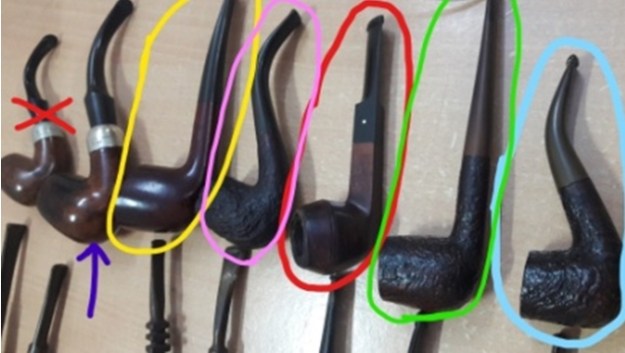
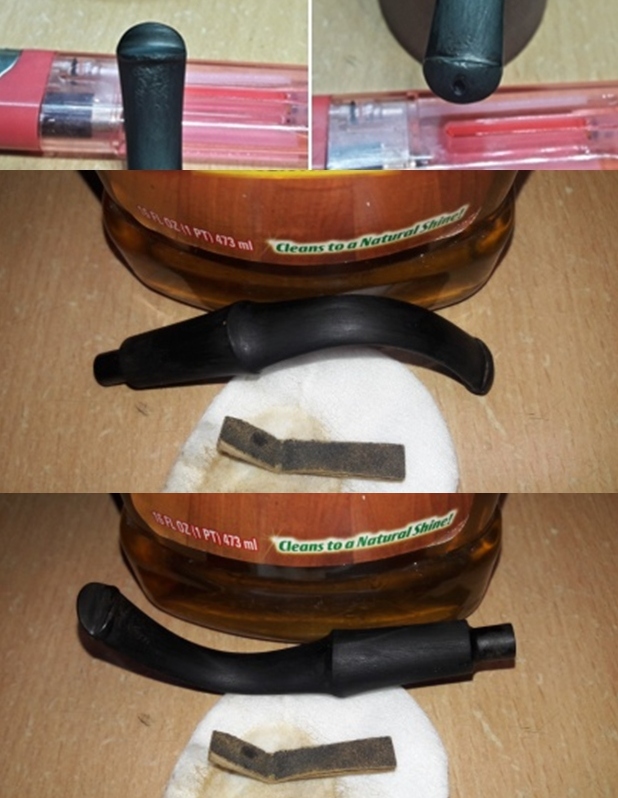
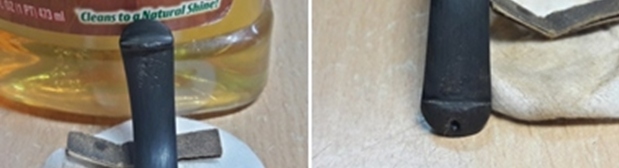
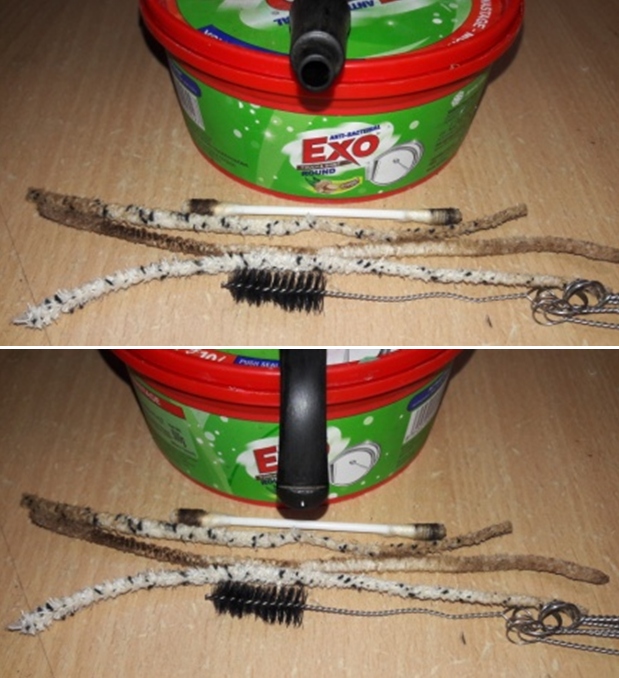
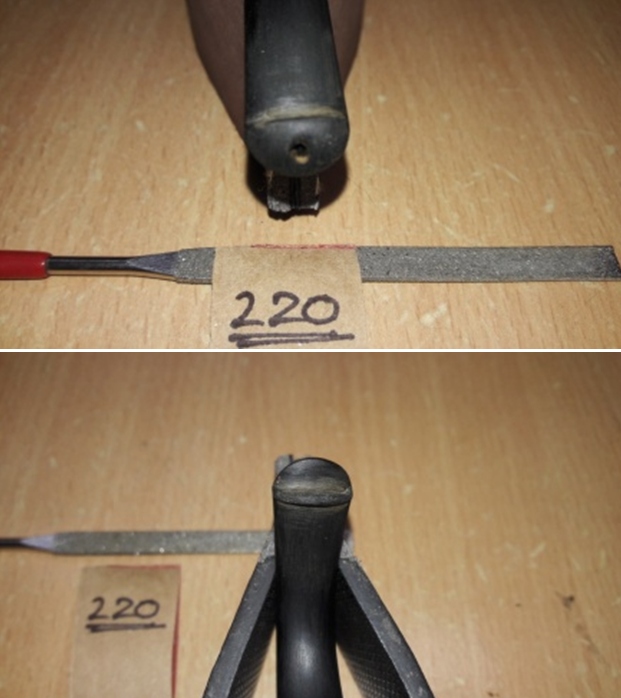
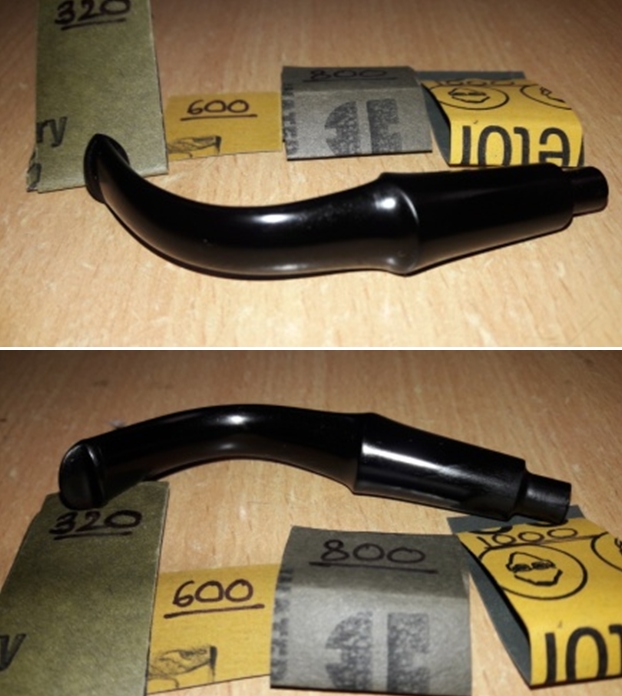
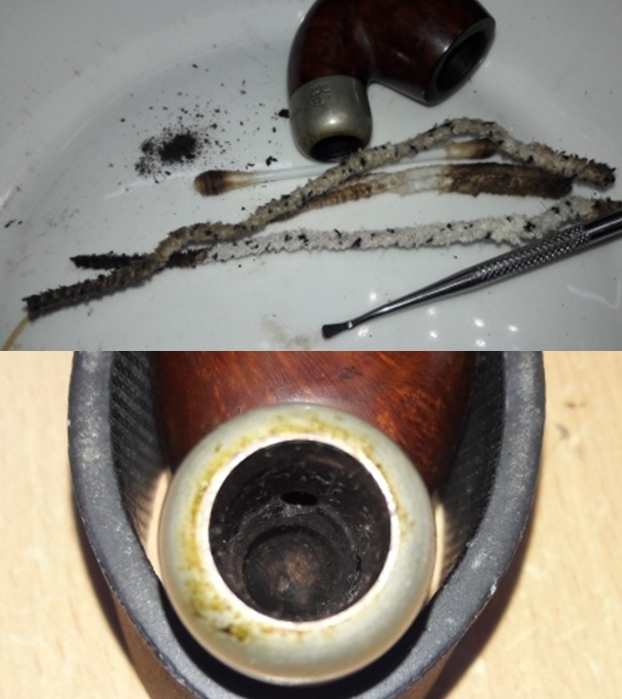
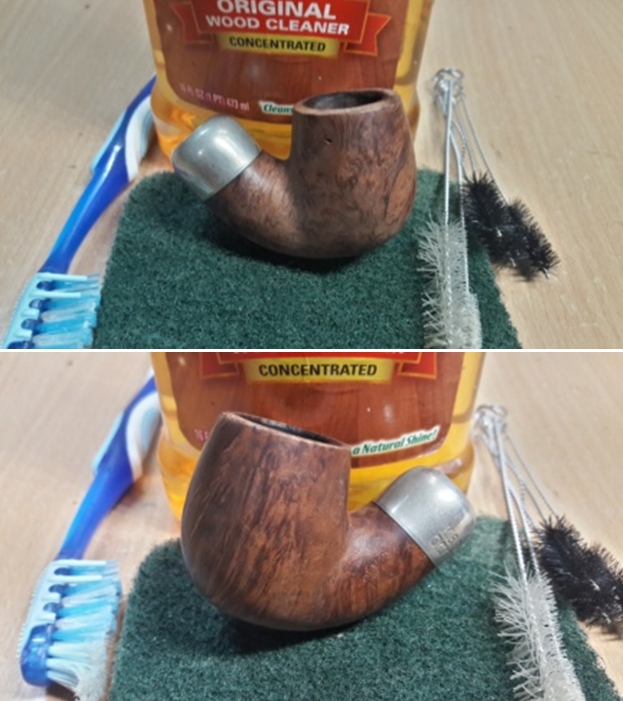
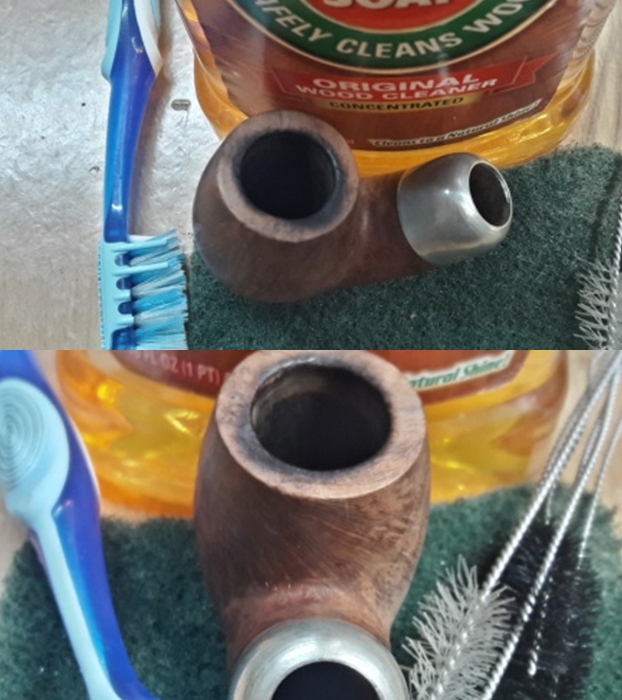
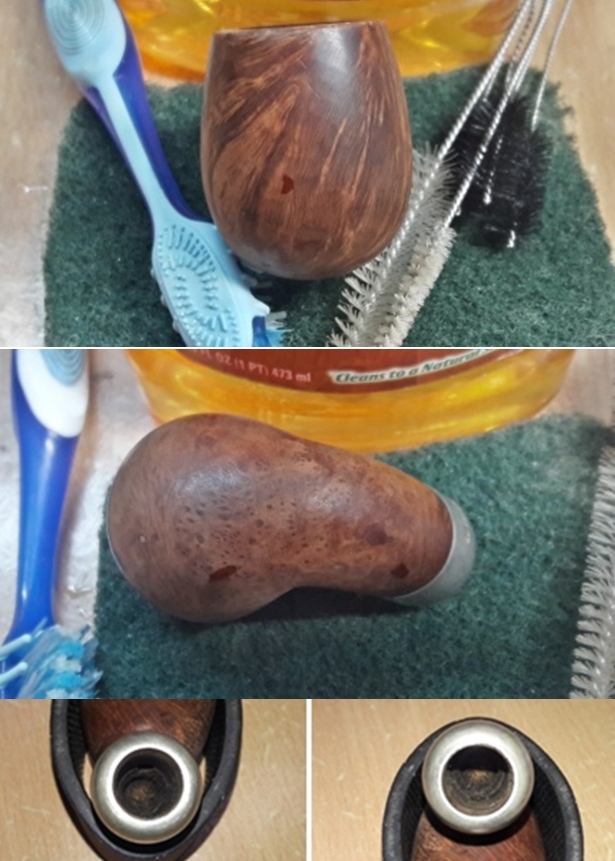
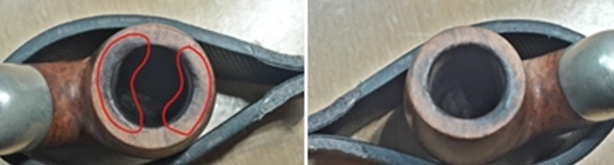
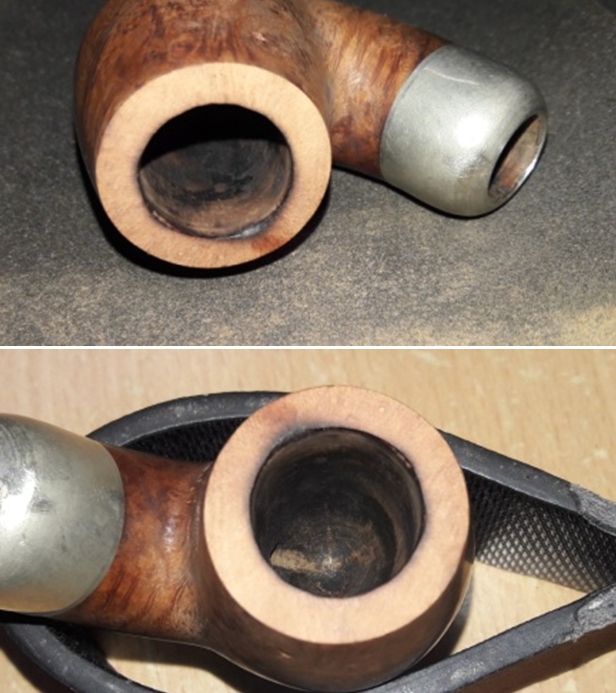
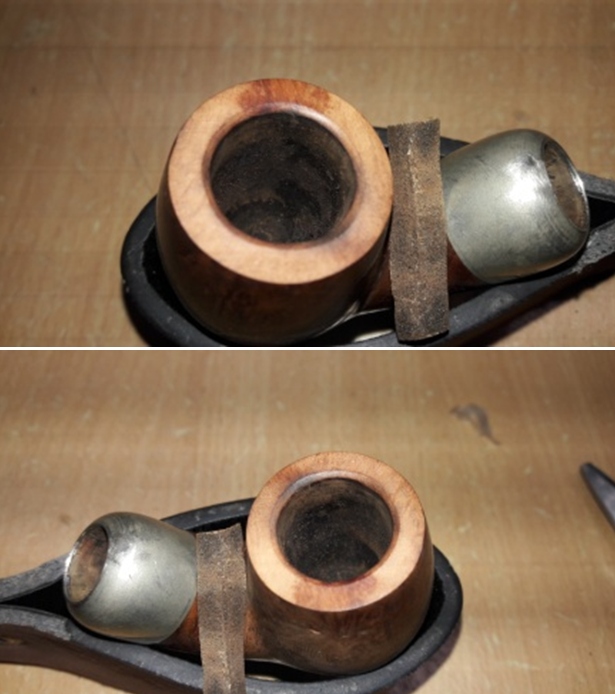
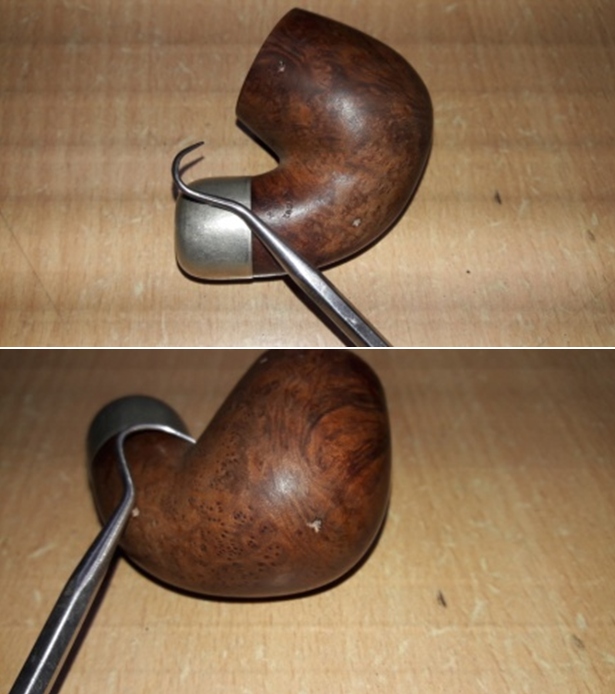
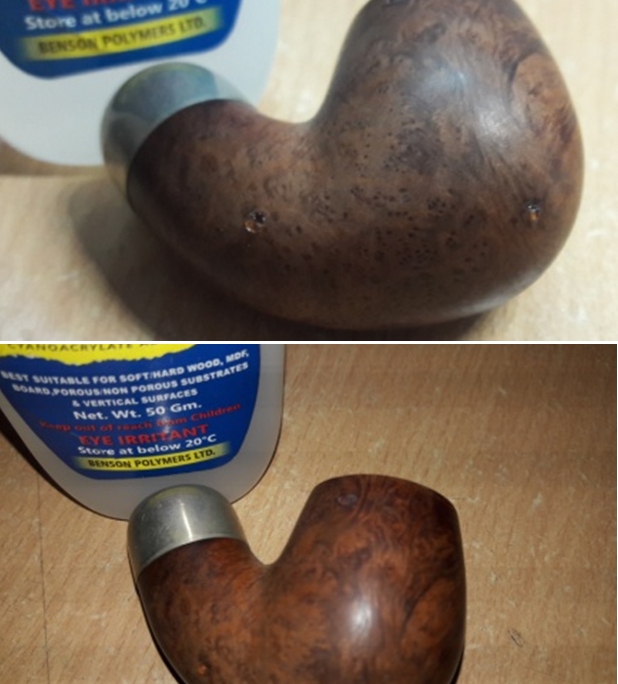
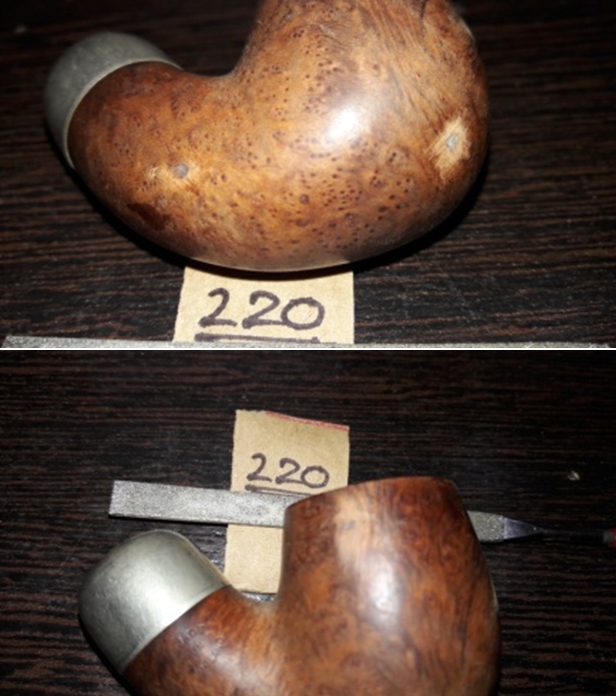
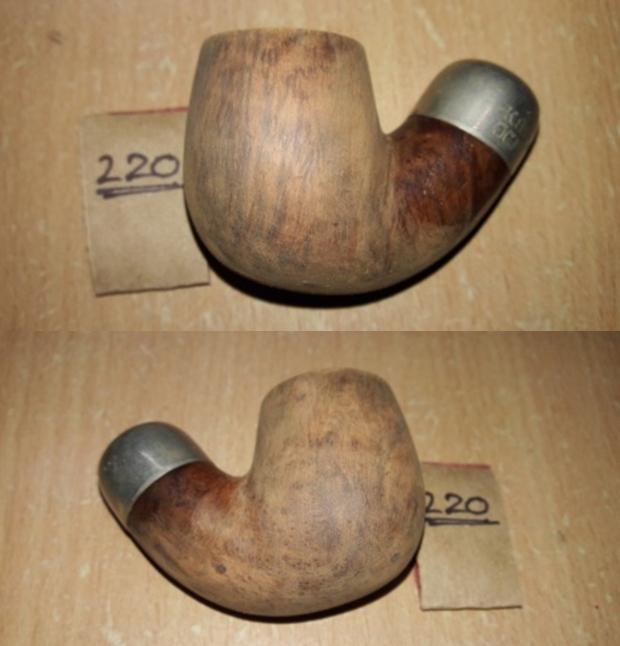
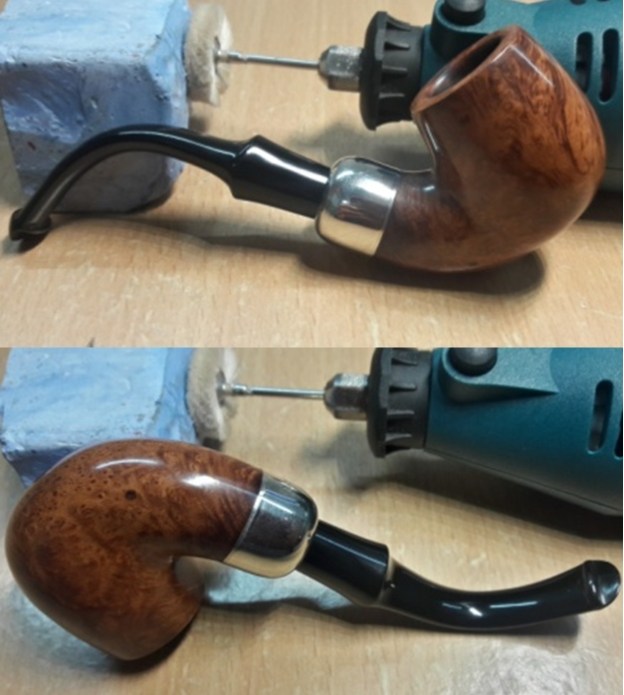
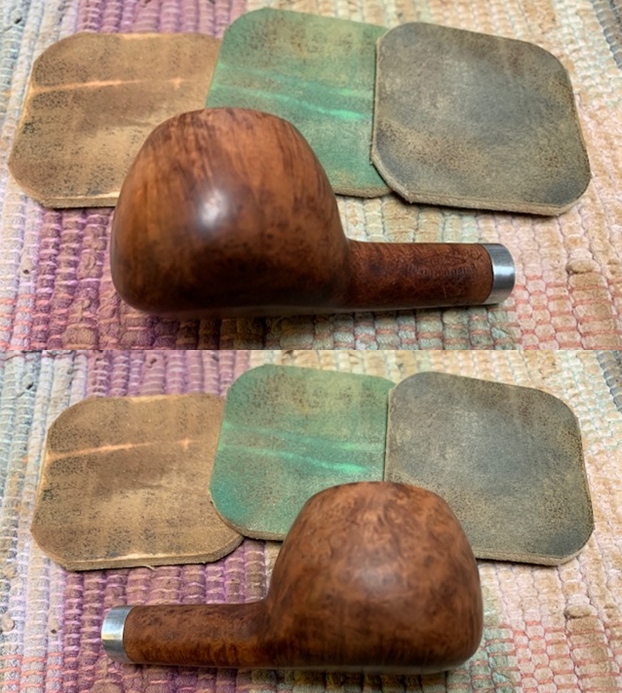
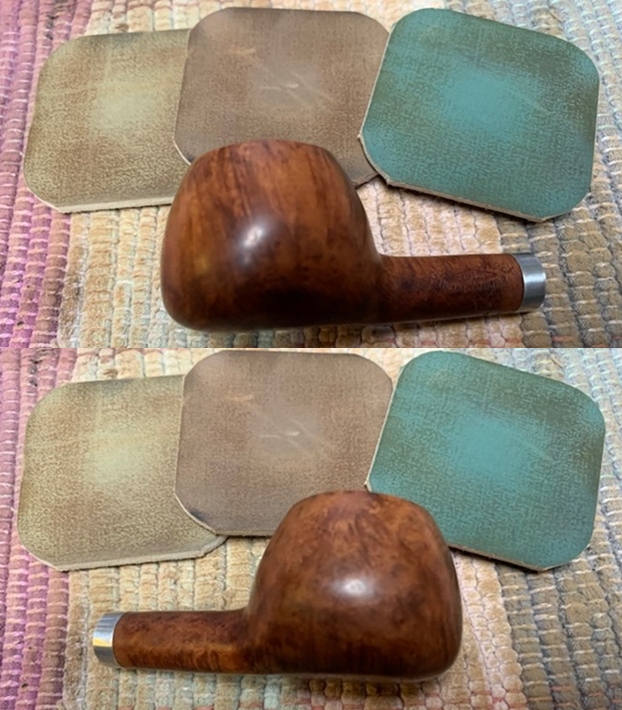
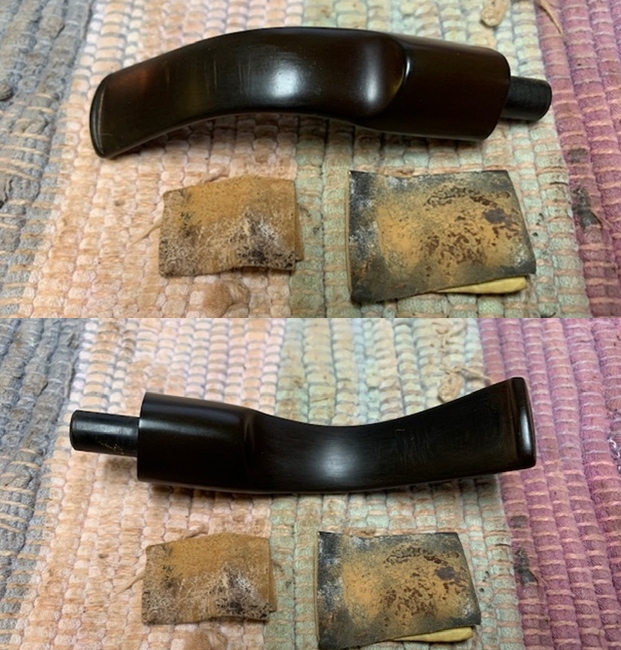
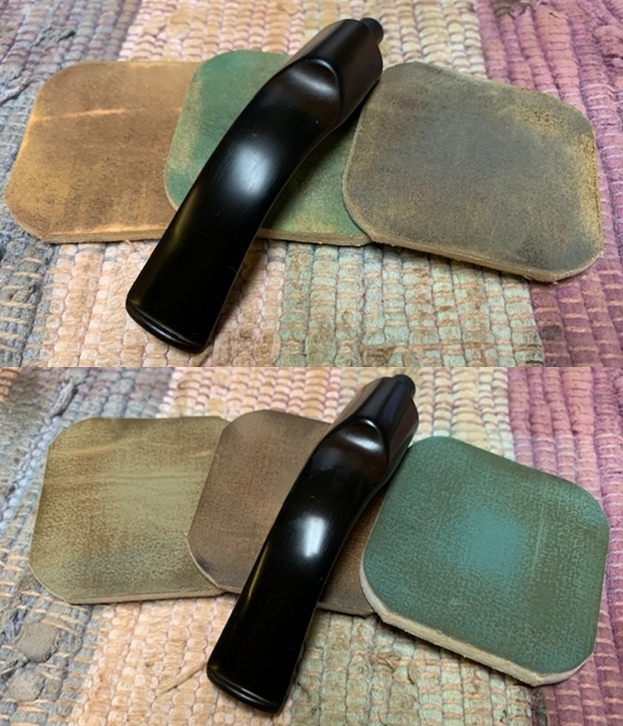
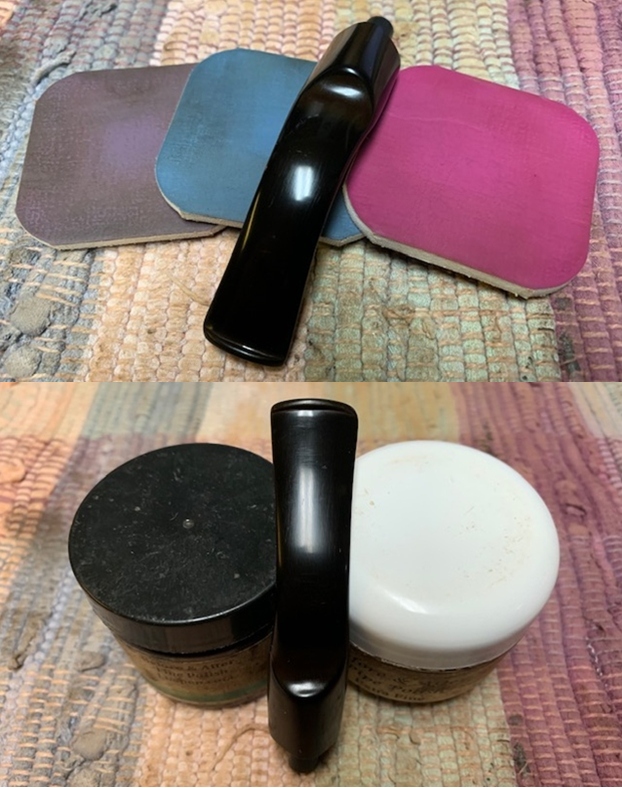
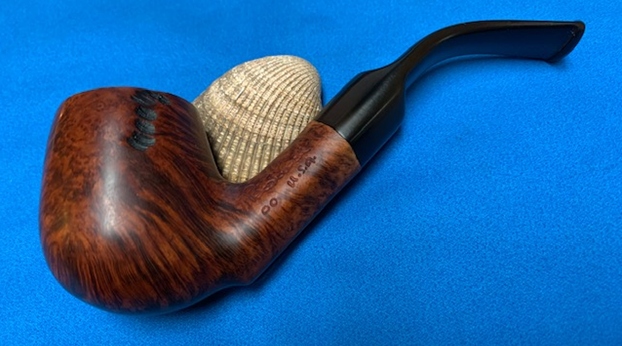
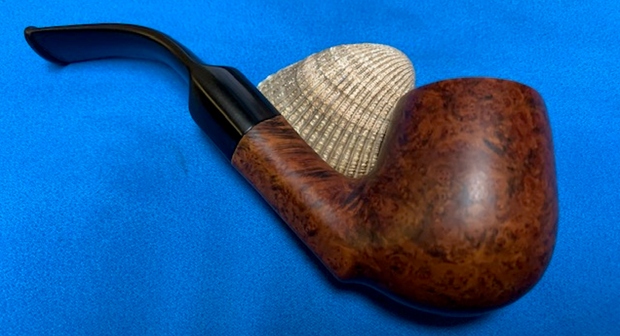
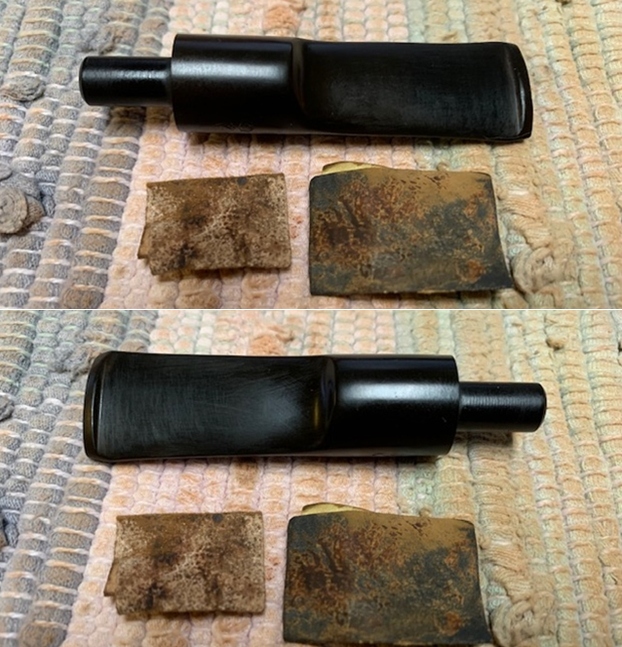
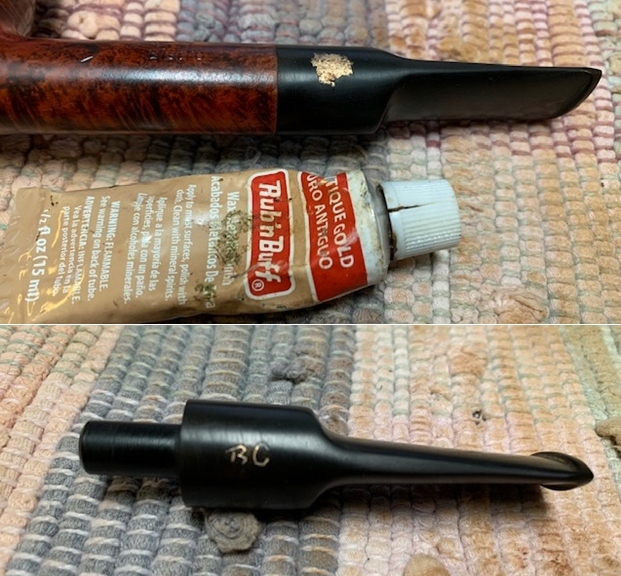
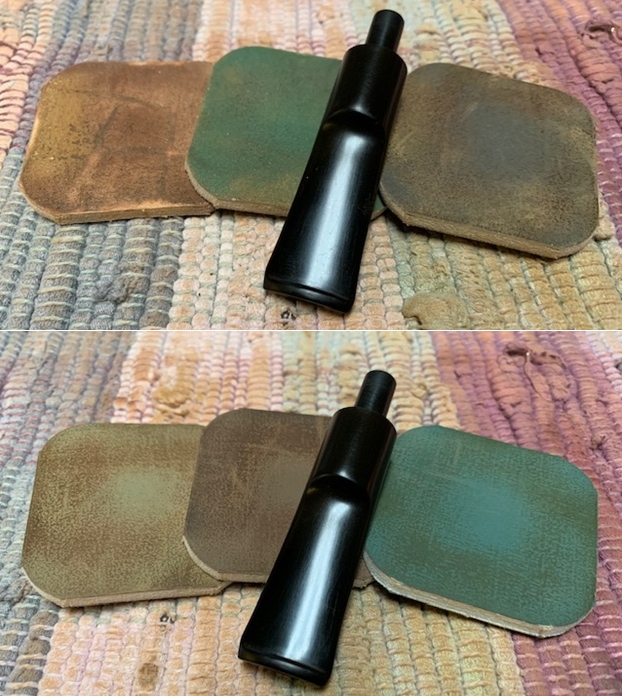
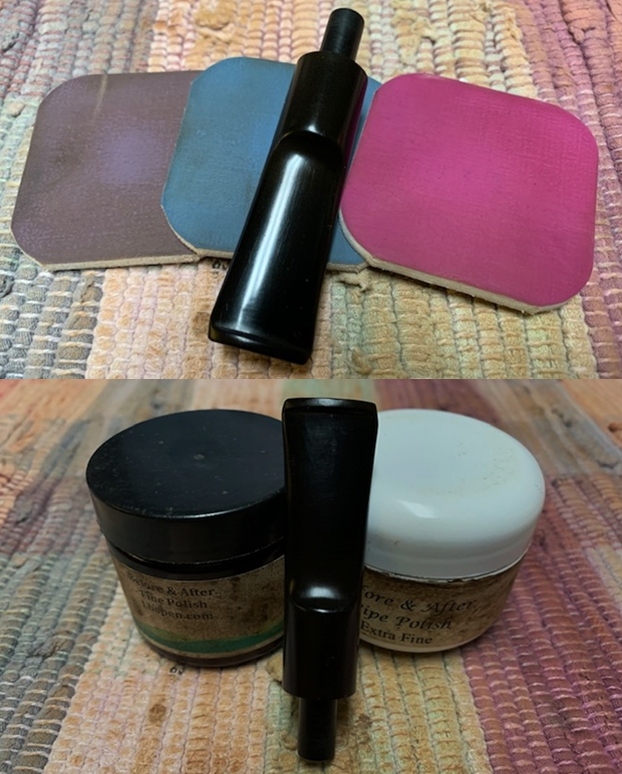
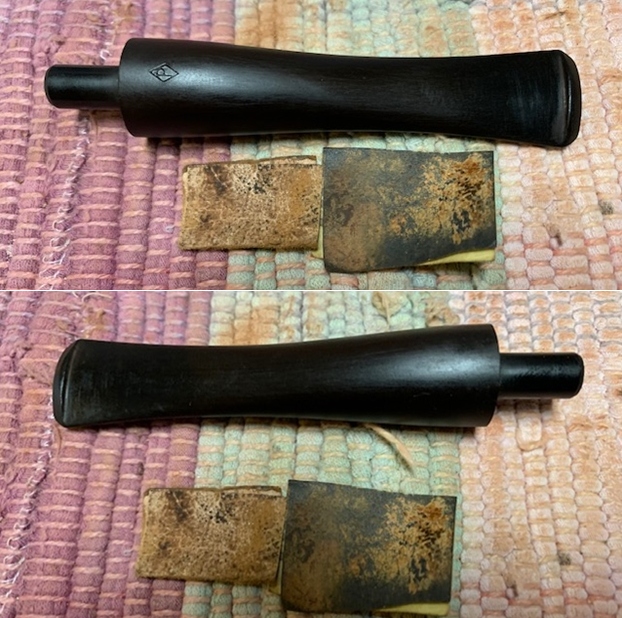
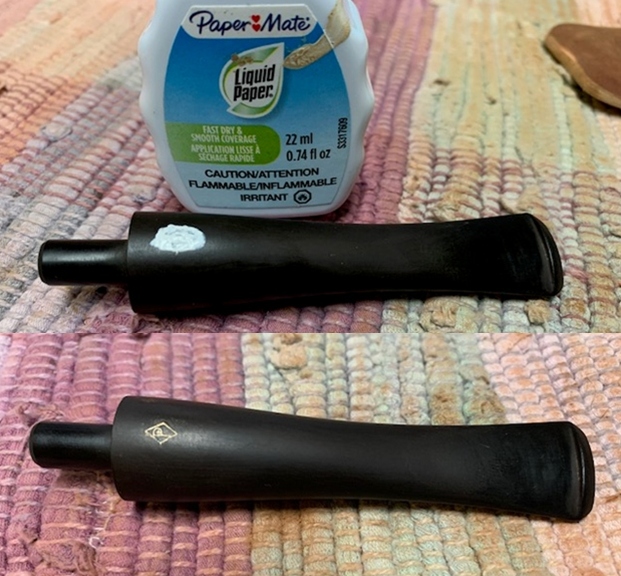
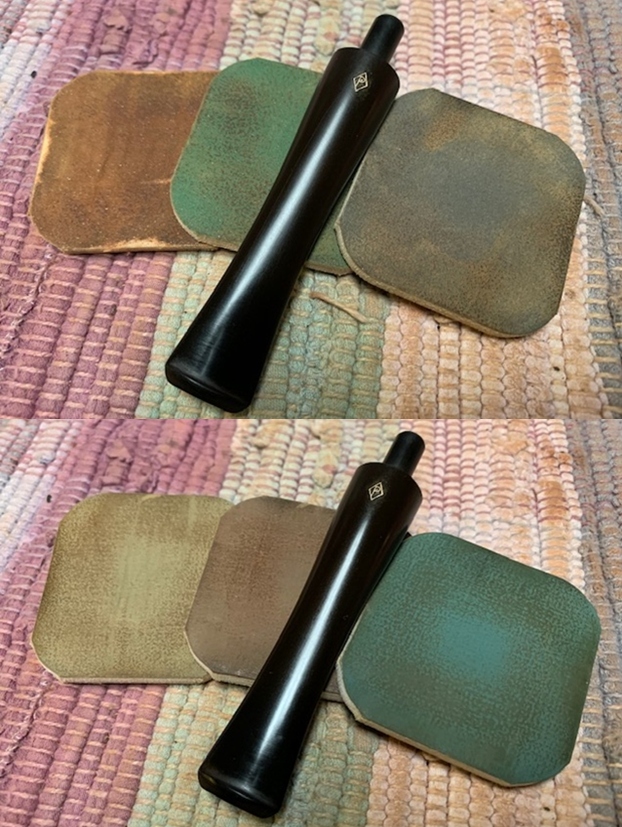
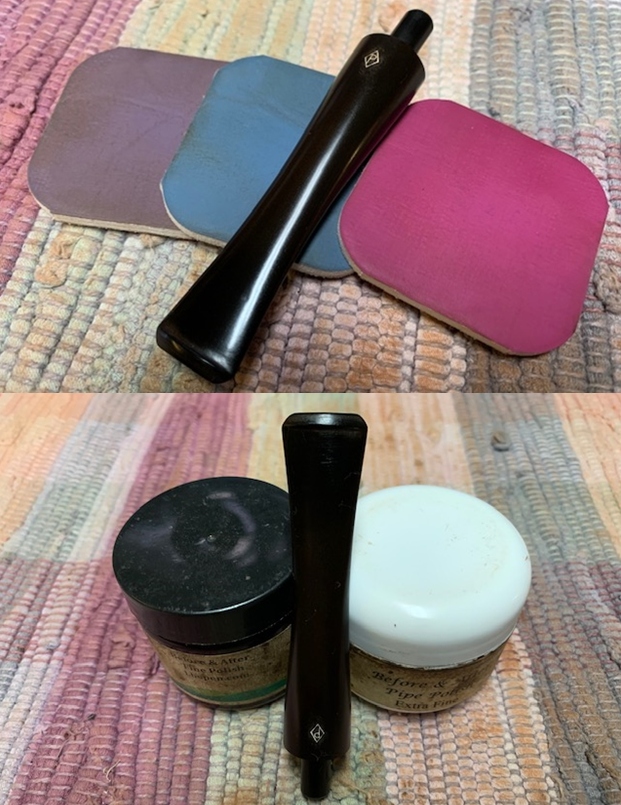
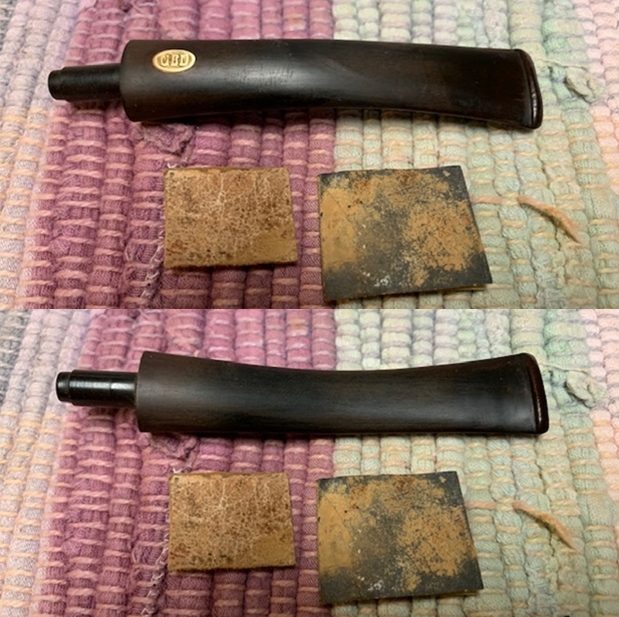
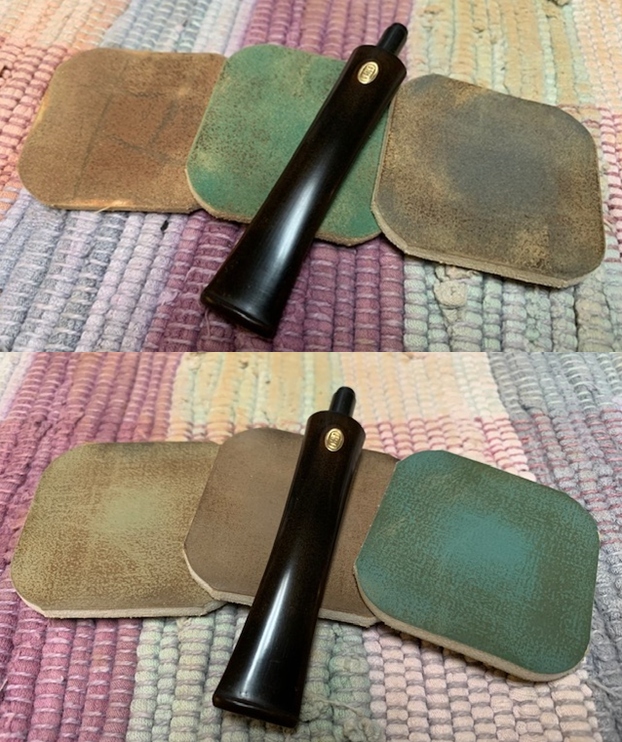
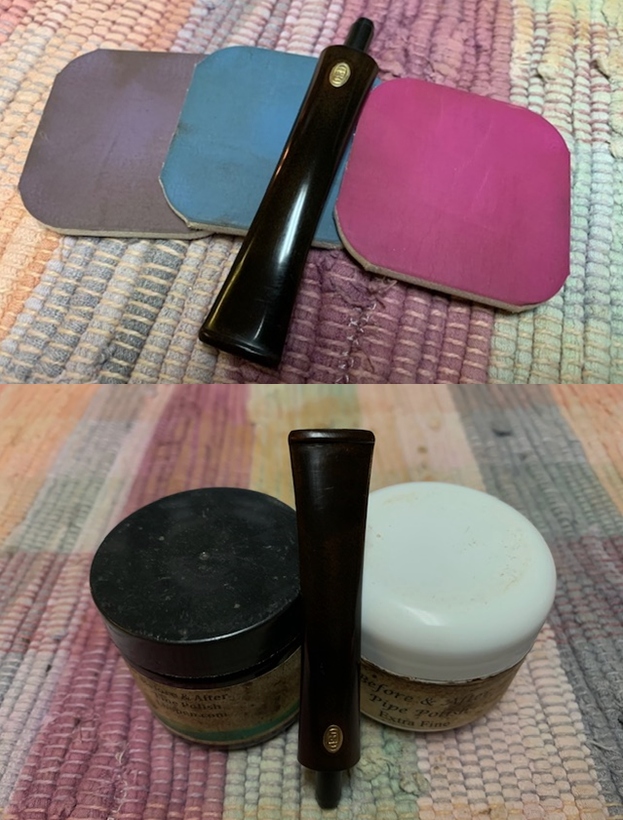
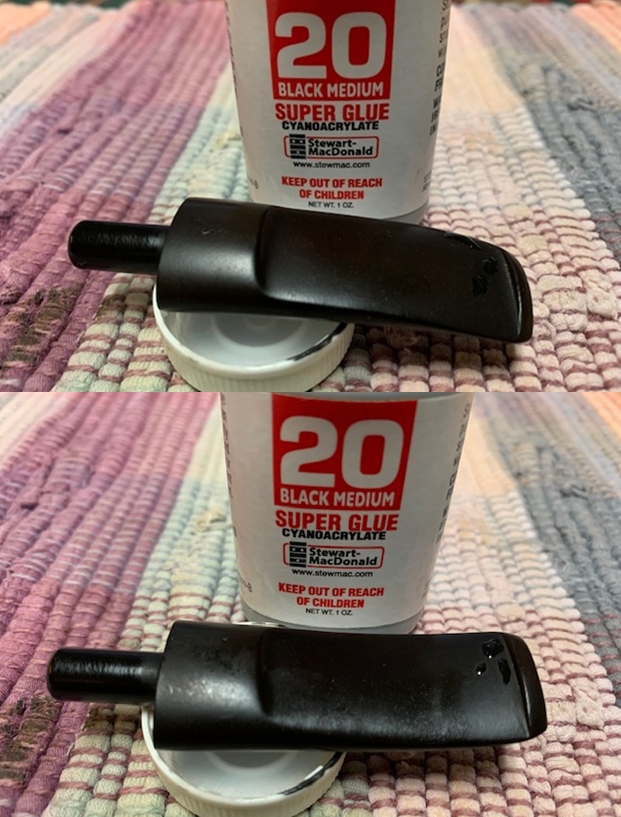
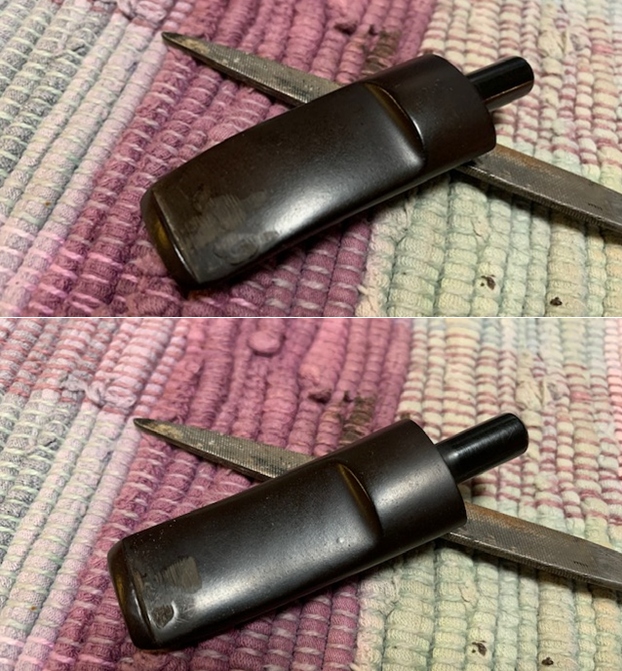
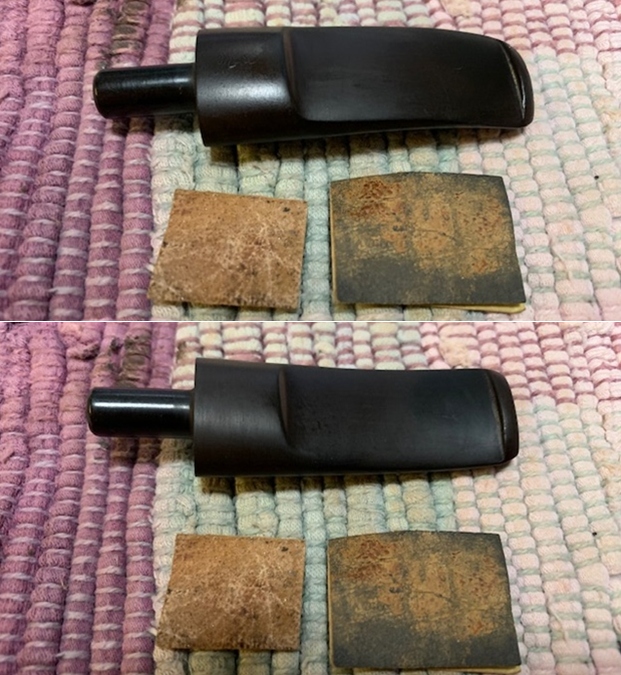
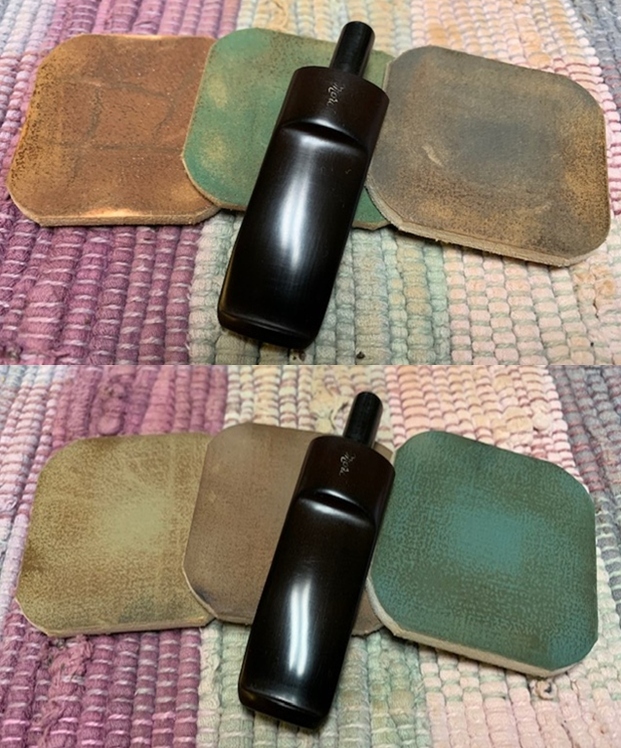
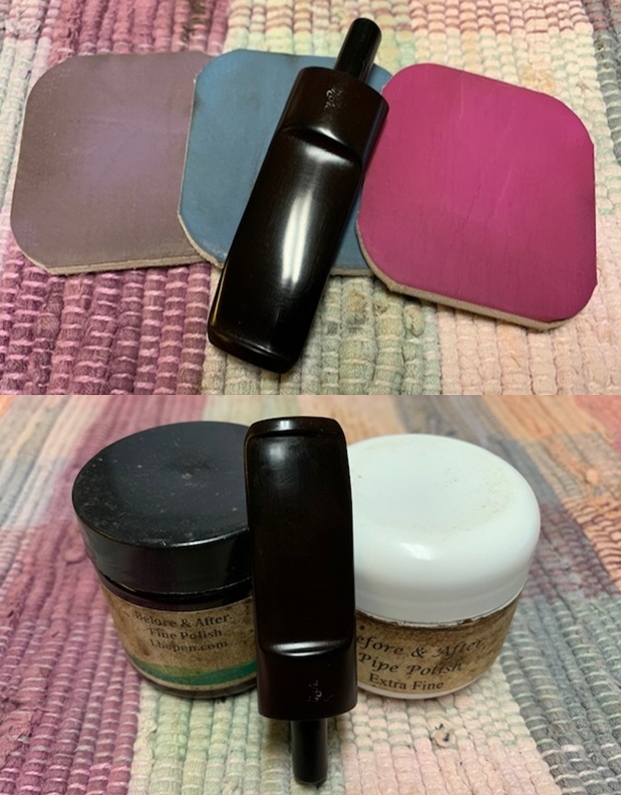
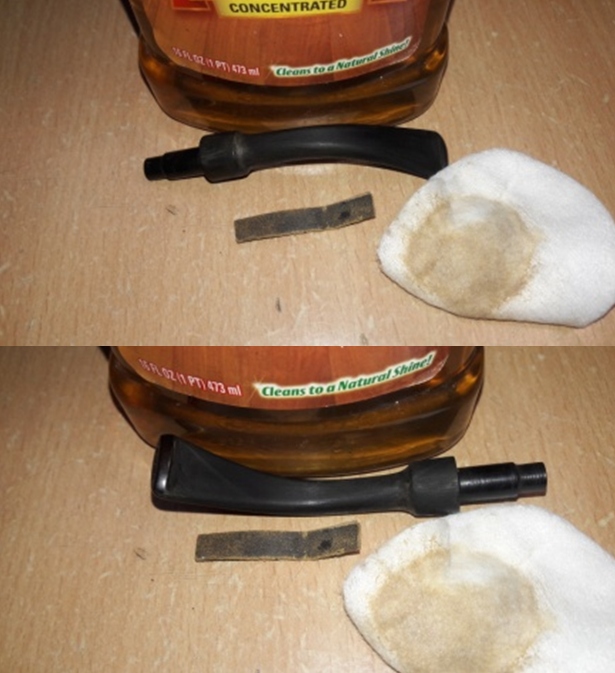
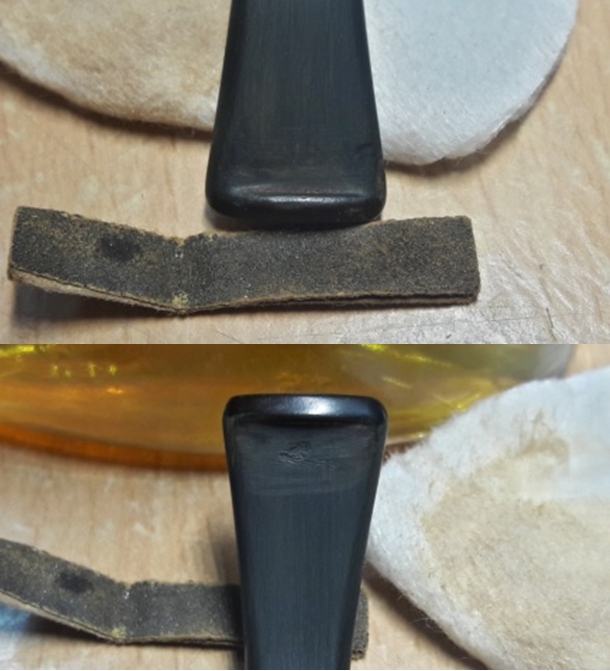
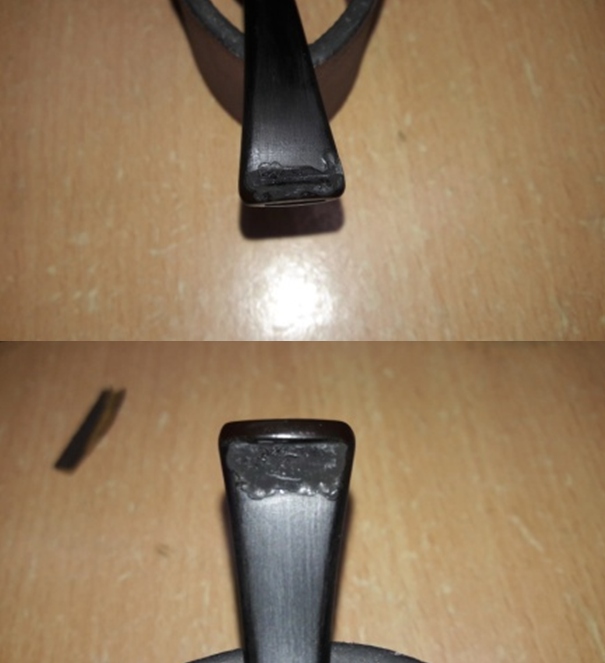
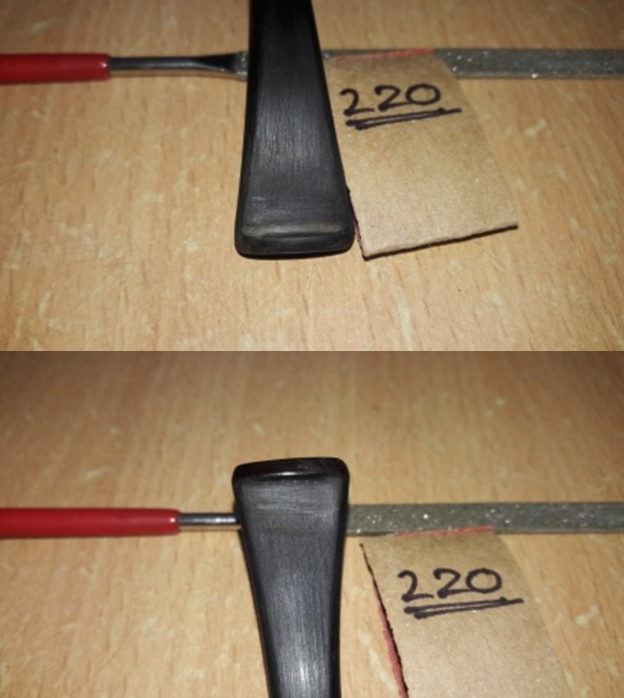
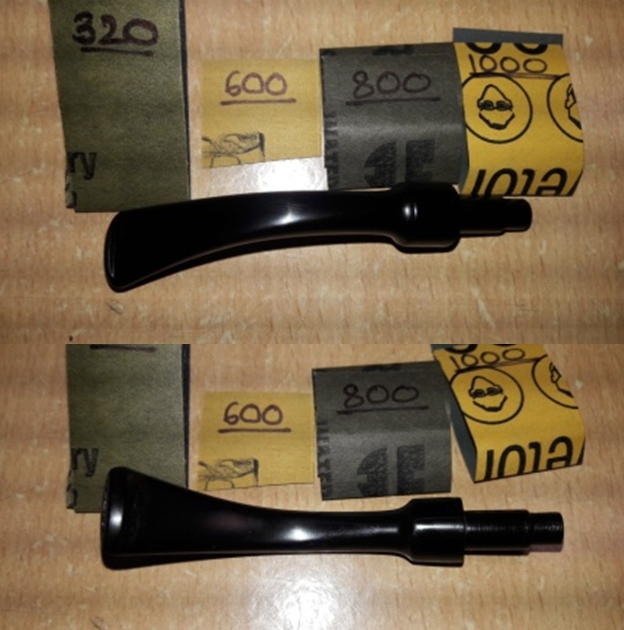
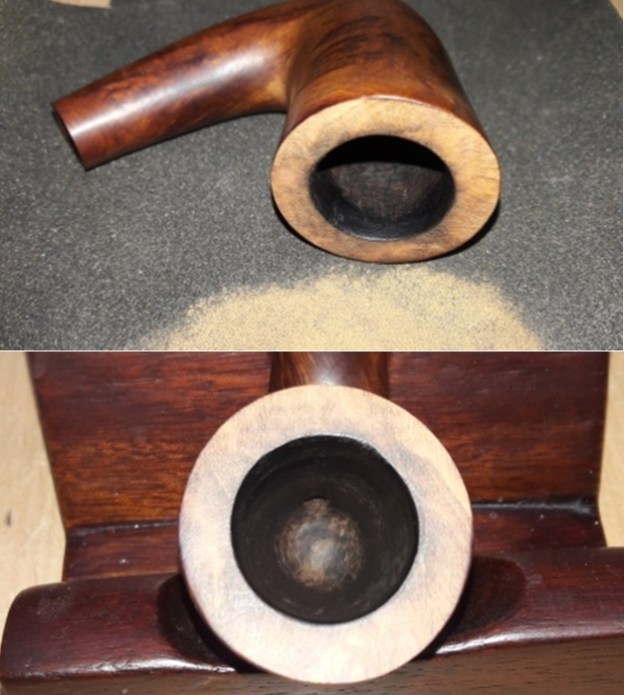
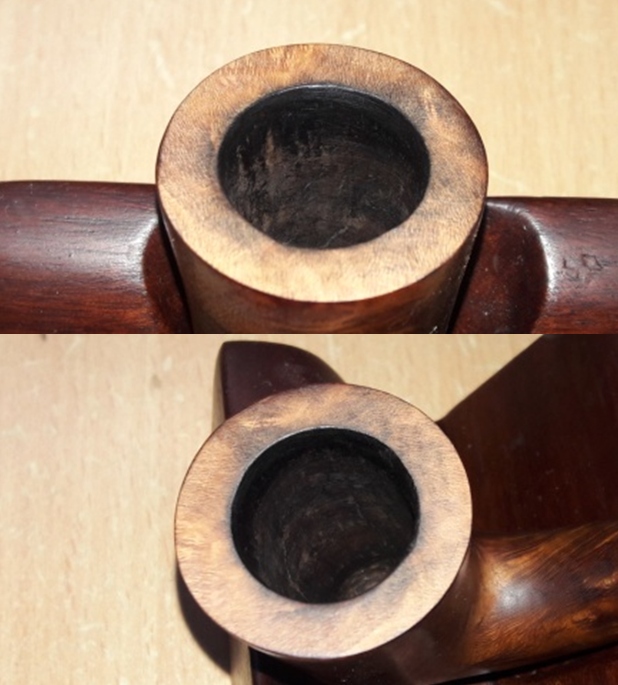
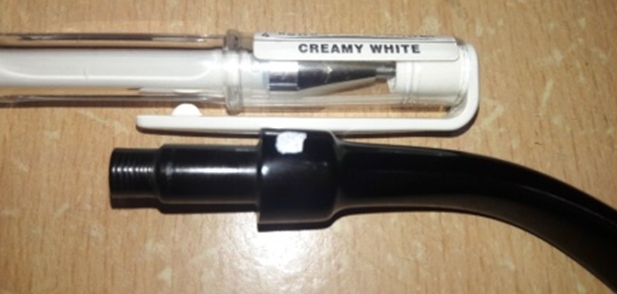
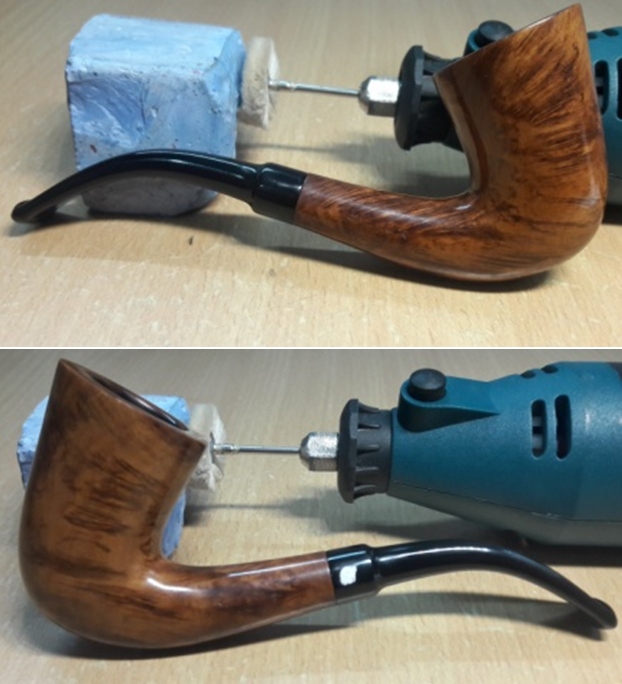
Abha started the restoration of this pipe by first cleaning the internals of the stem with bristled pipe cleaners and 99.9% pure isopropyl alcohol. She further cleaned out the stem internals with a shank brush and dish washing liquid soap. She scraped out the dried oils and tars from the tenon end with a fabricated knife.She dropped the stem in to “Before and After Deoxidizer” solution developed by Mark Hoover. The solution helps to draw out heavy oxidation to the surface, making its further removal a breeze, while the minor oxidation is eliminated to a very great extent. The initial sanding helps to draw out the complete oxidation as the sanding opens up the stem surface that has been initially covered with oxidation. We usually dunk stems of 4-5 pipes that are in-line for restoration and this pipe is marked in blue arrow. We generally allow the stems to soak in this solution overnight to do its work.While the stem was soaking in the deoxidizer solution, I worked on the stummel by first reaming the chamber with size 1 and 2 Castleford reamer heads. With my fabricated knife, I further scraped the chamber walls to remove the remaining carbon deposits and also scraped out the lava overflow from the rim top surface. Once the cake was reamed back to the bare briar, I used a 150 grit sand paper followed by 220 grit sand paper to remove all the traces of remaining cake and also to smooth out the inner walls of the chamber surface. Finally, to remove the residual carbon dust, I wiped the chamber with a cotton pad wetted with 99.9% pure isopropyl alcohol. The chamber walls are sans any damage. The outer and inner rim edge is chipped in a few places along the rim top and will be addressed by topping the rim top. The rim top surface itself is peppered with dents/ dings and scratches which too will be addressed during the sanding. Thankfully the inner rim was not charred under the lava overflow. The ghost smells are still strong and may further reduce after the shank/ mortise are thoroughly cleaned.  This was followed by cleaning the mortise with cue tips, pipe cleaners and shank brush dipped in isopropyl alcohol. I scraped the walls of the mortise with my fabricated knife to remove the dried oils and tars. The mortise was a bear to clean and the heap of pipe cleaners and q-tips that were used is an indication of the gunk and tars that were removed. The old smells of the tobacco are still strong and would need more invasive methods to get rid of these odors. With the bowl internals clean, I move to clean the exterior of the stummel. I used a hard bristled tooth brush and Murphy’s Oil soap to scrub the stummel and rim top. For this stummel cleaning, l I used Murphy’s Oil soap as I wanted to preserve the old patina that had developed on the stummel and was not sure how the Briar cleaner product would affect it. After the scrub with oil soap, I washed the stummel under running warm water with anti oil dish washing detergent till the stummel surface was clean and dried it using paper towels and soft cotton cloth. I simultaneously cleaned the shank internals with the detergent and hard bristled shank brush and set the stummel aside to dry out naturally.The stummel surface has cleaned up nicely with the beautiful grain patterns on full display. I shall subject the chamber to salt and alcohol treatment to eliminate the ghost smells completely.   I continued the cleaning of the chamber and shank internals with a salt and alcohol bath. I use cotton balls which is an at par substitute as I have realized over the years. I draw out a wick from the cotton and along with a folded regular pipe cleaner; insert it in to the mortise and through the draught hole in to the chamber. Thereafter, I packed the chamber with cotton balls to about quarter of an inch below the inner rim edge and soaked the cotton balls with isopropyl alcohol up to the brim. About half an hour later, the level of alcohol had gone down, having being absorbed by the cotton. I topped it up once again and set it aside overnight. By next morning, the cotton and alcohol had drawn out all the remaining oils and tars from the chamber and mortise, fulfilling its intended task. I removed the cotton balls and ran pipe cleaners through the mortise to clean out all the loosened tars and gunk and further cleaned it with alcohol and q-tips. The chamber now smells clean and fresh. I set the stummel aside to dry out naturally.While the stummel was drying, the next morning, Abha removed the stems (stem indicated with pastel pink arrow is the one being worked on) that had been soaking in the deoxidizer solution overnight. She cleaned the stem and the stem airway under running warm water and scrubbed the raised oxidation from the stem surface using a Scotch Brite pad and the airway with a thin shank brush. She further removed the oxidation by scrubbing the stem with 0000 grade steel wool and applied a little EVO to rehydrate the stem. This now gives a clearer picture of the extent of damage as can be seen in the pictures below. The oxidation is deep and stubborn and can be seen over the stem surface around the stem stamping and in the bite zone, as dirty greenish brown coloration. I need to further sand the stem to completely remove the oxidation. The lower bite zone including the button edges on either surface will need to be reconstructed. The round orific opening will need to be reshaped after the lip edges have been rebuilt.    I used a 220 grit sand paper to sand the stem and remove all the oxidation that was raised to the surface. This step further reduced the tooth chatter and bite marks present on the stem. I wiped the stem with Murphy’s Oil soap on a cotton swab. This helps in cleaning the stem surface while removing the loosened oxidation. With a white correction pen, I masked the entire stamping on the stem top surface. This masking helps in easy identification of the extent of the stamping and can be avoided as well as refreshing it when the ink has dried and carefully wiped out.  To begin repairs to the stem, I first inserted a pipe cleaner that had been tightly wound with a transparent sticking scotch tape through the stem air way. This helps prevent the CA superglue and charcoal mix from sticking to the pipe cleaner which in turn prevents the mix from running down in to the air way and clogging it. I generously applied a mix of CA superglue and activated charcoal over the stem areas to be repaired. I apply a thick layer of the mix as this aid in subsequent filing and shaping to match the repairs with the stem surface. Once I had applied the mix, I set it aside to cure overnight. Once the fill has hardened, I shall file and sand the fills to reconstruct the lower bite zone and the buttons on either surface and subsequently match it with the surface of the stem.With the fills in the stem set aside to cure, I turned my attention back to the stummel. I decided to address the rim top surface dents/ dings and the out of round inner edge. I topped the rim top surface on a piece of 220 grit sand paper, checking frequently for the progress being made as I hate to loose briar estate any more than absolutely necessary. The inner and outer edges are still uneven, though much better than before topping. With a folded piece of a 220 grit sand paper pinched between my thumb and forefinger, I create a slight bevel on the inner and outer edges of the rim top surface. This helps to mask and address the minor dents and dings that had remained on the rim edges after topping. I am careful so as not to alter the profile of the stummel by excessive topping or creation of the bevels. I am pretty pleased with the appearance of the rim top and edges at this stage. The following pictures show the progress being made and improvements to the inner and outer rim edges. I followed it by wet sanding the entire stummel with 1500 to 12000 grit micromesh pads, wiping frequently with a moist cloth to check the progress. I really like the looks of the stummel at this point in restoration. The grains and the clean lines of this piece of briar is really appreciable. The few scratches that were noticed over the stummel surface too have been addressed at this stage.    Next, I rubbed a small quantity of “Before and After Restoration Balm” deep in to the briar with my finger tips and let it rest for a few minutes. The balm almost immediately works its magic and the briar now has a nice vibrant appearance with the beautiful grain patterns displayed in their complete splendor. I further buffed it with a horse hair brush. The contrast of the dark browns of the Bird’s eye and cross grains with the natural patina of the rest of the stummel adds an interesting dimension to the appearance of the stummel which may be insufficiently described in words and be rather seen in person.   I cleaned the sterling silver ferrule at the shank end with Colgate Tooth powder. Even Abha uses it to polish her silver and gold jewelry and cutlery. This compound is a very fine powder and is least abrasive with fantastic results. The results were appreciated by Steve during his visit to India. The band is now a nice shining piece of sterling silver and will provide a nice contrast to the shining black stem and the dark brown stummel. With the stummel rejuvenation almost complete, save for the final wax polish, I worked the stem. The fill had cured and with a flat head needle file, I worked on the filling till I had achieved a rough match with the surrounding surface and had sufficiently sharpened the button edges. For a better blending, I further sand the entire stem with 220 followed by 400, 600 and 800 grit sand paper. This helps to reduce the scratch marks left behind by the more abrasive 220 grit paper. I am pretty happy with the way the stem repairs have shaped up and also the buttons have a nice delicate shape to them. To bring a deep shine to the vulcanite stem, I went through the complete set of micromesh pads, wet sanding with 1500 to 2000 grit sandpapers followed by further wet sanding with 3200 to 12000 grit pads. I wiped the stem with moist cloth after each pad and rubbed it down with Extra Virgin Olive oil to rejuvenate the vulcanite. The finished stem is shown below.  Stummel done, stem done!! All that remained was the original case that housed this pipe. Firstly, I reattached all the dark brown linings that had come loose, with superglue. I wiped the brown leather cover with Murphy’s Oil soap on a cotton swab. The color on the swabs should give the readers an idea of how dirty the surface was!! I wanted to further scrub the leather surface, but unsure that I was as to how the leather would hold up to all the scrubbing, I left it at that (remember my mantra… Less is more!!). I cleaned the inner velvet linings of the lid and bottom respectively, with a mild soap in warm water and a soft bristled tooth brush. I was very gentle with this as I had no intention of either tearing the lining or messing up the velvet surface. I completely dried the lining using paper towels. It now does look nice and rich.  With the externals and internals of the case all cleaned up, all that remained was to rejuvenate the leather. I applied a generous coat of Brown color shoe polish (it also has a very high wax content!) on either surfaces and kept it aside to be absorbed by the leather. Prevalent heat in my part of the country also kept the polish in a semi-liquid state which further helped in absorption. I polished it with a horse hair shoe brush to a nice shine and gave a final buffing with a microfiber cloth.  I have now reached the homestretch in this restoration project. To complete the restoration, I mount a cotton cloth buffing wheel on to my hand held rotary tool and polished the stummel and stem with Blue Diamond compound. This compound helps to remove the minor scratch marks that remain from the sanding.     I mounted another cotton buffing wheel that I have earmarked for carnauba wax and applied several coats of the wax. I finished the restoration by giving the entire pipe a rigorous hand buffing using a microfiber cloth to raise the shine further. The finished pipe looks amazingly beautiful and is ready to join my collection. I only wish it could share with me its life story of the past years while I enjoy smoking my favorite Virginia blend in it or maybe an English blend or maybe just keep admiring it!! Big thank you to all the readers who have joined me on this path by reading this write up as I restored and completed this project.


Life for a Tired Lane Era Charatan’s Make Belvedere Pot 48DC


Blog by Steve Laug

A fellow Vancouver Pipeman named Alex continues to keep me busy with working on the pipes he is picking up. He has picked up some interesting American and English made pipes. The next of those pipes is an English made Pot. It is quite a stunning pipe with great grain around the bowl. From what I can see it is a flawless piece of briar. The grain is birdseye on the sides of the bowl and cross grain on the front and back. The pipe is stamped on the left side of the shank and it reads Charatan’s Make [over] London England [over] Belvedere. To the left of the stamping is a cursive “L” in a circle and to the right of the stamping is the shape number 48DC.  The L stamp and the DC (Double Comfort) stamp both point to the pipe being made during the Lane era of Charatan. The bowl had been reamed before coming to my work table. The rim top was clean other than some darkening on the inner bevel at the front of the bowl. The finish was worn off and very dirty with grime and oils ground into the surface of the bowl and shank. The vulcanite saddle stem is at one time would have had a CP on the left side of the saddle but it had long since been buffed off. The stem was clean but scratched and still having some remnants of oxidation at the sharp edges of the Double Comfort bit. Here are some photos of the pipe when I first received it.    I took a close-up photo of the rim to show the condition of the rim top, bowl and the inner edge of the bowl. You can see the darkening on the front inner bevel of the rim top. The stem was quite clean but someone had sanded and buffed it so it was a bit wavy.     The stamping on the side of the shank is shown in the photo below. It reads as noted above.  I removed the stem from the shank and took a photo of the flow of the pipe. The pipe was really going to look great once it was cleaned and polished.To try to figure out the era of the Charatan’s pipe I was working on I turned to the Pipephil website, Logos and Stampings. There is some really helpful information on each of the lines of Charatan’s Make pipes that entered the market. Here is the link to the section of the site that I turned to (http://www.pipephil.eu/logos/en/logo-charatan.html). There is an alphabetical listing of the lines but the Belvedere they showed had a stem made for a 9mm filter while the one I have is a nonfiltered pipe. The site did give a short history of the brand. I quote the portion that is most pertinent.

The brand was founded in 1863 by Frederik Charatan. When his father retired in 1910, Reuben Charatan took over the family business. All the pipes were handmade until 1973. The brand name has been overtaken by Dunhill in 1978 and sold in 1988 to James B. Russell Inc.(NJ, USA). During the period 1988-2002 Charatans were crafted by Butz Choquin in St Claude (France). Dunhill re-purchased Charatan brand name in 2002 and Colin Fromm (Invicta Briars, Castleford) followed up on freehand production.

I turned to Pipedia to see if I could find more information on the brand and possibly a link to the Belvedere line (https://pipedia.org/wiki/Charatan) but once again in the general article it was not listed.  It did give a little more historical information. I quote the pertinent parts and have highlighted in red the sections that give information on this particular pipe.

In 1863 Frederick Charatan, a Russian/Jewish immigrant, opened a shop in Mansell Street, located in the borough of Tower Hamlets, London E1, where he began to carve Meerschaum pipes. These pipes got very popular soon, and thus Charatan moved to a bigger workshop in Prescot Street, just around the corner. Here he began to make briar pipes which should make the name famous the world over. Charatan was the first brand to make entirely hand-made briars from the rough block to the finished pipe including the stems. The nomenclature “Charatan’s Make” refers to this method of production and was meant to differ Charatan from other brands who “assembled” pipes from pre-drilled bowls and delivered mouthpieces.

Being the undisputed No. 1 in English pipemaking, Charatan was approached by Alfred Dunhill who was unsatisfied with the quality of the pipes he imported from France. During 1908 – 1910 Dunhill bought pipes from Charatan paying exorbitant prices to ensure he had some of the very best pipes for sale in England. In 1910 he lured away Joel Sasieni, one of Charatan’s best carvers, and opened his own small pipe workshop on 28 Duke Street. On the retirement of his father in 1910 Reuben Charatan took over the family business…

The pre-Lane period (prior to 1955) and the Lane era pipes (1955 to until sometime between 1979 – 1984) are of primary interest the collector. The Lane era is often quoted as beginning about 1950… Charatan records are almost non-existent before Lane due to a factory fire, making it difficult to date pre-Lane pipes. Charatan used 4 basic grades prior to 1950: Supreme, Selected, Executive, and Belvedere. After 1950 Herman Lane’s influence began, and the grades started to expand. In 1955 Lane took over sole distributorship of Charatan in the US. In 1957 he introduced the Supreme S. Most of his other introductions were from the 60’s and early 70’s…

I continue digging further into the dating of the pipe, but what I had found was a good start for me. If some of you would like to try your hand at dating it more accurately as to the time period it came out you might want to check out the article on Pipedia on Dating Charatans (https://pipedia.org/wiki/Dating_of_Charatans).

I also reread the article on Pipedia by the Italian fellow who contributed some really helpful information on the brand (https://pipedia.org/wiki/Charatan_-_Milan_2014). I quote the section on the Second period: Reuben Charatan 1910 – c. 1962

– In 1962 Herman Lane took over the business from the Charatan family, although he had already influenced production from the 1950s.

– The pipes were mostly larger than the previous ones and corresponded in size to Dunhill group 5. These are slightly less rare, but still difficult to find.

– Stem: Usually in ebonite, saddle shaped or tapered, bearing a fine “CP” stamp, underbore system (see below) used when necessary.

– Shank: The shape code is stamped on it together with the nomenclature “CHARATAN’S MAKE LONDON ENGLAND” arranged in two lines. From 1955 onwards on the models marketed for the USA there is also a serif and circled capital “L” (but not all models bear this) which resembles the pound sterling symbol. The “L” is for Lane, the importer.

From 1958, Lane changed the nomenclature for models marketed for the US to clarify the message: “MADE BY HAND”.  In this period the underbore was introduced. Its manufacturing period ranged between 1920 and c.1930. This model was equipped with a duralumin plunger trap fitted in the stem, which served to clean the residue more easily. This particular model bore a special stamp on the stem, and also had its own catalogue…

QUALITY GRADES…The stem did not only display the stamps mentioned above. Another stamp that can help dating is the one referring to the quality of the pipe. Until Herman Lane arrived on the scene there were four quality grades. Starting with the lowest: Belvedere, Executive, Selected, and Supreme. Lane went on to add higher grades from time to time: Supreme S, Supreme S100, S150, S200, S250, S300, Coronation, Royal Achievement, Crown Achievement, and Summa Cum Laude; these last three are extremely rare and almost impossible to find. He also invented other, different grades, even changing the previous pipe classification standards. We will not go into detail here, but it means that if we find an S100 or Coronation the pipe was manufactured following Herman Lane’s acquisition. In particular, the FH mark, or Freehand pipe was commissioned to the famous Danish craftsman, Preben Holm

Now it was time to work on the pipe itself. I scrubbed the exterior of the bowl with a tooth brush and undiluted Murphy’s Oil Soap to get the grime and debris out of the briar. I rinsed it with running water and dried it off with a towel. With that the outside was clean… progress!    I cleaned out the mortise, shank in the briar and airway in the stem with pipe cleaners, cotton swabs and 99% isopropyl alcohol. The pipe was dirty with lots of tars and oils.   I worked on the damage to the inner edge of the bowl with 220 grit sandpaper to remove as much of the damage as possible and bring the bowl back to round. I took a photo of the rim top after the cleanup to show the progress in cleaning up the edges.      I polished the briar with micromesh sanding pads – wet sanding with 1500-12000 grit pads and wiping the bowl down with a damp cloth after each pad. The grain is really beginning to stand out and the rim top is blending in quite well.    I worked some Before & After Restoration Balm into the surface of the briar with my fingertips to clean, enliven and protect it. I let the balm sit for a little while and then buffed with a cotton cloth to raise the shine. The following photos show the bowl at this point in the restoration process. I am very happy with the results.    I set the bowl aside and turned my attention to the stem. I scrubbed the stubborn areas of the creases on the stem with Soft Scrub until they were clean. It too a bit of work but I was able to remove much of the oxidation.       There were several small tooth marks on the surface of the stem on each side. I filled them in with Loctite 380 Black CA glue and set the stem aside to let the repairs cure.     I smoothed out the repairs to blend them into the surface of the stem with 220 grit sandpaper. I also worked on the creases to remove oxidation as well as flattening some of the waviness of the stem surface. I started the polishing of the stem with 400 grit wet dry sandpaper. I polished the stem with micromesh sanding pads – wet sanding with 1500-12000 grit sanding pads and wiping it down after each pad with Obsidian Oil. I polished the stem with Before & After Stem Polish – both Fine and Extra Fine. I wiped it down a final time with Obsidian Oil when I finished.          This Charatan’s Make Belvedere 48DC Pot with a vulcanite saddle stem turned out to be a real beauty. The carver really maximized the grain with the shape of the pipe. Everything about the pipe – the finish, the rim top and the cut of the briar work well to highlight the grain around the bowl. I polished stem and the bowl with Blue Diamond polish on the buffing wheel and the finish just popped and came alive. I gave the bowl and the stem multiple coats of carnauba wax. I buffed the pipe with a clean buffing pad to raise the shine. I hand buffed it with a microfiber cloth to deepen the shine. The pipe polished up pretty nicely. The pipe took on life with the buffing. The rich brown finish works well with the polished vulcanite stem. The finished pipe has a rich look that is quite catching. Have a look at it with the photos below. The shape, finish and flow of the pipe and stem are very well done. The dimensions are Length: 5 ½ inches, Height: 1 ½ inches, Outside diameter of the bowl: 1 ½ inches, Chamber diameter: ¾ of an inch. The Charatan’s Make Belvedere will back in the box of pipes that I am working on for Alex. I am looking forward to what he will think of this one. Thanks for walking through the restoration with me as I worked over another estate pipe.

Life for a well used American Made John Bessai Custom Made Special Bent Poker/Sitter


Blog by Steve Laug

A fellow Vancouver Pipeman named Alex continues to keep me busy with working on the pipes he is picking up. He has picked up some interesting American and English made pipes. The next of those pipes is Bent Poker that is a Sitter. It is quite a stunning pipe. From what I can see it is a flawless piece of briar. The grain is mixed around the bowl and shank. The pipe is stamped on the left side of the shank and the flat heel of the bowl. On the left side it reads CUSTOM MADE [over] FIRST QUALITY. On the heel it reads JOHN BESSAI [over] SPECIAL. There was a thick cake in the bowl and some lava overflowing onto the rim top. The thick lava and cake make it hard to ascertain the condition of the inner edge of the rim. The finish was very dirty with grime and oils ground into the surface of the bowl and shank. The vulcanite saddle stem is stamped with a JB (John Bessai) logo on the left side of the saddle. The stem was calcified, oxidized, dirty and had tooth marks and chatter on both sides near the button. Here are some photos of the pipe when I first received it.    I took a close-up photo of the rim to show the condition of the rim top, bowl and the inner edge of the bowl. You can see the thick cake in the bowl and the lava overflowing on the top of the rim. The stem had tooth damage and chatter on the button edges and the stem ahead of the button. The stamping on the side of the shank and heel of the bowl is shown in the photos below. It reads as noted above.  You can also see the JB logo on the left side of the saddle stem.   I removed the stem from the shank and took a photo of the flow of the pipe. The pipe was really going to look great once it was cleaned and polished.I have worked on quite a few Bessai pipes over the years and back in 2014 I restemmed a bowl. I wrote a blog on the pipe and did quite an extensive amount of research on the brand (https://rebornpipes.com/2014/07/14/restemming-and-restoring-a-john-bessai-special-diamond-shank-bent-brandy/). I am including that information here for ease of reference.
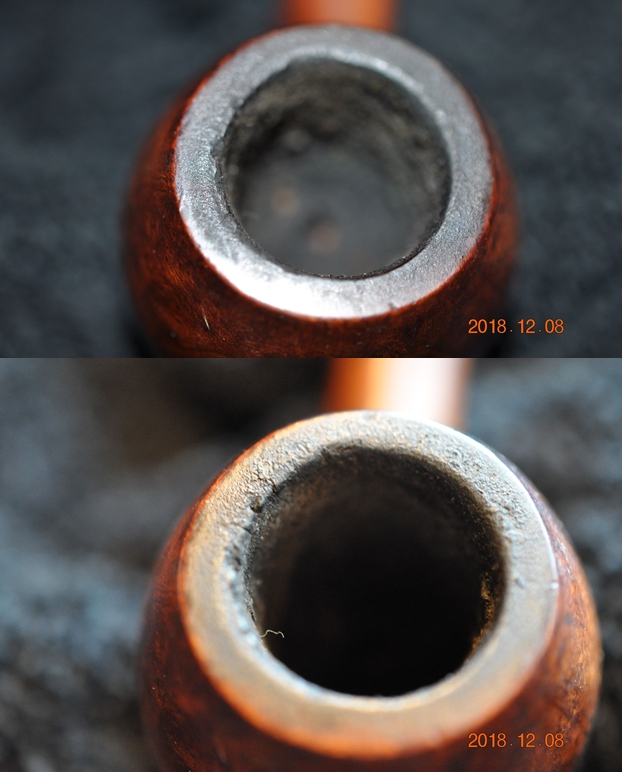
HISTORY & BACKGROUND

I started out with what I had found previously and written about on the blog. I quote the following paragraph from Pipedia http://pipedia.org/index.php?title=Bessai

 John Bessai was a long time pipemaker, repairman and tobacco shop owner who operated his pipe shop at the “Old Arcade” in Cleveland, Ohio. The shop was opened in approximately 1898. It was a small 2-room shop where he hand-crafted his own pipes in the back room and could work when customers were not there. Like so many other shop made brand, John Bessai’s limited production was quickly acquired by regular customers and thus his craftsmanship remained little known outside of Ohio and the Midwest. While his name is known by pipe collectors in the Midwest, his work is seldom seen elsewhere! He died before 1969. Nevertheless, John Bessai left behind a small number of classic shaped pipes; all were made on-site. They are praised worthy of collecting and reflecting skills well beyond most American pipe makers. John Bessai’s logo “JB” appeared as one letter as the “back” of the “J” and the “back” of the “B” share a single line. The logo was stamped on the stem and on the left side of the shank. His son Herb Bessai took over the business and also continued making pipes. He closed the shop in about 1978.

I suspected that there would be more information three years later. I did some further research and came across the information found in the paragraph below on one of the pipe forums.

John Bessai was located in the Colonial Arcade at least into the late 1980s. After his death, his son Herb ran the shop. It was taken over after Herb’s retirement by a male and then name was changed to “Old Erie Pipes”. This was then located in the Erieview Plaza and when that mall closed, taken over by Cousin’s Cigars which has a store on Euclid Avenue near CSU, and a store on Chagrin Boulevard in Woodmere Village.

That small quotation gave me a bit more information of the state of the store after John’s death and Herb’s retirement. But I still wanted more information. I wanted to know about the history of the brand and if there was any information on the various grades in the brand and the stamping on the pipes. I wanted to know a bit of a timeline for the brands. Finally my digging paid off. ON one of the pipe forums I came across a link that led me to a gold mine of information gathered by a man after my own heart, Andrew Hross. He has a blog called Classic Pipe Shop on Blogspot. I have included the link below for those who want more information. Andrew has done an amazing job of gathering information on the Bessai Brand so rather than rewrite the history I am quoting portions of Andrew’s work on The John Bessai Pipe Clinic. (http://classicpipeshop.blogspot.ca/2014/04/the-john-bessai-pipe-clinic-information.html)

The John Bessai Pipe Clinic, 35 Colonial Arcade, Cleveland, OH 44115 – by Andrew Hross

Owner(s): **John Bessai 1920s until his passing in 1969, **Herb Bessai ~1962-1983, **Daniel Gottschall 1984-~1993, **Purchased by Dad’s Smoke Shop / Cousin’s Smoke Shop and rolled into the Old Erie Smoke Shop about 1993. Cousin’s Cigars purchased the remaining stock of Bessai pipes near after Herb Bessai passed away in 2002.

Years of Operation: 1920s (unkown specific date at this time) – 1983. After 1983 the business was sold to Daniel Gottschall who later sold it to Cousin’s Cigar (Euclid Ave) around 1993. The name was changed to “Old Erie Tobacco Company”. They were forced to move to the Galleria when all the tenants of the Old Arcade were cleared out to make room for renovations. Their new address was The Galleria at Erieview, 1301 East 9th Street in Cleveland.

After this move the location wasn’t as busy as they had hoped and Cousin’s moved all the Old Erie Tobacco assets to their Euclid Avenue Store. The store has since moved to a St. Clair location after Cleveland State forced them out due to anti-smoking regulations on campus. Their St. Clair location offers many of John Bessai Pipe Clinic’s old tobacco blends.

Their new store opened in the Merriman Valley area in Akron, Ohio where the store manager John Coleman oversees the day to day operations. John was instrumental in helping me piece together a lot of loose ends during Bessai Pipe Clinic’s transition years.

My father visited their shop several times in the early 60s as he attended Fenn College (now Cleveland State University) as an undergrad before moving on to Ohio State University for his Masters. He’s way smarter than I am so I just go with the flow…

He mentioned meeting John at that time who quickly gave my father some pointers on smoking a pipe and how to take samples from the shop’s expansive sample jar collection. His pipes were on display in the shop although I don’t believe he had a lot of pipes on display at any given time due to production in-shop.

John’s son Herb took over the shop in the early 60s after he graduated from Cleveland State University / Fenn College (unclear) as he is listed as having played Basketball for CSU. Herb was also a helpful, informative and friendly individual. Articles exist from the Herald in 1962 where they interviewed Herb (with photograph) about the state of smoking in the new age of the early 60s. I visited the shop in the late 70s / early 80s with my father during a trip to Cleveland and couldn’t tell you much about the shop other than the guy working was very friendly. Back then it wasn’t unusual to be a kid and walk into a smoke shop with your father. Clearly I didn’t purchase anything but my father probably picked up some tobacco but I remember him looking at pipes displayed on a back wall. The shop was small but impressive.

If anyone has any pictures of the shop or old catalogs, I would love any additional information as it’s tough to come by 30+ years later!

Pipes offered by John Bessai Pipe Clinic: Most of the pipes that were offered by the John Bessai Pipe Clinic were fairly standard in shape… I would say most of the pipes Bessai offered were smooth pipes. My assessment would be 90% smooth and 10% rusticated / sandblasted…

…The story is that John crafted pipes in the back room or off site and finished them in house while the store wasn’t busy. Very little information is available on the accuracy of this statement. Some of his pipes from the late 1960s through the 1970s (John passed away in 1969) I feel were left over stock from previous turnings and sometimes showed fills or sand pits. Some of these pipes even carry Herb’s markings (see below). These pipes still smoke very well but are not as eye-appealing as other earlier pipes from the store’s career.

Stampings and rough dating of John Bessai Pipe Clinic Pipes: Which pipes did John make and which ones did Herb make/finish? All Bessai pipes carry his standard large JB stamp either on the stem or shank or both. Typically the JB on the stem is within a circle.

All pipes created by John Bessai’s hands reportedly contain the miniscule ‘jb’ stamp on the shank or body of the pipe. I have older pipes in my possession that do not contain this stamp (condenser, old stamps, etc) that were clearly shop made pipes. I feel he started using the tiny ‘jb’ stamp in the 50s to early 60s.

An interesting note about John Bessai’s stems – they always clean very nicely and aren’t prone to as much oxidation (that brownish / green color) as most dunhill and Charatan pipes tend to oxidize. His cuts to his stems were very impressive and often transitioned from diamond-shaped shanks almost architecturally. Very comfortable to smoke.

John Bessai Special Pipes:

… I have a couple Bessai Special pipes. These stand out either by large size, graining or possibly shape. Most Specials are unique pipes and are rare to find in comparison to his regular issue pipes.

John Bessai Special X pipes:

I only have one of these and it’s a beauty. This one is a larger bowl (around a group 4 dunhill) with deep colored grain and a hefty substantial shank. Special X pipes are probably the rarest of John Bessai pipes and should be sought out if possible. I’ve smoke mine roughly 4 or 5 times and it performs with the best of my pipes…

Herb Bessai Pipes:

Unfortunately none of these pipes that I’ve seen have astounded me with grain or general appearance. Having said this, these pipes smoke nicely and are a great value if you can find them. I have one that my father found at an Antique Show in the South. There’s another author shape on reborn pipe’s blog that someone refinished because of the amount of fills in the pipe. He also states it’s a wonderful smoker (Editor’s note: This is my pipe and the write up I did on the blog). These pipes are likely from the late 60s through the early 70s. I believe many pipes after this period were created en masse at a factory in the US. It is unclear what stamp was used on these later pipes…

Dating / Circa era Bessai Pipes: If the pipe carries a stamp stating Cleveland, O U.S.A. it’s considered an older production pipe (pre1960s). I’ve not seen any newer pipes with that stamp.

Bullseye stamping usually indicates an earlier pipe as that stamp seems to have been abandoned pre1960 as well.

Most of the earlier Bessai pipes have an unusual ‘stinger’ or condenser at the end of the tenon which is unique to Bessai pipes. They are either a hard plastic or created out of wood. They are typically easy to remove and could have been easily lost if misplaced. These pipes I would consider pre-1960 and possibly 1940s-early 1950s production based on their stamps and patina of the pipes.

1970s 1980s and beyond: My feeling on these pipes after John’s passing is that they purchased finished pipes from a large manufacturer and stamped them with the John Bessai or Bessai stamp (on shank and/or stem). Most of these shapes are standard among many stores from that period and offer less than spectacular grain (and sometimes fills). Stamps on these pipes are probably fairly plain and don’t have the tiny ‘jb’ stamp on the shank indicating it was produced by John Bessai.

I know that is a lot of information and if you want to you can skip ahead to read about the restoration. I started my restoration with cleaning the internals and the externals of the pipe. I cleaned out the inside of the pipe with pipe cleaners, cotton swabs and alcohol. It was a filthy pipe on the inside.

The pipe in hand was a John Bessai Special. As noted above these stand out either by large size, graining or possibly shape. Most Specials are unique pipes and are rare to find in comparison to his regular issue pipes. It is certainly the first SPECIAL I have worked on.

Now it was time to work on the pipe itself. I reamed the thick cake back to the walls with a PipNet pipe reamer using the first two cutting heads. I followed up – cleaning the remnants of cake on the walls with a Savinelli Fitsall Pipe Knife. The final step for me to assess the condition of the walls of the bowl is to sand it with 220 grit sandpaper on a piece of dowel. I sanded the walls smooth. I was happy with the condition of the inside walls of the chamber.  I scrubbed the exterior of the bowl with a tooth brush and undiluted Murphy’s Oil Soap to get the grime and debris out of the briar. I rinsed it with running water and dried it off with a towel. With that the outside was clean… progress!      I cleaned out the mortise, shank in the briar and airway in the stem with pipe cleaners, cotton swabs and 99% isopropyl alcohol. The pipe was dirty with lots of tars and oils.       I worked on the damage to the inner edge of the bowl with 220 grit sandpaper to remove as much of the damage as possible and bring the bowl back to round. I took a photo of the rim top after the cleanup to show the progress in cleaning up the edges.     I polished the briar with micromesh sanding pads – wet sanding with 1500-12000 grit pads and wiping the bowl down with a damp cloth after each pad. The grain is really beginning to stand out and the rim top is blending in quite well.    I worked some Before & After Restoration Balm into the surface of the briar with my fingertips to clean, enliven and protect it. I let the balm sit for a little while and then buffed with a cotton cloth to raise the shine. The following photos show the bowl at this point in the restoration process. I am very happy with the results.   I set the bowl aside and turned my attention to the stem. I painted the tooth marks in the stem with the flame of a lighter to lift them to the surface. It worked quite well but there were a few small tooth marks left in the surface.I repaired the tooth marks in the vulcanite and rebuilt the edge of the button with Black Loctite 380 Adhesive. Once the repairs had cured I used a needle file to recut the edges of the button and flatten out the repairs.        I sanded the stem surface and button with 220 grit sandpaper to smooth out the repairs and blend them into the surface. I also worked to remove the remaining oxidation on the stem surface. I started the polishing with 400 grit wet dry sandpaper.   I polished the stem with micromesh sanding pads – wet sanding with 1500-12000 grit sanding pads and wiping it down after each pad with Obsidian Oil. I polished the stem with Before & After Stem Polish – both Fine and Extra Fine. I wiped it down a final time with Obsidian Oil when I finished.        This John Bessai Special Bent Poker with a vulcanite saddle stem turned out to be a real beauty. John Bessai really maximized the grain with the shape of the pipe. Everything about the pipe – the finish, the rim top and the cut of the briar work well to highlight the grain around the bowl. I polished stem and the bowl with Blue Diamond polish on the buffing wheel and the finish just popped and came alive. I gave the bowl and the stem multiple coats of carnauba wax. I buffed the pipe with a clean buffing pad to raise the shine. I hand buffed it with a microfiber cloth to deepen the shine. The pipe polished up pretty nicely. The pipe took on life with the buffing. The rich brown finish works well with the polished vulcanite stem. The finished pipe has a rich look that is quite catching. Have a look at it with the photos below. The shape, finish and flow of the pipe and stem are very well done. The dimensions are Length: 5 inches, Height: 2 inches, Outside diameter of the bowl: 1 ½ inches, Chamber diameter: 7/8 of an inch. The John Bessai Special will back in the box of pipes that I am working on for Alex. I am looking forward to what he will think of this one. Thanks for walking through the restoration with me as I worked over another estate pipe.

Life for an F&T Bruyere Dublin for Abercrombie & Fitch Co. New York


Blog by Steve Laug

A fellow Vancouver Pipeman named Alex has been keeping me busy with working on the pipes he is picking up. He has picked up some interesting American and English made pipes. The next of those pipes is forward canted Dublin. This Dublin is quite a stunning pipe. Front what I can see it is a flawless piece of briar. The grain is mixed around the bowl and shank. The pipe is stamped on both sides of the shank. On the left side it reads F&T in a Diamond followed by Bruyere. On the right side it reads Made in London [over] For Abercrombie & Fitch Co. [over] New York. On the underside of the shank it is stamped with the shape number 45. There was a thick cake in the bowl (heavier in the bottom half of the bowl) and some darkening on the rim top. The rim top has some scratching and dents and some damage on the inner edge of the rim. The finish was very dirty with grime and oils ground into the surface of the bowl and shank. The vulcanite taper stem does not have any stamping on the top or sides. The stem was calcified, oxidized, dirty and had tooth marks and chatter on both sides near the button. Here are some photos of the pipe when I first received it.  I took a close-up photo of the rim to show the condition of the rim top, bowl and the inner edge of the bowl. You can see the thick cake in the lower half of the bowl. It also looked as if someone had started to ream the bowl and stopped. The stem had tooth damage and chatter on the button edges and the stem ahead of the button.    The stamping on the sides of the shank is shown in the photos below. It reads as noted above.         I removed the stem from the shank and took a photo of the flow of the pipe. The pipe was really going to look great once it was cleaned and polished.I turned to Pipephil’s article on Fribourg & Treyer London Made pipes because I recognized the F&T Diamond logo (http://www.pipephil.eu/logos/en/logo-f4.html). I did a screen capture of the write up on the brand.I turned to the article on the brand on Pipedia to gather information and history of the makers (https://pipedia.org/wiki/Fribourg_%26_Treyer). I have copied an illustration of the shop and included the article from Pipedia below.
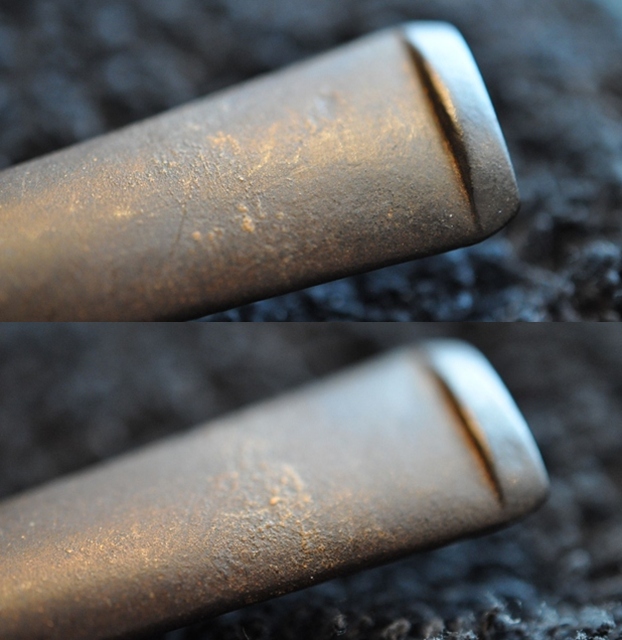
Storefront scene, courtesy SmokersMag.com

Although FRIBOURG & TREYER’s closed in the 1980s and has been gone for many years, their pipes and related products continue to command the respect of pipe smokers around the globe!

FRIBOURG & TREYER’s was one of all LONDON’S GREAT OLD PIPE SHOPS established in 1720! Their primary shop was located in the HAYMARKET DISTRICT of London where they catered to the rich and famous including Royalty for nearly 300 years! While most collectors are familiar with the “Royal Appointment” accorded certain well-established businesses in England (most commonly seen on Dunhill packaging) FRIBOURG & TREYER’s not only held an identical appointment by the King of England, but they also had a similar “Royal Appointment” by the King of Belgium! From their well-known Haymarket Shop with its picturesque Bay Windows, the tobacconists blended their own line of tobaccos and snuff (and became known as “Britain’s premier snuff chandler”)! Like Astleys in London and famous American landmarks like Bertrams and Leonard’s, Fribourg & Treyer had their pipes manufactured by various unnamed pipe makers. But because of the quality of their clientele, they demanded and received the very choicest pipes!

The success of Fribourg & Treyer saw them expand to other “upper end” locations and at the height of their success they also operated shops in the equally famous Burlington Arcade as well as at Oxford and Cambridge! In the 1970s they were acquired by Imperial Tobacco and as “urban legend” has it, they could not afford to renew their lease at the Haymarket so they moved to a new location on Regent Street in London. However, that was short-lived and this famous old shop was permanently closed and its snuff and tobacco recipes sold.

Today Fribourg & Treyer is remembered primarily for its snuff and tobaccos! They supplied tobacco to pipesmokers around the world, and much like Drucquer’s in California and Garfinkel’s in Washington, D.C., their oldest blends are still vigorously pursued by knowledgeable pipesmokers today whenever they make a rare reappearance on eBay or elsewhere! (However, Fribourg and Treyer snuff and tobacco are still readily available throughout the world made by other tobacconists.)

This pipe was made by Fribourg & Treyer in London for the Abercrombie & Fitch Company in New York City. I would assume that pipe was sold by Abercrombie & Fitch along with fine tobaccos and other sundry smoking items in their Flagship Store on Fifth Avenue.

Now it was time to work on the pipe itself. I reamed the thick cake back to the walls with a PipNet pipe reamer using the first two cutting heads. I followed up – cleaning the remnants of cake on the walls with a Savinelli Fitsall Pipe Knife. The final step for me to assess the condition of the walls of the bowl is to sand it with 220 grit sandpaper on a piece of dowel. I sanded the walls smooth. I was happy with the condition of the inside walls of the chamber.    I scrubbed the exterior of the bowl with a tooth brush and undiluted Murphy’s Oil Soap to get the grime and debris out of the briar. I rinsed it with running water and dried it off with a towel. With that the outside was clean… progress!   I cleaned out the mortise, shank in the briar and airway in the stem with pipe cleaners, cotton swabs and 99% isopropyl alcohol. The pipe was dirty with lots of tars and oils.   I worked on the damage to the inner edge of the bowl with 220 grit sandpaper to remove as much of the damage as possible and bring the bowl back to round. I took a photo of the rim top after the cleanup to show the progress in cleaning up the edges.  I polished the briar with micromesh sanding pads – wet sanding with 1500-12000 grit pads and wiping the bowl down with a damp cloth after each pad. The grain is really beginning to stand out and the rim top is blending in quite well.   I worked some Before & After Restoration Balm into the surface of the briar with my fingertips to clean, enliven and protect it. I let the balm sit for a little while and then buffed with a cotton cloth to raise the shine. The following photos show the bowl at this point in the restoration process. I am very happy with the results.        I set the bowl aside and turned my attention to the stem. I painted the tooth marks in the stem with the flame of a lighter to lift them to the surface. It worked quite well but there were a few small tooth marks left in the surface.    I repaired the tooth marks in the vulcanite and rebuilt the edge of the button with Black Loctite 380 Adhesive. Once the repairs had cured I used a needle file to recut the edges of the button and flatten out the repairs.   I sanded the stem surface and button with 220 grit sandpaper to smooth out the repairs and blend them into the surface. I also worked to remove the remaining oxidation on the stem surface. I started the polishing with 400 grit wet dry sandpaper.    I polished the stem with micromesh sanding pads – wet sanding with 1500-12000 grit sanding pads and wiping it down after each pad with Obsidian Oil. I polished the stem with Before & After Stem Polish – both Fine and Extra Fine. I wiped it down a final time with Obsidian Oil when I finished.      This Fribourg and Treyer (F&T) Bruyere Dublin with a vulcanite taper stem turned out to be a real beauty. The carver at F&T really maximized the grain with the shape of the pipe. Everything about the pipe – the finish, the rim top and the cut of the briar work well to highlight the grain around the bowl. I polished stem and the bowl with Blue Diamond polish on the buffing wheel and the finish just popped and came alive. I gave the bowl and the stem multiple coats of carnauba wax. I buffed the pipe with a clean buffing pad to raise the shine. I hand buffed it with a microfiber cloth to deepen the shine. The pipe polished up pretty nicely. The pipe took on life with the buffing. The rich brown finish works well with the polished vulcanite stem. The finished pipe has a rich look that is quite catching. Have a look at it with the photos below. The shape, finish and flow of the pipe and stem are very well done. The dimensions are Length: 6 inches, Height: 2 inches, Outside diameter of the bowl: 1 ¼ inches, Chamber diameter: ¾ of an inch. The F&T Dublin made for Abercrombie & Fitch New York will back in the box of pipes that I am working on for Alex. I am looking forward to what he will think of this one. Thanks for walking through the restoration with me as I worked over another estate pipe.

Life for a Long Shank GBD Premier Colossus 264 T Lumberman


Blog by Steve Laug

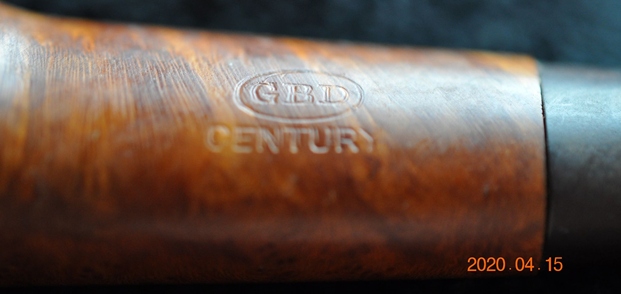
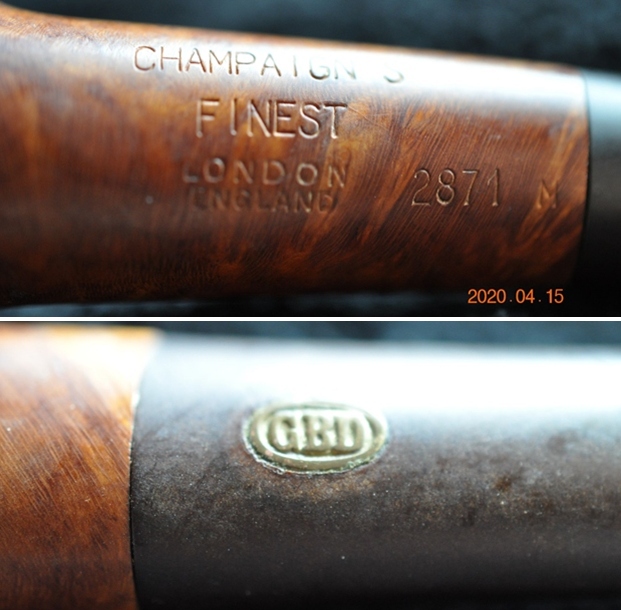
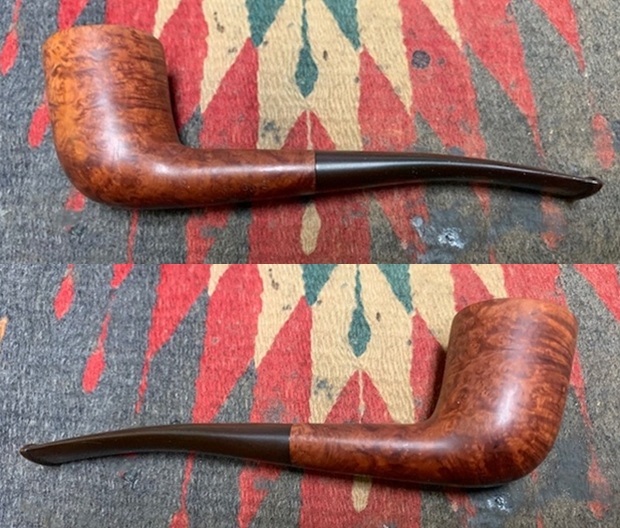
A fellow Vancouver Pipeman named Alex has been keeping me busy with working on the pipes he is picking up. He has picked up some interesting American and English made pipes. The next of those pipes is a long shank pipe that is a part of the Canadian family of pipes. The shank is oval and the stem is a saddle shaped one which makes it a Lumberman rather than a Canadian. I did a screen capture of the shapes from Pipedia (https://pipedia.org/wiki/Canadian). It is the second pipe in the picture below.This long shank GBD Lumberman is quite a stunning pipe. The pipe is one large piece of briar with no joints on the shank. From what I can see there is one flaw on the top of the shank near the end. There are some small fills around the bowl that are blended in quite well. The pipe is stamped on the top and the underside of the shank. On the topside it reads GBD in an oval [over] Premier [over] Colossus. On the underside it has a circular COM stamp that reads Made in London in a circle [over] England. That is followed by the shape number 264 with some space and then the upper case letter “T”. There was a thick cake in the bowl and lava overflowing onto the rim top. The rim top has some scratching and dents that will be more visible once the lava coat is gone. It is hard to know what the beveled inner edge looks like because of the lava. The finish was very dirty with grime and oils ground into the smooth finish. The vulcanite saddle GBD Oval logo stamped on the topside of the saddle stem. The stem was calcified, oxidized, dirty and had tooth marks and chatter on both sides near the button. Here are some photos of the pipe when I first received it.  I took a close-up photo of the rim to show the condition of the rim top, bowl and the inner edge of the bowl. It was hard to know what was going on with the rim and edges because of the cake and lava overflow. The stem was a mess with tooth damage and chatter on the button edges and the stem ahead of the button.       The stamping on the topside and the underside of the shank are shown in the photos below. It reads as noted above.  I removed the stem from the shank and took a photo of the flow of the pipe. The pipe was really going to look great once it was cleaned and polished. The long, oval shank Lumberman is a beauty.The history of GBD pipes is very well spelled out in multiple articles on Pipedia. I would encourage you to give them a read as they are well written and very readable. It is truly a grand old brand spanning France and England. I turned instead to Pipedias article on GBD’s various models (https://pipedia.org/wiki/GBD_Model_Information). I did a screen capture of the write up on the Premier Line.The pipe is a Premier which is noted above as a flagship to their pipes. It says that it is stained with a unique fiery Autumn colour combination that has a hand finished mouthpiece.

The second stamping on the top of the shank was Colossus. I knew that this stamp was used on larger or what GBD called “plus sized pipes”. I read through the above link and found the information below.

Plus Sized Pipes

In addition to the pipe line and shape information stamped on the pipe GBD also had codes for plus sized pipes. These codes in ascending order of size were…

  • Conquest
  • Collector
  • Colossus

Perspex refers to the lucite/acrylic bit material GBD used, the clear bits used on various models are Perspex. Metal rondelles were discontinued after the merger with Comoy.

From this I know that the pipe is a larger, plus sized pipe that was at the top of the plus sizes – a Colossus. The Premier was the high in the hierarchy as well. I also knew that because of the circular COM stamp and the lack of a metal rondelle that the pipe was made after the merger with Comoy.

Now it was time to work on the pipe itself. I reamed the thick cake back to the walls with a PipNet pipe reamer using the first two cutting heads. I followed up – cleaning the remnants of cake on the walls with a Savinelli Fitsall Pipe Knife. The final step for me to assess the condition of the walls of the bowl is to sand it with 220 grit sandpaper on a piece of dowel. I sanded the walls smooth. I was happy with the condition of the inside walls of the chamber.     I scrubbed the exterior of the bowl with a tooth brush and undiluted Murphy’s Oil Soap to get the grime and debris out of the briar. I rinsed it with running water and dried it off with a towel. With that the outside was clean… progress!     I cleaned out the mortise, shank in the briar and airway in the stem with pipe cleaners, cotton swabs and 99% isopropyl alcohol. The pipe was dirty with lots of tars and oils.   I worked on the damage to the rim top to remove the darkening, charring and dents and nicks. I topped it on with 220 grit sandpaper to remove as much of the damage as possible. There was still some damage to the front edge of the rim. I filled in the damaged bevel with briar dust and super glue. I took a photo of the rim top after the cleanup and then worked on the beveled rim with a folded piece of 220 grit sandpaper.    I polished the briar with micromesh sanding pads – wet sanding with 1500-12000 grit pads and wiping the bowl down with a damp cloth after each pad. The grain is really beginning to stand out and the rim top is blending in quite well. I worked some Before & After Restoration Balm into the surface of the briar with my fingertips to clean, enliven and protect it. I let the balm sit for a little while and then buffed with a cotton cloth to raise the shine. The following photos show the bowl at this point in the restoration process. I am very happy with the results.             I set the bowl aside and turned my attention to the stem. I repaired the tooth marks in the vulcanite and rebuilt the edge of the button with Black Loctite 380 Adhesive. Once the repairs had cured I used a needle file to recut the edges of the button and flatten out the repairs. I sanded the stem surface and button with 220 grit sandpaper to smooth out the repairs and blend them into the surface. I also worked to remove the remaining oxidation on the stem surface. I started the polishing with 400 grit wet dry sandpaper.    I polished the stem with micromesh sanding pads – wet sanding with 1500-12000 grit sanding pads and wiping it down after each pad with a damp cloth.     This GBD Long Shank Premier Colossus Lumberman with a vulcanite saddle stem turned out to be a real beauty. The long shank and bowl is a single unit that speaks of nice, large piece of briar. GBD really maximized the grain with the shape of the pipe. Everything about the pipe – the finish, the crowned rim top and the cut of the briar work well to highlight the grain around the bowl. I polished stem and the bowl with Blue Diamond polish on the buffing wheel and the finish just popped and came alive. I gave the bowl and the stem multiple coats of carnauba wax. I buffed the pipe with a clean buffing pad to raise the shine. I hand buffed it with a microfiber cloth to deepen the shine. The pipe polished up pretty nicely. The pipe took on life with the buffing. The rich brown finish works well with the polished vulcanite stem. The finished pipe has a rich look that is quite catching. Have a look at it with the photos below. The shape, finish and flow of the pipe and stem are very well done. The dimensions are Length: 7 ½ inches, Height: 2 inches, Outside diameter of the bowl: 1 ¼ inches, Chamber diameter: 7/8 of an inch. The Premier Colossus GBD Lumberman will back in the box of pipes that I am working on for Alex. I am looking forward to what he will think of this one. Thanks for walking through the restoration with me as I worked over another estate pipe.
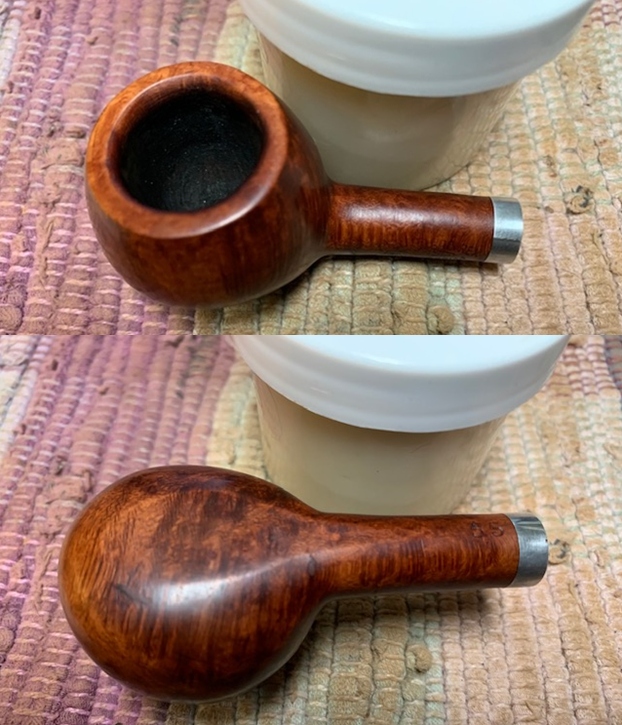
Restoring a “Malaga” Carved Bent Billiard for Alex


Blog by Steve Laug

The next pipe on the table is a “Malaga” pipe that is one of Alex’s Malaga collection. It is a bent billiard with a carved rustication pattern around the bowl and shank that is unlike any of the other Malaga pipes that I have worked on. The rustication pattern is definitely interesting and from what I can see makes up for some mediocre grain. It came with a ¾ bent saddle vulcanite stem. The carver did a great job of uniquely shaping the pipe and rusticating it to give it a unique character. The bowl had a light cake that seems to have been reamed quite recently. The rim top had some significant burn damage on the inner edge and top toward the front of the bowl. The sides of the bowl and shank are very dirty with grime and oils from prolonged use. The stamping on the left side of the shank read “MALAGA”. The vulcanite stem was heavily oxidized and had tooth dents and chatter on the top and the underside of the stem. The button was worn on both sides. I took photos of the pipe before I started the cleanup work.   I took a close up photo of the bowl and rim to capture the condition of the pipe before I started my cleanup work. The rim top had some major burn damage and darkening on the front top and inner edge of the bowl. The burn marks appeared to be quite deep on the inner edge and had burned the rustication off the front top of the bowl. The stem is deeply oxidized and dirty and there is tooth damage on the surface of the stem and damage to the button edges.    I took a photo of the stamping on the left side of the shank on the smooth panel. It read as noted above.I took the stem off the shank and took a photo of the overall look of the pipe. It is quite attractive and certainly a unique rustication.I am also including the link to a blog that I wrote that gives some of the history of the Malaga brand and the Malaga Pipe Shop in Royal Oak, Michigan in the USA. I have written an earlier blog to give a little history of the Malaga Brand and the pipemaker, George Khoubesser. Here is the link – https://rebornpipes.com/tag/malaga-pipes/.That blog also includes links to a catalogue and the history of the pipemaker George Khoubesser. Follow the link to get a feel for the brand and the pipemaker.

There was a light cake in the bowl so I reamed it with a Savinelli Fitsall pipe knife to remove the cake. It did not take too much work to clean out the remnants. I sanded the bowl with 220 grit sandpaper wrapped around a piece of dowel. I was happy to see that the bowl looked very good. There was no heat damage.I lightly topped the bowl with 220 grit sandpaper on a topping board. Once it was smooth I wiped the rim top down with a cotton pad and alcohol. I used super glue and briar dust to build up the damage on the rim top and inner edge of the bowl. I used a folded piece of 220 grit sandpaper to give the rim edge a slight bevel and smooth it out.I lightly topped the bowl again to smooth it out. I used a Dremel and burr to cut new grooved rustication into the bowl top to match the original rustication.  I stained the newly repaired and carved rim top with an Oak stain pen to match the rest of the surrounding briar. I was happy with the way the repair looked. I scrubbed out the mortise and the airway in the shank and the stem with alcohol, cotton swabs and pipe cleaners. Once it was finished the pipe smelled much better.   I worked some Before & After Restoration Balm into the surface of the briar with my fingertips and a horsehair shoe brush to clean, enliven and protect it. I let the balm sit for a little while and then buffed with a cotton cloth to raise the shine. The following photos show the bowl at this point in the restoration process. I am very happy with the results.   I turned to the stem and scrubbed the oxidation with Soft Scrub All Purpose cleaner. I scrubbed the surface with the cleaner and cotton pads. I was able to remove a lot of the oxidation.  I sanded out the tooth marks on the underside of the stem and was able to remove most of them. There was one larger tooth mark that remained that I filled in with Loctite 380 Black Instant Adhesive. Once the repair cured I sanded it with 220 grit sandpaper to smooth it out and to remove the remaining oxidation.I reshaped the button edges with 220 grit sandpaper and a needle file. I sanded the stem with 220 grit sandpaper to remove the remaining oxidation and started the polishing the stem with 400 grit wet dry sandpaper.   I polished the stem with micromesh sanding pads – wet sanding with 1500-12000 grit sanding pads. I wiped it down after each sanding pad Obsidian Oil. I finished by polishing it with Before & After Pipe Stem Polish both fine and extra Fine and then wiped it down with a final coat of Obsidian Oil.   This Malaga Rusticated/Carved Bent Billiard with a vulcanite saddle stem turned out to be a real beauty. It has a unique rustication around the bowl that is unlike other Malaga pipes that I have worked on. The carver really maximized that with the shape of the pipe. Everything about the pipe – the rustication on the shank and sides, the rusticated rim top and the cut of the briar work well to highlight the shape of the bowl. I polished stem and the bowl with Blue Diamond polish on the buffing wheel and the finish just popped and came alive. I gave the bowl and the stem multiple coats of carnauba wax. I buffed the pipe with a clean buffing pad to raise the shine. I hand buffed it with a microfiber cloth to deepen the shine. The pipe polished up pretty nicely. The pipe took on life with the buffing. The rich oil cured colour works well with the polished vulcanite stem. The finished pipe has a rich look that is quite catching. Have a look at it with the photos below. The shape, finish and flow of the pipe and stem are very well done. The dimensions are Length: 5 inches, Height: 1 ½ inches, Outside diameter of the bowl: 1 ¼ inches, Chamber diameter: ¾ of an inch. The pipe will back in the box of pipes that I am working on fro Alex. I am looking forward to what he will think of this one. Thanks for walking through the restoration with me as I worked over another estate pipe.
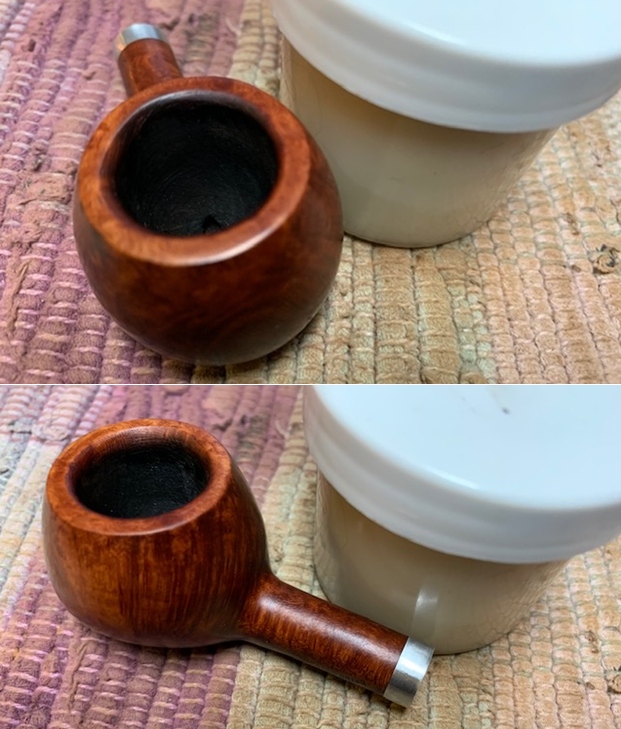
Breathing Life into a Super Grain Kaywoodie 5114 Bent Billiard


Blog by Steve Laug

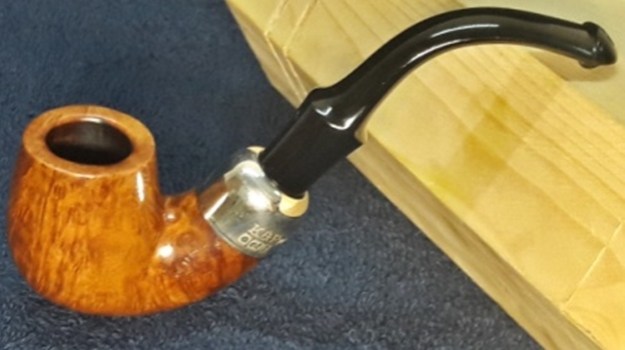
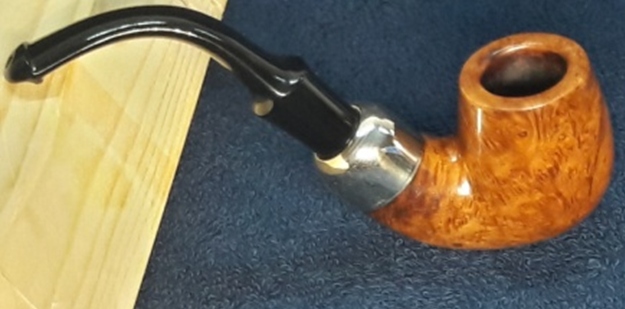
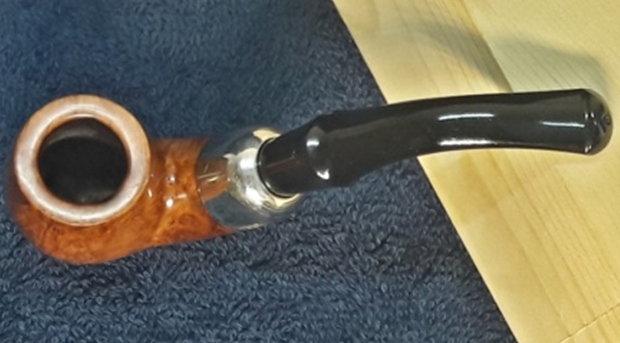
The next pipe on the table came to us from one of our pipe hunts or a trade I just cannot remember. It is a very nice Kaywoodie Super Grain Bent Billiard with a push stem. The finish is quite nice with a classic Kaywoodie smooth finish. The pipe was pretty clean with the exterior polished and dust free. The bowl had been reamed somewhere along the way and the bowl was pretty clean. There was darkening on the rim top and a bit of damage on the inner edge of the rim. The pipe is stamped on the sides of the shank and reads Super Grain [over] Kaywoodie on the left side of the shank. On the right side it reads Imported Briar [over] the shape number 5114. The stamping is clear and readable on the pipe. The stem was dirty and lightly oxidized. There were light tooth marks and chatter on the stem near the button on both sides and some on the surface of the button as well. There was the Kaywoodie White Club/Clover logo on the left side of the taper stem. I took photos of the pipe before I worked on it. I took photos of the rim top to show the cake in the bowl and the relatively clean rim top and damaged inner edge. The stem was also in decent condition other than light tooth chatter and marks.The stamping on the sides of the shank read as noted above. The photo shows that they are very clear and readable. The Clover/Club on the left side of the stem is in good condition.I took a photo of the pipe with the stem removed to show the overall look of stem, tenon and profile of the pipe. It is a great looking pipe.I knew that I was dealing with an early Super Grain because of the four digit shape number and the push stem but I wanted to know a bit more. I turned first to Pipephil’s site as it is always a quick sources of information (http://pipephil.eu/logos/en/logo-kaywoodie-2.html). I have included a screen capture of the section on the Super Grain Below.From that section I learned that indeed the pipe was older and because of the 4 digit number it was produced between 1931 and 1938. I also could narrow it down further because it also included the Imported Briar stamp which was added in 1935. So now I knew that the time frame was 1935-1938. The fact that it is stamped Super Grain above Kaywoodie also points to the early date for this pipe.

I then turned to Pipedia’s article on Grades of Kaywoodie pipes. It is helpful in placing the Super Grain in the hierarchy of Kaywoodie pipes. Here is the link to the site.  (https://pipedia.org/wiki/Collector%27s_Guide_to_Kaywoodie_Pipes#ANNOTATED_CHRONOLOGY_OF_KAYWOODIE_PIPES_.281936-1969.29).  I have included a section from the 1936 line of Kaywoodie pipe because of the time frame of this pipe noted above.

THE 1936 KAYWOODIE LINE OF PIPES

The 1936 Kaywoodie catalog lists only four grades of pipes (Table 1). These four grades, however, were available in 140 shapes (see Appendix). These 140 shapes included many that differed only in size (small, medium, large). For example, the “In-Between”, “Colt” and “Freshman” shapes listed in the Appendix were merely smaller versions of the standard shapes, and the “E-Z-Set” shapes were “flat-bottom” versions of the standard shapes.

Table 1: Kaywoodie Pipe Grades and Prices (1936)

Straight Grain: $10.00

Super Grain: $5.00

Carburetor: $4.00

Drinkless: $4.00

As shown in Table 1, the Straight-Grain pipe was Kaywoodies’ top-of-the­-line, selling for $10.00 in 1936. The Straight Grain pipe did not appear again in the catalogs reviewed in this research until 1968-69 (see Section 3.4).

The 1936 catalog shows 3 Super Grain models, selling for $5.00 each. One model is introduced as the “New Banded” Super Grain. The banded Super Grain had the white Kaywoodie cloverleaf logo in the bit and a wide metal band. The non-banded (“original”) Super Grain had the white Kaywoodie cloverleaf logo in the shank of the pipe and was offered in two finishes, virgin and miami (slightly darker than virgin). Due to the gap in catalogs used in this research, it is not known precisely when the practice of putting the cloverleaf in the shank of the Super Grains was discontinued (the 1947 catalog shows the cloverleaf on the bit). The Super Grain was later downgraded and many new grades appeared above it (see subsequent sections of this Chapter). The early (original) Super Grains are particularly interesting not only because they were high quality briars, but because they were the only Kaywoodies (in the author’s knowledge) to have the logo inlaid in the shank of the pipe.

In terms of the Kaywoodie Hierarchy the pipe fit near the top of the Grades in 1936. It sold for $5.00. That was the end of the information for me at this point so it was time to work on the pipe itself.

I started my work on the by cleaning out the inside of the shank. The bowl had been reamed somewhere along the way before I received it but it needed to be cleaned. I cleaned it out with alcohol, cotton swabs and pipe cleaners. I cleaned out the airway in the stem at the same time with alcohol and pipe cleaners. To bring the inner edge of the rim back into round and clean up the darkening and damage I used a folded piece of 220 grit sandpaper. I worked over the rim edge until it was smooth and clean.I polished the briar with micromesh sanding pads – wet sanding with 1500-12000 grit pads and wiping the briar down with a damp cloth after each pad. The briar began to take on a rich glow.  At this point, the bowl was clean and the briar looked very good. The rich birdseye and cross grain stood out clearly.I rubbed the briar down with Before & After Restoration Balm. I worked it into the briar with my fingertips and a horse hair shoe brush to get it into the deep crevices of the rustication. The product works to clean, enliven and preserve the briar. I let it sit for 10 minutes while I worked on the stem. After the time passed I buffed it with a cotton cloth to deepen the shine. The rustication came alive with the balm.   I set the bowl aside and turned my attention to the stem. I sanded out the tooth marks and chatter on the button surface and the stem just ahead of the button with 220 grit sandpaper. I started the polishing of the stem with 400 grit wet dry sandpaper.I polished the stem with micromesh sanding pads – 1500-12000 grit pads. I wiped it down with Obsidian Oil after each sanding pad. I used Before & After Pipe Polish – both Fine and Extra Fine to further polish the stem. This 1935-38 Super Grain Kaywoodie 5114 Bent Billiard is a great looking pipe. The smooth finish and brown stain around the bowl sides and shank make the grain just pop. The finish on the pipe is in excellent condition and the contrasting stains work well to give some contrast to the polished black vulcanite taper stem. The pipe is really quite eye-catching. I put the stem back on the bowl and buffed the pipe with Blue Diamond on the buffing wheel, carefully avoiding the stamping on the shank. I gave the bowl and the stem multiple coats of carnauba wax on the buffing wheel and followed that by buffing it with a clean buffing pad. I hand buffed the pipe with a microfiber cloth to deepen the shine. The finished Bent Billiard is quite nice and feels great in the hand. Give the finished pipe a look in the photos below. I can only tell you that like the other pipes I am working that it is much prettier in person than the photos capture. The dimensions of the pipe are Length: 5 inches, Height: 1 ¾ inches, Outside diameter of the bowl: 1 ¼ inches, Chamber diameter: ¾ of an inch. Thanks for walking through the restoration with me as I worked over another interesting pipe. This Super Grain Kaywoodie will be added to the American Pipe Makers section of the rebornpipes store soon. If you want to add it to your collection send me an email or a message! Thanks for your time.
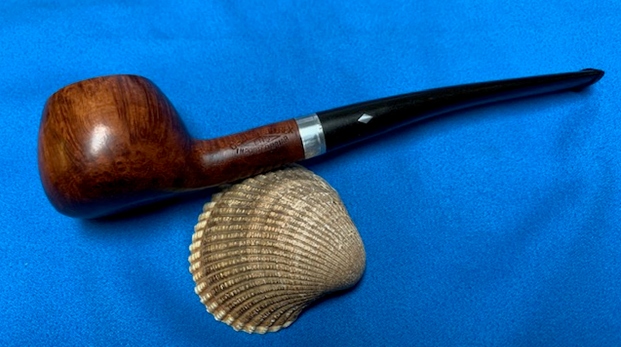
 

Life for an American Made Pipe – A Bertram Washington DC 85 Billiard


Blog by Steve Laug

The next pipe on the work table came to me from one of our estate purchases. Between us we pick up quite a few pipes for restoration. I try to work them into the restoration queue so that I can keep them moving. We picked up over 120 Bertram pipes from an estate that a fellow on the east coast of the US was selling. This next one is from that estate – a beautifully grained Billiard 85 Grade Bertram with a tapered vulcanite stem. The pipe is stamped on the left side near the bow with the Grade 85 number followed by Bertram [over] Washington D.C. centered on the shank. The finish had a lot of grime ground into the smooth finish on the bowl and some darkening around the sides of the bowl. The bowl was thickly caked with an overflowing lava coat on the top of the rim toward the back of the bowl. The edges looked to be in good condition. The stem was oxidized, calcified, dirty and had tooth chatter and marks on the top and underside near the button. There were not markings or a logo on the taper stem. Like the rest of the Bertrams in this lot the pipes had promise but it was very dirty. Jeff took some photos of the pipe before he started his cleanup work.   He took photos of the rim top and bowl to give a clear picture of the thickness of the cake and the overflow of lava on the rim top. He also took photos of the top and underside of the stem to show the chatter and tooth marks. Otherwise the stem is quite clean.      Jeff took photos of the sides and heel of the bowl to give a picture of what the briar around the pipe looked like. There is some stunning grain under the grime.     He took photos of the stamping on the left side of the shank. It reads as noted above and is clear and readable. The grade number looks like a 25 that has been made into an 85.      As I have worked on Bertrams I have written on the brand and have included the following information. If you have read it in past blogs, you can skip over it. If you have not, I have included the link to Bertram history and information. I would recommend that if you don’t know much about them take some time to read the background. I include a link to the write up on Pipedia (http://pipedia.org/wiki/Bertram). Bertram pipes were based out of Washington DC. They were popular among famous politicians and celebrities of the time. They made many products for them from FDR’s cigarette holders to Joseph Stalin’s favorite pipe. They were considered some of the best America had to offer till they finally closed their doors in the 70s. Bertram graded their pipes by 10s and sometimes with a 5 added (15, 25, 55 etc.), the higher the grade the better. Above 60s are uncommon and 80-90s are quite rare. I have worked on one 120 Grade billiard. I have several blogs that I have written on rebornpipes that give some history and background to Bertram pipes. (https://rebornpipes.com/2015/06/16/an-easy-restoration-of-a-bertram-grade-60-217-poker/).

I have included the following link to give a bit of historical information on the pipe company. It is a well written article that gives a glimpse of the heart of the company. http://www.streetsofwashington.com/2012/01/bertrams-pipe-shop-on-14th-street.html#

From this information I learned that all of these Bertrams were made before the closure of the shop in the 1970s. This Bertram Billiard with stunning grain has one fill on the shank. This pipe has a 85 Grade stamp on it which I am sure explains the quality of the briar.

Jeff had cleaned up the pipe with his usual penchant for thoroughness. He reamed the pipe with a PipNet Pipe Reamaer and cleaned up the remnants with a Savinelli Fitsall Pipe Knife.  He scrubbed the bowl with undiluted Murphy’s Oil Soap with a tooth brush. He rinsed it under running warm water to remove the soap and grime. He cleaned out the inside of the shank and the airway in the stem with alcohol, cotton swabs and pipe cleaners. He soaked the stem in Before & After Deoxidizer and rinsed it off with warm water. I took photos of the pipe once I received it.  The rim top cleaned up really well with the lava coat removed. The inner and outer edge of the rim looked good.  The stem surface looked very good with a few small tooth marks and chatter on both sides near the button.  There was also some residual oxidation to be addressed.     I took photos of the stamping on the shank. The Bertram Washington DC is on the left side of the shank toward the top. Lower on the shank it is stamped with the Grade 85 number.   I removed the stem and took a photo of the pipe to give a sense of the whole. The stem is tapered and narrow. Now it was time to do my work on the pipe. I polished the bowl and the rim top, sides and shank with micromesh sanding pads – wet sanding with 1500-12000 grit pads and wiping it down after each pad with a damp cloth. I rubbed the bowl and shank down with Before & After Restoration Balm. I worked it into the surface of the bowl sides and shank with my fingertips to clean, enliven and protect the briar. I let the balm sit for a little while and then buffed with a cotton cloth to raise the shine.     I set the bowl aside and turned to work on the stem. I sanded it with 220 grit sandpaper to clean up the pitted, oxidized surface and to remove the tooth marks and chatter. I started polishing it with 400 grit wet dry sandpaper.   I polished the vulcanite stem with micromesh sanding pads – 1500-12000 grit pads. I wiped it down with a damp cloth after each sanding pad. I used Before & After Pipe Polish – both Fine and Extra Fine to further polish the stem.       This Bertram Washington DC 85 Billiard with a vulcanite stem is a great looking pipe now that it has been restored. I put the stem back on the bowl and carefully buffed the pipe with Blue Diamond on the buffing wheel using a light touch on the briar. I gave the bowl and the stem multiple coats of carnauba wax on the buffing wheel and followed that by buffing the entire pipe with a clean buffing pad. I hand buffed the pipe with a microfiber cloth to deepen the shine. The finished Bertram 85 Billiard fits nicely in the hand and feels great. Give the finished pipe a look in the photos below. The dimensions of the pipe are Length: 6 inches, Height: 2 inches, Outside diameter of the bowl: 1 ½ inches, Chamber diameter: ¾ of an inch. If you are interested in adding this pipe to your collection send me a message or an email. Thanks for reading this blog and my reflections on the pipe while I worked on it. There are many more to come!

Life for an American Made Pipe – A Devon Paneled Apple


Blog by Steve Laug

The next pipe on the work table came to me from one of our estate purchases. Between us we pick up quite a few pipes for restoration. I try to work them into the restoration queue so that I can keep them moving. This next one is a beautifully grained, paneled apple shaped pipe with a gold band and a tapered vulcanite stem. It has been here since the summer of 2017. The pipe is stamped on the left side and read DEVON. On the right side it reads IMPORTED BRIAR. The finish had a lot of grime ground into the smooth finish on the bowl and some darkening around the sides of the bowl. The bowl was actually quite clean of cake though there was a light overflowing lava coat on the top of the rim. There were some scratches in the rim top but the edges looked to be in good condition. The stem was dirty, oxidized and had light tooth chatter and marks on the top and underside near the button. There were not markings or a logo on the taper stem. It had promise but it was very dirty. Jeff took some photos of the pipe before he started his cleanup work.   He took photos of the rim top and bowl to give a clear picture of the thickness of the cake and the overflow of lava on the rim top. He also took photos of the top and underside of the stem to show the chatter and tooth marks. Otherwise the stem is quite clean.  Jeff took photos of the sides and heel of the bowl to give a picture of what the briar around the pipe looked like. There is some stunning grain under the grime.     He took photos of the stamping on the sides of the shank and band. They read as noted above and are clear and readable.     I looked on Pipedia and on Pipephil’s site for information on the brand and found nothing listed. I also checked out Who Made that Pipe but it attributed the brand to several English Pipe Making Companies but this one is obviously and American Made pipe with the Imported Briar stamp on the shank. The maker shall remain a mystery to me. It is now time to get working on the pipe.
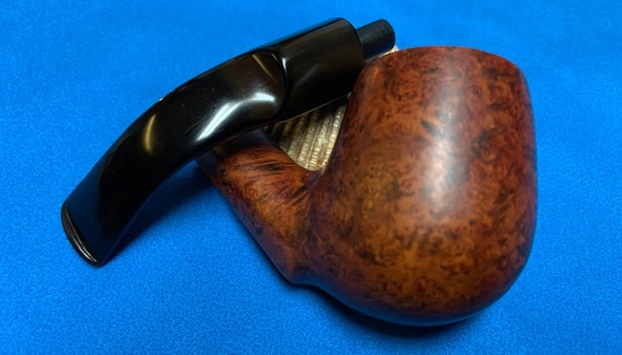
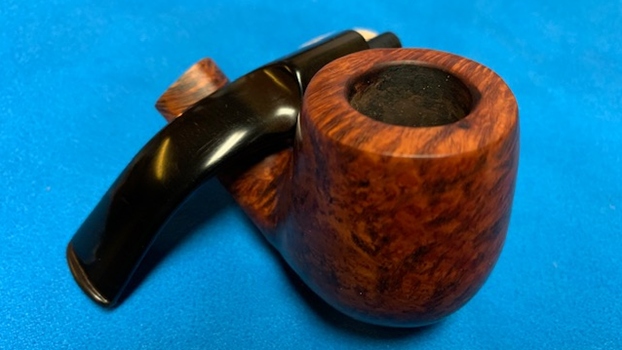
Since Jeff follows the same pattern of work in his cleanup we do not include photos but rather just a simple summary. Jeff reamed the bowl with a PipNet pipe reamer and followed up with a Savinelli Fitsall pipe knife to remove the cake. He scrubbed out the mortise and the airway in the shank and the stem with alcohol, cotton swabs and pipe cleaners. He scrubbed the exterior of the bowl, rim, shank and stem with a tooth brush and Murphy’s Oil Soap to remove the oils and tars on the rim and the grime on the finish of the bowl. He rinsed it under running water. He dried it off with a soft cloth. He was able to remove the light lava build up on the rim top and you could see the great condition of the bowl top and edges of the rim. The rim top and the edges of the bowl were in good condition. He soaked the stem in Before & After Deoxidizer to remove the oxidation. I forgot to take photos of the pipe before I started my work. What I have included is after the initial work on the stem. It gives a clear picture of the pipe at this point in the process. The rim top cleaned up really well with the light lava coat removed. The inner and outer edge of the rim looked good. The stem surface looked very good with a few light tooth marks and chatter on both sides near the button.    I took photos of the stamping on the shank sides – even though my photos are a little fuzzy the stamping is clear and readable.    I removed the stem and took a photo of the pipe to give a sense of the whole. There is a stinger in the tenon that is very clean. It is removable.Now it was time to do my work on the pipe. I polished the bowl and the rim top, sides and shank with micromesh sanding pads – wet sanding with 1500-12000 grit pads and wiping it down after each pad with a damp cloth.  I rubbed the bowl and shank down with Before & After Restoration Balm. I worked it into the surface of the bowl sides and shank with my fingertips to clean, enliven and protect the briar. I let the balm sit for a little while and then buffed with a cotton cloth to raise the shine.   I sanded out the remaining oxidation and the light tooth chatter with 220 grit sandpaper and started polishing the stem with 400 grit wet dry sandpaper.   I polished the vulcanite stem with micromesh sanding pads – 1500-12000 grit pads. I wiped it down with a damp cloth after each sanding pad. I used Before & After Pipe Polish – both Fine and Extra Fine to further polish the stem.              This US Made Devon Imported Briar Paneled Apple with a taper vulcanite stem is a great looking pipe now that it has been restored. I put the stem back on the bowl and carefully buffed the pipe with Blue Diamond on the buffing wheel using a light touch on the briar. I gave the bowl and the stem multiple coats of carnauba wax on the buffing wheel and followed that by buffing the entire pipe with a clean buffing pad. I hand buffed the pipe with a microfiber cloth to deepen the shine. The finished Devon Paneled Apple fits nicely in the hand and looks very good. Give the finished pipe a look in the photos below. The dimensions of the pipe are Length: 5 ½ inches, Height: 1 ½ inches, Outside diameter of the bowl: 1 ¼ inches, Chamber diameter: ¾ of an inch. If you are interested in adding this pipe to your collection send me a message or an email. Thanks for reading this blog and my reflections on the pipe while I worked on it. There are many more to come!