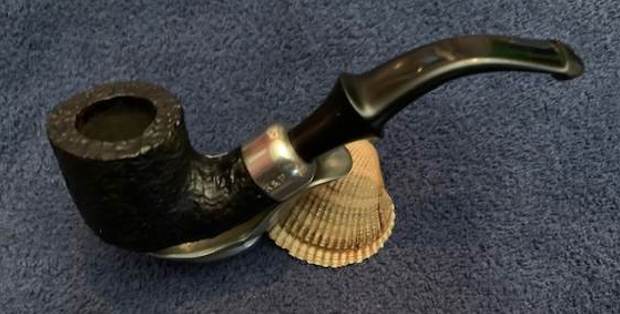
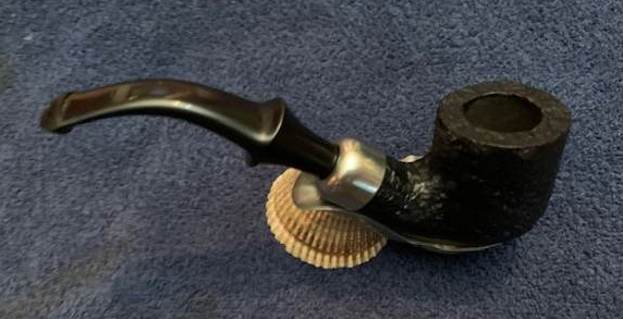
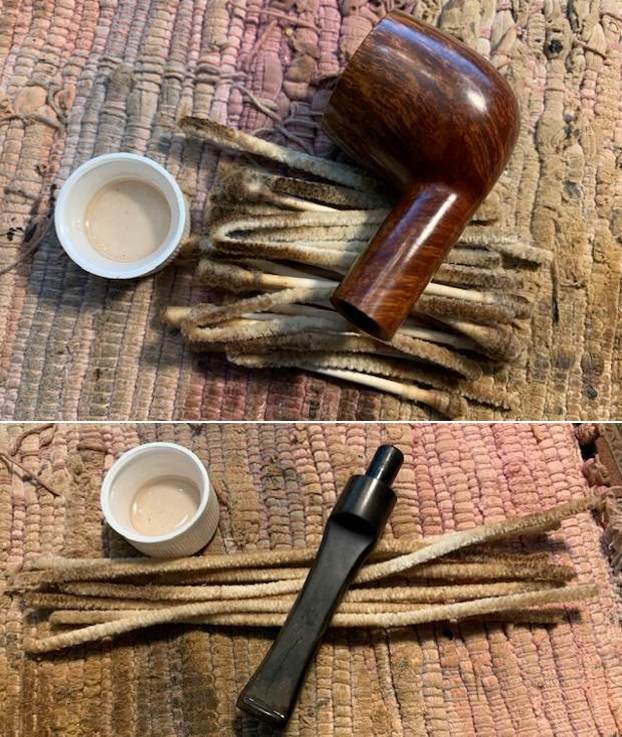
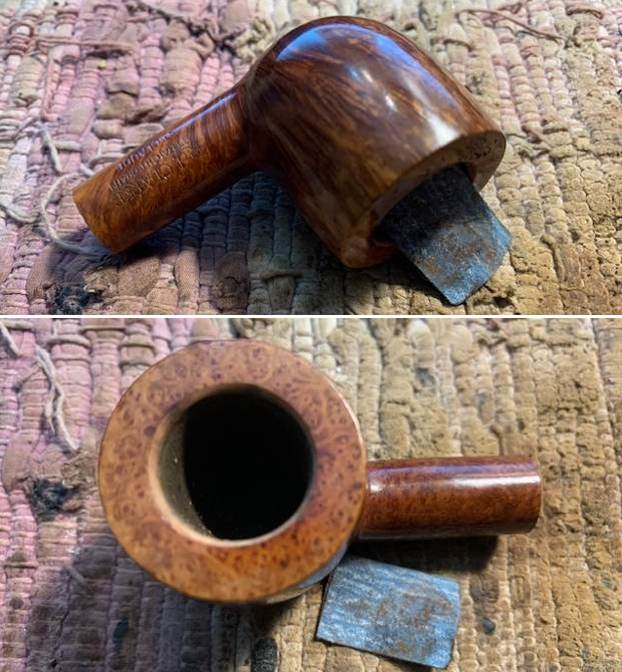
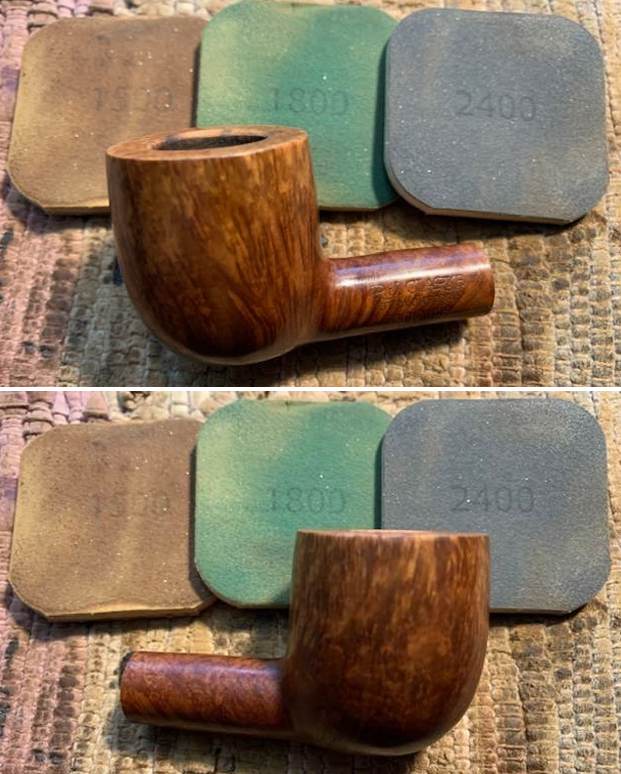
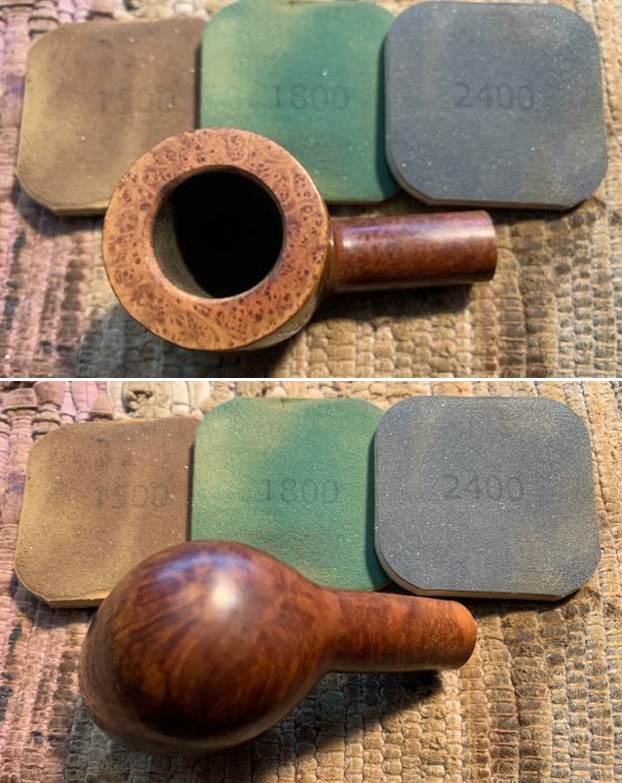
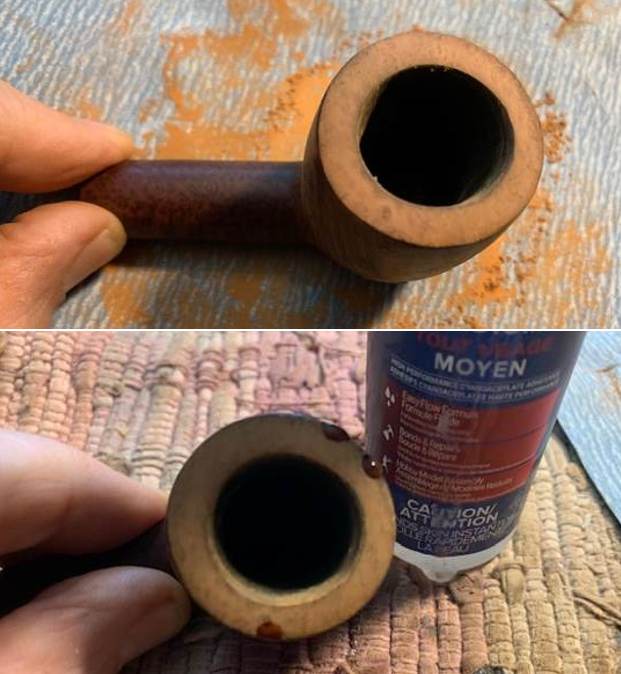
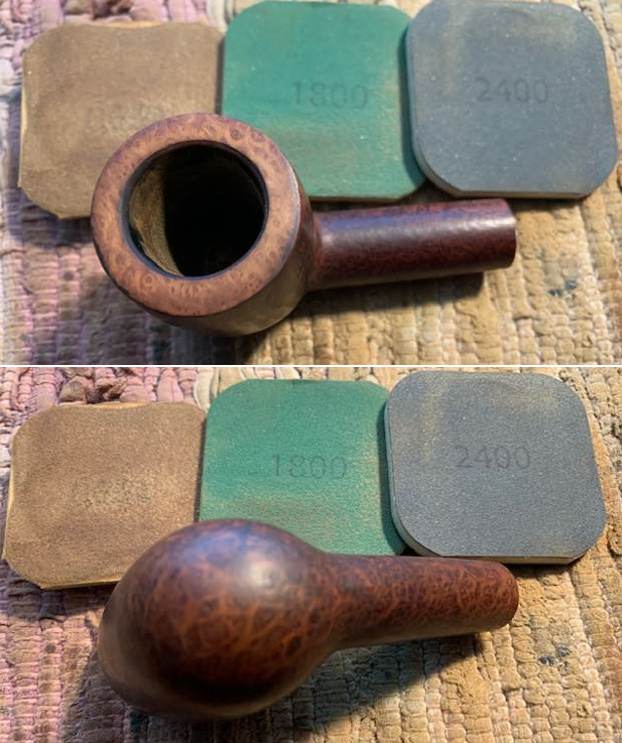
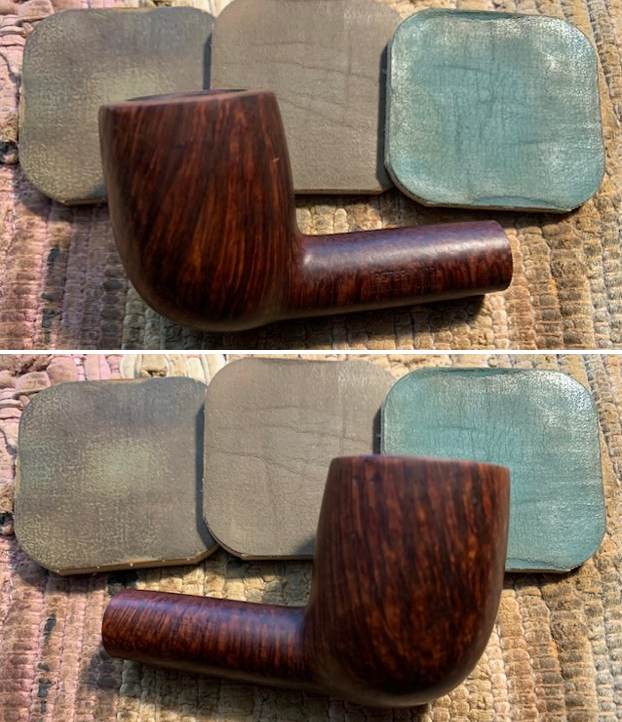
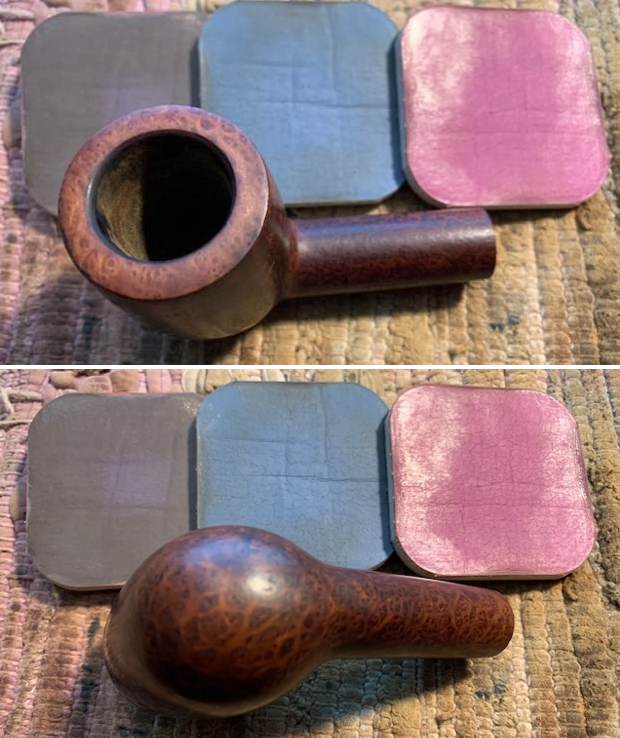
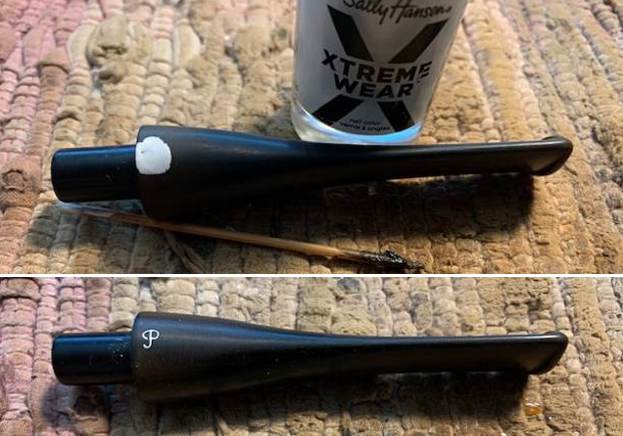
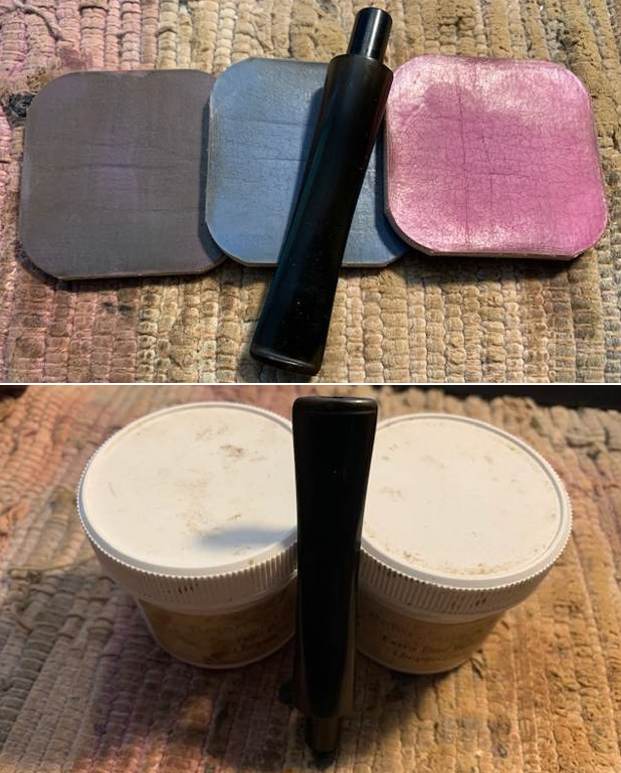
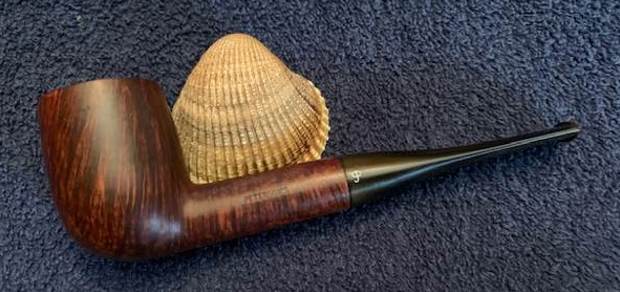
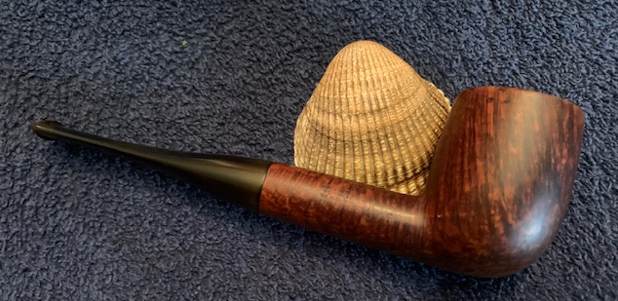
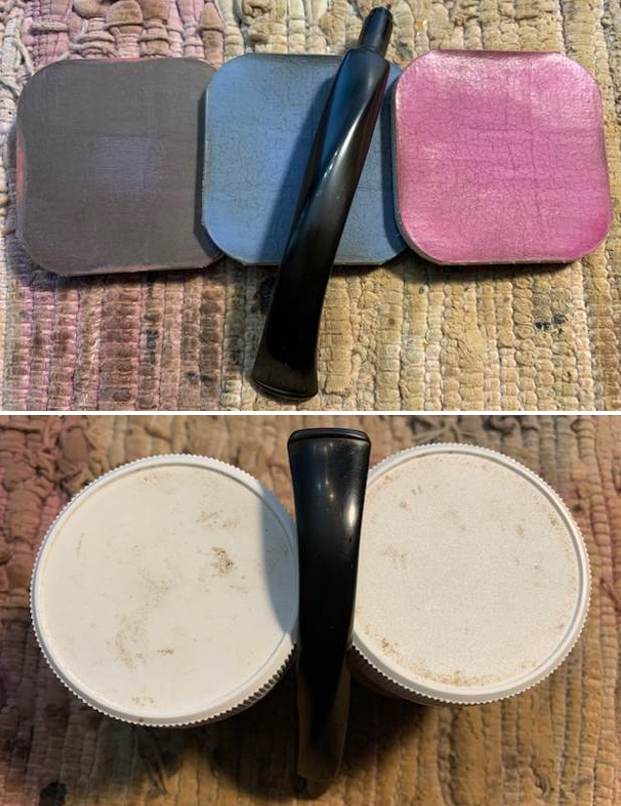
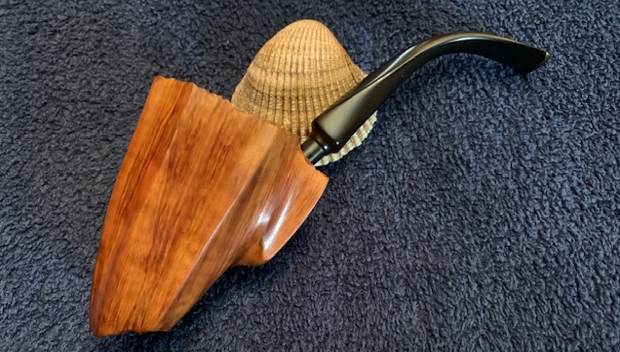
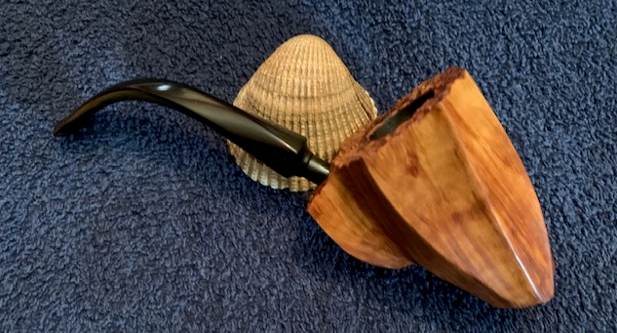
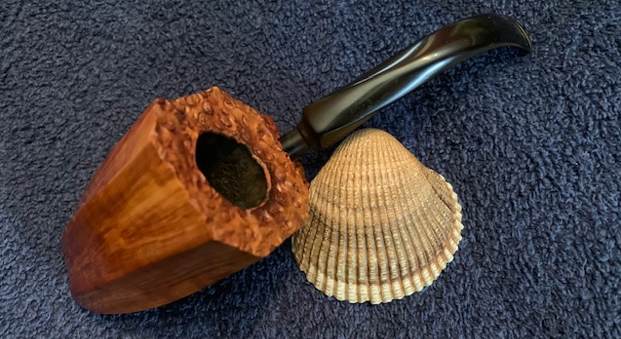
Tag Archives: removing oxidation

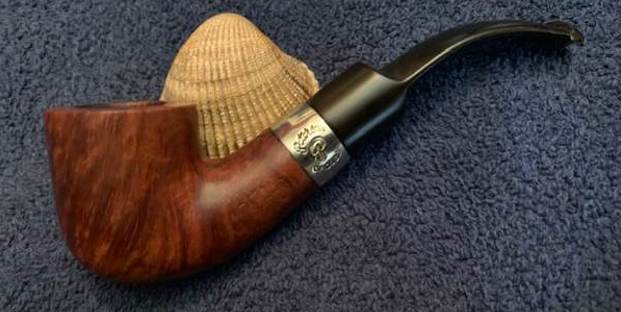
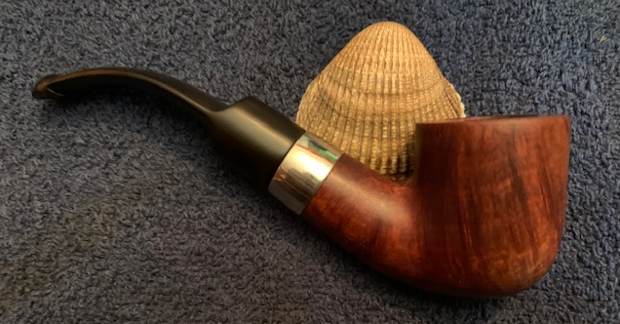
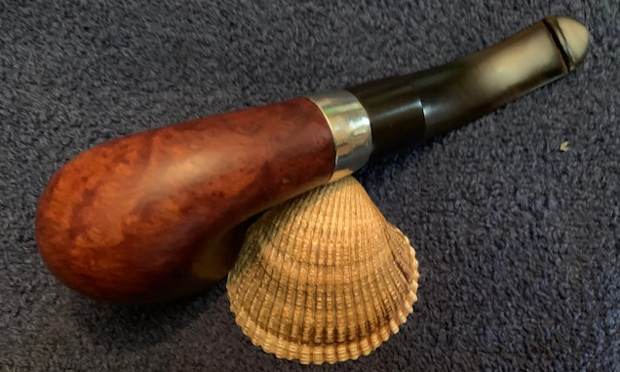
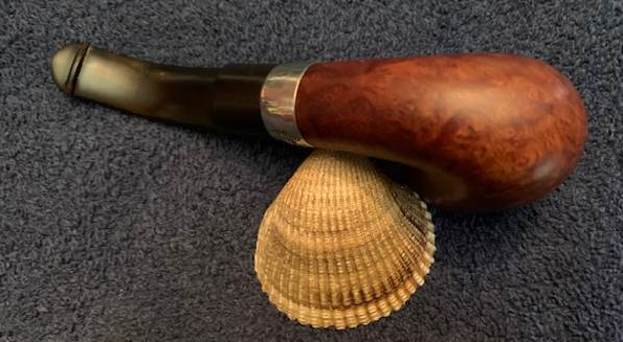
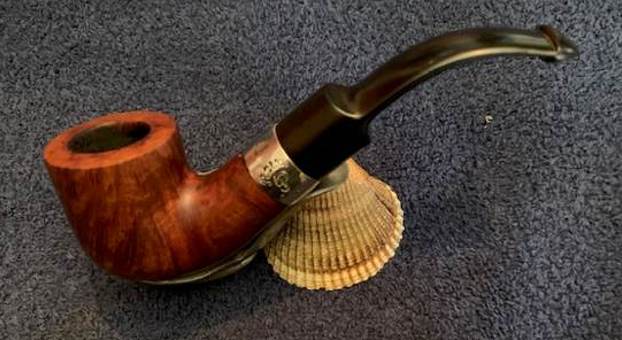
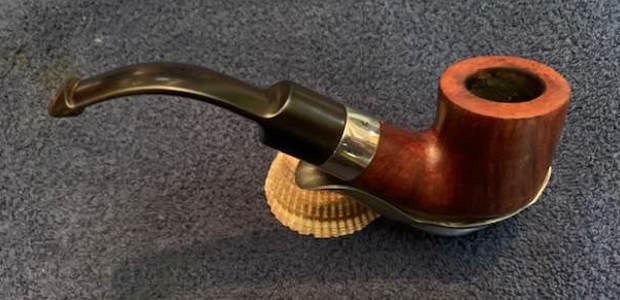
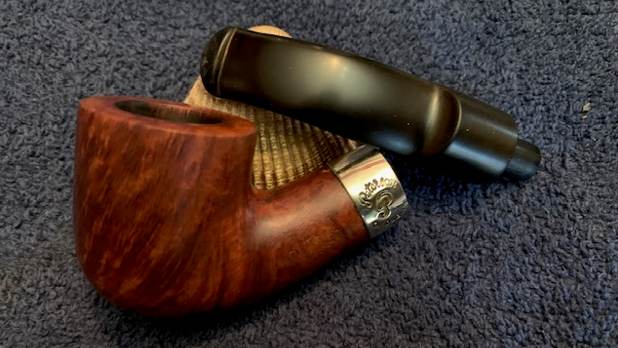
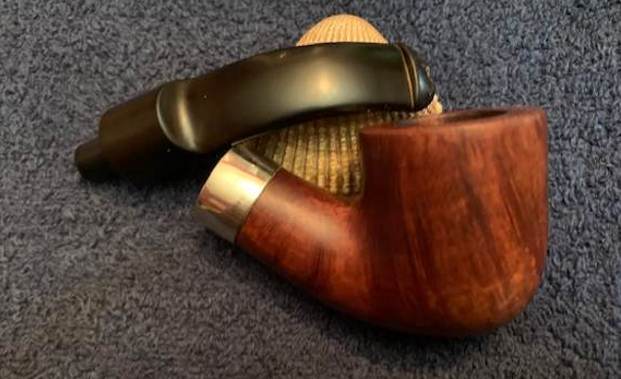
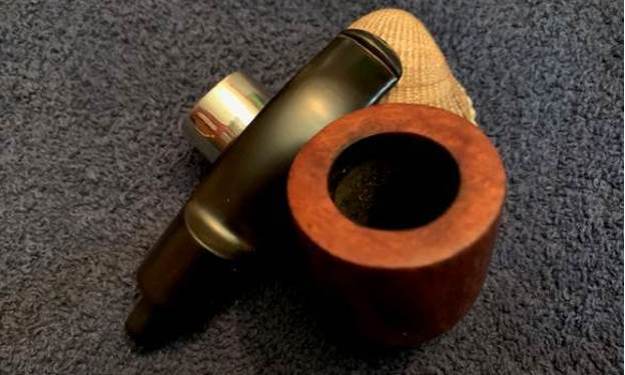
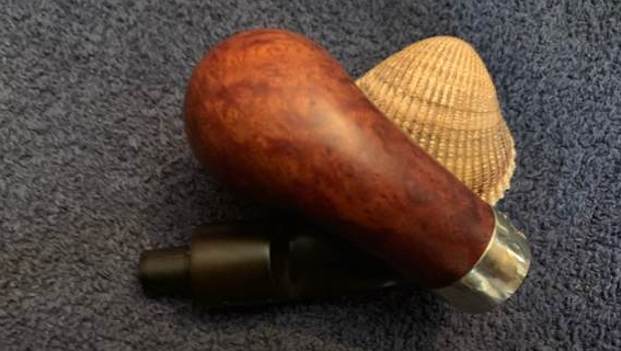
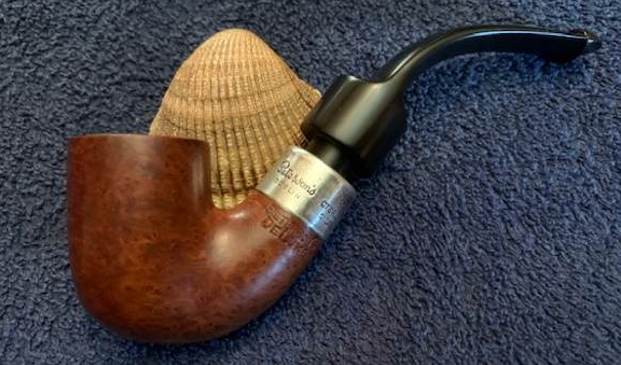
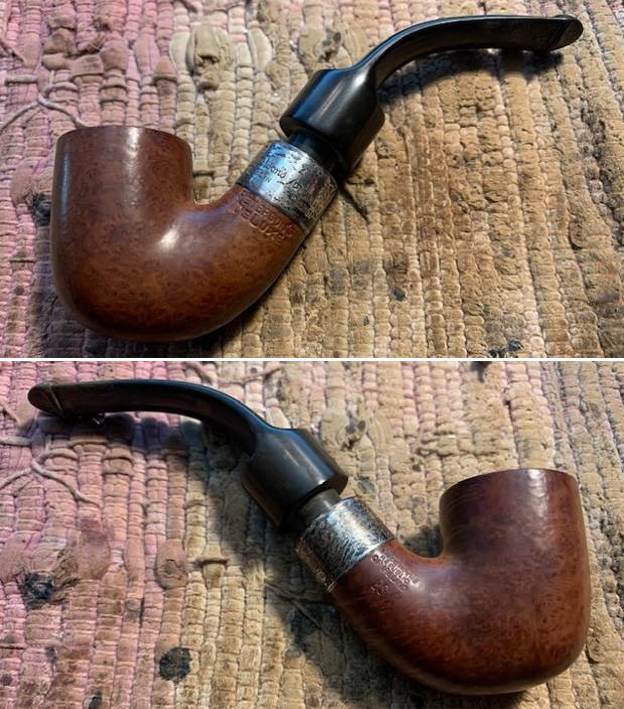
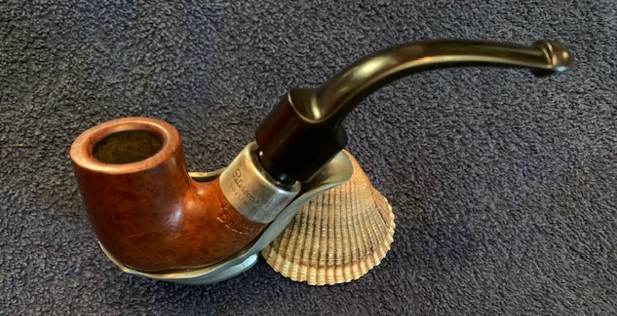
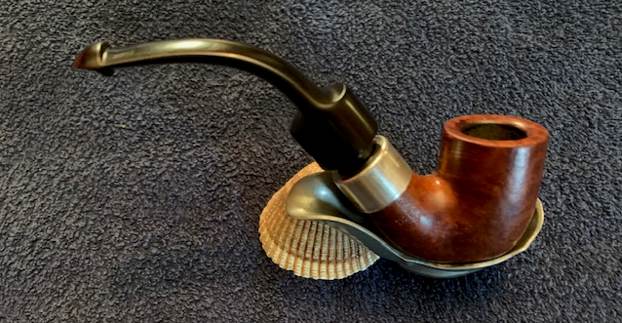
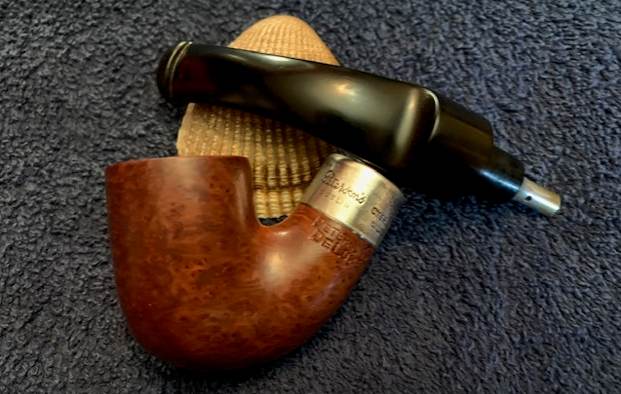
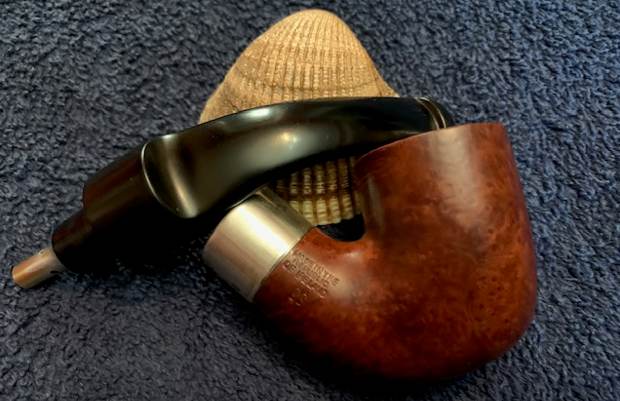
Cleaning up a Peterson’s De Luxe System 8S Bent Billiard with a Sterling Silver Ferrule


Blog by Steve Laug

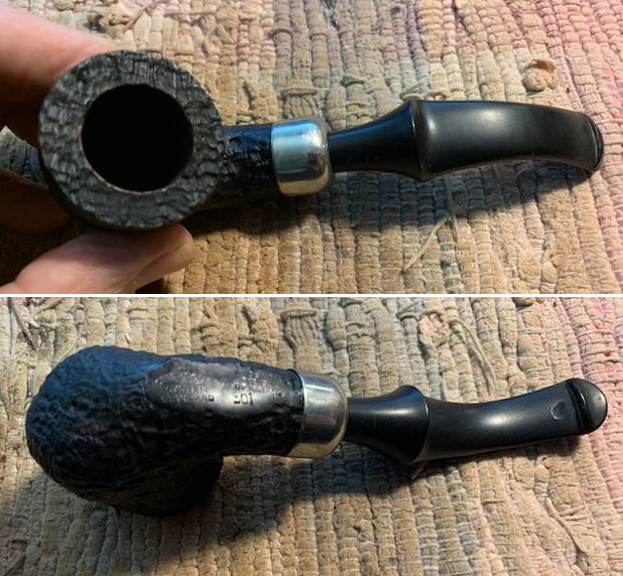
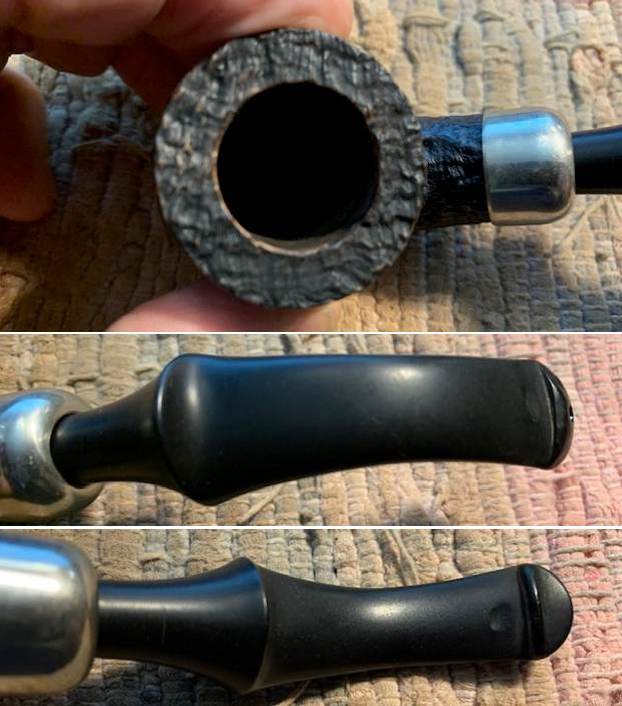
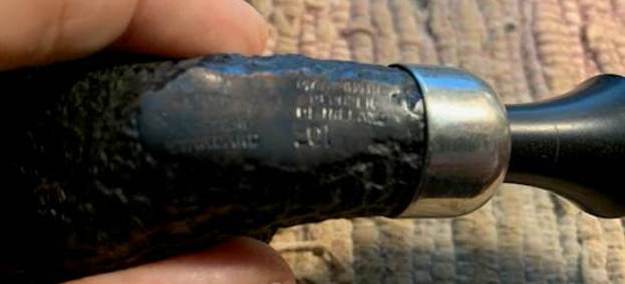
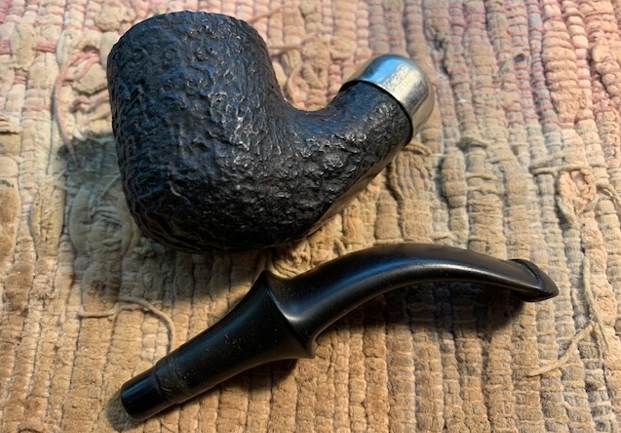
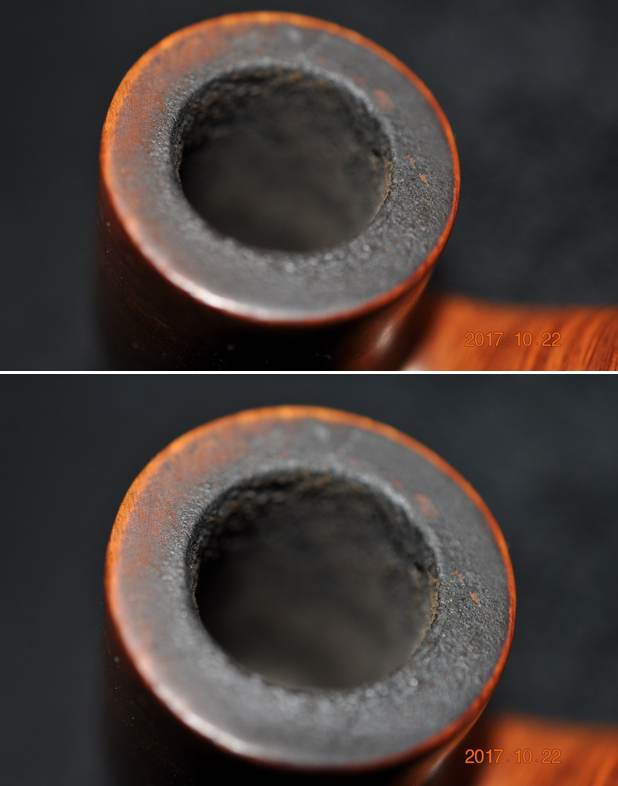
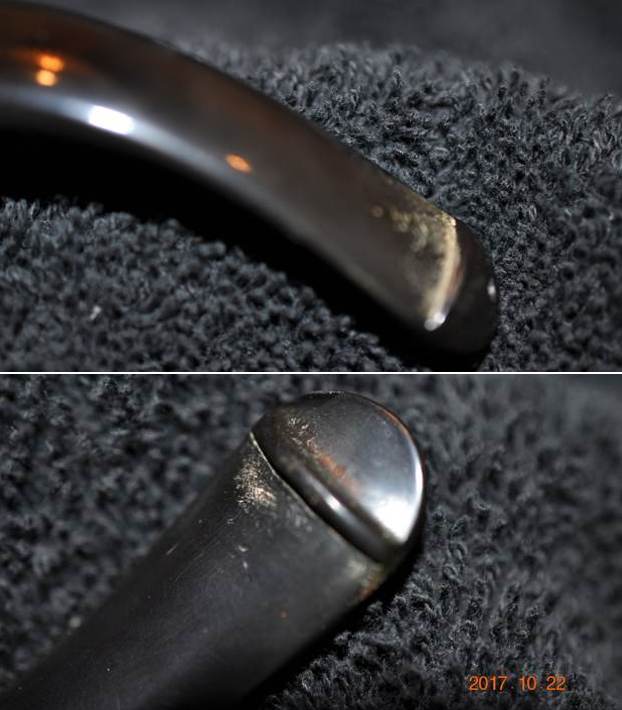
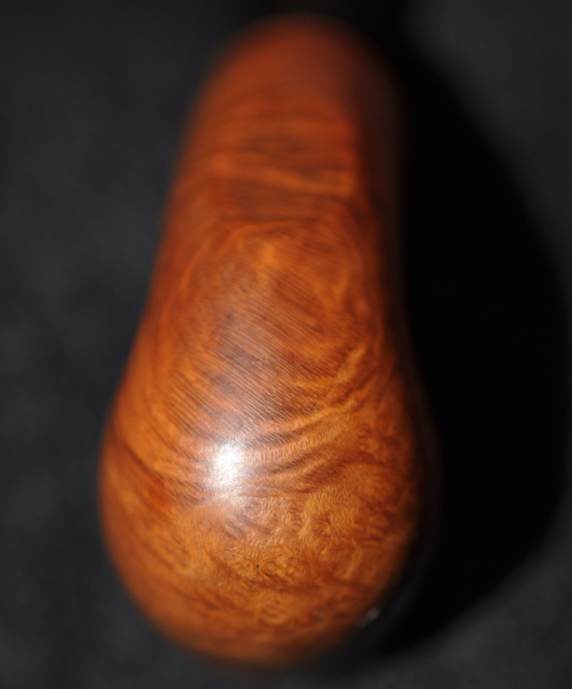
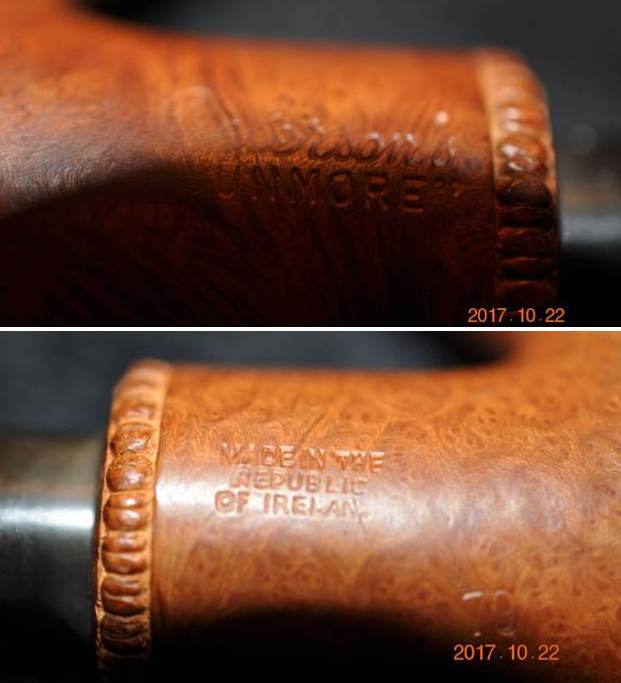
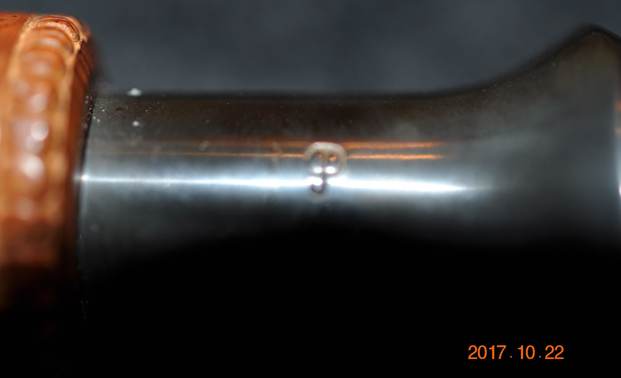
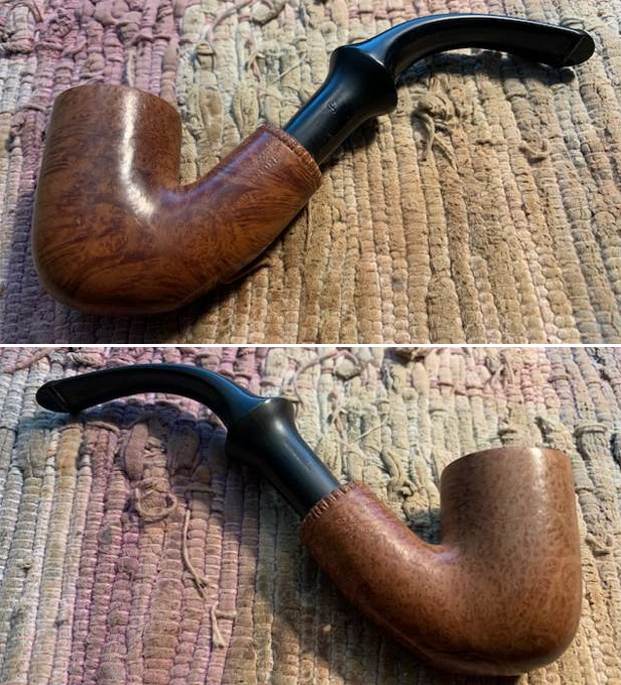
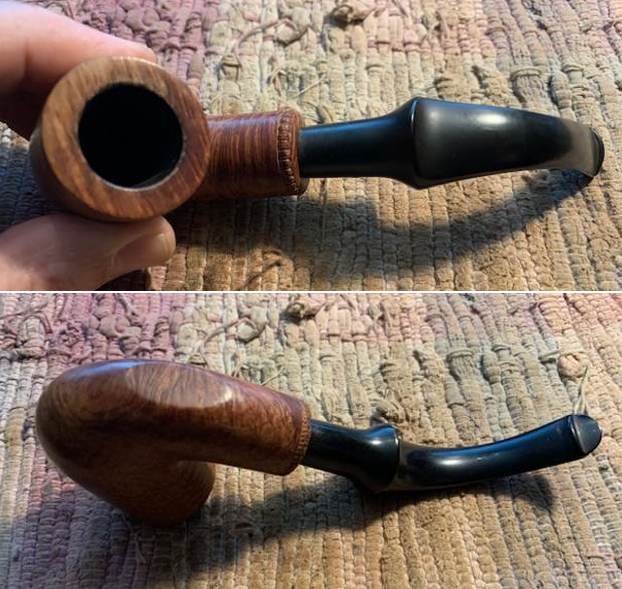
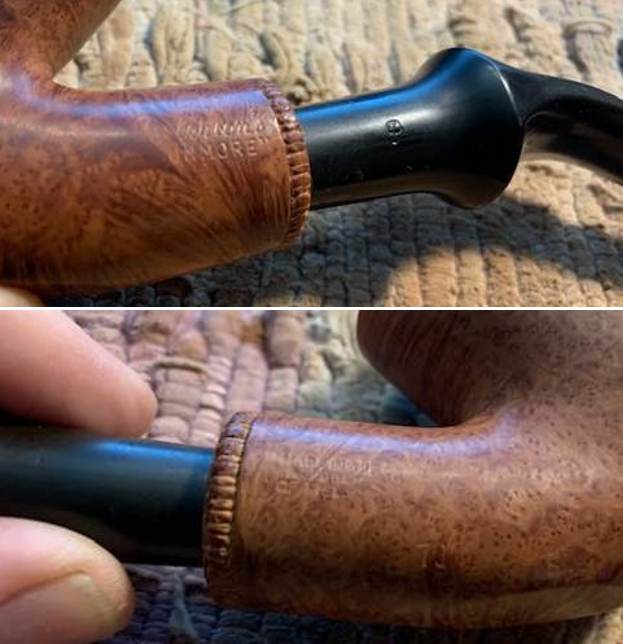
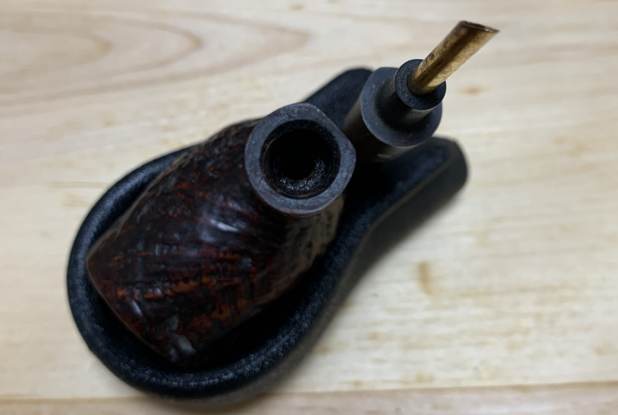
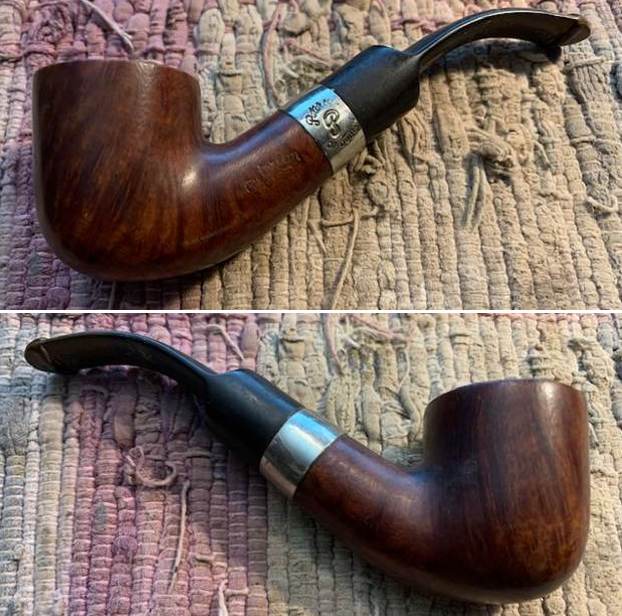
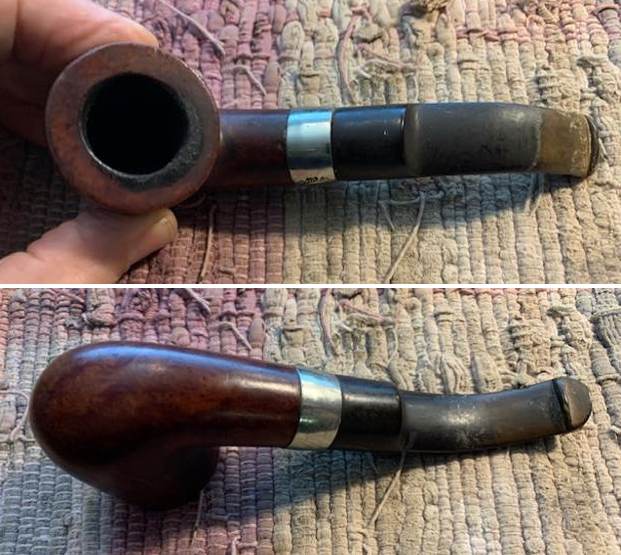
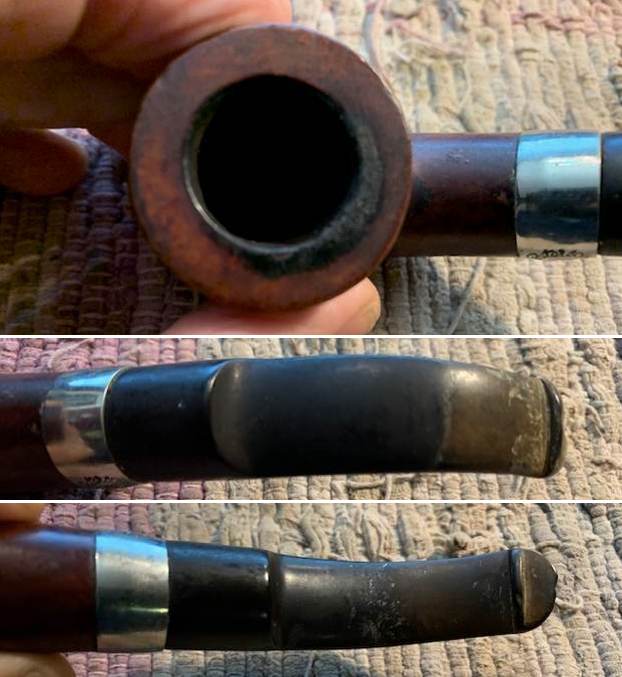
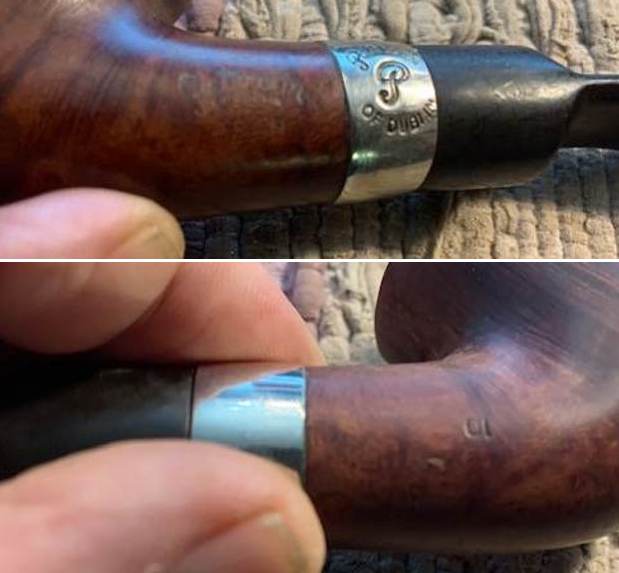
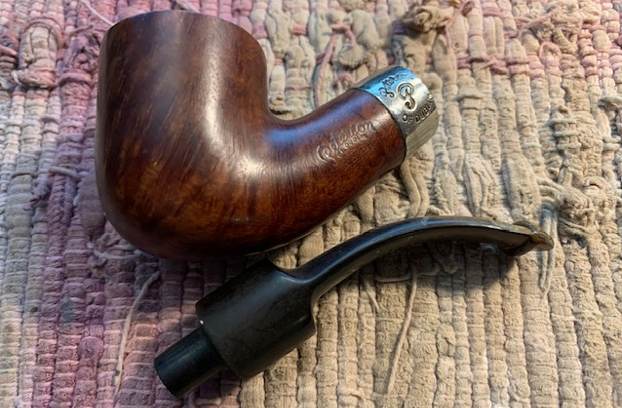
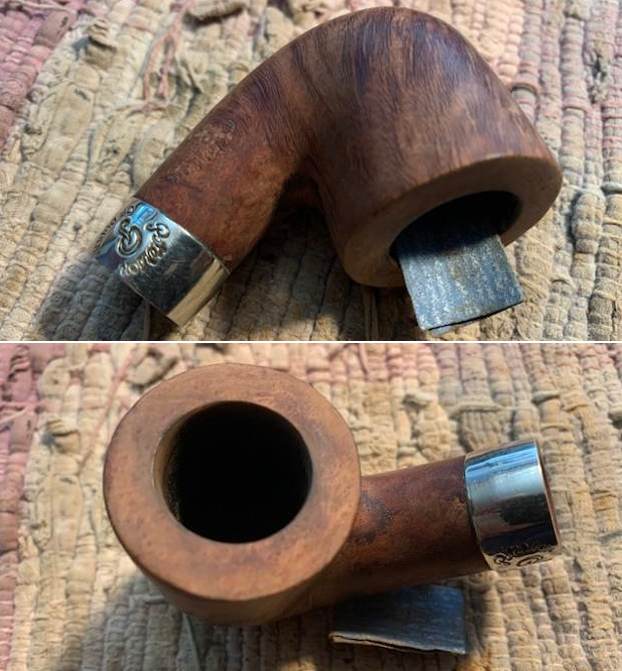
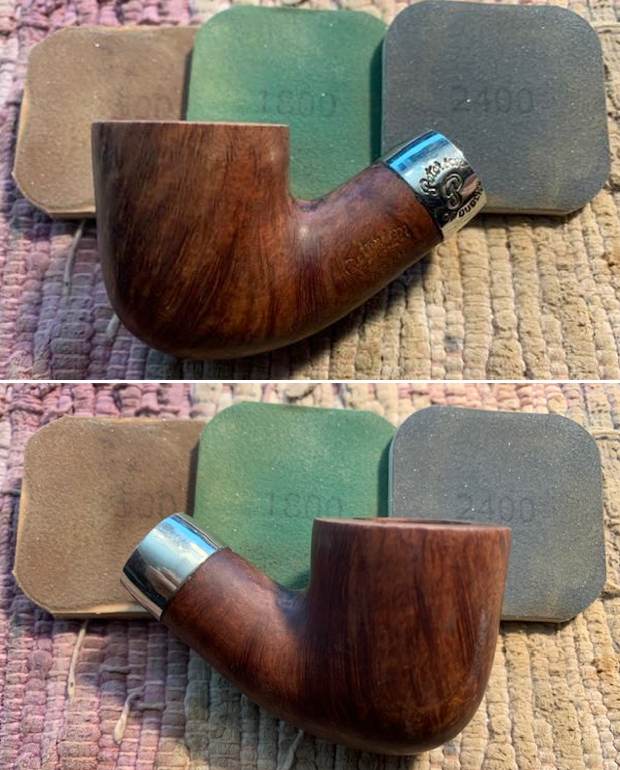
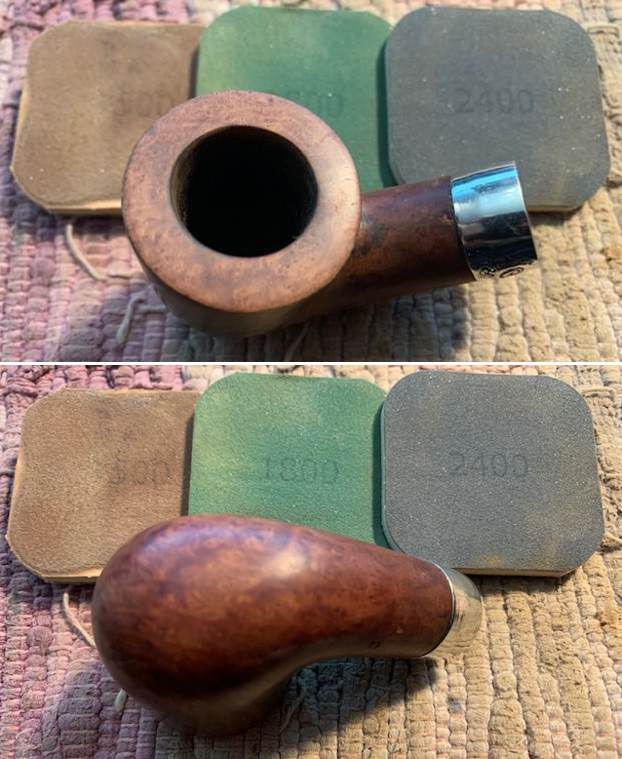
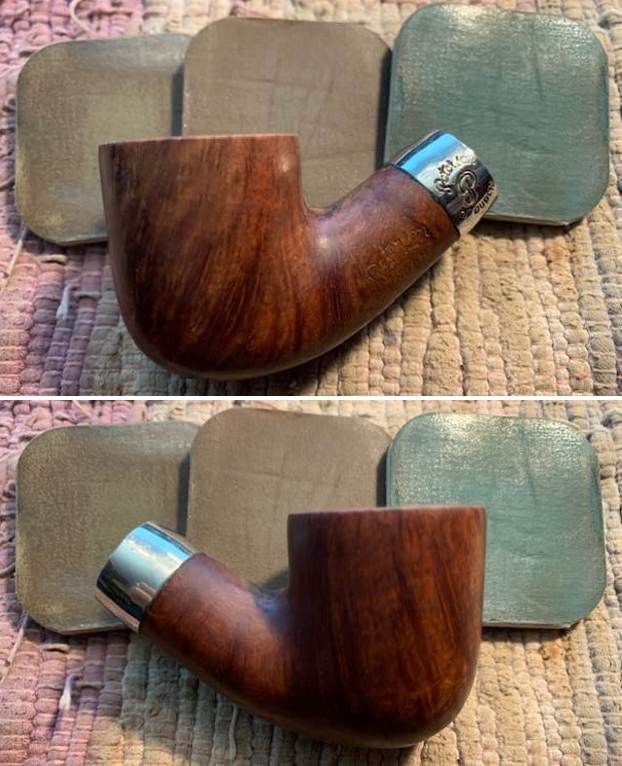
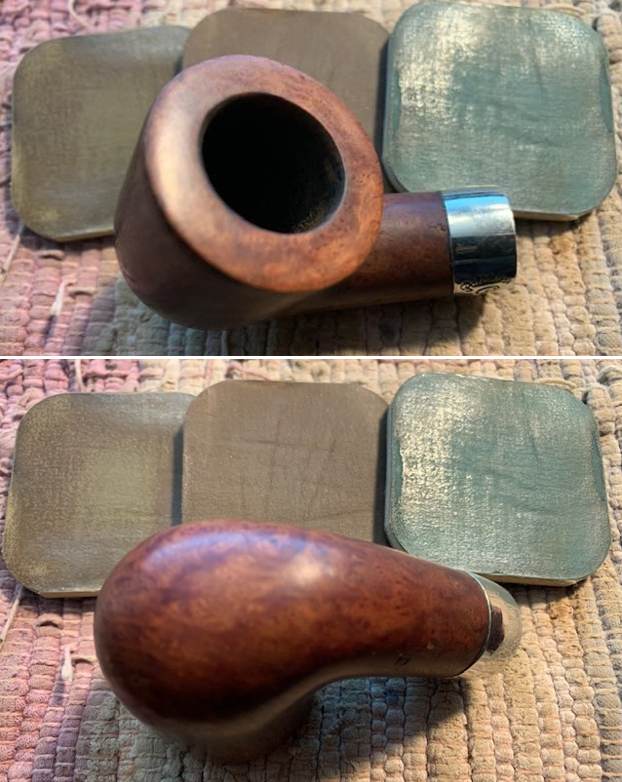
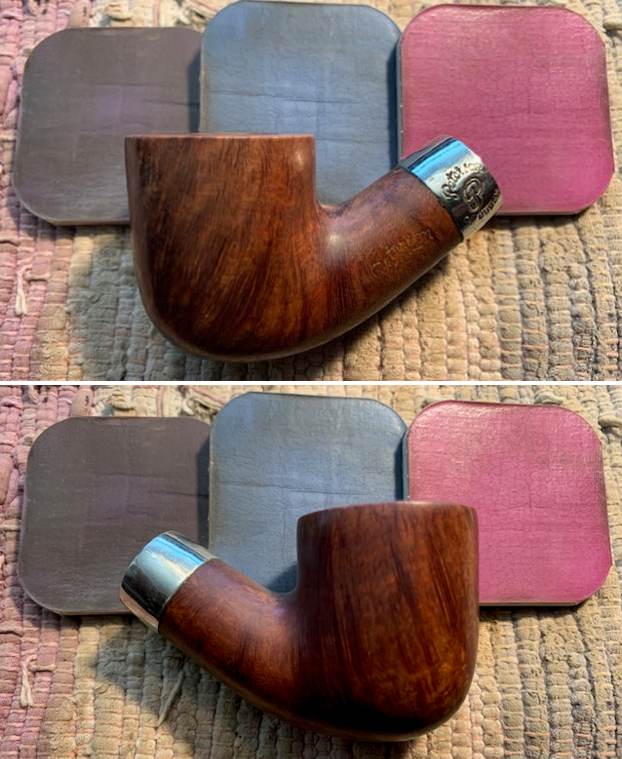
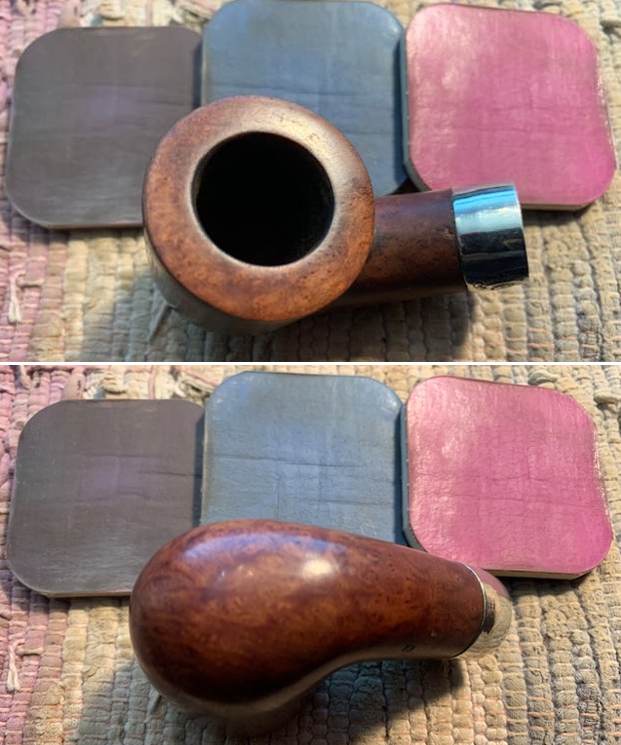
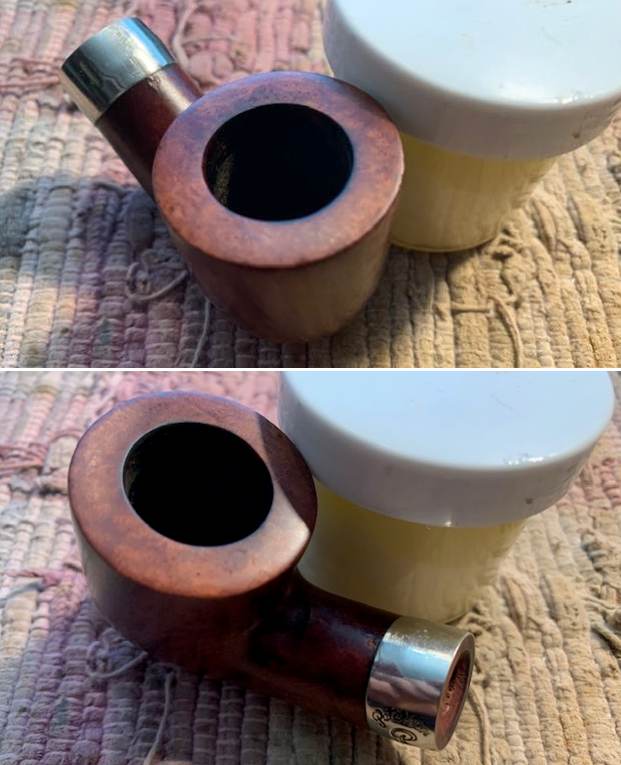
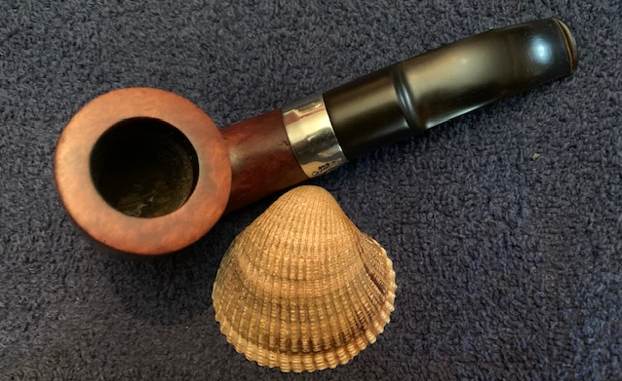
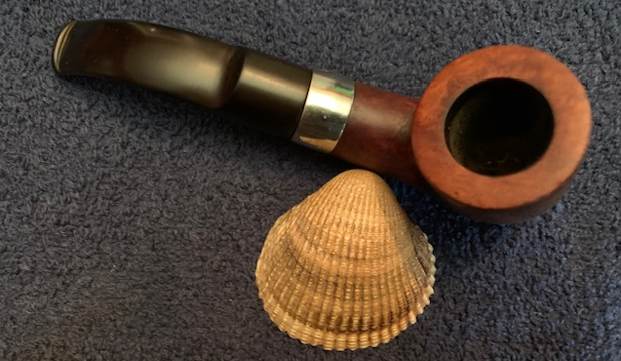
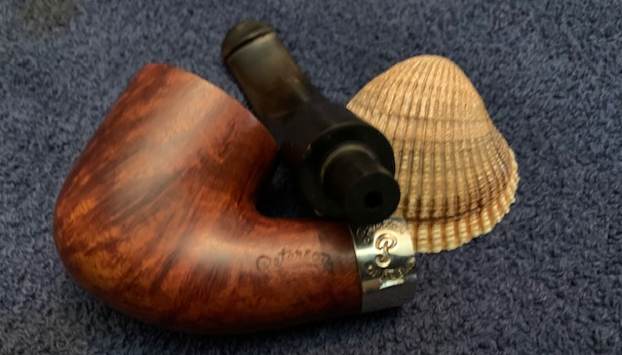
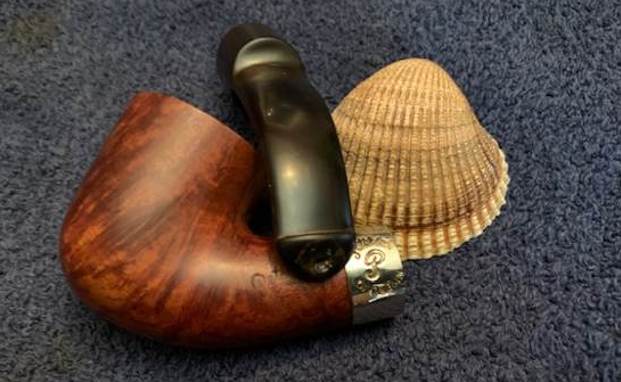
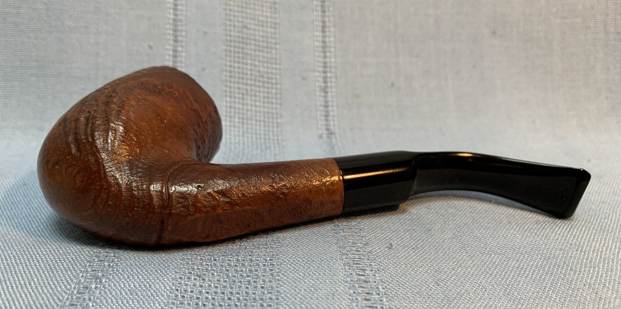
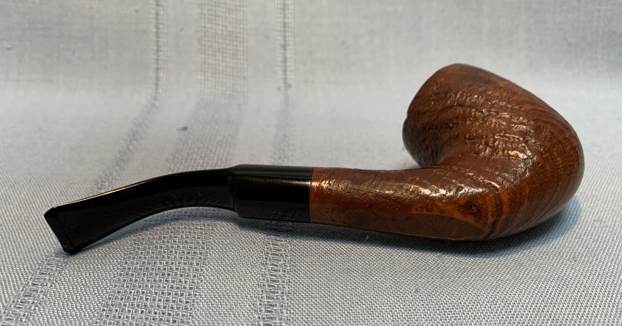
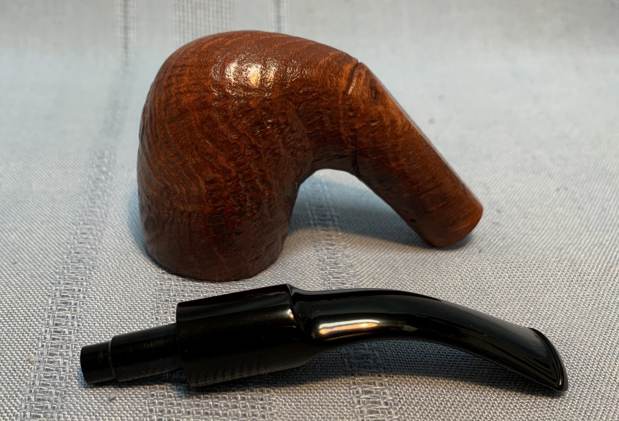
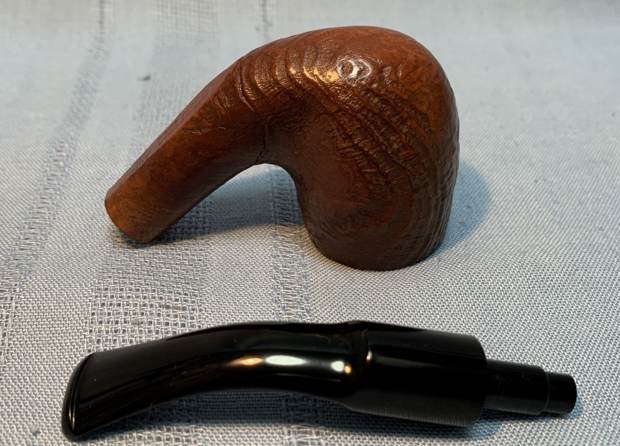
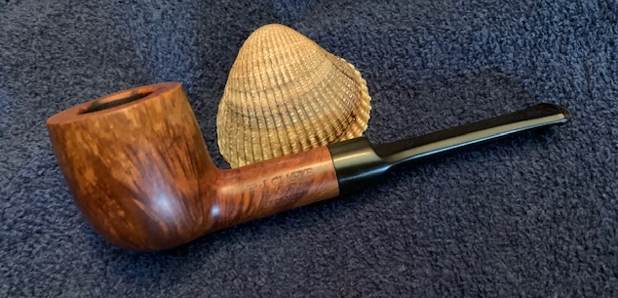
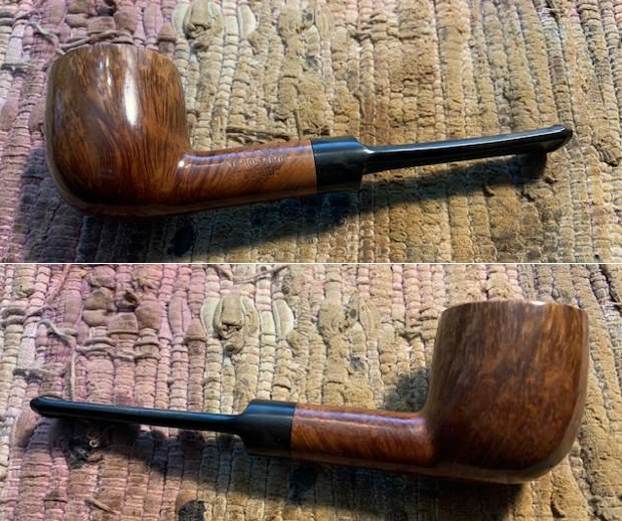
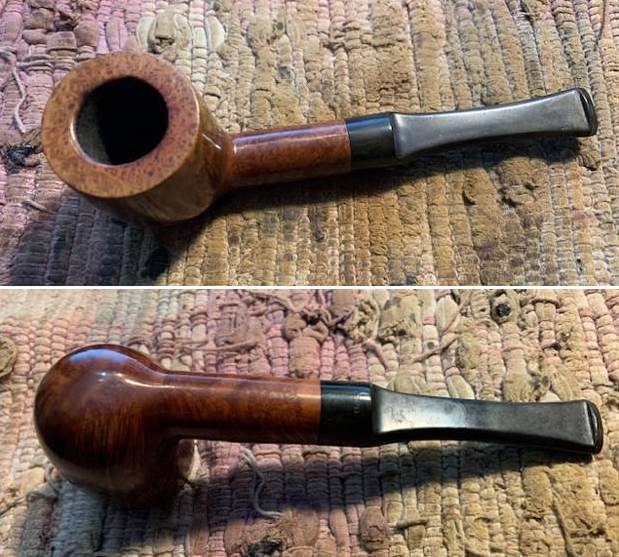
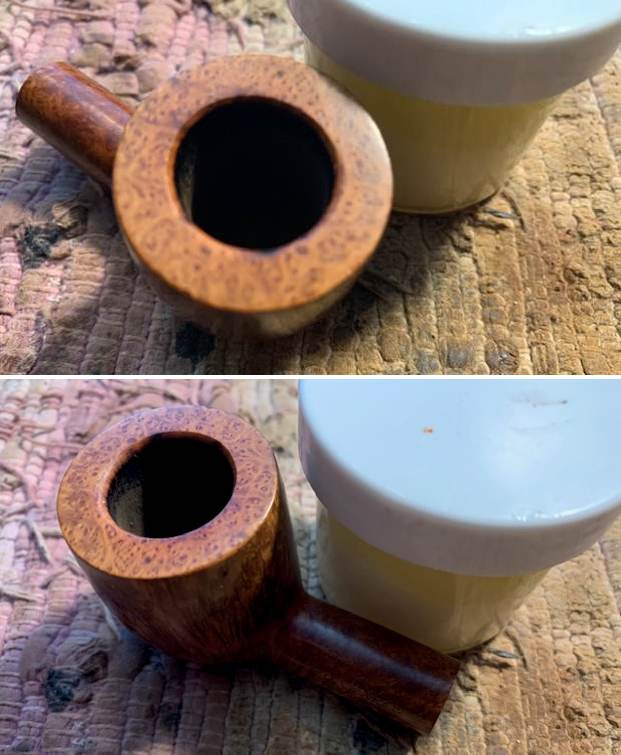
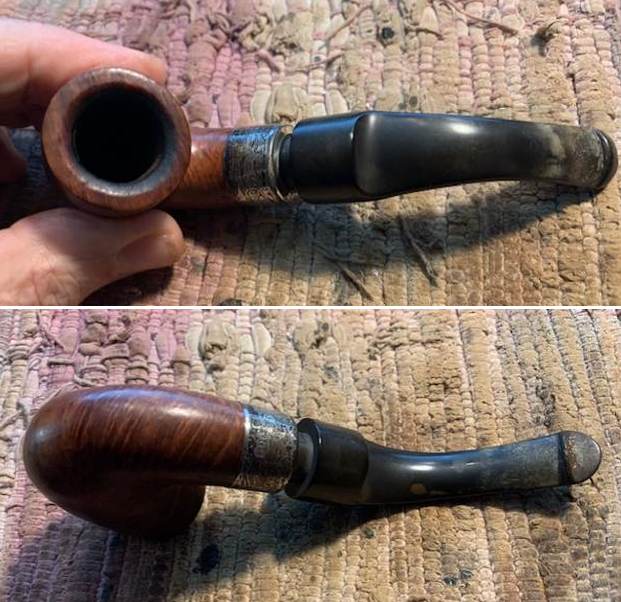
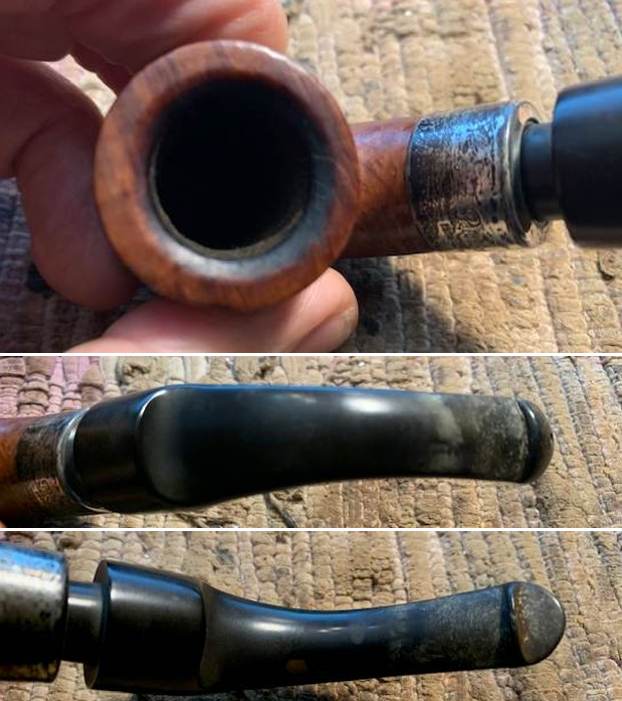
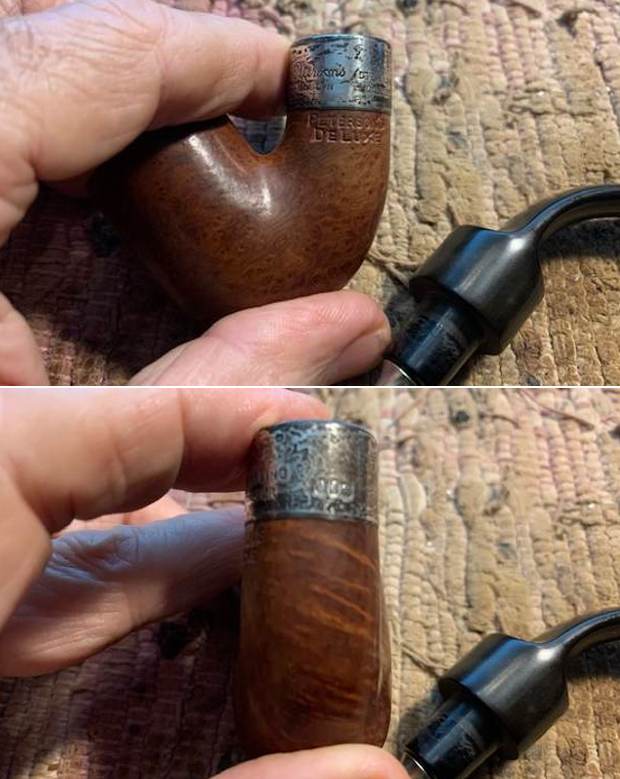
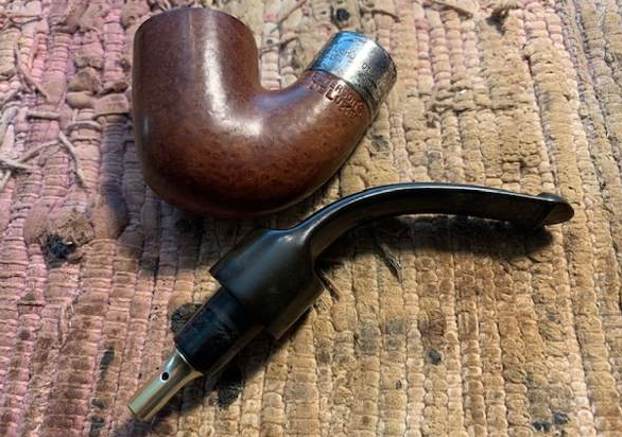
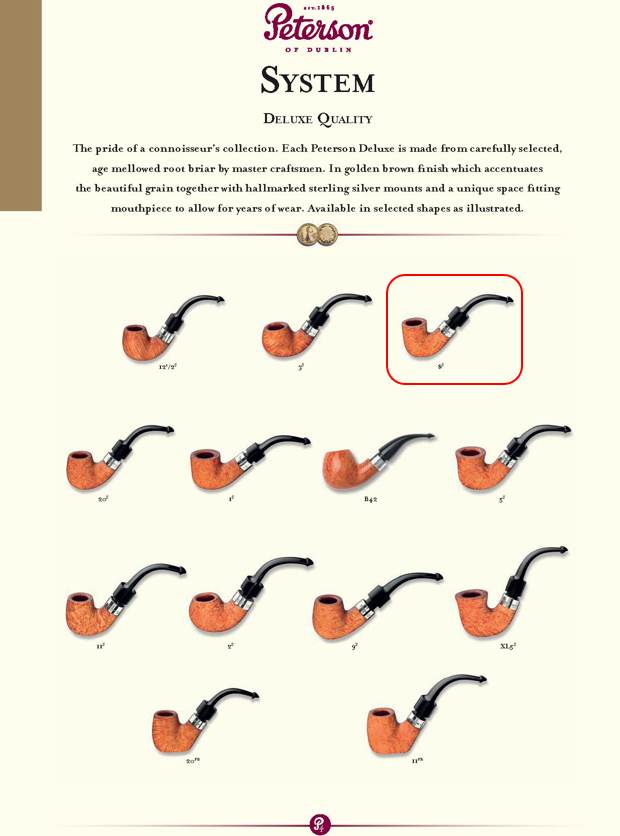
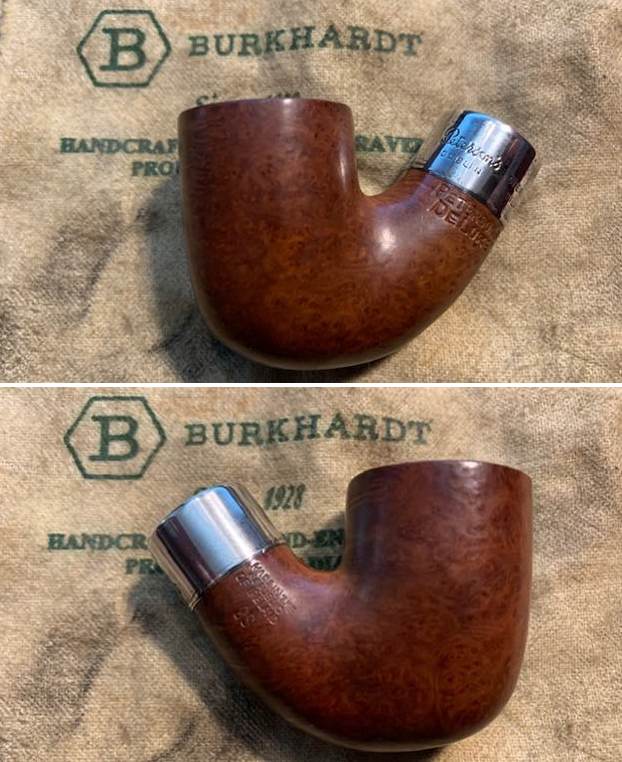
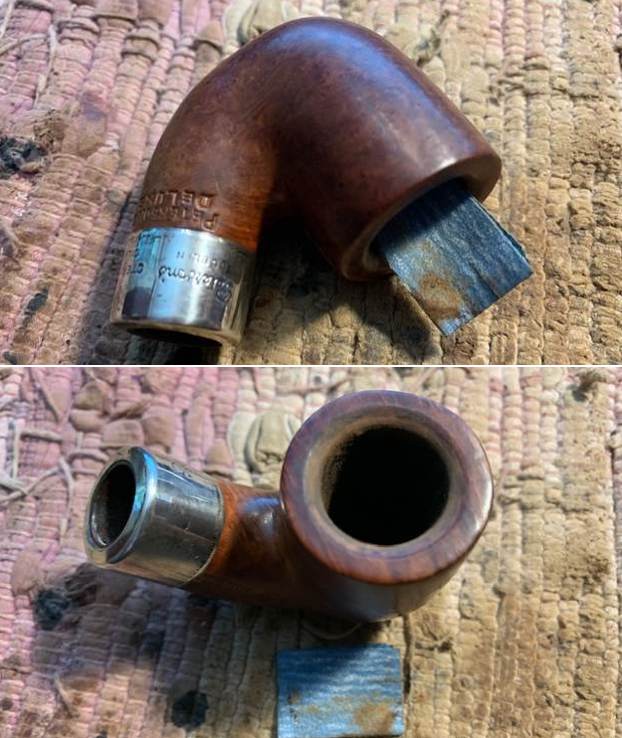
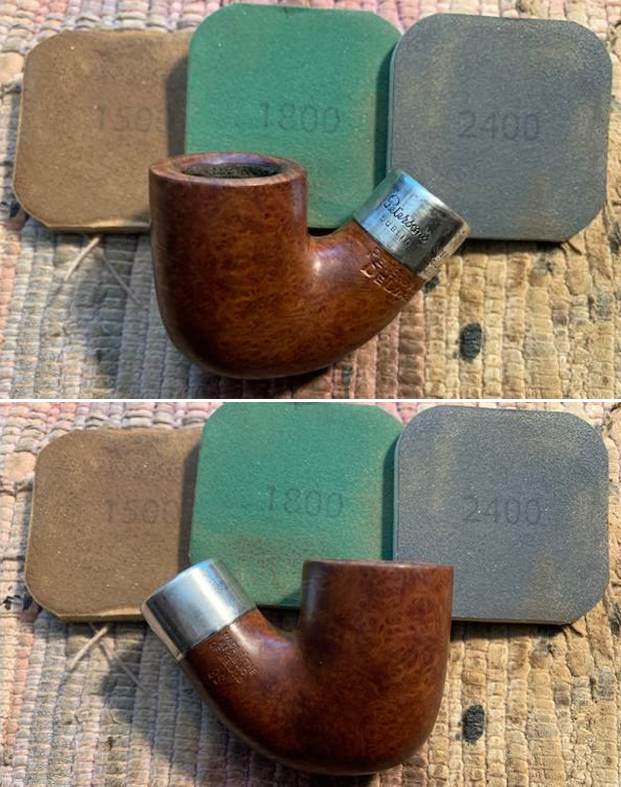
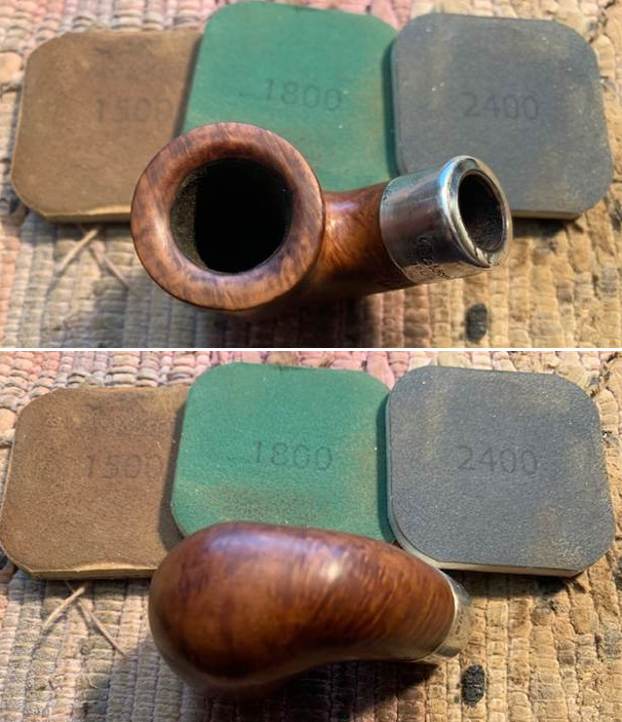
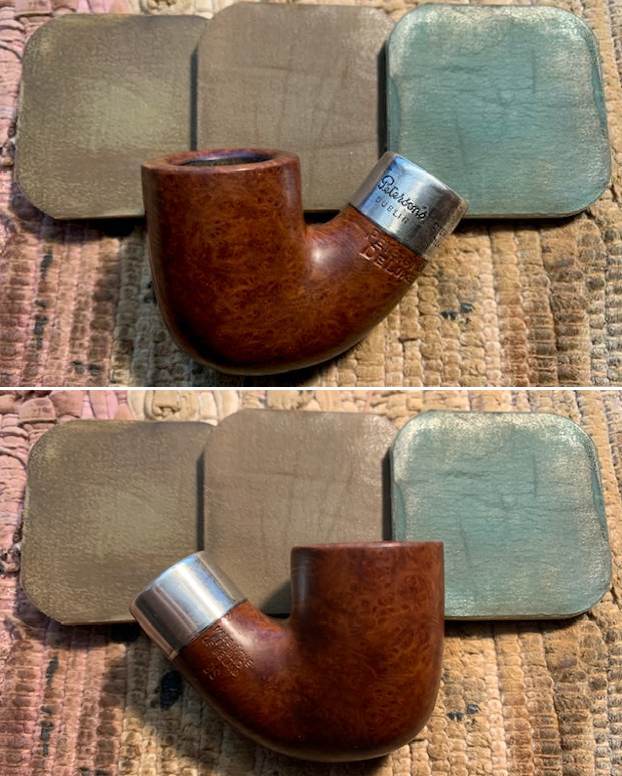
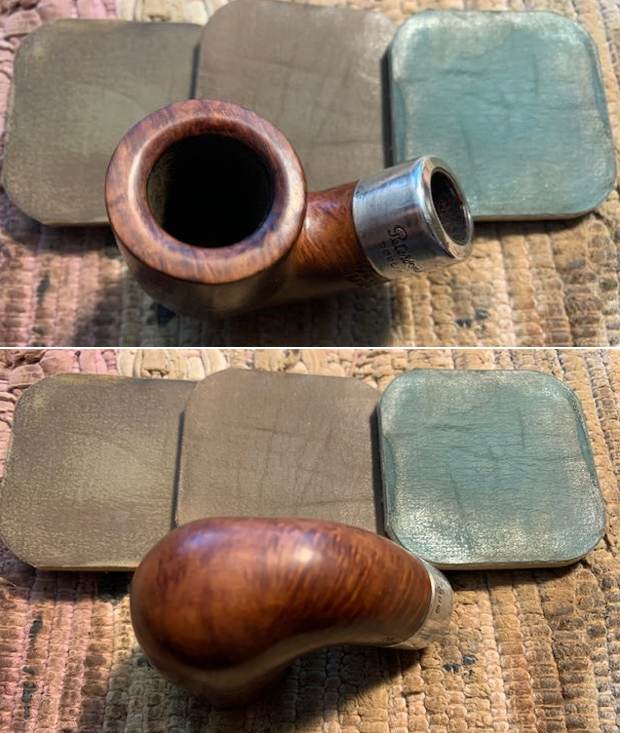
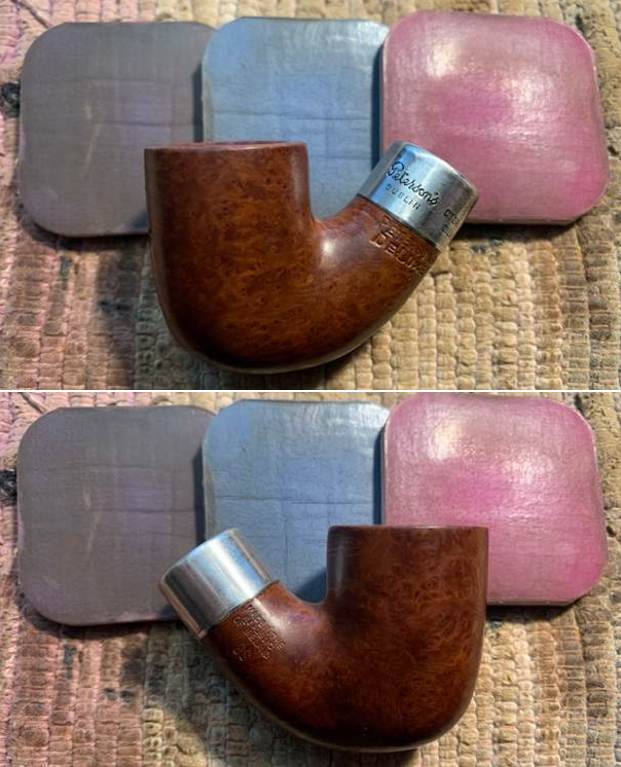
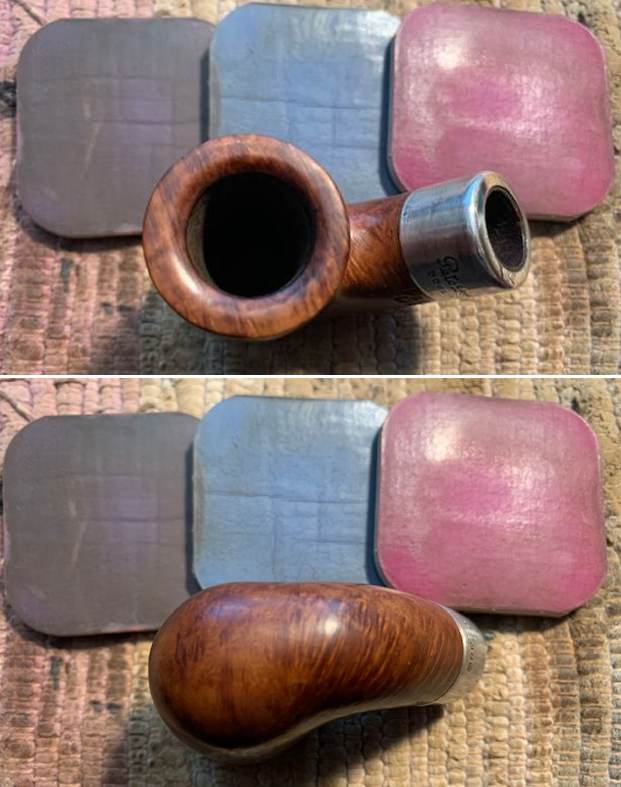
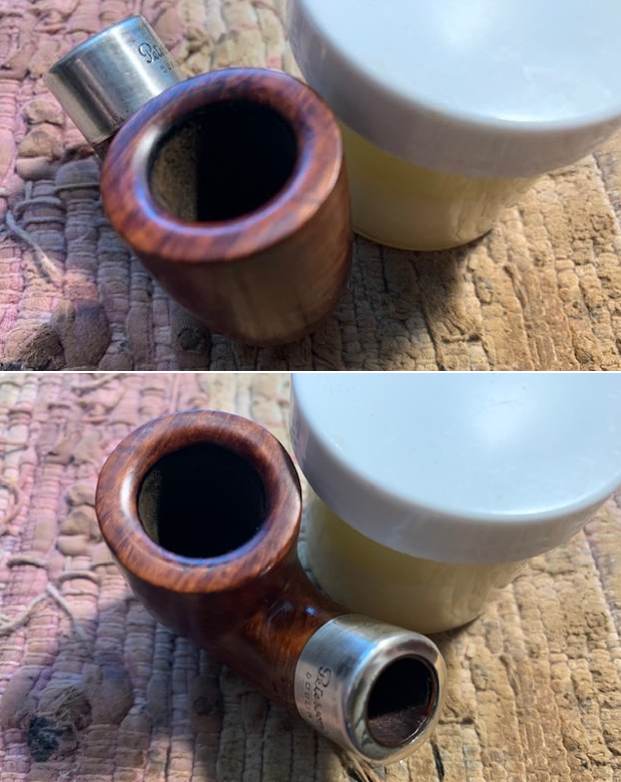
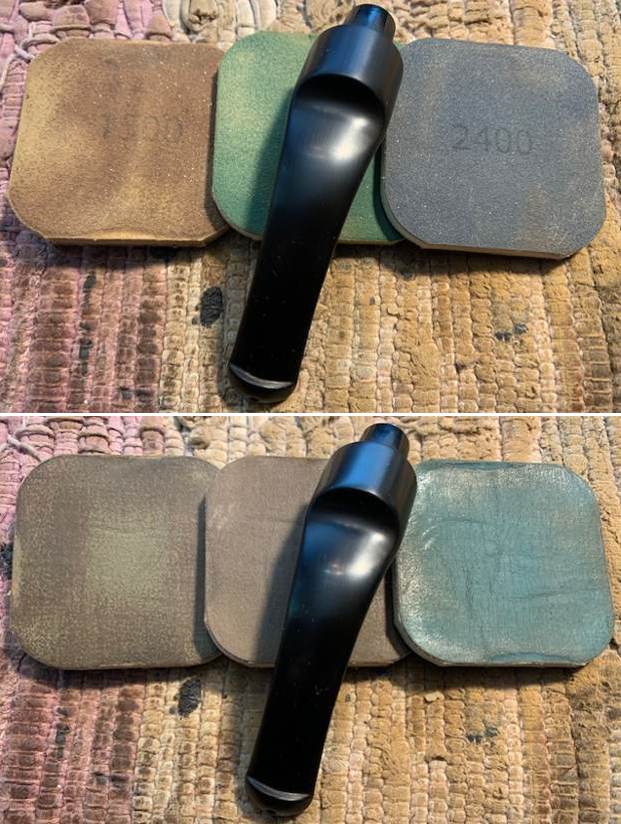
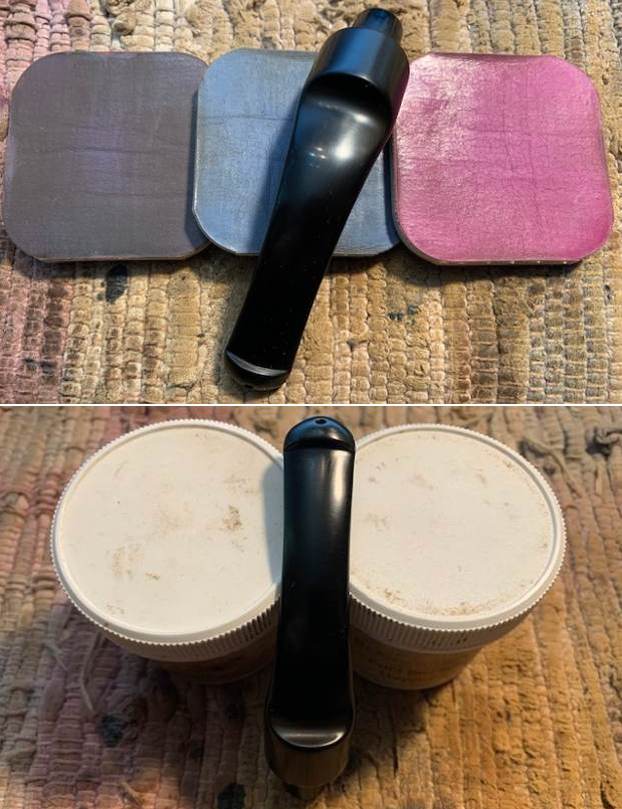
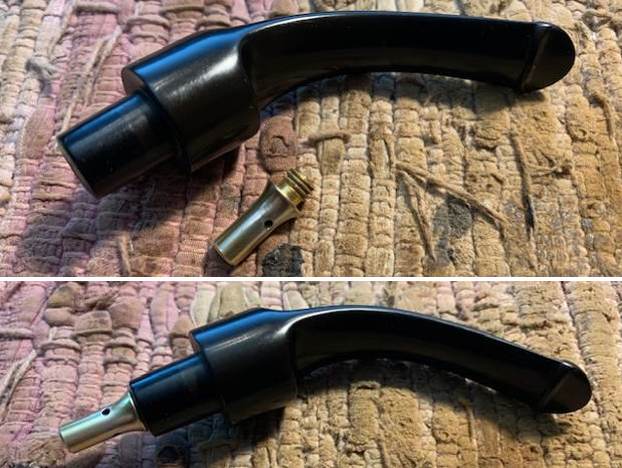
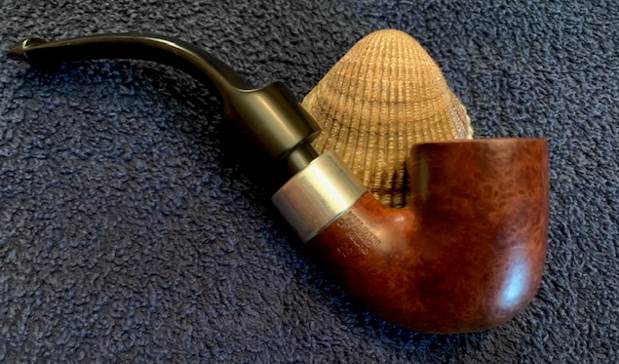
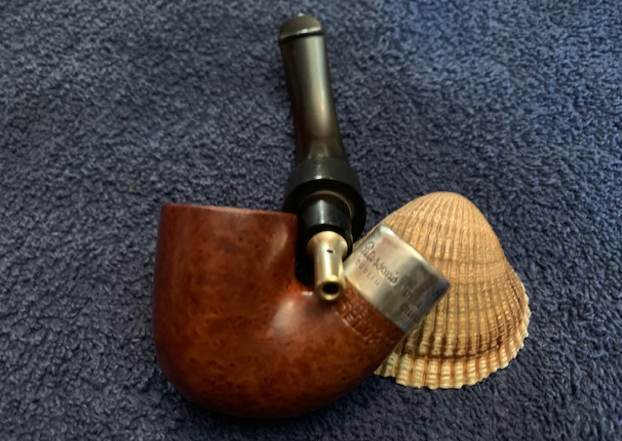
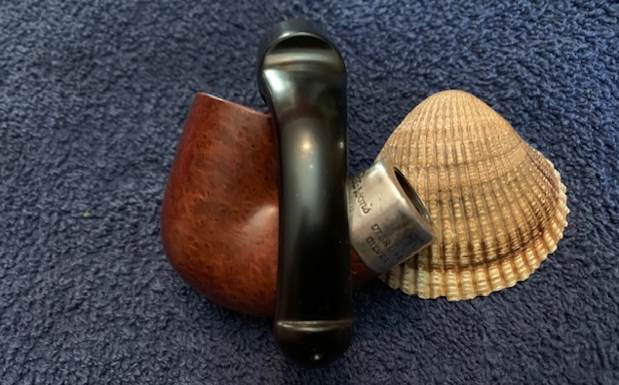
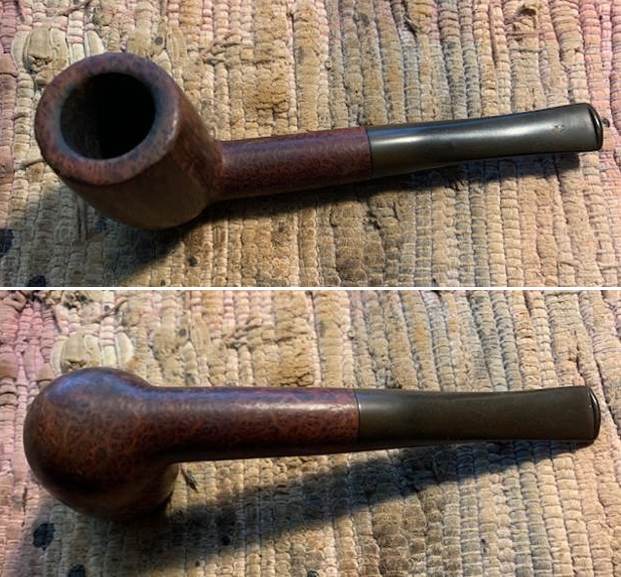
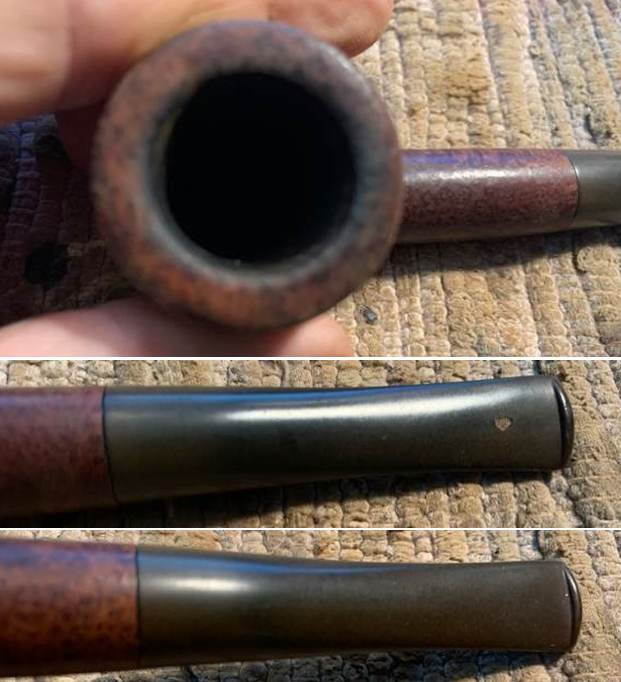
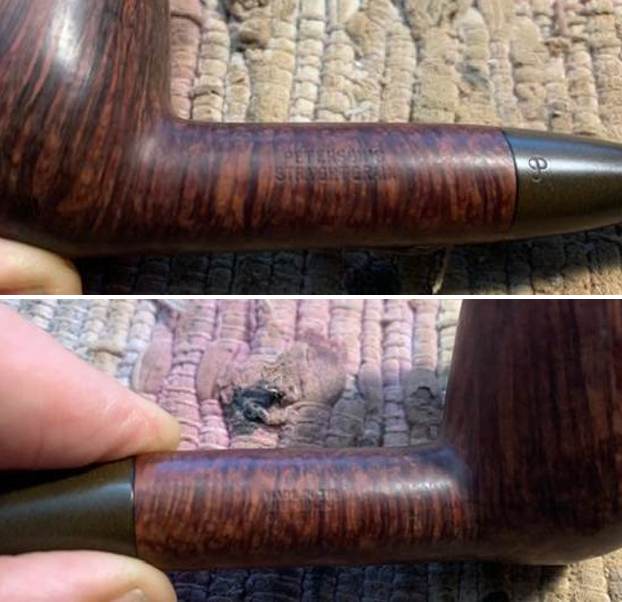
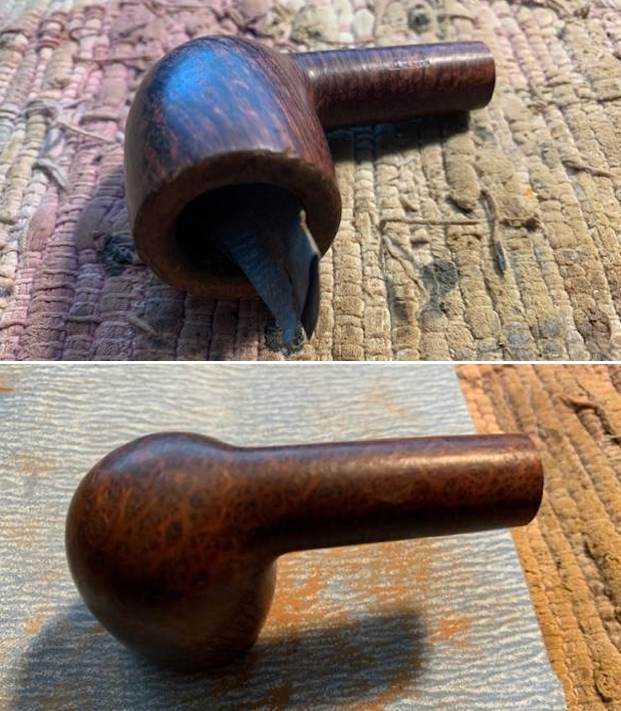
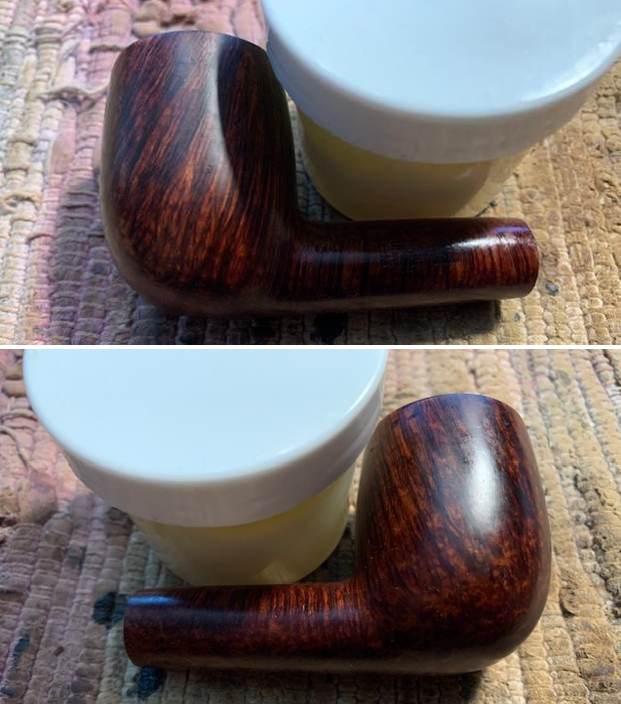
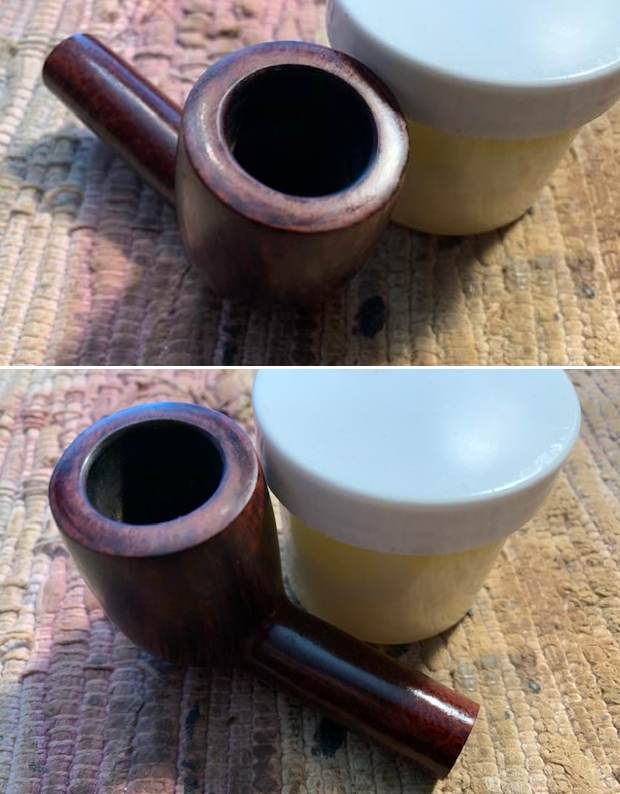
I have a few pipes that I am working on for local folks who either have dropped them off or who are friends that I am catching up with. The next pipe on the worktable is the second of two that belongs to an old friend of mine who is in the process of moving. He stopped by and asked me to clean up a couple of his favourite pipe. This first one I worked on was a Savinelli de luxe Milano 607KS (https://rebornpipes.com/2022/10/23/new-life-for-a-savinelli-de-luxe-milano-sandblast-607ks-bent-billiard/). This second on is a Peterson Deluxe with a Sterling Silver Ferrule. It is stamped faintly on the left side of the shank and reads Peterson’s [over]De Luxe. The stamping on the right side was buffed off. The ferrule on the shank is clear and readable under the tarnish. It reads Peterson’s [over] Dublin. That is followed by Sterling [over] Silver. That was followed by three hallmarks – The Hibernia stamp, the Crowned Harp stamp and finally the letter “m”. It has some stunning grain around the bowl and shank under the grime. There was a thin cake in the bowl and the top and edges of the rim had some scratches and damage on both. The stem was lightly oxidized but there were no tooth marks on the surface. I took some photos of the pipe before I started my work. I took photos of the rim top and the stem to show their condition. The top and edges showed some damage and was out of round and had darkening. The stem had oxidation though there was not any tooth marks of damage on the surface. I took photos of the stamping on the shank and the Sterling Silver ferrule to capture its condition. The stamping on the shank is faint but readable as noted above. The stamping on ferrule is clear and readable as noted above. I removed the stem from the bowl and took a picture of the pipe to show the general look and proportion of the pipe. It also shows the metal condenser tube in the tenon end. To help identify the shape number that had worn off I turned to a Peterson Catalogue that I have on rebornpipes and looked up the System Deluxe pipes (https://rebornpipes.com/tag/peterson-hallmark-chart/). I compared the shape of the pipe in hand with the shape chart show below. I have put a red box around the 8S pipe shown in the catalogue page shown below. So now I knew it was an 8S Bent Billiard.I turned first to Pipephil’s site to reacquaint myself with the DeLuxe. Unfortunately there was no information to be found on this specific line. I then turned to Pipedia’s article on Peterson pipes to see what I could garner from that information. It is a great read in terms of the history of the brand (https://pipedia.org/wiki/Peterson). I have included a bit of the pertinent history here.

1950 – 1989 The Republic Era  – From 1950 to the present time, the stamp for this era is “Made in the Republic of Ireland” in a block format generally in three lines but two lines have been used with or without Republic being abbreviated…

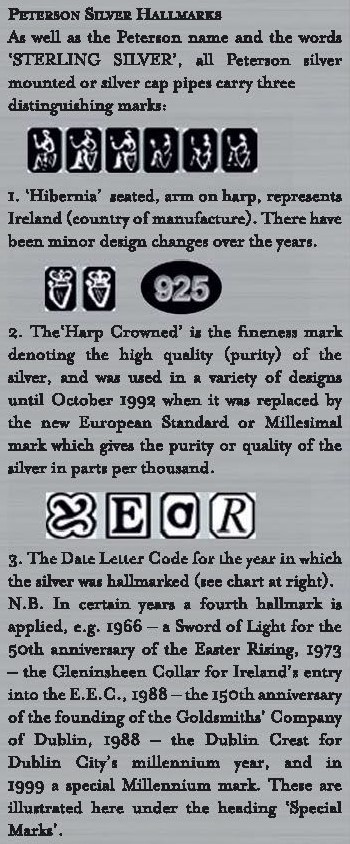
…With that information in hand I knew what I was dealing with in terms of the stamping on the pipe. It is a 1978  Republic Period pipe. I also wanted to be able to interpret the hallmarks on the silver band. I have captured a portion of the chart that include below that helps to clarify the meaning of each of the three hallmarks. I like the Hallmark feature on the higher end Peterson pipes with Sterling silver bands. It helps to pin down the date even further.

  • “Hibernia” seated, arm on harp represents Ireland (country of manufacture). There have been minor design changes over the years.
  • The “Harp Crowned” is the fineness mark denoting the high quality (purity) of the silver, and was used in a variety of designs until October 1992 when it was replaced by the new European Standard or Millesimal mark which gives the purity or quality of the silver in parts per thousand.
  • The Date Letter Code for the year in which the silver was hallmarked (see the chart below). In certain years a fourth hallmark is applied – for example 1966 – a Sword of Light for the 50th anniversary of the Easter Rising 1973. There were also other marks used for the fourth hallmark.

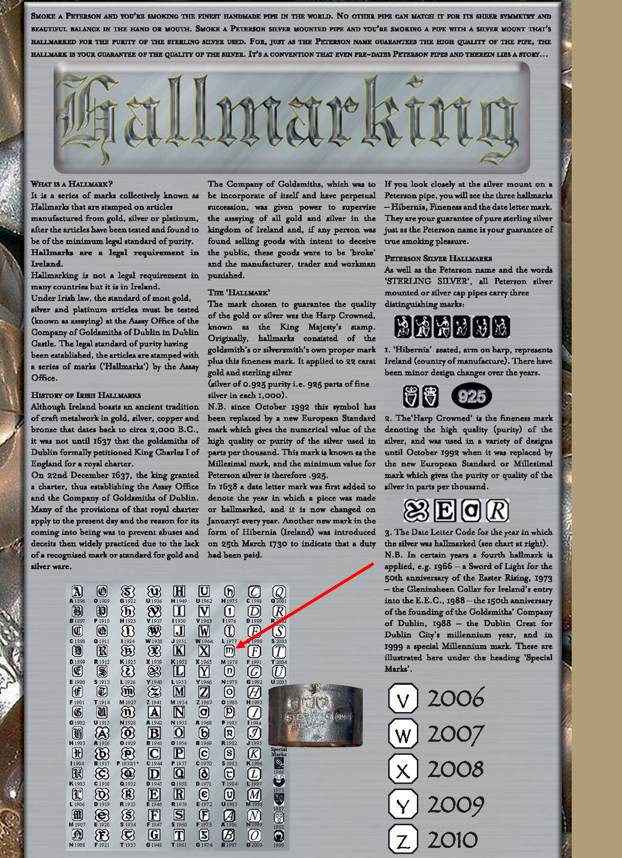
The pipe on my table had the Hibernia seated mark (Ireland) followed by the Harp Crowned signifying Sterling Silver percentage and finally in this case a lower case “m”. Each of the hallmarks was in an octagonal cartouche. The chart below helps me identify the date mark to 1978. I have drawn a red arrow to point out the 1978 mark in the chart below.

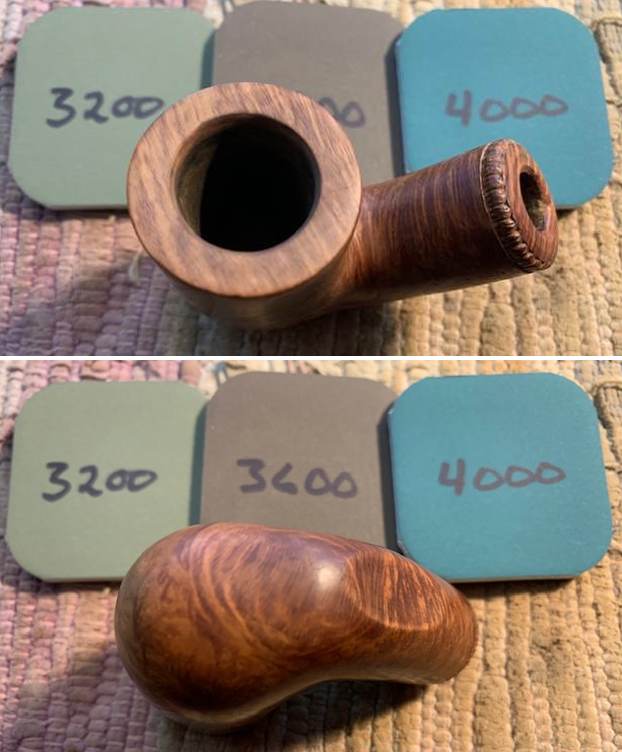
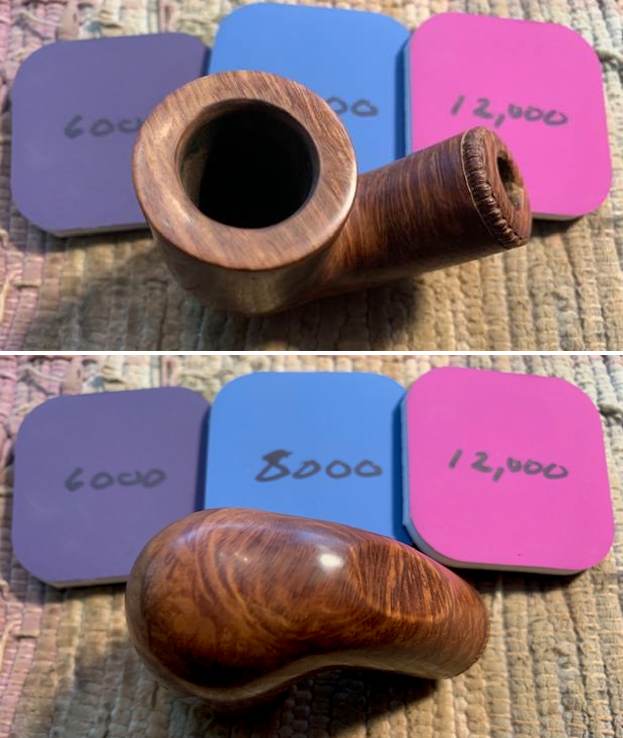
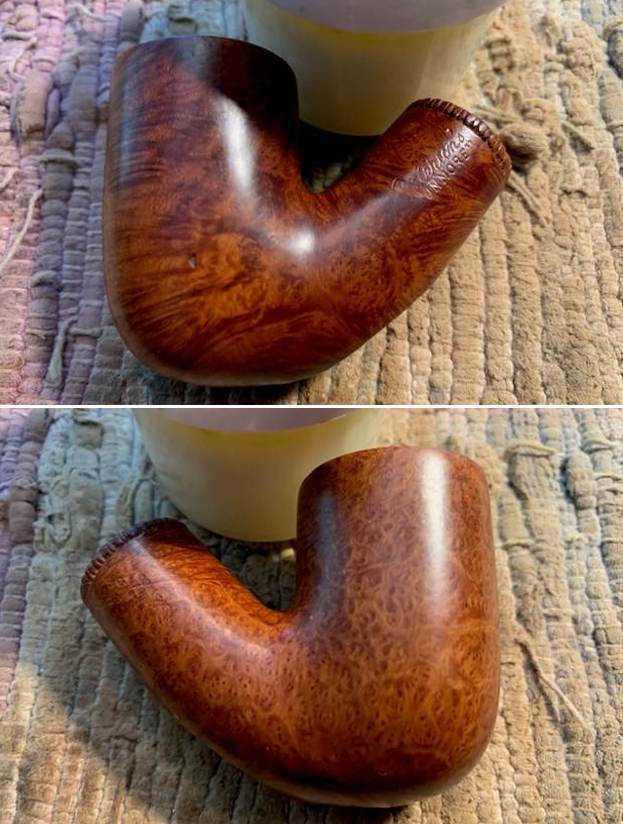
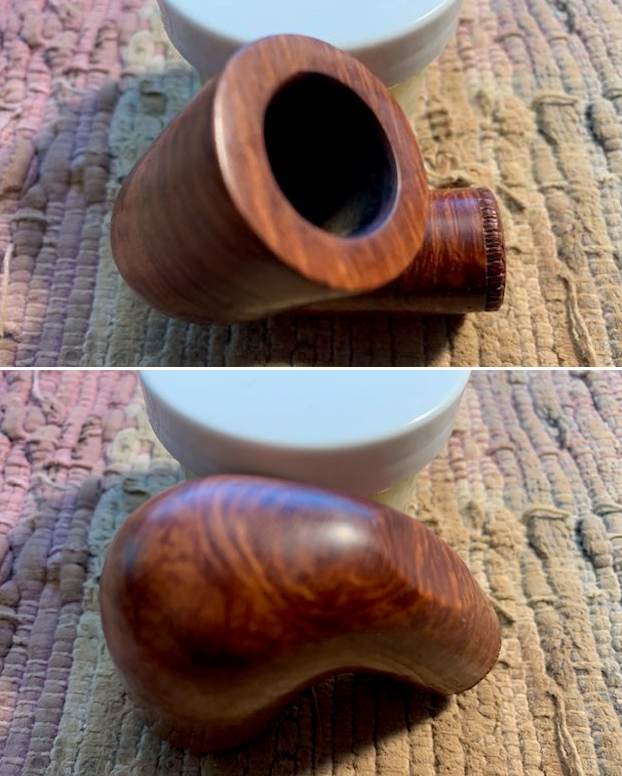
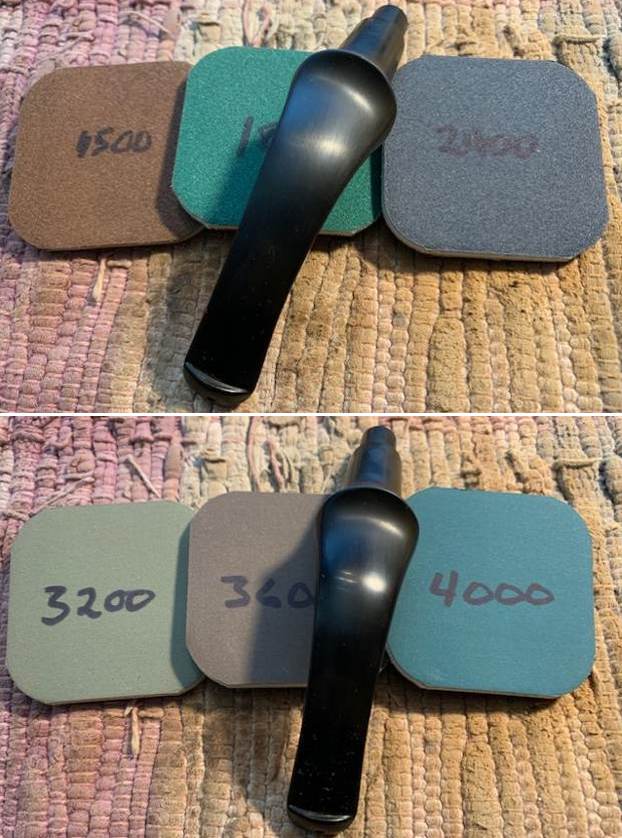
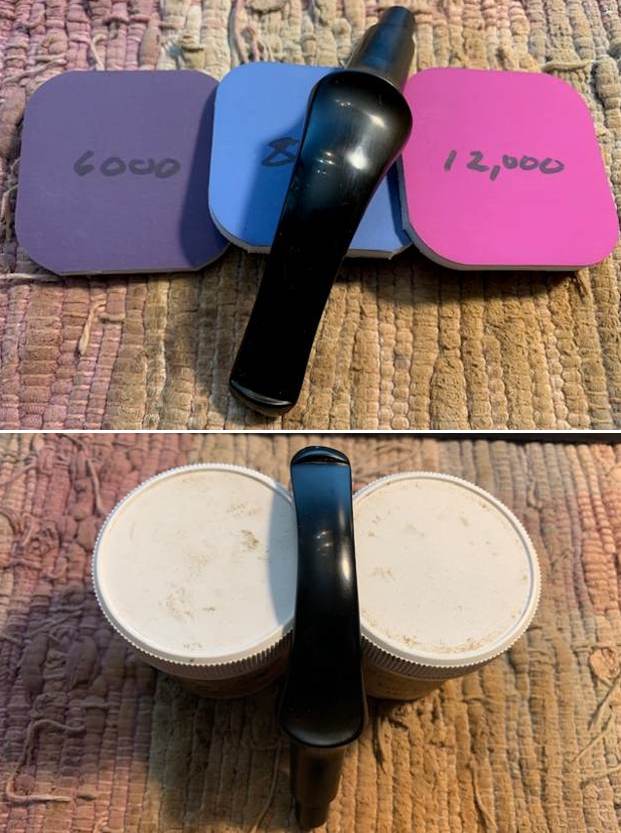
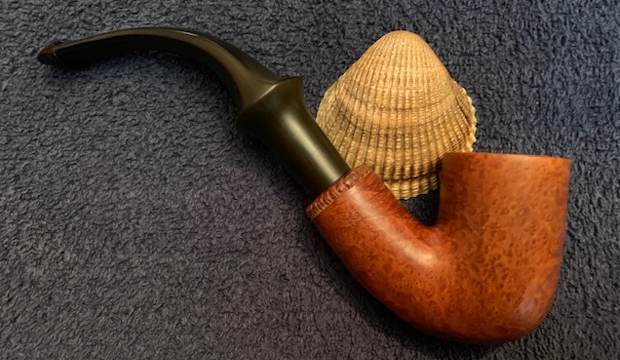
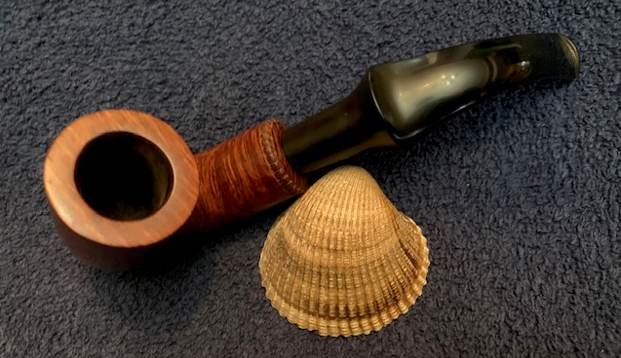
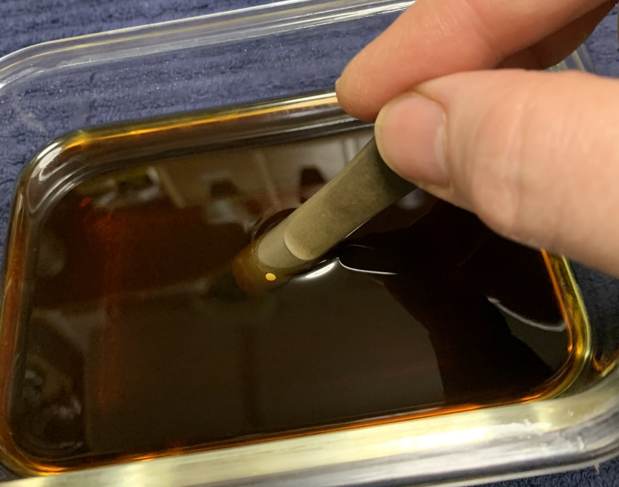
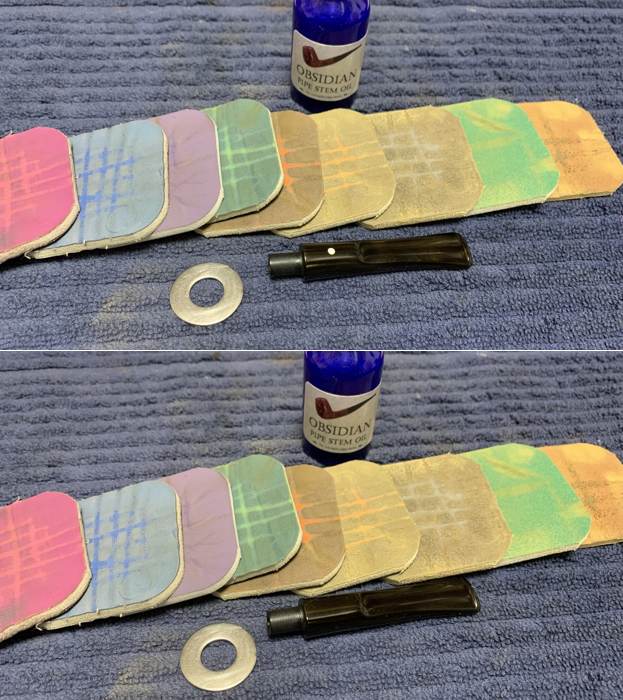
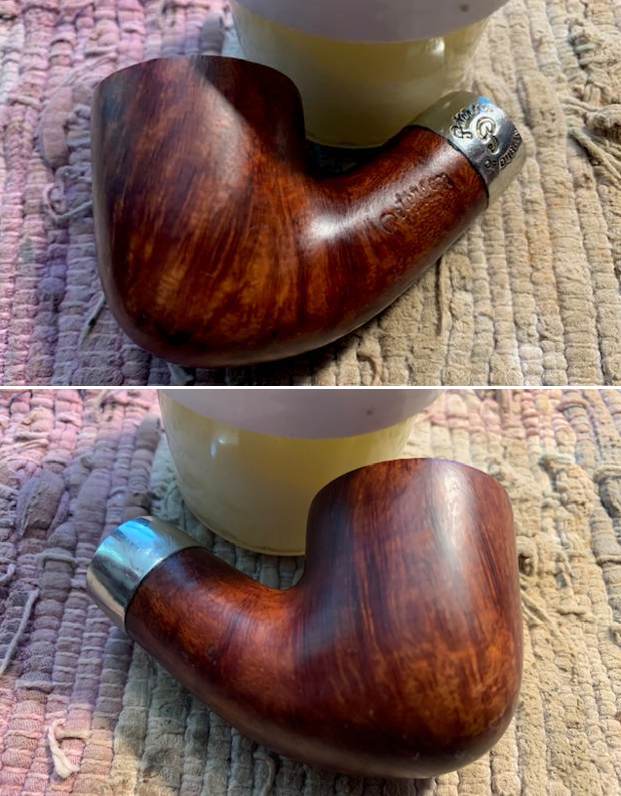
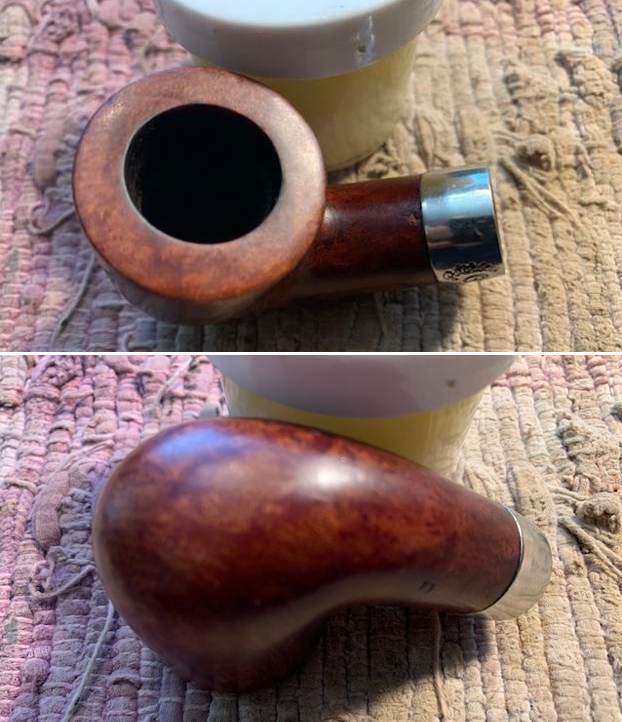
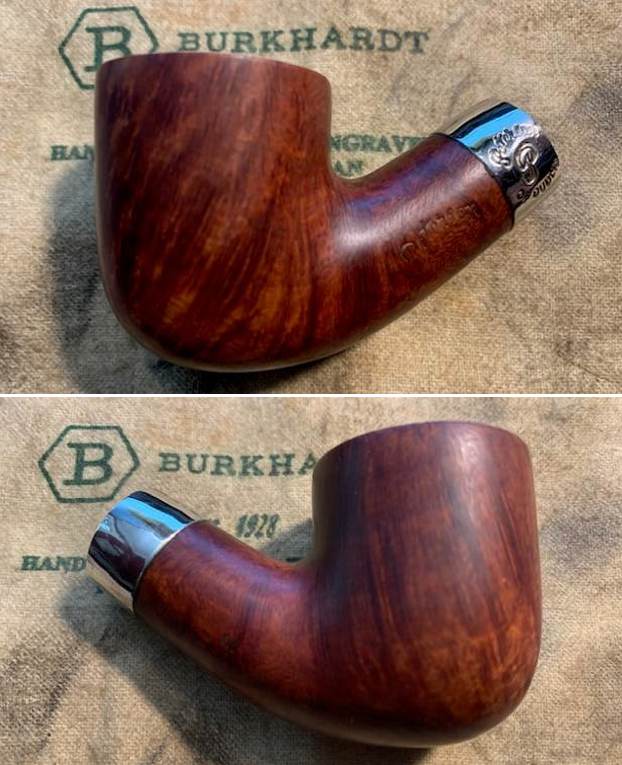
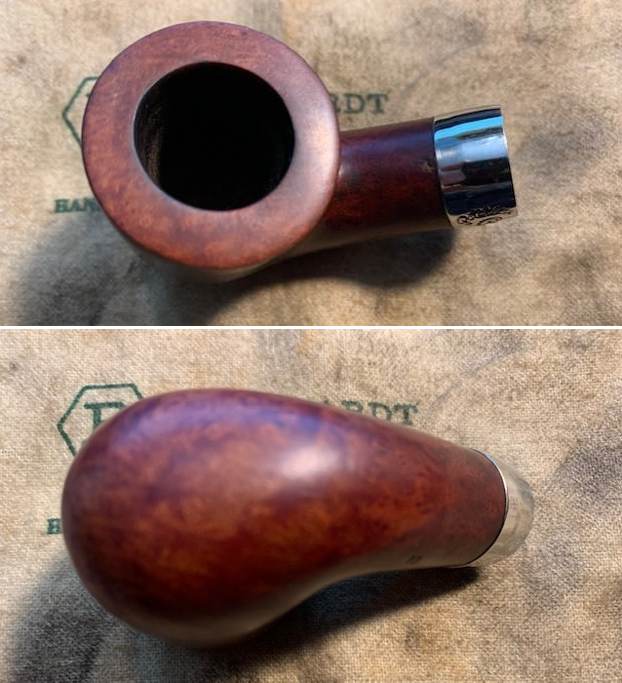
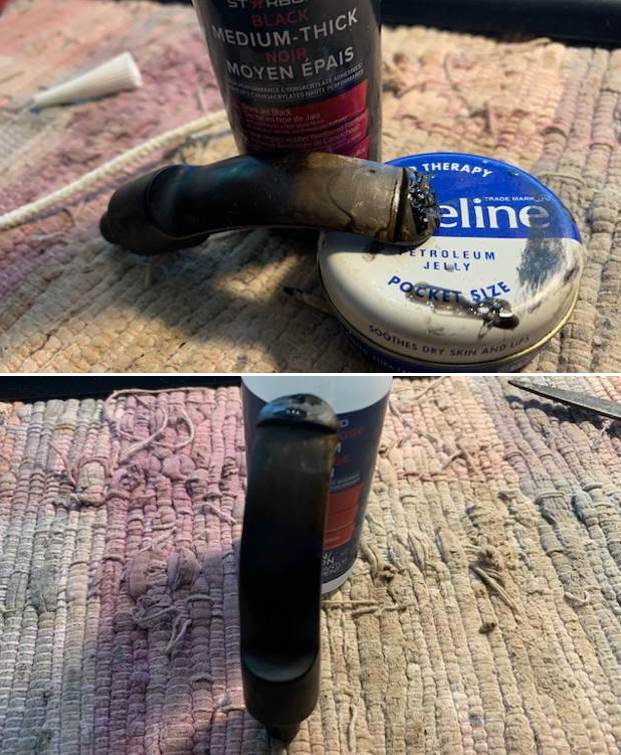
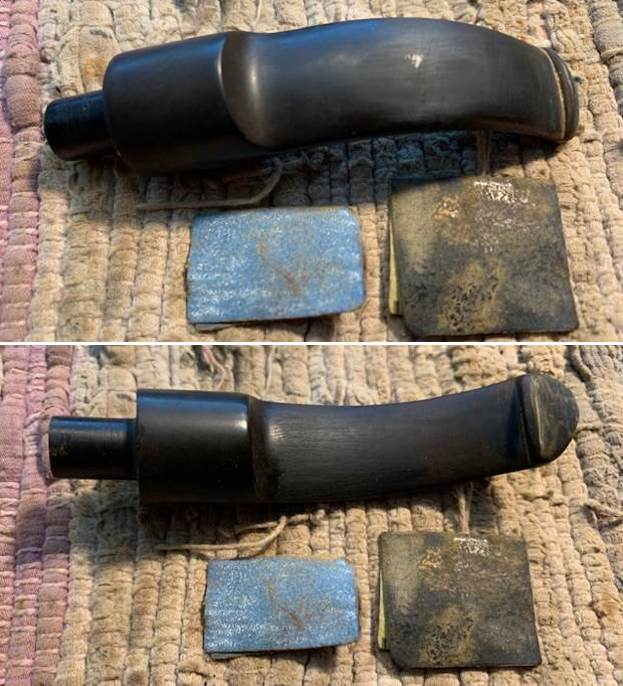
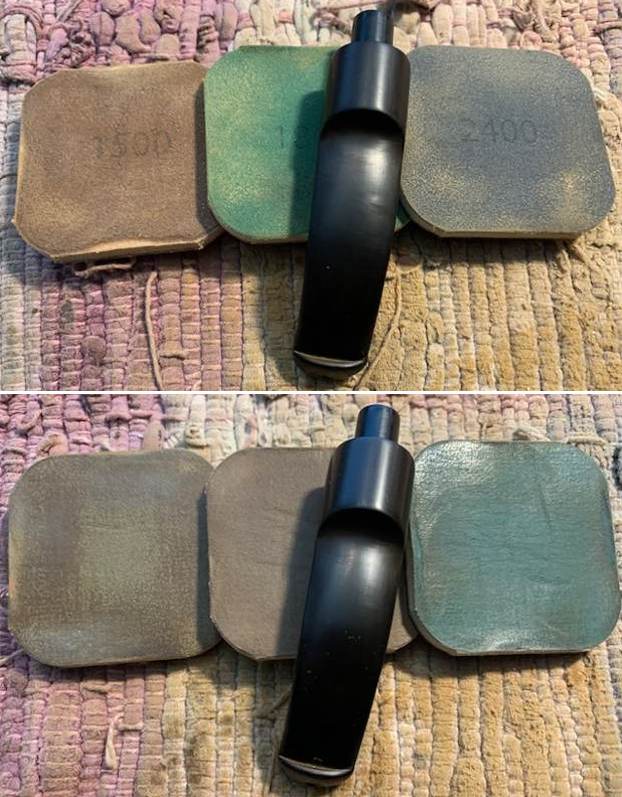
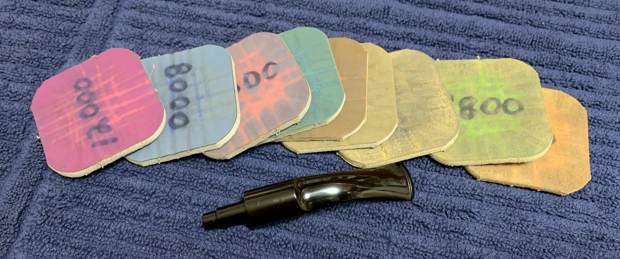
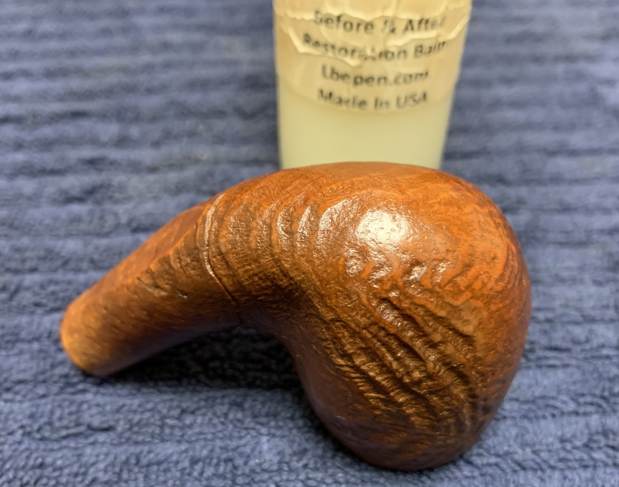
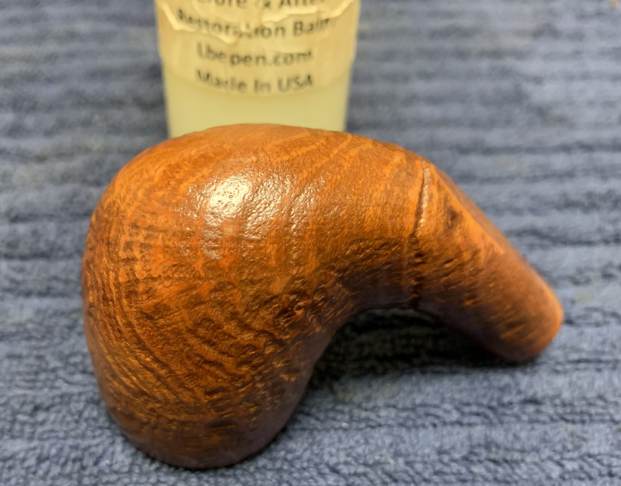
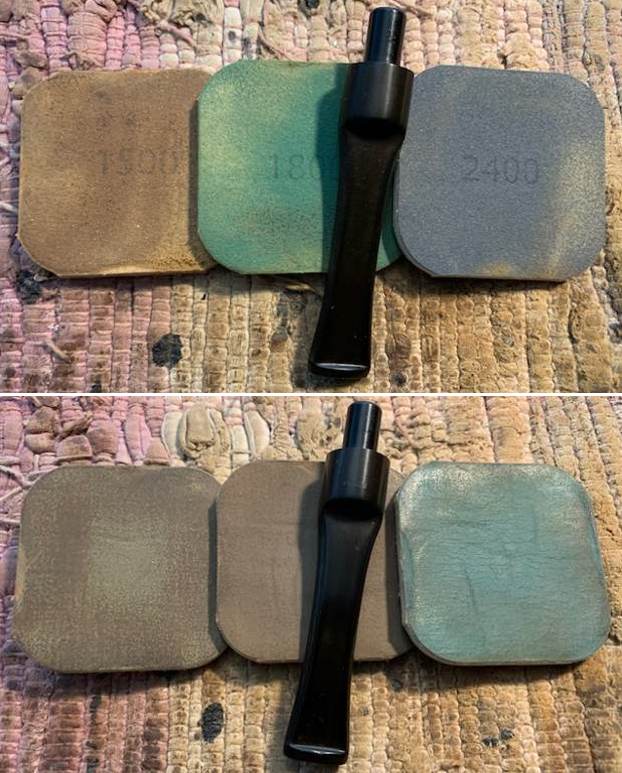
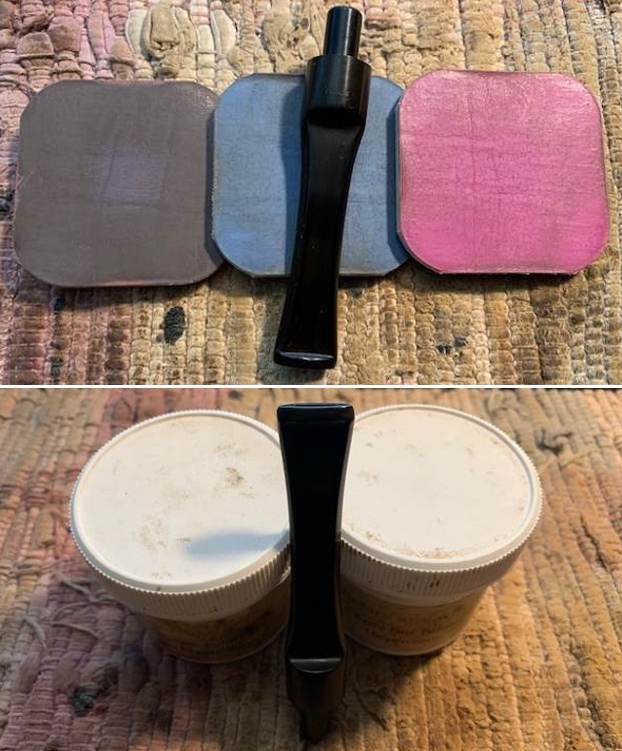
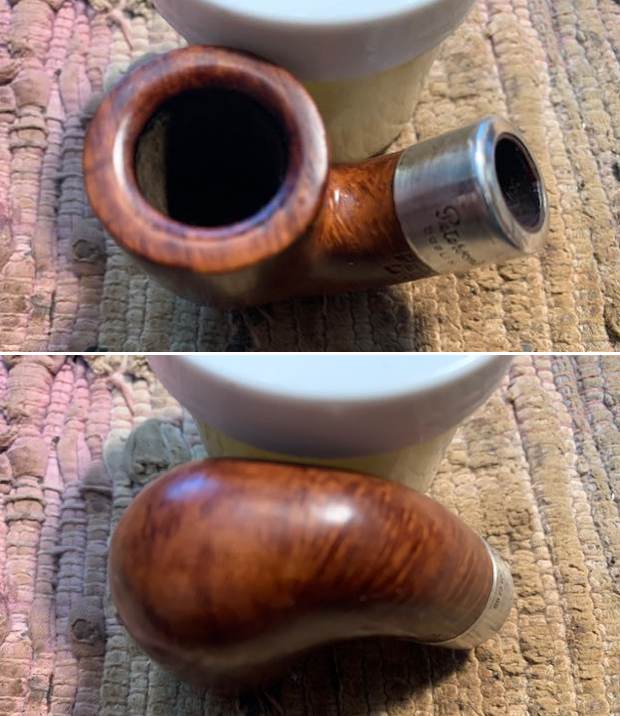
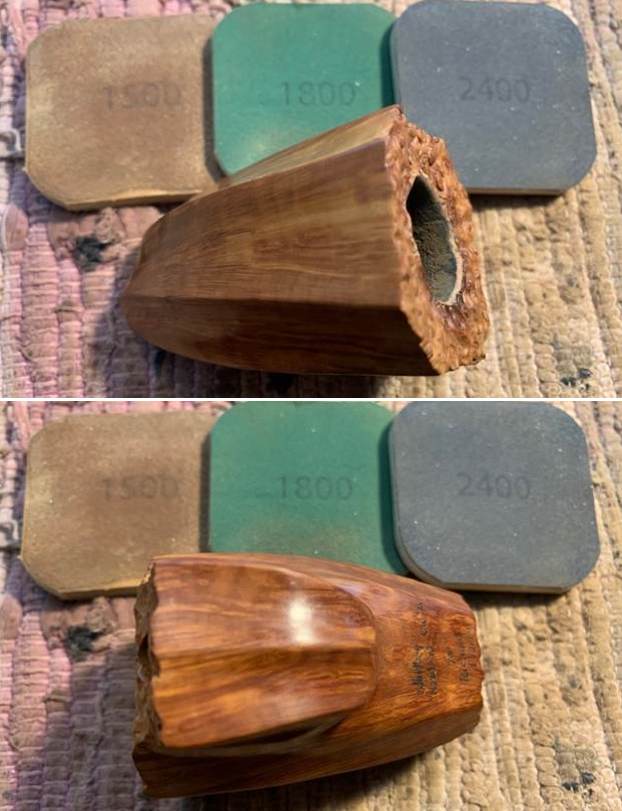
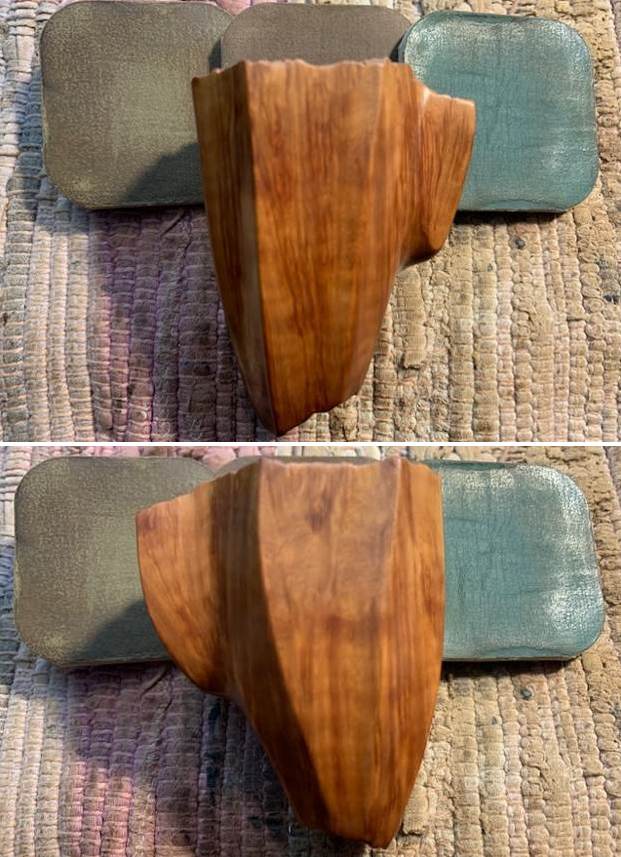
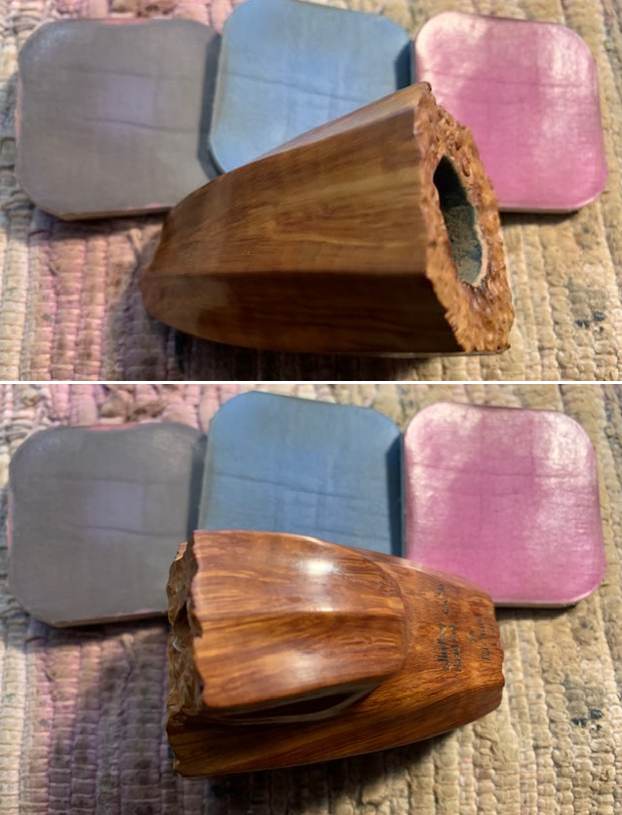
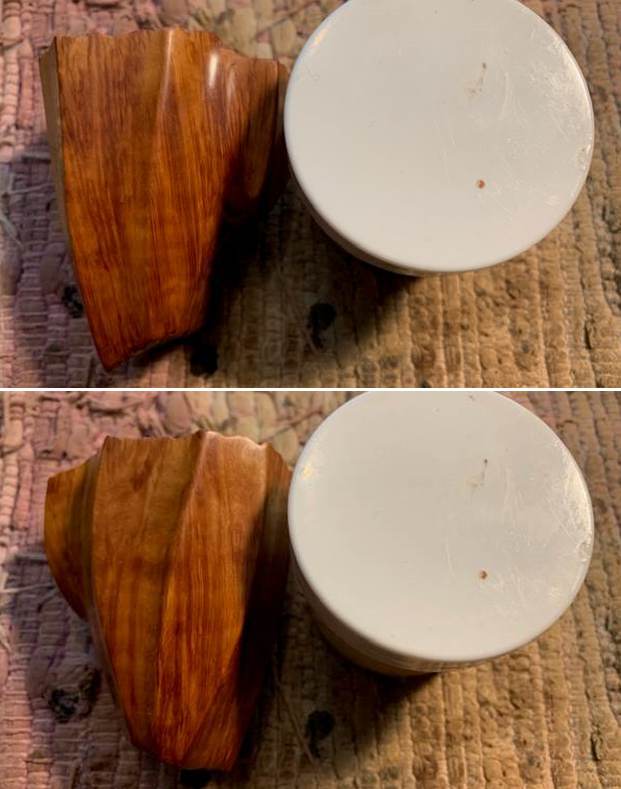
I have included the entire Hallmark chart for ease of reference show any of you be looking to date the pipes that you are working on at present.I worked over the rim top and the inner edge with a folded piece of 220 grit sandpaper to smooth out the damage and to bring the bowl back to round as much as possible. I polished the briar with micromesh sanding pads – polishing it with 1500-12000 grit pads. I rubbed down the Sterling Silver with a silver polishing cloth. By the time I was finished both the briar and the silver ferrule they both had a great shine. The grain on the pipe is quite beautiful.  I rubbed the bowl and shank down with Before & After Restoration Balm to deep clean the finish on the bowl and shank. The product works to clean, enliven and protect the briar. I worked it into the finish with my fingers. After it sat for 15 minutes I wiped it off with a soft cloth. The briar really began to have a rich shine. I took some photos of the bowl at this point to mark the progress in the restoration. It is a beautiful bowl.   I polished the silver ferrule with a jeweler’s cloth to remove the rest of the tarnish on the silver. It is treated with a product that protects the silver and removes the remaining tarnish. It has a rich, beautiful shine.   I polished the stem with micromesh sanding pads – wet sanding with 1500-2400 grit pads and dry sanding with 3200-12000 grit pads. I wiped the stem down after each pad with a damp cloth to remove the sanding dust. I used the Before & After Pipe Polish to remove the small minute scratches left in the vulcanite. I finished by wiping the stem down with a final coat of Obsidian Oil and set it aside to dry.   As usual at this point in the restoration process I am excited to be on the homestretch. I look forward to the final look when it is put back together, polished and waxed. I put the bowl and stem back together. I polished the bowl and stem with Blue Diamond to polish out the scratches in the briar and the vulcanite. I gave the bowl and the stem multiple coats of carnauba wax. I buffed the pipe with a clean buffing pad to raise the shine. I hand buffed it with a microfiber cloth to deepen the shine. The pipe polished up pretty nicely. The grain really pops with the wax and polish. The shiny black vulcanite stem is a beautiful contrast to the browns of the bowl and thick shank. This Peterson’s DeLuxe 8S Bent Billiard was another fun pipe to work on. The Sterling Silver Ferrule works as a contrast between the stem and the briar and binds it all together. It really is a quite stunning piece of briar whose shape follows the flow of the briar. The pipe is comfortable pipe to hold in the hand. The finished pipe is shown in the photos below. The dimensions of the pipe are Length: 5 ½ inches, Height: 1 ¾ inches, Outside diameter of the bowl: 1 1/8 inches, Chamber diameter: ¾ of an inch. The weight of the pipe is 1.52 ounces/44 grams. This beautiful pipe will be going back with the Savinelli De Luxe Milano to my friend. He will enjoy smoking it once again in his new place. Thanks for reading this blog and my reflections on the pipe while I worked on it.

New Life for a Savinelli de luxe Milano Sandblast 607KS Bent Billiard


Blog by Steve Laug

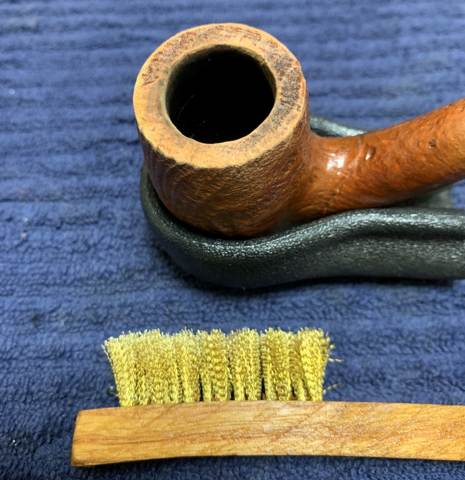
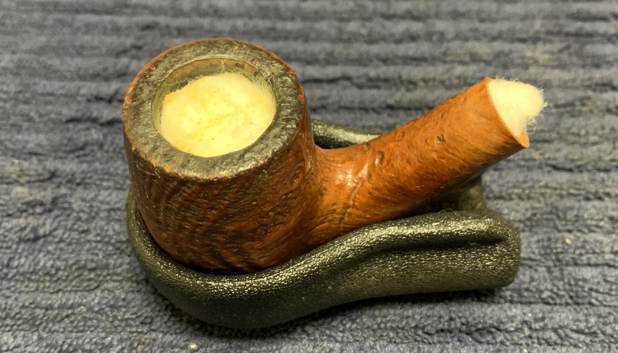
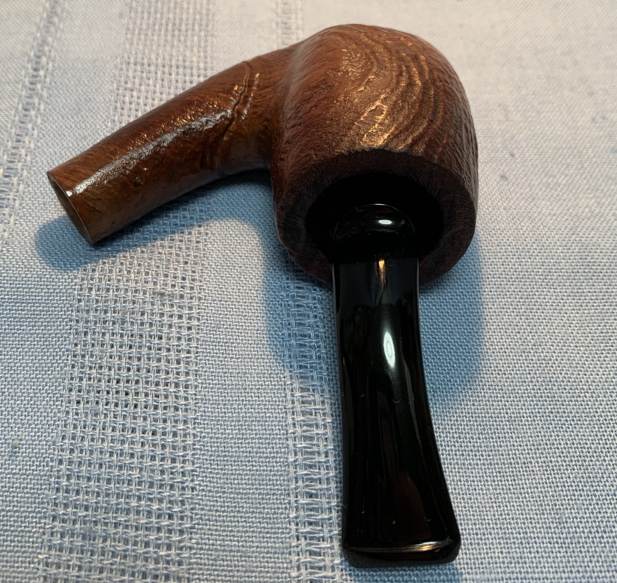
I have a few pipes that I am working on for local folks who either have dropped them off or who are friends that I am catching up with. The next pipe on the worktable belongs to an old friend of mine who is in the process of moving. He stopped by and asked me to clean up a couple of his favourite pipe. This first one I have chosen to work on is a deep craggy, sandblast Bent Billiard. It is stamped on the underside of the shank Savinelli [over] de luxe [over] Milano. That is followed by the Savinelli S shield then the shape number 607KS [over] Italy. I believe the vulcanite saddle stem is a replacement. The pipe was in good condition with a light cake in the bowl and some darkening on the back side of the rim top. The stem was lightly oxidized and had some tooth chatter and tooth marks on both sides of the stem at the button.  I took photos of the rim top and the stem to show their condition. The top looked quite good with some light to moderate cake in the bowl and some darkening and grime on the back top side. The stem had oxidation and light tooth chatter on both sides near the button. I took photos of the stamping to capture the clarity and readability. The brand and the shape number are very readable. I removed the stem from the bowl and took a picture of the pipe to show the general look and proportion of the pipe.The interior and exterior of the bowl was clean and in good condition when my friend dropped the pipe off. I decided to give the rim top a good scrubbing with a dry brass bristle brush to knock of some of the darkening in the valley’s of the sandblast on the rim top. I was able to get it a little bit cleaner and ready for the next step.I scraped out the ragged thin cake with a Savinelli Fitsall Pipe Knife and wiped out the bowl with a pipe cleaner and alcohol and cleaned out the shank and the airway in the stem with the same. Both were quite clean so I moved on to treat the finish. I rubbed the bowl and shank down with Before & After Restoration Balm to deep clean the finish on the bowl and shank. The product works to clean, enliven and protect the briar. I worked it into the sandblast finish with my fingers to get it into the nooks and crannies. After it sat for a little while I wiped it off with a soft cloth. I buffed the bowl with a horsehair shoe brush to polish it. The briar really began to have a rich shine. I took some photos of the bowl at this point to mark the progress in the restoration. It is a beautiful bowl. I set the bowl aside and worked on the stem at this point in the  process. I sanded tooth chatter and all of the oxidation with folded pieces of 220 to remove the marks and the brown colouration on the stem surface. I sanded them with 400 grit sandpaper until the marks were gone and the oxidation was gone.  I polished the stem with micromesh sanding pads – wet sanding with 1500-2400 grit pads and dry sanding with 3200-12000 grit pads. I wiped the stem down after each pad with a damp cloth to remove the sanding dust. I used the Before & After Pipe Polish to remove the small minute scratches left in the vulcanite. I finished by wiping the stem down with a final coat of Obsidian Oil and set it aside to dry.   I put the stem back on the pipe and worked the stem over with Blue Diamond to polish out the remaining small scratches. I gave the bowl several coats of Conservator’s Wax and the stem several coats of carnauba wax and buffed the pipe with a clean buffing pad to raise the shine. I hand buffed it with a microfiber cloth to deepen the shine. The pipe polished up really well with the repairs disappearing into the new finish. The finished pipe is shown in the photos below. The style of the blast and the look of the stain colours remind me of some of the Dunhill Shell Briar pipes or Tanshell pipes that I have repaired and restored over the years. It is quite stunning. The photos just do not capture the textures. The polished black vulcanite looks really good with the browns of the briar. The dimensions of the pipe are Length: 5 ½ inches, Height: 2 inches, Outside diameter of the bowl: 1 ¼ inches, Chamber diameter: ¾ of an inch. The weight of the pipe is 1.48 ounces/42 grams. I have a second pipe to clean up for my friend then they will be going back to him to enjoy in his new place. Thanks for walking through the restoration with me as I worked over this beautiful sandblast billiard made by Savinelli. It was a fun one to work on.

Restoring a Kriswill Comfort Handmade Denmark Saddle Stem Billiard


Blog by Steve Laug

One of the local pipe shops drops by pipes for me to restore from time to time. This one is a thin shank Billiard with a saddle stem. It is stamped on the left side and reads Kriswill [over] Comfort [over] Handmade. The stamping is covered by an oxidized Sterling Silver shank band. Upon examining the shank I could see that a large chunk of the briar under the band (almost half the shank diameter) had been replaced with wood putty that had been drill perfectly. The repair was very well done and the putty was rock hard and invisible under the band. The thin shank and the thin saddle band are separated by a beautiful and necessary band that will really highlight the shape and add a touch of bling to the pipe. There was a thick cake in the bowl and a heavy lava overflow on the rim top and beveled inner edge of the rim so it was hard to know if there as damage on the inner edge or top. It would be revealed during the clean up. The stem was oxidized, calcified and had tooth marks ahead of the button on both side of the stem. I took photos of the pipe before I started my work on it. I took photos of the rim top and bowl as well as both sides of the stem to show the condition of the pipe when it arrived. It is a mess but still is quite elegant. I am looking forward to seeing what is under all the grime and debris.I took a photo of the stamping that was visible on the left side of the shank. It is faint but still readable. What is visible on the first line is Kriswi [over] Com [over] Handmade D. The shape number is under the silver band on the underside of the shank and is not visible.I removed the stem from the shank and took a photo of the parts of the pipe to give a sense of the delicate look it has. It really is a great looking pencil shank lightweight.Before I started my clean up work on the pipe I did some reading on Pipedia on the Kriswill Brand (https://pipedia.org/wiki/Kriswill) to see if I could find anything on the Comfort Handmade Denmark line. There was nothing specific there but I found the following general information that helped to pin down a time period for the pipe.

Kriswill was one of the large pipe manufacturers in Denmark during the 1960s and 1970s, and I believe closed around 20 years ago. Their catalog cover read “By Appointment to the Royal Danish Court, KRISWILL, Kriswork Briar Trading, Briar Pipes Hand Made in Denmark.”

I also went to the PipePhil site (http://www.pipephil.eu/logos/en/logo-k3.html) and found more on the date of the brand. It also had no specific photos or mention of the Comfort Handmade Denmark line that I had but it was interesting nonetheless.

Kriswill is a brand of Kriswork Briar Trading, in Kolding (Denmark) established about 1955. Some of Kriswill pipes were designed by Sigvard Bernadotte, Swedish prince and brother to the late Queen Ingrid of Denmark. He collaborated with his Danish partner Acton Bjørn. When the company went bankrupt in the late 1970s it was on a level with Stanwell. Dan Pipe Cigar & Company (Hafenstrasse 30 D-21481 Lauenburg/Elbe, Ge) bought the rights to use the name and it is Holmer Knudsen and/or Poul Winsløw who make the Kriswill line. Nørding, on its side, bought the plant and introduced a Kriswell line.

I knew now that the pipe I was working on was made between 1955 when the brand opened and some time in the 1970s when the company went Bankrupt. I know that it is not one of the pipes made at a later date by Dan Pipe or by Nording. It is a bit of an old timer.

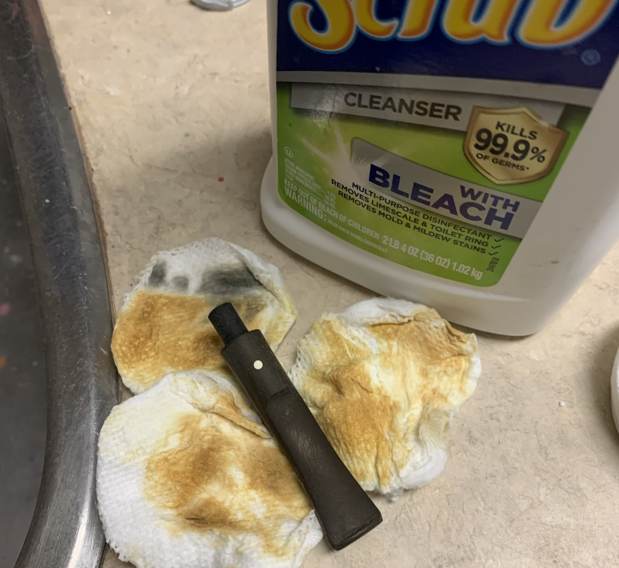
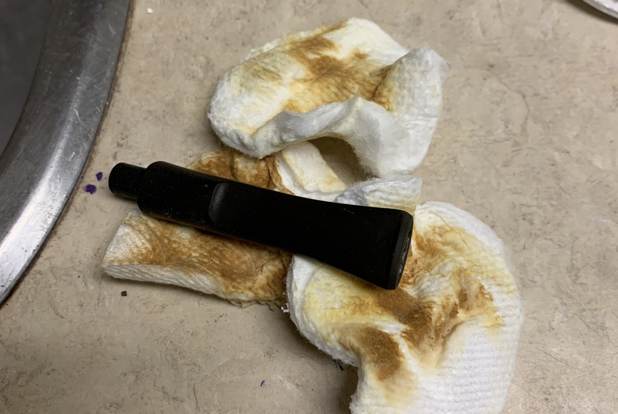
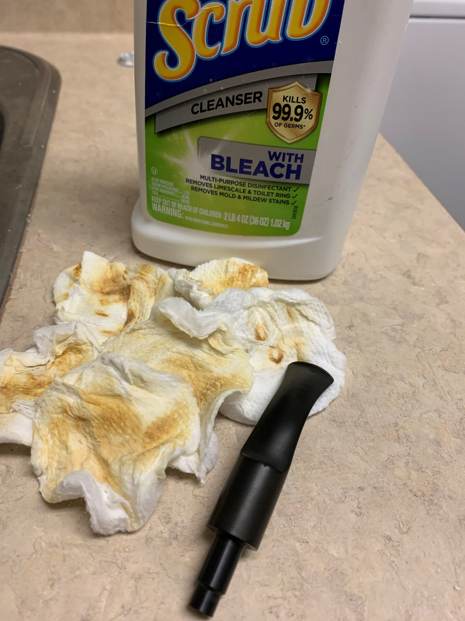
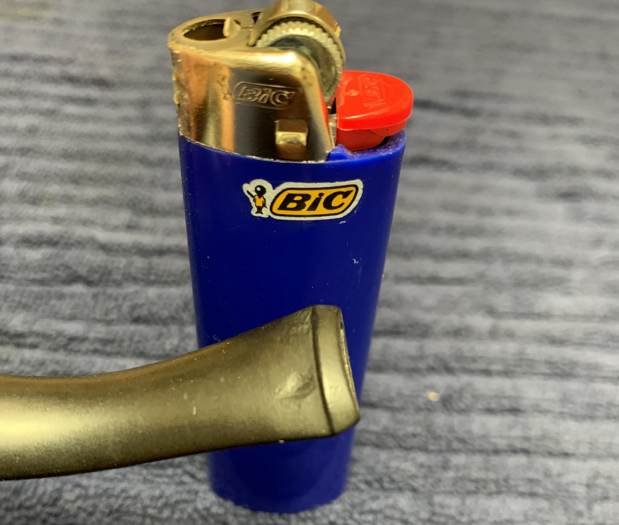
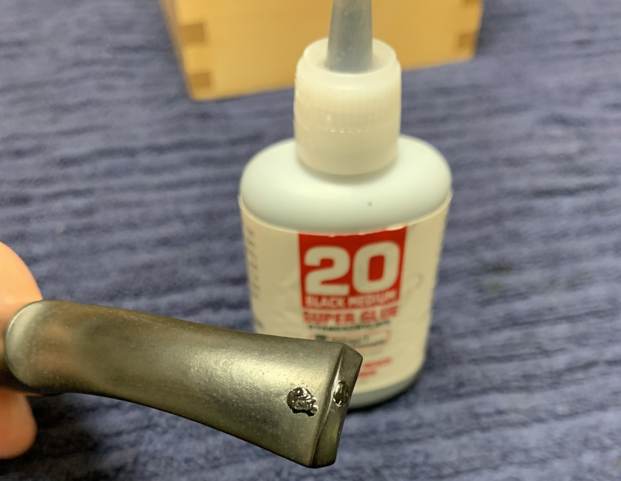
Now it was time to work on the pipe. I reamed the bowl with a PipNet pipe reamer and the smallest cutting head. I took it back to bare briar to check on the condition of the bowl walls. They looked very good. I cleaned up the reaming with a Savinelli Fitsall Pipe Knife and then sanded the walls with 220 grit sandpaper wrapped around a piece of dowel.I cleaned up the remaining grime on the rim top with a damp cotton pad and was ready for the next steps in the cleaning  process. I scrubbed the bowl with a tooth brush and undiluted Murphy’s Oil Soap. I worked on the rim top and edges. I rinsed the bowl with warm running water and dried off the bowl. It looked much better and was clean and well grained. There were some gaps in the putty fill between the band and the shank. I filled in these areas with clear super glue applied by a tooth pick.I cleaned out the inside of the shank and stem with pipe cleaners and cotton swabs and isopropyl alcohol. It was a filthy mess and with a lot of alcohol and pipe cleaners run through it the pipe is quite clean.I worked over the rim top and inner bevel with a folded piece of 220 grit sandpaper and removed the darkening very well. It came out very clean and looks very good.I polished the briar with micromesh sanding pads – dry sanding with 1500-12000 grit pads. I wiped the bowl down after each pad with a damp cloth.  I rubbed the bowl down with Before & After Restoration Balm. I worked it into the surface of the bowl sides and shank with my fingertips. The product works to clean, enliven and protect the briar. I let the balm sit for a little while and then buffed with a cotton cloth to raise the shine.  I set the bowl aside and turned my attention to the stem. I scrubbed the stem surface with Soft Scrub cleanser and wiped it down. I was able to remove the oxidation, calcification and grime from the surface of the stem.I “painted” the tooth marks on the surface with the flame of a lighter to lift them as much as possible. I was able to lift many of them but a few still remained. I filled in the remaining tooth marks with clear CA glue and set it aside to cure.  I sanded the repairs smooth with a folded piece of 220 grit sandpaper to begin blending them into the stem surface. I started the polishing with some 400 grit wet dry sandpaper. I polished the stem with micromesh sanding pads – 1500-12000 grit pads. I wiped it down with Obsidian Oil after each sanding pad. I used Before & After Pipe Polish – both Fine and Extra Fine to further polish the stem.  This Kriswill Comfort Handmade Denmark Pencil Shank Billiard with a Sterling Silver band and a vulcanite saddle stem is a great looking pipe now that it has been restored. The beautiful grain that shines through the polished finish is stunning. As the pipe is smoked the patina should develop and look even better. I put the stem back on the bowl and carefully buffed the pipe with Blue Diamond on the buffing wheel. I gave the bowl and the stem multiple coats of carnauba wax on the buffing wheel and followed that by buffing the entire pipe with a clean buffing pad. I hand buffed the pipe with a microfiber cloth to deepen the shine. The finished Kriswill Comfort Pencil Shank Billiard fits nicely in the hand and feels great. Give the finished pipe a look in the photos below. The dimensions of the pipe are Length: 6 inches, Height: 1 ¾ inches, Outside diameter of the bowl: 1 1/8 inches, Chamber diameter: ¾ of an inch. The weight of the pipe is 27 grams/.95 ounces. I will be sending the pipe back to the pipe shop soon and look forward to hearing what he thinks. If you are interested in purchasing this pipe send me a message or an email. Thanks for reading this blog and my reflections on the pipe while I worked on it.

Restoring a Peterson’s of Dublin Donegal Rocky 999 Rhodesian


Blog by Steve Laug

The next pipe on the table came to us from one of our pipe hunts or a trade I just cannot remember. It is a rusticated Peterson’s Donegal Rocky 999 Bent Rhodesian. The finish is quite nice with at that classic Peterson’s rustication pattern. The pipe was filthy with the rusticated exterior filled in in spots with grime and debris. The bowl had a light cake and some roughening on the inner edge of the rim. There was darkening on the rim top but otherwise it looked good. The pipe is stamped on a smooth panel on the underside of the shank and reads Peterson’s [arched over] of Dublin [over] Donegal [over] Rocky with the shape number 999 to the right of that. On the oxidized Sterling Silver band it is stamped K&P in shields over Sterling Silver on the left side. On the right side there are three hallmarks: 1. a seated woman (Hibernia) – the city stamp for Dublin, 2. .926 for the quality of the silver, 3. An upper case “Y” – the date identification of the pipe. The stamping is clear and readable on the pipe and band. The stem was dirty, calcified and oxidized. There were light tooth marks and chatter on the stem near the button on both sides and some on the surface of the button as well. There was the Peterson’s “P” on the left side of the taper stem. I took photos of the pipe before I worked on it.  I took photos of the rim top to show the cake in the bowl, the lava rim top and the damage to the inner edge. The stem was dirty, oxidized, calcified and had chatter and marks on both sides. The stamping on the underside of the shank read as noted above. The photo shows that they are faint but clear and readable. The stamping on the silver is also readable. The P on the left side of the stem is faint but in good condition. I took a photo of the pipe with the stem removed to show the overall look of stem, tenon and profile of the pipe. It is a great looking pipe.I am including the information from Pipedia’s article on Peterson pipes. It is a great read in terms of the history of the brand (https://pipedia.org/wiki/Peterson). I have included a bit of the pertinent history here.

During the 1950’s and 60’s the Kapp & Peterson Company was still in the ownership of the Kapp family. However 1964 saw the retiral of the company Managing Director Frederick Henry(Harry) Kapp.

In 1966 a “Jubilee ” fourth hallmark was introduced, only for that year, to commemorate the fiftieth anniversary of the Easter Rising of 1916. Designed as a hand holding a flaming sword in Irish “an cláiomh solais” or “sword of light” the mark bears the date 1916 to the right above and 1966 to the left below. An Claidheamh Soluis (Old Irish spelling), this was hallmarked with the letter Y. This very unusual and special date mark has in recent years become very scarce, mainly because it was only used for that year. Pipes that were marked thus, are much sought after by Peterson pipe collectors.

The stamping on the band was different than what I had seen before it is three marks as noted above. I do not see the “Sword of Light” stamp though perhaps that is what is in the left stamp in the threesome before the .926 stamp.

I turned then to deal with the Hallmarks. I turned to Pipephil’s site for his quick reference charts on the Peterson’s Hallmarks (http://www.pipephil.eu/logos/en/infos/hallmark-dublin.html). I have included the pertinent charts below. The first chart defines the first two hallmarks on the Sterling Silver Band. The Hibernia/Lady is the Dublin Town Mark. The Harp identifies the fineness of the metal.The second chart pins down the date that this particular pipe was made. The upper case “Y” mark identifies the pipe as being made in 1966. I have drawn a red box around the “Y” on the chart below. With that information in hand I knew what I was dealing with in terms of the stamping and the age of this pipe. I knew from the information that the pipe was made during the Republic Era between 1950 and 1989. Pipedia then qualifies the dating as follows: From 1950 to the present time, the stamp for this era is “Made in the Republic of Ireland”. The “Y” hallmark sets the date at 1966 in the center of the time period. Now it was time to work on the pipe.

The Sterling Silver Band was upside down and would need to be corrected. I used some acetone on a folded pipe cleaner to soak the glue between the band and the briar. I repeated the process until it suddenly came free. I cleaned off the shank with acetone and reset the band on the shank with the stamping on the correct sides of the shank. I reamed the pipe with a PipNet reamer and cut back the cake back to the bare briar. I cleaned up the walls with a Savinelli Fitsall Pipe Knife. I finished it by sanding the walls smooth with 220 grit sandpaper wrapped around a piece of briar. I cleaned up the debris and lava on the rim top rustication with a brass bristle wire brush. It looked better than before.I scrubbed the exterior of the pipe with Murphy’s Oil Soap and a tooth brush to remove the grime from the finish. I rinsed it off with warm running water to remove the soap and the grime from the finish of the bowl.  I worked over the inner edge of the rim top with a folded piece of 220 grit sandpaper. I gave it a slight bevel and was able to blend in the damaged areas. It looked much better.  I scraped the inside of the shank with a dental spatula and was able to take out a large amount of this build up in the shank. It was a real mess. I then scrubbed the interior of the bowl and shank with pipe cleaners, cotton swabs and alcohol to further remove the tars and oils. I polished the Sterling Silver band on the shank with a jeweler’s cloth to remove the tarnish and protect it.   I worked some Before & After Restoration Balm into the surface of the briar with my fingertips and a horsehair shoe brush to clean, enliven and protect the briar. I let the balm sit for 15 minutes and then buffed with a cotton cloth to raise the shine. The photos show the bowl at this point in the restoration process. I decided to deghost the pipe while I worked on the stem. I filled the bowl with cotton boles and twisted one into the shank. I filled the bowl with 99% isopropyl alcohol using an ear syringe. I set the bowl aside for 5-6 hours while I worked on the stem. After 6 hours the cotton was stained with oils and with some purple stain from the inside of the bowl. The pipe smells clean and fresh. I set the bowl aside and turned my attention to the stem. I scrubbed it with Soft Scrub to remove the oxidation on the stem surface. I worked it over the surface of the stem with cotton pads and removed the deep oxidation on the top side of the stem. I sanded the tooth marks and the remaining oxidation with 220 grit sandpaper and started the polishing with 400 grit wet dry sandpaper. I used white acrylic nail polish to touch up the “P” stamp on the left side of the stem. It came out looking very good.  I polished the stem with micromesh sanding pads – wet sanding with 1500-12000 grit sanding pads. I wiped it down after each sanding pad with Obsidian Oil. I polished it with Before & After Pipe Stem Polish – both Fine and Extra Fine. I am excited to finish this Republic Era Peterson’s “Donegal” Rocky 999 Rhodesian. I put the pipe back together and buffed it with Blue Diamond on the buffing wheel. I gave the bowl multiple coats of Conservator’s Wax and the stem multiple coats of carnauba wax. I hand buffed the pipe with a clean buffing pad to raise the shine. It is fun to see what the polished bowl looks like with the rugged rustication all around it. Added to that the polished Sterling Silver band and the black vulcanite stem was beautiful. This rusticated Classic Peterson’s 999 shape is nice looking and the pipe feels great in my hand. It is light and well balanced. Have a look at it with the photos below. The dimensions are Length: 6 inches, Height: 1 ½ inches, Outside diameter of the bowl: 1 ½ inches, Chamber diameter: ¾ of an inch. The weight of the pipe is 51 grams/ 1.80 ounces. It is a beautiful pipe and one that will be on the Irish Pipe Makers section of the rebornpipes store soon. If you are interested in adding it to your collection let me know. Thanks for walking through the restoration with me as I worked over this pipe. Thanks to each of you who are reading this blog.

Restoring a Payne to Its Former Glory


Blog by Kenneth Lieblich

Next on the chopping block is an interesting pipe of Leonard Payne’s making. I acquired this pipe from an “antique” shop in Cloverdale (just outside Vancouver) – although it is doubtful how many genuine antique things were in the shop. Here’s a photo of me in situ, with the pipe.I love the prince shape, and I was excited to work on this pipe. The gentleman who commissioned this pipe is a regular customer of Steve’s, so I was all the more delighted.

On to the pipe itself! It was certainly a charming pipe, but it was grungy and had an unholy quantity of tooth marks, dents, lava, cake, and just general filth.  The markings on the left side of the shank read Leonard Payne [over] Original. On the left side of the stem, there was a faint capital ‘P’.I little while back, I detailed my restoration of another Payne pipe, in a tale I entitled, The Frog Prince. I will repeat the information I wrote there about Leonard Payne. He was born in England, moved to Canada in the 1950s, and died in the Vancouver area within the last few years. Payne was, to put mildly, an idiosyncratic pipe maker. I can do no better than quote Mike Glukler of Briar Blues (found on Pipepedia):

“Leonard Payne was based in B.C. for many years. He came to Canada from England. He had shops in Surrey, B.C. and Kelowna, B.C. Interesting fellow. Gruff as the day is long. When you bought a pipe, it was handed to you in a paper bag. No sock, no box. Most of his pipes carried a ‘carburetor’ system at the shank/stem junction. Another Payne idea was his shanks. Almost all his pipes were two pieces. He’d turn the bowl and shank, then cut off the shank and reattach with glue (not always with the same piece of briar, so many did not match grains). His thinking was that the shank being the weakest link, if cut and glued would never break and thus ‘correcting’ the weakest link”.In addition, there was a photograph that Steve found of Payne on Reddit that appears to date from the 1960s. The original poster on Reddit told me that the photo comes from the City of Surrey archives. I have no idea why it is in French (or why it’s in the Surrey archives), but here is my translation of the text on the right:

“Pipe makers are not on every street corner in Canada! Leonard Payne, originally from England, didn’t know the challenges he would face and that’s probably what influenced his decision to come and try his luck in Canada. After his arrival in 1957, he and his family settled in Vancouver, where he first found work as a tool maker – and made pipes in his free time. In 1959, he decided to become a full-time pipe maker, and since then he has had department stores in all parts of Canada among his clients. He imports briar blocks from Italy and pipe stems from England.”My customer selected this pipe because (a) he wanted a prince manufactured by Leonard Payne, and (b) he wanted a Payne that didn’t have a carburetor system or the reattached shank. Providentially, this pipe fit the bill on all counts.

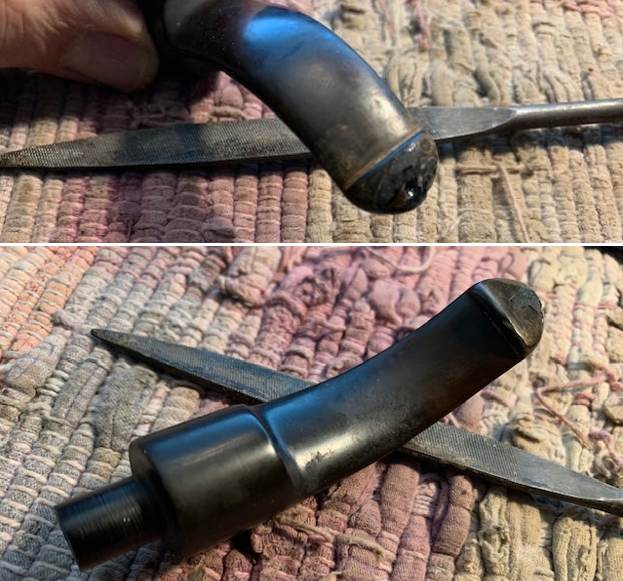
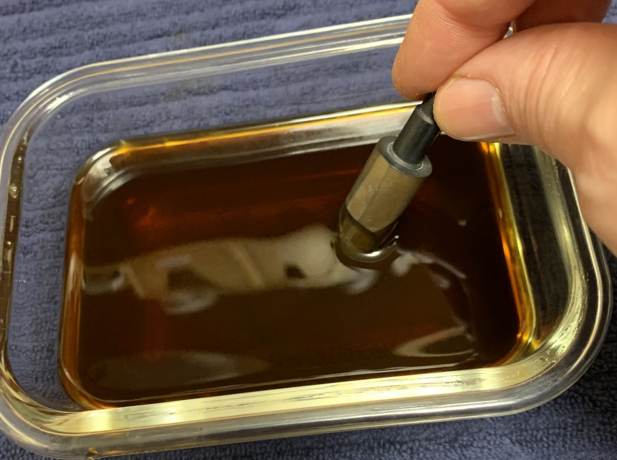
The stem on this pipe was in decent shape, with a small draught hole. But most remarkably, the button had been decapitated or stolen by a goblin. At any rate, the button was not there, and I knew that I would have quite a job on my hands.   Well, to work! I briefly considered finding a new stem for this pipe, but I believed I should try to work with the original parts before seeking a different solution. So, first on the list was constructing a new button for this pipe. I started by sanding off the end of the stem with some 220-grit sandpaper to smooth out the bottom. In order to fashion a new button, I needed to minimize the rounding on the end of the stem and make the face even. Then I took out some small files and began cutting into the vulcanite, carving out a new button. This was a tricky business and it took some real patience and effort to make it work. After much nerve-wracking work, I had successfully carved out a new button and smoothed it with files and sandpaper. The following is a tedious series of photos showing the progress of the stem! Next, I used a thin file to widen the draught hole. The end result is better than what these photos show. Finally, I could move on to the regular cleaning procedures for the stem. First, I cleaned out the inside with pipe cleaners and isopropyl alcohol. Fortunately, it wasn’t overly dirty, and it only needed a handful of pipe cleaners.Then, I wiped down the stem with SoftScrub, before sending it off for a bath in the Pipe Stem Oxidation Remover. The following day, I cleaned all of the de-oxidizing mess off with alcohol, pipe cleaners, et cetera. The oxidation had migrated to the surface and I could easily remove it. Then I scrubbed with more SoftScrub on some cotton pads to remove the leftover oxidation. After this, I used nail polish to restore the logo on the stem. I painted the area carefully and let it fully set before proceeding. I worried that this wouldn’t work, as the ‘P’ was so faint. Fortunately, I ended up being wrong and some of the ‘P’ came back to life.I then used all nine Micromesh pads (1,500 through 12,000 grit) to bring out the lovely black lustre on the stem. I also used Obsidian Pipe Stem Oil in between each pad scrubbing. Hey – this looks like a real stem! I’m quite pleased with how it turned out. I always want to use the original parts of a pipe, if possible, and I’m glad this worked. Setting the stem aside, I moved on to the bowl. I started by reaming it out. I used the PipNet Reamer and the KleenReem to remove the built-up cake inside and followed that with 220-grit sandpaper taped to a dowel to eliminate as much as I could. I took the chamber down to bare briar, as I wanted to ensure there were no hidden flaws in the wall. Fortunately, there were none. After that, I used cotton rounds and some Murphy’s Oil Soap to scrub the outside of the stummel and a toothbrush with Murphy’s for the lava on the rim of the pipe. Oddly, there appeared to be shiny bits of a previous coating on the stummel, left over from some other time; I figured my sanding would remove these marks, so I ignored them for the time being. I then proceeded to clean out the insides of the shank with Q-tips, pipe cleaners, and lemon-infused isopropyl alcohol. There was quite a bit of filth inside this stummel and it took a fair amount of cotton to get it clean. I followed that up by cleaning the insides with some dish soap and tube brushes. Next, I decided to de-ghost the pipe to remove any lingering smells of the past. I thrust cotton balls into the bowl and the shank and saturated them with 99% isopropyl alcohol. I let the stummel sit overnight. This caused any remaining oils, tars and smells to leach out into the cotton. The bowl was nice and clean after this. Here are the “before” and “after” photos: Having completed that, I was able to address the small nicks on the rim and the bowl. I dug out my iron and a damp cloth to try to raise the nicks. The hot and moist steam can often cause the wood to swell slightly and return to shape. There was some movement – not a lot, but it was better than doing nothing. The repair was not perfect, but the remaining scratches would be improved by sanding. To remove the remaining burns and nicks on the rim, I “topped” the pipe – that is to say, I gently and evenly sanded down the rim on a piece of 220-grit sandpaper. This effectively removed the damage, without altering the look of the pipe. After this, I used all nine Micromesh pads (1,500 through 12,000 grit) to remove the frustrating scratches in the wood and make everything smooth. Additionally, a light application of Before & After Restoration Balm brought out the best in the stummel’s grain.  At the buffer, a dose of White Diamond and a few coats of carnauba wax were just what this pipe needed. The lovely shine made the wood look beautiful. I am pleased with this pipe – it was tricky work, but thoroughly enjoyable for me. Best of all, I know that the new owner will enjoy it for many years to come. I hope you enjoyed reading the story of this pipe as much I as I did restoring it. If you are interested in more of my work, please follow me here on Steve’s website or email me directly at kenneth@knightsofthepipe.com. Thank you very much for reading and, as always, I welcome and encourage your comments.

Restoring a Republic Era Peterson’s “Kildare” 254 Canadian


Blog by Steve Laug

This is another one of those pipes that has been here for a long time and I have no memory where it came from. I had been cleaned somewhere along the way so I am guessing that Jeff had cleaned it. The bowl had been reamed somewhere in the journey and was quite clean inside. The shank and internals had all been cleaned and there was no residual stench to the pipe. The smooth rim top had some damage and darkening. The inner edge had some damages by burning and the bowl was slightly out of round. The smooth finish was quite clean other than the dust of sitting in my box. The stamping on the shank is clear and readable. The top side is stamped Peterson’s [over] “Kildare”. On the underside it was stamped Made in the Republic of Ireland (3 lines). On the right of shank near the bowl it is stamped with the shape number 254. The stem was lightly oxidized and has light tooth marks and chatter on both sides ahead of the button. I took some photos of the pipe before I started my work on it. I took close up photos of the bowl and the stem. You can see the reamed bowl and the darkening on the rim top and the front edge. The stem surface was clean but there are light tooth marks and chatter on both sides on and ahead of the button.I took a photo of the stamping on the top, underside and right side of the shank. It is clear and readable as noted above. I removed the stem from the shank and took a photo to give a sense of the proportions of the pipe. It is really quite nice looking. I am including the information from Pipedia’s article on Peterson pipes. It is a great read in terms of the history of the brand (https://pipedia.org/wiki/Peterson). I have included a bit of the pertinent history here.

1950 – 1989 The Republic Era  – From 1950 to the present time, the stamp for this era is “Made in the Republic of Ireland” in a block format generally in three lines but two lines have been used with or without Republic being abbreviated.

During the 1950’s and 60’s the Kapp & Peterson Company was still in the ownership of the Kapp family. However 1964 saw the retiral of the company Managing Director Frederick Henry(Harry) Kapp.

I turned to “The Peterson Pipe” by Mark Irwin and Gary Malmberg to get some background on the Peterson’s System Line. On page 314 it had the following information.

Kildare (1965-) First issue of line with matte-finish in Classic Range shapes, P-Lip and fishtail mouthpiece. Second issue C.1979 as Kildare Patch, with rusticated patches on pipe surface. Third issue 2010, matte-brown, P-Lip or fishtail mouthpiece, no band. Fourth issue 2011-, burgundy sandblast finish, nickel army mount, fishtail mouthpiece, exclusive to smokingpipes.com.

Judging from the description above I believe that I am working on a First Issue of the line in the time period of 1965-1979. It is a late Republic Era Classic Shaped pipe with a matte-finish and a P-Lip stem. Now it was time to work on the pipe.

I decided to address the damage to the front rim top and inner edge of the bowl first. I used a folded piece of 220 grit sandpaper to give the inner edge of the bowl a slight bevel on the inner edge to remove burned areas and blend them into the surrounding briar. I polished the briar with micromesh sanding pads – dry sanding with 1500-12000 grit sanding pads. I wiped the bowl down with a damp cloth after each sanding pad. I worked some Before & After Restoration Balm into the surface of the briar with my fingertips. It works to clean, enliven and protect the briar. I let it sit for 15 minutes then buffed it off with a soft cloth and raised the shine. The bowl looks great at this point.   I set the bowl aside and turned my attention to the stem. I “painted” the stem and button surface with the flame of a lighter to lift the tooth marks. It worked amazingly well and I was able to lift them completely or significantly. I sanded what remained with 220 grit sandpaper to blend them into the surface of the vulcanite. I started polishing the stem by wet sanding it with 400 grit wet dry sandpaper. I polished the stem with micromesh sanding pads – dry sanding it with 1500-12000 grit pads. I wiped the stem down with Obsidian Oil after each pad. I polished it with Before & After Pipe Polish – both Fine and Extra Fine and gave it a final coat and set it aside to dry. I am excited to finish this Republic Era Peterson’s “Kildare” 254 Canadian. I put the pipe back together and buffed it with Blue Diamond on the buffing wheel. I gave the bowl and the stem multiple coats of carnauba wax. I hand buffed the pipe with a clean buffing pad to raise the shine. It is fun to see what the polished bowl looks like with beautiful flame grain all around it. Added to that the polished Sterling Silver band and the black vulcanite stem was beautiful. This smooth Classic Peterson’s “Kildare” 254 Canadian is great looking and the pipe feels great in my hand. It is light and well balanced. Have a look at it with the photos below. The dimensions are Length: 5 ½ inches, Height: 1 ¾ inches, Outside diameter of the bowl: 1 1/8 inches, Chamber diameter: ¾ of an inch. The weight of the pipe is 32 grams/1.13 ounces. It is a beautiful pipe and I will soon be putting it on the rebornpipes store in Irish Pipe Makers Section. If you are interested in adding it to your collections let me know. Thanks for walking through the restoration with me as I worked over this pipe. Thanks to each of you who are reading this blog.

Restoring a Republic Era Peterson’s System 31 Billiard


Blog by Steve Laug

This is another one of those pipes that has been here for a long time and I have no memory where it came from. I had not been cleaned so it is not one that ever went to Jeff for clean up. It was a dirty but appeared to have some great grain under the grime. The bowl had been reamed somewhere in the journey and was quite clean inside. The smooth rim top was damaged and had some darkening. The edges – both inner and outer had some damages by burning and the bowl was out of round. The smooth finish is dirty with grime and grit deep ground into the sides of the bowl and shank. There were some deep nicks in the briar on the right side and heal of the bowl. The pipe stinks like heavily cased aromatics. The stamping on the shank is clear and readable. The left side is stamped Peterson’s [arched over] System. On the right side it was stamped Made in the Republic of Ireland (3 lines). To the right of that stamp is the shape number 31. The nickel band is oxidized and dirty but it has the K & P stamp over three symbols. Next to that it was stamped Peterson’s. It had some nicks and dents around shank end of the ferrule. The stem was quite clean and has deep tooth marks and chatter on both sides ahead of the button and on the topside of the button. I took some photos of the pipe before I started my work on it. I took close up photos of the bowl and the stem. You can see the reamed bowl and the darkening and light lava on the rim top. The bowl reeked of aromatic tobaccos. The stem surface was clean but there are deep tooth marks and chatter on both sides on and ahead of the button.I took a photo of the stamping on the sides of the bowl and shank. It is clear and readable as noted above. I removed the stem from the shank and took a photo to give a sense of the proportions of the pipe. It is really quite nice looking.I am including the information from Pipedia’s article on Peterson pipes. It is a great read in terms of the history of the brand (https://pipedia.org/wiki/Peterson). I have included a bit of the pertinent history here.

1950 – 1989 The Republic Era  – From 1950 to the present time, the stamp for this era is “Made in the Republic of Ireland” in a block format generally in three lines but two lines have been used with or without Republic being abbreviated.

During the 1950’s and 60’s the Kapp & Peterson Company was still in the ownership of the Kapp family. However 1964 saw the retiral of the company Managing Director Frederick Henry(Harry) Kapp.

I found a great description of the System 31 shape on smokingpipes.com (https://www.smokingpipes.com/pipes/new/peterson/moreinfo.cfm?product_id=192182). I am including a portion of that below.

Peterson’s “31” shape is the only straight pipe featured in the System Standard line, yet it still features system drilling. Featuring a push-style tenon and a long, tapering metal tube, it houses a condensation chamber just under the bowl itself — providing the same gurgle free smoke you’d expect of a bent System configuration.

I did a search on Google about the Peterson System 31 Straight Billiard to see if I could learn any specific information on the shape. I found a link to a pipe for sale on Smokingpipes.com. I quote:

Paresh had worked on System 31 pipe so I went back and reread his work on that smooth pipe. It was very helpful for the background information included (https://rebornpipes.com/tag/peterson-system-31-pipe/).

I knew that I was dealing with a Republic Era pipe made between 1950-1989. The K&P mark on the nickel band ties to Kapp & Peterson brings the date to the time between 1950-1964. It was a smooth Straight billiard with a unique shape and chamber beneath the bottom of the bowl. The finish was stained with a combination of rich reddish brown stains. Now it was time to work on the pipe.

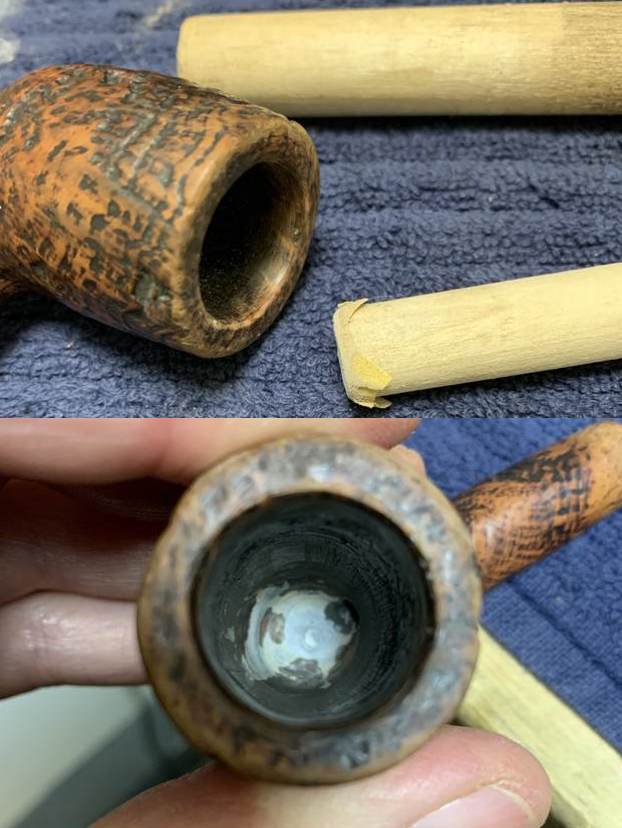
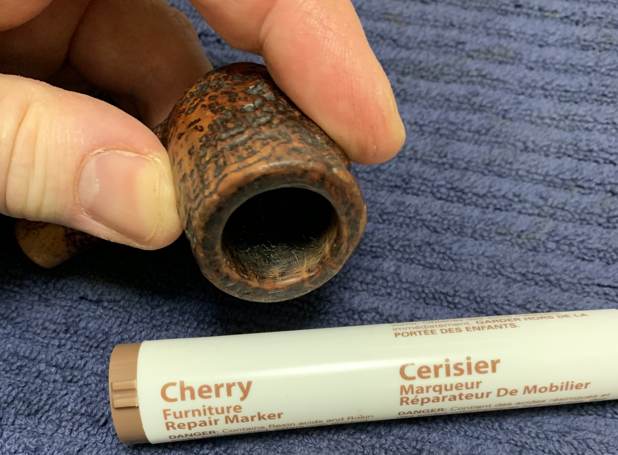
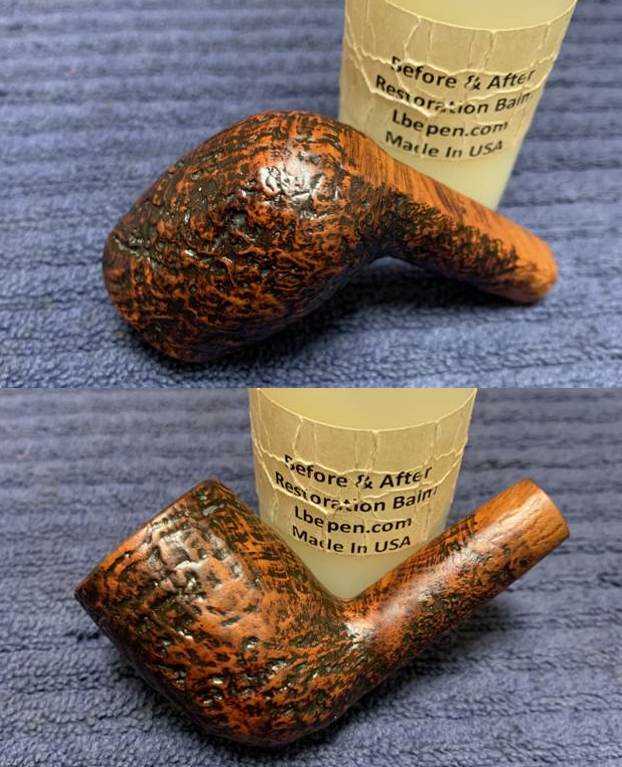
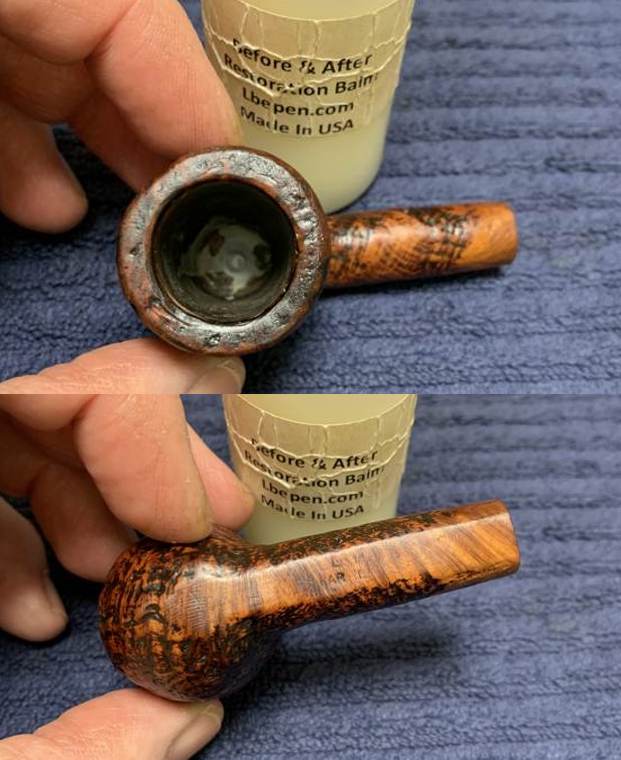
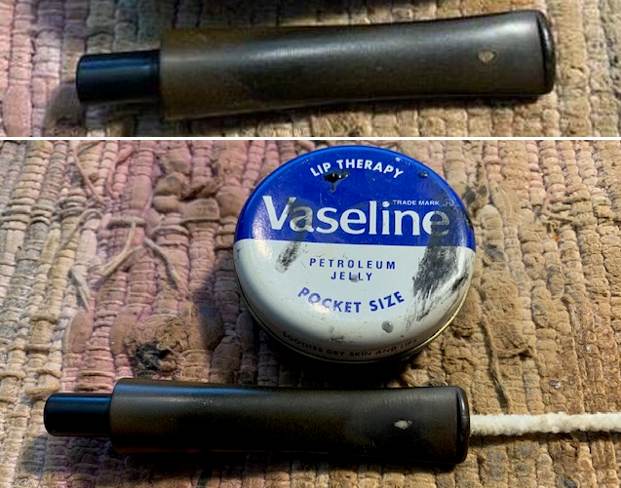
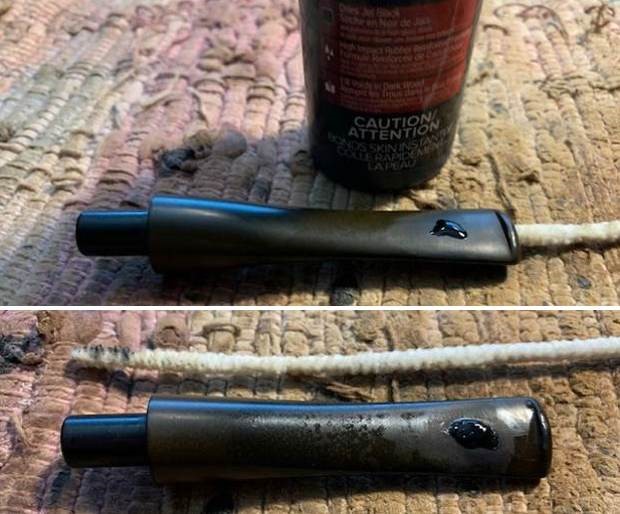
The bowl had been reamed and cleaned. I started working on the pipe by cleaning out the inside of the shank and the airway into the bowl and the stem. I scraped the shank out with a small pen knife to remove the thick tars. I then cleaned it with a isopropyl alcohol, cotton swabs and pipe cleaners until it was clean.  I topped the damaged rim top on a topping board with 220 grit sandpaper to remove the damage on the rim top and edges of the bowl. I used a folded piece of 220 grit sandpaper to smooth out the inner edge of the bowl. I gave the inner edge of the bowl a slight bevel. I filled in some of the deep gouges in the briar on the right side and heel of the bowl with some clear CA glue. Once the repairs cured I sanded the briar surface with 220 grit sandpaper to smooth it out and blend it into the surrounding briar.I stained the sanded area on the bowl side and the rim top with a Cherry stain pen to lay a base coat and then did a top coat of Mahogany stain pen. I polished the rim top and edges with micromesh sanding pads – dry sanding with 1500-12000 grit pads to raise a shine. I wiped it down with a damp cotton pad to wipe off the debris after each sanding pad.   I worked some Before & After Restoration Balm into the surface of the briar with my fingertips. It works to clean, enliven and protect the briar. I let it sit for 15 minutes then buffed it off with a soft cloth and raised the shine. The bowl looks great at this point.   The nickel ferrule was out of round and dented. It was solidly connected to the shank end so I did not want to removed it. Instead I fit a dowel into the end of the ferrule that was round and heated the nickel with a lighter to soften it. Once it was softened I used a small furniture hammer to bring the ferrule end back to round. I repeated the process until the opening in the ferrule was round and the stem fit well. It was not perfect but it was better than when I started. I set the bowl aside and worked on the stem. I “painted” the stem with the flame of a Bic lighter to lift the tooth marks in the stem. I was able to raise them slightly. I filled in the remaining marks with Black CA glue. Once the repairs cured I sanded it smooth with 120 grit sandpaper and started polishing it with 400 grit wet dry sandpaper. I unscrewed the extension tube from the end of the stem. I cleaned up the threads on the extension and inside the stem with pipe cleaners, cotton swabs and isopropyl alcohol. It did not take long to clean it. I coated the threads on the extension with Vaseline and screwed the extension back into the stem. I worked on the stem to further smooth and reshape the button and stem with the 220 grit sandpaper and the 400 grit wet dry sandpaper.  I polished the stem with micromesh sanding pads – dry sanding it with 1500-12000 grit pads. I wiped the stem down with Obsidian Oil after each pad. I polished it with Before & After Pipe Polish – both Fine and Extra Fine and gave it a final coat and set it aside to dry.  I put the stem back on the Peterson’s System 31 Straight Billiard and buffed the pipe with Blue Diamond on the buffing wheel. I polished the briar and the vulcanite of the stem until there was a rich shine. This classic Peterson’s shape and finish really highlights a proportionally well carved pipe. Once I buffed the pipe the briar came alive and popped with polishing. The black vulcanite stem has a rich glow. This Peterson’s System Straight Billiard fits well in the hand and sits right in the mouth. Have a look at it with the photos below. The dimensions are Length: 5 ½ inches, Height: 1 ½ inches, Outside diameter of the bowl: 1 1/8 inches, Chamber diameter: ¾ of and inch. The weight of the pipe is 1.23 ounces/35 grams. This beauty will be going on the rebornpipes online store in the Irish Pipemakers Section. If you are interested let me know. Thanks for walking through the restoration with me as it was a pleasure to work on.

Restoring a Peterson’s of Dublin “Kildare” 05 Calabash


Blog by Steve Laug

This is another one of those pipes that has been here for a long time and I have no memory where it came from. I had not been cleaned so it is not one that ever went to Jeff for clean up. It was a filthy pipe but appeared to have some great grain under the grime. The bowl had been reamed somewhere in the journey and was quite clean inside. The smooth rim top had some light lava on the top and some darkening. The edges look very good. The smooth finish is dirty with grime and grit deep ground into the sides of the bowl and shank. The pipe stinks like heavily cased aromatics. The stamping on the shank is clear and readable. The left side is stamped Peterson’s [arched over] of Dublin [over] “Kildare”. On the right side, low on the shank toward the front of the bowl it is stamped 05. The stem is oxidized, calcified and has tooth marks and chatter on both sides ahead of the button. There was a thick build up of tar on the end of the tenon and inside of the shank was heavily coated with tar and oil. There was also a P logo stamped on the left side of the taper stem. I took some photos of the pipe before I started my work on it.  I took close up photos of the bowl and the stem. You can see the reamed bowl and the darkening and light lava on the rim top. The bowl reeked of aromatic tobaccos. The stem surface has the mark from a Softee Rubber Bit Guard that is clear and there is calcification and oxidation on the stem. There are also tooth marks and chatter on both sides ahead of the button.I took a photo of the stamping on the sides of the bowl and shank. It is clear and readable as noted above. You can also see the P logo stamp on the left side of the taper stem.I removed the stem from the shank and took a photo to give a sense of the proportions of the pipe. It is really quite nice looking.I am including the link to the Pipedia’s article on Peterson pipes. It is a great read in terms of the history of the brand (https://pipedia.org/wiki/Peterson).
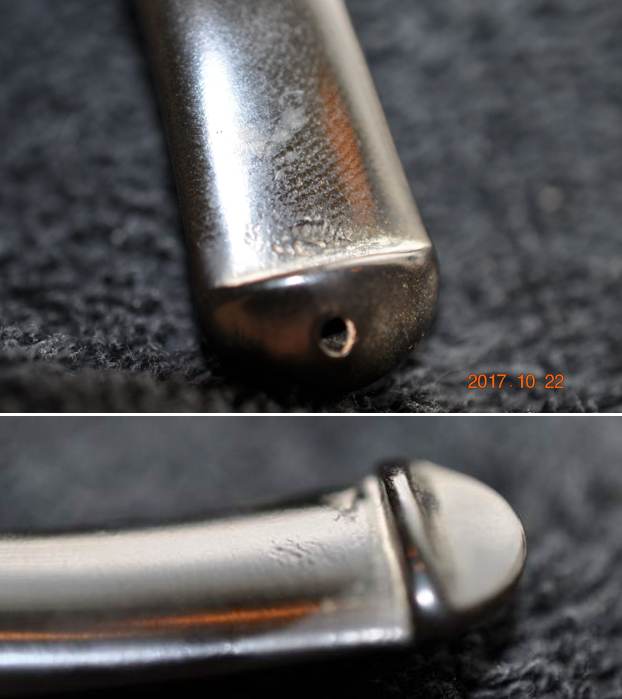
I turned to “The Peterson Pipe” by Mark Irwin and Gary Malmberg to get some background on the Peterson’s Kildare Line. On page 306 it had the following information.

Kildare (1965-) First issue of line with matte-finish in Classic Range shapes, P-Lip and fishtail mouthpiece. Second issue C.1979 as Kildare Patch, with rusticated patches on pipe surface. Third issue 2010, matte-brown, P-Lip or fishtail mouthpiece, no band. Fourth issue 2011-, burgundy sandblast finish, nickel army mount, fishtail mouthpiece, exclusive to smokingpipes.com.

I read further in “The Peterson Pipe” by Mark Irwin and Gary Malmberg to get some background on the Peterson’s Of Dublin pipes. On page 298 it had the following information.

Dublin 1906-2003 Although Dublin appears under Peterson’s on many pipes over the decades, it has served mostly as part of the brand name. The word first appeared on pipes hallmarked 1906-11 Stamped Peterson’s over Patent over Dublin. The simpler Peterson’s over Dublin first appeared on pipes hallmarked 1912 after the expiration of the patent. Illustrations of pipes in the ’37 catalogue show a random dispersion of the stamp Peterson’s over Of Dublin together with the ordinary Peterson’s over Dublin on every model offered. Specimens of the former will either bear an Irish COM or London Made over England COM and almost certainly date from 1945-62. It was first mentioned in print as part of a model name in ’68 price list, as K&P Dublin, in ’92 for a Danish market line and in 2017.

Judging from the description above I believe that I am working on a First Issue of the line in the time period of 1965-1979. It is probably a late Republic Era Classic Shaped pipe with a matte-finish and a taper stem. Now it was time to work on the pipe.

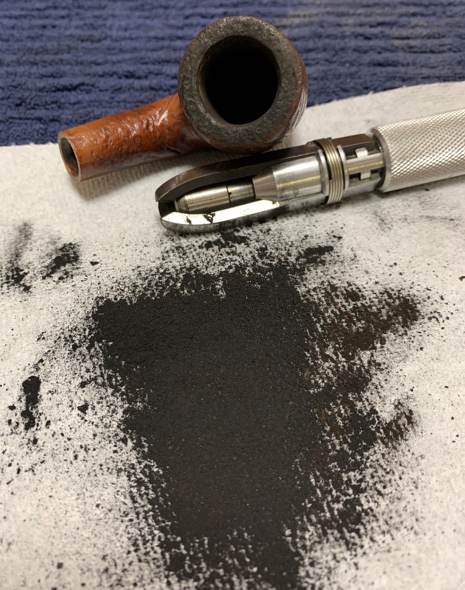
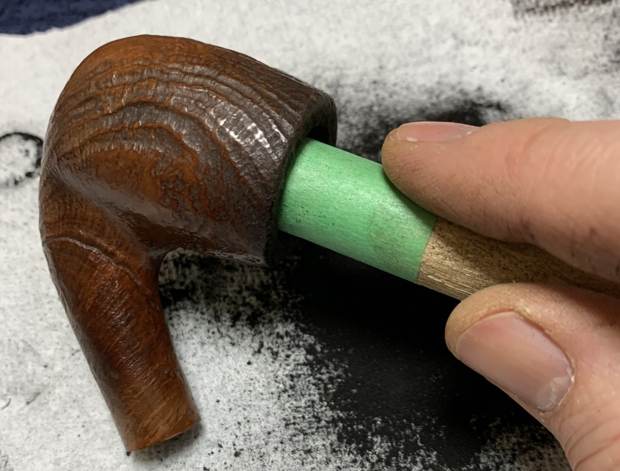
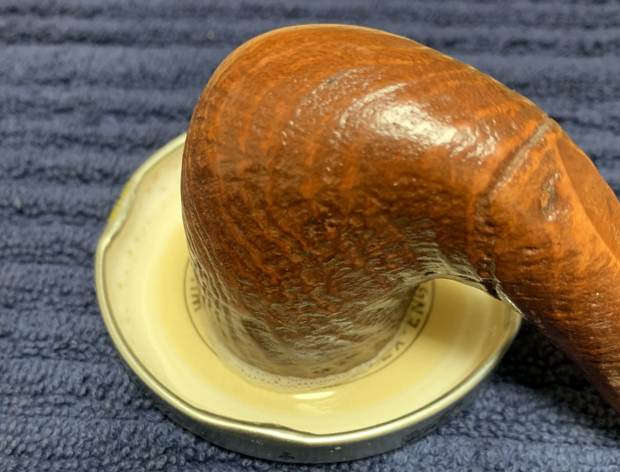
I reamed the bowl with a PipNet pipe reamer using all four cutting heads. I cleaned up the reaming with a Savinelli Fitsall Pipe Knife to remove all debris. I sanded the bowl with 220 grit sandpaper wrapped around a piece of dowel to smooth out the wall of the bowl. The bowl was in excellent condition with no fissures or checking.  I scrubbed the exterior of the bowl with a tooth brush and undiluted Murphy’s Oil Soap to remove the debris and grime from the finish to remove the light lava overflow on the rim top. Once it was finished it looked much better. I cleaned out the inside of the shank and the airway into the bowl and the stem. I scraped the shank out with a small pen knife to remove the thick tars. I then cleaned it with a isopropyl alcohol, cotton swabs and pipe cleaners until it was clean.  I polished the rim top and edges with micromesh sanding pads – dry sanding with 1500-12000 grit pads to raise a shine. I wiped it down with a damp cotton pad to wipe off the debris after each sanding pad.   I worked some Before & After Restoration Balm into the surface of the rusticated briar with my fingertips. I worked it over with a shoe brush to get it deep into the grooves and crannies of finish. I let it sit for 15 minutes then buffed it off with a soft cloth and raised the shine. The bowl looks great at this point.   To rid the bowl of the tars and oils that made the bowl still stink I stuffed it with cotton bolls and twisted a boll into a wick that I threaded into the shank. I used an ear syringe to fill the bowl with isopropyl alcohol and set it in an old ice tray over night  to let it wick out the tars and oils.This morning when I went back to the pipe to work on it I took a photo of the cotton to show how the tars and oils had wicked into the pipe. I removed it from the bowl and took photos of the cotton to show how dirty it was.  I set the bowl aside and worked on the stem. I “painted” the stem with the flame of a Bic lighter to lift the tooth marks in the stem. I was able to raise them slightly. I filled in the remaining marks with Black CA glue. Once the repairs cured I sanded it smooth with 120 grit sandpaper and started polishing it with 400 grit wet dry sandpaper. I touched up the Peterson’s P on the left side of stem with white acrylic fingernail polish. I worked it into the stamping with a tooth pick. I scraped off the excess paint with my nail and then used a worn 1500 grit micromesh pad to buff off the excess. I rubbed it down with some Obsidian Oil and set it aside.  It looks better but you can see that the curve of the P is faint at the front.I polished the stem with micromesh sanding pads – dry sanding it with 1500-12000 grit pads. I wiped the stem down with Obsidian Oil after each pad. I polished it with Before & After Pipe Polish – both Fine and Extra Fine and gave it a final coat and set it aside to dry.   I put the stem back on the Peterson’s of Dublin Bent Calabash and buffed the pipe with Blue Diamond on the buffing wheel. I polished the briar and the vulcanite of the stem until there was a rich shine. This classic Peterson’s shape and finish really highlights a proportionally well carved pipe. Once I buffed the pipe the briar came alive and popped with polishing. The black vulcanite stem has a rich glow. This Peterson’s Calabash fits well in the hand and sits right in the mouth. Have a look at it with the photos below. The dimensions are Length: 5 inches, Height: 2 inches, Outside diameter of the bowl: 1 3/8 inches, Chamber diameter: ¾ of and inch. The weight of the pipe is 1.87 ounces/53 grams. This beauty will be going on the rebornpipes online store in the Irish Pipemakers Section. If you are interested let me know. Thanks for walking through the restoration with me as it was a pleasure to work on.

Rebirthing a Republic Era Peterson’s System Standard 304 Flat Bottom Oom Paul


Blog by Steve Laug

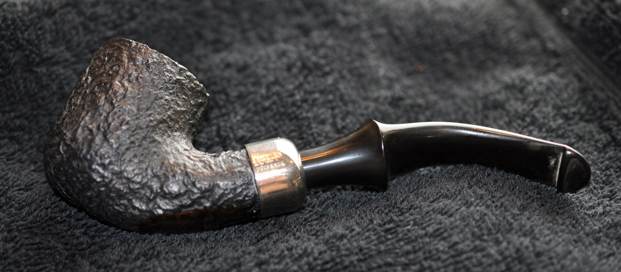
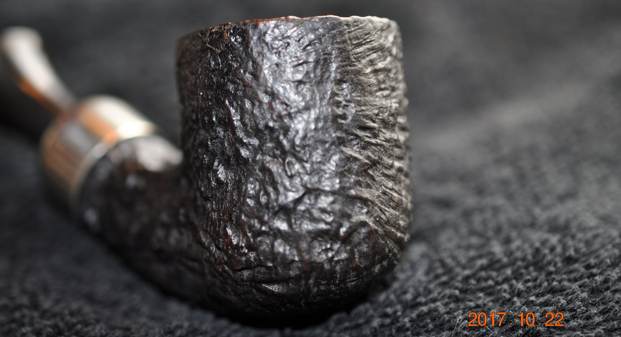
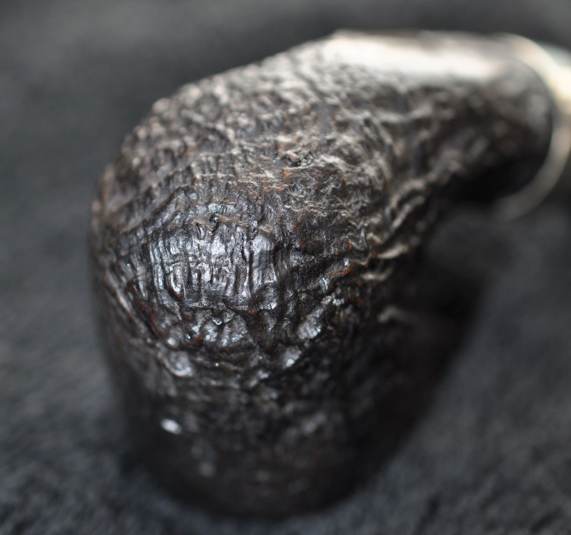
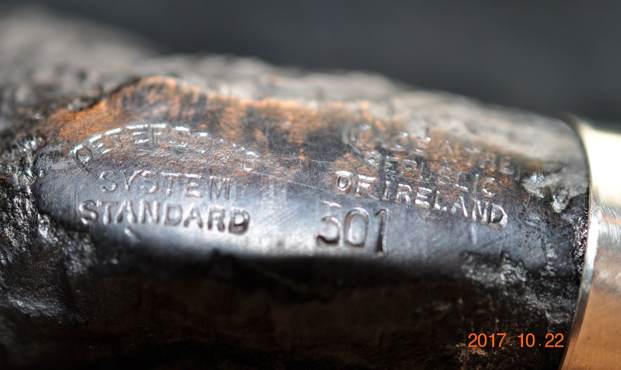
The next pipe I have chosen is another Peterson’s System Standard pipe that has been sitting here in Vancouver for a long time. It is a nice smaller size, flat bottom sitter. It has a nickel ferrule and a saddle style Peterson’s P-lip stem. It came to us from an antique mall on 10/20/16 in Chinook, Washington, USA. This pipe was obviously a favourite of the previous trustee. It had been well smoked and there was a thick cake in the bowl and lava overflowing onto the rim top. The well grained briar was dirty with grime and dirt ground into the finish and some small dents and scratches on the bowl sides and heel. The nickel ferrule was oxidized but undamaged. The flat bottom on the bowl enables it to stand on the desk or table top while you are doing other work. The pipe was stamped on the left side and read Peterson’s [over] System [over] Standard. On the right side it had the three line Republic of Ireland stamp [over] the shape number 304. The ferrule was stamped K&P over Peterson on the left side. The stem was oxidized, calcified and had tooth marks on both sides ahead of the button. The stem was not stamped with a logo but it appears to be the original stem. Jeff took photos of the pipe before he started his clean up work on it. Jeff captured the thick cake in the bowl and the heavy lava overflow onto the rim top and beveled inner edge in his photo. There really was no way of knowing what the edges looked like under the thick cake. The heavily oxidized and calcified stem surface had a lot of tooth chatter and marks on the stem and on the button surface and edges. He took a photo of the heel of the bowl to show the interesting grain patterns in the briar. It was quite beautiful.He took photos of the stamping on the sides of the shank and on the ferrule and stem. It is readable but faint in places.I remembered that Paresh had restored a Peterson’s System Standard 314 earlier this year and as usual had done good work on the research. I turned to his blog and read through his work on the pipe (https://rebornpipes.com/2021/07/24/helping-a-fellow-piper-with-his-dream-pipea-petersons-system-pipe/). I quote below from the section on his blog regarding the dating of the pipe.

While dating a Peterson’s pipe, I always fall back to my under mentioned favorite site; http://thepetersonpipeproject.blogspot.com/2007/07/dating-peterons-pipes.html 

I quote from the above site.

Stamping of Bowl: During the years of Kapp and Peterson’s business operations, the country of Ireland has undergone several name changes and K&P’s stamping on their pipes reflects these changes. Knowing these changes, a Peterson pipe can be roughly dated and placed in “eras.”

The Republic Era is from 1949 until the present. The Republic of Ireland was formed on 17 April 1949. From 1949 to present the stamp for this era is “Made in the Republic of Ireland” in a block format generally in three lines but two lines have been used with or without Republic being abbreviated.

With Paresh’s help on the date in place, I then turned to the Peterson’s Website to get a sense of the 304 System Standard Sitter shape (https://www.peterson.ie/pipes/system/system-standard-smooth/moreinfo.cfm?pd_product_Id=172). I quote from the site regarding the shape, line and the range of pipes.

About the Shape: A smaller version of our signature flat-bottomed Oom Paul, this deeply bent design is a sturdy sitter with the comfortable posture of a bent pipe. Despite its compact size, it maintains the iconic muscularity, stout proportions, and overall antique look of our House Style.

About the Line: Our flagship line, the System Standard stamp first appeared in 1945, but the entry-level design has been a staple in our catalogues since Charles Peterson secured his final patent in 1898. Designed to provide a cooler, drier smoke, each pipe features a deep reservoir within the shank to collect excess moisture; a graduated bore mouthpiece that funnels the smoke and allows moisture to collect within the reservoir; a sturdy nickel military mount, which allows the pipe to be broken down and cleaned without damage or warping; and our patented P-Lip bit, which draws the smoke upward, thus reducing tongue bite. While the P-Lip bit is the traditional choice, we also offer System Standard pipes with fishtail stems. Available here in the traditional walnut stain of the Smooth finish.

About The Range: In 1890, after 15 years of handling and repairing pipes while working for the Kapps, Charles Peterson secured a patent in his own name, titled “A certain new and useful improvement in Tobacco-Pipes,” which introduced a unique system comprised of a higher draft hole and a moisture reservoir bored into the shank and transition of a briar pipe. Over the next eight years, Charles continued to refine his System, applying for and securing patents for a graduated bore mouthpiece (1891), and a unique button design known today as the P-Lip (1894-1898). Designed to wick moisture away from the smoke, reduce tongue bite, and increase the longevity of the pipe, Peterson’s complete System patent sparked a tradition of innovation, one we continue to uphold to this day. The System Pipe is the invisible source behind our unique House Style: our pipes’ muscular shanks and transitions, tubular profile, and generous bends. Our overall shaping style has a distinctly antique form because it has remained largely unchanged for over 120 years.

In our System range, you’ll find a variety of shapes in myriad finishes, each featuring Charles Peterson’s groundbreaking improvements in the realm of tobacco pipes. Whether you’re looking for your first pipe or to enhance a robust collection, here you’ll find numerous options to suit any taste, all backed by our legacy of craftsmanship.

I finished my reading about the shape 304 System Standard Flat Bottomed Oom Paul by following a link to some information on the smokingpipes.com website that is quite helpful (https://www.smokingpipes.com/pipes/new/peterson/moreinfo.cfm?product_id=362575). I quote a portion of the description regarding the shape below. It was written by Truett Smith.

The “304” shares both style and history with the “306”: Both designs were introduced to Peterson’s shape chart in 1992 and were the first new System pipes since the “301,” “302,” and “303” were featured in the 1978 catalog. The “304” and “306” also boast flattened heels, allowing them to sit upright while still offering the comfortable posture of a bent pipe. While most Peterson shapes change numbers when featured outside the System line, these two flat-bottomed forms remain constant across series. Presented here is the “304,” being a touch smaller than the “306,” catering to pipe smokers’ personal preferences.

With that information at hand I turned to work on the pipe itself. Jeff had thoroughly cleaned up the pipe. He reamed the pipe with a PipNet Pipe Reamer and cleaned up the remnants with a Savinelli Fitsall Pipe Knife.  He scrubbed the bowl with undiluted Murphy’s Oil Soap with a tooth brush. He rinsed it under running warm water to remove the soap and grime. He cleaned out the inside of the shank and the airway in the stem with alcohol, cotton swabs and pipe cleaners. He scrubbed the exterior of the stem with Soft Scrubb to remove as much of the oxidation and calcification as possible. He soaked the stem in Before & After Deoxidizer and rinsed it off with warm water. I took photos of the pipe once I started to work on it.   I took photos of the rim top and bowl as well as the stem to give a sense of the condition of both. The rim top looked amazing – no burn or chip damage on the top or on the beveled inner edge. The stem cleaned up fairly well leaving behind some residual oxidation that would need to be dealt with. The tooth marks on the top and underside ahead of the button are visible in the photos.  I took photos of the stamping on the shank sides. The are clear and readable as noted above. There is some faintness on parts of the stamping but it is still readable.   I took the stem out of the shank and took a photo of the overall look of the pipe. I polished the briar with micromesh sanding pads – dry sanding with 1500-12000 grit pads. I wiped the bowl down after each pad with a damp cloth.  I rubbed the bowl down with Before & After Restoration Balm. I worked it into the surface of the bowl sides and shank with my fingertips. The product works to clean, enliven and protect the briar. I let the balm sit for a little while and then buffed with a cotton cloth to raise the shine.  I set the bowl aside and turned my attention to the stem. I “painted” the tooth marks on the surface with the flame of a lighter to lift them as much as possible. I was able to lift many of them but a few still remained. I filled in the remaining tooth marks with black CA glue and set it aside to cure. I sanded the repairs smooth with a folded piece of 220 grit sandpaper to begin blending them into the stem surface. I started the polishing with some 400 grit wet dry sandpaper.   I polished the stem with micromesh sanding pads – 1500-12000 grit pads. I wiped it down with Obsidian Oil after each sanding pad. I used Before & After Pipe Polish – both Fine and Extra Fine to further polish the stem.  This Republic Era Peterson’s System Standard 304 Flat Bottom Oom Paul with a vulcanite P-lip stem is a great looking pipe now that it has been restored. The beautiful grain that shines through the polished finish is stunning. As the pipe is smoked the patina should develop and look even better. I put the stem back on the bowl and carefully buffed the pipe with Blue Diamond on the buffing wheel. I gave the bowl and the stem multiple coats of carnauba wax on the buffing wheel and followed that by buffing the entire pipe with a clean buffing pad. I hand buffed the pipe with a microfiber cloth to deepen the shine. The finished Peterson’s System Standard 304 Oom Paul fits nicely in the hand and feels great. Give the finished pipe a look in the photos below. The dimensions of the pipe are Length: 5 ½ inches, Height: 1 ¾ inches, Outside diameter of the bowl: 1 1/8 inches, Chamber diameter: ¾ of an inch. The weight of the pipe is 54 grams/1.90 ounces. I will be adding the pipe to the Irish Pipe Makers Section of the rebornpipes store. If you are interested in purchasing this pipe send me a message or an email. Thanks for reading this blog and my reflections on the pipe while I worked on it.
Restoring a Consul Freehand – Perhaps by Preben Holm or Karl Erik


by Kenneth Lieblich

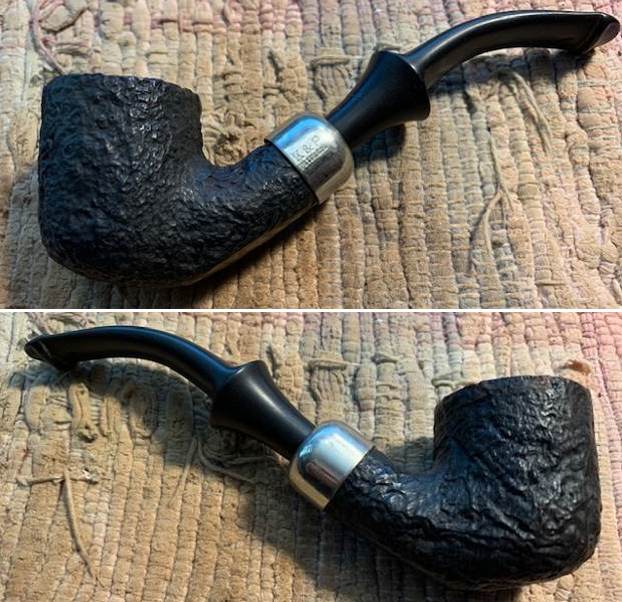
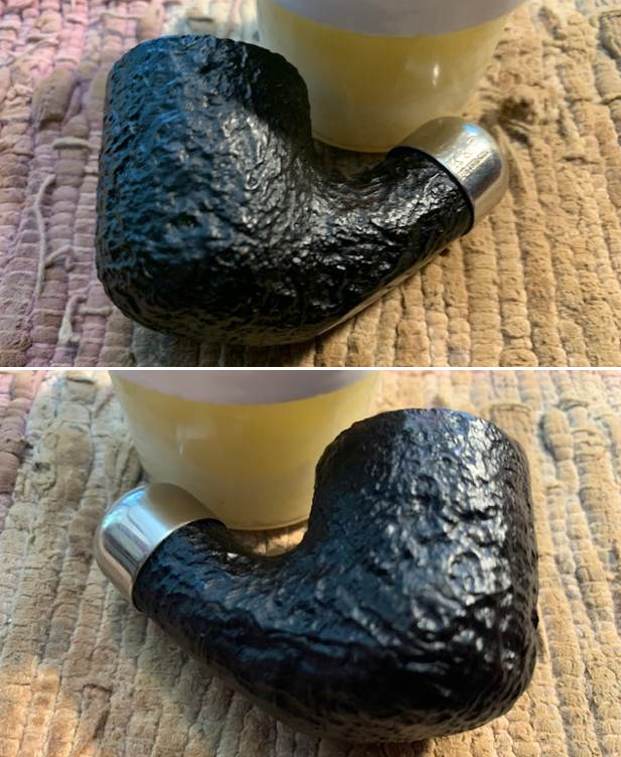
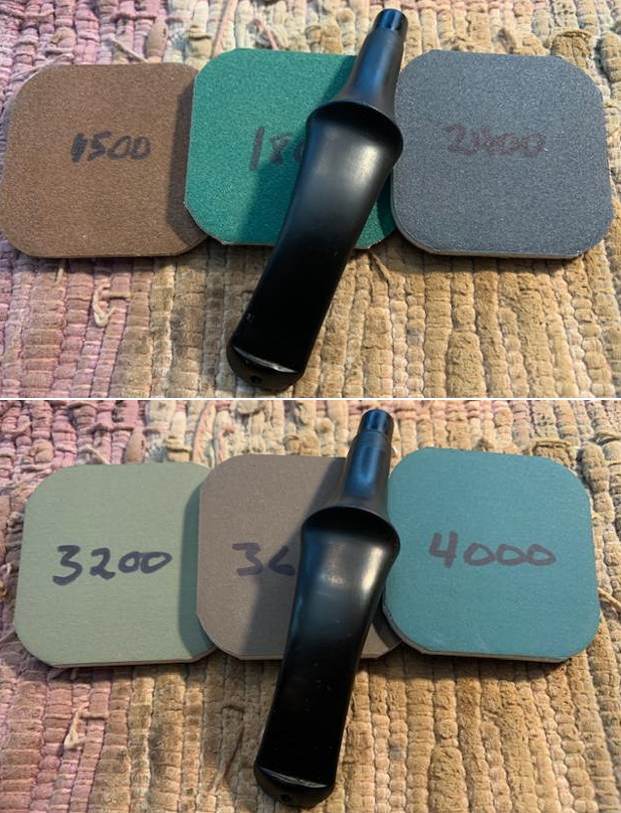
Next on the chopping block is a gorgeous example of a Danish freehand which I got from an older gentleman in Vancouver. I’ve had my eye on this one for a while because of its a beautiful plateau and wood grain, and I was looking forward to working on it. This is a Consul De Luxe pipe and I am sorry to report that I have found very little on the origin of the Consul brand of pipes. There is no information to be had from the usual sources (Pipepedia, Pipephil, etc.), but Steve believes that Consul could have been made either by Preben Holm or Karl Erik – both esteemed names in Danish pipemaking. In any event, this pipe is clearly Danish, clearly well-made, and clearly a beautiful addition to anyone’s collection. The markings were clear enough. On the left-hand side of the shank, it said Consul [over] De Luxe [over] Special. On the right-hand side of the shank, it said Handcut. On the underside of the stummel, it read Made in Denmark. On the left side of the stem, there was a very thin, stylized capital “C”, which appeared to have been slightly worn. The condition was generally good, and it must have been a good smoker, because it was very well used. The stem was heavily oxidized and had some tooth marks. In addition, there was a strange residue scattered over the surface that was reminiscent of icing sugar – I have no idea what it was, but hopefully, it would come off during cleaning. The stummel was fine; there was some cake in the bowl, lava on the rim, and some dents, though no burn marks to speak of. However, the heel of the bowl was very narrow which made reaming a challenge. To work! The stem was so oxidized and filthy that I wiped it down with SoftScrub before soaking. Ultimately, I did send it for an overnight soak in the Pipe Stem Oxidation Remover. The following day, I cleaned the rest of the de-oxidizing mess off with alcohol, pipe cleaners, et cetera. The oxidation had migrated to the surface and would be fairly straightforward to remove. Again, I scrubbed with SoftScrub on some cotton pads to remove the leftover oxidation. Fortunately, that bizarre ‘icing-sugar’ stuff did come off without a problem.   After this, I used some nail polish to restore the logo on the stem. I painted the area carefully and let it fully set before proceeding. Then, I built up the dents on the stem with black cyanoacrylate adhesive and let them fully cure.Next, I sanded the adhesive down with 220- and 400-grit sandpapers to meld seamlessly into the stem. I then used all nine Micromesh pads (1,500 through 12,000 grit) to bring out the lovely black lustre on the stem. I also used Obsidian Pipe Stem Oil in between each pad scrubbing. As I surmised, the ‘C’ on the stem was not as robust as it had been in better days, but I managed to restore it nicely. Now for the stummel. Firstly, I reamed out the bowl. I used the PipNet Reamer to remove the built-up cake and followed that with 220-grit sandpaper taped to a dowel to eliminate as much as I could. I took the chamber down to bare briar, as I wanted to ensure there were no hidden flaws in the wall. Fortunately, there were none. I then proceeded to clean out the insides with Q-tips, pipe cleaners, and lemon-infused isopropyl alcohol. There was a bit of filth inside this stummel and it took some cotton to get it clean. I followed that up by cleaning the insides with some dish soap and tube brushes. I used cotton rounds and some Murphy’s Oil Soap to scrub the outside of the stummel and a toothbrush with Murphy’s on the rugged plateau of the pipe. A toothbrush gets into the grooves of the wood more easily. Next, I decided to de-ghost the pipe in order to remove any lingering smells of the past. I thrust cotton balls into the bowl and the shank and saturated them with 99% isopropyl alcohol. I let the stummel sit overnight. This caused any remaining oils, tars and smells to leach out into the cotton. The bowl was nice and clean after this. You can see the before and after photos – it needed a de-ghosting! But wait! I had missed something. Inside the shank, there was a small gouge – no idea how it got there – but I felt it needed to be repaired. It’s difficult to make out, but I’ve pointed it out in the photograph. Similar to other blemishes, I filled this gouge with cyanoacrylate adhesive and briar dust. Once it had cured, I sanded it down and voilà! Problem solved. Finally, I used all nine Micromesh pads (1,500 through 12,000 grit) on the stummel to make it lovely and smooth. After that, a light application of Before & After Restoration Balm brought out the best in the stummel’s grain.    This is a very elegant Danish pipe. At the buffer, a dose of White Diamond and a few coats of carnauba wax were just what this pipe needed. However, on the rugged plateau, I used Clapham’s Beeswax Salad Bowl Finish, as carnauba wax will get gummed up in the crevices of the wood. I applied the beeswax finish with my fingers and used a horsehair brush to buff it. This Consul Freehand looks fantastic again and is ready to be enjoyed again by the next owner! It is a gorgeous pipe and will make a fantastic smoker. I am pleased to announce that this pipe is for sale! If you are interested in acquiring it for your collection, please have a look in the ‘Danish’ Pipe Makers Section of the rebornpipes store here on Steve’s website. You can also email me directly at kenneth@knightsofthepipe.com. The approximate dimensions of the pipe are as follows: length 5¾ in. (146 mm); height 2⅜ in. (60 mm); bowl diameter 1⅝ x 2 in. (41 x 51 mm); chamber diameter ¾ in. (19 mm). The weight of the pipe is 1⅞ oz. (56 g). I hope you enjoyed reading the story of this pipe’s restoration as much as I did restoring it. If you are interested in more of my work, please follow me here on Steve’s website or send me an email. Thank you very much for reading and, as always, I welcome and encourage your comments.