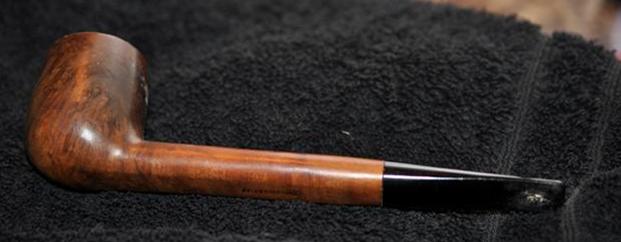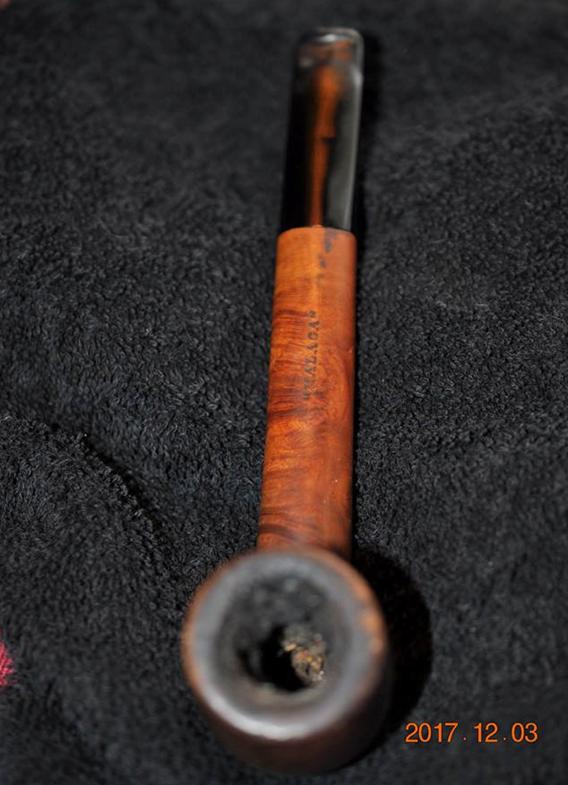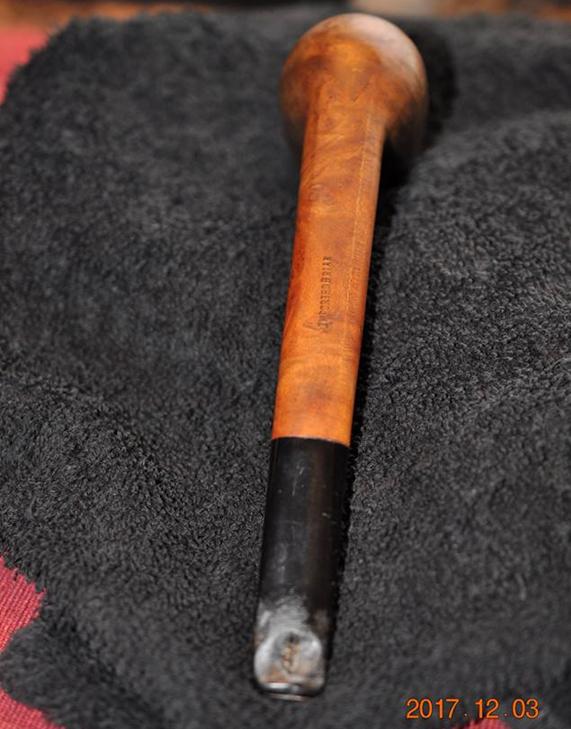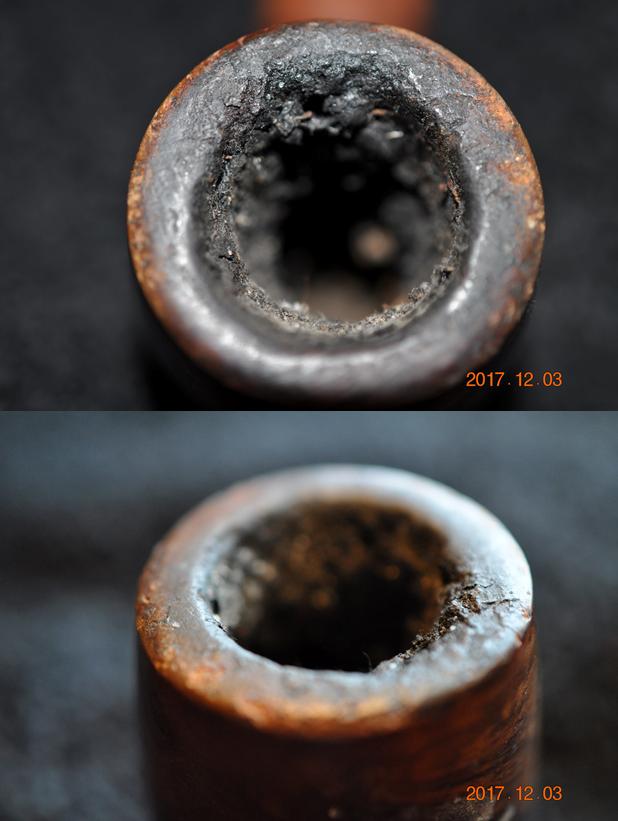
Tag Archives: pipe restemming

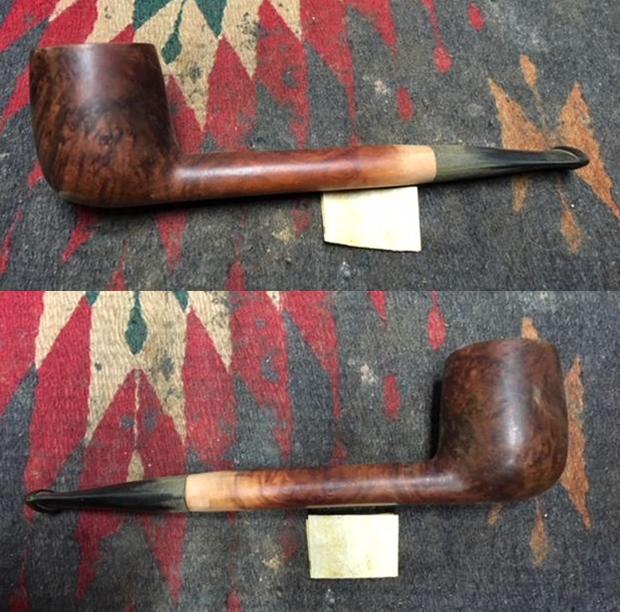
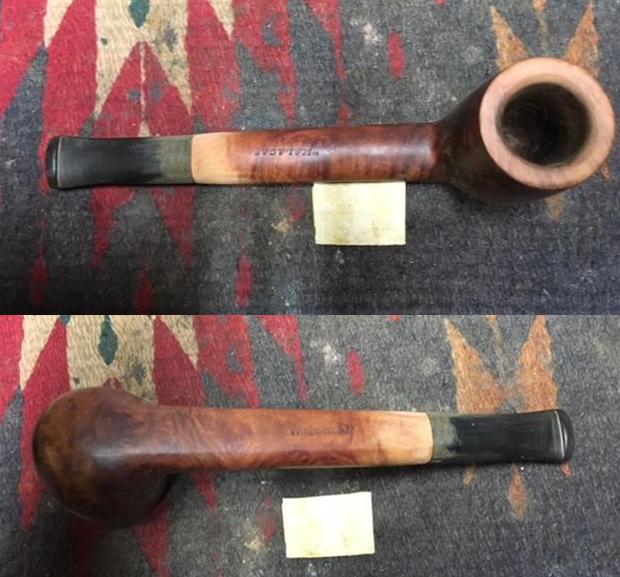
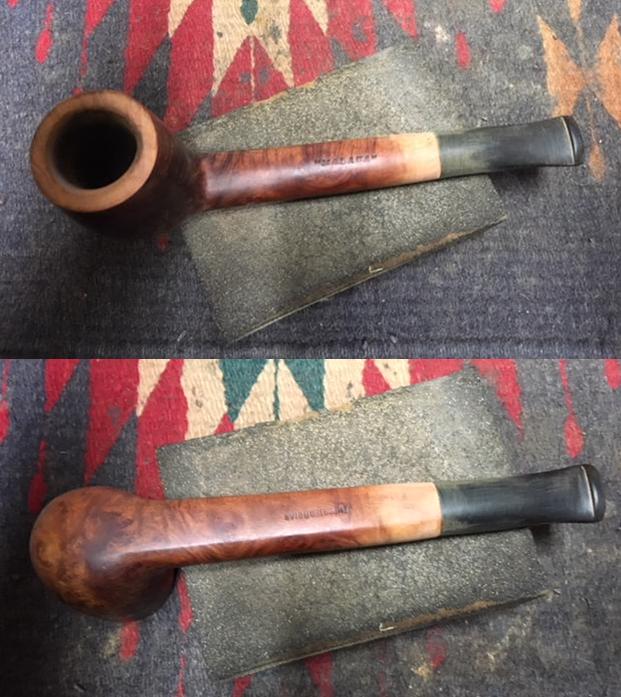
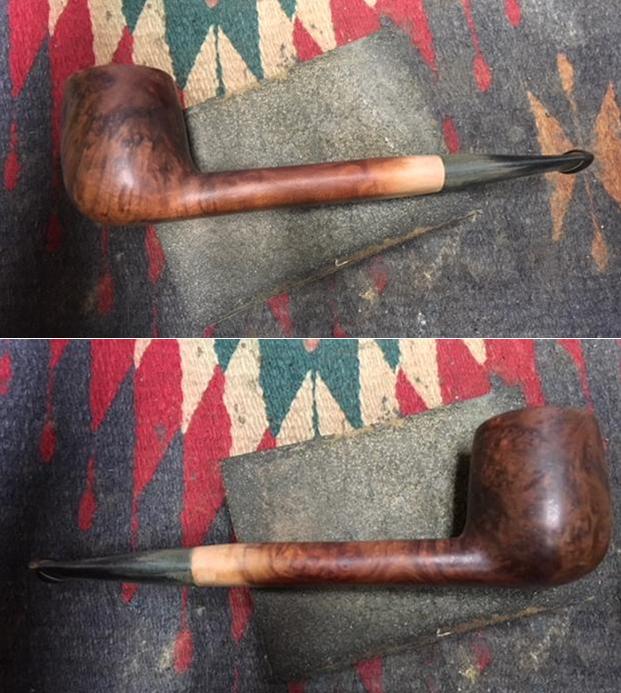
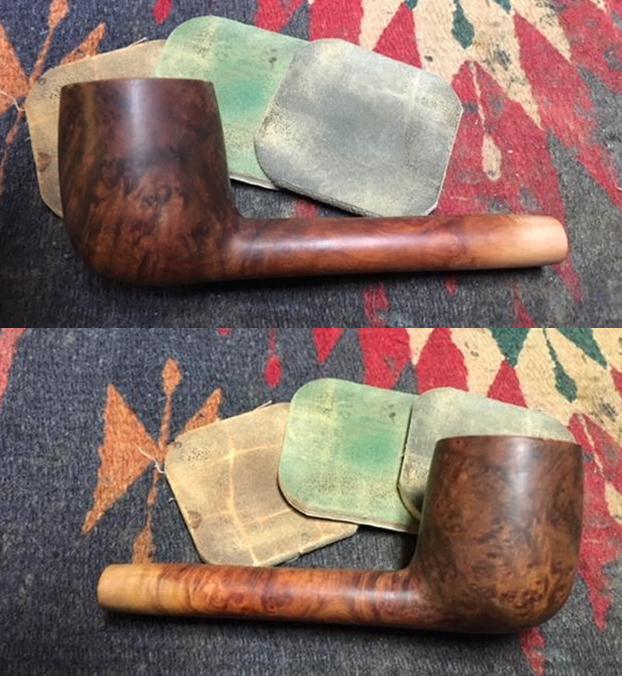
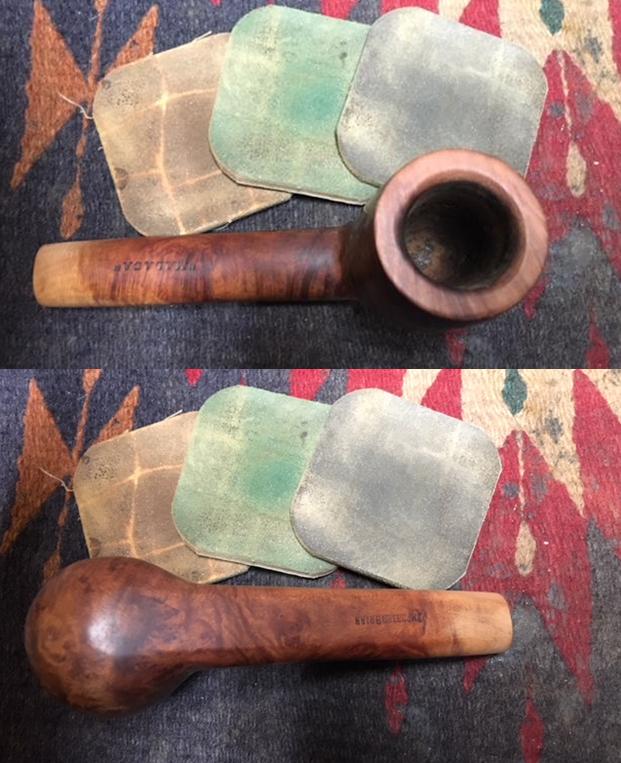
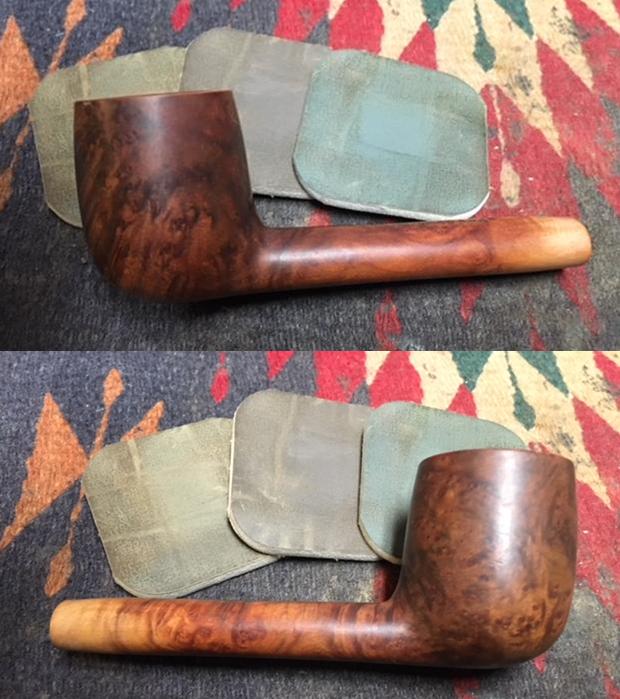
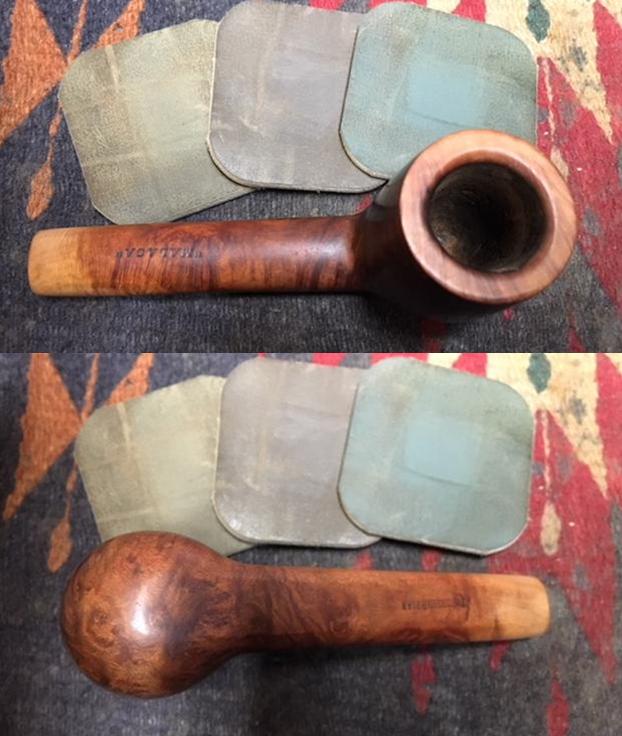
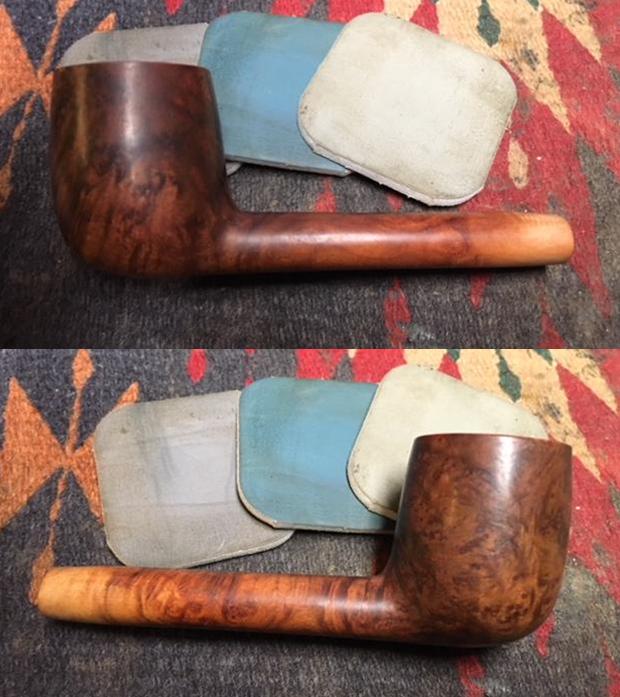
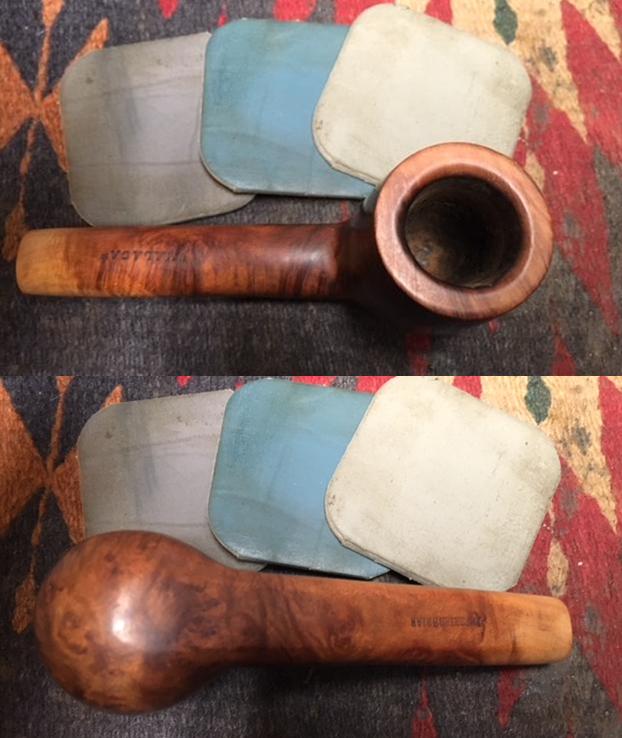
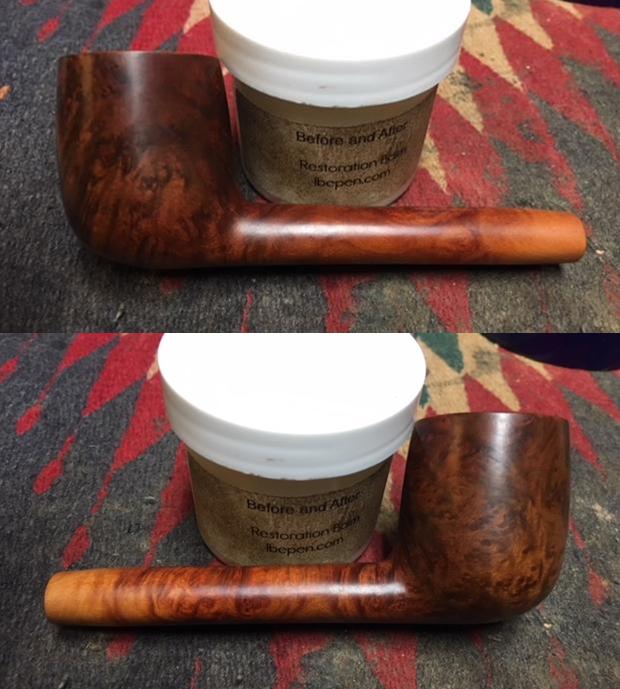
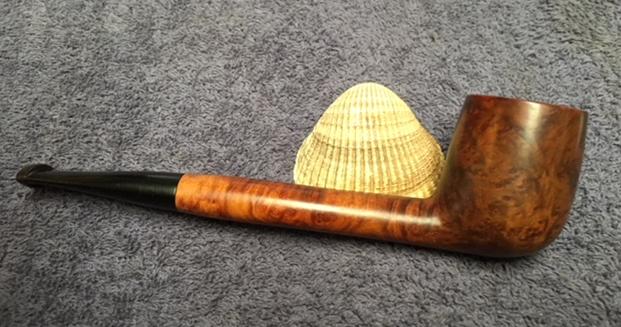
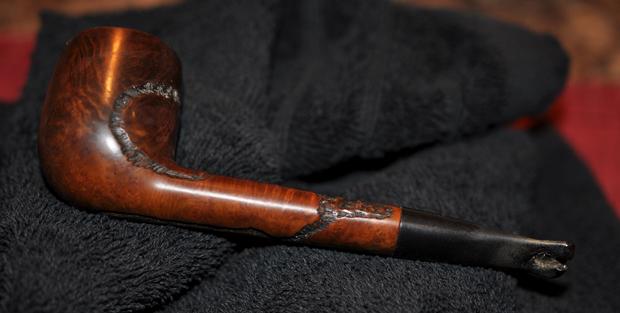
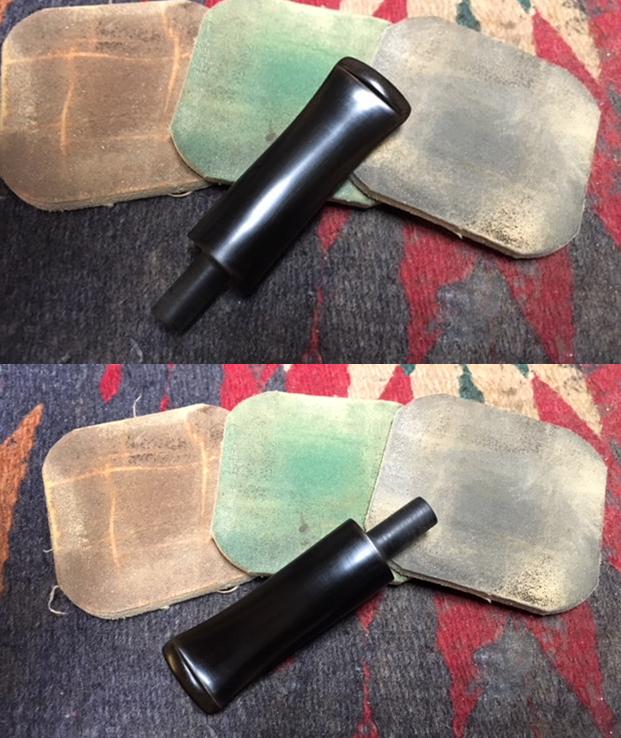
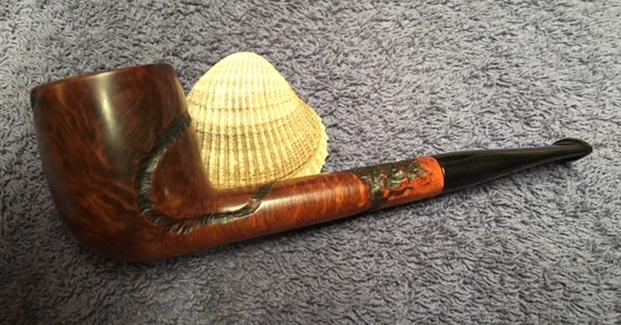
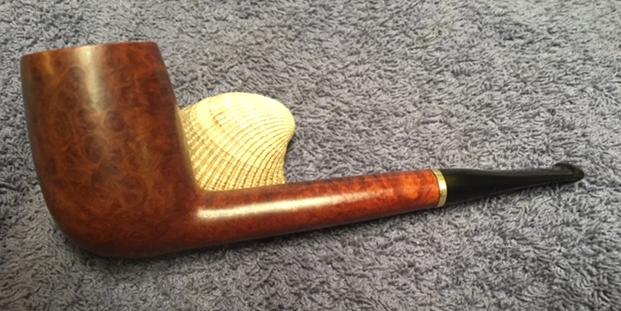
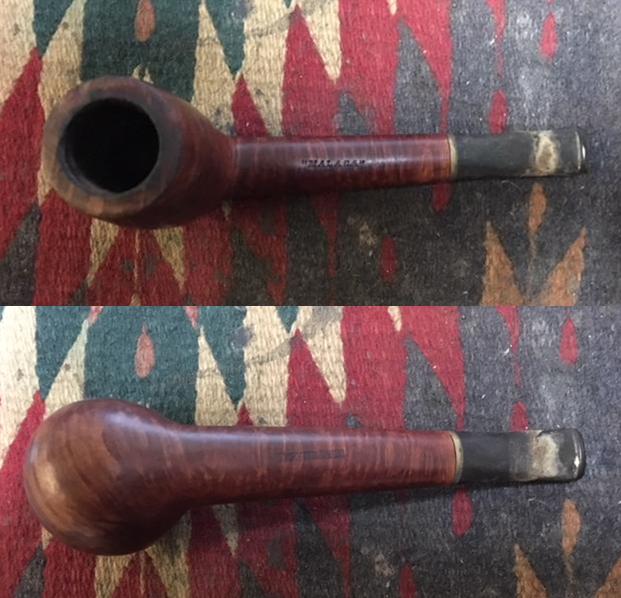
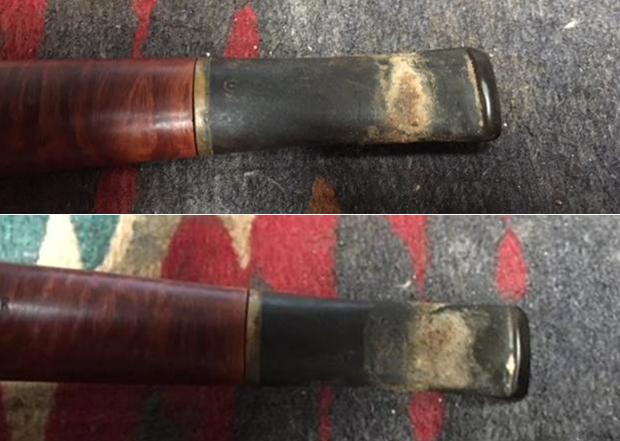
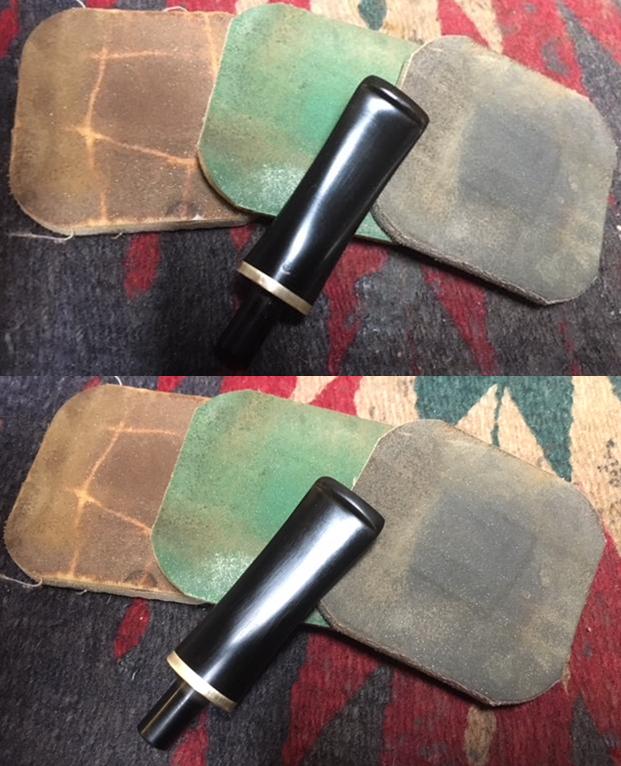
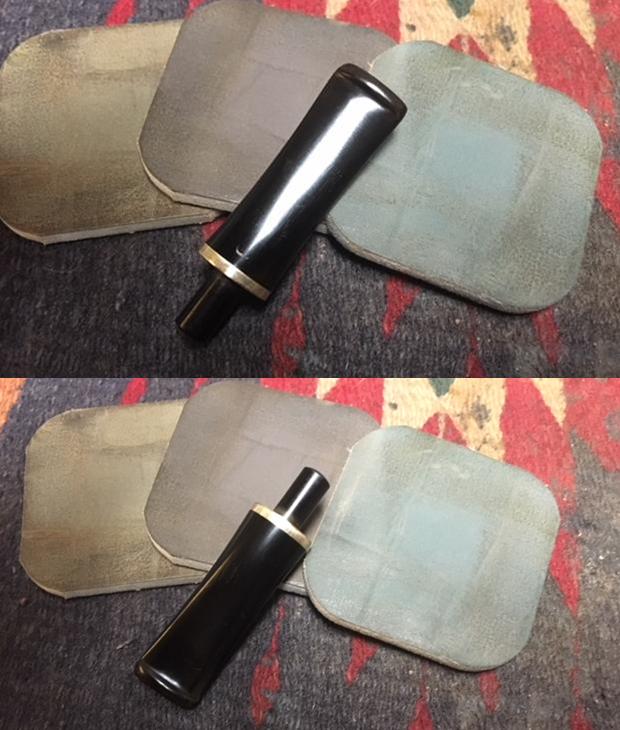
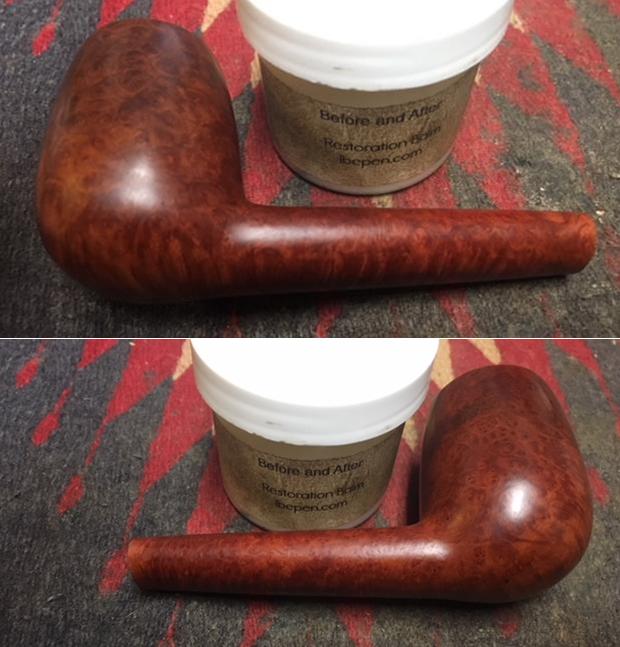
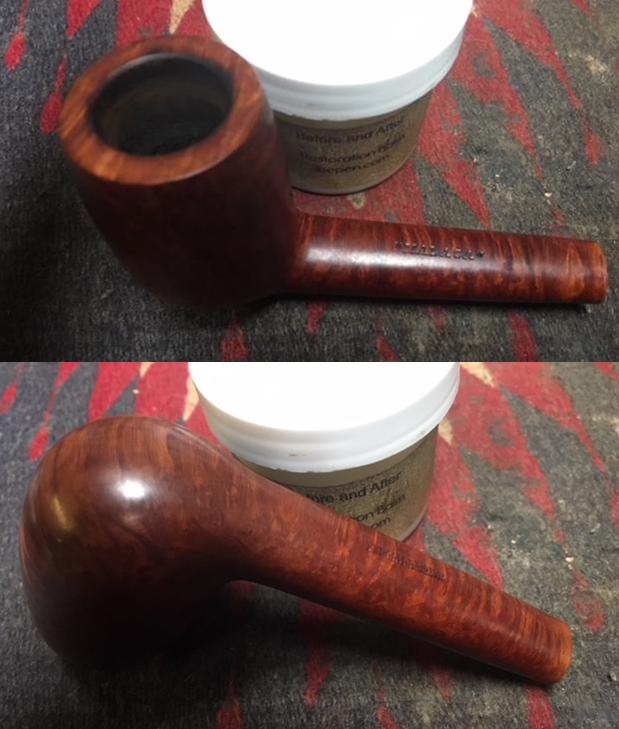
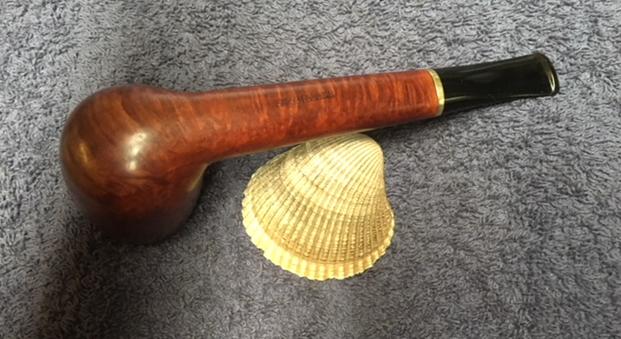
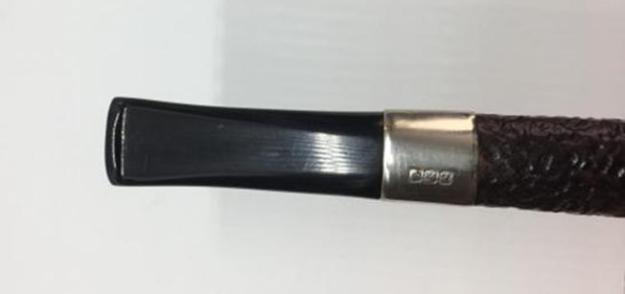
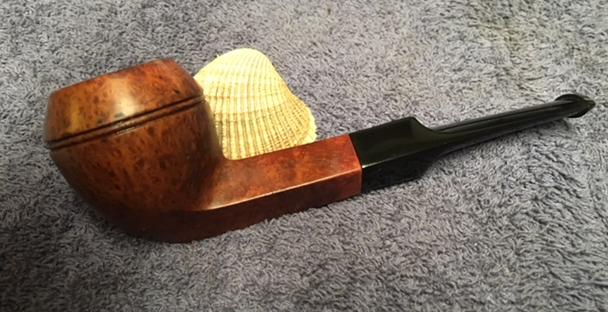
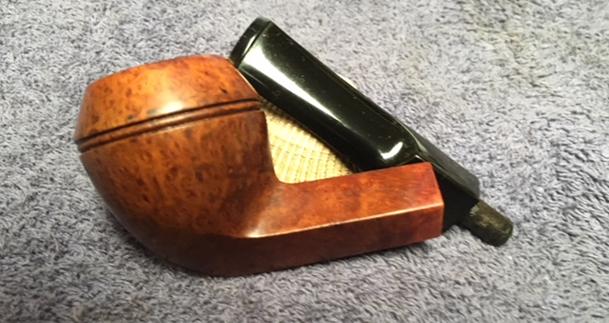
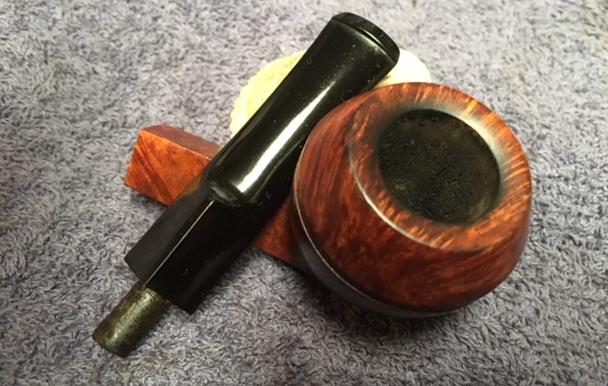
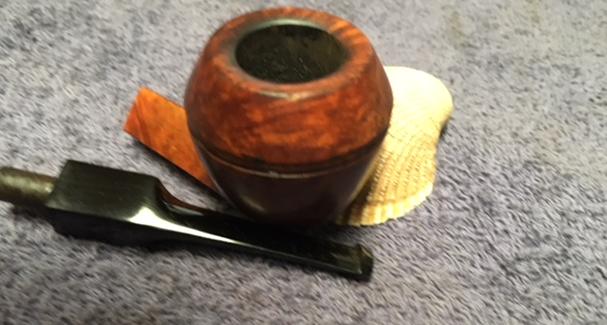
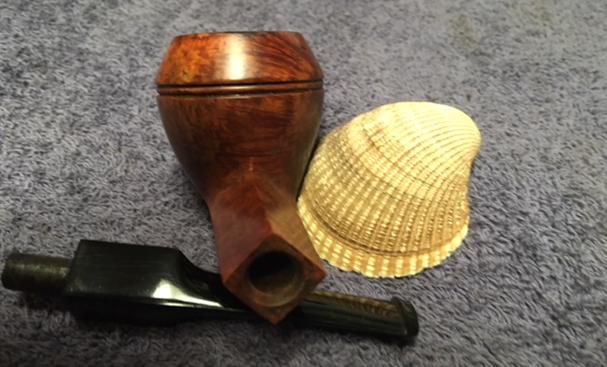
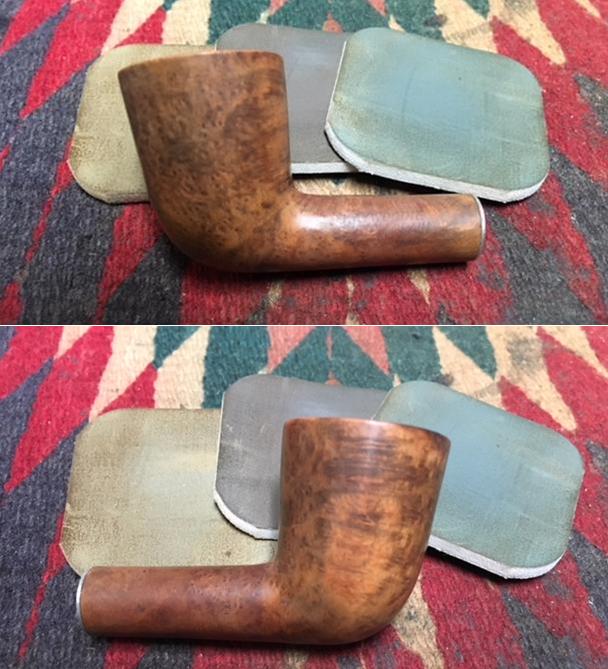
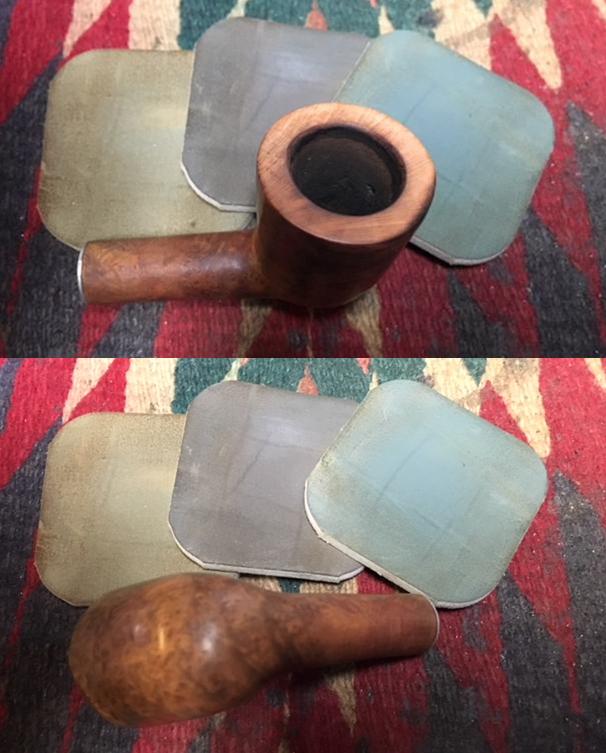
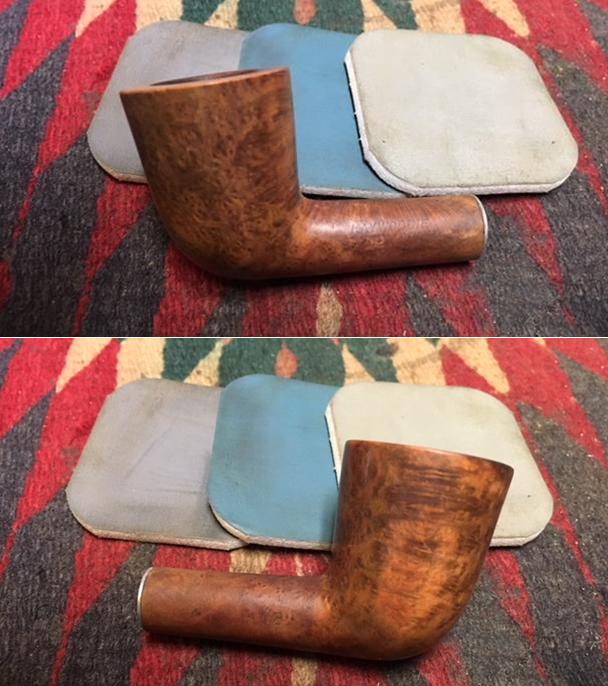
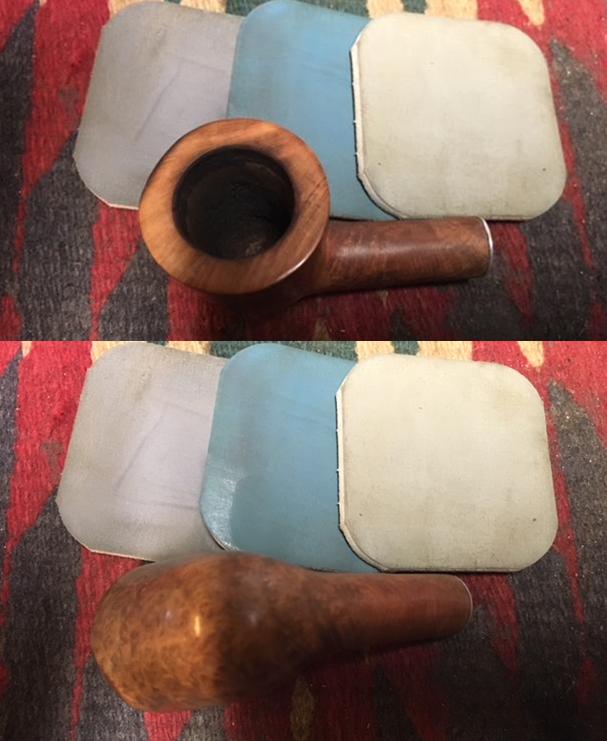
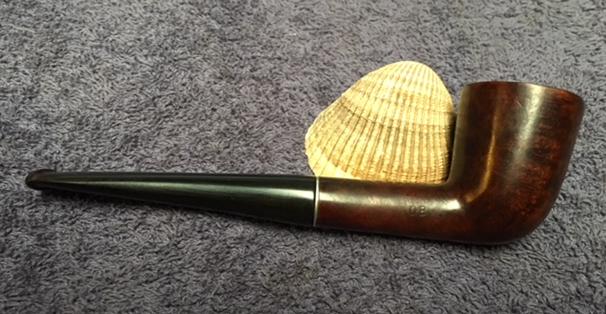
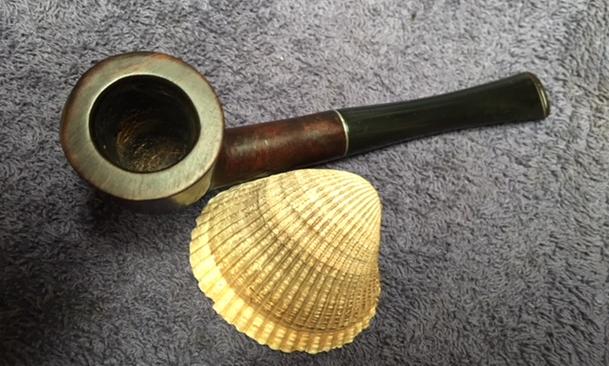
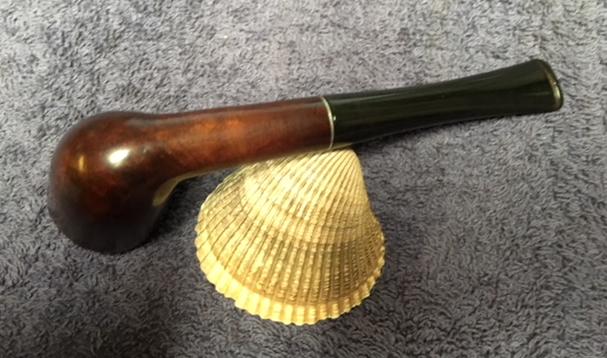
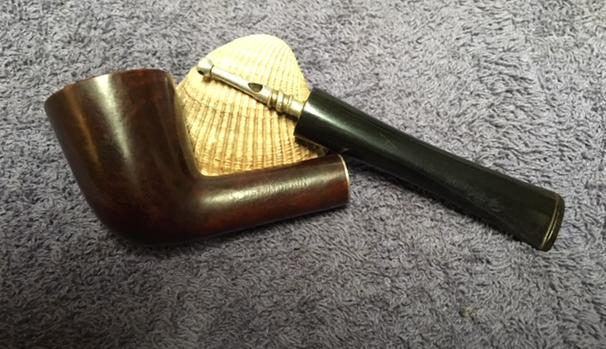
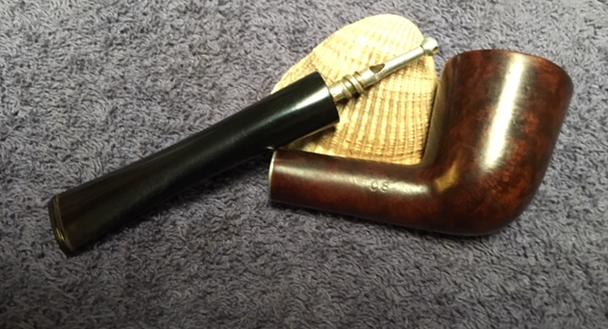
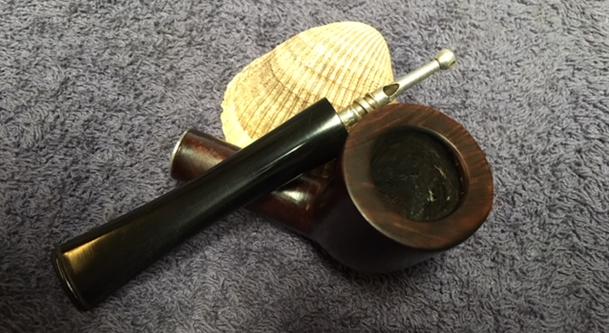
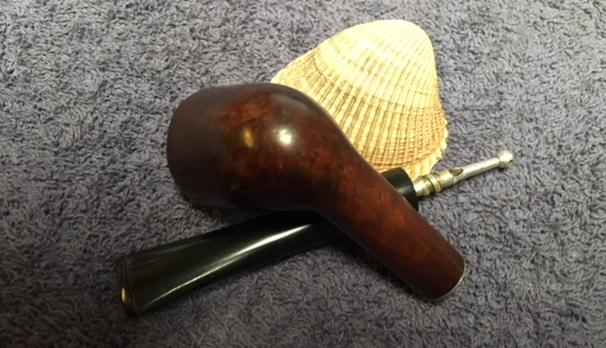
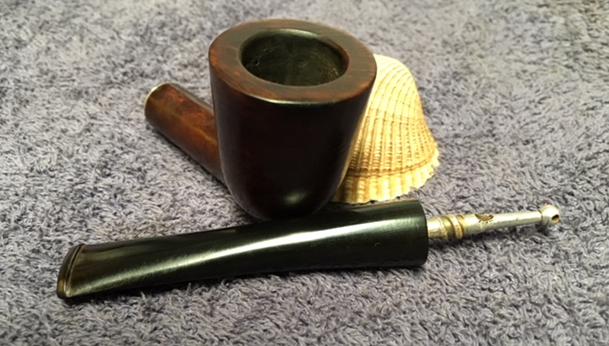
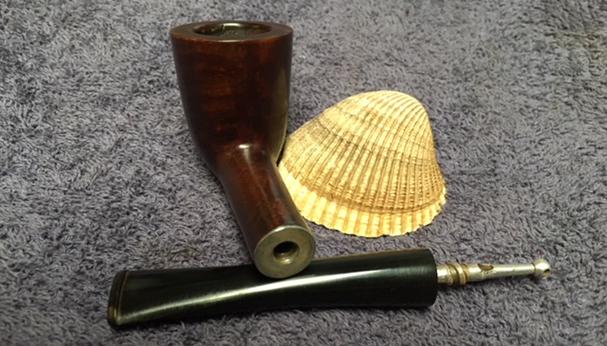
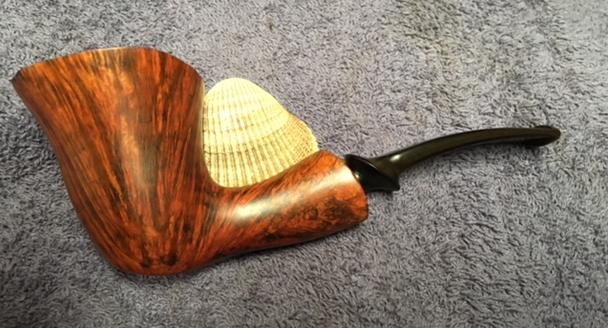
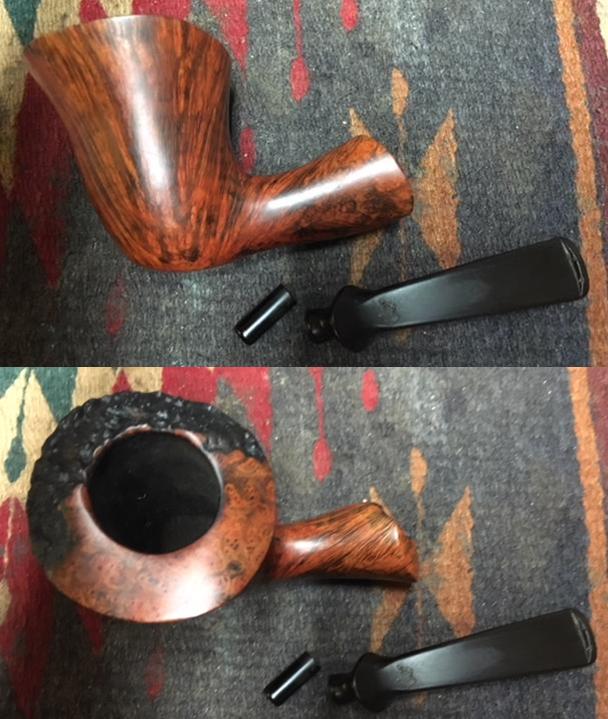
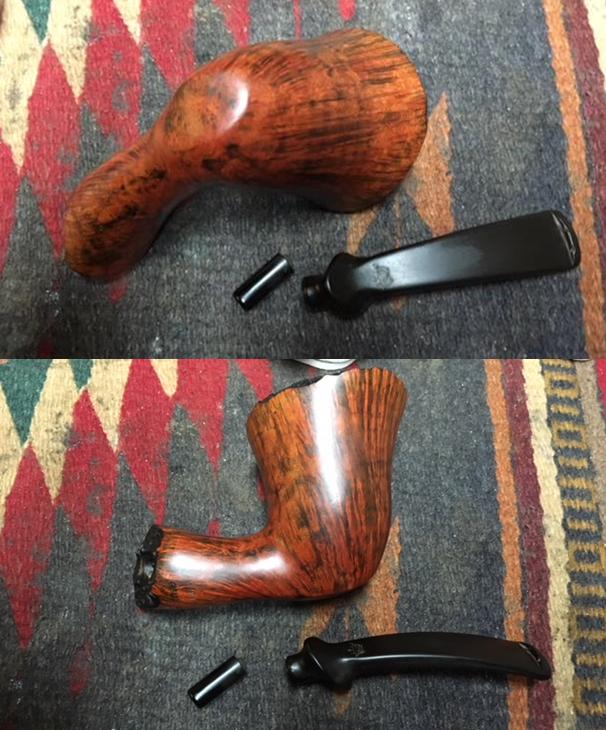
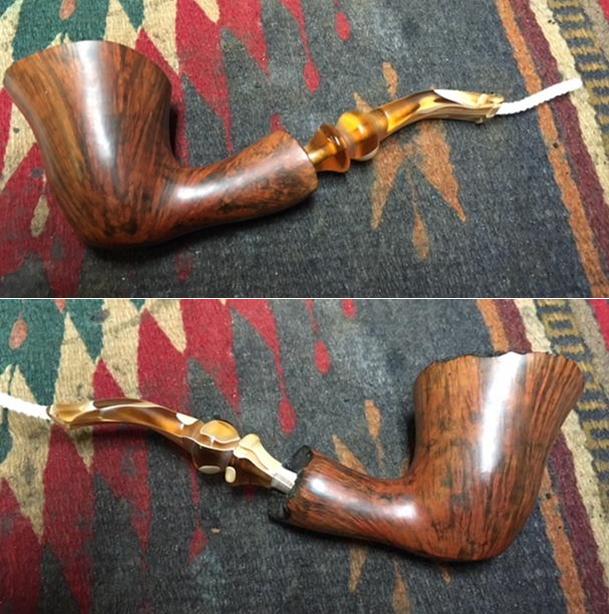
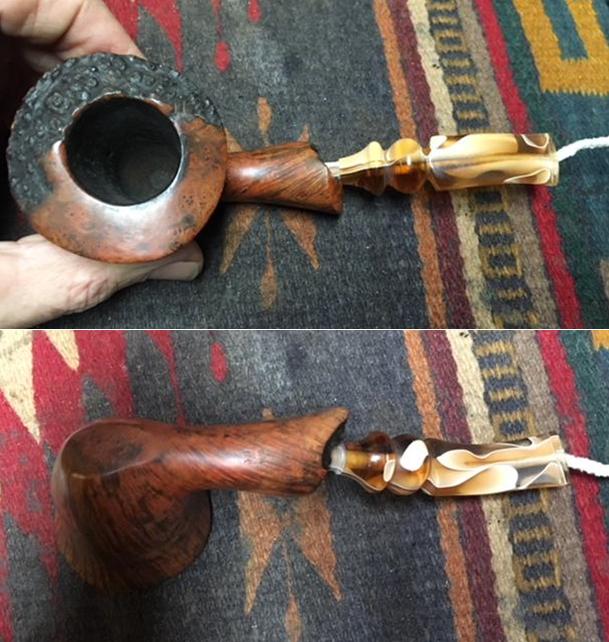
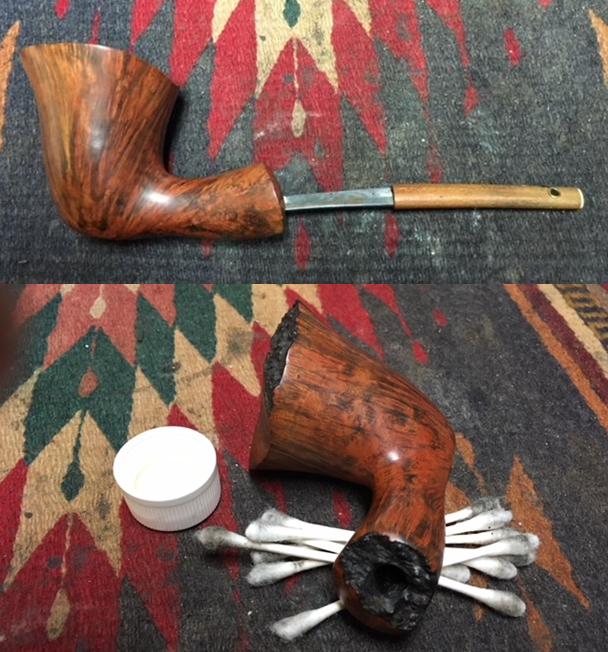
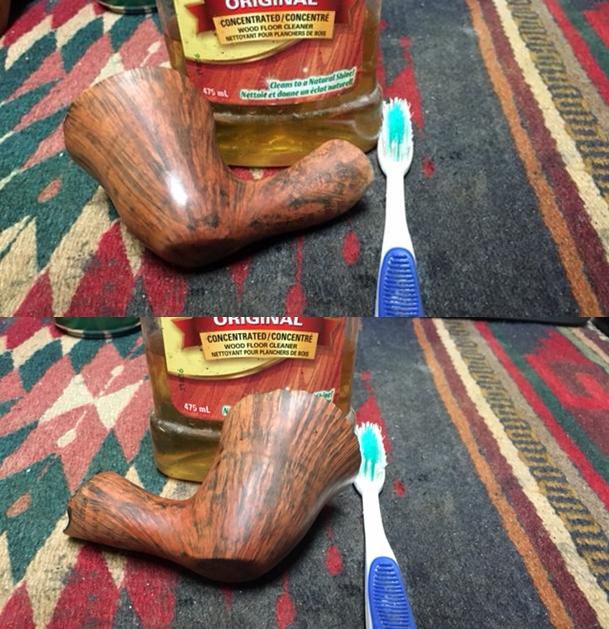
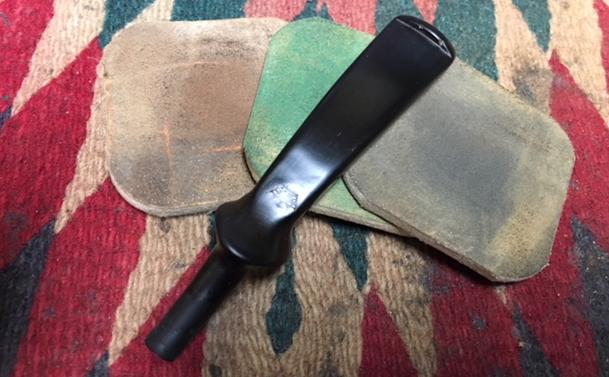
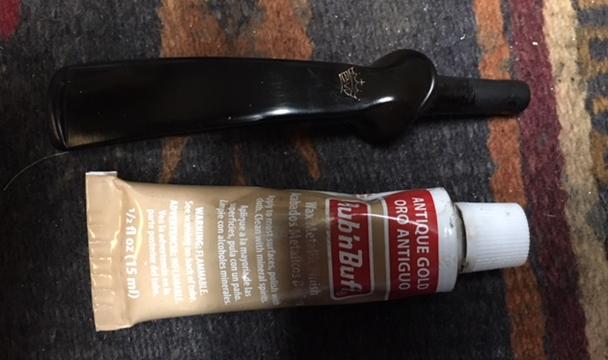
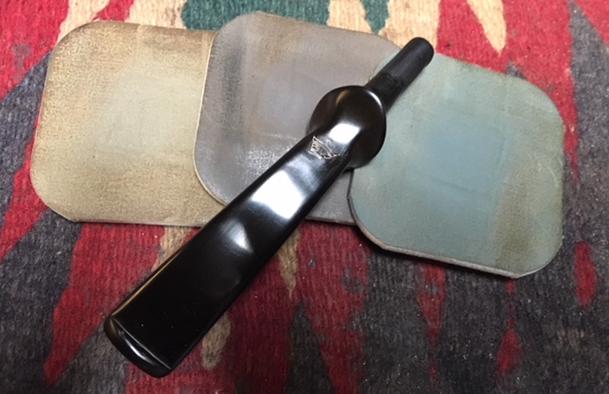
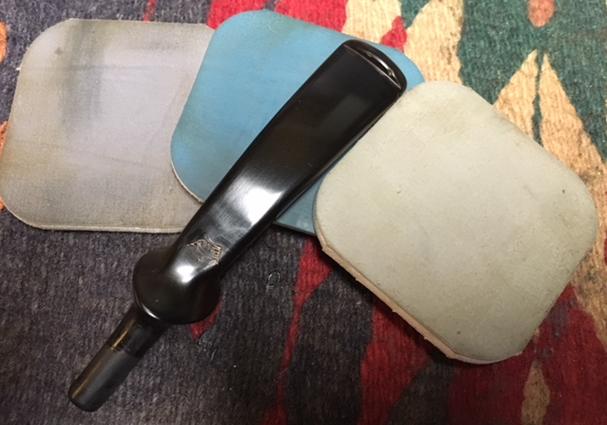
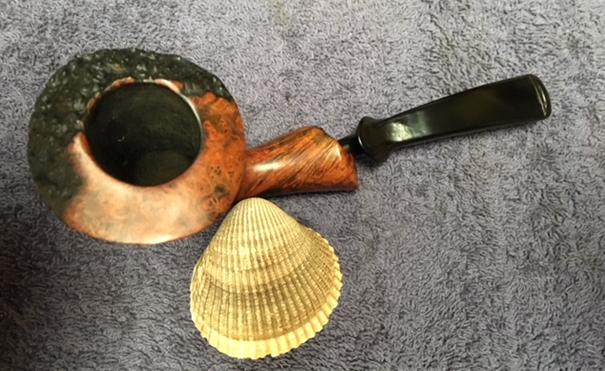
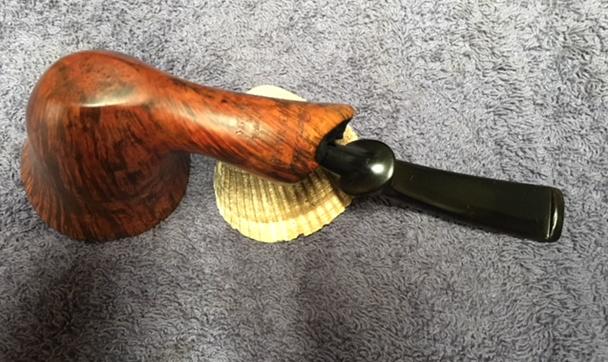
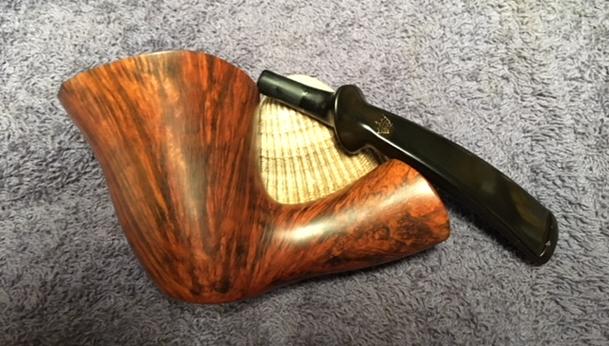
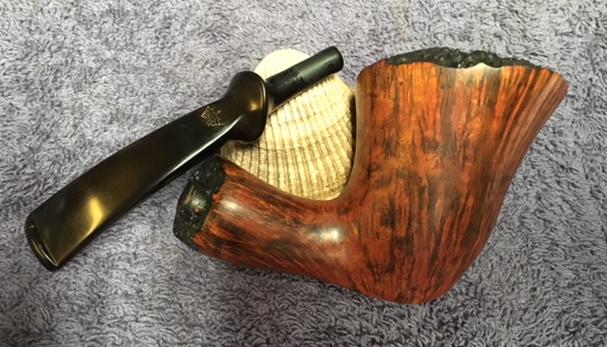
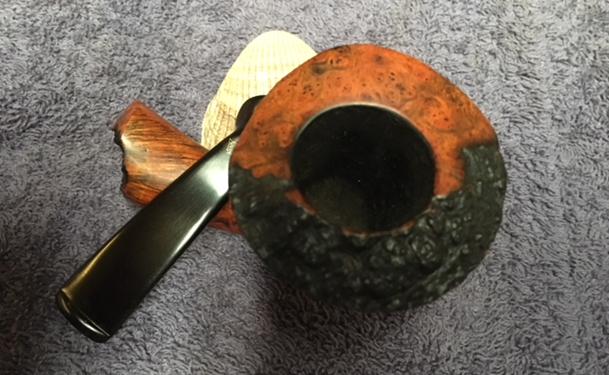
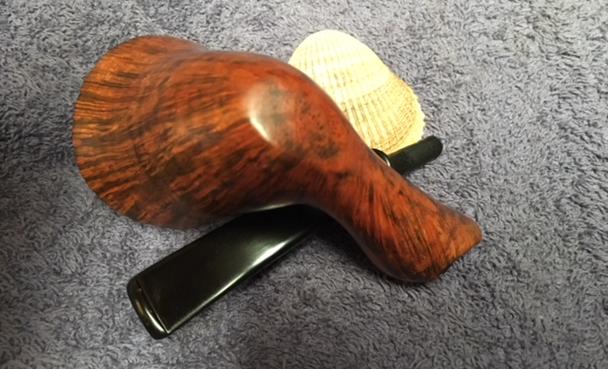
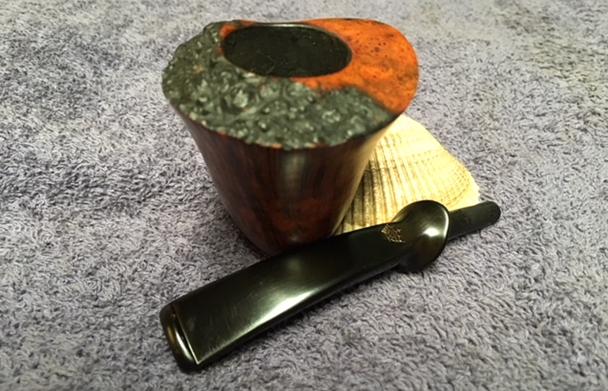
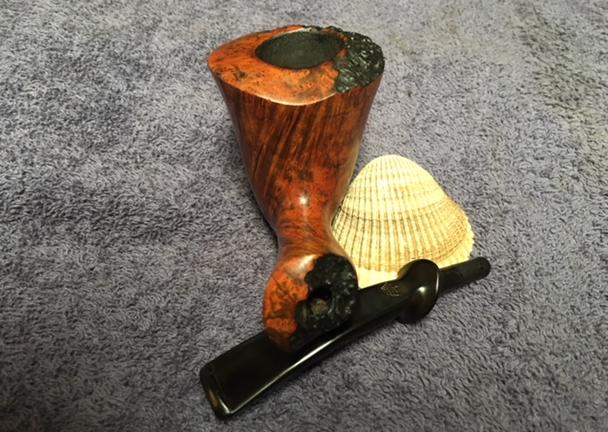
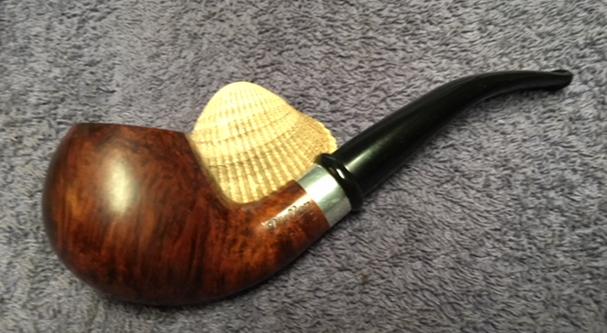
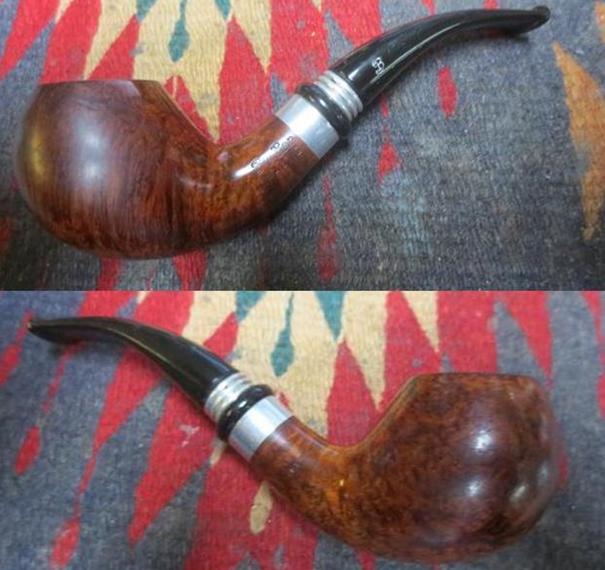
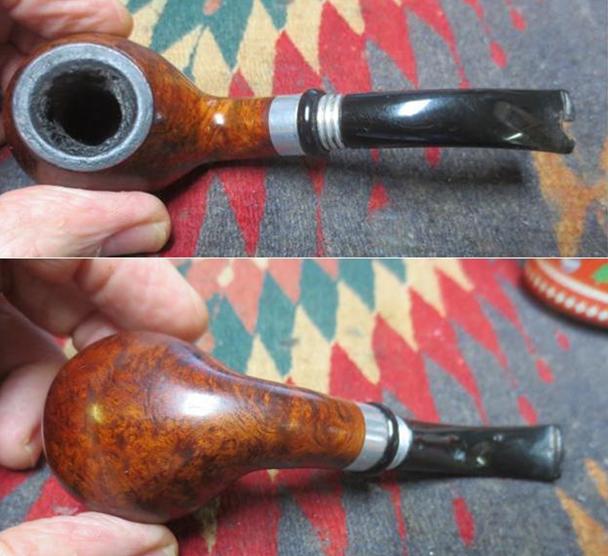
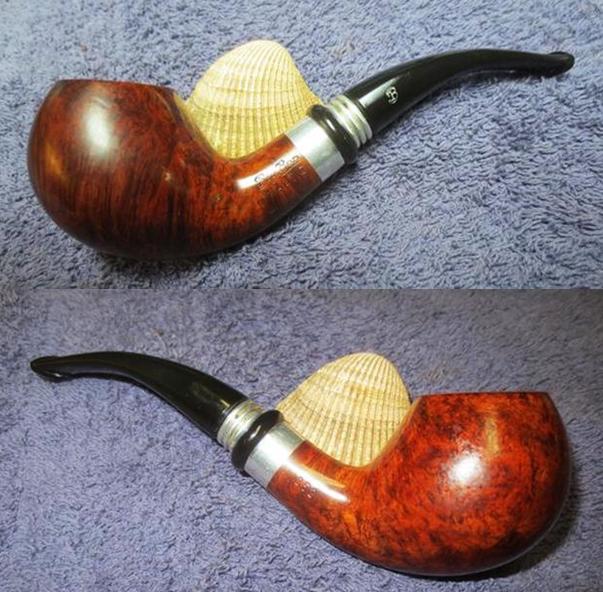
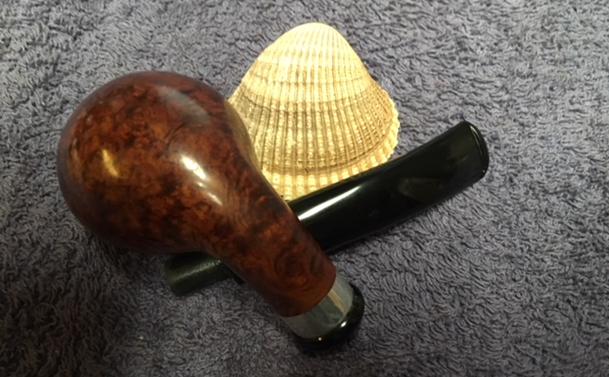
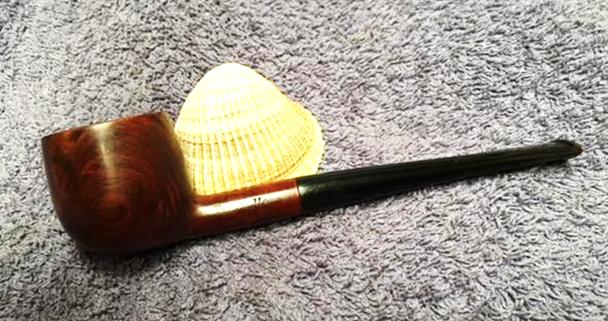
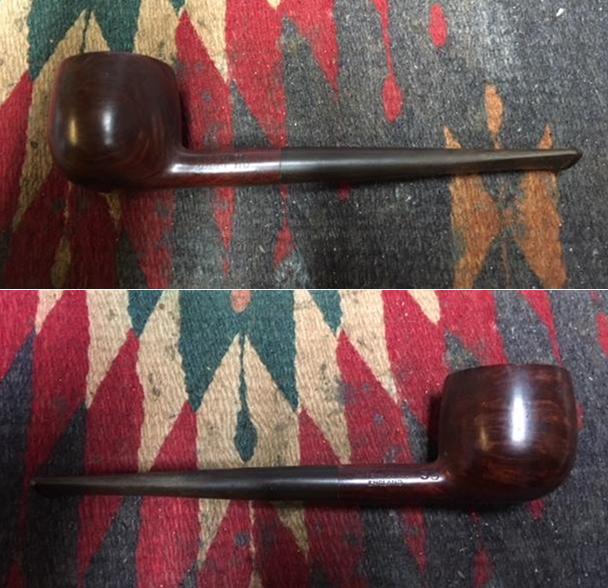
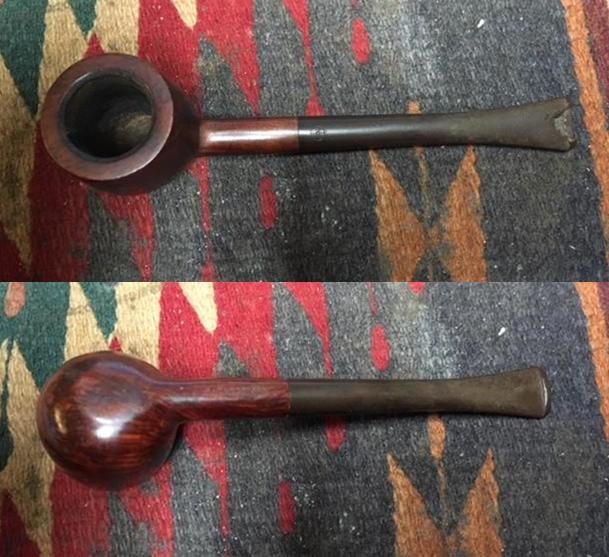
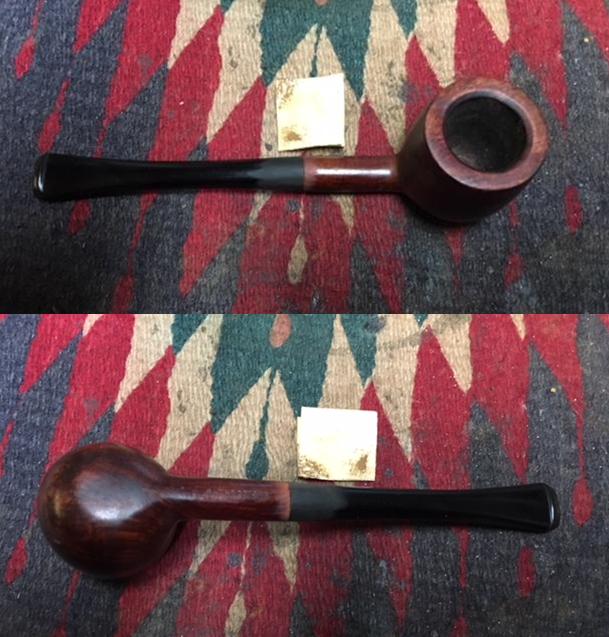
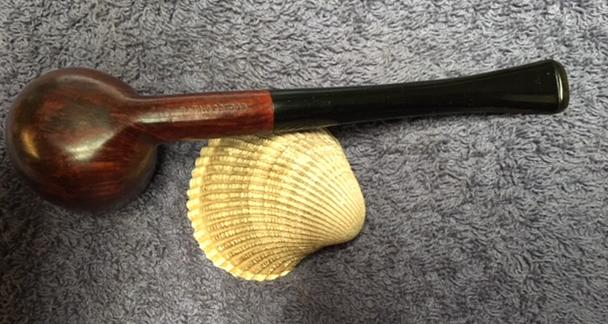
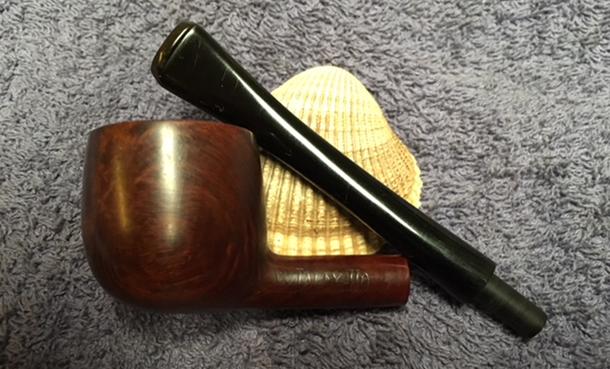
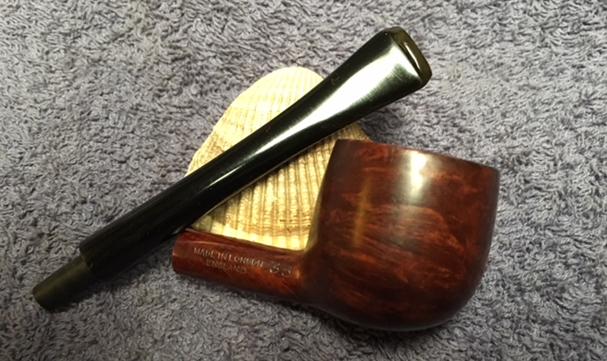
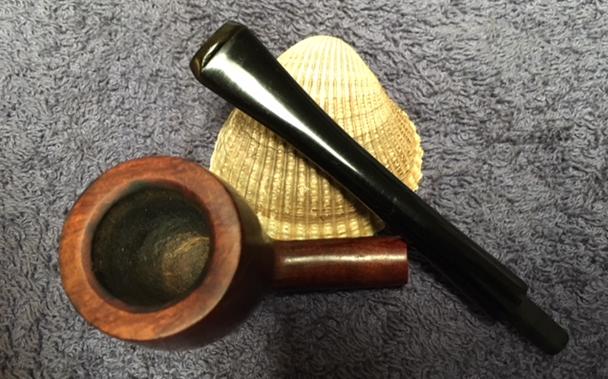
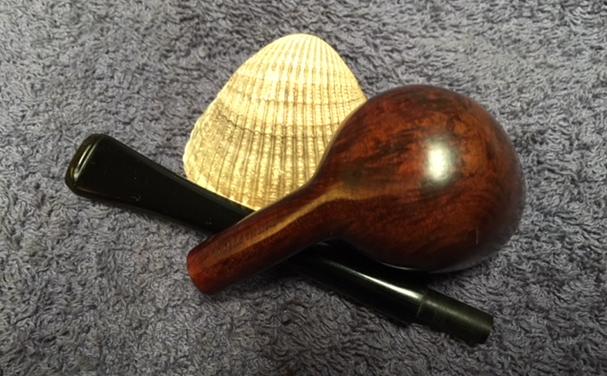
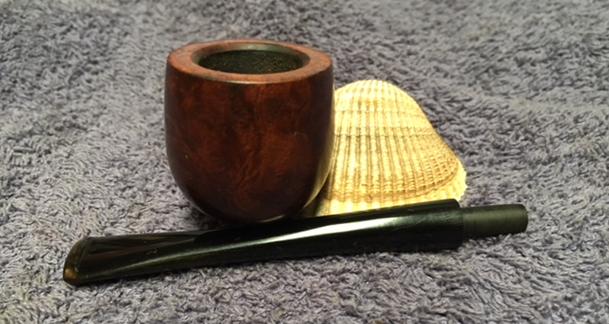
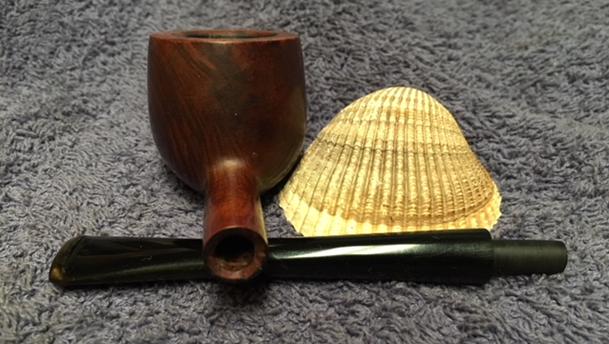
Restemming a 428 & 413 Brigham


Blog by Ryan Thibodeau

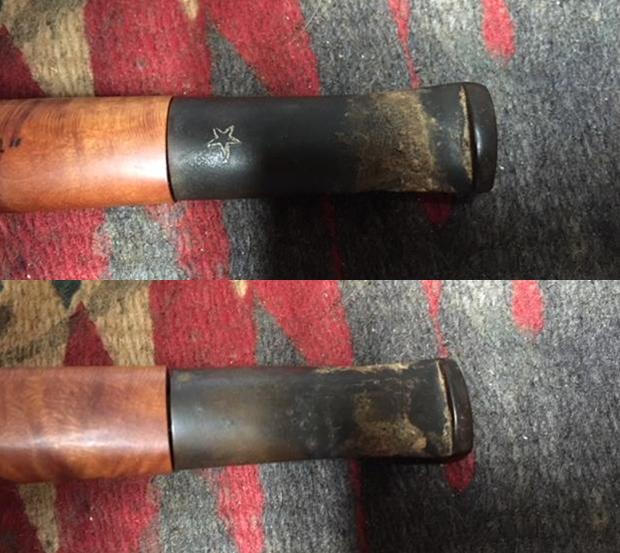
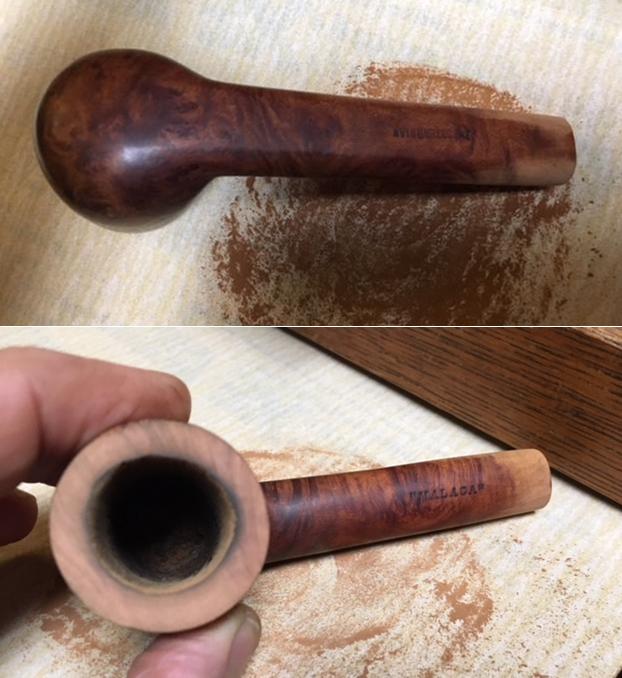
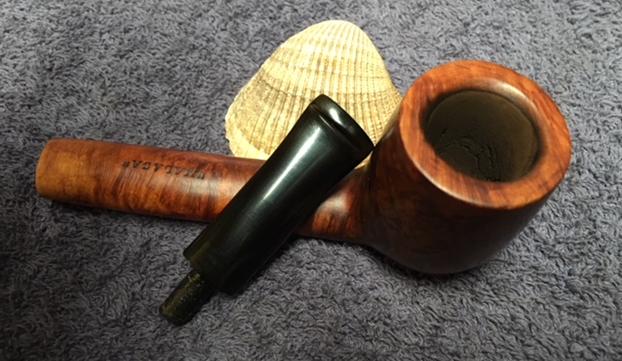
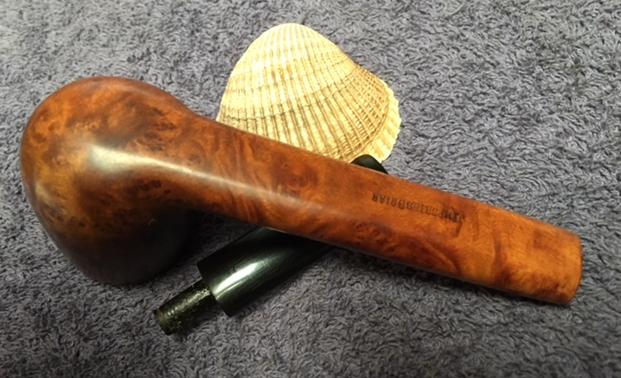
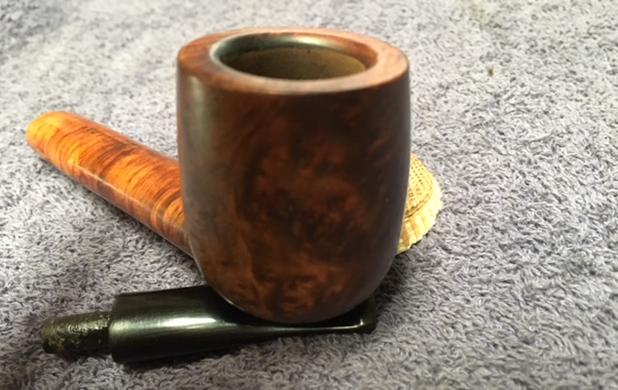
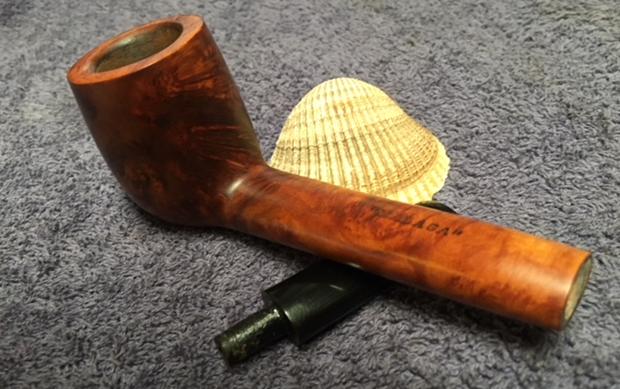
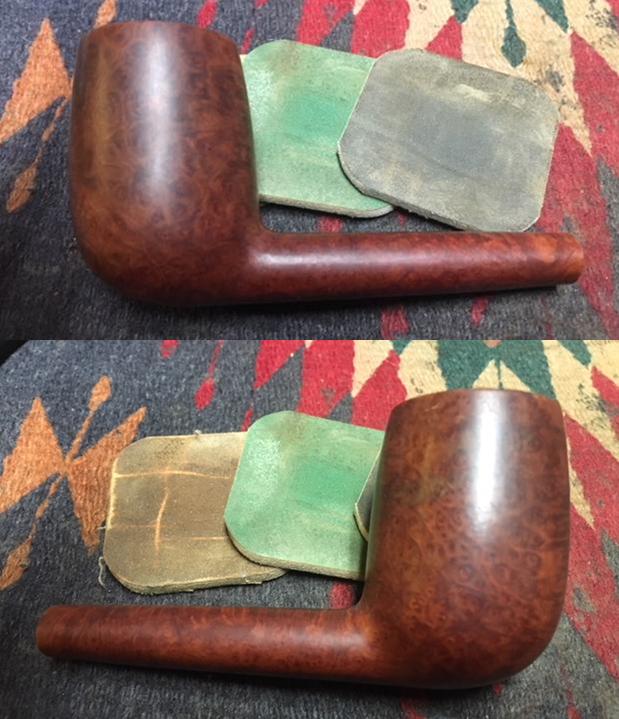
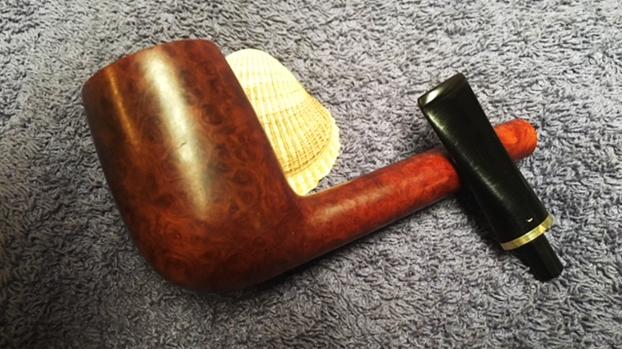
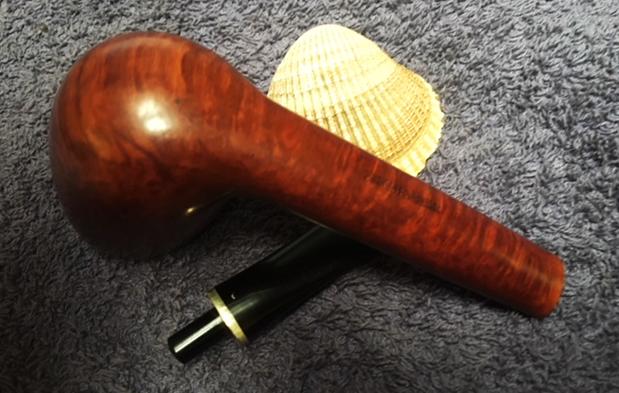
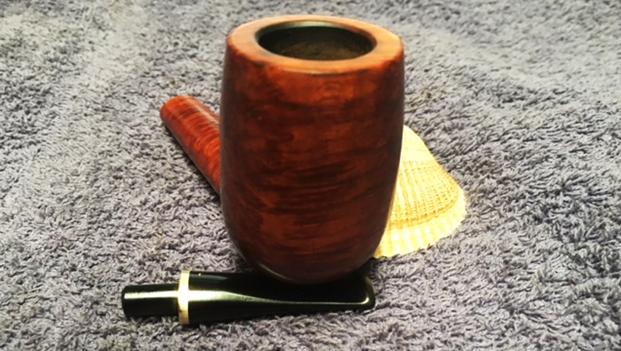
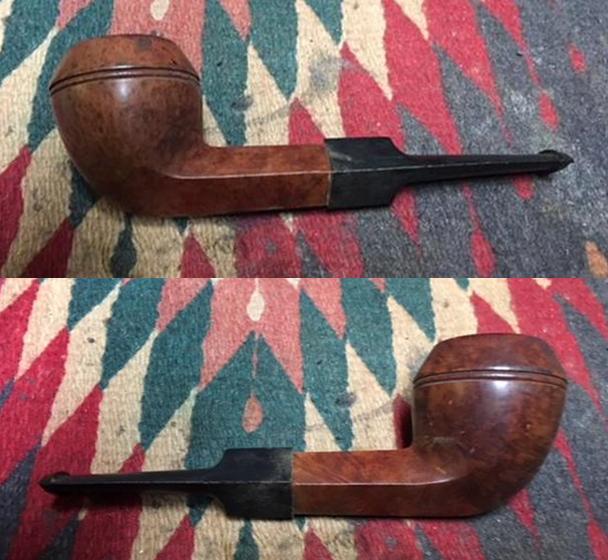
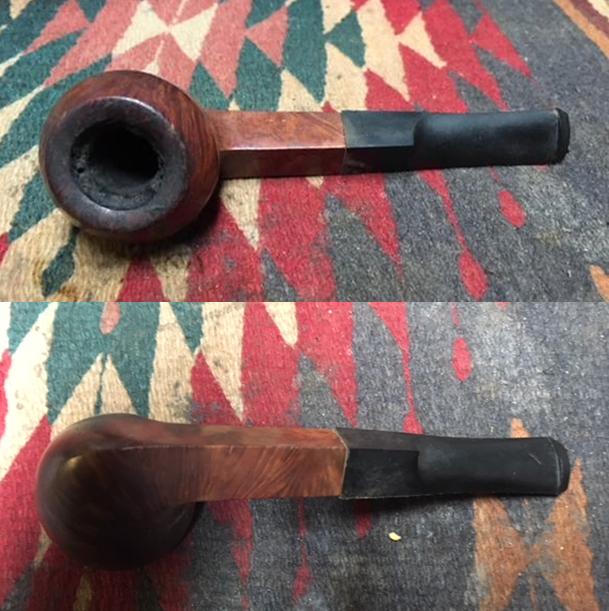
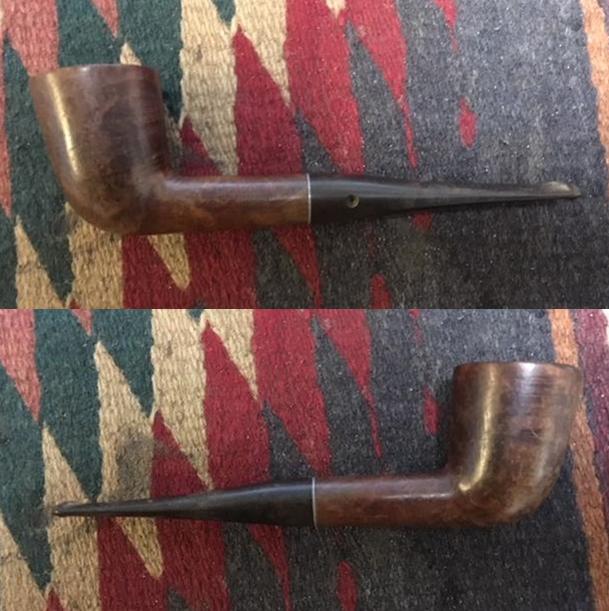
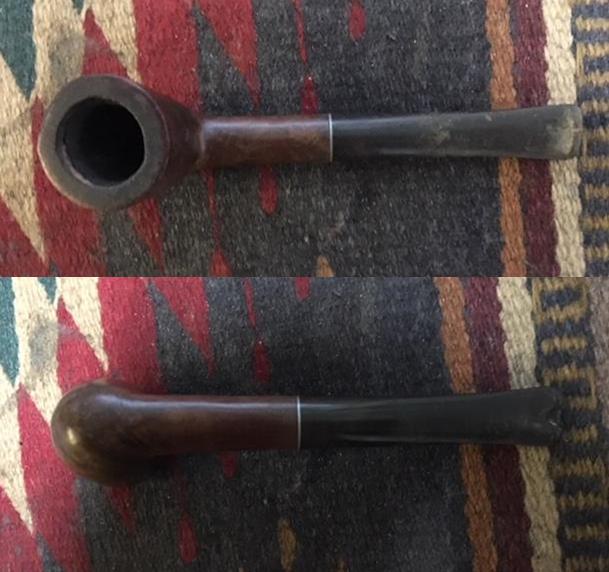
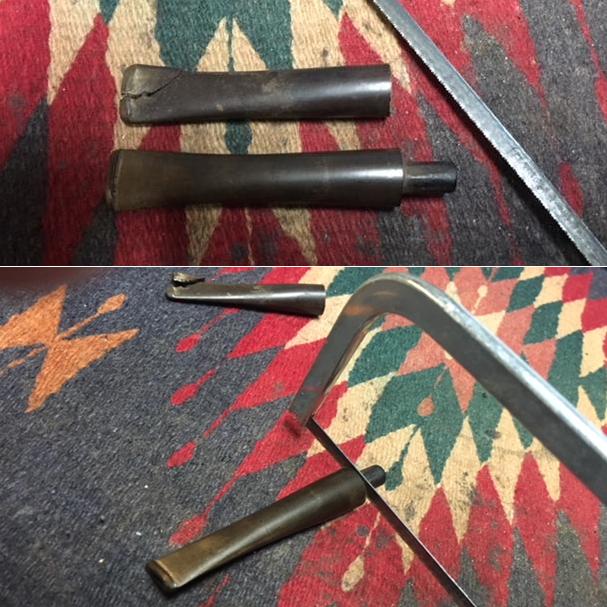
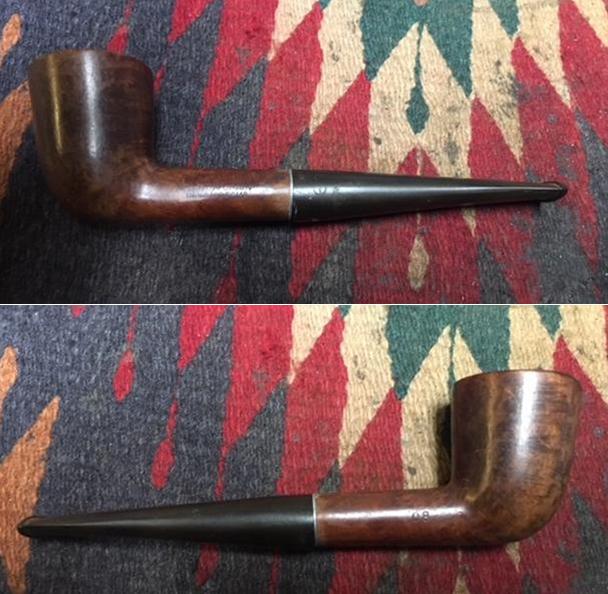
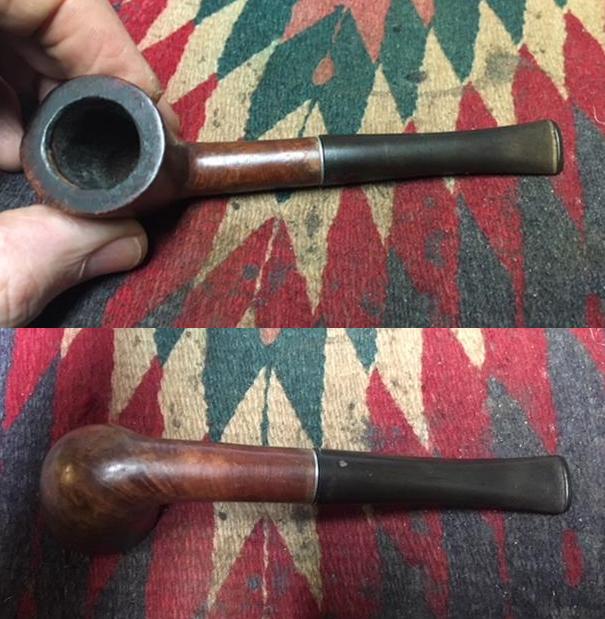
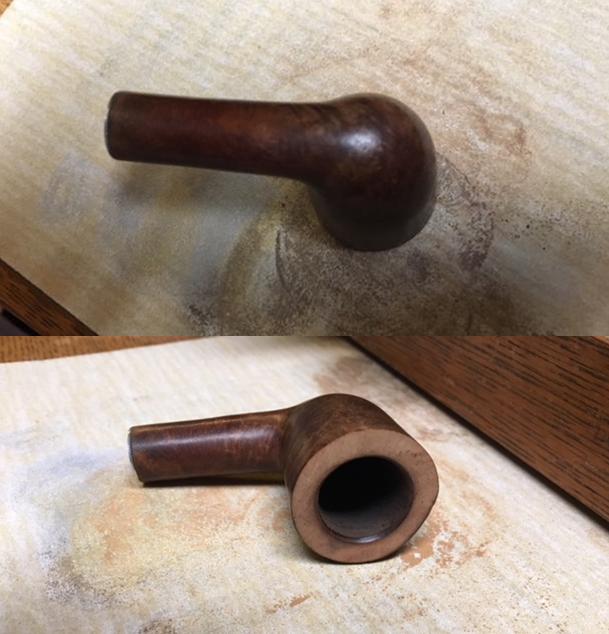
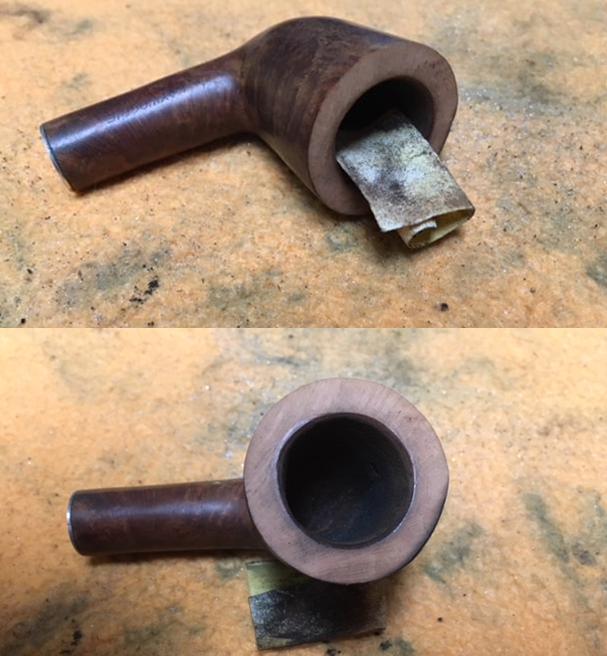
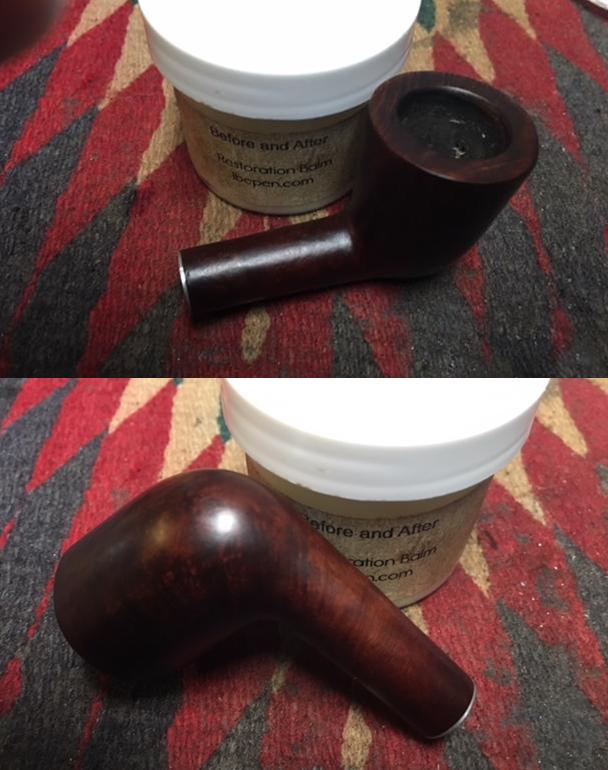
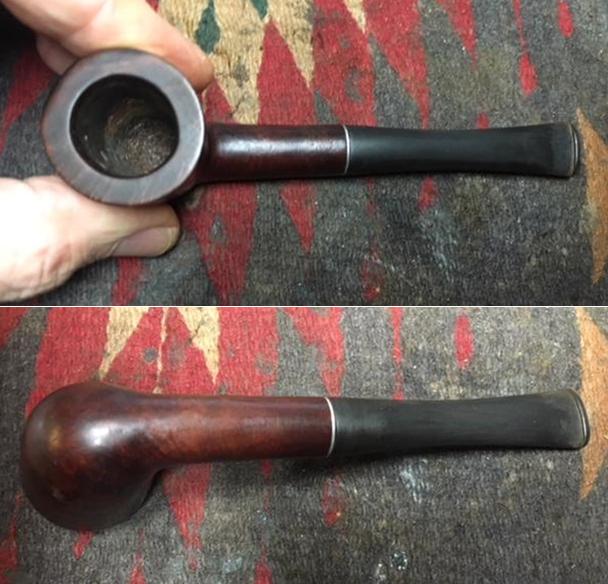
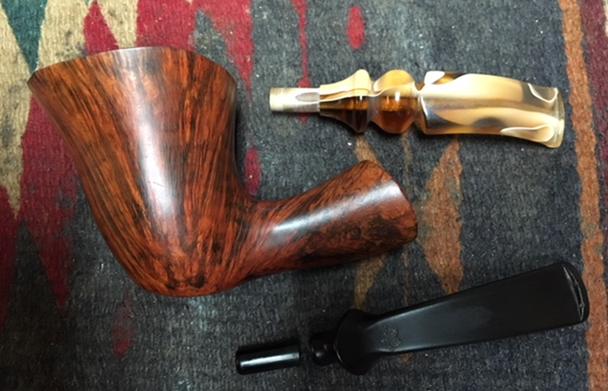
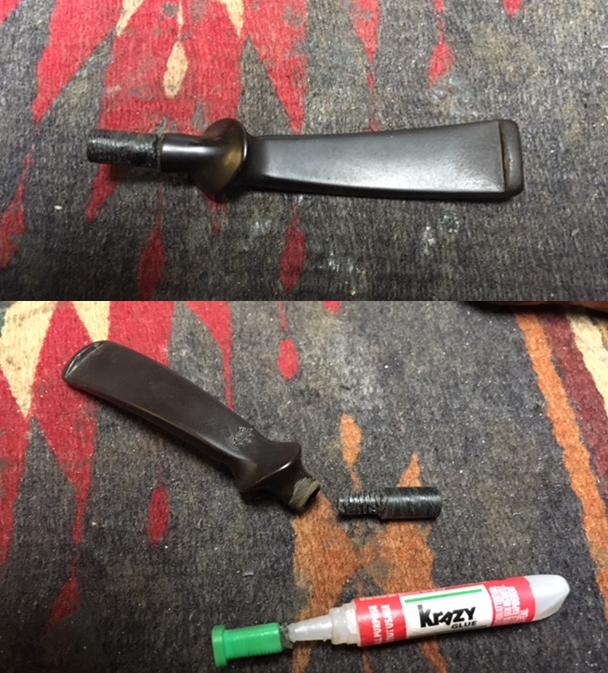
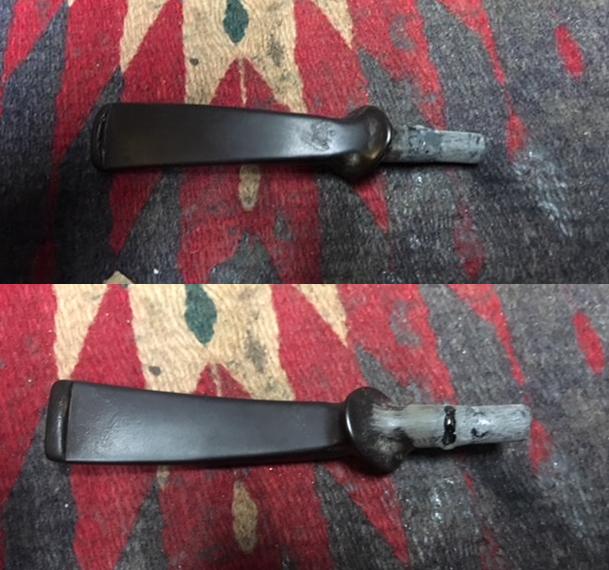
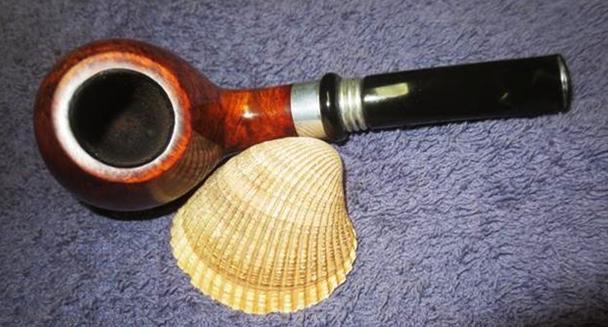
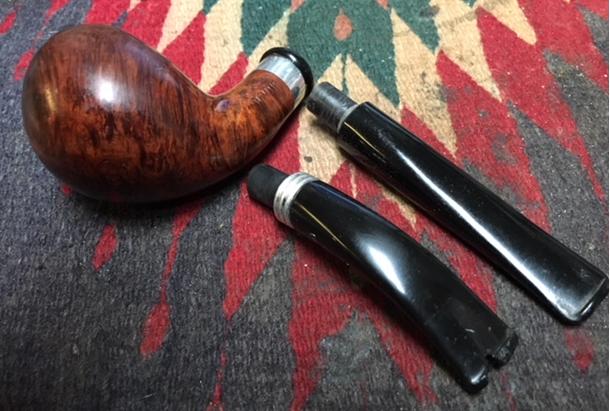
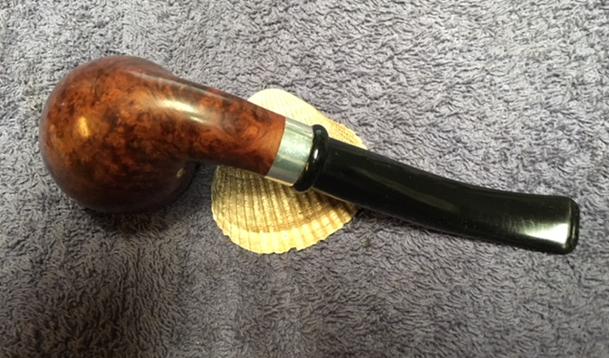
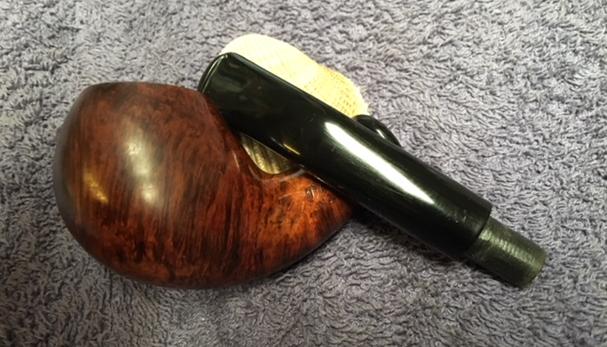
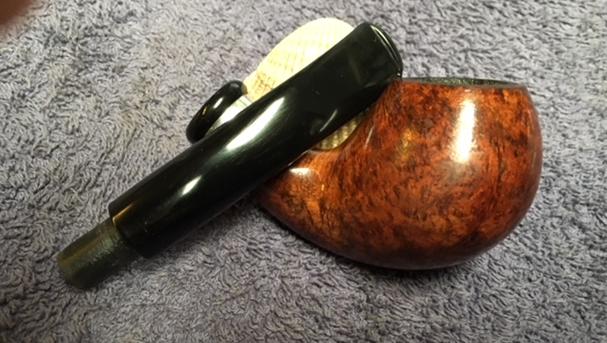
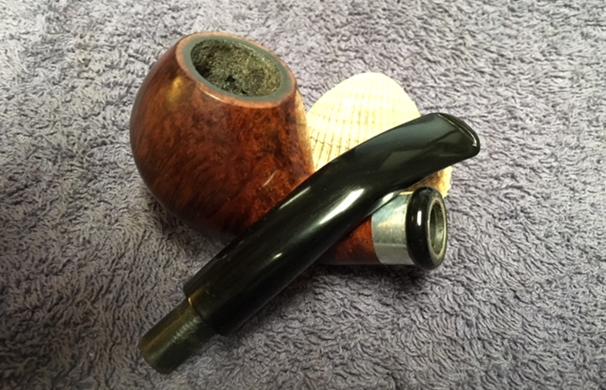
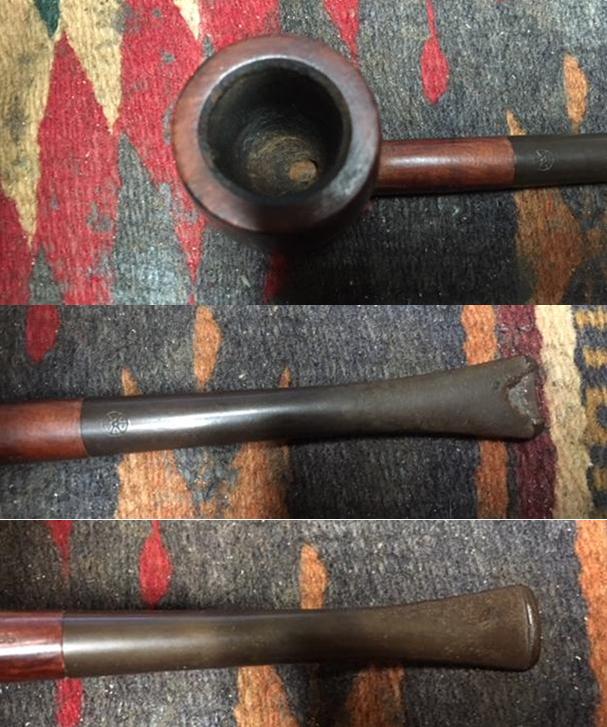
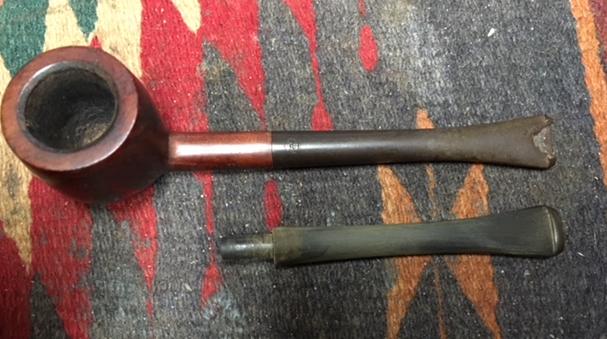
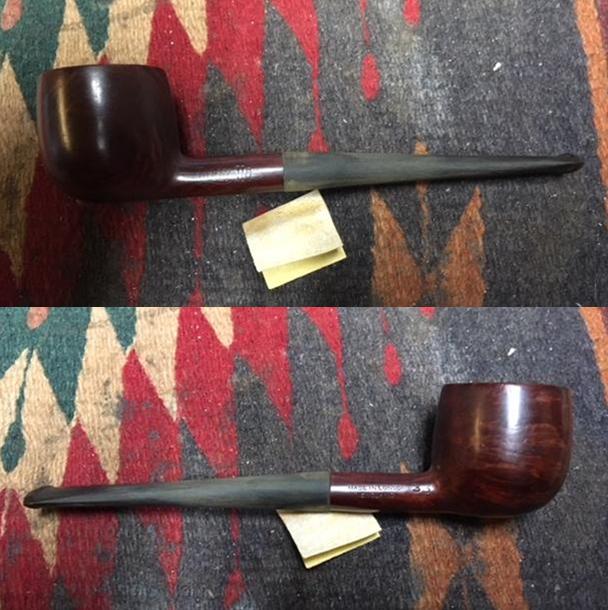
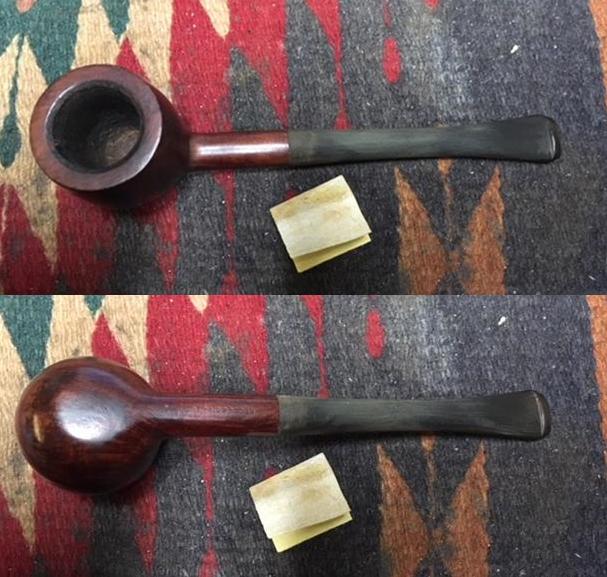
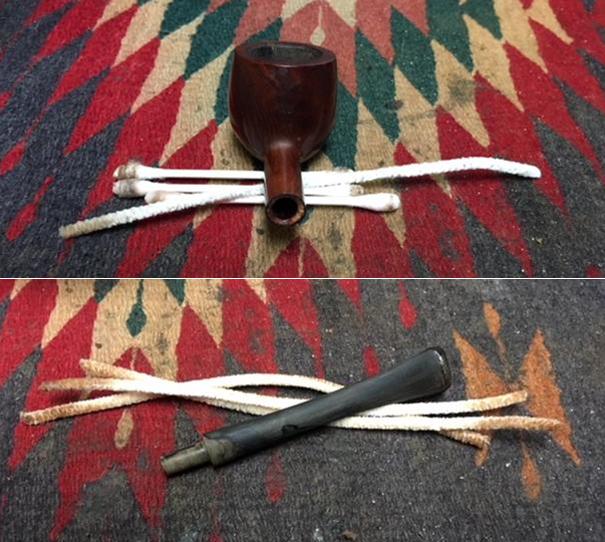
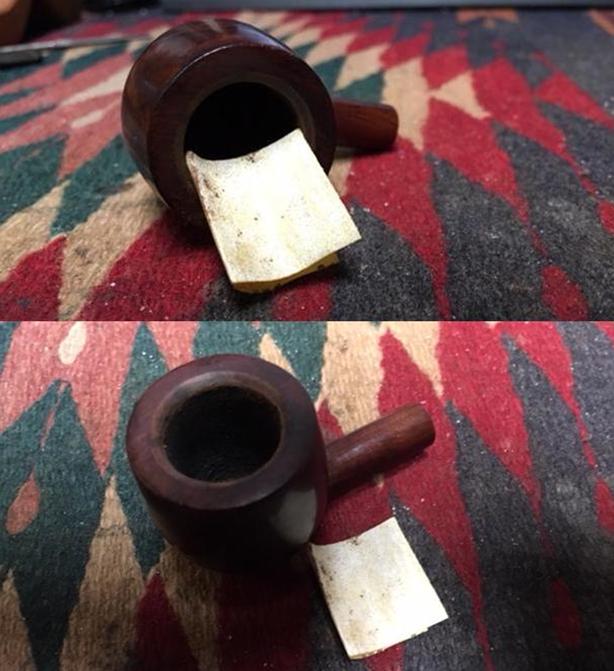
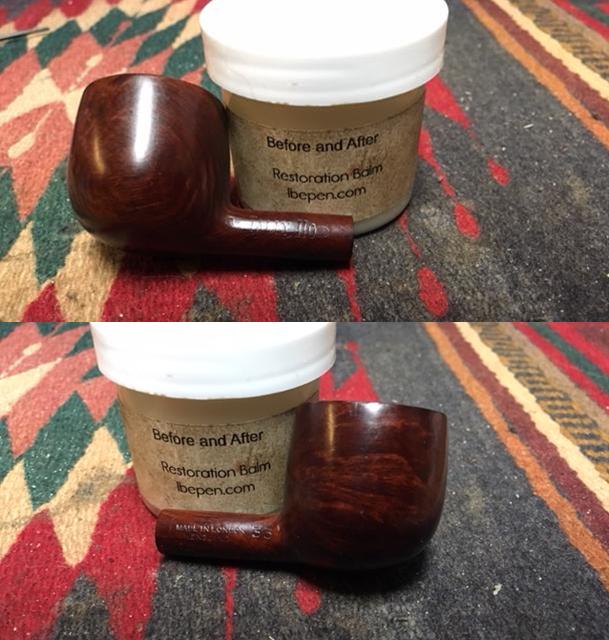
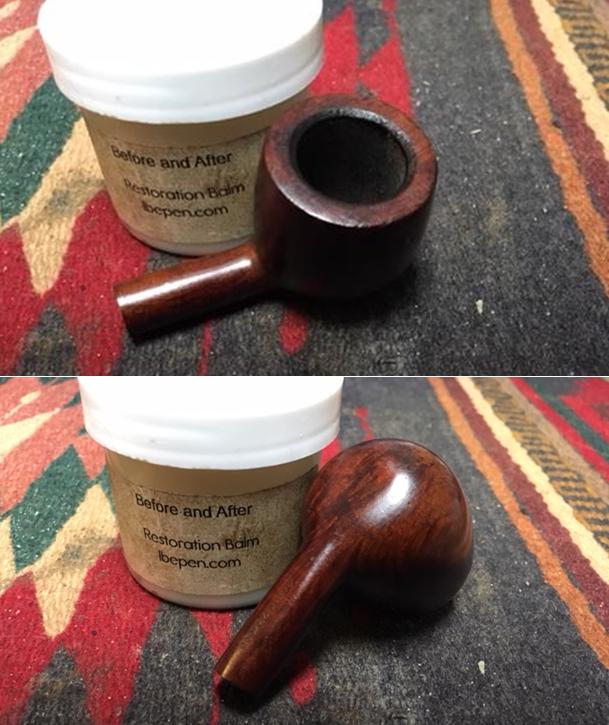
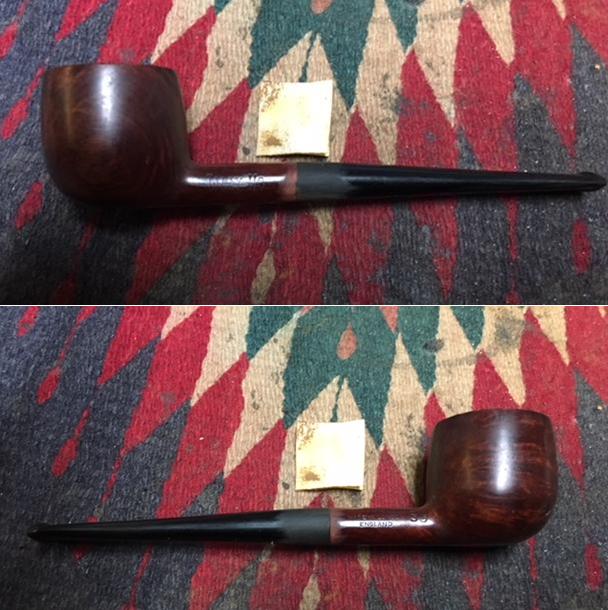
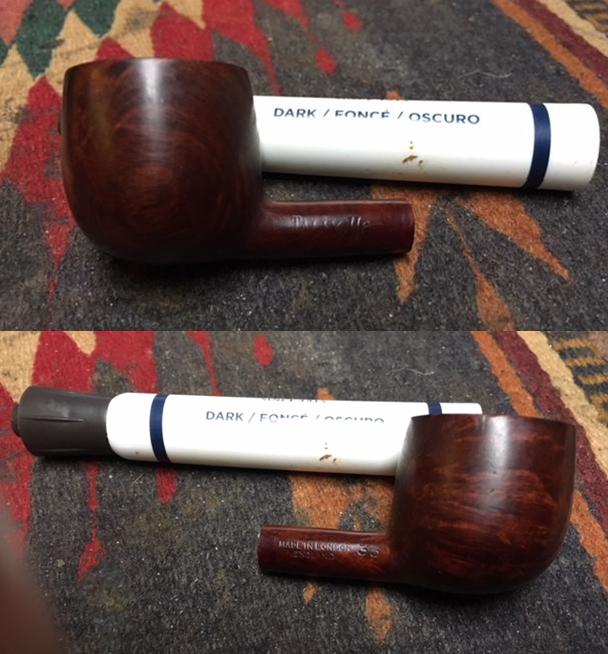
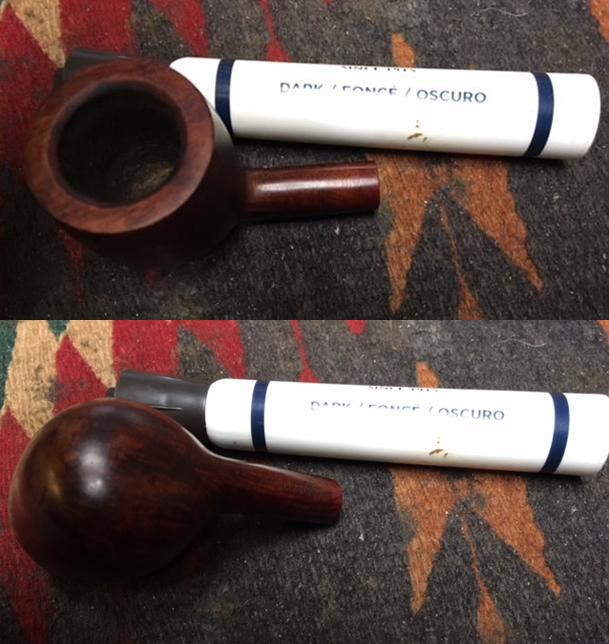
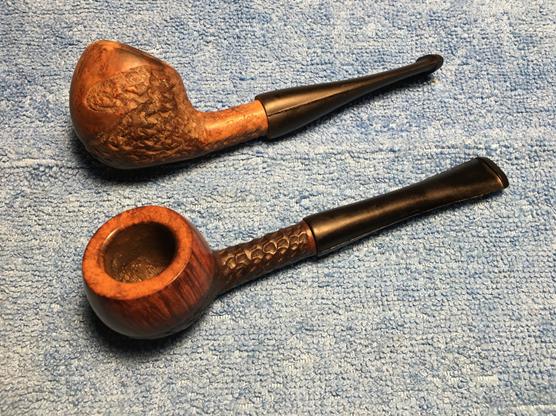
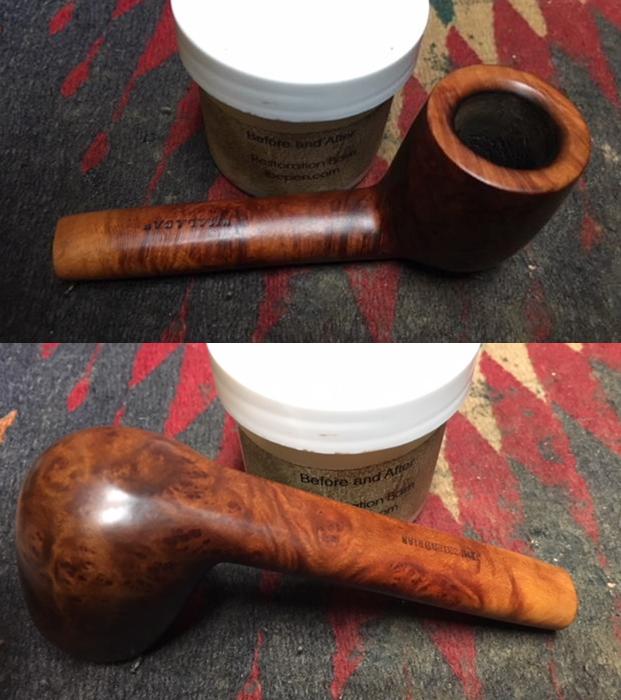
I recently purchased two Brigham 4 dot pipes online. One was part of a pipe lot and the second was a stand alone pipe that appealed to me on eBay. The first is a Brigham 413 pot, it is a shape that I’ve become quite fond of. Once I had the pipe in my hand I attempted to turn the stem from the shank without success. The aluminum tenon was seized in the mortise. I figured “how bad could it really be stuck”, well I discovered how stuck it was when I basically fractured and broke the vulcanite stem away from the tenon itself…..ouch! I took a few deep breaths and put the stummel aside as I was going to have to make a new stem for this pipe now.

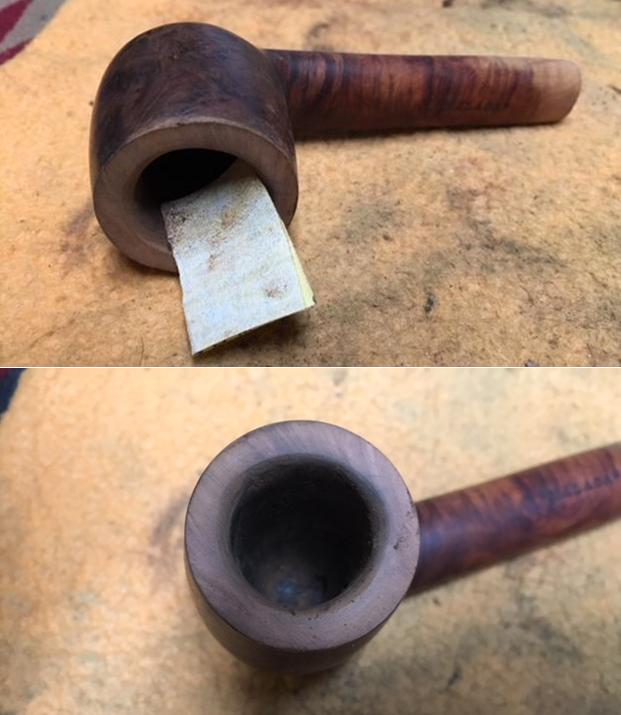
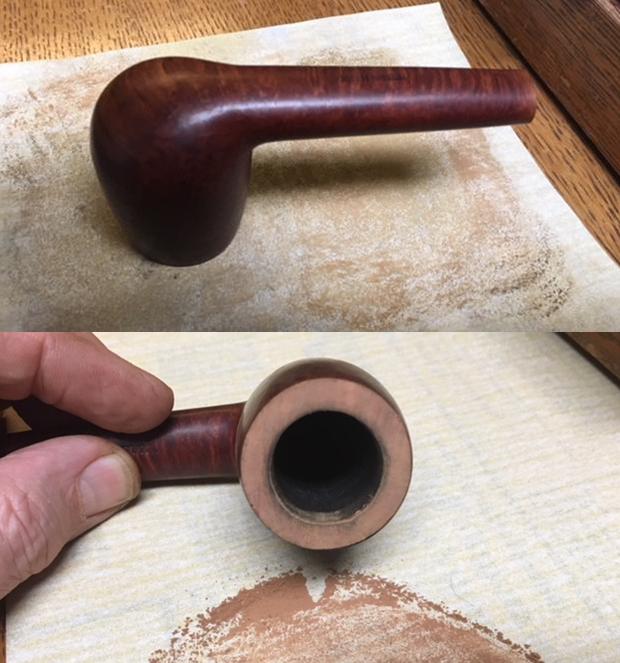
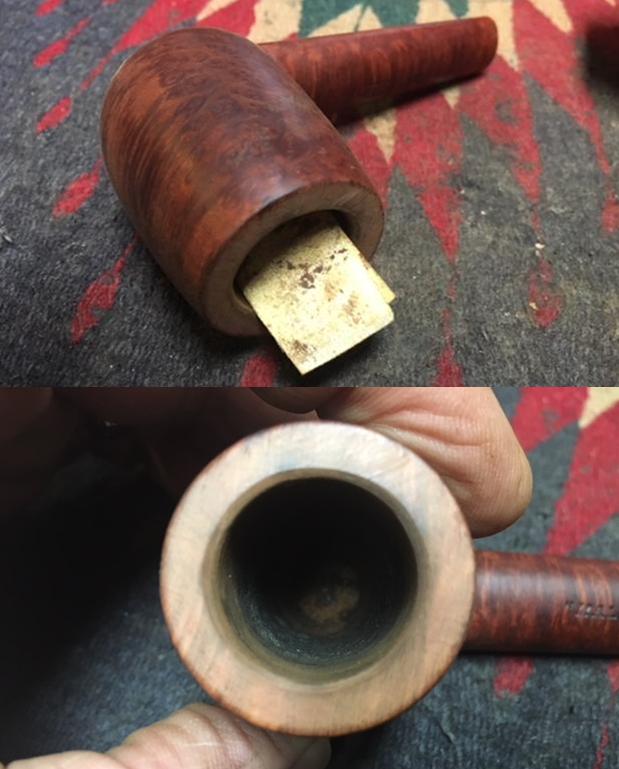
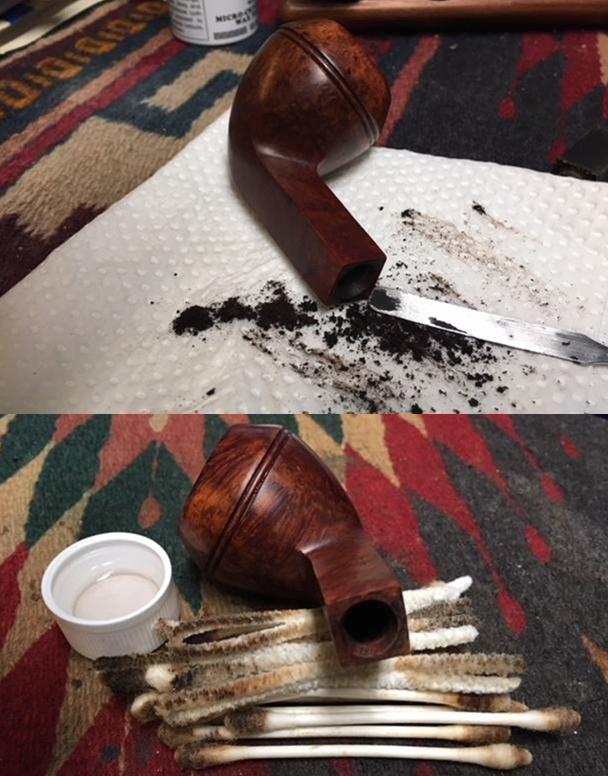
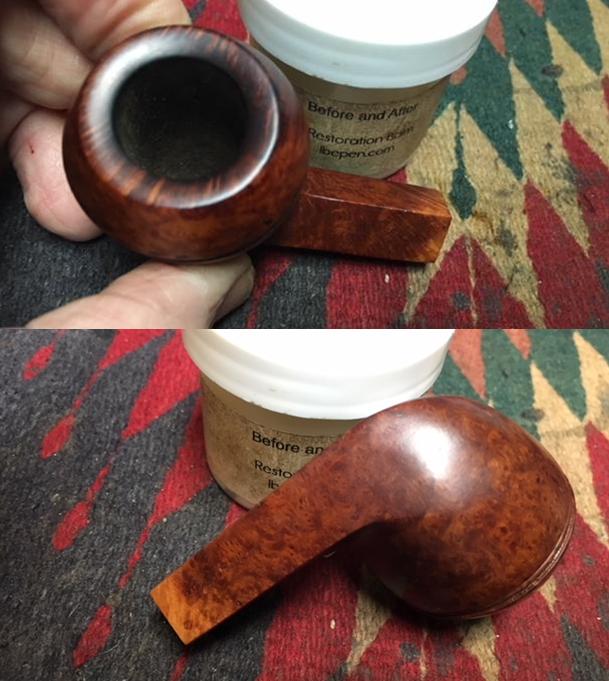
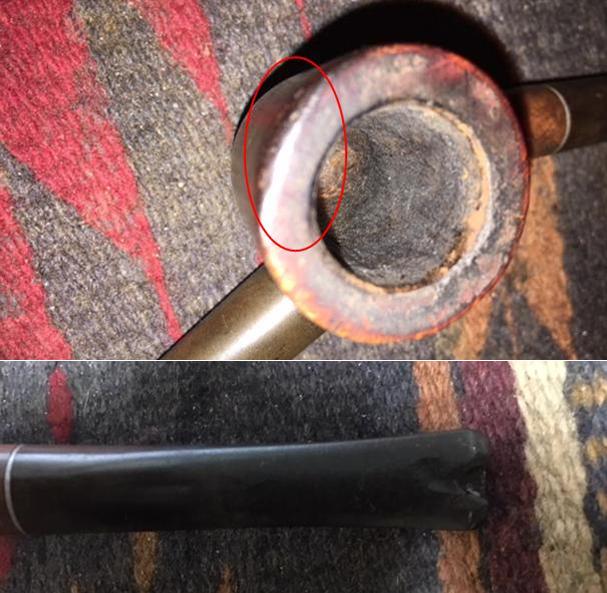
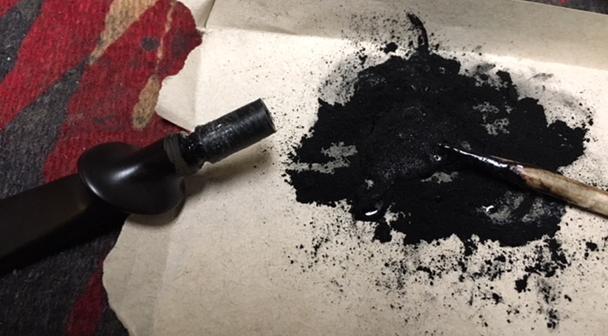
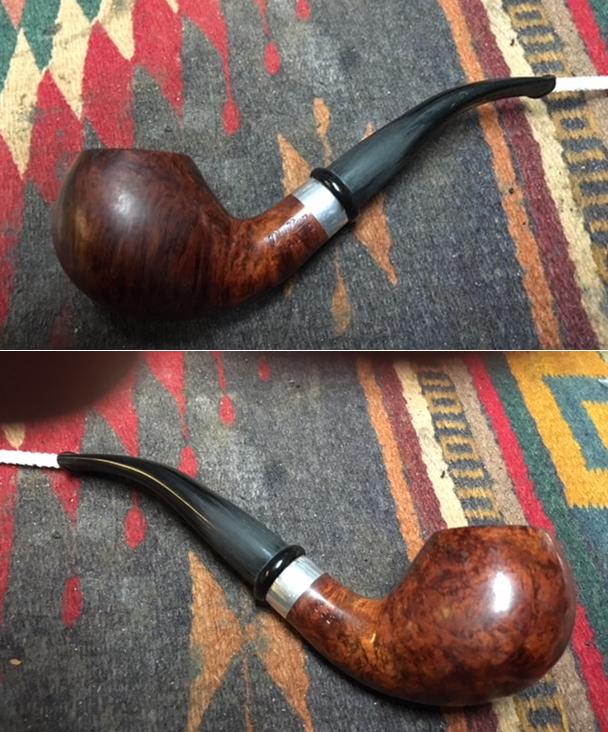
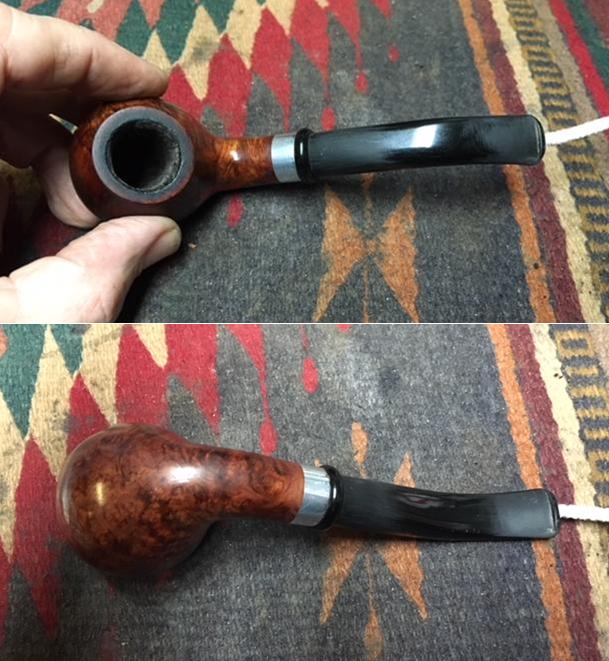
The second pipe, a 428 Brigham (bent apple I think) came to me with some challenges as well. The button had been broken off by the previous owner and he had simply shaped a new button further down the stem, secondly it appears that he had over reamed the bottom of the bowl and attempted to build it back up with glue and sawdust. I now had two pipes that need new stems, so I paired these two projects together and worked on both at the same time.

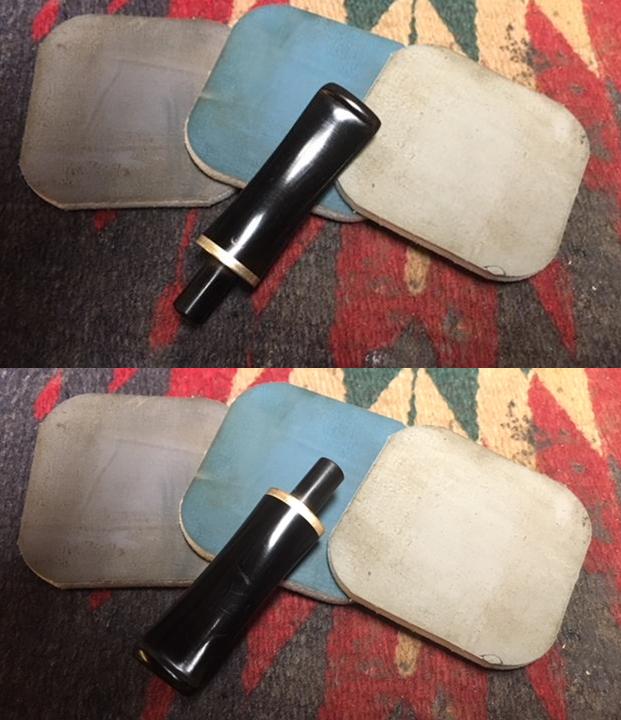
If you have never had to replace the tenon on a Brigham stem, the following are the methods I use, I hope you find it informative.

Step 1: Salvage the aluminum tenon

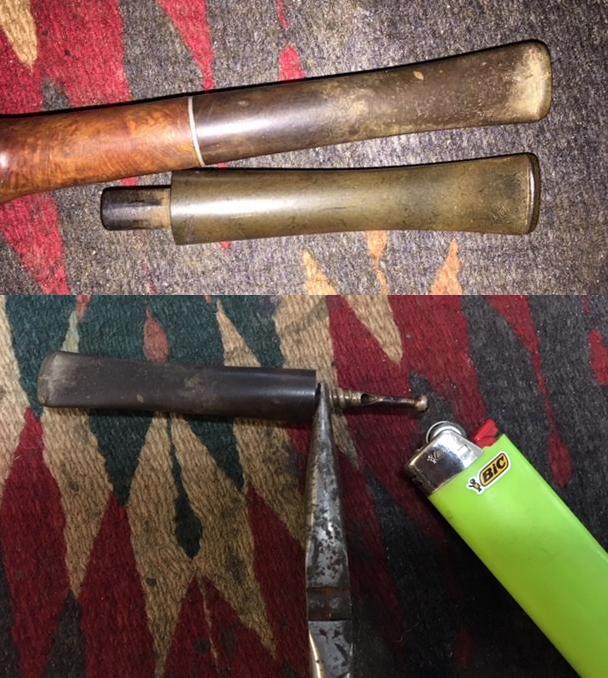
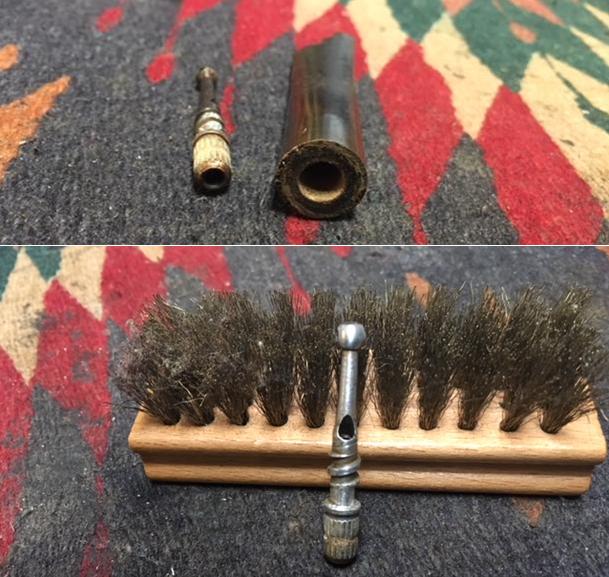
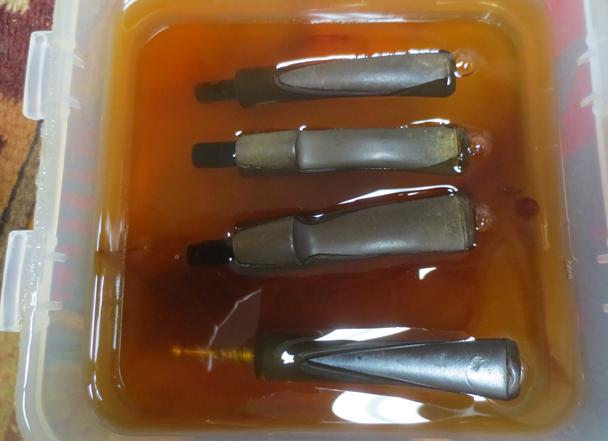
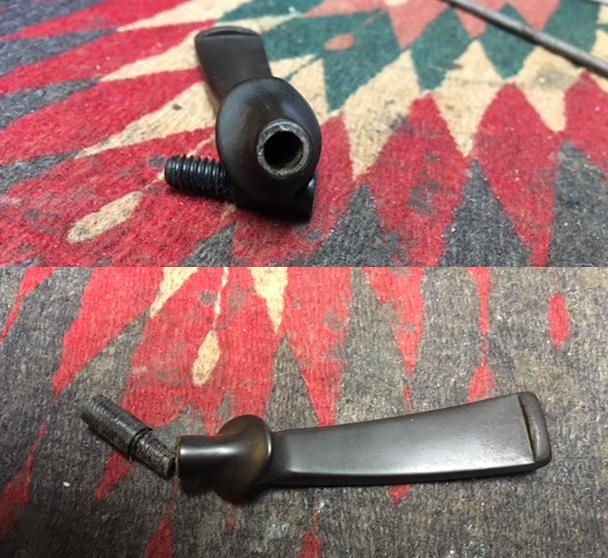
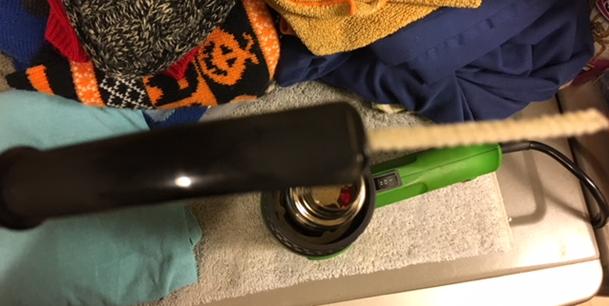
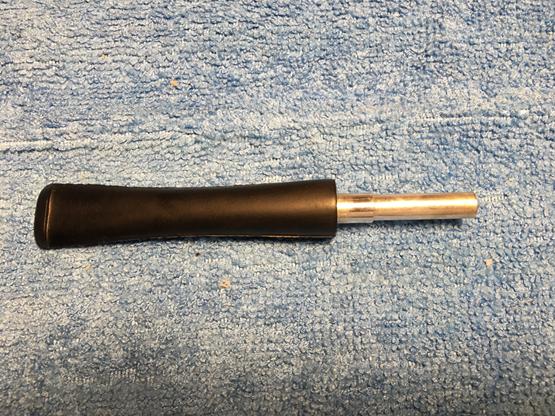
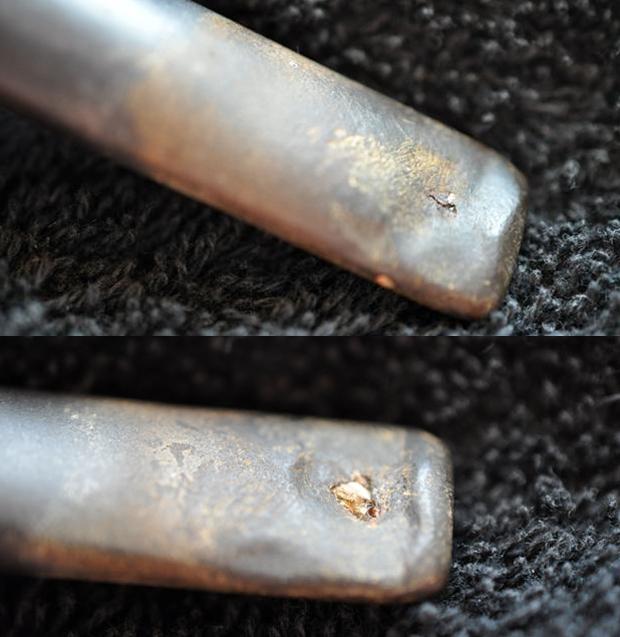
The Brigham filter tenons are basically just held in place by friction inside the stem. The factory would further secure it in place by drilling through the stem into the tenon when they add the brass dots for grading. Only one of the brass pins secures the tenon. The simplest method to remove the tenon is to heat up the stem with a heat gun on the lowest setting. You just need it warm enough to make the rubber soft and the tenon will come out with little effort. If you have no intent on saving the stem (which was the case here), the brass pin will work its way out at this point too. As with all metal, depending on the age of the pipe, these tenons can corrode and decay breaking away in the stem. Don’t fret there is a solution there as well.Step 2: Cut off the tenon and level off the end of the stem.
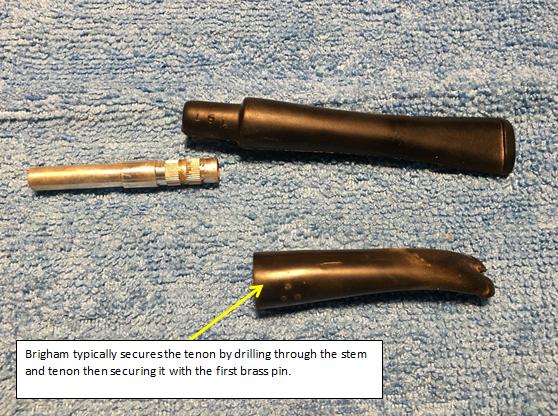
The next few steps I use with my lathe, but you could use a vice and a hand drill, or ask your spouse to hang on to the end of the stem, but the latter will have you begging for forgiveness for an indefinite amount of time (HA!).

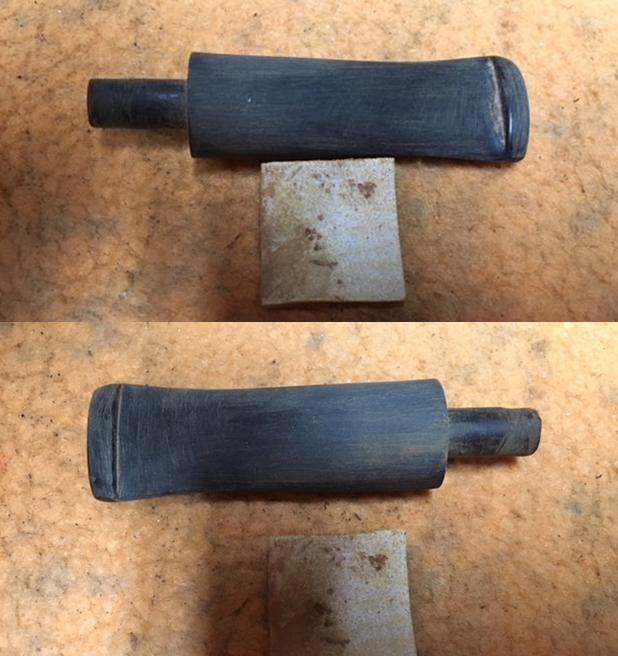
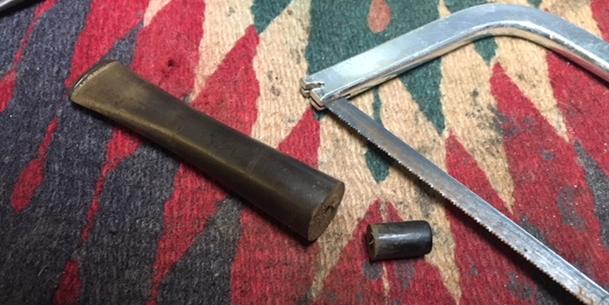
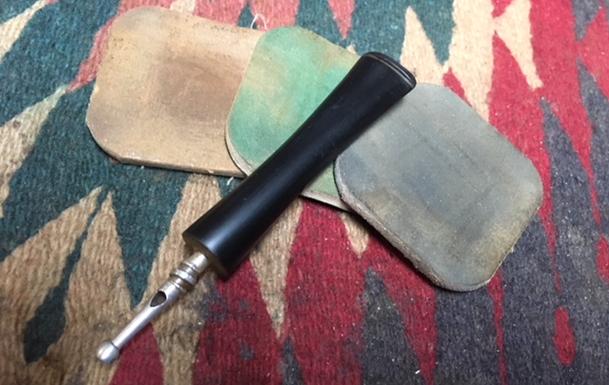
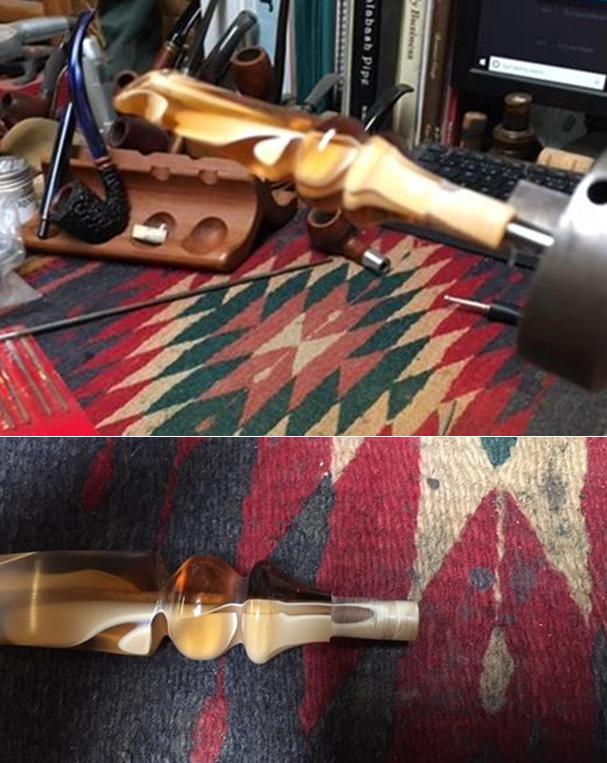
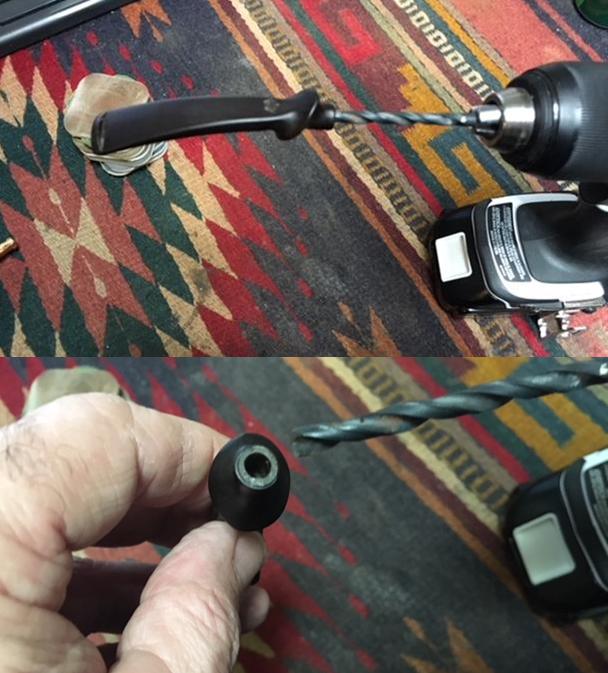
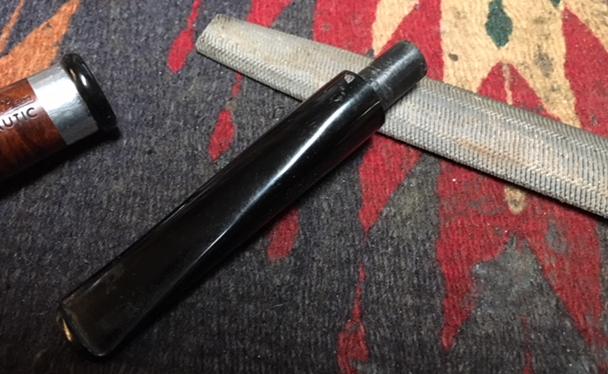
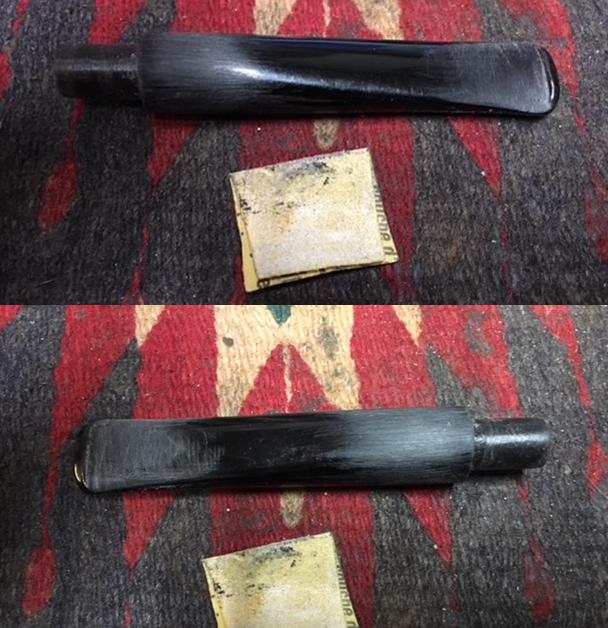
I mount the stem in my jaws and simply use a coping saw to cut off the molded tenon, then I use the PIMO tenon cutter to level off the end of the stem. Here you see me drilling a whole to accommodate for the guide pin for the tenon cutter. All I want to do here is give the stem a nice crisp edge to fit against the shank, I’m not turning another tenon but the tool is handy and suits my purpose here.
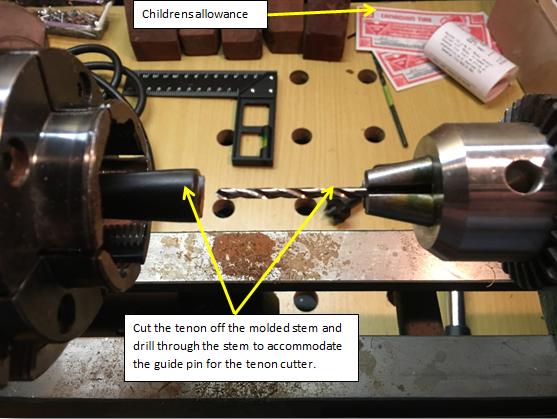
Step 3: Drill the stem to fit the tenon as well as the filter.

I use a 13/64 drill bit first to open the airway in the stem, this allows the rock maple filter to fit in the upper airway of the stem. I mark the drill bit so I don’t travel too far up the airway. If you don’t drill out the airway to the right diameter, the first time you smoke the pipe with the filter in, the filter will become part of the stem, so this part is very important.

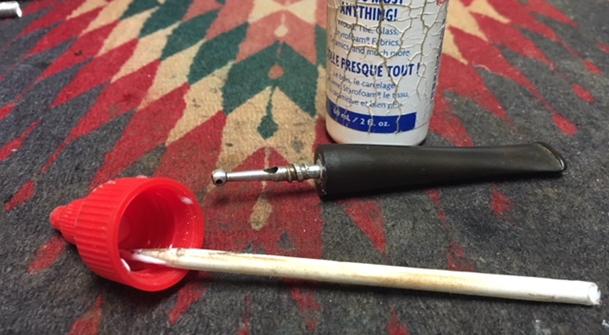
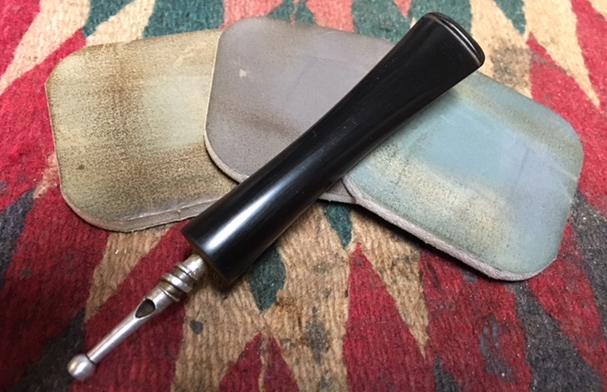
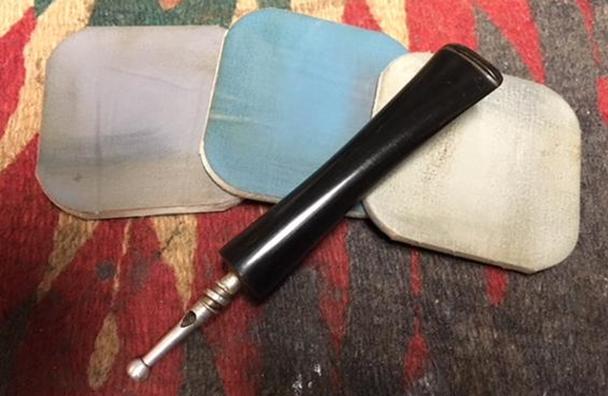
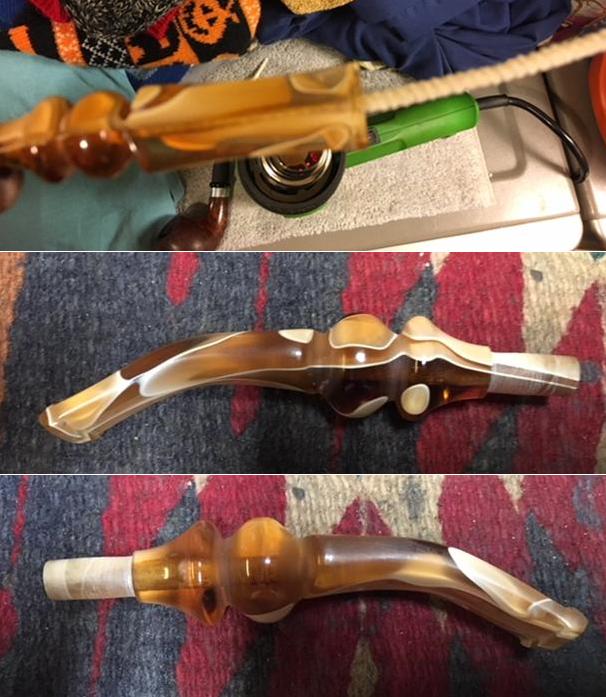
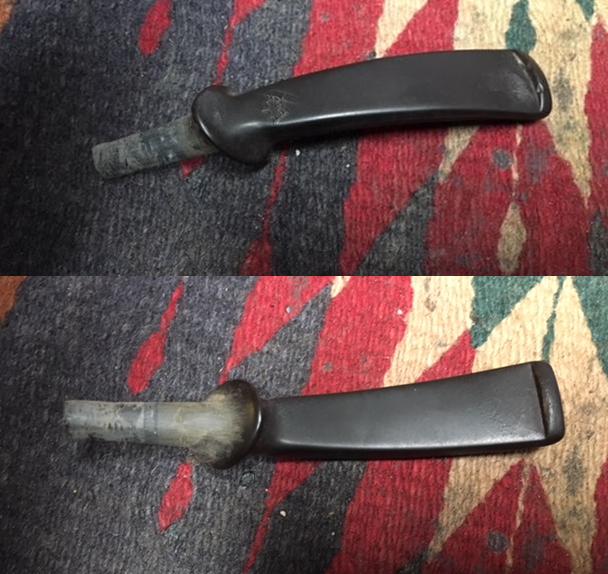
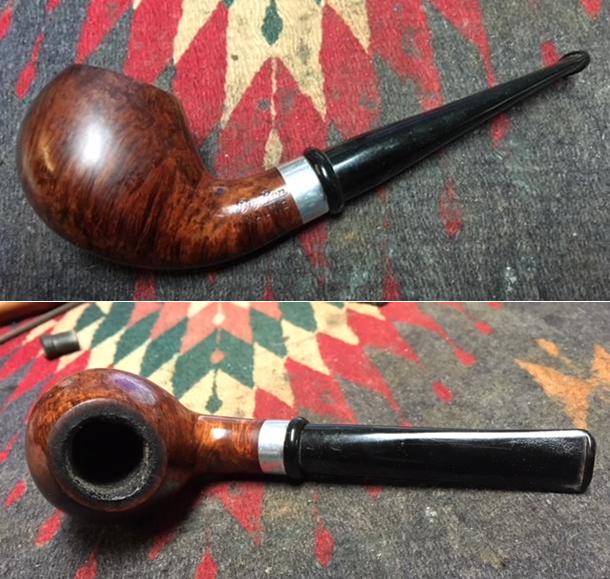
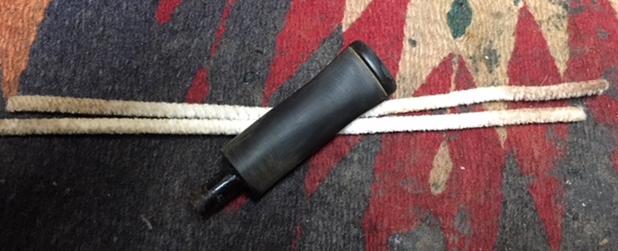
Next I drill the airway to accommodate the filter tenon that secures into the stem. You will see that the filter tenon has groves to help keep it in place with friction. A 9/32 drill bit works perfect for me to allow for a nice snug fit. Once you’ve completed the drilling process the friction of drilling the stem will make it somewhat pliable, this is the best time to insert the tenon back into the stem. Let the stem air cool and you will now have a replacement stem for your Brigham pipe.


Kathy’s Dad’s Pipes #7– Restemming &Restoring George Koch’s “Malaga” Canadian


Blog by Steve Laug

This is the sixth of the “Malaga” pipes that I am working on from Kathy’s Dad’s pipes. For those of you who have not read the other blogs let me tell the story. Last fall I received a contact email on rebornpipes from Kathy asking if I would be interested in purchasing her late Father, George Koch’s estate pipes. He was a lover of “Malaga” pipes – all shapes and sizes and she wanted to move them out as she cleaned up the estate. We emailed back and forth and I had my brother Jeff follow up with her as he also lives in the US and would make it simpler to carry out this transaction. The long and short of it is that we purchased her Dad’s “Malaga” pipes. There are some beautiful pipes in that lot. I have never seen this many “Malagas” together in one place in all of my years of pipe restoring and refurbishing. They varied from having almost pristine to gnawed and damaged stems that will need to be replaced. Many of the pipes already had replacement stems or maybe George had the staff at the Malaga shop in Michigan put Lucite stems on them because he was such a gnawer. I don’t know if we will ever know the answer to that as Kathy did not know for sure. She did know though that he loved the brand and that most of the pipes he smoked he purchased from the shop. These were some well used and obviously well loved pipes. Cleaning and restoring them will be a tribute to this pipeman. (Here is a link to some history of the Malaga Brand if you are interested: https://rebornpipes.com/tag/malaga-pipes/. There are also links there to a catalogue and the maker George Khoubesser.) Knowing about the pipeman who held the pipes in trust before me gives another dimension to the restoration work. This is certainly true with this lot of pipes. I can almost imagine George picking out each pipe in his assortment at the Malaga shop in Michigan. I may well be alone in this, but when I know about the person it is almost as if he is with me work on his pipes. In this case Kathy sent us not only information but also a photo of her Dad enjoying his “Malagas”. Once again, I am including that information so you can know a bit about the pipeman who held these pipes in trust before they are passed on to some of you. I include part of Kathy’s correspondence with my brother as well…

Jeff…Here is a little about my dad, George P. Koch…I am sending a picture of him with a pipe also in a separate email.

Dad was born in 1926 and lived almost all his life in Springfield, Illinois. He was the youngest son of German immigrants and started grade school knowing no English. His father was a coal miner who died when Dad was about seven and his sixteen year old brother quit school to go to work to support the family. There was not much money, but that doesn’t ruin a good childhood, and dad had a good one, working many odd jobs, as a newspaper carrier, at a dairy, and at the newspaper printing press among others. He learned to fly even before he got his automobile driver’s license and carried his love of flying with him through life, recertifying his license in retirement and getting his instrumental license in his seventies and flying until he was grounded by the FAA in his early eighties due to their strict health requirements. (He was never happy with them about that.) He was in the Army Air Corps during World War II, trained to be a bomber, but the war ended before he was sent overseas. He ended service with them as a photographer and then earned his engineering degree from University of Illinois. He worked for Allis Chalmers manufacturing in Springfield until the early sixties, when he took a job at Massey Ferguson in Detroit, Michigan. We lived in Livonia, and that’s where his love for Malaga pipes began. After a few years he returned to Allis Chalmers and we moved back to Springfield. I remember that when we went back to Michigan to visit friends, Dad had to go to the Malaga store and acquire a few new pipes. Many a year I wrote to Malaga and they picked out a pipe for me to purchase that I could give Dad for a Christmas or birthday present. He was always pleased. His favorites were the straight stemmed medium sized bowl pipes, but he liked them all.  He had some other pipes, but the Malagas were his favorites. I remember him smoking them sitting in his easy chair after work, with feet up on the ledge by the fire burning in the fireplace.  Growing up it was my job to clean them and he liked the inner bowl and stem coated with Watkins vanilla, leaving a little of that liquid in the bowl to soak in when I put them back on the rack. Dad quit smoking later in life and so they’ve sat on the racks for many years unattended, a part of his area by his easy chair and fireplace. Dad passed when he was 89 years old and it finally is time for the pipes to move on. I’m very happy they are being restored by you and your brother and hope they find homes who enjoy them as much as Dad did. Thank-you for your care and interest. — Kathy, the oldest daughter

Kathy, once again I thank you for providing this beautiful tribute to your Dad. We will appreciate your trust in allowing us to clean and restore these pipes. I am also trusting that those of you who are reading this might carry on the legacy of her Dad’s pipes as they will be added to the rebornpipes store once they are finished.

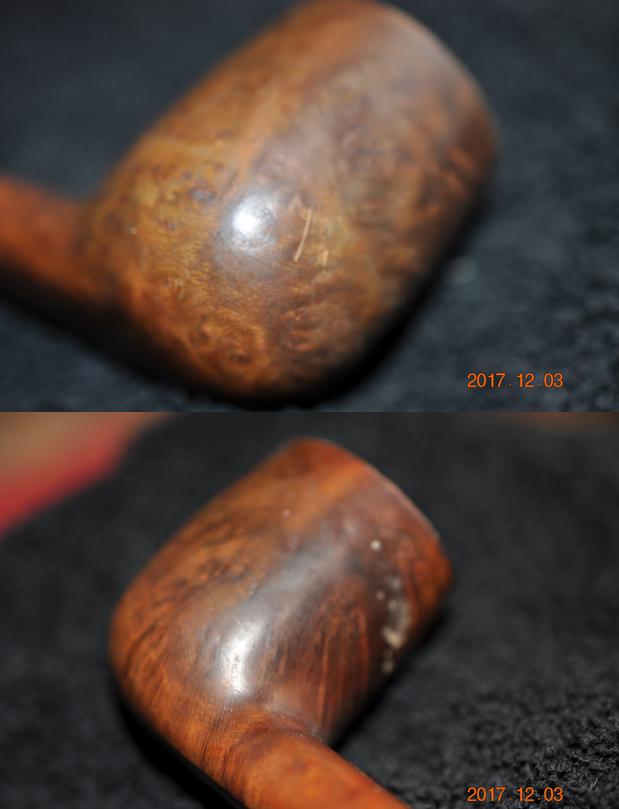
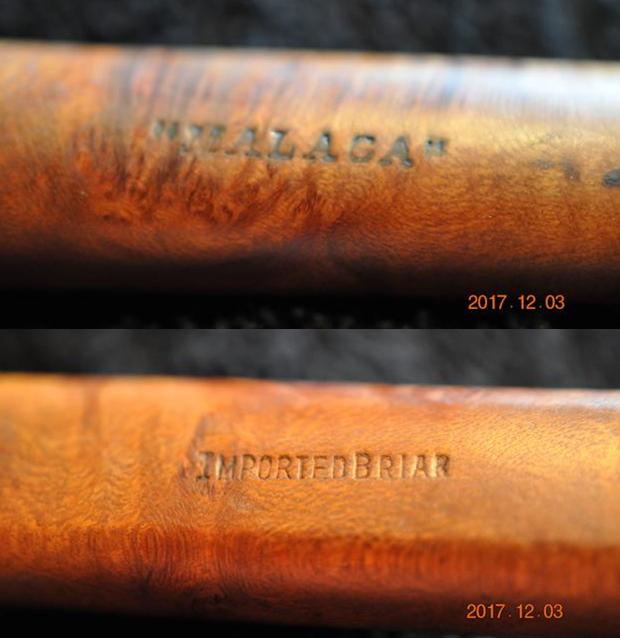
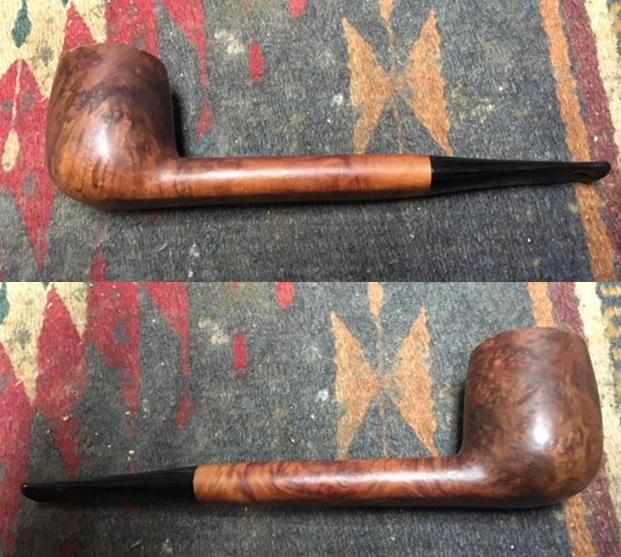
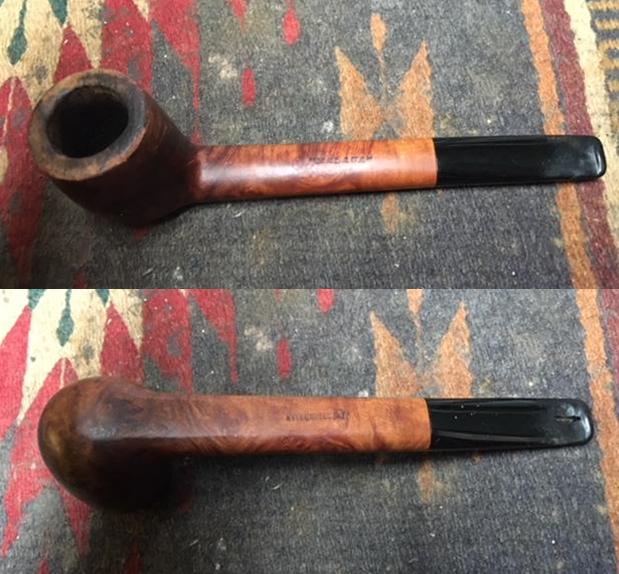
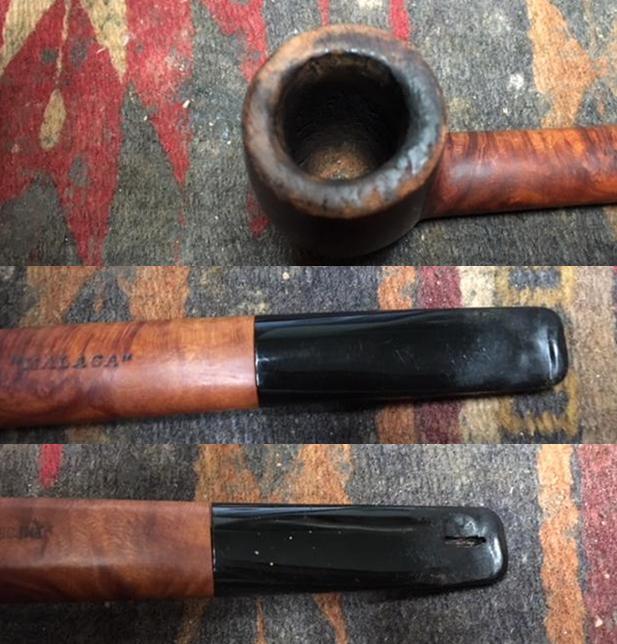
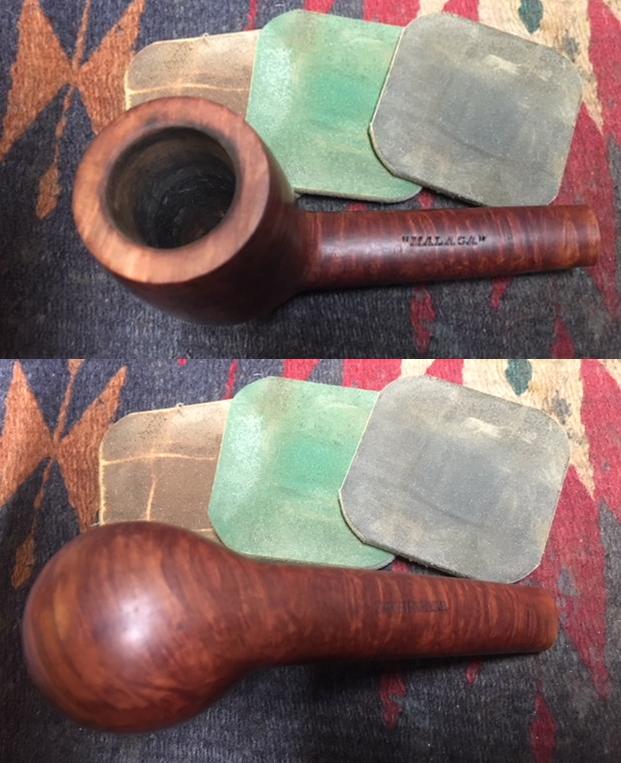
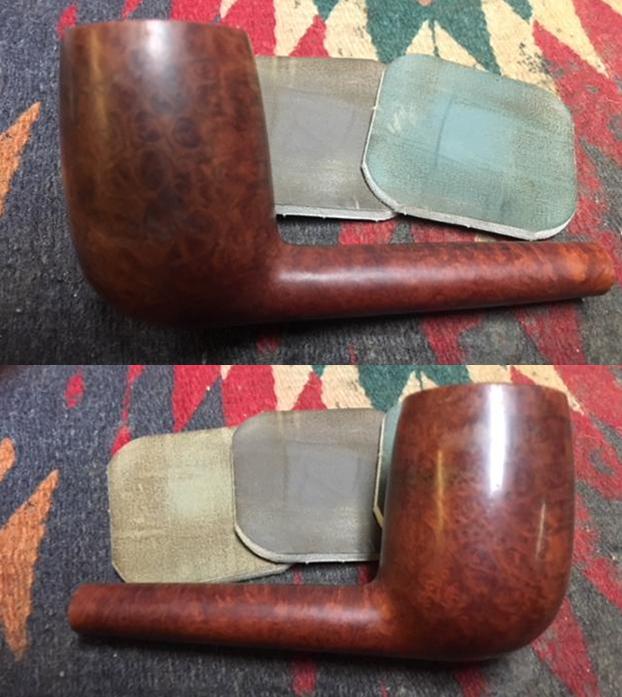
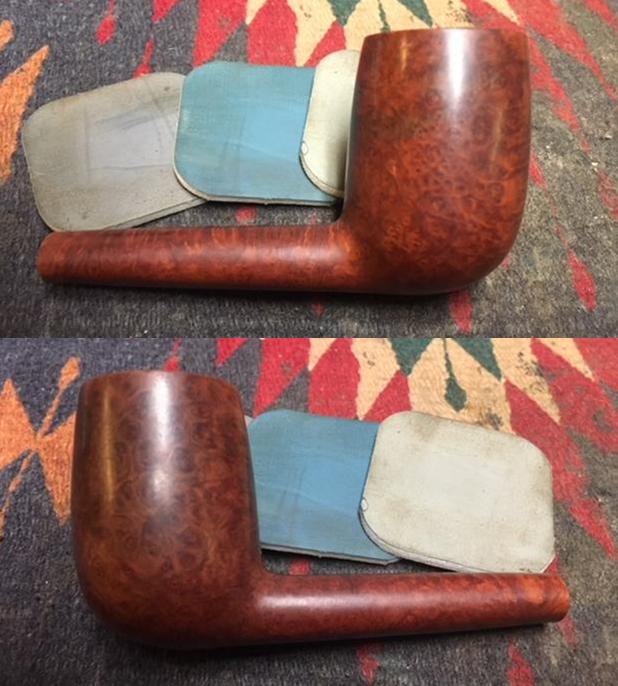
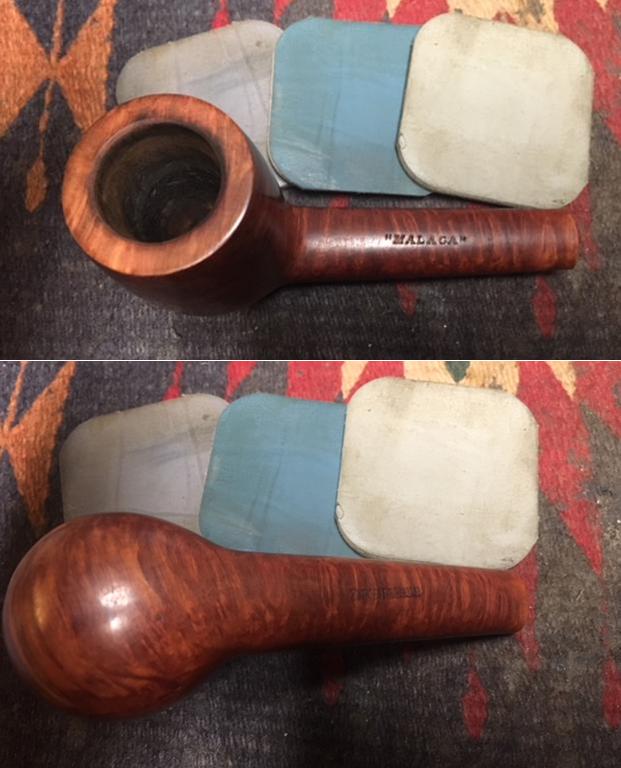
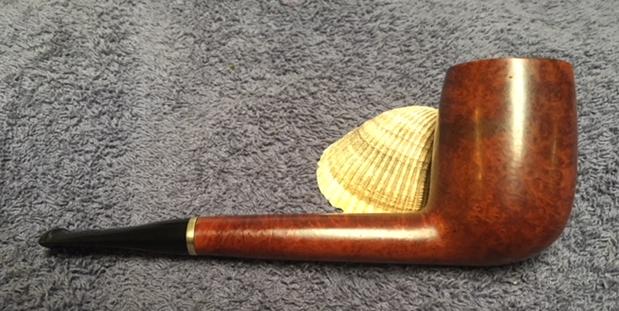
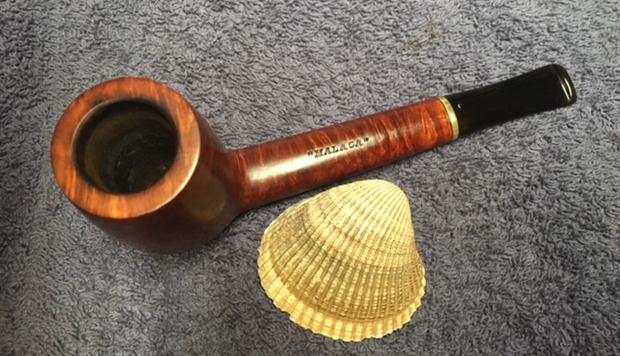
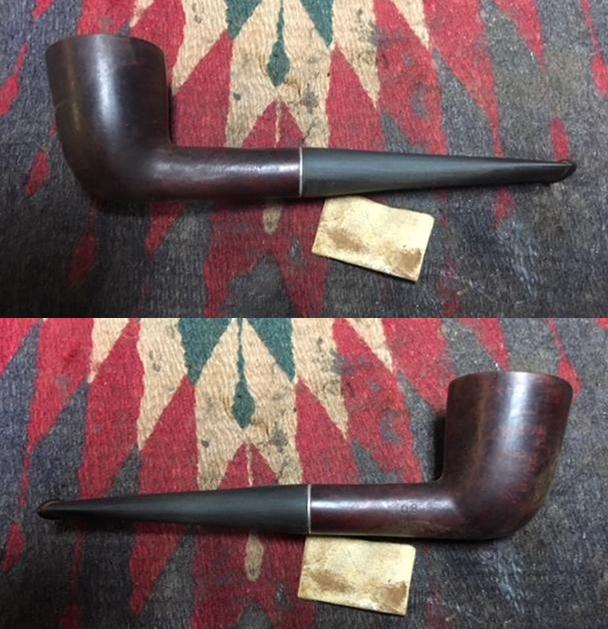
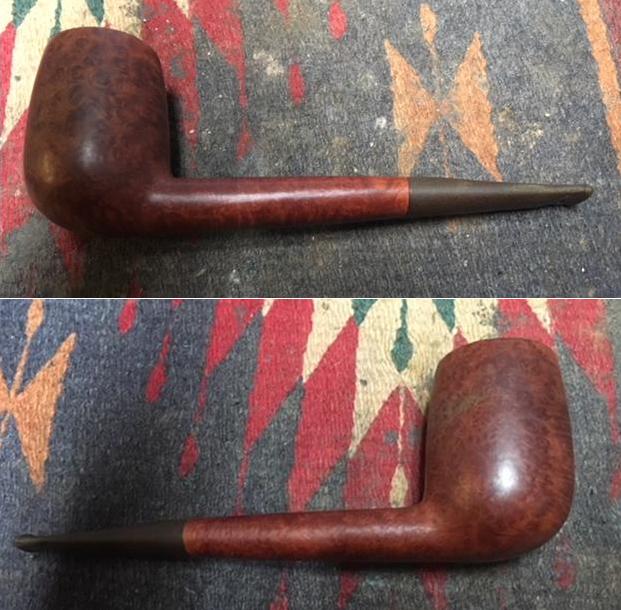
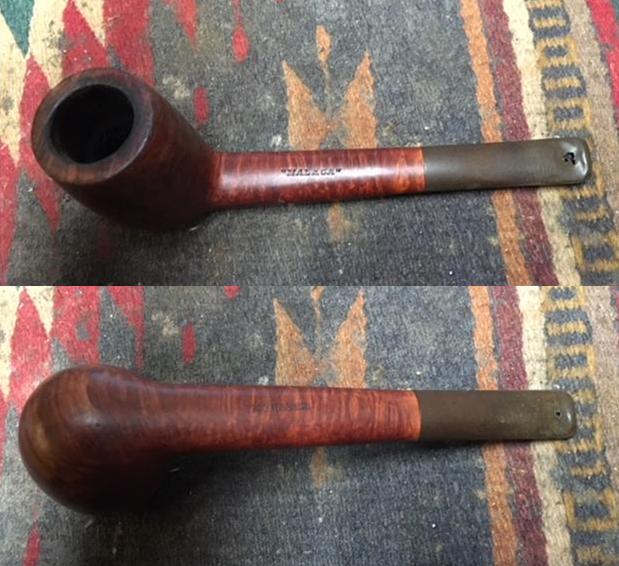
The seventh of the pipes that I chose to work on is another “Malaga” Canadian. This one is a smooth pipe with a flat bottom so that it is a sitter. It had a chewed and ruined vulcanite stem. Some great grain peeks through the grime around the bowl. The warm brown finish on the bowl appeared to be good condition under the dust and tars of time. I am pretty certain that Malaga pipes must have been oil cured. The uniform finish and the light weight lead me to think that is the case. Once more there are no fills in the bowl or long shank. I have yet to find a fill in any of the bowls I have worked on in this lot and looking through what remains I think it is fair to say I won’t find any in them either.

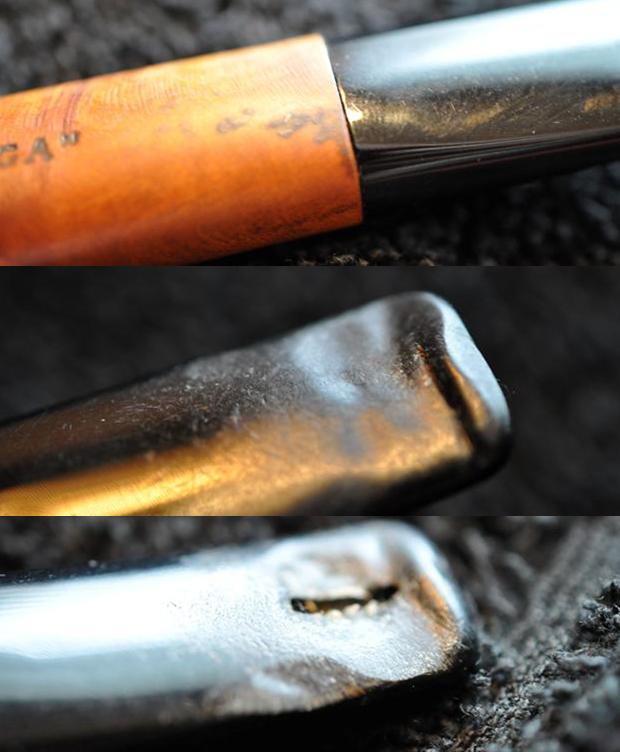
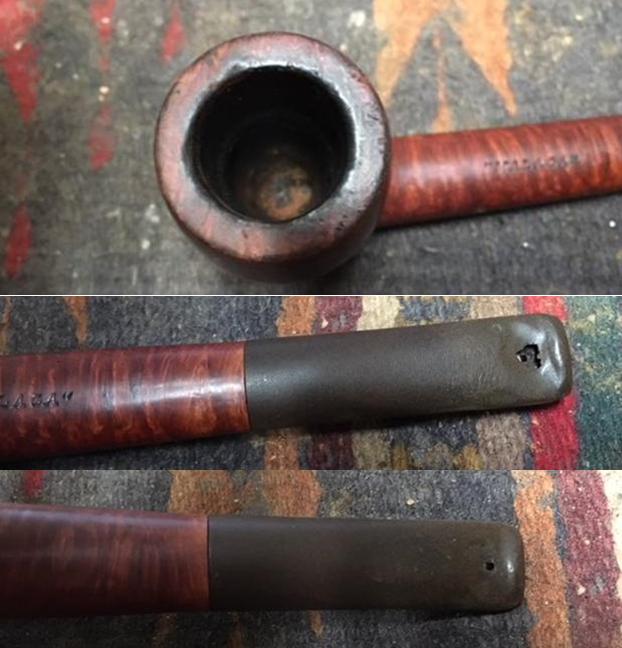
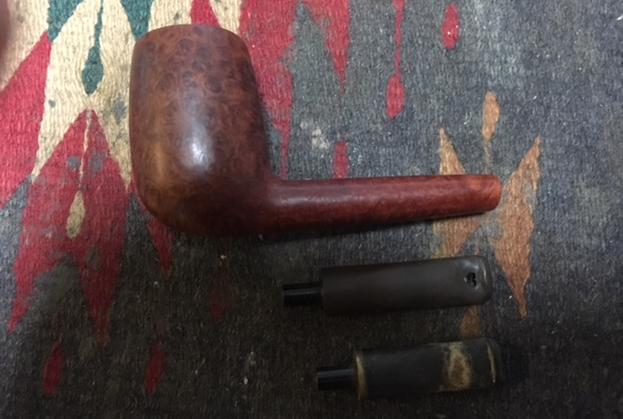
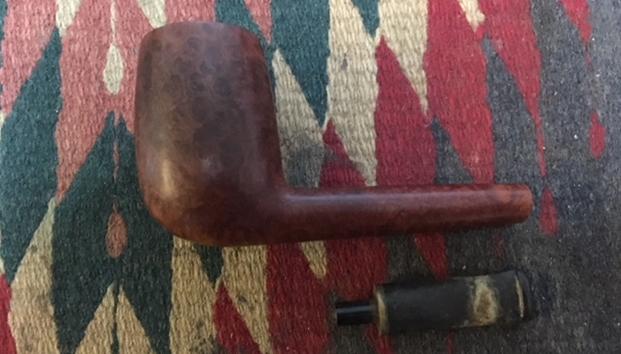
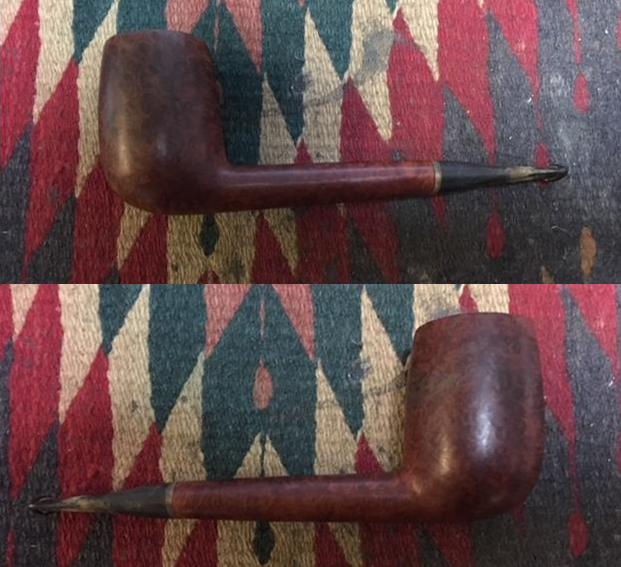
The rim top on this Canadian was originally smooth and flat but it was covered with an overflow of lava from the thick cake in the bowl. The rim top at the back of the bowl was more thickly caked than the front. The rim top, along with the inner and outer edge of the bowl was heavily damaged. There were some nicks and rounding of the outer edge and there was some darkening on the inner edge. The bowl was out of round from previous reaming. The rim top and outer edge showed signs of being knocked against a hard surface to empty the dottle from the bowl. The stamping on the topside of the shank was clear and read “Malaga” and on the flat underside it read Imported Briar. There were no shape numbers on the pipe. The black Lucite stem was ruined with bite marks on the top and a long slice on the underside of the stem. It would need to be replaced. The interior of the pipe was dirty. I know that George thoroughly enjoyed his pipes as is evidenced by the wear that all of them show. Jeff took these photos before he started the cleanup work on the pipe. Jeff took close up photos of the bowl and rim to show the condition of the pipe before he started to work his magic on it. The exterior of the bowl and shank were dirty. You can see the lava on the rim top, the cake and remnants of tobacco in the bowl and the nicks on the rim top and bowl around the outer edge of the rim. The second rim top photo shows the damage on the front edge of the rim. It is dirty but in otherwise good condition. He also took photos of the sides and underside of the bowl and shank. He also took a photo of both sides of the shank to show the stamping on both the topside and the underside. You can see the overall condition of the shank before cleanup.The next photo shows the fit of the stem against the shank. The stem was obviously a replacement and was poorly fit. The second and third photo shows the damage to both surfaces of the stem near the button, the worn and chewed down button and the missing underside of the stem. The stem is a write off – misshapen and ruined.Working on this seventh pipe followed pretty much the same pattern as all of these pipes. Jeff had reamed the bowl with a PipNet pipe reamer and followed up with a Savinelli Fitsall pipe knife to remove the cake. He scrubbed out the mortise and the airway in the shank and the stem with alcohol, cotton swabs and pipe cleaners. He scrubbed the exterior of the bowl, rim, shank and stem with a tooth brush and Murphy’s Oil Soap to remove the oils and tars on the bowl, rim and shank. He rinsed it under running water. He dried it off with a soft cloth. The lava mess on the rim was thoroughly removed without harming the finish underneath it. The slight bevel to the rim was visible once the pipe was clean. Without the grime the finish looked really good. As noted above the stem was a write off and would need to be replaced with a suitable one. I took photos of the pipe to show its condition before I started my work on it.   I took a photo of the rim top to show the condition it was in after the cleanup. Jeff was able to remove all of the lava on the rim top and edges. There is still some darkening on the rim top. You can see the damage on the top itself and around the outer edges from knocking out the pipe on a hard surface. The inner edge of the bowl had a lot of nicks and cuts and was out of round. The stem was clean and you can see the tooth chatter and marks on the surface near the button and the large deeper tooth mark on the underside.I went through my can of extra stems and found one that was suitable for a replacement on this Canadian. It was the same shape and size as the replacement that had been chewed through. Once it was cleaned up it would work nicely. The tenon was the right size which was a bonus. I put the stem on the shank and took the following photos. This is the part of restemming that is always a challenge. Like the sixth pipe I finished a bit ago it needed to be shaped. The new oval stem is always slightly off because the shank is never truly oval or round. Either the shank needs to be taken down slightly to accommodate the fit of the new stem or the stem needs to be taken down to meet the shank. In this case you can see from the following photos that the stem was a poor fit on the sides while the top and the underside of the shank were very close. In the photo of the top side you can see that it is slightly smaller. That tells you that the shank is not perfectly oval and adjustments will need to be made.I sanded off all of the calcification on both sides of the stem with 220 grit sandpaper and cleaned up the area around the button edge. I sanded the surface of the button to reshape it on both the top and underside.I decided to work over the rim top next. I topped the bowl to remove the damaged areas on the top of the rim and minimize the damage to the inner and outer edges. Once that was finished there was still some damage to the rim from previous reaming and lighting. I took care of it by reshaping the bevel and the inner and outer edge of the rim with 220 grit sandpaper. I was able to remove all of the damage to the rim surface and reshape both then inner and outer edge of the rim. The gentle bevel that was originally present was restored. With the rim reshaped I turned my attention to fitting the stem to the shank. I carefully sanded the shank to reduce the diameter to match the stem. It was interesting that most of the work had to be done on the sides of the shank with a little on the top and bottom. In essence I made the shank more oval to match the stem. The photos below show the fit of the new stem at this point. I sanded the rim top repairs and the stem/shank junction with a medium and a fine grit sanding sponge to make sure that the scratching was reduces but more importantly that the transition at the shank and stem was smooth and flowing. It is easy to create issues with a folded piece of sandpaper (in terms of dips in the briar or vulcanite) because the two mediums have different hardness. The sanding sponge minimizes that for me. I polished the briar with micromesh sanding pads – wet sanding with 1500-2400 grit pads and dry sanding with 3200-12000 grit pads. I wiped the briar down after each pad with a damp cloth to remove the sanding dust. I rubbed the bowl down with Before & After Restoration Balm to deep clean the briar and particularly the reshaped areas. The product works to clean, enliven and protect the briar. I hand rubbed it with my fingers and wiped it off with a soft cloth. I buffed the bowl with a horsehair shoe brush to polish it. The briar really began to have a rich shine. I took some photos of the bowl at this point to mark the progress in the restoration. I cleaned out the stem with alcohol, pipe cleaners and cotton swabs. It took a bit of scrubbing but before too long the airway was clean.I polished the stem with micromesh sanding pads – wet sanding with 1500-2400 grit pads and dry sanding with 3200-12000 grit pads. I wiped the stem down after each pad with a damp cloth to remove the sanding dust. I used the Before & After Pipe Polish to remove the small minute scratches left in the brass and the vulcanite. I finished by wiping the stem down with a final coat of Obsidian Oil and set it aside to dry. I the polished stem and bowl with Blue Diamond to polish out the remaining small scratches. I gave the bowl multiple coats of Conservator’s Wax and the stem several coats of carnauba wax and buffed the pipe with a clean buffing pad to raise the shine. I hand buffed it with a microfiber cloth to deepen the shine. The pipe polished up pretty nicely. The finished pipe is shown in the photos below. This is the seventh of the many “Malaga” pipes that I am restoring from Kathy’s Dad’s collection. I am looking forward once again to hearing what Kathy thinks once she sees the finished pipe on the blog. I will be posting it on the rebornpipes store very soon. It should make a nice addition to the next pipeman’s rack and in purchasing it you can carry on the trust from her father. The dimensions are Length: 6 inches, Height: 1 3/4 inches, Outside diameter of the bowl: 1 1/4 inches, Chamber diameter: 3/4 inches. Thanks for walking through the restoration with me as I worked over this Malaga from George’s estate. More will follow in a variety of shapes and sizes.
 

Kathy’s Dad’s Pipes #6– Restemming &Restoring George Koch’s “Malaga” Carved Canadian


Blog by Steve Laug

This is the sixth of the “Malaga” pipes that I am working on from Kathy’s Dad’s pipes. For those of you who have not read the other blogs let me tell the story. Last fall I received a contact email on rebornpipes from Kathy asking if I would be interested in purchasing her late Father, George Koch’s estate pipes. He was a lover of “Malaga” pipes – all shapes and sizes and she wanted to move them out as she cleaned up the estate. We emailed back and forth and I had my brother Jeff follow up with her as he also lives in the US and would make it simpler to carry out this transaction. The long and short of it is that we purchased her Dad’s “Malaga” pipes. There are some beautiful pipes in that lot. I have never seen this many “Malagas” together in one place in all of my years of pipe restoring and refurbishing. They varied from having almost pristine to gnawed and damaged stems that will need to be replaced. Many of the pipes already had replacement stems or maybe George had the staff at the Malaga shop in Michigan put Lucite stems on them because he was such a gnawer. I don’t know if we will ever know the answer to that as Kathy did not know for sure. She did know though that he loved the brand and that most of the pipes he smoked he purchased from the shop. These were some well used and obviously well loved pipes. Cleaning and restoring them will be a tribute to this pipeman. (Here is a link to some history of the Malaga Brand if you are interested: https://rebornpipes.com/tag/malaga-pipes/. There are also links there to a catalogue and the maker George Khoubesser.)Knowing about the pipeman who held the pipes in trust before me gives another dimension to the restoration work. This is certainly true with this lot of pipes. I can almost imagine George picking out each pipe in his assortment at the Malaga shop in Michigan. I may well be alone in this, but when I know about the person it is almost as if he is with me work on his pipes. In this case Kathy sent us not only information but also a photo of her Dad enjoying his “Malagas”. Once again, I am including that information so you can know a bit about the pipeman who held these pipes in trust before they are passed on to some of you. I include part of Kathy’s correspondence with my brother as well…

Jeff…Here is a little about my dad, George P. Koch…I am sending a picture of him with a pipe also in a separate email.

Dad was born in 1926 and lived almost all his life in Springfield, Illinois. He was the youngest son of German immigrants and started grade school knowing no English. His father was a coal miner who died when Dad was about seven and his sixteen year old brother quit school to go to work to support the family. There was not much money, but that doesn’t ruin a good childhood, and dad had a good one, working many odd jobs, as a newspaper carrier, at a dairy, and at the newspaper printing press among others. He learned to fly even before he got his automobile driver’s license and carried his love of flying with him through life, recertifying his license in retirement and getting his instrumental license in his seventies and flying until he was grounded by the FAA in his early eighties due to their strict health requirements. (He was never happy with them about that.) He was in the Army Air Corps during World War II, trained to be a bomber, but the war ended before he was sent overseas. He ended service with them as a photographer and then earned his engineering degree from University of Illinois. He worked for Allis Chalmers manufacturing in Springfield until the early sixties, when he took a job at Massey Ferguson in Detroit, Michigan. We lived in Livonia, and that’s where his love for Malaga pipes began. After a few years he returned to Allis Chalmers and we moved back to Springfield. I remember that when we went back to Michigan to visit friends, Dad had to go to the Malaga store and acquire a few new pipes. Many a year I wrote to Malaga and they picked out a pipe for me to purchase that I could give Dad for a Christmas or birthday present. He was always pleased. His favorites were the straight stemmed medium sized bowl pipes, but he liked them all.  He had some other pipes, but the Malagas were his favorites. I remember him smoking them sitting in his easy chair after work, with feet up on the ledge by the fire burning in the fireplace.  Growing up it was my job to clean them and he liked the inner bowl and stem coated with Watkins vanilla, leaving a little of that liquid in the bowl to soak in when I put them back on the rack. Dad quit smoking later in life and so they’ve sat on the racks for many years unattended, a part of his area by his easy chair and fireplace. Dad passed when he was 89 years old and it finally is time for the pipes to move on. I’m very happy they are being restored by you and your brother and hope they find homes who enjoy them as much as Dad did. Thank-you for your care and interest. — Kathy, the oldest daughter

Kathy, once again I thank you for providing this beautiful tribute to your Dad. We will appreciate your trust in allowing us to clean and restore these pipes. I am also trusting that those of you who are reading this might carry on the legacy of her Dad’s pipes as they will be added to the rebornpipes store once they are finished.

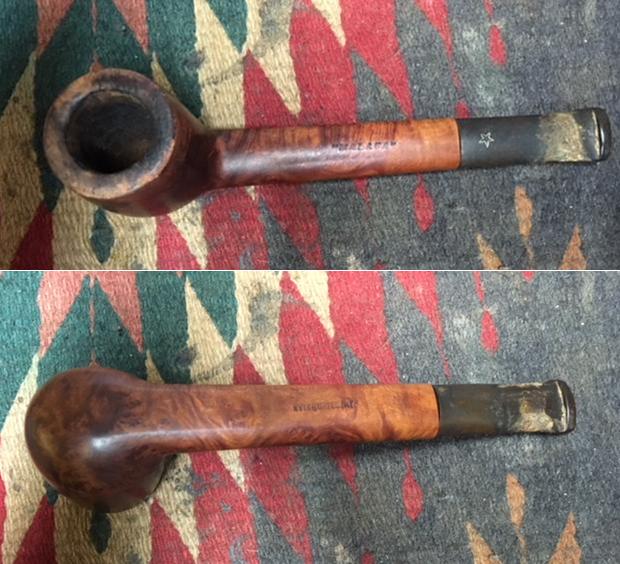
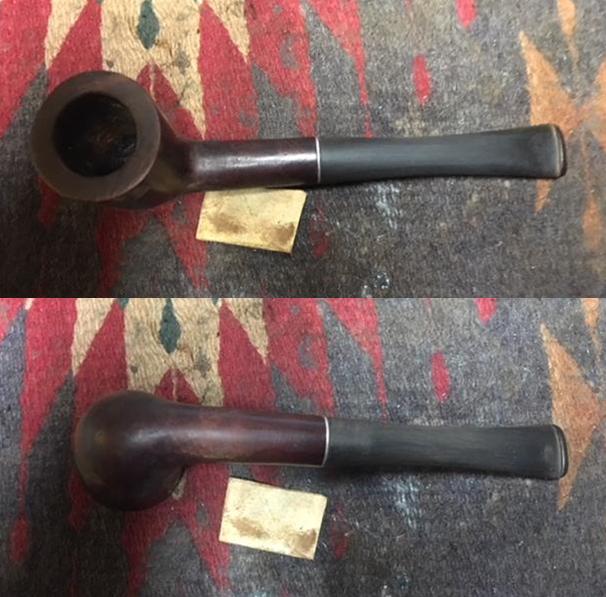
The sixth of the pipes that I chose to work on is a “Malaga” Carved Canadian with some different rustication. There are trails around the pipe and the top of the shank is rusticated in an unusual and interesting pattern. It had a chewed and ruined vulcanite stem. Some great grain peeks through the grime between the trails carved around the bowl. The warm brown finish on the bowl appeared to be good condition under the dust and tars of time. I am pretty certain that Malaga pipes must have been oil cured. The uniform finish and the light weight lead me to think that is the case. Once more there are no fills in the bowl or long shank. I have yet to find a fill in any of the bowls I have worked on in this lot and looking through what remains I think it is fair to say I won’t find any in them either.

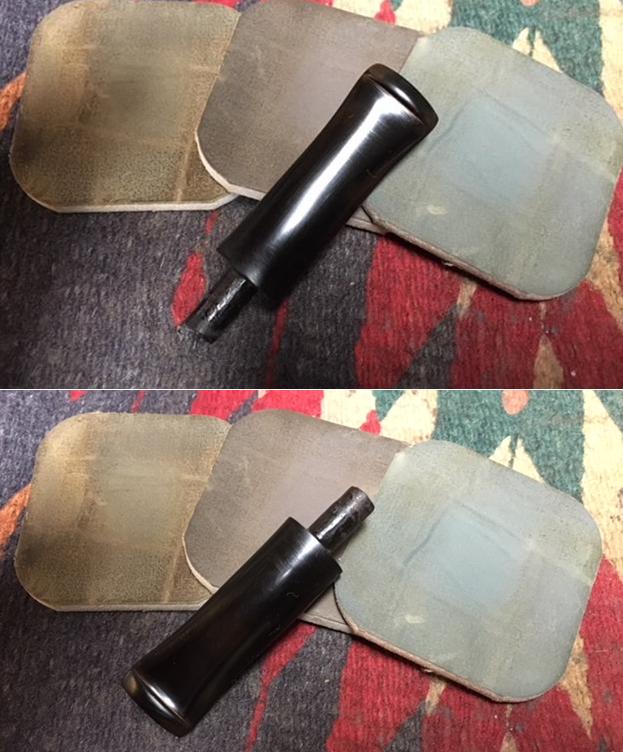
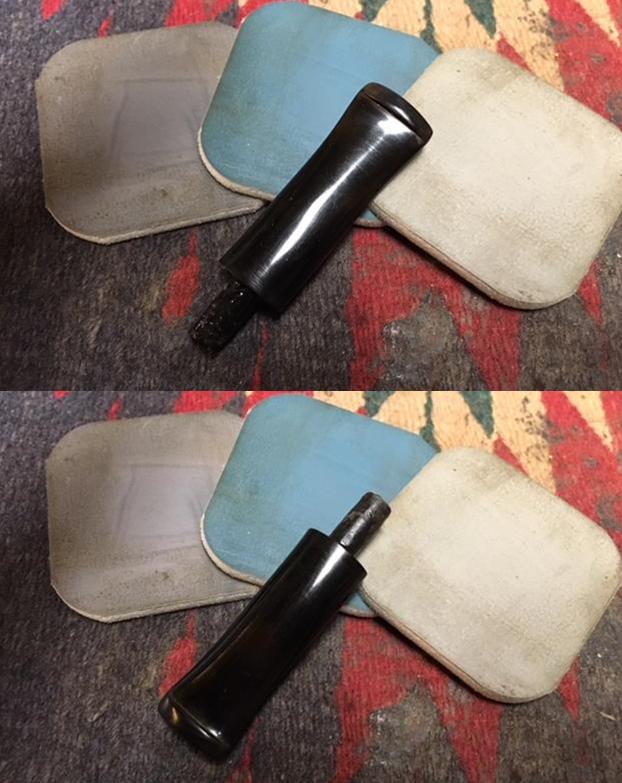
The rim top on this Canadian was lightly beveled inward and was covered with an overflow of lava from the thick cake in the bowl. The bevel was almost invisible. The rim top at the back of the bowl was more thickly caked than the front.  The rim top along with the inner and outer edge of the bowl was damaged. There were some nicks on the outer edge and there was some darkening on the inner edge. The bowl was out of round from previous reaming. The rim top and outer edge showed signs of being knocked against a hard surface to empty the dottle from the bowl. The stamping on the underside of the shank was clear and read “Malaga” near the stem/shank junction. There were no shape numbers on the pipe. The black vulcanite stem was ruined with bite marks on the top and a major portion of the underside of the stem missing. It would need to be replaced. The interior of the pipe was dirty. I know that George thoroughly enjoyed his pipes as is evidenced by the wear that all of them show. Jeff took these photos before he started the cleanup work on the pipe. Jeff took close up photos of the bowl and rim to show the condition of the pipe before he started to work his magic on it. The exterior of the bowl and shank were dirty. You can see the lava on the rim top, the cake in the bowl and the nicks on the rim top and bowl around the outer edge of the rim. It is dirty but in otherwise good condition. He also took a photo of the sides and underside of the bowl and shank. He also took a photo of both sides of the shank to show the rustication pattern on the topside and the stamping on the underside. You can see the overall condition of the shank before cleanup.The next photo shows the damage to both surfaces of the stem near the button, the worn and chewed down button and the missing underside of the stem. The stem is a write off – misshapen and ruined.Working on this sixth pipe followed pretty much the same pattern as all of these pipes. Jeff had reamed the bowl with a PipNet pipe reamer and followed up with a Savinelli Fitsall pipe knife to remove the cake. He scrubbed out the mortise and the airway in the shank and the stem with alcohol, cotton swabs and pipe cleaners. He scrubbed the exterior of the bowl, rim, shank and stem with a tooth brush and Murphy’s Oil Soap to remove the oils and tars on the bowl, rim and shank. He rinsed it under running water. He dried it off with a soft cloth. The lava mess on the rim was thoroughly removed without harming the finish underneath it. The slight bevel to the rim was visible once the pipe was clean. Without the grime the finish looked really good. As noted above the stem was a write off and would need to be replaced with a suitable one. I took photos of the pipe to show its condition before I started my work on it.   I took a photo of the rim top to show the condition it was in after the cleanup. Jeff was able to remove all of the lava on the rim top and edges. There is still some darkening on the rim top. You can see the damage on the top itself and around the outer edges from knocking out the pipe on a hard surface. The inner edge of the bowl had a lot of nicks and cuts and was out of round. The stem was clean and you can see the tooth chatter and marks on the surface near the button and the large deeper tooth mark on the underside.I went through my can of extra stems and found one that was suitable for a replacement on this Canadian. It was the same shape and size as the replacement that had been chewed through. Once it was cleaned up it would work nicely. The tenon was the right size which was a bonus. I put the stem on the shank and took the following photos. This is the part of restemming that is always a challenge. The new stem is always slightly off because the shank is never truly oval or round. Either the shank needs to be taken down slightly to accommodate the fit of the new stem or the stem needs to be taken down to meet the shank. In this case you can see from the following photos that the stem fit the underside of the shank perfectly. In the photo of the top side you can see that it is slightly smaller. That tells you that the shank is not perfectly oval and adjustments will need to be made.I sanded off all of the calcification on both sides of the stem with 220 grit sandpaper and cleaned up the area around the button edge. I sanded the surface of the button to reshape it on both the top and underside.I decided to work over the rim top, reshaping the bevel and the inner and outer edge of the rim with 220 grit sandpaper. I was able to remove all of the damage to the rim surface and reshape the inner edge of the rim. The rounded flowing bevel that was originally present was restored.With the rim reshaped I turned my attention to fitting the stem to the shank. I carefully sanded the shank to reduce the diameter to match the stem. It was interesting that most of the work had to be done on the sides of the shank with a little on the top and bottom. In essence I made the shank more oval to match the stem. The photos below show the fit of the new stem at this point. I polished the briar with micromesh sanding pads – wet sanding with 1500-2400 grit pads and dry sanding with 3200-12000 grit pads. I wiped the briar down after each pad with a damp cloth to remove the sanding dust. I rubbed the bowl down with Before & After Restoration Balm to deep clean the nooks and crannies of the rustication paths and patches as well as the smooth areas. The product works to clean, enliven and protect the briar. I hand rubbed it with my fingers and wiped it off with a soft cloth. I buffed the bowl with a horsehair shoe brush to polish it. The briar really began to have a rich shine. I took some photos of the bowl at this point to mark the progress in the restoration. I cleaned out the stem with alcohol, pipe cleaners and cotton swabs. It took a bit of scrubbing but before too long the airway was clean.I polished the stem with micromesh sanding pads – wet sanding with 1500-2400 grit pads and dry sanding with 3200-12000 grit pads. I wiped the stem down after each pad with a damp cloth to remove the sanding dust. I used the Before & After Pipe Polish to remove the small minute scratches left in the brass and the vulcanite. I finished by wiping the stem down with a final coat of Obsidian Oil and set it aside to dry. I the polished stem and bowl with Blue Diamond to polish out the remaining small scratches. I gave the bowl multiple coats of Conservator’s Wax and the stem several coats of carnauba wax and buffed the pipe with a clean buffing pad to raise the shine. I hand buffed it with a microfiber cloth to deepen the shine. The pipe polished up pretty nicely. The finished pipe is shown in the photos below. This is the sixth of the many “Malaga” pipes that I am restoring from Kathy’s Dad’s collection. I am looking forward once again to hearing what Kathy thinks once she sees the finished pipe on the blog. I will be posting it on the rebornpipes store very soon. It should make a nice addition to the next pipeman’s rack and in purchasing it you can carry on the trust from her father. The dimensions are Length: 6 inches, Height: 1 7/8 inches, Outside diameter of the bowl: 1 3/8 inches, Chamber diameter: 3/4 inches. Thanks for walking through the restoration with me as I worked over this Malaga from George’s estate. More will follow in a variety of shapes and sizes.
Kathy’s Dad’s Pipes #5 – Restemming &Restoring George Koch’s “Malaga” Canadian


Blog by Steve Laug

This is the fifth of the “Malaga” pipes that I am working on from Kathy’s Dad’s pipes. For those of you who have not read the other blogs let me tell the story. Last fall I received a contact email on rebornpipes from Kathy asking if I would be interested in purchasing her late Father, George Koch’s estate pipes. He was a lover of “Malaga” pipes – all shapes and sizes and she wanted to move them out as she cleaned up the estate. We emailed back and forth and I had my brother Jeff follow up with her as he also lives in the US and would make it simpler to carry out this transaction. The long and short of it is that we purchased her Dad’s “Malaga” pipes. There are some beautiful pipes in that lot. I have never seen this many “Malagas” together in one place in all of my years of pipe restoring and refurbishing. They varied from having almost pristine to gnawed and damaged stems that will need to be replaced. Many of the pipes already had replacement stems or maybe George had the staff at the Malaga shop in Michigan put Lucite stems on them because he was such a gnawer. I don’t know if we will ever know the answer to that as Kathy did not know for sure. She did know though that he loved the brand and that most of the pipes he smoked he purchased from the shop. These were some well used and obviously well loved pipes. Cleaning and restoring them will be a tribute to this pipeman. (Here is a link to some history of the Malaga Brand if you are interested: https://rebornpipes.com/tag/malaga-pipes/. There are also links there to a catalogue and the maker George Khoubesser.)Knowing about the pipeman who held the pipes in trust before me gives another dimension to the restoration work. This is certainly true with this lot of pipes. I can almost imagine George picking out each pipe in his assortment at the Malaga Pipe Shop in Michigan. I may well be alone in this, but when I know about the person it is almost as if he is with me work on his pipes. In this case Kathy sent us not only information but also a photo of her Dad enjoying his “Malagas”. Once again, I am including that information so you can know a bit about the pipeman who held these pipes in trust before they are passed on to some of you. I include part of Kathy’s correspondence with my brother as well…

Jeff…Here is a little about my dad, George P. Koch…I am sending a picture of him with a pipe also in a separate email.

Dad was born in 1926 and lived almost all his life in Springfield, Illinois. He was the youngest son of German immigrants and started grade school knowing no English. His father was a coal miner who died when Dad was about seven and his sixteen year old brother quit school to go to work to support the family. There was not much money, but that doesn’t ruin a good childhood, and dad had a good one, working many odd jobs, as a newspaper carrier, at a dairy, and at the newspaper printing press among others. He learned to fly even before he got his automobile driver’s license and carried his love of flying with him through life, recertifying his license in retirement and getting his instrumental license in his seventies and flying until he was grounded by the FAA in his early eighties due to their strict health requirements. (He was never happy with them about that.) He was in the Army Air Corps during World War II, trained to be a bomber, but the war ended before he was sent overseas. He ended service with them as a photographer and then earned his engineering degree from University of Illinois. He worked for Allis Chalmers manufacturing in Springfield until the early sixties, when he took a job at Massey Ferguson in Detroit, Michigan. We lived in Livonia, and that’s where his love for Malaga pipes began. After a few years he returned to Allis Chalmers and we moved back to Springfield. I remember that when we went back to Michigan to visit friends, Dad had to go to the Malaga store and acquire a few new pipes. Many a year I wrote to Malaga and they picked out a pipe for me to purchase that I could give Dad for a Christmas or birthday present. He was always pleased. His favorites were the straight stemmed medium sized bowl pipes, but he liked them all.  He had some other pipes, but the Malagas were his favorites. I remember him smoking them sitting in his easy chair after work, with feet up on the ledge by the fire burning in the fireplace.  Growing up it was my job to clean them and he liked the inner bowl and stem coated with Watkins vanilla, leaving a little of that liquid in the bowl to soak in when I put them back on the rack. Dad quit smoking later in life and so they’ve sat on the racks for many years unattended, a part of his area by his easy chair and fireplace. Dad passed when he was 89 years old and it finally is time for the pipes to move on. I’m very happy they are being restored by you and your brother and hope they find homes who enjoy them as much as Dad did. Thank-you for your care and interest. — Kathy, the oldest daughter

Kathy, once again I thank you for providing this beautiful tribute to your Dad. We will appreciate your trust in allowing us to clean and restore these pipes. I am also trusting that those of you who are reading this might carry on the legacy of her Dad’s pipes as they will be added to the rebornpipes store once they are finished.

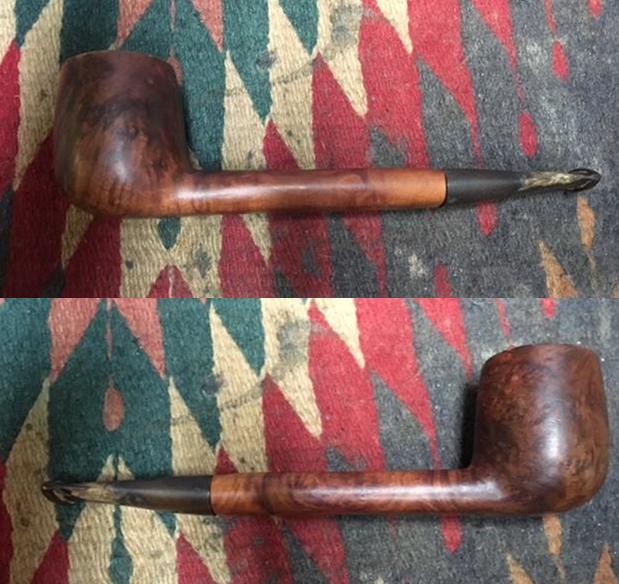
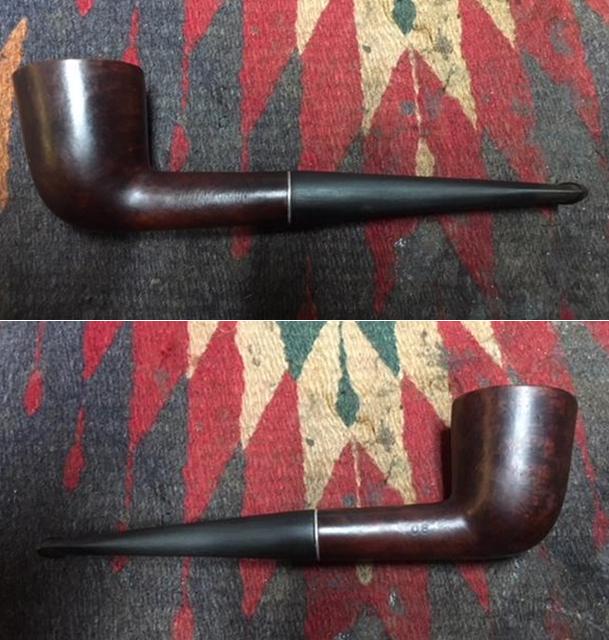
The fifth of the pipes that I chose to work on is a “Malaga” Canadian with a tall almost chimney like bowl. It was one the lot with a chewed and ruined vulcanite stem. But it is another beautiful piece of briar underneath the grime and debris of the years. The warm brown finish on the bowl appeared to be good condition under the dust and tars of time. The more I work on these the more I think that Malaga pipes must have been oil cured as they are very light weight and the finishes are uniformly well done. I have yet to find a fill in any of the bowls I have worked on in this lot and looking through what remains I think it is fair to say I won’t find any in them either.

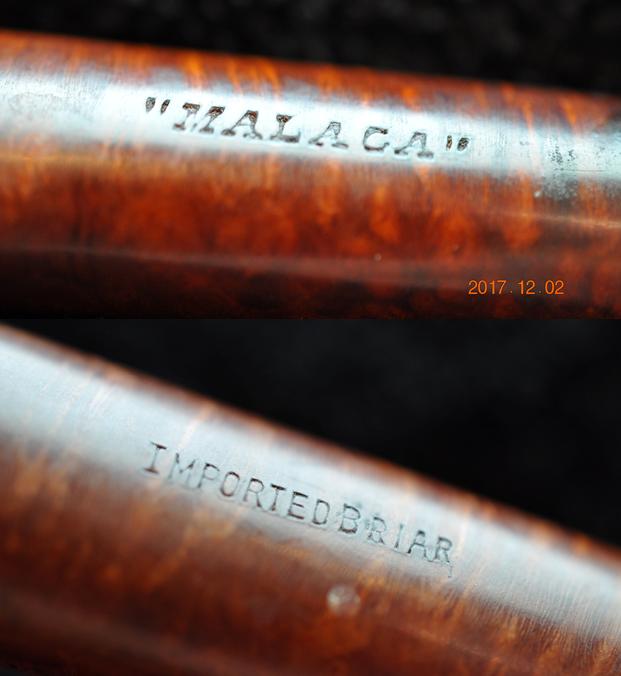
The rim top on the tall Canadian was covered with an overflow of lava from the thick cake in the bowl. The rim top at the back of the bowl was more thickly caked than the front.  The inner and outer edge of the bowl had damage. There were some nicks on the outer edge and there was some darkening on the inner edge. The bowl was out of round from previous reaming. The rim top and outer edge showed signs of being knocked against a hard surface to empty the dottle from the bowl. The stamping on the top of the shank was clear and read “Malaga” and Imported Briar on the underside. There were no shape numbers on the pipe. The black vulcanite stem was ruined with bite marks all the way through on both the top and underside at the button. It would need to be replaced. The interior of the pipe was dirty. I know that George thoroughly enjoyed his pipes as is evidenced by the wear that all of them show. Jeff took these photos before he started the cleanup work on the pipe. Jeff took close up photos of the bowl and rim to show the condition of the pipe before he started to work his magic on it. The exterior of the bowl and shank were dirty. You can see the lava on the rim top, the cake in the bowl and the nicks on the rim top and bowl around the outer edge of the rim. It is dirty but in otherwise good condition. He also took a photo of the sides of the bowl. He also took a photo of both sides of the shank to show the stamping and the condition of the overall shank so you could have an idea of where things were at before he cleaned it up.The next photo shows the damage to both surface of the stem near the button and the worn and chewed down button. The stem is a write off on this one. The bite marks go all the way through and leave the stem misshapen and ruined. Working on this fifth pipe was pretty straightforward because Jeff had done all the hard cleanup work on the briar inside and out. He reamed the bowl with a PipNet pipe reamer and followed up with a Savinelli Fitsall pipe knife to remove the cake. He scrubbed out the mortise and the airway in the shank and the stem with alcohol, cotton swabs and pipe cleaners. He scrubbed the exterior of the bowl, rim, shank and stem with a tooth brush and Murphy’s Oil Soap to remove the oils and tars on the bowl, rim and shank. He rinsed it under running water. He dried it off with a soft cloth. The lava mess on the rim was thoroughly removed without harming the finish underneath it. Without the grime the finish looked really good. As noted above the stem was a write off and would need to be replaced with a suitable one. I took photos of the pipe to show its condition before I started my work on it. I took a photo of the rim top to show the condition it was in after the cleanup. Jeff was able to remove all of the lava on the rim top and edges. There is still some darkening on the rim top. You can see the damage on the top itself and around the outer edges from knocking out the pipe on a hard surface. The inner edge of the bowl had a lot of nicks and cuts and was out of round. The stem was clean and you can see the tooth chatter and marks on the surface near the button and the large deeper tooth mark on the underside.I went through my can of extra stems and found one that was suitable for a replacement on this Canadian. It was a bit shorter than the replacement that had been chewed through.  It also had an ornamental brass ring over the end of the tenon and anchored to the stem. The tenon was the right diameter for the shank so it was a simple matter of cleaning up the tenon and fitting it on the shank. I took photos of the pipe with the new stem. The brass band was going to look really good once it was polished. I also like the shorter stem on the pipe as it looks more like the classic Canadian it was when it was sold. I took some close up photos of the new stem to show the fit to the shank. The stem is looking really good. It will need to be thoroughly cleaned and polished but it shows promise.I sanded off all of the calcification on both sides of the stem with 220 grit sandpaper and cleaned up the area around the button edge. Unfortunately, I forgot to take photos of this part of the process. There was no tooth chatter on either side which was a plus. There was some oxidation and the brass spacer at the stem/shank junction was oxidized. I sanded the surface of the button to reshape it on both the top and underside. I cleaned out the airway and the slot in the button with pipe cleaners and alcohol. I used a dental pick to clean out the corners of the slot.I polished the stem with micromesh sanding pads – wet sanding with 1500-2400 grit pads and dry sanding with 3200-12000 grit pads. I wiped the stem down after each pad with a damp cloth to remove the sanding dust. I used the Before & After Pipe Polish to remove the small minute scratches left in the brass and the vulcanite. I finished by wiping the stem down with a final coat of Obsidian Oil and set it aside to dry. I lightly topped the bowl on my topping board using 220 grit sandpaper. It did not take too much work to remove the nicks and damage to the rim top and edges. Once it was complete I topped it on a medium grit sanding sponge to smooth the surface even more.I sanded the inside edge of the rim to minimize the damage and bring the bowl back to round. I gave it a slight bevel that made the darkening on the inside edge less visible.I polished the briar with micromesh sanding pads – wet sanding with 1500-2400 grit pads and dry sanding with 3200-12000 grit pads. I wiped the briar down after each pad with a damp cloth to remove the sanding dust. I rubbed the bowl down with Before & After Restoration Balm to deep clean the pores and grain of the smooth finish as well as to enliven and protect the briar. I hand rubbed it with my fingers and wiped it off with a soft cloth. I buffed the bowl with a horsehair shoe brush to polish it. The briar really began to have a rich shine. I took some photos of the bowl at this point to mark the progress in the restoration. I the polished stem and bowl with Blue Diamond to polish out the remaining small scratches. I gave the bowl and the stem several coats of carnauba wax and buffed the pipe with a clean buffing pad to raise the shine. I hand buffed it with a microfiber cloth to deepen the shine. The pipe polished up pretty nicely. The finished pipe is shown in the photos below. This is the fifth of the many “Malaga” pipes that I am restoring from Kathy’s Dad’s collection. I am looking forward once again to hearing what Kathy thinks once she sees the finished pipe on the blog. I will be posting it on the rebornpipes store very soon. It should make a nice addition to the next pipeman’s rack and in purchasing it you can carry on the trust from her father. The dimensions are Length: 6 inches, Height: 2 1/4 inches, Outside diameter of the bowl: 1 3/8 inches, Chamber diameter: 3/4 inches. Thanks for walking through the restoration with me as I worked over this Malaga from George’s estate. More will follow in a variety of shapes and sizes.
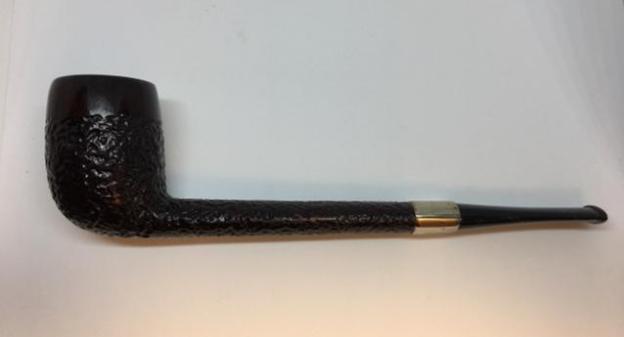
Reworking and Restemming What Looked Like a Lost Cause


Blog by Ryan Thibodeau

I have been following Ryan’s work on FaceBook’s Tobacco Pipe Restorers Group and have been impressed with his work. When he posted the work on this old Canadian stummel with a lot of issues I wrote and asked if he would be willing to post it on rebornpipes. He said sure and sent me the following write up. I am happy to welcome Ryan to the pages of the blog. It is a pleasure to have you here. Without further ado I will let Ryan introduce himself to you all. — Steve

My name is Ryan Thibodeau, I live in the Hamilton Ontario region I stumbled upon this hobby by accident. When my Father learned of my new hobby, he gave me his 1959 Dunhill shell briar pipes. They hadn’t been smoked in 38 years and needed some TLC. I had them restored and they were the first two pipes in my rack.

From there I joined various Facebook Groups and happened upon Steve’s blog “Reborn Pipes”, I was inspired immediately. Since that time I’ve been collecting tired worn out pipes and testing my ability to return them to a condition that I would be proud of. It is a wonderful hobby, that doesn’t require a lot of space to do.

Every pipe has a story! Usually the smoker who owned it, and their story, is more interesting than the pipe itself.

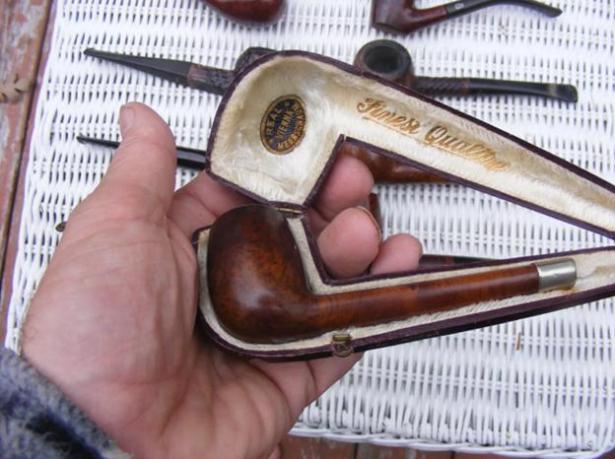
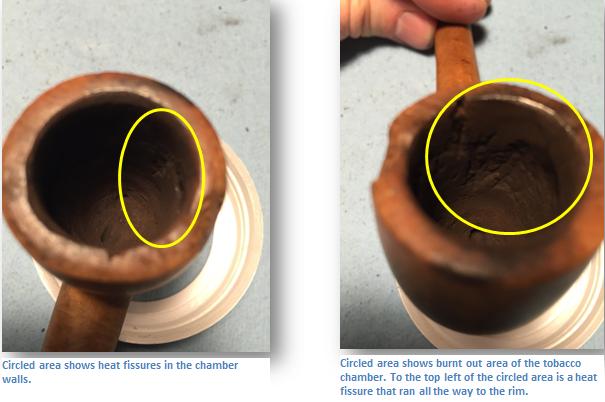
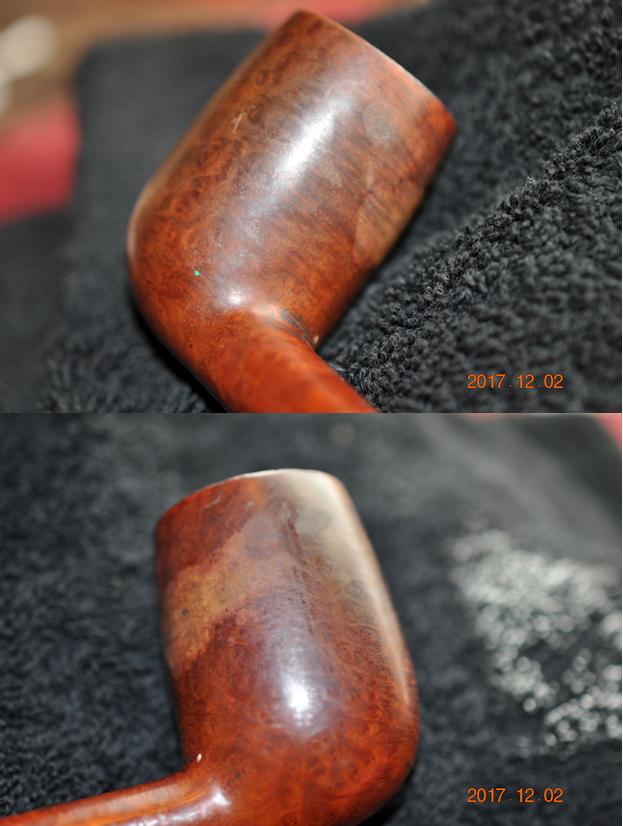
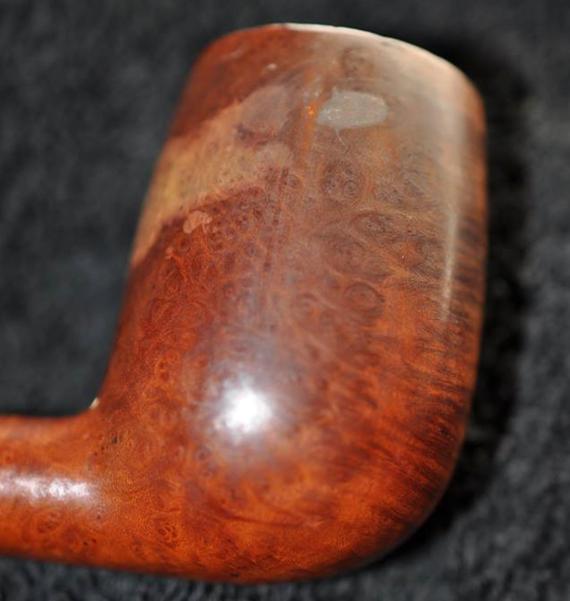
I purchased this pipe in a lot of 12. There were only one or two pipes in the lot that I really wanted and the price was right, so I wasn’t heartbroken if the rest came to rest in the bottom of my box of pipes. One of them came in a case that was meant for a meerschaum, and it looked decent when in the picture, but further investigation revealed a lot of issues that would need to be repaired. I started by removing the silver band, which came off without any effort and used Heirloom Stripper to remove all the dirt, grime, old finish and lift some of the stain. This allowed me to get a real good look at the damage to this pipe. Next I used my Castleford reamer to remove all the cake out of the bowl. There was very little cake lining the bowl, however; once I removed the cake I found that walls of the tobacco chamber were severely charred. I suspect this pipe was smoked very hot and the briar was charred to charcoal. I wanted to see how much of the chamber was damaged ( I prefer to ream my bowls right back to fresh briar. This way I can see if there are any heat fissures or major issues that would make a restoration go sour after the first smoke)
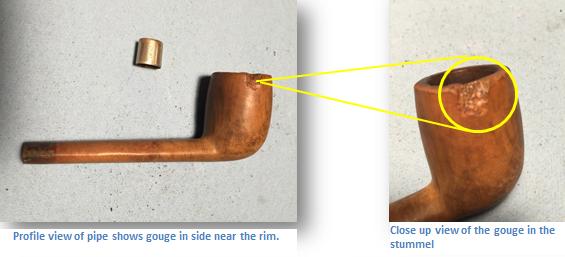
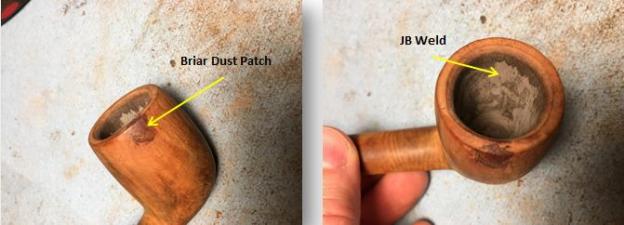
I removed the charred wood. The reamers will shave away the charred wood, once you feel the resistance of the blades rubbing the fresh briar you know you’ve removed the charring.I used a combination of Briar dust and CA Glue to create a patch for the gouge on the side of the bowl. Using a flat file, I filed the patch down to the profile of the pipe. Afterwards I topped the bowl to level out the rim and the patch. The bowl was also over reamed by its previous owner so I added a bevel to the inside of the bowl at the rim to blend everything in.
There was a lot of filing and sanding through this process to get it just right. Unfortunately I get hyper focused during this process and forgot to take step-by-step pictures.

The grey patches you see inside the bowl is a product called JB Weld. I mixed up a batch and filled the problem areas in the chamber, afterwards I sanded it down to blend with the rest of the chamber. In my experience the product is completely inert once cured. It is handy for a reconstruction of this kind, but I’d recommend adding a bowl coating as an added barrier.This pipe came to me without a stem. Fortunately I had a stem that would be the perfect length, I just needed to shape the tenon to fit the pipe. For this I used the Pimo Tenon cutter from Vermont Freehand.
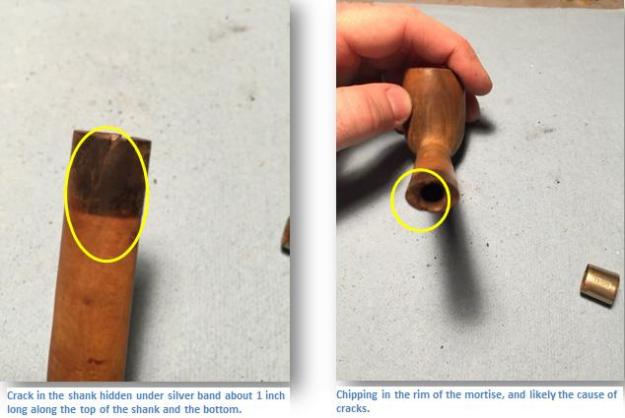
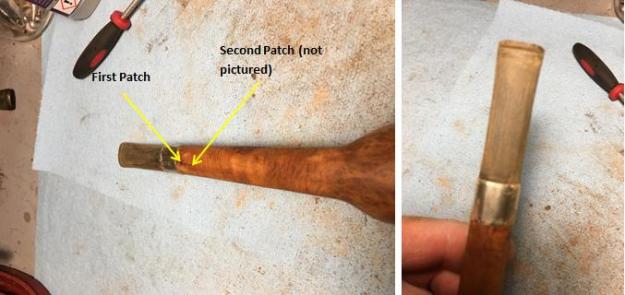
I also used the opportunity while I was at this end of the pipe to drill a hole ahead of the crack in the shank and filled used briar dust and CA Glue. As sometimes happens with restorations, I thought I stopped the crack from spreading, well I was wrong and it continued from the patch further up the shank about ¼ of an inch. So I drilled another hole and patched it again. This time I seemed to have everything under control.

The stem was quite simple to shape to the profile of the pipe and was a welcome change from the frustrations of the other repairs that didn’t go according to plan.

Once I had all the parts and repairs completed. I sanded the entire pipe and stem with 320 grit sandpaper up to 8000 grit (1500-8000 with micro mesh pads) Rustication

At this point I had to consider how I was going to finish this pipe. Originally this was a smooth finish Canadian Billiard, but those days were long behind this tired old pipe. I originally thought of using a really dark stain to hide all the imperfections, polish it and call it a day, then I thought I’d take a risk and create something new, and breath new life into this pipe. For all the effort I put into this pipe up to this point I figured I’d let my creativity flow.

I decided that I would rusticate this pipe and leave a smooth patch somewhere, where I hadn’t determined yet. Using a Dremel and a 107 Carving bit I started to rusticate the shank and worked my way to the heel, then up the stummel. Halfway up the stummel the pipe revealed its final design-leave the top of the bowl smooth! I wasn’t sure at first because it would mean I had to blend in that CA patch, but I now avoided trying to rusticate it.

I was very pleased with the result.

Staining & Finishing

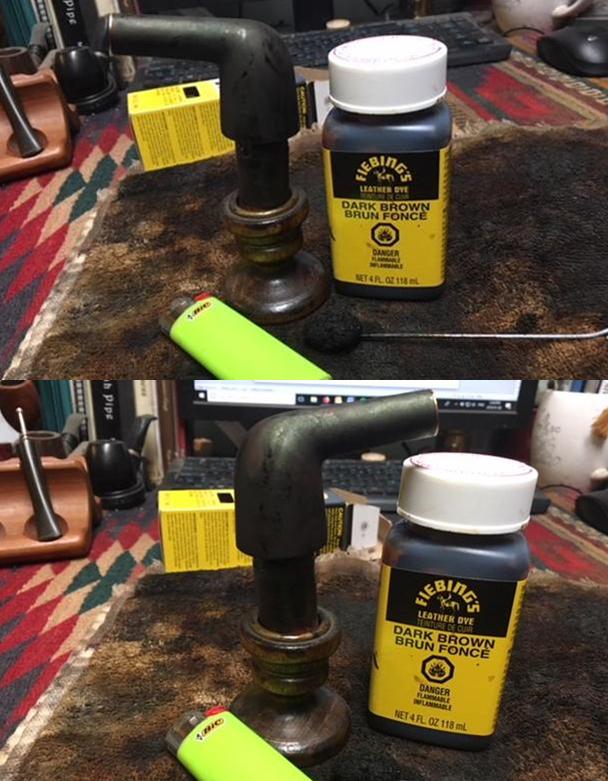
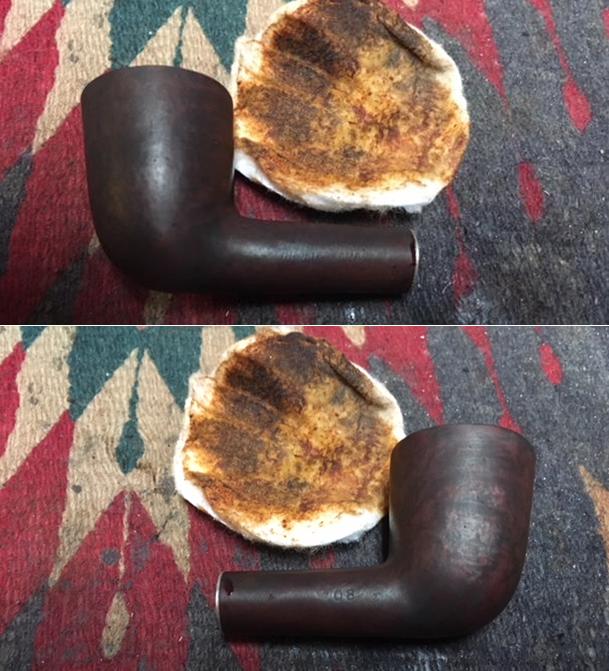
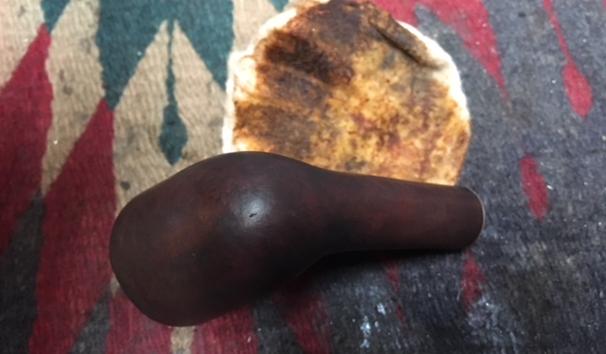
I used Fiebings Dark Brown alcohol based dye over the entire pipe as a base, then wiped on Fiebings Oxblood till I achieved the colour I wanted. To seal the stain in the pipe I applied a thin layer of shellac which gave it a glossy look I didn’t like. I left it, and just stayed the course with this experiment to see how it turned out.

In the morning the Shellac had cured. I began the polishing process at this point. I don’t have a buffing wheel yet, so I use cotton wheel buffing bits that fit to my dremel.

I started with Tripoli and thoroughly went over the entire pipe and stem. The tripoli did a good job of taking down the shellac, and making it less pronounced. I followed that up with white diamond and then finally carnauba wax.  I used a fluffy felt bit to polish the whole pipe.

Bowl Coating

You will find a variety of recipes and opinions on bowl coatings. I use them when needed and I prefer the waterglass recipe that a pipe maker shared with me. It is a combination of Sodium Silicate, Activated Charcoal and White Pumice. Once cured it provides a refractory layer on the inside of the bowl, and it feels like 800 grit sandpaper which promotes new cake build up without putting a lot of heat stress on the worn out briar.

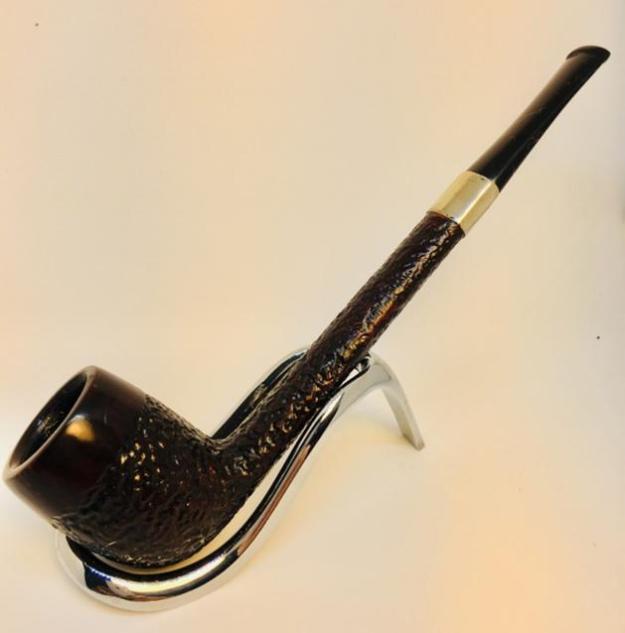
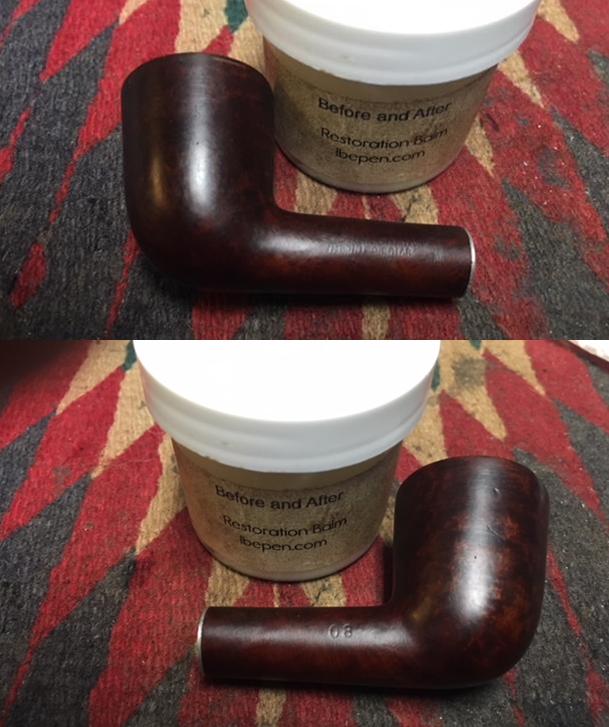
This pipe definitely tested the limits of my abilities  and I learned some new techniques that I had only seen others use. Here’s the finished pipe!


Craig’s Pipes #3 – Restemming and Restoring a Wally Frank Natural Bulldog


Blog by Steve Laug

In my previous 2 blogs on Craig’s pipes I spoke of the five pipes that I am working on for him. In this blog I am taking on the third of his pipes – a Wally Frank Natural Unvarnished Bulldog that came to me sans stem. It was by far the most used pipe he sent me with a cake in the bowl that was thick and hard. I am going to include what Craig wrote me about his pipes. I have included it in the previous two blogs but I think it adds context to the bunch.

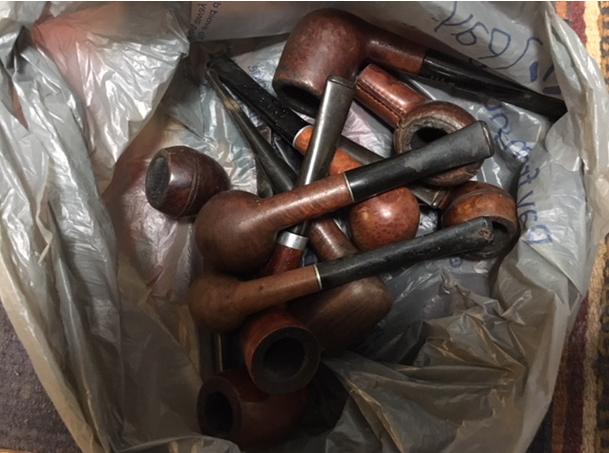
I was recently given a bag of pipes…literally, a BAG of 20 or so pipes that are 50+yrs in age and VERY used. I was wondering if you would have time to either Skype or FaceTime with me, and go through what I have in order to determine which are worth sending to you to have them refurbished. If you would be so kind, I’d really appreciate it.

We met on FaceTime and walked through each of the pipes in his bag. He pulled out a grocery bag with no rhyme or reason to it. It was filled with a jumble of no name or low-end drug store pipes. The only pipes that stood out for me were an old WDC Campaign pipe and a Grabow Starfire. We excluded all but five of the pipes. The amount of work necessary to bring them back was not worth the price. These are the five that we chose to work on. As I finish them, I will include the link to the blog covering that pipe.

– A No Name Meerschaum that looked interesting – https://rebornpipes.com/2018/01/31/is-it-a-meerschaum-looks-like-one-feels-like-one-but/
– A leather clad billiard marked R20 and bearing a shield – https://rebornpipes.com/2018/02/01/rejuvenating-a-leather-clad-billiard/
– A Wally Frank Bulldog marked Natural Unvarnished lacking a stem
– A Dr. Grabow Starfire 39 that had great grain
– A WDC Campaign underslung pipe

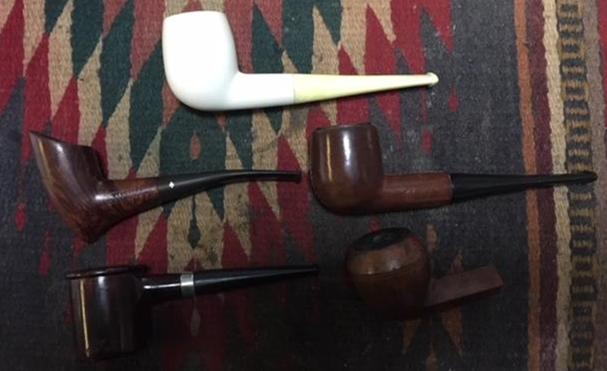
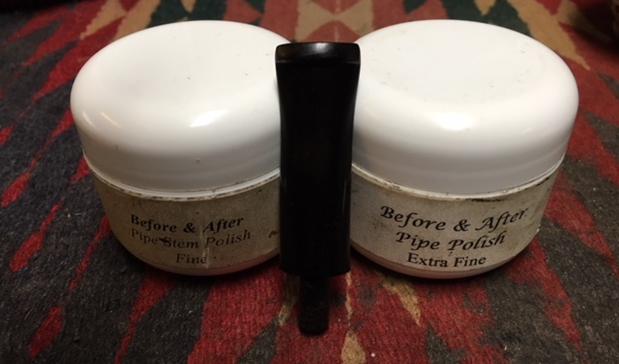
After our conversation, he packed up the pipes and threw the rest of the pipes in a separate bag for me to scavenge parts. The box did not take too long to get to Vancouver and when it did I opened the box and had a look. Here are pics of what I saw – there were two bags inside. One bag held the discards for the scrap pile and the other held the five pipes he wanted restored. The third pipe was the stemless Bulldog on the lower right of the photo above. The briar was very dirty with lots of grime and some residue that had hardened on the surface of the bowl. The rim top was in good condition but I would not be sure until I was able to remove the lava overflow from the bowl over the bevel. The outer edges were undamaged all around the bowl and I was hoping the same was true of the inner edge. There was some darkening on the rim as well. The bowl had a thick cake in it and remnants of tobacco. On the front of the bowl on the cap there was some hardened sticky substance. The shank is stamped on the left side Natural over Unvarnished. On the right side it is stamped Wally Frank Ltd. On the underside of the left side it reads Imported Briar. There was no stem so I was going to need to fit one to the shank. I took the following photos of the pipe before I started cleaning it up. I went through my can of stems and found one that would work with the pipe. It was a diamond saddle stem. The saddle portion was slightly larger than the shank of the pipe but I could work that to make it fit well. The tenon would need to be turned with the PIMO tenon turning tool make it a snug fit in the shank.I drilled out the airway in the stem with a drill bit the same size as the post in the centre of the tenon turning tool. Once it was open I adjusted the cutting head on the tool to take the tenon down incrementally to the right dimension. I readjusted it and repeated the process until the fit was right. I sanded down the tenon lightly with 220 grit sandpaper to fine tune the fit and put it in the shank of the pipe. I took photos of the pipe at this point to show what needed to be done to adjust the fit. It needed some work. The bowl was also very caked and that needed to be reamed. I took the stem off and reamed the bowl with a PipNet reamer. I started with the smallest cutting head and worked my way up to the one that was the same diameter as the bowl. I reamed it back to bare briar. I cleaned up the remnants with a Savinelli Fitsall Pipe Knife. With bowl reamed I turned to the rest of the internals. I used a dental spatula to scrape out the heavy tar buildup in the shank. There was a lot of mess there and it took a lot of scraping before I had it cleaned out. I cleaned the shank and mortise with pipe cleaners, cotton swabs and alcohol. I scrubbed out the shank and mortise until the pipe cleaners and swabs came out clean.I sanded off the lava and darkening on the rim top with 220 grit sandpaper. I was able to remove all of the buildup and damage on the rim.I sanded the saddle portion of the stem with a Dremel and sanding drum to reduce the sides to match the shank. I sand it on a slower speed and carefully work to keep it from hitting the shank of the pipe. I finish the fitting with 180 and 220 grit sandpaper to sand it to match the shank. I sand the shank at the same time to make the transition smooth. The next set of four photos show the fit of the stem at this point in the process. I worked some Before & After Restoration Balm into the surface of the briar with my finger tips to deep clean the finish, enliven and protect the wood. I worked the balm into the rim top and inner bevel of the rim to polish the cleaned up area. I let it sit for a few minutes and then buffed it with a cotton cloth. The grain in the wood came alive and there was a rich shine to the briar. I took some photos of the bowl at this point to mark the progress in the restoration. I polished the bowl and rim with micromesh sanding pads – wet sanding it with 1500-2400 grit pads and dry sanding with 3200-12000 grit pads. I wiped the bowl down after each pad with acetone to clean off the sanding dust. The photos show the progress of the polishing. I used a dark brown stain pen to blend the sanded shank end with the rest of the bowl. I polished it with micromesh sanding pads to blend it in and hand buffed it with a microfibre cloth. I worked over the stem with micromesh sanding pads. I polished out the sanding scratches and marks from the reshaping work. I wet sanded it with 1500-2400 grit pads and dry sanded it with 3200-12000 grit pads and wiped it down with Obsidian Oil after each one. I polished the stem with Before & After Pipe Stem Polish, using both Fine and Extra Fine polishes to polish out the remaining light scratches in the vulcanite. When I finished with the polish I gave it a final coat of oil and let it dry. With the stem replaced and polished I put it back on the pipe and buffed the entire pipe again with Blue Diamond polish on the buffing wheel. I polished it with the polishing compound until it was shiny. I gave the entire pipe several coats of carnauba wax and buffed it with a clean buffing pad to raise the shine. I hand buffed it with a microfibre cloth to deepen the shine. The new stem and the bowl polished up pretty nicely. The finished pipe is shown with the original stem in the photos below. This is the third of Craig’s five pipes. Once I finish the other two pipes I will pack them up and get them out to him. I am looking forward to what he will think once he has them in hand. Thanks for walking through these restorations with me. I am thinking that the pipeman who gave Craig these pipes would be happy that they are back in service and that Craig is carrying on the pipeman’s trust with them. Cheers.

Reworking & Restemming Last of Mark’s Uncle’s Pipes – a Kaywoodie Custom Grain Dublin


Blog by Steve Laug

This is the last one of Mark’s uncle’s pipes and when I finish this one the lot of seven are complete and ready to go back to him. This last one is another Kaywoodie. I have repeatedly written how much I am enjoying working on these pipes for Mark. For me an important part of the restoration project is to know the history behind the pipe I am working on. When I find out the story it really adds another dimension to the pipe repair or restoration work.

I have finished six of the seven pipes that Mark sent me and have written about them. As I have worked on each pipe the pipeman who originally owned these pipes was with me through Mark’s story of his life. The links to the blog on each pipe is listed below if you want to read about the work on each of them.

  1. The Ropp Cherrywood De Luxe (https://rebornpipes.com/2018/01/17/cleaning-and-restoring-a-ropp-cherrywood-de-luxe-805/)
  2. The Doodler (https://rebornpipes.com/2018/01/19/restoring-a-beautiful-the-doodler-bullmoose/)
  3. A newer three hole stinger Kaywoodie Super Grain Billiard S-L (https://rebornpipes.com/2018/01/21/restoring-marks-uncles-third-pipe-a-kaywoodie-super-grain-s-l-billiard/)
  4. a Savinelli Churchwarden (https://rebornpipes.com/2018/01/22/restoring-marks-uncles-savinelli-churchwarden-aged-briar-2002/).
  5. A Tally Ho 33 Pot made by Hardcastle’s (https://rebornpipes.com/2018/01/25/restoring-and-restemming-marks-uncles-5th-pipe-a-tally-ho-33-pot/)
  6. A Kaywoodie Signet Rhodesian/Round shank Bulldog https://rebornpipes.com/2018/01/27/reworking-marks-uncles-6th-pipe-a-kaywoodie-signet-rhodesian/

Here are some pictures of the pipes.The pipe I am working on now is the fourth pipe down in the above photo and the fourth from the left in the photo below. It is a Dublin shaped pipe with a major piece missing from the button on the stem and the Kaywoodie logo missing from the stem. One last time I am going to include a bit of what Mark’s sent me about his uncle. I have included much of this in each of the past pipe restorations to give you a sense of the information that always in behind the desire to clean up and restore this set of old pipes. Mark wrote…

…My Uncle John, raised in an Appalachian Mountain family (think Hatfield and McCoy), was a large man with an affable personality – although this had limits and he could be quite formidable.

During WWII he left home and enlisted in the US Army where he was assigned to Patton’s 3rd Army as an ambulance driver.  After Germany surrendered, he was transported back to the US on a converted ocean liner troop ship (I believe it was the Queen Mary).  Upon reaching the US, his unit was immediately sequestered on a troop train for transport to the West Coast to be shipped to the Pacific for the invasion of Japan.  About half way across the country (possibly somewhere in Texas), the train stopped and the troops informed that Japan had capitulated – WWII was over.

Before the Korean War began, my uncle re-enlisted in the US Air Force.  He as assigned to a Photo Mapping unit as an Aircraft Mechanic.  He worked his way up to Crew Chief and served in Photo Mapping until he medically retired in the mid 60’s due to heart problems.

Being part of an Air Force family, I did not get to spend much time with my uncle while growing up.  However, I was able to stay a couple of summers with him at his West Palm Beach home while in my teens.  On a desk in his Florida Room sat collection of old used pipes in a walnut pipe rack / humidor combo (very similar the Decatur Industries 6 pipe Rack and humidor combination shown in the rebornpipes store).  There were a couple of packages of old dried up commercial brand tobacco in the humidor – one was cherry, I think.  I never saw my uncle smoke and never discussed the pipes with him, but I was intrigued by the pipe collection.  They were old, dirty, and well used – some with chewed through stems.  Obviously, the pipes had been smoked by a devoted pipe enthusiast.  As a young boy, I loved the smell of pipe tobacco, which you could occasionally smell in public way back then.  I started smoking an occasional pipe in college.  When my uncle passed away a few years later, I asked for his pipe collection and have stored it away since then.  The pipes are just as I received them some thirty years ago.

While I will never know for sure, I believe my uncle purchased the pipes in various PX’s and smoked them while an Air Crew Member.  The PX’s would have sold common commercially available pipe brands at a good price, nothing too expensive or exotic – consistent with the pipes in my uncle’s collection.  As a Photo Mapping Air Crew Member / Chief my uncle traveled the world extensively, and was stationed at many bases  – including “permanent” stations in West Palm Beach, Warner Robins, and Goose Bay Labrador, to name a few.  Smoking a pipe would have been a relaxing way to spend a few monotonous hours on the flight line or in the air.  After his heart problems, he must have given up pipe smoking and the pipes sat unused thereafter.  If the bowls look like they were recently scraped, it would have been over fifty years ago, most likely with a Case hardware store folding knife. If dirty, it is due to sitting for many years in the back room.  If well used and chewed it is due to many hours of smoking enjoyment.

I’m looking forward to seeing my Uncle John’s pipes in restored condition.  I know they are not “collectors” items, but they bring back priceless memories of my uncle and the times we spent together sharing “war stories”…

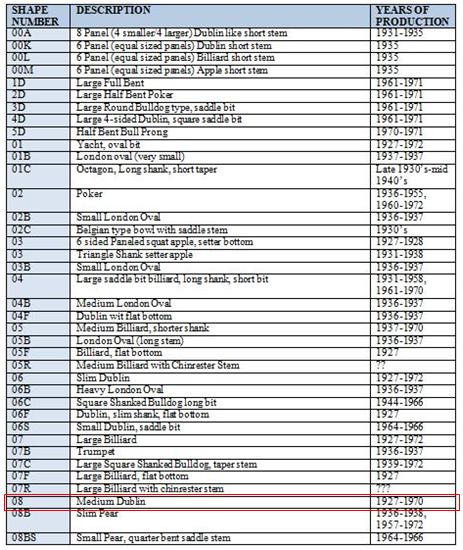
With the old pipeman almost standing over my work table, I turned my attention to the last of his pipes – a Kaywoodie Custom Grain Dublin shaped pipe. The pipe was stamped on the left side of the shank with the word Kaywoodie over Custom Grain over Imported Briar. On the right side of the shank is the shape number 08. I wrote about the various shape numbers of Kaywoodie and Yello-Bole pipe on the blog. I include that link now if you would like to have a look. https://rebornpipes.wordpress.com/wp-admin/post.php?post=39480&action=edit. I am also including the portion of the chart on the blog that shows the shape number of this old pipe and the years it was produced. I have boxed the shape number in red for quick reference. The exterior of the pipe was dirty and grimy with a few small dents in the sides of the bowl. The rim top was dirty and had some tar and lava overflowing the inside of the bowl. The right front of the bowl had burn damage where it looked like Mark’s uncle had repeatedly lit his pipe. The bowl itself did not have a thick cake but there was a still a thin cake in the bowl. The pipe looked like it had been reamed not too long before the last bowls were smoked. Overall the finish was in the worst condition of all of the pipes in this lot. It was dirty and dusty. The stem was oxidized and there was a large chunk of the vulcanite missing on the top end of the stem where it had been chewed through or broken off. The logo was missing from the inset on the left side of the stem. I took photos of the pipe before I started restoring it. I took a close up photo of the rim top to show the remnants of cake in the bowl and the lava buildup on the rim top. I took the photo at a bit of a different angle to show some of the damage to the rim top. The inner and outer edges were in rough shape. The front right outer edge was very worn. I have circled it in red to highlight it in the poor photo below. The top of the rim was also spotty and had tars and lava as well as nicks and scratches. I took some close up photos of the stem to show the size of the missing vulcanite chunk near the button on the underside. The oxidized metal three hole stinger on the stem needed polishing but otherwise it looked good.Since the stem was not only chomped on the underside but in examining it I found it was also cracked. I went through my can of stems and found one that was close to the same diameter and length. I had a decision to make – drill out the mortise to receive a push stem or transfer the stinger from the damaged stem and fitting it to the new stem. I chose the latter. I heated the tenon with a lighter while holding it with a pair of pliers. It did not take too long for the glue to heat up enough for me to turn the stem off of the stinger. I used a brass bristle brush to polish off the tars and oils that had hardened on the stinger. With the stinger removed it was time to work on the new stem to make it ready to take the stinger. Notice that the crack in original stem gave way in the first photo. The first thing that had to go on the new stem was the tenon. I cut it off with a hack saw as close to the end of the stem as possible. Once the tenon was gone I faced the end of the stem on the topping board to smooth out any rough or high spots that remained. I wanted a flush fit against the shank of the pipe. Once the tenon was gone I needed to drill the airway open to receive the stinger apparatus. The base of the stinger had a diameter of ¼ inch but I did not start drilling with that. I started with a bit slightly larger than the airway in the stem and worked my way up. I marked the bit with a permanent marker so that I would not drill too deep. I used a cordless drill at slow speed. To pull the bit out I reversed the drill and let it work it out slowly. This leaves a clean wall on the inside of the new stem.I cleaned out the new hole with cotton swabs and alcohol to remove all of the dust from drilling. I blew air through the stem to dry it out. I swabbed it with a clean and dry cotton swab. I lined the stinger upright with the hole on top and glued it in place with all-purpose glue. While it was still soft I threaded it into the shank and lined everything up so that it would dry straight. I set it aside and worked on something else while the glue dried. I took photos of the pipe to show the new stem in place after the glue dried. After the glue in the stem had set I removed the bowl from the stem and worked on it. It needed a lot of work. I wiped the bowl down with acetone on cotton pads to remove the remnants of the finish. Once I had the briar cleaned off I topped the bowl on the topping board with 220 grit sandpaper. I wanted to minimize the damage from the burn on the right front. I could not take it down to remove all of the burn without compromising the shape. I worked until it was less visible and then called it quits.The bowl was out of round and the inner edge of the bowl was damaged. I worked it over with a folded piece of sandpaper to minimize the damage and bring it back to round. I also worked on the outer edge of the rim to smooth it out as well. The second photo below shows the cleaned up rims – both inner and outer.I wiped the bowl down again with acetone on a cotton pad to remove the rest of the finish and clean up the briar. I took photos of the bowl at this point to show its condition. I polished the bowl with micromesh sanding pads – wet sanding it with 1500-2400 grit pads and dry sanding with 3200-12000 grit pads. I wiped the bowl down after each pad with acetone to clean off the sanding dust. The photos show the progress of the polishing. I wiped the bowl down with alcohol and then stained it with a medium brown aniline stain. I flamed the stain to set it and repeated the process until the coverage was what I was looking for. I washed down the bowl with alcohol on a cotton pad to make the stain a bit more transparent. I wanted to blend in the burn mark and still leave the grain showing through. I worked some Before & After Restoration Balm into the surface of the briar with my finger tips to deep clean the finish, enliven and protect the wood. I worked the balm into the rim top and inner bevel of the rim to polish the cleaned up area. I let it sit for a few minutes and then buffed it with a cotton cloth. The grain in the wood came alive and there was a rich shine to the briar. I took some photos of the bowl at this point to mark the progress in the restoration. I set the bowl aside and worked on fitting the stem to the shank. I repeatedly put it on the shank to check the diameter and clean up the fit. I worked on it with 180 grit sandpaper and 220 grti sandpaper to shape the stem to match the diameter of the shank all the way around. I wiped it down each time I finished sanding and then tried the fit. I repeated the process until the transition was smooth between the shank and the stem. It took a lot of sanding to get the fit correct but once it was there the stem was ready to polish with micromesh sanding pads. I gave the bowl several coats of Conservator’s Wax to clean it and give it a light shine. I rubbed the stem down with Obsidian Oil to highlight what I needed to work on.  I also wanted to get an idea of what the pipe was going to look like once it was finished. I worked over the stem with micromesh sanding pads. I polished out the sanding scratches and marks from the reshaping work. I wet sanded it with 1500-2400 grit pads and dry sanded it with 3200-12000 grit pads and wiped it down with Obsidian Oil after each one. When I finished with the 12000 grit pad I gave it a final coat of oil and let it dry. With the stem replaced and polished I put it back on the pipe and buffed the entire pipe again with Blue Diamond polish on the buffing wheel. I carefully buffed the new button with a light touch so as not to damage it. I gave the entire pipe several coats of carnauba wax and buffed it with a clean buffing pad to raise the shine. I hand buffed it with a microfibre cloth to raise the shine. The new stem and the original stem looked good to me and the bend was just right. The bowl polished up pretty nicely. The finished pipe is shown with the original stem in the photos below. This is the final pipe – number seven of Mark’s uncle’s pipes. Now I just need to pack these up as well as he did when he sent them to me and get them out to him. I am looking forward to what he will think once he has them in hand. Thanks for walking through these seven restorations with me. I am thinking Mark’s uncle would be proud of his pipe and glad that his nephew is carrying on the pipeman’s trust with them. Cheers.

Restemming, Repairing and Reconditioning a Ben Wade Golden Walnut Freehand


Blog by Steve Laug

When Mark sent me his uncle’s seven pipes to restore, he also sent several of his own pipes to be restored. The first pipe was the Italian made acorn with a sea rock style finish that I worked on earlier (https://rebornpipes.com/2018/01/20/breathing-new-life-into-an-italian-made-%c2%bc-bent-acorn/). The second pipe was a very nice looking Ben Wade Golden Walnut Freehand. It had some great grain on the sides, front and back. It had a flat area on the bottom of the bowl and could stand up without the stem. The shank end and the top of the rim had areas of plateau that were stained darker than the rest of the pipe. It is stamped on the underside of the shank Ben Wade over Golden Walnut. Underneath that it is stamped Hand Made in Denmark. The briar was dirty and there was grime into the grooves and crevices on the plateau top and end of the shank. There was grime and oils ground into the sides of the bowl and shank. The original stem with the broken tenon came in the bag that he sent the pipe in. It had snapped off cleanly at the flare in the stem. The stem itself was oxidized and had tooth chatter and marks on the top and underside near the button. There were scratches around the golden crown on the top of the stem. The crown was faded and worn. I decided I was going to try to put a new tenon on the original stem so I dropped it in the Before & After Deoxidizer bath to soak. I figured it would be easier to work on cleaned up. I added it to the photo after I took the photo below but it sat with the rest of the stems from the uncle’s pipes in the soak over night.While the original stem soaked I worked on an acrylic stem that Mark had chosen. I had sent him a photo of several options and he liked the brown and cream swirled acrylic. I used the PIMO tenon turner to reduce the diameter of the tenon to fit in the shank. It did not take too much to remove the excess material. The photos below show the stem on the tenon turner and the finished stem after turning.I took the stem out of the bath and rinsed it under warm water and rubbed it down with a coarse cloth to remove the oxidation. I took a photo of the two stems and the bowl to get a send of how the stem would look.I inserted a pipe cleaner in the airway and used a heat gun to soften the stem enough that I could bend it. I bent it at the same angle as the original stem. I cooled it with running water to set the bend in the stem. The photos below show the process and the final bent stem. I took some photos of the pipe with the new stem in place. The colour and the shape look good with Ben Wade. With the new stem fitted it was time to work on the cleanup of the briar. I worked on the insides of the bowl and shank to remove the tars and oils. I scraped out the inside of the mortise with a pen knife to remove the buildup in that area. I cleaned out the mortise and the airway in the shank with alcohol, pipe cleaners and cotton swabs.I scrubbed the exterior of the bowl and rim with a tooth brush and Murphy’s Oil Soap to remove the buildup of grime and oils in the briar and in the plateau areas of the shank and rim top. I rinsed it off the pipe under running water and scrubbed it under the water flow. I dried it off with a cotton cloth and buffed it lightly to raise a shine. I sanded the buildup on the inner edge of the rim on the back of the bowl with 1500-2400 grit micromesh sanding pads to remove the tars that remained in those areas. I polished the rim top with 3200-6000 grit pads.I worked some Before & After Restoration Balm into the surface of the briar with my finger tips to deep clean the finish, enliven and protect the wood. I worked the balm into the plateau on the rim top and the end of the shank to polish the cleaned up area. I buffed the pipe with a horsehair shoe shine brush to get it into the grooves of the plateau. I let it sit for a few minutes and then buffed it with a cotton cloth. The grain in the wood came alive and there was a rich shine to the briar. I took some photos of the bowl at this point to mark the progress in the restoration. Ah now I was making progress. I had finished the acrylic stem and the cleaning and polishing of the bowl. It was time to address the original stem and see if I could put a new tenon on the freehand stem. I used the topping board to flatten the broken end of the stem using 220 grit sandpaper. I set up my cordless drill, put in a bit that was slightly larger than the airway in the stem. I slowly drilled the airway larger. I slowly moved up to larger bits to make the opening the same size as the threaded end of the new Delrin tenon.I used a needle file to clean up the opening in the end of the stem and even out the sides so that when the new tenon was in place it would align all the way around. I used the Dremel and sanding drum to take down the threads on the end of the new tenon to fit right in the hole. I did not want to drill it further and affect the structure of the stem. Once the threads were smoothed out slightly, it fit in nicely. I had to be careful in drilling the stem to not go to deep and drill through the top or underside of the stem. I also reduced the diameter of the rest of the tenon with the Dremel and sanding drum to fit in the mortise of the pipe.I pushed the tenon into the shank and smoothed out the transition between it and the rest of the stem with 220 grit sandpaper. Once I had it smooth I glued the tenon in the stem with super glue.I inserted the tenon into the stem a little less than previously to match the length of the original tenon. I mixed a batch of charcoal powder and super glue to fill in the gap between the new tenon and the stem.When the repair had cured I used a rasp and file to smooth out the repair to the connection. I sanded the repaired area with 180 and 220 grit sandpaper and was able to make the transition taper correctly. It would take more sanding but you can see the progress in the next photos. I worked over the stem with micromesh sanding pads. I polished out the sanding scratches and marks in the vulcanite and the rebuilt tenon area – wet sanding it with 1500-2400 grit pads and wiping it down with Obsidian Oil. After the 2400 grit pad I applied some Rub’n Buff Antique Gold gold to the crown stamp on the top of the stem. I rubbed it on and off leaving the gold in the stamping. I dry sanded the stem with 3200-12000 grit pads and wiped it down with Obsidian Oil after each pad. When I finished with the 12000 grit pad I gave it a final coat of oil and let it dry. Once it had dried, I polished it with Before & After Pipe Stem Polish Fine and Extra Fine. I rubbed it down with final coat Obsidian Oil and took the following pictures. Since I had polished the bowl and the acrylic stem I decided to put it all together. I took photos of the finished pipe with the acrylic stem. The golds, browns and cream coloured swirls work well with the grain on the briar. The old Ben Wade Hand Made Golden Walnut looks good with a different kind of stem. It will give Mark an option to have both an acrylic and the original stem to choose from – almost like having two different pipes. Here are the photos of the pipe with the acrylic stem. I finished the repairs on the original stem, repaired and polished it. I put it back on the pipe and buffed the entire pipe again with Blue Diamond polish on the buffing wheel. I gave the entire pipe several coats of carnauba wax and buffed it with a clean buffing pad to raise the shine. I hand buffed it with a microfibre cloth to raise the shine. The new stem and the original stem looked good to me and the bend was just right. The bowl polished up pretty nicely. The finished pipe is shown with the original stem in the photos below. I will be adding to Mark’s package along with his uncle’s pipes when I have finished all of them and send it to him shortly. Thanks for looking.

Back for a New Stem – Big Ben Nautic 252 Take Two


Blog by Steve Laug

It was not too long ago that I repaired a stem for a fellow here in Vancouver. It was a Big Ben Nautic apple and it came to me looking like it had never been cleaned. I repaired the stem and suggested that the pipeman use a Softee bit to protect his stem from his incessant chomping. I even went so far as to put the rubber protector on the bit for him. It lasted may be a month and it is back for a restem. Here is the previous blog on the stem repair on this pipe. It was a lot of work to get it back to workable. https://rebornpipes.com/2017/12/22/restoring-repairing-a-damaged-stem-on-a-big-ben-nautic-252/. I have included before and after pictures from the previous blog to show what the pipe looked like when I started and when he picked it up. The pipeman and I were both very happy with the look of the pipe with the repaired stem and we were hoping that the warning and the rubber Softee bit would extend its life for a while. I had finished replacing the stem on his second pipe and I called him to come and pick it up and during the conversation he told me that he had chomped through the repair already – not even a month had passed and it was back to its original state. He dropped it off when he came to pick up his other pipe. It had not only broken but the bowl was already caking heavily. The shank and stem were filling up with tars once again and the rim top had darkened and was beginning to have a lava coat on it. We talked and decided it was time to make a new stem for this one. I reminded him that I could not do anything with the metal on the stem as it was unmovable at this point in its life. He was good with that and wanted his pipe workable. We were good to go. I went through my can of stems and found a likely candidate. It was acrylic and was a filter stem just like the one it would replace. It was a little longer but I think that it would work and look good. In the photo below you can see the two stems. Notice the chomped original stem.The tenon was slightly thicker in circumference than the original so I used a Dremel and sanding drum to take it down to the right size. The Dremel will not reach the end of the tenon as the stem so I used a rasp and needle file to clean it up. It did not take too much work to bring it down to size. I cleaned it up with 220 grit sandpaper and polished it with 1500-2400 grit micromesh sanding pads. I put it in the shank to check the fit and I was pleased with how it fit. I took photos of the stem in place on the pipe. It still needed to be bent but it would work nicely. The stem was not new – it was one of my scavenged stems so it had some tooth chatter on the surface on both sides near the button. It also had slight remnants of a logo on the top side that needed to be smoothed out. I sanded out the chatter and the remnants of the logo with 220 grit sandpaper.It is a rainy night in Vancouver so I did not want to do the stem bending out on the porch so I set up my heat gun on the top of the dryer. I put a pipe cleaner in the airway of the stem to protect the airway when I bent it. I did not want any kinks or collapsed areas in the stem. I heated it until the acrylic was pliable and bent it to the angle that I thought would look good on the stem. I set the bend with running water. I put the stem in the shank and took photos of the new look. I wanted to check out the bend and make sure it was sufficient. I smoothed out more of the areas around the button and the shank/stem junction with 220 grit sandpaper and then polished the stem with micromesh sanding pads. I wet sanded it with 1500-2400 grit pads and wiped it down with a damp cotton pad and dry sanded it with 3200-12000 grit pads and wiped it down after each pad with the damp cotton pad. With the stem polished I put it back on the pipe and buffed the entire pipe with Blue Diamond polish on the buffing wheel. I gave the entire pipe several coats of carnauba wax and buffed it with a clean buffing pad to raise the shine. I hand buffed it with a microfibre cloth to raise the shine. The new stem looked good to me and the bend was just right. The bowl polished up pretty nicely. I left the rim top pretty much as it was when it came to me this time. I wiped it down a bit with a cotton pad to clean off the tars but the darkening was left behind. The finished pipe is shown in the photos below. I will be calling the pipeman to pick it up this weekend. Thanks for looking.

Restoring and Restemming Mark’s Uncle’s 5th pipe – a Tally Ho 33 Pot


Blog by Steve Laug

I have two more of Mark’s uncle’s pipes left after this one. Both of them are Kaywoodies. I am really enjoying working on these and I think it is because of the known history behind these old pipes. To me one of the fun parts of this hobby is the history or backstory on the pipes. If I can find out about that it gives another dimension to the pipe repair or restoration work. I have finished four of the seven pipes that Mark sent me. The Ropp Cherrywood De Luxe (https://rebornpipes.com/2018/01/17/cleaning-and-restoring-a-ropp-cherrywood-de-luxe-805/), The Doodler (https://rebornpipes.com/2018/01/19/restoring-a-beautiful-the-doodler-bullmoose/), newer three hole stinger Kaywoodie Super Grain Billiard S-L (https://rebornpipes.com/2018/01/21/restoring-marks-uncles-third-pipe-a-kaywoodie-super-grain-s-l-billiard/) and a Savinelli Churchwarden (https://rebornpipes.com/2018/01/22/restoring-marks-uncles-savinelli-churchwarden-aged-briar-2002/) are completed and I have posted them on the blog. As I mentioned in a previous blog I often think about the pipeman who used these pipes as a daily part of his life while I am working on it. Here are some pictures of the pipes.The pipe I am working on now is the fifth pipe down in the above photo and the fifth from the left in the photo below. It is a delicate pot shaped pipe with a major piece missing from the button on the stem.I am including a part of that history to give you a sense of the information that fed the desire to clean up and restore this set of old pipes. Mark wrote…

…My Uncle John, raised in an Appalachian Mountain family (think Hatfield and McCoy), was a large man with an affable personality – although this had limits and he could be quite formidable.

During WWII he left home and enlisted in the US Army where he was assigned to Patton’s 3rd Army as an ambulance driver.  After Germany surrendered, he was transported back to the US on a converted ocean liner troop ship (I believe it was the Queen Mary).  Upon reaching the US, his unit was immediately sequestered on a troop train for transport to the West Coast to be shipped to the Pacific for the invasion of Japan.  About half way across the country (possibly somewhere in Texas), the train stopped and the troops informed that Japan had capitulated – WWII was over.

Before the Korean War began, my uncle re-enlisted in the US Air Force.  He as assigned to a Photo Mapping unit as an Aircraft Mechanic.  He worked his way up to Crew Chief and served in Photo Mapping until he medically retired in the mid 60’s due to heart problems.

Being part of an Air Force family, I did not get to spend much time with my uncle while growing up.  However, I was able to stay a couple of summers with him at his West Palm Beach home while in my teens.  On a desk in his Florida Room sat collection of old used pipes in a walnut pipe rack / humidor combo (very similar the Decatur Industries 6 pipe Rack and humidor combination shown in the rebornpipes store).  There were a couple of packages of old dried up commercial brand tobacco in the humidor – one was cherry, I think.  I never saw my uncle smoke and never discussed the pipes with him, but I was intrigued by the pipe collection.  They were old, dirty, and well used – some with chewed through stems.  Obviously, the pipes had been smoked by a devoted pipe enthusiast.  As a young boy, I loved the smell of pipe tobacco, which you could occasionally smell in public way back then.  I started smoking an occasional pipe in college.  When my uncle passed away a few years later, I asked for his pipe collection and have stored it away since then.  The pipes are just as I received them some thirty years ago.

While I will never know for sure, I believe my uncle purchased the pipes in various PX’s and smoked them while an Air Crew Member.  The PX’s would have sold common commercially available pipe brands at a good price, nothing too expensive or exotic – consistent with the pipes in my uncle’s collection.  As a Photo Mapping Air Crew Member / Chief my uncle traveled the world extensively, and was stationed at many bases  – including “permanent” stations in West Palm Beach, Warner Robins, and Goose Bay Labrador, to name a few.  Smoking a pipe would have been a relaxing way to spend a few monotonous hours on the flight line or in the air.  After his heart problems, he must have given up pipe smoking and the pipes sat unused thereafter.  If the bowls look like they were recently scraped, it would have been over fifty years ago, most likely with a Case hardware store folding knife. If dirty, it is due to sitting for many years in the back room.  If well used and chewed it is due to many hours of smoking enjoyment.

I’m looking forward to seeing my Uncle John’s pipes in restored condition.  I know they are not “collectors” items, but they bring back priceless memories of my uncle and the times we spent together sharing “war stories”…

With that reminder of the old pipeman, I turned my attention to the fifth of Mark’s uncle’s pipes – a Tally Ho pot shaped pipe. The pipe was stamped on the left side of the shank with the words Tally Ho wrapped with a swirled line almost like ribbon around the words. On the right side of the shank is stamped Made in London England and next to the shank/bowl junction is the shape number 33. The exterior of the pipe was dirty and grimy with a few small dents in the sides of the bowl. The rim top was dirty and had some light buildup on the top edge. The bevel on the inner edge was darkened and dirty. The bowl itself looked recently reamed and was clean. Overall the finish was in good condition but it was dirty and dusty. The stem was oxidized and there was a large chunk of the vulcanite missing on the top end of the stem where it had been chewed through or broken off. I knew that on this one the stem would need to be replaced. I took photos of the pipe before I started restoring it. I took a close up photo of the rim top to show the lack of cake in the bowl and the light buildup on the rim top. It appeared that the pipe may have been reamed or cleaned at some point very recently. The inner and outer edges of the rim were in good condition. There was some darkening and tar on the inner beveled rim.  I took some close up photos of the stem to show the size of the missing vulcanite chunk near the button on the top side.I went through my collection of stems and found an estate stem that was very close in length and diameter to the original stem. The button was different to some degree but it would work well. I would need to sand down the tenon to make it fit properly but it would not take too much work to get a decent fit on it.Once the tenon was resized to fit I put the stem in place and sanded the stem diameter with 220 grit sandpaper to fit it to the shank. The new stem was going to look really good once it was polished and the fit perfected.

At this point I took a bit of time to have a look and see what I could find out about the brand. I checked on Pipedia and did not find anything. I went on to look on the Pipephil Logos and Stampings site and there I found what I needed. The brand was listed and linked to Hardcastle Pipes. It was an English made pipe as the stamping clearly showed. It was evidently a sub-brand of the Hardcastle line. http://www.pipephil.eu/logos/en/logo-t2.html

I took some photos of the stamping on the left, right and underside of the shank. The stamping is quite readable. The Tally Ho stamping in the above photo is identical to the stamping on the left side of the shank. The Made In London over England and the placement of the shape number 33 stamp also is a match. The placement of the Patent number on the underside of the shank is the same and the number Pat. No.227665 is also the same. I am not sure what the patent refers to but my guess would be some inner tube or stinger apparatus designed to remove moisture from the smoke as it is drawn into the mouth. I used a small blade pen knife to scrape out the tars and oils on the inside of the mortise. Once it was removed I cleaned out the mortise and the airway in the shank and the stem with alcohol, cotton swabs and pipe cleaners until they came out clean.I used a folded piece of 220 grit sandpaper to work on the inner bevel of the rim. I removed the tars and oils that had built up in that place. I used 1500-2400 grit micromesh sanding pads to clean up the top of the rim and smooth out the debris that was stuck on top.I used a folded piece of 220 grit sandpaper to work on the inner bevel of the rim. I removed the tars and oils that had built up in that place. I used 1500-2400 grit micromesh sanding pads to clean up the top of the rim and smooth out the debris that was stuck on top.I worked some Before & After Restoration Balm into the surface of the briar with my finger tips to deep clean the finish, enliven and protect the wood. I worked the balm into the rim top and inner bevel of the rim to polish the cleaned up area. I let it sit for a few minutes and then buffed it with a cotton cloth. The grain in the wood came alive and there was a rich shine to the briar. I took some photos of the bowl at this point to mark the progress in the restoration. I adjusted the fit of the stem to the shank with a bit more sanding. I put the stem in the shank and sanded with the stem in place to make the transition smooth to touch. Once the transition was smooth I worked it over the stem with micromesh sanding pads. I polished out the sanding scratches and marks in the vulcanite – wet sanding it with 1500-2400 grit pads and dry sanding it with 3200-12000 grit pads and wiped it down with Obsidian Oil after each one. When I finished with the 12000 grit pad I gave it a final coat of oil and let it dry. I used micromesh sanding pads (1500-12000 grit) to polish the sanding end of the shank to remove the scratches left behind by the sandpaper. I stained it with a dark brown stain pen to blend it into the colour of the rest of the bowl and shank. Once it dried I rubbed it down with some Conservator’s Wax and buffed it with a soft cloth to polish it. I took the following photos to show the bowl at this time. I put the stem back on the bowl and took the pipe to the buffing wheel to work it over. I buffed the bowl and stem with Blue Diamond to polish them. I gave the bowl and stem multiple coats of carnauba wax. I buffed the entire pipe with a clean buffing pad to raise the shine. I hand buffed it with a microfiber cloth to deepen the shine. The finished pipe is shown in the photos below. The briar really shines and the dark stain looks beautiful. The vulcanite stem came out quite nice with a deep shine. The pipe and new stem look very good. Just two more of the uncle’s pipes to finish up and then these will be heading back to the US. Thanks for looking.