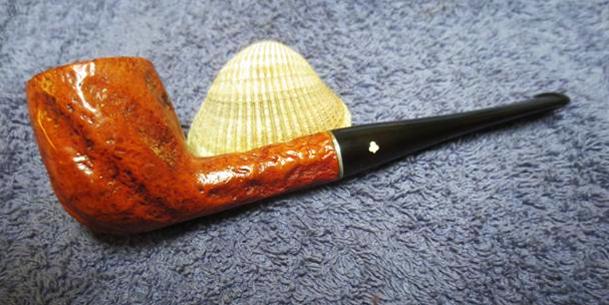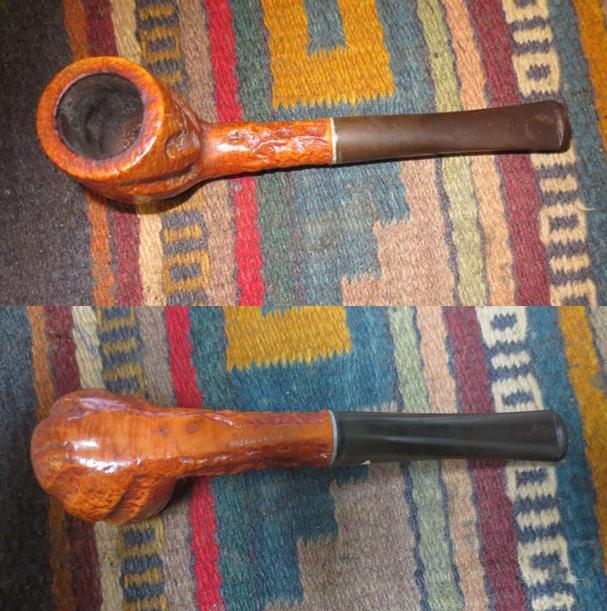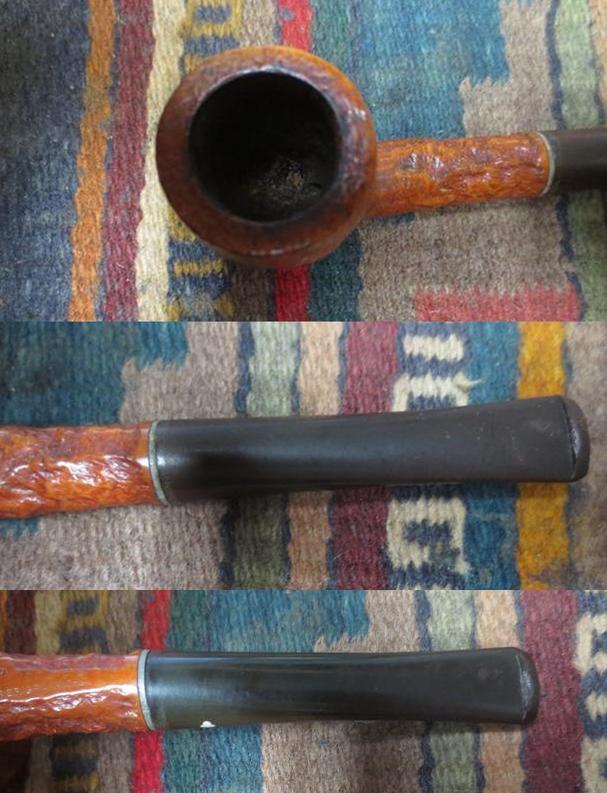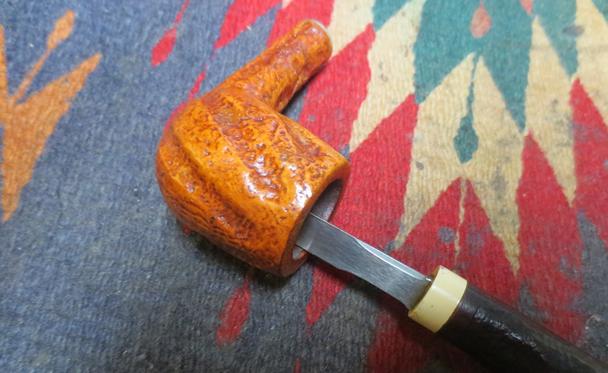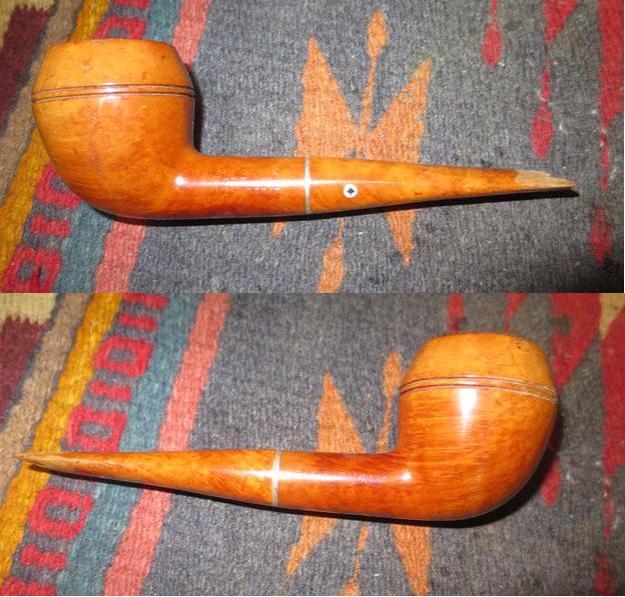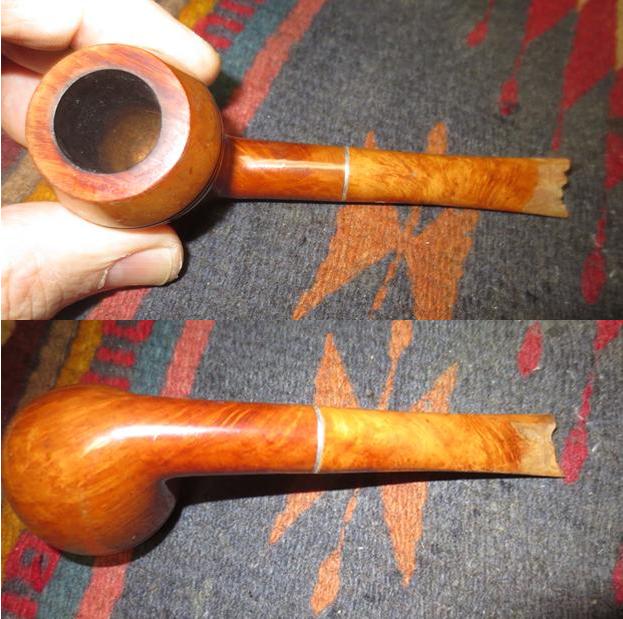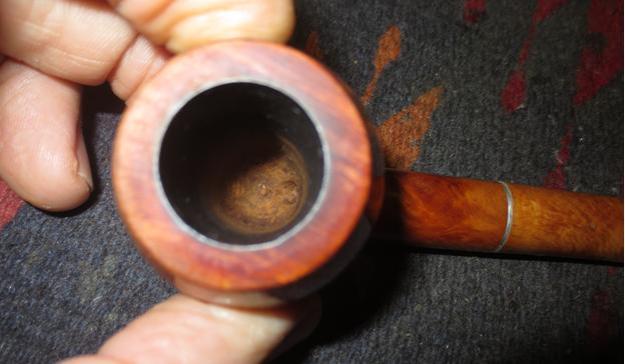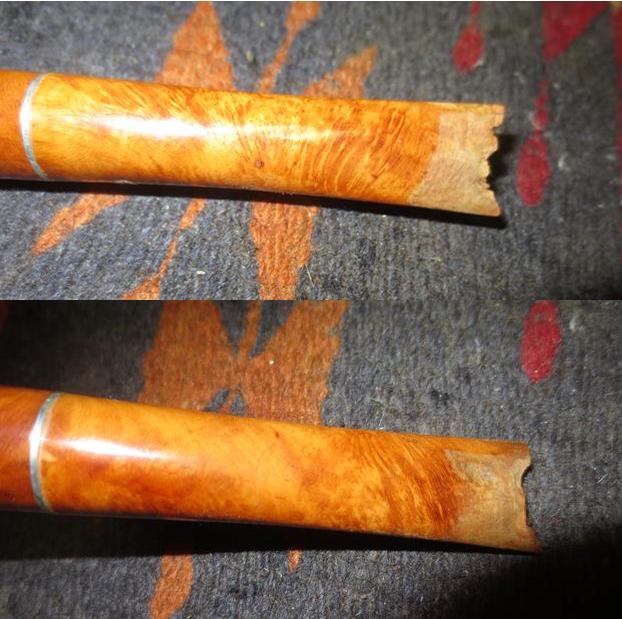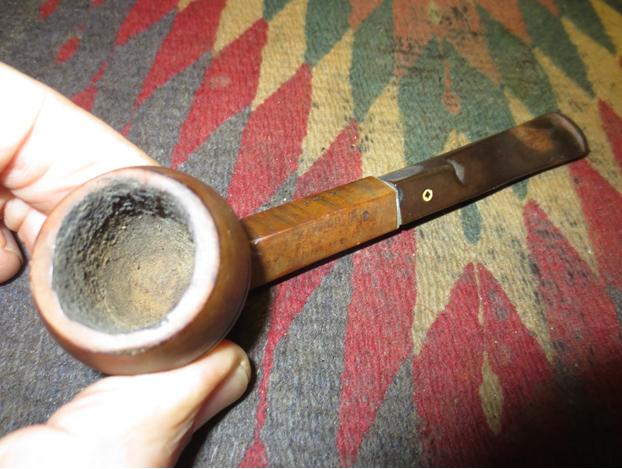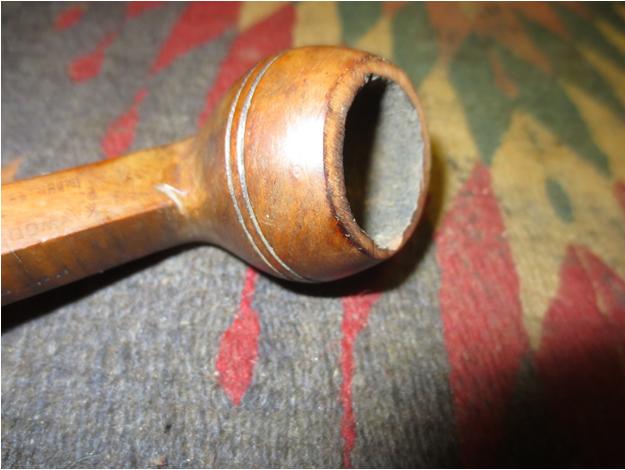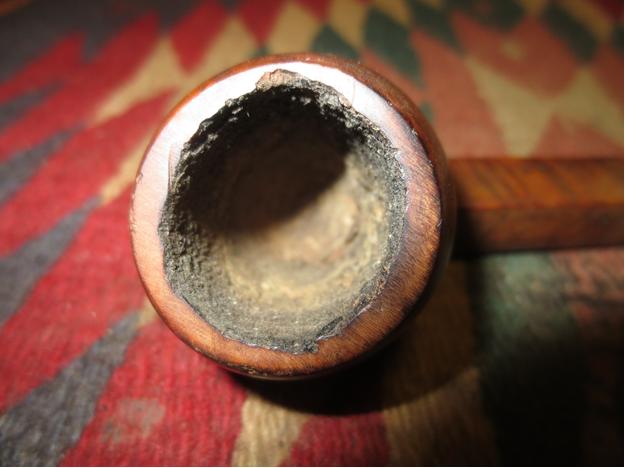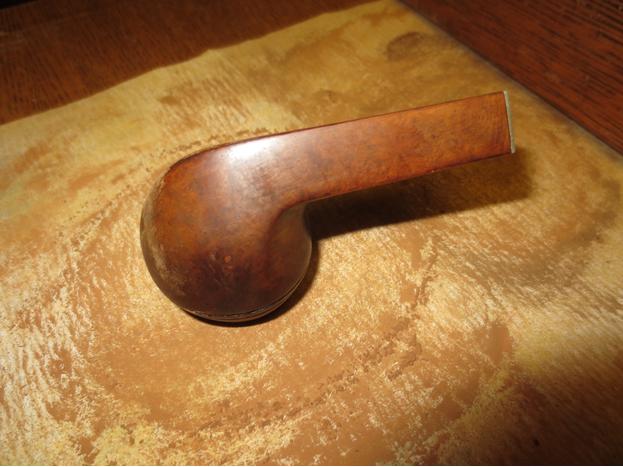
Tag Archives: Kaywoodie Pipes

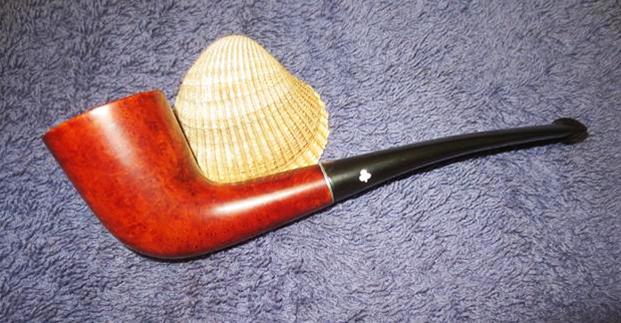
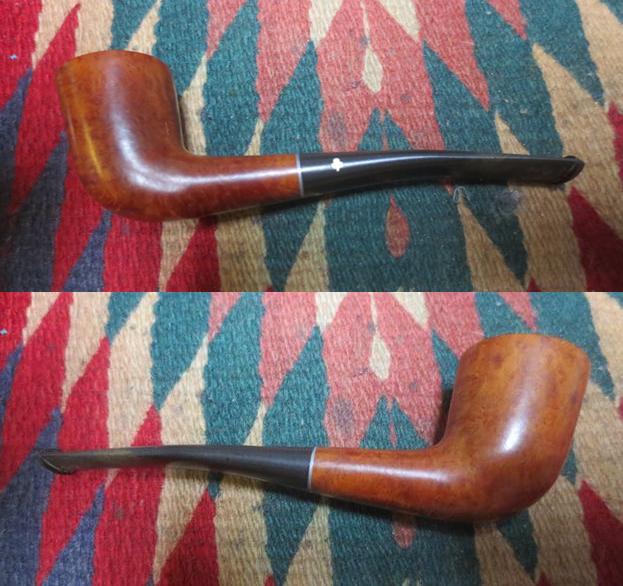
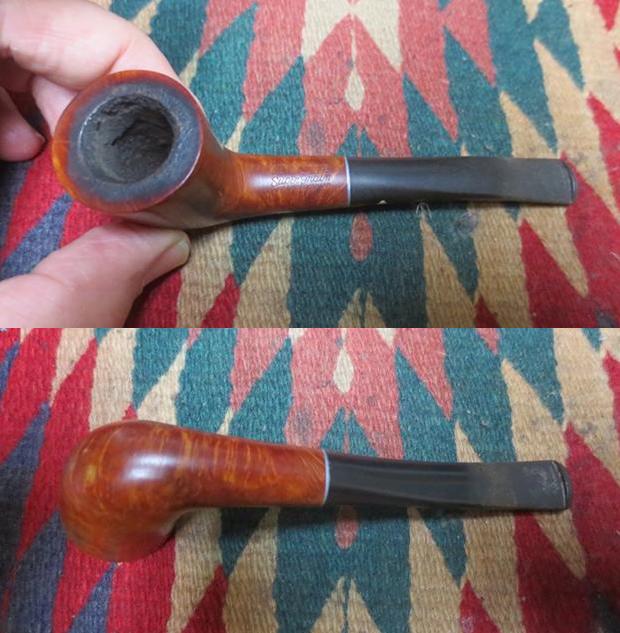
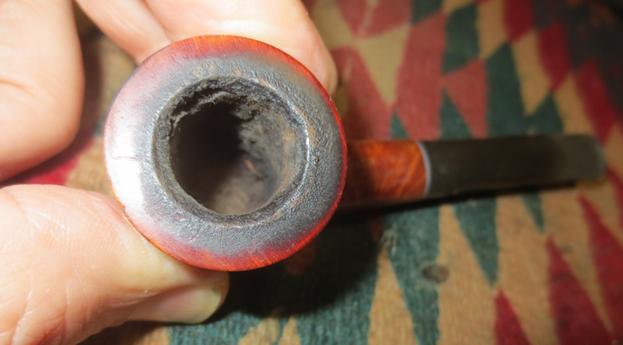
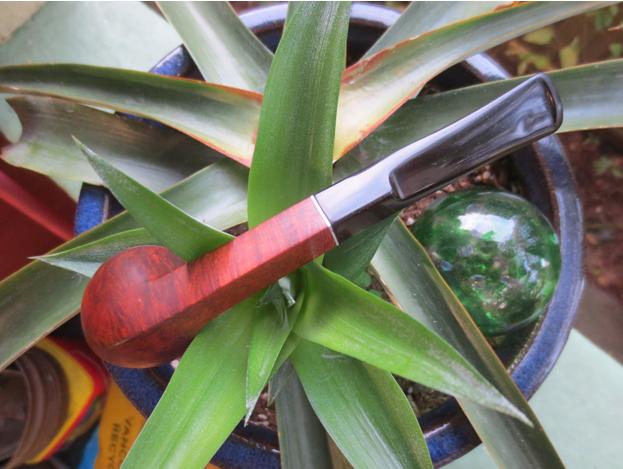
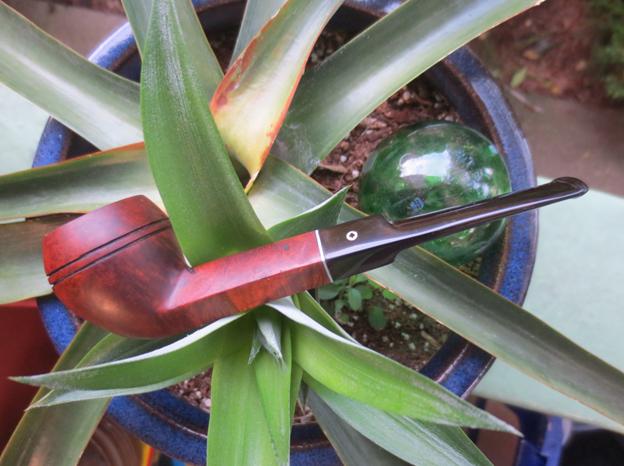
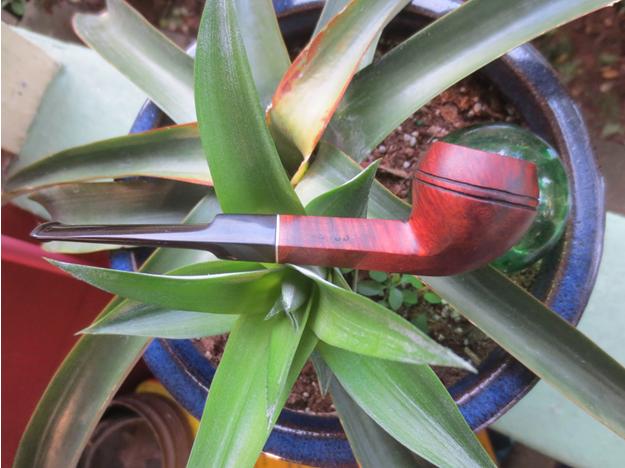
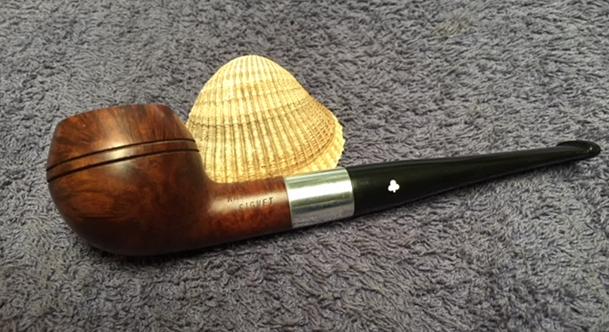
Reworking Mark’s Uncle’s 6th pipe – a Kaywoodie Signet Rhodesian


Blog by Steve Laug

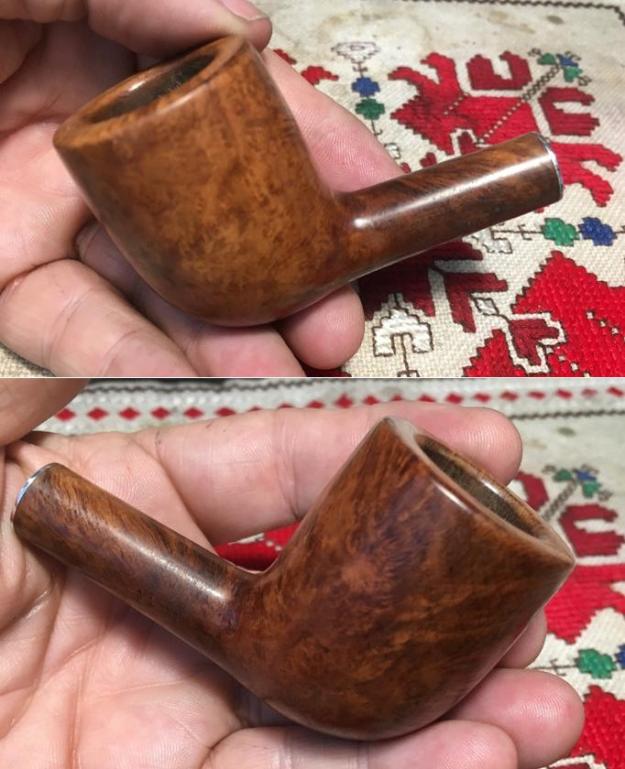
I have one more of Mark’s uncle’s pipes left after this one. The one on the table now is one of the Kaywoodies. I am really enjoying working on these and I think it is because of the known history behind these old pipes. To me one of the fun parts of this hobby is the history or backstory on the pipes. If I can find out about that it gives another dimension to the pipe repair or restoration work. I have finished five of the seven pipes that Mark sent me. The Ropp Cherrywood De Luxe (https://rebornpipes.com/2018/01/17/cleaning-and-restoring-a-ropp-cherrywood-de-luxe-805/), The Doodler (https://rebornpipes.com/2018/01/19/restoring-a-beautiful-the-doodler-bullmoose/), newer three hole stinger Kaywoodie Super Grain Billiard S-L (https://rebornpipes.com/2018/01/21/restoring-marks-uncles-third-pipe-a-kaywoodie-super-grain-s-l-billiard/), a Savinelli Churchwarden (https://rebornpipes.com/2018/01/22/restoring-marks-uncles-savinelli-churchwarden-aged-briar-2002/) and a Tally Ho 33 Pot made by Hardcastle’s (https://rebornpipes.com/2018/01/25/restoring-and-restemming-marks-uncles-5th-pipe-a-tally-ho-33-pot/) are completed and I have posted them on the blog. I mentioned in each previous blog that I think about the pipeman who used these pipes as a daily part of his life while I am working on them. Here are some pictures of the pipes.The pipe I am working on now is the third pipe down in the above photo and the third from the left in the photo below. It is a Rhodesian or round shank bulldog pipe with a major piece missing from the button on the stem.I have included a bit of the history of Mark’s uncle with each of the past pipe restorations to give you a sense of the information that always in behind the desire to clean up and restore this set of old pipes. Mark wrote…
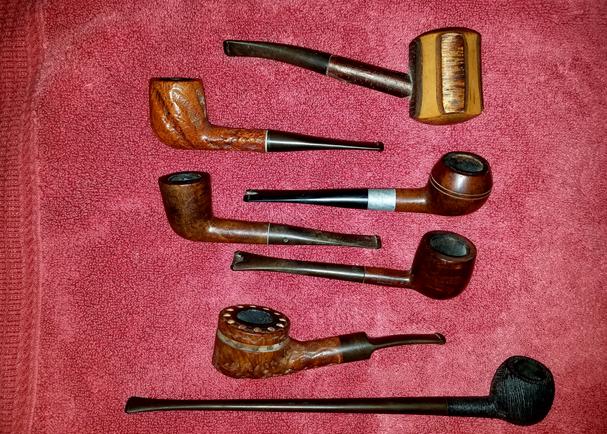
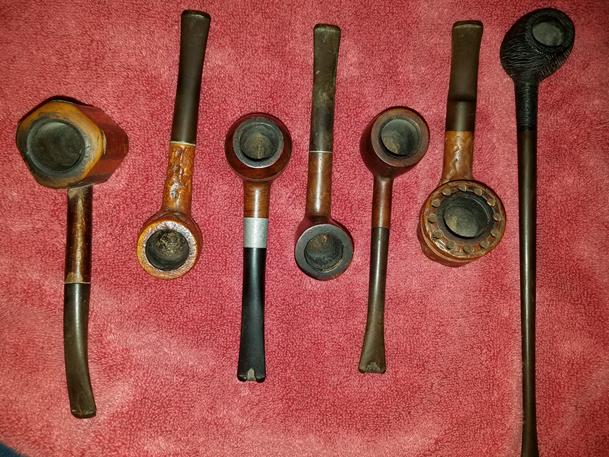
…My Uncle John, raised in an Appalachian Mountain family (think Hatfield and McCoy), was a large man with an affable personality – although this had limits and he could be quite formidable.

During WWII he left home and enlisted in the US Army where he was assigned to Patton’s 3rd Army as an ambulance driver.  After Germany surrendered, he was transported back to the US on a converted ocean liner troop ship (I believe it was the Queen Mary).  Upon reaching the US, his unit was immediately sequestered on a troop train for transport to the West Coast to be shipped to the Pacific for the invasion of Japan.  About half way across the country (possibly somewhere in Texas), the train stopped and the troops informed that Japan had capitulated – WWII was over.

Before the Korean War began, my uncle re-enlisted in the US Air Force.  He as assigned to a Photo Mapping unit as an Aircraft Mechanic.  He worked his way up to Crew Chief and served in Photo Mapping until he medically retired in the mid 60’s due to heart problems.

Being part of an Air Force family, I did not get to spend much time with my uncle while growing up.  However, I was able to stay a couple of summers with him at his West Palm Beach home while in my teens.  On a desk in his Florida Room sat collection of old used pipes in a walnut pipe rack / humidor combo (very similar the Decatur Industries 6 pipe Rack and humidor combination shown in the rebornpipes store).  There were a couple of packages of old dried up commercial brand tobacco in the humidor – one was cherry, I think.  I never saw my uncle smoke and never discussed the pipes with him, but I was intrigued by the pipe collection.  They were old, dirty, and well used – some with chewed through stems.  Obviously, the pipes had been smoked by a devoted pipe enthusiast.  As a young boy, I loved the smell of pipe tobacco, which you could occasionally smell in public way back then.  I started smoking an occasional pipe in college.  When my uncle passed away a few years later, I asked for his pipe collection and have stored it away since then.  The pipes are just as I received them some thirty years ago.

While I will never know for sure, I believe my uncle purchased the pipes in various PX’s and smoked them while an Air Crew Member.  The PX’s would have sold common commercially available pipe brands at a good price, nothing too expensive or exotic – consistent with the pipes in my uncle’s collection.  As a Photo Mapping Air Crew Member / Chief my uncle traveled the world extensively, and was stationed at many bases  – including “permanent” stations in West Palm Beach, Warner Robins, and Goose Bay Labrador, to name a few.  Smoking a pipe would have been a relaxing way to spend a few monotonous hours on the flight line or in the air.  After his heart problems, he must have given up pipe smoking and the pipes sat unused thereafter.  If the bowls look like they were recently scraped, it would have been over fifty years ago, most likely with a Case hardware store folding knife. If dirty, it is due to sitting for many years in the back room.  If well used and chewed it is due to many hours of smoking enjoyment.

I’m looking forward to seeing my Uncle John’s pipes in restored condition.  I know they are not “collectors” items, but they bring back priceless memories of my uncle and the times we spent together sharing “war stories”…

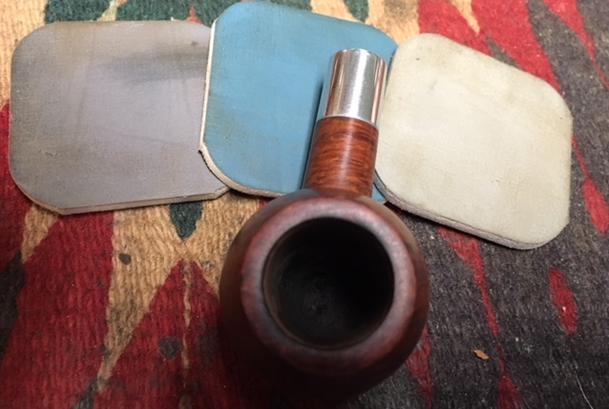
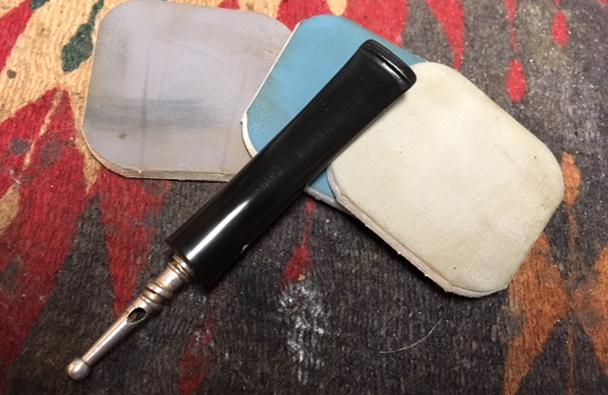
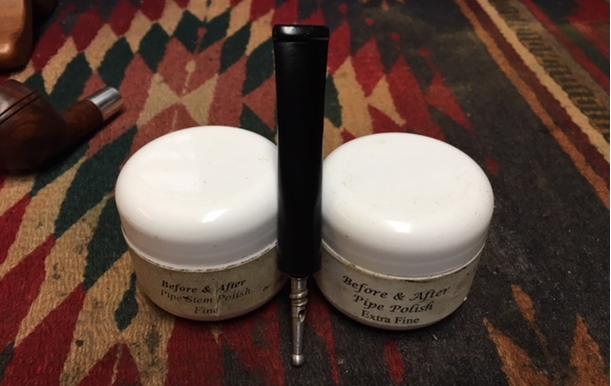
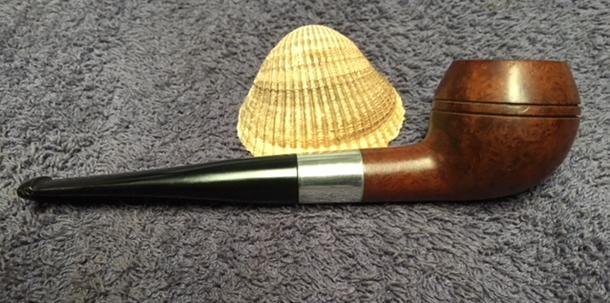
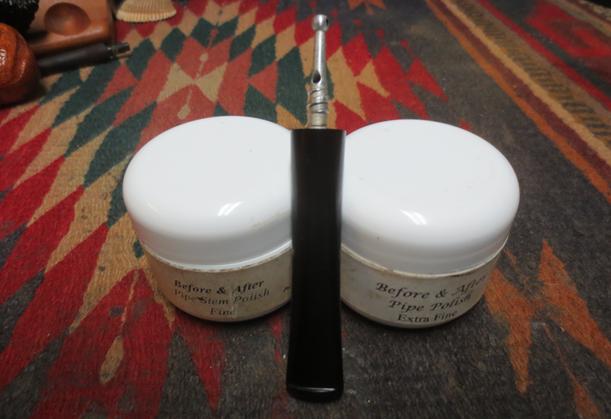
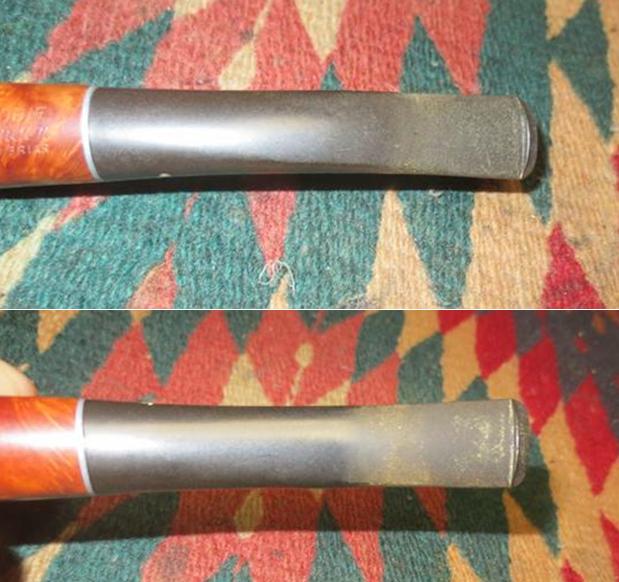
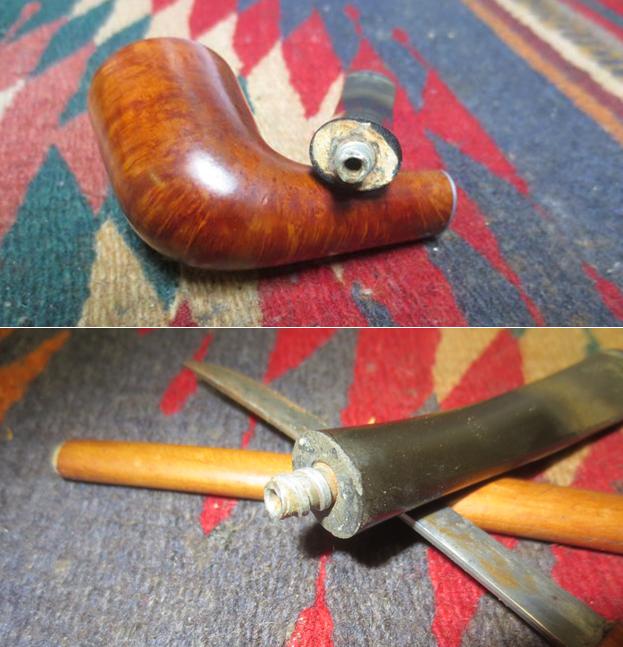
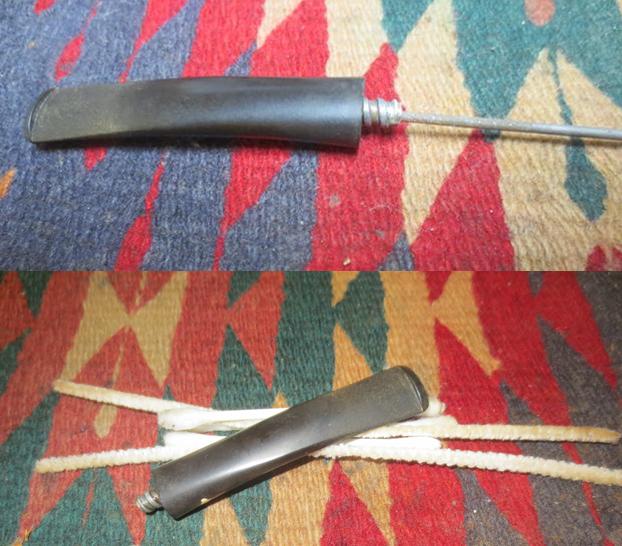
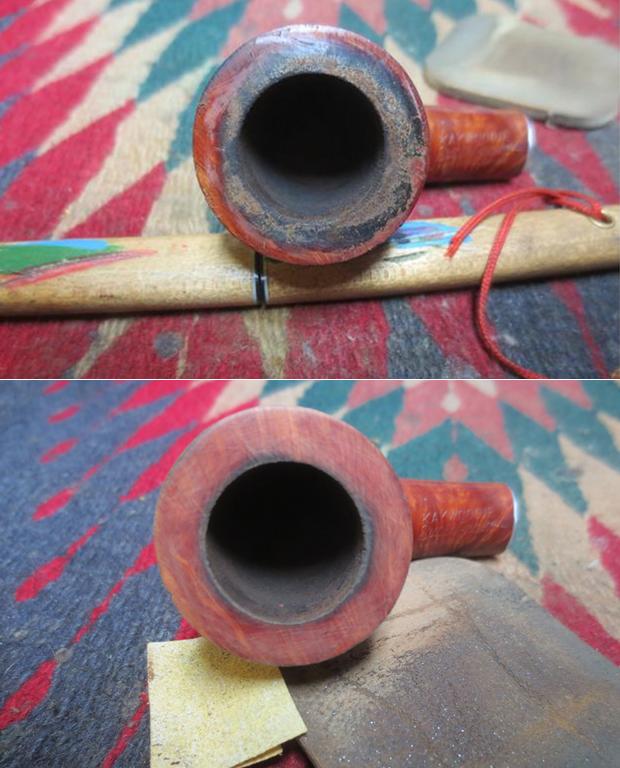
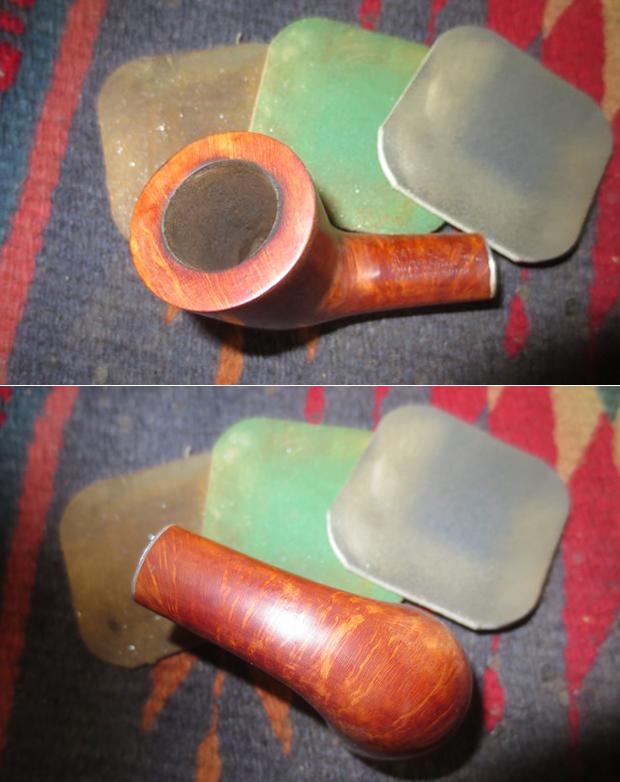
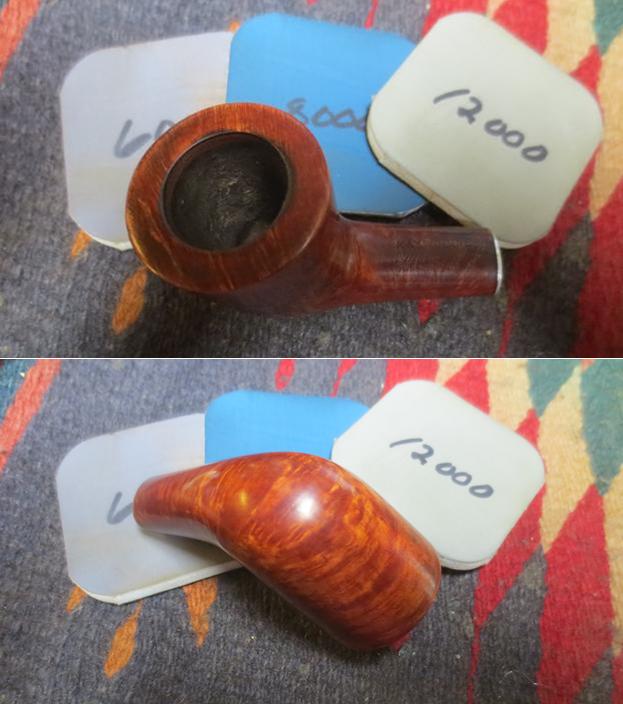
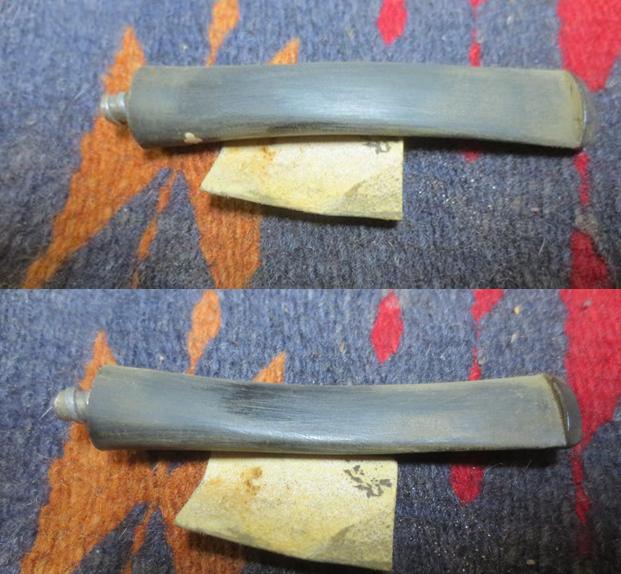
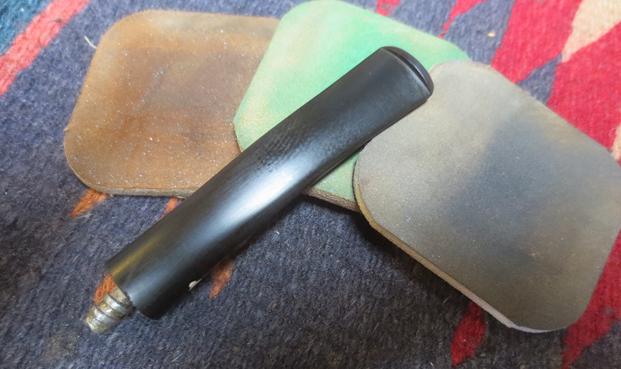
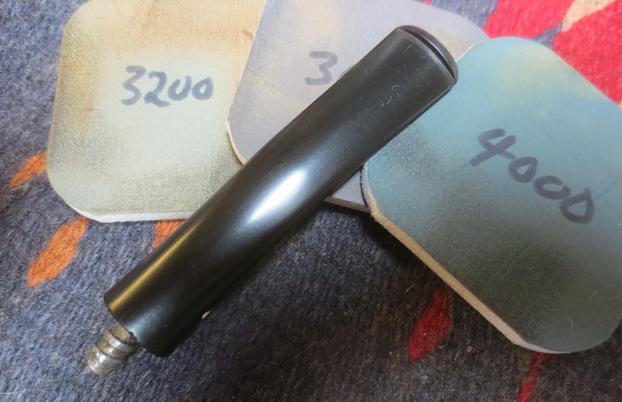
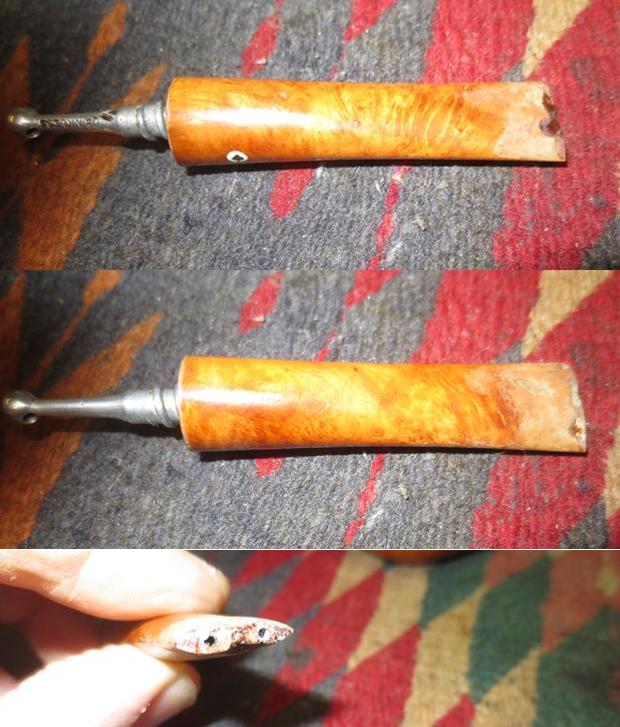
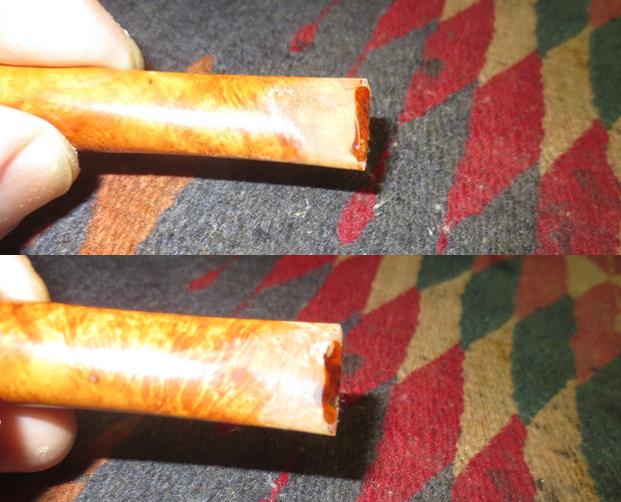
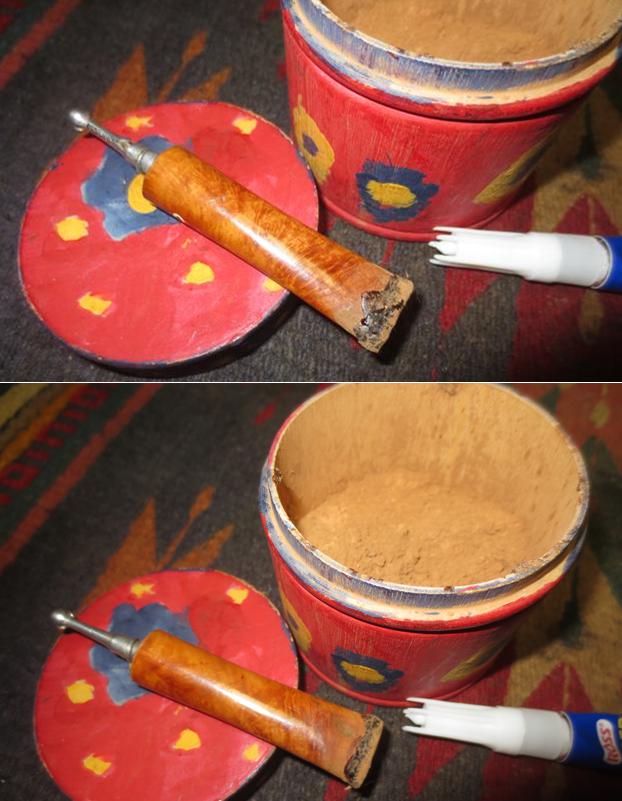
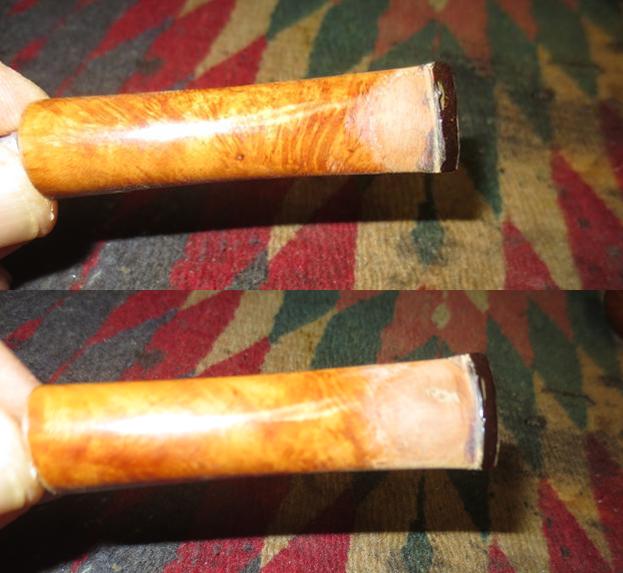
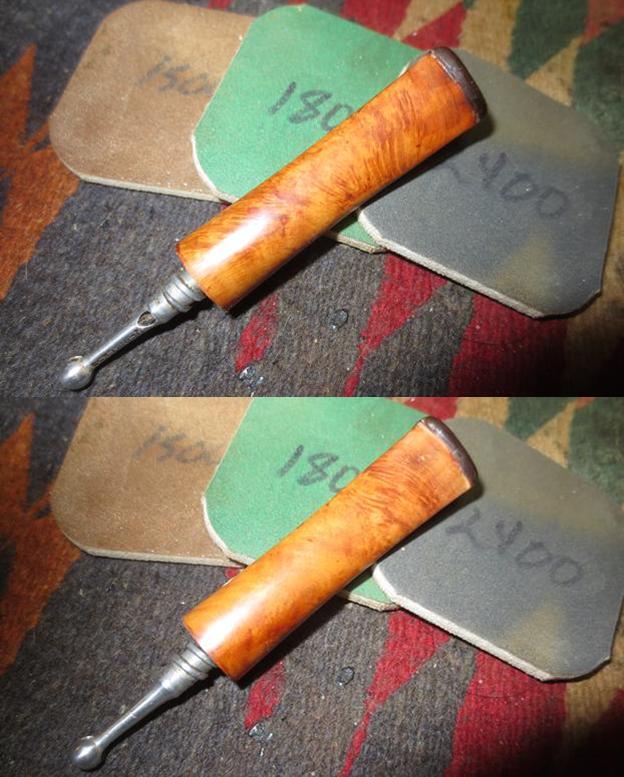
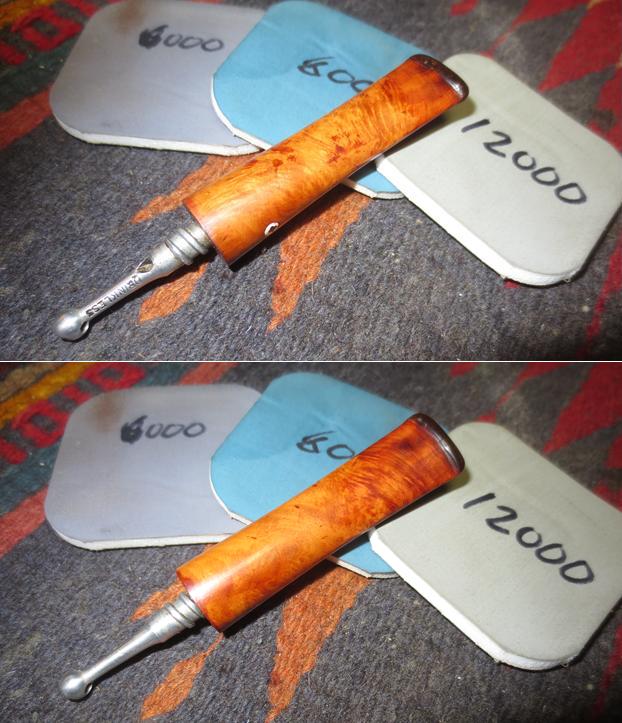
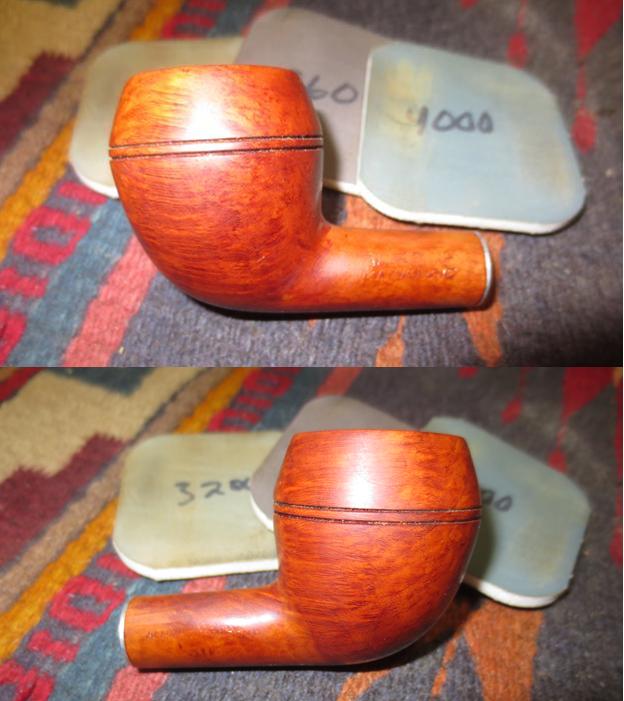
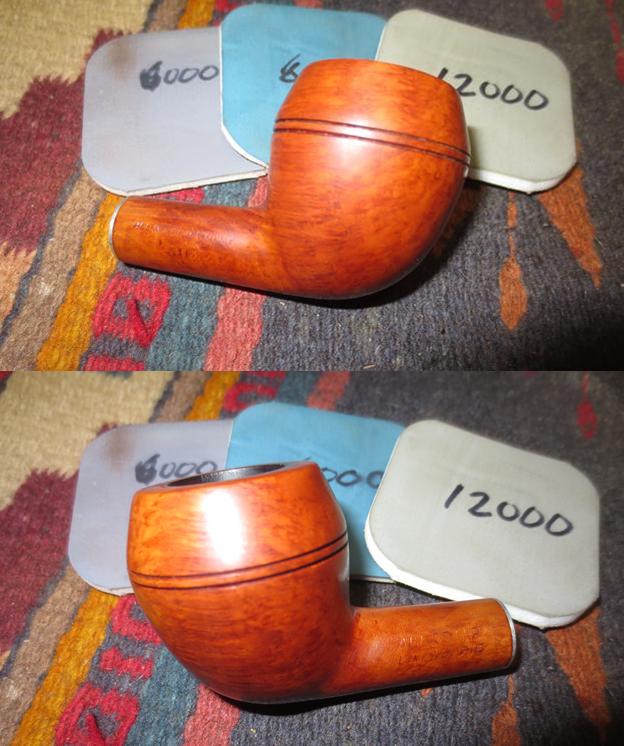
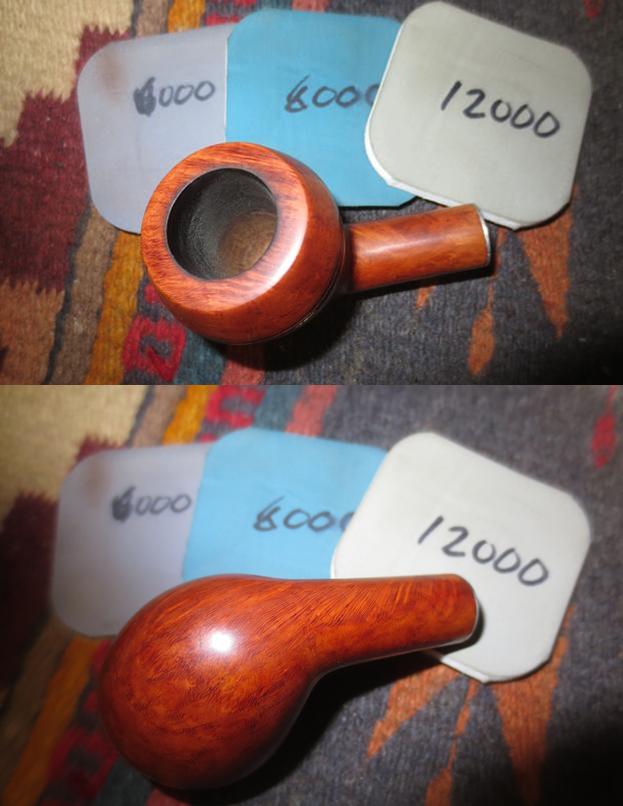
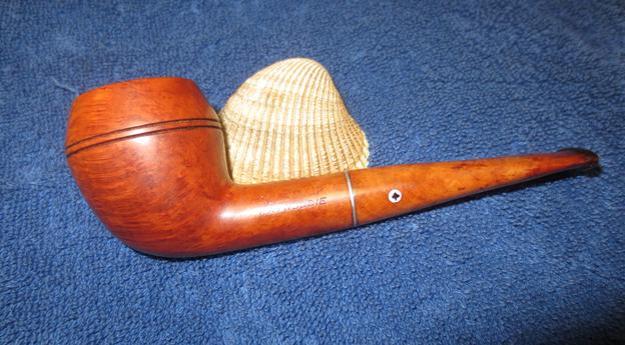
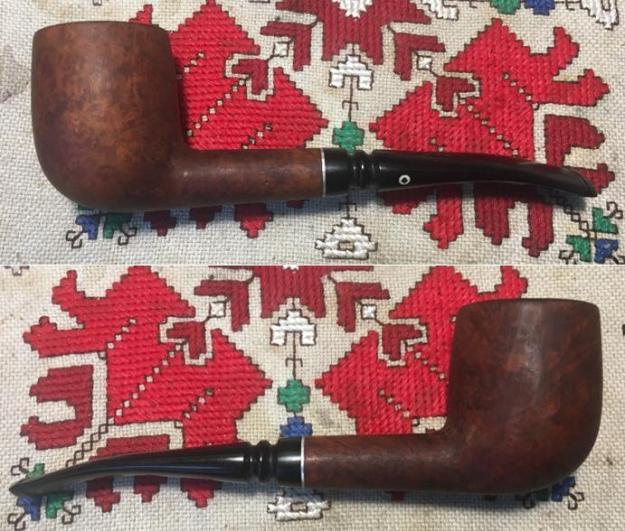
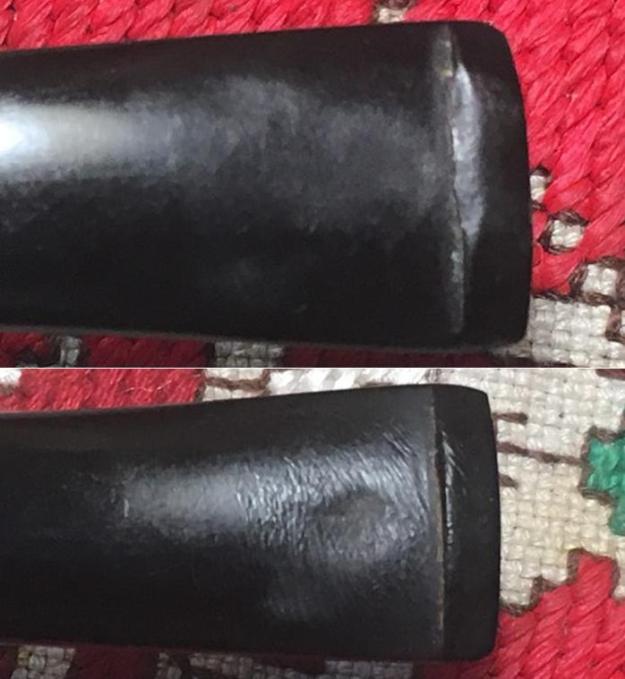
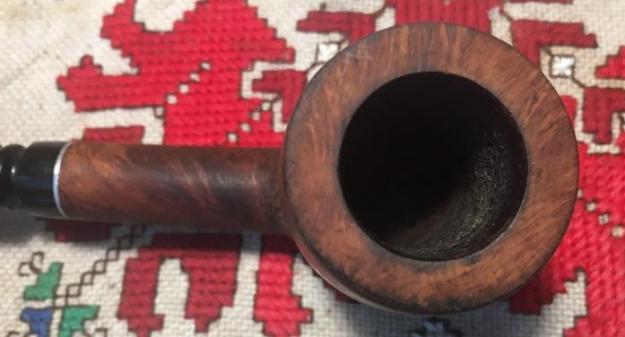
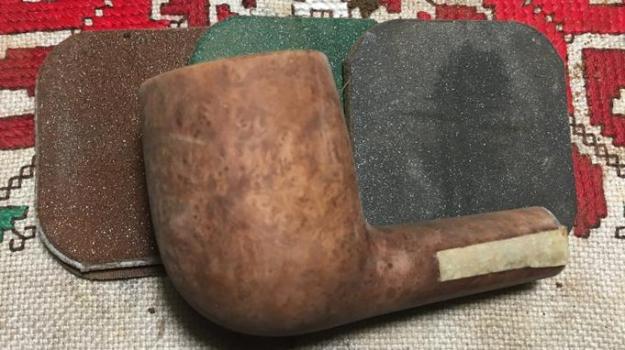
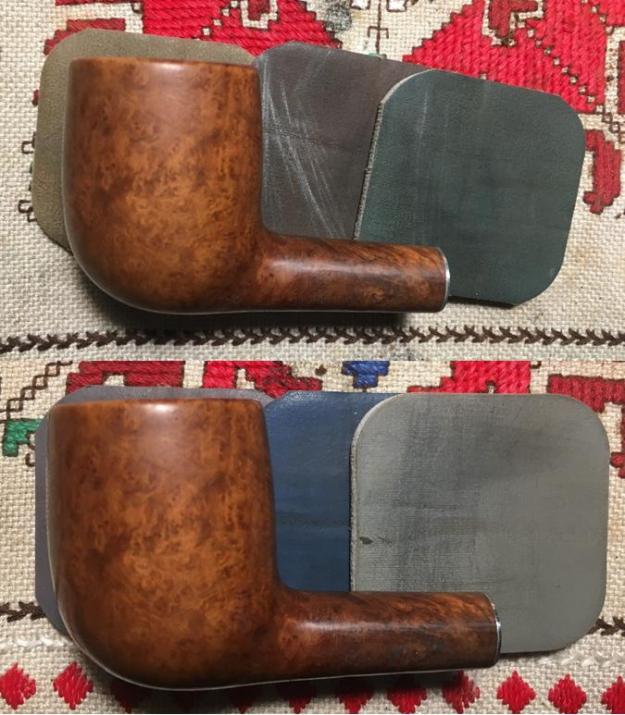
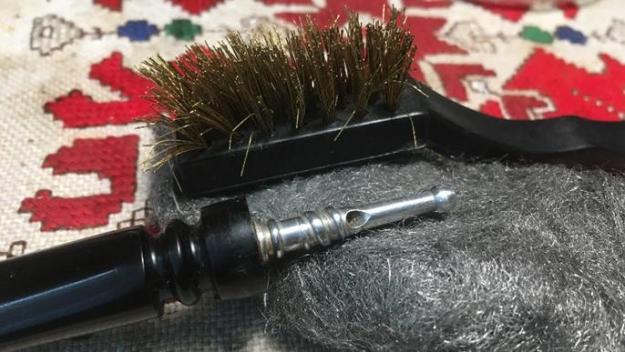
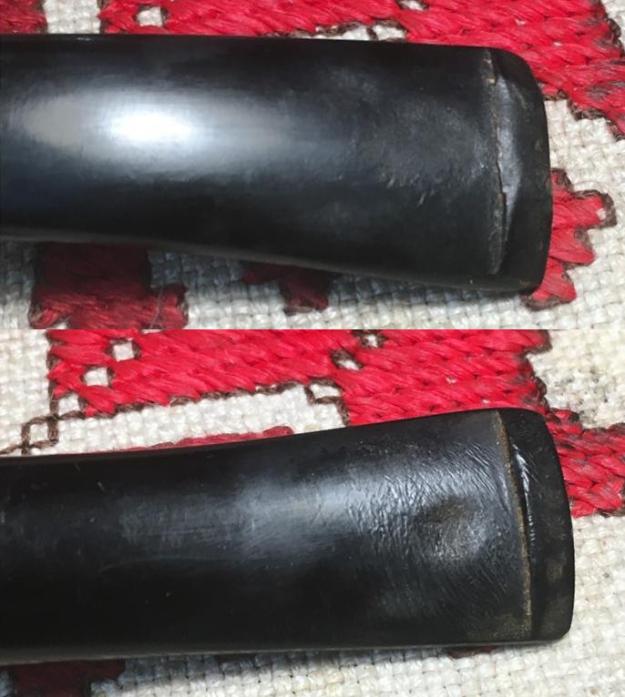
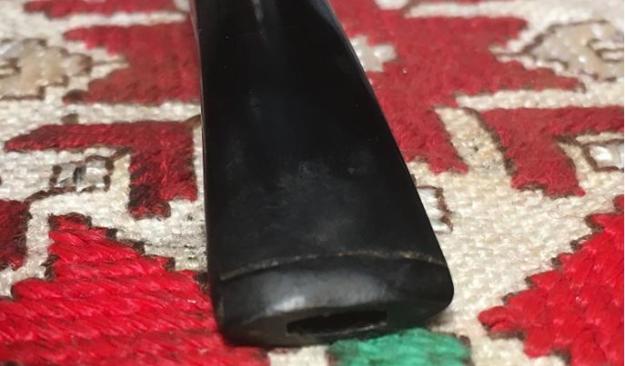
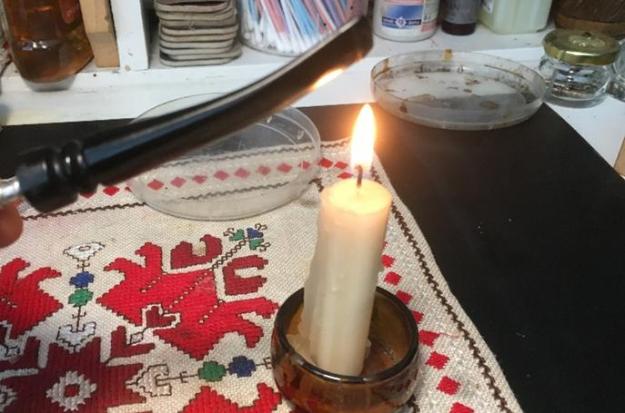
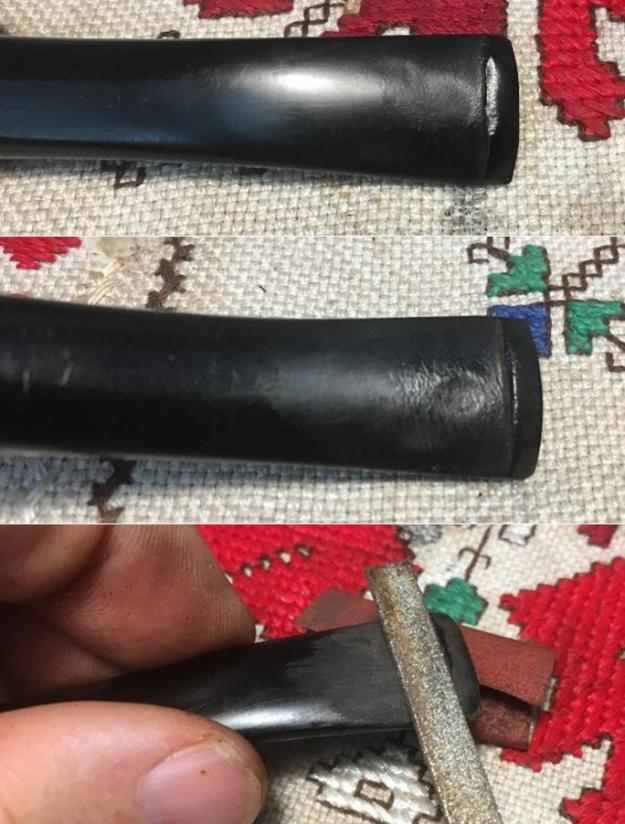
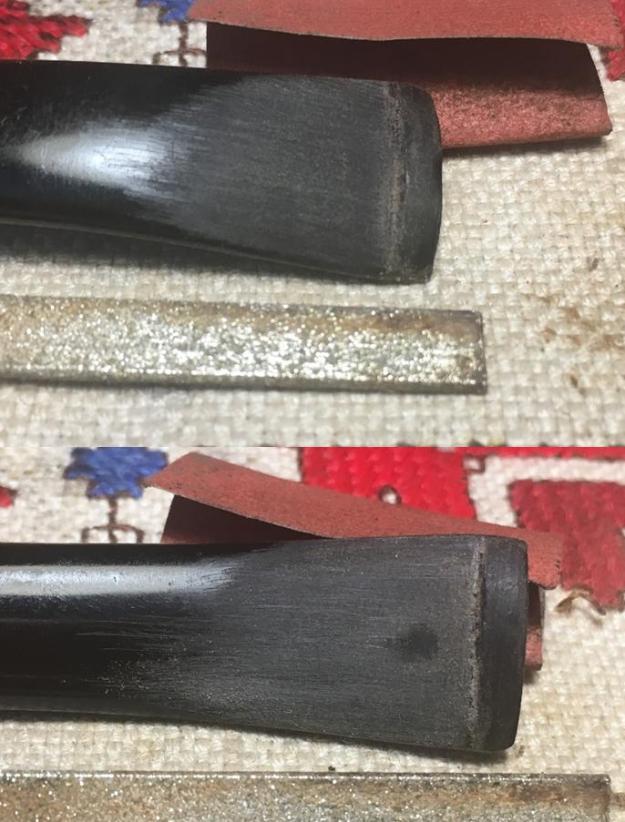
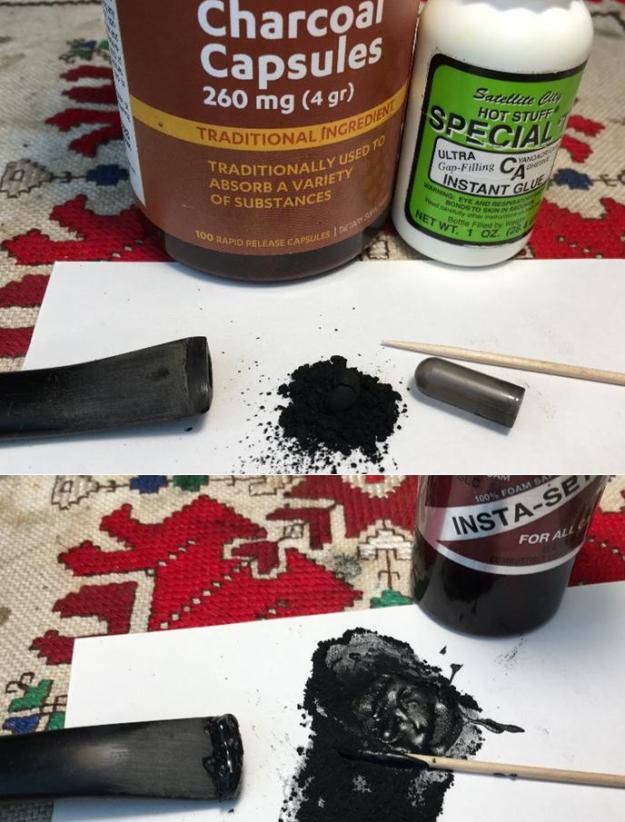
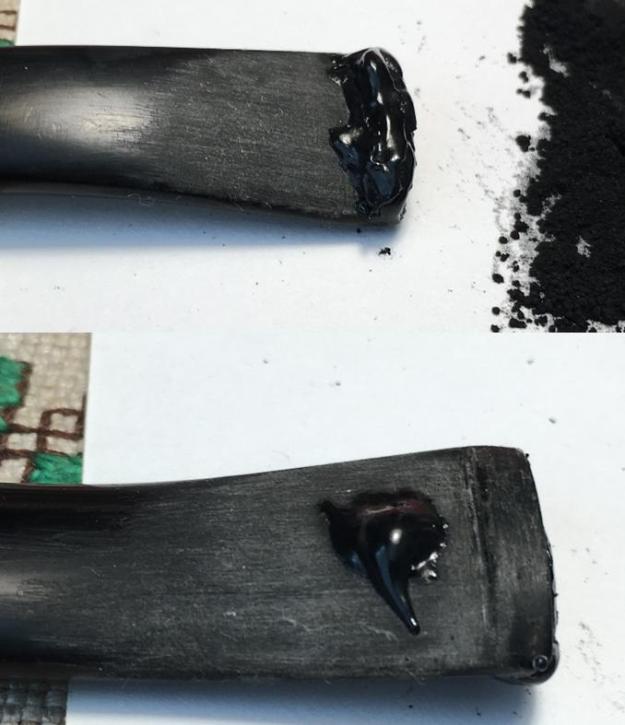
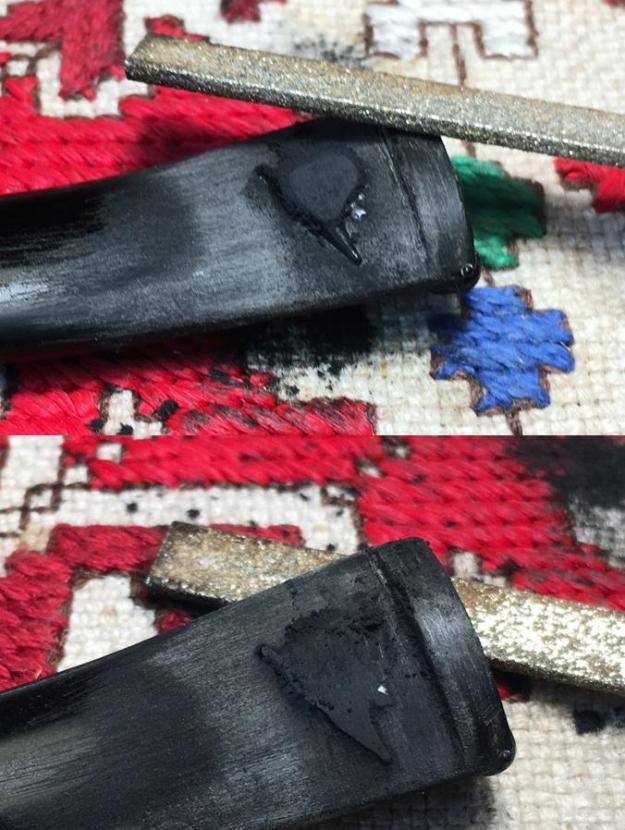
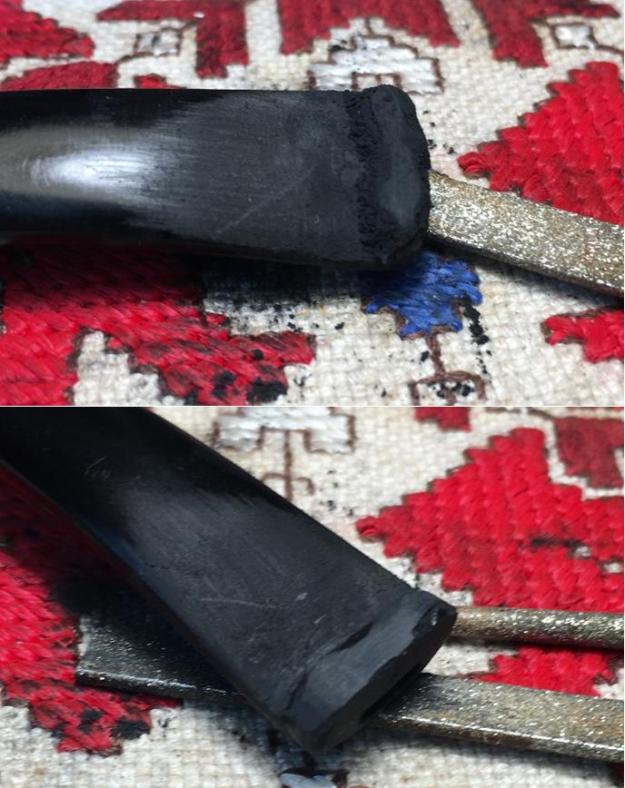
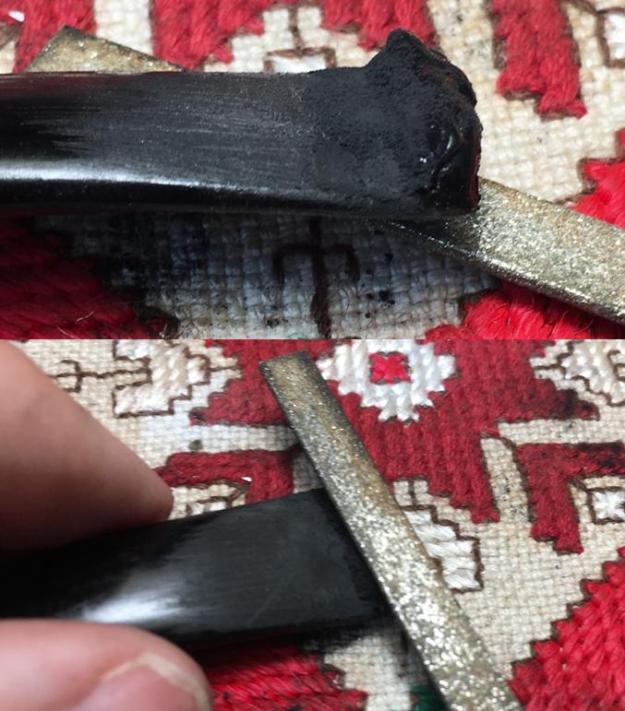
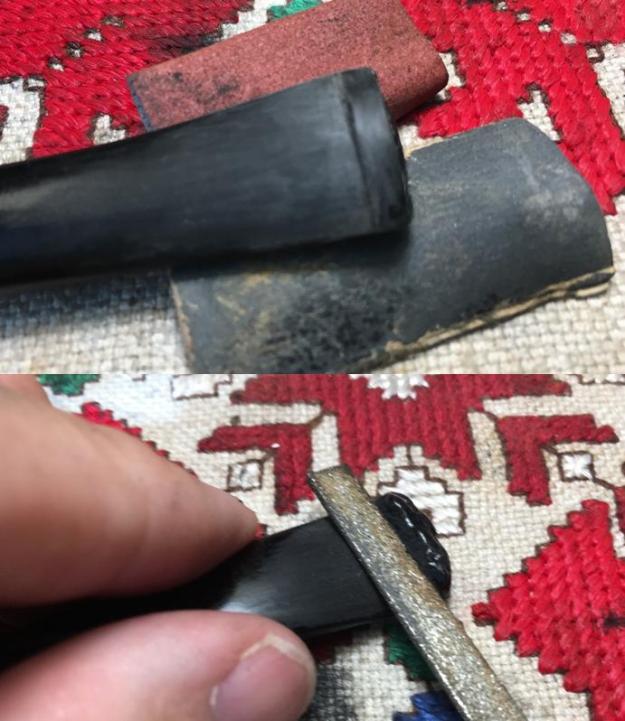
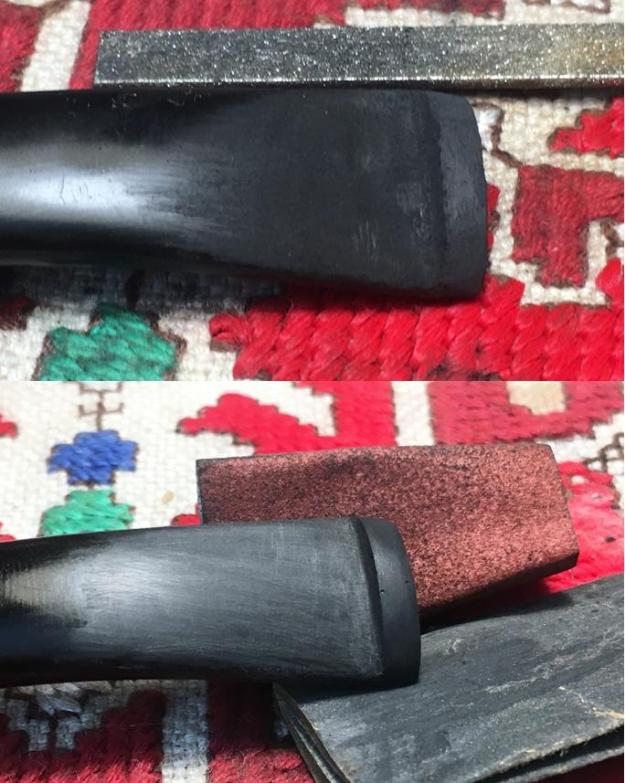
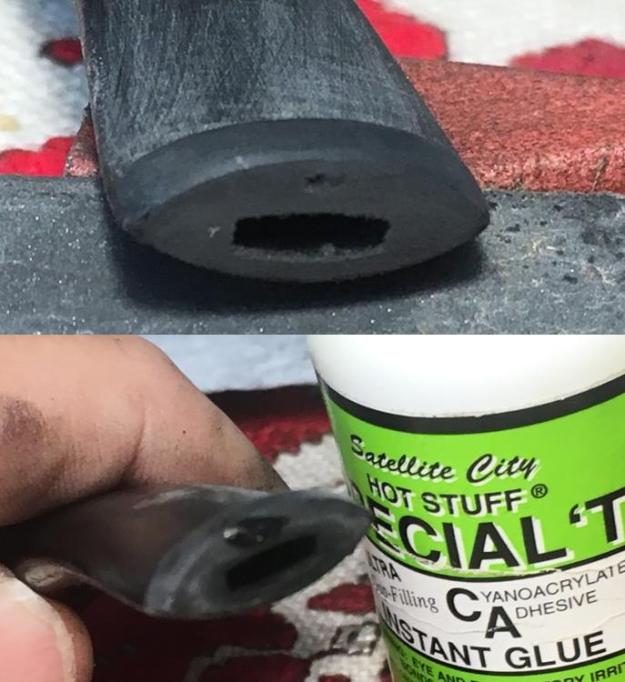
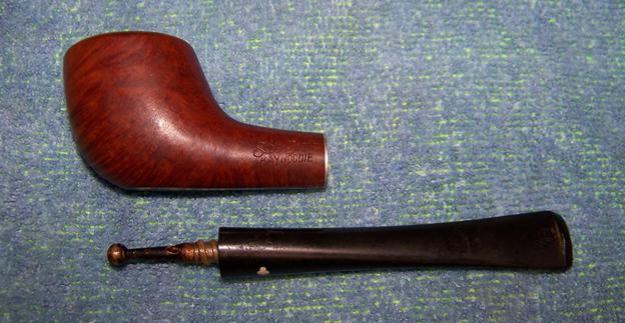
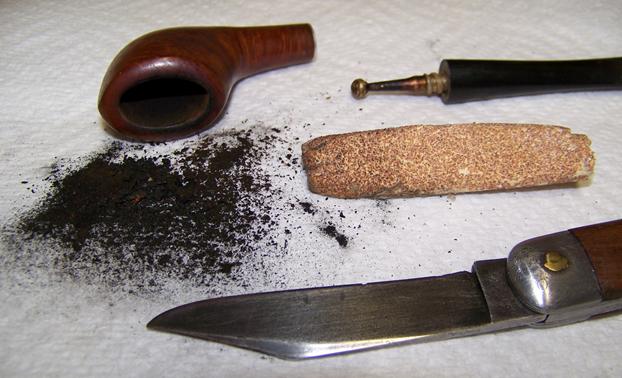
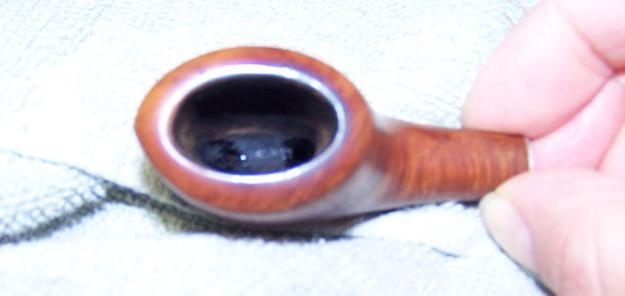
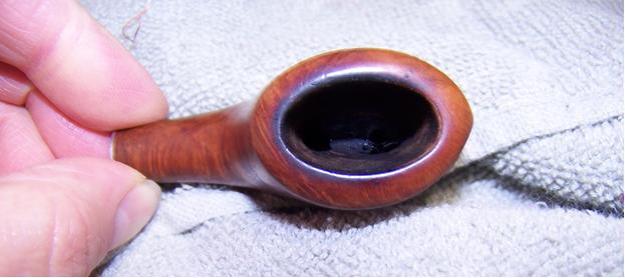
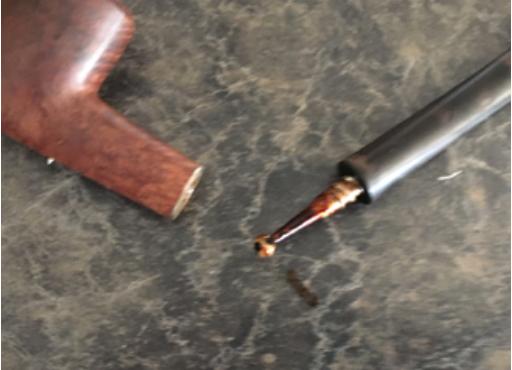
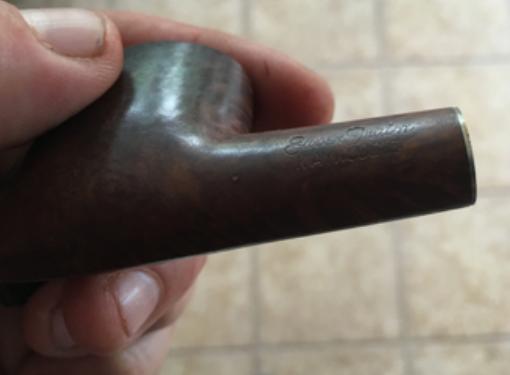
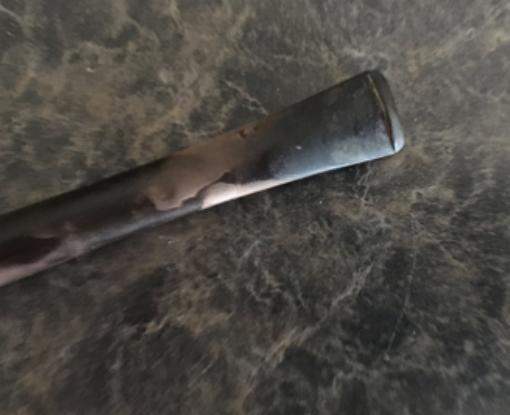
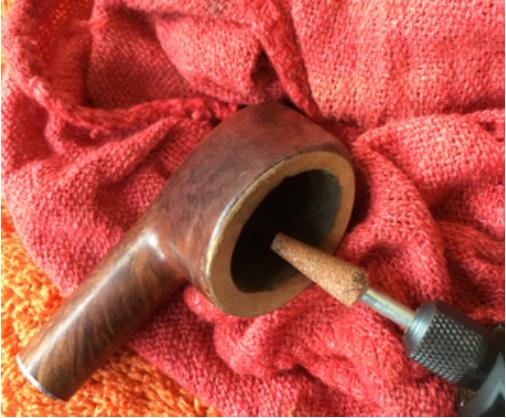
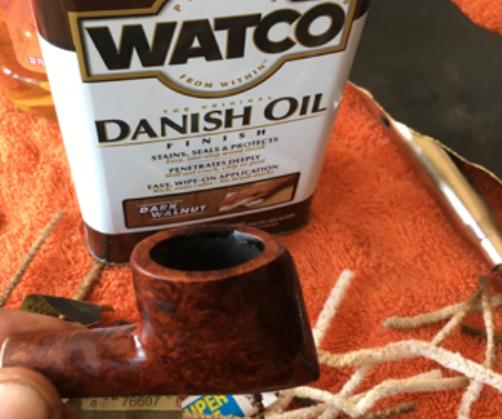
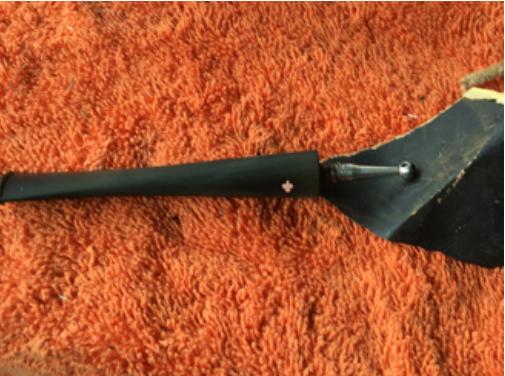
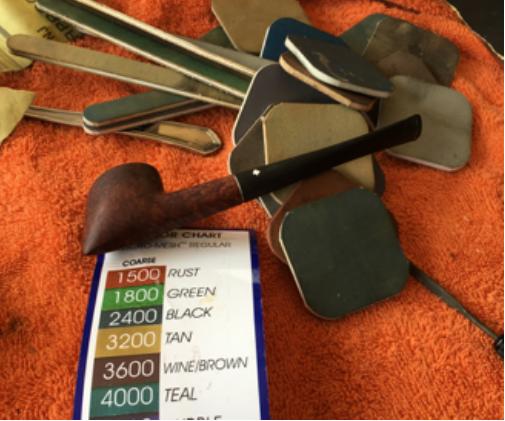
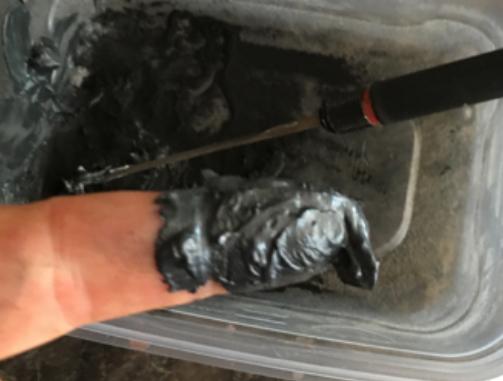
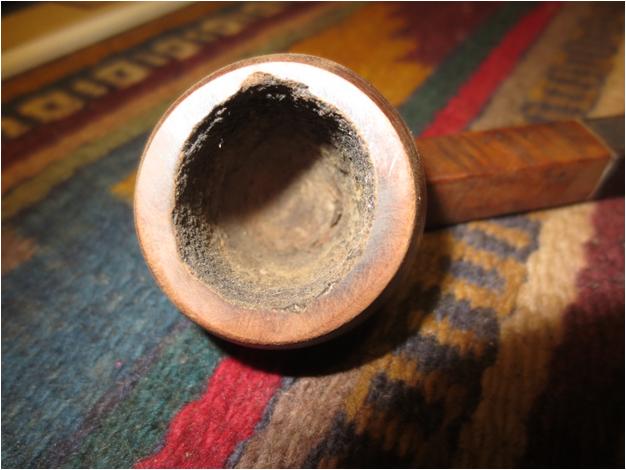
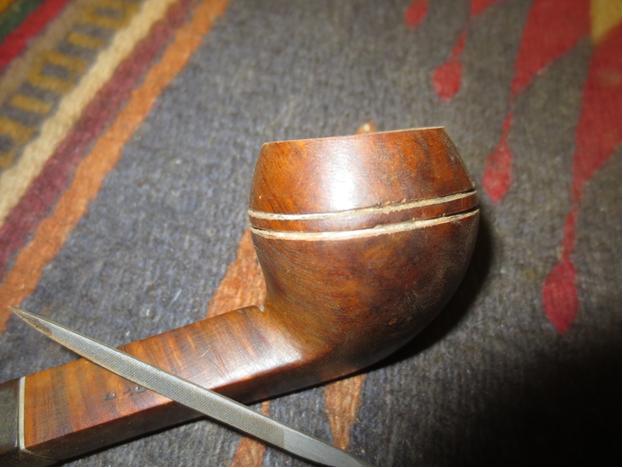
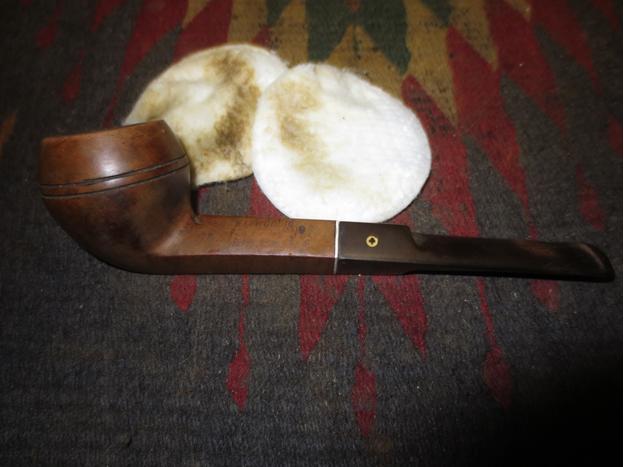
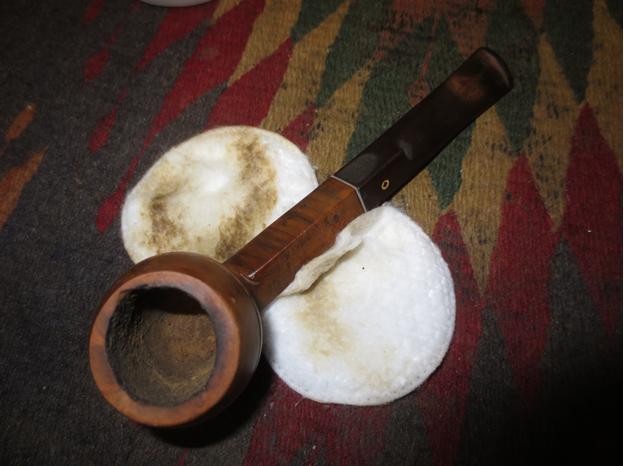
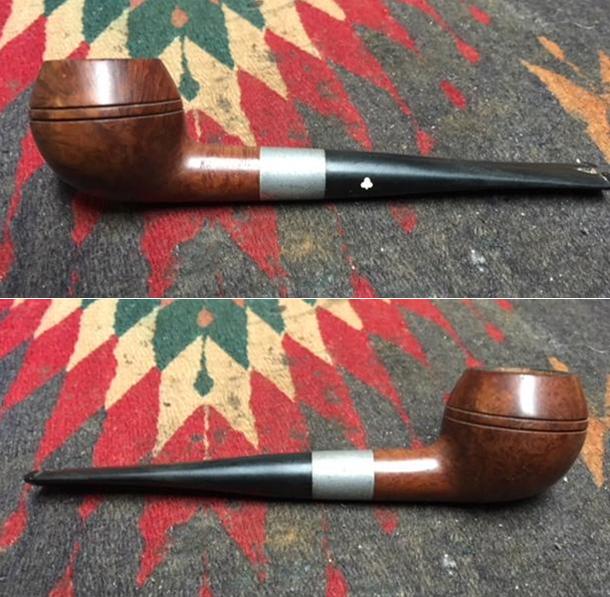
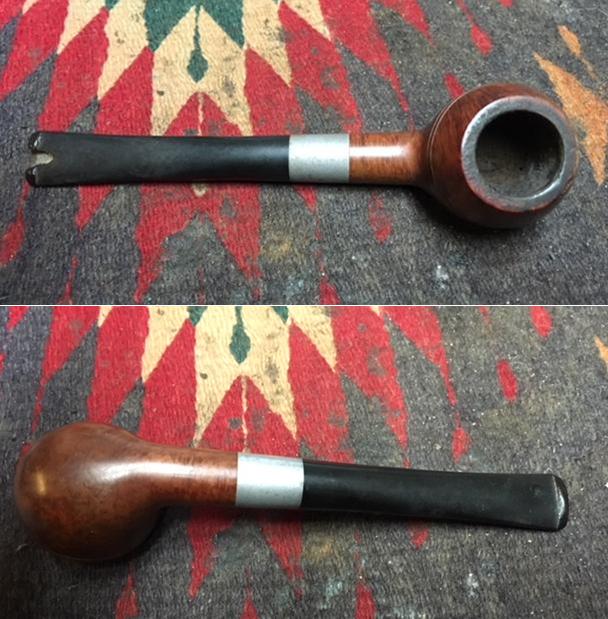
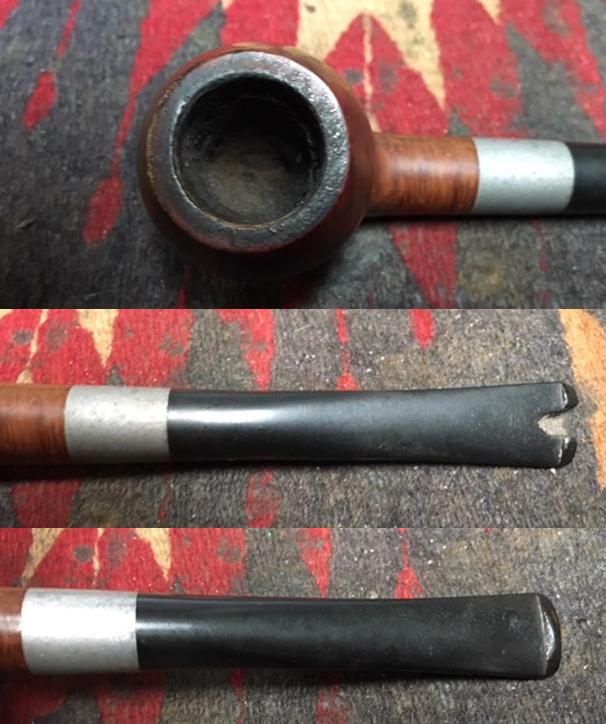
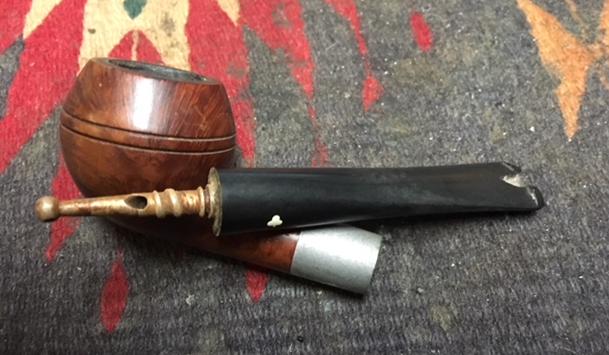
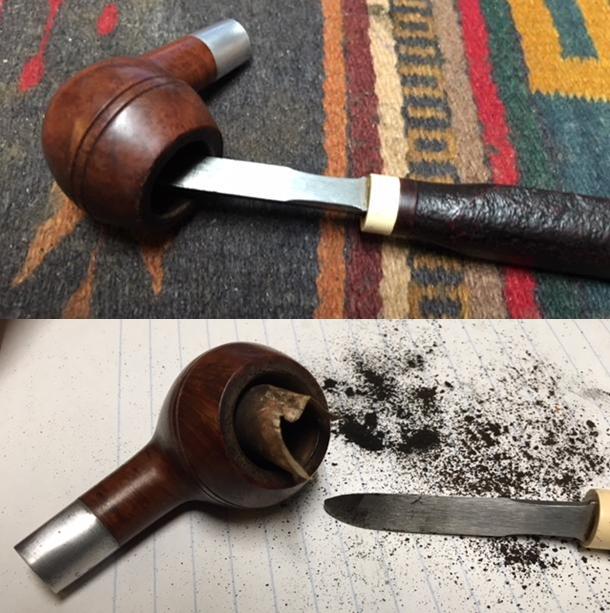
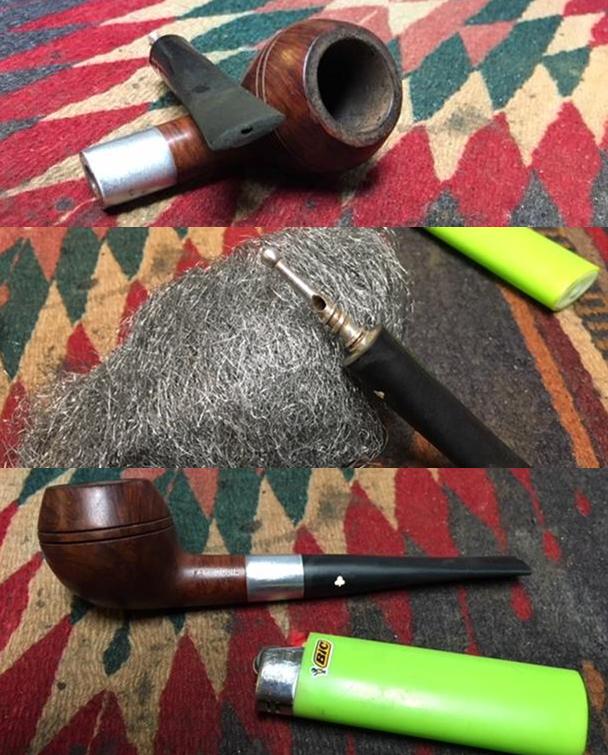
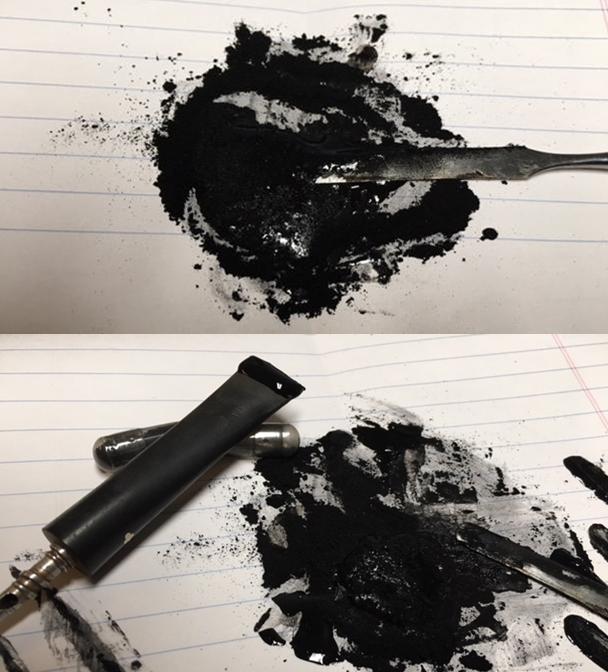
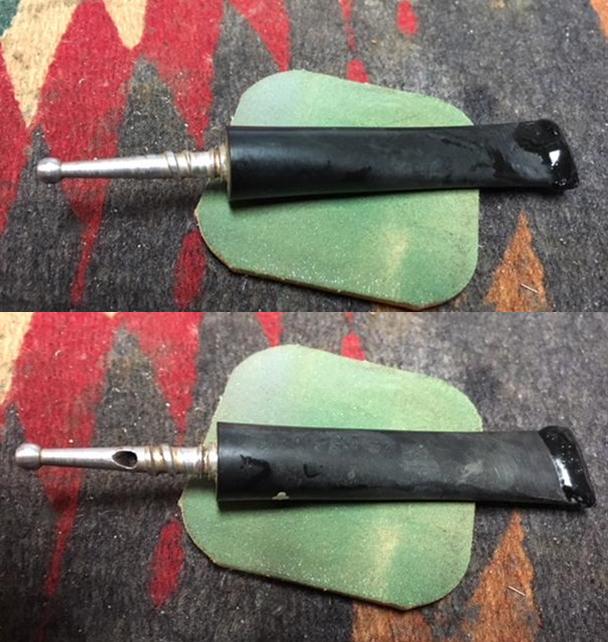
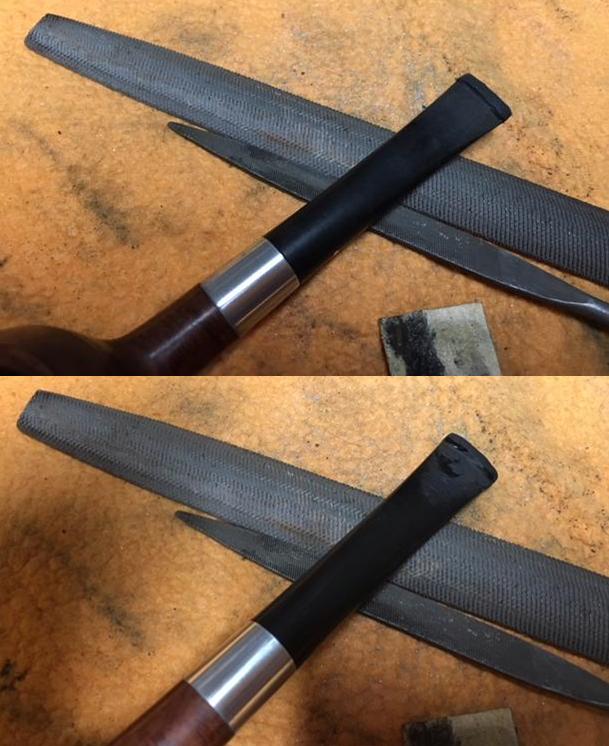
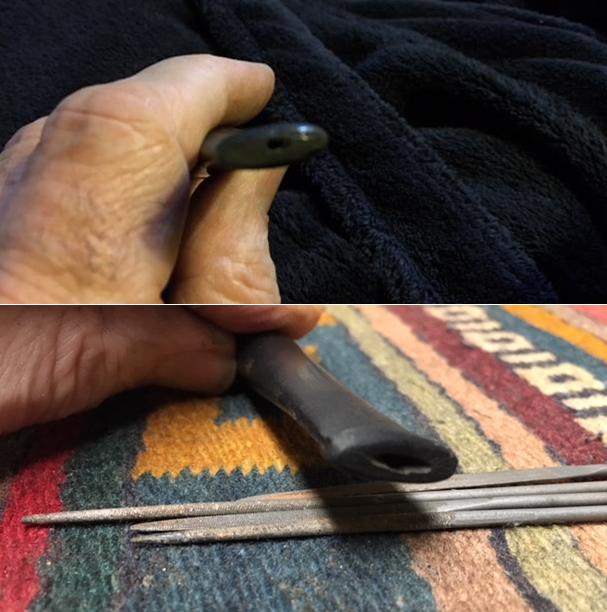
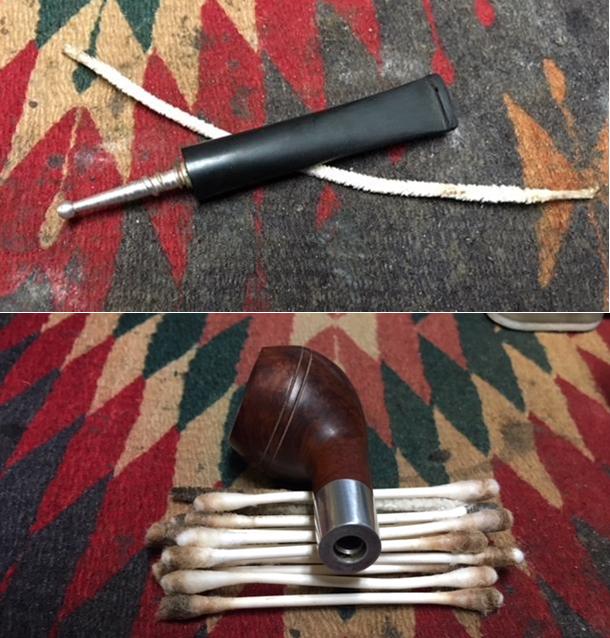
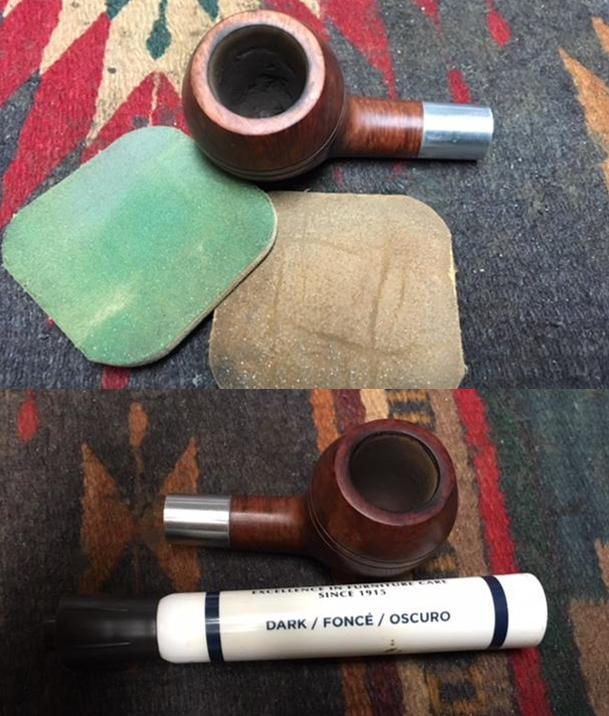
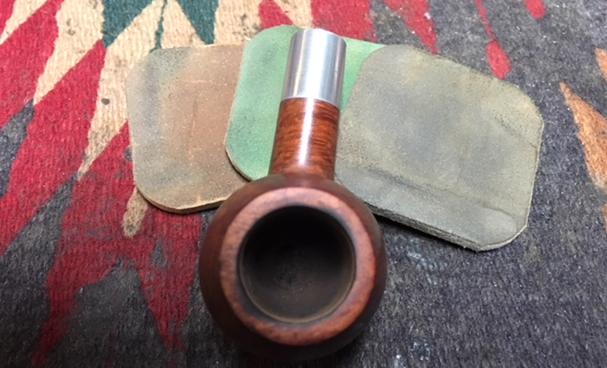
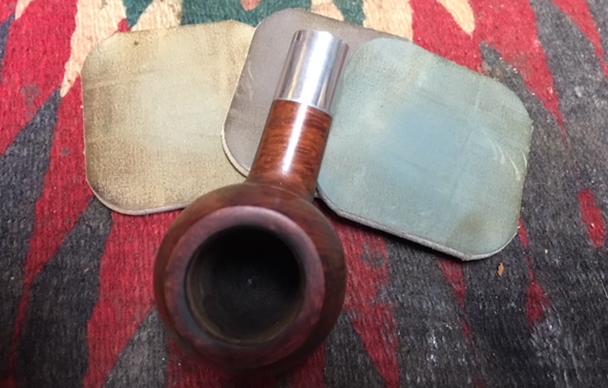
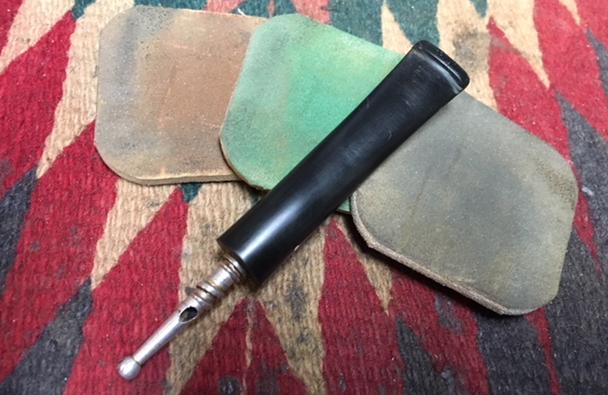
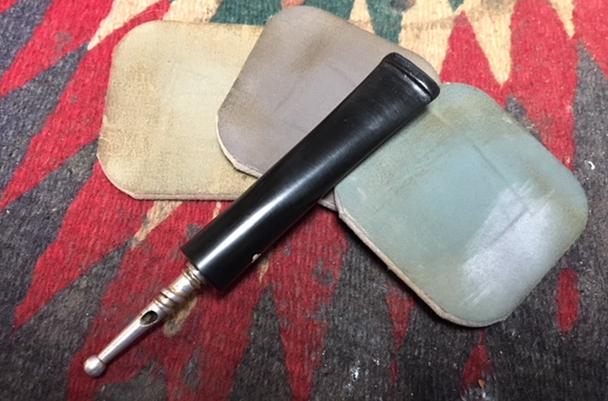
With that reminder of the old pipeman, I turned my attention to the sixth of Mark’s uncle’s pipes – a Kaywoodie Signet bulldog/Rhodesian shaped pipe. The pipe was stamped on the left side of the shank with the word Kaywoodie over the word Signet. There were no shape numbers on the right side or underside of the shank. The was an oxidized aluminum end cap threaded to hold the stinger/tenon apparatus. The exterior of the pipe was dirty and grimy with a few small dents in the sides of the bowl. The rim top was dirty and had some tar and lava overflowing the inside of the bowl. The bowl itself did not have a thick cake but there was a thin cake and remnants of tobacco in the bowl. The pipe looked like it had been reamed not too long before the last bowls were smoked. Overall the finish was in good condition but it was dirty and dusty. The stem was oxidized and there was a large chunk of the vulcanite missing on the top end of the stem where it had been chewed through or broken off. The stem was also slightly underclocked to the left. I took photos of the pipe before I started restoring it. I took a close up photo of the rim top to show the remnants of cake in the bowl and the lava buildup on the rim top. It appeared that the pipe may have been reamed or cleaned at some point very recently. The inner and outer edges of the rim were in good condition. But I would know more once I removed the lava overflow. I took some close up photos of the stem to show the size of the missing vulcanite chunk near the button on the top side. The oxidized metal fitment on the shank end needed polishing but otherwise it looked good.The stinger apparatus in the shank had three holes in the ball at the end of the piece. It was covered in tars and oils and was quite dirty. The great thing was that there was nothing missing on the stinger and there were no deep scratches or gouges in the aluminum.I used a Savinelli Fitsall Pipe Knife to scrape away the remnants of cake and tobacco on the walls of the bowl. I used a rolled piece of 220 grit sandpaper to sand the walls of the pipe and smooth out all the remaining bits. The bowl looked good once it was cleaned.Because it was the original stem and there was thickness to it, and because the stinger was intact in the stem I decided to do something a little different. I cut off the end of the damaged stem with a Dremel and sanding drum until I had solid vulcanite to work with. I cleaned off the stinger with 0000 steel wool to remove all of the tars and oils. I heated the stinger until the glue had softened and realigned the stem with the shank.I took the stem off the pipe and cleaned the exterior, especially focusing on the end that I was going to rebuild. I mixed up a batch of charcoal powder and black super glue (2 capsules of charcoal powder were mixed together with the super glue) to make a paste to use in rebuilding the button. I applied it to the area where the button would be with a dental spatula. I made it thicker than it needed to be so that I could shape and contour the finished look once the repair had cured. I sprayed the repair with accelerator and set it aside to dry. While the repair cured I worked on the aluminum shank end to polish out the oxidation. I worked on it with 1500-2400 grit micromesh to get it to the point is in the photos below. Once the new button area had cured and the repair was hard, I shaped it with a rasp and a needle file. I matched the two sides of the button – the top and bottom in terms of shape and width. I cut the sharp edge of the button square with the files and shaped the top and underside in front of the button with 220 grit sandpaper. I still need to open up the slot in the button at this point as well as round the edges of the button itself but it is coming along nicely.I turned my attention to opening the slot in the end of the new button. The first photo shows the look of the slot and button at this point. The second shows the new slot that has been opened in the button end using needle files.I cleaned out the airway inside the stem and stinger with pipe cleaners and alcohol. I want to remove the grime but also the dust that would be present from my shaping of the button and slot. I was surprised at how clean the inside of the airway was. I also cleaned out the metal mortise and shank with pipe cleaners, cotton swabs and alcohol.I cleaned off the tars on the top of the rim and polished it with 1500-2400 grit micromesh sanding pads. Once I had it smooth and unscratched I stained it with a dark brown stain pen. I hand buffed it with a soft cloth to blend the stain into the rest of the bowl.I polished the aluminum end of the shank with micromesh sanding pads to raise a shine. I wet sanded it with 1500-2400 grit pads and dry sanded it with 3200-12000 grit pads. I wiped it down with a damp cotton pad after each grit of micromesh. I worked over the stem with micromesh sanding pads. I polished out the sanding scratches and marks in the vulcanite and the rebuilt button – wet sanding it with 1500-2400 grit pads and dry sanding it with 3200-12000 grit pads and wiped it down with Obsidian Oil after each one. When I finished with the 12000 grit pad I gave it a final coat of oil and let it dry. Once it had dried, I polished it with Before & After Pipe Stem Polish Fine and Extra Fine. I rubbed it down with final coat Obsidian Oil and took the following pictures. With the stem repaired and polished I put it back on the pipe and buffed the entire pipe again with Blue Diamond polish on the buffing wheel. I carefully buffed the new button with a light touch so as not to damage it. I gave the entire pipe several coats of carnauba wax and buffed it with a clean buffing pad to raise the shine. I hand buffed it with a microfibre cloth to raise the shine. The new stem and the original stem looked good to me and the bend was just right. The bowl polished up pretty nicely. The finished pipe is shown with the original stem in the photos below. This is pipe number six of Mark’s uncle’s pipes. One left to finish up and then it will head back home to him. Thanks for looking.
Restoring Mark’s Uncle’s Third Pipe – A Kaywoodie Super Grain S-L Billiard


Blog by Steve Laug

One of the things I really like about restoring pipes is the opportunity to get to know the back story behind the pipes. I like knowing the journey they have traveled and if the opportunity presents itself the pipeman who held them in trust for the years of his own travels. When Mark sent me his uncle’s seven pipes I had no idea of the back story but I liked the idea of being able to enter into the ongoing story of the pipe.  After I finished the Ropp Cherrywood De Luxe (https://rebornpipes.com/2018/01/17/cleaning-and-restoring-a-ropp-cherrywood-de-luxe-805/) and the Doodler (https://rebornpipes.com/2018/01/19/restoring-a-beautiful-the-doodler-bullmoose/) and posted them on the blog Mark sent me an email about the backstory. To me it adds a lot of flavour to the work I am doing on the pipes. As I ream and clean them bringing them back to a fresh look I often think of the pipeman who had used the pipe daily as a part of his life. With this lot now I had the story.Mark’s Uncle’s pipe were worn a bit and the Kaywoodies had stem damage but the pipes were relatively clean – the bowls did not have a thick cake and the rim tops though caked with lava were decent. You can tell from the photos which pipes were his favourites.Mark sent me the following email giving me some back story on this set of pipes. I love hearing the story behind the pipes I work on. Here is what he wrote:

Hello Steve,

You must wonder about the history of the pipes you work on, so I thought might like to know a little about my uncle and his pipes:

My Uncle John, raised in an Appalachian Mountain family (think Hatfield and McCoy), was a large man with an affable personality – although this had limits and he could be quite formidable.

During WWII he left home and enlisted in the US Army where he was assigned to Patton’s 3rd Army as an ambulance driver.  After Germany surrendered, he was transported back to the US on a converted ocean liner troop ship (I believe it was the Queen Mary).  Upon reaching the US, his unit was immediately sequestered on a troop train for transport to the West Coast to be shipped to the Pacific for the invasion of Japan.  About half way across the country (possibly somewhere in Texas), the train stopped and the troops informed that Japan had capitulated – WWII was over.

Before the Korean War began, my uncle re-enlisted in the US Air Force.  He as assigned to a Photo Mapping unit as an Aircraft Mechanic.  He worked his way up to Crew Chief and served in Photo Mapping until he medically retired in the mid 60’s due to heart problems.

Being part of an Air Force family, I did not get to spend much time with my uncle while growing up.  However, I was able to stay a couple of summers with him at his West Palm Beach home while in my teens.  On a desk in his Florida Room sat collection of old used pipes in a walnut pipe rack / humidor combo (very similar the Decatur Industries 6 pipe Rack and humidor combination shown in the rebornpipes store).  There were a couple of packages of old dried up commercial brand tobacco in the humidor – one was cherry, I think.  I never saw my uncle smoke and never discussed the pipes with him, but I was intrigued by the pipe collection.  They were old, dirty, and well used – some with chewed through stems.  Obviously, the pipes had been smoked by a devoted pipe enthusiast.  As a young boy, I loved the smell of pipe tobacco, which you could occasionally smell in public way back then.  I started smoking an occasional pipe in college.  When my uncle passed away a few years later, I asked for his pipe collection and have stored it away since then.  The pipes are just as I received them some thirty years ago.

While I will never know for sure, I believe my uncle purchased the pipes in various PX’s and smoked them while an Air Crew Member.  The PX’s would have sold common commercially available pipe brands at a good price, nothing too expensive or exotic – consistent with the pipes in my uncle’s collection.  As a Photo Mapping Air Crew Member / Chief my uncle traveled the world extensively, and was stationed at many bases  – including “permanent” stations in West Palm Beach, Warner Robins, and Goose Bay Labrador, to name a few.  Smoking a pipe would have been a relaxing way to spend a few monotonous hours on the flight line or in the air.  After his heart problems, he must have given up pipe smoking and the pipes sat unused thereafter.  If the bowls look like they were recently scraped, it would have been over fifty years ago, most likely with a Case hardware store folding knife. If dirty, it is due to sitting for many years in the back room.  If well used and chewed it is due to many hours of smoking enjoyment.

I’m looking forward to seeing my Uncle John’s pipes in restored condition.  I know they are not “collectors” items, but they bring back priceless memories of my uncle and the times we spent together sharing “war stories”.

Your pictures and stories of the Doodler and Ropp are great, keep up the good work.  Feel free to edit and use any of my uncle’s write up on your blog if you wish. – Mark

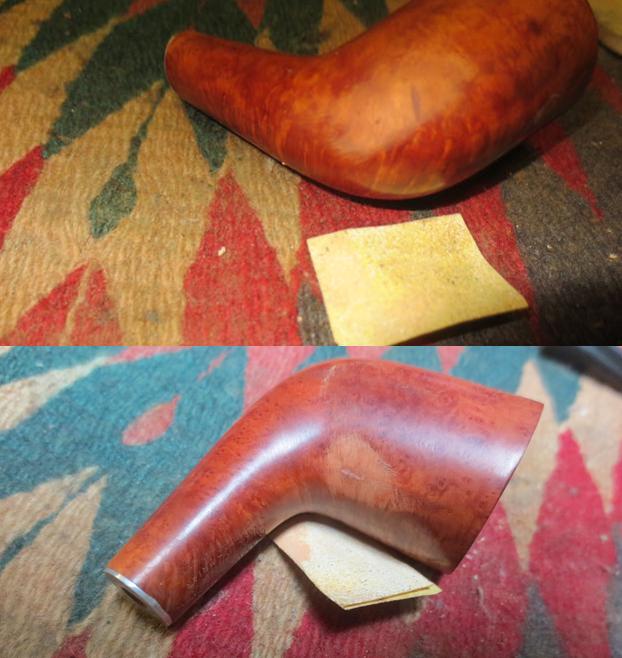
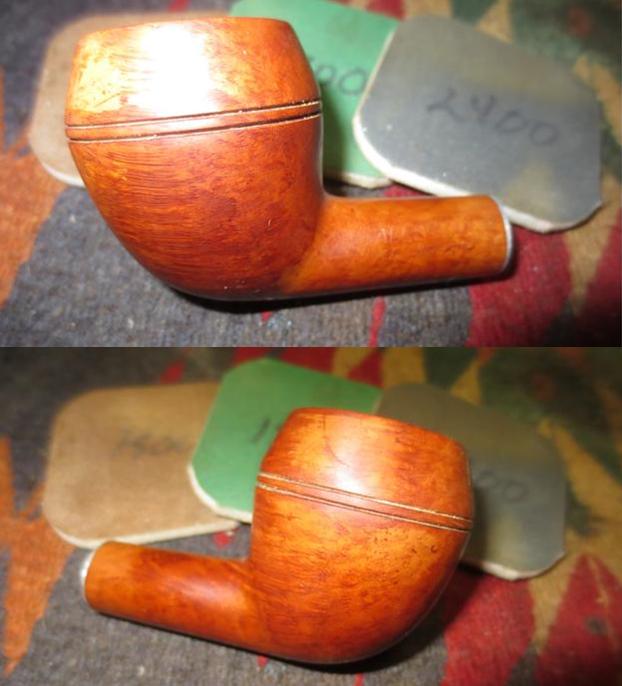
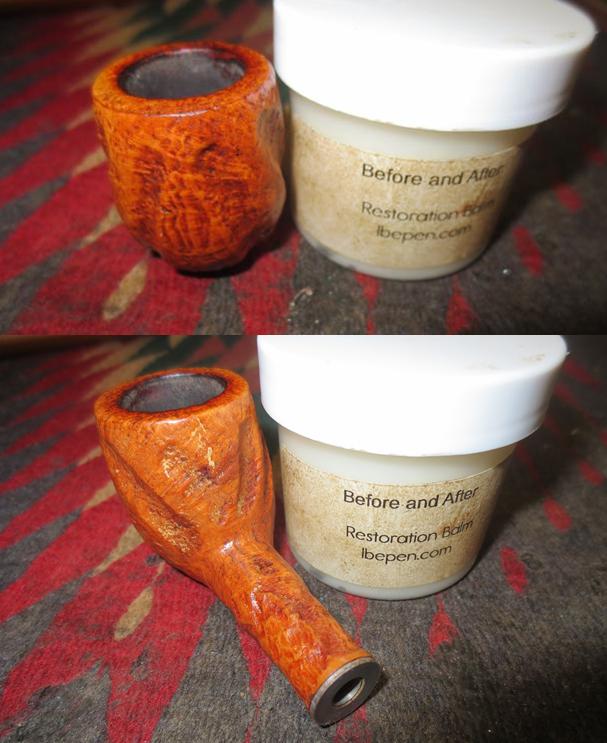
Armed with that information I had a better view of the pipeman who had once owned these pipes. That information always makes the restoration more personal and more interesting for me. I turned my attention to the third of Mark’s uncle’s pipes – a Kaywoodie Super Grain S-L rusticated billiard. The finish looked a lot like the classic Kaywoodie take on Tracy Mincer’s Custom-Bilt pipes. The pipe was stamped Kaywoodie ® over Super Grain S-L on the smooth, flat underside of the shank. There was a dust and grime deep in the grooves of the rustication. The rim top was clean and uncaked with lava. The bowl had a light cake around the walls but nothing heavy. There was some darkening on the rim along the inner edge on the back side of the bowl. Overall the finish was in really good condition but it was a dirty pipe. The stem was completely overturned in the shank to the point that Kaywoodie club logo was on the opposite side of the stem and upside down. The stem was oxidized and there was tooth chatter and tooth marks on both sides near the button. The stinger in the shank was a three hole one and it was coated in tars and oils. I took a close up photo of the rim top to show the lack of lava build up and the light cake in the bowl. Mark’s uncle had kept the pipe relatively clean in terms of the cake. It appeared that the bowl had been reamed not too long ago. There were some remnants of the tobacco in the bowl. The rusticated rim top had some debris in the grooves of the finish. The edges of the rim looked to be in good condition. I took some close up photos of the stem to show the condition of both sides. The stem was oxidized and showed tooth chatter and tooth marks on both sides near the button.I added this stem to the other three stems that I put in the Before & After Pipe Stem Deoxidizer. I pushed them under the solution and left them to soak overnight.While the stems were all soaking I turned my attention to the bowl. I scrubbed the Custom-Bilt like grooves and rustication on the rim top with Murphy’s Oil Soap and a tooth brush to remove the grime and dirt on the bowl. I rinsed it off with running water and dried the bowl and shank off with a soft cotton towel. I took photos of the cleaned bowl to show what it looked like at this point in the process. I used a Savinelli Fitsall Pipe Knife to scrape away the remaining cake and debris in the bowl of the pipe.I worked some Before & After Restoration Balm into the surface of the briar with my finger tips to deep clean the finish, enliven and protect the wood. I used a cotton swab to work the balm into the grooves in the rustication on the rim top and bowl sides. I let it sit for a few minutes and then buffed it with a cotton cloth. The wood came alive and the grain had begun to show through at this point and there was a rich shine to the briar. I took some photos of the bowl at this point to mark the progress in the restoration. I set the bowl aside and called it a night. The bowl was ready other than touching up the cleaning of the shank. In the morning I removed the stem from the Before & After Stem Deoxidizer and wiped it off with a paper towel to remove the remaining oxidation and bath. I cleaned out the airway with pipe cleaners and alcohol until it was clean. I cleaned out the shank with alcohol, pipe cleaners and cotton swabs at the same time to remove any debris that remained inside. The stem was clean and there was still some oxidation on the surface with some scratching, tooth chatter and marks. It was ready to be sanded and polished. I heated the stinger with a lighter and turned it into the shank to correct the overturn. With a little heat the glue loosens in the stem and it can be carefully turned to align. When it cooled I removed the stem from the shank and painted the surface of the stem with the flame of a Bic lighter to lift the tooth dents in the stem. I was able to lift all of them on both sides. It would not take too much sanding to smooth out the remnants of the dents and blend them into the surface. I sanded them smooth with 220 grit sandpaper.The edge of the button was damaged on both sides of the stem. I filled in the damaged areas with clear super glue. Once it cured I sanded it with 220 grit sandpaper and needle files to shape it. I worked over the stem with micromesh sanding pads. I polished out the sanding scratches and marks in the vulcanite – wet sanding it with 1500-2400 grit pads and dry sanding it with 3200-12000 grit pads and wiped it down with Obsidian Oil after each one. When I finished with the 12000 grit pad I gave it a final coat of oil and let it dry. Once it had dried, I polished it with Before & After Pipe Stem Polish Fine and Extra Fine. I rubbed it down with final coat Obsidian Oil and took the following pictures. At this point in the process, the camera had revealed more oxidation at the shank end of the stem and some scratching near the button. I put the stem back on the bowl and buffed it with Red Tripoli and Blue Diamond until the oxidation was gone. I also worked on the stubborn scratches on the button end of the stem to remove those. When I finished that I polished it with Before & After Pipe Stem Polish Fine and Extra Fine. I rubbed it down with final coat Obsidian Oil and took a photo.I put the stem back on the bowl and took the pipe to the buffing wheel to work it over. I buffed the bowl and stem with Blue Diamond to polish them. I gave the bowl and stem multiple coats of carnauba wax. I buffed the entire pipe with a clean buffing pad to raise the shine. I hand buffed it with a microfiber cloth to deepen the shine. The finished pipe is shown in the photos below. The briar has a shine and a rich glow to it and the vulcanite stem came out quite nice with a deep shine. The pipe came out really well. I have four more of the uncle’s pipes to finish up and then these will be heading back to the US. Thanks for looking.
Another Unusual Estate Find – A Kaywoodie Metal Filter Pipe with Case


Blog by Steve Laug

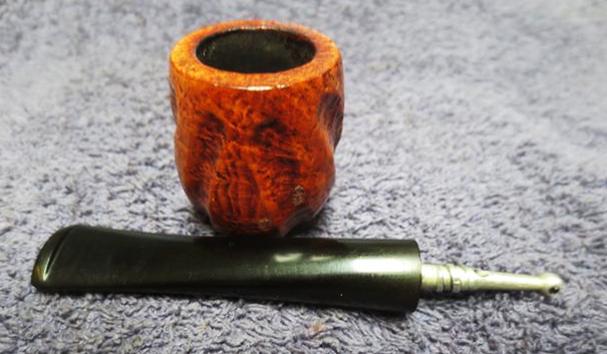
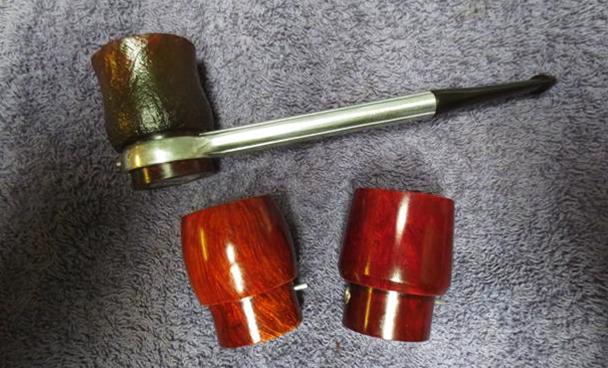
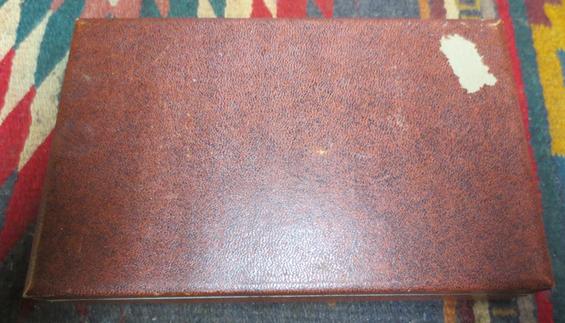
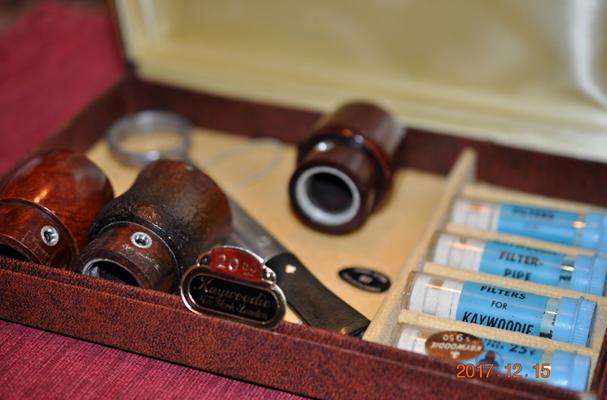
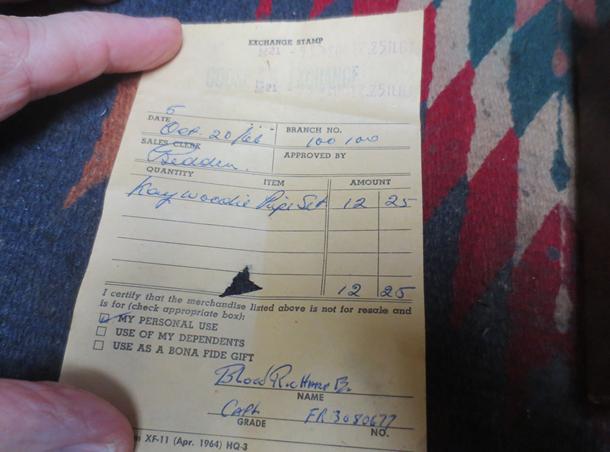
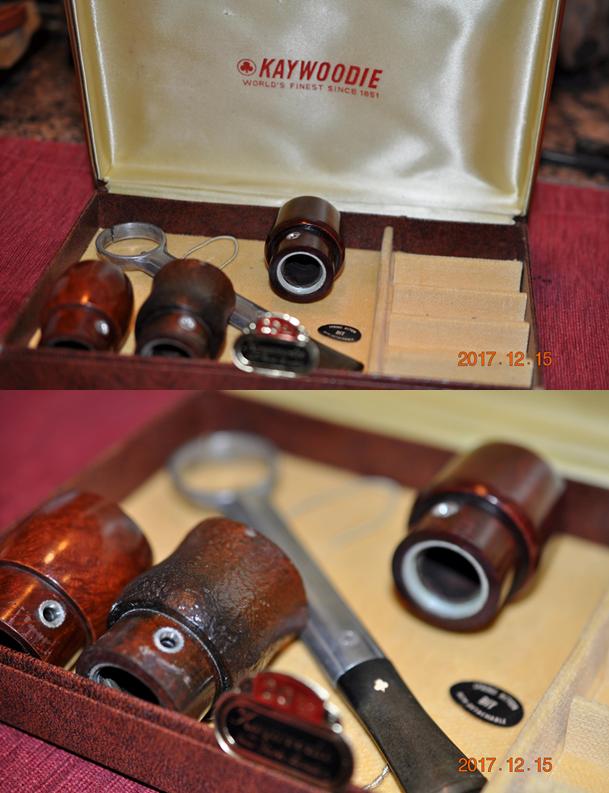
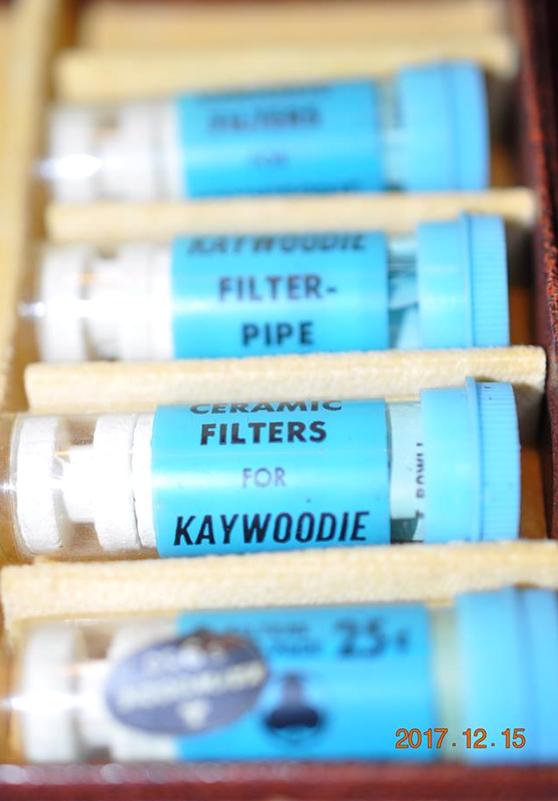
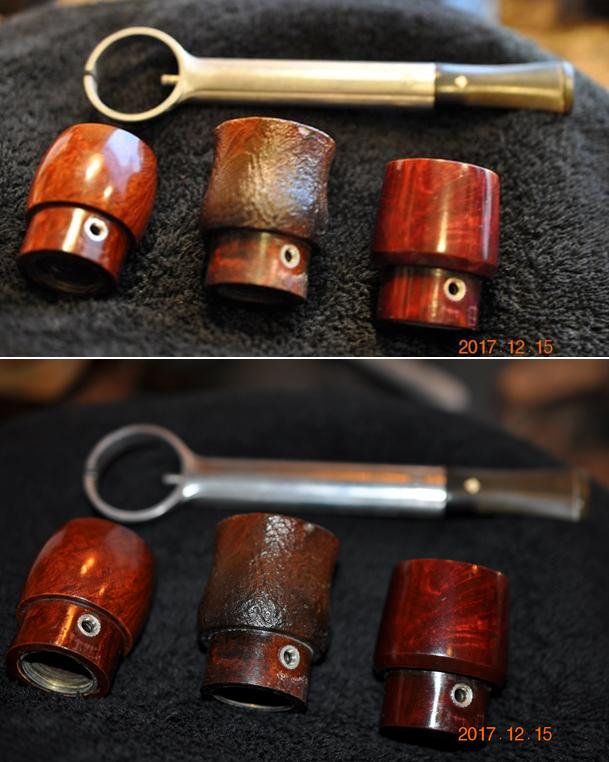
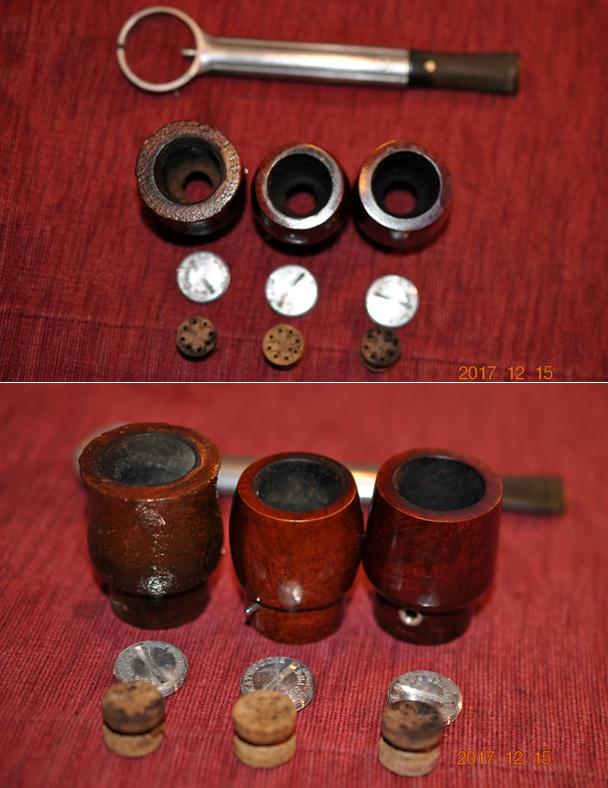
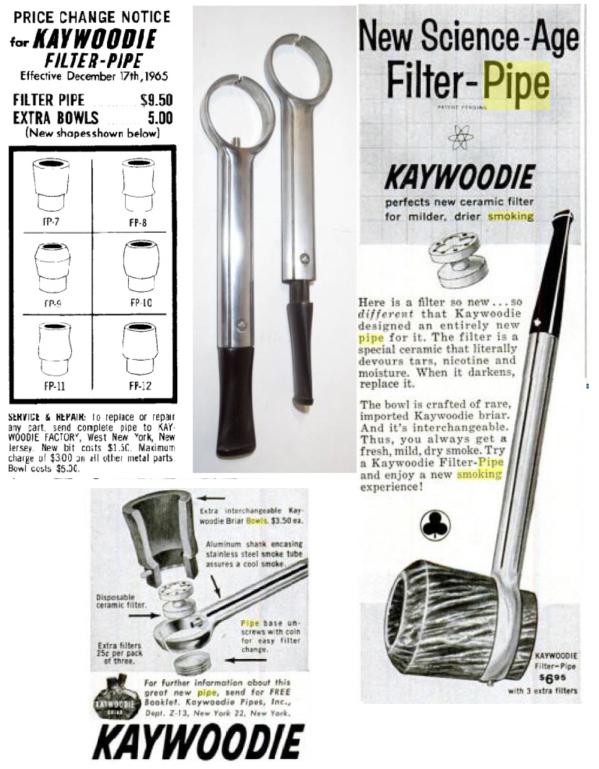
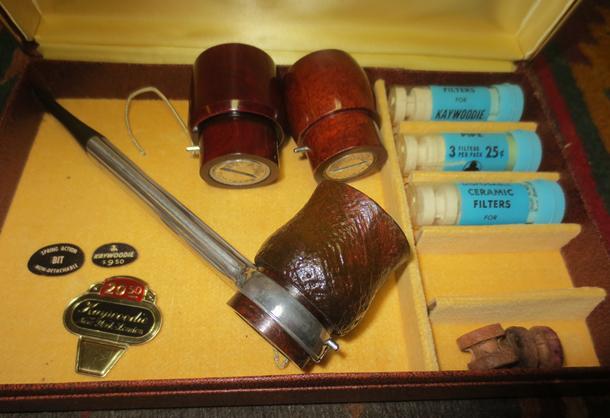
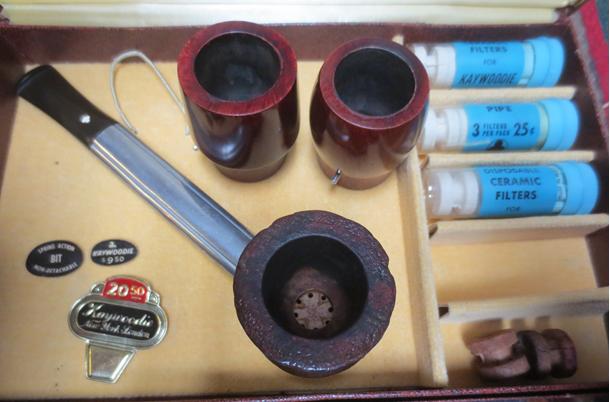
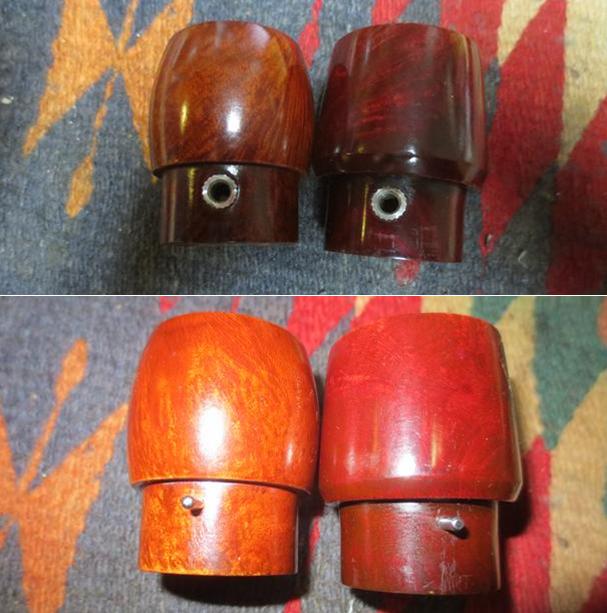
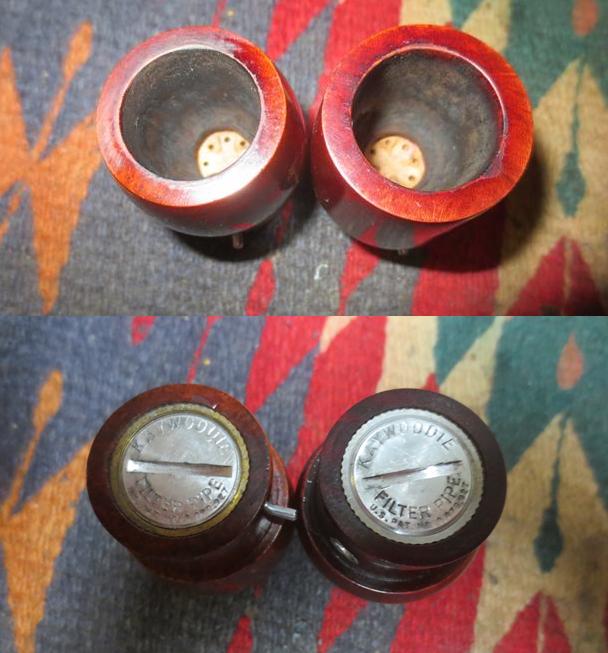
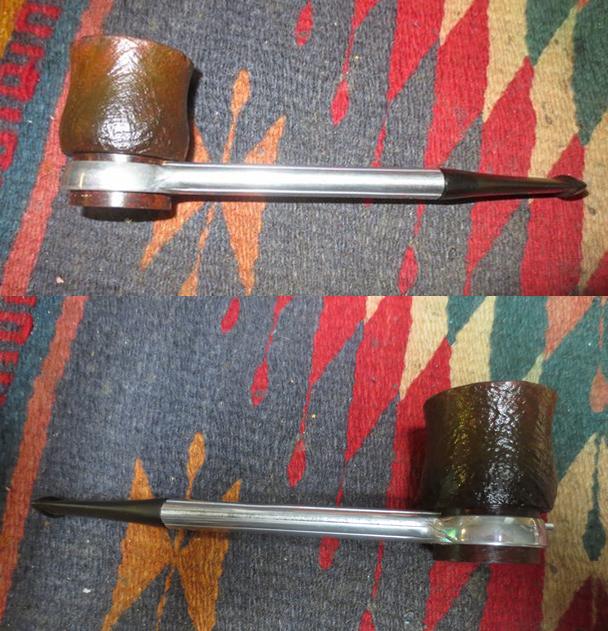
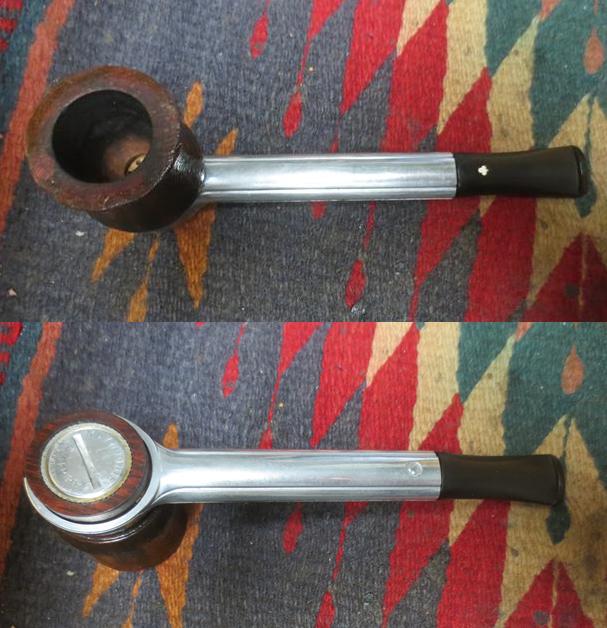
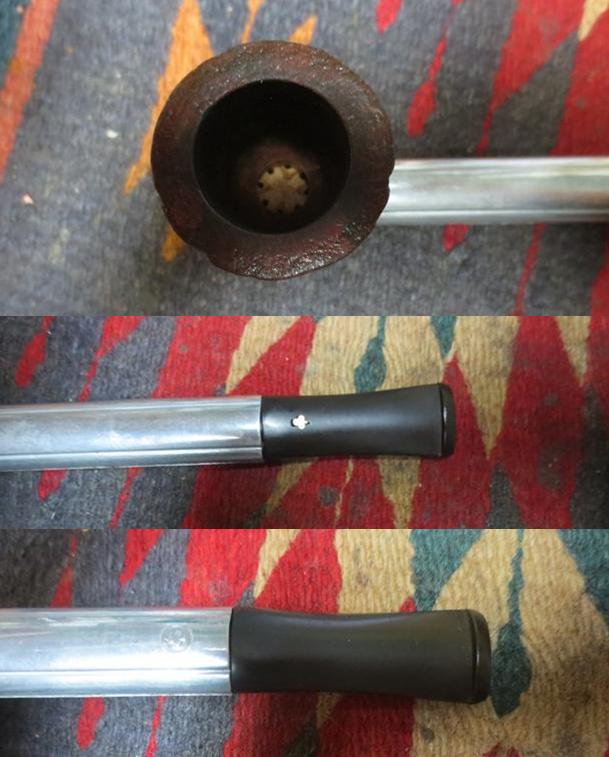
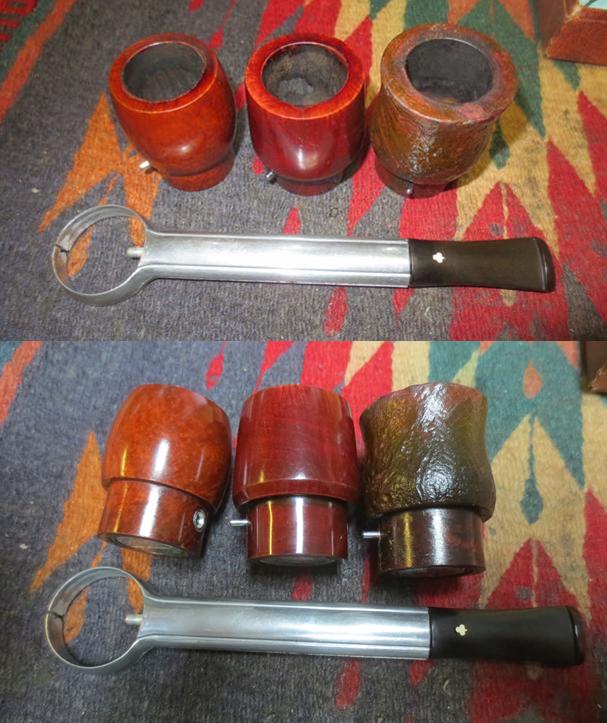
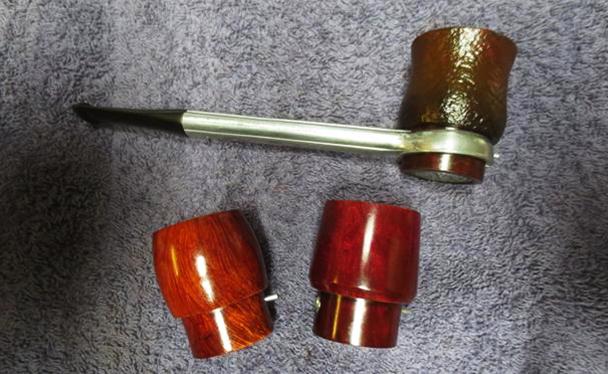
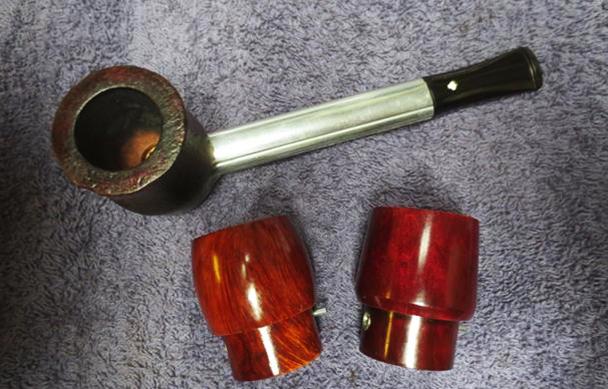
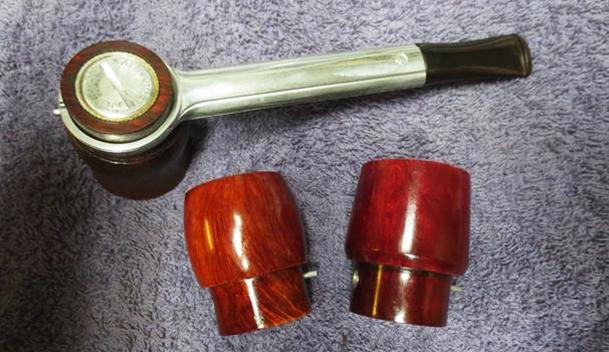
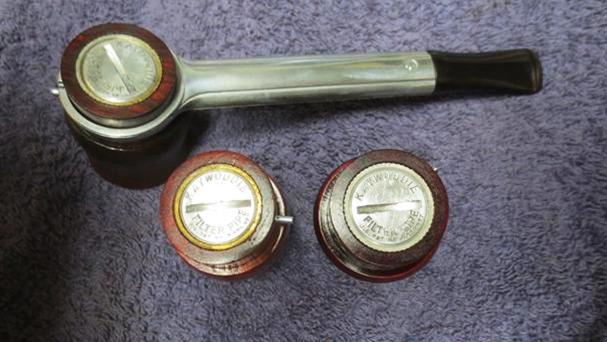
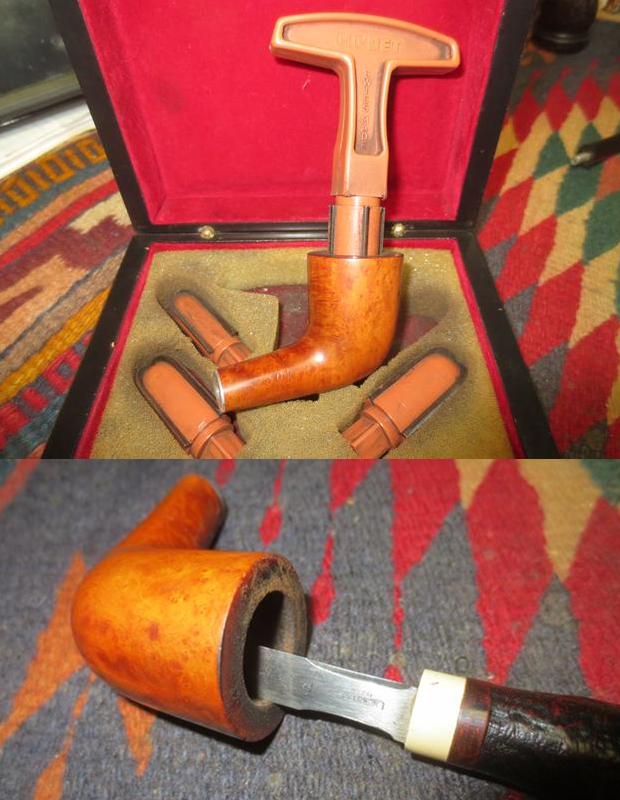
At a recent Estate sale Jeff picked up a boxed Kaywoodie Filter Pipe set. It was a brown leatherette covered hard case with a yellow satin lining in the lid that was printed in red ink with the Kaywoodie Club logo and read Kaywoodie over World’s Finest Since 1851. The cotton lining in the bottom compartmental part of the case was in good condition. It came with three bowls, the pipe and four unopened tubes of Kaywoodie Ceramic Filters. Each tube had an instructional brochure folded into the top. The box still had the labeling inside. There was the label that went with the original pipe with a $9.50 price tag. There was a label that was originally attached to the top of the stem that read “Spring Action Bit – Non-Detachable”. There was also the set label that read $20.50 over Kaywoodie, New York & London. This was a gold label that sat on the front edge of the box when the lid opened. Probably one of the most interesting pieces with box was the original sales receipt. The set was sold at Goose AR Exchange – a US Military Base Exchange. I found a Goose Creek, South Carolina Naval Base so I am thinking this may have been the location. The set was sold on October 21, 1955 to a Captain Richard B. Blood for the price of $12.25 well below the retail price of $20.50 on the case label. The outside of the box was in good condition. There was a damaged spot on the top right corner where a price tag must have been stuck and removed. The set was well cared for and smoked. Each bowl had been used but none of them were oversmoked or heavily caked. The metal base on each bowl was in decent condition. The coin slot for removing the base and changing the ceramic filter was still very useable. The filters in the tubes on the right side of the box were all unopened. The metal spring loaded Kaywoodie base was clean but the stem was lightly oxidized. Jeff took quite a few photos of the content of the set. It really is an interesting piece with all of the parts intact in the box. Jeff took the pipe base and bowls out of the box and took photos of them from different angles. The three bowls are different. I would tend to call the one on the left and apple, the middle an urn and the one on the right a billiard. Jeff took all of the bowls apart. He removed the base from the bowl and took out the ceramic filter. The photos show all of the parts of the pipe.I have worked on one of these in the past but I have never seen a full set of the pipes in a case (https://rebornpipes.com/2016/01/30/it-was-a-kaywoodie-metal-pipe-that-i-had-never-seen-before/). In that blog I included the following advertisement and I thought it would be helpful here as well so I have included it again.

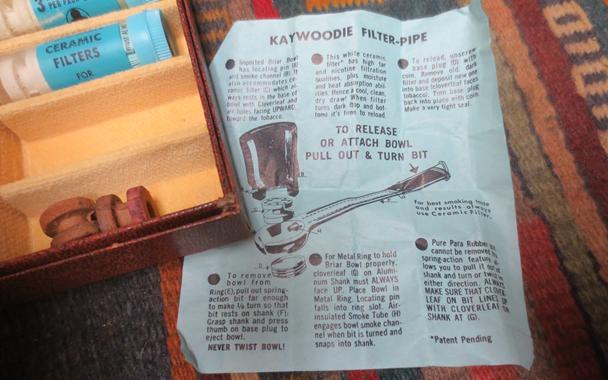
I think Jeff had a little more fun cleaning up this set. It came with some history and he always enjoys that part of the process. He did an amazing job on the cleanup on the bowl and stem. He worked on the dismantled bowls as this was the easiest way to clean this batch. He reamed each of the bowls back to bare briar. He started with a PipNet Pipe Reamer and followed up with a Savinelli Fitsall Pipe Knife. He cleaned the internals of the bowl and stem with alcohol, pipe cleaners and cotton swabs – scrubbing out the metal shank and the base plate to remove the light buildup in those areas. He scrubbed the exterior of the pipe with Murphy’s Oil soap and a tooth brush and was able to remove all of the varnish coat and grime from the smooth and sandblast finish on the briar. The inner and outer edges of each of the rim tops looked very good. He soaked the stem in an Oxyclean bath to remove the light oxidation. When the set arrived I took some photos to show how it looked before I did the restoration. This set has both a story and some age attached to it. It will look really good once it is polished. I took a photo of the pamphlet that had been folded into each of the ceramic filter tubes. It is a nice addition in that it explains how the filters work and how to change them.I took some photos of the bowls. He had done a great job cleaning them up. Each bowl had been taken apart and cleaned and a new ceramic filter installed in the base. They had been reamed, cleaned and polished. Jeff put the sandblast cauldron like bowl on the pipe base so I left it on for the photos. It was in good condition. The base has no marks on the top of the shank but on the underside is a cast Kaywoodie Club. The stem is not removable and is spring loaded and it has the Kaywoodie inset club on top. All of the bowls needed to be waxed and polished. This close up photo of the rim top and bowl show how clean he was able to get them. The base and stem also needed to be polished but they were also clean and free of tooth marks.I took the bowl off the base and took a series of photos to show the pipe as a set. It is a unique and in its own way, beautiful set of bowls and base.The rim top on the two smooth bowls was in good condition. I polished it with 1500-4000 grit micromesh sanding pads to polish them. The rim top on the sandblast bowl had some spots where the finish had been rubbed free and there were some nicks. I used a brass bristle wire brush to clean off the surface of the rim and then restained it with a dark brown stain pen. I set it aside and let the stain dry. Once it had dried I buffed it to polish the restained rim and the bowl.I worked some Before & After Restoration Balm into the surface of each of the briar bowls with my finger tips to deep clean, enliven and protect the briar of the smooth and the sandblast finishes. I let each bowl sit for a few minutes and then buffed them with a cotton cloth. The grain of the briar on each bowl really began to show through at this point and there was a rich shine to the briar. I took some photos of the bowl at this point to mark the progress in the restoration. I worked over the stem with micromesh sanding pads. I polished out the scratches and marks in the vulcanite – wet sanding it with 1500-2400 grit pads and dry sanding it with 3200-12000 grit pads and wiped it down with Obsidian Oil after each one. When I finished with the 12000 grit pad I gave it a final coat of oil and set it aside to dry. I polished the metal base and shank with a jeweler’s polishing cloth to bring some shine to the aluminum and to take away the tarnish. I find that a jeweler’s cloth impregnated with some anti tarnish compounds works really well on the metal used in aluminum pipes and also nickel, silver and gold bands used on shanks.I put the bowl back on the metal base and took the pipe to the buffing wheel to work it over. I buffed the bowl and stem once again with Blue Diamond to polish it. I gave the bowl and the stem multiple coats carnauba wax. I buffed the entire pipe with a clean buffing pad to raise the shine. I hand buffed it with a microfiber cloth to deepen the shine. I also buffed the other two bowls with Blue Diamond and gave them each multiple coats of carnauba wax to polish and protect them. I buffed them each with a clean buffing pad as well to raise the shine and hand buffed them with the microfiber cloth. The finished set of bowls and base along with the case, the paper work and the extra tubes of filters are all included in this beautiful set. The finished pipe (without the case) is shown in the photos below. The bowls have some nice grain on each of them and each is not only a unique shape and finish but also in grain patterns. The pipe looks great like it must have when it came out of the factory. It is light weight and feels comfortable in the hand. The medium brown stain on the smooth bowls and the darker stain on the sandblast bowl works well with the polished metal base and the black vulcanite stem. It has a very elegant look to it and it is eye catching. This older Kaywoodie Filter Pipe Set will make a great addition to your collection. It looks good and if it like the one I have smokes very well.  The dimensions of the pipe are: Length: 6 inches, Height: varies from 1 ¾ inches with the sandblast bowl and 1 ¼ inches for the apple bowl, Outer Diameter of the Bowl: 1 3/8 inches, Diameter of the Chamber: 3/4 inches. I will be adding this set to the rebornpipes store shortly if you are interested in adding it to your collection. If you are interested email me at slaug@uniserve.com or send me a message on Facebook. Thanks for looking.
New Life for a Kaywoodie Super Grain Zulu


Blog by Steve Laug

I wrote in the blog just previous to this one – the restoration of the Selected Straight Grain bent billiard – how I had been contacted by Jim in the South Eastern US regarding some pipes that he had found (https://rebornpipes.com/2017/09/22/cleaning-up-a-beautiful-comoys-made-selected-straight-grain-bent-billiard/). He called to tell me about a group of six pipes that he purchased on one of his own pipe hunts. He wanted to know if I could help him identifying what he had found. There were two older Kaywoodies (a bent meerschaum lined billiard and a Super Grain Zulu), a Selected Straight Grain bent billiard, a GBD Sauvage Bulldog, a Henley Club Apple (made by Sasieni), and the last one a Medico Crest Prince.

In our conversation he told me he was going to box up the lot and mail them to me to have a look. When they arrived he said we could talk and make an arrangement regarding the pipes that he wanted to have restored from the lot. He wanted my opinion on the others as well. The box arrived last week and I opened it to have a good look at what Jim had sent to me. As I mentioned in the previous blog, I went through them making notes on what I saw regarding the condition of each pipe. I sent Jim my notes on the pipes and he replied noting the two pipes that he wanted me to work on for him in the lot – the first one was a large Bent Selected Straight Grain Billiard and the second was the Kaywoodie Super Grain Zulu. We fired several emails back and forth talking about the pipes and the decision was made. I would restore the two pipes for him.

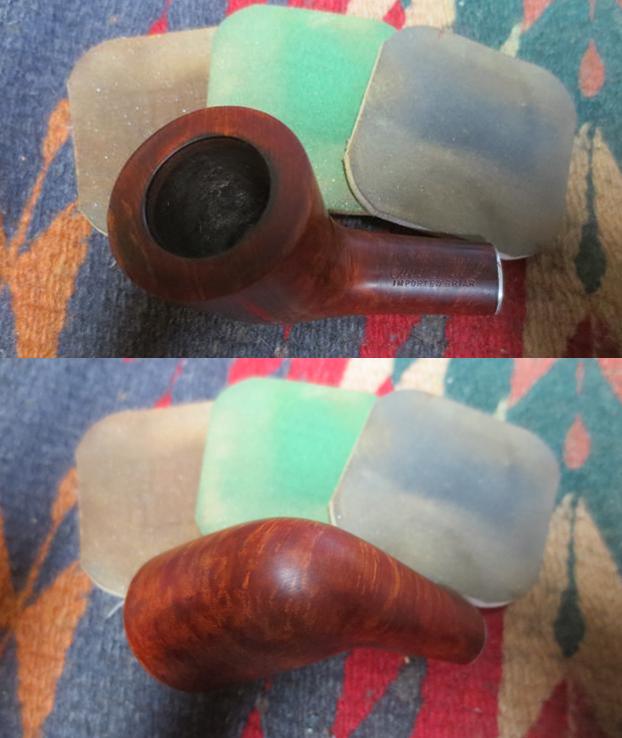
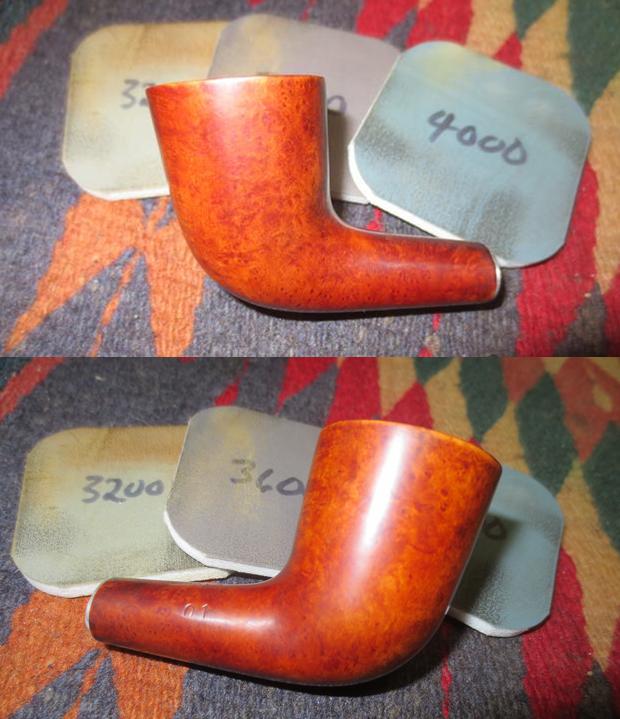
When I finished the Selected Straight Grain, I turned my attention to the Kaywoodie Super Grain Zulu. It is a nice piece of briar with straight grain on the front and back of the bowl and birdseye grain on the sides of each bowl. The pipe is stamped on the top of the oval shank with the brand name Kaywoodie over Super Grain over Imported Briar. On the right side of the shank the shape number 01 is stamped. The shape is Zulu with an oval shank and stem with a 1/8th bend to the stem. Like the Selected Straight Grain the Kaywoodie was a nice pipe that showed some nice grain underneath the grime.

The pipe was a typical Kaywoodie sized pipe. There was a flaw in the briar on the left back side of the bowl just above the shank/bowl junction. There was another flaw on the front right toward the bottom of the bowl. Other than these two spot on the bowl, there were no other sandpits or fills in the briar. The bowl had a thick cake in it and there was a thick overflow of lava on the top of the rim. It was not possible to know if there was damage to the inner edge and the top of the rim. The finish was worn and tired but should clean up easily. The stem was lightly oxidized and there was tooth chatter on both sides at the button, but no deep tooth marks. The stem was slightly underturned and when I removed it there was a paper gasket that was glued to the end of the stem to correct the issue. The classic Kaywoodie metal stinger apparatus had been cut off and the airway in the remaining metal tenon was damaged.

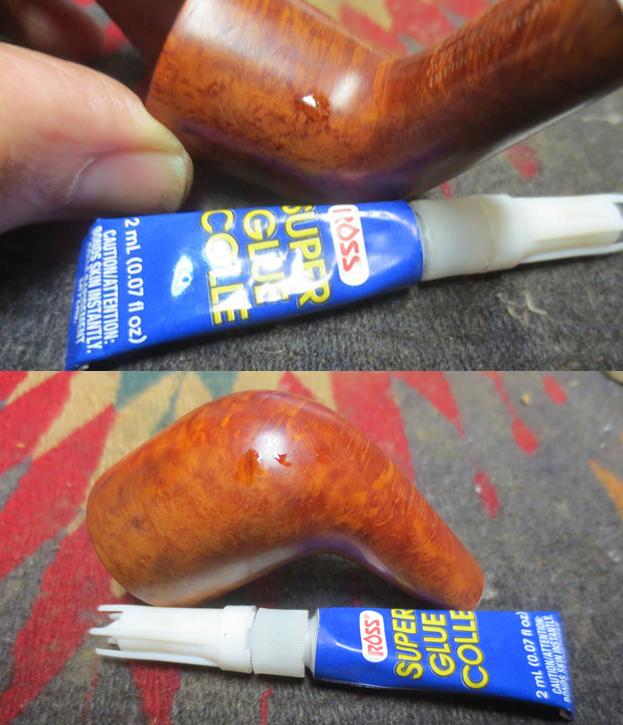
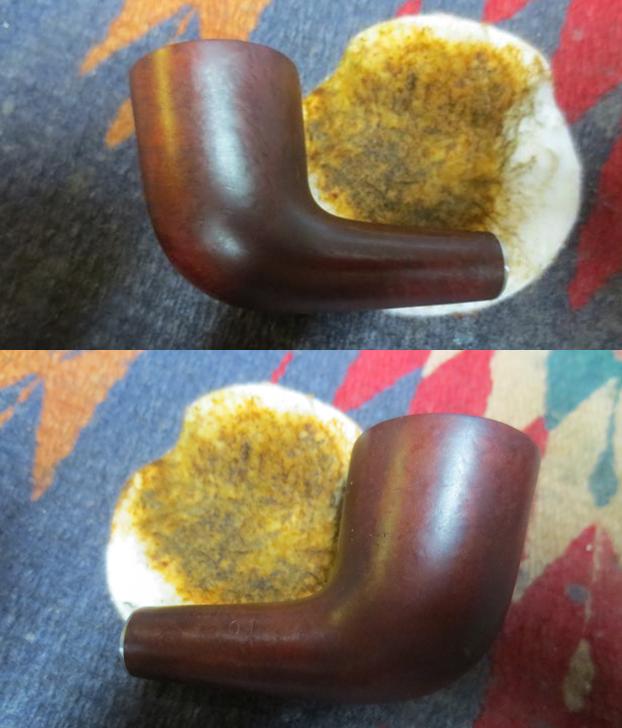
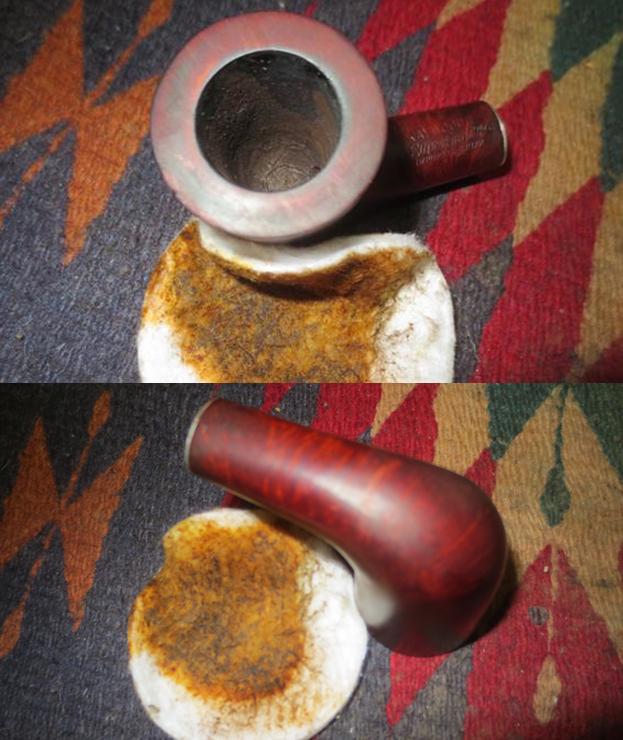
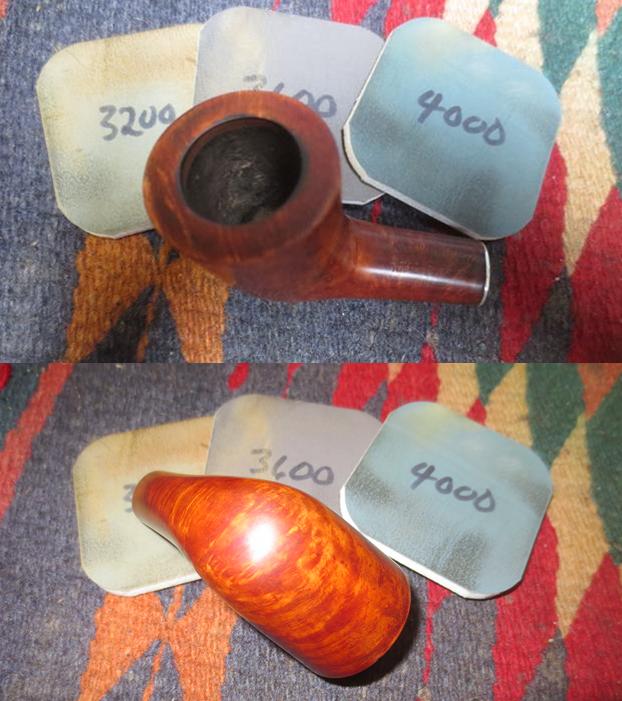
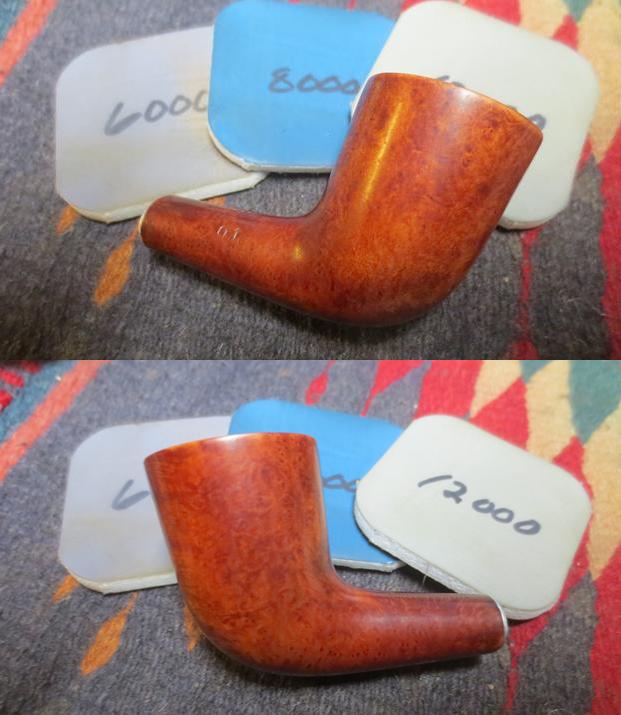
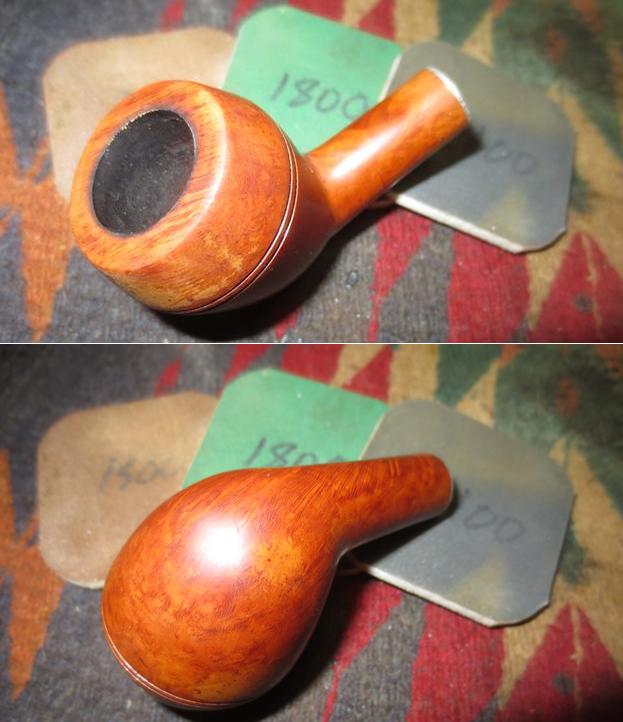
I took a series of photos of the pipe to record the condition it was in when it arrived.I took a close up photo of the bowl and rim top to show the condition of the cake in the bowl and the overflow of lava on top of the bowl. The rim and bowl were in rough condition. The photos of the stem show the condition of the vulcanite. The oxidized surface of the rubber was pitted and worn. The light tooth chatter on both sides can be seen in the photos. I unscrewed the stem from the shank and took the following photo. It shows the paper washer that had been glued to the end of the stem to help the alignment of the stem. The clipped stinger is also shown in the photo. I scraped off the glued on gasket with a sharp pen knife and cleaned off the surface with alcohol and cotton swabs. I used a needle file to open up the end of the tenon and remove the damaged edges that had been caused when the stinger was clipped off. I cleaned out the airway with pipe cleaners and alcohol. I heated the tenon with a Bic lighter to soften the glue and put the stem back on the end of the shank and turned it until the stem and the shank were aligned. The photo below shows the newly aligned stem and shank. I reamed the bowl with a PipNet pipe reamer starting with the smallest cutting head and working up to the second cutting head. I took the cake back to bare briar. I cleaned it up with a Savinelli Fitsall Pipe Knife. I scraped the top of the rim with the pen knife to take as much of the lava off as possible. I sanded it with 220 grit sandpaper and a 1500 grit micromesh sanding pad. I used clear super glue to repair the damage on the back and the front of the bowl. I filled in the areas with the glue and set the bowl aside to dry. When the repairs had cured I sanded the areas with 220 grit sandpaper to blend them into the surface of the briar. I polished the areas with micromesh sanding pads – wet sanding with 1500-2400 grit pads. I wiped the bowl down with a damp cloth to remove the sanding dust.I wiped the bowl down with alcohol on a cotton pad to remove the dust in preparation for staining the briar. I stained it with a dark brown aniline stain and flamed it with a lighter. I repeated the process until the coverage was even around the bowl.I wiped the bowl down with alcohol and cotton pads to remove the stain and make the coverage more transparent. I wanted the grain to pop so that finish stood out.The saturation of the stain was perfect for what I wanted to do with the finish next. I polished the briar with micromesh sanding pads. I wet sanded it with 1500-2400 grit pads to polish the briar and bring the grain to the surface. I dry sanded it with 3200-12000 grit pads. After polishing it with the 12000 grit pads I really liked the look of the polished briar. The grain really shows clearly.I sanded the stem with 220 grit sandpaper to remove the tooth chatter and the scratches in the vulcanite. I smoothed out the surface of the stem with the sandpaper and then polished it with micromesh sanding pads – wet sanding it with 1500-2400 grit pads and dry sanding with 3200-12000 grit pads. I wiped it down after each pad with some Obsidian Oil. After the final 12000 grit pad I gave it a final coat of Obsidian Oil and set it aside to dry.I buffed the pipe on the wheel using Blue Diamond Polish and worked over the stem and bowl to remove any remaining scratches. I was careful around the stamping so as not to buff it out and soften it. I gave the pipe multiple coats of carnauba wax and buffed it with a clean buffing pad to raise a shine. I hand buffed it with a microfiber cloth to deepen the shine. The finished pipe is shown in the photos below. It really is a beauty. The black of the polished vulcanite and the polished briar work well together to present a beautiful pipe. Now Jim’s second pipe is finished. In the week ahead the pair will go in the mail. I can’t wait to hear what he thinks of this second one when he has it in hand and fires it up for the first time. Thanks for looking.

Salvaging a Kaywoodie All Briar Rhodesian 50B with a Serious Issue


Blog by Steve Laug

I have reworked a lot of stems over the years – from cutting them back in my early days and reshaping a button on the gnawed and damaged end to rebuilding a chewed button with charcoal and super glue. I have fit stem blanks on shanks to replace damaged and what were at that time in my assessment, irreparable stems. Today I am more conservative and lean towards rebuilding the stem as best as I can. That being said there are even challenges to that work. The pipe on my worktable now is a challenge to my current bent. It is an All Briar Rhodesian. I have only refurbished one other All Briar pipe in the past – a beautiful LHS Purex Bullmoose. It was in excellent condition other than being dirty and worn. I had heard nightmare tales of gnawed and chewed all briar stems and what a pain they are to work on. However, until this pipe came to my attention in a recent pipe hunt with Jeff I had never seen such a badly gnawed briar stem up close. Jeff took photos of the pipe’s condition before he cleaned it up. I have included those photos in the first part of this blog.I have read a lot of information in the past on other Kaywoodie pipes I have worked on and spent time on the Kaywoodie Collectors Forum to help educated myself on the various lines and historical periods of Kaywoodie production. On Pipedia.org there is a helpful summary of the history of the brand that has been condensed in one place. It is called the Collectors Guide to Kaywoodie Pipes (https://pipedia.org/wiki/Collector%27s_Guide_to_Kaywoodie_Pipes). I found the All Briar line of pipes included in the section of the Guide for 1955. I quote here the pertinent sections with the references to the All Briar pipe underlined and highlighted in bold.

The line-up of pipes in the 1955 catalog (Table 3 below) was more extensive than in previous years. The catalog presented an expanded line of meerschaum pipes and introduced a 4-pipe set of Matched Grain Pipes, as well as several pipes with “special features”. The number of shapes available… was not substantially different from the number offered in the 1947 catalog…

The Twin-Bowl Kaywoodies were available in an all-meerschaum model (two removable inner bowls of meerschaum) and a meerschaum and Flame Grain model (outer bowl of flame grain briar and removable inner bowl of meerschaum). Other meerschaum pipes presented in the 1955 catalog included the Gourd Calabash; the Coral (“dimpled”) Meerschaum; the All Briar (briar bit) and Flame Grain pipes with inlaid meerschaum bowls; and the “Doctor’s” pipe…Included in the guide was a helpful list of pipe grades and prices. I have included the list below and noted the pipe I am working on by highlighting it in bold print and underlining the reference. It is in this list that I found confirmation that Kaywoodie made an All Briar with a meerschaum bowl insert and an All Briar without the meerschaum insert. The All Briar I am working on is not meerschaum lined. It is fascinating for me to see that the addition of a meerschaum bowl was only $2.50 in 1955.

Table 3. 1955 Kaywoodie Pipe Grades and Prices

    Meerschaum Character Pipes: $100.00

    Block: 15.00-50 (According to size)

    Meerschaum Twin Bowl: $35.00

    Meerschaum/Flame Grain Twin Bowl: $25.00

    Sandblasted “Doctor’s” Pipe: $25.00

    Centennial: $25.00

    Coral Meerschaum: $20.00-25 (According to size)

    Gourd Calabash: $15.00-25 (According to size)

    Ninety-Fiver: $20.00

    Oversize: $10.00-25(According to style and finish)

    Connoisseur: $15.00

    All Briar w/Meerschaum Inlaid Bowl: $12.50

    Flame Grain (Meerschaum Inlaid) $12.50

    Export Pipes: $5.00-15 (According to grade)

    All Briar (Briar Bit): $10.00

    Flame Grain: $10.00

    Fit Rite: $10.00

    Silhouette: $10.00

    Carburetor: $7.50

    Relief Grain: $7.50

    Chesterfield: $5.00-15 (According to grade)

    Chinrester: $5.00-10 (According to grade)

    Stembiter: $5.00-10 (According to grade)

    Streamliner: $4.00-10 (According to grade)

    Super Grain: $5.00

    Carved Super Grain: $5.00

    White Briar: $5.00

    Standard: $4.00

    Filter Plus: $4.00

    Drinkless pup: $3.50

    Drinkless Tuckaway: $3.50

    Drinkless In-Between: $3.50

    Two-Pipe Companion Setsb: $10.00-25 (According to grade)

    Matched Grain Set (4-Pipes): $50.00

    Matched Grain Set (7-Pipes): $125.00

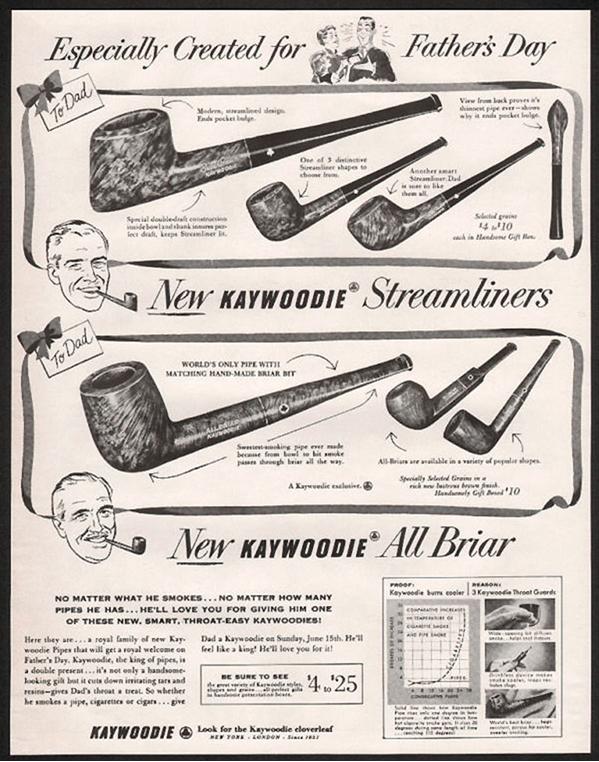
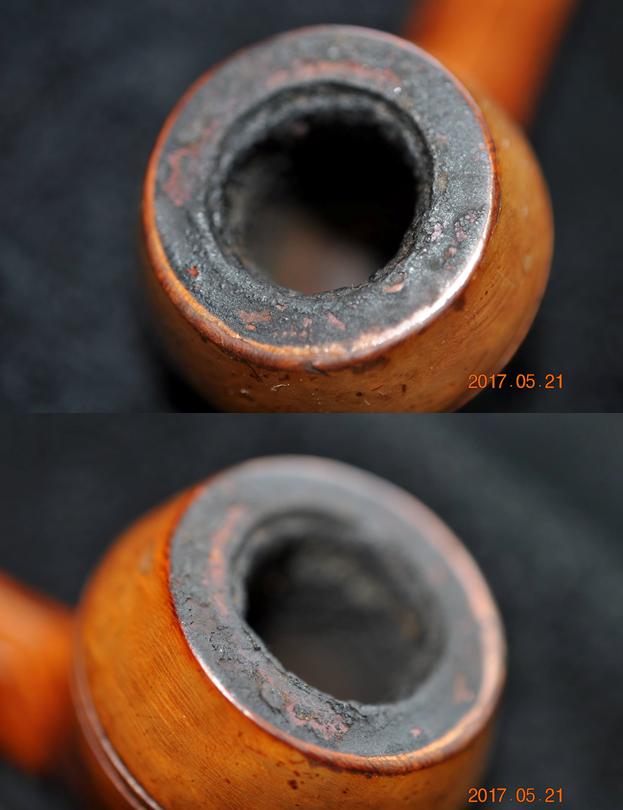
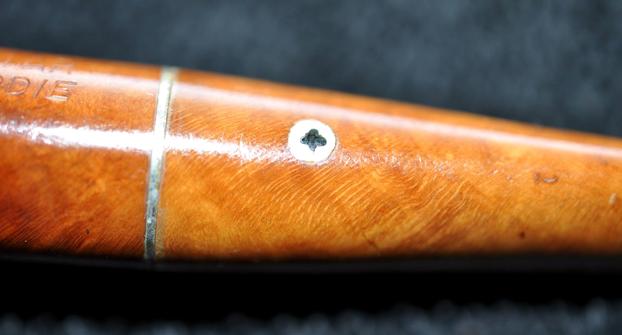
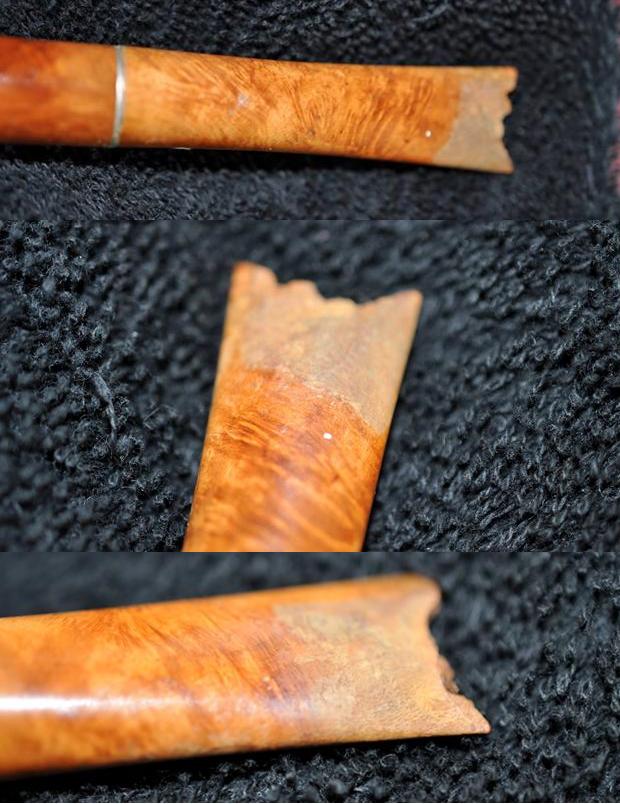
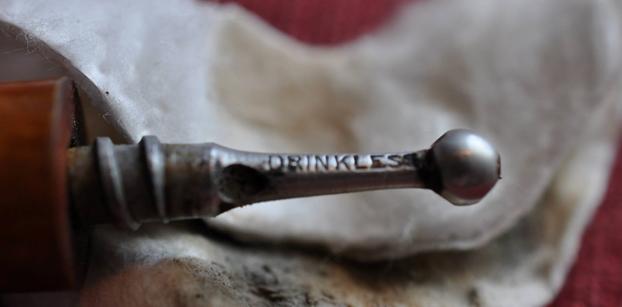
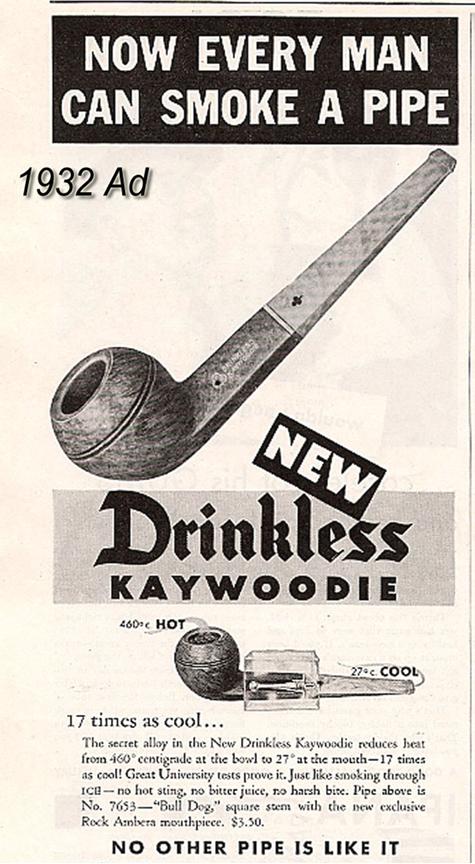
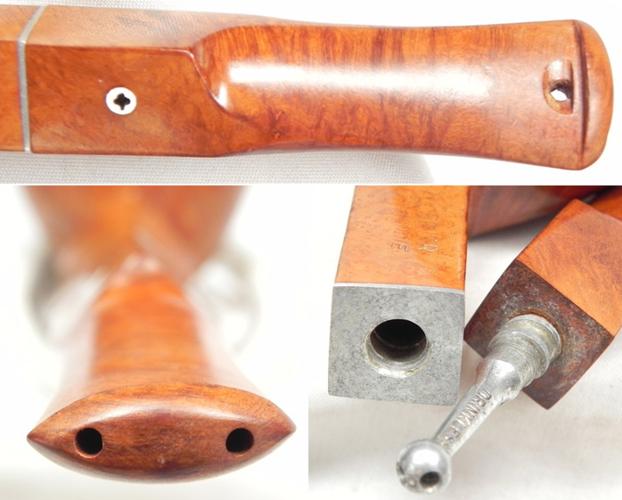
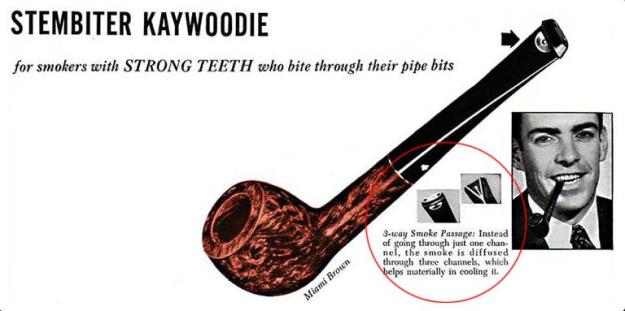
Further reading on Pipedia under the general listing for Kaywoodie Pipes provided me with a magazine advertisement that included the All Briar pipes. It is a great Father’s Day Ad and the bottom items in the ad show the All Briar line. I have included both the link and a copy of the ad for your reading pleasure (https://pipedia.org/wiki/Kaywoodie).Jeff sent me some close up photos of the pipe so I could see what it looked like when he started his clean up. The bowl had a thick cake that had overflowed onto the rim top with a thick coat of lava. The two photos below give two different views to show the condition of the both. You can see the flaking lava on the rim and the hard cake in the bowl. This pipe had been smoked hard and was obviously someone’s favourite.The finish on the bowl and shank was worn. There was a thick varnish coat that was peeling on the bowl sides and bottom that would take some work to remove.The stamping on both sides of the shake is faint but readable in the next photos. The pipe is stamped ALL BRIAR over Kaywoodie on the left side of the shank. On the right side it is stamped All Imported Briar over 50B (the shape number) and underneath that the letter C.The all briar stem has an inlaid black cloverleaf in a white circle on the left side. It is in decent shape and should polish out nicely.When it comes to the stem it is a serious issue. Making a new vulcanite stem for the pipe would certainly be an option but to me that would cause the pipe to lose its charm and detract from it being an All Briar pipe. I would need to do something different to bring it back to life or salvage it. It appeared to me that I had only one serious option on this pipe but I would make the final decision once it arrived.The stem had a screw in/threaded tenon with a four hole stinger. The stinger was stamped Drinkless as shown in the photo below. On Pipedia in the Kaywoodie article, there was a great advertisement for the Drinkless style of stinger so I have included that here as well. I decided to look on my other go to site – PipePhil (http://www.pipephil.eu/logos/en/logo-kaywoodie-1.html) to see what added information I might garner from his site. Under the Kaywoodie All Briar listing it said that the pipe had a twin-bore stem, meaning that instead of a slot in the button there were twin holes that formed a Y with the airway in the stem itself. The pipes were made between 1952 – 1955. It included a series of pictures of a typical briar Kaywoodie stem that showed a vertical hole near the button that was an innovation that they called Stembiter to prevent a stem biter from gnawing through the stem. Evidently, the pipe I am working on had that kind of set up on the mouthpiece as nothing is left of that portion of the stem. The Stembiter innovation came out in the early 1950s as well so now I had confirmation of the period when the pipe was made. I have included an advertisement for the Stembiter innovation following the photo below. I know that at present I will not be able to reproduce this feature on the stem when I rework it. Jeff continued using his established process of thoroughly cleaning the pipes he sends to me. He did not vary in his procedure just because of the briar stem on this one. He reamed the bowl with a PipNet reamer and touched it up with a Savinelli Fitsall Pipe Knife. He scrubbed out the mortise and the airway in the shank and the stem with pipe cleaners, cotton swabs and alcohol and cleaned the exterior of the threaded tenon and four hole stinger with cotton swabs and alcohol. He scrubbed the exterior of the pipe with Murphy’s Oil Soap to remove the grime and grit on the bowl. Sadly it did not even touch the thick varnish coat on the bowl. He worked over the rim and removed the heavy lava overflow. He scrubbed it with a tooth brush and the oil soap until he removed the buildup. His cleaning of the top cut through the varnish coat on that part of the bowl. He cleaned up the gnawed end of the stem so that at least it would be clean when I began my work on it. I took photos of the pipe to show the condition it was in when it arrived in Vancouver. Jeff cleaned up the rim really well – the tars and buildup were gone and fortunately so was much of the varnish coat. There were just a few shiny spots on the rim that would need to go. The bowl had been reamed back to bare briar.The stem while clean was an absolute disaster. It had been gnawed back through the stembite protection and the entire end of the stem was missing. I am guess that there was probably about 3/8 to ½ inch of the stem missing and the button was totally missing.I started the restructuring work on the stem with a Dremel and a sanding drum. I took the damaged areas back until I had some solid briar to work with. I did not want to remove too much of the stem material. The twin airways in the stem were very close to the surface in the stem at this point so I would need to do something a little different from the standard recutting a new button on the existing material.I started the rebuilding the end of the stem with clear super glue. I wanted to fill in the small divots in the surface of the stem on both sides and make the stem smooth and the end crisp. I built up the area where the new button would be with clear super glue first to stabilize the gnawed stem and begin with a solid edge. I put briar dust on top of the super glue and layered the dust and the glue until I had a workable portion on the stem surface. I needed enough of the new material to be able to reshape a button. In the second set of photos you can see the button area beginning to take shape. I used a needle file to recut the edge of the button and square it off with the surface of the stem. I wanted a sharp delineation from the button surface to the stem surface. I also reshaped the button surface as well with the files. The new button is beginning to be visible at this point.I filled in the air bubbles on top and underside surface of the button with clear super glue to make it smooth. I sanded the areas in front of the button on both sides of the stem with 220 grit super glue to blend it into the rest of the stem surface.I used a needle file to open the twin bore airways and smooth them out. I began to polish the stem and button with micromesh sanding pads – wet sanding the button and stem area with 1500-2400 grit sanding pads. I wiped the stem down with a damp cotton pad to see what the progress looked like. I dry sanded with 3200-4000 grit pads and then stained the stem with a Medium Brown Stain pen. I finished polishing the stem with 6000-12000 grit pads and wiped it down after each grit pad to keep the work surface clean. While the button is definitely darker than the stem body at this point it is still looking pretty good in my opinion and it feels good in the mouth. I sanded the bowl with 220 grit sandpaper to remove the varnish finish. It was spotty and peeling in places so it had to go. Once I had the finish removed I wiped the bowl down with acetone to remove any of the finish that remained. Then I used the same regimen to polish the bowl as I had used on the briar stem. I wet sanded it with 1500-2400 grit micromesh sanding pads and wiped it down with a damp cloth. I dry sanded it with 3200-12000 grit micromesh and wiped it down after each pad. Each grit pad brought more of the grain to light. There is a great mix of birdseye and cross grain on the bowl and shank. It is a beauty. I decided to not stain the bowl. The medium brown I put on the stem made the stem and bowl match so I was pleased with that. I put the stem in place on the bowl and buffed it with Blue Diamond to polish out any remaining scratches from my sanding and polishing. I gave the bowl and stem multiple coats of carnauba wax to protect it from damage and to preserve the briar. I buffed it with a clean buffing pad to polish the briar. I hand buffed it with a microfiber cloth to deepen the shine. The finished pipe is shown in the photos below. The repair and rebuilt button, though darker than the briar, works well and the pipe is fully functional again. The small amount of length I had to remove does not visibly change the overall look of the pipe. Thanks for walking with me through this restoration. It was one with challenges but it was a fun one to work on.


Jen’s Trove No. 4 – Reclaiming a Kaywoodie ‘Flame/Super Grain’ #11 Large Billiard


Blog by Dal Stanton

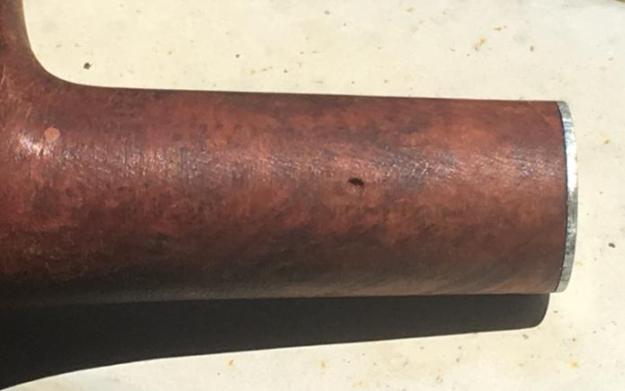
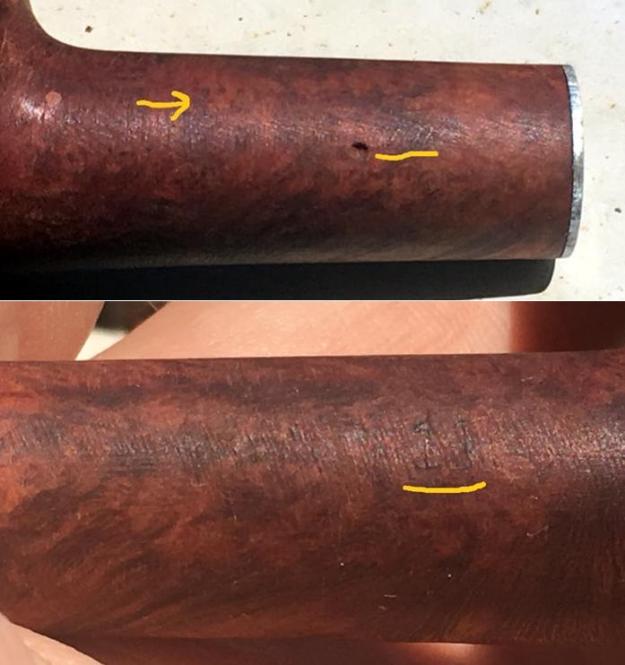
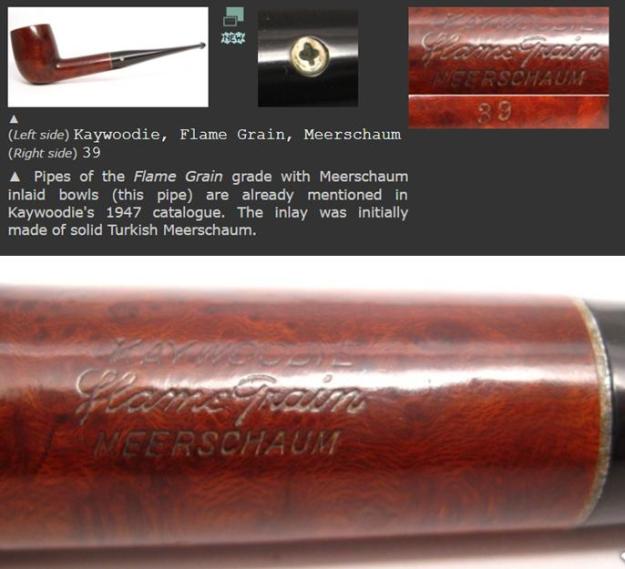
I think the reason this Kaywoodie stood out to Jen as she was rummaging through my baskets and boxes of ‘Help Me!’ pipes, was the ‘fancy stem’ and the strong, full look of the stummel.  The grain is impressive and it will clean up nicely.  Jen is leaving Bulgaria soon after working with us for a few years.  She’s taking a trove of pipes back to the US to give to the men in her family.  For her too, is the fact that each pipe she purchases will benefit our work with the Daughters of Bulgaria – helping women and girls who have been trafficked in Europe and sexually exploited.  This is the second Kaywoodie she has chosen.  The first was a beautiful Kaywoodie Author (See: LINK) that needed extensive rim repair.  The Kaywoodie now on the work table got my attention too, on the eBay auction block from a seller in North Carolina.  After Jenny rescued it from the basket, I take some pictures of the Kaywoodie she chose. Generally, the pipe is in pretty good shape other than normal time wear and tear issues, but the stem bit might need some work.  The rim and fire chamber are both in good shape, but in need of cleaning and the removal the light carbon cake to bring it to fresh briar for a new start.  In the picture immediately above shows two fills – one filled and one emptied.  The hole looks like a drill hole and I first suspected it was part of a cracked shank repair, but no cracks are evident.  Only these two fills on the stummel will need to be refilled and I’ll see if the other needs to be replaced.  The ‘Fancy Stem’ (I spent time trying to find a name for this type of stem and this is what I came up with via Steve’s assistance!) has serious tooth dents on the upper button lip and a significant dent and chatter on the lower bit.  I also detected that the classic Kaywoodie Synchro-Stem threaded tenon is underclocked a bit – which over time, I discovered, is a normal happening with metal threaded tenons (See from Reborn Pipes: About Stem/Bit Shapes).The nomenclature on the sides of the shank are in bad shape – almost warn off and beyond history’s grasp.  I had to take several looks at the stamping with a magnifying glass at different angles of light – lamp light and sunlight outside on my ‘Man Cave’ balcony on the 10th floor of our former Communist Blok apartment building.  What I can decipher with much effort, is a phantom “Kaywoodie” [over] “***in” offset to the far right of the Kaywoodie stamping above it (under the ‘-die’).  On the shank’s right side, I make a guess at ‘11’ which is a shape number.  These two pictures try to show what I can barely see!  I mark with yellow pen where the ‘K’ starts of Kaywoodie and I underline the ‘***in’ and the 11 in the second picture.With a passion to understand as much as I can about the provenance of the pipes I restore, I know that I’m on a steep learning curve with this only being my second Kaywoodie.  I’ve benefited much from Troy’s expertise, of Baccy Pipes, with Kaywoodie pipes and his help on this Kaywoodie.  I’ve picked up some of the markers that help establish a Kaywoodie’s identity.  The first thing to look at is, what is the “***in” refer to?  Identifying the Kaywoodie line, at least partially, can help place a pipe.  It did not take long as I search Pipedia for a listing of the names of the Kaywoodie lines (see LINK).  What I found is that throughout the years, Kaywoodie has put forward several lines with the word “Grain” making sense of my mystery “***in”:  Straight Grain, Super Grain, Flame Grain, Bird’s Eye Grain, Relief Grain, and Custom Grain – were the Kaywoodie lines that I cataloged from Pipedia.  My next step was to go to the Kaywoodie section of Pipe Phil’s inventory of examples and to see if I could find an example of what appears to be the same script style for the ‘Kaywoodie’ [over] ‘*** Grain’ in cursive, simply to visualize.  The only example I found of the same script for both ‘Kaywoodie’ and ‘Grain’ was this Flame Grain, Meerschaum from the 1947 catalogue that Kaywoodie produced.  A close look of the script follows in picture two.  I think this is a pretty good visual match of the nomenclature style.So, I think it’s safe to say that the Kaywoodie before me was a line suffixed by ‘Grain’.  I don’t know how rare or common the use of the cursive script was with Kaywoodie ‘Grain’ lines, but it could possibly help in identification if one knew.  Another concrete marker I identified was the shape number, ‘11’ which is identified as a ‘Large Billiard’ in the Pipedia Kaywoodie Shapes Guide.   This description seems to be right on with the Kaywoodie before me – a handful of wonderful Billiard briar!  The other marker that I was aware of was the iconic Kaywoodie stem shamrock or club.  From PipePhil.eu, I found this concise description that indicates that the black shamrock in the white dot started to emerge on pipes since 1937:

The cloverleaf logo: the round logo (black cloverleaf in white circle or white cloverleaf in black circle) was first used in 1937. Up until the late 40’s this logo was used on all of the upper grades pipes. The concomitant use of the plain white cloverleaf and the disk inlaid logo continued until the early 80’s.

Up until the late 1940’s/early 50’s, the logo was on top of the stem. After that the logo was moved to the side of the stem (exceptions exist).

The other solid marker that I investigated was the No. ‘11’ shape number.   In Pipedia’s Kaywoodie Shapes Number section, shape number 11 is described:

Shape # Description Years Produced
11 Large billiard 1935-1972

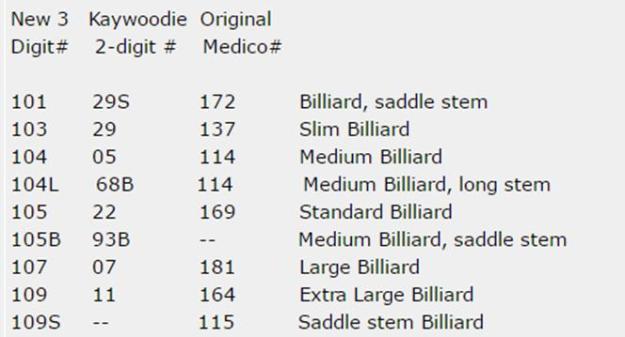
Troy later sent me another helpful link from Kaywoodie My Free Forum that allowed me to see all the Kaywoodie Billiard offerings with the comparison of 2 and 3-digit shape numbers.From the same Forum article, the center column reflects the 2-digit system employed from 1927 to 1972, when the system was changed to a 3-digit system when pipe production (for Kaywoodie, Yello-Bole and Medico) was moved to the Medico factory in Richmond Hill Queens NY as plans for new plant were in process.  The left-hand column above was the 3 digit numbers used during this period for all Kaywoodie and Medico pipes, from 1972 to 1980.  The same article indicated that the 2-digit numbers were only for Kaywoodies produced in the US – that Kaywoodie of London to Cadogan had their own three-digit system.

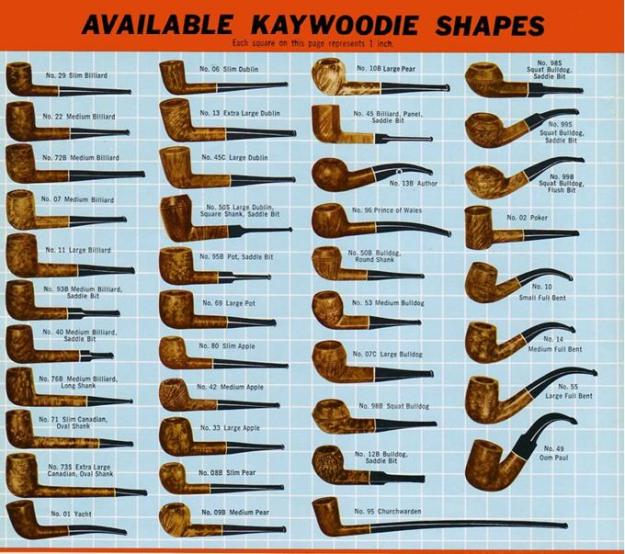
I took my search for a Kaywoodie ‘Something Grain’, shape #11 to the latest Kaywoodie Catalog that would have a representation of the #11 Billiard at Chris’ Pipe Pages that is consistent with the older Kaywoodie catalogues leading up to it (See: LINK).  See the 5th pipe down on the left:That is the Large Billiard stummel on my work table.  There is one thing that doesn’t line up. The Fancy Stem. I spend extensive time trying to find the No. 11 with a fancy stem flipping through all the Kaywoodie catalogs (referenced above) and found no specimen – not even on another shape.  During this exploration, I sent my forensic findings and some pictures to Troy whose experience with Kaywoodies is extensive.  I wanted to know what I might be missing.  After an enjoyable time of communicating back and forth – pipe restorers’ cyber fellowship, Troy’s experience with Kaywoodie pipes cut through my fog quickly.  Regarding the nomenclature of the Kaywoodie Jenny chose as part of her trove, I’ll let Troy’s observations conclude this Kaywoodie origins adventure!  Thanks Troy!

if the shank is straight then the only thing I can think of is someone took a pre-1972 #11 and re-stemmed it with a 1970’s type quarter bent stem.  If that is the case then it’s a 1955-1972 #11 Flame Grain with a different stem…. Or it could be a Super Grain (1955-1972) with a later Flame Grain type stem.

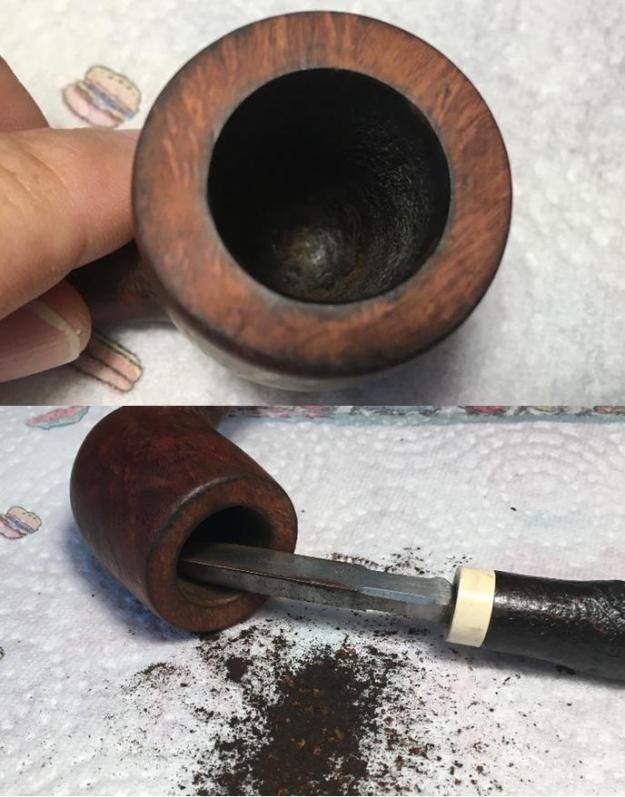
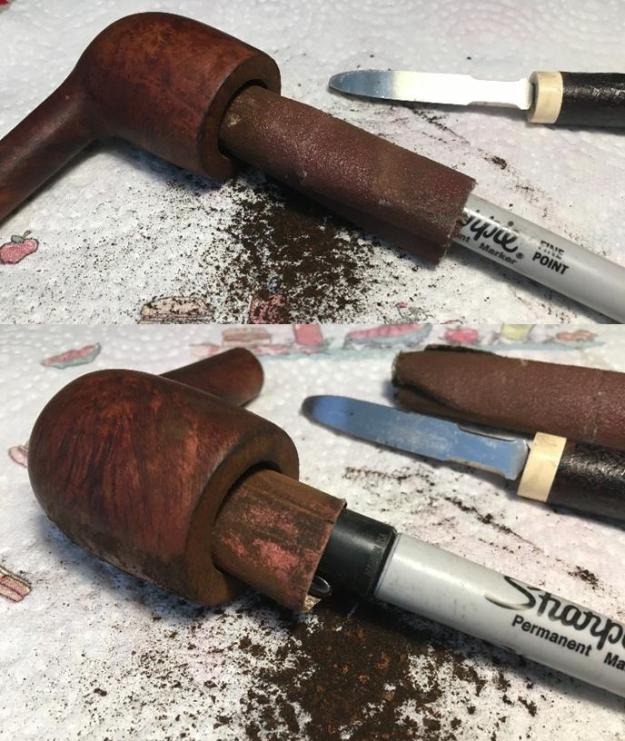
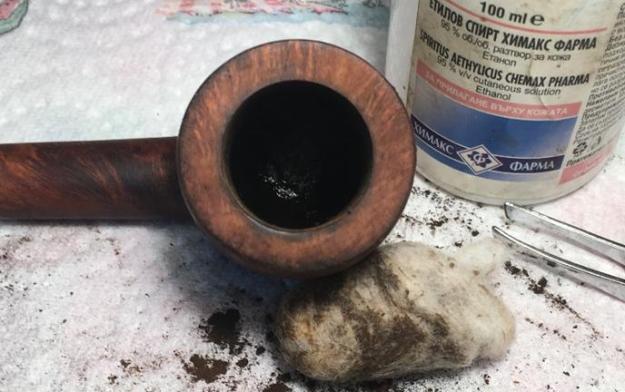
With a better understanding of this Kaywoodie in front of me, I start the restoration by reaming the fire chamber.  Since the cake is so thin, I use the Savinelli Pipe Knife to do the job.  After spreading out paper towel to catch the carbon, I employ the knife and it makes short work of the cake.  I follow by sanding the fire chamber with a coarse 120 grade paper, then a 240 grade paper – in both cases wrapped around a Sharpie Pen.  I finish by wiping the bowl with cotton wetted with isopropyl 95% to remove the residue carbon dust.  The pictures show the initial clean up.

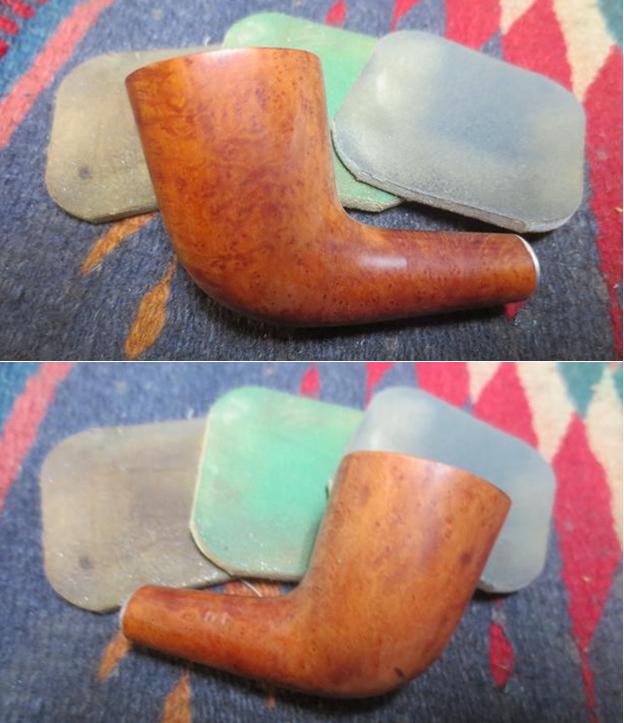
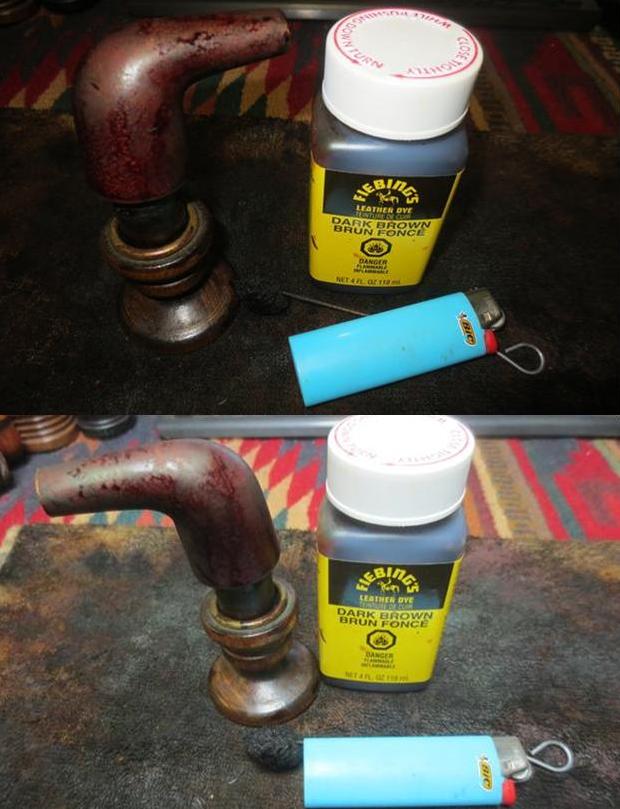
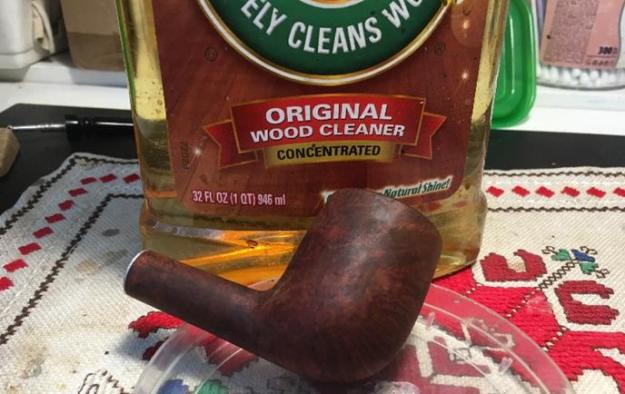
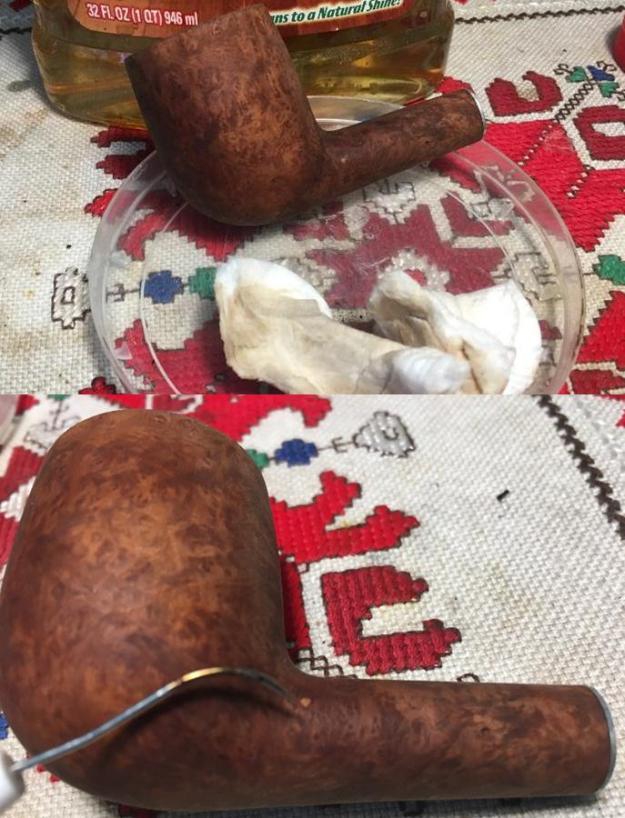
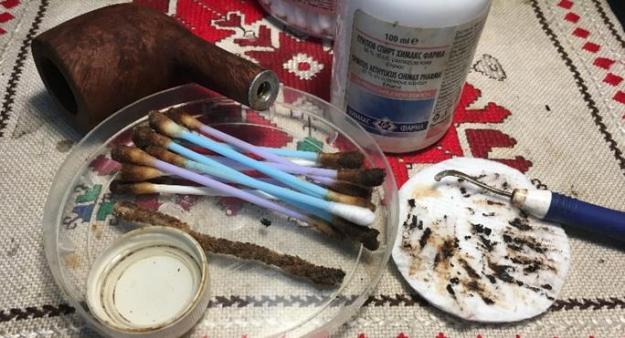
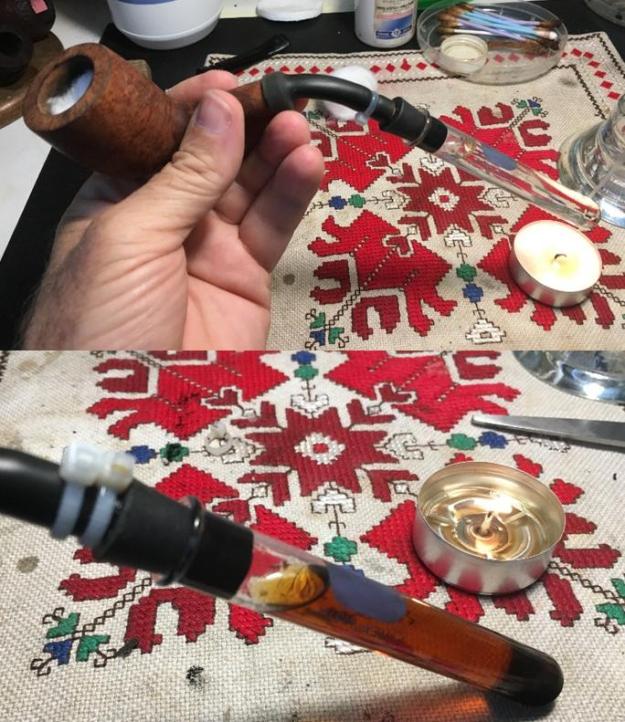
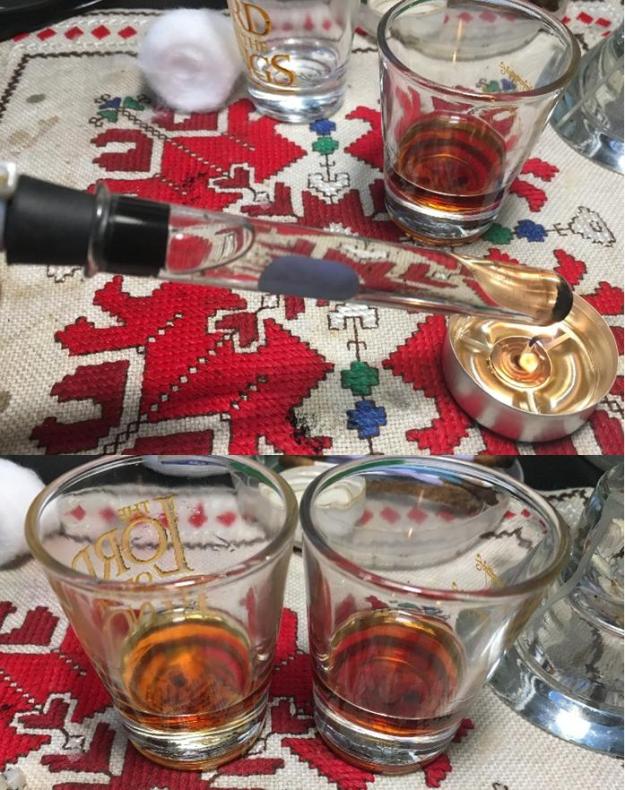
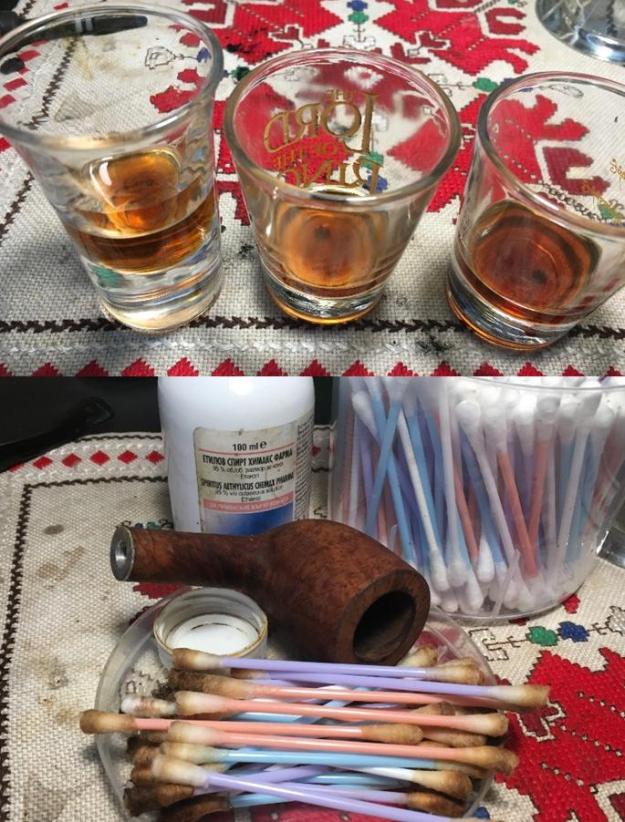
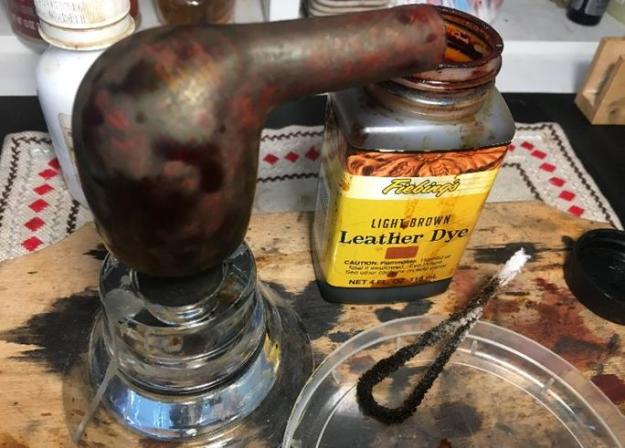
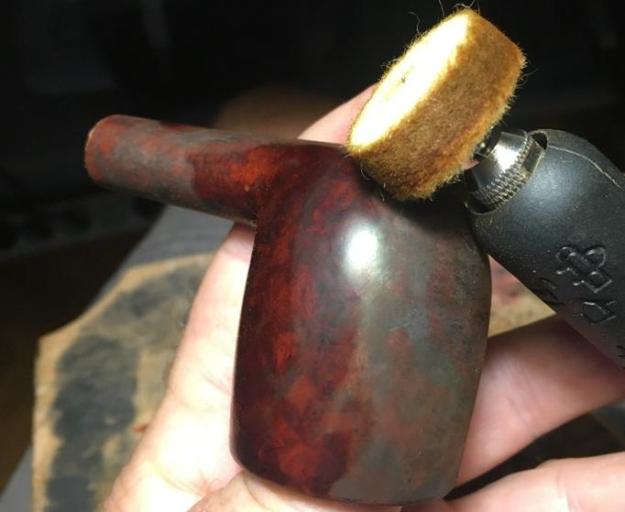
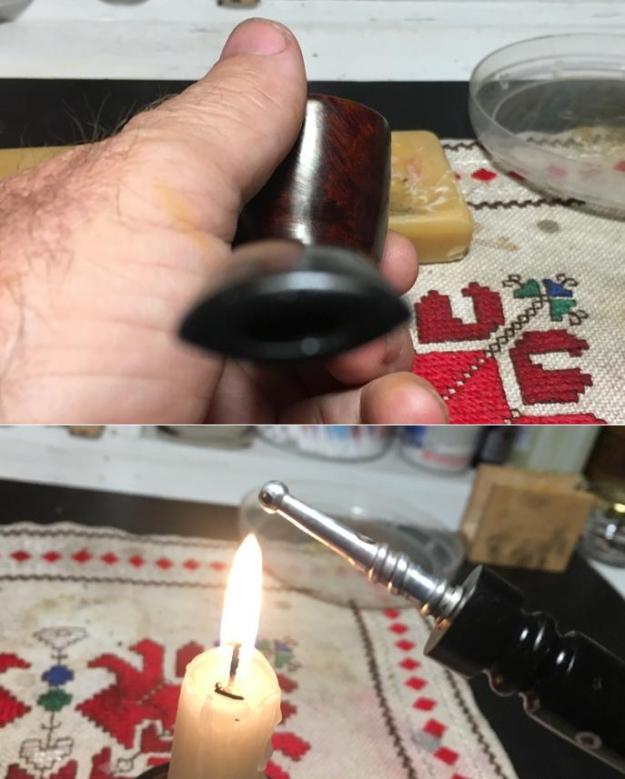
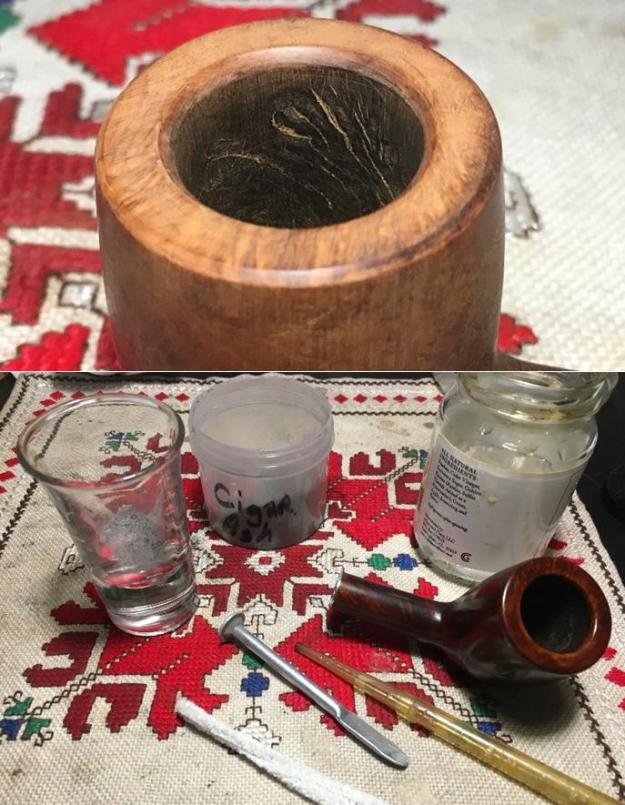
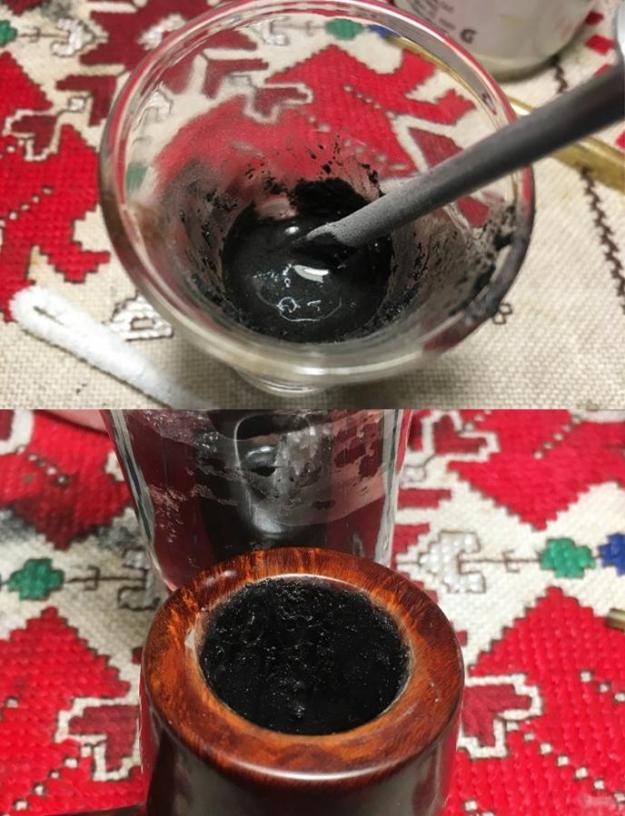
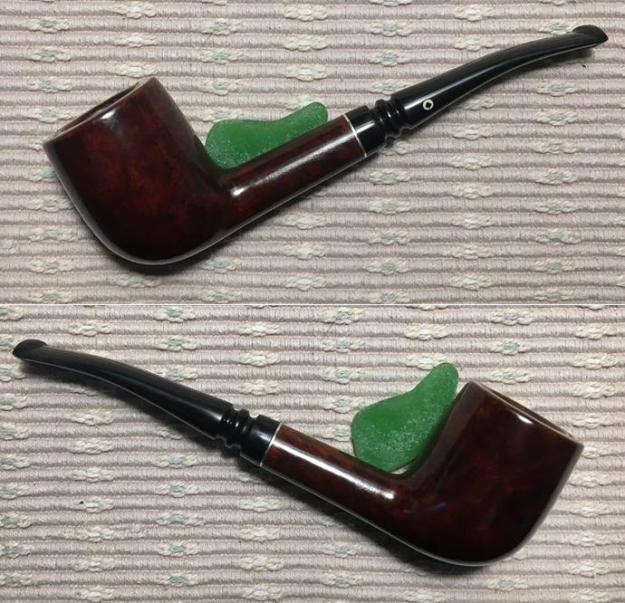
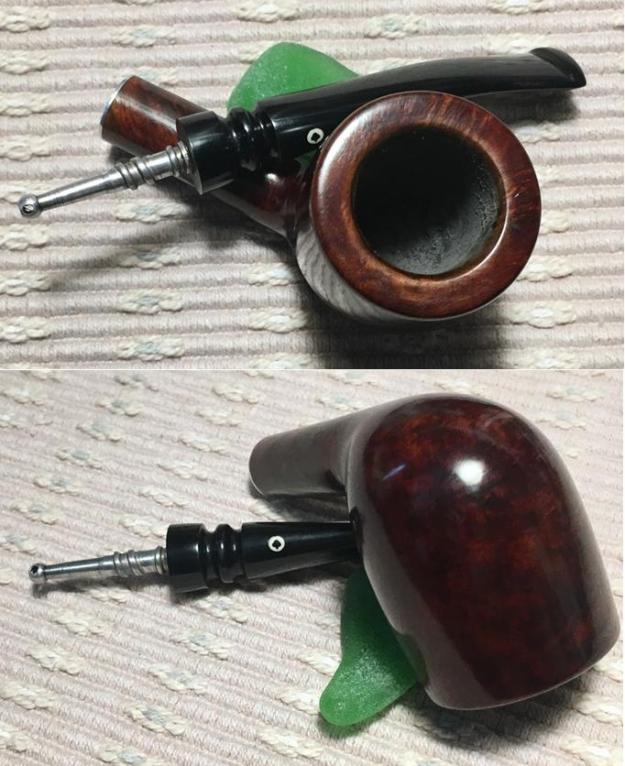
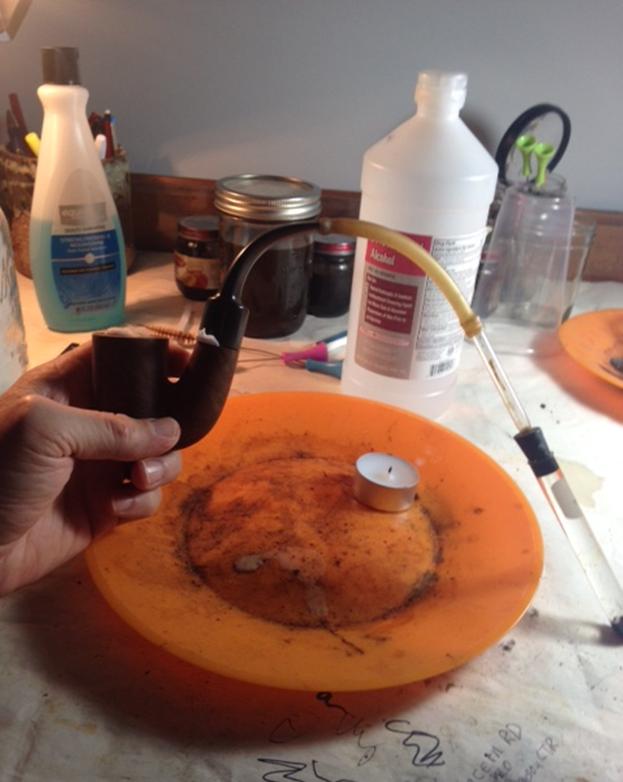
Next, using undiluted Murphy’s Oil Soap I address the grime on the stummel using cotton cloth pads.  After scrubbing, I rinse the soap off the stummel with cool tap water, not allowing water in the internals. While the stummel is still wet, I probe the fill on the left side of the shank to see if it had softened and might come out.  It was solid.  The pictures show the progress. I now turn to cleaning the stummel internals because I like working on clean pipes.  Using pipe cleaners and cotton swabs dipped in isopropyl 95%, I go to work.  The internal gunk is thick – I use a curved, spaded dental probe to scrape the sides of the mortise and I remove a lot of old tars and oil built up. After some time working like this, I decide to switch tactics and use a retort to clean the internals and make more efficient headway!  After setting up the system, putting a cotton ball in the bowl, and lighting a candle to heat the alcohol in the capped test tube, the alcohol heats and eventually boils.  When it boils, the expansion forces the hot fluid into the stummel.  Much of the alcohol is initially absorbed into cotton ball so I replenish the alcohol and continue the process.  The rhythm of boil, expansion and then removing from the flame and tipping the stummel so that the expanded alcohol runs back into the test tube, is repeated several times. I pour off the first cycle into a Lord of the Rings commemorative shot glass to compare.  I refill the test tube with alcohol, and continue several more cycles, pouring out the expended alcohol in another shot glass and refilling with fresh alcohol for a 3rd and final cycle.  There is a gradual lightening of the expended alcohol as I picture all three for comparison.  After finishing use of the retort, I finish up again using pipe cleaners and cotton swabs.  The pictures show the progress. Looking at the stummel surface, the old finish does not look uniform so I use cotton pads and wipe down the stummel with acetone to remove vestiges of the old finish.  The acetone worked very quickly.  I again look at the suspect fill on the left side of the shank, and this time I detect a gap on the edge of it. I use the sharp dental probe to remove the old fill. Looking now more closely at the rim, there is a dark ring around the external edge simply indicating wear.  I take a picture of the right side of the rim that shows more wear.  To freshen the rim lines, I decide to lightly top the KW Billiard.  Using a chopping board topped with 240 grit paper I evenly rotate the inverted stummel, checking to make sure I’m staying true. After making sufficient progress with the 240, I switch to 600 grade to smooth further the top surface.  The pictures show the topping progress. With the topping completed, I fine tune the rim freshening by beveling the internal edge of the rim.  I use 120 grit paper rolled tightly to cut the initial angle of the bevel.  I follow the 120 with a rolled piece of 240, then 600.  To me an internal bevel adds class to a stummel.  This #11 Large Billiard stummel looks good.  I also lightly sand around the edge external rim.  This softens the lines.  The pictures show this rim fine-tuning process.To address the small holes on the left side of the shank, using a toothpick, I drop fill the holes using HOT STUFF Special ‘T’ – thick CA glue.  I put a little CA glue on close to the end of the toothpick and allow gravity to run it to the tip to allow a surgical application of the glue.  After applying the thick CA glue, I spray it with an accelerator to cure it more rapidly.  In a few minutes, using a flat needle file then a rolled-up piece of 240 grit paper, I bring the CA patch mound down to the briar surface. I finish by using a rolled-up piece of 600 grit paper to smooth the patches more and blend.  The pictures show the process. To prepare the stummel for sanding, to preserve what is the precious little of this Kaywoodie’s nomenclature, I cut small pieces of masking tape to cover the remnants.  First using a medium grade sanding sponge, I sand the stummel gently removing very small nicks and pits to smooth the stummel.  I follow with a light weight sanding sponge.  Using strategically placed thumb and fingers the masking tape guards did the job.Now to the micromesh pad cycles to bring out the grain on this already attractive Kaywoodie Large Billiard.  Using pads 1500 to 2400 I wet sand the stummel, followed by dry sanding with 3200 to 4000 and then 6000 to 12000 – throughout, guarding the nomenclature.  I am impressed by the quality of the briar grain emerging in the Kaywoodie Large Billiard.  The pictures show what I’m seeing. Putting the stummel aside, it’s time to tackle the Fancy Stem.  Using pipe cleaners dipped in isopropyl 95% I work on the internals.  I also employ the use of long wired brushes that more easily work up into the Kaywoodie 3-hole stinger/tenon system.  Following this, I use a brass bristle brush on the exterior of the stinger/tenon and finish with shining it with 0000 steel wool.With stem internals clean, I look again at the work needed on the upper and lower bit.  The upper button area has tooth chatter but more significant is the compression on the button lip that may need rebuilding.  Looking at the upper lip from the slot side, the lip has a dent that compresses toward the slot.  The lower bit has a significant tooth dent and chatter.  The lower button lip is in better shape.  I take some pictures to mark the problem areas. I decide to use the heating method first to see if this will minimize the damage.  By heating the vulcanite over a flame, the expansion of the rubber will seek out its original shape – at least in part.  I’ll give it a try, then move to sanding and filling.  With a candle lit, I pass the button area over the flame – back and forth several times.  The technique helps on the lower bit but not sufficiently.  The upper bit, button repair was not helped much.  So, using 240 grit paper, I work on the lower and upper bit. Using a flat needle file, I also try to remove dents from the upper button lip.  Pictures show the progress. The first pictures below show the sanding/filing progress on the upper lip.  I’m not satisfied with the results as I will need to remove more of the button than I want to remove the dents.  I wanted to see if I could repair the lip without rebuilding the lip, but this will not be possible.  I’ll need to mix activated charcoal powder with CA glue to rebuild the upper button lip and fill the dent on the lower bit.I open one capsule of activated charcoal and mix it with Hot Stuff Special ‘T’ CA glue. This CA glue is extra thick.  After cleaning the patch areas with a cotton ball and isopropyl 95%, I place a small puddle of ‘T’ CA glue on an index card, and use a toothpick as a mixer and trowel. After reaching a molasses-like viscosity with the mixture, I apply the mixture to the dent and the upper button lip.  I apply more mixture than necessary to enable later sanding down, shaping and blending the patches.  To shorten the curing time for the patches, I spray each with an accelerator.  The pictures show the progress. Back to filing and sanding.  Using a flat needle file, I file the patches down.  I follow by using 240 grit paper to fine tune bringing the lower bit dent patch down to surface level.  I blend the patch further using 600 grit paper. I do the same with the lower button lip.  After shaping the bit with the flat needle file, I use 240, 600 grit papers. The process with the button is a gradual filing, sanding and shaping until the button emerges and looks balanced.  Pictures show the progress. Above the slot, during the sanding, I notice a pinhole – what appears to be a small air pocket.  There are also very small air pockets on the upper button lip repair.  This is normal and I use a toothpick and drop-fill the hole with CA glue. I then paint a thin coat of CA glue over the button lip to fill the air holes.  I quickly spray the glue with an accelerator to shorten the curing.  I then finish the button sanding out the air pocket fills. I complete this phase of repair by using 0000 steel wool to the upper and lower bit.   The lower bit patch will blend more as I polish the stem.  The button looks good.  The pictures show progress. With the repair to the bit completed, I now turn to the Fancy Stem.  Even though there is no oxidation, I use 0000 steel wool to buff the entire stem to remove many small nicks and scratches on the surface.  I then begin the micromesh pad process by wet sanding with pads 1500 to 2400.  I follow by dry sanding with pads 3200 to 4000 then 6000 to 12000.   After each cycle, I apply Obsidian Oil to revitalize the vulcanite.  The Fancy Stem is looking good.  The pictures show the progress. I again take the stummel after completing the stem sanding.  During the stem work, I had in the back of my mind the consideration of the next step working with the Kaywoodie ‘Flame/Super Grain’ stummel.  The stummel’s natural briar color is dark and rich with grain flow – horizontal, bird’s eye and flame.  My idea is to add some pop to the grain by staining the stummel with a light brown dye.  This will not darken the stummel, but perhaps it will lighten the softer wood grains.  We’ll see!  I take a few pictures of the stummel to mark the progress.  Using a cotton pad wetted with isopropyl 95%, I wipe the stummel down to assure it’s clean. I use a cork inserted into the bowl to use as a handle and I warm the stummel using the heat gun to warm and expand the grain helping it to be more receptive to the dye.  I then apply a generous amount of Fiebing’s Light Brown Leather Dye to the stummel using a folded pipe cleaner.  When covered thoroughly with dye, I ‘flame’ the stummel with a lit candle which immediately burns off the alcohol in the aniline based dye.  This sets the hue in the grain.  After a few minutes, I repeat the process again and then set the stummel aside to rest.  The pictures show the process. After several hours, the stummel is ready to ‘unwrap’.  Using the Dremel, mounting a felt buffing wheel, at the slowest speed, I apply Tripoli compound to the surface to remove the fired crust.  I take a picture to show the contrast from the crust, and the emerging grain.  After the Tripoli, I lightly wipe the stummel with a cotton pad wetted with isopropyl 95% to blend the dye further.  After this, using a cotton cloth buffing wheel mounted on the Dremel, and notching up the speed to ‘2’ (fastest is 5), I apply the slightly less abrasive compound, Blue Diamond.  I love to see the rich tones of the briar grain emerge during this process.   Before I apply the carnauba wax to the stummel, I have a couple of corrections to apply.  The first is to correct the under-clocked stem.  Using a lit candle, I heat the metal tenon so that the vulcanite loosens its grip and I quickly screw the tenon in until it tightens and I apply pressure carefully to advance the stem.  I repeated the heating process a few times until I reached the desired stem position.  The pictures show the process. The second thing I wanted to do before applying the carnauba wax was to coat the fire chamber with pipe mud.  I have this tutorial bookmarked on Reborn Pipes here: LINK.  I noticed minor heat fissures in fire chamber earlier which is shown in the first picture below.  Applying a coat of pipe mud will simply coat the chamber, filling the fissures, and provide the foundation for a new cake to develop.  To create the pipe mud, I use a mixture of cigar ash (thanks to my colleague, Gary!) and water.  I make sure that the cigar ash is finely ground using the flat end of a pipe nail and I remove any solid debris.  I put ash in a shot glass and water in a small bottle and I add water using a large eye-dropper and mix with the pipe nail until I achieve a paste like viscosity.  I then use a pipe cleaner to paint the mud to the chamber wall and tamp it using the spoon end of the pipe nail tool.  I’ll wait about an hour for the mud to fully set up.  The pictures show the process. Now for the home stretch.  With stummel and stem reconnected, I apply several coats of carnauba wax to the Large Billiard stummel of this Kaywoodie Flame/Super Grain.  I use a cotton cloth buffing wheel mounted on the Dremel at the same speed (2) and methodically apply the carnauba using the sheen reflection on the surface to guide my application.  After applying carnauba, I change to a clean cotton cloth buffing wheel and go over the surface again to bring out the shine and more fully blend the wax.  Finally, I hand buff the pipe with a microfiber cloth to raise the shine more.

While we don’t know with 100% certainty whether this Kaywoodie #11 Large Billiard is a Flame Grain or a Super Grain, I believe the grain is a cut above the norm looking at its quality.  It has a beautiful flow of grains and is quite attractive.  The Large Billiard fills the hand well with an interesting, tapered Fancy Stem, that probably came later and is not original with the older #11 stummel.  I’m happy to provide this Kaywoodie to add to Jenny gift trove as she goes back to the US.  Jen’s purchase benefits the Daughters of Bulgaria, our work here in Bulgaria with women and girls sexually exploited and trafficked.  For more information about this work, take a look at The Pipe Steward.  Thanks for joining me!


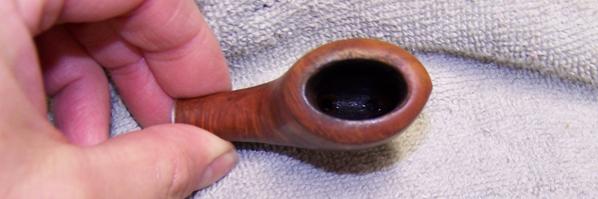
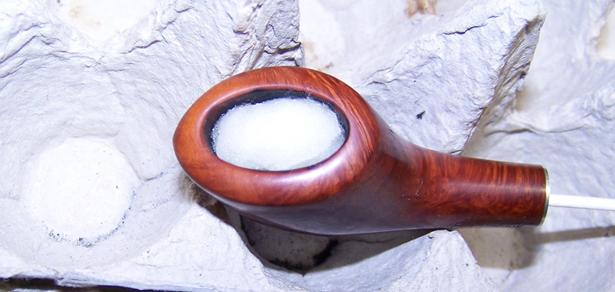
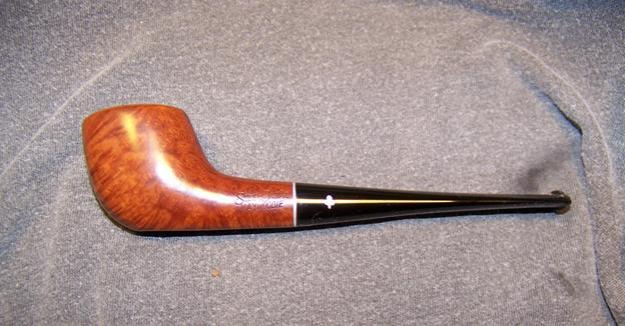
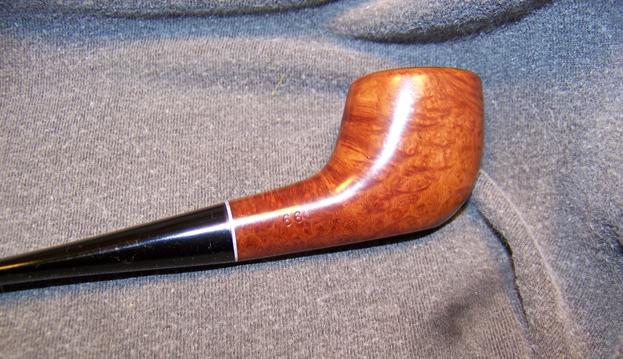
Kaywoodie SuperGrain Streamliner 66


Blog by Aaron Henson

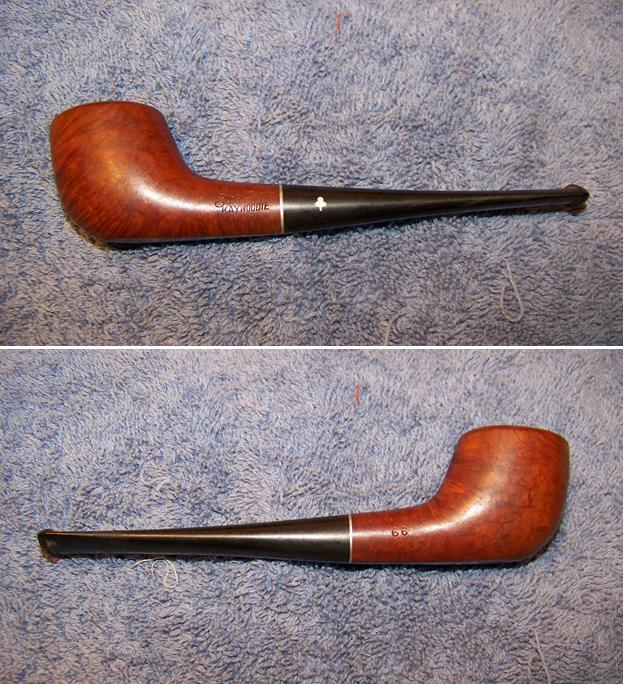
In June of 2016, Steve posted a great restoration of a Kaywoodie 61 by Lance Leslie.  Lance referred to the 61 as “the circus pipe”, a name his Grandfather had given it, no doubt because of the unique shape and the oval bowl.  At the time, I thought Lance had done a great restoration but I was not moved by the shape of the pipe.  Little did I know that in about a month’s time I would stumble upon its cousin, the 66, in a second hand store in Dallas.

The Kaywoodie shapes 61, 64 and 66 are EZ-set pipes (flat bottom) that are known as “Streamliner” shapes (pipedia).  I assume that the ‘streamline’ name comes from the oval shaped bowl that gives the pipe a slim profile and made it easy to fit into a vest pocket.  Although Kaywoodie had several other shapes that were “vest pocket” shapes, only the 61, 64 and 66 were called Streamliner shapes.

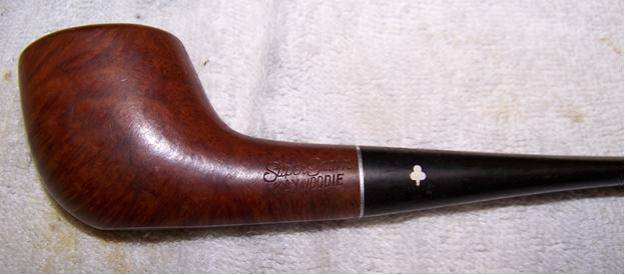
The Kaywoodie shape list further describes the 66 as a “forward leaning apple” and indicates that this shape was manufactured during the following two periods: 1935-1937, 1952-1960.  I was not able to pin down the manufacturer date any closer but based on its condition, I suspect it to be in the latter, post war, time period.

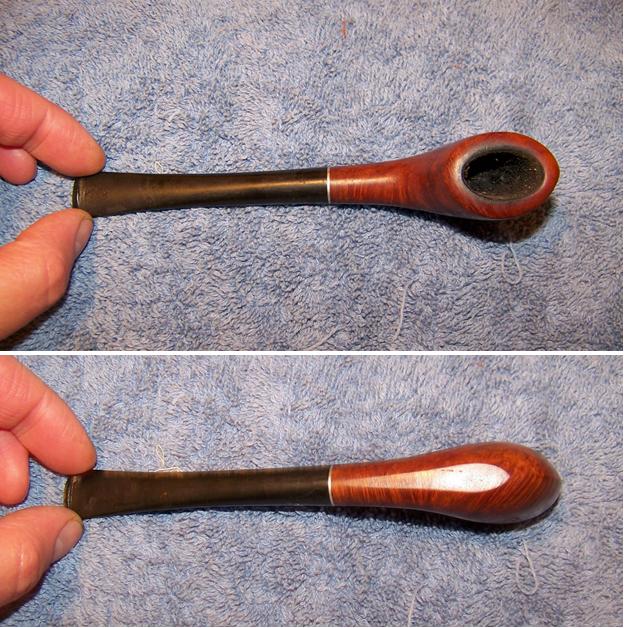
Once I had the pipe in hand I was drawn to it unique shape; kind of a boat shape with a curved prow.  Although a little odd feeling in the hand, I found it appealing.  Additionally, I could see that the quality of the briar under the grime was fantastic.  Of course, the pipe came home with me.kw1 kw2Inspecting the pipe at the workbench, there was a light build up on the rim with some under laying burn marks.  There was a medium cake formed in the bowl but it was not overly hard.  The stummel had some handling dings and scratches but none were very deep.  I looked for fills but found none and confirmed that the grain was superb.kw3The stem had a light amount of oxidation and a deep scratch about halfway down in the underside.  There was a little chatter around the button and a moderate tooth dent in the bottom side of the stem.  Removing the stem revealed the threads and the aluminum stinger to be in good condition, albeit covered in dried tars.kw4I began working on the stem by applying heat from a lighter to raise dent and even out the tooth chatter.  This was very effective but had the added effect of bring out some oxidation around the bit.  I set the stem to soak in a mild Oxi-clean bath and turned my attention to the stummel.

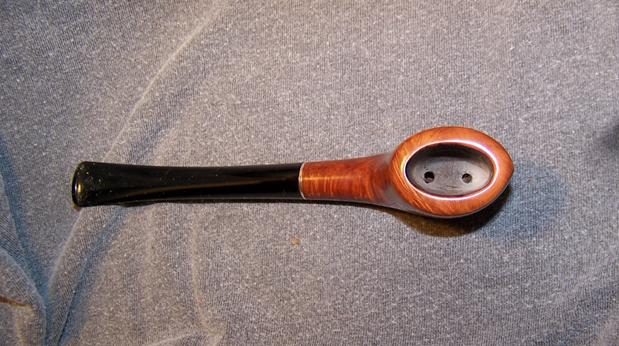
The first thing I like to do is clean out the bowl.  This gives me a good feel for the true condition of the briar.  Because of the narrow oval shape, I could not get any of the Castleford reamer heads to fit.  So I resorted to carefully scraping out the cake with a dull jackknife and finishing with a rolled piece of 80-grit sand paper.kw5With the cake gone, I discovered something that I was not expecting.  There were two air holes in the bottom of the bowl; one at either narrow end of the oval.  Inserting a pipe cleaner into the shank I could see that the airway extended straight under the bowl and both holes opened down into it.kw6Using a cotton pad and alcohol, I scrubbed the rim and was able to remove most of the tar.  I was happy to see that the much of what I thought was burn came off with the alcohol pad.  The burn marks that remained were on the inside of the rim and not very deep.kw7Before doing any other work on the stummel I wanted to try to lift any handling damage with steam.  I laid a clean, damp terry cloth rag over the wood then applied at clothes iron on high to the damp cloth.  The resulting steam will often lift the dents and shallow scratches that comes with handling or rattling around in a box or drawer.  It will also lift and remove the manufacturer’s stamps so be careful around those.

After steaming I used 320 grit paper I carefully sanded the rim trying to keep the original rounded shape while removing the burn marks.  Then I scrubbed the internals of the shank with cotton swabs until the swabs came out clean.kw8I wanted to sweeten the bowl and remove any ghosts of the former owner’s tobacco so I decided to do a bowl soak.  I plugged the shank with a cotton swab and packed the bowl with a cotton ball.  Then I filled the bowl with Isopropyl alcohol.  The alcohol draws out the old tobacco oils trapped in the briar from the briar and they in turn get trapped in the cotton.  While the bowl soaking, it was time to work on the stem.kw9Taking the stem out of the Oxi-clean bath I lightly sanded the stem with 500 then 1000 grit paper to remove the remaining oxidation and to smooth out the remaining tooth marks.  I cleaned the stinger with some 0000 steel wool and ran pipe cleaners through the internals until all was cleaned.  I polished the stem with the full range of micro mesh pads.  I apply a bit of mineral oil to the stem every few pads. This seems to help in the polishing process.kw10 kw11 kw12I finished the stummel by sanding with 1500 – 4000 micro mesh pads then wiped everything down with a light coat of mineral oil and let it set over night.  The next day, after work, I took the pipe to the buffing station and finished the polishing with red diamond compound.  Wiping off the excess rouge with a cotton cloth I changed buffing pads and sealed the pipe with three coats of carnauba wax.

Overall this was another easy cleanup, but I am very happy with the results. The more I worked on the 66 the more I came to like the shape.  Thank you for taking a look!kw13 kw14 kw15 kw16 kw17


Kaywoodie Connoisseur 49 Large Oom Paul


Blog by Andrew Selking

It is an honor to once again write an article for Steve’s blog.  For those of you who don’t know me, my name is Andrew and a bit obsessive about Kaywoodie pipes and the entire Kaufman Brothers and Bondy’s (KB&B) family.  Until recently my favorite pipe has been a four-digit Yello Bole 2062 small Oom Paul.  I’ve had this large Oom Paul in the drawer, waiting for restoration, for over a year.  (Sorry I forgot to take a before picture).oom1I start this pipe as always by soaking the bowl in the alcohol bath.  Here is the pipe right after it came out.oom2Next I reamed the bowl.  As you may have noticed this is a rather large bowl, my reamer barely reached the bottom.  This also accounts for the reaming damage done to the rim.oom3The pipe has a replacement push stem, which initially caused me to think it was an export model, but looking at the shank you can see the groves that the stinger originally screwed into.oom4I find that the alcohol bath does a nice job of softening any protective coating or wax.  In order to remove the rest, I used 0000 steel wool and acetone.oom5Here is what the pipe looked like after removing the finish.oom6My next step was to further clean the insides of the pipe and stem using a retort.oom7The average bowl takes two cotton balls to fill it, three if it’s kind of big.  This bowl swallowed four cotton balls.  Here is a picture of them after the retort (notice how the boiling alcohol pulled the tar out of the wood).oom8As you may have noticed in previous pictures, the rim on the bowl was in rough shape; scorching, reaming damage, and deep dents.  I planned to top the rim and the end of the shank to remove some of the worst damage, but I decided to leave the dimensions as close to original as possible; so I refrained from getting crazy with the sand paper.

I used 150 grit sand paper on a piece of glass to top the rim and shank, followed by some 400 grit.  A note of caution when topping an Oom Paul, the shank and the bowl are close to each other.  Be sure not to take off wood where you don’t intend to.oom9Once the rim was to my liking I started on the bowl with the 400 grit wet/dry.  I sanded around the marking on the shank and kept the stem inserted while working on the end of the shank to prevent rounding.oom10 oom11Here is the bowl after the 400 grit.oom12After the 400 grit I turned to a progression of micro-mesh pads (1500-12,000 grit) to polish the wood.oom13I used the same progression on the stem.  I polished the stem using a rotary tool set on the lowest speed with white rouge and carnauba wax.  I used my buffing wheel (aka heartbreaker) with white rouge and carnauba wax on the bowl.  I reassembled the pipe and wiped on a couple of light coats of Halcyon II wax.  Here is the finished result.oom14 oom15 oom16 oom17 oom18Just to give some perspective on the size of this pipe, here is my four-digit yellow bowl for comparison.oom19 oom20 oom21 oom22Normally I wait to smoke a restored pipe until after taking pictures, but we were without power this morning so I loaded the bowl with some Dunhill Early Morning Pipe and commenced to smoke.  The draw is fantastic!  After about an hour I thought I must be getting close to the bottom of the bowl so I got my pipe cleaning tool and started to clean the bowl.  I had only smoked half the bowl!  This the first pipe I’ve encountered that has a basement!

I now have two Oom Paul pipes in my collection.  I imagine they will vie for my attention for a very long time.

Restoring a Kaywoodie 61 Circus Pipe


Blog by Lance Leslie

My grandfather was a pipe smoker up until the 80’s. I can remember him plowing the field with his pipe and tractor smoking. His favorite pipe was a Kaywoodie shape 61. He called it his “Circus Pipe”. He called it that because of the odd shape of the bowl opening. It was an oval bowl opening and I have never seen one before and I had yet to find one after years of searching. That is until two weeks ago.
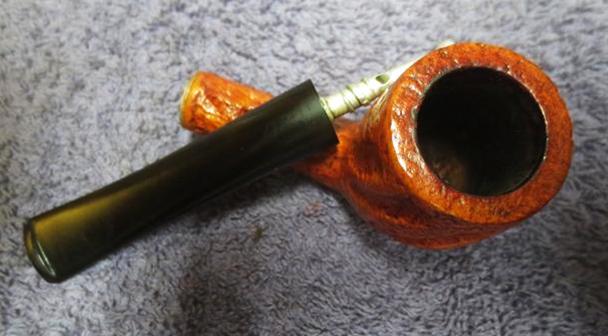
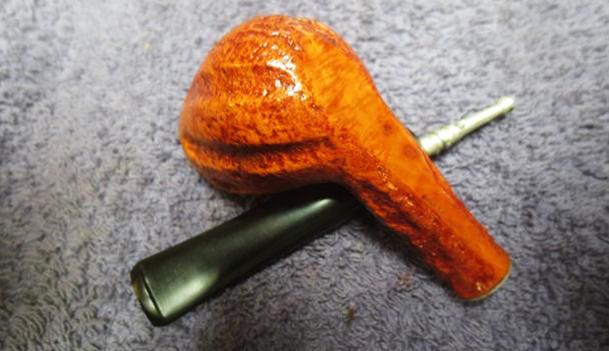
I was scoping out eBay one night and found the elusive shape no. 61 in an auction with 12 minutes left. I put in a ridiculous bid and then it was a waiting game. Twelve minutes later, the pipe was mine!! The bidding did not get too out of hand, so that was a plus, but it did go for a hefty price considering the shape it was in.

I remember my papa gouging out the cake with an old hawkbill knife. The oval bowl could not be reamed with a reamer due to the oval shaped bowl. This led to there being chunks carved out of the top of the bowl. This pipe looked to have the same problem. Here is the pipe as it arrived. BTW, it turned out to be a Super Grain!!!! Bonus!Circus1 Circus2 Circus3 Circus4 Circus5The pipe was in pretty bad shape. The bowl’s top was gouged just like my grandpa’s. I decided to top the bowl and use my Dremel stone sanding tool and put the bowl back in round. This was real nerve-racking because I could really ruin this pipe. But I bit the bullet and went for it.Circus6I then used some rolled up sandpaper to bevel the edges.Circus7 Circus8I then lightly wet sanded the outside of the stummel to get rid of the surface scratches and gave the pipe a rub down of Murphy’s Oil Soap.Circus9 Circus10After the oil soap bath, I gave the pipe a wipe of Watco Danish Oil Dark Walnut and then let that dry.Circus11While the Danish Oil was drying, I took the stem down sanding pad lane using 1500 through 12,000 to bring the stem to a showroom shine.Circus12 Circus13I reamed the pipe with a pin knife and uncovered some gouges inside the interior of the bowl. I mixed up some pipe mud using activated charcoal and sour cream. I mixed the two together into a creamy grey paste. I applied it liberally inside the pipe and let that dry.Circus14 Circus15 Circus16Then with the pipe clean on the inside and out, I shined the pipe using carnauba wax and my buffer. Here are the final results. This is one of my Holy Grail pipes!!!Circus17 Circus18 Circus19 Circus20 Circus21

Extending the Life of a Hard Used Kaywoodie Bulldog


Blog by Steve Laug

In the box of pipes that a friend sent for me to fiddle with, was a tired old Kaywoodie Bulldog. The stamping was worn off and with a loupe I could read that it was stamped Kaywoodie on the left side of the shank with something illegible below that followed by an R in a circle. On the right side of the shank was the remnant of a shape stamp the looked like it had four digits ending with the bottom curve and tale of an S. The pipe was in rough shape. The bowl was reamed out of round with the rim having taken a beating. The right side of the inner edge was very thin and had been scored down toward the bottom of the bowl. The rings around the bowl were rough and damaged. There was a cut mark on the top of the shank where it joined the bowl and a small crack above the shank insert on both the top and the bottom of the shank. The junction of the stem and shank showed damage as well from what appeared to be pliers. The stem was overclocked. It had some tooth damage on the top and bottom surfaces and was oxidized. KW1 KW4 KW3 KW2 I looked at the pipe as it sat in the box and removed it and turned it over in my hand many times during the past three months since it arrived. I just was not sure that I could salvage it. I figured it might make a good delegate to cannibalize for parts or for another Frankenpipe but I was not sure it was redeemable. I took the next close up photos of the rim and the gouge in the shank to give you an idea of what I needed to deal with if I tackled this pipe as a project.KW5 KW6I spent quite a bit of time looking at the pipe and decided it would be worth a try to see if I could improve it and make it functional. It would never be a pipe of beauty but the old warrior deserved another lease on life. I could certainly make it look better. So with that resolve I heated the metal stinger and tenon with a lighter to loosen the glue so that I could re-clock the stem. It did not take too much heat or time to loosen and then adjust the fit of the stem to the shank. I set it aside to cool and set the glue once again.KW7I decided to top the bowl to even out the height of the bowl around the rings. Currently it was taller in the front than the back and taller on the right than the left side. I worked to take off that excess and minimize some of the damage to the rim as well.KW8 KW9 KW10I used a knife blade needle file to redefine the twin rings around the bowl and to sharpen up the definition on the top and the bottom of each line.KW11With all of the adjustments done I wiped down the bowl with acetone on cotton pads to remove the remaining finish and the ground in grime that was on the bowl.KW12 KW13 KW14I reamed the cake back to bare wood so that I could see the extent of the damage to the walls of the pipe. I used a PipNet reamer to take back the cake.KW15 KW16I cleaned up the remaining cake with a sharp pen knife to clean off all of the debris. I then sanded the rim with 220 grit sandpaper to smooth out the damage and prepare it for the plan I had for it. I wiped it down with alcohol and then packed briar dust into the rim damage. I place drops of super glue on the briar dust to form that patch. While I did that repair I also repaired the gouge in the shank bowl junction.KW17 KW18 KW19I sanded the cured patch with 220 grit sandpaper to remove the excess and to level out the surface with surface of the bowl and shank. The first two photos below show the repaired shank damage and the third photo shows the repaired rim.KW20 KW21 KW22I set the bowl aside at this point and worked on the stem. I sanded it with 220 grit sandpaper and then with a medium and a fine grit sanding sponge. Then I sanded it with micromesh sanding pads – wet sanding with 1500-2400 grit pads and dry sanding with 3200-4000 grit pads. I rubbed down the stem with Obsidian Oil between each successive grit to give the micromesh pads more traction as I used them.KW23 KW24I buffed the stem with White Diamond and Blue Diamond on the buffing wheel to raise the shine. Then it was time to stain the bowl. I decided to use an opaque oxblood aniline stain. It is a stain that is thicker in consistency to the Feibings and gives good coverage on damaged briar repairs. I applied the stain and flamed it. It gave the old warrior some life while not hiding the repairs that it would wear proudly over the years ahead to witness to its hard life.KW25 KW26 KW27 KW28I buffed off the excess stain once it was set with a quick buff of Blue Diamond polish on the buffer. I then worked some more on the stem working back through the previous grits of micromesh to reduce the stubborn oxidation on the stem. I used a lighter flame to paint the surface of the stem to burn off the oxidation as well. I finished by sanding it with 6000-12000 grit micromesh pads and then buffed the entirety with Blue Diamond on the buffer.KW29I gave the bowl and stem multiple coats of carnauba wax and buffed it to a shine with a clean flannel buff. I hand buffed it with a microfibre cloth to give it some depth. The finished pipe is shown in the pictures below. While the pipe certainly is not a thing of beauty there is some restored dignity that will serve it well in the years ahead. It should serve the pipeman whose rack it graces with a good solid smoke for a good long time.KW30 KW31 KW32 KW33