Tag Archives: fitting a stem

Another Study in Opposites – Restoring an NOS unsmoked C.P.F. Stack


Blog by Steve Laug

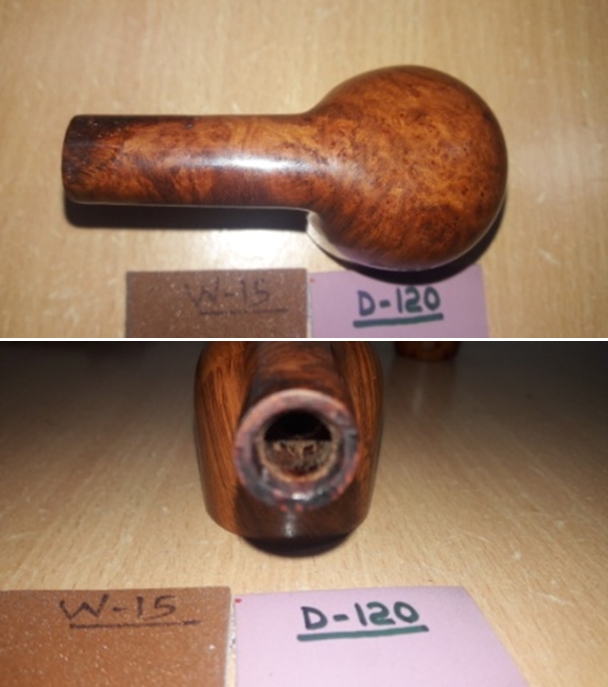
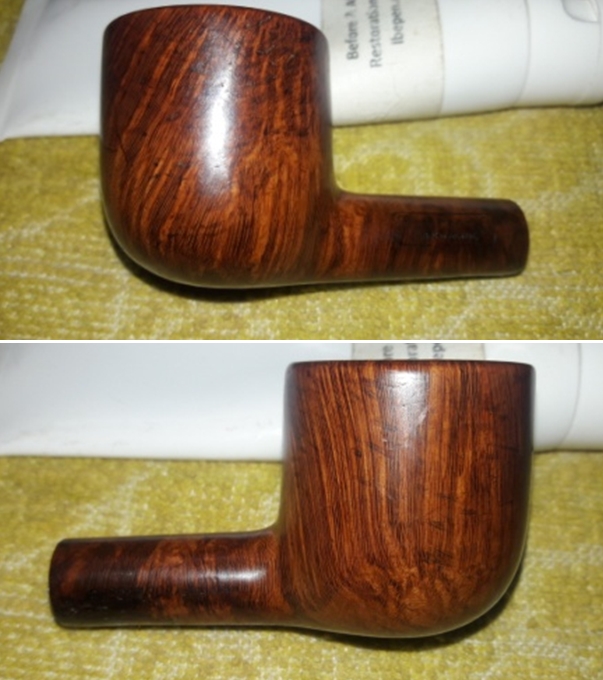
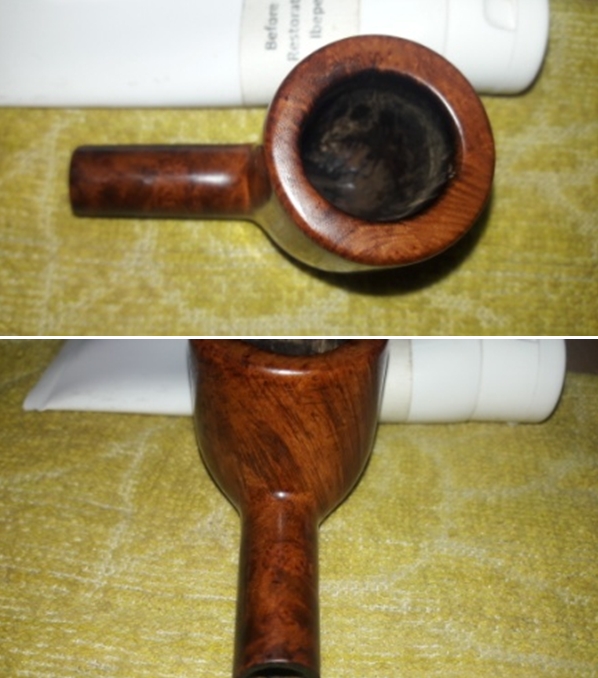
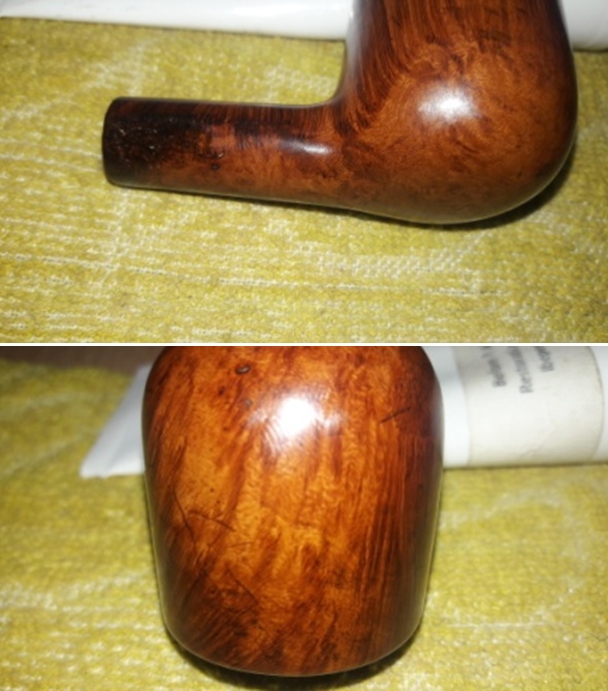
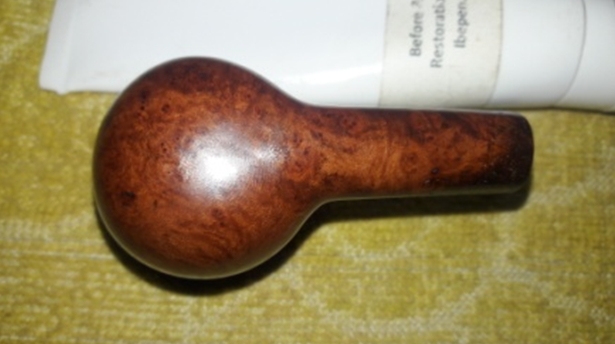
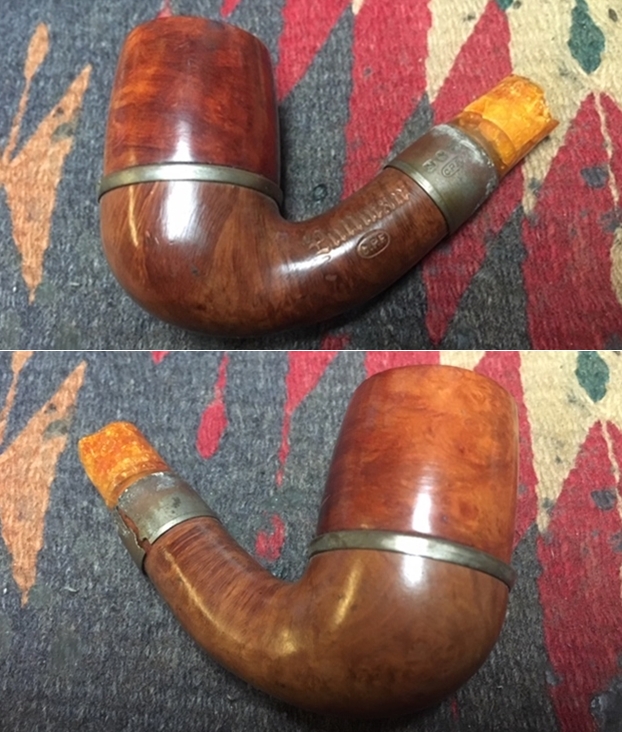
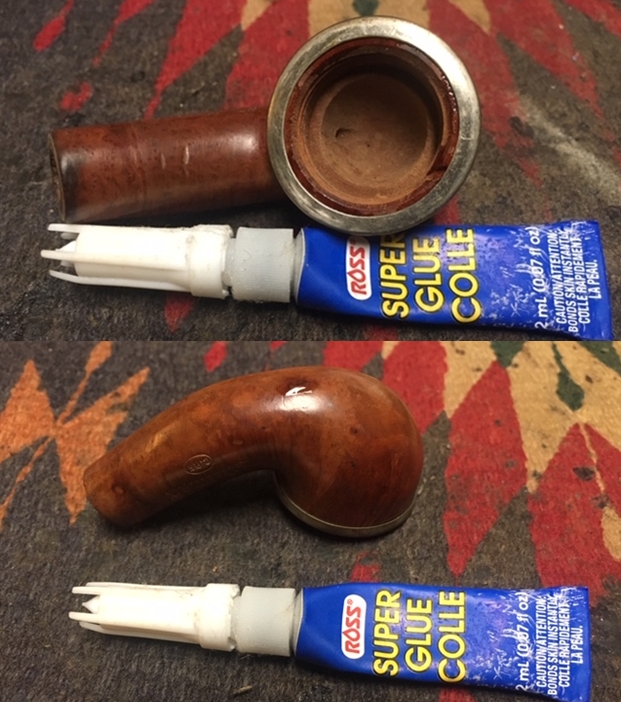
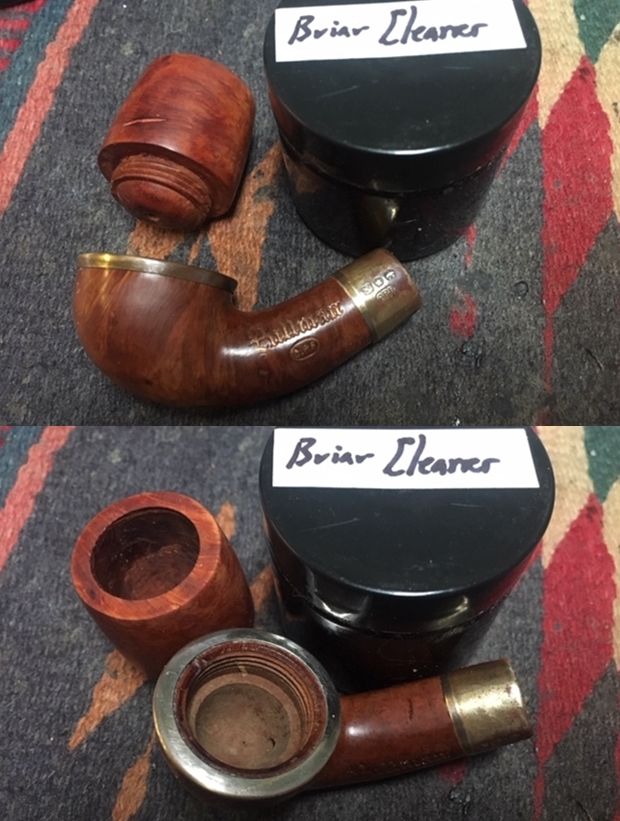
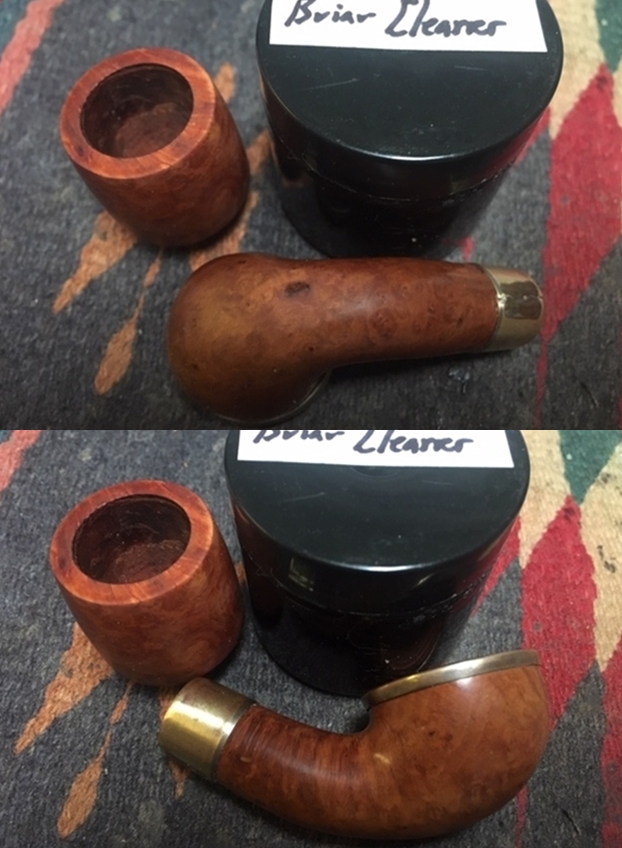
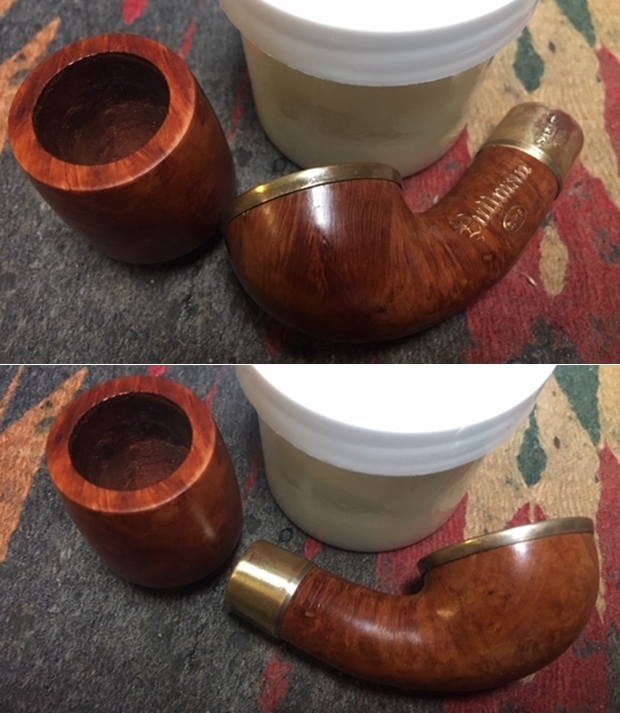
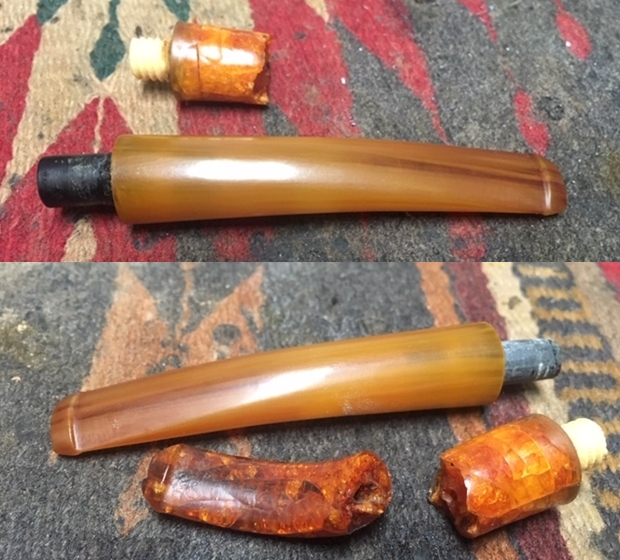
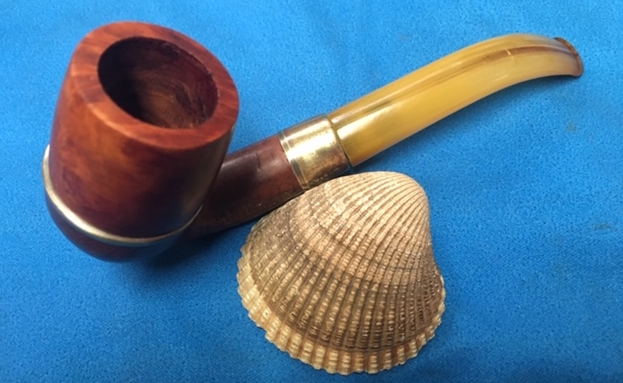
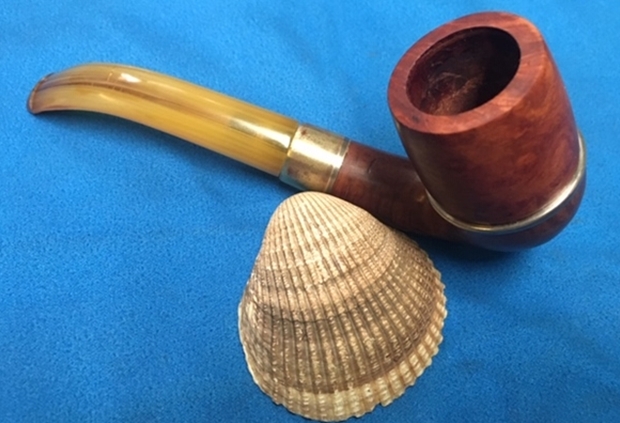
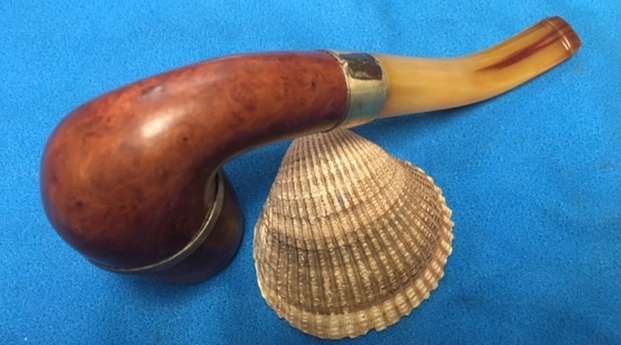
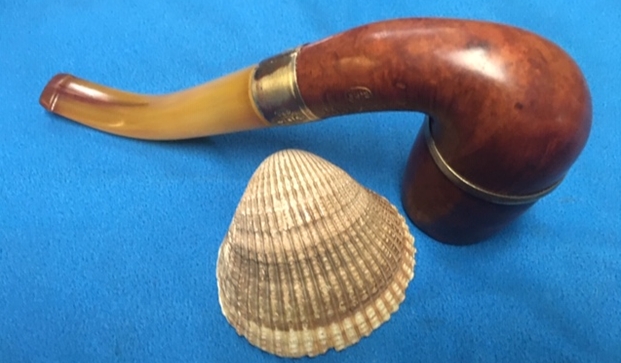
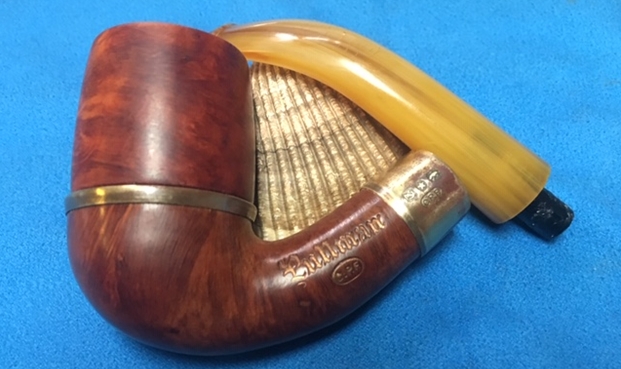
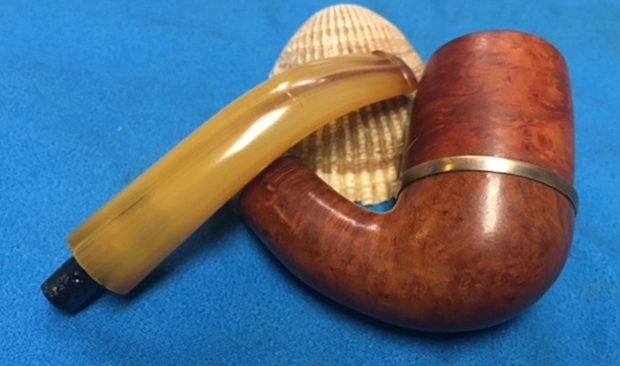
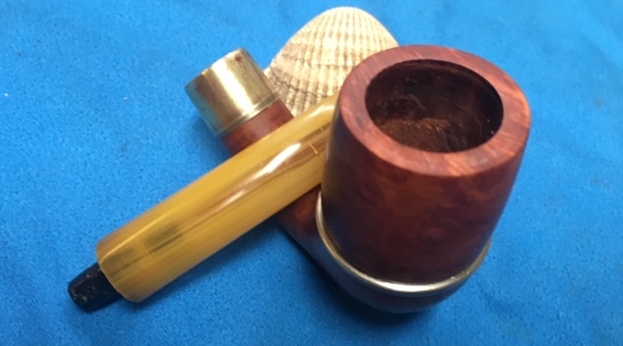
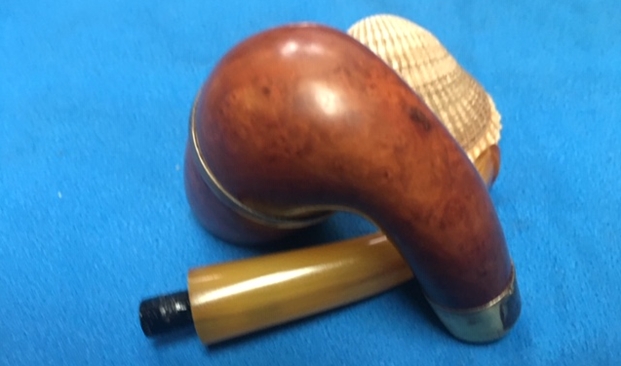
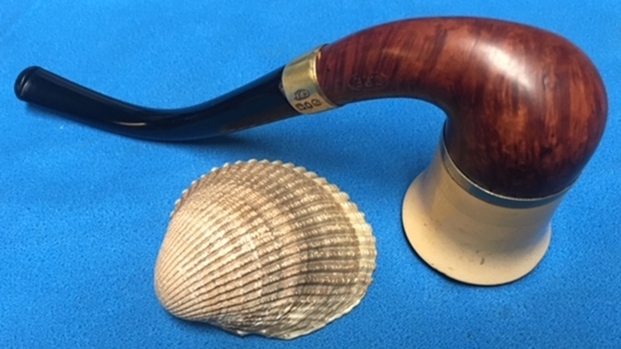
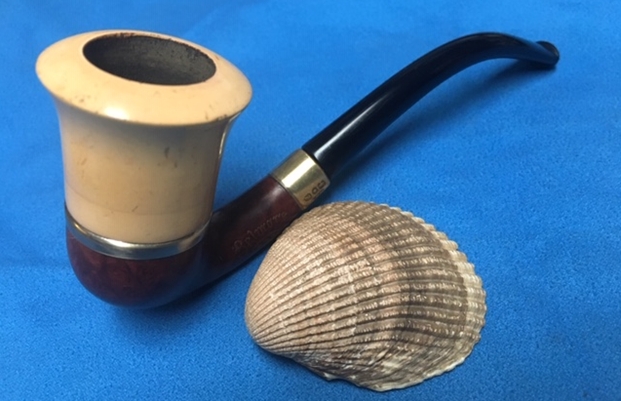
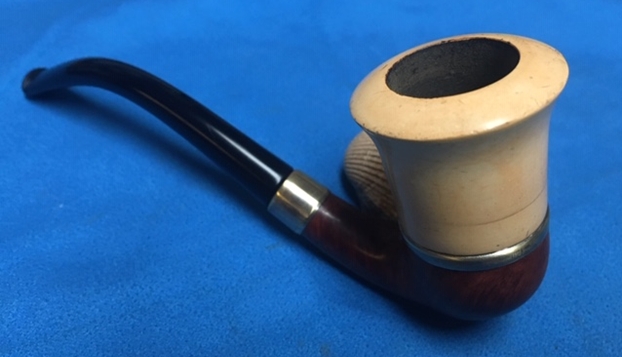
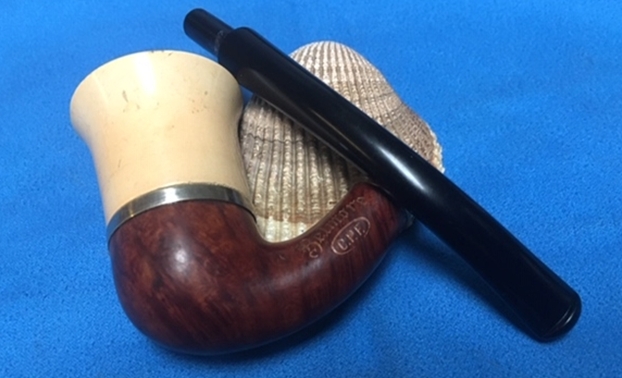
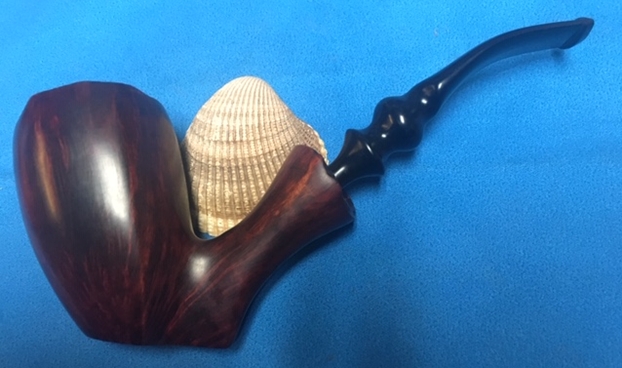
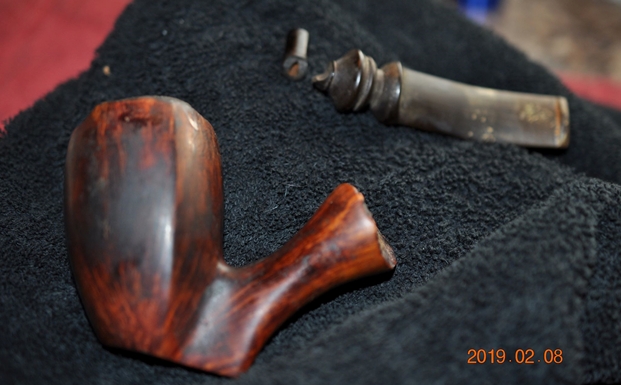
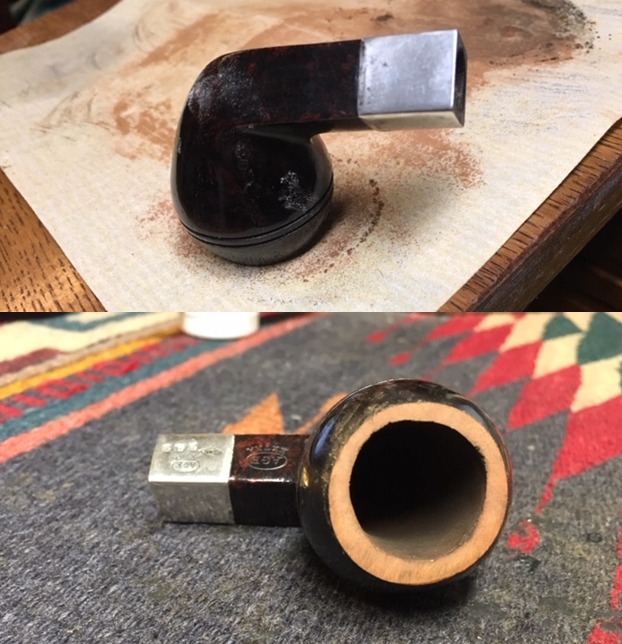
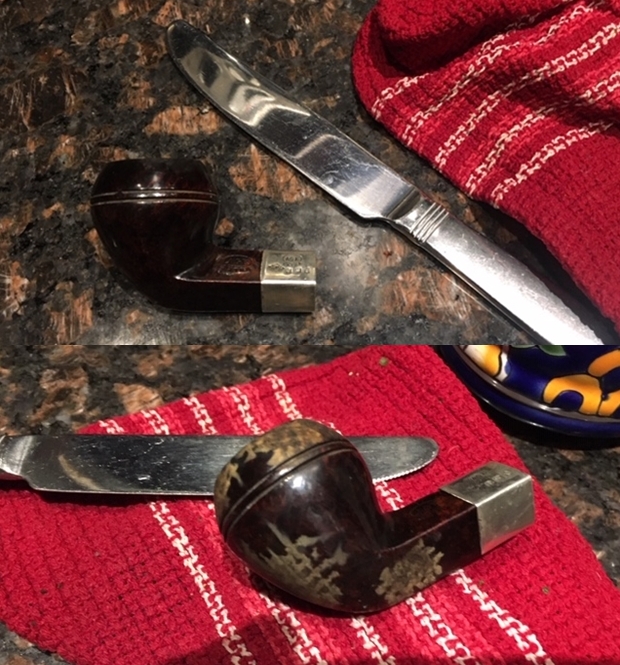
After the last batch of very clean pipes that I brought back from my trip to Idaho in a small bag of unsmoked C.P.F. pipes this is another pipe that was a big change. It was in rough shape with a split band, nicks and marks in the briar and a shattered stem. Other than the unsmoked condition of the bowl and base it was hurting. The bowl was a screw in briar bowl with a single airway in the bottom of the bowl like a calabash. It is dusty and dirty but the bowl was clean. The bowl exterior had been coated with a thick shiny coat of varnish and the base was varnished as well. It gave the pipe a spotty shiny look that had lasted through the years. The left side of the shank is stamped with gold leaf and reads Pullman over C.P.F. in the oval logo. There were deep gouges in the top of the shank and on the underside of the bowl. There is a brass/silver spacer between the bowl and the base. There was also a brass/silver ferrule on the shank end that was split, oxidized and also loose. The amber stem had was shattered was clean but epoxied in the remainder of the stem. I took photos of the pipe to show its condition at the start of the process. The next photo shows the stamping on the left side of the shank. It is clear and readable. The stamping reads as noted above. The band is loose and is stamped with the C.P.F. in an oval logo with the faux hallmarks that are on all of the metal banded C.P.F. pipes.I unscrewed the broken stem from the pipe and took photos of the parts – the briar base and bowl as well as all the adornments. The ferrule is split and will need work and the separator on the base is also oxidized and dirty. I have included the following information with each of the blogs on C.P.F. pipes because I always want to keep the historical context in mind as I work on these. The link to the blog follows (https://rebornpipes.com/2013/04/14/some-reflection-on-the-historical-background-on-cpf-pipes/). I quote a pertinent part of the blog below:

From my reading and research it seems to me that C.P.F. brand was discontinued sometime in the 1910-1920 range. Again, turning to Bill Feuerbach I found that he notes the following, which pins down the time frame of the discontinuation of the brand more specifically, “I have a C.P.F. Chesterfield in our office display that has a name tag from way before my time that says 1900 C.P.F. Chesterfield. It looks like most other Chesterfields you’ve seen, including the military type push stem, except this stem is horn and not vulcanite. As far as I have gathered the C.P.F. brand was phased out sometime around 1915.” Interestingly, he noted that the Chesterfield name and style was later introduced in the KB&B, Kaywoodie and Yello-Bole lines. He says that the 1924 KB&B catalog shows KB&B Chesterfields…

… From my research I believe that we can definitively assert that the C.P.F. logo stands for Colossus Pipe Factory. The brand was purchased by KB&B sometime between 1884 and 1898 and that it continued until 1915. That time frame gives help in dating some of the older C.P.F. pipes you or I might find. It can be said that prior to the dual stamping it is fairly certain that the pipe is pre-1884 to 1898. After the dual stamping it can be placed post 1898 until the closure of the brand line in 1915. C.P.F. made beautiful pipes.

From that information I can tentatively date this pipe to the same period as the other pipes I have been working on – prior to 1884-1898 because of the single C.P.F. stamp on the shank, ferrule and stem. At any rate it is another old pipe though this one is well smoked. The story of its journey to Jeff and me this long after the date it was made is another mystery. This batch of pipes has made me wish that even one of them could share its story with us. I can only imagine the journey it has had even minimally from the bits that I do know. It traveled from the Colossal Pipe Factory in New York City to Idaho Falls in journey that began in the 1880s and ended in 2019. Now it is has further traveled by air to Vancouver, Canada, as far west as it can go and remain on the same continent… what a well-traveled pipe. Armed with that information it was not time to work on the pipe.

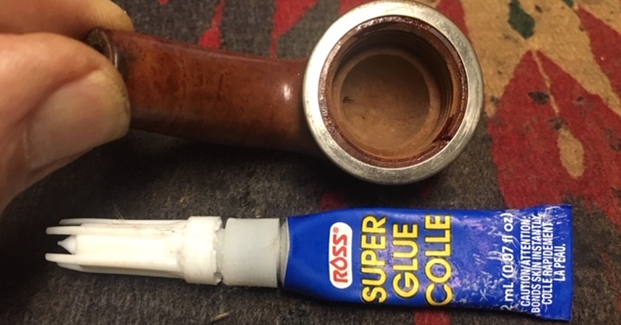
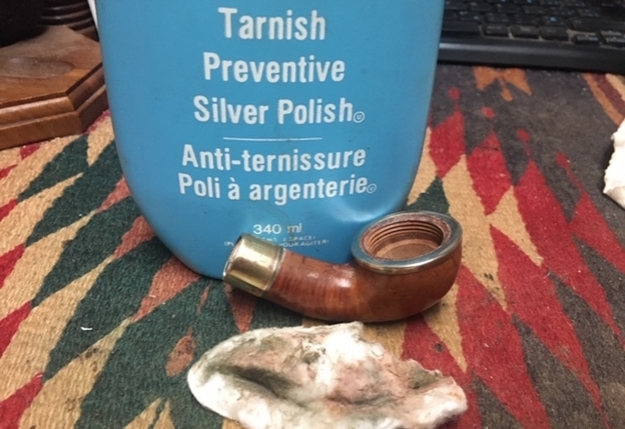
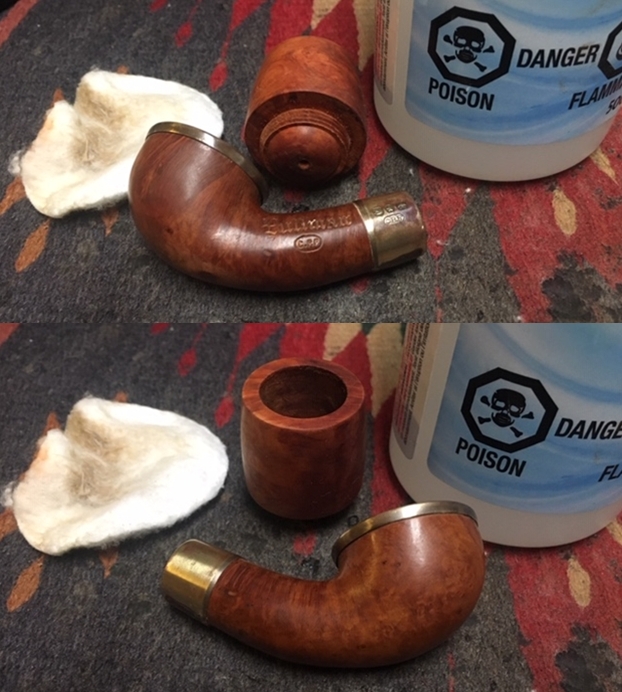
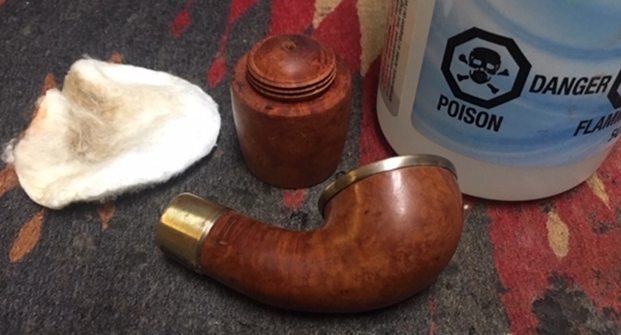
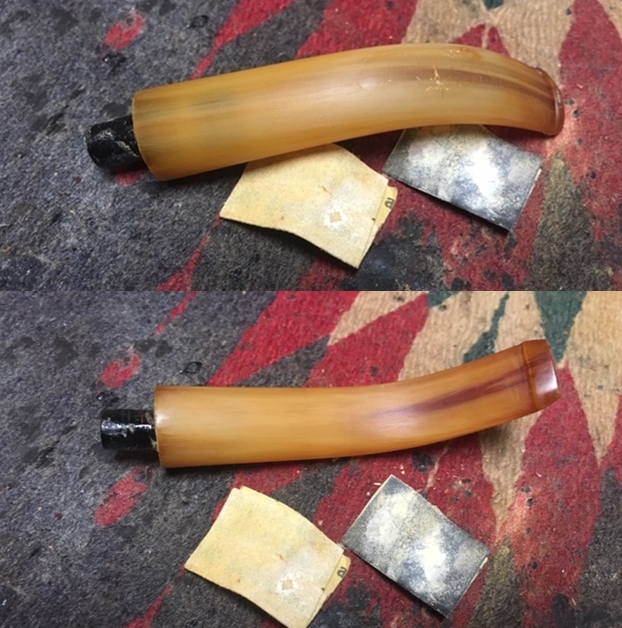
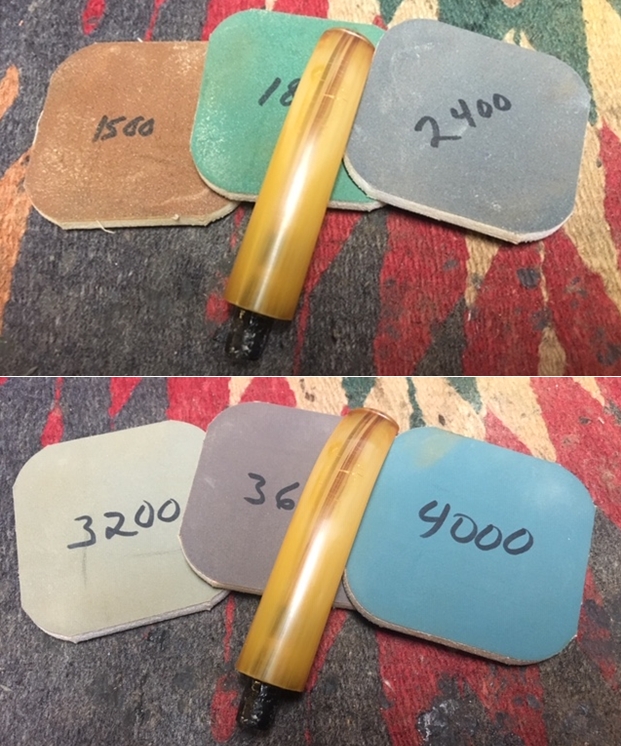
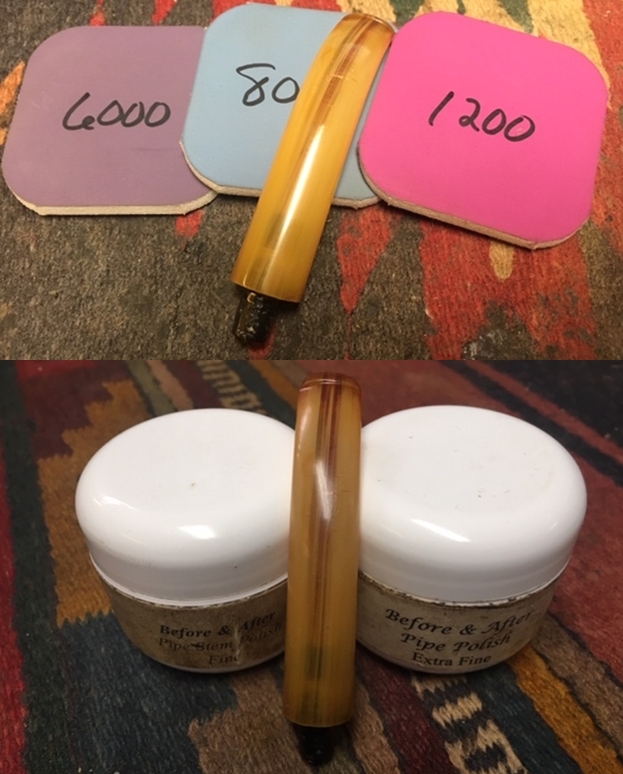
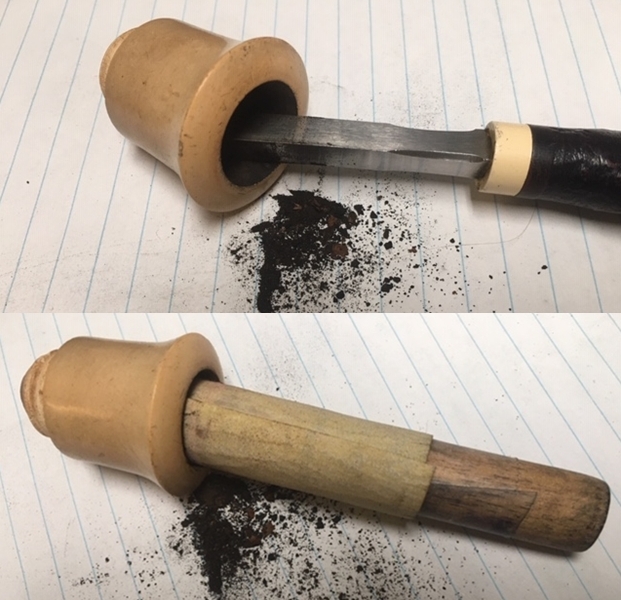
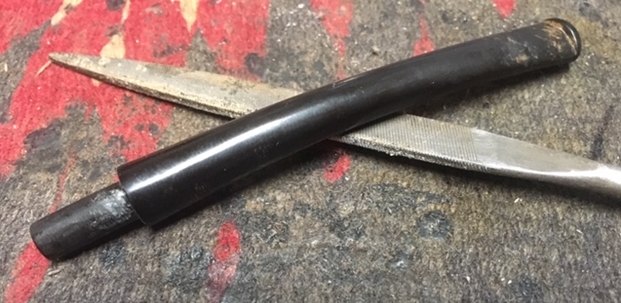
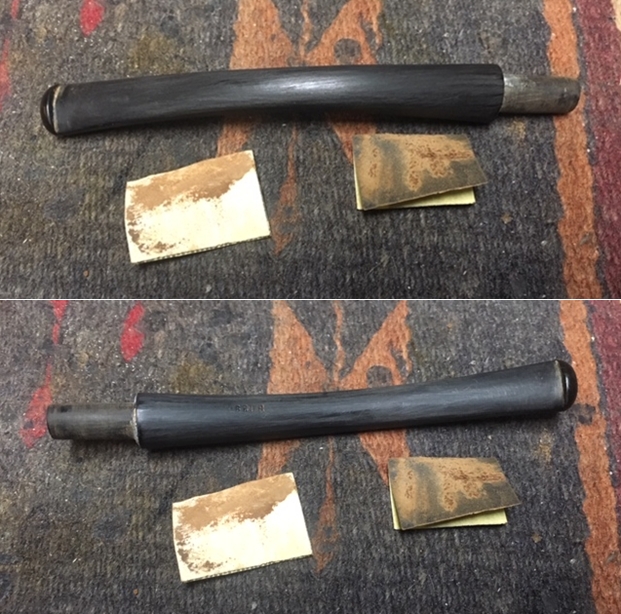
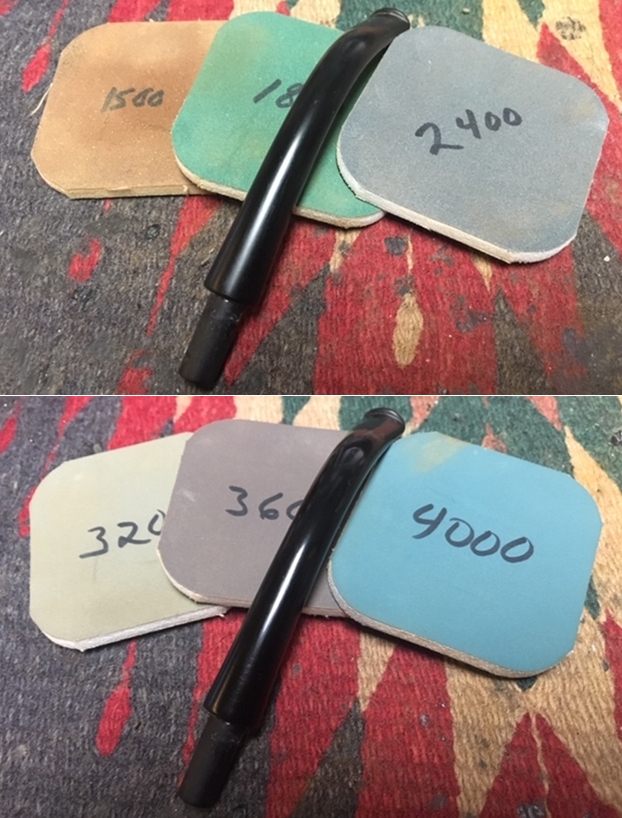
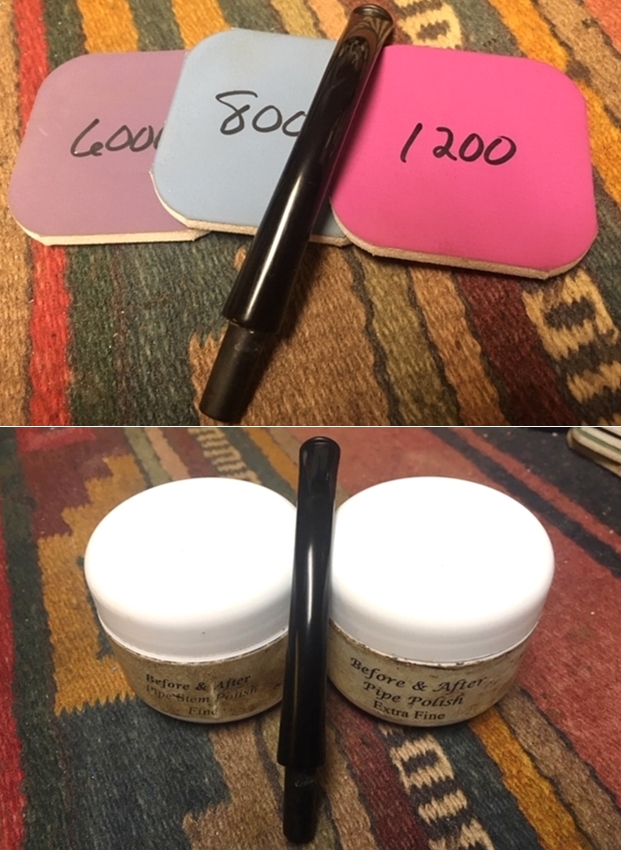
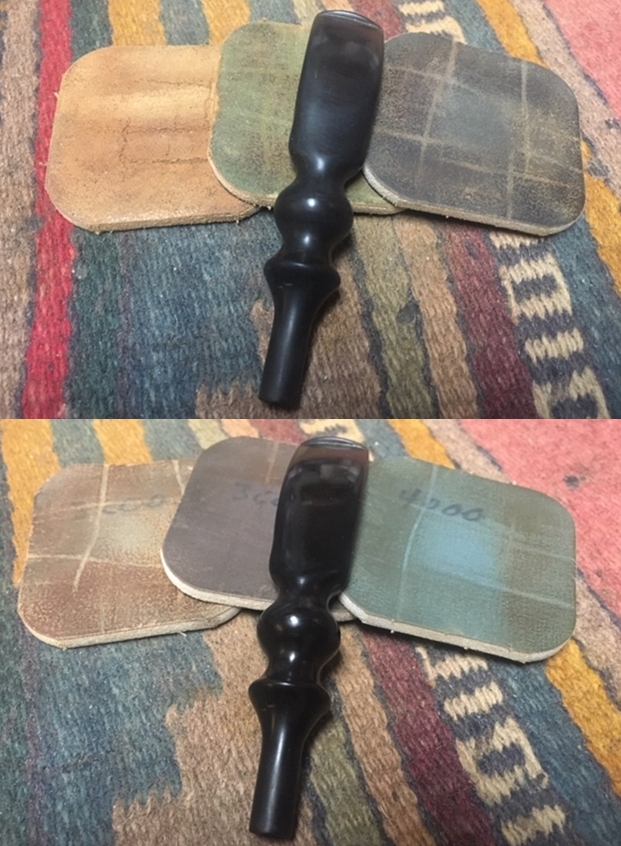
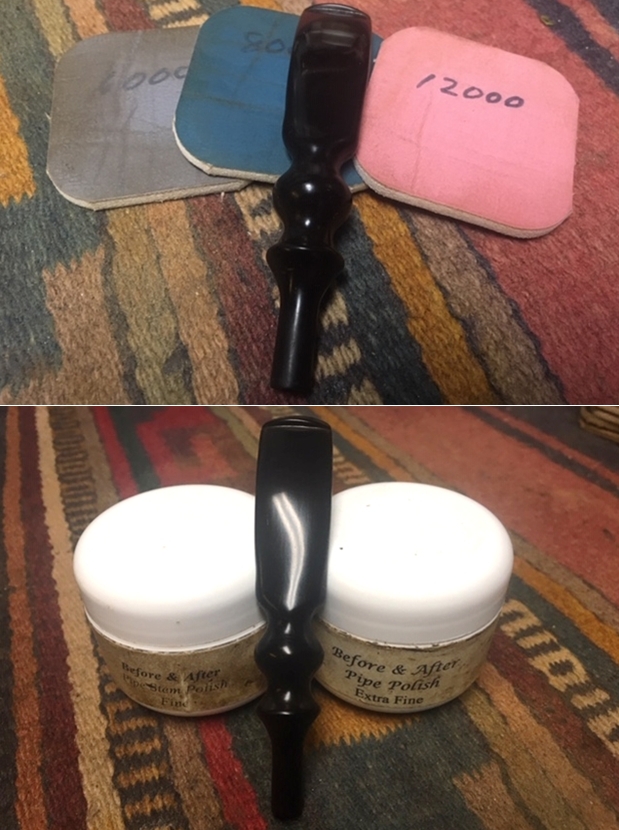
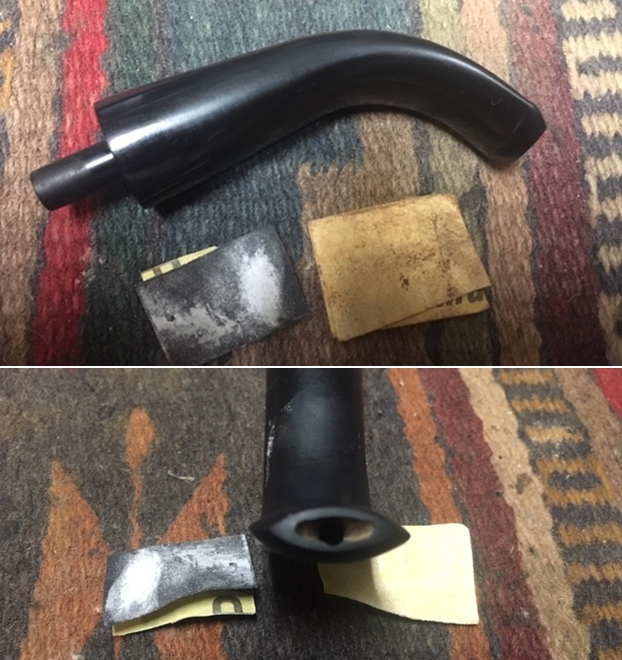
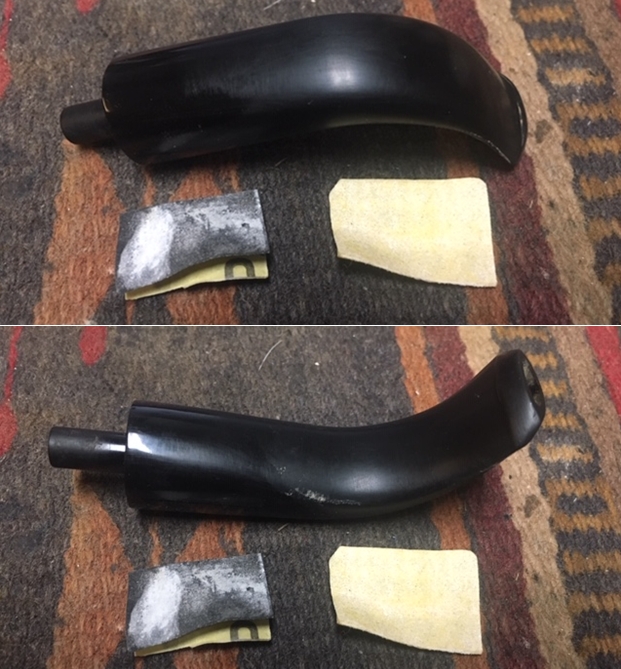
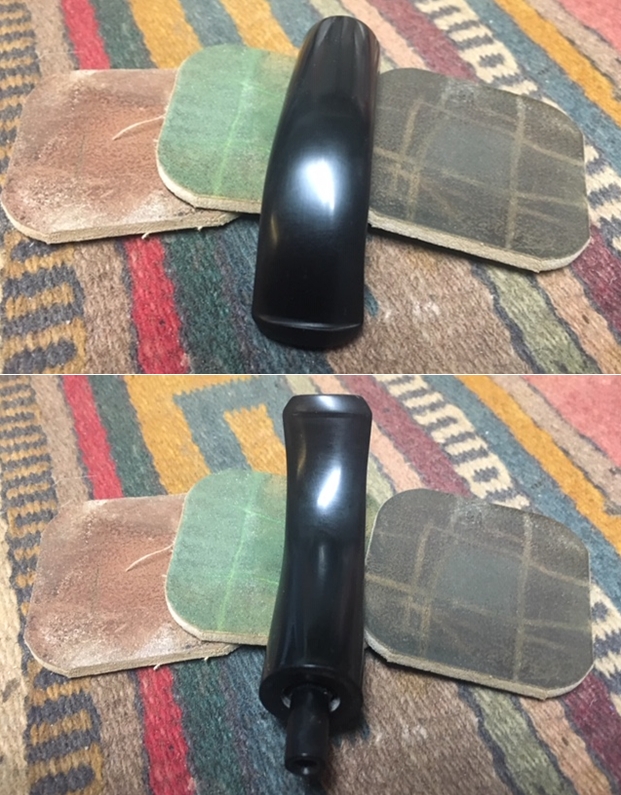
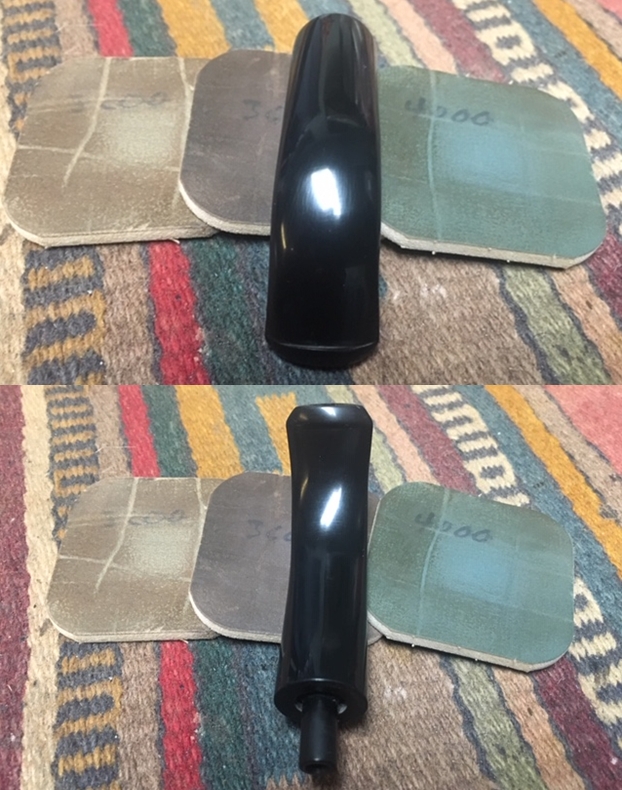
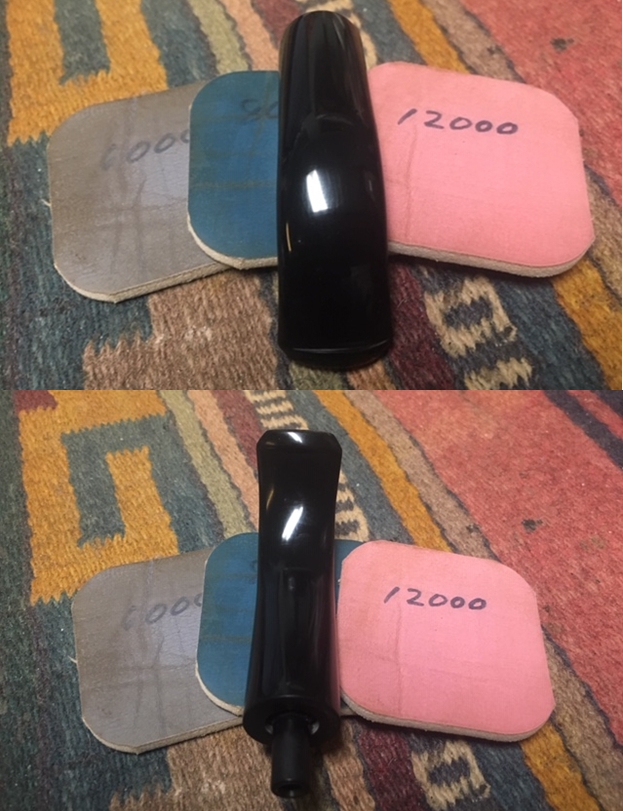
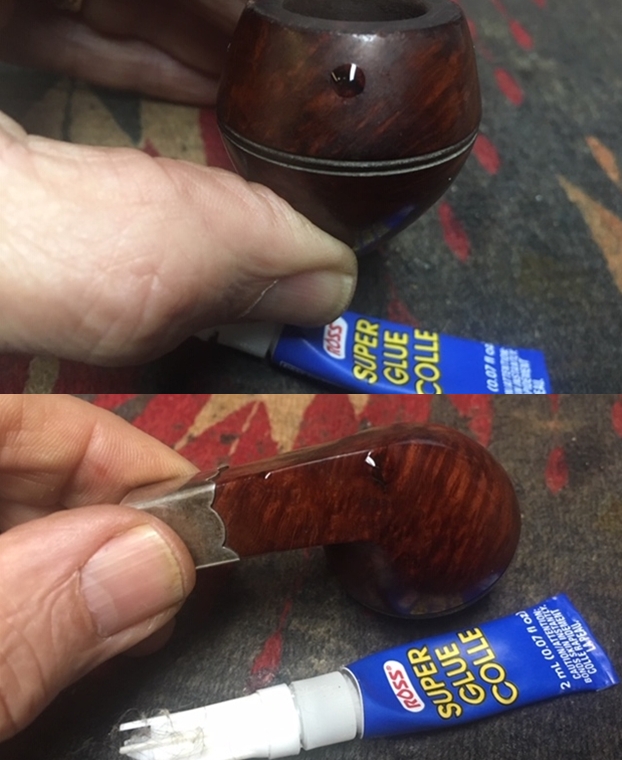
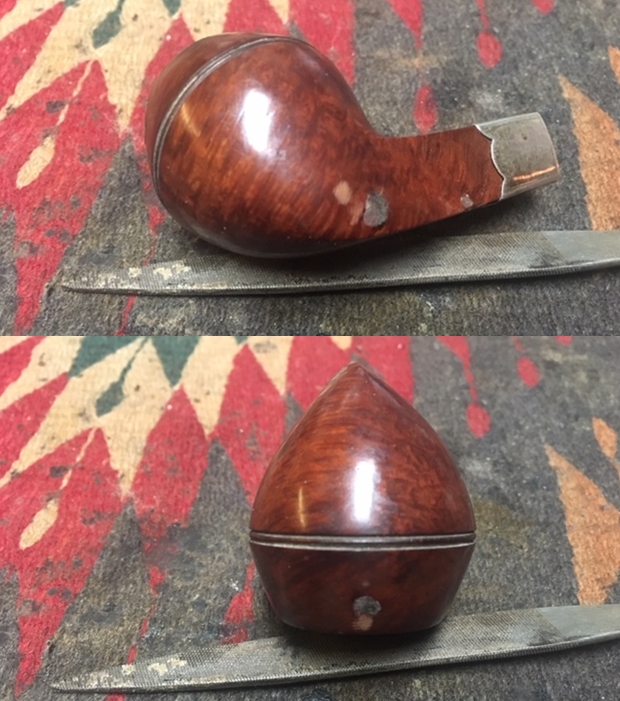
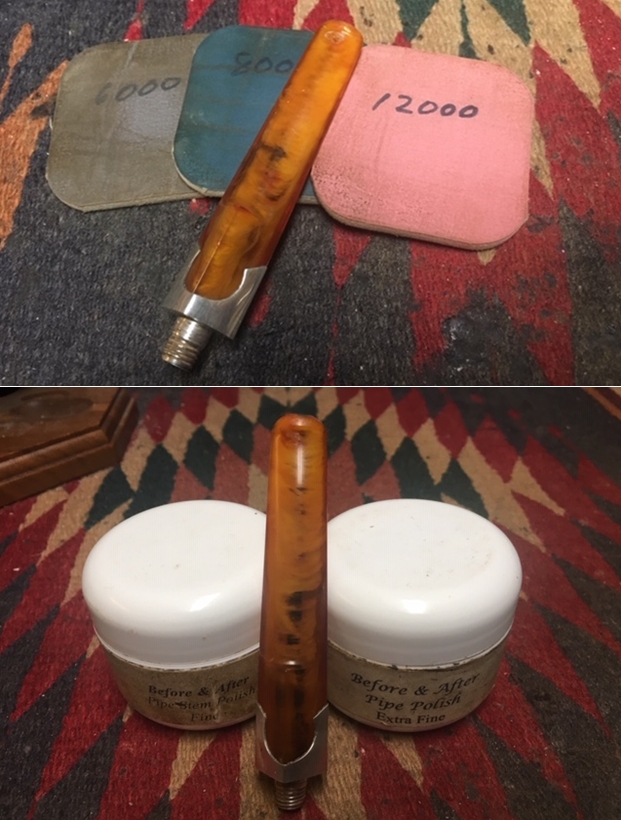
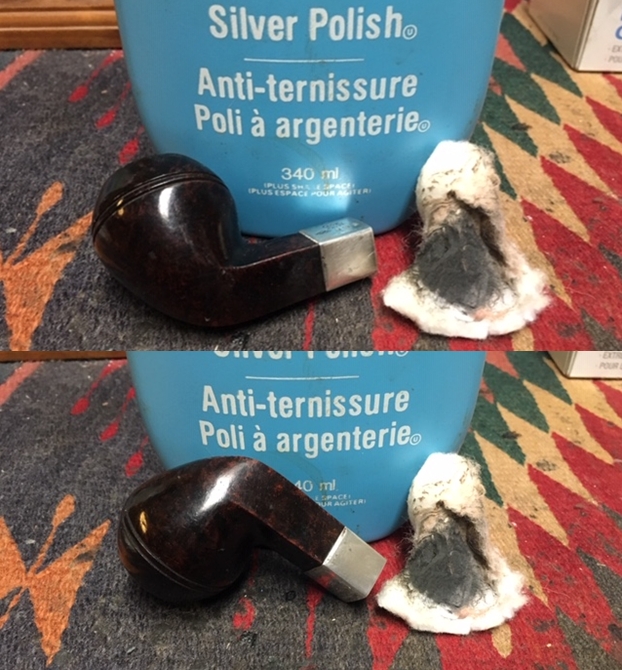
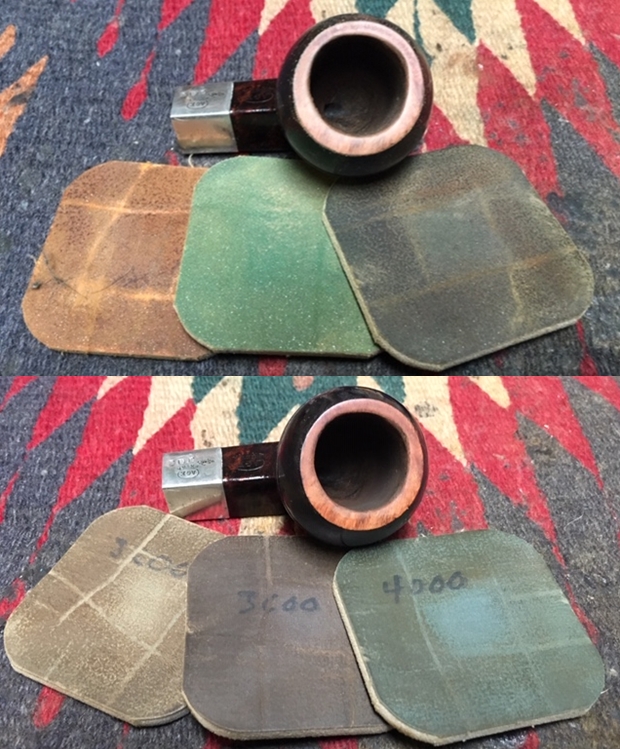
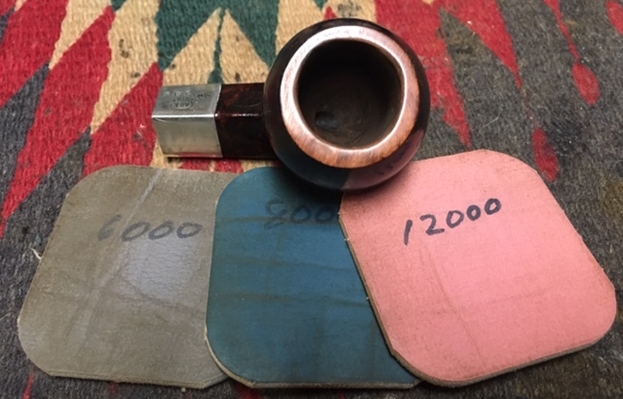
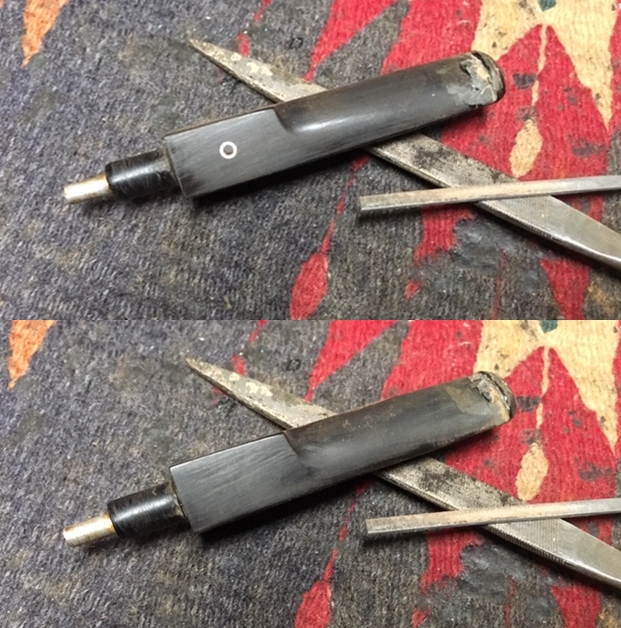
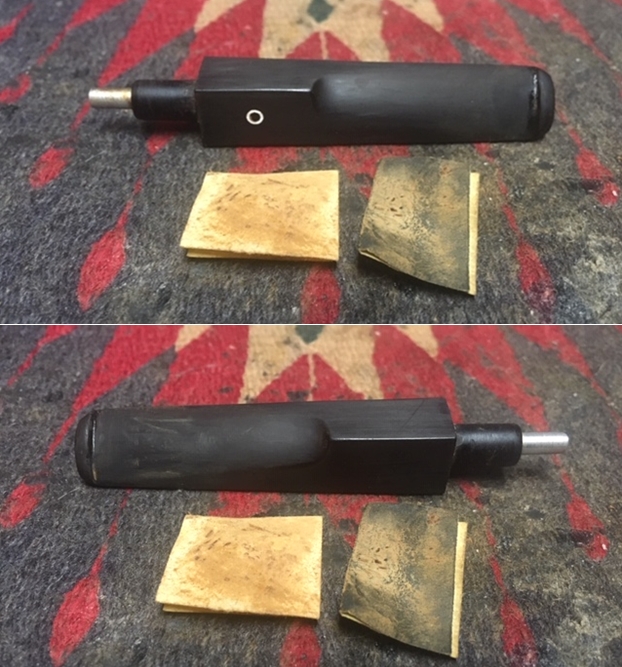
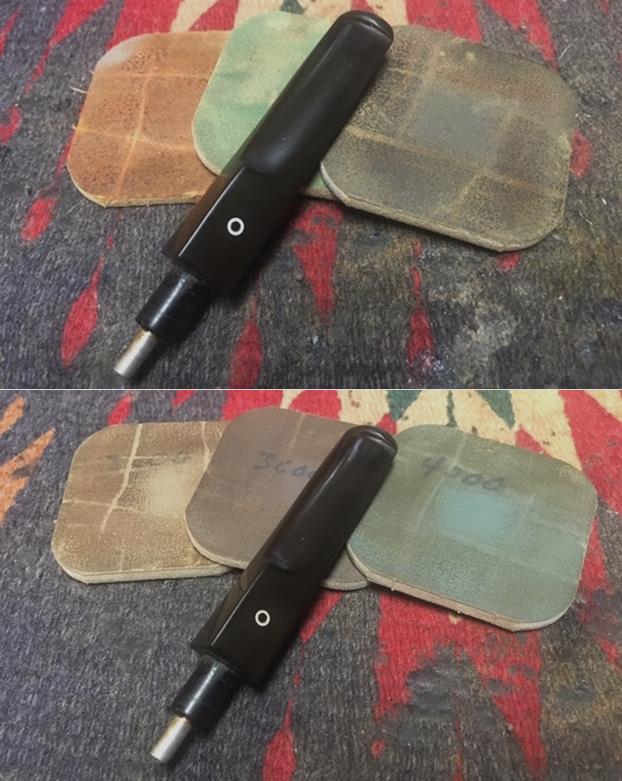
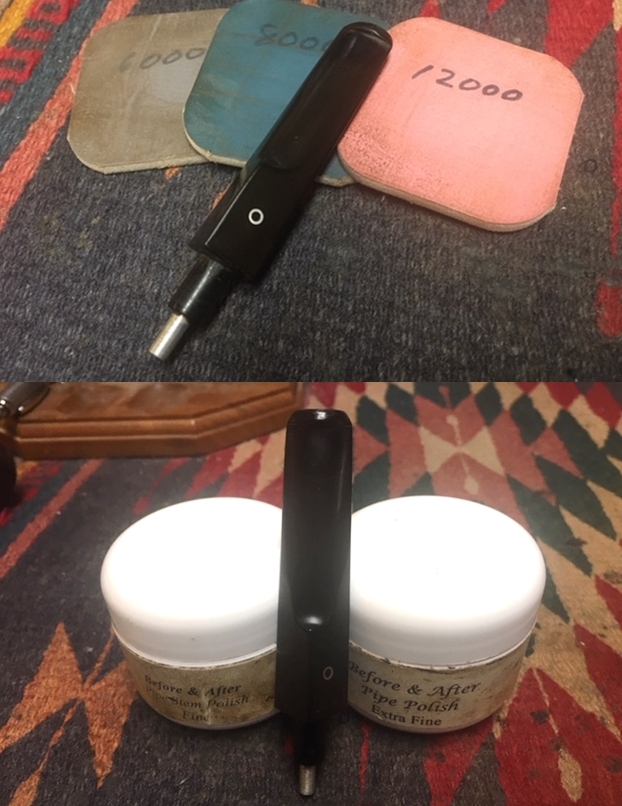
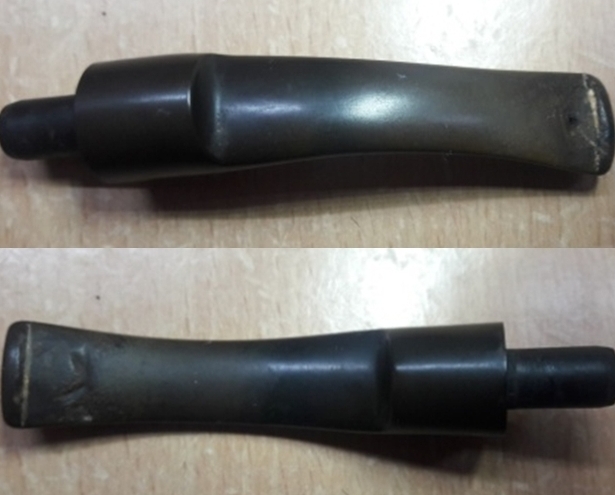
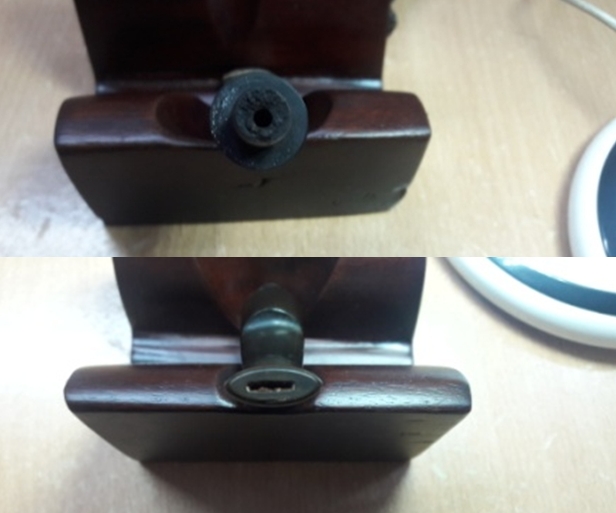
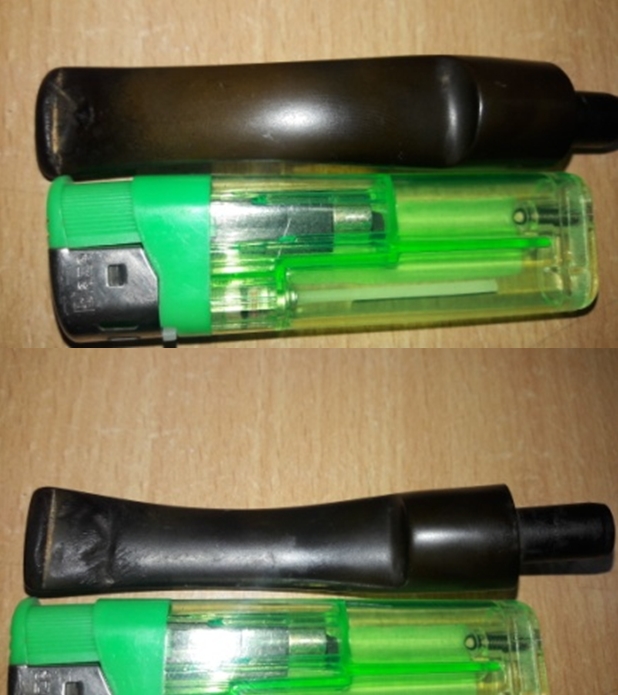
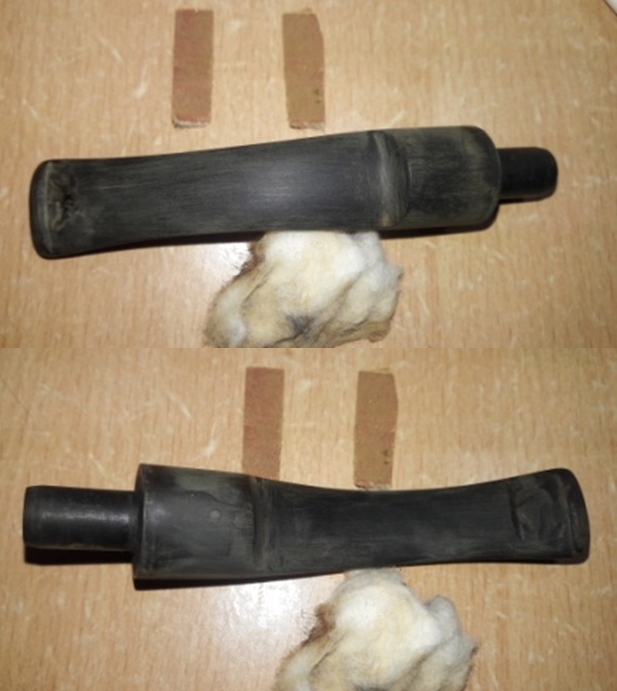
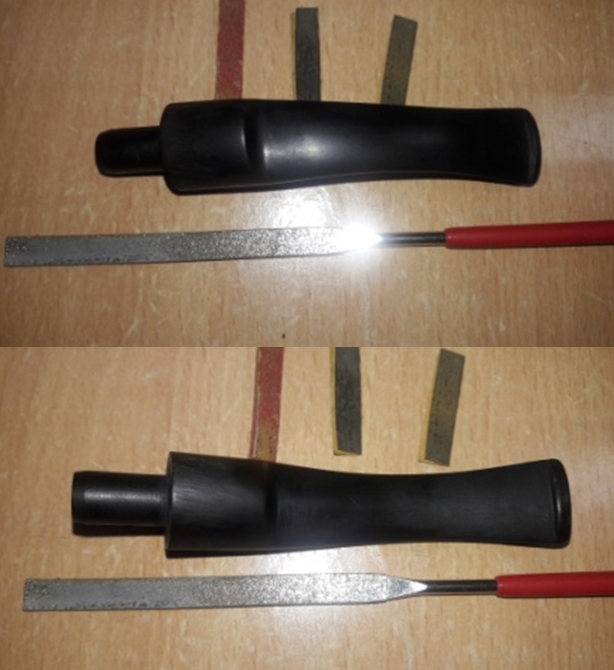
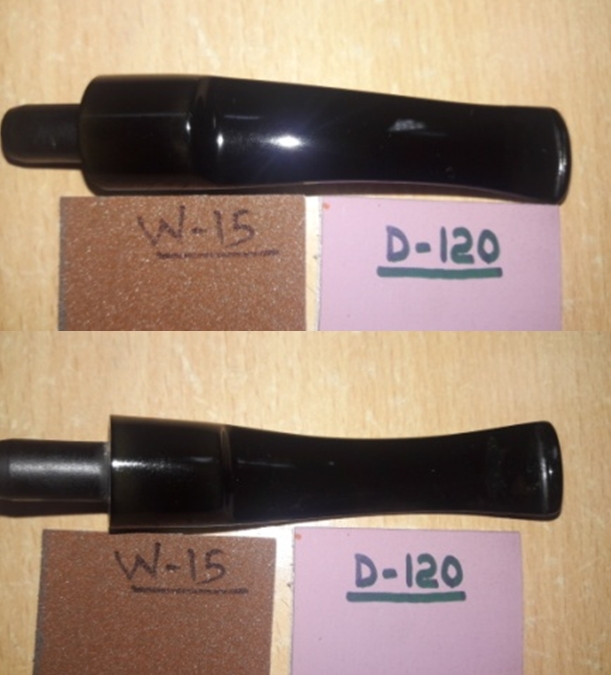
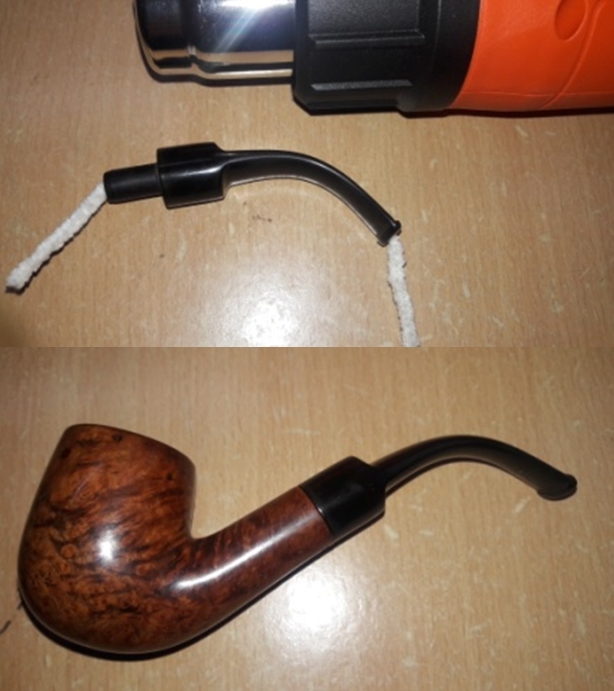
I unscrewed the bowl from the briar base. I removed the loose ferrule and the loose spacer and cleaned the surface with alcohol on a cotton pad. I glued the spacer in place on the base with clear super glue. I filled in the nicks and divots on the top and underside of the shank with super glue. I sanded the repaired spots on the top and underside of the base with 220 grit sandpaper to blend the repairs into the briar. I spread some white glue on the shank end and pressed the ferrule in place. I held the break in the ferrule together until the glue set. I filled in the crack with clear super glue until it was smooth and set it aside to cure.  The internals were clean and a quick pipe cleaner and alcohol run through the shank and bowl to clean out the dust. I polished the brass ferrule on the shank end with Hagerty Tarnish Preventative Silver Polish to remove the tarnish and wear. I used it on the space between the bowl and base as well. You can see the effect of the polishing – the metal shone.I wiped the bowl and base down with isopropyl alcohol on a cotton pad to remove the varnish coat on both the bowl and the base. The briar looked very good. There was a fill in the back side of the bowl and a little one on the underside of the shank. I am continuing to experiment with Mark Hoover’s Briar Cleaner to see what I think of it as a possible replacement for my usual Murphy’s Oil Soap scrub. I rubbed it onto the briar bowl and base and worked it into the grain of the briar. I wiped it off with a clean cloth. There was still a coat of grime and grit from the cleaner left behind so I rinsed it with warm water to remove that and dried it with a microfiber cloth. I am really not sure if this is any better than the Murphy’s but I am committed to working with it. I rubbed the briar bowl and shank down with a coat of Before & After Restoration Balm. I worked it into the surface of the briar. The product works to clean, enliven and protect the briar. The old briar was dry and it drank up the balm. I buffed the bowl with a soft cloth to raise a shine. I like how the pipe looks as this point in the process. I set the bowl aside and went through my can of stems and found a Bakelite stem with the same diameter and length as the original one. It had a push tenon that I would need to sand down a bit to get a good fit in the threaded shank. I tried to remove the bone tenon from the original stem but it was stuck and breaking the old stem would likely damage the tenon. I started working on the stem. I used a needle file to reduce the diameter of the tenon. I heated the stem with a heat gun until it was softened and then bent it to match the angle of the bowl and shank. I sanded out the small ripple marks from bending the stem using 220 grit sandpaper. I sanded out the scratches with 400 grit sandpaper. I wiped the stem down with Obsidian Oil. I polished the stem with micromesh sanding pads – wet sanding it with 1500-2400 grit pads and dry sanding it with 3200-12000 grit pads. I wiped it down with Obsidian Oil after each sanding pad. I finished the polishing with Before & After Pipe Polish – both Fine and Extra Fine. I gave it a final coat of Obsidian Oil and set it aside to dry.   By now if you have read rebornpipes for very long you know that I love these old C.P.F. pipes. There is some serious thought that they were carved by European trained craftsman who were skilled pipemakers. These pipemakers were brought to the US by the Colossal Pipe Factory to make pipes. Many of the shapes, bands and stems have such high quality workmanship involved that I really think there is truth to this story. This little bent Briar Stack is a real beauty.

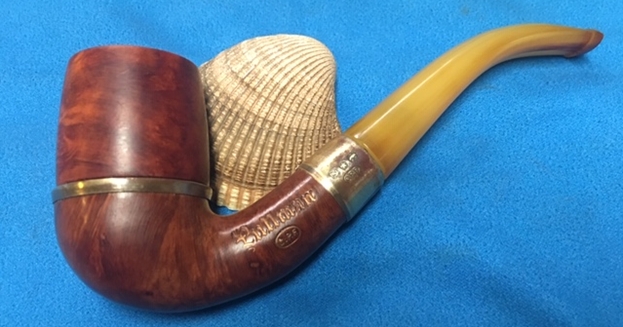
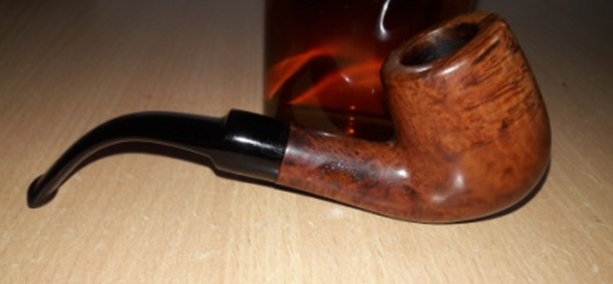
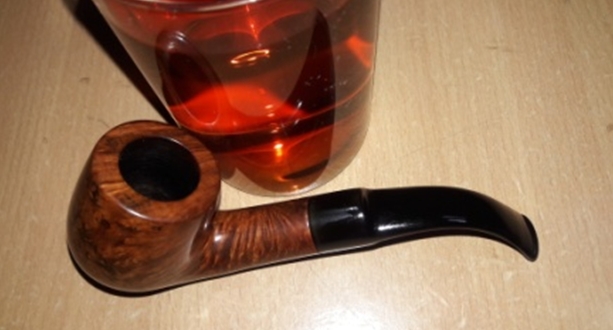
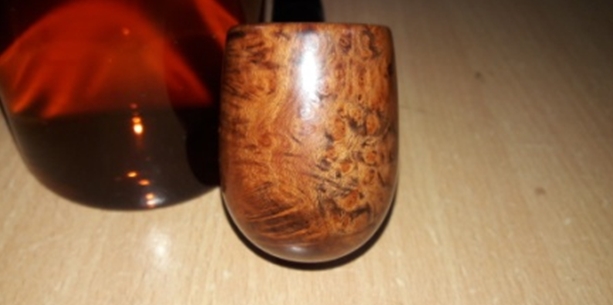
I screwed the bowl back on the base and carefully polished stem and the bowl with Blue Diamond polish on the buffing wheel carefully avoiding the stamping on the shank. I gave the bowl and the stem multiple coats of carnauba wax. I buffed the pipe with a clean buffing pad to raise the shine. I hand buffed it with a microfiber cloth to deepen the shine. The pipe polished up pretty nicely. The mixed grain on the base and shank really began to stand out; it seemed to take on life with the buffing. The rich contrasting brown stain on the base and bowl works well with new golden Bakelite stem. The finished pipe has a rich look that is quite catching. Have a look at it with the photos below. The shape, finish and flow of the pipe and stem are very well done. The dimensions are Length: 5 1/4 inches, Height: 2 1/8 inches, Outside diameter of the bowl: 1 1/8 inches, Chamber diameter: 3/4 of an inch. This is another one that I will be adding to my collection. It fits in the C.P.F. niche group that I have been building. The shape and feel in the hand is perfect. Since this one is another unsmoked pipe it too will be in line for a break in with some rich aged Virginia. Thanks for walking through the restoration with me as I restored and reworked this old Stack from 1884-1898. It is always a treat for me to work on a piece of pipe history especially when I have learned a bit of the story behind it.

A Study in Opposites – Restoring a Hard Used C.P.F. Briar Calabash


Blog by Steve Laug

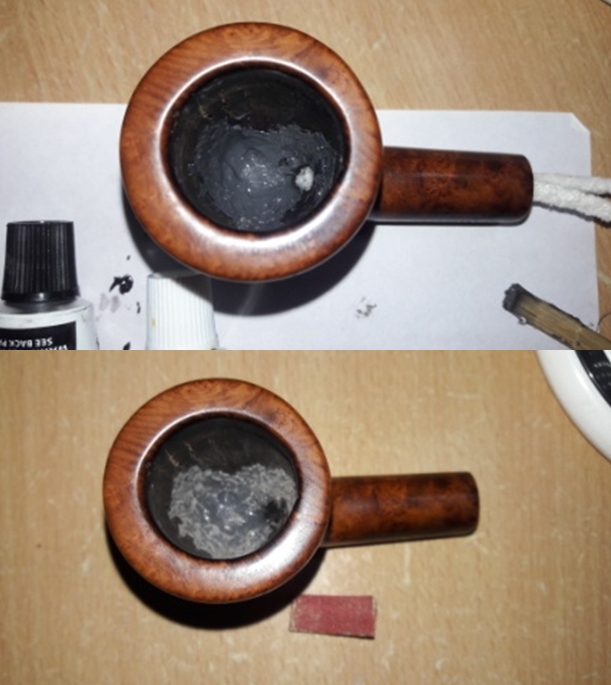
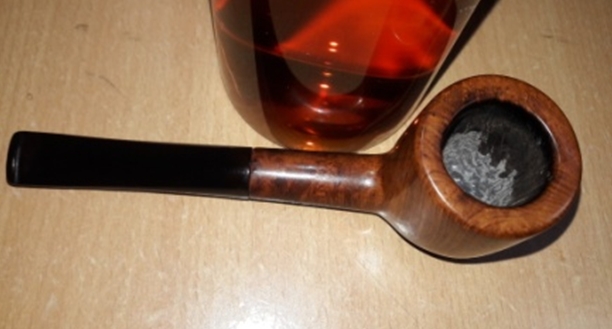
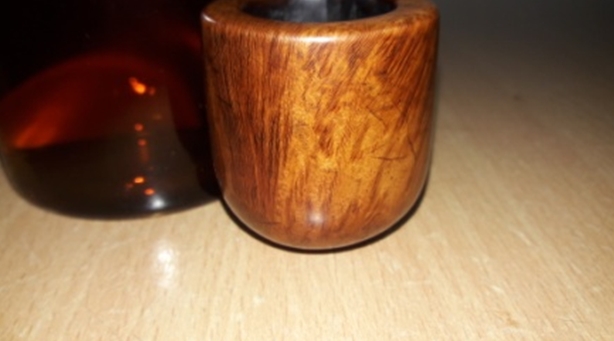
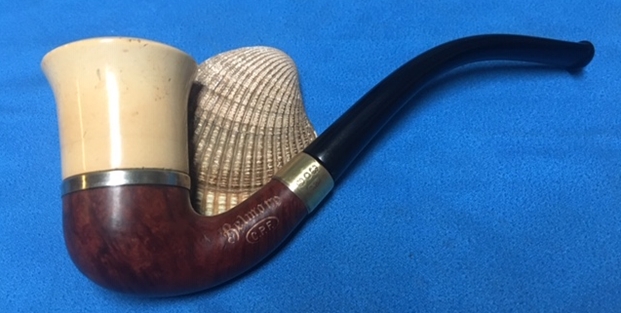
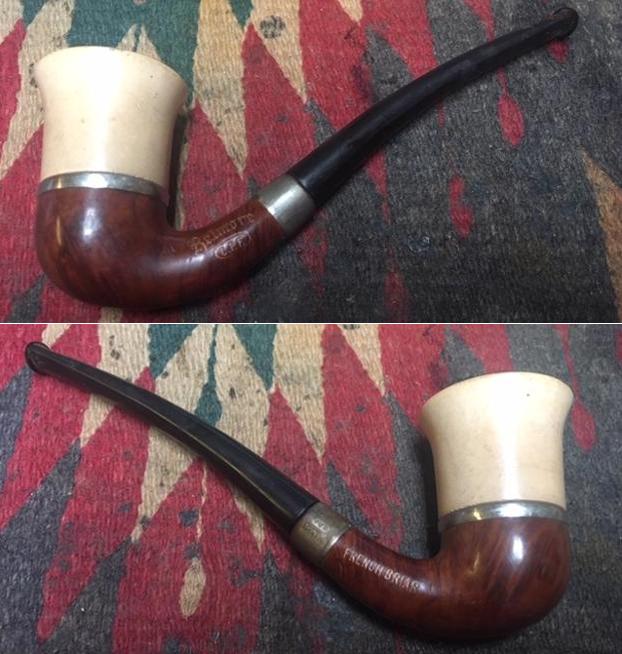
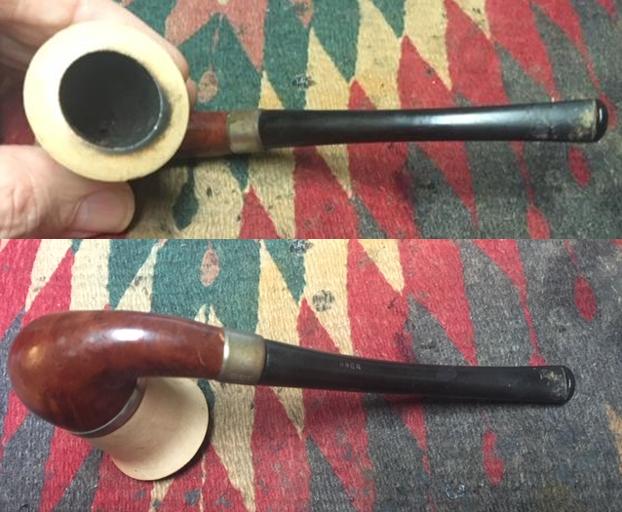
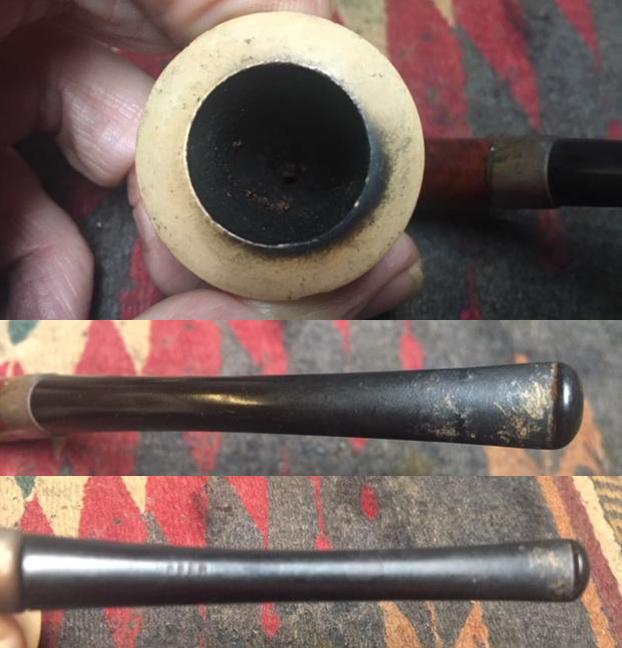
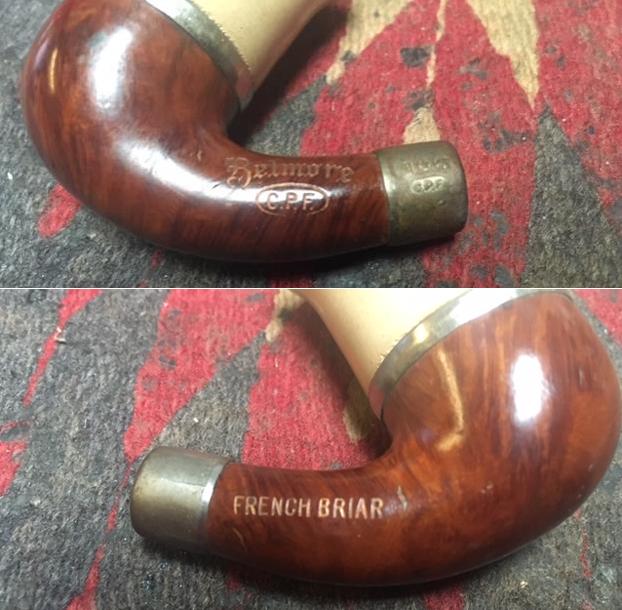
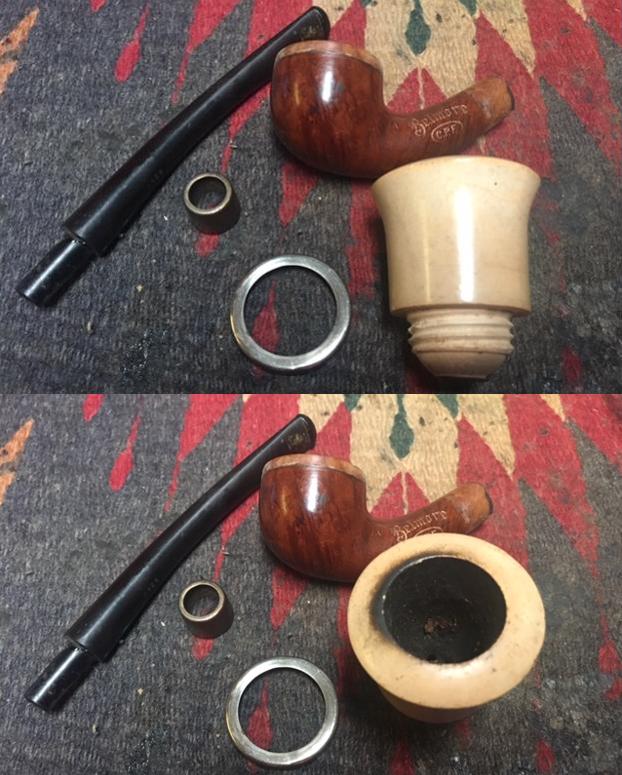
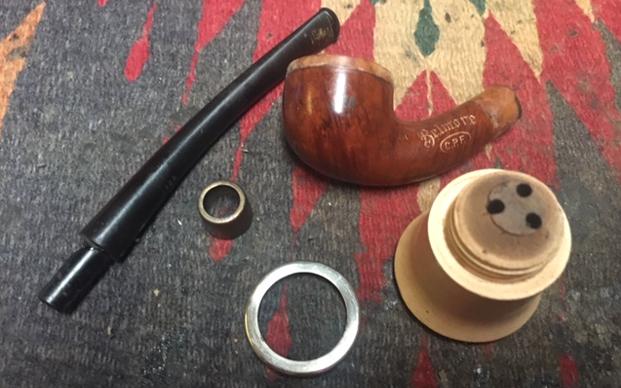
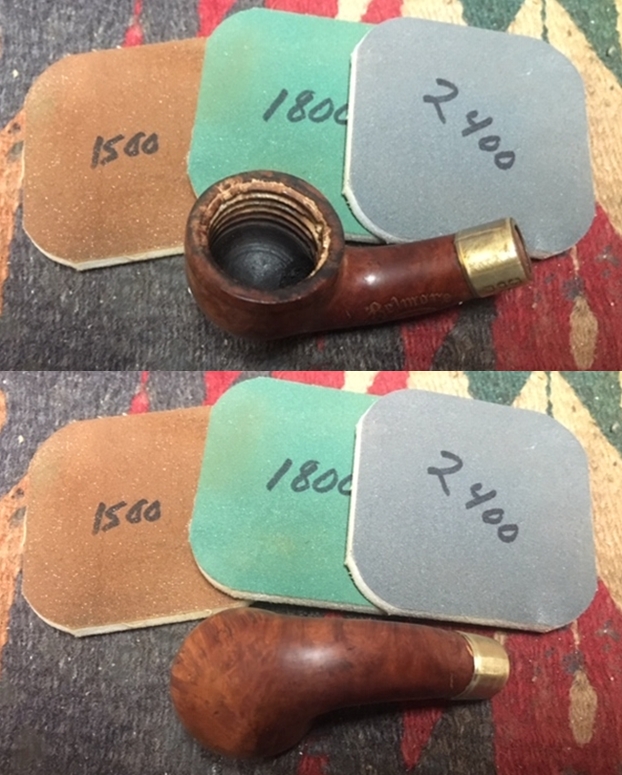
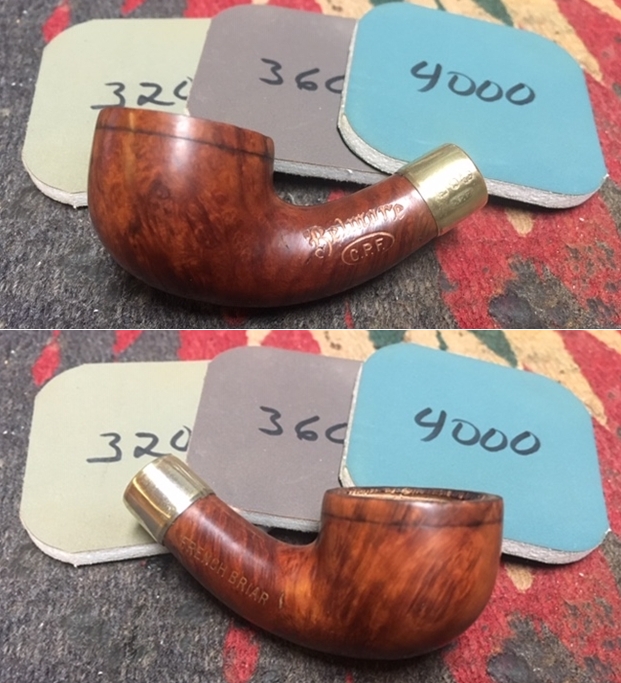
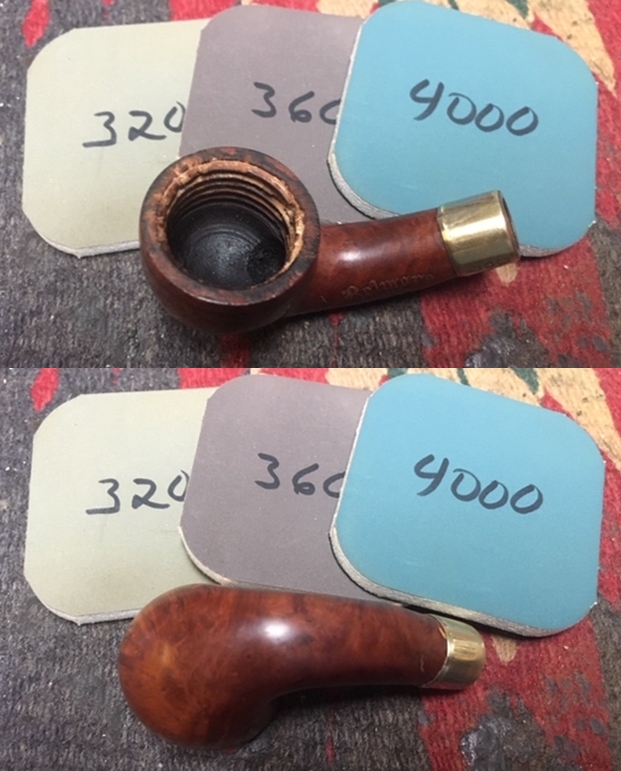
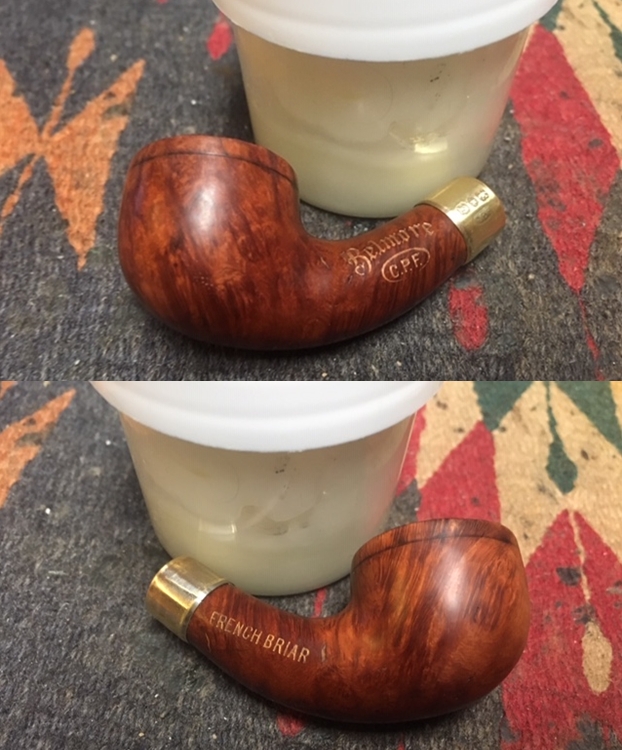
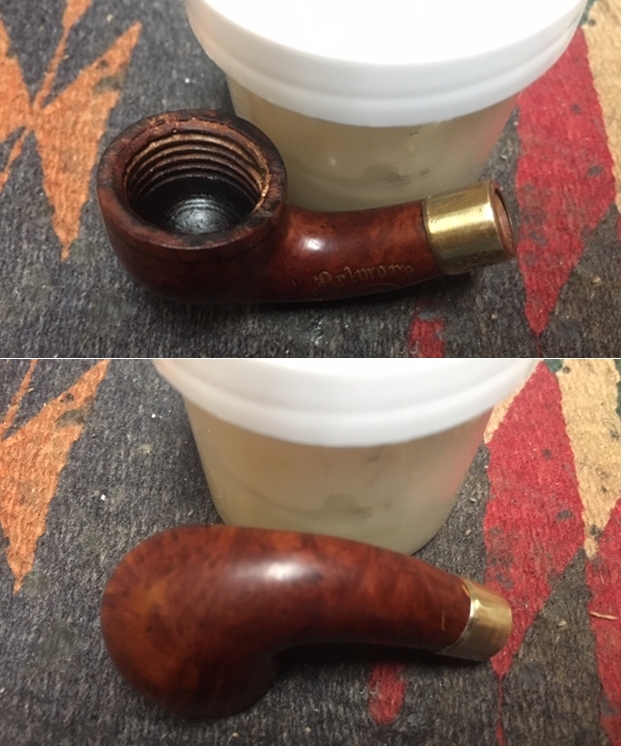
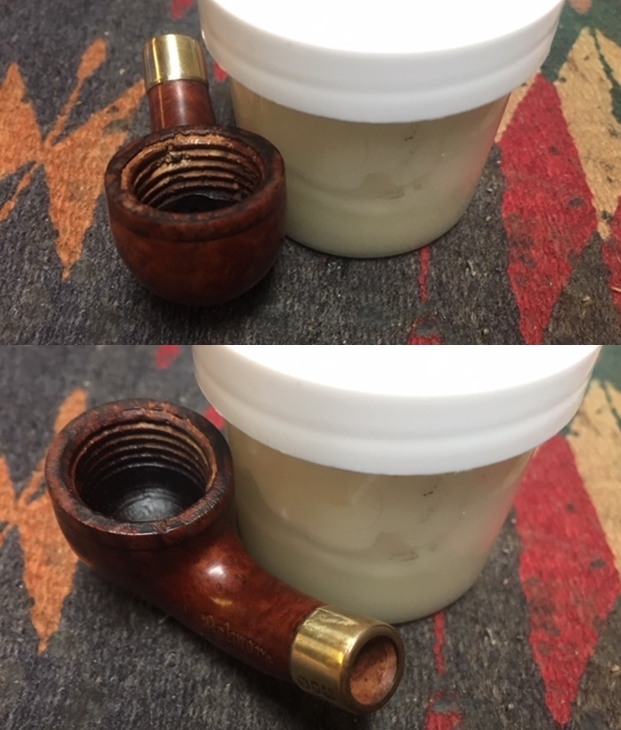
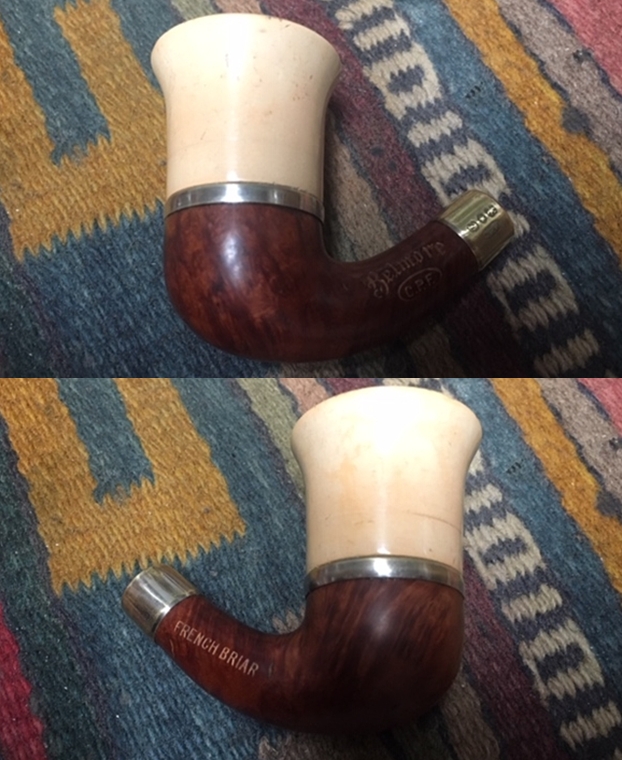
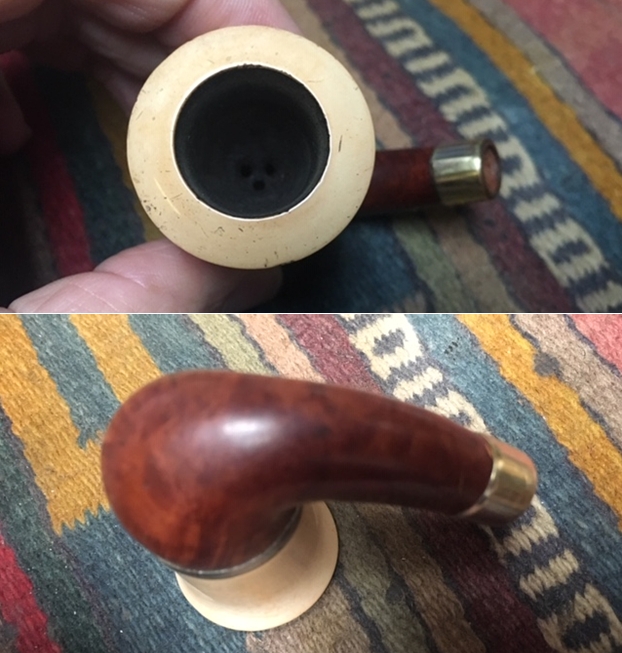
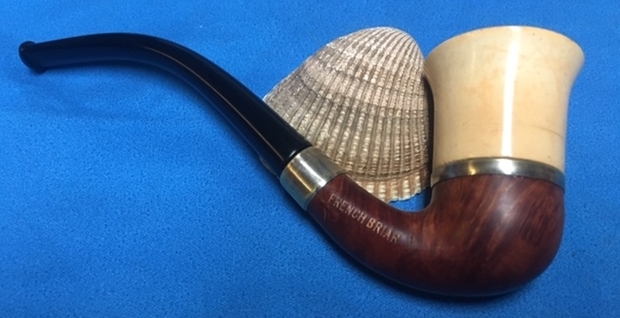
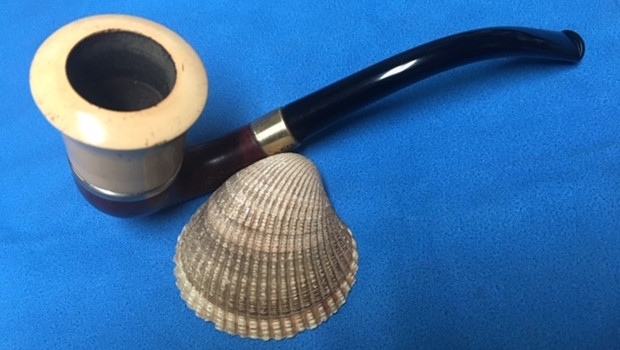
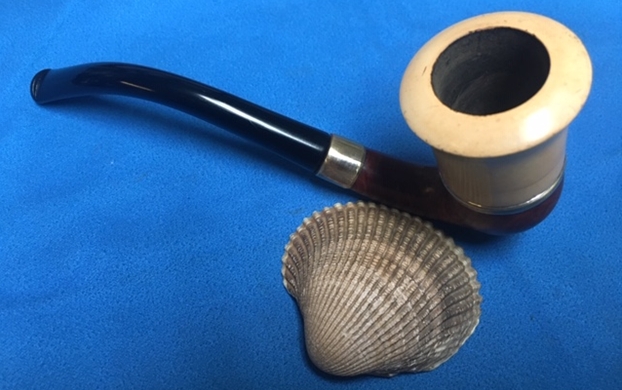
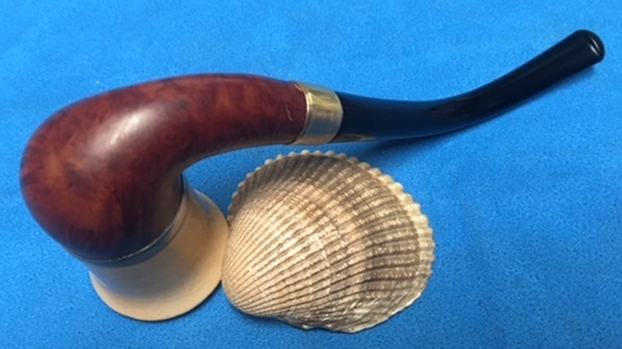
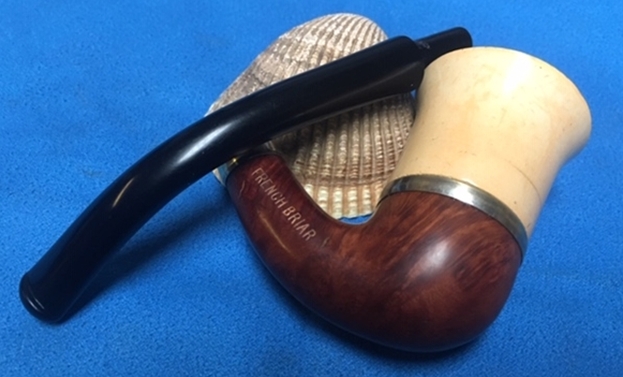
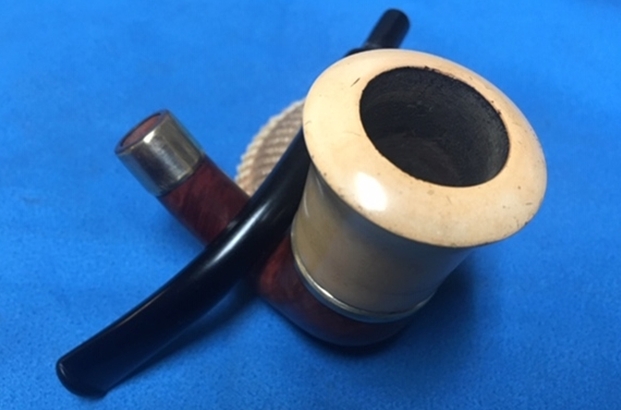
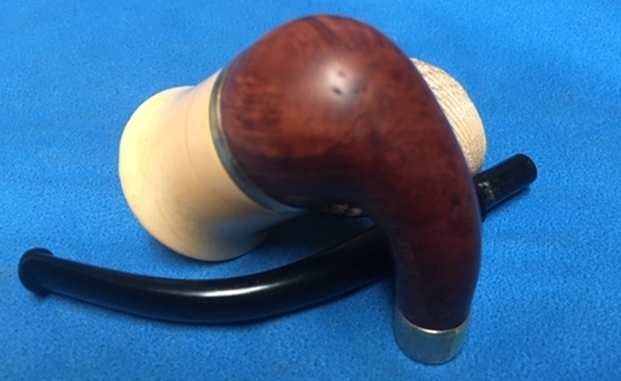
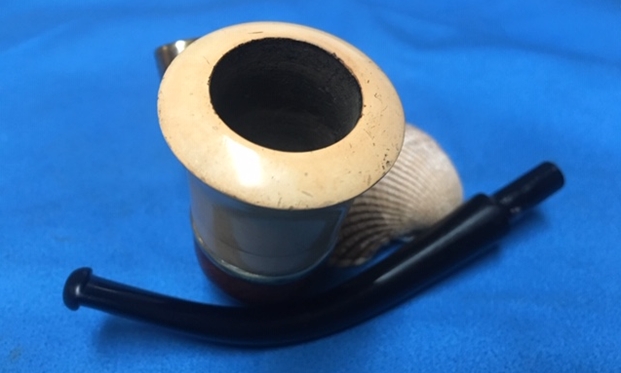
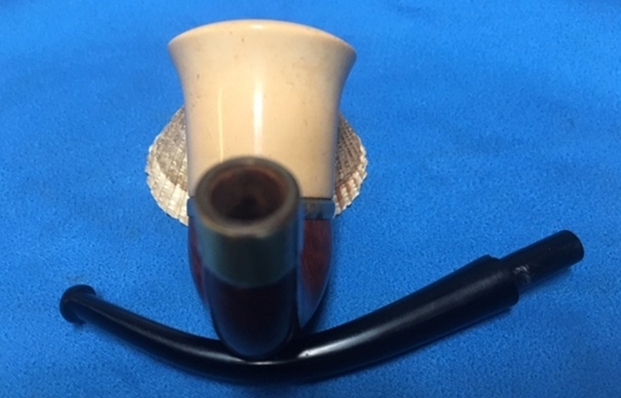
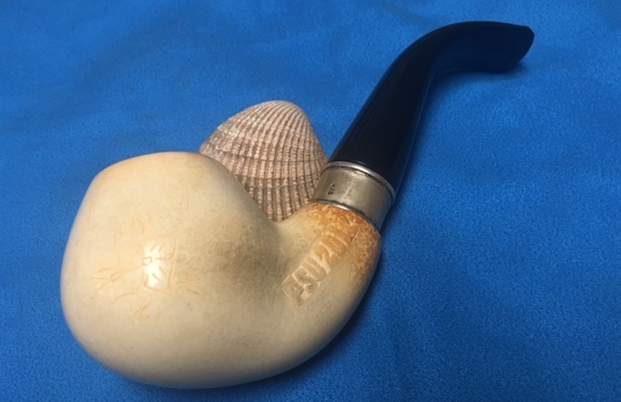
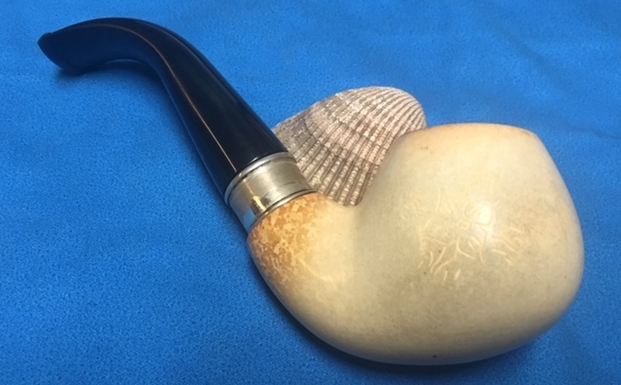
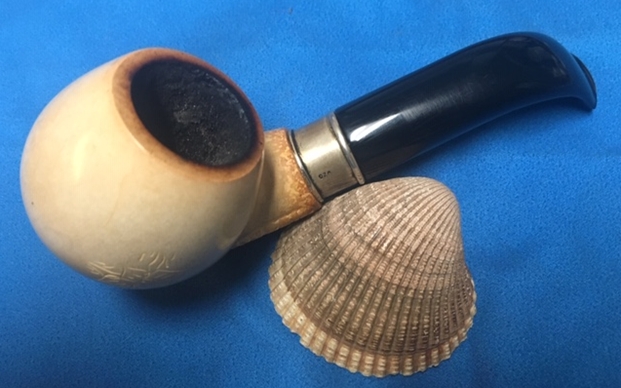
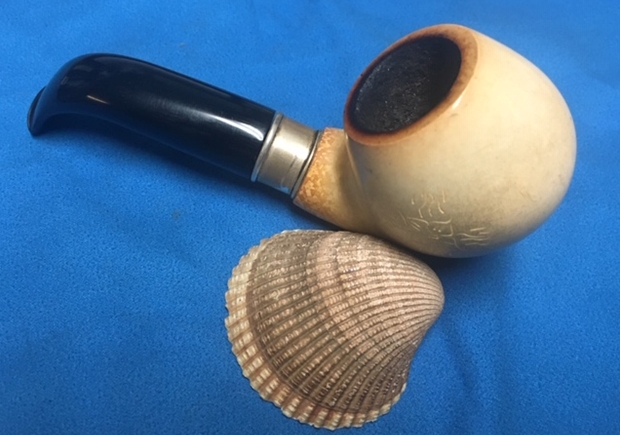
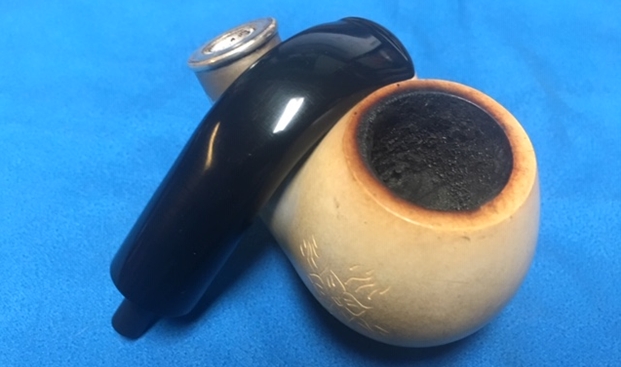
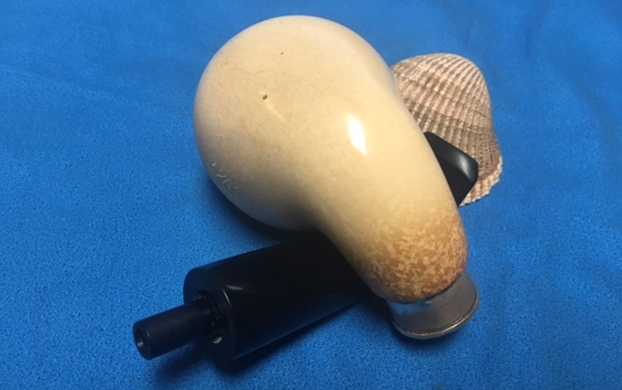
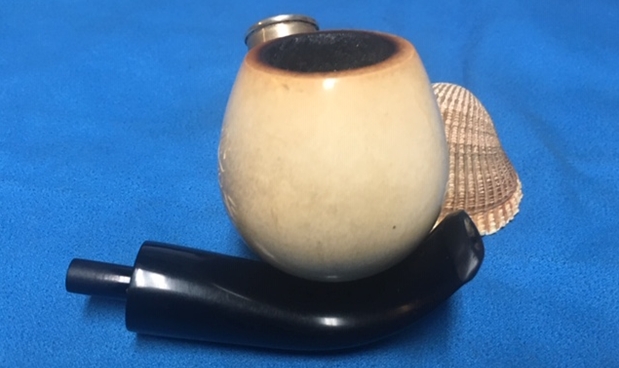
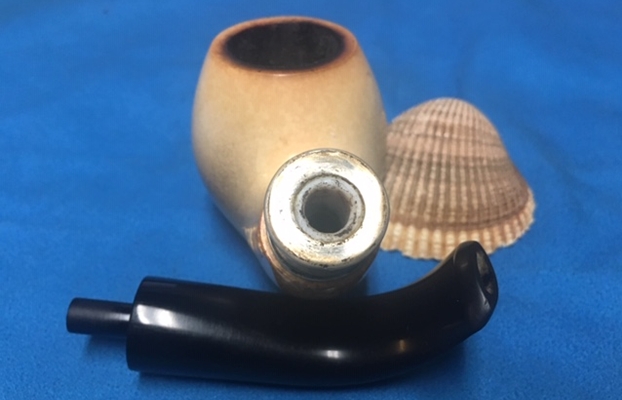
After the last batch of very clean pipes that I brought back from my trip to Idaho in a small bag of unsmoked C.P.F. pipes this pipe comes as a big change. It is the first of the smoked ones from that bag that I am working on. I have to say working on NOS time dusty pipes is a breeze and a pleasure in comparison to this dirty little calabash. The bowl is another screw in meerschaum cup that is almost tulip or funnel shaped. It is dirty and sports a thick cake in the bowl. It has some thick lava on the back side of the rim top and some darkening around the rim and in the bowl. There are no deep chips or nicks in the meer which is unusual in a pipe this age but the bowl is almost grey from use. The base is briar with a brass/metal between the bowl and base. The finish on the briar had a coat of varnish or possibly shellac over it so it had a spotty shiny look to it even under the dirt and grime of years. The left side of the shank is stamped with gold leaf and reads Belmore over C.P.F. in the oval logo. The right side of the shank reads French Briar. There is a brass/silver ferrule on the shank end that is oxidized and also loose. The vulcanite stem had some tooth chatter and light marks near the button. It was oxidized as well. The stem had lost some of its bend over time. The tenon has a chip out of it as well that will need to addressed. I took photos of the pipe to show its condition at the start of the process. I took a close up photo of the meerschaum rim top and bowl to show the condition of the meer bowl. It was heavily caked with lava overflow and darkening on the rim top. The airways are at the bottom of the bowl much like a gourd calabash though in this case there are three openings. The metal ferrule is oxidized and dirty. The photos of the vulcanite stem show its general condition. It was oxidized and dirty. There was tooth chatter and marks on both sides near the orifice button. The tenon had a chip on the topside that will need to be addressed.The next photo shows the stamping on the left side of the shank. It is clear and readable. The stamping reads as noted above. The band is loose and is stamped with the C.P.F. in an oval logo with the faux hallmarks that are on all of the metal banded C.P.F. pipes.I unscrewed the bowl from the pipe and took photos of the parts – the briar base and the meer bowl as well as all the adornments. It looks good on the inside. The threads in the base and on the meerschaum bowl are in good condition. I have included the following information with each of the blogs on C.P.F. pipes because I always want to keep the historical context in mind as I work on these. The link to the blog follows (https://rebornpipes.com/2013/04/14/some-reflection-on-the-historical-background-on-cpf-pipes/). I quote a pertinent part of the blog below:

From my reading and research it seems to me that CPF brand was discontinued sometime in the 1910-1920 range. Again, turning to Bill Feuerbach I found that he notes the following, which pins down the time frame of the discontinuation of the brand more specifically, “I have a CPF Chesterfield in our office display that has a name tag from way before my time that says 1900 CPF Chesterfield. It looks like most other Chesterfields you’ve seen, including the military type push stem, except this stem is horn and not vulcanite. As far as I have gathered the CPF brand was phased out sometime around 1915.” Interestingly, he noted that the Chesterfield name and style was later introduced in the KB&B, Kaywoodie and Yello-Bole lines. He says that the 1924 KB&B catalog shows KB&B Chesterfields…

… From my research I believe that we can definitively assert that the CPF logo stands for Colossus Pipe Factory. The brand was purchased by KB&B sometime between 1884 and 1898 and that it continued until 1915. That time frame gives help in dating some of the older CPF pipes you or I might find. It can be said that prior to the dual stamping it is fairly certain that the pipe is pre-1884 to 1898. After the dual stamping it can be placed post 1898 until the closure of the brand line in 1915. CPF made beautiful pipes.

From that information I can tentatively date the pipe to the period prior to 1884-1898 because of the single C.P.F. stamp on the shank, ferrule and stem. At any rate it is another old pipe though this one is well smoked. The story of its journey to Jeff and me this long after the date it was made is another mystery. This batch of pipes has made me wish that even one of them could share its story with us. I can only imagine the journey it has had even minimally from the bits that I do know. It traveled from the Colossal Pipe Factory in New York City to Idaho Falls in journey that began in the 1880s and ended in 2019. Now it is has further traveled by air to Vancouver, Canada, as far west as it can go and remain on the same continent… what a well-traveled pipe. Armed with that information it was not time to work on the pipe.

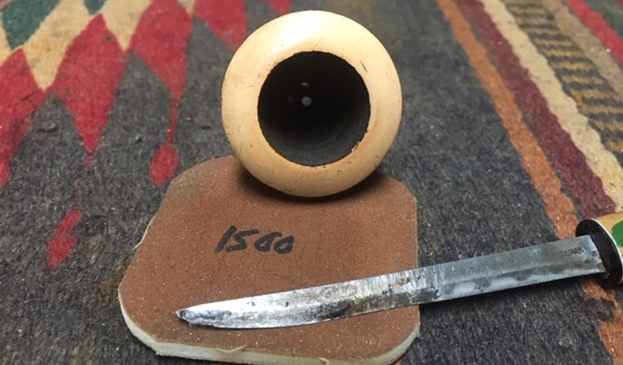
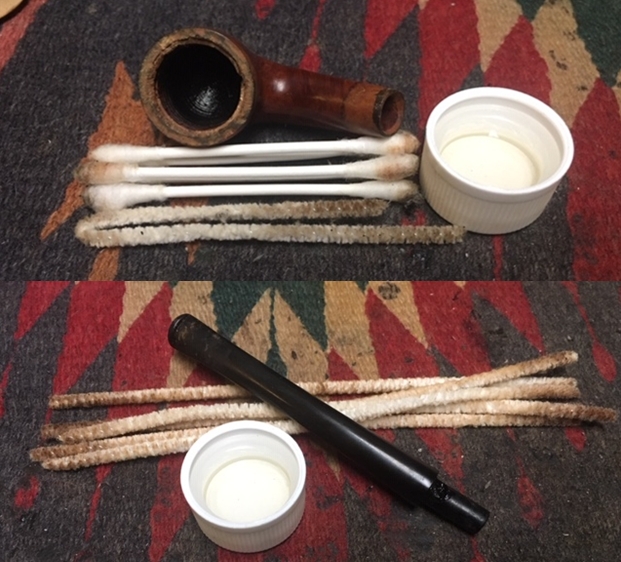
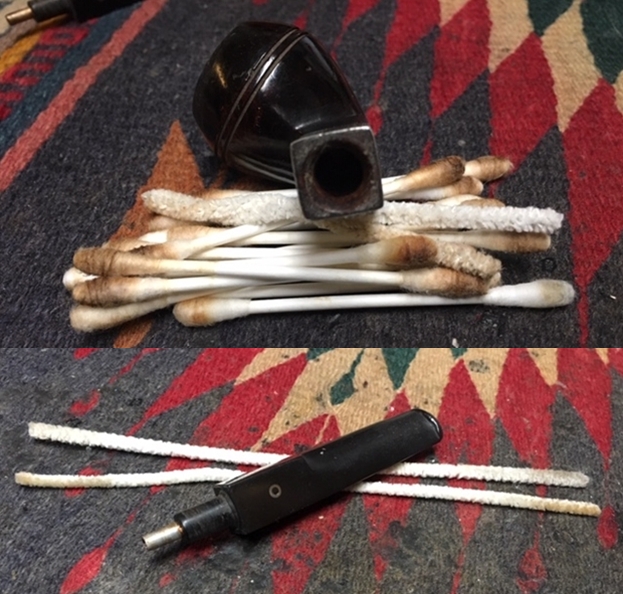
I decided to begin with the bowl. I unscrewed the bowl from the briar base. I carefully scraped the rim top to remove the lava build up. I finished it up with a 1500 grit micromesh pad. I reamed the bowl with a Savinelli Fitsall Pipe knife to scrape away the cake on the walls. I wanted to avoid cracking or damaging the meer in any way so I chose this method. Once it was reamed, I sanded the internal walls with 220 sandpaper wrapped around a dowel until it was smooth. I wiped down the bowl with a damp cotton pad to remove the surface dirt. I cleaned out the sump area in the base with cotton swabs and alcohol. I worked on the airway in the bowl and shank and the mortise with alcohol, cotton swabs and pipe cleaners. I scrubbed until the airway was clean. I cleaned out the airway in the stem with pipe cleaners and alcohol. I am still experimenting with Mark Hoover’s Briar Cleaner to see what I think of it as a possible replacement for my usual Murphy’s Oil Soap scrub. I rubbed it onto the briar portion of the pipe and worked it into the grain of the briar. I wiped it off with a clean cloth. There was still a coat of grime and grit from the cleaner left behind so I rinsed it with warm water to remove that and dried it with a microfiber cloth. I am really not sure if this is any better than the Murphy’s but I am committed to working with it. I forgot to take photos of this point in the process.

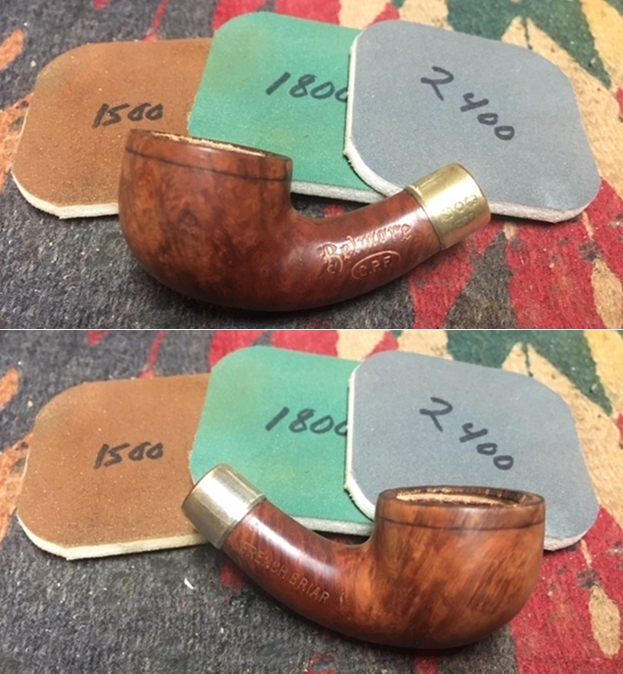
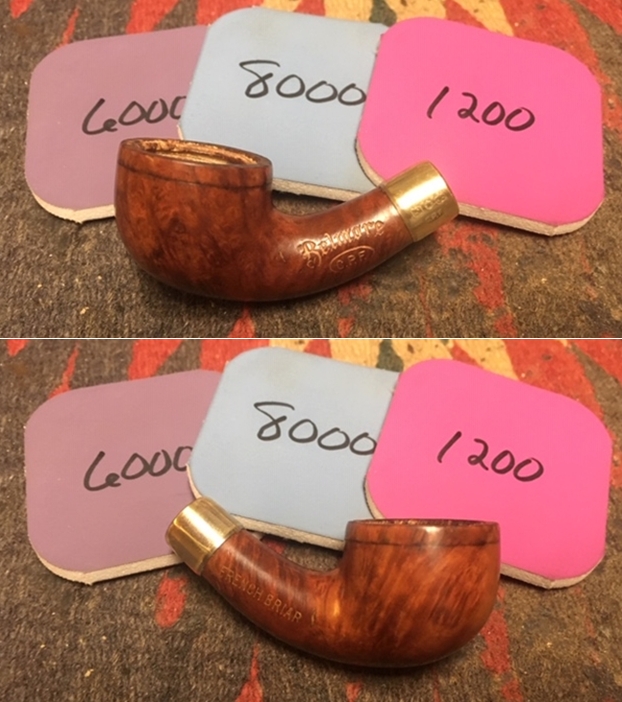
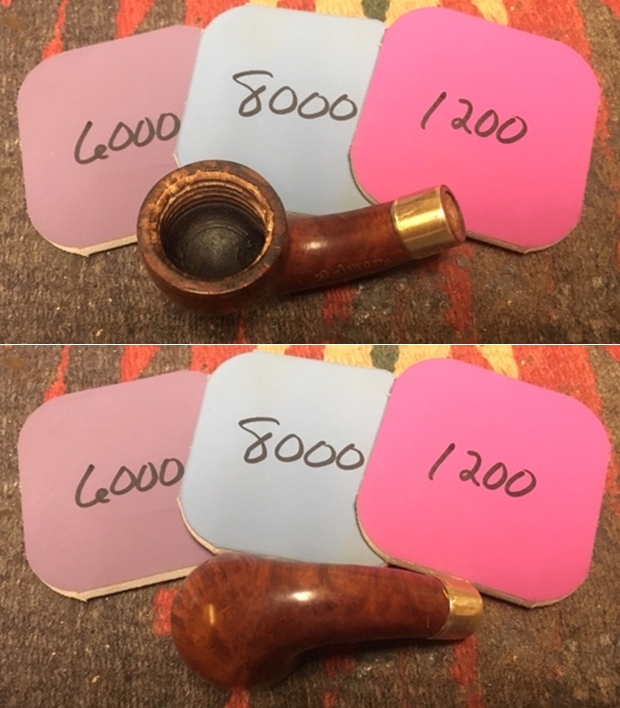
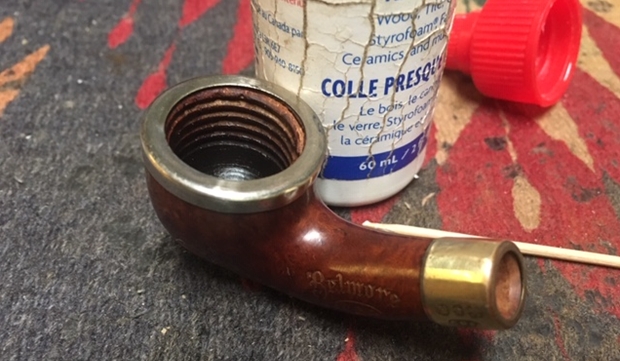
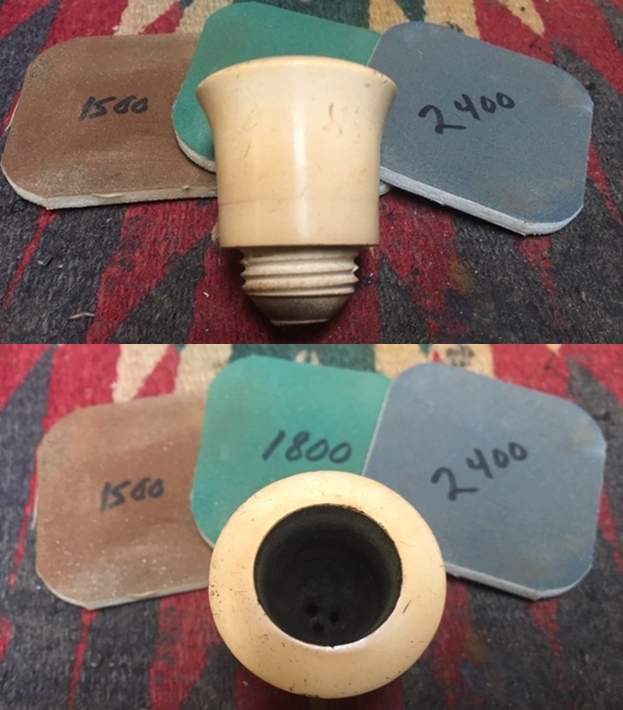
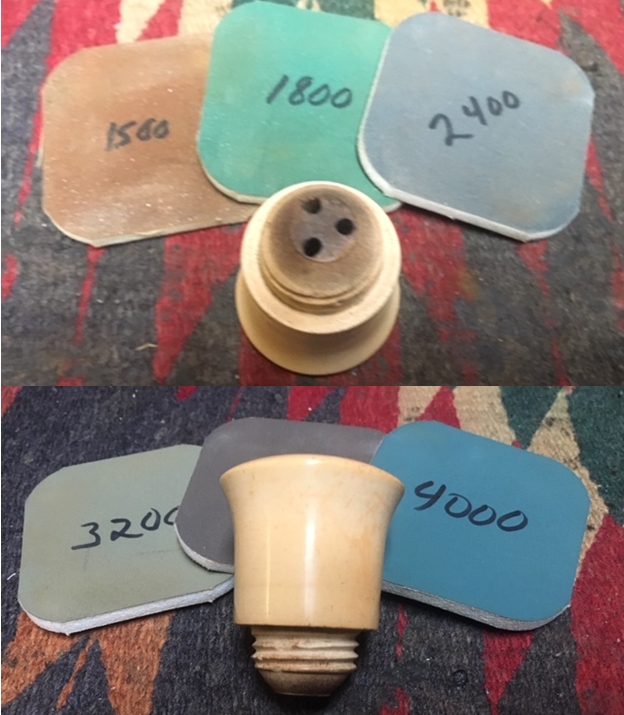
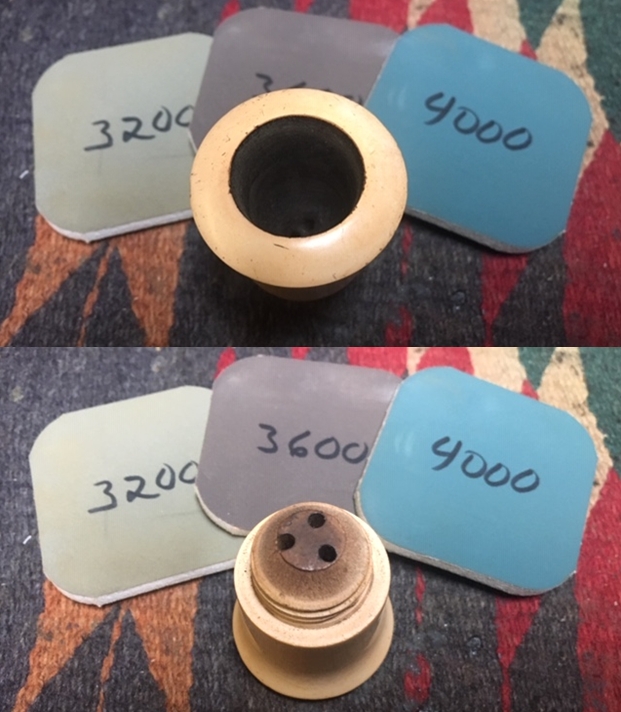
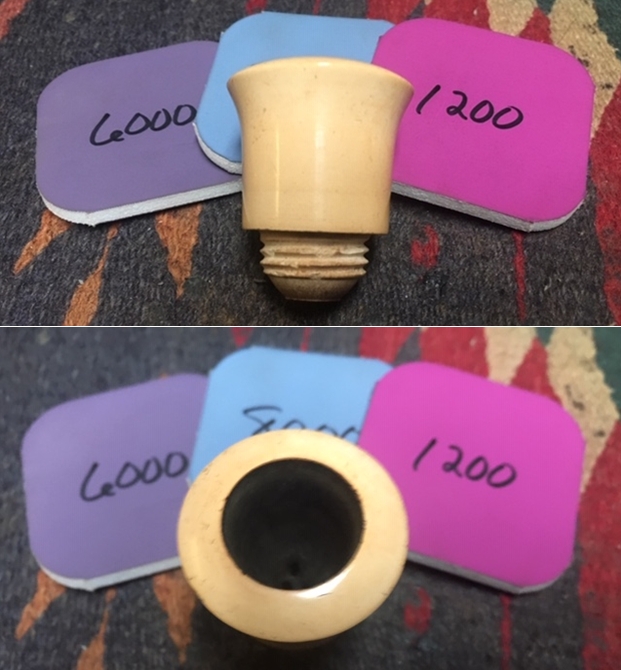
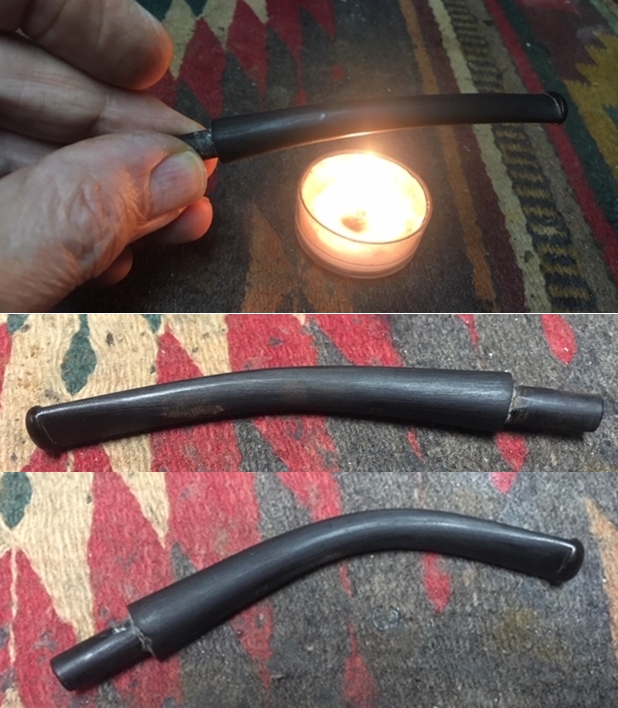
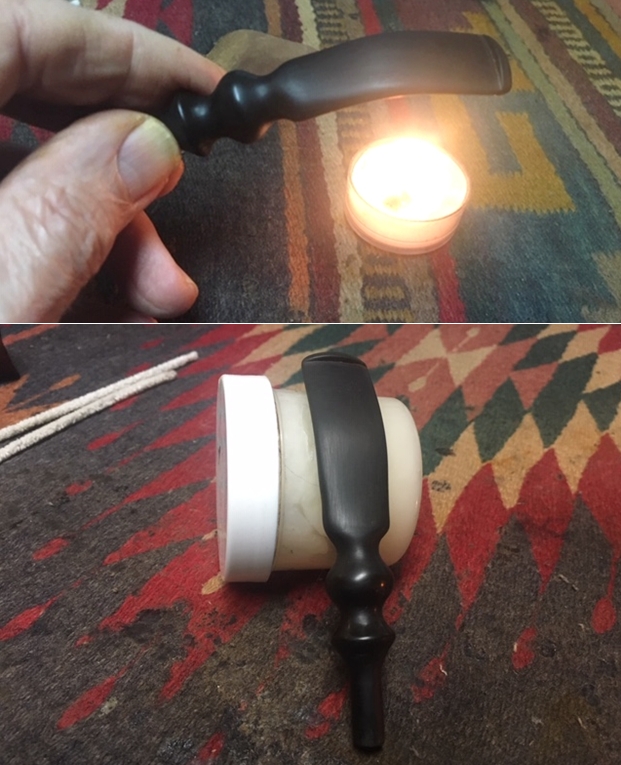
I sanded the old glue and dirt off the shank and then I spread some Weldbond white glue on the shank end. I spread it evenly on the shank end with a tooth pick. I pressed the brass ferrule on the shank end and aligned it so that the C.P.F. oval logo and the faux hallmarks lined up with the stamping on the left side of the shank. I rubbed the briar bowl and shank down with a coat of Before & After Restoration Balm. I worked it into the surface of the briar. The product works to clean, enliven and protect the briar. The old briar was dry and it drank up the balm. I buffed the bowl with a soft cloth to raise a shine. I like how the pipe looks as this point in the process. I glued the metal spacer on top of the base plate making sure all was aligned properly before I pressed them into place.I polished the meerschaum bowl with micromesh sanding pads – wet sanding with 1500-12000 grit pads. I wiped the bowl down after each pad with a damp cloth to remove the dust. Each successive sanding pad brought more shine to the meerschaum. There was a scratch in the meerschaum on one side of the bowl about 1/3 up from the bottom of the bowl. It appears to look like a crack but it is not one. If I had continued to sand it I would have changed the profile of the bowl. I put the meerschaum cup back in the briar bowl and buffed it with microfiber cloth to raise a shine. The scratch at the front of the bowl is visible but it is still a beautiful pipe.I set the bowl aside and started working on the stem. I filled in the damaged area on the tenon on the top side with clear super glue. Once the repair cured I used a needle file to smooth out the repaired area. I smoothed out the tenon repair and sanded out the tooth chatter and marks with 220 grit sandpaper. I sanded out the scratches with 400 grit sandpaper. I wiped the stem down with Obsidian Oil.I heated the vulcanite stem over a candle until the rubber had softened and bent the stem to the proper angle to match the curve of the base.I polished the stem with micromesh sanding pads – wet sanding it with 1500-2400 grit pads and dry sanding it with 3200-12000 grit pads. I wiped it down with Obsidian Oil after each sanding pad. I finished the polishing with Before & After Pipe Polish – both Fine and Extra Fine. I gave it a final coat of Obsidian Oil and set it aside to dry. By now if you have read rebornpipes for very long you know that I love these old C.P.F. pipes. There is some serious thought that they were carved by European trained craftsman who were skilled pipemakers. These pipemakers were brought to the US by the Colossal Pipe Factory to make pipes. Many of the shapes, bands and stems have such high quality workmanship involved that I really think there is truth to this story. This is little bent Meerschaum stacked Calabash is a real beauty.

I screwed the bowl back on the base and carefully polished stem and the bowl with Blue Diamond polish on the buffing wheel carefully avoiding the stamping on the shank. I gave the bowl and the stem multiple coats of carnauba wax. I buffed the pipe with a clean buffing pad to raise the shine. I hand buffed it with a microfiber cloth to deepen the shine. The pipe polished up pretty nicely. The grain on the base and shank really began to stand out; it seemed to take on life with the buffing. The rich contrasting brown stain on the bowl works well with the polished Meerschaum bowl that is also beginning to take on colour. The black vulcanite stem also provides contrast. The finished pipe has a rich look that is quite catching. Have a look at it with the photos below. The shape, finish and flow of the pipe and stem are very well done. The dimensions are Length: 5 1/2 inches, Height: 2 1/4 inches, Outside diameter of the bowl: 1 3/8 inches, Chamber diameter: 3/4 of an inch. This is another one that I will be adding to my collection. It fits in the C.P.F. niche group that I have been building. The shape and feel in the hand is perfect. Since this one is already well smoked it will be an easy pipe to load and fire up. Thanks for walking through the restoration with me as I restored and reworked this old meerschaum stack Calabash from 1884-1898. It is always a treat for me to work on a piece of pipe history especially when I have learned a bit of the story behind it.

Restoring Jennifer’s Dad’s Champ of Denmark 4 Freehand


Blog by Steve Laug

I decided to change things up a bit and work on a few more of Jennifer’s Dad’s pipes. I just posted the finished Sasieni Four Dot Walnut “Appleby” M apple on the blog. For the next pipe from the estate of George Rex Leghorn I have chosen a nicely shaped Champ of Denmark Freehand. You may not have read about this estate before, so I will retell the story. I received an email from Jennifer who is a little older than my 64+ years about whether I would be interested in her Dad’s pipes. My brother Jeff and I have been picking up a few estates here and there, so I was interested. Here is the catch – she did not want to sell them to me but to give them to me to clean up, restore and resell. The only requirement she had was that we give a portion of the sales of the pipes to a charity serving women and children. We talked about the organization I work for that deals with trafficking and sexual exploitation of women and their children and she decided that would be a great way to carry on the charitable aspect of her Dad’s character. With some great conversation back and forth she sent the pipes to Jeff and he started the cleanup process on them. Once he had finished cleaning them all he sent them to me to do my work on them.

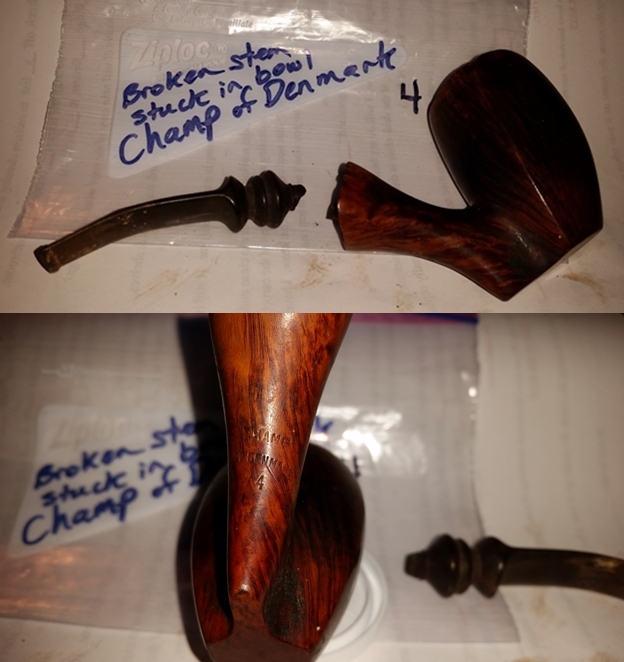
The Champ of Denmark pipe is stamped on the underside of the shank CHAMP over of Denmark and below that is the number 4. It came to us with a broken stem and the tenon stuck in the shank. The beautiful straight and flame grain around the bowl and up the shank is visible through the very thick coat of grime. It seemed like it had a dark stain but hard to tell. There were oil stains from George’s hands on both sides of the bowl obscuring the grain. It was so dirty that it was hard to see the colour well. There was a thick cake in the bowl and it had overflowed with lava into the plateau on the bowl top and shank end. It was a dirty and tired looking old pipe. The stem was badly oxidized with deep gouges and tooth marks both sides from the button up about 1 inch onto the stem surface. The button was cracked on the topside and tooth marks made it an unlikely candidate for a repair. It had been sitting in boxes for a lot of years and it was time to move ahead with the restoration. Jennifer took photos of the pipes she was sending. I have included two she included from this pipe.When the box arrived from Jennifer, Jeff opened it and took photos of each pipe before he started his cleanup work on them. There were two Champ of Denmark Freehands in the box – both were in bags and both had broken tenons and stems. There is something about classic Danish Freehands that is intriguing and I like working on them. The shapes seem to really capture the flow of the grain on the briar and this is no exception. The briar appeared to be in good condition underneath the grime. The finish looked intact under the grime. The bowl had a thick cake that had hardened with time. The lava overflow on the rim but it could very well have protected the rim from damage. We won’t know what is under it until Jeff had cleaned it off. The stem was irreparably damaged and would need to be replaced. The broken tenon was only one of the problems that led me to the decision that this stem would need to be replaced. (Jeff quickly pulled the broken tenon before he even cleaned the pipe.)Jeff took photos of the bowl and rim top to show the cake in the bowl and the lava build up on the plateau rim top and on the shank end as well. It was thick and hard but hopefully it had protected the rim and edges from damage. The lava coat looks horrible but it points to a well-used, favourite smoking pipe. George must have enjoyed this old timer and when the tenon broke he must have been frustrated. Jeff took photos of the sides and heel of the bowl to show the condition of the finish – the grime and grit all over the sides and flat bottom of the bowl. It is a dirty pipe. Jeff took photos of the top and underside of the broken stem showing the scratching, oxidation and deep tooth damage to the stem surface. You can also see the broken tenon (totally fixable by with the other damage I don’t think it is worth it). I looked on the Pipephil site to get a quick overview of the brand. In the back of my mind I remembered a connection to Karl Erik. I could not remember the details of the connection (http://www.pipephil.eu/logos/en/logo-c4.html). I did a screen capture of the section on the brand that was shown on the site. I have included it below.In summary it says that the brand was distributed by Larsen & Stigart a tobacconist in Copenhagen, Denmark. The warehouse had a workshop that had such famous carvers as Soren Eric Andersen, Karl Erik Ottendahl and others.

I turned then to Pipedia (https://pipedia.org/wiki/Champ_of_Denmark) to see if I could get a bit more information. I quote in full from that site:

“Champ of Denmark” were made for and distributed by Larsen & Stigart by Karl Erik Ottendahl. Larsen & Stigart had some indoor carvers at certain times, too (e.g. Søren Eric Andersen) and among other things they managed to supply Dunhill with wild Danish fancy pipes.

In an endnote under the article on Karl Erik (https://pipedia.org/wiki/Karl_Erik) I found someo more information. I quote the endnote in full.

¹ It is almost impossible to draw a sharp line between some of these brands… Larsen & Stigart – once a famous Copenhagen pipe shop, now almost forgotten – offered pipes produced by KE stamped “Larsen & Stigart” as well as pipes stamped “Larsen & Stigart” + “Champ of Denmark” or “Larsen & Stigart” + “Shelburne”. Almost needless to say, there are pipes stamped “Champ of Denmark” or “Shelburne” only. And the only reason is inconsistent stamping??? (BTW Larsen & Stigart employed own indoor carvers for approximately one decade – e.g. Søren Eric Andersen. They even managed to supply Dunhill with wild Danish fancy pipes.)

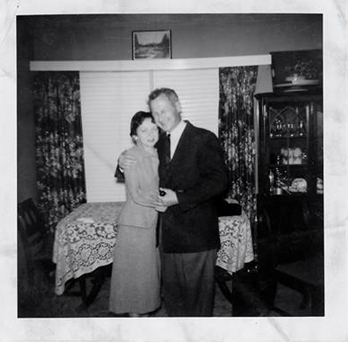
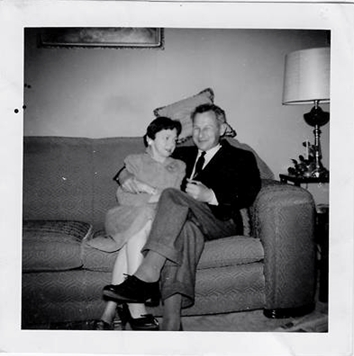
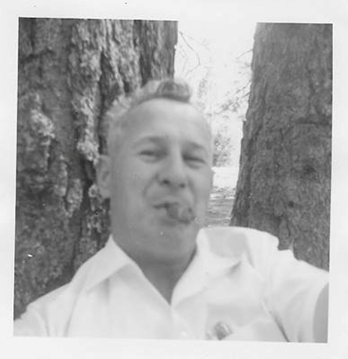
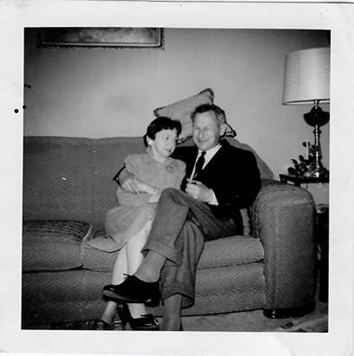
Now I had the verification of the link to Karl Erik Ottendahl. The pipe was most probably made by him for the pipe shop in Copenhagen. Before I get on to cleaning up the pipe I thought I would once again include the tribute that Jennifer wrote to her Dad for the blog. She also sent some photos and an article that her Dad wrote for Jeff and me to be able to get a feel for him. I have included those below. Note in each of them that he is holding a pipe in his left hand. I asked her to also send me an email with a brief tribute to her Dad. Here is her tribute from an email to me.

Steve, I want to thank you again for accepting my dad’s pipes.  They were so much a part of my dad’s life that I could not simply discard them. But as his daughter, I was not about to take up smoking them either. *laughing* I think my dad would like knowing that they will bring pleasure to others.  I know that I do.

I’m not sure what to say about his pipes. I always remember Daddy smoking pipes and cigars.

First a bit about my dad. Though my father, George Rex Leghorn, was American (growing up in Alaska), he managed to join the Canadian Army at the beginning of WWII, but in doing so lost his American citizenship.  He was fortunate to meet a Canadian recruiting officer who told him the alphabet began with “A” and ended with “Zed” not “Zee”, and also told him to say that he was born in a specific town that had all its records destroyed in a fire.  When the US joined the war my dad, and thousands of other Americans who had made the same choice*(see the link below for the article), were given the opportunity to transfer to the US military, and regain their citizenship.

After WWII, my dad, earned his degree at the University of California Berkeley and became a metallurgist. There is even a bit about him on the internet.

He loved taking the family out for a drive, and he smoked his cigars on those trips. (As a child, those were troubling times for my stomach.)

I most remember my father relaxing in his favorite chair with a science fiction book in one hand and a pipe in the other… Sir Walter Raleigh being his favorite tobacco… and the pipes themselves remind me of him in that contented way.  If I interrupted his repose, he’d look up, with a smile on his face, to answer me.

It seemed he smoked his Briarwood pipes the most, though he had others.  At the time, it was only the Briarwood I knew by name because of its distinctive rough shaped bowl.  And it was the Anderson Free Hand Burl Briar, made in Israel, which I chose for his birthday one year, because I thought he might like that particular texture in his hand.

At least two of his pipes, he inherited from his son-in-law, Joe Marino, a retired medical laboratory researcher (my sister Lesley’s late husband)… the long stemmed Jarl (made in Denmark), and the large, white-bowled, Sherlock Holmes style pipe.  I believe Joe had others that went to my dad, but Lesley was only sure about those two.

The Buescher, corncob pipe my older sister Lesley bought for Daddy while on one of her travels around the States.

A note on the spelling of my sister’s name…

My dad met my mother, Regina, during WWII and they married in Omagh, Ireland.  My mother was English and in the military herself.  The English spelling of Lesley is feminine, and Leslie masculine, in the UK… just the opposite of here in the United States.  I guess my mom won out when it came to the spelling of the name.

I’ll send you photos of my dad soon, along with his WWII experience story.

Jennifer

*https://www.thestar.com/news/world/2013/10/22/the_americans_who_died_for_canada_in_wwii.html

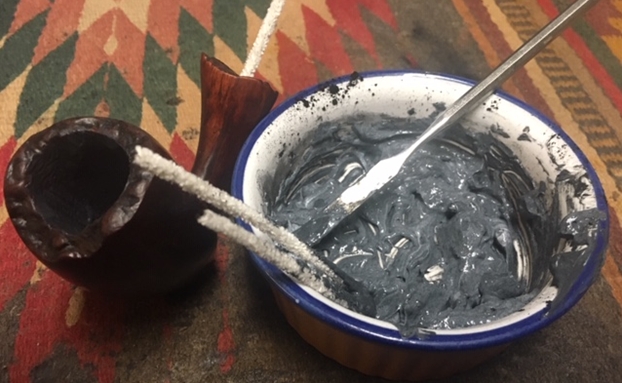
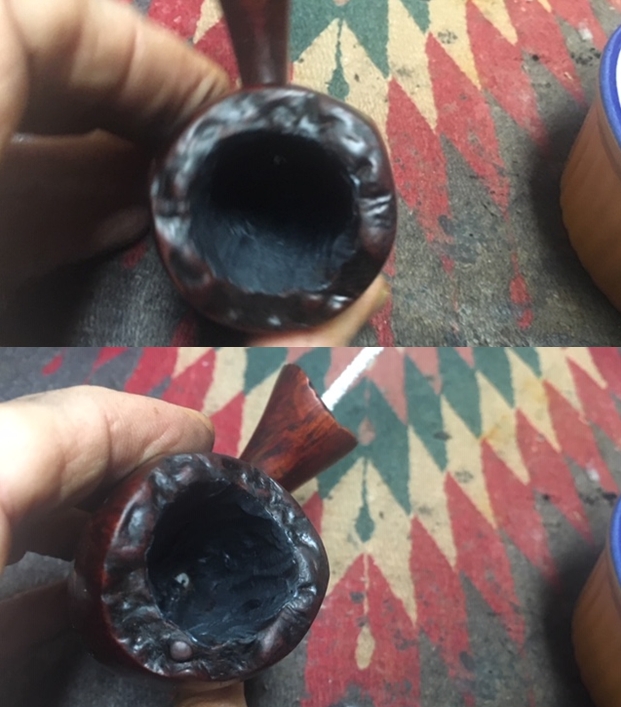
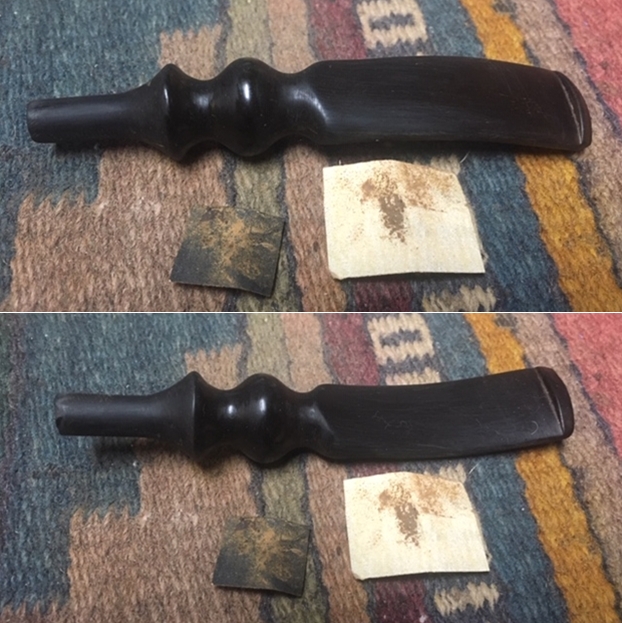
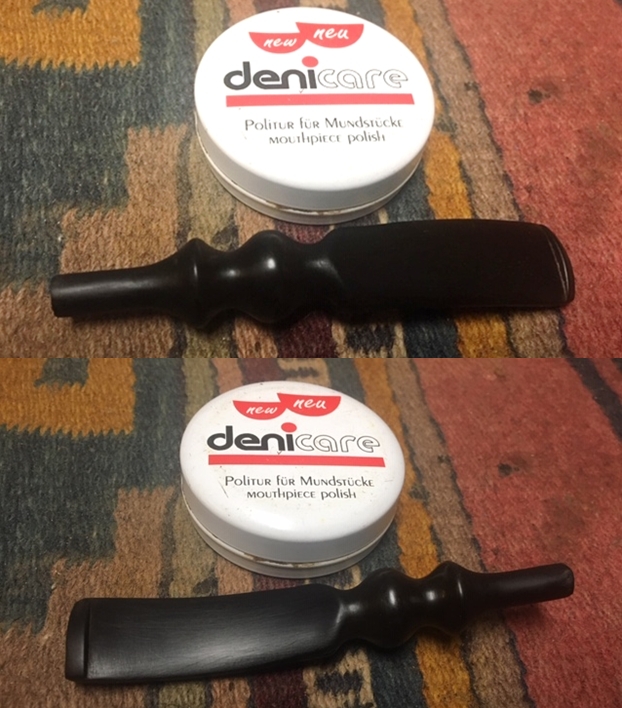
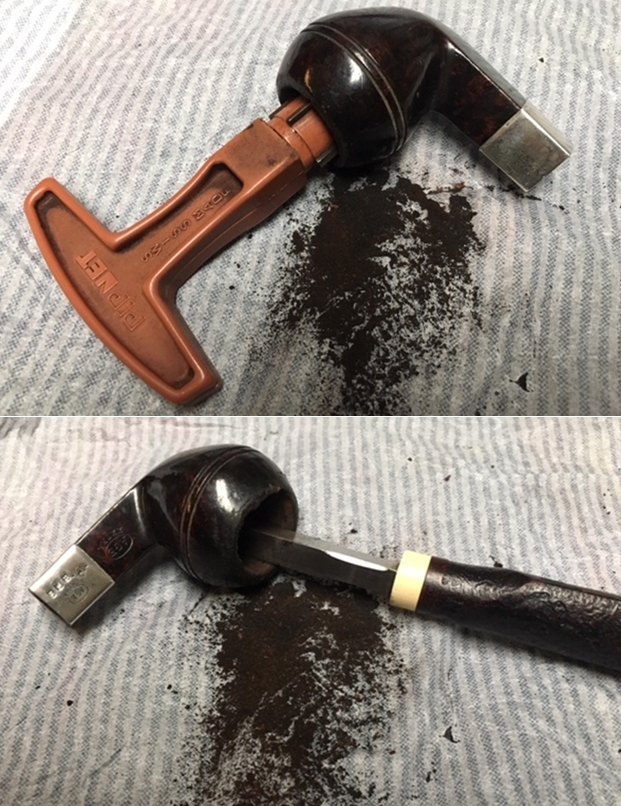
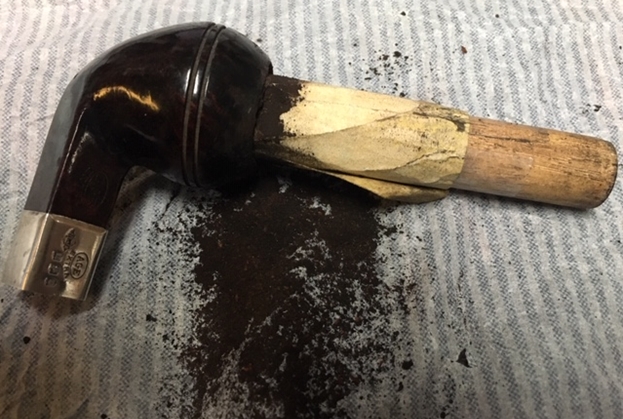
I am getting more and more used to Jeff cleaning up the pipes before I work on them. So much so that when I have to clean them it is a real chore! This pipe was a real mess just like the other ones in the collection. I did not know what to expect when I unwrapped it from his box. He reamed it with a PipNet pipe reamer and cleaned up the reaming with a Savinelli Fitsall Pipe Knife. He scrubbed out the internals with alcohol, pipe cleaners and cotton swabs until the pipe was clean. He scrubbed the exterior of the bowl with Murphy’s Oil Soap and a tooth brush to remove the grime and grit on the briar and the lava on the rim top. The finish was in rough condition with some darkening from oils on both sides of the bowl. The rim top and shank end plateau looked lifeless. Since I was going to replace the stem he cleaned the internals and scrubbed the exterior to keep the box from smelling. When the pipe arrived here in Vancouver for the second stop of its restoration tour it looked very good. I took photos before I started my part of the work. It is still darkly stained on both sides. I started sanding the bowl before I took photos so the top view shows the sanding dust… I quickly did some photos. At this point I decided to see what I had in terms of a freehand stem that would work with this bowl. I went through my options here and chose one with the approximate shape. It is a little less ornate but I think it will work well when it is cleaned up.I put the stem in the shank and took some photos to get an idea of the look of the pipe with the new stem. I will likely bend it slightly more to match the bowl angles but at the moment it is the same bend as the broken on. I like it! I took some close up photos of the rim top and also of the stem surface. I wanted to show what an amazing job Jeff did in the cleanup of the rim top. Even with the work there was still some hard lava in the plateau area I also took close up photos of the new stem to show condition it was in. It would not take a lot of work – just sanding out the scratches and polishing with micromesh sanding pads.I wiped the underside of the shank down with a cotton pad and alcohol so I could more easily see the stamping. It read as noted above.I started to sand out the inside of the bowl as noted above – a lesson learned from Paresh’s daughter Pavni while I was in India. It soon became apparent that there were some heat fissures in the briar. Fortunately they were not too deep but they were significant on the front and backside of the inner walls of the bowl. I mixed a small batch of JB Weld and used a folded pipe cleaner to fill in the fissures in those areas. I did not coat the entire bowl. Once it had cured I would sand the areas smooth leaving the fill only in the fissures themselves.Once the repair had hardened to touch it was time to continue my work on the bowl. I wanted to scrub the briar with alcohol and see if I could remove some of the oils in the briar on both sides. I also worked over the front and rear of the bowl and the shank. I was able to remove a lot of the darkening oils with the alcohol. I used a dental pick and a brass bristle wire brush to work over the rim top plateau. I was able to clean out the remaining lava and set the rest of the definition of the plateau free. It is a nice looking rim top. I wiped it down with alcohol and then touched up the valleys in the plateau with a black Sharpie pen.I polished the bowl with 1500-2400 grit micromesh to see what the sides looked like. I was not happy with the finished look on the sides of the bowl as it seemed to highlight the darkening on both sides. I was going to have to stain the bowl to try to blend in the darkening on the sides.I decided to use a Tan stain to see what I could do with it. I applied it and flamed it to set it in the grain. I repeated the process until I was happy with the coverage on the bowl. Once the stain had set and the alcohol evaporated I wiped it down with alcohol on cotton pads to make the colour more transparent. I wanted the grain to stand out but still hide the darkening on the sides of the bowl. I was happy with the results so far. Once I polished it with micromesh sanding pads and buffed it with Blue Diamond it would be even more transparent. I polished the bowl and rim with micromesh sanding pads. I wet sanded it with 1500-12000 grit pads and wiped it down between pads with a soft cotton cloth. You can see the progress in the shine as you go through the photos. I worked some Before & After Restoration Balm into the finish of the bowl and the plateau on the rim top and shank end with my fingertips to clean, enliven and protect it. I find that the balm really makes the briar come alive again. The contrasts in the layers of stain really made the grain stand out. I let the balm sit for a little while and then buffed with a cotton cloth to raise the shine. The pipe really looks good at this point. I am very happy with the way the pipe is looking at this point in the process.  With the outside of the bowl finished and the repairs on the inside hardened and cured it was time to smooth out the interior of the bowl. I sanded it with a piece of dowel wrapped with 220 grit sandpaper. I was able to remove the material around the repairs by sanding. I wiped the bowl down with alcohol on a cotton pad to clean up the dust. I mixed up a batch of bowl coating – sour cream and charcoal powder blended together. The mixture dries hard and does not have any residual taste. I put a pipe cleaner in the airway to keep the coating out of it. I coated the bowl with the mixture by painting it on the briar with a folded pipe cleaner. Once the bowl was coated, I set it aside to dry. I will need to wipe off the rim top and externals before waxing the bowl but it is looking very good at this point. I set the bowl aside to allow the bowl coating to cure and turned my attention to the “new” stem. I sanded the stem with 220 grit sandpaper to remove the oxidation followed by 400 grit wet dry sandpaper. I rubbed the stem down with Denicare Mouthpiece Polish and a cotton pad to remove remnants of oxidation and to further blend in the sanding. The stem was showing some promise at this point in the process. I heated the stem over a candle to soften the vulcanite. When it was softened I bent it over a jar to match the angle that would match the top of the bowl.I polished the stem with micromesh sanding pads – wet sanding it with 1500-12000 grit pads. I polished it further with Before & After Pipe Stem Polish – both fine and extra fine. I finished by wiping it down with Obsidian Oil after each pad and set it aside to dry. Once the bowl coating had cured I wiped the bowl down with a microfiber cloth and hand wiped off any residual bowl coating on the outside with a damp cotton pad. I put the stem back on the bowl and polished the bowl and stem with Blue Diamond polish on the buffing wheel. I gave the bowl and the stem multiple coats of carnauba wax. I buffed the pipe with a clean buffing pad to raise the shine. I hand buffed it with a microfiber cloth to deepen the shine. The new darker stain works well to mask the darkening and make the grain really pop. The pipe polished up really well. The polished black vulcanite bit seemed to truly come alive with the buffing. This Freehand  feels great in my hand and it is a sitter as well. It must have been a fine smoking pipe judging from the condition it was when we received it from Jennifer. There should be a lot of life left in this Champ of Denmark by Karl Erik. Have a look at it with the photos below. The dimensions are Length: 6 ½ inches, Height: 2 3/4 inches, Outside diameter of the bowl: 1 1/2 inches, Chamber diameter: 7/8 of an inch. This is one that will go on the rebornpipes online store shortly. If you want to carry on the pipe trust of George Leghorn let me know. Thank you Jennifer for trusting us with his pipes. Thanks to each of you who are reading this blog. Remember we are not pipe owners, we are pipemen and women who hold our pipes in trust until they pass on into the trust of the next pipeman or woman.

Reworking a Lucite Stem for a Meerschaum Apple


Blog by Steve Laug

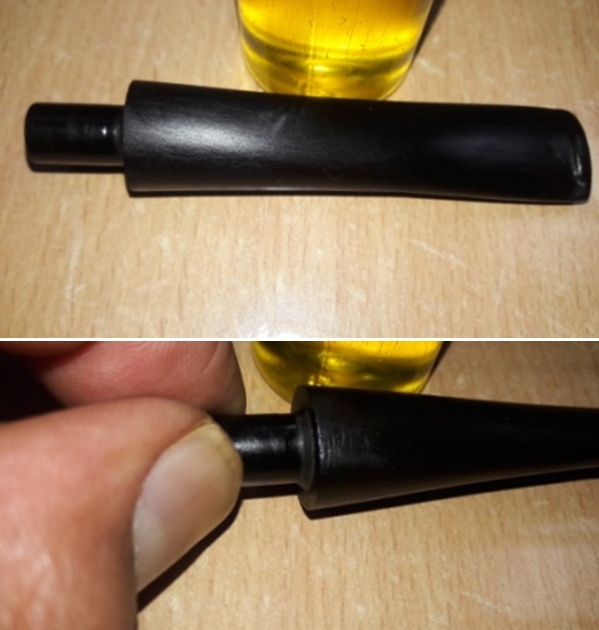
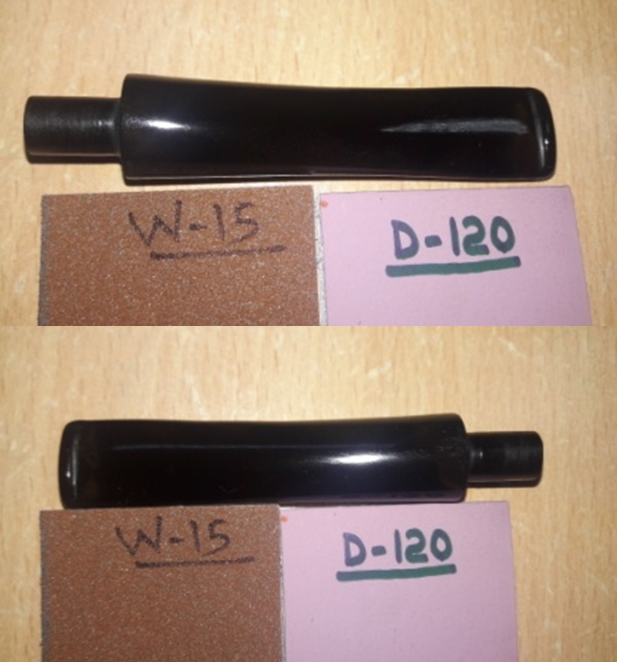
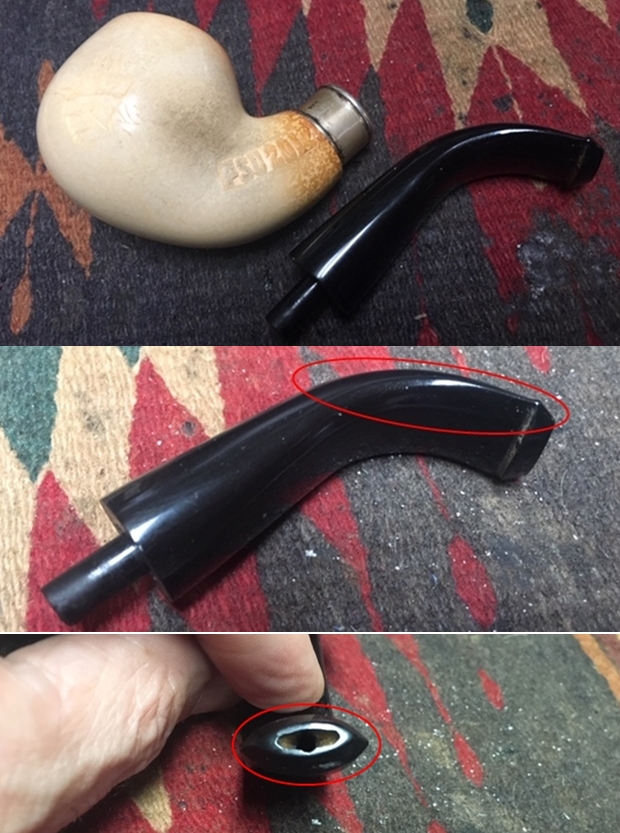
Last week I had lunch with a friend I had not seen for quite some time. Over lunch he showed me a pipe that he wanted me to do some modifications on for him. It was a Pipe of the Year for 2012 from an online Pipe Forum that we both belonged to – PSU (Pipe Smokers Unlimited). The pipe was made by Altinok in Turkey for the club. It came in a red leatherette covered case with white “satin” lining. The case was made to hold the bowl and both a Churchwarden and a regular stem. It also came with a tamper. My friend has had it since 2012 and finds that though the pipe smokes very well the regular stem was extremely uncomfortable. The button was very thick, the edges very sharp, and the stem ahead of the button was thick and the taper was too abrupt to be comfortable in his mouth. This is exactly the opposite of the Churchwarden stem which had a thin, comfortable button and a longer taper from the button forward. I brought it home from work and took the following photos before I started my work on the pipe. I took the stem off the bowl and took a photo of the stem shape. I circled the areas in red that I was going to work on with the reshaping request. The second photo shows the thickness of the tape on the stem from the side (I circled the area in red). The third photo shows the thickness of the button and the very abrupt angle on the top and bottom surfaces of the button.  The edge of the button was very sharp on the lips and tongue.I removed much of the thickness with my Dremel and sanding drum followed by 220 grit sandpaper. The first photo shows the new profile to the stem. It is much more comfortable and the taper is gentler. The second photo shows the reshaped button. I thinned it down in terms of thickness from top to bottom. I changed the angle of the taper so that it is more of a flat profile looking at it from the end. I polished the vulcanite with 400 grit wet dry sandpaper.The next two photos show how I used the 220 sandpaper to spread out the taper and make it less abrupt. I polished it with 400 grit wet dry sandpaper.Once I had reduced the thickness of the stem, the button and gave it a better taper I polished it with micromesh sanding pads. I wet sanded it with 1500-12000 grit pads and wiped it off with a cloth after each pad. The Lucite took on a real shine with each successive buffing pad. I put the stem back on the bowl so I could more easily buff it on the buffing wheel. I polished the stem with Blue Diamond to raise the shine and gave it multiple coats of carnauba wax. I buffed the stem with a clean buffing pad to finish the polishing. My friend did not want me to worry about the bowl so I did nothing to it. I took photos of the finished pipe. The dimensions on the pipe are – Length: 5 ¾ inches, Height: 1 ¾ inches, Outside diameter of the bowl: 1 ¼, Chamber diameter: 7/8 of an inch. Now it is ready to go back to my friend. I am hoping he enjoys the new shape of the stem and that it smokes comfortably for him. Thanks for reading.

Restoring Another of Jennifer’s Dad’s Pipes – A Sasieni Four Dot Walnut “Appleby” M


Blog by Steve Laug

Once again time to get back to Jennifer’s Dad’s pipes. The next pipe on the worktable is from the estate of George Rex Leghorn. You may not have read about this estate before, so I will retell the story. I received an email from Jennifer who is a little older than my 64+ years about whether I would be interested in her Dad’s pipes. My brother Jeff and I have been picking up a few estates here and there, so I was interested. Here is the catch – she did not want to sell them to me but to give them to me to clean up, restore and resell. The only requirement she had was that we give a portion of the sales of the pipes to a charity serving women and children. We talked about the organization I work for that deals with trafficking and sexual exploitation of women and their children and she decided that would be a great way to carry on the charitable aspect of her Dad’s character. With some great conversation back and forth she sent the pipes to Jeff and he started the cleanup process on them. Once he had finished cleaning them all he sent them to me to do my work on them.

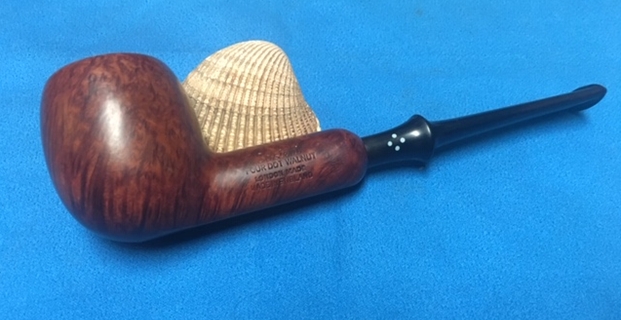
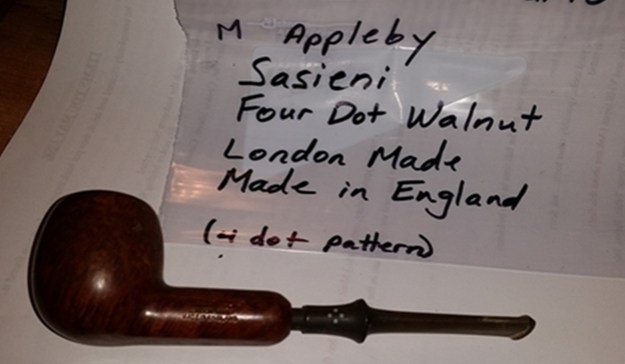
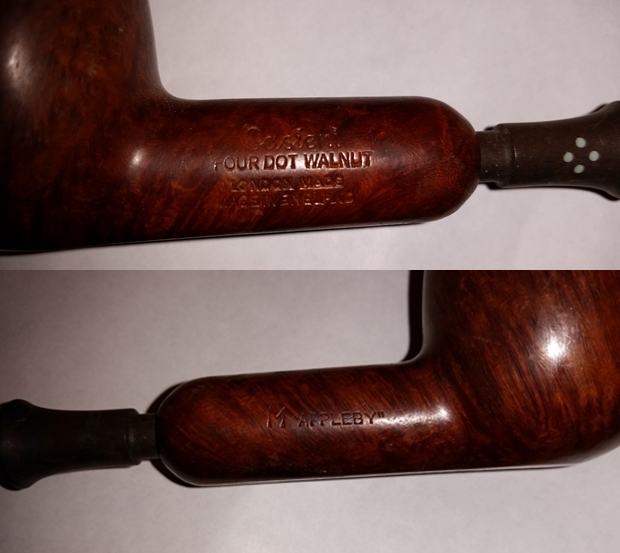
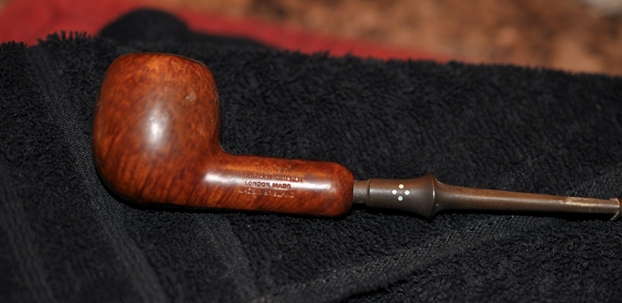
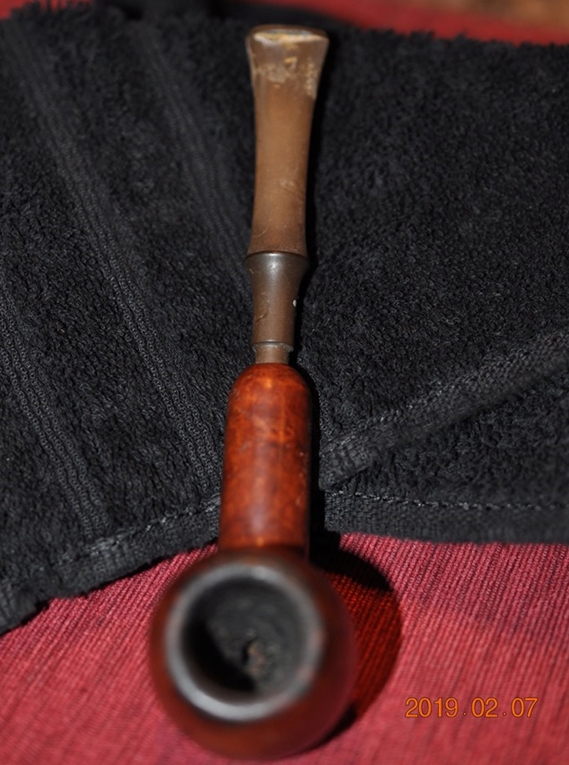
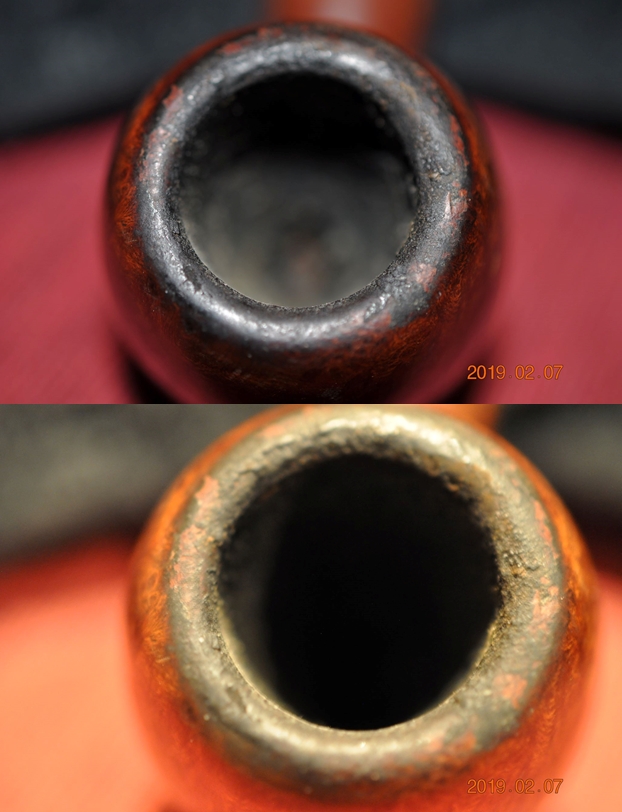
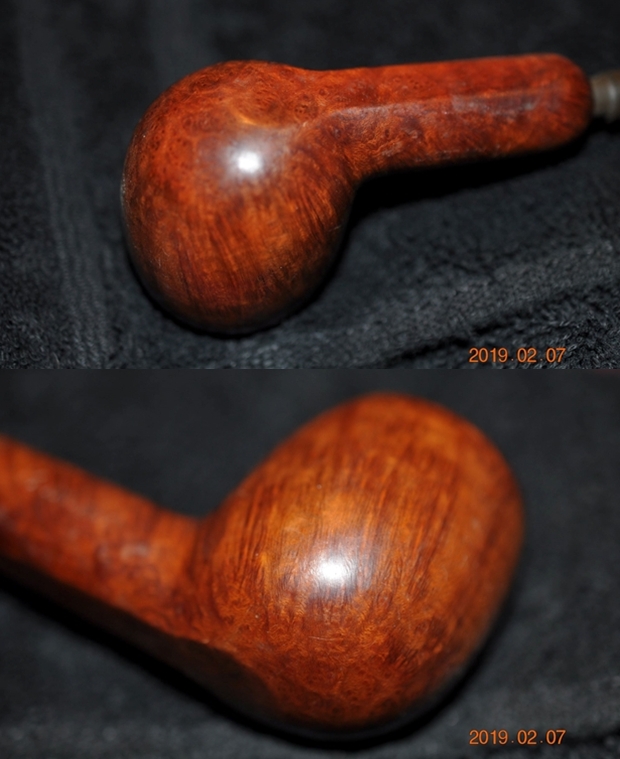
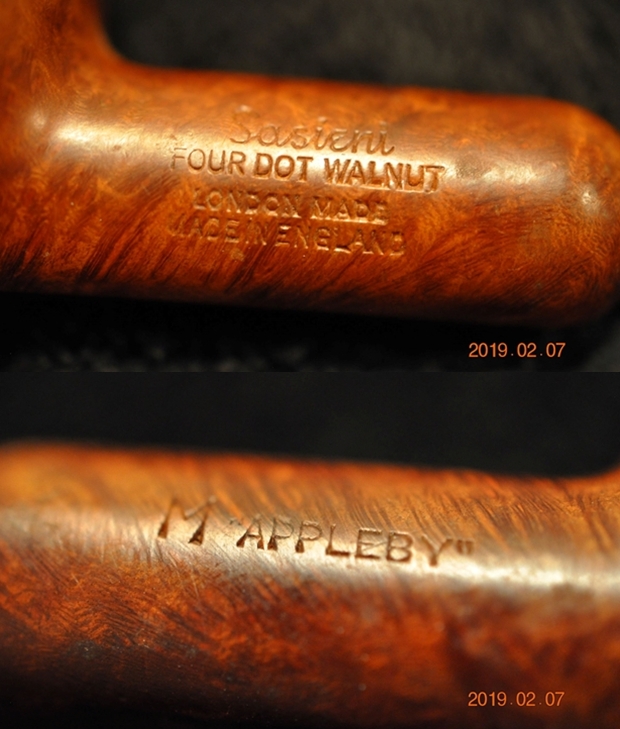
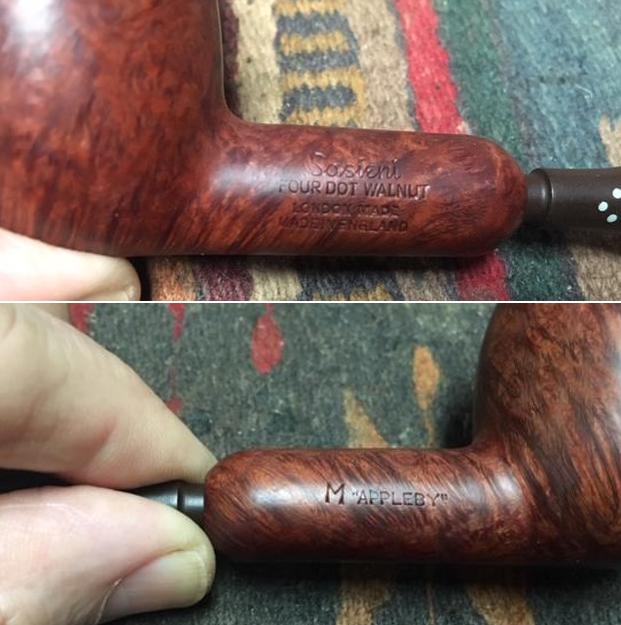
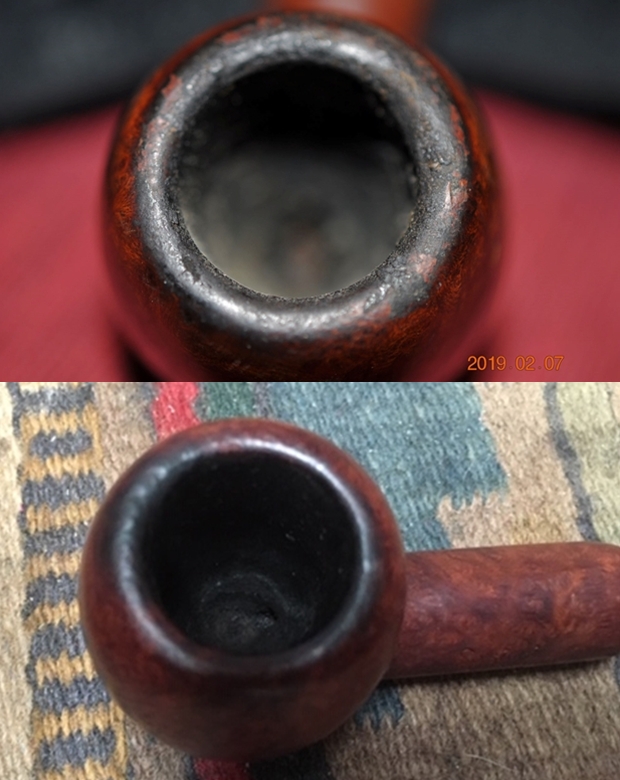
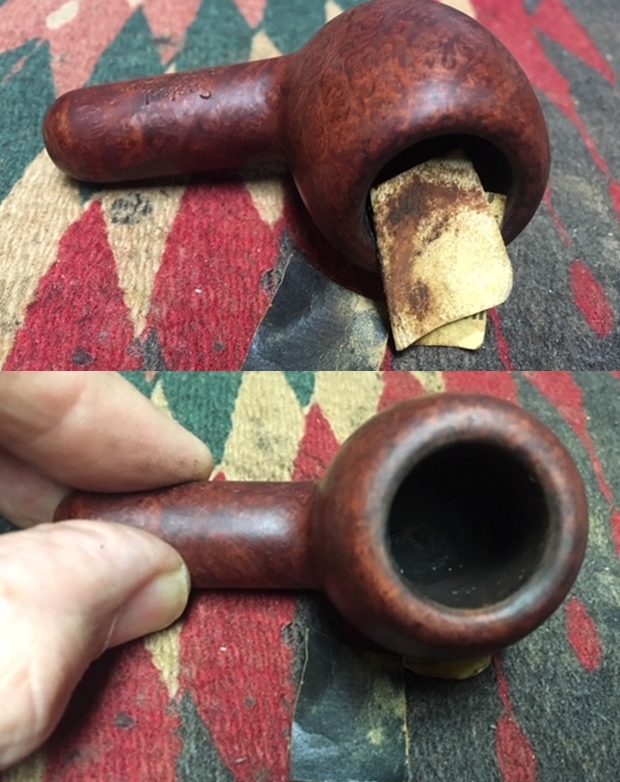
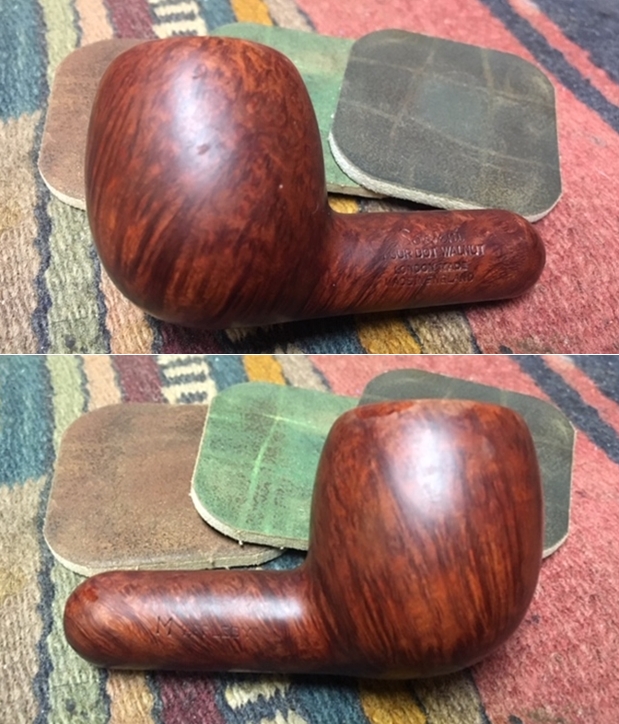
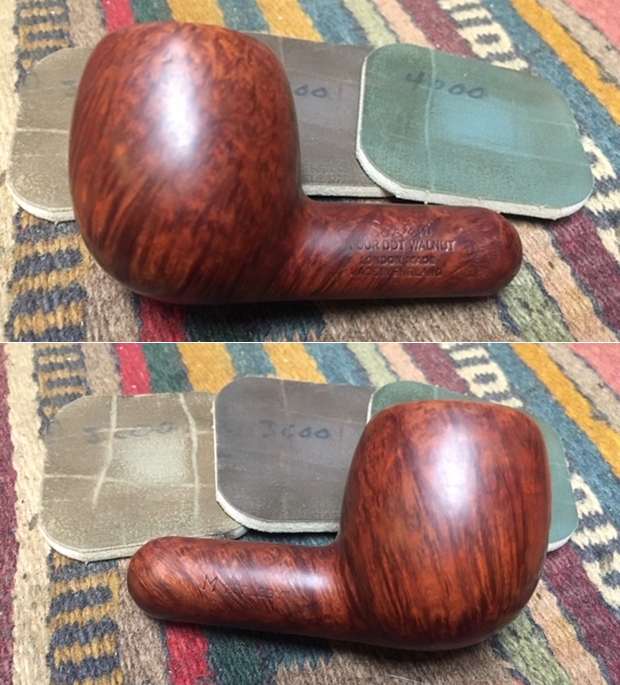
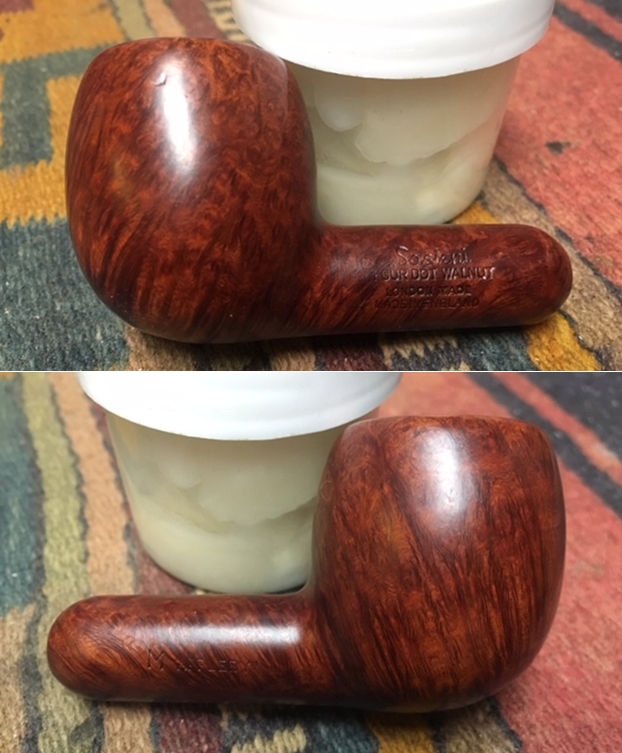
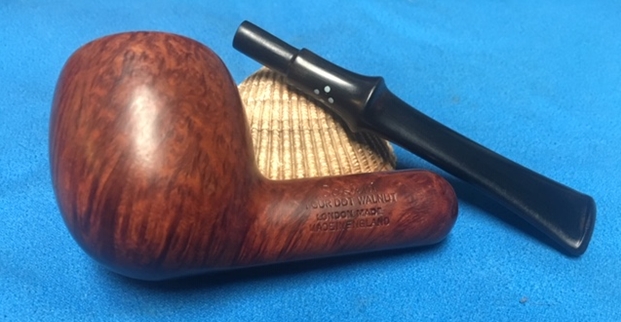
The next pipe I chose to work on from the lot was an interesting Apple shaped Sasieni with a military type bit. The pipe is stamped Sasieni in script over FOUR DOT WALNUT over London Made over Made in England on the left side of the shank. On the right side it is stamped M “APPLEBY”. It has some beautiful flame and straight grain mixed with birdseye grain around the bowl sides and shank. It had a rich reddish brown stain but it was dirty and hard to see the colour well. There was a thick cake in the bowl and it had overflowed with lava was dirty and tired looking. There was some burn marks and lava on the rim top. The stem was badly oxidized with tooth marks and chatter on the top and underside near the button. The button was in excellent condition. There were four blue dots on the left side of the saddle stem. It had been sitting in boxes for a lot of years and it was time to move ahead with the restoration. Jennifer took photos of the pipes she was sending. I have included three she included from this pipe. When the box arrived from Jennifer, Jeff opened it and took photos of each pipe before he started his cleanup work on them. This interesting looking Sasieni with a round rim top and shank end was different from any that I have worked on in years past. This is a classic shape with a twist. The stem is faux military bit that sits tight against the rounded end of the shank. The pipe appeared to be in good condition underneath the grime and oxidation on the bowl and stem. The finish looked intact under the grime. The bowl had a thick cake that had hardened with time. The lava overflow on the rim but it could very well have protected the rim from damage. We won’t know what is under it until Jeff had cleaned it off. The stem was worn looking with a lot of deep oxidation and scratches in the vulcanite on both surfaces. There was some tooth chatter and bite marks on both sides at the button. Jeff took photos of the bowl and rim top to show the cake in the bowl and the lava build up on the edges of the bowl. It was thick and hard but hopefully it had protected the rim and edges from damage. The lava coat looks horrible and it points to a well-used good smoking pipe.Jeff took photos of the sides and heel of the bowl to show the condition of the finish – the grime and grit all over the sides and flat bottom of the bowl. It is a dirty pipe.Jeff took photos of the stamping on the left and the right side of the shank. The stamping was very readable. On the left side of the shank it read Sasieni in script over FOUR DOT WALNUT. Under that it reads London Made over Made in England. On the right side it read M “Appleby”. Jeff took photos of the top and underside of the stem showing the scratching, oxidation and light tooth damage to the stem surface and slight wear to the edges of the button. I looked on the Pipedia website to see if I could get a bit of background information on the Sasieni Four Dot Walnut (https://pipedia.org/wiki/Sasieni). I quote from that site the pertinent information on the brand:

Once Alfred took over the company in 1946, these elements changed in fairly rapid succession. The first thing to be changed was the nomenclature itself. In place of the elaborate “Sasieni” stamp of pre-war pipes, a simpler, though still script style, “Sasieni” was used. This can be seen on patent pipes which have the small, old style dots.

Soon after, Sasieni enlarged the dots themselves, and they formed an equilateral rather than an elongated diamond. My pet theory on this is the dots were enlarged to make up for the fact there were no longer eight of them, but I can’t prove it. Finally the patent number was discontinued, and the words “Four Dot” were added. The shank thus read:

Sasieni

Four Dot

London Made.

Somewhat later still, this was modified to reflect the finish, e.g. Four Dot Walnut, or Four Dot Natural. All these changes seem to have been made in the years between 1946 and 1950. Therefore a pipe with new style dots and old style stamping almost certainly has a replacement stem.

This system changed little if at all in the ensuing thirty years. When the company was sold in 1979, one of the first things the new owners did was to eliminate the town names from the shanks. The dots were enlarged yet further, and the Sasieni name, though still done in script, was larger, as was the rest of the shank nomenclature, which in all other ways was similar to the Pre-Transition nomenclature. While these pipes are not as collectible as the family made pipes, they were made with care and are high quality.

The pipe in my hand is stamped with four lines on the left side. Under the London Made stamp it reads Made in England. The left side could be a town name – M “Appleby”. This would date the pipe being made between 1946 and 1979. Sometime shortly after 1946 the words FOUR DOT were added. That gives a rough time frame for the making of this pipe.

I wrote to Al Jones (upshallfan here on rebornpipes) and asked what he knew about the brand. He sent back this response this morning. He confirms what I had figured out from the Pipedia article. He adds information that I could not find in terms of the M stamp.

That’s a beauty! Four Dot with town name (Appleby), made between 46-79. The Appleby is usually a tapered stem, but the M stamp indicated a military stem, a bit unusual. Great pickup. Four Dot’s have been one of the few pipes that are still currently holding their value… — Al

Now I had the information that I was searching for. The Sasieni that I have is an interesting Four Dot Sasieni with a military stem. Al says it is a bit unusual and I would concur having never seen one like this before. Thanks Al. 

Before I get on to cleaning up the pipe I thought I would once again include the tribute that Jennifer wrote to her Dad for the blog. She also sent some photos and an article that her Dad wrote for Jeff and me to be able to get a feel for him. I have included those below. Note in each of them that he is holding a pipe in his left hand. I asked her to also send me an email with a brief tribute to her Dad. Here is her tribute from an email to me.

Steve, I want to thank you again for accepting my dad’s pipes.  They were so much a part of my dad’s life that I could not simply discard them. But as his daughter, I was not about to take up smoking them either. *laughing* I think my dad would like knowing that they will bring pleasure to others.  I know that I do.

I’m not sure what to say about his pipes. I always remember Daddy smoking pipes and cigars.

First a bit about my dad. Though my father, George Rex Leghorn, was American (growing up in Alaska), he managed to join the Canadian Army at the beginning of WWII, but in doing so lost his American citizenship.  He was fortunate to meet a Canadian recruiting officer who told him the alphabet began with “A” and ended with “Zed” not “Zee”, and also told him to say that he was born in a specific town that had all its records destroyed in a fire.  When the US joined the war my dad, and thousands of other Americans who had made the same choice*(see the link below for the article), were given the opportunity to transfer to the US military, and regain their citizenship.

After WWII, my dad, earned his degree at the University of California Berkeley and became a metallurgist. There is even a bit about him on the internet.

He loved taking the family out for a drive, and he smoked his cigars on those trips. (As a child, those were troubling times for my stomach.)

I most remember my father relaxing in his favorite chair with a science fiction book in one hand and a pipe in the other… Sir Walter Raleigh being his favorite tobacco… and the pipes themselves remind me of him in that contented way.  If I interrupted his repose, he’d look up, with a smile on his face, to answer me.

It seemed he smoked his Briarwood pipes the most, though he had others.  At the time, it was only the Briarwood I knew by name because of its distinctive rough shaped bowl.  And it was the Anderson Free Hand Burl Briar, made in Israel, which I chose for his birthday one year, because I thought he might like that particular texture in his hand.

At least two of his pipes, he inherited from his son-in-law, Joe Marino, a retired medical laboratory researcher (my sister Lesley’s late husband)… the long stemmed Jarl (made in Denmark), and the large, white-bowled, Sherlock Holmes style pipe.  I believe Joe had others that went to my dad, but Lesley was only sure about those two.

The Buescher, corncob pipe my older sister Lesley bought for Daddy while on one of her travels around the States.

A note on the spelling of my sister’s name…

My dad met my mother, Regina, during WWII and they married in Omagh, Ireland.  My mother was English and in the military herself.  The English spelling of Lesley is feminine, and Leslie masculine, in the UK… just the opposite of here in the United States.  I guess my mom won out when it came to the spelling of the name.

I’ll send you photos of my dad soon, along with his WWII experience story.

Jennifer

*https://www.thestar.com/news/world/2013/10/22/the_americans_who_died_for_canada_in_wwii.html

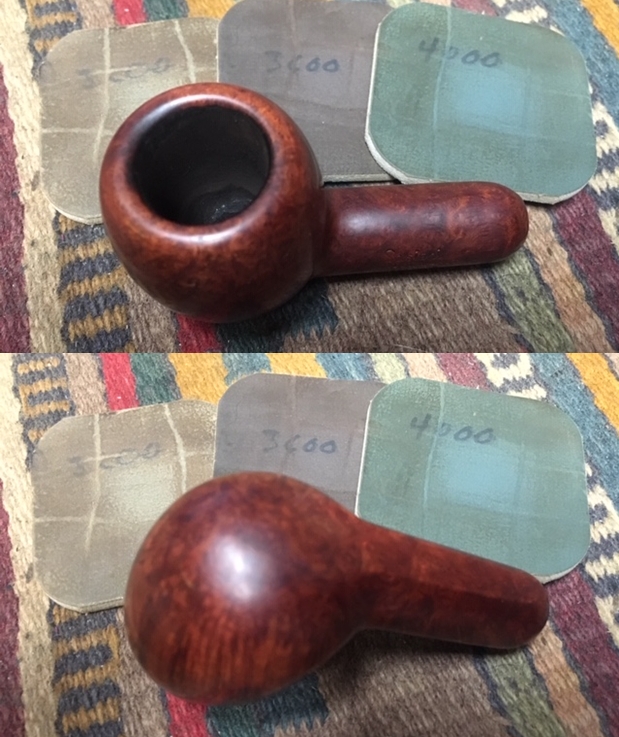
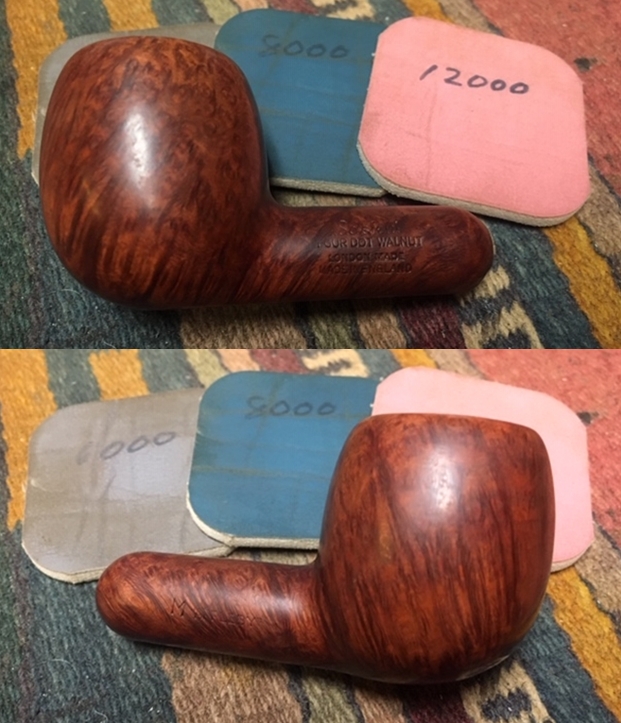
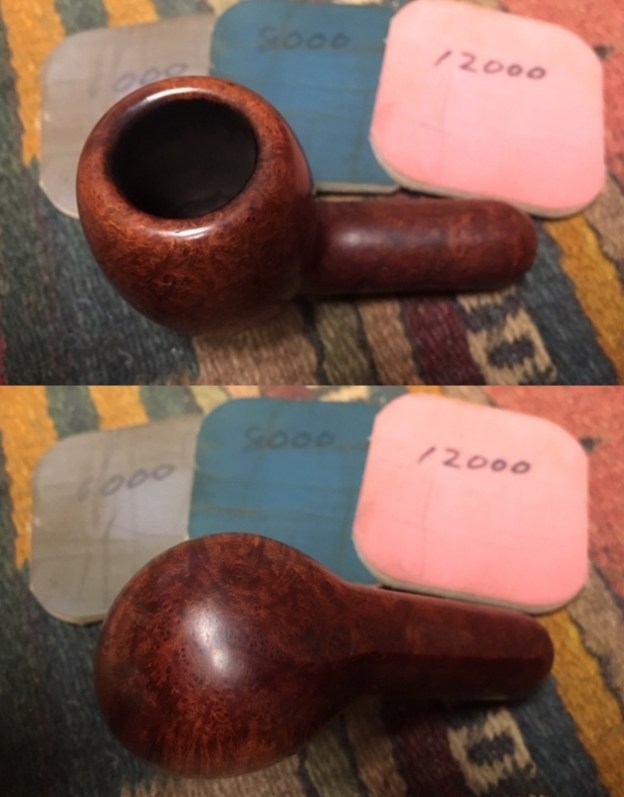
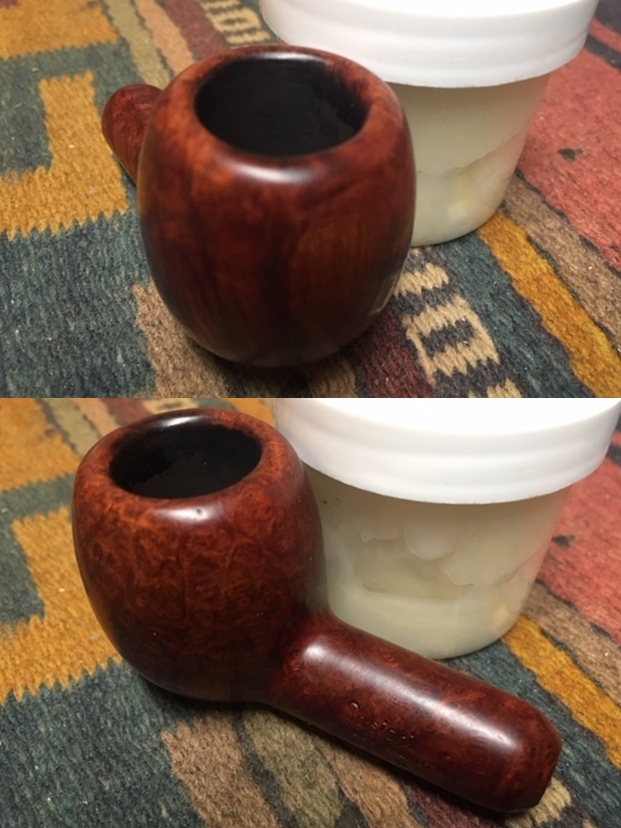
Jeff cleaned the pipe with his usual penchant for thoroughness that I really appreciate. This one was a real mess and I did not know what to expect when I unwrapped it from his box. He reamed it with a PipNet pipe reamer and cleaned up the reaming with a Savinelli Fitsall Pipe Knife. He scrubbed out the internals with alcohol, pipe cleaners and cotton swabs until the pipe was clean. He scrubbed the exterior of the bowl with Murphy’s Oil Soap and a tooth brush to remove the grime and grit on the briar and the lava on the rim top. The finish looks very good with mixed grain around the bowl and shank. There was still some darkening on the front and rear edge of the rim. The briar was rough in those two places. He soaked the stem in Before & After Deoxidizer to remove the oxidation on the rubber. When the pipe arrived here in Vancouver for the second stop of its restoration tour it looked very good. I took photos before I started my part of the work. I took some close up photos of the blackened areas of the rim top and also of the stem surface. I wanted to show what an amazing job Jeff did in the cleanup of the rim top. But I also wanted to clearly show the damage that remained on the surface of the rim top. I also took close up photos of the stem to show the tooth marks and chatter in front of the button on both sides.I also took photos of the stamping on the pipe on the underside of the shank. It read as noted above.The next series of photos show the rim top when we received the pipe (photo 1), after Jeff had cleaned the lava off leaving some damage (photo 2) and my work on it (photos 3-4). I worked over the top and edges of the rim with a folded piece of 220 grit sandpaper followed by a piece of 400 grit wet dry sand paper (photo 3). One I had finished the rim looked very good. I was able to remove much of the damage and leave a clean rim (photo 4). I polished the bowl and rim with micromesh sanding pads. I wet sanded it with 1500-12000 grit pads and wiped it down between pads with a soft cotton cloth. You can see the progress in the shine as you go through the photos. I worked some Before & After Restoration Balm into the finish of the bowl and the rim top with my fingertips to clean, enliven and protect it. I find that the balm really makes the briar come alive again. The contrasts in the layers of stain really made the grain stand out. I let the balm sit for a little while and then buffed with a cotton cloth to raise the shine. The pipe really looks good at this point. I am very happy with the results.  I painted the surface of the stem with the flame of a Bic lighter to raise the tooth marks in the surface of the stem on both sides. I was able to raise some of them but some still remained. I sanded the remaining tooth marks on the stem with 220 grit sandpaper to blend them in and to remove some of the oxidation. I was able to remove much of the damage to the surface. What remained I filled in with clear super glue. I set the stem aside to let the repairs cure. Once the glue had cured I sanded the repairs smooth with 220 grit sandpaper until they were blended in to the surface of the stem. I wiped the stem off with a damp cloth to remove the sanding dust. I put the stem into a bath of Before & After Deoxidizer to let it do its magic on the oxidation that remained deep in the vulcanite. I let it soak for several hours.I took the stem out of the bath and rinsed it in warm water. I blew air through the stem to clear the airway and ran water through it as well. I dried it off with a microfibre cloth and buffed it dry to remove as much remaining oxidation as I could. I ran pipe cleaners and alcohol through the stem to further remove traces of the bath.I took photos of the stem at this point to show its condition.I polished the stem with Denicare Mouthpiece Polish and a cotton pad to scrub off remaining oxidation on the stem surface particularly around the curves. I buffed it with a microfibre cloth to raise a shine and check out the issues remaining.I polished the stem with micromesh sanding pads – wet sanding it with 1500-12000 grit pads. I polished it further with Before & After Pipe Stem Polish – both fine and extra fine. I finished by wiping it down with Obsidian Oil after each pad and set it aside to dry. I put the stem back on the bowl and polished the bowl and stem with Blue Diamond polish on the buffing wheel. I gave the bowl and the stem multiple coats of carnauba wax. I buffed the pipe with a clean buffing pad to raise the shine. I hand buffed it with a microfiber cloth to deepen the shine. The stain and the smooth finish on this briar combine well with the grain. The shine on it makes the variations of colour really pop. The pipe polished up really well. The polished black vulcanite military bit seemed to truly come alive with the buffing. The apple shaped pipe feels great in my hand and when it warms with smoking I think it will be about perfect. It must have been a fine smoking pipe judging from the condition it was when we received it from Jennifer. There should be a lot of life left in this Sasieni Four Dot Walnut “Appleby”. Have a look at it with the photos below. The dimensions are Length: 6 inches, Height: 1 3/4 inches, Outside diameter of the bowl: 1 1/4 inches, Chamber diameter: ¾ of an inch. This is one that will go on the rebornpipes online store shortly. If you want to carry on the pipe trust of George Leghorn let me know. Thank you Jennifer for trusting us with his pipes. Thanks to each of you who are reading this blog. Remember we are not pipe owners, we are pipemen and women who hold our pipes in trust until they pass on into the trust of the next pipeman or woman.

Restoring & Restemming an 1851 Ben Wade Silver Clad Cutty


Blog by Steve Laug

Over the past months in preparation for our trip to visit Paresh and his family in Pune, India we talked about what pipes we would work on while visiting. We had the notion that it would be the first ‘International’ gathering of Pipe Restorers. After all Dal Stanton was coming from Bulgaria, Jeff from US, Paresh and Abha and family from India and I was coming from Canada. It was going to be a grand time of restoring and sharing our tips and processes. I brought along a potential stem for either a meerschaum that Paresh had inherited from his Grandfather or from an early Ben Wade Fancy cutty. In the course of our time there Paresh and I looked over the stem I brought with me and tried it on the meerschaum and the Ben Wade. We chose not to use the stem on the meerschaum and it was too large in diameter for the Ben Wade. We decided that I would bring it home and see what I had in my can of stems.

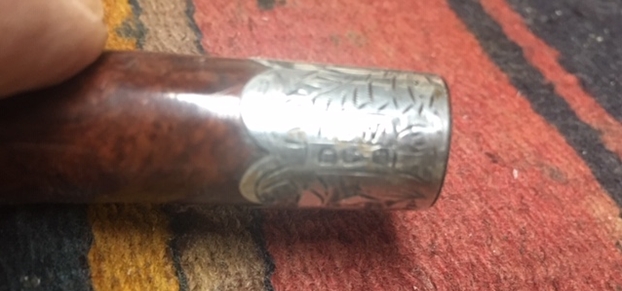
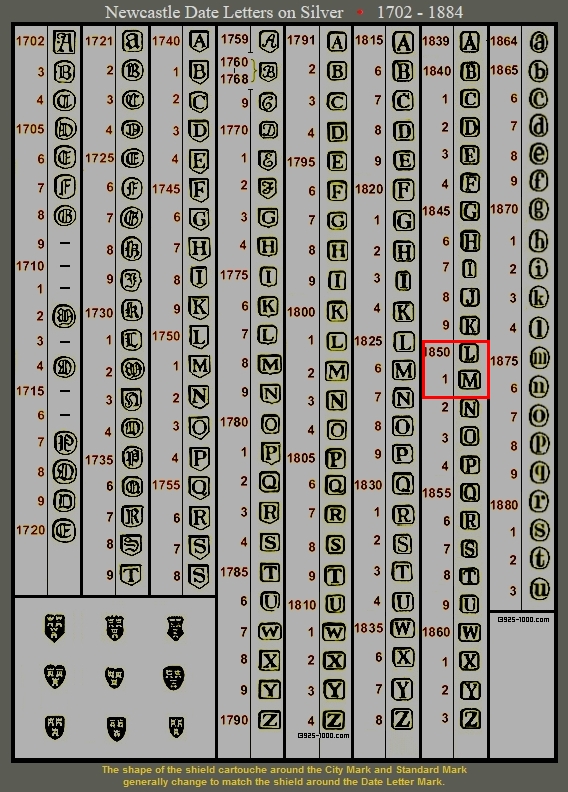
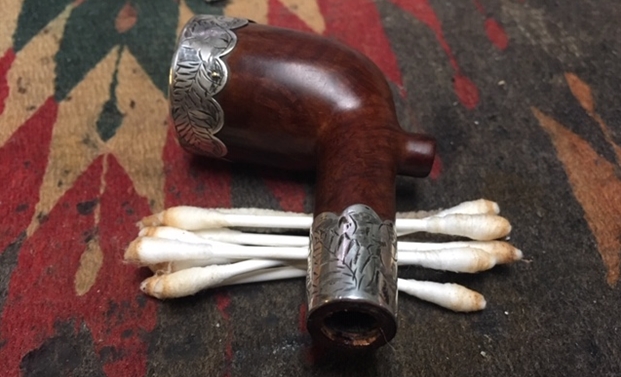
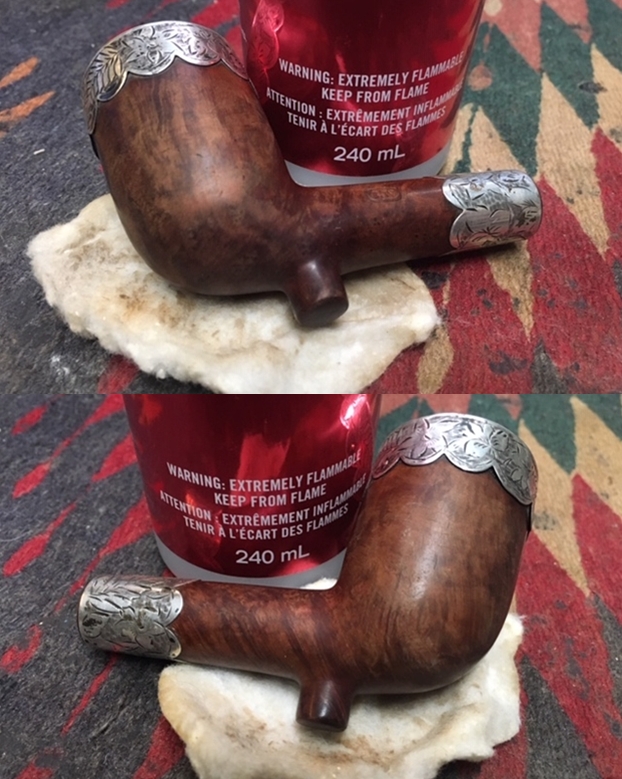
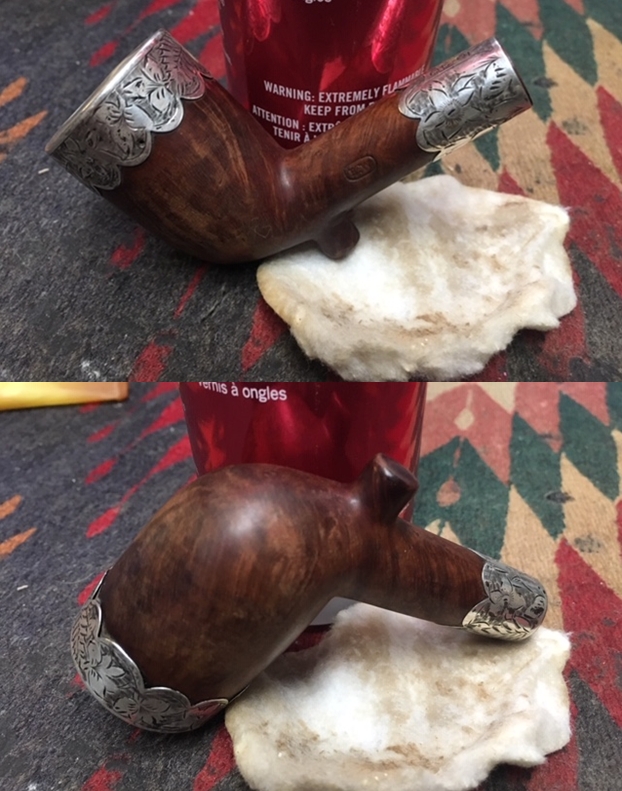
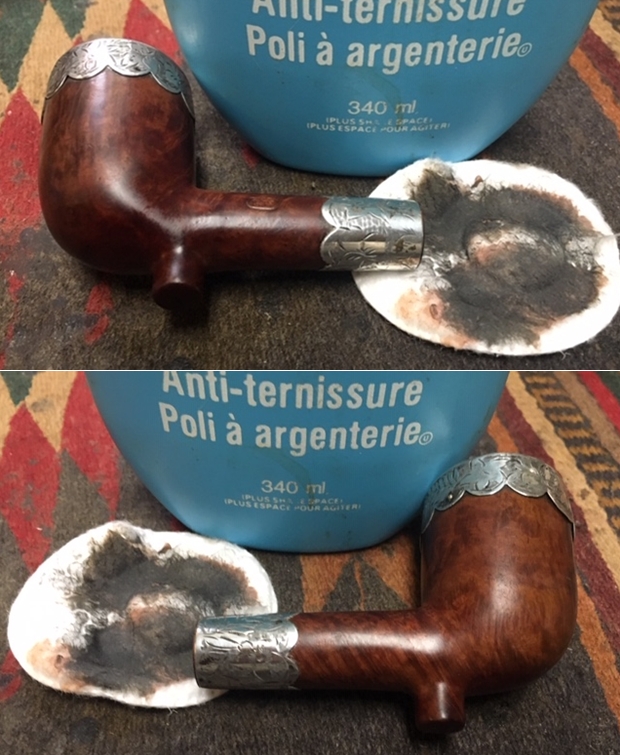
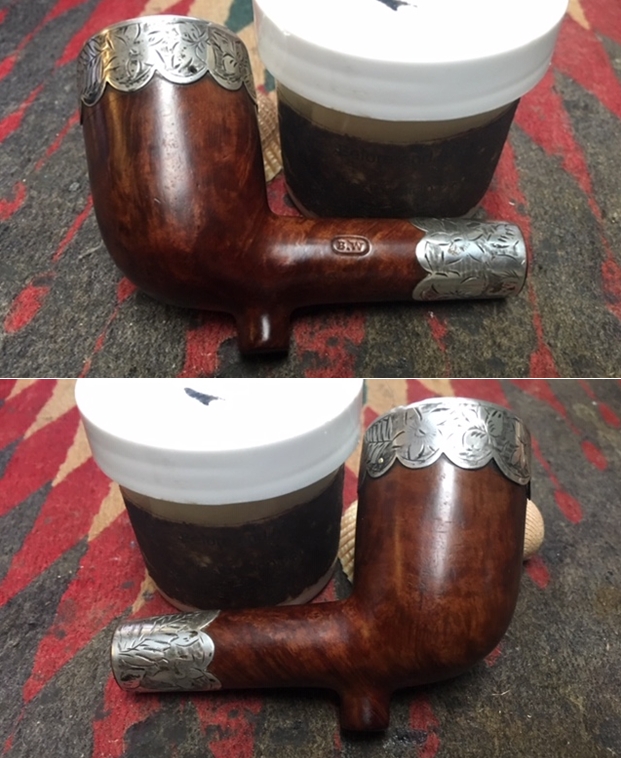
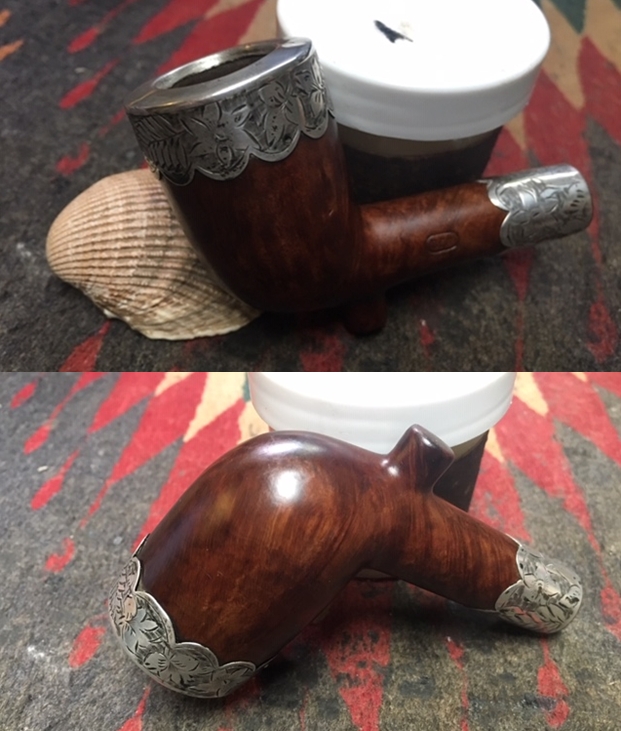
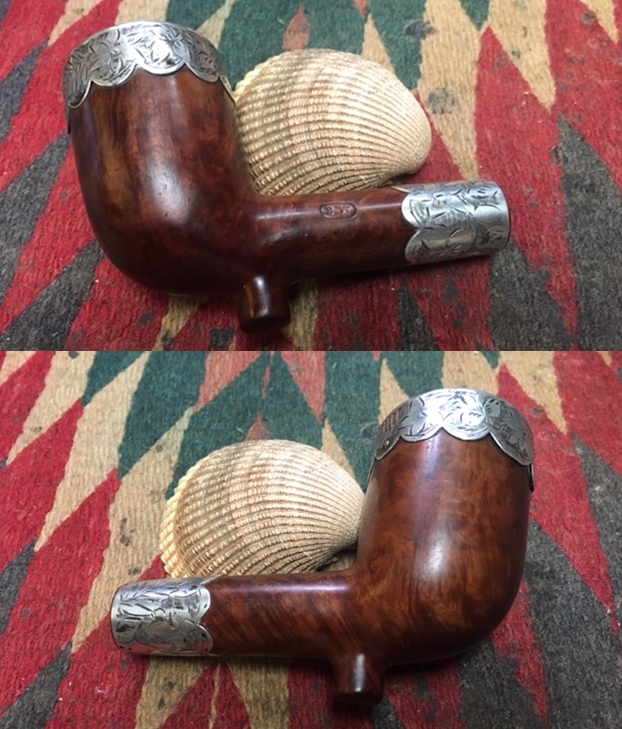
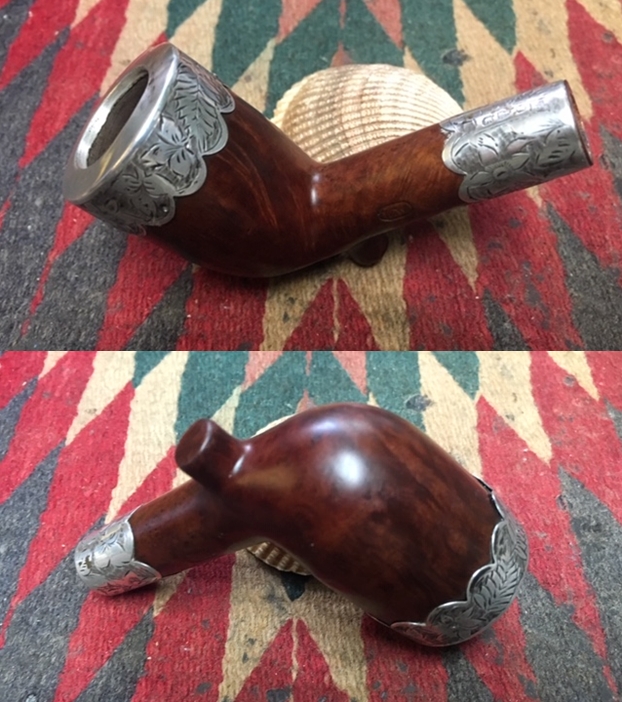
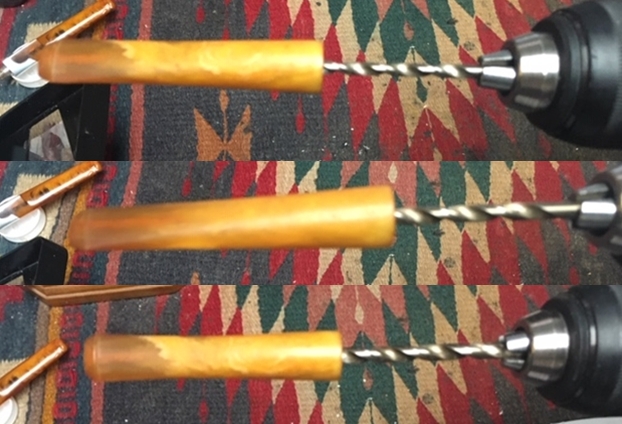
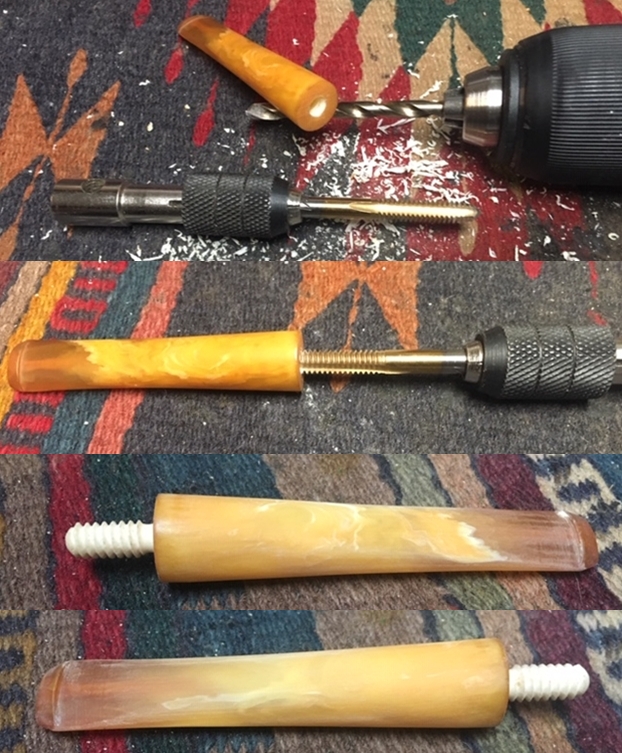
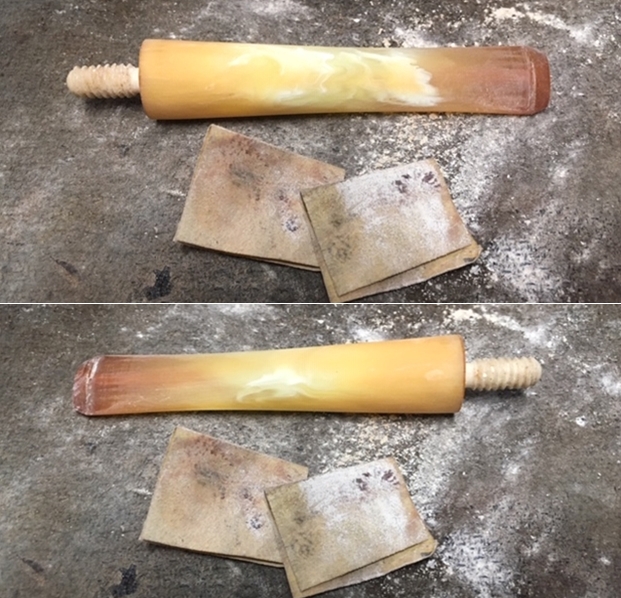
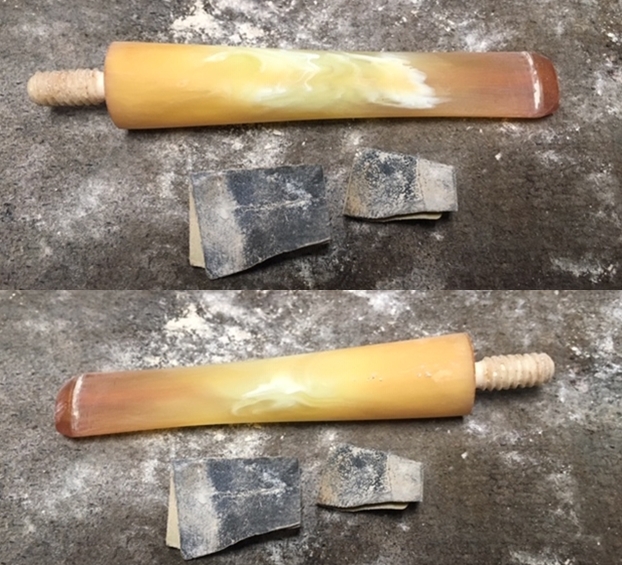
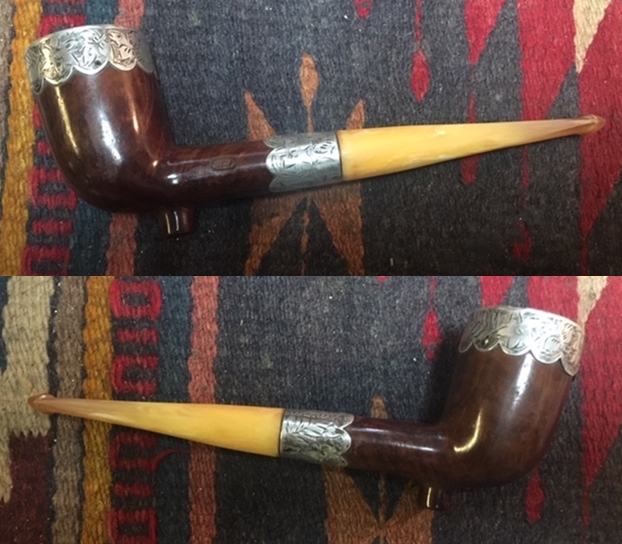
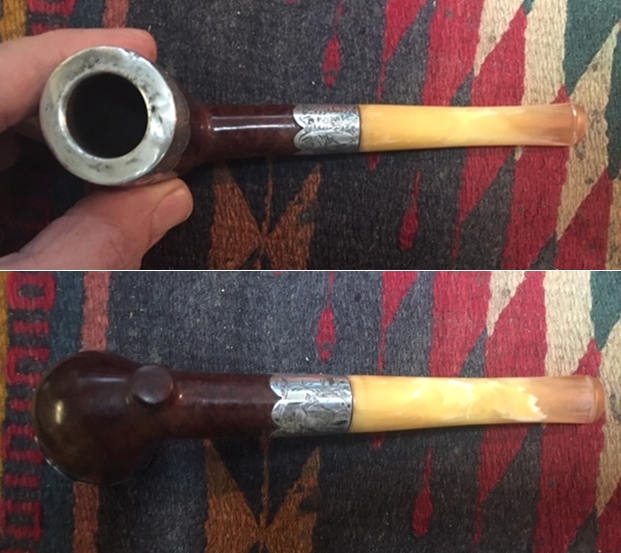
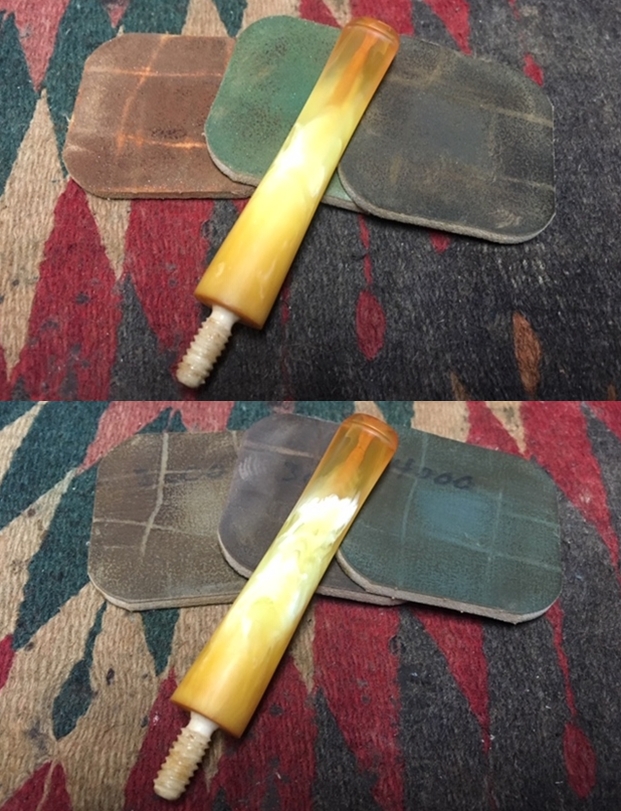
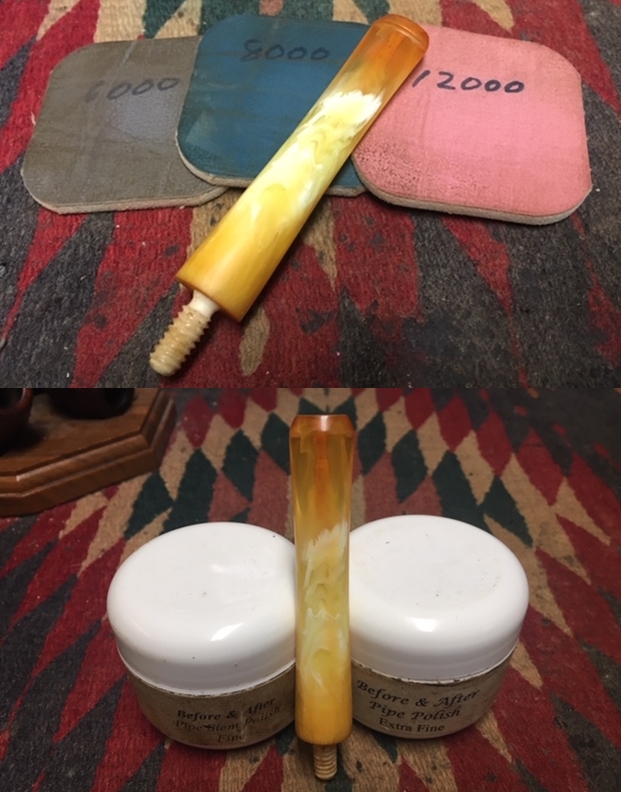
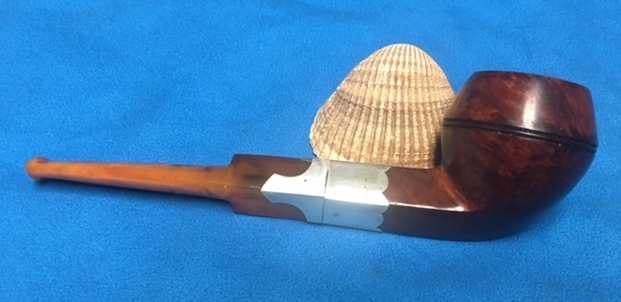
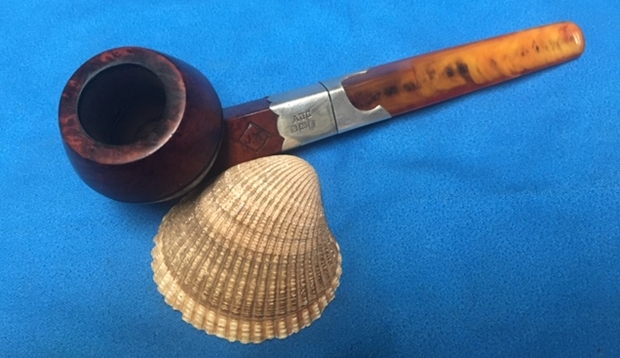
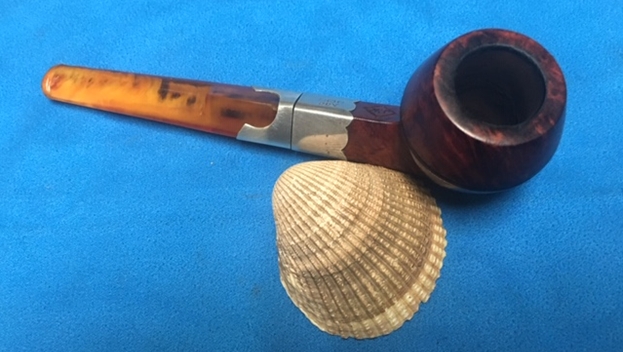
I took photos of the bowl prior to my cleanup and restemming. The pipe came to me with a bone tenon in the mortise. In the process of cleaning the pipe and working to remove the tenon it cracked off in the shank leaving a broken tenon stuck in the shank. Since it was a threaded tenon removing it would be a matter of drilling out the broken portion of the tenon. Other than that the briar was dirty and the varnish finish was spotty. The silver leaves around the rim top and shank end were also tarnished and dirty. There were some dents in the rim top. The shank would have to wait for checking until I removed the broken tenon. The silver shank cap had a series of hallmarks on the top left of the cap. There were three running from the left of the photo to the end of the shank on the right. The first hallmark is a passant lion in a cartouche which signifies that the band is silver and that it was crafted by a British silversmith. The second hallmark was a shield shaped cartouche with three towers in it – two on the wider part of the shield and one below toward the point. This hallmark identifies the city in England where the silver was crafted – in this case Newcastle. The third hallmark was a square cartouche with the capital letter “M” in the box. The “M” is a date letter that will give me the year of the making of the pipe.I turned to a website that I use for dating English silver hallmarks. It is a British Hallmark site that gives the information necessary to interpret the hallmarks on silver items made in Britain (https://www.925-1000.com/dlNewcastle.html). On a chart from silver made in Newcastle from 1702-1884 I found what I was looking for. I have included the chart below with the date letter circled in red.Armed with that information, it was time to start working on the pipe itself. I started by reaming the bowl with a PipNet pipe reamer using the first two cutting heads to take the cake back bare briar. I followed that by cleaning up the reaming with a Savinelli Fitsall Pipe Knife. I sanded the walls of the bowl with a piece of dowel wrapped with 220 grit sandpaper. I sanded the inner edge of the rim with a folded piece of worn 220 grit sandpaper to clean off the silver edge of the cap folded into the bowl. I wanted the walls bare of cake so that I could check the walls for heat fissures or cracking. I cleaned out the inside of the shank and mortise with pipe cleaners, cotton swabs and alcohol until the swabs came out clean. I was quite surprised that the pipe was as clean as it was given its age and the condition of the cake in the bowl.I wiped down the bowl with acetone on cotton pads to clean off the varnish on the outside of the bowl. I scrubbed it until the finish was natural briar and the grain began to come to the surface of the bowl. I cleaned the tarnish on the silver rim top cap and the shank end cap with a tarnish remover and silver polish. I removed darkening in the carved leaves and flowers on the silver. I scrubbed the silver with a cotton pad to remove the tarnish. I worked some Before & After Restoration Balm into finish of the briar with my fingertips to clean, enliven and protect it. I let the balm sit for a little while and then buffed with a cotton cloth to raise the shine. The Restoration Balm really makes the grain stands out beautifully.  I buffed the bowl with a microfiber cloth to raise a shine on the bowl and the silver. I took photos of the pipe bowl as it stood at this point in the restoration process. It is a beautiful pipe with an elegance that speaks of the years in which it was manufactured.  I set the stem aside and worked on the stem that I had chosen for a replacement. The amber colour and the flow of the colour in the stem make it a great candidate for an amber look alike replacement stem. Once the airway was drilled the diameter of the replacement tenon I used a tap to cut new threads in the airway of the stem to receive new tenon. I threaded the new tenon into the tapped airway in the stem and took photos at this point in the process. I glued the tenon in the stem with clear super glue and let the glue set. Once it had cured I sanded the stem surface with 220 grit sandpaper to smooth out the new stem. I followed that by sanding the stem with 400 grit sandpaper to smooth out the scratches in the surface of the stem. I turned the stem onto the shank to get a feel for what the pipe would look like when it was completed. The following photos show the look of the finished pipe. I still need to polish the stem with micromesh sanding pads and buff it to raise the shine. But I like the way the pipe is beginning to look.  I polished the stem with micromesh sanding pads – wetsanding it with 1500-2400 grit pads and dry sanding it with 3200-12000 grit pads. I wiped the stem down with Obsidian Oil after each pad. I polished it with Before & After Pipe Polish – both Fine and Extra Fine and gave it a final coat and set it aside to dry.  I carefully buffed the pipe bowl with Blue Diamond polish on the buffing wheel. I lightly buffed the stem with Blue Diamond to raise a shine. I gave the bowl and stem multiple coats of carnauba wax and buffed it with a clean buffing wheel to raise the shine. I polished the silver rim top cap and the band with a jeweler’s cloth once more, then hand buffed the entire pipe with a microfiber cloth to deepen the shine. This 168+ year old restemmed and restored Ben Wade Cutty is really a beautiful pipe. The grain really stands out with a combination of birdseye, cross grain and swirls surrounding the bowl give it a rich look. The rich contrasting brown stains makes the grain stand out against the silver adornments. It is a proportionally well carved pipe. The polished black acrylic stem had a rich glow. The finished pipe is a beautiful straight Cutty that feels good in the hand and the mouth. Have a look at it with the photos below. The dimensions are Length: 6 inches, Height: 2 inches, Outside diameter of the bowl: 1 1/4 inches, Chamber diameter: ¾ of an inch. This pipe will be going back to Paresh in Pune, India very soon. I am excited to hear what he thinks of this beauty. Thanks for walking through the restoration and restemming with me as it was a pleasure to work on.

Restoring a Cased 1906 JW Straight Shank, Amber Stemmed Bulldog


Blog by Steve Laug

It seemed to have been a time for taking a look at unique pipes. Before I left for my work trip to Nepal and India I received another email from a reader of the blog in Australia regarding an old 1906 pipe that had purchased. I am including a series of emails here at the beginning of this blog for the information that he included.

Steve, I saw (only photos) of an antique pipe – briar bulldog from 1906, with sterling silver mount and amber stem. It looked in good condition – bowl needed reaming and cleaning. I have asked for more photos of the amber stem. Would you be able to restore the pipe for me if I do go ahead with the purchase.

Best Regards, Ray

I wrote him back and in the course of our conversation via email I decided to take on this unique restoration if indeed he purchased it. He immediately sent several more emails about the pipe giving me more information and convincing me even more of the need to take on this project.

Hi Steve, Thanks for offering to make an exception and to help out with the restoration. I will send photos of the pipe if I decide to go ahead with the purchase. I have really enjoyed reading your (and the other guests’) articles on pipe restoration.

There is a sense of wonderment seeing these black/darkened objects with caked bowls reveal their lovely grain and colour – like old paintings restored to their original colours… 

If we do go ahead, please understand I am in NO HURRY for this job to get done – you will be doing me a HUGE favour. I’ll keep you posted.

Best Regards, Ray

After that email a few weeks went by and I received another email from Ray letting me know that he purchased the pipe and had received it. He included some photos of the pipe.

Hi Steve, I received the pipe today – Here are some photos. It seems in pretty decent shape – bowl needs reaming and rim needs cleaning. There are a few minor issues with the bowl and shank. The amber stem has some chatter and a rather small area next to the silver mount needing a “fill”. The case is in better shape than I thought from the photos I saw, and my contacts should be able to advise me on how to restore it.

I don’t want a “new” look – it is over 100 years old, and I’m happy for it to reflect its age. I will be posting the pipe to you in the next few days. Please ask if you have any queries or need more photos… My thanks, in advance,

Ray

The pipe arrived in Vancouver just a few days before I left for my trip. I looked it over and wrote to Ray about what I thought I needed to do. He responded that he was looking forward to seeing what I could do with it.

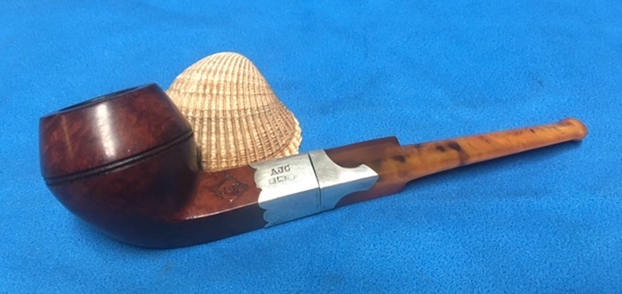
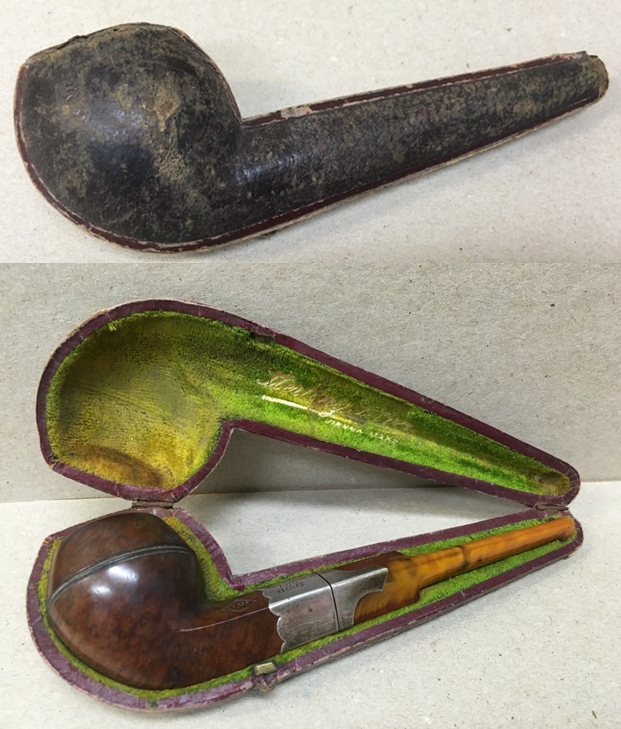
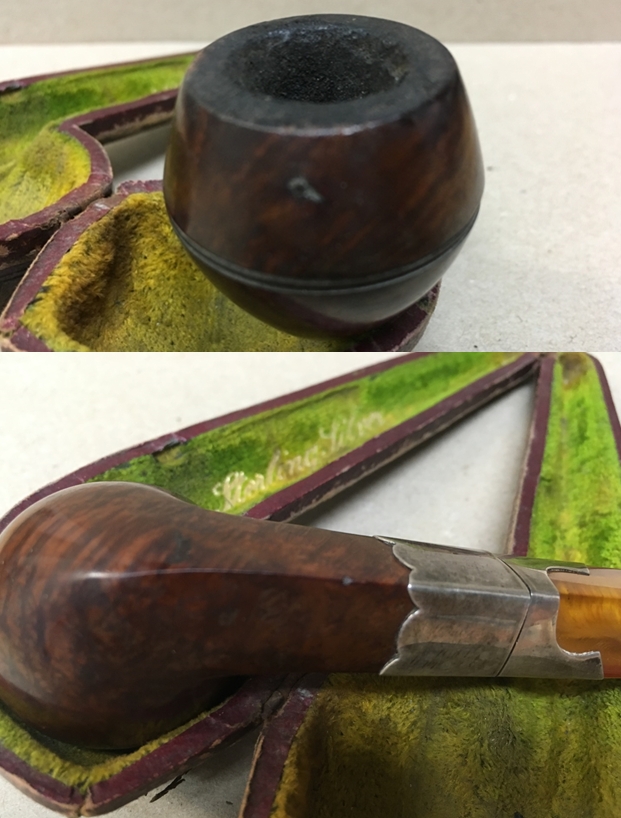
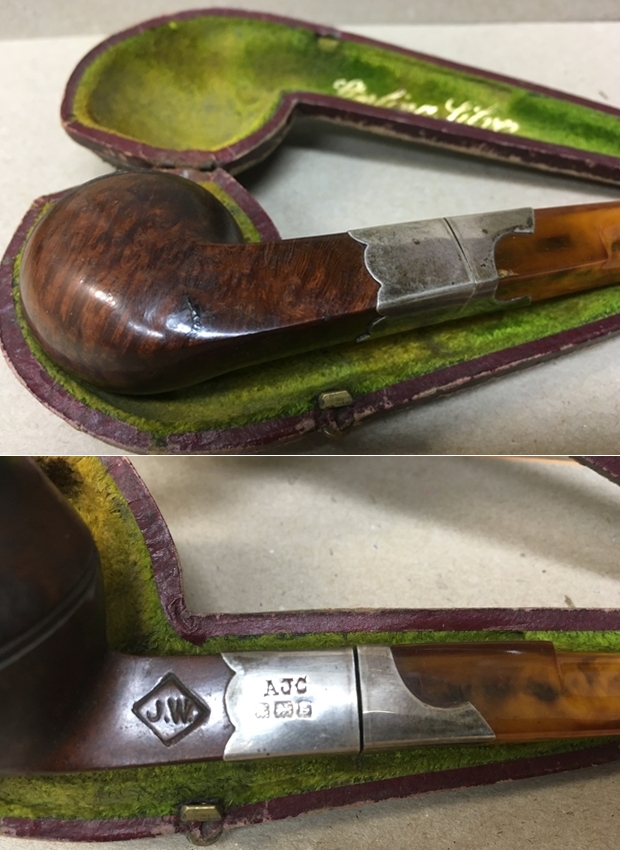
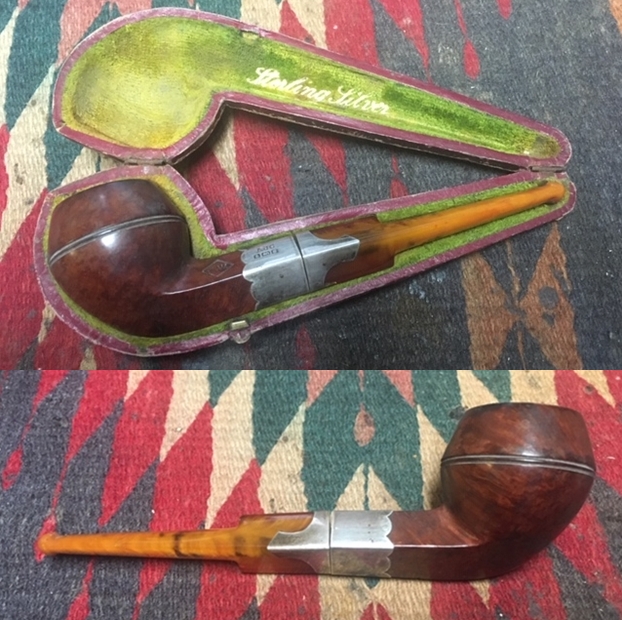
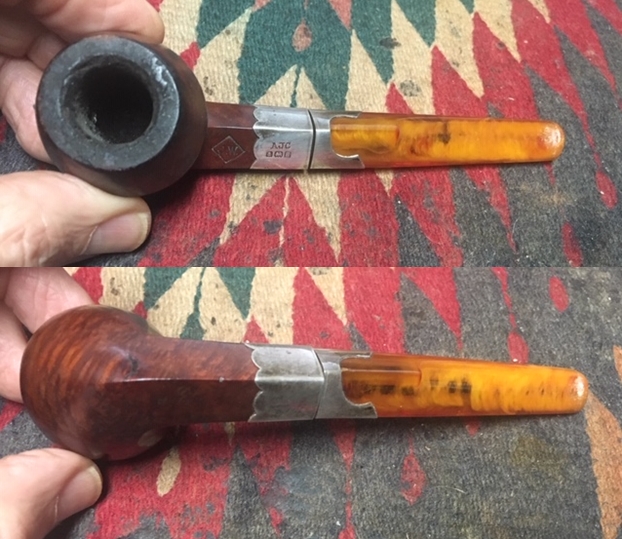
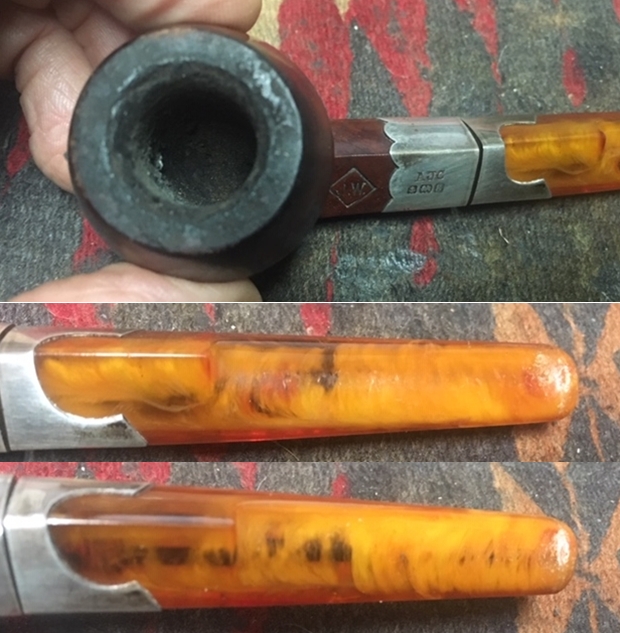
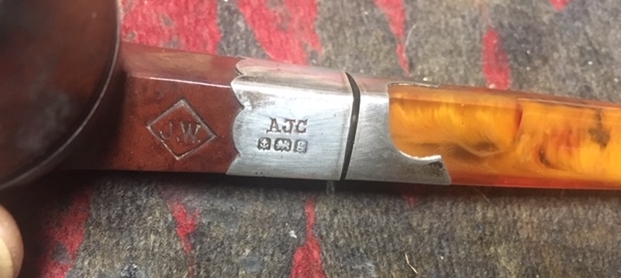
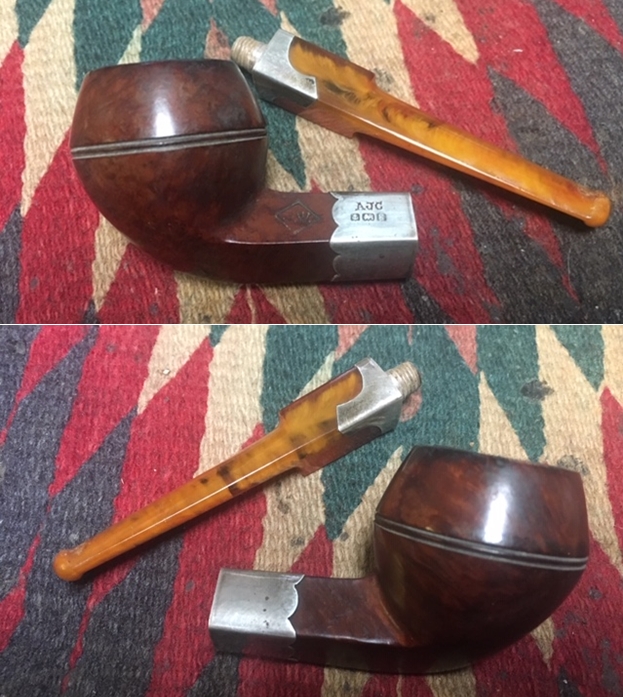
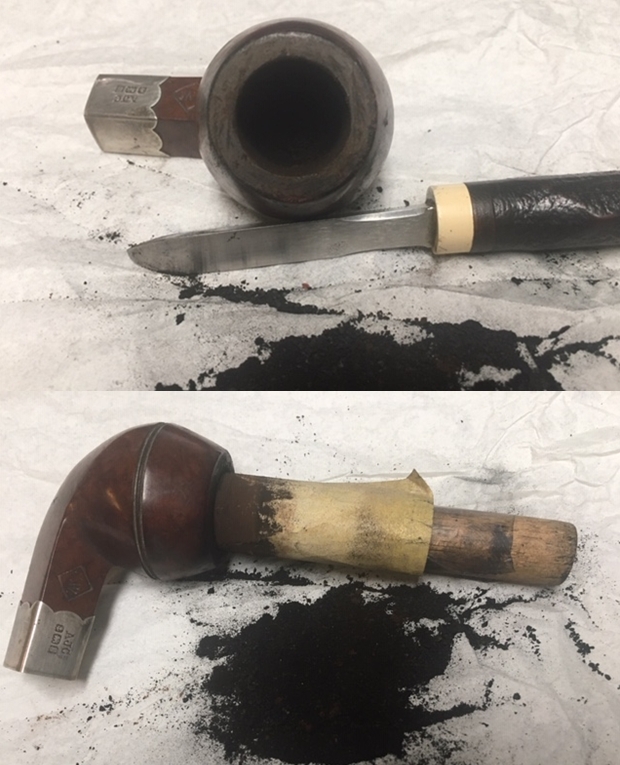
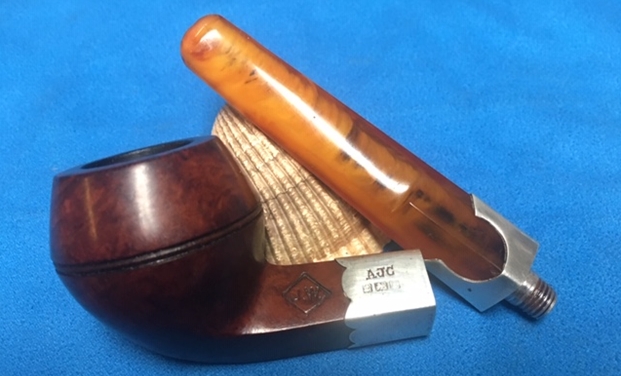
I have included the pictures Ray sent me below. For me they only added to the temptation to do the restoration on this old timer. Even though I have a huge backlog of pipes this one was very intriguing to me. There was something interesting and even compelling about this old pipe. The age and condition interested me as did the brand. I am unfamiliar with the maker of the pipe but it spoke to me. The case was leather and though in somewhat rough condition it had protected the pipe well. The inside lining on the top of the case read “Sterling Silver” over “Vienna Make”. There was no other makers name or markings on the case to help with the identification. Ray included close up photos of the bowl and rim top. It showed clearly that the bowl had a thick cake with a thick overflow of lava on the rim top. The amber stem was in decent condition though there were some deep tooth marks in the surface ahead of the button on both the top and underside.Ray also included the following photos of the bowl from various angles. The first shows the front of the bowl with a deep nick in briar. The second photo shows a small nick in the briar just ahead of the silver shank cap. The third photo shows a deep nick on the left side of the heel of the bowl. The fourth photo shows the stamping on the left side of the shank and band. The week I returned from Nepal and India I decided to start working on this old pipe. I figure it is a good week to start on this 1906 and also the 1919 AGE pipe. The bowl had some deep nicks and dings in the finish that Roy had photographed clearly. The exterior of the pipe was dirty with grime and grit rubbed into the surface of the finish as well as in the twin rings around the bowl cap. The silver band was tarnished and dirty but the stamping and hallmarks were quite readable. The rim top was thickly lava coated. The inner edge of the bowl looked very good. The stamping on the left side of the shank was readable. It read J.W. in a Diamond. The silver band was also stamped and read AJC. There were also hallmarks under the AJC stamp as shown in the photo above. The stem sat well in the shank. The stem had some tooth marks in front of the button on both sides as Roy had shown in the photos. The silver cap on the end of the stem was tarnished by otherwise clean. I took close up photos of the bowl and rim as well as the stem to show the condition of the pipe when it arrived. You can see the thick cake in the bowl and the lava on top and inner edge. The oxidation on the silver band and the tooth damage to the stem and button edges on both sides of the stem. I also took a photo of the shank and the band to show the stampings in the silver. I took a photo of the stem removed from the shank to show the condition of the metal tenon. The pipe has a very unique metal mortise lining and tenon that are part of the silver shank and stem cap. The mortise and tenon were both very dirty but the alignment was fine.I received another email from Ray in Australia – seems that we were both doing research on the brand to try and figure out the purveyance. Here is his email and the information that he included regarding the brand.

Steve, I’ve been trying to research the origin of the pipe. The case has “Vienna Made”  – does this refer to the case or the pipe? There are 2 marks on the shank. “AJC” on the silver mount very likely is the mark of Alfred Walter Cheshire of Birmingham. He registered his mark in 1893/4, so the date ties in. “JW” on the shank – I can’t find a pipemaker with those initials either in Vienna, Austria, Birmingham or the UK.

However, there is a pipe mounter JF Walter of Birmingham working from 1890’s – could “JW” refer to him, or am I barking up the wrong tree?

I marvel (all the time) at the historical information you manage to uncover on the pipes/pipemakers/pipe merchants you restore. Perhaps you may have access to further archival information on the possible maker of this pipe.

Cheers, Ray

With Ray’s work behind me, I checked my usual sources on I found absolutely no information on the AGE brand. There was no info on the Pipedia website or on the Pipephil site on the brand. I also checked on Who Made That Pipe by Wilczak and Colwell. There was no information there on the brand either. So my usual sources came up with nothing. Now I needed to confirm the information that Ray had found.

I turned first to a website on English silver marks. I was specifically looking for information on the A.J.C. stamp on the silver to help identify the silversmith. I did a screen capture of the section on the A.J.C. stamp matching the one on the silver band on the pipe in question. Here is the link to the website: http://www.silvercollection.it/englishsilvermarksXA2.html. It identifies the AJC as Alfred James Chesire rather than Alfred Walter Chesire as noted by Ray. There is also an address for the silversmith in Birmingham, England.As Ray noted above, there was no pipe maker in Birmingham with the JW in a diamond as a mark. The shank mark did not tell me much. However, his find on JF Walter a Birmingham pipemounter is certainly a good possibility.

Now it was time to try to figure out the date of the pipe from the hallmarks on the band. I examined them with a lens and found the following information. The first hallmark was an Anchor in a shield signifying that the silversmithing was in Birmingham, England. The second hallmark was a lion passant in a shield. The emblem connects the pipe to London as well as other British assay offices. It also identifies the band as being silver. The third hallmark was the leter”g” in a shield that would give the date of the pipe.

I knew now that the pipe was London Made with a silver hallmark identifying a London silversmith identified by the A.J.C. stamp noted above as Alfred James Cheshire. The only thing left to fully learn about the pipe from the stamp was the date to be determined from the “g” stamp.

I turned to a website that I regularly use to identify the dates on English made hallmarks. The link is: http://www.silvercollection.it/englishsilverhallmarksBIR.html.The screen capture of the chart below shows the dates and letter marks from 1900-1917.

Ray had correctly identified the date of the pipe as being made in 1906 confirmed by the chart on the left. I always love when the pieces all come together and I can arrive at both a manufacturer and a date for the pipe.

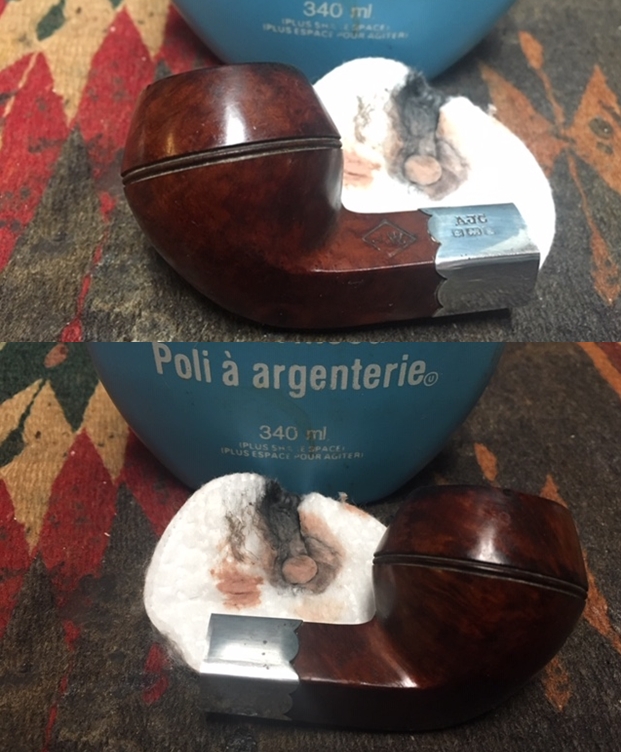
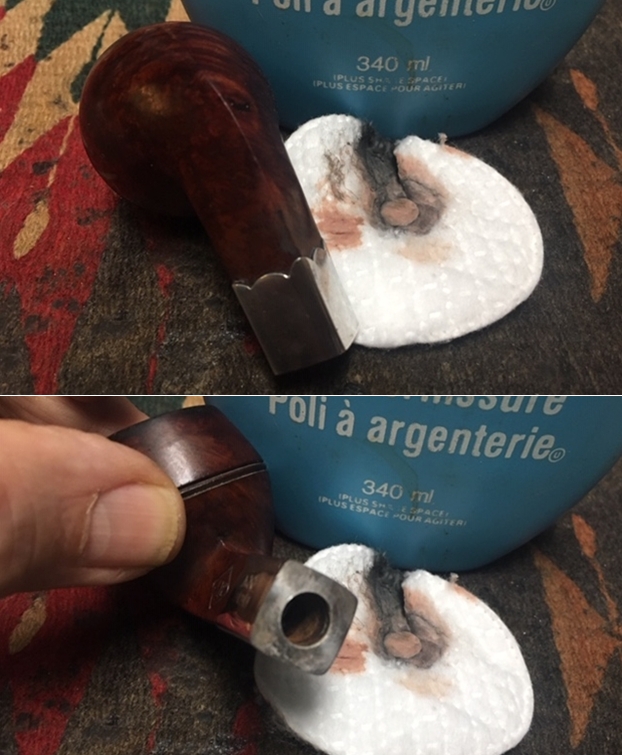
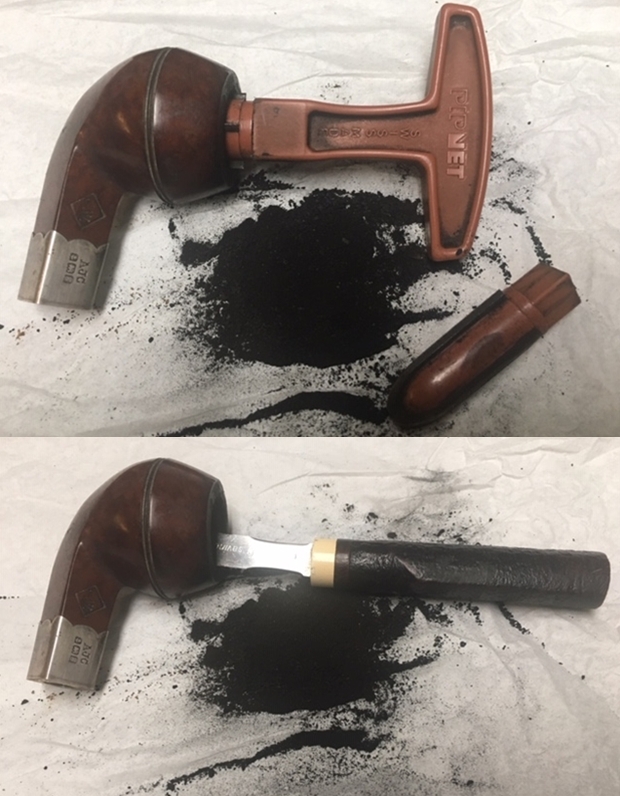
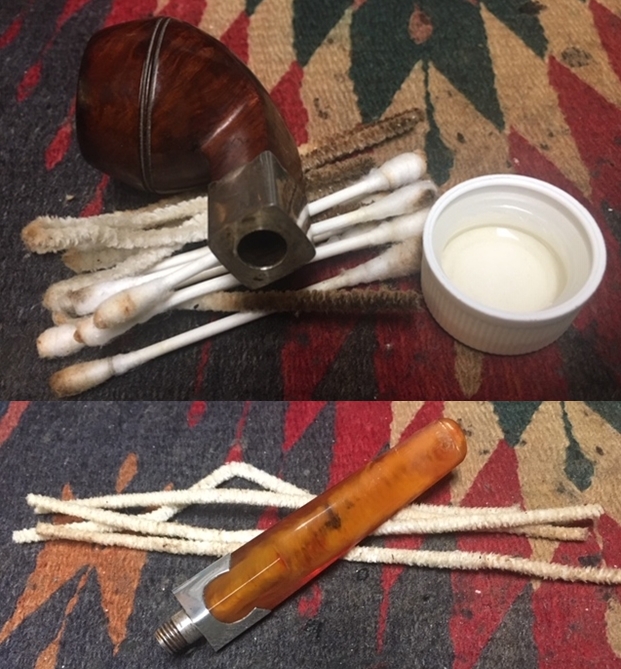
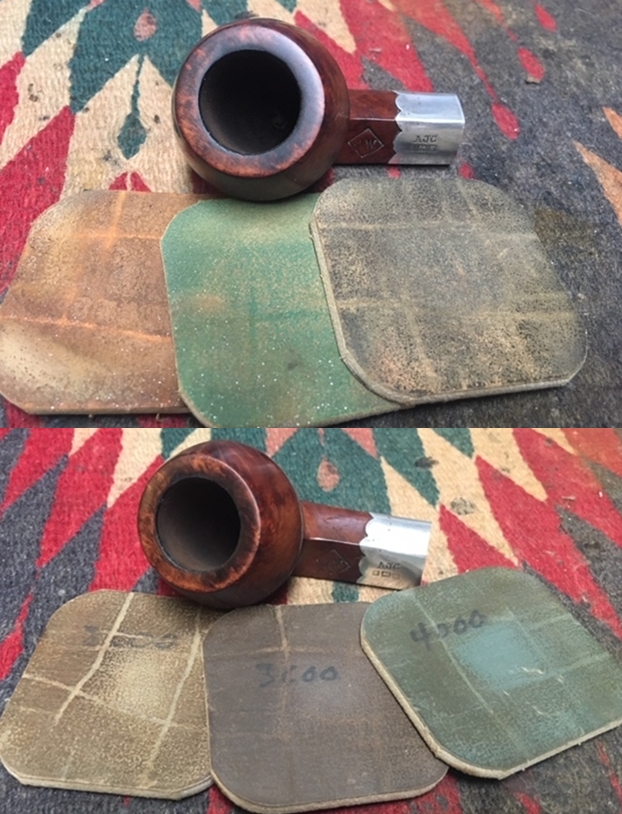
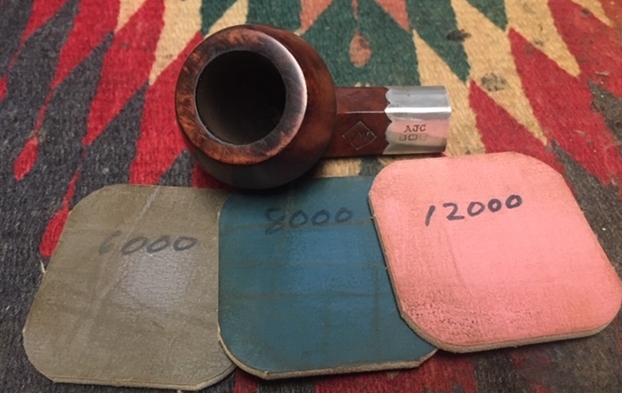
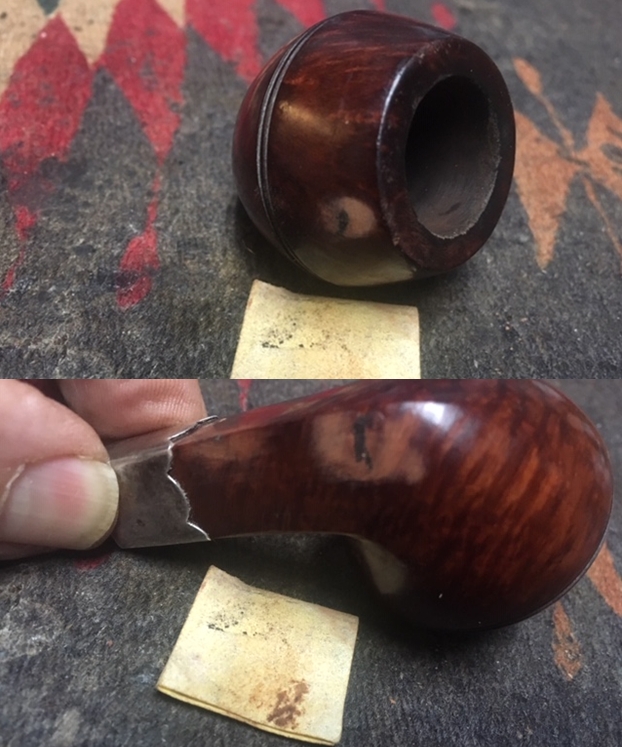
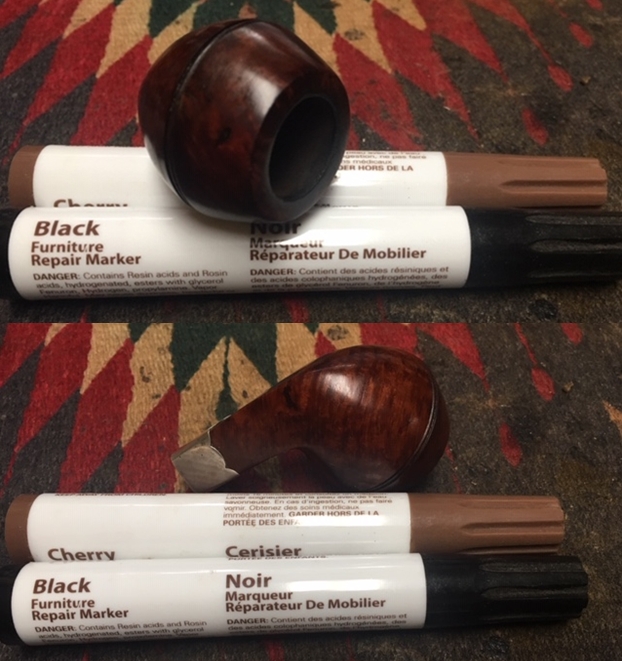
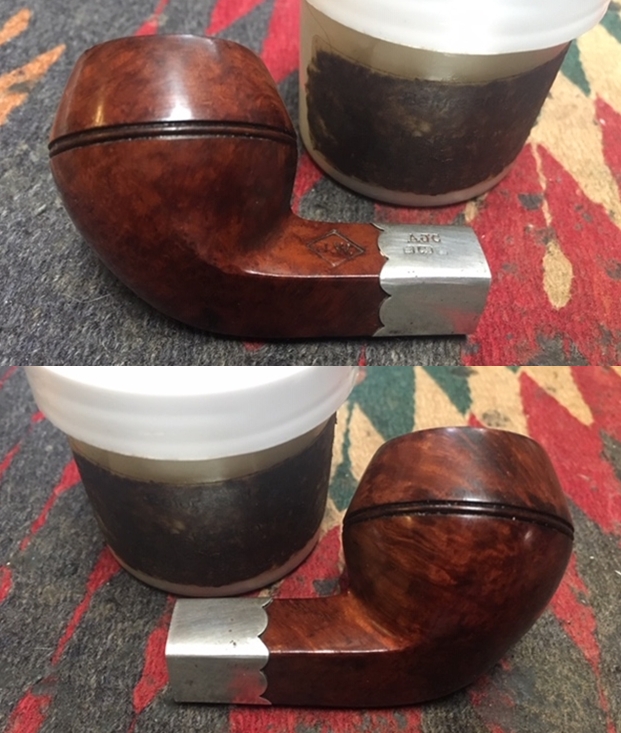
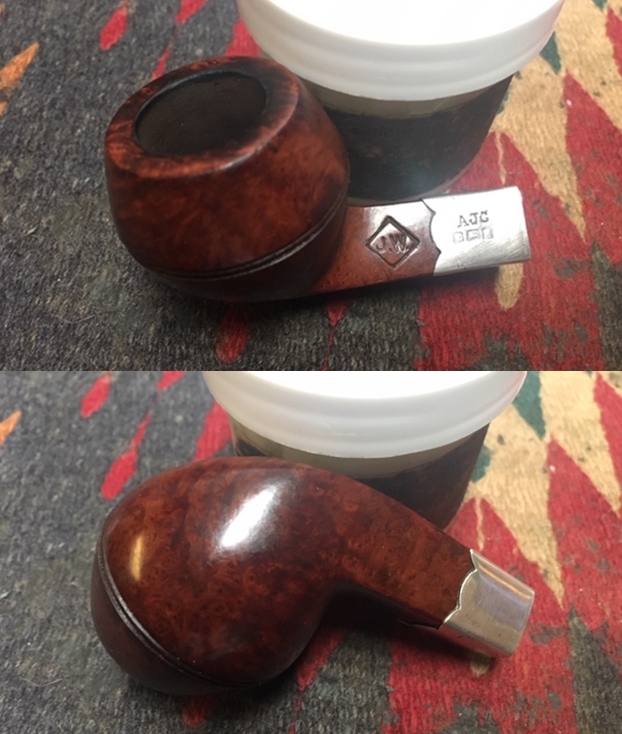
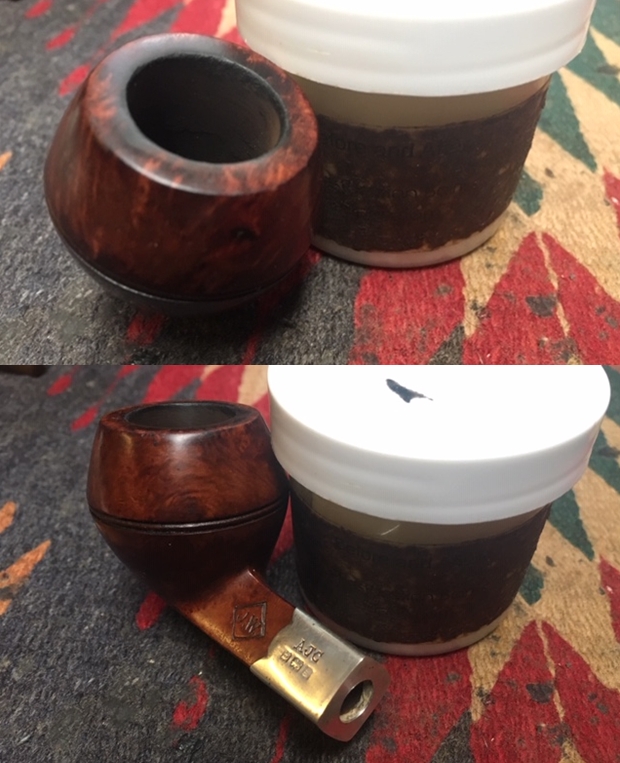
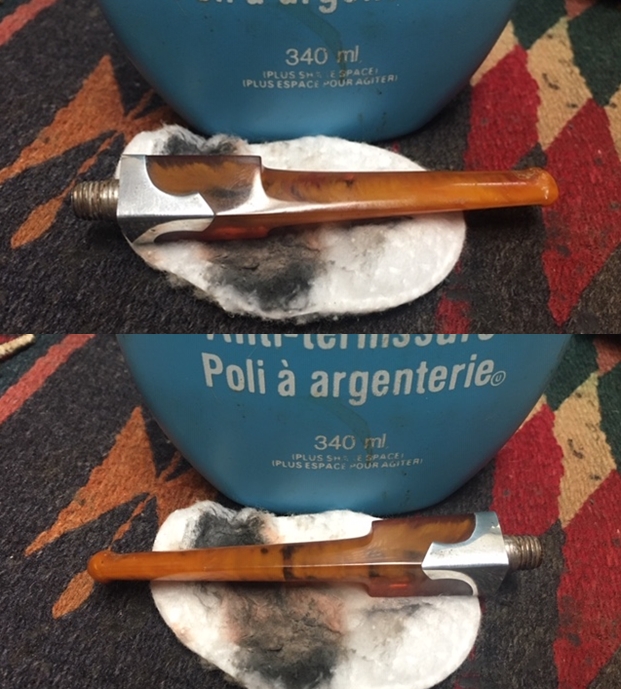
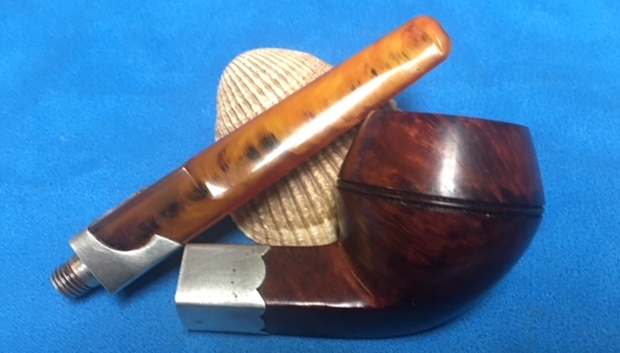
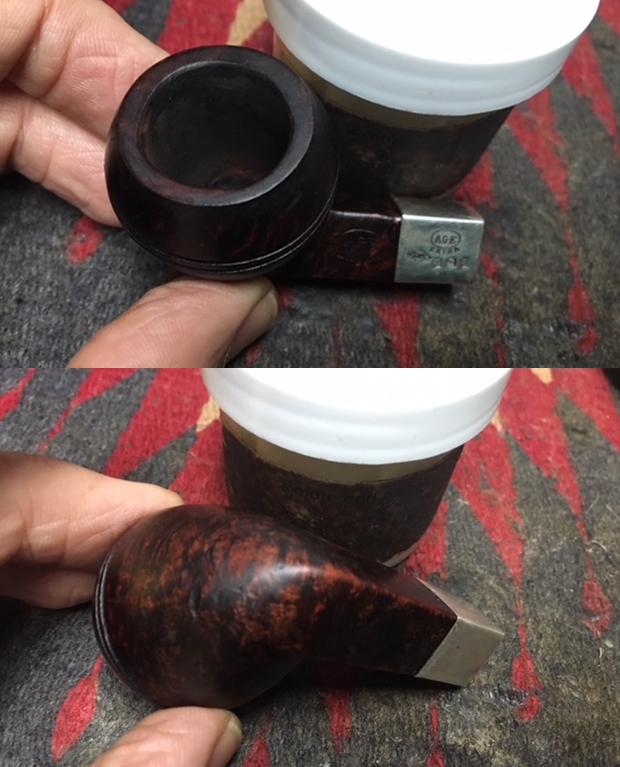
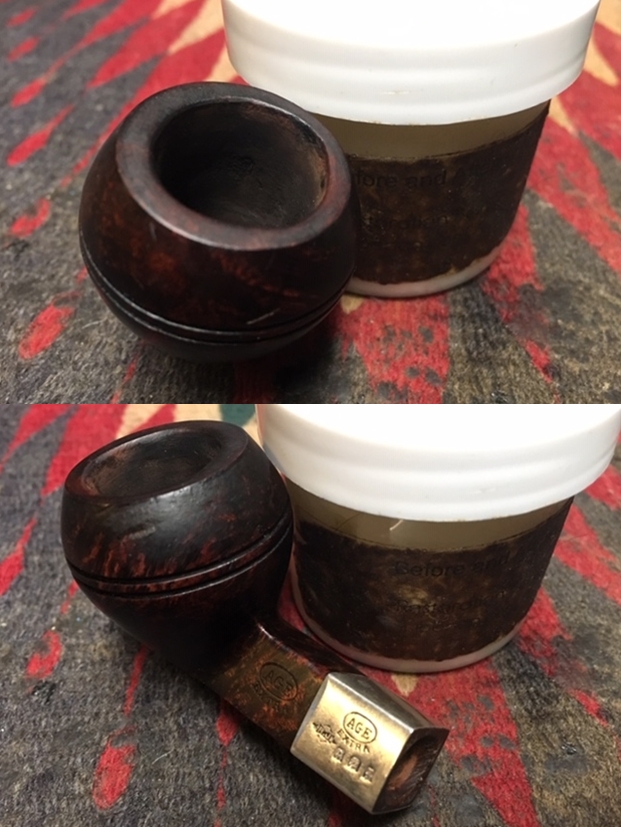
Armed with this information I turned to work on the pipe. I started by cleaning up the silver with silver polish to remove the tarnish from the shank end. I rubbed the material on the shank ferrule/band and polished it with a cotton pad to remove both the tarnish and polish the silver. I reamed out the bowl with a PipNet pipe reamer using the first two cutting heads to remove the cake. I wanted to see the inside of the bowl to check on damage to the internals of the chamber. I cleaned up the remnants of cake and scraped the rim top with a Savinelli Fitsall knife and then sanded the bowl insides with sandpaper on a dowel. Afterwards I examined the bowl and could see that the walls were solid and that inner edge of the bowl was in excellent condition. I cleaned the internals of the pipe and the stem with pipe cleaners, cotton swabs and alcohol to remove the debris inside the metal mortise insert. I scraped the mortise walls with a dental spatula to remove the tars that had hardened on the walls. To deal with the darkened and damaged rim top I polished it with 400 grit wet dry sandpaper and polished it with micromesh sanding pads – wetsanding with 1500-12000 grit pads as suggested by Paresh on my recent trip to Pune, India. I have to say that is working very well. I wanted to polish out the scratches so that I could work on matching the stain on the rest of the pipe and finish that portion of the restoration. I cleaned out the damaged areas on the front of the bowl cap and on the left underside of the shank. I filled in the areas with a drop of clear superglue. When the repairs had cured I used a needle file to smooth out the repaired areas. I worked on them until they were smoothed out and close to the surface of the surrounding briar. I followed that by sanding the repaired areas with 220 grit sandpaper to smooth them out and blend them into the briar. I used a reddish, brown (Cherry) and black stain pen to blend a stain to match the colour of the rest of the bowl. I rubbed it into the surface of the repaired areas on the front of the bowl cap and on the left underside of the shank. I blended the stains with an alcohol dampened cotton pad. I was able to get a perfect match to the bowl colour.I rubbed the bowl down with Before & After Restoration Balm, working it into the grain of the briar. The balm enlivens, refreshes and protects the briar. In this case it brought life back into the old piece of briar. While some of the dents and scratches were gone others remained. I left the remaining dents in the briar as ongoing testimony to the journey of this pipe. I only wish that it could tell its story. I let the balm sit on the briar and then buffed it out with a soft cotton cloth to raise the shine. I set the bowl aside and turned my attention to the stem. I started the clean up work on the stem by polishing the silver end cap on the amber stem with a silver polish and tarnish remover. It did not take too much scrubbing to remove the tarnish and give the cap a shine. The stem had deep tooth marks on the top and underside near the button. I filled them in with clear superglue and set the stem aside to cure. Once the repairs cured I used a needle file to redefine the button edge and also smooth out the repairs to the dent. I sanded the stem with 220 grit sand paper and 400 grit wet dry sandpaper to smooth out the sanding marks in the amber. I polished the amber stem with micromesh sanding pads – wet sanding with 1500-12000 grit pads. I have been trying wet sanding with all of the pads after discussions with Paresh while we were in Pune, India. It does seem to give the stem a good shine and reduce the scratching. I finished the polishing with Before & After Pipe Polish – both fine and extra fine polishes. I put the stem back on the bowl and buffed the pipe with Blue Diamond polish on the buffing wheel. I gave the bowl and stem multiple coats of carnauba wax and buffed it with a clean buffing wheel to raise the shine. I polished the band with a jeweler’s cloth once more, then hand buffed the entire pipe with a microfiber cloth to deepen the shine. This 113 year old JW Amber Stemmed Bulldog is a beautiful pipe. The grain really stands out with a combination of birdseye, cross grain and swirls surrounding the bowl give it a rich look. The rich contrasting brown stains makes the grain stand out while hiding the repaired areas-+. It is a proportionally well carved pipe. The polished black vulcanite stem had a rich glow. The finished pipe is a beautiful straight Bulldog that feels good in the hand and the mouth. Have a look at it with the photos below. The dimensions are Length: 5 ¾ inches, Height: 1 3/4 inches, Outside diameter of the bowl: 1 1/4 inches, Chamber diameter: ¾ of an inch. This pipe will be going back to Ray in Australia next week. I am excited to hear what he thinks of this beauty. Thanks for walking through the restoration with me as it was a pleasure to work on.

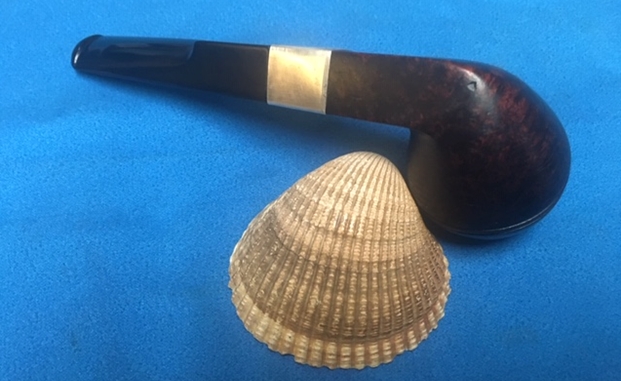
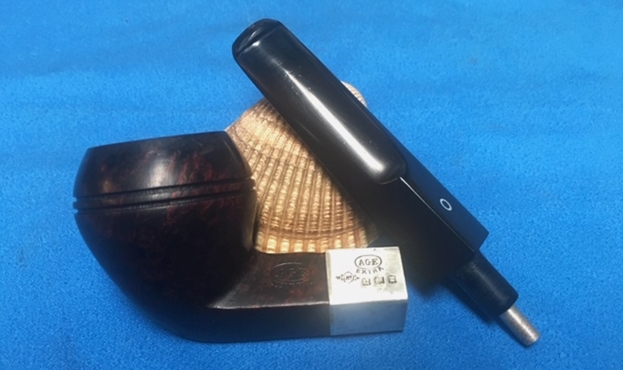
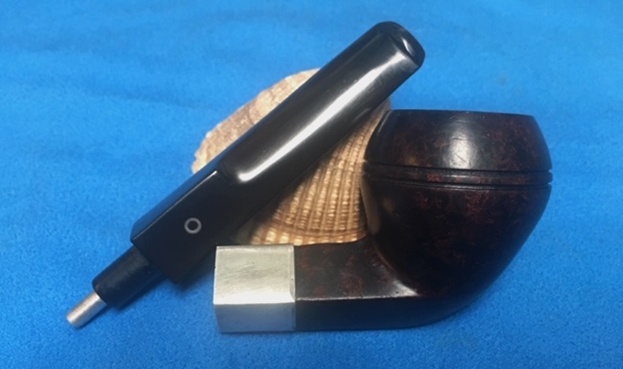
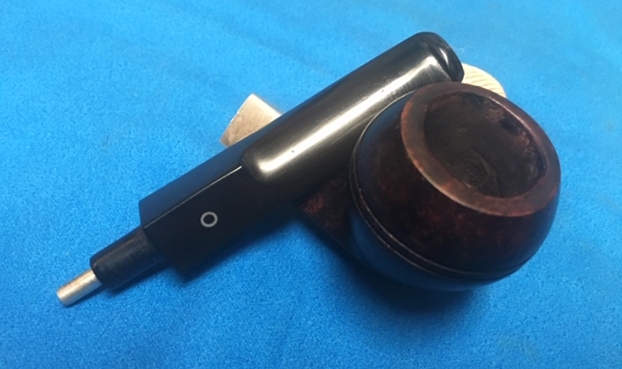
Restoring a 1919 AGE EXTRA Bulldog


Blog by Steve Laug

Before I left for my work trip to Nepal and India I received an email from a reader of the blog regarding an old 1919 pipe that had come into his possession. I include the first email here for the information that he included.

I realize that you must get hundreds of requests to work on peoples pipes, and that your back log is most likely prohibitive in my case, but I do have a request for your work.

I’ve been following your site for some time now and have become a fan of your work. Many of your tips and photos have helped me on my path of repairing pipes. This pipe that I’ve recently purchased is too precious and too well made for my skill level.

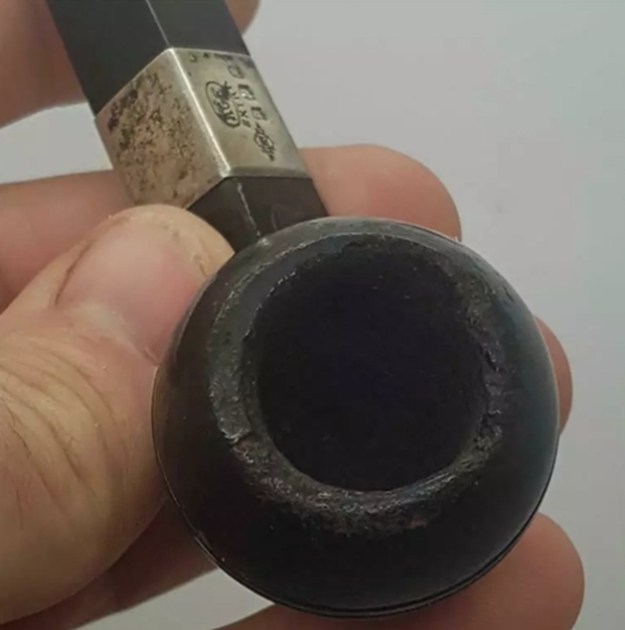
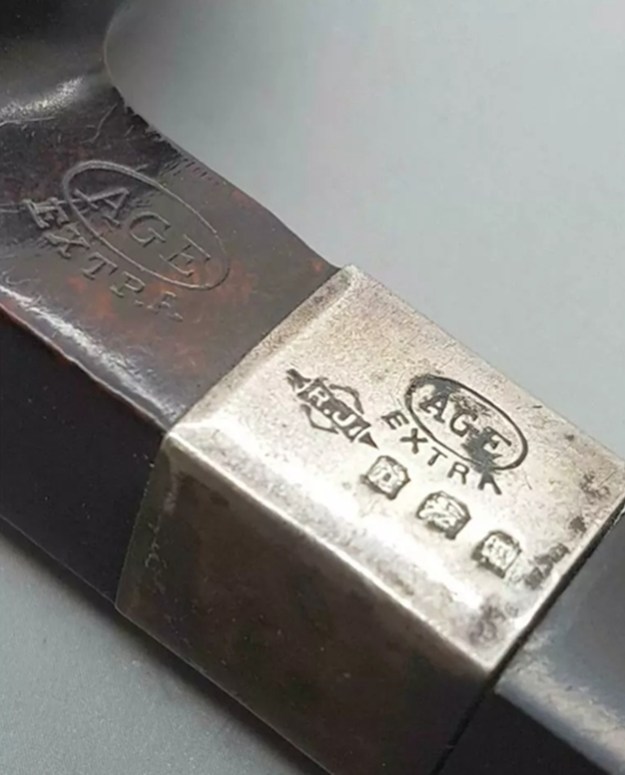
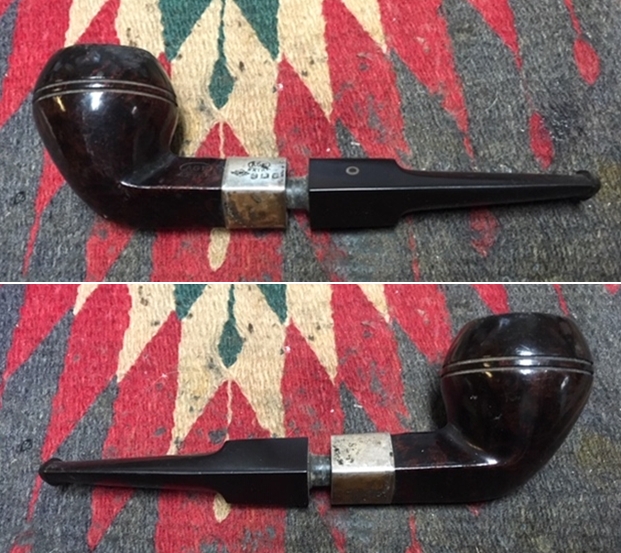
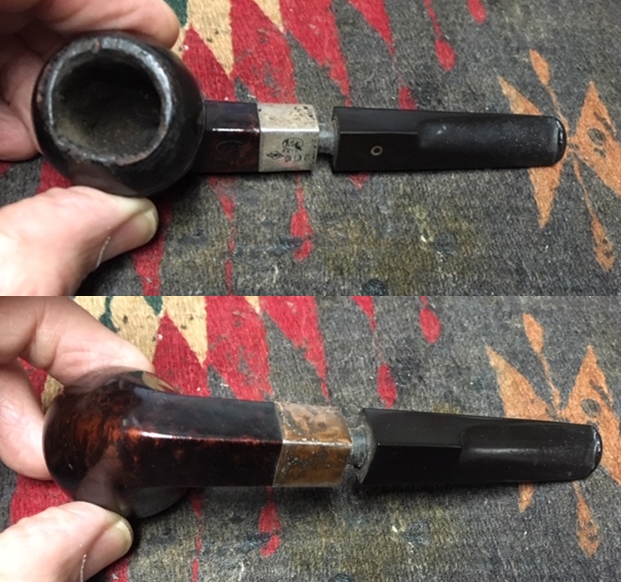
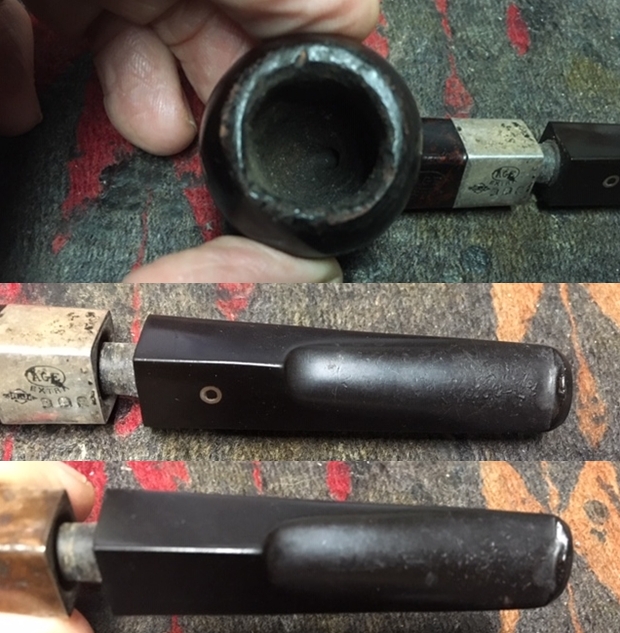
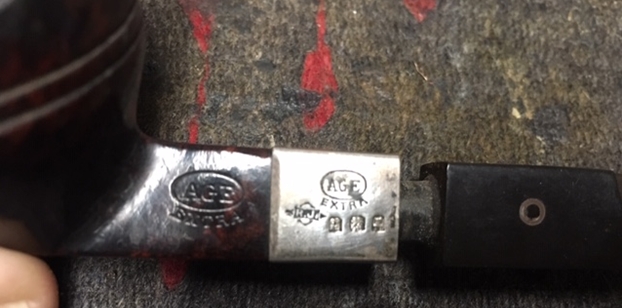
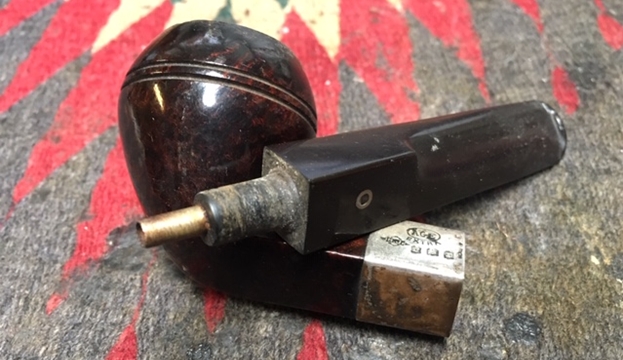
My pipe is a 1919 AGE Extra Bulldog, hallmarked London. Naturally there is the added significance that this year is its 100th birthday. I would like to request a full restore (as much as could be done) to ensure it makes it to see its 200th birthday, although I won’t be around to see it. The idea of this humble pipe, in my care, making it well past my time here on the planet is breathtaking in its scope.

I appreciate the time you’ve given to my request and I hope to hear back from you.

Kind Regards, Kerry

He included the pictures that follow as part of the temptation to do the restoration on this old timer. It is a good thing he did because I am not currently taking on any more work. I have a backlog of pipes to work on that will take me at least the rest of the next year of more to complete. However, there was something interesting and even compelling about this old pipe. The age and condition interested me as did the brand. I am unfamiliar with the AGE brand but the brand spoke to me. A few emails went back and forth and I decided to have him send it to me to have a look at the pipe and decide what I wanted to do. It arrived shortly before I left for Nepal. I looked it over and made a decision to take it on as a project and see what I could do with it. It was an intriguing looking pipe that is for sure. The bowl had a lot of nicks and dings in the finish. The exterior of the pipe was dirty with grime and grit rubbed into the surface of the finish. The silver band was tarnished and dirty but the stamping and hallmarks were quite readable. The rim top was badly damaged. The inner edge of the bowl was damaged and the bowl was slightly out of round. The exterior was also damaged. The stamping on the left side of the shank was readable. It read AGE in an oval over EXTRA. The silver band also read AGE in an oval over EXTRA. There were also hallmarks as shown above. There was also a diamond with a banner and a R.J. stamp on it. The stem would not sit correctly in the shank. The stem had some tooth marks in front of the button on both sides of the stem and some tooth chatter on both surfaces. There was an inlaid silver O on the left side of the saddle stem. I took close up photos of the bowl and rim as well as the stem to show the condition of the pipe when it arrived. You can see the damage to the rim top and inner edge of the bowl. The oxidation on the silver band and the tooth chatter and damage to the stem and button edges on both sides of the stem. I also took a photo of the shank and the band to show the stamping in the silver. I took a photo of the stem removed from the shank to show the inner tube and the condition of the tenon and tube. The build up on the tenon was part of the reason for the stem not seating in the shank.The maker of the brand was a bit of a mystery to me. Checking my usual sources I found absolutely no information on the AGE brand. There was no info on the Pipedia website or on the Pipephil site on the brand. I also checked on Who Made That Pipe by Wilczak and Colwell. There I found two possible makers fro the brand. They are shown in the screen capture below.The two options were La Bruyere 1918 a French made briar and also Salmon & Gluckstein an English made briar. The hallmarks on the band seemed to point to an English connection so I did some more looking online to identify the company who made the pipe.

I turned first to a website on English silver marks. I was specifically looking for information on the R.J. stamp on the silver to help identify the silversmith. I did a screen capture of the section on the R.J. stamp matching the one on the silver band on the pipe in question. Here is the link to the website: http://www.silvercollection.it/englishsilvermarksXRDUE.html. It identifies the R.J. in a rectangle and a lozenge as the mark of Reuben Jordan. They were active in London. The page also gave a link to a Makers, Pipe Mounters Marks page.I followed the link on that page to the section on Tobacconists, etc. On that page I could see that the Reuben Jordan – London silversmith did bands for Imperial Tobacco Co. in London. That brought this part of the investigation to a close in terms of the pipe maker in question taken from the silver hallmarks. http://www.silvercollection.it/DICTIONARYTOBACCONISTR.html Now I turned to do some work on the information given by Who Made That Pipe. Their identification of the brand as having made by Salmon & Gluckstein brand name was what I wanted to work on at this point. It was clearly an English made pipe as determined from the above information I had found thus far with the hallmarks and silver makers marks. I turned to Pipephil’s site to see what he had on the brand (http://www.pipephil.eu/logos/en/logo-s2.html). I did a screen capture of the listing on the brand and have included it below.From the information found about the brand on that page I learned that it was a long time brand in London and that it had been bought out by Imperial Tobacco Co. in 1902. Since that was prior to the purported date of this pipe it made sense that it was made by Imperil Tobacco Co. The brand continued under their manufacture until 1955 when the brand was dropped. The pipe fit within the time frame of the stamping on the silver band.

I then turned to Pipedia (https://pipedia.org/wiki/Salmon_%26_Gluckstein) to further read about the brand. The article on Pipeia quote from Pipes, Artisans and Trademarks, by José Manuel Lopes. It read in full as follows:

Salmon & Gluckstein was an early 20th century English distribution chain, with its own pipe catalog, probably made by La Bruyère. It had over 100 shops in England, which after being purchased by Imperial Tobacco Co., changed their name to Bewlay.

The Pipedia link actually put the two brands from Who Made That Pipe both the Salmon & Gluckstein connection and the La Bruyere come together with the purchase of the company by Imperial Tobacco Co. Interestingly it also ties the brands to a brand I am very familiar with- Bewlay. Given that information it appears that the pipe was a brand of the Imperial Tobacco Co. and linked to the Salmon & Gluckstein brand.

Now it was time to try to figure out the date of the pipe from the hallmarks on the band. I examined them with a lens and found the following information. The first hallmark was a lower case “d”  in a shield. This was the date letter on the pipe. The second hallmark was a lion passant in a shield. The emblem connects the pipe to London assay offices. It also identifies the band as being silver. The third hallmark was a leopard’s head uncrowned which identifies the pipe as English made between 1821 and the present.

I knew now that the pipe was London Made with a silver hallmark identifying a London silversmith identified by the R.J. stamp noted above as Reuben Jordan. The only thing left to fully learn about the pipe from the stamp was the date to be determined from the “d” stamp.

I turned to a website that I regularly use to identify the dates on English made hallmarks. The link is: http://www.silvercollection.it/englishsilverhallmarks.html. The screen capture of the chart on the left shows the dates and letter marks from 1916-1935.

Kerry had correctly identified the date of the pipe as being made in 1919. I always love when the pieces all come together and I can arrive at both a manufacturer and a date for the pipe.

Armed with this information I turned to work on the pipe. I started by cleaning up the silver with silver polish to remove the tarnish from the band. I rubbed the material on the band and polished it with a cotton pad to remove both the tarnish and polish the pipe.

I reamed out the bowl with a PipNet pipe reamer using the first three cutting heads to remove the cake. The bowl needed some work at the rim as it was out of round and I needed to see what I was dealing with so I took it back to bare briar. I cleaned up the remnants of cake with a Savinelli Fitsall knife and then sanded the bowl insides with sandpaper on a dowel. Afterwards I examined the bowl and could see that the walls were solid and that with a little work I could bring the bowl close to round. I cleaned the internals of the pipe with pipe cleaners, cotton swabs and alcohol to remove the debris inside the mortise and the airway into the bowl and the stem. I scraped the mortise walls with a dental spatula to remove the tars that had hardened on the walls. To deal with the damaged rim top I topped it lightly on a topping board with 220 grit sandpaper to smooth out the damage and remove the roughness of the rim. It did not take too much work to remove the damage and give me a flat surface to work with in the restoration.I polished the rim top with micromesh sanding pads – wetsanding with 1500-12000 grit pads as suggested by Paresh on my recent trip to Pune, India. I have to say that is working very well. I wanted to polish out the scratches so that I could work on matching the stain on the rest of the pipe and finish that portion of the restoration. I steamed out the dents around the bowl sides and cap with a wet cloth and a hot butter knife. I was able to reduce many of them. As is usual when steaming out the dents with a knife and stem there was some discolouration on the bowl sides that would generally disappear with polishing. I scrubbed the exterior of the bowl with undiluted Murphy’s Oil Soap and a tooth brush. I rinsed the bowl off with warm water under the tap and dried it with soft cloth. I used a dark brown (Walnut) and black stain pen to blend a stain to match the colour of the rest of the bowl. I rubbed it into the surface of the polished rim top and blended it with an alcohol dampened cotton pad. I was able to get a perfect match to the bowl colour.I polished the silver on the band with a jeweler’s polishing cloth. I worked it over the surface trying to get the tarnish from the stamping. I rubbed the bowl down with Before & After Restoration Balm, working it into the grain of the briar. The balm enlivens, refreshes and protects the briar. In this case it brought life back into the old piece of briar. While some of the dents and scratches were gone others remained. I left the remaining dents in the briar as ongoing testimony to the journey of this pipe. I only wish that it could tell its story. I let the balm sit on the briar and then buffed it out with a soft cotton cloth to raise the shine. I set the bowl aside and turned my attention to the stem. It had deep tooth marks on the top and underside of the stem near the button. I painted the stem surface with the flame of a lighter to lift the dents in the vulcanite. I sanded the stem with 220 grit sandpaper to smooth out the tooth chatter in the surface and cleanup around the dents in preparation for the repairs. I cleaned out the dents with a cotton swab and alcohol. I filled them in with clear superglue and set the stem aside to cure. Once the repairs cured I used a needle file to redefine the button edge and also smooth out the repairs to the dent. I sanded the stem with 220 grit sand paper and 400 grit wet dry sandpaper to smooth out the sanding marks in the vulcanite. I polished the vulcanite stem with micromesh sanding pads – wet sanding with 1500-12000 grit pads. I have been trying wet sanding with all of the pads after discussions with Paresh while we were in Pune, India. It does seem to give the stem a good shine and reduce the scratching. I finished the polishing with Before & After Pipe Polish – both fine and extra fine polishes. I put the stem back on the bowl and buffed the pipe with Blue Diamond polish on the buffing wheel. I gave the bowl and stem multiple coats of carnauba wax and buffed it with a clean buffing wheel to raise the shine. I polished the band with a jeweler’s cloth once more, then hand buffed the entire pipe with a microfiber cloth to deepen the shine. This 100 year old AGE EXTRA Bulldog is a beautiful pipe. The grain really stands out with a combination of birdseye, cross grain and swirls surrounding the bowl give it a rich look. The rich contrasting brown and black stains makes the grain stand out while hiding the dents that remain. I left the remaining dents in the briar to leave the story of the pipe’s travels intact. It is a proportionally well carved pipe. The polished black vulcanite stem had a rich glow. The finished pipe is a beautiful straight Bulldog that feels good in the hand and the mouth. Have a look at it with the photos below. The dimensions are Length: 5 inches, Height: 1 3/4 inches, Outside diameter of the bowl: 1 1/4 inches, Chamber diameter: ¾ of an inch. This pipe will be going back to Kerry next week. I am excited to hear what he thinks of this beauty. Thanks for walking through the restoration with me as it was a pleasure to work on.


Restoring an Unbranded Italian Bent Billiard # 908


Blog by Paresh Deshpande

I had just finished restoring the sixth Dunhill from my Mumbai Bonanza find, a 1965 DUNHILL SHELL #56 F/T and now this is a no name smooth ¼ bent Billiard from the same lot. This may be a ‘no name’ pipe, but something about the pipe, like the feel in hand, quality of grain and the finish screams of quality and added to that the design elements, are all pointers to a pipe made by a reputed pipe maker.

I was fortunate enough to have heeded to the advice of my dear friend and mentor, Mr. Steve, and struck a deal with a trash collector from Mumbai. He did not know what he was selling and I did not know what I was buying as we reside in different cities!!!!! The argument that Mr. Steve presented was that if not anything, I shall at least have some spares and this was logical. I struck a deal and here are pictures of the pipes that I received in this lot.        This lot contains some very nice collectible pipes, a few well known brands and some mediocre brands. Overall, with seven Dunhill pipes, a Preben Holm #1, a couple of “Made in England” Pete System pipes, Charatan’s, Custom-Bilt, Stanwell and other assorted pipes, I would say that I had hit a huge jack pot!!! Hence, I like to call this find as “Mumbai Bonanza”.
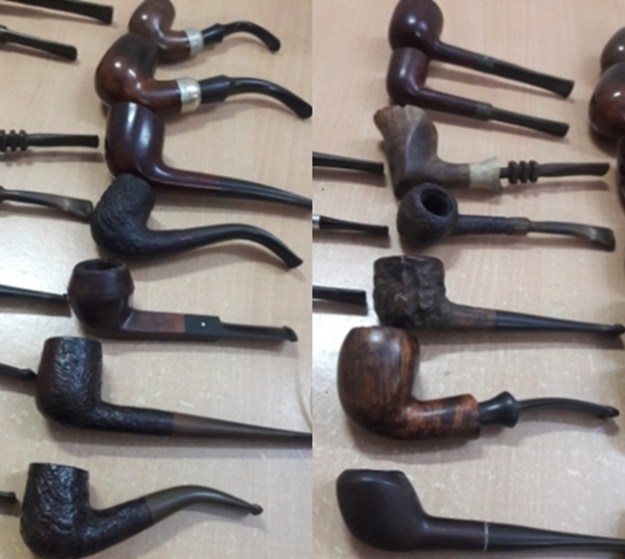
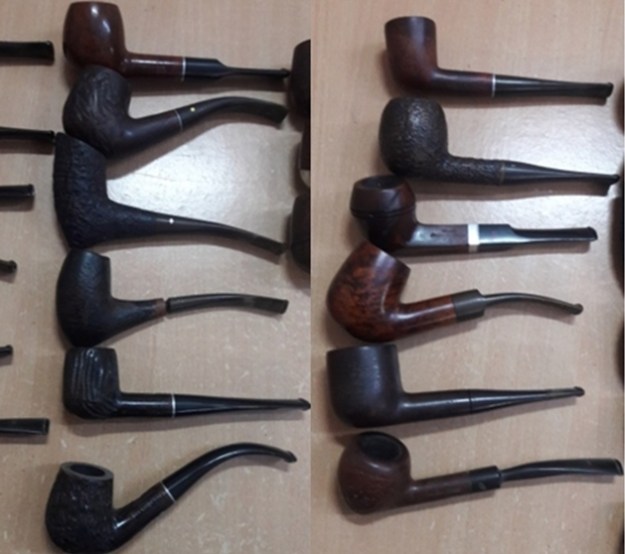
The pipe that I decided to work on from this find is an unbranded slightly bent billiard, and is indicated in magenta colored arrow in the picture below. It is stamped on the underside of the shank with the shape number 908 at the end of the shank and stem junction. On the right side of the shank it is stamped as IMPORTED BRIAR in a semi circle over ITALY in the center. There is no other stamping anywhere on the stummel. Even the stem is devoid of any stamping. My attempts to identify, with pinpoint accuracy, the maker of this pipe have come to a naught due to lack of any tell tale stampings hinting at the carver. However, the IMPORTED BRIAR stampings are generally associated with pipes designated for American markets and the COM stamp ITALY, is self explanatory. My appreciation is that this pipe was made by an Italian firm as a Basket pipe for an American pipe shop. If any of the readers has any viable input on this pipe, you are most welcome to share it with the community in form of comments on rebornpipes.com.

INITIAL VISUAL INSPECTION
There is a thick layer of cake in the chamber which has been reamed and maintained at a thickness of a dime!!! This indicates that this pipe has seen heavy usage but has also been well cared for. In order to comment on the condition of the walls of the chamber, I need to ream the cake down to the bare briar. The rim top surface is covered with overflowing lava through which the inner rim edge appears to be intact. Also through the overflow of lava, a few dents and dings are visible towards the right and back of the rim. Similarly, the outer edge of the rim is slightly damaged on the right side in 4 ‘O’ clock direction. There is a sweet odor to the chamber.The stummel boasts of some beautiful mixed pattern of bird’s eye and cross grain all around. It is dirty with grime, oils and tars covering the stummel surface and added to this are a few dents and dings to the sides and front of the stummel. Surprisingly (because being an unbranded pipe, I expected more!), I could see only one fill (circled in yellow) on the left side of the stummel, another indicator to the fact that this is a quality pipe made by a quality conscious Italian carver. The stummel has an orange hued stain and appears to be coated with lacquer, both of which are not my favorite finish. These will have to go, period! I have the experience of working on a Dr. Grabow, OMEGA and it was not easy to get rid of the lacquer coating. The mortise shows heavy accumulation of dried tars mixed with ash and remnants of tobacco, making the flow of air through the mortise laborious. This will have to be cleaned and refreshed. The vulcanite stem shows major damage to the button end on both upper and lower surface. The upper surface has a through hole in the bite zone, including bite marks to the button while deep tooth marks are visible in the bite zone and button. The button on either surface will have to be sharpened and made crisp. The tenon end is crusted with dried out tars and grime. The horizontal slot shows accumulation of remnants of dried out oils and tars, blocking the air flow through the stem airway. The fit of the stem in to the mortise is loose and will need to be tightened for a nice snug fit. The stem is heavily oxidized; however, the quality of vulcanite is good. The bend on the stem does not match with the plane of the stummel and profile of the pipe. This will have to be addressed. The stem repair, then, will be a major issue to address and I shall begin this project by addressing the stem repairs first. THE PROCESS
As decided during my initial appreciation of the condition of the pipe, I start this project by tackling the stem first. I flame the stem surface with the flame of a Bic lighter to raise the tooth indentation to the surface and follow it up with sanding the stem with a folded piece of 220 grit sand paper. This helps in getting rid of the oxidation while providing a smooth surface for the intended fills to reconstruct the damaged bite zone on both surfaces and also the button edges. I cleaned out the tenon and the internals of the stem with hard bristled and regular pipe cleaners dipped in isopropyl alcohol. The grunge had hardened to such an extent that I had to use the dental spatula to dig out the dried out oils and tars. Once I was satisfied with the internal cleaning, I wiped the stem surface, particularly the damaged button end, with a cotton pad and alcohol to remove any traces of dirt and grime. I wiped the stem with a little Extra virgin olive oil to hydrate the stem surface. Firstly, I inserted a pipe cleaner smeared in Vaseline in to the stem air way. This prevents the mix of CA superglue and activated charcoal from permeating in to the air way and blocking it subsequently. I prepared a mix of CA superglue and activated charcoal and carefully applied it over the damaged bite zone on both surfaces and lip and set it aside for curing over night. Before moving ahead, I would like to mention here that I had applied this mix in sufficient thickness which would help during the filing and sanding to match the fills with the stem surface and shaping the button.While the stem repair was set aside to cure, I moved ahead to deal with the stummel cleaning. With size 1 and 2 head of a PipNet reamer, I took the cake down to bare briar. Using a folded piece of 180 grit sand paper, I sand out the last traces of cake and expose the walls of the chamber to ascertain that there are no cracks/ heat fissures. I wiped the chamber with a cotton pad dipped in isopropyl alcohol to remove the carbon dust left behind by all the reaming and sanding process. It is always a big relief to find the walls of the chamber to be solid with no damage. This was followed by gently scraping away the lava overflow from the rim top surface with my fabricated knife. I cleaned the mortise by scraping away at the dried gunk with my fabricated spatula and followed it up with further cleaning using cue tips, pipe cleaners and shank brush dipped in isopropyl alcohol. Even though the internals were nice and clean, the sweet smell in the chamber was all pervading. I shall address this issue with an alcohol bath before cleaning the external surface of the stummel. Once the cake was removed and the chamber walls cleaned, I noticed that the draught hole was not aligned to the center of the chamber, but skewed towards the right as you hold the pipe while smoking. I was in two minds; should I correct this alignment by re-drilling the air way through the mortise or let it be. The thick cake indicates that this was a fantastic smoker and a favorite of the previous steward, so should I tamper with its smoking characteristics? Well, once I am through with refurbishing, I shall load a bowl and test it for myself before deciding further course of action. Here are pictures of what I have been discussing above. It was now time for me to address the issue of the sweet smell in the pipe. I stuffed the chamber with a cotton ball. I made a wick out of one cotton ball, wound it around a folded pipe cleaner and inserted it tightly in to the mortise. Using a syringe, I topped the chamber with 99.9% pure isopropyl alcohol and set it aside on a pipe stand for the alcohol to draw out all the residual oils and tars from the mortise and the chamber. About half an hour later, I refilled the chamber with alcohol and set it over night. By next evening, the alcohol had drawn all the stubborn oils and tars from the mortise and chamber and these were trapped in the cotton ball and wick. I gave a final cleaning to the mortise using pipe cleaners and q-tips dipped in alcohol. The old smells are history and the pipe now is fresh and clean.I followed up the internal cleaning with external refreshing of the stummel surface. Using a hard bristled tooth brush dipped in undiluted Murphy’s oil soap, I very deliberately scrubbed the stummel and the rim top to remove the overflow of lava from these surfaces. The stummel and rim top was dried using paper napkins and soft cotton cloth and set it aside to dry out naturally. The stummel looks clean, but the orange stain now stands out prominently and so does the single fill which I had observed earlier has now increased to four!!!!!!! I checked the fills and realized that it had gone soft and would have to be filled afresh. But before that, I need to remove the orange stain and lacquer coating to let the natural briar shine through and breathe freely. Using a folded piece of 180 grit sandpaper, I sand the entire stummel surface to first remove the lacquer coating and thence the orange stain. It took a considerable time to remove the lacquer coat. At the end, I still observed a few patches on the stummel surface where the old stain was still visible. I cleaned up all these patches by wiping the entire stummel with a cotton swab dipped in pure acetone. The stummel is now completely rid of the lacquer coating and the obnoxious orange stain and beautiful swirls of bird’s eye and cross grains now peek through the rough surface. This clean up made the dents and dings to the rim top surface and the outer edge all the more prominent and these are the issues which I tackle next. On a piece of 220 grit piece of sand paper, I top the rim surface, checking frequently the progress that was being made. Once I was satisfied that the dings and dents to the rim surface has been addressed, I worked the outer rim edge to address the dents and dings visible. With a folded piece of 220 grit sand paper pinched between my thumb and index finger, I created a light bevel on the outer rim edge which masked the dents nicely. I am very pleased with the progress made so far; the stummel has been rid of the orange stain and lacquer, the internals of the stummel are clean and fresh, the dents and dings to the rim top and outer edge has been taken care of and the stem fill has hardened solid. The next issue that I tackled was the issue of newly discovered fills which hitherto fore were hidden under all the stain and lacquer coating. Using the sharp point of my fabricated knife, I gouge out the old fill and replace it with a fresh fill of CA super glue and briar dust. I always over fill the holes so that when I sand them down they are smooth and I can feather in the fills with the rest of the briar. I set the stummel aside to cure. Once the glue dried (very quickly by the way), I resorted to sanding the entire stummel surface using a folded piece of 180 grit sand paper and follow it up by further sanding with 320, 600 and 800 grit sand papers. This step addressed three issues; firstly matching and blending the fill with the rest of the surface, secondly, the dents and dings on the stummel were evened out and lastly, the annoying orange stain and lacquer coating was completely eliminated. Using the micromesh pads, I complete the polishing cycle by wet sanding the surface with 1500 to 2400 grit pads and dry sanding with 3200 to 12000 girt pads. The stummel looks great with the grains showing themselves in great splendor. I really like this natural finish to the briar!!!! This is how the stummel appears at this stage. Next, I rub a small quantity of ‘Before and After Restoration Balm’ in to the briar with my finger tips and let it rest for a few minutes. The balm almost immediately works its magic and the briar now has a nice vibrant appearance with the beautiful bird’s eye and cross grains on full display. I further buff it with a horse hair shoe brush. I was contemplating if at all I should stain this stummel or let the fills be seen as part of its past life; a friend of mine who has taken up to enjoying a pipe, dropped in and saw this pipe. He loved the grains, the shape and heft of this beauty and immediately requested it to be passed on to him. I discussed with him about the stain and he was keen to keep with the natural finish! Since this pipe was being passed on to him, his desire prevailed. This look to the stummel attracted him the most. I am sure that after the final polish and waxing, the grains will be further accentuated. I set the stummel aside and turned my attention to the stem repair. The fill had cured nicely and I moved ahead and began the process of filing and shaping the button end with a flat head needle file. For a better blending, I further sand the entire stem with 220 followed by 400, 600 and 800 grit sand paper. This helps to reduce the sanding marks left behind by the more abrasive 220 grit paper. To bring a deep shine to the vulcanite stem, I went through the complete set of micromesh pads, wet sanding with 1500 to 2400 grit pads and dry sanding with 3200 to 12000 grit pads. I wiped the stem with alcohol after each pad and rubbed it down with Extra Virgin Olive oil to rehydrate the vulcanite. The repairs have blended in very well and the stem now looks shiny black and beautiful. The internals of the stem was once again cleaned out using alcohol and pipe cleaners to clear the airway of all the debris resulting due to the sanding. The finished stem is shown below. The next stem issue that I addressed was the loose fit of the tenon in to the mortise. To address this issue, I heated the tenon with the flame of a Bic lighter; moving the flame constantly, till the tenon was pliable. I had pre-selected a drill bit which was a tad larger than the tenon hole and gradually inserted it in to the tenon and set it aside to cool down. Once the tenon had cooled down, I removed the drill bit and tried the seating of the tenon in to the mortise. The fit was perfect.Before moving on to the final polishing and wax coating, I had to address the issue of the bend to the stem. Somehow, the existing bend does not suit the profile of the stummel. I exchanged pictures of the stem and pipe with Mr. Steve and he suggested that the stem needs to bend more. I inserted a pipe cleaner through the stem’s air way and heated the stem with a hot air gun till pliable. Using the slot end of the pipe cleaner, I bend the stem eyeballing it in to desired shape. The two precautionary measures which are required to be ensured; firstly, inserting a pipe cleaner in to the stem’s airway prevents the surface from collapsing inwards. Secondly, while bending the stem, heat only up to the place from where the bending is intended. I did try two different bend angles, but that did not seem correct. Third try was successful and the stem now has a nice bend to it and the pipe feels very comfortable in the mouth. To complete the restoration, I re-attach the stem with the stummel. I mounted a cotton cloth buffing wheel to my local machine which is similar to the Dremel.  I set the speed at about half of the full power and applied White Diamond compound to the entire pipe. I wiped/ buffed the pipe with a soft cotton cloth to clear it of any leftover compound dust. With a cotton buffing wheel earmarked for Red Tripoli, which has a finer grit than White compound, I buffed the stem to a fine glossy finish. I then re-attach the stem to the stummel, mounted another cotton cloth wheel on to the polishing machine and applied several coats of carnauba wax. I finished the restoration by giving the entire pipe a rigorous hand buffing using a microfiber cloth to raise the shine further. The completed pipe looks lovely, fresh and vibrant; the pictures speak for themselves. I really enjoyed working on this pipe and hope that readers too enjoyed walking with me through this restoration. If only this handsome pipe could share the secret of its birth and its past life with all of us…if only!! Cheers.

PS: The freshly refurbished pipe was handed over to the new Steward (to use the term coined by my friend, Mr. Dal Stanton) who immediately loaded his favorite tobacco, LANE 1Q, and smoked it with me. He was very happy with the way it smoked and appreciated the easy and smooth draw. This reconfirmed my appreciation that I should not tamper with the alignment of the shank air way.

Reclaiming a Mastercraft “Hand Made” Pipe


Blog by Paresh Deshpande

To date, I have completed the restoration of nine pipes from my “Mumbai Bonanza” lot. In this lot, I found one pipe that was pretty battered up and in a very sorry state. It reminded me of an “Imperial Yello-Bole Carburetor” from my grandfather’s collection that I had restored some time back. Here is the link to the write up that was posted on rebornpipes.com; https://rebornpipes.com/2018/11/12/reclaiming-a-yello-bole-imperial-carburator-vest-pipe/

If at that point in time I felt that the Imperial was in a bad shape, holding and looking at this Mastercraft pipe in my hand was gut wrenching to say the least!!!! Believe you me readers, every time I selected a pipe from the Mumbai lot to work on, the first pipe that I would always pick was this pipe!!!!! I was in love with the shape of the pipe, the feel in my hand (which are quite large by Asian standards), the grains peeking out at me from under all that grime, the heft …I could go on singing praises about this pipe. But in spite of all these eulogizing, I always ended up returning it to the box as a future project. Why? Well, the answer lay in the condition of the pipe and the colossal investment of time required restoring it. I knew that this project would test all that I had learned till date and then some more, without the certainties of the end result!! But now I decided to complete this project, however long it may take and whatever the end results.

For those readers who have missed out on my previous work, I was fortunate enough to have heeded to the advice of my dear friend and mentor, Mr. Steve, and struck a deal with a junk collector from Mumbai. He did not know what he was selling and I did not know what I was buying as we reside in different cities!! The argument that Mr. Steve presented was that if not anything, I shall at least have some spares and this was logical. I struck a deal and here are pictures of the pipes that I received in this lot. This lot contains some very nice collectible pipes, a few well known brands and some mediocre brands. Overall, with seven Dunhill pipes, a Preben Holm #1 FH, a couple of “Made in England” Pete System pipes, a couple of  Charatan’s Belvedere, Custom-Bilt, Stanwell and other assorted pipes, I would say that I had struck a decent haul! This is indeed my “Mumbai Bonanza”.
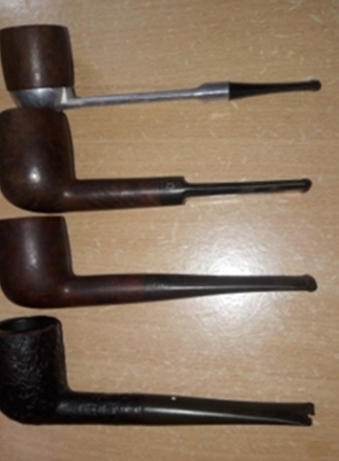
The tenth pipe that I decided to work on from this find is a straight pot and is indicated in yellow colored arrow in the picture below. It is stamped on the left side of the shank in a shield as Mastercraft in sentence form over HAND MADE in block capital letter. The right side of the shank is stamped in a straight line as AGED IMPORTED BRIAR in block capital letter. If at all there was any other stamping on the right side, it has been consigned to history due to severe damage further down the shank. The stem is apparently devoid of any logo stamp as I see it now. If at all there ever was a logo, it has completely worn out/ obliterated. Now coming to the research of this brand, which is my first, I referred to rebornpipes.com and as expected, Mr. Steve has extensively researched this pipe and has even posted some interesting old catalogs and hierarchy of the pipe lines from this brand. Here is the link;
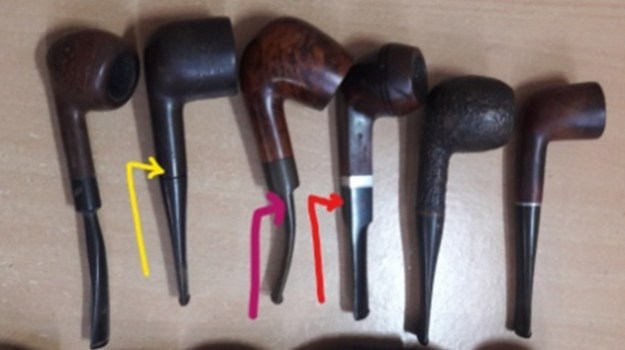
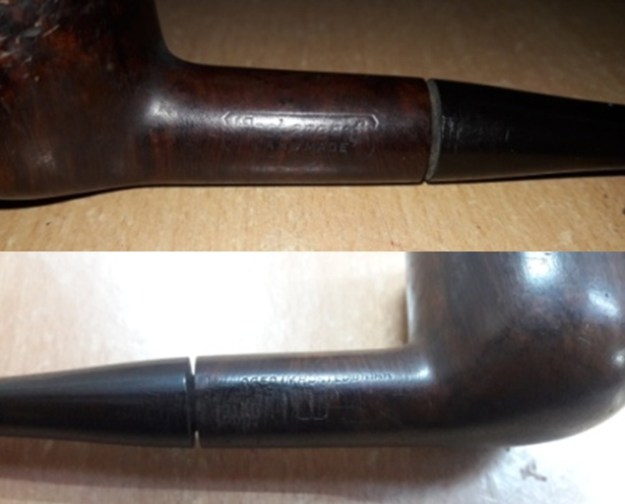
https://rebornpipes.com/2014/06/23/a-mastercraft-pipe-lines-hierarchy/

I surfed further and found an interesting post on restoration of a Mastercraft Executive Choice by the master restorer himself, which amongst other details, included two photos from the 1969 RTDA Almanac which show a list of various MC pipe lines. The pipe currently on my work table is the very first one in the list and was the top most in MC hierarchy of pipe lines and also the most expensive of all MC pipes retailing for $ 10!!!!! Here is the link for the essay and I urge all readers to give it a read.

https://rebornpipes.com/2014/06/22/learned-a-bit-of-american-pipe-history-mastercraft-executive-choice-pot-restored/

Thus, I can now safely conclude that this pipe is from the late 1960s, had been a top-of-the-line product for MC and retailed as the most expensive pipe in its inventory!!!! Well, after this search, I feel the additional pressure in doing complete justice to this pipe to the best of my abilities and that I will have to up my game a notch higher.

INITIAL VISUAL INSPECTION
I really do not understand where I should start from, which damaged inch of the pipe I should describe first, let alone tackle and about which I am not even thinking at this point in time!!!!! But to finish, I have to make a beginning and let me just start with the chamber and the rim.

A thick layer of cake can be seen in the chamber. The rim top surface is covered in thick overflow of lava, okay; consider that as VERY thick, which has bubbled on to the rim top and further oozed over on to the stummel surface. The condition of the inner walls of the chamber and rim top surface will be known once the cake has been taken down to bare briar and the rim top crud has been scraped off completely (thankfully readers cannot see or hear me muttering silent prayers!). The less I speak about the edges of the rim, the better it will be for my morale. Every millimeter of the outer edge has been damaged by striking against table end by the previous steward, however I must thank the previous steward for ensuring an even all round damage…lol. The inner rim condition does not look too promising either! I suspect a charred rim in 7 o’clock direction (when held from the stem end) and is marked in red circle. However, once the cake has been removed, I shall be certain about the extent of this charring and any other damage (praying again, in fact I haven’t stopped praying since I began and unlikely to stop till I finish!). Another issue which I have noticed is that the briar in the heel around the draught hole has formed a valley of sort (marked by yellow arrows), probably caused due to repeated and rigorous thrusting of a pipe cleaner through and beyond the draught hole over the years. Why would you clean the mortise and airway in this fashion??The most significant damage is seen to the stummel. It appears that this pipe has seen active duty and has been extensively and actively used against Viet Cong by the previous steward with great success…..LOL!! Every inch of the stummel surface is peppered with a large number of deep scratches, dents and dings. The entire left side of the stummel has prominent nicks extending from the rim top right down to the foot of the bowl. There are deep road rash marks on the right side of the shank just below the stamping, extends over to the underside and towards the shank end and further extends over to the stem for about an inch from the tenon end towards the button end (marked in pastel blue circle). The damage to the shank end and stem is so perfectly aligned that it appears that the damage was sustained while the stem was attached to the shank. In short, the stummel has sustained massive damage over the years due to both, rough usage and subsequent careless storage. It is covered in oils, dirt and grime of all these years of smoking and subsequent uncared for storage. The stummel surface is sticky to the touch, giving the stummel a dull, lifeless and lackluster appearance. However through all this dirt, tar, oil, grime and damage, lovely densely packed straight grains can be seen on the sides and shank. It will be a challenge to address these issues and make the grains to reveal themselves in all glory. The mortise is blocked with dried gunk, adversely affecting both the airflow and the seating of the tenon in to the mortise. The stem is also an equal disaster like the stummel with road rash marks on the right towards the tenon end. There is a round patch nearer to the button which appears to be a result of melting of the vulcanite. In all probability it had come in close contact with either a burning cigarette or some sort of a flame. It seems that the previous Steward used softie bit on his pipes as heavy oxidation can be seen where the bit was used. The bite zone, including the button edges shows dental compressions on both upper and lower surfaces. The button edges will have to be reconstructed and sharpened. The stem does not sit flush with the shank end and also the stem diameter around the road rash area has scrapped off resulting in a mismatch. This stem diameter will have to be rebuilt and I expect that once the mortise has been cleaned up, seating of the stem in the mortise would improve. The horizontal slot with a round center shows accumulated oils and tars. The stem surface shows signs of heavy oxidation. THE PROCESS
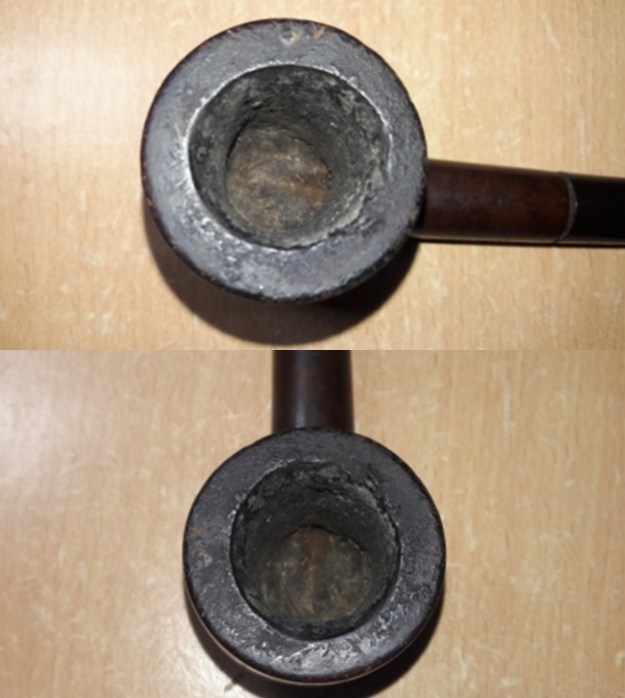
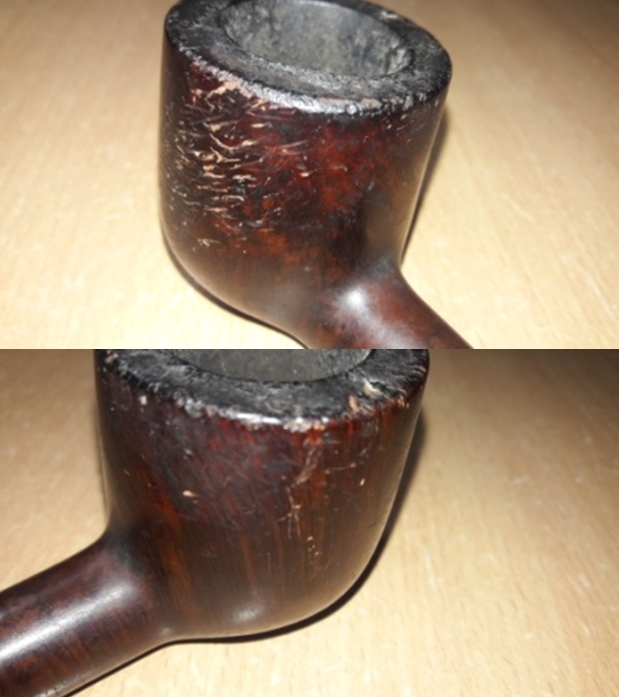
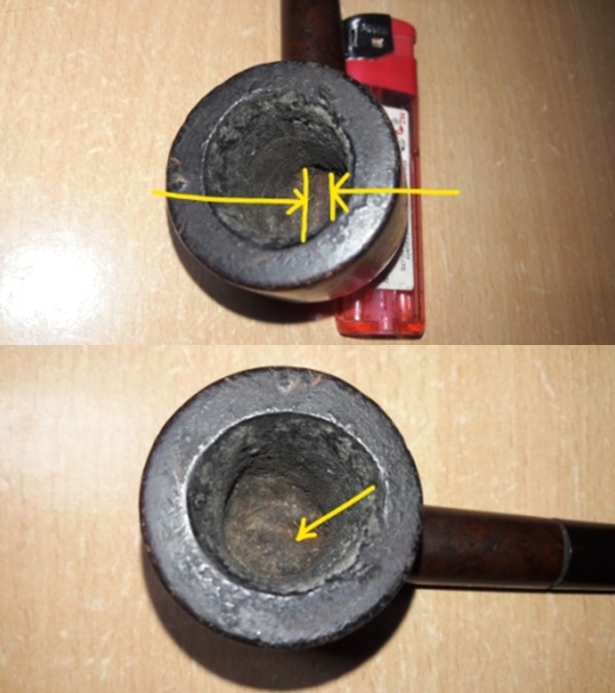
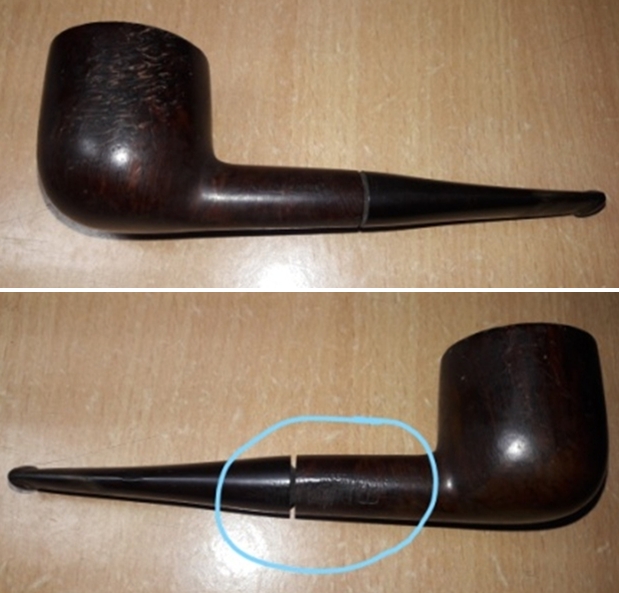
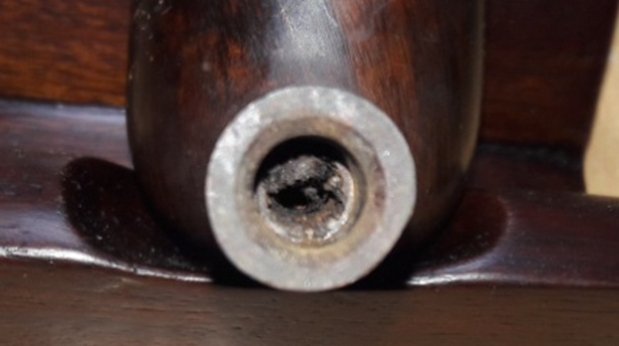
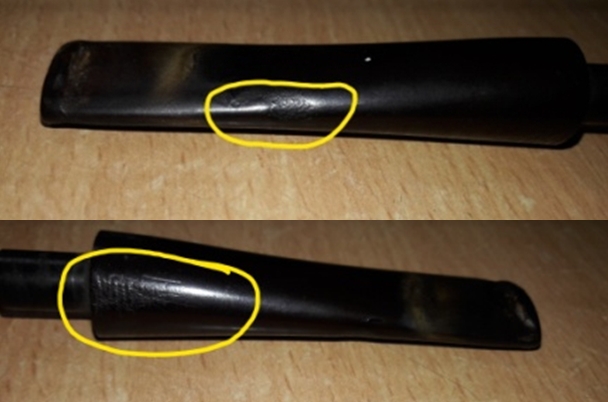
As decided during my initial appreciation of the condition of the pipe, I start this project by tackling the stem first. I flame the stem surface with the flame of a Bic lighter to raise the tooth indentation to the surface and follow it up with sanding the stem with a folded piece of 220 grit sand paper. This helps in getting rid of the oxidation while providing a smooth surface for the intended fills to reconstruct the damaged bite zone on both surfaces and also the button edges. I wiped the stem surface, particularly the damaged button end, with a cotton pad and alcohol to remove any traces of dirt and grime. I cleaned out the tenon and the internals of the stem with hard bristled and regular pipe cleaners dipped in isopropyl alcohol. Once I was satisfied with the internal cleaning, to revitalize the vulcanite and to have a fair idea of the progress made, I wiped the stem with a little Extra Virgin Olive oil. When I looked at the tenon end of the stem, I realized the right portion of the stem, as seen from above, was not as round as the left and would need a fill so as to bring it flush with the shank end. However, I would have to fine tune the sanding of the fills on both shank end as well as the stem simultaneously in order to achieve a perfect flush fit. The portion that would require a fill is marked in yellow.I prepared a mix of CA superglue and activated charcoal and carefully applied it over the damaged bite zone on both surfaces, the side and lip and set it aside for curing over night. The mix was applied along the circumference of the tenon end stem which had been scrapped. I had applied this mix in sufficient thickness which would help during the filing and sanding to match the fills with the stem surface and shaping the button.While the stem repair was set aside to cure, I moved ahead to deal with the stummel cleaning. With size 3 and 4 head of a PipNet reamer, I took the cake down to bare briar. Using a folded piece of 180 grit sand paper, I sand out the last traces of cake and expose the walls of the chamber to ascertain that there are no cracks/ heat fissures. I wiped the chamber with a cotton pad dipped in isopropyl alcohol to remove the carbon dust left behind by all the reaming and sanding process. The walls of the chamber show a few heat lines, nothing serious, but they are present. These heat lines and the ridges on the bottom surface of the heel will be addressed later. This was followed by gently scraping away the lava overflow from the rim top surface with my fabricated knife. I cleaned the mortise by scraping away at the dried gunk with my fabricated spatula and followed it up with further cleaning using cue tips, pipe cleaners and shank brush dipped in isopropyl alcohol. The suspected charring that I had appreciated early on is now confirmed. The rim has thinned out considerably above the draught hole. The inner rim edge is also uneven. I shall be addressing these issues too subsequently.
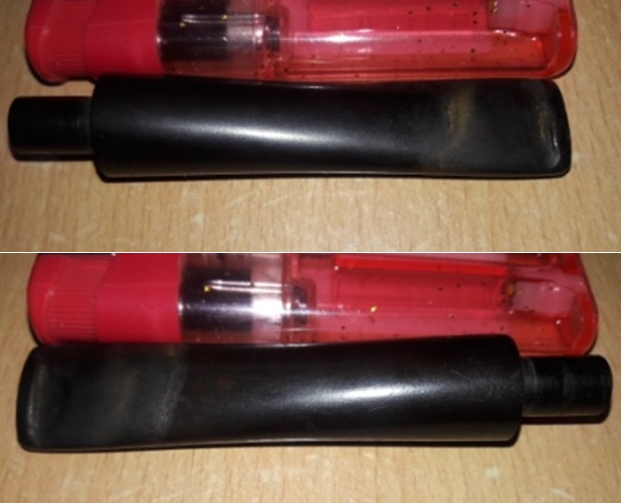
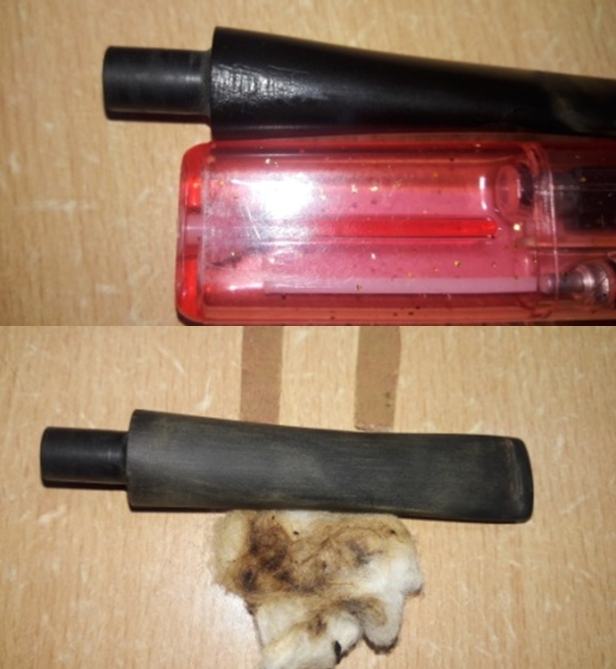
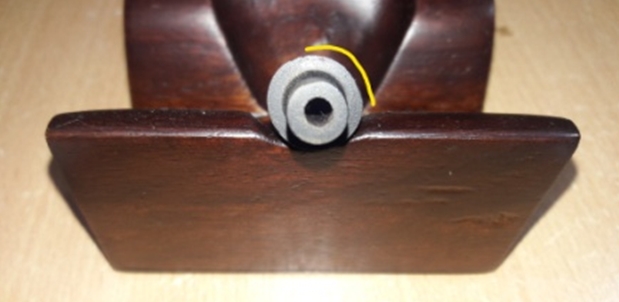
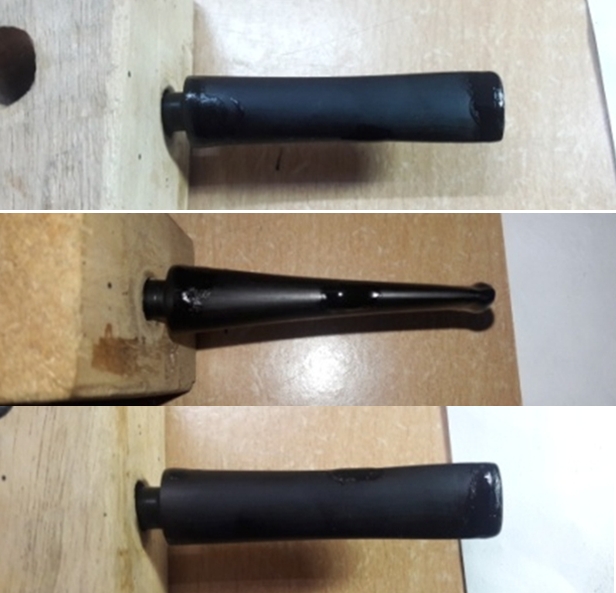
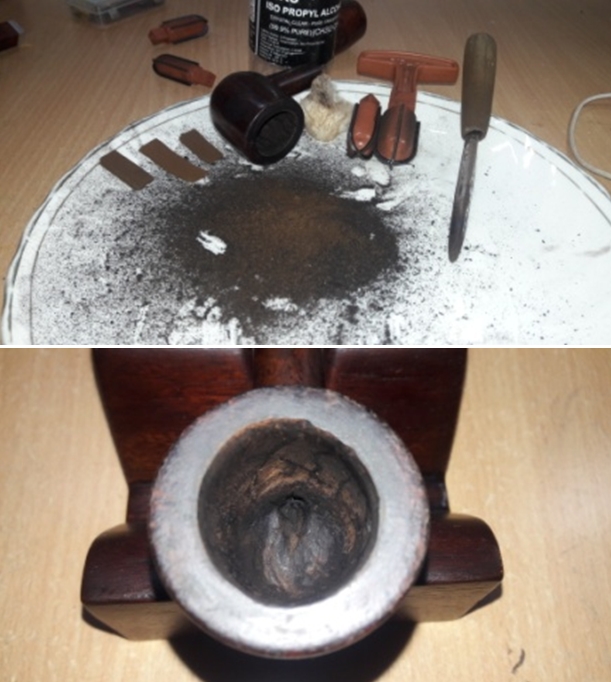
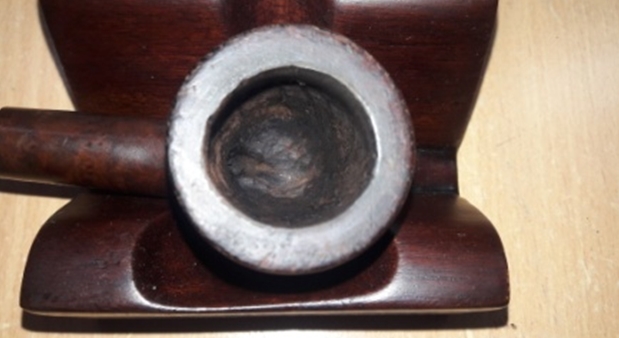
I followed the cleaning of the chamber with the cleaning up of the shank, mortise and the air way. Using hard bristled pipe cleaners dipped in isopropyl alcohol, I ran a few through the mortise. This moistened the hardened grungy depositions of all the oils and tars in the mortise. Thereafter, using my fabricated dental spatula, I scraped out all the accumulated oils and tars from the shank. The following picture hints at the degree of the grunge deposition that I was dealing with. I continued the mortise cleaning regime with shank brushes dipped in alcohol. However, the pipe cleaners continued to come out dirty and soiled unabated. This would need application of some serious cleaning process using salt and alcohol treatment.I rolled some cotton in to a wick and wound it around a pipe cleaner and inserted it inside the mortise up to and through the draught hole. Next, I packed some cotton in to the chamber and topped it with 99.9% pure isopropyl alcohol and set it aside for the time being. About twenty minutes later, I topped it again with alcohol and set it aside overnight for the alcohol to draw out all the tars and oils from the chamber walls and the cotton to trap the drawn out gunk. I must clarify here that even though it is recommended to use ‘Kosher Salt’, plain cotton and alcohol works with exactly the same effectiveness, but at nearly ¼ the cost of Kosher Salt!! So, in case someone else is paying, go ahead with using Kosher salt, otherwise cotton and alcohol works just fine! By next day evening, the alcohol and cotton had fulfilled its intended task. I ran a pipe cleaner through the mortise for a final clean and it came out……well, soiled black and dirty! The gunk and grime in this pipe was stubborn, indeed. I again went through the entire regime followed earlier to clean the mortise and was surprised to find the amount of grunge that was scraped out again. The crud that was extracted and the number of pipe cleaners used after the alcohol bath, as can be seen in the photographs, bears testimony to the extent of apathy the pipe was subjected to by the previous steward. I followed up the internal cleaning with external refreshing of the stummel surface. Using a hard bristled tooth brush dipped in undiluted Murphy’s oil soap, I very deliberately scrubbed the stummel and the rim top to remove the overflow of lava from these surfaces. The stummel and rim top was dried using paper napkins and soft cotton cloth and set it aside to dry out naturally. The stummel looks clean, but the road rash, dents and dings to the stummel and rim edges/ top now stands out prominently. I followed it up with sanding the entire stummel with a folded piece of 220 grit sand paper. This serves three purposes; firstly, it removes all the stubborn dust and grime from the surface, secondly, it evens out, to a great extent, any minor dents and dings from the surface and thirdly, it provides a smooth and clean surface for intended fills. With the road rash evened out to the extent possible, I repaired the road rash with a mix of briar dust and CA superglue. I always over fill the holes/ surfaces so that when I sand them down they are smooth and I can feather in the fills with the rest of the briar. I also build up the shank end, which was damaged due to the road rash, with this mix. I set the stummel aside to cure.Once the glue dried (very quickly by the way), I attached the stem to the shank end carefully aligning the stem fill with that of the shank end fill. I sand the entire stummel surface and the stem using a folded piece of 180 grit sand paper and matched the shank end with the stem fill. Once I had achieved a match, I detach the stem from the shank end. On close observation, I found that the shank end repairs had several tiny air pockets. I again filled up these air pockets with clear superglue and set it aside for curing, while I worked the stem. Using a flat head needle file, I reshaped the button and follow it up by further sanding the stem with 320, 600 and 800 grit sand papers. Using the micromesh pads, I complete the polishing cycle by wet sanding the surface with 1500 to 2400 grit pads and dry sanding with 3200 to 12000 girt pads. The stem looks great with the fills nicely matched with the rest of the surface. I rub a little quantity of Extra Virgin Olive oil in to the stem surface. With the stem repairs completed, I turn my attention back to the stummel repairs. The second fill to the road rash portion had cured and I sand it with a folded piece of 180 grit sand paper. However, I realized that the air pockets were still visible. I discussed this with my mentor, Mr. Steve, who suggested that I should first go through the micromesh polishing cycle and then decide if a refill is required or otherwise. With this advise, I move ahead to complete the stummel repairs. I top the rim on a piece of 220 grit sand paper to even out the rim surface dents and dings and also to reduce the charred rim surface. I addressed the out of round inner edge and the dents and dings to the outer rim edge by creating a bevel on both these edges with a folded piece of 220 grit sand paper pinched between my thumb and index finger. The numerous scratches, dents and dings to the stummel surface was beginning to concern me as it was a conflict between my innate desire not to lose briar through sanding and the necessity to do just that if I desired to completely rid the stummel of all these evidences of its past and thin out the walls in the process. Readers, believe you me, these damages were deeper than you normally expect. I shall take a fresh call on this issue after I am through with the micromesh polish cycle.
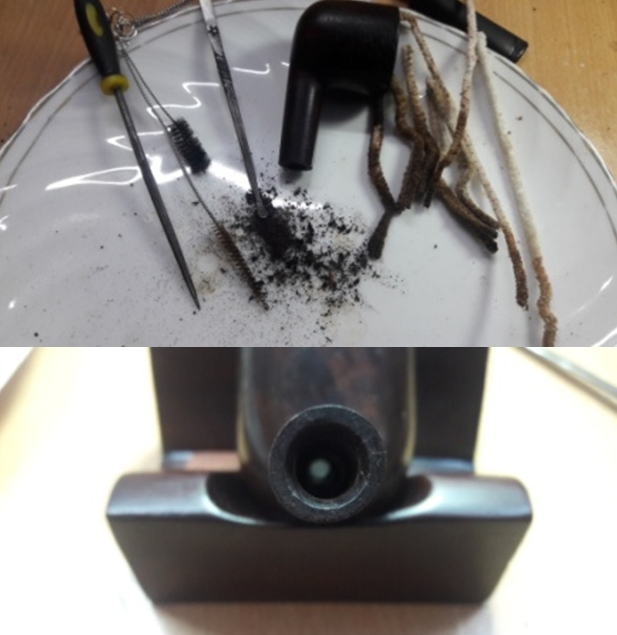
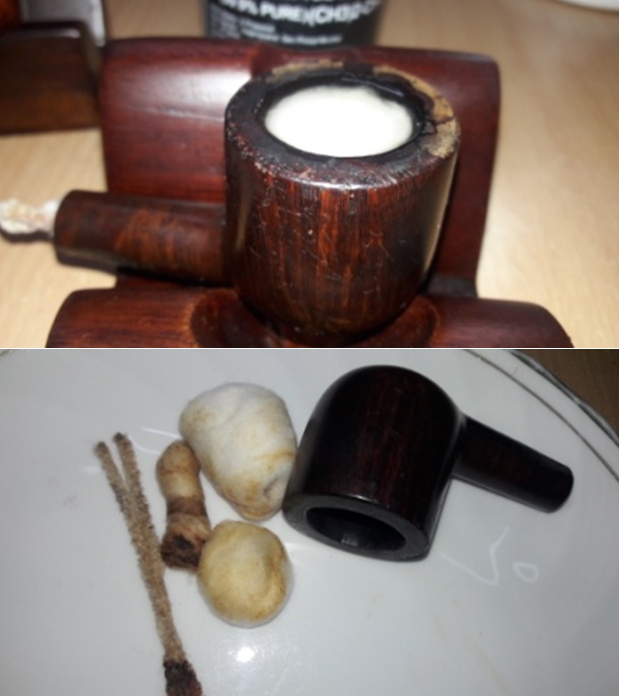
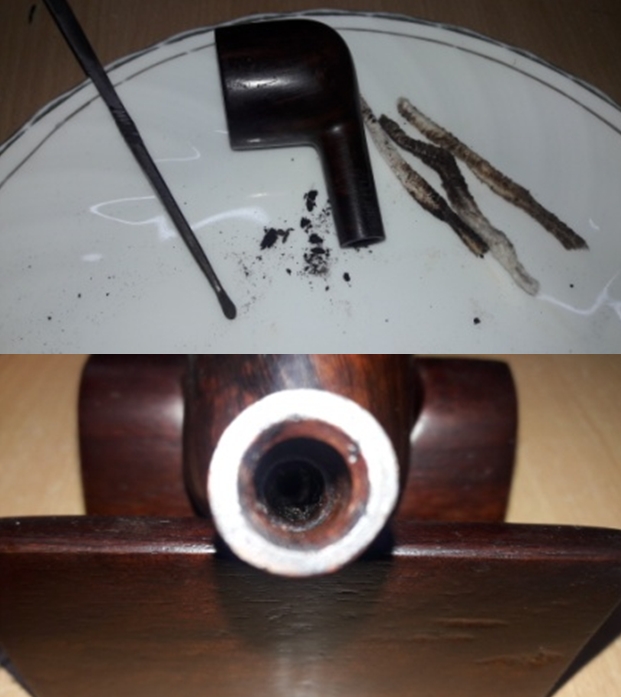
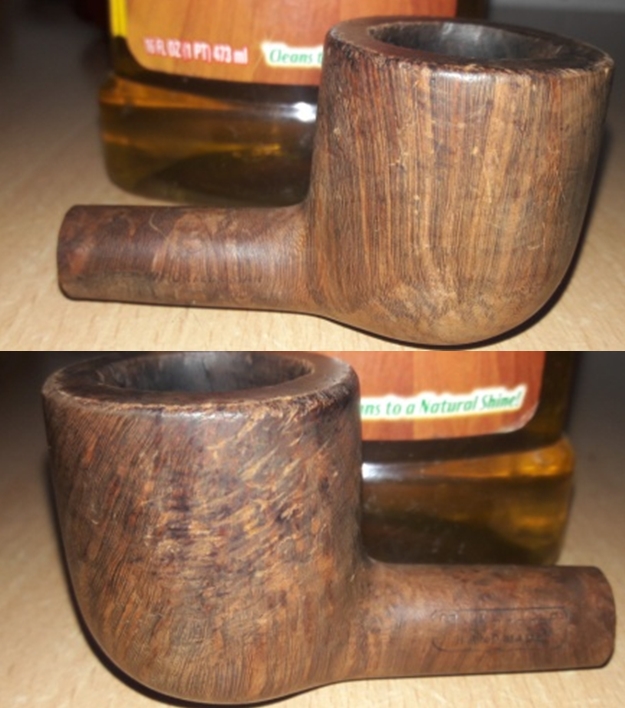
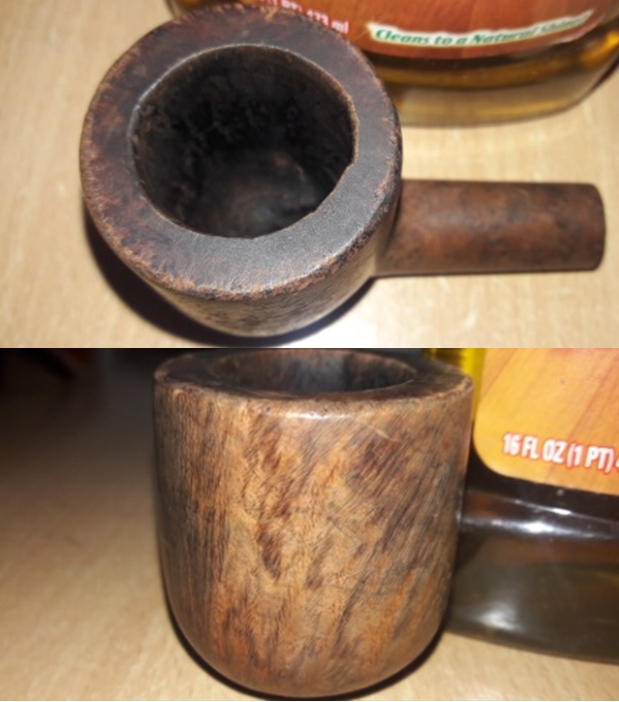
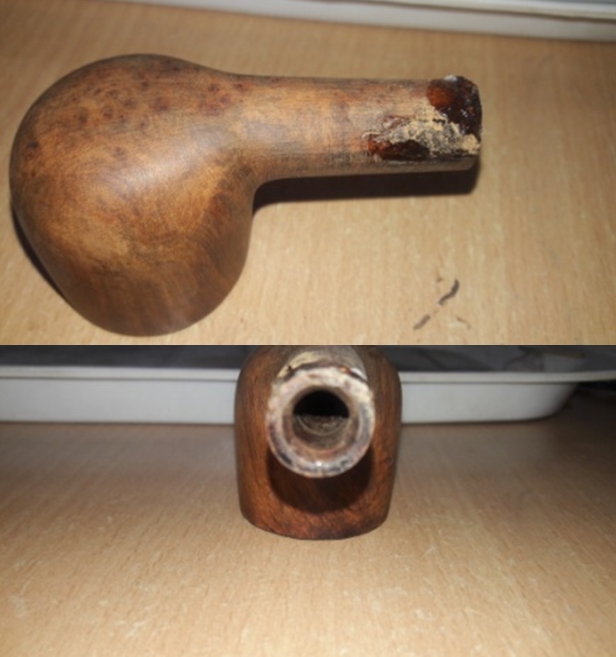
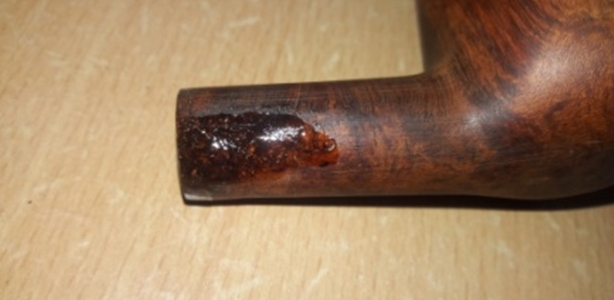
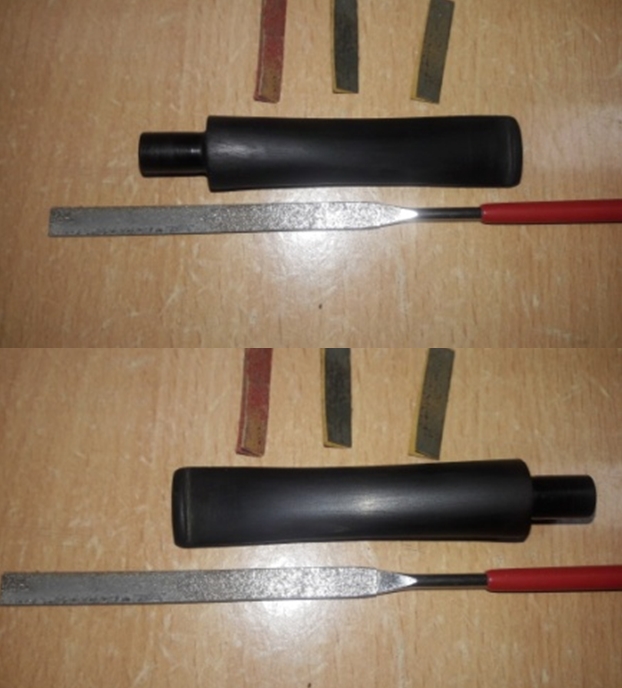
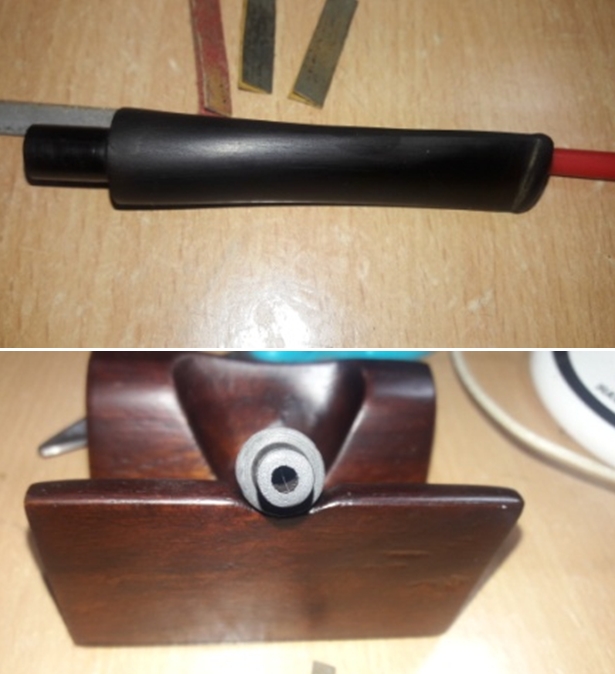
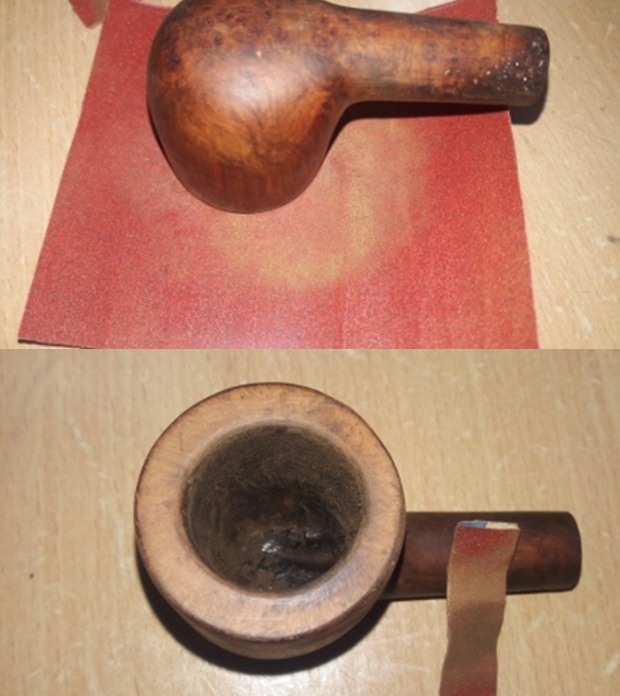
However, no sooner than I was through with wet sanding using 1500 to 2400 grit micromesh pads, the air pockets in the fill to the road rash stood out like sore thumb. I repeated the process of freshly filling it with a mix of CA superglue and briar dust. I set the stummel aside for the fill to cure.After the fill had cured sufficiently, I sand and match the fill with rest of the surface using a 220 grit sand paper. This was followed by polishing the stummel with micromesh pads, wet sanding with 1500 to 2400 pads and dry sanding with 3200 to 12000 grit micromesh pads. I wipe the surface with a moist cloth to remove the resulting dust. The stummel, at this stage, looks absolutely stunning with beautiful straight grain popping out from every inch. The dents, dings and scratches, though visible, are no longer an eye sore. In fact, it lends the pipe an aura of being a survivor and invincible. I decide to let the marks be! Next, I rub a small quantity of “Before and After Restoration Balm” in to the briar with my finger tips and let it rest for a few minutes. The balm almost immediately works its magic and the briar now has a nice vibrant appearance with the beautiful straight grains on full display. I further buff it with a horse hair shoe brush. The only stummel issue that needs to be addressed is that of the ridges at the heel near the draught hole. The first thing I do is insert Vaseline smeared folded pipe cleaner in to the mortise right up to the draught hole and slightly beyond. This prevents the draught hole from getting clogged. I begin by wiping the heel with a cotton pad wetted with alcohol to clean it. I make a mix of the two components of JB weld; hardener and steel in equal measures. The mix remains pliable for 6 minutes, which is adequate to spread it evenly and fill the worn out heel surface. I also covered the indentation formed on the front wall. Once I had achieved a satisfactory spread, I set the stummel aside for 4-6 hours for the weld to cure. The weld has hardened and I sand the fill to a nice smooth and even surface with a 180 grit sand paper. It was not an easy task as I had to do it manually with the sand paper pinched between my thumb and index finger. But I managed with satisfactory results. I shall be coating the inner walls of the chamber with a mix of activated charcoal and yogurt. This will not only help in faster build up of the cake but also isolates the weld from coming in to direct contact with the burning tobacco. To complete the restoration, I re-attach the stem with the stummel. I mounted a cotton cloth buffing wheel to my local machine which is similar to the Dremel.  I set the speed at about half of the full power and applied White Diamond compound to the entire pipe. I wiped/ buffed the pipe with a soft cotton cloth to clear it of any leftover compound dust. With a cotton buffing wheel earmarked for Red Tripoli, which has a finer grit than White compound, I buffed the stem to a fine glossy finish. I then re-attach the stem to the stummel, mounted another cotton cloth wheel on to the polishing machine and applied several coats of carnauba wax. I finished the restoration by giving the entire pipe a rigorous hand buffing using a microfiber cloth to raise the shine further. The completed pipe looks lovely, fresh and vibrant; the pictures speak for themselves. I really enjoyed working on this pipe and hope that readers too enjoyed walking with me through this restoration. If only this handsome pipe could share the secret of its past life with all of us… if only!! Cheers.
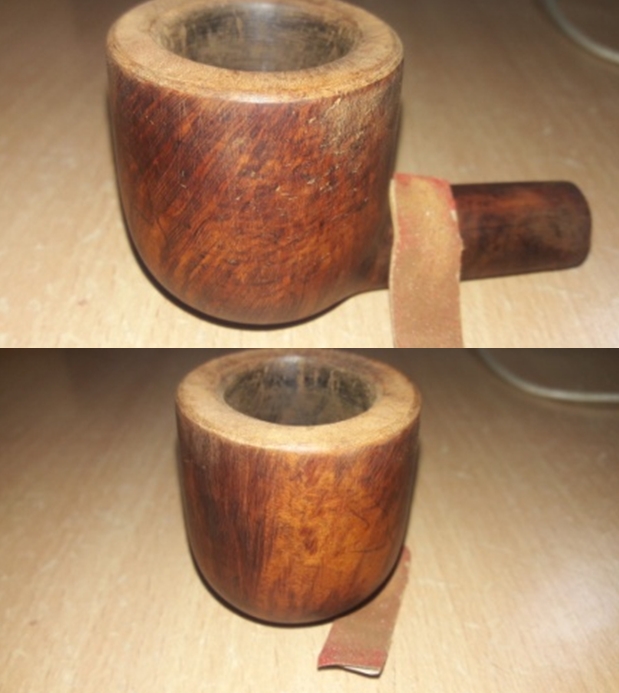
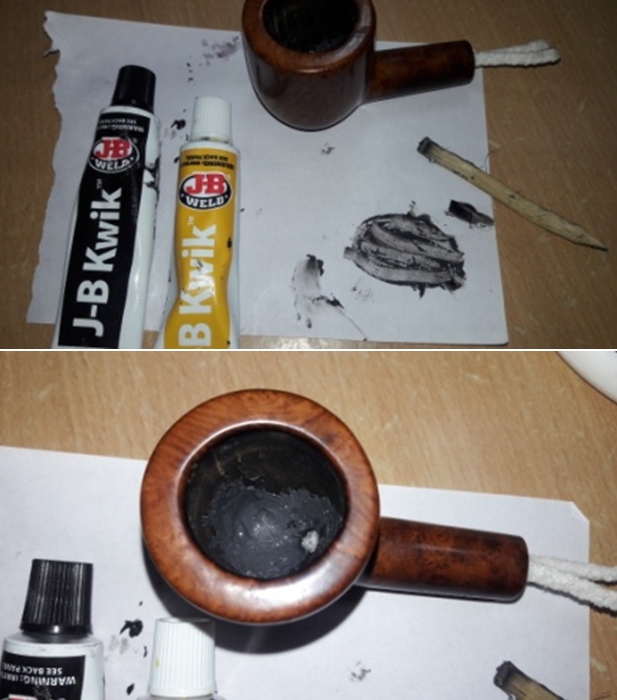
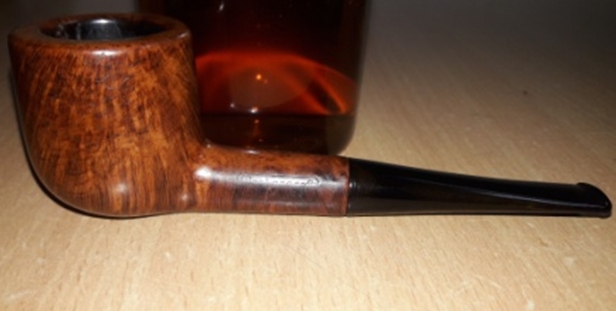
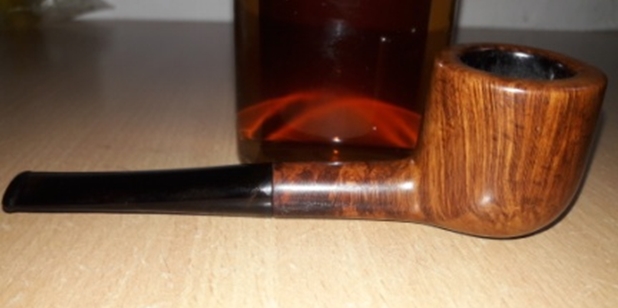
PS: After I was done with all the polishing and buffing, I gave the walls of the chamber, a nice and even coat of activated charcoal and yogurt. I am very happy that this pipe has gone to a war veteran Officer who loved the scars and the grains on this pipe, not to mention my figment of imagination that this pipe appears to have seen action against the Viet Cong and survived!! It was at his request that I did not stain this pipe to mask the fills. This fighter has indeed come a long way as can be seen from the pictures below.