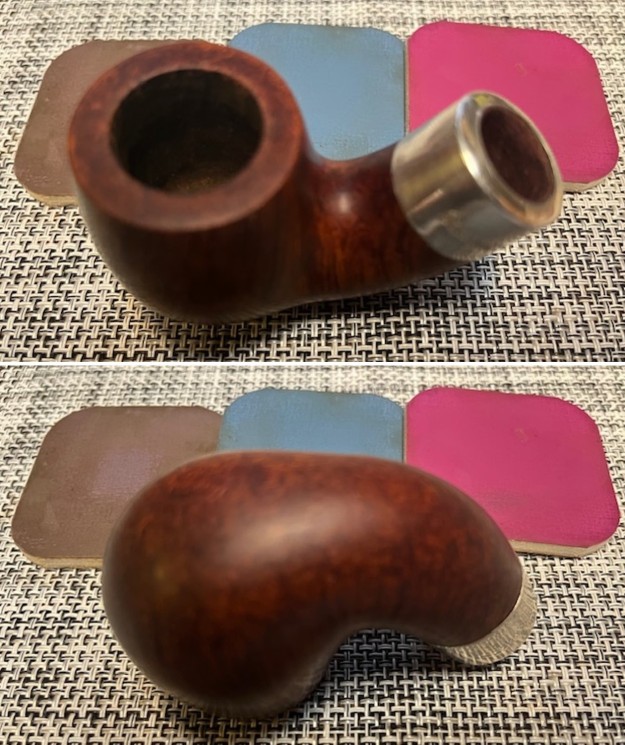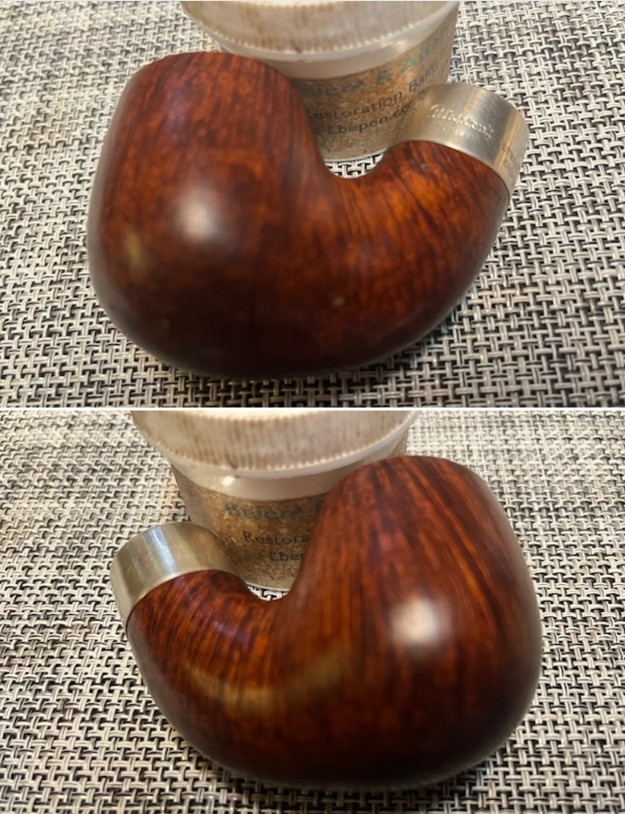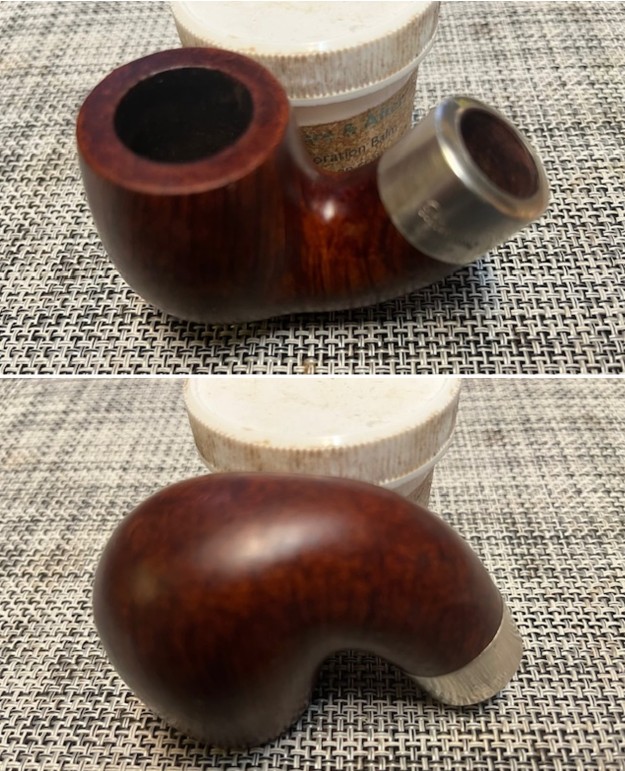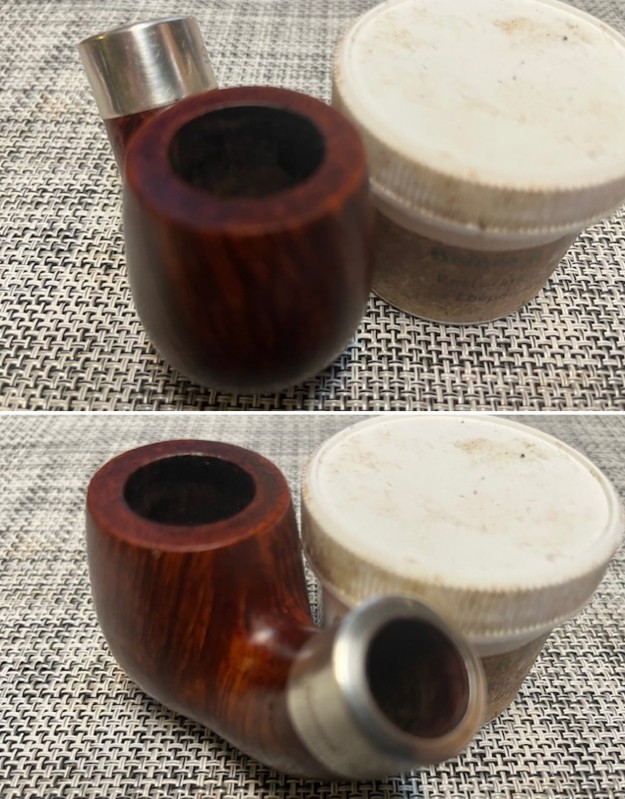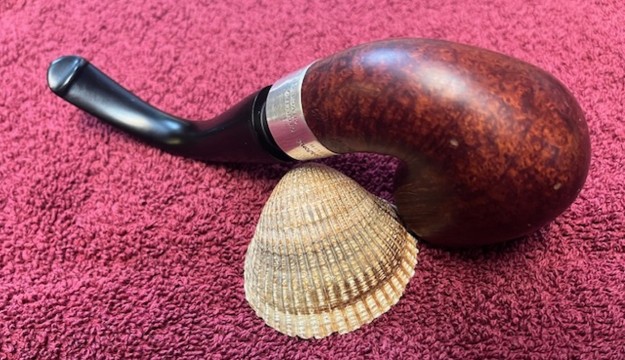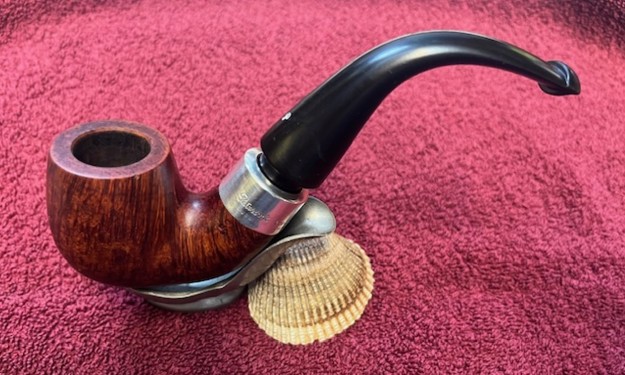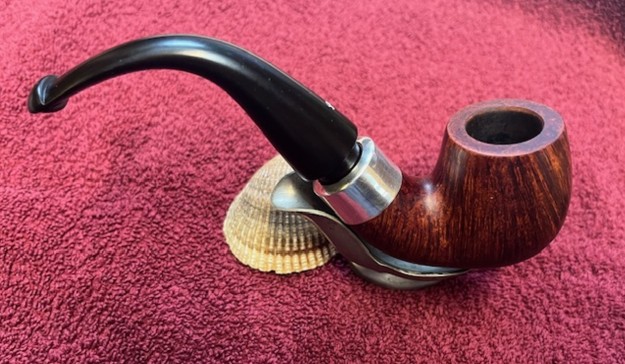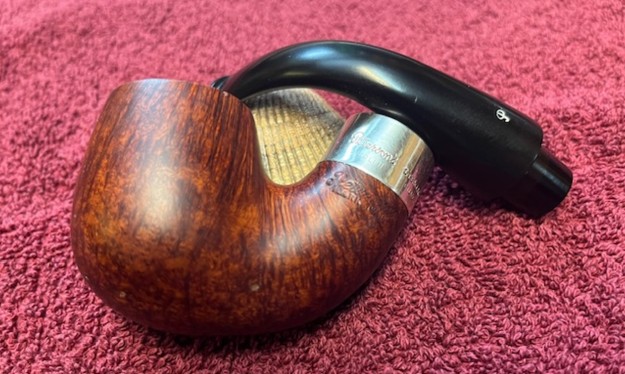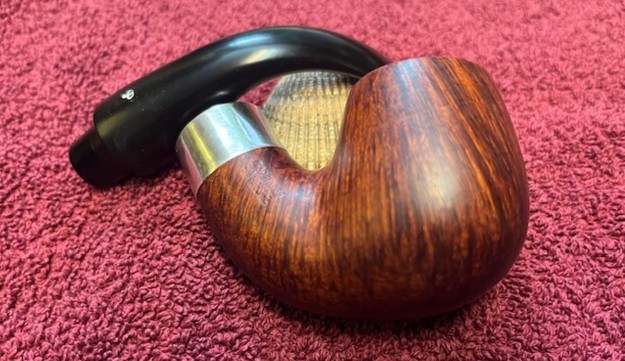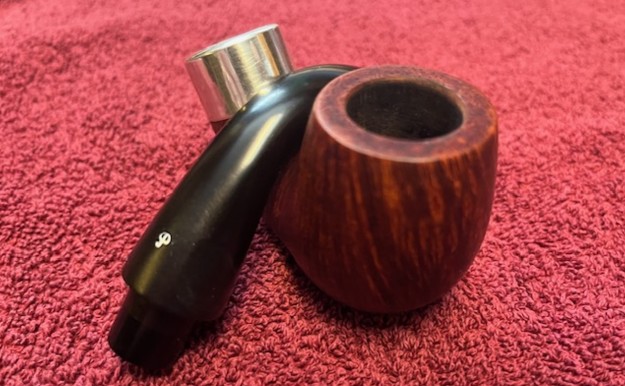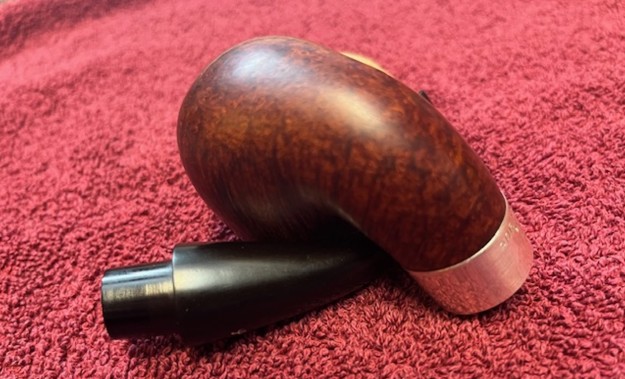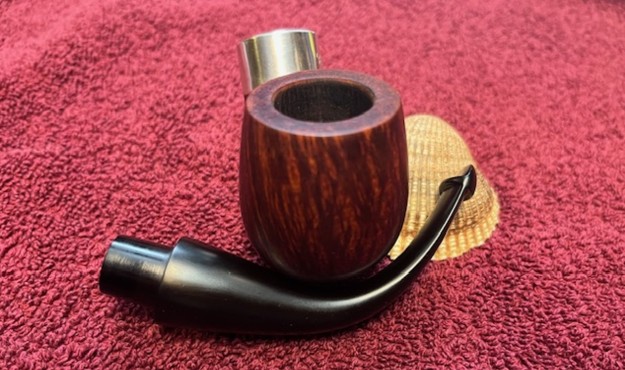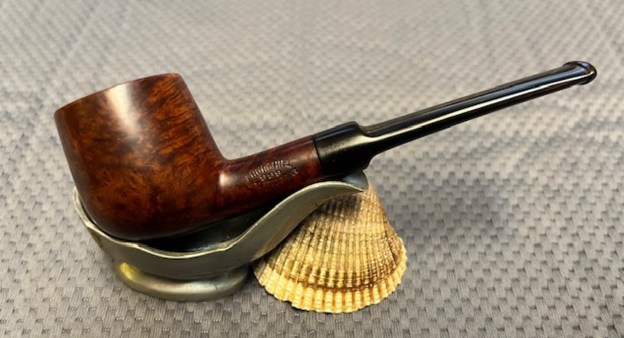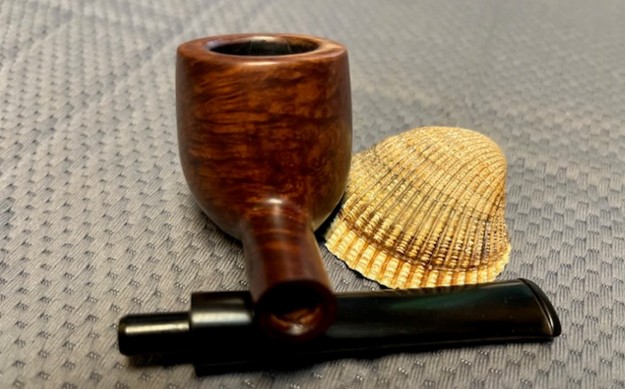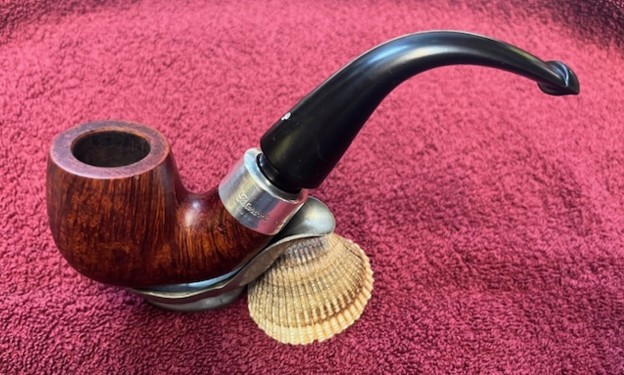
Tag Archives: fitting a stem

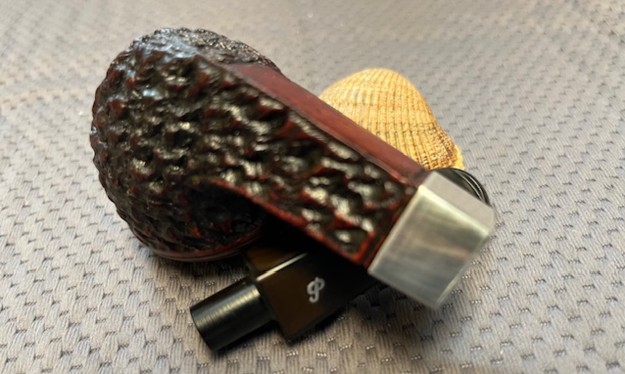
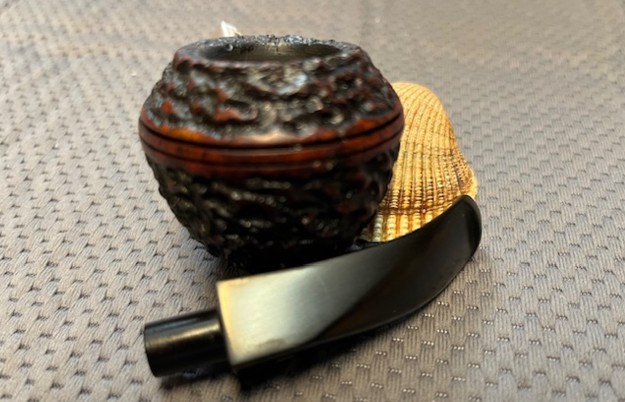
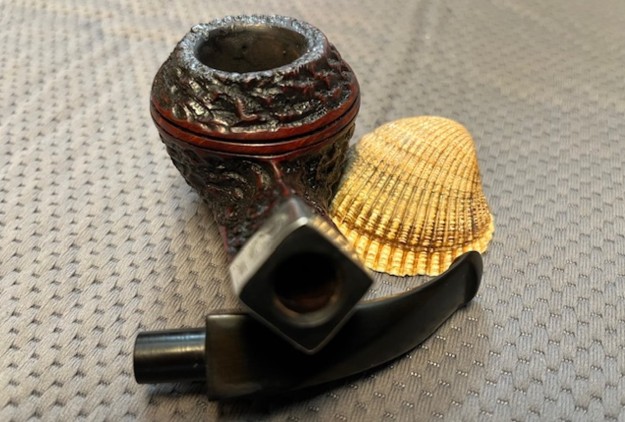
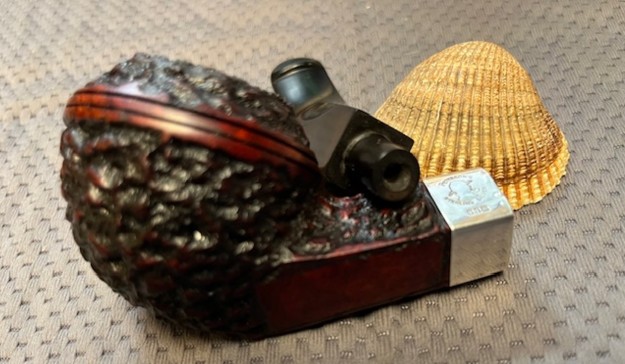
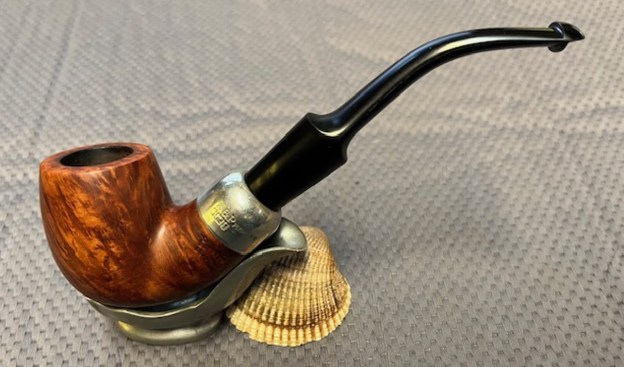
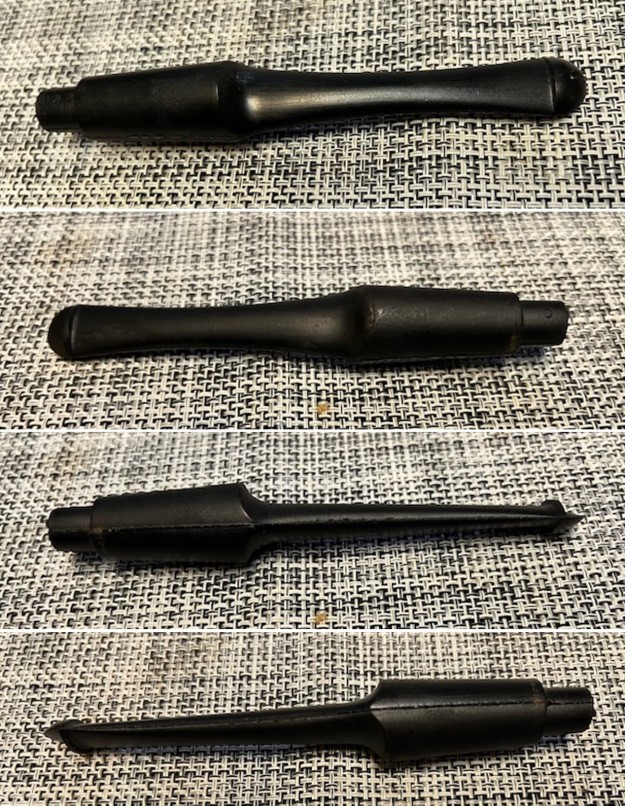
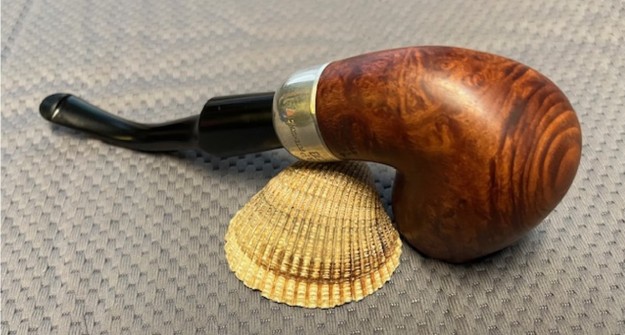
Reclaiming a Greaves Patent 2 Stubby Billiard Pipe


Blog by Paresh Deshpande

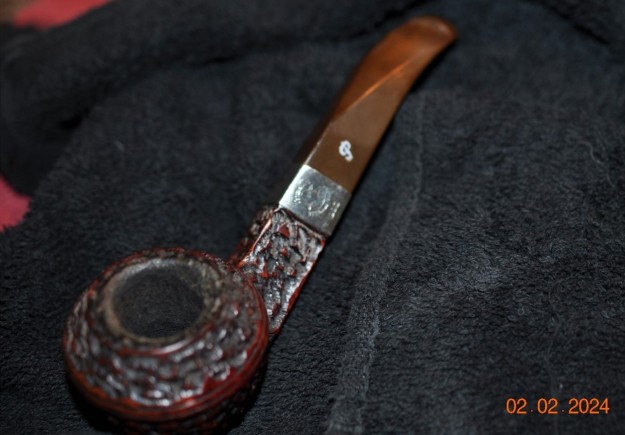
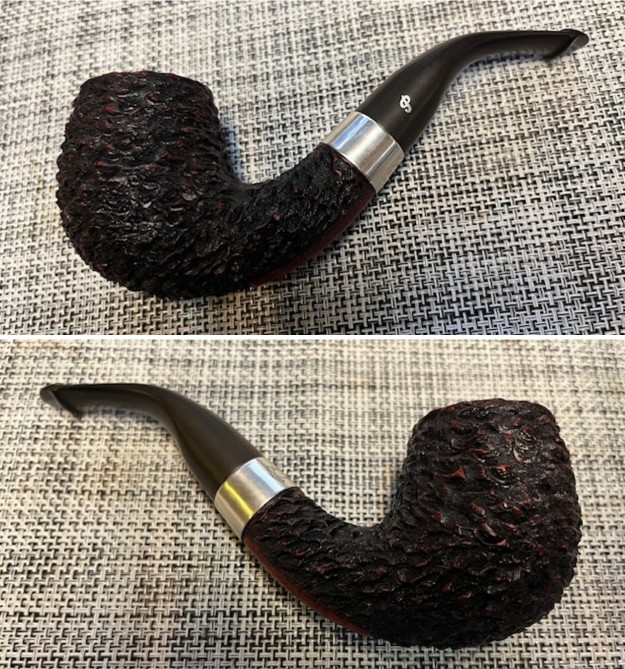
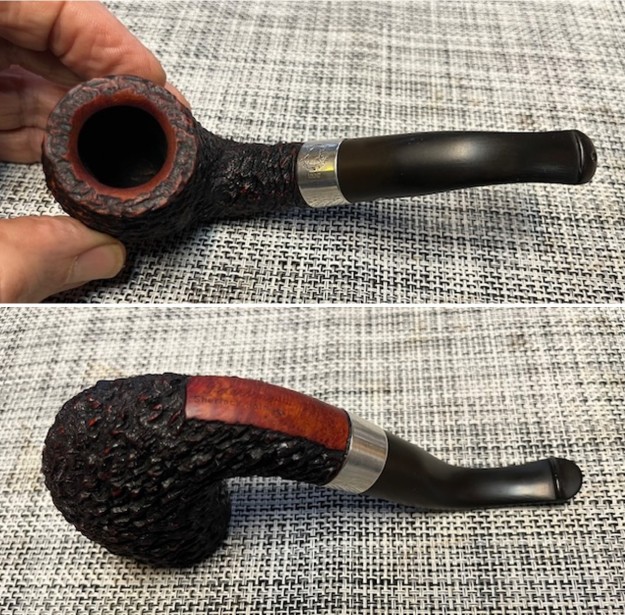
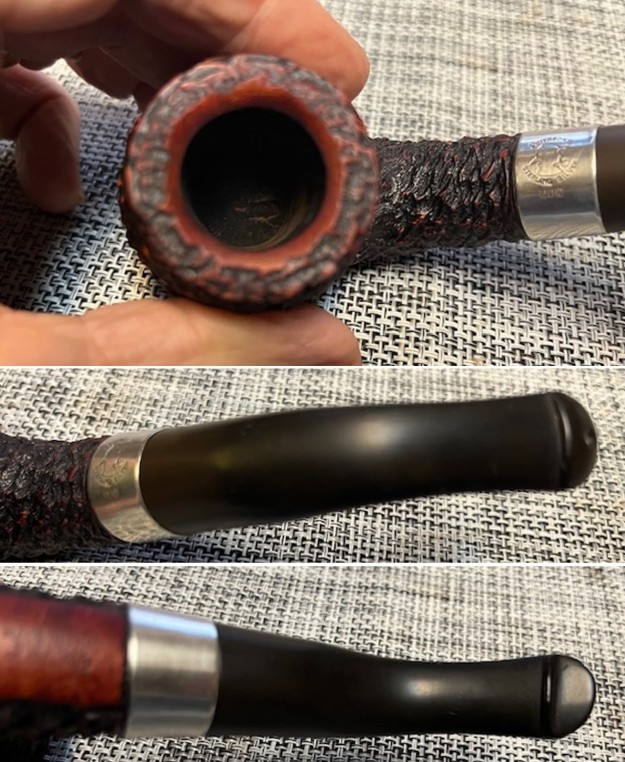
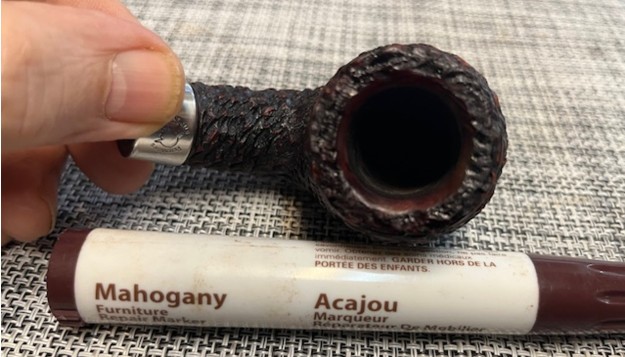
This pipe was always being relegated down the line up for restorations because of its uncanny resemblance to a Peterson’s pipe and having worked on quite a few challenging Peterson’s, I just wanted to take a break from another Peterson’s. However, the shape, size and the overall quality of this piece was undeniably attractive.

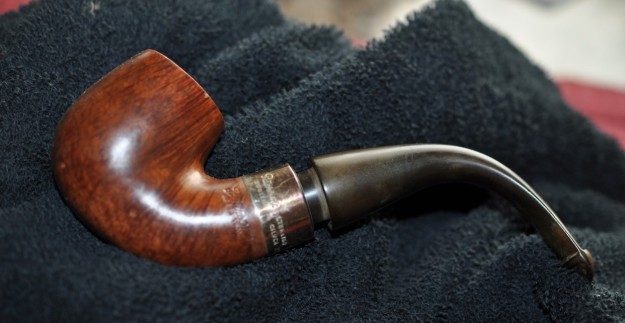
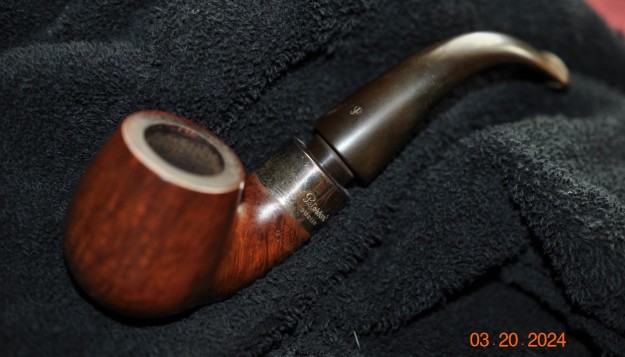
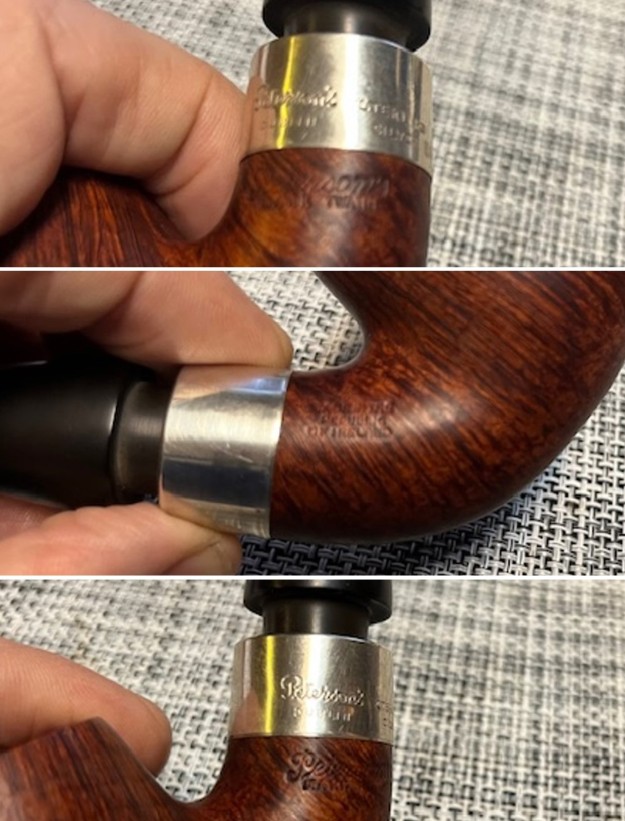
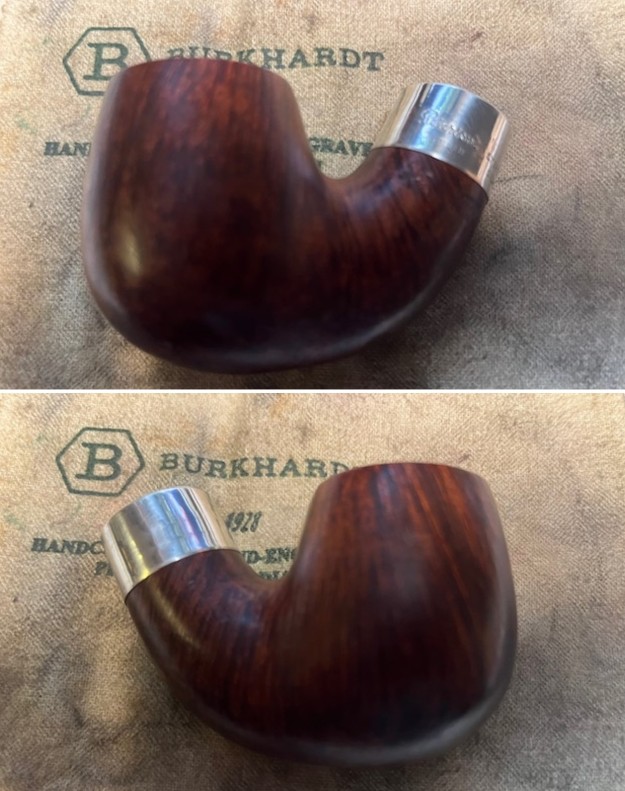
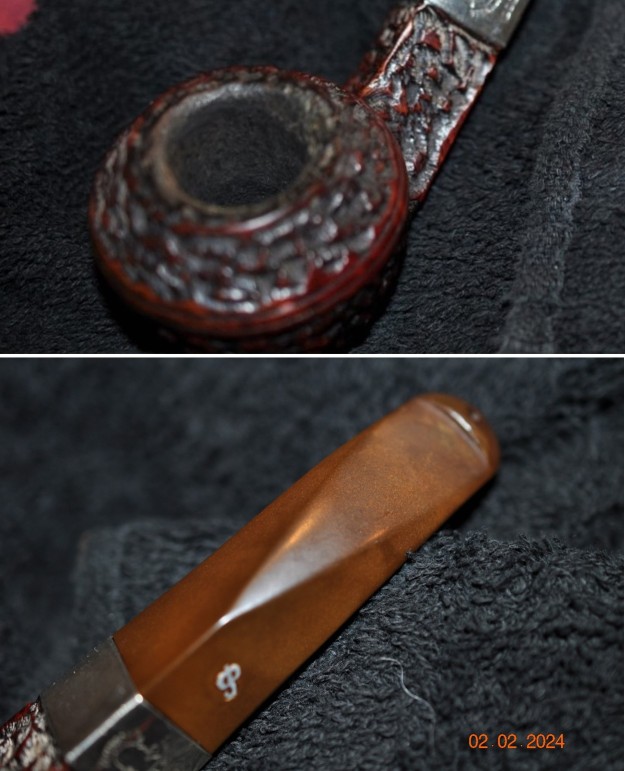
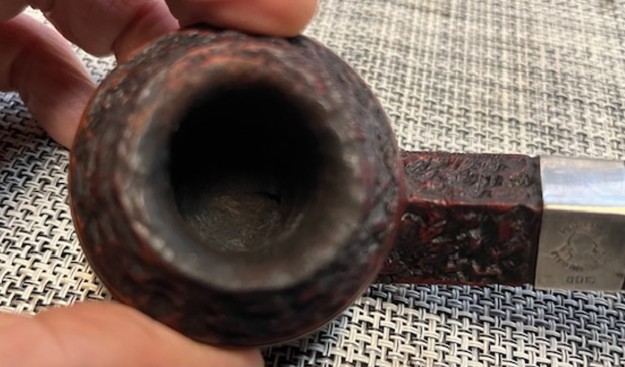
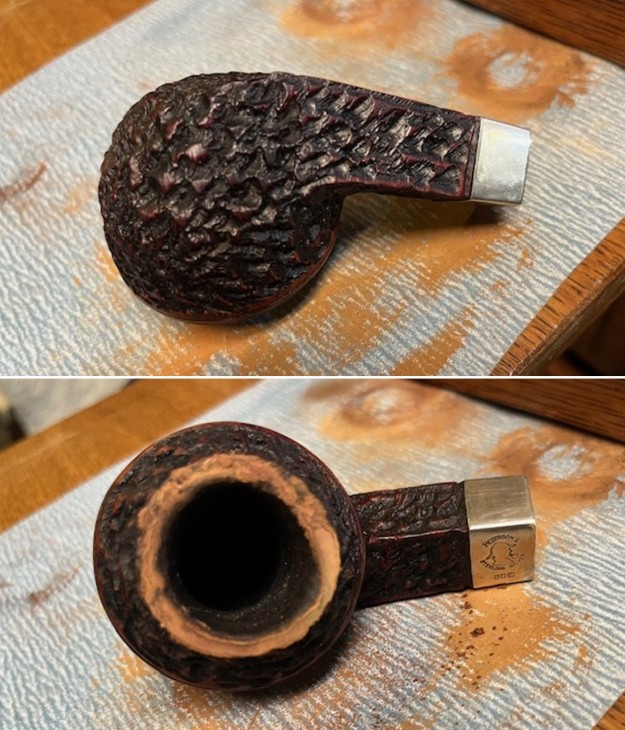
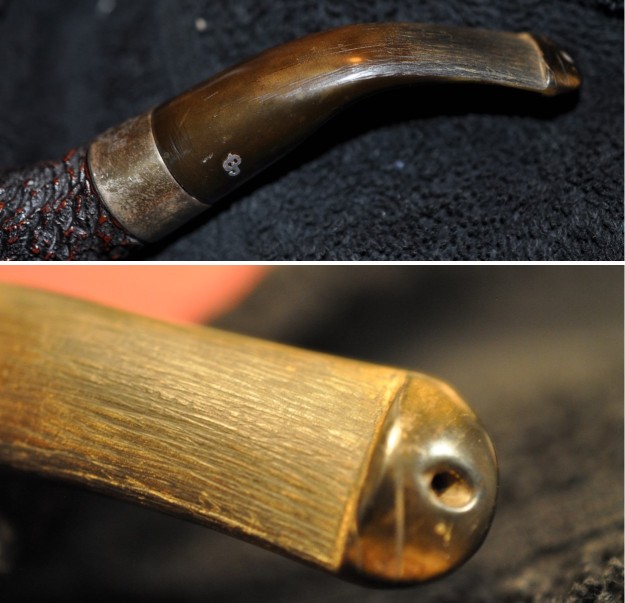
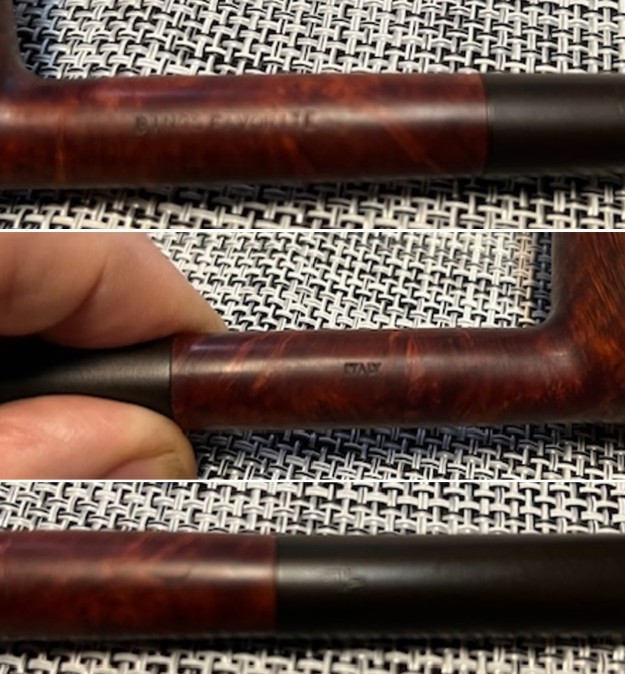
Thus, this time around when I closely observed the stamping, it turned out to be stamped across the shank on the left side as “GREAVES” over “PATENT” followed by encircled numeral 2. The right side bears the COM stamp “MADE” over “IN” over “FRANCE” in a football shape. The vulcanite stem is stamped as “GREAVES” over “PATENT”. A silver band adorns the shank end and is stamped as “S.S.G” over “E.G” followed by three faux hallmarks. I say faux hallmarks since firstly; all the cartouches differ from other and secondly, the symbols, or those that are discernible, are nothing to match the lion passant or the date code letter or the Assay office. This brand/ manufacturer is unknown to me and thus I visited pipedia.org. The information provided therein is very meagre (https://pipedia.org/wiki/Greaves) and is reproduced below:

Greaves was one of many brands owned by the Oppenheimer Pipe group, apparently made in France, likely by Marechal Ruchon & Cie. as evidenced in the following catalog page from a Circa 1950s Oppenheimer Pipes Catalog. Unfortunately, for the info of readers, this link has expired and does not work.

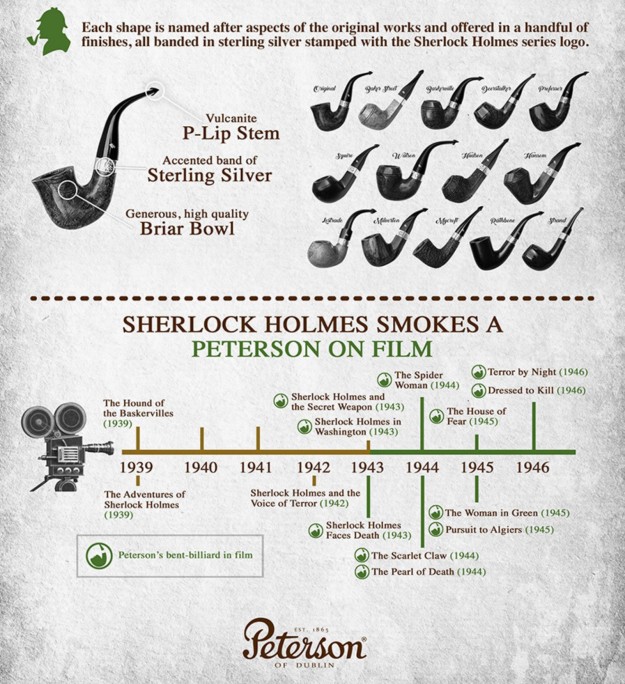
I have also reproduced a couple of pictures of c.1950s Oppenheimer pipe catalog from this site.I visited pipephil.eu for some additional information on this brand. Here I learned that the Greaves stem differs from the Peterson P-Lip in that the hole is drilled straight in to the bit in Greaves stem and the smoke is not deflected towards the palate as in P-lip. I have included a screen shot of the same along with the link below. http://www.pipephil.eu/logos/en/logo-g5.htmlGreaves is a brand of Marechal Ruchon (which became C.G. Verguet Frères). These companies belonged to Oppenheimer Holding.

I further searched the internet for additional information and came up naught. There were a few pictures, some with ferrule and some without. However, those with ferrule all were stamped as GREAVES over PATENT in football shape. Here are a few pictures for your consumption.Thus from the above it is understood that this was one of the French brands, likely from Marechal Ruchon & Cie. in the Oppenheimer holdings and find mention in 1950s catalog. However, the question that still haunts me is the difference in the ferrule stampings and makes me question if the band is original to the pipe or otherwise and for what purpose. It definitely is not a repair band as the shank face shows no signs of cracked shank end and the only plausible reason is decorative purpose! Any clarifications on this issue would be most welcome.

Initial Inspection
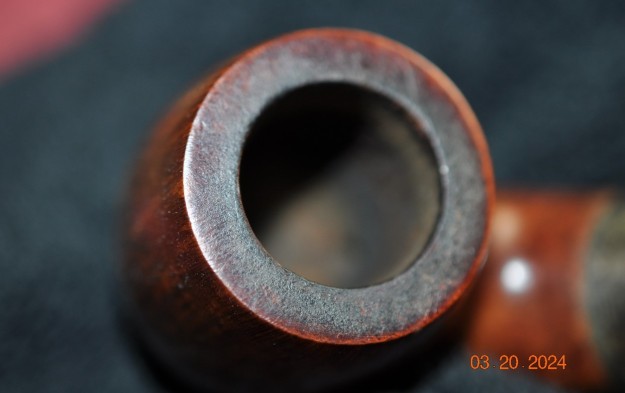
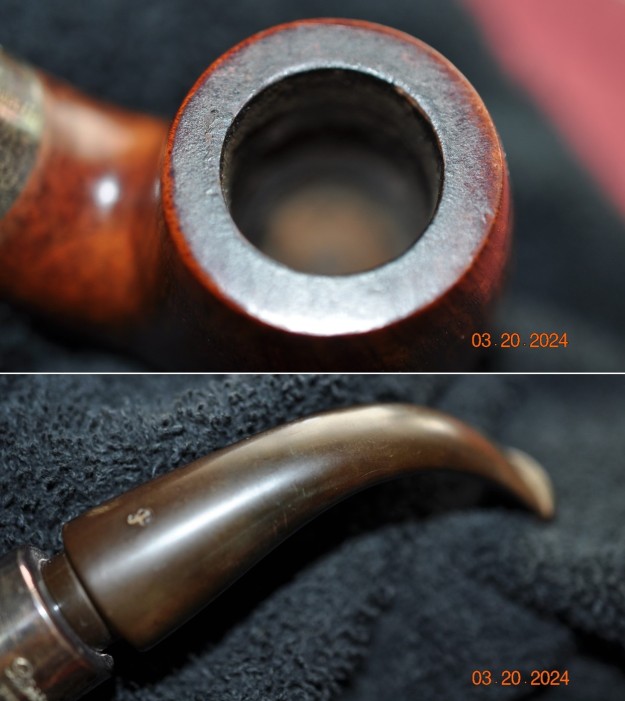
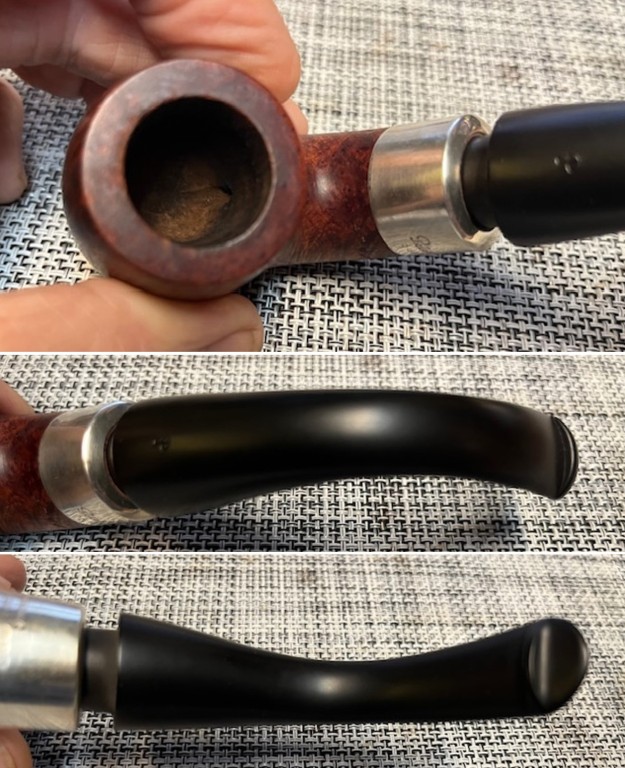
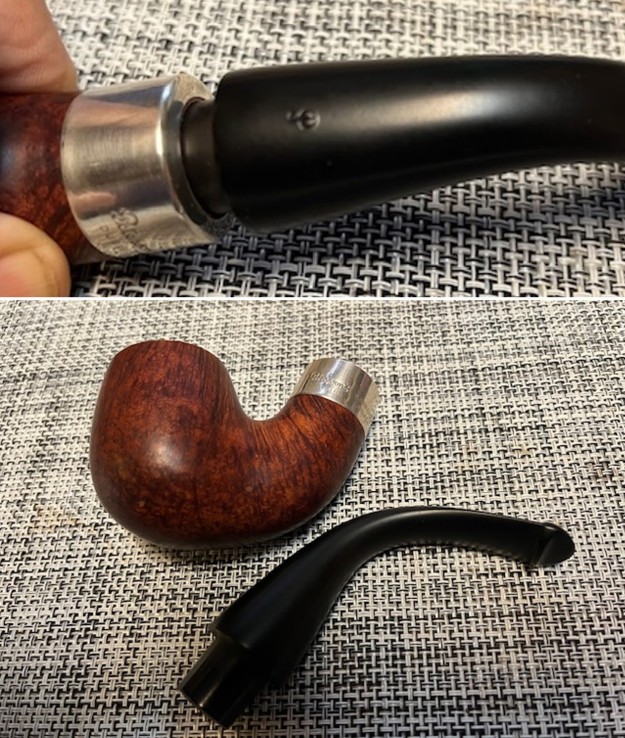
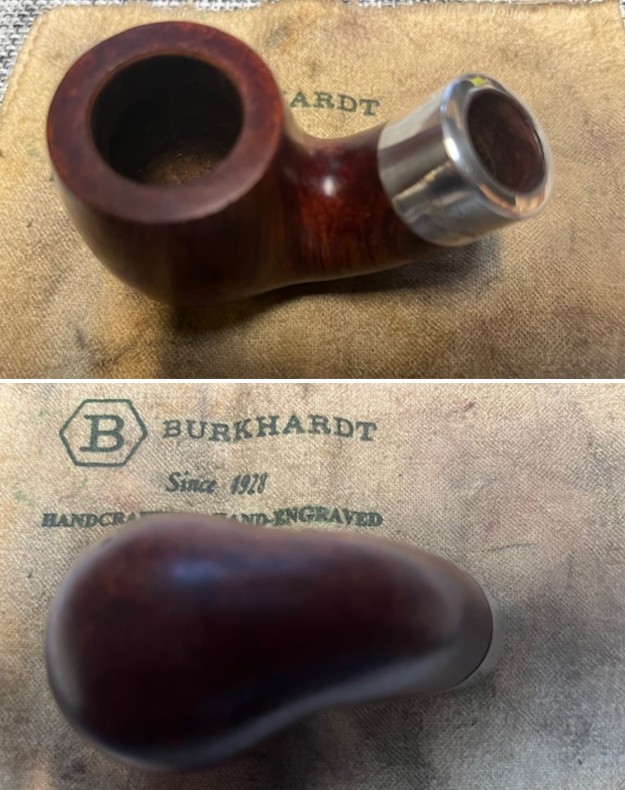
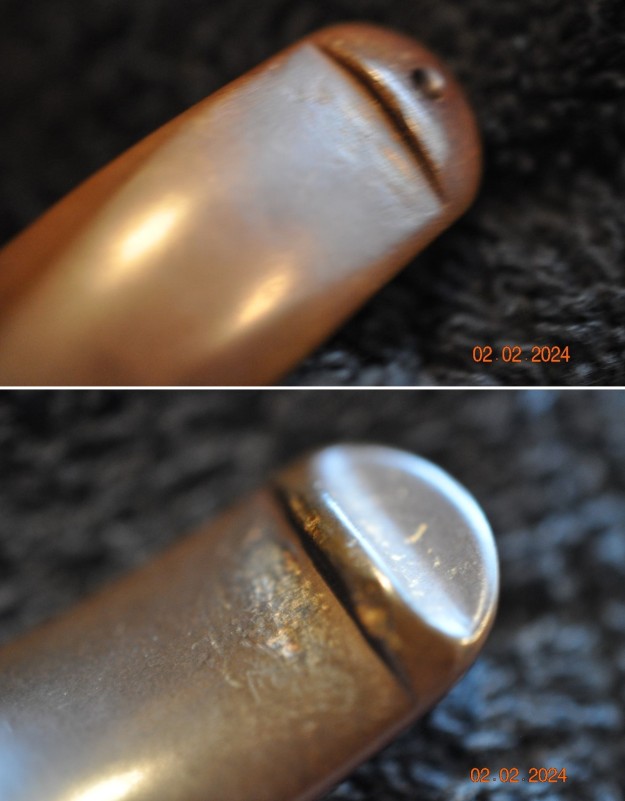
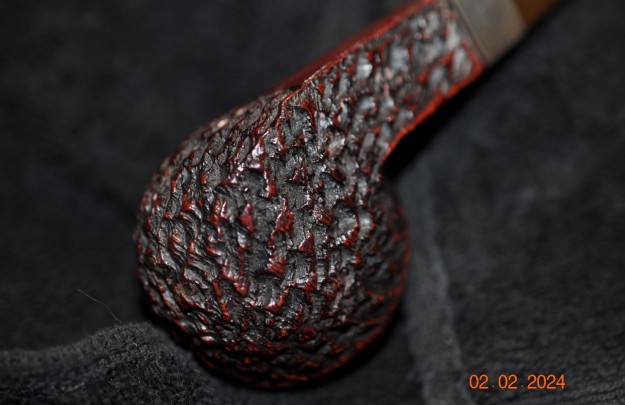
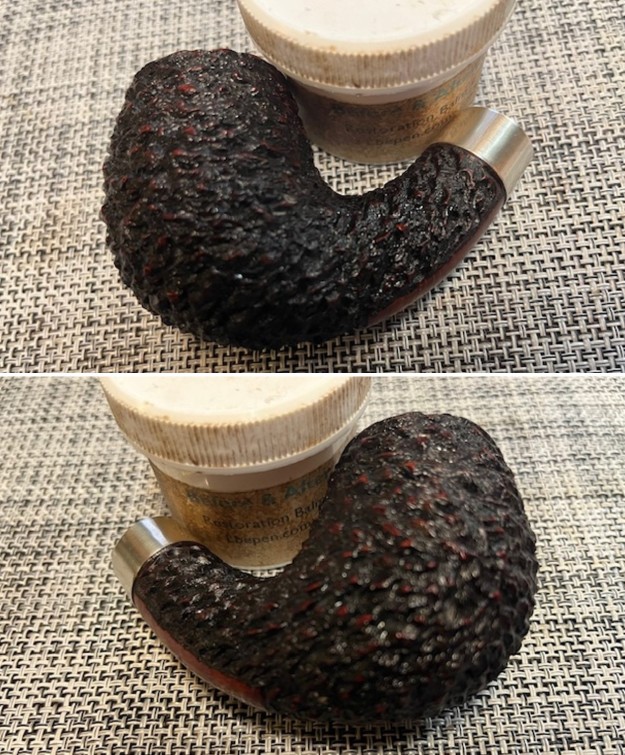
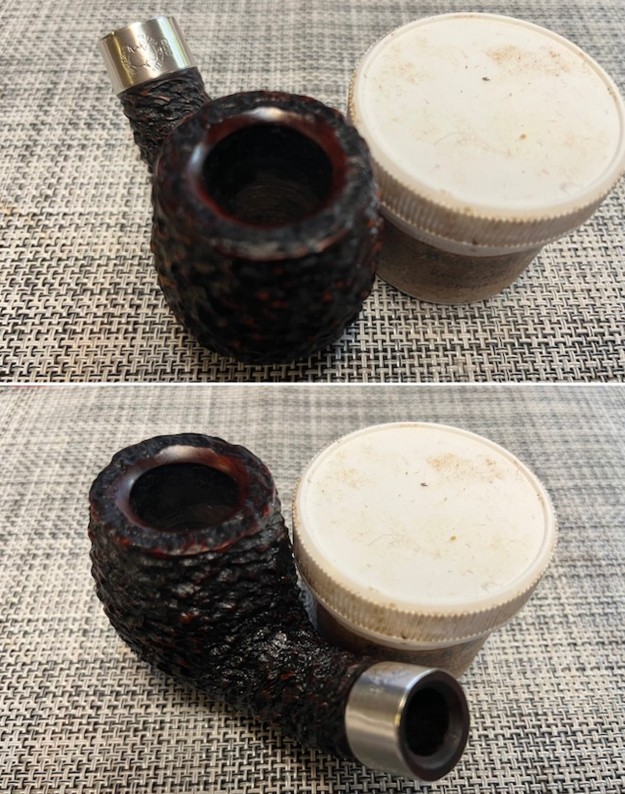
This Greaves Patent pipe has a classic chubby Billiard shape. It is a small sized pipe, about 5 inches in length, but the stout shank, bowl and stem lends it an overall attractiveness and hand feel. The rim top is covered in lava overflow while the chamber has a medium layer of uneven cake. The chamber appears to be out of round due to the thinning of the inner rim edge in the 12 ‘O’clock direction. The stummel surface is covered in dirt and grime through which beautiful flame grains are seen that radiate from the front of the bowl to the sides. The front of the bowl has a chipped area that will need to be filled. The mortise is clogged and the airflow through it is greatly restricted. The P-lip tapered vulcanite stem is oxidized with minor bite marks/ tooth indentations and traces of calcification in the bite zone. The stem does not fit snugly in to the mortise. The following pictures should give the readers a general idea of the condition of the pipe before I start working on it. Detailed Visual Inspection
The chamber has a decent layer of uneven cake and has a strong residual pungent smell of Latakia forward blend of tobacco. There is thick overflow of tobacco oils, ash and grime over the rim top surface that spills over to the sides of the bowl. The condition of the outer rim edge can be ascertained only after the rim surface is rid of complete lava overflow. However, that the inner rim edge has damage is visible through the grime. The rim surface has thinned out (encircled in yellow) in 12 and 3 o’clock due to removal of charred edge by the erstwhile individual who held the pipe in his/ her trust. Any other issues with the inner rim edge will be known after the rim top surface has been cleaned. The draught hole is at the bottom centre of the chamber and thus should be a decent smoker.The smooth stummel surface has some very beautiful cross grain patterns on the sides with loosely packed bird’s eye grain to the front and back. The stummel has taken on a lovely dark patina from years of usage. The lava overflow from the chamber has spilled over on to the sides of the stummel and has accumulated a lot of grime and dust imparting the stummel a lifeless and bone dry appearance. The front of the stummel has a prominent chip from where a chunk of briar is missing (encircled in pastel blue). There are a few minor scratches and dings over the bowl surface commensurate to the pipe’s journey to date. The stem is very firmly attached in to mortise and would not budge. I shall initiate measures to separate the two subsequently. The P-lip like stubby tapered vulcanite stem is deeply oxidized and covered in dirt and grime. A few deep tooth chatter and tooth indentations are seen on both the upper and lower stem surfaces in the bite zone and the lower button edge has been chewed off. The tenon of the stem is firmly stuck in to the mortise and its condition will be ascertained once the two are separated. The airflow through the airway is laboured and not smooth.The Process
The first issue that I addressed was to separate the stem from the shank. I dribbled a few drops of alcohol through the gap between the stem and shank with an eyedropper with the intent that the alcohol would moisten and loosen the gunk holding the tenon and set it aside for a few minutes. Thereafter, I gently twisted the stem the stem in order to pull the stem out. However the stem did not budge. I repeated the process of moistening the gunk holding the tenon in to the mortise using alcohol. After repeating the process a couple of times, I was finally able to separate the stem from the shank. A close observation of the mortise revealed a completely clogged mortise and an equally gunk and crud encrusted tenon end. It appears that the mortise and stem has never ever been cleaned.With the stem now separated from the shank, I cleaned the stem airway and surface using thin shank brushes and anti oil dish washing soap. I dried the stem airway by blowing out excess water and thereafter running a couple of pipe cleaners through the airway. Once the stem internals had been cleaned, I immersed it in “Before and After Deoxidizer” solution along with the stem of other pipes in line for restoration. This solution has been developed by Mark Hoover and works to draw out all the deep seated oxidation from the surface making its subsequent cleaning and polishing a breeze. I would definitely recommend this product as it saves on to time and efforts. The pipe has been marked with a yellow arrow for easy identification.While the stem was soaking in the deoxidizer solution, I worked on the stummel by reaming the chamber walls with my fabricated knife to remove the carbon deposits. Once the cake was reamed back to the bare briar, I used a 150 grit sand paper followed by 220 grit sand paper to remove all the traces of the remaining cake and also to smooth out the inner walls of the chamber surface. Finally, to remove the residual carbon dust, I wiped the chamber with a cotton pad wetted with 99.9% pure isopropyl alcohol. I gently scraped the rim top surface to remove the lava overflow. This was followed by cleaning the mortise with cue tips, pipe cleaners and a shank brush dipped in isopropyl alcohol. I scraped the walls of the mortise with my fabricated knife to remove the dried oils and tars. The heap of gunk scraped out from the mortise walls tells the sordid saga of the condition of the shank internals. Well, the shank internals are clean and will be further cleaned once the stummel exterior is cleaned using oil soap and shank brushes. However, the odours are still very strong and would need more intrusive methods of cleaning.Continuing with the internal cleaning of the chamber and shank, I subjected it to a salt and alcohol bath. I used cotton balls which is an at par substitute to kosher salt as I have realized over the years. I drew out a wick from the cotton and along with a folded regular pipe cleaner; inserted it into the mortise and through the draught hole and further into the chamber. Thereafter, I packed the chamber with cotton balls to about quarter of an inch below the rim inner edge and soaked the cotton balls with isopropyl alcohol up to the brim. About half an hour later, the level of alcohol had gone down, having being absorbed by the cotton. I topped it up once again and set it aside overnight. By next afternoon, the cotton and alcohol had drawn out all the remaining oils/ tars from the chamber and mortise and loosened out any residual cake and tar build up, fulfilling its intended task. I removed the cotton balls and ran pipe cleaners through the mortise to clean out all the loosened tars and gunk. Using my fabricated tool, I scraped out the entire loosed gunk from the mortise and further cleaned it with alcohol and q-tips. I also scraped the moist cake from the chamber using my knife and sanding it smooth with 180 grit sandpaper. The chamber now smelled clean and fresh and the tiny veins observed in the chamber were eliminated. I set the stummel to dry out naturally.As I was cleaning the shank internals, the metal band came loose from the shank end. Careful inspection of the now exposed shank end confirmed that the surface is sans any cracks or chips. I kept the band aside to be worked upon later.

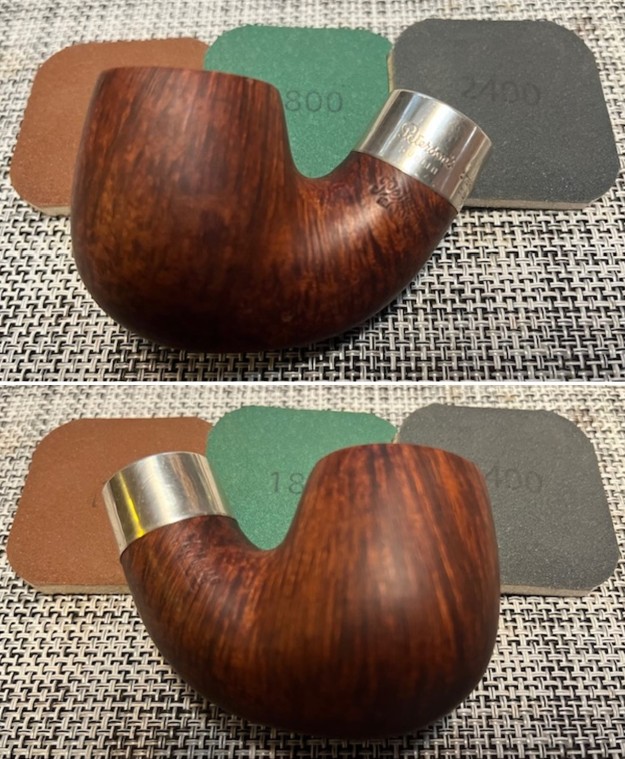
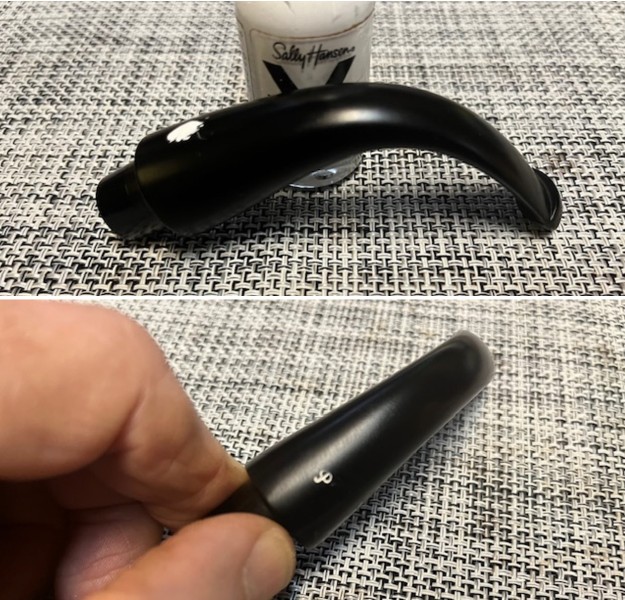
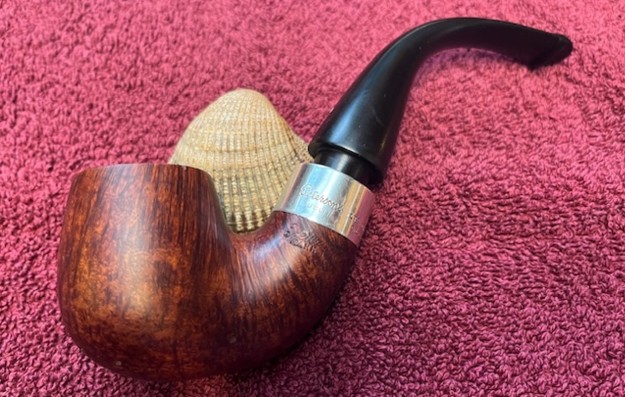
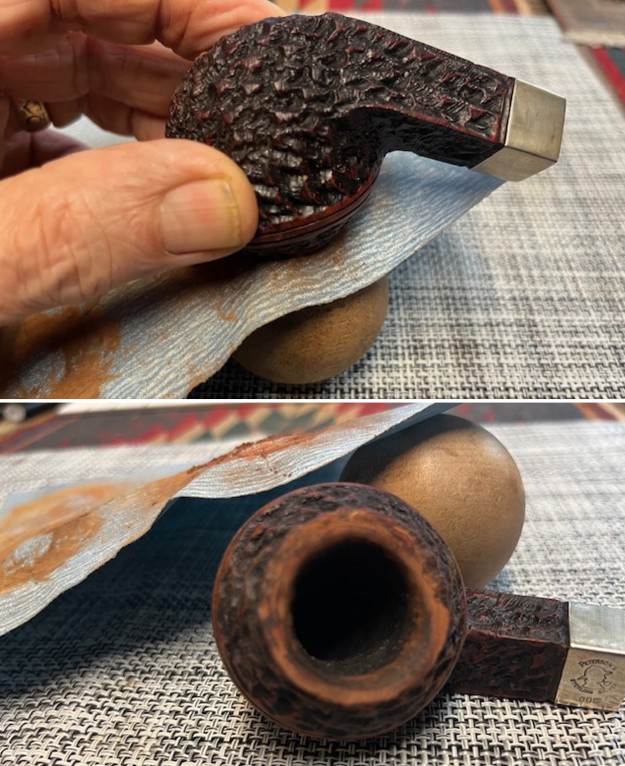
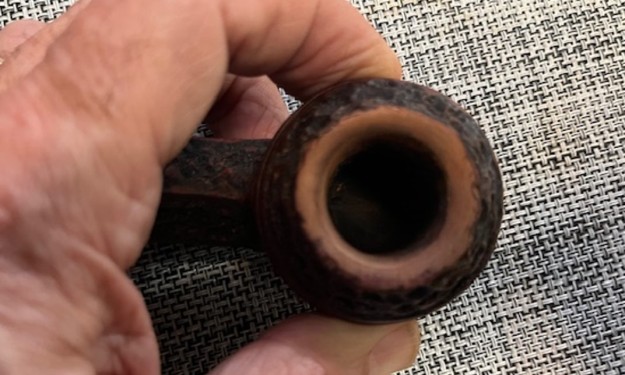
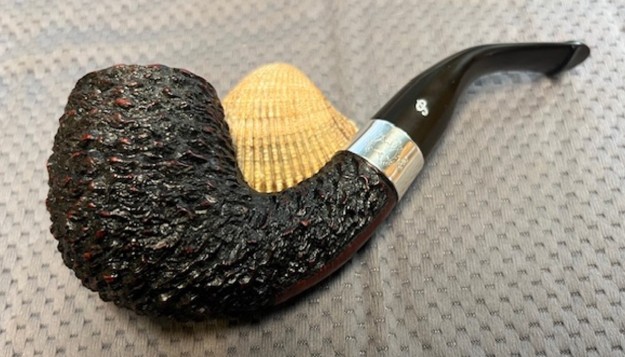
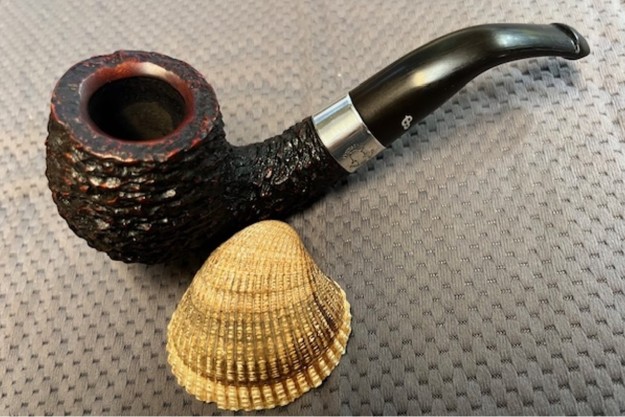
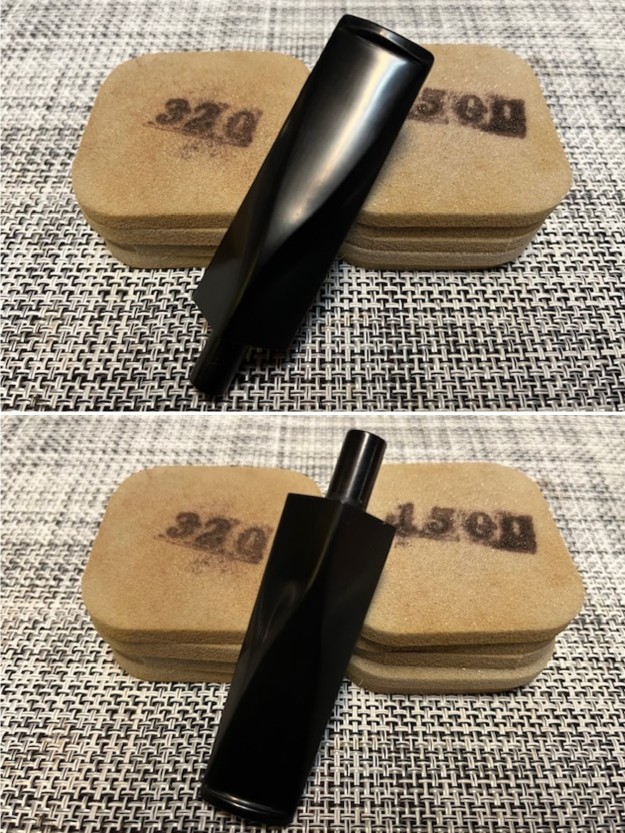
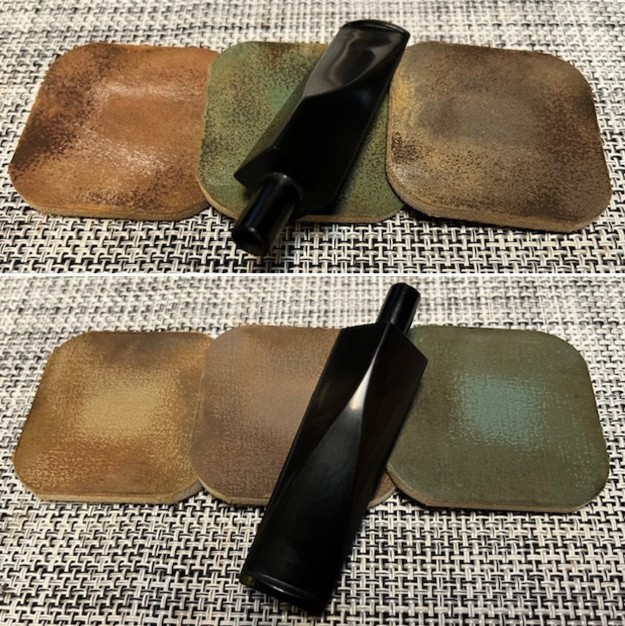
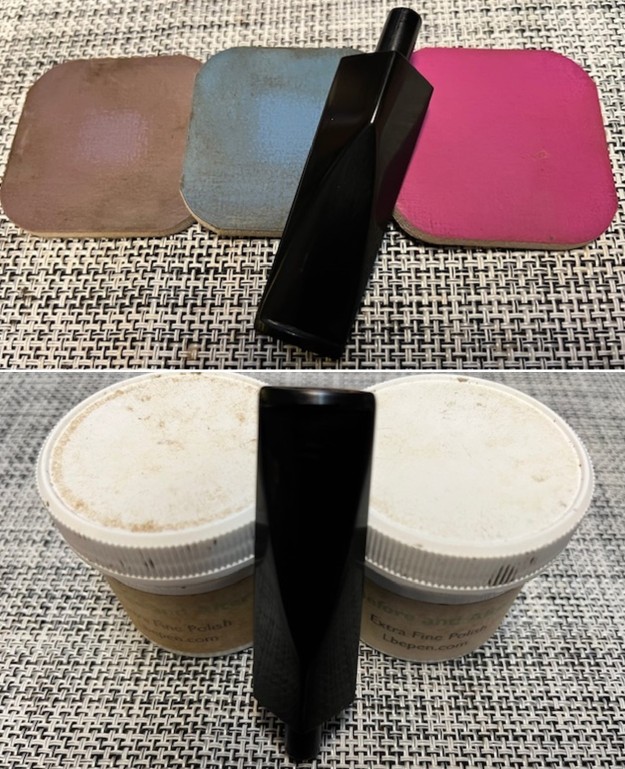
The next morning, I removed the stems that had been soaking in the deoxidizer solution overnight. I cleaned the stem surface and airway under running warm water and scrubbed the raised oxidation from the stem surface using a Scotch Brite pad and the airway with thin shank brush. I further removed the oxidation by scrubbing the stem with 0000 grade steel wool and applied a little olive oil to rehydrate the stem.While the stem was set aside to rehydrate and absorb the EVO, I cleaned the external surface of the stummel with Murphy’s Oil Soap. I scrubbed the stummel surface with anti oil dish washing detergent using a Scotch Brite pad and a hard bristle toothbrush under warm running water, always being mindful of the stamping on the shank surface. I paid particular attention to the rim top surface to rid the rim of all the residual crud and lighten the darkening around the rim surface. Thereafter, I dried the stummel using paper towels and a soft cotton cloth and set it aside to dry out naturally. The extent of the gouge is now easily discernible and is encircled in blue. This will need to be addressed. I followed up the external cleaning of the stummel with internal cleaning of the mortise and shank using anti oil soap and shank brushes. The shank internals are now clean and fresh.Continuing with the stem refurbishing, I heated the bite zone with the flame of a lighter to raise the tooth indentations to the surface. Though the results were not what were expected, the vulcanite was raised a little leaving behind two visible tooth compressions on either surfaces. The button edges and deeper tooth indentations on either surfaces of the stem were filled with a mix of CA Gorilla superglue and activated charcoal powder and set aside for the fill to cure.With the stem repairs set aside, I addressed the rim top darkening and unevenness by topping the surface on a piece of 220 grit sandpaper. I frequently checked the progress being made as I hate to lose briar more than what is absolutely necessary. The chamber now appears more out of round than before and would be addressed by creating a bevel over the inner rim edge. With a folded piece of 220 grit sandpaper pinched between my forefinger and thumb, I imparted a nice bevel to the inner rim edge. This masked the out of round appearance of the chamber and also eliminated the minor charring over the edges. I evened out the outer rim edge n the same way. The rim top surface now has a nice rounded appearance with even rim edges.Next, I filled the deep gouge to the front of the stummel with a mix of briar dust and superglue. This mix hardens very rapidly and invariably reveals air pockets when sanded. To mitigate this, one has to re-patch the fill and this is exactly what I followed. Using a flat needle file, I sanded the patch to achieve a rough match of the fill with the rest of the stummel surface. I further evened out the patch with a folded piece of 220 grit sandpaper. I am quite satisfied with the appearance of the stummel surface at this point in restoration. Thereafter, I completed the polishing of the stummel by wet sanding the surface with 1500 to 12000 grit micromesh pads. I wiped the stummel with a moist cloth in between the pads to gauge the progress being made and massaged a small quantity of Before & After Restoration balm and set it aside for 10 minutes for the briar to rehydrate. Thereafter, I gave a rigorous hand rub using a microfiber cloth. The stummel now has a nice vibrant shine to it with the beautiful cross grains and bird’s eye grains resplendent in all their glory. I completed the mundane but equally important task of polishing the Sterling Silver filigree band. I used Colgate toothpowder to polish the band. The ultra fine powder was rubbed over the band and wiped it out. The polish completely removed the oxidation and gave a nice shine to the band which was further improved by polishing it with a jeweller’s cloth. Using CA superglue, I reattached the band at the shank end.Stummel repairs and refurbishing is now complete, save for the final polishing, I moved on to stem repairs. The stem had cured completely and began the stem refurbishing by first sanding the stem fills using a flat needle file to roughly match the rest of the stem surface. I masked the stem markings with a tape to preserve them as it was already worn out and avoid further wearing down during the polishing process. Thereafter I sand the fill with a piece of 320 grit sandpaper to blend in the repairs. I also lightly sand the entire stem surface to remove the raised oxidation from the surface.I followed it up by wet sanding the entire stem surface using 400, 600, 800, 1000, 1500 and finally with a piece of 2000 grit sand paper. This serves to reduce the sanding marks of the more abrasive sand papers. I also sharpened the button edges while sanding. I wiped the stem with a moist cotton swab to remove all the oxidation and sanding dust from the surface. I applied a little Extra Virgin Olive oil over the stem and set it aside to be absorbed by the vulcanite.I went through the 1500 to 12000 grit micromesh pads to wet and dry sand the stem. The stem now has a nice deep shine with no traces of oxidation around the entire stem surface. To apply the finishing touches, I mounted a cotton cloth buffing wheel on to my hand held rotary tool and applied a coat of Blue Diamond to the stummel and the stem to polish out the minor scratches. With a cotton buffing wheel that I use for carnauba wax, I applied a coat of carnauba wax and continued to work on it till the complete coat of wax had been polished out. I mounted a clean cotton cloth buffing wheel and gave the entire pipe a once over buff. I finished the restoration by giving the entire pipe a rigorous hand buffing using a microfiber cloth to raise the shine further. The finished pipe looks beautiful and is ready to be added to my collection of inherited pipes. I thoroughly enjoyed working on this project and seeing the pipe transforming itself in to a beautiful piece. However, the research on this particular pipe has highlighted more questions than answers. I would appreciate if the knowledgeable readers could clear the cobwebs of questions surrounding the provenance of this beauty. Thank you for reading through this write up and also in anticipation for the input on this particular piece.


Repairing and Restemming a Big Ben Lectura 420 pipe


Blog by Steve Laug

Last week I received and email from Dayton regarding a pipe he was seeking to have repaired. He was referred to me by our local pipe and cigar shop called City Cigar. He wrote the following email regarding the pipe.

Hey Steve my name is Dayton. I got your information from City Cigar, they said you’d be able to help with a pipe stem repair? If so I’d really appreciate it. Does email work or would you prefer text!

Thanks again – Dayton Lewis.

He wrote that it needed to have a stem repair done on the pipe. Before I take on work I always ask for photos or at least a photo to show me what needed to be done or at least the damage to the pipe. I wrote back and asked for a photo of the pipe that showed what needed to be repaired. He sent the photo below. You can see the nicely grained bowl on the pipe and the stem with the snapped tenon. The tenon included a metal stinger apparatus. It appeared to me that the break had occurred at the internal end of the inserted portion of the stinger. We talked about a price and he dropped the pipe off for repair yesterday evening.I brought the pipe and stem along with the broken parts in the bag he dropped off to the work table last evening. I examined the pipe carefully to see what I was dealing with in terms of a repair. I like to know the details about the pipes I work on. The pipe is stamped on the left side of the shank and reads Big Ben [over] Lectura. On the right side of the shank it was stamped with the shape number 420 [over] Made in Holland. The finish on the bowl was in good condition. The bowl had a thin cake inside and a light overflow of lava on the rim top. Overall the pipe was quite clean. With a repair on the stem the pipe would be in good condition to keep providing a great smoke to Dayton. I took photos of the pipe when I received it. In the photos above don’t miss condition of the bowl and the shank. The pipe looks quite clean and should polish up well. I examined the bowl and shank for damage that might have occurred when the tenon snapped. I have learned over the years to examine it carefully with a bright light and a lens. In this case I found there was a hairline crack on the lower right side of the shank just below the stamping Made in Holland. It extends from the shank end about a half inch up the shank dipping to mid-underside. I have inserted a red arrow in the second and third  photos below to show that location of the crack. I wrote to Dayton and told him about my recommendations for a thin band to repair the cracked shank. I am waiting to hear from him. I repaired the crack with a spot of clear CA glue and then pressed the thin brass band on to the shank end and it drew the parts of the crack together. Now on to the stem repairs my first thoughts were that I would insert a replacement tenon in the drilled-out air way in the stem. I examined the stem diameter and found that it was too thin to drill out. The tenon was quite large in diameter and it would not leave much on the stem if I were to drill it out. I decided to rather find a replacement stem for the pipe. I went through my stems and found one that was the same length, similar diameter and had a solid vulcanite tenon that would need slight adjustment to fit in the shank.I worked on the diameter of the tenon on the new stem with a file/rasp and removed enough to get a close fit. I used 220 grit sandpaper to smooth it out and bring it to round and get the fit what I needed. I also used the file and the sandpaper to reduce the diameter of the stem itself to get a clean fit against the shank end.I fit the stem on the shank and took photos of the fit. The stem looks perfect against the shank end. It is a snug fit and looks very good with the thin brass band.I sanded the stem with the 2 inch square 320-3500 grit sanding pads. I wiped down the stem after each sanding pad. I was able to remove the tooth marks and chatter on both sides with the pads. The stem looked very good. I wiped the stem down with some Obsidian Oil on a cloth to remove the debris from sanding. It was looking much better.I polished the vulcanite stem with micromesh sanding pads – dry sanding it with 1500-12000 grit pads. I wiped the stem down after each sanding pad with Obsidian Oil and set it aside to dry.  I polished it further with Before & After Pipe Polish – using both the Fine and Extra Fine Polishes. I gave it a rubdown with Obsidian Oil one last time and set it aside. I put the Big Ben Lectura 420 back together and worked the pipe over on the buffing wheel using Blue Diamond to lightly polish the stem. I buffed the bowl and stem to raise the gloss on the briar and the vulcanite. I gave the pipe multiple coats of carnauba wax. I buffed the entire pipe with a clean buffing pad to raise the shine. I hand buffed it with a microfiber cloth to deepen the shine. The finished Ben Ben Lectura is shown in the photos below. The medium brown stains on the smooth Billiard shaped bowl works well with the rich black of the vulcanite stem. The dimensions of the pipe are: Length: 7 ½ inches, Height: 1 ¼ inches, Outside Diameter: 1 inch, Diameter of the chamber: 3/4 inches. The weight of the pipe is .71 ounces/21 grams. This is an interesting piece of briar, cross grain and mixed grain on the bowl and shank. The patterns on the sides are a real mix. I really like how the briar, the thin brass band and the vulcanite work well together. This one will soon be going back to Dayton once I contact him. Thanks for walking with me through the restoration process.

Bringing Back a Lovely Poul Hansen Bent Dublin


Blog by Kenneth Lieblich

This charming pipe came across my workbench recently and, despite its rough appearance, I could tell there was a beautiful and well-made pipe in there. It was a very attractive shape and felt very good in my hand. Given the amount of abuse heaped on this pipe, it was clearly someone’s favourite. Let’s have a closer look. This pipe is a bent Dublin, made by Poul Hansen. It’s a lovely briar bowl and a white acrylic stem with a brass and wood band. That band is really attractive. The markings on the left side of the shank are Poul Hansen [over] Copenhagen. No other markings were found. I checked the usual sources for information about Poul Hansen. I knew that his pipes were mostly from the 1960s and 70s and commanded the same prices as Preben Holm, Rasmussen and other high-end Danish carvers. Pipephil offered this lovely little tidbit about the man:Over to Pipedia – they had a bit more information, and I include some, but not all, of it below:

Poul Hansen was a very skilled toolmaker and builder of machine tools. Around 1960 he got in contact with the workshops of Pibe-Dan, W.Ø. Larsen and others. So he began to make a lot of special tools and machines for a large number of the Danish pipemakers in the early 60’s. He was inspired by the many beautiful pipes he saw when he visited the pipemakers and soon he decided to try out the art himself. Poul Hansen was basically “self taught” and his early attempts suffered from kind of awkward shapes and finishing. Things turned for the better significantly when Sixten Ivarsson, appreciating the talent, began to tutor Hansen for a while and taught him the vital “tricks” of pipemaking. Soon after Hansen was in business fine. Right from the start he avoided the competition at home and concentrated on the American, Japanese and German markets. Hansen carved the bulk of his pipes during the 1960’s and 1970’s. Around the midst of the 1970’s he took over a small Copenhagen tobacconist’s shop from it’s retiring owner. Now, operating the shop took a lot of his time but vice versa secured a steady income, and Hansen reduced his output considerably. BTW In Denmark he only sold a very limited amount of pipes – but some of his very best. Poul Hansen is little known in today’s circles, those collectors (especially in the States) who have his pipes, tend not to sell them.

On to the pipe itself: it was very dirty and harshly treated. The bowl was filthy and had quite a bit of lava and plenty of cake – just look at the photos! The rim had been heavily bashed in – presumably from banging out dottle etc. The outside of the bowl had some small fills and some minor scratches. The stem was in better shape, but still needed help. It had some tooth dents and it was dirty on the inside – through the draught hole. To work! The stem was first on my list. I wiped the outside down with Murphy’s Oil Soap on some cotton pads. Then I cleaned out the inside with pipe cleaners and isopropyl alcohol. These acrylic stems are so frustrating to clean and it took a lot of elbow grease. In fact, I also used my tube brushes and Castile soap to get out as much filth as I could. Fortunately, these acrylic stems don’t require deoxidizing, so I moved on. I built up the dents on the stem with clear cyanoacrylate adhesive and let them cure. I then sanded the adhesive down with 220- and 400-grit sandpapers to meld seamlessly into the stem. I then used all nine Micromesh pads (1,500 through 12,000 grit) to polish it and highlight the pearl-like colouring on the stem. I also used Obsidian Pipe Stem Oil in between each pad scrubbing. Moving on to the stummel, I first decided to ream out the bowl. It was unbelievably occluded with cake. I used the PipNet Reamer to remove the built-up cake and followed that with 220-grit sandpaper taped to a couple of dowels to eliminate as much as possible. I took the chamber down to bare briar to ensure there were no hidden flaws in the wall. Fortunately, there were none.The stummel’s insides were absolutely clogged with filth. The previous owner must not have been a fan of cleaning his pipe! I actually used two drill bits (by hand – not in a drill) to break into the encrusted gunk in the stem.Then, I started cleaning the inside with lemon-infused isopropyl alcohol, Q-tips, and pipe cleaners. This took a long while. The inside was terribly dirty and it took an awful lot of cotton. As usual, I followed that up by cleaning the insides with some Castile soap and tube brushes.I soaked the rim of the pipe in some Murphy’s Oil Soap to loosen up the hardened stuff and, after about ten minutes, used a toothbrush to help that process along. I then used cotton rounds and some Murphy’s to scrub the outside of the stummel. I decided to de-ghost the pipe in order to remove any lingering smells of the past. I thrust cotton balls into the bowl and the shank and saturated them with 99% isopropyl alcohol. I let the stummel sit overnight. This caused any remaining oils, tars and smells to leach out into the cotton. The bowl was nice and clean after this.Then I was able to address the small nicks on the rim and the bowl. I dug out my iron and a damp cloth to try to raise the nicks. The hot and moist steam can often cause the wood to swell slightly and return to shape. This worked very well and many of the scratches were corrected with this method. Now it was time to address the remaining fills on the bowl. I repaired them with a mixture of briar dust and cyanoacrylate adhesive. This ensures a strong repair and one that looks similar to the surrounding wood. I sanded the repairs down with 200- and 400-grit sandpaper until they were level with the surrounding briar. Now I could address the roughness on the rim. I “topped” the pipe – that is, I gently and evenly sanded the rim on a piece of 220-grit sandpaper. But I didn’t go as far as I usually do – this rim originally had fillet edges on both the inside and outside of the rim. I wanted to keep this shape and so I did most of the shaping by hand.Then, I used all nine Micromesh pads (1,500 through 12,000 grit) on the stummel to finish it off and make it lovely and smooth. At this point, I rubbed some Before & After Restoration Balm into the briar and left it to sit for 20 minutes or so. I polished it with a microfibre cloth. The B&ARB does wonderful things to the wood, and I really like the natural colour of the briar. I also polished up the bit of brass on the stem’s band. Off to the bench polisher to put the final touches on this pipe. I first gave it a thorough going-over with White Diamond compound. Following that, several coats of carnauba wax created a beautiful, glossy seal on the pipe.And that’s that! This Poul Hansen Bent Dublin looks fantastic and is ready to be enjoyed again by the next owner. I am pleased to announce that this pipe is for sale! If you are interested in acquiring it for your collection, please have a look in the “Danish” section of the store here on Steve’s website. You can also email me directly at kenneth@knightsofthepipe.com. The approximate dimensions of the pipe are as follows: length 5⅓ in. (135 mm); height 2⅛ in. (55 mm); bowl diameter 1¼ in. (32 mm); chamber diameter ¾ in. (20 mm). The weight of the pipe is 1¼ oz. (37 g). I hope you enjoyed reading the story of this pipe’s restoration as much as I did restoring it. If you are interested in more of my work, please follow me here on Steve’s website or send me an email. Thank you very much for reading and, as always, I welcome and encourage your comments.

I was not hoping for much with this poor Malaga Second Oval Shank Brandy


Blog by Steve Laug

For the next little while I am working on some Malaga Pipes. I have several in queue to work on so I tend to pick them by what catches my eye. The next pipe is the last of the latest batch of Malaga Pipes. This one is a Oval Shank Brandy with a ¼ bent vulcanite stem. Jeff saw it on eBay and purchased it on 09/30/2023 from a seller in Cape Fair, Missouri, USA. The grain on this pipe is quite nice. Once again it was obviously someone’s favourite smoker. The pipe is stamped on the underside of the shank and reads MALAGA [over] Second. The smooth briar bowl and shank were dirty and worn. There were tars and oils ground into the surface of the briar. The bowl had a very thick cake that flowed over the top of the inwardly bevelled rim in a thick lava coat. The cake in the bowl was thick right up to the top of the rim. It was hard to fully assess the condition of the inner edge. It looked like the rim top had some burn marks and chips on the back and the front side. The inner edge was also damaged. The condition of the rim edge and top would become clear in the cleaning process. The outer edge also had some damage. The saddle stem was vulcanite and had light tooth marks on the top and the underside of the stem ahead of the button. Jeff took photos of the pipes before he started his clean up work. Jeff took photos of the rim and bowl to show the heavy cake and lava on the rim top and edges. You can also see the damage on the rim top. The back top and outer edges appear to have been knocked against some hard surface given the amount of damage. The inner edge of the rim showed thick cake coming up to the top and flowing over the edge. It was a dirty pipe but still a beauty. The vulcanite saddle stem had tooth marks and chatter on the top and underside of the stem ahead of the button. The photos of the sides and heel of the bowl show some stunning and unique grain all around the pipe. The oil curing/finish makes the grain really stand out on the bowl and shank. Jeff took a photo of the stamping on the underside of the shank. It read “Malaga” [over] Second. The stamping was clear and readable as noted above.Jeff took photos of the flaws in the briar on the underside of the shank. There are fills in place in the shank but they are shrunken and are quite tactile. I am sure that this is what made the pipe a Malaga Second.For those of you who are unfamiliar with the brand, I am also including the link to a blog that I wrote that gives some of the history of the Malaga brand and the Malaga Pipe Shop in Royal Oak, Michigan in the USA. Here is the link – https://rebornpipes.com/2013/02/09/george-khoubesser-and-malaga-pipes/. That blog also includes links to a catalogue and the history of the pipemaker George Khoubesser. If you are interested to learn more then I invite you to follow the link to get a feel for the brand and the pipemaker.

I am also am including a link to some printed material on the Malaga brand that came to me from the daughter of George Koch (we purchased George’s pipes from his daughter) to help identify the particular stamping on the pipe. The link takes you to the entire collection of materials that were sent to me (https://rebornpipes.com/2019/02/27/malaga-pipes-catalogue-of-pipes-and-tobaccos/).

This particular pipe was a second and it is not listed in the catalogue.

Jeff had cleaned up the pipe using his usual procedure. He reamed the pipe with a PipNet pipe reamer and removed the rest of it with a Savinelli Fitsall Pipe Knife. He scrubbed the bowl with undiluted Murphy’s Oil Soap with a tooth brush. He rinsed it under running warm water to remove the soap and grime from around the bowl sides. It looked much better. He cleaned out the inside of the shank and the airway with alcohol, cotton swabs and pipe cleaners. The stem looked much better and the light tooth marks on both sides were still visible and would need a little work. I took photos of the pipe once I received it.  I took a photo of the rim top and the stem to show their condition. Jeff was able to clean up the cake and the lava overflow that was shown in the rim and bowl photos above. The rim top was clean but there were chips, nicks burned areas around the rim top and the edges of the bowl. There was also some darkening on the flat surface of the rim and the edges. It is visible in the first photo below. The stem looked better, though there were tooth marks and chatter on both sides ahead of the button. I took a photo of the stamping on the underside of the shank. It is quite readable as noted above. I removed the stem from the shank and took a photo of the parts to give a sense of what the pipe looks like.I started my work on the pipe by addressing the damage to the rim top and outer edge of the bowl. I topped it with a topping board and 220 grit sandpaper. I cleaned up the inward bevel on the bowl edge with a folded piece of 220 grit sandpaper. I brought it back to the same inward bevel that it had before I topped it. I turned my attention to the flaws and fills in the heel and the underside of the shank. I filled these in with clear CA glue. I smooth out the repairs with a folded pipe cleaner to smooth them out.I sanded the bowl top and the repaired fills on the shank and heel with a 320 grit sanding pad to blend them into the surrounding briar. They looked significantly better. From there I chose to sand the entire bowl and shank with 320-3500 grit sanding pads. This removed the darker areas and blended the repairs into the bowl and shank. It also took care of the roughness to the finish and some of the marks on the outside of the bowl and shank. The grain really began to stand out on the pipe. From there I went on to polish the briar with micromesh sanding pads – dry sanding with 1500-12000 grit pads. I wiped the bowl down after each pad. The pipe really began to have a rich shine and some beautiful grain that minimized the repaired fills. I rubbed the bowl and shank down with Before & After Restoration Balm to deep clean the finish on the bowl and shank. The product works to clean, enliven and protect the briar. I worked it in with my fingers to get it into the briar. I let it sit for 10 minutes then I wiped it off and buffed it with a soft cloth. The briar really began to have a rich shine. I took some photos of the bowl at this point to mark the progress in the restoration, it is a beautiful bowl. I set the bowl aside and turned my attention to the stem. I “painted” the tooth marks with the flame of a lighter and was able to lift them significantly. I filled in what remained with a black CA glue. Once it cured I used a small file to flatten the repairs and start the process of blending them into the surrounding vulcanite. Once the repairs cured I straightened out the stem a bit to give it a more gentle bend. To me the previous bend was to abrupt and made the stem hang from the mouth poorly. I adjusted it so that in the mouth it sits comfortably.Once the bend was corrected I sanded the repairs smooth with a folded piece of 220 grit sandpaper. I was able to further blend it into the surrounding vulcanite.I started the polishing of the stem with 2 x 2 inch sanding pads – dry sanding with 320-3500 grit pads and wiping it down after each pad. I was able to remove the light tooth marks and chatter on the stem surface on both sides. I polished the stem with micromesh sanding pads – dry sanding with 1500-12000 grit pads. I wiped the stem down after each sanding pad with Obsidian Oil.  I did a final hand polish of the stem with Before & After Pipe Stem Polish – both Fine and Extra Fine. I gave it a coat of Obsidian Pipe Stem Oil. It works to protect the stem from oxidizing. I set it aside to dry. I put the pipe back together – the bowl with its new stem. This restored Malaga Second Long Shank Brandy turned out surprisingly to be a real beauty. I did not hold out much hope for it when I started on it but boy was I surprised. The grain on the bowl is quite beautiful came alive with the buffing. I used Blue Diamond on the buffing wheel on both the bowl and stem. I gave both multiple coats of carnauba wax on the wheel then buffed it with a clean buffing pad to raise the shine. I hand buffed it with a microfibre cloth to deepen the shine. The Malaga Second Brandy feels great in the hand. It is lightweight and the contrast in the browns of the briar and the polished vulcanite stem is quite amazing. The dimensions of the pipe are Length: 6 inches, Height: 2 inches, Outer diameter of the bowl: 1 ¼ inches, Chamber diameter: ¾ of an inch. The weight of the pipe is 1.90 ounces/54 grams. It really is a beauty. I will be putting it on the rebornpipes store in the American (US) Pipe Makers section shortly if you are interested in adding it to your collection. Thanks for walking through the restemming and the restoration with me. Cheers.

Still Some Wow Factor Left in this Royal Danish 992 Ukulele Sitter


Blog by Steve Laug

The next pipe is one that Jeff and I picked up at an antique shop in Bozeman, Montana, USD on 10/28/2017. It is another pipe that has been in my box of pipes to work on for a very long time. The pipe was similar to the Stanwell Vario Finish with sandblast finish around the bowl and shank and a smooth panel on the left and right sides of the bowl and a smooth inner edge on the mixed finish rim top. The stamping on the bowl is readable. On the underside of the shank it reads 992, the shape number [followed by] Royal Danish in script [over] Made in Denmark. The shape is quite unique and beautiful with great grain on the smooth panels and deep sandblast grooves around the bowl sides. The briar is very dirty with grime and oils in the grooves of the sandblast and on the smooth panels. The rim top and inner and outer edges showed darkening and wear.  The vulcanite saddle stem was stamped with a Royal Danish Crown logo on the topside. The stem was oxidized and had some deep tooth marks on the top and underside and on the button surface itself. Jeff took photos of the pipe to show you what it looked like before he started his cleanup. Jeff took photos of the bowl and stem. The bowl had a thick cake on the walls and overflowing onto the rim top and edges. It was thickly caked as well and hard to assess its condition. The airway in the shank and stem were dirty with tars and oils. The vulcanite stem was oxidized and calcified on both sides of the stem. There were deep tooth marks and chatter on both sides ahead of the button and on the button surface itself.He took photos of the grain on the smooth panels and the depth of the blast around the bowl and the shank. The grain was quite beautiful and the ruggedness of the blast is quite stunning. He took photos of the stamping on the underside of the shank and it was clear and readable as noted above. He also took a photo of the logo stamp on the top of the stem. Regardless of when this specific briar was made, the shape is very much a 1960s Danish one. I turned to Pipephil’s site and quickly scanned the article on Stanwell getting a great overview of the history. I went through the photos and did not find the shape of the pipe that I was working on (http://pipephil.eu/logos/en/logo-r6.html). There was one that showed the mixed finish of the Royal Danish line – sandblast with smooth patches on each side of the bowl. I have included a screen capture of that section below.I then turned to Pipedia and found that the Royal Danish was also listed as a second or a sub-brand made by Stanwell (https://pipedia.org/wiki/Stanwell#Sub-brands_.2F_Seconds). I have included the list of seconds from the site below. I have highlighted the Royal Danish in blue in the text.

Sub-brands / Seconds – Bijou (discontinued), Danish Quaint, Danish Sovereign, Danske Club,    Henley (discontinued), Kong Christian (discontinued), Majestic, Reddish (discontinued),  Royal Danish, Royal Guard, Royal Sovereign, Sailor (discontinued), Scandia, Sorn (discontinued), Svendson.

There was also an interesting advertising page on the Danish Briars by Stanwell. The first one on the list was the Royal Danish. The description of the line is clear and concise, be sure to read it below.

I followed one of the links at the end of the site to an article on rebornpipes written by Bas Stevens on the shape numbers and the designers who originally carved those shapes for Stanwell (https://pipedia.org/wiki/Stanwell_Shape_Numbers_and_Designers). The Royal Danish line adds a 9 before the 92 making the number 992. I quote from it as it specifically refers to the shape 92 as being a design by Sixten Ivarsson.

  • 92. Same as shape 91 but smaller by Sixten Ivarsson.

I have also included the information on the shape 91 and 91 R as referred to in the quote above.

  • 91. Slightly bent wide, flattened volcano with an oval shank and a short, standard saddle, trapezoidal saddle, or tapered stem, by Sixten Ivarsson. Nicknamed the ‘Ukulele’ (pictured, left, in its reissued design).
  • Sixten Ivarsson’s shape 91 ‘Ukulele’ for Stanwell, seen here in its reissued form as the 91R. Another signature design in the Danish style from Ivarsson, and a pioneering exploration of the limits of horizontality. Image courtesy Mike at Pipes Pens and More.
  • 91R. A reissue of the shape 91 ‘Ukulele,’ marketed as part of Stanwell’s ‘Giants’ line (see 1960s catalog below; pictured, right).

I now knew that the shape 992 was another Sixteen Ivarsson design. It was a flattened volcano that was nicknamed the Ukulele. It is an interesting shape. Now it was time to work on the pipe.

Jeff had cleaned up the pipe following his normal cleaning process. In short, he reamed the bowl with a PipNet pipe reamer and cleaned up the reaming with a Savinelli Fitsall Pipe Knife.  He scrubbed the smooth bowl with undiluted Murphy’s Oil Soap with a tooth brush. He worked over the lava and debris on the rim top and was able to remove it. He rinsed it under running warm water to remove the soap and grime. He cleaned out the inside of the shank and the airway in the stem with alcohol, cotton swabs and pipe cleaners. He scrubbed the stem with Soft Scrub and cotton pads to remove the debris and oils on the stem. He soaked it in a bath of Before & After Pipe Stem Deoxidizer to remove the oxidation. He rinsed it with warm water and dried it off. I took photos of the pipe once I received it. It really looked good. I took a close up photo of the rim top and stem surface to show the condition after the clean up. The bowl was in good condition though the rim top showed some damage toward the front of the bowl. It was worn and had some darkening at the front. The stem surface showed the tooth marks on both sides. They were quite deep on the surface and on the button edge itself.The stamping on the shank was readable as noted above. The stem had a Danish Royal Crown logo on the top of the saddle. I took the stem off the pipe and took a photo of the pipe in proportion. It is a beautiful pipe. Now it was time to work on the pipe. I started by using a folded piece of 220 grit sandpaper to smooth out the inwardly bevelled edge and clean up the darkening and damage to both. It was significantly better when I started. I used a Walnut stain pen to touch up the sanded rim top and inner edge of the bowl. I polished the smooth portion of the bowl sides and the inner edge of the rim with micromesh sanding pads – dry sanding with 1500-12000 grit sanding pads. I wiped it down after each sanding pad to remove the sanding debris. The smooth portions and bevelled inner edge looked much better at this point. I rubbed the bowl down with Before & After Restoration Balm working it into the briar with my fingertips and a horsehair shoe brush to clean, enliven and protect it. I let the balm sit for 15 minutes and then buffed with a cotton cloth to raise the shine. Mark Hoover’s Balm is a product that I have come to appreciate and one I use on every pipe I have been working on. I set the bowl aside and turned my attention to the stem. I scrubbed the surface down with Soft Scrub to remove the oxidation from the surface and particularly from the deep tooth marks on the stem.I “painted” the tooth marks on both sides ahead of the button with the flame of the lighter. I was able to lift them significantly but there were still tooth marks left in the edge of the button and on the surface. I filled in the remaining marks with black CA glue. I set it aside to cure overnight.In the morning I used a small file to recut the edge of the button and to flatten the repairs on the surface of the stem. I smoothed out the repairs further with a folded piece of 220 grit sandpaper. It was starting to look better. I touched up the stamping in the vulcanite on the top of the saddle portion of the stem. I used white acrylic fingernail polish to rewhiten the Crown on the top of the saddle. Once it hardened I sanded it with 320 grit sanding pads. I wiped it down with Obisidian Oil and set it aside.I used the sanding pads I purchased recently – 320-3500 grit regular pads to smooth out the finish and remove the light tooth and chatter marks in the stem. I wiped the stem down with Obsidian Oil to finish the preliminary work after the 3500 grit pad.I polished the stem with micromesh sanding pads – dry sanding with 1500-12000 grit pads. I wiped the stem down after each sanding pad with Obsidian Oil. I finished polishing it with Before & After Pipe Stem Polish – both Fine and Extra Fine. Once I had finished the polishing I gave it final coat of oil and set it aside to dry. As usual at this point in the restoration process I am excited to be on the homestretch. I look forward to the final look when it is put back together, polished and waxed. I put the Sixten Ivarsson design Stanwell Royal Danish Made in Denmark 992 Ukulele back together and it is a beauty. I polished the bowl and stem with Blue Diamond to polish the briar and the vulcanite. I gave the bowl and the stem multiple coats of carnauba wax. I buffed the pipe with a clean buffing pad to raise the shine. I hand buffed it with a microfiber cloth to deepen the shine. The pipe polished up pretty nicely. The grain really pops with the wax and polish. The shiny black vulcanite stem is a beautiful contrast to the browns of the bowl. This Royal Danish 992 Ukulele/ Volcano was a great pipe to spruce up. It is a very comfortable pipe to hold in the hand. The finished pipe is shown in the photos below. The dimensions of the pipe are Length: 5 ½ inches, Height: 1 ¼ inches, Outside diameter of the bowl: 1 ¼ inches, Chamber diameter: 7/8 of an inch. The weight of the pipe is 38 grams/1.34 ounces. I will be putting this pipe on the Danish Pipe Making Companies Section of the rebornpipes store. If you are interested in adding it to your collection let me know by email or message. Thanks for reading this blog and my reflections on the pipe while I worked on it. This is an interesting estate to bring back to life.

Now I know that this Royal Danish 992 is a Ukulele Design by Ivarsson


Blog by Steve Laug

The next pipe is one that Jeff and I picked up off eBay way back on 04/19/2016. It is another pipe that has been in my box of pipes to work on for a very long time. The pipe, like the previous 992 was similar to the Stanwell Vario Finish with sandblast finish around the bowl and shank and a smooth panel on the left and right sides of the bowl. The stamping on the bowl is readable. On the underside of the shank it reads 992, the shape number [followed by] Royal Danish in script [over] Made in Denmark. The shape is quite unique and beautiful with great grain on the smooth panels and deep sandblast grooves around the bowl sides. The sandblast and on the smooth panels looked very good. The rim top and inner edges were in great condition. The vulcanite saddle stem was lacking the Royal Danish logo on the topside. The stem was heavily oxidized and had some tooth marks on the top and underside of the stem. Jeff took very few photos of the pipe in these early days but the one below shows you what it looked like before he started his cleanup.Jeff took a photo of the bowl and rim top. The bowl had been reamed somewhere along the way and the bowl was quite clean. It also seemed to be quite clean on the finish as well. The vulcanite stem was heavily oxidized on both sides of the stem. There were tooth marks and chatter on both sides ahead of the button. Jeff took a close up of the rim and bowl and the topside of the stem.Regardless of when this specific briar was made, the shape is very much a 1960s Danish one. I turned to Pipephil’s site and quickly scanned the article on Stanwell getting a great overview of the history. I went through the photos and did not find the shape of the pipe that I was working on (http://pipephil.eu/logos/en/logo-r6.html). There was one that showed the mixed finish of the Royal Danish line – sandblast with smooth patches on each side of the bowl. I have included a screen capture of that section below.I then turned to Pipedia and found that the Royal Danish was also listed as a second or a sub-brand made by Stanwell (https://pipedia.org/wiki/Stanwell#Sub-brands_.2F_Seconds). I have included the list of seconds from the site below. I have highlighted the Royal Danish in blue in the text.

Sub-brands / Seconds – Bijou (discontinued), Danish Quaint, Danish Sovereign, Danske Club, Henley (discontinued), Kong Christian (discontinued), Majestic, Reddish (discontinued),  Royal Danish, Royal Guard, Royal Sovereign, Sailor (discontinued), Scandia, Sorn (discontinued), Svendson.

There was also an interesting advertising page on the Danish Briars by Stanwell. The first one on the list was the Royal Danish. The description of the line is clear and concise, be sure to read it below.I followed one of the links at the end of the site to an article on rebornpipes written by Bas Stevens on the shape numbers and the designers who originally carved those shapes for Stanwell (https://pipedia.org/wiki/Stanwell_Shape_Numbers_and_Designers). The Royal Danish line adds a 9 before the 92 making the number 992. I quote from it as it specifically refers to the shape 92 as being a design by Sixten Ivarsson.

  • 92. Same as shape 91 but smaller by Sixten Ivarsson.

I have also included the information on the shape 91 and 91 R as referred to in the quote above.

  • 91. Slightly bent wide, flattened volcano with an oval shank and a short, standard saddle, trapezoidal saddle, or tapered stem, by Sixten Ivarsson. Nicknamed the ‘Ukulele’ (pictured, leftt, in its reissued design).
  • Sixten Ivarsson’s shape 91 ‘Ukulele’ for Stanwell, seen here in its reissued form as the 91R. Another signature design in the Danish style from Ivarsson, and a pioneering exploration of the limits of horizontality. Image courtesy Mike at Pipes Pens and More.
  • 91R. A reissue of the shape 91 ‘Ukulele,’ marketed as part of Stanwell’s ‘Giants’ line (see 1960s catalog on the site link above).

I now knew that the shape 992 was another Sixteen Ivarsson design. It was a flattened volcano that was nicknamed the Ukulele. It is an interesting shape. Now it was time to work on the pipe.

Jeff had cleaned up the bowl with a PipNet pipe reamer and cleaned up the reaming with a Savinelli Fitsall Pipe Knife. He scrubbed the bowl with undiluted Murphy’s Oil Soap with a tooth brush. He worked over the lava and debris on the rim top and was able to remove it. He rinsed it under running warm water to remove the soap and grime. He cleaned out the inside of the shank and the airway in the stem with alcohol, cotton swabs and pipe cleaners. This was in the early years when Jeff did not do his now very thorough clean up. The stem was still very oxidized. I took photos of the pipe when it arrived. I took a close up photo of the rim top and stem surface to show the condition when I started my work on it. The bowl was in good condition though the rim top showed some damage toward the front of the bowl. It was worn and had some darkening at the front. The stem surface showed the tooth marks on both sides. They were quite deep on the surface and on the button edge itself.The stamping on the shank was readable as noted above. The stem did not have the Danish Royal Crown logo on the top of the saddle. I took the stem off the pipe and took a photo of the pipe in proportion. It is a beautiful pipe.Now it was time to work on the pipe. I polished the smooth panels on the bowl sides with micromesh sanding pads – dry sanding with 1500-12000 grit sanding pads. I wiped it down after each sanding pad to remove the sanding debris. I rubbed the bowl down with Before & After Restoration Balm working it into the briar with my fingertips and a horsehair shoe brush to clean, enliven and protect it. I let the balm sit for 15 minutes and then buffed with a cotton cloth to raise the shine. Mark Hoover’s Balm is a product that I have come to appreciate and one I use on every pipe I have been working on. I set the bowl aside and turned my attention to the stem. I scrubbed the surface down with Soft Scrub to remove the oxidation from the surface and particularly from the deep tooth marks on the stem.I “painted” the tooth marks on both sides ahead of the button with the flame of the lighter. I was able to lift them significantly but there were still tooth marks left in the edge of the button and on the surface. I filled in the remaining marks with black CA glue. I set it aside to cure overnight.In the morning I used a small file to recut the edge of the button and to flatten the repairs on the surface of the stem. I smoothed out the repairs further with a folded piece of 220 grit sandpaper. It was starting to look better. I used the sanding pads I purchased recently – 320-3500 grit regular pads to smooth out the finish and remove the light tooth and chatter marks in the stem. I wiped the stem down with Obsidian Oil to finish the preliminary work after the 3500 grit pad.I polished the stem with micromesh sanding pads – dry sanding with 1500-12000 grit pads. I wiped the stem down after each sanding pad with Obsidian Oil. I finished polishing it with Before & After Pipe Stem Polish – both Fine and Extra Fine. Once I had finished the polishing I gave it final coat of oil and set it aside to dry.As usual at this point in the restoration process I am excited to be on the homestretch. I look forward to the final look when it is put back together, polished and waxed. I put the Sixten Ivarsson design Stanwell Royal Danish Made in Denmark 992 Ukulele back together and it is a beauty. I polished the bowl and stem with Blue Diamond to polish the briar and the vulcanite. I gave the bowl and the stem multiple coats of carnauba wax. I buffed the pipe with a clean buffing pad to raise the shine. I hand buffed it with a microfiber cloth to deepen the shine. The pipe polished up pretty nicely. The grain really pops with the wax and polish. The shiny black vulcanite stem is a beautiful contrast to the browns of the bowl. This Royal Danish 992 Ukulele was a great pipe to spruce up. It is a very comfortable pipe to hold in the hand. The finished pipe is shown in the photos below. The dimensions of the pipe are Length: 5 ½ inches, Height: 1 ¼ inches, Outside diameter of the bowl: 1 ¼ inches, Chamber diameter: 7/8 of an inch. The weight of the pipe is 40 grams/1.41 ounces. I will be putting this pipe on the Danish Pipe Making Companies Section of the rebornpipes store. If you are interested in adding it to your collection let me know by email or message. Thanks for reading this blog and my reflections on the pipe while I worked on it. This is an interesting estate to bring back to life.

Cleaning Up a Unique Stanwell Selected Briar Hand Made 13 Bent Pear


Blog by Steve Laug

The next pipe is one that is another intriguing one to me for multiple reasons. Neither Jeff or I have any memory of finding it or trading for it. It has been in my box of pipes to work on for a very long time but I have no sense of when or where I got it. It had been reamed but not cleaned or sanitized. The stamping on it is readable. On the topside of the shank it reads Stanwell [over] Regd. No. 969-48 [over] Hand Made. On the underside of the shank it is stamped Selected Briar [over] the shape number 13 [over] Made in Denmark. The shape is quite unique and beautiful with great grain around the bowl sides. The shape 13 was a Sixten Ivarsson design called a Pear. The briar is very dirty and faded. The rim top and inner and outer edges are covered with darkening and tars. The vulcanite saddle stem was stamped with a Crown S logo on the topside and on the underside with the words Hand Cut. The stem was oxidized and has some tooth marks on the top and underside and on the button surface itself. I took photos of the pipe to show you what I saw. The bowl had been reamed recently but it had not been cleaned. The airway in the shank and stem were dirty with tars and oils. The mortise had tars and oils on the walls and the pipe smelled heavily of English tobacco. The vulcanite stem is also dirty on the inside as well as oxidized on both sides of the stem. There were tooth marks and chatter on both sides ahead of the button and on the button surface itself.I took a photo of the stamping on the top and the underside of the shank. It was stamped as noted above and was clear and readable on both sides. I took the stem off the shank and took a photo of the parts. At this point I started my cleanup on it. I worked over the top and the inner and outer edges of the bowl with a 320 grit sanding pad. I worked to remove the darkening and lava on the bowl surfaces. It was looking much better.I cleaned out the internals of the mortise and the airway in the shank and the stem with isopropyl alcohol, cotton swabs and pipe cleaners. I was able to remove the tars and oils and once finished the smell of the pipe was much cleaner.I polished the briar with micromesh sanding pads. I used 1500-12000 grit pads to dry sand the briar around the bowl and shank. I wiped it down after each sanding pad with a damp cloth. By the end the briar began to take on a real shine. I rubbed the bowl down with Before & After Restoration Balm. I worked it into the surface of the briar with my fingertips and a horse hair shoe brush to clean, enliven and protect it. I let the balm sit for 15 minutes and then buffed with a cotton cloth to raise the shine. Mark Hoover’s Balm is a product that I have come to appreciate and one I use on every pipe I have been working on. I set the bowl aside and turned my attention to the stem. I “painted” the tooth marks on both sides ahead of the button with the flame of the lighter. I was able to lift them significantly but there were still tooth marks left in the edge of the button and on the surface. I filled in the remaining marks with black CA glue. I set it aside to cure overnight. In the morning I used a small file to recut the edge of the button and to flatten the repairs on the surface of the stem. I smoothed out the repairs further with a folded piece of 220 grit sandpaper. It was starting to look better. I paused in the polishing process to touch up the stamping in the vulcanite on the top and underside of the saddle portion of the stem. I used white acrylic fingernail polish to rewhiten the Crown S on the top and the Hand Cut on the underside. Once it hardened I sanded it with 320 grit sanding pads. I wiped it down with Obisidian Oil and set it aside. I used the sanding pads I purchased recently – 320-3500 grit regular pads to smooth out the finish and remove the light tooth and chatter marks in the stem. I wiped the stem down with Obsidian Oil to finish the preliminary work after the 3500 grit pad.I polished the stem with micromesh sanding pads – dry sanding with 1500-12000 grit pads. I wiped the stem down after each sanding pad with Obsidian Oil. I finished polishing it with Before & After Pipe Stem Polish – both Fine and Extra Fine. Once I had finished the polishing I gave it final coat of oil and set it aside to dry. As usual at this point in the restoration process I am excited to be on the homestretch. I look forward to the final look when it is put back together, polished and waxed. I put the Sixten Ivarsson design Stanwell Selected Briar Hand Made in Denmark 13 Pear with a Regd. No. back together and it is a beauty. I polished the bowl and stem with Blue Diamond to polish the briar and the vulcanite. I gave the bowl and the stem multiple coats of carnauba wax. I buffed the pipe with a clean buffing pad to raise the shine. I hand buffed it with a microfiber cloth to deepen the shine. The pipe polished up pretty nicely. The grain really pops with the wax and polish. The shiny black vulcanite stem is a beautiful contrast to the browns of the bowl. This Stanwell Select Briar 13 Pear was a great pipe to spruce up. It is a very comfortable pipe to hold in the hand. The finished pipe is shown in the photos below. The dimensions of the pipe are Length: 5 ½ inches, Height: 2 inches, Outside diameter of the bowl: 1 ¼ inches, Chamber diameter: ¾ of an inch. The weight of the pipe is 44 grams/1.59 ounces. I will be putting this pipe on the Danish Pipe Making Companies Section of the rebornpipes store. If you are interested in adding it to your collection let me know by email or message. Thanks for reading this blog and my reflections on the pipe while I worked on it. This is an interesting estate to bring back to life.

An Intriguing Sandblast Danish Oval Shank Bulldog


Blog by Steve Laug

The next pipe is one that is very intriguing to me for multiple reasons. First, neither Jeff or I have any memory of finding it or trading for it. It has been in my box of pipes to work on for a very long time but I have no sense of when or where I got it. It had been reamed but not cleaned or sanitized. Second, the stamping on it was strange in that all it said was MADE IN DENMARK. There were no other marks, faint or otherwise on either the stem or the shank. So, we had no hint as to the maker. I do know that I have worked on a few other pipes with the same stamping. Third, the shape which I call a Danish Bulldog or Rhodesian is different. It has some smooth panels (almost smooth) on both sides of the shank above the carved band. The sandblast is quite deep and rugged and it is a pretty looking pipe. I took photos of the pipe to show you what I saw. I mentioned above the pipe had been reamed recently but it had not been cleaned. The airway in the shank and stem were dirty with tars and oils. The mortise had tars and oils on the walls and the pipe smelled heavily of English tobacco. The vulcanite stem is also dirty on the inside as well as oxidized on both sides of the stem. There was light tooth chatter on both sides but the top and underside were unmarked by tooth damage.I took a photo of the stamping on the underside of the shank. It was stamped Made in Denmark as noted above and there was no other stamping visible on the shank or stem. I took the stem off the shank and took a photo of the parts.At this point I started at the beginning of the cleanup on it. I worked over the sandblast rim top with a brass bristle wire brush to knock off the grime in blast. It looked better but there was more to do on this one.I cleaned out the internals of the mortise and the airway in the shank and the stem with isopropyl alcohol, cotton swabs and pipe cleaners. I was able to remove the tars and oils and once finished the smell of the pipe was much cleaner. I scrubbed the externals of the bowl with undiluted Murphy’s Oil Soap and a tooth brush. I was able to clean out the grime in the sandblast finish and the oils left from the pipe smoker’s hands. I cleaned out the ring around the bowl at the same time as it was a fairly deep groove. I rinsed off the pipe with warm water to remove the debris in the soap. I rubbed the bowl down with Before & After Restoration Balm. I worked it into the surface of the briar with my fingertips and a horse hair shoe brush to clean, enliven and protect it. I let the balm sit for 15 minutes and then buffed with a cotton cloth to raise the shine. Mark Hoover’s Balm is a product that I have come to appreciate and one I use on every pipe I have been working on. I set the bowl aside and turned my attention to the stem. I used the sanding pads I purchased recently – 320-3500 grit regular pads to smooth out the finish and remove the light tooth and chatter marks in the stem. I wiped the stem down with Obsidian Oil to finish the preliminary work after the 3500 grit pad.I polished the stem with micromesh sanding pads – dry sanding with 1500-12000 grit pads. I wiped the stem down after each sanding pad with Obsidian Oil. I finished polishing it with Before & After Pipe Stem Polish – both Fine and Extra Fine. Once I had finished the polishing I gave it final coat of oil and set it aside to dry.As usual at this point in the restoration process I am excited to be on the homestretch. I look forward to the final look when it is put back together, polished and waxed. I put the Made in Denmark Bulldog back together. I polished the bowl and stem with Blue Diamond to polish the briar and the vulcanite. I gave the bowl and the stem multiple coats of carnauba wax. I buffed the pipe with a clean buffing pad to raise the shine. I hand buffed it with a microfiber cloth to deepen the shine. The pipe polished up pretty nicely. The grain really pops with the wax and polish. The shiny black vulcanite stem is a beautiful contrast to the browns of the bowl. This Made in Denmark Bulldog was a great pipe to spruce up. It is a very comfortable pipe to hold in the hand. The finished pipe is shown in the photos below. The dimensions of the pipe are Length: 5 ½ inches, Height: 1 ¾ inches, Outside diameter of the bowl: 1 ¼ inches, Chamber diameter: ¾ of an inch. The weight of the pipe is 41 grams/1.45 ounces. I will be putting this pipe on the Danish Pipe Making Companies Section of the rebornpipes store. If you are interested in adding it to your collection let me know by email or message. Thanks for reading this blog and my reflections on the pipe while I worked on it. This is an interesting estate to bring back to life.

Restoring an Irish Made K & P Peterson’s Sterling X86 Straight Apple


Blog by Steve Laug

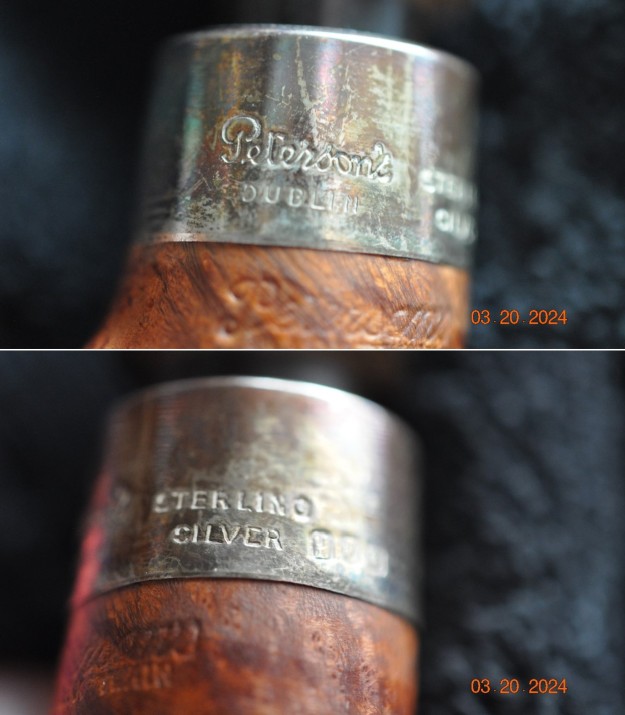
The next pipe I have chosen to work on is a Peterson’s Sterling X86 Apple. The pipe belongs to a fellow in Texas that I have restored pipes for in the past. He contacted me a few weeks ago about this pipe and asked it I would work on it for him. I said yes, he shipped it and I received it yesterday. The pipe is stamped on the left side of the shank and reads Peterson’s [over] Sterling. On the right side it is stamped with the shape number X86 next to the bowl/shank junction and behind that near the band it is stamped Made in Ireland in a circle with “in” centred in the circle around the stamp. It has a Sterling Silver band around the shank that is stamped K&P in three shields [over] Sterling [over] Silver [over] Peterson [over] Dublin. It is lightly tarnished and oxidized. The bowl had a moderate cake but the rim top and inner edge were clean with no damage. The outer edge looked to be in good condition. The finish on the bowl was dirty with oils around the sides and shank but the mixed grain was quite nice. The stem was lightly oxidized and has very light tooth marks and chatter on both sides ahead of the button. It should clean up very well. I took photos of the pipe before I started working on it. I took photos of the rim top and stem to show the general condition of the pipe. The bowl has a moderate cake with a hard layer of carbon on the chamber surface. You can see the excess glue squeezed out from under the band leaving behind some shiny, dried glue on the shank ahead of the band. The stem looks quite good with a little bit of oxidation on the surface and light tooth marks and chatter on both sides.I took some photos of the bowl sides and heel to show the grain that was around this bowl. It is a nice looking pipe under the grime on the outside of the bowl.   I took photos of the sides of the shank to show the stamping. The stamping is readable in the photos below and is as noted above. I also took a photo of the band. I removed the stem from the shank and took a photo to try to capture the overall look and proportion of the pipe. It is a beauty.I checked on Pipephil’s website to see what I could learn about the stamping on the pipe. I found the following information that I quote:

The country of manufacture stamp changed from “Made in Eire” to “Made in Ireland” (In circle) about 1945. Later (1947-49) it became “MADE IN IRELAND” (block letters) stamped in one or two lines (http://www.pipephil.eu/logos/en/logo-peterson.html).

I turned to Pipedia’s article on Peterson pipes to see what I could garner from that information. It is a great read in terms of the history of the brand (https://pipedia.org/wiki/Peterson#1950_-_1989_The_Republic_Era). In a section on

Prior to 1920 it was rare for a country of origin to be stamped on the pipe, just Peterson’s Dublin on the band. After 1921/22 if it is stamped “MADE IN IRELAND” and the “Made in” is stacked over “Ireland” or “MADE IN EIRE” or several other forms, it was made between 1922 and 1938. A considerable number of Peterson pipes were stamped “Irish Free State”. From about 1930 to 1949, most of the pipes (those which were stamped) were stamped “Made in Ireland”.” If the stamp reads “MADE IN IRELAND” in a circle, the pipe was made between 1939 and 1948. These are all “prerepublic” pipes.

I then turned to the book I should have consulted first, The Peterson Pipe, by Mark Irwin and Gary Malmberg. On page 155 I found some information on the line.

Peterson’s US distributor during the early Republic era was Rogers Imports, Inc., a New York firm whose catalogs offered all varieties of smoker’s products. Rogers was the exclusive wholesale dealer for several prominent European pipe manufacturers, they also marketed accessories under their own name. On behalf of Kapp & Peterson they registered the Killarney, Shamrock and Sterling trademarks with the US Patent Office in the 1950s, and their catalogs also featured the System, Premier Selection and Supreme.

On page 156-157 in the same book there is a catalogue page with the Sterling shown on it. It sold for $7.50 in 1953. It read:

As the name implies the Sterling quality of this fine pipe is distinguished in a careful selection of its fine Mediterranean Bruyere, its careful workmanship and sparkling finish. Banded with a Sterling Silver band – a Hallmark of quality – the pipe is available in a handsome natural or dark rich walnut finish. Patent P-lip stem. Individually boxed.

With that information in hand I knew what I was dealing with in terms of the stamping on the pipe. It is a Pre-republic era pipe. The Made in Ireland stamped in a circle on the right side of the shank tells me it was made between 1922-1938.

Now, on to the restoration of this beautifully grained Peterson’s Sterling 406 Prince. I began the work by reaming the pipe with a PipNet reamer and cut back the cake back to the bare briar. I scraped out what remained with a Savinelli Fitsall Pipe Knife. I sanded the walls of the bowl with a piece of dowel wrapped with 220 grit sandpaper to smooth the out. The walls looked to be in excellent condition with no checking or heat damage. I scrubbed the exterior of the pipe with Murphy’s Oil Soap and a tooth brush to remove the grime from the finish. I worked on the bevelled inner edge to try to remove the darkening and was able to remove some. I scrubbed off the excess glue behind the silver band on the shank with a folded pipe cleaner and some acetone to remove the glue. I scrubbed the inside of the mortise and shank along with the stem with alcohol, cotton swabs and pipe cleaners. The pipe was looking better than when it arrived. I decided to start the process by addressing the damage on the rim top and the inner edge of the bowl. I used a folded piece of 220 grit sandpaper to sand the top and to clean up the darkening and the damage on the edge. It was still slightly present on the front of the bowl but looked much better.I polished the briar with micromesh sanding pads – dry sanding it with 1500-12000 grit sanding pads. I wiped the bowl surface down with a damp cloth to remove the sanding dust. Once I finished the exterior of the briar looked much better and had taken on a shine. I paused sanding the rim top after the 2400 grit micromesh pad and used a Cherry stain pen to touch up the rim top to match the rest of the pipe.I went back to the micromesh sanding pads – starting with the 3200 grit pad and working my way through the 15000 grit pad. I rubbed the bowl down with Before & After Restoration Balm. I worked it into the surface of the briar with my fingertips to clean, enliven and protect it. I let the balm sit for 15 minutes and then buffed with a cotton cloth to raise the shine. Mark Hoover’s Balm is a product that I have come to appreciate and one I use on every pipe I have been working on. I polished the silver band on the shank with a jewelers cloth to remove the existing oxidation and tarnish and to protect the band from further tarnish. It looks so much better than when I started. I set the bowl aside and turned my attention to the stem. I used the sanding pads I purchased recently – 320-3500 grit regular pads to smooth out the finish and remove the light tooth and chatter marks in the stem. I wiped the stem down with Obsidian Oil to finish the preliminary work after the 3500 grit pad.I polished the stem with micromesh sanding pads – wet sanding with 1500-12000 grit pads. I wiped the stem down after each sanding pad with Obsidian Oil. I finished polishing it with Before & After Pipe Stem Polish – both Fine and Extra Fine. Once I had finished the polishing I gave it final coat of oil and set it aside to dry. As usual at this point in the restoration process I am excited to be on the homestretch. I look forward to the final look when it is put back together, polished and waxed. I put the Made In Ireland Peterson’s Sterling X86 Apple back together. I polished the bowl and stem with Blue Diamond to polish out the scratches in the briar and the vulcanite. I gave the bowl and the stem multiple coats of carnauba wax. I buffed the pipe with a clean buffing pad to raise the shine. I hand buffed it with a microfiber cloth to deepen the shine. I polished the silver with a jeweler’s cloth. The pipe polished up pretty nicely. The grain really pops with the wax and polish. The shiny black vulcanite stem is a beautiful contrast to the browns of the bowl. This Peterson’s Sterling 86X Apple was a great pipe to spruce up. It is a very comfortable pipe to hold in the hand. The finished pipe is shown in the photos below. The dimensions of the pipe are Length: 5 ½ inches, Height: 1 ¾ inches, Outside diameter of the bowl: 1 ¼ inches, Chamber diameter: ¾ of an inch. The weight of the pipe is 43 grams/1.55 ounces. This pipe will be going back to my friend for him to enjoy. Thanks for reading this blog and my reflections on the pipe while I worked on it. This is an interesting estate to bring back to life.

Can this Danmore 3090 Be Brought Back to Life?


Blog by Steve Laug

Sometimes I look at a pipe we purchased and wonder what we were thinking when we went for it. That was the case with this Danmore 3090 freehand. We purchased it from an online auction in Los Fresnos, Texas, USA on 01/10/2018. You can see from the fact that it has been sitting here in a bag since 2018. When Jeff received it, the pipe was in pieces and he put it together for these photos. The bowl was intact with no cracks or serious nicks. The horn shank extension had come unglued and looked like it might have some delaminating happening on the long portion that held the stem. The pipe was stamped on the underside of the shank with the shape number 3090 followed by Danmore [over] Handmade Denmark. The stem had a rubber tube fit on the end that had originally been in the shank extension but was now stuck on the stem. The stem itself had been chewed or broken off and was probably missing at least ½ inch of its length. It still had the Danmore Logo on the top of the taper but that was all it had going for it. The bowl was thickly cake and there was a thick lava coat on the rim top obscuring the edges of the bowl. It had obviously been someone’s favourite pipe and had been smoked to death. The finish was filthy with grime and hand oils ground into the smooth panels and the sandblast making it all almost smooth to touch. It was impossible to know if the rim top was smooth or sandblast as there was so much tar on it. The inside of the shank that held the extension was filled with tars and oils and the inside of the horn shank extension was the same. Jeff got some good photos of the pipe before he did his clean up work and I have to hand it to him it looked pretty interesting. The question in my mind really was whether it was redeemable. The bones were nice but what was underneath once it was cleaned remained a haunting question. He took photos of the rim top and bowl and you can see what I mean by the thickness of the cake in the bowl and the lava on the rim top. It is so thick that it is flaking off in chunks only to reveal another layer! You can also see the broken off/chewed off condition of the stem in the photos he included. He included photos of the sides of the bowl and the contrasting patches on the bowl sides along with an interesting sandblast. The only thing that can be said is that the stamping on the underside of the shank is clear and readable as noted above and the Danmore D logo is very readable on the chewed off stem. You can also see the separation of the horn shank extension for the shank end in these photos. Lots of work to be done in the resurrection.The horn shank extension was originally lined with a Delrin or rubber liner to stabilize the horn from the inside. It would have been glued in place in the horn and not moved when the stem was removed. In the photo above and those that follow you can see that the liner piece has crept up the stem to where there is very little that is actually in the horn itself. I am hoping that once it is here I can work it off the stem and reinsert it in the horn again. We shall see.Jeff let the pipe fall back into its parts and took photos of it. You can see the bowl and its filthiness, the stem with the creeping rubber insert from the horn and the tired looking horn extension. In the second photo you can see the filth in the inside of the horn and into the shank itself… lots of work in cleaning it and not making things worse.I knew that the pipe was a Danish Made pipe but it has been awhile since I worked on a Danmore pipe. I turned first to Pipephil’s site (http://www.pipephil.eu/logos/en/logo-d2.html). There was a very short clip there with one photo of a pipe very different from the one I am working on. It simply states that the factory is closed and that the pipes are made by third parties. Not too much helpful information there that is for sure.I then turned to Pipedia (https://pipedia.org/wiki/Danmore) and was much more successful. The article is short and succinct but very helpful. I have included it below for ease of reference.

Danmore was founded by Hans Sørensen in the early 1970s, and produced pipes from that time until the early 1980s, at one point having up to 30 employees. The pipes were sold in the first Dan Pipe catalog. In the early 1980’s, however, production ceased in Denmark due to labor costs, and the company’s production was outsourced to Italy and Spain, and they began to also make pipecleaners and smokers articles.

Sørensen focused on the pipecleaner side of the concern, and eventually bought a share in the factory in the Far East making them. Today the company, owned by Hans’ sons Jesper and Lars Sørensen, no longer makes pipes, and instead makes only pipe cleaners under the name Danmore Hobby Aps, selling only to hobby and craftshops in Denmark and Scandinavia.

Hans Sørensen passed away in 2012. The Sørensen family continues to own the trademarks for the use of the Danmore name in relation to pipes, matches, and tobacco.

Now I knew that the pipe was made by Hans Sorensen and was made between the early 1970s and early 1980s when production ceased in Denmark due to labor costs. From that point on the pipes were outsourced to Italy and Spain. So, I guess the pipe was made during the 10 year or so window when the pipes were handmade in Denmark. All of that info makes me a bit more interested in resurrecting this pipe.

When it arrived here it was in a plastic sandwich bag and I promptly put it aside in a drawer of pipes to work on. Periodically I would take the bag out and dump out the parts and look it over. Everytime other than today I have just put it back in the drawer, shaking my head. I think it could be fixed but did I want to was the serious question that haunted me each time I looked at it. From 2018-2024 my answer was categorically, NOT INTERESTED! So, what changed today? Got me! Last evening, I took it out of the baggie and looked it over, put the pieces together and took some photos. Something about it caught my eye this time around and I wanted to see if I could bring it back to life. I sent Jeff a note and he sent me the photos above.

Jeff had done a great job cleaning up the pipe as usual. He reamed the pipe with a PipNet reamer and cut back the cake back to the bare briar. He cleaned up the walls with a Savinelli Fitsall Pipe Knife. He scrubbed the interior of the bowl and shank with pipe cleaners, cotton swabs and alcohol to remove the tars and oils. He scrubbed the exterior of the pipe with Murphy’s Oil Soap and a tooth brush to remove the grime from the finish. He worked on the rim top lava and darkening with the soap and tooth brush. He scrubbed the inside of the horn shank extension and the stem with alcohol and pipe cleaners. He scrubbed the exterior of the stem with Soft Scrub and then soaked it in Before & After Pipe Stem Deoxidizer. He washed it off with warm water to remove the Deoxidizer. The pipe looked far better when it arrived. I took a photo of the bowl and rim top to show how good it looked. The sandblast rim top was clean and the inner edges aw also in good condition. The stain had faded some but it would not be too much to bring it back. The shank extension was very loose with nothing holding it in place in the shank. The stem was another story. The end had been either gnawed off or broken off and still smoked that way. It cleaned up well for sure – looked much better. It would need to be replaced.Though the photo below is a bit blurry the stamping is very clear on the underside of the shank. I removed the stem from the shank end and took a photo of the pipe and extension with the stem below to get a sense of what was there now.Now it was time to put the pieces back together again. For me this is the challenge that I enjoy. Will I be able to reconstruct the pipe back to functionality without changing the plan that crafted it originally? I love that challenge. In this case I decided to start with regluing and rebuilding the shank extension. I am very thankful that it was not delaminating. The horn was dry but still very stable which took away a very time-consuming part of the work. I worked on removing the old glue from the shank end and the tenon of the extension. I used a dental spatula and small blade to scrape the surfaces and then scrubbed them with 99% isopropyl alcohol and cotton swabs and pipe cleaners. I also worked on the airway in the mortise of the briar so that the extension would have a very clean surface to bond with.Once the mortise was dried out I used some all-purpose white glue and painted the inside of the mortise and the tenon on the extension with it. I pressed the parts together and held them with pressure until the glue cured. Once it had hardened sufficiently to take the pressure off and wiped off the excess glue that had squeezed out with a damp cotton pad. I took photos of the pipe at this point. I cleaned up the Delrin/rubber ring that fit in the shank end and gave it a thin coat of all-purpose glue. I pressed it into the shank extension end and set it aside to cure. Once the glue hardened I polished the joint of the horn extension and the briar with 320-3500 grit sanding pads. I wiped the horn down after each sanding pad with a cloth impregnated with Obsidian Oil. The horn began to take on a shine. I polished the smooth panels on the bowl sides and the horn shank extension with micromesh sanding pads – dry sanding with 1500-12000 grit sanding pads. I wiped the horn down after each sanding pads with Obsidian Oil. It began to take on a shine as I worked through the pads. I used a Walnut Stain Pen to touch up the spotty finish around the bowl and shank and on the faded rim top. It looked significantly better once the stain cured. The colour looked much better. I rubbed the briar down with Before & After Restoration Balm. I worked it into the briar with my fingertips and a horsehair shoe brush. The product works to clean, enliven and preserve the briar. I let it sit for 10 minutes while I worked on the stem. After the time passed I buffed it with a cotton cloth to deepen the shine. The briar really comes alive with the balm. I went through my collection of stems to find one that would work on the pipe. The one I found is identical to the broken one. It has the same shape as the broken one with the fishtail button. It was about ½ inch longer that accommodated the broken portion of the stem. It would need to be cleaned up and polished but it was a good match.I cleaned out the internals of the stem with alcohol and pipe cleaners. It smelled and looked much better.I started working on polishing the stem with my 320-2500 grit sanding pads. I was able to remove the scratches and light tooth marks and chatter on both sides ahead of the button. It looked much better at this point in the process.  I polished the stem with micromesh sanding pads – dry sanding with 1500-12000 grit pads. I wiped the stem down after each sanding pad with Obsidian Oil. I polished it with Before & After Pipe Stem Polish – both Fine and Extra Fine. I gave it a coat of Obsidian Pipe Stem Oil. It works to protect the stem from oxidizing. I set it aside to dry. This beautiful sandblast Danmore 3090 Freehand with a horn shank extension and a military mount stem turned out very nice. It came together amazingly well – far better than when I began. The mix of brown stains highlights the grain around the bowl sides and bottom. The rim top and edges look very good. The finish on the pipe is in excellent condition. I put the stem back on the bowl and carefully buffed the pipe with Blue Diamond on the buffing wheel. I gave the bowl and stem multiple coats of carnauba wax on the buffing wheel and followed that by buffing the entire pipe with a clean buffing pad. I hand buffed the pipe with a microfiber cloth to deepen the shine. The finished Danmore 3090 Freehand is very nice and feels great in the hand. Give the finished pipe a look in the photos below. It is a nice pipe whose dimensions are Length: 6 inches, Height: 1 ¾ inches, Outside diameter of the bowl: 1 ¾ inches, Chamber diameter: 1 inch. The weight of the pipe is 48 grams/1.69 ounces. Thanks for walking through the restoration with me as I worked over another beautiful pipe. This one will be going on the rebornpipes store, in the Danish Pipe Makers Section shortly. If you are interested in adding it to your collection let me know by message or by email to slaug@uniserve.com. Thanks for your time.
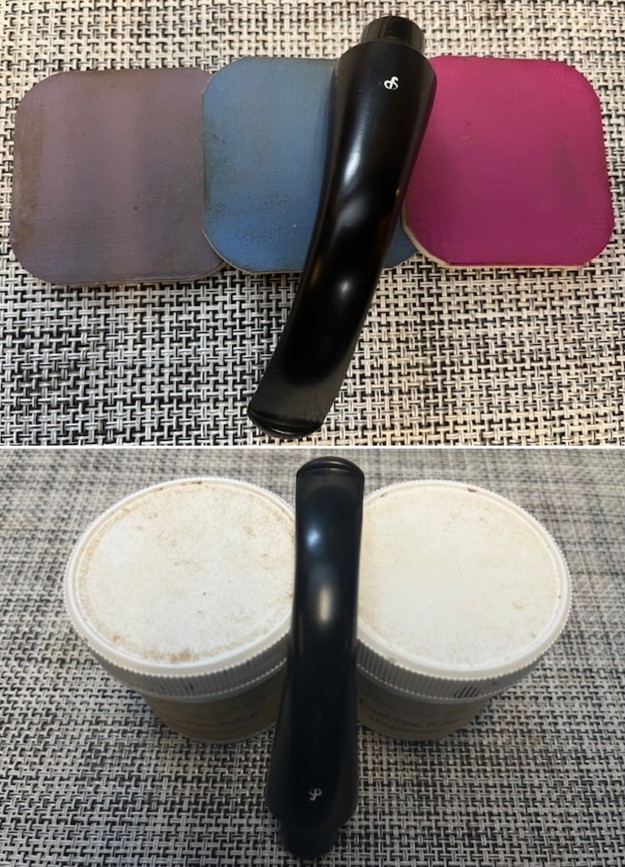
As always, I encourage your questions and comments as you read the blog. Thanks to each of you who are reading this blog. Remember we are not pipe owners; we are pipe men and women who hold our pipes in trust until they pass on into the trust of those who follow us.