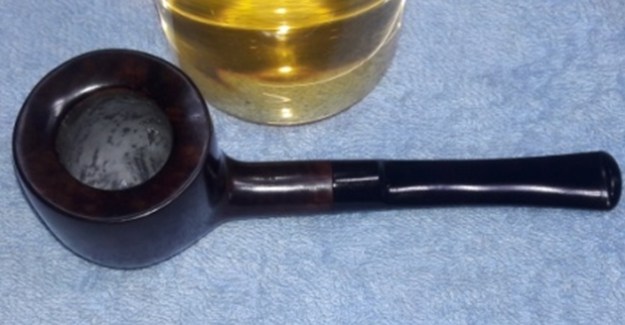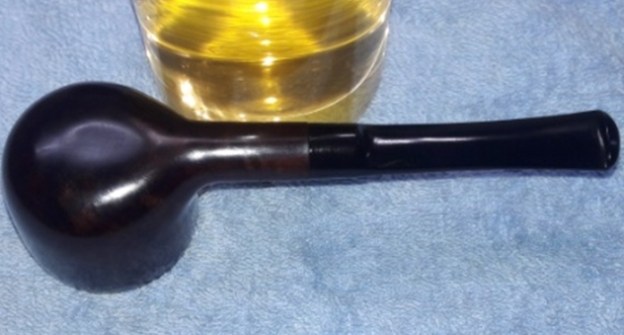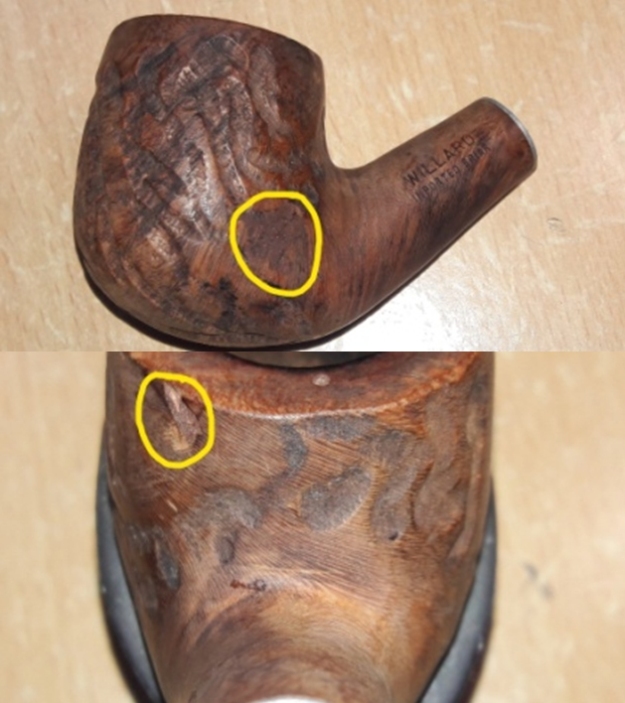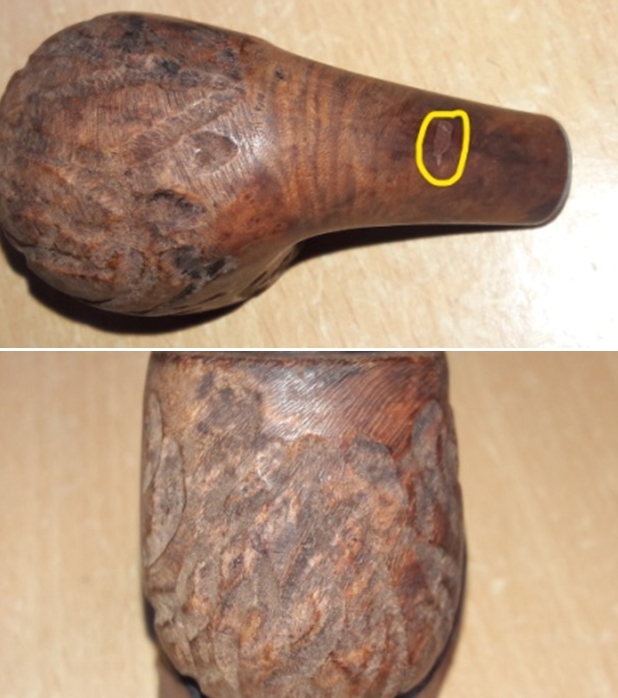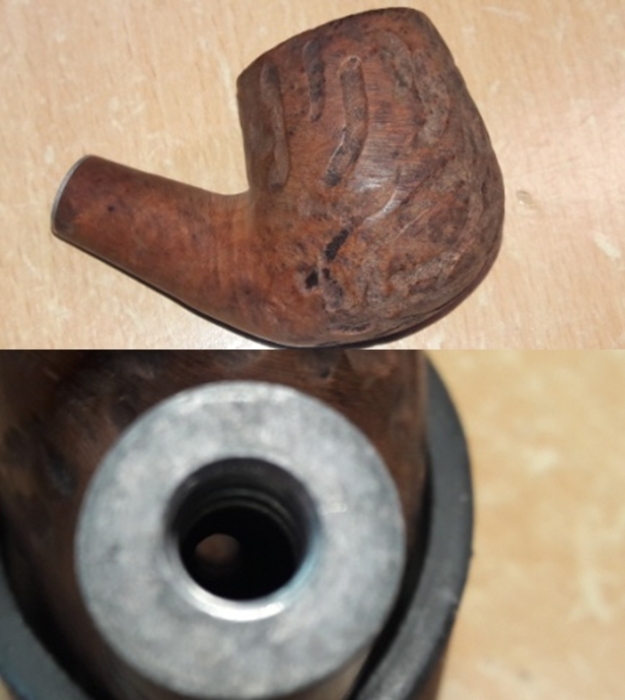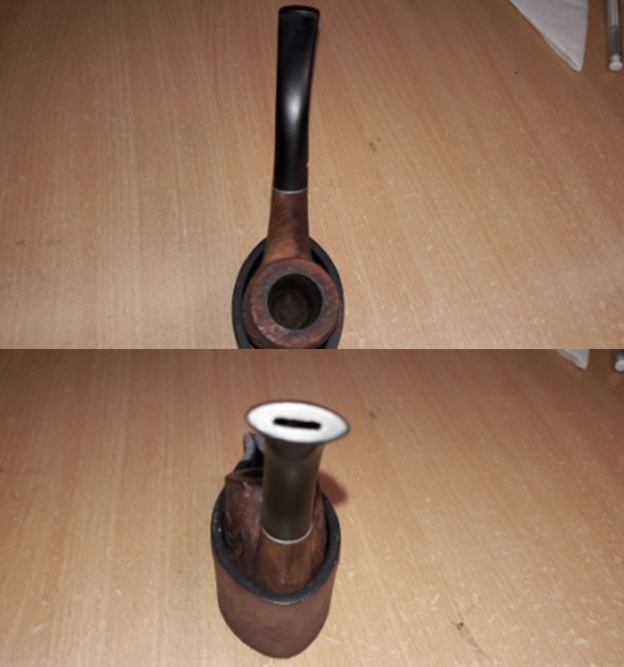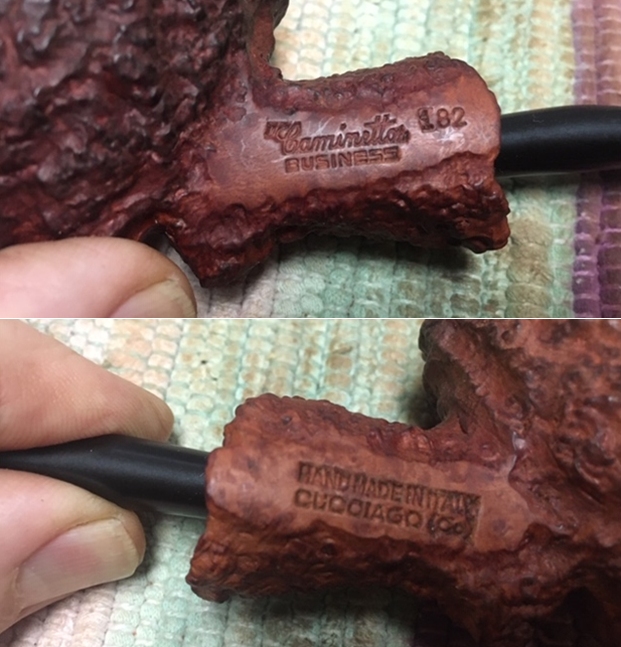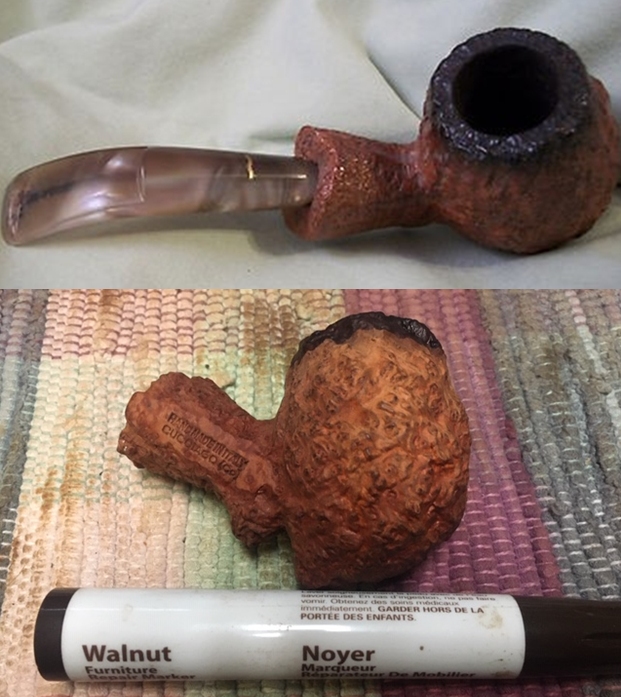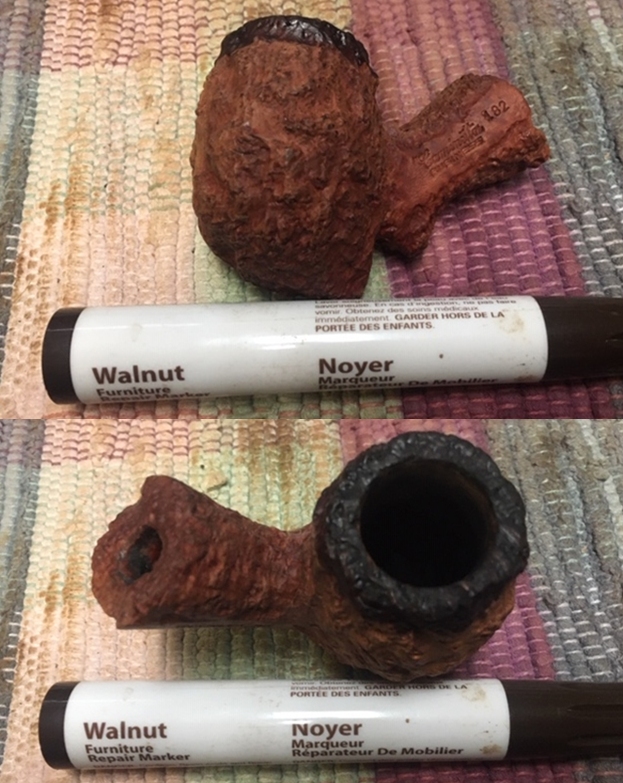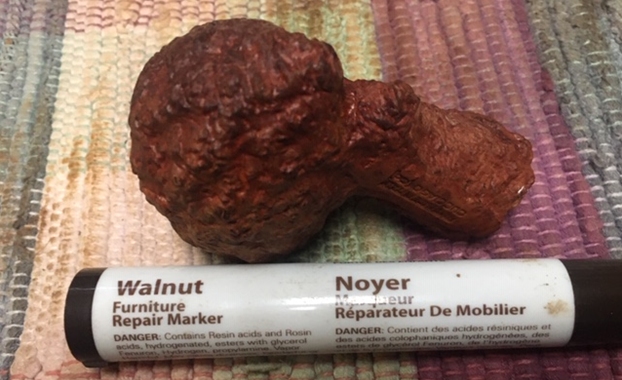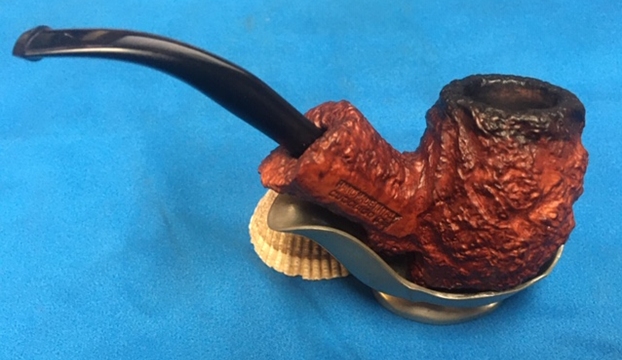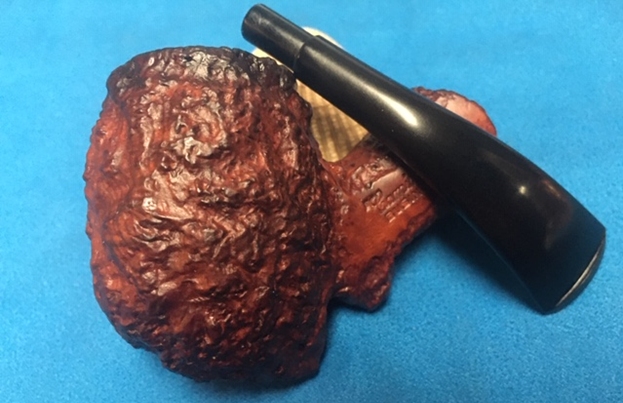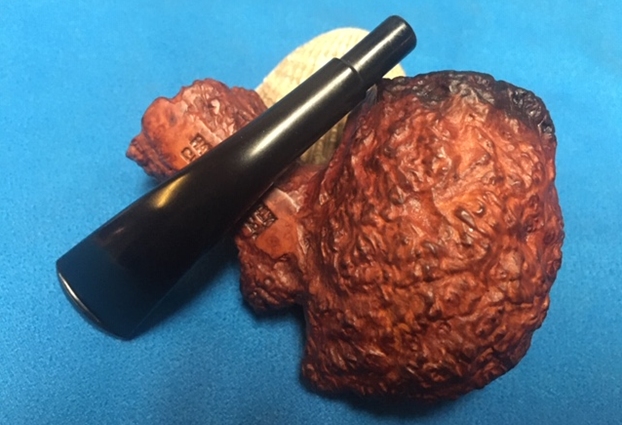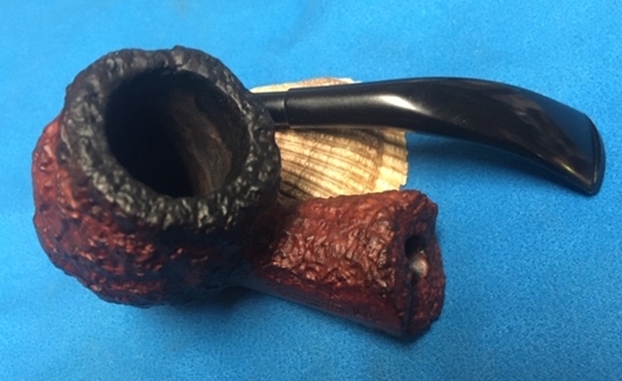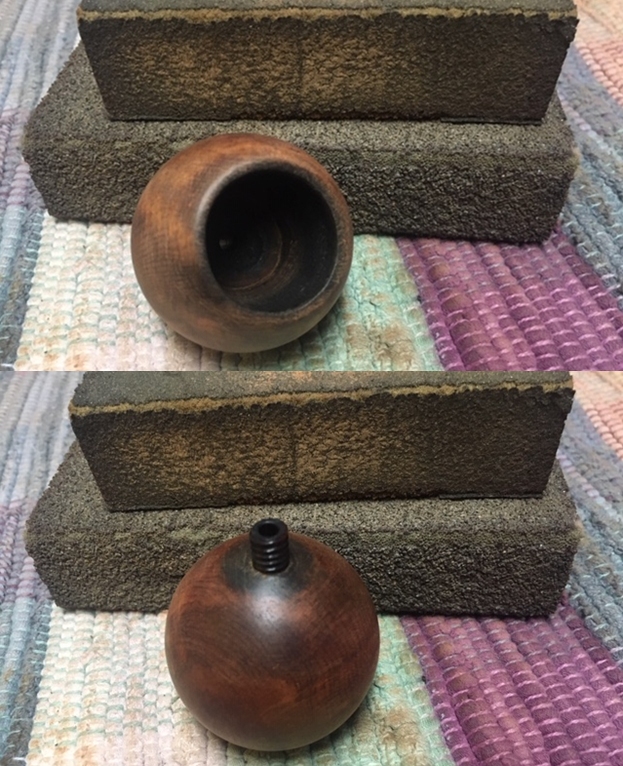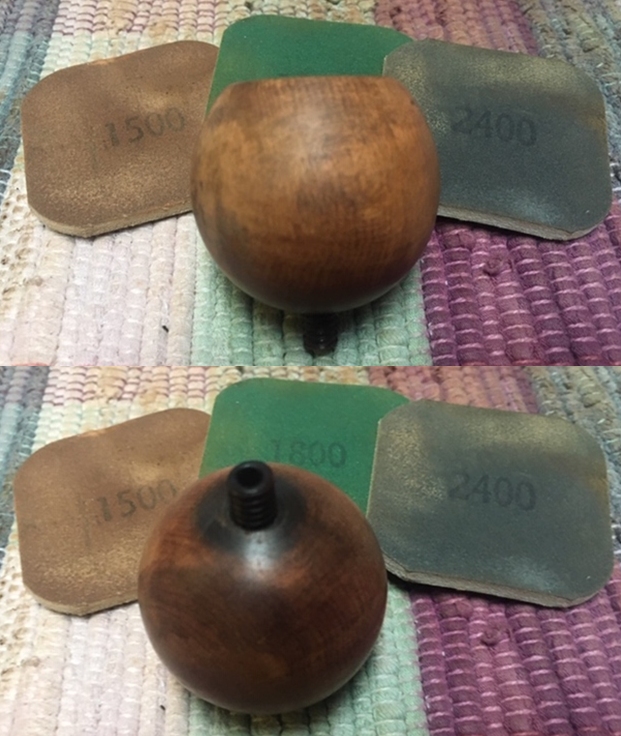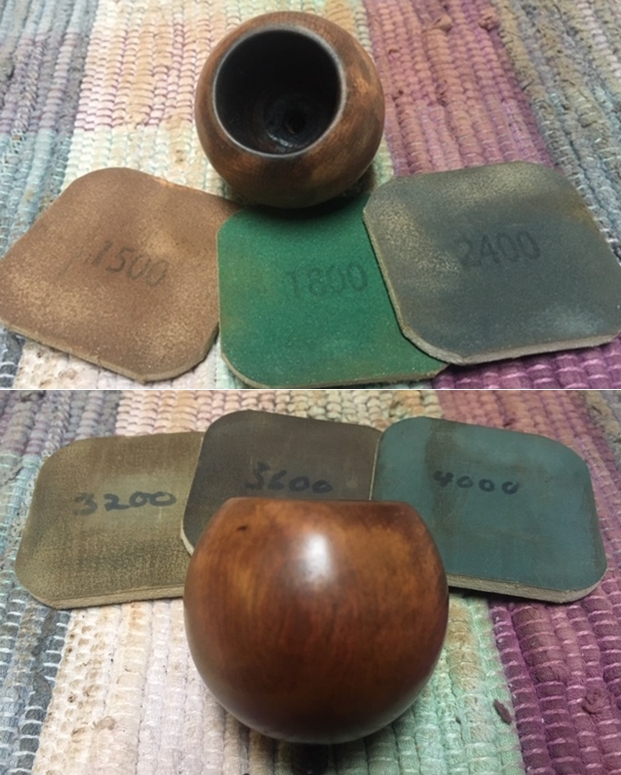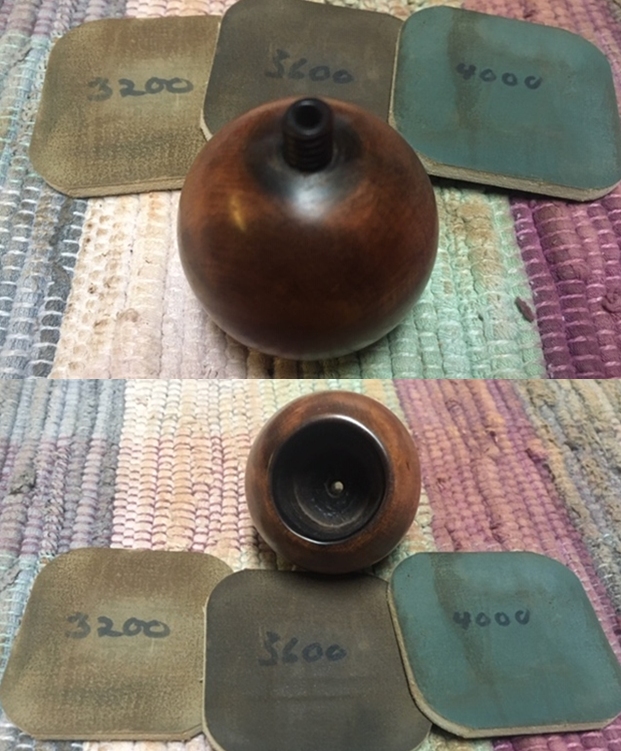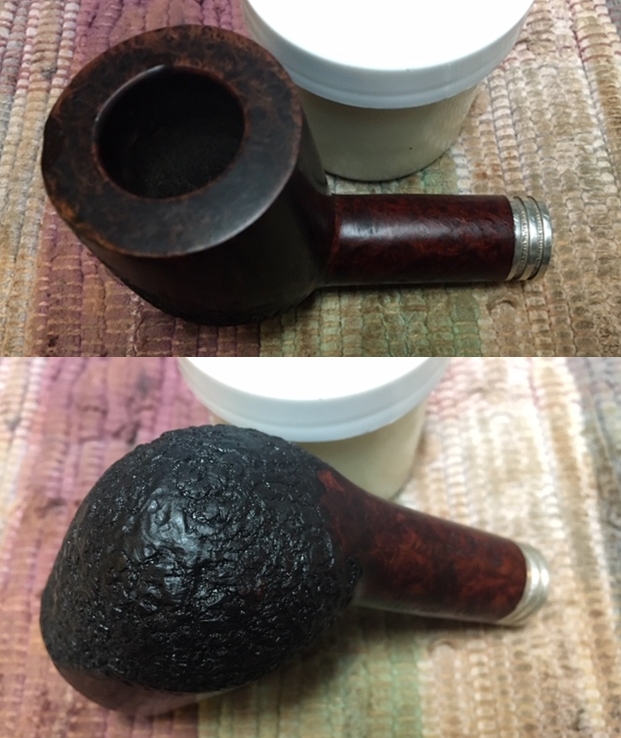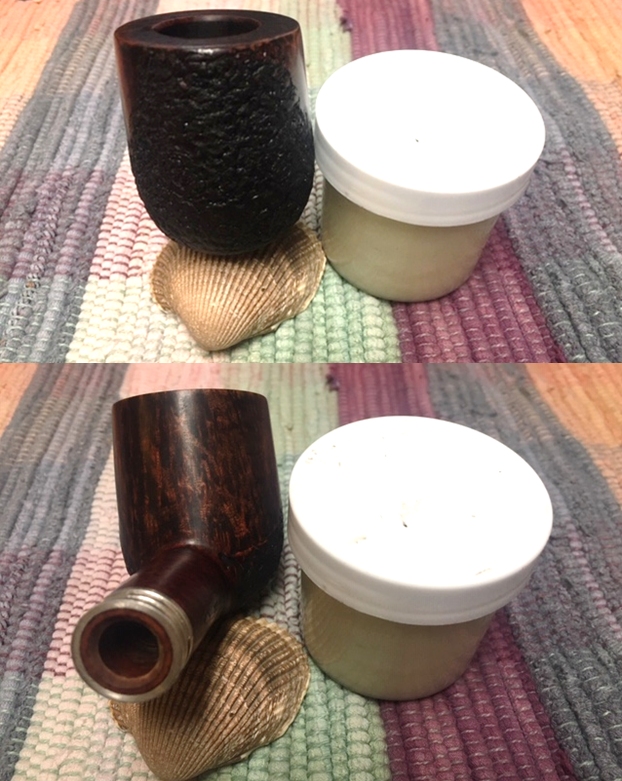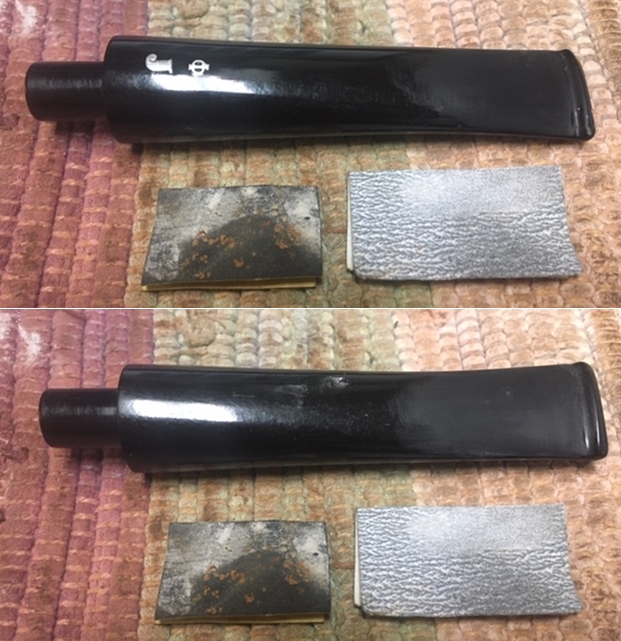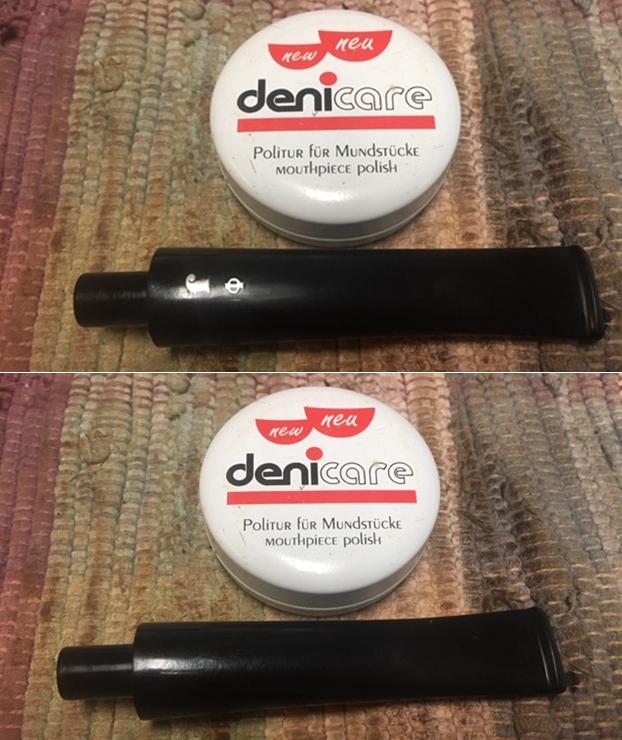
Tag Archives: contrast staining

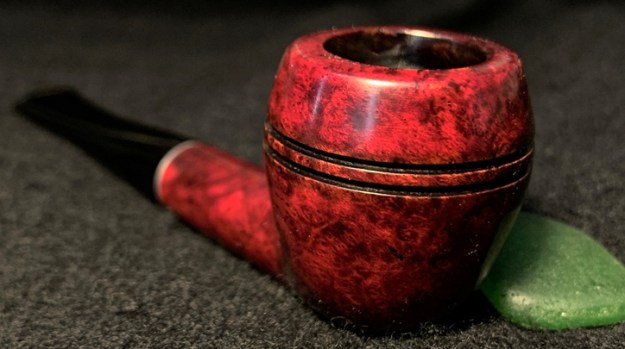
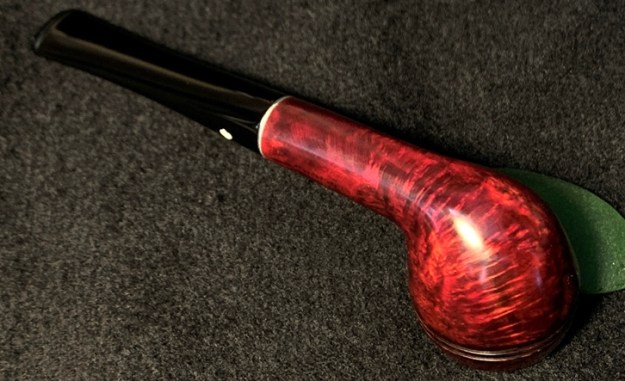
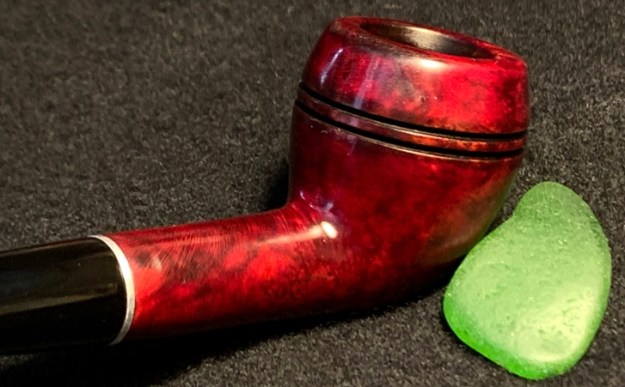
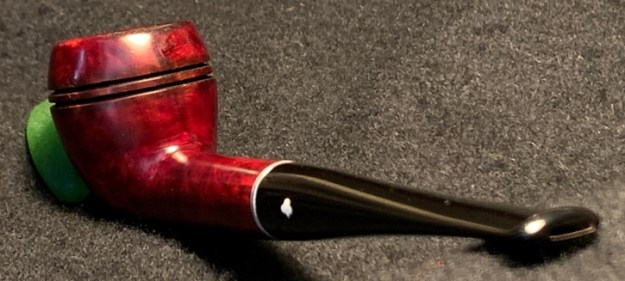
Beginning again – a KB&B Bakelite Blueline Cup and Ball Pipe


Blog by Steve Laug

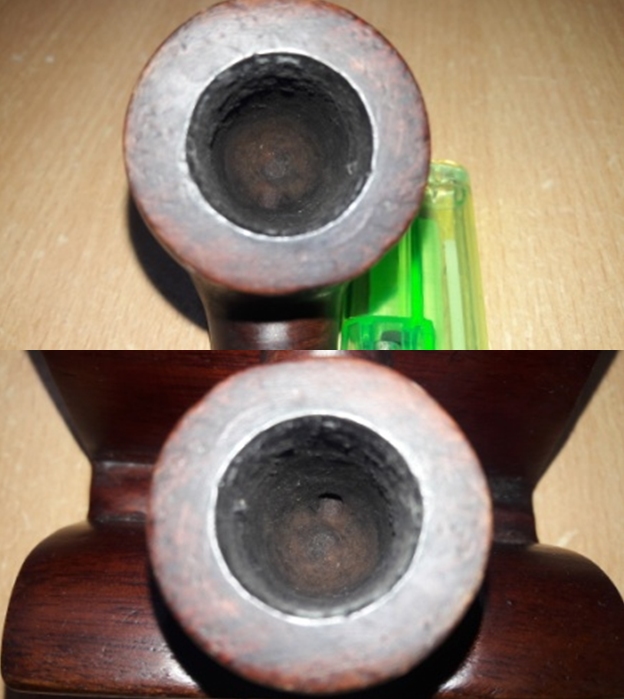
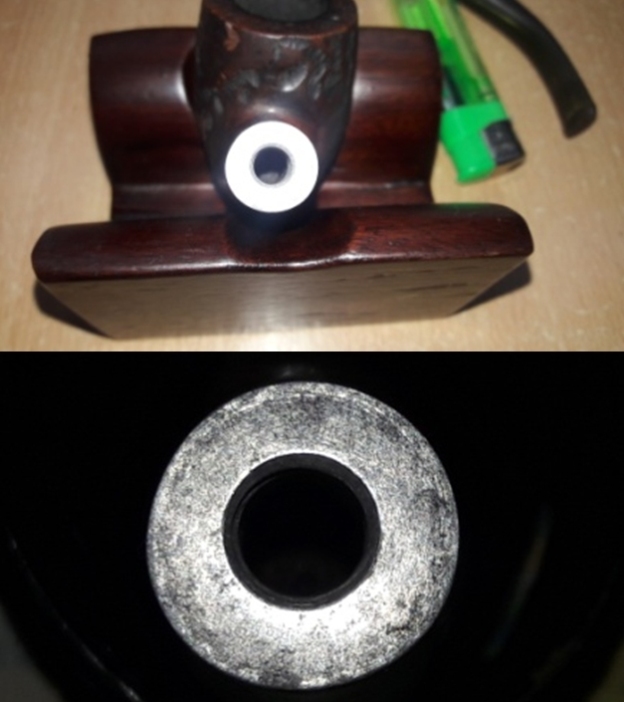
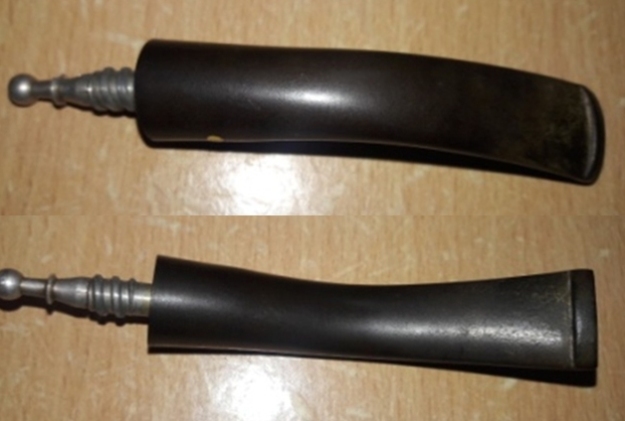
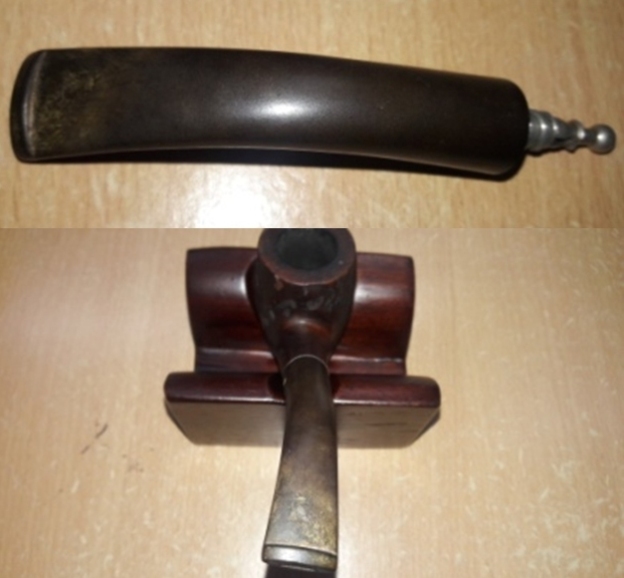
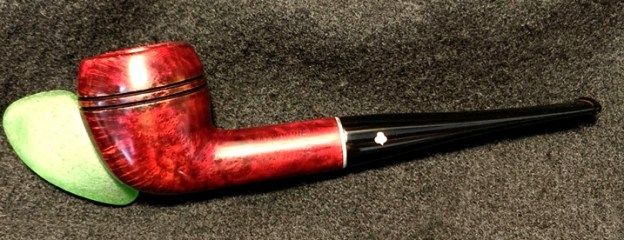
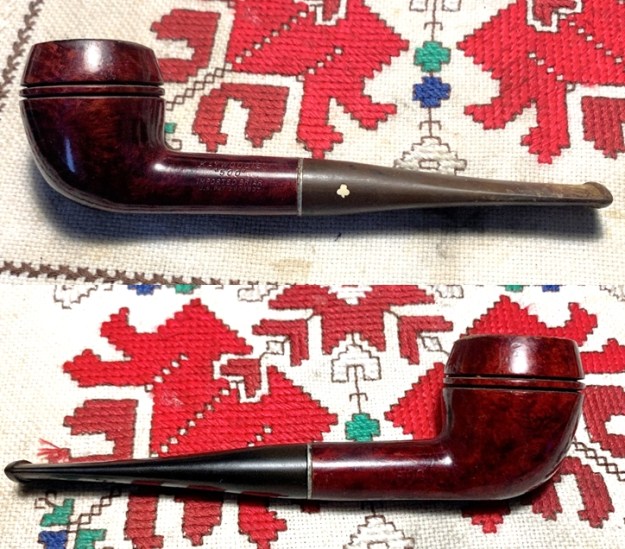
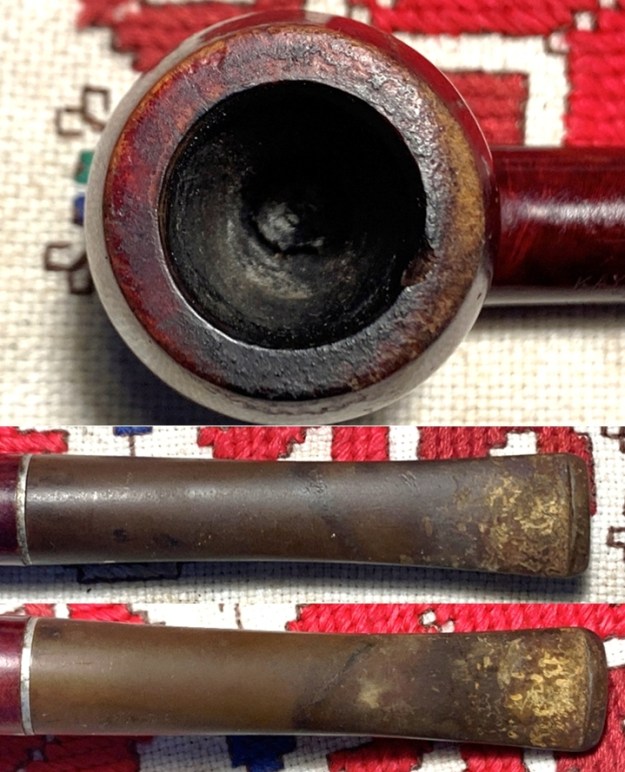
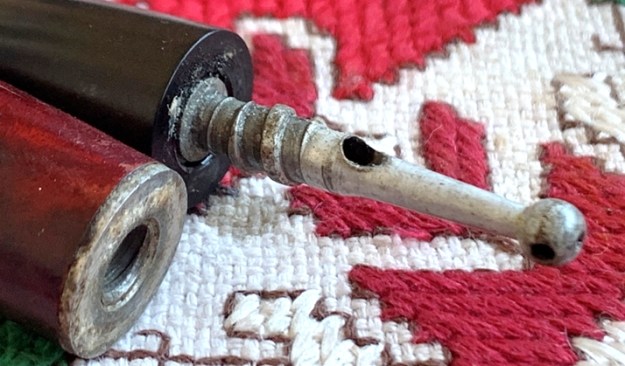
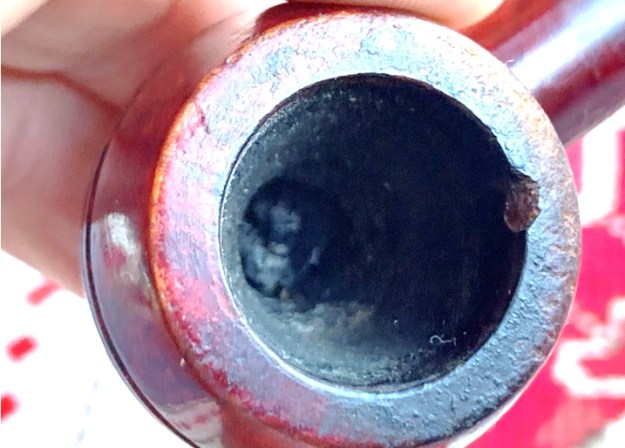
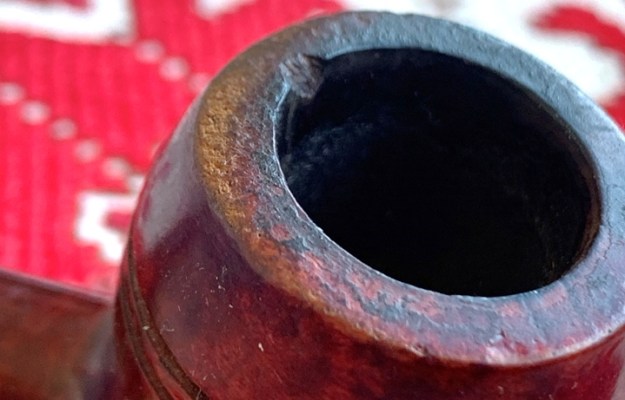
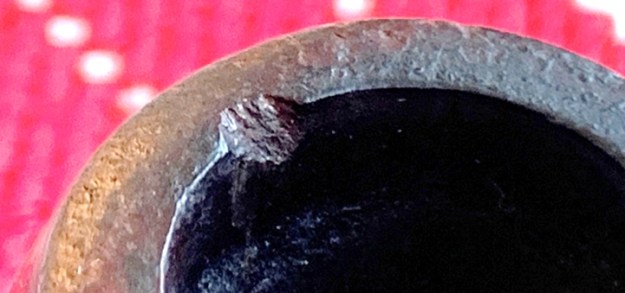
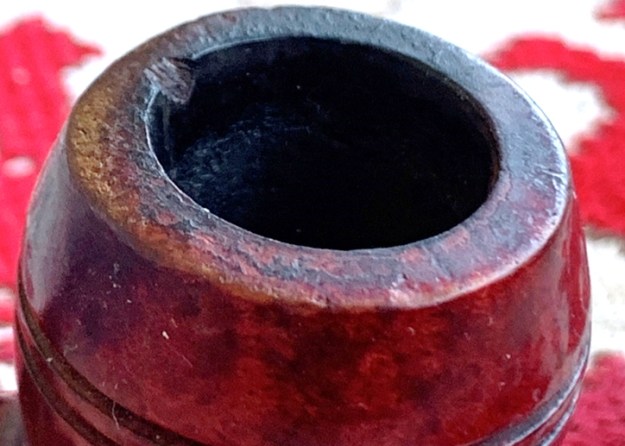
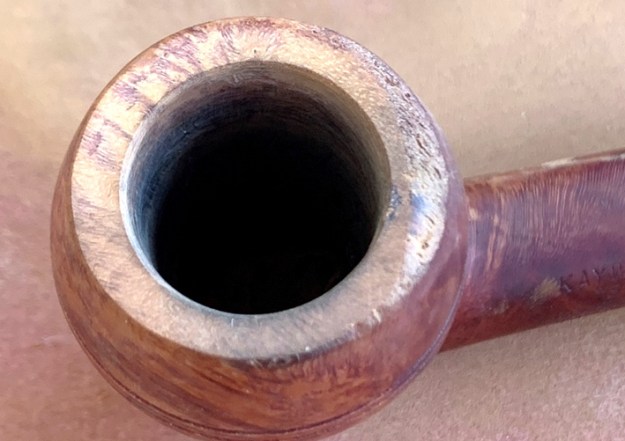
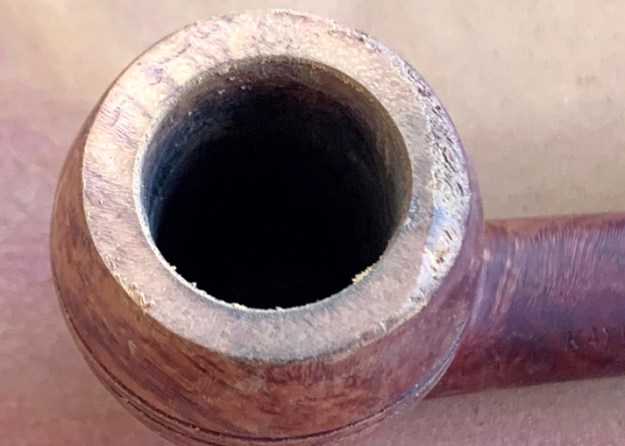
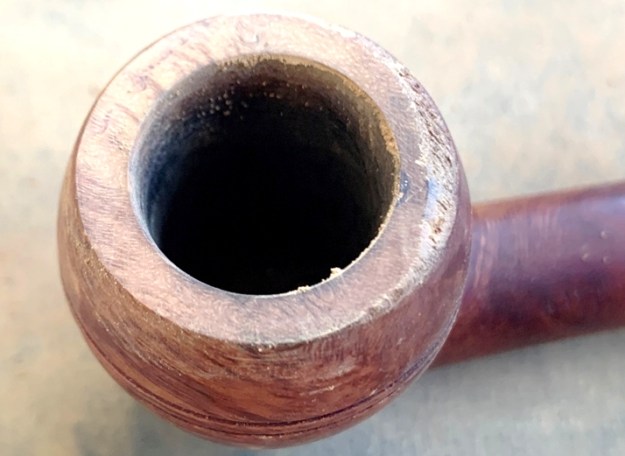
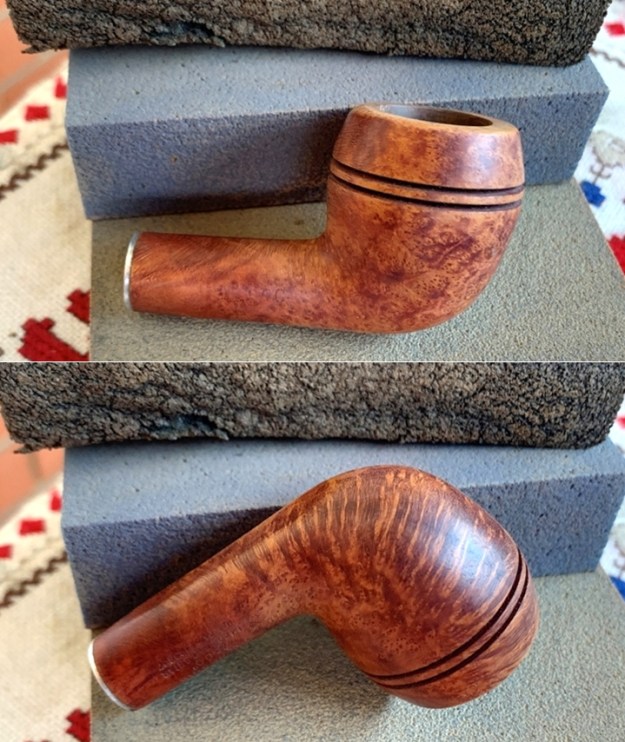
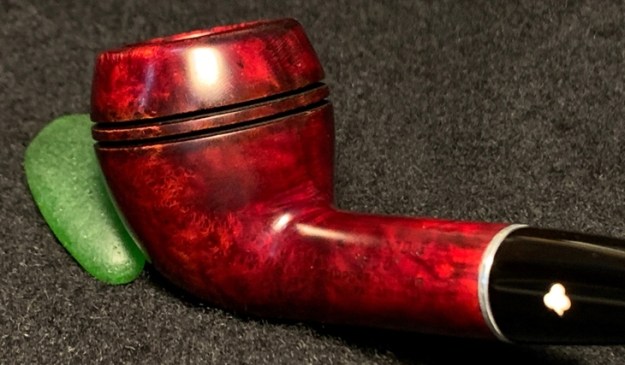
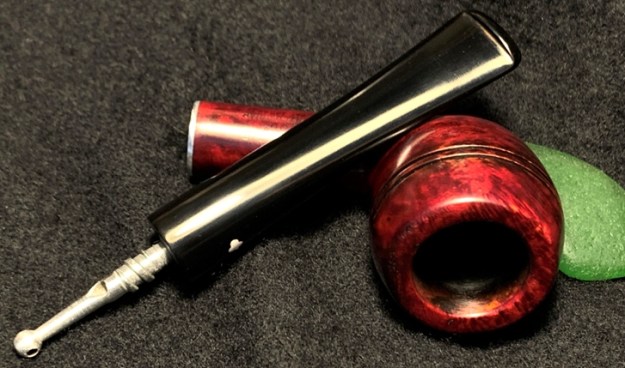
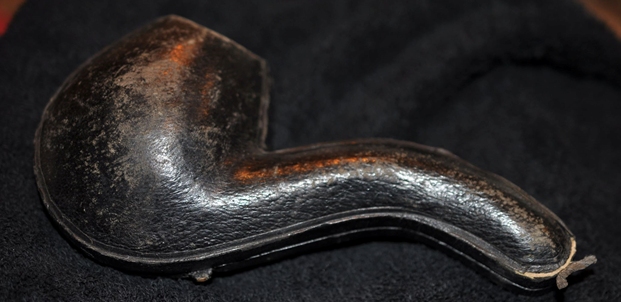
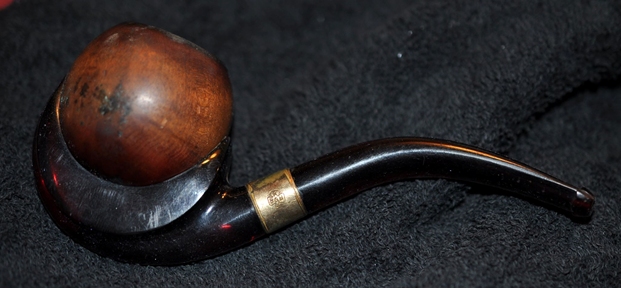
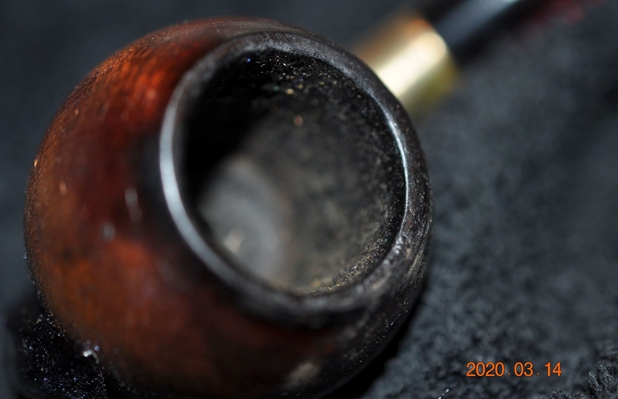
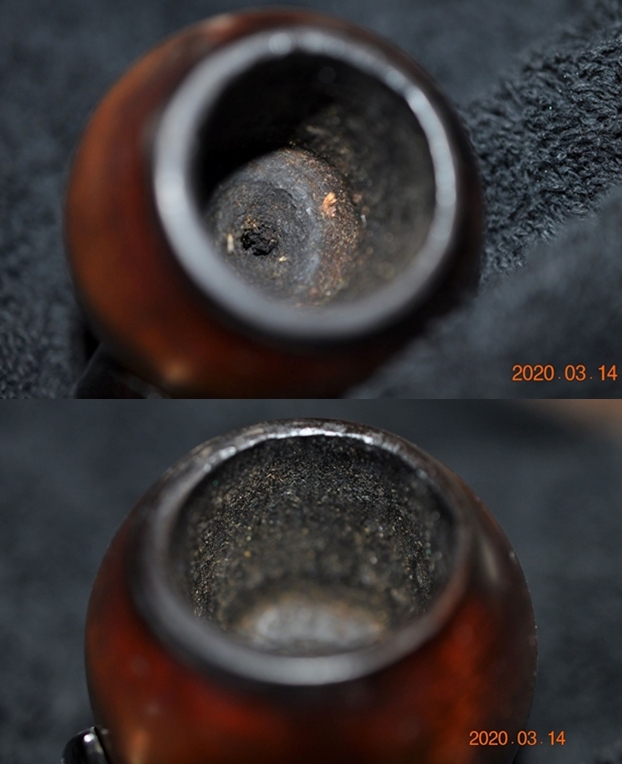
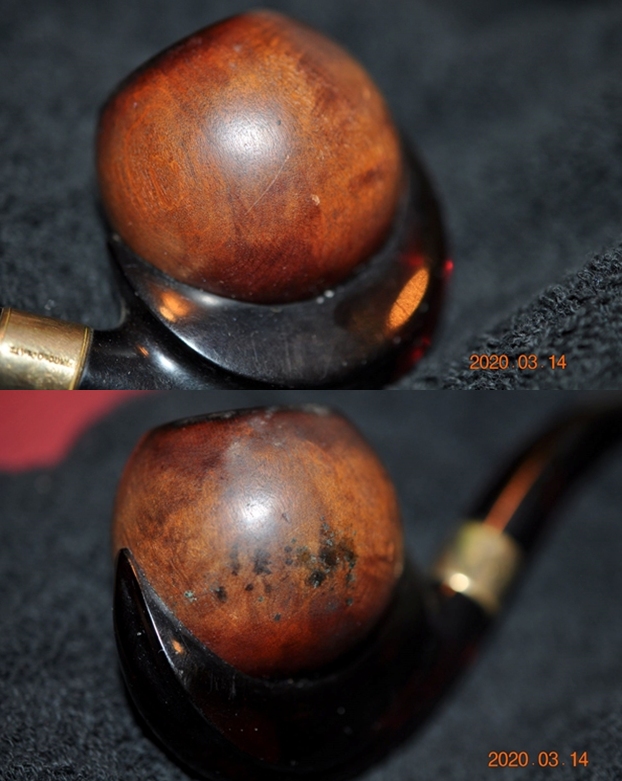
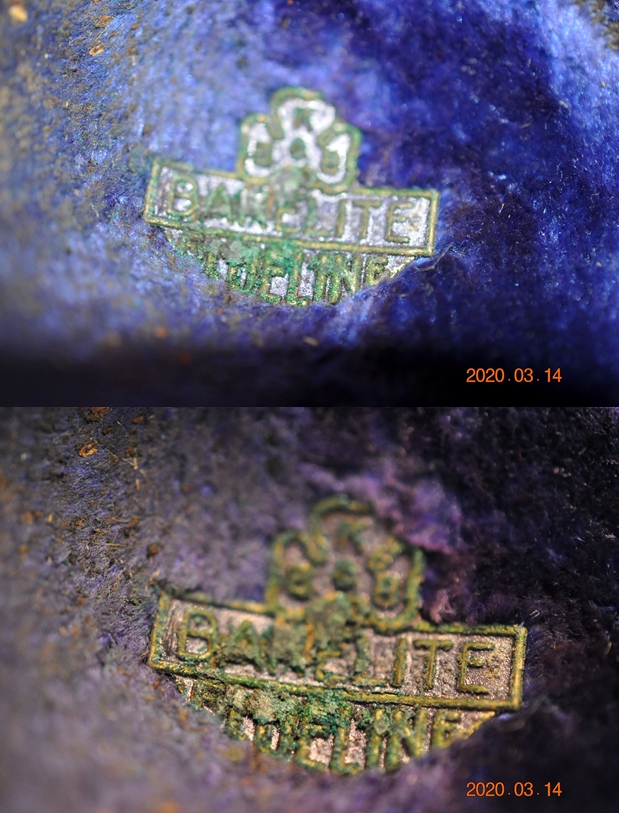
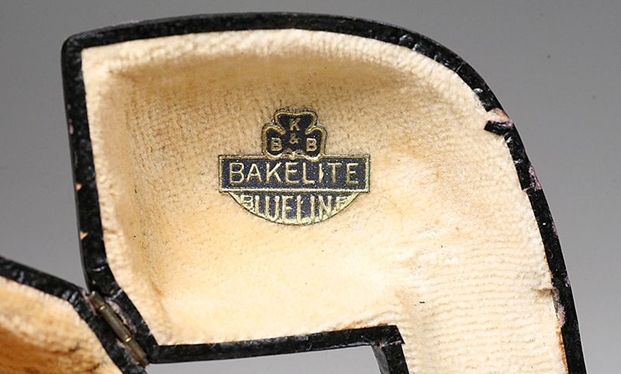
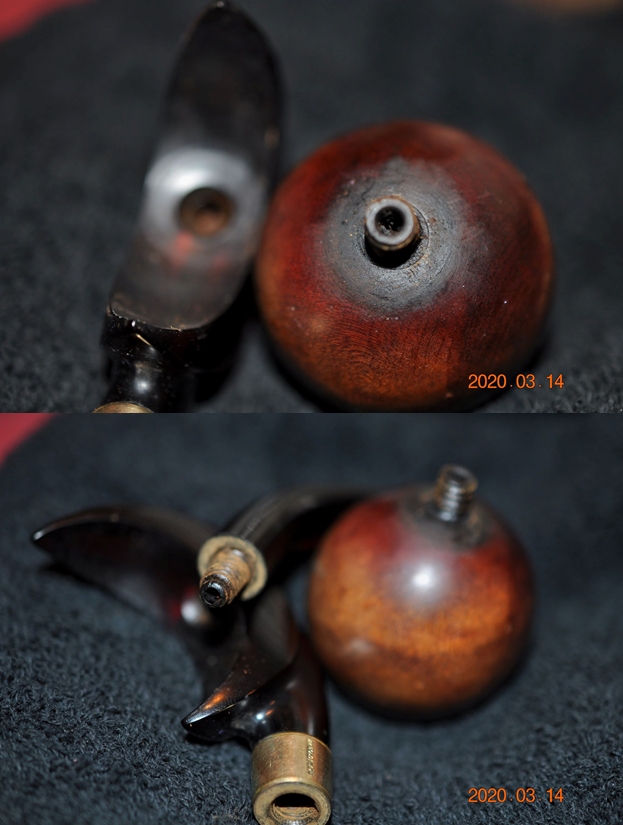
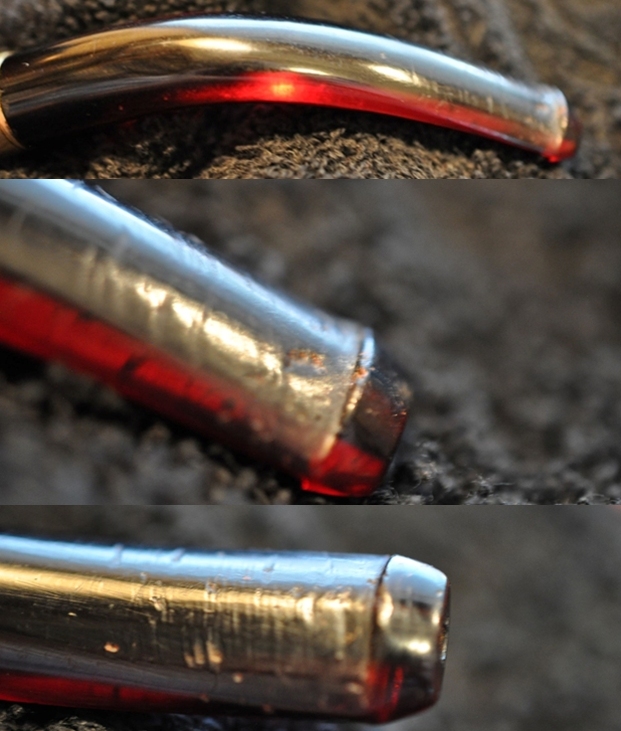
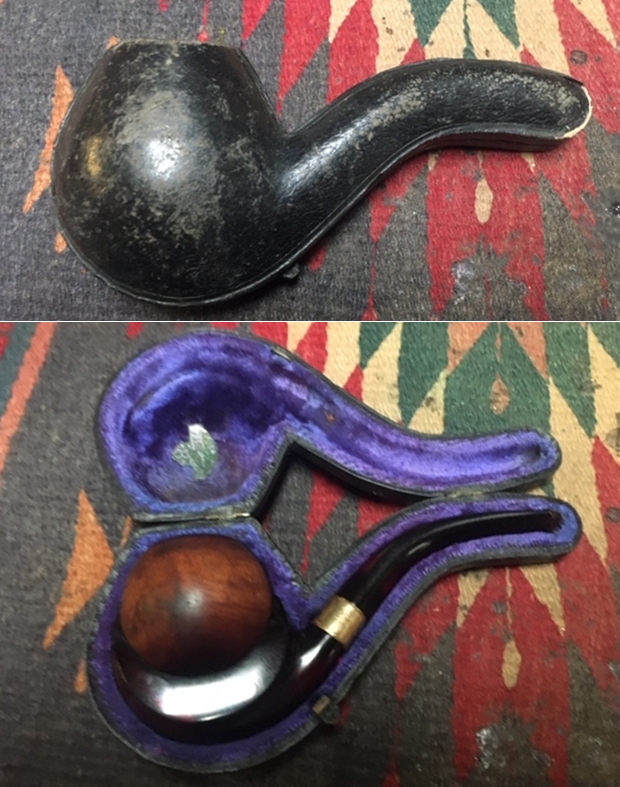
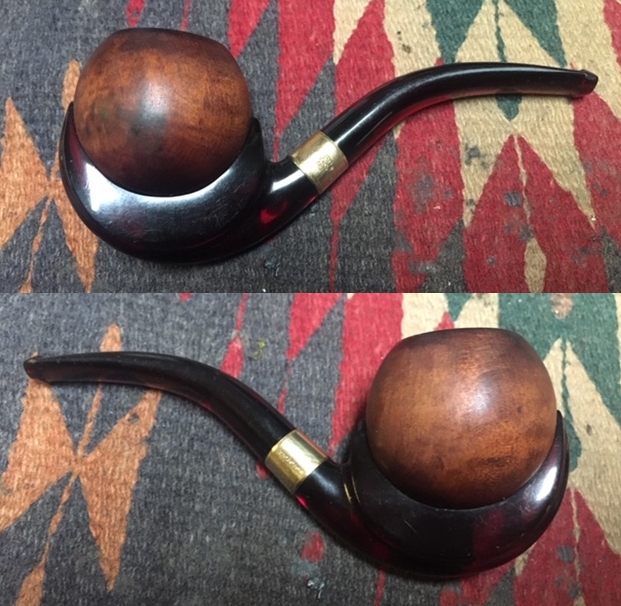
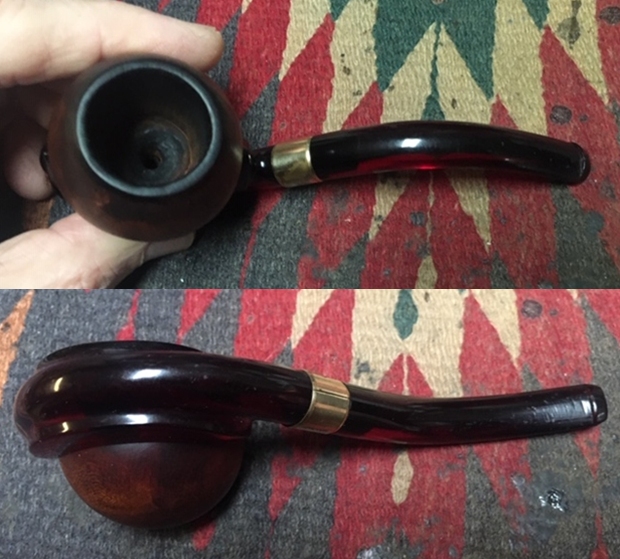
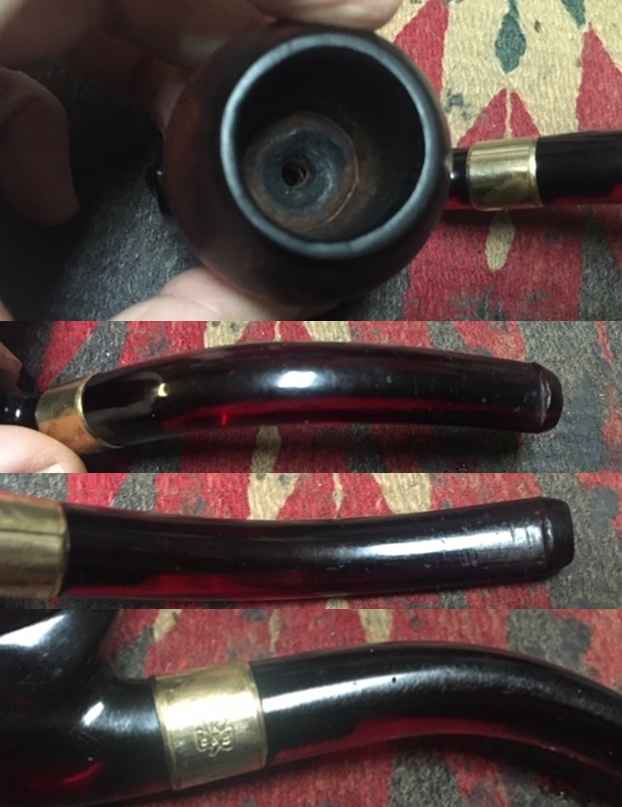
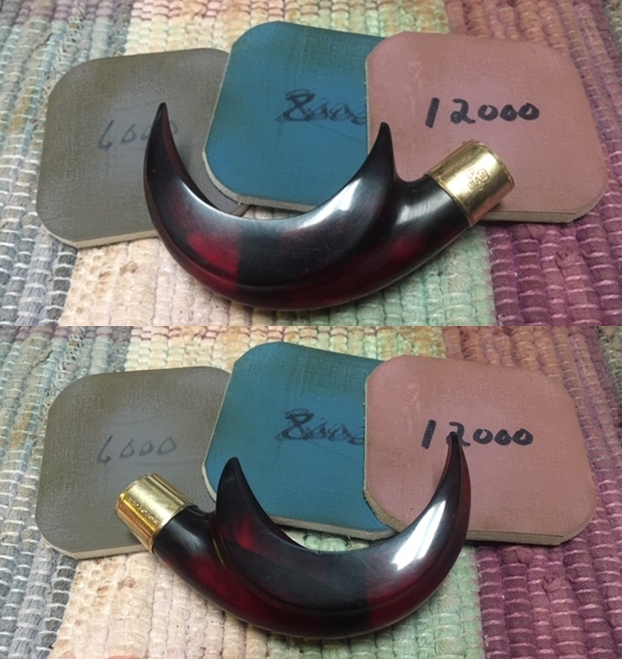
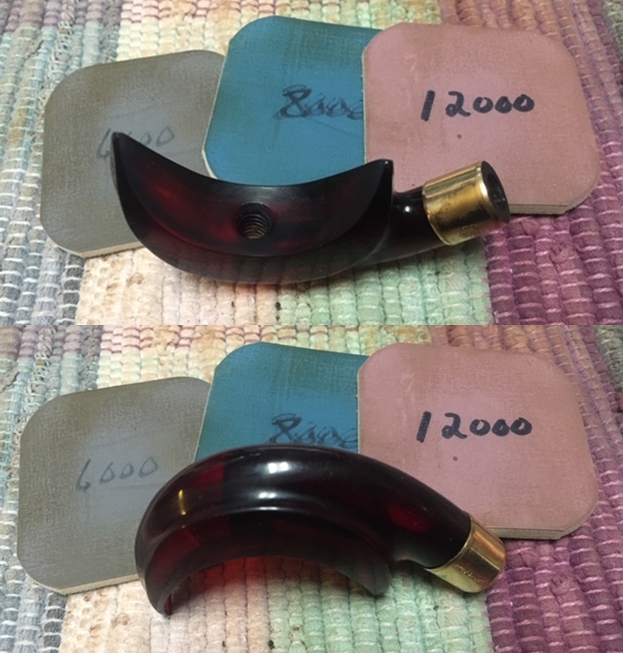
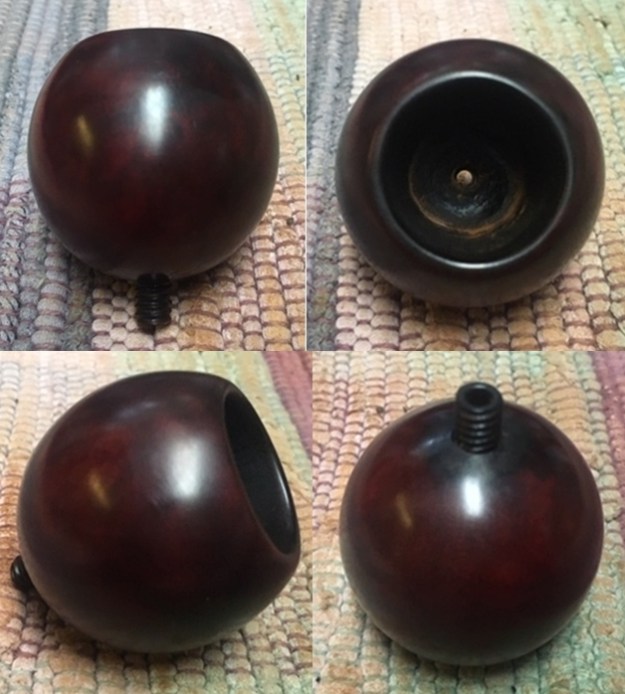
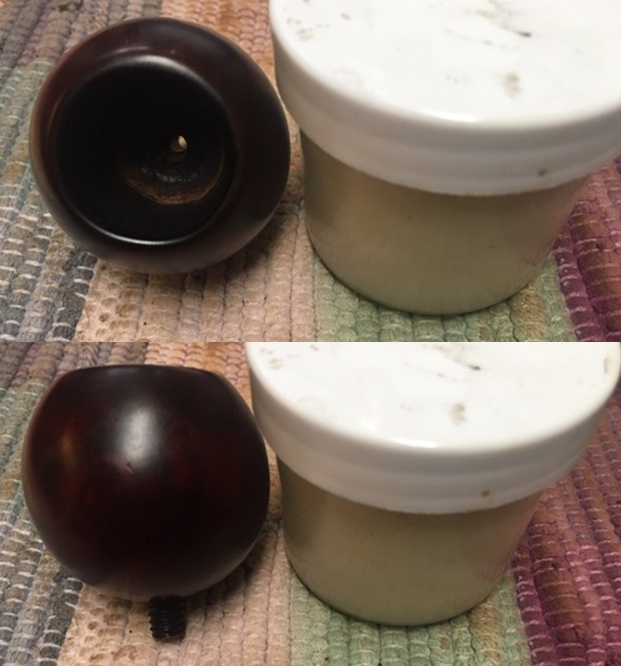
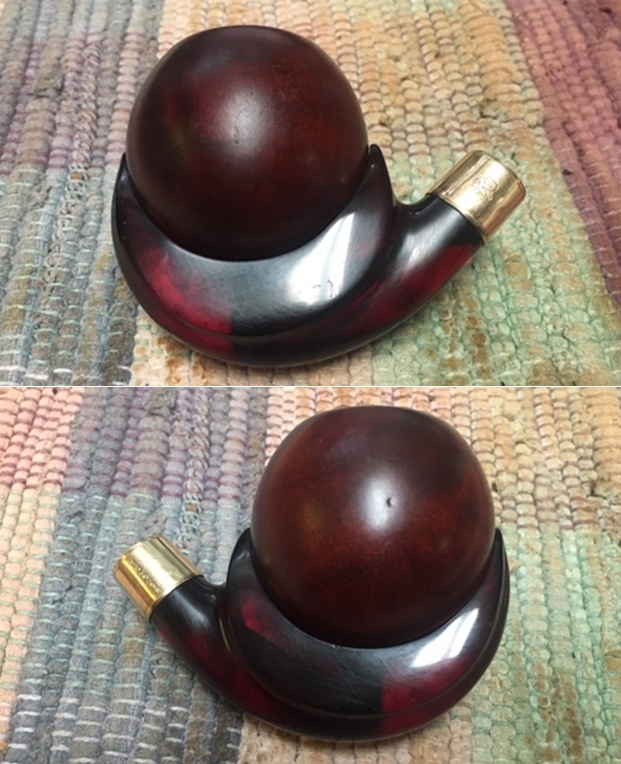
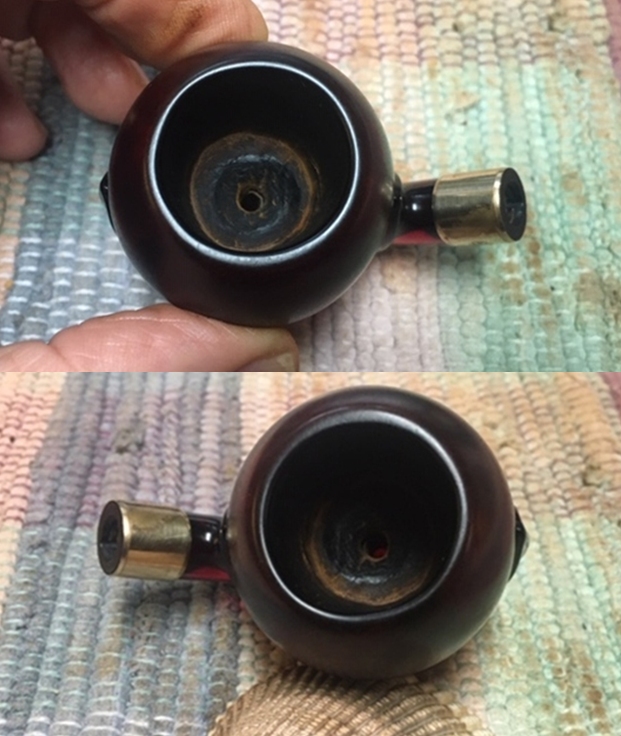
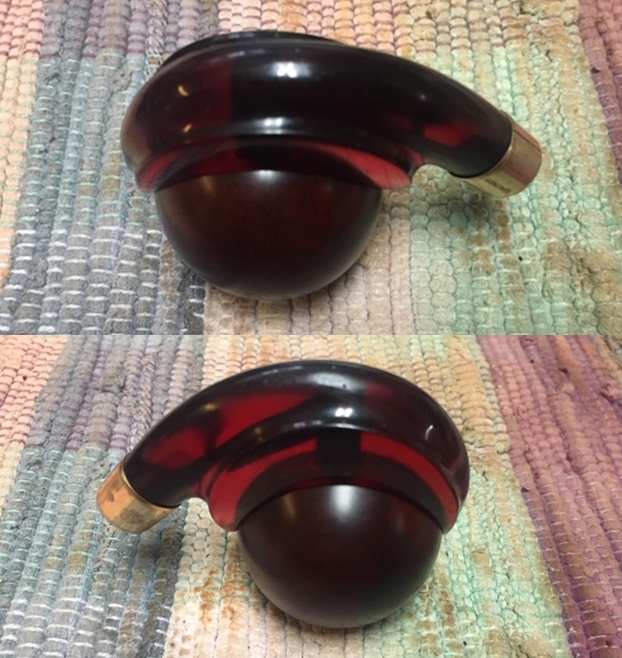
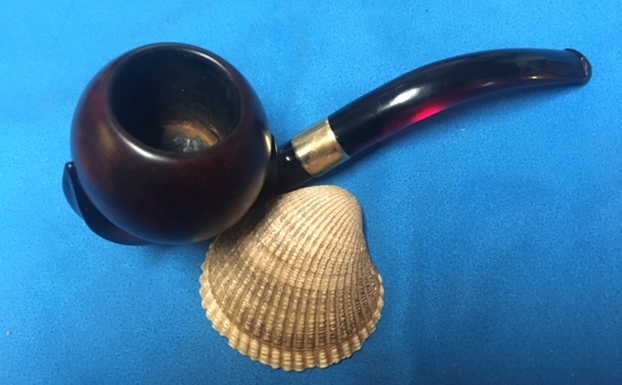
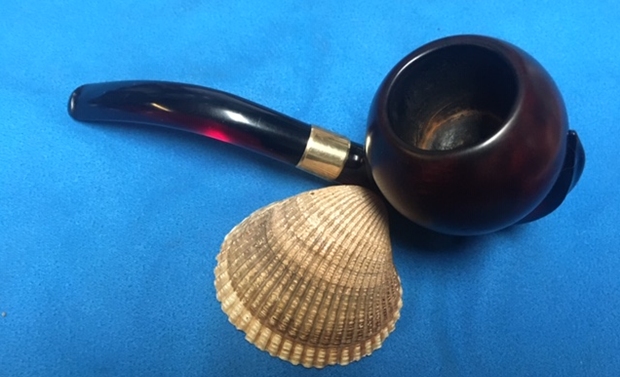
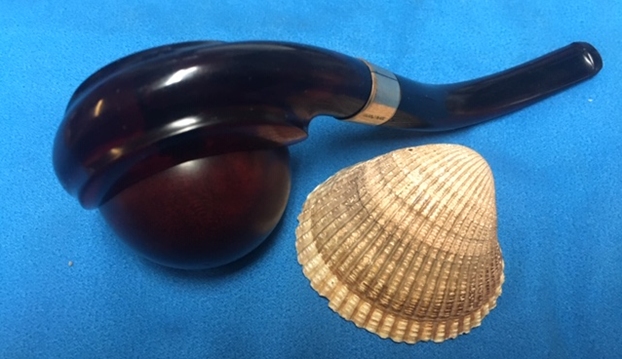
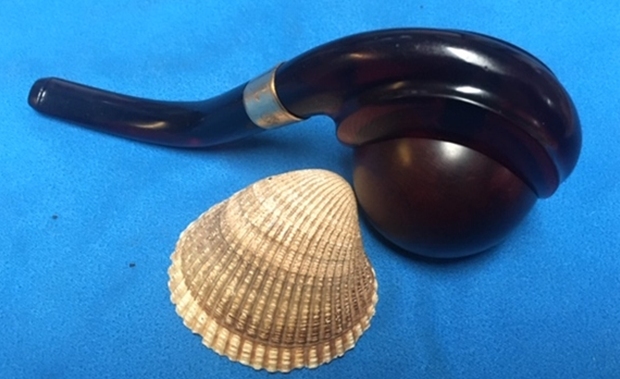
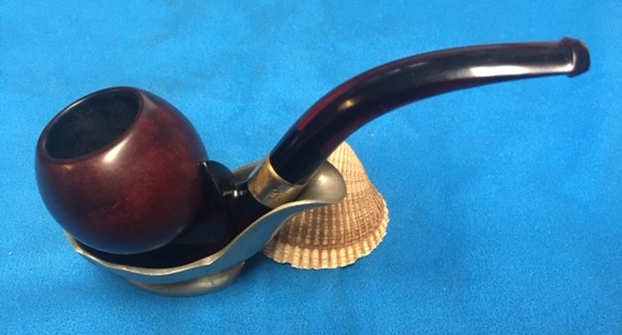
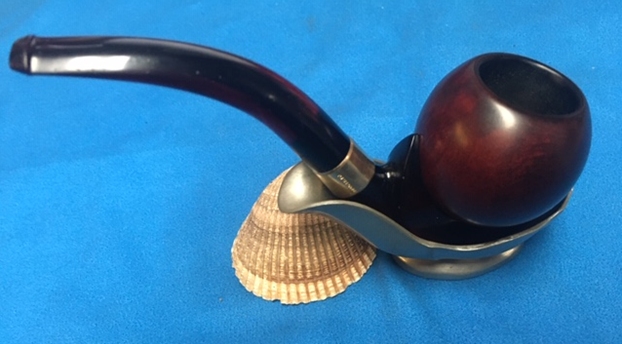
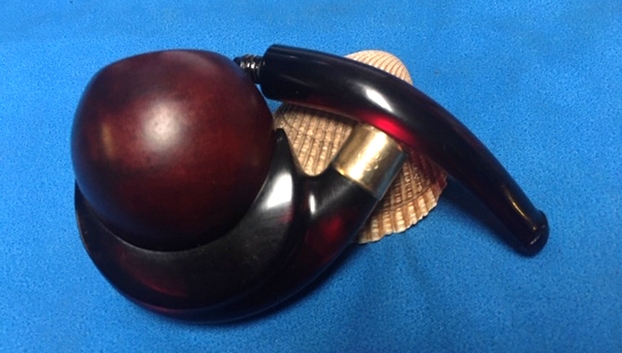
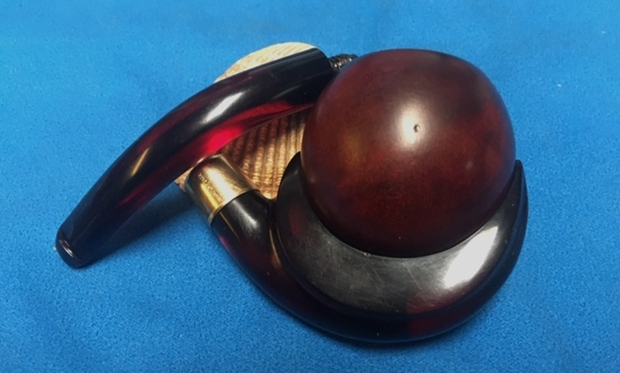
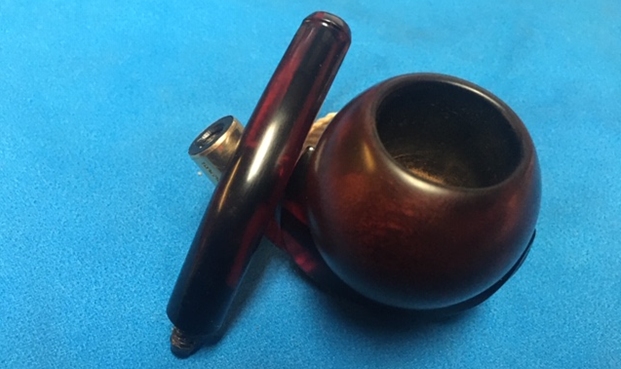
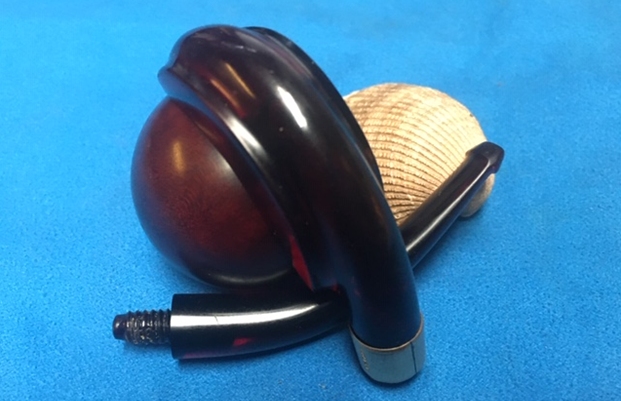
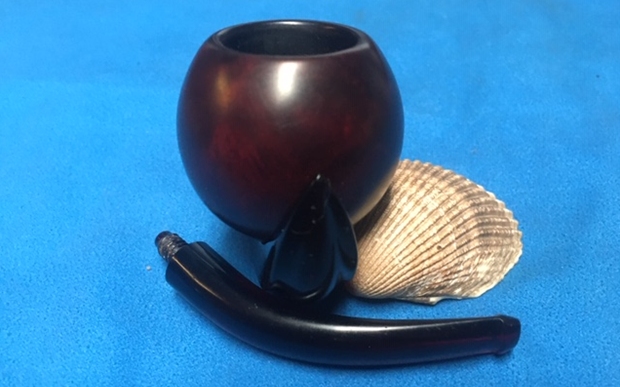
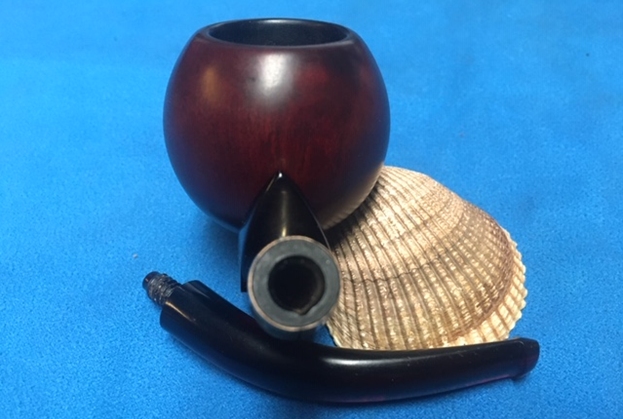
Jeff picked up this interesting Cup and Ball or Claw and Ball pipe somewhere along his hunts or in an auction. It is quite unique. I have worked on a lot of KB&B pipes but never one like this. It is stamp on the inside of the case with the KB&B Cloverleaf and Bakelite in the centre. Underneath it appears to read Blueline. The gold band on the shank end is also stamped with the KB&B Cloverleaf as well as what looks like 12K Gold Plate. Both the base of the pipe and the stem are Bakelite. The stem has a bone tenon that screws into the Bakelite shank. It came in a black leather covered case lined with blue velvet fabric. The only marking on the case was what I mentioned above. The case has a brass clasp on the front and brass hinges on the back. It was obviously custom made for this pipe.Jeff opened the case and this was what the pipe that was inside looked like. It was a very unique looking pipe that is for sure but it was also very dirty. The base, shank and stem were rich red coloured Bakelite. The exterior of the bowl was very dirty and had tars and oils ground into the finish and sticky spots on the finish. Looking at the top of the bowl you can see the cake and how much lava had overflowed onto the rim top. I am sure once it was out of the case it would become clear how dirty it really was.Jeff took it out of the case to have a better look at the condition of the pipe. It was a very interesting looking rendition of a Ball and Cup pipe – at least that is what I would call it. It looked like it would cleanup really well and look great when finished. The hardwood bowl (cherry or maple) had some colour from either being filthy or from age. Cleaning would reveal the facts! He took some close-up photos of the bowl and rim top. There was a very thick cake in the bowl that was hard and uneven and had lots of flakes of tobacco debris stuck to the walls. The lava overflowed down the outside of the ball on several sides. The edges of the bowl looked to be in pretty good condition at this point. Jeff took photos of the sides of the bowl to show the grain and condition of the finish around the bowl. These photos also lead me to conclude that the bowl is not briar… perhaps Cherry or Maple.In terms of stamping the only identifying marks on the pipe were those on the case on the gold band on the shank. Jeff captured those marks in the next set of photos. The logo on the inside lid of the case was worn and dirty so he included two photos of that. I also found a similar lid logo online and have included it as well for comparison sake. Jeff took photos of the KB&B Cloverleaf and the 12K Gold Plate stamp on the band.He took photos of the ball and the stem off the shank/base. The ball and the stem both are threaded and are screwed into the base. It was filthy with oils and tars. The internals of the pipe were in as bad a condition as the inside of the bowl and airway.Jeff took photos of the stem to show the general condition of the stem shape. The curve is graceful and the curve great. The photo shows the profile of the stem. He took photos of the top and underside of the stem to show the damage and bite and scratch marks on both sides up the stem from the button.I remembered that one of the contributors to rebornpipes, Troy Wilburn had done a lot of work on older KB&B pipes so I turned to one of his blogs on rebornpipes on a Blueline Billiard that he restored (https://rebornpipes.com/tag/kbb-blue-line-pipes-with-bakelite-stems/). As expected Troy had done a great job digging into the Blueline brand and potential dates. I quote from his blog the following sections.

I was thinking after some initial research that these pipes were from around 1910 – early 1920s. Seems it’s a little older than I thought. I got this info from a Kaywoodie and early KBB collector who has had several Blue Lines.

Your pipe is made by Kaufman Brothers and Bondy, or KB&B, which later (1915) created the Kaywoodie line we all know. But this pipe is Pre-Kaywoodie, as they were making pipes under the KB&B branding from about 1900 to 1914. Bakelite was invented in 1907, so this pipe was likely made from 1908 to 1914, as the Bakelite was quite the technological wonder of the time, and was used in many products (still in use today). These “Blue Line Bakelite” pipes are rare pieces, seldom seen.”

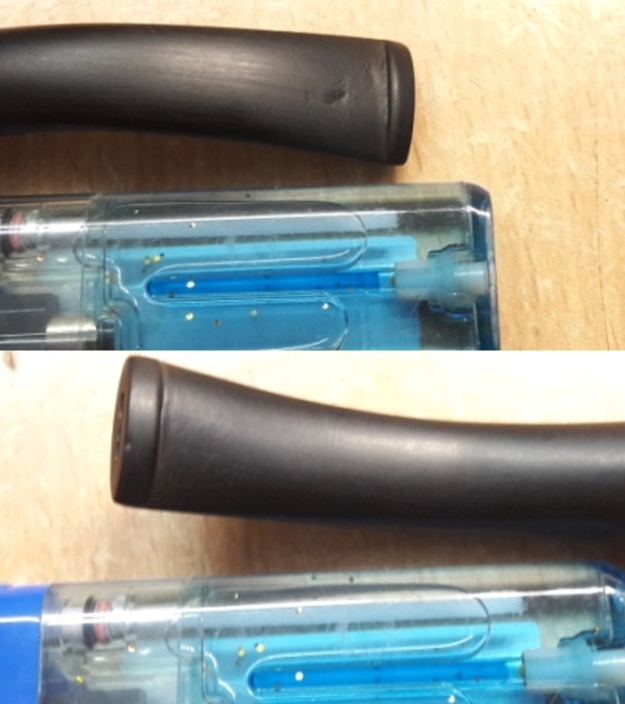
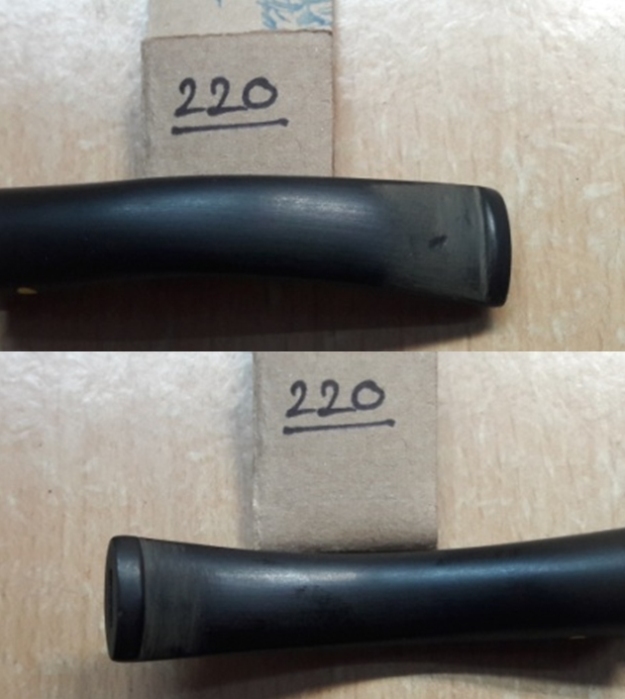
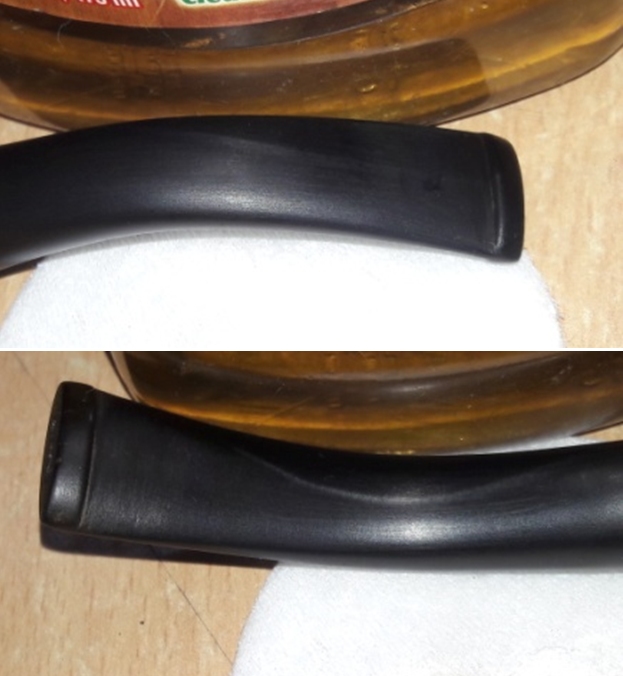
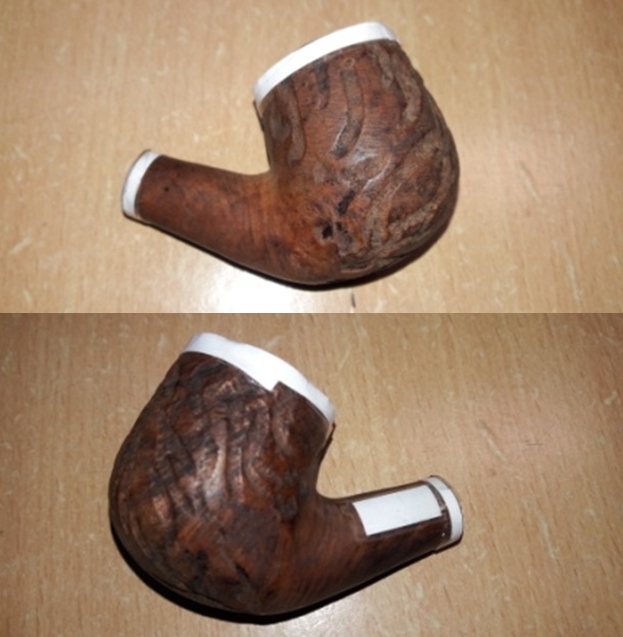
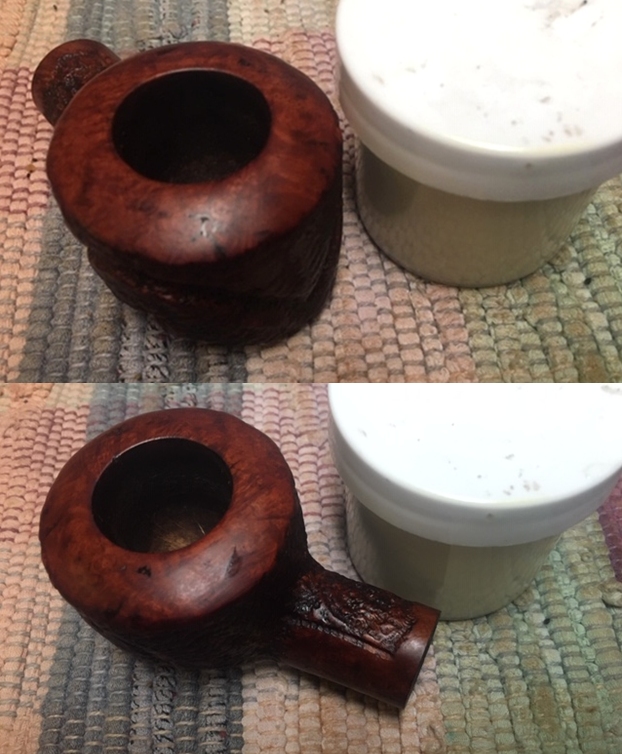
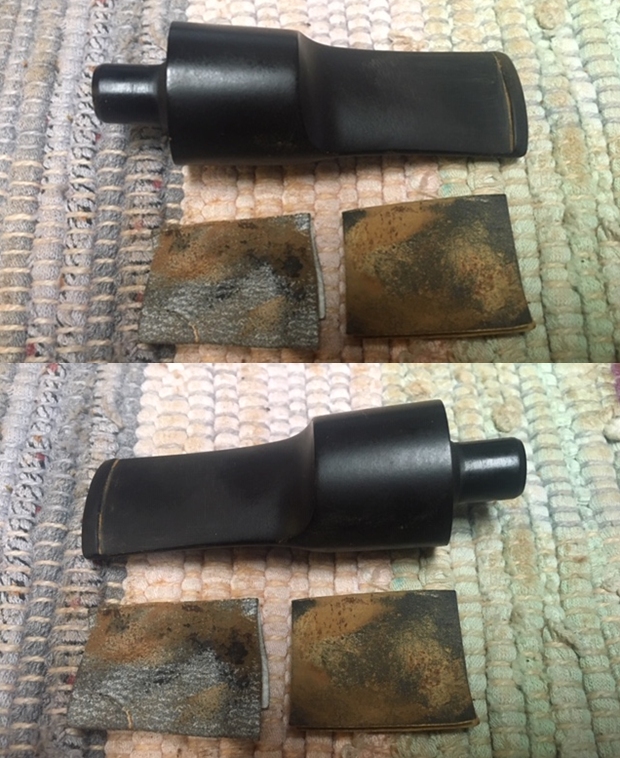
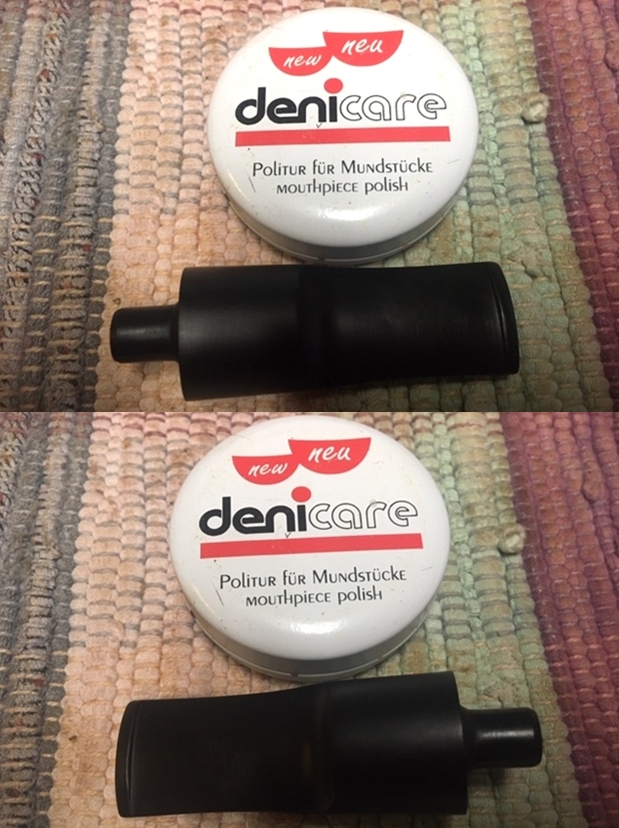
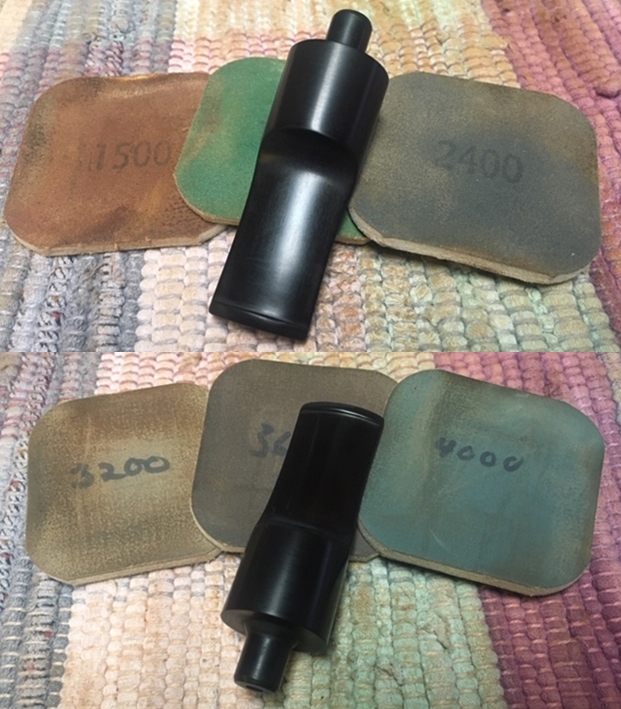
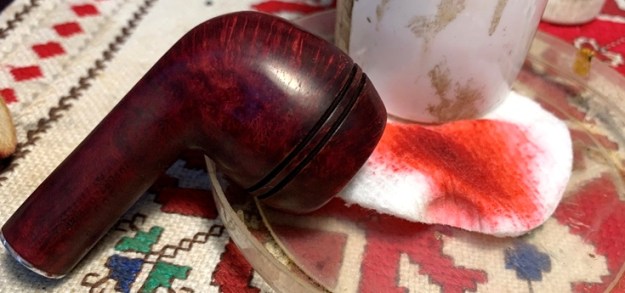
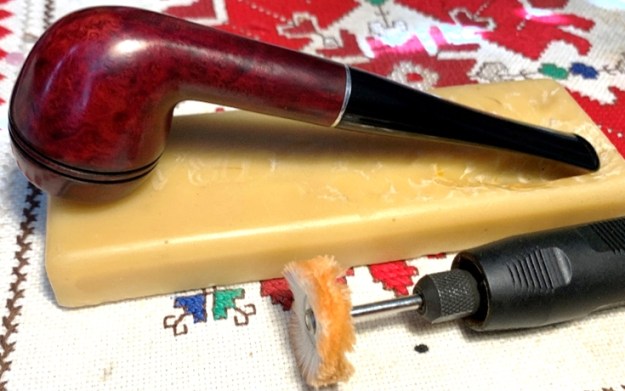
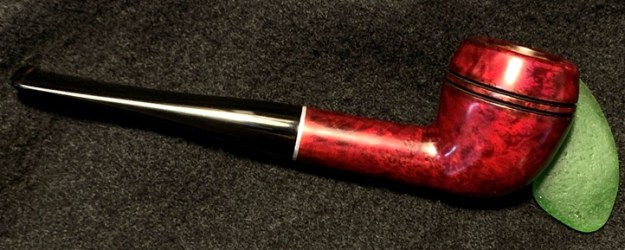
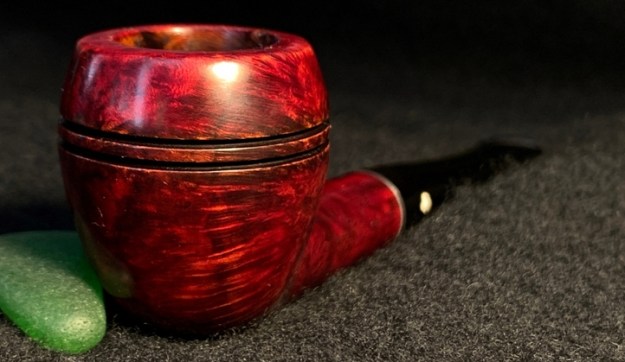
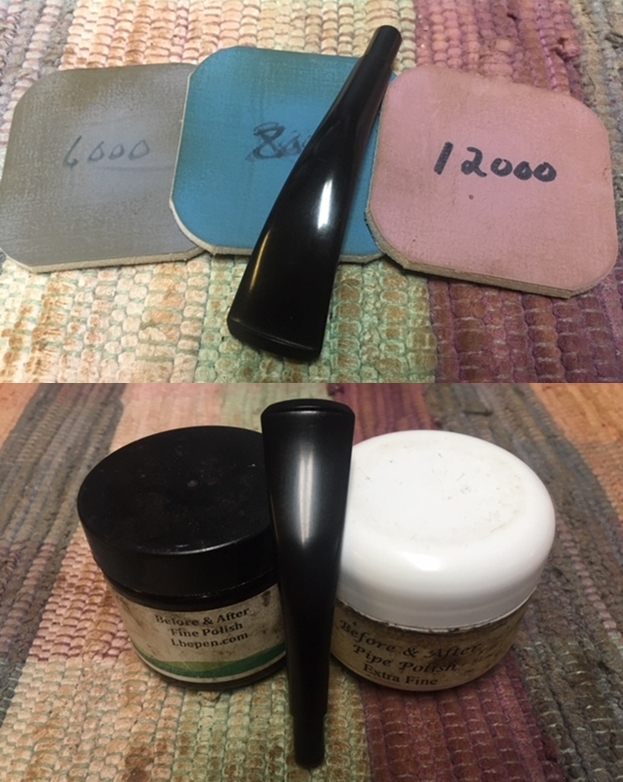
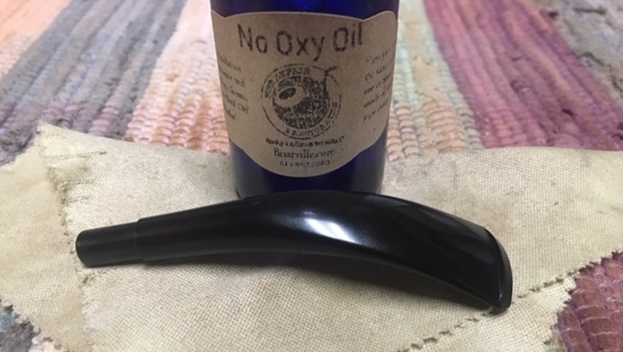
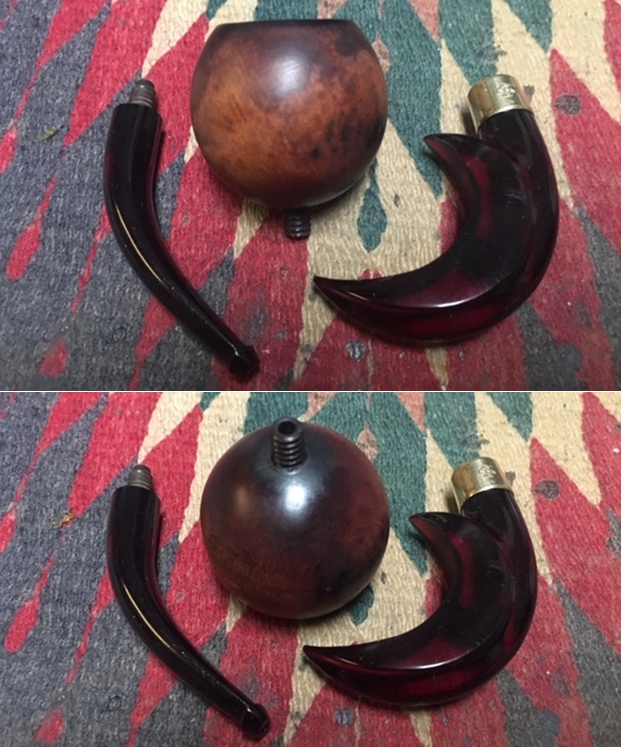
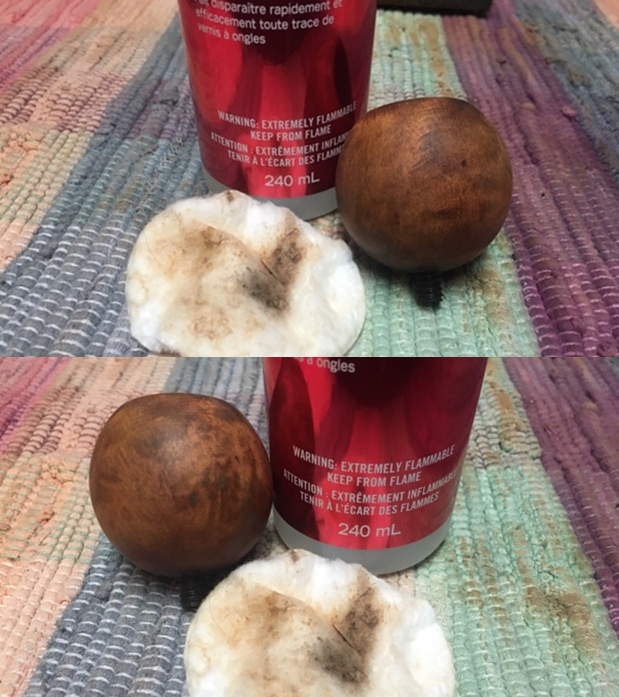
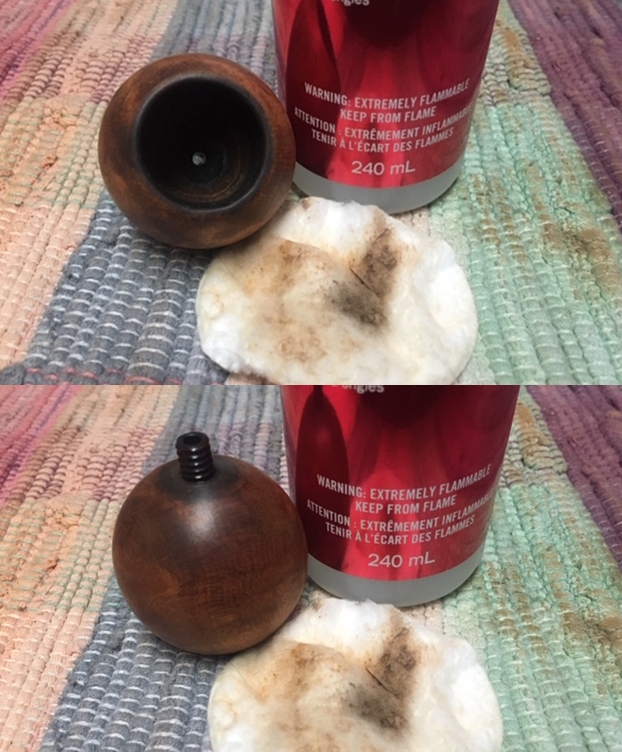
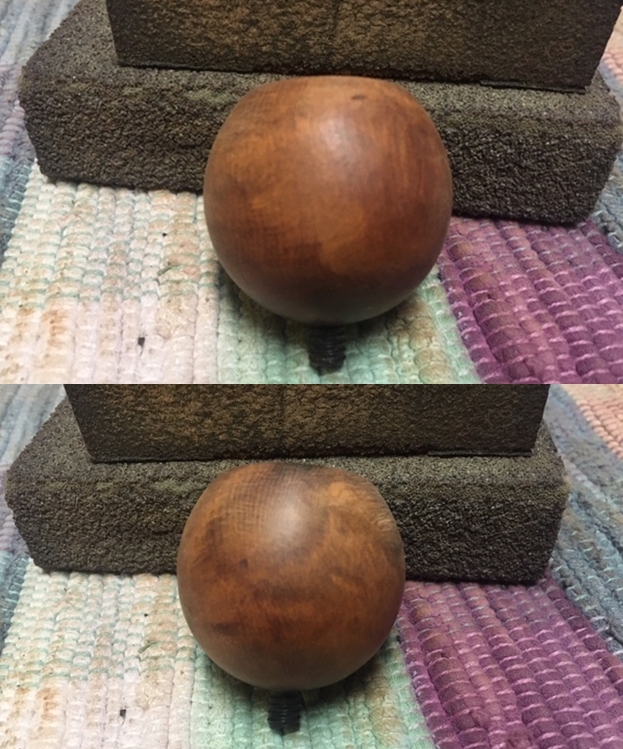
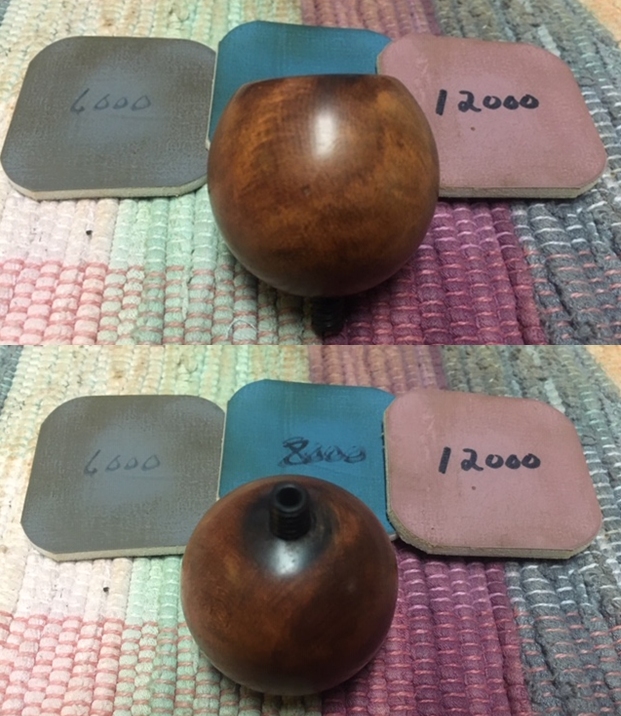
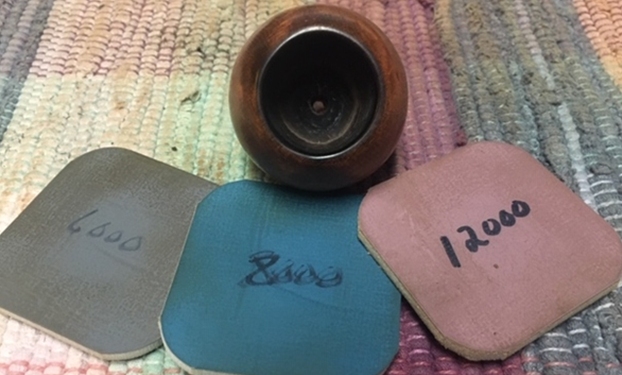
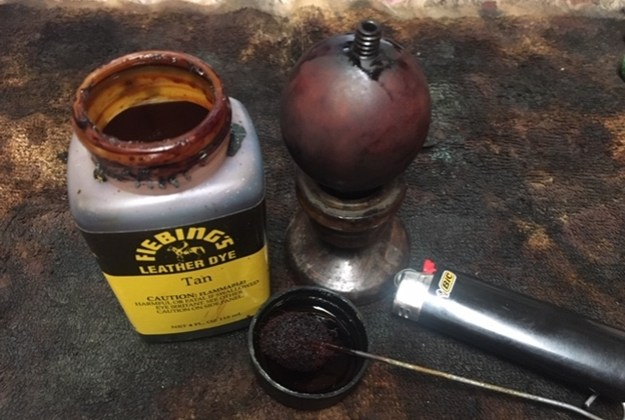
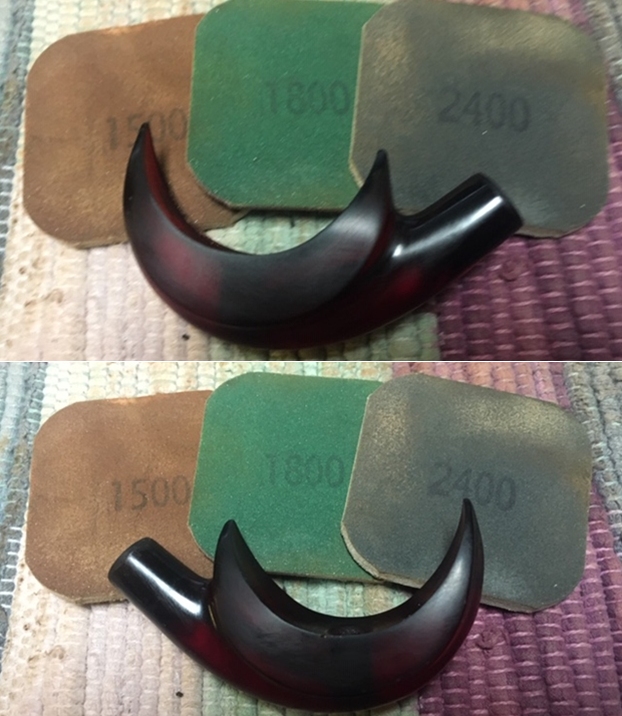
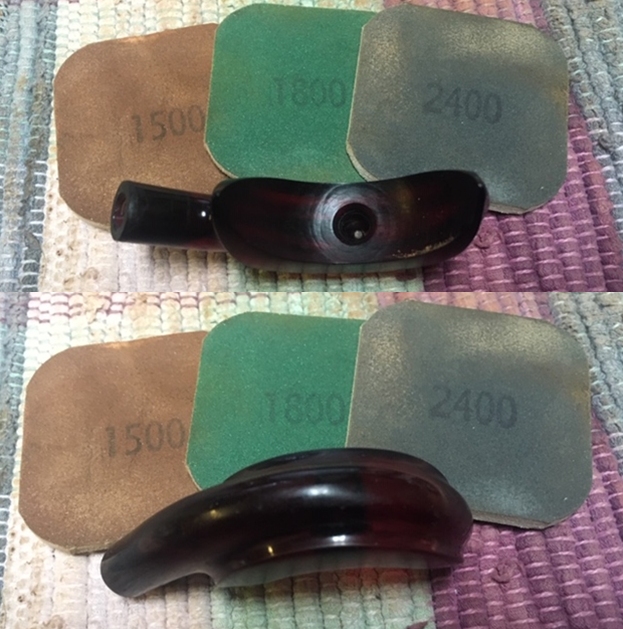
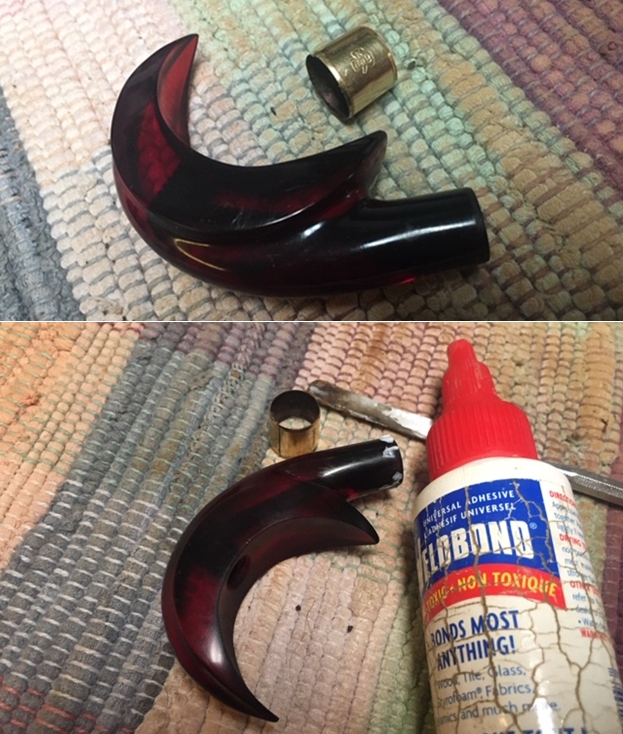
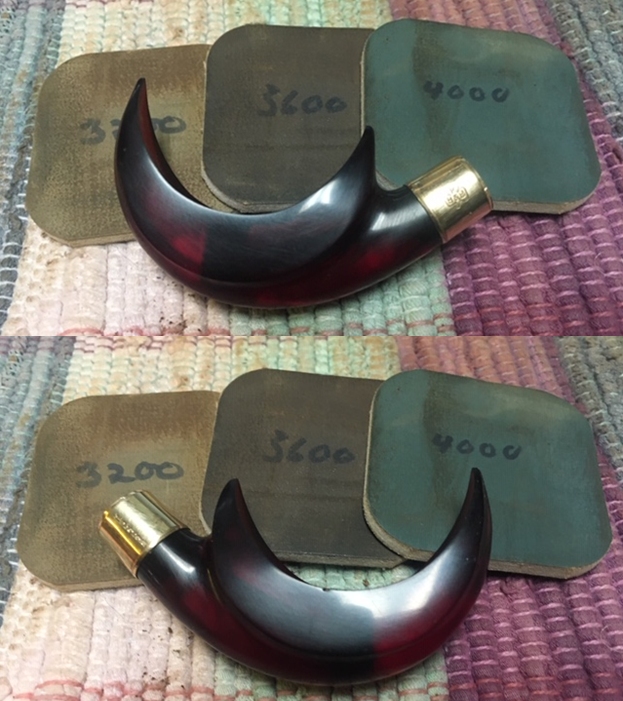
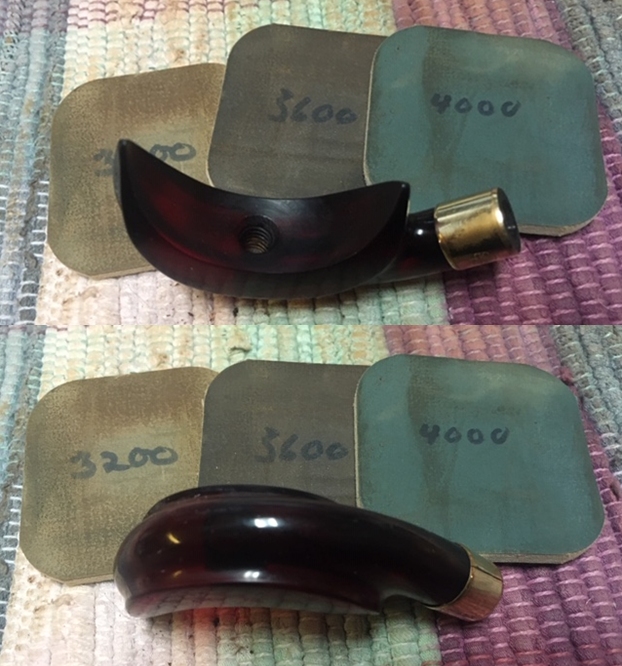
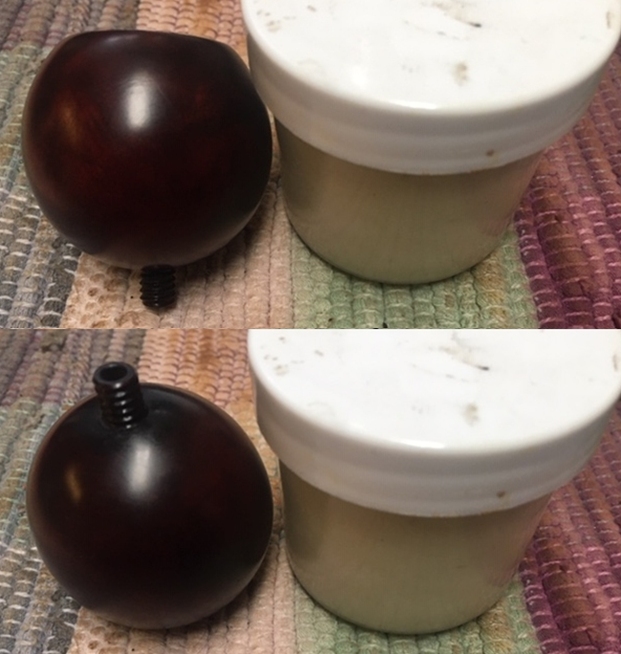
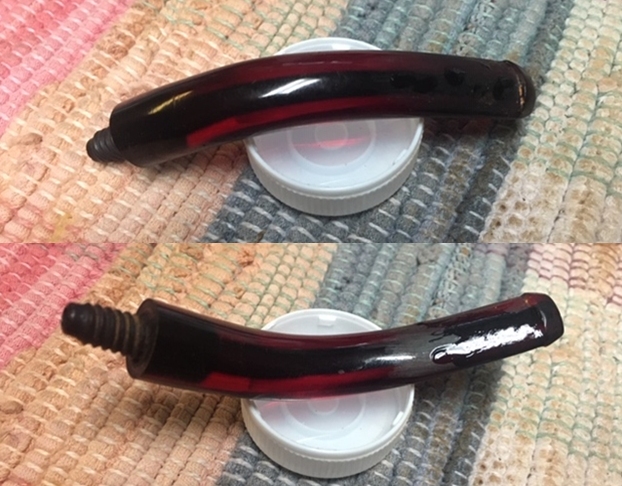
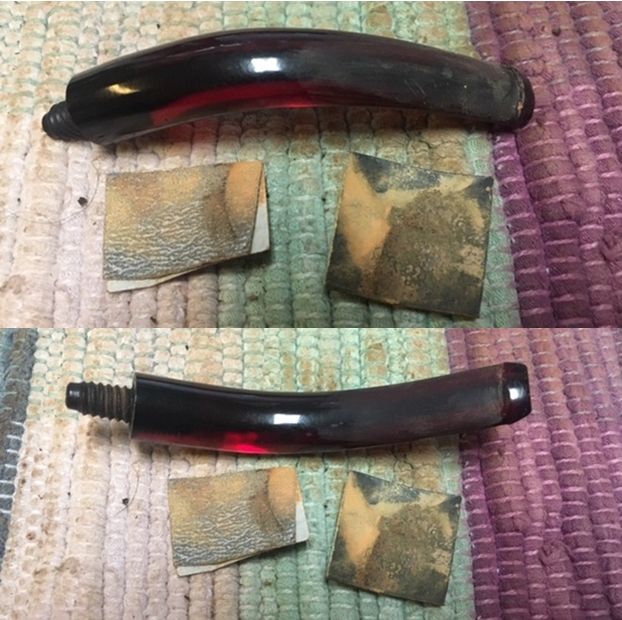
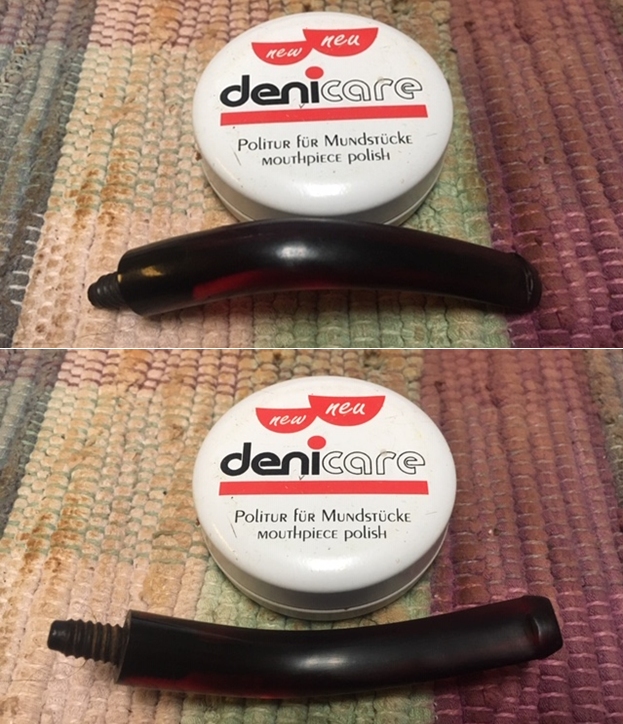
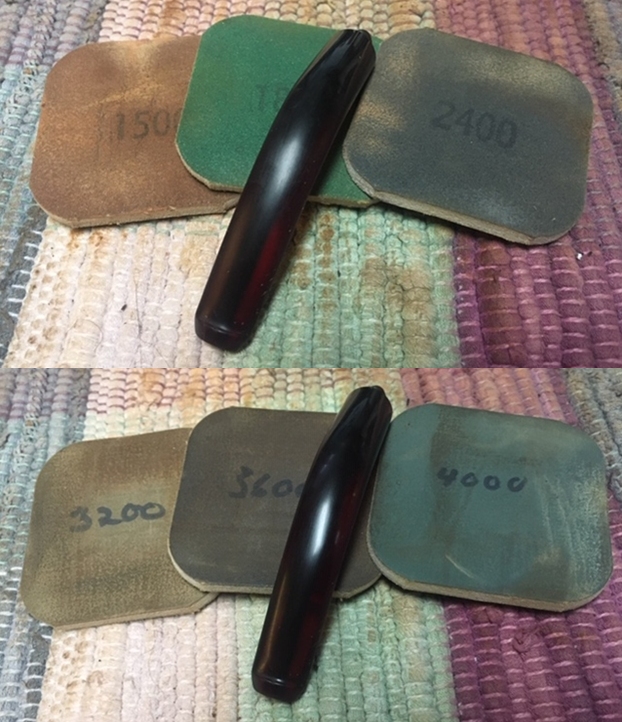
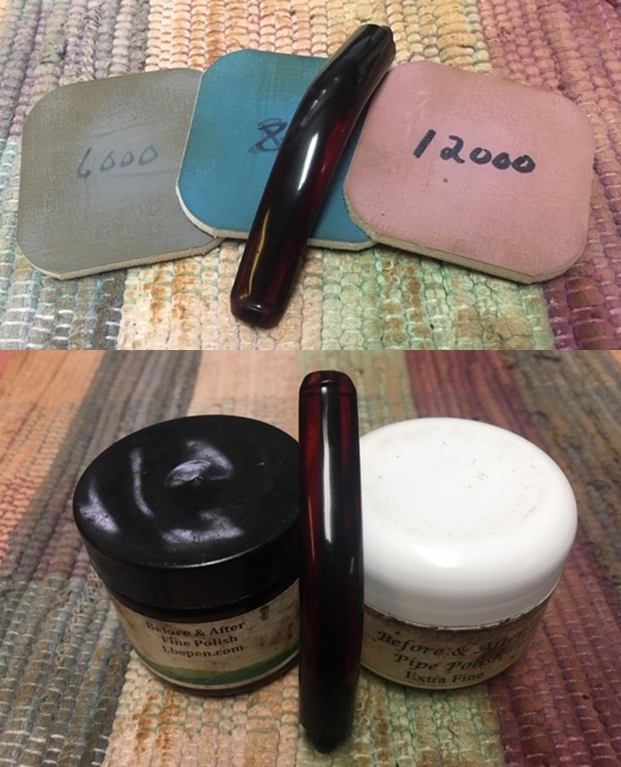
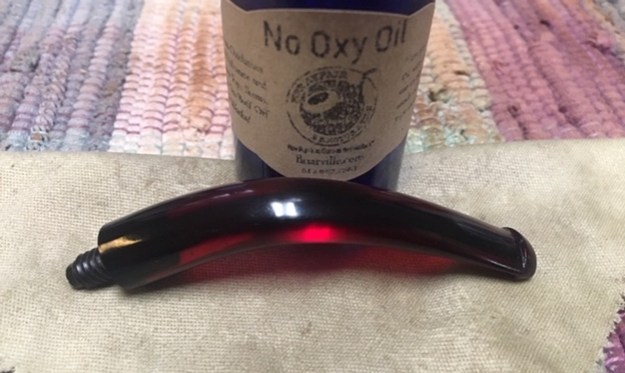
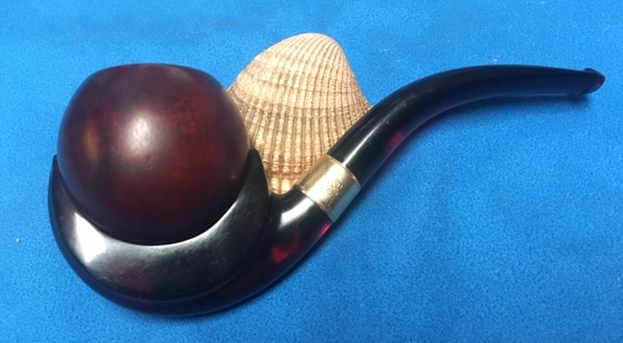
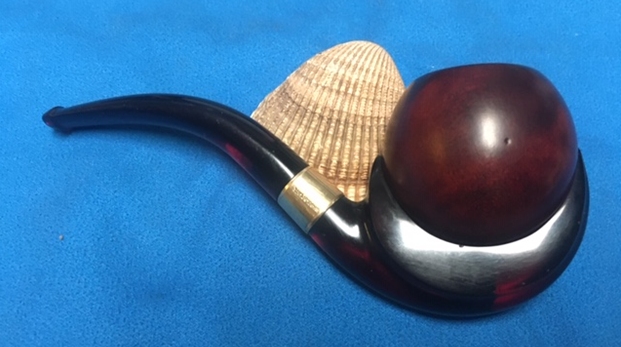
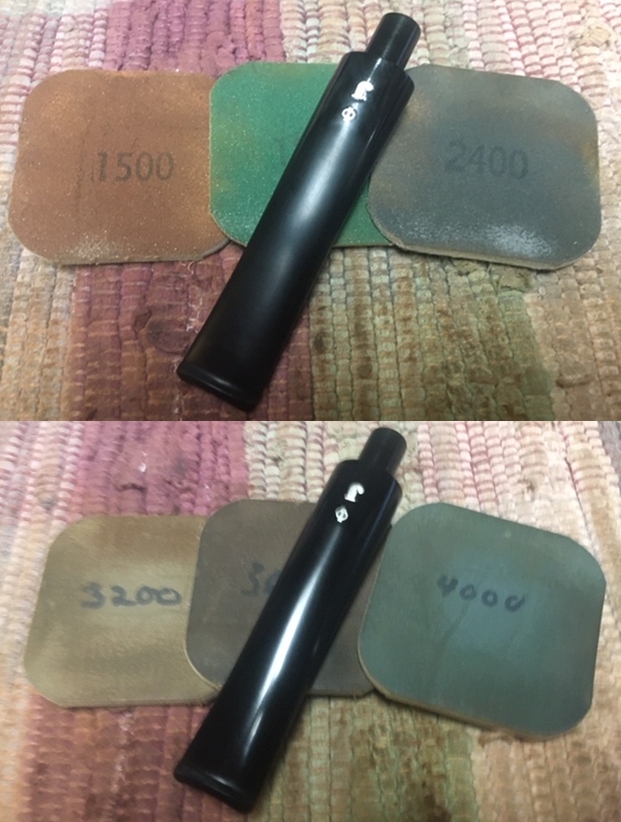
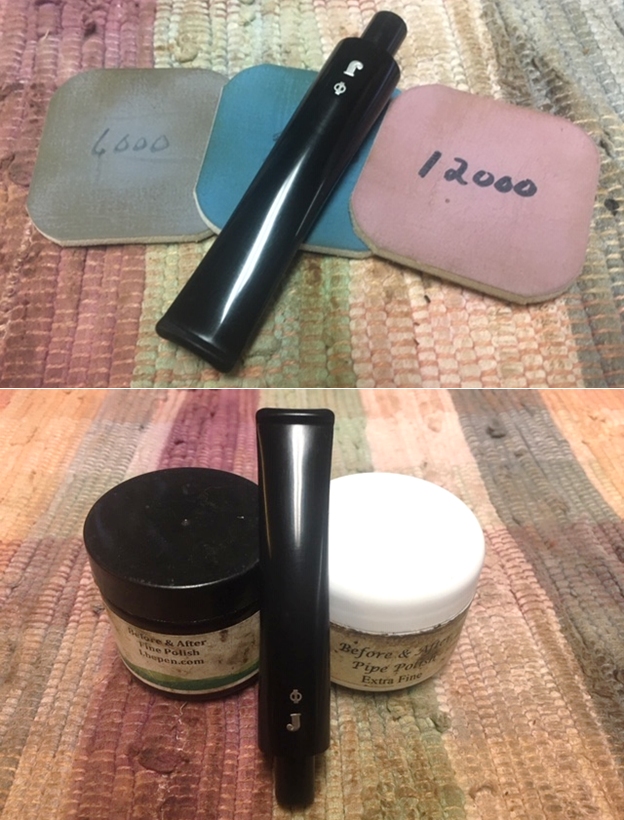
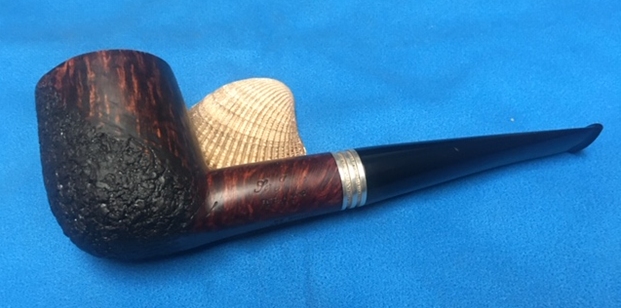
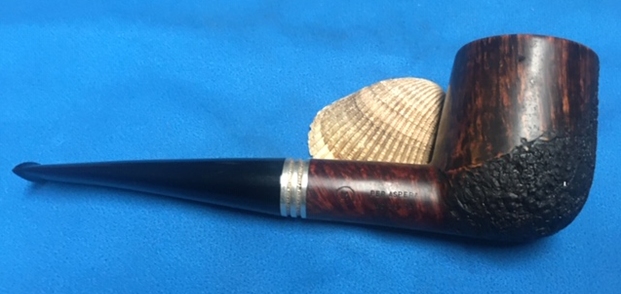
Having seen the before pictures on this pipe I was looking forward to what it would look like when I unpacked the most recent box Jeff sent to me. The pipe was present in the box and I took it out of the box to see what work awaited me when I removed it from the case. I put the case on my desk and opened it to see what was there. I opened the case and took a photo of the pipe inside.I was astonished to see how clean the pipe was. The bowl clean and the Bakelite base and stem looked very good. Even the gold band looked better. Now it was time to take it out of the case and have a look at it up close and personal. I took photos of the pipe as I saw it. Jeff had done an incredible job in cleaning up this pipe. He had reamed the bowl with a PipNet Pipe reamer and cleaned up the remaining debris with a Savinelli Fitsall Pipe Knife. He also scraped the thick lava on the rim top. He scrubbed the exterior of the bowl with Murphy’s Oil Soap and a tooth brush to remove the grime on the bowl and rim. He cleaned out the interior of the bowl base and stem with pipe cleaners, cotton swabs and alcohol until they came out clean. The rim top looked incredible when you compare it with where it started. There is some slight darkening on the inside edge of the bowl. He cleaned the base and stem with Soft Scrub to remove the grime on the exterior and cleaned out the airway with alcohol, cotton swabs and pipe cleaners. I included a photo of the KB&B Cloverleaf on the gold plated band.I unscrewed the bowl and the stem from the base and took photos of the parts. The bowl and stem both had threaded connectors. The bowl was metal and the stem was bone.I stripped the spotty finish off the bowl with acetone. I know for some this is a no-no for old pipes but honestly this finish was very rough. I would restain it as close to the original aniline as I could but there was damage that needed to remove the stain and finish to address. I followed that by sanding the bowl with a medium and a fine grit sanding sponge. The bowl was looking better and the dark spots turned out to be oils and not burn marks! Whew! I polished the bowl with micromesh sanding pads – dry sanding with 1500-12000 grit pads and wiping the bowl down after each pad with a damp cloth. Note the developing shine on the wood. I went through my various stains and chose a Tan aniline stain for the bowl. It is a nice coloured stain that is close to what was original and will give me some coverage over some of the dark spots on the sides of the bowl. I applied the stain and flamed it with a lighter. The flaming burns off the alcohol and sets the stain in the wood. I repeated the process until I was happy with the coverage.I set the bowl aside to let the stain cure and turned my attention to the base. The band was loose so I removed it for the first round of pads. I polished the Bakelite with micromesh sanding pads to remove the scratching and bring out a shine. I dry sanded with 1500-12000 grit pads and wiped it down with a cloth I use that has Obsidian Oil impregnated in the fibres. It works well to remove the dust. I paused the polishing to glue the gold band on the shank end. I put some white all-purpose glue on the Bakelite and pressed the band in place on the shank. I wiped the excess glue off with a damp cloth. I let the glue dry for a short time.When it had set I continued polishing with the micromesh pads. I set the base aside and went back to the bowl. I buffed out the newly stained bowl with Blue Diamond to bring out a shine. The colour is opaque enough to hide the dark spots and transparent enough to show some grain in the sunlight. I like it!I rubbed Before & After Restoration Balm into the wood with my fingertips to clean, enliven and preserve the newly stained bowl. I find that it adds a depth to the polish that I really have come to appreciate. All that remains at this point is to wax and polish the bowl. With the bowl and the base finished it was time to put them back together. I would still need to buff and wax both but the project was coming to an end. All that remained was to finish the stem work. I set the base and bowl aside and turned to address the issues with the stem. I used a clear CA glue to fill in the gouges across the stem from the button forward an inch on both sides. I also filled in the deep tooth marks on both at the same time.I smoothed out the repairs with a folded piece of 220 grit sandpaper. I started the polishing with a folded piece of 400 grit wet dry sandpaper.I rubbed the stem down with Denicare Mouthpiece Polish. It is a gritty, red paste with the consistency of red Tripoli. I find that it works well to polish out scratches and light marks in the surface of the stem. I polished it off with a cotton pad to raise the shine.I polished the stem with micromesh sanding pads – dry sanding with 1500-12000 grit sanding pads. I wiped it down after each sanding pad with a cloth containing some Obsidian Oil. I finished polishing it with Before & After Pipe Stem Polish – both Fine and Extra Fine and buffed it off with a cotton cloth. I gave it a coat of Briarville’s No Oxy Oil to preserve and protect it. I put the hardwood bowl and Bakelite Base stem back together again and carefully buffed it with Blue Diamond polish on the buffing wheel. I gave the bowl, base and stem multiple coats of Carnauba wax on the buffing wheel. I hand buffed the entirety of the pipe with a microfiber cloth. The pipe was alive now and looked great to me. It has a great feel in the hand that is very tactile and the colouring on the bowl should develop more deeply as the pipe is smoked. The finished pipe is shown in the photos below. The dimensions of the pipe are Length: 5 1/2 inches, Height: 2 1/4 inches, Outside diameter of the bowl: 1 1/4 inches, Chamber diameter: 7/8 of an inch. This older KB&B Blueline Cup and Ball pipe is a beauty and the Bakelite looks great with the newly stained bowl. It is one of those old timers that will be staying in my KB&B collection. It will be a great addition to my collection of old pipes. Thanks for reading this blog and my reflections on the pipe while I worked on it.

Operation Rescue – “My Dog Ate my Ser Jacopo L1 Billiard!”


Blog by Steve Laug

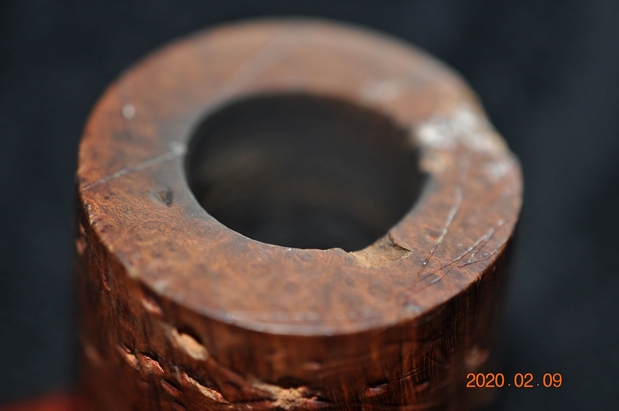
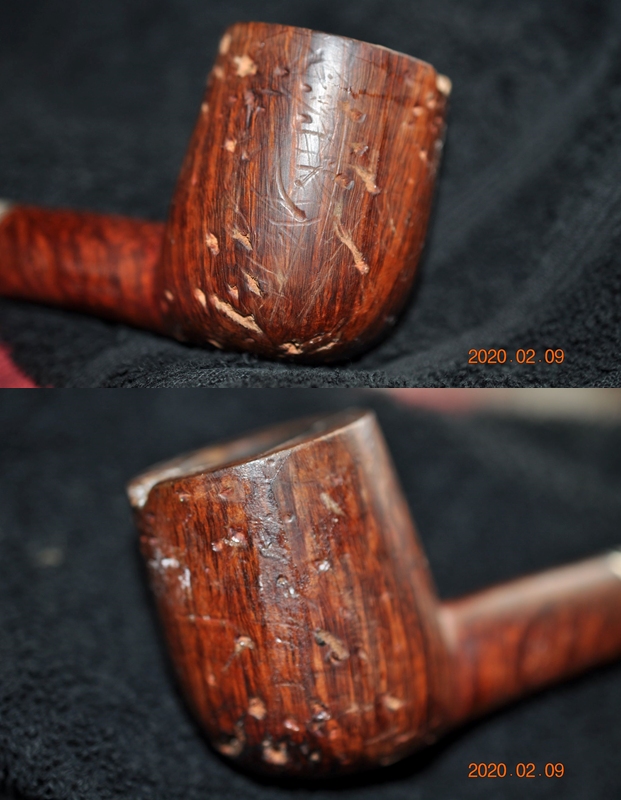
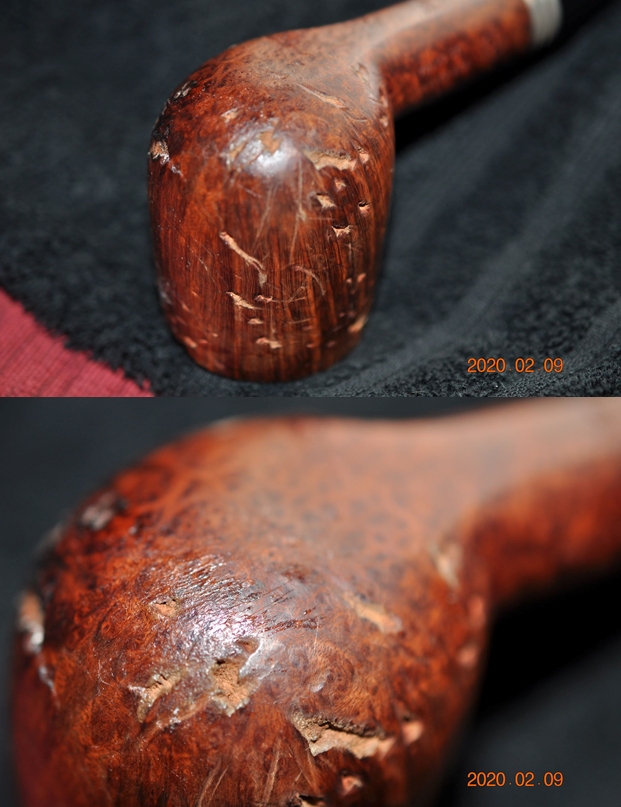
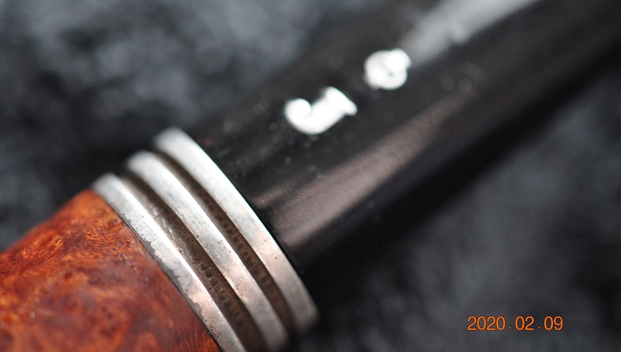
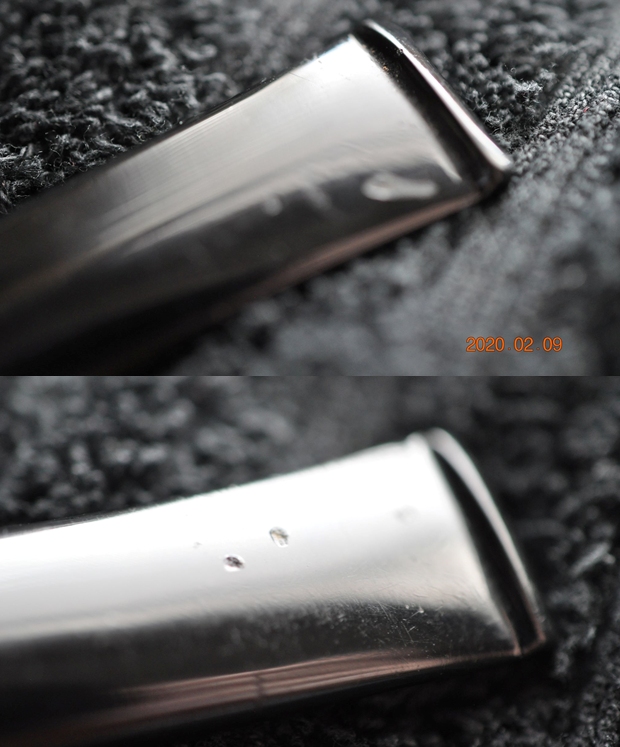
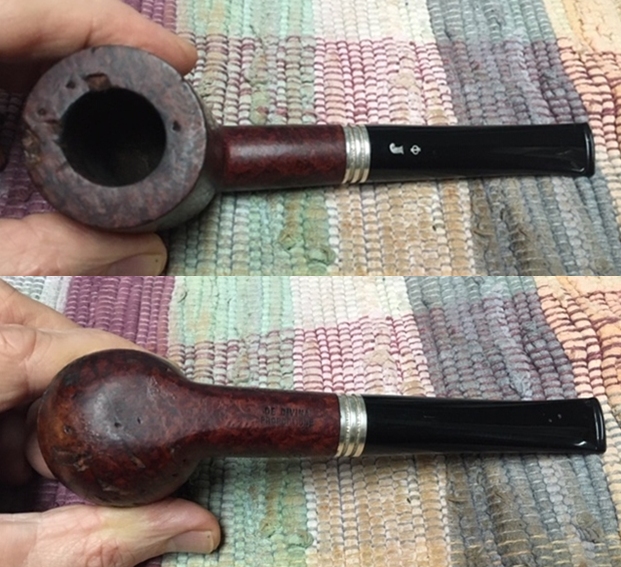
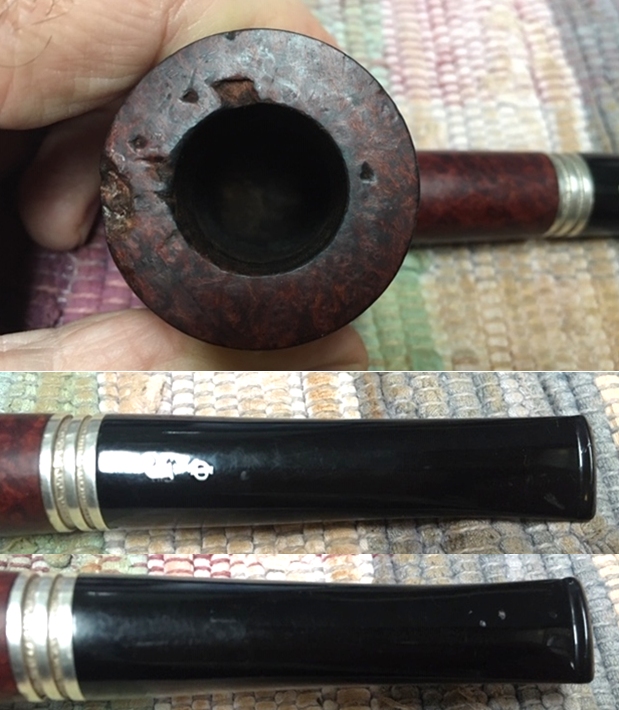
When Jeff showed me the next pipe on the table we went back and forth about buying it or just leaving it with the seller. It was a really nice Ser Jacopo L1 Billiard at some point in its life but that time had passed. It had literally become a chew toy for someone’s dog. The bowl was in very rough shape and had deep tooth gouges around the bowl with chunks of briar missing on the rim and top. The bowl was really damaged to the point of being questionable. The shank interestingly was free of bite marks and the stem had less bite marks than some of the stems I have worked on from pipemen who chew their stems. For me the question was whether or not I wanted to work on it. There was no doubt that the pipe would be a challenge but was it a challenge I wanted to take on. That was the question we weighed before moving ahead with the buy.

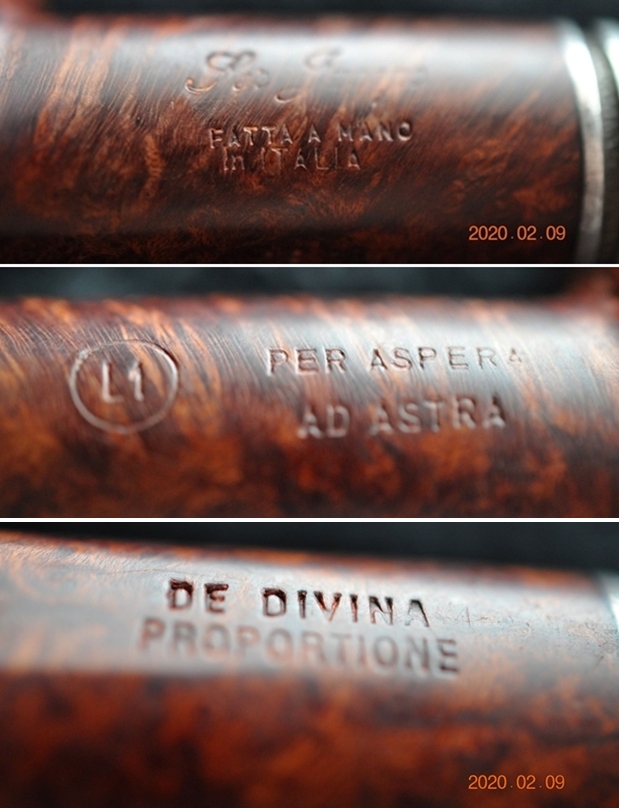
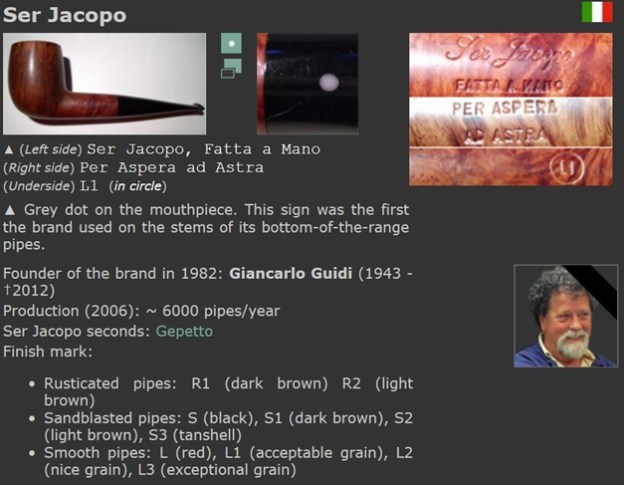
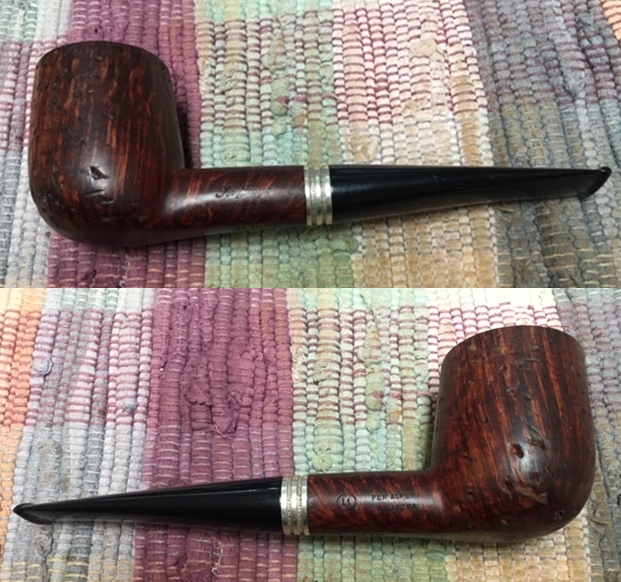
After spending time talking about it we decided to pick up the pipe and see what I could do with it. When Jeff got it the story became even sadder!  The bowl had amazing straight grain around the sides and it appeared to have been barely smoked. It looked as if maybe a bowl or two had been enjoyed before the dog got a hold of the pipe and did the massive damage that showed when we saw it. The bowl had some darkening but there was no cake in the bowl. It smelled smoky but otherwise was very clean. Jeff would still clean up the pipe before he sent it on to me that way I would be able to just pick it up and see what I could do with it. Jeff took the following photos before he started his cleanup work on the pipe. Just look at the damage! Oh my; the pipeman or woman must have just wept after the initial shock or anger when he or she saw the pipe dangling from the dog’s mouth. He took close-up photos of the bowl and rim top from various angles to capture the gnawing damage to the bowl and rim top edges. You can see the large bite marks and chunks of briar missing on both the inner and outer edges. The largest chunk is on the front of the bowl and the inner edges damage is on the right side. You can also see the damage to the sides of the bowl. Jeff took photos of the sides and heel of the bowl to show the both the extent of the damage to the bowl and the amazing grain around the bowl. It really is a shame that this poor pipe suffered this fate. Jeff took photos of the stamping on sides of the bowl. On the left side it reads Ser Jacopo over Fatta A Mano over In Italia. On the right side it reads L1 in a circle Per Aspera Ad Aspera. On De Divina Proportione. All the stampings are very readable and clear. He took a photo of the inlays on the tapered stem top. The silver J with an I and a circle. The next two photos show the top and underside of the stem. Notice the few tooth marks on both sides. It is not as bad as it could be. I wanted to know a bit more about the pipe in hand. I knew a little of the history of the brand but I wanted to understand the stamping on the shank sides and underside so I turned first to the Pipephil website (http://www.pipephil.eu/logos/en/logo-s5.html). Interestingly the first pipe they had a photo of was similar to the one that I had. It is stamped similarly on the left side of the shank with the Ser Jacopo over Fatta a Mano but the one I have also was stamped In Italia under that. The right side of mine is stamped with the L1 in a circle and the Per Aspera Ad Astra followed that. Mine also was stamped on the underside of the shank and read: De Divina Proportione. The one I am working on also had a band on the shank and the stem stamp was different as well. I also learned the L1 stamp stood for a pipe with acceptable grain. I have included a screen capture of the  pertinent information.Once I had that material digested a bit I turned to Pipedia to understand more about the stamping on the pipe (https://pipedia.org/wiki/Ser_Jacopo). I am including the information on that below. The standard nomenclature found on Ser Jacopo pipes is as follows: Ser Jacopo Fatta A Mano In Italia Per Aspera Ad Astra.

Fatta A Mano translates to “Made By Hand”. Per Aspera Ad Astra is a Latin phrase found on Ser Jacopo pipes and is the Ser Jacopo motto. It translates to “To the Stars Through Travails”, meaning that success comes through hard work. In the Summer 1997 Pipes and Tobaccos article Giancarlo Guidi translated this as “through a difficult way until the stars are reached”.

All that remained was to find out what the De Divina Proportione on the underside of the shank meant. I turned to wikipedia (https://en.wikipedia.org/wiki/Divina_proportione) for what I assumed referred to Divine Proportion or the Golden Ratio. I quote from there a good summary.

Divina proportione (15th century Italian for Divine proportion), later also called De divina proportione (converting the Italian title into a Latin one) is a book on mathematics written by Luca Pacioli and illustrated by Leonardo da Vinci, composed around 1498 in Milan and first printed in 1509.[1] Its subject was mathematical proportions (the title refers to the golden ratio) and their applications to geometry, to visual art through perspective, and to architecture. The clarity of the written material and Leonardo’s excellent diagrams helped the book to achieve an impact beyond mathematical circles, popularizing contemporary geometric concepts and images.

Now I had a clear idea of the meaning of the stamping. The Golden Ratio refers to the mathematical proportions of this particular pipe fitting that Ratio. It is seriously a beautiful pipe and now I am even sadder at the damage that was done. That motivates me to try to bring it back to some semblance of beauty.

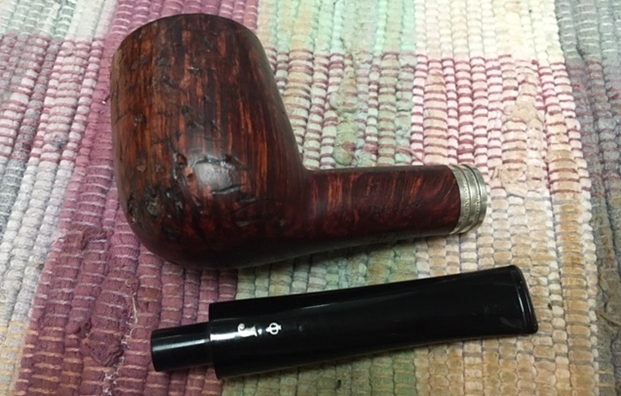
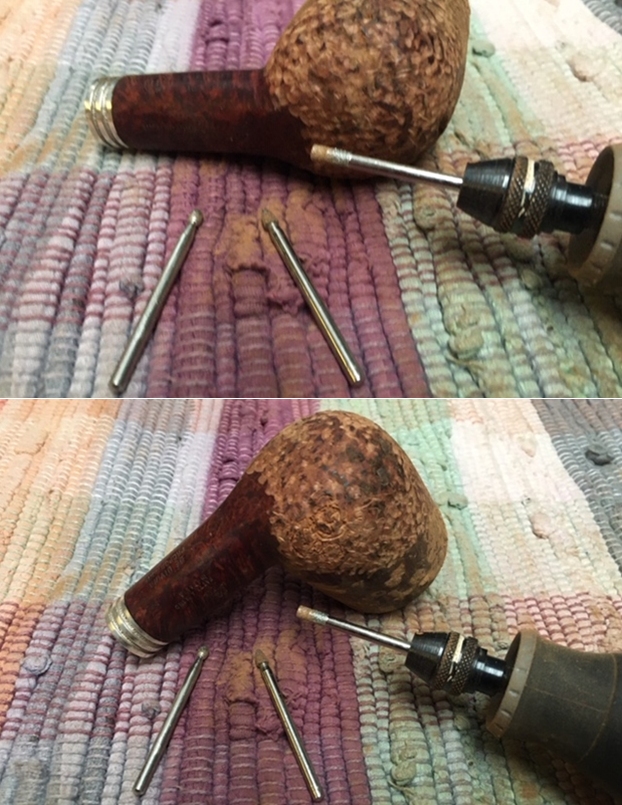
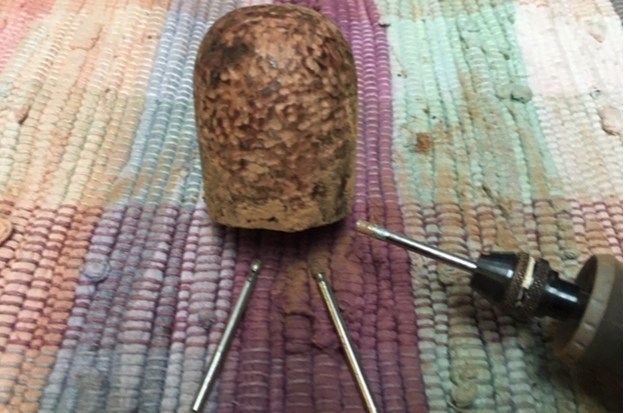
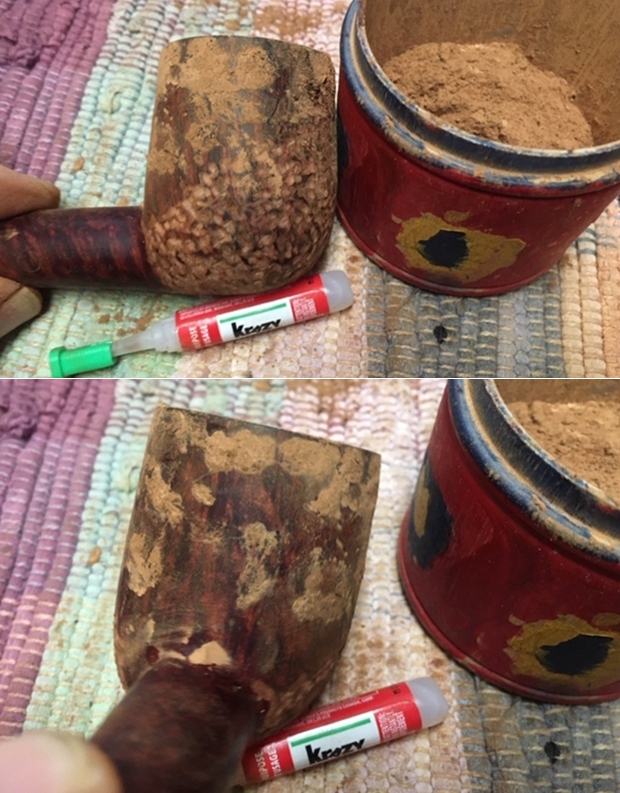
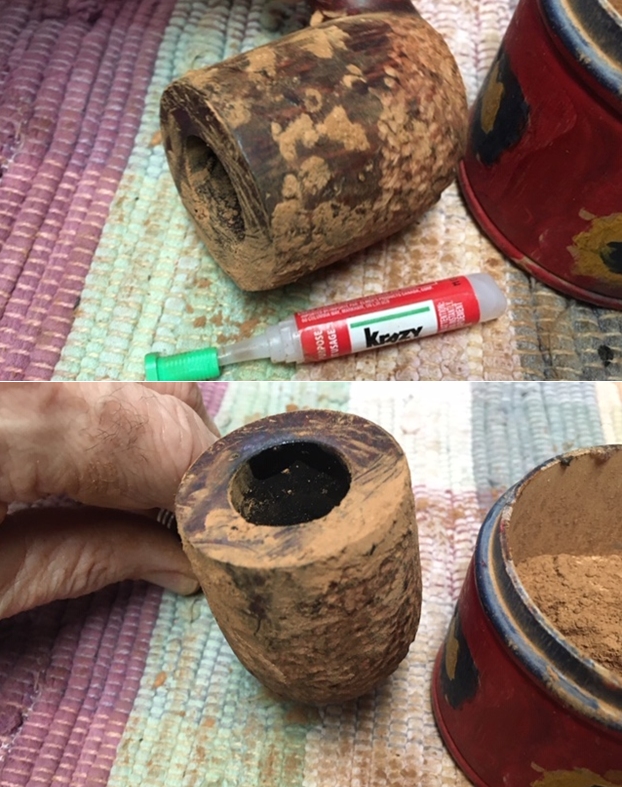
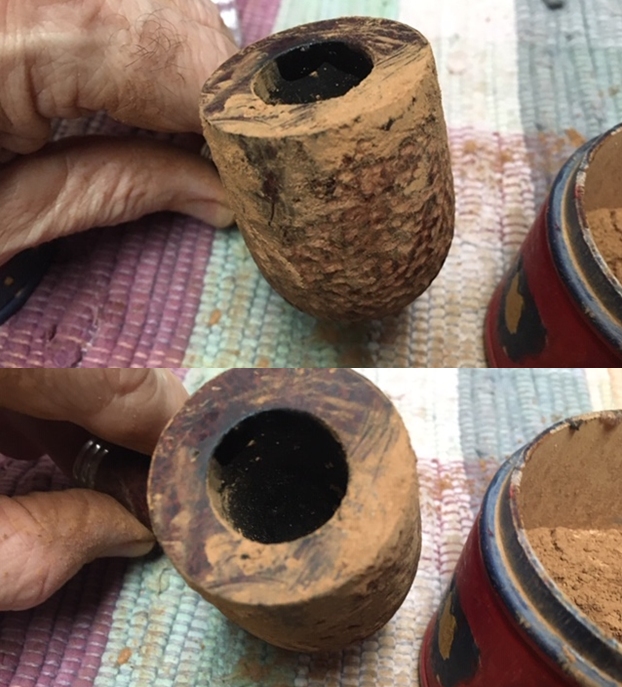
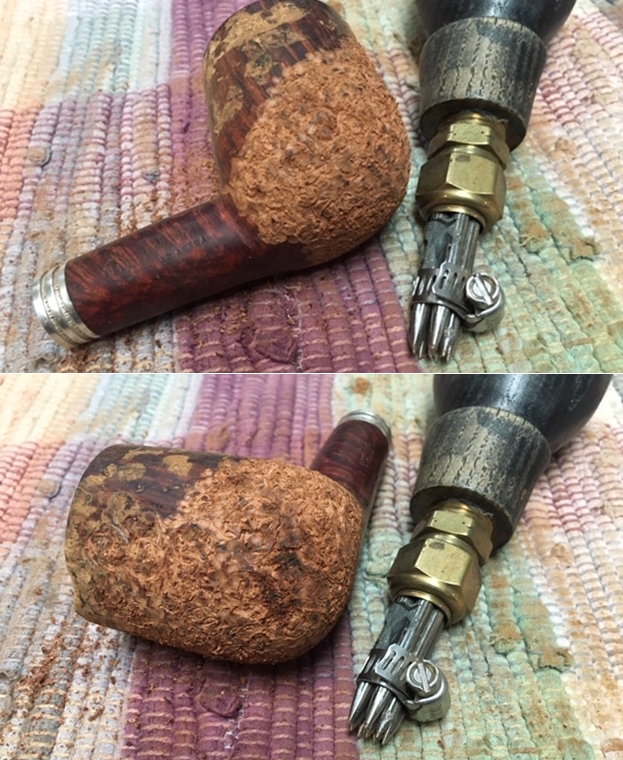
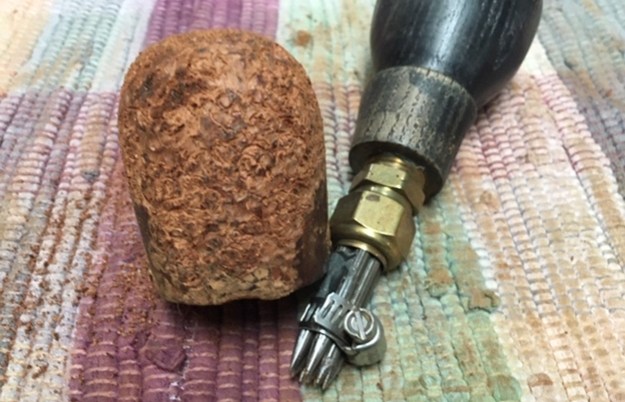
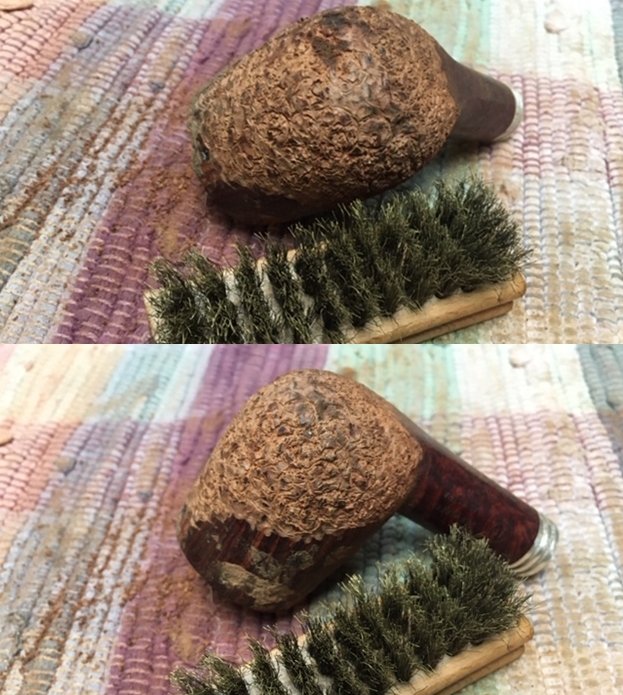
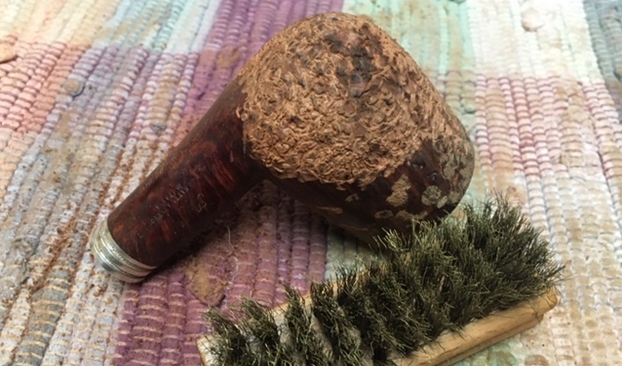
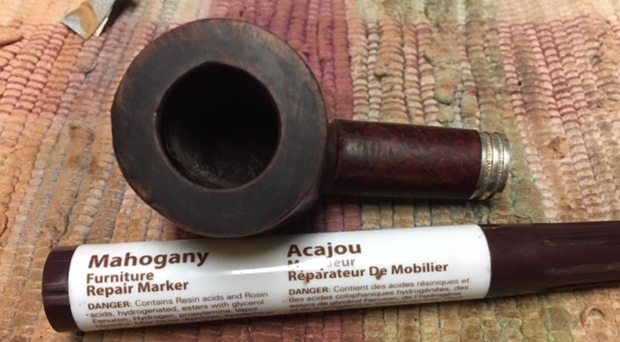
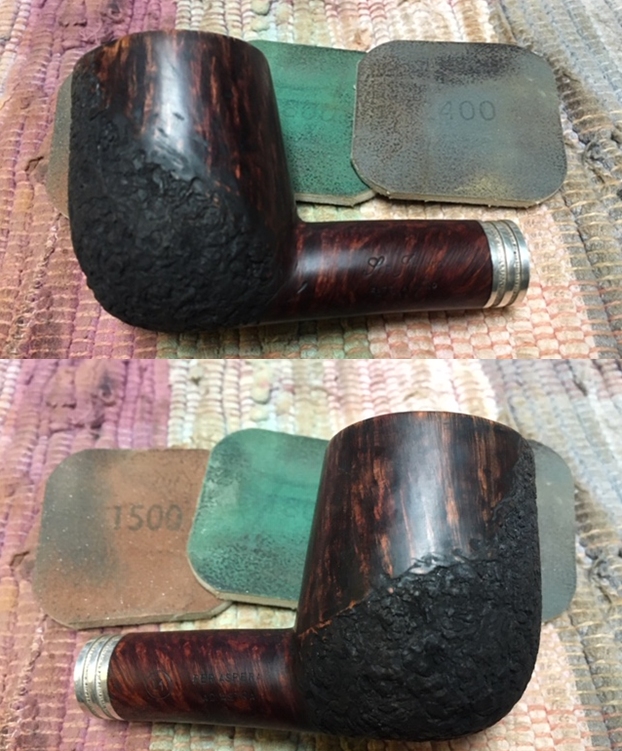
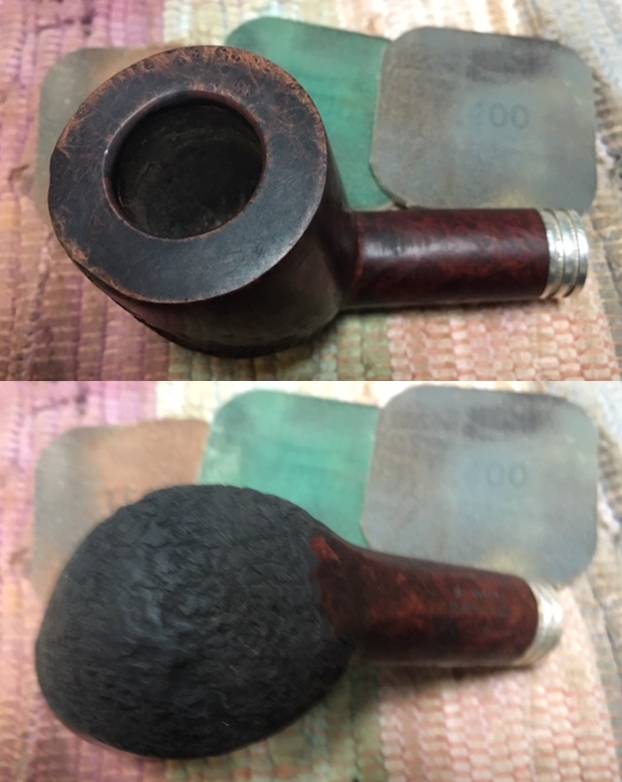
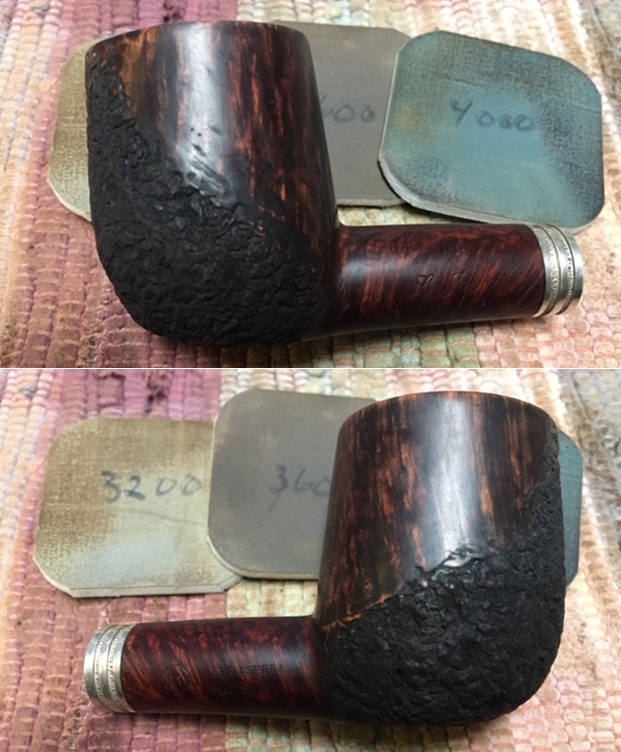
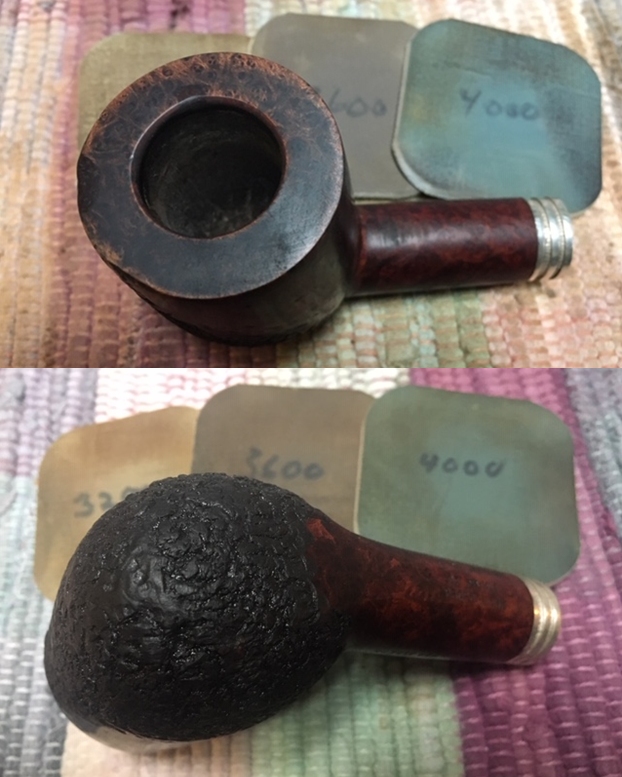
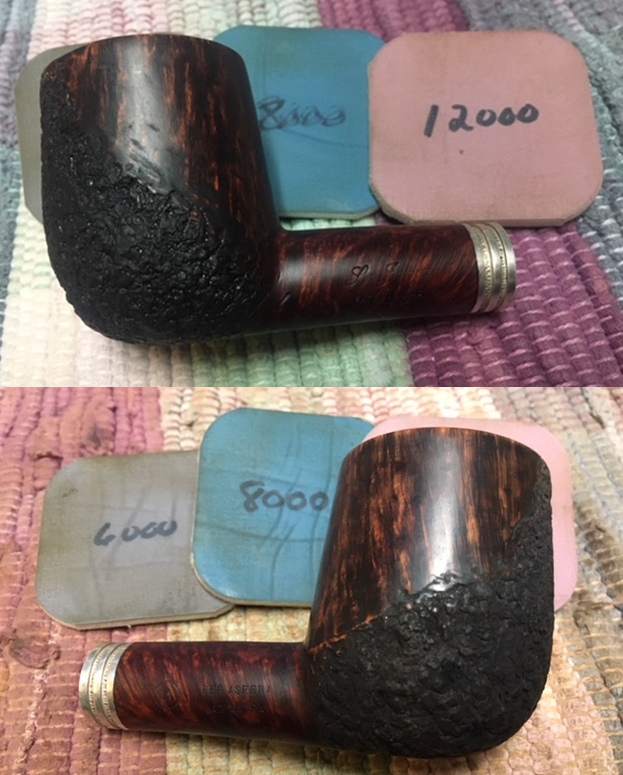
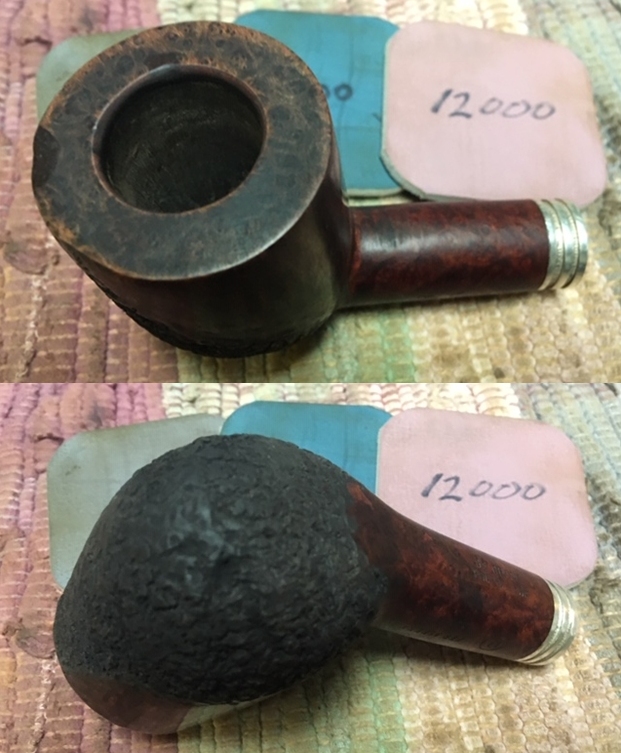
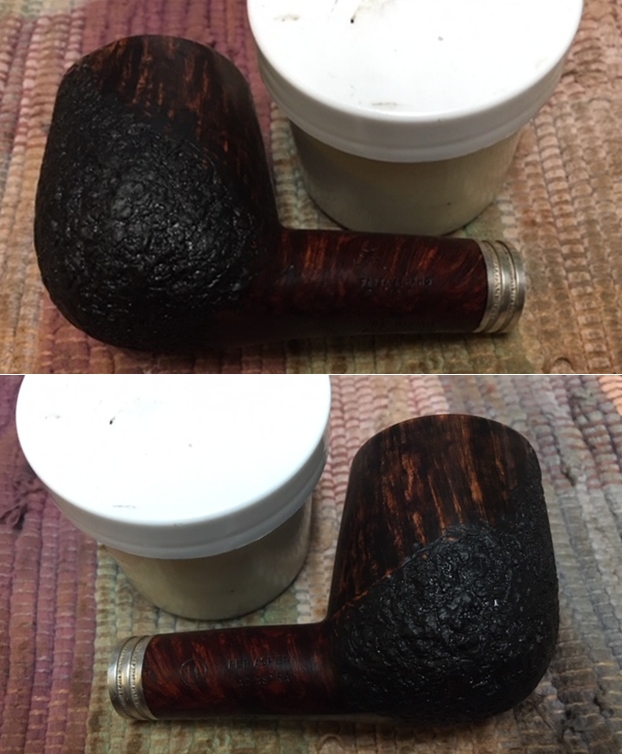
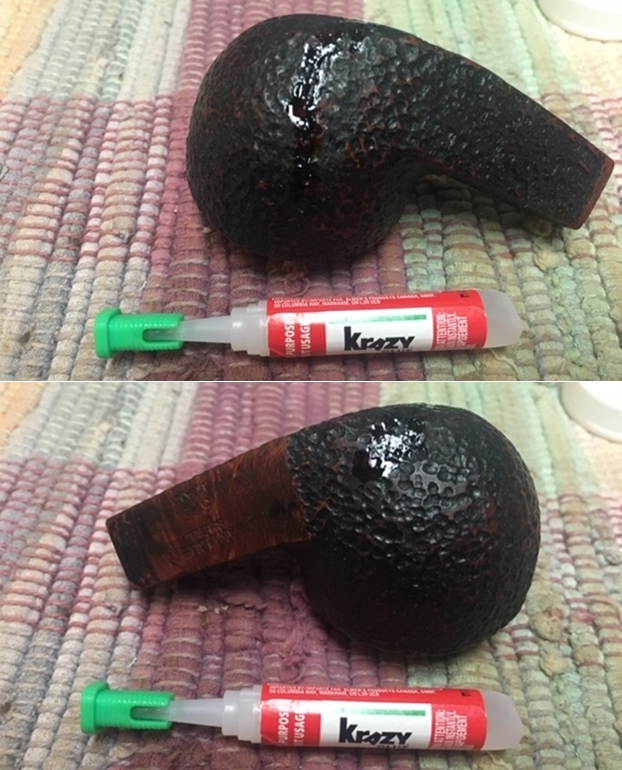
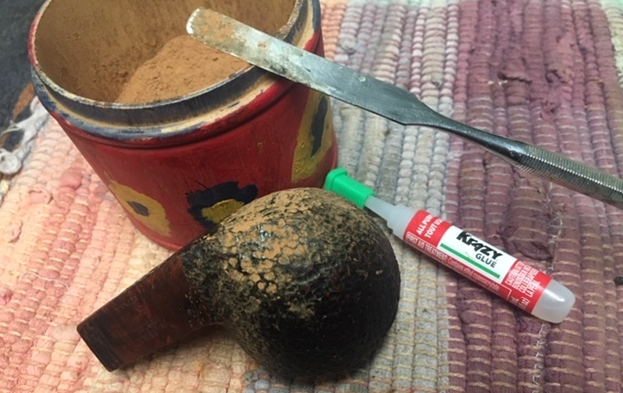
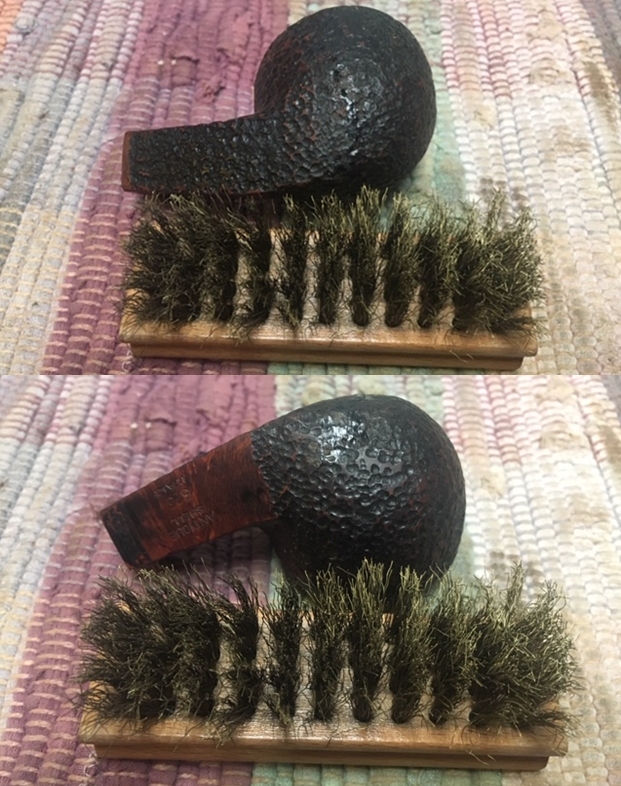
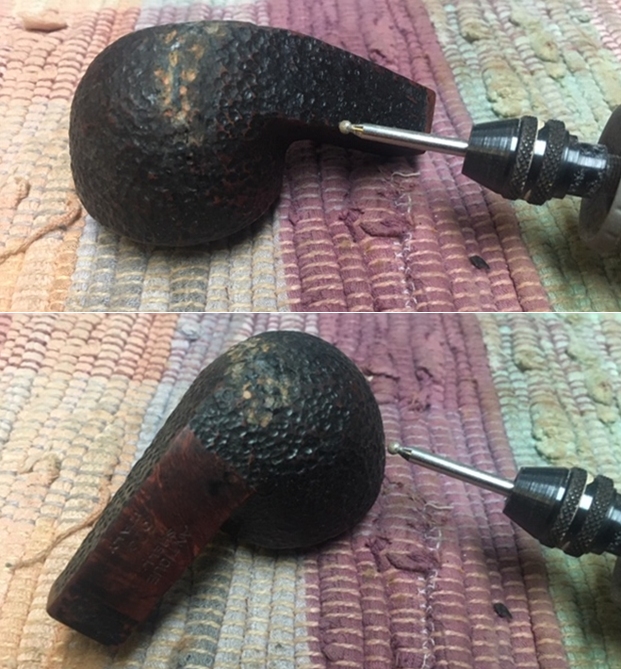
Now it was time to look at it up close and personal. Jeff had done an amazing job in removing all debris and bits of broken briar from the finish. He had done a quick reaming of the bowl with a Savinelli Fitsall Pipe Knife. He scrubbed the exterior of the bowl with Murphy’s Oil Soap and a tooth brush to remove the grime the grime and dirt on the finish so the pipe was clean – damaged but clean. He cleaned out the interior of the bowl and shank with pipe cleaners, cotton swabs and alcohol until they came out clean. The rim top looked quite daunting with the missing chunks of briar but it too was clean. He cleaned the stem with Soft Scrub to remove the grime on the exterior and cleaned out the airway with alcohol, cotton swabs and pipe cleaners. I took some photos of the pipe as I saw it when I brought it to the work table. To show how the rim top and stem looked at this point I took a close-up photo of the rim and stem. The bowl was clean and the damage to the inner edge and the rim top was very visible. It was a mess! The black acrylic stem was saved from major dog chomping. There are just a few tooth marks on both sides of the stem that could be addressed fairly easily.I removed the stem from the bowl and took photos of the parts. I chose the left side of the bowl as really both sides were equally damaged. This is truly a sad sight to see as the great grain on the bowl shows up nicely under the damage.I had been thinking about what to do with the finish since first seeing the photos. I had decided I would rusticate it but was undecided as to what extent I would go in the process. I wanted to retain the original shape and intent of the pipe while working out the damages. I started by using three different burrs on the Dremel – a ball, a cone and cylinder. Each one gives a slightly different finish. I worked them one after another to seek to blend in the tooth marks as much as possible. I also decided to rusticate the worst areas – the base and part way up each side of the bowl and the entire bowl front. The photos show this first step. I decided to let that rustication pattern sit with me for awhile and not add more to it. I just wanted to think about it for a  while. I decided then to patch the bite marks in the upper part of each side and the entire back of the bowl. I also wanted to repair as much of the rim top and edge damage as I could. I used clear super glue and briar dust to patch the many tooth marks around the bowl. The photos show the freckled sides. I built up the damaged front outer edge and the deep marks on the top of the rim with super glue and briar dust. These took some layering to do the job. I looked over the rustication some more and was not completely satisfied with the coverage of the existing rustication or the distance I came around the sides of the bowl. I decided to use a tool that a reader of rebornpipes made for me for rusticating. You can see it in the photos. It is essential a group nails bound together in a handle and with a clamp to give me multiple points to rusticate with. The way it works is to press it into the briar and twist it. You move across the briar until it is “randomly” covered. Once I was happy with the coverage I knock off the debris left behind with a brass bristly brush. I like to knock it down and smooth it out to give it an old leather like look to the rustication. I left the rustication and turned to address the damage to the rim top. I topped the rim with 220 grit sandpaper on the topping board. Once it was smoother and flatter I filled in the divots and holes in the rim top and edges with briar dust and super glue once more. Once I finished I topped it once more to smooth out the repaired areas.With that finished for the moment I turned to sanding the smooth portions of the bowl. I used my Dremel and sanding drum to flatten out the repaired areas first. I followed up by sanding them with 220 grit sandpaper. The photos below show the bowl at this point in the process. Note that there was no damage to the shank so I left it as is and would match the stain to that once I stained the repaired area. I was pretty happy with the way it was looking. I was ready to stain the undercoat on the bowl. I decided to use a black aniline stain for the rusticated part of the bowl and for the undercoat on the smooth sides and rim top. Black does a great job hiding the kind of repairs that I had to do with this briar. I applied the stain and flamed with a lighter. I repeated the process to ensure the coverage was thorough. I flamed it again and set it aside to dry while I had some dinner.I took photos of the bowl at this point to show the coverage of the black stain on the rustication and the undercoat on the smooth areas. After dinner I wiped down the smooth areas with isopropyl alcohol on a cotton pad to make them more transparent and show the grain. I then gave the smooth areas a coat of Mahogany stain using my stain pens to get into the transition areas and control the flow better. The combination of the black undercoat and the Mahogany matched the original shank colour! When that coat of stain had cured I polished the smooth portions of the bowl with micromesh sanding pads. One of the pains of this process is all the flaws show up in the initial sanding. You can see my repairs in some spots but hopefully they bill disappear a bit in the polishing. I was really happy with the right side of the bowl. The repairs virtually disappeared in the staining and sanding. I worked on the left side a little more. I sanded the offending areas of the transition with 400 grit wet dry sandpaper and restained the area. I worked through all of the micromesh pads another time on that area. I was happy with the finished looked at this point. I rubbed the finish down with Before & After Restoration Balm. I worked it into the smooth areas on the bowl and rim top with my fingertips and the rusticated areas with a horsehair shoe brush. The product cleans, protects and enlivens the briar. I let it sit for about 30 minutes and buffed it off with a cotton cloth. The photos below show the bowl at this point… it is a far cry from the dog eaten bowl that I started with — at least I think it is ;). I set the bowl aside and turned to the stem to address the issues that were on the top and underside. I filled in the tooth marks on the stem with clear super glue. I generally overfill them a bit so that it takes into account the shrinkage that occurs as the repair cures.Once the repairs had cured I sanded them smooth to start to blend them in with the surround acrylic of the stem. I sanded the repairs on both sides with a folded piece of 220 sandpaper and started polishing with 400 grit wet dry sandpaper.I rubbed the stem down with Denicare Mouthpiece Polish – a red gritty paste a lot like Tripoli to polish it after the 400 grit sandpaper. I rub it on with my fingertips and work it into the vulcanite and buff it off with a cloth. It does a great job before I polish it further with the micromesh pads.I polished the stem with micromesh sanding pads – dry sanding with 1500-12000 grit sanding pads. I wiped the stem down after each sanding pad with a cloth containing some Obsidian Oil. I finished polishing it with Before & After Pipe Stem Polish – both Fine and Extra Fine and buffed it off with a cotton cloth. The next steps in this restoration were ones that I have been looking forward to. I was glad to reunite the bowl and stem and see what the finished pipe looked like. I polished the silver with a jeweler’s cloth and buffed the bowl and the stem with Blue Diamond on the buffing wheel. I used a light touch on the rusticated portion as I did not want to fill in the rustication with the product. I gave the bowl multiple coats of Conservator’s Wax and the stem multiple coats of carnauba wax. I carefully buffed the entire pipe with a clean buffing pad to raise the shine. I finished buffing with a microfiber cloth to deepen the shine. The finished pipe looks a lot better than dog chewed pipe that I started with. I am happy with the finished look at this point. While the repairs to the smooth areas show a bit they are smooth. The leather like rustication works well with the finish on the bowl in my opinion. The finished Ser Jacopo L1 Billiard is shown in the photos below. The dimensions of the pipe are Length: 6 ½ inches, Height: 2 ¼ inches, Outside diameter of the bowl: 1 ½ inches, Chamber diameter: ¾ of an inch. This should be a great pipe once it is broken in. The rustication on the base and front give it a very tactile feel that should only be better as it heats up during a smoke. This one will go on the rebornpipes store shortly. If you are interested in it let me know. Thanks for reading this blog and my reflections on the pipe while I worked on it.


Cleaning up a Unique Savinelli Made Antique Shell 623 Bulldog


Blog by Steve Laug

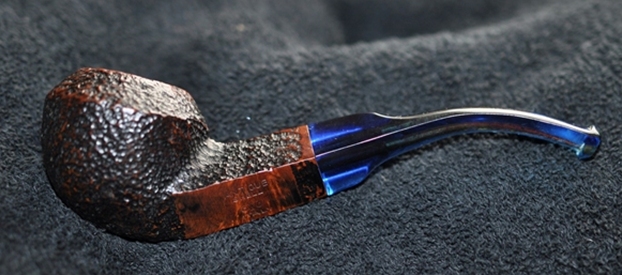
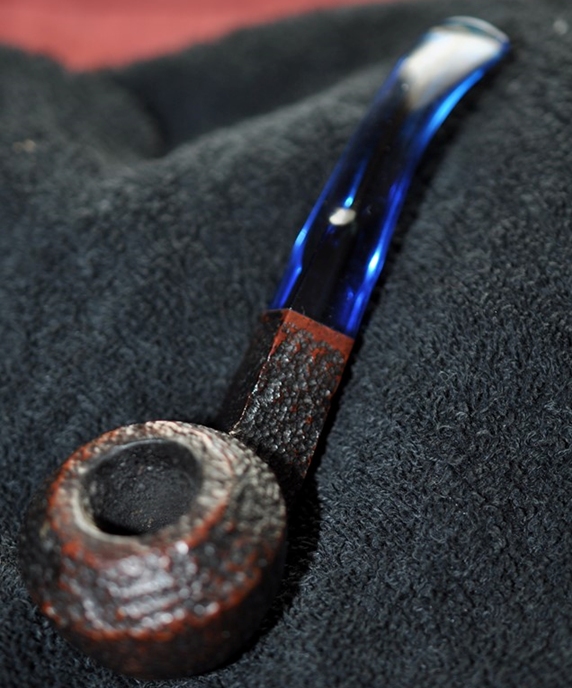
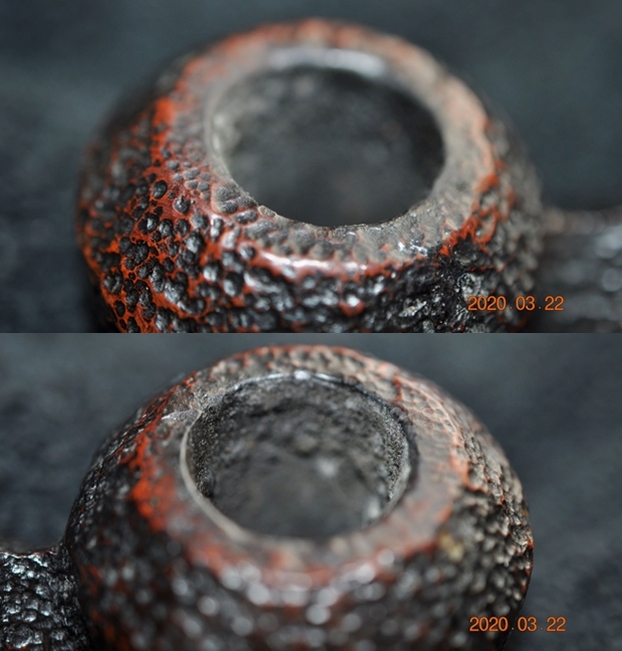
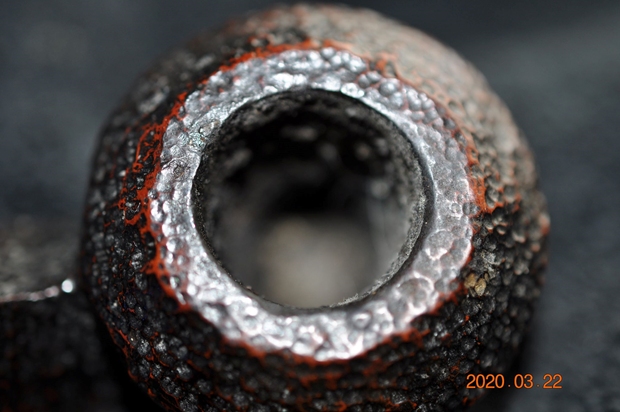
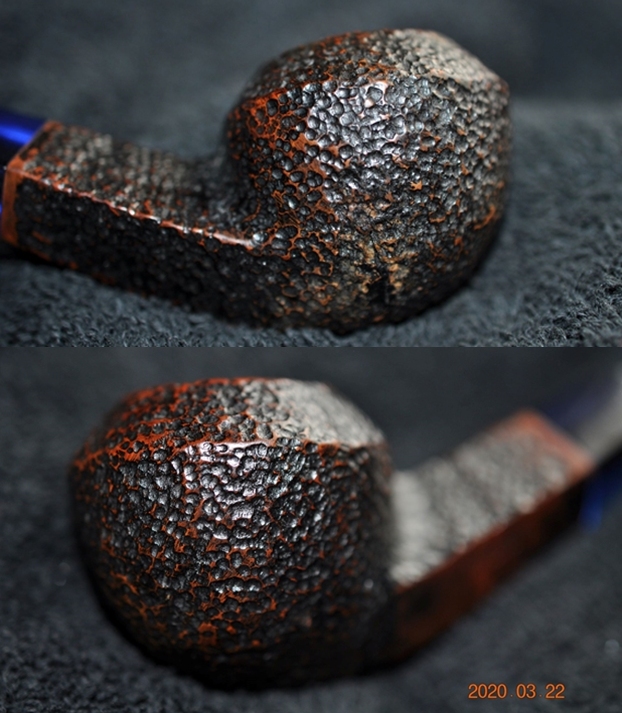
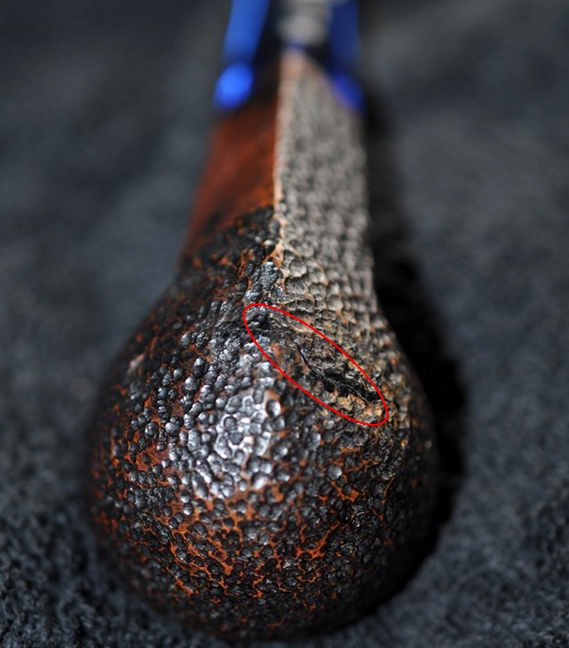
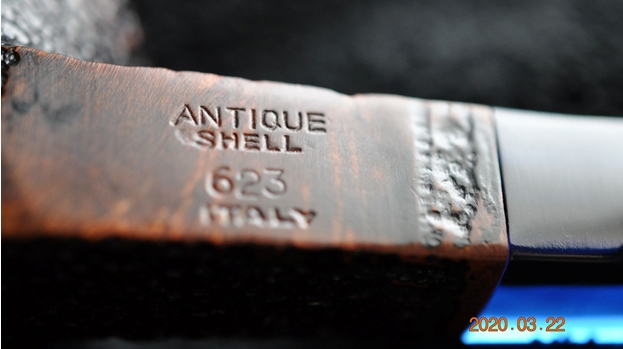
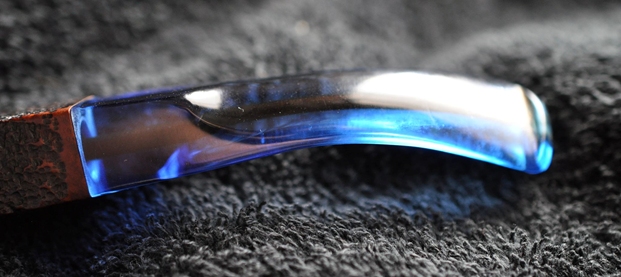
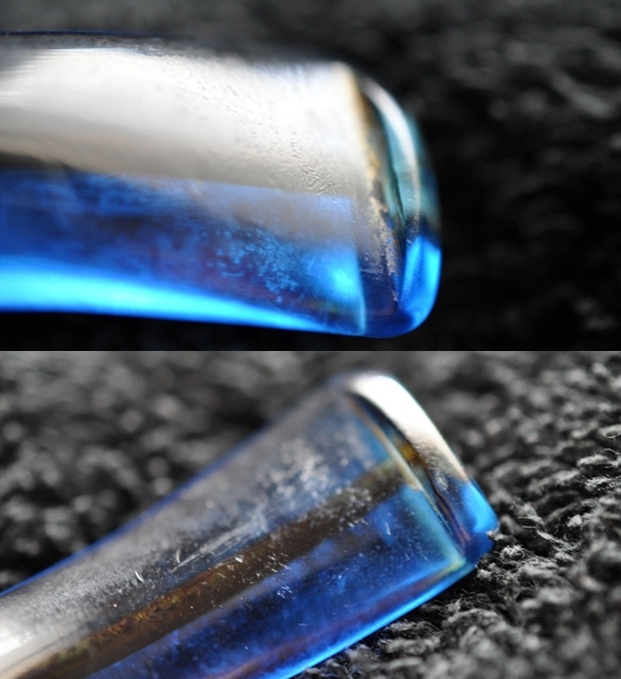
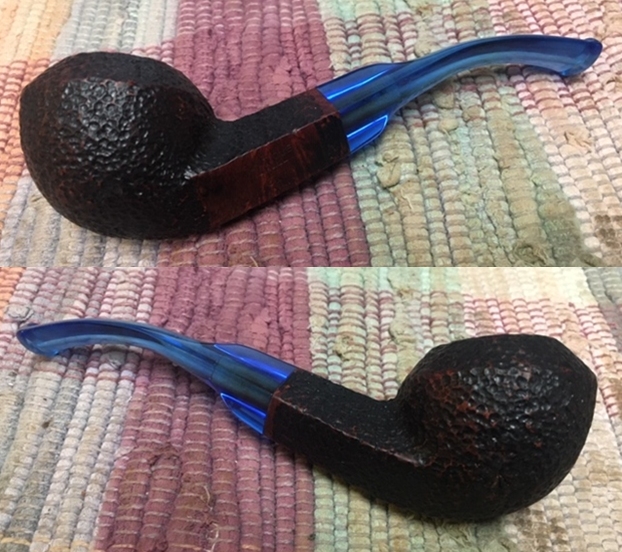
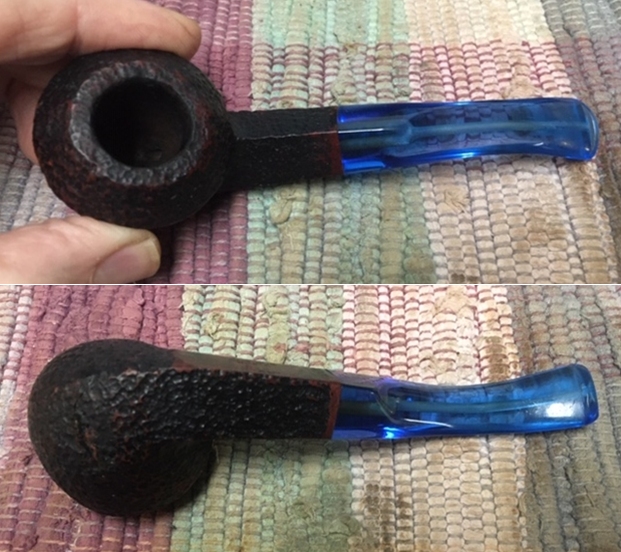
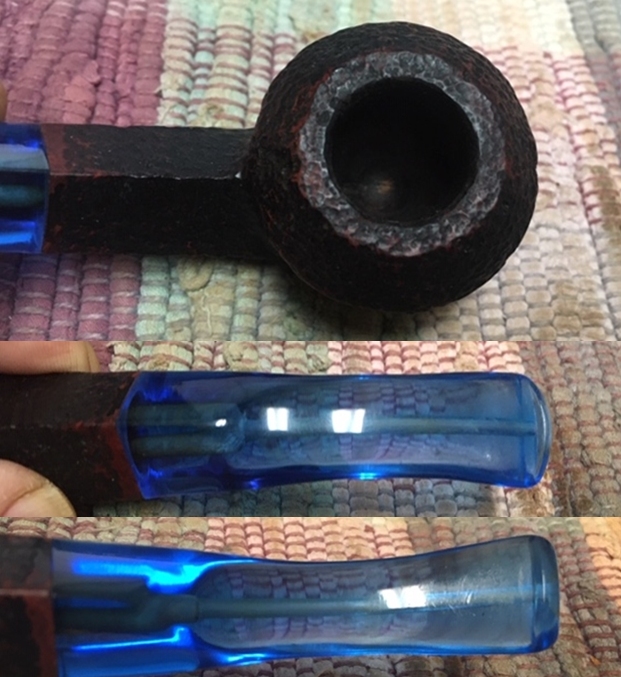
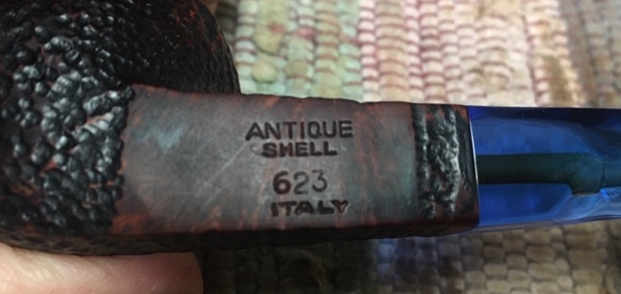
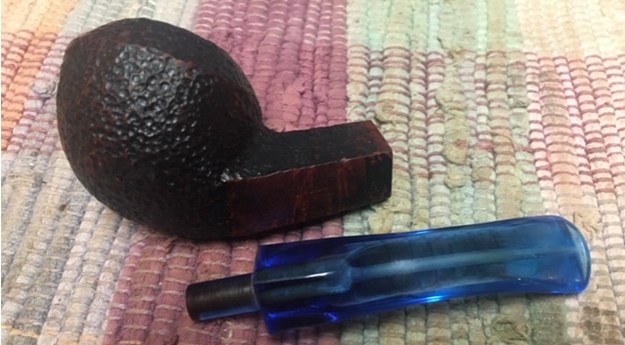
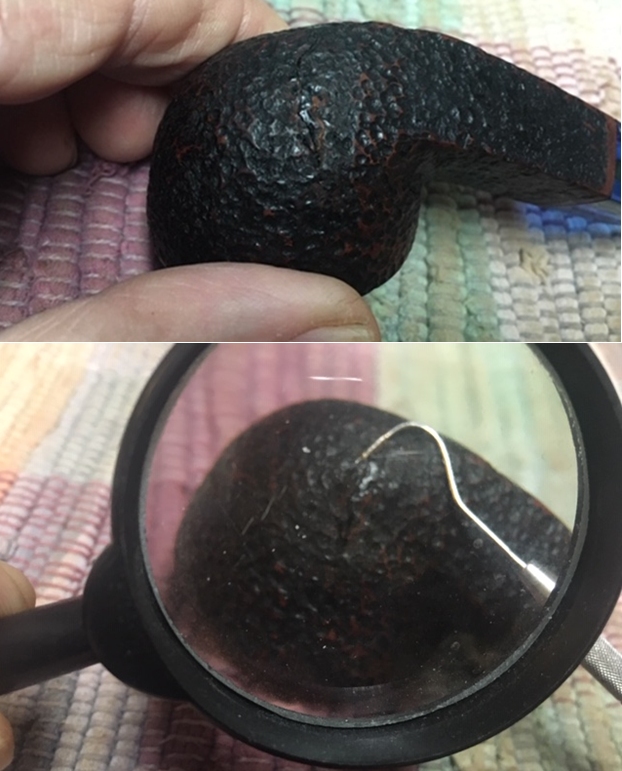
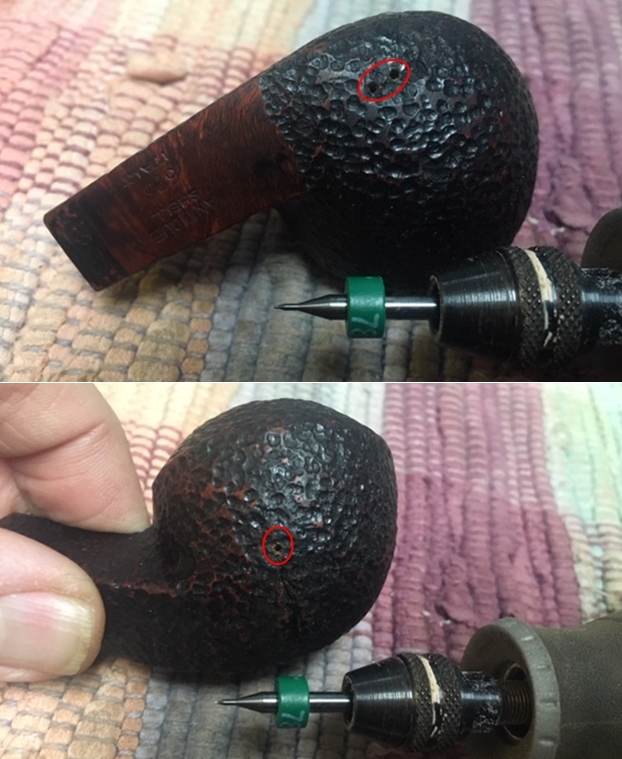
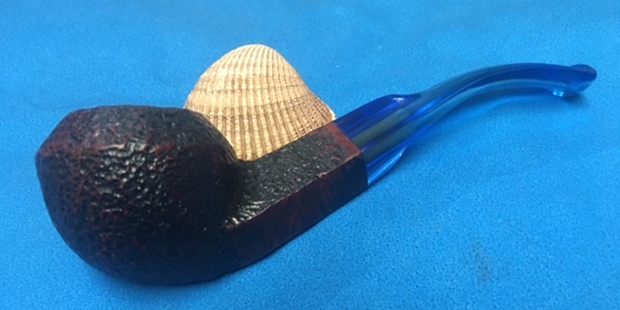
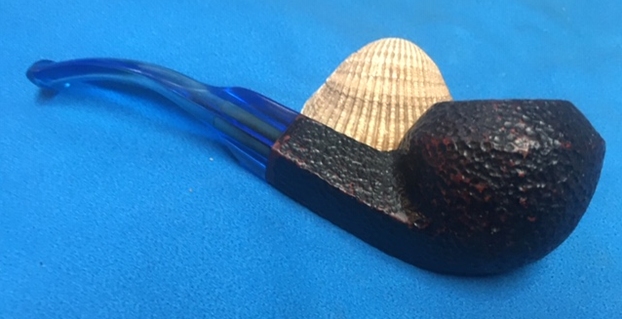
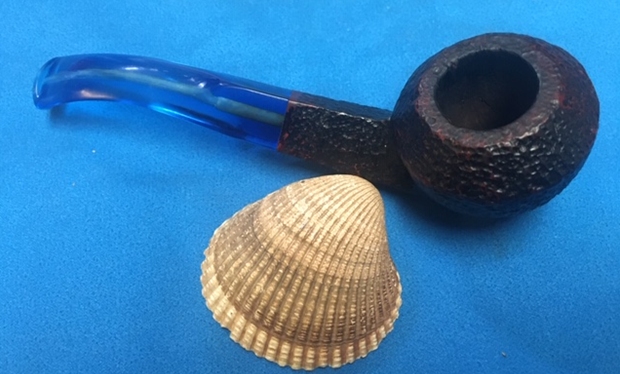
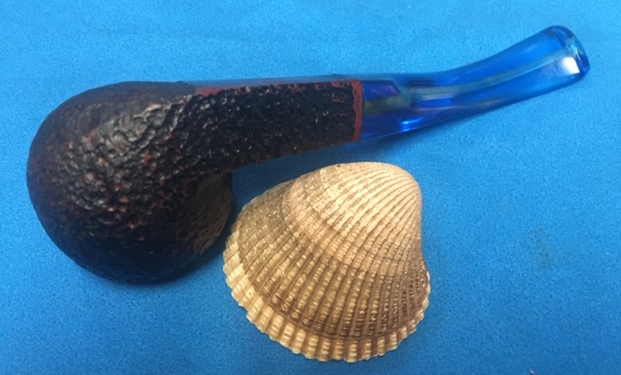
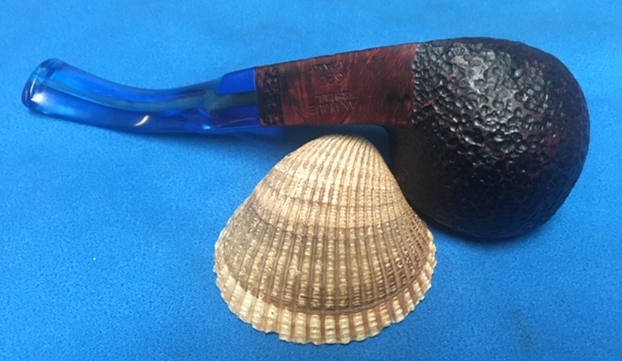
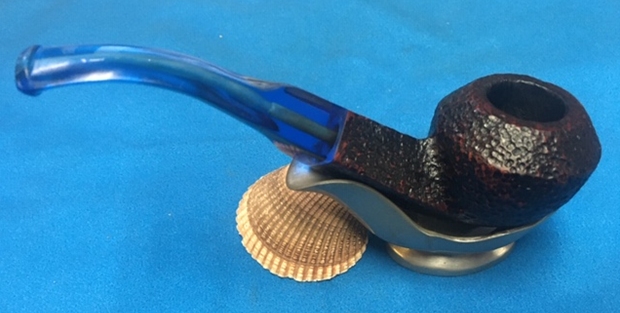
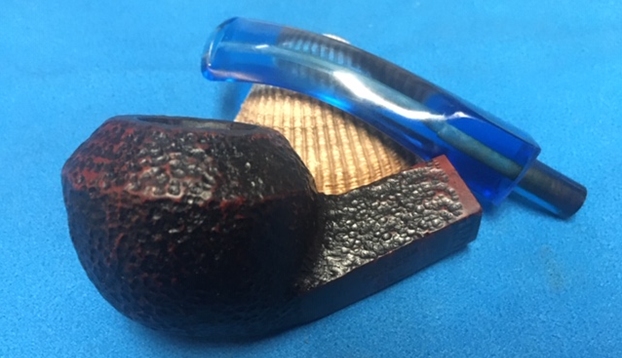
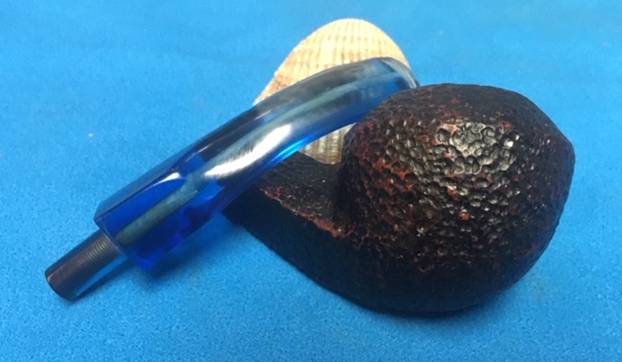
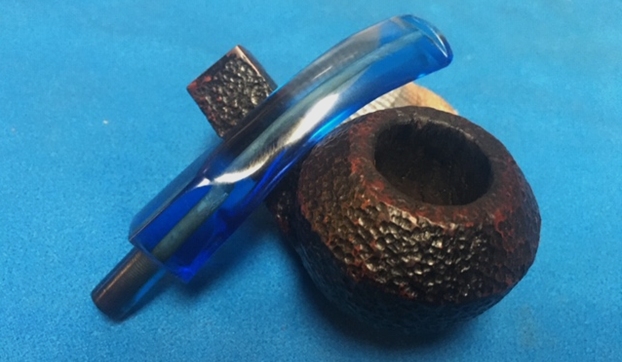
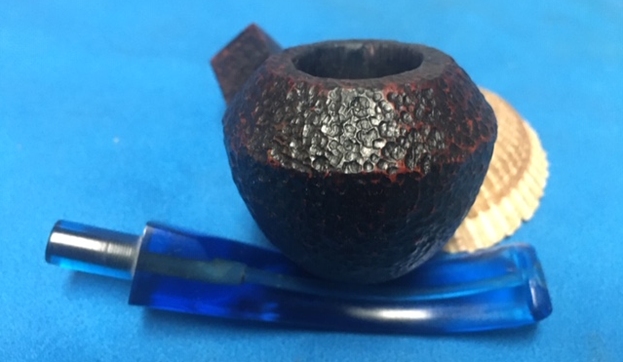
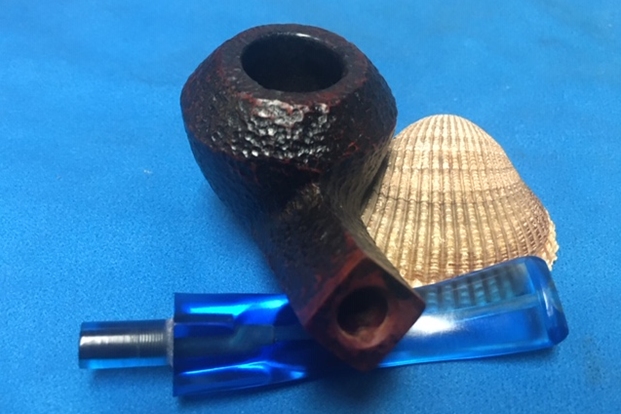
In the next box of pipes Jeff sent me there was an interesting Bulldog with a blue acrylic stem that I wanted to restore. It is stamped on the left underside of the diamond shank Antique Shell and the shape number 623 over Italy. The shape number is definitely a Savinelli shape number so I am safe to assume that this is a Savinelli Product. I have not seen one with a blue acrylic stem before so I was looking forward to the restoration. It was a dirty pipe when we received it. There was a coat of lava and dust in the rusticated finish of the rim top. The inner edge and outer edges of the rim looked very good. There was a thick cake in the bowl that had remnants of tobacco stuck in it. The finish was dirty and there dust and debris in the rusticated finish around the bowl. There also appeared to be what looked like either a crack or a fissure in the right side of the bowl toward the bottom. The blue acrylic stem looked good but there were tooth marks on the top and underside ahead of the button. There was tooth chatter on both sides of the stem. Jeff took some photos of the pipe before he started his cleanup work. He took photos of the bowl and rim top to show their general condition. You can see the tars and debris in the rustication of the rim top. The cake in the bowl is quite thick and there is tobacco debris on the walls of the bowl. The finish on the bowl is dirty but looks good. Jeff took some photos of the sides and heel of the bowl to give an idea of the finish on this particular piece of briar. It is different and tactile looking. I cannot wait to see what it looks like once it is polished and waxed.Jeff took a photo of the heel of the bowl. On the right side of the photo (also right side of the bowl) there is an area that looks like a crevice or possibly a crack in the bowl. I have circled it in red for easy identification. I will need to check that out once I am working on the pipe.He took a photo of the stamping on left underside of the diamond shank. There was a smooth panel with the stamping on it. It reads as it is stated above.This pipe has a very unique clear blue acrylic stem that goes really well with the contrasting browns of the bowl and shank. It is in very good condition with light tooth marks and chatter near the button.  I have worked on Savinelli Antique Shell pipes in the past but this was the first one with the blue acrylic stem. There are no stampings on the stem so it may be a replacement but it fits the shank very well. I moved forward to work on the pipe itself and see what I had to do with it. It had come back looking amazingly clean. The bowl looked very good and the crevice on the bottom of bowl, though still visible was even more obviously a crevice rather than a crack. I would need to probe it more once I started to clean up the pipe. The stem looked like new, with most of the tooth chatter gone. I was impressed. Jeff had done his normal thorough clean up – reaming, scrubbing, soaking and the result was evident in the pipe when I unpacked it. I took photos of the pipe before I started my work on it. I took some photos of the rim top and stem. The rim top and bowl looked very good. The cake and lava overflow were gone and the rim was very clean. Jeff had been able to get rid of the lava and tars. The close up photos of the stem shows that it is a much cleaner and better looking stem. The light tooth chatter was greatly reduced and the stem looked really good.I took a photo of the stamping on the left underside of the shank to show the condition after the cleanup. Often the stamping takes a hit with the cleaning and is lessened in it clarity. Jeff does a great job in leaving the stamping looking very good.I removed the stem from the shank and took a photo of the pipe at this point. It really is quite a stunning pipe with the clear blue acrylic stem.I started my restoration work on this pipe by addressing the crevice or potential crack on the lover right side of the bowl. I probed it with a dental pick to see how deep it went and if it was a crack or just a natural flaw in the surface of the briar. It did not appear to go very deep into the briar but my examination with the probe using a lens were inconclusive. I used a light and lens to check out the inside of the bowl and it was flawless – whew! I was glad to see that. It added credence to my thinking that it was a crevice. However, I decided to address it as a cosmetic crack and do the repair accordingly.I used a microdrill bit on my Dremel to drill a small pilot hole at what I ascertained were the ends of the crevice/crack. These are tiny holes shown in the next two photos. I have circled them in red below. The first photo has two and the second has one hole.I filled in the holes and the crevice on the heel and side of the bowl with clear super glue. I pressed briar dust into the holes and the crevice with a dental spatula. I cleaned off the debris with a brass bristle wire brush. It removes the loose debris but leaves the repairs in the crevice and holes intact.I was happy with the coverage of the repair but as is often the case a super glue and briar dust repair leaves smooth shiny spots on the finish. I dislike these shiny tells! I used a small round burr on the Dremel to create the same kind of rustication that was on the rest of the bowl. Once it was stained I was pretty sure it would look great.I used a Walnut stain pen to restain the newly rusticated surface of the repair. I like the way it looks and it will look even better as the bowl is polished and waxed.I worked some Before & After Restoration Balm into the surface of the briar with my fingertips to clean, enliven and protect it. I let the balm sit for a little while and then buffed with a cotton cloth to raise the shine. The photos show the bowl at this point in the restoration process. The repair looks really good. I set the bowl aside and turned my attention to the blue acrylic stem. I sanded out the remaining tooth chatter with 220 grit sandpaper and started to polish it with a folded piece of 400 wet dry sandpaper. Once it was finished it was smooth.I used some Denicare Mouthpiece Polish that I have in my kit to start polishing out some of the scratches and remaining oxidation on the stem. I rubbed it in with a cotton pad and my finger tip and buffed it off with a cotton pad.I polished the stem with micromesh sanding pads – dry sanding with 1500-12000 grit sanding pads. I wiped it down after each sanding pad with a cloth containing some Obsidian Oil. I finished polishing it with Before & After Pipe Stem Polish – both Fine and Extra Fine and buffed it off with a cotton cloth. I love the end of a restoration project like this one that needed more than first appeared. It is the moment when all of the parts come together and the pipe looks better than when we started the cleanup process. I put the stem back on the bowl and lightly buffed the pipe with Blue Diamond on the buffing wheel. I carefully avoided the stamping on the shank sides during the process. I gave the bowl multiple coats of Conservator’s Wax and the stem multiple coats of carnauba wax on the buffing wheel and followed that by buffing it with a clean buffing pad on the buffer. I hand buffed the pipe with a microfiber cloth to deepen the shine. The finished pipe is a really beautiful rusticated bowl with a stunning blue acrylic stem. Give the finished pipe a look in the photos below. I can only tell you that it is much prettier in person than the photos capture. The dimensions of the pipe are Length: 5 ½ inches, Height: 1 ¾ inches, Outside diameter of the bowl: 1 ¼ inches, Chamber diameter: ¾ of an inch. This Savinelli Made Antique Shell Bulldog shape 623 is a great looking pipe. Thanks for walking through the restoration with me as I worked over another beautiful pipe. I will be putting this pipe on the rebornpipes store shortly. If you want to add it to your collection let me know. Thanks for your time.

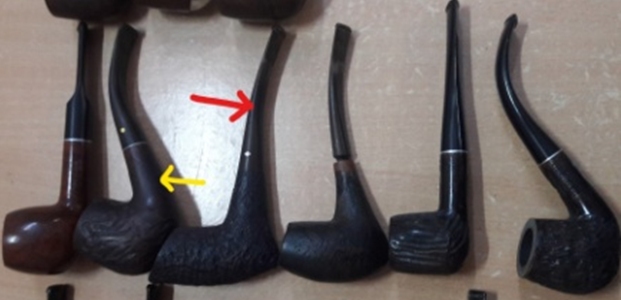
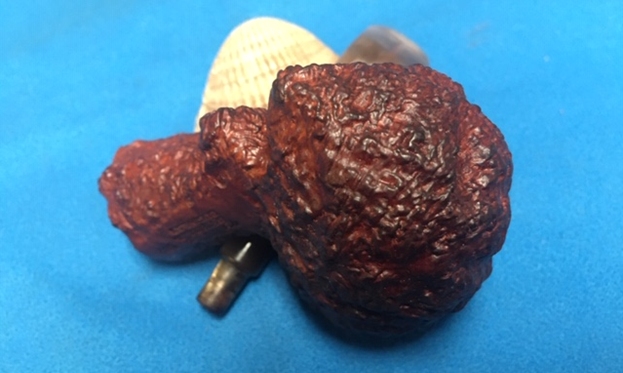
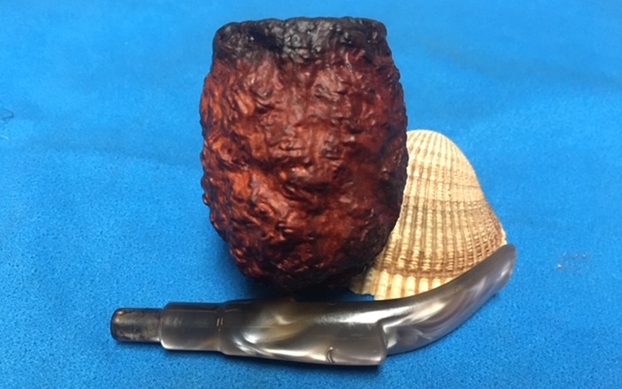
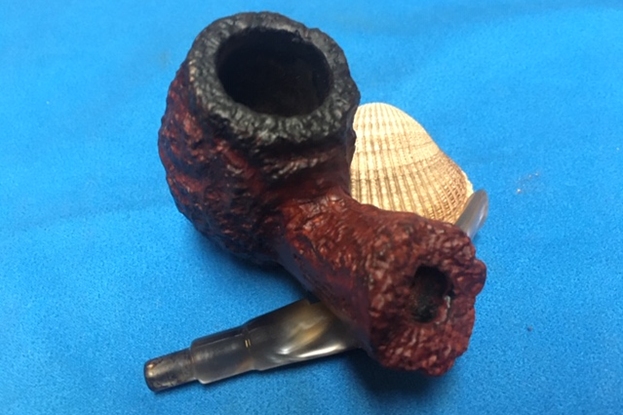
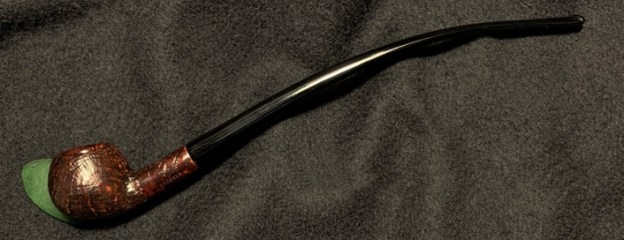
Fashioning a Churchwarden from a Blasted French Dr. Geo Deposée Bowl


Blog by Dal Stanton

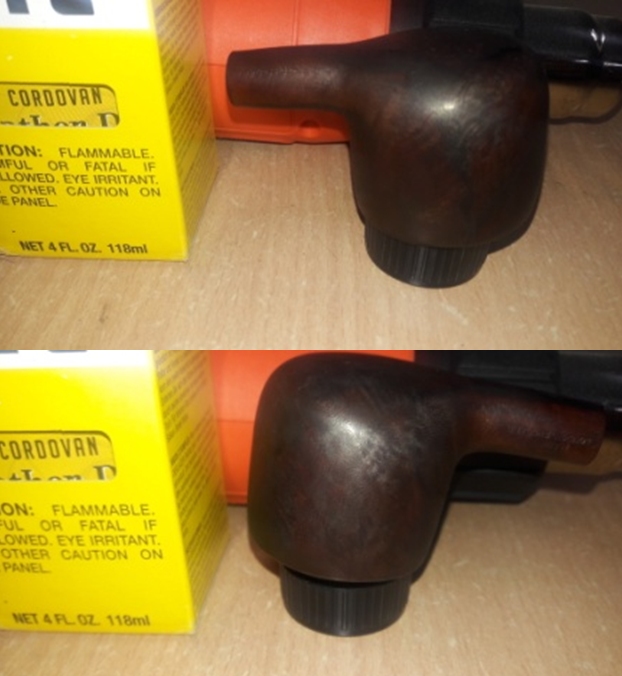
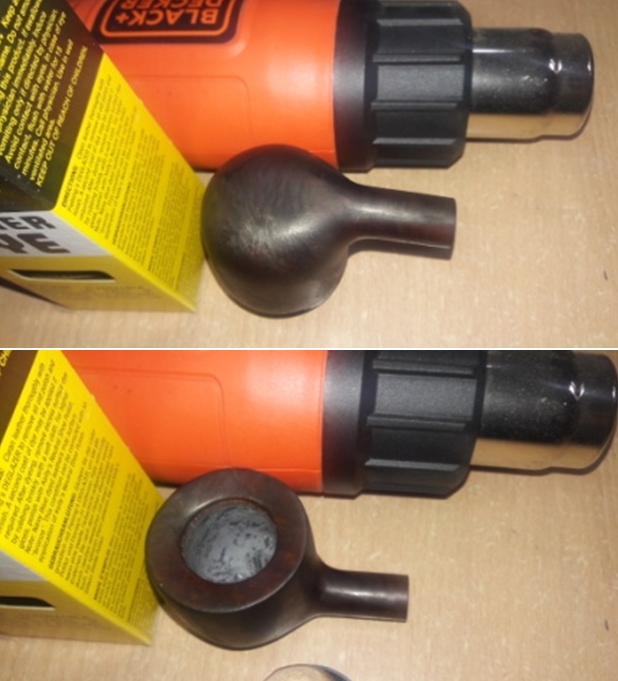
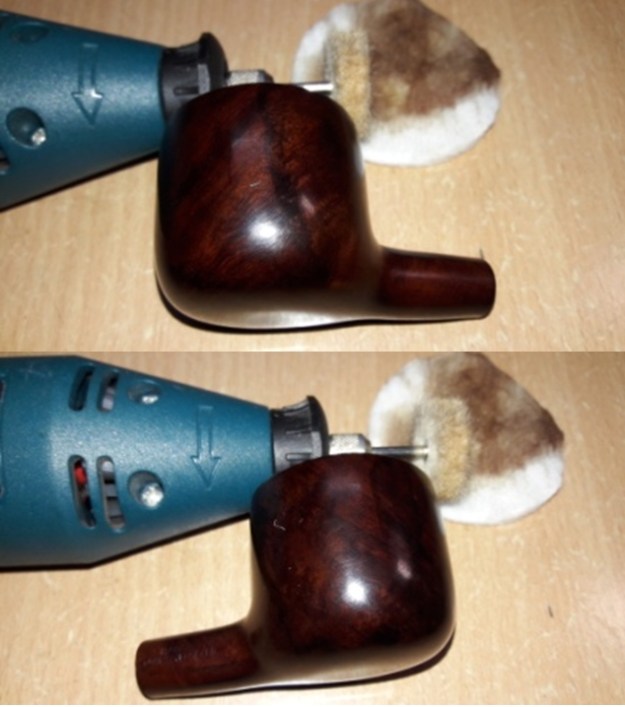
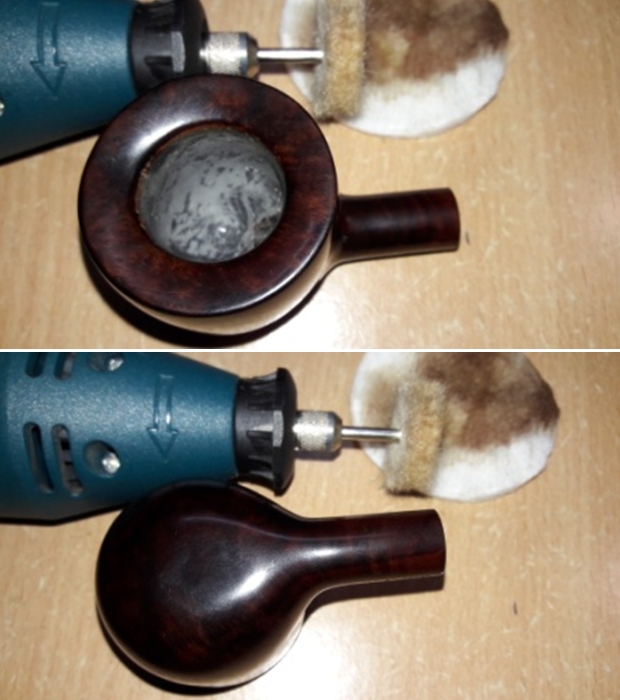
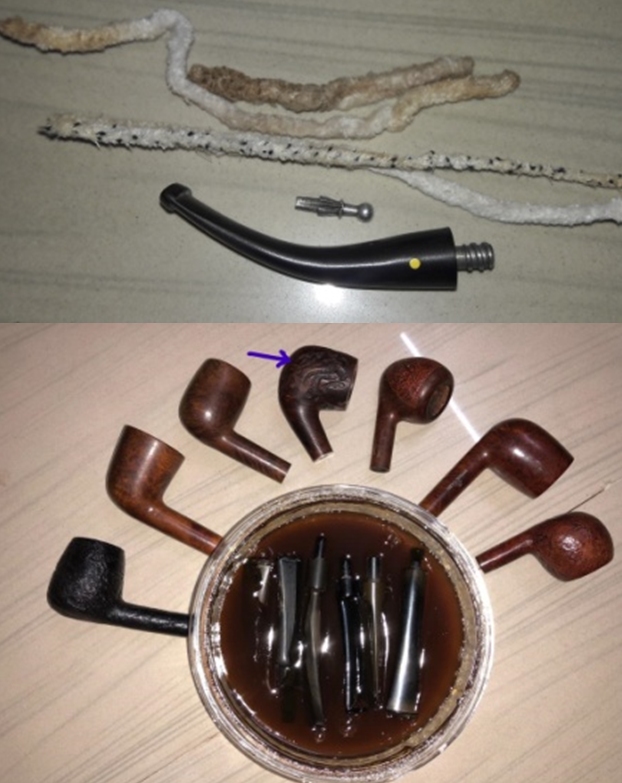
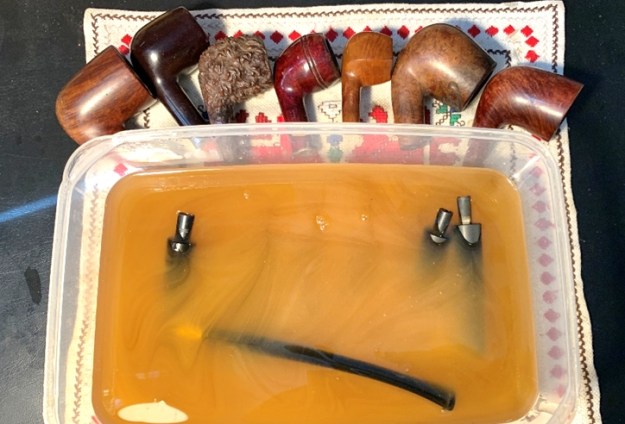
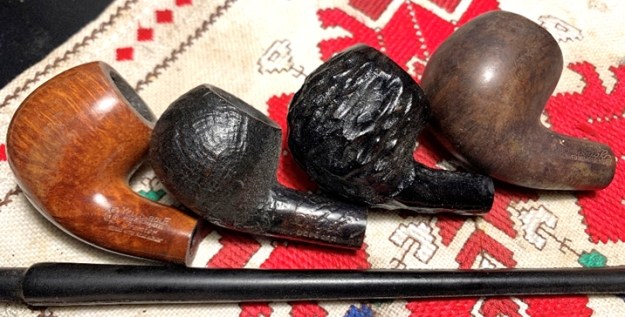
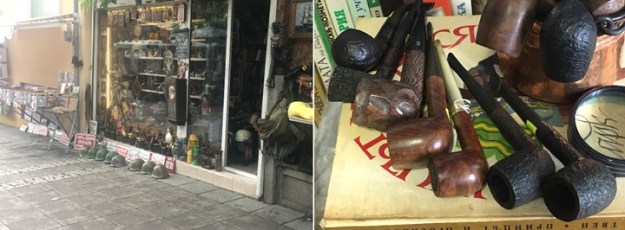
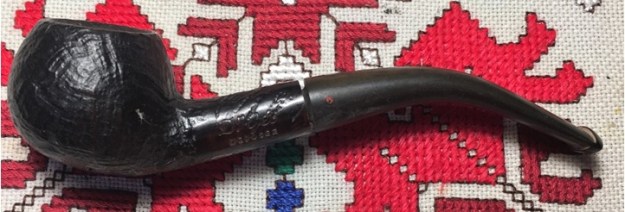
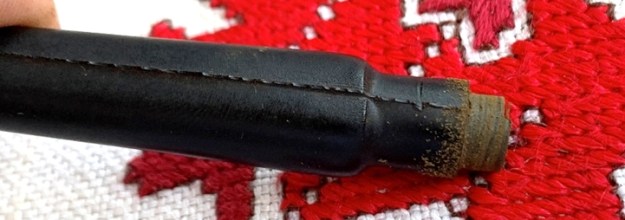
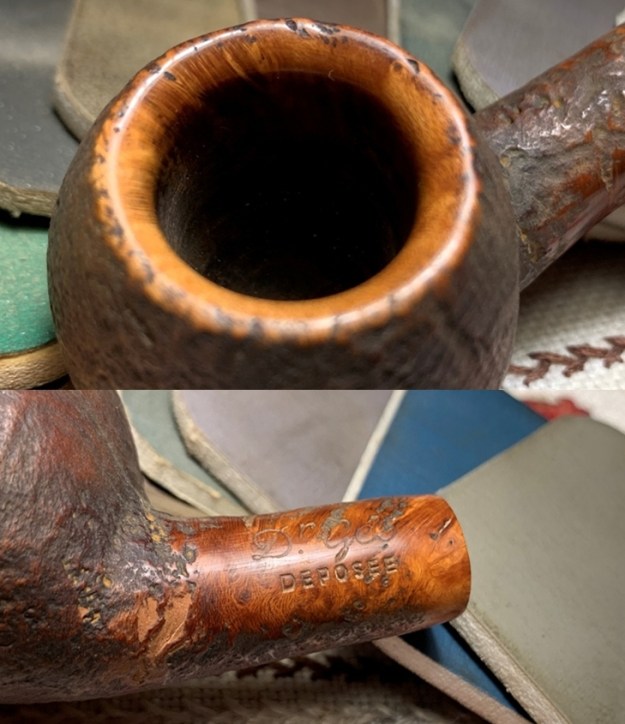
This is the second commissioning project for the pipe man, clam man, Jon, from South Florida.  His first commissioning (see: A Striking Savinelli Fiammata 2 Briar Calabash for a Clam Man Pipe Man) turned out to be a diamond in the rough!  He had commissioned this pipe not from the usual perusal of my online ‘Help Me!’ baskets in the For “Pipe Dreamers” Only! collection, but he had visited us here in Sofia, Bulgaria, along with a team of folks from his church.  During this visit, Jon went through the boxes and baskets of the inventory and found the Savinelli Fiammata and pulled him aside to commission.  During this visit, Jon also saw my personal collection of Churchwardens and offered to give one of them a new home!  In the end, Jon also commissioned a CW project which also benefits the Daughters of Bulgaria, our work here in Bulgaria working among women and girls who have been trafficked and sexually exploited.  This was also important to Jon, who as a father, had brought his daughter with him to Bulgaria.  My goal in fashioning Churchwardens from bowls that were either orphaned or in their current states had little hope of being put in service again.  I liken it to Santa’s mythical island of misfit toys.  Repurposed bowls mounted on CW stems can rise from ash heap, as it were, to live and serve again.  I sent Jon a picture of different bowls to see which would speak to him as his new Churchwarden.  He had told me he preferred a bent shank – here were the candidates with differing characteristics.Our emailing back and forth between South Florida and Bulgaria to identify the bowl speaking Jon’s name, resulted in the French Blasted Dr. Geo Deposée, the second pipe pictured above.  I acquired the Dr. Geo during one of our summer vacations on a pipe picking expedition to the Bulgarian coastal city of Burgas on the Black Sea.  I found the ‘Burgas Lot of 9’, at a secondhand shop on the main walking street.  The Dr. Geo is at the end of the line of 7 pipes pictured below which were part of the haul – 2 others were added to these that were eventually posted in the For “Pipe Dreamers” Only! collection from which pipe men and women can choose and commission.The Dr. Geo I acquired I called a Prince shape.  I knew nothing about a Dr. Geo line, but what attracted me to the pipe was the blasted bowl – it was tired and dull, but had potential, though the pipe itself was unimpressive and attracted no attention when it had its time in the Dreamers collection.With the bowl now on my worktable to transform into a Churchwarden, I found some information online about the origins of Dr. Geo Deposée.  Pipephil.eu’s panel gave some information confirming that it was of French origins from the Gichard & Cie Company.Pipedia adds some additional information in its list of French made brands.  It lists that Dr. Geo was produced in the 1940s from Guichard & Cie, and later sold by M. Marmet Regge, with Ebonite stems.  Interesting to me is that my guess is that The Dr. Geo I’m looking at was from the later, M. Marment Regge ownership with the specific reference to the use of Ebonite stems.  I have another Dr. Geo in my Dreamers inventory from another Lot I purchased from France, it has a horn stem, which most likely places it in the earlier dating when rubber was in short supply during WW2.  The listing for Marmet in Pipedia, called M. Marmet-Regge, also sold the Dr. Geo brand which were produced in Saint-Claude. The meaning of the French, “Deposée”, attached to Dr. Geo is a bit cryptic, at least to one who is relegated to Google Translate to make sense of the meaning.  The direct primary English translation provided is “deposited” which is a past tense rendering.  Looking at other definitions provided by Google Translate, the possible meaning could be tied to the idea that “Dr. Geo” attests to or is behind the goodness of this pipe brand like Dr. Grabow!  It seemed like I was grasping at straws until I see the ‘info link’ on the Dr. Geo panel provided by the Pipephil.  The link goes to a French site called  ‘Ces pipes pas comme les autres’ (These pipes like no other) to a May 2006 listing selling ‘Two Doctors’ pipes with information about each.  A ‘Dr. Geo’ is described as one of the doctors with the possible clue pointing to a rational for the sub-name of ‘Deposée’:

Many pipe brands have earned the doctoral title. This makes smokers smile during these times of heightened hunting.

During the post-war years this title was more a guarantee of seriousness or of a search for perfection rather than the sign of a healthy practice. We did not allow ourselves to be disturbed by medical considerations. Everyone knew that smoking was not very healthy and took responsibility. But that has changed a lot today with the new globalized MacCarthyism.

José Manuel Lopes (1) counts seventeen brands of pipes that bear the famous title! I would like to introduce you to an 18th: Dr Arthur recognizable by his “A” circled on the pipe. No further information on this doctor there Maybe you thought I was going to present you with a leather-wrapped pipe, stamped with the most famous of these doctors? It would be bad to know me. But fear not: in this section you will not escape the famous Franco-English doctor whom I have already mentioned in the section of Cavalier pipes.

The pipes of Dr Géo – French brand of Gichard & Cie which is no longer produced – do not have an exceptional notoriety but sufficient to be cited here and there.

(1) José Manuel Lopes (President of Pipe Club of Portugal), Pipes, Artisans and Trademarks. Quimera Editores, 2005

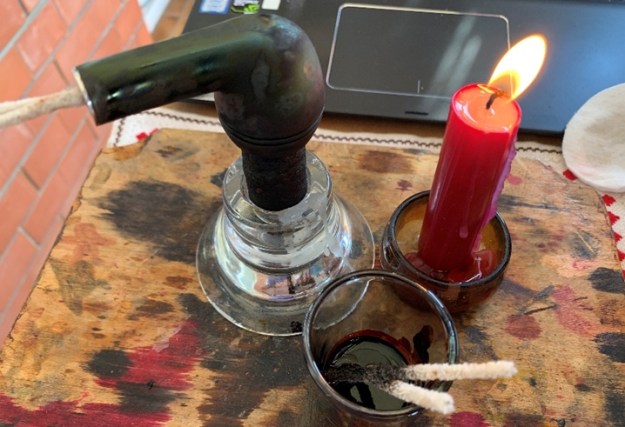
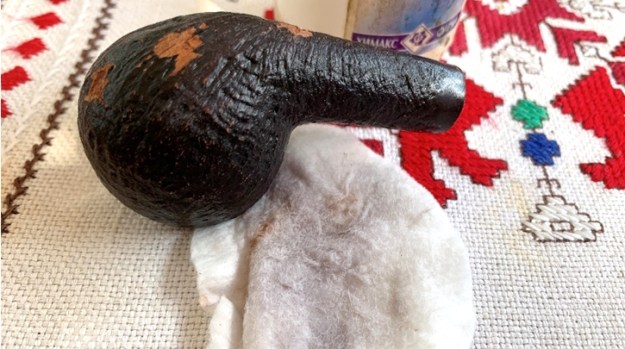
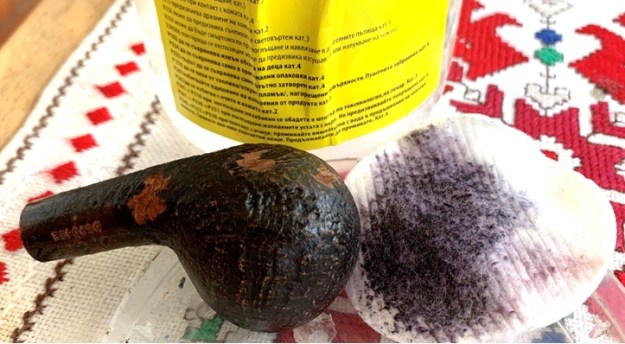
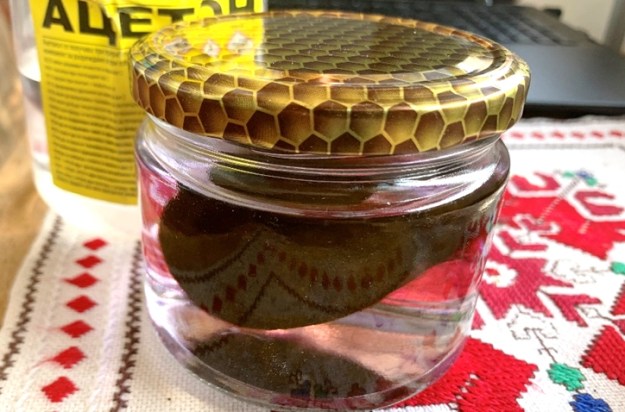
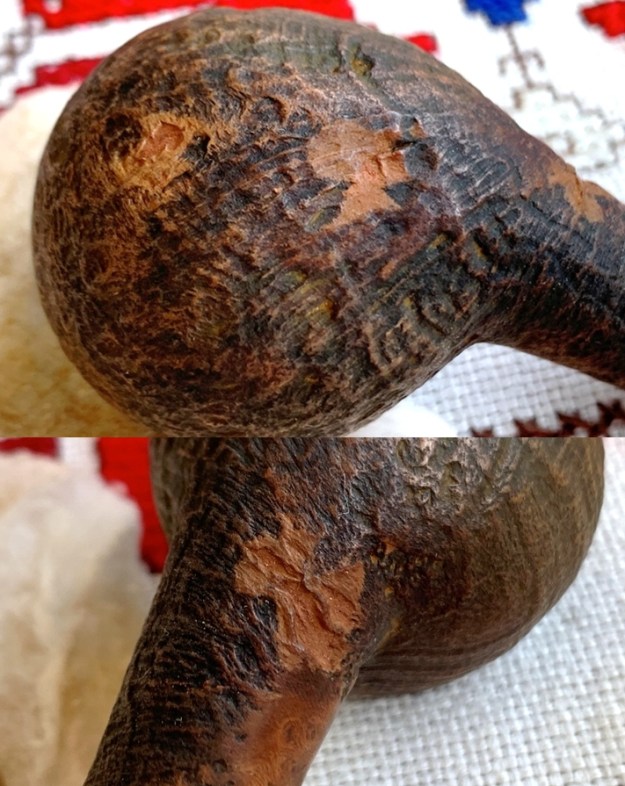
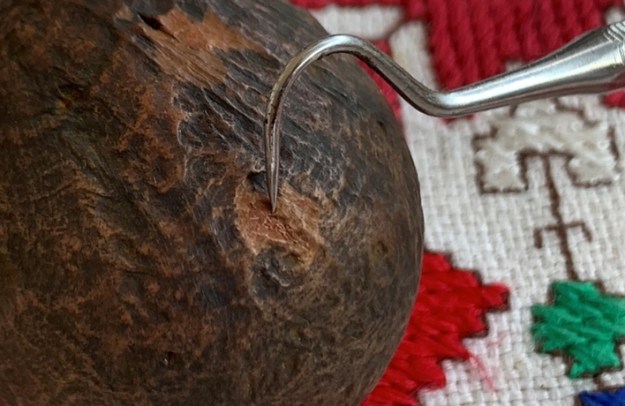
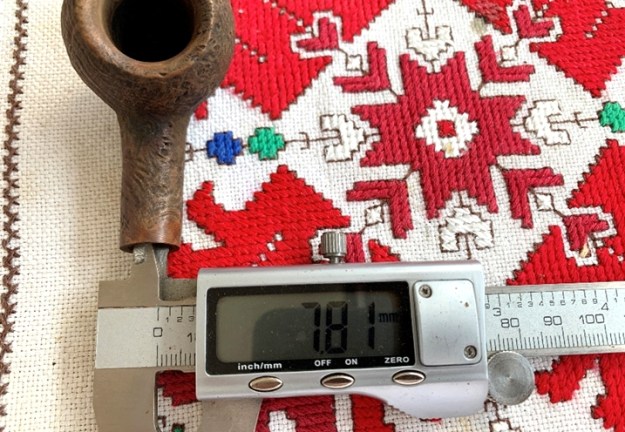
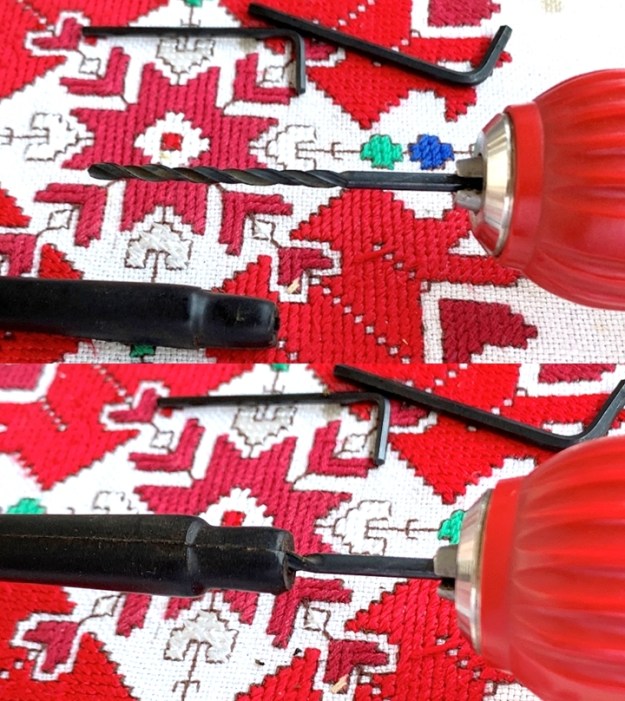
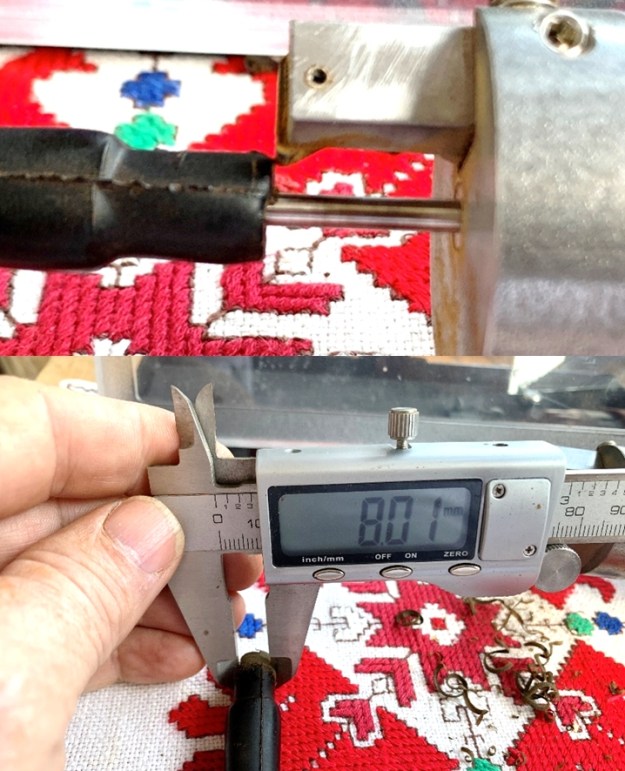
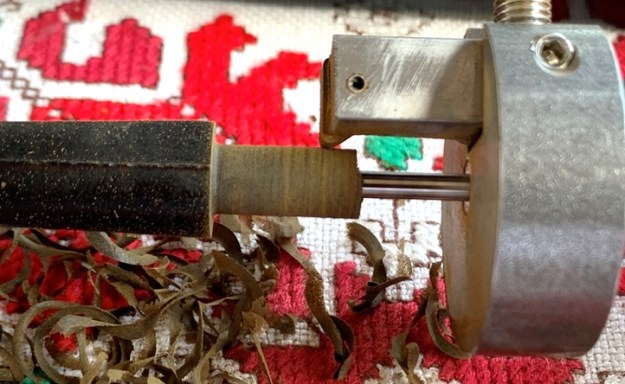
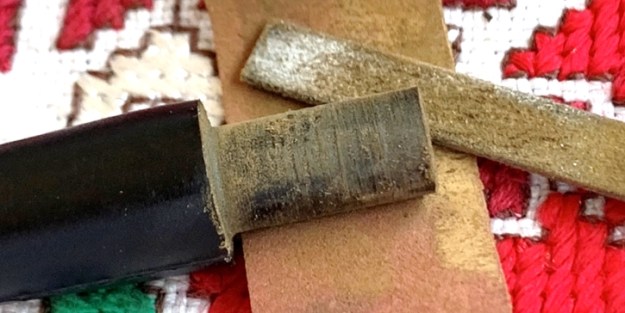
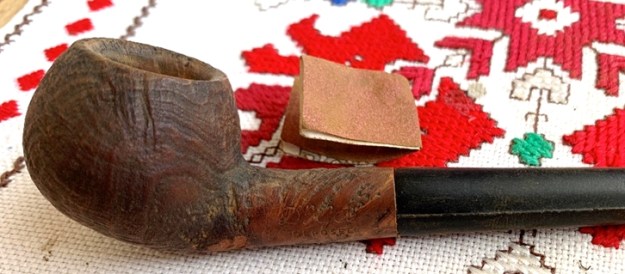
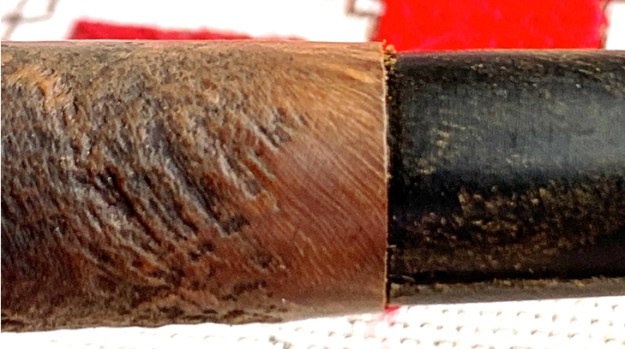
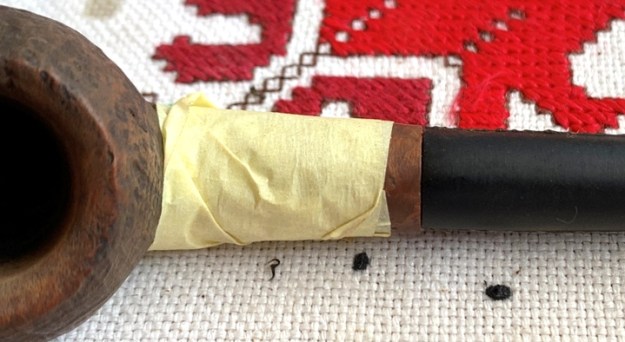
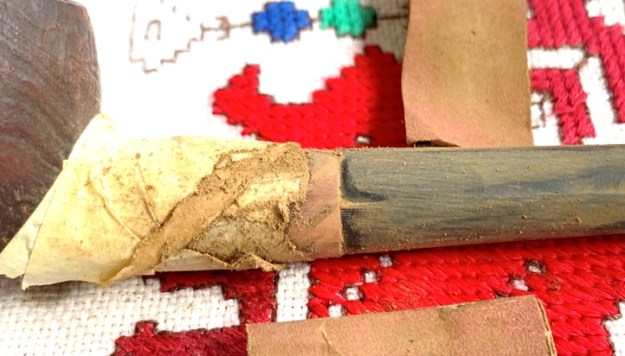
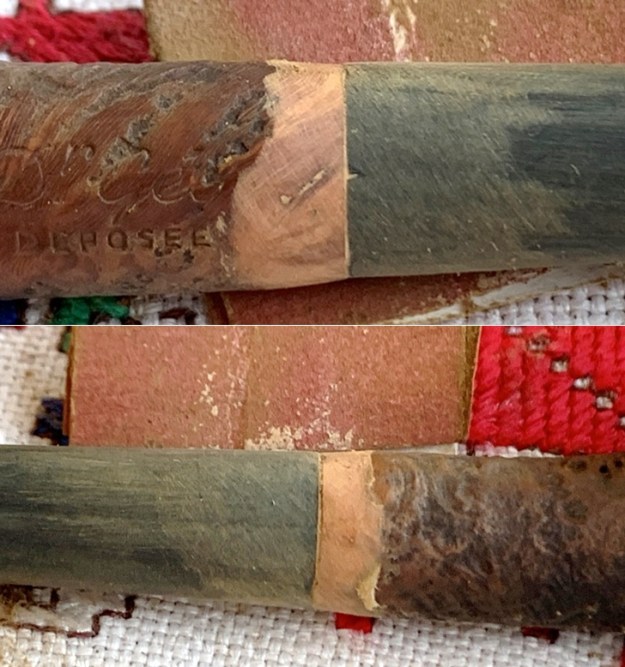
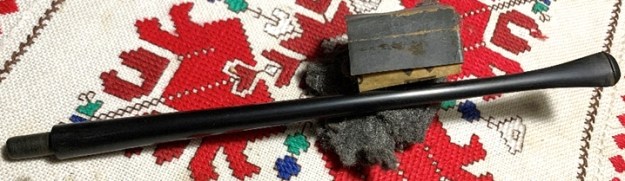
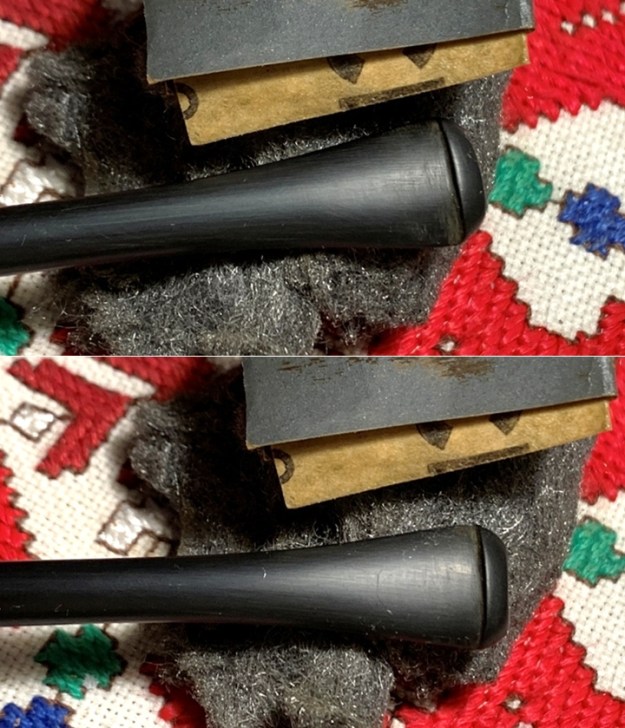
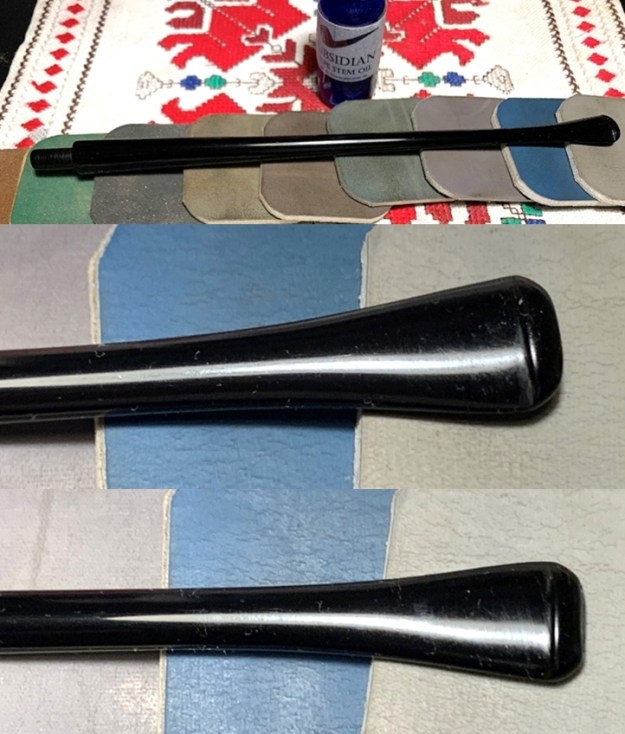
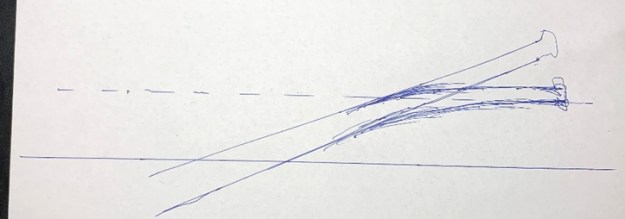
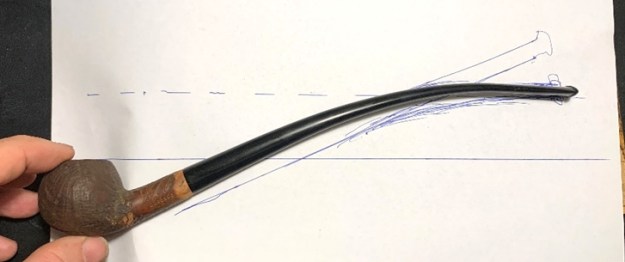
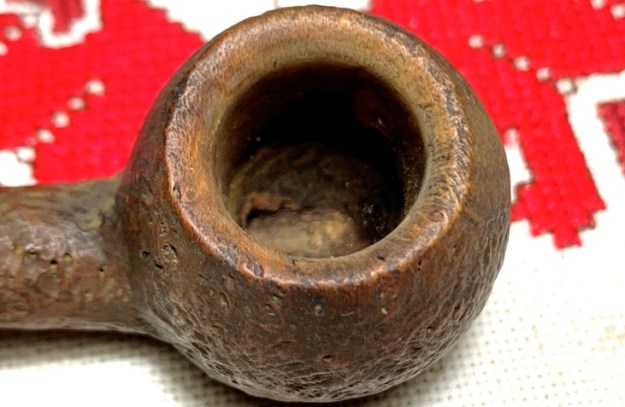
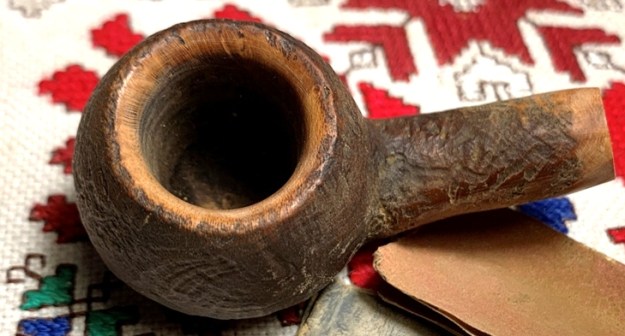
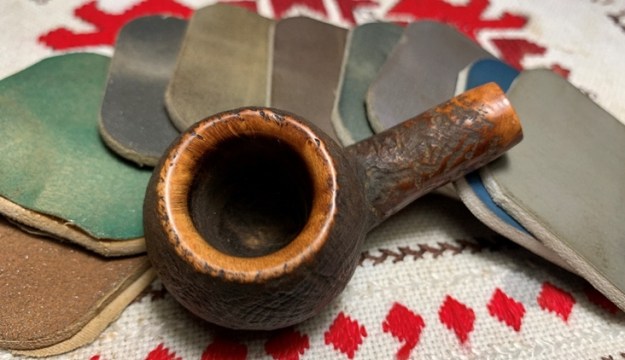
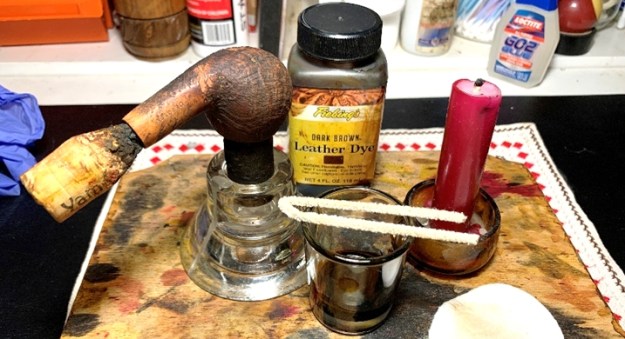
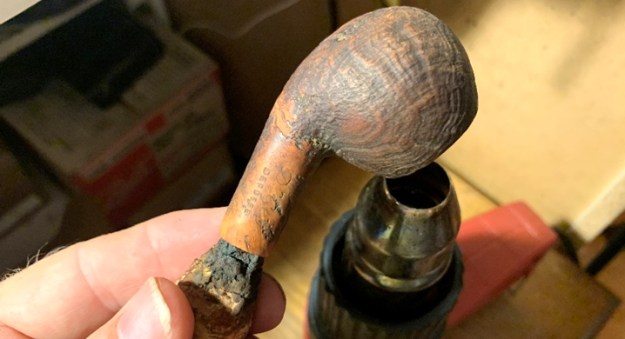
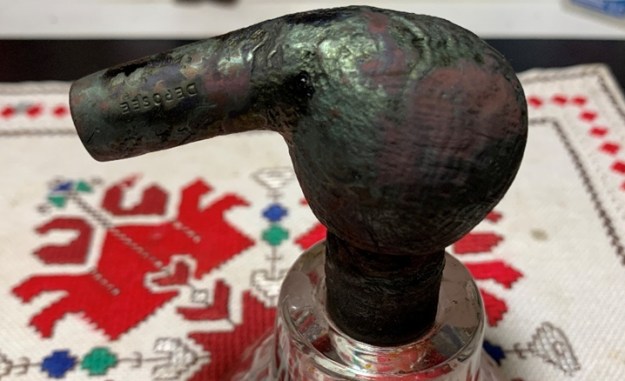
The listing shows a picture of each Doctor cited with dimensions and a pricing.  I find interesting the dismissive gesture for the listing for the Dr. Geo: “…no longer produced – do not have an exceptional notoriety but sufficient to be cited here and there”.  My hope is to change the demeanor of the Dr. Geo Blasted Prince bowl on my worktable transforming him into a Churchwarden. Churchwardens as a classic pipe shape are unique among pipes.  Bill Burney’s description of Churchwardens on his great Pipedia shapes page, describes why they are unique among pipes:Working on my Man Cave 10th floor balcony, I take a few more pictures to get a closer look at the Doctor Geo Prince bowl, which is essentially an Apple shape without the Prince stem – hmmm, an exception to the CW stem principle? The blasted finish is nice – the smooth 3-D picture of the bowl’s grain structure is nice. The finish on the stummel appears to be a very dark brown.  There are minuscule red flecks visible through the cloudiness of the old finish.  At this point, my thinking is to refresh the finish seeking to apply the ‘Dunhill’ finish that I learned from fellow-restorer and rebornpipes contributor, Paresh.  First, after applying all the paces in cleaning the stummel, I’ll assess the condition of the stummel and how to proceed.  Following this, fashioning the CW stem will come.  To start, the Dr. Geo chamber is moderately caked. To address this, I employ the Pipnet Reaming Kit using only the smallest of the 4 blade heads available in the kit.  I follow by scraping the chamber walls with the Savinelli Fitsall Tool and complete the carbon cake removal by sanding the chamber walls with 240 grade paper wrapped around a Sharpie Pen. After wiping the chamber with a cotton pad to remove the carbon dust, an inspection reveals a healthy chamber.Transitioning to cleaning the exterior surface, using undiluted Murphy’s Oil Soap, I go to work using a cotton pad and a bristled toothbrush. The brass bristled brush also works on the rim.Next, I take the bowl to the kitchen sink to continue the cleaning with shank brushes and anti-oil liquid dishwashing soap to clean the internal mortise and airway.  After giving the bowl a thorough rinsing with warm water, I transfer it back to the worktable.Through the cleaning, the finish has started to come off.  This is an indicator that a fresh start is needed. The finish is old and unstable.I decide to remove the old finish to get to the fresh briar beneath.  Isopropyl 95% is the first agent I try scrubbing the blasted finish with a cotton pad.  It is not effective.Transition next to using acetone is much more effect.  The cotton pad is evidence of the old stain which appears black and purple.  I decide to put the entire stummel into an acetone soak to fully remove the finish.  I leave it in the soak for a few hours. After a couple hours the jar containing the stummel soaking in acetone is clouded with leeched finish.  After taking the stummel out, I use a cotton pad to continue rubbing the finish off as well as employing a little steel wool. The light spots that appeared first are areas that were filled, at least partially, with wood putty which have weakened due to the cleaning.  I use a sharp dental probe to test the fills and they are solid. With the rough texture of the blasted surface, these areas will not be visible after applying new dye to the stummel. Before doing more work on the stummel, I switch the focus to fashioning the CW stem.  The first thing I do is to bring out the electronic caliper and measure the diameter of the mortise which gives me the target size of the tenon that needs to be shaped. This measurement is 7.81mm.  I add about 40mm to this to form my ‘fat target’ – the size I’ll cut the tenon and then follow by sanding to form a customized fit to the mortise.  The fat target is about 8.20mm. Next, with the drill bit provided by the PIMO Tenon Turning Tool, I predrill the airway to accommodate the guide pin of the TTT. Next, after mounting the PIMO tool on the hand drill, I do a test cut on the raw tenon of the precast CW stem and measure it – 8.01mm on the button. Whoops – that is 20mm less than I was aiming for as the ‘fat target’ but I decide to cut the tenon at this size and then sand.  This gives less margin of error, but I’m not too concerned. Keeping the same adjustment of the PIMO tool, I continue the test cutting to form a I have made several Churchwardens and one of the mistakes I have learned is to cut the tenon all the way through the precast uneven molding to create a true stem facing.  Not to do this will leave what appears to be shouldering over the edge of the stem facing.  The picture below shows a sharp 45-degree angle which is the goal.Next, using 240 sanding paper, I sand the newly cut tenon to bring it closer to the target mortise size – 7.81mm.  The rough end of the precast tenon is flattened and smoothed using the flat needle file.After a short time of sanding and fitting, the tenon seats into the mortise.Looking closer, there is a small gapping on the right side which I can close during the fine-tuning sanding.What is also the case is that there is a small overhang of the shank over the seated stem.  This will need to be sanded so that the transition between stummel and stem is smooth.I use masking tape to protect the nomenclature as well as to give a sanding boundary around the shank.I start the sanding on the shank/stem transition.  What is helpful shown in the picture below is that it shows what the ‘low-spot’ is in the pre-cast stem in the darker area passed over by the sanding indicating where sanding continues to be needed. As often is the case with the pre-cast CW stems I purchase, the shank facing along the casting seam has a dimple.  This is a pain because these dimples simply mean more sanding required at those points.Progression with the dimple – I don’t want to take off more than needed.  Note, the darkened area has disappeared on the stem indicating that the sanding paper is making seamless contact between shank and stem.With the shank/stem transition sanding completed, I move to sanding the entire pre-cast CW stem.  To start, I use a coarse 120 grade paper to do the initial sanding.  The casting seams along both sides of the stem need to be erased.  The following picture again shows the differences in the surface of the pre-cast stem.  The pre-cast stem has ripples – unevenness, even though it is new.  The dark stretch below shows a ‘valley’ in the rippling that means I sand more there to bring the edges of the valley flush with the valley floor.  The following pictures show the progression in the 120 sanding.With the CW stem smoothed after the 120 grade sanding, I switch to fine-tuning the button.  As with the stem, the button is rough. The bit needs filing to flatten it and to bring more definition to the button edges.  The slot facing on these CW stems is curved and the upper button extends out a bit more than the lower. This helps in identifying the up/down orientation of the stem.  The pictures show the progression with upper and lower bit.  Upper first:Lower :After the main filing is completed, 240 grade paper is employed to fine-tune the bit and button as well as to sand the entire stem after the 120 sanding.  Upper and lower first: Next, to continue the smoothing, 600 grade paper is used to wet sand the entire stem.  This is followed by applying 000 grade steel wool.A closeup of the button area shows the nice progression!Next, the full regimen of 9 micromesh pads is applied from 1500 to 12000. Between each set of 3 pads, Obsidian Oil is applied to condition and protect the vulcanite from future oxidation.  I only show one orbital view and a couple closeups of the finished process focusing on the upper and lower bit. With the CW stem’s sanding completed, its time to bend the stem.  The general principle I follow in stem bending is that the mouthpiece at the end of the stem, should be generally on the same horizontal plane as the rim.  It’s helpful for me to draw templates to visualize the finished stem.Where the original stem template starts with and estimation of where the bend should take place.I use the hot air gun to focus the heat on the lower side of the stem first – the thicker part.  I want it to become supple before heating the upper, thinner area of the stem which heats faster and wants to be the first place the bend begins.  I want the bend to start in the thicker part of the stem then followed by the thinner.As the stem warms over the hot air gun, I gently coax the bend as the stem softens.  After bending to a point that looks good, I bring the stem to the template holding it there for some minutes for the orientation to take hold.  I then take the stem to the kitchen sink and run cool water over it to solidify the bend.  The first try works well.  I like the look and feel of the pipe in my hand.With the stem sanding and bending completed, focus is again transitioned to the Dr. Geo blasted bowl.  Before moving to the staining process, the stummel needs some preparatory work.  One of the things I really like about working with a combination of blasted and smooth briar surfaces is the contrast that this produces.  I love to see both presentations of the grain – the smooth 2-D viewpoint as well as the rough, blasted 3-D viewpoint of the grain.  This bowl provides an opportunity for the striking contrasting. The rim is angled in a beveled slope from the external rim’s edge downward toward the chamber to the internal rim’s edge.  This rim, I believe, will look great after it is sanded to bring out the smooth briar contrast.The other sanding will bring out smooth grain over the nomenclature panel on the left shank flank as well as the newly sanded area transitioning to the stem.  To begin, 240 grade paper is used on these smooth briar patches followed by dry sanding with 600 grade paper. The full regimen of 9 micromesh pads, from 1500 to 12000, is applied to the smooth briar patches next.I’m loving what I’m seeing!  That grain contrast is great.  In the second picture, the rough area from the old fill is still visible and looks shaky, but it should disappear as it blends with the surrounding briar after the staining process.The staining process is next.  I assemble my desktop staining module with all the component parts.  I recently used the method I learned from my fellow restorer from India, Paresh, of creating the rich Dunhill look.  With this bowl being originally darker, I thought that this approach would be good.  It starts with an undercoat of Fiebing’s Dark Brown Leather Dye that is followed with the washing with red dye. After wiping the bowl with a cotton pad wetted with alcohol to clean it, I warm it with the hot air gun to open the briar helping it to be more receptive to the dye which is applied using a folded over pipe cleaner.  Using the pipe cleaner, I paint sections of the bowl with the Dark Brown Dye and then immediately ‘flame’ it with a lit candle.  This combusts the aniline dye burning away the alcohol leaving the dye pigment embedded in the briar.  After applying the dye, the stummel is set aside for several hours – through the night, for the dye to ‘rest’ and settle in.  This helps the dye to take hold in the briar.The next morning, it’s time to ‘unwrap’ the flamed stummel.  To do this, a felt cloth buffing pad is mounted onto the Dremel set at the slowest speed, and Tripoli compound is applied to help remove the crusted shell exposing the dyed briar beneath.After the Tripoli compound removes the flamed crust, I wipe the bowl to rid it of the compound dust.  When this is completed, I apply a wash of red overcoat to the briar surface and lightly wipe it with a cotton cloth.  I apply and wipe until I’m satisfied with the hue.  I like what I see.  The rich red tones give a depth to the blasted finish.Next, since it’s easier to handle the stem and stummel separately, after mounting a cotton cloth buffing wheel to the Dremel set at about 40% full power, Blue Diamond compound is applied to the long Churchwarden stem and Dr. Geo bowl.  One more step to guard against dye leeching.  Often, bowls that have been newly stained, dye will come off on the steward’s hand the first times the bowl is heated up and put into service. To emulate this, I heat the bowl with the hot air gun and then wipe it with a cotton cloth to pick up leeched dye.  Hopefully, this will keep the bowl from leeching later!I complete the fashioning of the Dr. Geo Churchwarden by giving the reunited stem and bowl a vigorous hand buffing bringing out the shine.  I’m very pleased with the results of the ‘Dunhill’ approach to finishing the bowl that I learned from Paresh.  The Dr. Geo Prince bowl serves well mounted on a long, flowing Churchwarden stem. The contrasting with the smooth and blasted briar surfaces also work very nicely. This was Jon’s second commissioned pipe and he will have the first opportunity to claim this French Dr. Geo Churchwarden from The Pipe Steward Store benefitting the Daughters of Bulgaria – women and girls who have been trafficked and sexually exploited.  Thanks for joining me!

Cosmetic Repairs and Restoration of a Jobey Dansk 3 Freehand


Blog by Steve Laug

My brother Jeff picked up this interesting looking freehand pipe on one of his adventures pipe hunting. It had really nice grain and plateau on the top of the rim and on the end of the shank. There were rusticated spots on the right side of the bowl and shank as well as the heel of the bowl. There was something familiar about the style of carving that reminded me of other Danish Freehand pipes I have worked on. I seemed to remember that Jobey Dansk pipes were carved by Karl Erik. The finish on this pipe was dirty with dust and lava on the plateau top. The bowl was lined with a thick cake. There was thick dust in the rustication around the bowl and shank as well as the plateau on the shank end. The smooth finish was also dirty and dull looking. There was a crack on the left side of the bowl that did not go through to the bowl. It was a cosmetic crack. In looking at the photos you can also see a small cosmetic crack on the back of the bowl on the right side. The stem is a turned fancy turned acrylic stem. The fit of the stem to the shank was snug. There were tooth marks on both sides of the stem at the button and on the smooth parts of the button on both sides. Otherwise it was a very clean stem. Jeff took of the pipe to show the overall condition of the bowl and stem. He took close up photos of the bowl and rim top from different angles to show the condition of the plateau finish. You can see the lava and build up on the rim top and the lava flowing over the inner edge of the bowl onto the plateau. It is hard to know if there is damage or if the lava protected it. The bowl has a thick cake that lining the walls and overflowing into lava. He took photos of the sides and heel of the bowl to show the lay of the grain and the rustication around the pipe. It is a nice piece of briar. The top of the bowl is craggy and rugged looking. Unique! The shank end is also a unique mix of plateau and smooth. You will also see the cosmetic cracks in the photos. I will highlight those and include closer looks at the two of them. I took some closer photos of the  the cracks in the bowl. The first shows the one on the left side of the bowl and the second is of the right rear side of the bowl. Neither were deep or went through to the inside of the rim or bowl.Jeff took a photo of the stamping on the underside of the shank to capture it. It was clear and read Jobey Dansk at the top followed by a large number 3.. Under that it read Handmade in Denmark.The next two photos show the surface of the top and underside of the acrylic stem. You can see the tooth marks and damage both on the button surface and on the blade itself. The third photo shows flow of the stem as a whole. I wanted to look at who had carved the Jobey Dansk line to confirm some suspicions I had about it. I had a feeling that the pipes were carved by a Danish carver known as Karl Erik. I looked up the Jobey listing on Pipedia (https://pipedia.org/wiki/Jobey) and found the following information. I quote a portion of the article that is pertinent as follows.

English – American – Danish – French… Information about the brand Jobey are only to be found in form of smithereens…

Probably established in England around 1920(?) the brand hiked into the USA later. In the course of time owner, distributor and manufacturer changed repeatedly. As far as known:
George Yale Pipes & Tobacco, New York (1942)
Norwalk Pipe Co., New York (1949)
Arlington Briar Pipes Corp., Brooklyn (when?)
Hollco International, New York (1969).
Weber Pipe Co., Jersey City, NJ (1970’s)
The Tinder Box, (1970’s – 80’s).

 Throughout decades Jobey pipes were mainly sold in the USA, Canada and England but remained almost unknown in continental Europe. The bulk of Jobeys was predominantly made according to classical patterns and mainly in the lower to middle price range. The predominant judgment of the pipe smokers reads: “A well-made pipe for the price.” So there is hardly anything very special or exciting about Jobey pipes although a flyer from ca. 1970 assures: “The briar root Jobey insists upon for its peer of pipes is left untouched to grow, harden and sweeten for 100 years. […]Jobey uses only the heart of this century old briar and only one out of 500 bowls turned measures up to the rigid Jobey specifications.” 99.80% of cull… that makes the layman marveling!

From that information, my suspicions were confirmed. The pipe that I was working on was carved by Karl Erik Ottendahl. There were some similarities to the Karl Erik pipes that I have worked on in the past. The dating of the pipe line in the 70s fits well with the pipe I have in hand. I took some photos of the pipe before I started my part of the restoration. I took some photos of the rim top and stem to show the condition of them both when it arrived. Overall it looked good. There is some darkening and damage to the inner edge of the bowl. The stem had some deep tooth marks ahead of the button and on the button surface on both sides.I took some photos of the cracks on the side and back of the bowl. I circled them in red so they are easily identifiable in the photos below. Keep in mind that neither of them are deep or go through into the bowl. They do not show up on the rim to either. This leads me to believe they are cosmetic.To begin my part of the restoration work I decided to clean out some more of the grooves in the plateau with a brass bristle wire brush. Once I had it cleaned out sanded the high spots with 220 grit sandpaper to differentiate the plateau from the valleys. With that finished I decided to address the cracks in the bowl. I put a microdrill bit in my Dremel and drilled small holes at the end of each of the cracks to stop them from spreading. The photos below show the pin holes. I have circled them so they are visible.I cleaned out the smalls cracks with a dental pick and probed to see how deep they both were. Fortunately they were both very shallow. The one on the back of the bowl was a hairline crack. I dribbled clear super glue (CA) in the crack and in the pinholes I had drilled then pressed briar dust into the holes and the cracks.Once the repairs had hardened (it takes about 5 minutes) I used a needle file to flatten out the repaired areas on the briar. I followed up on the filed areas with a folded piece of 220 grit sandpaper. I polished the bowl with micromesh sanding pads – wet sanding with 1500-12000 grit pads. I wiped the briar down after each pad with a damp cloth. The bowl is starting to look very good. With the polishing finished I used a Black stain pen to fill in the crevices of the plateau top and give some contrast to the smooth high spots. I like this look as it give the pipe a sense of dimensionality. I also stained the repaired areas with a Cherry stain pen to blend them into the surrounding briar. The colour was a good match to the rest of the bowl and really did a good job of blending the repairs. I worked some Before & After Restoration Balm into the surface of the briar with my fingertips and into the plateau rim top and shank end with a horsehair shoe brush to clean, enliven and protect it. I let the balm sit for a little while and then buffed with a cotton cloth to raise the shine. The photos show the bowl at this point in the restoration process. I set the bowl aside and turned my attention to the stem. The stem was very clean so I filled in the tooth marks and built up the button with clear super glue and set it aside to cure. Once it had cured I flattened out the repairs and sharpened the edge of the button with a needle file. I sanded out the tooth chatter and blended in the repairs with 220 grit sandpaper and started to polish it with a folded piece of 400 wet dry sandpaper. Once it was finished it was smooth.I used some Denicare Mouthpiece Polish that I have in my kit to start polishing out some of the scratches and remaining oxidation on the stem. I rubbed it in with a cotton pad and my finger tip and buffed it off with a cotton pad.I polished the stem with micromesh sanding pads – wet sanding with 1500-12000 grit sanding pads. I wiped it down after each sanding pad with some Obsidian Oil. I finished polishing it with Before & After Pipe Stem Polish – both Fine and Extra Fine and buffed it off with a cotton cloth. This is a beautiful Jobey Dansk Hand Made by Karl Erik with a fancy, turned, black acrylic stem. It has a great look and feel. The repairs to the bowl came out really well. If you look you can see them but they blend in well with the grain around the bowl. The shape fits well in the hand with the curve of the bowl and shank junction a perfect fit for the thumb around the bowl when held. I polished stem and the bowl with Blue Diamond polish on the buffing wheel. I gave the plateau on the rim top and shank end multiple coats of Conservator’s Wax. I gave the bowl and the stem multiple coats of carnauba wax. I buffed the pipe with a clean buffing pad to raise the shine. I hand buffed it with a microfiber cloth to deepen the shine. The pipe polished up pretty nicely. The rich combination of browns and black in the smooth finishes and the plateau areas took on life with the buffing. The rich colour of the briar works well with the polished acrylic stem. I like the grain and finished look of this Jobey Dansk pipe. Have a look at it with the photos below. The shape, finish and flow of the pipe and stem are very well done. The dimensions are Length: 6 ½ inches, Height: 2 ¼ inches, Outside diameter of the bowl: 1 ¾  wide x 2 ¼ inches long, Chamber diameter: ¾ of an inch. This Danish Freehand is a real beauty. Thanks for walking through the restoration with me as I worked over another beautiful pipe. This one will be going on the rebornpipes store in the Danish Pipe Making Companies section shortly if you would like to add it to your collection. Thanks for your time.

Breathing Life into a Danish Hand Made Ben Wade Golden Walnut


Blog by Steve Laug

There is some almost electric about handling and working on a pipe designed and carved by Preben Holm. I can’t describe adequately the feeling I have when I turn the bowl and stem over in my hands even before I start working on the pipe. There is an energy that flows through the way he carved and shaped the pipes of his making. This second Ben Wade pipe was no exception. When Jeff showed me the photos of several of the Ben Wade pipes by Preben Holm that he had picked up I was excited to be able to work on them. This one has twists and turns in the carving and valleys carved into the sides of the bowl. It is very unique. The combination of dark and medium stains highlights grain that runs like flames across both sides of the bowl culminating at the flat heel of the bowl. The rim top is plateau but also cut across it are also valleys coming up from the sides of the bowl. The shank end combines smooth and plateau for a unique look.

This is another well-loved pipe as you can see from the thick cake in the bowl and the lava on the rim top. It is hard to know the condition of the inner edge of the bowl due to the lava on the edges. The outside of the bowl and plateau portions are dirty and dusty but the grain pops through. The vulcanite stem still had the BW Cross and Crown logo on the top sides just past the fancy turnings. The stem as a whole was oxidized, dirty and dusty with deep tooth marks on the button surface and lighter ones on the blade just ahead of the button on both sides. Jeff took these photos before he started his part of the restoration. He took close up photos of the bowl and rim top from different angles to show the condition of both the smooth and plateau finish. It is truly a uniquely carved rim top maximizing the plateau and the smooth parts flowing up from the bowl sides.You can see the lava and build up on the rim top and the lava flowing over the inner edge of the bowl onto the plateau. It is hard to know if there is damage or if the lava protected it. The bowl has a thick cake that lining the walls and overflowing into lava. He took photos of the sides and heel of the bowl to show the lay of the grain around the pipe. It is a beautiful piece of briar. The top of the bowl is craggy and rugged looking. Unique! The shank end is also a unique mix of plateau and smooth. Jeff took several photos of the stamping on the underside of the shank to capture all of the stamping. It was clear and read Ben Wade in script at the top. Under that it read Golden Walnut. Under that was stamped Hand Made in Denmark.The next two photos show the surface of the top and underside of the vulcanite stem. You can see the tooth marks and damage both on the button surface and on the blade itself. The third photo shows the unique Cross and Crown BW logo on the stem top near the turnings.I am including the background history that I included on the previous blog. It includes the idea that the Preben Holm pipes were marketed under the Ben Wade label in the US and imported through Lane Ltd. I turned to Pipedia and read the listing on the brand to refresh my memory and flesh out the knowledge of the brand (https://pipedia.org/wiki/Ben_Wade). I have included a photo from that site that was taken from a Tinderbox advertisement.

Ben Wade Ad in a Tinder Box catalog, courtesy Doug Valitchka

I quote the portion of the article that summarizes the history of the brand.

Young Copenhagen master pipemaker Preben Holm had made a meteoric career heading a pipe manufacture employing 45 people at the age of 22! But around the turn of 1970/71 he was in major financial difficulties. His US distributor, Snug Harbour Ltd. in New York City, left him in the lurch. Holm had three unpaid invoices on his desk and another large shipment was ready for the USA, when Snug Harbour’s manager told him on the phone that there was no money at all on the account to pay him.

So the Dane went to New York for an almost desperate search for a new distribution partner. He made contacts with Lane Ltd. and met Herman G. Lane in February 1971. Lane Ltd. had no interest in Holm’s serial pipes produced at that time but so much the more in the hand-carved freehands because the hype for Danish freehands and fancies in the States was still on its way to the climax then. The meeting resulted in an agreement to start a cooperation. Lane insisted to improve the quality considerably and in return he assured to be able to sell essentially larger quantities.

Holm went back home to work on new samples with all-new designs and altered finishes for Lane. Both, Lane and Holm, agreed that it would be unwise to sell the pipes under Preben Holm’s name as long as Snug Harbour had a considerable stock of Preben Holm pipes and might sell them pipes at very low prices just to bring in some money.

So on Mr. Lane’s proposal it was determined to use the name Ben Wade belonging to Lane Ltd. Lane spent considerable amounts of money for advertising the new brand in the big magazines– the centerpiece being whole-page ads showing a very exclusive Seven Day’s Set.

The cooperation with Lane Ltd. proved to be an eminent business success for both partners. Within a very short time Ben Wade Handmade Denmark sold in much larger quantities and at higher prices than they had ever dreamed of. And the hype these freehands and fancy pipes caused went on unbroken long after Herman G. Lane deceased. Preben Holm – obviously much more brilliant in pipe making than in pipe business – was in major troubles again in 1986 and had to sack most of his staff. The Ben Wade production was significantly lowered but continued until his untimely death in June of 1989.

Up to now Preben Holm made Ben Wade pipes are cult and highly sought for on the estate markets.

With that information my initial thoughts were confirmed. This pipe was another Preben Holm made Freehand distributed in the US by Lane Ltd under the name Ben Wade. The freehand rage occurred in the late 70s and the pipes were made until Preben’s death in 1989. My guess would be that this pipe was made sometime during that time period and potentially in the late 70s.

Armed with that information I moved forward to work on the pipe itself and see what I had to do with it. It had come back amazingly clean. Jeff had done his normal thorough clean up – reaming, scrubbing, soaking and the result was evident in the pipe when I unpacked it. I took photos of the pipe before I started my work on it. I took some photos of the rim top and stem to show the condition of them both when it arrived. It looked good. There is some darkening and damage to the inner edge of the bowl. The stem had some deep tooth marks ahead of the button and on the button surface on both sides.To begin my part of the restoration work I decided to clean out some more of the grooves in the plateau with a brass bristle wire brush. Once I had it cleaned out I restained the plateau top with black stain. It is amazing how good the plateau looks once it is cleaned and stained.I polished the bowl with micromesh sanding pads – wet sanding with 1500-12000 grit pads. I wiped the briar down after each pad with a damp cloth. The bowl is starting to look very good. I worked some Before & After Restoration Balm into the surface of the briar with my fingertips and into the plateau rim top and shank end with a horsehair shoe brush to clean, enliven and protect it. I let the balm sit for a little while and then buffed with a cotton cloth to raise the shine. The photos show the bowl at this point in the restoration process. I set the bowl aside and turned my attention to the stem. The stem was very clean so I filled in the tooth marks with clear super glue and set it aside to cure. Once it had cured I flattened out the repairs and sharpened the edge of the button with a needle file. I sanded out the tooth chatter with 220 grit sandpaper and started to polish it with a folded piece of 400 wet dry sandpaper. Once it was finished it began to shine.I used some Denicare Mouthpiece Polish that I have in my kit to start polishing out some of the scratches and remaining oxidation on the stem. I rubbed it in with a cotton pad and my finger tip and buffed it off with a cotton pad.I touched up the stamping on the stem top with Rub’n Buff Antique Gold. It looked like it had previously been stamped with gold so I filled in the stamping once again and buffed the product off the stem.I polished the stem with micromesh sanding pads – wet sanding with 1500-12000 grit sanding pads. I wiped it down after each sanding pad with some Obsidian Oil. I finished polishing it with Before & After Pipe Stem Polish – both Fine and Extra Fine and buffed it off with a cotton cloth. I wiped it down with Briarville’s No Oxy Oil to protect the stem and slow down the oxidation. This is a beautiful Preben Holm made Ben Wade Golden Walnut with a fancy, turned, black vulcanite stem. It has a great look and feel. The shape fits well in the hand with the curve of the bowl and shank junction a perfect fit for the thumb around the bowl when held. I polished stem and the bowl with Blue Diamond polish on the buffing wheel. I gave the plateau on the rim top and shank end multiple coats of Conservator’s Wax. I gave the bowl and the stem multiple coats of carnauba wax. I buffed the pipe with a clean buffing pad to raise the shine. I hand buffed it with a microfiber cloth to deepen the shine. The pipe polished up pretty nicely. The rich combination of browns and black in the smooth finishes and the plateau areas took on life with the buffing. The rich colour of the briar works well with the polished vulcanite stem. I like the grain and finished look of this Preben Holm Ben Wade Golden Walnut pipe. Have a look at it with the photos below. The shape, finish and flow of the pipe and stem are very well done. The dimensions are Length: 6 ½ inches, Height: 2 ¼ inches, Outside diameter of the bowl: 2 wide x 2 ¼ inches long, Chamber diameter: 7/8 of an inch. This Danish Freehand is a real beauty. Thanks for walking through the restoration with me as I worked over another beautiful pipe. This one will be going on the rebornpipes store shortly if you would like to add it to your collection. Thanks for your time.


Breathing Life into a Ben Wade Danish Made Ambassador Deluxe


Blog by Steve Laug

There is some almost electric about handling and working on a pipe designed and carved by Preben Holm. I can’t describe adequately the feeling I have when I turn the bowl and stem over in my hands even before I start working on the pipe. There is an energy that flows through the way he carved and shaped the pipes of his making. This pipe was no exception. When Jeff showed me the photos of several of the Ben Wade pipes by Preben Holm that he had picked up I was excited to be able to work on them. This one has grain that runs diagonally across both sides of the bowl culminating at a point at the heel of the bowl. The rim top combines smooth and plateau and the shank end explodes from the grain running into it with a tight plateau finish. The pipe was well loved as you can see from the thick cake in the bowl and the lava on the rim top. The inner edge of the bowl is burned, blackened and worn. The outside of the bowl and plateau portions are dirty and dusty but the grain pops through. There was a deep nick on the left side toward the bottom that would need to be dealt with in the restoration. The acrylic stem was dirty and dusty with deep tooth marks on the button surface and lighter ones on the blade just ahead of the button on both sides. Jeff took these photos before he started his part of the restoration. He took close up photos of the bowl and rim top from different angles to show the condition of both the smooth and plateau finish. You can see the lava and build up on the rim top and the lava flowing over the inner edge of the bowl. It is hard to know if there is damage or if the lava protected it. The bowl has a thick cake that lining the walls and overflowing into lava. The plateau surface is duty and also has some lava overflow in the valleys and crannies of the surface. He took photos of the sides and heel of the bowl to show the diagonal lay of the grain around the pipe. It is a beautiful piece of briar.Jeff took two photos of the deep gouge toward the bottom of the bowl on the left side. You can see the rough edges of the gouge in the photos. Steaming it would not raise the grain around that deep nick. It would need to be filled in and repaired. Jeff took several photos of the stamping on the underside of the shank to capture all of the stamping. It was clear and read Ben Wade in script at the top. Under that it read Ambassador Deluxe. Under that was stamped Hand Made in Denmark.The next two photos show the surface of the top and underside of the acrylic stem. You can see the tooth marks and damage both on the button surface and on the blade itself. The third photo shows the fancy turnings on the rest of the stem and give a sense of its flow.I remembered a bit of history on the brand that included the thought that the Preben Holm pipes were marketed under the Ben Wade label in the US and imported through Lane Ltd. I turned to Pipedia and read the listing on the brand to refresh my memory and flesh out the knowledge of the brand (https://pipedia.org/wiki/Ben_Wade). I have included a photo from that site that was taken from a Tinderbox advertisement.

Ben Wade Ad in a Tinder Box catalog, courtesy Doug Valitchka 

I quote the portion of the article that summarizes the history of the brand.

Young Copenhagen master pipemaker Preben Holm had made a meteoric career heading a pipe manufacture employing 45 people at the age of 22! But around the turn of 1970/71 he was in major financial difficulties. His US distributor, Snug Harbour Ltd. in New York City, left him in the lurch. Holm had three unpaid invoices on his desk and another large shipment was ready for the USA, when Snug Harbour’s manager told him on the phone that there was no money at all on the account to pay him.

So the Dane went to New York for an almost desperate search for a new distribution partner. He made contacts with Lane Ltd. and met Herman G. Lane in February 1971. Lane Ltd. had no interest in Holm’s serial pipes produced at that time but so much the more in the hand-carved freehands because the hype for Danish freehands and fancies in the States was still on its way to the climax then. The meeting resulted in an agreement to start a cooperation. Lane insisted to improve the quality considerably and in return he assured to be able to sell essentially larger quantities.

Holm went back home to work on new samples with all-new designs and altered finishes for Lane. Both, Lane and Holm, agreed that it would be unwise to sell the pipes under Preben Holm’s name as long as Snug Harbour had a considerable stock of Preben Holm pipes and might sell them pipes at very low prices just to bring in some money.

So on Mr. Lane’s proposal it was determined to use the name Ben Wade belonging to Lane Ltd. Lane spent considerable amounts of money for advertising the new brand in the big magazines– the centerpiece being whole-page ads showing a very exclusive Seven Day’s Set.

The cooperation with Lane Ltd. proved to be an eminent business success for both partners. Within a very short time Ben Wade Handmade Denmark sold in much larger quantities and at higher prices than they had ever dreamed of. And the hype these freehands and fancy pipes caused went on unbroken long after Herman G. Lane deceased. Preben Holm – obviously much more brilliant in pipe making than in pipe business – was in major troubles again in 1986 and had to sack most of his staff. The Ben Wade production was significantly lowered but continued until his untimely death in June of 1989.

Up to now Preben Holm made Ben Wade pipes are cult and highly sought for on the estate markets.

With that information my initial thoughts were confirmed. This pipe was a Preben Holm made Freehand distributed in the US by Lane Ltd under the name Ben Wade. The freehand rage occurred in the late 70s and the pipes were made until Preben’s death in 1989. My guess would be that this pipe was made sometime during that time period and potentially in the late 70s.

Armed with that information I moved forward to work on the pipe itself and see what I had to do with it. It had come back amazingly clean. Jeff had done his normal thorough clean up – reaming, scrubbing, soaking and the result was evident in the pipe when I unpacked it. I took photos of the pipe before I started my work on it. I took some photos of the rim top and stem to show the condition of them both when it arrived. It looked good. There is some darkening and damage to the inner edge of the bowl. The stem had some deep tooth marks ahead of the button and on the button surface on both sides.To begin my part of the restoration work I decided to repair the large chip/nick in the lower left side of the bowl. It was clean so I wiped it lightly and filled it in with briar dust and super glue.Once the repair cured I sanded it smooth with a folded piece of 220 grit sandpaper to blend it into the surrounding briar. I used a black Sharpie pen to stain the repaired area. I blended it into the surface of the surrounding briar with a Walnut stain pen. The photo shows the repair blended into the briar. I polished the bowl with micromesh sanding pads – wet sanding with 1500-12000 grit pads. I wiped the briar down after each pad with a damp cloth. The bowl is starting to look very good. I worked some Before & After Restoration Balm into the surface of the briar with my fingertips and into the plateau rim top and shank end with a horsehair shoe brush to clean, enliven and protect it. I let the balm sit for a little while and then buffed with a cotton cloth to raise the shine. The photos show the bowl at this point in the restoration process. I set the bowl aside and turned my attention to the stem. The stem was very clean so I filled in the tooth marks with clear super glue and set it aside to cure. Once it had cured I flattened out the repairs and sharpened the edge of the button with a needle file. I sanded out the tooth chatter with 220 grit sandpaper and started to polish it with a folded piece of 400 wet dry sandpaper. Once it was finished it began to shine.I used some Denicare Mouthpiece Polish that I have in my kit to start polishing out some of the scratches and remaining oxidation on the stem. I rubbed it in with a cotton pad and my finger tip and buffed it off with a cotton pad.I polished the stem with micromesh sanding pads – wet sanding with 1500-12000 grit sanding pads. I wiped it down after each sanding pad with some Obsidian Oil. I finished polishing it with Before & After Pipe Stem Polish – both Fine and Extra Fine and buffed it off with a cotton cloth. This is a beautiful Preben Holm made Ben Wade Ambassador Deluxe with a fancy, turned, black acrylic/Lucite stem. It has a great look and feel. The shape fits well in the hand with the curve of the bowl and shank junction a perfect fit for the thumb around the bowl when held. I polished stem and the bowl with Blue Diamond polish on the buffing wheel. I gave the plateau on the rim top and shank ende multiple coats of Conservator’s Wax. I gave the bowl and the stem multiple coats of carnauba wax. I buffed the pipe with a clean buffing pad to raise the shine. I hand buffed it with a microfiber cloth to deepen the shine. The pipe polished up pretty nicely. The rich combination of browns and black in the smooth finishes took on life with the buffing. The rich colour of the briar works well with the polished acrylic stem. I like the grain and finished look of this Preben Holm Ben Wade Ambassador Deluxe pipe. Have a look at it with the photos below. The shape, finish and flow of the pipe and stem are very well done. The dimensions are Length: 6 ¼ inches, Height: 2 ½ inches, Outside diameter of the bowl: 1 ¾ wide x 2 ¼ inches long, Chamber diameter: 7/8 of an inch. This Danish Freehand is a real beauty. Thanks for walking through the restoration with me as I worked over another beautiful pipe. This one will be going on the rebornpipes store shortly if you would like to add it to your collection. Thanks for your time.

Repairing a Burned Rim Edge and Chewed Stem on an English Ben Wade 76 Canadian


Blog by Steve Laug

The next pipe on my table is nice sandblast thick shank Canadian. It is stamped on the underside of the shank with the Ben Wade over Made in London England. It also has the shape number 76 just ahead of the Ben Wade stamping. It has a nice sandblast finish that is in good shape under the dirt and even the rim top looks good. The inner edge of the rim is darkened but the bowl is in good shape. There was burn damage on the left outer edge and darkening on the inner edge of the bowl. There is a thick cake in the bowl and light lava build up on the rim top and inner edge. The taper vulcanite stem was oxidized and had some deep tooth marks and chatter on both sides ahead of the button. Jeff took these photos before he cleaned the pipe.He took photos of the rim top from various angles to give a clear picture of the condition of the bowl and rim. It is dirty but there is a light lava coat on the top and the rim edges have some darkening and buildup. There is also a deep burn mark on the left out edge toward the rear of the bowl. Jeff also took a closer photo of the burned area on the outer edge of the rim. It is visible in the photo below.The sandblast finish around the sides and heel of the bowl is quite interesting and reveals some different underlying grain. The stamping on the underside of the shank is very readable as can be seen in the next photo.The next two photos show the deep tooth marks on the surface of the stem. They are actually quite high up the stem from the button. This pipeman had been a bit of a chomper. There is some wear on the edge of the button as well. The stem shows a great profile. I moved forward to work on the pipe itself and see what I had to do with it. It had come back amazingly clean. Jeff had done his normal thorough clean up – reaming, scrubbing, soaking and the result was evident in the pipe when I unpacked it. I took photos of the pipe before I started my work on it. I took some photos of the rim top to show the condition of the edges and the bowl. It looked very good. There is some darkening to the inner edge of the bowl. The second photo shows the damage from the burn on the left side of the rim top and side of the bowl. The stem had some deep tooth marks ahead of the button on both sides. The bowl was going to be straightforward to work on so I started with it. The burned spot on the left side of the bowl edge needed to be addressed. Since the bowl was clean I wiped off the damaged spot with alcohol on a cotton pad. I dried it of with a cloth. I then filled it in with layers of super glue and briar dust – repeating the process until the surface of the rim top and the side of the bowl were even. When the repair had cured I sanded it with a folded piece of 220 grit sandpaper to blend it into the surrounding briar. I used a brass bristle brush to roughen up the surface of the rim top and side of the bowl. I worked it over to achieve a similar pattern to the surround sandblast. I stained the repaired area with a Mahogany stain pen and blended it into the surrounding stained briar. I am pretty happy with the match. At this point in the process the bowl definitely looks better.I worked some Before & After Restoration Balm into the briar with my fingertips. I let the balm sit on the briar for 10 minutes the buffed it off with a soft cloth. The balm enlivens, enriches and protects the briar while giving it a deep glow. I set the bowl aside and turned my attention to the stem. The stem was very clean so I filled in the tooth marks with clear super glue and set it aside to cure. Once it had cured I flattened out the repairs and sharpened the edge of the button with a needle file. I sanded the stem with 220 grit sandpaper to blend in the repairs with the rest of the stem surface.  I started the polishing with 400 grit wet dry sandpaper.I polished the stem with Denicare Mouthpiece Polish. It is a gritty red paste (similar in grit to red Tripoli) that I rub on with my finger tips and work it into the surface of the stem and button and buff it off with a cotton pad. It gives me a bit of a head start on the polishing work.I polished the stem with micromesh sanding pads – wet sanding with 1500-12000 grit sanding pads. I wiped it down after each sanding pad with Obsidian Oil. I polished it with Before & After Pipe Stem Polish – both Fine and Extra Fine. I buffed the stem with a soft cloth to raise the shine. I wiped the stem down with Briarville’s No Oxy Oil to preserve and protect the stem surface. Ahhhh…once again I am at my favourite part of a restoration – finishing up a pipe! This Ben Wade English made Canadian 76 came out really well considering the issues with the burned area on the side of the bowl and rim when I started. I put the pipe back together and buffed it with Blue Diamond polish on the buffing wheel. I polished the bowl with multiple coats of Conservator’s Wax and the stem with multiple coats of carnauba wax. I buffed it with a clean buffing pad and with a hand buff with a microfibre cloth. The mix of colours and the buffing made the sandblast stand out when it was waxed. The mixed grain is quite stunning. Thick oval shank and taper stem stands out in great contrast to the briar. It is a nice looking pipe. Have a look at the photos below of the finished pipe. Its dimensions are Length: 6 ¼ inches, Height: 2 inches, Outside Diameter of the Bowl: 1 3/8 inches, Diameter of the Chamber: ¾ of an inch. The long shank Canadian feels great in the hand. This one will be going on the rebornpipes store later today. You can add it to your collection and carry on the trust. Let me know if you are interested in adding it. Thanks for your time.  

New Life for a Mystery BBB Custom Made Zulu


Blog by Steve Laug

The next pipe on my table is actually a strange one and a bit of a mystery to me. It is a nicely shaped and grained Zulu. The mystery does not come in the shape but in the composition of the pipe and the stamping on the shank. The stem is threaded onto an inset metal tenon that is a part of the spacer on the shank end. The tenon is unmovable and the stem screws onto it. I have never seen that on a British made BBB pipe. Then the stamping, other than the BBB Diamond on the topside of the shank looks like every other American made pipe of that time period. The stamping reads on the topside of the shank as follows: a BBB Diamond over Custom Made in a Germanic script and underneath that is R in a circle (there are pictures of the stamping below). On the underside of the shank it is stamped with the shape number 47 on the flat heel of the bowl followed by Aged Imported Briar in the same Germanic Script. The Imported Briar has always been a sign of an American Made pipe to me so therein laid the mystery. Is it really a BBB from England or is it another BBB brand that is American? I am hoping to demystify it a bit in the process of this restoration

It is a dirty pipe but has some great grain that the carver built the shape around. The finish is in good shape under the dirt and even the rim top looks good. The inner edge of the rim is darkened the bowl is out of round. There was burn damage to the inner edge. There is a thick cake in the bowl and a thick lava coat on the rim top. The rim top also appeared to have some pitting and nicks in the surface. The stem is pitted and oxidized. It has light tooth marks and chatter on both sides ahead of the button. Jeff took these photos before he cleaned the pipe.Jeff unscrewed the stem from the shank so that I could see the tenon set up and it is pretty clear that it was set in the shank.Jeff took photos of the rim top from various angles to give a clear picture of the condition of the bowl and rim. It is dirty but there is no lava coat on the top and the rim edges look very good. The grain around the sides and heel of the bowl is quite interesting. It is a combination of cross grain, swirled and birdseye grain. The stamping on both sides of the shank is very readable as can be seen in the next three photos.The stem shows pitting and oxidation on the surface as well as light tooth marks and chatter on both sides. There is some wear on the edge of the button as well. The stem shows a great profile.I looked through all of my resources for BBB pipes and could find nothing even remotely like this pipe. I looked on both Pipephil and Pipedia for other brands with similar stamping and again found nothing. Even with the lack of information it was time to get working on the pipe itself and see what I had to do with it. It had come back amazingly clean. Jeff had done his normal thorough clean up – reaming, scrubbing, soaking and the result was evident in the pipe when I unpacked it. I took photos of the pipe before I started my work on it. I took some photos of the rim top to show the condition of the edges and the bowl. It looked very good. The stem actually looked much better than I expected and the tooth chatter seemed to have disappeared. There were some light tooth marks just next to the button edge on both sides.I am including photos of the stamping to show how Jeff preserved it during the cleanup and it did not fade or show damage.I decided to address the damage to the rim top and inner edge first. I topped the bowl with 220 grit sandpaper on a hard topping board I use. I followed up by working over the inner edge of the rim with a folded piece of 220 grit sandpaper to give the edge a light bevel and minimize as much of the damage as I could. With the inner edge and top cleaned up the bowl looked significantly better. I polished the briar with micromesh sanding pads – wet sanding with 1500-12000 grit pads. I wiped the bowl down after each pad with a damp cloth to remove the dust.     I blended three stain pens together to get a match to the colour of the bowl – Walnut, Cherry and Black. The colour combination worked very well to make it look original. I worked some Before & After Restoration Balm into the briar with my fingertips. I let the balm sit on the briar for 10 minutes the buffed it off with a soft cloth. The balm enlivens, enriches and protects the briar while giving it a deep glow. I set the bowl aside and turned my attention to the stem. I sanded the stem with 220 grit sandpaper to remove the tooth marks and the remnants of oxidation especially in the saddle area. I started the polishing with 400 grit wet dry sandpaper.I polished the stem with Denicare Mouthpiece Polish. It is a gritty red paste (similar in grit to red Tripoli) that I rub on with my finger tips and work it into the surface of the stem and button and buff it off with a cotton pad. It gives me a bit of a head start on the polishing work.I polished the stem with micromesh sanding pads – wet sanding with 1500-12000 grit sanding pads. I wiped it down after each sanding pad with Obsidian Oil. I polished it with Before & After Pipe Stem Polish – both Fine and Extra Fine. I buffed the stem with a soft cloth to raise the shine. I wiped the stem down with Briarville’s No Oxy Oil to preserve and protect the stem surface. Once again I am at my favourite part of a restoration – finishing up a pipe! This BBB Custom Made Zulu came out really well considering the condition it was in when I started. I put the pipe back together and buffed it with Blue Diamond polish on the buffing wheel. I polished it with multiple coats of carnauba wax on both the bowl and stem. I buffed it with a clean buffing pad and with a hand buff with a microfibre cloth. The mix of colours and the buffing made the grain really pop once it was waxed. The cross grain, swirled and birdseye grain are quite stunning. The silver coloured spacer and the polished black vulcanite saddle stem stands out in great contrast to the briar. It is really a beautiful pipe. Have a look at the photos below of the finished pipe. Its dimensions are Length: 5 ½ inches, Height: 1 ¾ inches, Outside Diameter of the Bowl: 1¼ inches, Diameter of the Chamber: ¾ of an inch. The Mystery brand pipe is comfortable handful and feels great in the hand. This one will be going on the rebornpipes store later today. You can add it to your collection and carry on the trust. Let me know if you are interested in adding it. Thanks for your time.

Bringing Life Back to a Heritage Antique 86 Blasted Apple  


Blog by Dal Stanton

A few years ago I landed a large lot of pipes on the eBay auction block from a seller in Georgetown, Texas.  The seller was actually a charitable organization called the Georgetown Caring Place operating some thrift stores mainly manned by volunteers – elderly.  I liked it from the start!  The description on the ‘Lot of 66’ said it all:

Huge Lot Of 66 Smoking Pipes, Pre-Owned, Loved, Pre-Smoked, Many different makers styles and Brands, We will not be able to list specifics on these pipes, We are not pipe people, You are buying one person’s collection

Undoubtedly, an estate collection of a pipe man’s collection that the family donated to benefit the Caring Place. My bid won the Lot of 66 and helped a good cause.  It also placed the former steward’s pipes in my charge, and it has been a joy for me to discover many treasures in the Lot of 66 and to enable these pipes to continue to serve many new stewards for years to come.  Here’s the Lot of 66 that I saw on eBay.Pipe man Todd, who has commissioned and received several pipes from The Pipe Steward before, all benefiting the Daughters of Bulgaria, saw one of the Lot of 66 waiting, an unassuming ‘Heritage Blasted Apple’ listed in my online inventory called For “Pipe Dreamers” Only! and he commissioned it along with 2 others (See: Borge Mortensen of Denmark and Ehrlich Special Chimney of Boston). Todd has a knack for seeing good pipes with ‘Pipe Dreamer’ eyes!  Here are the pictures he saw that got his attention despite the cardboard presentation background! The nomenclature, what there is, is/would be located on the bottom panel.  My initial pictures held little promise of identifying any markings.  In this picture, ‘86’ is discernible – a shape number. The next picture, which is a picture I recently took to get a better look, ‘ANTIQUE’ is discernible on the lower part of the panel.  When I first looked at these pictures, I wanted to see lettering all over the panel, but most would be phantom suggestions.  Yet, above ‘ANTIQUE’ I want to see more lettering on a diagonal, but nothing is discernible without question.The stem provides the first strong clue of identifying this mystery ‘Antique’ Blasted Apple.  A quick trip to Pipephil.eu identifies the double diamond inlay as a ‘Heritage’.  The panel information identified a ‘Heritage Pipe Inc.’ which had closed in 1971 as a submark of the S.M. Frank pipe conglomeration.  The double diamond stem inlay was a match.The next stop at Pipedia brought more clarity to the Heritage name and origins.  In the ‘Collector’s Guide to Kaywoodie Pipes’ (LINK) there was a section devoted to “Other” Kaywoodie Pipes which provides great information.  I include the introductory paragraph and then the information related directly to the ‘Heritage’ brand.

NOTES ON “OTHER” KAYWOODIE PIPES

Kaywoodie Stembiter and Chinrester, courtesy ChrisKeene.com

The previous sections of this Chapter summarize information taken from eight Kaywoodie Catalogs from the period 1936 to 1969. Because of the gaps in the catalogs, it is highly likely that many “holes” exist in the material presented in this monograph. This section presents a brief overview of some Kaywoodie Pipes that did not appear in any of the catalogs consulted in this research. The information on these pipes was provided by W.R. “Bill” Lowndes (a well-known Kaywoodie Collector from California).

Heritage. Lowndes suggests that the Heritage pipes were introduced in the 1960’s to compete with Dunhill. No fitments. Smooth finish called “Heirloom”, sandblast called “Antique”. Lowndes notes that there was a carved Heritage similar to Barling Quaints. Pipes were not marked “Kaywoodie”, and logo on bit is a double diamond. Lowndes notes that the Heritage pipes in his collection are small to medium-­size pipes and have Kaywoodie shape numbers. Lowndes suggests there may have been a special Heritage catalog.

I love it when research begins to back up the forensics of the pipe on your worktable!  “Antique”, which I could barely make out on the lower panel is the sandblasted line of Heritage pipes, a line introduced by Frank to compete with Dunhill.  Not a bad aspiration!

The article provided by Pipedia on the S. M. Frank & Co. adds more information:

The history of S. M. Frank & Co. spans nearly a century and half of pipe making, supporting its claim as the “oldest pipe house in America.” S. M. Frank, as it exists today, is a combination of some of the biggest names in pipe making from the early part of the 20th. century. The pipe names KaywoodieYello-BoleReiss-PremierWilliam Demuth CompanyMedico, Heritage (Heritage Pipes Inc.), and Frank are familiar to generations of pipe smokers.

In May of 1960, S. M. Frank started a subsidiary company called Heritage Pipes. The Heritage pipes were an upscale line of push bit pipes meant to compliment the Kaywoodie line. Although not hugely successful, Heritage produced some fine pipes that are still in the collections of many pipe smokers. This company was dissolved on December 31, 1971.

The article references an article about Heritage Pipes Inc. does not add new information but has examples of Heritage pipes which give a clue to the nomenclature and the marking design of the Blasted Apple on my table.  The picture on the top shows the way ‘Antique’ was below the fancy script ‘Heritage’ above it and diagonal – as I was trying to make out on the panel of the Blasted Apple.  The shape number to the left, beneath the bowl proper, is the design which I’m seeing – or, barely seeing.  The upscale Heritage pipe subsidiary of Frank was started in May of 1960 and the company closed its doors in December of 1971.  The look and feel of the pipe on my table I would guess ranges toward the early of these years.  The look and wear it has endured, with much dignity, gives it an older cast to me.

As if frosting were needed on the Heritage Antique cake, the reference to ChrisKeene.com.  In the introductory paragraph to the “Collectors Guide to Kaywoodie Pipe” was a reference to Chris Keen’s Pipe Pages.  This site has been down for some time and I miss the information that was on this site.  Here’s the paragraph:

This is an ongoing effort to adapt information from the Collector’s Guide to Kaywoodie Pipes into Pipedia articles. The Guide was first compiled by Chris Keene for his pipe pages at ChrisKeene.com. Chris used source material from Robert W. Stokes, Ph.D and additional support materials from Bill Feuerbach III, of the S.M. Frank Co.. Many thanks to these dedicated pipemen for their work in compiling this material.

Without expecting too much, I followed the ChrisKeene.com link to see what I might find.  What I found appears to be links to ALL the information that was formerly compiled in the now defunk Pipe Pages site.  Oh my!  There are 100s of links to catalogues and brochures listed.  They are not categorized but the links gives some identifying information.  I went down the long list of links and pulled out four pictures that had ‘Heritage’ referenced.  A brochure of ‘Heritage – Briar Pipes of Rarest Beauty’ emerged with great information about this line of pipes – included is the ‘Antique’ line and the shape number of 86 – a large Apple.  I enjoyed the motto given for the ‘Double-Diamond’: “Symbol of FINEST, RAREST PIPES of IMPORTED BRIAR”.

I love historic brochures and catalogs!  With a better understanding of the Heritage Antique name and history, I take a closer look at the Blasted Apple on my worktable.  The chamber has moderately heavy cake build up which needs to be removed to give the briar a fresh start.  The rim has grime as you would expect, but most notable are the divots out of the internal rim lip.  The damage to the rim is significant.  The left-aft quadrant of the rim is in especially poor shape where it appears that lighting practices caused the chamber wall to deteriorate so that it’s now thinner at this point.The blasted briar surface is dirty and has grime build-up, but the blasted surface has a look of quality about it. The stem has oxidation and the bit has biting.  There are compressions on the upper and lower bit, but the button appears to be in good shape.  Interestingly, the left side of the stem has a cut where a wedge of vulcanite has been removed.I start the restoration of this Heritage Antique Blasted Apple by cleaning the stem’s airway using a pipe cleaner wetted with alcohol. To address the oxidation, I use a soak of Before & After Deoxidizer along with the Ehrlich stem.  I leave the stems in the soak for a few hours.After fishing out the Heritage stem, I squeegee the liquid off with my fingers and run a pipe cleaner wetted with alcohol through the airway to clean it of the Deoxidizer.  I use cotton pads wetted with isopropyl 95% to wipe off the raised oxidation.  The Deoxidizer did a good job dealing with the oxidation.To help rejuvenate the vulcanite stem, paraffin oil is applied with a cloth for that purpose.Turning now to the stummel, to ream the chamber I use the Pipnet Reaming Kit.  After putting paper towel down for easier cleanup, I use the two smaller blade heads of the four available.  I follow the reaming by scraping the chamber wall with the Savinelli Fitsall Tool and then sanding by wrapping 240 grade paper around a Sharpie Pen.  Finally, after wiping the bowl with a cotton pad wetted with alcohol, an inspection reveals a healthy chamber.Continuing with cleaning, using undiluted Murphy’s Oil Soap, the external blasted surface is cleaned using a cotton pad and bristled toothbrush.  For the rim, I employ the brass wire brush to clean it of minor lava flow.Next, taking the stummel to the kitchen sink, I use shank brushes to clean the mortise with anti-oil dish soap.  After rinsing well, I return to the worktable.Continuing with the internal cleaning, I find that it is clean and pipe cleaner and cotton bud wetted with isopropyl 95% are not soiled indicating that the internals are clean.After the cleaning is completed, I look at the stummel.  The old finish has been removed during the cleaning process.  I’ll need to give some consideration to how to proceed down the path regarding re-staining the blasted surface.  With the original coloring emulating the Dunhill look – S. M. Frank’s marketing strategy, I hope to oblige.  I decide to send my fellow restorer and good friend in India, Paresh, an email asking for advice.  I know that in his past restorations of Dunhills, he has worked on techniques in restoring the Dunhill hue.  With an email written including pictures, I’ll await Paresh’s advice. Turning now to the rim, it’s in bad shape.  There are some significant divots out of the internal rim edge.  In the picture below with 12 o’clock being up, a small divot is at 12 o’clock, and larger divots at 3:30, 4:30 and 5:30.  The 2 o’clock region suffers from some burning degradation with a slight compression in the rim plane because of it.  The questions in my mind focus on restoring this Heritage close to its original design – a challenge to Dunhill!  The coloring is an issue and the remnants of blasting on the rim are evident especially at the 4 o’clock region.  I have not done much in the way of rustication processes to emulate the blasting and to repair the rim will undoubtedly mean topping it and therefore, removing the blasting on the rim as a result.  The question would then be how to restore it?  With this question in my mind, I send an email off to Steve with the full weight of rebornpipes.com experience behind him, to see what light he could shed on an approach.As I await responses from my fellow restorers, I move forward with the structural issues of the rim that must be addressed either way.  As I look at it, there is no way around having to top the bowl to provide a new rim foundation from which to work.  Starting with 240 grade paper on the chopping board, I give only a few rotations.  The picture below reveals the contouring in the rim with the flat surface of the topping board not touching the areas that are compressed.  The upper (in the picture) area that I referenced above is compressed.  The divots are more distinctly defined as well. After several more rotations on 240 grade paper, the compression is minimized.  The divots from 3:30 to 5:30 are also growing less distinct.I come to the terminal point in using 240 grade paper.  I only take off what is needful because we can’t replace briar!  My goal was to erase the degraded area at the 1 to 2 o’clock area.  That has been done.  In the process, the major divots no longer appear as divots but areas of the rim that are thinner.After replacing the 240 paper with 600 grade paper, the stummel is rotated several more times to smooth and erase the scratching of the 240 papers. With the topping completed, the small divot at the top should be dispatched with sanding.  On the lower quadrant, from 3:30 to 7 o’clock, the rim is noticeably thinner.  To see the lower quadrant from different angles to demonstrate what I can see, I take a few more pictures looking from the left, then the right.  As I see it, I have two options of approach.  First, to even out the entire circumference of the rim internal edge and to blend the thinning on the lower quadrant in the pictures, I can sand the entire circumference of the internal rim to smooth to even out the different rim depths.  Or, secondly, I can build up the lower quadrant with briar dust putty and sand it down to blend with more balance with the entire rim.I decide to do the latter – seek to build up the thinning area with briar dust putty.  Since the application will be only on the very upper part of the chamber, I’m not concerned about issues of heating.  I use the plastic disk that serves as a mixing pallet and cover a portion with scotch tape to ease the cleanup.  I scoop a small mound of briar dust on the pallet. Following this, I place next to the briar dust a small puddle of Extra Thick CA glue and with a toothpick, I pull briar dust into the glue.As briar dust is pulled into the glue, it is mixed with the developing putty.  I aim for the thickness of molasses – not runny and if it gets too thick, it will set up and harden spontaneously – with a little smoke for excitement!  The putty needs to be pliable enough to adhere to the chamber/rim edge.  When it’s thick enough, I trowel the putty onto the target area.I set the bowl aside to allow the briar dust putty to cure thoroughly.  It looks good.  In the picture below you can see how it adheres to the contours of the damaged area.After a few hours, the briar dust putty is ready to go.  The process of removing the excess patch material and shaping starts with a half circle needle file focusing on the center of the patch to shape out the curved pitch of the rim. After a few minutes of filing, I remember that I have a Dremel and attach a sanding drum!  With the speed set to low, the Dremel quickens the job of removing the excess and shaping the curve.  I do go slowly and patiently not to take off too much too quickly.After the sanding drum does its job, I switch back to filing to fine tune the removal of excess patch and shaping. When the needle file brings the patch down near to flush to the briar chamber, I switch and use 240 grade paper wrapped around a Sharpie Pen.  This works well to continue a nice curve and to give more leverage to removing excess patch material.  My goal is to feel no transition from the patch to the chamber wall.This is achieved after the sanding.  I like what I see.Transitioning now to the rim surface, using a flat needle file the patch excess is removed and smoothed to blend with the rim surface.After using the file, I use 240 then 600 grade paper to fine tune.  I also sand around the full circumference of the rim to remove other smaller nicks.I’m pleased with the progress of the rim’s restoration.  The rim rebuild with briar dust putty will be invisible after the rim is dyed and I figure out an approach to introduce an emulated blasted surface on the rim!Well, I received Steve’s response regarding his thoughts about how to approach the rim.  His counsel was not to top the stummel and to blend repairs and blemishes using burrs from the Dremel.  His counsel arrived a bit late but using burrs to emulate a ‘blasted’ rim surface is the direction I’ll take.  Since I’ve not had a lot of experience with the use of burrs and what effects they produce, I practice on a discarded stummel destined for the briar dust container.After testing different burrs and saw what they do, I chose an approach and apply it to the Heritage’s rim.  I start with a cylindrical burr and finish with a sharper, cone-like burr to get the effect that I practiced. Still not sure if I will stain or leave the stummel as it is, I decide to hydrate the stummel as well as get a sneak peek at what the stummel would look like more in a finished state.  I apply paraffin oil to the stummel, not the rim.  The stummel darkens nicely, but the finish is uneven – patches of lighter on the lower side which darkens going up.  Still thinking….With the stummel darkened, I need to darken the raw rim briar to match where the stummel is.  I use two dye sticks to do the job.  The under coat is with a walnut stain, then over that, a mahogany.  Then, in order to give the new fresh rim surface a more weathered look, I use three mid-range micromesh pads and lightly sand the rim.I heard back from my good friend, Paresh in India, about his approach to achieving a Dunhill color tone.  His basic approach is to apply a dark brown undercoat in the normal way – flamed and then ‘unwrap’ after several hours.  Then, the key part of the process is when Paresh stain washes with a cherry red dye, applying with cotton pad and immediately wiping until the hue that is wanted is reached.  He also sent a link to his great write up on rebornpipes describing the process: A Project Close to My Hear: Restoring a Dunhill From Farida’s Dad’s Collection.  With Paresh’s encouragement, I decide to give Paresh’s approach a try with this Dunhill minded Heritage Antique Blasted Apple.  Not long ago, thankfully, I acquired some red concentrated dye solution that I’ll be able to employ for the first time.  To start, I assemble my desktop staining ensemble.  After wiping the bowl with a cotton pad wetted with alcohol to clean, I warm the stummel using a hot air gun.  This has the effect of expanding the briar and helping it to be more receptive to the dye. Using a fashioned cork as a handle, I then apply Fiebing’s Dark Brown Leather Dye, per Paresh’s directions.  I use a folded over pipe cleaner to do this.  After ‘painting’ a section, I immediately ‘flame’ the alcohol-based dye with a lit candle.  The combustion burns off the alcohol leaving behind the embedded hue absorbed into the briar. After completing this process with a thorough painting and flaming of the entire stummel, I put it aside for several hours for the new dye to rest.  This helps to solidify the new dye.With the newly dyed stummel resting, I turn my attention to the stem.  Taking a closer look, the compressions on the upper bit and lower bit are significant.  There is also a divot of vulcanite sliced off the left side of the stem.  I’m not sure how something like this would happen – perhaps a lit match?  I’ll work on blending this in by sanding.  First, using the heating method, I paint the compressions with the flame of a Bic lighter.  This heats and expands the rubber helping it to regain its original disposition – or closer to it.  The goal is to raise the compressions sufficiently enough so that simple sanding will then be all that is needed to erase them – hopefully avoiding patching.   Before and after pictures of upper and then lower show the results.  First, the upper: And the lower:I believe that the lower bit may now be sanded out.  I’m not so sure about the upper bit – the compression next to the button is still significantly deep.  Before sanding, I fill this compression with black CA glue to be on the safe side and fill up against the button.  When the patch cures, this will make sure that the compression is addressed in conjunction with the button lip edge.After the patch cures, a flat needle file goes to work on bringing the excess CA glue down to the stem’s surface level on both the upper and lower sides.  The change in the background is explained by me moving out onto my 10th floor balcony ‘Man Cave’ to enjoy the warmth of the day!As I was filing the lower side, it became apparent that the compression was too pronounced for filing and sanding to remove.  It would require too much to dig that deep.  Switching gears, I decide to detour a bit and fill the compression with black CA glue.After cleaning it with alcohol, I place a drop of black CA glue on the lower side compression.What I missed taking a picture of was that during the detour, I also decided to apply some black CA glue to the wedge on the left side of the stem.  I used an accelerator to hold the glue in place and to quicken the curing time.After both of the ‘tour patches’ cure, I used the flat needle file on both to remove excess and to bring the patches down to stem level.After filing, the sanding continues with 240 grade paper on the upper and lower.Sanding is continued after the 240 grade paper with wet sanding using 600 grade paper on the entire stem along with applying 000 grade steel wool.Continuing to the micromesh process, I wet sand with pad 1500 to 2400 and dry sand with pads 3200 to 4000 and 6000 to 12000.  Between each set of three pads Obsidian Oil is applied to freshen as well as to protect the vulcanite against oxidation.  I’m pleased with the repairs.  The large fill on the upper side is solid but still visible.  We still live in an imperfect world! Turning back to the newly stained stummel, it has been resting now for several hours and it’s time to ‘unwrap’ the flame crusted surface.  To remove the crusted surface, a felt buffing wheel is mounted onto the Dremel with the speed set almost to the slowest to avoid excess heating with the friction created by the felt on the briar surface.  With the felt wheel, the coarser Tripoli compound is applied to the blasted briar surface.  With my wife’s help taking some pictures while my hands are full, it shows the ‘unwrapping’ process.  The second close-up shows the line between the crusted part and the unwrapped part.The stummel has been unwrapped revealing the dark brown undercoat.  Next, the stain wash with a red dye applied until the desired hue is reached – hopefully!The red dye concentrate I acquired not long ago prescribes a ratio of 1 fluid ounce per quart of either water or alcohol.  For my smaller purposes of application, I pour some isopropyl 95% in a small jar – about 1/3 filled and add several drops of the red tint concentrate until it looks good. Then, using a folded pipe cleaner, I wash the stummel with the red dye and wipe it with a cotton pad.  Since I haven’t done this before, I’m going by the ‘seat of my pants’ to see how the briar takes the wash and what the effect will be.Satisfied at this point, not sure whether I’m achieving the ‘Dunhill’ look, I set the stummel aside to rest for several hours through the night.The next morning, the red dye wash has had time to settle.  The next step to unwrap the stummel a second time.  For this, I mount the Dremel with a softer cotton cloth buffing wheel, set at the normal 40% speed, and apply the lesser abrasive compound, Blue Diamond.  Again, my wife assists with a picture of this process.DISASTER AVOIDED!  When I reached for the stem to rejoin it to the stummel to apply Blue Diamond to it, I noticed that the double diamond inlay was missing!  Oh my!  Miracle of miracles, I looked down and amazingly saw the diamonds.  To remedy this near disaster, using a toothpick, I dab a bit of CA glue in the diamond cavities on the stem and with tweezers replace the double diamond inlay.  The process was not as easy as it sounds as small as the double diamonds are and not getting excess CA glue on the finished stem surface…. With Double Diamonds reattached, and the stem and stummel reunited, I continue the application of Blue Diamond compound to the stem.  I do change buffing wheels because of the dye unwrapping.Before applying wax, I do a ‘heat’ buffing.  To help minimize dye leaching off on the hands of the new steward, I use the heat gun to warm the stummel, emulating the heating of a pipe in service, and use a cotton cloth to wipe it during the heated state.  This helps to stabilize the new dyed briar surface.After reuniting stem and stummel, I mount another cotton cloth buffing wheel to the Dremel, set at 40% full power, and apply carnauba wax to the pipe.  When completed, a microfiber cloth provides a rigorous hand buffing to raise the shine.
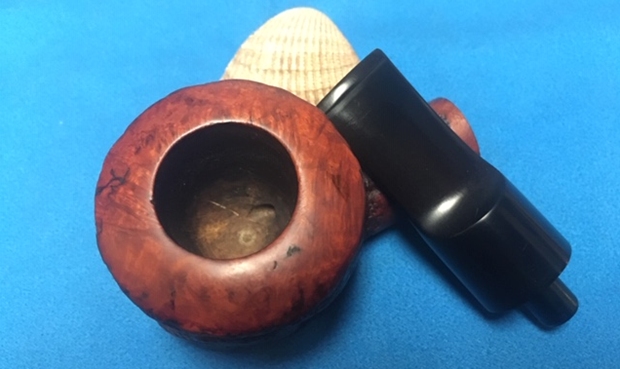
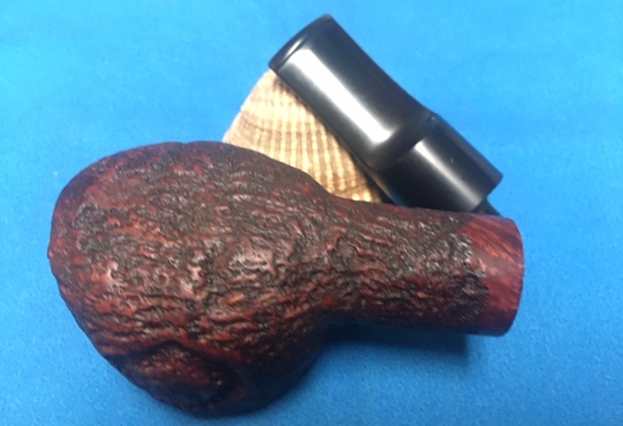
Wow!  With Paresh’s help, I think I nailed it!  The depth and richness of this blasted finish has that ‘Dunhill’ look to it I believe.  Thanks, Paresh!  The blasted landscape of this Heritage Antique Blasted Apple jumps out with the 3-dimensional contours of the briar grain contours.  I can’t get over the red notes in the finish – it gives it a depth and richness that is something to enjoy.  The technical challenges with the rim repairs and stem patches turned out great.  I’m pleased with this restoration and Todd, who commissioned it, will have the first opportunity in The Pipe Steward Store to acquire the Heritage Antique benefiting the Daughters of Bulgaria – women and girls who have been trafficked and sexually exploited.  Thanks for joining me!