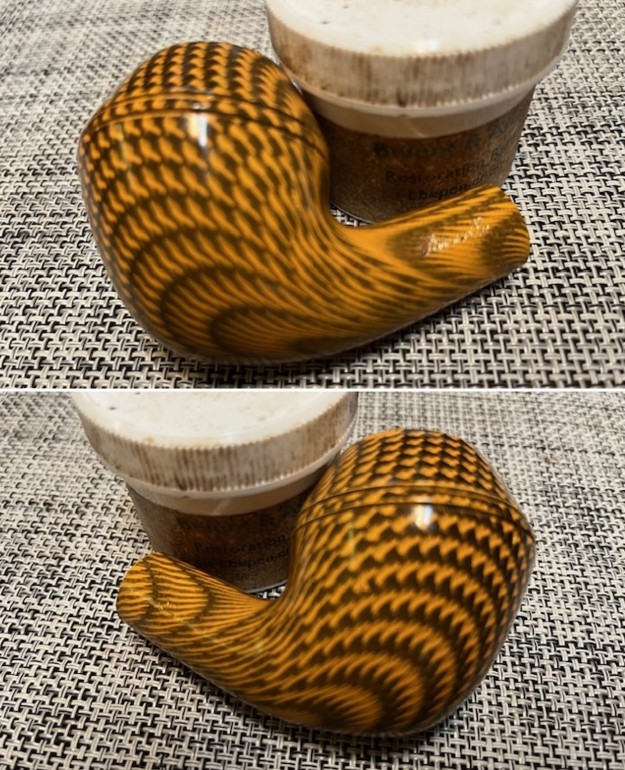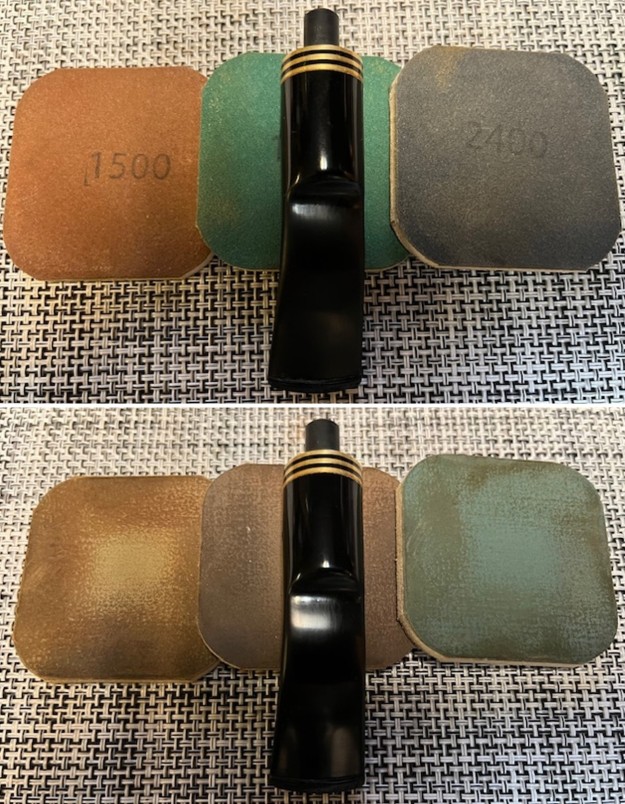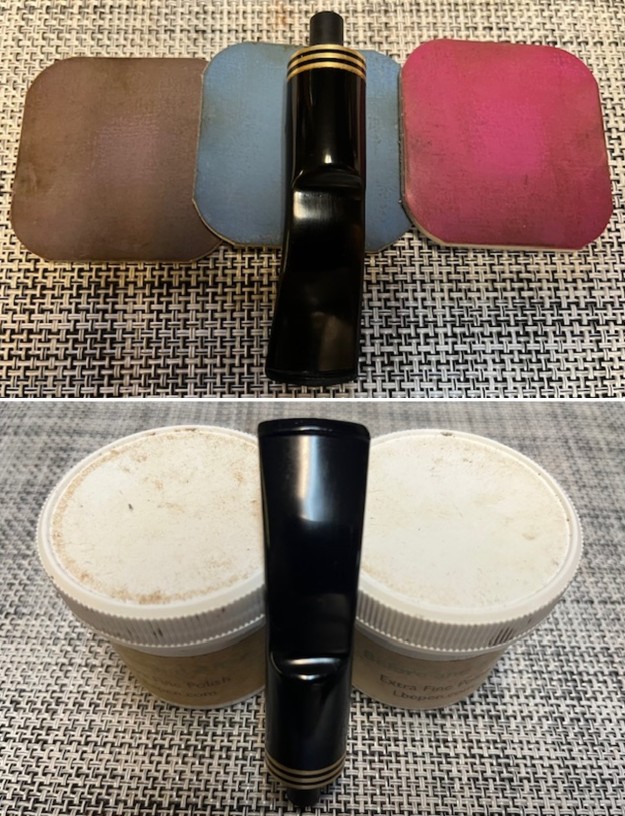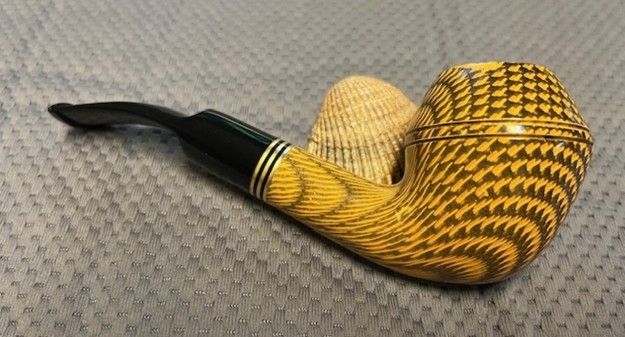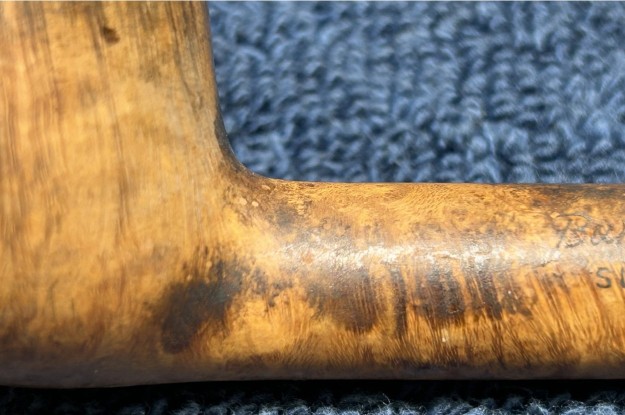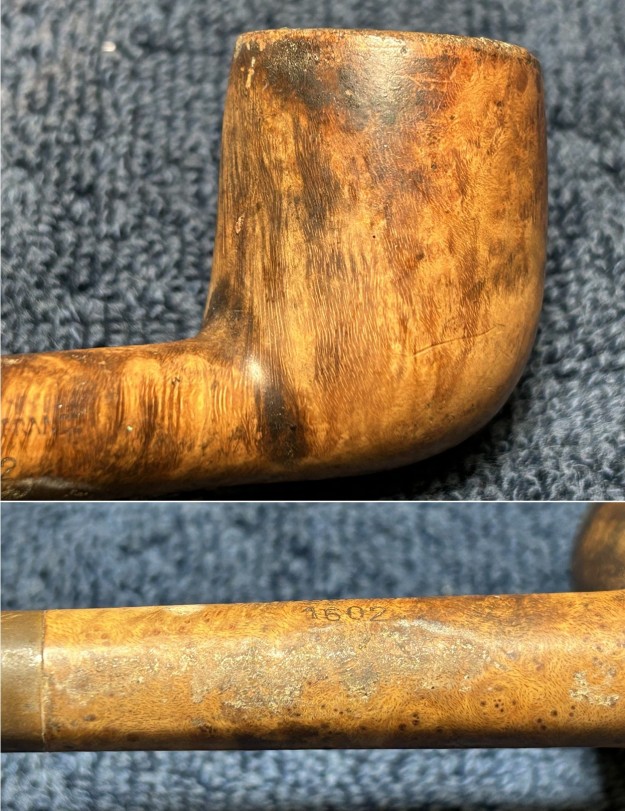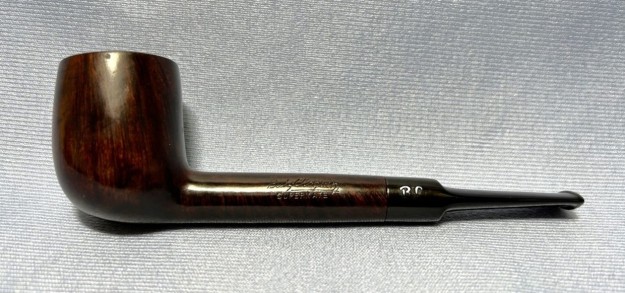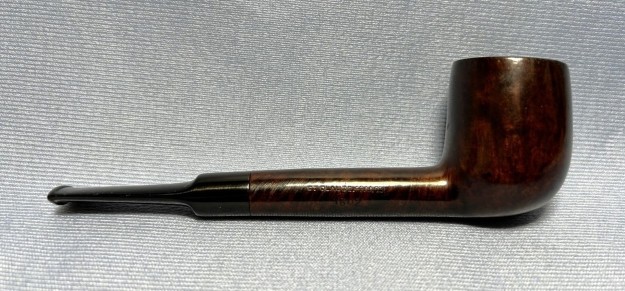
Tag Archives: contrast staining

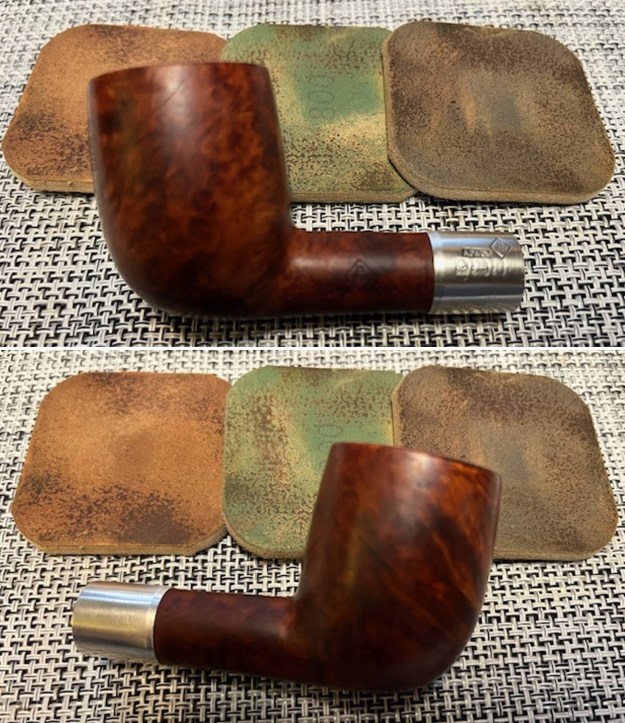
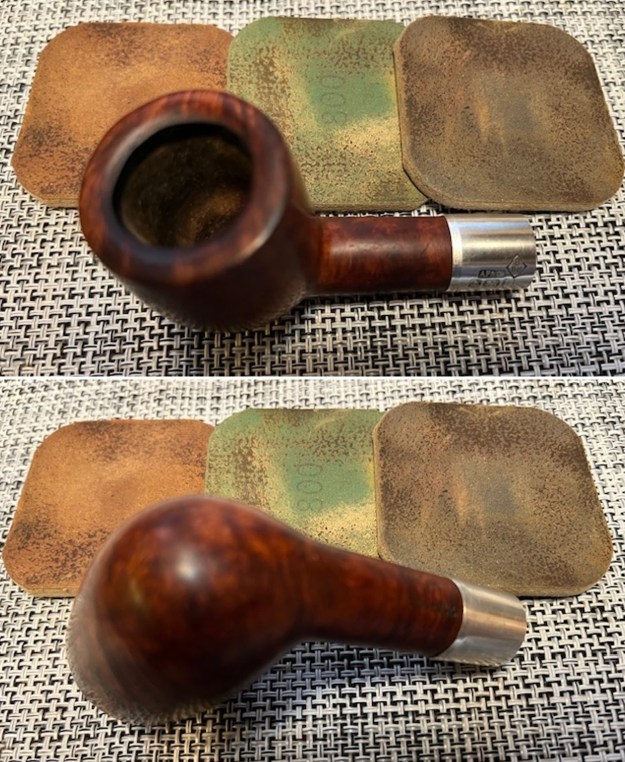
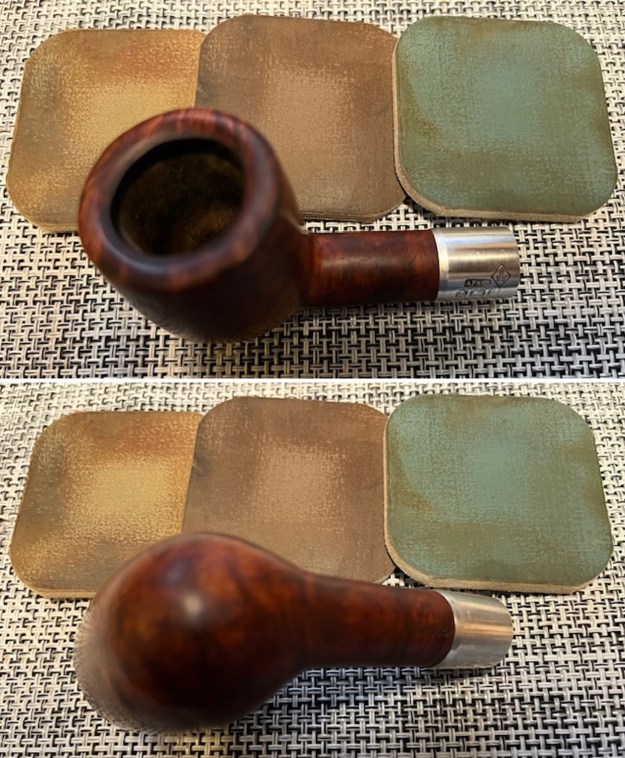
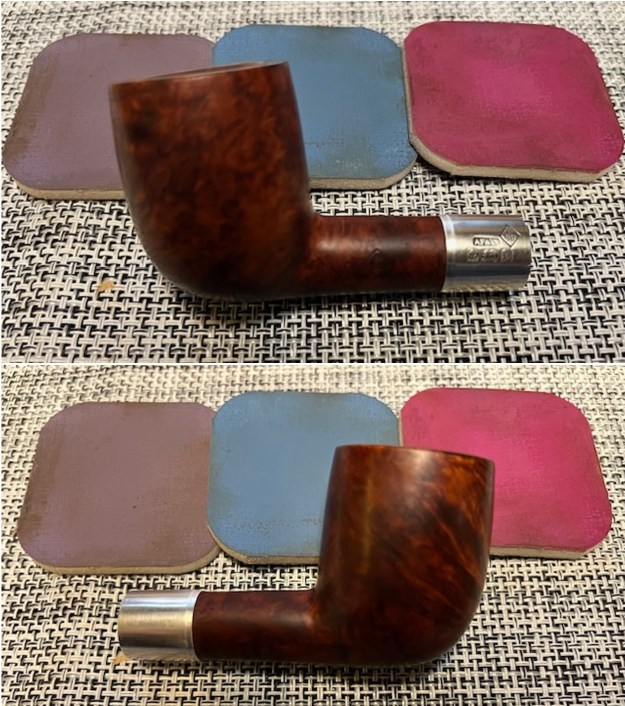
An Interesting Project : Resurrection Of a Pre-1920 KB&B Pembroke


Blog by Paresh Deshpande

The next pipe is stamped as “PEMBROKE” over KB & B” on the left shank surface and came to me as part of inherited pipes that predominantly constituted pipes from various English brands, most notably LOEWE, BBB, COMOY’S, PETERSON’S, BARLING’S etcetera. However, this lot did also contain many pipes from American pipe makers like WDC, KB & B/ KAYWOODIE and others. I have researched and worked on a few of the KAYWOODIE pipes from this collection and recollect that KB & B changed their name to KAYWOODIE in 1920s to promote their Kaywoodie line of pipes or was it for some other reason? For clarification and recollection of history of this renowned brand from USA, I re-read the history from https://pipedia.org/wiki/Kaufmann_Bros._%26_Bondy#Brands and have only reproduced that information that helps to date the pipe:-

Early History

Kaufmann Bros. & Bondy (KB&B), Kaywoodie has been making pipes since well before the Civil War – around 1851. They peaked in the late 1950’s along with most American Briar works. In the early 20th century, their pipes were the standard others were measured by, along with SasieniCharatan and Comoy’s. There were few other world-class American pipe-crafters (William Demuth Company, early L & H Stern). Their pipes were as good as any of the renowned British firms. Kaywoodie just did not merely produce quantity, they provided quality: in the 1920’s they bought the exclusive rights to some of the choicest briar fields in history, hauling out 250 year-old roots the size of 27″ TVs and fashioning masterpieces out of this spectacular-grained ancient briar.

Early KB&B (non Kaywoodie)

Kaywoodie was the name a pipe offered by Kaufmann Bros. & Bondy Company (KB&B), first appearing in February of 1919.

The origin of the name Kaywoodie is a combination of the K from Kaufmann and wood, as in briar. Not much is known of the original KB&B company other than it was started in 1851 by the German born Kaufmann brothers when they opened a small pipe shop in the Bowery section of New York City.

When one of the men from the New York office got “gold fever” he carried a large supply of pipes with him to California that he sold along the way. This early “national distribution” did much to build the reputation of KB&B. By the late 1800’s, branches of KB&B were opened in Chicago, Atlanta, San Francisco and St. Louis with family and friends acting as agents. The trademarks, for the inlaid cloverleaf and the cloverleaf with the KB&B initials inside, were issued in 1881.

Pre-Kaywoodie KB&B

According to Hackert, the firm of Kaufmann Bros. & Bondy (KB&B) began producing the Kaywoodie Pipe in 1915.

Business thrived and in 1854 the Kaufmanns took in a partner named Bondy. … The three partners retired in 1898, but their relatives continued on with the firm, which had begun to manufacture their own briar pipes under the KB&B trademark. In 1915 the Kaywoodie brand was created as a marketing umbrella for a new briar pipe which the KB&B Company introduced. …”

Hacker concludes his history of Kaywoodie Pipes by noting that: “The KB&B briar pipe brand existed from 1900 until just after World War I (with some overlapping with the Kaywoodie from 1915 — 1917), and collectors refer to the KB&B as a Kaywoodie transition pipe.

The pre-Kaywoodie KB&B pipes were marked on the shank with a cloverleaf around KB&B. 

In March of 1955, when S.M. Frank & Co. Inc. bought Kaufmann Bros. & Bondy, The Kaywoodie Company, Reiss-Premier Corp., The New England Briar Pipe Co. and – of course – Yello-Bole.

Thus, comparing literature notes with the stampings as seen on the pipe that I am working on, I am certain that it dates as to being pre- 1920. Another pointer is the orific slot which was gradually replaced by more elliptical slot from 1920 and progressed further to the horizontal slot that we see on pipes today.

Here are the pictures of the stampings as seen on the PEMBROKE: Initial Visual Inspection
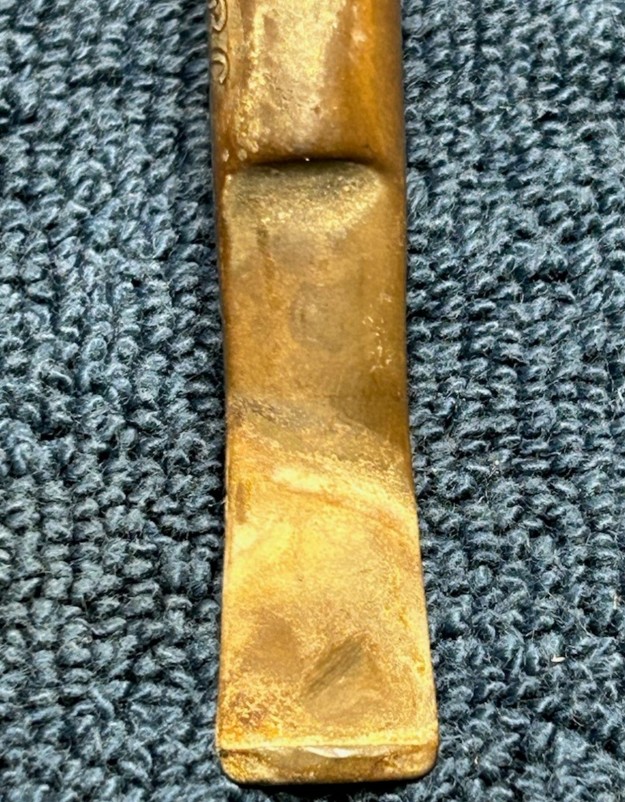
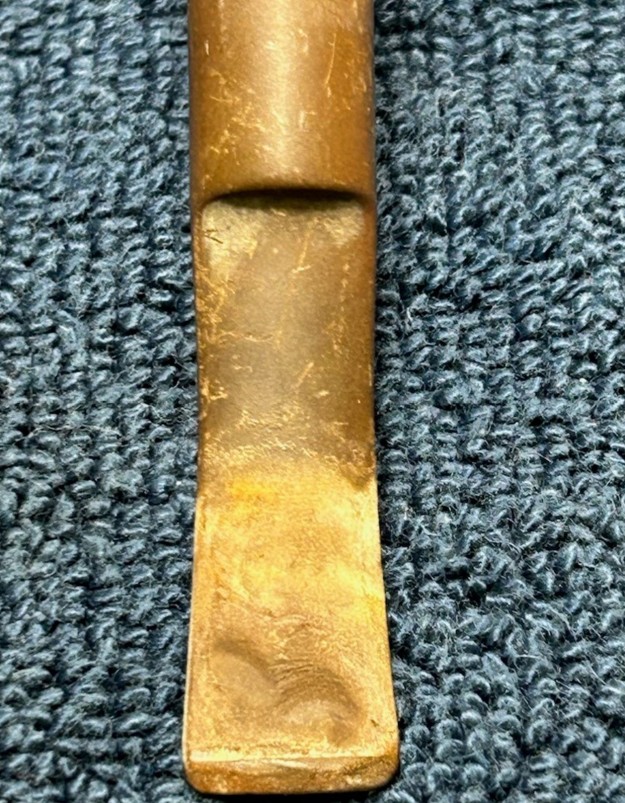
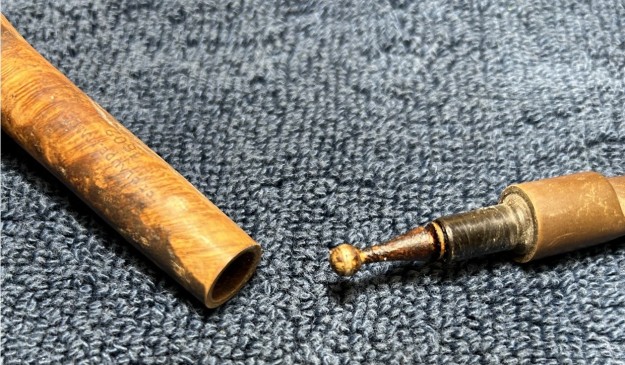
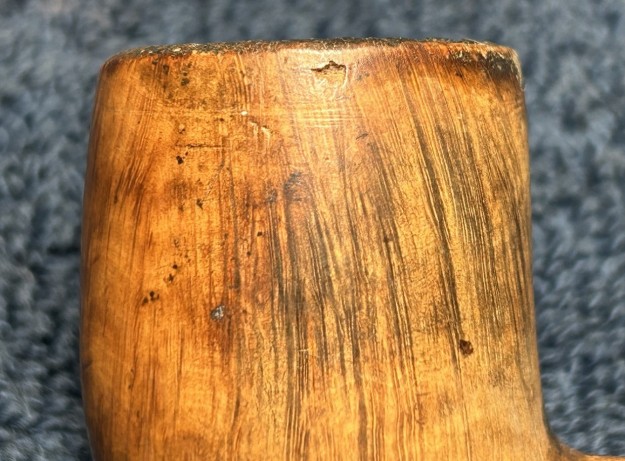
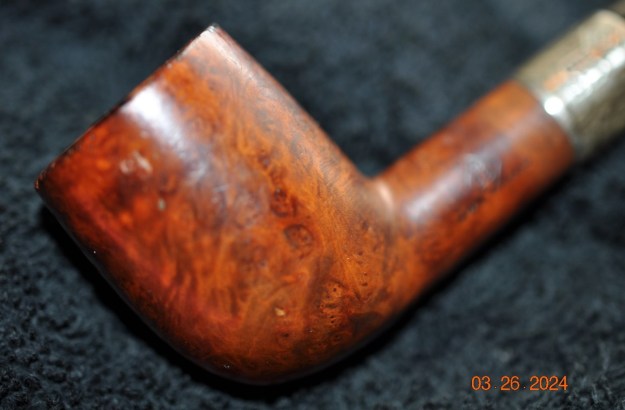
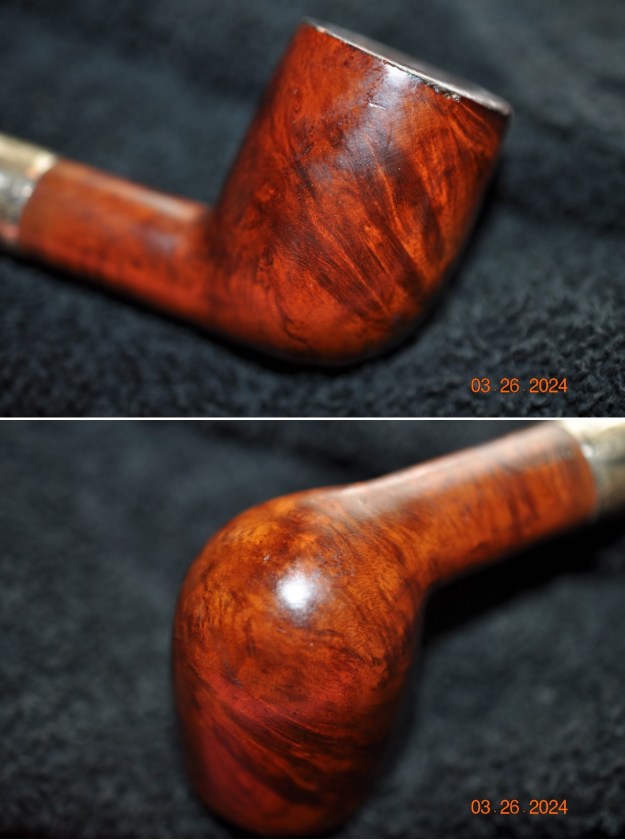
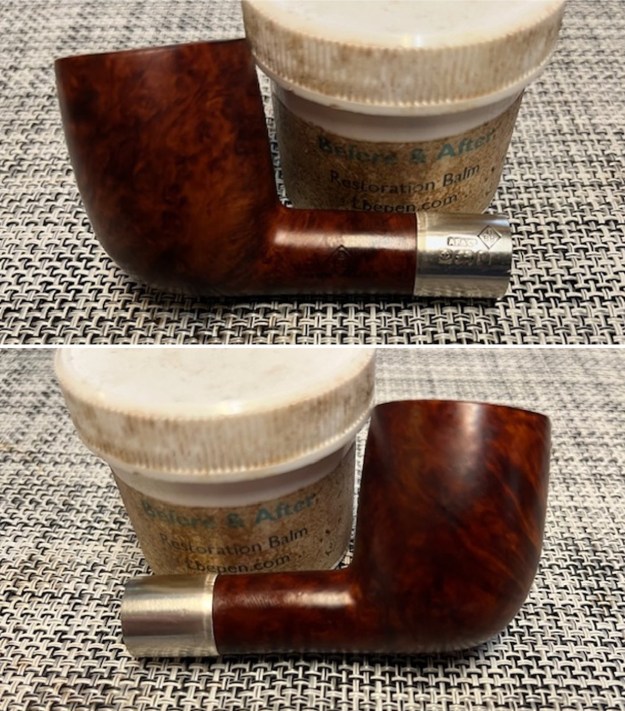
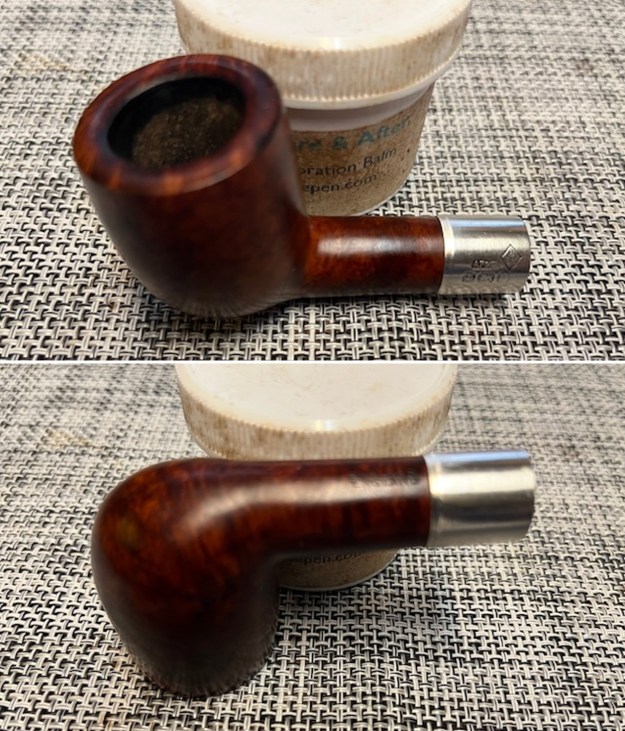
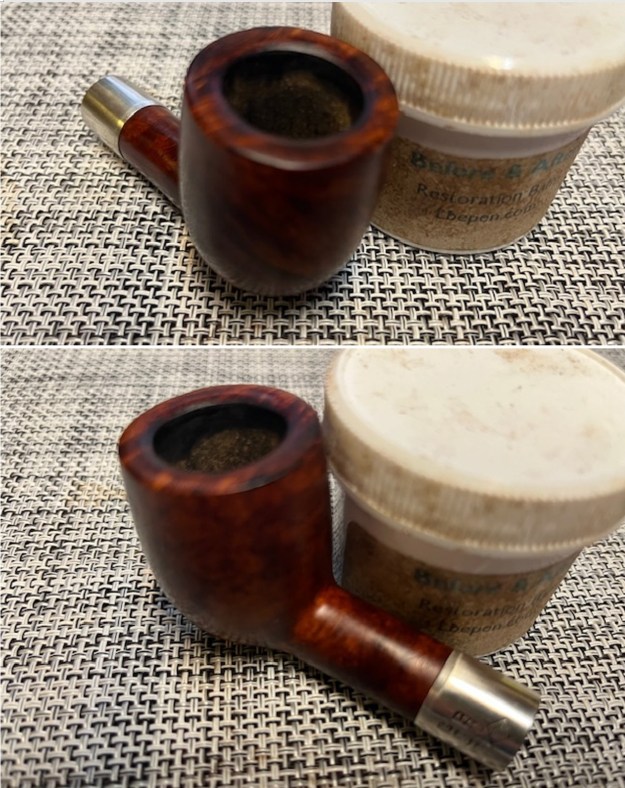
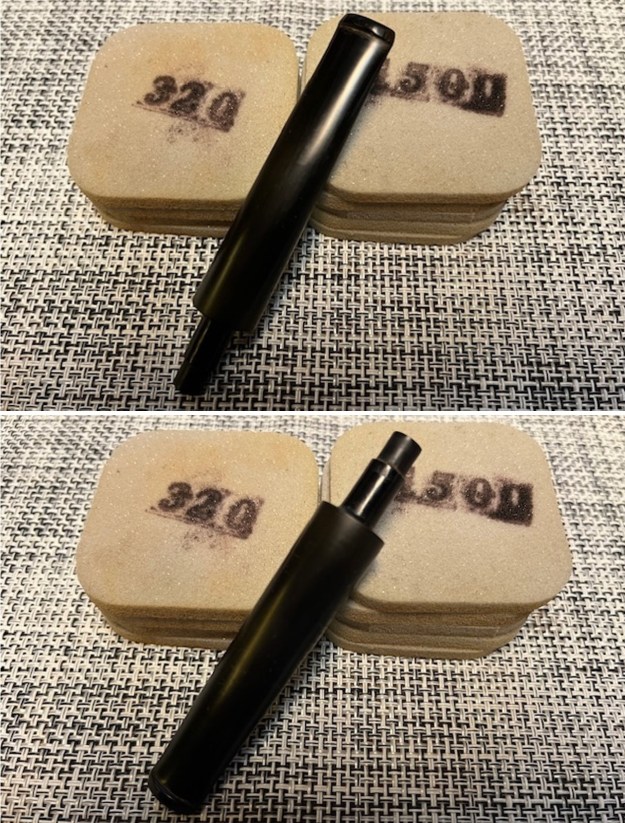
The PEMBROKE, currently on my worktable, is a medium sized classic bent billiards with a decent sized bowl in dark reddish brown color. The well seasoned briar is covered in dirt, dust and grime from decades of use. There are a couple of deep scratches on the stummel surface. There is a thick cake in the chamber with heavy overflow of cake, oils and tars over the rim top surface. The inner rim edge is uneven and charred. The outer rim edge, likewise, is peppered with dents and dings. The high quality hard rubber stem is oxidized with flattened bite zone on either surfaces of the stem. The tenon has a narrow extension at the end and is covered in dried oils and tars. The round orifice slot is similarly clogged with dried gunk. The stem does sit flush with the shank face and the seating is too damn tight within the mortise. Following pictures will give the readers a general idea of the condition of the pipe before I start to work on the pipe. Detailed Inspection
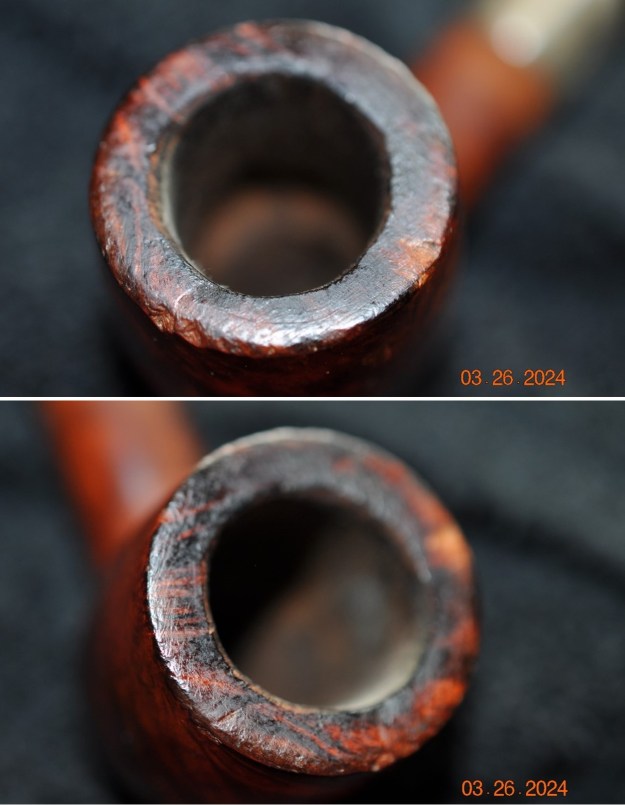
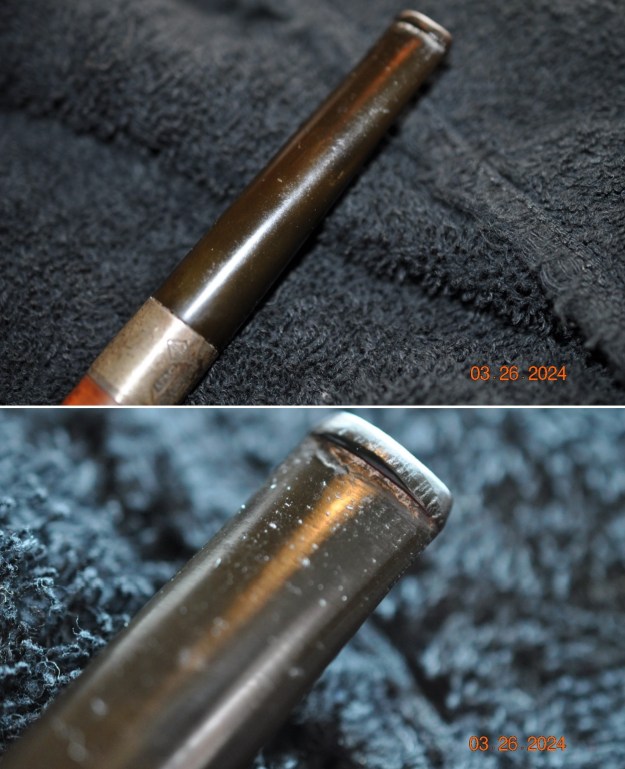
The chamber has a thick hard cake that has spilled over the rim top surface. The cake is thicker around the upper half of the chamber. The outer rim edge has dents and dings all around but is most severely damaged along the front half portion (encircled in yellow), a damage that can result only due to repeated strikes against a hard edged surface. The inner rim edge, prime facie, is sans any damage. The condition of the inner walls of the chamber can be commented upon after the cake has been taken down to the bare briar. There is a strong ghost smell in the chamber which is all pervading. There are remnants of un-burnt tobacco at the bottom of the chamber.The stummel surface is covered in dust, dirt and grime giving a dull, lifeless and lackluster appearance to the pipe. However, the briar has taken on a nice dark patina which has been a result of more than 100 years of usage and would be worth preserving. However, eliminating/ addressing the deep scratches (encircled in green) on both side of the stummel and the few dents and dings would entail sacrificing the patina. This is a call that I would need to take at some stage in the restoration process. The mortise is chock-a-block with old oils, tars, ashes and grime making for a laboured draw. The thick cake and blocked mortise hides the draught hole from the view. These issues need to be addressed. The high quality hard rubber stem is deeply oxidized. The unique feature of the stem is that the stem surface is flattened in the bite zone on either surface with defined cut edges. Now, the question that came to my mind was if these flattened surfaces were original to the stem or carved out by the piper who owned it, probably for ease of clenching? Well, to me it appears that this unique carving of the bite zone is machined and not handmade since the edges are too well defined and sharp to be handmade using home tools. But that the flattening of the bite zone makes it comfortable for clenching is unquestionable. There are no significant bite marks or chatter in the bite zone or over the button edges. The orifice slot shows dried accumulated oils and tars that would need to be cleaned. The tenon has a stepped hard rubber (?) extension similar in shape to the ones seen on Peterson’s Deluxe line of pipes. The tenon and extension too is covered in a thick layer of dried crud. The stem does not seat flush in the mortise and is fit is very tight. I think the seating issues would address itself once the tenon and mortise is cleaned.The Process
I began the repair and refurbishing process with reaming of the chamber. I reamed the chamber with head sizes 1 and 2 of the PipNet pipe reamer. I removed the carbon from the areas where the reamer head could not reach with my fabricated knife. To completely remove the residual carbon from the walls of the chamber and smooth out the walls, I sanded the chamber walls with a folded piece of 220 grit sandpaper followed by cleaning the chamber with a cotton swab wetted with isopropyl alcohol. The chamber walls are in pristine condition. I gently scrapped off the lava build up over the rim top using a sharp knife to avoid damage to the surface. I cleaned the mortise and shank walls of the pipe using dental tool. I scraped out the dried oils and tars from the walls of mortise and shank walls. The pile of crud that was scraped out is indicative to the amount of gunk that was lodged in the mortise and shank internal. At the end of this step, I still was not able to pass a pipe cleaner through the mortise. Out came one of the many modified tools in my arsenal and after some deft use of this poker, I was able to dislodge the blockage from within the mortise. I ran a bristled pipe cleaner and q-tip dipped in alcohol through the mortise and out through the draught hole further clearing the passage. I will continue this further cleaning during the course of refurbishing of this pipe.Next, I decided to subject the chamber and mortise to cotton and alcohol bath. I packed the chamber with cotton and drew out a wick from the cotton and along with a folded regular pipe cleaner, inserted it into the mortise and through the draught hole into the chamber. I tightly packed cotton balls into the remaining portion of the mortise. Thereafter, I soaked the cotton balls with isopropyl alcohol up to the brim. About half an hour later, the level of alcohol had gone down, having being absorbed by the cotton. I topped it up once again and set it aside overnight. By next afternoon, the cotton and alcohol had drawn out all the remaining oils and tars from the chamber and mortise. I removed the cotton balls and the dirt can be gauged by the appearance and coloration of the cotton balls and the pipe cleaner. I ran pipe cleaners through the mortise and draught hole to clean out all the loosened tars and gunk that was lodged in the draught hole and mortise. The chamber and mortise now smelled clean, fresh and looked it too. I set the stummel to dry out naturally.Once the internals of the chamber and shank were cleaned, I cleaned the external surface of the stummel with Murphy’s Oil soap and cotton swabs followed by scrubbing the surface with a toothbrush and dish washing soap. This rid the stummel surface of all the accumulated dust, dirt and grime. Using a piece of Scotch Brite scrub, I deliberately cleaned the rim top and removed the crud from the surface. The damage to the rim edges is now amply evident.Simultaneously, I also cleaned the shank internals with dish washing soap and a shank brush. I set the stummel aside to dry out naturally while I worked the stem.I began the process of refurbishing the stem by first scraping off the dried gunk from the tenon and tenon end extension using a sharp thin knife. I was careful not to damage or break the extension or the stem face. I cleaned the tenon extension with a cotton swab moistened with alcohol and ran a pipe cleaner through the airway to check if the airway was clear of any blockage. Fortunately, it was.Using thin shank brushes and anti-oil dish washing soap, I cleaned the stem airway. I have modified this process of cleaning the stem airway by doing away with pipe cleaners and alcohol as it saves me a ton of pipe cleaners, which is a precious commodity for me here in India. I continued this cleaning till only white clean foam came out of the stem airway, indicating that the airway was nice and clean. I ran a couple of pipe cleaners dipped in alcohol through the airway to dry it out and make sure that there are no traces of soap and gunk hidden in the airway. I also scrubbed the stem surface to remove surface oxidation and rubbed a small quantity of EVO in to the stem surface. Since there were no damages to the stem, I set it aside and shall return to polishing the stem after I am done with the stummel repairs.Next, I got around to addressing the rim top damage. The extent of the damage to the outer edge, caused due to banging against a hard surface, would necessitate heavy topping off of the rim surface, and I for one, absolutely wish to avoid any loss of briar. Also topping to the extent that was required to eliminate the dents/ dings and chipped areas would completely alter the original shape and symmetry of this pipe.  So, I planned on first filling up these dents and dings on the rim edge using briar dust and superglue to roughly match the surrounding intact rim surface and some more and then topping it to achieve a smooth even surface. Theoretically, this sounds logical.

I resorted to the layering method again; first I layered superglue along the damaged surfaces of the rim followed by sprinkling of briar dust, another layer of superglue followed by a final layer of briar dust. This final layer of briar dust reduces the probability of air pockets (or so I thought). In the second picture, you can see that the layering has not been done to the level of the rim surface but above the surrounding intact rim surface as I would be sanding the rim subsequently. I set the stummel aside to cure. I revisit the stummel the next evening after the repairs are completely cured and hard. Using flat needle files, I sand the repairs to achieve a rough match with the surrounding briar surface. Once I had achieved a rough match, I top the rim surface over a 220 grit sandpaper to even out the surface and achieve a perfectly even rim top surface. The inner and outer rim edges are still slightly uneven and shall be addressed next.To get the inner and out rim edges back to round, I created a bevel over the edges with a folded piece of 220 grit sand paper. I am pretty pleased with the progress being made thus far. It was now that I decided to address the numerous scratches over the stummel surface and the process of steaming these out is the best way forward. I assembled the items that are essential to this process; a wet Turkish towel, a knife and a candle. I heated my fabricated knife over the flame of the candle till it was really hot. I covered the scratched surface with the wet towel and placed the hot knife over it. The steam that is generated expands the briar raising the scratches to the surface. I repeated the process over the areas till the issue of scratches was addressed over the entire stummel surface. Though these scratches were pulled to the surface, I would still need to sand the stummel to eliminate them.Using a folded piece of 220 grit sandpaper, I sand the scratched surfaces till these were completely eliminated. I followed the 220 grit sandpaper by sanding the surface with a piece of 800 grit sandpaper. However, here I also realized that this also resulted in losing the patina that I so dearly wanted to preserve. You win some and lose some, that’s how it always is!To further clean and highlight the grains, I sand the stummel with micromesh pads, wet sanding with 1500 to 12000 grit pads. I wiped the stummel after each wet pad with a moist cloth to remove the resulting dust and note the progress being made. I rub a small quantity of “Before and After Restoration Balm” in to briar and let it rest for a few minutes. The balm almost immediately works its magic and the briar now has a nice vibrant appearance. I further buff it with a horse hair shoe brush. I set the bowl aside and took to working on the stem. I once again cleaned the stem surface using the Scotch Brite sponge and followed it up by a scrub with 0000 grade steel wool. This helps in further removing the oxidation from the surface. I also ran a thin shank brush through the stem airway to ensure that it was clean and clear of all the soap deposits. I rubbed the stem with some EVO to hydrate the surface.To impart a deep black shine to the stem while getting rid of the oxidation from the stem surface, I wet sand the stem surface with 400, 600, 800, 1000, 1500 and 2000 grit sand papers. I again rub the surface with some EVO to hydrate the stem and prevent oxidation from again creeping over the surface due to exposure to natural elements and set the stem aside.To bring a deep shine to the hard rubber stem, I polished the stem, wet sanding with 1500 to 12000 grit micromesh pads. I rubbed it down with Extra Virgin Olive oil to rejuvenate the hard rubber. The finished stem is shown below.With the stem refurbishing nearly completed, I took a long hard look at the stummel now bereft of the patina and the original dark reddish brown stain. I discussed with Abha about the difference in the appearance of the stummel at this stage in restoration from the way it appeared at the start. The unanimous decision was to stain the stummel to its original color or as close to it as possible and with the decision made; I decided to stain wash the stummel using Feibing’s Cordovan leather dye.

Using a heat gun, I warm the stummel to open the pores in the surface to accept the stain. I mix a small amount of alcohol with the dye to dilute it and apply it over the heated surface with a folded pipe cleaner. I set the stain by flaming it with the flame of a lighter as I went ahead to different self designated zones of the surface. This helps in the setting of the stain into the grain of the briar and set the stummel aside. The next evening, approximately 18 hours later, as Dal describes, I began to unwrap the stain in the hope to see beautiful grains. I mount a felt cloth buffing wheel on my hand held rotary tool and setting the tool at its slowest speed, I began to peel off the stain from the stummel surface first using Red compound. The stain was peeled out gradually revealing a nice shining surface and grains underneath the stain.Next, I mount a fresh felt cloth buffing wheel and polish the stummel with White Diamond compound. This further lightens the stain, highlighting the grains while imparting a nice shine to the stummel surface. The similar coloration achieved at this stage to the original color, uplifted my spirits sky high. I shall continue the polishing regime further using Blue diamond and finish off with carnauba wax polish.I have now reached the homestretch in this restoration project. To complete the restoration, I mount a cotton cloth buffing wheel on to my hand held rotary tool and polished the stummel and stem with Blue Diamond compound. This compound helps to remove the minor scratch marks that remain from the sanding while further highlighting the grain and lightening the stain. I mount another cotton buffing wheel that I have earmarked for carnauba wax and applied several coats of the wax. I finished the restoration by giving the entire pipe a rigorous hand buffing using a microfiber cloth to raise the shine further. The finished pipe looks amazingly beautiful and with the Cordovan stain, as good as original. In fact, the pipe looks much more endearing and beautiful in person than it does in the pictures below. It shall find a place of pride in my “American pipe makers” section of my personal collection. P.S. – This then is one project which has given me greatest of satisfaction that I have experienced after it’s completion.

I am not too concerned with successes or failures of any project. What matters to me is the journey.

Resurrecting a Stanwell Royal Silver #214 Following A Duped Deal


Blog by Paresh Deshpande

Stanwell pipes have always been one of my favourites and I seldom miss an opportunity to lay my hands on one whenever I come across a good deal, especially the older early era ones. These are some of the best factory-made pipes coming out of Denmark. Most of the Readers are more than aware of the history of these pipes; however, I feel it is prudent to reintroduce a brief history of this brand to refresh the memory. Pipedia.org (https://pipedia.org/wiki/Stanwell) has an excellent compilation of the brand’s history, picture gallery, various lines etc and a few important pieces of information has been produced from this site.

When pipe smokers talk about pipes that are consistently great smokers, exhibit the creative and beautiful designs that exemplify Danish pipemaking and offer the best value in factory produced pipes, they are talking about Stanwell. We hear time and time again, from customers and top pipe makers from around the world, that Stanwell is the best factory produced pipe in the world. During WWII, Danish pipe smokers could no longer buy the English made briar pipes they preferred to smoke. In 1942, because of the unavailability of English pipes and raw briar, Poul Nielsen began making pipes from beech wood for Danish customers. At the time, Poul was managing a company called Kyringe, which made various wood products.

At the end of the war, briar became available again, so Nielsen began importing his own briar and started making briar pipes to compete with the English manufacturers. It must be remembered that in 1948, England was the single great center for pipe making. Therefore, Nielsen changed the name of his pipes to “Stanwell”, which sounded much more like a proper English name than “Nielsen”. He also created the horse drawn carriage logo for its English connotations. He later changed his own last name from Nielsen to Stanwell, a testament to his devotion to the pipes he made. Stanwell’s relationships with Danish pipe makers goes back to Sixten Ivarsson, who is considered the originator of modern Danish pipe making. Ivarsson was commissioned to design Stanwell shapes. In 1969, the factory was moved a town called Borup, just outside of Copenhagen to be closer to Ivarsson.

Stanwell relies on designs from the great Danish pipe makers, from Sixten Ivarsson to Jess Chonowitsch from which they create their hundreds of shapes. Since most sandblasting for Danish pipemakers is done at the Stanwell factory (Stanwell has a reputation for excellence in sandblasting that is used by many, many Danish carvers from Poul Winslow to Jess Chonowitsch), many of the pipes that they sandblast are then observed and used as starting points for Stanwell shapes with the consent of the original carvers. This interesting and unusual symbiotic relationship gives Stanwell the opportunity to offer hundreds of unusual and interesting shapes at an affordable price. Once a new shape is established and hand carved, it is then reproduced using a lathe. Following the initial carving of the pipe which is done by machine, all other processes are done by hand, from the final sanding and staining to the application of the wax finish. There are approximately 120 manual steps to Stanwell’s pipe making process. The Stanwell factory is arguably the most efficient pipe operation in the world. It is this efficiency that has made Stanwell so remarkably price competitive and able to offer pieces of superior quality to those created by other large factories.

Essentially the goal of Stanwell is, and always has been, to produce high quality pipes at a price that is truly within the reach of the common man. In this they have succeeded admirably, offering perhaps more pipe for the money than any other pipe manufacturer in their price range. Stanwell pipe offers exceptional quality at a remarkably affordable price.

Stanwell pipes are a must for any pipe collection. The Stanwell name is a cornerstone of Danish pipe making. In owning a Stanwell, you will not only enjoy beautifully styled, great smoking pipe at a great price, you will own a piece of pipe making history.

Pricing on top models – mid to late 1980s

  • Golden Contrast 600 DKK.
  • Silver S 600 DKK.
  • Hand Cut, sandblasted 1200 DKK.
  • Hand Cut, smooth 1500 DKK.

Another important aspect of Stanwell pipes is the determination of designers of a particular pipe that is well documented with the help of shape numbers. This pipe has the shape number #214 and from a visit to the under mentioned site it is determined that this pipe is classified as a freehand but without any designer specified.

https://pipedia.org/wiki/Stanwell_Shape_Numbers_and_Designers

  • 210 Sixtus, with hexagon stem and mouthpiece, brass ring, Pot by Tom Eltang.
  • 211 Sixtus, with hexagon stem and mouthpiece, brass ring, Freehand by Tom Eltang.
  • 212 Sixtus, with hexagon stem and mouthpiece, brass ring, Freehand by Tom Eltang.
  • 213Sixtus, with hexagon stem and mouthpiece, brass ring, Freehand by Tom Eltang.
  • 214 Freehand, slightly bent, square stem and mouthpiece.
  • 215 Freehand, slightly bent, triangular stem, saddle mouthpiece by Poul Ilsted.
  • 216 Zulu with tapered stem, by Tom Eltang.

This pipe came to me from eBay.com as one of the lot of four pipes, three Stanwells and one Vauen pipe in a pipe bag, from a Germany based Seller. The following pictures were uploaded by the seller with no description at all and based on which I had made my decision to purchase it.Once these pipes reached me here in India, I was aghast to note that each of the pipes had one or the other serious major damage which will be brought out as I work on each of these pipes. This was another sour deal on eBay!!

The first pipe from this lot that I decided to work on is what I consider being a variation of the horn shape but described as a freehand in Stanwell’s shape charts as brought out before and is from the late 1980s. It is stamped as “STANWELL” over “MADE IN DENMARK” over “ROYAL SILVER” on the left panel of the square shank while the right panel is stamped with the shape number “#214”. The stem bears the trademark “S” with a crown in silver. Initial Visual Inspection
This horn shaped Stanwell has many things going in its favor; be it the shape that is eye-catching with paneled surfaces, a size that feels perfect to hold, light weight, quality acrylic stem and capable of housing a 9 mm filter for those who prefer them. A thick layer of cake is seen in the chamber. The rim top and edges are clean with no lava overflow or evident signs of charring. The four paneled stummel is clean and the reddish hued stain makes it a looker! However, I have noticed a darkened spot (encircled in yellow) over the front panel towards the foot and that could potentially be bad news (read a burnout). The mortise has minute traces of old oils and tars, but the airflow is smooth and open. The thin white metallic band (or is it silver?) at the shank end lends the pipe a classy bling. The acrylic black stem is in good condition. The tenon housing for 9 mm filter is clean and so it the horizontal slot. Overall, save for the dark spot over the stummel surface, the condition of the pipe is good. Detailed Visual Inspection
The chamber has a thick, hard and uneven layer of cake. The upper portion of the cake is slightly thicker than at the heel. I am curious to know the condition of the chamber walls, more so the area corresponding to the dark area observed over the stummel surface but that will have to wait till the cake is removed and the walls are exposed. The inner edge is uneven (encircled in green) but not charred. This could be a result of reaming using a sharp knife edge. The rim top surface is clean with no damage or crud accumulation.The stummel has been carved out of a beautiful piece of briar and in true quality assurance that Stanwell is so well known for. The four panelled stummel with square shank has cross grains on either side with mixed grain to the front and aft of the surface. The surface is clean and sans any dents or dings and grime. The red stain with a shank end band contrasts beautifully with the black acrylic stem. The only cause of concern is the dark area seen to the front of the stummel and is highlighted by an encircled yellow. The spot within this darkened area (encircled in orange), so to speak, is the eye of the damaged area. Now, this could just be a darkening of the surface due to a burning cigarette placed in proximity of the pipe or it could be the beginning of through burnout and the clue for the exact reason lies within the chamber walls. However, the dark area feels no different from the rest of the surface…or not? The mortise is clean with just minor traces of old dried oils and tars over the mortise walls. The square silver (?) band at the shank end is dull and would benefit from a nice polish. The square faced acrylic stem contrasts with the red stained stummel surface adding an attractive eye candy affect to the overall appearance of the pipe. The buttons in particular and the bite zone in general, is sans any tooth indentations or scratches. The tenon houses a 9 mm filter and shows minor accumulation of oils and grime, ditto for the horizontal slot. The stem logo of silver letter S with a crown atop is slightly oxidized, but otherwise in pristine condition.The Process
The first step in restoring this particular pipe was the cleaning of the chamber. I began the process of refurbishing this pipe by reaming the chamber with a PipNet reamer tool, using the first and second head. Using my fabricated knife; I further took the cake down to the bare briar. That the cake was thick and hard made this cleaning a lot difficult and a long drawn affair. With a folded piece of 180 grit sandpaper, I took the cake down to the bare briar and also smoothened the chamber walls. A final wipe with a cotton swab moistened with isopropyl alcohol removed the carbon dust from the chamber. I had expected that any damage to walls of the chamber would reveal itself at this stage. However, I could not decipher any prominent damage corresponding with the dark area seen on the outer surface. I decided to subject the chamber to a cotton and alcohol bath in the hope that the damage, if any, would reveal itself in the form of seepage of the alcohol or deep heat lines/ fissures.Moving on to deeper cleaning of the chamber and the mortise in an attempt to highlight any damage to the chamber walls… I subjected the chamber to a cotton and alcohol bath. I draw out a wick from the cotton and along with a folded regular pipe cleaner; insert it in to the mortise and through the draught hole in to the chamber. Thereafter, I pack the chamber with cotton balls to about quarter of an inch below the rim inner edge and soak the cotton balls with isopropyl alcohol up to the brim. About half an hour later, the level of alcohol had gone down, having being absorbed by the cotton. It was here that I anticipated seeing seepage to the front of the stummel through what I have assumed to be a burnout. However, this did not happen. Also even at this stage I did not feel any give in the briar in the darkened area as compared to the rest of the stummel surface.  I topped it up once again with alcohol and set it aside overnight. By next afternoon, the cotton and alcohol had drawn out all the remaining oils and tars from the chamber and mortise, fulfilling its intended task. I removed the cotton balls and ran pipe cleaners through the mortise to clean out all the loosened tars and gunk. I set it aside to dry out naturally.Next, I decided to clean the exterior surface of the stummel. I had also hoped that further cleaning of the stummel would reveal the extent of damage or otherwise lurking beneath the darkened area. I used a hard bristled tooth brush and Murphy’s oil Soap, to scrub the stummel, chamber walls and rim top. I washed the stummel under running warm water with anti oil dish washing detergent till the stummel surface was clean. I simultaneously cleaned the shank internals with the detergent and hard bristled shank brush and dried it using paper towels and soft cotton cloth. At this stage in restoration, I still could not fathom the nature and cause of the dark area. I was still not clear if the dark spot was an indicator of the beginning of a burnout or was it just a superficial darkening of the surface. I turned to Steve to seek his advice and sent him pictures of the suspected damaged area. He enquired if the spot was a little soft to the feel or did it sound any different when tapped with finger nail as compared to the rest of the surface. I tried and couldn’t notice any change. Here Steve suggested that I thoroughly clean the darkened spot with oxalic acid. If it is just a superficial burn, oxalic acid would lighten it and reveal the exact condition and that is exactly what I did. When I was done with this step, I shared pictures of the result with Steve. He pointed out that it appeared that the center of the dark spot (encircled in red) maybe damaged and to confirm the same by tapping the area with a screw driver or some such hard tool.As discussed with Steve, I tapped the suspected damaged area, lightly at first and then a bit more firmly and the briar gave way leaving behind a gaping hole. I used a needle file to remove the charred briar from around the burned out spot. I continued to remove the charred briar around using rounded needle file till I reached solid intact hard wood. Now that all the charred briar wood was removed, it was necessary to smooth out the edges of the burned out area to ensure an even round hole for a snug fitting briar plug. I fine tuned the rounded hole at the foot of the stummel using 180 grit sandpaper wound around a thin bamboo dowel. Next, I cut a suitably sized block of briar to be shaped into a plug using a small hacksaw blade.Using a sanding drum mounted on a rotary tool, I roughly shaped the plug that would fit into the foot of the stummel. I deliberately left the top of the plug duly flanged (indicated with blue arrows). The general idea was to push the plug from inside the chamber to the outside so that the plug flanges will sit over the remaining intact heel of the chamber forming a new heel with the rest of the plug protruding outwards of the foot of the stummel. With the rough shape of the plug completed, I began the process of fine tuning the fit of the plug to seat snugly in to the hole at the foot of the stummel. Using a flat head needle file and a folded piece of 180 grit sandpaper, I sand down the plug and its flanges checking frequently for the fit in to the hole. I avoided further sanding of the plug once I reached the stage where with a tap of a small hammer, the plug sat firmly in to the hole with no gaps. The plug flanges are also covering the hole at the heel of the chamber (indicated by yellow arrows). To fix the briar plug in to the heel of the chamber, I decided to apply a layer of JB Weld to the bottom of the entire heel. J B Weld is a two-part epoxy Cold Weld that consists of two parts; hardener and steel which are mixed in equal parts in a ratio of 1:1 with hardening time of 5-6 minutes and complete curing time of 6-8 hours. I poured the contents of the two tubes and mixed it well. With a flat bamboo frond, I applied this mix over the heel of the chamber from inside. I turned the bowl over and filled the minor gaps between the briar plug and the adjoining stummel surface with the J B Weld mix and set the stummel aside for the epoxy to cure overnight.  By evening when I continued my work on this pipe, the J B Weld had cured completely. Using my hand held rotary tool mounted with a 150 grit sanding drum, I sand down the plug from the foot (outside) and heel (inside) of the stummel and achieved a rough match with the surrounding surface. I further matched the plug with the rest of the stummel foot with a flat head needle file. I perfectly matched the plug with the rest of the surrounding surface, both inside and out, by sanding with a folded piece of 180 grit sandpaper. The plug is now flush with the foot of the stummel while the flanges of the plug provide additional support to the plug from within the chamber. I had reached that stage in restoration where an important decision was required to be taken which would affect the aesthetics of the pipe. To blend in the repair, I had an option of staining the entire pipe red or to rusticate only the front panel of the stummel right up to the shank end and further stain this rusticated panel in contrasting black/ dark brown. I discussed this step with Abha and she was of the opinion that a perfect geometrical pattern does go with the flow of the shape and recommended a complete rustication of only the front panel followed by the contrasting stain.

To rusticate, I firmly held the stummel in my left hand and with my right hand and began gouging out the briar. The technique is to firmly press the pointed four prongs of the modified Philips screwdriver into the surface, rotate and gouge out the removed chunk of briar. I worked diligently till I was satisfied with the rustications and the appearance of the stummel. I cleaned the debris off the rusticated surface with a brass wired brush. The high points in the rustications were lightly sanded down using a piece of 220 grit sandpaper.Next, I polished the stummel using micromesh pads, wet sanding with 1500 to 12000 grit pads. I also polished the high spots in the rustication with the micromesh pads. I wiped the bowl with a moist cloth after each pad to clean the surface. I rubbed a small quantity of “Before and After Restoration Balm” into the briar with my finger tips but not in to the rusticated surface. The balm almost immediately works its magic and the briar now has a nice vibrant appearance over the smooth surface with the beautiful grain patterns on full display on the smooth surface of the stummel. I further buffed it with a horse hair shoe brush. The rusticated part of the stummel is now ready for a fresh coat of stain. I had decided to stain the rusticated surface with a black dye which would contrast beautifully with the red of the rest of the smooth surface. I heated the rusticated portion with my heat gun to open up the pores on the stummel so that the stain is well absorbed. I used Fiebing’s aniline black leather dye and liberally applied it over the heated surface, flaming it with the flame of a lighter. This helps in the setting of the stain in the grain of the briar. I ensured that every inch of the rusticated surface was coated with the dye while the smooth surfaces are not stained. I set the stummel aside for a day to set the dye into the briar surface.Once the stain had set, to highlight the contrast of the high points in the rustication, I lightly sanded the high points with a worn out piece of 180 grit sandpaper followed by dry sanding with 1500 to 12000 grit micromesh pads to polish the high points. I rubbed a small quantity of “Before and After Restoration Balm” with my finger tips deep into the nooks and crannies of the rustications as well as the smooth surface and let it rest for a few minutes. With this, save for the final polish, the stummel repairs and refurbishing are now complete.It was now time for me to work on the stem. Using thin shank brushes and anti-oil dish washing soap, I cleaned the stem airway. I have modified this process of cleaning the stem airway by doing away with pipe cleaners and alcohol as it saves me a ton of pipe cleaners, which is a precious commodity for me here in India. I continued this cleaning till only white clean foam came out of the stem airway, indicating that the airway was nice and clean. I ran a couple of pipe cleaners dipped in alcohol through the airway to dry it out and make sure that there are no traces of soap and gunk hidden in the airway.Next, I progressed to wet sanding the entire stem surface with 800, 1000, 1500 and 2000 grit sand papers. I rubbed a small quantity of EVO into the stem surface and set it aside for the vulcanite to absorb and hydrate.To complete the restoration, I mounted a cotton cloth buffing wheel on to my hand-held rotary tool and polished the stem with Blue Diamond compound. This compound helps to remove the minor scratch marks that remain from the sanding. I followed the Blue Diamond polish by applying several coats of Carnauba Wax with a cotton cloth buffing wheel dedicated to Carnauba Wax. I finished the restoration by giving the entire pipe a rigorous hand buffing using a microfiber cloth to deepen the shine further. The finished pipe looks amazingly beautiful and has been transformed from being a write off to being one that is now ready to provide years of happy smokes to one of my club member who had commissioned this beauty! The Pipe Gods are being very kind to me now-a-days and pray that they continue to be so. Following are the pictures of the restored pipe. P.S. The last functional aspect which I addressed was to protect the repairs to the heel of the chamber. I mixed activated charcoal and yogourt to a consistency which allows for an easy and even spread and evenly applied it on the inner walls and heel of the chamber. This coating helps in preventing the epoxy at the heel of the chamber from coming into direct contact with the burning tobacco, a sort of insulation and assists in quicker formation of a cake. I set it aside to dry out naturally for a week before it makes its way to my friend. This was an interesting project that was labor intensive involving long man hours but equally satisfying one. I appreciate all esteemed readers who have dedicated their time in reading this article and thus joining me along on this journey of bring back pipes that are deemed to be lost case!

Beautifying a Bountiful Bullmoose


Blog by Kenneth Lieblich

This is the third pipe I’m restoring for my cousin – and in many ways, this is the most interesting. Allow me to introduce the Federal Bullmoose. It is a big, chunky pipe with a thousand fills in it, but looks like I could be a great smoker. It has a charming acrylic stem and feels terrific. The markings on the pipe come from the underside of the shank. There, it reads Federal [over] Ogunquit, ME. Further to the right is the word Italy, indicating where the briar is from. These markings lead me to believe that the pipe comes from the Federal Cigar company, formerly of Ogunquit, Maine. The company has been around for more than 100 years, and their three current locations are in New Hampshire: Epping, Dover, and Portsmouth – which is just a stone’s throw from Ogunquit. It seems reasonable to assume that this pipe is from that establishment.The stem was first on my list. Acrylic stems are always a bugbear of mine. No matter how much one scrubs, they never lose the tobacco colour inside. Ah well, it is what it is. I cleaned out the inside with pipe cleaners and isopropyl alcohol. It was pretty dirty, and I went through a good number of pipe cleaners. I also tried using some cleanser on the inside and that did help. I gave it a thorough rinse and moved on. There were a few tooth marks in the stem, so I filled them in with some clear cyanoacrylate adhesive. After allowing that to cure, I sanded the glue down with some sandpaper, then the whole stem with my Micromesh pads. For the last few pads, I also added some pipe stem oil. On to the stummel, and there was some work to be done here! Look at all those fills! But before that, I needed to get the darn thing clean. I used a dental tool to mine some chunks of gunk out of the mortise – yuck! Just like the stem, I also used pipe cleaners, cotton swabs and alcohol to scrub the insides. It was quite dirty – much cotton was expended.

I decided to de-ghost the pipe in order to remove any lingering smells of the past. I thrust cotton balls into the bowl and the shank and saturated them with 99% isopropyl alcohol. I let the stummel sit for a while. This caused any remaining oils, tars and smells to leach out into the cotton. The bowl was nice and clean after this.I used cotton rounds and some Murphy’s Oil Soap to scrub the outside of the stummel. You’ll notice in the photos that my cousin added some superglue to many of the fills before I got my hands on it. I actually removed some of the glue and redid some of the repairs. As usual, I used a mix of super glue and briar dust. I filled in everything that needed it and then it looked like a pipe with measles. The bowl had already been reamed, but I gave it a quick sanding anyway, as I needed to inspect the integrity of the briar walls. There were quite a few heat fissures and I would need to address them. At this point, I decided to mix up some pipe mortar, as I did with the last pipe. I wanted a good, solid coating on the inside of the bowl to prevent any further damage. I sanded down the fill repairs with some sandpaper and then the whole stummel with all nine Micromesh pads. It really looks improved. We’re on the home stretch! It’s time for the most obvious step to make this pipe look good: staining. My cousin and I agreed from the start that this pipe was going to need some make-up to make it pretty. I opted for Fiebing’s Cordovan. I thoroughly coated the stummel with a dauber, then flamed it with a candle to set the color. I repeated this process to ensure a good colour. This was never going to be a cure-all, but I am very pleased with the results. The contrast between the dark stummel and the light stem is terrific. I then coated the pipe with restoration balm and let it sit for 20 minutes or so, before polishing with a microfibre cloth. The balm does wonderful things to the wood and makes the whole thing sing. Then it was off for a trip to the buffer. A dose of White Diamond and a few coats of carnauba wax were just what this pipe needed. The lovely shine made the wood very attractive. This is a very handsome pipe and will provide many years of smoking pleasure.This Federal Bullmoose looks beautiful once again. I’m sure my cousin will love it. I hope you enjoyed reading the story of this pipe as much I as I did restoring it. If you are interested in more of my work, please follow me here on Steve’s website or email me directly at kenneth@knightsofthepipe.com. Thank you very much for reading and, as always, I welcome and encourage your comments.

Clearing Up Some Birks Confusion


Blog by Kenneth Lieblich

This happy little fellow is a sandblasted, stylized bent Zulu by Birks. My cousin gave me three pipes to repair – this is the first one I grabbed. I was interested in it for two reasons. First there was a cracked shank, and I always like giving life back to a pipe with a cracked shank. Second, the pipe comes with the name of the famous Canadian jewellery house, Birks. I’m interested in this because I have several Birks pipes in my workshop and they’re all a little different. More on that in a moment. The markings on the pipe don’t tell us much – but they tell us enough. The only markings are on the underside of the stummel and they read Birks [over] Regency. To the left of that are the words Made in England. Allow me to explain some of this.Birks refers to Henry Birks & Sons, a venerable and well-known luxury store based in Canada (now known as Maison Birks). It has focused primarily on jewellery throughout its history, but also other luxury items like watches, silverware, etc. There has been some discussion in pipe circles about whether Birks sold pipes or not – and whether Birks actually refers to an English company (as Wilczak and Colwell suggested in Who Made That Pipe?). I can say definitively that Henry Birks & Sons sold pipes. They did not manufacture their own, but had others make them for sale at Birks’ stores. Steve has already restored some Birks-branded pipes made by Savinelli. I have Birks-branded pipes made in England and in Denmark.Two further points about this. First, I wonder if Wilczak and Colwell were thinking of an English razor company (also called Birks) that frequently used a maker’s mark that was in the shape of a pipe (rather unhelpfully). For more on that, click here. Second (as I mentioned earlier), this particular pipe has the word Regency on it. Regency specifically refers to a Henry Birks line of silverware, china, etc. – so that makes sense.

The stummel was surprisingly clean when I took hold of it. I did use a few cotton swabs and pipe, cleaners, along with isopropyl alcohol, but it didn’t take much to finish it. I followed that up with some Castile soap, and tube brushes to really scrub the insides. Came out beautifully. I’ve then took some Murphy’s, and a toothbrush and gently scrubbed the years of filth and oil, etc. off of the sandblast. It certainly looked much cleaner after that, albeit much more faded. A new coat of stain will be required, I think. As a result, I took the opportunity to wipe down the stummel, with alcohol to remove some excess old stain, and make sure everything was clean for the repair to the crack in the shank. Let’s move onto the primary repair to this pipe: that crack in the shank. First of all, I took the most micro of micro drill bits and drilled a hole with my Dremel right through the shank wall into the airway. This is an important step as it stops the crack from extending later on in life. The drill bit is so thin that it’s always a bit nerve-racking, because I fear snapping the bit through such hardwood. Fortunately, it worked like a charm this time. I also stuffed the mortice with pipe cleaners coated in Vaseline, so that if – God forbid – any cyanoacrylate adhesive drip into the mortise, it can be easily removed by the petroleum jelly. I ran a thin bead of cyanoacrylate adhesive along the length of the crack, and then held the two sides of the crack together with some vice grips. I let it sit for a few hours to cure. Moving along to the stem. Like the stummel, it was also quite clean, but needed a few more pipe cleaners to finish the job. Of course, I used isopropyl alcohol with them. I then wiped down the stem with Murphy’s on a cotton round. Once done, I put the stem in the deoxidizing fluid, even though there wasn’t much oxidation to speak of. It can’t hurt, and it’ll remove what little there is. After the adhesive cured on the shank, I set about sanding the underside of the stummel because there were a lot of scratches there. I also needed to sand down the bead of adhesive that I put there. It was tricky, because there wasn’t much room to move, with the markings so nearby. I started out by masking those markings with hockey tape, which is a perfect masking material as it is extremely scratch resistant. However, it ended up being more trouble than it was worth given the tight spaces to work in. Instead, I just sanded the area down, freehand, so to speak. It was time to stain the pipe, so I took out my Fiebling’s black leather dye. I thoroughly coated the stummel with a dauber, then flamed it with my BIC lighter to set the color. I repeated this process three more times to ensure a really deep, rich, black colour. it worked a treat.In order to ensure the crack in the shank doesn’t open up again, I decided to add a band to the shank to secure everything in place. The bands always look a little dull when they come out of my drawer, so I polished it up with my micromesh sanding pads. Naturally, I did the same to the stem. Came out beautifully. The next step, of course, was adding the restoration balm to the wood. This not only enriches and enlivens the briar, but helps add a protective layer to the dye in the wood. Off to my bench polisher! As usual, I used white diamond as my first compound, but instead of the regular conservator’s wax that I would use on sandblasted or rusticated pipes, I opted to use Halcyon II this time. It also gives a nice polish to the pipe, but slightly less shiny than normal – which is what I was aiming for.This Birks Bent Zulu looks beautiful once again. I’m sure my cousin will love it. I hope you enjoyed reading the story of this pipe as much I as I did restoring it. If you are interested in more of my work, please follow me here on Steve’s website or email me directly at kenneth@knightsofthepipe.com. Thank you very much for reading and, as always, I welcome and encourage your comments.

This Rare and Beautiful “Malaga” Raskassa Cutty cleaned up extremely well


Blog by Steve Laug

For the next little while I am working on some Malaga Pipes. I have several in queue to work on so I tend to pick them by what catches my eye. The next pipe on the table is an interesting Malaga Raskassa Large Cutty. Jeff saw it on eBay and purchased it on 10/05/2023 from a seller in Pomona, Missouri, USA. The grain on this pipe is very stunning. It was obviously someone’s favourite smoker. The pipe is stamped on the left side of the shank and reads RASKASSA. The smooth bowl and shank were dirty and worn. There were tars and oils ground into the surface of the briar. The bowl had a very thick cake that flowed over the top of the smooth rim in a spotty lava coat. The cake in the bowl was thick right up to the top of the rim. It was hard to fully assess the condition of the inner edge. The rim top and inner edge of the bowl appeared to have some damage but more would become clear in the cleaning process. The outer edge had chips and dents from knocking the pipe against a hard surface. The taper stem appeared to be either vulcanite or hard rubber. There were tooth marks on the top and the underside ahead of the button. Jeff took photos of the pipes before he started his clean up work.Jeff took photos of the rim and bowl to show the heavy cake and lava spots on the rim top and edges. The bevelled inner edge of the rim showed some darkening and had some cake on it. The grain on the rim top is quite stunning. It was a dirty pipe but still a beauty. The hard rubber stem had tooth marks and chatter on the top and underside of the stem ahead of the button. The photos of the sides and heel of the bowl show some stunning and unique grain all around the pipe. The oil curing/finish makes the grain really stand out on the bowl and shank. Jeff took a photo of the stamping on the left side it read Raskassa as noted above. It was clear and readable.For those of you who are unfamiliar with the brand, I am also including the link to a blog that I wrote that gives some of the history of the Malaga brand and the Malaga Pipe Shop in Royal Oak, Michigan in the USA. Here is the link – https://rebornpipes.com/2013/02/09/george-khoubesser-and-malaga-pipes/. That blog also includes links to a catalogue and the history of the pipemaker George Khoubesser. If you are interested to learn more then I invite you to follow the link to get a feel for the brand and the pipemaker.

I am also am including a link to some printed material on the Malaga brand that came to me from the daughter of George Koch (we purchased George’s pipes from his daughter) to help identify the particular stamping on the pipe. The link takes you to the entire collection of materials that were sent to me. I have included a screen capture of one particular page that helps identify the RAS KASSA stamping on the pipe (https://rebornpipes.com/2019/02/27/malaga-pipes-catalogue-of-pipes-and-tobaccos/). I have enclosed the section on the brand in a red box in the picture above. To summarize, it basically says that the stamping is applied to pipes with special rare grain patterns in the briar. These appear to be straight grain, birdseye, swirled grains etc. that are tight patterns. They are rare – 1 or 2 in every hundred pipes. This pipe is one of those. You can read the description in the detailed explanation below.

Jeff had cleaned up the pipe using his usual procedure. He reamed the pipe with a PipNet pipe reamer and removed the rest of it with a Savinelli Fitsall Pipe Knife. He scrubbed the bowl with undiluted Murphy’s Oil Soap with a tooth brush. He rinsed it under running warm water to remove the soap and grime. He cleaned out the inside of the shank and the airway with alcohol, cotton swabs and pipe cleaners. The shank had an inset to take in the tenon and the end of the stem so I would need to fit a stem to sit in the shank. I took photos of the pipe once I received it. I took a photo of the rim top and the stem to show their condition. Jeff was able to clean up the cake and the lava overflow that was shown in the rim and bowl photos above. The rim top was clean but there were chips and nicks around the inner edge of the bowl and nicks on the outer edge. There was also some darkening on the flat surface of the rim. It is visible in the first photo below. The stem looked better, though there were tooth marks and chatter on both sides near the button and on the button surface itself.I took a photo of the stamping on the left side of the shank to show that it was readable and undamaged by the cleanup work. I removed the stem from the shank and took a photo of the parts to give a sense of what the pipe looks like.It was time to start my work on the pipe. I started with the rim top and edges of the bowl. I sanded the inner and the outer edge of the bowl. I used a topping board and 220 grit sandpaper to clean up the rim top and darkening. Once I was finished with the light topping the grain on the rim top looked very good. I polished the smooth panels on the bowl sides and the smooth rim top with micromesh sanding pads. I dry sanded it with 1500-2400 grit sanding pads and wiped the bowl down with a damp cloth after each sanding pad. I touched up the clean rim top with a Maple Stain Pen. After the staining I continued sanding the rim top and bowl with 3200-12000 grit micromesh pads. I wiped it down after each pad. It really began to be beautiful. I rubbed the bowl and shank down with Before & After Restoration Balm to deep clean the finish on the bowl and shank. The product works to clean, enliven and protect the briar. I worked it in with my fingers to get it into the briar. I let it sit for 10 minutes then I wiped it off and buffed it with a soft cloth. The briar really began to have a rich shine. I took some photos of the bowl at this point to mark the progress in the restoration. It is a beautiful bowl. I set the bowl aside and turned my attention to the stem. I filled in the tooth marks on both sides with black CA glue. I set it aside to cure. Once the repairs hardened I used a small needle file to flatten out the repairs. I smoothed them out with 220 grit sandpaper to blend them into the rest of the surrounding vulcanite. I set the finished bowl aside and we back to the stem. I started the polishing of the stem with 2 x 2 inch sanding pads – dry sanding with 320-3500 grit pads and wiping it down after each pad.I polished the stem with micromesh sanding pads – dry sanding with 1500-12000 grit pads. I wiped the stem down after each sanding pad with Obsidian Oil. I did a final hand polish of the stem with Before & After Pipe Stem Polish – both Fine and Extra Fine. I gave it a coat of Obsidian Pipe Stem Oil. It works to protect the stem from oxidizing. I set it aside to dry.I put the stem back on the “Malaga” Beautifully Grained Raskassa Large Cutty and took it to the buffer. I buffed the bowl and stem with Blue Diamond to polish the briar and the vulcanite. Blue Diamond does a great job on the smaller scratches that remain in both. I gave the bowl and the stem several coats of carnauba wax and buffed the pipe with a clean buffing pad to raise the shine. I hand buffed it with a microfiber cloth to deepen the shine. I am amazed at how well it turned out. The finished pipe is shown in the photos below. This is a beautiful “Malaga” Large Raskassa Cutty and the hard rubber taper stem and smooth finish combine to give the pipe a great look. I honestly have no idea why it is labeled a second as there are no fills or flaws in the briar. The dimensions of the pipe are Length: 7 inches, Height: 2 ¼ inches, Outside diameter of the bowl: 1 ½ inches, Chamber diameter: 7/8 of an inch. The weight of the pipe is 1.98 ounces/56 grams. This is another pipe that I will be putting on the rebornpipes online store in the American Pipe Makers and Pipemaking Companies Section shortly, if you are interested in adding it to your collection. Thanks for walking through the restoration with me on this beauty!

As always, I encourage your questions and comments as you read the blog. Thanks to each of you who are reading this blog. Remember we are not pipe owners; we are pipe men and women who hold our pipes in trust until they pass on into the trust of those who follow us.

Can this Danmore 3090 Be Brought Back to Life?


Blog by Steve Laug

Sometimes I look at a pipe we purchased and wonder what we were thinking when we went for it. That was the case with this Danmore 3090 freehand. We purchased it from an online auction in Los Fresnos, Texas, USA on 01/10/2018. You can see from the fact that it has been sitting here in a bag since 2018. When Jeff received it, the pipe was in pieces and he put it together for these photos. The bowl was intact with no cracks or serious nicks. The horn shank extension had come unglued and looked like it might have some delaminating happening on the long portion that held the stem. The pipe was stamped on the underside of the shank with the shape number 3090 followed by Danmore [over] Handmade Denmark. The stem had a rubber tube fit on the end that had originally been in the shank extension but was now stuck on the stem. The stem itself had been chewed or broken off and was probably missing at least ½ inch of its length. It still had the Danmore Logo on the top of the taper but that was all it had going for it. The bowl was thickly cake and there was a thick lava coat on the rim top obscuring the edges of the bowl. It had obviously been someone’s favourite pipe and had been smoked to death. The finish was filthy with grime and hand oils ground into the smooth panels and the sandblast making it all almost smooth to touch. It was impossible to know if the rim top was smooth or sandblast as there was so much tar on it. The inside of the shank that held the extension was filled with tars and oils and the inside of the horn shank extension was the same. Jeff got some good photos of the pipe before he did his clean up work and I have to hand it to him it looked pretty interesting. The question in my mind really was whether it was redeemable. The bones were nice but what was underneath once it was cleaned remained a haunting question. He took photos of the rim top and bowl and you can see what I mean by the thickness of the cake in the bowl and the lava on the rim top. It is so thick that it is flaking off in chunks only to reveal another layer! You can also see the broken off/chewed off condition of the stem in the photos he included. He included photos of the sides of the bowl and the contrasting patches on the bowl sides along with an interesting sandblast. The only thing that can be said is that the stamping on the underside of the shank is clear and readable as noted above and the Danmore D logo is very readable on the chewed off stem. You can also see the separation of the horn shank extension for the shank end in these photos. Lots of work to be done in the resurrection.The horn shank extension was originally lined with a Delrin or rubber liner to stabilize the horn from the inside. It would have been glued in place in the horn and not moved when the stem was removed. In the photo above and those that follow you can see that the liner piece has crept up the stem to where there is very little that is actually in the horn itself. I am hoping that once it is here I can work it off the stem and reinsert it in the horn again. We shall see.Jeff let the pipe fall back into its parts and took photos of it. You can see the bowl and its filthiness, the stem with the creeping rubber insert from the horn and the tired looking horn extension. In the second photo you can see the filth in the inside of the horn and into the shank itself… lots of work in cleaning it and not making things worse.I knew that the pipe was a Danish Made pipe but it has been awhile since I worked on a Danmore pipe. I turned first to Pipephil’s site (http://www.pipephil.eu/logos/en/logo-d2.html). There was a very short clip there with one photo of a pipe very different from the one I am working on. It simply states that the factory is closed and that the pipes are made by third parties. Not too much helpful information there that is for sure.I then turned to Pipedia (https://pipedia.org/wiki/Danmore) and was much more successful. The article is short and succinct but very helpful. I have included it below for ease of reference.

Danmore was founded by Hans Sørensen in the early 1970s, and produced pipes from that time until the early 1980s, at one point having up to 30 employees. The pipes were sold in the first Dan Pipe catalog. In the early 1980’s, however, production ceased in Denmark due to labor costs, and the company’s production was outsourced to Italy and Spain, and they began to also make pipecleaners and smokers articles.

Sørensen focused on the pipecleaner side of the concern, and eventually bought a share in the factory in the Far East making them. Today the company, owned by Hans’ sons Jesper and Lars Sørensen, no longer makes pipes, and instead makes only pipe cleaners under the name Danmore Hobby Aps, selling only to hobby and craftshops in Denmark and Scandinavia.

Hans Sørensen passed away in 2012. The Sørensen family continues to own the trademarks for the use of the Danmore name in relation to pipes, matches, and tobacco.

Now I knew that the pipe was made by Hans Sorensen and was made between the early 1970s and early 1980s when production ceased in Denmark due to labor costs. From that point on the pipes were outsourced to Italy and Spain. So, I guess the pipe was made during the 10 year or so window when the pipes were handmade in Denmark. All of that info makes me a bit more interested in resurrecting this pipe.

When it arrived here it was in a plastic sandwich bag and I promptly put it aside in a drawer of pipes to work on. Periodically I would take the bag out and dump out the parts and look it over. Everytime other than today I have just put it back in the drawer, shaking my head. I think it could be fixed but did I want to was the serious question that haunted me each time I looked at it. From 2018-2024 my answer was categorically, NOT INTERESTED! So, what changed today? Got me! Last evening, I took it out of the baggie and looked it over, put the pieces together and took some photos. Something about it caught my eye this time around and I wanted to see if I could bring it back to life. I sent Jeff a note and he sent me the photos above.

Jeff had done a great job cleaning up the pipe as usual. He reamed the pipe with a PipNet reamer and cut back the cake back to the bare briar. He cleaned up the walls with a Savinelli Fitsall Pipe Knife. He scrubbed the interior of the bowl and shank with pipe cleaners, cotton swabs and alcohol to remove the tars and oils. He scrubbed the exterior of the pipe with Murphy’s Oil Soap and a tooth brush to remove the grime from the finish. He worked on the rim top lava and darkening with the soap and tooth brush. He scrubbed the inside of the horn shank extension and the stem with alcohol and pipe cleaners. He scrubbed the exterior of the stem with Soft Scrub and then soaked it in Before & After Pipe Stem Deoxidizer. He washed it off with warm water to remove the Deoxidizer. The pipe looked far better when it arrived. I took a photo of the bowl and rim top to show how good it looked. The sandblast rim top was clean and the inner edges aw also in good condition. The stain had faded some but it would not be too much to bring it back. The shank extension was very loose with nothing holding it in place in the shank. The stem was another story. The end had been either gnawed off or broken off and still smoked that way. It cleaned up well for sure – looked much better. It would need to be replaced.Though the photo below is a bit blurry the stamping is very clear on the underside of the shank. I removed the stem from the shank end and took a photo of the pipe and extension with the stem below to get a sense of what was there now.Now it was time to put the pieces back together again. For me this is the challenge that I enjoy. Will I be able to reconstruct the pipe back to functionality without changing the plan that crafted it originally? I love that challenge. In this case I decided to start with regluing and rebuilding the shank extension. I am very thankful that it was not delaminating. The horn was dry but still very stable which took away a very time-consuming part of the work. I worked on removing the old glue from the shank end and the tenon of the extension. I used a dental spatula and small blade to scrape the surfaces and then scrubbed them with 99% isopropyl alcohol and cotton swabs and pipe cleaners. I also worked on the airway in the mortise of the briar so that the extension would have a very clean surface to bond with.Once the mortise was dried out I used some all-purpose white glue and painted the inside of the mortise and the tenon on the extension with it. I pressed the parts together and held them with pressure until the glue cured. Once it had hardened sufficiently to take the pressure off and wiped off the excess glue that had squeezed out with a damp cotton pad. I took photos of the pipe at this point. I cleaned up the Delrin/rubber ring that fit in the shank end and gave it a thin coat of all-purpose glue. I pressed it into the shank extension end and set it aside to cure. Once the glue hardened I polished the joint of the horn extension and the briar with 320-3500 grit sanding pads. I wiped the horn down after each sanding pad with a cloth impregnated with Obsidian Oil. The horn began to take on a shine. I polished the smooth panels on the bowl sides and the horn shank extension with micromesh sanding pads – dry sanding with 1500-12000 grit sanding pads. I wiped the horn down after each sanding pads with Obsidian Oil. It began to take on a shine as I worked through the pads. I used a Walnut Stain Pen to touch up the spotty finish around the bowl and shank and on the faded rim top. It looked significantly better once the stain cured. The colour looked much better. I rubbed the briar down with Before & After Restoration Balm. I worked it into the briar with my fingertips and a horsehair shoe brush. The product works to clean, enliven and preserve the briar. I let it sit for 10 minutes while I worked on the stem. After the time passed I buffed it with a cotton cloth to deepen the shine. The briar really comes alive with the balm. I went through my collection of stems to find one that would work on the pipe. The one I found is identical to the broken one. It has the same shape as the broken one with the fishtail button. It was about ½ inch longer that accommodated the broken portion of the stem. It would need to be cleaned up and polished but it was a good match.I cleaned out the internals of the stem with alcohol and pipe cleaners. It smelled and looked much better.I started working on polishing the stem with my 320-2500 grit sanding pads. I was able to remove the scratches and light tooth marks and chatter on both sides ahead of the button. It looked much better at this point in the process.  I polished the stem with micromesh sanding pads – dry sanding with 1500-12000 grit pads. I wiped the stem down after each sanding pad with Obsidian Oil. I polished it with Before & After Pipe Stem Polish – both Fine and Extra Fine. I gave it a coat of Obsidian Pipe Stem Oil. It works to protect the stem from oxidizing. I set it aside to dry. This beautiful sandblast Danmore 3090 Freehand with a horn shank extension and a military mount stem turned out very nice. It came together amazingly well – far better than when I began. The mix of brown stains highlights the grain around the bowl sides and bottom. The rim top and edges look very good. The finish on the pipe is in excellent condition. I put the stem back on the bowl and carefully buffed the pipe with Blue Diamond on the buffing wheel. I gave the bowl and stem multiple coats of carnauba wax on the buffing wheel and followed that by buffing the entire pipe with a clean buffing pad. I hand buffed the pipe with a microfiber cloth to deepen the shine. The finished Danmore 3090 Freehand is very nice and feels great in the hand. Give the finished pipe a look in the photos below. It is a nice pipe whose dimensions are Length: 6 inches, Height: 1 ¾ inches, Outside diameter of the bowl: 1 ¾ inches, Chamber diameter: 1 inch. The weight of the pipe is 48 grams/1.69 ounces. Thanks for walking through the restoration with me as I worked over another beautiful pipe. This one will be going on the rebornpipes store, in the Danish Pipe Makers Section shortly. If you are interested in adding it to your collection let me know by message or by email to slaug@uniserve.com. Thanks for your time.
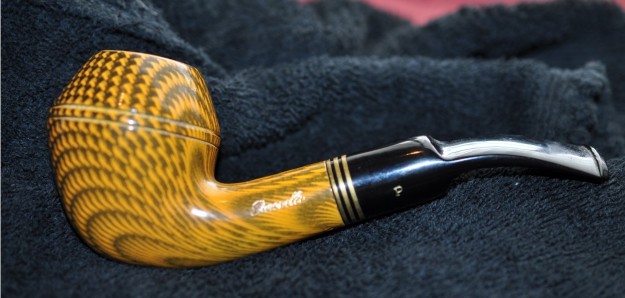
As always, I encourage your questions and comments as you read the blog. Thanks to each of you who are reading this blog. Remember we are not pipe owners; we are pipe men and women who hold our pipes in trust until they pass on into the trust of those who follow us.

Restoring a Chonowitch Designed Stanwell Bordeaux 148 Canadian


Blog by Steve Laug

The next pipe on the table to work on is one that was purchased on 01/26/2023 in a lot of pipes that came to us from Copenhagen, Denmark. This is a oval shank Canadian with a smooth finish and a thin brass band on the shank. It is another Made in Denmark Stanwell. The smooth finish on this pipe, around the bowl and shank has a mix of grain highlighted by the reddish brown stain. The pipe is stamped on the topside of the shank and reads STANWELL [over] Bordeaux. On the underside of the shank the shape number 148 is stamped [over] Made In Denmark. The pipe was a well used pipe when Jeff received it. There was dust and grime ground into the finish on the sides of the bowl. The mixture of brown stains highlights some mixed grain under the dirt. The bowl was moderately caked and there was an overflow of lava on the smooth rim top. The condition of the inner edge was hard to know due to the lava coat. The saddle stem is vulcanite and was dirty, oxidized and had light tooth marks, chatter and scratches on both sides ahead of the button and on the button itself. There is a brass Crown S logo inlaid on the topside of the saddle stem. Jeff took photos of the pipe before he started his clean up work on it. He took photos of the bowl and rim top to show what they looked like before his clean up. You can see the cake in the bowl and the lava on the rim top and inner edges. It is hard to know what the condition of the inner edge looks like. He also took some of the stem to show the condition of both sides. There are tooth marks on the surface of the stem ahead of the button and on the button surface itself. The photos of the sides and heel of the bowl show the grain around the bowl and shank. The mixture of brown stains adds depth finish on the pipe. Even under the grime it is a real beauty. The stamping on this one was around the bamboo horizontally and is shown in the photo below. It is clear and readable as noted above. The second photo shows the white stamped crown S on the stem side. Before I started my work on the pipe I wanted to see if I could find any information that would help me get a sense of the line. I turned to Pipephil to see if there was any listing on the Bordeaux Line (http://pipephil.eu/logos/en/logo-stanwell.html). There was nothing listed.

I then turned to Pipedia (https://pipedia.org/wiki/Stanwell) for more information. The article is great and gives a lot of history on the brand. There were also links to a shape article by Bas Stevens that I originally published on rebornpipes. I looked up the 148 shape number to see who had designed that shape (https://pipedia.org/wiki/Stanwell_Shape_Numbers_and_Designers). I quote the information below.

  1. Canadian, short saddle mouthpiece by Jess Chonowitsch.

Now it was time to work on the pipe.

Jeff had thoroughly cleaned up the pipe. He reamed the pipe with a PipNet Pipe Reamer and cleaned up the remnants with a Savinelli Fitsall Pipe Knife. He scrubbed the bowl with undiluted Murphy’s Oil Soap with a tooth brush. He rinsed it under running warm water to remove the soap and grime. He cleaned out the inside of the shank and the airway in the stem with alcohol, cotton swabs and pipe cleaners. He scrubbed the exterior of the stem with Soft Scrub to remove the grime and calcification. He soaked the stem in Before & After Deoxidizer and rinsed it off with warm water. The pipe looked very good when it arrived here in Vancouver. I took close up photos of the bowl, rim and the stem. You can see the damage and the darkening on rim top and inner edge. The vulcanite saddle stem is in good condition with light tooth marks and some chatter as noted above. There are some deep tooth marks on the button surface as well.I took photo of the stamping on the underside of the shank. It is readable as noted above. I removed the stem from the shank and took a photo to give a sense of the proportions of the pipe. The briar is quite beautiful and the dark and medium stains really make it stand out. I worked on the damage to the inner edge and the rim top with a folded piece of 220 grit sandpaper to bring the edge back into round and smooth out the scratches on the top. By the end it looked much better.I polished the bowl and shank with micromesh sanding pads – dry sanding with 1500-12000 grit pads. I wiped the bowl down after each pad to remove the grit. The bowl began to take on a rich shine. It is a beauty. I rubbed the bowl down with Before & After Restoration Balm. I worked it into the briar with my finger tips. I let it sit for 10 minutes and the Balm did its magic. It enlivens, cleans and preserves the briar. It certainly brought this bowl back to life. I buffed it off with a clean cloth and took the following photos. I set the bowl aside and turned my attention to the stem. I filled in the tooth marks on the surface and in the button edges. I used black CA glue and rebuilt the deep tooth marks on both side and on both top and underside button. I set the stem aside to cure. I used a small file to flatten the repair and to also cut the sharp edge of the button. I started sanding it smooth with a folded piece of 220 grit sandpaper. I polished the vulcanite stem surface and repairs near the button with a new product I am using. I ordered a set of 2 inch sanding pads for 320-3500 grit sanding pads from Amazon. They work amazingly well and are easy to manage and sand close to the sharp edge of the button. I polished the stem with micromesh sanding pads – 1500-12000 grit pads. I wiped it down with a damp cloth after each sanding pad. I used Before & After Pipe Polish – both Fine and Extra Fine to further polish the stem. This Stanwell Bordeaux 148 Canadian with a vulcanite saddle stem is a great looking pipe now that it has been restored. The mix of stains once cleaned up really highlights the grain and the polished sandblast finish is stunning. I put the stem back on the bowl and carefully buffed the pipe with Blue Diamond on the buffing wheel. I gave the bowl and the stem multiple coats of carnauba wax on the buffing wheel and followed that by buffing the entire pipe with a clean buffing pad. I hand buffed the pipe with a microfiber cloth to deepen the shine. The finished Stanwell Bordeaux 148 Canadian fits nicely in the hand and feels great. Give the finished pipe a look in the photos below. The dimensions of the pipe are Length: 5 ½ inches, Height: 1 ¾ inches, Outside diameter of the bowl: 1 1/8 inches, Chamber diameter: ¾ of an inch. The weight of the pipe is 31 grams / 1.09 ounces. I will be adding the pipe to the Danish Pipe Makers Section of the rebornpipes store. If you are interested in purchasing this pipe send me a message or an email.
As always, I encourage your questions and comments as you read the blog. Thanks to each of you who are reading this blog. Remember we are not pipe owners; we are pipe men and women who hold our pipes in trust until they pass on into the trust of those who follow us. 

Restoring a Republic Era Peterson’s Canted Dublin “Churchwarden”


Blog by Steve Laug

It is a cold and overcast day here in Vancouver and I decided to work on a pipe that has been sitting here for many years. It was purchased on 12/17/2016 off an eBay auction from Somerset, United Kingdom. This is a canted bowl Dublin. The smooth finish on this pipe, around the bowl and shank has a mix of flame and straight grain highlighted by a brown and a green wash over the briar. The stamping is faint but readable. It is stamped on the left side of the shank and reads Peterson’s [over] “Churchwarden”. On the right side of the shank it is stamped Made in the Republic of Ireland (three lines). The pipe was a well used pipe when Jeff received it. There was dust and grime ground into the finish. The mixture of brown stains and green highlights some beautiful grain under the dirt. The bowl was moderately caked and there was an overflow of lava on the smooth rim top. The inner edge had some damage. The stem is vulcanite and was heavily oxidized and had light tooth marks, chatter on both sides ahead of the button. There is a stamped “P” logo on the left side of the taper stem. Jeff took photos of the pipe before he started his clean up work. He took photos of the bowl and rim top to show what they looked like before his clean up. You can see the light lava coat on the rim top and the cake in the bowl. The inner edge shows some damage around the edge. Some spots it is nicked from what appears to be a reamer and others seem to be burn damage. He also took some of the stem to show the condition of both sides. The photos of the sides and heel of the bowl show the uniquely stained grain around the bowl and shank. The mixture of brown stains and green wash adds depth to the finish on the pipe. Even under the grime it is a real beauty. The stamping on this one was on the sides of the shank and are shown in the photos below. It is clear and readable as noted above. You can also see the stamped P on the left side of the stem. I turned to The Peterson Pipe by Mark Irwin and Gary Malmberg, p. 313 to the listing under Specialty Briars. It says this is a term used to describe several lines. Here is the information on the Churchwarden.

Churchwarden (1945-) Long pipe with various smaller bowl shapes and a fishtail mouthpiece; smooth finish, rustic starting in1969, spigot in 2018.

Now it was time to work on the pipe. Jeff had thoroughly cleaned up the pipe. He reamed the pipe with a PipNet Pipe Reamer and cleaned up the remnants with a Savinelli Fitsall Pipe Knife. He scrubbed the bowl with undiluted Murphy’s Oil Soap with a tooth brush. He rinsed it under running warm water to remove the soap and grime. He cleaned out the inside of the shank and the airway in the stem with alcohol, cotton swabs and pipe cleaners. He scrubbed the exterior of the stem with Soft Scrub to remove the grime and calcification. He soaked the stem in Before & After Deoxidizer and rinsed it off with warm water. The pipe looked very good when it arrived here in Vancouver. I took close up photos of the bowl, rim and the stem. The rim top and inner edge cleaned up very well. There was some darkening and some roughness to the inner edge of the rim. The stem looks cleaner, but still has some oxidation (from sitting here since 2016). There are light tooth marks and some chatter as noted above.I took photos of the stamping on the shank. The stamping is faint but readable as noted above. I took the stem off the shank and took a photo to give a sense of the flow and proportion of the pipe. It is a beautiful looking Churchwarden.I started my work on the pipe by dealing with the damage to the fill on the right side of the shank near the bowl. It is not deep but it looks like the fill has fallen out. It was quite clean and I used clear CA glue to fill in the area. Once the repair cured I will sand it when I am working on the bowl and shank polishing.I then turned to work on the damaged inner edge of the rim. I used a folded piece of 220 grit sandpaper to smooth out the damage and round the edges. Once I finished it the rim top and edges looked much better. I also used it to smooth out the repaired fill on the right side of the shank at the bowl.I polished the bowl and shank with micromesh sanding pads – dry sanding with 1500-12000 grit pads. I wiped the bowl down after each pad to remove the grit. The bowl began to take on a rich shine. It is a beauty. I rubbed the bowl down with Before & After Restoration Balm. I worked it into the briar with my finger tips. I let it sit for 10 minutes and the Balm did its magic. It enlivens, cleans and preserves the briar. It certainly brought this bowl back to life. I buffed it off with a clean cloth and took the following photos. I set the bowl aside and turned my attention to the oxidized stem. I worked on it with Soft Scrub and cotton pads. I was able to remove the majority of the oxidation with the pads and polish. The stem is looking much better.I touched up the “P” stamp on the left side of the stem with white enamel fingernail polish. I applied it with a dauber and worked it into the stamp with a tooth pick. Once it had dried I scraped and sanded off the excess with a 1200 grit micromesh sanding pad. It looked very good.I worked on the remaining oxidation on the vulcanite stem surface and chatter near the button with a new product I am using. I ordered a set of 2 inch sanding pads for 320-3500 grit sanding pads from Amazon. They work amazingly well and are easy to manage and sand close to the sharp edge of the button.I polished the stem with micromesh sanding pads – 1500-12000 grit pads. I wiped it down with a damp cloth after each sanding pad.I polished it with Before & After Pipe Stem Polish – both Fine and Extra Fine. I gave it a coat of Obsidian Pipe Stem Oil. I set it aside to dry. This delicate Republic Era Peterson’s Dublinesque “Churchwarden” with a vulcanite taper stem is a classic looking Churchwarden Specialty Pipe. The mix of stains once cleaned up really highlights the grain and the polished finish is stunning. I put the stem back on the bowl and carefully buffed the pipe with Blue Diamond on the buffing wheel. I gave the bowl and the stem multiple coats of carnauba wax on the buffing wheel and followed that by buffing the entire pipe with a clean buffing pad. I hand buffed the pipe with a microfiber cloth to deepen the shine. The finished Peterson’s “Churchwarden” fits nicely in the hand and feels great. Give the finished pipe a look in the photos below. The dimensions of the pipe are Length: 10 inches, Height: 1 ¾  inches, Outside diameter of the bowl: 1 1/8 inches, Chamber diameter: ¾ of an inch. The weight of the pipe is 29 grams /1.02 ounces. I will be adding the pipe to the Irish Pipe Makers Section of the rebornpipes store. If you are interested in purchasing this pipe send me a message or an email. Thanks for reading this blog and my reflections on the pipe while I worked on it.
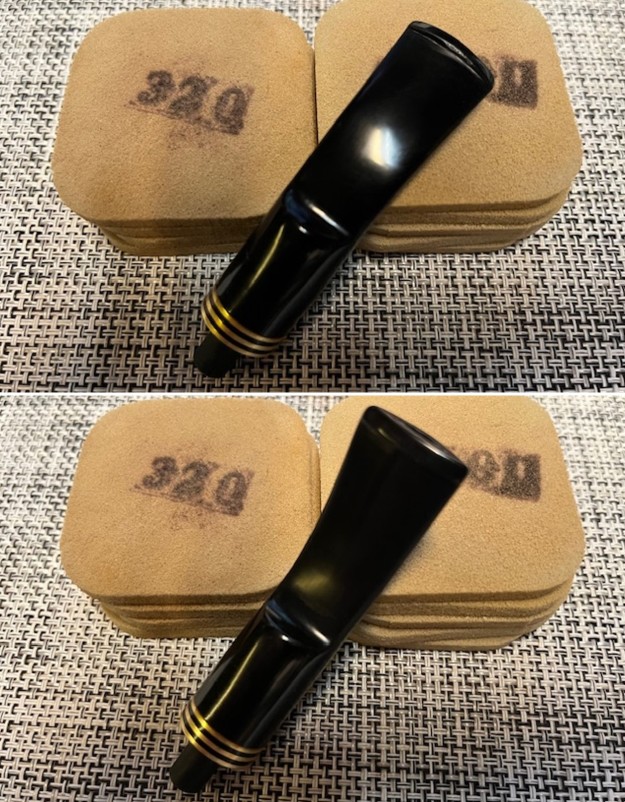
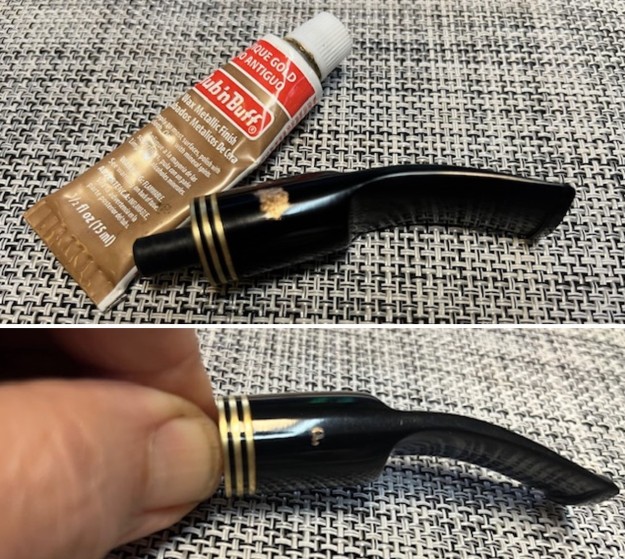
As always, I encourage your questions and comments as you read the blog. Thanks to each of you who are reading this blog. Remember we are not pipe owners; we are pipe men and women who hold our pipes in trust until they pass on into the trust of those who follow us.

What an incredible beautifully grained Ivarsson Design Danish Made Stanwell 75


Blog by Steve Laug

It is a cold day, but still sunny here in Vancouver and I decided to work on another pipe that was purchased on 01/26/2023 in a lot of pipes that came to us from Copenhagen, Denmark. This is a Danish oval shank Freehand with a smooth finish and great grain. It is another Made in Denmark Stanwell. The smooth finish on this pipe, around the bowl and shank has a mix of flame and straight grain highlighted by the rich brown stain. The pipe is stamped on the underside of the shank next to the silver band and reads STANWELL [over] Made in Denmark. On the underside mid shank, it is stamped with the shape number 75. The end of the shank sports a silver band that is decorative. The pipe was a well used pipe when Jeff received it. There was dust and grime ground into the finish. The mixture of brown stains highlights some beautiful grain under the dirt. The bowl was moderately caked and there was an overflow of lava on the smooth rim top. The inner edge looked quite good. The stem is vulcanite and was dirty, oxidized and had light tooth marks, chatter on both sides ahead of the button. There is an inlaid silver crown S logo on the top side of the taper stem. Jeff took photos of the pipe before he started his clean up work. He took photos of the bowl and rim top to show what they looked like before his clean up. You can see the lava coat on the rim top and the cake in the bowl. The inner edge looks to be okay. He also took some of the stem to show the condition of both sides. The photos of the sides and heel of the bowl show the uniquely stained grain around the bowl and shank. The mixture of brown stains adds depth to the finish on the pipe. Even under the grime it is a real beauty. The stamping on this one was on the underside of the shank and is shown in the photo below. It is clear and readable as noted above. You can also see the silver inlaid crown S on the top of the saddle stem. Before I started my work on the pipe I wanted to see if I could find any information that would help me get a sense of the line. I turned to Pipephil to see if there was any listing on the Stanwell pipes with a simple silver band (http://pipephil.eu/logos/en/logo-stanwell.html). There was nothing listed.

I then turned to Pipedia (https://pipedia.org/wiki/Stanwell) for more information. The article is great and gives a lot of history on the brand.

There was also a link to a shape article by Bas Stevens that I originally published on rebornpipes. I looked up the 75 shape number to see who had designed that shape and there was nothing there (https://pipedia.org/wiki/Stanwell_Shape_Numbers_and_Designers). The shape 75 is described as a Freehand, slightly bent, oval stem and mouthpiece, by Sixten Ivarsson.

Now it was time to work on the pipe. Jeff had thoroughly cleaned up the pipe. He reamed the pipe with a PipNet Pipe Reamer and cleaned up the remnants with a Savinelli Fitsall Pipe Knife. He scrubbed the bowl with undiluted Murphy’s Oil Soap with a tooth brush. He rinsed it under running warm water to remove the soap and grime. He cleaned out the inside of the shank and the airway in the stem with alcohol, cotton swabs and pipe cleaners. He scrubbed the exterior of the stem with Soft Scrub to remove the grime and calcification. He soaked the stem in Before & After Deoxidizer and rinsed it off with warm water. The pipe looked very good when it arrived here in Vancouver. I took close up photos of the bowl, rim and the stem. The rim top and inner edge cleaned up very well. There was some darkening on the left side and backside of the rim top. The stem looks clean but still has light tooth marks and some chatter as noted above.I took photos of the stamping on the shank. The stamping is readable as noted above. I took the stem off the shank and took a photo to give a sense of the flow and proportion of the pipe. It is a beautiful looking Freehand. I started my work on the pipe by polishing the bowl and shank with micromesh sanding pads – dry sanding with 1500-12000 grit pads. I wiped the bowl down after each pad to remove the grit. The bowl began to take on a rich shine. It is a beauty. I rubbed the bowl down with Before & After Restoration Balm. I worked it into the briar with my finger tips. I let it sit for 10 minutes and the Balm did its magic. It enlivens, cleans and preserves the briar. It certainly brought this bowl back to life. I buffed it off with a clean cloth and took the following photos. I polished the silver band on the shank end with a jewellers cloth. It works to remove the tarnish and oxidation and also protects the surface from further tarnishing.I set the bowl aside and turned my attention to the stem. I polished the vulcanite stem surface and repairs near the button with a new product I am using. I ordered a set of 2 inch sanding pads for 320-3500 grit sanding pads from Amazon. They work amazingly well and are easy to manage and sand close to the sharp edge of the button.I polished the stem with micromesh sanding pads – 1500-12000 grit pads. I wiped it down with a damp cloth after each sanding pad. I polished it with Before & After Pipe Stem Polish – both Fine and Extra Fine. I gave it a coat of Obsidian Pipe Stem Oil. I set it aside to dry.This Ivarsson Design Stanwell Made in Denmark 75 Freehand with a vulcanite taper stem is a great looking pipe and really looks like an S. Bang shape. The mix of stains once cleaned up really highlights the grain and the polished finish is stunning. I put the stem back on the bowl and carefully buffed the pipe with Blue Diamond on the buffing wheel. I gave the bowl and the stem multiple coats of carnauba wax on the buffing wheel and followed that by buffing the entire pipe with a clean buffing pad. I hand buffed the pipe with a microfiber cloth to deepen the shine. The finished Stanwell Made in Denmark 75 Freehand fits nicely in the hand and feels great. Give the finished pipe a look in the photos below. The dimensions of the pipe are Length: 5 ½ inches, Height: 1 ½ inches, Outside diameter of the bowl: 1 ¼ inches, Chamber diameter: ¾ of an inch. The weight of the pipe is 40 grams /1.41 ounces. I will be adding the pipe to the Danish Pipe Makers Section of the rebornpipes store. If you are interested in purchasing this pipe send me a message or an email. Thanks for reading this blog and my reflections on the pipe while I worked on it.

As always, I encourage your questions and comments as you read the blog. Thanks to each of you who are reading this blog. Remember we are not pipe owners; we are pipe men and women who hold our pipes in trust until they pass on into the trust of those who follow us. 

Restoring another Truly Elegant Danish made Stanwell Brass Band 56 Canadian


Blog by Steve Laug

It is a cold but sunny day here in Vancouver and I decided to work on another pipe that was purchased on 01/26/2023 in a lot of pipes that came to us from Copenhagen, Denmark. This is a classic Danish Canadian with a smooth finish and an oval shank. It is another Made in Denmark Stanwell. The smooth finish on this pipe, around the bowl and shank has a mix of grain highlighted by the rich brown stain. The pipe is stamped on the topside of the shank and reads STANWELL [over] Brass [over] Band. On the underside it is stamped with the shape number 56 [over] Made in Denmark. The end of the shank sports twin brass bands sandwiching a Cumberland acrylic spacer. The pipe was a well used pipe when Jeff received it. There was dust and grime ground into the finish. The mixture of brown stains highlights some beautiful grain under the dirt. The bowl was moderately caked and there was a moderate overflow of lava on the smooth rim top. The inner edge looked quite good. The stem is vulcanite and was dirty, oxidized and had light tooth marks, chatter and scratches on both sides ahead of the button. There is an inlaid brass crown S logo on the top side of the taper stem. Jeff took photos of the pipe before he started his clean up work on it. He took photos of the bowl and rim top to show what they looked like before his clean up. You can see the lava coat on the rim top and the cake in the bowl. The inner edge looks to be okay. He also took some of the stem to show the condition of both sides. The photos of the sides and heel of the bowl show the uniquely stained grain around the bowl and shank. The mixture of brown stains adds depth to the finish on the pipe. Even under the grime it is a real beauty. The stamping on this one was on the underside of the shank and is shown in the photo below. It is clear and readable as noted above. You can also see the brass inlaid crown S on the top of the saddle stem.Before I started my work on the pipe I wanted to see if I could find any information that would help me get a sense of the line. I turned to Pipephil to see if there was any listing on the Brass Band Line (http://pipephil.eu/logos/en/logo-stanwell.html). There was nothing listed.

I then turned to Pipedia (https://pipedia.org/wiki/Stanwell) for more information. The article is great and gives a lot of history on the brand. There was also a catalogue page courtesy of Doug Valitchka that showed the line. I have included that below.There was also a link to a shape article by Bas Stevens that I originally published on rebornpipes. I looked up the 56 shape number to see who had designed that shape and there was nothing there (https://pipedia.org/wiki/Stanwell_Shape_Numbers_and_Designers). The shape 56 is described as a Canadian with a tapered stem.

Now it was time to work on the pipe. Jeff had thoroughly cleaned up the pipe. He reamed the pipe with a PipNet Pipe Reamer and cleaned up the remnants with a Savinelli Fitsall Pipe Knife. He scrubbed the bowl with undiluted Murphy’s Oil Soap with a tooth brush. He rinsed it under running warm water to remove the soap and grime. He cleaned out the inside of the shank and the airway in the stem with alcohol, cotton swabs and pipe cleaners. He scrubbed the exterior of the stem with Soft Scrub to remove the grime and calcification. He soaked the stem in Before & After Deoxidizer and rinsed it off with warm water. The pipe looked very good when it arrived here in Vancouver. I took close up photos of the bowl, rim and the stem. The rim top and inner edge cleaned up very well. The stem looks clean but still has light tooth marks and some chatter as noted above.I took photos of the stamping on the shank. The stamping is readable as noted above. I took the stem off the shank and took a photo to give a sense of the flow and proportion of the pipe. It is a beautiful looking Danish Canadian.I started my work on the pipe by polishing the bowl and shank with micromesh sanding pads – dry sanding with 1500-12000 grit pads. I wiped the bowl down after each pad to remove the grit. The bowl began to take on a rich shine. It is a beauty. I rubbed the bowl down with Before & After Restoration Balm. I worked it into the briar with my finger tips. I let it sit for 10 minutes and the Balm did its magic. It enlivens, cleans and preserves the briar. It certainly brought this bowl back to life. I buffed it off with a clean cloth and took the following photos. I set the bowl aside and turned my attention to the stem. I polished the vulcanite stem surface and repairs near the button with a new product I am using. I ordered a set of 2 inch sanding pads for 320-3500 grit sanding pads from Amazon. They work amazingly well and are easy to manage and sand close to the sharp edge of the button.I polished the stem with micromesh sanding pads – 1500-12000 grit pads. I wiped it down with a damp cloth after each sanding pad.I polished it with Before & After Pipe Stem Polish – both Fine and Extra Fine. I gave it a coat of Obsidian Pipe Stem Oil. I set it aside to dry. This Stanwell Brass Band 56 Canadian with a vulcanite taper stem is a great looking pipe and really looks like an S. Bang shape. The mix of stains once cleaned up really highlights the grain and the polished finish is stunning. I put the stem back on the bowl and carefully buffed the pipe with Blue Diamond on the buffing wheel. I gave the bowl and the stem multiple coats of carnauba wax on the buffing wheel and followed that by buffing the entire pipe with a clean buffing pad. I hand buffed the pipe with a microfiber cloth to deepen the shine. The finished Stanwell Brass Band Canadian 56 fits nicely in the hand and feels great. Give the finished pipe a look in the photos below. The dimensions of the pipe are Length: 5 ½ inches, Height: 1 ¾ inches, Outside diameter of the bowl: 1 ¼ inches, Chamber diameter: ¾ of an inch. The weight of the pipe is 35 grams /1.23 ounces. I will be adding the pipe to the Danish Pipe Makers Section of the rebornpipes store. If you are interested in purchasing this pipe send me a message or an email. Thanks for reading this blog and my reflections on the pipe while I worked on it.
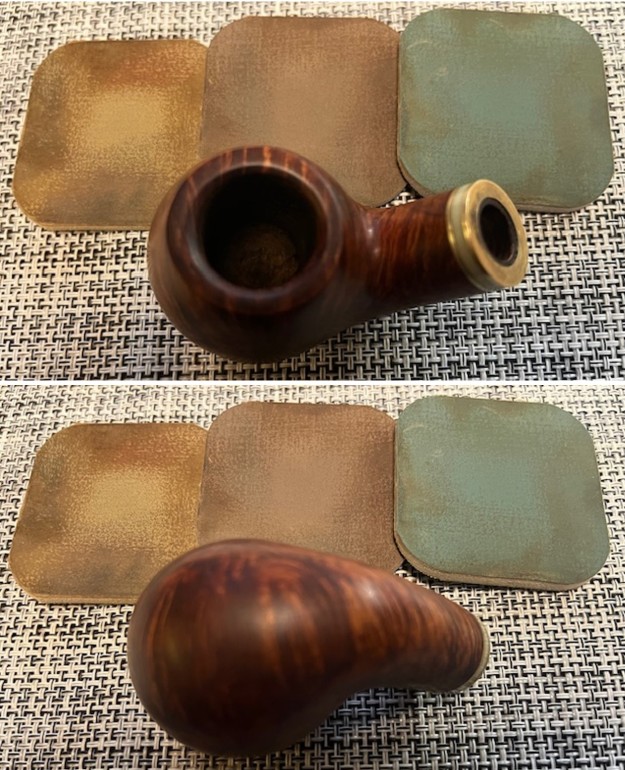
As always, I encourage your questions and comments as you read the blog. Thanks to each of you who are reading this blog. Remember we are not pipe owners; we are pipe men and women who hold our pipes in trust until they pass on into the trust of those who follow us.